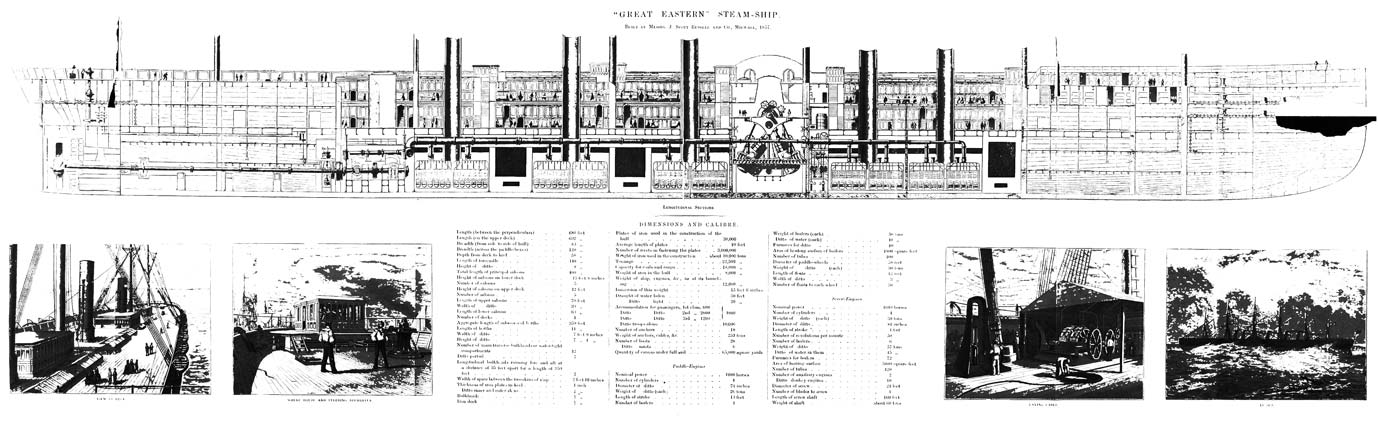
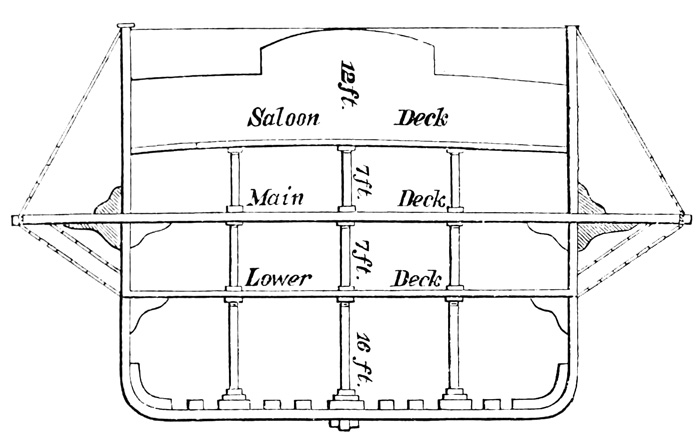
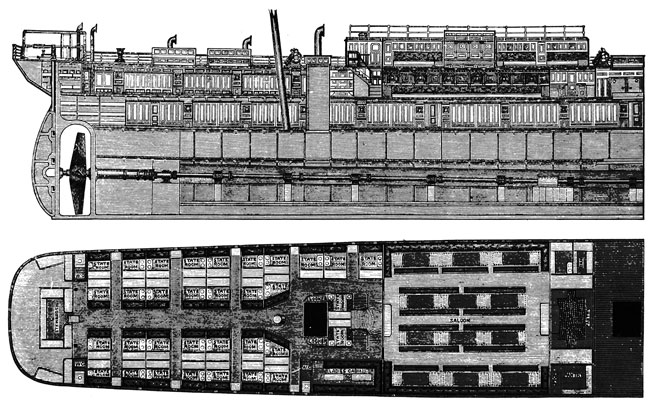
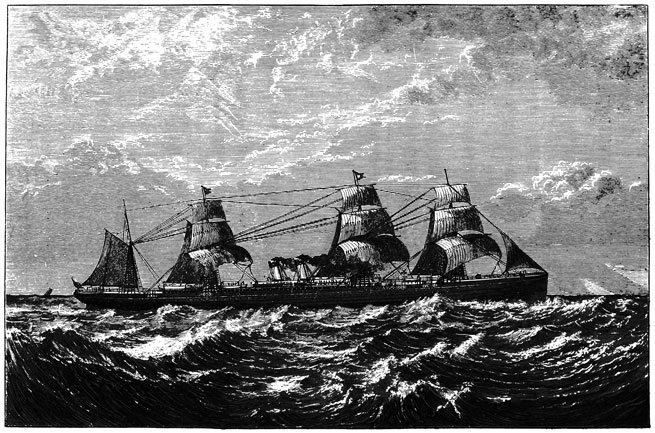
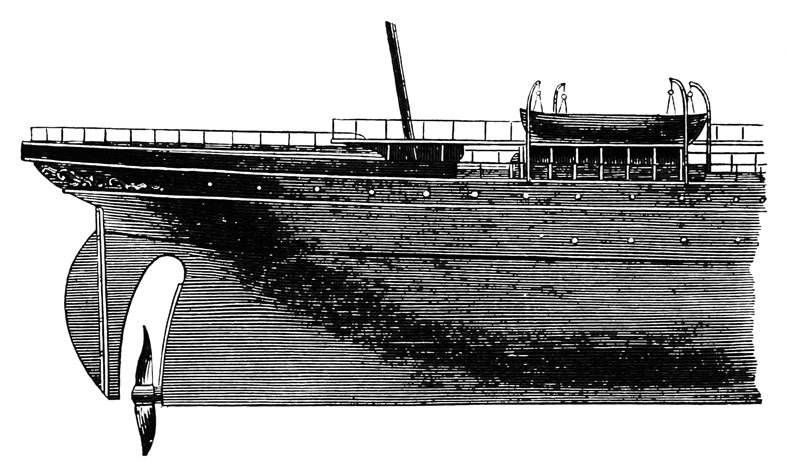
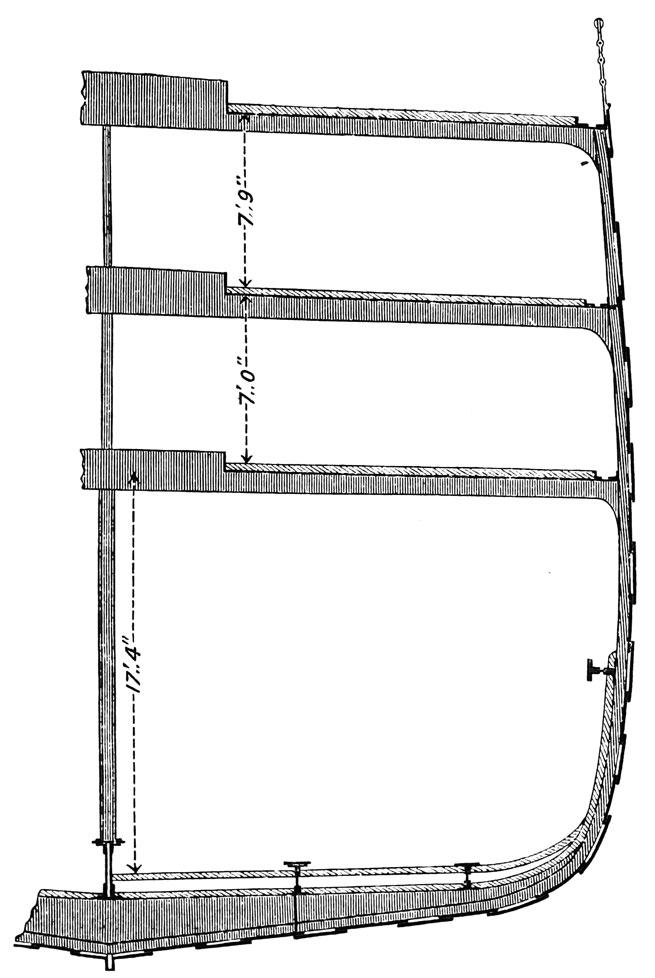
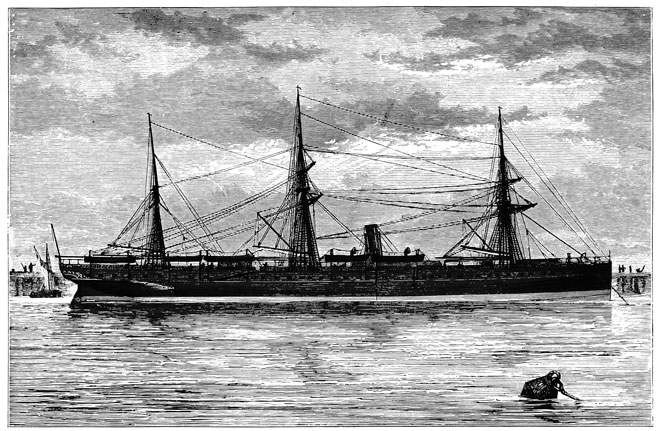
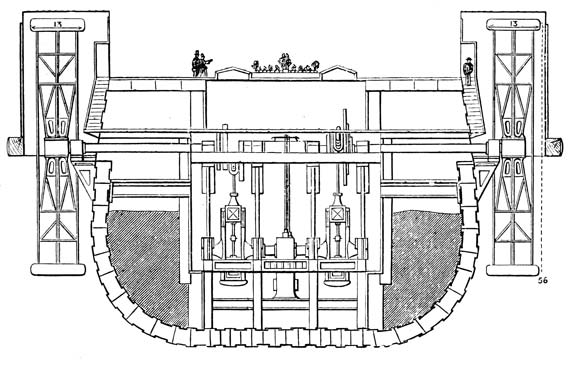
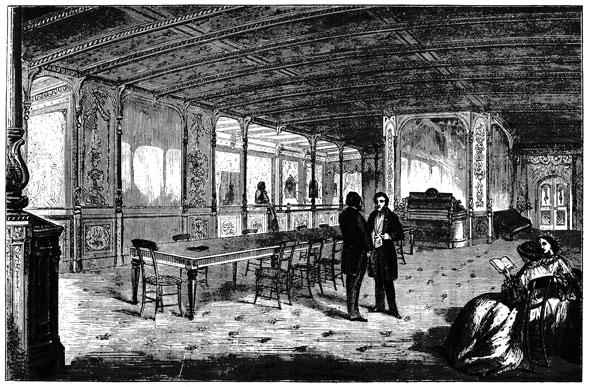
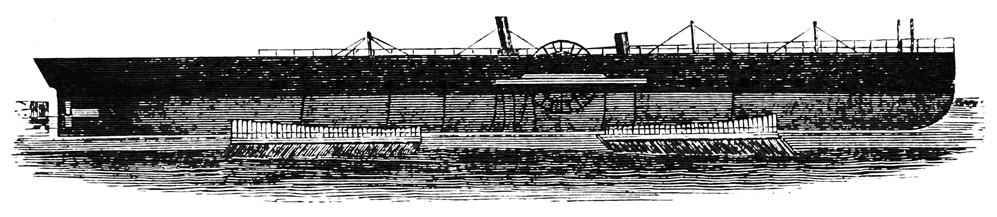
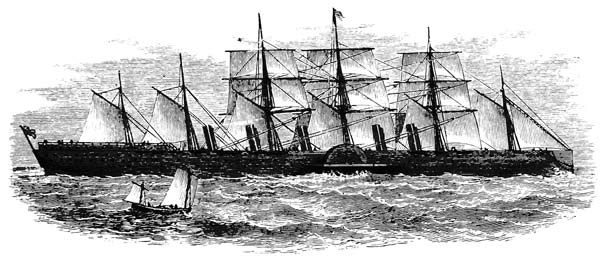
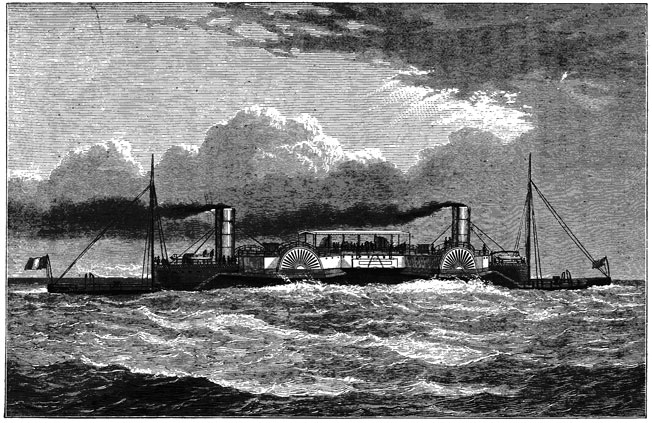
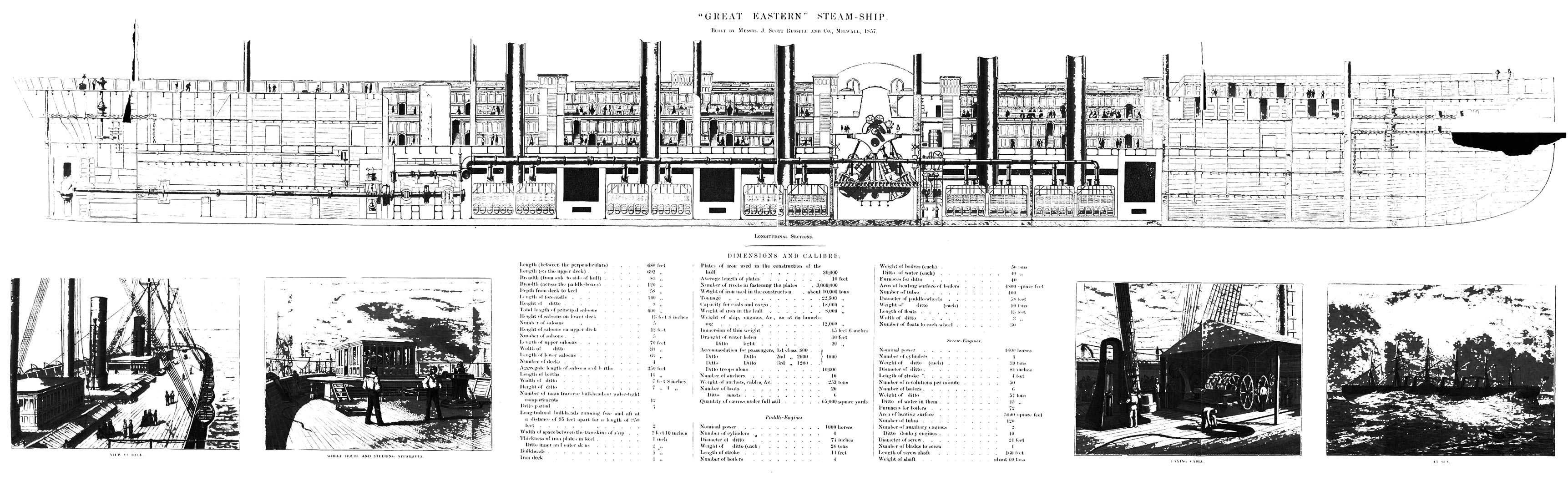
Number of main traverse bulkheads or water-tight compartments
12
Ditto partial
7
Longitudinal bulkheads running fore and aft at
a distance of 35 feet apart for a length of 350
feet
2
Width of space between the two skins of ship
2
feet 10 inches
Thickness of iron plates in keel
1
inch
Ditto inner and outer skins
¾
”
Bulk heads
½
”
Iron deck
½
”
Plates of iron used in the construction of the hull
30,000
Average length of plates
10
feet
Number of rivets in fastening the plates
3,000,000
Weight of iron used in the construction
about 10,000
tons
Tonnage
22,500
”
Capacity for coals and cargo
18,000
”
Weight of iron in the hull
8,000
”
Weight of ship, engines, &c., as at its launching
12,000
”
Immersion of this weight
15
feet 6 inches
Draught of water laden
30
feet
Draught of water light
20
”
Accommodation for passengers, 1st class, 800
4000
Accommodation for passengers, 2nd class, 2000
Accommodation for passengers, 3rd class, 1200
Accommodation for troops alone
10,000
Number of anchors
10
Weight of anchors, cables, &c.
253
tons
Number of boats
20
Number of masts
6
Quantity of canvas under full sail
65,000
square yards
Paddle-Engines.
Nominal power
1,000
horses
Number of cylinders
4
Diameter of cylinders
74
inches
Weight of cylinders (each)
26
tons
Length of stroke
14
feet
Number of boilers
4
Weight of boilers (each)
50
tons
Weight of water (each)
40
”
Furnaces for boilers
40
Area of heating surface of boilers
4800
square feet
Number of tubes
400
Diameter of paddle-wheels
58
feet
Weight of paddle-wheels (each)
90
tons
Length of floats
13
feet
Width of floats
3
”
Number of floats to each wheel
30
Screw-Engines.
Nominal power
1600
horses
Number of cylinders
4
Weight of cylinders (each)
30
tons
Diameter of cylinders
84
inches
Length of stroke
4
feet
Number of revolutions per minute
50
Number of boilers
6
Weight of boilers
57
tons
Weight of water in them
45
”
Furnaces for boilers
72
Area of heating surface
5000
square feet
Number of tubes
420
Number of auxiliary engines
2
Number of donkey engines
10
Diameter of screw
24
feet
Number of blades to screw
4
Length of screw shaft
160
feet
Weight of shaft
about 60
tons
CONTENTS.
CHAPTER I.
Earliest modes of propulsion—Suggested partly by nature—Hero of
Alexandria, B.C. 120—Dancing steam ball—Æolipile—Application
of science to superstitious purposes—Revival of learning—Robertus
Valturius, 1472—Blasco de Garay—Story of his experiment, 1543—Disproved
by Mr. MacGregor’s investigations, note—Progress of
invention—Bourne—Solomon de Caus, Marquess of Worcester, &c.—Morisotus’
vessel with paddle-wheels—Hollar’s drawing—Absurd
patents—Phillips and his windmill—Papin and Morland—Savery—Jonathan
Hulls—James Watt’s engine—Matthew Wasborough—Marquis
de Jouffroy—Bramah’s screw-propeller—Mr. Miller of
Dalswinton—Mr. Symington and Mr. Taylor—The Charlotte Dundas—Rumsey
and Fitch—J. C. Stevens—Oliver Evans—Robert Fulton
and Mr. Livingston—Plan really derived from the English experiments
of Symington—Fulton builds steamers in the U.S.—The
Clermont—Merits and demerits of Fulton—At all events the first
to “run” a steam-vessel regularly and to develop its power and
usefulness—First steamboat on the St. Lawrence, 1813.
Progress of steam navigation in Europe—Clyde mechanics take the
lead—James Watt, 1766—Henry Bell, 1800—Correspondence
between Bell and Fulton—Letter from Bell to Miller of Dalswinton—The
Comet steamer, 1811, plies between Glasgow and Greenock,
and afterwards on the Forth—Extraordinary progress of shipbuilding
on the Clyde—Great value and importance of the private
building yards—J. Elder and Company; their extensive premises,
note—Steam between Norwich and Yarmouth, 1813; between
London and Margate, 1815—The Glasgow—Early opposition to the
employment of steam-vessels—Barges on the Thames—First steamer
between Liverpool and the Clyde—H. M. steam-ship Comet—The
Rob Roy and other vessels, 1818—The United Kingdom, 1826—First
idea of iron ships, 1830—Proposals of Trevethick and Dickenson,
1809-1815—The Vulcan, 1818—The Aaron Manby, 1821—The
Shannon Steam Packet Company, 1824—Mr. John Laird and Sir
William Fairbairn—The Elburkah, 1832, and Garry Owen, 1834—The
Rainbow, 1837—Messrs. Tod and MacGregor—The Great Britain,
1839-1843—Advantages of iron ships—Action of salt water on iron
inconsiderable—Durability, strength, and safety of iron—Affords
greater capacity for stowage—Admiralty slow to adopt iron for ships
of war—Mr. Galloway’s feathering paddles, 1829—Story of the
screw-propeller—Joseph Bramah, 1785—Mr. J. Stevens, 1804—Richard
Trevethick, 1815—Robert Wilson, 1833—Captain Ericsson,
1836—The Francis B. Ogden, though successful, fails to convince
the Admiralty—Mr. T. P. Smith—The Archimedes—Her trial with
the Widgeon, Oct. 1839, and its results—The Rattler and the Alecto,
1843—The Rattler not as successful as expected—Captain Robert
F. Stockton efficiently supports Ericsson’s views—His vessel, a
complete success, and the first “screw” used for commerce in
America—Superiority of Mr. Woodcroft’s “varying” propeller, 1832—In
building fit vessels, the trade in which they are to be employed
must be considered
Steam-ships of the United States—Improvements in form of hull—Natural
facilities for Steam Navigation in America—Her lakes—Canals—Harbours—Rivers—Seaboard—Bays
and roadsteads—Rapid
increase of steam-vessels—First vessels built for the western rivers
and lakes—Dangers of River Navigation—Number of steamers lost
by “snags,” ice, fire, and collision, 1831-1833—Peculiar description
of wharves and levees—Description of steamers employed—Boats of
the Mississippi—Boatmen—Engines of the steamers—Different construction
of the steamers on the Atlantic rivers—Great speed of
American lake and river steamers—Peculiarity of construction—Steamer
New World—Details of her construction—The Daniel Drew—Her
enormous speed—Pacific Steam-ship Company started, 1847—Cost
of establishing it—Speed of its vessels—Difficulties to
encounter—Number of its steamers—Services performed—China
and Japan line—“Law” line of steamers—South American Steamship
Company—Mr. Randall’s projected large American steamer—Details
of proposed ship—Two sets of paddle-wheels—Principle
of construction—Advantages to be derived from vessels thus built—Mr.
Randall’s experience of steamers employed on the lakes, and
the Pacific
Struggle between Great Britain and United States for the Atlantic
carrying trade—English shipowners cleave to Protection—“Baltimore
clippers” and “American liners”—The Savannah, the first
American Atlantic steamer, 1819—The Curaçoa, 1829—The Royal
William, 1833, from Quebec—The Sirius and Great Western, 1838—Successful
voyages of these vessels—Details of Great Western—The
Royal William, second of that name, the first steam-ship from
Liverpool, 1838, followed by the Liverpool—Origin of the Cunard
Company—Contract for conveyance of mails—Conditions—Names
and particulars of the first steamers in this service—The Britannia—Comparative
results of different vessels—Building (1839) and
loss (1841) of the President—Building of the Great Britain in 1843—Advantages
of iron ships—American auxiliary screw steamer
Massachusetts, 1845—American line of steamers to Europe, 1847—First
ocean race won by the English—Not satisfied with Cunard
line, the Americans determine to start one of their own—Reasons
for so doing—American shipowners complain justly of the “Protective”
policy of their own Government—Nevertheless adopted—Collins
line established—Original terms of subsidy—Dimensions of
their steamers—Mr. Faron’s visit to England—Details of the build
of these vessels—Engines—Frame sustaining engines and dead
weight—Cost of steamers greatly increased by demand for increased
speed—Further details of competing lines—Speed obtained and cost—Great
competition, 1850-1852—Results of it
Dangers of Atlantic Navigation—Collision of Arctic and Vesta, 1854—Arctic
founders—Loss of Pacific, 1856—Renewed exertions of the
Collins and, also, of the Cunard Company—Launch of the Persia—Collins
line relinquished, 1858—Scotia—Her great strength and speed—Russia,
first Cunard iron screw-steamer, 1862—Bothnia and
Scythia, 1874—Their construction, outfit, and cabin accommodation—Vessels
now owned by Cunard Company—Comparison of Britannia
and Bothnia—Cunard Company never lost a life nor a letter during
thirty-five years—Reasons—Value of punctuality—Admirable discipline
in their ships—Regulations of the Company—Most disasters
may be prevented by foresight—Success depends on fitting means—Cunard
line shows what can be done
Liverpool, New York, and Philadelphia Steamship Company—City of
Glasgow, 1850—City of Manchester, 1851—Speed of City of Paris and
City of Brussels—Exertions of Mr. Inman to improve and facilitate
cheap emigration to the United States—Large number of emigrants
carried in the Inman steamers—City of Chester, 1873—City of
Berlin, 1875—Ocean steamers to Canada, 1853—First mail contract,
1852—Allan line of steamers, 1856—Extent and capacity of its fleet—Speed
of these vessels—Galway line a failure—Loss of Connaught,
1860—Rapid Passage of Adriatic, 1861—Struggles between sailing-clippers
and iron screw-ships—National Steam Navigation Company,
1863—Their splendid ships—Old Black Ball line—The Guion line,
1863—Mississippi and Dominion Company—White Star line, 1870—Strict
regulations for safety—Britannic and Germanic—Their
great speed—Details of Britannic and form of her screw—Difficulty
of estimating real cost of steamers—Pennsylvania Company, 1873—Anchor
line from the Clyde, 1856—Prodigious range of their trade
operations—The Victoria—Hamburg American Steam Packet Company—North
German Lloyd’s
Royal West India Mail Steam Packet Company, 1841—Number of their
ships—Conditions of mail contract—Large subsidy—Heavy loss
during the first year of their operations—Capital of the Company—Liberal
concessions by Government—Complaints of the public—Improved
prospects of the company from improved management—Contract
renewed, 1850—Its conditions—Fresh conditions, 1857—Contract
again renewed, 1864—Further renewal, 1874—The steam-ship
Forth—Losses of various ships of the company—Causes of these
losses—Loss of the Amazon—Terrible sufferings—Loss of the
Demerara—Additions to their fleet, and superior class of vessels
Pacific Steam Navigation Company—First steamer on the Pacific, 1825—Mr.
Wheelwright—Obtains a charter, 1840—First vessels, the Chili
and Peru—Warm reception at Valparaiso—The Company persevere—Appointment
of Mr. Just, 1846—Extension of contract, 1850—Marked
improvement in the prospects of the Company, 1860—New
lines—Vast increase of capital, 1867—Further increase of capital to
3,000,000l., 1871—Capital increased to 4,000,000l., 1872—Extent of
fleet, Iberia and Liguria—Chimborazo, 1871—Too rapid increase—Loss
arising therefrom—Modification of mail contract and reduced
services—West coast steamer Bolivia—Future prospects of the
Company—Trade with Mexico—First line of steamers from Liverpool
to Chagres—West India and Pacific Steam Navigation Company—Liverpool,
Brazil, and River Plate Steam Navigation Company
Steam to India and overland routes—East India Company establish a
Tátar post between Constantinople and Baghdad—First public
meeting in London to promote steam communication with India,
1822—Captain Johnston—Calcutta meetings, 1823—The Enterprize,
first steamer to India by Cape, 1825—Sold in Calcutta to East
India Company—Other steamers follow—Pioneers of overland route
viâ Egypt—Sir Miles Nightingall in 1819 and Mount-Stuart Elphinstone
in 1823 return home by this route—Mr. Thomas Waghorn
visits England to promote the Cape route, 1829-30—Returns to
India by way of Trieste and the Red Sea—Still advocates Cape
route, 1830—Mr. Taylor’s proposal—Reply of Bombay Government
and discussion of the question—Supineness of the Court of Directors—Their
views—Official report of the first voyage of the Hugh
Lindsay, 1830—Report of the Committee of 1834—Decision of the
House of Commons Committee influenced by political considerations—Admiralty
packets extended from Malta to Alexandria—Steamers
of the Indian navy—Modes of transport across the Isthmus of Suez—Great
exertions of Waghorn in the establishment of this route—Suez
Canal—Popular errors on this subject—M. de Lesseps—His
great scheme—Not fairly considered in England—Commencement
of M. de Lesseps’ works in 1857—General details—Partial opening
of Canal, April 18th, 1869—Finally opened by Empress Eugénie,
November 17th, 1869
Peninsular and Oriental Steam Navigation Company—Its founders and
origin—Messrs. Willcox and Anderson—Mr. James Allan—How the
Peninsular mails were originally conveyed—Proposal of Peninsular
Company for their conveyance—Contract concluded August 29th,
1837—Conveyance of mails to India previously to 1839—Government
applies to the Peninsular Company and accepts their proposals,
though reluctantly—Proposed direct line from Falmouth to Calcutta—First
vessels hence, on Indian postal service to Alexandria—Original
postal service from Suez to Bombay—Contract for mails
between Suez and Calcutta, September 1842—Further proposals
made by the East India Company and Government, but finally
rejected by the East India Company—Further contracts for mail
service to China and Singapore—Peninsular and Oriental Company
undertake the line between Bombay and Suez, 1854—House of
Commons Committee on Australian mail service, 1849—Eastern
Steam Navigation Company and Peninsular and Oriental Company
tender for it, but the Peninsular and Oriental succeed—The Himalaya
built—New contract with Peninsular and Oriental Company,
January 1853—Failure of Service during the Crimean War—Proposals
for an independent Australian mail service—Tender of European
and Australian Company accepted—Their entire failure—Speech
of Lord Overstone, March 24th, 1859—Royal Mail Company
undertakes the Australian service and fails—New tenders invited—That
of Peninsular and Oriental Company accepted, 1859—Consolidation
of services in the Peninsular and Oriental Company—Its
present condition and fleet of ships—Terms of the contract now
in force—Revenue and expenditure—Coals required—Descriptions of
vessels—Screw steamer Khedive—Particulars of this ship—Uniform
and regulations of the Company
Changes produced by the opening of the Suez Canal—Sailing fruit-clippers—Introduction
of steamers into the Mediterranean trade,
1840—Establishment of various steam lines, 1850—That of Messrs.
Frederick Leyland and Co., &c.—Their fleets—Messageries Maritimes
Company—Its origin and management—First contract for the
conveyance of the oversea French mails, 1851—Extension of contracts,
1854-56—Brazil line, 1857—Vast extent of its fleet—Largest vessels—Trade
viâ the Suez Canal—Presumed advantage of auxiliary
engines—Not borne out by the results—Conveyance of the Australian
mails—Peculiar conditions of contracts—Failure of the service—Stringent
penalties—Australian steam services—Mr. Alfred Holt’s
line of steamers to China—Its success—Messrs. Gellatly, Hankey,
and Company—Messrs. Green and Company—Messrs. Rathbone
Brothers—Messrs. George Smith and Sons—Letter from Mr. George
Smith—Messrs. Smiths’ ships and their voyages to and from India—Changes
in the mode of conducting commerce with India and China—Number
of vessels through Suez Canal since its opening, and their
nationality
First application of steam-vessels on the rivers and coasts of India,
1825—S.S. Diana—S.S. Burhampooter and Hooghly, 1828—Arrival in
India of Lord William Bentinck as Governor-General—His efforts
to promote Steam Navigation—Voyages of the S.S. Hooghly up the
Ganges, 1828, 1829 and 1830—Other vessels recommended to be built—Two
of them of Iron—Steam Companies formed, 1845—Steam
Committee, 1857, and rapid progress of steam-vessels from this
date—Improved troop steamer for the Lower Indus—Sea-going
steamers of India—S.S. John Bright—British India Steam Navigation
Company established, 1857—Its fleet, and extent of its operations—Origin
of this Company—Its early difficulties, and rapid extension—Number
of ships lost—Effect of the opening of the Suez Canal on
the trade of this Company—The Holy Ship, note—Netherlands Steam
Navigation Company, 1866—Its fleet, and how employed—Irrawaddy
Flotilla and Burmese Steam Navigation Company, 1865—Services
of this Company—Extent of inland trade—Fleet of the Company—Interior
trade of China—The Yang-tse-Kiang—Its source and extent—Opened
to trade, 1860—First steam-ship direct from Hankow
to England, 1863—Passage of the Robert Lowe and her cargo—Number
of steamers employed on the Yang-tse 1864 and in 1875—S.S.
Hankow—Her power and capacity, note—Chinese Steam Navigation
Company—Proposed Imperial fleet of steamers—Increase of
trade with China—The resources of the interior—Mode of conducting
business—“Hongs” or Guilds—Chinese Bankers—River and
coasting trade of China—Japanese line of steamers—How employed
Eastern Steam Navigation Company—Detailed proposals of the directors—Capital
subscribed to build the Great Eastern—Relative size
and speed of sailing-ships—Mr. Brunel proposes to build a ship five
or six times as big as any existing vessel, and is supported in his
views by Mr. Scott Russell—Plan of construction, size, &c.—Mr.
Atherton considers the views of the directors are not supported by
their data—The Great Eastern commenced May 1, 1854—Details of
her dimensions and mode of construction—Practically, one ship
within another—Compartments and bulkheads—Floor—Construction
of the iron plates for hull—The deck and its strength—Enormous
steam-power from combination of paddle and screw—Paddle-wheel,
auxiliary, and screw-engines—Donkey-engines—Proposed accommodation
for passengers, &c.—View of deck, &c.—Saloon—Intended
to carry twenty large boats and two steamers—Compasses—Size
of sails—Magnetic apparatus of Mr. J. Gray—Apparatus for steering—Rudder
and anchors, and note—The ship itself a marvel, though
commercially, a failure—Preparations for, and details of, the launching
of the Great Eastern
Commencement of launch of the Great Eastern, November 3rd, 1857—Christened
by Miss Hope—Comparative failure—Renewed efforts
scarcely more successful—Hydraulic ram bursts—Floats of her own
accord, January 31st, 1858—The whole scheme of this launch a
thorough mistake—Difficulties of the Company—Offer to Government
wisely declined—Further proposal to employ her as a cable layer—Makes
her first sea trip, September 9th, 1859—Accident off Hastings,
and the opinion of the pilot—Reaches Holyhead; and details of her
voyage—Makes her first voyage across the Atlantic, June 1860—Second
voyage, May 1861—Third voyage, to Quebec, July 1861—Fourth
voyage, September 1861—Heavy gale off S. W. coast of
Ireland, and compelled to return to Cork—General remarks on the
sea-going qualities of different ships, and on the effect of wind in
causing “rollers”—Real truth about “momentum”—Very large
ships not so safe as smaller ones, as their damages are less easily
repaired—Chief later use of the Great Eastern as a cable layer, but
not, even here, remunerative—Concluding remarks.
River and coast trade of Great Britain—The Iona, paddle steamer—First
screw collier Q. E. D.—The King Coal collier—Her dimensions
and crew, note—Improvement in care of seamen—Leith and London
traders—Dublin and Holyhead Mail-Packets—Their great speed and
regularity—Dimensions, power, capacity, and cost—Dover and Calais
Mail-Packets—The Victoria—Her speed—Proposed tunnel and other
modes of crossing the Straits of Dover—Mr. Fowler’s plan—The
Castalia—The Bessemer—Her swinging saloon—The cigar-ship built
at Baltimore, 1858—Similar ship built on the Thames, 1864—Perkins’s
economical steam-engine and proposed fast boat—The Engine
of the Comet—Modifications in the construction of Marine Engines—Ratio
of speed to power—The Compound Engine more economical
than the simple—Great skill required for building perfect
ships, and especial importance to England of having the best ships—But
her ships not yet perfect, though great progress has been
made during the last half century
[1] The whole of these Illustrations have been re-drawn on block, and a
great many of them are original. It is, however, only due to the memory of
a truly good and unassuming man to state, more especially as he was a thorough
genius in the illustration of all nautical subjects, that many of the drawings
are reduced copies from those of the late Edward Weedon, who, for many
years, and up to his untimely death in 1874, was one of the staff of artists of
the Illustrated London News.
MERCHANT SHIPPING.
CHAPTER I. — FOOTNOTES:
Earliest modes of propulsion—Suggested partly by nature—Hero of
Alexandria, B.C. 120—Dancing steam ball—Æolipile—Application
of science to superstitious purposes—Revival of learning—Robertus
Valturius, 1472—Blasco de Garay—Story of his experiment, 1543—Disproved
by Mr. MacGregor’s investigations, note—Progress of invention—Bourne—Solomon
de Caus, Marquess of Worcester, &c.—Morisotus’
vessel with paddle-wheels—Hollar’s drawing—Absurd
patents—Phillips and his windmill—Papin and Morland—Savery—Jonathan
Hulls—James Watt’s engine—Matthew Wasborough—Marquis
de Jouffroy—Bramah’s screw-propeller—Mr. Miller of
Dalswinton—Mr. Symington and Mr. Taylor—The Charlotte Dundas—Rumsey
and Fitch—J. C. Stevens—Oliver Evans—Robert Fulton
and Mr. Livingston—Plan really derived from the English experiments
of Symington—Fulton builds steamers in the U. S.—The
Clermont—Merits and demerits of Fulton—At all events the first to
“run” a steam-vessel regularly, and to develop its power and usefulness—First
steam-boat on the St. Lawrence, 1813.
Earliest
modes of
propulsion.
Modern investigation has confirmed the opinion that
the knowledge of the ancients was more varied and
extensive than has hitherto been generally supposed,
and that there is indeed “nothing new under the sun.”
Iron chain-cables, supposed to have been the invention
of the present century, were, as already shown,[2]
used by the shipowners of Tyre, while the iron-clad
rams of to-day are but copies of the prows of the
war galleys of ancient Carthage, Rome, or Nineveh:[3]
and, although, on the sculptures of Egypt and
Assyria there is no trace of the application of wheels
or machinery of any kind, as a propelling power, the
mechanical knowledge ancient inventions exhibit
leads to the conviction that other modes of propulsion
than those of poles, oars, and sails must
have been understood in remote ages. Indeed,
Nature herself, at the dawn of knowledge, must have
suggested to men widely removed one from the
other, appliances for lessening manual labour, while
some of these were undoubtedly carried into practice
during the earliest period of the existence of the
human race.
Suggested
partly
by nature.
That such was the case may be reasonably inferred
from the ancient stone sculptures exhumed by
Layard and others, showing as these do beyond
question that the people of Egypt, Assyria and Babylonia,
when floating on bundles of reeds or on
inflated skins, propelled them by the motion of their
legs,[4] just as an animal swims by using its limbs
for the purpose of propulsion in the water which
supports it. In aquatic animals may be seen the
types of almost every kind of machinery now adopted
by man to lessen bodily toil. The cuttle-fish moves
forward by fins, and backwards by ejecting water
from a tube; whelks suggest the art of punting
and towing; the value of paddles may be learned
from ducks or other aquatic birds in their motion
through the water, and the use of a folding feather
from the lobster; while the combined action of the
paddle-wheel and screw-propeller will be found in
the microscopic insects “Paramacium caudatum” and
“Paramacium compressum.” The marine animals
“Vebella” and “Physalia,” familiarly known as the
“Portuguese men-of-war,” whose bodies resemble an
inflated bladder, float on the water and are propelled
by the wind acting on their extended membranes.
Swans extend their feathers to sail with the wind;
and, though that fairy-looking, fragile thing, the
paper-nautilus, seems to be the sport alike of the gale
and of the most gentle breeze, it possesses in itself
the power of propulsion by projecting water.[5]
But the common fish of every sea would have
suggested to man, in the most remote ages, a mode
of supplementing manual labour: the fin giving him
the idea of a paddle or of an oar, and the tail
teaching him the art of sculling, the principle in each
case being the same: the tail, moving from side to
side, by oblique pressure on the water, propels the
fish forward along a diagonal line, the resultant of
the forces acting from the right and the left sides
of the fish, and is, thus, the chief instrument of
motion, while the fins serve to direct and steady it.[6]
Hero of
Alexandria,
B.C. 120.
Nor, indeed, is there much doubt that the ancients
were acquainted with the power of steam, though
they cannot be said to have applied this knowledge
to any useful purposes. A treatise is still in existence
“On Pneumatics,” by Hero,[7] a philosophic
mathematician who lived at Alexandria about B.C.
120, in which he gives an account of seventy-eight
miscellaneous experiments, most of them probably
adapted for the superstitious purposes of the
heathen priesthood, but some also as certainly foreshadowing
the definite application of steam as a
motive force. The following, we notice as, in themselves,
of considerable interest.
Dancing
steam
ball.
Æolipile.
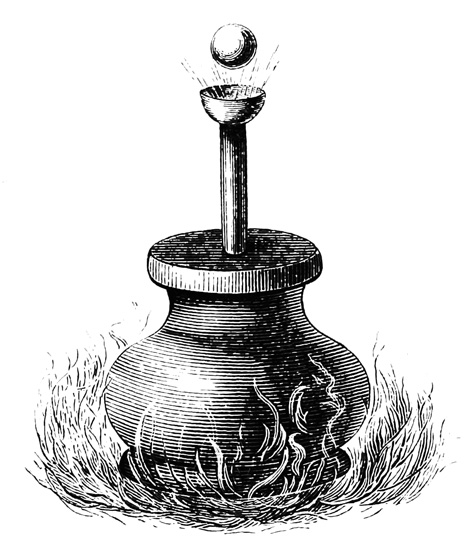
“First,” he says (exper. No. 45), “let there be a cauldron
with water in it and a covered top; and let a
fire be lighted under it. From the cover let a tube
run upward, and place at its extremity a hollow hemisphere,
in like manner perforated. Then, if a light
ball be cast into the middle of the hemisphere, the
vapour (steam) raised from the cauldron through this
tube will lift the ball so that it seems suspended.”
This is no doubt an ingenious and amusing philosophical
toy, but has no further value. His next experiment,
however (No. 50), is of greater importance,
not only as showing a clear and distinct appreciation
of the motive power of steam, but because its principle
is embodied in the well-known mode of driving
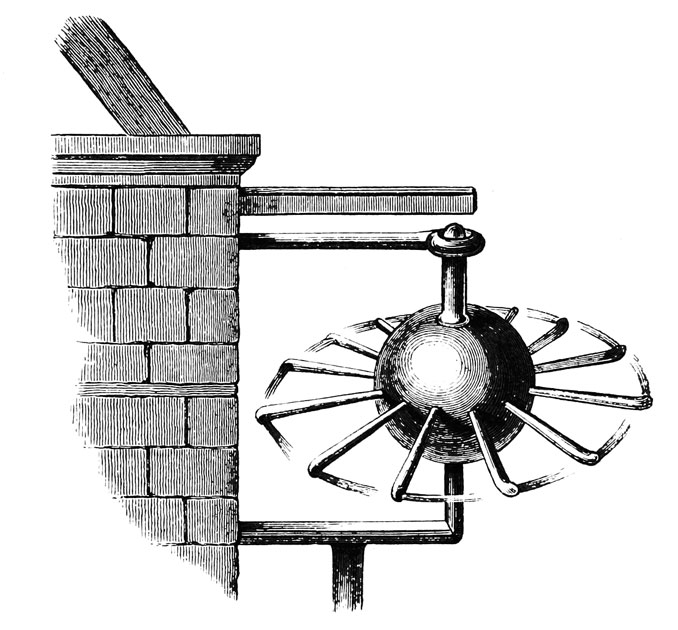
potters’ wheels and in the modern turbine. He says,
“Let a fire be lighted under a cauldron with water
in it and covered with a lid; and attach to this
cauldron a bent tube with the extremity fitting into
a hollow ball. Opposite to the extremity of this
tube place a pivot fastened to the lid, and let the
ball have various tubes communicating with it at
opposite ends of the diameter, with their bendings
at right angles (i.e., in opposite directions). Then
when the fire is lighted, the steam passing through
the first tube (i.e., from the cauldron) into the ball,
will pass out through the bent tubes towards the
lid, causing the ball to revolve after the fashion
of dancing figures.”[8] This machine was called the
Æolipile.
In these few words we have a clear indication of
the power of steam, of the nature and effect of a
vacuum, and of a rotatory engine moved by this force:
we thus see that the ancients knew more than has
been generally admitted of the wonderful power
which, in our own time, has brought about the most
extraordinary changes in the seats and centres of
maritime commerce, affording to mankind a facility
of intercourse between different nations, while at
the same time increasing the wealth, and, what is of
much more importance, promoting the comfort and
happiness of the human race to an extent far beyond
the dreams of the most sanguine enthusiast of any
age or of any country.
From the uncontroverted facts here stated, there
can be no doubt that Hero was the first to record,
even if he did not invent, this mighty civilising
instrument, and, if so, that Egypt was the land of
its birth.
Application
of
science to
superstitious
purposes.
But many centuries elapsed before its power was
applied to any useful purpose; indeed, as suggested,
there is reason for supposing that this science was
misapplied by the priests, and used as a means of
deceiving the people by inducing them to believe
it to be a miraculous power granted only to the
professors of the craft of idolatry. “A fire,” says
Hero (experiment No. 70), “having been kindled
on a transparent altar, figures will appear to dance”
on a drum driven round by steam, “emitting sounds
similar to those of a stringed instrument,”[9] which,
according to Pausanias, “resemble the snapping
of the strings of a harp;” thus, while delighting
the young people of those days, as the ornaments in
churches now do, these experiments became instruments
of make-belief in the hands of the priests, who
propounded as strange theories about their supernatural
powers as the so-called philosophers of our
own days still do, when they attempt to deal with the
unrevealed mysteries of creation and of a still more
mysterious hereafter.[10]
Revival of
learning.
Although the Romans did nothing towards applying
the knowledge of the power of steam to useful
purposes, and little enough generally for the mechanical
arts, the true value of the works of Hero and
of the older mechanicians came to be appreciated
in the dawn which succeeded the darkness of the
Middle Ages. Then the youths of a generation,
which had cast aside many of the superstitions
of the ancients, and had found in the doctrines
of Christianity a wider and nobler field for their
genius and aspirations, began to study how the
power Hero had described could be best applied
for the benefit and happiness of mankind. Then,
indeed, was the advent of an era wherein the foundation
was laid of a fabric which, though slow in its
erection, and not yet completed, is destined to eclipse
all the other works of man. There can be, therefore,
no subject affecting the transitory interests of the
human race more worthy of the pen of the historian
than the development of the power and usefulness of
steam traced from that remote period to our own
time, when we see in every quarter of the civilised
world this power compassing land and ocean, affording
profitable employment to myriads of the human
race, and giving to the people of every nation and
tongue rapid and easy intercourse.
Robertus
Valturius,
1472.
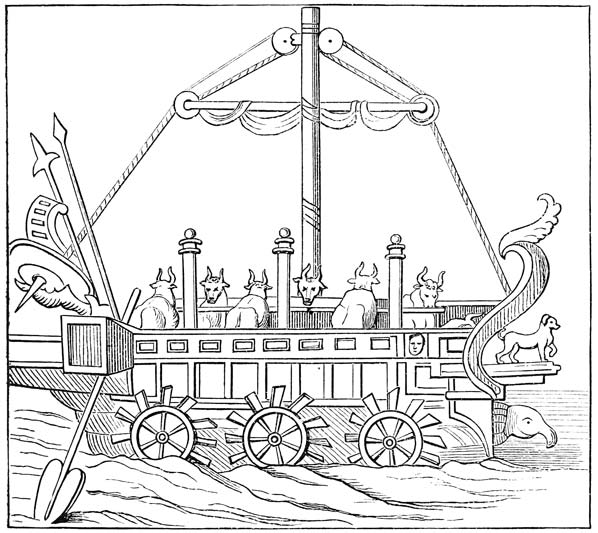
“Although an old work on China,” remarks
Mr. MacGregor,[11] “contains a sketch of a vessel
moved by four paddle-wheels, and used perhaps in
the seventh century, the earliest distinct notice of
this means of propulsion appears to be by Robertus
Valturius in A.D. 1472, who gives several woodcuts
representing paddle-wheels,”[12] one of which is
as follows.
There is, however, no mention of any vessel
propelled by steam till M. de Navarette directed
attention to this subject in a letter[13] received by
him from Thomas Gonzales, Director of the Royal
Archives of Simancas of Spain, with an account
of an experiment of the year 1543, in which a
vessel is said to have been propelled by something
resembling a steam-engine.
Blasco de
Garay,
story of
his experiment,
1543.
The substance of this letter is to the effect that,
in that year, one Blasco de Garay, proposed to the
Emperor Charles V., the construction of an engine
(ingenio) capable of propelling large vessels in a calm,
and without the use of sails or oars. In spite of the
opposition this project encountered, the Emperor consented
to witness the experiment, which was accordingly
made in the Trinity, a vessel of 200 tons, laden
with corn, in the port of Barcelona, on the 17th June,
1543. Garay, however, would not uncover his
machinery, or exhibit it publicly: but it was evident
that it consisted of a cauldron of boiling water (una
gran caldera de agua hirviendo) and of two wheels
set in motion by that means, and applied externally
on each side (banda) of the vessel.
The persons commissioned by the Emperor to
report on the invention seem to have approved it,
commending specially the readiness with which the
vessel tacked. The treasurer Ravago, however,
observed that a ship with the proposed machinery
could not go faster than two leagues in three hours;
that the apparatus was complex and expensive; and
that there was danger of the boiler bursting. The
other commissioners maintained that such a vessel
might go at the rate of a league an hour, and would
tack in half the time required by an ordinary ship.
When the exhibition was over, Garay removed the
apparatus from the Trinity, depositing the wood-work
in the arsenal at Barcelona, but retaining himself the
rest of the machinery. Notwithstanding, however,
the objections urged by Ravago, the Emperor was
inclined to favour his project, but his attention at the
time was engrossed by other matters.[14] Garay was,
however, promoted and received a sum of money,
besides the expenses of the experiment made at
Barcelona. The letter concludes with the following
statement:—
“This is the substance of the despatches and of the
original registers preserved in the royal archives of
Simancas, among the State papers of the province
of Catalonia, and of those of the Secretary of War
(department of land and sea), in the said year, 1543.”
Mr. MacGregor, greatly to his credit, desirous of
ascertaining whether this report (which, from the well-known
accuracy of M. de Navarette on other subjects,
had been accepted as correct) could be depended upon,
visited Spain in September, 1857, and made a thorough
investigation at Simancas, Madrid, and Barcelona into
this interesting subject, but his inquiries (reported, at
length, January, 1858, to the Superintendent of
Specifications at the Great Seal Patent Office, and
printed in Part II., “Specifications relating to Marine
Propulsion”), convinced him “that there was not one
particle of reliable evidence” in M. de Navarette’s
assertion.[15]
An attentive consideration of the subject leads to
the conclusion at which Mr. MacGregor has arrived.
Even in the present day it would require an engine
and boiler of considerable size to propel a vessel of
200 tons three miles an hour; moreover, the novel
and bulky machinery with which the experiment is
said to have been made, could not have been erected
in the ship or removed from her without attracting
considerable public attention. Indeed, had such
an experiment been made before the Spanish Emperor,
and made successfully as the narrative leads
us to suppose, a matter so important could hardly
have lain dormant for any great length of time:
whatever, therefore, Blasco de Garay’s invention
may have been, it was evidently not a steam-engine
practically applicable for any useful purpose.
Witzen, no doubt, in confirmation of Garay’s
experiment, furnishes an illustration of a “Spanish
bark without oars or sails,” but as, unfortunately,
there is not a single line of letter-press beyond the
few words quoted to throw the faintest light upon
his drawing, it can only be supposed from the
descriptive title that it referred to the vessel which
Garay is said to have propelled. Indeed, De Garay’s
whole story looks very much as if it was an invention
of the Spaniards; Mr. Scott Russell,[16] as well
as Mr. MacGregor, is of this opinion, and Mr. Woodcroft,
no mean authority on such matters, states that,
having made diligent inquiries at Simancas, he could
find no trace of these documents, thus confirming
the result of the more minute researches of Mr.
MacGregor.[17]
Progress of
invention;
Bourne,
Solomon
de Caus,
Marquess
of Worcester,
&c.
About this period, however, frequent mention is
made of other modes of propulsion besides those
hitherto in use. J. C. Scaliger (who died 1558)
published at Frankfort a short notice of a vessel to
be propelled without oars. Bourne, in 1578,[18] says,
in his own quaint style, “you may make a boate
to goe without oares or sayle by the placing of
certain wheeles on the outside of the boat in that
sort that the armes of the wheeles may go into the
water, and so turning the wheeles by some provision,
and so the wheeles shall make the boate goe.” I.
Bessoni, in 1582, describes a vessel with two prows, or
rather two separate vessels attached to each other
(not unlike the Castalia, now running between Dover
and Calais), between which a frame is suspended on
gimbles carrying at its lower end a circular reel
worked by ropes and a winch whereby they can be
propelled.[19] A. Ramelli, in 1588, furnishes a design of
a flat-bottomed boat with a wheel on each side, turned
by men working upon a winch handle.[20] Indeed,
long before this, the celebrated Roger Bacon (A.D.
1214-1296) speaks of a “vessel which, being almost
wholly submerged, would run through the water
against waves and winds with a speed greater than
that attained by the fastest London pinnaces.”[21] Baptista
Porta (the inventor of the magic lantern) published
in his “Pneumaticorum Libri Tres,” Naples,
1601, many curious experiments on the power of
steam, on its condensation, and on its relative bulk as
compared with water. In one of these a vacuum is
clearly indicated, the water being forced up by the
pressure of the atmosphere from without.
David Rivault, Seigneur de Flurance near Laval,
published “Les Éléments de l’Artillerie,” first in 1605
and secondly in 1668—and in this work he describes
the power of steam in bursting a strong bomb-shell
partly filled with water, tightly plugged, and then
heated.
In 1615, Solomon de Caus (Engineer to Louis
XIII.) published a treatise (“Les Raisons des Forces
Mouvantes”) in which he shows he was well acquainted
with the motive power of steam—as, in his
fifth theorem, he says, “water will mount by the help
of fire higher than its level:” he also shows, by an experiment,
how a column of water may be driven up
a tube to such a height as will balance the elasticity
of the heated air confined in the boiler; and Arago,
in his “Éloge de James Watt,” considers that this
experiment, though of little practical use, “will make
a noble figure in the annals of the steam-engine.”
In 1629, Giovanni Branca, an engineer of Loretto,
applied steam to blow against vanes attached to the
external rim of a wheel, and, doubtless, machinery
with due mechanical contrivances could have been
impelled by it. He gives a picture of his machine
in “Le Machine,” vol. nuovo, Pl. XXV.
In 1618, David Ramsay obtained a patent for an
invention “to make boates for carriages running
upon the water as swift in calmes and more safe in
storms than boats full sayled in great windes;” and
in 1630 he patented a plan “to make boats, ships, and
barges to goe against the wind and tide;” and “to raise
water from lowe pitts by fire”[22] (the steam-engine).
In 1637, Francis Lin and others patented a plan
“to use and exercise upon the River Thames, and
any other river within England and Wales, according
to their owne way and inventing the sole drauinge and
workinge up of all Barges and other vessels without the
use of horses;” and, in 1646, Edward Ford proposed a
similar plan for the navigation of rivers, and one whereby
he could “bring little ships, barges, and vessels in
and out of havens without or against any small wynd
or tide, and transport souldiers and passengers without
or against wynde yf the seas be not rough.”[23]
In 1652 (July 30th), Thomas Grant, Doctor of
Physic, obtained a patent “for several instruments,
whereof the first is an instrument very profitable when
co[~m]on winds fayle for a more speedy passage of calmed
shipps or other vessells upon the sea or great rivers,
which may be called the wynds māty.”
In the recital of the inventions of the Marquess of
Worcester, 8th February, 1661, reference is made
to one which was “applicable to make a boat that
roweth or letteth, even against wind and stream to
any part of the compass which way soever the
streame runs or wind blows, and yet the force of the
wind or stream causeth its motion.” But though
the Marquess has generally had the credit of having
applied a power other than manual or animal labour
for the purpose of propulsion, it has been doubted
from the description of his invention if it was a
steam-engine which could be applied to drive a boat.[24]
Petty, in 1663, used a double boat with success.[25]
Chamberlaine and Bushnell, in 1678, had also their
plans for propelling boats against wind and tide,
while Hooke, in 1661, described windmills in which
“we have all the main features both of the screw-propeller
and feathering wheel.”[26]
Morisotus’
vessel with
paddle-wheels.
From about this period much attention was
directed to the use of machinery for propulsion.
Morisotus, moreover, who published his views in 1643,[27]
speaks of the paddle-wheel as a mode of propelling
vessels, known also, as he believed, to the ancients,
and states that the simple machinery employed was
the same in fact as was in his day used in mining
operations in the Spanish Indies. Schefer, in his
instructive and interesting work, also makes mention
of a remarkable vessel described by Pancirolli (who
wrote, in 1587, on naval and military matters) as
resembling what he had seen in an old bas-relief of
an Illyrian galley, a vessel apparently propelled by
wheels similar in character to those in the above
wood-cut, from Morisotus.
Hollar’s
drawing.
But, as no such clumsy vessel could have been
employed in a seaway, her movements must have been
confined to rivers or inland waters. It is just possible
that such and similar vessels might at some period
have been used for ferrying rivers[28] or lakes. Very
extraordinary notions, however, appear to have been
propounded about, and subsequently to, this period,
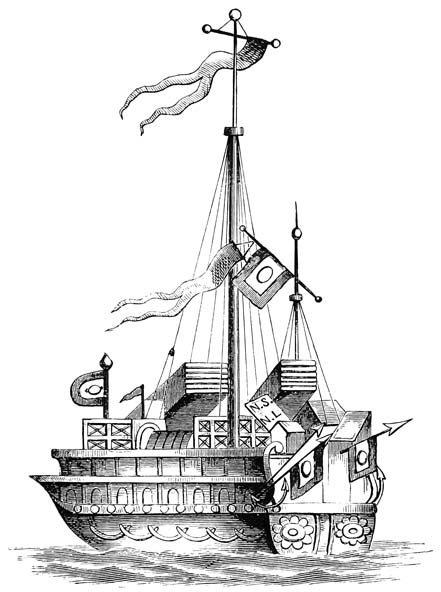
and, as a matter of curiosity, I furnish one of these
taken from Hollar’s engravings, which does not
appear to have been noticed by any writer on this
interesting subject. The original engraving, bearing
date A.D., 1653, is to be found in the British Museum.
Various details[29] are furnished by the inventor.
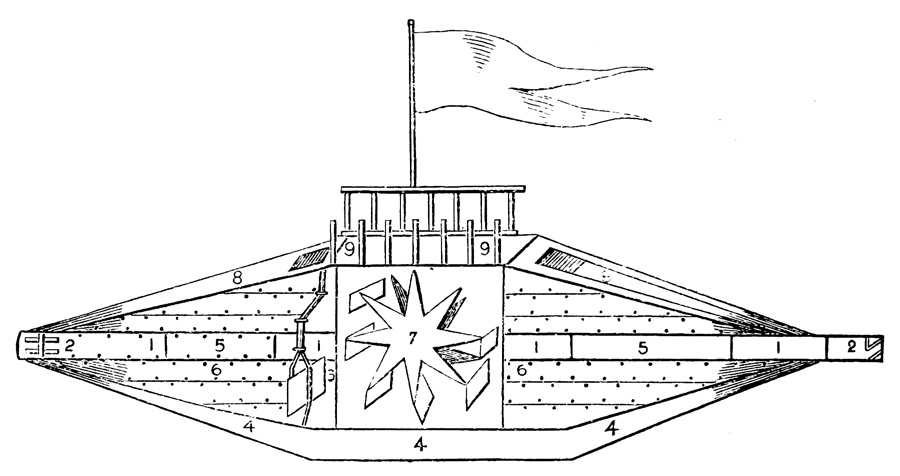
Besides the detailed explanation of this extraordinary
looking craft, which in “length is 72 feet,
the height 12, the breadth 8,” there is beneath
the print the following description: “The true and
perfect form of the strange ship built in Rotterdam,
1653. The inventor of it doth undertake in one day
to destroy a hundred ships, it can go from London
to Rotterdam and back again in one day, and in six
weeks to go to the East Indies, and to run as fast as
a bird can fly. No fire, nor storme, nor bullets can
hinder her unless it please God. Although the ships
mean to be safe in their havens, it is in vain, for she
shall come to them in any place. It is impossible for
her to be taken unless by treachery, and she cannot
be governed by any one but himself” (the inventor?).
The motive power is not described, and there is no
further trace of the ship, of which the illustration
is a vertical section. She was built at the time
when the Dutch were in the zenith of their power,
and most likely proved as worthless as numerous
other inventions since produced, though curious as
showing the attention devoted at this period to
wheels as a mode of propelling vessels.
Absurd
patents.
However, we find in the records of our own
Patent Office, that Englishmen were not behind the
Dutch in curious and frequently very absurd inventions.
Thus, in 1675, one Miller[30] patented a windmill
fixed to a vessel’s deck to turn an endless rope,
and thus, by “two toothed wheels,” to drive a
couple of paddle-wheels. Such commonplace matters
as storms at sea or adverse winds, still less the
likelihood of the whole of the top weight he proposed
to erect on the deck of his vessels being
blown or rolled overboard, do not appear to have
entered into the fertile and imaginative brain of the
inventor.
Again, in 1701, two gentlemen (whose names
are not worth recording) proposed to have “vanes
or sails arranged between two wheels on the same
shaft,” the “sails or float-boards being so contrived
as to be able to play in a given space, being
fixed perpendicularly on the wheel and fastened
by a cord or otherwise, so that when the wind
blows from any quarter three-fourths of the sails
catch the wind, and, by driving the wheel round,
the sails, which are forced against the wind, come
up edgeways, but when past the centre immediately
turn to the breeze, and by that means produce a
continued circular motion.”[31]
Phillips
and his
windmill.
About the same period another invention, of a
somewhat similar sort, was published by a person
named Phillips, who proposed to erect between
two tall masts “a windmill of altogether an original
description.”[32] One is reminded when reading
these grave proposals, of Don Quixote’s ludicrous
exploit with the windmill, and considering the
care Mr. Phillips seems to have bestowed upon his
invention, he must have been quite as enthusiastic
and apparently as serious in his proposal as the
hero of Cervantes in his knight-errantry. But all
these schemes, and many others too numerous to
mention, however impracticable and absurd some of
them may have been, had the germ of the great
invention more or less developed.
Papin
and
Morland.
During Papin’s residence in England, 1681, he
witnessed one of the interesting experiments made
on the Thames, in which a boat constructed from
the design of the Prince Palatine Robert, fitted
with revolving oars or paddles, “left the King’s
barge, manned by sixteen rowers, far astern in
the race of trial.” This experiment suggested to
him, in 1688, the idea of an engine, and led to
his proposal of using gunpowder to create a
vacuum under a piston, so that the piston would
descend. Two years afterwards, 1690,[33] Papin describes
a steam cylinder, in which a piston descends
by atmospheric pressure when the steam below it is
condensed, and among the subsequent uses of such
a machine he mentions the propulsion of ships by
“Rames volatiles” or paddle-wheels, the axles of
which, he thought, might be turned by several of his
cylinders acting alternately by the rack work shown
in his drawing.[34]
In 1683, a little before Papin, Sir Samuel Morland,
Master of Works to Charles II., wrote a treatise
on the “Élévation des Eaux par toutes sortes de Machines,”
&c., with four pages appended to it called
“The Principles of the New Force of Fire, invented
by Samuel Morland in 1682, and presented to His
Most Christian Majesty in 1683.” In this work
(still in MS. in the Harleian Collection of the British
Museum), it is stated that “water being converted
into vapour by the force of fire, these vapours shall
require a greater space (about 2000 times) than
the water occupied, and sooner than be constantly
confined would split a piece of cannon.” It is
remarkable that, so long before careful experiments
had been made on the expansibility of water when
converted into vapour, Morland should have given
so near an approximation to the true amount (about
1750 times).
Savery.
Thomas Savery, one of the most ingenious men
of the age in which he lived, proposed (1696) a
mode of raising water and occasioning motion “to
all sorts of mill-work by the impelling force of Fire,”
adding,[35] “it may be very useful to ships, but I dare
not meddle with that matter, and leave it to the
judgement of those who are the best judges of maritime
affairs.”[36]
In 1697, Papin (whose own invention had proved
a failure) used Savery’s engine, which had been
greatly improved by Newcomen in 1705 to propel
a steam-boat on the Fulda.[37] In that year, too,
Papin proposed to drive a vessel by paddle-wheels
turned by the stream, and by boat-hooks which
somehow pushed against or griped the bottom.[38] Chabert,
in 1710, described a vessel with large paddle-wheels
working in troughs cut through the hull;[39]
and, in 1721, we read of a galley built in France
with revolving oars fastened to a drum or wheel
with paddle-vanes on hinges, capable of being set
to any angle, and of being worked by 200 men,
the galley having three of these wheels on each
side.[40] John Allan, in 1722, proposed a mode of
navigating a ship, “by forcing water or some
other fluid through the stern or hinder part, at
a convenient distance under the surface of the
water, into the sea, by proper engines placed
within the ship.” He also proposed, as Papin
had previously done, a machine with the power
of “firing gunpowder in clauso,” with the view
of navigating a ship in a calm.[41]
Jonathan
Hulls.
In 1736, Jonathan Hulls made some practical
progress in the idea so long floating vaguely
in the minds of his predecessors, and, on the 23rd
December of that year, secured a patent for his
invention “of a machine for carrying ships and
vessels out of or into any harbour or river against
wind and tide or in a calm,” of which the following
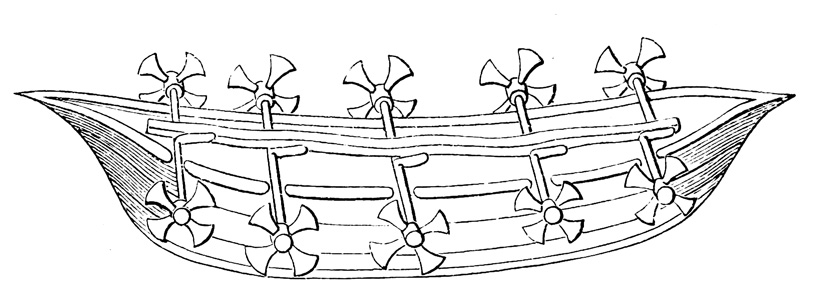
is a sketch.
His specification[42] described how to drive a paddle-wheel
by converting a reciprocating rectilinear
motion into a continuous rotary one. But though
Hulls’ mode of obtaining a rotary motion was new
and ingenious, and would, perhaps, enable a steam-boat
in a calm to be moved through the water, moreover
is the first steam-boat authentically recorded, it
was probably not such as could be made practically
useful for the general purposes of commerce, and I
have been unable to find any record of this or of any
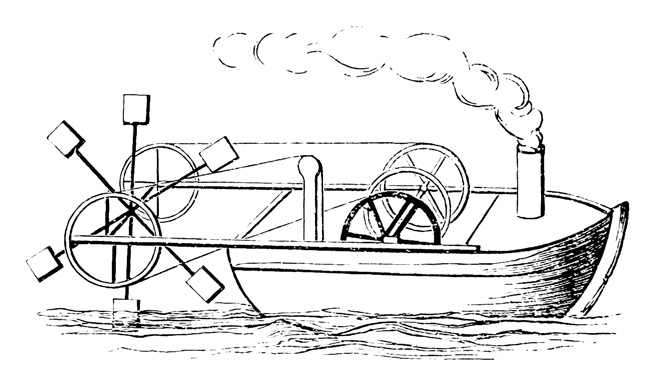
such vessel having been so used. At the same time, it
must be added that boats not unlike Hulls’ may now
be seen trading in parts of the world remote from
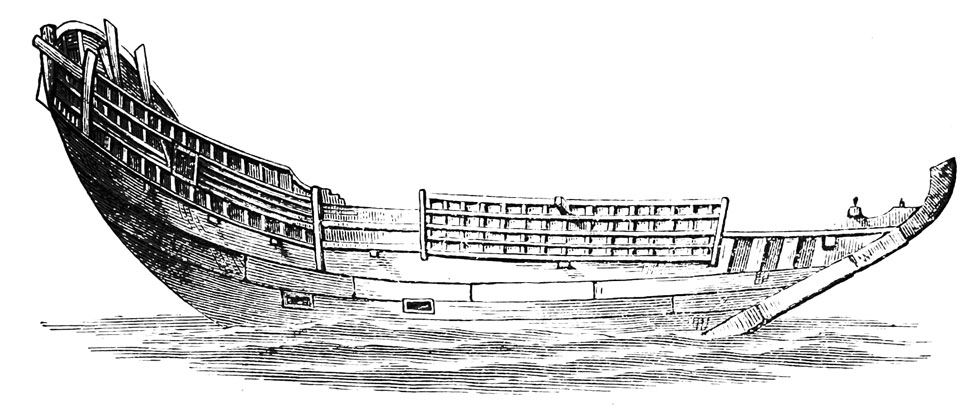
each other, as, for instance, on the Murray in South
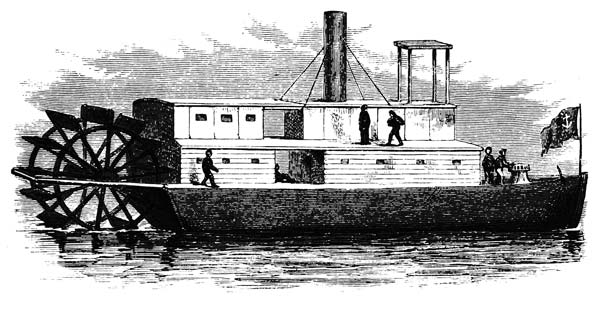
Australia, where various vessels, of which the following
is an illustration, are employed, and on the
upper Thames where one, at least, to my knowledge
is now worked, which does not seem to be any
very marked improvement on the boat of Jonathan
Hulls.[43]
James
Watt’s
engine.
In 1756, Gauthier, a French mathematician, wrote
a treatise on “Navigation by Fire,” which attracted
the attention of the Venetian Republic.[44] But whatever
merit some of these ingenious discoveries may
have possessed, it was not till the 5th January, 1769,
when James Watt obtained his patent, that any
steam-engine could be effectually adopted in marine
propulsion.
Among various other improvements in the steam-engine
patented by him, the most important was one
for causing the steam to act above the piston, as well
as below it, described as the “double impulse,” or, now
more commonly called, the double acting engine.[45] On
the old principle, when the weight of the atmosphere
had pressed down the piston, a valve opened in the
bottom of the cylinder whereby a fresh supply of hot
steam rushed in from the boiler, which, acting as a
pressure in excess of that of the atmosphere above
the piston, combined with the weight of the pump
rods at the other end of the lever, carried that end
down, and of course raised the piston in the steam
cylinder. The orifice for the emission of the steam
having been then shut, and the cock opened for
injecting the cold water into the cylinder, condensation
took place, and another vacuum was made
below the piston, which was again forced down by
the weight of the atmosphere: thus the work was
continued as long as water and fuel were supplied, and
the steam-engine rendered capable of successful application
for pumping purposes, a contrivance used
even at the present day.[46] But the method contrived
by Watt rendered the power of the engine much
more effective by the use of a detached condenser,
whereby the cooling of the cylinders by the
injection of water was prevented and considerable
economy obtained.[47]
Matthew
Wasborough.
Matthew Wasborough, however, an engineer of the
city of Bristol, considering that something was still
wanting to make the marine engine a proper instrument
of propulsion in concurrence with Watt’s improvement
of the double acting cylinder, obtained, on
the 16th March, 1779, a patent for a practical mode of
converting a rectilinear into a continuous circular
motion; one of his objects being to adapt his invention
“for moving in a direct position any ship or vessel.”[48]
His invention, however, did not answer, and was
indeed superseded by that of James Pickard, 23rd
August, 1780, who, shortly afterwards entering into
partnership with Wasborough, patented a method of
working a mill with a rotary motion by means of
the present connecting rod and crank and a fly wheel,
constituting the second important improvement in the
steam-engine, and enabling it to be of really practical
service in propelling vessels. In 1781 (25th
October), James Watt obtained another patent for his
newly invented method of applying the vibrating
or reciprocating motion of steam or fire-engines to
procure a continued circular motion round an axis so
as to turn the wheels of mills or other machines.
This invention is known as the “Sun and Planet”
motion.[49]
Marquis de
Jouffroy.
In the same year (1781), the Marquis de Jouffroy is
said to have constructed a steam-boat at Lyons 140 feet
in length, and to have made with her several successful
experiments on the Saone near that city. Mr. MacGregor,
however, has made particular inquiries[50] into
the authenticity of the claims of the Marquis, and, as
no description of the machinery of this vessel is discoverable
earlier than that given by himself thirty
years afterwards, when he petitioned for the use exclusively
of steam-boats for fifteen years, these claims
are, to say the least, very questionable, while, in a
report on his improvements, the invention is said to
be Rumsey’s, but more likely that of his own countryman
Gauthier, whose death prevented his plans from
being practically exemplified by the Venetian Republic.
The French Revolution, however, supervening,
the Marquis had not an opportunity of
prosecuting his undertaking.
Bramah’s
screw-propeller.
In 1785, Joseph Bramah, a man of great genius,
and the inventor of the hydraulic press, obtained a
patent for an hydrostatical machine and a boiler on a
peculiar principle, in which the power of air, steam,
or any other elastic vapour, might be employed for
the working of engines. Another of his inventions
is a mode of propelling vessels by the improved
rotatory engine described in the specification, through
the medium of either a paddle-wheel or what
may be called a screw-propeller. Bramah shows
a vessel with a rudder placed in the bow, and describes
in his specification the nature of the “screw-propeller”
and of its mode of action in minute and
specific terms.[51]
Although there is no record of Bramah having
put his proposal into practice, the description lodged
by him at the Patent Office is interesting, as showing
clearly an indication of the now so well-known
screw-propeller. Moreover, in this invention, he
obviously intended that steam should be used so as
to give circular motion to the propeller shaft. Previously,
however, to the time when he patented his
invention, the rotatory screw as a mode of propulsion
had been proposed by Watt, who, in 1770, suggested
the application of a screw-propeller to be turned by
a steam-engine.[52]
But more than half a century elapsed before the
screw, now in almost general use, was practically
applied; indeed, the first authentic record we possess
of the marine engine itself having been successfully
worked by paddle or any other means on board any
vessel, dates no further back than 1787, although,
between 1774 and 1790, Fitch and Rumsey were
experimenting in America on boats (to which I shall
hereafter refer) to work against streams.
Mr. Miller
of Dalswinton.
In that year (1787) Mr. Patrick Miller, of Dalswinton
in Scotland, a gentleman of position and
fortune, published a pamphlet (given at length by
Mr. Woodcroft[53] in his interesting and instructive
work on steam navigation, with copies of Mr. Miller’s
drawings illustrative of his scheme), on the subject
of propelling boats by means of paddle-wheels
turned by men, working on a capstan with five
bars, each 5 feet long, which drove a water-wheel,
having the same object in view as Messrs. Fitch
and Rumsey, then engaged on similar works on the
other side of the Atlantic.
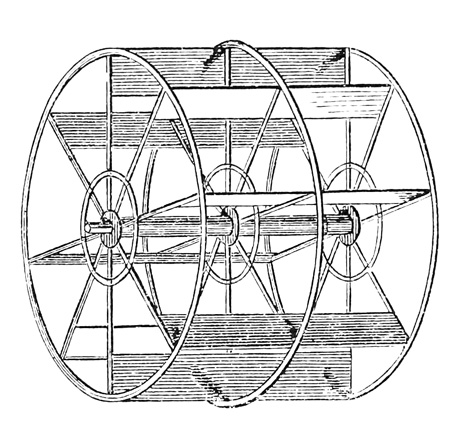
This wheel, of which the following is a sketch,
drove the vessel in a calm
from 3 to 4 miles an hour;
and, as Mr. Miller judged
the capstan the best mode
of turning the wheel, he rejected
for a time all other
modes, believing manual
labour so applied more to
be depended on than any
mechanical contrivances. For the purpose of his
experiments he built, from first to last, eight boats
of different kinds, expending no less than 30,000l.
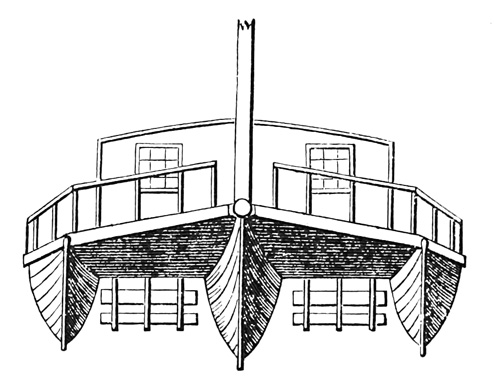
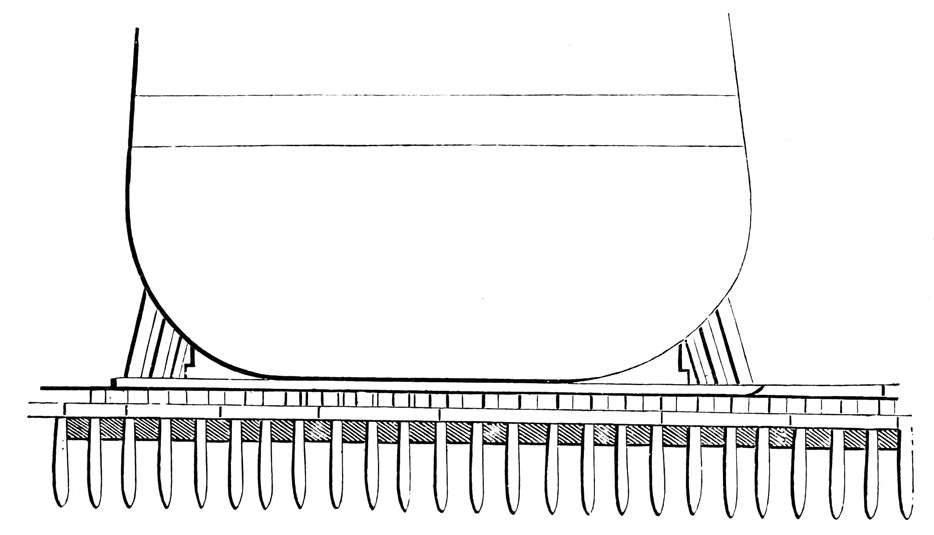
on them and their machinery. One was a treble
vessel, or rather three boats fastened together, of
which the following is a
transverse representation
of the fore part with the
lower floats of the wheels
at their full dip.
According to a written
statement laid before the
Council of the Royal
Society, London, December
20, 1787, Mr. Miller made various excursions
in this vessel in the course of that year; being
attended in most of these by a Mr. James Taylor,
the tutor in his family, who, being a man of considerable
genius, urged Mr. Miller to apply steam to
drive the wheels of his boat. At last Mr. Miller was
induced to employ a young hard-working operative
engineer, named Symington, to carry out Mr. Taylor’s
suggestion, and the combination of capital, energy,
and genius with practical knowledge soon produced
the desired results.
Mr. Symington
and Mr.
Taylor.
About this time Symington, who was employed
at the lead mines at Wanlockhead, had succeeded
in constructing a small steam-engine of a new
description, originally intended for the purpose of
propelling wheeled carriages, which he patented
June 5th, 1787.[54]
His specification, accompanied by drawings, relates,
1, to heating the cylinder of a steam-engine; 2, loading
the piston; 3, placing a fire round the cylinder;
4, a boiler; and, 5, “when rotatory motions of whatever
kind are wanted, two ratchet wheels will be
placed upon one or the same axis in such manner
that, while the engine turns forward one wheel,
the other will be reversed without impeding the
motion or diminishing the power so as to be ready
to carry on the motion by the time the other wheel
begins to be reversed.”
As this engine was considered suitable for the
purpose Mr. Taylor had in view, Symington[55] undertook
to perform the work and Mr. Miller agreed
to employ him. When completed it was mounted
in an oak frame and placed on the deck of one of
Mr. Miller’s pleasure-boats, a vessel 25 feet long
and 7 feet wide, with two wheels, to be tested on
Loch Dalswinton. The engine performed its work
beyond their most sanguine expectations, driving the
vessel at the rate of 5 miles an hour, though the
cylinders were only 4 inches in diameter. After
being used in cruising about the lake for a few days,
the engine was removed from the boat and conveyed
to Mr. Miller’s house, where it remained as a piece of
ornamental furniture for a number of years.
The accounts which appeared in the Scottish newspapers
at the time[56] state that the first experiment was
made on the 14th November, 1788, and with such
success that it was resolved to repeat it on a
larger scale upon the Forth and Clyde Canal. A
double engine with cylinders 18 inches in diameter
was consequently ordered to be built at Carron
Iron Works, and, in November of the following
year, it was fitted on board of another of Mr. Miller’s
vessels and tried on Dalswinton Loch. As, however,
the floats of the wheels gave way, it was not until the
26th of December, by which time stronger wheels
had been procured, that an opportunity was afforded
for fairly testing the capabilities of this engine.
From the accounts in the local papers of the period[57]
the experiment appears to have answered thoroughly,
though made under many disadvantages; a speed
having been obtained of from 6½ to 7 miles an hour,
which, in the words of the report, “sufficiently shows
that a vessel properly constructed might accomplish
8, 9, or even 10 miles an hour easily.”[58]
Such was one among the first efforts made in steam
navigation. That they were considered to be of
practical value may in some measure be determined
by the fact that Mr. Taylor’s widow was, a few years
afterwards, awarded an annual pension of 50l.,
and that, in 1837, Lord Melbourne’s administration
presented 50l. to each of his four daughters, who
were in reduced circumstances, Mr. Symington having
previously (1825), in answer to his memorial to the
Treasury for a pension (he, too, being almost penniless),
been awarded 100l. as a gift from the Privy
Purse, and subsequently a further sum of 50l. Poor
Symington![59] What a miserable return for labours
of such inestimable value!
The
Charlotte
Dundas.
Mr. Miller having expended a large fortune on
these experiments, found it, no doubt, inconvenient
to continue them, or having other projects in view,
gave orders to dismantle the vessel in which his
last experiment had been made, and laid her up
with her engines at Bence Haven, at that time his
property. More than ten years elapsed before Mr.
Symington found another patron, indeed, it was not
till 1801, that Thomas first Lord Dundas, employed
him to fit up a steam-boat for the Forth and
Clyde Canal Company, in which he was a large
shareholder. Having availed himself of the many
improvements made by Watt and others, Symington
patented his new engine on the 14th of March of that
year,[60] and fitting it on board the Charlotte Dundas,
named after his lordship’s daughter, produced, in
the opinion of most writers who have carefully and
impartially inquired into this interesting subject,
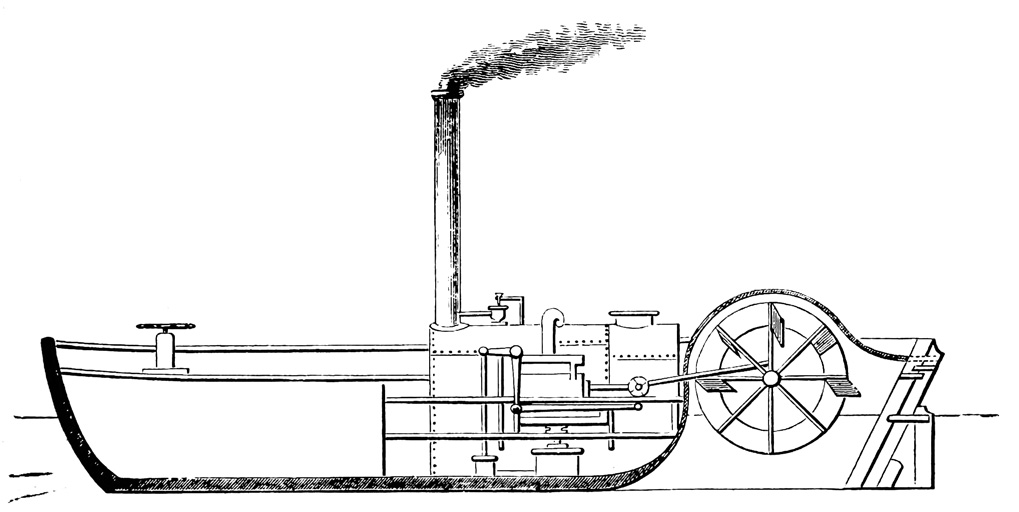
“the first practical steam-boat.”[61] Mr. Woodcroft has
furnished a sectional drawing of this vessel of
which the following is a copy on a reduced scale;[62] it
resembled in many respects the description of vessel
suggested by Jonathan Hulls, but not till now practically
applied.
In March 1802, the Charlotte Dundas made her
trial trip on the Forth and Clyde Canal. Embarking
at Lock 20 a party of gentlemen, including Lord
Dundas, and taking in tow two vessels or barges
of 70 tons burden, she accomplished the trip to
Port Dundas, Glasgow, a distance of 19½ miles, in
six hours, or at the rate of 3¼ miles per hour,
although it blew so strong a gale right ahead during
the whole day that no other vessel on the canal
attempted to move to windward.[63] Lord Dundas
entertaining a very favourable opinion of the experiment,
recommended the adoption of Symington’s
steam-boat in a letter of introduction to the Duke of
Bridgewater, who gave him an order to construct
eight vessels similar to the Charlotte Dundas to
ply on his canal.
Elated by his success, Symington returned to
Scotland to make arrangements for carrying out the
orders of his Grace with the hope of realizing the
advantages his ingenuity and perseverance so well
merited; but he was disappointed in his hopes, the
Duke of Bridgewater died before the details of the
agreement had been definitely arranged, and the
Committee who had charge of the affairs of the canal
after his death, came to the conclusion that it would
not be advisable to use steamboats on it for fear of
injury to its banks. We may presume that the
Forth and Clyde Canal Company arrived at somewhat
similar conclusions, for the Charlotte Dundas does not
appear to have been again used.
Here it may be desirable to add that the Charlotte
Dundas had an engine with the steam acting on
each side of the piston (Watt’s patented invention)
working a connecting rod and crank (Pickard’s
patented invention)[64] together with the union of the
crank to the axis of Miller’s improved paddle-wheel,
thus combining for the first time the essential characteristics
of the existing marine engines: nevertheless,
she was laid up in a creek of the canal near to
Bramford Drawbridge, where she remained for many
years exposed to public view, as a curiosity—doubtless,
also, as a warning to speculators![65]
Symington’s limited means were now nearly exhausted,
and the little that remained was expended
in defending himself from attacks made on him by
the relations of Mr. Taylor for having patented, as
they alleged, the inventions of that gentleman. But
the contentions of rival parties, inter se, rarely
deserve commemoration except for the elucidation
of the truth. It is, however, to be regretted that
each of those persons who respectively contributed
to the maturity of this invention, did not reap
more material advantages from it in return for the
time and labour they bestowed in perfecting a
machine which has done so much for the benefit of
mankind.
In 1797, an experiment in canal steam navigation,
copied no doubt from Symington’s original boat, was
made in the neighbourhood of Liverpool, which is
alluded to as follows in the Monthly Magazine for
July of that year:—“Lately, at Newton Common in
Lancashire, a vessel, heavy laden with copper slag,
passed along the Sankey Canal without the aid of
haulers or rowers, the oars performing eighteen
strokes a minute by the application of steam only!
After a course of 10 miles the vessel returned the
same evening by the same means to St. Helens
whence she had set out.”
While these experiments were being made with
success in Great Britain, and especially in Scotland,
there were not wanting claimants—some of them of
somewhat earlier date—to this great invention in
other and distant parts of the world. To that of
Gauthier we have already referred. In 1776, a
countryman of his, Guyon de la Plombiere, suggested
the use of a steam-engine for propelling a vessel;[66]
and, in that year, the Marquis de Jouffroy states he
used, besides the one already mentioned, a steam boat
(40 feet long and 16 feet wide) on the Doubs, with
propellers moved by a chain from a single cylinder
and counterpoise, which opened and closed like louvre
boards;[67] applying, in 1780, an engine to his boat
with a duck-foot propeller, two cylinders, inclined at
an angle, and turned by a chain round a barrel.[68]
In 1782, Dixblancs sent to the Conservatoires des
Arts et Metiers a model of a steamboat moved by a
chain of floats carried on wheels at its sides turned
by a horizontal cylinder;[69] and in 1796, it is stated
that one Seraffino Serrati, an Italian, had some time
previously placed a steam-boat on the Arno, near
Florence.[70]
Rumsey
and Fitch.
The Americans, as already stated, had, also, at an
early period turned their attention to new modes of
propelling vessels. In 1784, James Rumsey mentioned
to General Washington a project of steam
navigation, but, having been refused a patent in
Pennsylvania, came to England and succeeded in
inducing a wealthy countryman of his own, then
resident in London, and others, to disburse the
expenses of an experiment, for which he obtained a
patent in 1788. The particulars of his plan are
given at length by Mr. Woodcroft[71] and will also be
found in the Rolls Chapel Reports.[72] They were
altogether impracticable for any useful purpose. In
1786, Mr. John Fitch, also an American by birth,
proposed to use vertical oars worked by cranks turned
by a horizontal steam-engine of which the following
is an illustration.[73]
Although the Legislature of the State of Pennsylvania
had, in 1784, turned a deaf ear to the
applications of Messrs. Rumsey and Fitch, these
gentlemen, in the following year, obtained from
the Legislatures of Virginia and Maryland the
exclusive right to run steamboats on the waters of
those States, while Pennsylvania and New York
having, in 1786, granted to Mr. Fitch himself
similar exclusive rights, he in that year made a
trial of his machine at Shepherdstown, Pennsylvania,
in a boat of 9 tons, obtaining, it is said, the speed of
4 or 5 miles an hour against the current of the Potomac.
In 1787, Mr. Fitch[74] built another vessel, 12
feet beam, and 45 feet long, with a 12-inch cylinder,
the mode of propulsion being somewhat similar, in
which he is reported[75] to have made the trip from
Philadelphia to Burlington at an average rate of
7 miles an hour. In 1790, he completed another
and a larger boat, propelled in a different manner:
and, by referring to the Federal Gazette and Philadelphia
Advertiser, of 26th July, 1790, the following
advertisement will be found: “The steam-boat
sets out to-morrow morning at ten o’clock from Arch
Street Ferry, in order to take passengers for
Burlington, Bristol, Bordingtown, and Fenton:” there
is, therefore, no doubt that this boat actually traded
with passengers on the Delaware.
But a glance at the second boat built by Fitch, of
which the following is an illustration, will show
that the grasshopper paddles which he now employed,
however well they may have answered for
a time on the smooth waters of the Delaware, were not
adapted for the general purposes of navigation any
more than the treadles in his first invention.[76] Indeed,
Fitch himself did not follow up the line of steam
service he had commenced at so early a date, but on the
invitation, as he alleged, of the French Government,
he soon afterwards visited Paris with the view of
constructing vessels on his plan. As he was not,
however, supplied with the necessary funds (no doubt
arising from the fact that the French engineers
were not satisfied with the practicability or desirability
of his mode of propulsion) no vessel on his
plan was built in France, and he was obliged to
return to the United States, at the expense of the
American Consul. As no further mention is made
of vessels fitted on the plans[77] suggested by Fitch,
it may be inferred that they were not adapted for
practical or useful purposes, or that the machinery
was too complicated or too expensive to work remuneratively.
J. C.
Stevens.
In 1791, John Cox Stevens, of New York, commenced
improvements on steam navigation; but it
was not until 1804 that any of these were carried
into practice; and even after an expenditure, as he
states, of “twenty thousand dollars,” and the constant
devotion “of thirteen years of the best period of his
life” to the project, he admits that his attempts
were on the whole unsuccessful. These consisted
of a plan for propelling a boat 25 feet long and
5 feet wide, by a rotatory engine, on the axle of
which revolved a wheel, like a windmill or smoke-jack,
worked at the stern, but he found it impossible
to preserve a sufficient degree of tightness in the
packing of the engine. A second modification of
his rotatory apparatus proving on trial no better
than the first, he had recourse to Watt’s engine,
omitting the beam, and having a cylinder 4½
inches diameter with a nine-inch stroke; the boiler,
which was only 2 feet long, 15 inches wide, and
12 inches high, consisting of no less than forty-one
copper tubes, each an inch in diameter. This boat
(which is interesting as the first in which we have
a direct account of the use of tubular boilers)
was tried in May 1804, and attained a velocity
of 4 miles an hour.[78] After having made repeated
trials with her, his son undertook to cross from
Hoboken to New York, when, unfortunately, as she
approached the wharf, the steam-pipe gave way.
The boiler having also been damaged, he constructed
another with the tubes placed vertically, and for
this, perhaps the only portion of his invention worth
securing, he, in the year 1805, obtained a patent in
England,[79] where he then resided.
Oliver
Evans.
While Fitch and Stevens were employed in the
manner I have described, another American citizen,
Oliver Evans, an ingenious mechanic, was endeavouring
to mature a plan for using steam of a very high
pressure, to be employed in propelling waggons on
common roads, and in an account of his plans which
he published in 1786,[80] he suggests a mode of propelling
vessels by steam. From this circumstance
he has been regarded by some authors as the contriver
of a practicable steam-boat: his pretensions,
however, rest solely on his own allegations. He
states that, in 1785, he placed his engine, used to
cleanse docks, in a boat upon wheels, the combined
weight being equal to 200 barrels of flour, which
he transported down to the water, and, when it
was launched, he fixed a paddle-wheel to the stern,
and drove it down the Schuylkill to Delaware
and up the Delaware to the city, “leaving all the
vessels going up behind me at least half-way, the
wind being ahead.”
In 1794, one Samuel Morey, of Connecticut, is
said to have built a steam-boat which he propelled
at 5 miles an hour on the Connecticut River, and,
in 1797, he built another, with side wheels, at Bordentown,
New Jersey, which was publicly exhibited
and made a passage to Philadelphia, but which does
not appear to have been afterwards employed.
Robert
Fulton.
In 1793, Robert Fulton, of whose exertions in
the development of steam-engines and their early
application to useful purposes[81] the Americans are
justly proud, is said to have conceived some time previously
the idea of propelling vessels by steam. It
was not, however, until 1796 that any of his inventions
were brought under notice: when, in that
year, his plan for using small canals as a means
of transit and for raising and lowering vessels on
them by inclined planes was published. In the
same year, 1796, it is said that he also suggested
and used an apparatus for propelling vessels under
water, to be employed in war,[82] but it was not until
1798 that he tried successfully to propel a boat with
a steam-engine and a four bladed screw-propeller.[83]
That he had shown an early taste for mechanical
pursuits there can be no doubt, and, in 1801, when
Napoleon contemplated the conquest of England,
we know that Fulton made the friendly proposal to
convey the legions of French soldiers who were to
invade our shores by means of rafts propelled by
steam; but, though the Emperor rejected the proposal
as chimerical, Fulton, by his intercourse with the
French Government, was afforded an opportunity of
becoming intimately acquainted with Mr. Livingston,
at that time Minister of the United States at
Paris, with whom he frequently conversed on the
subject of steam navigation, these communications
having in the sequel very important results.
And Mr.
Livingston.
Mr. Livingston, who had previously been associated
with Stevens in the United States in experiments
and in various plans for promoting steam
navigation, entered readily into the proposals of
Fulton, and, on his suggestion, a boat was built on the
Seine, the engine for which was ordered in England.
This experimental boat, 66 feet long, and 8 feet
wide, was completed in 1803. When on the point of
making her first trial, the weight of the machinery
broke the boat in two and both sank. They were,
however, soon raised and the necessary repairs
were shortly completed, but, on trial, the boat
did not move with as much speed as Mr. Fulton
expected.
Plan really
derived
from English
experiments
of Symington.
Before describing Fulton’s further experiments,
it may be convenient to direct attention to a statement
made by Symington soon afterwards in the
newspapers of the period, which remains uncontradicted,
for the purpose of showing that whatever
merit is due to Fulton, his information was derived
from others.
There is, indeed, no doubt that, in 1802, when
Symington was conducting his experiments under
the patronage of Lord Dundas, a stranger came to the
banks of the Forth and Clyde Canal and requested
an interview, announcing himself as Mr. Fulton of
the United States,[84] whither he intended to return,
and expressing a desire to see Mr. Symington’s
boat and machinery, and to procure some information
of the principles on which it was moved,
before he left Europe. He remarked that, however
beneficial the invention might be to Great Britain,
it would be of more importance to North America,
considering the numerous navigable rivers and lakes
of that continent, and the facility for procuring
timber for building vessels and supplying them with
fuel; that the usefulness of steam-vessels in a mercantile
point of view could not fail to attract the attention
of every observer; and that, if he was allowed
to carry the plan to the United States, it would be
advantageous to Mr. Symington, as, if his engagements
would permit, the constructing or superintending
of the construction of such vessels would
naturally devolve upon him. Mr. Symington, in
compliance with the stranger’s request, caused the
engine fire to be lighted, and the machinery put in
motion. Several persons entered the boat, and along
with Mr. Fulton were carried from where she then
lay, to Lock No. 16 on the Forth and Clyde Canal,
about four miles west, and returned to the starting-place
in one hour and twenty minutes, being at the
rate of six miles an hour, to the astonishment of Mr.
Fulton and the other gentlemen.[85]
Mr. Fulton obtained leave to take notes and
sketches of the size and construction of the boat
and apparatus; but he never afterwards communicated
with Mr. Symington. From the concurrent
testimony of Mr. Jacob Perkins, and the oaths of
those present in the boat during the experiment, it
is evident that Fulton availed himself of the information
obtained from Symington, and ordered from
Messrs. Boulton and Watt of Birmingham, a steam-engine
for propelling a boat intended to be built in
the United States.[86]
Fulton
builds
steamers
in the
United
States.
In 1806 Mr. Fulton, in conjunction with Mr. Livingston,
commenced building a steam-boat in America, in
the yard of Charles Brown on the East (Hudson)
River. She was decked for a short distance only at
stem and stern. The engine was open to view, and a
house, like that of a canal boat, was raised to cover the
boiler and the apartments for the passengers and crew.
There were no wheel-guards. The boiler was set in
masonry. She was launched in the spring of 1807, and
the engines ordered from Boulton and Watt[87] were
fixed in that boat. The engine differed very little from
that of the Charlotte Dundas, whose piston had a
four-foot stroke, with a cylinder 22 inches in diameter,
while that of the Clermont (as the American
boat was named, after the residence of Mr. Livingston
on the Hudson) had also a piston with a four-foot
stroke, and a cylinder 24 inches in diameter.
Such similarity in the dimensions of the engines
could hardly have arisen from a mere accident.
But whatever information Fulton derived from
Symington, he claimed no patent for the assumed
discovery. On the first trial of the Clermont her
speed was 5 miles an hour. Fulton perceiving
that her paddles entered too deep into the water
had them removed, and placed nearer the centres of
the wheels. He afterwards made a further trip in
her, leaving New York at one o’clock on Monday,
and arrived at Clermont, the seat of Mr. Livingston,
at one o’clock on Tuesday, performing in
twenty-four hours a distance of 110 miles. On
the voyage from Clermont to Albany, a distance
of 40 miles, the time was eight hours, equal on the
average of both passages to nearly 5 miles an hour.
The Clermont.
The Clermont was soon afterwards lengthened
and considerably improved in appearance and usefulness—indeed,
almost wholly rebuilt. Her hull was
covered from stem to stern with a flush deck, beneath
which two cabins were formed, surrounded by double
ranges of berths, and fitted up for comfort in a
manner then unexampled. Her dimensions now
were, “Length, 130 feet; breadth, 16½ feet; with an
engine of only eighteen horse-power,[88] though her
burden was 160 tons, the boiler being 20 feet long,
7 feet deep, and 8 feet broad; the axle of her
paddle-wheel was cast iron, but it had no outer
support; the diameter of the paddle-wheels was 15
feet, and the paddles were 4 feet long, dipping into
the water 2 feet.”
It appears from a paragraph in the American
Citizen (newspaper) of the 17th August, 1807,[89]
that Mr. Fulton’s original intention was to ply
with his boat on the Mississippi; but the passenger
trade on the Hudson then offered greater inducements.
Various accounts have been given of the
performances of the Clermont, but, without referring
to these, it is better to furnish Fulton’s own
description of the trial, which he gave in a letter
addressed to the above newspaper,[90] as this is more
likely to be accurate than any other account, and
has never been contradicted; indeed, had his statements
been exaggerated, they would certainly have
been questioned at the time, the more so that his great
experiment was bitterly opposed by the owners of all
the sailing-vessels then employed on the Hudson.
The following is a representation of the Clermont
as she appeared on the Hudson after being improved,[91]
and where she continued to ply with goods
and passengers between New York and Albany for
some years.
Merits and
demerits of
Fulton.
But though the Clermont was unquestionably a
great practical success, and the first boat in the
world regularly and continuously engaged in passenger
traffic, she encountered many difficulties in
her commercial operations.[92] In overcoming these
difficulties and persevering with his novel undertaking,
much credit is due to Robert Fulton; and
though he was not, indeed he never claimed to be,
the inventor of the steam-engine as applicable to
marine propulsion, the manner in which various
English authors of note have written,[93] and the tone
in which an eminent English engineer has spoken
of him, do not become men in their positions.[94] If
we do not consider it necessary to be generous to
the genius or, rather, to the persevering industry
of men of other nations, we ought at least to be
just, and not to overlook important facts or allow
our judgment to be biased, because the man whose
labours we are describing was not a countryman of
our own.
At all
events, the
first “to
run” a
steam-vessel
regularly;
Even when the fact is clearly established, and there
is, without doubt, every reason to suppose that Fulton
borrowed largely from Watt, Pickard, and Symington,
and, it might be added, from his own countrymen,
Fitch and Rumsey, this ought not to detract from
his merit in putting all the inventions of these men
and others together, and in first applying them to
practical and useful purposes. He did what no other
man had done before him; he commenced and continued
to run the steam-ship which now traverses
every river, every coast, and every ocean, and which,
of all the inventions of man, is the mightiest harbinger
of peace and good-will among nations the world has
ever seen. If his was a combination of the inventions
of others, if he were a “quack,” it was only on a
small scale compared to those persons who combine
the inventions of men of all nations in the magnificent
steam-engines of the present day. Do we, however,
think less of any one of these engines when we see
it in motion, and know that that beautiful machine,
more like a living thing than any other work of
man, is not the invention of any one man, or of any
one nation? And ought we to think less highly of
Robert Fulton when we know the labour he bestowed
to collect the inventions of the age in which he
lived, the hardships he endured to put them into
operation, and the difficulties he had to overcome
in applying them to useful purposes?
That these difficulties were very great, so great
indeed that to most men they would have been
insurmountable, may be known from the fact that
the Clermont was often, intentionally, run into by
rival vessels on the river Hudson, and that the
legislature was compelled to pass a law punishing by
fine and imprisonment any person who attempted to
destroy or injure her. Nor did his troubles end here.
When the State of New York, convinced of the
practical utility of his invention, granted him the exclusive
privilege of navigating its rivers for a certain
number of years, he was harassed by numerous law
suits, and at last so thoroughly broken down by the
oppressive influence of men of capital, who were
either interested in the sailing-vessels, or in other inventions,
that the State, in deference to the opinions
of those sticklers who grudged him the merit of his
labours, rescinded its concession, and passed a resolution
that the boats built by Fulton were in substance
the invention of his countryman, Fitch; a most
unjust decision, as both of Fitch’s models, as I have
shown, were valueless, while Fulton’s were practicable.
and to
develop
its power
and
usefulness.
But, to whomsoever the invention belonged, the
merit of first permanently developing its power and
usefulness belongs to Robert Fulton. He it was who
showed how it could be made not merely an instrument
of vast importance to mankind, but also an
immense source of profit to all who adopted it, though
he himself, if reports be true, derived no advantage
from it, but died in 1815 very poor and almost
broken-hearted through the persecution of jealous and
narrow-minded rivals, leaving his family in greatly
embarrassed circumstances, but at the same time
leaving behind him an everlasting memorial of his
energy and perseverance, and an enduring stigma on
those who had taunted him with a “Fulton’s folly.”
The application of the new power to the propulsion
of vessels was rapidly followed up in America,
and, in 1809, the first steamboat was launched on
the St. Lawrence of which an account at the time
appeared in the Quebec Mercury.[95]
First
steam-boat
on
the St.
Lawrence,
1813.
In the spring of 1813, a second boat of increased
dimensions was launched from the banks of the St.
Lawrence. She was 130 feet in length of keel, and
140 feet on deck with a width of 24 feet, and by the
account given by the Mercury she made the passage
from Montreal to Quebec in twenty-two and a half
hours, notwithstanding that the wind was easterly
the whole time and blowing strong. But though
the Swiftsure, for such was her name, beat the most
famous of the sailing packets on the line (fourteen
hours in a race of thirty-six hours), her owners do
not seem to have been very confident of her movements
under all circumstances or of the number of
passengers who would patronize her, for she was
advertised to “sail as the wind and passengers may
suit.” The success of the Clermont for the purposes
of passenger traffic on rivers soon, however, spread
to other countries.
[2]Ante, vol. i. Introd. p. xxxi. Arrian, Exped. Alex. 11, 21.
[4] See the bas-reliefs from Nineveh, British Museum.
[5] Owen’s “Lectures on Comparative Anatomy,” 2nd. ed. p. 605.
Carpenter’s “Physiology,” 645. “Woodcroft on Marine Propulsion,”
note, p. 1, and drawing of Nautilus in frontispiece to Woodcroft’s
“Steam Navigation.” See also an interesting paper, read at the
Society of Arts on the 14th of April, 1858, by John MacGregor, Esq.,
M.A., Barrister at Law.
[6] There is little difference between the action of an oar in sculling
and that of the modern screw-propeller, which is fast superseding the
paddle-wheel in all ocean-going steamers: the one has an alternate
lateral motion, like the tail of a fish; the other is rotatory, but with
the same effect. It may be added that fishes often have the power of
“feathering” their tails, by puckering their lobes in their forward
motion, and expanding them on their return, so as to displace as
little water as possible, while they, at the same time, rely for their
advancement on the reaction of the water in the direction of their
body. These points have been carefully considered in the construction
and arrangement of the blades of the screw, as well as
the important fact that the tail of the fish or the sweep of an oar
in their motions displace a quantity of water, great in proportion to
the length of the instruments employed; and further, that it is by the
resistance the water makes to this displacement by the oar or tail, in
their continued oscillation, coming as these do from their extreme sweep
to the axis of the boat or fish, that either is urged forward.
[7] An edition of Hero’s “Pneumatics” has been published by Mr.
Woodcroft. Lond., 4th ed. 1851. His second experiment is referred
to in Muirhead’s “Life of James Watt,” 2nd ed. p. 107.
[8] The principle of Hero’s steam-machine depends on the physical law
that, when any fluid issues from a vessel in which it has been confined,
the vessel is acted on by a force equal to that with which the fluid
escapes, but in the opposite direction. Thus, if water issues from an
orifice, a pressure is produced behind the orifice corresponding to the
force with which the water escapes: hence, the recoil of a gun when fired.
If the muzzle were turned at right angles to the length of the gun,
the explosive gases would escape sideways, and the shooter, instead of
being forced back, would spin round. The orifices in each case are
exposed to the atmosphere, which tends to rush in with a force of a
little less than 15 lbs. on the square inch: the force, therefore, with
which the steam escapes represents the excess of its elasticity over that
of the atmosphere, which furnishes, as it were, the fulcrum, and thus
gives motion to the machine. Mr. Bourne states that the principle of
the Æolipile is the same as that embodied in Avery and Ruthven’s
engines for the production of rotatory power. “These engines,” he
says, “are more expensive in steam than ordinary engines and travel
at an inconvenient speed; but in other respects they are quite as
effectual, and their construction is extremely simple and inexpensive.”
[9] In another experiment (No. 37), Hero shows “how temple doors
may be opened by fire on an altar.” He says, “Let the proposed
temple stand on a pedestal, on which is also a small altar. Through
the altar insert a tube, of which one mouth is within the altar, and
the other nearly at the centre of a globe. The tube must be soldered
to the globe in which a bent syphon is placed. Let the hinges of the
doors be extended downwards, turning freely on pivots, and from the
hinges let two chains running into one be attached by means of a
pulley to a leaden weight, on the descent of which the doors will be
shut, let the outer leg of the syphon bend into a suspended vessel and
fill the globe half full of water. When the fire becomes hot, the heated
air in the altar expands and, passing through the tube into the globe,
will drive the liquid through the syphon into the suspended vessel
which, descending by its weight, will tighten the chains and open the
doors.”
[10] Although there may be a doubt how far the inventions recorded by
Hero were used for superstitious practices, there is no question that,
somewhat later, the agency of steam was employed for purposes anything
but legitimate. Thus Gibbon (c. xl.) gives an amusing account
of how Anthemius, the architect of Sta. Sophia at Constantinople,
avenged, himself on Zeno, the orator. “In a lower room,” says he,
“Anthemius arranged several vessels or cauldrons of water, each of
them covered by the wide bottom of a leathern tube, which rose to a
narrow top, and was artificially conveyed among the joints and rafters
of the adjacent building. A fire was kindled beneath the cauldron;
the steam of the boiling water ascended through the tubes; the house
was shaken by the effects of imprisoned air, and its trembling inhabitants
might wonder that the city was unconscious of the earthquake they
had felt.” Still later, Arago, in his “Éloge de James Watt,” notices
an ancient Teutonic god, called Bustarich, on the banks of the Weser,
who was made by the priests to show his displeasure through the
agency of steam. The head of the metal God was hollow and had
within it a pot of water. Its mouth and another hole having been
plugged, a charcoal fire was cleverly lighted under it, in such a way as
not to be perceived by the expectant worshippers. After a while, the
imprisoned steam forced out the plugs, with a loud report, followed by
two jets of steam, which formed a dense cloud round the god and
concealed him from his astonished worshippers.
[11] Paper read at the Society of Arts 14th of April, 1858, by John
MacGregor, Esq., Barrister at Law.
[12] This work in Latin, printed at Verona, 1472, is the first book with
woodcuts printed in Italy.
[13] This letter is written from Simancas, and bears the date 27th
August, 1825. It was published 1826, in Lack’s “Astronomical Correspondence.”
[14] The interview with the Pope took place at Bupeto, 22nd of June,
1543, and the campaign against the duke of Cleves, the ally and general
of Francis, followed.
[15] “On the 23rd of September last (1857),” remarks Mr. MacGregor,
“I visited the town of Simancas, near Valladolid in Spain, with Captain
John Ussher, to inspect some letters of Blasco de Garay, which are
there preserved among the national archives.
“Having obtained the requisite Royal permission, I was allowed,
after much difficulty, to read (but not to copy) two letters signed by
Blasco de Garay, written clearly in Spanish and well preserved. One
of these was addressed from Malaga, the other from Barcelona; and
both were dated, A.D. 1543. They describe two separate experiments
with different vessels, both of them moved by paddle-wheels turned
by men.
“One vessel was stated to be of two hundred Spanish tons burthen,
propelled by a paddle-wheel on each side, worked by twenty-five men.
The other vessel was moved in a similar manner by forty men (in all).
The speed attained is mentioned in the text, and is stated in a side
note (written in a different hand) to have been one league, about three
and a half English miles per hour. Various calculations, as to the
tonnage, the motive power, the cost, and other matters are contained
in the letters, and it is said that the vessel thus moved was found to
steer well, but could be propelled more easily for a long time by oars.
Also that, like other inventions, this would probably be improved by
the experience of further trials. We read the letters carefully through,
and neither of them contained any mention whatever of the use of
steam, or any expression to indicate that this was contemplated.
“The officer left in charge of the documents, Don Manuel Garcia,
said that he did not know of any other letters of Blasco de Garay, or
of any other authentic papers relating to his experiment; that he
believed most certainly Blasco de Garay did not invent or suggest the
use of steam for propulsion; and that the assertion he had made was
‘un mensonge historique.’”
Disproved
by Mr.
MacGregor’s
investigations.
On October 15th, 1857, and following days, Mr. MacGregor made
diligent inquiries at Barcelona respecting Blasco de Garay, and after
writing a letter inviting information on the subject to the Diario de
Barcelona, 19th October, 1857, Señor Michel Mayor undertook to satisfy
his inquiries. In the Archives of Aragon, the Director said that no
trace of any document relating to Blasco de Garay was to be found,
and, that the MSS. in that library were only by order of reigns, and
not by dates. With the assistance of Don Gregorio and Fidil Clares,
Mr. MacGregor states that he inspected the catalogue of the Bibliotheca
Publica and of the Bibliotheca Publica Episcopal without any better
result, the keepers of these libraries declaring they knew nothing of
any other letter of Blasco de Garay; one of these officers said he
believed that men only had been used to move the vessel, and the
Government Inspector of Mines assured him that he was of the same
opinion. But a Spanish engineer mentioned that some of the actual
steam-engine machinery used in the vessels was still to be seen at
the School of Artillery; after, however, diligent inquiry there, Mr.
MacGregor could find no trace of any of these relics.
But after these investigations, it was reported to Mr. MacGregor
through Colonel Stopford, of Madrid, that there was another letter of
Blasco de Garay, in which he alludes to the steam-boat, and that this
document was kept secret at Madrid, which, as Mr. MacGregor adds,
“would not probably be the case if by its means the claim of a Spaniard
to the invention of the steam-boat could be substantiated;” and
he remarks in conclusion that, if Blasco de Garay used a steam-engine
to propel a vessel, the evidence of this fact is not supported by his
two letters at Simancas, and, further, that it has not been produced, if
it is known there or at Barcelona, by the public officers and others
interested in supporting such a claim.
[16] “Steam and Steam Navigation;” and article, “Steam Navigation,”
Encyclopædia Britannica, 8th ed., vol. xx. p. 636.
[17] Since Mr. MacGregor’s visit, M. Bergenroth, who has done so much
towards the elucidation of the manuscript treasures at Simancas, has
been able at his leisure to copy the documents relating to De Garay,
preserved there, they are;—1. A holograph from him to the Emperor,
dated Malaga, September 10th, 1540, containing his report on the trial
of one of his paddle-wheel ships. 2. The report of Captain Antonio
Destigasura on the same trial trip. 3. The report of the Proveedores
of Malaga concerning the same trip, dated July 24th, 1540. 4. The report
of Blasco de Garay to the Emperor, dated July 6th, 1543, concerning
the trial trip of another of his paddle-wheel ships, made at Barcelona
in June, 1543. 5. A letter of Blasco de Garay to Carrs, dated June
20th, 1543. In none of these is any reference to steam-power to
be found—thus completely confirming Mr. MacGregor’s previous
statements.
[18] “Inventions and Devises,” by William Bourne, p. 15; London, 1578.
[19] Woodcroft’s “Manuscript Collection” and “Marine Propulsion,”
vol. i. p. 7.
[20] “Marine Propulsion” from Patent Office, Woodcroft, vol. i. p. 8.
[21] Works of Roger Bacon, Hamburg, ed. 1598, pp. 74-75.
[22] “Woodcroft on Steam Navigation,” pp. 3 and 4.
[24] Although there is no evidence that the Marquess of Worcester did
employ steam to propel any boat, it must be allowed (in spite of the
perhaps natural desire of Mr. Muirhead to exalt the genius of his
relative, James Watt) that he was the first to make an actual
steam-engine. Certain important points are clear from his description,
viz., that the vessel in which the water was evaporated
was distinct from that containing the water to be raised; that there
were two vessels of similar description, the contents of which were
alternately raised by the pressure of the “water rarefied by fire;”
and that the water was lifted in a continuous stream by the aid of
two cocks communicating with these vessels, and with the boiler.
Now this is exactly the agency of steam at the present time, in that it is
generated in one vessel, and used for mechanical purposes in another:
indeed, it is just this distinction which shows the invention to have
been a true one—for had the action of the steam been confined to the
vessel in which it was produced, it would have been of no more
practical use than were the experiments of Hero, De Caus, or Rivault.
Complaint has been often made of the indistinctness and incompleteness
of the descriptions furnished by the Marquess in his famous
“Scantlings of one hundred Inventions,” but it may be doubted
whether the author’s intention was really to convey knowledge of the
mechanism he used, or even to indicate the physical principles on
which they depend. His statement, however, is sufficient to enable
any one possessing a knowledge of the mechanical qualities of steam,
to understand the general nature of the machine produced. It ought
also to be remembered that many of the ideas of inventions thrown
out by the Marquess, as stenography, speaking statues, combination
locks, &c., &c., have been since his time carried into effect.
[25] “Buchanan on Steam Propelling,” Glasgow, 1816, p. 161.
[26] “Bourne on the Screw-Propeller,” pp. 5 and 9.
[27] Morisotus, “Orbis Maritima,” Generalis Historia divisio, fol., 1643.
[28] The ferry boats at Quebec plying between the opposite sides of
the river St. Lawrence were, at a very recent period, if they are not so
still, propelled by horses and oxen walking along circular platforms
so as to produce a power applied to the paddle-wheels of the boat.
And a boat of a somewhat similar kind was, in the course of the
present century, employed for some time between Yarmouth and Norwich
in this country.
[29] 1. The middle beam. 2. The end with iron bars wherein the
strength of the ship lyeth both ends alike. 3. Rudder of the ship.
4. The keel. 5. Iron bolts with screws. 6. Depth of the inner beam.
7. The wheel that goeth round it hath its motion. 8. The scuttles
or hatchways. 9. The gallery where they walk.
[30] “Specifications relating to Marine Propulsion,” Woodcroft, Part I.
p. 29.
[31] Woodcroft, Part I. p. 51; and see Drawings, “Repository of Arts,”
vol. i. (second series), p. 11.
[32] “He was a foolish man,” says Dr. Arnott, “who thought he had
found the means of commanding always a fair wind for his pleasure
boat by erecting an immense bellows in the stern. The bellows and
the sails acted against each other, and there was no motion: indeed, in
a perfect calm, there would be a little backward motion, because the
sail would not catch all the wind from the bellows.”—Arnott, “Elements
of Physics,” p. 120.
[33] “Specifications of Marine Propulsion,” Woodcroft, vol. i. pp. 16
and 17.
[34] Papin was driven from France by the revocation of the Edict of
Nantes, and was associated with Robert Boyle in many of his experiments
on the air-pump—he was elected F.R.S. in 1681, and was for
a time, the secretary of the society. He was invited to Germany by
the Landgrave of Hesse, was some years Professor of Mathematics at
Marburg and died there, 1710; he seems the first to have clearly
discerned the necessity of the vacuum under the cylinder, and that
the pressure of the atmosphere alone is enormous. (A cylinder 1 foot
in diameter, has a surface of 113 square inches, hence, the atmospheric
pressure in it is 113 ⨉ 15 = 1695 lbs.). Papin first proposed to exhaust
the air by pumps, and in 1687 laid this plan before the Royal Society;
but such a plan would only have been a transference of power, the
effect being the same in character as that of lifting the water to the
water-wheel. His most important invention was that of a method of
producing a vacuum by the condensation of steam—the reversal, in
fact, of the process of the previous machines of De Caus and Lord
Worcester. He drew the inference that, if water in its conversion into
steam swelled many hundred times, it must follow that steam
reconverted into water would shrink into its primitive dimensions.
He was also the first to suggest the safety-valve, but he did not, strange
to say, apply it to the machine subsequently invented. It has been
asserted, though not proved, by some writers that Papin derived many
of his ideas from Otto von Guericke, who had invented an air-pump
as early as 1654.
[35] The “Miners’ Friend,” &c. A paper published by Savery in 1702.
[36] Thomas Savery was born about 1650, and, in early life, served as
a military engineer; he then gave himself to the study of mechanics,
and constructed a clock still in existence. He also made a boat with
paddle-wheels, turned by a capstan, his object being, as he says, to
enable ships to be moved independently of the wind. He next invented
what he called his “Fire-machine,” and exhibited it to William III. and
the Royal Society in 1699. He applied his engine largely to the
pumping out of mines, and, though it was found ultimately to have too
little power, and was superseded by that of Newcomen, Savery may
fairly claim the credit of having constructed the first really practicable
steam-engine. He invented also a very ingenious plan for determining
the height of the water in the boiler of the steam-engine, which is still
sometimes used.
[37] Letters to Leibnitz, “Dictionnaire des Inventions,” Migne’s N.
Encycl., Paris, 1852, vol. xxxvi., art. “Vélocipèdes,” p. 317. Thomas
Newcomen was a working blacksmith in the town of Dartmouth (Devon).
He was assisted in his inventions by John Calley, a glazier of the same
place, with whom he subsequently entered into partnership, and erected
more than one engine which successfully pumped water from mines.
[41] “Specifications of Marine Propulsion,” Woodcroft, vol. i. p. 21.
[42] The reader will find this plan described at length in Woodcroft’s
“Specifications of Marine Propulsion,” pp. 23 and 34 (note). Hulls
“placed a paddle-wheel on beams projecting over the stern, and it was
turned by an atmospheric steam-engine acting in conjunction with a
counterpoise weight upon a system of ropes and grooved wheels”
(MacGregor).
[43] Jonathan Hulls was born at Campden, in Gloucestershire, in 1699,
and made his first experiments on the Avon at Evesham. In 1737 he
published a pamphlet entitled “A Description and Draughts of a New
Invented Machine;” in this he proposed to put a Newcomen engine on
board a tow-boat to work a paddle-wheel placed in the stern.
Mr. Smiles (“Lives of Boulton and Watt,” p. 63) observes, “It has
been stated that Newcomen took out a patent for his invention in
1705;” but this is a mistake, as no patent was ever taken out by
Newcomen. It is supposed that Savery, having heard of his invention,
gave him notice that he would regard his method of producing a
vacuum as an infringement of his patent, yet the principle on which
Newcomen’s engine worked was entirely different from that of Savery.
[44] He died shortly after his arrival at Venice, and his plans were
never put into practical operation.
[45] The now well-known principle of a steam-engine is this: there
is a cylinder with its rod fixed to one end of a lever, which is worked
by the combined pressure of the atmosphere and the steam upon
a piston, a temporary vacuum being made below it by suddenly
condensing the steam, which had been let into the cylinder where this
piston works, by a jet of cold water thrown into it. A partial vacuum
being thus made, the weight of the atmosphere presses down the
piston and raises the other end of the straight lever, thereby drawing
up water from a mine, or, by the numberless improvements made of
late years, communicating a mechanical power which may set in
motion every description of machinery.
[46] “Woodcroft on Steam Navigation,” p. 14; “Cabinet Cyclopædia,”
Mechanics, p. 258.
[47] Letter to Dr. Small, with a drawing; Muirhead’s “James Watt,”
London, 1854, vol. ii. pp. 4, 8, 11.
[48] There seems little doubt (see Lardner, p. 186, and Muirhead’s “Life
of Watt,” p. 273), that Watt was the real inventor of the crank for
which Mr. Wasborough obtained the credit. Mr. Watt says distinctly,
that, having noticed, in 1778 or 1779, certain defects in the “ratchet
wheels” invented by Wasborough, he proceeded to remedy them,
but having neglected to take out a patent for these improvements, a
workman employed to make Mr. Watt’s model told “some of the
people about Mr. Wasborough,” on which he took a patent for the
application of the crank to steam-engines.
[49] In the Patent Museum, London, may be seen now (1875), the same
“Sun and Planet” engine (a great curiosity), which Watt constructed
in 1788 at Soho, near Birmingham.
[50] See “Specifications relating to Marine Propulsion” (Part II.), p. 109,
in which the existing documents are recapitulated and described.
[51] There is more in Bramah’s inventions than at first appears, and
the scientific reader would do well to study that part of them referring
to the “boiler.” The following remarks have reference to the screw:—
“Instead of the (paddle-wheel) A, may be introduced a wheel
with inclined fans or wings, similar to the fly of a smoke-jack, or the
vertical sails of a windmill: this wheel or fly may be fixed on the
spindle C alone, and may be wholly under water, where it would, by
being turned round either way, cause the ship to be forced backwards
or forwards, as the inclination of the fans or wings will act as oars
with equal force both ways, and their power will be in proportion to
the size and velocity of the wheel; allowing the fans to have a proper
inclination, the steam-engine will also serve to clear the ship of
water with singular expedition, which is a circumstance of much
importance. This “apparatus for working the ship” is fixed in or
beyond the stern, in or about the place where the rudder is usually
placed, and its movement is occasioned by means of an horizontal
spindle or axletree conveyed to the engine through the stern end of the
ship.”
[52] See letter to Dr. Small (who replies he had tried it); Muirhead’s
“James Watt,” London, 1854, vol. ii. pp. 4, 8, 11.
[53] “Woodcroft on Steam Navigation,” p. 20, et seq.
[54] “Specifications relating to Marine Propulsion,” Part I. p. 36.
[55] It is clear that Mr. Symington is entitled to the credit of the
application of steam-power to propel the paddles. Mr. Miller stuck
to the capstan and manual labour, but, on one occasion, having been
to see Symington’s locomotive, he told him of his own invention, and
of the difficulty he had with his paddles for lack of power. “Why
don’t you use the steam-engine?” was Symington’s immediate remark.
Miller at once assented, but first constructed a double vessel, with the
paddle-wheels worked by five men at the capstan amidships, and,
in June 1787, the first experiment with her was deemed successful. A
short time subsequently steam was directly applied, but, whether in
consequence of Symington’s remark, is not certain. Mr. Taylor, who
is said to have suggested it, was an intimate friend and fellow-pupil
with Symington at Edinburgh 1786-7. (Smiles’ “Lives of Boulton
and Watt,” p. 438.)
[56] Dumfries paper; Edinburgh Advertiser, and the Scot’s Magazine,
vol. 1. p. 566, November, 1788.
[57]Caledonian Mercury, Evening Courant, and Advertiser.
[58] In the Patent Office Museum, London, there may still be seen, “the
parent engine of steam navigation, made for Patrick Miller, Esq., and
used by him on the lake at Dalswinton, 1788.” It consists of two small
paddles, working one behind the other, to be fitted on the same side
apparently of a small boat.
[59] From the narrative given by Mr. Smiles in his “Lives of Boulton
and Watt,” it is certain that they discouraged what they considered
“speculative” adventures. Both were written to, with requests that
they would make engines for Mr. Miller, those constructed by
Symington not having answered as well as was expected, and both
declined to have anything to do with the scheme. (Smiles, p. 445.)
[61] “Encyclopædia Britannica” (eighth edition), vol. xx. p. 637.
[62] Mr. Smiles, in his interesting “Lives of the Engineers” (i.) states that,
in 1790, Lord Stanhope had proposed a mode of propelling vessels by
steam, and had been in communication with Mr. Rennie on this subject,
who, on the 26th April of that year, sent his Lordship such information
as he could obtain about Boulton and Watt’s improved steam-engine.
Lord Stanhope objected to the space occupied by the condensing
apparatus, to which Mr. Rennie replied that high pressure could be
applied, on which his Lordship constructed a vessel on that plan which
obtained a speed of 3 miles an hour (vol. ii. p. 237).
[63] Mr. Woodcroft observes that “this vessel might, from the simplicity
of its machinery, have been at work to this day with such ordinary
repairs as are now occasionally required for all steamboats,” p. 53; and,
again, “thus had Symington the undoubted merit of having combined
for the first time those improvements which constitute the present
system of steam navigation.”
[64] Patented 23rd August, 1780. An invention in which the reciprocating
motion of a beam acting on a connecting rod turns a wheel.
Woodcroft, “Marine Propulsion,” Part I. p. 32.
[65] It seems important to record that the success of Mr. Symington’s
engine consisted mainly in this: that, after placing in a boat a double
acting reciprocating engine, he attached his crank to the axis of the
paddle-wheel, a combination on which, as Mr. Woodcroft justly observes,
“there has been no improvement even to the present time, either in
this or in any other country.” The power thus applied secured rotary
motion without the interposition of a lever or beam. Mr. Symington
might fairly claim, as he does in his patent of October 14th, 1801, that
“the principle of this invention comprehends any species of machinery
thus put in rotatory motion by a steam engine which may be made use
of to navigate boats, vessels, or rafts.”
[66] “Encyclopédie Moderne,” Paris, 1855, art. “Vapeur,” p. 171.
[67] See “Des Bateaux à Vapeur,” par Jouffroy (the son of the
Marquis), pp. 13 and 17; and “L’Universel Dictionnaire Encyclopédique
de la France,” Paris, 1845, vol. ix. p. 737.
[69] Stuart’s “Anecdotes of Steam Engines,” vol. ii. pp. 450 and 483.
[70] “Elements of Experimental Physics,” Florence, 1796, quoted by J.
Scott Russell on “Steam and Steam Navigation,” p. 238; also referred to
nine years previously in “Lettere di Fisica Sperimentale,” di Seraffino
Serrati; Firenze, 1787, 12mo., and quoted in “Biographie Universelle,”
Paris, 1856, art. “Fulton.”
[73] See Brewster’s “Encyclopædia,” extracted from the Columbian
Magazine, Philadelphia, vol. i., December 1786.
[74] John Fitch, who was a remarkable genius, was born in Connecticut,
U.S., on the 21st January, 1743. His father, a small farmer,
who could not afford to give him more than a limited education,
bound him apprentice to a watch and clock maker. Afterwards he
became a silversmith at Trenton, New Jersey, and, during the early
part of the Revolutionary War, he was appointed by the “Committee
of Safety” armourer to that State. Dislodged by the approach of
the British, he fled to Bucks County, Pennsylvania; subsequently,
he became a sutler, and supplied the American camp at Valley Forge
with goods and provisions: he was also a land surveyor, and, in that
capacity, the idea first suggested itself to him (as, curiously enough, it
had done to Symington, in Scotland, about the same time) of propelling
carriages by steam, but he soon abandoned it on account of
the roughness of the roads in America, and turned his attention to
propelling vessels by that power on the rivers.
In a sketch of his life, which appeared in the “Philadelphia
Dispatch” of the 9th February, 1873, the writer, in describing the
difficulties Fitch had to encounter in raising money to finish his
second steam-boat, remarks: “In a letter to David Rettenhouse, when
asking an advance of fifty pounds to finish the boat, he says, ‘This, sir,
whether I bring it to perfection or not, will be the mode of crossing
the Atlantic in time for packets and armed vessels.’ But everything
failed, and the poor projector loitered about the city for some months,
a despised, unfortunate, heart-broken man. ‘Often have I seen him,’
said Thomas P. Cope, many years afterward, ‘stalking about like a
troubled spectre, with downcast eyes and lowering countenance, his
coarse soiled linen peeping through the elbows of a tattered garment.’
Speaking of a visit he once paid to John Wilson, his boat builder, and
Peter Brown, his blacksmith, in which, as usual, he held forth upon
his hobby, Mr. Cope says: ‘After indulging himself for some time in
this never-failing topic of deep excitement, he concluded with these
memorable words, “Well, gentlemen, although I shall not live to see
the time, you will, when steam-boats will be preferred to all other
means of conveyance, and especially for passengers; and they will be
particularly useful in the navigation of the river Mississippi.” He
then retired, on which Brown, turning to Wilson, exclaimed, in a tone
of deep sympathy, ‘Poor fellow! What a pity he is crazy!’”
The same writer states that Fitch, in 1796, after his return from
France, built, under the patronage of Chancellor Livingston, at New
York, “a yawl, which he moved by steam with a screw-propeller, on
the Collect Pond.” Poor Fitch died by his own hands in 1798. See
also “Life of John Fitch,” by Thompson Westcott, published by
J. B. Lippincott, Philadelphia, 1857.
[76] “History of Philadelphia,” by Thompson Westcott.
[77] Fitch himself thus describes the engines of his first boat in a letter
which appeared in the Philadelphia newspaper of the period:
“Philadelphia, Dec. 8, 1786.
“Sir,—The reason of my so long deferring to give you a description
of the steam-boat, has been in some measure owing to the complication
of the works, and an apprehension that a number of drafts would be
necessary in order to show the powers of the machine as clearly as you
could wish. But as I have not been able to hand you herewith such
drafts, I can only give you the general principles. It is in several
parts similar to the late improved steam-engines in Europe, though
there are some alterations. Our cylinder is to be horizontal, and the
steam to work with equal force at each end. The mode by which we
obtain (what I take the liberty of terming) a vacuum is, we believe,
entirely new; as is also the method of letting the water into it, and
throwing it off against the atmosphere without any friction. It is
expected that the engine, which is a 12-inch cylinder, will move
with a clear force of 11 or 12 cwt., after the frictions are deducted;
this force is to act against a wheel of eighteen-inch diameter.
The piston is to move about 3 feet, and each vibration of the
piston gives the axis about forty evolutions. Each evolution of
the axis moves twelve oars or paddles 5½ feet (which work perpendicularly,
and are represented by the stroke of the paddle of a
canoe). As six of the paddles are raised from the water six more are
entered, and the two sets of paddles make their stroke of about 11
feet in each evolution. The cranks of the axis act upon the paddles
about one-third of their length from the lower end, on which part of
the oar the whole force of the axis is applied. Our engine is placed in
the boat about one-third from the stern, and with the action and
reaction turn the wheel in the same way.
“With the most perfect respect, sir, I beg leave to subscribe myself
“Your very humble servant,
“John Fitch.”
[78] In a letter I received (May 2nd, 1875) from Commodore G. H. Preble,
Commandant U.S. Navy Yard, Philadelphia, to whom I am indebted
for much valuable information, he says, “John Stevens invented the
twin screw-steamer in 1804, which is still preserved in the Stevens’
Institute, Hoboken, N.Y.”
[79] The patent bears date 21st May, 1805, and was granted to “John
Cox Stevens, of New York, but now residing in New Bond Street,
Middlesex.”
[80] Gill’s “Technical Repository,” 1829, vol. iv. p. 251 (for 1823),
where a paper by Evans is given, but no further authority.
[81] Fulton invented the drop and the double-ended steam ferry-boats
now in use in all the principal cities of the U.S.
[82] Stuart’s “Anecdotes of Steam-engines,” vol. ii. p. 478.
[83] Letter from R. Fulton in a memoir by E. Cartwright, London, 1843,
p. 142.
[84] Robert Fulton is said to have been born in Little Britain, Pennsylvania,
in 1765. He was trained as an engineer, but having acquired
some knowledge of portrait and landscape painting he came to England
and studied under his distinguished countryman, West, with whom he
continued to reside for several years; and, after quitting him, he made
painting his chief employment for some time. He afterwards formed
an acquaintance with Rumsey, and followed the profession of an
engineer. He died 1815.—“Biographical Treasury,” Longmans, 1873.
The following notice appears in the obituary of an American
newspaper of the period:
“At New York, aged about 34 (50 years?) Robert Fulton, Esq., a great
mechanical genius. He had been ill ten days, arising principally from
exposure to the weather, in the pursuit of objects calculated, as our
authority says, to increase the national greatness. These objects were
steam-vessels of war, and a safe and certain method of submarine explosion.
The first is so far completed, that it may be finished by other
hands. Mr. Fulton was the inventor of steam-boats as they are now in
use.”
[87] Woodcroft, on “Steam Navigation,” with drawing of the vessel in
question, p. 60.
[88] The term horse-power is employed to express the magnitude or
capacity and power of an engine. It originated with James Watt
from the actual measure of the work which a horse could perform, in
raising 33,000 lbs. one foot high per minute; but as any such measure
must, in the nature of things, be vague and fluctuating, it was
replaced by what is now known as “nominal horse-power,” a mode of
measurement based mainly upon the area of the cylinder, the number
of strokes per minute and the pressure. But this method is far
from showing the actual horse-power, as some modern engines will give
an effective power three, four, and even six times greater than the
nominal; it serves, however, as a commercial unit of capacity or power
of performance and regulates the price to be paid for an engine. But
it is much to be regretted that nominal power is not yet estimated by
an uniform standard, as different rules are still applied to condensing
and non-condensing engines, and these vary in different places.
[89] “Mr. Fulton’s ingenious steamboat, invented with a view to the
navigation of the Mississippi, from New Orleans and upwards, sails to-day
from the North Run, near States Prison and Albany, the velocity
of the steam-boat is calculated at 4 miles an hour. It is said that
it will make a progress of two against the current of the Mississippi
and, if so, it will certainly be a very valuable acquisition to the commerce
of the Western States.”—American Citizen, 17th August, 1807.
“Sir,—I arrived this afternoon at 4 o’clock in the steam-boat from
Albany. As the success of my experiment gives me great hope that
such boats may be rendered of much importance to my country, to prevent
erroneous opinions, and give satisfaction to the friends of these
useful improvements, you will have the goodness to publish the following
facts:
“I left New York on Monday, at 1 o’clock, and arrived in Clermont,
the seat of Chancellor Livingston, at 1 o’clock on Tuesday; time, 24
hours; distance, 110 miles; on Wednesday I departed from the Chancellor’s
at 8 o’clock in the morning, and arrived at Albany at 5 in the
afternoon; distance, 40 miles; time, 8 hours! The sum of this is 150
miles in 32 hours, equal near 5 miles an hour.
“On Thursday, at 9 o’clock in the morning, I left Albany, and arrived
at the Chancellor’s at 6 in the evening. I started from thence at
7, and arrived at New York on Friday, at 4 in the afternoon; time, 30
hours; space run through, 150 miles, equal to 5 miles an hour.
Throughout the whole way, going and returning, the wind was ahead;
no advantage could be drawn from my sails. The whole has therefore
been performed by the power of the steam-engine.
“I am, sir, your most obedient,
“Robert Fulton.”
[91] Stuart’s Anecdotes of “Steam-engines,” vol. ii. p. 488.
[92] Fulton’s second large boat on the Hudson was the Car of Neptune.
Besides these two vessels he constructed steam ferry-boats to run
between New York and New Jersey, also a boat for the navigation of
Long Island Sound, as well as others for the Hudson, and for the Ohio
and Mississippi.
[93] Mr. Woodcroft, in concluding his remarks about Fulton, disparagingly
says that, “If these inventions separately (those borrowed from
Watt, Pickard, and Symington) or, as a combination, were removed out
of Fulton’s boat, nothing would be left but the hull; and, if the hull be
then divested of that peculiarity of form admitted to have been derived
from Colonel Beaufoy’s experiments, all that would remain would be
the hull of a boat of ordinary construction.... Fulton’s patents and
specifications must, therefore, be considered either as mere importations,
borrowed (in patent phraseology) from ‘foreigners residing abroad’
‘or as barefaced plagiarisms.’”
[94] In this judgment Mr. Woodcroft is supported by Mr. Rennie, who
considered “Fulton a quack who traded upon the inventions of others.”—Smiles’
“Lives,” vol. ii. p. 237.
[95] “On Saturday morning, at eight o’clock arrived here, from Montreal,
being her first trip, the steam-boat Accommodation, with ten
passengers. This is the first vessel of the kind that ever appeared in
this harbour. She is continually crowded with visitants. She left
Montreal on Wednesday, at two o’clock, so that her passage was sixty-six
hours, thirty of which she was at anchor. She arrived at Three
Rivers in twenty-four hours. She has at present berths for twenty
passengers, which next year will be considerably augmented. No wind
or tide can stop her. She has 75 feet keel, and 85 feet on deck. The
price for a passage up is nine dollars, and eight down—the vessel supplying
provisions. The great advantage attending a vessel so constructed
is, that a passage may be calculated on to a degree of certainty,
in point of time, which cannot be the case with any vessel propelled
by sails only. The steam-boat receives her impulse from an open,
double-spoked, perpendicular wheel, on each side, without any circular
band or rim. To the end of each double spoke is fixed a square board,
which enters the water, and, by the rotary motion of the wheel, acts
like a paddle. The wheels are put and kept in motion by steam,
operating within the vessel. A mast is to be fixed in her, for the
purpose of using a sail when the wind is favourable, which will occasionally
accelerate her headway.”
CHAPTER II. — FOOTNOTES:
Progress of steam navigation in Europe—Clyde mechanics take the lead—James
Watt, 1766—Henry Bell, 1800—Correspondence between
Bell and Fulton—Letter from Bell to Miller of Dalswinton—The
Comet steamer, 1811, plies between Glasgow and Greenock, and
afterwards on the Forth—Extraordinary progress of ship-building
on the Clyde—Great value and importance of the private building
yards—J. Elder and Company; their extensive premises, note—Steam
between Norwich and Yarmouth, 1813; between London and
Margate, 1815—The Glasgow—Early opposition to the employment of
steam-vessels—Barges on the Thames—First steamer between Liverpool
and the Clyde—H. M. steam-ship Comet—The Rob Roy and other
vessels, 1818—The United Kingdom, 1826—First idea of iron ships,
1830—Proposals of Trevethick and Dickenson, 1809-1815—The
Vulcan, 1818—The Aaron Manby, 1821—The Shannon Steam Packet
Company, 1824—Mr. John Laird and Sir William Fairbairn—The
Elburkah, 1832, and Garry Owen, 1834—The Rainbow, 1837—Messrs.
Tod and MacGregor—The Great Britain, 1839-1843—Advantages of
iron ships—Action of salt water on iron inconsiderable—Durability,
strength, and safety of iron—Affords greater capacity for stowage—Admiralty
slow to adopt iron for ships of war—Mr. Galloway’s
feathering paddles, 1829—Story of the screw-propeller—Joseph
Bramah, 1785—Mr. J. Stevens, 1804—Richard Trevethick, 1815—Robert
Wilson, 1833—Captain Ericsson, 1836—The Francis B. Ogden,
though successful, fails to convince the Admiralty—Mr. T. P. Smith—The
Archimedes—Her trial with the Widgeon, Oct. 1839, and its
results—The Rattler and the Alecto, 1843—The Rattler not as successful
as expected—Captain Robert J. Stockton efficiently supports
Ericsson’s views—His vessel, a complete success, and the first “screw”
used for commerce in America—Superiority of Mr. Woodcroft’s
“varying” propeller, 1832—In building fit vessels, the trade in which
they are to be employed must be considered.
Progress
of steam
navigation
in
Europe.
During the progress in America of the art of
practically applying steam to marine propulsion the
people of Europe were making slow but important
improvements in the models of their vessels, and in
the development of that art for the purposes of
navigation.
Clyde
mechanics
take the
lead.
James
Watt,
1766.
In these improvements the mechanics on the Clyde
took the lead, establishing there a reputation for the
construction of marine engines and more especially of
ships adapted to receive them, which they have ever
since maintained. In the early part of this century
the river Clyde in the vicinity of Glasgow was a
scarcely navigable stream, with few or no vessels at
its chief port, and these, small craft of not more
than 40 tons, drawing, at most, only 5 feet of water
when laden. Indeed, my own recollection of that
now important river goes back to the time when one
could wade across it among the stones at the foot of
the old Broomielaw Bridge, and when a small but
lucrative salmon fishery was carried on from the
two “fishing huts,” then the site where a dock
now receives ships of the largest description, and
where massive quay walls and numerous warehousing
sheds occupy the once verdant grass banks of its
southern shore. To the energy and intelligence of
the Corporation, and, in later years, through the
laudable exertion of a Trust, chosen from members
of that body and other citizens of Glasgow, may,
in a great measure, be attributed the extraordinary
rise and prosperity of a city now possessing an
inland navigation and a stream harbour unsurpassed,
perhaps, in Europe. Indeed, from the time when
James Watt, in 1766,[96] erected in Glasgow his first
model of a steam-engine and there laid the foundation
of a power which has since revolutionized the
commerce of the world, its citizens seem to have
specially directed their genius to the development of
this mighty agency, their first and necessary step
being the improvement of the approaches to their
city by the deepening of the Clyde.
Henry
Bell, 1800.
But it was not till the beginning of the present
century that any real progress was made in the
maritime pursuits of the people of Scotland. In
1800, Henry Bell, then resident at Helensburgh,
first laid before the British Government his inventions
for the improvement of steam navigation.
The Board of Admiralty, however, so far from expressing
any desire to promote his views, discouraged
them, as they did thirteen years afterwards, when
the subject was again urged upon their attention.
Naturally anxious that his invention should be practically
tested on a scale sufficiently extended, Bell
forwarded, in 1803, a detailed account of his method
of propelling vessels against wind and tide by steam
power, to most of the European Governments, and
also to the Government of the United States of
America. He found, however, that his plans were
received no better abroad than at home: while it
further seems probable that the Government of the
United States had either given or shown them to
Fulton, who was then engaged in endeavouring to
induce his countrymen to assist him in starting
trading steamers on their lakes and rivers, where such
vessels were admirably fitted for the profitable development
of their vast natural inland resources.
Correspondence
between
Bell and
Fulton.
Mr. Fulton evidently knew how Mr. Bell had been
employed, for he opened a correspondence with him,
and, in the course of it, requested him to call on Mr.
Miller of Dalswinton, and on Mr. Symington, and
to send him a drawing and description of their last
boat with the machinery. These were sent out,
and Fulton, some time afterwards, answered that “he
had constructed a steamer from the different drawings
of the machinery forwarded to him by Bell,
which was likely to succeed with some necessary
improvements.” This letter Bell sent to Mr. Miller
for his information. As the matter, however, to
which it refers is one of considerable importance, it
is desirable to state the facts as related by Mr. Bell
himself in a letter which appeared in the Caledonian
Mercury in 1816, wherein he says, referring to the
communication he had received many years previously
from Mr. Fulton:
Letter
from
Bell to
Miller of
Dalswinton.
The
Comet
steamer,
1811.
“This letter led me to think of the absurdity
of writing my opinion to other countries, and not
putting it into practice in my own country; and
from these considerations I was [a]roused (sic), to
set on foot a steam-boat, for which I made a number
of different models before I was satisfied. When I
was convinced they would answer the end, I contracted
with Messrs. John Wood and Company,
shipbuilders, in Port Glasgow, to build me a steam-vessel
according to my plan: 40 feet keel, and
10 feet 6 inches beam, which I fitted up with an
engine and paddles, and called her the Comet, because
she was built and finished the year that a comet
appeared in the north-west part of Scotland. This
vessel is the first steam-boat built in Europe that
answered the end, and is, at this present time, upon
the best and simplest method of any of them, for a
person sitting in the cabin will hardly hear the
engine at work. She plies on the Firth of Forth,
betwixt the east end of the great canal and Newhaven
near Leith. The distance by water is 27
miles, which she performs in ordinary weather in
three and a half hours up, and the same down.”
In another communication, Bell says, “when I
wrote to the United States’ Government on the great
utility that steam navigation would be to them on
their rivers, they appointed Mr. Fulton to correspond
with me.”
No merit, as the inventor of the present system
of steam navigation, can, however, be conceded to
Bell more than to Fulton; nor for any progress
beyond the improvements of which he had obtained
cognizance from the previous experiments of Messrs.
Miller, Taylor, and Symington. In fact, there can
be no doubt, from existing drawings, that Symington’s
Charlotte Dundas was superior in mechanical
arrangements to either Fulton’s Clermont or Bell’s
Comet. But what Fulton and Livingston accomplished
in the United States, Bell effected in his own
country; each was, therefore, instrumental in the
introduction, for commercial purposes, of steam
navigation.[97]
plies
between
Glasgow
and
Greenock,
Though Mr. Bell had completed his Comet in
January, 1812, more than six months elapsed before
he announced to the public, through the medium of
an advertisement in the local papers of the period,[98]
his intention to employ her for trading purposes on
the Clyde. The notice is a modest but curious and
interesting document. He does not profess to make
more than one passage each day between Glasgow
and Greenock, a distance of 22 miles, and, doubtful
of its pecuniary success, he informs the public
that he intends to continue “his establishment at
Helensburgh Baths,” to which the Comet will carry
passengers on her return journey from Greenock
This little vessel, of which the following is an illustration
as she appeared on the Clyde passing Dumbarton,
was designed and constructed by Mr. John
Wood, shipbuilder, Port Glasgow. She was 40
feet in length of keel, and 10½ feet beam; her engines
(which cost 192l.) were 4 horse-power; and her
draught of water 4 feet. She continued to ply for
a short time between Glasgow and Greenock, but
under many difficulties.[99]
Though the engine of the Comet was only of
4 horse-power, driving two small wheels, one on each
side, it must, however, have performed its work, on the
whole, exceedingly well to have propelled a vessel of
30 tons burthen at the rate Mr. Bell states in his
letter published in the Caledonian Mercury.
and, afterwards,
on
the Forth.
But the Comet does not appear to have proved
remunerative to her enterprising owner on the line
on which he had placed her.[100] The prejudice raised
against steam navigation by rival interests, which
Fulton had previously experienced on the Hudson,
was equally strong on the Clyde, and seriously
injured Mr. Bell’s first undertaking. He was consequently
obliged to withdraw her from this station
and to employ her for some months as an excursion-boat
on the coasts of Scotland and Ireland, extending
his cruises to the shores of England when the weather
permitted, to show the superior advantages of steam-boat
navigation over other modes of transit to the
public, many of whom viewed her with feelings of
mingled awe and superstition. Afterwards he transferred
her to the Forth, where she ran for a considerable
time between the extremity of the Forth and
Clyde Canal and Newhaven, near Edinburgh. Here
she seems to have done her work most efficiently, for
Mr. Bell states that she made the voyage, a distance
of 27 miles, on the average, in three and a half hours,
being at the rate of more than 7½ miles an hour.[101]
Extraordinary
progress
of
ship-building
on the
Clyde.
Although the Comet at first proved commercially
unsuccessful, there is no part of Europe where the
progress in the construction of steamers has been
either so great or so astonishing as on the Clyde.
From a silvery salmon stream it has become in
half a century by far the largest and most important
shipbuilding river in the world; but, alas, its once
limpid stream has long since ceased to be either
silvery or pure.[102] Ancient historians have told us
that when the first Punic war roused the citizens
of Rome to extraordinary exertions in the equipment
of a fleet for the destruction of the maritime
supremacy of Carthage, the banks of the Tiber
resounded with the axe and the hammer, and that
the extent of the ship-building operations then carried
on was a matter not merely of surprise, but of wonder.
How insignificant, however, was that sound when
compared with that of the steam hammer and the
anvil and the din of the work now to be heard on
the banks of the Clyde. For miles on both sides of
the river stupendous ship-building yards line its banks,
employing tens of thousands of hardy and skilled
mechanics earning their daily bread, as God has
destined all men to do, by “the sweat of their brow,”
relieved from oppressive taxation, and free from anything
approaching the thraldom of slavery, the curse
of ancient Rome. Along those banks there is now
annually constructed a much larger amount of steam
tonnage than in all the other ports of Europe combined,
those of England alone excepted. What a
contrast to the days of Henry Bell!—days almost
within my own recollection.
By comparing the Clyde with the Tiber, both in
themselves comparatively insignificant rivers—the
one made important by the power of the Cæsars, the
other by the wisdom and energy of the Clyde trustees,
it is to be hoped that more than one lesson may be
learned from the character of the employment on their
respective banks. The clamour on the Tiber when
Rome resolved to achieve maritime greatness, indicated
war, terrible war, with Carthage; but the
sounds on the Clyde proclaim a mission of peace and
good-will among nations, for nearly all the ships constructed
there are destined to carry to other lands the
fabrics of our workshops and the products of our
mills, and with them the civilizing and enlightening
influence resulting from the skill and genius of our
artisans.[103]
Great
value and
importance
of
the private
building
yards.
Should, however, the necessity arise, these numerous
ship-building yards and thousands of mechanics
could instantly be made available for the construction
of vessels of war. If, therefore, a large naval
force be still unhappily necessary, [and I am far from
saying that it is not], should we not take into
consideration, when we frame our naval estimates, the
vast resources we have at our command in our private
yards,[104] (infinitely greater as these are than those of
all other nations in Europe combined), for producing
on an emergency, whatever extra number of vessels
of war we may then require? Our private building
yards are in themselves the bases of a great fleet.[105]
But the Admiralty are slow to learn. At the
commencement of the century they declined even
to consider the benefits to be derived by the application
of steam, and even forty years afterwards,
when everybody except themselves had become
alive to its advantages, they refused to apply this new
and now mighty power to our war ships of the line.
Steam
between
Norwich
and Yarmouth,
1813;
Between
London
and Margate,
1815.
The
Glasgow.
Happily, however, the great invention made its
way without Government aid. Private enterprise
carried into execution what the Admiralty would not
even consider. In 1813 a steam-boat was built at
Leeds, and was started to run between Norwich and
Yarmouth in the months of August or September of
that year. This was the second steam-vessel launched
in British waters. In the same year a steamer was
launched at Manchester and another at Bristol. In
October 1814 another steamer commenced to ply on
the Humber. In December of that year the first
steamer was seen on the Thames; she was put in
motion on the canal at Limehouse; and, early in
1815, a vessel with a side lever engine of 14 horse-power,
constructed by Cook of Glasgow, made
her way from that city to Dublin, and thence
round the Land’s End to London. Though encountering
great opposition from the Thames watermen,
from time immemorial an obstructive class of
men, she, nevertheless, commenced and successfully
carried on a passenger traffic between that city
and Margate. Cook had, in the previous year, in
association with Bell, built two other steam-vessels,
one of which, named the Glasgow, became in power
and efficiency the standard at that time for river
steamers.
The public now began to appreciate the value of
steamers. Prejudice vanished and travellers by them
increased with such rapidity that, in 1816, it was not
unusual for 500 or 600 passengers to enjoy, in the
course of one day, water excursions on the Clyde.[106]
Early
opposition
to the employment
of steam
vessels.
It is, however, not a matter for surprise that
steamers, when first placed on rivers for passenger
traffic, were viewed with great jealousy by watermen,
and that, on the Hudson and especially on the Thames,
they were strenuously opposed. The traffic on the
Thames had for centuries afforded profitable employment
to large numbers of semi-seafaring men who,
though not “sailors” in the usual acceptation of the
term, could nevertheless be made much more useful
on board our ships of war in an emergency than any
other class in the community. To suggest any changes
whereby their number might be reduced was sure,
as has been the case for ages, to rouse the patriotic
feelings of the people of England lest there should
be a scarcity of men to man their fleets. Thus, on
the repeal of the navigation laws in 1849, the special
clause inserted in the Bill to reserve the coasting trade
from the competition of foreign ships and foreign
seamen, was solely on the ground of “preserving
a nursery for British sailors,” and five years elapsed
ere that clause was expunged. When, therefore, the
British Legislature, at so recent a period, considered
it necessary to pass an enactment for the preservation
of seamen in England, as if any law could retain
them here if they were desirous of improving their
condition by accepting employment elsewhere, it is
not surprising that the watermen, bargemen, and
others, who obtained their livelihood on the Thames,
should have found many sympathisers in 1815, when
they affirmed that their “trade would be ruined by
the introduction of steamers.” Nor can we wonder
that men, in their humble position of life, could not
see that the greater facilities afforded for intercourse
between London and Margate and other towns on
the banks of the river would, so far from reducing
their means of employment, tend very materially to
increase them.
Barges on
the
Thames.
Previously to the time when David Napier introduced
a steamer, the Marjory, to ply on the
Thames, the passenger traffic of the river had been
carried on by rowing boats, and sailing-craft of
various descriptions. Those which made the more
distant voyages to Margate, Ramsgate, and Deal were
sailing-vessels, most of them carrying cargo as well as
passengers, while many were merely barges, called
Hoys, of which the following is an excellent illustration
from Mr. E. W. Cooke’s interesting collection of
the vessels on the Thames. But the great bulk of
them were wherries, while the larger class having a
mast and sails, plied between Greenwich, Woolwich,
Erith, or Gravesend. A few were state barges—ornate
structures—belonging to the Lord Mayor and
Corporation, or to the different livery companies or
ancient guilds, in which for centuries the members
made frequent excursions to Richmond or Hampton
Court on the one hand, and Greenwich or Blackwall
on the other. Jovial pleasant parties they were,
especially at that season of the year, when the horse-chestnuts
in Bushy Park were in bloom, and whitebait
was in its prime at Greenwich. One of these
richly decorated barges, almost rivalling the celebrated
bucentaur of Venice, I have copied from the
drawings of Mr. Cooke as a relic of bygone days.
THAMES BARGE.THE STATIONERS’ BARGE.
But these have all now passed away, though the
cargo barges, and some of the wherries may still be
seen on the river. Steamers supply their places,
and from the time when Napier, in 1815, started
his “fire-boat,” steam navigation on the Thames, as
on all other navigable rivers, has made a steady, if
not, at first, a rapid progress.
First
steamer
between
Liverpool
and the
Clyde.
On the 28th June, 1815, the first steamer arrived
at Liverpool from the Clyde. She was built for the
purpose of carrying on the passenger traffic between
the Mersey and Runcorn. On her passage round
she called at Ramsey, in the Isle of Man, whence she
started early in the morning, and arrived at Liverpool
about noon of the same day. This vessel, the
particular dimensions and details of which it is difficult
now to trace, was noteworthy in more ways
than one. She was not merely the first regular
steamer on the Mersey, but she was, also, in reality
the pioneer of the fleet of steamers which now ply with
so much regularity between Liverpool and the numerous
ports on the English, Irish, and Scotch coasts.
The second steamer, introduced to the waters of the
Mersey in 1816, was intended to supply communication
for passengers and goods between Liverpool
and Chester by means of the canal, an object she
effectually accomplished.
The first application of steam for the purpose of
towing vessels—now an important and invaluable
part of the numerous services rendered by steam to
navigation—was made in October 1816, when the
Harlequin was towed out of the Mersey by the
Charlotte, a steamer which, in the summer of the
same year, had been placed as a ferry-boat to run
between Liverpool and Eastham. But the first
steamer specially built at Liverpool for the purpose
of a ferry was named the Etna, which, early in April
of that year, began to ply between Liverpool and
Tranmere. She was 63 feet long, with a paddle-wheel
placed in the centre, her extremities being
connected by beams, and her deck 28 feet wide over
all. This primitive vessel initiated the mode of
transit by means of the ferry-boats which now bridge
the Mersey.
H.M.
steam-ship
Comet,
1819.
It was not, however, till the year 1819 that the
Admiralty of the day became alive to the importance
of steam navigation, nor were they likely, even
then, to have awakened from their slumbers had not
Lord Melville and Sir George Cockburn urged on
the Government the great value of steam-power for
towing their men-of-war.[107] In that year the first
steam-vessel was built for the Royal Navy. She
was named the Comet, and her dimensions were 115
feet in length, 21 feet in breadth, and 9 feet draught
of water, being propelled by two engines of 40
horse-power each, manufactured by Boulton and
Watt.
The Rob
Roy and
other
vessels,
1818.
In 1818, Mr. David Napier, a name more associated
than any other in Great Britain with the early
development of the marine engine, having for
some years previously been giving his attention to
the propulsion of vessels by steam, launched the
Rob Roy from the yard of Mr. William Denny, of
Dumbarton.[108] She was only 90 tons burthen, with
engines of 30 horse-power, but, to the credit of her
builder, she traded between Glasgow and Belfast,
carrying with great punctuality the mails and passengers
for two consecutive years without requiring
any repairs; and although the first regular sea-going
steamer which had been built in either Europe
or the United States of America, her success was
complete. Subsequently, the Rob Roy was transferred
to the English Channel to serve as a packet
between Dover and Calais. Soon afterwards Messrs.
Wood, of Port Glasgow, built for Mr. David Napier,
who had by this time removed to London, a boat
named the Talbot, of 120 tons. She was fitted with
two engines of 30 horse-power each, of his own construction,
and proved in all respects the most perfect
steam-vessel of the period. This was the first vessel
placed upon the now celebrated line carrying the mails
and passengers between Holyhead and Dublin.
The value of the steam-engine having now been fully
established as a means of propelling vessels at sea with
safety, and of performing voyages with a regularity
hitherto unknown, Mr. Napier found comparatively
little difficulty in inducing capitalists to join him
in the project of constructing various vessels for a
regular line of steam traffic between Liverpool,
Greenock, and the city of Glasgow. Three vessels
were, consequently, built—the Robert Burns of 150
tons, the Eclipse of 240 tons, each being fitted with
two engines of 30 horse-power, and the Superb, also
of 240 tons with two engines of 35 horse-power each.
These vessels proved successful, and the line thus
established in 1822 has continued ever since.
New coasting lines soon followed, and, in lieu
of the Leith smacks, once so celebrated, the James
Watt was constructed to ply between London and
Leith. She was the largest steamer that had yet
been built, being 448 tons measurement, fitted with
engines of 50 horse-power each, by Boulton and
Watt. Her paddles were moved, not directly by the
engines, but, through the interposition of toothed
wheels, rendering the number of revolutions of the
axis considerably greater than that of the paddles, so
that, with the exception of the low proportion of her
propelling power to the tonnage, she possessed many,
if not most, of the qualities of the steamers of even
the present day. The Soho followed the James Watt
on the same line, and proved equally successful.
The
United
Kingdom,
1826.
In 1826 the first of the so-called leviathan class
of steamers, the United Kingdom (of which the
following is an excellent illustration) was built by
Mr. Steele of Greenock for the trade between London
and Edinburgh. She was 160 feet long, with
26½ feet beam, and engines of 200 horse-power by
David Napier, and was considered the wonder of the
day. People flocked from all quarters to inspect
and admire her.[109]
THE “UNITED KINGDOM,” LONDON AND EDINBURGH PACKET.—FROM A
DRAWING BY E. W. COOKE, R.A.
Although these two lines of regular steam communication
between Liverpool and the river Clyde,
and between London and Edinburgh were now successfully
established, and proved of considerable importance
in the encouragement of steam navigation
elsewhere, some years elapsed before those rapid
strides were made in its adaptation as a propelling
power which have rendered it one of the wonders of
the present age. Indeed, this power would probably
never have made such an extraordinary advance had
iron not been adopted instead of wood for the construction
of our ships.
First idea
of iron
ships,
1830.
Hitherto, and throughout all ages, timber alone
had been used in shipbuilding. The forests of
Lebanon supplied the naval architects of Tyre with
their materials; Italy cultivated her woods with unusual
care, so that sufficient trees might be grown
for the timber, planking, and masts of the ships of its
once powerful maritime republics; and, in our own
time, how often have we heard fears expressed that
Great Britain would not be able to continue the
supply of sufficient oak for her royal dockyards,
much less for her merchant fleets! Yet, when shrewd
far-seeing men, no further back than the year 1830,
talked about substituting iron for the “ribs” of a
ship instead of “timbers,” and iron plates for
“planking” instead of oak, what a howl of derision
the public raised!
“Who ever heard of iron floating?” they derisively
enquired. It is true they might have seen old tin
kettles float on every pool of water before their
doors almost any day of their lives, nay, floating
even more buoyantly than their discarded wooden
coal boxes; but such common-place instructors were
beneath their notice. Timber-built ships had from
time immemorial been in use by every nation and on
every sea, and had bravely battled with the storm
from the days of Noah, and were these, they sneeringly
asked, to be supplanted by a material which
in itself would naturally sink? Such was the reasoning
of the period; and indeed, the best of the arguments
against the use of iron rested on scarcely
more solid foundation.[110]
It could not be gainsaid that a frame of iron
was infinitely stronger than a frame of wood, which,
in fact, has no strength in itself, for the longitudinal
timber ends are only butted to each other, and obtain
their power of resistance solely by means of the
horizontal planks and the trenails which bind them
together. Nor could the obstructives deny, though
they argued the point, that the ribs when welded with
the iron plates riveted to them, formed a hull vastly
superior in strength, and much less liable to leakage
than any similar body of wood, however well
constructed. They must also have seen, by its displacement
of water when afloat, that an iron hull
was the more buoyant of the two. But these arguments,
however unanswerable, were long ere they produced
conviction; the fact that iron does not float,
and the impression that it could not be made to do so
safely, offered almost insuperable difficulties in the
way of building vessels of that material; and when
it was argued that they would “rip up” if they
struck upon a rock, or bulge into a shapeless mass if
driven on a sand bank, the opponents of progress
raised objections which could be answered only by
practical experience.
Proposals
of Trevethick
and
Dickenson,
1809-1815.
The
Vulcan,
1818.
Hitherto only a few very small vessels or barges
had been constructed of iron, and these neither
on a scale nor of a class to practically refute the
objections which had been raised against the use of
iron for ship-building purposes. It is true that so
far back as 1809 Richard Trevethick and Robert
Dickenson proposed a scheme for building “large
ships with decks, beams, and sides, of plate iron,” and
even suggested “masts, yards, and spars, to be constructed
of iron in plates with telescope joints or
screwed together:”[111] and in 1815, Mr. Dickenson
patented an invention for vessels, or rather boats,
“to be built of iron, with a hollow watertight gunwale.”[112]
But, as these inventors or patentees did
not put their ideas into practice, no other person (if,
indeed, any other person gave even a passing
thought to the subject) was convinced that any craft
beyond a boat or a river-barge could be constructed
of iron, much less that, if made in the form of a
ship, this material would oppose more effectual resistance
to the storms of the ocean, or, if dashed
upon the strand, to the angry fury of the waves,
than timber, however scientifically put together.
But though no available substance can withstand
the raging elements with less chance of destruction
than plates of iron riveted together in the form of
a boiler (the principle on which iron ships are now
constructed), the public could not then appreciate
their superior value; and it was not until 1818 that
the first iron vessel was built by Thomas Wilson,
at Faskine, on the banks of the Monkland Canal,
eleven miles from Glasgow: this vessel, appropriately
named the Vulcan, is even now (1875) employed
on the Clyde in the conveyance of minerals from the
Forth and Clyde Canal.
Aaron
Manby,
1821.
Three years afterwards a steam-engine was, for
the first time, fitted into a vessel built of iron. She
was named the Aaron Manby, and was constructed in
1821 at Horsley, for the joint account of Mr. Manby
and Captain Napier, afterwards Admiral Sir Charles
Napier. She was sent in parts to London, where
they were put together, and when complete was
despatched to France under the command of Captain
Napier. Another iron steam-vessel, intended for the
navigation of the Seine, soon followed; but, in consequence
of the prohibitory French navigation laws,
with respect to foreign bottoms, the different parts
of this vessel were, in this case, sent to France instead
of to London, and put together at Charenton. Mr.
Manby prepared in a similar manner two others, and
shortly afterwards the building of iron vessels was
commenced by an engineer at Paris for the same trade.
The speculation, however, proved unfortunate.
Shannon
Steam
Packet
Company,
1824.
The Shannon Steam Packet Company was the
next to employ iron steamers in river navigation.
The first, built by the Horsley Company in 1824,
proving very successful, was immediately followed by
others.
Mr. John
Laird and
Sir
William
Fairbairn.
As the success of these vessels was gradually
determining the problem of the suitableness of iron
to ship-building purposes, and was drawing attention
to the subject, Messrs. Fawcett and Preston established
at Liverpool a building yard in connection with
their engine factory under the direction of Mr. Page,
and constructed several small vessels entirely of
iron.[113] Mr. Laird, of Birkenhead, proceeding upon
a larger scale, prosecuted this branch of naval architecture
with uninterrupted prosperity.[114] Mr. Fairbairn,
afterwards Sir William Fairbairn, also took
part, at an early period, in cultivating the new art;
and ranks with those to whose influence and skill it
was first indebted for public confidence. Removing
from Glasgow, where he had commenced business, he
established himself at Millwall, on the Isle of Dogs,
and there became one of the principal constructors
of iron vessels upon the Thames. His efforts proving
successful, other eminent engineers pursued the same
branch of art with the like results; among them
may be mentioned Messrs. Miller and Ravenhill,
whose vessels were considered at the time to be of
exquisite workmanship and beauty of form; and
Messrs. Ditchburn and Mare, who built a considerable
number of iron vessels, including the Fairy, the tender
to the Queen’s yacht, her form and speed gaining
them a high reputation.
The
Elburkah,
1832,
and
Garry
Owen,
1834.
In 1832, Messrs. Laird were bold enough to carry
into practice the theory of iron vessels for ocean
navigation; and in the course of that year the
firm of MacGregor, Laird, and Company built the
Elburkah, of 55 tons, as consort to the Quorra in
her expedition up the Niger.[115] These enlightened
firms justly considered that, whatever objections
might be urged against vessels built of iron, they
would at least possess equal sea-going qualities and, in
some branches of trade, peculiar advantages. Combining
strength and lightness of draught, the Elburkah
would be better adapted than any vessel built of
wood for the exploration and navigation of African
rivers:[116] nor were they deceived in their calculations.
Immediately afterwards Messrs. Laird of Birkenhead
commenced the construction of another iron vessel,
the Lady Lansdowne for the navigation of Lough
Derg, River Shannon. In 1834 they built the
Garry Owen, destined to run between Limerick and
Kilrush. This vessel (125 feet long and 21 feet
6 inches wide, propelled by two engines of 45 horse-power
each) was unfortunately, or perhaps, under
the circumstances, fortunately for the progress of
science, driven on shore with various other vessels
during a strong gale on her first voyage; she,
however, sustained comparatively little injury, while
nearly all the others, which were built of wood, were
totally wrecked or seriously damaged: this important
fact, as a practical answer to one of the most reasonable
objections raised against iron vessels, gave
remarkable impulse to their increase.
But strong prejudices, unreasonable doubts, and
real difficulties had still to be overcome before the
suitableness of iron ships for ocean navigation could
be established. Another of the chief and more tenable
objections to the extended use of iron vessels was the
perturbation of the compass. Moreover, one or two
unfortunate accidents had been attributed to this
cause, though this more, probably, served as a
plausible excuse for bad seamanship or negligence.
In the course, however, of a few years iron packets
began to be used along our coasts; and the art of
building them advanced gradually towards perfection.
Iron vessels soon afterwards, therefore,
acquired a merited confidence.
The Rainbow,
1837.
Their superiority had become apparent to the more
intelligent persons of the period who directed their
attention to engineering and maritime pursuits. In
1833 and 1834, Mr. Fairbairn launched two passenger
steamers of iron to ply on the Humber
between Selby and Hull. Mr. Manby also built one
of considerable dimensions for general purposes; and
in 1837 Messrs. Laird built two iron vessels of
about 350 tons and 60 horse-power each, ordered
by the East India Company for the navigation of the
River Indus. In the same year Messrs. Laird constructed
for the General Steam Navigation Company
an iron vessel, the Rainbow,[117] to ply between London
and the outports. In that year Muhammed Ali placed
upon the Nile an iron steamer built by the same
firm, while they also launched from their yard the
iron vessels in which Colonel Chesney explored the
course of the Euphrates, and which, having been
shipped in pieces, were put together by Birkenhead
artisans on the banks of that river.
Though the value of iron was now fully established
for shipbuilding purposes, many years elapsed
ere that material came into general use for the
construction of over sea sailing vessels, the principal
objections being the greater liability of the
compass to err,[118] and the difficulty of preventing
animalculæ and sea-weeds from adhering to the
bottom. But these difficulties were in time overcome,
and iron vessels propelled by sails are now nearly
as common as steamers built of that material. Experience
by degrees successfully met almost every objection;
and science was again triumphant over prejudice
and ignorance. Iron had been made not merely to
float, but to ride buoyantly over the crest of the
wave, amidst the raging elements.
Messrs.
Tod and
MacGregor.
Mr. Laird was followed by other builders of iron
vessels at Liverpool; the high estimation in which
they were held having led to a constantly increasing
demand for them. About this time Messrs. Tod
and MacGregor, of Glasgow, began to take a leading
position in this occupation; the Princess Royal,
long engaged on the line between Glasgow and
Liverpool, and launched from their yard, having
been one of the finest and fastest iron packets of her
time.
The Great
Britain,
1839-1843.
From that period iron shipbuilding on the Clyde
increased with great rapidity, but the most magnificent
specimen of an iron ship of any description
produced at that time was the Great Britain, to
which reference will be made hereafter, constructed
by Mr. Patterson at Bristol, for the Great Western
Steam Packet Company.
Advantages
of
iron ships.
Action of
salt water
on iron
inconsiderable.
For the information of the general reader, I may
here state that the advantages of iron vessels consist
principally in their durability, strength and safety,
increased capacity for stowage, greater economy,
and salubrity.[119] With regard to the perturbations
of the compass, Professor Airy, previous to the time
when Mr. Evans made his report, had published a
very concise series of instructions for correcting the
compass on board of iron ships; and the progress of
science now bids fair to obviate any difficulty whatever
ensuing from this cause. Prior to experience
it was apprehended that the saline property of the
sea-water would tend to corrode the iron, and, further,
that this metal would be rapidly destroyed by oxidation.
But experience has shown that the effect of
salt water on iron alone is so small as hardly to bear
a comparison with its effect upon iron in connection
with wood. This remarkable difference has been
observed in iron vessels in which timber had been
used for the keel; the bolts driven through the
keel to form its proper connections having been so
rapidly acted on as almost to destroy them before
the external iron plates of the hull had been perceptibly
diminished in thickness: it is further of
importance that the vessel should be kept in use
rather than be laid up in ordinary. Vessels built in
the earliest stage of this art, subsequently to that of
building mere canal-boats, bore many years’ service
with little need of repair, and remained in a perfectly
good condition for a longer period than that to
which the durability of wooden vessels ordinarily,
and under similar circumstances, extends. But there
is a great difference in iron plates, some are inferior
and soon oxidize, while others, as will be presently
shown, last for many years. As the inner surface
of the plates may be almost wholly protected from
oxidation, it is only from the external wear that
danger may be apprehended. But, though the outer
surface of the metal can be protected in a great
measure from corrosion, yet iron vessels are subject
to the disadvantage of having their speed diminished,
after a short period of service, by the adhesion and
growth of animal and vegetable matter. A coating
of red lead is not a perfect preventive against this
mischief, and various other scientific substitutes have
been used of late; so that it cannot be doubted but
this inconvenience will disappear altogether before
scientific appliances. A perfectly protective varnish
for the in sides of iron ships and a coating which shall
effectually prevent the adhesion of animal and vegetable
substances to the exterior, are desiderata of great
value,[120] and will, we may hope, continue to receive
the careful consideration of scientific men.
Durability,
strength,
and safety
of iron.
All the facts yet known with regard to the superior
durability[121] of iron ships are highly satisfactory.
It is a consideration not to be overlooked that large
ships may be rendered more durable than small
vessels; for, as the weight of the hull is generally
determined in a certain proportion to the whole displacement,
and the plates of iron are much thicker
in a large than in a small ship (the oxidizing causing
an uniform waste of metal), the durability will be in
proportion to the amount of wear the plates of the
respective vessels can bear without danger to the ship.
But the superior strength of iron ships depends not
merely upon the quality of the material employed,
but also on the mode of combining it. The strength
of wrought iron is well known and its power of
resisting strains in almost every direction is a matter
of universal experience, add to which, that its resistance
to lateral pressure increases in a much higher
ratio than the quantity of material. Hence, almost
any amount of strength may be given to a large
fabric; certainly, enough to bear the pressures and
strains to which ships are exposed, with much less
liability to injury than wood. With plates of iron
of a substance fitly proportioned to the magnitude of
the fabric, and with joints properly formed, the sides
of ships have been found capable of resisting, in a
remarkable manner, forces for which the strength of
timber would be quite insufficient. A substance of
plates sufficient to constitute this amount of strength
generally, is also able to bear concussions of great
force with much less hazard than timber. The uninjured
state in which the Great Britain was found in
Dundrum Bay, after being wrecked and lying on the
beach several months during winter, exposed to
various storms, proved the correctness of these views,
which more extended experience has since confirmed.
Experience has also demonstrated that unless the
concussion takes place with extreme violence, mere
indentation of the metal is generally the greatest
injury sustained. Beyond this, the strain sometimes
breaks off the heads of a few rivets without opening
the seam, but it is uncommon for the rivets to be
drawn if the metal and workmanship are good. In
the case where an iron ship strikes upon a sharp
pointed-like crag of rock or coral reef with considerable
force, it frequently happens that a hole is made
through the plate; but even when such an accident
occurs the damage is generally local, the parts not
immediately subject to the concussion remaining unhurt.
No general leakage is, therefore, consequent
on such an accident, as would be the case in all
vessels built of wood.
Affords
greater
capacity
for stowage.
As the hull of an iron ship is both thinner and
considerably lighter[122] than that of a wooden ship, an
iron ship of the same external dimensions as a
wooden one has both greater capacity for stowage
and greater power to support the weights which may
be put into her. These differences vary in some degree
with the dimensions and form of the ship, being
greater in proportion to the increased dimensions of
the ship. They may, of course, be determined by
computation; but, in all cases, an iron ship will
carry considerably more cargo than a wooden one
of the same external dimensions.
Again, the consideration of economy must not be
omitted in any comparison of the merits of ships built
entirely either of timber, or of iron. The economy
begins with the construction, for the original cost of an
iron ship is less than that of a wooden one, and, apart
altogether from her superior capacity for cargo, it
runs on with the course of the ship’s service as
the result of several causes; as, for instance, the
smaller amount and less expensive character of repairs:
moreover, as it is not even yet known
how long iron ships will last, the precise saving from
their use cannot be estimated. On the other hand,
the period of service of mercantile timber-built ships
is defined. If they reach or exceed thirty years’
service, they must be ships of the very highest
class as to quality[123], and must, indeed, within that
period have undergone frequent and very expensive
repairs. As iron ships are not subject to the same
decay, at the same time that accidental damages are
generally repaired at a much less cost, every item saved
by the diminished charge for repairs is clear profit.
Admiralty
slow to
adopt iron
for ships
of war.
But with all these advantages, a considerable time
elapsed before the Admiralty could be induced to consider
the desirability of constructing any Government
steamer of iron, or of even allowing the large private
trading vessels engaged in the conveyance of the mails
to be built of that material. They had objections of
their own applying specially to the ships under their
control, and very plausible objections too, in their
opinion, compared with those originally raised by
an ignorant public. A shot, they said, would penetrate
an iron vessel with much greater ease than
a wooden one, while the shot holes could not be as
effectually plugged, if indeed they could be plugged
at all. Wood, they argued, when pierced, would
rapidly contract and leave a very small opening for
water to get through, whereas a shot would make a
clean cut through an iron plate which could not be
thus expeditiously filled, and if it did not tear away
the whole of the plate, would leave a gap as large
as a “barn door.” However, a little experience[124] soon
showed their arguments to be fallacious, and when
they found that the engines of a paddle-wheel steamer,
and, especially, the paddles themselves, offered conspicuous
targets to an enemy, and that it was impossible
to make the stern-frames of their wooden
ships sufficiently strong to withstand, without serious
leakage, the vibration of the screw, they abandoned,
though reluctantly, the paddle-wheel, and at length
gave up, also, vessels of wood for the purposes of
war. These resolutions were, however, only carried
into practice after vast sums of money had been
expended on the “reconstruction” of a wooden British
Navy, for which, in one year alone, and that so
lately as 1861, when almost everybody except themselves
saw that iron must supersede timber, they
demanded from Parliament (and carried their vote)
no less than 949,371l. to replenish the stock of wood
in the dockyards: a sum far in excess of any previous
vote for that material.[125]
Mr. Galloway’s
feathering
paddles,
1829.
While the art of steam navigation made rapid
progress, the ingenuity of engineers had been
constantly directed to the improvement of the
paddle-wheels; and the above drawing of one, with
“feathering paddles,” patented by Mr. Galloway in
1829,[126] represents the most perfect of any wheel in use
at that period, and has not been materially improved
on since then. But, at that time also, a substitute
for the paddle was seeking practical solution. The
screw, as a means of propulsion, had been suggested
long before the steamboat had been brought into use.
Indeed, its principle was known at a very early period
in the use of an oar for sculling, and could, as
already explained, be seen in the movements of the
tail of a fish.
Story of
the screw-propeller.
Though my faith in the reports of the genius and
early inventions of the Chinese has frequently been
rudely shaken in the course of my investigation of
their reputed discoveries, I may remark that Mr.
MacGregor, for whose opinions I entertain no ordinary
respect, states, in the paper he read to the
Society of Arts,[127] that “the use of the screw-propeller
may be of an indefinite antiquity,” and adds that “a
model of one was brought from China in 1680, which
had two sets of blades, turning in opposite directions.”
It was not, however, until 1729, that we have any
authentic account of a plan of propulsion, in any way
approaching the valuable invention now so largely
in use. In that year an ingenious Frenchman, M.
Du Quet, described a contrivance by which a screw
turned by the water in a stream, wound up a rope
for towing vessels, of which the annexed (p. 101) is an
illustration.[128] In 1745, Masson describes an apparatus
for working an oar at the stern of a vessel so as to
give it a “sculling” motion;
in 1746 Bougner mentions that
“revolving arms, like the vanes
of a windmill,” were tried for
the propulsion of vessels, and,
in 1770, as already incidentally
noticed, the celebrated
Watt speaks of using a screw-propeller, of which
the annexed is a sketch, to be
turned by a steam-engine.[129]
Joseph
Bramah,
1785.
In 1779, Matthew Wasborough,
to whose genius we are indebted for many
inventions in connection with marine propulsion,
patented a “new invented machine or piece of
mechanism which, when applied to a steam-engine
or any reciprocal movement, produces a circular or
rotative motion without the medium of a water-wheel;”
Joseph Bramah, of whose invention I have
already spoken in detail, speaks of (1785) a wheel
with inclined fans or wings, similar to the fly of a
smoke-jack, which may be turned round either way
under water, causing the ship to be forced backward
or forward,[130] and, in 1798, he tested the application
of a screw in a boat, of which the annexed,
copied from Mr. MacGregor’s instructive paper, is an
illustration.
Mr. J.
Stevens,
1804.
Richard
Trevethick,
1815.
In 1800, Edward Shorter
patented an invention which
he called “a perpetual
sculling machine,” having the action of a two-bladed
propeller, and which, two years afterwards, was experimented
upon in H.M. Ships Dragon and Superb.[131]
Various other experiments followed. But, in May
1804, Mr. J. Stevens, of the United States, put to sea
with a steam-boat propelled by a screw, turned first by
a rotatory engine, and then by Watt’s reciprocating
engine; and, as this small craft steamed from Hoboken
to New York, she has by some writers been considered
the first sea-going screw of which there is
any certain account. Richard Trevethick, in 1815,
patented “a worm or screw revolving in a cylinder
at the head, sides, or stern of a vessel,” as also a
“stuffing-box, inclosing a ring of water.”[132] In the
following year Robert Kinder applied for a patent
for a shaft and screw (almost on the exact plan now
in use) with “a shoulder formed upon it so as to
work in a water-tight manner through a stuffing-box
of the common or well-known form, which
stuffing-box and shaft are made to pass through the
end of the vessel, just above its ordinary water-line,
and is thereby affixed to it.” (See “Specifications
of Marine Propulsion,” Part I. p. 64.)
Robert
Wilson,
1833.
Captain
Ericsson,
1836.
Many other proposals for propelling vessels by
means of the screw were subsequently made and
most of them were patented.[133] Two were tried on
a small scale in France by Captain Delisle, a
Frenchman, in 1823, and by a countryman of
his, M. Frédéric Sauvage, in 1832.[134] In 1833, Mr.
Robert Wilson, a Scotchman, afterwards manager of
the firm of Nasmyth and Co., at Patricroft near
Manchester, brought under the notice of the British
Admiralty the screw “perfect in all its details” as a
means of propulsion, which he says he invented in
1827, and which he states[135] the officers of the Woolwich
Dockyard, in their official report, rejected because
“it involved a greater loss of power than the
common mode of applying the wheels to the side.”
No great efforts, however, seem to have been made to
bring the screw into practical use until 1836, when
Captain John Ericsson, C.E. (a native of Sweden,
who had established himself in London in partnership
with the Messrs. Braithwaites), fully demonstrated
its merits according to a plan which he
patented on the 13th of July of that year,[136] and
carried out successfully.
Instead, however, of launching to the public gaze
a vessel on a large scale fitted with his plans, he
made a model boat of about 20 inches in length,
into which he placed a small engine, and floated her
in a large bath over which a steam boiler had been
fitted for the supply of hot water. From this boiler
a pipe projected to within a foot of the water, where
it was branched off by a swivel joint and connected
with the engine in the boat. The steam when
admitted put the engine in motion, and also the
propeller, which at once sent the boat forward with
considerable rapidity.
The
Francis
B. Ogden,
though
successful,
fails to
convince
the Admiralty.
Finding that his invention was likely to succeed
when put into practical operation on a larger scale,
Ericsson’s next step was to order Mr. Gulliver, a
boat-builder at Wapping, to construct for him a boat
of wood which he named the Francis B. Ogden. She
was 45 feet long and 8 feet wide, drawing 2 feet
3 inches of water. In this vessel he fitted his engine
and two propellers, each of 5 feet 3 inches diameter.
The result of her first trial went far beyond his
most sanguine expectations. No sooner were the
engines put at full speed, than she shot ahead at
the rate of more than 10 miles an hour, and maintained
that speed without a single alteration requiring
to be made in her machinery;[137] nor were
her capabilities as a tug less surprising. This miniature
steamer, tested first by a schooner of 140 tons
burden, towed her at the rate of 7 miles an hour
during slack water on the Thames; and afterwards
by the large American packet-ship Toronto, moving
on with her astern at a speed of more than 5 miles an
hour. The next experiment was made in the presence
of the Lords of the Admiralty, who, accompanied by
Sir William Symonds, Sir Edward Parry, and Captain
Beaufort, had embarked in their barge to witness the
novelty, and judge for themselves as to its efficiency
and practical value. They were minute in their inspection,
and as they did not, and in fact could not,
offer any valid objections to his invention, Captain
Ericsson felt confident that they would soon order
the construction of a war-steamer on the new principle.
In this, however, he was disappointed, though
he had given them a very practical proof of its value
by towing them in their barge at the rate of 10
miles an hour for a considerable distance—a speed
which must have astonished their Lordships. The
unseen and comparatively noiseless propeller, although
it had furnished the most convincing proofs
of its power, failed to propitiate their favour. Scientific
theorists had informed the Board that the invention
was constructed upon erroneous principles, and
full of practical defects (one being that a ship thus
propelled would be unsteerable), while engineers as
a body regarded its failure as an event so certain as
to preclude any speculations of its success. In a word,
when publicly discussed, the general opinion was that
the vast loss of mechanical power would prevent it
from being employed as a substitute for the now
old-fashioned paddle-wheel![138]
Mr. T. P.
Smith.
While Ericsson was making his experiments in
the Francis B. Ogden, Mr. Thomas Pettit Smith,
who, on the 31st of May, 1836, had taken out a
patent for a “sort of screw or ‘worm,’ made to
revolve rapidly under water in a recess or open
space formed in that part of the after part of the
vessel commonly called the dead rising or dead wood
of the stern,”[139] was also at work with his invention,
and, in the following year, put it into practical operation.
His first trial, made in a small vessel of 6
tons burden, with an engine the cylinder of which
was 6 inches diameter and 15 inches stroke, was
considered by a few far-seeing persons so satisfactory,[140]
that they applied for, and obtained on the
29th of July, 1839, an Act of Parliament for incorporating
a company called the Steam Ship Propeller
Company, to enable them to purchase “certain
letters patent,” that is, the screw-propeller of T. P.
Smith.
The
Archimedes.
Her trial
with the
Widgeon,
Oct. 1839,
The first successful application of this screw-propeller,
on a large scale, was to a vessel called the
Archimedes, constructed under the direction of the
patentee of the screw, Mr. Smith. Her burden was
237 tons, and her mean draught of water 9 feet
4 inches; the diameter of the cylinder 37 inches, and
the length of the stroke of the piston 3 feet; her
screw-propeller consisted of two half threads of an
8 feet pitch, 5 feet 9 inches in diameter; each was
4 feet in length, and they were placed diametrically
opposite to each other, at an angle of about 45
degrees on the propeller shaft. The propeller itself
passed through a hole cut in the dead wood, immediately
before the rudder; the keel being continued
under the screw. The performance of the
engines averaged twenty-six strokes per minute,
the revolutions of the screw at the same time
being 138⅖. The calculations of the inventor were
that, provided there was no slip or recession, the vessel
ought to advance 8 feet for every revolution of the
screw, or 12·60 miles per hour. But the utmost
speed ever obtained by the Archimedes, under the
power of steam alone, was 9·25 nautical miles per
hour, showing a loss by recession of rather less
than one-sixth under the most favourable circumstances.
The Archimedes was not, however, a fair
illustration of the screw-propelling principle, as her
steam-power was not great enough to drive a screw
sufficient for the size of the vessel. Nevertheless,
in her subsequent trials from Dover to Calais against
the Widgeon, the fastest paddle-steamer on the
station, the superior value of the screw-propeller
was proved. Although in the first three or four
experiments the Widgeon had the advantage by a
few minutes, in the subsequent trials, both vessels
having set the whole of their sails, the Archimedes,
carrying much more canvas than the Widgeon, on a
run of 26 miles from Dover to Calais, close hauled,
accomplished this distance in nine minutes less time
than the Widgeon. Upon the return voyage to
Dover, with a fresh breeze abeam and all sail set,
the Archimedes, with a speed of ten knots per hour,
performed the distance in five and a half minutes less
time than the Widgeon.
and its
results.
These experiments decided the practical value of
the screw. They proved that the Archimedes was
slightly inferior to the Widgeon in light airs, in calms,
and in smooth water; but, as the steam power of the
former was ten horses less, and her burthen 75 tons
more than that of the Widgeon, it is evident that in such
vessels the propelling power of the screw alone was
equal, if not superior, to the ordinary paddle-wheel.
In this respect, therefore, Mr. T. P. Smith’s invention
might be considered completely successful. It
was evident from the second trial that, in steaming
against even a light wind, the low masts and snug
rig of the Widgeon gave her an advantage over
the Archimedes with loftier masts and heavier rig;
but, on the last two trials, the power of the sails
operated favourably for the Archimedes, as she then
beat the Widgeon, and made the passage between
Dover and Calais in less time than it had ever previously
been performed by any of Her Majesty’s mail
packets. On this occasion the Archimedes went from
Dover to Calais in two hours and one minute, and
returned in one hour and fifty-three and a half
minutes.[141]
Although the successful performances of the Archimedes
brought the screw into more general notice,
it does not appear that she was ever employed as a
trading vessel. After several experiments she lay
for a long time in the East India Dock advertised
for sale, and her spirited proprietors, who had been
so instrumental in promoting the introduction of the
screw-propeller, lost all the capital they had invested
in this important undertaking.
The
Rattler
and the
Alecto,
1843.
As the Widgeon and Archimedes differed materially
in size and form, an exact comparison could not be
made by them between the performance of the screw
and that of the paddle; but the result of these trials
nevertheless showed (especially when the peculiar
fitness of the screw for war purposes was taken into
consideration) the propriety of having a further and
fairer trial of this novel instrument. With this
object in view the Rattler was ordered to be built,[142]
and, that the experiment might be conclusive so far
as a trial could be made between two vessels, she was
constructed on the same lines as the Alecto (her after
part being lengthened for the insertion of the screw),
and fitted with engines of the same power, and on a
plan which had been previously tried with paddle-wheel
vessels.
The river trials of the Rattler lasted from October
1843 to the beginning of 1845, and showed that the
screw-shaft might be advantageously reduced in
diameter, and the blades by about one-third of their
length, an alteration which greatly reduced the
weight of the screw, and facilitated the operation of
shipping and unshipping it, while rendering unnecessary
the wounding to so great an extent of the after
part of the vessel. Before, however, this last point
was decided (it not being evident that the good performance
of the shorter screw was not attributable to
the greater clearance which the reduction of its length
had caused), the screw aperture was partly filled up
in a temporary manner, so as to leave the shorter screw
the same clearance as the longer one had originally.
The result of this experiment proved that the
aperture in future vessels might be constructed of
very moderate dimensions without lessening the propelling
power of the screw.
The
Rattler not
as successful
as
expected.
These trials clearly showed that the screw, as an
instrument of propulsion in smooth water, is not
inferior to the paddle-wheel. But further experiments
were considered necessary to establish its
superiority in all respects. In the early part of the
year 1845 the Rattler proceeded, in company with
the Victoria and Albert and the Black Eagle, from
Portsmouth to Pembroke. When rounding the Land’s
End, and steaming against a strong head wind, both
these vessels, as might be expected, showed a great
superiority, their power being much greater than
the Rattler’s in proportion to the resistance, and their
paddle-floats being constructed on the feathering
principle. This comparative failure of the Rattler
left an unfavourable impression as to the efficiency of
the screw against wind and sea in heavy weather, and
this impression continued for several years, although
when next tried in a run from the Thames to Leith,
she showed in respect to speed a decided superiority
over one of the paddle-wheel vessels employed in
that trade, whose power as compared with her tonnage
was greater than that of her competitor. Before
joining the squadron under the command of Rear-Admiral
Hyde Parker in July 1845, the Rattler was
employed to tow the Erebus and Terror to the Orkney
Islands on their fatal expedition to the North
Pole, and she seems to have performed that duty to
the entire satisfaction of Sir John Franklin.
Captain
Robert F.
Stockton
efficiently
supports
Ericsson’s
views.
In following the progress of the screw as applicable
to the propulsion of merchant vessels, and its use in
other countries, I must now recur to the period
when Ericsson was making his experiments on the
Thames. At that time an intelligent gentleman,
Captain Robert F. Stockton, of the United States
Navy, was on a visit to London. Being of an inquisitive
turn of mind, like most of his countrymen,
and fond of scientific pursuits, he watched with great
interest the trials with the screw then in progress,
and having obtained an introduction to Ericsson, he
accompanied him on one of his experimental expeditions
on the Thames. Unlike the Lords of the
British Admiralty, who allowed eight years to elapse
before they built their first screw-propeller, the
Rattler, Captain Stockton was so strongly impressed
with the value and utility of the discovery, that,
though he had made only a single trip in the Francis
B. Ogden, and that merely from London Bridge to
Greenwich, he there and then gave Ericsson a
commission to build for him two boats for the United
States, with steam machinery and propeller as proposed
by him. Stockton, impressed with its practical
utility for war purposes, was undismayed by the
recorded opinions of scientific men, and formed his
own judgment from what he himself witnessed. He,
therefore, not only ordered the two iron boats on his
own account, but at once brought the subject before
the Government of the United States, and caused
various plans and models to be made at his own
expense, explaining the peculiar fitness of the new
invention for ships of war. So sanguine was he,
indeed, of the great importance of this new mode of
propulsion, and so determined that his views should
be carried out, that he encouraged Ericsson to believe
that the Government of the United States would test
the propeller on a large scale; Ericsson, relying upon
these promises, abandoned his professional engagements
in England, and took his departure for the
United States. But it was not until a change in the
Federal administration, two years afterwards, that
Captain Stockton was able to obtain a favourable
hearing. Orders were then given to make the experiment
in the Princeton, which was successful.
The propeller, as applied to this war-vessel, was
similar in construction to that of the Francis B.
Ogden, as well in theory as in minute practical
details.
One of these boats, named, after her owner, the
Robert F. Stockton, was built of iron by Messrs. Laird
of Birkenhead, and launched in 1838. She was 70
feet in length, 10 feet wide, and drew 6 feet 9 inches
of water. Her cylinders were 16 inches diameter
with 18 inches stroke, and her propeller 6 feet 4
inches in length. On her trial trips on the Thames,
made in January of the following year, she accomplished
a distance of 9 miles (over the land) in 35
minutes with the tide, thereby proving the speed
through the water to be between 11 and 12 miles an
hour. On her second trial, between Southwark and
Waterloo bridges, she took in tow four laden barges,
with upright sides and square ends, having a beam
of 15 feet each, and drawing 4 feet 6 inches of
water. One of these was lashed on each side, the
other two being towed astern, and, though the weight
of the whole must have been close upon 400 tons,
and a considerable resistance was offered, also, by
their form, the steamer towed them at the rate of
5½ miles an hour in slack water, or in 11 minutes
between the two bridges, a distance of 1 mile.
These experiments having been considered in every
way satisfactory, the Robert F. Stockton, of which the
following is an illustration, left England for the
United States in the beginning of April 1839, under
the command of Captain Cram, of the American
merchant service. Her crew consisted of four men
and a boy, and, having accomplished the voyage
under sail in forty days, Captain Cram was presented
with the freedom of the city of New York for his
daring in crossing the Atlantic in so small a craft,
constructed only for river navigation.
His vessel
a complete
success;
In 1840, Captain Stockton sold this vessel to the
Delaware and Raritan Canal Company, permission
having been obtained (being British built) by a special
Act of Congress, to run her in American waters, and
her name was at the same time changed to that
of the New Jersey. For many years she was in constant
work as a steam-tug on the rivers Delaware
and Schuylkill during the winter months, as she
was capable of towing through the drift ice, where
paddle-wheel steamers are of little use.
and the
first
“screw”
used for
commerce in
America.
If we except the small vessel tested by J. Stevens[143]
between Hoboken and New York in 1804, the New
Jersey was the first screw-propelled vessel practically
used in America, numerous experiments with the
screw having been previously made without success,
and she certainly was the first used for commercial
purposes. The importance of the screw as a propeller
having now been fully admitted in America, 150
vessels of a similar description were in less than ten
years from that time employed in the United States;
most of which continued to be in active operation in
the carrying trade, returning large profits to their
owners, particularly those employed on the great
North American Lakes. Indeed, in 1848, thirteen
screw-propelled vessels were employed on Lake
Ontario, and only nine paddle-wheel steamers.
Superiority
of
Mr. Woodcroft’s
“varying-pitch”
propeller,
1832.
It is not my province to decide to whom the
honour of the invention of the screw is due. It had
engaged, as has been shown, the attention of various
men in different countries for more than a century
before it was applied to any useful purpose, and, like
most other great inventions, has evidently been the
production of many minds. I can, therefore, only
deal with it as has been done in the case of the
steam-engine itself, in its application to marine propulsion,
by inquiring who it was that first, by practical
tests, showed its superiority to the paddle-wheel,
and that, for the purposes to which it has
been applied, it could maintain such superiority over
all other modes of propulsion. As this appears to
me to be the only way in which this question can be
fairly treated, I shall venture to state that, if Robert
Fulton of America and Henry Bell of Glasgow are
entitled, as I think they are, to be considered the
first who put the paddle steamer into practical and
continuous employment (I hold that James Watt
and Robert Symington were its true inventors), it
may, with equal justice, be said that to Captain
Ericsson, Mr. Pettit Smith, and Mr. Woodcroft, the
credit is chiefly due of having put the screw into
working order so as to show how it could be profitably
employed for the purposes of commerce or of
the arts of war, though, at the time when Smith and
Ericsson were practically illustrating the power of
the screw, in their respective forms, that of Mr.
Woodcroft, though well known, had not then been
tried. In fact, his invention bears date antecedent
to that of either of the others,[144] and proved equal, if
not superior, when tested; indeed, it must have been
considered so by the Admiralty, as it was fitted in
the royal yacht Fairy, which, with the exception of
the Rattler, and the Bee, of thirty tons, was the
first screw-propeller in Her Majesty’s Navy: it
was also about the same time applied to H.M.S.
Dwarf. Mr. Woodcroft’s “varying-pitch screw-propeller,”
patented by him in February 1844, of
which the following is an illustration, was, certainly,
in advance of any other at that time, and
is, I believe, still considered the best and most useful
type. In the account of it furnished by its able and
ingenious inventor, it is said to be the “only propelling
instrument of any description which has the
peculiar and inherent property of acting with an
increased impulse against the water from the leading
part, first taking its action against the water to the
end, however long or short such propeller may be
upon its axis.”
However, be that as it may, when an impartial
review is taken of all the facts, it may be said of
Messrs. Woodcroft, Ericsson and Smith that, while
each may be regarded as the individual author of
their respective plans, conceiving as they did their
designs apart from each other, we are indebted to
them conjointly for this most valuable invention.
While the relative merits of the paddle-wheel and
screw were being tested, the attention of scientific
men was necessarily directed to the different forms
of ships or lines best adapted to the various requirements
of maritime commerce, which the introduction
of steam had either created or materially developed.
Vessels of every conceivable form, and of varied
dimensions, have been in use from the earliest ages:
we have had, of one sort or another, canoes, coracles,
barges and yachts, coasters and Indiamen, with
frigates and line-of-battle ships such as they were,
almost from the dawn of history, and no doubt their
owners and builders bestowed much thought and
exercised considerable skill in their construction, so
as to suit the varied purposes for which they were
required; but it is only within our own time that a
thorough scientific knowledge has been invited to aid
in the construction of our merchant ships.
That knowledge has become much more necessary
now than it ever was before. To construct an useful
and first-class steam-vessel, we must first build a
hull adapted to receive machinery, and then erect
suitable engines and boilers with an appropriate
propelling apparatus, combining the whole into a
form such as will insure safety and speed, the requisite
space for the crew, machinery, fuel, and stores, with
accommodation for passengers and their numerous
wants, and, also, sufficient space for a remunerative
cargo.
In building
fit
vessels, the
trade in
which
they are to
be employed
must be
considered.
To embrace to the utmost advantage these various
essential qualities in a merchant-vessel, the trade in
which she is to be employed requires to be considered
with her mercantile capabilities in relation to cost and
speed. These calculations must be carefully gone
into so as to obtain an approximate estimate of the
commercial advantage with regard to the cost of
freight per ton, that attends the employment of ships
suitably constructed for the service in which they
may be employed as compared with vessels of inferior
adaptation. By this investigation, the comparative
financial balance of outlay and expenditure and, consequently,
the income to be expected from one vessel
as compared with another, may be equitably apportioned.
Such considerations as these are essential to
success, and cannot be neglected by any shipowner
who understands his business. They will not only
conduce to an effective direction and management
of mercantile shipping, and of financial economy, but,
also, in case a vessel fails to fulfil an assigned service,
the degree in which such failure may be attributable
to faults of original construction (producing a low
scale of locomotive efficiency), or to defective management
or to imperfect navigation, may be determined.
Moreover, steamship proprietors, especially, would
thus be enabled to ascertain the relative value
of their stock, not, indeed, as respects the intrinsic
value of the respective ships, but as respects
their relative working properties and consequent
value for any special service. Each vessel might
thus be assigned its most appropriate duty, and
ships, manifestly unsuitable for one line of trade,
might be otherwise employed or disposed of, instead
of being put on services which they are constructively
inadequate to perform. For example, a vessel
may be well suited for the economical conveyance
of cargo at eight miles an hour, but, being employed
upon a service demanding a higher rate of speed,
and failing to attain this, is held to be inefficient,
while the value of the ship becomes unduly depreciated,
and incapacity of direction, the real cause of
the failure, escapes due observation.
[96] It would appear from Dr. Robinson’s interesting narrative (Muirhead,
“Life of Watt,” p. 65), that Watt’s first connection with the steam-engine
arose from his having been desired, by the Professors of Natural
Philosophy in the University of Glasgow, to repair a model of one of
Newcomen’s engines in the year 1764. (See Smiles’ “Lives,” p. 121.)
[97] See Tredgold “On the Steam-engine,” and Woodcroft, p. 82.
[98] The following is a copy, from “Memorials of James Watt” by
George Williamson, Esq., late perpetual Secretary of the Watt Club of
Greenock, printed for the Club, of Mr. Bell’s original advertisement
of his new steamer the Comet to ply between Glasgow, Greenock, and
Helensburgh:—
Steam Passage Boat, The ‘Comet,’ between Glasgow, Greenock,
and Helensburgh, for passengers only.
The subscriber having, at much expense, fitted up a handsome vessel
to ply upon the River Clyde, between Glasgow and Greenock, to sail by
the power of Wind, Air, and Steam, he intends that the Vessel shall
leave the Broomielaw on Tuesdays, Thursdays, and Saturdays, about
midday, or at such hour thereafter as may answer from the state of
the tide, and to leave Greenock on Mondays, Wednesdays, and Fridays
in the morning to suit the tide.
The elegance, comfort, safety, and speed of this Vessel require only to
be proved to meet the approbation of the public; and the Proprietor
is determined to do everything in his power to merit public encouragement.
The terms are, for the present, fixed at 4s. for the best cabin, and
3s. the second, but beyond these rates nothing is to be allowed to
servants, or any other person employed about the Vessel.
The subscriber continues his establishment at Helensburgh Baths,
the same as for years past, and a vessel will be in readiness to convey
Passengers that intend visiting Helensburgh.
Passengers by the ‘Comet’ will receive information of the hours of
sailing, by applying at Mr. Thomas Stewart’s, Bookseller Square; and
at Mr. Blackly’s, East Quay Head, Greenock; or at Mr. Houston’s
office, Broomielaw.
Henry Bell.
Helensburgh Baths, 5th August, 1812.
[99] Mr. James Deas, C.E., in his “Treatise on the Improvements and
Progress of Trade of the River Clyde,” (1873) says, “An old gentleman,
seventy-seven years of age, and who has been connected with the Clyde
for upwards of fifty years, informed me a short time ago that he made
a voyage in the Comet in 1812. He left Greenock at 10 A.M. for
Glasgow, but, in consequence of a ripple of head wind, it was 2 P.M.
before they got to Bowling, 10½ miles above Greenock, where all the
passengers were landed and had to walk to Glasgow, owing to the
want of water, the tide having ebbed. It was no uncommon occurrence
for the passengers, when the little steamer was getting exhausted, to
take to turning the fly-wheel to assist her.”
[100] Henry Bell, like too many of the pioneers of vast and truly important
undertakings, failed to profit by the successful application of steam
to navigation; and in his declining years he was chiefly supported by
an annuity of 50l. granted him by the Clyde trustees. He died at
Helensburgh in 1830, aged 63. (“Treatise” by Mr. James Deas, p. 24.)
[101] “Encyclopædia Britannica” (eighth edition), vol. xx. p. 638.
In the Patent Office Museum there is now to be seen the engine of
the first Comet which carried goods and passengers on the Clyde. It
was erected there in 1862 by the same engineer, Mr. John Robertson
of Glasgow, who fitted it in the Comet, exactly fifty years before that
time. To this engine I shall again refer.
[102] When Smeaton first officially surveyed the Clyde in 1755, with a
view to certain engineering improvements, he found the depth of the
river, between Glasgow and Renfrew, of not more on the average than
eighteen inches at low water—nor did he hope by the improvements
then contemplated to obtain more than “4½ feet of water
at all times up to the Quay at Glasgow;” but, in 1768, “the river,”
according to the report of another engineer, John Golborne, “was
in a state of nature, and for want of due attention has been suffered
to expand too much.” He, also, did not expect to secure more
“than 4 or perhaps 5 feet of water up to the Broomielaw” at a
cost of “ten thousand pounds,” a very considerable sum in those
days to be raised by the citizens of Glasgow. Nor does Mr. Telford
even, in 1820, hold out much hope of improvement, for in his report he
remarks: “There does not appear to be any good grounds to expect such
increase of revenue as to justify incurring any very considerable expense.”
But the corporation of the city, who had then the river under their
charge, was happily not deterred by these disheartening reports from
attempting further improvements, and, in 1824, Mr. James Reddie, their
town clerk, in an able letter, called for further reports, which brought
wiser engineering counsellors to their aid. By the indomitable energy of
the corporation and the river trust, the Clyde was by degrees deepened;
and at the Broomielaw, which only fishing wherries and small barges
could reach forty years ago, the largest and most magnificent ships
afloat, many of them more than 3000 tons register, drawing upwards
of 20 feet of water, are now moored. See “Reports of the Improvement
and Management of the River Clyde and Harbour of Glasgow.”
See also “Treatise” by Mr. James Deas, C.E., chief engineer to the
river Clyde trustees, edited by Mr. James Forrest, C.E. (1873), pp. 31
and 32, where we learn that “during the last twenty-eight years, 1844
to 1872, no less than 18,000,000 tons of stuff have been dredged from
the river by the Clyde trustees,” and that the expenditure for dredging
and depositing alone since the year 1770 has amounted to upwards of
500,000l. These dredging-machines are so complete and so superior
to anything else of the kind to be found in any other part of the
world, that I furnish, Appendix No. 2, p. 591, an account of them,
their cost, horse-power, and other details. In 1800 the total amount
of the annual revenue of the Clyde trust was only 3319l. 16s. 1d.
In 1874, the revenue for that year, ending 30th June, amounted to
192,127l. 16s. 11d.
[103] In 1868 the total number of vessels built and launched on the
Clyde was 232 of 174,978 tons, including 8 war vessels of 5384 tons;
in 1869, 240 vessels of 194,000 tons, including 3 war vessels of 9100
tons; in 1870, 234 vessels of 189,800 tons, including 1 war vessel of
2640 tons; in 1871, 231 vessels of 196,200 tons, including 6 war
vessels of 3050 tons; in 1872, 227 vessels of 224,000 tons, and no war
vessel. (Treatise of Mr. James Deas, pp. 25 and 26.)
The vessels launched on the Clyde in the year 1873, are thus
analyzed by Mr. William West Watson, the chamberlain of the city of
Glasgow, in his report of the statistics of that city:
No.
Tons.
Iron steamers under 100 tons
14
1,076
Iron steamers from 100 to 500 tons
26
8,382
Iron steamers from 500 to 1000 tons
13
9,786
Iron steamers from 1000 to 2000 tons
22
34,315
Iron steamers from 2000 to 3000 tons
24
60,026
Iron steamers from 3000 tons and upwards
30
104,188
129
217,773
Tons.
Iron sailing ships under 500 tons each
2
328
Iron sailing ships from 500 to 1000 tons
None
Iron sailing ships from 1000 to 2000 tons
7
12,148
9
12,476
Hull or barge for shipment
1
198
Steamers shipped in pieces
3
2,459
1 screw steam yacht
1
20
143
232,926
During the year 1873, the Iberia, gross tonnage 4670 tons, was
launched, being the largest merchant steamer ever built on the Clyde.
Similar particulars for 1873-74 will be found, Appendix No. 3, pp. 593-4.
One firm alone, that of John Elder and Co., Fairfield, Glasgow, who
employ, on an average, 4000 men, launched in the year 1867 sixteen
vessels of a total burden of 10,323 tons; and, in 1868, there were turned
out from the Fairfield shipbuilding yard no fewer than fifteen vessels, of
which six were sailing-ships and nine screw-steamers, the latter including
a gunboat for the Royal Navy, and the Magellan, an iron barque
of 3000 tons and 600 horse-power for the Pacific Steam Navigation
Company. The total burden of the vessels launched from this one
private yard in 1869 was 16,050 tons. In the following year (1870)
fourteen steamers and three sailing-vessels were launched at Fairfield,
measuring 25,235 tons, their engines having a total of 4115 horse-power
nominal. There were likewise two steamers of 2600 tons
transformed in the year. In 1871 they launched sixteen vessels of
which twelve were steamers, amounting in the aggregate to 31,889
tons. In 1872 32,000 tons of steam shipping were built by this
firm, and, in the course of that year, they had as many as sixteen
vessels on hand at one time or contracted for, of an aggregate
tonnage of upwards of 36,000 tons, six of them being about or
above 4000 tons each: one of these was delivered to her owners
complete and ready for sea, with steam up, within thirteen months
from the time she was contracted for! These works, as may be
supposed, are gigantic, covering upwards of 60 acres of land, and
embracing a wet dock where the ships are placed when launched
to have their boilers and machinery fitted on board; an engine shop,
300 feet square; a blacksmiths’ shop 296 feet in length and 102
feet in width containing 44 fires, one large plate furnace and four
forging furnaces, six large steam hammers, and various hydraulic
cranes. There are also in the yard two bays spanned by travelling
cranes, each capable of lifting a dead weight of 40 tons; and among
the numerous tools and machines there is one capable of planing
armour plates of 20 feet in length and 6 feet in width, and one boring
machine which can drill holes 4 inches in diameter, and penetrate a
9-inch plate in half an hour.
Here we regret to add, for we can ill afford to lose such men, that the
head of this vast shipbuilding firm, and the man by whose remarkable
genius it was founded, John Elder, died in September 1869 at the early
age of forty-five. His father had been for many years the manager of the
well-known works of Robert Napier and Co. There Mr. Elder served
his apprenticeship and gained that practical knowledge which, combined
with great natural abilities and an enthusiastic taste for mechanics,
enabled him to create the very large business I have briefly attempted
to describe.
[106] Mr. Muirhead (in his “Life of Watt,” pp. 428-9) mentions a few
additional particulars which it seems worth while to record. Thus he
states that the largest steamer built up to the year 1813 was the
Glasgow noticed above, of 74 tons and 16 horse-power; and that, in
1815, the Morning Star of 100 tons and 26 horse-power, and, in 1815,
the Caledonia of 102 tons and 32 horse-power, were severally launched.
He adds that, during his last visit to Greenock in 1816, Mr. Watt made
a voyage in a steam-boat to Rothesay and back, and showed the engineer
how to “back” the engine, it having been usual previously to stop the
engine for some time previously to mooring. He further states that, in
April 1817, Mr. James Watt, Jun., purchased the Caledonia and, having
refitted her, took her in October to Holland and up the Rhine to
Coblentz; having thus been the first to cross the English Channel in a
steam-boat. The average speed he obtained was seven and a half knots
an hour. On her return to the Thames in 1818, Mr. Watt, Jun., made
no fewer than thirty-one experiments with her on the river, resulting in
the adoption of many material improvements in the construction and
adaptation of marine engines.
[107] At this period, Mr. Rennie, who planned the breakwater at
Plymouth and new London Bridge, was “advising engineer” to
the Admiralty, and on every occasion urged the application of
steam-power to vessels of war. More than this, he hired at his own
cost the Margate steam-boat, the Eclipse, and successfully towed the
Hastings, 74, against the tide from Woolwich to Gravesend, June 14th,
1819. On this the Admiralty, supported by Lord Melville, gave up
their objections.—Smiles’ “Lives,” vol. ii. p. 267.
[108] William Denny, the builder of the Rob Roy, as also of the Marjory
(noticed p. 75), was born in Dumbarton in 1789, where his forefathers
for some generations had been “wee lairds” (yeomen) farming
their own land. After serving his apprenticeship as a joiner and ship-carpenter,
and acting as manager of a small ship-building yard on the
River Leven, Dumbarton, he commenced business on his own account
at that place, and was the first to lay down in his yard Morton’s
patent slips, where he built various sailing-ships for the East and
West India trades. He died in December 1833. Three of his sons,
also, William, Alexander, and Peter, commenced business at that place
as iron ship builders in 1844, on a small piece of ground, removing
in 1847 to a larger yard, where they continued the business of iron
ship builders under the firm of William Denny and Brothers, by
which it is still known. In 1851, two other brothers, James and
Archibald, having then joined them, they (there were seven brothers,
all shipbuilders) commenced the business of engine builders, subsequently
adding to this that of founding and forging, so that all the
branches of work connected with steam shipbuilding might be done
on the spot. William was a man of remarkable genius and talent,
and attained so high a reputation as a marine architect that he and his
brother Alexander planned most of the steamers built on the Clyde
from 1839 to 1844. He died in 1854, and the only brother now left is the
youngest, Mr. Peter Denny, who, with his son and Mr. Walter Brock,
carries on this well-known and extensive business, which, in the
years 1873 and 1874, built and fitted with engines 37,000 tons of iron
screw-ships. Since 1844 the town of Dumbarton has risen, almost
entirely through their exertions, from a population of 4000 to 12,000
inhabitants. But, beyond his fame as an iron ship builder, Mr. Peter
Denny is known in public life, having been appointed a member of the
Royal Commission in 1872 of which the Duke of Somerset was Chairman,
to inquire into the cause of the loss of life and property at sea.
[109] In this vessel Mr. Napier introduced, for the first time in England, a
plan for surface condensation; the condenser was composed of a series
of small copper tubes, through which the steam passed towards the air-pump,
and a constant current of cold water encircling the pipes, the
steam was cooled and returned into water, which was again sent into the
boiler for conversion into steam, without being mixed with the cold
salt water, which, in the usual plan, was injected into the condenser.
But, like Watt, Cartwright, and others who had tried this system, both
here and in America, Mr. Napier finding the rapidity of condensation
not sufficient, returned to the old system of condensation by jet. Some
years afterwards, however, he reverted to the use of a surface condenser
under peculiar circumstances, which rendered it desirable to use flat
plates instead of tubes, but the advantages of the system have not
been considered sufficient to counterbalance the disadvantages. The
first engine of Bell was to some extent a vertical engine, inasmuch as
the axis of the cylinder and of the crank were placed in one vertical
line; but there was no direct connection between the cranks and the
piston-rod, to the paddle-axle: the communication of motion to it, being
effected through the medium of toothed wheels. In the common or
lever engine, the piston-rod acts on a cross-head, the cross-head on side
rods, the side rods on side levers, the lever on a cross-tail, the cross-tail
on the connecting-rod, the connecting-rod on the crank-pin, by
which, through the axle, the paddle-wheels revolve. In the engine of
direct communication, the side levers and some other parts of the
train of communication are removed by a device which enables the
piston-rod to be almost immediately attached by a connecting-rod to
the crank of the paddle-shaft. This plan was first adopted by Mr.
Gutznur, of Leith, who built the Athol, and another vessel called the
Tourist, on this principle: but as his method, though very simple, was
not applicable in ordinary cases, Mr. Napier made several modifications,
so that his vertical engine, in the judgment of the most competent
engineers, includes almost all the best improvements as yet introduced.
[110] In an able pamphlet, “The Fleet of the Future,” by Mr. Scott Russell,
published by Longman & Co. in 1861, the author remarks (p. 20), “A
good many years ago I happened to converse with the chief naval
architect of one of our dockyards on the subject of building ships of
iron—the answer was characteristic, and the feeling it expressed so
strong and natural that I have never forgotten it; he said, with some
indignation, “Don’t talk to me about iron ships, it’s contrary to nature.””
There was at one time almost as great a prejudice against Indian teak
as a material for ship-building, as this wood is heavier than water, and
in the form of a log will not float. (Arnott, “Elem. of Physics,” p. 305.)
[111] See “Rolls’ Chapel Reports,” 7th Report, p. 204.
[112] See “Repository of Arts,” vol. xxviii. (second series), p. 138, and
Woodcroft’s “Specification of Marine Propulsion,” Part I. p. 63, and
“Steam Navigation,” p. 125.
[113] Fincham’s “Naval Architecture,” on the use of iron for shipbuilding.
[114] William Laird, father of the late John Laird, M.P., established
the Birkenhead Iron Works in 1824, under the style of William Laird
and Sons, and, in 1829, they built for the Irish Inland Company the
first iron vessel constructed on the Mersey. She was a lighter of 60
tons measurement, about 60 feet long and 13 feet beam. From that
time until 1861, Mr. John Laird carried on this extensive business of
shipbuilding and engineering, and when, in that year, he was elected
to represent Birkenhead in Parliament, he transferred it to his sons,
who now carry it on under the style of Laird Brothers.
Mr. Laird died in October 1874, about the same time as Sir William
Fairbairn, another distinguished worker in the field of applied science,
and both men of great eminence in their profession.
[115] The Elburkah was 70 feet long, 13 feet beam, and 6 feet 6 inches
deep. Her plates were a quarter of an inch thick in the bottom, and
her sides one-eighth of an inch. She weighed only 15 tons, including
her decks, but without engines, boilers, spars, and outfit. (See evidence,
Mr. McGregor Laird before Select Committee on Steam Navigation to
India (1834), p. 59.)
[116] Lardner (“Steam Navigation,” p. 482) says that, in one of their
experimental trials, the Elburkah got aground and heeled over on her
anchor, and that in a wooden vessel the anchor would probably have
gone through her; and, further that an iron vessel built for the Irish
Inland Navigation Company, on being towed across Lough Derg, was
driven on the rocks in a gale owing to the rope breaking; but, though
she bumped for a considerable time, she sustained no injury.
[117] The Rainbow was, perhaps, the largest iron steam-vessel then afloat.
She was 185 feet long, 25 feet beam, 600 tons burden and 180 horse-power.
[118] See a learned and able report on the “Deviations of the Compass,”
by Mr. Frederick J. Evans, Master R.N., Superintendent of the Compass
Department of H.M. Navy, printed in the “Philosophical Transactions,”
Part II. 1860. In this interesting paper, Mr. Evans calls attention to
one or two important facts, certainly not known to the general public,
or perhaps not even to many shipbuilders. He says, p. 354:
“In an iron sailing-ship, built head to south, there will be an
attraction of the north point of the compass to the head, and if built
head to north, a like attraction to the ship’s stern; and so far there
would seem to be no advantage in one direction over the other. But,
in the first case, the topsides near the compass have weak magnetism;
in the second case, they are strongly magnetic: the first position seems
therefore preferable.
“In an iron steam-ship, built head to the south, the attraction due
to machinery is added to that of the hull, whereas in one built head
to the north, the attractive forces of hull and machinery are, in the
northern hemisphere, antagonistic, and a position of small, or no
‘semicircular’ deviation for the compass may generally be obtained.
To iron steam-vessels engaged on the home or foreign trades in the
northern hemisphere, this direction of build is therefore to be preferred.”
And, again, at p. 355, he remarks:
“As every piece of iron not composing a part of, and hammered in
the fabrication of the hull,—such as the rudder, funnel, boilers, and
machinery, tanks, cooking galleys, fastenings of deck houses, &c.,—are
all of a magnetic character differing from the hull of a ship,
their proximity should be avoided, and, so far as possible, the compass
should be placed so that they may act as correctors of the general
magnetism of the hull.
“A compass placed out of the middle line of the deck is affected by
the nearest topside, and its deviations must necessarily be much
increased if that topside has the dominant polarity, as in ships built
east or west.”
[119] “The principal reason of an iron vessel being so much healthier is
on account of her coolness and her freedom from all manner of smell; in
an iron vessel there is no disagreeable smell of bilgewater, which there
is in a wooden vessel in a tropical climate; it is, in fact, the difference
between carrying water in a cask, and in a tank.” (Evidence of Mr.
McGregor Laird, p. 58, “Steam Navigation to India.”)
[120] Mr. Robert Stephenson thought it possible, that if you had
a dock filled with sulphate of copper, you might treat an iron vessel
as you do a small teapot, and electrotype it with a thin coating of
copper. (Evidence, 1851, 26th June, before Committee of the House of
Commons.)
[121] The Liverpool underwriters, in their book of registry for iron
vessels (established 1862), in the edition of that work for 1863 and 1864,
offer the following remarks:
“Experience has shown that iron ships are much more durable than
was at first supposed. By the use of cement inside, and by careful
attention to outside coating, a well constructed iron ship can be
reckoned upon to last, in first-class condition, for a period of at least
twenty years. Wear and tear of equipment, and of the wood used in
their construction, must in all cases be excepted.”
[122] Mr. McGregor Laird states in his evidence (Question 553, p. 59)
before the Select Committee on “Steam Navigation to India,” 1834,
“A strong iron vessel will not weigh one-half of that of a wooden one,
and therefore will draw considerably less water;” further (Q. 554),
“Her capacity for stowage will be much greater, her sides, including
strong iron frames, not exceeding 4 inches in thickness, while those
of a wooden vessel will be 12 inches thick.”
“The average weight of the iron steam vessels is about 6 cwt. per
register ton; a wooden one will weigh about 20 cwt. and upwards.”—(See
evidence of C. W. Williams, Appendix to Report of the above
Committee, p. 43.) See note, Appendix No. 5, p. 599.
[123] The greatest number of years originally allowed by “Lloyd’s
Register” for the classification of any vessel built of wood to remain
on the first class, was from four to sixteen years, but seldom more
than twelve from the date of construction; they might be renewed, but
the original term never exceeded the periods I have named.
[124] Captain (now Admiral Sir) W. H. Hall, R.N., in his evidence before
Lord Seymour’s (now the Duke of Somerset) Committee on Navy
Estimates which sat in 1848, stated (p. 648) that, when he commanded
the Nemesis, an iron vessel engaged in the Chinese war, she was in one
action struck fourteen times by the shot of the enemy; “one shot
went in at one side and came out at the other, it went right through
the vessel;” there were “no splinters;” “it went through just as if you
put your finger through a piece of paper.” “I had,” he added, “a
favourable opinion of it” (iron). “Several wooden steamers,” he continues,
“were employed upon the same service, and they were invariably
obliged to lie up for repairs, whilst I could repair the Nemesis in
twenty-four hours and have her always ready for service; indeed,
many steamers were obliged to leave the coast of China and go to
Bombay for repairs. Repairs which would have taken in a wooden
ship several days, would take in ours as many hours only.”
Captain E. F. Charlwood, who had served in iron vessels “about four
or five years,” stated, in his evidence before the same Committee, that
the Guadaloupe, which he commanded, had been repeatedly struck by
shot, and that “the damage was considerably less than is usually suffered
by a wooden vessel,” and that “there was nothing like the number of
splinters which are generally forced out by shot sent through a wooden
vessel’s side.” He added that the shot went clean through (the holes
being plugged by the engineer at the time), and did not otherwise
injure the plates or leave a rent or displace any of the rivets.
[125] The author moved that the vote should be reduced by 300,000l.
(see “Hansard’s Parliamentary Report” for May 23rd, 1861, page 30,
where his reasons are given), but, after a long debate, he was defeated,
only thirty members voting with him, and sixty-six against any
reduction. The reader will find what became of this timber (a large
portion lay rotting in the dock-yards) if he refers to the Report of the
Committee, appointed on the motion of Mr. Seely, some years afterwards.
But, beyond the reasons then given by the author, the Admiralty or their
practical advisers must have known, long before 1861, that a screw-ship
built of wood was vastly inferior to one constructed of iron; that the
action of the shaft of the screw would prevent wooden vessels from lasting
through a succession of long voyages without very considerable repairs
from the vibration in the after body; and that the wood, by frequent
concussion and constant working, would gradually lose its power of
resistance, the fibres becoming bruised and compressed, which would
not be the case with an iron ship, at least to anything like the same
extent. Indeed, the naval constructors ought frankly to have told
their Lordships that it would be unsafe to send a wooden ship to sea
fitted with a very powerful propeller. No stern framework could be
built to resist the vibration of the largest class of engines now in use
in the navy. An iron ship, moreover, affords a much better and more
solid foundation for the engines.
[126] Dr. Lardner (“Steam-engine,” p. 479) observes that, “when first
introduced by Mr. Galloway, each board was divided into six or seven
parts; this was subsequently reduced, and in the more recent wheels
of this form constructed for the Government vessels, the paddle-boards
consist only of two parts coming as near the common wheel as is
possible, without altogether abandoning the principle of the split-paddle.”
[128] See Tredgold “On the Steam-engine;” Appendix D, 1842, p. 292;
Woodcroft’s MS. Collection, p. 22; Bourne “On the Screw-propeller,”
p. 8, and other writers.
[129] Woodcroft’s “Specifications,” p. 1, n., pp. 25 and 28. Ibid., pp. 31
and 34.
[130] It would appear that his experiment was successful if reliance
can be placed, as I have no reason to doubt, on the accuracy of a
letter from Mr. Fulton, in the memoir by E. Cartwright, London,
1843, p. 142.
[131] Woodcroft “On Steam Navigation,” p. 54; with drawing; Bourne
“On the Screw-Propeller,” p. 12; and accounts of trials which appeared
in the newspapers, 1802.
[133] As one more conspicuous than any other, it must be stated that, in
March 1832, Mr. Bennet Woodcroft patented an “increasing screw-propeller,”
which he thus describes: “A spiral worm blade or screw
coiled round a shaft (this resembles the invention of Watt) or cylinder
of any convenient length and diameter, in such form that the angle of
inclination which the worm makes with the axis of the cylinder continually
increases, and the pitch or distance between the coils or revolutions
of the spiral, continually increases throughout the whole length of the
shaft or cylinder upon which the spiral is formed.” (Specifications of
“Marine Propulsion,” Part II. p. 112.)
[134] The number of claimants to every important invention is remarkable.
An impartial student will, however, probably come to the conclusion
that the invention of the screw and its application was, like that
of the steam-engine itself, the sole property of no one man, as he finds by
research that experiments to discover the means of applying the screw
as a motive power to ships were at different periods spontaneously and
independently made in various places by inquiring minds, who frequently
were perfect strangers to each other and to each other’s discoveries
or appliances; yet, as time passes on, and the labours of others are
forgotten, a nation or a town claims for some one of its countrymen or
townsmen who may have experimentalised on an invention which has
become of great use to mankind, the sole or the largest share of the credit
of the invention, and erects in their midst an enduring monument of his
fame. Such would appear to be the case of Frédéric Sauvage, who
has just (October, 1874) had a statue erected to his memory in the
town of Boulogne-sur-Mer, where he was born on the 20th of September,
1786. On either side of the monument (which is 14 feet high
surmounted by a large bronze bust of M. Sauvage) is an inscription
setting forth the date of his birth and of the translation of his remains,
together with a list of his inventions. On the front are the two words
“Frédéric Sauvage,” and a bronze bas-relief showing a vessel with a
screw-propeller. Frédéric Sauvage’s life was similar to those of many
other inventors, in that he spent his days and fortune in perfecting inventions
which brought him no profit. Having lost his own money, he
borrowed from others, and, being unable to repay, was thrown into a
debtors’ prison, which he afterwards exchanged for a madhouse, where
he died on the 19th of July, 1857.
[135] “The Screw-Propeller: who Invented it?” by Robert Wilson,
published by Thomas Murray and Son, Glasgow, 1860.
[136] See “Specifications relating to Marine Propulsion,” Part II. pp. 127
and 128; London Journal (Newton’s), p. 14, conjoined series, p. 34;
Mechanics’ Magazine, vol. xxvii. p. 130, vol. xxviii. p. 215, vol. xxix. pp.
143 and 283, and vol. xlii. p. 225; Artizan, vol. viii. pp. 187 and 209;
also Bourne “On the Screw-Propeller,” pp. 30 and 34.
[137] See Weale’s Papers on “Engineering,” vol. iii. Part V. pp. 1-7,
“Steam Navigation.”
[138] With regard to the question of the progress of steam-ships in the
Royal Navy since then, Mr. T. H. Farrer, of the Board of Trade, remarks,
with great force, in a letter I recently received from him: “We
hardly know how fast we move. One of my first colleagues at the
Board of Trade, in 1850, was Admiral Beechey, an officer of very
superior attainments and intelligence, and one who, having been much
employed on surveys, was well acquainted with steam-vessels. And
yet I well remember his telling me that he did not believe that the
Navy of the future—the Royal Navy—ever could consist of steamers!
Nor could he endure iron ships. It was a very few years after this that,
in company with him, I witnessed one of the most beautiful sights
of my life—the Naval Review at Spithead, in the first summer of the
Russian war, when the last four or more sailing-vessels of the Royal
Navy formed the attacking squadron. I shall never forget the beauty
of the scene, when late in the afternoon these magnificent ships came
on with a gentle breeze from the east, and the descending sun shed
a ‘dying glory’ on their towers of canvas. It was a fit obsequy for the
Hearts of Oak of Rodney, Howe, and Nelson.”
[139] “Specifications relating to Marine Propulsion,” Part II. p. 127.
[141] The first experimental trip of the Archimedes was made on Monday,
October 14th, 1839, the second on the following Wednesday, in the
presence of Sir Edward Parry, Sir William Symonds, Captains Basil
Hall, Austin, and Smith, R.N., and several civil engineers. Subsequently
to the Admiralty trials between Dover and Calais, Captain
Chappell, R.N., sailed round England and Scotland in her, calling at
numerous ports; details of this voyage will be found in Appendix D
to Tredgold “On the Steam Engine.”
[142] The Rattler was launched from Sheerness Dockyard in April 1843.
She was considered a remarkably fine model, and of very unusual length
in proportion to her beam, her dimensions being 195 feet extreme
length, close upon 33 feet extreme breadth, and 18½ mean depth of
hold. Her burden was 888 tons. The log of this vessel from 28th
of March to 13th April, 1851, will be found in the Appendix to a
Report of a Committee of the House of Commons, 1851, p. 565, where
the merits of the screw are examined.
[143] The “screw” which Mr. Stevens used in his boat cannot have
been of a practical character, or the Americans would not have allowed
so valuable an invention to lie dormant for 35 years.
[144] Mr. Woodcroft patented, on the 18th of November, 1826, a mode
“for propelling boats and vessels,” but no specification was enrolled;
and on the 22nd of March, 1832, he “prolonged” his patent “increasing-pitch
screw-propeller,” which he then fully described. (See
“Specifications of Marine Propulsion,” Part XI. p. 112.)
CHAPTER III. — FOOTNOTES:
Steam-ships of the United States—Improvements in form of hull—Natural
facilities for Steam Navigation in America—Her
lakes—Canals—Harbours—Rivers—Seaboard—Bays and roadsteads—Rapid
increase of steam-vessels—First vessels built for the western rivers
and lakes—Dangers of River Navigation—Number of steamers lost
by “snags,” ice, fire, and collision, 1831-1833—Peculiar description
of wharves and levees—Description of steamers employed—Boats of
the Mississippi—Boatmen—Engines of the steamers—Different construction
of the steamers on the Atlantic rivers—Great speed of
American lake and river steamers—Peculiarity of construction—Steamer
New World—Details of her construction—The Daniel Drew—Her
enormous speed—Pacific Steam-ship Company started, 1847—Cost
of establishing it—Speed of its vessels—Difficulties to
encounter—Number of its steamers—Services performed—China and
Japan line—“Law” line of steamers—South American Steam-ship
Company—Mr. Randall’s projected large American steamer—Details
of proposed ship—Two sets of paddle-wheels—Principle of construction—Advantages
to be derived from vessels thus built—Mr.
Randall’s experience of steamers employed on the lakes and the
Pacific.
Steam-ships
of
the United
States.
While Great Britain is entitled to the credit of the
invention of the marine steam-engine with its auxiliaries,
the paddle-wheel and screw, and of having first
put both into practical, if not in the earliest stages
remunerative, operation, America may, on her part,
justly claim the making of many improvements
on them, and the turning the new motive power
to profitable account with greater rapidity than
England.
Improvements
in
the form
of hull.
To the Americans we owe the modification of
Watt’s engine still in use in their vessels: to them
we are also indebted for engines of long stroke with
the necessarily long crank, and the further peculiarity
of upright guides for the piston-rod instead of the old
parallel motion. They likewise first introduced the
paddle-wheel with divided floats by which the resistance
of the water was rendered more uniform,
and the concussion of the common paddle-wheel
avoided. But, above all, they were the first to improve
the form of steam-vessels by substituting a fine
entrance and a clean, clear run for the round or
bluff bows and full sterns previously prevailing.
By these important alterations, and by making the
length of their vessels eight and, occasionally, ten
times their beam, they succeeded, even during the
infancy of marine steam propulsion, in raising the
rate of progress from 9 to 13 miles an hour, and in
giving to the world lines for the modelling of ships
vastly superior to any hitherto adopted.
Natural
facilities
for steam
navigation
in
America.
Her lakes.
But nature has afforded our great Transatlantic
rivals marvellous facilities for the development and
rapid increase of vessels propelled by steam, not
possessed by ourselves. The lakes[145] of America are,
in fact, extensive inland seas, affording in themselves
an almost unlimited source of profitable employment
to vessels propelled by steam. Their shores are
lined with sheltered bays and natural harbours,
with waters unusually free from rocks and shoals,
while, in their immediate vicinity, are vast tracts
of rich lands requiring only the industry of man to
render them subservient to his wants, while the surrounding
forests at the same time produce some of
the finest pine timber in the world.
Canals.
Harbours.
Great cities, such as Chicago,[146] Buffalo, Detroit,
Michigan, Milwaukie, Toronto, and Kingston, besides
numerous towns and villages, now line their banks,
while those lakes which have no natural navigable
communication with each other are now connected by
means of canals, so that vessels from the Atlantic can
penetrate for upwards of 2000 miles into the interior,
in fact, to the most remote habitable regions of North
America.[147] Short canals, also, overcome the natural
obstacles presented to navigation by the rapids of the
St. Lawrence and the Falls of Niagara; and, while,
on the one hand, the Erie canal of 363 miles in length
connects that lake with the River Hudson, and consequently
with the Atlantic Ocean, the Ohio Canal,
334 miles in length, on the other hand, brings it into
connection with the Gulf of Mexico by way of the
great rivers Ohio and Mississippi: thus, with the
Welland Canal,[148] the connecting link between the other
lakes and Ontario, there is navigable communication
throughout the whole of the vast continent of North
America, extending from the Gulf of St. Lawrence
to the Gulf of Mexico, a distance of upwards of 3000
miles. All these lakes are now well supplied with
lighthouses, buoys, and beacons to insure the safety
of the large fleets of shipping employed on them.
There are, also, numerous spacious harbours, many of
them built of stone, as also breakwaters, the waves
on these lakes during gales of wind being hardly
less formidable to navigation than those of the
ocean.
Rivers.
But if the lakes of North America are vast in
extent, the navigable rivers are even more gigantic,
and afford still wider fields of remunerative employment
for steamers.[149] Indeed, until steam-ships were
launched on their surface, many of these rivers were
altogether unnavigable, and some of them unexplored.
Those of my readers who have not visited
America, can form only a very imperfect idea of her
mighty streams. Some of them, as may be seen by
reference to a map of the United States, have their
source in the northern parts of the Rocky Mountains,
and discharge themselves by the Gulf of St. Lawrence
into the Atlantic, while others rising in the west of
these mountain ranges flow into the Pacific. Those
which have their sources to the east of the Alleghany
Mountains find their way by various routes, and
through luxuriant valleys, some of them of enormous
extent, to numerous outlets on the shores of
the Atlantic and on the north-eastern portion of the
Gulf of Mexico, while the rivers comprehended under
the head of the Mississippi and its tributaries, which
spring from that great valley between the Alleghany
and the Rocky Mountains, likewise pour their huge
volumes of water into the Mexican Gulf, with New
Orleans as the chief entrepôt of their now gigantic
commerce. The former rivers, upwards of one
hundred in number, afford an aggregate amount of
more than 3000 miles of ship and boat navigation.
But the latter, embracing the parent Mississippi, the
Missouri, the Ohio, Arkansas, Red River, and various
other tributaries pouring their waters into the giant
stream, constitute an aggregate length of no less
than 44,000 miles![150] Large steamers now ascend to
Pittsburg, a distance of 2000 miles from the Gulf of
Mexico. The Missouri, which joins the Mississippi
18 miles above the city of St. Louis and about 1200
miles from the gulf, has an uninterrupted navigation
of 2532 miles from its mouth; its tributaries being
the Gasconade, navigable for 150 miles; the Osage
for 500 miles; the Chariton for 300 miles; the
Tansas for 200 miles; and the Yellowstone for 800
miles; while the Moine, which flows into the
Mississippi 130 miles above the Missouri, is supposed,
with its tributaries, to be navigable for a distance of
1500 miles.
Such are a few, but a few only, of the many
navigable rivers which pour their waters into the
Mississippi; there are many others whose names
our space precludes the possibility of our even mentioning.
To the north and the west, we have the
St. Lawrence, a river second only to the Mississippi,
with a course of upwards of 2000 miles, receiving
the waters of about thirty others of considerable size;
and, though navigable itself for large sea-going
vessels only as far as Montreal, a distance of 880
miles from the Atlantic, it is extensively used in its
upper portion under the name of the St. Mary’s River,
where, among the islands with which it is studded
and the numerous rapids with which it is impeded,
it is navigated by vast rafts of timber and by
fleets of strong flat-bottomed boats expressly built
for the purpose, and well-known as the Canadian
batteaux.
Then we have the River Hudson (on which the
first vessel in America propelled by steam was employed),
small in itself compared to those I have named,
but important from its connection with New York,
and the extent and value of its trade; and most interesting
to the traveller, from its beautiful scenery.
This river is navigable for ships of large burden up
to the town from which it derives its name, about 120
miles above New York, and for vessels of smaller
draught of water to Albany and Troy respectively
30 and 34 miles further. To the north we have
the Penobscot with a course of 300 miles from the
bay of that name in the State of Maine, navigable
for large vessels to Bangor, a distance of 50 miles,
and the Kennebach River with a course of 230 miles,
navigable for 40 miles from the sea, as also the
Merrimac of 200 miles in length, and the Connecticut,
which, after a course of 450 miles through
a highly cultivated and fertile country, discharges
itself into Long Island Sound.
To the south there is the important River Delaware,
of 310 miles in length, navigable for vessels of the
largest class to Philadelphia, a distance of 40 miles,
and the Susquehanna flowing into the Chesapeake,
which, though the largest river in the important and
productive State of Pennsylvania, is more celebrated
for the beauty of its scenery than for the facilities
it affords for navigation. There is also the Patapsco,
navigable to Baltimore for vessels drawing 18 to
20 feet of water; the Patuscent, navigable for 60
miles from its mouth; and the Potomac, navigated
by vessels of the largest class to Washington, a
distance of 103 miles from Chesapeake Bay; as
also the Rappahannoc, navigable for 110 miles
to the town of Fredericksburg, besides the James
River and various others of greater or less importance
extending along the line of coast from
Chesapeake Bay to the western shores of the Gulf of
Mexico.
Seaboard.
Bays and
roadsteads.
But, beyond the vast facilities these immense lakes
and rivers afford to a maritime commerce capable
of development to an extent far beyond the conception
of the most sanguine enthusiast, there is
the extensive seaboard of that great continent,
studded with harbours, and containing some of the
most magnificent bays and the largest and safest
roadsteads to be found in any part of the world.
Take, for instance, the line of coast extending northwards
from Chesapeake Bay to the Gulf of St.
Lawrence: that bay, itself, has safe anchorage for
an untold number of vessels; and, to the northward,
there are numerous other bays and sheltered sounds,
affording natural facilities for the formation of
harbours more commodious than any which works
of art alone, however costly, could possibly supply.
From among these the Americans have been able
to select many admirable sites for their trade emporiums,—in
themselves also natural harbours of
refuge of the finest description, completely sheltered
from the surge of the ocean, and, therefore, not requiring
for their protection the expensive breakwaters
of Plymouth, Portland, or Cherbourg; where, along
the margin of projecting tongues of land or within
out-lying islands, vessels of the largest description can
anchor in safety, or be moored alongside jetties erected
at a trifling expense, where, too, they can discharge
their cargoes into warehouses with almost as much ease
as they could do in the London or Liverpool docks.
These natural advantages, amply illustrated as they
are in the case of New York, a city evidently destined
to rival, if not to surpass, any city of either ancient
or modern times, London not excepted, struck the
writer with surprise and wonder. Situated on the
southern portion of the island of Manhattan, New
York is washed on the east by the sound separating
it from Long Island,[151] and on the west by the estuary
of the River Hudson, while the bay itself, which is
nine miles in length and five miles in breadth, has
a communication with the Atlantic through a strait
two miles in width, between Staten Island and Long
Island, completely sheltered from the ocean and forming
a magnificent deep-water basin, with abundant
quays and jetties on its eastern, western, and southern
margins: here vessels of any size can deliver their
cargoes into the heart of the city at all times and in
perfect safety.
Proceeding further north we reach Boston Bay,
more celebrated than any other place in the history
of the War of Independence, a thoroughly sheltered
inlet of about 75 square miles in extent, inclosed
by two necks of land so nearly approaching each
other as to leave only a narrow entrance communicating
directly with the Atlantic, with deep water
close in shore where numerous wharves are erected
as in the case of New York. Further north, we
reach Narraganset Bay, and, within it, the town of
Newport and its finely sheltered roadstead forming
one of the most superb natural harbours in America;
also Penobscot Bay into which the river of that
name flows, and Passamaquoddy with its excellent
roadstead receiving the waters of the River St. Croix,
the boundary between the United States and the
Dominion of Canada.
With such magnificent bays, harbours, roadsteads,
lakes, and rivers all ready formed by the hand of
Nature to receive an almost unlimited extent of
shipping, and, at the same time, peculiarly adapted
for the employment of steamers, it is not a matter
for surprise that the Americans should have directed
their genius and energy to this new branch of industry
and their skill to the rapid development
of the power of steam, affording them as it did extraordinary
means of opening out hitherto unknown
branches of commerce and new sources of almost
unbounded wealth. More conversant at this period
than any other nation with the most approved style of
shipbuilding, and possessing an abundant supply of
materials at a comparatively low price, they were
able, when steam-vessels were first introduced, to construct
them at a lower cost than any other people;
and if they had not the same facilities for obtaining
steam-engines, these could easily be obtained from
England.
Rapid
increase of
steam-vessels.
From the time therefore that Fulton[152] launched the
Clermont at New York, and proved, by her performance
in 1808 on the Hudson, that vessels propelled
by steam could be made a source of profitable employment,
they were increased with a rapidity and
employed to an extent, especially during the first
quarter of this century, far in excess of Great Britain.
Besides the Clermont, launched in 1807, Mr. Charles
Brown, an enterprising shipbuilder of New York,
built in that year, also for the navigation of the
Hudson, the Car of Neptune of 295 tons, and the
Rareton, of 120 tons, named after the river on which
she was employed. In 1811, he launched the
Paragon, of 331 tons, which was likewise employed
on the Hudson, and, in 1812, the Firefly, to trade
between New York and Newburg, as well as the
Jersey, ferry-boat of 118 tons, employed in the same
year by the Ferry Company for the conveyance of
passengers between New Jersey and the city of New
York.
First
vessels
built for
the
western
rivers and
lakes.
In 1814 the Americans launched their first steam-ship
on the great waters of the Mississippi, at once
showing the practicability of ascending that mighty
river by accomplishing on her trial trip, immediately
after she was built, a distance of 700 miles
against the current. In 1818, they started a steam-boat
to ply between New York and New Orleans,
and, from that time, vessels of this description,
steadily, and we may say rapidly, increased on
their coasts and rivers. Their first steamer on the
lakes was the Orleans, a two-masted vessel built
at Pittsburg in 1811, but some time elapsed before
any other steamer appeared on the Lakes, their then
limited trade offering little inducement for profitable
employment; hence, when the Walk-in-the-Water—a
most characteristic name—commenced to trade on
Lake Erie in 1819, there was no one to furnish her
with a cargo except the American Fur Company.
In 1827, the waters of Lake Michigan were first
ploughed by steam, a boat having made an excursion
to Green Bay, and in 1832, another steam-boat
reached Chicago with troops, that site being then
in course of clearance and settlement: in the following
year, there were eleven boats on the lakes
at a cost of 360,000 dollars, carrying in that year
(1833) 61,480 passengers, and earning in freight
229,211 dollars. In 1834, seven new boats were
launched, making eighteen in this service during
that year; and in 1840, the number of boats trading
between Buffalo, Chicago and other ports west of
Detroit, their trip between these two places occupying
fifteen days, had increased to forty-eight. Such was
the beginning of the steam-boat traffic on the great
North American lakes.[153] In the following woodcut
may be seen a fair illustration of one of these
early vessels.
But it was on the rivers and along the sheltered
bays on the coast that the new mode of propulsion
made at first the most rapid progress. From the
time when the pioneer boat ascended the Mississippi,
steam-ships rapidly increased in number and in size,
as well as in the power of their engines, so that,
so early as 1832, there were no less than 900
arrivals of steamers at New Orleans from the upper
country, and in 1834, there were 234 steam-vessels
running on the Mississippi and Ohio, the large
majority of which were built at Pittsburg and
Cincinnati.
Dangers
of river
navigation.
Number of
steamers
lost by
“snags,”
ice, fire,
and collision,
1831-1833.
The navigation, however, of these great rivers
was for many years attended with almost endless
difficulties and dangers. In the Ohio and other
western waters of the United States, though the
current does not average more than three miles an
hour, there were rapids where, in some instances,
it attains a velocity of from seven to eight miles.
There were also numerous sandbanks, most of which
have now been removed, whereon the boats frequently
took the ground and were detained until the
next rise of water, sometimes for even three and four
months. In the upper waters, too, the floating ice
during the spring of the year occasioned many disasters,
and is still a danger not to be prevented. But
the greatest danger arose from what was known as
“snags,” stumps of trees which, from the falling in
of the banks, are carried down the river until they
lodge, with one end resting in the mud or sand,
and the other rising to the surface sometimes so
concealed as to baffle the utmost precaution in avoiding
it. Among the sixty-six boats lost in the
navigation of these western rivers during the years
1831-2-3, while seven were wrecked by ice, fifteen
stranded and abandoned, fifteen destroyed by fire,
and five wrecked by collision with other boats, no
less than twenty-four were “snagged.”
But, besides the “snags,” there are dangers,
though of somewhat less importance, arising from
other falling trees, known by the name of “sawyers,”
trees which have sunk with an inclination down
the stream, the action of the current upon them
causing a continual vertical vibration, whence their
name. Generally, when a boat going down stream
strikes a sawyer, she will pass over it with little or
no injury as its inclination is in the direction of the
boat’s movement. But the danger, here, differs from
that of the “snags.” Their inclination is up the river,
their ends sometimes projecting above the surface at
low water, or when the river is at a higher stage,
remaining just sufficiently beneath the surface to
be still more dangerous. Boats going down stream,
therefore, encounter very great peril, and it has frequently
occurred that, when the “snag” lies at
a great inclination, the end rises when struck and
not only pierces the hull but passes up through all
the decks.
These dangers are increased by the remarkable
fluctuation in the depth of the water in the rivers,
which is sometimes so great, as to admit the navigation
of the largest vessel, and again so small, as
to render it impossible to construct vessels with
draught of sufficient lightness to float upon them.
On the Ohio, the rapids are chiefly caused by bars,
or as they are termed “chains of rock,” extending
across the river, which, when the water is low, impede
navigation and sometimes stop it altogether.
Artificial means have, however, in some instances
been adopted whereby a greatly increased volume of
water is thrown into a single channel, but hitherto
these schemes have not been of much practical utility,
though the money expended in the removal of “snags”
and other temporary obstructions has tended to render
the navigation of the Ohio, as well as of the Mississippi,
Missouri, and Red River, comparatively safe
and easy to what it was when steam-boats were
for the first time despatched upon these mighty
streams.
Peculiar
description
of wharves
and levees.
In consequence of the great fluctuations in the
depth of the western rivers, no regular wharves or
jetties can be formed alongside of which the boats
engaged in the traffic can land their passengers and
goods. In lieu of these, therefore, the banks of the
river opposite to the towns, or where landing-places
are necessary, are sloped off at a considerable
inclination and paved with ordinary paving-stones.
At intervals along the shore, and, also, at different
distances up the bank, piles are driven with large
ringbolts attached to their heads for the purpose of
mooring the boats. Owing, also, to the same cause,
and the ever varying strength of the currents of the
rivers, it is necessary that the boats employed on
them should be as light as possible combined with
the requisite strength, of small draught of water, and
of great power, so as to be able to pass over the
sandbanks and make headway against the currents.
Description
of steamers
employed.
In order that the boats may land passengers without
difficulty at these sloping banks or “levees,” as they are
termed, and also discharge and take in freight and
passengers, their bows have a very long rake, so that
when they strike the bank the bow gradually rises
out of the water till it has sufficient hold upon the
bank to maintain its position while landing the
cargo, without any material assistance from the
warps attached to the mooring post. To facilitate
the operation of landing, the forecastle deck carries
its width in most cases right to the stem, so as to
furnish the necessary platform for discharging and
loading cargo. In order, also, to meet the frequent
occurrence of very shallow water during the summer
months, a class of boats has been constructed termed
light-water steamers. They differ from the ordinary
description of boats, in that they are built in the lightest
possible manner and with a comparatively small
engine power, so that their speed seldom exceeds
from 6 to 7 miles per hour; they have, however, the
advantage of being able to navigate rivers the ordinary
boat could not traverse, their draught of water
ranging from 12 to not more than 18 inches when
laden with cargo and passengers.
The vessels employed on the Mississippi vary in
size from 150 to 1500 tons burden, and in some
cases more. It is necessary, too, that these should
be built so to draw as little water as possible, the
largest not exceeding when loaded from 7 to 8
feet, as this great river is also impeded by bars or
“chains” extending across it, though not to the
same extent as the Ohio and other smaller rivers.
At New Orleans, the levee or quay is from four
to five miles in extent, with an average breadth
of 100 feet. It is 15 feet above low-water mark,
or that condition of the river when its waters retire
within their natural bed, and is 6 feet above
the level of the city, to which it is graduated
by an easy descent. It is constructed of the alluvial
soil brought down from the north, and deposited in
the vicinity by the waters of the Mississippi.
Boats
of the
Mississippi.
Prior to the general introduction of steam navigation,
the trade carried on by flat boats occupied
a great space in this now important emporium of
commerce. Hundreds of long, narrow, black, dirty-looking,
crocodile-like craft lay sluggishly without
moorings, upon the soft batture,[154]—a heterogeneous
compound produced from the territories of the Upper
Mississippi and its numerous tributaries, while they
poured out their contents upon the quay. These
rafts, or flat boats as they are technically called,
which frequently had on board cargo to the value
of from 3000l. to 5000l., are covered with a raised
work or scantling, giving them the appearance
of long, narrow cabins, built for the purpose of
habitation, but really designed to protect their
contents from the weather. They are guided by
an oar at the stern, aided with an occasional dip
of two huge pieces of timber, which move on each
side like fins (rude imitations of the leeboards to be
found in Dutch galiots or Thames barges), and float
with the stream at the rate of 3 miles the hour.
Such were the means of carriage of the up-country’s
products on the Mississippi about half a century
ago, and steam-boat navigation has not diminished
the number of these flat boats. They are so natural,
simple, and cheap a mode of transporting produce
down the stream, that as long as the Mississippi
passes with such rapidity from its source to its
embouchure in the gulf, the traveller will be sure to
meet with these unsightly masses floating on its
bosom; swayed to and fro by its currents, countercurrents,
and eddies, often shifting end for end like
some species of shell-fish, and not unfrequently
resembling the crab, preferring the oblique to the
forward movement.
Boatmen.
Like the boatmen of the Nile, the men who make
these wooden habitations their usual dwellings are
a distinct class. Launching their boats upon the
Ohio, the Illinois, the Upper Mississippi, the Missouri,
the Arkansas, and the Cumberland with all their
respective tributaries, and guiding them to their final
resting-place at New Orleans, these men are all
known by the general designation of “Boatmen of the
Mississippi.” They are a strong, hardy, rough, uncouth
people, with a touch of the savage about them.
Engines.
Although the condensing engine is met with in
some of the Mississippi steamers, high pressure
engines are much more frequent, the pressure in the
former being never less than 10 and frequently
as high as 30 pounds to the square inch; when,
however, this pressure is so worked, the object is
to shut off the steam and take advantage of the
expansion. In high pressure engines the pressure
is used ad libitum from 50 to 150 pounds, and, in
former times, to such an extent, that no mortal was
left to measure its height, the boiler as well as the
boat and its contents, animate and inanimate, having
too frequently been blown into the air. In condensing
engines, when moving at full speed, the steam
is never “wire-drawn,” as the engineers term it, the
passages being made large enough, and the valves
fully opened: the same, in high pressure engines:
but, when not moving at full speed, the steam can
be “wire-drawn” as the engineer thinks necessary.
The term “high pressure” in America is applied
to that description of engine which is worked against
the atmosphere or without condensation; all condensing
engines are called low pressure. In both
these engines ashwood and pine, where coal could
not be easily obtained, were the descriptions of wood
most commonly used for fuel,[155] and, in the dangerous
competition, happily less frequent now than it was
some years ago, barrels of pitch, rosin, and even
tallow were sometimes thrown into the furnaces,
the recklessness of the captains and engineers on
the Mississippi in working their boilers at a greater
pressure than they could with safety carry, and,
thereby, causing the frightful explosions to which I
have just referred.[156]
Different
construction
of the
steamers
on the
Atlantic
rivers.
The steam-boats on the Atlantic rivers are
differently constructed from those of the west, as
the same necessity for light draught of water does
not exist, while they are more especially intended
for passengers; their cabins are, frequently, under
deck, while those on the western rivers, constructed
for carrying heavy cargoes as well as passengers,
have their cabins, generally, in two tiers above the
deck, hence the preference given to high pressure
engines from their being lighter and occupying less
space. The condensing or low pressure engine is
much more prevalent in the Eastern boats, and
is more economical in fuel than the high pressure:
their boilers are usually circular; there is great
variety in the form and construction of the furnaces
and flues, and the boilers designed for burning wood
are, of necessity, of greater external dimensions than
those designed for burning coal, although the proportions
of steam space may be smaller in the
former than in the latter. These boilers are frequently
worked at 18 to 20 pounds on the square
inch, but 12 pounds is considered the medium.
The expansive action of the superheated steam in
these engines, the greater space allowed for the
engines to work in, and the generally admirable form
of the boats, will, of course, tend to reduce the
quantity of fuel required. The stroke of the piston,
in some of the fastest American boats, is as much
as 10 or 11 feet, and the connecting rods 13 to 19
feet long: the engine is worked at a much quicker
rate than in England, the piston passing through the
space of 500 feet in a minute, at which speed the
whole machinery is found to work more smoothly
than at a slower rate. It has been remarked by
competent judges that, though the English engine is
more perfect and more highly finished than the
American, the advantage of superior workmanship is
more than compensated in the American by greater
length of stroke and the connection. American
engineers consider the English engine, as applied to
marine purposes, too confined, and until steam of a
higher pressure is used, the boat must be of inferior
speed to those of the United States. A Boulton and
Watt engine[157] of 30-inch cylinder and 4-foot stroke,
making twenty-five revolutions in a minute with
3½ pounds of steam, is estimated as a 30-horse
engine; but the force of this engine, it is argued
by Americans, will be increased one-third if steam
of 7 pounds be used; “lengthen the cylinder,” they
remark, to 8 feet and drive the piston through
that space in the same time, that is, 400 feet instead
of 200, use the same quantity of steam by shutting
it off at half the stroke, and the American engine as
compared with the English will be nearly an 80-horse
instead of a 30-horse power.
Great
speed of
American
lake and
river
steamers.
In their early career the Americans were likewise
much in advance, as we have seen, of Great Britain in
the model and speed of their river steamers, a superiority
they still maintain. Indeed, the competition on
their rivers, especially on the Hudson, was then much
greater than it is even now. This strong rivalry
made speed of the utmost importance, as the boat
which performed the trip between New York and
Albany in the shortest time, if only by half an hour
(the Americans not concerning themselves about
the chance of an explosion), would be sure to take
all the passengers. Hence every expedient ingenuity
could devise was resorted to for this object, and
to the skill and perseverance of Mr. Robert L.
Stevens the Americans are greatly indebted for the
perfection to which the models of their river boats
have advanced. These boats were built on the
finest models; their entrance and runs sharper than
had ever been before attempted; besides this, he had
several of the earlier ones sawn in two and their
length increased 25 or 30 feet, at the same time
carrying a false bow from 18 to 20 feet beyond the
stem, and forming true lines with the planking of
the boat. This experiment fully answered his expectations;
their speed was surprisingly increased,
and, when running at the rate of 18 miles an hour,
“they hardly raised a feather in front.” But, in
1834, another American shipbuilder constructed a
steamer 185 feet long and 20 feet beam, with solid
ends sharper than any of the false bows, having a
flat floor and a single-cylinder engine of 52-inch
diameter and 10-feet stroke, which was pronounced
to be “the fastest thing afloat:” indeed, to such perfection
have these steamers been brought that they
now traverse rivers once thought to be altogether
unnavigable. The first attempt to reach the falls
of the Ohio from New Orleans was considered so
visionary that the projector was looked upon as
little better than a madman, but steamers are now
engaged in regular traffic wherever the bars are
covered with 12 or 15 inches of water, American
genius, skill, and perseverance having triumphed
over almost every impediment.
Peculiarity
of
construction.
Each successive year new vessels have been built,
surpassing their predecessors in their size and power
and in the splendour of their decorations, while they
possess every improvement the skill, taste, and experience
of their constructor can devise. There
exists, nevertheless, in the general external appearance
of the boats employed on the river navigation a
great similarity which may be seen also in the details
of their construction and in that of their machinery,
as well as to some extent in their models, their usual
features being great proportion of length to beam,
a shallow hold, and a long flat floor, extending almost
to the extremities of the boat. Great buoyancy, and
consequently, a very light draught of water are by
these means secured, and as the shallowness of the
rivers in some places requires this, experience has
demonstrated the advantage of attempting to go
over rather than through the water when it is
desirable to attain very high speed.
Although the absolutely best form of model and
that which, under all circumstances, is subject to the
least average resistance remains a matter of speculation,
every builder having an opinion and theory of
his own differing more or less from those entertained
by his brethren of the craft, the competition and
rivalry between the different builders and owners
have been productive of extraordinary results.
On the American rivers a sustained average speed
of 20 miles per hour is now not an uncommon
performance, due, doubtless, in part, to the improved
form and fineness of the water lines, and, in part,
also, to the great size and power of recent engines:
add to this, that, from the superior tenacity and
strength of American iron, the constructor is
able to give his engines proportions considerably
lighter than would be deemed safe elsewhere. The
immense diameter of their paddle-wheels is also
worthy of note as an element of no mean importance
in the economical expenditure of the power developed
in the engine and, consequently, in its effect
on the speed of the boat. Taken as a whole, therefore,
it would be impossible to find anywhere else
finer specimens of naval architecture or more suitable
engines for the special traffic on which they are
engaged, than the boats now traversing the coasts,
rivers, and lakes of the United States.
HUDSON RIVER STEAMER “NEW WORLD.”
The steamers at present engaged in passenger
traffic between New York and Boston, are magnificent
vessels; they are indeed “floating palaces;”
and it is a fine sight to witness their departure every
evening from New York. They run in connection
with the railway at Allen Point, their course being
about 140 miles by the East River and Long Island
Sound, a distance generally accomplished in about
seven hours and a half, including the delay in calling
at New London.[158] Yet these magnificent vessels were
(if they are not now) surpassed in speed by the steamers
on the River Hudson, while they were equalled
in the beauty of their lines and the splendour of their
accommodation. An illustration of one of these, the
New World, will be found on the preceding page.
Steamer
New
World.
This graceful and magnificent vessel is 380 feet in
length. Her breadth of beam is 50 feet, or 85 feet
over all, including the sponsons and paddle-boxes,
while the diameter of her paddle-wheel is no less
than 45 feet, and that of her cylinder 76 inches, the
length of stroke being 15 feet. The New World has
347 state rooms or cabins, and 600 sleeping-berths.
In her construction and equipment may be traced,
to the most minute details, the natural mechanical
ingenuity so characteristic of the Americans; every
corner that would otherwise be vacant is adapted
either to the necessities of the trade or to the comfort
of the passengers. From the colossal beam
engine with which she is propelled, down to the
minutest fittings of her saloons, cabins, restaurant,
bar, lavatories, smoking-room, and barber’s shop,
there is, combined with the system and order generally
prevalent, almost everything to admire and
nothing the most fastidious could honestly condemn.
No doubt much of this perfection arises from the
complete subdivision of labour to be found throughout
most of the great American establishments, so apparent
in many of their manufactories and workshops
and in their large hotels as well as in their ships,
but, more especially, in their river and coasting
steamers. For instance, the construction, fitting, and
equipment of the latter is carried on throughout by a
class of people who devote themselves entirely to such
work, and make it a study to attain perfection in it.
Whatever may be the case in the “Far West,”
where labour is scarce, and, whatever may be the
facility with which the Americans can adapt themselves
to circumstances (developed as this was remarkably
during the late civil war), a “Jack of all
Trades” receives no encouragement in the equipment
or in the manning of their steamers. Their ship-owners
require, in both cases, if they can be obtained,
regardless of cost, men who thoroughly understand
their respective duties, and in this, as well as in
various other matters, England has much to learn
from the Americans.
In the New World, we have an excellent specimen
of the first-class American coast or river steamer,
combining the multifarious and, apparently, conflicting
requisites for vessels thus employed. With a light
draught of water, such vessels require to have stability
to carry in safety the lofty hotels erected on their
decks, and to afford the spacious and sumptuous
accommodation which competition has led every
American traveller to expect. High speed must also
be combined with safety and comfort, and lightness
blended with strength. To attain the former, the
boilers of these vessels are placed outside the ordinary
line of the hull of the vessel on guards or
framework, an extraordinary position for heavy
weights, but tending, materially, to safety in the
event of explosion, and, to comfort, in causing less
vibration and greater coolness, the furnaces being
thus away from the cabins. To secure the latter, the
rigidity of the hull is maintained by a perfect system
of trussing with wooden beams, braces, iron tie-rods,
and stays, together with innumerable other remarkable
contrivances wherein great skill and scientific
knowledge is displayed. By these and other contrivances,
the requisite strength, combined with the
greatest lightness consistent with safety, is ensured,
so that the whole vast and commodious structure, with
its towering cabins, lofty saloons, handsome galleries,
balconies, and extensive promenades, fragile as they
doubtless appear, is a marvel of mechanical skill, and,
really, possesses much greater stability and power of
resistance than is to be found in numerous vessels of
other countries of twice the weight of materials used
in the construction of the New World.
Details of
her construction.
The mode of constructing these vessels is entirely
different to that adopted in any other country:
thus, the hull of the New World is of wood, the
external planking being about 3½ inches in thickness,
and the ribs sheathed internally for a considerable
distance amidships by double-crossed diagonal woodwork.
Further forward and aft, it is single, and,
towards the end, there is no sheathing; but the floor-timbers
are strengthened by several longitudinal
timbers or keelsons of considerable size.
To compensate for the want of depth in the sides of
the boat, a “hog-back” or “bow” frame, consisting
of timbers joined together in the shape of a bow,
springing from the side at some little distance from
the end of the boat, and rising to a height of 20 or
25 feet at the centre, is applied to strengthen it.
This “hog-back” is braced to the side in several
places by vertical and diagonal timbers and bolts,
the whole forming a powerful trussed framework,
placed directly over the side of the boat so as to
be regarded as virtually an addition to the depth
of the side. The floor of the boat is strengthened by
a system of bracing consisting of masts 40 or 50
feet in length, which are stepped into the keelson
and furnished at their top with caps to which are
fastened iron rods; these rods radiate to the sides of
the boat, like the shrouds of a ship, and thus transfer
the upward pressure on the centre of the floor
directly to the side. The deck beams project over
the sides of the boat to the extreme width of the
paddlebox-houses, constituting what are called the
“guards.” These guards are supported by diagonal
struts underneath them, and they overhang to the
extent of 18 or 20 feet at the centre, meeting in a
point at the bow, but at the stern projecting about
2 feet 6 inches, so as to form a gangway round the
ladies’ saloon. But the success now almost invariably
attending the construction of all the lake,
coasting, and river steamers of the United States is
attributable less to any theoretical inquiries and deductions
than to a long course of practical experience,
or, as it has been characteristically termed, to “a
course of trial and error.” To show that this experience
has been successful it is enough to observe that
the steamers built for these waters carry a greater
amount of freight, and accommodate a larger number
of passengers on a given draught of water than
those constructed in any other part of the world.
The
Daniel
Drew.
Her
enormous
speed.
Although the New World was one of the largest and
most magnificent vessels employed on the Hudson,
she was surpassed in speed by the Daniel Drew, which
has attained the extraordinary rate of 25 statute
miles an hour without assistance from either wind
or tide. From my own knowledge, I can confirm the
accuracy of this statement, having made a passage in
her from New York to Albany. To persons who,
like myself, familiar with nautical affairs, have made
their study the business as well as the pleasure of life,
no more enjoyable sensation could have been afforded
than the rapid movement of this vessel. Like
some “thing of life” she noiselessly cut through the
water with no curling wave or struggling foam at
her bows, throwing aside only a silvery jet of the
fluid over which she appeared to skim. Nor was the
action of her machinery less worthy of admiration.
After the first half-dozen strokes of the paddle-wheels
when started, their pace was so smooth and rapid that
sound and vibration alike were hardly perceptible.
But, though the Americans have surpassed all
other nations in the steamers hitherto produced for
their lake and river navigation, they have not as yet
sent forth any steam-ships so well adapted for ocean
navigation as those of Great Britain; indeed, almost
every attempt made by them to compete successfully
with British vessels so engaged has been a commercial
failure. In their distant coasting lines (what
a misnomer to describe the voyage between New
York and San Francisco as “coasting trade”!) they
have, however, for many years employed some of the
finest steam-ships afloat. In fact, when the district
of California was almost a wilderness, the merchants
of New York started a line of steamers to trade with
it, and were thus, in a great measure, the means,
though at a heavy loss to themselves, of developing
its marvellous natural resources.
Pacific
Steamship
Company
started,
1847.
The Pacific Mail Steam-ship Company, formed in
1847, is much the largest maritime undertaking yet
organised, as distinctly American and under the flag
of the United States, and their first steamer, the
California, which left New York on the 6th of
October, 1848, was the first to bear the American
flag to the Pacific Ocean. To form a steam-ship
establishment 4000 to 5000 or, as it was at that
time, 13,000 miles from home, where the necessary
supplies could only be obtained with the greatest
difficulty in a country wholly new, was an undertaking
of no ordinary hazard and difficulty. Nevertheless,
there appeared to be ingredients for success
sufficient to encourage the projectors to increase
their fleet with extraordinary rapidity soon after
they commenced operations; and there were at that
period no steam-ships afloat finer than the Panama,
Oregon, Tennessee, Golden Gate, and Columbia, which
followed the California in rapid succession.
Cost of
establishing
it.
From a small beginning, the Pacific Company has
now one of the best fleets belonging to the United
States, though the difficulties in forming it were
probably far greater than in the case of any of the
other American companies. Among these, may be
mentioned the necessity of constructing large workshops
and foundries for repairs, together with the
creation at Bernicia of an establishment, where marine
engines could be constructed; they had, also, to build
their own dry dock, for that of the Government at
Mare Island was not ready until 1854, the company’s
dock being for some years the only accommodation
of this kind in the Pacific. The company had also
to form establishments at Panama, San Francisco, and
Astoria, with coal depôts, at a time when labour and
materials were excessively high, and when the coal
itself, whether brought from the Eastern States of
the American continent or from England, was invariably,
and necessarily, carried round Cape Horn,
seldom or never costing less than from 20 to 30
dollars, and, in one instance, 50 dollars per ton.[159]
Speed of
its vessels.
Difficulties
to encounter.
But, from first to last and amid all its difficulties,
the Pacific Steam-ship Company has carried on these
distant services with remarkable regularity. Even
in the earlier portion of its career, the steamers
performed the service between Panama and San
Francisco, a distance of 3300 miles, at an average
speed of 254 miles per day, touching at various ports
on the way; the company has also by its semi-monthly
line from San Francisco to Oregon materially
assisted in populating that rich and beautiful agricultural
district. Nevertheless, had it not been for
the discovery of the gold fields of California, the undertaking
must have been a great commercial failure;
indeed, even within the last few years, its history has
been one of disaster, while its management has been
characterized by a succession of mistakes each one
graver than the last. Its most formidable rival is
now the Central Pacific Railroad Company with other
allied lines, which carry off a large portion of the more
valuable goods previously conveyed in steamers, viâ
Panama, between the northern and eastern states and
California.
Number
of its
steamers.
The Pacific Steam-ship Company is, however, still
by far the greatest of the American maritime undertakings,
having at present in commission thirty-three
very fine steamers of an aggregate capacity of 74,000
tons of cargo, exclusive of the large space assigned
to passengers. It has thirty-five chief agencies on
the Atlantic and Pacific coasts of the United States
and in the West Indies, Mexico, Central and South
America, Canada, England, China, and Japan. There
are altogether fifty ports where its steamers call,
three of which are on the Atlantic and forty-seven
on the Pacific: these figures may in some measure
afford my readers an idea of the extent of its commercial
operations.
Services
performed.
The steamers engaged on the China line leave San
Francisco for Yokohama and Hong Kong every
alternate Saturday, connecting at Yokohama with
their branch steamers for Shanghai and at Hong
Kong with the English and French steamers for
Singapore and the principal ports in India, and, viâ
the Suez Canal, with the Mediterranean and Atlantic
ports of Europe. The New York and Panama line
connects at Aspinwall with the Royal Mail Steam
Packet Company to Southampton; with the West
India and Pacific Steam Packet Company to Liverpool;
with the Hamburg-American Steam Packet
Company to Hamburg, and with the Companie
Générale Trans-Atlantique to France. At Panama,
they connect with the Pacific Steam Navigation
Company to all South American ports. The Mexican
and Central American line leaves San Francisco every
alternate Thursday for Panama, stopping at all Mexican
and Central American ports. The New York and
Panama line leaves New York every alternate Saturday
and San Francisco every alternate Wednesday.
China and
Japan line.
The China and Japan line, which the company
is now promoting with great vigour, was not started
until the 1st of January, 1867, when the first of
its fleet passed out of the “Golden Gate” of California
bound across the Pacific to those ancient
nations. The Great Republic, China, Japan, and
America, all of them wooden vessels with paddle-wheels
and “walking beam” engines, soon followed.
These vessels, of somewhere about 4000 tons each,
make the voyage from San Francisco to Yokohama
in twenty-two days, thence to Hong-Kong in seven
more, the whole distance occupying, with the stoppage
at Yokohama, thirty days.
Until recently, the service was monthly each way,
but the rapid increase of trade has now induced the
company to despatch a steamer from each end, once
a fortnight. Between Yokohama and Shanghai, this
company runs, in connection with the large steamers,
many smaller vessels which, passing through the
inland seas of Japan and calling at Hiogo and Nagasaki,
have secured a large share of the local traffic,
at the same time feeding the trunk line, the vessels
of which have very extensive accommodation for
the numerous Chinese passengers, between Hong-Kong
and San Francisco. Though this company
now finds a large and increasing amount of employment
for its ships in goods, as well as passengers,
consisting chiefly of wheat, flour, treasure, and general
merchandise for China, and tea, sugar, cleaned rice,
oil, and miscellaneous articles in return, it is largely
subsidised by the American Government, which, as
well as its subjects, shows considerable jealousy of
the steamers of other countries competing for the
same trade.
In 1874, two pioneer steamers of an English company
attempted to compete with those of the Pacific
Steam-ship Company, but the promoters appear to
have been unable to obtain sufficient capital to
enlarge their service and maintain the opposition,
as they consented, after a few months’ trial, to charter
their vessels to the American company, which has
also added to its fleet now engaged in this trade
two new and large vessels, the City of Pekin and
the City of Canton.[160]
As the Central Pacific Railroad was opened soon
after the inauguration of the line of steamers to China,
passengers as well as a large proportion of the teas
and other Chinese produce and merchandise are
now transported by it, instead of being conveyed
as hitherto from China, by way of the Cape of Good
Hope, or across the Pacific Ocean to San Francisco,
and thence, viâ Panama, to New York, Boston and
other ports on the north-eastern seaboard.
“Law
line” of
steamers.
That San Francisco was, in the opinion of the
Americans, destined to become a great central depôt
of commerce, and ought, therefore, to be encouraged
by every means in their power, may be inferred from
the circumstance that, in 1847, when the Pacific Mail
Steam-ship Company commenced operations, another
company, known as the “Law Line,” established by
Messrs. Law, Roberts, and Company, of New York,
received also a subsidy for carrying the United States’
mails between New York, California, and Oregon
monthly, although there was not then sufficient trade
for even one monthly line of steamers.
South
American
Steam-ship
Company.
Running in connection with the steamers from
New York to Aspinwall, the Americans have another
line, consisting of twelve very fine steamers ranging
from 500 to 2000 tons each, plying between Panama,
Valparaiso, and the intermediate ports, rivalling the
vessels of the English Pacific Steam Navigation
Company, and largely sharing in the commerce
between San Francisco and the South American Republic,
a trade destined to become one of vast magnitude
and of great public importance. Nor do they
seem disposed to limit their operations to the shores of
the Pacific, for besides the great line now traversing
that ocean to China and Japan, they evidently contemplate
at no distant date to run lines of their own
steamers from San Francisco and Panama to our
Australian Colonies. “One of the most pressing
needs of the day,” remarks a writer in the leading
San Francisco journal of January 1875, “is for the
establishment of a permanent steam communication
with Australia, and it is a disgrace to the public
spirit of our community that it has not been
satisfactorily effected.”
Mr.
Randall’s
projected
large
American
steamer.
Nor are the Americans inclined to rest satisfied
with the present size of their steamers, but, with
a prudence not displayed by the projectors of our
Great Eastern, they have hitherto regulated their
dimensions by the requirements of the trade in
which they intended to employ them. When
I visited Philadelphia, in the autumn of 1860, several
merchants of that city brought under my notice
the designs and model of a steam-ship they then
contemplated building, and which, though not one-half
the dimensions of our own vast Leviathan, was
double the size of any other vessel then afloat; they
had, indeed, formed a company which they styled
the Philadelphia and Crescent Steam Navigation
Company, expressly for the purpose of constructing
a line of such vessels to trade with Great Britain.
The plans of this ship are now before me.
Details of
proposed
ship.
Into the estimates of profit and loss I need not
enter, as their accuracy, or otherwise, has not been
tested, but the plans of the projector, Mr. Randall,
were considered of sufficient importance to justify
the State legislature in granting to the company an
Act of Incorporation. This vessel was to be 500
feet long, with a beam of 58 feet moulded, and
to measure about 8000 tons. She was to have
“ample accommodation for 3000 passengers and
3000 tons of cargo,” and to be “a regular 20-mile
ship.” She was to “have ample fuel room,
sufficient to run 8000 miles without stopping for
coal,” and to have a “main saloon of 350 feet
of uninterrupted length,” and “175 family state
rooms, with double beds in each of extra size, and
a dining-room and drawing-room, each 150 feet
long.” For the comfort and convenience of excursionists,
who, it was said, “will be induced, in
consequence of the increased safety offered by these
vessels to visit Europe in preference to Saratoga,
Newport, Niagara, &c., there will be found on board
a social hall, reading-rooms, and library 50 feet
long, and a smoking-room 45 feet in extent, and
numerous baths, comparing favourably with first-class
hotels.”
Two sets
of paddle-wheels.
Principle
of construction.
Her motive power was to consist of two sets of
wheels, “constructed in such a manner and so placed
as to obtain a vast increase of speed;” she was to be
divided into seven water-tight compartments, and
the engines were to be entirely distinct, 130 feet
apart. She was to be constructed on the diagonal
principle and trussed with bars of iron as shown in
the following midship section. There was to be “a
solid arch on each side of the ship, together with the
vertical arch and iron diagonal bracing, extending
over the whole frame, affording a construction of
strength and security never equalled.”[161]
But her midship transverse section was the most
striking feature of this great ship; it is in many
respects novel, and so different from the midship
section of any vessel constructed in other countries,
that the following representation of it may prove
interesting and instructive.
Advantages
to be
derived
from
vessels
thus built.
The proposed arrangements present an amount
of accommodation for passengers greatly superior
to any obtainable in vessels of similar size constructed
on the principles generally followed by
the shipbuilders of Great Britain. The almost dead
flat floor, adopted with the American idea of, as
far as practicable, skimming over the surface of
the water, rather than forcing a passage through it,
is at variance with the form hitherto considered by
us most desirable where great speed is required.
But we are daily expanding the breadth of the round
and rising floors of our ships, and approaching the
American form, and, so long as there is sufficient
depth to secure stability,[162] some persons consider that
vessels with flat floors and fine ends are the best
models for speed as well as for capacity.
Although the ocean-going steamers of Great
Britain, as in the case of the great competition between
the steamers of the Collins and Cunard lines,
to which reference will presently be made, have, hitherto,
in a commercial point of view, surpassed those
of the United States, it is much to be regretted that
Mr. Randall’s ship was never built. As she was the
nearest approach in size to the Great Eastern of any
vessel hitherto contemplated, her trial would have
been interesting, especially as it was thought that her
form and mode of construction presented greater elements
of success as regards speed and capacity in
proportion to her register tonnage; and, if we apply
the formula for determining the strength of a truss,
we shall find that, in proportion to the weight of
materials used, with the system of bracing proposed,
she would have more effectually resisted the twisting
or writhing so fatal to long and heavily-laden ships
when they encounter the violently agitated cross
seas of the Atlantic Ocean.
Mr.
Randall’s
experience
of
steamers
employed
on the
Lakes and
Pacific.
Such were the views of Mr. Randall, and, when it is
considered that he was no mere theorist, but a man
of large practical experience in such matters, there
were even greater reasons to anticipate valuable results
from the experiment. For twenty-two years before
he propounded his scheme to the merchants of Philadelphia,
Mr. Randall had been employed in building,
fitting, and navigating steam-ships on the American
lakes and on the Atlantic and Pacific Oceans:[163] and
the only difference between these ships and the one
he projected for the European trade consisted in the
increased size, and in the application of two distinct
sets of paddle-wheels instead of one.
[145] Lake Ontario, which lies nearest to the Atlantic, is 172 miles in
length, about 60 miles in extreme breadth, and 483 miles in circumference.
Lake Erie is about 265 miles in length, from 30 to 60 miles
in breadth, and 529 miles in circumference; while Lake Huron is
240 miles long, from 186 to 220 miles wide, and 1000 miles in circumference.
Michigan, which is connected with Lake Huron by a
navigable strait, is 300 miles in length, 75 miles in width, and 920 miles
in circumference, having a superficies of 16,200 square miles. But
Lake Superior is the largest of all the lakes, being no less than
360 miles in length, and 140 miles in breadth, with a circumference of
1116 miles; the line of coast formed by the margins of these lakes
extends to upwards of 4000 miles, while they are all, nearly throughout
their entire length and breadth, navigable for vessels of the largest
description, their depth varying, except within a short distance of the
shores, from 12 to 200 fathoms.
[146] Chicago, situated on the south-west shore of Lake Michigan, at
the mouth of a river of the same name, was in 1830 a mere station
in the midst of a forest where a few Americans traded with the Indians
in furs. Ten years afterwards it had 4470 inhabitants; but in 1850
these had increased to 27,620, and in 1853 to 60,552. In 1860, when
I visited that place, it had become a great city, with somewhere about
150,000 inhabitants, numerous handsome stone buildings, and magnificent
stores; those for grain capable of containing, according to the
annual report of the Chicago Board of Trade, 5,475,000 bushels of corn,
with a capacity for shipping no less than 1,835,000 bushels each day.
Indeed, I witnessed the loading of a brigantine with 9000 bushels of
wheat from one of these stores in two hours!
[147] The first vessel ever built on western waters was the brig Dean,
launched at Alleghany City, Pa., in 1806.
[148] In a letter I received, January 5th, 1855, from Mr. E. P. Dorr, the
President of the Buffalo Board of Trade, he says: “The Welland
Canal, as it now stands, is used almost wholly by American vessels.
It is the key of the other canals; its length is 28 miles, and there are
28 locks, as Lake Erie is 256 feet above Lake Ontario: but a new and
enlarged canal is in process of construction, which, when finished,
will admit vessels of large tonnage.”
[149] In 1860 there were 265 steam-vessels of 104,543 tons register,
belonging to the United States, and 104 similar vessels, registering
33,269 tons, owned in Canada, all of which were engaged in the commerce
of the lakes. On January 1st, 1875, the number of steamers
belonging to both countries, thus employed, had increased to 689,
measuring 258,980 tons. They range in size from 250 to 1500 tons.
But, besides these, there were 1770 sailing-vessels of 386,554 tons
similarly engaged, or an aggregate of 645,534 tons, one in every five of
which vessels can go through the Welland Canal, three-fourths of
them being American and one-fourth Canadian. Some of the lake
sailing-vessels occasionally trade to England, the first, the Dean of
Richmond, having taken a cargo from Chicago direct to Liverpool in
1856.
[150] “Civil Engineering of North America,” pp. 60, 61.
[151] Long Island Sound lies between that island and the mainland, and
extends in a north-easterly direction from New York Harbour, affording
a sheltered line of navigation of about 120 miles in extent.
[152] If any further proofs were necessary to show that almost everything
done in this new business had its origin in England, these will
be found in the fact, that a boat launched by Fulton on July 4th,
1815, was a counterpart of the one belonging to Mr. Miller, which
he had seen on Dalwinston Lock some years previously. She was
a structure resting upon two boats, separated from end to end by
a channel 15 feet wide and 60 feet long. One boat contained
the copper cauldrons, for preparing the steam; the other, the
iron cylinder, piston, levers and wheels. The water-wheel revolved
in a space between them just as in one of Mr. Miller’s boats. Had
Fulton, in this matter, claimed originality, it would, certainly, be
another and striking instance of two persons resident far apart
from each other, carrying out the same idea, even in its most minute
details.
[153] See Western States and Buffalo Advertiser, quoted by Mr. John
MacGregor in his “Statistics of the American Lake Trade,” London,
1847.
[154]Batture is the original French word, still retained, applied to
the new formation of alluvial soil formed by the capricious action
of the Mississippi. The Levee extends from 43 miles below the city
to 120 miles above it.
[155] In an address by Mr. Lothian Bell (May 1875), late President of
the Iron and Steel Institute of Great Britain, the area of pit coal in
the United States is computed at 192,000 square miles, as compared
with 8000 square miles in the United Kingdom. Hitherto the expense
of working any portion of these vast coal fields was too great to make it
remunerative, but, now, the use of coals is being so rapidly substituted
for wood in the American steamers that the facilities for working the
mines and transporting the coals has marvellously increased within the
last twenty years. Mr. Bell remarks, in the same address, that 20,000
tons of coal are sometimes embarked at Pittsburg on a flotilla of flat
bottomed boats towed by one steamer and conveyed 1600 miles down
the Ohio at something under a shilling a ton, including the cost of
bringing back the empty barges.
[156] Between 1816 and 1848 no less than 233 steam-boats employed on
American waters exploded, some of them involving terrible disasters, the
lowest number during that period being one annually, but sometimes
there were as many as ten, twelve, and thirteen in the course of a year.
The loss of life in each accident averaged eleven persons, being a total
of 2563 human beings killed, besides 2097 persons wounded. In one
terrible explosion, that of the Louisiana, on the New Orleans levee,
nearly 200 persons lost their lives. See St. Louis Republican and
Insurance Reporter (U.S.A.).
[157] In the rule for nominal horse-power, Watt assumed 7 lbs. of steam
as a mean pressure.
[158] I am enabled through the courtesy of Mr. Webb, the well-known
ship-builder of New York, to furnish in the Appendix No. 6, p. 600, a
description of the engines of the Bristol and Providence, the two finest
steamers at present (1875) employed on the line between New York
and Boston.
[159] Coals are now worked from mines on the coast, and, from this and
other causes, the price of coals on the Pacific coast has been materially
reduced.
[160] These “magnificent” vessels are each 5560 tons burden, and are
423 feet in length, 48 feet wide, and 38 feet deep. They are the largest
steam-ships that have ever carried the American flag. It is confidently
believed in America, that the running time from Hong Kong to San
Francisco, viâ Yokohama, by these vessels will be reduced to within
twenty days; and they are guaranteed by the builder, under a heavy
penalty, to make fourteen and a half knots per hour. The City of Pekin,
on her trial trip, made fifteen knots an hour, with fifty-three revolutions
per minute and 57 lbs. of steam. This company has now in
course of construction another three steamers similar in size; all are
being built of iron at Chester, Pa., U.S. Each vessel will have capacity
for 800 passengers, and 3000 measurement tons of freight.
[161] The advantages of this system of trussing are described by a practical
authority, as follows: “Running fore and aft, and constituting
the frame of the sides of the ship, are two arched trusses of wood and
iron, of the most ingenious construction. The vertical depth, from the
crown of the truss down to the level of the keel, is about 53 feet. In
the truss is also interwoven a counter arch, the trusses, therefore, not
only prevent the sinking of the two extremities and rising of the middle,
but they likewise prevent any rising of the extremities, and sinking
of the middle of the ship, and thus effectually prevent any
tendency to bend or break in the direction up or down in a fore and
aft vertical plane; and, by a most perfect system of lateral trussing
interwoven with the tiers of beams, she is prevented from bending or
breaking in the direction of a horizontal plane, running fore and aft
through the ship. Where strain by tension or pulling is exerted,
wrought iron is to be used, and where thrusts or compression is exerted,
wood is used, and where both compression and extension are felt,
wood and iron together are used.”—Address by Captain T. J. Cram,
delivered at the Board of Trade Room, Philadelphia, July 11th, 1860.
[162] So far as regards the stability of the proposed vessel, Captain Cram,
who was a member of the United States’ Corps of Topographical
Engineers, remarks, in the lecture on her, delivered in 1860 at
Philadelphia, as follows: “She is to be a four-storey ship. Commencing
at the bottom and going upwards we have the first storey, a
hold, 16 feet high in the clear, with ample room for the machinery,
boilers, and coals, and for a large quantity of freight besides. All this
great weight of engines, boilers, coals, and dead weight freight, which
is to be stowed in the very bottom of the ship, will act as ballast
placed in the right position to insure stability and to relieve the ship
from that dangerous topheaviness usually observed in many sea-going
steamers.”
[163] In 1833, Mr. Randall designed and built the Wisconsin, 218 feet in
length and 38 feet in width, at Detroit, Michigan, and ran her successfully,
under his own command, through three of the lakes between
Buffalo and Chicago, carrying freight and passengers, in spite of strong
head winds, on round trips of 2000 miles, averaging a speed quite as
great as the maximum contemplated many years afterwards by the
projectors of the Great Eastern. In 1845 he designed and navigated
in the same trade the Empire of 251 feet in length, with a beam of 38
feet, at an average speed of 16 statute miles per hour. Soon afterwards
the City of Buffalo and the Western Metropolis, constructed
according to his design, were sent afloat. They were sister ships, each
340 feet in length with a beam of 42 feet, and far in advance of any
ship England had then afloat, while their draught of water, when
laden, was only 9½ feet. By a report which appeared in the Cleveland
Herald (U.S.) [and there is no reason to doubt its accuracy], the trip
between Buffalo and Cleveland was made at an average speed of 21
miles an hour by the Metropolis, while the City of Buffalo made a similar
voyage, averaging still greater speed in the ordinary course of trade.
Nor were Mr. Randall’s practical experiments in vessels of similar
model and design confined to the lakes, for he commanded the Yankee
Blade, a vessel of still larger dimensions, with a draft of 11 feet of
water, on her voyage from New York to California round Cape Horn,
encountering, successfully, a gale in which many vessels foundered;
afterwards, he continued to ply with her for some years on the station
between San Francisco and Panama.
CHAPTER IV. — FOOTNOTES:
Struggle between Great Britain and United States for the Atlantic
carrying trade—English shipowners cleave to Protection—“Baltimore
clippers” and “American liners”—The Savannah, the first
American Atlantic steamer, 1819—The Curaçoa, 1829—The Royal
William, 1833, from Quebec—The Sirius and Great Western, 1838—Successful
voyages of these vessels—Details of Great Western—The
Royal William, second of that name, the first steam-ship from
Liverpool, 1838, followed by the Liverpool—Origin of the Cunard
Company—Contract for conveyance of mails—Conditions—Names
and particulars of the first steamers in this service—The Britannia—Comparative
results of different vessels—Building (1839) and
loss (1841) of the President—Building of the Great Britain in 1843—Advantages
of iron ships—American auxiliary screw steamer
Massachusetts, 1845—American line of steamers to Europe, 1847—First
ocean race won by the English—Not satisfied with Cunard
line, the Americans determine to start one of their own—Reasons
for so doing—American shipowners complain justly of the “Protective”
policy of their own Government—Nevertheless adopted—Collins
line established—Original terms of subsidy—Dimensions of
their steamers—Mr. Faron’s visit to England—Details of the build
of these vessels—Engines—Frame sustaining engines and dead
weight—Cost of steamers greatly increased by demand for increased
speed—Further details of competing lines—Speed obtained and cost—Great
competition, 1850-1852—Results of it.
Struggle
between
England
and the
United
States for
the Atlantic
carrying
trade.
Having furnished a general outline of the rise and
progress of propulsion by steam on the rivers, coasts,
and lakes of the United States of America, and traced
its advance in Great Britain to the period when
the superiority of the screw over the paddle-wheel,
and of iron over wood, had come to be generally
acknowledged, I shall now ask my readers to accompany
me while I endeavour to describe the great
contest between these two countries for the carrying
trade of the Atlantic. It is a grand story to tell, one
far more worthy of record than the wars for maritime
supremacy between Rome and Carthage, or than,
perhaps, some wars of more recent times which, without
any apparently useful object, have stained land
and sea with the blood alike of the victor and the vanquished,
rendering desolate many a once happy home.
The war I have now to relate was a far nobler
conflict, consisting as it did in the struggle between
the genius, scientific skill, and industry of the people
of two great nations, commenced, too, and, continued
throughout without bloodshed and with a fair field,
neither country having, in the direct trade, any
special legislative advantages.
English
shipowners
cleave to
Protection.
Though the Americans still retain the whole of
their river, lake, and coasting trade, including
even the distant voyage between New York and
California, for the immediate benefit of their own
shipping, the vessels of both nations conduct on
equal terms the intercourse between the mother-countries,
and have done so for more than half
a century. But when, towards the close of the
War of Independence, the struggle for supremacy
commenced, the shipping of both England and
America were, in all branches of their maritime
commerce, under the leading-strings of their respective
legislators. England would not then allow
American vessels to trade with most of her vast
possessions and, while thus nursing her shipowners,
prevented the mass of her people from deriving the
advantages invariably flowing from a natural and
wholesome competition. Nor did she, indeed, confer
any real benefit on this favoured class: on the contrary,
she taught them to lean on Protection, instead of
depending on their own skill and industry. The consequences
were apparent in even the earlier results of
this struggle. Having ample fields for employment
exclusively their own, English shipowners did not
enter with their wonted energy, into the direct
carrying trade between their own country and
America, which was so rapidly developed after the
Americans had become independent; they remained
satisfied with those branches of commerce expressly
secured to them by law, just as the boy too frequently
does who, receiving a small patrimony by his parents,
cares not to exert himself to increase it and, consequently,
leaves others not so highly favoured, to
surpass him in the race of competition for wealth
and independence. Thus the shipowners of Great
Britain did not care to continue their vessels in the
trade with America in a competition, on equal terms,
with those of that country, especially when they
found they would have to produce a superior class
of vessel and to use extra exertions, to make this
trade pay as well as did their protected branches of
oversea commerce without the additional trouble
of “improvements.” It was otherwise with the shipowners
of the United States, for there was then no
other branch of oversea trade where the laws of
nations allowed them to compete on equal terms with
foreign vessels.
“Baltimore
clippers,”
and
“American
liners.”
Although possessing the advantage of vast forests
of timber for the construction of their ships, the
American shipbuilders were obliged to import their
iron[164] from Great Britain, their hemp from Russia,
and many other articles necessary for the equipment of
their vessels from other and distant countries; they
did not, therefore, especially as skilled labour was
higher at home than in Europe, engage in the vigorous
though peaceful struggle, I am about to describe,
with any special advantages, but, being equal in
energy and industry, they had the incalculable
advantage of being obliged to depend on themselves.
They, consequently, set to work to construct
that description of merchant-vessel likely to yield
the most remunerative returns, adopting the best
mechanical contrivances within their reach, so as to
reduce navigation to the smallest cost consistent
with safety and efficiency; and the world soon saw
the results of their labours in their celebrated
“Baltimore clippers” and the still more celebrated
“American liners,” which for a considerable period
almost monopolised the carrying trade between
Great Britain and the States.
Yet, strange to say, though the superiority of the
merchant-vessels of the United States soon became
only too apparent, scarcely any improvements were
adopted by Great Britain, or indeed, by any other
nation, until wiser statesmen than had hitherto guided
the councils of this country swept away the whole
paraphernalia of her Navigation Laws, and left her
shipowners to rely entirely on their own resources.
I have already shown that this superiority consisted
mainly in the fact that American ships could sail faster
and carry more cargo, in proportion to their registered
tonnage, than those of their competitors; but their
improvements did not rest here. In considering the
current expenses of a merchantman, manual labour
is one of the most important items, and, herein, our
competitors, by means of improved blocks and various
other mechanical appliances, so materially reduced
the number of hands that twenty seamen in an
American sailing-ship could do as much work, and
probably with more ease to themselves, than thirty
in a British vessel of similar size. With such ships
we failed successfully to compete; and although we
have since far surpassed them in ocean steam navigation,
the Americans were the first to despatch a
steamer, for trading purposes, across the Atlantic.
The Savannah,
the first
American
Atlantic
steamer,
1819.
In 1791, when the steam-boat was in its infancy—indeed,
when it was hardly known—Mr. Fitch[165] of
Windsor, Connecticut, boldly predicted that sailing-vessels
would soon be superseded in the carrying
trade between Great Britain and America by
steamers, though it was not till 1819, that the
American steam-ship Savannah, of 300 tons, arrived at
Liverpool from Savannah, Georgia, in thirty-one days,
partly steaming and partly sailing;[166] but as her horse-power
was too small, while she was otherwise unsuited
for ocean navigation, she did not prove commercially
remunerative. The questionable success of the
Savannah, combined with the fact that about this
time, and for some years afterwards, men of science[167]
were demonstrating, at least to their own satisfaction,
that the navigation of the Atlantic by steam power
alone, was the dream of a visionary, prevented, for
ten years, the renewal of this bold experiment, the
American sailing-vessels continuing to retain the
bulk of this carrying trade.
The
Curaçoa,
1829;
the Royal
William,
1833, from
Quebec.
The Sirius
and Great
Western,
1838.
The next step in Transatlantic steam navigation
was the dispatch, in 1829, of an English-built vessel,
the Curaçoa, of 350 tons and 100 horse-power,
which made several successful voyages between
Holland and the Dutch West Indies. On the 18th of
August 1833, a steam-ship named the Royal William[168]
sailed from Quebec and arrived at Gravesend on the
11th of September, having been detained three days
at Nova Scotia on her way to England. But it was
not until 1838 that the practicability of profitably
employing vessels propelled by steam on an Atlantic
voyage was fully tested. In that year, an advertisement
appeared announcing that the “steam-ship
Sirius, Lieutenant Roberts, R.N., Commander, would
leave London for New York on Wednesday, the
28th of March, calling at Cork Harbour, and would
start from thence on the 2nd of April, returning
from New York on the 1st of May.” Thus a company
of merchants was found sanguine enough to
test the practicability of regular steam navigation
with the United States, by advertising, not merely
the days of sailing from England, but, also, those of
arrival and departure from America. Circumstances,
however, delayed the departure of the Sirius until
the morning of the 4th of April, when she started, at
ten o’clock, with ninety-four passengers. Although
not built for Transatlantic navigation, having been
previously employed by the St. George Steam
Navigation Company in their trade between London
and Cork, the Sirius was much superior in size to
either of the three vessels which had previously made
the voyage, being about 700 tons register with
engines of 320 horse-power, constructed by Thomas
Wingate, of Glasgow.[169]
But the Sirius was soon surpassed by the Great
Western, which three days afterwards (the 7th of
April, 1838) followed her with goods and passengers
for New York. As the Great Western, the marvel
of the period, was the first steam-ship specially
constructed for the now vast trade between Great
Britain and the United States, it may interest my
readers to know that she was built of wood by Mr.
Patterson, of Bristol, according to his own design,
and that her dimensions were 212 feet in length
between the perpendiculars, 35 feet 4 inches breadth
of beam, and 23 feet 2 inches depth of hold; registering
1340 tons, builders’ measurement.[170] Her engines
(on the side lever principle) were 440 horse-power,
constructed by Messrs. Maudslay, Sons, and Field,
of London, having cylinders 73½ inches in diameter
and 7 feet stroke, making twelve to fifteen revolutions
per minute.[171] She was commanded by Captain
Hosken.
In the interval between the sailing of the Sirius
and the Great Western and their arrival at New
York, much doubt prevailed as to the probability of
their accomplishing the voyage in safety, and this
uncertainty was increased by the arrival at ports
in Great Britain, of vessels from America, without
having encountered either of them; it was forgotten
for the moment, that, in the immensity of the ocean,
vessels may easily miss each other although traversing
the same zones. They were however at length
spoken with by the Westminster, an American
sailing packet, the Sirius on the 21st April, within
six hours’ sail of her destination, and the Great
Western on the 22nd. The former reached New
York on that day after a passage of seventeen days;
the latter completed the passage in two days’ less
time, having arrived (without any accident in either
case), on the 23rd of that month.
Successful
voyages of
these
vessels.
The safe arrival of these ships at New York was
hailed with immense acclamation, thousands of persons
having gathered early in the morning to bid
them welcome, and, as this, too, is a matter of historical
interest, I shall trouble my readers with the substance
of the accounts of their arrival as they appeared,
at the time, in the public journals.[172]
Details of
the Great
Western.
The Sirius sailed on her homeward voyage on the
afternoon of the 1st of May, her advertised time,
and the Great Western on the 7th of that month.
The former reached England on the 18th of May,
the latter on the 22nd, being respectively, sixteen
and fourteen days on the passage. The whole distance
run from Bristol to New York, by the Great
Western, was 3125 knots,[173] her average speed being
208 miles each day, or 8·2 per hour, consuming 655
tons of coal. Her return passage was accomplished
at an average of 213 knots each day, or close upon
9 knots an hour, with a consumption of 392 tons of
coal (the difference of consumption arising no doubt
in a great measure from the prevalence on her homeward
passage of westerly winds); her average daily
consumption on this occasion varied from 27 tons,
with expansive gear in action, to 32 tons without it.[174]
As the Sirius was not intended for the American
trade she made only the one voyage across the
Atlantic and, on her return to Liverpool, was dispatched
to London to open up steam communication
between that city and St. Petersburg, where she was
for some years successfully employed.
Royal
William,
the second
of that
name,
the first
steamship
from
Liverpool,
1838.
But another steam-vessel was soon engaged to
take the place of the Sirius. On the 6th of July,
1838, a paragraph in the public journals[175] announced
the interesting fact that the enterprising merchants
of Liverpool, who now hold the great bulk of the
Anglo-American trade in their hands, had dispatched
their first steam-ship, the Royal William, though
the second of that name, to New York.[176]
Although the practicability of steam navigation
across the troubled waters of the Atlantic had now
been triumphantly established, other steam-ships
having followed the Royal William in rapid succession,
many years elapsed before the magnificent
sailing-vessels which American energy and skill had
created, were driven from the trade.
followed
by the
Liverpool.
In October 1838, Sir John Tobin, a well-known
merchant of Liverpool, seeing the importance of the
intercourse now rapidly increasing between the old
and new worlds, dispatched on his own account, a
steamer to New York. She was built at Liverpool,
after which place she was named, and made the
passage outwards in sixteen and a half days. It was
now clearly shown that the service could be performed,
not merely with profit to those who engaged in it,
but with a regularity and speed which the finest
description of sailing-vessels could not be expected
to accomplish. If any doubts still existed on these
important points the second voyage of the Great
Western set them at rest, she having on this
occasion accomplished the outward passage in fourteen
days sixteen hours, and the homeward passage
in twelve days fourteen hours, bringing with her the
advices of the fastest American sailing-ships which
had sailed from New York long before her; and thus
proving the necessity of having the mails in future
conveyed by steamers.
But this idea so far from being new was coexistent
with the introduction of steam itself for the purposes
of navigation; nor indeed was it the idea of any one
person interested in the trade between Great Britain
and the United States of America, though one man
set himself more zealously to carry it into practical
and continuous operation than any one else.
Origin
of the
Cunard
Company,
1838.
So far back as 1830, Mr. Samuel Cunard of
Halifax, N.S., contemplated the establishment of a
mail service between the two continents, his original
plan, which he followed up, being to run steamers
from Liverpool to Halifax (that harbour presenting
unusual facilities for the reception of steam-vessels)
and thence to Boston in the United States.
About that time the Government of Bombay which
had just launched the Hugh Lindsay, and the East
India Company were considering the introduction of
larger steam-vessels for their naval service, and, as
Mr. Cunard was personally known to Mr. Melvill,
then secretary to that Company, he placed himself in
communication with that gentleman, making known
to him his views, and requesting to be favoured
with an introduction to any shipbuilder in this
country or other persons likely to join him in
carrying out his project. Mr. Melvill furnished
him with a letter to Mr. Robert Napier, the well-known
engineer and shipbuilder of Glasgow, and
through him Mr. Cunard was led to discuss this
important undertaking with Mr. George Burns of
that city, and his friend and correspondent Mr.
David MacIver of Liverpool.[177] Both those gentlemen
entertained with favour the proposals of Mr. Cunard,
and, subsequently, agreed to co-operate with him in
finding the requisite capital and ships, should he be
enabled to secure the contract for the conveyance of
the Transatlantic mails.
Contract
for the
conveyance
of the
mails.
The regularity of the passages of the Great
Western satisfied the British Government as to the
superiority of steam over sailing-packets, and, in
October 1838, the Admiralty issued advertisements
for tenders for the conveyance of the North American
mails by steamers. Much to the annoyance of the
Great Western Company, who did not contemplate
any serious opposition to their offer, the tender from
Mr. Cunard, as the lowest and, in many other respects
the most favourable in its conditions for the public,
was accepted, the contract being entered into in the
name of Samuel Cunard, George Burns, and David
MacIver; and from this sprung the vast private
maritime undertaking now popularly known as the
Cunard Company.
Conditions.
The original conditions of the contract were that,
for the sum of 55,000l. per annum, Messrs. Cunard,
Burns, and MacIver should supply three suitable
steam-ships and perform two voyages a month from
Liverpool to the United States, leaving England
at certain periods; but, afterwards, it was thought
desirable to have fixed days in America as well as in
England for departure. By a subsequent arrangement,
four boats were required by the Admiralty to be provided
by Mr. Cunard instead of three, subject to
certain other conditions, for which the subsidy was
increased to somewhere about 81,000l.[178] per annum.
THE “BRITANNIA.”
Names
and particulars
of
first
steamers
in this
mail service.
The
Britannia.
For the performance of this contract Mr. Cunard
and his co-partners placed on the line four steam-ships[179]
in every way adapted for the service so far as
the knowledge of the period extended, and from the
commencement of the company until the present day
the Cunard Company have without exception supplied
vessels greatly exceeding the stipulated power required
by their postal contracts. The whole of the
first four vessels were constructed of wood on the
Clyde by its leading shipbuilders, and the engines
were supplied by Mr. Robert Napier, long celebrated
in his profession. They were nearly alike in size and
power, and, that my readers may compare them with
the steam-vessels of to-day a drawing of the Britannia
(which commenced the service by sailing from
Liverpool on 4th July, 1840) is furnished (page 182);
the particulars of her construction, in all essential
details, are likewise herewith supplied.[180]
These vessels commenced the mail service in 1840
between Liverpool, Halifax, and Boston, performing
it with great regularity out and home at an average
speed of about 8½ knots an hour, and giving complete
satisfaction to the public on both sides of the
Atlantic; indeed, when the Britannia, on her first
voyage, was frozen up in the harbour of Boston, the
inhabitants of that city, at their own expense, cut
her through the ice into clear water for a distance of
seven miles. (See illustration, page 182.)
In 1844, Mr. Cunard brought into the service
(partly in pursuance of his contract) the Cambria
and Hibernia, each of 500 horse-power, and of 1422
tons, with an average speed of 9¼ knots.
In 1848, the America, Niagara, Europe, and Canada
followed, so as to meet the increasing wants of the
trade and the ever increasing demands of the public
for greater speed and improved accommodation. Each
of these vessels was about 1820 tons and of 680 horse-power,
with an average speed of 10¼ knots an hour.
The success of the Cunard Company, created, as
might have been anticipated, much jealousy among the
shareholders of the Great Western Steam-ship Company,
who complained of a monopoly having been
granted to their injury and to that of other owners
of steam-ships engaged in the trade, or who were
desirous of entering it. Although no unfairness was
alleged against Mr. Cunard and his partners, and no
valid charges could be raised against the manner in
which the mail services were performed, the Great
Western Company had sufficient influence to obtain
a parliamentary inquiry. They asked it, first, on the
broad grounds (which have since been frequently
raised, and now with much more show of reason than
then), that the public was taxed for a service from
which one company alone derived the advantage, and
which could be equally well done and, at less expense,
if mails were sent by all steamers engaged in the
trade, each receiving a certain amount of percentage
on the letters they carried; and, secondly, because
their company had been the first in the trade and
had incurred great expense and risk in developing
steam communication between Great Britain and
the United States of America. But, after full inquiry,
the committee reported that the arrangements
concluded with Messrs. Cunard, Burns, and MacIver,
were on terms more advantageous than any others
which could then be made, and that the service had
been most efficiently performed.[181]
Comparative
results
of different
vessels.
Indeed, it was clearly shown that even the first
boats the Cunard Company ran between England
and America were superior in power and speed to
any others similarly employed,[182] and this superiority
they long maintained. In the calculations made of
the relative power of the steam-vessels thus employed,
an average westerly passage across the Atlantic was
taken, and an endeavour made to place these vessels
in the order of speed. The Oriental and Great Western
were pronounced about equal, as also the President,
and the Great Liverpool before the alterations
were made in her. It should however be remarked
that, though the proportion of power and tonnage
was the same in the case of the Oriental and British
Queen, it was not questioned that, on every point,
especially when the vessels were deeply laden, the
Oriental had the advantage. It may also be mentioned
that the Liverpool was, after her alterations,
393 tons larger than formerly; and, though her
proportion of power was consequently diminished,
her speed and weatherly qualities were materially
increased,[183] showing that more depended on the form
and construction of the vessel than on having a large
engine power.
Building
(1839) and
loss (1841)
of the President.
The President, built by Messrs. Curling and Young
for the British and American Steam Navigation Company,
was launched on the 7th December, 1839, with
great éclat, but her career at sea was very brief, and
her end most melancholy. It may be summed up in
the few words that, when due from New York, in
April 1841, she did not make her appearance;
tremendous weather having been experienced in the
Atlantic, with unusual quantities of ice in very low
latitudes, the most intense anxiety arose both in the
mercantile world and among the relatives of the
passengers as to the cause of her detention. The
arrival of other ships from the same port increased
the public anxiety. For a considerable period the
appearance of every large vessel was hailed as the
missing steamer, and a thousand rumours prevailed
as to her wreck in various parts of the world. The
hopes long entertained that her engines had broken
down and that she had sailed for the West Indies or
elsewhere to refit, proved fallacious, while the agony
of the parties interested in her was kept alive by the
most conflicting speculations as to the cause and certainty
of a catastrophe. The President was never
again heard of, nor was any trace of her wreck
ever discovered. This calamitous event, however it
affected the interests of the company of Bristol merchants
to whom she belonged, did not check the ardour
of the people of England for steam navigation across
the Atlantic.
The Great Western Steamship Company having, so
far back as 1838, resolved to build a second ship much
larger than their first, aimed at realizing in her the
greatest improvements the art of naval construction
could then command. Nor were they disappointed
in their expectations, the Great Britain when launched
being not merely much the largest, but also the
finest vessel up to that period built for ocean steam
navigation.[184]
Building
of the
Great
Britain
iron-ship,
1843.
In proportion to all other vessels hitherto constructed
of iron, the dimensions of the Great Britain
were altogether colossal and, at the time, she excited
quite as much public interest as that vast leviathan,
the Great Eastern, did at a later period. She was
built at Bristol, and her lines were furnished by
Mr. Patterson of that place, who had planned and constructed
the Great Western. Nor was the public interest
in her at all lessened when it became known that,
though originally intended for a paddle-wheel steamer,
her builder had boldly resolved to adopt the screw, then
comparatively little known as a means of propulsion.
Advantages
of
iron ships.
As there were still many unbelievers in the suitability
of iron, for the construction of sea-going
vessels, and still more who had no faith whatever in
the value of the screw, this second step in advance on
the part of the directors of the Great Western Steamship
Company led to much discussion among scientific
men, and created many evil forebodings as to
the ultimate fate of the Great Britain, all of which
she, however, falsified. On her passage from Bristol
to the Thames, though she encountered very severe
weather, she braved the storm in a manner (see following
illustration,) which ought to have silenced for
ever the opponents of iron as a suitable material for
the construction of vessels of every description, as well
as those men of science who still, and for many years
afterwards, maintained that the screw, under all circumstances,
was an inferior motive power to that of
the paddle-wheel.
STEAMER “GREAT BRITAIN” OFF LUNDY ISLAND.
So great, indeed, was the interest felt in this vessel
that, on her arrival in the Thames, Her Majesty and
Prince Albert with great numbers of the nobility,
and thousands of other persons, paid her a visit.
Nor was her fame confined to England, forming as
she did the subject of discussion among the learned and
scientific societies of Europe, which was taken up
with unusual fervour in the United States of America
when it became known that she was to be employed as
one of the Transatlantic steamers destined to eclipse
the still celebrated American sailing clippers.[185]
American
auxiliary
screw-steamer
Massachusetts,
1845.
Though the Americans continued with undaunted
courage their lines of sailing packets, every year,
increasing their dimension, and improving by every
possible means their speed and seagoing qualities,
they saw the most valuable portions of their trade
(first-class passengers and fine goods) passing into
the hands of British steamers. Resolving if possible
to maintain their position, they, with that genius,
and ready adaptation of means to an end peculiarly
their own, fitted a steam-engine into one of their
sailing-vessels, and were therefore the first to apply
the auxiliary screw to ocean navigation, as they had
been the first to cross the Atlantic with steam.
They knew that when the wind was strong and
favourable, their celebrated ships could, with their
sails alone, surpass in speed any ocean steamers then
afloat, and they thought that if they could introduce,
at a moderate cost and with comparatively small
current expenses, a steam-engine to propel their
sailing-packets when the wind failed, or when
entering port or passing through narrow channels,
they would be enabled to hold their ground against
their now formidable rivals. Consequently, they sent
forth, in the autumn of 1845, their auxiliary steam-packet
ship Massachusetts,[186] of which the following
is an illustration.
AUXILIARY SCREW-STEAMER “MASSACHUSETTS.”
From a description given of her in the Mechanics’
Magazine of January 1846, she appears to have been
161 feet in length on deck, 31 feet 9 inches in breadth
of beam, and 20 feet depth of hold from maindeck.
She was 751 tons, O.M., and had a full poop extending
to the mainmast, in which there was accommodation
for thirty-five first-class passengers.
Her enterprising owners (Mr. Forbes and others),[187]
did not contemplate competition so far as regards
speed with the steamers then employed on the Atlantic
service, but by using the screw as an auxiliary
they hoped to accomplish the voyage with so much
greater rapidity than an ordinary sailing-ship as to
recompense them for the cost of the machinery and
the cargo space which it occupied. By insuring
greater regularity they also hoped to command a
moderate share of the passenger traffic, and of that
description of goods which from their nature would
not allow so high a rate of freight to be paid as the
owners of steam-ships required to cover the greatly
enhanced cost of navigation. The passages of the
Massachusetts, as compared[188] with those of sailing-ships
which left Liverpool before and after her, showed a
considerable saving in time.
Her motive power consisted of a condensing engine,
constructed by Messrs. Hogg and Delamater of New
York, designed by Captain Ericsson and fitted with
his screw, the blades of which turned up out of the
water when the vessel was under sail alone. The
engine had two cylinders working nearly at right
angles, each 3 feet stroke and 26 inches diameter.
There were two boilers, named “waggon-boilers,”
each 14 feet long, 7 feet wide, and 9 feet high, with
a furnace to each boiler. For the purpose of raising
steam quickly there was a blowing-engine and blower,
the power of her engine being equal to 170 horses,
sufficient to drive the ship about 9 statute miles an
hour in smooth water and during calms, with a consumption
of 9 tons of anthracite coal per day. The
whole of the machinery, with the boilers, coal
bunkers, &c., which were fitted in the after portion
of the lower hold, occupied a space of one-tenth
the cubic contents of the ship. Her propeller was
made of composition metal, and could be raised out
of the water when the steam-power was not required.
Its shaft passed through the ship, close to
the stern post on the port side and rested in a
socket which was bolted to the stern post, and further
supported by a massive brace above. Her entire
cost was 16,000l. complete in all respects with
machinery.
American
line of
steamers
to Europe,
1847.
First ocean
race won
by the
English.
But even the Massachusetts[189] did not meet the wishes
of the American people. They saw their most valuable
maritime commerce slowly but surely passing
away from them, and though not yet prepared to run
steamers to compete on the direct Atlantic line with
British enterprise, they determined to secure at least
a portion of the first-class passenger and fine goods
trade with Europe. Consequently, they established
a line of steam-ships of their own to run between
New York and Bremen, calling at Southampton,
and in June 1847 started their first ship, the Washington,
for Southampton on the same day that the
Britannia, belonging to the Cunard Company, sailed
from New York for Liverpool. This was the first
race between American and British steamers, and
though the Britannia did not require “to run by the
deep mines, and put in more coal” to beat the Washington
as the New York Herald anticipated, the other
prophecy of the editor of that enterprising journal
has been now remarkably fulfilled.[190]
The Britannia won the race by two full days.
The Washington,[191] of which the following is an illustration
(though the Spithead correspondent of the
London Times does not give a very glowing account
of her appearance as she passed before him on the
waters of the Solent[192]), was welcomed on her arrival
at the port of Bremen with great rejoicings; the
burgomaster proceeding on board in state to invite
the captain to a banquet in the Town Hall, specially
prepared for him by the Senate.
STEAMER “WASHINGTON.”
Hitherto the American Government had been
opposed in principle to all subsidies, but the vast
results which accrued to the material interests of the
United States from the extensive employment of
steam navigation, effected concurrently a great change
in the policy of the Federal Legislature and soon
rendered it necessary to subsidize vessels of their
own for the conveyance of their mails to Great
Britain. If, before the period of the introduction of
steam, Congress had exhibited an undue parsimony
in providing funds in any form for their national
navy, it is certain that a more liberal policy now
prevailed.
Not satisfied
with
the
Cunard
line, the
Americans
determine
to start
one of
their own.
Ocean steam navigation was now adopted by the
Americans for the joint purpose of extending and
advancing the commercial and other interests of the
country, and more especially to provide a marine
force which might be easily made available for the
protection “of American rights;” and the attainment
of this two-fold object was the motive which, in the
opinion of Congress, justified the application of public
funds in aid of private enterprise. Nor was the
argument, once so popular in England, overlooked
that the money so advanced would ultimately be reimbursed
by saving the expense of a standing fleet to
the extent of the number of the vessels subsidized in
the conveyance of the mails, while encouraging
commerce and the arts during the time of peace.
Reasons
for so
doing.
The Americans also now complained (they had
not thought of it before) that the ocean mails along
their southern coasts had been placed in the hands of
foreign carriers,[194] sustained and protected by the
British Government, under the forms of contracts
to carry the British mails; while the Cunard line,
between Liverpool and Boston viâ Halifax, constituted
the only medium of regular steam navigation
between the United States and Europe. In this
way it was alleged that the commercial interests of
the United States were on one side entirely at the
mercy of British steamers which plied along the
southern coast of the United States, entering their
ports at pleasure, and thereby acquiring an intimate
knowledge of the soundings and other peculiarities
of the American harbours, a process which might
prove highly injurious to America in the event of a
war with Great Britain: while, on the other, danger
was incurred by a foreign line of steamers carrying
the ocean mails, under the liberal encouragement of
the British Government, and thus threatening to
monopolize by steam the mail postage and freight
between the two countries.
Under these somewhat hazardous circumstances to
the commercial and political interests of the United
States, it became necessary to decide whether
American commerce should continue to be “thus
tributary to British maritime supremacy,” or an
American medium of communication should be
established through the intervention of the Federal
Government in the form of loans in aid of individual
enterprise. The Americans now felt that unless they
departed from their previous policy, they could not
contend successfully against the Cunard line of
packets, which received a large subsidy from the
English Government.
It was humiliating, they also argued, to their
pride as a great maritime people, that foreigners and
commercial rivals should wrest from them the virtual
monopoly of ocean steam conveyance, especially
between the United States and Europe, as well as
between the West Indies and South America. But,
in reviewing this question, their statesmen and politicians
might have perceived without prejudice, that
England has acted upon the same liberal policy in
furnishing means to establish ocean lines to other
parts of the world where American rivalry has no
place; therefore, the paragraph about the “Queen of
the Ocean levying her imposts upon the industry and
intelligence of all the nations that frequent the highway
of the world,”[195] is merely a rhetorical flight, with
no foundation in fact, apparently introduced into
their official reports in order to reconcile the
ignorant people of the Western States to the payment
of a tax for services performed, by which they would
be but indirectly and remotely benefited.
American ship-owners
complain
justly of
the “Protective”
policy of
their own
Government.
Moreover, it was urged, in favour of the principle
of subsidies, that the American sailing packets,
though undoubtedly vessels of unrivalled beauty and
swiftness, were fast losing the most valuable portion
of their trade through the competition of steamers
under a foreign flag; but, so far from this being an
argument in favour of subsidizing vessels of their own
of a similar description, the shipowners of New York
and Boston and in all the leading American ports,
who held the sailing-ships as a property, naturally
complained that the United States’ Government
should improperly interfere by a protective system,
which would inflict a double injury upon them, and
insisted that such matters should be left entirely to
individual enterprise, which, in their opinion, becomes
paralyzed under the effects of Government patronage
bestowed upon some to the exclusion of others. To
all these, and similar complaints from other quarters,
the Government answered that the system was
deemed to be not only calculated to awaken and
reward the enterprise of American citizens, but avoid
the expense of keeping on hand, in time of peace,
a large and useless military marine, which could only
be preserved in a condition of efficiency by a vast
annual outlay of public money. The Government
therefore came, perhaps reluctantly, to the opinion
that these ocean facilities should exist through their
intervention, more especially as they were beyond
the capabilities of private means.
But apart altogether from any of the reasons
assigned in favour of subsidizing a line of mail
steamers of their own, the national pride of the
Americans had been touched by the success of the
Cunard and other lines of steam-ships frequenting
their ports, or trading, if not along their coasts, at
least on seas they considered their own, and they
attributed this success (not altogether without reason)
to the annual grants for mail services from the
British Crown.
Nor is it surprising that their national pride should
have been touched. American genius and skill had
sent forth steamers to trade on their coasts, lakes, and
rivers which were marvels of naval architecture,
unsurpassed in speed and in the splendour of their
equipment—their sailing packets, as we have seen,
were the finest the world had then produced, while
their perfection in the art of shipbuilding had even
reached so high a point that they constructed steamers
to ascend rivers where there was hardly depth of
water for an Indian canoe; indeed it was proverbially
said, in honour of their skill in the art, that their
vessels would traverse valleys if only moistened by
the morning dews. No wonder they should have
felt annoyed at the progress of British shipping in
those branches of maritime commerce they had long
considered peculiarly their own.
Collins
line established.
It was under such circumstances as these that
Congress resolved to make their postal arrangements
altogether independent of foreign and rival agencies.
They had subsidized to advantage a line of steamers
between New York and Chagres, viâ New Orleans
and its auxiliaries; and had repossessed themselves
of the power of transport of their mails for Mexico,
South America, and their possessions in the Pacific,
which, in consequence of the discoveries of gold in
California, had become of no ordinary importance.
As the steamers for this line were of the highest
class, possessing great speed and superior passenger
accommodation, and capable, besides, of being converted
at a small expense into war-steamers, they
estimated that similar successful results would attend
the establishment of another line of steam-ships of
their own between New York and Liverpool.
There was no difficulty in finding men, whose
experience and practical knowledge rendered them
eminently qualified to prepare and conduct a mail
service across the Atlantic to compete with the
Cunard Company, and Mr. E. K. Collins, of New
York, who undertook the responsible task of establishing
the line which bore his name, was perhaps
more competent than any other man for the work;
relying as he could on the experience gained in his
previously successful establishment of the Collins
line of sailing packets between Liverpool and New
York. To ensure the most perfect description of
vessels, he nevertheless sought the assistance of the
most competent shipbuilders and engineers, who had
not only the proper knowledge of marine engines
and boilers, but who, having also seen their operation
at sea, would be able to avoid previous errors,
and to construct vessels and machinery well fitted to
vie with the best that England could produce.
Original
terms of
subsidy.
When, therefore, Mr. Collins and other American
citizens, who had associated themselves with him,
offered to enter into a contract with their Government
for the conveyance of its mails between New
York and Liverpool, their proposals were favourably
entertained and, in the sequel, an agreement was
entered into with them to perform twenty voyages
in each year, with five first-class steam-vessels; for
which important services Mr. Collins and his colleagues
were to receive $19,250 per voyage.
Immediately the contract was completed, arrangements
were entered into for the construction of four
such vessels, to be named the Arctic, Baltic, Atlantic,
and Pacific, each to be about 3000 tons register and
of 800 horse-power.
Dimensions
of
their
steamers.
These vessels, built chiefly of live oak, were
planked with pitch pine and were in strength equal,
if not superior, to any vessels constructed of wood
then afloat. The timbers, which were solid and bolted
to each other, were further strengthened by a lattice
work of iron bands, wood and iron being so united
as to derive the greatest advantage from each: wood
for its elasticity, and iron for its greater power of
resistance. They were beautiful models, and could
at a small expense have been easily converted into
ships of war. The Arctic, which was considered the
finest of the fleet, familiarly known as the “clipper of
the seas,” was built by Mr. William H. Brown of
New York, under the superintendence of Mr. George
Steers, who modelled the famous yacht America.
She was 2856 tons register.[196] Her equipment was
complete and of the highest order, as I can testify
from inspection, while her cabin accommodation in
comfort and elegance surpassed that of any merchant-vessel
Great Britain then possessed.
“To enter,” exclaims Mr. Bayard, a member of
the Senate, “the contest with England for the
supremacy of ocean steam navigation required talent,
energy, and faith of the highest order known to our
countrymen, for to fail would involve a loss not
only of the vast sums necessary to make the effort,
but, what is of far more value to every lover of his
country’s reputation, it would insure national disappointment,
more deeply felt from the fact that
England had already been vanquished by our sailing-ships,
and gracefully yielded to us the palm of
victory, since more brilliantly illuminated by the
yacht America, and the clipper ship Witch of the
Wave.”
Such were the expectations and warnings of those
who guided public opinion in the United States,
when it was resolved to undertake this great ocean
race.
Before giving out the contracts for the machinery,
Mr. Collins obtained from Messrs. Sewell and Faron,
chief engineers of the United States’ Navy, full
specifications of the engines and boilers the latter
had designed, and subsequently made use of, for the
steamers Arctic and Baltic.[197]
STEAMER “ATLANTIC.”
Mr.
Faron’s
visit to
England.
Details of
the build
of these
vessels.
At that time it was believed, from the best information
that could be obtained, that the Cunard
steamers carried an average boiler pressure not
exceeding 10lbs. to the square inch, and that, to
equal them, it would only be necessary to have for
the Collins vessels, cylinders of 90 inches diameter
and 9 feet stroke with the same boiler
pressure, although Mr. Sewell (it is understood)
originally advocated 95-inch cylinders. After the
contracts were given out to the Novelty and Allaire
Works of New York, Mr. Collins procured permission
of the government to allow Mr. Faron to visit
Great Britain and examine the marine engines
and boilers in use there. On his return in the
Niagara, he discovered that the safety-valves of that
steamer were weighted with 13lbs. per square inch,
and that with every plunge of the vessel, the valve
would open slightly, at once indicating the pressure
was equal to the load on the valve. The moment
this was communicated to Mr. Collins, he conveyed
the intelligence to his engineers, giving a cross
section of the Niagara and the dimensions of her
cylinder, with 13lbs. of boiler pressure, together
with the cross sections of the Atlantic, and the
Pacific then building. The engineers accordingly
recommended that, to equal the Cunard vessel,
the dimensions of the cylinder should be 95 inches
diameter and 9 feet stroke, the size originally suggested
by Mr. Sewell, to which Mr. Collins at once
agreed. The engines of the Arctic, like those of her
sister vessels, were of the “side-lever” kind, with
solid cast iron beams, and wrought iron columns and
braces. The cylinder, air pump, feed-pumps, shaft-bearing
columns, &c., rested upon the bed-plate;
the ordinary parallel motion was used to guide the
piston-rod, as in the British engines, and the motion
was communicated to the cranks by the ordinary
arrangement of cross-head, cross-tail, side-rods, and
single connecting-rod.
The most essential difference from the British
method was in the steam and exhaust valves, which
were of the “balance poppet” variety, the steam
valve being also used for expansion, and working
in the several vessels, under the following patents:—on
Allen’s cut-off in the Arctic and Atlantic; Stevens’s
in the Pacific; and Sickles’s in the Baltic. These
engines were greatly admired at the time.
The boilers of the Arctic were peculiar to the
Collins line, and their merit was principally due to
Mr. Faron, who acted as chief engineer of the company.
They were arranged with double furnaces, and
lower water-spaces connected by a row of vertical
tubes, around which the heated gases circulated, with
a hanging bridge or plate, which checked their otherwise
rapid flow to the chimney and rendered the
combustion more perfect. The heating surface was
principally confined to the tubes and consequently
vertical, the height of the smoke-pipe above the
grates, 75 feet, insured a strong natural draft, and
the proportion of heating to grate surface, was unusually
large, being 33¼ to 1. The ratio of evaporation
of sea water, during the quick trip of the Baltic
in February 1852, was 8·55 pounds of water per
pound of anthracite.[198]
Mr. Collins, under the advice of his engineer,
originally intended to use fresh water entirely in
these boilers, previously condensed from sea water,
and an arrangement was made with J. P. Pierson,
the inventor of the “double vacuum condenser,” to
furnish condensers. But the tubes, which had been
manufactured in England, were lost at sea, and the
vessels were equipped without them.
Bituminous coals alone were used until the superior
qualities of anthracite were in several particulars
shown to be of great importance in ocean steamers,
when it was determined to use the former only on
the return trips; and such became the established
practice, resulting from an extended and careful
series of experiments.[199]
The Pacific was a three-decked ship, very high on
the water, and consequently much more comfortable
for passengers than the other vessels; while the
straight line of her bows, and freedom from encumbrances
on her upper deck, offered less resistance to
the wind. Her model under the water-line resembled
somewhat the river boats; she had a flat bottom,
her immersed section being not far from a parallelogram.
Her bows and stern were formed by nearly
plain surfaces, which, joined together, constituted an
angle much more acute than was considered safe
for adoption in ocean navigation some years ago.
Engines.
The Pacific was provided with two engines, each
supported upon a large and solid bed-plate 32 feet
long, and 9 feet broad, which was fastened to the
keelson and ship’s bottom by bolts of large dimensions
previously fixed in the wood; it was a single casting
having a channel below in which there was a foot
valve, and above it the cylinder bottom, the air-pump
seat, and also a great part of the condenser, through
which the side-lever shaft passed: it also had upon
it sockets for the different pieces of the frames.
On the cylinder bottom, at the extremity of the
bed-plate, the cylinder itself was bolted, the largest
at that time ever cast: its diameter being 96 inches,
calculated for a stroke of 9 feet, and length, flange to
flange, 10 feet 6 inches. The lower steam-opening
being cast with the bed-plate, the upper one alone
belonged to the cylinder. The steam exhaust valves
were on the plan generally adopted in the United
States and arranged with Stevens’s “cut off,” so as to
let the steam expand one-half its volume.
The steam passed from the boiler to the upper
steam-opening by a large pipe 2 feet in diameter
and about twenty feet long, and after doing its duty
in the cylinder, escaped by the middle of the
exhaust side pipe, and reached the condenser, which
was not more than 1 foot distant, through a pipe
of the same section.
The condenser and the reservoir were formed by
a single casting inside which was a partition between
them of the same casting. This piece was ornamented
in the same style as the steam-chest, and
supported a beautiful turret used as an air reservoir,
which rather resembled an old castle of the Middle
Ages than a steam engine of the nineteenth century,
and gave an imposing appearance to the whole
structure. The steam, arriving in the condenser
between two horizontal iron plates, which were
pierced over the whole surface, causing the condensing
water to fall in small streams through
them, so as to be soon condensed; then passing
through the foot valve under the condenser, it
reached the air-pump, which was situated on the
other side of the condenser.
The condenser was so much elevated that the
steam required to make a vertical descent of 11 feet,
mixed with cold water, before reaching the channel
way, thereby furnishing the means of quick condensation
with a condenser of comparatively small size.
All the pieces of the engine, cylinders, levers, connecting
rods, &c., were calculated upon the best rules
then known,[200] and the straps, keys, gibs, ribs, mouldings,
&c., were so disposed as to produce the maximum
of strength and security against accidents: but the
pre-eminent success was in the design of the frame.
Frame
sustaining
engines
and dead
weight.
Any scientific engineer can calculate the thickness
of a cylinder or diameter of a connecting rod
necessary to resist the force they have to resist, but
the disposition of the frame becomes difficult when
the action of dead weight, and the various pressures
produced by the working of the engines are complicated
through the motion of the ship herself,
which alters their modes of action. The usual
practice had been to sustain the engines by a frame
so massive as to present ten times the strength
necessary, and accordingly a useless and costly weight
took permanently the place of cargo: but in the
engines of the Pacific, the difficulty was completely
overcome: two large hollow pillow-blocks
which sustain the paddle-wheel shafts on each side of
the cranks were supported in each engine by four
wrought iron columns on the forward extremity of
the bed plate, the centre of the shaft being 23
feet above the keelson. The pillow-blocks thus
supported were connected by two strong inclined
braces to the cylinder, by means of solid facings
cast with it, on each side of the steam opening. To
maintain this skeleton, a number of braces, small in
appearance, were so disposed as to effect the
purpose.
No expense having been spared to render the ships
of the Collins Company complete in all respects, the
cost so far exceeded the estimates that the government
found it necessary not only to make an advance
to the company, while the vessels were in course
of construction, but also to relieve them from their
obligation of building a fifth vessel as originally
contemplated, and to increase the subsidy from
$19,250 to $33,000 per voyage, or to the sum of
$858,000 (about 178,750l.) per annum. But increased
rates of speed were required in return.
Cost of
steamers
greatly increased
by
demand
for increased
speed.
There seems an almost insane desire for increased
speed in locomotion by land and by sea, especially
by persons who are not aware, or who do not consider
that high speed involves increased danger, and
greatly increased cost in ocean navigation. The
attainment and maintenance of high speed depend
upon the exertion of a high power. High speed and
power require stronger parts in everything: in the
materials for the ship’s build, the boilers, the
machinery, and in all the working arrangements.
High speed and power demand a larger outlay in
prime cost for the adequate resistance required by
such power, and lead to more frequent and costly
repairs. High speed and power need more watchfulness,
more prompt action, and consequently more
persons, whether engineers, firemen, or coal-stokers;
moreover, they cause the consumption of more fuel.
These propositions have been evident to all practical
men in America, as they must be to those on
this side of the Atlantic. In the construction of
the hull, greatly increased strength is obviously
requisite. The resistance to a vessel, or its concussion
against the water at a low rate of speed, will
not be sensibly felt, but if that speed be considerably
increased, and the concussion made quicker without
a corresponding increase in the strength of the frame
and hull of the ship generally, the ship will creak,
strain, and yield to the pressure until she finally
works herself to pieces, at the same time disarranging
the engines, whose stability, bracing, and keeping
proper place and order depend first and essentially
on the stability of the hull. If the resistance to
a vessel in passing through the water increases as
the square of the velocity, and if, in addition to this
outward thrust against the vessel, she has to support
the greater engine power within the hull, which has
increased as the cube of the velocity, then her strength
must be made adequate to resist without injury these
two combined forces against which she has to contend.
The same increased strength is also necessary in
the engines and boilers. It is evident that if the
boilers have to generate and the engines to employ
twice the power and exert twice the force, they must
also have twice the strength, and there is no
working arrangement in any way connected with
the propulsion of the ship that does not partake of
this increase: every pump, every valve, every bolt is
connected, directly or indirectly, with the engine
economy of the ship. All this is equally applicable
to the ship’s hull, though in a less degree in the
case of iron vessels than in those of wood. It is
unnecessary to dwell upon the cost of repairs: indeed,
the rapid motion of heavy parts of machinery
and the necessarily severe concussions and jarrings
cannot fail to destroy the costly working parts of
the engine, entailing heavy and expensive repairs
and substitutions.
But first cost and current expenses do not for the
moment appear to have been considered by any person
interested in the Collins line. One thought, and one
only, prevailed, and that thought was embodied in
the resolution to run the Cunarders off the Atlantic,
or at least to “neutralize,” as was expressed in the
discussions of the period, “an existing foreign monopoly.”
The enterprise they proposed “was one of
a national character, and the semblance or reality
of monopoly on their side was lost,” they alleged,
in the stipulation of the contractors themselves to
transfer their ships at cost price with their contracts,
and all the additional facilities that might be extended
to them by Congress “to any person who might be
acceptable to the United States’ Government, and
capable of carrying out an enterprise of such vital
importance to the nation.”
By this plausible but transparent mode of reasoning
Congress attempted to disguise the real features of an
undertaking which eventually became a great failure.
From the spirit, however, which then prevailed, cost
was not considered either by the projectors or by the
majority of the members of Congress in their determination
to surpass in speed and in splendour of
equipment, any steamers which Great Britain could
send afloat. “We must have speed,” exclaimed Mr.
Bayard, “extraordinary speed, a speed with which
they (Collins steamers) can overtake any vessel
which they pursue, and escape from any vessel they
wish to avoid; they must be fit for the purpose of a
cruiser with armaments to attack your enemy (if that
enemy were Great Britain) in her most vital part,
her commerce.”
Happily, the Collins steamers were never required
for any such purposes, and, in 1850, just ten years
after the Cunard vessels commenced to run, they
started against them in their great contest for the
commercial maritime supremacy of the Atlantic
Ocean, a much more sensible struggle than that
which Mr. Bayard so glowingly pictured when he
spoke about their “sweeping the seas.”
Further
details of
competing
lines.
Before the Collins line was established, the Cunard
steamers were receiving 7l. 10s. sterling per ton,
freight, which was so much of a monopoly rate, that
in two years after the Collins line had commenced, the
rate of freight fell to 4l. sterling per ton. Arguing
from this fact the Americans held that the excessive
freights charged for transport by the Cunard
Company were paid by the United States’ consumer,
in most instances, on articles of British manufacture
carried to America by British vessels. But now
the American consumer paid only 4l. per ton, and
this sum for the most part was paid to their own
people, thus increasing their national wealth. Their
acute political economists discovered “that formerly
the American consumer paid very nearly twice as
much for the service, and enriched the British capitalists:
whereas, subsequently to 1850, he not only
saved one-half of the former cost of freight to himself,
but in paying the remaining half, benefited his
fellow-citizens who, in return, aided in consuming
perhaps the very merchandise which he had imported.”[201]
Speed obtained
and
cost.
Arguments such as these, too frequently honoured
with the title of political economy, are often employed
to hide direct taxation; so, instead of attempting to
refute them, I prefer inviting my readers to inquire
with me into the practical results.
Now, there can be no doubt that the Collins line of
steamers did honour to the naval architecture of the
time, and in their performances equalled the expectations
of their most sanguine friends. Mr. C. B.
Stuart, with feelings of national pride, places upon
record that, in May 1851, the Pacific accomplished the
passage from New York to Liverpool in nine days,
twenty hours, and sixteen minutes, and that, in July
1852, the Arctic made the same passage in nine days,
seventeen hours, and twelve minutes, which considerably
exceeded in swiftness any voyages hitherto made
across the ocean by the vessels of any nation. But
while this determination to surpass every other vessel
afloat is one which commends itself to our admiration,
if not to our better judgment (as speed unless it is
combined with safety should always be condemned),
it was attended with enormous extra outlay, for, by
a statement afterwards laid before Congress, it
appeared “that to effect a saving of a day or a day
and a half in the run between New York and Liverpool
costs the company nearly a million of dollars
annually.”[202] So eager, however, are the public to
make rapid passages (and this applies to railways
as well as ships) that the Collins line for the time
had a decided preference with passengers.[203] Nor
was there any lack of valuable goods; the gross
earnings of the company by freights and passage
money alone amounting in the two first years to
$1,979,760. But while the Government during
these two years paid the Collins line for mail service
$770,000, they only recovered $513,546, showing
a pecuniary loss of $256,453, so that, so far as the
public was concerned, the establishment of the
Collins line of steamers can only be regarded as a
costly and doubtful experiment; and, as will hereafter
be shown, the establishment and maintenance
of a costly Transatlantic line was not merely an
equivocal success on the whole, but to the shareholders
resulted in a vast loss of capital.
Great competition,
1850-1852.
The owners of the Cunard steamers were, however,
not listless spectators of the great preparations which
the Americans were making to run them off their
ocean lines, and, in 1850, they added two new vessels
to their fleet, the Asia and Africa; they were sister
ships[204] but, though magnificent vessels, they were not
equal in speed to those which the Collins Company
had sent forth.
The competition between these two great lines of
steam-ships excited extraordinary public interest at
the time on both sides of the Atlantic, and indeed
in all parts of the world; numerous records were
kept for twelve months of the length of the respective
voyages of the ships of the contending companies, and
large sums of money were expended in bets on the
result of each passage. Dividing the year into two
parts it appears that the average length of passage
from Liverpool to New York of the Collins steamers
during the last half of 1851 was eleven days eighteen
hours, while the average time of the Cunard boats
was eleven days, twenty-three hours, thirty minutes;
but, in the last quarter of that year, they were
respectively, on the return passages from New York
to Liverpool, ten days, twenty-three hours, and ten
days, thirteen hours, seventeen minutes.
Results of
it.
During the first half of 1852, the Collins line made
the passage from Liverpool to New York, on an
average of eleven days, twenty-two hours, and the
Cunard Company on an average of twelve days,
thirteen hours, and fifty-two minutes, while the return
passages to Liverpool were respectively eleven days,
one hour, and ten days, twenty-one hours, forty-four
minutes, showing, on the whole, an average gain each
passage of fourteen hours, twenty-three minutes, in
favour of the Collins line.[205]
It must, however, be mentioned that the Cunard
line had only two of their new, or best boats engaged
in the race, and that had their old boats, the Canada,
Niagara, and Europa, been equal in speed to the
Asia[206] and Africa, the gain of the Collins line would
have been reduced to nine hours and ten minutes
each passage. Still, in that great ocean race, the
Americans were triumphant, and the rejoicings
which spread throughout the United States, were,
to our credit, re-echoed on the shores of Great
Britain, for the struggle was one which, up to that
time, had involved no loss of life, and the triumph
honestly gladdened the hearts of every lover of progress
on both sides of the Atlantic, encouraging as it
did two great nations to extend the benign influence
of art and science to their legitimate object—the
advancement of the human race.
But though the Cunard Company were thus far
behind in the contest, they were far from vanquished,
and, with renewed exertions and indomitable energy,
at the same time ever bearing in mind the value of
human life and the stupendous responsibility they
incurred in the continuation of this struggle, they,
as will hereafter appear, produced steamers which
surpassed their competitors in speed, and were unrivalled
in the regularity and safety with which their
passages were performed. It was far otherwise with
the Collins Company, and the closing years of their
brief career is a sad, sad story to tell.
[164] The Americans are now rapidly developing their large natural
resources of iron. “The iron ores of the United States” (London
Times, 28th of May, 1875), “are plentiful and various, though some
kinds are wanting; thus the ‘spathose’ or spar-like iron ore, scarce
even in Europe, is very rare; and the ironstone of the liassic and oolite
seams, which furnishes about one-third of our British pig-iron, appears
to be wholly absent. On the other hand, the specular iron ore, the
brown and red hematites, the clay and blackband ironstones, are good
and abundant; and some of the deposits of magnetic iron ore—as at
Lake Champlain, and at Cornwall, in Pennsylvania—are very remarkable.
At Cornwall the deposit consists of a solid hill of ore, measuring
roughly 500 feet in diameter, rising from the ground level to a height
of 350 feet, and proved by borings to a depth of 180 feet below ground
level. The iron mine at Port Henry—at the south-west corner of
Lake Champlain, in the State of New York—is worked in a huge prism
of ore, about 200 feet square, and descending at an angle of 26 to 40
degrees, to an unknown depth, the superincumbent rock being supported
by pillars of solid ore, 40 feet square at the base and about 20
feet at the top, with a height of considerably more than 100 feet.”
[166] “Encyclopædia Britannica” (eighth edition), vol. xx. p. 639, “Steam
Navigation.” The Savannah was full rigged as a sailing-vessel with
auxiliary steam power, and her paddles were removable.
[167] Dr. Lardner, in his “Encyclopædia” and elsewhere, had more than
once expressed the opinion that no steam-ship would ever be able to
make so distant a voyage as that of crossing the Atlantic, without recoaling.
Having entered on details with regard to this important
question in a lecture he delivered at Liverpool in December 1835, I
consider it desirable to give the following extract from it, as reported
in the Liverpool Albion of the 14th of that month, the matter being one of
considerable historical interest:
“Steam Communication with America.—Dr. Lardner then proceeded
to observe that one of the grandest projects which had ever occupied
the human mind was at present in the progress of actual accomplishment.
He meant that of constructing a great highway for steam
intercourse between New York and London. Part of the highway was in
process of formation. It consisted of several stages—that of the railroad
from London to Birmingham; that from Birmingham to Liverpool,
and the steam intercourse with Dublin; but there was another
stage—that from Dublin to Valentia—which had as yet hardly been
thought of. Ireland was a country which, with all her political
disadvantages, was blest by nature with a vast number of physical
advantages, and among the rest he might reckon a vast number of
excellent harbours. No country in the world could boast of so many
fine and spacious ports, bays, and roadsteads. She had many harbours
on her west coast, which would serve admirably as stations for steam
conveyance across the Atlantic; but Valentia had been selected as the
extreme westerly point suitable for that purpose. It was a fine anchoring
ground by an island of that name on the coast of Munster. The
distance from Dublin to this point was under 200 miles, which might
be traversed in about eight hours. The nearest point of the Continent
of North America to this point of Ireland was St. John’s in Newfoundland.
The distance between the two was about 1900 miles, thence
to Halifax in Nova Scotia there would be another run of 550 miles,
and from that to New York would not exceed the admissible range;
but touching at Halifax would be desirable for the sake of passengers.
The only difficulty would be as to the run from Valentia to St. John’s;
and the voyage from Dublin to Bordeaux and back, a distance of between
1600 and 1700 miles, with the same stock of coals, came very near this
distance. It must be observed that westerly winds blew almost all the
year round across the Atlantic. They were produced by the trade winds
being the compensating cause that restored the balance which these served
to destroy, according to that beautiful principle in nature which always
provides a remedy for any derangement in the deranging cause itself.
As a last resource, however, should the distance between Valentia and
St. John’s prove too great, they might make the Azores a stage between,
so that there remained no doubt of the practicability of establishing a
steam intercourse with the United States. As to the project, however,
which was announced in the newspapers of making the voyage directly
from New York to Liverpool, it was, he had no hesitation in saying,
perfectly chimerical, and they might as well talk of making a voyage
from New York or Liverpool to the moon. The vessels which would
ultimately be found the best adapted for the voyage between this
country and the United States would be those of 800 tons, which would
carry machines of 200 horse-power, and would be able to stow 400 tons
of coal. To supply a 10 horse-power, daily required an expenditure of
a ton of coals, and, consequently, 200 horse-power would require 20 tons
of coal daily; but if the vessel carried 400 tons of coal only, it would
not be practicable to undertake a voyage which would require the
whole of that quantity. They must make an allowance of 100 tons for
contingencies. Thus, in reckoning the average length of the voyage
which might be undertaken by such a vessel, we might safely calculate
upon 300 tons of coal, which would be sufficient for fifteen days,
and it might fairly be concluded that any project which calculated
upon making longer voyages than fifteen days without taking in
a fresh supply of coals, in the present state of the steamboat, must be
considered chimerical. Now, the average rate of speed of the Mediterranean
packets was 170 miles per day, and the utmost limit of a steam
voyage might be taken at 2550 miles; but even that could not be
reckoned upon.”
It is, however, fair to the scientific memory of Dr. Lardner to state
that, in the eighth and last edition of his “Steam-engine, Railways,”
&c., 1851, pp. 294-309, he declares that he never stated that a “steam
voyage across the Atlantic was a physical impossibility:” the more so,
that he was of course well aware of the previous voyages of the Savannah
and Curaçoa; what he did say (especially at the meeting of the British
Association at Bristol in 1836) was “that the long sea voyages which
were contemplated could not be maintained with that regularity and
certainty which are indispensable to commercial success by any revenue
which could be expected from traffic alone, and that, without a government
subsidy of a considerable amount, such lines of steamers, although they
might be started, could not be permanently maintained.”
[168] The Royal William was between 400 and 500 tons, built at
Three Rivers, Canada, and her engines, constructed in England, were
fitted into her at St. Mary’s Foundry, Montreal. She only made this
one Atlantic passage and was subsequently sold to the Portuguese
Government.
[169] It is only due to the memory of the late Mr. MacGregor Laird,
who, with his brother, the late Mr. John Laird, M.P. for Birkenhead,
did so much to encourage Ocean steam navigation in its
infancy, to state that the Sirius was placed on the Transatlantic service
on his recommendation, and that, so early as 1836, he was chiefly instrumental
in founding the British and American Steam Navigation
Company which chartered this vessel from the St. George Company.
See letter from Mr. A. Hamilton of St. Helen’s Place, London, “the
friend and executor of the late Mr. MacGregor Laird,” which appeared
in the Shipping and Mercantile Gazette of the 15th May, 1873: in
this paper, also, appears a copy of a letter which Mr. Laird, under the
signature of “Chimera,” addressed to the Liverpool Albion on the
28th December, 1835, in reply to Dr. Lardner’s fallacious prognostications
that a steam voyage across the Atlantic was “perfectly
chimerical,” from which I take the following extract:
“By what process of reasoning Dr. Lardner has fixed the ultimate
size of steam-vessels for the Atlantic at 800 tons and 200 horse-power
does not appear, which is the more to be regretted, as it must be a
peculiar one, from the size of the vessels very little exceeding that of
several in the coasting trade, and the power being much less; but I
am not bound to take this for granted, particularly as all my experience
has proved that we as yet have never had to complain of the
size of the vessel if the power has been proportionately increased;
on the contrary, the Dublin boats have crept up from 250 to 500
and 600, and the Clyde from 200 to 400 tons, and other lines in the
same proportion. In reasoning, therefore, upon a line of steam communication
between Great Britain and New York, I must reason from
analogy, and fortunately Dr. Lardner gives me the data. The Leeds,
it appears, makes the voyage to and from Bordeaux, a distance of 1600
miles, with one supply of coals. The Leeds is, I believe, 420 tons and
140 horse power, and her displacement between her light and load
marks will be about 80 tons to one foot, or perhaps only 70. Now,
the distance from Liverpool or Portsmouth to New York is 3000
nautical miles or 3500 statute miles, a little less to Liverpool. Suppose
the Leeds be trebled in capacity, so that her displacement should
exceed 200 tons per foot draught, it is not necessary to treble her
power, as double power propels more than double bulk: but allow
her 300 horse-power, her light draught of water would be about 11
feet with her machinery on board, and with 800 tons of dead weight
on board, about 15. I take the consumption of coals at 30 tons per
day, and a mean speed of 10 miles per hour, and at an expenditure of
525 tons of common coal, or 420 of Langennich, I land my passengers in
New York, Portsmouth, or Liverpool in something less than fifteen
days. I have not allowed anything in this calculation for the saving
of fuel that would accrue in these large engines by working
them expansively, but have taken the consumption at 9½ lbs. per
horse per hour, and with common coal I would have a surplus
of 275 tons dead weight for passengers and goods. One objection
will, I am aware, be made, viz., that my average speed is too great,
and if I admitted that the beau idéal of a steam-vessel was embodied in
one of His Majesty’s Mediterranean steam-packets the objection would be
fatal; but what is the fact? (no less wonderful than true), the average
speed of private vessels far exceeds them; and, to prove that the
average speed of 10 miles per hour is not ‘chimerical,’ I may state
that the average speed of the Dundee and Perth, in all weathers, winter
and summer, fair or foul, exceeds 11 miles per hour; that the average
speed of the Monarch is 10½ miles per hour; and that the Medea steam-frigate
averaged more than 10 miles per hour on her voyage to Malta.
Now, I am of opinion that the Dundee, Perth, Monarch, and Medea
are to be, and will be, beat, but not by vessels of 800 tons and 200
horse-power. I hope, Mr. Editor, I have proved that it is easier to go
from Portsmouth or Liverpool to New York than to the moon; that
it is more convenient to go direct than through the first ‘gem of the
sea;’ and the last, though not the least consideration, that if we wish
to go at all by steam, we had better not wait for the Valentia Railway.”
[170] Builders’ measurement, or O.M., is the measurement of a vessel
according to the old law of 1773 (13 George III., Chap. LXXIV.)
which prescribed as follows: “The length shall be taken on a straight
line along the rabbet of the keel of the ship, from the back of the main
stern-post to a perpendicular line from the fore part of the main-stem
under the bowsprit, from which substracting three-fifths of the breadth,
the remainder shall be esteemed the just length of the keel to find the
tonnage; and the breadth shall be taken from the outside of the outside
plank in the broadest place in the ship, be it either above or below the
main wales, exclusive of all manner of doubling planks that may be
wrought on the sides of the ship; then multiplying the length of the
keel by the breadth so taken, and the product by half the breadth and
dividing the whole by ninety-four, the quotient shall be deemed the
true contents of the tonnage.”
Though another Act was passed in 1834 (Act 5th & 6th William IV.
Chap. LVI.) which was again amended by the 6th & 7th Victoria,
Chap. LXXXIV., and consolidated by 8th & 9th Victoria, Chap.
LXXXIX., known as the “new measurement, or N.M.” the old law
remained in use with all shipbuilders in their contracts until 1854,
when the law (proposed and carried out by Moorsom) now in force,
was passed. By this law, the internal cubic contents of a ship are
ascertained, and the register tonnage (on which all fiscal dues are levied)
ascertained by certain calculations which produce as nearly as possible
the same results in the old measurement of all ships built since 1854
(see ante, vol. iii. note, p. 310), and thus the necessity is avoided
of altering the rates charged upon shipping, for light, dock and
other dues; under the present law, which is generally approved,
an allowance is made for the space occupied by the engines in steam-vessels,
so that the register tonnage on which all dues are levied
is the gross admeasurement, less the space occupied by the propelling
power. The mode of arriving at this, adopted by different nations, has
of late been a question of much discussion with reference to the dues
charged on vessels passing through the Suez Canal.
[171] The “Principle of Construction” of this vessel is clearly stated in
the following note given in Mr. Brunel’s life at p. 234: “To enable the
ship to resist the action of the heavy Atlantic waves, especial pains were
taken to give her great longitudinal strength. The ribs were of oak, of
scantling equal to that of line-of-battle ships. They were placed close
together and caulked within and without before the planking was put
on. They were dowelled and bolted in pairs; and there were also four
rows of 1½ inch iron bolts, 24 feet long, and scarfing about 4 feet, which
ran longitudinally through the whole length of the bottom frames of
the ship. She was closely trussed with iron and wooden diagonals and
shelf-pieces which, with the whole of her upper works, were fastened
with bolts and nuts to a much greater extent than had hitherto been
the practice.”
[172] “Arrival of the ‘Great Western’ and ‘Sirius’ Steamers at
New York.—At three o’clock P.M., on Sunday, the 22nd of April, the
Sirius first descried the land, and, early on Monday morning, the 23rd,
anchored in the North River immediately off the battery. The moment
the intelligence was made known, hundreds and thousands rushed
early in the morning to the battery. Nothing could exceed the excitement.
The river was covered during the whole day with row-boats, skiffs,
and yawls, carrying the wondering people out to get a close view of
this extraordinary vessel. While people were yet wondering how the
Sirius so successfully made out to cross the rude Atlantic, it was announced
about eleven A.M. on Monday, from the telegraph, that a huge
steamship was in the offing. ‘The Great Western!—the Great Western!’
was on everybody’s tongue. About two o’clock P.M. the first curl of
her ascending smoke fell on the eyes of the thousands of anxious
spectators. A shout of enthusiasm rose on the air....
During the first part of the passage of the Sirius she made slow
progress, her speed varying from 4 knots 4 fathoms per hour to 7;
the latter portion was at the rate of 8 to 11 knots. Thus the
grand experiment has been fairly and fully tested, and has been
completely successful. The only question now in the case is that of
expense. Can steam-packets be made to pay?”
[173] Sixty knots are equal to sixty-nine geographical or statute miles.
[174] The Great Western ran regularly between Bristol and New York
till the end of 1846. In 1847 she was sold to the West India Royal
Mail Steam Packet Company, and was long one of their best vessels.
In 1857 she was broken up at Vauxhall, being no longer able to compete
profitably with the new class of steamers which, by that time, had been
placed on the different Transatlantic lines.
[175] “Departure of the first Steam-ship from Liverpool to New
York.—On Thursday evening the Royal William, the property of the
City of Dublin Steam Packet Company, set sail on her first voyage for
New York. The Royal William was announced to sail for New
York at half-past six o’clock. At that time Prince’s Pier was lined
towards the river with a dense crowd from top to bottom, and the
rigging of the shipping in the Prince’s Dock was densely manned with
sailors. Every conceivable standing place on George’s Pier was crowded
to excess. The deck of the vessel was crowded with passengers and
their friends, and those whom curiosity had taken there. Exactly at
half-past six o’clock the anchor was weighed, and, immediately, as the
noble vessel began to move she was greeted with the enthusiastic cheering
of thousands of spectators, which were responded to by those on
board, whilst from Woodside, Birkenhead, Rock Ferry, the Pier, and
the steamboats in the river on all sides, scores of cannon thundered
forth the rejoicings of their possessors.... She is built by
Messrs. Wilson and her engines are from the manufactory of Messrs.
Fawcett and Preston. The vessel is 817 tons burthen, and her engines
are 276 horse-power, and work expansively at a 5 feet 6 inch stroke.
The consumption of coal is 14 cwt. 2 lbs. per hour. She has furnaces
which completely ignite the smoke, and are a saving of 33 per cent.
in the consumption. The smoke from the chimney top is scarcely
perceptible. She has fuel on board for 4500 miles; almost sufficient
to take her out and bring her back again. Her length is 175 feet;
breadth of beam 27 feet; and depth of hold 17 feet 6 inches. She is
also fitted with four water-tight wrought-iron bulk-heads for safety from
foundering and fire. She is fitted up with floats, which neutralize the
vibration. Her paddle-wheels are 24 feet in diameter, and, owing to
the great depth of the vessel in the water from the large quantity of
coal on board, the paddles are 6 feet in the water. In smooth water
the vessel sails 11½ knots an hour. Her cabins, which are exceedingly
neatly fitted up, contain accommodation for eighty passengers. There
are two principal cabins and several private cabins. Thirty-two
passengers went out in her.”
[176] The Royal William made her first passage from Liverpool to New
York in nineteen days and the passage home in fourteen and a half
days.
[177] Mr. George Burns, whose family had for many years held a highly
respectable position in the city of Glasgow (his father having been for
the very long period of seventy-two years the minister of the Barony
parish of that city), entered into partnership with his elder brother,
James, in 1818, and in that year founded the great business firm still
carried on in Glasgow. In 1824 they became owners, along with the
late Hugh Matthie of Liverpool, of six sailing-vessels trading between
that port and Glasgow, and in the same year they engaged in steam
navigation between Glasgow and Belfast. They next substituted steam
for sailing-vessels in the Glasgow and Liverpool trade and, in 1830,
amalgamated this business with that of the Messrs. MacIver of Liverpool,
with whom they afterwards made arrangements to establish the
line of steamers with the United States of America from Liverpool,
suggested by Mr. Cunard. The business thus created was, in its various
branches, carried on by Messrs. G. and J. Burns in Glasgow, by
Messrs. D. and C. MacIver in Liverpool, and by Messrs. S. Cunard and
Co., in Halifax, N.S., under the superintendence of Mr. Cunard at
Boston, and, subsequently, when New York was embraced in the line,
under the management of his son Mr., afterwards Sir Edward, Cunard,
Bart. Mr. David MacIver died a few years after the formation of the
Cunard line. Mr., afterwards Sir Samuel, Cunard, Bart., and his son,
Sir Edward, who died more recently, have been succeeded by Mr.
William Cunard, now managing the affairs of the company in London
and Mr. George Burns, alone, survives of the Glasgow firm, the business
of which is now carried on by his two sons, Mr. John Burns (whose
abilities and philanthropy are alike conspicuous), and his brother, Mr.
James Cleland Burns, and that in Liverpool by Mr. Charles MacIver
(a gentleman of remarkable energy and ability) and his sons.
[178] Mr. Cunard in his evidence before the Select Committee “On
Halifax and Boston Mails” (Parl. Paper, 1846, No. 563), stated that
3,295l. per voyage was paid for the service. And, in 1874, Mr. John
Burns, in his examination before the Royal Commission “On Unseaworthy
Ships,” said, in reply to question 16,982: “The original contract
of the Cunard Company which was made by my late partner, Sir Samuel
Cunard, was made with the Admiralty, and under the Admiralty all
the ships were inspected by Admiralty officers, and there were certain
restrictions in the contract as to allowing them to be used in time of
war. These ships were all wooden ships and they had to carry naval
officers on board, and to do other things which caused a good deal of
trouble and expense to us. In the last contract which we negotiated
we said that we would take less money, if certain of these restrictions
were taken away from us. Therefore, we are now under a contract of
70,000l. a year, and carry no naval officers on board.”
[183] Letter from E—— in the Civil Engineer and Architects’ Journal,
January 1841.
[184] She was constructed of iron, and expressly for the Transatlantic
trade. Her dimensions were, length of keel, 289 feet; 296 feet
between the perpendiculars; and 322 feet over all. Her extreme
breadth, 51 feet, with 32 feet 6 inches depth of hold, her main load
draught of water being 16 feet; and her measurement 2984 tons,
with engines of 1000 horse-power.
[185] The Great Britain was launched on the 19th of July 1843. The
machinery was constructed in the works of the company, as no
engineers could be found willing to undertake the task by contract.
But, by putting the engines into the vessel at the works, it was found
that she was so deeply immersed as to be unable to pass out of the
dock, and she was, consequently, detained for some months until the
requisite alterations could be made for her release. Soon after her
experimental trip, made on the 12th December, 1844, she was placed
on the American station. Her career, however, was prematurely
brought to a close by an accident (stranded on the coast of Ireland)
which, though occasioning a serious loss to her enterprising owners,
proved at this early stage the great strength and value of iron ships.
During the whole winter that she lay on the beach at Dundrum Bay,
coast of Ireland, she sustained very little injury, and though frequently
altered and under repair since then, the Great Britain is still successfully
employed in the trade between Liverpool and Australia, and to all
appearance is as sound a vessel as she was when launched thirty-one
years ago.
[186] Mr. R. B. Forbes, of Milton, Massachusetts, in forwarding to the
author the lithograph of his ship, remarks: “The lower yards and the
topgallant yard are in the same position as in the ordinary rig; but
the topsail and topgallant sail are so divided as to make three sails
instead of two. The topsail being exactly of the size of an ordinary
double reefed topsail, the yard being parrelled to the heel of the
topmast, where the topmasts are fidded forward of the lower mast-head;
and to the head of the lower mast where the topmasts are
(as they ought to be) fidded abaft the mast-head; this renders it
necessary to have the lower mast-heads longer, by several feet, than
in the old rig. The next sail above the topsail, representing the
upper half of the topsail of the old rig and a fraction of the old
topgallant sail, is called the topgallant sail, and the old rig topgallant
sail is in the new rig called the royal, while the royal of the old rig
becomes the skysail of the new rig. As I consider it important to have
the sail as much in the body of the ship as possible, and at the same
time to dispose of the canvas and spars that the sails can be used in
different places, I make the foreyard of the same length (excepting a
slight difference in the yardarms) as the main topsail yard; the fore
topsail yard the same as the main topgallant yard, the fore topgallant
yard the same as the main royal yard, and so on with the mizen, so
that the yards and sails on the fore fit on the main one stage higher up,
those on the mizen fit on the fore one stage higher and on the main two
higher.”
[187] In a letter which I had the pleasure of receiving from Mr. Forbes
(November 1874) that gentleman further remarks: “On the 15th
September, 1845, I sailed for Liverpool in the steam-propeller ship
Massachusetts: she made one other voyage to that port and, in June
1846, she was chartered to carry troops to the Gulf of Mexico. She
was afterwards bought by our government and bore the flag of General
Scott to the siege of Vera Cruz. She long continued in the navy department,
and was known as the Farralones. Three or four years ago
our government sold her when her machinery was removed, and she is
now running and is called the Alaska.”
[189] Mr. Forbes, one of the owners of this ship, is a remarkable man,
and has, during the long period of sixty years, taken so useful and active
a part in the development of the maritime resources of his country,
that a brief note of his career, for which he has furnished the materials,
cannot fail to interest my readers. In 1811, when a boy of only seven
years of age, he and his mother were captured at sea on their passage
to France, and, again, in 1813, on his return passage. In 1817 he
adopted the sea as a profession; and by his genius and industry he
obtained the charge of an Indiaman, before he had reached the age of
twenty years, and by 1830 he was in command of a ship of his own
engaged in the trade with the East. He retired from the sea in 1832,
and, in 1839, he became the principal partner in one of the largest
mercantile establishments in China—the still well-known house of
Russell and Co. In November 1844 his Midas (propeller schooner)
left New York for China: she was the first American steam-vessel that
went beyond the Cape of Good Hope, and the first to ply on the waters
of China. He was also interested in the propeller barque Edith, which
left New York for Bombay and China, on January 18th, 1845. She
was the first American steamer despatched to British India, and the
first square-rigged propeller to China under that flag. In April 1845
he, with others, built an iron paddle-wheel steamer, nearly 300 feet in
length, which they named the Iron Witch: she was designed by Ericsson
for great speed, to ply on the River Hudson, but as she did not prove
fast enough to compete with the regular Albany boats, her engines
were transferred to a wooden vessel named the Falcon; the Falcon was
the first American steamer that plied to Chagres in connection with
the California route, as the Iron Witch had been the first iron passenger
steamer that plied on the North River. In 1845 Mr. Forbes launched
the first iron steam-tug, built for mercantile purposes in New England,
designed so far back as 1838. In 1847 he loaded the ship Bombay
with a full cargo of ice for Bombay, the first cargo taken there, a
small quantity having previously gone in the Paul Jones in 1843.
At that period it used to be a joke that the Americans had nothing
to offer in return for the produce of India except ice, apples, and
bills! On the 28th of March, 1847, he sailed from Boston to Cork in
the sloop of war Jamestown with 800 tons of provisions, nobly contributed
by citizens of Boston and other inhabitants of New England for
the famine-stricken Irish—an act in itself which constituted a grand and
imperishable monument of their goodness. In 1847 he sent to China on
the deck of a ship, a small iron propeller called the Firefly, the first
vessel of the kind to ply on the Canton river. He states that when
in China in 1839-40, he sent the first cargo of tea to England in an
American ship, the Oriental. In 1857-8 he built and despatched from
Boston, an iron paddle-wheel steamer, called the Argentina, of 100
tons for the survey of the La Plata, which ascended the Parana beyond
where any steamer had previously navigated. In 1861 he despatched
the iron propeller Pembroke for China, where she was sold. She held
the only “letter of marque” issued by the United States’ Government
during the great civil war. Such are a few of the leading points in the
active life of Mr. R. B. Forbes, of whom his country may be proud,
who still in his fresh old age continues his career of usefulness. He
now builds boats for the “good boys” of his native town, and I had
great pleasure in executing for him the other day an order for no end
of miniature blocks, dead-eyes, anchors, and cables.
[190] “We have to say that, if the Britannia beats the Washington over
(and they both, we understand, start the same day), she will have to
run by the deep mines, and put in more coal. We shall have, in two
years’ time, a system of Atlantic, Gulf, and Pacific steamers in operation
that will tell a brilliant story for the enterprise of Brother Jonathan.
We are bound to go ahead, and steam is the agent of the age. We
expect yet to see the day when a traveller will be able to leave New
York, and going eastward all the time, will be enabled to make the
circuit of the earth, coming in by Huascualco, in the summer interval
between two sessions of Congress, spending a month or two in the
Mediterranean on the way.”
[191] “The Washington is stated to be of 2000 horses’ indicated power,
and is 1750 tons Government measure, or 2000 tons carpenters’ measure;
so her steam power is to her tonnage as one to one, while the Britannia
has only one horse-power to 2¾ tons.[193] To go a little, however, more
into detail: both vessels have two cylinders, I believe, of the same diameter,
viz., 72 inches, and both have side beam engines; the stroke of
the Washington is 10 feet; her boilers are able to carry (they say)
30 lbs. of steam; but, if we allow her only 23 lbs. ⨉ 13 vacuum, she
will be still double the power of the Britannia with 5 lbs. ⨉ 13 lbs.
i.e., = 900 horses’ power (450 ⨉ 2). I am now speaking of full steam,
or at least both cutting off at the same point. The Herald (New York)
says the Washington’s wheels are 39 feet in diameter, and 7½ feet dip;
but the latter is of course an error, and probably means 7½ feet face;
she has two boilers 36 feet ⨉ 15 on the plan; there are three furnaces,
each 7 feet ⨉ 4 feet 6 inches ⨉ 6 = 189 feet. Well then, there you
have data from which you may calculate how many horses’ power can
be got off that great surface with anthracite and blowers. Her recipient
heating surface must be large; she has flues, perhaps 12 inches in
diameter.”
[192] The proportion was actually one to two as against one to two and three-quarters.
[193] “In point of size she looked like an elongated three-decker, with
only one streak round her; but about as ugly a specimen of steam-ship
building as ever went through this anchorage. She did not appear to
make much use of her 2000 horse-power either, but seemed rather to
roll along than steam through the water. She excited considerable
curiosity, although her performance, as compared with the Britannia,
had evidently taken the edge off the feeling with which the vessel
would have been viewed had a different result been obtained in her
favour.” (Spithead correspondent of the Times.)
[194] In 1840 and 1841 the British Government entered into contracts,
to which I shall hereafter refer, for the conveyance of the mails with the
West Indies and also with the Pacific Steam Navigation Companies;
and, early in 1850, they concluded a contract with the Cunard Company
for the conveyance of the mails between Halifax, New York, and
Bermuda in small vessels of 350 tons and 80 horse-power, fitted with
a proper space for mounting an 18-pounder pivot gun. One of these
vessels left Halifax for Bermuda and another left for St. John’s within
twenty-four hours after the arrival of the packet from Liverpool;
a third conveyed the mails monthly between Bermuda and New York,
the subsidy being 10,600l. per annum, or at the rate of 3s. per mile;
on the main line it was 11s. 4d. per mile.
In 1851, the British Government made another contract with the
Cunard Company for a monthly conveyance of the mails between
Bermuda and St. Thomas each way upon such days as might be fixed
by the Admiralty, the provisions as regards the size, power, and armament
of the vessels being the same in all respects as those in the other
subsidiary service, only that the price was to be equal to 4s. per mile, or
4,100l. per annum. This service connected the West Indies with the
United States and the North American provinces. The departure of the
one vessel engaged in it took place immediately after the arrival of the
homeward mail West India packet, so that she carried the correspondence
of the West Indian Colonies and of Her Majesty’s officers on the
station from that island to Bermuda.
[195]Vide Official Reports from the Senate, 1850 and 1852, passim.
[196] The general dimensions of these celebrated steamers were: length
of keel, 277 feet; length on main deck, 282 feet; depth from the
maindeck, 24 feet; depth under the spar deck, 32 feet; breadth of
beam, 45 feet. They had rounded sterns, three masts with suitable
spars; a lower deck, main deck, and spar deck, as well as an orlop
deck extending from the engine-room forward and aft. The area of
transverse section of the Arctic, for instance, was 772 square feet.
Launching draught aft, 10 feet; average displacement per inch, from
launching to load line, 20½ tons; area of load line, 9369·10 square
feet; whole displacement to its circumscribing parallelopipedon, 601
per cent.; weight of hull, 1525 tons; weight of spars and rigging,
34 tons; ordinary load line aft, 20 feet; ordinary load line forward,
19½ feet.
[197] I have not room for these very valuable historical documents, so
much wanted in our own merchant navy, but the reader interested will
find them in extenso in note, Appendix O, in Mr. C. B. Stuart’s work,
“On Naval and Mail Steamers;” U.S., published in New York, 1853.
[198] A description in detail of these boilers is given in the note, Appendix
O, already mentioned.
[199] The respective diameters of wheels in these steamers from outside
to outside of floats, were as follows, viz., Arctic, 35 feet 6 inches; Baltic,
36 feet; Atlantic, 35 feet; and Pacific, 35 feet. Those of the Arctic
and Atlantic had thirty-six floats; the Baltic, thirty-two; and the
Pacific, twenty-eight.
The average performances of the engines of the Arctic were as follows:
pressure, 16·9 pounds; revolutions, 15·8 per minute with an average
consumption of 83 tons of anthracite coals per day of twenty-four
hours, giving an average speed of 316·4 knots per day. Her maximum
pressure was 17·5 pounds; revolutions, 16·7 per minute; consumption,
87 tons, and speed 320 knots per day. The consumption of
coal per day in the Asia (Cunard line) was, on an average, 76 tons,
and her speed with this consumption 303 knots per day.
[200] The plates of this splendid engine will be found in the second
volume of Tredgold’s “Steam-Engine,” and well deserve the attention
of professional readers. Mr. Victor Beaumont’s account of the ship
and engine will be found in the same volume.
[202] The comparative cost of driving a steamer on the average of 7
knots up to an average of 9 knots is very small compared to what it
would be to increase the speed from 9 to 11 knots an hour, and
it becomes enormous when that rate is increased (as the resistance
increases with the square of the velocity), but my readers must take
the very large sum mentioned as the extra cost of one extra day’s
saving of time with very considerable qualifications, as the statement
was made in Congress with the object of obtaining for the Collins line
further assistance either in the shape of a vote of money or an enhanced
annual subsidy.
[203] From a return which appeared in the New York Herald on the 1st
of January, 1853, the number of persons carried in the course of eleven
months, January to November inclusive, 1852, was:
By Collins line to Liverpool,
2,420,
to New York,
1,886.
By Cunard line to Liverpool,
1,783,
to New York,
1,186.
[204] The dimensions of the Africa, built of wood by Messrs. Steele and
Company, of Greenock, were as follows:
Builders’ Measurement.
Ft.
In.
Length of keel and fore rake
267
0
Breadth of beam
40
6
Depth of hold
27
6
Tonnage
2128 78-94ths
New Measurement.
Length on deck
265
0
Breadth on ditto at midships
37
2
Depth of hold at ditto
27
2
Tonnage
2226 24-100ths
She had a pair of side-lever engines, by Robert Napier of Glasgow,
of 814 horse nominal power. Diameter of cylinders, 96 inches by
9 feet stroke; paddlewheels, diameter, extreme, 37 feet 7 inches, and
30 feet 10 inches effective; twenty-eight floats, 9 feet 2 inches by 3 feet
2 inches, three sets of twenty-eight arms, eight floats in the water at 19
feet draft of water. Four flue boilers, twenty furnaces; bunkers to
hold 890 tons of coals; thirty-eight hands in the engine-room. The
Africa was built of the best British oak, and planked double outside
and inside, and the space between the frames was filled up, from the keel
to the gunwale, with rock-salt, to preserve the vessel from the dry rot.
The number of her berths enabled her to carry 180 passengers. She
was manned by a full crew of chosen men, giving about one-third to
each department. She was estimated to carry 900 tons of coal; and
she had capacity for the transit of 600 tons of cargo, not including
the stores of ship and passengers. Fitted up for carrying guns, the
Africa could at any time be transformed, from the peaceful original,
into an Admiralty ship of war. The saloons and berths were fitted with
an evident regard at once to elegance and utility: there was nothing
the most refined taste could desiderate, as there was nothing wanting
which could add to the comfort, convenience, and pleasure of the
passengers.
[205] See Appendix No. 8, p. 601. I give the authorities from whom
these returns were obtained, and all the figures on both sides of the
question, so that my readers may judge for themselves, but, having had
the log-books of the Cunard Company examined with great care, I
can vouch for the accuracy of the conclusions in my text.
[206] Mr. C. B. Stuart computes the power of the Asia at eight hundred
and sixteen H.-P., and the Atlantic and Pacific at only eight hundred each.
On further comparing these steamers it will be found that for each
square foot of immersed section the Atlantic had 110100 horse-power; the
Pacific, 112100; and the
Asia, 126100,
thereby giving the latter an important
advantage over the others. In the judgment of the Americans,
therefore, whatever superiority may have been exhibited in their vessels
over those of the British in speed, is justly ascribed to their models,
effective boilers, and ability in their preparation.
CHAPTER V. — FOOTNOTES:
Dangers of Atlantic Navigation—Collision of Arctic and Vesta, 1854—Arctic
founders—Loss of Pacific, 1856—Renewed exertions of the
Collins and, also, of the Cunard Company—Launch of the Persia—Collins
line relinquished, 1858—Scotia—Her great strength and speed—Russia,
first Cunard iron screw-steamer, 1862—Bothnia and
Scythia, 1874—Their construction, outfit, and cabin accommodation—Vessels
now owned by Cunard Company—Comparison of Britannia
and Bothnia—Cunard Company never lost a life nor a letter during
thirty-five years—Reasons—Value of punctuality—Admirable discipline
in their ships—Regulations of the Company—Most disasters
may be prevented by foresight—Success depends on fitting means—Cunard
line shows what can be done.
Dangers
of Atlantic
navigation.
A voyage across the Atlantic must ever be attended
with greater peril than almost any other ocean
service of similar length and duration; arising, as
this does, from the boisterous character and uncertainty
of the weather, from the icebergs which float
in huge masses during spring along the northern line
of passage, from the dense fogs frequently prevailing,
and from the many vessels of every kind to be
met with, either as employed in the Newfoundland
fisheries, or in the vast and daily increasing intercourse
between Europe and America.
In such a navigation the utmost care and caution
requires to be constantly exercised, especially by
steamships. Nevertheless, though the Collins line
of steamers performed this passage with a speed
hitherto unequalled, they encountered no accidents
worthy of note during the first four years of their
career; but terrible calamities befell them soon
afterwards.
Collision
of Arctic
and Vesta,
1854.
On the 21st of September, 1854, the Arctic, according
to her usual course, left Liverpool for New York.
She had on board 233 passengers, of whom 150 were
first class, together with a crew of 135 persons, and a
valuable cargo. At mid-day on the 27th of that
month, when about 60 miles south-east of Cape
Race, and during a dense fog, she came in contact
with the French steamer Vesta. By this collision the
Vesta appeared at first to be so seriously injured that,
in their terror and confusion, her passengers, amounting
to 147, and a crew of fifty men, conceived she was
about to sink, and that their only chance of safety
lay in getting on board the Arctic. Impressed with
this idea many of them rushed into the boats, of
which, as too frequently happens, one sank immediately,
and the other containing thirteen persons
was swamped under the quarter of the ship, all on
board of her perishing. When, however, the captain
of the Vesta more carefully examined his injuries, he
found that, though the bows of his vessel were partially
stove in, the foremost bulkhead had not started.
He, therefore, at once lightened his ship by the
head, strengthened the partition by every means in
his power, and by great exertions, courage, forethought,
and seamanship, brought his shattered vessel
without further loss into the harbour of St. John’s.
Arctic
founders.
In the meantime a frightful catastrophe befell the
Arctic, and one so little anticipated that the persons
on board of her, supposing that she had sustained
only trifling injury by the collision, had launched
a boat for the rescue of the passengers and crew of the
Vesta. It was soon, however, discovered that their
own ship had sustained fatal injuries, and that the sea
was rushing in so fast through three holes which had
been pierced in the hull below the water-line, that
the engine fires would be soon extinguished. The
Arctic’s head was therefore immediately laid for Cape
Race, the nearest point of land, but in four hours
from the time of the collision, the water reached
the furnaces and soon afterwards she foundered.
As it was blowing a strong gale at the time, some
of the boats into which her passengers and crew
rushed were destroyed in launching, others which
got clear of the sinking ship were never again
heard of, and only two, with thirty-one of the crew
and fourteen passengers, reached Newfoundland.
Among those who perished were the wife of Mr.
Collins and their son and daughter, but the captain,
who remained on board to the last, and the first
as well as the second and fourth officers were saved.
Seventy-two men and four females sought refuge
on a raft which the seamen, when they found the
ship sinking, had hastily constructed, but one by one
they were swept away—every wave as it washed
over the raft claiming one or more victims as its
prey; and at eight o’clock on the following morning,
one human being alone was left out of the seventy-six
persons who, only twelve or fifteen hours before
had hoped to save their lives on this temporary
structure. The solitary occupant of this fragile raft
must have had a brave heart and a strong nerve to
have retained his place upon it for a day and a half,
after all his companions had perished, for it was
not until that time had elapsed that he was saved
by a passing vessel: his tale of how he and they
were parted was of the most heart-rending description.[207]
As a large proportion of the first-class passengers
of the Arctic, consisted of persons of wealth and extensive
commercial relations in the United States,
as well as in England and her colonies, besides more
than one member of her aristocracy, the loss of the
Arctic and the terrible incidents in connection with
her fate caused an unusual amount of grief and consternation
on both sides of the Atlantic.
Loss of the
Pacific,
1856.
Within little more than twelve months from this
time, another great calamity befell the Collins
Company, and the sad loss of their steamer Pacific,
from the mystery in which it is shrouded, if not
as lamentable as that of the Arctic (for the soul of
man has never been harrowed by its details), was
equally deplorable. Though the ocean, as in this
instance, leaves no record of its ravages, the stern
fact, announced in the brief words she was never
heard of, tells itself the sad, sad tale, that a great
ship, with all her living inmates, in infancy, in
manhood and in old age, it may be full of hope and
joy, has been engulfed in the deep blue waters
of the Atlantic—summoned, perhaps in a moment,
to an eternity more mysterious than that which still
surrounds their melancholy fate.
This splendid but unfortunate ship left Liverpool
on the 23rd of January, 1856, having on board
25 first-class passengers, 20 second-class passengers,
and a crew of 141 persons, almost all of whom were
Americans. She carried the mails and a valuable
cargo; the insurances effected on her amounting to
$2,000,000. But no living soul ever appeared to
tell when and where or how she was lost, nor were
any articles belonging to her ever found to afford
a clue to her melancholy fate; it can only be supposed
that she sprang an overwhelming leak, or
more probably struck suddenly, when at full speed,
on an iceberg and instantly foundered.[208]
Renewed
exertions
of the
Collins,
and, also,
These terrible disasters did not, however, quench
the spirit of the American people, however much
they may have grieved over them. They were
still as resolved as ever to maintain an Atlantic mail
service of their own, and the requisite capital was
soon found to supply the place of the two vessels
which had been lost; one of the new steamers, the
Adriatic, surpassing in size, speed, and splendour any
of her predecessors. Nor did these disasters check
the passenger traffic which, in eight years from the
time of starting the Collins line, had increased five-fold.
This, however, is in a great measure accounted
for by the fact that, in the meantime, another line of
steamers, specially adapted for the emigrant trade, to
which reference will hereafter be made, had, during
that period, been started, thus affording far greater
facilities for an economical and comparatively
easy intercourse between the two countries, than
the sailing packets had hitherto provided.
of the
Cunard
Company.
The Cunard Company having now other steam
companies to contend against besides the Collins
line, made renewed and extraordinary exertions to
maintain their position. In 1852, they sent forth
the Arabia, of 2400 tons, and of 938 horse-power,
built on the Clyde and supplied with engines by
Robert Napier; and, in 1855, the first iron ship
of their fleet, the Persia, was dispatched to compete
with the Adriatic.
Launch of
the Persia.
The Persia[209] was a great step in advance of any
other ship built for the Cunard Company up to that
period, and though they had added twenty-six vessels
to their fleet since they launched the Britannia,
she was not merely the first they had constructed of
iron, but the first ocean-going steamer in any way
approaching her dimensions, launched from the yard of
Robert Napier and Sons, who had now added to their
business of engineers that of iron-ship builders.
Curious to relate, among the vast concourse of
people who witnessed the launch of this ship, there
were persons who had been also present at the
launch of the Comet on the Clyde, and who were
thus living witnesses of the extraordinary progress of
steam navigation during the course of their own
experience. The Persia, besides being the largest
vessel hitherto owned by the Cunard Company, surpassed
in speed all their other vessels.[210]
With such vessels as the Asia, Africa, Arabia,
and Persia on their line, the Cunard Company bade
defiance to competition. In a comparative statement
of the voyages of the principal steamers then engaged
in the Transatlantic trade, including the Collins line,
the average speed of the Cunarders throughout the
year 1856 exceeded that of all others;[211] the Persia
during that year having, on four occasions, made the
passage from New York to Liverpool in less than
nine days and a half, indeed, in one instance, in nine
days, four hours, and thirty-five minutes.
Collins
line relinquished,
1858.
But the Collins Company continued to run their
ships with regularity and undaunted vigour up till
1858, and it was only when the shareholders discovered
that they were competing with the Cunard
and other British steamers at a ruinous loss, and
declined to provide more capital, that this great but
spirited undertaking was relinquished. Though the
most strenuous exertions were made, every effort failed
to resuscitate the Company. The losses had been
stupendous: minor and separate interests, moreover,
as well as those persons who, from the first, had been
opposed to subsidies for the conveyance of the mails,
now brought their influence to bear upon Congress.
The merchants and shipowners of Boston, Philadelphia,
Baltimore, and other places, envious of New
York, complained loudly of that city having a virtual
monopoly of the Transatlantic trade, nor did
the owners of the sailing packets fail to renew their
protests against the large annual grants of public
money voted for ocean steam communication. In
the face of these remonstrances, and of the numerous
hostile interests now at work, the American Government
declined to grant any further subsidies to the
Collins Company, or to aid, from the public purse,
another undertaking which proposed to take its place.
Scotia.
But the Cunarders did not relax their efforts to
maintain the high position they had now attained.
In 1862 they sent forth the Scotia, of which an
illustration will be found on the following page.
Her great
strength,
She also was built of iron, but superior in speed
and strength to the Persia, and of somewhat greater
power and dimensions.[212]
CUNARD STEAM-SHIP “SCOTIA.”
“In framing the Scotia, the utmost attention was
bestowed for the purpose of giving strength and
firmness to the whole of her large hull so as to enable
her to resist strain, and make her invulnerable to
concussion. To secure strength she is bound in the
strongest manner throughout from stem to stern, and
she is fitted with six transverse bulkheads which, in
the length of the ship, divide the hull into seven perfectly
water-tight compartments, and besides these she
has also four water-tight subsidiary or caisson compartments.
She is traversed from stem to stern by
five keelsons, all of which are firmly secured at each
bulkhead. At the bow, her framing is diagonal to
afford the greatest possible resistance in case of concussion,
and from the various peculiarities of her
construction and the excellence of the material with
which she has been built, the Scotia is admitted to be
the strongest as she is certainly (1865) the finest
merchant-steamer afloat, and, as such, may be safely
adopted as the champion and model of a mercantile
ocean steam-ship.”[213]
and
speed.
This magnificent specimen of a merchant-steamer
surpassed in all respects any vessel which had
hitherto crossed the Atlantic, having made the passage
(allowing for difference in time, but including
the detention of landing mails and passengers at
Queenstown) in eight days, twenty-two hours, from
New York to Liverpool.
Though the Collins Company had collapsed, the
Cunard Company were not left in undisputed possession
of the intercourse they had established, except so
far as regards any further competition from steam-vessels
subsidised by the Governments of Great
Britain or of the United States. But as no mean
rivals in the trade had arisen from among their own
countrymen, they found it necessary to add vessel
after vessel to their fleet, each new one of a still more
improved description, and therefore wisely turned
their attention to the screw as a means of propulsion.
Russia,
first
Cunard
screw-steamer,
1862.
In 1862 they sent forth the China, in 1864 the
Cuba, in 1865 the Java, and in 1867 the Russia, all
built of iron in the Clyde, but fitted with the screw
instead of paddle-wheels, and embodying various
improvements upon even the Scotia. The Russia is
2960 gross register, and, though her engines are
only 492 horse-power,[214] her speed equalled that of
either the Persia or Scotia, she having made the
passage from New York to Queenstown in eight
days and twenty-eight minutes, and from Queenstown
to New York in eight days, five hours, and
fifty-two minutes mean time, thus affording another
instance (if, indeed, any more were required) of the
superiority of the screw over the paddle-wheels.
Bothnia
and
Scythia,
1874.
Their
construction.
But as the trade increased the Cunard Company
found it necessary to direct their attention to the
adoption of every improvement, however minute,
which their experience, combined with the knowledge
and science of the age suggested, so as to
increase considerably the capacity of their vessels,
without lessening their speed. Since they launched
the Russia they have added to their fleet five
vessels, the Calabria, Algeria, and Abyssinia, each of
3300 tons, and the Bothnia and Scythia, each of
4535 tons, all built of iron and fitted with the screw.
The Bothnia and Scythia, (built by Messrs. James and
George Thomson, of Glasgow,) are in all respects
similar. They are each 455 feet in length over all,
with a breadth of 42½ feet, and a depth of 36 feet.
In each, accommodation has been afforded for 300
first-class and 800 third-class passengers. They are
barque-rigged, and have four decks—the upper or
promenade deck, the spar deck, the main deck, and
the lower or orlop deck; their engines are on the
compound principle.[215] Their engines are 507 nominal
horse-power, of the massive description common to the
Cunard liners, so essential for safety on an Atlantic
voyage. They have each two jacketed cylinders,
the small cylinder being 60 inches and the large one
104 inches, with eight tubular boilers and twenty-four
furnaces.
“BOTHNIA.”
The coal bunkers of the Bothnia are capable of
holding 1200 tons of coals. Steam winches of
extra size are attached to all the hatches, and the
weighing of the anchor is secured by the use of
Harfield’s[216] steam windlass. Her steam steering gear
is amidships, besides which she has powerful screw
gearing, and, in further supplement of the guiding
resources of the vessel, she can be directed, from a
wheel-house aft, in the event of the steam gearing
getting out of order while at sea.
Outfit
The Bothnia (as well as the Scythia) is of unusual
strength, being double plated for a considerable
distance round the bilge, and having nine intercostal
keelsons, while her spar deck, which is all of teak,
is plated with iron. She carries twelve lifeboats, an
unusual number for even a vessel of her large dimensions.
Nor has the comfort and luxury as well as
the safety of the passengers been neglected. In
her main saloon, situated nearly amidships, 300
persons can conveniently dine at one time. There
are besides separate drawing-rooms for ladies, and
smoking and lounging-rooms for gentlemen.
and
cabin accommodation.
Beyond the advance which has been made in
the strength, speed, and capacity of these ships,
since iron has been employed in their construction
and the screw adopted as a propelling power, the
improved accommodation afforded to passengers of
all classes has been equally surprising. The state
rooms of the Bothnia are indeed splendid, affording
every comfort possible at sea, the sleeping-berths,
in space, light, ventilation, and convenience, more
resembling the rooms of an hotel than the cabins of
a ship. (See illustration, p. 236.) By arrangements,
which I have not space to describe in detail, the
scuttles, or rather windows, of the upper tier of
berths are no longer exposed to the wash of the sea,
so that they can be kept open if desired, without in
any way jeopardizing the safety of the ship in the
most stormy weather; nay, even when closed, the ventilation
remains perfect, and is continued to the other
range of cabins below. Thus a passage across the
stormy Atlantic is no longer one of enduring discomfort
or suffering, as it was in the days of our fathers,
but, to those who are not subject to sea-sickness, has
now become a voyage of pleasure; and, though many
of my readers may not be disposed to agree with me
in this respect, the improvements in accommodation
are so great that I should prefer spending the proverbial
“month’s holiday,” which everybody now-a-days
seems to require, on board of a modern steam-ship
to spending it in most of our European hotels.
SECTION AND DECK OF CABINS OF THE CUNARD STEAM-SHIPS “BOTHNIA” AND “SCYTHIA.”
The Scythia was launched in October 1874, and the
Saragossa and Cherbourg, now in course of construction
on the Clyde by Messrs. Thomson for the Cunard Company,
are not likely to be in any way inferior.
Vessels
owned by
Cunard
Company.
Comparison
of
Britannia
and
Bothnia.
This company now own forty-nine steam-vessels
of 90,208 tons, and 14,537 horse-power;[217] and,
in a foot note, will be found an interesting table
of the comparative consumption of coal in fourteen
of these steamers employed in different trades.[218]
But, a much more interesting and instructive table
(embracing all the Cunard vessels that have been
employed in the Transatlantic trade since 1840)
is given in the Appendix,[219] and forms in itself
a complete history of the advance of steam-vessels
during the last thirty-five years. It is remarkable to
note the extraordinary progress achieved since the
Britannia made her first voyage in 1840. Though
measuring 1,139 tons, she had a capacity for only
225 tons of cargo, whereas the Bothnia, of 4,335
tons, built in 1874, takes 3000 tons of cargo, or nearly
fourteen times as much, though only four times larger.
The Britannia carried ninety passengers, whereas
the Bothnia carries 340, or close upon four times as
many. The former steamed 8¼ knots an hour,
whereas the latter steams 13, or more than half
as quick again, and the Bothnia does all this
extra work on less than half the quantity of
fuel per indicated horse-power per hour, and on
about the same quantity for the actual number of
miles run.
As it thus appears that engines of 507 nominal
horse-power now drive a vessel of 4,335 tons, at a
speed nearly twice as great as engines of 425
nominal horse-power drove a vessel of only 1039
tons in 1840, with not half the consumption of coals,
may we not hope from the progress of science and
increased knowledge for still more extraordinary
results at the expiration of another thirty-five years?
Cunard
Company
never lost
a life or a
letter
during
thirty-five
years.
The Cunard Company have now afloat, and engaged
in their Transatlantic service alone, no less than
twenty-three magnificent steam-ships and two steam-tenders
of a gross registered tonnage of 64,718 tons,
and 10,000 horse-power.[220] And here I must state
that, though they have for thirty-five years been
traversing that stormy ocean, now almost daily,
with surprising regularity and during the most
tempestuous weather, they have only lost two vessels;
but it is still more remarkable,—indeed, it is an extraordinary
fact,—that neither life nor letter entrusted to their
care has been lost through shipwreck, collision, fire, or
any of the too frequent causes of disaster, during the
numerous voyages made by the Cunard steamers across
the Atlantic.
Reasons.
How is this? Here is a problem well worthy of
solution, and one too of great national importance.
When we consider the terrible loss of life and property
at sea, as revealed by the returns of casualties
annually published by the Board of Trade, and
observe the mass of legislation to prevent or lessen,
but in vain, these ever increasing, and too frequently
most lamentable casualties, we cannot but feel that a
noble work has yet to be achieved. What a boon
would be conferred on mankind if this great problem
could be satisfactorily solved! I cannot hope to do
so, but I shall endeavour to show that, in the
success of the operations of the Cunard Company,
in the regularity of the voyages of their ships, and
in the safety of life and property entrusted to their
care, there exists a wise power of control which might
be advantageously applied to vessels in other trades.
Now, regularity in itself, though perhaps more
applicable to transit on land than sea, is a means
of safety, while irregularity or rather want of punctuality
has been the cause of an untold number of
accidents involving destruction of property beyond
estimation, with a sacrifice of life which no mathematician
would attempt to value. Indeed it may safely
be affirmed that the number of persons who have
lost their lives through irregularity alone while
travelling by land and sea during the present century,
would exceed that of the occupants of a town of
considerable size.
Value of
punctuality.
Admirable
discipline
in their
ships.
With the Cunard Company punctuality is a matter
of the highest consideration, for their ships sail
as is the rule with the Transatlantic lines in all
weathers, not merely to the day but to the hour
and even to the minute of the time advertised.
On board every man has his allotted station and
his special duty to perform. Nor is this all, every
commander and officer must show that he is thoroughly
competent, in all respects, for his duties,
while attention to these duties is rigidly enforced.
From my own experience I can state (for I have on
two occasions crossed the Atlantic as a passenger
in their steamers) that I found prevailing on board
a very superior state of things to what I have
noticed in too many steam-vessels in other trades.
The captain was seldom to be seen, except at his
duty, nor was he ever to be found mingling or
gossiping with the passengers when any duty,
however trivial, required his attention, even though
the regulations laid down by the owners for his
guidance might have allowed him to do so. No
officer was ever seen speaking to the passengers
except perhaps to answer a question. If you entered
the engine-room, the engineers in charge were invariably
at their stations ready to stop the machinery
at a moment’s notice, while all the assistants,
down to the furnace-men and coal-trimmers, were
at their respective posts attending to their individual
duties. Going aft, you would find the men at the
helm with an officer by their side to make sure that
the steering course was adhered to, and, whether
you walked to the bridge or the forecastle, you would
find men on the “look out,” alike in fine weather
and in foul, with their attention steadily directed to
the ship’s course, and with the means of instant
communication with the officer of the watch, and,
through him, with the engineer in case of danger.
In approaching land, when in soundings, seamen in
both chains were to be found casting or prepared
to cast the lead, or with the deep sea line on the
weather bulwark ready to be run out according to
circumstances or the anticipated depth of water.[221]
If you looked around you would find everything in
its place ready for instant action; if you glanced
at the boats you would find their tackles in order
and the boats themselves clear and free from all
encumbrances with the plugs, oars, and rudder ready
for immediate use; if you looked below you would
observe the night-lamps carefully guarded from accident,
and the hose stretched out and attached to
the engine so that water could be instantly applied
to quench any fire that might accidentally arise in
any part of the ship. Everywhere the most perfect
order and quietness prevailed.
Regulations
of
the Company.
That my readers may understand more thoroughly
the nature and value of these regulations, I furnish[222]
for their information the more important heads of the
instructions given to all the commanders of the
Cunard ships. They are clear and to the point
and, though every person on board is subordinate
to the commander, the engineer also receives printed
instructions for his guidance. Distinct regulations
are laid down for exercising the boats and fire-pumps,
and for their prompt and efficient use in case of accident:[223]
even the duties of the stewards and servants
are as clearly defined, so that in the cabin the same
quiet and order prevails as in all other parts of the
ship.
Neglect of these or similar orders has too often led
to the most serious consequences; hence, in all the
ships of the Cunard Company, as on the Transatlantic
ships, generally, they are enforced even to the most
minute detail. Any negligence with regard to them
would be severely reprimanded, and any second offence
or any wilful neglect, would be punished by disrating
or dismissal from the service. Every person on board
from the captain to the cook’s mate knows this: consequently,
these regulations do not hang neglected
on the walls as regulations of the same kind too
frequently do in too many other vessels, they are
carefully studied, as every man on board knows full
well that they must be attended to. Nor does the
care of the Company for the safety of their ships and
the lives of their passengers end here. To avoid as
far as possible collision at sea they have within the
last two or three years issued a notice, which is advertised
almost daily in the leading public journals, of
the course their ships will pursue in their passages
across the Atlantic.[224]
Most
disasters
may be
prevented
by foresight,
&c.
Though the “dangers of the sea” are proverbial,
they might be reduced by at least two-thirds of their
present amount. This is neither an exaggerated
nor a haphazard statement, for upon a close examination
of the wreck returns, it will be found that a
still larger proportion could be prevented. A large
volume might be indeed written to advantage on
this important subject. But as our space is limited,
and, having already (vol. iii. chap. xvii.) directed the
attention of my readers to it, I shall only now ask
them to turn over in their minds the too frequent
accounts of shipwrecks which appear in the public
journals, and such expressions as “drunkenness,”
“overloading,” “negligence,” “incompetency,” “fire,”
“collision,” and “unseaworthy ships and sailors,”
will recur to their recollection as the alleged causes
of too many of these disasters. This is no overdrawn
picture, it is but too true.[225]
With these facts in view, and having before them
the regulations of the Cunard Company with the
knowledge, also, of the perfect safety with which
their ships have traversed, at the highest rate of
speed for a long series of years, one of the most
stormy oceans; one, too, where icebergs abound, and
where far more ships navigate than anywhere else,
they may ask themselves with advantage this question
and study it in their own minds: Cannot this
melancholy list of maritime casualties be materially reduced?It can and must. Opinions may differ
widely as to the most effective mode of carrying
into practice the means at our disposal for bringing
about a more satisfactory state of things than exists
at present. But the work has to be done, and ought
to be done, when the great fact, which cannot be too
often repeated, is considered that the Cunard Company’s
steamers have for thirty-five years constantly
traversed the Atlantic without the loss of the life
of a passenger, or of a letter entrusted to their
care.
Success
depends
on fitting
means.
Some persons may say that this arises from extraordinary
“good luck.” As a rule, I have no faith
in such old sayings; good or bad luck are expressions
only applicable to games of chance where no skill,
genius, industry, or prudence are required, and where
every man has an equal opportunity of winning a
prize. In all other matters success depends on the
means applied to obtain it. And there can be no
doubt that the freedom from accident on board of
the ships of the Cunard Company may be attributed,
almost entirely, to the wise measures adopted to prevent
casualties, and to the rigour with which they
are enforced. If this conclusion is sound and borne
out by the facts, why should we not make the rules
of that company or similar rules adopted by other
steam lines, the bases of our maritime legislation,
especially in passenger ships, and enforce them by
legislative enactments? We could thus dispense with
a large portion of the confused mass of maritime
legislation now in force, and from its extent, in too
many cases, practically worthless.[226]
With regard to the seaworthiness, of a ship and
the competency of her crew, it would, while maintaining
the valuable existing laws for the examination of
the officers, and the engagement and discharge of
the seamen, be desirable to sweep away the great
bulk of the legislative technical details, which even
Parliament in its wisdom knows little about, and
require shipowners to produce vessels in all respects
seaworthy, under heavy penalties for negligence,
while leaving them to manage their own affairs as to
the best mode of construction, number, and efficiency
of crew, outfits, load line, and so forth. Such matters
cannot be effectually dealt with by Act of Parliament;
but, if they could, is it just, is it proper, that
the nation should be required to take upon itself responsibilities,
essentially, belonging to individuals?
If it does, we shall most assuredly create greater
dangers and bring about greater misfortunes and
calamities, than those we attempt to obviate by well-meant
but injudicious legislation.
Cunard
line shows
what can
be done.
The case of the Cunard Company is a striking
instance of what individuals can do. Legislative
enactments are not required to regulate the conduct
of such men as constitute the managing owners of
this company, nor of that of the great majority of
British shipowners. They know that a good ship,
well managed and well found, is a much better
investment than a bad one. But they likewise know,
and therefore the Government can always depend
upon the support of such men in any wise and
necessary legislative measure, that there are interlopers
in their trade who “go down to the sea in
ships and do business on the mighty waters” of
quite as knavish a character and, even more heartless,
than the swindlers who concoct joint stock undertakings
on shore to rob the widow of her mite and
the fatherless children of their daily bread: they
know, also, that there are very bad men who send
their ships to sea to be lost, and villains who actually
scuttle them. Nor are they unaware that, among
their number, there are men who smile when their
ships are lost because they are well insured.[227] Therefore,
so far from objecting to general laws of even a
much more stringent character than those at present
in force, they would welcome them if, by their
rigorous enforcement, the perpetration of crime
could be more effectually checked. If, for instance,
punishment was made more certain and severe, bad
men would hesitate before they over-insured their
ships in the hope of realising profits out of disasters,
especially where loss of life occurs. It is only a
question of degree between the man who smiles
when his ship founders, and the rogue who dispatches
her for the purpose of being cast away;
and Parliament, when it again deals with the loss of
life and property at sea, might do well to direct its
attention more than has hitherto been done to over-insurance,
and to the insurance laws of our own and
other countries. To limit the amount insured to the
honest value of the article thus protected from loss, may
appear a simple enough matter, but the whole subject
is surrounded with difficulties. It must not, therefore,
be hastily dealt with, and before any legislation
is attempted, should be fully investigated, either by a
committee of the House of Commons or by a Royal
Commission.
[208] One reason why such ships as the President and Pacific have left
no trace of their fate is, that they have foundered almost instantaneously
in deep water; the result of this would be that all the wood in
them, including their boats, would be carried down with them, the
wood being at the same time made so heavy by the water forced into
its pores, that it could never again float to the surface.
[209] The Persia is 3766 tons gross register, being 350 feet length of keel
for tonnage, 45 breadth of beam, and 30 feet depth of hold, with a mean
draught of water of 20 feet. She has side-lever engines of 917 nominal
horse-power, working up at sea to 3600 indicated horse-power.
[210] Shortly after the Persia was dispatched, Mr. Vanderbilt of New
York launched a ship which he named after himself calculated to
surpass in speed any steamer then afloat, but, on the authority of the
Philadelphia Ledger, she was defeated by the Persia by thirteen hours
on a passage of 3068 nautical miles across the Atlantic, the average
speed returned on this occasion being: Vanderbilt, 13·86 nautical, or
15·98 statute miles per hour; and that of the Persia, 13·95 nautical, or
16·08 statute miles per hour. Through the courtesy of the owners of
the latter ship I am enabled to furnish (Appendix No. 9, pp. 603-5)
an abstract of her voyages from the 1st of January, 1856, to the 31st
of December, 1867, condensed.
Comparative Statement of Average Sailings of various Transatlantic
Steamers during the Year 1856.
Liverpool to New York.
New York to Liverpool.
Cunard (Boston)
13·07 days
11·12 days
Cunard (New York)
12·67 days
11·03 days
Collins
12·16 days
12·03 days
Bremen
15·00 days
14·12 days
Old Havre
14·18 days
13·16 days
Havre (Vanderbilt)
13·00 days
13·00 days
Havre (French)
17·00 days
15·00 days
Glasgow
15·12 days
13·08 days
Hamburg
15·12 days
16·00 days
[212] The dimensions of the Scotia are, length of keel and forerake, 367
feet (nearly twice the length of the Britannia); breadth of beam
moulded, 47½ feet; depth for tonnage, 30½ feet; gross register 3871
tons. Her engines are 975 nominal horse-power, but she works at sea
up to 4200 horse-power. The diameters of her two cylinders are
respectively 100 and 144 inches. Her paddle-wheels are upwards of 40
feet in diameter, and her bunkers contain 1800 tons of coal. The weight
of iron in her hull alone is 2800 tons. On her trial trip she attained a
speed of 19 statute miles an hour. Her cost ready for sea was 170,000l.,
but labour, iron, and other materials have risen considerably in price
since she was contracted for in 1860.
[214] This is her nominal power, but as her cylinder is 87 inches
diameter, and stroke 48, the power indicated is from 2700 to 3000
horses.
[215] The compound engine has two cylinders, one frequently double the
diameter of the other. Steam at a high pressure is admitted from the
boiler into the smaller cylinder, and, after it has driven the piston up
or down, it is allowed to pass into the larger cylinder when, by its
expansive property, it assists in driving the larger piston down or up.
When it has exerted its full expansive effect, it is then in a condition
to be condensed; and thus a compound engine combines the advantages
of both a high pressure and low pressure or condensing engines.
Compound engines are sometimes called “high and low pressure”
engines, and there are a great many modifications of them, their
principle however, being always the same.
[216] In the course of this work I have frequently had occasion to refer
to the skill and genius displayed by the Americans in their adaptation
of appliances to reduce or dispense with manual labour, but perhaps
none of their inventions with this object in view can be compared with the
windlass of Messrs. Harfield and Company (formerly Brown, Harfield,
and Company), of London, who, beyond other inventions, have produced
in their patent windlass, of which the following is an illustration—
a machine of strength, simplicity, and power, applicable to vessels
of all descriptions, which has never been surpassed. This very compact
instrument can be worked either by manual labour or by steam,
and of its value in the latter case Mr. Harfield remarks: “The two
principal points of advantage are (1) that the cable is led from the
hawsepipe to the underside of the chain-wheel, then over and half round
the side standard (formed like a riding-bit) away to the after stopper,
thus forming the strongest means for riding securely; (2ndly), the
chain-wheels are not attached rigidly to the windlass, but have a very
simple frictional connection which can be set up to any desired extent
so as to yield to a heavier strain.”
[218]Comparative Statement of Consumption of Coal in various Cunard
Steamers.
Names of Ships.
Indicated Horse-power.
Consumption of Coal per Day.
Consumption of Coal per Indicated Horse-power per Hour.
Consumption of Coal per Mile.
Tons
lbs.
Cwts.
Asia
1,805
78
4·0
5·6
Arabia
3,005
116
3·6
7·5
Persia
4,026
150
3·47
9·0
Scotia
4,500
159
3·6
9·5
Russia
2,700
95
3·28
6·0
Parthia
1,950
42
2·0
3·3
Bothnia
2,543
64
2·34
4·1
Abyssinia
2,450
91
3·46
5·68
Marathon
1,450
35
2·25
2·5
Sidon
760
16
1·96
1·4
Trinidad
702
16
2·11
1·37
Nantes
687
15
2·03
1·38
Sidon
824
19
2·15
1·14
Nantes
620
13
1·95
1·32
[219] See Appendix No. 11, p. 608. For this most valuable and instructive
table I am altogether indebted to Mr. Burns, who considers toil a
pleasure if he can only furnish information which may prove useful to
the public. Indeed, had it not been for him and other gentlemen
largely engaged in maritime commerce, who have so readily rendered
me their aid (for which I tender my warmest thanks), I should not
have ventured to offer to the public so large an amount of purely
original matter as this volume contains.
Note.—The Cunard Company, consisting, as I have explained, of only a
few private individuals who started business just half a century ago,
now own a fleet of steam-ships whose tonnage is greater by far than the
whole mercantile steam shipping of the German Empire, and nearly
half as great as that of France, Holland (once our greatest rival), and
Hamburg put together. Since they commenced they have had no
less than 164 steam-ships under their flag. They employ 6000 men,
shipping and discharging in the course of one year, 42,000 seamen.
See evidence of Mr. John Burns before the Royal Commission on
Unseaworthy Ships, 1874.
In 1871, France owned (including the vessels of the Messageries
Maritimes) 160,478 tons; Holland, 36,644 tons; and Hamburg, 45,669
tons of steam shipping.
[221] The chief-mate of the steam-ship Schiller, a German steamer engaged
in the Transatlantic trade, which was lost, with 333 persons on board,
on rocks contiguous to Scilly, in thick weather during the night of the
7th of May, 1875, states in his evidence: “The Schiller was out of her
reckoning: they thought they were 25 miles from the land. They had
had fog for three days, had been unable to take observations, and
HAD NOT ONCE CAST THE LEAD.” (See report of official inquiry ordered
by the Board of Trade, Times, 2nd June, 1875.) If any of my readers
will look at the soundings marked on a Channel chart they will see
that this steamer would most probably not have been lost had only one
cast of the lead been taken during the three days of fog.
[222] The instructions to the captains are in print and of considerable
length, but the leading points in regard to the discipline and safety of
the ship and all persons on board are as follows:
“We rely on your keeping every person attached to the ship, both
officers and people throughout the several departments, up to the high
standard of discipline and efficiency which we expect in the service.
Your own practical knowledge may be your best guide, but we will
allude to the following things:—
“The charge of the ship, in all its departments, is put under the
command of the captain.
“The departments on board are classed under three heads:
“Sailing, engineers, stewards and servants.
“The captain to divide the sailors and officers into two watches only,
so that two officers may be always on deck.”
“Keep good look-outs.—The trust of so many lives under the
captain’s charge is a great responsibility; requiring vigilance night
and day.
“Be most careful as regards fire and the use of naked lights.—See
the rules in cabin regulations on this point attended to.
“Good steering is of great value.—Pick out the best helmsmen for
this duty.
“We beg your especial care to the drawing-off of spirits. The
spirit-room should, if possible, be entered during the day only. See
instructions to the purser under this head, and enforce them.
“Avoid familiarity with any particular set or portion of your passengers;
avoid national observations and discourage them in others;
keep yourself always a disinterested party ready to reconcile differences;
be civil and kind to all your passengers—recollect they will value your
services on deck looking after their safety more than talking with them in
the saloons.
“The engine store-room (the place where the waste and oil are kept)
should have the engineers’ close attention, so as to prevent fire, or even
the alarm of it, not only on the passage but in port.
“It is to be borne in mind that every part of the coast-board of England
and Ireland can be read off by the lead; and, on making land, you
should never omit to verify your position by soundings; rather lose
time in heaving the ship to, than run the risk of losing the vessel
and all the lives on board.
“You are to understand that you have a peremptory order, that, in
fog or snow-storm, or in such state of the weather as appears attendant
with risk in sailing, you are on no account whatever to move the
vessel under your command out of port or wherever she may be
lying in safety, if there exists in your mind a doubt as to the propriety
of proceeding; and, at the same time, you are particularly warned
against being influenced by the actions of other captains who may
venture to sail their vessels in such weather.
“In any case when, in sailing, you are overtaken by thick weather,
fog, or snow-storm, the most extreme caution is to be exercised, and
you are not to be actuated by any desire to complete your voyage,
your sole consideration being the safety of your ship and those under
your charge; and we caution and instruct you in such circumstances to
make CONSTANT USE OF THE LEAD, and to enter in your log the fact
of your having done so.
“In the navigating of our vessels generally, we have entire confidence
in the ability of our captains, and full reliance upon their
judgment and discretion, knowing, by experience, the fitness of each
man for the responsibility of his post; but in the matter of fog, the
best of officers become infatuated, and often attempt to push through,
when common sense and prudence would teach them to exercise
patience.
“You will bear in mind that we are now impressing upon you
stringent rules, long laid down by us for the guidance of our captains,
the terms of which are plain and unmistakeable, and can leave no
doubt as to your clear course of action in the circumstances referred
to, and we expect them to be implicitly obeyed; but, if otherwise, the
conduct of those who disregard them can only be looked upon as
extremely culpable, and deserving the severest censure.”
[224] “Cunard line.—Notice.—With the view of diminishing the chances
of collision, the steamers of this line will henceforth take a specified
course for all seasons of the year.
“On the outward passage from Queenstown to New York or Boston
crossing meridian of 50 at 43 lat., or nothing to the north of 43.
“On the homeward passage, crossing the meridian of 50 at 42 lat., or
nothing to the north of 42.”
Note.—In July, 1871, the late Mr. William Wheelwright laid before Mr.
Chichester Fortescue (now Lord Carlingford), then President of the
Board of Trade, a large and beautifully executed chart, “showing an
eastern and western route for steamers crossing the Atlantic, whereby
collision may be avoided, and the fleet of fishing-vessels on the banks
of Newfoundland protected.” Mr. Wheelwright appears to have been
the first person to make known this valuable suggestion (which might
with advantage be enforced on all passenger steamers engaged in the
northern branch of the Transatlantic trade), as he published a
pamphlet on the subject so far back as 1846.
[225] If my readers will refer to the Report of the Royal Commission on
Unseaworthy Ships (1873-74), they will find the following summary of
the losses of ships at sea from 1856 to 1872 inclusive, which have been
the subject of enquiry at the instance of the Board of Trade:—Losses
attributable to unseaworthiness of hull, compasses, equipment, and
outfit, within the power of the owners to remedy, 4½ per cent.; losses
to be attributed to carelessness, drunkenness, ignorance, incompetency,
and absence of discipline, 65 per cent.; losses from stress of weather,
and causes not apparently preventable, 30½ per cent. This last item
includes 38 wrecks of which no cause is assignable. See also article,
“Merchant Shipping Legislation,” in the ‘Westminster Review’ for
April, 1875, by Mr. Charles Lamport; and a very able article by his
brother, the late Mr. W. J. Lamport, of Liverpool, entitled the “Plimsoll
Agitation,” which appeared in the ‘Theological Review’ for January,
1874.
[226] It is satisfactory to note by the official returns, that, with respect to
ships carrying passengers, the loss of life is not so great as is generally
supposed. Between 1847 and 1873 inclusive, 22,186 vessels left the
United Kingdom, with 5,388,163 passengers and 847,550 of crew—in all
6,235,713 persons. Out of the above number, 103 ships were lost, and
6129 lives, giving a percentage in the loss of ships of ·46, or not one-half
per cent., and in the loss of life ·09, or less than one person in the
thousand thus conveyed. This return refers to ships which come under
the “Passenger Act.” See “Report of Royal Commission of 1873-74.”
[227] There are probably very few shipowners who actually over-insure
ship or freight with a view to their loss, but when these are fully
covered, so that a loss may become a gain, it is not in human nature
to be, under such circumstances, as careful as if a loss were really a
loss; and, when times are bad or ships unprofitable, the temptation to
carelessness is very great.
Not long since a shipowner of high reputation and on whose word
I can implicitly rely, met another shipowner, who, complaining of the
bad times, in the course of conversation said: “And to make matters
worse I have also had a bit of very bad luck.” “What was it?”
enquired my friend. “Oh!” said he, “a ship of mine I had just sold
was lost the first voyage after I parted with her.” “Well,” replied
my friend, “and where was the bad luck there?” “Where?” exclaimed
this “unfortunate” shipowner, “why I bought her twenty years
ago, and insured her at her full value, and had kept her so insured
till I parted with her.” “And what made you do that?” enquired my
friend. “Oh!” replied he, “she was an old ship, and an old-fashioned
ship, and I thought that if she did happen to go to the bottom I might
as well have a good and a new one in her place.”
In relating this incident, my friend added that he was not less taken
aback by the naïveté and apparent innocence with which these remarks
were made, than by the story itself.
CHAPTER VI. — FOOTNOTES:
Liverpool, New York, and Philadelphia Steamship Company—City of
Glasgow, 1850—City of Manchester, 1851—Speed of City of Paris and
City of Brussels—Exertions of Mr. Inman to improve and facilitate
cheap emigration to the United States—Large number of emigrants
carried in the Inman steamers—City of Chester, 1873—City of
Berlin, 1875—Ocean steamers to Canada, 1853—First mail contract,
1852—Allan line of steamers, 1856—Extent and capacity of its fleet—Speed
of these vessels—Galway line a failure—Loss of Connaught,
1860—Rapid passage of Adriatic, 1861—Struggles between sailing-clippers
and iron screw-ships—National Steam Navigation Company,
1863—Their splendid ships—Old Black Ball line—The Guion line,
1863—Mississippi and Dominion Company—White Star line, 1870—Strict
regulations for safety—Britannic and Germanic—Their
great speed—Details of Britannic and form of her screw—Difficulty
of estimating real cost of steamers—Pennsylvania Company, 1873—Anchor
line from the Clyde, 1856—Prodigious range of their trade
operations—The Victoria—Hamburg American Steam Packet Company—North
German Lloyd’s.
Liverpool,
New York,
and Philadelphia
Steam-ship
Company.
The year 1850 proved somewhat remarkable in the
history of steam navigation. But among the various
undertakings commenced in the course of that year,
the Liverpool, New York, and Philadelphia Steam-ship
Company, better known as the Inman line, was
perhaps the most important.
City of
Glasgow,
1850.
Mr. William Inman, the managing owner, by
whose energy their present large fleet of iron screw-steamers
was created, had for some time given his
attention to the application of the screw, for the
purpose of propelling ocean-going steamers. Impressed
with its superiority over the paddle-wheel,
he entered into communication with the late David
Tod, of the firm of Tod and Macgregor, iron shipbuilders
and engineers in Glasgow, who had formed,
in common with the owners of the Great Britain, the
idea of starting a continuous service of voyages across
the Atlantic with vessels built of iron and driven by
screws, an experiment at that time considered rather
hazardous, and, with that object, had in 1850 launched
the City of Glasgow, a vessel of 1600 tons, and 350
horse-power. Subsequently, she was purchased by
the Inman Company, and sailed from Liverpool for
Philadelphia on the 17th of December, 1850, continuing
in that service for many years.
City of
Manchester,
1851.
In 1851, the Inman Company purchased the steam-ship
City of Manchester, of which the following is an
illustration, built also by Messrs. Tod and Macgregor,[228]
and with these vessels a fortnightly service
between Liverpool and Philadelphia was established
and continued up to the year 1857. Between 1851
and 1856 the City of Baltimore, the Kangaroo, and
the City of Washington, all iron screw-ships, were
added to this line.
“CITY OF MANCHESTER.”
In the year 1857 the Inman Company enlarged
the area of their operations by making New York
one of their ports of arrival, and establishing a
regular fortnightly line thither. In 1860 they increased
the service of their steamers to once a week;
in 1863 to three times a fortnight, and in 1866
they sent forth their steamers twice every week
during the summer months.
Speed of
City of
Paris, and
City of
Brussels.
To some extent the failure of the Collins line
proved the fortune of the Inman, for, when that unfortunate
undertaking collapsed, Mr. Inman at once
assumed their dates of sailing, and carried the United
States’ mails between England and America for
some time afterwards with great regularity. Nor
were the vessels of the Inman line less swift than
their predecessors. Indeed, their City of Paris,[229] of
3081 tons gross register, and 500 nominal horse-power,
and their City of Brussels, of 3747 tons, and
600 horse-power, far surpassed the fastest steamers of
the Collins Company, and they in turn were surpassed
by the City of Richmond.[230]
Exertions
of Mr.
Inman to
improve
and facilitate
cheap
emigration
to the
United
States.
But whatever advantages may have been derived
by carrying the United States’ mails, Mr. Inman,
apart from these, specially directed his attention to
the conveyance of emigrant passengers (who found
in his ships greater comfort, and a much more rapid
means of reaching the United States than could be
obtained in the fastest of the American sailing
packets), and thus laid, at the outset, the foundation
for the future prosperity of the company he had
formed. It was he who first gave to the masses
from the overcrowded cities of Europe, more economical
and rapid means than they had hitherto
enjoyed of reaching a country where their labour
was in demand, and, by wise and judicious arrangements
in his steamers, supplied what had hitherto
been to a great extent wanting, the more complete
separation of the sexes on the voyage to the land of
their adoption. While reaping the reward to which
his meritorious services were justly entitled, he
conferred a boon worthy of remembrance on myriads
of poor people, and I should ill perform the duty
I have undertaken, were I not to specially notice
his exertions on behalf of those of the industrious
working classes, who felt it necessary to seek for
themselves and their children, the means of obtaining
honest employment in other and in distant lands.[231]
Large
number of
emigrants
carried in
the Inman
steamers.
In 1856 and 1857, the Inman Company conveyed
in their steamers eighty-five thousand passengers, to
and from the United States of America, or about one-third
of all the persons who crossed the Atlantic in
steamships during these two years; and that this
company long maintained the favourable prestige
they had at first secured, may be seen by the official
returns of emigrants landed in New York for the
year 1870.[232]
City of
Chester,
1873.
In 1873 this Company added two magnificent
screws to their fleet, the City of Chester, of which
an illustration will be found on the following page,
and the City of Richmond, each of 4700 gross, or 3000
net register tonnage, and 800-horse power. These
vessels were built by Messrs. Caird and Co., of
Greenock, and by Messrs. Tod and MacGregor, of
Glasgow, and are each 453 feet 6 inches in length
over all, with a beam of 43 feet, and a depth of
hold of 36 feet. They are spar-decked, have iron
masts and solid iron bulwarks, and they are ship-rigged.
In midships, there are long rows of
centre and side houses, for a portion of the passengers
and crew, and where accommodation is
likewise afforded for the steering gear which is
wrought by manual labour or steam power. There
are also “the galley-saloons,” providing cooking apparatus
sufficient for 1500 persons; while five of the
side houses are devoted to the purpose of male and
female hospitals. The engines of these vessels are
compound with inverted cylinders and surface condensers;
the large cylinder being 120 inches, and
the smaller one 76 inches in diameter; the length of
stroke of the piston is 5 feet; and their speed on
trial was 16 knots an hour.[233]
S.S. “CITY OF CHESTER.”
City of
Berlin,
1875.
But the Inman Company has recently launched
from the yard of Messrs. Caird and Company a still
larger and more magnificent vessel, the City of
Berlin, being the longest and perhaps the largest
merchant steam-vessel afloat, the Great Eastern alone
excepted. Her dimensions are: length over all,
520 feet; breadth 44 feet; and depth to spar deck,
37 feet; her gross register is 5500 tons; she is
supplied with two direct-acting high and low pressure
engines (compound condensing) of 900 nominal,
but indicating, as proved on trial, 4799 horse-power;
her cylinders being 120 and 72 inches diameter
respectively, with a piston stroke of 5 feet 6 inches;
she has twelve boilers and thirty-six furnaces; and
she has accommodation for 202 first-class passengers,
and 1500 intermediate passengers and emigrants.[234]
A list of the Inman Company’s vessels on the 1st
of January, 1875, will be found in the Appendix.[235]
The success which had attended the British
steamers engaged in the trade with the United
States, led to further projects for extending this
beneficial agency to the British North American
Colonies, and induced the attempt to introduce a
regular line of steam-ship communication between
Liverpool and Canada by means of the natural
estuary of the St. Lawrence. Magnificent, however,
as this river unquestionably is, when looked on as an
artery of commerce between the rich agricultural and
mineral districts along its margins, and the vast
tracts of fertile country around its lakes, its navigation
is attended with many difficulties and presents
numerous dangers. Not the least of these arises
from the ice, which, on breaking up, is apt to choke
the river, and at the same time to cause the elimination
of quantities of watery vapour, which, partially
condensed by the surrounding low temperature, is
converted into dense fog, so thoroughly impervious
to the sun’s rays, as to bewilder the most skilful
mariner, and incalculably to increase the dangers to
which voyaging in these waters is otherwise exposed.
Ocean
steamers
to Canada,
1853.
But the indomitable spirit of British shipowners
refuses to recognise dangers or to acknowledge difficulties
save with a resolution to combat and overcome
them; and so it has fared with the suggestion made
in June, 1852, for applying steam-ships to carry on
the mail and other rapid traffic with British North
America. Previously, the trade between this country
and Canada, had been carried on by a superior class of
sailing-ships, many of which during its early history
were commanded by their owners or their sons.
Among these early merchant traders to Canada,
Mr. Alexander Allan, the father of the family that
gives its name to the present Allan line of steamers,
had a prominent place.[236] When the success of screw-steamers
upon the Atlantic had been assured, the
members of the Allan family turned their attention
to the advantages to be derived from their employment
of such vessels, and established a line of them
to run between Liverpool, Quebec, and Montreal
during the period of open navigation, and between
Liverpool and Portland when the St. Lawrence
is icebound.[237]
First Mail
Contract,
1852.
Before, however, their vessels were finished, the
Canadian Government advertised (June, 1852) for
the conveyance of their mails between this country
and Canada in summer, and Portland in winter.
For this service a contract was concluded with
Messrs. McKean, McLarty, and Lamont of Liverpool,
who formed a company and opened the line in
the spring of 1853, with a vessel of 500 tons register
named the Genova: the line was continued for about
eighteen months by means of the steamer Cleopatra, of
1467 tons, and two smaller vessels, the Ottawa and
Charity, and the Canadian, the first steamer built for
Messrs. Allan, who had chartered her to the company.
Allan
Line of
Steamers,
1856.
Extent
and
capacity of
its fleet.
But the service, which was conducted with varying
regularity, proving unprofitable, was transferred
to the Allans, who undertook with the fleet they
were building, specially for this trade, to carry on a
fortnightly service to Quebec in summer, and a
monthly voyage to Portland (Maine) in winter, for
the annual subsidy of 24,000l. The Crimean war,
however, occurring in 1854, offered more remunerative
employment to the steamers of the fleet of
both contractors. And, consequently, the regular
mail service by the Allan line (which at the first
was designated the Montreal Ocean Steam-ship
Company) was not commenced until April, 1856.
Since then it has been maintained with unbroken
regularity, with the exception of various serious
losses, which might almost have been anticipated in
the early history of the service, considering the
dangerous character of the navigation. From a
fortnightly line in summer, and a monthly line in
winter, the operations of the company have been
expanded into a regular weekly service, supplemented
by an additional fortnightly mail service
between Liverpool and Halifax, extending during
summer to St. John’s, Newfoundland, and continued,
monthly, during winter by means of an iceboat,
between Halifax and St. John’s, when the latter
port cannot be approached by ocean steamers.
Steamers of the Allan fleet also trade between
Liverpool and Baltimore, and a weekly line of this
company is maintained between Glasgow and Canada
in summer. A list of the Allan steamers will be
found in the Appendix:[238] and I must add that they
are now unsurpassed in their efficiency and regularity
by any of the Atlantic lines.
Their steamer, the Hibernian, built in 1861, was the
first in the Atlantic trade, where the deck-houses were
covered by a promenade deck, stretching from stem
to stern, which prevents a sea, when it breaks on
board, from filling the passages between the deck-houses
and bulwarks. Indeed, so highly was the
plan approved by Government, that the unproductive
spaces under this deck were made, by order
of the Board of Trade, the subject of a special
exemption from tonnage measure by the deck-shelter
clause of the Merchant Shipping Act of 1854.
Other Atlantic lines adopting this protection obtained
like privileges, but, difficulties arising in connection
with ships of somewhat different construction which
however claimed the same exemption, Government
was obliged to abolish all such immunities.
Speed of
these
vessels.
Some of the vessels of this line are remarkable for
their speed. For instance, in October, 1872, the
Polynesian on her first voyage, made the passage
between Quebec and Londonderry in seven days
eighteen hours and fifty-five minutes; while her sister
ship, the Sarmatian, was engaged by Government to
convey the 42nd Highlanders to the Gold Coast, in
the recent Ashantee war.
The Hungarian, one of the earliest of these steamers,
made the passage from Quebec to the Rock Light in
nine days six hours and thirty-five minutes, or
from land to land in six days. Another, the Peruvian,
completed one of the fastest round voyages on record
in any Atlantic line; on the 16th of December, 1864,
she left Moville (port of call, near Londonderry in
Ireland, for the Allan boats) at 6.24 P.M., discharged
her cargo at Portland (State of Maine, United States),
took in her homeward cargo, and sailing, arrived back
at Moville on the 10th of January, 1865, at 9.15 A.M.,
thus making the passage out and home, including
detentions at Portland, while discharging and loading
her cargoes, in twenty-four days fifteen hours.
In the limited space at my disposal it would be
impossible for me to notice all the lines of steamships
now traversing the ocean, and I must, therefore, in a
great measure, confine my remarks to those which
have led the way and have become either famous by
their success or conspicuous by their failure, so that
my readers may, it is to be hoped, learn in their day
and generation, wisdom from them both, seeing, in
the former, what they ought to imitate or if possible
improve on; in the latter, what they had better avoid
and condemn. Thus, in the Parliamentary Report[239]
on the “Royal Atlantic Steam Navigation Company,”
better known as the “Galway line,” will be found
an account of the brief career of one of the most unfortunate
and disastrous of these undertakings.
Galway
line a
failure.
Having in view the success of the three British
lines of steamers to which I have just referred, but
at the same time paying no heed to the warning
presented by the Collins Company in their endeavours
to traverse, with unusual speed, the fickle and stormy
Atlantic, a company of English and Irish gentlemen,
most of whom had little knowledge and, certainly,
no experience of the business they were about to
undertake, proposed to the British Government, in
January 1859, to carry Her Majesty’s mails from
Galway to Portland, Boston or New York, viâ
St. John’s, Newfoundland, or otherwise, for the sum
of 3000l. per voyage, “such voyage being the
passage out and home.” The great attraction,
however, of the offer lay in the further condition
that “they would undertake to convey telegraphic
messages from the United Kingdom to British North
America and the United States in six days, casualties
excepted,” the Atlantic cable being then only in
contemplation: that is, they offered to make the
passage between Galway and St. John’s, Newfoundland,
at all seasons of the year, in the unprecedented
short time of six days. A contract based on this
proposal was entered into on the 21st April, 1859,
to which a table was annexed[240] of the time in which
this company further agreed to deliver letters at
New York and at Galway. With the object of
carrying out this contract, the “Royal Atlantic
Steam Navigation Company concluded, on the 10th
June, 1859, an agreement with Messrs. Palmer of
Newcastle, for the construction of two ships at a
cost of 95,000l. each, and, on the 15th June, they
entered into another contract with Messrs. Samuelson
of Hull, for the construction of two other ships at a
cost of 97,500l. each. These vessels were to be
built according to lines, plans, and specifications approved
by the Admiralty, and were to be delivered
within eleven months from the date of the agreements,
the commencement of the postal service according to
contract having been fixed for June 1860.”[241]
The dimensions of these ships were 360 feet long,
40 feet beam, and 32 feet depth of hold. They were
each 2800 tons measurement, with engines of about
850 nominal horse-power; in model and equipment
they were somewhat similar. Indeed, the Connaught
and the Hibernia, built by Messrs. Palmer, were “precisely
the same;”[242] a clause in their agreement with
the company requiring, “that each of the said
vessels when completed was, on a fair and proper
trial thereof, to accomplish a speed at the rate of
20 statute miles per hour in smooth water, and to
consume not more than 8800 pounds of fuel per
hour.”[243] But, on the trial of the Connaught, the
Government inspector reported that the speed of this
“vessel was about thirteen knots; the average revolutions
of the engines, 16·6; the average pressure
of steam in the boilers being 22½ lbs. on the square
inch, and the vacuum in the condensers 24½ inches.”[244]
Loss of
the Connaught,
1860.
Difficulties and differences of various kinds having
arisen, none of these vessels were delivered within the
time agreed upon, and the company was consequently
obliged to start the service with a hired vessel—the
Parana—which sailed from Galway on the 27th of
June, 1860, arriving at St. John’s in seven days
thirteen and a half hours, and at New York in eleven
days seventeen and three-quarter hours after her
departure, or fifteen hours and three-quarters behind
the contract time for the delivery of the mail bags at
her final destination, and one day thirteen and three-quarter
hours beyond the stipulated time for delivering
the telegraph messages at St. John’s. The Connaught
followed, in her case direct for Boston, on the 11th of
July, and was twenty-two and a half hours over
time in reaching that place. But serious disasters
soon befell these steamers: the Connaught was
totally lost on her second voyage in October, of this
year when approaching Boston, she having, on this
occasion, been one day and twenty and a half hours
behind time in reaching St. John’s. One voyage
had, consequently, to be omitted altogether. The
second ship belonging to the company, the Hibernia,
encountering a severe gale on her way from the
Tyne to Galway was so thoroughly disabled that
she never entered the service at all,[245] while their
third new ship, the Columbia, which sailed for the
United States on the 9th of April from Galway,
returned in May disabled by ice,[246] after making the
slowest passage outwards of any of the fleet, having
been ten days seven and a half hours in reaching St.
John’s, and seventeen days twenty and three-quarter
hours before she arrived at Boston.[247]
Rapid passage
of the
Adriatic,
1861.
The steamship Prince Albert was chartered to
take the place of the Connaught, and in February
1861 the Company purchased the Adriatic, one of
the most famous ships of the Collins line. The
transfer of this ship to the British flag does not
seem to have reduced her speed or detracted from
her celebrated sea-going qualities, for she made the
run from Galway to St. John’s in six days, the specified
time, and, having completed the passage to New
York in one day fifteen hours and a quarter less
than the contract time, returned from St. John’s
to Galway in five days nineteen hours and three-quarters,
perhaps the quickest passage on record
from port to port across the Atlantic.[248]
But, having, within six months, lost one of their
vessels, while another was disabled by storm, and a
third rendered unfit for the mail service in her
encounter with ice off Newfoundland, the Company,
finding it impossible to raise fresh capital in the face
of such disasters, had no course left but to abandon
their undertaking and terminate their contract
in May 1861. The return[249] of the earnings and
costs to Government of the Galway line of mail
steamers shows a heavy loss to the public, but,
though I have no means of knowing the amount of
the losses of the company itself during its brief
career, these must have been far greater; indeed, it
was currently reported that the shareholders lost in
eighteen months nearly all, if not the whole, of
their capital.
Struggles
between
the “clippers”
and
the iron
screw-ships.
But, however disastrous the results to the American
shareholders of the Collins line on the one hand, or
to the British shareholders of the Galway line of
steamers on the other (both these undertakings being,
it should be remembered, largely subsidized), the
ardour of private and unsubsidized energy in no
way abated. The ocean race for supremacy in the
carrying trade of the Atlantic was still maintained;
and the struggle continued with quite as much spirit
as ever between the American owners of sailing-clippers
and the British shareholders of iron screw-steamers.
It was a brave fight: but the wooden
clippers of America had no chance against the iron
screws of Great Britain, although the race was
not then so unequal as might appear, arising from
the fact that the current expenses of the clippers
were far less then than those of the steamers, while
their capacity for cargo was far greater. Indeed,
for a time, it was questionable whether the clippers
did not yield their owners quite as good returns on
the capital invested as the steamers. The wooden
clipper, however, had reached perfection, (the world
having never previously seen a more splendid class of
sailing-ships than the “Yankee liners of that day,”)
whereas the screw, being still in its infancy, moved
onwards with the progress of science, improvements
in machinery tending to reduce the current expenses
and to increase the capacity of the ship by reducing
the consumption of fuel, so that the sailing-ships were
obliged to succumb. At last, the screw-steamers
slowly but surely obtained an almost complete supremacy,
and have now no competitors (except among
themselves) in the more valuable portion of the
carrying trade across the Atlantic.
National
Steam
Navigation
Company,
1863.
The success which had attended the Inman and
the Allan lines of steamers induced others to follow
their example; and various undertakings of a similar
character were started in rapid succession. Thus,
with the view of availing themselves of recent legislative
measures for the encouragement of mercantile
associations, a number of Liverpool merchants and
shipowners established, in 1863, the National Steam
Navigation Company with a capital of 700,000l.
The original intention of the promoters of this
undertaking was to provide for the large trade
they felt assured must arise between this country
and the Confederate States whenever the lamentable
war then raging in America should have exhausted
itself, and when peace returning should have showered
down its many blessings on that fertile and
teeming land; their first plan, therefore, was to carry
on a regular periodical line of first-class steam-ships
between Liverpool and the Southern States. The
anxiously hoped for peace between the contending
parties in America did not, however, arrive so soon
as they had anticipated, and, as the requisite capital
had been obtained, and their ships were ready for
service, they sent forth their steamers to compete for
a portion of the passenger and goods trade of the
Northern States, which the Cunard, Inman, and
Allan lines were now carrying on with great success.
Their
splendid
ships,
and complete
success.
The first vessels of the National Company dispatched
to ply between Liverpool and New York,
were the Louisiana, the Virginia, and the Pennsylvania
screw-ships of a gross tonnage, respectively,
of 3000 and 3500 tons; at that time being the
largest vessels afloat. In 1864, the company added
to its fleet the Erin, the Queen, and the Helvetia,
each of an increased tonnage. With these six
vessels the company was enabled to lay the foundation
of so successful a trade that, at the conclusion of
the war, the directors found the utmost capacity of
their vessels insufficient to accommodate the rapidly
increasing traffic between the two nations. In
1865, their fleet was again increased by the further
addition of the England and the Denmark, of 3723 tons,
and these vessels, again, were followed in 1866, by
the France, of nearly similar dimensions. In 1868,
the Italy, of 4300 tons, was placed on the line, and
was the first in that trade in which engines on
the compound principle were placed. The Holland,
of 3847 tons, followed in 1869. The year 1870
proving to be one of great prosperity to the company,
the Egypt and the Spain, of 4669 and 4512 tons
respectively, were added to the fleet. These vessels
were built by the Liverpool Shipbuilding Company,
and by Messrs. Laird of Birkenhead, and are justly
considered very fine specimens of naval architecture.
This Company now maintain a weekly service,
leaving Liverpool every Wednesday and New York
every Saturday; and a fortnightly service from
London to New York viâ Havre. Following the
example of the Cunard Company, the commanders
of the ships are required to navigate at certain
seasons within fixed limits of latitude, and to furnish
a chart to the Company with the lines of their
course during each voyage laid down upon it.
Stringent regulations are also issued and enforced,
and, to the credit of the Company, they have not
during their existence, lost a single passenger through
negligence or any accident of the sea.
Old Black
Ball line.
It is a curious fact that, as a rule, the owners of
the principal American clipper lines of sailing-ships
were among the last to see that their vessels, however
splendid, were being daily eclipsed by the screw
steamers of Great Britain. Thus, conspicuous among
the lines which bravely contended against the new
motive power, and long maintained itself in full force,
may be mentioned the Old Black Ball line, which,
when I remember it, a quarter of a century ago,
possessed upwards of twenty of the finest sailing-packets
I ever saw. They were grand ships of their
class, and admirably fitted for the trade in which they
were engaged, carrying, during some of the later
years of their career, a thousand passengers every
week, during the summer months, from our shores to
the United States. But even the Black Ball was at
last obliged to give in, having previously merged
into or formed part of the Guion line of sailing-ships,
which in their day were equally celebrated for the
regularity of their passages.[250]
The
Guion
line. 1863.
In 1863, however, Mr. S. B. Guion, the chief
owner of the line bearing his name, finding it
no longer possible to contend against the screws,
though evidently still doubtful of their permanent
success, entered into an arrangement to
supply, through his old connections and agents in
America, the Cunard and National Companies,
with emigrants and cargo for their steamers; but
in 1866, he and his co-partners, most of whom are
citizens of the United States, started a steamship of
their own. In August of that year, their Manhattan,
built in this country of iron and fitted with the
screw, to their orders, sailed from Liverpool for New
York, being the pioneer of their new fleet of liners.
The Minnesota, Nebraska, Colorado, Idaho, Nevada,
Wisconsin, and Wyoming, vessels each of about
3000 tons, and built of iron, specially for this
trade, followed in rapid succession. In 1873, they
added the Montana, another fine vessel of 3500
tons, to their fleet, which, in 1874, was further
increased by the addition of the Dakota, and two
similar vessels, so that the Liverpool and Great
Western Steam-ship Company, better known as the
Guion line, already possesses a fleet of very fine
steam-ships.[251]
Although the American sailing-packets engaged
in the trade between Great Britain and the Northern
States were, about the year 1860, obliged, in a great
measure, to give way to steamers, they maintained
their position undisputed for ten years longer between
Liverpool and New Orleans; steamers, it was
thought, not being able to compete with sailing-vessels
in the transport across the Atlantic of
such bulky articles as cotton, the chief article
exported from New Orleans to Europe. But
in 1870, the American merchants and shipowners
engaged in the trade of that place found it desirable,
if not necessary, to substitute for some of their
sailing-vessels a line of screw-steamers similar in
many respects, though smaller, to those of the
other lines already described, their merchants forming
themselves into an association known as the
“Mississippi and Dominion Steam-ship Company
(Limited).”
Mississippi
and Dominion
Company.
This company now trades between Liverpool and
New Orleans in the winter when the cotton crops
are shipped and, in the summer season, between the
former port and Canada with passengers and general
cargoes. Like the Guion line, their ships are chiefly,
if not entirely, owned by Americans and managed
by them. On their passages to the south, they
usually call at Bordeaux, Corunna, Lisbon and
Havana, and thus secure a considerable number of
the emigrant passengers who find their way from
the southern portions of Europe to that portion of
the New World where the climate is not unlike
their own, and where the character of the labour is
more in accordance with their habits and abilities
than would be that of the Northern States.
White
Star line,
1870.
But another important line of steamers has been
added, which in speed has since surpassed, and in
other respects is equal to, any of the great Transatlantic
lines now competing for the traffic of the
New World. The White Star Line, under the
management of Messrs. Ismay, Imrie, and Co. who
have adopted the name of a once celebrated line of
sailing-packets,[252] commenced running their steamers
from Liverpool to New York in 1870: they now
maintain a weekly communication with these ports,
with extra boats available for intermediate sailings as
the requirements of the trade demand, the regular
days being Thursday from Liverpool (calling at
Queenstown, Ireland, on Friday), and from New
York on Saturday.
THE WHITE STAR S.S. “BRITANNIC.”
Strict regulations
for safety,
&c.
These vessels, which are nearly uniform in size
and speed, were designed and built with a view of
affording the public an extra supply of steamers,
such as would best attain the three-fold purpose of
safety, speed, and comfort; and certainly their performances
have realised the objects and expectations
of their enterprising owners. Built of iron with
watertight and fire-proof compartments, they afford
in their strength every guarantee for safety, nor are
their owners behind their rivals in the caution exercised
to avoid the ordinary dangers of rapid
navigation.[253] But speed with them, as with all well-regulated
navigation companies, appears to be only
a secondary consideration, for, not satisfied with a
general regulation, Messrs. Ismay and Imrie, in their
own interest, as well as in that of the public, have
wisely issued to the commanders of their ships a
special manuscript letter[254] reminding them, in the
most distinct manner, that the safety of the ship
under their charge and of all on board of her must
ever be their first consideration. That their ships
have attained an average rate of speed hitherto
unrivalled, combined with great regularity, may be
seen by their logs.[255] Their Adriatic[256]
has far surpassed
the famous American steamship of that name which
once belonged to the Collins line, she having attained
the extraordinary speed of 455 statute miles in one
day.[257] Nor has the comfort of the passengers been
in any way neglected.
Britannic
and
Germanic.
At page 278 I furnish a drawing of their newest
vessel; and for the information of my nautical readers
I may state that the Britannic and Germanic[258] are
similar in all respects. These vessels were built of
iron by Messrs. Harland and Wolff, Belfast.[259]
Their
great
speed.
The engines of the Britannic are by Maudslay,
Sons, and Field; they are 760 nominal, but indicated
5090 horse-power on the trial trip. They have four
inverted cylinders, the high pressure above the low;
the diameters of the cylinders are 48 inches and 83
inches respectively, and the length of stroke 5 feet.
The pressure of steam is 70lbs. per square inch, and
the boilers, eight in number, are fired at both ends
with thirty-two furnaces. The propeller has four
blades, and is 23 feet 6 inches in diameter, with 28
feet to 31 feet 6 inches pitch. The mode of lifting
the screw is novel, as may be seen by the drawing
on the following page.
Details of
Britannic,
and form
of her
screw.
The plan is that of Mr. Harland, the senior
partner of the firm by whom the Britannic was built.
His reasons for introducing this new principle (which
he styles, “a lifting-propeller”) are, that in long
ships, the pitching in a heavy sea way and the
vertical motion of the waves tend to expose the upper
portion of the screw as usually fitted, the evil effects
arising from this being the ‘racing’ of the engines
and its attendant dangers, together with a diminished
speed of the vessel.[260]
It is possible, also, that a further advantage may be
derived from the fact that, as one-half of the propeller
works below the vessel’s bottom,[261] there is a somewhat
denser medium of water for it to work against, consequently
affording (but to what extent, my limited
scientific knowledge will not allow me to offer an
opinion) the means of obtaining, as I conceive, an increased
power of propulsion.[262] But into such questions
as these I will not enter, as I prefer stating the facts
and furnishing an account of what has been done,
leaving others more competent than I am to deal
with them. As scientific men may consider another
question of still greater importance, the best
form for the midship section of a steamship, to which
I have already referred, I furnish (see page 281) a
sketch, drawn to scale and supplied by her owners,
of the midship section of this magnificent vessel,
and, without further comment, give an account of her
performances on her first voyage across the Atlantic.[263]
“The average speed of the Britannic is fifteen
knots per hour on a consumption of 75 to 80 tons
of coals per day, and her approximate cost, built
without contract, is 200,000l.”[264]
These steamers run in connection with the Erie
Railway from New York (as do also other of the
lines) booking their passengers through to all parts
of the United States, as far as Aspinwall and San
Francisco, and also to Canada. As their arrangements
and scale of provisions for steerage passengers
are, in nearly all respects, the same as that of the
other Transatlantic lines, a copy is furnished for the
information of my readers, together with the conditions
on which alone passengers are received.[265]
Difficulty
of estimating
the
real cost of
steamers.
Recently an American Company have with great
spirit sent forth from their own country, a line of
steamers to trade between Philadelphia and Liverpool.[266]
They consist at present of the Pennsylvania, Illinois,
Ohio, and Indiana, each of about 3100 tons gross, or
about 2000 tons nett register; they are all built of
iron, on the Delaware (U.S.), and are fitted with
screw-propellers. The Pennsylvania, launched 1873,
cost, according to the statement of her owners,
“ready for sea, about 600,000 dollars” (120,000l.);
who add that, “if built on the Clyde of as good
materials, the saving would have been trifling.”
In any attempt, however, to estimate the cost of a
steamship I may state, for the information of non-nautical
readers, that the outlay on one vessel, even
of a similar grade or class, when built for the conveyance
of passengers as well as cargo, gives but
an imperfect idea of the cost of another vessel, of the
same tonnage but not so appropriated. If we take
simply the hull, the power of the engines, and the
ordinary outfit for a sea-going ship of a particular
class, the comparative cost of constructing such a
vessel in different countries, or even at different
ports in any one country, may be easily ascertained,
but, in a passenger-ship so much depends on the
quality of the outfit and furnishing, and, especially, on
the cabin accommodation, varying as these do almost
as much as from a cottage to a palace, I should certainly
mislead my readers were I to attempt to
supply a comparative cost of passenger-ships built
in America and in England.
Pennsylvania
Company,
1873.
The vessels of this line are each 355 feet in length,
with 43 feet beam, and 33 feet depth of hold. They
have each accommodation for 76 first class, and for
800 intermediate and steerage passengers. The
actual steam-power of each of these vessels is given
as “2800 horse-power indicated,” but this furnishes,
as I have before stated, but a vague idea of the nominal
power on which the cost is based, as the actual power
depends on the dimensions of the engines, the mean
pressure on the piston, and the speed with which the
engines move. On the other hand, nominal horse-power
is fixed by certain arbitrary rules.
Though the Philadelphia line of steamers has much
to contend against, owing to duties imposed by the
American Government on all articles required for
their construction and outfit, and may, consequently,
find it difficult to rival successfully the steam-ships
of Europe engaged in the Transatlantic trade, they
are supported, if not owned, by one of the largest
railway undertakings in the United States of America.
The lines of this company cover more than 6000
miles of communication within the interior, extending
over States which produce the breadstuffs of the
north as well as the tropical fruits of the south with
a teeming and almost virgin soil, sufficient in itself
to produce cargoes for a fleet of ships far in excess
of that it as yet possesses, and affording fields of
remunerative employment for hundreds of thousands
of persons now huddled together in many of the
over-peopled countries of Europe.
Indeed, from the accounts which reach us, the
valley of the Mississippi in itself still affords room,
and, in time, will give profitable employment for
100,000,000 persons, and if the industrious and frugal
of our own people and of Europe, are unable to gain a
living by honest means in the land of their birth, they
will find, sailing daily from the port of Liverpool,
alone, at the present moment, as also from other ports,
steam-ships[267] of the finest description, ready to convey
them in a hitherto incredibly short space of time,
to the United States of America, and at a cost very
little more than they would require for their maintenance
at home, during a similar period of time to
that occupied on the passage.
Anchor
line from
the Clyde,
1856.
But, besides the magnificent lines of steamers
which now connect, viâ Liverpool, the Old and New
Worlds together by a ferry, easier of accomplishment,
and attended with less danger than was even
the passage between England and France half a
century ago, there are other important lines of
steamers from Glasgow and London, as well as from
various continental ports, which I must notice. Not
the least important of these is the Anchor line from
the Clyde, one of the many extraordinary developments,
during recent years, of our maritime power,
and entirely due to individual energy. Within
only a few years Messrs. Henderson Brothers, the
managing owners of the Anchor line, have created
a fleet of steamships of 71,328 gross tons and of
15,147 horse-power.[268]
Prodigious
range of
their trade
operations.
Though this line was established by Messrs.
Handyside and Henderson in 1856 (their vessels
then sailing from Glasgow to Quebec and the Mediterranean
ports), it was not until 1865 that their
owners commenced regular communication, every
fortnight, between Glasgow and New York. Since
then the service has been gradually increased, and
a steamer is now dispatched, at all seasons, weekly
each way, and, during summer, twice, and occasionally
three times a week, according to the demands of
the trade. Like many other gigantic concerns, this
one had a very humble beginning. Commencing
with only one or two vessels, they were steadily
and rapidly increased on the well-founded anticipation
of a successful trade. With the increase of the New
York branch of the service, that of the Mediterranean
increased also. Indeed, it supplies the main or
American line with a considerable portion of its
most valuable employment, and now runs weekly
to Lisbon, Gibraltar, Marseilles, Genoa, Leghorn,
Naples, Messina, and Palermo; fortnightly to Trieste
and Venice; and monthly to Algiers, Tunis, Malta,
and Alexandria, thus connecting the whole of the
ancient trade of Spain, of the Italian Republics, and
of far-famed India itself, with the New World through
the medium of the Suez Canal[269] and the Mediterranean.
The Anchor Company also despatches steamers,
weekly, during the season of open navigation, to
Christiania, Christiansund, and Gottenburg, thus
securing another valuable feeder to the New York
line of steamers. The Scandinavian and other passengers
from the extreme north of Europe are brought
across from Gottenburg, to Granton (near Edinburgh)
in two days, or from Christiansund in a day
and a half, and, as Granton is only about two hours
by rail from Glasgow, they can embark on board the
Anchor line of steamers for the United States or
for Nova Scotia and New Brunswick, on the third
day after leaving their homes in the far north.
The steamers of this firm also sail from Genoa,
Leghorn, Naples, Messina, Palermo, Marseilles, and
Gibraltar, once a fortnight, direct for New York,
and every month from Trieste and Venice—once
the great emporium of commerce in the East—to the
still greater commercial emporium of the West; and
every fortnight, during the six autumn and spring
months, or fruit season, Messrs. Henderson likewise
dispatch steamers direct from Malaga, Almeria,
Valentia, and Denia to the United States.
ANCHOR LINE S.S. “VICTORIA.”
The
Victoria.
In their Victoria may be seen a good specimen of
a business ship, perhaps not so swift or so elegantly
fitted as some of her competitors from Liverpool, or
equal to their own latest ships, the Ethiopia, Bolivia,
and Anchora,[270] but a vessel well adapted for the trade
on which she is employed. The Victoria is a sister
ship to the California, launched from the shipbuilding
yard, on the Clyde, of Messrs. Alexander Stephens
and Sons, who have constructed a great many vessels
for the Anchor Company. She is like all the other
steamers now engaged in the Transatlantic trade,
built of iron and propelled by the screw.[271] Though of
larger capacity, she is said to have cost, complete for
sea, somewhere about 100,000l. or 20,000l. less than
the American iron screw ship Pennsylvania, to which
reference has just been made, which was built about
the same time on the Delaware.
Hamburg
American
Steam
Packet
Company.
But besides the fleets we have specially named
there are other equally fine British steamers, plying
between London and New York and Boston direct,
and also viâ Southampton and Havre; together
with various other lines of first-class steamers engaged
in the American trade belonging to France,
Hamburg, and Belgium, though most of these are
British built: for instance, the Hamburg and
American Steam Packet Company have a large fleet
of high classed steamers, comprising the Suavia,[272]Pomerania, Thuringia, Hammonia, Westphalia, Silesia,
Cimbria, Frisia, and Holsatia, which leave Hamburg
every Saturday throughout the year for New York;
and another line of eight equally fine steamers,
which trade with the West Indies and Mexico every
month from Hamburg, calling alternately at Grimsby
and Havre.
North
German
Lloyd’s
Company.
There are also the steamers of the North German
Lloyd’s, an old established company, trading between
Bremen, Baltimore, and New York viâ Southampton
and Havre; while, besides those engaged in
the trade with the United States, two lines of French
steamers, most of which were built in England,
now maintain a weekly intercourse between the ports
of that country and the West Indies and Brazil.
[228] The dimensions of the City of Manchester are as follows:—Length
on deck, 274 feet with 38 feet breadth of beam. She registers 2125
tons, and is propelled by engines of 400-horse power, driving a three-bladed
screw. Her two foremasts are of tubular plate-iron.
[229] The City of Paris conveyed, in 1869, His Royal Highness Prince
Arthur (now Duke of Connaught) to America in six days twenty-one
hours, the quickest passage ever made to any port of the New World
from Cork. The Prince attended Divine Service at Queenstown on
Sunday, embarked at four P.M. that day, and was landed at Halifax,
Nova Scotia, at half-past ten A.M. on the following Sunday in time for
Morning Service at that place, which he also attended, much to his
credit.
[230] The following is an extract from the logs of the City of Brussels
and City of Richmond.
“City of Brussels.”
Sandy Hook to Queenstown.
December, 1869.
Wind.
Courses.
Distance from Sandy Hook.
Latitude, N.
Longitude,, W.
Remarks.
Saturday, 4
Southerly
East.
37
40·30
73·09
A.M.--9.15, passed Sandy Hook.
Sunday, 5
”
N. 85 E.
330
41·27
66·00
Moderate breeze and calm.
Monday, 6
Easterly
N. 69 E.
320
43·21
59·15
Moderate breeze.
Tuesday, 7
S. S. W.
N. 67 E.
336
45·32
52·00
Light breeze.
Wednesday, 8
”
N. 68 E.
346
47·44
44·14
Light breeze.
Thursday, 9
S. W.
N. 72 E.
371
49·42
38·18
Moderate breeze.
Friday, 10
West.
N. 85 E.
365
50·11
25·51
Moderate breeze.
Saturday, 11
N. W.
N. 80 E.
353
51·15
16·44
Fresh gale.
Sunday, 12
..
To Fastnet
266
..
..
A.M.--6.20, past Fastnet; 10.10, Queenstown.
“City of Richmond.”
Queenstown to. Sandy Hook.
December, 1875.
Wind.
Courses.
Distances.
Latitude.
Longitude.
Remarks.
Saturday, 17
Calm.
S. 84 W.
290
50·58
15·41
P.M.--4.10, Received Mails. Calm and Cloudy.
Sunday, 18
Variable.
S. 80 W.
362
49·56
25·01
Light airs.
Monday, 19
Variable.
S. 72 W.
360
48·08
33·43
Light airs.
Tuesday, 20
S. E.
S. 68 W.
380
45·42
42·18
Moderate breeze.
Wedn’sday, 21
Variable.
Variable.
366
43·25
50·14
Light and Variable.
Thursday, 22
Calm.
S. 81 W.
363
42·00
58·11
Light airs and calm.
Friday, 23
Variable.
361
41·03
66·07
Light airs and fog, 9.25 A.M. Received Pilot. P.M. 10.00 stopped and sounded.
Saturday, 24
Variable.
361
P.M. 10.30 Sandy Hook.
[231] Mr. Inman was the first to start a regular line of steamers across
the Atlantic consisting entirely of iron ships propelled by the screw;
and as he and Mrs. Inman, greatly to their credit, made a voyage in
one of their earliest emigrant steamers, expressly for the purpose of
ameliorating the discomforts and evils hitherto but too common in
emigrant ships, my readers may naturally desire to know something of
Mr. Inman’s history.
In a few words therefore I may state that he was born at Leicester
in the year 1825, where his father (a partner of Pickford and Co.)
then resided. Educated at the Collegiate Institution at that place,
and at the Liverpool Royal Institution, he, in 1841, preferring business
to a profession, entered a mercantile office; passed through various
grades of clerkship under the late Mr. Nathan Cairns (brother to Lord
Cairns), Messrs. Cater and Co., and Messrs. Richardson Brothers,
(all merchants of Liverpool): of the latter firm he became a partner in
January 1849, and had the entire management of their fleet of American
sailing packets then trading between Liverpool and Philadelphia.
Here he first gained an intimate knowledge of the emigrant business
which he has since pursued with so much success and public advantage.
Mr. Inman having watched with considerable interest the performances
of the City of Glasgow on her first trip to America, was convinced
of the advantages she possessed over, not merely their sailing-ships, but
over paddle-steamers for the purposes of navigation, and therefore
recommended her purchase to his partners. Acting on his advice, they
bought and dispatched her with 400 steerage passengers in the winter
of 1850 across the troubled waters of the Atlantic, very much to the
dismay of that numerous body of men who had still no faith in
the screw, and who dreaded the performances of any vessel thus
propelled in so stormy an ocean, even though they had seen what the
Great Britain had done years before. But the City of Glasgow did her
work right well, and completely falsified the prophecies of the foreboders
of disaster. The City of Manchester, which followed, “left a profit in
the first year of her movements of 40 per cent.” to her enterprising
owners, and hence no more has been heard since that time of the inferiority
of the screw to the paddle-wheel. One is often surprised to see
a man so fully occupied, as he must have been, with his own affairs
taking an active part in public matters; but we find Mr. Inman in his
useful and busy career (like numerous other active men of business) a
member of the Local Marine Board, a member of the Mersey Docks and
Harbour Trust, a member of the first Liverpool School Board, a captain
of the Cheshire Rifle Volunteers and the holder, too, of prizes, a
magistrate for the county of Cheshire where he resides, the chairman
of the Liverpool Steam Shipowners’ Association of Liverpool, and an
active politician, frequently called on to give evidence before Royal
Commissions and Committees of the House of Commons. His life
indeed affords an excellent example for the rising generation to follow.
[232] Passengers landed at New York from the United Kingdom in 1870
by the following steamers:—
Line.
Trips.
Cabin.
Steerage.
Total.
Deaths.
Inman
68
3,635
40,465
44,100
22
National
56
2,442
33,494
35,736
35
Guion
55
1,115
27,054
28,569
18
Anchor
74
1,637
23,404
25,041
19
Cunard
70
7,638
16,871
24,509
10
[233] On the average of the first seven voyages the City of Chester performed
the passage from New York to Queenstown in eight days, eleven
hours, and twenty-six minutes. The City of Richmond, too, in her first
seven voyages made the same passage on an average of eight days, eleven
hours, and fifty-eight minutes; the last-named ship, having on one
occasion (April 1874) made the run from Sandy Hook (New York) to
Fastnet (60 miles from Cork Harbour) in seven days, twenty-three
hours.
[234] To these particulars Mr. Inman, in his evidence before the Committee
of the House of Commons (Session 1874, p. 185) on tonnage
measurement, adds, “the City of Berlin is about 40 feet (depth) to the
hurricane deck, and about seven feet six inches in addition to the
poop, and about seven feet to the captain’s bridge above that.... The
depth from the main deck is about twenty-four feet.” This ship on
her trial trip over the measured mile indicated 5200 horse-power, and
an average speed of 14·825 knots per hour.
[235] The City of Berlin has just (Sept. 1875) made the two fastest passages
across the Atlantic yet on record. See Appendix No. 13, pp. 611-2.
[236] The founder of this firm, Mr. Alexander Allan, a native of Saltcoats,
North Britain, afterwards removed to Glasgow, and owned
a numerous fleet of sailing-ships, one of which in early life he himself
commanded. His eldest son, James, followed his example, as did
also his third son, the late Bryce Allan, of Liverpool. Other two,
Hugh (now Sir Hugh Allan) and Andrew, established themselves in
Montreal, where they managed the shipping business of the family, and
James, when he retired from the sea, formed with Bryce and their
youngest brother, Alexander, the now important branch of their
business at Liverpool.
[237] The first four steamers of this firm were built by the late Mr.
William Denny, of Dumbarton, and the skill of this eminent builder
is evinced by the fact that one of these early steamers, the Anglo-Saxon,
although designed, for economy of fuel and capacity, for cargo and
passengers, rather than for speed, made the passage from Quebec to
the Rock Light, Liverpool, in the then altogether unprecedented short
time of nine days and five hours.
[245] The government inspectors, in their Report, state (Question 256, p.
26): “We surveyed the Hibernia in dry dock at Messrs. Laird’s yard, at
Birkenhead,” in reference to the Postmaster-General’s communication
respecting the leaky state of that vessel, “and we found the whole of
the ‘bolts of the flat keel’ and bottom plating, for about 150 feet
amidships, very much strained.”
[247] Appendix to Report of Committee, page 298, “Table of Voyages.”
[248] See Appendix No. 6 to the Report of the Committee of the House
of Commons.
[249] Paper delivered in by Sir Rowland Hill, K.C.B., 12th July, 1861:—
Statement of the Earnings and Costs of the Galway Line of Mail
Steamers.
£
Sea postage of correspondence (including newspapers
and transit letters) from 26th June to 23rd October,
1860, inclusive, when the voyages were suspended
(estimated)
1,400
Trips: Out, 7; home, 6
Total, 13.
Earnings, 108l. per trip.
Cost to Post-Office in same time.
£
Contract payment (less penalties)
14,764
Incidental payments
500
£15,264
(Signed) Frank James Scudamore,
Receiver and Accountant-General.
12th July, 1861.
[250] There is still a line of sailing-packets, named the “Old Black Ball”
line, trading between Liverpool and New York, sailing from the former
port on the 1st and 16th of each month. They are large and fine ships,
and are under the management of Messrs. C. H. Marshall & Co.
[251] In 1873 the Wisconsin made the passages from Liverpool to New
York and back in each case within ten days.
[252] The White Star Line was originally composed of a fleet of fast sailing
American clipper-ships, such as the Champion of the Seas, Blue Jacket,
White Star, Shalimar, &c., sailing to Australia: to this line, Messrs.
Ismay, Imrie, and Co. succeeded, and they still carry it on with similar
fast high-classed vessels built of iron, such as the Belfast, British
Commerce, Knight Commander, Houghton Tower, Glengarry, Knowsley
Hall, &c., and they have applied the title “White Star” to their New
York line of steamers.
[253] Extract from “Book of Regulations” of the White Star line of
steamers:
“The commanders must distinctly understand that the issue of the
following instructions does not, in any way, relieve them from entire
responsibility for the safe and efficient navigation of their respective
vessels; and they are also enjoined to remember that, whilst they are
expected to use every diligence to secure a speedy voyage, they must run
no risk which might by any possibility result in accident to their ships. It
is to be hoped that they will ever bear in mind that the safety of the lives
and property entrusted to their care is the ruling principle that should
govern them in the navigation of their ships, and no supposed gain in expedition,
or saving of time on the voyage, is to be purchased at the risk of
accident. The company desires to establish and maintain for its vessels
a reputation for safety, and only looks for such speed on the various
voyages as is consistent with safe and prudent navigation.”
[258] The Germanic (June 1875) made the passage from Queenstown to
Sandy Hook in 7 days, 23 hours, and 7 minutes actual time. See details
of her log, Appendix No. 17.
[259] The following are some of the principal dimensions of the
Britannic:
Feet.
In.
Length between perpendiculars
455
0
Length over all
468
0
Breadth of beam
45
3
Depth of hold
34
0
Net register tonnage 3,17415100 tons.
She has accommodation for 1,300 passengers, and 150 crew.
[261] On arriving in shallow water or nearing a port the screw is raised,
so that the bottom of it is above the level of the keel, and when the
blades require examining or replacing, the shaft can be raised still
higher, thus exposing the boss and allowing ready access when the
ship is in light trim. The last two lengths of shafting are connected
with an universal joint which works in a chamber in the after end of
the tunnel and is at all times accessible to the engineers. The bush is
guided by two cheeks on the stern-post, and raised by means of rods
with gearing on the middle deck either by a steam-engine or by a hand
winch placed on the upper deck, additional power being always at
command through the medium of the capstan. The want of the customary
keel pieces joining the inner and outer stern-post conveys an
appearance of weakness, but this is amply compensated by the increased
width and additional thickness at the head of the screw aperture; and
the centre of effort of the rudder being raised above the ordinary
height. A false foot is fitted to the bottom of the rudder-post and
this foot can be readily removed, allowing the screw boss to be changed
without disturbing the shaft, which is another very important feature.—Ibid.,
20th November, 1874.
[262] Messrs. Ismay, Imrie, & Co. state: “With regard to the Britannic’s
screw propeller, it can be worked at any depth, and need not be stopped
whilst the lowering or raising is being proceeded with.”
Anchored in Queenstown Harbour, 11.35 A.M. Proceeded at noon.
June 27
N.W.
Various.
350
51·20
17·16
Moderate breeze and fine weather.
June 28
S.E.
S. 87 W.
351
51·05
26·34
Moderate breeze, cloudy, with head sea.
June 29
N.E. to S.
S. 76 W.
352
49·38
35·25
Light breeze, with cloudy weather.
June 30
W.N.W.
S. 72 W.
351
47·49
43·39
Moderate breeze, cloudy, with head sea.
July 1
N. to N.E.
S. 66 W.
367
45·22
51·42
Moderate breeze, with dense fog.
July 2
N.E.
S. 66 W.
375
42·52
59·34
Moderate breeze, and cloudy.
July 3
E.S.E.
S. 72 W.
376
40·56
67·32
Light breeze, and dense fog.
July 4
..
Various.
285
..
..
Sandy Hook abreast at 9.15 A.M.
[264] Letter from Messrs. Ismay, Imrie, and Company, 3rd December, 1874.
[265] “Passengers will be provided with berths to sleep in, each adult
having a separate berth; but they have to provide themselves with a
plate, mug, knife, fork, spoon, and water-can, also bedding. Married
couples, with their children, will be berthed together; females will be
berthed in rooms by themselves.
“Bill of fare.—Each passenger will be supplied with three quarts of
water daily, and with as much provisions as he can eat, which are all
of the best quality, and which are examined and put on board under
the inspection of her Majesty’s Emigration Officers, and cooked and served
out by the company’s servants.
“Breakfast at eight o’clock.—Coffee, sugar, and fresh bread and butter,
or biscuit and butter, or oatmeal porridge and molasses.
“Dinner at one o’clock.—Soup and beef, pork, or fish, according to the
day of the week, with bread and potatoes, and, on Sunday, pudding will
be added.
“Supper at six o’clock—Tea, sugar, biscuit, and butter. Oatmeal
gruel will be supplied at eight P.M. when necessary.
“Luggage.—Ten cubic feet will be allowed for each adult steerage
passenger, and twenty for each adult saloon passenger, free; for all over
that quantity a charge of 1s. 6d. for each cubic foot will be made.
“All passengers are liable to be rejected who, upon examination, are
found to be lunatic, idiot, deaf, dumb, blind, maimed, infirm, or
above the age of sixty years; or any woman without a husband with
a child or children; or any person unable to take care of himself (or
herself) without becoming a public charge, or who, from any attending
circumstances, are likely to become a public charge. Sick persons or
widows with children cannot be taken, nor lame persons, unless full
security be given to the United States’ Government, that the parties will
not become chargeable to the State.”
[266] In 1866, an American company started a line of steamers between
Boston and Liverpool. Two large and elegantly fitted wooden screws
built in Boston, named the Erie and Ontario, were the precursors of
this line, but were so unfortunate that, after making two or three
passages across the Atlantic, the enterprise had to be abandoned.
[267] In the Appendix No. 17, pp. 617-632, will be found a table of the
several passages of the steamers of some of the lines employed in the Transatlantic
trade during the years 1873 and 1874. I must, however, add (as
I am anxious to be impartial and strictly accurate), that the steamers of
three of these lines, the “Cunard,” “Inman,” and “National,” adopt
the “Lane route,” that is, the route to the south of the Newfoundland
banks, which increases the distance of each passage by about 90 miles,
or allowing for the favourable Gulf stream by from 50 to 60 miles. I
must also direct the attention of my readers to certain figures in these
returns where I have placed an asterisk. For instance, one of the
Cunard steamers (the Cuba) was on the passage of the 19th January,
1873, about seven days beyond her usual time, no doubt arising from
some uncontrollable cause, which would increase the average passages
outwards of the steamers of this line for that year by about 3 hours
10 minutes. Similar remarks apply to the steamers of the other lines,
as the increased time there noted affects the annual average length of
their passages, also, in a greater or less degree. The Canada (National
line), 16 January, 1873, was, for instance, about seven days, while three
other vessels of this line were three and a half, six and a half, and six
days respectively behind their usual time. The America (Bremen
line) was on one passage more than eleven days. A steamer of the
White Star line, on one occasion, four and a half days; while the
Guion line, on four occasions, four, five, six, and ten and a half days
respectively; and the Inman line, four and a half, three and a half, four
and a half, and ten days respectively longer than their usual time,
occasioned, I am informed, by serving ships in distress and other laudable
or unavoidable causes. Though some are faster than others,
the speed and regularity with which all these lines of steamers traverse
the Atlantic is very remarkable, and no better illustration could be
given than this table of the perfection we have reached in ocean navigation.
Indeed, the time of the arrival of these vessels can be depended
on with almost as much certainty as a railway train.
[269] These steamers, which sail monthly from Glasgow for Alexandria,
run in connection with the Peninsular and Oriental, and British India
Steam Navigation Companies, by means of which system, passengers
can be forwarded from Suez to Colombo, Madras, Calcutta, Rangoon,
and Moulmein, and to all the principal towns in India and China. The
Anchor Company has also a monthly service of its own vessels between
Glasgow, Liverpool, and Bombay, viâ, the Suez Canal, taking goods and
passengers for the ports on the West coast of India and the Persian
Gulf in connection with the British India Company’s steamers.
[270] These steamers are each 400 feet in length, 40 feet breadth, and 33
feet depth from upper deck. They measure 4000 tons gross. They can
accommodate in their cabins, which are fitted in first-class style, 250,
and in the steerage 900 passengers.
[271] The Victoria is 361½ feet in length, 40½ feet beam, 24½ feet depth of
hold to main, and 32 feet to spar deck; her measurement is 3287 tons
gross. She has compound engines of 500 nominal horse-power, with
cylinders of 57 inches and 108 inches diameter respectively, having
4 feet length of stroke of piston, and six boilers with eighteen furnaces,
consuming, when at full speed, “14 knots per hour on the measured mile,
45 tons of coal per day of twenty-four hours.” She has accommodation
for 150 first-class and 900 steerage passengers, besides her crew, and
also large cargo space.
[272] The Suavia, which was built in 1874 by Messrs. Caird and Co. of
Greenock, is 361 feet in length, 41 feet in breadth, and her depth to
the upper spar deck is 34 feet. She measures 3623 tons gross, and
has accommodation for ninety-two first-class passengers, eighty-two
second-class and 930 third-class passengers, besides her crew of 120
men; she has likewise space for 2000 tons of cargo. The Suavia is
the twenty-second steam-ship built by Messrs. Caird and Company for
the Hamburg American Steam Packet Company.
CHAPTER VII. — FOOTNOTES:
Royal West India Mail Steam Packet Company, 1841—Number of their
ships—Conditions of mail contract—Large subsidy—Heavy loss
during the first year of their operations—Capital of the Company—Liberal
concessions by Government—Complaints of the public—Improved
prospects of the company from improved management—Contract
renewed, 1850—Its conditions—Fresh conditions, 1857—Contract
again renewed, 1864—Further renewal, 1874—The steam-ship
Forth—Losses of various ships of the company—Causes of these
losses—Loss of the Amazon—Terrible sufferings—Loss of the
Demerara—Additions to their fleet, and superior class of vessels.
Royal
West
India
Mail
Steam
Packet
Company,
1841.
Number of
ships.
Soon after the Atlantic Ocean began to be regularly
navigated by steam-vessels, the importance of a better
means of intercommunication with the West Indies
led to the formation of the Royal Mail Steam Packet
Company, which entered into a contract with the
Board of Admiralty in March 1841 for the conveyance
of the mails between England, the West Indies,
and the Gulf of Mexico. This company commenced
operations on a much more comprehensive and
grander scale than either the Cunard Company or
the Peninsular and Oriental. Fourteen large steam-ships
were at once ordered to be built for the service;
they were to be substantial and efficient in all respects,
and of such strength as would enable them to
carry guns of the largest calibre then in use on
board Her Majesty’s war-steamers, with engines of
not less than 400 collective horse-power.
Conditions
of mail
contract.
Large
Subsidy.
When complete, the conditions of the contract
required one of these vessels to be ready to take the
mails on board, twice in each calendar month, and to
proceed, viâ Corunna and Madeira, to the island of
Barbadoes and, after staying there not more than six
hours, thence, viâ St. Vincent, to the island of Grenada,
where the stoppage was limited to twelve hours, and
thence, again, to the islands in succession of Santa
Cruz and St. Thomas, Nicola Mole in Haiti, Santiago
de Cuba, and Port Royal, in Jamaica. After a stay
not exceeding twenty-four hours at Port Royal, the
steamer was to proceed to Savannah-la-Mer, in the
same island, thence to Havannah, and, on her return
thence, to call again at Savannah-la-Mer, thence to
Port Royal, and, thence, to Santiago de Cuba,
Nicola Mole, and Samana, in the island of Haiti,
delivering mails at each place, “care being taken
that the said steam-vessel shall always arrive
at Samana aforesaid (after performing the said
voyage from Barbadoes under ordinary circumstances
of wind and weather) on the twenty-second
day after the arrival from England of the mails at
Barbadoes;” and, after delivering and receiving the
mails at Samana, “the steam-vessel shall make the
best of her way back from Samana to such port in
the British Channel as the said Commissioners of the
Admiralty shall from time to time direct.” The
scheme, also, embraced other places in the West
Indies, the Spanish Main, and the United States, for
which mails were to be carried. In consideration of
the services thus to be performed, the company was
to receive at the rate of 240,000l. per annum, in
quarterly payments; the contract to commence on the
1st of December, 1841, or at an earlier day if possible,
and to continue in force for ten years, subject to twelve
months’ notice on either side for its termination.
Heavy loss
during the
first year
of their
operations.
But this subsidy, large as it doubtless was for the
service to be performed, was not sufficient to cover
the heavy outlay the company had considered necessary
in the construction and equipment of their
fleet. Perhaps, too, part of this outlay arose
from the fact that, though Mr. McQueen, the projector
of the company, was a gentleman who had had
considerable experience in the promotion of large
undertakings, his knowledge of maritime affairs was
limited, while he was not sufficiently conversant with
those details, the practical knowledge of which is so
essential to the success of all shipping operations.
The directors, as a body, were not competent, from
previous experience, to manage such an undertaking;
while the choice also of commanders, selected from
the Royal Navy, with little or no experience of steam,
and none whatever of the numerous requirements of
a merchant-ship, was unfortunate, and may have in
some measure tended to produce a balance sheet
which, though embracing to its credit the large
permanent subsidy, showed at the close of the
first year’s operations a loss of no less than 79,790l.
16s. 8d. to the company!
It may, however, be remarked that the projectors
of this undertaking had entered on an entirely new
field, and that merchants who had been accustomed
to dispatch their produce in sailing-vessels were unprepared
to pay the enhanced rates required for
steam-ships, while the passenger and goods trade
in itself was not then nearly sufficient for a remunerative
return on the large capital subscribed.
Capital of
the
Company.
Liberal
concessions
by
Government.
Originally, the company was authorized to issue
fifteen thousand shares of 100l. on which calls of 50l.
per share had been made up to the time of the
first meeting of shareholders, with power to borrow
260,000l. But as another call of 10l. per share,
sanctioned at this meeting, was found insufficient
for the requirements of the Company, the directors
appealed to Government for further assistance. By
the original arrangements, the annual mileage traversed
by the company’s ships would have been
684,816 miles. Government, however, in reply to
their appeal, generously consented to reduce the
distances to be performed to 392,976 miles, and to
allow the annual subsidy of 240,000l. to remain
undisturbed. By these important and liberal modifications
the annual expenditure of the company
which, according to their own calculations, would
have been 360,000l. per annum, was reduced to
235,000l.
It was further conceded that if, at any time, and
from causes, in the opinion of Government, of a public
and national character, such as war, the insurance on
steam-vessels should rise above six guineas per cent.
per annum, or on coals above two guineas per cent.
on the outward passage, the company was to receive
an additional sum to be settled by arbitration, but
which was not to exceed 10,000l. per annum.
Complaints
of
the public.
In process of time, and notably after the necessity
of greater economy in the public finances had been
admitted, great discontent was expressed through
the press with regard to these very liberal concessions,[273]
which was materially aggravated by a
statement, the accuracy of which I have no means
of testing, that the amount paid for the West India
mail service exceeded the sum received for postage
by 183,938l., and that, though the Brazil branch left
a margin of 3478l. in favour of the Post-office, the
direct loss to the public amounted to no less than
180,460l. per annum.[274]
To most of these complaints the company was
altogether indifferent, believing them to have their
origin in disappointment and jealousy; but there
was no answer to the well-founded remonstrances of
the colonists that the service was, after all, performed
with great irregularity. Indeed, it is beyond cavil
that during their earlier operations, the vessels did
not arrive at the time named in the tables of routes
attached to the contract, that, for instance, the
duplicate correspondence from Chagres, sent round by
way of New York in American vessels, and thence
by the Cunard or American steamers to Liverpool,
often arrived in England sooner than the original
letters brought directly by the Royal Mail vessels;
and, further, that much confusion was constantly
caused by the non-arrival of the outward mails till
days after the dispatch of the homeward ones. Unnecessary
delays also took place in coaling at St.
Thomas and in the receiving and transferring freight
there and elsewhere. There was also, it was alleged,
a want of sufficient steamers for the intercolonial
service, while the occasional negligence and incompetency
of the commanders of the vessels led to a needless
loss of time between port and port; complaints
were likewise made of insufficiency of accommodation
for passengers on some of the intercolonial steamers,
and, also, that a pernicious system of gambling
was permitted in the vessels of the main line. Some
of these complaints, as frequently happens under
similar circumstances, were frivolous and unwarrantable,
but too many of them were unanswerable;
indeed the bitter attacks on the company might naturally
have been expected considering the numerous
favours supposed to have been conferred on it, and,
above all, the notorious fact, that the contract for
the conveyance of the mails was never exposed to
public competition.
Improved
prospects
of the
Company
On the other hand, the company had great
difficulties to contend against, while its shareholders,
so far from receiving any dividend on
their capital, sustained during the first year of its
operations a heavy loss. Moreover, though liberal
concessions had been made by the Government, together
with various unusual allowances, these were
more than counterbalanced by the loss of two valuable
ships during the second year of its operations.
Yet, taking into account these and other losses, to
which reference will hereafter be made, the trade
increased so rapidly as to recoup the disasters
of the company, and to leave, in 1843, a surplus
of receipts over expenditure of 94,210l. and in
1844 of 147,749l.: the directors were therefore
enabled to recommend a dividend on the half-year
ending 31st December, 1844, of 30s. per share; in
October, 1846, 35s.; and in April, 1848, 2l. per share.[275]
From this time the prospects of the company
steadily improved, and when, in 1850, various capitalists
in the United States projected the construction
of a railway across the isthmus of Panama—a project
which promised extensive additions to its business—the
company was in a position to render this new
undertaking considerable assistance by advancing, in
the course of the year 1851, the sum of 25,480l.
towards its completion. At that time, too, the direct
and most advantageous route to the Australian colonies
appeared to be across that Isthmus; indeed the
Panama route was recommended by a Committee of
the House of Commons who inquired into this subject
in the session of 1849. But, apart from the Australian
trade, that of San Francisco was then being rapidly
developed by the discovery of the gold mines, by
attracting (as these did) large numbers of passengers
from Europe, and, thereby, laying the foundation of
the present enormous traffic in grain and other
produce from California, perhaps the most fertile
district of the United States—the valley of the
Mississippi not excepted.
from
improved
management.
From that period the operations of the company
have from various causes yielded a very fair return
to its shareholders, some of these, doubtless, being due
to the rapid increase of the trade, to the knowledge the
directors have gained from experience, and, not the
least, to the fact that their ships are now commanded
by men who have been either trained in their own
service, or have acquired, while employed by other
shipowners, the sort of knowledge essential for the
successful management of merchant-steamers.
Contract
renewed,
1850.
Its conditions.
In 1850, Government granted a renewal of the
mail contract to the company for a further term of
ten years from the 1st January, 1852, the conditions
being, that the subsidy should be raised from 240,000l.
to 270,000l. per annum, and that the company, on its
part, should undertake the additional cost and expense
of a monthly service to the Brazils, thus increasing
the mileage to be performed from 389,448 to
547,296 miles, and, at the same time, reducing the
mileage rate from 12s. 3d. to 9s. 10d. per mile. The
company was also required to accelerate the speed on
the West Indian line from 8 knots an hour, as
originally agreed, to 10 knots an hour, and to add
five new steamers to their fleet, each of 2250 tons
burden and 800 horse-power. Besides an increased
outlay of capital, these conditions entailed on the
company a very considerable increase in the wear
and tear of ships and machinery; hence their
general expenditure rose in the course of the year,
after these new arrangements came into force, from
264,802l. to 403,769l. per annum.
Fresh
conditions,
1857.
In 1857, other changes were made in their contract.
The first condition—a somewhat extraordinary one—had
reference to an amalgamation with the
European and Australian Mail Company for the conveyance
of the mails, viâ Egypt, to and from Australia,
which subsequently proved a great failure, this
Company having altogether broken down; the second
required an acceleration of the mails between England
and Rio Janeiro from sixty-six days twenty-two hours,
the time hitherto allowed for the performance of the
round voyage, to fifty-five days nineteen hours. The
company was, also, ordered to provide three more
vessels, of 3000 tons and 800 horse-power, for the
West India and Atlantic service, and a fourth of
smaller dimensions to increase the speed of the mails
between Rio Janeiro and the River Plate. These
changes proved to be of considerable public advantage,
as the time of the post between England and the
isthmus of Panama was thus reduced from fifty-nine
to forty-two days, while, as the homeward mails
arrived three days before the departure of the outward
ones, the mercantile community obtained important
additional facilities for transacting their
business with that part of the world.
Contract
again
renewed,
1864.
When the second contract expired in January 1864
fresh arrangements were made whereby the annual
subsidy was reduced to 172,914l. and the speed
increased on the West India Transatlantic service to
10½ knots an hour. In 1866 it was further agreed
that each alternate fortnightly packet should proceed
from St. Thomas direct to Colon instead of touching
first at Jamaica, thus shortening the route between
England and Panama. In 1868 another and, in this
case, most important modification, was suggested in
the conditions of the contract. Hitherto, the steamers
of this company had been propelled, principally, by
paddle-wheels, its directors being, perhaps, among the
last to see the advantages to be derived from the
application of the screw. But, though now convinced
of the many advantages of the screw over the paddle,
before entering on the large expenditure required for
such a change, they naturally wished to know the
intentions of Government with regard to the continuation
of their mail contracts; the result of this
application being the extension of the period till 1874,
with, however, the condition, that Government should
participate in all profits beyond eight per cent.
Further
renewal,
1874.
As a considerable amount of discontent had, in
the meantime, again found expression through the
medium of the public press with regard to the very
large sums of money which this company had received
for the conveyance of the mails, and, as different
members of the House of Commons had insisted that
the service should be thrown open to public competition,
the directors were obliged to consider the alternative
of either abandoning it altogether, or of conducting
the service for a much less amount than they
had hitherto received: they wisely adopted the latter
course, and, on public tenders being invited, undertook
to convey the West India mails for the annual subsidy
of 84,750l., not much more than one-third of what
they had originally received—a sum, however, subsequently
supplemented by 2000l. per annum as a recompense
for the ships calling at Plymouth and there
landing the mails, instead of at Southampton, their
final port of destination.[276]
In subsidizing the Royal Mail Steam Packet Company
during the earlier portion of its career to the
large extent I have named, the British government
were evidently actuated by reasons similar to those,
which induced the government of the United States
to make the like liberal concessions to the unfortunate
Collins line; and there can be no doubt that the
original vessels of this company were well adapted for
one of the objects Government had then in view—the
creation of a fleet of a class of large and strongly
built merchant-steamers, which could be made use of
in the event of war. Hence, all these vessels were
built to carry heavy guns when necessary, so as to
be serviceable for the purpose of the navy at a comparatively
small subsequent outlay. A drawing is
furnished on the following page of one of those ships
which, in nearly all respects, resembled the government
steamers of the period.
S.S. “FORTH.”
The
steam-ship
Forth.
Losses of
various
ships of
the
company.
The Forth was altogether a very fine vessel of her
class, and the largest of any of the original fleet of
the company. She was somewhere about 1900 tons
gross, or builders’ measurement, 1147 tons register,
and 450 nominal horse-power. She was built at
Leith in 1841, by Messrs. Menzies and Co., and, as
Government reserved its right of purchasing any of
these ships at a valuation, she was, like the others, constructed
in accordance with a specification from the
Admiralty, under the survey and immediate control
of officers appointed for this purpose. Indeed, the
fleet of the Royal Mail Company consisted of the
finest class of vessels of that description built of wood
which, previous to 1841, had been sent to sea either
for naval or mercantile purposes. Nor were they
inferior to any vessels then afloat either in the completeness
of their equipment, or in the elegance and
convenience of their accommodation for first-class
passengers. But, from some cause or other, arising
either from those I have already ventured to suggest
or from the unavoidable dangers of the ocean,
the company at first was most unfortunate in the
number of losses they sustained. Nor can it be urged
that such disasters were due to any special dangers
in their line of navigation, for they had no fogs and
ice to fear, like their more northern Transatlantic
voyagers: with the exception of occasional hurricanes
among the West India Islands, their course was a
comparatively safe one, and, yet, no fewer than six
of the West India Royal Mail Company’s packets
were lost in the first eight years of their career.
Besides the Isis which, on the 8th of October,
1842, sank off Bermuda, having previously struck
on a reef, the company lost, on the 15th of April,
1843, the Solway, 20 miles west of Corunna. She
was one of their finest vessels. Her captain, the
surgeon, various passengers, and a portion of the
crew, consisting in all of sixty persons, perished
with the ship. The Tweed, another of their first-class
vessels, of 1800 tons burden and 450 horse-power,
was totally lost on the 12th of February, 1847, on
the Alicranes reefs off Yucatan, in the Gulf of Mexico,
while on her voyage to Vera Cruz. Her loss was
most disastrous, and caused great excitement at the
time. The crew and passengers amounted to 151
persons (seventy-two of whom were drowned), and
their sufferings, as graphically described by one who
had escaped,[277] formed a subject of conversation for a
longer period than such calamities now do. After
five days’ suffering, the remainder of the passengers
and crew were rescued from the barren reef of
rocks on which they had been cast. Again, on the
1st of February, 1849, the Forth was also completely
lost on the same rocks which had caused the total
destruction of the Tweed; while, in the following
year the Actæon was wrecked in rounding the point
near Carthagena on a shoal extending, as was
alleged, much further into the sea than had been
laid down on the Admiralty charts. Nor must the
loss of the Medina, wrecked on the 12th of May,
1844, on a coral reef near Turks Island, be omitted,
as this was, certainly, one which ought not to have
occurred.
Causes
of these
losses.
Some of these disasters, no doubt, arose from the
intricate nature of the navigation among the West
India Islands, and others may have been caused, as
the supporters of the company alleged, “by those
sudden changes of the weather, hurricanes, squalls,
northers, &c., with which the West India Islands,
Spanish Main, and Gulf of Mexico are so frequently
visited,” but the rocks and shoals of the Gulf could
have had nothing to do with the loss of the Solway
off Corunna, and, as the company has met with much
fewer disasters of late years, I may be allowed to
suspect that incompetency had too much to do with
the almost periodical losses of the first eight or ten
years of its career.
Loss of
the
Amazon.
But by far the greatest disaster which befell any
of this company’s ships was the destruction of the
Amazon by fire at sea; indeed, nothing could be more
terrible than the loss of this ship and the sufferings
of those who perished with her.
The Amazon was built by Messrs. R. and H. Green,
at Blackwall, and launched from their yard on the
28th of June, 1851: she was the largest wooden
merchant steam-ship which had up to that time been
constructed. An illustration of her, as she lay at
anchor ready for sea, on her first and only voyage,
will be found on the following page.[278]
When surveyed by the Admiralty before her departure
from Southampton, she was reported capable
of carrying fourteen 32-pounders, and two 10-inch
pivot guns of 85 cwt. each on her main-deck; her
coal bunkers were constructed to carry 1000 tons of
coals, or upward of sixteen and a half days’ consumption
at the rate of 2½ tons per hour for her
twenty-six furnaces. Her engines were fitted in a
framework independent of the vessel, so that little
or no perceptible vibration was felt when they were
at work: moreover, allowing 12 superficial feet for
each man, she had accommodation in her lower
decks for 360 soldiers, besides elegant cabins for first-class
passengers. Her cost, when ready for sea, was
somewhat over 100,000l.
“AMAZON.”
On the 2nd of January, 1852, the Amazon, under
command of Captain Symons, took her departure
from Southampton with the usual mails for the
British and foreign West Indies, the Gulf of Mexico,
Spanish Main, &c., fifty passengers, and a large and
valuable cargo. Her crew numbered 110, exclusive
of the Admiralty officer in charge of the mails.
The Amazon was the first of the direct line of steam-ships
arranged by the company to run fortnightly
between Southampton and Chagres, touching only at
St. Thomas, at which place various lines of branch
packets for the accommodation of the West Indies, the
Gulf of Mexico, &c., were to meet, diverging thence
to the different islands and ports embraced in the new
arrangements with Government, and thus establishing,
as it was termed at the time, “a great steam
ferry between Europe and the Isthmus of Panama.”
In the course of the day after her departure, when
steaming at the rate of about 9 miles an hour against
a stiff south-west gale, the bearings of the paddle-shafts
became so hot from the excessive friction of
the new machinery, that on two occasions the
engines had to be stopped to cool them, in one case
for two and a half hours; after which everything
appeared to be in order. But at midnight of the
evening of the 4th January, when the Amazon
was somewhere about 110 miles west-south-west of
the Scilly Islands, the watch on deck, to their dismay,
discovered that a fire had broken out suddenly
on the starboard side forward between the steam-chest
and that portion of the deck whereon the
galley stood, the flames at once rushing up the
gangway in front of the foremost funnel. So
sudden, indeed, was the conflagration that when the
alarm bell, instantly sounded, brought the captain
upon deck, it was only to witness the inevitable
destruction of his ship; the force of the gale then
blowing having spread the flames with such rapidity
that every appliance, by means of wet swabs, buckets
of water, and at last the fire pumps (for they had
not been ready), proved alike utterly futile to check
the progress of the fire.
The most terrible consternation and confusion
now prevailed. Passengers and crew rushed on
deck in the wildest dismay, while the gale which
raged overhead increased their fears. To add if
possible to the terrors of this awful calamity, the
smoke and flames had driven the engineers from their
stations, so that the machinery could not be stopped;
consequently the Amazon dashed through the waves
at full speed. Thus the raging fire, made more fearful
by the storm, consumed everything animate and inanimate
within its reach, spreading with the most
alarming rapidity over the deck of the ship and
extending to the cabins below, where many of the
passengers were either suffocated by the smoke or
consumed by the flames.
Recourse was now had to the boats: of these there
were nine, including four life-boats. As too often
happens in cases of emergency, the boats were neither
clear nor ready for lowering. In this instance, too,
the life-boats had been fitted with crutches on which
their keels rested. These fittings now obstructed
their clearance from the sides of the ship, and but
for this fatal arrangement so serious a loss of life
might have been lessened. To make matters worse,
the two best and largest boats had been stowed on
the top of the sponsons, which were now surrounded
by the flames and could not be approached. When
the mail-boat was lowered, it was immediately
swamped with twenty-five persons on board, all of
whom perished; the pinnace, when lowered, sheered
across the sea before the people in her could unhook
the foretackle, and they too were all washed out and
drowned, except two men who had clung to the
thwarts and were enabled to scramble back to the
deck of the ship: the boat itself, which hung by
the single tackle, was soon afterwards dashed to
pieces against the side of the vessel. By extraordinary
efforts fourteen of the crew and two of
the passengers were enabled to remove from the
cranes and lower in safety one of the starboard life-boats,
while nineteen of the crew and six of her
passengers escaped in another: these, with a young
midshipman, named Vincent, who displayed great
bravery and intrepidity, the chief steward, one passenger
(a young lady), and two of the seamen, who
had managed to lower without accident a small boat,
the dingy, were the only persons saved out of the
161 who had embarked on board the Amazon only
two days previously. All the others perished, including
the captain, either by the flames or the
waves; and, perhaps, in the melancholy annals of
the sea, there is no shipwreck more appalling than
that of the Amazon.
Terrible
sufferings.
No writer of romance in the wildest dreams of
fancy could have pictured a scene more terrible
than this reality. Young Vincent, in his vivid
narrative, describes two passengers rushing from
their cabins enveloped in flames and falling lifeless
upon deck. He speaks of a lady, with an infant in
her arms, entreating some one to take care of her
child, heedless of her own safety, but before assistance
could be rendered perishing with her child amid
the flames. Others, he says, fled from them, only to
be engulfed in the ocean. One lady passenger, who
had been lifted into the boat, was so terrified by the
waves which dashed over the sides of the ship that
she preferred death among the flames, and wildly
rushed back to her destruction. Others fell through
the burning decks or hatchways, and were instantly
consumed, while some resigned themselves calmly to
their terrible fate; when Vincent left the ship he
states that “some of those who yet lived were kneeling
on the deck in prayer, while others, almost in a state
of nudity, were running about screaming with terror.”
Between three and four o’clock in the morning
the masts of the vessel fell over her sides; the
foremast on the port and the mainmast on the starboard,
but the mizen still stood while the fire
raged from stem to stern. One poor fellow then
appeared perched on the extreme end of the jib-boom,
the only living thing amidst the burning mass;
but he, too, perished. About five in the morning,
when the life-boat was “passing the ship in a
leewardly direction,” the gunpowder in her magazines
exploded, and in about twenty minutes afterwards,
the mizenmast went by the board; the vessel herself
then making a heavy lurch, as if eager to escape
from the flames, went down, her funnels still standing,
but red hot, with everything on board which the
fire, in its fury, had left unconsumed.
Loss of
the
Demerara.
The destruction of the Amazon following so
quickly upon the stranding of the Demerara at
Bristol (another of the five additional vessels which
the company had just launched), materially inconvenienced
the directors in the fresh arrangements
they had made with Government for the more
expeditious delivery of the mails. They had now
only the Oronoco, Magdalene, and Parana to conduct
the direct service between Southampton and the
isthmus of Panama; but these misfortunes appear
to have stimulated the shareholders to renewed exertions.
Other vessels were engaged and fresh contracts
entered into for the construction of steamers
of a still finer description.[279] When, at length,
Government relieved the company from the condition
of building wooden vessels adapted for
purposes of war, and the directors themselves discovered
that iron was preferable to wood and the
screw a better mode of propulsion than the paddle-wheel,
they produced vessels equal to most of those
now engaged in Transatlantic navigation. Of late
years, their average of loss, until very recently, has
been comparatively small.
Additions
to their
fleet,
There are not now many finer steamers afloat
than their Tagus and Moselle, which were launched
in the year 1871 from the yard of Messrs. John
Elder and Co. The former, a vessel of 2789 tons
builders’ measurement and 600 horse-power, attained
a mean speed of 14·878 knots per hour on the occasion
of her official trial; while the Moselle, a sister ship, of
about 3200 tons gross register, surpassed her, having
made 14·929 knots per hour as the average of four
runs over the measured mile. Equally satisfactory
results have attended many of their other vessels, and
not the least remarkable is the case of the Tasmanian,
an iron screw-vessel they purchased from the unfortunate
European and Australian Steam Navigation
Company. This vessel, which was also fitted in
1871 by Messrs. John Elder and Co. with engines
on the compound principle, accomplished her first
voyage to St. Thomas in 338 hours (14 days, 2 hours)
on a consumption of only 466 tons of coal, though she
formerly consumed 1088 tons on a run of 349 hours
(14 days, 13 hours).
and
superior
class of
vessels.
An entire change of management combined with
a superior class of vessels have had a very material
effect on the prosperity of the company, enabling
the directors at their last meeting to declare a dividend
of 10 per cent. per annum. Their fleet[280] is now
a large and excellent one, and well adapted, on the
whole, for the due performances of the various mail
services[281] undertaken by the company. It is further
only just to the company, before closing this sketch of
its operations, to record the services which it rendered
to the British Government in placing some of its
finest ships at the disposal of the naval department
for the conveyance of troops during the Crimean
War, more especially as the operation was carried
out with only a trifling interruption to the contract
mail service.
[273] See articles in the Civil Engineer and Architects’ Journal, 1862, pp.
174 and 242, and other journals of the period.
[274] It should, however, be added that these figures apply to an estimate
made during the time of high postage rates, when as few letters as
possible were sent through the Post-office.
[275] “Our Steam Fleets,” Liverpool Journal of Commerce, October 26th,
1874.
[276] “The mail services of the company on the West India, and Brazil
and River Plate lines are now (1875) carried on under arrangements
with the Government, involving a still further reduced subsidy;”
and the Directors in their report of the 28th April last, add:—
“Since the last Report a contract has been entered into by the Company
with her Majesty’s Government to carry on the Brazil and River
Plate Mail Service, from the 1st January, 1875, for a payment according
to the weight of letters, etc., conveyed by the packets. The contract
is terminable at six months’ notice on either side, and is for a
service twice a month from Southampton; the vessels, which have for a
considerable time past left on the 24th of the month, being thus placed
on the same footing as those dispatched by the company under the
previous contract on the 9th of the month.”
[278] The dimensions of the Amazon were 300 feet in length, 41 feet
in width, and 32 feet in depth; she was about 3000 tons burthen or
2256 tons register. Her engines, of 800-horse power, were constructed
by Messrs. Seaward and Capel of Millwall, Poplar, the diameter of the
cylinders being 96 inches each and the stroke 9 feet. The engines
made fourteen revolutions of her wheels (which were 41 feet in
diameter) per minute, giving a speed by log of 11 knots an hour on
her trial trip, at a draught of 19 feet forward and 19 feet 9 inches aft.
[279] The following is a return of the vessels which were added to
the fleet of the Company between 1851 and 1860 inclusive:
[281] These services from Southampton with mails, passengers, and
cargo, are as follows:
2nd of each month—for West Indies, Cuba and Mexico, Colon
(Aspinwall), Savanilla, Panama, Central America, South and North
Pacific, San Francisco.
9th and 24th of each month—for Brazil and River Plate Routes, viz.
Lisbon, St. Vincent (Cape de Verde), Pernambuco, Bahia,[282] Rio de
Janeiro, Monte Video, Buenos Ayres.
17th of each month—for West Indies, Belize, Grey Town, Colon
(Aspinwall), Savanilla, Panama, Central America, South Pacific,
Acapulco, Mazanillo, San Francisco, British Columbia, Japan, China.
An additional steamer also leaves Southampton the 10th of each
month for Barbadoes, Trinidad, La Guayra, Porto Cabellos, Curaçoa,
Santa Marta, Savanilla, and Colon.
[282] The steamers of the 24th of each month do not call at Pernambuco or Bahia.
CHAPTER VIII. — FOOTNOTES:
Pacific Steam Navigation Company—First steamer on the Pacific, 1825—Mr.
Wheelwright—Obtains a charter, 1840—First vessels, the Chili
and Peru—Warm reception at Valparaiso—The Company persevere—Appointment
of Mr. Just, 1846—Extension of contract, 1850—Marked
improvement in the prospects of the Company, 1860—New
lines—Vast increase of capital, 1867—Further increase of capital to
3,000,000l., 1871—Capital increased, to 4,000,000l., 1872—Extent of
fleet, Iberia and Liguria—Chimborazo, 1871—Too rapid increase—Loss
arising therefrom—Modification of mail contract and reduced
services—West coast steamer Bolivia—Future prospects of the
Company—Trade with Mexico—First line of steamers from Liverpool
to Chagres—West India and Pacific Steam Navigation Company—Liverpool,
Brazil, and River Plate Steam Navigation Company.
Pacific
Steam
Navigation
Company.
About the period when the West India Steam Line
was in course of formation, another company, destined
to surpass it in importance, had obtained from
the British Government a charter for establishing
“steam navigation along the shores of North and
South America in the Pacific Ocean,” as well as
between those shores and China, the Australasian
Colonies, and certain ports in the West Indies and in
the Atlantic Ocean.
To establish a line of steam-ships for the purpose
of carrying on efficiently the large and valuable, but
hitherto undeveloped, commerce within the area
named was indeed a bold undertaking, and one
requiring extensive and varied knowledge, with a
large amount of experience and judicious management
combined with the necessary amount of capital.
These various requisites were not, however, readily
obtained at a period when ocean steam navigation
was comparatively in its infancy, and were rendered
still more difficult by the knowledge that the endeavours
of the original projectors of steam navigation
on the shores of the Pacific had not been attended
with success. Indeed, the first of those undertakings
proved most unfortunate, and was, also, accompanied
by a good deal of romance.
First
steamer
in the
Pacific,
1825.
So early as 1825, when the struggles among the
republics of the South Pacific for supremacy were at
their height, a few merchants resident in Panama
formed themselves into an association for the purpose
of trading along those shores, but they had so many
difficulties to overcome that a long time elapsed ere
they could obtain the required capital. The first
steamer on the Pacific coast was a small craft named
the Telica, commanded and owned by a Spaniard
named Mitrovitch; but his career and that of the
vessel under his charge was a short and melancholy
one. In a fit of despair at his want of success, with
some further annoyance from the complaints by his
passengers, caused chiefly by delay, and his inability
to find a sufficient supply of fuel, he fired his pistol
into a barrel of gunpowder, blowing up his vessel
in the harbour of Guayaquil, and destroying himself
and all on board except one man. An occurrence
of this lamentable nature, though it happened ten or
fifteen years previously, would, in most cases, have
destroyed, for many years subsequently, any attempts,
by means of steamers, to trade between Valparaiso
and Panama, had not a gentleman, then resident in
Guayaquil and familiar with the trade of the coast,
taken up the business with the determination to carry
it through at all hazards.
Mr.
Wheelwright.
William Wheelwright,[283] an American citizen, and
at that time United States’ Consul in Guayaquil, was
no common man. He saw the advantages to be derived
from developing the rich resources of the eastern
shores of the Pacific, and the facilities which steam
communication would afford to the more frequent and
more rapid intercourse between the then rival republics.
Nor was he mistaken in the views he entertained,
though he had many difficulties to overcome.
Steam, while it eventually became the chief means of
settling the petty wars which had so long raged,
offered, at the same time, so many new sources of
profitable employment, with the opening up so many
new channels of trade, as happily to direct the attention
of the native inhabitants from the struggles of
war to the peaceful pursuits of commerce. Studying
the wants of those countries and the most efficient
means of affording profitable employment to the
people, Mr. Wheelwright spent six of the best years
of his life in arranging plans for steam communication
between the different republics, and, at last, obtained
from the Peruvian, Bolivian, and Chilian Governments
the privilege of thus navigating their coasts
for the term of ten years. He then made a journey
to England for the purpose of endeavouring to influence
the wealthy merchants of this country to aid
him in the undertaking.
Obtains a
charter,
1840.
Here, however, he had still many difficulties to
overcome, for the trade he proposed to develop was
then comparatively unknown, and the little wars
between the republics of the Pacific naturally led
English merchants to hesitate, ere they embarked
their capital in a company whose prospects were at
that time far from encouraging. Nevertheless, he
succeeded in his object, and, on the 17th of February,
1840, obtained, under letters patent, a charter for the
establishment of the undertaking now known as
the Pacific Steam Navigation Company, together
with a small subsidy for the conveyance of the
mails.
This contract differs from all others, in this respect,
that the vessels employed under it do not touch
at any port of Her Majesty’s dominions, although,
practically, it may be considered as providing a continuation
of the line from Southampton. The extension
of British influence and British commerce was,
doubtless, the chief inducement for supporting this
communication between the republics of New
Grenada, Bolivia, Peru, and Chili; the nature and
extent of that traffic rendering it necessary for the
English to maintain mercantile establishments in the
chief ports and towns on the western coast of the
Pacific, and thus justifying Government in incurring
this expense.[284]
The capital of the Pacific Company at first was
limited to 250,000l. in 5000 shares of 50l. each.
Though the whole capital, after a good deal of
labour, was subscribed, only an amount was called
up sufficient at the time to enable the directors to
provide two boats, the Chili and the Peru, which
were dispatched to commence operations towards the
close of the year 1840.
First
vessels,
the Chili
and Peru.
Warm
reception
at Valparaiso.
These vessels were built of wood by Messrs. Charles
Young and Co. of Limehouse, London. They were
sister ships, each of about 700 tons gross register,
though with a capacity of not half of that tonnage,
and with engines of about 150 horse-power constructed
by Messrs. Miller and Ravenhill. Through
the courtesy of the directors, I am enabled to furnish
the following illustration of the Peru, whose dimensions
were 198 feet extreme length and 50 feet
extreme breadth. They were at that time considered
fine vessels and certainly they have a comfortable
business-like appearance. No wonder, therefore,
that, on their arrival at Valparaiso, they were received
with great rejoicing and with “salvoes of
artillery, everybody wishing to visit them, the
President of the Republic, accompanied by his
ministers, being among the first to welcome the
steam-ships to the shores of the Pacific.”
“PERU.”
The
Company
persevere.
Appointment
of
Mr. Just,
1846.
But here again, Mr. Wheelwright had many
difficulties to overcome, the scarcity of fuel, as in
the case of the Telica, being one of the greatest.
Under these circumstances, the Company, during the
first five years of its operations, sustained a loss of no
less than 72,000l. upon a paid-up capital of 94,000l.
In the face, however, of these heavy losses, the
shareholders resolved to persevere with their bold
undertaking, seeing in it the germs of future success.
Under the impression that the business of the Company
could be better conducted in Liverpool, where
most of the shareholders resided, the directors, on the
4th May, 1846, obtained a supplemental charter to
remove from London to that city, where the head
office and general management, have since been conducted
by Mr. William Just, who, in January of the
following year, was appointed its managing director.
In December 1847, the directors were enabled to give
to the shareholders for the first time a dividend,
though only 2½ per cent., on their paid-up capital.
Extension
of contract,
1850.
In 1850, the Company obtained an extension of
its mail contract of 1845-46, whereby the directors
were required to provide not less than six steamers,
of at least 170 horse-power each, but, at the suggestion
of the Company, the Government, in November of
that year, allowed four steamers of 1000 tons and
300 horse-power to be substituted for the six smaller
vessels originally contemplated.[285]
The prospects of the undertaking were, however,
still far from encouraging, and when, in February
1853, the directors represented to the Board of
Admiralty that the expense arising from the greatly
increased price of coals rendered the portion of their
service between Callao and Panama altogether unremunerative,
and asked for an increase of subsidy,
they were refused. The directors then solicited permission
to employ between these two places vessels
of only 100 horse-power and 400 tons, which they
considered would be sufficiently large for the passenger
traffic, and would restore the balance of profit
by reducing the cost of fuel. They also undertook
that these vessels should be capable of maintaining
an average speed of 10 knots an hour, and that the
mail service should not suffer. This proposal Government
acquiesced in, temporarily, reserving to itself
the right of reverting to the original agreement.
The more frequent and more speedy services had,
indeed, become, if not necessary, at least desirable,
since the West India Mail Packet Co. had doubled
the services of their ships between England and
Colon. The Pacific Co. therefore felt that, if they
did not run their vessels to and from Panama in
connection with the steamers from England, those
of the United States of America, now rapidly increasing
in the trade of the Pacific, might soon
monopolize the lines they occupied from the Isthmus
to the southern ports. Consequently, the directors
of the Pacific Company were glad to accede to the
proposal of the Admiralty to run steamers with the
mails monthly from Panama, for the small increase of
5000l. per annum to their original contract of 20,000l.
This Company had now in its service seven vessels
of 5719 tons and of 2396 horse-power; but, though
they touched at no less than thirteen ports between
Panama and Valparaiso inclusive, the average annual
amount of receipts for postage, for five years previously
to 1860, amounted to only 5441l.
In 1856, Mr. Just visited the west coast, and re-organized
the management and the service generally
with very successful results. Towards that success
his adoption of the compound engine,[286] then almost
a novelty, materially tended, effecting as it did, an
enormous saving in the consumption of fuel and, consequently,
in the current expenses of the Company.
Marked
improvement
in
the prospects
of
the
Company,
1860.
New lines.
From 1860, the trade of the Pacific rapidly developed
itself. The inhabitants of the coast now saw
the incalculable advantages to be derived from regular
and increased intercourse between other countries.
Steam here, as it has done everywhere else, opened
up new and hitherto unthought of branches of
commerce; the natives learned what other nations
required, and, to meet these demands, they turned
to cultivating their fields instead of fighting among
themselves. Consequently, the Pacific Company soon
found it necessary to increase the number of their
fleet. In December 1859, a second supplemental
charter was obtained, which extended the incorporation
of the Company for twenty-one years from the
17th of February, 1861. On the 15th of June,
1865, a third supplemental charter was applied for
and obtained, extending the powers of the Company,
to the establishment of lines of communication
“between the west coast of South America and the
River Plata, including the Falkland Islands and
such other ports or places in North and South
America, and other foreign ports, as to the said
Company shall seem expedient.”
Vast increase
of
capital,
1867.
During these years the profits of the undertaking
had been steadily increasing, and at a special meeting
of shareholders held in December 1867 it was determined
to add to the operations of the company by
establishing a monthly line from Liverpool to the
west coast of South America, viâ the Straits of
Magellan.
This entirely new and important, though hazardous,
branch of the service necessitated an increase
of the capital of the company to 2,000,000l. In
furtherance of their views the directors sent their
steamer Pacific, of 2000 tons register and 450 horse-power,
from Valparaiso, in May 1868, as the pioneer
of the new mail line.
Further
increase of
capital to
3,000,000l.,
1871.
The bold undertaking of dispatching steamers
on so distant a voyage, and at so high a rate of
speed as that maintained, proved for some years
more successful than could have been anticipated,
and, in 1869, the profits of the four new steamers,
which had made nine voyages from Liverpool to
Valparaiso, were so satisfactory that the directors
in 1870 determined to make the line bi-monthly,
and extend the voyage from Valparaiso to Callao.
Seventeen voyages made in the course of that year
with still greater success, induced the directors to
recommend that the departures thenceforward should
be three a month; and, in December 1871, the
shareholders authorized a further increase of the
capital to 3,000,000l., so that the company might
be enabled to dispatch every week one of their
steamers on this distant voyage.
Considering the then comparatively limited amount
of the trade it was a very bold experiment. While
directors of undertakings of this nature very properly
consider it their duty to meet and even to
anticipate the requirements of the public, so as to
prevent others occupying their field of operations,
and thus avoiding injury from competition, it may
well be questioned if this extraordinary increase of
steamers could be justified by any reasonable anticipations
of the increase of the trade to be developed
by these additional facilities, and within so
limited a space of time. The result, indeed, soon
showed that they were now too far in advance of
the requirements of commerce. Though, in 1871,
twenty-nine round voyages were performed between
Liverpool, Valparaiso, and Callao, the profits, so far
from being increased, gave signs of falling off; and,
in 1872, thirty-seven round voyages were made
with, as the result proved, a further diminished rate
of profit, the directors having, in January of that
year, recommended at a special meeting of shareholders
the addition to their fleet of four more
steamers at a cost of 500,000l.
Capital
increased
to 4,000,000l.
1872.
In the course of the following July, a further
charter had been obtained authorizing an additional
1,000,000l. of capital to be raised, and thus, with
power to draw on the shareholders to the extent of
4,000,000l., the whole capital of the company, the
directors did not hesitate to still further increase
their already gigantic fleet!
Extent of
fleet.
Iberia and
Liguria.
The company now owns no less than fifty-four
steamers, of an aggregate of 119,870 tons, and
21,395 horse-power.[287] Two of these, the Iberia and
Liguria, built and supplied with engines by Messrs.
John Elder and Co., of Glasgow, in 1873, are each
4671 tons gross register with a capacity for 4000
tons of cargo, besides space for 916 tons of coals,
and accommodation for no less than 800 third-class
passengers. They are each of 700 horse-power
nominal, and attained a speed on their trial trips
of 15 knots per hour.[288]
Chimborazo,
1871.
Too rapid
increase.
But, though inferior in power and dimensions, the
vessels the company had built previously to this time
for their Liverpool and Valparaiso line were equal in
other respects to the new ones. Indeed, as may be
seen by the following representation of the Chimborazo,
launched in 1871, also from the yard of Elder and
Company, they were not surpassed by any steamers
afloat. She is a sister ship of the Cuzco, built by the
same firm, as also of the Garonne built by Robert
Napier and Sons and launched the same year. They
are each 370 feet in length between perpendiculars,
41 feet beam, 35 feet depth of hold, and about 3850
tons gross register tonnage. They perform their
passages on the coast with remarkable speed and
regularity, while the voyage from Liverpool to
Valparaiso is usually made in forty-two days. But,
for the time being, the company has found itself overtaken
by severe competition and depression in the west
coast trade, and has been obliged to reduce the services
on the line from Liverpool to that coast to two voyages
each month instead of one weekly; in consequence
of which nine of their steamers are, at present, laid
up for want of employment.
“CHIMBORAZO.”
Loss
arising
therefrom.
Although the loss thus sustained may be attributed
in no small degree to the over-sanguine views of the
directors in regard to the development of the trade
between Great Britain and the west coast of South
America, some portion of it is also due to the competition
on the coast and to the opposition they met
in performing the weekly service for which they
had obtained a postal contract from Her Majesty’s
Government in December 1872. Bound to a speed
in excess of what had been required of other companies,
and with a grant of only the sea postage,
it was impossible for them to hope to compete successfully
with such highly subsidized companies as
the Royal Mail and the French Messageries Maritimes,
both of which maintain an opposition race to
those ports of the Brazils whence the Pacific Steam
Navigation Company hoped to derive some advantage
by the conveyance of passengers on their way to
Valparaiso.
Modification
of
mail contract
and
reduced
services.
Indeed, where a high rate of speed is required,
and where heavy penalties are inflicted for any
irregularity in the performance of the stipulated
service, it is very questionable, unless when highly
subsidized, if any advantage whatever is to be
gained by the conveyance of mails on so distant a
voyage as that which the Pacific Company had
undertaken to perform. But, by reducing the number
of services and modifying the rate of speed, which
the Government at last consented they should do—requiring,
however, a reduction in the amount of
subsidy—the directors, on the one hand, may hope
to secure a sufficient amount of remunerative freight;
and, on the other, to effect a saving in the consumption
of coal—a matter of the highest consideration
on such distant voyages.
Although the anticipations of the directors, in the
more recent and expensive portion of their great
undertaking, have not been realised, while the
services of the steamers on the West Coast have
periodically, and especially of late, been subjected to
considerable depression, the trade of the Pacific has
steadily and, compared with any previous development,
marvellously increased since first opened out
by the energy of Mr. Wheelwright. Moreover, this
trade is likely to go on increasing, especially as
the company has now a class of vessels admirably
adapted for its still increasing wants, and affording
many comforts to passengers who, induced by numerous
attractions travel either for business or pleasure,
along the shores of the Pacific.
West
Coast
steamer,
Bolivia.
The following is an illustration of one of the
steamers now engaged on the Pacific coast line;
but the Santa Rosa and the many similar vessels
belonging to the Pacific Company now trading
along these shores,[289] have been greatly surpassed by
their screw-steamer Bolivia, of 1925 tons, launched
from the building yard of Messrs. T. Wingate & Co.,
Glasgow, in 1874, and which is perhaps the finest,
or at least, one of the finest vessels now afloat on the
Pacific. The details of this handsome ship, which
has an average speed of 14 knots an hour, as have
also those of the other vessels of the company, will
be found in the Appendix, together with interesting
and instructive returns of the cost of each ship complete
for sea.[290]
“SANTA-ROSA.”
Future
prospects
of the
company.
With the losses this company have sustained
during the last few years, the differences between
the shareholders and directors, and the charges of
mismanagement and extravagance which have been
alleged, it is not my province to deal. Companies
and nations, like individuals, are frequently too prone
to spend more than they ought, if unusual success
has attended their efforts, or they find more money
at their disposal than they can prudently or wisely
expend. It has been so throughout all time and in
all countries, and we daily see it in the case of individuals
managing their own affairs.
It is, therefore, not surprising, and certainly nothing
new to learn that, when the directors of the Pacific
Steam Navigation Company were favoured with many
years of unusual prosperity, after many years of hard
up-hill work, and were able to divide an average of
over 20 per cent. per annum among their shareholders,
they should have followed the example of
individuals, of companies, and of nations throughout
all history; and that, in the sanguine hope of being
able to maintain this prosperity, they should have
expended money in the construction of ships not
required, and for, perhaps, even less justifiable
purposes.
It should, however, be remembered, of this great
undertaking when its failings are noticed, that it
has rendered very important services in developing
British commerce and that, in bringing so many
civilizing influences to bear upon the people of various
republics, who, from their constant warfare with
each other, were little better than tribes of semi-barbarians,
the Pacific Company has essentially aided
the cause of progress and the happiness of mankind.
These advantages will be felt long after its mishaps
are forgotten.
The field which the directors have chosen for
their operations, is still only very partially developed,
and there is, consequently, a great future for this
company, if wisely and prudently conducted. It
requires no prophetic vision to see that, as the
commerce of the world moves westward, the principal
highway to the ever envied and far famed East will
be by the route which Columbus sought in vain
across the Pacific Ocean. Indeed, San Francisco
will soon be a greater entrepôt for trade than ever
Venice was, and may, even before long, rival in
many respects the now gigantic commerce of Great
Britain.
Trade
with
Mexico.
The steady increase of trade along the whole of
the western shores of the Pacific has already rendered
necessary greatly increased means of intercourse
with Europe and the United States of America,
which the line of railway across the Isthmus has
assisted to develop with extraordinary rapidity.
Other channels of trade in that quarter have likewise
been recently opened, rich in themselves and
capable of vast extension, through the medium of
steam.
First line
of steamers
from Liverpool
to Chagres.
Although many schemes had been set on foot during
the last three centuries, for re-opening the commerce
of Central America, and, especially, of that portion
of it which has its outlet into the Gulf of Mexico and
the Caribbean Sea,—among these none being so conspicuous
as the unfortunate Darien expedition—all
attempts proved abortive until the latter half of the
present century. Indeed, till the completion of the
railway, none of these were worthy of any notice.
So rapid, however, has been its increase since then,
that the undertakings of more recent years have been
attended with considerable success. Perhaps the
most important of these is the line of steam navigation
between Liverpool and the West Indies, and, thence,
by the Isthmus of Panama, to the Pacific Ocean, originally
due to Mr. Alfred Holt, of Liverpool, who about the
year 1855, dispatched steamers to trade between that
port and Colon (the Atlantic terminus of the Panama
Railroad) and other ports on the Spanish Main. His
first was a vessel of only 535 tons burden, but she was
then more than sufficient for any surplus commerce,
which the American boats, on the one hand and those
of the West India Mail Packet Co., on the other,
could not convey. The regularity, however, with
which this additional service was performed, created
increased sources of employment, so that within a
very short time, Mr. Holt considered it desirable to
establish a monthly line of steamers of increased
size and power, and so rapid was the rise of trade that
other steam-vessels were soon engaged in similar
traffic. In 1863, Messrs Leach, Harrison, and Forwood
of Liverpool, large importers of produce from
the West Coast, found it necessary to establish a line
of steamers in a great measure for their own requirements,
and about the same time, Messrs Imrie and
Tomlinson, in association with Messrs Duranty and
Co., of Liverpool, who had long been engaged in the
trade with Mexico and the West Indies, formed
another line of steamers on the limited liability principle.
The trade in its various ramifications had now
become so large that, towards the close of that year,
it was considered desirable to form a public company
to amalgamate these three undertakings, and thus
more thoroughly to conduct the rapidly increasing
commercial intercourse between Liverpool, Mexico,
Honduras, Venezuela, and the Windward Islands.
West
India
and
Pacific
Steam
Navigation
Company.
The capital of 1,250,000l. was at once subscribed,
and this new undertaking now known as the West
India and Pacific Steam Navigation Company
(Limited), finding it necessary to re-organize the whole
business and, in addition, to embrace the Colon trade,
and other lines of traffic, subdivided the services into
five separate branches—one to Belize, one to Tampico,
one to Colon, one to St. Thomas, and one to Trinidad.[291]
It was also arranged to dispatch steamers to
Barbadoes and Demerara. The trunk or principal
line of the company is that to Colon, in connection
with the Panama railroad, and, by it, with the various
steam lines on the Pacific, the company signing
through bills of lading for no fewer than seventy
ports, at sixteen of which their vessels call to land
goods and passengers.
This undertaking, which has met with considerable
success, conveys the British mails to Honduras
and Mexico. It now owns thirteen steamers of
24,680 tons gross register. Though inferior in size
and power to the steam-ships of the other Transatlantic
lines, they are a very fine class of iron
screw propelled vessels, maintaining an average speed
of more than 10 knots an hour, and performing the
passage with great regularity from Liverpool to St.
Thomas in eighteen, and to Colon in about twenty-two
days.
Besides those I have mentioned, various other lines
of steam-ships now traverse the Atlantic north and
south, as well as casual steamers and large numbers of
sailing-vessels, most of the former being the property
of associations carrying on business, either under the
old law or under the Limited Liability Act.
Liverpool,
Brazil,
and River
Plate
Steam
Company.
Among the largest of these may be mentioned
the Liverpool, Brazil, and River Plate Steam-ship
Company (Limited), which was formed in 1865,
the principal shareholders being Messrs. Lamport
and Holt, of Liverpool, by whom the steamers
are managed, and a few of their personal friends.
There is nothing, however, in their fleet of vessels
requiring special notice, except that they are a
very fine class of business steamers and have performed
their work with great regularity. They are
now thirty-one in number, of a gross tonnage of
49,294 tons,[292] and have excellent accommodation,
combined with every comfort which passengers can
desire, offering all the means of safety in their prudent
management, and regularity of system, which
can be hoped for in Transatlantic voyages.
Although the vessels of this company are principally
engaged out of Liverpool, some of them sail
from London and Antwerp, calling frequently at
Havre and Lisbon in the course of their trade with
the ports of Brazil and River Plate, Pernambuco, and
Buenos Ayres. One of them proceeds monthly, up
the River Parana to Rosario, and, occasionally,
others return from Brazil to the United States with
cargoes of coffee. Three are permanently engaged
in the service of the Government of Brazil for the
conveyance of mails between Rio de Janeiro and
the southern ports, while others maintain a direct
line of communication with Brazil and Antwerp.
The Company is also under contract with the
British Government to dispatch, on the 20th of each
month, a steamer with the mails from Liverpool
to Bahia, Rio Janeiro, Monte Video, and Buenos
Ayres, returning with a monthly mail from each of
these ports. Steamers are likewise dispatched on the
3rd, 10th, and 12th of each month to the other ports,
with extra vessels at such dates as the requirements
of the trade may demand. The last new steamer, the
Herelius, of 2610 tons register, was built by Messrs.
Andrew Leslie and Company, Hebburn-on-Tyne, and
her engines, of 300 horse-power nominal, are by
Messrs. Robert Stephenson and Co., Newcastle; she is
an excellent specimen of a merchant-steamer, being
345 feet in length, 37 feet in breadth, and 27 feet
depth of hold from maindeck, with a large capacity
for cargo, and a speed on the measured or trial mile
of from 11 to 12 knots an hour, on a moderate consumption
of fuel.
Though, by an ancient Act of Parliament, the
responsibility of shipowners has been limited—no
doubt for the purpose of encouraging navigation—to
the value of the ship and freight, numerous companies
of shipowners have been formed, under the
Limited Liability Act of 1862, consisting of a few
individuals, as in the case of Messrs. Lamport and
Holt’s line, for the purpose of conducting different
branches of maritime commerce. Many of these are
larger and more important undertakings than the
great bulk of the public steam navigation companies,
and have generally proved more successful from
the fact that their managing directors usually hold
themselves a very large amount of capital invested
in them. To some of these I shall have occasion to
refer hereafter. In the meantime, I must invite the
attention of my readers to the trade with the East,
as now conducted by steam-vessels.
[283] Mr. Wheelwright was born at Newburyport, Massachusetts, U.S.,
in 1798, where his ancestors from Bilsby, in Lincolnshire, had settled
so early as the year 1629. His first visit to South America was in
command of one of his father’s vessels, where he was wrecked at Cape
Corrientes in 1821. In the following year, he sailed as supercargo in a
vessel to Valparaiso and thence proceeded viâ Peru to Guayaquil,
where he established himself as a commission merchant and was, in
1824, appointed United States’ Consul. Having frequent occasion
to make voyages along the Pacific coast, he saw the advantages to be
derived from steam communication, which subsequently led to the formation
of the Pacific Steam Navigation Co. His intimate connection
with that company, as one of its most active managers and directors,
continued until 1855, when he directed his attention more especially
to the construction of railways in South America, his first line between
Caldera and Copiago proving so great a success that “in a few years
the dividends paid to its shareholders amounted to double the entire
cost.” Subsequently, he, in association with Messrs. Brassey and Wythes,
constructed the line between Cordoba and Rosario, which was opened
in 1870, when the President, addressing him, said, “The Argentine
Republic have not wherewith to acknowledge the greatness of your
works.” Mr. Wheelwright died in London, 16th September, 1873.
[284] “A broader and more promising field for steam operations than
that which the Pacific affords, does not exist in any part of the world.
The prevailing south winds, the calms, and the currents of that ocean
render navigation by sailing-vessels tedious and uncertain in the
extreme; while the nature of the whole country, from Valparaiso to
Guayaquil—presenting a succession of mountains and deep ravines,
intersected by sandy deserts—offers every imaginable obstacle to land
travelling; and, yet, there are four millions of inhabitants within the
proposed line of intercourse ready to participate, to a greater or less
degree, in the benefits to arise from the proposed undertaking.”—Pamphlet
on ‘Steam Navigation in the Pacific,’ by Mr. Wheelwright:
London, 1838.
[285] The four steamers supplied (at a cost of 140,000l.), in pursuance of
the company’s contract with the Admiralty, were the Lima, Santiago,
Quito, and Bogota: they were to be employed in the bi-monthly
service between Valparaiso and Panama.
[286] The directors of the Pacific Co. by degrees applied the compound
engine after 1856 to all their steam-ships, and it is worthy of record
that they were not only among the first, if not the first, to adopt the
compound engine for ocean-going steamers, but were almost singular
in this respect for upwards of fourteen years. This description of
engine has now entirely superseded all others for the purposes of
steam navigation.
[288] The length of these steamers is 425 feet between perpendiculars
and 449 feet over all. Their breadth is 44½ feet, and their depth of
hold 35½ feet. The engines, which are compound, have each three
cylinders, one of 4 feet 8 inches diameter and two of 6 feet 6 inches
diameter, with 5 feet length of stroke.
[289] The Santa Rosa is 320 feet in length, 38 feet in breadth, and 28 feet
deep to the main deck on which a range of cabins extend for nearly the
whole length, as may be seen from the drawing, affording the perfect
system of ventilation so much required in steamers employed in
tropical climates. She is 1816 tons gross register, and is propelled by
a screw, although some others of smaller class still use the paddle-wheels.
Steam to India and overland routes—East India Company establish a
Tátar post between Constantinople and Baghdad—First public
meeting in London to promote steam communication with India,
1822—Captain Johnston—Calcutta meetings, 1823—The Enterprize,
first steamer to India by Cape, 1825—Sold in Calcutta to East
India Company—Other steamers follow—Pioneers of overland route
viâ Egypt—Sir Miles Nightingall in 1819 and Mount-Stuart Elphinstone
in 1823 return home by this route—Mr. Thomas Waghorn
visits England to promote the Cape route, 1829-30—Returns to
India by way of Trieste and the Red Sea—Still advocates Cape
route, 1830—Mr. Taylor’s proposal—Reply of Bombay Government
and discussion of the question—Supineness of the Court of Directors—Their
views—Official report of the first voyage of the Hugh
Lindsay, 1830—Report of the Committee of 1834—Decision of the
House of Commons Committee influenced by political considerations—Admiralty
packets extended from Malta to Alexandria—Steamers
of the Indian navy—Modes of transport across the Isthmus
of Suez—Great exertions of Waghorn in the establishment of this
route—Suez Canal—Popular errors on this subject—M. de Lesseps—His
great scheme—Not fairly considered in England—Commencement
of M. de Lesseps’ works in 1857—General details—Partial
opening of Canal, April 18th, 1869—Finally opened by Empress
Eugénie, November 17th, 1869.
Steam to
India, and
overland
routes.
Having in the early portions of this work endeavoured
to trace the various commercial routes to the East by
land and sea in the most remote periods as well as
in the Middle Ages, I now invite my readers to
accompany me while I attempt to furnish an outline
of the modes by which commercial intercourse is
maintained with India and China at the present time,
and of the transport service employed in conveying
this commerce.
Although nearly the whole of the European trade
with the East has, since the time of Vasco de Gama,
been conducted by sea round the Cape of Good Hope,
caravans through Arabia and Asia Minor and along
the shores of the Red Sea, as well as by the more frequented
route of the valley of Mesopotamia and the
River Euphrates to the Persian Gulf, have never,
since the days of Herodotus, altogether ceased.
Indeed, during the reign of Elizabeth, and for sometime
afterwards, many English merchants preferred
the Euphrates route to the sea voyage, the course
they then adopted, being apparently through Syria
or Asia Minor to Bir, where a fleet of boats or
barges, resembling those described by the Father of
History, was at all seasons ready to convey them
and their merchandise down the Euphrates to
Hillah, near the site of Ancient Babylon, or by Mosul
to Baghdad, the chief Eastern centre of commerce
during the early part of the Middle Ages. From
Baghdad their course was down the Tigris to
Bussorah, where they embarked in native sailing-vessels
for various parts of India.
East India
Company
establish a
Tátar
post between
Constantinople
and
Baghdad.
An overland route between Europe and India had
thus from time immemorial been sustained; and,
though there was no established service between
England and the East until a comparatively recent
period, the East India Company, from the time they
first became possessors of land in India, frequently
sent despatches by the way of the Persian Gulf,
thus creating at length a regular monthly communication
between Constantinople and Baghdad, by
Tátars, maintained at the cost of the Indian Government.
Thus, at last, private letters as well as official
despatches, were transmitted by these means, while,
on important occasions, special despatches were forwarded
by the same route at other than the monthly
periods. This, so far as the East India Company
was concerned, was the original, and the only official
overland line of communication; and so it continued
to be till it was superseded by the route through
Egypt. Another generation may see it resumed by
an iron highway.[293]
First
public
meeting
in London
to promote
steam
communication
with
India,
1822.
Captain
Johnston.
It was not, however, until steam-vessels began to
attract attention that any regular postal service
other than by sailing-vessels was seriously considered.
But on this subject opinions differed widely, the
prevailing one at that time being at first in favour
of the Cape route, transferring the conveyance of
the mails from the old East Indiamen to steamers.
Nothing, however, was definitely proposed till 1822,
when a public meeting was held in London with the
view of forming a Steam Navigation Company to
trade with India, the result of which was the despatch
of Lieutenant (afterwards Captain) J. Johnston, to
Calcutta to see what could be done to prosecute the
object in view. Johnston went through Egypt and
became subsequently one of the ardent supporters of
the route by Suez, though his own employment and
the intention of those for whom he then acted, was
more especially the promotion of the Cape route.
S.S. “ENTERPRISE.”
Calcutta
meetings,
1823.
Soon after his arrival in Calcutta, several meetings
took place, the most important of which was held in
the Town Hall of that city, December 17th, 1823,[294]
with Mr. Harrington in the Chair. Various routes
were then considered. At the meeting it was
announced that the proposal of a more speedy communication
with England by means of steam-vessels
had met with the cordial approval of Lord Amherst
in Council, who was prepared to recommend towards
the promotion of the enterprise a “gift of 20,000
rupees” by way of premium “to whoever, whether individuals
or a company, being British subjects, should
permanently, before the end of 1826, establish a steam
communication between England and India, either
by the Cape of Good Hope or Red Sea, and make
two voyages out and two home, occupying not more
than seventy days on each passage.” For this object
somewhere about 80,000 rupees were raised in India,
of which 12,000 were subscribed by the Rajah of
Oude; and, on the news reaching England, another
meeting was held in London, at which more money
was collected, sufficient on the whole to justify the
promoters to order as an experiment, the construction
of the Enterprize, the first steamer destined
to double the Cape of Good Hope.
The
Enterprize,
first
Steamer to
India, by
Cape, 1825.
Captain Johnston having completed the object for
which he had been despatched to India, returned to
England in the Eliza by way of the Cape, and, on
his arrival in London, the Enterprize,[295] which had
been laid down in the yard of Gordon and Co.,
Deptford, was two-thirds finished. On her completion
she was placed under his command, and
sailed for Calcutta on the 16th of August, 1825,
where she arrived on the 7th December following.
Although 113 days on the passage, she was only
103 days under way, as ten were spent in stoppages
to replenish her stock of coal; but her greatest
average speed, during any twenty-four hours, not
exceeding 9·36 miles per hour, accounted for by the
large quantity of coals she was obliged to carry,[296]
disappointed the expectations of the seventeen passengers
who had embarked in her. (An illustration
of this vessel is furnished on p. 340.)
Sold in
Calcutta
to East
India
Company.
The voyage of the Enterprize, ought to have convinced
the advocates of the ocean route that it was
not advisable, commercially, to persevere in such an
undertaking, moreover, though this steamer was
admittedly unsuited for so distant a voyage, other
considerations, especially at that early period of steam
navigation, made it doubtful whether vessels thus
propelled, and by a route so long as that round the
Cape, could yield remunerative returns. However,
the Enterprize, though she did not receive the 20,000
rupees premium, was sold when she arrived at
Calcutta, to the Indian Government for 40,000l.,
who then required every ship they could get for the
first Burmese war. She was at once appropriated
by the East India Company, who employed her in
carrying despatches from Calcutta to Rangoon, a
service in which she proved of great value in aiding
the operations of that campaign.
Other
steamers
follow.
The success thus far of the Enterprize encouraged
the introduction of steam-vessels into the local trade
of India; the comparatively narrow seas, excellent
harbours, and safe inlets, as well as the many large
and important navigable rivers of that part of Asia
affording almost as large and remunerative fields for
the employment of such vessels as the coasts, rivers,
and lakes of North America. To this branch of
commerce I shall hereafter refer. In the meantime
I must ask my readers to accompany me in an
attempt to trace the means of more rapid communication
between Great Britain and her vast dominions
in the East, with some notice of the persons to whom
we are indebted for the advantages we have thus
derived.
Pioneers
of overland
route,
viâ Egypt.
As in other important changes and inventions, I
find in my researches many claimants for originality;
and though it may appear scarcely necessary to wade
through the mass of papers[297] published by persons
claiming for themselves or their friends the merit of
an overland route which has existed since the dawn
of history, I shall endeavour to furnish within a brief
space the leading facts relating to the routes which,
in our own time, have produced such marked changes
in our commercial intercourse with India.
Sir Miles
Nightingall,
in 1819,
and
Mount-Stuart
Elphinstone,
in
1823, return
home
by this
route.
Though not so much frequented as that by the
Euphrates route, travellers have found their way
from time immemorial between Europe and India
through Egypt, availing themselves of native vessels
for the Red Sea or along its coasts to the once far-famed
lands of Yemen and thence to the ever coveted
“Cathay” of the East. The first authentic record,
in recent times, however, of any journey from India
to Great Britain by the Isthmus of Suez, with the
object of ascertaining whether that route could be
renewed as a pathway of commerce, or, if not, for the
transmission of despatches, was a passage made in
1819, by Sir Miles Nightingall, then Commander-in-chief
of the Bombay army (for whom, however, no
claim of originality has been made), who, on relinquishing
that command, returned to England viâ
the Red Sea accompanied by Lady Nightingall.[298] Sir
Miles and his wife left Bombay in the East India Company’s
cruiser Teignmouth, and after many troubles
reached Suez and thence found their way home.
But the first distinct official proposal of this route
as one practicable for the regular conveyance of
despatches and the mails was made by the Hon.
Mount-Stuart Elphinstone, who, when Governor of
Bombay in 1823, recommended steam communication
between that place and England, remarking that the
passage “might be done in thirty-four days, all stoppages
included.” The Court of Directors, however, paid no
heed to this suggestion; and as these sagacious rulers
of our Eastern Empire paid quite as little attention
to his further communication to them on the same
subject in 1826, he thought it advisable to give them
a practical illustration of the value of this route by
returning home, when he relinquished the Government
of Bombay in the following year, with his staff
and other friends, by way of the Red Sea and
Mediterranean.[299]
His immediate successor in the Government of
Bombay, Sir John Malcolm, by returning home viâ
Suez (to which reference shall hereafter be made),
followed up the good work of his predecessors; and
was zealously seconded by his brother, Sir Charles
Malcolm, then superintendent of the Indian Navy;
while another brother, Sir Pulteney Malcolm, naval
commander-in-chief in the Mediterranean, also took
an active part in promoting the isthmus of Suez
route.
The fact of such men having thus personally and
practically directed their attention to the subject,
naturally led merchants and others interested in the
trade of India to direct their attention with increased
vigour to the best means of obtaining more rapid
communication with the East. In their researches
they were materially assisted by the report of Major
C. F. Head,[300] who made the voyage from India to
England through the Red Sea early in the year 1829,
as again in 1830, being, at the same time, still further
encouraged by the successful performances of the
Enterprize and other steam-ships by this time employed
in India. Nor did they relax their efforts, dragging
with them the Court of Directors, until this great
object was accomplished by the establishment of a
regular overland mail service.
Mr.
Thomas
Waghorn
visits
England
to promote
the Cape
route,
1829-30.
Returns to
India by
way of
Trieste
and the
Red Sea.
Among the most zealous supporters of steam communication
with the East, and subsequently one of
the most arduous and conspicuous agitators of the
overland route, was Mr. Thomas Waghorn.[301] He
had been a mate in the Bengal pilot service, and,
having piloted the Enterprize on her arrival at Calcutta,
at once saw the advantages to be derived from
the extension of steam-ships to India. In 1827 he
became associated with the committee which had
been formed in Calcutta for the prosecution of steam
communication with England, and in the following
year was accredited by that association to persons in
authority at Madras, Ceylon, the Mauritius, the Cape,
St. Helena, and London. Failing, however, to obtain
sufficient patronage for a regular service by way of
the Cape of Good Hope, he resolved to return to
India by the Isthmus of Suez, as he had heard that
the Enterprize was to be despatched up the Red Sea.
With that object in view, he waited upon Lord Ellenborough,
then President of the Board of Control, and
also upon Mr. Lock, at that time Chairman of the
Court of Directors of the East India Company, and
offered to act as a courier to the East. His services
having been accepted,[302] he left London on the evening
of the 28th of October, 1829, crossed the continent
of Europe to Trieste, and arrived at Alexandria on
the 27th of November, at 8 A.M., passing through five
kingdoms of Europe in nine and a half days; three
days and seventeen hours of this arduous journey
having been spent in stoppages. His orders were
to meet the Enterprize at Suez, and to convey in her
despatches for Sir John Malcolm, then governor of
Bombay, but, this steamer having broken down on
the passage, did not reach her destination.
Though much disconcerted by this misfortune, Mr.
Waghorn at once hired an open native boat, and,
without chart or compasses, sailed down the Red Sea
to Jiddah, a distance of 628 miles, in six days, and,
passing on thence, arrived at Bombay, March 21st,
1830, in the East India Company’s sloop Thetis,
which had been sent to meet him.[303]
Still advocates
Cape
Route,
1830.
Though Waghorn was probably convinced in his
own mind by the experience thus obtained of the
superior advantages of the Red Sea route so far as
regarded speed, he continued to advocate the establishment
of a line of steam-vessels by the Cape in
preference to any other,[304] no doubt feeling that, in
supporting the views of the people of Calcutta, he was
honestly performing his duties to those persons by
whom he was employed. But whatever may have
been the cause, he did not publicly support the overland
route until some time afterwards. However,
when free to act as he pleased, he took up the cause
of the Red Sea route with his usual warmth and
energy, and advocated it with more vigour and,
certainly, with greater success than he had done that
by the Cape of Good Hope.
Mr.
Taylor’s
proposal.
In the meantime other persons were steadily pursuing
their endeavours to induce the East India
Company to adopt the overland route, and among
these may be mentioned Mr. J. R. Taylor,[305] who had
long been as zealously labouring to form a company
in London for the establishment of a regular communication
by means of steam-vessels on the Mediterranean
and the Red Sea. “The experience,” he
remarked,[306] “afforded by passages made by steam-vessels
in certain parts of the route selected, justifies
the expectation that intercourse between the two
countries may thus be effected in from fifty-four to
sixty days;” and, in his letter forwarding a copy of
his prospectus to Sir John Malcolm, he adds, “I beg
leave respectfully to inform your Excellency, that
the requisite number of steam-vessels being already
built and equipped, a commencement may be
made on the line of communication within three
months from the period, when the assent of your
Excellency’s Government to my proposition may be
made known to me. If, then, I should be honoured
by such assent, it is my intention, within the period
already specified, to be the means of introducing into
British India such a number of first-rate steam-vessels,
unexceptionable in point of size and equipment,
as will enable me to propose myself to become
a general carrier to all the Indian Governments,
both for England and in India, and will admit of
those Governments maintaining a constant and
regular communication with Great Britain, and all
principal parts of British India, on the first and
fifteenth of every month.”[307]
Reply of
Bombay
Government,
The result of this and other communications
addressed by Mr. Taylor to the Government of
Bombay, was an official letter from them to the
Court of Directors stating that while they considered
the Court alone “competent to pass a decision on his
proposals,” they strongly commended the project he
was endeavouring to accomplish. “We beg to add
our opinion that no doubt can exist of the practicability
as well as the utility of extending steam
navigation to Egypt from Bombay; and that we
should consider it a most fortunate circumstance if
our attempts to promote this desirable object shall,
by indicating such to be the case, induce men of
enterprise and capital to embark in an undertaking
of the nature proposed by Mr. Taylor.”
and
discussion
of the
question.
“The plan proposed by Mr. Taylor,” they continued,
“evidently requires great and combined
means to give it even a prospect of success; we are
of opinion that his calculations are far too sanguine
and that his plan is on too large a scale. These
are, however, objections to his scheme which may
be easily obviated. In the first instance, we must
give our opinion as relates to India that the undertaking
may and should be conducted on a more
limited scale, and subsequently extended according to
circumstances. In transmitting these proposals for
your consideration, we cannot avoid expressing our
decided opinion that almost incalculable advantages
may be anticipated from a well established steam
communication by the Red Sea, and our earnest hope
that, unless other proposals from individuals have
been entertained and their plans put in progress, and
in case Mr. Taylor’s schemes are viewed as either
inexpedient or impracticable, that every support will
be afforded by your Honourable Court to maintain this
desirable communication by vessels in the public
service.”[308]
Supineness
of
Court of
Directors.
But the temper of the Court of Directors was still
strikingly in contrast with the earnestness of the
Bombay Government. They do not seem to have
cared much about the development of the commercial
resources of their empire, and so the recommendations
of the Governor and Council at Bombay
were laid aside for future consideration; indeed, it
was not until, after nearly two years, that they even
acknowledged the letters they had received. The
expense, they averred, exceeded the amount they
cared to risk; while, in the proposed undertaking,
they had evidently little confidence, as they urged
that “the loss from defective vessels and engines is
as likely to occur as ever.” They, nevertheless, at
last affirmed that they were not insensible to the
advantages of rapid communication with India nor
of the importance of steam for that purpose.
Their
views.
“We are also disposed to believe,” they added,
“that a steam communication by the Red Sea, and
still more, if it should be found practicable, by the
Persian Gulf and the River Euphrates, would open
the way to other improvements, and would ultimately
redound to the benefit of this country as well as of
India; and, if our finances were in a flourishing
state (they were always poor, though ever rolling
in wealth), we might probably feel it a duty to incur
even the enormous outlay which we have specified
(100,000l.). In the present condition of our resources,
we cannot, however, think the probable difference of
time in the mere transmission of letters a sufficient
justification for the expense. We cannot anticipate
that the return in postage and passengers would pay
more than a very small portion of the charge.”
But happily, after other observations, they concluded
by saying that, “at the same time we deem the
subject too important to be lost sight of or hastily
dismissed.”[309]
Official
report of
the first
voyages of
the Hugh
Lindsay,
1830.
In the meantime the Hugh Lindsay (a war steam-vessel,
built of teak at Bombay in 1829 for the
service of the East India Company), had fortunately
been despatched[310] by the Bombay Government under
command of Captain J. H. Wilson, from Bombay to
Suez and back—a voyage, I may add, which was
twice repeated before the Court of Directors gave any
instructions on the subject, though one, too, materially
tending to solve some at least of the difficulties they
had contemplated. It was on the second of these
occasions that Sir John Malcolm and his suite made
the overland passage to England.
“When it was determined,” remarks Captain
Wilson, “that the Hugh Lindsay should attempt the
voyage to Suez, it became necessary to put on board
double the quantity of coal the vessel was built to
carry, to do which, a great part of the space originally
intended for accommodation was appropriated to the
stowage of coal; water also was necessary, sufficient
for use until the vessel should reach land in the event
of a break-down between Bombay and the first depôt;
as also stores and provisions for the whole voyage
to and from the Red Sea.”[311]
Captain Wilson, however, accomplished the passage
from Bombay to Aden, a distance of 1641 miles, in
ten days nineteen hours, though only six hours’ coals
remained on board when he arrived at that port.
At Aden the Hugh Lindsay obtained a fresh supply,
coal depôts having been established in anticipation
of her arrival at that place, as well as at Jiddah,
Cossier, and Suez. Other difficulties, however, had
to be overcome, as scarcely a day passed without
it being necessary to stop the engines to put the
paddle-wheels in order, the boards of which were
constantly getting loose. At Aden, Captain Wilson
was detained five days and twenty hours in receiving
the necessary supply of coal, owing to the want
of means at the place for shipping it and other
obstacles. The passage from Aden to Mocha roads,
where he had despatches to land, was accomplished
in twelve hours, and thence to Jiddah, a distance of
557 miles, in four days twelve hours. Here his
vessel was detained four days and a half in obtaining
a supply of coals; in five days more he reached
Suez, having performed the voyage from Bombay
to Suez in twenty-one days six hours’ steaming, or,
including stoppages, in thirty-two days sixteen hours.
Had a steamer been ready at Alexandria the
mails (consisting of 306 letters, the postage on which
amounted to 1176 rupees), which could have been
conveyed thence in three days, would in twenty-five
more days have reached England. Thus, in spite of
the delays at the depôts, the communication between
India and England could have been accomplished in
sixty-one days. The return passage of the Hugh
Lindsay to Bombay occupied thirty-three days, including
stoppages of nineteen days, or fourteen days’
steaming; and, under all the circumstances, the whole
voyage was considered far from unsatisfactory;[312] one
of the subsequent voyages, to Cossier[313] (300 miles below
the Isthmus), was accomplished in twenty-two days,
including five days’ detention at the coaling stations.
Yet, though the practicability of the Red Sea
voyage during the north-east monsoon was now demonstrated,
it was not certain that the passage could
be made irrespectively of the seasons; nor could
any argument be drawn from the performances of
this pioneer ship, as her construction and power were
not suited to contend against the south-west monsoon
between Ceylon or Bombay and the Arabian
Gulf.
Report of
Committee
of 1834.
Again, as a large number of persons connected with
the East India Company, and various merchants
interested in trade with the East, many of whom had
advocated the Cape route, were now in favour of
the Euphrates route, though the public in general
preferred the establishment of a mail service by
way of Egypt, the discussions, ultimately arising, led
to the appointment of the Parliamentary Committee
of 1834, the resolution of the House simply requiring
its members “to inquire into the means of
promoting communication with India by steam.”
But the report of the Committee, after a very
full inquiry, was not definite on the point of the
really best route. It was, however, resolved, and
the Committee could hardly have done otherwise,
notwithstanding the lukewarmness of the Court of
Directors, that a regular and expeditious communication
with India by means of steam-vessels was an
object of great importance both to Great Britain and
to India; that the practicability of steam navigation
between Bombay and Suez during the north-east
monsoon had been established by the Hugh Lindsay;
but that further experiments were necessary to
establish the practicability of the Red Sea route at
all seasons of the year. They further recommended
that a grant of 20,000l. should be made “with the
least possible delay,” to examine and test the (steam
capabilities of the Euphrates route; the line contemplated
being that from Scanderoon on the coast
of Syria to Aleppo, and thence to Bir on the
Euphrates, the distance between these towns (170
miles) being not greater than that across Egypt.
From the evidence adduced and from the correspondence
in the public journals of the period,[314] it
is, however, evident that political rather than commercial
reasons favoured the Euphrates route. It
was then thought, looking to the probability of the
opening up of the Indus, to the state of our relations
with Persia, and to the necessity of maintaining a
squadron, as we then did, to protect our interests in
the Persian Gulf, that this line could, while increasing
the safety of our East Indian possessions, be maintained
at less cost than the Red Sea one.[315]
Decision
of House of
Commons
Committee
influenced
by political
considerations.
The other reasons assigned in favour of the Euphrates
route were the comparative cheapness with
which this object could be accomplished, the channel
of the Persian Gulf and the River Euphrates being
preferable to that of the Red Sea for steam communication
between Bombay and the Mediterranean;
moreover, in the then existing state of things it was
thought that the route by Syria, Mesopotamia, and
Babylonia would be safer than by way of the Red
Sea and Egypt. In reference to the dangers which
might be encountered from the wandering tribes of
Arabs who had so long infested a large portion of
the Euphrates route, it was stated that arrangements
could easily be made by negotiations with
the Porte, Mohammed Ali, or the chiefs of the
tribes, who, at a small annual cost, would insure
the necessary protection, while it was held that an
armed mail-steamer with only letters and ordinary
stores on board, would offer no attraction to marauders,
as it was not then contemplated to carry
either treasures or valuable merchandise by the
overland route.[316]
As the Committee of the House of Commons had
recommended immediate action for the establishment
of a regular overland mail service, the Court of
Directors were compelled to take the matter into
their serious consideration; but they had determined
to leave for future consideration the important question
whether the communication should be, in the
first instance, from Bombay or from Calcutta, or
according to the combined plan suggested by the
Bengal Steam Committee, in which case the net
charge should be divided equally between the
Government and the East India Company, so as
to include the expense of the land conveyance from
the Euphrates and the Red Sea respectively to
the Mediterranean. After reviewing the relative
advantages on the one hand and the physical difficulties
on the other of the two routes, with the view
of securing a regular communication throughout the
year, the Committee suggested an extension of the
line of Malta packets to such ports in Egypt and
in Syria as would enable the communication between
England and India to be tested experimentally by
both routes.
Admiralty
packets
extended
from
Malta to
Alexandria.
In accordance with these recommendations the
Admiralty extended, in February 1835, the service of
their mail-packets from Malta to Alexandria; while
the Court of Directors sent out instructions to the
Governor-General of India to forward the Hugh
Lindsay at appointed periods to Suez. The character
of the Euphrates route was also still further explored
by Colonel Chesney,[317] under the direction of the East
India Board, to whom this work had been entrusted,
and, not long afterwards, the home authorities established
a dromedary post from Baghdad to Damascus
and Beyrout for the transmission of such mails as
might be sent by that route.
The beneficial effects of these arrangements were
soon felt in India, as would appear by a despatch from
the Bombay Government to the Court of Directors
(September 1836), wherein it is stated “that the
three last overland mails have brought despatches
from London to Bombay in thirty-eight, forty-five,
and sixty-four days, and those intended for Calcutta
have been forwarded in ten days more.” But as the
despatch of the 16th of September, which conveyed
this information by way of Egypt, did not reach
England till the beginning of the following year,
owing to various delays between Bombay and Suez,
it was resolved to place larger and more powerful
steamers on the Red Sea route—chiefly, as it would
seem, because neither the Hugh Lindsay nor the
Enterprize could perform the passage against the
south-west monsoon.
Steamers
of the
Indian
Navy.
The result was that the Court of Directors placed
on this station (that by the Euphrates presenting
greater difficulties) two vessels of much superior
power, the Berenice and Atalanta, which had been
laid down in 1835 for their naval service. The particulars
of these vessels and of their cost, as well as
those of the steamers on the Red Sea service which
followed, will be found in the Indian navy list supplied
by the East India House to Lord Jocelyn’s
Committee of 1851, from which see extract.[318]
A regular steam service having now been established
between England and her Eastern empire by
ships of the East Indian navy on the one side of
the Isthmus of Suez, and by the Admiralty packets
on the other, I shall glance at the various means of
transit across this neck of land, before describing
the great mercantile steam lines which now maintain
the communication throughout.
Modes of
transport
across the
Isthmus of
Suez.
Great exertions
of
Waghorn
in the establishment
of
this route.
At the outset they were of the most original
and multifarious description, and the few passengers
who then made the overland passage found
their way as best they could on camels, dromedaries,
or donkeys. Towards the improvement in all its
stages of this rude mode of transport there was no one
more conspicuous than Thomas Waghorn. He was
the moving genius of the whole undertaking, and its
most zealous and successful agitator. Whatever may
be said of his prudence, or however much we may
lament his failings, his industry was unwearied and
his zeal unbounded. It may be that he was only a
convert to a scheme long contemplated by others;
but, when once undertaken, his efforts never ceased
until the object he had in view was accomplished.
Though the first resting-places across the desert were
constructed at the expense of the Bombay Steam-fund
Committee by Hill and Raven,[319] under the orders of
Colonel Barr,[320] the route itself was organized by
Waghorn, and he was the first who undertook and
carried on by a regular system for three years the conveyance
of the mails across the Isthmus of Suez.[321] Sir
Gardner Wilkinson (‘Modern Egypt,’ pp. 306-7) and
various other competent witnesses bear ample testimony
to this important fact, and it is one which
must ever hold a prominent place in the records of
the origin of the modern overland route to India.
Though camels are capable of carrying a weight
of from 9 to 10 cwt. each at a rate of 2½ miles an hour
[322] for twelve or sixteen consecutive hours,
it became necessary to adopt other modes of transit
as the traffic increased. Two-wheeled vans drawn
by four horses, and fitted to carry eight persons, were
therefore introduced to transport the passengers from
Suez to Cairo, whence they were embarked in sailing
boats on the Nile to Alexandria; Mr. Waghorn
subsequently organizing, in connection with the
Peninsular and Oriental Steam Navigation Company,
a line of small steamers which took the place of
these boats. In course of time caravansaries and
hotels were substituted for the original stations and
resting-places on the route. These were completed
in February 1843, and received the passengers from
the Hindostan steamer on her first trip in the regular
mail service from Calcutta, Madras, and Galle to
Suez, by which time this branch of the business had
been undertaken by the Egyptian Transit Company.
But, in the organization of all these important works,
Mr. Waghorn took the leading part, and their completion,
under many difficulties, was in a great
measure due to his indefatigable exertions.
So early as 1834, Muhammed Ali, seeing the advantages
to be obtained by a railway between Cairo
and Suez, instructed Mr. Thomas Galloway to make
arrangements for its construction, and, with this
object in view, the rails, locomotives, and plant,
were ordered from England;[323] but, owing to the
opposition of France, the formation of this line was
continually postponed,[324] and subsequently abandoned.
A railway was, however, commenced in 1852 by
Robert Stephenson from Alexandria to Cairo, and
completed in 1857. Subsequently, it was continued
from that city to Suez, branching off at Benha to
Zaga-Zig, and following the course of the old canal to
Suez, by which a considerable saving of distance was
effected over the Cairo route as originally proposed.
The line throughout was completed and opened for
traffic in 1870.
Suez
Canal.
But the grand work, the greatest and grandest
connected with maritime commerce, either in
ancient or modern times, was the cutting of the
Suez Canal, between the town so named at the head
of the Red Sea and the shores of the Mediterranean
at a place in the Bay of Pelusium, now
known as Port Said: this gigantic undertaking is
about 100 miles in length, and runs in nearly a
straight line almost due north from Suez, passing
through various lakes, marshes, or swamps, the principal
of which are called Birket Menzaleh, Birket-el-Timsah,
and the Bitter Lakes.
MAP SHOWING SUEZ CANAL, WITH SURROUNDING COUNTRY AND THE POSITION OF THE OLD CANALS.
Previously to the commencement of this great
work, at least two erroneous impressions had prevailed:
of these the first, that the Mediterranean was
from 25 to 30 feet below the level of the Red Sea at
Suez,[325] has been exploded by the completion of the
canal; but, as the second (reflecting on the originality
of M. de Lesseps’ undertaking), though a much less
important one, seems still to exist, I may state that
the course of his canal is quite different from that of
the fresh-water one said to have been navigable in
the reign of the Pharaohs (its course is still traceable
here and there), which ran from a point on the Nile
a little below Cairo in a north-easterly direction,
towards Lake Timseh, and, thence, almost due south
by the west side of the Bitter Lakes to Suez. This
canal had no connection, or rather water communication,
with the Mediterranean except by the
easternmost branches of the Nile below Cairo, and,
though the Nile at that city is ten feet above the
Red Sea at Suez, it may be doubted whether this
ancient canal was ever used except during the rainy
season, though Herodotus states there was width
on it for two triremes to row abreast. Certainly, no
mention, direct or indirect, records the passage of
any craft worthy of the name of a ship between the
Mediterranean and Red Sea.[326] The great ship-canal
(see map, p. 364), now in use, does not go near
Cairo or the Nile, but cuts through the narrowest
part of the isthmus at a point about 100 miles east
of Alexandria.
Popular
errors on
this subject.
M. de
Lesseps.
A popular error also prevails that this vast undertaking
was only contemplated a few years ago. Nor
do these popular errors here end, for everybody
supposes that M. Ferdinand de Lesseps, to whose
genius and energy the world is indebted for this
great work, was an engineer, whereas he was really
a diplomatist,[327] and was obliged to make himself
master of the art of engineering to be in some
measure able to cope with the host of engineers, professional
and theoretical, who opposed his marvellous
scheme.
The idea of a canal across the Isthmus of Suez
by the route adopted by M. de Lesseps is a very old
one. So far back as A.D. 638-40, Amrou, soon after
the conquest of Egypt,[328] wrote to his master the
Khalif Omar recommending the establishment of
a communication between the two seas, the intervening
country being, as he describes it, “an
undulating green meadow with ploughed fields—such
is the delta of the Nile; a dusty desert, a liquid
and clayey plain, a black slush—such is the isthmus
to cut through.” But the Khalif objected to the
piercing of the isthmus, “fearing it would open out
the country to the influence of foreigners,” a fear
that prevailed also with one or two leading statesmen
of our own country and in our own time.
Though the project had been occasionally mentioned,
the work itself was never seriously contemplated
except in one instance [329] until M. de Lesseps,
about the year 1840, conceived a definite plan
for carrying it out. Scientific men, indeed, in most
parts of the world, considered the undertaking altogether
impracticable. They alleged that the difficulties
of the desert could never be surmounted, and
that nothing stable could be erected on treacherous
sands doomed by nature to sterility and desolation.[330]
Indeed, Sir Daniel Lange,[331] the oldest and most
earnest friend and colleague of M. de Lesseps in this
country, and, from its commencement until now, the
representative of the Suez Canal in England, remarks
that so general was this opinion, that the captains of
the small craft who first received orders to proceed
to Pelusium with materials for the prosecution of
the work, smiled with incredulity, but resigned
themselves to what they thought a fool’s errand.
His great
scheme.
Not fairly
considered
in
England.
Nor were these doubts surprising, for the site of
ancient Pelusium is upon a low flat shelving sandy
coast where sea and land seem to blend with each
other, and where the long roll of the surf over a flat
beach forbids even the approach of a boat. No
wonder therefore that the indefatigable M. de
Lesseps was unable for years to induce either governments
or individuals to provide the requisite means;
indeed, his own countrymen, when he issued the
prospectus in 1857, were nearly if not quite as lukewarm
about it as foreigners, while in England on the
other hand, a great outcry was created, mainly by
Lord Palmerston, against the project on political
grounds. It is not, however, my province to enter
upon these; but, surely, England, with her vast possessions
in the East and with the command of the
sea, was far more interested than any other nation in
removing Egypt from the envy it had long been
of powerful European nations, and, in cutting a
ship canal—a great highway—through it, which
would be open to the vessels of all nations like the
Sound or the Dardanelles. Indeed, every increased
facility for reaching our Indian possessions must be a
far greater gain to us than to any other nation.
But strange to say the political opposition raised by
England[332] proved the chief means of enabling M. de
Lesseps to raise the requisite capital, and secured
him support he would otherwise not probably have
obtained. Foreign capitalists, especially in France,
now came forward to subscribe, not that they had
much faith in the commercial success of the canal,
but because they felt grieved or annoyed that an
undertaking, which could not fail to benefit mankind,
even if it did not pay the original subscribers, should
be opposed on narrow and jealous grounds by one of
the most conspicuous, if not in all matters the most
enlightened, of English statesmen.
Commencement
of
M. de
Lesseps’
works,
1857.
But, even with the requisite capital at command,
M. de Lesseps had a most arduous and herculean
task to perform. It was necessary, remarks Sir
Daniel Lange, previously to entering on a work
of such magnitude, to prepare dwellings, storehouses,
factories, forges, and a lighthouse; indeed,
all the accessories indispensable for putting in motion
the huge mechanical appliances intended to be used.
All this was done in the newly erected “Town of
Port Said.” But before this place could be formed,
the marshes had to be raised 10 feet above the sea-level,
so as to form an area of sixty-seven acres of
solid land; and from this basis piers had to be carried
out into the open sea, the western one for a distance
of one and three-quarter miles, and the eastern a
mile and one-third in length, composed of not less
than 250,000 blocks of concrete, weighing about
thirty tons each. Between these piers a harbour was
formed with a surface of 132 acres, the excavations
from it amounting to 4,669,943 cubic mètres.[333]
General
details.
But among the many obstacles encountered, none
were half so formidable as the formation of the channel
through Lake Menzaleh, which extended 21 miles from
Port Said to Kantara. The sands and other insurmountable
obstacles which had been prophesied were
as nothing to this work, arising from the fact that
the mud and slush had actually to be thrown up by
the hands alone (just as children in their amusements
make mud-heaps) of the thousands of natives employed
to form a dyke;[334] indeed, had it not been for the
powerful Egyptian sun, which dried up the mud so
exposed in a few hours, the task would have been
impracticable, as ordinary mechanical appliances must
have failed to overcome such an obstacle.
When something like an opening had been made
through many miles of “black slush,” and clear
water began to flow in, rafts were constructed, and
on these the men slept under tents made of mats. In
this work, about fifteen thousand fishermen from the
neighbourhood were employed, a class of men who,
from time immemorial, had been accustomed, in their
ordinary avocations, to spend a large portion of their
time half immersed in the water.
When a passage of sufficient dimensions had been
scooped out with their hands, dredging-machines were
introduced. By degrees this trench was widened until
it reached the dimensions of 330 feet wide, and 26 feet
deep; the sides, from the rapid drying of the mud,
soon becoming almost as solid as walls of masonry
and quite as durable.
It was between these new banks that floating
dredging-machines of a novel construction, with
shoots 220 feet in length, were placed, thus enabling
M. de Lesseps to dispense with the previously
expensive mode of conveying the silt raised by the
dredgers in hopper-barges to sea; the new machines
discharged the stuff excavated from the channel over
the embankments on to the low and marshy land on
either side:[335] by these means two good results were
attained; the channel of the canal was economically
cleared, and the mud thus excavated employed in
greatly strengthening its banks on each side.
The cutting of the channel through Birket-el-Ballah,
which was more of a swamp than a lake, for a distance
of twelve miles, though in itself a very difficult
work, was comparatively easy to the excavation of
Lake Menzaleh, nor were there any serious obstacles
to encounter except in clearing a passage through
various mounds of earth extending for a distance of
6 miles, all of which had to be removed or pierced.
This difficulty, however, was overcome, after a passage
had been cut, by the aid of an ingenious machine
called an elevator, which lifted the soil to a height
of 56 feet, and carried it along a kind of railed bridge
to the places of deposit on either side of the excavated
mounds. Eighteen of these elevators, with 700 boxes,
were employed on that portion of the works where
the banks of the canal were too high to allow the
earth cut from the channel to be otherwise disposed
of. One of these mounds, that of El Guisr, 61 feet
in height, presented a most formidable rampart, which
had to be removed in order to allow the waters of
the Mediterranean to flow into the vast local depression
immediately beyond it known as Lake Timsah, by
Ismailia, the interior port of the canal, so named in
honour of the Khedive. Here a flourishing new
town has been built, surrounded by gardens growing
in a fruitful soil, on a site for many centuries a bleak
and sterile desert.
In the work of removing these mounds, or cutting
through them, so as to form the channel of this great
maritime highway, where ships of 4000 tons now
safely navigate, every conceivable description of
machinery suitable for the purpose had to be prepared
beforehand, together with not less than 20,000
workmen, including a perfect army of Fellaheen,
the usual designation of the rural population which
the Government of Egypt had agreed to supply,
and various tribes of Arabs and Bedouins from the
countries bordering the Syrian deserts. These men
were divided into gangs, and their work apportioned
with great order and regularity; in each division a
notice in Arabic was posted indicating the quantity
of earth to be dug, and the wages paid per cubic
mètre for its completion. Nor were the wants and
social comforts of these men overlooked. Large encampments
were provided, and arrangements made
for an abundant supply of provisions and fresh water,
the latter alone during some portions of the work
having to be brought twenty miles, thus affording
constant employment to 2000 camels, each of which
carried about 50 gallons or about 500 pounds weight
of fresh water. From Timsah to the Bitter Lakes
the excavations through the district called Serapeum,
were hardly less formidable. “Historians,” remarks
Sir Daniel Lange,[336] “tell us that these lakes were in
ancient times, the limit of the Gulf of Suez. One
thing is certain, that the shells and fossils found here
are of the same species as those in the Red Sea.
The conjecture the least contradicted is, that an
earthquake caused the upheaving of these parts
and the sea to recede to Suez, leaving the lakes and
interior basin which in process of time have evaporated.”
Partial
opening of
Canal
April 18th,
1869.
These lakes are 16 and 9 miles in length, respectively:
the first descending from the heights of
Serapeum, being 34 feet below sea-level, and the
second 24 feet. In both, isolated water lines of high
and low tides are easily discerned, with remains of
gravel, and of a horizontal bank of agglomerated fossil
shells about 7 feet thick. M. de Lesseps found them
completely dried up, with the exception of the lowest
portion, which still retained enough humidity to
make the earth moist and in some parts swampy.
To fill these deep basins, water was drawn, by means
of sluices from the Red Sea and from the Mediterranean;
and, on the 18th of April, 1869, when these
were opened in the presence of the Khedive of
Egypt, the waters of the two seas, for the first time
embraced each other, though it was not till the 15th
of August that the great maritime canal was open
throughout. The inauguration of their complete
union was celebrated at Suez, and, on the 28th September,
M. de Lesseps steamed from sea to sea in
fifteen hours, having accomplished by his genius and
unwearied industry one of the greatest engineering
works the world has ever seen, and given to posterity,
as a great benefactor of the human race, another
imperishable name.
Finally
opened by
Empress
Eugénie,
November
17th, 1869.
On the 17th of November, this important maritime
canal was formally opened for ships of all nations
with much state by the Empress Eugénie of France,
in the presence of numerous distinguished men from
all countries.
The cost complete, was somewhat about 20,000,000l.
sterling, consisting of 8,000,000l. subscribed capital,
4,000,000l. debenture stock, and 8,000,000l., in
further loans and indemnities paid by the Khedive
for retrocession of lands, &c.
To the traffic now engaged upon it I shall hereafter
refer. In the meantime, I must trace the rise
and progress of the first mercantile steam-ship company
which developed the trade of England with her
Indian possessions by way of the Isthmus of Suez.
[293] Various plans for reaching India by means of railway communication
throughout have been proposed. So early as 1850, Sir R. Macdonald
Stephenson brought this matter fully under the notice of the
Government. In the Calcutta Review for March 1856 his views are
given at length; and his article therein, “The World’s Highway,”
was republished in the same year by Weale. In 1859, the same
publisher brought out a pamphlet by Sir Macdonald, entitled
“Railways in Turkey, &c.,” with beautifully executed plans (the most
complete yet in existence) showing the course of these lines from
Constantinople to Aleppo, Baghdad and Bussorah, thence along the
shores of the Persian Gulf to Bunder Abbas, and thence to Kurachi,
Hydrabad, in Scinde and Bombay. Sir R. Stephenson estimated the
distance from London to Bombay viâ Paris, Vienna, and Constantinople
at somewhere about 5200 miles. He bestowed many years’ labour on
this important subject; and had hoped to make it a great international
highway, constructed under the supervision of the different states
interested. Though unable to overcome the difficulties such a combination
would entail, the works he proposed, or others somewhat
similar, are being rapidly carried into execution by different persons
who have obtained concessions from the respective Governments; more
than 2000 miles of the World’s Highway is already made, and when
complete the journey from London to Bombay by rail would, at the
rate of 30 miles an hour, be accomplished in less than seven and a
half days. See also plan of route by Mr. R. H. Galloway, published
by Wyld, 1875, in which the distances are given.
[294] Full details of this meeting will be found in the Bengal Hurkara,
December 19th, 1823.
[295] The dimensions of the Enterprize were 122 feet length of keel and
27 feet breadth of beam; her paddle-wheels were 15 feet in diameter.
She was 479 tons register, 120 horse-power. She was supplied with a
copper boiler in one piece, weighing 32 tons and costing 7000l. Her
total cost was no less than 43,000l.!
[296] The greatest run the Enterprize made by sail in twenty-four hours,
was 211 miles, the least 39 miles; the greatest by steam assisted by
sail, 225 miles, the least 80 miles; the greatest heat in the engine-room
during the voyage, was 105 degrees, that of the air at the same time
being 84 degrees and a half; the total distance was 13,700 miles, and
the consumption 580 chaldron of coals, being 9 chaldrons per day for
64 days, the rest being under sail; “the speed of the engines, in calm
weather, was 8 knots an hour, the log giving 9 from the wash of the
paddles.” Evidence, Mr. T. L. Peacock, Select Committee on Steam
Navigation to India, 1834.
[297] Despatches of Sir Miles Nightingall, 1819; Mount-Stuart Elphinstone,
1823-26; Lord William Bentinck, 1828 to 1835; “Annual
Register;” Colonel Chesney’s Report, 1832; Proceedings of the Royal
Asiatic Society; Captain F. Head’s “Eastern and Egyptian Scenery,”
1833; J. A. St. John, “Egypt and Muhammed Ali,” 1833; Report of the
Committee of the House of Commons “On Steam Navigation to India,”
1834; “Egypt in 1837,” by T. Waghorn; Ibid. 1838; Waghorn and
Co., “Overland Route to India,” 1844 and 1846; “On Steam Navigation
to India,” by Captain Grindlay, 1837; Report of the Committee of
House of Commons “On Steam Navigation to India,” 1837; Mr. W.
D. Holmes’ plan in connection with the Bengal Steam Committee, 1839;
“Modern Egyptians,” by Sir Gardner Wilkinson, 1843; “Facts connected
with the Origin and Progress of Steam Communication between
India and England,” by J. H. Wilson, Commander, Indian Navy,
London, 1850; Letter from Mr. R. W. Crawford, M.P. for London, to the
Times, November 22nd, 1869; and from Mr. R. H. Galloway to the
Illustrated London News, 23rd October, 1872, as well as other communications
on the same subject to various journals and periodicals.
[298] See “Facts connected with the Origin and Progress of Steam
Communication between India and England,” by J. H. Wilson, Commander
Indian Navy, London, 1850.
[299] Captain Wilson says (page 7), writing of this journey, “He (Mr.
Mount-Stuart Elphinstone) started from Bombay on the 15th November,
1827, in the Honourable Company’s brig Palinurus, and was accompanied
by Mr. C. Lushington, secretary to the Government of
Bengal, Mrs. Lushington, Mr. Steele of the Bombay Civil Service, and
Messrs. Wallace and Gordon of the Bombay Medical Service. Mrs.
Lushington published an interesting account of the journey, thus
creating a considerable, though limited, public interest in the route.”
[300] See his evidence before Committee of the House of Commons, 1834,
on steam navigation to India; and his book, “Eastern and Egyptian
Scenery, &c.,” with notes, maps, and plans, &c., intended to show the
practicability of steam navigation from England to India.
[301] Mr. Waghorn, born at Chatham in the year 1800, was brought up
in the Royal Navy, where he served four years. He was afterwards,
for twelve years a pilot in Bengal in the service of the East India
Company, somewhat later rejoining the Royal Navy, wherein he remained
till he passed as Lieutenant. Mr. Waghorn had piloted
the Enterprize soon after her arrival in India, and from that time
devoted his especial attention to steam-vessels. In his evidence before
the Select Committee of the House of Commons in 1834 (page 209), he
says with regard to himself, “I was selected in 1827 by the Indian
Government (Calcutta Steam Committee) for the purpose of establishing
steam navigation between England and India.... My first object
was the Cape of Good Hope.... I went to London, Liverpool, and to
Manchester; I stated my plans in various parts of the kingdom, and
all the success I received after three years’ toil, was the loan of two
fifty horse-power engines from the East India Company.” In 1842 he
recommended the European route now in use by way of the Adriatic,
dying, at length at Pentonville, January 7th, 1850, utterly broken
down, and leaving his widow without any means beyond a small pension
allowed to her by Government and the East India Company.
[303] Mr. Waghorn, in his evidence before the Committee of 1834, says
that, had he met the Enterprize at Suez as he expected, he would have
conveyed his despatches from London to Bombay in fifty-three days.
[304] In the Bombay Courier of the 10th April, 1830, there will be found
the following notice from Mr. Waghorn: “The undersigned feels it
his duty to state, for the information of the public throughout the
Presidencies of Bombay, Madras, and Bengal, that he is not in any
way connected with any scheme for steam-packet navigation with
India, except that which he had the pleasure to lay before the Madras
and Calcutta Committees in the year 1828, and that any use of his
name in reference to it in any prospectus, &c., is perfectly unauthorized
by him.
“His motive in wishing this to be generally known is that it may
not be supposed by those, on whom he depends for encouragement
and support, that he has in any degree departed from his former
engagements.” (Signed) “Thomas Waghorn.”
See also Bombay Gazette, 21st April, 1830, where there will be found
the report of a public meeting held on the 17th of that month, where
Mr. Waghorn advocated the Cape route in preference to that viâ Red Sea.
[305] Mr. Taylor was one of the earliest proposers and founders of the
Red Sea route, and had, in 1823, been associated with Lieutenant
Johnston, who subsequently commanded the Enterprize, and with the
Calcutta Steam Committee, from whom he seceded because they
relinquished the Red Sea route for that of the Cape of Good Hope.
Indeed, he was the first to adventure capital on this route, and
is said to have lost not less than 12,000l. in an endeavour to combine
steam-tugs and sailing-vessels.
[306] Prospectus of an establishment of steam-vessels, dated 1st December,
1829.
[307] Letter from Mr. J. W. Taylor, to Sir John Malcolm, Governor of
Bombay, 1st December, 1829.
[308] Letter from the Bombay Government (the Marine Department)
to the Court of Directors, dated 18th April, 1830.
[309] Letter from the Court of Directors to the Governor in Council at
Bombay, Public Department, 14th March, 1832. To this opinion of the
Court I may add that Mr. Peacock, the “senior assistant examiner in
the East India House,” in his evidence before the Committee of 1834
(pp. 3 and 4) when asked, if he thought any returns might be
anticipated for postages and passengers to justify an expenditure of
100,000l. per annum in establishing and maintaining a quarterly steam
service overland by way of Suez between England and India, would
pay, replied: “I think nothing to pay the expense; something certainly,
but not above one-fourth of the amount.” The gross earnings of the
Peninsular and Oriental Steam Navigation Company alone between
1856 and 1874, inclusive of the amount received for the conveyance of
mails, passengers, and cargo, amounted to 41,546,818l.
[310] The Hugh Lindsay sailed for Suez on her first experimental
voyage on the 20th of March, 1830, the day before Mr. Waghorn
arrived at Bombay in the Thetis; and she continued in that service
under command of Captain Wilson, making one voyage annually,
during the north-east monsoons till April 1836, when Captain Wilson was
appointed Controller of the dock-yards at Bombay as an acknowledgment
of his services, for it is unquestionable that he did much to
“educate” the Governments of England and India on the importance
of the overland route, as appears by the official correspondence of the
period.
[312] For an account of the voyages of this ship in detail see Report of
the Committee of the House of Commons, 1834.
[313] Cossier, which is about 100 miles from the Nile, was one of the
ports of departure for the vessels of ancient times engaged in trade
with the East.
[314] The reasons for preferring the Euphrates route, are given at great
length in the Bombay Gazette, 7th August, 1833.
[315] To question 64, p. 6 (Committee, 1834) “Would there be any political
or other advantages in our opening the line of the Euphrates?” Mr.
Peacock replies: “I think it would be highly serviceable, if possible, to
prevent Russia pre-occupying it and excluding us; it would be exceedingly
easy for Russia to follow the steps of Trajan and Julian,
construct fleets in Armenia, and float them to Bussorah; they have
the possession, at least the command, of the Armenian part of the
Euphrates now.”
“Would there not (question 65) be more danger to be apprehended
from the Russians from their making use of the Oxus and Caspian, than
by making use of Bussorah, where they would be met by the nation
which happens to have the pre-eminence at sea?”—“But the pre-eminence
at sea,” Mr. Peacock replies, “is not a talisman; it is
to be kept up by constant watchfulness, and the exertion of adequate
force. I know there is danger by the Oxus, but there is also danger
by the Euphrates, and I would stop both doors, if I could.” In reply
to further questions (66) he says: “The first thing the Russians do, when
they get possession of, or connection with, any country, is to exclude
all other countries from navigating its waters;” and in reply (question
67) to “How the establishment of steam along the Euphrates would
serve in any respect to counteract Russia?” he says, “It would give us
a vested interest and a right to interfere;” adding “they (the Russians)
have been long supposed to have designs on Baghdad; they have had
emissaries there a good while; the Pashalic of Baghdad is a very
valuable possession, and would pay for protecting it, either to them or
to us.”
Mr. William J. Bankes (and others) entertained similar opinions.
In reply to (question 2626) “What is your opinion of the political
advantages between the one and the other?” he says, “It is very much
in favour of the Euphrates.” “Will you state in what respect?” (question
2627) “I think by anticipating the Russian, you will exclude him;
I think he will afterwards, perhaps, do that by force which you could
now, perhaps, do by treaty.”
[316] For Colonel Chesney’s elaborate report on the advantages of the
Euphrates route, I must refer my readers to the Appendix of the Report
of the Committee of 1834.
[317] In furtherance of these instructions Colonel Chesney made a most
elaborate survey, and wrote a voluminous book with maps, for which
he, some time afterwards, was compensated by a grant of 4000l.
[318] Return of the number, cost, ages, power, tonnage, and speed of
steam vessels forming the Indian Navy, distinguishing the vessels
employed on the Bombay mail line, so far as the same can be made out.
(They were all built of wood, and propelled by paddle-wheels):
Names of Vessels.
Cost.
Ages.
Horse Power.
Tonnage.
Speed
———
£
s.
d.
Knots per Hour.
Acbar
76,373
9
8
built 1841
350
1,143
8½
Employed on the Bombay Mail Line.
Ajdaha
80,515
16
5
built 1847
500
1,440
8
Employed on the Bombay Mail Line.
Atalanta
36,651
17
10
built 1835
210
616
7¼
Employed on the Bombay Mail Line.
Auckland
43,052
3
2
built 1840
220
946
..
General Service.
Berenice
40,123
11
6
built 1835
230
664
..
General Service.
Feerooz
67,219
0
0
built 1846
500
1,440
8⅔
Employed on the Bombay Line.
Medusa (iron)
9,972
18
1
built 1840
70
432
..
General Service.
Moozuffer
81,576
9
6
built 1846
500
1,440
..
General Service.
Queen
44,409
17
11
built 1839
220
760
..
General Service.
Semiramis
43,447
12
8
built 1840
300
1,000
..
General Service.
Sesostris
52,388
8
2
built 1839
220
876
..
General Service.
Victoria
39,820
15
6
built 1839
230
714
6⅝
Employed on the Bombay Mail Line.
[319] Hill was an engineer, and Raven a wheelwright in the service
originally of Galloway Bey, and, subsequently, in that of the Pasha of
Egypt, Muhammed Ali, who, when they were in difficulties to carry on
their work, rendered them pecuniary assistance.
[320] Mr. Waghorn, in his evidence before the House of Commons Committee
of 1837, says (question 53), “I can send Mr. Hill and other men
of the service at an hour’s notice from Cairo,” &c., by which it appears
they were then, at least, under his orders.
[321] In a note I received from Sir Daniel Lange (12th March, 1875), he
remarks: “M. de Lesseps often told me how he met Waghorn struggling
with man and beast in the desert to carry his mails across, and that it
served as an example to him in after-life with the Suez Canal.”
[322] See evidence before Committee of 1834 by Mr. Peacock, pp. 2 and 3.
[323] Messrs. Galloway Brothers (see evidence before Committee of
1837) had established at Boolak (a suburb of Cairo) an extensive iron
manufactory, and were in a position to carry out the Pasha’s railway,
for which they had imported plant by his orders to the value of
200,000l. Whether any portion of this was used by Mr. Stephenson,
who subsequently constructed the railway, does not appear.
[324] Pamphlet by Mr. R. H. Galloway (pp. 15 and 17), published by
Willis, Sotheran, and Co., London, 1871.
[325] Evidence of Major Head, Mr. T. T. Peacock, and others, before the
Select Committee of 1834.
[326] The truth about these ancient canals seems to be as follows:
1. According to Herodotus, Pharaoh Necho commenced one from the
Nile to the Red Sea (ii. 158) which he says was completed by Darius
the son of Hystaspes (iv. 39). This canal, we may fairly presume, was
open when Herodotus was in Egypt, as he states it was four days’
journey in length, and wide enough for two small triremes to row
abreast; it is doubtless the one attributed by Aristotle, Strabo, and
Pliny to Sesostris—an identification confirmed by the fact that, in
recent times, tablets bearing the name of Rameses (Sesostris) have been
found on the site of its present dried up bed. As far as can be now
ascertained, it would seem that this canal left the Nile at or near the
city of Bubastis (now Tel Basta). The discovery of a Cuneiform inscription
of Darius near Suez, gives colour also to the traditional story
which refers to him. Diodorus, notices the proverbial opinion of the
height of the waters of the Red Sea (i. 33) and adds, that this canal
was completed by Ptolemy when he built Arsinoe.
2. There is no doubt that this canal continued in some use under
the Roman Emperors, as Trajan formed a new connection for it by a
cutting at Babylon (Old Cairo) (Ptol. Geogr. iv. s. 54), and, further, Sir
Gardner Wilkinson has shown that the whole line from the Nile to the
Gulf was restored by the Khalif Omar, and was in use for a century
and a half after his time. The work of Necho appears also to have
included a canal from the head of the gulf to the Pelusiac mouth of
the Nile, as of this considerable remains still exist.
3. It may be further remarked, that the bed of the Bitter Lakes was,
even in the time of Strabo (xvii. p. 804), filled with Nile water, as the
same fish were noticed in both. At the same time, we may be sure
that nothing like a ship (in our sense of the word) ever passed through
the isthmus until M. de Lesseps completed his great work.
[327] Ferdinand de Lesseps in his youth was attached to the Consulate
at Lisbon, and then, in 1828, to the Consulate-General at Tunis. In
the following year he was appointed Vice-Consul at Alexandria, and
in 1832 he was advanced to be Consul at Cairo, where he remained
for seven years. In 1842, he received the appointment of Consul-General
at Barcelona; in 1848 he went to Madrid as French Minister
Plenipotentiary; and later on, to an important mission in Rome,
after which he retired to Berri (France) to mature his plans for the
Suez Canal, which had been the almost constant subject of his thoughts
since his residence in Cairo.
[328] See a very interesting paper read by Mr. (now Sir Daniel) Lange
before the Society of Arts, London, April 27th, 1870.
[329] It is fair to recollect that my old friend and colleague on the Harbour
of Refuge Commission, Captain Vetch, R.N., more than thirty years
ago (and therefore before M. de Lesseps) proposed a ship canal from
Suez to Tineh, on the Mediterranean, a distance of about 75 miles,
to be carried out by British capital. At that time the idea of the
height of the water at Suez above that of the Mediterranean prevailed.
Captain Vetch therefore calculated that, with a canal 180 feet wide at
the top, 96 feet at the bottom, and 21 feet in the depth, the steady
descent of the water along this gradient would produce scourage sufficient
to clear away the sand and mud accumulated at the Mediterranean
end. No doubt Captain Vetch’s observations and details
tended to satisfy M. de Lesseps of the feasibility of some such canal.
[330] Some preparatory steps had also been taken which, by getting rid of
unscientific hypotheses, facilitated in some degree M. de Lesseps’ views.
Thus, at the suggestion of the Viceroy, the English, French, and
Austrian Governments had sent in 1847 a joint commission of scientific
men to take the various levels on the isthmus of Suez, especially as
regarded the relative heights of the water in the two seas. Mr. Robert
Stephenson represented England; M. Talabot, France; M. Negretti,
Austria; and Linant Bey, the Pasha. Stephenson watched the rise
and fall of the tide at Suez and Negretti at Tineh, the result being the
demonstration that the two seas have exactly the same level within a
few inches. A full account of the plan developed by M. Talabot from
the observations of this commission will be found in the “Révue des
Deux Mondes,” and there seems little doubt that, but for the determined
opposition of Mr. Robert Stephenson, whose imagination (to the day of
his death) was perpetually haunted with ideas of the sand, silt, and
mud with which he maintained any canal must be filled up, the great
work, which was the glory of M. de Lesseps, would have been carried
out by English enterprise some years earlier than 1869.
[331] Sir Daniel Lange was knighted after the opening of the Suez Canal.
He is a native of London, and the holder of various foreign honours.
He unsuccessfully contested Midhurst in 1868.
[332] Not however by all her statesmen, for Mr. Gladstone, Lord Russell,
Sidney Herbert, Mr. Cobden, Mr. Bright, Mr. Milner Gibson, and
others strenuously objected to any hostile interference on the part of
Government with the project.
[333] My readers will find an excellent account of the early works of the
Suez Canal, in a little book published by Mr. A. K. Lynch, entitled “A
Visit to the Suez Canal,” Lond. 8vo. 1866, with several excellent lithograph
drawings of Port Said, Ismailia, and other places on it. A French
mètre is 39 English inches or 1-19th more than an English yard.
[334] Herodotus (132) speaks of the vast amount of forced labour employed
in the construction of the great Pyramids; hence various writers,
recalling the hardships these “slaves” had to endure, protested against
the employment of “similar bodies of men” in the construction of the
Suez Canal, commenting on the scandalous treatment to which they
were subjected. But I have enquired minutely into this question,
and I cannot find any just grounds for these complaints. On the
contrary, the men employed appear to have been free labourers, fairly
remunerated according to the work they performed, and, on the whole,
kindly treated.
[335] Besides the dredging-machines and men employed, there were at
work upon the canal during the last six months of 1864, 42,929 camels,
9350 horses, 2489 mules, and 2835 donkeys.
Peninsular and Oriental Steam Navigation Company—Its founders and
origin—Messrs. Willcox and Anderson—Mr. James Allan—How the
Peninsular mails were originally conveyed—Proposal of Peninsular
Company for their conveyance—Contract concluded August 29th,
1837—Conveyance of mails to India previously to 1839—Government
applies to the Peninsular Company and accepts their proposals,
though reluctantly—Proposed direct line from Falmouth to Calcutta—First
vessels hence, on Indian postal service to Alexandria—Original
postal service from Suez to Bombay—Contract for mails
between Suez and Calcutta, September 1842—Further proposals
made by the East India Company and Government, but finally
rejected by the East India Company—Further contracts for mail
service to China and Singapore—Peninsular and Oriental Company
undertake the line between Bombay and Suez, 1854—House of
Commons Committee on Australian mail service, 1849—Eastern
Steam Navigation Company and Peninsular and Oriental Company
tender for it, but the Peninsular and Oriental succeed—The Himalaya
built—New contract with Peninsular and Oriental Company,
January 1853—Failure of service during the Crimean War—Proposals
for an independent Australian mail service—Tender of European
and Australian Company accepted—Their entire failure—Speech
of Lord Overstone, March 24th, 1859—Royal Mail Company undertakes
the Australian service and fails—New tenders invited—That
of Peninsular and Oriental Company accepted, 1859—Consolidation
of services in the Peninsular and Oriental Company—Its present
condition and fleet of ships—Terms of the contract now in force—Revenue
and expenditure—Coals required—Descriptions of vessels—Screw
steamer Khedive—Particulars of this ship—Uniform and
regulations of the company.
Peninsular
and
Oriental
Steam
Navigation
Company.
The career of the Peninsular and Oriental Steam
Navigation Company, the first commercial undertaking
which conveyed the mails overland to the
East is interesting and instructive. It is the more so,
as the impression that this company owed its origin
to Government grants, and that it has been entirely
maintained by subsidies for the conveyance of the
mails, is not supported by facts. Indeed, during
the earlier portion of its career, the company, by
agreeing to carry the Peninsular mails, shortly after
it had been started, for a sum considerably less
than the cost of maintaining the Admiralty packets
then employed, with a speed, too, and regularity
previously unknown, conferred an undoubted boon
on the public.
Whether the company would have continued to
maintain its career of prosperity without Government
subsidies is a problem too speculative for me to solve;
but it may well be questioned whether the grants of
public money subsequently voted to it year by year, in
so far as they prevented wholesome competition, and
tended to damp the individual energy which brought
it into existence, have been of much service towards its
success. During one portion of the company’s career,
when the advantages of the overland route had been
fully established, it might, and I think it would, have
been to its advantage to have been relieved from every
incumbrance as to time and speed. Free from these,
and the many other conditions required by Government,
the company would probably have done better
for its shareholders had it been, also, at liberty to build
and sail its ships as it pleased, despatching them on
such voyages and at such rates of speed as paid it
best; and, in support of this opinion, I may remark
that various other shipping companies with no
assistance whatever from Government have yielded
far larger dividends than the Peninsular and Oriental,
and, further, that private shipowners, who never
had a mail bag in their steamers, have realized
large fortunes. With these remarks, I shall now
endeavour to furnish a brief history of this important
undertaking from its commencement, and to
show that its rise was by slow degrees, and altogether
unlike that of the Royal West India Mail
Steam Packet Company, with which it has been frequently
compared.
Its
founders
and origin.
Messrs.
Willcox
and Anderson.
In the year 1815, Mr. Brodie McGhee Willcox,[337]
then a young man with no influence and but limited
pecuniary means, opened an office in Lime Street,
London, and commenced business on his own account
as a shipbroker and commission agent. To assist
him in his business he shortly afterwards engaged
as clerk a youth from the Orkney Islands, Arthur
Anderson,[338] subsequently his partner, whose only
capital was a plain but sound education, good moral
and Christian training, a clear head and great industry.
In 1825, the firm adopted the title of
Willcox and Anderson, and removed their offices to
5 St. Mary Axe, where they carried on their business
till it was absorbed into that of the great
company whose progress I am about to describe.
Originally, it was simply a small shipping commission
business, with the addition of the part-ownership of
a few vessels chiefly trading with the Peninsula,
with which they in time opened up, first a regular
sailing, and then a steam line of communication, this
service having been started solely by Mr. Willcox.
At first, Messrs. Willcox and Anderson had a good
deal of up-hill work, but they were plodding and
industrious, and, consequently, overcame every difficulty,
soon insuring that success which industry,
honesty, and economy must ever command.
Mr. James
Allan.
In 1834, the Dublin and London Steam Packet
Company, one of the early undertakings of that
description, of which Messrs. Bourne of Dublin,
the well-known stage-coach contractors for the conveyance
of the mails in Ireland, were the chief
proprietors, chartered one of their vessels, the Royal
Tar (see illustration, p. 380), to Don Pedro, and
subsequently for the Queen Regent of Spain, through
Messrs. Willcox and Anderson as brokers. Soon
afterwards, M. Mendizabal, at that time Spanish
Minister in London, induced Messrs. Bourne to put
on a line of steamers between London and the
Peninsula, for which Messrs. Willcox and Anderson
were appointed agents. A small company having
been thus formed to carry out this undertaking,
Mr. James Allan,[339] a native of Aberdeen, then a clerk
in the office of the Dublin and London Steam Packet
Company, was sent to London to assist Messrs.
Willcox and Anderson in the management of the
ships. He afterwards became secretary, and when
the company had materially extended its operations,
Mr. Allan, on the death of Mr. Carleton in 1848,
was appointed a managing director in conjunction
with Messrs. Willcox and Anderson.
THE “ROYAL TAR.”
How the
Peninsular
mails were
originally
conveyed.
Previously to September 1837, the Peninsular
mails were conveyed by sailing post-office packets
which left Falmouth for Lisbon every week, “wind
and weather permitting.” Their departures and
arrivals, as must ever be the case with sailing-vessels,
were very irregular, and it was no unfrequent occurrence
for the mail from Lisbon to be three weeks old
on its arrival at Falmouth. The mail communication
with Cadiz and Gibraltar was, however, carried
on by a Government steam-packet, and, though of
course with greater regularity than the service
performed by the sailing-packets, was, nevertheless,
much slower than any of the steamers under the
management of Messrs. Willcox and Anderson, who,
feeling themselves in a position to effect considerable
improvements in the transmission of the mails, submitted
an offer to Government for a more regular
transport of letters. But this proposal was coldly
received, and their suggestions at first disregarded.
Vested interests here, as in so many other cases, for
a time prevented any improvement. The Peninsular
Company, however, continued to prosecute their
undertaking with vigour, the speed and regularity
with which their steamers performed their passages
soon attracting public attention. Loud complaints
of the inefficiency of the transmission of the mails
by sailing-packets at length arose, and, indeed, were
so earnest and persistent on the part of the merchants
engaged in the trade, that Government at last considered
it expedient to inquire officially of the
managers of the Peninsular steamers if they had
any plan or proposals to submit for an improvement
of the mail service, as, if they had, their views would
now receive favourable consideration.
Proposal
of Peninsular
Company
for
their conveyance.
A fresh proposal was, consequently, made for a
weekly mail between Falmouth, Vigo, Oporto, Lisbon,
Cadiz, and Gibraltar, for which purpose efficient
steam-vessels were to be supplied, to perform the
service, monthly, between these ports, and at a lower
rate than half the cost to the country of the steam
and sailing-packets of the Admiralty.
Though Government now received the proposals
of the company with favour and were prepared to
act on the plan submitted for consideration, the
company was informed that the service, nevertheless,
must be put up to public competition. An advertisement
was, accordingly, soon afterwards issued,
inviting tenders from owners of steam-vessels for the
conveyance of the mails between Falmouth and the
Peninsula, in conformity with the plan submitted by
the Peninsular Company; so that the managers of
this struggling undertaking had to compete against
others for the due performance of this service, though
on plans drawn up by themselves at the request
and with the entire approval of Government. But
though another company, which had a short time
previously started under the name of the British
and Foreign Steam Navigation Company, tendered
for the conveyance of the mails, it was soon found
that they were not able to carry out the service
either within the time or on the conditions required.
Time was, however, allowed them to perfect their
arrangements, and, a month afterwards, fresh advertisements
were issued by the Admiralty for the conveyance
of these mails.
Contract
concluded,
Aug. 29th,
1837.
The British and Foreign Steam Navigation Company,
however, having again failed to show that
they had adequate means for the efficient performance
of this service, Government entered into private
negotiations with the Peninsular Company with
the view of reducing the amount required by them,
and, on the 29th of August, 1837, a contract was
concluded by which this company agreed to convey,
monthly, the whole of the Peninsular mails for
29,600l., a sum subsequently reduced to 20,500l.
per annum. The service was performed with much
regularity, and it may be considered to have been
the nucleus of the great company which now conveys
the mails to all parts of the Eastern world. The
Iberia, built by Messrs. Curling and Young, was
the first steamer despatched with the Peninsular
mails. She sailed in September 1837, the benefits
thus conferred on those who were engaged in the
trade becoming at once apparent. Another step in
advance soon followed.
Conveyance
of
mails to
India previously
to
1839.
The mode in which the mails were conveyed to and
from India up to September 1840, was by means of
steamers plying monthly between Bombay and Suez,
and thence by Government steamers from Alexandria
to Gibraltar, where they met the mails brought out
by the Peninsular Company from England. As the
steamers of this company had to call at Vigo, Oporto,
Lisbon, and Cadiz in their passages to and from
Gibraltar, and as the Government packets employed
between that port, Malta, and Alexandria were of
inferior power and speed, the transmission of mails
by this route was necessarily slow, and generally
occupied from three weeks to a month between
England and Alexandria.[340]
But, however imperfect this mode of transmission,
it would probably have continued for many years
longer had not circumstances occurred rendering an
alteration imperative. In 1839, the British Government
having entered into a convention with the
French Government for the sending of letters to and
from India through France by way of Marseilles, an
Admiralty packet was stationed to ply between that
port and Malta. Thence, these letters, together with
the larger and heavier mails forwarded by the Peninsular
and the Admiralty packets viâ Gibraltar, were
conveyed from Malta to Alexandria by another of
Her Majesty’s ships.
That portion of the mails forwarded through
France was despatched from the post-office on the
fourth of every month, while the heavier portion
continued to be sent from Falmouth every fourth
Saturday by the Peninsular packets. As might
have been expected, this plan was soon found to work
awkwardly, inasmuch as the mail sent viâ Gibraltar
every four weeks was in advance of that viâ Marseilles
each calendar month, and had, therefore, to await at
Malta the arrival of the Marseilles packet.
Irregularities such as these, increased as they were
by each successive mail, together with the fact that
the British despatches then ran some risk of loss
in their transit through France, led Government to
consider the advisability of establishing some quicker
means of conveyance, viâ Gibraltar, for the main
portion of the mails.
Government
applies to
the Peninsular
Company,
The managers of the Peninsular Company having
been again applied to, submitted for the approval of
Government a proposal to establish a line of superior
steamers to run direct from England to Alexandria,
and vice versâ, touching only at Gibraltar and Malta;
the steamers to be of sufficient power to perform
this voyage in not more than three days beyond
the time then occupied in the conveyance of the
mails viâ France, and at a cost not exceeding
what was required for the maintenance of the
small and inefficient Admiralty packets then similarly
employed.
and accept
their
proposals,
though reluctantly.
Their plan having met the approval of Government,
public advertisements were again issued for
tenders to carry it into effect, and no less than four
competitors tendered for the contract at sums ranging
from 34,200l. to 51,000l. per annum. As the tender
of the Peninsular Company was not only the lowest,
but contained, also, an offer to convey at a reduced
rate all officers travelling on the public service, and
bonâ fide Admiralty packages gratuitously, it was
accepted by the Government.
Proposed
direct line
from Falmouth
to
Calcutta.
The tender, however, was accepted with reluctance,
various people of influence having, strange to say,
almost convinced Government of the desirability of
subsidizing a line of steam-vessels between Falmouth
and Calcutta viâ the Cape of Good Hope, which was
intended not merely to supersede to a great extent
the sailing-vessels then employed, but to convey the
Indian mails: indeed, it will be found by reference
to the public journals of the period, that a steamer
of then unusual size had been constructed specially
for the purpose.[341] It was, however, wisely decided
that no dependence could be placed on the due
performance of the service within the “thirty days”
stipulated; nor am I aware that the passage by the
Cape of Good Hope, has yet been performed by vessels
of any description in a space of time so limited.
First
vessels
hence on
Indian
postal
service to
Alexandria.
The vessels offered by Messrs. Willcox and Anderson
and approved by the Admiralty, were the Oriental of
1600 tons and 450 horse-power, as also the Great
Liverpool of 1540 tons and 464 horse-power, which,
originally intended for the Transatlantic service,
was now despatched with the mails from England to
Alexandria, thus combining the two mail services,
and constituting the Peninsular and Oriental Steam
Navigation Company.
To complete the service, the directors were requested
to provide a subsidiary vessel of not less
than 250 horse-power, and another of 140 horse-power,
for the Malta and Corfu branches, which
they did at a cost of 10,712l. per annum less than
the charge to the country for the Admiralty packets
previously employed.[342]
Original
postal service
from
Suez to
Bombay.
Up to this period, as we have seen, the mails
between Bombay and Suez were conveyed by
steamers belonging to the East India Company.
It soon, however, became apparent that these vessels
were as unsuited to the Indian portion of the service,
as those of the Admiralty had proved to be for that
between Alexandria and England. But so reluctant
were the Directors of the East India Company, to
allow “interlopers” into their service, that some
years still elapsed before their vessels were superseded
by others of greater speed, and in all other respects
more adapted to the increasing wants of the public.
Contract
for mails
between
Suez and
Calcutta,
September
1842.
Although the Home Government was so strongly
impressed with the necessity of establishing a line of
steamers between Calcutta and Suez, as well as from
Bombay, it was only after considerable pressure had
been brought to bear on the Court that the East
India Company reluctantly consented to a contract
with the Peninsular Company for this special service;
and, on the 24th September, 1842, its new ship
Hindostan, of 1800 tons and 520 horse-power, was
sent from Southampton to open a line between
Calcutta, Madras, Ceylon, and Suez.
It may be desirable to state here that this originally
small concern had, two years previously, been formed
into a joint stock company with a charter of incorporation
from the Crown, which enabled the
directors to obtain the additional capital required for
the Indian services; and, as they had now received
the co-operation of most of those parties who, under
the designation of the East India Steam Navigation
Company, had been endeavouring to effect the
same objects, they proceeded with all possible speed
to fulfil the conditions and carry out the objects of
their charter of incorporation.
Further
proposals
made by
the East
India
Company
and
Government,
but finally
rejected
by the
East India
Company.
Further
contracts
for mail
service to
China and
Singapore.
Though the Hindostan proved vastly superior to the
vessels of only 250 horse-power employed by the East
India Company in the mail service between Bombay
and Suez, which cost no less than 105,200l. per annum
to maintain, the Court of Directors declined to listen
to the further suggestions of the Home Government
to transfer this branch of the postal service into
the hands of any private undertaking and, indeed,
retained it until 1854. In the meantime Government
entered into another contract with the Peninsular and
Oriental Company for a monthly service from Ceylon
to Penang, Singapore, and Hong Kong. For the
service between Suez, Ceylon, Madras, and Calcutta,
the company received 115,000l. per annum or at the
rate of 20s. per mile, and, for the latter, 45,000l. per
annum or about 12s. per mile.
When it became known that the Peninsular and
Oriental Company had engaged to perform a service
to India and the leading ports of China at the average
rate of 17s. per mile in vessels of 500 horse-power,
while the service between Suez and Bombay was
costing upwards of 30s. per mile in vessels of not
half that power, and, at the same time, of greatly
inferior speed and accommodation, the public naturally
demanded that the Bombay branch of the service
should be placed in the hands of persons competent to
carry it out more efficiently and economically than
had been done by the East India Company.
Peninsular
and
Oriental
Company
undertake
the line
between
Bombay
and Suez,
1854.
But the Court of Directors successfully resisted all
such demands until the Parliamentary Committee of
1851 reported that this service—in point of economy,
the comfort of the passengers, and the requirements of
trade—could be performed to greater advantage by
private enterprise than by the vessels of the Indian
navy. It is, however, questionable if the Directors
would even then have given up the service had not
the Bombay mails been, soon afterwards, lost in a
native sailing-craft into which they had been transferred
at Aden, the East India Company having no
steamer ready to convey them thence to Suez. The
Peninsular and Oriental Company having been applied
to, then found that, by means of the arrangements
they had entered into for the performance of the
other services, they could undertake this particular
branch for the sum of 24,700l. per annum, or at the
rate of 6s. 2d. per mile, thereby effecting a saving
of about 80,000l. as compared with the expense
incurred in the far less efficient service of the
Indian navy.
In the meantime Government had, on the 6th
January, 1848, given notice to the company to terminate
their contract between Southampton and
Alexandria on the 18th January of the following
year, and, soon afterwards, advertised for tenders for
the execution of this service. But, the other tenders
being less advantageous to the public than the terms
on which the Peninsular and Oriental Company was
willing to continue the service, a new contract was
entered into, for three years, at 24,000l. per annum
or at the rate of 6s. 9d. per mile.
House of
Commons
Committee
on Australian
mail
service,
1849.
Eastern
Steam
Navigation
Company
and
Peninsular
and
Oriental
Company
tender for
it, but the
Peninsular
and
Oriental
succeed.
Meantime also, the increasing trade with Australia
created demands for greater facilities of intercourse
with the mother-country and more regularity in
conveyance of the mails, so that the Committee of the
House of Commons, appointed in 1849 to inquire
and report on the then existing system of mail communication
with the East, was instructed also to
consider the best mode of conveying the mails between
India and our Australian colonies. In this Report,
dated July 1851, these different services were divided
into five distinct heads,[343] one of which, recommended
the establishment of a line between Singapore and
Sydney. In reply to the advertisements issued on
the recommendation of the Committee, two tenders
were delivered on the 26th February, 1852, one by
the Peninsular and Oriental Company for the whole of
the services (their contracts of 1844 and 1849 being
about to expire) with the addition of a branch line
between Bombay and Point de Galle, not named in
the conditions, for the annual sum of 199,600l., to be
reduced by 20,000l. per annum six months after the
completion of the railway across the Isthmus of Suez;
and the other, by the Eastern Steam Navigation
Company, for a line once a month between England,
Calcutta, and Hong Kong for the annual sum of
110,000l., or for 100,000l. should Trieste be substituted
for Marseilles as the port of embarkation, and
a further contract for the service between Singapore
and Sydney on an annual subsidy of 166,000l. (which,
however, was not mentioned in their tender), being
276,000l. for both services.
Although the tender of the Peninsular and Oriental
Company was evidently much more favourable to
the public interest than that of the Eastern Steam
Navigation Company, the latter, nevertheless, petitioned
Parliament to appoint another Committee
to inquire into the whole subject, to which, however,
the then Chancellor of the Exchequer declined to
accede, at the same time furnishing (as appears from
the Parliamentary debates) valid reasons for the
course he considered it his duty to adopt.[344]
The
Himalaya
built.
Though a good deal of complaint was about this
time raised against Government with regard to
favours said to be conceded to the Peninsular and
Oriental Company, yet they seem to have hitherto
fought their way, step by step, against much opposition,
and to have redeemed their character for speed,
[which was somewhat overshadowed by the superior
performances of the Cunard and Collins line of
steamers, then in the midst of their great Transatlantic
race], by the construction of the Himalaya,[345] a
steamer of larger dimensions than any other then
afloat, and of extraordinary speed.
Nor did the Company receive any favour at the
hands of Government when, about this period, they
were seriously embarrassed for the want of a sufficient
supply of coal[346] at their Eastern stations, and an appeal
was made for a temporary relaxation of some portion
of the service. Indeed, when the Company, on that
account, found it impossible to carry on a portion of
the second monthly service between India and China,
the Government threatened to inflict the penalty of
35,000l. for its non-performance, and would have
enforced the strict fulfilment of the conditions of the
contract in all its details, had other arrangements
not been made to meet the emergency.
New contract
with
Peninsular
and
Oriental
Company,
January
1853.
On the 1st January, 1853, the company entered
into a fresh contract with Government, whereby
they undertook to carry mails twice each way in
every month between England and Alexandria, and
twice each way in every month between Suez,
Calcutta, and Hong Kong. Two vessels were also
to be furnished to run between Marseilles and Malta,
twice each way, in each month. The company
further engaged to carry mails between Singapore
and Sydney, once each way each alternate month.
Tables of routes were attached and formed part of
the contract. There were also certain stipulations
as to proper machinery; a medical officer was to be
placed on board each vessel, and provision was made
for carrying pivot and broadside guns.
The vessels on the main line were required to
attain a speed on trial of 12 knots an hour, the
others 10½ without the aid of sails, or they were not
eligible for employment. The average speed of
each vessel throughout the voyage was required to
be not less than 10 knots an hour, excepting in the
case of those between Singapore and Sydney, which
were to make the passage at a rate not less than
8½ knots. If the company failed to provide vessels
ready to put to sea from any of the ports, viz.,
Southampton, Alexandria, Suez, Calcutta, Hong
Kong, Singapore, and Sydney, at the time appointed,
the forfeit in each case was stipulated to be 500l., and
a further sum of 500l. for every successive day up
to the fourteenth day inclusive which might elapse
before the vessel actually put to sea. And, if any
vessel, in breach of the contract, delayed starting or
put back or deviated, except from stress of weather,
without the sanction of Government, the company was
to forfeit 200l. and a further 200l. for every day’s
delay, unless from circumstances not under its control.
The Admiralty agent had power to survey the
vessels, and the Admiralty itself, to compel such
alterations as might be needed so as to keep pace
with the advancement of science; while there were
various provisions for the conveyance of naval,
military, or civil officers, baggage, and victualing,
as in other contracts.
In the event of accidents occurring to any of the
vessels, the mails were to be conveyed by Her
Majesty’s or by the East India Company’s ships:
and an abatement made from the contract service
money, at the rate of 6s. 2d. per nautical mile. For
a consideration, the Admiralty reserved the privilege
of changing the port in the channel, with the right
also of purchasing the vessels at a valuation; or of
chartering them at a rate to be mutually agreed
on or settled by arbitration. Any submission to
be made a rule of court. In the possible case of
an entire stoppage of the route through Egypt, the
Admiralty were to act as the case might require; the
whole postage remaining at the disposal of the Postmaster-General.
Failure of
service
during the
Crimean
War.
But these mail services were soon seriously disturbed.
The urgent requirements of Government
for the means of conveying troops to the Black Sea
and the Baltic on the outbreak of the Crimean War,
obliged the company towards the close of 1854 to
discontinue the branch line to Australia, and to reduce
the Bombay and China service to a monthly
instead of a fortnightly line.[347]
The withdrawal of the company’s steamers from
the mail service between Singapore and Sydney,
which had so recently been established, again
created a large amount of discontent amongst the
merchants in England connected with the trade
and still more with the Colonists. The company
was charged with selfish motives, and though
obliged to relinquish the annual subsidy of 17,475l.
for the performance of their service, it was alleged
that the profits of the company, by the employment
of its ships in the war, much more than compensated
it for the reduction of the mail revenue. Thus considerable
prejudice was raised against the company,
and, in the discussion of the plans for the renewal of
the service after the war, it became clear that the
colonists were anxious to have, if possible, a mail
service of their own and altogether independent of
the Peninsular and Oriental Company; hence, when
the company offered to enter into a contract for the
monthly conveyance of the mails between Ceylon
and Sydney by steamers of an average speed of
10 knots an hour, touching at King George’s Sound
and Melbourne, at an annual subsidy of 84,000l.,
the offer was peremptorily declined, though a
greatly enhanced subsidy was subsequently paid,
for the worst performed mail service that was ever
undertaken.
Proposals
for an
independent
Australian
mail
service.
In the meantime liberal grants of money having
been voted by the legislative assemblies of the different
colonies towards the maintenance of a postal
communication with the mother-country, advertisements
were issued by the Admiralty, in May 1856,
inviting tenders for a “monthly direct and independent
service” between Suez and Australia.
The conditions of tender contained many clauses
of a novel character.
The ships to be employed were to be full power
screw steam-vessels of not less than 2200 tons each;
the tenders were to specify the maximum number
of days to be consumed on the passages; and a
“penalty of 100l. to be incurred when the contractors
failed in providing a vessel, in accordance with
agreement, ready to put to sea at the appointed
hour; and also the sum of 100l. for every successive
day which should elapse until such steam-vessel should
actually proceed to sea; and also (from whatever cause
arising) 50l. for the first day, and a sum increasing by
50l. per day for every succeeding day, that is to say,
50l. for the first day, 100l. for the second day, 150l. for
the third day, and so on.”
Four tenders were lodged in reply to this advertisement,
but only two, that of the Peninsular and
Oriental Company, and that of a new undertaking,
the European and Australian Steam Navigation
Company, were considered by the Government: the
former offering to perform the service, provided the
new and very onerous penalty clause was omitted, for
140,000l.; and the latter accepting all the clauses,
but requiring 185,000l. per annum for the work to
be performed, and stating that, should their tender be
accepted, it was intended to lay on an independent
line of steamers between England and Alexandria,
and to perform the service between Suez and Melbourne
in thirty-nine days outwards and thirty-five
days homewards.
Tender of
European
and
Australian
Company
accepted.
As the Peninsular and Oriental Company “declined
to be held responsible in penalties for failure as to
the length of a voyage arising from causes beyond
their control,” and submitted that such penalties were
unnecessary as the vessels they offered “had already
been surveyed, and tested for an average speed of
ten knots an hour at sea,” the Government accepted
the tender of the European and Australian
Company.[348]
So very large a concession as 185,000l. per annum
for the work to be performed created at the time
considerable surprise, and led to a good deal of discussion
in the public press as well as in Parliament.
With such an enormous subsidy the directors of the
new undertaking would have had no difficulty in
raising the requisite amount of capital in the open
market for a service apparently so tempting, but
they considered the margin for profit so ample that,
instead of offering their shares to the public, they
raised among themselves and their friends all the
money that was considered necessary, anticipating
no doubt a very handsome return upon the outlay.
Their
entire
failure.
But the whole undertaking proved one of the most
ruinous of its kind on record, the Galway steam
navigation scheme not excepted. A volume might
be written, and to advantage, on the mistakes committed
by the directors, all of whom were business
men of wealth and position, though few of them were
conversant with maritime affairs, or with the difficulties
they had to encounter at every stage, and with
the causes which ultimately led to the loss of some of
their ships. Suffice it to say that, when the company
had to commence operations in March 1857, its ships
were not ready, and the directors were obliged to
enter into arrangements with the Royal Mail (West
India) Steam Packet Company and other companies
for the performance of the service; and indeed, when
their own ships were ready, they either broke down
or were found unfit to perform, within the specified
time, the work they had undertaken.
In less than two years the whole capital of this
new company was lost, but as the result has been
fully described by Lord Overstone in a speech he
delivered in the House of Lords on the 24th of
March, 1859,[349] I prefer reproducing his statement,
especially as it remains unquestioned, to offering
any remarks of my own.
Speech of
Lord
Overstone,
March
24th, 1859.
“This company,” his Lordship remarked, “originated
very much through the success of some influential
parties in Glasgow, who realized a large
sum by chartering two screw steamers to Government
during the Crimean War. These vessels were
named the European and the Columbian, and the
company was named the ‘European and Columbian
Company.’ Soon after the close of the Russian War,
Government advertised for tenders for the Australian
mail service. One given in by the European and
Columbian Company was preferred to a cheaper one
by the Peninsular and Oriental Company, the annual
subsidy for carrying the mails being 185,000l. with
monthly services, the contract to endure for five
years. The penalty for the non-fulfilment of the
contract was heavy, increasing prodigiously with
each day’s delay. In consequence of this great
undertaking it was necessary to enlarge the company,
and greatly to increase the number of its vessels;
and, accordingly, a new company was formed on the
limited principle, under the name of the ‘European
and Australian Royal Mail Company (Limited)’
whom Government accepted for the contract. The
nominal capital was 500,000l., but I believe not more
than 420,000l. were subscribed, the balance being
purposely reserved, as the promoters expected it to
command a large premium. The list of proprietors
is one of the best I have seen of any company,
all the shareholders, eighty-four in number, being
selected men, residing chiefly in Glasgow and
neighbourhood, London, Liverpool, and Manchester.
400,000l. were ultimately paid up. The first meeting
of the new company was held on the 3rd of September,
1856; but it was, of course, some months
before their plans got developed, and time was lost
in negotiation with other companies to sell their
contract for a bonus, or to get some other advantage.
As this was not arranged, the European and Columbian
were taken over from the old company;
other vessels were chartered for immediate requirements;
a vessel called the Oneida, by which 60,000l.
were ultimately lost, was purchased; and two other
vessels contracted for at 100,000l. and 120,000l. It
was soon apparent that the company had started
with too small a capital, and that there was a total
want of experience in the management.... After
borrowing considerable sums upon the security of
their vessels and otherwise, the directors found that
it was necessary to make arrangements with another
company to work the service, which they ultimately
did with the ‘Royal Mail (West India) Company.’
An arrangement for an amalgamation of the two
concerns was also very nearly completed, when the
shareholders of the latter company refused to confirm
the bargain made by the directors. This and the
events of last autumn (1857) brought matters to a
crisis, so that almost within a twelvemonth of the
formation of the company, it was known that they
were practically insolvent, and they have since placed
themselves under the Act, and gone into voluntary
liquidation. Besides the loss of 400,000l. of capital,
the debts, including mortgages, appear to be about
270,000l., against which they have the steamers,
subject to some disputed claims of the Royal Mail
Company, in whose hands some of them are. There
is some hope that the steamers may realise sufficiently
to pay the debts, but, in the present state of shipping
and aspect of the questions with the Royal Mail
Company, this seems to be doubtful. The following
appear to be the heavier items of expense and loss:
Abandoning steamers, 25,000l.; placing steamers on
stations, 37,000l.; loss on voyages, 70,000l.; interest,
management, and depreciation, 77,000l.; loss on Oneida
and expense of bringing home, 61,000l.: total 270,000l.;
but there will be a further heavy loss in realising the
four steamers still belonging to the company, and the
plant they have at Sydney, King George’s Sound,
Aden, and Point de Galle. These stand in the books
at about 370,000l.”
Royal
Mail
Company
undertakes
the Australian
service
and fails.
When, in February 1858, the shareholders of this
unfortunate undertaking were obliged to seek the protection
of the Limited Liability Act under which it
had been formed, the Royal Mail (West India) Company
entered into arrangements with Government
to carry out the service on the terms of the contract,
provided it was guaranteed against loss to an
extent not exceeding 6000l. per month. Differences,
however, soon arose between this company and the
Admiralty which resulted in a lawsuit, whereby it
appeared that the West India Company had sustained
a loss far in excess of 6000l. per month, and that
the service had altogether cost the country close
upon 260,000l. per annum during its brief existence.[350]
New
tenders
invited.
That of
Peninsular
and
Oriental
Company
accepted,
1859.
In September 1858, Government again advertised
for tenders “for the monthly conveyance of the mails
between Great Britain and the Australian Colonies,
with a branch between Marseilles and Malta.” Two
offers were made, one by the Royal Mail (West India)
Company for 250,000l. per annum, and the other by
the Peninsular and Oriental Company for 180,000l.
The latter was accepted, and the new service commenced
in February 1859.
Consolidation
of
services in
the Peninsular
and
Oriental
Company.
It may be desirable here to explain that this
company had previously undertaken a monthly
service between Mauritius and Aden for a subsidy of
24,000l. per annum, and, an arrangement having
been made that the route for the Australian mails
should be viâ Mauritius, the performance of the mail
service to both places was included in the 180,000l.
But that route was soon afterwards abandoned, and
a fresh agreement entered into between Government
and the Peninsular and Oriental Company for a
monthly line between Galle and Sydney, which, in
conjunction with the Calcutta, Suez, and China lines,
brought the Australian Colonies into direct communication
not only with England, but also with India
and China, and in fact with all the chief ports of the
Indian seas. The subsidy for this service was
134,672l. per annum, the contract remaining in force
until February 1866.
When fresh tenders were invited, the Peninsular
and Oriental Company, having in this instance no
competitor (though tenders were publicly invited),
became again the contractors, agreeing to perform
a monthly service for 120,000l. or a semi-monthly
service for 170,000l. per annum, with boats which
should attain a speed of 12 knots per hour on a
measured mile, as a guarantee for an average speed of
10 knots per hour from port to port.
As there was a good deal of controversy about this
time as to the average rate of speed of the vessels
belonging to the principal mail companies, the table
in the footnote[351] of the passages of steamers, for
some years just previously to that period, belonging
to the largest subsidized lines may be interesting
and instructive.
Its present
condition
and fleet
of ships.
From the thirty-fourth annual report of the
Peninsular and Oriental Company, ending 30th of
September, 1874, we learn that the paid-up capital
amounted to 2,700,000l. and 800,000l. of debenture
stock, also that it was the intention of the directors
to call up in the course of the following year 10l. per
share of their new stock, thus increasing the paid-up
capital to 2,900,000l. apart from the debenture stock,
so that the whole capital of the company would be
4,300,000l., of which 600,000l. would remain unpaid.
This large amount of capital is distributed
over more than 2000 shareholders, resident in almost
every part of the world, and of whom more than one-third
are ladies. Of this capital 3,757,000l. consists
of stock in ships; 221,000l. of freehold and leasehold
property in England, and docks and premises at
Calcutta, Bombay, Singapore, Hong Kong, and
other stations; and 413,000l. in stock of coals and
naval and victualing stores. Its fleet consists of
fifty sea-going steamers, measuring 122,000 tons,
and of 22,000 horse-power.[352] Of these steamers
thirty-four are employed in the Mediterranean,
Adriatic, India, and China services; four in the
Australian service between Ceylon, Melbourne, and
Sydney; five in the China and Japan local services;
two are used solely as cargo vessels; and five are
either under repair or alterations, being reserved to
supply the place of others in case of accidents. The
company also possess twelve steam-tugs of from
31 tons and 15 horse-power to 271 tons and 120
horse-power, stationed for its use in Egypt, Aden,
Bombay, Hong Kong, Shanghai, and Yokohama;
and three cargo and coalhulks of 4417 tons, while it
gives also permanent employment to 12,600 persons,
exclusive of coal labourers and coolies on shore.
If my readers will cast their eyes on the map they
will, by noting the ports at which these steamers call,
form some idea of the extent and value of the services
performed by this company. From England, crossing
the Bay of Biscay along the shores of the Peninsula,
to Gibraltar—the extreme limit of the original undertaking—its
steamers now traverse the Mediterranean
to Egypt, with a branch from Venice and Brindisi,
and through the Canal to Suez, whence the most
important line of steamers leave weekly for Bombay,
with a further line from Bombay to Galle, and
another direct from Suez to Galle, at which station
the different lines diverge, one proceeding to Madras
and Calcutta; another stretching far away across the
Indian Ocean to King George’s Sound, Melbourne,
and Sydney; and a third crossing the Bay of Bengal
and through the Straits of Malacca, calling at Singapore,
and traversing the China seas to Hong Kong,
and, thence, to Swatow, Amoy, Foo-chow-foo, and
Shanghai, stretching onwards to Yokohama, where
the steamers of this line meet those of the Western
world.
Terms of
the contract
now
in force.
The principal conditions of the company’s present
mail contract, as compared with that of 1870, are as
follows:—The company is now required to despatch
steamers weekly to convey the mails from and to
Southampton and the various ports in the East by
way of the Suez Canal; the Brindisi, or accelerated
mail, to be conveyed as heretofore to and from
Alexandria and by railway across Egypt; the
company to have the option of substituting either
Liverpool or Plymouth for Southampton as their
mail port; the arrival of the outward mails at Eastern
ports to be accelerated by twenty-four hours, and the
penalties for late deliveries at terminal points to be
quadrupled and made absolute, except in case of
shipwreck or damage to machinery. The subsidy
payable for the performance of these and other services
is to be reduced from 450,000l., the sum agreed by
the contract of 1870, to 430,000l. per annum, such
sum to include the whole of the mail services rendered
by the company.[353]
It is not my province to inquire whether these
services could not be performed for a smaller grant
of public money than that now paid. Opinions
differ widely on such matters, and, as the steamers
now traversing every sea increase in numbers, the
feeling becomes more general, that a considerable
saving might be effected in the conveyance of all
the ocean mails. But the vast establishment this
company is obliged to maintain, and the all-important
and onerous duties it has to perform, at stations far
apart and many thousand miles distant from headquarters,
involves an outlay so great and embraces a
risk so hazardous, that such a company may, on the
other hand, well consider if the grant it receives,
however large, is more than an equivalent for the
services performed, especially, too, when we consider
the stringent conditions of its contract.
Revenue
and
expenditure.
From whatever cause it may have arisen, the fact
is apparent, that though the annual gross receipts
of the company are enormous, its expenditure[354] is so
great that less balance is left for the shareholders
than is usually divided among those of undertakings
of a similar character, which receive no
assistance from Government, but are free to employ
their ships in whatever branch of commerce they
can be most profitably engaged.
Coals
required.
Coal, as may be supposed, is one of the company’s
heaviest items of expenditure, and one, also, that has
greatly increased during the last few years; but when
the price was comparatively moderate, the accounts of
this company, from 1856 to 1865 inclusive, showed an
expenditure for coal alone of no less than 5,250,000l.
sterling, or, on the average, 525,000l. per annum:
moreover, a large stock must be constantly kept[356] to
meet the demands of the steamers employed on their
various lines of communication; to maintain this
stock, the company employ 170 sailing-ships annually,
a trade which, in itself, would have been
considered of no mean importance in the days of our
forefathers.
Description
of
vessels.
It has not been the least interesting portion of my
labours, to describe the different modes of commercial
intercourse with India from the dawn of history,
and, from the scanty fragments of very ancient
records, to attempt to afford information, however
imperfect, of the ships of the first traders by sea
to the far East, their dimensions, the routes they
followed, the length of their voyages, and something
about their crews and internal economy. I have
also traced their progress, as best I could, through
the period of the Roman Empire to the Middle
Ages, when the vessels of the proud Italian republics,
in connection with the Muhammedans,
retained for centuries in their hands that rich and
ever envied commerce, thence onward to the period
when the Portuguese and the Dutch were masters
of the Indian seas, and, still further, to our own
days, when a company of traders ruled alike the
land and ocean of these vast and much prized territories;
and I have, at the same time, given minute
details of the ships and maritime services of this
once all-powerful company.
Screw
steamer
Khedive.
I now supply the following illustration of one of the
most modern vessels, belonging to the Peninsular and
Oriental Company, engaged in that trade (she was
built for the new line of commerce through the
Suez Canal, by Messrs. Caird and Company, of
Greenock, by whom her engines were also constructed);
so that my readers may see the progress
made in the mode of conducting maritime intercourse
with India from the earliest period to our own time.
The Khedive is built of iron and propelled by the
screw, combining all the qualities which modern
science can suggest to secure with safety the greatest
speed and capacity with the smallest current expenses.[357]
THE PENINSULAR AND ORIENTAL COMPANY’S STEAMER “KHEDIVE.”
It would weary my readers were I to furnish a
specification of the hull and outfit of the Khedive,
more especially as somewhat similar specifications
are to be found in numerous treatises on modern shipbuilding,
with which I do not profess to deal, and as
it would, in itself, occupy forty or fifty pages of this
volume. It may be sufficient to state, in the concluding
words of the contract, “that the whole of the
materials and workmanship are to be of the best
quality, and the vessel, with the exception of bed
and sofa mattresses, curtains, plate, cutlery, glass,
china, linen, and bedding, to be entirely fitted and
ready for sea at the cost of the contractors;” the
contract price for the ship thus fitted complete for
sea, including her machinery, was 110,000l., or a
little more than 33l. per ton builders’ measurement.
Of course the price of all ships, as previously
stated, depends on their class, power, and equipment,
so that the cost of one vessel ready for sea
may be very different from that of another ship. For
instance, sailing-ships, when new, range from 8l. to
22l. per ton, and steamers from 15l. to as high as
40l. or even 45l. per ton if the engines be very
powerful, highly finished, and mounted, and if the
passenger accommodation be of an unusually superior
and extravagant description.
In comparing this ship with the illustrations I
have given of vessels of even comparatively modern
times, my readers will be struck with the difference.
Instead of the great hull towering high out of the
water, with poops and top-gallant forecastles resembling
the towers or castles on shore from which
they derive their name, we have the long, low,
yacht-looking craft offering the least possible resistance
to the winds and waves against which she has
to contend, yet affording more safety, as experience
has shown, and far more comfort, with vastly
increased capacity, in proportion to her register, for
cargo and passengers, than the ships of any nation of
any previous age.
Particulars
of
this ship.
In other respects it would be useless to attempt a
comparison. We have nothing in ancient times to
compare with the steam-ship, unless it be the row-galley,
and to propel a vessel of the size and
weight of the Khedive at the rate of four miles an
hour through the smoothest water would require at
least 2000 rowers. I may however state, for the information
of my readers, that the Khedive will perform
the voyage from Southampton to Bombay in thirty
days (an abstract from her log will be found, Appendix
No. 22, pp. 637-8), or in one-third of the time which
Dr. Vincent, when he wrote at the commencement
of this century on the commerce of the East, considered
extraordinarily short between Bombay and
England; indeed, is short, too, for a sailing-vessel of
even our own times. A list of her crew, arranged
according to their different departments, is furnished
herewith.[358]
Uniform
and regulations
of the
company.
Following the example of the old East India
Company, the directors of the Peninsular and Oriental
Company, as well as of many other similar undertakings,
require their officers to wear uniform. They
also issue regulations for the guidance of the engineers
and for the general management of their ships
(especially with reference to safety and economy).
These regulations are similar in many respects to
those of other companies, though not so complete
as those of the Cunard, nor, we fear, from various
accidents which have occurred, so rigidly enforced.
Upon this all-important point—the safety of the ship—it
would be impossible to impress too strongly
upon shipowners the duty they owe to the public,
since, by the vigorous enforcement of such regulations,
numerous valuable lives might be saved and
many terrible calamities prevented. To uniforms
I have no objection, but such matters are of very
secondary consideration to the safety of the vessel,
and while holding the opinion that polite and well-dressed
officers are an acquisition, especially to a
passenger ship, their acts of courtesy must never
be permitted to interfere in the slightest degree with
their paramount duties as seamen, which require
them, considering the varied and increasing dangers
to which steam navigation is exposed, to be ever on
the alert.
I have ventured to offer these few concluding
remarks because some of the losses of the vessels of
the Peninsular and Oriental Company, which occurred
in fine weather and in smooth water, might have
been avoided. The directors have, however, since
then issued (March 14th, 1874) to the commanders
of their ships more stringent instructions, and have
intimated that any neglect of duty, especially as
regards “lookouts,” will be “severely visited.”[359]
[337] Mr. Willcox was born at Ostend, but of English and Scotch parentage,
his second Christian name, McGhee, being that of his maternal
grandfather. He, however, spent his boyhood at Newcastle-on-Tyne,
where he received the chief portion of his education. He represented
the borough of Southampton for some years in Parliament, and died,
1862, at the age of 79.
[338] Mr. Anderson became member for his native borough, which he
represented from 1846 to 1852. He took a great interest in developing
the northern fisheries, and especially in forming a Shetland fishery
Company, and in improving the condition of the people there. He
died in 1868 at the age of 77.
[339] When I commenced business in London, Mr. Allan was one of my
earliest friends, and our friendship remained unbroken until his death
in September 1874. I can therefore, of my own knowledge, speak of
the difficulties he had to encounter, and of the numerous obstacles to be
overcome in establishing the vast business with which he was so long
and so intimately associated. To establish agencies at the leading ports
of India and China, open depôts for coals, erect docks and factories for
the repairs of their ships, to bring the whole into systematic and
harmonious working order, and, above all, to keep agencies remote from
each other and far from home, under proper control, required a master
mind of no common order, the more so that the system he organized
was then entirely new. Mr. Allan was, however, in every way equal
to this arduous duty; his industry was unwearied, his love for truth
ever conspicuous, and, with these he combined the most unassuming
and pleasing manners. His only failing consisted in believing all other
men to be as upright as himself.
[340] The mean rate of the sailing-packets on the average for a considerable
number of voyages to the Mediterranean had been 2·7 miles per
hour, the average length of the voyage from Falmouth to Malta, Corfu,
and back to Falmouth being three months. The first of the Admiralty
steam-packets, the Meteor, left Falmouth on this service 5th February,
1830, and she performed the round in about half the time of the sailing-packets.
The African, Carron, Columbia, Confiance, Echo, Firebrand,
Hermes, and Messenger followed and were regularly employed in this
Mediterranean mail service. The average length of the voyages of
steamers during a period of two and a half years to Corfu and back to
Falmouth, was about forty-seven days including all stoppages—twice
at Cadiz, Gibraltar, and Malta—which consumed about thirteen
out of the forty-seven days engaged on the voyage.
[341] “Scarcely has the wonder created in the world by the appearance of
the Great Western and British Queen, begun to subside, when we are
called upon to admire the rapid strides of enterprise by the notice of
an iron steam-ship, the first of a line of steamers to ply between England
and Calcutta, to be called The Queen of the East, 2618 tons, and
600 horse-power. This magnificent vessel is designed by Mr. W. D.
Holmes, engineer to the Bengal Steam Committee, for a communication
between England and India. Great praise is due to Captain Barber,
late of the Honourable East India Company’s Service, the agent in
London for the Steam Committee in Bengal, who has afforded every
encouragement to Mr. Holmes in carrying forward his splendid
undertaking. When these vessels are ready we understand the
voyage between Falmouth and Calcutta will be made in thirty days.”—Times,
11th November, 1838.
[342] See Evidence, Committee of House of Commons, 1840, question
1411.
[343] 1st Line.—A line from England to Alexandria and back monthly,
leaving England in the beginning of every month, and calling at
Gibraltar and Malta, with a branch from Marseilles to Malta and back,
conveying between those two ports the mails which are carried across
France.
2nd Line.—A similar line from England to Alexandria and back
monthly, leaving England in the middle of every month, with a similar
branch between Marseilles and Malta.
3rd Line.—A line from Suez to Calcutta and Hong Kong and back
monthly. This line will take the mails which have left England in the
beginning of each month, and will touch at Aden and Point de Galle,
whence one steamer will proceed by Madras to Calcutta, and another
by Penang to Singapore and Hong Kong.
4th Line.—A similar line from Suez to Calcutta and Hong Kong and
back monthly, conveying the mails which have left England in the
middle of the month, and proceeding in like manner to Point de Galle,
and thence by Madras to Calcutta, and by Penang to Singapore and
Hong Kong.
5th Line.—A line from Singapore to Sydney and back. Every
alternate month a steamer to leave Singapore on the arrival of the
outward packet at that port with the mails which have left England
in the middle of every alternate month, and to leave Sydney so as to
meet at Singapore the homeward packet, which will arrive there from
China after the lapse of two months. These steamers are to touch both
ways at Batavia, Swan River (or King George’s Sound, as may hereafter
be determined), Adelaide, and Port Phillip.
[344] See “Hansard’s Parliamentary Debates,” May 28th, 1852.
[345] The Himalaya was 340 feet in length, 44½ feet width of beam, and
her engines were 2050 indicated horse-power. She was 3540 tons O.M.,
and cost 132,000l. complete for sea. The company at the same time
built the Candia, of 1898 tons, at a cost of 69,200l. and the Nubia, Pera,
and Colombo, each of 1840 tons O.M.; also the Simla and Bengal, of
2417 tons and 2232 tons respectively, as well as the Valetta and Victis.
The whole cost of these vessels, added to their existing fleet, and
destined to carry out the double service of a semi-monthly communication
with the East, involved an outlay of 650,000l.
[346] Shipping was so scarce that the average price of coal delivered at
the different stations of the company rose from 36s. 8d. to 60s. 3d. per ton,
and was with great difficulty obtained at even these exorbitant rates.
[347] During the Crimean War this company had eleven of their steamers,
measuring 18,000 tons, engaged in the transport service, which conveyed
during the continuation of hostilities, 1800 officers, 60,000 men,
and 15,000 horses.
[348] About this time, the unfortunate mutiny in India naturally
creating great anxiety that every possible means should be used to
increase our communication with that country, combined with the
rapidly increasing commercial intercourse, led to a modification and
at the same time to the increase of the existing services. Hence, in
November 1857, arrangements under the contract of 1854 were made
to extend the line between Bombay and Aden to Suez and to establish,
in connection with it, a fortnightly service between Marseilles and
Alexandria; the arrivals and departures of the Bombay mails being
made to alternate with those of the Calcutta line, instead of being coincident
with them as had previously been the case, so as to afford a
weekly communication with India which has ever since been kept up.
It was at the same time considered desirable to increase the voyages of
the Marseilles packets, which were now running with the Calcutta and
China mails, from Malta to Alexandria as their port of destination,
for transit to Suez by means of the railway, which had by this time
been opened across the isthmus.
[349] See “Hansard” for March, 1859, and the Times of the 25th of that
month.
[350] See report of proceedings, Court of Queen’s Bench.
[351] In the case of the Cunard line the average has been calculated
upon a parliamentary return extending from January 1862 to April
1866, as is also the return of the average speed of the vessels of the
Peninsular and Oriental Company during the same period.
Cunard Company.
Liverpool and Boston Line.
Knots.
Fath.
109 voyages outwards, average speed
9
2
112 voyages homewards, average speed
10
2
Liverpool and New York Line.
109 voyages outwards, average speed
11
1
113 voyages homewards, average speed
11
7
Peninsular and Oriental Steam Navigation Company.
Knots.
Fath.
On the Australian Line
9
7
On the Calcutta and Suez Line
9
7
On the Bombay and Suez Line
9
2
On the Southampton and Alexandria and Marseilles and Alexandria Lines
10
0
The following averages are taken respectively from the reports
published in 1865 of the British Royal Mail (West India) Company, and
of the French Messageries Maritimes Company:
Knots.
Fath.
Between Southampton and West Indies
10
5
Between Southampton and Brazils
9
5
The French Company give an average speed on their line to India
of 9 knots 4 fathoms per hour for the years 1863 and 1864, but add
“it is, for a general average, rather high.”
[353] The details of the different rates per mile which have hitherto
been paid to the Peninsular and Oriental Company were as follows:—
s.
d.
The first India and China contract (1844 to 1853)
was paid for at
17
1 per mile.
The second (1853 to 1866) was first taken at
6
2 per mile.
and was afterwards reduced to
5
5 per mile.
The first portion of the Bombay service, namely,
between Bombay and Aden, distance 79,872
miles per annum, was taken in 1854, at
6
2 per mile.
The extension of this service to Suez increased
the distance to 142,656 miles per annum, and
reduced the rate to
4
2 per mile.
And the subsequent arrangements in the Mediterranean
brought the payment for the complete
fortnightly line, now existing, down to the
average of
2
7 per mile.
The Australian service between Ceylon and Sydney
was paid for, from 1861 to 1865, at
21
5 per mile.
The same service was taken in 1865, at
19
0 per mile.
And the directors offered to double it for a sum
that would reduce the rate to
13
6 per mile.
India, China and Japan contract
6
7 per mile.
Australian, Ceylon to Melbourne
14
4 per mile.
[354] The following return gives the annual receipts and expenditure of
the Company from 1856 to 1874 inclusive, by which it will be seen
that, while the revenue was less in 1874 than in 1860, the expenditure
had increased, and that there was a deficiency in 1867 of no less than
177,047l.
[356] About 90,000 tons of coal are usually kept in stock at their different
coaling stations, distributed somewhat in the following proportions:
Tons.
Southampton
2,000
Malta
5,000
Alexandria and Suez
6,000
Aden
20,900
Bombay
8,000
Point de Galle
12,000
Madras
500
Calcutta
4,000
Singapore
8,000
Hong-Kong
10,000
Shanghai
6,000
Yokohama
2,200
King George’s Sound
4,000
Sydney
1,200
[357] The dimensions of the Khedive are as follows:—Length, 380 feet;
breadth, 42 feet; depth, 36 feet. Her builders’ measurement is 3329
tons; her gross register, 3742 tons; and her net register, 2092 tons.
So far as regards capacity, she is fitted so as to accommodate with the
space and style now required for Eastern travel (how different to the
space allotted to passengers in the ships of Nearchus!) 164 first-class
and 53 second-class passengers. Besides this, she has store-rooms
of various kinds to hold 380 tons, rooms for mails and baggage to
contain 142 tons; bunkers to hold 846 tons of coals calculated at 45
cubic feet per ton, and holds which can receive 2003 tons of cargo of
50 feet to the ton.
Her average speed is 10 knots per hour on a consumption of 32 tons
of coal per diem, but “she can be driven at a much higher speed with
a proportionate increase of expenditure of fuel.” The contract specifies
a speed to be guaranteed on trial of not less than 13 ½ knots an hour on
the measured mile, with dead weight on board of coals or cargo to the
extent of 1500 tons.
Her engines are compound, “vertical direct acting,” of 600
nominal horse-power, with 4 feet 6 inches length of stroke. The
diameter of her cylinders is 69 and 96 inches respectively, and that of
her screw, which consists of four blades, 17 feet 6 inches; its pitch being
22 feet 6 inches and 24 feet. She has 4 boilers and 16 furnaces. The
fire-bar surface is 320 square feet, and the heating and condensing
surface 11,720, and 6059 square feet respectively. The loaded pressure
is 55 pounds on her boilers.
Changes produced by the opening of the Suez Canal—Sailing fruit-clippers—Introduction
of steamers into the Mediterranean trade, 1840—Establishment
of various steam lines, 1850—That of Messrs.
Frederick Leyland and Co., &c.—Their fleets—Messageries Maritimes
Company—Its origin and management—First contract for the conveyance
of the oversea French mails, 1851—Extension of contracts, 1854-56—Brazil
line, 1857—Vast extent of its fleet—Largest vessels—Trade
viâ the Suez Canal—Presumed advantage of auxiliary engines—Not
borne out by the results—Conveyance of the Australian mails—Peculiar
conditions of contracts—Failure of the service—Stringent
penalties—Australian steam services—Mr. Alfred Holt’s line of
steamers to China—Its success—Messrs. Gellatly, Hankey, and
Company—Messrs. Green and Company—Messrs. Rathbone Brothers—Messrs.
George Smith and Sons—Letter from Mr. George Smith—Messrs.
Smiths’ ships and their voyages to and from India—Changes
in the mode of conducting commerce with India and China—Number
of vessels through Suez Canal since its opening, and their nationality.
Changes
produced
by the
opening of
the Suez
Canal.
Not the least interesting of the many changes in
maritime commerce brought about by the opening of
the Suez Canal, has been the restoration, though as
yet to a limited extent, of the earliest commercial
intercourse recorded in history between the Mediterranean
and the once far East, and of the trade the
merchants of the Levant and the Adriatic carried on
with India by the agency of the Muhammedans in
Egypt during the Middle Ages.
Directed to a different route by the re-discovery of
the passage to the Eastern world by way of the
Cape of Good Hope, this ever envied trade has, since
the close of the fifteenth century, been conducted as
we have seen from the Atlantic and northern ports
of Europe, and during more recent years, from those
of Great Britain. Consequently, the vessels belonging
to the Mediterranean ports have been obliged to seek
other and much less remunerative employment, which,
since the decline of the great Italian Republics, has
dwindled into comparative insignificance. Nor has
the Mediterranean trade itself occupied a position of
any importance during the last three centuries, indeed
it has only revived since steam-vessels have given new
life to those inland seas, which, throughout all time,
have been so familiar to the mariner. It has been,
hence, confined chiefly to that carried on between
the inhabitants of the different countries bordering
on the shores of the Mediterranean and Black Seas,
who, having little or no encouragement to export
their surplus produce to other nations, never thought
of employing vessels of a superior class to those which
for ages had sufficed for their coasting trades.
Sailing
fruit-clippers.
The first measure, which gave renewed existence
to the maritime commerce of these peoples, was the
repeal of the British corn laws, encouraging, as this
did to an extent hitherto unknown, the importation
of wheat from the ever luxuriant lands of Egypt, and
from the numerous corn-growing countries bordering
the shores of the Black Sea, the Marmora, and
the steppes of Russia. Soon afterwards, the repeal
of the duties on the fruits grown in such rich
abundance in the islands of the Levant and along
the coasts of the Mediterranean, gave new life to
another branch of trade which had long lain dormant,
and, while the former afforded greatly increased
employment to the ships of all nations, the latter
encouraged the production of vessels so superior to
those previously in use, as, in speed, to outrival the
once celebrated Baltimore clippers.
Introduction
of
steamers
into the
Mediterranean
trade,
1840.
Curiously enough, however, the introduction of
these fast fruit schooners, seldom exceeding in size
200 tons register, retarded the introduction of
steamers to the trade of the Mediterranean till a
much later period than would otherwise have been
the case, considering their early and rapid extension
in all other branches of commerce. Growers and
merchants engaged in the fruit trade, as was the case
with the shippers of tea from China at a still later
period, were under the impression that steam would
injure the flavour of their fruits; hence, for a time,
declined to ship their produce in vessels propelled
otherwise than by sails. They likewise preferred
to export their raisins, figs, and currants in small
quantities, convinced that they would thus obtain
higher prices and a readier market, and consequently
engaged vessels of 80 and 100 tons rather than those
of greater dimensions. Many of my readers cannot
fail to recollect the fleets of beautiful small Mediterranean
clippers which were wont to crowd our docks
at certain seasons of the year. Moreover, as these
vessels made their voyages with extraordinary rapidity
and regularity, the inducements to employ vessels
propelled by steam were less urgent than in most
other branches of trade.
Establishment
of
various
steam
lines,
1850.
Although steamers occasionally visited the Mediterranean,
it was not till 1840 that any attempt was
made to establish a line or succession of voyages
in the trade with Great Britain, much less among
the islands of the Levant, and along the shores of
the Black Sea and the Adriatic. Among the earliest
attempts may be mentioned that of the Rattler, of
350 tons and 50 horse-power, despatched by Messrs.
Vivian, Jones, and Chapple, of Liverpool. About
1840 the Peninsular Company also extended the
operations of their steamers to Malta and Alexandria,
and soon afterwards to Corfu, the Levant, and
Constantinople. In 1845 Mr. A. Mongredian, of
Liverpool, attempted to establish a regular line
between that port and the Levant with the steamers
Osmanli and Levantine, but being unsuccessful, they
were transferred in 1849 to Messrs. McKean, McLarty,
and Lamont, who employed them between Liverpool,
Marseilles, Genoa, Leghorn, Naples, Messina, Palermo,
and the Adriatic, where they appear to have yielded
more remunerative returns.
That of
Messrs.
Frederick
Leyland
and
Co., &c.
From about this period, steam in those trades, as it
has done everywhere else, made its way when fairly
established; and, afterwards, increased with extraordinary
rapidity, affording greatly improved facilities
for the development of ancient branches of maritime
commerce, which had long lain dormant, as well as
for the creation of others hitherto unknown. Various
associations and companies were now formed to carry
on the trade of those inland seas by means of steam-vessels
from both London and Liverpool. Among
the most important belonging to Great Britain, were
the lines of steamers sent forth by Messrs. Bibby,
Sons, and Company, now Messrs. Frederick Leyland
and Company, and by Messrs. Burns and McIver;
while the Austrian Lloyd’s Steam Navigation Company
trading from Trieste, and the French Messageries
Maritimes from Marseilles, were the chief
foreign undertakings established to carry on the
coasting trade in which the protective character of
the Austrian and French navigation laws conferred
on them exclusive privileges.
S. S. “BAVARIAN.”
Their
fleets.
In the trade from Liverpool, including the Peninsular
service, Messrs. Frederick Leyland and Company
alone now employ no less than twenty-three
large iron steamers, seventeen of them varying in size
from 1500 to 3000 tons gross register, bound direct
to the Mediterranean ports. These are all propelled
by the screw, and are surprising specimens of purely
cargo steamers. In this respect, considering their
capacity in proportion to their admeasurement, tonnage,
and small current expenses, these vessels are,
perhaps, unsurpassed by any steam-ships afloat. For
instance, the Bavarian, of which an illustration may
be seen on the previous page, takes 4800 tons of
cargo exclusive of her coal bunkers, though of only
3052 tons gross register, and is navigated by the
comparatively small number of forty-eight persons
all told.[360] The steamers of this firm and of Messrs.
Burns and McIver, as well as those of various other
companies, now run in regular lines from London,
Liverpool, and elsewhere, to the numerous ports of the
Mediterranean, Levant, Adriatic, and Black Sea.
Gibbon, in his brilliant description of the Decline
and Fall of the Roman Empire, speaks of the terror
of its Senators lest the supply of corn should fail in
meeting the requirements of the once all-powerful
capital, and create, as usual, violent tumults among the
people; but, with the fleet alone of Messrs. Leyland
and Company at their command, all apprehension on
this score would have vanished, as either of the three
vessels I have mentioned could, with the present
appliances for loading and discharge, have transported
from Egypt to Rome in the course of twelve months,
no less than 500,000 quarters, or 4,000,000 bushels,
while the whole fleet could have taken 10,000,000
quarters, had Egypt been able to produce within the
year that quantity of grain. Such are a few of the
changes the application of the motive power of steam
has produced within our own time.
Messageries
Maritimes
Company.
But much the largest maritime undertaking engaged
in the trade of the Mediterranean and elsewhere,
is that of the Messageries Maritimes, recently
the Messageries Imperiales, monopolizing, as this
does, nearly the whole of the steam tonnage of
France. Indeed, apart from the vessels owned by
this association, and one or two other highly subsidized
shipping companies in that country, the French
may be said to have no steamers.[361] Their protective
policy, combined with the depressing influence which
large grants of public money to special undertakings
must ever exercise on individual energy, has
effectually overpowered all private enterprise of this
description. It may be true, as has been frequently
alleged, that the French people have no natural
aptitude for maritime pursuits, and that their children,
who are not employed in their vineyards, or in the
manufacture of those special articles for which they
have long been celebrated, take naturally to the fife
and the drum with somewhat of the same avidity that
the boys of England seek enjoyment in navigation;
but, certain it is that, owing to restrictive laws and
enormous subsidies to favoured individuals, the
French people, generally, have never yet been allowed
the opportunity of showing what they could
do in the peaceful paths of maritime commerce.
Its origin
and
management.
The Messageries Maritimes, their greatest shipping
undertaking, though exceedingly well managed, is
after all, a pure creation of the Government—one,
too, nursed with the greatest care from its infancy,
and maintained throughout by large grants from
the public purse, which were materially increased on
the accession of the third Napoleon to the Throne of
France, who, throughout the whole of his reign,
displayed a marked anxiety to promote and encourage
maritime undertakings. Previously, indeed, to 1851,
the company had been chiefly engaged as carriers by
land, and was under contract for the conveyance of the
mails throughout a considerable portion of France.
First
contract
for the
conveyance
of the
oversea
French
mails,
1851.
In July of that year this company entered upon
its first oversea contract with Government for the
conveyance of the French Mails to Italy, the Levant,
Greece, Egypt, and Syria, and in 1852 spontaneously
added to their services the principal ports of Greece
and Salonica.[362]
Extension
of contracts,
1854-56.
In 1854, the managers of the Messageries Company
concluded arrangements with the Minister of War for
the transport of all troops and military stores between
France and Algeria, besides the conveyance of the
mails, and, having very materially increased their
fleet owing to the requirements of the Crimean campaign,
they were, in 1855, enabled to open between
Marseilles, Civita Vecchia, and Naples, a direct weekly
line of steamers, independently of the postal service,
principally intended to meet the requirements necessary
to be maintained between the War Department
and the army of occupation at Rome.
Brazil
line,
1857.
When the Crimean War happily came to a close,
and the military lines of steamers to the Black Sea
were no longer necessary, the directors, in 1856,
employed their disposable vessels in increasing the
frequency of services to Algeria, and in establishing a
postal service between Marseilles and the ports of the
Danube and along the east coast of the Black Sea,
for which they obtained a contract from Government
in 1857. In that year they, likewise, entered into
arrangements for the conveyance of the French mails
between Bordeaux, the Brazils, and La Plata.
Vast
extent of
its fleet.
The fleet of the Messageries Company had now
reached fifty-four ships of 80,875 tons, and 15,240
horse-power, afloat or in course of construction,
evidently more than they could profitably employ:
they, therefore, applied for and obtained from their
Government, in 1861, a contract for the conveyance
of the French mails to India and China, requiring
for this purpose only an additional steamer. But the
increase of trade to the East, brought about in
no small degree by the increased facilities and by
an anxious desire on the part of the company to
meet the wants of the travellers of all nations, very
soon enabled the directors to double the services of
their steamers to the East. In 1871 their fleet
measuring 137,334 tons, of 20,885 horse-power, performed
services on the India and China routes of
230,135 French leagues; on the Mediterranean and
Black Sea, 153,478; and, on the Brazilian, 50,004: in
all, 423,607 leagues annually, independently of various
extra services. Since then their Brazilian and La
Plata lines have been doubled, and now (1875) the
company employs 175,000 tons of steam-ships, besides
chartering numerous sailing-vessels.[363]
When first the Messageries Company became carriers
by sea, they had nearly all their vessels built in
England, but they now possess large establishments
of their own, where they construct screw-steamers of
iron, rivalling in most respects, and very much resembling
those of, the Peninsular and Oriental Steam
Navigation Company, of which I have furnished an
illustration.
Largest
vessels.
Their two largest ships employed in the trade with
India and China are the Anadyr and the Irawaddy,
of 3671 and 3471 tons gross register respectively,
and each of 600 nominal horse-power. The other
sixteen vessels in that service range from 3017 tons
and 500 horse-power, down to 1035 tons and 280
horse-power. Their six steamers employed on the
Brazilian and River Plate line are from 3417 tons
and 600 horse-power, to 2115 tons and 400 horse-power,
while the thirty-five engaged in the Mediterranean
and Black Sea services range from 2524 tons
and 500 horse-power to 430 tons and 160 horse-power.
They have also three steamers of 1500 tons
and 250 horse-power engines on the compound principle
trading between London and Marseilles, and
four magnificent screw-steamers in course of construction,
each of 4000 tons and 600 horse-power.
The trade of this large Company now embraces all
the chief ports of the Mediterranean and Black Sea,
and those of India, China, Java, and Japan, as well
as of Algeria and the Brazils; and the excellent manner
in which the different lines are conducted and
navigated by Frenchmen is the best answer that can
be given to the old saying that the French never
were and never will be a maritime people. That
they do not equal the English on the ocean is likely
enough, nevertheless that they would become much
greater as shipowners than they now are there can be
little doubt, were they governed by wise laws and left
to depend upon their own energy and resources rather
than on government grants. Throughout all time
“protective” laws seem to have retarded the natural
development of commerce, as they have been too frequently
the ruin of nations as well as of individuals.
Trade viâ
the Suez
Canal.
The ships of the Messageries Maritimes Company,
like those of their great competitors for the trade
of the East, the Peninsular and Oriental Company,
now pass through the Suez Canal. But, besides
these two companies, the former of which receives
nearly double the amount of subsidy of the other,[364]
there are now numerous other steam lines following
the same route, all bidding for the ever envied trade
of the once mysterious Cathay; and these have increased
enormously since the waters of the Red Sea,
passing through the desert, mingled with those of
the Mediterranean.
Hitherto steam to India by the way of the Cape
of Good Hope has proved an unprofitable undertaking:
nor, with all the improvements tending
towards increased economy on the one hand, and
greater capacity for cargo on the other, does it offer
many more inducements now, than it did when the
Enterprize first found her way to Calcutta.
Nor, indeed, has any better success attended steam
navigation undertakings to the distant colonies of
Australia. From the time that the trade with India
was thrown open, sailing-ships thither, as well as to
Australia, have been the chief means of transport, and
these still carry by far the largest proportion of the
goods traffic, though first-class passengers prefer the
more expeditious overland routes: but steam-boats,
even though largely subsidized, especially to India
by the way of the Cape, have found it impossible to
compete successfully with the sailing-ships of Messrs.
Green of Blackwall, Messrs. T. and W. Smith, and
other private shipowners long engaged in the trade.
The two steam companies, formed nearly simultaneously
about the year 1852 to run viâ the Cape of
Good Hope: one, the General Screw Steam Company
to Calcutta and intermediate Indian ports; and the
other, the Australian Royal Mail Steam Company,
though each received large grants of public money,
alike proved signal failures. Nor can the failure of
these undertakings be altogether attributed to mismanagement.
A good deal of it was, doubtless, due to
the description of vessels employed, and to their unsuitability
for the services undertaken, but still more
to the fact that neither auxiliary steam-ships, nor
full-powered steamers, have hitherto been profitable
on distant voyages.
Presumed
advantage
of auxiliary
engines.
About that period many shipowners were under
the impression that full-rigged ships, such as the
Massachusetts, with an auxiliary steam-engine, to be
used only in calms and light winds, would in themselves
combine all the best qualities of a sailing-ship
and steamer: nor was this surprising. On the
voyage, for instance, from England to India a
sailing-vessel during the favourable trade winds and
monsoons, which can always be depended upon for a
considerable part of the voyage, would, under sail
alone, make almost as much progress as a steamer;
while, in the calms, which are invariably met with
for from five to ten degrees on each side of the
Equator, and, where sailing-vessels frequently are
long detained, the small steam-engine could be
applied to great advantage; as also on entering as
well as on leaving harbours. Indeed, so strongly
impressed was I with the value of auxiliary steam-vessels
for distant voyages, that, in 1856, I undertook,
even after these failures, to convey in seven such
steamers, three-fourths of which belonged to myself,
the monthly mails, within a given time, between
London, the Cape of Good Hope, Mauritius, Ceylon,
Madras, and Calcutta.
The vessels thus employed were built entirely of
iron, and ship-rigged, as may be seen by the following
illustration of one of them; more fully so, in proportion
to their size, than those of the General Screw
Company, and, as their engines were only from 80
to 120 horse-power nominal, on a tonnage of from
800 to 1500 tons gross, they were purely auxiliary
vessels. Under sail their speed was from 10 to 11
knots, with a favourable wind, and, under steam
alone, from 6 to 7 knots an hour in light breezes
or calms, but, in adverse winds, they made little or no
progress, a fact arising in great measure from their
small steam-power and from the resistance their
heavy spars presented to the winds: consequently,
though they met with no accidents, and were more
to be depended upon, as to time, than ordinary
sailing-vessels, they could not maintain the regularity
essential for the mail service; so, after twelve
months’ experience, I relinquished the undertaking.
AUXILIARY STEAMER TO CAPE AND INDIA.
Since that time no mails have been carried in any
description of steam-vessels from England to ports
eastward of the Cape of Good Hope by the Atlantic
sea route, except it may be to Natal, and occasionally
to the Mauritius, or to Zanzibar on the east coast of
Africa.
Not borne
out by the
results.
In full powered steamers the space required for
coals and machinery on these distant oversea voyages,
over and above their first cost and current expenses,
prevent them carrying cargo sufficient to afford
remunerative returns, and their owners are not
recouped by the extra rates of freight obtainable
for the time saved on the voyages. In the case
of the auxiliary steamers the results are the same,
arising in a great measure from similar causes,
for, though such vessels had greater space for
cargo, yet the advantage thus gained is counterbalanced
by the maintenance of a staff of engineers
and firemen who, during the greater portion of the
voyage are unemployed, and by the fact already
stated that, though the auxiliary engine is valuable
in calms, it has not power enough to be of service
against strong and adverse winds. As a rule, therefore,
it is in most cases more profitable to employ
either a steamer with only light spars and a few fore
and aft sails, or a full-rigged vessel which depends
entirely upon her sails. Anything between the two
has not hitherto been found to answer so well, though
there may be exceptions depending on the trade in
which such vessels are employed.
Conveyance
of
the
Australian
mails.
From the time of the opening of the overland
route, all the mails to the East Indies have passed
through Egypt, except those despatched by the two
lines of auxiliary steamers round the Cape of Good
Hope, to which I have just referred; and even by
these vessels few or no letters were sent except to
the intermediate ports; but, for many years after
the overland route had been opened, the British
mails to Australia and New Zealand were conveyed
almost entirely by sailing-vessels, except during the
two or three years the Australian Royal Mail Steam
Packet Company carried on its operations. When
the steamers of that company were unable any
longer to continue the service, the Peninsular and
Oriental Company undertook, as we have seen, the
conveyance of these, the more important mails by
way of Ceylon; but, when the service was relinquished
for a time, as some of their steamers
were required as transports for the Crimean War,
the conveyance of the whole of the Australian mails,
greatly to the annoyance and discomfort of the
colonists, reverted again to sailing-vessels.
To obviate as far as practicable the delay and uncertainty
in the time of the delivery of the letters,
Government, instead of contracting for their conveyance
by any one line of sailing-vessels, considered
it expedient to throw the contracts open to the competition
of all suitable vessels engaged in the trade
with Australia. But this, too, was merely an experiment,
and one which proved alike unsatisfactory
to the public and Government. It was tried, however,
for a year or more and, as it so happened, the trial
was made just between the time when the steamers
of the General Screw Company and those of the
Australian Royal Mail Company had ceased to run,
and of my own experiment with the Cape and Indian
mail services.
Peculiar
conditions
of contracts.
To insure speed and, if possible, regularity, the
Post Office authorities stipulated that from the amount
to be paid to each ship thus employed, there should
be deducted a penalty of 20l. for every day’s delay in
the delivery of the letters beyond the time specified
in the tender. Instead of leaving the sum, as had
hitherto been and now is the invariable practice,
to be named by the person who tendered, Government
fixed it at 1000l. for the passage, accepting
the offer which contained the fewest number of
days for the performance of the service. Thus, a
shipowner who could reckon with tolerable certainty,
that his vessel would make the voyage to Australia
in 100 days, which most first-class ships could do,
might safely tender to do it in, say, seventy-seven
days, because after the deduction of the 20l. per day
for the twenty-three days in excess, he would have
a balance of 540l. to receive (besides other advantages
which “mail-packets” derived), and as that
sum would further cover an additional excess of
twenty-seven days, or say altogether fifty days
beyond the time contracted for, the speculation was
an exceedingly safe one to a sailing-ship, even if the
tender were made for the shortest time in which the
fastest steamer had been known to accomplish the
voyage. Hence this system of tender proved
altogether illusory as regarded the securing a rapid
communication. The very first ship, the Stratford,
despatched under the new arrangement, occupied
on her outward passage a period of thirty-seven days
in excess of the time stipulated!
Failure
of the
service.
Stringent
penalties.
If the colonists had been loud in their previous
complaints they were still more so now; but the
Treasury and Post Office authorities, considering
that they had done their best to secure speed, were,
for a time, immovable and indisposed to make any
further experiments. Steamers and sailing-vessels
on so distant a voyage having alike failed, Government
thought there was now a good answer to
all complaints, and, consequently, treated them with
indifference. They argued, referring to the then
recent failure of the Australian Royal Mail Packet
Company, that, as the steam-vessels between England
and Sydney had varied from seventy-six to 120 days,
while the length of passage by fast sailing-ships
between England and Port Phillip was from eighty-two
to 110 days, the difference was not really of any serious
disadvantage. Nevertheless, while Government refused
increased grants for the conveyance of the mails,
it adopted and enforced much more rigorous penalties[365]
against owners of sailing-ships to ensure a
more speedy performance of the mail services. This
fresh experiment, however, from its extreme rigour
also failed, and some time elapsed before the colonists
obtained what they had long demanded, a direct and
independent line of steam-vessels by way of Suez and
Ceylon; and that, as we have seen, proved in the
hands of the European and Australian Steam Navigation
Company the most signal failure of all the
experiments which had been made.
Australian
steam
services.
Among the instances where anything like success
has attended steam voyages direct to Australia,
may be mentioned the services performed by Messrs.
Gibbs, Bright, and Company, in their steamship
Great Britain from Liverpool, and in the steamers
belonging to Messrs. Money Wigram and Sons, of
London, which now trade to these colonies. Occasionally
other steamers are despatched to Australia
and also to New Zealand, and recently a company
was formed—the Australian Direct Steam Navigation
Company—with the intention of maintaining
a regular monthly line from London to Melbourne,
calling at Falmouth, the projectors anticipating the
performances of the passage in “under forty-five
days.” But though this undertaking failed at the
outset, and experience can alone test the realization
of the sanguine expectations of its promoters, it
may be said in favour of their views, that the difficulties
previous pioneers of steam-vessels on long
oversea voyages have had to encounter are being
rapidly surmounted by the new compound engines,
where the consumption of coals required to attain a
given speed is not one-half of what it was twenty
years ago.
Mr. Alfred
Holt’s
line of
steamers
to China.
So far as regards the trade with India and China
by way of the Cape of Good Hope, the steam-line
started by Mr. Alfred Holt of Liverpool in 1865 is the
only one within my recollection, which has hitherto
proved successful. Though the steamers of this line
now proceed to China by the Suez Canal, their
performances were remarkable when engaged in the
former route. Starting from Liverpool they never
stopped till they reached Mauritius, a distance of 8500
miles, being under steam the whole way, a feat
hitherto considered impossible; thence they proceeded
to Penang, Singapore, Hong Kong, and Shanghai,
and, though unaided by any government grants,
performed these distant voyages with extraordinary
regularity.
In forwarding the particulars of his first three
vessels, Mr. Holt[366] remarks: “Since the Suez Canal
was opened I have found that the square sails of
the Agamemnon, Ajax, and Achilles[367] were of little
use, and, therefore, I have converted these three
ships into what the Americans call ‘barquentine
rig’ (i.e. no square yards on mainmast), and
have constructed all my new ships with pole-masts
only.”
Its
success.
These three vessels are each 2270 tons gross or
1550 net register, with engines of 300 nominal
horse-power.[368] Messrs. Holt have also eleven other
steamers, similar in size and power, at present
engaged in trade with the East, and three more in
course of construction, besides a tug-steamer of 350
tons to attend on them in their passage through
the Suez Canal. They carry goods right through
to Penang, Singapore, Hong Kong, and Shanghai,
calling at Galle and Amoy, or other ports in the
Eastern seas when required; and one is struck with
the low rates at which goods are now conveyed[369] to
India and China compared with the freights charged
by the sailing-vessels of the old East India Company,
together with the wonderful regularity and expedition[370]
with which they are delivered.
Although the fleet of this spirited undertaking
is known as the Ocean Steam-ship Company, it is
neither a public nor a limited company, the vessels
being owned in shares under the old law by a few
individuals (like many others of a similar description
in this country), but chiefly by the managing owners,
Mr. Alfred and his brother Mr. Philip H. Holt, whose
thorough business habits have materially promoted
the success of the company.
Messrs.
Gellatly,
Hankey,
and
Company.
It would be impossible to notice within the limits
of this work the different lines of steam-ships now
trading to the East by way of the Suez Canal.
Among the most conspicuous, however, may be
mentioned those of Messrs. Gellatly, Hankey, Sewell,
and Company, London, which, from the order and
regularity of their despatch, bid fair to rival the
subsidized companies. Many of the vessels under
their agency belong to Messrs. Thomas Wilson,
Sons, and Company, of Hull, long known as large
owners of vessels trading from that place to various
ports in the Baltic, but who, since the opening of the
Suez Canal, have established a line of very fine
steam-ships from London to India.
Their Hindoo for instance, of 3257 tons gross
register, has capacity for about 3500 tons weight,
“including coals in bunkers, and from 80 to 120
passengers,” for whom accommodation is provided
“amidships, a method which has apparently given
great satisfaction to those who have been travellers
by them.”
Another line of steamers under the management of
the same firm run in connection with the British India
Steam Navigation Company, taking passengers and
mails to Columbia, Madras, and Calcutta, with branch
steamers from Aden to Zanzibar on the one hand, and
to Karáchí and the Persian Gulf on the other.
Foreign nations have likewise taken advantage
of the opening of the Suez Canal to run lines of
steam-ships to the East; and, besides the French
Messageries Maritimes, there are the Austrian Lloyd’s
Company of Trieste, and the Rubbotino Company of
Genoa, respectively supported by the Austrian and
Italian Governments, each running a fortnightly
line to Bombay during the four best passenger
months of the year, namely, from January to April,
and despatching their ships every month during the
remaining portion of the year.
Messrs.
Green and
Company.
There is also the “Ducal” line from London,
running in connection with the old and celebrated
sailing-vessels belonging to Messrs. Green, of Blackwall,
which is still maintained; and the “Queen”
and “City” lines of steamers direct to Calcutta,[371] as
well as various other similar private undertakings.
Nor is Liverpool behind the capital in its race by
way of the Suez Canal, for that far-famed trade which
the Phœnicians, Romans, Venetians, Portuguese,
Dutch, and English alike, in turn, have envied and
expended untold millions to maintain.
Messrs.
Rathbone
Brothers.
As a specimen of the ordinary first-class merchant
steamers now trading between Liverpool and Calcutta,
I may instance one of the vessels belonging
to Messrs. Rathbone Brothers, of that place. She is
of 2610 tons gross and 1682 tons net register,
and has capacity for 2200 tons of cargo, besides
450 tons of coal.[372] She is rigged merely with
poles (a mode of rig now becoming very general
in all steam-vessels), on which, with the exception
of one fore-square sail, a few fore and aft sails alone
can be set. The owners remark the “best passages
of our ships as yet are as follows:—Liverpool to
Calcutta (viâ Gibraltar) to Saugar (near Calcutta),
thirty-one days, including all stoppages; Calcutta to
London (viâ Galle and of course Suez Canal) to Nore
light-ship, thirty-four days thirteen hours, steaming
time on the whole voyage (exclusive of Suez Canal
and stoppages) sixty-one days twelve hours. The
best homeward passage hitherto made by any of
our ships, landing cargo at Colombo and Port Said,
occupied thirty-three days seventeen hours, inclusive
of all stoppages.”
From these and previous figures, my readers will
more fully understand the progress that has been
made in our ordinary trading communications with
India and China, since the days of the East India
Company, and ascertain what has been gained, since
then in the speed, capacity, and current expenses of
our merchant-ships.
Messrs.
George
Smith and
Sons.
In further illustration of the progress made in our
own time I cannot do better than furnish my readers
with a letter I received (January 1875) from Mr.
George Smith, of Glasgow.
Indeed, this letter contains in itself a history of
the rise of the merchant-vessels of Great Britain
during the period to which Mr. Smith refers, and
marks the different stages of progress and the
means whereby we have been enabled not merely
to maintain, but to surpass, in maritime supremacy,
all nations. It, likewise, illustrates how individuals
(for the case of Messrs. George Smith and Sons
is no exception to the general rule, though their
operations may be on a more extensive scale than
those of most other shipowners) have, since they
have been relieved from the trammels of protection
and been left to exercise as they deem best their
own genius and industry, more than kept pace with
other branches of commerce by the improvement and
increase of their ships.
“Our first purchase,” Mr. Smith states in his
letter, “was a small colonial barque in 1840, which
was followed shortly thereafter by the purchase of
a barque of 346 tons, in course of construction, and a
ship of 500 tons then nearly in frame, both being of
the ten years class.
“The first ship which we contracted for and
had built to our own specification was the Majestic,
launched in 1846. Our second, the City of Glasgow,
was built at Kelvinhaugh, and launched in 1848.
While she was on the stocks, the bounds of the
municipality of Glasgow as a city had been extended
to the junction of the Kelvin and Clyde westwards,
and thus embraced the shipyard in which she was
built. Our late Mr. R. Smith was then a magistrate
of the city of Glasgow, and this being the first ship
built in the extended royalty, we reckoned no name
could be more appropriate, and, as other ships came
into existence, we still kept the City,[373] and merely
added a name in future designations.
“When we commenced the trade, we employed the
regular brokers for loading outwards, and had every
reason to be satisfied with the attention paid to our
interests by the gentleman who did our business, but
the practice, which then obtained here, of laying a
ship on the berth and allowing her to lie till nearly
loaded before naming the sailing date, and that date,
when named, frequently not adhered to, we felt very
annoying, not only as keeping back shipments but as
sending goods to Liverpool which should have gone
from this direct. Our rule was to have our dates of
sailing definitely fixed. Only one firm, however, in
the trade held the same view with ourselves, and
feeling the annoyance, they and we resolved on
starting a monthly line to Calcutta. Together we had
not so many vessels as were required to keep up the
monthly conveyance, but we resolved to add to our
tonnage and make up for the then deficiency by
chartering so far as necessary. We had made a
special stipulation that our broker should still act for
our ships, and also for those that it might fall to our
lot to charter. When this proposal was submitted
to him we were surprised to find that he declined
very decidedly to have anything to do with the
arrangement—that his lengthened experience in the
trade satisfied him that it would prove a failure—and
he was therefore not prepared to allow his name to
be associated with it; but he lived long enough to
find he had been mistaken.
Messrs.
Smiths’
ships, and
their
voyages to
and from
India.
“Having experienced the difficulty arising from
brokers acting to-day for a party who adhered to
their date, and to-morrow for another who would
not let their vessels go until filled, we at once
decided on taking charge of the loading ourselves,
which we still continue. After this we went on
steadily increasing our fleet of sailing-ships until
those afloat numbered thirty-five. Our last contract
for a sailing-vessel was in September 1868.
“For several years, our operations were confined
to Calcutta, but, in 1863, at the solicitation of several
friends, we started a monthly line to Bombay, having
in the meantime increased our sailings very materially
to Calcutta as well. The following statement
shows the number of voyages completed to each port
in 1871, and is a fair estimate of the work of the
previous eight years. We had, in fact, a virtual
monopoly of the trade, gained by strict punctuality—a
high class of ships and moderate charges, ever
studying to arrange rates that our friends could not
go past us to do better.[374]
“Our first iron ship was launched in 1856; our
wooden ones were disposed of as opportunity offered,
and, in 1868, only one of these remained, which we
have since sold.
“We commenced steam in 1871, by contracting
for four boats of 2250 tons gross, and about 1700
tons register, having compound engines of 200 horse-power,
working up to 1000. The boilers have been
a serious source of annoyance to us from the first.
When all goes right, we get 9 to 9½ knots out of
them, and make the passage (viâ Suez Canal) in
thirty-nine days including stoppages; but the irregularity
attending their working prevents us from
giving you a list of their passages as desired; latterly,
we have added two of a larger class and more power.
These have been making the passages regularly in
thirty-one to thirty-three days, and we anticipate
equal results from other four now in course of
construction.”
Changes
in the
mode of
conducting
commerce
with
India and
China.
In the brief account thus given we have a condensed
history of the changes and progress of the
merchant ships of Great Britain during the last
thirty-five years, so far as regards our trade with
India. Step by step, they rise from wood to iron
and increase in size from 350 to 1500 tons as sailing-ships,
while these in turn are now being to a large
extent supplanted by iron screw-steamers of from
2000 to 3000 tons and upwards. In most respects,
the sailing-ships of Messrs. Smith and Son very
much resemble the finest of the modern free-trade
Indiamen, whereof a drawing has been furnished;[375]
and their steam-ships are not unlike the more recent
vessels of which various illustrations are given in
these pages; their City of Oxford, for instance, of
2220 tons gross, carries 2500 tons of Calcutta cargo,
besides 750 tons of coals in her bunkers; and
she is navigated by forty-nine persons, comprising
commander, surgeon, two officers, twenty seamen,
seventeen men in the engineer’s department, and
eight persons otherwise employed.[376]
Such are the vessels now carrying on the more
valuable portion of our trade with India, through
that great maritime highway, which the genius and
industry of De Lesseps has so recently opened to
our vast commerce with the far East, three-fourths
of which, however, is still conducted by the way of
the Cape of Good Hope.[377]
Number of
vessels
through
Suez
Canal
since its
opening,
and their
nationality.
In the Appendix to this volume[378] will be found
an account of the vessels which have annually
passed through the Suez Canal since that great
undertaking was opened, specifying the different
nations to which they belong. Some interesting
and instructive facts may be gathered from these
returns, especially with regard to the remarkably rapid
growth of the traffic, increasing as this has done from
486 ships of 435,908 tons in 1870, to 1264 ships of
2,423,672 tons in 1874. Nor is it less worthy of
notice that more than three-fourths of the whole
of this tonnage belongs to Great Britain.[379]
Figures such as these may in some measure set at
rest the fear long entertained that the opening of this
canal would be prejudicial, in any material extent, to
the interests of England, by diverting the course of
commerce with India to its former European centres,
and restoring the commercial greatness of Constantinople,
Venice, Leghorn, Marseilles, Cadiz, and Lisbon.
For, though these places cannot fail to be benefited to
a greater or less extent, and they have already been so,
by the re-opening of the ancient route, their superior
position to that of the ports of Great Britain will be
of little avail, till they adopt the policy pursued with
so much success by this country. If they desire to
secure that share of the commerce of India, to which
from their natural position they may fairly consider
themselves entitled, they must open their ports to
the ships of all nations, sweep away their differential
and protective duties, establish docks and bonding
warehouses, and offer to the traders of the world
equal facilities for obtaining whatever description
of its assorted produce they may require for their
varied wants. The mere fact of being a few days
nearer Calcutta or Bombay will otherwise avail them
little, distance in itself being now of comparatively
small importance to what it was before steam-ships
traversed the ocean.
[360] Besides the Bavarian, Messrs. Leyland employ in this trade the
Bohemian and Bulgarian, similar in all respects, each of which is 400
feet in length, 37 feet wide, and 28 feet in depth, with engines of 350
nominal horse-power. They have also in the same trade other three
sister ships, the Iberian, Illyrian, and Istrian, each 2890 tons gross
register and carrying 4400 tons of cargo, dimensions 390 ⨉ 37 ⨉ 29.
[361] The whole steam tonnage of France amounted in 1873 to 185,165
tons net register.
[362] The Greeks, strange to say, considering their shrewdness and keen
business habits, stopped the coasting trade of foreigners, thereby doing
incalculable injury to their own commerce, not having capital themselves
to supply the deficiency or perform adequately the service.
[363] My readers will perceive that this company apparently owns
within 10,000 tons of the whole of the steam-shipping of France, but
this arises from the gross tonnage being given in the former returns,
and only the net registered tons in the latter. Nevertheless, the Messageries
Maritimes is now the largest steam-ship company in the world.
A list of the steamers of this company, and how employed, will be found
in the Appendix No. 24, p. 641.
[364] The Peninsular and Oriental Steam Navigation Company for a
service of 1,171,092 miles, receives 430,000l., while the Messageries
Maritimes is paid at present (June 1875) 399,838l. for a service of
631,514 miles.
[365] An amusing incident occurred at this time to myself not altogether
unworthy of notice. When the discussions were going on about the
irregularity of the sailing-ship mails, the late Mr. James Wilson, then
Secretary to the Treasury, one day asked me how these irregularities
could best be remedied. “Oh,” I said, half in joke and half in earnest,
“adopt the horse-shoe nail mode of levying your penalties: inflict,
as you do now, 20l. for the first day’s delay, but increase it to
40l. for the second, 80l. for the third, 160l. for the fourth, 320l. for
the fifth, 640l. for the sixth, and no pay at all for the conveyance of the
mails if the ships are seven days beyond the time stipulated in their
contract, and you will be no longer troubled with tenders professing
to deliver your letters in less time than the passage, under ordinary
circumstances, can be accomplished.”
A scheme of penalties, somewhat after this fashion, was immediately
afterwards adopted; but I had unwittingly prepared a stick to break
my own back. The second contract for the Cape and India mails, to
which I have referred in the text, was one of the earliest to which this
new principle was applied, and I could not of course object to the
stringency of this new fashioned penalty clause, as it was of my own
creation. Nor did the Government hesitate to put it in force when my
ships were behind time, as also in the case of the unfortunate European
and Australian Steam Navigation Company. But though the
new principle promptly and effectually put a stop to all tenders of
the class of which Mr. Wilson complained, it was much too rigorous
to be continued and was abolished.
[366] Mr. Alfred Holt is the third son of my old friend, the late Mr.
George Holt of Liverpool. He is an engineer by profession, having
served his apprenticeship to Mr. Edward Woods, the engineer of the
Liverpool and Manchester Railway. Afterwards, he became the inspecting
engineer of my steamers and of those of others; and when
he himself, in time, became the owner of steam-ships, in partnership
with his brother, Mr. Philip H. Holt, he showed what knowledge,
practically gained, could achieve, and, thoroughly beating his old employers
by the production of the vessels to which I refer, he now
ranks high, and deservedly high, among the great shipowners of his
native town. Though he has no claim to be considered the inventor
of the compound engine, for that is almost as old, in one form or
another, as the present century; he was the first to apply the principle
on long oversea voyages. The ships of the Pacific Company had,
it is true, that description of engine in use before him, but only
in those of their ships engaged in the coasting trade of the Pacific.
Mr. Holt’s steamers were consequently the first to show the advantages
to be derived from the compound principle on such voyages as those
from England to Mauritius, a distance of 8500 miles without stopping,
then a marvellous performance; and it was, only, from the time he
thus practically demonstrated the great value of such engines, that they
have been generally adopted.
[367] The Achilles left Foochow, July 16th, 1869, and arrived at London
round the Cape of Good Hope, September 16th, having been fifty-eight
days nine hours under steam—13,552 miles.
[368] Their dimensions are as follows: 309 feet in length, 38½ feet beam,
and 28½ depth of hold to upper or spar deck.
[369] Freight for ordinary packages of measurement goods:
To Suez, Penang, and Singapore, 50s. per ton, with 5 per cent.
primage.
To Hong Kong and Shanghai, 50s. per ton, with 5 per cent. primage.
Through bills of lading are signed for—
Yokohama, Foo-choo-Foo, and Amoy, @ 90s.
Manilla, 90s., Batavia, 80s., Samarang, 84s., Sourabaya, 85s., Padang
and Macassar, 92s., Chinkiang, 77s. 6d., Kiukiang, 80s., Hankow, 85s.,
Nagasaki, 75s., and Hiogo, 80s. per ton.
All without primage. No bill of lading signed for less than 2l. 2s.
Freight payable on delivery of bills of lading.
[370] The Agamemnon left Hankow, 604 miles above Shanghai, on May
25th, 1873, and arrived (by way of the Suez Canal and Gibraltar) at
London, July 12th. The mails, which left Shanghai June 1st, arrived
in London viâ Brindisi, July 21st, and the passage of the Agamemnon
is not an exceptional one.
[371] The Queen Margaret, 3138 tons register, belonging to the Queen
Steam Shipping Company (Limited), has just (Sept. 1875) made the
passage from London to Calcutta under 30 days, including 40 hours’
detention in the Suez Canal (or, 28 days and 8 hours), which, as yet,
is, I believe, the fastest passage on record.
[372] The dimensions of this vessel are 350 feet in length, 37 feet in
breadth, and 27 feet 5 inches extreme depth of hold. She has three
decks, her engines are 300 nominal horse-power, and her crew consists
of fifty persons all told.
[373] All the ships of Messrs. George Smith and Sons are named after
different cities.
[376] The dimensions of this ship are 325 feet in length, 37 feet beam,
and 27½ feet extreme depth. The cylinders of her engines (compound)
are 39 and 68 inches respectively in diameter and the length of stroke
42 inches.
[377] I may here state that the bulkiest articles of Indian produce, consisting
as they do of cotton, jute, rice, sugar, saltpetre, cutch, and
such like, as also woods of various kinds, cannot, as a rule, afford to pay
the rates necessary to remunerate a steam-ship for their conveyance;
hence, such articles will most likely continue to be sent to Europe by
the Cape route, except when in special demand. That such will most
probably continue to be the case is apparent from the fact that,
though, during the last two years, the competition between the
steamers passing through the Suez Canal has been so great as to
reduce their rates of freight almost to a level with those paid to
sailing-vessels, the latter still continue to secure full cargoes. This
may, in some measure, be accounted for by many, indeed, the bulk
of those cargoes being sold “to arrive:” hence, merchants frequently
prefer sailing-vessels, especially for the shipment of jute, rice, and
other articles of comparatively low value, as thus they have a longer
time at their disposal, and thus frequently avoid the expense of warehousing,
to which, in the case of goods by steamers, they are often
obliged to resort, from the short time allowed in all contracts, for the
discharge of such vessels.
[379] In calling attention to the results of the construction of the Suez
Canal, the Friend of India says:—“No more striking illustration
could be adduced of the revolution effected by the Suez Canal than
that suggested by a comparison of the shipping advertisements of to-day
with those of twenty years ago. Then we hardly ever heard of
steamers in these regions, except in connection with the stately proceedings
and crushing fares of the Peninsular and Oriental Company.
Then, it was a splendid run to get home in one of Green or Smith’s
clippers in ninety days. Now, an ordinary cargo steamer, carrying a
few passengers, lands us comfortably at Liverpool on the thirtieth day.
First we have the time-honoured Peninsular and Oriental Company,
next the Messageries Maritimes de France, then the Italian Steam
Navigation Company. Not inferior to the last-mentioned is the
Austro-Hungarian Lloyd’s Steam Navigation Company, then comes
the Anchor line, followed by the Wilson line, the Star line, &c.
Besides the regular steamers of these and similar ‘lines,’ we have our
choice of a large and constantly increasing number of private vessels—less
regular, perhaps, in their departures and arrivals, but many of
them not a whit inferior in size, accommodation, speed, and careful
management. Another note-worthy feature in these noble steam fleets
is the nature of the vessels generally composing them. It will be
found that nearly the whole of the steamers are new, many of them
having been built expressly for the Indian passenger trade; and all are
superbly fitted out with every convenience and luxury. Twenty years
ago, a vessel of 1500 tons ranked as the largest of our Indian sailing-vessels.
Now, 3000 tons is a very common figure to see appended to
the name of a passenger steamer, and 4000 tons not uncommon, while
some are considerably above that tonnage. In point of speed, several
steam vessels owned by new companies are equal, if not superior, to
the Peninsular and Oriental. Recently we read of a steamer leaving
Suez two days after the Peninsular and Oriental, and arriving at Bombay
one day earlier. The lowering of fares is another item worthy of
consideration. A first-class passage can now be obtained, exclusive of
beer and wine, for 450 rupees. The result of all this is a greatly increased
and rapidly increasing flight to England from India; and an
annual accession of visitors and tourists from England, the Continent,
and America, to India. Even our hill stations are losing their summer
visitors—drained off by the absorbing Suez Canal. And many parents,
who formerly sent their children to hill schools, are now taking advantage
of cheap passages to give them the benefit of home education. As
fares are reduced still more this homeward tendency will further increase.
Why should not 30l. pay as well for thirty days without
beer and wines as 60l. used to pay for ninety days with beer and wines?
We believe that first-class passages will eventually be procurable for
30l., and that now is the time for shipping companies to look the future
in the face.”
CHAPTER XII. — FOOTNOTES:
First application of steam-vessels on the rivers and coasts of India,
1825—S.S. Diana—S.S. Burhampooter and Hooghly, 1828—Arrival
in India of Lord William Bentinck as Governor-General—His efforts
to promote Steam Navigation—Voyages of the S.S. Hooghly up
the Ganges 1828, 1829, and 1830—Other vessels recommended to
be built—Two of them of Iron—Steam Companies formed, 1845—Steam
Committee, 1857, and rapid progress of steam-vessels from
this date—Improved troop steamer for the Lower Indus—Sea-going
steamers of India—S.S. John Bright—British India Steam Navigation
Company established, 1857—Its fleet, and extent of its operations—Origin
of this company—Its early difficulties, and rapid extension—Number
of ships lost—Effect of the opening of the Suez Canal on
the trade of this Company—The Holy Ship, note—Netherlands Steam
Navigation Company, 1866—Its fleet, and how employed—Irrawaddy
Flotilla and Burmese Steam Navigation Company, 1865—Services
of this Company—Extent of inland trade—Fleet of the Company—Interior
trade of China—The Yang-tse-Kiang—Its source and extent—Opened
to trade, 1860—First steam-ship direct from Hankow
to England, 1863—Passage of the Robert Lowe and her cargo—Number
of steamers employed on the Yang-tse 1864 and in 1875—S.S.
Hankow—Her power and capacity, note—Chinese Steam Navigation
Company—Proposed Imperial fleet of steamers—Increase of
trade with China—The resources of the interior—Mode of conducting
business—“Hongs” or Guilds—Chinese Bankers—River and
coasting trade of China—Japanese line of steamers—How employed.
First application
of steam-vessels
on the rivers
and coasts
of India,
1825.
S.S.
Diana.
Encouraged by the success of the Enterprize, the
Bengal Government soon afterwards purchased another
steamer, the Diana,[380] which had been originally
sent from England to China on speculation, and
despatched her to Amarapura, 500 miles up the River
Irrawaddy, with their then Resident in Burmah,
Mr. Crawfurd, and his suite. As, however, she
sailed on her voyage in the month of September,
when that river is at its fullest, her progress not
exceeding 30 miles each day, caused considerable disappointment
to the Indian Government. On her
return in the following month of December, she was
again equally unfortunate, for, by that time, the
river had fallen so low, that, partly owing to her
draught of water, which was seldom less than 6 feet,
and, partly, to the intricacy of a navigation, then
imperfectly known, her passage down the Irrawaddy
was nearly as tedious.
The S.S.
Burhampooter
and
Hooghly,
1828.
As, however, this voyage was accomplished
without accident, the value of steamers for inland
navigation was sufficiently shown to induce the
Indian Government to consider the desirability of
constructing such vessels for this special service;
hence, an urgent application was soon afterwards
made to the Court of Directors for permission to
build two vessels, one for general service, and the
other for the navigation of the Burhampooter, on
which, from the strength of the stream and the
prevalence of easterly winds, it was found that sailing-vessels
could not be depended on, for the supply of
the large number of troops it was necessary to
maintain in the valley of Assam for some years after
the conquest of that country. So much delay, however,
occurred before the Court gave its consent,
that these vessels were not ready for actual service
till the spring of 1828.[381]
Arrival in
India of
Lord
William
Bentinck
as
Governor-General.
Lord William Bentinck, who arrived on July 3rd
of that year at Calcutta, as Governor-General of
India, at once saw the immense advantage to be
derived from the employment of steam-vessels, and
their great value and economy in the rapid transport
of troops and treasure, as well into the interior as
along the coasts of India.[382]
His efforts
to promote
Steam
Navigation.
No arguments were required to convince him that
the new steamer despatched for service on the Burhampooter
river, whence she had been named, was
of almost incalculable value, the troops in Assam
being not merely supplied more rapidly with the
necessary stores, but their number materially reduced,
the use of steamers enabling the different armies of
India to be practically interchangeable with almost
every portion of the East. Consequently, Lord
William Bentinck appointed a committee to inquire
into the description of steamers best suited for the
navigation of the rivers of India, and ordered the
Hooghly, the second vessel built, to explore the River
Ganges as far as Allahabad, a distance of 798 miles
above Calcutta.
Voyages of
the S.S.
Hooghly
up the
Ganges,
1828, 1829,
and 1830.
The voyages of this vessel, under the command
of Captain Johnston, previously of the Enterprize,
were perfectly successful, and clearly showed that
the Ganges could, for the whole of this distance, be
advantageously navigated by steamers. Although
the Hooghly, from not having the indispensable qualities
of lightness of draught, capacity, and speed, was
not well adapted for so long and intricate a river
voyage, she made the passage to Allahabad at the
average speed of 3½ miles an hour, against a current
of from 3 to 4 miles, returning thence at the
rate of from 7 to even 12 miles an hour according
to the strength of the stream. Further experimental
trips in the spring of 1829, and in January
1830, were equally successful.
Other
vessels
recommended
to
be built.
Two of
them of
iron.
In accordance with the recommendations of the
Committee, two steamers of about 270 tons burden,
with engines of 70 to 80 horse-power, were constructed
as tug-boats for use on the river Hooghly; and
orders were sent to England for two others, better
fitted than the Burhampooter and Hooghly, for the
navigation of the Ganges or other rivers. These
vessels had, indeed, but partially met the wants of
the service, and, as it had been now discovered that
vessels of less draught could be made of iron, the
Court of Directors were recommended to order their
construction of that material. They were to draw
not more than 2 feet of water; one to be a steam-tug,
the other an accommodation boat. Both were to be
of the same dimensions, 120 feet long, by 22 feet in
width, and very flat-bottomed, which, indeed, was
absolutely necessary to secure the stipulated lightness
of draught. They were to have two engines of
30 horse-power each, with vibrating cylinders, on
account of their greater lightness. However, till the
result of the experiment made with these boats was
known, the Directors suspended their decision as to
the building of more steam-vessels for the navigation
of the Upper Ganges and Burhampooter, as
also for that of the Indus and other rivers of
the Punjâb.
In these early efforts, we have an approximation
to what has since been achieved on the rivers of
India, presenting, as they did, a field for inland navigation,
realizable by steam-vessels with far more
advantageous results than could be obtained by the
ordinary craft of the country. The success of the
first effort, in securing a high power of engines as
compared with the draught of water, led to the
construction, for similar purposes, of various other
iron boats by Mr. Laird, Messrs. Miller and Ravenshill,
and Messrs. Forrester.
Steam
companies
formed,
1845.
Steam
committee
of 1857,
and rapid
progress
of steam
vessels
from this
date.
Private enterprise, however, in this instance lagged
behind Government, as it was not till 1845 that any
companies were formed to conduct the trade of that
country by means of steam-vessels. The Tug Company
of the Hooghly was among the first of these
commercial undertakings. The Bombay Steam Navigation
Company followed, with four paddle-wheel
steamers, three of wood and one of iron, to trade
between Bombay and Ceylon on the one hand, and
Karáchi on the other. But, however great the advantages
derivable from the use of steamers on the
rivers and coasts of India, their development, even
then, was slow compared with that of Great Britain
or the United States. Although starting early,
and with energy, in the use of this new power,
the people and Government alike seem to have
slumbered for nearly thirty years, and to have
been dreaming over its advantages: indeed, it was
not till 1857, when another committee had been
appointed, and strongly recommended the more
extended use of steamers, that any very marked
progress was made. From that period, however,
it has been very great, I may say remarkable,
more especially since the opening of the Suez Canal.
Since then, those ancient routes of maritime commerce
which, in the dawn of history, were first
tracked by the Chaldeans and Phœnicians, and, afterwards
brought into a system by the greatest and
wisest of monarchs, have been, after the lapse of
more than two thousand years, re-opened by steam-ships,
and this, too, almost along the same course,
which Solomon, in connection with Hiram, King of
Tyre, first established.
Improved
troop
steamer
for the
Lower
Indus.
Among the finest vessels ordered by the Government
of India after the report of the committee had
been considered, may be mentioned one designed by
Mr. T. B. Winter, C.E., for the navigation of the
Lower Indus. As she is very much the type of
all the steamers now employed for the conveyance
of troops and passengers on the rivers of the East,
I may state that her design somewhat resembles
(though with special fittings adapted for the climate
of India) the steamer, now employed on the River
Hudson, already described,[383] having accommodation
for 800 soldiers and their officers in two tiers of
cabins, one above the other, built on the main-deck, and
surrounded by verandahs and covered with awnings
as a protection from the scorching rays of the sun.
The sides of these deck-houses, consist almost entirely
of Venetian blinds; their frames and those
of the berths being made of galvanized iron, having
between the frames sheets of perforated zinc so
as to admit a free circulation of air, while the
whole range of these houses is divided into five
separate compartments so as to permit the separation
of the troops in case of sickness. By an ingenious
contrivance an abundant supply of fresh air is drawn
from the paddle-boxes in order that it may contain
moisture, and is supplied to all the cabins by means
of fans, worked by the steam-engines of the ship in
such a manner that a sufficient quantity is provided
to completely change, every half-hour, the air in
each troop-room. The draught of water of this commodious
and beautifully arranged vessel, aided by
another ingenious contrivance in connection with
her rudder, does not exceed, when laden, 2 feet,
while her speed on her trial trip averaged close upon
12 statute miles the hour.[384]
Sea-going
steamers
of India.
S.S. John
Bright.
Among the earliest commercial Ocean Steamers
employed on the Eastern seas, were, as noticed previously,
those of the Peninsular and Oriental Steam
Navigation Company. For some years, at first,
these vessels held almost a monopoly of the passenger
and of the most valuable portion of the goods traffic.
Competitors, however, soon arose, especially in the
opium trade, which had, hitherto, been conducted by
sailing clippers celebrated for their speed, many of
which vessels, owned by English merchants resident
in Hong Kong, had proved a large source of profit to
their too enterprising owners. But, now, the whole
of this trade, as well as a considerable portion of the
traffic between Calcutta, Bombay and the Chinese
ports, is carried on by very fast steamers, owned
partly by English and partly by native merchants.
A few years ago, one of the finest of these vessels
was the property, entirely, of Parsees resident at
Bombay, and, as she bore the honoured name of the
John Bright,[385] it is to be hoped that opium constituted
but a small portion of her cargo. I mention her,
however, as a fair specimen of the steamers thus employed,
both as regards speed and dimensions, and,
for the information of my readers, I may state that
she was built of iron by Messrs. C. J. Mare and Co.,
of Millwall, in 1862, and that she made the voyage
from Gravesend (calling at the Cape of Good Hope)
to Bombay in fifty-eight days, and thence to Hong
Kong, with a full cargo, and against the monsoons,
in twenty-two days.[386]
British
India
Steam
Navigation
Company
established,
1857.
Its fleet
and extent
of its
operations.
Much the most important commercial maritime
company, however, now engaged in the coasting trade
of the East, is the British India Steam Navigation
Company (Limited), which commenced business in
1857 under the title of the Calcutta and Burmah Steam
Navigation Company, with a line of steamers between
Calcutta, Akyab, Rangoon, and Moulmein. In 1862,
the name of the company was changed to its present
designation, its operations having been extended along
the coasts of India and Persia, so as to embrace, at the
present time, a continuous coasting service between
Singapore on the one hand, and the island of Zanzibar
on the other, with an extension from the latter port
to the French settlements of Mayotte, Nossi Bé, and
Majunga. The fleet of this company now consists
of forty-two iron screw-steamers, varying in size
from 350 to 2600 tons gross register, their aggregate
gross tonnage being about 57,000, employed on
thirteen different lines,[387] showing the vast extent of
commercial intercourse now maintained by the vessels
of this one undertaking alone.
One is amazed at the rapidity of the growth of
steam-ship companies throughout the world, within
the last quarter of this century. It seems only the
other day when Mr. Mackinnon of Glasgow, a
merchant engaged in the trade with India and the
founder and managing director, as well as one of the
chief owners of this large fleet of steamers, mentioned
to the author his intention of running a couple
of small steam-vessels between Calcutta and Burmah.
Nor was he then very sanguine of success. With
the shrewdness, however, characteristic of his
countrymen, he saw, beyond the difficulties he
would have to encounter (which men of his determination
and perseverance alone know how to
overcome), an important and valuable opening for
the employment of steamers, and having overcome
every obstacle, his hopes have been more than
realized; indeed, much sooner and to a far larger
extent, than he or any one else could at the first
have anticipated.
Origin of
this
company.
This now important undertaking had its origin
in an advertisement by the East India Company
in 1855, for steam-vessels to convey the mails
between Calcutta and Burmah, a service hitherto
conducted by their own vessels, the Enterprize being
the first to do so. Mr. Mackinnon and his partners,
having agreed to accept the contract, despatched
for its fulfilment the Baltic and Cape of Good
Hope, but these vessels, being unsuitable for the
purpose, and having made long and expensive
passages to India, their enterprising owners would
have suffered a heavy loss by them, had they not,
soon after their arrival, been engaged for the transport
of troops at the outbreak of the mutiny.
Its early
difficulties,
and rapid
extension.
Nor was the new company more fortunate with
the first vessels they built on the Clyde for this
trade. One of these, the Calcutta, of 900 tons,
was totally wrecked off the coast of Wicklow soon
after she left Greenock, while another, the Cape
of Good Hope, was sunk in the Hooghly, having
come into collision with one of the steamers of the
Peninsular and Oriental Company. The losses thus
sustained were, however, vigorously overcome; other
new vessels were supplied and, in 1862, a fresh contract
was entered into with the Government of India,
including conditions for the transport of troops and
stores at a mileage rate, and for the conveyance of
the mails, not merely every fortnight, between Calcutta,
Akyab, Rangoon, and Moulmein, but also
once a month, viâ the two latter ports, to Singapore;
a similar service to Chittagong and Akyab; another
to the Andaman Islands in the Bay of Bengal; a
fortnightly one between Bombay and Karáchí;
another, once a month, between Madras and Rangoon;
and a further service, every six weeks, to various
ports in the Persian Gulf, along nearly the same
route Nearchus had followed three centuries before
the Christian era.
Improving prospects now accompanied this spirited
undertaking at every stage of its rapid progress.
Steam here, as it has done everywhere else, opened
up fresh branches of commerce, developed others,
or gave new life to occupations for ages dormant,
conferring, by its civilizing influence, immense
benefits on the dense and often poverty-stricken
and oppressed inhabitants of lands at once envied
and far-famed.
Number of
ships lost.
As might have been anticipated, the British India
Steam Navigation Company met with various losses,
in the development of so extensive a range of services;
but, though the wreck of their Burmah on
the Madras coast, the loss of the Bussorah on her
voyage to India, the stranding of the Coringa in
the harbour of Muskát, and the foundering of the
Persia on her voyage from Rangoon to Calcutta,
during one of these fearful cyclones which, periodically,
sweep the Indian Ocean, crippled for a time
the resources and retarded the operations of the
company, they did not quell the spirit or even
damp the energies of Mr. Mackinnon and his co-directors,
who thus, at last, achieved that success
which industry and perseverance, in the right direction,
must ever command.
Effect of
the
opening of
the Suez
Canal on
the trade
of this
company.
The opening of the Suez Canal, in 1869, gave
renewed vigour to the company. While producing
an entire revolution in the shipping trade of India,
it afforded facilities for its economical conduct,
hitherto unknown. Of these the directors at once
took advantage, and their steamer India, requiring
new boilers, was the first vessel to arrive in London
with a cargo of Indian produce, through the new
maritime highway, which the genius and energy of
Lesseps had constructed across the barren isthmus
of the land of the Pharaohs.
In 1873, the company entered into still more
extended arrangements with the Government of
India, by doubling some of its existing lines, and,
in 1872, the directors arranged with the Home
Government to organize a mail service every four
weeks, between Aden and Zanzibar, on the east coast
of Africa, so that the distance annually traversed
under its contracts, now exceeds 1,100,000 miles.
In tracing the different lines used by the vessels
of this company, it is interesting, as I have just
mentioned, to note that their courses, especially those
along the Arabian shore of the Red Sea, the eastern
coast of Africa, the coasts of Hadramaut and Persia
as far as Bussorah, and by way of Beluchistan and
the western shores of India as far as Ceylon, are, as
nearly as possible, the same as those which, from the
scanty records of the past, I have endeavoured to trace
on a map, so as to show the ancient routes of commerce
pursued by native vessels long before the
Christian era.[388]
Netherlands
Steam
Navigation
Company,
1866.
Its fleet,
and how
employed.
In 1863, the Dutch East India Government
offered a liberal subsidy for the conveyance of their
mails in the East, but, as one of the conditions of the
contract required the steamers so engaged to be
under the Dutch flag, the requisite capital would
not have been raised had not the shareholders of
the British India Steam Navigation Company, individually,
supplied the greater portion of it for this
new undertaking. In 1866, the Netherlands India
Steam Navigation Company commenced operations,
having for its directors many of the members of the
board of the English Company, but, in all other
respects, distinct. These two companies, however,
work together in perfect harmony, and now carry
on between them a large portion of the maritime
commerce of the East. The Netherlands Company
owns twenty-three steamers of an aggregate of 20,000
tons, interchanging their traffic at Singapore, with the
vessels of the British India Company, and extending
their operations from that place and Batavia to the
principal ports in the Dutch East Indies, and, again,
thence, through Torres Straits to Brisbane, Sydney,
and Melbourne, thus affording another line of steam
communication to our Australian colonies, along the
whole of the shores of which regular steam communication
is now maintained.
But perhaps the most extraordinary, and certainly
not the least interesting, inland route for steamers
(the Ganges and the Indus not excepted), is the
navigation of the River Irrawaddy through Burmah
to the confines of China, a route greatly developed
of recent years. It was, as I have stated, on
this river, that the second steamer, the Diana,
belonging to the East India Company, made her first
voyage, and, from that time until 1865, the Government
of India maintained, with more or less regularity,
communication by their own steamers between
Calcutta, Rangoon, and Upper Burmah, as far as
Mandalay, a city said to contain at one time half a
million of inhabitants, and situated on the banks
of the Irrawaddy, about 500 miles from the sea.
Irrawaddy
Flotilla
and
Burmese
Steam
Navigation
Company,
1865.
Finding, as Governments often do in such
undertakings, that the receipts from this line of
communication fell very far short of the disbursements,
they, in 1865, made a contract with the
Irrawaddy Flotilla and Burmese Steam Navigation
Company, constituted under the Limited Liability
Act “for the conveyance of H.M.’s troops, stores,
and mails to the different stations of British Burmah
on the River Irrawaddy, and for carrying on general
traffic between the towns and villages on that river
from Rangoon to Mandalay, the capital of Upper
Burmah,”[389] at the same time making over to the
company four Government steamers and three flats
previously engaged in the river service. But these
vessels, having been found altogether unsuited for
the successful carrying on of the company’s operations,
were soon replaced by other and new vessels,
better fitted for the efficient and economical performance
of this service.
Services
of this
Company.
When the original contract with the Indian
Government expired in 1868, the company entered
into a fresh agreement, whereby its services were
extended from Mandalay to Bhamo, 1000 miles
by river from Rangoon, and within 50 miles of the
Chinese frontier. Bhamo, for centuries celebrated
among the inland commercial cities of the East,
was, at one time, the depôt of an enormous import
and export trade to and from western China, conveyed
by trains of caravans between that city and
Yunnan, the south-western province of the Celestial
Empire. But, though long-continued rebellions and
civil wars have almost extirpated this important
traffic, it has of recent years received a fresh
impulse by the introduction of improved steam communication
on the Irrawaddy, and by the efforts of
English merchants, supported by Government, to
explore the country and to re-open vast fields of
wealth long comparatively unproductive.[390]
Extent of
inland
trade.
Previously to the establishment of steam communication,
the trade of the Irrawaddy, studded along
its whole length with towns and villages, with a
dense, active, and industrious population, was conducted
by native craft of various kinds, whose number
has been estimated at 25,000. But steam-vessels,
by their speed, regularity, and safety, are gradually
superseding these native craft, which, in time, will
become, as they have done everywhere else, simply
auxiliaries to that great power which, in so large a
measure, now regulates the commerce of the world.
Fleet of
the company.
The fleet of the Irrawaddy Company now consists
(1st of January, 1875) of fifteen steamers and
twenty-five “flats,” the whole built expressly for this
trade. The steamers, resembling in many respects
(though they are inferior in size) those employed
on the Ganges and the Indus, are about 250 feet in
length, with 32 feet beam, and only 8½ feet depth of
hold. They are built of iron, and their draught of
water, with 100 tons of fuel on board, is 3 feet 9 inches.
They do not take any cargo, but only passengers,
having accommodation for thirty first-class, and from
250 to 300 steerage or native passengers; but each
steamer tows a couple of flats or barges fastened on
either side. The steamers have engines of 250
nominal horse-power, and can attain a speed of
fourteen knots an hour, in still water, and without
anything in tow. Though their hold is only 8½ feet
in depth, the houses and awning-deck rise to about
18 feet above their hull. The largest of the barges
is 195 feet in length, with a beam of 25 feet, and
can each carry 300 tons measurement of cargo,
weighing about 160 tons, with a draught of not more
than 3 feet of water.
There is now a weekly steam service between
Rangoon and Mandalay, while every month a
steamer ascends to Bhamo, which, though now a
wretched place of not more than 75,000 inhabitants,
may yet be restored by means of steamers to something
approaching its former importance. As the
delta of the Irrawaddy embraces an area of 94,000
square miles, with an alluvial and fertile soil throughout,
producing in great abundance rice, cotton, cutch,
teak, minerals, and mineral oils, and, as not more
than 3000 miles of this rich district of country
is as yet under cultivation, it presents an enormous
field for the development of maritime and other
branches of commerce.
Interior
trade of
China.
But, as we proceed further to the East, we find
still larger and richer fields gradually being opened
out by means of steamers. In China there are vast
regions with teeming millions of industrious people
who could never have been reached by the traders
of Europe and America without the intervention of
steam; countries hitherto unknown, yet exhibiting
a high state of civilization. With all the necessaries
and many of the luxuries of life, their inhabitants
have little or no knowledge of any other country
beyond their own: favoured by a superior soil and
excellent climate, they have, however, become rich by
their own genius and unwearied industry: not one
out of every hundred thousand of those in the interior
having ever seen the ocean, and knowing as little
about England as the people of ancient India knew
about Greece, Babylonia, and Macedonia when Alexander
made his celebrated march across the Panjâb.
Nor, indeed, are the descriptions of its civilization,
wealth, and refinement, as given to us by occasional
travellers who have penetrated the interior, wholly
unlike those Arrian has handed down to posterity,
with reference to the great cities of ancient India.
The Yang-tse-Kiang.
If my readers will take the trouble to glance
over a map of China and trace the windings of the
great Yang-tse-Kiang to its outlet near Shanghai,
they will see the extent of territory watered by this
mighty stream, together with its various navigable
branches. Rising in the southern slope of north-eastern
Tibet, and, thence, flowing to the south-east,
the Yang-tse at first passes through a country of lofty
snow-covered mountains, the drainage of which in
warm weather largely increases the volume of its
waters, and produces at the same time, in great measure,
the vast floods which, in the months of July
and August, inundate the widely extending valleys
near Hankow and the lower portions of the river.[391]
Its source
and
extent.
From these mountain ranges, the Yang-tse winds its
way through others of less magnitude and through
fertile plains for 800 miles to Chong-kin-foo, forming
the northern boundary of the provinces of Yunnan
and Kweichow, and greatly increased in its volume
by various tributary streams, two of which are of
considerable magnitude. Through the province of
Szchuen its course extends, for many hundred miles,
in a north and north-easterly direction. Thence,
passing onwards through numerous gorges and passes,
at present altogether unnavigable, it debouches on the
plain of Hupeh, where it is about half a mile in
breadth; thence again, it proceeds for about 250 miles
to Yo-choo-foo, at the Lake Tongting, where the upper
Yang-tse ends, and where the lower or greater river
of the same name, commencing its course, passes the
important city of Hankow, receiving near this city
the waters of the Han river, its greatest tributary,
and the Chin-kiang: at this place, it is a mile and
a half wide, but, at its mouth, near Shanghai, the
Yang-tse extends to a width of 12 miles, its whole
course being upwards of 3000 miles in length.
This great river is subject periodically to floods,
some of these, as that of 1870, converting the country
for miles on either bank into a vast sea submerging
many villages, whose position can only be traced
by the roofs of the houses, as the highways are by
the tops of the willow trees lining them.
Opened to
trade,
1860.
First
steam-ship
direct
from
Hankow to
England,
1863.
In February 1860, the Yang-tse was for the first
time opened (by treaty) to the ships of other nations;
and one of my own, the Scotland, an iron auxiliary
screw steam-ship of about 1100 tons gross register,
commanded by Captain A. D. Dundas, R.N., was the
first foreign merchant-vessel[392] which loaded a cargo
from Shanghai to Hankow,[393] bringing back teas for
transhipment to Europe and America; but it was not
until 1863 that any English vessel loaded a cargo
direct from Hankow for Great Britain. On the
8th May of that year, another of my auxiliary steam-ships,
the Robert Lowe, of 1250 tons, commanded by
William Congalton, left Shanghai for Hankow for
the purpose of loading a cargo of teas direct for
London: two other English vessels had, however,
preceded her.
Passage of
the
Robert
Lowe
and her
cargo.
The navigation of this river was then very
little known, and there were many difficulties to
encounter which have since been removed; under
these circumstances, and as the engines of the Robert
Lowe were only 80 nominal horse-power, her passage
between Shanghai and Hankow, a distance of 608
miles, occupied ten days: one day, however, was lost
in changing her propeller, while she had to anchor
every night. The current against her averaged
three knots an hour, but in some parts ran fully five
knots. The least depth of water (the river being
then at its ordinary height) found by soundings was
4¾ fathoms on the bar of the Longshan crossing:
the average depth being from 8 to 9 fathoms, but,
in many places, Captain Congalton did not obtain
soundings at a depth of 14 fathoms, and, in long
reaches, where the waters were contracted, the depths
were from 20 to 30 fathoms.
At Hankow, where the Robert Lowe anchored to
receive her cargo (about 300 yards from the bank),
the depth of water was 14 fathoms, with a current
running at the rate of 3½ knots an hour. The new
teas generally arrive in boats (chops) about the
10th of June, and, on the 23rd of that month, she
sailed with a full cargo[394] for Shanghai and London.
She was fifty-seven hours under weigh on her passage
from Hankow to Shanghai; the current, the
river being then fuller, running at from four to, in
some places, seven knots an hour.
Number of
steamers
employed
on the
Yang-tse,
1864,
and in
1875.
In 1863-4 there were nine steamers employed
trading between Hankow and Shanghai, five British
and four American, some of these having a capacity
for 2000 tons of tea, and all of them vessels
of great speed. Sailing all night as well as during
the day, they, in fine weather, made the passage
to Hankow in four days, returning under favourable
circumstances in less than half that time.
Freights then ranged either way, from 3l. to 4l. per
ton, treble what they are now, but the current expenses
were very heavy, arising from the high price
of coal, an increased scale of wages, and exorbitant
port charges. Since 1864, the trade has greatly
increased both in goods and passengers, large numbers
of emigrants are now conveyed in the steamers
from the interior to the coast, whence they embark
for voyages, many of them so distant as California,
the Mauritius, and the West Indies.[395]
S.S. Hankow.
There are few finer steamers to be found in any
part of the world than the Hankow[396] (belonging to
Messrs. Swire and Company), now employed in the
trade of the Yang-tse. (See illustration, page 471.)
Steamers of her type now leave Hankow and
Shanghai daily—one despatched by Russell and
Company, the other by Butterfield and Swire, by
whom the bulk of the carrying trade between these
places is now conducted in steamers.
S.S. “HANKOW” AND “PEKIN.”
Chinese
Steam
Navigation
Company.
But the most interesting fact connected with the
maritime progress of the Chinese has been the establishment
of a line of steam-ships by a company
of Chinese merchants, and under their own flag.
Although shares are held by the Chinese in many of
the other steamers, it is worthy of note that the
vessels of this company are owned almost, if not
exclusively, by them. But it is still more remarkable,
that a scheme for a Chinese naval reserve is now
being arranged in connection with the “China
Merchants Steam Navigation Company.”[397] It is proposed
that each of the larger provinces shall furnish
two steamers, and the smaller provinces one, to be
added to the fleet of that company, and employed
by it while the country is at peace, but to be at the
service of the Imperial Government in the event of
war.[398] This undertaking, which would appear to
have received the approval of the Emperor, will,
when complete, consist of twenty-eight steamers, one
of which, it is said, has been already ordered in
England. It will be, indeed, an era in the history
of China when an ancient nation, so exclusive and
conservative, substitutes for its junks[399] the steam-ships
of modern nations alike for war and commerce.
Proposed
imperial
fleet of
steamers.
As there is perhaps no more interesting incident in
the history of merchant shipping, than the change
now being made in the vessels of the Chinese Empire
the following drawing of one of their finest tea-boats
(“soma”)[400] may not be uninteresting to my readers;
the more so, as I have reason to believe that vessels
almost as perfect and ornamental as this one might
have been found navigating the coasts and rivers of
China even before the dawn of history, and, that they
have remained almost unchanged till now, when they
are about to be displaced by the steam-ships of
Europe, is an event of unusual significance in the
progress of ancient nations.
CHINESE TEA-BOAT.
Increase of
trade with
China.
The resources
of
the
interior.
Though our export trade with China has of late
years materially increased, a still greater increase
may be anticipated if steamers are placed on
the upper waters of the Yang-tse, and still more
so if Europeans are allowed to trade direct with
the dense population of the interior. That such
results may be hoped for is clear from the fact that,
wherever the merchants of Europe and America
have settled, Chinese merchants have been greatly
enriched by this intercourse; they have, in fact, found,
as the Germans did when the Hanseatic League commenced
their exclusive commercial operations in
Europe centuries ago, that new traders brought with
them new sources of wealth, and developed channels
of trade hitherto unknown or at least unrecognised; a
result naturally to be expected in a country, such as
China, producing within itself, and in extraordinary
abundance, some of the most valuable articles known
to commerce, at a comparatively small expenditure of
either labour or capital. Thus, silk, in most of the
provinces of China, is produced by the labour of
the women and children alone, the trees occupying
the place of no other crops. Insect wax, another
article of a high marketable value, is also produced
at a trifling expense; while the opium crops of the
interior probably cost less in labour than any other
that has to be annually sown and reaped.[401]
But beyond these, China produces in vast abundance
numerous other articles, necessaries as well as
luxuries of life, in great demand in every part of the
world. Apart, for instance, from the staple article,
tea, which no civilized nation can now dispense with,
and silk, which increases in demand with the wealth
of nations, and is even more sought after now than
it was when the Roman Empire had reached the
plenitude of its grandeur, the western provinces of
this much more ancient empire, especially that of
Szchuen, produce rice and other grain crops in
astonishing natural luxuriance, and these would be
cultivated to a far greater extent than they now are,
if increased facilities were afforded for their export.
Already tobacco, sugar, hemp, and tung oil, are sent
to the coast in large quantities from Szchuen, and form,
even without the means of interchange with foreign
nations, a source of ready-made wealth as the mere
bounty of nature. Hence, the inhabitants are generally
rich, except in districts where the population
is too dense, or where they are exposed to undue
extortion, owing to the avarice of the authorities.
In Szchuen, as also in Yunnan and in many other
provinces, the agricultural population is well off;
the farms are large; the heads of families being as
well dressed as merchants in great cities; the
women too, as a rule, are “richly attired, and the
appearances of many of the rustic villages and
large farms convey the impression of a perpetual
holiday.”[402]
“Coal is worked on the hills in the neighbourhood
of Chungking, and affords employment to the people
of the villages, who make a kind of patent fuel of it,
for which they find a market at Ichang, as well as in
the smaller towns in the neighbourhood.”[403] Cotton is
also produced in abundance; and “among the agricultural
population of Szchuen, the women and
children, as well as old men, employ themselves in
spinning and weaving it, not only for their own
wants but also for sale in the towns.”[404] “The people
of Chungking,” the delegates state,[405] “expressed great
readiness to trade with us, and seemed surprised that
we did not bring goods for sale. Foreign merchants
will undoubtedly be well received whenever they may
choose, or be permitted, to go there.”
Mode of
conducting
business.
The native merchants of the interior of China
appear to be keen traders; but, probably, it would
be necessary for foreigners, in their first intercourse
with them, to do their business through the established
hongs, who are united in powerful guilds, resembling
those so general in Europe, a few centuries ago, with
a similar reputation of tyranny over all smaller dealers,
and a tenacity in everything affecting their own
privileges. Nearly all the important branches of
trade in the interior are now under the control of
these guilds, or associated hongs, who are responsible
to the authorities for the duties leviable, with a
power of regulating particular trades recognised by
the Government.
“Hongs”
or guilds.
Chinese
bankers.
It is curious to find in distant parts of the world, so
remote, indeed, that the inhabitants know nothing of
any portion of the globe beyond the confines of China,
nor, with rare exceptions, have ever heard of any
country but their own, the same rules for the regulation
of commerce as were general throughout Europe
in the sixteenth and seventeenth centuries;[406] even their
banking system having much resemblance to that of
Europe. In China, the custom prevails of making
large deductions from the weight or nominal price of
goods, for cash payments; the ordinary credit, according
to ancient habit, being from six to twelve months,
or even more. Negotiation of drafts is managed
by bankers, mostly by Shansi men, who profess relationship
with every important place in China, as
the Lombards once did in Europe.
Prior to the Tae Ping rebellion, Hankow claimed
to have a complete, and, by all accounts, a wealthy
banking system, the smallest of the banks, called
Yin-hongs, having subscribed capitals of many
thousands, while the Shansi exchange-houses (Piaw
Hoo) counted their wealth by hundreds of thousands.
At that time, a great deal of the spare capital of the
north found its way to this city, where it was lent
at rates not greatly in excess of those now current
in England; but, during the rebellion, the Shansi
exchange houses withdrew their capital, while the
mandarins made such heavy levies on the smaller
banks, that most of these establishments were closed,
and “cash shops” were, for some time, the only medium
of banking operations. These, however, have now
assumed more important functions than that of mere
exchange, and two of them have become, though still
retaining the name of cash shops, banking establishments
of considerable importance. These banks frequently
make the necessary advances to the growers
of the teas produced in such abundance in this district,
though the bulk of the capital employed in this now
vast trade is provided by the English and American
merchants, many of whom have houses at Hankow.
River and
coasting
trade of
China.
Though the most valuable portions of the trade
between Hankow and the sea-coast is now conducted
by steamers, native sailing-craft of various sorts
are still the only means of water transport, on
the upper Yang-tse, which is navigable for vessels
drawing not more than eight feet of water as far
as Ichang, 363 miles above Hankow. As many
as 800 of these vessels, averaging about 50 tons
each,[407] have been counted at one time in the harbour
of Shansi alone. Their crews, like the boatmen of
the Nile, are a special class of men, trained to the
service, whose forefathers, through many generations,
have followed a similar calling. They are a hardy
race, and manage their rude craft with considerable
adroitness. Besides these, lorchas, under various
foreign flags, running in competition with the
steamers, find profitable employment in the conveyance
of bulky and low-priced produce and merchandise
between Shanghai and Hankow, while the river below
the latter place is still frequented by large fleets
of native vessels, independently of the crafts engaged
in the salt trade, which make the short voyage to
places above Ching-Kiang; sea-going junks also find
their way up to Taiping and Woohoo.[408]
Soon after the opening of the trade to foreigners,
the sea-going junks employed in the trade of the
coast were opposed by small sailing-vessels from
other nations, more especially from Germany and
the northern ports of Europe. Many brigs, schooners,
and barques, of from 150 to 400 tons, were also sent
from England to engage in the trade, but these,
as well as the sea-going junks, are now in turn being
displaced by steamers which traverse almost every
part of the Chinese seas, as far as Japan, where
some of them run in connection with the great
English and American lines, and ere long they
will, no doubt, cover the more remote inland waters
of the Empire.
Japanese
line of
steamers.
But the Japanese, as well as the Chinese, have
now various merchant steamers under their own
flag; they have, also, their iron-clads, the first of
which was built by Hall, of Aberdeen; and they
own the Stonewall (originally built in England for
the Confederate States), which they used to advantage
in their civil war of 1868-69. Their first
steamer of any kind was the Emperor yacht, presented
to them by Lord Elgin on the occasion of
making the commercial treaty in 1858-59. Unlike
their great neighbours, the Chinese, who were slow
to adopt European customs, and who for ages preferred
their clumsy junks to the finest sailing-vessels
of the East India Company, the Japanese have, since
1859, become owners of steamers with astonishing
rapidity; a fact the more noteworthy, that, though
their country presents many inducements to maritime
pursuits, their native population do not seem at any
period of their history to have been a maritime
people. Indeed, they were not encouraged by their
laws to become so. On the contrary, they were
restricted to both form and size in the construction of
their junks, with the object, it is presumed, of preventing
their leaving Japan for foreign countries; hence
these vessels are, as a rule, the rudest of sea-going
craft. Invariably rigged with a single mast, and one
great square sail which reefs down, curtailed, when
required, by the lowering of the yard; they are,
however, sometimes to be found encountering, in
these unwieldy craft, heavy gales, and at unexpected
distances from home.[409]
How
employed.
But the eyes of the Japanese have been recently
opened to the advantages of foreign trade,[410] and they
are moving onwards in a manner which could hardly
have been anticipated from what is known of their
previous history; indeed, they have recently (February
1875) announced the establishment of a regular
line of steamers under the Japanese flag. The
shares of this undertaking, which they have named the
“Mitsu-Bishi Steam Navigation Company,” are held
almost, if not exclusively, by Japanese. This company
already possesses four steamers, the Tokio-Murin (late
New York), the Kunayana-Murin (late Madras), the
Takar-Murin (late Acanthia), and the Zazon, while
others are in course of construction in Great Britain,
which are to form a “weekly line” between China
and their own ports of Nagasaki, Hiogo, Imioseki,
and Yokohama.
What an advance on the rude craft of which the
following is an illustration![411]
When we consider the enterprising character of
the Japanese, we cannot but feel surprised that such
vessels as this clumsy hulk, should, in spite of
their restrictive laws, have been found sufficient for
all their wants, and that through countless ages.
But now the spirit of progress in maritime affairs
guides their councils, and though, at present, their
steamers are commanded by Europeans or Americans,
and have foreign engineers, in other respects
they are manned by Japanese. Ere long the junks,
alike of China and Japan, will be things of the
past, strange toys to the children of these countries,
as they have long been to the children of Europe.
[380] The Diana was sent out first in 1821 for Mr. Robarts, with the
view to employment in the Canton river. She had a pair of 16 horse-power
engines by Maudslay. At Calcutta she was nearly reconstructed
by Messrs. Kyd and Co., and launched again on July 12, 1823.
The first actual steam-boat of which we have any record, in connection
with India, was built at Batavia, shortly after the conclusion of
the Java war in 1810-11. She was called the Van der Capellen, and
was built at the expense of English merchants. She was engaged by
Government for two years at the cost of 10,000 dollars a month, which
well repaid the original outlay on her. She proved very effective for
the transport of troops, &c. After some years she came into the hands
of Major Schalch and was used by him, under the name of the Pluto, as
a dredging-boat in 1822. Thence she went to Arrakan as a floating
battery. She was afterwards lost in a gale in 1830.
In 1819, Mr. W. Trickett built a small steam-boat of 8 horse-power at
the Butterley Works, for the Nawâb of Oude, to ply on the Jumna.
“Early Steam Navigation to India,” by G. A. Prinsep, Calcutta,
4to, 1830.)
[381] These vessels were named the Burhampooter and Hooghly; they
were each 105 feet in length and 18 feet in breadth. Each had two
engines, which were sent from England, of the combined nominal
power of 50 horses, but working up to 80 horse-power on a consumption
of 709 pounds of coal per hour.
[382] Previous to 1828, owing to the bad state of the Ganges, arising from
the sand-banks and heavy floods, against which native genius and
native boats were unable successfully to contend, communication
with the interior was alike slow and expensive. Thus, it took two and
a-half months to go from Calcutta to Benares; three and a-half to
Caunpore; six to Agra; and seven and a-half to Delhi. The premium
of insurance on a voyage from Calcutta to Caunpore was 3½ per cent.—as
much as to England. Treasure, too, and other valuable property
was constantly lost by the upsetting of the boats.
[384] This vessel was built by Messrs. M. Pearce and Company, of Stockton-on-Tees,
and her principal dimensions are as follows: length over all,
377 feet; beam, 46; breadth over paddle-boxes, 74; depth of hold,
5 feet; working draught of water, 2 feet; displacement at 2-feet
draught, 739 tons. The engines (built by Messrs. James Watt and
Co., of London and Birmingham) are 220 nominal horse-power,
having horizontal cylinders of 55 inches diameter, and 6-feet stroke,
and the diameter of the paddle-wheels is 26 feet. The hull of the
vessel is constructed of puddled steel, and is strengthened longitudinally
by four arched girders, two of which carry the paddle-wheels, while
the other two run fore and aft, extending nearly the whole length of
the ship. Similar means are employed for strengthening the vessel
athwartships. She is steered at each end by means of “blades,” which,
instead of being worked from side to side in the ordinary manner of
rudders, are made to rise out of, or lower into, the water at the proper
angle. Both sets of these “steering-blades” are worked simultaneously,
but provision is made to work one set only, should an accident occur
to the other.
[385] The John Bright is clipper form, barque rig, and fitted with the
screw. Her dimensions are 250 feet in length between the perpendiculars:
breadth 31 feet, and depth 22 feet 6 inches. She is propelled
by engines of 250 horse-power nominal; and is 1192 tons
builders’ measurement.
[386] The earliest, as well as at that time, the fastest steamers employed
in the opium trade between Calcutta and China were the Fiery Cross,
and the Lancefield, built on the Clyde, and owned by Messrs. Jardine,
Matheson, and Company. These vessels invariably called at Singapore
on their way to Hong Kong, where they waited for despatches from
England by the steamers of the Peninsular and Oriental Steam Navigation
Company. Thus the owners of these vessels, which were much
faster than the Mail boats, not merely realized large profits in their
regular trade, but, with earlier information from home, than their
competitors, had a great advantage in all other branches of commerce,
as well as in that of opium.
[387] Lines of communication maintained by the steamers of the British
India Steam Navigation Company (Limited): Line 1. Between Calcutta,
Chittagong, Akyab, and Kyouk Phyoo, fortnightly. 2. Between
Calcutta, Akyab, and Rangoon, fortnightly. 3. Between Calcutta,
Rangoon, and Moulmein, weekly. 4. Between Calcutta, Chittagong,
Akyab, Kyouk Phyoo, Sandoway, Bassein, Rangoon, Moulmein, Tavoy,
Mergui Pakchan, Kopah, Junkseylon, Penang, Malacca, and Singapore,
every four weeks. 5. Between Moulmein, Penang, Malacca, and
Singapore, fortnightly. 6. Between Calcutta, Port Blair, Camorta,
and Rangoon, fourweekly. 7. Between Madras and northern ports
to Rangoon, fortnightly. 8. Between Calcutta and Bombay, calling
at ports in the Coromandel and Malabar coast ports, weekly. 9.
Between Bombay and Karáchí, twice a week. 10. Between Bombay,
Karáchí, Muskat, Bunder Abbas, Linga, Bushire, and Bussorah, weekly.
11. Between London, Lisbon, Algiers, Red Sea ports, Karáchí, and
Persian Gulf, every four weeks. 12. Between Aden and Zanzibar every
four weeks. 13. Between Zanzibar, Mayotte, Nossi Bé, Majunga,
Mozambique, and other East African ports, every four weeks.
See Frontispiece, first volume of this work. Without entering into
the vexed question of the antiquity of Indian naval architecture, it is
certain that native-built vessels, dedicated to commercial purposes,
have always been constructed with considerable skill and possess
remarkable durability. One of these vessels, built in Surat, called the
Holy Ship, as she was employed by the Muhammedans in going to and
returning from Mecca on their pilgrimage from India, though, so far
back as 1702, she was described as the Old Ship, continued to make an
annual voyage for three-quarters of a century, subsequently, from
Surat to Mocha, where her owners had the special privilege of taking
on board a certain number of chests and cases of coffee and other
produce, a privilege the more valuable, as the export duties were
excessive. The Holy Ship was lost at last in a violent afflux of the
river at Surat in the year 1777, but there is reason to believe that she
had navigated the Indian seas for much more than a century, thus
proving the superiority of her construction, and the durability of her
timbers and planking. In constructing such vessels, the planks are
not put together in the European manner, with flat edges towards
each other, but they are rabbeted, and the parts are made to fit into
each other with the greatest exactness, much time and attention being
bestowed upon this operation. For this purpose the builders smear the
edges of the planks, as they are set up, with red lead, and those which
are intended to be placed next, are put upon them and pressed down,
in order to be able to discern the inequalities which are marked by the
red lead. These are afterwards removed, and the test is repeated,
until the whole exactly fits; they then rub both edges with a sort of
glue, which becomes by age as hard as iron, and they cover this with a
thin layer of capoc, after which they unite the planks so firmly, and
closely with pegs, that the seam is scarcely visible, and the entire
frame seems to form one single piece of timber. The beams and ribs
are fitted in the same way to the planks, so that a piece of wood is
sometimes put in and taken out more than ten times before it is finally
fixed. The knees, or crooked timbers, are generally by natural
growth of the bent form required, without being forced or warped by
fire, especially where special care is taken in the construction and
no expense spared. Instead of bolts, pieces of iron are used, forged
like spikes, the point of which is driven through, clenched on the
inside, and again driven into the wood. The iron employed for this
purpose is previously made very rough and flexible. A peculiar method
is also employed for the preservation of ships’ bottoms, by occasionally
rubbing them with an oil, called wood-oil, whereby the planks, imbibing
this preparation, are greatly nourished and protected from decay.
[389] Mr. James Galbraith, the managing director of this company, is in
every respect competent to carry out with success this interesting and
important undertaking. He is the chief partner of the firm of Messrs.
P. Henderson and Co., of Glasgow, and the senior partner of the firm
of Messrs. Galbraith, Stringer, Pembroke and Co., of 8 Austin Friars,
London—successors to the firm of W. S. Lindsay and Co., which I
established, and from which I retired in 1862.
[390] It was in these researches that Mr. Margary, of the China consular
service, a young gentleman of great enterprise and promise, recently
(February 1875) lost his life, and where, also, various employés of the
English Mission, which left Calcutta, in December 1874, to explore the
country lying between Bhamo and Hankow on the Yang-tse river,
were killed by the treachery of the natives, the mission itself having
been forced to return before it reached the Chinese frontier.
[391] See an interesting paper on the inundation of the Yang-tse-Kiang,
by E. L. Oxenham.—Report of the Proceedings of the Royal Geographical
Society, 1875.
[392] When, in September 1858, the question arose as to how far it was
possible to declare the River Yang-tse navigable for Europeans, the
late Admiral Sherard Osborn undertook to test it by taking Her Majesty’s
ship Furious, which he then commanded, accompanied by the Cruiser and
two gun-boats, up the river as far as she would go. He was the first to
navigate a foreign ship of any kind to Hankow, and the service he thus
rendered was a very important one, for it enabled Lord Elgin to insist
on this great river being opened to foreign commerce.—See address at
the anniversary meeting of the Royal Geographical Society by its
President, Sir Henry C. Rawlinson, 24th of May, 1875.
[393] The Scotland sailed from Shanghai with a full cargo for Hankow
in June 1860. She drew 17 feet of water. Two light-draught trading
steamers preceded her: one an American river-boat, and the other a
Russian vessel from the Amoor.
[394] The cargo of the Robert Lowe from Hankow for London consisted
of 9568 chests, 234 half chests, and 2064 boxes of black (Honor) teas; 535
bales of cotton, 192 packages of sundries. Her freight amounted to
10,315l., and 480l. passage money.
[395] It may, however, be stated that the chief emigration is from the
southern parts of China, and, rarely, north of Amoy. This, on the whole,
is a well-regulated trade, and generally carried on in British, American,
and German ships, specially chartered for the purpose; all of which,
while thus engaged, are under the Hong-Kong Passenger Act, which
has been adopted by the consuls at the different Treaty ports. The
coolie trade from the Portuguese settlement of Macao, with which it
is sometimes confounded, is of an entirely different character, and
resembles much more the old and iniquitous slave-trade than free
emigration. At Macao and in its vicinity, the coolies are collected,
often in large numbers, by coolie-brokers, who are, invariably, men of
very questionable, if not of the most depraved, character. These
scoundrels, for the most part Chinese and Portuguese, stow these
poor creatures away in well-guarded barracoons, ready for shipment;
many, perhaps, most of them, not knowing for what purpose
they have been collected. Some of them have been actually sold by
their relatives to the brokers, or decoyed away from home by false representations;
indeed, cases might be produced, where fathers have even
staked their children and themselves at gambling-tables, and, on losing
their stake, have been, summarily, transferred or exchanged for their
price in coin to these still more depraved dealers in human beings.
The most usual destination of these unfortunate creatures is Peru,
where they are employed on the Guano Islands, and from which, alas,
they seldom return.
The Hankow and three other steamers of a similar class were built
for Messrs. Swire by Messrs. A. and J. Inglis of Glasgow, expressly
for the trade of the Yang-tse; their dimensions are as follows:—
Pekin and Shanghai.
Ichang.
Hankow.
Gross tonnage
3076
1781
3168
Length on load-water line
292
feet.
242
feet.
308
feet
Breadth, moulded
42
”
36
”
42
”
Depth, moulded
15
”
12
ft. 6 in.
16
”
Load draught
10
”
9
feet.
11
”
Dead weight capacity
664
tons
460
tons
840
tons
Measurement capacity in tons of 40 feet
3668
1972
3800
Passenger accommodation, Europeans
14
10
14
Passenger accommodation, Chinese, 1st
16
6
18
Passenger accommodation, Chinese, 2nd
164
106
170
Speed on trial
13
knots
12
knots
12¾
knots
Diameter of cylinder
68
inches
62
inches
72
inches
Stroke
12
feet.
10
feet.
14
feet
Indicated horse-power
1450
1200
1840
Pressure of steam
27
lbs.
33
lbs.
35
lbs.
Consumption of fuel at full power (per hour)
33
cwt.
27
cwt.
40
cwt.
The Pekin was finished in May 1873; the Shanghai in July 1873; the
Ichang, October 1873; and the Hankow in April 1874.
The hulls of these vessels are of iron to the main-deck, and of
the most substantial construction, every precaution being taken to give
them sufficient strength to make the voyage to China in safety, as well
as to withstand the severe strains they are occasionally subjected to in
the river, by being left aground with a full cargo. The Hankow cost,
delivered at Shanghai, close upon 70,000l.
In forwarding the particulars of these vessels, Messrs. A. and J.
Inglis remark: “Though the hulls are constructed entirely of iron, the
entire structure above the main-deck is of wood, as light as possible
consistent with the requisite strength, so as to lessen the top weight,
as we were informed that the steamers of the Yang-tse were peculiarly
liable to get aground, owing to the frequent shifting of the channel in
some parts of the river. The cargo spaces,” they add, “are in the
lower holds, and also between the main and saloon decks. The
accommodation for passengers and officers, the galleys, pantries, bath
rooms, store rooms, and other conveniences are all above the saloon
deck.
“The main saloon is placed forward between the captain’s rooms
and the machinery space; above the captain’s rooms are the pilot-house
and quarter-masters’ cabins.
“The engines are after the American style, with walking beam,
but are rather more solidly constructed than is usual in America.
The gallows frame, which supports the main centre of beam, instead
of being made of wood as in the States, is of malleable
iron; box framing is secured to massive box keelsons on the floors
of the ship. This style of framing, never before adopted in beam
engines, has given great satisfaction in the six steamers to which we
have fitted it.
“The Ichang and Hankow had common radial wheels, but in the
Pekin and Shanghai feathering wheels were adopted, with marked
advantage in point of speed. We have no doubt that the Hankow
would have attained 15 knots speed, had she been fitted with feathering
wheels.
“Besides these four vessels we built a similar vessel, the Hupeh, for
Messrs. Russell and Company, Shanghai, in 1868, and the Shing-King,
a sea-going steamer with beam engine, in 1873. Messrs. Russell and
Company had previously built all their steamers in America or China,
but, becoming alive to the advantages of iron over wooden hulls, had
the above vessels and three screws built by us for their trade on the
Yang-tse and Gulf of Pechili.”
[398] The Chinese Government have during recent years established
various very extensive arsenals, especially at Nankin, Foochow, and at
Shanghai, where they manufacture large quantities of small arms, and
various kinds of machinery. At the two latter places, they are now
building gun-boats and war cruisers, and they contemplate, also, constructing
iron-clads at these places.
[399] Chinese junks vary in size from 120 to even 1000 tons, but, as
they stand high out of the water, their capacity seems greater; they are
usually fitted with two or three masts, and their sails are furled
or unfurled like Venetian blinds. Those built and equipped for
war are somewhat superior in strength and in speed to those employed
in commerce; but, in general, the decoration and design are
similar. The merchant vessels are provided with ports, so as to
carry guns. The most remarkable features in their hull are the abrupt
and flat termination of the bow, together with the absence of a bowsprit.
A strangely fashioned contrivance answers the purpose of a
windlass. It is affixed to the outside of the bow, by means of which
the anchor is weighed. As among the ancients, an eye is sometimes
painted upon the bows of their war junks. The lower part of the stern
is either entirely hollowed out, in an angular form, or, being flat in its
primary construction, has in its centre a recess of that description.
Within this, is a second hollow or chamber, rising the whole height,
nearly from the keel to the bottom of the quarter gallery, within which
the rudder moves, and is protected from the violence of the sea. This
rudder is 5 or 6 feet in length, and managed by ropes only, one of
which is fastened to the poop, so as, occasionally, to lift it out of the
water, with a view to its preservation.
But the Chinese have another, and much more ornamental description
of sea-going vessels called the “Soma,” with (see illustration,
p. 475) usually only one mast: and, with these vessels, the Chinese sail
along the coasts of Batavia, Manilla, Annam, Cochin China, Cambogia,
Chinchiu. They are capacious for their tonnage and will hold about a
thousand chests of tea. They are high and round on each side, the rudder
is slender and can be taken out with very little difficulty. They have
no upper sails, but only one great fore-sail, besides the sprit-sails,
and the mizen, all of which are made of mats tied together across
bamboo sticks. They lower the sails with difficulty, and to effect this
are generally obliged to send a sailor up the mast to tread the yard
down.
All Chinese sea-going junks are armed with cannon—some of
them heavily for defence, and when it suits their purpose for attack, as
too many of them, though professing to be honest traders, become
pirates whenever a fitting opportunity offers. Numerous instances
might be given of these marauding attacks upon the defenceless
trading vessels of all nations, especially when a rich booty is anticipated.
In such cases, their practice is to sail to windward of their prey,
sheer alongside and, if the weather permits, throw from the mastheads
“stink-pots” on board of their victims. The atrocious smell from
these pots is certain to clear the decks and drive the crew below so
that the Chinese can thus, generally, obtain a footing on board without
opposition. Except when resistance is offered, the lives of the crew of
the merchant-vessels are generally spared; but there have been many
instances when all on board have been massacred, when the most
revolting scenes have occurred, and when the ships have been scuttled
and sunk with all on board. As a rule, however, these pirates, if they
obtain what they require, leave the plundered ship and crew to their
fate.
[400] The whole of the native craft of China, above a certain size, are
usually described as junks, and the name of this particular description
is, comparatively, modern. Charnock and other writers have puzzled
themselves to know why they are called soma or sommes. Soma in
Portuguese signifies cargo or burthen, and the French have the same
meaning, bêtes de somme, beasts of burthen; so that soma or sommes
as now applied to these vessels, simply means vessels of large cargo
capacity, and is not, as Charnock supposes, a corruption of any Chinese
word.
[401] See Report of the Delegates of the Shanghai General Chamber of
Commerce on the trade of the Upper Yang-tse, 1869, a most interesting
and instructive document published at Shanghai.
[406] As the merchants resident in the interior of China had no intercourse
with, nor, in fact, any knowledge of, Europe till a comparatively
recent period, it may be inferred that such guilds are of the
most remote antiquity, if not of pre-historic times; and although no
mention is made of them in the early records of the Chaldeans, Assyrians,
Phœnicians, or Egyptians, it is quite probable that similar
customs prevailed among the earliest of those nations, and were interchanged
by them in their commercial intercourse with the Chinese on
the one hand, and with the Europeans on the other.
My learned friend Sir P. Colquhoun is of opinion that we got our
guilds (not corporate bodies, as they became afterwards, but associations
of men similarly employed like the present trades’ unions), which
existed in England as early as the ninth century, from the East, through
the Teutonic tribes who came from the north of Europe. He adds,
that the word “Zunft,” German for “corporation,” is also possibly
derived from the Arabic plural word “Esnáf,” a view which Mr.
Redhouse supports: other Oriental scholars, however, whom I have
consulted, see no reason for its derivation from the Arabic.
[407] These boats are usually known by the name of sampans, and are
generally used for the transport of commodities from the interior to
Hankow, and sometimes to the coast. But they do not serve for commercial
purposes only; they are used as dwellings for whole families
or populations, who are born, marry, and die in them. In those
employed for the conveyance of salt on the Yang-tse, the chief type of
the Chinese art of shipbuilding may be seen in all its singularity.
Their sides are mostly painted black. The upper portions of these
craft are strengthened by broad but thin beams, which are painted in
various colours, but most frequently in red, and, between these, the
port-holes are represented in the middle of a square of a similar colour.
Towards the bows the sides are raised, and form continuous cheeks,
painted green, with an eye, or some other fantastic emblem, in the
centre. The bow is quite flat; its width at the water-line, is usually
from 9 to 12 feet; and, there being no stem or cutwater, the bow can
only repulse the pressure of the water, without dividing it. The poop
is raised, and open at the fore part, with a white scutcheon covered
with paintings, representing flowers, dragons, or other allegorical
figures.
[408] The tea boats on the Canton river and the Yang-tse are very
numerous. They are clumsily built, and of various forms. Some have
a high stern, ornamented with paintings of the brightest colour. The
stern has usually a considerable rake, and the sides terminate with
planks distinct from the hull, resting on a cross-beam. They are
covered with varnish, and, as the heads of the nails by which they are
fastened are pointed with mastic, the line of the ribs is not apparent.
Most of them are covered in with a round water-tight roof, over which
an awning is sometimes spread. On both sides of the roofs are uprights
with rails resting on a deck, sufficiently wide and long to pass to the
stern. They have seldom more than one mast and one large sail.
In the best class of these vessels, the cabin projects from the
ship about 2 feet on each side, and there are folding windows round it,
which may be opened or shut as pleasure or occasion may require. In
the furthermost part are the rooms for passengers, separated from each
other by folding-screens or doors, with the floors covered with fine
mats. The outer cabin is always considered the best, and is accordingly
assigned to the most distinguished passengers. The roof, or upper
deck, is flattish, and constructed of neat boards, curiously joined
together. In rainy weather, the mast is let down upon the upper
deck, and the sail extended over it for the sailors and the people employed
in the ship’s service to take shelter under it, and to sleep at
night. Sometimes, the better to defend the upper deck, it is covered
with straw mats, which, for this purpose, are kept at hand. There is
but one sail, made of canvas, and very large; and one mast, standing
up about midships, but somewhat towards the stern. This mast, which
is of the same length as the ship, is wound up by pulleys, and again
lowered upon deck when the ship comes to anchor. The anchors are
of iron. Ships of this burden have commonly thirty to forty hands to
row them, if the wind fails. The rowers’ benches are towards the
stern. They row in unison with the air of a song, or tune with words,
which serves at the same time to direct and regulate their work,
and to encourage each other to exertion. They do not row after the
European mode, extending their oars straight forwards, with the
blades just below the surface, but they let them fall down into the
water almost perpendicularly, and then lift them up again. This
way of rowing not only answers the same purpose as our own, but
is performed with less labour, and seems to be more adapted to
circumstances, considering the narrowness of the passage through
which ships sometimes pass, or when vessels pass each other, or
when the benches of the rowers are raised considerably above the
surface of the water. The oars are made in a peculiar manner,
suitable for this mode of rowing, being not all straight, like the
Europeans’ oars, but somewhat bent.
[410] In January 1861, I sold to the Prince of Satsuma one of my auxiliary
steam-ships, the England, which had been employed in trade
between India and China, and had made one or two voyages to Japan,
soon after the ports of that country were opened to the vessels of
foreign nations. Captain A. D. Dundas, R.N., who commanded her,
and was a part owner with me of this ship and of a sister-ship, the
Scotland, which afterwards became the property of the same prince,
informs me he is under the impression, that the England was “the
first foreign vessel purchased in Japan, except by the Government
proper.” If so, her sale may be considered the introduction of the thin
edge of the wedge which has rapidly led to a very general introduction
of foreign bottoms. As an instance of the remarkable skill and ingenuity
of the Japanese, they made new boilers of copper for this ship,
within twelve months of the time when she came into their possession
(I believe they had never before seen a boiler), but I am uncertain
whether these boilers were ever fitted into the ship. If they were, I
fear the small pieces of copper of which they were made (Japanese
mechanical knowledge not having as yet learnt the art of constructing
plates of the necessary size) would render them useless. The England was
seized and scuttled by the British fleet in August 1863, at the time of
the bombardment of Kagosima, and, having been sunk in very deep
water, was never raised. The Scotland was still in the service of the
Japanese in 1870.
[411] Though the above drawing represents one of the largest of the
Japanese junks, she, like all the others, had only one mast, its place
being opposite the vacant space shown at the gangway. The apparent
bulwark of trellis-work before this gangway is meant to break the sea
and allow the water to wash through. Besides, as nearly all the junks
carry deck cargoes (covered with water-tight mats where perishable)
the gratings serve the purpose of protection to the goods thus stowed,
and afford facilities for lashing and securing them in their places on
deck.
CHAPTER XIII. — FOOTNOTES:
Eastern Steam Navigation Company—Detailed proposals of the directors—Capital
subscribed to build the Great Eastern—Relative size
and speed of sailing-ships—Mr. Brunel proposes to build a ship five
or six times as big as any existing vessel, and is supported in his
views by Mr. Scott Russell—Plan of construction, size, &c.—Mr.
Atherton considers the views of the directors are not supported by
their data—The Great Eastern commenced May 1, 1854—Details of
her dimensions and mode of construction—Practically, one ship
within another—Compartments and bulkheads—Floor—Construction
of the iron plates for hull—The deck and its strength—Enormous
steam-power from combination of paddle and screw—Paddle-wheel,
auxiliary, and screw-engines—Donkey-engines—Proposed accommodation
for passengers, &c.—View of deck, &c.—Saloon—Intended
to carry twenty large boats and two steamers—Compasses—Size
of sails—Magnetic apparatus of Mr. J. Gray—Apparatus for steering—Rudder
and anchors, and note—The ship itself a marvel though,
commercially, a failure—Preparations for, and details of, the
launching of the Great Eastern.
Eastern
Steam
Navigation
Company.
In tracing the progress of steam navigation to the
East the various tenders for the conveyance of the
East India and Australian mails have been incidentally
noticed. Among those which were lodged, in
reply to an advertisement from the Admiralty issued
on the recommendation of Lord Jocelyn’s Committee
of 1851, there was one from a new undertaking—the
Eastern Steam Navigation Company—offering
to convey the mails from Plymouth to Sydney and
to the East Indies, &c., monthly, viâ Alexandria, in
vessels of from 1300 to 2100 tons, with engines of
from 400 to 600 horse-power.[412] This company had
been incorporated by royal charter with a nominal
capital of 1,200,000l. in 20l. shares, having power
to increase it to 2,000,000l. The projectors of the
proposed undertaking were, in the highest degree,
respectable, comprising some men of great wealth,
and others of well-known scientific attainments.
They were, in every way, competent to carry out
the service they had tendered to perform. The
general impression, at the time, seemed to be that
they intended to act in concert with the Austrian
Lloyd’s Steam Navigation Company, a well-known
undertaking trading from Trieste to different ports
in the Mediterranean and represented in London by
the late Mr. Joseph Edlmann, a merchant of the
highest standing, whose name appeared as one of
the directors of the new undertaking. But, as the
ships the company intended for the service to India
and Australia were not mentioned, and more especially
as the directors did not state in their tender
the sum they required for the performance of the
latter service, their offer was not accepted, though
it may have been considered.
Detailed
proposals
of the
directors.
After the directors had communicated to the
shareholders the result of their tender, some of them,
on the suggestion of Mr. I. K. Brunel, recommended
the construction of a steam-ship of extraordinary
dimensions to trade with India. On looking at the
export and import trade of Great Britain they
observed that the main line of commerce passed
round the Cape of Good Hope towards India, China,
and Australia, following nearly the same track as
far as Ceylon. On the fact of this great pathway of
commerce they grounded, and not without plausible
reasons, their scheme for the profitable employment
of various vessels of gigantic size between England
and Ceylon, from which place smaller vessels were
to diverge to the other parts of India, as well as to
China, Japan, and Australia; the intention, however,
being to despatch their first great vessel,
when ready, direct either to Calcutta, Sydney, or
Melbourne.
Having made the calculations (to their own satisfaction)
that such ships would maintain a speed of
fifteen knots per hour, there was in their judgment
no doubt that they would “attract so large a portion
of the traffic as to afford full cargoes at remunerative
rates both outward and homeward.” The voyage
from England would thus be accomplished in thirty
days to Trincomalee, which had been selected for
their central station, as it offered every facility for
such a purpose. Thence they estimated that the
voyage in ordinary steam-vessels could be accomplished
to Madras in two days, Calcutta in four,
Hong Kong in ten, and Sydney or Melbourne in
fourteen respectively; the auxiliary steamers on
these lines transferring the outward cargo from the
leviathans, and bringing to them “the valuable products
of all these countries as a back freight to
England.”
“Should the great ships,” they said, “fulfil only the
most moderate of the anticipations, in regard to speed,
and be able to land goods in Calcutta within thirty-five
days of their shipment in London, in Hong Kong
within forty, or in Melbourne within forty-four, it is
certain that they will take up at higher freights a
large amount of goods now conveyed in ordinary
vessels. Of the whole Eastern tonnage, all that
portion which will bear a minimum freightage of
5l. per ton, may be fairly calculated on as cargo
available for their ships. Of such are the silks and
silk piece-goods of India and China averaging from
2000l. to 3000l. per ton in value; indigo from 500l.
to 1000l. per ton; tea, coffee, spices, lacdye, shellac,
&c., of the value of between 100l. to 300l. per
ton. Among the export goods intrinsically valuable
enough to pay the higher rates of freightage may
be reckoned the principal manufactures of Birmingham,
Manchester, Sheffield, and Leeds: woollens,
silks, satins, velvets, millinery, haberdashery, oilmen’s
stores, and hardware, besides the costly productions
of France and Germany.”
Going into various calculations in detail, they
arrived at the conclusion that out of the exports to
India there would be 180,000 tons of goods able to
afford the minimum freight, without considering the
goods at that time transported by the overland route
in the ships of the Peninsular and Oriental Steam
Navigation Company, the greater portion of which
the directors of the great ship company felt certain
they would secure, while they were, further, convinced
that their ships would “attract a considerable portion
of the exports to Australia were a line of branch
steamers to be laid on from Trincomalee to the
Australian ports.”
The import trade, in the opinion of the directors,
was even more valuable than the export, and could
“well afford a higher freightage in return for speedy
transport.” The Aberdeen clippers they said “obtain
from 8l. to 12l. per ton for the carriage of fine teas
from China, in which trade they will be utterly
unable to compete with their great ships should
they reduce the voyage from 80 to 40 days.”
Estimating at least 50,000 tons of tea from China
should the freight not exceed 6l. or 7l. per ton, and,
without considering the large and rapidly increasing
amount of that article imported from Assam and
the Himalayas, the tea from China in itself would
be, in the opinion of the directors, an enormous
source of profit. Then, should they reduce the
voyage from Australia to 45 or 50 days, they might
calculate with certainty on obtaining “the conveyance
of all the gold from that country.” In a word,
they were of opinion that, after making the most
ample allowance for working expenses, wear and
tear, depreciation and insurance, “a surplus would
remain equal to 40 per cent. per annum on the
capital invested.”[413]
Capital
subscribed
to build
the Great
Eastern.
Nor were the vast and increasing number of passengers
overlooked in their calculations as affording
a larger source of profit than even gold or merchandise,
while, in their opinion, “for the transport of
troops the capabilities of their ships would be such as
always to command a preference from Government
over vessels of smaller burden.” Such were the
views and calculations of the directors of the Eastern
Steam Navigation Company.
Nevertheless, in spite of these glowing prospects,
many of the shrewd and more cautious shareholders
in the original undertaking, including nearly all the
persons interested in the Austrian Lloyd’s Company,
preferred receiving back the money they had deposited,
on account of their shares, and declined to
support the new company. Others, however, and
among them many men of great capital and of high
position in the world of science, consented, and, after
considerable difficulty, sufficient capital was raised to
construct the Leviathan, the largest ship ever known
either in ancient or modern times, and the first, as
well as the last, of the ships of this size they had
contemplated building.
Relative
size and
speed of
sailing-ships.
About this time the important question of increased
speed in combination with increased dimensions was
receiving the special attention of scientific men,
and was discussed with great animation at the meetings
of various associations. Mr. Charles Atherton,
the chief engineer of the Royal Dockyard at Woolwich,[414]
had taken the lead in forming public opinion
on the novel problem of steam-ship capability. As
regards sailing-vessels it had been observed that the
average length of their voyages to Australia bore the
following relation to their tonnage:
Tons.
750 to 1000
took 140 days.
1000 to 1500
took 112 days.
1500 to 2000
took 95 days.
3000 and upwards
took 70 days.
Mr. Brunel
proposes
to build a
ship five or
six times
as big as
any existing
vessel,
and is
supported
in his
views by
Mr. Scott
Russell.
The inference drawn from these and similar observations,
more or less founded on correct data, was
that, to obtain high velocities in sea-going vessels, it
was merely necessary to make them large; it being
argued that a mass of two or three thousand tons, once
set in motion at a given speed, would overcome the
resistance both of atmosphere and water with greater
ease than a mass of half its weight. Mr. I. K. Brunel
carried these opinions to an extreme length, and
argued that there need be no limit to the size of a
vessel, except what tenacity of material must impose.
He further argued, from scientific theory and actual
experience, that as the “tubular principle” provided
the greatest amount of strength of construction with
any given material, it, therefore, was possible to
construct a ship of six times the capacity of the
largest vessel then afloat, and one, too, that would
steam at a speed hitherto unattainable by smaller
vessels. Mr. Brunel, having originated this conception,
communicated it, at the outset, to Mr. Scott
Russell, and suggested the construction of a steam-ship
large enough to carry all the fuel she might
require for the longest voyage; and Mr. Scott
Russell shared with Mr. Brunel in the merit of contriving
the best method of carrying out these views.
The idea of using two sets of engines and two propellers
(screw and paddle) is solely due to Mr.
Brunel, as was, also, the adoption of a cellular construction,
like that at the top and bottom of the
Britannia Bridge, in building the Great Eastern,
the name this huge ship was now to bear.[415] These
main characteristics distinguished the Great Eastern
from all other vessels then afloat. Her model and
general structure were in other respects identical
with those of the ships built by Mr. Scott Russell,
on the principle of the “wave line,” which he had
systematically carried out during the previous twenty
years.[416]
Plan of
construction.
Having obtained the requisite capital, the directors
now concluded provisional arrangements for the construction
of the screw-engines with Messrs. James
Watt and Co., of the Soho Works, near Birmingham,
and for the paddle-engines and hull with Messrs.
Scott Russell and Co., of London. But, considering
the novelty and magnitude of the undertaking, it
may be interesting and instructive to review, still
further, the grounds on which the projectors anticipated
its success.
The ship, the directors said, “would be built in
the Thames, to be completed in eighteen months;
and would fulfil certain conditions, the most important
of which was that she should not be obliged
to stop at any place on the way to take in coal,
stoppages for coal not only causing great delay by
the time required for taking it on board, but compelling
the vessels to deviate widely from the best
route, in order to touch at the necessary coaling
stations;” and, in avoiding the delay of coaling on
the voyage, the ships would also escape the great
cost of purchasing coals at a foreign station.
“These ships,” they added, “will carry, besides their
whole amount of coals for the voyage (out and
home[417]), upwards of 5000 tons measurement of merchandise,
and will have 500 cabins for passengers
of the highest class, with ample space for troops
and lower class passengers. These the company
will carry at rates much smaller than those of
any existing steam-ships and, moreover, with an
unprecedented degree of safety, comfort, and convenience
which the great size of their vessels will
afford.” In thus increasing the size of their ships,
the directors said, “they believed they were also
obtaining the elements of a speed heretofore unknown:
and if, hereafter, coals applicable to the purposes of
steam navigation could be supplied from the mines
of Australia, their carrying capacity both for cargo
and passengers would be proportionately increased.
The great length of these ships will undoubtedly,
according to all present experience, enable them to
pass through the water at a velocity of 15 knots[418]
an hour, with a smaller power in proportion to
their tonnage than ordinary vessels now require
to make 10 knots.”
Mr. Atherton
considers
the
views of
the directors
are
not supported
by
their data.
These views were, however, not allowed to pass
unquestioned by many scientific men, and more
especially by Mr. Atherton, who rejoined that,
whatever pride the projectors might reasonably feel
in the production of such an extraordinary vessel as
the Great Eastern, the data relied on by them did
not support their anticipations. He argued that, if
based upon the performance of the Rattler, the size
of the vessel that would be required for the due fulfilment
of the conditions of the project, as announced
by the directors, would, probably, be not less than
100,000 tons displacement, and that the whole
capital of the company, as proposed in their prospectus
would, probably, be much more than absorbed
in the construction of a single vessel of the stupendous
size indispensable for the performance of
25,000 nautical miles, without recoaling, at the
average speed of 15 nautical miles per hour. As
an engineer, Mr. Atherton was not opposed to the
construction of large ships, but he, like many other
scientific and practical men, questioned the fulfilment
of the mechanical conditions as respects the combination
of a 15-knot speed with a 25,000-mile voyage
without recoaling, on which the Eastern Steam
Navigation Company had founded their project.
Indeed, both practically and theoretically, he declared
himself in favour of the superior capabilities of large
ships as respected either speed or distance, but he
forewarned the proprietors of the Great Eastern
of the mercantile disappointment to which extravagant
expectations, as to the combination of high
speed and great length of voyage without recoaling,
by the mere agency of size, would, in his opinion,
inevitably lead.
The directors might, therefore, have seen that
extreme caution was necessary for all mercantile
steamship undertakings requiring the maintenance
of so high a rate of steaming speed as they contemplated.
Indeed, taking the actual results of the
most successful steam-vessels of that day, it was more
reasonable to doubt the realization of the hopes
entertained by the projectors.[419]
The Great
Eastern
commenced,
May 1,
1854.
Nevertheless, the sanguine expectations of the
directors were in no way shaken and, under the
advice and personal superintendence of Mr. I. K.
Brunel, Mr. Scott Russell commenced the arduous
undertaking in his yard at Millwall on the north
side of the Thames.[420]
Details of
her dimensions.
To prepare the ground for the reception of the
enormous weight about to be placed upon it, 1500
huge piles of timber were driven through the loose
surface soil into the more solid stratum below. These
were girded so as to form a platform bound together
by transverse and longitudinal balks of timber, between
which thick beds of concrete were embedded,
and, on this structure, iron rails were laid to form
the launching ways, of which the following is the
longitudinal section.
On this platform the first plates of the great ship,
built entirely of iron, were placed, May 1st, 1854.
And mode
of construction.
The hull of the Great Eastern,[421] which is of immense
strength, is divided transversely into ten separate
compartments of 60 feet each, and rendered perfectly
water-tight, in all its parts, by bulkheads through
which there is no opening, whatever, below the second
deck: two longitudinal walls of iron, 36 feet apart
traverse 350 feet of the length of the ship. Instead
of the usual keel there is a flat plate of iron in its
place, about 2 feet wide and 1 inch thick, running the
entire length of the vessel from stem to stern, and
so set up as virtually to form part of the base on
which all the rest of the fabric is raised, whether of
plates or girders. The bottom and sides which
ascend immediately from this keel plate are also 1
inch tapering to three-quarters of an inch thick, the
entire structure having been raised from below by
adding plate to plate upwards. These plates are
fastened together by more than 3,000,000 rivets,
each an inch in diameter, the whole being hammered
in when at almost a white heat, and welded so close
as to form parts of the plates which they bind together.
TRANSVERSE SECTION.
Practically,
one
ship within
another.
From the keel to the water-line the hull is double,
having an inner and outer skin of the same thickness
of iron, 2 feet 10 inches apart, between which,
at intervals of 6 feet, run horizontal webs of iron
plates thus materially increasing the power of
resistance both of the inner and outer skin. So far,
therefore, as regards the portion of the vessel
immersed when laden, the Great Eastern is, practically,
two ships, one within another, as may be
seen by the transverse section, page 498, which exhibits
the principle of her construction.[422]
The danger of a collision at sea is, thereby, greatly
lessened, for if the outer skin is pierced, the inner
one, remaining intact, as it would, except under very
extraordinary circumstances, the safety of the vessel
would not be endangered. Looking, also, at this
arrangement in a commercial point of view, should
the ship require ballast, the space between the outer
and inner skin can be filled with water, so that
whatever may be necessary in this respect can be
obtained in a very economical and expeditious mode,
to the extent in weight of 2500 tons.
Compartments
and
bulkheads.
Besides the principal bulkheads, there is in each
compartment a second intermediate bulkhead forming
a coal bunker and carried up to the main deck, which
can on an emergency be closed. Two continuous
tunnels run through the principal bulkheads near
the water-line in one of which the steam pipes pass,
and, under the most improbable circumstances of
damage to the ship, arrangements are made, so that
facility and ample time would be afforded to close them
leisurely, and to make them perfectly water-tight.
Floor.
The floor of the ship is perfectly flat, the keel
being turned inwards, and riveted to the inner
skin. The bow and stern have additional strength
imparted to them by strong iron bulkheads specially
fitted to those parts of the ship.
Construction
of the
iron plates
for hull.
Every distinct plate employed in the construction
of the hull was moulded, beforehand, to the exact
shape required by the situation it was to occupy.
They were each gauged according to mathematical
principles, wooden moulds being first prepared from
the gauges, and the iron plates and angle iron accurately
fashioned to correspond with the moulds.
10,000 tons of iron plates were used in the construction
of the hull, or 30,000 plates (with about
100 rivets to each), each plate weighing on an
average a third of a ton.
The deck,
and its
strength.
The deck of the ship is double or cellular, and is
formed of two half-inch plates, at the bottom, and of
two half-inch plates at the top, between which are
webs of iron which run the whole length of the
ship. The upper deck runs flush and clear from stem
to stern for a breadth of about 20 feet on either
side of the skylights and hatchways, thereby affording
two magnificent promenades for the passengers
just within the bulwarks; these promenades are
altogether more than the eighth of a mile in
length, as four turns up and down either side of them
exceed a mile by 640 feet. Between the two side
promenades of the upper deck are several quadrangular
openings edged with low bulwarks, and
looking down into the recesses of the structure.
These openings are 42 feet wide, and nearly 60 feet
long, the longest being 100 feet, and there are deck
gangways connecting the side promenades between
each of them. In these spaces the skylights of the
large passenger saloons are fixed.
Enormous
steam-power
from combination
of
paddle and
screw.
The distinguishing feature of the Great Eastern, in
addition to her vast size, is the combined application
of both the paddle-wheel and the screw. The engines
are considerably larger than any previously made
for marine purposes. There are ten boilers and
five funnels, and each boiler can be cut off from its
neighbour and used or not, as desired. The boilers
are placed longitudinally along the centre of the ship,
and are entirely independent of each other. Every
paddle boiler has ten furnaces, and each screw boiler
twelve furnaces, thus giving to the whole, the prodigious
number of 112 furnaces. The funnels are
each about 100 feet in length measuring from the
floor of the boilers to the top of the funnel.
The paddle-wheel engines, of which the following
is a transverse section, are a magnificent piece of
workmanship, combining vast strength with great
beauty and apparent lightness of design.
When these, combined with the screw engines (to
which reference will presently be made), are at work
the mind is lost in wonder at the amount of mechanical
power which is thus brought to play in the
propulsion of one vessel, and the smoothness and
harmony with which that duty is performed, in a
space necessarily confined and limited, and amid the
violent turmoil of the ocean. No work of art ever yet
produced furnishes more exalted ideas of man’s genius
and skill than the unceasing and regular motion of
these gigantic engines, especially, when we consider
the tremendous shocks to which they must be at
times subjected, and the delicate nature of some
portion of the machinery, resting as this does, not
upon solid granite as is the case with land engines,
but on the ever straining ribs of a ship.
Paddle-wheel,
The paddle-wheel engines have a nominal power of
1000 horses, they have four cylinders, the diameter of
each being 74 inches, with a stroke 14 feet in length,
giving 14 strokes per minute. Each cylinder with
piston and piston-rod weighs no less than 38 tons,
while each pair of cylinders with its crank, condenser,
and air-pumps, forms in itself a complete and separate
engine, and each of the four cylinders is so constructed
that it can be, at once, disconnected when
required, from the other three, so that the whole forms
a combination of four engines, altogether complete
in themselves, whether worked together or separately.
The two cranks are connected by a friction-clutch by
means of which the two pairs of engines can be
connected or disconnected, by a single movement of
the hand and at a moment’s warning. All the
engines are provided with expansion valves, and
their combined force, when working 11 strokes per
minute, indicates 3000 horse-power, with steam in
the boilers at 15 lbs. on the inch and the expansion
valve cutting off at one-third of the stroke. But as
all the parts of the engines are so formed and proportioned
that they will work safely and smoothly at
8 strokes per minute, with the steam at 25 lbs. and
fully open without expansion (beyond what is unavoidably
effected by the slides), or at 16 strokes
per minute, with the steam in the boiler at 25 lbs.
and the expansion valve cutting off at one-fourth
of the stroke, they can be made to give a power of
5000 horses. The paddle-shafts are each 38 feet long
and weigh 30 tons, while the intermediate cranked
shaft, 21½ feet in length, weighs 31 tons.
Auxiliary,
Two auxiliary high pressure condensing engines
are fixed, adjacent to the paddle engines, for working
the pumps and performing other necessary duties on
board of the ship; these auxiliary engines are equal
to 60 horse-power and can be worked to double that
power if necessary.
and Screw
engines.
But the screw engines are even more surprising
than those of the paddles: they are also of 1000
horse-power with four oscillating cylinders each 84
inches in diameter with 4-feet length of stroke and
performing 50 revolutions per minute. They can
work up to 4500 horse-power with steam in the
boiler at 15 lbs. and revolving at 45 strokes a
minute, the expansion valve cutting off at one-third
of the stroke; but, with steam at 25 lbs., without
expansion, and cutting off at one-fourth of the stroke,
they can propel with a power of 6000 horses, so that
the combined force of paddle and screw engines gives
the tremendous power of 11,000 horses! The propeller
shaft, in two parts, is 160 feet in length and
weighs 60 tons, while the screw-propeller itself is 24
feet in diameter with 44 feet pitch. The paddle-wheels
are, however, still more stupendous, being
no less than 58 feet in diameter with a boss which
alone weighs 16 tons, each wheel when complete
weighing 90 tons.
Abaft the bulkhead of the screw engine-room are
placed two auxiliary engines of 20 horse-power
each for moving the screw-propeller, when the larger
engines are disconnected, at such a velocity as will
prevent the speed of the vessel from being retarded
when the ship is under weigh with paddles alone,
or when under sails and paddles.
There are, also, two auxiliary high pressure engines,
each of the nominal power of 10 horses, for working
the pumps, shafting, or other parts of the machinery,
and for hoisting sails, taking in or discharging cargo,
lifting the anchor, and for performing many other
services usually carried on by the crew.
Donkey-engines.
Each set of boilers is provided with donkey-engines,
with independent boilers, and pumps of
power sufficient to feed both sets of boilers, and are
capable of being connected or disconnected, so that
one donkey-engine may supply any set of boilers.
These are each of about 10 horse-power.
Proposed
accommodation
for
passengers,
&c.
This mighty vessel was destined to afford accommodation
for 4000 passengers, viz., 800 first class
2000 second class, and 1200 third class, independently
of the ship’s complement of crew, amounting to about
400. The series of saloons, which were elegantly
fitted and furnished, together with the sleeping
apartments (as will be seen by referring to the longitudinal
section in the frontispiece to this volume)
are situated in the middle of the ship and extend
over 350 feet of her length.
View of
deck, &c.
As everything about this vast ship is really
of historical interest, I present my readers (see
frontispiece) with a view of her deck as seen from
the bridge between the paddle-wheels, looking towards
the stern, a sight which affords a more imposing
appearance of her magnitude than any other
view. The first skylight covers the passage to the
engine-room and the captain’s cabin, which is in
itself a moderate-sized house, consisting of several
rooms; behind it there are other two companions
or staircases leading to the after saloons. As the
old-fashioned speaking trumpet would be useless
in such a ship, the captain signals his orders either
from his cabin or from the bridge by semaphore arms
during the day and by coloured lamps at night; while
electric telegrams convey his wishes, not merely to
the engine-rooms, but to other places below the
decks where it may be necessary that his instructions
should be instantaneously communicated. With regard
to the main or upper deck itself, there is ample
clear space to drill a full regiment of soldiers.
GRAND SALOON OF THE “GREAT EASTERN.”
Saloon.
The lofty saloons and cabins are very imposing,
differing as they do in most respects from those of
ordinary passenger steam-ships, indeed, more resembling
the drawing-rooms of the mansions of Belgravia
of London or of the Fifth Avenue of New York. The
one of which an illustration is furnished (page 506)
bears the name of the “Grand Saloon.” The illustration,
however, shows only one half of this magnificent
apartment, which is 62 feet long, 36 feet in width,
and 12 feet in height, with a ladies’ cabin, or rather
boudoir, adjoining, 20 feet in length. Massive
looking-glasses in highly ornamented gilt frames
decorate its sides; the strong iron joists (beams)
overhead are encased in wood, the mouldings being
delicately painted and enriched with gilt beading.
Around two of the funnels which pass through this
gorgeous apartment are large mirrors, with alternate
highly ornamented panels, and at their base are
groupings of velvet couches. The columns (staunchions)
which support the beams are richly decorated,
while the iron work of the railings of the staircases
leading to the lower cabins, or surrounding the open
spaces necessary for more perfect ventilation, are,
by some particular process, made to resemble oxidized
silver, which is relieved by gilding. The walls (sides)
are hung with rich patterns in raised gold and white,
and at the angles are arabesque panels ornamented
with groups of children and various emblems of the
sea; other illustrations personify, in graceful forms,
the arts and sciences connected with the construction
and navigation of ships, while sofas covered with
Utrecht velvet, buffets of richly carved walnut wood,
carpets of surpassing softness, and portières of rich
crimson silk to all the doorways, give an elegance
to the whole, combined with a display of taste
and beauty far surpassing, and an extravagance
almost equalling, the gigantic toy ships of ancient
monarchs.[423] Nor are the dining-rooms and family
cabins much inferior in style, while the bed-rooms,
in space, fittings, and comfort are all that the most
fastidious voyager could expect, if not all they would
desire.
Intended
to carry
twenty
large boats
and two
steamers.
The Great Eastern was planned to carry twenty
large boats on her deck or hanging from the davits.
Some of these boats are patents on very ingenious
principles. In addition, it was intended she should
carry, suspended abaft her paddle-boxes, two small
steamers, each 100 feet long and of between 60 and
70 tons burden. These were to be raised or lowered
by small auxiliary engines and kept in all respects
completely equipped for sea, but to be principally used
for embarking or landing the passengers with their
luggage.
Compasses.
The compasses were placed at a height of 24 feet
from the deck on a staging, in order to remove
them from the disturbing influences inherent in the
vast masses of iron below; and it was proposed that
strong shadows of the needle should be cast down
a tube so that the steersman might by watching
the shadow of the points at once follow the movements
of the compasses above.
Size of
sails.
Besides the mizen-mast, which is of wood, there are
five other masts of hollow wrought iron. Two of
these carry large square sails, the others fore and
aft sails, the fore-mast having a jib as well as trysail,
there being neither bowsprit nor jibboom. The
standing rigging consists of iron wire rope, and the
lower mast shrouds of this material are 8½ inches
in circumference. The running gear, manufactured
chiefly from Manilla hemp, is beautifully made.
Instead of the ordinary dead-eyes and lanyards, an
ingenious contrivance has been devised for letting
go the shrouds instantaneously on an emergency.
When under full sail the Great Eastern will spread
6500 square yards of canvas.
Magnetic
apparatus
of Mr. J.
Gray.
The magnetic apparatus or floating compass invented
and patented by Mr. John Gray, of Liverpool,
is to the navigator, perhaps not the least interesting
instrument of the great ship. The binnacle
consists of an isolated battery of magnets adjusted
by vertical screws, which move them in proportion
to the deviation of the compass arising from the
influence of the iron used in the construction or
equipment of the ship. The original error having
been ascertained by careful observations (a duty
invariably devolving on the makers of the instrument)
and the compass thus adjusted and regulated,
the process of readjustment, when necessary, is so
simple that, by the officer of the ship merely placing
her head in two positions—north and south, east and
west—the compass in the northern hemisphere can
be made perfect. If any alteration takes place in
the ship’s magnetism of an opposite character in the
southern hemisphere, by reversing the position of the
magnet and by adopting the same process, the instruments
will be found as correct as in the northern.
There are other applications all calculated with the
utmost precision for navigating the ship, one of
which is highly important, in that it corrects the
dangerous influence arising from heeling. A vertical
magnet is made moveable in the centre of the apparatus
so as to obviate errors arising from this cause,—errors
sometimes amounting, by the deflection of
the needle, to 50 or even a greater number of degrees.
As these disturbances produce considerable oscillating
of the card when the vessel rolls, their repetition
often causes a momentum that ultimately makes the
card revolve with such velocity as to render it useless
to the helmsman.
The patent floating compass, constructed to prevent
vibration from affecting the centres of action, consists
of an inner bowl floating in an outer one, the object
being to render the former insulated in its water bed,
the exterior being solely influenced by the action
of the ship. Through a very ingenious mechanical
arrangement in the interior of the inner bowl the
hardest gems and the finest centres may be applied
without fear of oscillation of the card. The entire
combination of these essential points insures steadiness
of action, perfect indication, and great durability.
There is also a vertical double disk to register
the ship’s course and to show whether the man at
the helm has attended strictly to his instructions
with regard to the course to be steered. On each
side of the binnacle there is a metal box containing
soft iron for the adjustment of any small amount
of deviation in the quadrants, which remains stationary
with its contents throughout every change of
latitude.
Apparatus
for steering.
Nor must I omit notice of the mode of directing
the course of the ship. On one side of the platform
between the casements of the paddle-wheels (the deck
most in use by the commander and officers of all
steam-ships), stands an ingenious apparatus, in which
there is a compass, the duplicate of the one in the
binnacle, and before it an officer stands when the ship
is under weigh, who is under the immediate eye of
the captain. This pedestal is covered with a brass
circular slide, with an aperture sufficiently large to
permit of one of the points on the card being seen
through it. The captain or officer in charge of the
ship, by turning a handle, exposes the point at which
he wishes the ship’s head to be kept, and by means of
connecting rods a coincident point is disclosed on the
compass in the binnacle, which is watched by the
steersman, who thus knows in a moment the course
he has to steer, so that, without verbal orders (which
are frequently indistinctly heard and sometimes misunderstood,
even when the officer is close to the
helm) the ship is directed on her course with
more ease than an ordinary sized vessel.
Beyond the original plan contemplated of manufacturing
gas on board to be laid on to all parts of
the ship, it was further intended to carry the electric
light so as to secure a perpetual artificial moonlight
around the vessel.
Rudder
and
anchors.
The rudder[424] is constructed of two plate-iron
cheeks framed together on a wrought-iron rudder-post,
tapering from 14 inches diameter downwards,
the frame being 9 feet wide from back to belly.
The space between the 2 plate-iron cheeks within the
rudder-frame is filled with solid blocks of wood, bound
together and bolted through the plates, combining
great strength with lightness.
There are ten anchors on board which, with their
stocks, weigh 55 tons, and 800 fathoms of chain
cable weighing 98 tons, the capstan and warps
weighing 100 tons, so that there are 253 tons weight
of appliances on board devoted exclusively to the
purpose of anchoring or mooring the great ship.
Through the centre of her stem there are two hawse-holes
each 18 inches in diameter, so that the large
cable runs straight out from the stem; and, besides
these, there are additional hawse-holes on each side
of the cutwater.
The ship
itself a
marvel
though,
commercially, a
failure.
Such is or, rather, was the Great Eastern in all
the leading features of her construction and equipment,
and, however fallacious many of the calculations
of the directors and designers may have proved,
(and none were more so than those referring to the
project as a commercial undertaking),[425] they and the
constructors have produced a ship which is not
merely a marvel in size, but, in beauty of symmetry,
strength of hull, completeness of machinery, organization,
and arrangement of details, equals, if she
does not surpass, any vessel that has yet been
constructed for ocean navigation.
It is to be regretted that the plans for launching
the monster were not (for the credit of science and
the great mechanical knowledge of the age) as perfect
as the ship herself. Instead of constructing a dock,
wherein she could have been built with less labour
than upon piles, and which would have been valuable
as a graving-dock when she was floated from it,
they built her in a yard, and, contrary to the established
custom, built her broadside to the element
into which she had ultimately to be launched.
Preparations
for,
and details
of, the
launching
of the
Great
Eastern.
The apparatus for launching the ship consisted of
two inclined planes, each about 200 feet long by
80 feet broad, and nearly 140 feet apart, falling
at an inclination of one in fourteen, to low-water
mark. On these ways two cradles, each 80 feet
square, were destined to slide, the object being that
the great ship should be moved sideways into the
river on two massive platforms, underlaid with
transverse bars of hard iron, and corresponding in
length to the width of the launching ways upon
which they rested.
The cradles were provided with two enormous
chains, with crab blocks and tackle, the standing
part fastened to the further bank of the river and the
ends carried through two portholes, and under the
ship’s bottom. Two small steam-engines in the yard
worked the crabs and blocks attached to the chains
whereby the ship was, if necessary, to be dragged
down the launching ways, which were prepared
with an anti-attrition composition to facilitate the
movement of the enormous mass. Besides these
powerful tackles, there were two hydraulic presses,
each of one thousand tons lifting power, placed
behind the cradles, to which they could be applied
to set the vessel in motion should the engines prove
inadequate for that purpose.
But, in order to regulate the descent of the vessel,
and check her progress, should it become too rapid,
two immense friction drums or capstans were constructed,
and fastened firmly by means of piles into
the earth, so as to resist any possible strain that
might be placed upon them. These drums, seven
feet diameter in the barrel by twenty feet in
length, were furnished with iron cables, each link of
which weighed seventy pounds, attached by a double
purchase to the cradle, and regulated by two gigantic
break-levers worked by blocks and pulleys, a gang
of men being at hand ready to apply instantaneously
on receipt of signal this powerful check to the momentum
of the vessel should it be found too great.
Such were the vast preparations made to launch
the Great Eastern.
[413] See Report of 6th August, published in the Times, 8th August,
1853.
[414] Author of important works on “The Construction of the Steam-engine,”
and “The Capability of Steam-ships.”
[415] As every important fact connected with the design and construction
of this vast ship must prove of historical interest, I think it desirable
to give an extract from the letter which Mr. Scott Russell himself wrote
at the time on the subject, addressed to the editor of the Times, and
which appeared in that journal on the 20th April, 1857:
“My share,” says Mr. Scott Russell, “of the merit and responsibility
is that of builder of the ship for the Eastern Steam Navigation Company.
I designed her lines and constructed the iron hull of the ship,
and am responsible for her merits or defects as a piece of naval architecture.
I am equally responsible for the paddle-wheel engines of
1000 horse-power, by which she is to be propelled.
“But Messrs. James Watt and Co., the eminent engineers of Soho,
have the entire merit of the design and construction of the engines of
1500 horse-power, which are to propel the screw.
“It is to the company’s engineer, Mr. I. K. Brunel, that the original
conception is due of building a steam-ship large enough to carry coals
sufficient for full steaming on the longest voyage. He, at the outset,
and long before it had assumed a mercantile form, communicated his
views to me, and I have participated in the contrivance of the best
means to carry them into practical effect. I think, further, that the
idea of using two sets of engines and two propellers is original, and
was his invention. It was his idea also to introduce a cellular construction
like that at the top and bottom of the Britannia Bridge into
the construction of the great ship. It will be seen that these are the
main characteristics which distinguish this from other ships, and these
are Mr. Brunel’s. Her lines and her structure in other respects are
identical with those of my other ships, which are constructed like this
on a principle of my own, which I have systematically carried out
during the last twenty years, and which is commonly called the ‘wave’
principle. In other respects, also, her materials are put together in
the manner usual in my other ships.”
[416] See article in the ‘Encyclopædia Britannica,’ 7th edition, on
“Steam Navigation.”
[417] Whatever may be gained by not requiring to stop at any intermediate
port, I consider it a mistake, in a commercial point of view,
to suppose any advantage is to be derived from taking on board a
steam-ship, especially when engaged on distant voyages, sufficient coal
to carry her out and home. The space the coals occupy in a steamer
ought to be of more value, for the reception of cargo, than the cost of
sending coals in sailing-vessels to the ports abroad where required,
and than any loss sustained by the expense and detention of shipping
them there.
[421] I take the description of the vessel and everything relating to her
from Mr. Scott Russell’s “Great Eastern Steam-ship,” H. S. Clarke and
Co., Strand, London, 1857, the public journals of the period, the reports
of the directors, and from my own observations at the time, as I more
than once inspected the ship, when on the stocks and when afloat, for
which every facility was afforded by her builders.
[422] The following references will serve more fully to explain the illustration
of the transverse section of the hull of the Great Eastern: 1,
upper saloon or main deck; 2, principal saloon in lower deck; 3, side
cabins and berths; 4, tunnels for steam and water pipes; 5, boiler;
6, coal bunkers; 7, space between skins of ship; 8, skylights to principal
saloons; 9, double deck.
[423] The decorations of this saloon, which were exceedingly beautiful,
were executed by Messrs. Crace, of Wigmore Street, London.
[424] As I have been frequently asked when the “rudder” was invented,
I may here state that I really do not know, and I should be disposed
to question the accuracy of any writer who fixed any epoch or any age
for its invention. Before me I see, at this moment, a swan in pursuit
of other swans which have evidently been poaching upon its manor on
that portion of the River Thames where, on its banks, I now revise the
proof sheets of this volume. It is in full chase, with its wings so
arranged as best to gain advantage from the breeze; its feet are
paddling it onward with great vigour, but to turn the corner opposite
to where I sit, I see that the swan sweeps itself round by the operation
of one of its feet, which has been brought close to the surface, and is
performing exactly the same part, only in a more rapid and perfect
manner, which the rudder, attached to a boat, performs, when sweeping
round the same bend of the river. Perfect rudders may, therefore, be
said to have existed from the creation, for nothing could be more
complete in the shape of a rudder, than this action of the swan’s
foot in the water. A similar action may be seen in the fins and tails
of fish.
Turning to mechanical contrivances which had this object in view,
it will be found that, during the earliest historic ages, the paddle of the
canoe was used, not merely to propel, as in the case of the gondola of
the middle ages as well as in the gondola of to-day, but also to guide,
and was, in itself, one of the most powerful mechanical rudders which
have yet been produced. The oar over the quarter followed, and if my
readers will refer to the sculptured illustration of a vessel on the leaning
Tower of Pisa (see ante, vol. i. p. 521) erected A.D. 1178, they will find,
that that was the only description of a rudder represented at that comparatively
recent period. At a later period, by referring to the contracts
still extant which Louis IX., King of France, entered into, A.D.
1268, with the Venetians and Genoese for the construction of various
ships (ante, vol. i. p. 510), “two rudders” for each vessel (one on each
side) “nine palms long” are required to be provided, showing that this
mode of steering, which is no advance upon what may be found on the
ancient sculptures of Egypt, was, then, the only one known, or at least
in use, among the most celebrated navigators of the middle ages; and
from their dimensions, the vessels which Louis IX. ordered to be built
were large ships, not boats, which the one represented on the Tower of
Pisa may have been.
In the drawings of some vessels of a subsequent period, a hole is
shown in the stern above the stern post, through which an oar, sweep
or “rudder” was passed for guiding the course of the vessel, its lower
extremity being probably worked by tackles from each quarter; from
this appliance the hanging rudder now in use no doubt originated,
being improved on by slow degrees, and gradually assuming a more and
more perpendicular position; thence, the transition to hanging it
by a second ligature was easy and natural; thence, the gudgeons and
pintals, by which the rudder now swings from the stern post; and,
hence, the tiller and, subsequently, the wheel to move the tiller, the
blade of the rudder itself being increased in size according to the force
required to turn the vessel. Thus, the foot of aquatic birds first gave
the idea of the paddle, and this, in time, was displaced by the oar, from
which the rudder evidently sprung. The Dutch and German word for
oar is now and always has been “Ruder.”
[425] In the summer of 1857, the late Robert Stephenson and I paid
a visit to the ship. We were accompanied by Brunel. The hull
was then drawing towards completion, and preparations for launching
were about to be commenced. After thoroughly inspecting everything
about the vessel, Brunel asked me what I thought of her. “Well,”
I replied, “she is the strongest and best built ship I ever saw and she
is really a marvellous piece of mechanism.” “Oh,” he said, rather
testily and abruptly, “I did not want your opinion about her build.
I should think I know rather more about how an iron ship should be
put together than you do. How will she pay?”
“Ah,” I replied, “that is quite a different matter;” and, seeing that
I did not care to answer his question, he repeated it, adding, “If she
belonged to you in what trade would you place her?” “Turn her into a
show,” I said, with a laugh, “something attractive to the masses; for, if
you insist on having my opinion about her commercial capabilities, it is
only in that direction where you can look for profit. She will never pay
as a ship. Send her to Brighton, dig out a hole in the beach and bed her
stern in it, and if well set she would make a substantial pier and her
deck a splendid promenade; her hold would make magnificent salt-water
baths and her ’tween decks a grand hotel, with restaurant, smoking
and dancing saloons, and I know not what all. She would be a
marvellous attraction for the cockneys, who would flock to her in
thousands.” And, as I saw he was far from pleased with my answer—no
wonder—though given half in joke and half in earnest, I added, “As
you would insist on having my opinion, I have given it to you candidly,
for I really do not know any other trade, at present, in which she will
be likely to pay so well.” Stephenson laughed, but Brunel never
forgave me.
CHAPTER XIV. — FOOTNOTES:
Commencement of launch of the Great Eastern, November 3rd, 1857—Christened
by Miss Hope—Comparative failure—Renewed efforts
scarcely more successful—Hydraulic ram bursts—Floats of her own
accord, January 31st, 1858—The whole scheme of this launch a
thorough mistake—Difficulties of the company—Offer to Government
wisely declined—Further proposal to employ her as a cable layer—Makes
her first sea trip, September 9th, 1859—Accident off Hastings,
and the opinion of the pilot—Reaches Holyhead; and details of her
voyage—Makes her first voyage across the Atlantic, June 1860—Second
voyage, May 1861—Third voyage to Quebec, July 1861—Fourth
voyage, September 1861—Heavy gale off S.W. coast of Ireland,
and compelled to return to Cork—General remarks on the sea-going
qualities of different ships, and on the effect of wind in causing
“rollers”—Real truth about “momentum”—Very large ships not so
safe as smaller ones, as their damages are less easily repaired—Chief
later use of the Great Eastern as a cable layer, but, not even here,
remunerative—Concluding remarks.
Commencement
of
launch of
the Great
Eastern,
November
3rd, 1857.
After various unavoidable delays rendered necessary
by such an unexampled experiment, the day for
the launching of the Great Eastern was fixed for the
3rd of November, 1857.
A vast concourse of people assembled on land and
river to witness the launch. Crowds of naval and
scientific men from all parts of the world were there,
and, in spite of the inclement season of the year,
numerous members of the aristocracy came to see this
marvellous feat; nor indeed was royalty, itself, unrepresented.
Probably no such multitude had on
any previous occasion congregated on the banks of
the Thames. It was a magnificent sight, but one,
also, the practised eye could not survey without apprehension
of danger. The preparations for her
launch were, it is true, made with the object of
lowering the vessel slowly into the water by means
of cradles erected on the launching ways, but if
the huge mass had received the impetus which in
all similar cases is given to vessels when the retaining
and supporting shores are removed, the
cables, though of unusual strength, would have proved
altogether insufficient to restrain so ponderous a
weight when once in motion; they must have
snapped asunder like hempen cords, and, considering
the number of small boats and steamers full of
people at the time on the river, and the crowds
on its banks, no one can contemplate without a
shudder the loss of life which, under such circumstances,
would have probably occurred.
By reference to the following illustration the reader
will better understand the nature of the danger
apprehended, and, also, see at a glance the position
of the great ship as she lay on the cradles ready
for launching.
Christened
by Miss
Hope.
The ceremony of christening the vessel was performed
by Miss Hope (now Duchess of Newcastle),
daughter of the Chairman of the Great Eastern
Steam Navigation Company. When the moment for
launching arrived, the interest of the vast assembly
of people who had gathered together to witness the
operation became intense, increasing as the shores
were one by one struck from under her and the last
cable fastenings loosened. But the leviathan did not
seem to move, and it was, only, when the stationary
engines tightened the chains which passed from the
vessel to the opposite shore, that any motion became
perceptible. A tremendous cheer then burst
from the excited multitude. Immediately afterwards,
however, there was a pause: silent suspense again
prevailed, with increased anxiety blended now with
evil forebodings. A whisper passed along the dense
crowd that the slide down the inclined plane of 3½
feet at the stem and 7 feet at the stern thus
effected, was of an alarming character. It was one,
too, which had not been anticipated; and, when it
became known that the rapid revolution of the drum
and fly-wheels caused by the sudden motion of the
vessel had seriously injured several of the men employed
upon these ponderous machines, there were
grave apprehensions of further danger.
Comparative
failure.
Some delay in the operations now necessarily
occurred, but, at a quarter past three P.M., the time
of high water, when the engines were again set to
work, expectation was once more raised to the
highest pitch. Every eye was now directed towards
the cradles, but this time they did not stir an inch,
and, as the chains tightened it became too apparent
that if the vessel was not forced towards the water
they must break. At length, subjected to a strain
greater than ought to have been applied, the ponderous
chain attached to the fore part of the vessel
snapped asunder, and then all hopes of launching
the leviathan were ended for that day. It would
be superfluous to dwell on the many speculations
as to the cause of this failure; certain it is that it
was great and lamentable, and, as it was impossible
to repair the injury the launching machinery had
sustained, in time for further operations on the
following day, no time was, then, fixed for resuming
action.
However, on the 19th of November, these operations
were again begun, the alleged object on this
occasion being to move the great ship 40 feet lower
down than the position she then occupied, so as to
be ready for launching when the tide suited; but
this effort equally proved abortive. The immediate
cause of this second failure is accounted for by the
abutments of the piles, against which the bases of
the hydraulic rams rested, yielding under the enormous
pressure exerted between them and the ship’s
cradle, in many cases giving way or breaking down
altogether.
Renewed
efforts
scarcely
more successful.
Most of the subsequent operations of the company
were kept as far as possible secret, and the presence
of the public, which had been courted to witness an
anticipated triumph, was now as studiously avoided,
under the prudential plea of avoiding accidents, involving
loss of life, by the too rapid motion of the
ship towards the river. But a fresh experiment,
after prodigious efforts, and the snapping of one of
the 3-inch chains, proving likewise unsuccessful,
the report of it soon got mooted abroad, and the
public, always fluctuating between extremes, now
began to entertain serious doubts whether the Great
Eastern would ever get afloat.
Hydraulic
ram
bursts.
A third attempt, on Saturday, November 28th,
proved however more successful than the previous
efforts. On this occasion the Great Eastern was
gradually lowered down the launching ways some
25 feet in a slow but satisfactory manner; while,
on the 1st December, when the tedious process of
moving the gigantic structure was recommenced,
she moved steadily, for a time, at the rate of half an
inch a minute, but, suddenly, soon after slipped
5 inches forward and 9 inches aft, to the terror of
every person engaged in the operation; and, when
renewed efforts were made in the course of the
afternoon, one of the ten-inch hydraulic rams burst,
as might have been anticipated, under the tremendous
pressure of 1300 pounds to the square inch of its
cylinder: consequently, the work of launching was
suspended for that day.
Six weeks elapsed ere the operations were resumed,
and, this time, with the most sanguine hope
on the part of Mr. Brunel that the great ship
would reach her destination by the spring tides of
the 28th or 30th of January, 1858. On this occasion
the plans could not be kept secret. Crowds of people
were again in attendance, among whom were the
Duchess d’Orleans, the Comte de Paris, and various
other distinguished personages, as well as many men
of science. The Great Eastern was, indeed, not
merely the wonder of this age, but she created more
sensation among men of scientific and maritime
pursuits in all parts of the world than any vessel
had ever done in any age. Nor was she an object of
much less interest at the time to the general public,
while the difficulties of her launch and the appliances
for this purpose were freely discussed, often in no
friendly spirit, at the meetings of the learned institutions,
as well as in the gay gatherings of
Belgravia, and in the more humble homes and workshops
of Mile End and Poplar. The subject was one
of hardly less interest throughout Europe and the
United States. But shrewd practical men, while envying
the superabundant wealth of the shareholders,
and admiring their boldness in investing in her as
a commercial undertaking with so questionable a
chance of profit, quietly sneered at the futile
attempts to launch the leviathan. Though of unusual
weight and size, they said, that had the
ordinary process been adopted, she would have found
her way to the water with as much ease and safety
as a vessel of ordinary dimensions. There was no
need, they remarked, to launch her broadway to the
Thames, as, in their opinion, she might have been so
built that when started from her ways she would
shoot either up or down the river, as hundreds of
vessels launched from the banks of much narrower
streams had done before her.
Floats of
her own
accord,
January
31st, 1858.
However, on this occasion, the efforts at launching
were so far attended with success, an average
advance of 20 feet having been obtained in the
course of the day, so that when the tide reached its
height, the monster was 7½ feet in the water; but
the only distance accomplished on the following
day, was one solitary slip of “2½ inches,” and in
this state she lay until Tuesday, the 31st January,
when the great ship quietly floated of her own
accord, the tide having risen sufficiently high to
lift her from the cradles on which she had so
long lain.
The whole
scheme of
this launch
a thorough
mistake.
The struggle of hydraulic power with the monster
the company had created, and other appliances
proved most expensive, the launch of this ship
having cost no less than 120,000l. when 10,000l. or
even 5000l., it was said, might have sufficed;[426] nor,
indeed, is it easy to understand how, with all the
data before them, the tons weight to be lifted, the
angle of inclination, and the well-known rate of
friction, dynamic science could not have calculated
with the utmost accuracy the amount of force requisite
to move the Great Eastern on her launching
ways. No adequate consideration, however, seems
to have been given to these important matters, for
additions were made, day by day, to the force applied,
and these, too, experimentally, and not, as
might have been expected, as the result of careful,
previous calculations. No doubt the chief cause of
this expensive failure is attributable to the fact that
Mr. Brunel (it was well known at the time that
Mr. Scott Russell strongly opposed Mr. Brunel’s plan
of launching) was permitted to try the almost insane
experiment of launching the ship on iron instead
of wooden ways, as has, hitherto, invariably been
adopted in the launch of all other vessels.
The expenses attending the launch exhausted the
funds of the Great Eastern Company; and brought
it to the brink of dissolution. Nor was this the only
trouble to which the Great Eastern was exposed.
On the 5th of April, 1858, a sharp north-easterly
squall, which swept the river with considerable
violence, subjected her moorings to a strain so
severe, that one of the chain cables on the port-bow
parted about 20 feet below the hawse-hole, and
for a time exposed the vessel to great danger; fortunately,
however, this unfair weight snapped, also,
the second stern-chain, and thus allowed the vessel’s
bows to swing in towards the Deptford shore, thereby
saving the Great Eastern from more serious loss.
Difficulties
of the
Company.
Offer to
Government
wisely declined.
The difficulties, however, in which the company
were involved had now become a matter of public
notoriety; the more so, that the vessel remained for
more than a year equally unfinished as on the day
she launched herself, and was in fact nothing more
than a vast iron hulk lying on the waters of the
Thames. Ineffectual efforts were made to induce the
public to come forward and subscribe the extra
capital requisite to complete her, but the launch,
and other circumstances, had increased the doubts
long entertained by men of business with regard
to the prospects of the ship, as a commercial
undertaking; hence, the public could not be induced
to re-invigorate the exchequer of the company
with sufficient money to equip her for sea. The
various suggestions made to persuade the shareholders
of the company to come forward with additional
capital, were of no avail and they all, alike,
failed in raising the requisite funds. A negotiation
was even opened with the Government with a
view to the purchase of the vessel, the press, all
at once, teeming with articles to the effect that,
whether important or not as a mercantile adventure,
the great ship, as a vessel of war, would be
“almost invaluable.”[427] This discovery, it is true,
had been previously overlooked, but it soon became
the theme of general discussion.
The difficulties of the existing means of oceanic
communication it was said, compelled Government
to maintain larger forces at all points of the empire,
and at the same time, than were actually requisite;
consequently, it was argued that, with two or three
such stupendous vessels as the Great Eastern, such a
necessity would be obviated, and Government would
really have increased strength, even though her
present military establishments were greatly reduced.
It was, further, urged that continental nations were
well aware that the secret of England’s weakness,
as a military power, is not so much from the smallness
as from the wide dispersion of her army.
Once shown that means exist for obviating this necessity,
and that she is able, in a few days, to transport
an army of 10,000 men to any part of Europe, and
England’s position, as a military empire, would be
established. It was asserted that the political results,
accruing from any Government having at its disposal
such a class of ships, would be equally important;
while the facility provided for the transportation of
large numbers of soldiers across the seas would
necessarily consolidate more closely the power of
Great Britain with that of her distant possessions.
The revolution a squadron of such vessels would
effect in war would be as great as their results
in commerce; moreover, for the first time, steam
would achieve on the ocean what it had already
achieved on land.
But the arguments employed by the negotiators,
backed as these were by suggestions artfully thrown
out by a portion of the public press, to the effect
that foreign powers might become possessed of this
invaluable ship to the prejudice, disadvantage, and
dishonour of Great Britain, terminated in failure.
Government decided against the proposal, and no
alternative remained, but to wind up the affairs of
the existing company and to endeavour to make some
arrangement whereby fresh capital could be raised to
complete the vessel.
Further
proposal
to employ
her as a
cable-layer.
The Atlantic cable, which was to form a telegraphic
communication between Europe and the United
States, was completed in the summer of 1858, and
the vessels of war employed in laying it across
the Atlantic having made an unsuccessful voyage
on the first occasion, it was strongly urged upon
Government[428] that the Great Eastern should be
fitted up by the Admiralty for the purpose of
laying it down, as the whole of the cable could be
contained in this one vessel, thus diminishing the
risks of failure necessarily inseparable from employing
two ships, each starting in opposite directions from
the middle of the Atlantic. But the prevailing
opinion then was, though it changed a few years
later, that the Great Eastern from her height out
of the water was unadapted for such a service,
and, further, that there were no public grounds
on which the application of the necessary sum from
the Exchequer to assist the operations of a private
company could be justified: therefore, Government
distinctly refused to entertain the proposal.
Renewed endeavours were now made to reorganise
the undertaking, and after much difficulty
the affairs of the original company were wound
up, the sum of 160,000l. having been accepted for
the sale and transfer of the vessel to a new company,
which came into possession of her in the beginning
of the year 1859.
Makes her
first sea trip,
September
9th, 1859.
Somewhere about 300,000l. having been subscribed
for the new undertaking, which received the name of
the Great Ship Company, the directors, after paying
for the ship, had 140,000l. left to equip her for sea;
but it was not until September 1859 that the Great
Eastern was sufficiently complete to make her first
trial trip. On Wednesday, the 9th of that month, she
took her departure from the Thames under the most
favourable circumstances, the weather being very fine
with a light breeze of wind and blue sky overhead.
Starting with four tugs, two on the bow and two
at the quarter, to guide her through the narrow
parts of the river, she, after some delay and a few
slight mishaps, reached Purfleet, where she anchored
for the night. At daylight, on the following
morning she started for the Nore, where she arrived
about noon, having obtained a speed of “13 knots”
an hour, though only at “half-speed”, her engines
making not more than eight revolutions a minute.
From the Nore the Great Eastern proceeded successfully
to Whitstable, where she anchored, getting
under weigh, thence, at a quarter past nine on the
following morning with a fresh breeze. After
passing Margate she encountered a stiff gale, where,
as represented in the following woodcut, she appears
“quite at ease,” when “large ships were under double
reefed topsails” and small vessels were obliged to
“lie to.”
Accident
off
Hastings,
and the
opinion of
the pilot.
But an unfortunate accident occurred to her, when
off Hastings, through the explosion of one of her
funnel-casings, causing the death of six men employed
in the engineering department, injuring
various others, and destroying nearly all the mirrors
and other ornamental furniture in the grand saloon.
Though appalling enough at the time, no injury was
done to the hull or machinery of the vessel sufficient
to prevent her proceeding on her voyage to Weymouth,
which she reached without any further misfortune
on the afternoon of Friday, within the time
anticipated for her arrival.
S.S. “GREAT EASTERN,” UNDER FULL SAIL AND STEAM, PASSING DOVER.
Reaches
Holyhead;
and details
of her
voyage.
On her arrival, the pilot who had been in charge
of the Great Eastern from Deptford to Portland
(Weymouth Bay), made an official report of her
performances to the company,[429] confirming, in some
measure, the glowing accounts in many of the
public journals and realising the sanguine expectations
of the directors, though their hopes of
profit had been somewhat damped by the accident
which, apart from the loss of life, entailed an
outlay of 5000l. The necessary repairs having
been completed, the Great Eastern proceeded from
Portland to Holyhead, but without passengers as
originally contemplated. Starting at noon of the
8th of October, she made the run to Holyhead in
forty hours at an “average speed of close upon
13 knots or more than 15 statute miles in the hour,”
having on some occasions attained a speed of 15
knots an hour, the engineers and other experienced
men on board feeling “thoroughly convinced that,
when in the condition which the company has a
right to expect, she will make easily 18 knots or 21
miles an hour.”
The paddle-engines, during one portion of the
passage where a careful record was kept, appear to
have made from 8¾ to 9¾ revolutions per minute,
and the screw from 32 to 33½ revolutions in the
same time, the pressure being 20 pounds per square
inch in both cases with the throttle-valves half
closed and both engines working on the second
grade of expansion, giving an average speed of 12
knots an hour, but with an outlay of “10 tons of
coal per hour.” On another occasion when the sails
were set, and the weather more favourable, she is
said to have attained a speed of 15 knots, with
the screw making from 38 to 40, and the paddles
from 10½ to 11 revolutions per minute, and, at this
rate of speed, the screw boilers consumed on the
average at the rate of 170 tons per day, and the
paddle-engines on the average 110 tons, giving a
consumption of 280 tons of coal each day under
favourable circumstances. During the highest rate
of speed the engines made 11 revolutions for the
paddles per minute and 43 for the screw. A special
trial gave the speed of the ship under paddle-wheels
alone 7¼, and under the screw alone 9 knots
an hour.
Makes her
first
voyage
across the
Atlantic,
June
1860.
Having made the trial trip to Holyhead to the
satisfaction of her directors, the Great Eastern left
that harbour shortly after noon on the 2nd of
November for Southampton, but did not leave that
port on her first voyage across the Atlantic until
the morning of the 17th of June, 1860, reaching
New York on the 28th of that month. The greatest
speed attained during the passage was 14½ knots an
hour, and the greatest distance run in any one day
333 knots.[430] Only thirty-six passengers were found
bold enough to accompany her on this voyage, besides
two of the directors. But the Americans gave her a
warm and hearty reception on her arrival at New
York; hundreds of small vessels crowded with people
having gone out to meet her and bid her welcome,
the scene in the North River, where she moored,
being described[431] as a “perfect ovation.”
In the report which the directors issued to the
shareholders[432] shortly after the Great Eastern returned
to Milford Haven (where she was placed with great
skill on a gridiron and had her bottom cleaned and
painted) they state that 14,000l. had been remitted
from the agents at New York, and, though they had
not then furnished their accounts, the directors
expressed a hope that the receipts would cover the
expenses of the trial trip to America without trenching
on the capital; they, however, stated that heavy
outstanding claims remained unsettled, and that they
would require, to meet these demands and put the
ship into good working order, an additional capital
of from 30,000l. to 40,000l.
Second
voyage,
May 1861.
The requisite sum having been provided, the
Great Eastern left Milford Haven on her second
passage for New York on the 1st of May, 1861, with
100 passengers. On this occasion she consumed
from 159 to 295 tons of coals per day; the entire
distance (3093 miles) being accomplished in ten days,
though the wind, by her log, appears to have been
ahead during a considerable portion of the voyage.
In one day, she accomplished a distance of 348
nautical miles, her greatest speed being 14½ knots an
hour, or one half knot per hour less than the average
speed anticipated on a voyage to India.[433]
Third
voyage to
Quebec,
July 1861.
On the return of the Great Eastern to England
in the following month of June, the apprehension
of war with the United States occasioned by the
Trent affair induced the British Government to
engage her, with other steamships, to transport
troops and munitions of war to Canada. But those
embarked (or rather, for prudential reasons, allowed
to embark) fell far short of the number her designers
had contemplated; they had estimated 10,000, but the
Government wisely limited the number to 2079 men,
46 officers, 159 women, and 244 children, besides
40 cabin passengers who were civilians. Having
landed her troops at Quebec, she left that place on
her return to England at four o’clock on the morning
of the 6th of August, and, though detained twelve
hours in crossing the bars in the River St. Lawrence,
she arrived at her moorings in the Mersey on Thursday
at 8.30 P.M. of the 15th of that month.
Fourth
voyage,
September
1861.
Heavy
gale off the
S.W. coast
of Ireland,
compelled
to return
to Cork.
Early in the course of the following month,
the Great Eastern sailed from the Mersey on her
fourth Transatlantic voyage with 400 passengers of
different classes for New York. On this occasion
she encountered, on the 12th and 13th of September,
a heavy gale of wind when about 280
miles off Cape Clear, and sustained so much damage
that she was obliged to put back and seek shelter
in Cork Harbour. Various accounts of this disaster
appeared, at the time, in the daily journals. Her
paddles, it would appear, were seriously injured,
and her rudder “rendered useless.” Nor do the
writers of these accounts speak very highly of
the anticipated superior sea-going qualities of the
great ship, or of her freedom from that violent
motion in a gale, to which ordinary vessels are subjected.
Indeed, one of her passengers on this occasion,
in a letter he addressed to the Times, gives the
most melancholy account of her, but this description
of the disaster and the imminent danger to
which her passengers were exposed, is probably
exaggerated.[434] Landsmen in a gale, especially when
anything goes wrong, generally, take the most
gloomy view of matters; they picture to themselves
dangers which have no reality, and, when they see
the seamen hurrying to and fro to rectify, as far as
possible, any damage the ship may have sustained
about her spars, rigging, or bulwarks, they too frequently
give themselves up for lost.
So long as the hull of a ship keeps sound the
action of the ocean, however disturbed, does not,
materially, affect her safety, but, in this action, the
landsman, too frequently, sees just that kind of danger
which the sailor is said to have dreaded during a
gale on land, from falling slates and broken chimney-pots,
congratulating himself that he was at sea and
not on shore in the midst of the storm.
General
remarks
on the
sea-going
qualities
of different
ships,
On the other hand, the anticipated ease and safety
of the Great Eastern during a gale was about as much
exaggerated, as the discomforts and danger the
narrator of the gale has described. One enthusiastic
writer, among numerous others equally
sanguine, in his description of what might be expected
from the great ship in a storm, remarks “she
will set circular sailing at defiance,” as if circular
sailing has anything whatever to do with the sea-going
qualities of a vessel. He then exclaims:
“The line which in a tornado is said to make a
steady but resistless run of 20 miles will be counteracted
by the ‘wave line,’ which Mr. Scott Russell
has adopted as the principle on which she has been
built. Storms and tempests will be looked upon as
merely sublime phenomena, in nowise menacing peril
as things scarcely affecting the ship, but to be gazed
upon out of snug cabin windows as interesting
episodes of the voyage.”
and on the
effect of
wind in
causing
“rollers.”
So much for the two extremes, but from these
glowing anticipations on the one hand, and the exaggerated
account of the actual event on the other,
some lessons may be learned. The wave line
(whatever may be its advantage, if any, over the
lines usually adopted by shipbuilders) can produce
no sensible difference in the violent motions of a ship
at sea, even if it tends to promote greater speed.
Waves are of greater length and height, according
to the force of the gale and its extent of sweep over
the ocean.[435] In channels, where broken by projecting
points of land or promontories, they are short and
disturbed. When crossing the whole breadth of the
Atlantic during a westerly gale, they are long,
and, as they roll between the headlands forming the
Bay of Biscay, they are also disturbed, rendering a
voyage across that part of the ocean a proverbially
unpleasant and, with deeply laden and badly found
ships, a somewhat dangerous one. To insist, therefore,
as some writers appear to have done, that the
lines of a ship should be in conformity with the
length and action of the waves, or that, by a careful
study of the law of fluids, they can be so drawn as to
render, under all the varied circumstances of a long
voyage, one ship more easy or even more swift than
another, is, I fear, attributing to science more than
it can reasonably claim; for though, by its general
application to the models of ships, great improvements
have of late years been made, I can hardly suppose
that lines, based on the action of fluids, which must
be more or less disturbed by the weight and velocity
of a vessel passing through them, and by the action
of the winds on their surface, do really possess any
superior advantages so far as regards greater ease,
speed or safety.[436]
Nor had the idea, which prevailed at the time, that
a ship of the vast dimensions of the Great Eastern
would bid defiance to the danger of the ocean, much
more foundation in fact. No doubt a vessel of 1000
tons is a much safer mode of conveyance across the
Atlantic than one of 100 tons, and a vessel of 2000
tons may be still more so, but not to either the same
degree or extent. Moreover, a ship of double that
size, or say 4000 tons, is no safer, though she may be
more comfortable, for various self-evident reasons,
such as being less liable to receive on deck the crest
of the waves, or by affording more space and better
ventilation in her cabins; but anything beyond that
size will, assuredly, not realize much greater speed,
though she may afford greater comfort.
Real
truth
about
“momentum.”
A vessel of 100 tons is lifted by every large
wave, and, consequently, the distance she has to
traverse is increased. As the size is enlarged this
particular description of motion diminishes, in proportion
to the length of the vessel. But there is a
limit to this advantage, as there is to most other
things, and a vessel of 5000 tons and 400 feet long,
will be, similarly, borne on the crest of two or more
of the largest waves as a vessel 700 feet in length,
and, therefore, would lose nothing in speed from
the ascending and descending motions: this fact has,
indeed, been satisfactorily proved, as the ships of the
Ismay, Cunard, Inman, Allan, and other lines of
steamers employed in Transatlantic voyages have
made more rapid passages than ever the Great
Eastern did.[437] Speed, beyond a certain size, is
determined by the model, and the power of propulsion,
due regard being had to the weight to be
propelled and the resistance offered by the depth
and extent of immersion. The momentum, about
which a great deal was said and from which so much
was expected in the case of the Great Eastern, though
of some importance, when vessels of 100 tons are
compared with those of 1000, is of much less consequence
in the case of vessels of unusual weight
and dimensions. It is at best only transitory, while,
to drive a vessel of 20,000 tons through the water
at the rate of 15 miles an hour, somewhere about
four times greater power would be necessary than
to secure the same speed in a vessel similarly constructed,
of 5000 tons, although less power in proportion
to tonnage would suffice in smaller vessels.
Very
large
ships not
so safe as
smaller
ones, as
their
damages
are less
easily
repaired.
But, with regard to the first and by far the most
important consideration, the safety of a vessel at
sea, I am disposed to think, though contrary to the
generally accepted view, that ships of vast dimensions
are less safe, in exceptional circumstances, than those
of ordinary size. Take for instance the case of the
accident to the Great Eastern, to which I have just
referred, in which she lost her rudder, or when, at
all events, it was so seriously injured as to be rendered
inefficient. I need say nothing of the difficulty,
or it might be of the impossibility, of providing a
temporary mode of guiding a vessel of such huge
dimensions. The loss of the rudder of any vessel
in a gale of wind is no doubt a serious matter and
one which must ever cause peril, but that peril increases
with the size of the ship, for, when thus
rendered helpless, the greater the bulk, the greater
is the resistance offered to the action of the waves as
they strike her sides. This is exemplified, though to
a far greater degree, by the fact that a strong ship,
on which the beating of the waves in the open
sea would make little or no impression, would be
dashed to pieces by the same waves if she was
stranded on a lee shore. A large ship without
rudder and, consequently, helpless in the hollow or
trough of the sea would offer resistance to the stroke
of the wave in proportion to her weight, and the
wave would, consequently, strike with the greatest
force on the body of the greatest weight. This, in
some measure, and not without reason, accounts for
the alarm created in the mind of the passenger on
board of the Great Eastern during the gale he so
graphically describes.
Chief
later use
of Great
Eastern
as a cable
layer,
but not,
even here,
remunerative.
From the time of this disaster, the movements of
the Great Eastern are not of much historical interest,
so far as regards merchant shipping. It is true, that
she proved of great value and importance in laying
the Atlantic telegraph cable during the summer of
1865, and, in the very skilful feat of picking up from
the depths of the ocean the broken ends, and in
laying another Atlantic cable during the summer of
1866, when no other ship of sufficient dimensions
could then have been found to perform that difficult
and hazardous undertaking.[438] She has also proved
very useful since, in other similar operations, in India
and elsewhere; but, for ordinary commercial operations
as various persons predicted,[439] when she was first
projected and long before she was sent to sea, she
has been a ruinous, though not a lamentable failure.[440]
Even the work of laying cables was not remunerative,
for, by a report of the directors issued in
March 1869, it appears that the great ship had been
arrested for a debt of 35,000l., that the current expenses
had, considerably, exceeded the receipts, and
that there were other claims which had to be met,
before she could again proceed to sea. These difficulties
were, however, overcome. The debt of
35,000l. was settled for the comparatively moderate
sum of “4000l.!” and the other demands, though
not nearly so extortionate, were amicably adjusted.
In 1868 the Great Eastern was again chartered by
the Telegraphic Construction and Maintenance Company,
for the purpose of laying a telegraph cable
between Brest and Ducksburgh near Boston; and
for the same company she laid a telegraph cable
between Aden and Bombay in the spring of 1870.[441]
In 1873 and 1874 she laid other two cables between
Valentia and Heart’s Content in Newfoundland; and
on the 25th of July, 1875, she completed her charter
(20,000l. per annum), and was handed over to her
owners. Since then she has been placed upon a
gridiron to have her bottom cleaned, and I daresay
her owners are now at a loss to know how she can
be profitably employed.
Concluding
remarks.
But it will hardly be gainsaid, that the building,
launching, and navigating such a ship are events
in the history of merchant shipping, sufficiently
important to justify the extent of space devoted
to her in these pages; and, should my imperfect
record survive for the next hundred or fifty years,
there may be found in these pages a collection
of facts relating to a ship, more marvellous than
that of Hiero, King of Syracuse, or of the Penteconter
of Ptolemy Philopator. Perhaps, too, this
record may contain more details of value, than the
historians of those ships have handed down to posterity,
for it may be that, a hundred or fifty years
hence, the maritime commerce of the world may
have grown to an extent sufficient to justify, with
reasonable prospects of profit, another ship of the
dimensions of the Great Eastern. I can only write
of the past and the present, leaving the future to
be dealt with by those who may follow me, and,
perhaps, all that posterity will be able to say against
the enterprising promoters of the Great Eastern
may, hereafter, be condensed in the flattering eulogium,
“their ideas in regard to dimensions were
in advance of their age—they were only before
their time.” Though far from realizing the expectations
once entertained with regard to speed and
small consumption of fuel, her failure is, mainly, to be
attributed to the fact that, at the time she was constructed,
there were no lines of traffic on which a
vessel of such huge capacity could procure, with
despatch, the amount of freight or passage money
necessary to insure a profit. But, from first to last,
even when the failures of her launch had become
too apparent, the people of England were proud of
her, and this is not surprising, for no other country
could have raised, by voluntary subscription, and
without any aid from Government, the capital requisite
to construct and equip this monster ship for
sea.
That their pride should have found vent in numerous
paragraphs in the public press is only what
might have been expected, for, though shrewd men
shook their heads, and cautious men declined to invest
their capital in the ship, she was a marvellous piece
of workmanship, even the Americans admitting, that
England might well feel an honest pride in having
produced such a triumph of mechanical skill, and
welcoming her as they did to their shores, as a
characteristic evidence of the genius, energy, and
pluck of their fatherland.
Although I have not hesitated to expose the want
of forethought, which rendered the Great Eastern
a commercial failure, and the grave mistake in her
launch, I cannot refrain from admiring the extension
of the spirit of national pride to private undertakings
such as these. Much has been learned and
much has still to be learned from her. Various mechanical
contrivances, now in use, were first adopted
in this great ship. In herself she indicates the most
astounding progress. Indeed, when I consider that
only forty years had elapsed since the small engines
of the Comet which, though they puffed and strained,
and made noise enough to frighten the people who
watched the little vessel in her progress down the
Clyde, were the finest of the period, and compare
them with the vast engines of the Great Eastern,
working in their combined action without the slightest
jerk, and almost noiselessly, my mind is lost in
wonder at the prodigious advance made, within my
own time, in this mighty civilizing instrument.
[426] Mr. Brunel’s estimate to the directors of the cost of the launch
was 14,000l.
[427] “What fleet (exclaims the writer of a leading article in one of the
London daily papers) could stand in the way of such a mass, weighing
some 30,000 tons, and driven through the water by 12,000 horse-power
at the rate of 22 or 23 miles an hour?”
[428] See Mr. Griffiths’ speech in the House of Commons, 9th July, 1858.
“On arriving at Sea Reach I found the vessel so completely under
command with the use of her own paddle-wheels and steam-engines,
that I decided on casting off the steam-tugs altogether, and proceeding
afterwards without any assistance. On reaching the North Foreland,
we experienced a stiff double-reefed topsail breeze, during which other
vessels were pitching and tossing a good deal, and, on passing the Downs,
the wind increased to a close-reefed breeze, and many large vessels
were lying with two anchors down. Throughout, the vessel steered
with the greatest ease, and, literally, without any perceptible motion,
and for some time I have no hesitation in stating that, computing our
distance by points on land, which admit of no mistake as to distance,
we were making fully 14 knots an hour with both paddle-wheels
and screw-engines working fully one-third under their pressure. The
misadventure, which occurred off Hastings, in no way interfered with
the working or progress of the vessel, and, with the single engineering
accident in question, we made the voyage from Deptford to
Portland without any check or interference of any kind. The vessel
is, in every respect, an excellent sea-boat, and I may state without any
hesitation that, with sufficient sea-room, she is even more easily
handled and under command than an ordinary ship, either sailing-vessel
or steam.”
[433] In the various newspapers and reports I have searched for
information about this ship, and other inquiries, I have never had
any reason assigned for the Great Eastern not having been placed,
when ready for sea, on the India line, from which so much was expected
of her, and for which she was specially built; or why her new directors
sent her, on hap-hazard and expensive cruises, down channel and
across the Atlantic, when every trip showed a ruinous loss. But I
suppose the true reason is to be found in the fact, that they could not
obtain for either India or Australia sufficient goods and passengers to
justify the heavy outlay necessary for such long voyages (the cost of
outfit may in itself have been an obstacle), and that, in truth, there
was no branch of maritime commerce wherein she could then be profitably
employed.
[434] “Thursday.—This morning we have a fresh gale, with a good sea.
Noon: A heavy gale; wind, from north to west; sea, tremendous.
We roll very heavily, and ship many seas. I now begin to understand
the true meaning of a gale in the Atlantic. The captain looks anxious,
but the passengers have faith in the ‘big ship.’ The ‘rolling’ is
fearful, and quite upsets all persons’ notions of the steadiness of the
Great Eastern. Two o’clock: Things look worse. The captain tries
to put our head to the wind. The port paddle gives way with a
great crash in the attempt. The jib is set, I presume to aid in
steering, but it is blown to ribands in a few moments. The rolling
increases; the deck presents an angle of 45 degrees, and none
but experienced seamen can walk about. Attention is suddenly
drawn to the boats; they are suspended on either side, but mostly on
fixed davits. The heavy rolling brings the boats in violent contact
with the waves. The tackling of the long boat becomes deranged; a
man and a boy enter it to remedy the evil, but the wind strikes the
boat, and gives the occupants forcible ejectment, happily upon the deck,
and in a moment it is floating far away from us. Four other boats
share a similar fate in rapid succession. Continued efforts are made to
bring the ship to the wind. I watch the men at the wheel—there is
almost an army of them. 5.45.—Our position is indeed critical. A
tremendous sea has just struck our stern. It has broken her rudder
head. Still, we are not quite at the mercy of the waves; we have
our screw, and we have our starboard paddle. The wind is now
getting to the south-west.
“Friday, 6 A.M.—We are drifting before the wind at the rate of 3
or 4 knots an hour. We have never been more than 300 miles from
land. We are drifting eastward now; but, even if the wind does
not change, it will be many days before we can reach land in this
manner. The pumps are all going. I do not like the sound, but am
assured they have complete mastery over the water. The water has
got in through the ports and by way of the deck.
“There is scarcely a cabin in the ship to which the water has not
found its way. Many require a change of clothes, and the hatchways
of the baggage stores are opened. The scene that presents itself defies
all description. The water has got in, and in sufficient force to float
even many of the larger articles. The rocking of the ship has set the
whole mass in motion.”
[435] “From a paper of great interest it would seem that, approximately,
the cube of the height of the waves is proportional to the
square of the velocity of the wind. Most of the conclusions drawn in
this paper are from observations made during the voyages of the Bonite
and Astrolabe.” (“Naval Science,” October 1874, Part II., p. 159.)
[436] See paper on “The Difficulties of Speed Calculations,” by Mr. Denny,
read at the Institution of Engineers and Shipbuilders in Scotland,
23rd March, 1875, pp. 2, 3, and 4.
[438] 1000l. per month was paid for the use of the ship alone. When
the agreement expired in 1867, she was chartered by a French Company
to carry passengers between New York and Brest for the Paris
exhibition. Her cabins were then altered and redecorated, and new
boilers fitted to the screw engines. But the French Company was unsuccessful,
and the Great Eastern only made one voyage in its service.
[439] Towards the close of the year 1857, when the prospects of the
Great Eastern were exciting much public attention, the author ventured
to offer to his constituents at Tynemouth, nearly all of whom were
interested in ships, the following remarks (reported in the newspapers
of the period) with regard to her:
“Very shortly there will be launched a ship of vast and hitherto
unparalleled dimensions: I allude to the Great Eastern. If that ship
answers, I do not know where we shall be with our small vessels. As
this is a subject, upon which opinions have been greatly at variance,
perhaps you would like to hear mine. It must be a matter of deep
interest to all present, because you are all directly or indirectly interested
in the shipping trade, to know whether such a ship as the Great
Eastern is, or is not, likely to answer in a commercial point of view,
and I venture on this topic because I have heard strong opinions expressed
to the effect that, commercially, she will be a great triumph.
For my part, I believe her to be a great triumph of mechanical skill,
I believe that no finer or stronger vessel has ever been put together:
so far as regards her formation, I think she is a very splendid model:
but, with reference to the speed she is expected to attain, I doubt very
much whether she will ever realise the anticipation of her builder, though
I think that we, as a nation, ought to be proud of having men who
can produce so marvellous a piece of mechanism. But we must look,
also, to the commercial element, because in this, I, and most of you are
deeply interested. If such a ship as the Great Eastern be found to
answer commercially, most of our property will go to the wall, for, in a
short time, our small vessels will be of very little use to us. The
course of commerce is this: If a Manchester merchant has 1000 bales
of a particular description of goods to send to Calcutta, he does not
send the whole of them in one bottom, because he might thus overstock
the market. On the contrary, he sends them in from four to six
different vessels, and he does this for two reasons: first, that by so doing
he feeds the market; and, secondly, that he gets, thereby, quicker returns.
The principle of commerce is to send out supplies in relays. Then
again, we find that passengers do not go out in masses, but, at such
intervals, as suit them best. And, in times of war, statesmen find it the
wisest plan to send out not 1000, much less 10,000 men in one bottom,
but from 400 to 600, at the utmost, in one ship. And this must
appear to be sound policy, when we picture to ourselves what might
be the result of sending out a whole army in the Great Eastern.
I do not take into consideration the contingency of the ship going
to the bottom. I shall not ask you to imagine so fearful a calamity,
but, supposing anything happened to her machinery and occasioned a
serious stoppage, when expedition was necessary to the attainment of
a certain object, the effect would be that the whole army would be
detained. No Government would dare to send so large a force in one
vessel. Therefore, looking at the question, politically as well as from
a commercial point of view, I am of opinion that we have nothing to
fear from the competition of leviathans such as the Great Eastern.”
[440] If any further proof was required that the Great Eastern proved a
failure in the two points, speed and comfort at sea, on which her protectors
mainly built their hopes, it will be found in a small and
amusing book by M. Jules Verne, translated from the French, and
published by Messrs. Sampson Low and Co. (1875), entitled “The
Floating City.” M. Verne, who made a voyage in this ship in 1867
from Liverpool to New York, records, from the official returns, her
speed as not exceeding 250 nautical miles each day on the average,
and he describes her movements during strong winds as “rolling
frightfully, her bare masts describing immense circles in the air.”
[441] It has been stated that the loss upon the Great Eastern up to this
period amounted to close upon 1,000,000l. sterling!
CHAPTER XV. — FOOTNOTES:
River and coast trade of Great Britain—The Iona, paddle steamer—First
screw collier Q. E. D.—The King Coal collier—Her dimensions
and crew, note—Improvement in care of seamen—Leith and London
traders—Dublin and Holyhead Mail-Packets—Their great speed and
regularity—Dimensions, power, capacity, and cost—Dover and Calais
Mail-Packets—The Victoria—Her speed—Proposed tunnel and other
modes of crossing the Straits of Dover—Mr. Fowler’s plan—The
Castalia—The Bessemer—Her swinging saloon—The cigar-ship built
at Baltimore, 1858—Similar ship built on the Thames, 1864—Perkins’s
economical steam-engine and proposed fast boat—The Engine
of the Comet—Modifications in the construction of Marine Engines—Ratio
of speed to power—The Compound Engine more economical
than the simple—Great skill required for building perfect ships, and,
especial importance to England of having the best ships—But her
ships not yet perfect, though great progress has been made during
the last half century.
River and
coast trade
of Great
Britain.
Although Great Britain supplies from its rivers
and coasts three-fourths of the ocean-going steamers
of the world, its own coasting and inland navigation
affords but a very limited field for the employment
of vessels of any kind compared with the shores and
rivers of America, India, and China.
Before the introduction of steamers, a few row-boats,
sailing wherries, and barges were sufficient to
conduct the whole of the river traffic. This new expedient,
however, though soon met in another form by
the competition of railways, has vastly developed even
this comparatively limited trade. Steam-boats now,
whether on business or pleasure, are to be found in
great numbers on every navigable stream, and are
still on the increase; indeed, the improved facilities
for intercourse on land, so far from retarding that
increase, gives fresh life to the swarms of passenger-boats,
yachts, steam-launches and steam-barges, which
ply wherever they can find the means of flotation,
and, especially, on the Thames and Clyde.
The Iona
paddle
steamer.
Offering, as it does, greater inducements than any
other river in the United Kingdom, there are now to
be found on the Clyde many elegant and commodious
steam-boats. Although generally inferior in size,
equipment, and speed to those of the Hudson or
Long Island Sound, one of them, the Iona, a paddle-wheel
boat, employed in the passenger traffic between
Glasgow and the Western Highlands, is almost unrivalled.[442]
This beautiful vessel affords deck and
cabin accommodation for no less than 1200 passengers,
and her long range of saloon houses, with
plate-glass windows extending right fore and aft,
gives her a graceful and imposing appearance.
Fleets of similar vessels, though of inferior dimensions,
now ply between Glasgow and the numerous
watering places which line the shores of the estuary
of the Clyde, presenting a striking contrast to the
times of Henry Bell’s Comet.
First
screw
collier,
Q. E. D.
The King
Coal
collier.
Equally marked has been the improvement in the
vessels now employed in the coal and coasting trades
of Great Britain. From the sailing-vessels of the
north-east coast, of which an illustration has been
furnished,[443] we advanced to the screw, and, in 1844,
built of iron the first screw-collier, the Q. E. D.,
for the conveyance of coal from Newcastle to London.
She was heavily barque-rigged, and, in style and
form, somewhat resembled the fast Baltimore clippers,
the intention of her owners being to depend chiefly
for speed upon her sails, and to use her engine as
an auxiliary power. Her mizen mast, a hollow tube
of iron, was made to serve the purpose of a funnel,
and the whole of her standing rigging consisted of
wire rope. She had a double bottom, divided into
separate chambers, so that any injury to the one
would not affect the other, each being covered with
a false floor and hermetically closed. Into these
vacant spaces between the bottom and the floors,
water could be admitted by means of cocks, for the purpose
of ballast, and, at the same time, easily pumped out
again by an engine when not required. The Q. E. D.
therefore, in herself, contained many inventions then
little known, the more important of which, as the wire
rope and water ballast, are now in general use. But the
auxiliary engine and full sailing rig did not answer
in the coal trade better than it had done for distant
voyages, the sails in this, as in all cases, having
become auxiliary to the engine as a propelling power.
Steamers of light rig and comparatively full power,
now carry on the largest proportion of this trade,
although there is still room for a considerable number
of the old sailing-colliers. An illustration of one of
the finest steam-colliers will be found on the following
page, and I am enabled through the courtesy of
her owners to furnish not merely a drawing, but the
particulars of this vessel, which bears the appropriate
name of King Coal.[444]
“KING COAL.”
We see, here, another instance of the vast progress
of the last forty years. The ordinary collier of that
period, of 230 tons register, or with a capacity of
from 16 to 17 keels of coals, required[445] a crew of ten
men, and from a month to five weeks for the round
voyage to London. In the course of the year she
delivered, under the most favourable circumstances,
3500 tons of coals; but the screw-collier of to-day,
requiring a complement of only seventeen men, including
the engineers and stokers and a steward (a
luxury wholly unknown to the collier skipper of byegone
days), conveys, annually, on the same round,
50,000 tons; while the deck-houses for the protection
of her men in wet and stormy weather are comforts the
crew of a sailing-collier never would have dreamt of.
Improvement
in
care of
seamen.
Nor are the seamen less cared for in other respects.
The accommodation provided for the collier sailor of
to-day is of an order very superior to that afforded him
forty years ago. Thus he can make sure of a dry bed
and a fire to cook his victuals during the stormiest
weather, comforts too frequently unknown to his
predecessors; if he may still have causes for complaint,
they are incomparably few to those his fathers
had before him, and if this service does not now
produce the same class of hardy men, who helped
to crown the ships of England with laurels of immortal
fame in the days of Duncan and Nelson, this
arises, in some measure, from the fact that the good
living and comforts of modern times tend to render
them less willing to endure, or perhaps less disposed
for, the prompt and resolute action which, in most
achievements, alike of war and peace, insures success.
But, even, if it be true that the seamen of to-day
are too much pampered and nursed, they have, unquestionably,
in their profession many hardships still
to endure, with discomforts and even dangers, which
might be avoided. The philanthropist, however, who
advocates changes likely to weaken the Inspired
maxim that man was born to live by the sweat of
his brow, forgets his calling and injures those whose
cause he advocates.
Leith and
London
traders.
In every other branch of our coasting trade, the
change has been quite as marked as in that of the
coal trade, steamers, on all the important lines,
having superseded sailing-vessels. A few of my
readers may remember the celebrated Leith smacks
which derived their name from trading between that
port and the Thames, carrying on, before the invention
of railroads, a great portion of the passenger
and goods traffic between Edinburgh and London.[446]
Although the line of maritime communication, thus
opened in 1809, was conducted in these smacks with
considerable success, they were, subsequently, in
part, replaced by clipper schooners, vessels of great
speed, which maintained their position for some years
against the steamers of the General Steam Navigation
Company; but the London and Edinburgh
Shipping Company, to whom they belonged, were
obliged, in 1853, to adopt the new mode of propulsion,
so that all the most valuable portion of this
trade is now conducted by steamers. Indeed, they
now encircle the whole of the coasts of England,
Scotland, and Ireland, and there is hardly a port in the
kingdom which has not its steam-ship communication
either with the respective capitals or elsewhere.
Dublin
and Holyhead
Mail
Packets.
Although constructed chiefly for the conveyance
of goods, most of these lines have excellent accommodation
for passengers, especially those I have just
specified. This is also the case with the steamers
plying between London, Dundee, and Aberdeen,
Glasgow and Liverpool, and with many of the lines
connecting Ireland with England and Scotland.
Among the most celebrated are the Dublin and
Holyhead packets, whose work is confined exclusively
to the conveyance of the mails and passengers.
Before the introduction of steam-vessels, it was no
unfrequent occurrence for the sailing-packets, then
engaged in this service, to be three or more days in
crossing the Irish Channel; and, from a Parliamentary
return issued in 1815, we learn that, for the space of
nine days in the previous year, only one packet could
sail owing to adverse winds. In 1819, the passage
of the sailing-cutters then employed averaged twenty
hours from Holyhead to Dublin. In the summer
of that year, however, the Talbot, of 156 tons, built
by Wood of Port Glasgow, with engines of 30
horse-power each, by Napier, was placed on the
station; and the Ivanhoe, of somewhat the same size,
by Scott of Greenock, with engines also by Napier,
followed in the course of the ensuing year.
Their
great
speed and
regularity.
The unexpected success of these steamers overcame
the professional prejudices of the commanders of the
sailing mail-packets, who had recently recorded as
their opinion “that no vessel could perform the
winter passage with safety but sailing-cutters.” The
wish alone in this case must have been father to
the thought, for, when the steamers Royal Sovereign
and Meteor soon afterwards took up their station
on the line, the cutters disappeared from it for ever.
In fact, these steamers had so fully established
the numerous advantages to be derived from the
employment of vessels of this description, that, as
early as 1823, a company was formed to carry on
the communication regularly throughout the year
by means of steam-vessels only. Subsequently,
vessels superior to those of the class of the Meteor
were constructed for this important service, and
there were no faster or finer vessels of the period
than the Banshee and the Llewellyn, which, in 1848,
were placed on this station, having on their trial trips
attained a speed of upwards of 18 statute miles per
hour.[447]
Dimensions,
power,
capacity,
and cost.
But the public soon required still faster and more
commodious steamers; and a committee of the House
of Commons appointed to inquire into the subject
recommended the construction of vessels of 2000
tons each, with power sufficient to attain a speed of
upwards of 20 statute miles the hour. Consequently,
four ships were built, the Connaught, Ulster, and
Munster by Messrs. Laird and Sons of Birkenhead,
and the Leinster by Mr. Samuda of London.[448] The
engines of all these vessels are on the oscillating
principle. In the two pairs constructed by Messrs.
Ravenhill, Salkeld, and Co., for the Leinster and
the Connaught, the cylinders are 98 inches diameter
with a length of stroke of 6 feet 6 inches. The
eight boilers are multitubular, four being at each
end of the engine-room space, arranged in pairs,
with one funnel to each pair. The paddle-wheels
are on the feathering principle, and are each
31 feet extreme diameter. On the trial trips the
engines worked at the rate of 25½ revolutions per
minute, under a steam pressure of 25 lbs. per square
inch. The mean of the runs of the Leinster at the
measured mile in Stokes Bay was at the rate of 20½
statute miles an hour, a greater speed by one mile
an hour, than had up to this time (1860) been obtained
by any other vessel in this country:—but the Connaught,
when subsequently tried at the measured
mile, attained a still higher result, the mean of her
runs showing the speed of 20¾ statute miles per
hour.[449]
The engines of the Ulster and Munster (constructed
by James Watt and Co.) as well as their lines, very
much resemble the other two, the main difference
being that the diameters of the cylinders are each
96 inches, with 7-feet length of stroke. The internal
arrangements of all the vessels are planned,
with the object of providing for the comfort and
accommodation of the public, in the way best calculated
to mitigate, and, as far as possible, to prevent,
the sufferings often accompanying the passage
of the Irish Channel. In this and in most other
respects, great success has attended the objects their
designers had in view. Their saloons and cabins are
large, lofty, and well ventilated; the principal one
being upwards of 60 feet in length by 17 feet in
breadth, and 9 feet 6 inches in height. Nor have
these magnificent vessels failed to meet the requirements
of Government. The regularity of their
voyages has been surprising;[450] and I am not aware
of any loss of life or property which has occurred in
connection with them since they started in 1860.
Dover and
Calais
Mail
Packets.
The
Victoria.
Her speed.
Among the numerous other steamers now employed
in the short voyage mail service, may be mentioned
the small swift vessels running between Calais and
Dover, Folkestone and Boulogne, Dover and Ostend,
as well as between Southampton and the coasts of
France, the Channel Islands, Jersey and Guernsey.
They are beautiful boats of their class, and, considering
their size and the rough weather they are
frequently obliged to encounter, they perform their
respective passages with remarkable speed and
regularity. It is a rare occurrence for these packet-boats
to be detained by a storm; and the manner in
which they dash out of Dover or Calais harbours,
at almost full speed, against a strong gale and an
angry cross sea, shows that, if the British sailor has,
from want of practice, deteriorated in seamanship, he
has lost none of his native pluck. I know no more
spirited and daring men than the masters of most of
these small mail steam-packets, unless it be the Deal
boatmen. They are cool and unruffled, while the
smart little craft under their charge forces its way
through the waves at the rate of twelve or thirteen
miles an hour in the face of a gale which a landsman
would describe as a “violent storm.”
On the next page is an excellent illustration of one
of these vessels on her passage from Folkestone to
Boulogne.
This smart vessel, the Victoria (well known no
doubt to many of my readers), was built by Samuda,
and her engines by Penn. On her trial trip over the
measured mile, she attained a speed of 16½ knots or
upwards of 18 statute miles an hour, which has been
well maintained on the service in which she is
engaged.[451]
S.S. “VICTORIA.”
Proposed
tunnel
These boats, however, are in their turn about to be
superseded: at least, various other means have been
suggested for crossing the English Channel between
Calais and Dover. The two most gigantic schemes
are a bridge over the channel and a tunnel below
it, both having one chief object in view, relief from
sea-sickness during that short, and, to most landsmen,
very unpleasant passage. The bridge, though
it had a few influential and enthusiastic supporters,
appears to have been abandoned as wholly impracticable;
but the tunnel is still contemplated, and experiments
are now being made to ascertain the nature
of the soil beneath the bed of the sea at the requisite
depth. Its projectors, who are men of influence and
experience, are sanguine of success, but as its cost
will be enormous, though estimated at not more than
one-half that of the Suez Canal, and, as it cannot
be completed for many years, other plans have been
in the meantime suggested, two of which have been
already partially put in operation.
and other
modes of
crossing
the straits
of Dover.
It would be entirely beyond my province to offer
any opinion as to the practicability of either a bridge
or tunnel, but I shall endeavour to furnish my readers
with a brief outline of the novel description of vessels
now prepared to cross this narrow strait.
The question of bridging, tunnelling, or otherwise
crossing the channel by easier modes than the existing
mail packets has long occupied the attention of
men of science, however much they may have differed
with regard to the best mode of effecting the object in
view. Among various modes, the one suggested by
Mr. Fowler, C.E., in 1864, for which plans were
deposited in 1865 and 1867, and which was fully
brought before Parliament in 1872, seems to be well
worthy of further consideration, embracing as it
does the extension of the “through traffic” without
change of carriage to all parts of the continent.
This is one of the important objects sought to be
achieved by the tunnel, but at four times the cost.
Mr.
Fowler’s
plan.
Mr. Fowler proposes to build a steam-boat fit to
receive a railway train complete, and carry it bodily
across the channel from the South Eastern and
London and Chatham lines to those of the North
Eastern of France. To effect this object, it will be
necessary to increase, materially, the existing facilities
of Dover Harbour, and to construct a new harbour
on the French coast, of sufficient depth of water to
receive, at all times of the tide, vessels of the dimensions
he suggests. The transport of railway trains,
by means of vessels across broad sheets of water, has,
already, been proved to be practicable. The operation
may be seen, not merely in various parts of the
United States and on the Lake of Constance, but
in Scotland, where “the North British Railway
Company carry trains across an arm of the sea,
five miles in width.”[452] Nor is the plan suggested
for connecting the steamers with the lines of railway,
so that the carriages may run on board, either novel
or impracticable. The ferry-boats of New York
dove-tail, if I may so express it, into the end of a
street and carry the whole of its traffic in one
continuous line of passengers, carts, and waggons
to Brooklyn, or across the Bay of New York
to Staten Island and other more remote places: so
that, in this respect, there is nothing visionary or
impracticable in the scheme proposed by Mr. Fowler.
Nor, so far as my nautical knowledge extends, are
there any valid objections to it in other respects except
the cost. There is no doubt that these vessels, from
their immense weight, size, and speed, will realise
every comfort by way of stability that can be attained
in crossing the English Channel at its narrowest part,
while their vast dimensions afford ample space for
every possible convenience to passengers, and, even,
luxuries, if desired.
LONGITUDINAL SECTION
DIMENSIONS
LENGTH
450
feet
BEAM
57
”
DEPTH of HOLD
14
”
DRAUGHT
12
”
FREEBOARD
8½
”
SECTION OF BOAT & HOIST
TRANSVERSE SECTION
Showing Carriages being run on board
CHANNEL PACKET PROPOSED BY MR. FOWLER, C.E.
But in order that my readers may more clearly
understand Mr. Fowler’s proposal, I furnish (page
559) longitudinal and transverse sections of the boat
he contemplates, with an illustration of the mode by
which the carriages are to be transferred from the
lines of railway on board the vessel, and, in a footnote,[453]
his explanatory remarks. Further explanations
will be found in detail by reference to the evidence
given before a Committee of the House of Lords, but
the more important points of that evidence with the
number of the question is supplied herewith.[454]
The other boats, which have been already built,
do not contemplate the transport of the railway
carriages, but are simply meant to afford an easier
mode of transit for passengers than at present exists.
The first, planned by Captain Dicey, formerly
Master Attendant at the port of Calcutta, proposed,
according to the prospectus issued by the company,
“To provide ample accommodation for all classes of
passengers under shelter as well as on deck; to
reduce the motion of rolling and pitching of the
vessel to a minimum; and to keep the draught of
water of the vessel to 6 feet, so that she may enter
the ports on either side of the channel at all hours of
the tide.”
The
Castalia.
To accomplish these objects, the company has
built, at the Thames Iron Works, a ship named the
Castalia, which may be roughly described as the
two halves of a longitudinally divided hull, 290
feet long, placed 26 feet apart, and strongly bound
together by a system of girders upon which is
erected, as may be seen by the following woodcut,
a raised deck inclosing cabin space. Under this deck
in the water-way between the halves of the hull, work
a pair of paddle-wheels side by side upon two separate
shafts so that each wheel can be worked independently;
these wheels are driven by two pairs of engines, one
pair in each half of the vessel. The division and
separation of the hull provides a deck of no less than
60 feet in width, with a stability much greater than
any ordinary vessel possesses. Before and behind
the engine, there are various state saloons inclosed by
the hurricane deck, running the whole width of the
vessel. These spacious rooms are handsomely decorated,
and provide various comforts seldom attainable
at sea, while the top platform affords a magnificent
promenade 14 feet above the level of the
water-line. There are, also, decks below running
fore and aft to within a few feet of the double
bow or stem in the separate hulls. The Castalia
has accommodation for somewhere about 1000 passengers.
Her estimated cost was only 60,000l., but
the actual outlay must have been considerably in
excess of that sum. Captain Dicey states that, in
designing this vessel, he was in some measure guided
by the performances of the “outriggers” that ply
in the harbour of Galle—“long cranky boats
hollowed out of tree-trunks, and steadied in the water
by a log of timber fixed to the end of two wooden
outriggers which project some way from the vessel’s
side.”[455]
CHANNEL PACKET “CASTALIA.” (BETWEEN DOVER AND CALAIS.)
The
Bessemer.
The other vessel, the Bessemer, is in many respects
as different from all other steam-ships afloat as the
Castalia; but was constructed with exactly the same
objects in view, viz., to insure great speed, light
draught of water, and, more especially, the smallest
possible rolling or pitching motion. In a word, to
afford to passengers crossing the channel the quickest
means of transit with the greatest amount of ease,
at an immersion so small, that the vessels could enter
the existing English and French harbours at all times
of the tide. This was the problem to be solved, and
each inventor set about it in a wholly different way.
Nor was this surprising, considering that each had
been trained in an entirely different school. The
projector of the Castalia is a sailor of great nautical
experience; the designers of the Bessemer are an
engineer and iron worker together with a scientific
shipbuilder. Perhaps, had the originators of the
two schemes consulted, amicably, instead of entering
on a needless rivalry, they would have produced a
better and much swifter ship than the Castalia; and
a considerable sum of money expended on experiments
would also have been saved.
The Bessemer, of which an illustration is given
on next page, was designed entirely by Mr. E. J.
Reed (late Constructor to the Royal Navy), with the
exception of the so-called “swinging saloon,” and
was constructed at Hull by Earle’s Shipbuilding and
Engineering Company: she is built entirely of iron,
is a vessel of immense strength, and has, as may be
seen from the illustration, very much the appearance
of a breastwork turret ship of war. Her form is the
same at bow and stern and, for 48 feet from each end,
she has a freeboard of about 3 feet only. Her extreme
length at the water-line is 350 feet, and the
raised central portion, rising 8 feet above the low
bow and stern, is 254 feet long, and, extending the
whole width of the vessel, is 60 feet over all. The
ends, as will be perceived, are very sharp and low.
The engines and boilers, which drive the two pairs of
paddle-wheels, are fitted in the hold at either end of
the raised portion of the vessel. A series of deck-houses
for private parties, refreshment bars, and other
rooms are carried fore and aft of the paddle-boxes on
the breastwork deck; there is, also, a covered walk
between these and the windowed sides of the “swinging
saloon,” which rises about 8 feet through the
breastwork deck, with a flat roof pierced by two
companion hatches.
S.S. “BESSEMER,” BUILT FOR SERVICE BETWEEN DOVER AND CALAIS.
The nominal horse-power of the engines of the
Bessemer is 750, but they can work up to an indicated
power of no less than 4600, and were calculated to
drive the vessel at a speed of from 18 to 20 statute
miles an hour. The two pairs of paddle-wheels are
placed 106 feet apart, and each wheel is 27 feet
10 inches in diameter, fitted with twelve feathering
floats. Many of the inventions first produced in
the Great Eastern have been adopted also in the
Bessemer, such as hydraulic gear for starting the
engines and for steering, telegraphic wires leading
from the bridges to the engine-rooms, and various
other ingenious contrivances to facilitate the working
of the ship and her machinery.
Her swinging
saloon.
The “swinging saloon,” the invention of Mr.
Bessemer, is in the centre of the vessel, and is entered
by two broad staircases leading to a landing connected
with the saloon by a flexible flooring. The saloon
itself is upheld on its axis by four steel supports, one
at each end and two close together in the middle.
The aftermost of the two central supports is hollow,
and serves as part of the hydraulic machinery for
regulating the motion of the saloon itself, a spacious
and elegant apartment 70 feet in length, 35 feet
wide and no less than 20 feet high. It is presumed,
that the hydraulic machinery will enable the person
in charge of it to keep the floor of this cabin perfectly
level, even when the ship herself is rolling violently
in a heavy sea.[456]
Such are the vessels contemplated to supersede the
existing Dover and Calais packets. Although the
Castalia has not realised the anticipated speed, and
the Bessemer has been found altogether unsuitable for
the service for which she was built, it would be premature
to condemn even her as a failure, while the
Castalia, from the comparative comfort she affords,
is daily increasing in public favour. I have not,
however, hesitated to furnish my readers with full
particulars of these vessels, because they are interesting
from their novelty, and no great strides have,
hitherto, been made, as we have seen, in the art of
ship-building or in the mode of propulsion, without
the aid of men, who have been bold enough to enter
on novel and, frequently, very costly experiments.
The cigar
ship built
at Baltimore,
1858.
Similar
ship built
on the
Thames in
1864.
In these novelties, the Americans have, during
recent years, taken the lead, and, on this subject,
I cannot omit to mention one of the greatest maritime
curiosities of this age, the cigar ship built at
Baltimore in 1858 by Messrs. Winans of that city,[457]
who also, subsequently, built another somewhat
similar vessel on the Thames. Her model in all
respects resembled a cigar, or, in other words, she is a
great iron tube tapering away to a point at each end,
and presenting perhaps the strongest possible form
for a ship, her deck being merely the arc of a
circle, on which were riveted staunchions for rails,
and between these a raised platform with seats
on each side. She had neither keel nor cutwater,
and, in the language of the inventors, there was “No
blunt bow standing up above the water-line to receive
blows from heavy seas, no flat deck to hold, or close
bulwark (as in the case of ordinary vessels) to retain
the water that a rough sea may cast upon the vessel;
neither mast, spars, nor rigging.” “The absence of
sails,” they add, “not only renders the parts thus
abandoned by us useless, but their abandonment in
such a vessel as ours, will, we believe, most materially
promote safety, easy movement, or diminished strain
of vessels in rough weather; will save dead or nonpaying
weight, insure simplicity and economy of
construction, and will give greater speed in smooth
water, less diminution of speed in rough water as
well as diminished resistance in moving power at all
speeds in all water, and result in shortening the
average time of making sea voyages. The length of
our vessel,” they continue, “is more than eleven times
its breadth of beam, being 16 feet broad and 180 feet
long. This whole length is made available to secure
water-lines, which are, materially, more favourable to
fast speed, and also to diminished resistance to moving
power of all speeds, than the water-lines of any of
the sea-going steamers now built, the best of which,
looking to speed and ease of movement, have a length
of only eight times their breadth of beam: the portion
of our vessel not immersed, has the same lines as that
immersed, so that it will pass through the heaviest
sea; while, from its form and construction, no water
can be shipped that will sensibly affect the load, or
endanger the safety of the vessel, which may, we
believe, be propelled at its highest speed in rough
weather with an impunity which is far from being
attainable with vessels as now built, to be propelled
wholly or in part by sails.”
She was fitted with high pressure engines, and her
boilers were on the principle of those used in railway
locomotives. With regard to the propelling power
it was a very novel application of the screw, being
a ring to which blades were attached at certain
angles to strike the water, the ring being itself
made to revolve round the vessel with great rapidity
by the engines fitted in the centre of the vessel;
but Messrs. Winans do not furnish any further
explanation beyond stating that “Its position is
such that its minimum hold of the water will be
much greater in proportion to the tonnage of the
vessel than the maximum hold of the propelling
wheel or wheels in ordinary steam-ships.” In the
illustration to which I have referred there will be
found cross and longitudinal sections of this curious
vessel.
Perkins’s
economical
steam-engine,
These “cigar” ships appear to have failed
through want of sufficient stability, or, more especially,
on account of the novel and complicated
character of their machinery, yet the facility with
which they can be driven through the water may
suggest a clue to further improvement in the construction
of ships or at least in their form. There
is, frequently, only a narrow line between the
sublime and the ridiculous, and, in the scheme
of a madman (called mad because he proposes
something apparently wild and useless), there may
be found the germ of really useful and grand
inventions. Such fancies, therefore, ought not,
in all cases, to be cast aside with contempt, even
though they may create a smile from their novelty.
Columbus was pronounced to be mad by the most
learned men of Spain, when he talked of exploring
the Atlantic in search of a world to the west. If
Franklin, when he drew a spark of lightning from
the clouds by means of his kite, had spoken about
controlling that spark and rendering it the means of
communication with other parts of the globe, all
men would have called him mad.[458] Even the steam-boat
herself was long considered the dream of a
schemer. Something useful may therefore still be
learned from the plan of the “cigar ship,” absurd as
she may appear to the practical seaman. With these
feelings I read the other day with great interest a
prospectus brought casually under my notice of a plan
for applying an improved steam-engine (patented by
Messrs. Perkins and Sons, Engineers, London), to a
vessel very similar in design to the cigar ship. The
value of this “economical steam-engine,” as it is
termed, would seem to be the greatly improved
principle adopted by the patentees in the construction
of the boilers, which, they say, “will work with
a pressure of steam of 300 lbs. to the square inch,
and on a consumption of coal not exceeding 1½ lb. to
the indicated horse-power per hour when working at
full speed.”[459] If anything like this can be really
achieved, another surprising stride will be made in the
path of progress. The Lords of the Admiralty, who
have not hitherto been prone to adopt “novelties,”
appear to be of opinion that it can, as I understand
that an engine has been ordered from the Yorkshire
Engineering Company on Messrs. Perkins’s principle,
and is now in course of construction to be fitted on
board her Majesty’s ship Pelican, a sea-going ship of
war.
and proposed
fast
boat,
Combining this new principle with a form of hull
somewhat resembling the cigar, Messrs. Perkins
propose “to construct and run an experimental fast
express steamer from England to New York for the
speedy crossing of the Atlantic, by passengers and
mails as well as parcels and light goods ... with
a light draught of water, great length and stability,
and possessing steam power greatly in excess of any
steam-vessel now afloat.”
The general design of the steamer they propose
is represented as follows.
It is proposed that she should be 800 feet in length
with 40 feet beam, and, having a flat bottom,
it is calculated that she will not draw more than
11 feet of water with her cargo, passengers, and 500
tons of coal on board—the quantity estimated to be
sufficient to take her from Liverpool to New York.
The midship part of the ship, of which the following
is a transverse section, will, Messrs. Perkins state, be
“400 feet in length, or about equal to that of a first-class
Atlantic steamer of the present day; she is to
have every modern convenience” to accommodate
“1000 first-class passengers.” “This vessel,” the
projectors add, “is to be fitted with four separate and
distinct engines, working independent screws, two of
which will be at either end of the boat; they are to
be of the collective working power of 12,500 horses,
calculated to make the passage either way in 100
hours;” at the average rate of 30 knots an hour.[460]
Considering the great resistance which the displaced
fluids must offer to a speed on the ocean so enormous,
it is not easy, with our present state of knowledge,
to conceive its realization; but the projectors are
sanguine of success, and, therefore, while recording
the results of the past, I place before my readers
such information as is likely to be interesting, or may
prove useful for the future. History is of little value,
unless it teaches lessons to those who are to fill our
vacant places, and, even at the risk of wearying my
readers, I have for this reason gone more into detail
than I should otherwise have done on such subjects,
with a full conviction, that we have still very much
more to learn, and especially as regards ships, than
one man can hope to teach.
The
Engine of
the Comet.
Though the different stages of improvement on
the steam-ship have been carefully and fully recorded,
it may be interesting to notice briefly the progress
which has been made in the marine steam-engine
itself. With that object I present my readers with
a woodcut of the engine of the Comet constructed by
James Watt and fitted into that boat by Mr. Robertson,
who is still living, and whose photograph accompanies
the illustration. This famous machine is
now exhibited at South Kensington, in the Museum
of Patents.
“COMET” ENGINE.
This engine, which was a “high pressure” one,
is simple in construction and light in weight, and,
though many improvements have been made since
it first drove the Comet, to the wonder of the people
on the Clyde, few of these changes have embodied
any important principles. Although great strides
have been made in the economy of fuel, and in the
harmonious working of engines, the general principle
of their action has undergone no change. By the
reciprocating movements of a steam impelled piston
within a closed cylinder, the motive power of the
modern steam-ship is obtained, as in the Comet; yet,
probably, on no other subject has more mechanical
ingenuity been lavished than on the marine engine.
Twenty years ago, almost every engineer had his
own peculiar type, comprising the “side lever,” the
“steeple engine,” the “grasshopper,” the “trunk,”
the “oscillating,” and the “direct acting engine,” with
an endless variety of sub-combinations; but, after all,
these were only variations in the engine left to us by
Watt, which, a few years ago, might be seen in some
of the small coasting craft plying between the Mersey
and the Dee and elsewhere.[461]
Modifications
in
the construction
of Marine
Engines.
It was only when surface condensation and the
compound principle were adopted, with improved
boilers, and superior modes of raising steam and of
more effectually applying its power, that the marine
engine made any substantial advance. Thirty or
forty years ago the usual pressure in a marine boiler
seldom exceeded from 3 to 4 lbs. above that of the
atmosphere, and, consequently, one of its most necessary
fittings was a safety-valve opening inwardly,
and called a “vacuum valve,” so as to prevent the
boiler collapsing if the steam pressure should chance
to fall below that of the atmosphere,[462] but now the
usual working pressure is 60 lbs., and 300 lbs. is the
pressure to which many men of science think we are
now advancing.
In a condensing engine, the effective pressure
on either side of the piston is the steam boiler
pressure plus the weight of the atmosphere due to
the vacuum produced on the opposite side thereof.[463]
Ratio of
speed to
power.
The boilers for this description of engine, being
supplied with water from the sea, required frequent
“blowing out” in order to prevent incrustation, and
keep the water at a safe and regular density. But
this “blowing out” process, which occasioned a very
considerable loss in fuel, was to a great extent overcome
by the introduction of the surface condenser,
which produced fresh water; and this water is
pumped back into the boiler to be again and again
evaporated and condensed, thus dispensing with
feeding from the sea. When the marine engine
arrived at so comparative a stage of perfection,
the public demanded increased speed, and when
steam navigation was extended to distant stations,
where fuel was costly, it became a matter of the
greatest importance to still further economize its consumption;
but considering that the speed of a steam-ship
in relation to the power of the engines is subject
to a ratio peculiarly its own (to double the speed of a
ship the engines have to exert eight times the power
necessary for the slower rate), the energies of the
engineering world were severely taxed to obtain
a greater speed on a less consumption. Higher
pressures were introduced, and the principles of expansion
more thoroughly worked out. It was known
that, when steam from the boiler was cut off after
the piston had traversed any desired portion of the
cylinder’s length, its expansive energy still enabled
it to exert a considerable, though a necessarily decreasing,
motive force upon the piston: that is to
say, if steam of 50 lbs. absolute pressure were cut off
at one-half the stroke, its elastic energy at 910ths
of the stroke would be 28 lbs., while the mean of
its force throughout the whole of the stroke would
be 42 lbs.: in other words, if the whole volume of
steam in the cylinder, at the initial pressure, produced
50 lbs. per square inch, one-half of that
volume, used expansively, would produce 42 lbs. per
square inch.
To more effectually work out these principles and
utilize the steam at high pressures, the compound
engine was introduced, and is now, almost universally,
adopted in the steamers of the mercantile
marine.
The Compound
Engine
The following woodcut shows an ordinary pair
of direct acting inverted cylinder compound engines,
as usually fitted in screw steamers.[464] It will be seen
that they consist of two steam cylinders, one of
small, and the other of large diameter. The steam
from the boiler, at a high pressure, enters the small
cylinder, and, thence, at the end of the stroke,
passes, through an intermediate receiver, into the
large cylinder acting upon its piston entirely by its
expansive force. At the conclusion of its double
work, it passes into the surface condenser, and is
there condensed into fresh water, producing the
vacuum effect in the large cylinder.
COMPOUND SURFACE ENGINE.
The distinctive difference between the simple and
the compound engine is that, in the former, the
work of the steam is begun and ended in the same
cylinder, whereas, in the latter, it is begun in the
small or high pressure cylinder and completed in the
large or low pressure one; the work obtained in
the small cylinder with the high pressure, and consequently
the hotter steam, should be about equal
to that in the large one with the lower pressure and
cooler steam: in fact, it is the aim of engineers
in designing a compound engine to proportion the
cylinders and arrange the details of effecting the
admission, expansion, and eduction of the steam, so
that its pressure may be thoroughly utilized and
as much work as possible obtained from it. Some
engineers consider the simple engine to be more economical
than the compound engine with the same
pressure and total expansion; but I am informed,
by those who have had opportunities of witnessing
the performance of engines made on this principle,
that, after a thorough trial in large ocean-going
steamers, the anticipated results were not obtained
from them, and that they were, consequently, replaced
by compound engines.
more economical
than the
simple.
But when the compound engine itself was first introduced,
the high pressure and with it, necessarily,
high temperature steam, together with surface condensation,
caused serious drawbacks to its efficiency,
so that great changes had to be made in the internal
arrangements of both engines and boilers. For
instance, the high temperature produced great wear
and tear in the cylinders, valves, valve faces, and so
forth, while the boilers rapidly corroded under the influence
of the feed water taken from the condenser.
These evils, however, when more thoroughly understood,
were provided against; and the enormous
saving in fuel induced shipowners to adopt the
compound engines: under careful engineers, they
last as long as, and cost very little more for repairs
than the ordinary common condensing engines which
consumed twice the amount of fuel.
It will, thus, be seen that the great stride in
economy in the marine engine is due to high pressure
steam expansion, and surface condensation: and, with
a view to further economy, pressures are still advancing,
the difficulty now being to construct a boiler that
will withstand these pressures, and, at the same time,
fulfil the other requirements of a marine boiler at
sea. With these objects in view a number of patent
water tubular boilers have been made. In 1870 and
1871 three ocean-going steamers were fitted with
Howard’s and one with Roots’ patent boilers to work at
a pressure of 120 lbs. per square inch, but they were
not very long at sea before they failed, and were
condemned. Again, in 1870, two very large steamers,
each of 800 nominal horse-power, built for one of
the Atlantic lines, were fitted with improved water
tubular boilers to work at 120 lbs. pressure, but the
trial of the first set of boilers, which completely failed,
led the owners to condemn them and supply both
vessels with those of the ordinary type to work at
a pressure of 80 lbs. per square inch.
The failure of these boilers entailed an immense
loss to the owners, and detained the vessels over
twelve months, besides rendering the large engines,
which were designed to work at 120 lbs., much less
efficient at the lower pressure than they were intended
to be.
It will, thus, be seen that the primary obstacle to
advancement in economy appears to be the boilers,
and although their construction, for very high pressure,
is an expensive experiment, there are no less
than four different descriptions (all of them patented)
now being built in this country for marine purposes,
any one of which, if thoroughly successful, will be
another great step in advance.
However great the saving, hitherto, effected in
fuel, there is still a wide margin between the means
used and the effect produced, and great room, in other
respects, for improvement. Indeed, Mr. Froude’s
late experiments, at the instance of the Admiralty,
on the actual resistance of ships, show that, in the
case of the Greyhound, the ship he experimented
on, the efficiency, at a speed of 10½ knots, was only
51 per cent., showing a loss of 49 per cent. of the
motive power, which was even greater when the
speed was less.[465]
There remains, therefore, a very large and deeply
interesting field of research; for, of all the heat
produced, we utilise in the steam engine only a
small proportion for the purposes of propulsion.[466]
Nor have we yet reached perfection in our ships,
so far as regards the best form for obtaining the
greatest speed. I have already shown[467] that, in
river navigation, the American steamers surpass in
speed anything we have as yet accomplished; and
that they have made various attempts towards the
adoption of the flat floor or “skimming” process—in
other words, to sail over the surface of the water
rather than to force the ship through it, as in the
case of the cigar ship and others.
Great skill
required
for building
perfect
ships,
To construct a perfect ship is itself a problem of
the highest order, to which the attention of mathematicians
and the knowledge, skill, and tact of naval
architects have of late years been constantly directed,
with as yet no examples of complete success, however
much the ships of our own time surpass those of
our forefathers. Nor can the construction of safe,
effective, powerful, profitable, and durable engines
and boilers for marine purposes be a matter of easy
determination, as shown from the fact, that there are
still continual failures, revealing many difficulties
yet to be overcome. Again, the means of propelling
the vessel through the water suggests questions as to
the resistance of fluids, which hydro-dynamic science
has hitherto failed fully to resolve. Finally, the combination
of all these, so as to bring about to the
greatest advantage the effect desired, is a still more
arduous task which the skill of the naval architect,
the mechanician, and the sailor, even when combined,
has not yet overcome. To the perfecting of our
steam-ships we must still continue to apply ourselves,
if we would maintain the high maritime position we
now hold; for it is, only, by the unwearied exertions
of all who are employed in our varied branches of
industry, and with the aid of wise and just laws, that
England can hope to keep ahead of all other nations.
and
especial
importance
to
England
of having
the best
ships.
But her
ships not
yet perfect,
We have already, it is true, made extraordinary
progress in the model and propulsion of our ships,
but we have not yet approached perfection, nor
shall we reach it, unless we continue earnest in our
endeavours to do so. We know the properties of air,
water, and electricity, and we have discovered the
means of utilizing and directing these powers and
of applying them to the most valuable purposes; yet,
it is still necessary to carry in our steam-ships vast
stores of coal—so great, on certain voyages, as to
occupy much of the space otherwise available for
cargo. So long, therefore, as this necessity exists,
it cannot be said that we have reached anything
like perfection.
Nevertheless, we have made surprising advances,
and have derived many inestimable advantages from
the application of the power of steam to sea and
river navigation, far exceeding the most sanguine
anticipations, whether as the means of extending
commerce with the various producing and manufacturing
portions of the globe, or in promoting the
advancement of civilization to less cultivated regions.[468]
By steam navigation, the intercourse between maritime
nations has already been facilitated to an almost
incredible extent; while postal communication has
been established between Great Britain and her
extensive possessions in India, East and West, as well
as with the United States of America, and, indeed,
with all other countries. Even the most remote
regions of Australia, China, and Japan have now
a regular postal steam communication with Great
Britain; we have doubled Cape Horn in our steam-ships,
reaching the once distant shores of the Pacific
in a space of time so short, and with certainty so
unerring that, only a quarter of a century ago,
the work performed would have been considered
altogether impossible.
though
great progress
has
been made
during
the last
half
century.
To enable us to secure these important advantages
we have been greatly indebted to the invention and
application of the screw to marine propulsion, for,
without it, we should not have been able to undertake
such remote voyages by means of steam, and without
it, also, we certainly could not have successfully maintained
them with profit and regularity; but there is
still much to be done, and were we, in the pride of
our achievements, however great they may be when
compared with those of our forefathers, to assume
that we have reached anything like perfection in
Ocean navigation, our children would very likely
have reason in their day to smile at our vanity.
[442] The dimensions of the Iona are 250 feet in length and 25 feet
breadth of beam. She is propelled by a pair of oscillating engines,
with a combined nominal power of 180 horses. Her draught of water,
when fully laden, does not exceed 6 feet, and her speed under
favourable circumstances is from 20 to 21 statute miles per hour.
She is the fastest vessel in Great Britain, or perhaps in the world, one
or two of the steamers of the United States excepted.
[443]Vol. ii. pp. 536-7. The Q. E. D. was 120 feet long, and 27 feet
wide. She registered 272 tons.
The King Coal, which was contracted for in the latter end of the
year 1870, cost complete for sea 15,000l. She carries 900 tons coal
cargo, with bunker space for 100 tons more, and has extra water-ballast
for making a passage when she has no cargo on board; against
strong winds her speed is 8½ knots an hour when loaded, and from
9½ to 10 knots when light in fine weather; her power, 90 horse
nominal. She has an excellent saloon cabin on deck for the captain,
with four berths and accommodation for the chief mate and steward
at the entrance; her crew consists of 17 persons all told. The master
and crew find themselves in provisions; their respective duties and
pay are as follows:—
Master
£17
0
0
per month,
with
2s.
6d.
per day
subsistence money.
1st Mate
7
10
0
”
”
2
0
”
”
2nd Mate
6
10
0
”
”
1
6
”
”
Chief Engineer
12
7
6
”
”
2
6
”
”
2nd Engineer
8
15
0
”
”
2
0
”
”
Steward
5
10
0
”
”
1
6
”
”
5 Able Seamen
6
15
0
”
in full each man.
4 Stokers
6
15
0
”
”
1 Boy
3
0
0
”
”
1 Carpenter
8
5
0
”
”
The voyage from Newcastle to London and back usually occupies
from six to eight days. Hoisting sails, lifting anchor, and other heavy
work is done by steam winches. The crew are accommodated in a
roomy and well ventilated forecastle level with the main deck, the
seamen occupying one side of it, the stokers the other, with a bulkhead
between them. The engineers have cabins on deck in the bridge-house,
the wheel-house stands on the platform which spans the deck
in midships, and is so arranged that, while the helmsman can see everything
ahead, he is protected from the inclemency of the weather.
[446] These celebrated smacks were from 160 to 200 tons register. In the
early part of this century (before the close of the great war) they sailed
in company for protection. On one occasion they were attacked by a
French privateer, heavily armed, to which they gave action, and, after
a severe encounter, beat her off in gallant style; the senior captain,
Nesbitt, acting as “Commodore” of the little fleet. Each of these
smacks had accommodation for about twenty first-class passengers. The
passage between Leith and London, a distance of 500 miles, usually
occupied from three to five days, but has been made in fifty hours,
although it was not, unfrequently, protracted from eight to twenty days.
The first-class fare, including a table “groaning with food,” but exclusive
of wine, spirits, or beer, was only two guineas each person; a
rate which must have left little profit on long passages.
[447] After the cessation of the sailing packets, and before the opening of
the Holyhead Railway, the Dublin Mail was for some years carried viâ
Liverpool by the City of Dublin Steam Packet Company.
[448] These celebrated ships are built of iron. The length between the
perpendiculars is 334 feet; the beam is 35 feet, and depth 21 feet.
There is a centre keel plate, 3 feet deep and ⅝ inch thick, with two bars,
9 inches deep by ⅝ inch thick, on each side at the bottom forming
also the keelson; the plate, with the two garboard strakes, ⅞ inch thick
each, are secured together with iron bolts riveted and countersunk.
On the top of the centre keel plate, two angle-iron bars are riveted,
5 inches by 4 inches by ½ inch, and to these angle irons, and to the
angle irons on the top of the floorings throughout the entire length
of the vessel, as far as the fine ends will allow, is riveted a strong plate,
4 feet wide amidships, and 2 feet 6 inches wide at the ends. There are,
also, two very strong box keelsons, secured on the floorings at each side
of the keel, and another in each bilge. The engine bed-plates, paddle
and spring beams, and all other beams for the main and lower decks,
are of iron. Timber has been used only for the decks and cabin
fittings. There are nine principal iron water-tight bulkheads, which
not only provide for the safety of the ship in case of accident, but add
greatly to her strength in a seaway. The bulwarks are of iron plates, in
continuation of the sides of the vessel to the rail, and without any break
for gangways, such not being required for landing either at Holyhead
or at Kingstown. To give additional strength in the centre of the vessel,
where the weight of the engines, wheels, and boilers has to be carried,
the insides of the paddle-boxes are also formed of iron plates, continued
from the sides and bulwarks of the vessel, with a strong bow girder,
formed of an iron plate 15 inches broad and ¾ inch thick, so as to
provide ample means of resistance to the severe shocks which these
long vessels must encounter in rough seas, when driven at their high
rate of speed. The gunwale is formed of angle-iron bars, 4 inches by
4 inches, riveted to the sheer strake and to a plate which is riveted
on the top of the beams. At a distance of about 15 inches from this,
an inner angle bar is riveted, against which the wooden waterway
is fitted, so as to leave the outer part, between this and the gunwale,
to form a drain to take the water off the deck, and to discharge it
through the scuppers. This arrangement, which was introduced by
the late Mr. John Laird, has been found very convenient in freeing the
decks quickly from water. These iron gunwale plates are 5 feet wide
by ¾ inch thick amidships, tapering gradually to about 2 feet 6 inches
by ½ inch at the ends, with a system of diagonal tie plating from side
to side, securely bolted or riveted to the deck beams. Between the
paddle-boxes an upper deck, about 50 feet in length, has been placed.
[449] Each of these vessels cost somewhere about 80,000l., complete in all
respects for sea.
[451] The dimensions of the Victoria are as follows: length 200 feet,
breadth 24 feet, and depth 12½ feet; she is 566 tons gross or builders’
measurement; her engines are 220 horse-power nominal, and her
draught of water 6½ feet.
[452] See evidence, Mr. Samuel Jack Mason, before the Committee of
Lords on the International Communication Bill, 1872, pp. 49, 50, and 51.
[453] The trains will come in from the South Eastern Railway and the
London, Chatham, and Dover systems by independent lines to a central
station. They will then be run on a hydraulic hoist, eight to nine
carriages at a time, and this hoist will be lowered until the rails on
it are exactly level with those on the steamer; a flap is then let down
completing the communication between the rails on the hoist and
the rails on the steamer, and the carriages are immediately hauled
on to the steamer.
When the steamer enters the dock to receive the trains, she is
run between rollers, fixed two on each side of the dock and allowing
the least possible movement of the paddle-boxes sideways. Movements
lore and aft of the steamer are prevented by buffers (similar to ordinary
locomotive buffers) fixed at her end, which butt against recesses at the
end of the dock, and also by blocks fastened to the dock wall which
receives her end a little further aft, ordinary mooring apparatus keeping
the ship tight up against the buffers.
In rough weather there may be a slight vertical movement when
the head of the ship is next the hoist, but the flap which is let down,
as before described, will be sufficient to accommodate this slight difference
of level, which will be little more than is met with in passing over
a turntable as in many railway stations.
Two independent pairs of engines, one to each paddle, collectively of 1600 to
1800 nominal horse-power, 12,000 indicated
horse-power.
167.
Speed
Twenty knots or 23 miles.
130.}
Capacity for passengers
Seventeen carriages, containing 336 passengers; or 2000 passengers, neglecting carriages.
274.}
278.}
132.
Cargo
22 trucks, say 180 tons goods.
68.
Cost of boats
£500,000 for three.
£
60.
Estimate for construction of harbour at Andrecelles, coast of France
700,000
63.
Estimate for extension of Dover Harbour, &c.
1,000,000
£1,700,000
Cost of three steamers
500,000 (?)
£2,200,000
[455] Such vessels are well-known to Indian navigators; and, while
carrying between 100 and 200 tons, ride steadily on a heavy swell
that causes a large steamer to roll its ports under water. They
are extraordinary looking craft, and are frequently to be found, not
merely in the vicinity of Ceylon, but about the islands of the Pacific,
and along the coasts of Northern India, as well as on the shores of
Java and Sumatra, though nowhere else. The Indian boat, however,
so far as I can judge, most resembling the steamer which Captain
Dicey has built, is the jangá (not the catamaran),—a double platform
canoe of the Cochin China backwater. The pontoons at Chatham
are of a similar construction. To form the jangár, a floor of boards
is laid across two boats, with bamboo railings 10 to 12 feet broad
and 16 feet long; in these boats, native regiments, cattle, &c., are
ferried across rivers. I may add, that the catamarans proper are constructed
of three logs lashed firmly together, the centre one being the
largest. They are usually from 20 to 25 feet in length, and from 2½ to
3½ feet only in width.
[456] On Saturday May 8th, 1875, the Bessemer underwent what may
be called her first trial—that is, she crossed from Dover to Calais and
back again. It would appear from the narratives in the different
journals that she had nothing to contend with, on this occasion, in the
way of weather or sea, and that, starting at 11.17 A.M. and reaching Calais
Harbour at 12.45, her speed was about the same as that of the ordinary
boats. Her greatest novelty, the saloon, was, however, not tried on this
occasion. On this point Mr. Bessemer remarked, at a dinner given to
him in Calais on the same day:—“I never dared to hope that, at first, this
ship would be completely successful, so much depends on skill, and you
must remember that there are no means whereby absolute automatic
action can be given to the saloon, because there is no absolute point
of stability. Within the ship we are like Archimedes who wanted
a fulcrum for the lever that was to move the world; what we want
is to place our fulcrum in an absolutely quiet spot.... In port the
machinery will move with a degree of steadiness that is all that can
be desired, the very reverse of this will take place at sea when the
vessel itself moves and the cabin is required to be quiet: and, just
as we require more practice to move the cabin in still water, so we
require more practice to keep the cabin still in the moving ship.”
[457] See Harper’s Weekly Illustrated Newspaper, New York, October
28th, 1858, where drawings are given. I visited the cigar ship which
was built at Milwall, London, in 1864, when she was ready for launching,
and inspected her carefully.
[458] Though lightning from the heavens has never yet been usefully
employed, and is not likely to be so, the electricity generated in
galvanic batteries and used for telegraphy is precisely the same as
lightning.
[459] Among other advantages the projectors offer an almost absolute
safety of boilers from explosion, as they are made of 3-inch wrought-iron
tubes ⅜ inch thick; the boilers when put together are proved to
2500 lbs. hydraulic pressure on the square inch, are worked from
300 lbs. to 500 lbs. per square inch as desired, and their bursting
pressure is 20,000 lbs. per square inch.
[460] Messrs. Perkins and Son base their calculations for speed on the
fact that the vessel they propose will have 30 horse-power to a foot of
midship section, the best Atlantic steamers having only from 4 to
5 horse-power to each foot of midship section.
I have submitted these particulars to a gentleman of great scientific
and practical knowledge of marine propulsion, who remarks: “This
large steamer is, I fear, a wild idea, until the form of the present steam-ship
is very much improved. It will require a great deal more power
than what Mr. Perkins proposes to drive such a vessel 30 knots an
hour; and marine engines must be very much improved to get anything
like this power in a ship, and to maintain it for 100 hours on
a consumption of 500 tons of coal.” But as everybody admits that we
have not yet reached perfection, it is solely with the object of furthering
improvement, that I furnish my readers with the plans and proposals
of Mr. Perkins.
[461] It will be remembered that the earliest application of the steam-engine
was for the purpose of pumping water; hence, when applied
to turn machinery, the great lever of the pumping engine was retained.
The same thing took place on the application of the steam-engine
to navigation; and, even now, the beam or lever engine is in common
use both here and in America.
[462] A practical engineer, with whom I had recently some conversation
on this subject, informed me that when, many years ago, he was
superintendent of one of the oldest Steam Navigation Companies, it was
scarcely possible to maintain a pressure sufficient to keep the air out
of the boilers, and the hissing noise it made, when rushing into the
boiler through the reverse valve, was a not unfrequent tell-tale of
the slackened efforts of the over-worked fireman.
[463] To convert a quantity of water at 32 degrees into 10 lbs. of steam,
requires 1 cwt. of coal; but to convert it further into steam at 40 lbs.
pressure, would only require 1·012 cwt., and to raise it into even 90 lbs.
not more than 1·024 cwt. of coal would be required.
[464] The following illustration is from a photograph furnished by Messrs.
T. Richardson and Son of West Hartlepool. It is exactly the same in
principle as those supplied by Messrs. J. and G. Thompson of Glasgow,
to the Bothnia and Scythia, belonging to the Cunard Company, which
I have already described, and represents the usual construction of
modern marine engines of the best class.
[465] See details in the Transactions of the Institution of Naval Architects,
1874.
[466] It may be stated, generally, that 1 lb. of coal can, under the most
favourable circumstances, be made to evaporate from 12 to 16 lbs.
of boiling water, the evaporation of each pound being equivalent to
745,800 foot-pounds of mechanical work. At this rate 1 lb. of coal
ought to give out from nine to twelve million foot-pounds of work,
while, in reality, no steam-engine does so much as two million foot-pounds
for a pound of coal, so great is the loss from the want of proper
means of utilizing the whole work produced by the combustion of the
coal.—Vide Text-Books of Science, p. 174; by C. W. Merrifield, F.R.S.
[468] In the Appendix No. 27, p. 645, will be found the number of iron
steam-vessels built and first registered in the United Kingdom in each
year from 1861 to 1874; and the amount of British tonnage, steam and
sailing, from 1850 to 1873, as compared with the United States, France,
Holland, and Norway.
Number and Tonnage of Iron Steam-ships built and
registered in the United Kingdom from 1861 to
1874, and the total tonnage, steam and sailing, as
compared with four other nations
In the life of Henry Bell by E. Morris (Glasgow, 1844), there
is the following letter from Mr. Bell to a Mr. John McNeill.
It is dated, Helensburgh, 1st March, 1824, and is as follows:—
“Sir, I this morning was favoured with your letter. In
reply to your enquiry respecting the late Robert Fulton the
American engineer, his father was a native of Ayrshire, but of
what town or district there I cannot say. He went to America,
where his son Robert was born.”
As Ayrshire is my own native county, I was curious to
ascertain if the Robert Fulton of whom Henry Bell writes was
any connection of an old man named Fulton who rented a farm
belonging to Lord Ailsa in the district of Carrick about four
miles from the town of Ayr where I was born, and where also
I was educated under a very dear uncle, the Rev. William Schaw,
after whom I was named. Old Fulton (or rather old “Ballig,”
which was the name of his farm, and that by which he himself
was better known) and his family were members of the United
Presbyterian Church, of which my uncle was minister. On his
ministerial visits to Ballig, I used, as a boy, frequently to accompany
him, perhaps, more for the good fare which was produced
on these occasions, than for anything else. Old Ballig or
Fulton would be then (1827-1829) a man of somewhere about
80 years of age, and I remember he frequently spoke of an
elder brother who had settled in America whose son became a
“great man.” What that greatness consisted of, I do not
recollect, but as it was something which in my boyish days had,
with the good fare, made a lasting impression on my mind, it
came fresh to my recollection when I read the letter I have just
quoted in the life of Henry Bell, and I wondered if the “great
man,” the nephew of old Ballig, was the Robert Fulton of worldwide
fame.
Through my friend Mr. T. M. Gemmell, of Ayr, I ascertained
that the grandson of the old man whom I knew now occupied
the farm of Ballig. From this person, however, no reliable
information could be obtained as to the position or fate of his
ancestors. Perhaps, that was not surprising, as the schoolmaster
does not appear to have paid many visits to Ballig since the
days of my boyhood. Resolved to trace the matter still further,
I applied to my friend and school companion, Mr. H. G. Reid, of
H. M. Stationery Office, who, from his literary tastes as editor
of his father-in-law’s great work ‘McCulloch’s Commercial Dictionary,’
readily lent me a helping hand. He, in turn, applied to
his friends in Scotland, and among others to Mr. Cochran
Patrick, of Woodside, in the parish of Beith, Ayrshire, where
the Fulton family appear to have had their origin.
Mr. Patrick himself, a gentleman of considerable literary
acquirements and fond of antiquarian research, heartily joined
us on our voyage of discovery and, after some trouble, found a
Mr. James Stevenson, residing on his own property in Lochwinnoch,
who said he knew all about the Fulton family, and
who made the following statement in writing, which I give in
his own words as follows:—
“Knows, 31st March, 1875.
“Robert Fulton was born at Mill of Beith, parish of Beith,
Ayrshire, in the year 1765. His father, William Fulton, was
born at Threepwood, also in the parish of Beith, about the year
1720. He took a lease of Brownmuir and Mill of Beith, corn
mill, about the year 1742. He married Rose Mitchell, a native
of Dumbarton, in the year 1744. He had issue five daughters
and two sons. The eldest son, William, was born about the year
1747 or 1748; he became a partner in the firm of Fulton,
Buchanan, and Pollock, who erected a large cotton mill in
Lochwinnoch. William Fulton was manager, and carried on
the engineering connected with the mill. Among the workmen
employed were the late William Dunn of Duntocher, and Henry
Bell of Glasgow. Robert Fulton, when young, was educated in
the highest branches of learning, being master of nine different
languages. He had a cousin, Henry Fulton, in London, who had a
warehouse, and Robert’s father intended him to go there. He
was educated so that he might be able to transact business with
foreign merchants. He went to London about the year 1788,
but he did not like to be confined in the warehouse or office. He
went to sea many different voyages, was at Greenland, America,
and the Indies. He was often in London, and came different
times to Scotland to see his father, mother, and his brother and
sisters, and also got models and machines made by his brother’s
workmen at Lochwinnoch for some of his inventions. He was
in Scotland about the year 1801, and visited a steam-boat in the
Forth and Clyde Canal along with Henry Bell. He was about
London after that. He had inventions of different things, which
he made offer of to the British Government, but they would give
him no encouragement, after that he went to Paris and made
offer of them to Bonaparte. The British Government, hearing
that he had made offer of them to Bonaparte, issued an order for
his apprehension. He was in Paris about the year 1803, and
left for America in company with the American Consul Livingston.
He got acquainted with his daughter or niece, Harriet
Livingston, in the vessel, and was married to her in a short
time after. It was after that that he started the steam-boat on the
Hudson River. He had been at great expense and got into
difficulties for want of money. He left America and went to
Antigua, and commenced business, and remained there, except
when visiting his friends in Scotland. I recollect him being
here, in this house, visiting my father and mother, my sister and
elder brother very well recollect the same; it was in the year
1821. He returned to Antigua and died in about a year after
that; also his wife died about a year after him. His will and
settlement came home and was in the hands of Martin and
Simpson, writers, Paisley; the way I know this he was uncle to
both my father and mother, their mothers being both sisters
of Robert Fulton.
“The few statements herein contained are within my own
knowledge.
“John Stevenson.”
By this very distinct statement, it appeared we had discovered
that the celebrated Robert Fulton was not merely of
Ayrshire parentage, but was himself born in Ayrshire, a fact, if
substantiated, of no ordinary importance to us as Scotsmen, who,
proud of our countrymen Watts and Symington, could now
rank with them as a countryman also of our own, the only
rival claimant, of note, to the invention of the marine steam
engine. It may have been the case that he was a renegade,
who having propounded to Napoleon a scheme for the invasion
of England, had disowned the land of his birth, and sought
protection as an American subject—an opinion, however, which
tended to confirm our belief that the Robert Fulton of engineering
fame was really a Scotsman. Indeed, considering the statement
made by Mr. Stevenson, there were many reasons for supposing
that such was the case; and our belief was strengthened when,
on searching the parochial register of the parish of Beith, deposited
in the General Register House, Edinburgh, we found the
following entry: “Robert, lawful son to William Fulton and Rosie
Mitchell in Miln of Beith, April 17th; baptised April 22nd, 1764.”
The only real differences (apart from the dates 1764 instead of
1765, in the statement) which required to be cleared up, was his
death in Antigua in 1821, instead of in New York in 1815, as
stated by his biographers, and, also, the fact of his marriage to
Miss Livingston. To ascertain these points I communicated with
the Governor of Antigua, who courteously obtained and forwarded,
in due time, a copy from the register of the parish of
St. George in that island of the entry of the death of a Robert
Fulton at the age of fifty-three, and his burial on the 25th
November, 1819. As this Robert Fulton was buried two years
before Mr. Stevenson saw the Robert Fulton of whom he speaks,
as the copy of his will which the Governor of Antigua was also
good enough to obtain, makes no mention of the name of
Livingston, and as no record could be found of the death in that
island of any other person of the name of Robert Fulton, we
reluctantly arrived at the conclusion that, after all, we had not
found the man for whom we had made so diligent a search.
The incidents in the lives are, however, so much alike, that
they are worthy of record, and may give my readers some idea
of the labours of an author to arrive at the truth; labours which
are frequently made in vain, as in the present instance. But,
though the Fulton from Beith was apparently not the Fulton of
fame, I have a strong impression that the nephew of my old
friend Fulton of Ballig was so, though I have not the time,
at present, to make further researches, as this volume is now on
its way to press.
W. S. Lindsay.
Shepperton Manor, Nov. 1875.
APPENDIX No. 2. Vol. iv., p. 69.
Dredging Machines of the River Clyde Trust, with their Dimensions,
Cost, and Power.
The plant is made up as follows:—
6
steam dredgers,
14
steam hopper barges,
1
steam tug,
3
diving bells,
270
punts, and numerous small boats.
The value of the whole plant is estimated at 140,000l.
General Dimensions of Largest Dredger:—
Ft.
In.
Extreme length
161
0
Depth at sides amidships
10
0
Breadth moulded
29
0
Rise of deck at centre
0
10
Sheer of deck
2
3
One bucket ladder, 89 ft. 6 in. between centres.
Size of buckets, 3 ft. 3 in. ⨉ 2 ft. 5 in. ⨉ 1 ft. 11 in.
Capacity of buckets, 13½ cubic ft. each.
Mean working draught, 6 ft. to 7 ft.
Engines.—Horizontal, condensing, 2 cylinders with link motion, governor,
and all recent improvements, say 75 H.P.
Ft.
In.
Diameter of cylinders
2
3
Length of stroke
3
0
Average strokes per minute, 33.
Boiler.—Horizontal, tubular, with 3 furnaces, each 3 ft. 1½ in. wide.
Ft.
In.
Length at bottom
9
4
Width
11
4
Height
13
10
Working pressure of steam, 10 lbs. to 15 lbs. per square inch.
Consumption of coals, &c.:—
Coals, per day of 10 hours
50 cwts. to 60 cwts.
Tallow, per day of 10 hours
about 1 lb.
Oil (lard), per day of 10 hours
13½ gills.
Waste, per day of 10 hours
1½ lb.
Nos. 11, 12, 13, and 14. Steam Hopper Barges.
General dimensions:—
Ft.
In.
Length of keel and fore rake
145
0
Breadth, moulded
25
0
Depth, moulded
11
9
Length of hopper
56
0
Breadth of hopper at deck
19
6
Breadth of hopper at bottom
8
6
Height of coamings at sides of hopper
1
4
Capacity of hopper, about 320 cubic yards, or 400 tons.
Engines, &c.—Direct acting, condensing, 2 cylinders, each 24 in. diameter
and 24 in. stroke. Expansion valves, link motion, &c., say 40 H.P.
Propeller, 3 bladed, 8 ft. diameter, pitch about 16 ft.
Boiler.—Cylindrical, 11 ft. diameter, and 9 ft. 6 in. long, tubular, fitted
with superheater, 2 furnaces, working pressure, 30 lbs. per square inch.
Draught, speed, &c.—Loaded, with sand, 9 ft. 6 in. forward, and 11 ft.
6 in. aft. Light, boiler full, and 20 tons to 30 tons of coal in bunkers,
4 ft. forward, and 8 ft. 2 in. aft.
Speed, 8 miles to 9 miles per hour.
Strokes of engine, average 70 per minute.
Steam pressure, 25 lbs., vacuum, 24.
Consumption of coals, &c.:—
Coals, per day of 10 hours
70 cwts.
Tallow, per day of 10 hours
5 lbs.
Oil, per day of 10 hours
20 gills.
Waste, per day of 10 hours
2 lbs.
“The cost of dredging, of course, varies much according to the character of
the material to be lifted, and to the power of the dredger employed and the
capacity of its buckets. The material to be dredged ranges from silt and
sewage deposit to the hardest of gravel and boulders, completely concreted
together. Where good lifting sand was being dredged, one of the two most
powerful of the dredgers lifted, on each of five consecutive days, 2240 cubic
yards, or about 2800 tons; the engine working 9 hours the first day, 9¾ hours
the second, third, and fifth days, and 9¼ hours the fourth day; the average
strokes of the engine being 33 per minute, and the average depth of water
that the points of the buckets were working at, 20 ft.”
APPENDIX No. 3. Vol. iv., p. 71.
Ships Launched on the Clyde, 1863-74.
The following return is from the Report, for 1873, of Mr. Wm. West Watson,
Chamberlain to the City of Glasgow.
Year.
Amount of new Tonnage launched during the year.
Amount of new Tonnage on the Stocks or under contract at 31st Dec. of each year.
1863
124,000
140,000
1864
178,505
105,957
1865
153,932
109,404
1866
124,513
71,869
1867
108,024
124,082
1868
169,571
134,818
1869
192,310
140,999
1870
180,401
180,175
1871
196,229
301,809
1872
230,347
247,345
1873
232,926
192,608
1874
262,430
182,303
New Vessels launched on the Clyde during the Year 1874.
Nos.
Tons.
Nos.
Tons.
Iron Steamers under 100 tons each
14
543
Iron Steamers from 100 to 500 tons each
25
7,621
Iron Steamers from 500 to 1000 tons each
29
19,121
Iron Steamers from 1000 to 2000 tons each
23
36,029
Iron Steamers from 2000 to 3000 tons each
25
61,202
Iron Steamers from 3000 tons and upwards
19
70,969
135
195,485
Iron Sailing Ships, under 500 tons each
1
415
Iron Sailing Ships, from 500 to 1000 tons each
12
8,867
Iron Sailing Ships, from 1000 to 2000 tons each
37
56,266
50
65,548
Composite Steamer
1
100
Composite Gunboats for the British Government
2
656
3
756
Composite Sailing Ship
1
241
Iron Canal Lighter
1
100
Iron Steam Launches
3
30
Iron Hopper Barges
2
140
Wooden Schooner
1
130
196
262,430
The returns from which this table is constructed were obtained confidentially
from the respective builders, and I may add that the value of the
vessels specified above may be assumed, notwithstanding a fall of from 2l. to
3l. a ton, when compared with the value in the year 1873, as amounting, in
round numbers, to the enormous sum of nearly 6,500,000l. sterling.—Note by
Mr. William West Watson, Chamberlain of the City of Glasgow.
APPENDIX No. 4. Vol. iv., p. 71.
Shipbuilders on the Clyde, from 1st January to 31st December, 1871.
The following return from the ‘North British Daily Mail’ of 1st January, 1872,
includes not merely the vessels built at Glasgow, but also at Greenock,
Port-Glasgow, Dumbarton, and other places on the Clyde.
Names of Builders.
Steamers.
Sailing Ships.
Tonnage.
H.P. Nominal.
John Elder & Co., Fairfield
12
2
31,889
5,275
Caird & Co., Greenock
6
..
18,400
2,820
William Denny & Brothers, Dumbarton
7
..
14,921
1,810
Archibald M’Millan & Son, Dumbarton
7
..
9,720
500
London & Glasgow E. & I. S. Co., L., Glasgow
8
..
8,740
1,220
J. & G. Thomson, Govan
6
..
8,715
1,040
A. Stephen & Sons, Linthouse
5
2
8,529
965
Henderson, Coulburn, & Co., Renfrew
11
..
7,386
1,200
Aitken & Mansel, Whiteinch
7
4
6,760
840
Blackwood & Gordon, Port-Glasgow
7
..
6,284
870
Barclay, Curle, & Co., Stobcross and Whiteinch
7
1
6,070
500
Robert Duncan & Co., Port-Glasgow
4
..
5,726
1,528
R. Napier & Sons, Govan
5
..
5,709
860
Charles Connell & Co., Scotstoun
3
..
5,560
385
Tod & M’Gregor, Patrick
2
..
5,500
710
William Simons & Co., Renfrew
7
..
5,450
1,050
Scott & Co., Greenock
7
..
4,900
710
J. G. Lawrie, Whiteinch
4
1
4,760
800
John Reid & Co., Port-Glasgow
..
5
4,620
..
Robert Steele & Co., Port-Glasgow
3
..
4,389
611
A. & J. Inglis, Pointhouse
6
2
4,322
730
Henry Murray & Co., Port-Glasgow
14
..
3,780
569
Dobie & Co., Govan
5
..
3,445
450
Thomas Wingate & Co., Whiteinch
12
5
2,947
395
William Hamilton & Co., Port-Glasgow
3
..
2,304
308
J. & R. Swan, Dumbarton
6
5
2,000
230
Cunliffe & Dunlop, Port-Glasgow
4
3
1,381
210
Thomas B. Seath & Co., Rutherglen
6
9
1,000
100
Irvine Shipbuilding Co., Irvine
..
4
973
..
John Fullarton & Co., Paisley
4
..
916
173
Robert M’Lea, Rothesay
..
5
700
..
J. & J. Fife, Rothesay
..
17
..
..
Scott & M’Gill, Bowling
2
1
200
20
William Fyfe & Sons, Fairlie
..
3
175
..
Peter Barclay & Sons, Ardrossan
..
1
117
..
Note.—No reliable return similar to the above has been compiled since
1871 of the names of the builders, and the number of ships built by each firm,
but the aggregate amount of tonnage launched on the Clyde each year since
then, inclusive of 1874, has been quite as great (see preceding page), though
the proportion to each builder has of course materially varied.
APPENDIX No. 5. Vol. iv., p. 71.
Shipbuilding on the Wear, from the 1st January to the 31st December,
1874.
The following return from the ‘Sunderland Times’ includes all the vessels built
at Sunderland and places in the immediate vicinity on the River Wear for
the above year.
IRON SHIPS.
Builders’ Names.
Ships’ Names.
Tons.
Class A 1.
Port of Register.
Austin and Hunter
Barambio
754
90
Bilboa.
”
Knight Templar
1546
90
North Shields.
Bartram, Haswell & Co.
Cumbria
675
100
Scarbro’.
”
Clan MacLeod
671
100
Glasgow.
”
Stag
1558
90
North Shields.
Blumer, J., and Co.
St. Peter
753
90
Sunderland.
”
Waikato
1053
100
London.
”
Dacca
1153
100
”
”
Waitangi
1161
100
”
”
Blyth
751
90
North Shields.
”
Waimate
1157
100
London.
”
Fernglen
850
100
Sunderland.
Doxford, W., and Sons
Yen-tai
947
100
London.
”
Broomhall
1430
100
Dundee.
Laing, James
Kashgar
2621
100
London.
”
St. Lawrence
2220
100
”
”
Formosa
1024
100
”
Mounsey and Foster
Roderick Dhu
1723
100
Liverpool.
”
Santander
709
90
Newcastle.
”
Imbro
1222
90
Sunderland.
”
Eastern Monarch
1769
100
London.
”
Senator
1768
100
Liverpool.
”
Duchess of Edinburgh
1766
100
London.
”
Dunalistair
1756
100
Dundee.
”
Linguist
1601
100
Liverpool.
Osborne, Graham & Co.
Lolland
557
90
Nakskov, Denmark.
”
Andes
866
100
Hull.
”
Alexandra
797
90
Newcastle.
Oswald and Co.
Idomene
1424
100
Liverpool.
”
Respigadera
1629
100
”
”
Foyle
1662
100
London.
”
Fitzclarence
917
90
Glasgow.
Pile, W., and Co.
Barossa
1019
100
London.
”
Rodney
1519
100
”
”
Olive
885
100
”
”
Plassey
1764
100
”
Short Brothers
Arizona
1288
100
North Shields.
Simey, A., & Co.
Stag
1048
90
W. Hartlepool.
Thompson, J. L.
Florence Richards
1051
90
Maryport.
”
S. W. Kelly
1064
100
Cardiff.
”
Romulus
1442
90
Sunderland.
”
Remus
1447
90
Sunderland.
”
John Howard
1237
100
Cardiff.
Thompson, R., jun.
Lochnagar
1597
90
Aberdeen.
”
Theseus
1041
100
London.
”
Min
1411
100
”
”
Rayner
1155
90
Newcastle.
Watson (creditors)
Ballochmyle
1511
100
Greenock.
”
Baron Aberdare
1708
100
”
There are several large vessels at present fitting out, but as they have not yet
been classed, they are not included in Lloyd’s List for this year.
Classed at Lloyd’s only.
WOODEN SHIPS.
Builders’ Names.
Ships’ Names.
Tons.
Class A 1.
Where sold to.
Crown, John
Unkomanzi
333
11
Aberdeen.
”
Robina Dunlop
512
12
Glasgow.
”
Transvaal
384
12
Aberdeen.
Gardner, James
Truth
527
13
Liverpool.
”
Campsie Glen
510
12
North Shields.
”
Aydon Forest
522
12
”
Gibbon, N.
Nancy Holt
328
12
Liverpool.
”
Lanercost
562
12
Sunderland.
”
Tonga
314
12
London.
”
Mary Frost
325
12
Liverpool.
”
Coomassie
428
12
South Shields.
”
Glen Ville
325
12
London.
Gibbon and Sons
Violet
170
11
Sunderland.
”
Emily McLaren
445
12
Greenock.
Gill, John
Zeeburg
533
12
”
Pickersgill, Wm.
Thomas C. Seed
296
12
Fleetwood.
”
Florence and Margaret
302
12
”
”
William D. Seed
757
12
”
”
Emma Crook
305
12
”
Richardson, W.
Pauline
472
11
Newcastle.
”
Swallow
309
11
Dartmouth.
”
Chittagong
335
11
London.
Thompson, Rich.
Adeliza
297
11
Fleetwood.
”
Silver Cloud
304
12
London.
”
Our Annie
377
12
Fleetwood.
Ships building on the Wear, for the Quarter ending September 30,
1875.
Intended for classification in Lloyd’s Register of British and Foreign Shipping.
Liverpool Underwriters’ Registry for Iron Vessels.
List of Vessels building on the Wear, for the Quarter ending September
30, 1875.
Name of Builder.
Tons.
Progress.
Jas. Laing
1164
S.S.
Completing.
”
1000
S.S.
Completing.
”
1250
S.S.
Completing.
”
900
S.S.
Plating.
”
900
S.S.
Plating.
”
800
S.S.
Plating.
”
600
Barque
Commencing.
T. R. Oswald
1900
Ship
Fitting out.
”
1830
Ship
Completing.
”
1630
Ship
Plating.
Short Brothers
1200
S.S.
Completing.
Wm. Doxford and Sons
1000
Barque
Completing.
Mounsey and Foster
900
Barque
Completing.
Austin and Hunter
900
Barque
Completing.
Osborne, Graham, and Co.
1200
Ship
Commencing.
G. S. Gulstan
900
S.S.
Completing.
The following table shows the number of ships built each year on the Wear
since 1858, with the aggregate and average tonnage.
Year.
No.
Tons.
Average Tons.
1858
110
42,003
381
1859
100
37,184
371
1860
112
40,201
358
1861
126
46,778
371
1862
160
56,921
355
1863
171
70,040
410
1864
153
71,987
470
1865
172
73,134
425
1866
145
62,719
432
1867
128
52,249
408
1868
138
70,302
509½
1869
122
72,420
585⅓
1870
103
70,084
680½
1871
97
81,903
844⅓
1872
122
131,825
1,080½
1873
96
100,324
1,045
1874
95
99,731
1,049¾
APPENDIX No. 6. Vol. iv., p. 96.
Relative Weight and Strength of Wooden and Iron Ships.
Forty years ago the relative general difference between the
weight of wooden and iron vessels may be fairly taken as stated
by Mr. Laird in his evidence; but, inasmuch as iron ships have
gone on since that date increasing in length, and wooden ships
rarely exceeded 5½ times their beam, the weights relatively have
increased, and may now be taken in a vessel of the same tonnage
as 6-10 against wooden ships of a high class which would
be built of timber of high specific gravity. As the weight
of timber varies from 45 to 64 lbs. per cubic foot, the weight of
a ship is consequently regulated by her class, as also by her
length; and as a ship of ten times her beam must necessarily be
built of heavier scantling than one of the same register tonnage,
a long and high-class ship will necessarily be of greater weight
than a short vessel of inferior description.
In an interesting paper on the strength of iron ships, by
Mr. William John, Assistant Surveyor of Lloyd’s Registry, which
will be found among the Transactions of the Institution of
Naval Architects for 1874, that gentleman gives the weight
of iron ships of superior class, under 340 feet in length, and of
2500 tons burden, as 1596 tons.
APPENDIX No. 7. Vol. iv., p. 146.
Description of Machinery and Boilers of the American coasting
Steamers “Bristol” and “Providence.”
Beam Engine.—Cylinder, 110 in. diameter, with a stroke of 12 ft. Balance,
puppet valves, with adjustable drop cut off. Surface condenser, with 8500
square ft. of tube surface. Bucket and plunger circulating pump connected
with beam.
Paddle-Wheels.—Of iron, 39 ft. 6 in. diameter, with a face of 12 ft. Wheel-shaft,
21 in. diameter.
Boilers.—Three in number, extending fore and aft the vessel in the hold.
Fire-room, athwart ship. Boilers of the flue and tubular type; with double
tier of furnaces, one above the other, on the plan for which the constructing
engineer has a patent. Shell of boilers, back of furnaces, circular. Extreme
length, 35 ft. Diameter of round shell, 12 ft. 5 in. Width of furnace front,
12 ft. 7 in. Number of furnaces in each boiler, four. Interior of boilers, flues
below, and 5-in. tubes above.
Total amount of fire-surface
13,800 square ft.
Grate-surface
510 square ft.
Pressure of steam carried, 25 lbs. to square inch.
Effective horse-power, 3000.
Speed, 18 to 20 miles per hour.
Engines and boilers designed by Erastus W. Smith of New York.
The engines of the Bristol and Providence are believed to be the largest
single marine engines afloat in any part of the world.
APPENDIX No. 8. Vol. iv., p. 219.
(Transatlantic Steam.)
Comparative Statement of average Sailings of Collins and Cunard
Lines for the second half of the Year 1851.
The following is extracted from ‘The New York Courier and Engineer:’—
But the Cunard Company themselves give the following returns of the sailings of their steamers:—
Collins Line—14 trips, Liverpool to New York.
Days.
Hrs.
Min.
Total time occupied
158
21
15
Average time per trip
11
8
..
Quickest trip by “Baltic”
9
13
..
Longest trip by “Atlantic”
13
17
30
———
Cunard Line—13 trips, Liverpool to New York.
Days.
Hrs.
Min.
Days.
Hrs.
Min.
Total time occupied
161
4
15
..
155
17
26
Average time per trip
12
9
..
..
11
23
30
Quickest trip by “Africa”
10
6
..
“Africa”
10
10
50
Longest trip by “Europa”
16
20
..
“Europa”
17
2
50
———
Collins Line—13 trips, New York to Liverpool.
Days.
Hrs.
Min.
Total time occupied
142
10
45
Average time per trip
10
23
..
Quickest trip by “Baltic”
10
4
45
Longest trip by “Baltic”
12
9
..
———
Cunard Line—14 trips, New York to Liverpool.
Days.
Hrs.
Min.
Days.
Hrs.
Min.
Total time occupied
160
18
44
..
147
18
1
Average time per trip
11
11
..
..
10
13
17
Quickest trip by “Africa”
10
9
20
“Africa”
10
5
35
Longest trip by “Europa”
14
3
..
“Canada”
12
21
20
The following are the names and voyages of the Cunard Steamers making
the above averages:—
Days.
Hrs.
Min.
Days.
Hrs.
Min.
Asia
13
14
30
Asia
10
15
11
Africa
14
13
55
Africa
10
17
28
Asia
13
1
40
Asia
10
6
40
Africa
12
1
45
Africa
10
8
50
Asia
10
23
25
Asia
10
6
..
Europa
11
19
49
Europa
10
19
37
Africa
10
21
44
Africa
10
17
35
Asia
10
21
15
Asia
10
2
47
Niagara
12
22
..
Niagara
10
21
50
Africa
11
1
5
Africa
10
4
30
Asia
11
..
15
Asia
10
20
28
Niagara
12
9
13
Niagara
10
20
40
Africa
10
10
50
Africa
10
5
35
Asia
10
18
50
155
17
26
147
18
1
Comparative Statement of average Sailings of Collins Line and
Cunard Line for the first half of the Year 1852.
The following is extracted from ‘Huntz’s Merchant’s Magazine,’ September 1852:—
But the Cunard Company themselves give the following returns of the sailings of their steamers:—
Collins Line—13 trips, Liverpool to New York.
Days.
Hrs.
Min.
Total time occupied
154
20
15
Average time per trip
11
22
..
Quickest trip by “Atlantic”
10
3
..
Longest trip by “Pacific”
15
4
30
———
Cunard Line—13 trips, Liverpool to New York.
Days.
Hrs.
Min.
Days.
Hrs.
Min.
Total time occupied
170
15
45
..
163
12
18
Average time per trip
13
3
3
..
12
13
52
Quickest trip by “Asia”
10
19
..
“Asia”
10
22
10
Longest trip by “Niagara”
20
19
..
“Canada”
17
22
30
———
Collins Line—13 trips, New York to Liverpool.
Days.
Hrs.
Min.
Total time occupied
143
17
50
Average time per trip
11
1
..
Quickest trip by “Arctic”
9
13
30
Longest trip by “Baltic”
12
21
..
———
Cunard Line—13 trips, New York to Liverpool.
Days.
Hrs.
Min.
Days.
Hrs.
Min.
Total time occupied
145
13
30
..
141
18
32
Average time per trip
11
5
..
..
10
21
44
Quickest trip by “Asia”
10
5
10
“Asia”
10
..
..
Longest trip by “Asia”
12
21
30
“Asia”
12
16
41
The following are the names and voyages of the Cunard steamers making
the above averages:—
Days.
Hrs.
Min.
Days.
Hrs.
Min.
Asia
13
12
50
Asia
10
5
..
Canada
17
22
30
Canada
11
17
..
Africa
14
..
40
Africa
12
5
40
Asia
12
23
50
Asia
12
16
41
Europa
12
4
11
Europa
11
8
..
Africa
11
10
45
Africa
10
14
40
Asia
11
3
40
Asia
10
..
40
Europa
12
9
26
Europa
11
1
5
Africa
11
23
30
Africa
10
4
45
Asia
10
22
10
Asia
10
10
45
Europa
11
8
20
Europa
10
20
3
Africa
11
15
16
Africa
10
10
13
Asia
11
20
10
Asia
10
..
..
163
12
18
141
18
32
APPENDIX No. 9. Vol. iv., p. 227.
“Persia’s” Passages (out and home) Liverpool and New York.
Date.
Outward.
Homeward.
Detention at Queenstown, Bar, &c.
Consumption of Coal per Indicated H.P. per hour.
1856.
D.
H.
M.
D.
H.
M.
lbs.
Jan. 26
1
14
3
0
..
..
3·47
Mar. 8
2
12
1
25
9
12
7
Apr. 19
3
10
1
30
9
8
50
July 12
4
10
19
13
9
4
35
Aug. 23
5
10
22
7
9
18
37
Oct. 4
6
10
2
32
9
7
2
Nov. 15
7
10
3
0
9
11
20
1857.
Jan. 10
8
14
5
12
9
6
20
Feb. 21
9
13
7
58
10
16
0
June 13
10
9
21
41
9
2
55
July 25
11
11
1
0
9
10
38
Sept. 5
12
10
2
6
9
11
43
Oct. 17
13
11
7
15
9
17
5
Dec. 12
14
12
21
40
9
21
40
1858.
Mar. 20
15
10
19
56
9
17
15
May 1
16
10
7
0
9
17
5
June 5
17
10
16
0
9
6
28
..
3·47
July 24
18
10
6
20
9
16
55
For Newfoundland for “Europa” Passengers.
Sept. 4
19
12
9
0
9
21
10
Oct. 16
20
9
22
30
10
8
22
Nov. 27
21
15
7
20
9
19
0
1859.
Mar. 19
22
11
4
30
10
17
20
Apr. 30
23
11
4
47
9
7
40
June 11
24
10
9
25
9
4
30
July 23
25
10
21
50
9
16
45
Sept. 3
26
15
18
10
9
17
2
3 Days—Broke crank-pin.
Oct. 15
27
10
21
8
9
11
49
Nov. 26
28
12
1
45
9
20
12
1860.
Mar. 31
29
11
17
45
9
19
12
May 12
30
11
6
10
9
15
43
June 23
31
12
6
18
9
8
45
Aug. 4
32
11
1
35
9
7
41
Sept. 15
33
12
8
13
9
18
30
Oct. 27
34
10
18
30
10
19
5
Dec. 8
35
12
3
10
10
8
57
3·47
1861.
Mar. 30
36
10
1
30
9
17
50
May 11
37
10
13
50
10
10
25
June 22
38
11
1
0
9
18
5
Aug. 3
39
11
1
30
10
12
27
Bell Buoy 12 hours.
Sept. 14
40
10
22
0
10
19
47
Oct. 26
41
10
3
13
11
16
17
Bic Bic to Halifax
Halifax Home.
Dec. 15
42
10
22
15
2
23
55
8 Days, 1 hour, 4 min.
1862.
Apr. 12
43
11
15
45
9
17
17
Queenstown 10 hrs. out.
May 24
44
11
19
8
9
16
40
July 5
45
11
2
25
9
19
33
Aug. 16
46
11
3
5
10
4
35
Queenstown 6½ hrs. out.
Sept. 27
47
12
8
53
9
13
28
Nov. 8
48
12
14
5
13
13
55
1863.
Apr. 11
49
11
2
28
10
5
45
May 23
50
10
23
45
9
22
30
July 4
51
10
14
17
10
0
55
Aug. 15
52
11
3
30
10
11
45
Queenstown.
H.
M.
H.
M.
Out,
4
20.
Home,
1
45.
Sept. 26
53
11
5
5
10
10
5
Out,
5
53.
Home,
1
45.
Nov. 7
54
11
19
40
9
22
2
Dec. 19
55
11
22
44
10
5
40
Bar.
3·47
H.
M.
H.
M.
Out,
3
0.
Home,
4
0.
1864.
Mar. 26
56
11
10
45
10
1
20
Out,
7
5.
May 7
57
11
10
30
10
10
50
Queenstown.
H.
M.
H.
M.
Out,
7
10.
Home,
2
10.
July 30
58
11
13
20
9
20
15
Sept. 10
59
11
8
20
10
8
30
Bar.
H.
M.
H.
M.
Out,
4
15.
Home,
9
40.
Oct. 22
60
10
23
47
9
20
0
Queenstown.
H.
M.
H.
M.
Out,
5
17.
Home,
1
0.
1865.
Apr. 8
61
11
10
15
10
4
45
Out,
7
30.
Home,
1
25.
May 20
62
11
10
40
10
6
5
Out,
3
10.
Home,
1
30.
July 1
63
11
1
0
10
5
8
Out,
5
35.
Home,
1
20.
Aug. 12
64
11
0
30
9
21
10
Out,
5
15.
Sept. 23
65
10
18
45
9
22
0
Out,
7
0.
Home,
0
37.
Nov. 4
66
10
23
0
11
0
40
Out,
7
30.
1866.
Apr. 7
67
12
12
20
9
21
20
Out,
6
17.
May 19
68
10
11
55
9
15
55
Out,
7
0.
3·47
June 30
69
12
3
35
9
20
20
Out,
6
45.
Aug. 11
70
11
4
10
9
18
20
Out,
6
35.
Sept. 22
71
13
11
55
9
20
15
Out,
8
25.
Nov. 3
72
10
23
35
9
21
55
Out,
0
35.
Home,
1
5.
Dec. 29
73
13
0
55
10
5
0
Out,
1
20.
1867.
Apr. 20
74
12
11
50
11
19
55
Out,
5
15.
June 1
75
11
21
35
10
4
25
Out,
9
5.
Home,
1
7.
July 13
76
10
23
25
9
9
10
Out,
0
55.
Home,
0
20.
Aug. 24
77
11
2
55
9
13
15
Out,
2
30.
Oct. 5
78
11
23
30
10
12
20
Out,
4
5.
3·47
Nov. 16
79
10
4
25
11
19
0
Out,
7
15.
Dec. 28
80
13
7
10
10
17
25
Out,
6
55.
APPENDIX No. 10. Vol. iv., p. 237.
Account of Steamers belonging to the Cunard Company, in 1875.
(The vessels of this Company, which is a private undertaking, belong solely to
Messrs. Burns, Glasgow, Messrs. MacIver, Liverpool, and Mr. William
Cunard, London.)
Between Liverpool and United States.
Year Built.
Gross.
Nett.
H.P.
1
Atlas
1860
2,393
1,552
300
2
Calabria
”
2,901
1,730
409
3
Hecla
”
2,421
1,578
270
4
Marathon
”
2,403
1,552
300
5
Olympus
”
2,415
1,585
270
6
Scotia
1862
3,871
2,124
1,000
7
China
”
2,638
1,613
420
8
Cuba
1864
2,668
1,534
560
9
Aleppo
1865
2,056
1,398
280
10
Java
”
2,696
1,760
600
11
Malta
”
2,132
1,449
280
12
Tarifa
”
2,058
1,399
280
13
Palmyra
1866
2,043
1,389
260
14
Russia
1867
2,960
1,709
600
15
Siberia
1868
2,497
1,698
300
16
Samaria
1870
2,605
1,694
300
17
Abyssinia
”
3,253
2,075
500
18
Algeria
”
3,298
2,104
500
19
Batavia
”
2,553
1,627
450
20
Parthia
”
3,166
2,035
450
21
Bothnia
”
4,535
2,923
600
22
Scythia
1874
4,557
2,923
600
23
Saragossa
”
2,262
1,429
300
24
Jackal (Tender)
1853
180
111
100
25
Satellite (Tender)
1848
157
82
80
64,718
41,073
10,009
Between Liverpool, Havre, and the Mediterranean.
Year Built.
Gross.
Nett.
H.P.
1
Balbec
1853
774
484
130
2
British Queen
”
763
565
150
3
Stromboli
1856
734
619
120
4
Kedar
1860
1,875
1,215
212
5
Sidon
1861
1,853
1,198
212
6
Morocco
”
1,855
1,193
212
7
Trinidad
1872
1,899
1,228
300
8
Demerara
”
1,904
1,231
300
9
Nantes
1873
1,472
949
160
10
Brest
1874
1,472
949
160
11
Cherbourg
”
1,614
949
170
16,215
10,580
2,126
Halifax and Bermuda Trade.
Year Built.
Gross.
Nett.
H.P.
1
Delta
1854
644
428
120
2
Alpha
1863
653
513
112
3
Beta
1874
1,087
677
160
2,384
1,618
392
Glasgow and Liverpool.
Year Built.
Gross.
Nett.
H.P.
1
Penguin
1864
680
439
180
2
Raven
1869
778
490
150
3
Owl
1872
914
502
230
2,372
1,431
560
Glasgow and Belfast.
Year Built.
Gross.
Nett.
H.P.
1
Buffalo
1865
686
391
280
2
Llama
”
686
391
280
3
Camel
1866
691
393
280
4
Racoon
1868
831
479
300
5
Hornet
1874
548
322
100
6
Wasp
”
550
320
100
3,992
2,296
1,340
Glasgow and Londonderry.
Year Built.
Gross.
Nett.
H.P.
1
Bear
1870
691
331
150
Summary.
Tonnage.
Horse Power.
Gross.
Nett.
Transatlantic
64,718
41,073
10,009
Mediterranean and Havre
16,215
10,580
2,126
Halifax and Bermuda
2,384
1,618
392
Glasgow and Liverpool
2,372
1,431
560
Glasgow and Belfast
3,992
2,296
1,340
Glasgow and Londonderry
691
331
150
49 vessels
90,372
56,329
14,577
APPENDIX No. 11. Vol. iv., p. 238.
Table showing the Progress of Improvement in the Cunard Steamers from 1840 to 1875.
Name of Ship.
PARTICULARS OF SHIP
Built.
Wood or Iron.
Tonnage.
Where.
Year.
By whom.
Engine-room Allowance.
Register.
Gross.
Acadia
Clyde
1840
J. Wood
W
524
615
1139
Britannia
”
”
R. Duncan
”
”
”
”
Caledonia
”
”
C. Wood
”
”
”
”
Columbia
”
”
R. Steel
”
”
”
”
Hibernia
”
1843
”
”
631
791
1422
Cambria
”
1845
”
”
662
760
”
America
”
1848
”
”
841
984
1825
Niagara
”
”
”
”
817
1008
”
Europa
”
”
J. Wood
”
824
1010
1834
Canada
”
”
R. Steel
”
830
1001
1831
Asia
”
1850
”
”
1012
1214
2226
Africa
”
”
”
”
1010
1216
”
Arabia
”
1852
”
”
928
1474
2402
Persia
”
1855
R. Napier
Iron
1221
2079
3300
Scotia
”
1862
”
”
1746
2125
3871
China
”
”
”
”
990
1539
2529
Cuba
”
1864
Tod & McGregor
”
1133
1534
2668
Java
”
1865
J. & G. Thomson
”
936
1760
2697
Russia
”
1867
”
”
1250
1709
2959
Calabria
”
--
”
”
1171
1731
2902
Abyssinia
”
1870
”
”
1177
2076
3253
Algeria
”
”
”
”
1193
2104
”
Bothnia
”
1874
”
”
1612
2923
4556
Scythia
”
”
”
”
1650
2906
”
Name of Ship.
PARTICULARS OF SHIP
Length of Keel and Fore-rake.
Breadth of Beam.
Depth of Hold.
When half coals are burnt.
Mean Draught.
Area, mid-section.
Displacement.
ft.
ft. in.
ft. in.
ft. in.
sq. ft.
Acadia
207
34.2
22.4
16.10
520
2050
Britannia
”
”
”
”
”
”
Caledonia
”
”
”
”
”
”
Columbia
”
”
”
”
”
”
Hibernia
219
35.9
24.2
17. 3
549
2580
Cambria
”
”
”
”
”
”
America
251
38.0
25.3
17. 9
576
3100
Niagara
”
”
”
”
”
”
Europa
”
38.2
25.4
17. 9
580
”
Canada
”
38.0
25.7
17. 9
576
”
Asia
266
40.0
27.2
18. 9
657
3620
Africa
”
”
”
”
”
”
Arabia
285
40.8
27.7
19. 0
686
3950
Persia
376
45.3
29.9
20. 0
828
--
Scotia
379
47.8
30.5
”
--
--
China
326
40.5½
27.7
”
728
--
Cuba
338
42.0
”
”
796
4100
Java
337
42.6
”
”
798
4120
Russia
358
42.6
28.0
”
”
4750
Calabria
331
42.0
”
22. 0
796
--
Abyssinia
363
”
34.0
20. 0
”
4950
Algeria
”
”
”
”
”
”
Bothnia
425
”
35.0
”
”
6080
Scythia
”
”
”
”
”
”
Name of Ship.
PARTICULARS OF SHIP
Paddle or Screw.
Common or Compound.
Description of
Diameter of Cylinder. inches.
Length of Stroke. inches.
Engines.
Condensers.
Acadia
Paddle.
Common.
Side Lever.
Jet.
72½
82
Britannia
”
”
”
”
”
”
Caledonia
”
”
”
”
”
”
Columbia
”
”
”
”
”
”
Hibernia
”
”
”
”
77½
90
Cambria
”
”
”
”
”
”
America
”
”
”
”
72½
82
Niagara
”
”
”
”
”
”
Europa
”
”
”
”
90
96
Canada
”
”
”
”
”
”
Asia
”
”
”
”
96¼
108
Africa
”
”
”
”
”
”
Arabia
”
”
”
”
103
108
Persia
”
”
”
”
100½
120
Scotia
”
”
”
”
100
144
China
Screw.
”
Oscill. geared.
Sur.
80¼
66
Cuba
”
”
”
”
82
72
Java
”
”
Inv. Direct.
”
85
42
Russia
”
”
”
”
87
48
Calabria
”
”
”
”
72
48
Abyssinia
”
”
”
”
”
”
Algeria
”
”
”
”
”
”
Bothnia
”
Compound.
”
”
104.60
54
Scythia
”
Compound.
”
”
”
”
Name of Ship.
PARTICULARS OF SHIP
Description of Boilers.
No.
Number of Furnaces.
Fire-grate Area.
feet.
Heating Surface Area. feet.
Acadia
Flue.
4
12
222
2698
Britannia
”
”
”
”
”
Caledonia
”
”
”
”
”
Columbia
”
”
”
”
”
Hibernia
”
”
16
247
3788
Cambria
”
”
”
”
”
America
”
”
”
300
4750
Niagara
”
”
”
”
”
Europa
”
”
”
314
4796
Canada
”
”
”
”
”
Asia
”
”
20
417
7032
Africa
”
”
”
”
”
Arabia
Tubular.
4
24
642
16948
Persia
”
8
40
800
26080
Scotia
”
”
--
--
--
China
”
4
24
432
11920
Cuba
”
”
”
”
”
Java
”
”
”
”
”
Russia
”
”
28
504
13910
Calabria
”
”
24
432
11920
Abyssinia
”
”
”
”
”
Algeria
”
”
”
”
”
Bothnia
”
8
”
444
11758
Scythia
”
”
”
”
”
Name of Ship.
PARTICULARS OF SHIP
Horse-power.
Coal Consumed.
Nominal Horse- power.
Indicated Horse- power. (at sea.)
I. H. P. per hour.
pounds.
Per mile.
cwts.
Per day.
tons.
Acadia
425
740
4.7
4.
38
Britannia
”
”
”
”
”
Caledonia
”
”
”
”
”
Columbia
”
”
”
”
”
Hibernia
500
1040
4.3
4.2
44
Cambria
”
”
”
”
”
America
670½
1400
4.
5.
60
Niagara
”
”
”
”
”
Europa
689½
1450
”
”
”
Canada
”
”
”
”
”
Asia
824
1000
3.92
6.2
76
Africa
”
”
”
”
”
Arabia
938
3000
3.75
8.5
120
Persia
917
3600
3.7
8.5
150
Scotia
974½
4200
3.65
10.
164
China
484
2200
3.3
5.4
82
Cuba
520
2300
3.3
5.5
83
Java
465½
2440
”
”
85
Russia
492
2800
”
”
90
Calabria
350
2480
3.4
5.6
86
Abyssinia
”
”
3.4
”
”
Algeria
”
”
”
”
”
Bothnia
507
2780
2.2
4.1
63
Scythia
”
”
2.2
”
”
Name of Ship.
GENERAL REMARKS
Bunker capacity. tons weight.
Cargo capacity. tons weight.
Cabin accommodation. Number of adults.
Average speed per hour. knots.
Acadia
640
225
90
8.3
Britannia
”
”
”
8.4
Caledonia
”
”
”
8.7
Columbia
”
”
”
8.5
Hibernia
740
300
110
8.9
Cambria
”
”
”
9.6
America
840
450
140
10.1
Niagara
”
”
”
”
Europa
”
”
”
10.2
Canada
”
”
”
10.5
Asia
930
500
160
12.3
Africa
”
”
”
”
Arabia
1400
”
”
12.5
Persia
1640
1100
180
12.9
Scotia
1800
1400
240
13.
China
1100
1050
160
12.9
Cuba
”
1100
”
12.8
Java
”
”
”
”
Russia
1180
1260
180
13.
Calabria
”
1100
150
”
Abyssinia
”
1600
180
12.5
Algeria
”
”
”
”
Bothnia
940
3000
340
13.
Scythia
”
”
”
”
Though these celebrated steamers must have made, in
the course of the 35 years, two or three thousand
passages across the Atlantic, they never lost a life nor
a letter entrusted to their charge, through any of the
so-called ordinary disasters of the sea.—See text, p. 239.
ANALYSIS OF DIFFERENCE BETWEEN “BRITANNIA” AND “BOTHNIA.”
“Britannia.”
“Bothnia.”
Difference in favour of “Bothnia.”
Year Built
1840.
1874.
Cargo Capacity
225 Tons.
3000 Tons.
13·75 times more.
Passenger Accommodation
90 Persons (1st Class).
340 Persons (1st Class),
3·70 times more.
not including steerage.
Average speed per hour
8·4 Knots.
13 Knots.
1·46 times faster.
Consumption of fuel per indicated horse-power, per hour
4·7 lbs.
2·2 lbs.
Decrease of 2·5 lbs., or more than one-half saved.
Mr. McGregor Laird, in his remarkably prophetic
letter on Transatlantic steam voyages (see note, text,
p. 171), which appeared under the signature of
“Chimera” in the Liverpool Albion, 28th December
1835, estimated the consumption of coal at 9½ lbs. per
horse per hour, but considered that quantity could be
reduced by working large engines expansively. The
first steamer of the Cunard Company in 1840 consumed
close upon 5 lbs.; the last a little over 2 lbs. If we can
still only convert one-sixth of the heat we create into
steam (see text, p. 581), we may hope to be able to reduce
the consumption to ½ lb. of coal per horse-power per hour.
To face page 608.
APPENDIX No. 12. Vol. iv., p. 244.
Rules for exercising Boats and Fire-Pumps, on board all Ships with
eight Boats in the Cunard Service.
1st. Every officer in charge of a boat shall be conversant with the names
and number of the crew thereof, and have a muster-roll of the same; and in
exercising boats when mustered at “boats’ stations,” shall place his men,
sailors forward, firemen amidships, stewards, &c., aft; and shall see that his
men wear the badge with the number of the boat.
2nd. Each officer shall place two of sailing department, who will attend the
outside chocks, gripes, and davit-lockings, lower the boat when swung out,
and remain to belay the falls, when hoisted up. No boat to be lowered until
the order is given, “lower away.”
3rd. Each officer shall station two of sailing department to take cover off,
and fore and aft spar out of the boat, and remain in her.
4th. In hoisting up, the crews of opposite boats assist each other, the starboard
boat taking the after falls on both sides, and the port the forward.
Fire Stations.
In case of fire the crew of No. 8 boat shall attend to the port-hose, and
No. 7 to the starboard: the crews of Nos. 5 and 6 working the main-deck
pump, Nos. 3 and 4 the pump on the saloon, assisted by Nos. 1 and 2.
The steward department to attend the fire-buckets and blankets; a certain
number to be told-off to each.
Bilge Pumps.
The crew of No. 8 boat shall rig and man the bilge pumps on port-side,
forward, No. 7 taking the starboard forward, No. 6 the port amidships, No. 5
the starboard amidships, and No. 3 the starboard after-pump.
Water-tight Doors.
Carpenter to stand by to shut any water-tight doors which may be required,
and all water-tight doors must always be kept in perfect order.
Every officer in the Cunard service is expected to know and act up to these
rules.
Rules and Regulations of the Cunard Company (applicable to the
Cabin).
It being obvious that, on a passage of some days’ duration, the comfort of a
numerous body of passengers must very much depend upon the manner in
which they themselves assist in promoting it, a cheerful acquiescence is
expected in the following regulations and suggestions, which, if in any
instance at variance with the opinions, habits, or inclinations of the few, are
framed with a regard to the comfort of the whole.
1.—In case of dissatisfaction with any of the servants, it is requested that
the head steward may be informed, and, if the grievance be not immediately
redressed, that the captain be appealed to, and, if of a serious
nature, that it be represented in writing, in order that it may be
brought before the agents at the conclusion of the voyage.
2.—The stewards and boys are engaged on the express understanding that
at table they attend in becoming apparel.
3.—The state-rooms to be swept, and carpets to be taken out and shaken,
every morning after breakfast. To be washed once a week, if the
weather is dry.
4.—The saloon and ladies’ cabins to be swept every morning before breakfast,
beginning at 5 o’clock.
5.—Bedding to be turned over as soon as passengers quit their cabins.
Slops to be emptied and basins cleaned at the same time. Beds to be
made once a day only, except in cases of illness, &c., and within one
hour after breakfast.
6.—Bed linen to be changed on the eighth day. Boots and shoes to be
cleaned and put back into the state-rooms every morning at 8 o’clock.
7.—Two towels to be hung up for each passenger, and to be changed every
other day, or as often as required.
8.—Passengers are requested not to open their scuttles when there is a
chance of their bedding being wetted. The head steward to see that
the scuttles are open when the weather will permit.
9.—The stewardess only is to enter the ladies’ cabin and state-rooms, and to
make the beds at the time before stated.
10.—The wine and spirit bar will be opened to passengers at 6 A.M., and
closed at 11 P.M.
11.—Breakfast to be on the table at half-past 8, and cloths removed by
half-past 9.
12.—Luncheon to be on table from 12 to 1 o’clock.
13.—The before-dinner bell to be rung at half-past 3—dinner to be on the
table at 4—the cloths to be removed the instant it is over.
14.—Tea to be on the table at half-past 7.
15.—Supper, if required and ordered, to be before 10 o’clock.
16.—Lights to be put out in the saloons at half-past 11, and in the staterooms
at 12.
17.—As the labour of the servants must be very great, and the space required
for a larger number absolutely preventing an increase, the passengers
are requested to spare them as much as possible between the meal
hours, and particularly preceding dinner.
18.—No passenger is allowed to change his state-room or berth without the
knowledge of the purser; and it is understood that the passage tickets
are to be given up to him before the termination of the voyage.
19.—With or without their owners, dogs are not allowed to come abaft the
foremast.
APPENDIX No. 13. Vol. iv., p. 259.
Inman Company—Transatlantic Fleet, 1st Jan. 1875.
Number of Ships.
Names.
Year built.
Gross Reg. Tonnage.
Nett Reg. Tonnage.
Horse Power.
1
Ajax
1856
163
133
30
2
Bosphorus
”
448
333
30
3
Hercules
”
211
174
30
4
City of Bristol
1860
2655
1,805
350
5
City of Limerick
1863
2536
1,724
250
6
City of London
”
2765
1,880
450
7
City of Durham
1865
697
538
120
8
City of New York
”
3,499
2,380
350
9
City of Paris
1866
3,081
1,975
550
10
City of Antwerp
1867
2,391
1,626
350
11
City of Brooklyn
1869
2,911
1,980
450
12
City of Brussels
”
3,747
2,323
600
13
City of Montreal
1872
4,451
3,027
600
14
City of Chester
1873
4,700
3,000
800
15
City of Richmond
”
4,700
3,000
800
16
City of Berlin
1874
5,000
3,500
1,000
Total
43,955
29,398
6,760
Abstract from the Log of the S.S. “City of Berlin,” from Queenstown
(Roche’s Point) to New York (Sandy Hook).
7 Days, 18 Hours, 2 Minutes—Mean Time.
Date, September, 1875.
Wind.
Courses.
Distance run from Queenstown.
Latitude
Longitude.
Remarks.
Thursday, 16
..
..
..
..
..
9.20 p.m. left Liverpool Bar.
Friday, 17
Southerly
Channel
N.
W.
11.30 a.m. arrived at Queenstown. 4.50 p.m. left Queenstown.
Saturday, 18
Variable
S. 81 W.
303
50·45
15·58
Calm.
Sunday, 19
Easterly
S. 79 W.
367
49·37
25·19
Light airs to light breeze.
Monday, 20
Easterly
S. 77 W.
376
48·08
34·35
Light airs to light breeze.
Tuesday, 21
Easterly
S. 74 W.
368
46·18
43·11
Light airs to light breeze.
Wednesday, 22
N.E. to S.W.
S. 70 W.
380
43·59
51·34
Moderate breeze to calm.
Thursday, 23
Variable
S. 77 W.
374
42·37
59·49
Light variable airs.
Friday, 24
N.N.W.
S. 72 W.
381
50·52
67·55
Light to moderate breeze.
Saturday, 25
To Sandy Hook
280
..
..
6.30 a.m. arrived at Sandy Hook (New York).
Abstract from the Log of S.S. “City of Berlin”—Continued.
From New York (Sandy Hook) to Queenstown (Roche’s Point).
7 Days, 15 Hours, 28 Minutes—Mean Time.
Date, October, 1875.
Wind.
Courses.
Distance run from Sandy Hook.
Latitude
Longitude.
Remarks.
Saturday, 2
Westerly
..
..
N.
W.
9.0 a.m. passed Sandy Hook (New York). 9.15 discharged pilot. 9.20 ahead full speed.
Sunday, 3
Westerly
N. 80 E.
388
41·25
65·37
Light breeze.
Monday, 4
Variable
N. 74 E.
362
42·55
57·45
Calm to moderate breeze.
Tuesday, 5
S.W.
N. 70 E.
366
44·57
49·51
Light breeze throughout.
Wednesday, 6
S.W.
N. 68 E.
361
47·15
41·53
Light breeze throughout.
Thursday, 7
S.W. to N.W.
N. 71 E.
381
49·20
32·54
Fresh breeze throughout.
Friday, 8
North
N. 79 E.
347
50·23
24·06
Fresh gale and heavy beam sea.
Saturday, 9
North
N. 82 E.
362
51·17
14·43
Strong breeze and heavy beam sea.
Sunday, 10
To Queenstown
253
..
..
5.10 a.m. arrived at Queenstown; 6.10 left Queenstown; 5 p.m. Holyhead; 9.20 passed Rock Light, Liverpool.
APPENDIX No. 14. Vol. iv., p. 262.
Allan Line—Transatlantic Fleet, 1st Jan. 1875.
Names.
Gross Tonnage.
Nett Tonnage.
Horse-power Nominal.
Cabin accommodation for.
Sardinian
4,200
2,300
675
120
Polynesian
3,983
2,023
675
120
Sarmatian
3,911
2,175
650
100
Circassian
3,200
1,845
550
100
Scandinavian
2,840
1,811
500
100
Prussian
2,794
1,776
500
90
Austrian
2,458
1,650
450
115
Nestorian
2,466
1,677
455
115
Moravian
3,323
2,014
500
80
Peruvian
3,038
1,845
500
100
Hibernian
2,752
1,726
400
80
Nova Scotian
3,305
2,082
400
80
Caspian
2,728
1,788
400
80
Manitoban
2,395
1,543
300
25
Canadian
2,401
1,531
280
25
Corinthian
1,517
959
170
40
Phœnician
2,350
1,550
275
30
Waldensian
2,300
1,500
275
30
Acadian
931
596
100
..
Newfoundland
900
550
100
40
Rocket
350
175
100
..
Meteor
250
150
75
..
Mersey
227
51
20
..
54,619
33,317
8,350
1,470
APPENDIX No. 15. Vol. iv., p. 276.
“White Star” Line of Steam Ships.
(Copy of Manuscript Letter of Special Instructions.)
CAPTAIN * * * * S.S. * * * *
Dear Sir,
In the Book of Instructions handed to you some time ago, and with the
contents of which we do not doubt you have made yourself familiar, we dwelt
with particular emphasis upon the supreme importance which we attached to
the exercise of extreme and unvarying caution and prudence in the navigation
of the Company’s vessels. This subject has so constantly impressed itself
upon us, that we have determined to address you again upon this most vital
matter, and we shall be glad to know whether, in your opinion, and suggested
by your experience of the steamers and their trade, there is any matter connected
with their outfit, appointments or discipline, which you conceive might
be supplemented or improved upon, in which case we shall gladly receive and
consider any suggestions which you may make.
The consideration of the subject generally has impressed us with a deep
sense of the injury which the interests of the Company would sustain in the
event of any misfortune attending the navigation of the vessels:—First, from
the blow which such would give to the reputation of the line; Second, from
the pecuniary loss which would accrue—the Company being their own
insurers to a very large extent; and, Third, to the interruption of a weekly
line, upon which much of the success of the present organization must
depend.
Under all these circumstances of paramount and engrossing interest to the
Company, whose property is under your charge, we invite you to dismiss from
your mind all idea of competitive passages with other vessels, the advantage
of success in which is merely transient, concentrating your whole attention
upon a cautious, prudent, and ever-watchful system of navigation—which shall
lose time or suffer any other temporary inconvenience, rather than run the
slightest risk which can be avoided.
We remain, yours faithfully,
ISMAY, IMRIE, & Co.
APPENDIX No. 16. Vol. iv., p. 279. — FOOTNOTES:
“WHITE STAR” LINE.
Abstract of Log.—Screw Steam-Ship “Adriatic,” H. H. Perry, Commander.
From Liverpool, viâ Queenstown, towards New York. Voyage No. 10.
Date, 1873.
No. of days out.
Baro- meter
Thermo- meter.
Winds.
Weather.
Courses.
Latitude.
Longitude.
Distance run in Knots.
Remarks, &c.
Dry.
Wet.
Direction.
Force 0 to 12
April 3
2.50 p.m., weighed anchor. 3.18 p.m., Rock Light abeam. 4.0 p.m., off Bell Buoy.
April 4
2.20 a.m., off Tuskar. 8.25 a.m., abreast Roche’s Point. 8.40 a.m., anchored Queenstown Harbour. 10.20, received passengers. 0.30 p.m., weighed anchor and proceeded. 0.50 p.m., Roche’s Point. 5.08 Fahr.
April 5
1
S.
53
52
N. W.
5
C. B.
S. 85·37 W.
51·04 W.
16·00 W.
301
April 6
2
S.
54
52
W.
3
C. B.
85·57
50·40
24·44
331
April 7
3
F.
55
53
S.
4
M. O.
84·00
50·01
33·54
355
April 8
4
F.
47
53
S. W.
5
P. D.
78·17
48·58
41·40
309
April 9
5
R.
32
34
N. W.
4
P. O.
65·36
46·46
48·52
318
April 10
6
R.
31
34
N.
6
C. B.
61·05
43·38
56·57
396
April 11
7
F. R.
43
41
Var.
4
R. B.
72·50
41·52
64·40
356
April 12
8
F.
40
37
do.
4
M.
84·00
40·34
72·31
363
April 13
5.05 p.m., anchored off Bar. 3.15 a.m., received pilot. 5.25 a.m., weighed anchor. 5.52 a.m, off Sandy Hook. 6.46., anchored, quarantine. 7.35 a.m., hove up anchor. 8.45 a.m., dock.
Barometer.—Letters—R., rising; F., falling; and S., steady. Extreme wind is the
strongest wind experienced in past twenty-four hours.
Weather.—Beaufort scale is B., blue sky; C., detached clouds; D.,
drizzling rain; F.,
fog; G., dark, gloomy; H., hail; L., lightning; M.,
misty, hazy; O., overcast;
P., passing showers; Q., squally; R., rain; S., snow; T.,
thunder; U., ugly,
threatening; V. visibility; W. wet, dew.
But however great the speed of the Adriatic, the regularity of the passages
of this ship is equally surprising; they are as follows:—
From Sandy Hook (New York) to Queenstown.
D. H. M.
Voy. No. 1
April 1872
8 21 58
Voy. No. 2
June 1872
8 12 3
Voy. No. 3
August 1872
8 3 18
Voy. No. 4
Sept. 1872
8 19 26
Voy. No. 5
October 1872
8 7 54
Voy. No. 6
November 1872
8 8 18
Voy. No. 7
December 1872
8 23 33
Voy. No. 8
Feb. 1873
8 0 17
Voy. No. 9
March 1873
8 10 28
Voy. No. 10
April 1873
8 12 28
Voy. No. 11
May 1873
8 9 11
Voy. No. 12
June 1873
8 10 46
Voy. No. 13
August 1873
9 1 13
Voy. No. 14
Sept 1873
8 10 18
Voy. No. 15
October 1873
8 9 32
Voy. No. 16
November1873
8 22 28
Voy. No. 17
December 1873
8 22 18
Voy. No. 18
January 1874
8 6 18
Voy. No. 19
March 1874
8 13 23
Voy. No. 20
April 1874
8 6 28
Voy. No. 21
May 1874
8 4 56
Voy. No. 22
June 1874
8 10 6
Voy. No. 23
July 1874
8 6 33
Voy. No. 24
October 1874
7 23 12
Voy. No. 25
January 1875
8 2 53
Voy. No. 26
February 1875
8 10 42
Voy. No. 27
April 1875
8 14 28
Voy. No. 28
May 1875
8 9 52
Voy. No. 29
June 1875
8 3 12
Average—8 Days, 10 Hours, 57 Minutes.
But the Adriatic has been surpassed by the Germanic, whose last log is as
follows:—
Outwards.
Date.
Winds.
Courses.
Distances.
Latitude.
Longitude.
Weather.
1875.
July 29
..
..
Left Liverpool 4.50 Bell Buoy, 6.42 p.m.
July 30
..
..
Left Queenstown 11.35 a.m. Roche’s point abeam.
S. W.
North.
West.
July 31
Northerly
87·34½
367
51· 9
17·46
Fine.
Aug. 1
Variable
81·11
367
50·13
27·18
Overcast.
Aug. 2
Variable
77·00
360
48·52
36·19
Overcast, with head sea.
Aug. 3
Westerly
68·37
348
46·45
44·22
Cloudy, with head sea.
Aug. 4
N. Westerly
66·19
373
44·15
52·31
Fine.
Aug. 5
S. W.
72·52
364
42·29
60·29
Cloudy.
Aug. 6
S. W.
74·00
361
40·50
68·12
Cloudy.
Aug. 7
To S. Hook
..
260
..
..
Arrived off Sandy Hook. 6.20 a.m.
Mean Time—7 Days, 23 Hours, 7 Minutes.
Homewards.
Date.
Winds.
Courses.
Distances.
Latitude.
Longitude.
Weather.
1875.
Aug. 14
Left New York. Sandy Hook abeam 5.11 p.m.
N. E.
North.
West.
Aug. 15
Southerly.
87·33
278
40·40
68·20
Overcast.
Aug. 16
Southerly.
69·00
343
42·24
61·12
Overcast.
Aug. 17
Southerly.
65·33
341
44·45
54· 4
Overcast.
Aug. 18
Southerly.
65·23
341
47· 7
46·39
Overcast.
Aug. 19
S. W.
68·18
357
49·19
38·21
Overcast.
Aug. 20
Westerly.
75·00
364
50·53
29·13
Moderate.
Aug. 21
Westerly.
84·48
342
51·24
20·10
Fine.
Aug. 22
S. W.
88·34
360
51·15
10·46
Fine.
To Queenstown.
105
Arrived 7.41 p.m.
Aug. 23
In Channel Holyhead 8.22 a.m.
Liverpool 1.20 p.m.
Mean Time—7 Days, 22 Hours, 8 Minutes.
[469] As will be seen by the above abstract of log, the Adriatic sailing west, made 396
knots, or 455 miles, in (calculating the actual time) 24½ hours, or equal to 18·55 miles
per hour; but on her return passage on the same voyage (May 1872), she made (sailing
east) 384 knots, or 441½ miles in 23½ hours actual time, which is equal to 18·9 miles per
hour.
APPENDIX No. 17. Vol. iv., p. 286.
Table I.—Outwards, 1873.—Statement of Passages made to the Westward
during 1873 by Steamers of the White Star, Cunard, Inman, National, and
Guion Lines from Queenstown (2777 Miles), and of Bremen (N. German
Lloyd’s) Line from Southampton (2995 Miles), and of Hamburg-American
Line from Havre to Sandy Hook (N. Y.).
Table II.—Outwards, 1874.—Statement of Passages made to the Westward
during 1874 by Steamers of the White Star, Cunard, Inman, National, and
Guion Lines, from Queenstown (2775 Miles), and of Bremen (N. German
Lloyd’s) Line from Southampton (2995 Miles), and of Hamburg-American
Line from Havre to Sandy Hook (N.Y.)
Table III.—Homewards, 1873.—Statement of Passages made to the Eastward
during 1873 by Steamers of the White Star, Cunard, Inman, National, and
Guion Lines, to Queenstown (2777 Miles), and of Bremen (N. German
Lloyd’s Line to Southampton (2995 Miles), and of Hamburg-American Line
to Plymouth, all from Sandy Hook (N.Y.).
Table IV.—Homewards, 1874.—Statement of Passages made to the Eastward
during 1874 by Steamers of the White Star, Cunard, Inman, National, and
Guion Lines to Queenstown (2777 Miles), and of Bremen (N. German
Lloyd’s) Line to Southampton (2995 Miles), and of Hamburg-American
Line to Plymouth, all from Sandy Hook (N.Y.). (See footnote, page 286.)
The following is a List of the Fleet of the Royal Mail West India
Steam-Packet Company, 1st January, 1875.
Name.
Reg. Ton.
H.P.
1.
Shannon
3,472
800
2.
Boyne (screw)
3,318
500
3.
Tagus (screw)
3,252
600
4.
Moselle (screw)
3,252
600
5.
Elbe (screw)
3,063
600
6.
Neva (screw)
2,999
600
7.
Nile (screw)
2,994
600
8.
Tasmanian (screw)
2,956
600
9.
Douro (screw)
2,824
500
10.
Mondego (screw)
2,564
450
11.
Minho (screw)
2,540
450
12.
Tyne (paddle)
1,916
400
13.
Dee
1,857
220
14.
Essequibo (screw)
1,817
170
15.
Severn (screw)
1,736
220
16.
Larne (screw)
1,664
180
17.
Tiber (screw)
1,591
350
18.
Eider (paddle)
1,564
300
19.
Ebro (screw)
1,509
350
20.
Corsica (screw)
1,134
200
21.
Arno (paddle)
1,038
250
22.
Belize (screw)
1,015
160
23.
Mersey (paddle)
1,001
250
51,076
9,350
24.
Parana (coal-hulk)
2,730
APPENDIX No. 20. Vol. iv., p. 342.
Pacific Steam Navigation Company. List of the Company’s Fleet.
Steamers employed on Liverpool, Valparaiso, and Callao Line.
(The whole Fleet on the 1st January, 1875, consisted of 54 Steamers of 119·870 aggregate Tons and 21·395 H.P.)
Name.
Tonnage.
Dimensions.
Date of Contract.
Gross Register.
Net Register.
Length between Perpen- diculars.
Beam.
Depth.
Magellan
2,856
1,791
343·6
41
26·1
Jan. 1868
Patagonia
2,866
1,798
343·6
41
26·5
Jan. 1868
Araucania
2,877
1,806
343·6
41
26
April, 1868
Cordillera
2,860
1,791
343·6
41
26
April, 1868
Chimborazo
3,847
2,443
370
41
35
Mar. 1870
Cuzco
3,845
2,436
370
41
35
Mar. 1870
Garonne
3,871
2,464
370
41
35·5
Apr. 1870
John Elder
3,832
2,430
370
41·5
35·2
Oct. 1869
Lengthened
4,151
2,650
406·4
41·5
35·2
.. ..
Lusitania
3,825
2,420
370
41
35·6
Apr. 1870
Aconcagua
4,105
2,639
404
41
35·3
Mar. 1870
Sorata
4,013
2,573
390
42·8
34
May, 1871
Illimani
4,022
2,579
390
42·8
34
May, 1871
Cotopaxi
4,022
2,579
390
42·8
34
May, 1871
Galicia
3,829
2,449
375
43
33·6
Dec. 1871
Corcovado
3,805
2,405
375
43
33
Nov. 1871
Puno
3,805
2,405
375
43
33
Nov. 1871
Potosi
4,218
2,703
411
43
33·6
Nov. 1871
Valparaiso
3,575
2,284
370
42
33·4
Aug. 1872
Britannia
4,081
2,700
399
43
33
Feb. 1872
Iberia
4,671
2,982
425
44·5
37
Jan. 1873
Liguria
..
..
425
44·5
37
Jan. 1873
Name.
Builders.
Total Price.
Capacity.
Con- sump- tion per hour.
Dis- place- ment at 20 feet.
Cargo.
Coal.
Magellan
Randolph, Elder, & Co.
81,628
93,100
25,877
32¾
4,795
Patagonia
” ”
81,778
93,100
25,877
34½
4,795
Araucania
” ”
81,301
93,100
25,877
34
4,795
Cordillera
” ”
80,977
93,100
25,877
31¼
4,795
Chimborazo
J. Elder and Co.
91,210
137,850
48,805
45¼
4,996
Cuzco
” ”
93,838
137,850
48,805
40
4,996
Garonne
Napier and Sons
92,765
137,850
48,805
41¼
4,965
John Elder
J. Elder and Co.
113,038
139,730
38,346
47¼
4,996
Lengthened
.. ..
..
..
..
..
5,464
Lusitania
Laird Brothers
91,852
137,850
48,805
42¾
5,004
Aconcagua
J. Elder and Co.
103,558
136,496
40,347
49
5,459
Sorata
” ”
108,055
134,790
34,959
48¾
5,415
Illimani
” ”
109,026
134,790
34,959
56¼
5,415
Cotopaxi
” ”
108,898
134,790
34,959
52
5,415
Galicia
Napier and Sons.
119,971
127,417
38,852
37½
5,140
Corcovado
Laird Brothers
119,712
129,050
38,700
49¼
5,150
Puno
” ”
119,651
129,050
38,700
47¾
5,150
Potosi
J. Elder and Co.
135,209
153,100
894 tons.
49½
5,791
Valparaiso
” ”
130,496
130,396
31,863
48½
4,927
Britannia
Laird Brothers
142,520
146,460
39,732
51½
5,613
Iberia
J. Elder and Co.
152,815
..
..
..
5,938
Liguria
” ”
151,565
..
..
..
5,938
Steamers employed on West Coast Line.
Name.
Tonnage.
Dimensions.
Date of Contract.
Gross.
Nett.
Length.
Beam.
Depth.
Callao
1,062
840
235
29
16
.. ..
Chile
1,671
1,173
274
36
15
Nov. 1862
Guayaquil
660
449
208
30
18
.. ..
Huacho
329
249
149
25
11
Feb. 1870
Limena
1,622
1,162
267
40
17
June, 1864
Pacific
1,630
1,174
267
40
17
April, 1864
Panama
1,642
1,177
267
40
17
Aug. 1865
Payta
1,344
996
268
38
14
July, 1863
Peru
1,307
904
260
32
15
Jan. 1861
Peruano
629
404
181
29
11
Bought
Quito
743
468
204
30
14
Nov. 1862
San Carlos
652
443
199
30
18
June, 1859
Supe
298
230
145
25
10
Sept. 1866
Talca
707
469
194
30
16
Mar. 1861
Arequipa
1,065
662
231
35
14
Mar. 1869
Atacama
1,821
1,131
291
38
22
Nov. 1869
Valdivia
1,860
1,153
301
38
22
Nov. 1869
Coquimbo
1,820
1,130
290
38
22
Jan. 1870
Caldera
1,740
1,051
282
34
17
Bought
Eten
1,853
1,135
305
38
21
Mar. 1871
Iquique
323
194
149
25
11
Sept 1870
Ilo
1,794
1,129
303
38
21
Mar. 1871
Santa Rosa
1,816
1,250
320
38
21
Jan. 1872
Santiago
1,451
979
266
35
14
Nov. 1870
Truxillo
1,449
978
266
35
14
Nov. 1870
Colombia
1,850
1,250
320
38
20
Jan. 1872
Islay
1,577
1,099
270
35
15
Nov. 1871
Oroya
1,577
1,099
270
35
15
Nov. 1871
Ayacucho
1,915
1,208
321
38
21
Jan. 1873
Lima
1,803
1,132
300
38
21
April, 1872
Tacna
612
322
219
26
13
May, 1872
Tabouguilla
154
85
115
21
7·9
Nov. 1870
Bolivia
1,925
1,215
321
38
21
Jan. 1873
Name.
Builders.
Total Price.
Capacity.
Con- sumption per hour
Cargo.
Coal.
£.
Cwts.
Callao
John Reid and Co.
35,689
..
450
28
Chile
R. Elder and Co.
54,071
270
1,412
22
Guayaquil
Lawrence Hill and Co.
18,878
..
..
12
Huacho
T. Royden and Sons
6,448
..
378
7
Limena
R. Elder and Co.
62,011
307
1,520
27
Pacific
” ”
61,855
307
1,520
27
Panama
” ”
62,779
307
1,550
27
Payta
” ”
54,004
295
1,300
18
Peru
John Reid and Co.
44,916
..
800
39
Peruano
.. ..
20,637
..
..
9
Quito
R. Elder and Co.
32,379
120
593
11
San Carlos
W. Simonds
18,837
..
..
12
Supe
R. Elder and Co.
8,114
44
375
3
Talca
” ”
23,234
90
410
9
Arequipa
” ”
39,705
180
755
13
Atacama
” ”
40,880
271
2,185
22
Valdivia
R. Napier and Sons
40,777
246
2,195
17
Coquimbo
J. Elder and Co.
44,024
271
2,185
16
Caldera
Denny Brothers
37,009
394
1,131
17½
Eten
Laird Brothers
47,753
256
2,017
16
Iquique
T. Royden and Sons
9,728
..
375
7
Ilo
J. Elder and Co.
48,518
250
2,017
12
Santa Rosa
Laird Brothers
69,781
300
1,460
16
Santiago
J. Elder and Co.
45,475
210
823
12
Truxillo
” ”
45,295
210
823
12
Colombia
Laird Brothers
70,249
300
1,460
17
Islay
J. Elder and Co.
59,149
210
847
15
Oroya
” ”
57,444
210
847
16
Ayacucho
T. Wingate and Co.
70,083
340
1,792
24
Lima
” ”
72,140
311
..
25
Tacna
Bowdler, Chaffer, and Co.
30,600
120
325
9
Tabouguilla
” ”
5,850
..
..
..
Bolivia
T. Wingate and Co.
67,000
340
1,792
24
APPENDIX No. 21. Vol. iv., p. 333.
Liverpool, Brazil and River Plate Steam Navigation Company (Limited),
1875.
Steamers.
Register Tonnage.
Nett.
Gross.
Kepler
1,759
2,257
Newton
839
1,324
Ptolemy
758
1,115
Halley
994
1,347
Humboldt
994
1,346
Copernicus
950
1,397
Memnon
822
1,209
Rubens
1,266
1,707
Teniers
1,017
1,597
Vandyck
1,098
1,686
Memling
632
1,007
Maraldi
638
1,002
Lalande
678
1,047
Laplace
901
1,409
Donati
946
1,392
Pascal
1,415
1,876
Tycho Brahe
1,256
1,848
Hipparchus
1,251
1,840
Biela
1,401
2,169
Olbers
1,388
2,161
Galileo
1,445
2,262
Leibnitz
1,445
2,280
Gassendi
800
1,249
Delambre
988
1,308
Thales
964
1,487
Hevelius
1,681
2,610
Maskelyne
1,677
2,605
Camoens
659
1,053
Calderon
659
1,053
Cervantes
698
1,131
Archimedes
966
1,520
32,995
49,294
APPENDIX No. 22. Vol. iv., p. 413.
Abstract of Log of the P. & O. Ship “Khedive” on her Voyage from Alexandria
to Southampton.—October, 1873.
Date.
Winds.
Courses.
Distance. Miles.
Latitude.
Longitude.
Total.
Remarks.
Miles.
Hrs. M.
N.
E.
Oct. 5
N.W.
Various
10
31·15
29·45
}
Oct. 6
”
N. 66° W.
254
32·57
5·11
}
Oct. 7
”
N. 74° W.
254
34·28
20·02
} 823
77·30
Moderate winds and weather throughout.
Oct. 8
N.N.W.
N. 70° W.
270
35·47
15·11
}
Oct. 8
N.W.
Various
35
At Malta.
(Date of arrival.)
N.
E.
Oct. 9
S.E.
Various
153
37·00
11·04
}
Oct. 10
N.W.
”
234
37·31
6·59
}
Oct. 11
Variable
S. 82° W.
251
36·55
1·40
} 989
93·55
Moderate winds and weather throughout.
Oct. 12
”
S. 85° W.
260
36·32
West
}
Oct. 12
”
Various
291
..
3·30
(Date of arrival.)
N.
W.
Oct. 13
E.
Various
135
36·37
7·54
}
Light winds and fine.
Oct. 14
N.
”
210
39·32
9·46
}
Strong head winds at sea.
Oct. 15
N.E.
N. 5° W.
138
42·25
10·03
}1170
127·55
Strong head gale and sea.
Oct. 16
..
Various
209
44·57
8·12
}
Same weather.
Oct. 17
E.
N. 32° E.
252
48·35
5·10
}
Light winds.
Oct. 18
Calm
Various
226
(Date of arrival.)
2982
299·20
Or at the average rate of about 10 knots an hour.
Sailed from Alexandria,
October 5th,
10.25 a.m.
Arrived at Malta,
October 8th,
3.55 p.m.
Arrived at Gibraltar,
October 12th,
8.8 p.m.
Arrived at Southampton,
October 18th,
7.45 a.m.
Abstract of Log of the P. & O. Company’s Ship “Khedive” on her Voyage
from Southampton to Alexandria.—October, 1873.
Date.
Winds.
Courses.
Distance. Miles.
Latitude.
Longitude.
Total.
Remarks.
Miles.
Hrs. M.
N.
W.
Oct. 31
S.W.
Various
210
48·44
5·22
}
Left Southampton at 3 p.m. Oct. 30.
Nov. 1
W.
S. 17° W.
233
45·01
7·02
}
Moderate gale—squalls.
Nov. 2
N.W.
Various
240
41·59
9·59
} 1174
111. 45
Strong breeze and fine.
Nov. 3
”
S. 7½° E.
273
37·30
9·10
}
Moderate and fine.
Nov. 4
”
Various
218
”
”
}
Arrived at Gibraltar at 7 a.m.
N.
W.
Nov. 4
Wly.
Various
17
36·09
E.
}
Left Gibraltar at 10 A.M.
Nov. 5
”
N. 81½° W.
294
36·52
0·53
}
Fresh breeze and fine.
Nov. 6
S.-Wly.
N. 82° E.
293
37·32
7·04
} 987¾
83. 45
Fresh breeze and fine.
Nov. 7
Sothly.
Various
276
36·44
12·38
}
Light breeze and fine.
Nov. 8
”
”
107¾
}
Arrived at Malta at 9.45 p.m.
N.
E.
Nov. 8
S.W.
Various
46
35·44
15·22
}
Left Malta at 7.10 A.M.
Nov. 9
E.N.E.
S. 72° E.
255
34·26
20·23
} 825½
75. 50
Moderate breeze and fine.
Nov. 10
Calm
S. 68° E.
267
32·46
25·20
}
Calm and fine.
Nov. 11
E.
Various
257½
}
Arrived at Alexandria at 11 a.m.
2987¼
271·20
Or at the average rate of about 11 knots an hour.
APPENDIX No. 23. Vol. iv., 394.
Fleet of the Peninsular and Oriental Steam Navigation Company,
with Particulars of their Employment, January 1875.
No.
Names of Vessels.
Tonnage.
Horse Power Nominal.
Remarks.
1
Australia
3,663
600
}
2
Avoca
1,482
250
}
3
Bangalore
2,063
500
}
4
Baroda
1,874
400
}
5
Bokhara
2,932
450
}
6
Cathay
2,982
450
}
7
Delhi
2,178
400
}
8
Geelong
1,834
250
}
9
Golconda
1,909
450
}
10
Gwalior
2,725
450
}
11
Hindostan
3,113
600
}
12
Hydaspes
2,984
450
}
13
Indus
3,470
500
}
14
Kashgar
2,621
450
}
15
Khedive
3,742
600
}
16
Khiva
2,609
450
} Mediterranean,
17
Lombardy
2,723
450
} Adriatic, India, and
18
Malta
1,942
500
} China Services.
19
Malwa
2,933
450
}
20
Mirzapore
3,763
600
}
21
Mongolia
2,833
530
}
22
Mooltan
2,257
450
}
23
Nizam
2,725
450
}
24
Pekin
3,777
600
}
25
Peshawur
3,781
600
}
26
Simla
2,441
630
}
27
Sumatra
2,488
450
}
28
Surat
3,141
530
}
29
Tanjore
2,245
400
}
30
Teheran
2,589
400
}
31
Thibet
2,593
400
}
32
Travancore
1,900
400
}
33
Venetia
2,726
450
}
34
Zambesi
2,431
370
}
35
Ceylon
2,111
450
}
36
Nubia
2,096
450
}
37
Pera
2,119
450
} Australian Service.
38
Ellora (between Melbourne and Sydney.)
1,727
300
}
39
Behar
1,723
300
}
40
Bombay
1,327
275
} China and Japan
41
Malacca
1,709
300
} local Service.
42
Massilia
1,640
400
}
43
Orissa
1,647
300
}
44
Adria
1,225
110
} Cargo Vessels.
45
Columbian
2,283
500
}
46
Sunda
1,682
300
}
47
Poonah
2,152
600
} Under alterations and
48
Deccan
3,128
600
} re-fitting.
49
China
2,010
400
}
50
Candia
1,982
450
Laid-up.
122,030
22,095
Steam-tugs.
51
Ansari
146
40
}
52
Gabari
34
20
} Egypt.
53
Timsah
271
120
}
54
Pauline
20
14
}
55
Sirsar
55
30
Aden.
56
Parell
24
12
}
57
Colaba
145
60
}
58
Howrah
70
25
} Bombay.
59
Bandora
128
20
}
60
Sewree
128
20
}
61
Säada
99
60
Hong Kong.
62
Dragon
89
24
Shanghai.
63
Stork
31
15
Yokohama.
1,240
460
Cargo and Coal Hulks.
64
Fort William
1,800
Hong Kong.
65
Larkins
1,000
King George’s Sound.
66
Tiptree
1,617
Yokohama.
4,417
APPENDIX No. 24. Vol. iv., p. 425.
Fleet of the Messageries Maritimes Company, January 1875.
India, China, Japan, Batavia, and Mauritius Lines.
Gross Tonnage. English.
H. P. Nominal.
Anadyr
screw
3671
600
Iraouaddy
”
3471
600
Hooghly
”
2820
500
Tigre
”
3017
500
Provence
”
2524
500
Donnaï
”
2524
500
Peï-ho
”
3050
500
Ava
”
3050
500
Meikong
”
3050
500
Sindh
”
3005
500
Amozone
”
3005
500
Meinan
”
1380
280
Menzaleh
”
1592
280
Tanaïs
”
1584
280
Dupleix
”
1380
280
Volga
”
1502
280
Godavery
”
1423
280
Newa
”
1035
370
River Plate and Brazil Lines.
Gross Tonnage.
H. P.
Niger
screw
3417
600
Sénégal
”
3417
600
Gironde
”
2981
500
Rio Grande
”
2739
500
Mendoza
”
2735
500
Érymanthe
”
2015
400
Mediterranean and Black Sea Lines.
Gross Tonnage.
H. P.
Cambodge
screw
2524
500
Amérique
”
1697
450
Péluse
”
1750
400
Mœris
”
1750
400
Saïd
”
1750
400
Alphée
”
1725
400
Cydnus
”
1196
370
Danube
”
1186
370
Phase
”
1200
370
Scamandre
”
1761
300
La Bourdonnais
”
1632
280
Niémen
”
1584
280
Tibre
”
1729
280
Eridan
”
1584
280
Tage
”
1691
280
Èbre
”
1701
280
Aréthuse
”
1121
250
Méandre
”
969
500
Hermus
”
778
240
Ilissus
”
1587
240
Simoïs
”
970
240
Mersey
”
886
240
Emirne
”
1000
240
Mozambique
”
1000
240
Tamise
”
729
200
Clyde
”
749
200
Copernic
”
1217
200
Cheliff
”
992
180
Delta
”
932
150
Sinaï
paddle
888
370
Carmel
”
958
370
Aunis
”
1025
250
Saintonge
”
1025
250
Balkan
”
430
160
Taurus
”
497
160
London and Marseilles Line.
Gross Tonnage.
H. P.
Euphrate
1507
250 compound.
Indus
1523
250 compound.
Gange
1446
250 compound.
Building.
Gross Tonnage.
H. P.
Djemnah
screw
4000
600
Orenoque
”
4000
600
Equateur
”
4000
600
* * *
”
4000
600
APPENDIX No. 25. Vol. iv., p. 444.
Statement of the Number of Vessels, with their Tonnage, that have passed through the Suez Canal.
Nationalities.
Year 1870.
Year 1871.
Year 1872.
Number.
Tons.
Number.
Tons.
Number.
Tons.
Great Britain
314
289,234
502
546,453
761
1,059,926
France
75
84,657
66
89,076
80
162,621
Austria
26
19,382
63
38,728
61
53,066
Italy
10
5,795
47
27,413
66
48,001
Holland
2
313
5
6,714
13
26,420
Turkey
17
10,996
32
18,229
33
32,697
Germany
..
..
7
2,069
16
12,181
Spain
3
732
5
3,158
8
7,769
Russia
1
480
5
4,820
10
13,134
Egypt
33
22,053
22
13,334
13
7,919
Denmark
1
660
1
660
1
570
Norway
..
..
1
1,316
6
4,000
Sweden
..
..
..
..
1
532
Belgium
..
..
4
4,400
..
..
Portugal
1
371
2
920
10
8,366
Japan
..
..
..
..
..
..
United States
1
306
3
4,171
2
1,245
Burmah
..
..
..
..
..
..
Greece
1
48
..
..
..
..
Peru
..
..
..
..
..
..
Zanzibar
1
881
..
..
..
..
Tunis
..
..
..
..
1
726
Totals
486
435,908
765
761,461
1,082
1,439,167
Nationalities.
Year 1873.
Year 1874.
Number.
Tons.
Number.
Tons.
Great Britain
813
1,499,791
898
1,797,494
France
83
221,810
87
222,945
Austria
70
90,967
61
84,159
Italy
58
59,121
52
63,498
Holland
36
72,592
53
106,422
Turkey
26
20,116
15
13,792
Germany
28
35,619
31
39,841
Spain
17
31,299
27
50,417
Russia
9
14,361
7
11,977
Egypt
7
6,246
8
6,461
Denmark
5
6,438
1
1,094
Norway
5
9,298
8
13,489
Sweden
4
4,304
6
6,559
Belgium
4
6,911
1
908
Portugal
2
753
3
2,618
Japan
2
1,004
1
1,010
United States
1
2,211
..
..
Burmah
1
677
..
..
Greece
1
208
5
984
Peru
1
1,299
..
..
Zanzibar
..
..
..
..
Tunis
..
..
..
..
Totals
1173
2,085,065
1,264
2,423,668
APPENDIX No. 26. Vol. , p. 554.
Average Time of Passages of the Four Mail Packets between Kingstown and
Holyhead (Distance 56 Knots, or 65½ Statute Miles), for 14 Years, ending
30th September, 1874.
Ulster.
Munster.
Leinster.
Connaught.
Four Packets.
Trips
Time
Trips
Time
Trips
Time
Trips
Time
Trips
Time
H. M.
H. M.
H. M.
H. M.
H. M.
Winter Half Years
2631
4 1·6
2240
3 59·1
2387
3 57·6
2939
3 56·0
10,197
3 58·5
Summer Half Years
2379
3 56·0
2667
3 52·8
2719
3 53·0
2478
3 52·2
10,243
3 53·7
Whole Years
5010
3 58·9
4907
3 55·6
5106
3 55·1
5417
3 54·3
20,440
3 56·1
Note.—When two of the vessels, the Leinster and the Ulster, were completed and
ready for duty, it was thought advisable to make a trial with them, by way of practice,
in the performance of the old contract. Each performed the distance between the
lighthouse on Kingston Pier to the lighthouse at Holyhead, upwards of 65½ statute
miles, in nearly the same time on the average, namely, the Leinster, in three hours
and thirty-one minutes, and the Ulster in three hours and thirty-two minutes, being
respectively thirteen and twelve minutes less than the shortest monthly average of
the Banshee in 1848-49, and twenty and nineteen minutes less than the Llewellyn,
when the distance between the lights was one mile less than in 1860—the Holyhead
breakwater not having been then in existence. The gain in speed realized by the
new vessels was therefore at the rate of from 1·2 to 1·7 mile per hour.
The shortest passage of the Leinster was made in three hours and twenty minutes;
that of the Ulster in three hours and eighteen minutes, and of the Munster in three
hours and twenty-six minutes. But the average performance of the vessels for the first
two years and five months during which they had been on service was still closer.
Inclusive of all passages made in fogs, gales, &c.,
H. M.
The Connaught made
1,064
passages in the average time of 3 51·5
The Leinster made
919
passages in the average time of 3 52·5
The Ulster made
925
passages in the average time of 3 55
And the Munster made
920
passages in the average time of 3 58·1
So close a performance by four vessels, not identical and not all from the same
builders and engineers, could scarcely have been anticipated. The longest passage
made in the severest gales had to that time not exceeded five hours and forty
minutes, and one vessel only had been that length of time on but two occasions.
Nearly 4000 passages have been already made without collision, except on one
occasion, which happily was not attended with very serious consequences. Experienced
naval officers anticipated frequent and serious disasters, but the rate of
speed, 16 miles an hour, though high for night-work, does not appear to have been
too high for safety. The sense of greater responsibility, and the larger number of
men engaged in the navigation and management of the vessels, must naturally
induce additional precaution, as well as afford the means of guarding against danger.
The facility with which these large vessels are handled and brought alongside the
jetties is remarkable. The practised skill of the officers, and the quickness with
which the engines are managed, frequently succeed in getting the vessels alongside,
in making them fast, establishing the means of communication with the shore, and
in landing the mails, in three or four minutes.
The consumption of coal in the first few months was considerably in excess of the
quantity originally estimated. Steam of from 25 lbs. to 28 lbs. pressure was then
used, which not only required much extra coal, but severely taxed the durability of
the boilers. Arrangements were therefore made to reduce the consumption to the
amount stated in the estimates submitted to Government, on which the contract was
founded. The result has been satisfactory, while the additional time occupied
on the passages is but a few minutes, and they are still made on the average within
the time allocated to the sea service by the proposal of Government.
APPENDIX No. 27. Vol. iv., p. 583. — FOOTNOTES:
Number and Tonnage of Iron Steam Vessels built and first registered in the
United Kingdom in each Year, from 1861 to 1874.
Total Tonnage (distinguishing sailing and steam) belonging to the United Kingdom,
British Possessions, United States, France, Holland and Norway, in each
of the Years 1850, 1860, 1870, 1871, 1872, 1873 and 1874 (so far as the
same can be given).
Years.
British Empire.
United States.
France.
Holland.
Norway.
United Kindom.
British possessions.
Registered
Enrolled and Licensed.
Tons.
Tons.
Tons.
Tons.
Tons.
Tons.
Tons.
Sailing:
1850
3,337,546
707,785
1,540,769
1,468,739
690,111
393,750
Not dist-
1860
4,134,390
1,076,434
2,448,941
2,036,990
915,971
543,320
inguished
1870
4,506,318
1,440,682
1,324,256
1,795,389
917,633
474,463
1,008,800
1871
4,305,112
1,425,976
1,244,228
1,898,551
917,133
458,274
1,042,259
1872
4,145,888
1,427,302
1,232,982
2,037,422
911,613
449,717
1,090,006
1873
4,024,581
1,443,911
1,229,865
2,252,895
882,866
438,031
1,205,998
1874
4,043,955
1,502,302
..
..
..
440,879
..
Steam:
1850
167,398
20,233
44,942
81,004
13,925
3,762
Not dist-
1860
452,352
47,792
97,296
770,641
68,025
12,990
inguished
1870
1,111,375
90,759
192,544
882,551
154,415
24,942
13,715
1871
1,317,548
94,255
180,914
906,723
160,478
34,629
20,015
1872
1,536,075
104,564
177,666
933,887
177,462
43,820
303,082
1873
1,711,787
113,951
193,423
963,020
185,165
57,254
39,295
1874
1,868,359
118,876
..
..
..
71,101
..
Total:
1850
3,504,944
728,018
1,585,711
1,949,743
704,036
397,422
281,377
1860
4,586,742
1,124,226
2,546,237
2,807,631
983,996
556,310
558,928
1870
5,617,693
1,531,441
1,516,800
2,677,940
1,072,048
499,405
1,022,515
1871
5,622,660
1,520,231
1,425,142
2,805,274
1,077,611
492,903
1,062,274
1872
5,681,963
1,531,866
1,410,648
2,971,309
1,089,075
493,537
1,120,388
1873
5,736,368
1,557,862
1,423,288
3,215,915
1,068,031
495,285
1,245,293
1874
5,912,314
1,621,178
..
..
..
511,980
..
[470] Number and tonnage of vessels of which the building was completed within the
year.
INDEX.
Achilles, The S.S., belonging to Mr. Holt, from Foochow, by Cape, made passage to London, 13,552
miles, in 58 days 9 hours, Sept. 1869, p. 435, note
Admiralty, The Lords of, slow to construct ships of iron, p. 97
—— secure nearly a million for the reconstruction of a wooden navy in 1861, p. 98
—— object to screw-propeller, as likely to cause loss of mechanical power, p. 106
Adriatic, The, purchased by Galway Co. from Collins Co., very fast passage of, p. 268
——, of the “White Star Line,” accomplishes 455 miles in 24 hours, p. 279
Africa, The, details of the construction of, pp. 217-8
Agamemnon, The (Mr. Holt’s ship), beats the mails from Shanghai to London by nine days, July 1873, p. 436, note
Allan, J. (in 1722), proposes to navigate a ship “by forcing water through the stern,” p. 26
Allan, Mr. Alex., sketch of life of, pp. 260-1, note
Allan, or Montreal Line, starts April 1862, p. 262
—— now maintains a regular weekly service, ibid.
—— deservedly famous for the speed of many of its vessels, such as the Polynesian, Hungarian, and Peruvian, p. 263
——, the first vessel of, on the western waters, the brig Dean launched at Alleghany in 1806, p. 123, note
—— has now navigable communication throughout of more than 3000 miles, ibid.
——, chief navigable rivers, bays, roadsteads, and harbours of, pp. 125-8
——, great dangers in the navigation of the Western rivers of, as shown by the loss of sixty-six vessels in 1832-4; while no less than 233 steamers blown up, between 1816 and 1848, with the loss of 2563 people killed, and 2097 wounded, pp. 134-40, and note
——, Atlantic steamboats of, generally with low-pressure engines, working at 18 to 20 lbs. on the square inch, with a difference of rating as compared with English vessels, p. 141
——, river boats of, sustain an average speed of 20 miles an hour, p. 144
—— pays a visit to Mr. Symington, and studies his boat and its machinery, p. 50
—— (in 1806) builds the Clermont steamer on East (Hudson) River, p. 51
—— never claimed any patent for his assumed discovery, p. 52
——, engine of, for his Clermont, nearly the same as that of the Charlotte Dundas, p. 52
—— not fairly spoken of by such men as Sir J. Rennie and Mr. Woodcroft, p. 55, note
——, unquestionably, the first to keep a steam-boat regularly running for purposes of trade, p. 56
——, vessel launched by, on July 4, 1815, the exact copy of that of Mr. Miller of Dalwinston, p. 131, note
——, note of origin and place of birth, Append. p. 585
Galloway, Mr., patents, in 1829, a plan for “feathering” paddle-wheels, still in use, pp. 99-100
Galway Line, or Royal Atlantic Steam Navigation Company,
proposes (in 1859) to carry H.M. mails in six days from Galway to St. John’s, Newfoundland, &c., p. 265
——, contractors for, fail to deliver the vessels at the time agreed on, p. 267
——, ships, built for, always behind their time, pp. 267-8
—— compelled to terminate their contract, May 1861, p. 269
Ganges,
length of journey up, previously to steam, Calcutta to Benares 2½ months; Calcutta to Cawnpore 3½ months; Calcutta to Agra 6 months; Calcutta to Delhi 7½ months; p. 449
Garay, Blasco de, exhibits to Charles V. a mode of propelling vessels in a calm, p. 11
——, his letters shown by Mr. MacGregor not to refer to a steam-boat, pp. 12-14, notes
Garry Owen, The, being driven on shore, thereby shows the superiority of iron over wood for strength, p. 88
Gauthier, M. (in 1756) writes a treatise on “Navigation by Fire,” which, though approved at Venice, was not published, p. 28
Gellatly, Messrs., and Company, establish steamers viâ Suez Canal to the East, p. 437
Germanic, The, magnificent vessel of the “White Star Line” (1875), p. 279, note
Glasgow, The, steam-vessel built by Mr. Cook in 1814, the standard for some years for river steamers, p. 73
Glasgow, The City of, screw-steamer launched in 1850, and placed on the Inman Line, Dec. 1850, p. 252
Grant, T., M.D., patents an invention “for the more speedy passage of calmed ships,” p. 17
Gray, Mr. John, of Liverpool, plans the magnetic apparatus to insure the correct steering of the Great Eastern, pp. 509-10
Great Britain, built at Bristol, from Mr. Patterson’s design, 1843, with details of, p. 187, and note
—— launched July 19, 1843, and great success of, from that time to this, p. 189, note, and p. 434
Great Eastern, relative claims of Mr. Brunel and Mr. Scott Russell to different parts of her construction, pp. 492-3
——, Messrs. Watt & Co., of Birmingham, to make her screw-engines, and Mr. Scott Russell her paddle-engines and hull, p. 493
——, conversation about, between Mr. Lindsay and Mr. Brunel in 1857, as to whether she will “pay,” p. 513, note
——, a wonder of construction, but a commercial failure, pp. 513-14
——, enormous preparations made for launching, pp. 514-15
——, launching of, repeated several times, but unsuccessfully, pp. 519-20
—— at length floats of her own accord, Jan. 31, 1858, pp. 521-2
——, the whole scheme, in fact, of her mode of launching, a blunder from beginning to end, p. 522
—— offered to Government, but this offer wisely declined, pp. 523-4
—— starts on her first sea voyage, Sept. 9, 1859, p. 526
——, report of the pilot in command of her, pp. 527-8
——, peculiar construction of rudder and anchors of, pp. 511-3
——, daily performances of, on first voyage across the Atlantic, p. 530, note
—— encounters a heavy gale, Sept. 1861, 100 miles S.W. of Ireland, and returns to Cork, pp. 532-3, and notes
——, chief subsequent value as a cable layer, but, even then, scarcely remunerative, p. 538, note
——, thus employed in 1855-6, 1868, 1870, 1873-4, pp. 539-41
——, in spite of every error, a vessel of which the people of England may well be proud, pp. 541-3
Great Western, The, the first vessel specially built for the Atlantic trade, leaves Bristol for New York April 7, 1838, p. 172
Great Western Company naturally annoyed that, having started the Great Western, they did not obtain the Government contract for the mails to America, p. 180
—— obtain a Parliamentary inquiry into the relative costs of the Trans-Atlantic mail service, pp. 184-5
Guion, Mr. S. B., the chief owner of the Guion Line, supplies, in 1863, cargoes for the Cunard and National Companies, p. 273
——, and his partners commence, in 1866, a line of steamers, the Manhattan being the first, p. 273
Guion Line, otherwise called Liverpool and Great Western Steamship Company, excellent vessels of, pp. 273-4
Gutznur, Mr., of Leith, adopts in the Athol and Tourist
steamers a new plan for connecting the piston-rod with the crank of the paddle-shaft, p. 82, note
Hall (Admiral Sir W. H.), evidence that iron ships are less injured by shot than wooden ones, p. 97, note
Hamburg, now (1875) owns 45,669 tons of steam shipping, p. 239, note
Hamburg American Steam Packet Company, fine ships of, pp. 290-1
Hankow, nine steamers employed in trade of, so early as in 1863-4, since when, many more, pp. 468-9
Hankow and Pekin Steamers (completed April 1874), belonging to Messrs. Swire and Co., details of, p. 470, and note
Harfield, Mr., invents a new steam windlass, which is fitted in the Bothnia, &c., p. 234, note
Harland, Mr., invents a new method of lifting the screw, pp. 280-1
Head, Major, C. F., account of his journeys by Red Sea and Suez in 1829-30, and evidence about Overland route to India, p. 345 and note
Heat, used in creating steam, great loss during its conversion, p. 581, note
Hero, a mathematician of Alexandria, B.C. 120, p. 4
—— writes a work “On Pneumatics,” containing 78 experiments, many of them of much interest, p. 4
——, machine of, called the Æolipile, resembling the modern engines of Avery and Ruthven, pp. 5-7, and note
——, the first to record, if not actually to invent, the steam engine, p. 7
——, experiments of, often applied to superstitious purposes, as in the case of Nos. 37 and 70, pp. 7-8 and note
Hibernian, The, built in 1861, the first vessel with a promenade deck from stem to stern, p. 263
Laird, Messrs., carry out the plan of iron vessels for ocean navigation in 1832, and build the Elburkah and Lady Lansdowne, p. 88
—— build two iron steam-vessels in 1837 for the navigation of the Indus, and those for the Euphrates Expedition, p. 90
Lamport, C., article by, on “Merchant Shipping Legislation” in Westminster Review, for April 1875, p. 246, note
Lange, Sir Daniel,
the warm supporter of M. de Lesseps from the commencement; paper read by, to the Society of Arts, on the nature of the ground through which the Suez Canal was cut, p. 373
Lardner, Dr., Report of lecture at Liverpool, December 1835, from Liverpool Albion, pp. 168-9, note 2.
Law, Roberts & Co., Messrs., undertake to carry U. S. mails between New York, California, and Oregon monthly, in 1847, p. 156
Leach, Harris and Forwood, Messrs., build boats and extend line started by Mr. Holt, p. 331
Leith Smacks, an early mode of communication, between Leith and London, commenced in 1809, p. 550
——, a fleet of, successfully repel an attack of French privateers, p. 550, note
Lesseps, De, M., sketch of the life of, p. 366, note
Levees, a peculiar kind of wharf on the western rivers of America, and, especially, at New Orleans, p. 136
Leyland, Messrs., and Co., now employ twenty-three large steamers in the Mediterranean trade, p. 420
——, the fleet of, alone could bring all the corn from Egypt required by Ancient Rome, p. 421
Lin, F., patents an invention (1637) for working vessels “without the use of horses,” p. 17
Lindsay, Mr., moves the reduction by 300,000l. of the vote for the reconstruction of a wooden navy, May 23, 1861, p. 98, note
——, address to his constituents at Tynemouth, on the Great Eastern, pp. 539-40, note
Liners, Yankee, The, the perfection of sailing ships, p. 270
Liverpool, Brazil, and River Plate Company organized in 1865, chiefly by Messrs. Lamport and Holt, p. 333
Livingston, Mr., enters into Fulton’s plans, and builds a boat on the Seine, in 1803, which, however, fails, p. 49
Lloyd’s, North German, an old established Company between Bremen, Baltimore, and New York, p. 291
Lowe, Robert, The, account of her voyage up the Yang-tze, p. 468 and note
—— loads at Shanghai for Hankow, May 8, 1863, and brought tea thence direct to England, pp. 468-9
Luck, good or bad, applicable only to games of chance, requiring no skill or genius, p. 246
Lynch, A. K., excellent account by, of the early works in connection with the Suez Canal, p. 370, note
MacGregor, J., investigates the story of the invention of a steam-boat, by Blasco de Garay, pp. 10-14
—— arrives at the conclusion that De Garay did not invent any steam-boat, p. 13, note
—— visits Simancas and Barcelona, to investigate the story of Blasco de Garay, pp. 12-14, and notes
Mackinnon, Mr., the founder and Managing Director of the British Indian Steam Navigation Company, pp. 455-6
Malcolm, Sir J.,
and his brothers, Sir Charles Malcolm and Sir Pulteney Malcolm, support Mr. Elphinstone’s views for steam communication with India, p. 345
Manby, Mr., fits a steam-engine, for the first time, into an iron vessel, the Aaron Manby, in 1821, p. 86
Manchester, The City of, fine screw-steamer, purchased for the Inman Line in 1851, p. 252 and note
Margary, Mr., murdered (Feb. 1875) in an attempt to explore the country between Bhamo and Hankow, p. 463, note
Marine Steam Engine, history of the progress of, since the days of the old Comet, pp. 573-8
Maritime Casualties, can and must be reduced, p. 246
Massachusetts, The, auxiliary screw-steamer, sent out by the Americans in 1845, details of, pp. 190-1, and note
—— still running, under the name of the Alaska, pp. 191-2, note
McKean, McLarty, and Lamont, Messrs., successfully employ the Osmanli and Levantine in the Mediterranean ports in 1849, p. 419
Mediterranean, trade in, revived by the introduction of steam-vessels, p. 417
Melbourne, Lord, present of 50l. granted by the Administration of, to the four daughters of James Taylor in 1837, p. 36
Merrifield, C. W., F.R.S., statement of the amount of work to be obtained from 1 lb. of coal, p. 581, note
Messageries Maritimes, the largest existing Steam Navigation Company, but, altogether, the creation of the Government, p. 422
——, originally carriers by land, make their first oversea contract with Government in 1851, p. 423
—— own now (1875) 175,000 tons of steam shipping, p. 424
—— now run over more than 423,607 French leagues annually, p. 424
——, details of the vast trade conducted by, pp. 425-6
——, list of all steamers of, and how employed (1875), Append. p. 641
Miller, Mr., of Dalswinton, the first, in 1787, actually to use a marine engine, p. 32
—— lays before Royal Society, Dec. 20, 1787, an account of his mode of propulsion, p. 33, note
——, his success mainly due to Mr. Symington, p. 35
——, the “parent” engine of steam navigation made by, in 1788, now in Patent Office, p. 36, note
Mississippi, first steamer launched on, in 1814, p. 131
——, steam-boats on, constructed, specially, to rise on the levees, p. 136
——, peculiar character of the boats, barges, employed on, pp. 137-8
——, and of the boatmen on the barges of, ibid.
Mississippi and Dominion Steam-ship Company, founded in 1870, to trade between Liverpool and New Orleans in the winter, and Canada in the summer, p. 274
Mississippi and Ohio, 234 steamers on, as early as 1834, p. 133
Mitrovitch, Capt., the commander of the Telica, blows up himself and vessel at Guayaquil, p. 315
Mitsu-Bishi Steam Navigation Company, a Japanese line, started Feb. 1875, p. 481
Mongredian, Mr., attempts to establish a line of steamers to Mediterranean in 1845, p. 419
Morland, Sir Samuel (in 1683), writes a work entitled “Elévation des Eaux par toutes Sources de Machines, etc.,” and dedicated to Louis XIV., p. 24
——, accuracy of his view with relation to the expansion of water, when converted into steam by fire, p. 24
Morisotus, strange and clumsy paddle-wheeled vessel, described and figured in his work entitled “Orbis Maritima,” p. 19
Muhammed Ali suggests to Mr. Galloway a railroad between Cairo and Suez, p. 362
Napier, Mr., in 1815, starts his first “fire-boat” on the Thames, p. 77
—— builds the Rob Roy in 1818, “the first sea-going steamer” to trade between Glasgow and Belfast, pp. 78-9
——, introduces a plan for “surface condensation,” in the United Kingdom steamer, 1826, p. 82, note
Napier, Capt., R.N. (afterwards Sir Charles), commands the Aaron Manby, the first iron steam-vessel, in 1821, p. 86
National Steam Navigation Company, first started in 1863, between Liverpool and New York, pp. 270-1
——, like the Cunard Line, has never lost a passenger by any negligence or act of the sea, p. 272
—— now maintains a weekly service between Liverpool and New York, and fortnightly between Havre and New York, ibid.
Nautilus, The, possesses in itself powers of propulsion by projecting water, p. 3
Navarrette, M., publishes the account of the experiments of Blasco de Garay in 1543, p. 10
Netherlands Steam Navigation Company, started in 1863, now own twenty-three steamers of 20,000 tons, p. 461
—— run their steamers through Torres Straits to Brisbane, Sydney, and Melbourne, p. 461
Newcomen, Mr., a working blacksmith at Dartmouth, greatly improves Savery’s engine in 1705, p. 25
New World, The, details of her construction and equipment, pp. 146-50
——, type of, as of other similar vessels, wholly different from those in England, p. 148
New York, destined to rival (perhaps surpass,) any city, London not excepted, owing, in part, to its extraordinary natural advantages, p. 129
New York and New Orleans, first steamer between, 1818, p. 132
Nightingale, Sir Miles, the first to return to England by the Red Sea and Suez Route, p. 344
Ocean-race between Cunard and Collins Line, general results of, in 1852, pp. 218-9
Ogden, Francis B., The, a screw-steamer built for Captain Ericsson, at Wapping, p. 105
Ohio, Navigation of, greatly impeded by rapids formed over bars or chains of locks, p. 135
Ontario, Lake, thirteen screw-propelled vessels on, so early as 1846, p. 115
Orleans, The, the first steamer on any American lake in 1811, p. 132
Osborn, Capt. Sherard, R.N., takes H.M.S. Furious up the Yang-tse to Hankow in September 1858, p. 467, note 1
Over-insurance of Ships, a matter requiring the careful investigation of Parliament, p. 249
Overland Route to India, various details connected with, pp. 360-3
——, papers and books on, from 1819 to 1872, p. 343, note
Overstone, Lord, speech of, March 24, 1859, giving full details of the failure of the European and Australian Steam Company, pp. 399-401
Oxford, City of, steamship belonging to Messrs. Smith, details of, pp. 443-4 and note, p. 444
Pacific, The, general character and construction of, as distinguished from other Transatlantic steamers, p. 208
——, loss of, from causes unknown, Jan. 1856, pp. 224-5
Pacific Mail Steamship Company (American), great cost and difficulty of starting and maintaining in 1847, p. 151
—— by far the greatest of all American maritime undertakings, p. 153
—— undertakes the service between San Francisco, Yokohama, and China, pp. 153-4
—— more completely opened, Sept. 28, 1869, when M. de Lesseps steamed through it, from sea to sea, ibid.
—— formally opened by the Empress Eugénie, Nov. 17, 1869, ibid.
——, the whole cost amounted to about 20,000,000l., p. 375
——, more than three-fourths of the whole tonnage now passing through, belongs to England, and, therefore, cannot be prejudicial to English interests, pp. 445-6
——, its great value to India; notice in Friend of India, ibid., note
——, if foreign nations wish to compete through it successfully, they must adopt English “Free Trade,” p. 446.
——, list of vessels that have annually passed through it between 1870 and 1874, Append. p. 643
Symington, Mr. [if he did not suggest the use himself], employed to carry out Mr. Taylor’s proposal to propel Mr. Miller’s paddle-wheels by steam, p. 34, note
—— employed by Thomas Lord Dundas, in 1801, to place an engine in the Charlotte Dundas, p. 37
——, the important points which his experiment established, p. 39, note
Szchuen, Province of, remarkably rich in grain, tobacco, hemp, sugar, &c., p. 477.
Talbot, The, the first mail steamer between Holyhead and Dublin, p. 80
Tátar Post, between Baghdad and Constantinople, established by East India Company, p. 338
Taylor, James, a tutor in Mr. Miller’s family, said to have suggested to him the use of steam for propelling boats, p. 34
Taylor, Mr. J. R., said to have lost 12,000l. in his efforts to promote steam communication with India, p. 348, note
—— sends the plan of his scheme to Sir John Malcolm, ibid.
Teak, at one time, like iron, objected to, as a material for shipbuilding, as it will not float, p. 84, note
Telica, The, first steamer actually employed on the Pacific Coast, in 1825, p. 315
Thames, early traffic on, before the invention of steam-boats, chiefly by rowing-boats, barges, hogs, &c., p. 75
Tobin, Sir John, warmly takes up the cause of Ocean Steam Navigation, October 1838, p. 177
Tod and MacGregor, Messrs., of Glasgow, build the Princess Royal, for line between Glasgow and Liverpool, in 1840, p. 91
Transatlantic Steam Navigation, the Committee of House of Commons report (1846) in favour of Messrs. Cunard, Burns, and MacIver, p. 185
Transatlantic Steamers, average speed of, in 1856, p. 227, note.
Table of passages of, between Liverpool and New York 1873-4, Append. p. 617
Trevethick, R., and Mr. Dickenson, propose, in 1809 and 1815, to build ships of iron, but do not carry out their patent, p. 85
Trevethick, R., in 1815, patents a worm or screw, p. 102
Underwriters, Liverpool, remarks by, on the superior durability of iron ships, p. 94, note
United Kingdom, The, steamer built by Mr. Steele of Greenock, 1826, p. 81
Unseaworthy Ships, report of the Royal Commission on, 1873-4, p. 246, note
Valturius, A.D. 1472, gives several representations of paddle-wheels, p. 10
——, his work, A.D. 1472 (published at Verona), the first in Latin, containing woodcuts, ibid.
Van der Capellen, The, the first actual steamer built in India, about 1811, p. 448, note
Verne, M. Jules, considers the Great Eastern a failure, both in speed and comfort, p. 540, note
Vessels, very large, not so safe as smaller ones, pp. 537-8
Vetch, Capt., R.N., proposes, thirty years before M. de Lesseps, a ship canal from Tineh, p. 367
Victoria, The, of the Anchor Line, details of, p. 290, note
——, Dover and Calais steam-boat, details of, p. 556, note
Vincent, Mr., intrepidity of, and dreadful story by, of the fate of the Amazon, pp. 309-10
Vivian and Co., Messrs., the first to establish a line of Mediterranean steamers from Liverpool in 1840, p. 419
Waghorn, Lieut., one of the most energetic early supporters of steam communication with India, p. 346
——, sketch of his life, ibid., note
—— commissioned by Lord Ellenborough and Mr. Loch, leaves London Oct. 28, 1829, and reaches Bombay, March 21, 1830, p. 347
——, rapid journey across Europe, and boat voyage for 628 miles on Red Sea, 1829-30, ibid.
——, as the paid agent of the Calcutta Company, at first, naturally, supports the route of the Cape, p. 348
——, evidence of, before Committee of House of Commons, 1837, p. 361, note
——, the first to organize, systematically, the conveyance of the Mails across the Isthmus of Suez, p. 361
Walk-in-the-Water, The, trades on Lake Erie in 1819, with cargoes of furs, p. 132
Wasborough, M., patents (March 16, 1779) a plan for converting rectilinear into circular motion, p. 29, and note, ibid. p. 101
Washington, The, steamship from New York to Bremen, detailed comparison of, with the Britannia, pp. 195-6, note
Watt, James, by patents (of January 5th, 1769), first shows how the steam-engine can be employed effectively for marine propulsion, p. 28
—— invents the “double impulse” or double-acting engine, ibid.
—— renders his engine more effective by using a detached condenser, p. 29
—— invents (1781) the form of engine known as the “Sun and Planet,” now preserved at South Kensington, p. 30
——, in 1770, speaks of using a screw-propeller to be turned by an engine, p. 101
Watt, James, Jun., in 1817, takes the steamer Caledonia up the Rhine as far as Coblentz, p. 73, note
Watt, James, The, constructed to take the place of the Leith smacks, p. 80
Waves, deep sea, approximative measurement of the height of, p. 535, note
Wear River, shipbuilding on, 1874-5, Append. p. 595.
Welland Canal, the bond between the other lakes and Ontario; its great value thereby, p. 124 and note
West India Royal Mail Steam Packet Company inaugurated, 1841, p. 292
——, their vessels to carry guns, and to be like H.M.’s war steamers, p. 293
——, subsidy granted to, at the rate of 240,000l. per annum, p. 294
——, error of, in selecting, at first, as their commanders, naval men, with no special knowledge of steam, &c., ibid.
——, the public complain, not unnaturally, of the heavy subsidies granted to, pp. 295-6
——, improved state of, in 1851, arising, chiefly, from improved management, pp. 298-9
——, contract with, in 1857, requires acceleration of the mails between England and Rio Janeiro, pp. 299-300
——, conditions of the services of, in 1864, details, &c., p. 301, note
——, contract for, renewed, 1874, on a greatly reduced subsidy, p. 301