Loose statements with regard to the loss of life at sea, and other matters—“Coffin
ships”—Great improvement of our ships and officers in
recent years—Duties of the Board of Trade with regard to wrecks—Return
of lives lost and saved between 1855 and 1873, note—Wreck
chart; but the extent of loss not sufficiently examined—Danger
of too much Government interference—Loss of life in proportion
to vessels afloat—Causes of loss—More details required—Improvement
in lighthouses, buoys, and beacons—Harbours of
Refuge—Extraordinary scene in the House of Commons on the
withdrawal of the Merchant Shipping Bill, 1875—Another Bill
introduced by Government—Its conditions—Unusual personal power
granted to Surveyors—Propriety or not, of further legislation considered—Compulsory
load-line—Mr. J. W. A. Harper’s evidence—Mr.
W. J. Lamport and others—Opinion of the Commissioners—Voluntary
load-line—Its value questionable—All ships should be
certified as seaworthy—How can this be accomplished?—Opinion
of Mr. Charles McIver, note—Registration Associations—Lloyd’s
Register, its great importance—Improvement of seamen by better
education—Evil effects of advance notes, confirmed by the opinion
of the Commissioners—Over-insurance—Views of Mr. T. H. Farrer—Evidence
of other witnesses—Opinion of the Commissioners—Too
much legislation already—The necessity of a Mercantile Marine
Code, and more prompt punishment in criminal cases—Concluding
remarks on the extraordinary progress of British shipping, and the
dangers of over-legislation.
Loose
statements
with regard
to the
loss of life
at sea, and
other
matters.
Although one or two of the more important questions
with which the Commissioners had to deal,
cannot be materially advanced without an arrangement
with other nations, there are others entirely
within our own power. To retrace our steps, therefore,
with regard to some of these is as worthy of consideration
as to devise any new enactments. But
these subjects can only be properly dealt with in a
calm and impartial spirit. So many exaggerated
statements have been recently made, in and out of
Parliament, with reference to the extent of the loss
of life caused by men being sent to sea in “coffin
ships,”[267] as if such occurrences had no existence except
in our own time, and were the creation of a prevailing
eagerness to be rich too soon, that it is, above
all things, necessary to adhere strictly to facts, in
considering further legislation, should such be necessary,
and to regulate any measures to be enforced on
this subject by such facts alone. Nothing can be
more dangerous than legislation founded on sentimental
or sensational reports.
“Coffin
ships.”
Great improvement
of our
ships and
officers in
recent
years.
But if “coffin ships” still exist, and I fear they do,
this cannot arise from lack of legislative enactments.
Indeed, the wisdom of Parliament has, for the last
quarter of a century, been seriously directed every
Session to the improvement of our ships and of their
crews.[268] Nor have individual efforts of the most
effective and laudable description been wanting to
prevent the construction of vessels of an unseaworthy
character:[269] while it is not the case, as has been
alleged, that, either our ships or the officers by whom
they are navigated have deteriorated. On the contrary,
they have, within the last quarter of a century,
vastly improved in almost every respect. If any of
my readers have any doubts on this question, let
them refer to the answers to Mr. Murray’s circular
of 1843,[270] and to those sent by our consuls abroad to
Mr. J. G. Shaw Lefevre’s circular of 1872.[271] It may
be that our seamen do not “hand, reef, and steer,”
with the same alacrity as they did in the days of our
forefathers, simply because such duties are less required
now than they were then; but our masters
and mates are infinitely superior to what they were
a short time since, and in our regular lines of steamers
and packet-ships, there are to be found a class of
seamen much more sober and steady than could be
found in any merchant service twenty-five years ago.
Men now exist, who are quite as competent for the
duties required of them, as any seamen of the days of
Duncan or Nelson, and far more to be depended on
for the performance of their duties on board of merchant
ships than was the case in my own boyhood,
although there are, still, far too many who are inefficient,
drunken, and worthless. There are likewise
still many ships lost which ought not to be lost, but
the assertions which have been made with regard to
an increase in the amount of loss during recent years
have been greatly exaggerated, as I shall now endeavour
to show.
Duties of
the Board
of Trade
with regard
to
wrecks.
Among the multifarious duties imposed on the
Board of Trade, not the least important is that
connected with wrecks, casualties, and collisions
of ships at home and abroad. For many years, a
sort of record had been kept of those casualties,
but it is not until 1855, when the duty devolved
on the Board of Trade, that we have any reliable
statistics.[272]
Of course the number of wrecks, casualties, and
collisions reported for any one year, increases or
diminishes according to the prevalence or absence of
gales of remarkable violence and duration. These
sometimes tell in an appalling manner, in the greatly
increased loss of life which occurs in one year over
another. A Table,[273] copied from the wreck returns
of the Board of Trade of 1874, classifies the reports
so far as regards the loss of life, showing how far
one year has been more disastrous than another;
for instance, in 1859-60, the number of lives lost
was five times greater than in the previous year,
and three times more than in the year following,
arising, in a great measure, from the disastrous gale
in October 1859 in which 343 lives were lost in
the Royal Charter, wrecked on the Anglesea Coast.
Again, in 1867-68, nearly double the number of
lives were lost than during any year either before or
since: in fact, no less than 326 vessels were lost or
damaged, and 319 lives sacrificed by tempest, between
the 1st and 3rd December inclusive of the former year.
But, though between 1855 and 1873, 13,466 lives
were lost on the coasts of the United Kingdom, more
than 71,000 lives were saved,[276] during the same period,
from the shipwrecked vessels; and, though the duty
of a seafaring man is proverbially a dangerous one,
and the navigation of our coasts is attended with
greater perils than those in any other parts of the
world, it is astonishing how small is the percentage
of loss either of life or property, when compared with
the amount of shipping frequenting our shores.
Wreck
chart; but
the extent
of loss not
sufficiently
examined.
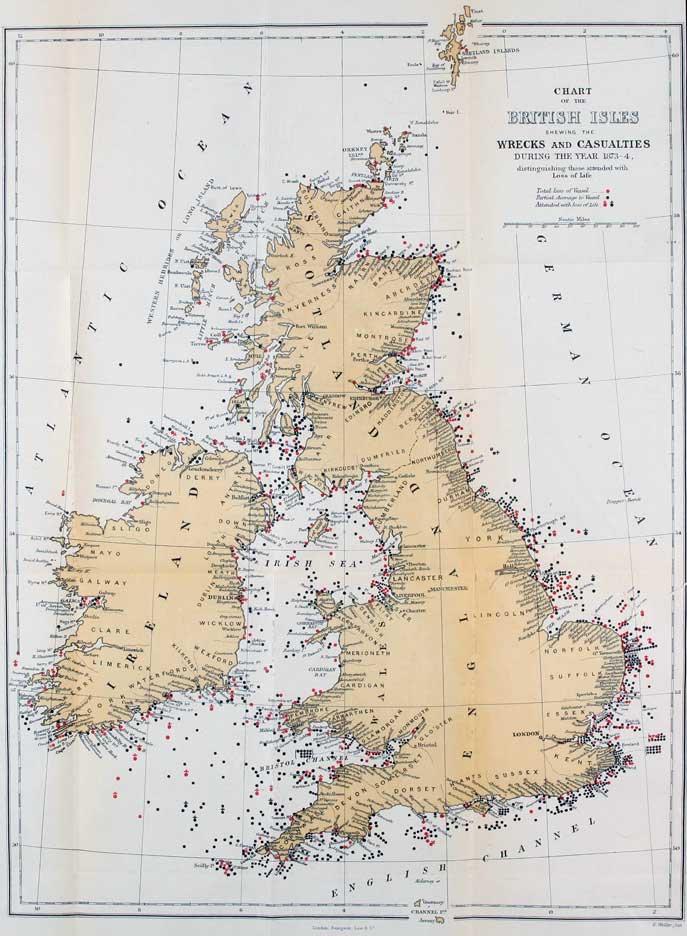
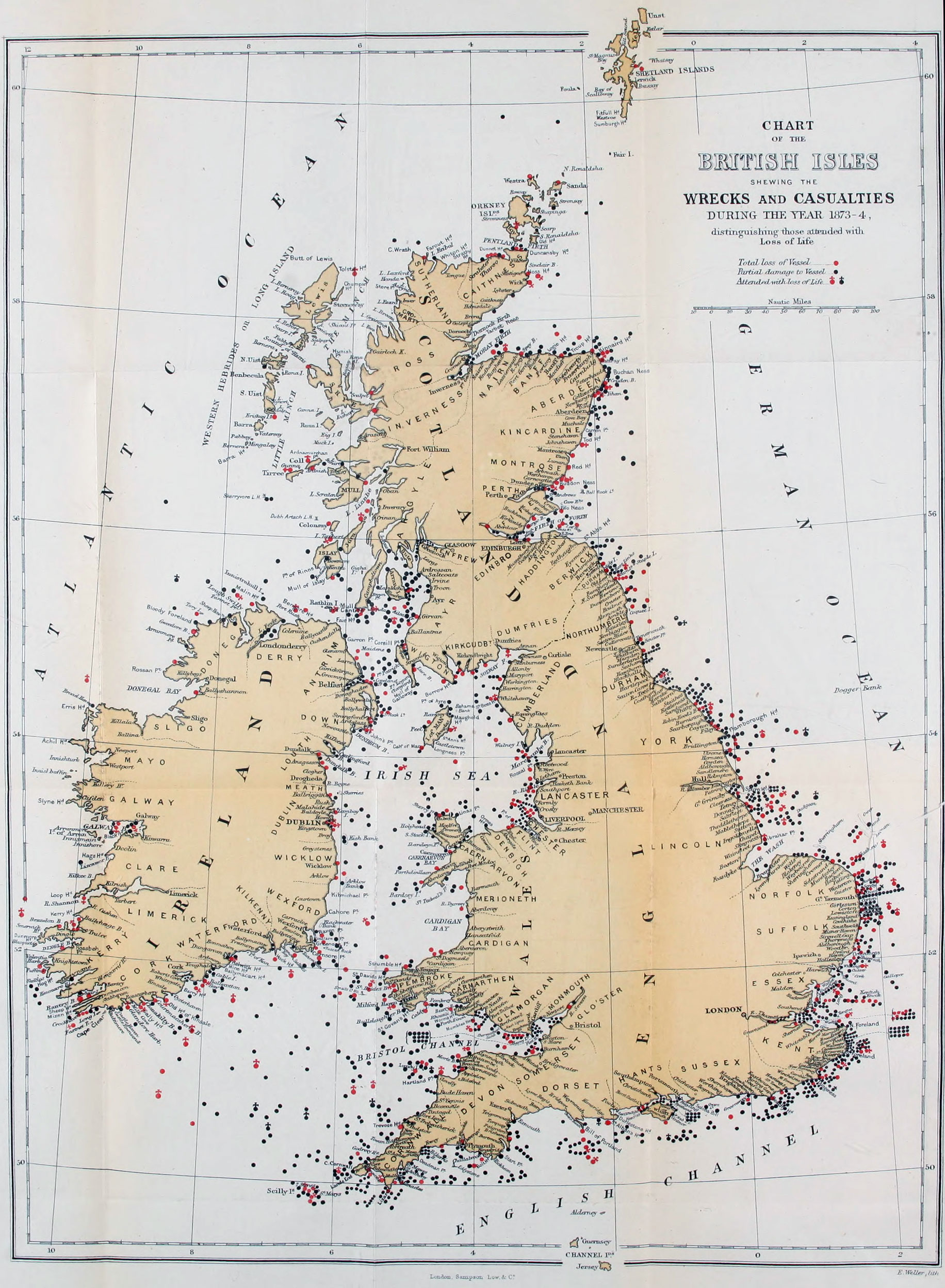
In the frontispiece to this volume will be found a
wreck chart of the British Islands, prepared from
the last Board of Trade Returns for the year
1873-4. A red dot signifies a case of total loss; a
blue dot signifies a case of partial damage. The first
glance of this chart is very appalling; but it becomes
less so when we consider the enormous number
of vessels annually frequenting our coasts. Many
hundreds of vessels at times leave the northern coal
ports, alone, in one day; and I estimate that, in the
year to which this chart refers, no less than 500,000
vessels of 90,000,000 tons! including their repeated
voyages, frequented the coasts of Great Britain and
Ireland.[277]
But, however startling these figures as a measure
of the immense number of vessels frequenting our
coasts, they affect the mind much less than a glance
at the actual facts, the fleets themselves. Until I
made a course from the Thames to the Tyne, and saw
the sea covered with ships, steamers, and fishing
boats, of all kinds and sizes, and saw what an industry
even the fishing alone employed, I never had clearly
in my own mind a notion of what our mercantile
marine really was. Let anyone survey from the fort
of Tynemouth and ancient churchyard adjoining—a
favourite walk of mine when I represented that
borough in Parliament—and see from 200 to 300
ships going out at one tide, or watch the passing ships
from Flamborough Head or from the cliffs of Dover,
or let him steam through the endless crowd of herring
boats off the Scotch coast, and he will have a stronger
impression of the magnitude of the mercantile marine
of Great Britain than can be derived from the
most careful study of all our Blue Books on the subject.
In dealing with this question, it becomes our duty
to consider carefully such realities as these. We
should not be led astray by a mere glance at the
wrecks and casualties which appear on the face of
the chart—a chart which has too frequently been
used as a picture to alarm the public mind, and
induce people, who will not take the trouble to inquire
for themselves, to believe that the question of the loss
of life and property at sea has not received that
consideration from Government or Parliament which
its great importance demands.
Danger of
too much
Government
interference.
I have frequently remarked, in the course of this
work, that, however great our exertions have been to
save human life, more might still be done, but, without
all the facts, further legislation, based on general
impressions, and still more so on popular clamour
(valuable in itself, though but too often deplorable
in its results), will prove of the most mischievous
character. We must, also, remember that every act
fettering free navigation, renders our Shipowners
less able to compete with those of other countries, and,
if it does not forward the main object in view—the
safety of life—must be a clear national loss, because
it renders us less able to make our ships a source of
profit, a result which, if not carefully watched, might
easily be carried to such an extent as to discourage
investments in British shipping.[278]
Now if we take the total disasters on our coasts,
including trivial accidents, it does not amount to
anything like one-half per cent. per annum, and to
not three out of every thousand of the vessels frequenting
these shores; indeed, when we consider the
dangerous character of these shores, the rocks and
shoals with which they are surrounded, the storms
with which we are visited, the frequency and uncertainty
of these storms, and the dense fogs which often
prevail, we may, so far from being startled by the
sight of the wreck chart, be surprised that the
casualties are not far greater. But, to arrive at the
true bearing of the case, it is desirable to analyse
the disasters. Besides the red and blue dots on the
chart, indicative of total loss or partial damage to
vessels, I have indicated by similar dots, with a cross
above, the number of disasters in the course of the
year, which were attended with loss of life. When
my readers examine these, they will be still more
agreeably surprised. From the Frith of Forth to
Spurnhead, a distance of somewhere about 150 miles
of the most rugged, unprotected, and dangerous
coast in the world, where numerous fleets of vessels
are constantly wending their way, and in every
description of weather, there were only seven vessels
wrecked with loss of life during 1873-4, and two
of these were partial losses. In calling attention to
this fact, I must remind my readers that, on the
part of our coast in question, the most inferior description
of vessels, and the most deeply laden, carry
on their hazardous trade. If we next cast our eye
over the line of coast extending from London to the
Lizard Point, and embracing the whole coast of the
English Channel, a distance of somewhere about 400
miles, we will see that during the whole of the
same year there were only fifteen wrecks with loss
of life, and seven of these were partial. Nor is the
proportion greater on any other portion of the coasts
of Great Britain and Ireland.
Loss of life
in proportion
to
vessels
afloat.
Causes of
loss.
But we should do well to inquire still further, and
not merely compare the present number of disasters
with those of former years, but likewise their extent
and character; and, as far as is practicable, the different
causes of loss, so as to endeavour to apply, to
the best advantage, any further remedies that may
be necessary. I have shown[279] that the average loss
of life during the three years ending 1835 was 894
per annum, when we owned 2,780,000 tons of shipping;
but the loss of life for the year 1873-4, when
our Merchant Shipping had increased to 7,294,230
tons, of which no less than 1,825,738 tons consisted
of steamers, in which the risk of navigating our
coasts is greatly increased, amounted only to 506,
of whom 103 were lost in foreign vessels. Many of
the remaining 403 were lost on fishing boats, and
other vessels not registered under the Merchant
Shipping Act.[280] Very material progress towards the
saving of life on our coasts has, therefore, been made
during the last forty years—a progress which will
appear the more striking when I direct attention to
the fact, that, while the entrances and clearances of
British ships engaged in the foreign trade were, in
1835, not much more than 4,000,000 tons, they had
increased to more than 26,000,000 tons in 1873-4.[281]
Of the 506 lives lost, 61 were lost in vessels that
foundered; 76 through vessels in collision; 200 in
vessels that stranded or were cast ashore derelict;
and 101 in missing vessels. The remaining 68 lives
were lost from various causes, such as by being
washed overboard and by other accidents on board.
The whole of the above lives were lost in 130 vessels,
87 of which were laden, and 40 in ballast. It is not
known whether the remaining three were laden or
light.
If we take the last five years from 1869 to 1873-4
inclusive, we find the total number of wrecks and
casualties of vessels of every kind, arising from all
causes and including collisions, amounted to 8952,
giving an annual average of 1791; the average loss
of life in these vessels during the five and a half
years, including the disastrous half-year 1873, being
755 per annum. Although no return is kept in
minute detail of the approximate cause of these
disasters, we learn from the wreck register, that in
the year 1873-4, 381 were from collisions, and 1422
from wrecks and casualties other than collisions;
346 were wrecks, &c., resulting in total loss; and
1076 partial damage more or less serious. Of the
total losses, 128 happened when the wind was at
“force 9 or upwards” (a strong gale), and they are
classed as having been caused by stress of weather;
93 from inattention, carelessness, or neglect; 30
from defects in the ship or equipments (and of these
thirty, 19 appear to have foundered from unseaworthiness);
the remainder seem to have arisen from
various other causes. Of the 1070 casualties, 525
arose from stress of weather; 180 from carelessness;
and 91 from defects in equipments; and the remainder
from various other causes. In 1873-4, there
were, on or near the coasts of the United Kingdom,
165 wrecks and casualties to smacks and other fishing
vessels, which are included in the above returns,
and in these, 76 lives were lost, while 195 lives were
lost in vessels of the collier class.
More details
required.
These returns are, no doubt, very valuable as far
as they go, and have become more so since they
were extended to the loss of all British ships, and,
where practicable, to the cause of the loss. But
the class of the vessel, whether built of wood or
iron, and the draught of water when she left her
last port, might be added to advantage. Nor
should we omit the familiar S.S. to distinguish steam
from sailing ships. However, they amply show that
no charge can be justly made against either the
Government or the Legislature of any dereliction
of duty in their endeavours to save the life of all
persons who “go down to the sea in ships.” Nor
can we charge the people of this country with any
callousness or want of sympathy for the seafaring
portion of the population. The number of Acts of
Parliament passed in recent years, and the grants
of public money voted for the purpose of saving
life, are an answer to all such charges; while noble
private institutions, like the Shipwrecked Mariners’
Society, the Lifeboat Establishments, the Royal Alfred
Asylum, besides various other charitable associations
for the benefit of seamen, testify in this respect to
the liberality of the public.[282]
Improvement
in
lighthouses,
buoys, and
beacons.
Harbours
of Refuge.
Nor have the lights, beacons, and buoys on our
coast, all tending materially, as they do, to save life,
been neglected. On the contrary, while we have
greatly reduced the charges, we have increased the
number and highly improved the quality of our lights.
By the Act passed in 1836,[283] a number of lighthouses,
which formed part of the hereditary estate of the
Crown and had been allowed to get into the hands
of private persons, were transferred to the Trinity
House, provision being made for reducing the exorbitant
tolls previously levied. By an Act of 1853,[284]
the expenditure of the Trinity House on lighthouses,
and that of the Scotch and Irish lighthouse
boards, was subjected to the control of the Board of
Trade, and, since then, the reduction on the charges
for lights, buoys, beacons, &c., has been fully 75 per
cent. Nor has the question of Harbours of Refuge
been overlooked; for, besides the construction of
various national harbours, large sums of public
money have been advanced at a low rate of interest
for the improvement of local harbours, expressly for
the benefit of merchant ships and seamen, and these,
while facilitating commerce, have, in no small degree,
tended to the safety of life and property.
Indeed, so anxious has Government been to
rectify any shortcomings in legislation, which might
tend to the loss of life, or inflict a hardship on seamen,
that the Bill of Mr. Fortescue (now Lord Carlingford),
passed in 1873,[285] contained not merely clauses
about “load-lines” and “clear sides,” but a provision
giving seamen a claim for compensation when, having
been detained on a charge of desertion, the ship, upon
survey, was shown to be unseaworthy. This Act
further contains a provision, strengthening the power
of the Board of Trade to detain unseaworthy ships,
whereby that “Board are enabled to act of their own
accord, and without complaint from without,” the
result of which has been that, up to the last return,[286]
out of the 474 vessels detained and surveyed by the
Board of Trade under this Act, 435 have been on the
report of their own officers, and 39 only on complaints
made ab extra.[287] To these facts I may add, as
having a very important bearing on the opinions I
have hitherto ventured to express, that only 24 out
of the 474 vessels were detained because they were
overladen; and that, out of these, not a single vessel
detained was alleged to be overladen on information
given by the crews, notwithstanding the encouragement
they had to become informers against their
employers. This power to detain is extended to
cases of overloading and improper stowage or imperfect
loading, and the conditional orders of release
are of a very elaborate character, while the provisions
concerning payment of expenses, and the mode of
appeal, are made far more full and explicit.
This Act further gives power to vary the requirements
contained in the Merchant Shipping Act of
1854 with regard to boats—requirements, I may add,
which it had been found practically impossible to
comply with. It likewise contains a clause, which
ought to have been the law long since, making it
criminal (though the dictates of humanity, it had
been thought, were in themselves sufficient), in a
master, after collision with another vessel, not to stand
by and render assistance. In the same statute, a code of
signals of distress has been adopted and very properly
enforced, as well as a general code of pilot signals.
Many losses having occurred from spontaneous
combustion of coal on board ship, Government, in
1874, appointed, on the recommendation of Lloyd’s
Committee, a Royal Commission, under the chairmanship
of Mr. Childers, to inquire into this subject,
but this Commission has not yet concluded its labours.
Extraordinary
scene in
the House
of Commons
on
the withdrawal
of
the Merchant
Shipping
Bill, 1875.
Early in the Session of 1875, the Government
introduced another Merchant Shipping Bill, containing
various amendments of the then existing
law, and among them a special clause which had for
its object the abolition of all advance notes. This
Bill met with very considerable opposition (partly of
a frivolous character), rendering its progress through
the House so slow, that Government found it desirable
to withdraw it, more especially as the Bill had
been materially altered and curtailed in the course of
various divisions, especially in the clauses referring
to the advance notes and other matters of importance.
When Government intimated its intention of
withdrawing the Bill of which they could no longer
approve, and which they had not time to pass, a
scene arose[289] happily of rare occurrence in the debates
of the British Parliament. It was closed, however,
with great dignity by the Prime Minister and leader
of the Commons. He had introduced such a measure
as he no doubt, after grave consultation with his
Cabinet, considered necessary and sufficient. The
House, and more especially those members of it
who were more immediately interested in maritime
affairs, and who either approved or opposed the views
of Mr. Plimsoll had so mutilated the Government measure,
that Mr. Disraeli would no longer be responsible
for it. To use his own words, he “declined to deal
with the subject in that fragmentary manner,” and no
man of prudence or common sense can blame him for
the course he adopted under these circumstances.[290]
Another
Bill introduced
by
Government.
Unfortunately, however, the popular outcry was
so great against the course he had adopted, aroused
as this had been for the moment by the well-meaning
but rhapsodical protests of Mr. Plimsoll, backed, as
they no doubt were, by many really benevolent men,
that Mr. Disraeli, in the end, considered it expedient
to introduce another Bill, embodying a portion of his
own views together with those of the philanthropists.
Although this Act contains some necessary and
useful provisions, it is not a wise measure, nor can
the Government have considered it perfect, as it was
hurriedly passed so late in the Session as the 6th of
September, and is only to remain in force until the
1st of October 1876.[291]
Its conditions.
Unusual
personal
power
granted to
Surveyors.
This Act confirms the powers previously given to
persons, specially appointed by the Board of Trade,
to detain what they consider unseaworthy ships,
without previous orders from the Board, an addition
which, however necessary, ought not to have been
conceded to any individuals without much further
consideration and discussion than it received. This
addition opens the door to corruption in its most
pernicious and dangerous forms, by giving, as it does,
to each one of a great number of subordinate officers,
personal authority to detain “unseaworthy vessels,”
thus transferring to a single person a power the
Board of Trade alone possessed under the Act of
1873, and laying down a principle contrary to all
good government, while relieving that Board of its
administrative responsibility. Otherwise the Bill contains
some useful provisions, and none more so than
where it prohibits the carriage of a cargo of which
more than one-third consists of grain, &c., unless
the grain is secured from shifting by suitable boards
or otherwise. But, while this clause may be necessary
or right in itself, its meaning may be misconstrued,
and it may lead to further and more detailed
legislation, making its vague language specific, and
calling on Government officers in Foreign ports to
enforce its provisions.[292]
The Act also amends the clause in the Act of
1871, which makes the sending an unseaworthy ship
to sea a misdemeanour, by providing—
(a.) That criminal liability shall attach to any
one who attempts, or is party to an attempt, to send
such a ship to sea, and to a master who knowingly
takes such a ship to sea.
(b.) That every ship shall have a registered
managing owner, and that if she is sent to sea from
any port in the United Kingdom in an unseaworthy
state he shall be liable, unless he proves that he has
done all he can to prevent it.
The Act further provides that every British ship
shall be marked permanently with lines on her sides
showing the position of her decks.
It also provides that the owner of every foreign-going
British ship shall, before clearance outwards
from any port in the United Kingdom, mark upon
her sides a maximum load-line, and shall insert the
distance between this and the deck marks in the entry
outwards at the Custom House and in the agreement
with the crew.
The Act further stipulates that every contract
with a seaman shall imply an obligation on the part
of the owner and his agents to use all reasonable
efforts to make and keep[293] the ship seaworthy. The
effect of this clause is to give the seaman or his
family a remedy against the owner. But it does not
extend to damage or loss of life caused by the act of
a fellow seaman other than the master.
Happily it is not necessary, in reviewing the recent
changes in our Mercantile Marine Laws, to notice
those personal matters which have unfortunately
been raised in the course of their discussion, except
to express regret that Mr. Plimsoll in dealing with
a subject of such great public importance should
have made grave assertions and charges alike against
Government and private individuals, too many of
which he has not merely entirely failed to prove,
but has neglected to withdraw.
Had Government been persistently neglectful of
its duty in its endeavours to mitigate the loss of life
and property at sea, there might have been an excuse
for some of these charges, especially if it had neglected
necessary legislative enactments.[294] But such
has not been the case. On the contrary, Parliament
of late years, while producing some excellent
measures, has interfered far too much with the details
of the affairs of individuals connected with Merchant
Shipping: and, though yielding for the moment to a
popular cry, Mr. Disraeli may well have had reasonable
doubts whether further legislation might not, so
far from lessening, tend to increase those dangers and
disasters which must ever attend the navigation of
the ocean.
Propriety
or not, of
further
legislation
considered.
Having, however, officially announced his intention
to review the whole subject, and to consider it in all
its bearings, I venture to invite the attention of my
readers to the more important points now pending.
They are: a compulsory load-line, and the production
of an official certificate of seaworthiness by all ships
before they are cleared at the Custom House.
Compulsory
load-line.
Mr. J. W.
A. Harper’s
evidence.
So far as regards the proposed compulsory load-line,
a very competent and intelligent witness who
gave his evidence before the Royal Commission on
unseaworthy ships, says,[296] “I think nothing could be
more serviceable and nothing more excellent than
to obtain and, if it were possible, enforce a load-line;
but I also think there is nothing more impossible.
A load-line, do what you may, is the opinion of an
expert. How can you, by authority, enforce the
opinion of an expert? I have had before me,” he
continues, “a great many proposals for ascertaining
load-lines for ships. Some of them are very ingenious.
By the best of them you may get, with
considerable accuracy, the cubical displacement of the
empty ship, the displacement of the cargo, and so
you may arrive at the cubical space left in the ship
available for floating. And getting that you get a
valuable and useful fact for some objects. But the
supreme difficulty remains untouched, viz., What ought
the floating capacity to be? I cannot imagine it
possible to enforce by any Government intervention
a rule which must depend in every individual case upon
the opinion of an expert.”
Mr. W. J.
Lamport
and others.
Opinion of
the Commissioners.
Such, also, was the purport of the evidence of the
great majority, if not of all the witnesses examined
before the Commission; but I quote that of Mr.
Harper, because he is not merely thoroughly competent
to offer an opinion on the subject, but is
altogether disinterested. Indeed, from the appointment
he holds, it would be to his interest to recommend
a compulsory load-line, and he would no doubt
have done so, had he not thought that any such
legislative measure would be likely to aggravate the
evils sought to be remedied. In fact, the whole tenor
of the evidence is that a fixed load-line would do
more harm than good.[297] And such was the opinion
of the Commissioners, who state, “that any rule of
freeboard founded on surplus buoyancy gives to a
vessel of light scantling an advantage over a stronger
vessel. Thus the inferior ship would by law be
allowed to carry the heavier cargo. Such an enactment
would not contribute to the safety of life at
sea. From all the evidence we have collected on
this subject, we are of opinion that an Act of Parliament
enforcing any scale of freeboard would be
mischievous.”... “A law presenting such a rule
would therefore enhance the perils of a seafaring life.”
Nor can impartial persons who have studied this
question arrive at any other conclusion, for as the
Commissioners justly add, “There is no general agreement
as to a rule by which the requisite amount of
reserve buoyancy could be determined, and it appears
that, except under definite circumstances, it is not a
determinable problem. The proper load-line in each
particular case depends not only upon the principal
dimensions of the ship, but also upon her form and
structural strength, the nature of her cargo, the
voyage, and the season of the year.”
Voluntary
load-line.
The Commissioners, consequently, limited their
recommendation so far as regards freeboard to the
extent that “every merchant ship should have
marked upon each of her sides amidships, a vertical
scale of feet downwards from the edge of her main-deck,”
and that a note of her draught of water
“should be entered in the log after the vessel has
received her full load, immediately before the time of
her starting on her voyage, which should, wherever
practicable, be left with the officer of Customs or with
the British Consul, by whom it should be recorded.”
Its value
questionable.
This recommendation was proposed to be carried
out in the Government Bill which was withdrawn,
but, in the Act now temporarily in force, the provisions
are somewhat different. The advantages of
either system are problematical. Shipowners will
continue, as they have hitherto done, to load their
vessels to such draught as they consider prudent,
and if one of their vessels is lost, and other persons
remark that she was too heavily laden, the answer
will either be that the draught was as usual, or that
safety in proportion to depth is a matter of opinion
depending on many varying circumstances. The
mere fact of publicly recording the draught of water
would, it is to be feared, have little effect on unprincipled
or avaricious Shipowners, against whom alone
the law is aimed. Practically, I think the system of
marking now in force will be of little or no avail,
and that the result will not be as the framers of the
law intended. A Shipowner being now required by
law to mark upon the sides of the vessel amidships
a circular disc 12 inches in diameter, to be so placed
that “the centre of the disc shall indicate the maximum
load-line in salt water to which the owner
intends to load the ship for that voyage,” will perceive
that to place the disc only slightly above the
usual line of load draught would, on the one hand,
fetter him to some extent; while, on the other hand,
he would incur no disadvantage by placing it so much
higher as to ensure its being well clear of the water
under any circumstances of loading. A maximum
load-line will, therefore, in practice mean the line
down to which the ship will certainly not be loaded.
Indeed, from the information I have gained on the
subject, the practice with some Shipowners seems
already to be that the discs are placed one, two, and
in some cases, three and even four feet above the water-line.
The mere marking it would, therefore, appear
in a great measure worthless, as surveyors will still
require to wait until a ship has her cargo on board and
is ready for sea, before they can form any opinion as to
her safety. Whether it is wise, on the part of Shipowners,
to place the disc so far above the vessel’s
ordinary water-line as to make it meaningless has been
doubted by many, but the fact remains that it is so
placed in very many instances. It would, certainly,
have been better to have omitted from the clause of
the Act I have just quoted the word “maximum,” as
few Shipowners would have placed their discs too
high if, by doing so, this indicated an intention on
their part to overload their vessels.
However, if it can be shown that this new mode
of marking the sides of a ship tends in any degree
towards the greater safety of life and property at sea,
the shipping community, generally, will not complain
of the expense and trouble. In all good governments
there is a pervading principle to which all classes
submit, that the interests of the few must be made
subservient to the good of the many, and that, especially
where life is at stake, no reasonable trouble or
expense should be spared to preserve it. But if, on
the other hand, it is found that this system of marking
or registering the draught of water is useless,
or even injurious, Shipowners will have great cause
of complaint against Government for an unnecessary
interference with their business, provided they can
show that they have made an earnest endeavour to
apply the provisions of the Act fairly and in the
spirit in which they were framed.[298]
The other important point on which Mr. Plimsoll
insisted is of a different character. But to carry it out
in the way suggested, or as it was argued in the
House of Commons and before the Royal Commission,
would be impracticable, and even if practicable, it
would be most mischievous: the Commissioners in
their Report state the question as follows:—“With
the view of providing for the greater safety of life at
sea, it has been suggested that the Board of Trade
shall superintend the construction, the periodical inspection,
the repair, and the loading of all British
Merchant Ships.” Considering the extent of our
mercantile marine and the mode in which business
must, necessarily, be conducted if we desire to maintain
our present high position as a maritime nation, any
such suggestion is simply absurd and, if carried into
effect, would be most ruinous. That we have already
too much legislation in matters of detail the Commissioners
themselves admit. Referring to the pernicious
effects of inquiry into such matters by Government
surveyors on Emigrant ships, they say,
and from the evidence before them they would have
been justified in expressing their opinion in still
stronger terms, “We consider it to be a question
worthy of serious consideration, whether, in the case
of passenger ships, the certificate of the Board of
Trade, so far as regards specific approval, should not
be expressly confined to the number of passengers
to be allowed, and to the accommodation for their
health, comfort, and general security; all questions
of unseaworthiness of hull, machinery, and equipment
being left to the owners, subject only to a
general power of interference in case of danger, sufficiently
apparent to justify special intervention.”
How this
can be
accomplished.
I have been unable to ascertain who made the
extraordinary proposal, that every ship from the
time her keel was laid until she was loaded and
ready for sea should be under the superintendence of
officers appointed by the Board of Trade. In justice
to Mr. Plimsoll I must state that, though I have read
his book, and nearly all his speeches, I cannot trace
any recommendation that the merchant ships of this
country should be placed, either as regards construction,
inspection, or repair, altogether, under the
control of the Board of Trade or of any other
Government department.[299] What Mr. Plimsoll mentions
seems to me, to be a matter to which I have
often referred in the course of this work, that we do
not utilise to anything like the extent we might the
vast private resources within ourselves, and that we
might do so to advantage, so far as regards the
survey of our merchant ships, not one of which he
suggests should be allowed to go to sea unless she is
seaworthy. Now this is a suggestion which few men
would be bold enough to decline to consider, and Mr.
Plimsoll points out how this may be secured by means
already at our disposal. Perhaps in the way he
puts it, the difficulties with which it is surrounded
could not be overcome; but the maxim cannot be
ignored, as it is sound in principle.
To leave the survey of our ships to any one private
institution, not on a sufficiently broad basis, such as
Lloyd’s Register, might create as many evils as a
general Government survey, and, besides creating
jealousy on the part of other somewhat similar institutions
or associations, might be considered contrary
to the rules of sound government. But these institutions
could be enrolled and licensed, as various other
associations now are, and empowered to grant certificates
of seaworthiness, which every ship above a
certain tonnage would require to produce before she
was cleared at the Custom House. Or they might
be welded into one great national institution directly
controlled by all the various branches of the shipping
community in harmony with their sentiments, and
alive to the wants and necessities always arising
through the growth and development of trade and
commerce.
Individuals may do wrong, and, though it may be
for their interests to have a good sound ship, there is
no denying the fact that ships are sent to sea which
are not seaworthy; but corporations and associations
cannot do wrong with the same impunity. If they
did, they would be deprived of their licence, and
there would be a check, one against the other, which
is not the case with individuals. Or, on the other
hand, a great representative institution would be
efficiently checked and influenced by public opinion,
and the voice of those immediately concerned. Were
Government to require these associations to classify
ships, then I agree with the Commissioners, that it is
not its province “to ascertain whether a ship is fit
for the conveyance of dry and perishable goods,” but,
from the debates in Parliament, and numerous
articles in the public press, it is clear that many
persons are of opinion, that it is the duty of Government
to be reasonably satisfied that a ship is seaworthy
before she proceeds to sea. We exercise this duty
in the case of railways, mines, and manufactures of
various kinds, and events have shown, however much
we may have already done to save life and property at
sea, that the exercise of a similar duty, if practicable,
is at least worthy of consideration in the case of ships.
As the great bulk of the vessels belonging to
the United Kingdom are already classed, the certificate
of classification they now hold would suffice
as a certificate of seaworthiness. Those which are
not now classed in Lloyd’s Register, or in any other
association, but which belong to the great steam
companies, or to very large shipowners, are so well
known for their good qualities as not to require
classification, and for this reason classification, or, at
least, survey for seaworthiness, even if compulsory,
could not be a serious hardship to them.
Practically the number of vessels now unclassed is
confined to the very good or to the very bad ships.
With the owners of the former I should think there
would be no difficulty in dealing; they do not class
their ships either because they do not care to incur
the expense (underwriters being ready to insure them
at the lowest current premiums), or because they
think they can construct ships, in their own way,
superior to those which are built to rules for classification.
But such men, while they might protest,
and justly so, against being interfered with in a
business they more thoroughly understand than any
government or private surveyor, and in which they
take a laudable pride (for such men are the pillars
of our maritime greatness), would, I doubt not, have
no objection to an authorised surveyor inspecting
their ships, and would readily pay the moderate fee
required to cover the cost of a certificate of seaworthiness.[300]
For the information of the general public I may
state that there is a very great difference between the
highest grades of vessels and those which any surveyor
who knew anything about his business would
pronounce to be unseaworthy. In the case of classed
ships, the certificate of classification would suffice; but,
from the owners of ships who do not class, many
intelligent persons are of opinion that a certificate
of seaworthiness should be required. They argue, and
with great force, that those persons who do not class
their ships, because they will not bear inspection,
have no right to imperil the lives of others for their
own gain. Life is not a thing of price; if it were, the
rich would live, and the poor would die. And when
a Shipowner declines to bear the expense of making
his vessel seaworthy, he places in jeopardy the life of
the sailor to benefit himself.
Registration
Associations.
Lloyd’s
Register,
its great
importance.
There are very easy means of ascertaining the
seaworthiness of a ship, when first sent afloat, already
at our disposal, as those of my readers, who are not
conversant with this subject, will find by referring to
the Appendix,[301] where a history of Lloyd’s Register
of British and Foreign Shipping will be found. That
association has a well-organised and extensive staff of
surveyors, through whom, at a very small cost, this
fact could be ascertained. My readers will also there
see the immense advantage that association has
afforded in the improvement of our ships and the
power it possesses of rendering still greater public
service. But while rivalry amongst associations for
classification is unquestionably injurious,[302] it may not
be considered advisable that Lloyd’s Register alone
should issue certificates of seaworthiness. There are
other similar associations whose certificates would
answer the object in view equally well, and it is for
Government to decide (should an attempt be made to
carry this principle into practice) what associations
shall be empowered to issue the requisite certificates.
But while I cannot ignore the principle that no
unseaworthy vessel should be allowed to leave our
ports, I cannot hide from myself the fact that there
would be numerous difficulties (but far from insurmountable)
in the way of carrying it fully into practice.
It might be argued that if the Board of Trade
enrolled the associations named, and, more especially,
if it took them under its immediate control, they
would in a few years, instead of being private Institutions,
be mere servants of the Board, and, through
the Board, of a sensational House of Commons. But
that argument may be met by the Shipowners saying
to the Board of Trade, “We do not wish to be under
your immediate control at all. Why should we not
be allowed to manage our own affairs, as all other
branches of the community now do,—subject, in our
case, as in that of all others, to such enactments only
as may be necessary for the public safety? We ought
to know our own business a great deal better than
any of your surveyors can teach us; and, if we think
proper to form ourselves into an association, or associations,
to manage our own affairs, and if we do
what the country requires, why should we be interfered
with by the Government as to the manner in
which we think proper to build, equip, and navigate
our ships, any more than other traders in the
management of their affairs? Enrol us, if we think
proper to associate, as you do joint-stock concerns or
other associations; let us form a board with members
elected by the persons interested, such, for
instance, as the Metropolitan Board of Works, to
manage our own concerns, with specific rules for the
protection of the public, which, if we violate, you
will punish us as you would do any other class of
the community.”
Now, arguments such as these are really unanswerable.
Statesmen and others, who have to
encounter the harassing difficulties of official life, and
who know that all executive power must be exercised
by a minister, or by individuals responsible to him,
and, through him, to the public, might say, “How are
we, unless all ships are under our immediate control,
to meet questions put to us in the House of Commons,
such as, ‘Whether such and such a society
licensed by Government had the folly and audacity
to allow of spring safety-valves, or of boats not fitted
with Clifford’s Patent?’ or how could we justify a
licence granted to an association which showed such
flagrant disregard of modern inventions and of
seamen’s lives?” But the reply to all this is that
it is not the province of Government to legislate on such
details as these, any more than it would be to dictate
by Act of Parliament, how the details of any other
branch of trade or manufacture are to be carried out.
The duties of Government have long since been defined,
and it is because Government, of recent years,
has gone far beyond its duties in the case of Shipowners,
that Shipowners complain, and justly complain,
against Government for a “meddling and
muddling” in matters alike beyond its province and
its knowledge.
Reverting to the principle which so many persons
now say should be enforced by legislative enactment,
the seaworthiness of every ship, there would be great
difficulty in carrying that out by Government, as
seaworthiness is not definable. That is to say,
though a vessel may be seaworthy, when launched,
(even then it would depend upon the trade in which
she was to be employed), she might not be so at the
end of her first voyage, or she might be so for one
trade in summer, but not in winter, or with one description
of cargo, but not with another; or, in fact,
with the same cargo if properly stowed,[303] but not
otherwise, and so forth. The details are so numerous
that it would be impossible to enter upon them within
my limits, and for the same reasons, if the principle
is to be carried out, it can only be by the association
of competent individuals with the necessary staff
under their control, possessing that knowledge
which long experience alone can give. I mention
these points in case the Legislature consider it necessary
to enforce this principle; for, if it is to be
carried out, it should be in such a manner as will
satisfy the public with the least possible interference
with the duties of the Shipowner.[304]
Improvement
of
seamen by
better education.
In the meantime I must direct the attention of my
readers to the unseaworthiness of too many of our
seamen, which is of really greater national importance
than the unseaworthiness of our ships.
However desirable it may be to make certain, if we
can, that no unseaworthy ships shall leave our ports,
the incompetency, carelessness, and drunkenness of
seamen demand much more seriously our attention;
and, as all legislative enactments have hitherto failed
to raise them to the requisite standard, we ought to
direct our attention more earnestly than we have yet
done to their education. If education is necessary
on shore, it is still more so with seamen, and yet
we have done, practically, nothing, as a Nation, to
assist them in gaining knowledge, and, especially,
that description of knowledge required in their
calling. Indeed, we have not seriously attempted
any great practical scheme for their education or
for the amalgamation of the services of the Royal
Navy and those of the mercantile marine, which,
while invaluable to us as a nation, would tend so
much to elevate the social position of that neglected
portion of their class, who, not having the
good fortune to be enrolled in the Navy or on the
lists of the large Shipowners, must seek their daily
bread at sea in any ship where employment can be
found.
Evil effects
of advance
notes
On the contrary, we have, in some respects, pandered
to their pernicious habits. For instance, when
a clause in the first Government Bill of last Session
(1875) was introduced to render advance notes
illegal, the House of Commons rejected it. From
my own experience I can have no hesitation in
stating that the system of advance notes (I do not
include the allotment notes, which are most useful)
tends to lower the character of seamen, promotes intemperance
and insubordination, and has been the indirect
means of far more disasters at sea than either
overladen or otherwise unseaworthy vessels.
Besides, any such system is unknown to any other
class of the community. What should we think of a
mechanic or house servant who could not enter our service
unless we paid him a month’s wages in advance?
We should have nothing to say to him—1st, because
we should not care to trust our money to a person
who, on some frivolous excuse, might decline to repay
us by his faithful service; and (2ndly) because we
should, naturally, consider anyone requiring such
an advance an improvident if not a worthless person.
These advances must, necessarily, discourage
frugality and prudence; while, in the case of seamen,
they most assuredly lead, directly, to intemperance
and vice. Nor is there any real occasion for making
advances in their case. The mechanic or the house
servant may have been for some time out of employment,
and, as his wages are paid weekly or monthly,
he may not have laid by anything; but, in the case
of seamen, their wages are paid at the end of the
voyage, often in large sums, and by means of savings-banks
and money-order offices, specially established
for their use, they have every facility afforded them
for retaining their earnings. But they do not.
Why? Because the Legislature has encouraged
their natural and proverbially improvident habits,
by acknowledging a system of advance of wages
unknown to any other class of workmen, on which
advance they depend for an outfit, after too frequently
squandering the wages they had earned on
a previous voyage.
But I should prefer my readers considering carefully
the Report of the Commissioners on this subject
instead of my own views, and therefore I do not
hesitate to give these conclusions at length,[305] as a
large mass of evidence was brought before them.
They, as statesmen and philanthropists, had no
object in view beyond the national good, and,
more especially, the welfare of the seafaring population.
confirmed
by the
opinion of
the Commissioners.
“The evidence before us leads to the conclusion
that the system of advance notes is one great obstacle
to the amelioration of the condition of merchant
seamen. All the witnesses whom we have examined
admit that the system is most pernicious, but it is
defended on the ground that, without this advance,
the sailor could not pay for his lodging on shore, or
procure the clothes requisite for him when he joins a
ship.
“In practice it seems that the advance note is
handed over to the lodging-house keeper, not usually
in exchange for cash, but in discharge of debts which
the sailor has been induced to incur. The lodging-house
keeper charges a heavy discount, and the
sailor is frequently brought on board half-clad and
intoxicated.
“Shipowners and captains of merchant ships concur
in stating that a large portion of the ship’s crew
is very often brought or even lifted on board in a
condition of helpless drunkenness, that the vessel
must often be detained for twenty-four hours in order
that the men may be so far recovered as to be able to
get her under weigh, and that there is great risk of
life and property at the commencement of the voyage
from the consequent inefficiency of the seamen.
“The advance note is not payable until some days
after the sailing of the ship; but if the ship then
puts back or touches at another port, the seaman often
takes the opportunity of making some complaint, in
order to get free from his engagement, and will even
incur a month’s imprisonment with this object, whilst
the Shipowner or the person who has cashed the note
loses the money which has been paid in advance.
“It is said that if there were no advance note, the
crimp in a foreign or colonial port would not have
the same inducement to entice the sailor to desert.
“After careful consideration of the numerous evils
attending this mode of prepayment, we recommend
that advance notes should be declared illegal, that no
payment or order for payment made in advance for
wages shall be a discharge for the payment of any
portion of a seaman’s wages when due, and that no
money paid by a Shipowner to or for a seaman shall
be debited to the seaman, except wages already earned,
the allotment notes, and the cost of such supplies as
the seamen may receive after joining the ship.
“There will be some inconvenience felt at first
from the abolition of the existing system of advance
notes, and there will be perhaps considerable opposition
to the change in the ports, and amongst the
lodging-house keepers, who profit by these notes.
We feel, however, convinced that unless this mischievous
mode of payment be discontinued, the
seamen will never be raised from their servile dependence
on crimps, and taught to rely on their own
industry and intelligence.”[306]
Over-insurance.
But there is a question of quite as great importance
to which I shall again have occasion to refer when I
review the history of our steam companies, and show
the remarkably small amount of loss that some of
them have sustained through the system and order
prevailing on board their vessels. There we shall see
how losses are prevented. In the meantime, we should
do well to inquire how losses are encouraged by
allowing policies of insurance to be effected for a
greater amount than the value of the ship or the
cargo she contains.
Views of
Mr. T. H.
Farrer.
A contract of marine insurance is in its essence a
contract of indemnity, and the spirit of the contract
is violated if the assured can make the occurrence
of a loss the means of gain. But the law has allowed
a very considerable deviation from this fundamental
principle. Mr. T. H. Farrer, in his evidence, happily
illustrates this in the case of a ship with a chartered
freight, bound from London to Calcutta and back.[307]
He supposes her to be lost on her outward passage
in the Bay of Biscay. Presuming that the owner
only insured her prudently and not exorbitantly, he
would recover in this case not merely the value of
the ship at the commencement of the voyage, but also
the freight of the outward and homeward voyages,
while he would be exempted from paying the seamen’s
wages from the date of the disaster, the expenses
necessary to carry his ship to Calcutta, to remain
there, and to return on her homeward passage, so that
he would be, actually, a very considerable gainer by
the loss.[308] Nor is the matter less flagrant in the case
of valued policies, when the value of the property is
fixed by agreement beforehand between the assured
and the underwriter. The effect of this, as the Commissioners
justly remark,[309] is, “that unless the policy
is altogether void, on account of fraud, or the concealment
of a material fact, the assured can, in the
case of a total loss, receive the value which has been
stated in the policy, however much it may exceed
the actual worth of his property.” In confirmation
of their opinion, they add “that, in certain decided
cases, the Shipowner has been allowed to recover 50
and even 100 per cent. more than the actual value of
his vessel.”
Evidence
of other
witnesses.
Various witnesses recommended that, in case of a
total loss, the underwriter should be allowed to question
a valued policy, when he considered that the
value had been overstated; but many Shipowners
and underwriters objected to this proposal, contending
that, where a value had been agreed on between
the Shipowners and underwriter, subsequent interference
would be mischievous or futile, as it might
induce Shipowners to insure abroad. It was contended
that the value of a ship might depend on a
variety of circumstances; for instance, the loss of a
steamer to a Shipowner, about to start a new line of
steam communication, would be inadequately replaced
by the cost of the vessel, though estimated values of
this sort are very problematical.
As regards insurance of freight, it was further
suggested that the Shipowner should not, in case of
total loss, be entitled to recover his freight, without
deducting the expense saved to him by reason of the
loss of the vessel. On the other hand, it was alleged
that the necessity of estimating these uninsured expenses
would give rise to doubt, difficulty, and litigation,
and that, if the suggestion were adopted, the
Shipowner would be to a great extent deprived of
the legitimate advantage he now enjoys of being able
to obtain with facility an advance on his freight.
Opinion
of the
Commissioners.
After carefully considering all these matters, the
Commissioners arrived at the conclusion that they
ought not to recommend any alteration of the law
with regard to valued policies in cases of total loss,
as there were weighty reasons against any interference
on the part of the Legislature with contracts
made by persons capable of taking care of their own
interests, without carefully ascertaining the effect
this interference was likely to produce on the entire
system of law relating to such contracts. But they
were of opinion that the “whole system of insurance
law requires complete revision, for not only does it
allow the assured, in some cases, to recover more than
the amount of the loss actually sustained by him, but
it also, on the other hand, deprives him of an indemnity
in cases in which he ought to be protected by
his insurance.”
The Commissioners, however, with great force,
remark, that “a complete and thorough revision of our
laws relating to marine insurance is a task of equal
importance, difficulty, and delicacy, requiring evidence
of an extensive character, and necessitating a
very lengthy and careful investigation, and it touches
directly on so many subjects unconnected with
the security of life at sea, on which it has only an
indirect and somewhat remote bearing, that we do
not think it properly falls within the scope of our
commission. We should also have been reluctant to
undertake the complete revision of our system of
marine insurance law, because, for many reasons, it
appears to us to be important that, before such a task
is undertaken, an attempt should be made to induce
foreign nations to concur with us in framing and
adopting a general code of insurance law. To alter
the English law of marine insurance to any considerable
extent, might have the effect of throwing the
business of insurance into the hands of foreigners,
and there is so much insurance of foreign property in
England, as well as of English property abroad, that
it is most desirable that the law of insurance should,
as far as possible, be the same among all commercial
nations. An examination of the foreign codes leads
us to hope that there would be found no insuperable
difficulty in the way of attaining this important
object.”
Although the Commissioners do not at present
recommend any alteration to be made in the law relating
to valued policies, they think that the Shipowner
should not be able to recover his insurance,
whether under a time or voyage policy, in cases
where it is shown that he or his agent had not done
everything reasonably within their power to make
and maintain the ship in a seaworthy condition,
where that unseaworthiness occasioned the loss.
They further consider that the Shipowner’s liability
for damage to property or person should be unlimited
in cases involving the death of the seaman or the
damage to person or property. They are also of
opinion that the present system by which insurance
cases are tried before a judge and jury is altogether
unsatisfactory, as a single judge and two assessors
would constitute a far better tribunal. In conclusion,
they recommend that the Marine Department of
the Board should be revised and strengthened by
having a legal adviser exclusively attached to it (a
recommendation which has been since carried out).
“It will,” they remark, “be the duty of the Board
of Trade to check the negligent and to punish the
culpable shipowner, but it is desirable that these
functions should be performed without harassing the
great body of Shipowners, who, by their ability and
indefatigable energy, have contributed to the prosperity
of the empire.”
I have now endeavoured to give as succinct an
account of the whole course of the maritime legislation
of the British Empire and its effects upon
ships, seamen, and commerce as my space will permit,
from the earliest period up to the close of the
year 1875. Although it is not the province of an
historian to enter upon controversial questions, much
less to dive into the future, yet history is of little
value unless we can gain knowledge from the past
which can be made useful hereafter. I may therefore
be permitted to close this volume with a few remarks
on the subject of further maritime legislation,
especially as the subject is one to which an unusual
amount of public attention has been devoted during
the last two or three years, and as it has been, officially,
announced that it will be again dealt with by
Government in the ensuing Session of Parliament.
Too much
legislation
already.
Shipowners say that there is far too much legislation
already, and I certainly agree with them; but
when they charge the Government as they do, and
especially the Board of Trade, or rather Mr. T. H.
Farrer, as its permanent Secretary, with forcing all
this over-legislation upon them, I must remind them
of the facts. What Government did, and did wisely
and well, as I have endeavoured to show, was to
frame such mercantile marine laws as had become
essential after the repeal of the Navigation Laws.
The laws then passed have, unquestionably, been of
great service, not merely to the nation, but to Shipowners
themselves. Having completed all that was
considered necessary, Government directed its attention
to the amendment, as cases for its necessity arose,
and to the consolidation of existing laws; and I can,
of my own knowledge, state that Mr. Farrer has,
since then, opposed all further legislation which had
for its object the interference with the details of a
Shipowner’s duty. But the House of Commons would
not allow Government to rest with its good work.
“Independent members” of that House, actuated by
various motives, some of them not very clearly defined,
commenced to “amend” (?) in their own way,
these laws (see Hansard’s ‘Reports of Parliamentary
Proceedings’), by proposing numerous fresh clauses
and fresh Bills which, if Government had not resisted,
would most likely have doubled the existing
number of the mercantile marine statutes. They
next commenced to introduce Bills of their own, to
teach Shipowners how to construct and equip their
vessels. Among the first of these measures was the
Act to test chains and anchors, introduced by Sir
J. D. H. Elphinstone and the late Mr. John Laird.
So far from that Bill receiving the approval of Government,
when I moved its rejection,[310] was strongly
supported by Mr. Milner Gibson, the then President
of the Board of Trade. We were, however, defeated,
and the Bill passed and became law.
Encouraged by this success, other independent
members followed, and, since then, most of the
measures connected with the mercantile marine of
this country have been forced upon Government
either by Bills introduced by individual members, or
by questions asked, or by deputations from interested
constituencies, or “philanthropists,” who, however
good in their intentions, are, too frequently, mischievously
ignorant of the subjects they force upon
the attention of Parliament. No one of my readers
conversant with these matters can say that the Bills
of the last three or four years, except so far as
necessary amendments, were Government measures.
They were nearly all forced upon the executive,
while the only real and valuable measure of Government,
the consolidation and codification of existing
laws, has been, Session after Session, rejected, or, at
least, “shunted” aside by the House of Commons.
For more than two centuries we attempted to
regulate our maritime commerce by means of the
Navigation Laws and their innumerable additions
and amendments, the fallacy of which I have endeavoured
in these volumes to expose; yet we are
now following the same course our forefathers
adopted by attempting, by means of a library of
Mercantile Marine Laws, to regulate the details
of the business of our Shipowners. Commerce, in all
its branches, flourishes most when left alone. Leave
our Shipowners alone, except when they do wrong.
Leave them to manage their own affairs in such a
manner as they consider most conducive to their
own interests, and we may rest assured that, if they
have a fair and free field and no special favours,
they will maintain, against all nations, the maritime
supremacy of England.
Necessity
of a Mercantile
Marine
Code,
My advice, therefore, to the House of Commons,
if an old member may venture to give it, would be
to do nothing next Session in the way of fresh legislation,
but to confine itself to necessary amendments,
and to the codification of existing laws, so that Shipowners
may have one law for their guidance; at
present they are bewildered by the numerous fragmentary
laws now in force. But, in addition to
whatever reorganisation and changes may be found
necessary, increased facilities would still seem requisite
for the immediate payment of seamen’s wages
on their discharge; and, though the mode of inquiry
into the causes of the loss of life and property
at sea has already been altered, greater rigour is
still demanded for such inquiries, and more prompt
means of detecting and punishing persons who ignorantly
or negligently lose the vessels in which they
serve. In cases of wilful loss, which I hope and
believe are of rare occurrence, the law cannot be
too prompt, too stringent, nor too severe. A man
who wilfully loses his ship, I rank without hesitation
with the “villain and the murderer.”
and of
more
prompt
punishment
in
criminal
cases.
Nor should I have much more mercy on the Shipowner
who recklessly loses his ship, or who is accessory
to her loss; and I should subject to punishment,
though in a different and more modified form, any
Shipowner who, either ignorantly or negligently,
sends his ship to sea in an unseaworthy state. In
these matters, the law is still open to improvement,
both as regards greater facilities for the discovery
of crime and its prompt punishment, arising, as
this does, in no small degree, from its too complex
character.
Although the Shipowner is now made liable for
criminal neglect, and cannot, by contract, relieve himself
from this liability, such neglect is difficult of
proof, and a jury deciding against a Shipowner
on a question of damages, may, often, hesitate to
make him criminally responsible. If it were possible
to enforce this liability in all cases where
guilty; if every Shipowner were made to feel
that the proper construction, equipment, loading,
manning, and navigation of his ship were matters
to which it was his duty to attend, and if these duties
were enforced, it would produce much more salutary
effects in the way of saving life and property at sea
than any Government surveys with a legion of inspectors
at their back: each one of these relieves the
Shipowner from a duty which belongs to him alone,
and relieves, or, at the least, might relieve, him from
a part of his responsibility; for if, as in the case of
compulsory pilotage, a Shipowner is relieved from responsibility
in case of accident, he cannot, in common
justice, be held criminally liable when he has acted
in conformity with such laws as have been passed for
his guidance and control.
Whether it would be possible, as has been recommended,
to establish by positive enactment an absolute
and indefeasible obligation on the part of every Shipowner
to his shippers, passengers, and underwriters,
that he and the agents to whom he trusts his ships,
shall do all in their power to make and keep his ship
seaworthy, is a problem I am not, at present, prepared
to solve; moreover, it raises numerous questions of
great difficulty and delicacy.
Some amendments may be, also, required in the
tonnage and measurement law, which, though, as I
have already explained, now a vast improvement on
any previous law, still presents features of hardship
alike on Shipowners and seamen, as, in the case of
the latter, frequent instances occur where the law is
evaded by the stowage of cargo or stores in spaces
appointed by the present Act for the accommodation
of the crew.
Such are the leading measures which may still
require the attention of the Legislature; but, before
closing my remarks, I desire my readers to recollect
the existence of a Merchant Shipping Code, which has
not yet become law. It embraces all the laws relating
to Merchant Shipping, and if the First Minister
would take up this Bill and amend it in detail, he
would not merely confer a boon on the largest
shipping community the world has ever seen, but one
by which his name would be long remembered.
If the Legislature did nothing else during the
ensuing Session, it would be a Session well spent:
ten clear sittings[311] would, however, suffice, if there
was a determination on both sides of the House
to allow no party spirit to interfere. Nor should
any such feeling be displayed, for the questions now
to be considered are almost wholly of an executive
and not of a political character; while all the materials
are now ready, the lengthened inquiries and
discussions to which almost every point except insurance
(and on this there must be further inquiry
before there is any legislation) has been already subjected,
render further discussion, in a great measure,
unnecessary.
Concluding
remarks
on
the extraordinary
progress of
British
shipping.
I have endeavoured to show how much progress
has been made during the last quarter of a century—a
progress eminently due to the repeal of our Navigation
Laws and to many of the earlier measures of
the Board of Trade, in confirmation of which I may
point to the magnificent ships now produced, to the
enormous extent of our mercantile fleets,[312] as compared
with those of all other nations, and to the superiority
of our officers to what they were before the repeal of
the Navigation Laws.
There is, nevertheless, a wide and noble field in
which the statesman might employ his power and
genius to great advantage, and earn for himself an
imperishable name. The means are now in a great
measure at his disposal. But he must decide between
two principles. He must not, on the one hand, give
way to the question of sentiment or to the popular
cry that merchant ships and their cargoes shall be
under Government survey, and, at the same time,
hold Shipowners responsible for acts which legislation
has placed beyond their control. If he adopts the
former course, he must double or treble the existing
staff of officials; but I venture to warn him that, in
so doing, he will place a canker-worm at the root of
our maritime greatness, which will as surely destroy
the mighty fabric we have raised by individual genius,
energy, and skill, as ever did the “dry rot” in our
wooden ships of war and commerce.
Seeing what our Shipowners have already accomplished,
he might to advantage afford them facilities
for self-government. The means, as I have shown, are
already at his disposal. We have Lloyd’s Register,
with its large staff of competent surveyors ready
to aid, at our disposal, as also a similar association
in Liverpool. We have mercantile marine boards,
elected by popular constituencies, at all the leading
seaports in the kingdom, under whose supervision
the shipping officers are now placed, as well as the
examination of all masters and mates. Leave them
as they are; but, as I understand that these boards
are not overburdened by the duties now devolving
on them, could not their duties in relation to the
crews be extended and some arrangement be made
whereby these different institutions, formed into one,
two, or more central and district boards, might perform
all the work of detail now required by Parliament?
By some such amalgamation everything the
country requires could be done more economically
and efficiently than at present.
Lloyd’s Registry now tests all anchors and chains
as required by Parliament, without any disturbance
of their functions or the work for which they were
originally constituted, the voluntary classification of
ships. Why should we not place in their hands such
duties connected with the ship herself as the regulation
of load-lines, certification of seaworthiness, if
found expedient, and the supervision of all matters
of detail which Parliament may consider necessary,
in the construction, equipment, loading, and navigation
of our ships? All these matters would be much
better done by a popularly elected board chosen from
merchant Shipowners and underwriters than by any
Department of the Government. In their hands
might be safely placed the appointment of surveyors:
one Department of this new Board attending to the
hull of the ship, the other to her navigation, as at
present; all these matters being subject, of course, to
such regulations as Parliament might consider it
expedient to impose, and represented in Parliament
by the President of the Board of Trade, or, in lieu
thereof, by a Secretary of State for Commerce, should
that be desirable.
I merely throw out these remarks for consideration,
being aware that many obstacles, though few real
difficulties, would require to be overcome in carrying
out some such re-organisation as I venture to
suggest. But whatever changes Ministers may consider
most expedient to adopt, they must not lightly
tamper with the merchant fleets which the skill and
genius of our people have created, or with the position
they have achieved since relieved from those
legislative enactments, by which they were bound
for more than two centuries. These fleets are now
the largest, and unquestionably the finest, in the
world, and instead of foreigners overstocking our
own ports as was prophesied, we now conduct the
greater portion of the maritime commerce of foreign
nations.[313] It is, therefore, no idle boast to say, that
while the sun never sets on the dominions of our
Queen, there is no ocean, no sea, and, I might add,
were it not for the exclusive policy of the United
States and of France, with a few other insignificant
exceptions, no lake, no river, where the British flag
is not unfurled, and where it does not shed its civilising
and beneficial influence, over many peoples of
varied tongues, who might otherwise still be living
in darkness, if not in barbarism.
It behoves, therefore, our Statesmen to take care
how they deal with this great interest—made great
by the freedom of our laws and by the energy of
our people; and, whatever further legislation may
be necessary, it is seriously to be hoped that Government
will confine its measures to their legitimate
object; viz. the clear definition of the legal duties
and responsibilities of Shipowners, the maintenance
of lighthouses, buoys and beacons on our coasts, the
general regulations necessary for the proper conduct
of maritime commerce, the investigation into the true
cause of all accidents at sea, and the prompt punishment
of all persons who wrongfully and wilfully
violate the law.