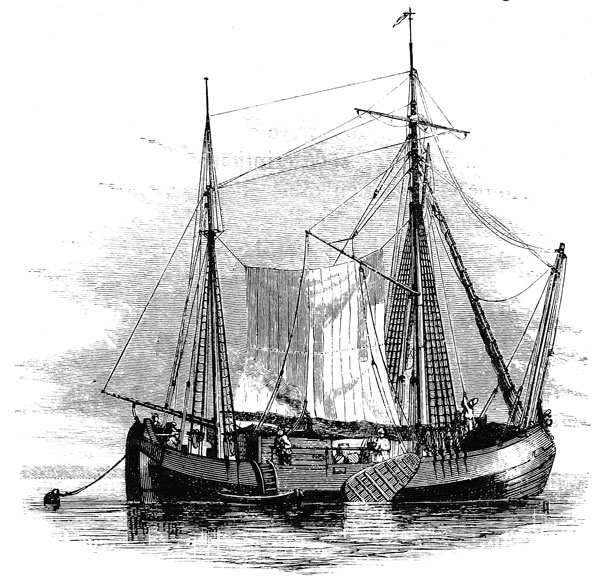
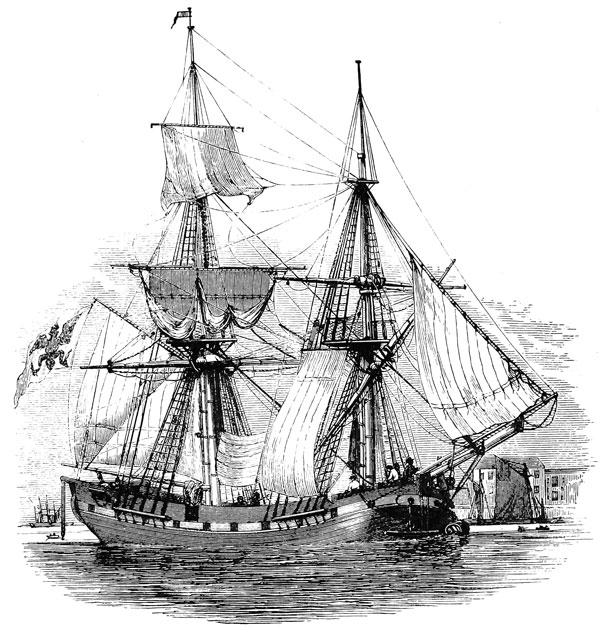
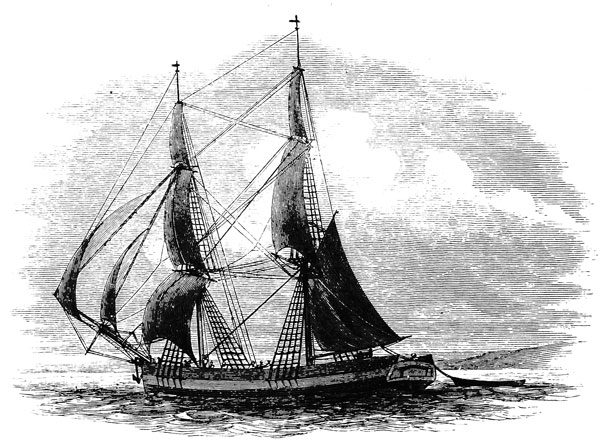
LONDON.
PRINTED BY WILLIAM CLOWES AND SONS,
STAMFORD STREET AND CHARING CROSS.
CONTENTS.
CHAPTER I.
Dom John of Portugal prosecutes his researches for India—Expedition
under Vasco de Gama, 1497—Description of the ships—The expedition
sails 9th July, 1497—Doubles the Cape of Good Hope, 25th
Nov.—Sights land at Natal, 25th Dec., 1498—Meets the first native
vessel and obtains information about India—Arrives at Mozambique,
10th March—Departs for Quiloa, 8th April—Arrives at Melinde,
29th April—Sails for Calicut, 6th August—Reaches the shores of
India, 26th August—Arrives at Calicut—Vasco de Gama disembarks
and concludes a treaty with the king—His treachery—Leaves Calicut
for Cananore—Enters into friendly relations and leaves Cananore,
20th Nov.—Reaches Melinde, 8th Jan., 1499—Obtains pilots and sails
for Europe, 20th Jan.—Doubles the Cape of Good Hope—Death of
Paul de Gama—The expedition reaches the Tagus, 18th Sept., 1499—Great
rejoicings at Lisbon—Arrangements made for further expeditions—Departure
of the second expedition, 25th March, 1502—Reaches
Mozambique and Quiloa, where De Gama makes known his power
and threatens to capture the city—His unjust demands—Arrives at
Melinde—Departs, 18th Aug., 1502—Encounter with the Moors—Levies
tribute, and sails for Cananore—Disgraceful destruction of a
Calicut ship and massacre of her crew—De Gama’s arrangement with
the king of Cananore—Departure for Calicut—Bombards the city—Horrible
cruelties—Arrives at Cochym 7th Nov., where he loads, and
at Coulam—Opens a factory at Coulam—Calicut declares war against
Dom Gama—Success of the Portuguese—Desecration of the Indian
vessels, and further atrocities—Completes his factory and fortifications
at Cananore, and sails for Lisbon, where he arrives, 1st Sept., 1503—De
Gama arrives in India for the third time 11th Sept., 1524—His
death, 24th Dec., 1524—His character as compared with that of
Columbus—Discovery of the Pacific by Vasco Nuñez de Bilboa—Voyage
of Magellan
Progress of maritime discovery—Henry VII., 1485-1509—His encouragement
of maritime commerce and treaties with foreign
nations—Voyages to the Levant—Leading English shipowners—Patent
to the Cabots, 1496—Discovery of the north-west coast of
America, June 21, 1497—Second patent, Feb. 3, 1498—Rival
claimants to the discovery of the North American continent—Sebastian
Cabot and his opinions—Objects of the second expedition—Third
expedition, March 1501—How Sebastian Cabot was employed
from 1498 to 1512—He enters the service of Spain, 1512—Letter of
Robert Thorne to Henry VIII. on further maritime discoveries—Sebastian
Cabot becomes pilot-master in Spain, 1518, and afterwards
(1525) head of a great trading and colonising association—Leaves
for South America, April 1526, in command of an expedition to the
Brazils—A mutiny and its suppression—Explores the river La Plata
while waiting instructions from Spain—Sanguinary encounter with
the natives—Returns to Spain, 1531, and remains there till 1549,
when he settles finally in Bristol—Edward VI., A.D. 1547-1553—Cabot
forms an association for trading with the north, known as the “Merchant
Adventurers”—Despatch of the first expedition under Sir H.
Willoughby—Instructions for his guidance, probably drawn up by
Cabot—Departure, May 20, 1553—Great storm and separation of the
ships—Death of Sir H. Willoughby—Success of Chancellor—His shipwreck
and death at Pitsligo—Arrival in London of the first ambassador
from Russia, Feb. 1557—His reception—Commercial treaty—Early
system of conducting business with Russia—The benefits conferred
by the Merchant Adventurers upon England—The Steelyard
merchants partially restored to their former influence—Cabot loses
favour with the court, and dies at an advanced age
Henry VIII. resolves to establish a permanent Royal Navy—Derives
his first supply of men from English fishermen—Royal fleet equipped
and despatched from Portsmouth—Its first engagement—Increase of
the French fleets—Extraordinary exertions of the English to meet
the emergency—The rapidity with which they supplied men and
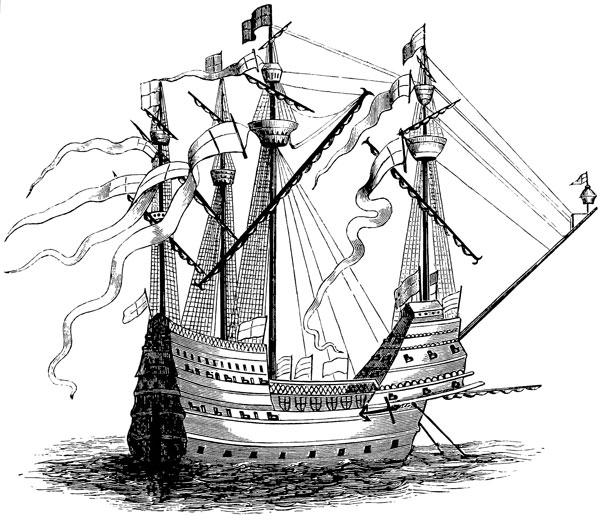
vessels—Outfit of the ships—The Great Harry—Number and strength
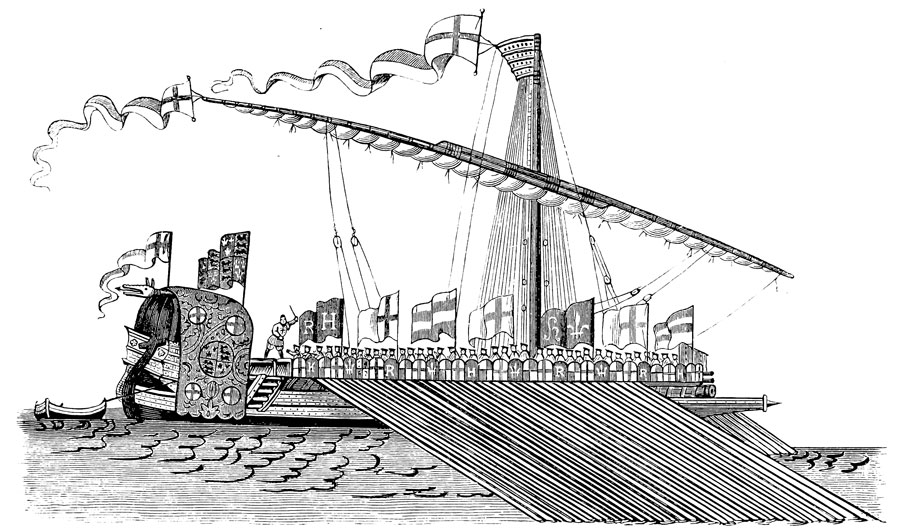
of the fleet at the death of Henry VIII., 28 Jan., 1547—The Great
Michael—Trade monopolies—Mode of conducting business—Mistaken
laws—The Bridport petition—Chartered companies—Prices regulated
by law, and employment provided—The petition of the weavers—State
of the currency, A.D. 1549—Its depreciation—Corruption of
the government—Recommendation of W. Lane to Sir W. Cecil, who
acts upon it, A.D. 1551, August—The corruption of the council extends
to the merchants—Accession of Elizabeth, A.D. 1558—War with
Spain—Temporary peace with France, soon followed by another war—Demand
for letters of marque—Number of the Royal fleet, A.D.
1559—The desperate character of the privateers—Conduct of the
Spaniards—Daring exploits and cruelty of Lord Thomas Cobham,
and of other privateers or marauders—Piratical cruises of the mayor
of Dover—Prompt retaliation of the king of Spain—Reply of Elizabeth—Elizabeth
attempts to suppress piracy, 29th Sept., 1564—Her
efforts fail, but are renewed with increased vigour, though in
vain—Opening of the African slave-trade—Character of its promoters—John
Hawkins’ daring expedition—Fresh expeditions sanctioned
by Elizabeth and her councillors—Cartel and Hawkins—They differ
and separate, 1565—Hawkins reaches the West Indies with four
hundred slaves, whom he sells to much advantage, and sails for
England—Fresh expeditions, 1556—They extend their operations,
1568—The third expedition of Sir John Hawkins departs, October
1567, and secures extraordinary gains—Attacked by a Spanish fleet
and severely injured—Reaches England in distress—Prevails on the
Queen to make reprisals—Questionable conduct of Elizabeth—Vigorous
action of the Spanish ambassador—Prompt retaliation—Injury
to English trade less than might have been supposed—Hatred
of the Catholics—Increase of the privateers, 1570—Their
desperate acts, 1572
Certainty of war with Spain—Secret preparations for the invasion of
England, and restoration of the Catholic faith—Philip intrigues
with Hawkins, and is grossly deceived—The Spanish Armada, and
England’s preparations for defence—Destruction of the Armada,
July 19, 1588—Voyages of discovery by Johnson—Finner and Martin
Frobisher—Drake’s voyage round the world, 1577—His piratical acts
and return home, 1580—First emigration of the English to America—Discovery
of Davis’s Straits—Davis directs his attention to India—Fresh
freebooting expeditions—Voyage of Cavendish to India, 1591,
which leads to the formation of the first English India Company,
in 1600—First ships despatched by the Company—The Dutch also
form an East India Company—Extent of their maritime commerce—They
take the lead in the trade with India—Expedition of Sir Henry
Middleton—Its failure and his death—Renewed efforts of the English
East India Company—They gain favour with the Moghul Emperor
of India, and materially extend their commercial operations—Treaty
between English and Dutch East India Companies—Soon broken—Losses
of East India Company—Sir Walter Raleigh’s views on maritime
commerce, 1603—His views confirmed by other writers opposed
to his opinions—The views of Tobias, 1614—His estimate of the
profits of busses—The effect of these publications—Colonising expeditions
to North America—Charles I. assumes power over the
colonies—English shipowners resist the demand for Ship-Money—Its
payment enforced by law—Dutch rivalry—Increase of English
shipping—Struggles of the East India Company—Decline of Portuguese
power in India—The trade of the English in India—Increase
of other branches of English trade—Ships of the Turkey and Muscovy
Company—The Dutch pre-eminent—The reasons for this pre-eminence
English Navigation Laws—First Prohibitory Act, 1646—Further Acts,
1650-1651—Their object and effect—War declared between Great
Britain and Holland, July 1652—The English capture Prizes—Peace
of 1654—Alleged complaints against the Navigation Acts of Cromwell—Navigation
Act of Charles II.—The Maritime Charter of
England—Its main provisions recited—Trade with the Dutch prohibited—The
Dutch navigation seriously injured—Fresh war with the
Dutch, 1664—Its naval results—Action off Harwich, 1665—Dutch
Smyrna fleet—Coalition between French and Dutch, 1666—Battle
of June 1 and of July 24, 1666—Renewed negotiations for peace,
1667—Dutch fleet burn ships at Chatham, threaten London, and
proceed to Portsmouth—Peace concluded—Its effects—The colonial
system—Partial anomalies—Capital created—Economical theories
the prelude to final free-trade—Eventual separation from the mother-country
considered—Views of Sir Josiah Child on the Navigation
Laws—Relative value of British and Foreign ships, 1666—British
clearances, 1688, and value of exports—War with France—Peace of
Ryswick, 1697—Trade of the Colonies—African trade—Newfoundland—Usages
at the Fishery—Greenland Fishery—Russian trade—Peter
the Great—Effect of the legislative union with Scotland, 1707—The
maritime commerce of Scotland—Buccaneers in the West Indies—State
of British shipping, temp. George I.—South Sea Company,
1710
English voyages of discovery, 1690-1779—Dampier—Anson—Byron—Wallis
and Carteret—Captain Cook—His first voyage, in the Endeavour—Second
voyage, in the Resolution—Third voyage—Friendly,
Fiji, Sandwich, and other islands—His murder—Progress of the
North American colonies—Commercial jealousy in the West Indies—Seven
Years’ War, 1756-1763—Its effect on the colonies—Unwise
legislative measures—Effect of the new restrictions—Passing of the
Stamp Act—Trade interrupted—Non-intercourse resolutions—Recourse
to hostilities—Position of the colonists—Fisheries—Shipping of
North American Colonies, A.D. 1769—Early registry of ships not always
to be depended on—Independence of United States acknowledged,
May 24, 1784—Ireland secures various commercial concessions—Scotch
shipping—Rate of seamen’s wages—British Registry Act,
Aug. 1, 1786—American Registry Act—Treaty between France and
England, 1786—Slave-trade and its profits—Trade between England
and America and the West Indies re-opened—Changes produced by
the Navigation Laws consequent on the separation—New disputes—English
Orders in Council—Negotiations opened between Mr. Jay
and Lord Grenville—Tonnage duties levied by them
Great Britain, A.D. 1792—War with France, Feb. 1, 1793—Commercial
panic—Government lends assistance—High price of corn—Bounties
granted on its importation—Declaration of Russia, 1780—Confederacy
renewed when Bonaparte had risen to power—Capture
of merchant vessels—Do “free ships make free goods?”—Neutral
nations repudiate the English views—Their views respecting blockades—Right
of search—Chief doctrines of the neutrals—Mr. Pitt
stands firm, and is supported by Mr. Fox—Defence of the English
principles—Nelson sent to the Sound, 1801—Bombardment of
Copenhagen—Peace of Amiens, and its terms—Bonaparte’s opinion
of free-trade—Sequestration of English property in France not
raised—All claims remain unanswered—Restraint on commerce—French
spies sent to England to examine her ports, etc.—Aggrandisement
of Bonaparte—Irritation in England—Bonaparte’s interview
with Lord Whitworth—The English ministers try to gain time—Excitement
in England—The King’s message—The invasion of
England determined on—War declared, May 18, 1803—Joy of the
shipowners—Preparations in England for defence—Captures of
French merchantmen—Effect of the war on shipping—Complaints of
English shipowners—Hardships of the pressing system—Apprentices—Suggestions
to secure the Mediterranean trade, and to encourage
emigration to Canada—Value of the Canadian trade
Mr. Fox tries to make peace with France, 1806—Napoleon’s Proclamation—English
Order in Council, April 8, 1806—Berlin Decree, Nov. 10,
1806—Its terms, and the stringency of its articles—Napoleon’s skill
and duplicity—Russian campaign conceived—Berlin Decree enforced—Increased
rates of insurance—English Orders in Council, 1807—Preamble
of third Order in Council—Terms of this Order—Neutrals—The
Orders discussed—Embargo on British ships in Russia—Milan
Decree, Dec. 17, 1807—Preamble and articles—Bayonne Decree, April
17, 1808—Effect of the Decrees and Orders in Council in England—Interests
of the shipowners maintained—Napoleon infringes his own
decrees—Moniteur, Nov. 18, 1810—Rise in the price of produce
and freights, partly accounted for by the Orders in Council—Ingenuity
of merchants in shipping goods—Smuggling—Licence
system in England—Cost of English licences—Their marketable
value—Working of the licensing system in England—Simulated
papers—Agencies for the purpose of fabricating them
Effect of the Orders in Council on American trade, A.D. 1810—Complaints
of the Americans against England—Policy of Napoleon
towards neutrals—Non-intercourse Act—Secret terms with America—Partiality
of the United States towards France—Contentions at home
respecting the Orders in Council—Declaration of war with America—Motives
of the Americans—England revokes her Orders in Council—Condemnation
of the conduct of the United States—Impressment of
American seamen—Fraudulent certificates—Incidents of the system—War
with America—Necessity of relaxing the Navigation Laws during
war—High duties on cotton—Great European Alliance—Napoleon
returns to Paris—Germans advance to the Rhine—Treaty of Chaumont—The
Allies enter Paris—End of the war by the Treaty of
Paris, 1814—Napoleon’s escape from Elba—His landing in France
and advance on Paris—British troops despatched to Belgium—Subsidies
to European Powers—Fouché—Last campaign of Napoleon,
and defeat at Waterloo—Reflections
United States of America—Her independence recognised, 1783—Commercial
rights—Retaliatory measures—Threatening attitude of
Massachusetts—Constitution of the United States—Good effects of
an united Government—Maritime laws and laws respecting Neutrals—Feeling
on both sides the water—Treaty between Great Britain
and United States—The right to impose a countervailing tonnage
duty reserved—Difficulty of the negotiation—Remarkable omission
respecting cotton—Indignation in France at the Treaty—The French
protest against its principles—Interest of England to have private
property free from capture at sea—Condemnation of ships in the
West Indies and great depredations—Outrages on the Americans—Torture
practised by French cruisers—The advantages of the war
to the Americans—Impulse given to shipping—Progress of American
civilisation—Advances of maritime enterprise—Views of American
statesmen—The shipwrights of Baltimore seek protection—Great
Britain imposes countervailing duties—Effect of legislative measures
on both sides—Freight and duty compared—Conclusions drawn
by the American shipowners—Alarm in the United States at the
idea of reciprocity—Objections to the British Navigation Act—Threatened
destruction to American shipping—Popular clamour—Opinions
in Congress—Great influence of the shipowners—Early
statesmen of the United States—Their efforts to develop maritime
commerce—First trade with the East—European war of 1803—Its
effect on their maritime pursuits
A special mission sent to England—Concessions made in the Colonial
trade—Blockades in the Colonies, and of the French ports in the
Channel—The dispute concerning the trade with the French
Colonies—What is a direct trade?—Reversal of the law in England—Effect
in America—Instructions to Commissioners—Proceedings of
the shipowners of New York—Duties of neutrals—Views of the
New York shipowners—Conditions with respect to private armed
vessels—Authorities on the subject—Negotiations for another treaty—Circuitous
trade—Commercial stipulations—Violation of treaties—Complaints
of the Americans against the French—Language of
the Emperor—Bayonne Decree, April 17, 1808—American Non-intervention
Act, March 1, 1809—Intrigues in Paris against England—Hostile
feelings in United States against England—Diplomatic
proceedings in Paris—Convention with Great Britain—Retaliatory
Acts to be enforced conditionally—Hostile legislation against Great
Britain—Bonds required—Treaty negotiations renewed—Dutch
reciprocity—Bremen reciprocity
Earliest formation of wet docks and bonded warehouses—System of
levying duties—Opposition to any change—Excise Bill proposed,
1733—but not passed till 1803—Necessity of docks for London—Depredations
from ships in London—The extent of the plunder—Instances
of robberies—Scuffle hunters—“Game” ships—Rat-catchers—River-pirates—Their
audacity—Light-horsemen—Their organisation—“Drum-hogsheads”—Long-shore
men—Harbour accommodation—Not
adequate for the merchant shipping—East and West India
ships—Docks at length planned—West India Docks—Regulations—East
India Docks—Mode of conducting business at the Docks—London
Docks—St. Katharine’s Docks—Victoria and Millwall Docks—Charges
levied by the Dock Companies—Docks in provincial ports,
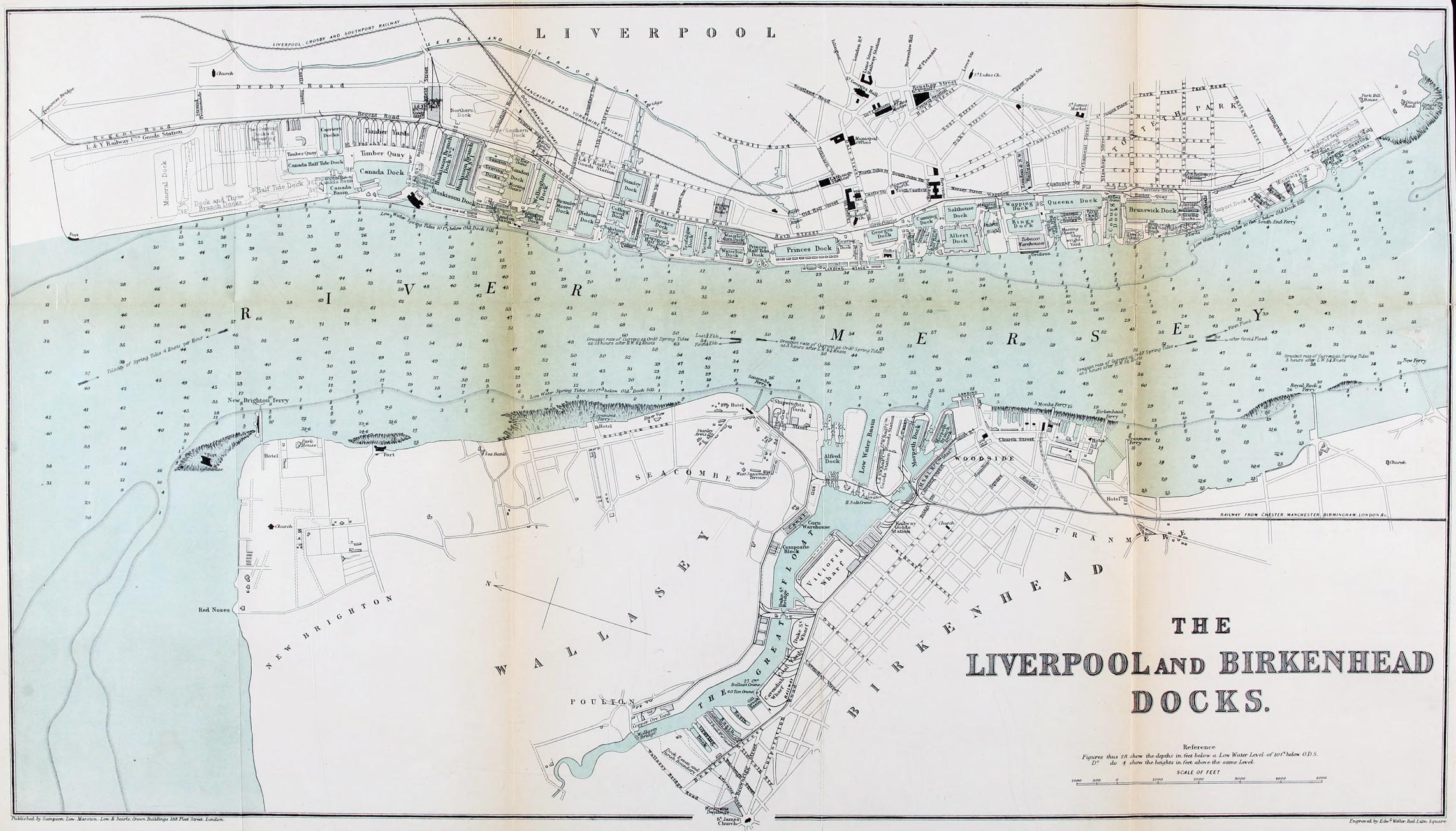
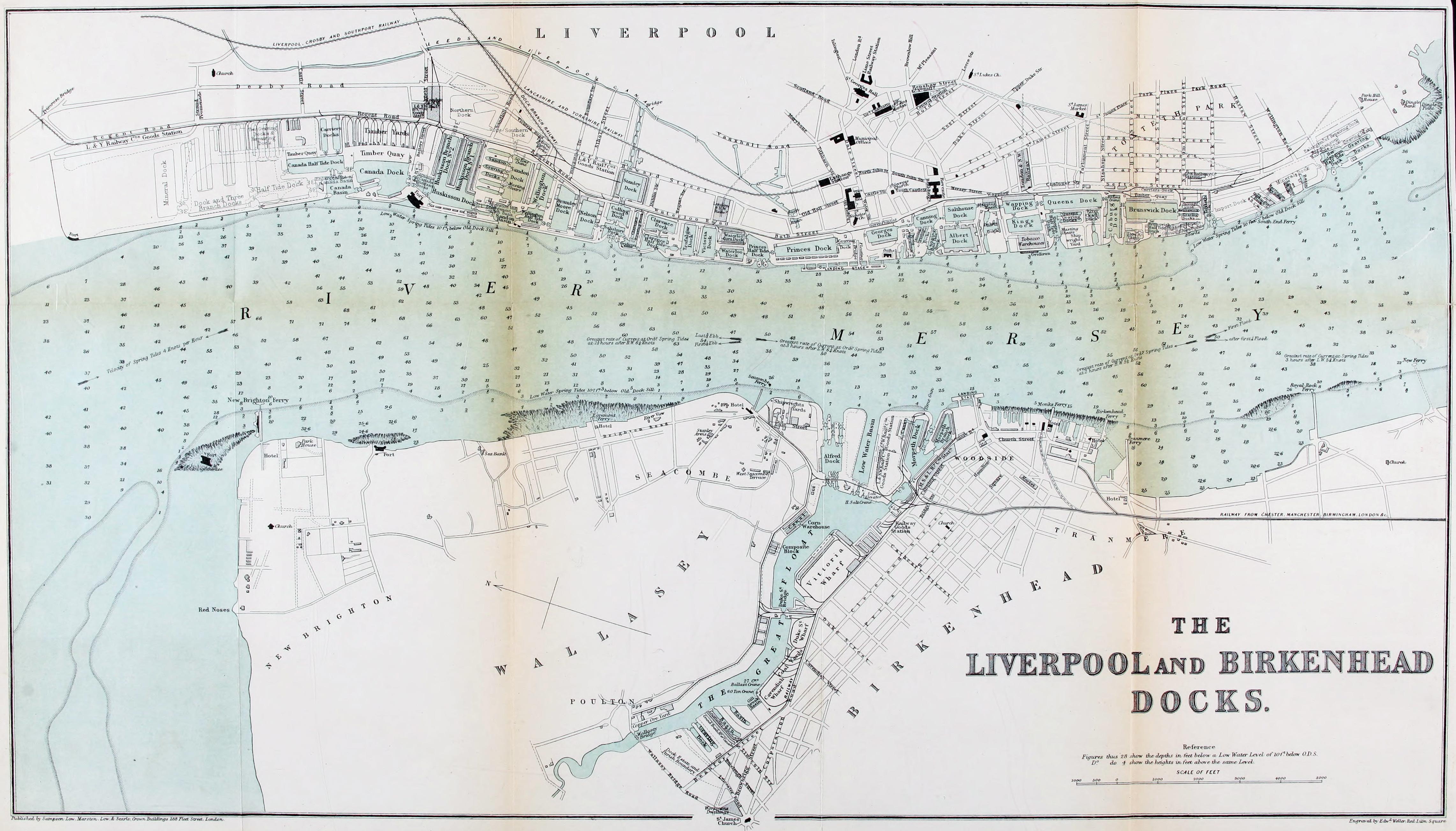
and bonded warehouses—Liverpool and Birkenhead Docks—Port
of Liverpool, its commerce, and its revenue from the docks—Extent
of accommodation—Extension of docks to the north—Hydraulic lifts
and repairing basins—Cost of new works—Bye-laws of the Mersey
Board—The pilots of the Mersey—Duties of the superintendents—Conditions
of admission to the service—Pilot-boats and rates of
pilotage
East India Company—Early struggles—Rival company—Private
traders—Coalition effected—Their trade, 1741-1748, and continued
difficulties up to 1773—Their form of charter—Rates of freight—Gross
earnings—Evidence of Sir Richard Hotham before the Committee
of Inquiry—The effect of his evidence—Reduction of duties,
August 1784—Extent of tea trade—Opposition of independent
shipowners—India-built ships admitted to the trade—Board of
Control established, 1784—Value of the trade, 1796—Charter
renewed, with important provisions, from 1796 to 1814—Restrictions
on private traders—East India Company’s shipping, 1808-1815—The
trade partially opened—Jealousy of free-traders—Efforts
of the free-traders at the out-ports—Comparative cost of
East India Company’s ships and of other vessels—Opposition to the
employment of the latter—Earl of Balcarras—Her crew—Actions
fought by the ships of the Company—Conditions of entering the
service—Uniforms—Discipline—Promotion—Pay and perquisites—Abuse
of privileges—Direct remuneration of commanders—Provisions
and extra allowances—Illicit trade denounced by the Court,
and means adopted to discover the delinquents—Connivance of
the officers of the Customs—Pensions, and their conditions—Internal
economy of the ships—Watches and duties—Amusements—Gun-exercise—Courts-martial—Change
in the policy of the East
India Company—Results of free-trade with India, and of the
Company’s trading operations—China trade thrown open, 1832-1834—Company
abolished, 1858—Retiring allowances to commanders
and officers—Compensations and increased pensions granted—Remuneration
of the directors—Their patronage
Progress of shipping—Thetis, West Indiaman—A “Free-trader”—Internal
economy—Provisioning and manning—Shipping the crew—Crimps
and agents—Duties on departure of ship—Watches—Duties
of the Master—Who has control over navigation—Making
and shortening sail—Tacking, etc.—Ordinary day’s work, how arranged—Right
of the Master over the cabin—Authority and usages
in the English, Dutch, and Prussian marine—Danish and Norwegian
system—Duties of Chief Mate—His duties in port—Tacking “’bout
ship”—Reefing topsails—Log-book—Mate successor in law to the
Master—Mode of address to Chief and Second Mates—Duties of
Second Mate—Ordinary day’s work—Care of spare rigging—Stores—Third
Mate—His general duties—Carpenter—Sail-maker—Steward—Cook—Able
seamen, their duties—Division of their labour—Duties
of ordinary seamen—Boys or apprentices—Bells—Helm—“Tricks”
at the helm—Relieving duty—Orders at the wheel—Repeating of
orders at wheel—Conversation not allowed while on duty—Colliers.
Dom John of Portugal prosecutes his researches for India—Expedition
under Vasco de Gama, 1497—Description of the ships—The expedition
sails 9th July, 1497—Doubles the Cape of Good Hope, 25th
Nov.—Sights land at Natal, 25th Dec., 1498—Meets the first native
vessel and obtains information about India—Arrives at Mozambique,
10th March—Departs for Quiloa, 8th April—Arrives at Melinde,
29th April—Sails for Calicut, 6th August—Reaches the shores of
India, 26th August—Arrives at Calicut—Vasco de Gama disembarks
and concludes a treaty with the king—His treachery—Leaves Calicut
for Cananore—Enters into friendly relations and leaves Cananore,
20th Nov.—Reaches Melinde, 8th Jan., 1499—Obtains pilots and sails
for Europe, 20th Jan.—Doubles the Cape of Good Hope—Death of
Paul de Gama—The expedition reaches the Tagus, 18th Sept., 1499—Great
rejoicings at Lisbon—Arrangements made for further expeditions—Departure
of the second expedition, 25th March, 1502—Reaches Mozambique
and Quiloa, where De Gama makes known his power, and
threatens to capture the city—His unjust demands—Arrives at Melinde—Departs,
18th Aug., 1502—Encounter with the Moors—Levies
tribute, and sails for Cananore—Disgraceful destruction of a Calicut
ship, and massacre of her crew—De Gama’s arrangements with the
king of Cananore—Departure for Calicut—Bombards the city—Horrible
cruelties—Arrives at Cochym 7th Nov., where he loads, and at
Coulam—Opens a factory at Coulam—Calicut declares war against
Dom Gama—Success of the Portuguese—Desecration of the Indian
vessels, and further atrocities—Completes his factory and fortifications
at Cananore, and sails for Lisbon, where he arrives, 1st Sept.,
1503—De Gama arrives in India for the third time, 11th Sept., 1524—His
death, 24th Dec., 1524—His character as compared with that of
Columbus—Discovery of the Pacific by Vasco Nuñez de Bilboa—Voyage
of Magellan.
Dom John,
of Portugal,
prosecutes
his
researches
for India.
While the Spaniards under Columbus were prosecuting
their researches for India among the islands
and along the coasts of a new-found world, Dom
John, of Portugal, was vigorously following up the
voyages of discovery which Prince Henry had commenced
in the early part of the fifteenth century.
“He had heard,” remarks Gaspar Correa,[1] “from a
Caffre or Negro king of Benin, who in 1484 took up
his quarters in Lisbon, many marvellous things about
India, and its affairs.” But though this sable
monarch spoke of “Prester John,” he does not appear
to have had any idea of the position of the golden
land, over which he was the traditional ruler. Dom
John, however, resolved to ascertain this fact, and
despatched “secretly two young men of his equerries,
to learn of many lands, and wander in many parts,
because they knew many languages.”
“The king,” continues Correa, “promised them a
large recompense for their labour, and for such great
services as they would be rendering him; and for as
long as they should continue in this service, he would
take good care for the support of their wives and
children.” He directed them to separate and to go
by different roads, giving to each of them letters of
acknowledgment of the recompense which he promised
them if they returned alive, or to their sons and
widows if they should die in this service. He likewise
ordered a plate of brass like a medal to be given
to each of them, bearing an inscription engraved in
all languages, with the name of ‘The King Dom Joam
of Portugal, brother of the Christian King,’ which they
might show to Prester John, and to whomsoever they
thought fit.[2]
Expedition
under
Vasco de
Gama,
1497.
Description
of the
ships.
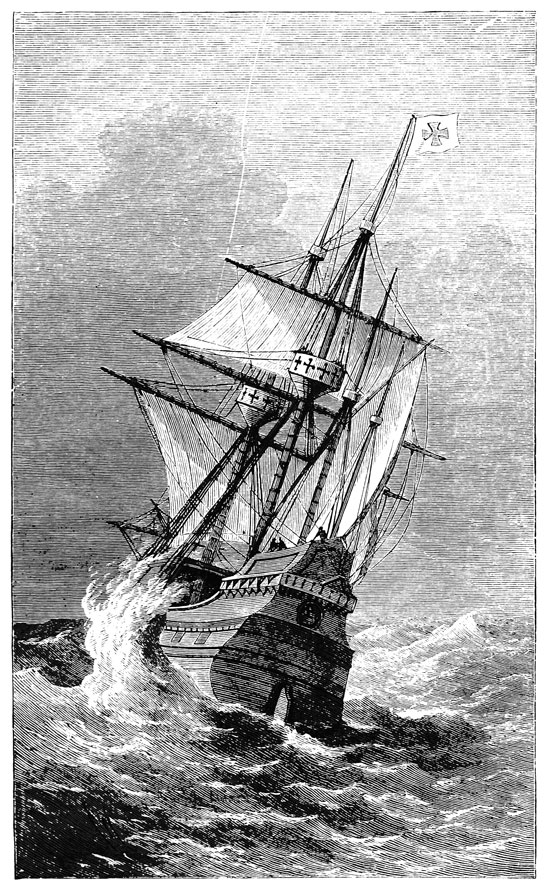
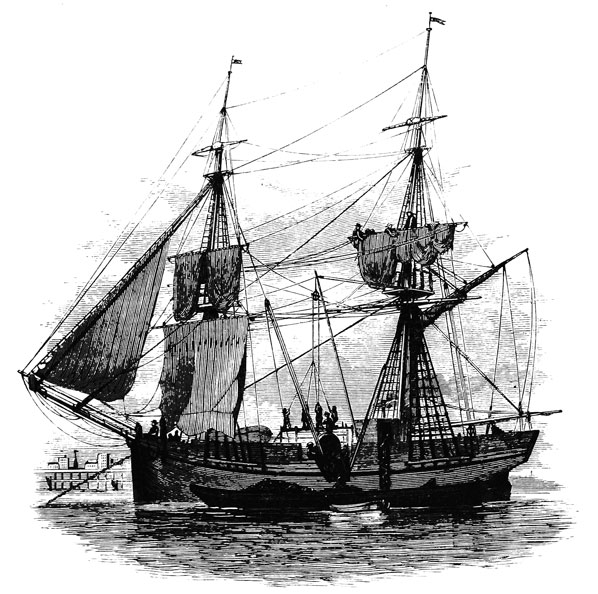
The celebrated expedition of Vasco de Gama which
followed this inquiry is generally described as consisting
of three vessels, one of 120 tons, another of
100 tons, and the third somewhat less.[3] Correa says
they were all very similar in size and equipment, in
order that each ship might avail itself of any part of
the tackle and fittings; and he describes their outfit
and cargoes as follows: “The king ordered the ships
to be supplied with double tackle and sets of sails,
and artillery and munitions in great abundance;
above all, provisions, with which the ships were to
be filled, with many preserves and perfumed waters,
and in each ship all the articles of an apothecary’s
shop for the sick; a master, and a priest for confession.
The king also ordered all sorts of merchandise
of what was in the kingdom and from outside
of it, and much gold and silver, coined in the money
of all Christendom and of the Moors. And cloths of
gold, silk, and wool, of all kinds and colours, and
many jewels of gold, necklaces, chains, and bracelets,
and ewers of silver and silver-gilt, yataghans, swords,
daggers, smooth and engraved, and adorned with
gold and silver workmanship. Spears and shields,
all adorned so as to be fit for presentation to the
kings and rulers of the countries where they might
put into port; and a little of each kind of spice.
The king likewise commanded slaves to be bought
who knew all the languages which might be fallen
in with, and all the supplies which seemed to be
requisite were provided in great abundance and in
double quantities.”
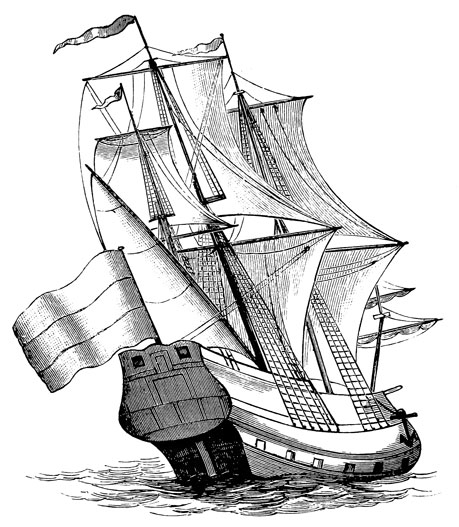
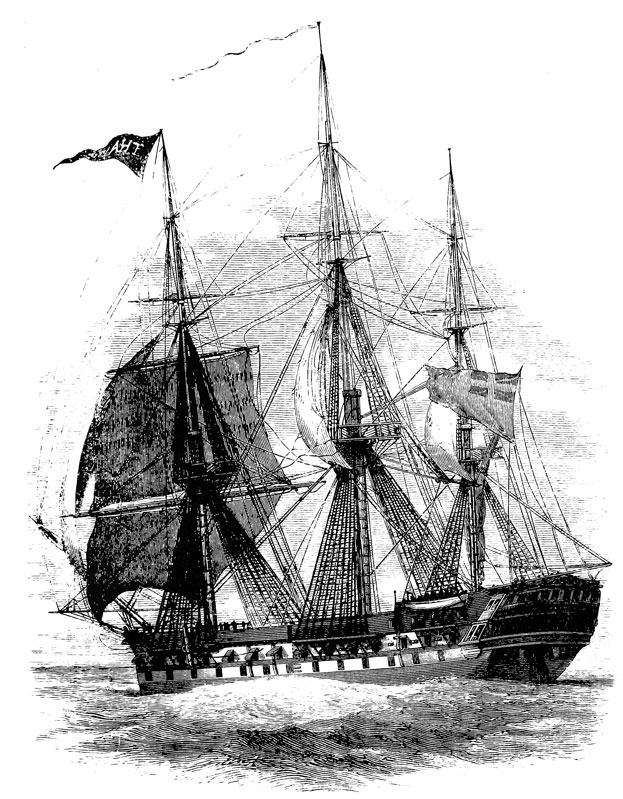
SAN GABRIEL.
Such was the equipment of De Gama’s ships for
this perilous and unknown voyage; and, though a
man of indefatigable energy, he had to accomplish
a task of an extraordinary character; no less than
the discovery of a land of which nothing was known,
but the vague idea that it lay beyond distant seas
“where there would not be navigation by latitude
nor charts, only the needle to know the points of the
compass, and the sounding plummets for running
down the coast.”[4]
On the Sunday fixed for the purpose of offering
prayers before the departure of this memorable
expedition, the king, with his nobles and most of
the leading families of Lisbon, assembled in that
beautiful cathedral which still adorns the northern
bank of the Tagus, to hear mass from the Bishop
Calçadilha, who with deep solemnity offered up
prayers, beseeching God “that the voyage might be
for His holy service, for the exaltation of His holy
faith, and the good and honour of the kingdom of
Portugal.” At the conclusion of mass, the king
stood before the curtain where Vasco de Gama and
his brother Paulo de Gama placed themselves, with
the captains of the expeditions, on their knees, and
devoutly prayed that they might have strength of
mind and body to carry out the wishes of the king,
to increase the power and greatness of his dominion,
and to spread the Christian religion into other and
far distant lands.
The expedition
sails 9th
July 1497.
Doubles
the Cape
of Good
Hope, 25th
Nov.
Sights
land at
Natal
25th Dec.
With these professed objects and amid splendid
demonstrations, in which the whole population of
Lisbon took part, Vasco de Gama set sail on the 9th
of July 1497. Favoured by a northerly wind and
fine weather, the expedition reached St. Iago, Cape
Verde Islands, in thirteen days from the time of its
departure. Having replenished his stock of provisions,
De Gama shaped his course to the south, and
on the 4th of November anchored in the bay of
St. Helena, on the west coast of Africa. Though
aided by the skill and knowledge of Pedro d’Alemquer,
Dias’s pilot, it was not until the 22nd November
that he succeeded in doubling the now famous Cape of
Good Hope, entering on the 25th the bay to the eastward
of it, which Dias had named San Bras. Here
he encountered one of those storms so frequent on the
Agulhas banks, which Correa graphically describes.[5]
The ships were in imminent danger, the crews
mutinied and resolved to put back; and the fine
weather, as had been anticipated, did not restore
either contentment or resignation. At length on
Sunday, the 17th of December, they passed the Rio
do Iffante, the limit of the discoveries of Dias, and on
the 25th of that month sighted land. In commemoration
of the birthday of Christ, De Gama gave to
this spot the name of Costa de Natal. Continuing
his course along the coast to the north-east, he arrived
on the 22nd of January, 1498, at a river which he
named the Rio de Bons Sinaes[6] (now called the
Quillimane), where he was detained for a month,
owing to an outbreak of scurvy among the crew.
His ships, too, had suffered so severely, that they had
to be careened and thoroughly caulked, and many
of the ropes and shrouds replaced by others, to
provide which the transport, as unworthy of repair,
was broken up, and the best of her spars and
stores appropriated to the equipment of the other
vessels.
Meets
the first
native
vessel,
and obtains
information
about
India.
When the ships were repaired “they sailed with
much satisfaction along the coast, keeping a good look-out
by day and night,” and at length fell in with a small
native vessel, in which there was an intelligent Moor.
From this man, whom the captain-major luxuriously
entertained, a great deal of information was obtained
as to the character and habits of the people
on the coast; and, when spices were presented to
him, he intimated that he knew where they could be
obtained abundantly. Ultimately the Moor, who
appears to have been a trader or broker in the
produce of the East, agreed to conduct De Gama to
Cambay of which he was a native, asserting that it
was a rich country, and “the greatest kingdom in
the world.”
Arrives at
Mozambique,
10th
March.
Having arrived at the island of Mozambique, which
was then in the territory of the king of Quiloa, Vasco
de Gama sent the Moor on shore with a scarlet cap, a
string of small coral beads, and other presents, to conciliate
the natives, and induce them to visit his ships.
The sheikh of the district was naturally suspicious at
first of the strangers, whom he took for Turks, the
only white men known to him who had ships unlike
the trading vessels of India. When, however, he was
satisfied of their friendly intentions, he paid the
Portuguese ships a visit in great state; but, on being
shown samples of the merchandise brought to exchange
for the produce of the East, though making
many professions of assistance and friendship, he
seems to have treacherously designed obtaining unlawful
possession of them. In this scheme, however,
he was frustrated by the Moor, who, faithful
to his new friends, revealed the plot to De Gama,
who was thus enabled to proceed in safety on his
voyage.
Departs
for Quiloa,
8th April.
From Mozambique the expedition proceeded to
Quiloa, described as an important city, trading in
“much merchandise,” which came from abroad in
a great many ships from all parts, especially from
Mecca. Here were “many kinds of people,” including
Armenians, who “called themselves Christians”
like the Portuguese; here also pilots could be
obtained for Cambay. But the sheikh of Mozambique,
frustrated in his treacherous designs, had anticipated
the arrival of the expedition, by sending a swift boat
to inform his chief, the king of Quiloa, that the
strangers “were Christians and robbers who came to
plunder and spy the countries, under the device that
they were merchants, and that they made presents
and behaved themselves very humbly in order to
deceive, and afterwards come with a fleet and men
to take possession of countries; and, therefore, he
knowing that, had wished to capture them, and they
had fled from the port.” This king appears to have
been as treacherous as his sheikh; but though after
sending many presents, he endeavoured, by means of
false pilots, to run De Gama’s ships on the shoals at
the entrance of his port, his plan signally failed.
Arrives at
Melinde,
29th
April.
Soon after leaving Quiloa, the expedition fell in
with a native vessel, which conducted them in safety
to Melinde, described as a city on the open coast,
containing many noble buildings, surrounded by
walls, and of a very imposing appearance from the
sea. Here they anchored in front of the city, “close
to many ships which were in the port, all dressed out
with flags,” in honour of the Portuguese, whose
reputation for wealth and power had spread along
the coast to such an extent as to induce the king’s
soothsayer to recommend that they should “be treated
with confidence and respect, and not as Christian
robbers.” Large supplies of fresh provisions were
sent on board of the vessels; and the king having
spoken with his “magistrates and counsellors,” resolved
that they should be received in a peaceable
and amicable manner, because “there were no such
evil people in the world as to do evil to any who did
good to them.”
The king having arranged to visit the Portuguese
ships, Vasco de Gama received him with royal honours,
presenting him with many articles of European manufacture,
which were highly prized. After frequent
interchanges of civilities, the king informed De Gama
that Cambay, of which he was in search, did not
contain the produce he desired, for it was not of the
growth of that country, but was conveyed thither
“from abroad, and cost much there.” “I will give you
pilots,” he added, “to take you to the city of Calicut,
which is in the country where the pepper and
ginger grows, and thither come from other parts all
the other drugs, and whatever merchandise there is
in these parts, of which you can buy that which you
please, enough to fill the ships, or a hundred ships if
you had so many.”[7]
Sails for
Calicut,
6th Aug.
Towards the close of May, 1498, the expedition
was again ready to sail, but finding they had little
chance of successful progress, De Gama resolved to
wait till the change of the monsoons. The interval
was spent in a more thorough repair of their ships.
The pilots whom the king had furnished appear to
have been well skilled in their profession, and were
not surprised when Vasco de Gama showed them
the large wooden astrolabe he had brought with
him, and the quadrants of metal with which he
measured at noon the altitude of the sun. They
informed him that some pilots of the Red Sea used
brass instruments of a triangular shape and quadrants
for a similar purpose, but more especially for
ascertaining the altitude of a particular star, better
known than any other, in the course of their navigation.
Their own mariners, however, they explained,
and those of India were generally guided
by various stars both north and south, and also by
other notable stars which traversed the middle of the
heavens from east to west, adding that they did not
take their distance with instruments such as were
in use amongst the Red Sea pilots, but by means of
three tables, or the cross-staff, sometimes described
as Jacob’s staff. In those days the seamen of the
eastern nations were, indeed, as far advanced in the
art of navigation as either the Spaniards or the
Portuguese, having gained their knowledge from the
Arabian mariners, who, during the Middle Ages,
carried on, as we have seen, an extensive trade
between the Italian republics and the whole of the
Malabar coast.
Reaches
the shores
of India,
26th
August.
After a passage of twenty (or twenty-three) days,
Vasco de Gama first sighted the high land of India,
at a distance of about eight leagues from the coast of
Cananore. The news of the strange arrival spread
with great rapidity, and the soothsayers and diviners
were consulted, the natives having a legend, “that
the whole of India would be taken and ruled over by
a distant king, who had white people, who would do
great harm to those who were not their friends;”[8]—a
prophecy which has been remarkably fulfilled, not
merely by the Portuguese, but more especially as
regards the government of India by the English
people. The soothsayers, however, added that the
time had not yet arrived for the realisation of the
prophecy.
Arrives at
Calicut.
Vasco De
Gama disembarks,
On the arrival of the expedition at Calicut,[9] multitudes
of people flocked to the beach, and the Portuguese
were at first well received; for the king, having
ascertained the real wealth of the strangers, and that
Vasco de Gama had gold, and silver, and rich merchandise
on board, to exchange for the pepper, spices,
and other produce of the East, immediately sent him
presents of “many figs, fowls, and cocoa-nuts, fresh
and dry,” and professed a desire to enter into relations
with the “great Christian king,” whom he
represented. Calicut, the capital of the Malabar
district, was then one of the chief mercantile cities of
India, having for centuries carried on an extensive
trade with Arabia and the cities of the West, in
native and Arabian vessels. Hence among its merchants
were many Moors,[10] who, holding in their
hands the most profitable branches of the trade,
naturally “perceived the great inconvenience and
certain destruction which would fall upon them and
upon their trade if the Portuguese should establish
trade in Calicut.”[11] These men therefore took counsel
together, and at length succeeded in persuading the
king’s chief factor, and his minister of justice, that
the strangers had been really sent to spy out the
nature of the country, so that they might afterwards
come and plunder it at their leisure. But, as Correa
remarks, “it is notorious that officials take more
pleasure in bribes than in the appointments of their
offices,” so the factor and the minister did not hesitate
to receive bribes, both from the Moors and from the
strangers, and recommended the king, whose interests
were opposed to his fears, to open up a commercial
intercourse with Vasco de Gama. Accompanied by
twelve men, of “good appearance,” composing his
retinue, and taking with him numerous presents,
De Gama at last presented himself on shore.
The magnificent display of scarlet cloth, the crimson
velvet, the yellow satin, the hand-basins and ewers
chased and gilt, besides a splendid gilt mirror, fifty
sheaths of knives of Flanders, with ivory handles
and glittering blades, and many other objects of
curiosity and novelty, banished, at least for the time,
any doubts in the mind of the Malabar monarch with
regard to the honest intentions of the strangers.
and concludes
a
treaty
with the
king.
Having concluded a treaty, whereby it was
stipulated that the Portuguese should have security
to go on shore and sell and buy as they pleased, and
that they should be placed in all respects on the same
footing as other foreign merchants, the king added
his desire that the stranger should be treated “with
such good friendship as if he was own brother to the
king of Portugal.”[12]
His
treachery.
De Gama was fully satisfied with the arrangement,
and had he been dealing with the king only, it seems
probable that everything would have gone on well;
the more so as the Malabar monarch was already
realising large profits from the new trade. But
the merchant Moors were less easily satisfied. They
knew from the covetous character of the king that
so long as the Portuguese were willing to buy, he
would continue to supply whatever they required,
and that thus the market would be stripped of the
articles best adapted for their annual shipments to
the Red Sea. They felt that “whenever the Christians
should come thither, he would prefer selling his
goods to them to supplying cargoes for the Moors;”
and that, in the end, they would be “entirely ruined;”
a plea, indeed, repeatedly used in many other
countries whenever competition first made its appearance.
The Moors further argued that the Portuguese
could not be merchants, but “evil men of war,” for
they paid whatever price was demanded for the produce
they required, and made no difference between
articles of inferior and superior qualities. But the
king refused to listen to their complaints until he had
obtained all he desired from the strangers; then,
giving heed to the reports of the Moors, and to the
entreaties of his factor and minister, who had been
doubly bribed, he turned round upon Gama, and by
stratagem endeavoured to capture him and his ships.
Finding it unsafe to remain any longer in port, the
expedition, although only half laden, prepared to
take its departure from Calicut, after a sojourn of
about seventy days, the captain-major remarking
that he was “not going to return to the port, but
that he would go back to his country to relate to his
king all that had happened to him; that he should
also tell him the truth about the treachery of his own
people with the Moors; and that, if at any time he
should return to Calicut, he would revenge himself
upon the Moors.”[13]
Leaves
Calicut for
Cananore.
Terrified by this threat of revenge, the king
repented, and believing that the expedition would
proceed to Cananore, wrote a letter to the king of
that place giving him an account of all that had
taken place and of his ill-treatment of the Portuguese,
and, at the same time, entreating him to induce De
Gama to return to his country, that he might “see
the punishment he would inflict on those who were
in fault, and complete the cargo of his ships.” The
Portuguese, however, had seen enough of the fickle
ruler of Calicut, and declined to accede to his urgent
entreaties to return. In the king of Cananore they
found a monarch equally disposed to trade, and one
who, at the same time, having consulted his soothsayers,
had decided that it would be alike profitable
and politic to enter into commercial relations with
strangers who could, if they pleased, destroy their
enemies at sea or ruin their trade on land. How
they were received and how they conducted their
trade with this monarch is told at much length by
Correa, in his quaint and graphic relation of the
incidents of this remarkable voyage.[14]
Enters
into
friendly
relations,
Suffice it to state that, after many fine speeches
on both sides, the king swore eternal friendship with
the Christian king of Portugal, and as a trustworthy
proof of their oaths, presented to De Gama a sword,
with a hilt enamelled with gold, and a velvet scabbard,
the point of which was sheathed with that precious
metal.
Abundant presents followed these solemn pledges—pledges
made only to be broken; while gifts of golden
collars, mounted with jewels and pearls, and chains of
gold, and rings set with valuable gems, were offered to
and accepted by the Portuguese as tokens of a friendship
which was to last “for ever,” but which in a few
years afterwards they rudely destroyed. “A factory,”
said the king, “you may establish in this
country; goods your ships shall always have of the
best quality, and at the prices they are worth.” But
as the sequel shows, in the case alike of the Portuguese,
the Dutch, and the English, around the factory
there arose fortifications, and from these there went
forth, not merely traders to collect the produce of the
country, but conquerors to overthrow ancient dynasties,
and claim as their own the land to which a few
years before they had been utter strangers.[15]
and leaves
Cananore,
20th Nov.
Reaches
Melinde,
8th Jan.,
1499.
Having fully completed their cargoes, the Portuguese
ships took their departure from Cananore
on the 20th of November, 1498, but finding that
the monsoons were not then sufficiently set in to
be favourable for the homeward voyage, they anchored
at “Angediva,”[16] an island on the coast of
Malabar, where there were good water springs, and
where they “enjoyed themselves much.” After
remaining there ten days, they departed on their
voyage to Melinde. They were, however, delayed
for a time by corsairs, fitted out at Goa, in the hope
that the Portuguese ships might be captured by
stratagem, a hope which was rudely demolished; the
fleet of “fustas” were entirely destroyed, and Vasco
de Gama arrived, homeward bound, without further
molestation or misfortune, safely at the African port
(Melinde), on the 8th January, 1499.
Having been received with great rejoicings, De
Gama, in reply to the affectionate welcome of the
king, made a glowing speech, in which by the way he
remarked that “the king, our sovereign, will send
many ships and men to seek India, which will be
all of it his, he will confer great benefits on his
friends, and you will be the one most esteemed above
them all, like a brother of his own; and when you
see his power, then your heart will feel entire
satisfaction.”
Obtains
pilots,
and sails
for
Europe,
20th Jan.
A letter, written “on a leaf of gold,” was then
prepared for the king of Portugal, in which all
that had taken place at Melinde was mentioned,
with many requests that the Christian sovereign
would send his fleets and men to his ports. Rich
presents were at the same time placed in the charge
of De Gama to be delivered on the part of his
majesty of Melinde to the king and queen of Portugal;
while presents of a similar kind, and scarcely
less valuable, were given to De Gama and his officers.
In return for these handsome gifts, De Gama,
“desiring that the king of Portugal should excel
all others in greatness,” ordered to be put into the
boats ten chests of different sorts of uncut coral,
a considerable quantity of amber, vermilion, and
quicksilver; numerous pieces of brocade, velvet,
satin, and coloured damasks, with many other things
which he considered it was “not worth while to take
back to Portugal, as of little value there.” The king,
besides furnishing him with pilots, presented to them
various things that might be useful or pleasant on
the voyage; such as jars of ginger, preserved with
sugar, for the captain-major, and for Paul de Gama,
“which they were to eat at sea when they were
cold,” and two hundred cruzados in gold, “to be
distributed among their wives.” Thus enriched and
replenished, the expedition set sail for Europe on the
day of St. Sebastian, the 20th of January, 1499.[17]
Doubles
the Cape
of Good
Hope.
Having shaped a course along the coast, the
captains gave orders to note with care the various
headlands, and every conspicuous landmark, especially
the outlines and marks presented by the land when
seen astern of the vessels, and also to note down the
names of the towns and the rivers, and their position
from the more conspicuous headlands, for the guidance
of future voyagers. With a fair wind, and under the
direction of the native pilots, who were familiar with
the navigation, the expedition passed swiftly through
the Mozambique channel, and without calling at any
place, rounded, in fine weather, the dreaded Cape of
Good Hope, and saw “the turn which the coast takes
towards Portugal with shouts of joy, and prayers
and praises for the benefits that had been granted to
them.”
Death of
Paul de
Gama.
“When it was night,” continues Correa in his
narrative, “the Moorish pilots took observations
with the stars, so that they made a straight course.
When they were on the line they met with showers
and calms, so that our men knew that they were
in the region of Guinea. Here they encountered
contrary winds, which came from the Straits of
Gibraltar, so that they took a tack out to sea on a
bowline, going as close to the wind as possible.
They sailed thus, with much labour at the pumps, for
the ships made much water with the strain of
going on a bowline, and in this part of the sea they
found some troublesome weed, of which there was
much that covered the sea, which had a leaf like
sargarço,[18] which name they gave to it, and so named
it for ever. Our pilots got sight of the north star
at the altitude which they used to see it in Portugal,
by which they knew they were near Portugal. They
then ran due north until they sighted the islands,
at which their joy was unbounded, and they reached
them and ran along them to Terceira, at which they
anchored in the port of Angra, at the end of August.
There the ships could hardly keep afloat by means of
the pumps, and they were so old that it was a wonder
how they kept above water, and many of the crews
were dead, and others sick, who died on reaching
land. There also Paul de Gama died, for he came
ailing ever since he passed the Cape; and off Guinea
he took to his bed, and never again rose from it.”[19]
The expedition
reaches
the Tagus
18th Sept,
1499.
The death of Paul de Gama was a source of the greatest
grief to his brother Vasco. His body was buried in
the monastery of St. Francis with much honour, and
amidst the lamentations of the crews, and the chief
inhabitants of the island, who followed it to the grave.
The crews having, chiefly by death, been reduced to
fifty-five, and many of the men being in a weak state,
the government officers of Terceira sent an extra
supply of seamen on board, to navigate the ships to
Lisbon, for which port the expedition sailed as soon
as the vessels had received the necessary refit, reaching
the Tagus on the 18th of September, 1499, after
an absence of two years and eight months, on one of
the most remarkable and interesting voyages on record.
But the news of the arrival of the fleet at Terceira
had preceded its actual arrival at Lisbon, more than
one adventurer having started thence while De Gama
was detained, so as to secure the reward for bringing
the first good tidings to the king, then at Cintra.
It spread, indeed, far and wide. Another road
had been discovered to a country which, famed for its
riches, had been the envy of the Western nations from
the earliest historic period, as well as the dream of
the youth of every age and land since the days of
Solomon and Semiramis. Well might Lisbon be
in a state of the greatest ecstasy when the tidings of
the great discovery reached its people. They were
indeed tidings of the highest importance, not merely
to them, but to the people of every maritime and
commercial city of Europe.
Great rejoicings
at
Lisbon.
The information reaching the king at midnight, he
resolved to start with his retinue early in the morning
for Lisbon, to receive further intelligence, and to welcome
the ships on their entry into the Tagus. There
the glad tidings were confirmed. The king waited at
the India House until the ships arrived at the bar,
where there were boats with pilots, who brought them
into port, decorated with numerous flags, and firing
a salute as they anchored. When Vasco de Gama
landed on the beach before the city, he was received
by “all the nobles of the court, and by the Count of
Borba and the Bishop of Calçadilha; and he went
between these two before the king, who rose up from
his chair, and did him great honour,” conferring upon
him the title of “Dom,” with various grants and
privileges, and creating him high admiral, an office
which the Marquis of Niza, his lineal descendant,
holds to this day. “Then the king mounted his
horse, and went to the palace above the Alcasoba,
where his apartments then were, and took Vasco de
Gama with him, who, on entering where the queen
was, kissed her hand, and she did him great honour.”[20]
While rewards were freely bestowed upon all
persons who had taken part in the expedition, costly
offerings were made to the monastery of Belem, with
gifts to numerous churches, as also to various holy
houses and convents of nuns, that “all might give
thanks and praises to the Lord for the great favour
which He had shown to Portugal.” The king, with
the queen, went in splendid state and in solemn
procession from the cathedral to St. Domingo, where
Calçadilha preached on the grandeur of India, and its
“miraculous discovery.”
Arrangements
made for
further expeditions.
Soon afterwards the king arranged to send another
fleet, consisting of large and strong ships of his
own, with great capacity for cargo, which, if navigated
in safety, “would bring him untold riches.”
All these matters his majesty talked over very fully
with Vasco de Gama, who was to proceed as captain-major,
if he pleased, in any fleet fitted out from
Portugal to India, with power to supersede all other
persons, and to appoint or discharge at his will the
captains or officers of any of the vessels belonging
to every expedition for India that might be equipped
from the Tagus.
Indeed, the first expedition had yielded such immense
profits, that arrangements for various others
were readily entered into without delay. Correa
states that a quintal of pepper realised eighty cruzados,
cinnamon one hundred and eighty, cloves
two hundred, nutmegs one hundred, ginger one
hundred and twenty, while mace sold for three
hundred cruzados the quintal.[21] So great were the
profits, that when the accounts of the cost of the
expedition were made up, by order of the king, and
added to the prices paid for the merchandise when
shipped, it was found that “the return was fully
sixty-fold.”
Departure
of the
second expedition,
25th
March,
1502.
The second expedition, however, under Vasco de
Gama’s direct control, was destined for other and
less laudable objects than commerce.[22] Dom Manuel
had resolved to punish “the treachery of the king
of Calicut.” Ten large ships were therefore prepared,
fitted with heavy guns and munitions of war of
every kind then known, besides abundance of stores,
and with these, and five lateen-rigged caravels, Dom
Vasco set sail for India on Lady-day, the 25th March,
1502, to wreak his sovereign’s “vengeance” on those
contumacious kings of the East who had not treated
his subjects with the respect which he felt was due
to the representatives of “a great Christian monarch.”
In this instance, as has been the case before and
since in numerous other instances, solemn prayers
were offered that the depredations about to be committed
in the name of God and under the banner
of a Christian king might be attended with success.
“I feel in my heart,” exclaimed De Gama, addressing
his sovereign, “a great desire and inclination to go
and make havoc of him (the king of Calicut), and I
trust in the Lord that He will assist me, so that I
may take vengeance of him, and that your highness
may be much pleased.” But though “vengeance
is Mine, saith the Lord,” has been the text of every
Christian church from the earliest ages, a solemn
mass and numerous prayers were offered in the
cathedral, at which the king was present and all his
court, to invoke Heaven to strengthen the arm of Dom
Gama in his openly-avowed mission of vengeance.
In the fifteen sail of vessels composing the second
expedition, there were “eight hundred men at arms,
honourable men, and many gentlemen of birth, with
the captain-major and others, his relations and friends,
with the captains.”[23] Each soldier had three cruzados
a month, and one for his maintenance on shore,
besides the privilege of shipping on his own account
two quintals of pepper, at a nominal rate of freight,
and subject only to a small tax, “paid towards the
completion of the monastery at Belem.” Considerably
greater space was allowed in the ship to the masters,
pilots, bombardiers, and other officers, a practice which
prevailed to our own time in the ships of the English
East India Company.
“When the fleet was quite ready to set sail from
the river off Lisbon, after cruising about with a great
show of banners, and standards, and crosses of Christ
on all the sails, and saluting with much artillery,
they went to Belem, where the crews were mustered,
each captain with his crew, all dressed in livery and
galas, and the king was present, and showed great
favour and honour to all.”[24] Here the fleet lay for
three days, and when the wind became fair, the king
went in his barge to each ship, dismissing them
with good wishes, the whole of the squadron saluting
him with trumpets as they took their departure.
Reaches
Mozambique
and
Quiloa,
where De
Gama
makes
known
his power,
With the exception of some sickness, when
crossing the equator in the vicinity of Guinea, of
which one of the captains and a few of the men died,
the expedition had a favourable passage round the
Cape of Good Hope, but immediately afterwards
encountered a heavy gale, which lasted for six days.
During this storm most of the vessels were dispersed
and one of them lost, though her crew and
cargo were saved. When the weather moderated,
each ship, in accordance with previous instructions,
steered for Mozambique as the appointed rendezvous,
where they again assembled under the captain-major,
some of them, however, having joined company
before reaching that place. Here the sheikh, who
does not appear to have been the same person who
held that office on Gama’s first expedition, sent to
the ships presents of cows, sheep, goats, and fowls,
for which, however, the captain-major paid, and
ordered a piece of scarlet cloth to be given to him.
From Mozambique the expedition proceeded to Quiloa,
but remembering the treachery of the king of that
place, De Gama, after he had moved his fleet within
range of the town, sent the following message to his
sable majesty: “Go,” he said to an ambassador whom
the king had sent on board, “go and say to the king
that this fleet is of the king of Portugal, lord of the
sea and of the land, and I am come here to establish
with him good peace and friendship and trade, and
for this purpose let him come to me to arrange all
this, because it cannot be arranged by messenger.
And in the name of the king of Portugal, I give
him a safe conduct to come and return, without
receiving any harm, even though we should not come
to an agreement; and if he should not come, I will
at once send people on shore, who will go to his
house to take and bring him.”[25]
and
threatens
to capture
the city.
The king, on receipt of this apparently friendly,
but very peremptory message, was with his chiefs
amazed and greatly alarmed. Having held a council,
he despatched a reply to the captain-major, that he
would send him a signed paper to the effect that he
and his crew might land freely, if no injury were
done to him or the city. De Gama, however, resolved
to put pressure upon the king; who, over
persuaded by a crafty and rich Moor, ventured
on board the ship of the Portuguese admiral, with
large, and, so far as we can judge, true professions of
friendship and amity.
But the captain-major required something more
than this. “If,” said he, “the king of Quiloa became
a friend of the king, his sovereign, he must also do
as did the other kings and sovereigns who newly
became his friends, which was that each year he
should pay a certain sum of money or a rich jewel,
which they did as a sign that by this yearly
payment it was known that they were in good
friendship.”[26] In a word, that he should subject himself
and his dominion to the government of Portugal.
The African king seems to have clearly understood
and felt the force of this plausible mode of abdicating
his sovereign rights, for he replied, “That to have to
pay each year money or a jewel was not a mode of
good friendship, because it was tributary subjection,
and was like being a captive; and, therefore, if the
captain-major was satisfied with good peace and
friendship without exactions, he was well pleased, but
that to pay tribute would be his dishonour.” The
captain-major, however, cared little for anything
except submission. “I am the slave of the king, my
sovereign,” he haughtily replied, “and all the men
whom you see here, and who are in that fleet, will do
that which I command; and know for certain, that if
I chose, in one single hour your city would be reduced
to embers; and if I chose to kill your people, they
would all be burned in the fire.” Thus the Western
nations, under the plea of peace and friendship, and
on the pretence at first of only desiring to establish
factories for the purposes of peaceful and mutually
beneficial commerce, became lords of the East, and
for centuries exercised a dominion founded on despotism
and injustice over its native sovereigns. The
king of Quiloa might remonstrate as he pleased,
submission was his only course. “If I had known,”
he replied, with great warmth and energy, “that
you intended to make me a captive, I would not have
come, but have fled to the woods, for it is better to
be a jackal at large than a greyhound bound with a
golden leash.”[27] “Go on shore and fly to the woods,”
said the now exasperated representative of the
Christian king—“go on shore to the woods, for I have
greyhounds who will catch you there, and fetch you
by the ears, and drag you to the beach, and take you
away with an iron ring round your neck, and show
you throughout India, so that all might see what
would be gained by not choosing to be the captive of
the king of Portugal.” And this Christian speech
was accompanied with an order to his captains “to
go to their ships, and bring all the crews armed,
and go and burn the city.”
His unjust
demands.
As De Gama refused to grant the king even one
hour for consultation, he submitted, and this submission,
having been ratified on a leaf of gold, and
signed by the king and all who were with him,
presents were exchanged, while the rich Arab, whose
treachery soon afterwards became known, was left
on board, by way of security for the delivery of
other articles which had been promised; but the
king sent word that Mahomed Arcone “might pay
himself, since he had deceived him.” On receipt
of this information the captain-major became very
angry with the rich Moor, and ordered him and
the Moors who had accompanied him to be “stripped
naked, and bound hand and foot, and put into his
boat, and to remain thus roasting in the sun until
they died, since they had deceived him; and when
they were dead he would go on shore and seek the
king, and do as much for him, lading his ships
with the wealth of the city, and making captive
slaves of its women and children.” It was not,
however, necessary to carry into effect these terrible
threats. The Moor sent to fetch from his house a
ransom, valued at 10,000 cruzados (£1,000 sterling),
which he gave with other perquisites to the
“Christian” ambassador, who immediately afterwards
pursued his voyage to Melinde.
Arrives at
Melinde.
On arriving in sight of the port, the king, who
had already received the news, was prepared with
“much joy to welcome his great friend Dom Vasco
de Gama;” while the fleet anchored amidst a salvo
of artillery. The king with haste embarked in a
barge which he had ready, to visit and pay his
respects to the captain-major, “bringing after him
boats spread with green boughs, accompanied by
festive musical instruments; and De Gama, as soon
as he was aware that it was the king, went to receive
him on the sea, the two at once embracing and
exchanging many courtesies.”[28]
Departs
18th Aug.,
1502.
An exchange of presents continued for the three
days the fleet remained at Melinde, and much rejoicing
and festivity prevailed. Fresh provisions of every
kind were sent in abundance for each of the vessels,
as also tanks for water, which the king of Melinde
had prepared in anticipation of the arrival of the
expedition, with pitch for the necessary repairs to the
ships, and coir sufficient for a fresh outfit of hawsers
and cordage for the whole expedition. On the day
of departure the king went on board, and gave De
Gama a valuable jewelled necklace for his sovereign,
worth three thousand cruzados, and others of not
much less value for himself, with various other gifts,
among which were a bedstead of Cambay, wrought
with gold and mother of pearl, a very beautiful
thing, and he gave him letters for the king, and a
chest full of rich stuffs for the queen, with a white
embroidered canopy for her bed, the most delicate
piece of needlework, “like none other that had ever
been seen.”[29]
Encounter
with the
Moors.
Soon after their departure the expedition fell
in with five ships, which had been fitting out in the
Tagus for India when Vasco de Gama sailed, and
which had been placed under the command of his
relation Estevan de Gama. The combined fleets proceeding
on their voyage, called at the “port of Baticala,[30]
where there were many Moorish ships loading
rice, iron, and sugar, for all parts of India.” The
Moors, on the approach of the Portuguese, prepared
to offer resistance to them entering the harbour, by
planting some small cannon on a rock which was
within range of the bar. The boats, however, belonging
to the Portuguese ships made their way into
the harbour without damage, although amid showers
of stones from the dense mass of people who had
collected to resist their approach, until they reached
some wharves, which had been erected for the convenience
of loading the vessels frequenting the port.
The Moors then fled in great disorder, leaving behind
them a large quantity of rice and sugar, which lay
on the wharf ready for shipment, and the Portuguese
returned to their boats in order to proceed
to the town, which was situated higher up the
river. On their way, however, a message was sent
from the king of Baticala to say that, though he
“complained of their carrying on war in his port,
without first informing themselves of him, whether
he would obey him or not, he would do whatever
the captain-major commanded.” Upon which De
Gama replied, “that he did not come with the
design of doing injury to him, but when he found
war, he ordered it to be made; for this is the fleet
of the king of Portugal, my sovereign, who is lord
of the sea of all the world, and also of all this coast.”[31]
Levies
tribute,
and sails
for Cananore.
In this spirit the trade between Europe and India,
by way of the Cape of Good Hope, was opened by
the Portuguese. It was thus continued by them
and the Dutch for somewhere about a century, and
perpetuated in the same domineering manner by the
servants of the English East India Company, even
until our own time.[32] To the demand for gold or
silver, the king of Baticala could only reply that he
had none. His country was too poor to possess such
treasure, but such articles as his country possessed
he would give as tribute to Portugal; and having
signed the requisite treaty of submission, he despatched
in his boats a large quantity of rice and
other refreshments for the fleet, on the receipt of
which the captain-major set sail for Cananore.
Disgraceful
destruction
of a Calicut
ship,
and massacre
of
her crew.
On the passage the expedition encountered a
heavy storm, and sustained so much damage, that
it was necessary to anchor in the bay of Marabia
for repairs. Here they fell in with a large Calicut
ship from Mecca, laden with very valuable produce,
which the captain-major pillaged, and afterwards
burned, because the vessel belonged to a wealthy
merchant of Calicut, who he alleged had counselled
the king of that place to plunder the Portuguese
on their previous voyage. Nor were these
Christian adventurers satisfied by this act of impudent
piracy; they slaughtered the whole of the Moors belonging
to the ship, because they had stoutly resisted
unjust demands, the boats from the fleet “plying
about, killing the Moors with lances,” as they were
swimming away, having leapt from their burning
and scuttled ship into the sea.[33]
On the arrival of the expedition at Cananore, De
Gama related to the king how gratified his sovereign
had been by the reception which his fleet had formerly
received, and presented him with a letter and numerous
presents. He then narrated the course of retaliation
which he intended to pursue with the king of Calicut,
expressing a hope that the merchants of Cananore
would have no dealings with those of Calicut, for he
intended to destroy all its ships, and ruin its commerce.
This vindictive policy seems to have gratified
the jealous Cananore king, for “he swore upon his
head, and his eyes, and by his mother’s womb which
had borne him, and by the prince, his heir,” that he
would assist the captain-major in his work of revenge
by every means in his power. Upon which De Gama
“made many compliments of friendship to the king
on the part of the king his sovereign, saying that
kings and princes of royal blood used to do so
amongst one another; and maintained good faith,
which was their greatest ornament, and was of more
value than their kingdoms.”[34]
De Gama’s
arrangements
with the
king of
Cananore.
Having arranged how the king of Calicut and his
subjects were to be disposed of, his majesty of Cananore
returned to his palace, and matured with his
council the measures to be taken so as to carry out
wishes of his friend and ally the king of Portugal.
In matters of trade it was agreed that a fixed
price should be set upon all articles offered for sale,
and that there should be no bargaining between the
buyer or seller for the purpose of either lowering or
raising prices. The chief merchants of the city and
natives of the country were to arrange with the
factors from the ships what the prices were to be, and
these “should last for ever.” A factory was to be
established where goods were to be bought and sold;
and all these things were written down by the scribes,
so as to constitute an agreement, which both parties
signed. When completed, De Gama took counsel
with his captains, and settled that two divisions of
the fleet should cruise along the coast, “making war
on all navigators, except those of Cananore, Cochym,
and Coulam,”[35] while the factors should remain on
shore, with a sufficient number of men to buy and
gather into their warehouse at Cananore, “for the
voyage to the kingdom, much rice, sugar, honey,
butter, oil, dried fish, and cocoa-nuts, to make cables
of coir and cordage.”
Departure
for
Calicut.
Bombards
the city.
Horrible
cruelties.
Having arranged all these matters to the satisfaction
of everybody at the place, except the Moorish
merchants, who were “very sad” when they saw their
ancient trade by the Red Sea passing into the hands
of strangers, Dom Gama sailed with his combined
fleet for Calicut, where, on arrival, he found the
port deserted of its shipping, the news of his doings
at Onor and Baticala having reached the ears of
the people of Calicut; the king, however, sent one of
the chief Brahmins of the place, with a white flag of
truce, in the vain hope that some terms of peace
might be agreed upon. But the captain-major rejected
every condition, and ordering the Indian boat
to return to the shore, and the Brahmin to be safely
secured on board of his ship, he bombarded the city,
“by which he made a great destruction.” Nor was
his vengeance satisfied by this wanton destruction of
private property, and the sacrifice of the lives of
many of the inhabitants of the city; while thus engaged
“there came in from the offing two large
ships, and twenty-two sambacks and Malabar vessels
from Coromandel, laden with rice for the Moors of
Calicut:” these he seized and plundered, with the
exception of six of the smaller vessels belonging to
Cananore. Had the acts of this representative of a
civilised monarch been confined to plunder, and the
destruction of private property at sea and on shore,
they might have been passed over without comment
as acts of too frequent occurrence; but besides this,
they were deeply dyed with the blood of his innocent
victims. The prayers he had offered to God with so
much solemnity on the banks of the Tagus proved, indeed,
a solemn farce; his own historian adding the
shameful statement, that after the capture of these
peaceable vessels, “the captain-major commanded
them” (his soldiers) “to cut off the hands, and ears,
and noses of all the crews of the captured vessels,
and put them into one of the small vessels, in
which he also placed the friar, without ears, or
nose, or hands, which he ordered to be strung round
his neck with a palm-leaf for the king, on which
he told him to have a curry made to eat of what
his friar brought him.”[36]
Perhaps no more refined acts of barbarity are to
be found recorded in the page of history than those
which Correa relates with so much simplicity of his
countryman; they would seem, indeed, to have been
almost matters of course in the early days of the
maritime supremacy of the Portuguese, and may in
some measure account for the unsatisfactory condition
into which that once great nation has now fallen.
Supposing, however, the exquisite barbarism of
sending to the king the hands, ears, and nose of his
ambassador, to whom Dom Gama had granted a safe
conduct, not enough to convey to the ruler of
Calicut a sufficiently strong impression of the greatness,
and grandeur, and power, and wisdom, and
civilisation of the Christian monarch, whose subjects
he had offended, the captain-major ordered the feet
of these poor innocent wretches, whom he had
already so fearfully mutilated, “to be tied together,
as they had no hands with which to untie them; and
in order that they should not untie them with their
teeth, he ordered them” (his crew) “to strike upon
their teeth with staves, and they knocked them down
their throats, and they were thus put on board,
heaped up upon the top of each other, mixed up with
the blood which streamed from them; and he ordered
mats and dry leaves to be spread over them, and the
sails to be set for the shore, and the vessel set on
fire.”[37]
Arrives at
Cochym,
7th Nov.,
where he
loads,
In this floating funeral pile eight hundred Moors,
who had been captured in peaceful commerce, were
driven on shore as a warning to the people of Calicut,
who flocked in great numbers to the beach to extinguish
the fire, and draw out from the burning
mass those whom they found alive, over whom “they
made great lamentations.” When the friar reached
the king with his revolting message, and deprived
of his hands, ears, and nose, an object of the deepest
humiliation, he found himself in the midst of
the wives and relations of those who had been so
shamefully massacred, bewailing in the most heart-rending
manner their loss, and imploring the king to
render them aid and protection from further injury.
Although the king’s power was feeble compared to
that of the Portuguese, with their trained men of
war, and vastly superior instruments of destruction,
the sight of his faithful Brahmin, whom he had despatched
in good faith to offer any conditions of peace
which Dom Gama might demand, led him to resolve
with “great oaths” that he would expend the whole of
his kingdom in avenging the terrible wrongs which
had been inflicted upon his people. Summoning to
his council his ministers and the principal Moors of
the city, he arranged measures for their protection from
the even still greater dishonour and ruin which was
threatened with awful earnestness by their invaders.
The Moors, with one voice, “offered to spend their
lives and property for vengeance.” In every river
arrangements were made for the construction of
armed proas, large rowing barges and sambacks,
and as many vessels of war as the means which their
country afforded could produce. But long before
this fleet was ready, Dom Gama had sailed with his
expedition for Cochym, where he arrived on the 7th
of November, having on his passage done as much
harm as he could to the merchants of Calicut, many
of whose vessels he fell across in his cruise along the
coast.
Cochym, like Cananore, had resolved from the first
to court the friendship of Portugal. Its rulers conceived
it more to their interests to submit to the
conditions of Dom Gama, however humiliating, than
to resist his assumed authority. Consequently when
his fleet made its appearance, the king of Cochym
was ready to receive him with every honour; and
when his boat, with its canopy of crimson velvet, very
richly dressed, approached the shore, the king, accompanied
by his people, came to the water-side to
meet him, prepared to secure his friendship by any
submission, however abject. Numerous rich and valuable
presents having been interchanged, arrangements
were made to provide the cargo the captain-major
required, on similar conditions to those which had
been entered into at Cananore.
and at
Coulam.
When the queen of Coulam, a neighbouring and
friendly state, where the pepper was chiefly produced,
heard of the wealth which the king of Cochym and
his merchants were making by their commercial
intercourse with the Portuguese, she sent an ambassador
to Dom Gama to entreat him to enter into
similar arrangements with herself and her people,
saying that “she desired for her kingdom the same
great profit, because she had pepper enough in her
kingdom to load twenty ships each year:” but Dom
Gama was a diplomatist, or at least a dissembler,
as well as an explorer. To fall out with the king
of Cochym did not then suit his purpose, which he
would very likely have done had he allowed the
queen of Coulam to share in the lucrative trade without
his sanction; but he nevertheless appears to have
made up his mind to reap the advantage of the queen’s
trade under any circumstances. Consequently, he
sent word to the queen “that he was the vassal of so
truthful a king, that for a single lie or fault which he
might commit against good faith, he would order his
head to be cut off; therefore he could not answer
anything with certainty, nor accept her friendship,
nor the trade which she offered, and for which he
thanked her much, without the king (of Cochym)
first commanded him.”[38]
Opens a
factory at
Coulam.
After this palaver he recommended that she should
ask the king of Cochym’s permission to open up
commercial intercourse with the Portuguese, an
arrangement he was not likely to assent to, as besides
curtailing his profits, he would lose the revenue he
derived from the queen’s pepper, which now passed
through his kingdom for shipment. The king was
naturally perplexed and “much grieved, because he
did not wish to see the profit and honour of his
kingdom go to another.” So after talking the
matter over with De Gama’s factor, he resolved to
leave it entirely in the hands of the captain-major,
and informed the queen’s messenger that the matter
was left altogether to his good pleasure, no doubt
himself believing that the trade would be therefore
declined. But the king of Cochym had made a
sad mistake, for the Portuguese navigator was
a diplomatist far beyond the king’s powers of
comprehension; to his discomfiture and amazement
Gama informed the ambassador of Coulam “that
he was the king’s vassal, and in that port was
bound to obey him as much as the king his sovereign,
and, therefore, he would obey him in whatever was
his will and pleasure; and since the queen was thus
his relation and friend, he was happy to do all that
she wished!”[39] Consequently he despatched two of
his ships to load pepper, at “a river called Calle
Coulam,” sending the queen a handsome mirror and
corals, and a large bottle of orange-water, with scarlet
barret-caps for her ministers and household, and
thirty dozen of knives with sheaths for her people.
Soon afterwards he established a factory in her
kingdom.
While Dom Gama was employed loading his ships
with the produce of India for Portugal, the king of
Calicut had prepared a fleet which he hoped would
capture and destroy the fleet of the Christian monarch
who had done his people such grievous wrongs. It
consisted of “several large ships, and sambacks, and
rowing barges, with much artillery and fighting men,
and two captain-majors.” But the king of Calicut,
either anxious to avoid war, or to obtain information
of the condition and power of the vessels then under
Dom Gama, sent a confidential Brahmin to Cochym,
with a letter to the captain-major, in which, after
stating the force now at his command, he expressed a
wish that there should be “no more wars nor disputes”[40]
between them, and that he would make
compensation for the injury his people had sustained
on the previous voyage; but the Brahmin received
no better reception than his predecessor had done.
He was tied to the bits, or framework that surrounds
the main-mast; an iron shovel, full of embers, was
put “close to his shins, until large blisters rose upon
them, whilst the interpreter shouted to him to tell
the truth,” as to whether the king his master meant
what he said in the letter he had addressed by him
to Dom Gama; but as he would not speak, “the fire
was brought closer by degrees, until he could not bear
it,” and when he had told all he knew, the captain-major
“ordered the upper and lower lips of the
Brahmin to be cut off, so that all his teeth showed;
and he ordered the ears of a dog on board the ship to
be cut off, and he had them fastened and sewn with
many stitches on the Brahmin, instead of his, and he
sent him in the Indian boat to return to Calicut!”[41]
Calicut
declares
war
against
Dom
Gama.
The king, as well he might, when his mutilated
and insulted ambassador presented himself, at once
ordered his fleet to proceed in search of the Portuguese,
and to intercept them on their way from
Cochym back to Cananore, where they had gone to fill
their ships with the ginger which had been collected
for them at that place. Dom Gama’s departure was,
however, delayed for a few days. He had to permanently
establish his factory at Cochym, and make
arrangements for its protection during his absence,
and for the purchase and storage of produce ready for
the ships which would annually be despatched to India
from the Tagus. He had also to found a Portuguese
colony, the first colony of Europeans in India, for
which purpose he “left carpenters, and caulkers,
blacksmiths, turners, and cordage-makers, who were
to refit the ships which had to remain at Cochym,”
as well as other “workmen and men-at-arms,” in
all sixty persons, to whom “the factor was to give
their pay, and a cruzado per month for their
maintenance.”
Success of
the Portuguese.
Desecration
of the
Indian
vessels,
When Dom Gama had completed his arrangements
at Cochym, he sailed for Cananore. The king of
Calicut with his fleet lay in wait for him. “Coming
along the coast with a light land breeze, there were
so many sail” that the Portuguese did not see the
end of them. In the van there might be as many as
“twenty large ships, with many fustas and sambacks.”
These Dom Gama ordered his caravels, each of which
carried thirty men with four heavy guns below, and
six falconets, and ten swivel-guns on deck, to attack,
which they did with great vigour, and soon brought
down the mast of the flag-ship of the Moors, killing
many of the crew, and sinking three of the large
vessels. Amid this havoc, Dom Gama himself bore
down with the rest of his fleet, and, as the wind
freshened, he came with great force through the
midst of his opponents, “doing wonders” with his
artillery, and firing both broadsides as he passed,
shattering them both in hull and rigging, and leaving
the Calicut fleet almost a helpless mass.
and further
atrocities.
But conquest and submission were not enough for
this Portuguese marauder. His fiendish spirit of
revenge seems to have had no limits. He “sent the
boats with falconets and swivel-guns, and in each
boat twenty armed men, with crossbow-men, to go
to the ships which were becalmed, and shoot at them
above, and kill the crews. This they did, so that the
Moors threw themselves into the sea, and went swimming
round the ships.” Gama then “sent his boat
to the ships and caravels, to tell the crews to flock to
the Moorish ships and plunder them, and set them on
fire.”[42] After which he proceeded on his course for
Cananore, “giving the Lord great praise and thanks
for the great favour which He had shown him.”[43]
Completes
his factory
and fortifications
at
Cananore,
and sails
for Lisbon,
Having finished his work of colonization and
horrible cruelty, Dom Gama, concluding that his
heavy guns were not likely to be again required on
his homeward voyage, left them at Cananore, and
completed his cargoes, set sail for Portugal.
He did not, however, forget before he took his departure,
to induce the king to send his masons to
erect a high stone wall round the Portuguese settlement,
where the guns were deposited, having a strong
gate, of which the king was to keep the key, “so
that the Portuguese should remain at night shut in
under his key.”[44] The king was “much pleased with
this arrangement, and promised the captain-major
that it would be done at once; for he thought that
the captain-major did it with the desire that the Portuguese
should remain subject to him.” Poor innocent-minded,
good-natured king!
where he
arrives,
Sept. 1,
1503.
Having called at Melinde for a day, to take in a fresh
stock of sheep, fowls, and water, Dom Gama proceeded
on his course with a fair wind, and “without even
meeting with any storm or hindrance, but only winds
with which all his sails served.”[45] On the 1st of
September, 1503, he reached Lisbon, anchoring
“before the city,” with “ten ships laden with very
great wealth, after leaving such great services accomplished
in India.”
When the king of Portugal heard the news of
Dom Gama’s arrival he was greatly rejoiced, and
sent the captain of his guard to bid him welcome, he
himself proceeding on horseback with many people to
the cathedral, “to give much praise to the Lord
before the altar of Saint Vincent,” an example which
the captain-major and all his captains soon afterwards
followed; when prayers were ended, he kissed the
hand of the king, who bestowed many favours upon
the officers and crews of the ships, while granting to
Dom Gama and his heirs “the anchorage dues of
India,” and conferring upon him and his descendants
the title of the “admiral of its seas for ever.”
Dom Gama
arrives in
India for
the third
time,
11th Sept.,
1524.
The re-discovery of the route to India by way of
the Cape of Good Hope, proved an immense source
of wealth to Portugal. The profits of her merchants
on the products of the East were enormous, and for
many years, as regarded the rest of Europe, this
trade was kept a close monopoly. Lisbon then
became the entrepôt which the Italian republics had
so long held for the spices and other produce of
India; and the palaces of her traders with that
country, which still adorn, even amid their decay,
and, in too many instances, their ruins, the banks of
the Tagus, testify to the wealth of their original
owners and occupants. Though Dom Gama now
desired to remain at home to reap the fruits of his
discovery and enjoy the rewards and honours conferred
upon him by his sovereign, the state of affairs
in India too soon required his presence in that
country. The example he himself had set of
tyranny formed the basis for a despotic rule on the
part of the Portuguese governors or factors, which
at even this early stage required a remedy, and no
one was considered so competent to correct this
evil as its author. Consequently, according to
the testimony of Correa, “on the 11th September,
1524, there arrived at the bar of Goa, Dom Vasco de
Gama, as Viceroy of India.”
From the same source we learn that the viceroy
was on this occasion accompanied by his two sons,
Dom Estevan de Gama, who was captain-major of
the expedition, and afterwards governor of India, and
Dom Paulo de Gama, who unfortunately lost his life
in a war with Malacca. The viceroy had now
another object to serve than that of trade. He
was to be the future ruler of India, and, as such, a
regal display became necessary to give the natives a
proper impression of his greatness and power. Correa
remarks (p. 381) that he “was served by men bearing
maces, by a major-domo, and two pages with gold
neck-chains, and many esquires.” All the forms of
kingly state appear to have been adopted. He had
“rich vessels of silver and rich tapestry of Flanders;
and for the table at which he sate, brocade cloths;” he
had also a “guard of two hundred men with gilt pikes,
clothed with his livery,” and an army of “brilliant
soldiery.” Nor was he without kingly power, and
even something more. While his rule extended over
“all persons who might be found eastward of the
Cape of Good Hope,” he himself established laws[46]
“that, under pain of death and loss of property, no
one should navigate without his license.” Every
person likewise who came to India, even with a
commission from the king of Portugal, was liable
to be dismissed without compensation or appeal,
should he not, in the opinion of the viceroy, prove
competent for the office to which he had been
nominated.
His death,
24th Dec.,
1524.
Such stringent laws may have been necessary from
the state of things which then existed in India. That
he was strict in his administration, even to tyranny,
over his own people, cannot be doubted; and it is
well known that his brief rule was embittered by his
hostile relations with his predecessors, whom he
accused of various mal-practices, and ordered to be
sent back to Lisbon. In the midst of these difficulties
he was seized with a fatal illness; and having, as
Correa states, “set his affairs in order, like a good
Christian, with all the sacraments of the church, and
ordered that his bones should be conveyed to the
kingdom of Portugal, he died on Christmas Eve,
24th December, 1524.”
His character,
as
compared
with that
of Columbus.
Although the first voyage of Dom Gama may be
read with satisfaction, no language can be found
sufficiently strong to denounce his subsequent career,
and especially his diabolical conduct towards the
Moors and natives on his second expedition to India.[47]
And to that conduct, too faithfully adopted by his
successors, may in a great measure be attributed the
loss, as well as the gain, of the Portuguese empire in
the East. But though Dom Gama was a man of no
mean abilities, and of indomitable courage, who
evidently thoroughly understood his profession as a
seaman, he cannot for an instant be compared, either
as an individual or as a navigator, with his great
contemporary Columbus. Dom Gama, in his voyage
to India, had with him pilots who had frequently
sailed along the western shores of Africa, and one,
at least, who had doubled the Cape of Good Hope
under Bartholomew Dias, while the crews of his
ships consisted of his own countrymen, and partly,
too, of his own dependants. But Columbus was a
stranger among strangers; and the seamen who
manned his vessels were altogether devoid of confidence
in a commander into whose service they had
been forced by the imperative order of their
sovereigns. His voyages of discovery lay across
unknown seas, amid a wilderness of waters, which
both ancient and modern mariners had alike
portrayed in the most gloomy colours; and so far
from having the benefit of the services of any pilot
who had ever attempted to navigate that then
mysterious ocean, most persons in his service considered
the voyages on which he was about to embark
as alike visionary and dangerous.
Discovery
of the
Pacific, by
Vasco
Nuñez de
Bilboa.
While the Portuguese were prosecuting their
valuable discoveries in the East, the Spaniards were
following up their less lucrative but more important
researches to the West. In their voyages to the
Caribbean Sea, and along the shores of the Mexican
Gulf, they had heard rumours of great seas still
further to the West; but it was not until 1513, a
few years after a small colony had been established
at Darien, that one of their countrymen, Vasco Nuñez
de Bilboa, discovered the Pacific Ocean. The
discovery was hailed with great joy by the Spaniards,
who, having been restricted by the Pope to confine
their researches to the West, now hoped to find
within the prescribed limits another road to that
far-famed Cathay, which had proved such a vast
source of wealth to their rivals the Portuguese.
Voyage of
Magellan.
It was not, however, until Magellan [Fernando de
Magalhaens], a Portuguese by birth but in the
service of the King of Spain, discovered the straits
which bear his name that the Spaniards were
enabled to derive any advantages from this great
addition to their knowledge. Furnished by the
King of Spain with five small vessels, the largest of
which was only one hundred and thirty tons, their
crews in all amounting to only two hundred and thirty-four
men, this daring adventurer and most intrepid
mariner set sail in September 1519 from S. Lucar for
the Brazils, anchored at Rio, and thence pursued his
way over these unknown seas to the south, until
he reached the straits, where he encountered very
severe weather. After many difficulties and great
hardships he reached that beautiful and fertile
group of islands in the Pacific which he named the
Ladrones. Thence proceeding to the Philippines,
Magellan, a navigator second only to Columbus, and
superior in many respects to Vasco de Gama, unfortunately
lost his life in an engagement with the
natives. But in November, 1521, the expedition
reached the Moluccas, the object of their search.
Thence, but greatly reduced in strength and number,
they steered for the Cape of Good Hope, which they
doubled on the 6th of May, 1522, and anchored at
St. Lucar on the 6th of September of that year,
having been the first to accomplish a voyage round
the world.
[1] As is well known, there is considerable variation in the dates
assigned to different portions of Vasco de Gama’s voyages by different
writers. It has been thought, on the whole, best on this occasion to
follow those given by Gaspar Correa, whose narrative has been translated
from the Portuguese and edited for the Hakluyt Society by the
Hon. H. E. J. Stanley (now Lord Stanley of Alderley): Lond. 1869.
Correa states that he went to India sixteen years after it was discovered,
which would be therefore in 1514, and that he had access to
the Journals of Joam Figueira, a priest who accompanied De Gama in
his first voyage. Correa, when in India, was secretary to the governor,
Alfonzo d’Albuquerque; and died at Goa, some time before 1583.
[2] The two young men were named, respectively, Pero de Covilhan,
and Gonsalvo de Pavia. Though accounts differ, they seem to have
travelled together by Venice, Alexandria, and Cairo, to Mecca, where
they separated. One of them (and here again accounts vary) went on
to Aden, Cananore, Calicut, and Goa (Mr. Stanley and Mr. Major think
this was Covilhan), the other to Abyssinia. It is certain that Pavia
died soon afterwards, probably at Cairo; and that, by the agency of
a Spanish Jew, Covilhan was able to send home word that India could
be reached by sea by continuing the coasting voyage from Guinea
round the Cape to Sofala. Mr. Major, therefore (p. 339), is justified in
stating that to him belongs the honour of the theoretical discovery
of the Cape. His report to the king, however, did not reach Portugal
till shortly after Bartholomew Dias and Joam Infante had started, in
August 1486. Covilhan, on his way home, went to Abyssinia, and was
detained there for the rest of his life (33 years).
[3] The author is of opinion that the vessels engaged under Vasco
de Gama were, as in the case of Columbus, much larger than historians
have represented, though very much alike, as Correa describes,
especially in the size of their yards and sails. Unable to find any work
which furnished an illustration of any kind of these vessels, he applied
to his friend Mr. Edward Pinto Basto, of Lisbon, for information on
the subject. After considerable research, (for which he is greatly
indebted,) Mr. Basto furnished the author with the drawing—see
following page—which in his letter he describes as a “sketch representing
the San Gabriel passing the Cape of Good Hope on November
25th, 1497. This sketch,” he remarks, “is copied from an original
picture in Lisbon that belonged to D. Ioam de Castro, and I have no
doubt,” he adds, “that it is a correct representation of Gama’s ship.
I have spoken,” he continues, “to the Marquis of Nisa, whom you
know, and who is the lineal descendant of the renowned navigator,
and he confirms that opinion. The expedition,” he adds, “sailed from
Lisbon (Belem) on July 9th 1497. It consisted of the San Gabriel,
commanded by Vasco de Gama; San Raphael, commanded by his
brother Paulo de Gama; Birrio, under charge of Nicolas Coelho; and
a transport which was a storeship to carry provisions, called a naveta.”
Mr. Pinto Basto confirms the opinion the author entertained with
regard to the dimensions of these ships. “The San Gabriel,” he says,
“had a high poop and forecastle. The tonnage in those days was calculated
by the number of pipes of wine the vessel could carry. The
San Gabriel was constructed to carry 400 pipes,” equivalent to about
400 tons measurement, or about from 250 to 300 tons register, which is
much more likely to have been the size of the vessels engaged on so
distant and hazardous an expedition than those which historians
describe. It should be added that Correa calls De Gama’s ship the
Sam Rafael.
[9] Our calico (in French, calicot) derives its name from Calicut, as
muslin from Mosul, &c.
[10] It should be remembered that with most of our early writers and
navigators “Moor” was a generic name for Muhammedan. The
governor of Calicut is called by the Portuguese “Zamorin,” a corruption,
probably, of “Samudri-Rajah.”
[16] Correa, p. 239. The termination of the name (like Laccadive,
Maldive, &c.) shows it to have been an island, but its exact situation
has not been determined.
[18] Sargarço (or as it is more usually written Sargaço) is the Portuguese
name for what is known (botanically) as the “Nasturtium
aquaticum.”—Linschoten, Hist. Orient., pt. iii. p. 34.
[21] A cruzado is worth about 2s.; a quintal equivalent to 128 lbs.
[22] Cabral was originally selected to command this expedition; but the
king, having some doubts of his ability, though on his previous voyage
to India in 1500-1 he had discovered the Brazils, gladly availed himself
of De Gama’s expressed desire to take charge of it; another fleet
was to be despatched in the following year (Correa, p. 279). There were
two grievances against the king of Calicut, the original one of De Gama,
and his subsequently similar treatment of Cabral.
[47] The Popish nations of the south of Europe have, throughout all
history, been remarkable for atrocities of cruelty found among no other
races. But neither the cruel persecution of the Jews by the soi-disant
deliverers of the Holy City, nor the greatly exaggerated crimes of the
Hindus and Muhammedans, who may at least have believed they were
ridding their native land of robbers and oppressors by the Indian mutiny
of 1856-7, can compare with the cruelties of Vasco de Gama, or with
the atrocities of the mob at Palermo during the insurrection of 1849.
CHAPTER II. — FOOTNOTES:
Progress of maritime discovery—Henry VII., 1485-1509—His encouragement
of maritime commerce, and treaties with foreign
nations—Voyages to the Levant—Leading English ship-owners—Patent
to the Cabots, 1496—Discovery of the north-west coast of
America, June 21, 1497—Second patent, Feb. 3, 1498—Rival
claimants to the discovery of the North American continent—Sebastian
Cabot and his opinions—Objects of the second expedition—Third
expedition, March 1501—How Sebastian Cabot was employed
from 1498 to 1512—He enters the service of Spain, 1512—Letter of
Robert Thorne to Henry VIII. on further maritime discoveries—Sebastian
Cabot becomes pilot-master in Spain, 1518, and afterwards
(1525) head of a great trading and colonising association—Leaves for
South America, April 1526, in command of an expedition to the Brazils—A
mutiny and its suppression—Explores the river La Plata while
waiting instructions from Spain—Sanguinary encounter with the natives—Returns
to Spain, 1531, and remains there till 1549, when he
settles finally in Bristol—Edward VI., 1547-1553—Cabot forms an
association for trading with the north, known as the “Merchant Adventurers”—Despatch
of the first expedition under Sir H. Willoughby—Instructions
for his guidance, probably drawn up by Cabot—Departure,
May 20, 1553—Great storm and separation of the ships—Death
of Sir H. Willoughby—Success of Chancellor—His shipwreck
and death at Pitsligo—Arrival in London of the first ambassador
from Russia, Feb. 1557—His reception—Commercial treaty—Early
system of conducting business with Russia—The benefits conferred
by the Merchant Adventurers upon England—The Steelyard merchants
partially restored to their former influence—Cabot loses favour
with the court, and dies at an advanced age.
Progress
of maritime
discovery.
The re-opening of the route to India by way of the
Cape of Good Hope and the discovery of the West
Indian Islands gave, at an early period, an impetus
to the maritime commerce of England, and consequently
rendered the reign of Henry VII. more
important, so far as concerns her naval history, than
that of any previous English monarch.
Henry
VII., 1485
to 1509.
Like the sovereigns of more ancient times, Henry
was not only a merchant on his own account, but a
great encourager of maritime expeditions; in that he
often himself furnished the ships and advanced the
requisite capital for their equipment. Indeed, it seems
probable that the vast sums found in his exchequer at
his death were, in a great measure, derived from his
own successful commercial adventures. Although
the pursuit of trade may be sometimes deemed
incompatible with regal functions and dignity, there
can be no doubt that the example and practice of
Henry VII. extended the field for maritime adventure
among his subjects, and at the same time
aroused the cupidity of the English nation by the
prospect of incalculable wealth derivable from intercourse
with distant foreign lands.
His encouragement
of
maritime
commerce,
Beyond the encouragement he afforded to maritime
discovery, Henry adopted various measures to promote,
as he conceived, the interests of the merchant
navy, among others removing the differential
duties which had been in force against English
shipping; but unfortunately, as has been too frequently
the case in the conduct of the navigation
laws of England, he adopted a policy of protection
almost as ruinous to her commerce as that which had
previously conferred special advantages upon the
shipping of foreign nations. Thus we find a law of
his first parliament[48] prohibiting the importation of
Bordeaux wines in any other than English, Irish, and
Welsh bottoms, these vessels being manned with sailors
wholly of their own countrymen, a law which was, two
years afterwards, even further extended and enlarged,
the reasons assigned being “that great minishing and
decay hath been now of late time of the navy of this
realm of England, and idleness of the mariners within
the same, by the which this noble realm, within short
process of time, without reformation be had therein,
shall not be of ability, nor of strength and power, to
defend itself.” Of course such reasoning was then
unanswerable; indeed, has been held to be so even in
our own time. Accordingly it was enacted[49] that no
wines of Gascony or Guienne should be imported
into England unless in ships belonging to the king
(of which, by the way, his Majesty had a goodly
number) or to his subjects; nay more, any such wines
imported in foreign bottoms were to be forfeited.
Many arguments might, indeed, at that time have
been urged in favour of these stringent laws, more especially
as the policy of the Italian republics aimed at
monopolising in their own ships the transport of all
they required, and at rendering their ports the entrepôt
for the supply of goods not merely for their own
peoples, but for all other nations. Although a difference
of opinion has ever existed as to the best means of
attaining these objects, Henry VII. lays down sound
principles of political economy and liberal sentiments
with regard to the advantages to be derived from
free intercourse with all nations, in his instructions to
the commissioners appointed to negotiate treaties of
commercial reciprocity with foreign countries. “The
earth,” he says, “being the common mother of all mankind,
what can be more pleasant and more humane
than to communicate a portion of all her productions to
all her children by commerce?” This opinion, though
at variance with the laws prohibiting the importation
of French wines except in English ships, was practically
carried into effect with the maritime states of
Italy. His chief object in doing so may have been to
obtain reciprocal advantages in their ports, and such
was no doubt the case, for it is well known that Henry
VII. materially reduced his import duties on the
goods of Venice and of other Italian cities, and that
he afterwards entered into a liberal commercial treaty
with France.
and
treaties
with
foreign
nations.
Voyages
to the
Levant.
On the 1st July, 1486, Henry likewise concluded
a treaty with James III. of Scotland, by which a
cessation of hostilities by sea and land was stipulated
and mutual good will exchanged; while he also
procured privileges for English fishermen in Norway
and Sweden with the view of giving greater scope to
the enterprise of English ship-owners.[50] These liberal
measures produced the desired effect. We now[51] read
of “tall ships” belonging to London, Southampton,
and Bristol making their annual voyages to the
Levant; their principal trading places at first being
Sicily, Crete, Chios, and sometimes Cyprus, Tripoli,
and Beyrout in Syria. Their outward cargoes consisted
chiefly of fine kerseys of divers colours, coarse
kerseys, and other kinds of cloths, in return for
which they obtained silks, camlets, rhubarb, malmseys,
muscatel and other wines, sweet oils, cotton,
wool, Turkey carpets, galls, pepper, cinnamon and
other spices. These details, with particulars of the
more important of these voyages, were copied by
Hakluyt himself “from certaine auncient Ligier
bookes”[52] of Sir William Locke, mercer, of London,
Sir Wm. Bowyer, Alderman, and Master John
Gresham.
Many of these accounts are interesting and instructive,
and two of them may be referred to with
advantage as illustrative of the size and character of
the ordinary English merchant vessels then trading
with the Mediterranean. One of the smaller class,
named the Holy Cross, is described as “a short ship
of 160 tons burthen.” She traded with Crete and
with Chios, and her last voyage seems to have been
an unfortunate one. Having been a full year at sea
in performance of this voyage, “she with great danger
returned home, where, upon her arrival at Blackwall,
her wine and oil casks were found so weak that they
were not able to hoist them out of the ship, but were
constrained to draw them as they lay, and put their
wine and oil into new vessels, and so unload the
ship.” As to the ship herself, she is described as
having been “so shaken in this voyage and so
weakened that she was laid up in the dock and
never made voyage afterwards.”
As there is no reason for doubting the accuracy of
the above statement, it is clear that these English merchantmen
must have been badly-built vessels and
very slow sailors. Indeed, the description of the
voyage of a larger vessel confirms this opinion so
far as regards speed. She is spoken of as “the good
ship Matthew Gonson, of burthen 300 tons,” and
the names of her owner, “old Mr. William Gonson,
Pay-master of the King’s Navie,” and of her principal
officers are also given. The whole number of this
ship’s company is represented to have been one hundred
men; she is said to have had “a great boat which was
able to carry ten tons of water, which at our return
homewards we towed all the way from Chio until
we came through the Strait of Gibraltar into the main
ocean,” as well as a long-boat and skiff; while it is
remarked that, “we were out upon this voyage eleven
months, and yet in all this time there died of sickness
but one man.”
These are the only extant narratives furnishing any
insight into the working of English merchant ships
at the beginning of the sixteenth century; but the trade
with the Levant must then have been of considerable
importance, as an English consul was established at
Chios in the year 1513,[53] while English factors were
about that period sent to Cuba and the other countries
in the West discovered and colonised by the Spaniards.
Leading
English
shipowners.
Patent
to the
Cabots,
1496.
Among the earliest and most enterprising men
engaged in the trade with the West Indies may be
mentioned Mr. Robert Thorne, of Bristol, than whom
the age produced no more shrewd and intelligent
merchant. Having established agents in Cuba and
placed others on board of the Spanish fleet, he expended
large sums of money in procuring exact descriptions
and charts of the newly-discovered seas, and, by his
representations, the king was, in a great measure, induced
to follow the example of Spain and Portugal,
and to encourage voyages of discovery. Indeed before
Vasco de Gama had doubled the Cape of Good Hope
or Columbus discovered the West Indian Islands, the
ship-owners of Bristol had found their way to Iceland,
and had almost, if not quite, reached the coasts of Newfoundland.
There is, however, no well-authenticated
account of any of these voyages to the West till 1496,
when Henry granted, March 5th, a patent to John
Cabot, a Venetian by birth, who had settled at Bristol,
and to his three sons, Lewis, Sebastian, and Sanctus,
giving them authority to “sail to all parts, countries,
and seas of the East, of the West, and of the North,
under our banner and ensign, with four ships of
what burden or quantity so ever they be, and as
many mariners or men as they will have with them
in the said ships, upon their own proper costs and
charges.”[54] Cabot and his followers are therein
authorised to set up the royal banner “in every
village, town, castle, isle, or mainland by them newly
found,” and to subdue, occupy, and possess all such
regions, and to exercise jurisdiction over them in the
name of the king of England. They were also to
enjoy the privilege of exclusive resort and traffic to
all places they might discover, reserving one-fifth of
the clear profit of the enterprise to the crown.
Discovery
of the
north-west
coast of
America,
21 June,
1497.
The expedition proposed under this patent did
not, however, actually set sail till the beginning of
the year 1497. On the 21st of June of that year,
Sebastian Cabot, in the ship Matthew, of Bristol, a
vessel of two hundred tons burthen, first discovered,
according to the common opinion, Newfoundland,[55]
being the first Englishman (for he was born at Bristol)
who had landed in America. How far he proceeded
south has been a question of much controversy; it is,
however, generally admitted that his voyage north
and south was confined within the 67th and 38th
degrees of north latitude, and that it did not occupy
altogether more than six months. In the account of
the privy purse expenses of Henry VII. there is the
following entry: “10th of August, 1497. To hym
that found the New Isle, 10l.,” and Hakluyt states,
in the dedication of his second volume to Sir Robert
Cecil, that “all that mighty tract of land from 67
degrees northward to the latitude almost of Florida
was first discovered out of England by the commandment
of Henry VII.” The same authority,
quoting from Peter Martyr, further says, “He”
(Cabot) “was thereby brought so far with the south,
by reason of the land bending so much to the southward,
that it was there almost equal in latitude with
the sea Fretum Herculeum, having the North Pole
elevated in manner in the same degree. He sailed
likewise in this tract so far towards the west that he
had the island of Cuba on his left hand in manner in
the same degree of longitude.”[56]
Second
patent,
3 Feb.,
1498.
Rival
claimants
to the discovery
of
the North
American
continent.
That one of the Cabots discovered the northern
continent of America, at the period named, is
well authenticated, and in Biddle’s memoirs of
him many other authorities are quoted in confirmation
of this fact.[57] But if any doubt still remains,
the second patent, granted on the 3rd of July,
1498, by Henry VII., the original of which was
found by Mr. Biddle in the Rolls Chapel, sets this
question finally at rest. That document indeed
only named the father, “John,” but the previous
patent was in the names of “John Cabot and his
sons,” and it does not follow that the discovery of
the “Lande and Isles” is intended to be attributed to
the personal action of the elder Cabot. However,
though the continent of America was first discovered
by an expedition commissioned to “set up the
banner” of England, this in no way detracts from
the honour justly due to Christopher Columbus, who
had five years previously made known, for the first
time, the existence of a world in the West. Although
his great discoveries were confined to the West Indian
Islands and to a portion of the South American
continent, they revealed the important fact that rich
lands, hitherto unknown, lay in a certain quarter of
the globe, and could be reached with no extraordinary
difficulty or danger by intrepid and skilful mariners.
Again, as Columbus did not sight the continent of
America until August 1498, in the course of his
third voyage, he could hardly then have been ignorant
of the discoveries made by Cabot on the 24th of
June, 1497, which created nearly as much noise in
Europe as his own had done a few years before, and
were considered of such vast importance that Henry
VII., whose court was then filled with the agents of
various foreign powers, fitted out the second expedition
under the decree of 3rd July, 1498, which had for
its object commercial intercourse with a continent
the existence of which was unknown to Columbus,
except, perhaps, by common report, until six months
afterwards.
The discovery of a new world of vast extent is,
however, too high an honour to be conferred on any
one man. While the great Genoese navigator
fully deserves the credit of having explored the
mysteries of the Atlantic Ocean, and of having
shown the existence of rich continental lands to the
west, Sebastian Cabot is entitled to the honour of
having been the first to discover that portion of
those lands now constituting the United States of
America; and to Great Britain more than to
any other country is due the fame of the thorough
exploration and first colonisation of a world destined
to surpass in wealth and power the greatest of
modern nations.
Sebastian
Cabot,
and his
opinions.
Cabot, like Columbus and all of the navigators of
the fifteenth century, was of opinion that Cathay
(China or India) could be reached by sailing to
the west, and more especially to the north-west, an
opinion which has prevailed even to our own times.
Consequently the vessels under his first patent sailed
from Bristol to discover a north-west passage to that
country; and it was only when Cabot found his
voyage to the north and north-west impeded by ice
and land respectively, that he turned to the south
in the hope, no doubt, of finding either a western
passage or reaching the countries which had been
discovered by Columbus.
Sebastian
Cabot.
For this voyage of 1498, English merchants
adventured small stocks of different kinds of merchandise,
besides despatching various small vessels,
all of which were placed under charge of Sebastian
Cabot;[58] so that England commenced trading operations
with America in the course of the very first
year after its discovery. Henry VII. appears also
to have taken a pecuniary interest in this expedition,
for in the account of the privy purse expenses
there are the following entries:—
“22nd March, 1498. To Lancelot Thirkill of
London, upon a prest (loan or advance) for his shipp
going towards the New Islande, 20l.”
“Delivered to Lancelot Thirkill (for himself), going
towards the New Isle, on prest, 20l.”
“April 1st, 1498. To Thomas Bradley, and
Lancelot Thirkill, going to the New Isle, 30l.”
“To I. Carter, as going to the New Isle, in
rewerde, 2l.”
Object of
the second
expedition.
Third expedition,
March
1501.
The object of this second expedition seems to have
embraced colonisation as well as commerce, for, in
the words of the patent, it extended “to all such
masters, mariners, pages and other subjects, as of
their own free will, will go and pass with him in the
same ships, to the said Lande or Isles.” Three
hundred men altogether are said to have gone with
Cabot on this occasion, but there is no description
of the vessels in which they embarked, beyond
the expression in the patent that they were to be of
the “bourdeyn of C.C. tonnes or under.” Nor are
there any clear and well-authenticated accounts of
the voyage. It, however, does not appear to have
been so successful as had been anticipated; and as
the great interest which the discoveries had at first
excited languished soon afterwards, no further
patents were granted by Henry until March 1501,
when he commissioned three merchants of Bristol
and three Portuguese to proceed in search of lands
to the west. Sebastian Cabot himself would seem to
have abandoned for a time any further expedition
from England, and to have either sought employment
in Spain or perhaps settled for a time in
America, as we lose sight of him for a few years
about that period. Nor are there any authentic
accounts of the result of the expedition fitted out
under the patent of 1501, nor of one subsequently
issued by Henry VII., the last during his reign, and
bearing date 9th December, 1502; but an intercourse,
which had for its object both trade and
colonisation, was, from the following entries in the
account of the privy purse expenses, evidently
maintained for some years afterwards:—
“17th November, 1503. To one that brought
hawkes from the Newfounded Island, 1l.”
“8th April, 1504. To a preste (priest) that
goeth to the New Island, 2l.”
“25th August, 1505. To Clays going to Richmond
with wylde catts and popyngays of the
Newfound Island; for his costs, 13s. 4d.”
“To Portugales” (Portuguese) “that brought popyngays
and catts of the Mountaigne with other
stuff to the King’s grace, 5l.”
How
Sebastian
Cabot was
employed
from 1498
to 1512.
No mention is made of Cabot in either of these
patents, but as it is certain that he did not enter the
service of Spain until the 13th of September, 1512,
and as it is hardly possible to suppose that so active
a mind would have remained unemployed during the
intermediate period, it may therefore be presumed
that for a portion at least of that time he was in
some manner engaged on the coast of America. In
confirmation of this opinion, the Calendars of Bristol
of the year 1499 contain the following entry:—
“This yeare, Sebastian Cabot, borne in Bristoll,
proferred his service to King Henry for discovering
new countries; which had noe greate or favorable
entertainment of the king, but he, with no extraordinary
preparation, set forth from Bristoll, and
made greate discoveries.”[59]
If Cabot was thus employed, the omission of any
mention of his name in the patents of 1501 and
1502 is in some measure accounted for; and, in
support of the Bristol records, it may be mentioned
that Navarette, in describing from the records in
the Spanish archives the voyage of Hojeda, who
sailed from Spain on the 20th of May, 1499, says,[60]
“What is certain is that Hojeda in his first voyage
found certain Englishmen in the neighbourhood of
Caquibaco.”
He enters
the service
of Spain,
1512.
When it is considered that Cabot did not enter a
foreign service for many years after this period, and
that he was the only man in England at that time
fully competent to conduct an expedition to America,
it is likely that the Englishmen Hojeda saw were
no other than Sebastian Cabot himself with his
exploring party. Having been stopped the year
before by the failure of provisions while sailing
southward, it is natural to suppose that he would in
a new expedition resume his former search, till at
length he reached that part of the coast where
Hojeda met with the party of Englishmen, and where
the “great discoveries” mentioned in the Bristol
manuscript were no doubt made. It is, however, a
remarkable fact that while the name of Amerigo
Vespucci, the pilot who accompanied Hojeda, is now
for ever associated with the whole of that vast continent,
no headland, cape, or bay has preserved the
memory of Sebastian Cabot. But the mysterious
disappearance of his “maps and discourses,” which
he had prepared for publication,[61] may account in a
great measure for the name of Cabot having been
unnoticed in connection with America, and may be
adduced as a reason why doubts have so long existed
as to his occupations between 1498 and 1512. Had
these documents been preserved, they would
assuredly have supplied abundant information on
this point. Peter Martyr says,[62] that Cabot did not
leave England until after the death of Henry VII.,
which occurred in 1509; and Herrera, the Historiographer
of the king of Spain, records the additional
fact that, in 1512, he entered the service of Ferdinand,
who, anxious to secure the services of so distinguished
a navigator, “gave him the title of his Captain, and
a liberal allowance, and retained him in his service,
directing that he should reside at Seville, to await
orders.”[63]
No specific duties were, however, assigned to
him beyond the general revision of the Spanish
maps and charts then extant, till, in 1515, he became
a member of the Council of the Indies, with the
expectation of commanding in the following year
another expedition for the discovery of a north-west
passage to India.[64] But the death of Ferdinand put
an end to this scheme, and the troubles which then
ensued in Spain induced Cabot to return to England,
where, shortly afterwards, he was appointed to
prepare an expedition similar to that which Ferdinand,
shortly before his death, had proposed. The
result, however, of this further attempt in the same
direction, in 1517, while it confirmed the opinion
which had been formed of Cabot’s ardent love of
enterprise and dauntless intrepidity, proving, as all
other similar expeditions have done, a failure, though,
in this instance, chiefly as it would seem from the
cowardice of Cabot’s companion Sir Thomas Pert,
retarded for a time any renewed efforts in that most
forbidding, but favourite region of discovery. Then,
and for years afterwards, many persons were so impressed
with the idea that the rich lands of Cathay
could be reached either by passage directly across the
North Pole, or to the east or west of it, that it has
been a subject of almost constant discussion; and the
following extracts from a letter addressed by the
intelligent Robert Thorne to Henry VIII. describe
pretty accurately the opinions prevailing in his
time:—[65]
Letter
from
Robert
Thorne to
Henry
VIII. on
further
maritime
explorations.
“Yet these dangers or darknesse hath not letted
the Spanyards and Portingals and other to discover
many unknowen realms to their great perill. Which
considered (and that your Grace’s subjects may have
the same light) it will seem your Grace’s subjects to
be without activity or courage, in leaving to doe this
glorious and noble enterprise. For they being past
this little way which they named so dangerous
(which may be two or three leagues before they come
to the Pole, and as much more after they pass the
Pole), it is cleere, that from thencefoorth the seas and
landes are as temperate as in these partes, and that then
it may be at the will and pleasure of the mariners to
choose whether they will sayle by the coasts that be
cold, temperate, or hot. For they, being past the
Pole, it is plain they may decline to what part they
list.
“If they will go toward the Orient, they shall
enjoy the regions of all the Tartarians that extend
toward the midday, and from thence they may go
and proceed to the land of the Chinas, and from
thence to the land of Cathaio Orientall, which is, of
all the mainland, most orientall that can be reckoned
from our habitation. And if, from thence, they doe
continue their navigation, following the coasts that
returne toward the Occident, they shall fall in with
Malaca, and so with all the Indies which we call
oriental, and following the way, may returne hither
by the Cape of Buona Speransa, and thus they shall
compasse the whole worlde. And if they will take
their course, after they be past the Pole, toward the
Occident, they shall go in the backeside of the new
foundland, which of late was discovered by your
Grace’s subjects, until they come to the backeside and
south seas of the Indies Occidental. And so continuing
their voyage, they may return through the Strait of
Magellan to this countrey, and so they compasse also
the world by that way; and if they go this third
way, and after they be past the Pole, goe right
toward the Pole Antarctike, and then decline towards
the lands and islands situated between the Tropicks,
and under the Equinoctiall, without doubt they shall
find there the richest landes and islands of the world
of golde, precious stones, balmes, spices, and other
thinges that we here esteeme most; which come out
of strange countries, and may return the same way.
“By this it appeareth, your Grace hath not onely
a great advantage of the riches, but also your subjects
shall not travell halfe of the way that other doe, which
goe round about as aforesayd.”
Mr. Thorne further explains that as the Spaniards
and Portuguese had found a way by the south to
the rich lands of the East, and had thus gained a
material advantage over English traders, his Majesty
ought not to rest until a way was found by the north,
“because the situation of this your realme is thereunto
nearest and aptest of all other; and also for that you
have already taken it in hand.[66] And in mine opinion
it will not seeme well to leave so great and profitable
an enterprise, seeing it may so easily, and with so
little cost, labour, and danger, be followed and
obtayned.” “The labour is much lesse,” he goes on to
say, “yea, nothing at all where so great honour and
glory is hoped for; and considering well the courses,
truly the danger and way, shorter to us than to
Spain or Portugal, as by evident reasons appeareth.”
Sebastian
Cabot
becomes
Pilot-Master
in
Spain,
1518,
Such were the arguments which had been used
in the sixteenth century to induce the crown of
England to fit out another expedition and discover
an easier route to the world of “gold, balmes, and
spices;” but beyond the failure of Cabot’s enterprise,
a fearful scourge, the sweating sickness, had,
from July to December of the year 1517, spread death
and dismay, not only through the English court and
city of London, but throughout the whole kingdom.[67]
Suspending even the ordinary operations of commerce,
it necessarily checked any further expeditions
of discovery, so that Cabot would probably have
remained for a time without employment, had he not
been induced by the more promising aspect of affairs
in Spain to return to that country. In 1518 he was
appointed Pilot-Master to the Spanish monarchy,
returning to Spain with Charles V. from England
in 1520.
Though the functions of this office were of so much
importance that no pilot was allowed to proceed to
the Indies without previous examination and approval
by him, they supply few incidents for record
in his life. But a misunderstanding between Spain
and Portugal soon brought him conspicuously forward
in connection with the discoveries then being made
by adventurous Spaniards, who were directing their
attention to the Moluccas, through the passage which
Magellan had been fortunate enough to find near the
extreme southern point of the American continent.
Portugal maintained that these discoveries fell within
the limits assigned to her under the Papal Bull, and
remonstrated in the strongest terms against any
attempt on the part of Spain to carry on commerce
in that quarter of the world.[68] A conference was
consequently held to consider the claims of Portugal,
to which the men most famed for their nautical
knowledge and experience were invited. At the
head of the list[69] stands the name of Sebastian Cabot,
and in the roll of those present there will also be found
that of Ferdinand, the son of Christopher Columbus.
This conference was held at Badajos in April, 1524,
and, on the 31st of May, its members solemnly proclaimed
that the Moluccas were situate by at least
twenty degrees within the Spanish limits.
and afterwards
(1525) the
head of
a great
trading
and colonising
association.
As rumours had reached Spain that the king of
Portugal (in spite of the decision of this conference)
was determined to maintain his pretensions by force,
a company, under Spanish protection, was formed at
Seville to prosecute the trade with these eastern
islands. Cabot was appointed chief of this association,
and among its members appears the name of
his sincere friend Robert Thorne[70] of Bristol, then
a resident in Spain. The agreement, which was
executed at Madrid on the 4th of March, 1525, stipulated
that the king of Spain was to receive from the
company four thousand ducats, besides a share of the
profits of the expedition, and that a squadron of at
least three vessels, of not less than one hundred tons,[71]
and of one hundred and fifty men each, should be
furnished and placed under the command of Cabot,
who was to receive the title of Captain-General.
But many vexatious obstacles were thrown in the way
of the expedition. Instead of pushing directly across
the Pacific after traversing the Straits of Magellan,
Cabot had instructions to proceed deliberately to
explore on every side, particularly the western coast
of the continent,[72] where the Portuguese traded.
Leaves for
South
America,
April
1526, in
command
of an expedition
to the
Brazils.
A mutiny
and its
suppression.
As Portugal had hitherto monopolised the lucrative
commerce of that new-found region, the utmost alarm
was excited when it became known that a Spanish
expedition was preparing to sail under the charge of
so daring and intrepid a mariner as Sebastian Cabot.
Remonstrances in every conceivable form were addressed
to the government of Spain; threats and
entreaties were alternately used to terrify or to soothe
the navigator himself, and even assassination was
openly spoken of as not an unmerited punishment to
defeat “so nefarious a project.” The king of Portugal
himself had, more than once, in the most
public manner, asserted that it would be “the utter
destruction of his poor kingdom” if he was deprived
of the monopoly of the trade with the Moluccas.[73]
Although the opposition did not prevail, the influence
which had been used delayed the departure of the
expedition until April 1526, and the seeds of discontent
had been so extensively sown among the fleet,
that a mutiny on the coast of Brazil, not unlike what
Columbus had encountered on his first great voyage
of discovery, threatened the annihilation of the
Spanish fleet. Cabot, like Columbus, when similarly
situated, saw that his only safety lay in extreme
boldness, for, like him, he belonged to that rare
class of men whose powers unfold at trying moments.
He knew that by a daring exercise of that rightful
authority, to which the habit of command on the
ocean lends a moral influence, men ready to commit
murder may be awed into passive instruments. He
therefore seized the three leaders of the mutiny,
though they were his confidential officers, and the
men next to himself in authority, and placing them
in a boat, ordered them to be pulled on shore and
there left. The effect throughout the fleet of these
bold and summary proceedings was instantaneous.
Discord disappeared with the chief conspirators, and,
during the five years of service through which the
expedition passed, full as they were of toil, peril,
and privation, the voice of discontent was never
afterwards heard.
Explores
the river
La Plata
while
waiting
instructions
from
Spain.
Having expelled the only individuals who, in the
event of his death, had been named in succession to
the command of the expedition, Cabot felt that he
would not have been justified in proceeding with the
squadron on the long and perilous voyage originally
contemplated. He therefore put into the La Plata,
and sent advice to the king of what had occurred,
by John Barlow, one of the Englishmen who had
accompanied him; resolving in the meantime to
explore that great river, in attempting which his
predecessor in the office of pilot-major, Diego de
Solis, had not long before been slain.[74]
Sanguinary
encounter
with the
natives.
Running boldly up the river, which, until very
recently, was the dread of navigators, Cabot reached
a small island about half a league from the northern
shore, and nearly opposite to the present Buenos
Ayres. Here the natives made a very formidable
show of resistance, but were repulsed. Proceeding
seven leagues farther up the river, he erected a fort.
Having completed this work, and taken every precaution
for the safety of the ships, he commenced
the exploration of the Parana, taking care, as he
proceeded, to build small forts, on which he could fall
back with his boats and caravels in case of disaster,
until he reached its junction with the Paraguay,
which he ascended thirty-four leagues. Here everything
presented a new aspect, with indications of
a comparatively higher state of civilisation; but the
natives engaged in the cultivation of the soil, being
jealous of the strangers, and under the impression
that they had come to take away their produce,
seized three of Cabot’s men, who had incautiously
strayed from the main body, and a sanguinary conflict
ensued, in which three hundred of them were
killed, and twenty-five of the Spaniards.
When Cabot returned to his ships, he made
arrangements to convey to the king intelligence of
his discoveries, and entered more fully into detail of
the incidents which had occurred since he left, especially
of those which had compelled him to abandon
the voyage originally contemplated. The prospects
were so promising that Charles V. resolved to fit out
a fresh expedition to aid Cabot in the prosecution of
further discoveries; means were, however, wanting
to furnish the promised aid, the Cortes having,
in the same year, refused a grant of money solicited
by the king for pressing necessities of State. It
was therefore hopeless to expect that they would
vote fresh supplies for remote and hazardous expeditions.
But though Cabot’s residence in the La
Plata was measured tediously by hope deferred, and
finally blasted, it was not passed in inactivity, his
researches while there having ultimately proved of
great value to the commerce of Spain.
Returns to
Spain,
1531, and
remains
there till
1549, when
he settles
finally in
Bristol.
Edward
VI., A.D.
1547-1553.
On Cabot’s return to Spain, in 1531, he resumed his
former position of pilot-major, and about eighteen
years afterwards, or fifty-three years after the date of
his first commission from Henry VII., he, then an old
man, returned to Bristol, the place of his birth in 1549.
Whatever may have been the motives of the king of
Spain for consenting to the departure of his pilot-major,
he soon became alarmed at the event. To
England the services of a man of Cabot’s skill and
knowledge was then invaluable. The youth who
had then just ascended the English throne had
already given such evidence of capacity as to excite
the attention of Europe, and anticipations were
universally expressed of the memorable part he was
destined to perform. Edward VI. saw the advantages
to be derived from the services of Sebastian Cabot.
Naval affairs had from his boyhood seized his attention
as a sort of passion. Even when a child “he
knew all the harbours and ports both of his own
dominions and of France and Scotland, and how
much water they had, and what was the way of
coming into them: and, hence,”[75] Charles V., seeing
the mistake he had made in parting with Cabot,
endeavoured by various means, though without avail,
to induce him to return to Spain.[76]
But for some time after his arrival in England
Cabot lived in comparative retirement, devoting himself
to the consideration of questions of importance
to navigators, and endeavouring to improve the
means whereby they were enabled to shape their
courses with greater safety and certainty across the
ocean. Not the least important of his studies was the
variation of the compass; if not the first he was
among the first who showed the extent of these
variations in different places, and who attempted to
frame a theory on this important subject. His
earliest transatlantic voyage had carried him to a
quarter where the variations of the needle are most
sudden and striking. Nor are they much less sudden
in the La Plata, where, from Cabot’s long residence,
they must have secured his deliberate attention and
careful consideration. But, in the absence of his
“maps and discourses,” there are now no means
extant of ascertaining the nature of the theory
he had formed, though it must have been of a
practical character, as the seamen brought up in
his school, and sailing under his instructions, were
particularly attentive in noting the variations of the
needle.[77]
Though seeking retirement, his knowledge and
experience, were of too varied and valuable a character
to be allowed any lengthened repose. Frequently
consulted, and his advice generally adopted, many
adventures owe their origin to his genius; and one
of the greatest of these, which arose out of the
then prevailing stagnation of trade, is especially
worthy of note. “Our merchants,” remarks
Hakluyt,[78] “perceived the commodities and wares of
England to be in small request about us and near
unto us, and that their merchandise, which strangers,
in the time and memory of our ancestors, did earnestly
seek and desire, were now neglected and the
price thereof abated, although they be carried to
their own parts.”
Cabot
forms an
association
for trading
to the
North,
Cabot, having been consulted as to the best mode
of remedying this depressed state of things, recommended,
after a conference with the merchants of
London, “that three ships should be prepared and
furnished out for the search and discovery of the
northern part of the world, to open a way and
passage to our men for travel to new and unknown
kingdoms.”[79]
So general was the desire to secure a continuation
of Cabot’s services, that, notwithstanding his advanced
age, the Letters Patent incorporating the association
for carrying out the expedition he had recommended
declared him to be governor, an office he was to
enjoy “during his natural life, without a moving or
dismissing from the same room.” But the association
had to encounter the opposition of the Steel-yard, the
powerful foreign body whose monopoly had long
exercised a very prejudicial influence on English
manufactures and commerce.
known as
the Merchant
Adventurers’
Company.
For the interests, therefore, of England, and to
afford a fair field in the then known markets of the
world to her merchants and manufacturers, it became
necessary to break down the monopoly exercised by
the Germans, from their privileged site on the banks
of the Thames, and the “Merchant Adventurers’
Company,” with Sebastian Cabot as its governor, was
made the instrument of effecting this desirable change.
Edward himself, fully alive to the necessity of abolishing
the foreign monopoly, seems, by the records in
his journals,[80] to have taken great interest in the
formation and progress of this company of English
traders, and, in spite of the vast influence of
the Steel-yard, to have afforded to his merchants
every facility in his power for the despatch of the
expedition which Cabot had recommended.
Despatch
of the first
expedition
under Sir
H. Willoughby.
“Strong; and well-seasoned planks for the building
of the requisite ships were provided,” and to guard
against the worms, “which many times pearceth and
eateth through the strongest oak,” it was resolved
for the first time in England, though sheathing had
been used for some years previously in Spain, “to
cover a piece of the keel of the shippes with thinne
sheets of lead.”[81] Sir Hugh Willoughby, “a most
valiant gentleman and well borne,” and highly recommended
for his “skill in the services of war,”[82]
was placed in command of the expedition. Nor were
these the only requisite qualities, for it seems to
have been thought no slight recommendation that
he should be of “tall and commanding stature.”
Richard Chancellor, the second in command, with
the title of Pilot-Major, is described as a man of
highly-cultivated intellect and refined manners, combined
with great shrewdness and powers of observation,
and withal a skilful and intrepid seaman.
Instructions
for
his
guidance,
probably
drawn up
by Cabot.
Following the example of Portugal when she sent
forth Vasco de Gama, and of Spain when Columbus
was first despatched on his famous voyage, Edward
had letters of safe conduct prepared for his expedition
of discovery to the North, which were written in the
Latin, Hebrew, and Chaldee tongues, and addressed
to kings, princes, and foreign potentates and states.[83]
By these addresses the people of strange nations were
to be propitiated and enlightened as to the advantages
they would derive from friendly intercourse with
England. But all the instructions for the government
of the expedition, which have been justly
regarded as models, and as reflecting the highest
credit on his sagacity, good sense, and comprehensive
knowledge, were prepared by Cabot himself; they
contain thirty-two voluminous articles. After the
regulations to enforce discipline and obedience, it is
therein required that “all courses in navigation are
to be set and kept up by the advice of the captain,
pilot-major, masters, and masters’ mates, with the
assents of the counsailers and the most number of
them, and in voyces uniformely agreeing in one to
prevaile, and take place, so that the Captaine-generall
shall in all counsailes and assemblies have a double
voyce.” A log-book is ordered to be kept containing
the courses steered and the observations on
the winds, weather, and tides: the daily altitude
of the sun at noon, and the position of the moon
and stars, attention to these matters being carefully
and specially enjoined. The captain is also required
to record the “names of the people of every island,
with the commodities and incommodities of the same,
their natures, qualities, and dispositions, the site of
the same, and what things they are most desirous of,
and what commodities they will most willingly part
with, and what mettals they have in hils, mountains,
streames, or rivers, in or under the earth.”
But beyond these special and minute instructions
for the navigation of the fleet, and for the discovery
of new branches of commerce or sources of mineral
wealth, the most rigid attention is enjoined to the
moral and religious duties of the crews, so “that no
blaspheming of God, or detestable swearing be used in
any ship, nor communication of ribaldrie, filthy tales,
or ungodly talke to be suffred in the company of any
ship, neither dicing, carding, tabling, nor other devilish
games to be frequented, whereby ensueth not only
povertie to the players, but also strife, variance, brawling,
fighting, and oftentimes murther, to the utter
destruction of the parties, and provoking of God’s most
just wrathe and sworde of vengeance. These, and all
such like pestilences, and contagions of vices, and sinnes
to be eschewed, and the offenders once monished and
not reforming, to be punished at the discretion of the
captaine and master, as appertaineth.” It is likewise
ordered “that morning and evening prayer,
with other common services appointed by the King’s
Majestie, and lawes of this realme, to be reade and
saide in every ship daily by the minister in the
Admirall, and the marchant or some other person
learned, in other ships, and the Bible or paraphrases
to be read devoutly and Christianly to God’s honour,
and for his grace to be obtained and had by humble
and heartie praier of the navigants accordingly.”
Indeed, the whole document is full of admirable
advice and of the soundest principles, as valuable to
the success of the commercial adventure as to the discipline
and comfort of every person engaged in the
expedition.[84]
Descending to minute details, the cook or steward
is required to give weekly, or oftener if desired by
their superiors, an exact account of the victuals, such
as “flesh, fish, biscuit, meat, bread,” as also of “beer,
wine, oil, or vinegar,” with any other things under
his charge. Incompetent officers and incapable
seamen are to be discharged, whenever a suitable
opportunity occurs of getting rid of them. Economy
is strictly enjoined, and cleanliness in the cook’s
room rigidly enforced. The best clothes of the
sailors are only to be used when mustered in
good array for the honour and advancement of the
voyage. Various instructions are given for the
security of health and general good management
of the crew, and the sailors are warned against
people who “can swim in the sea in havens, naked,
armed with bows and shafts, who are desirous to
seize the bodies of the sailors, which they covet for
meat.”
Departure
20 May,
1553.
On the 20th of May, 1553, the squadron dropped
down the river Thames to Greenwich, and its departure
is thus quaintly described:—
“The greater shippes are towed downe with boates
and oares, and the mariners being all apparelled in
watchet or skie-coloured cloth, rowed amaine and
made way with diligence. And being come neere to
Greenwich (where the court then lay), presently upon
the newes thereof, the courtiers came running out,
and the common people flocked together, standing
very thicke upon the shoare: the Privie Counsel, they
lookt out at the windowes of the court, and the rest
ranne up to the toppe of the towers; the shippes
hereupon discharge their ordinance, and shoot off
their pieces after the manner of warre and of the sea,
insomuch that the toppes of the hilles sounded therewith,
the valleys and the waters gave an eccho, and
the mariners they shouted in such sort that the skie
rang again with the noyse thereof. One stood in the
poope of the ship, and by his gesture bids farewell to
his friendes in the best manner hee could, another
walkes upon the hatches, another climbes the shrowds,
another stands upon the maine yard, and another in
the top of the shippe. To be short, it was a very
triumph (after a sort) in all respects to the beholders.
But (alas) the good King Edward (in respect of
whom principally all this was prepared) hee only by
reason of his sicknesse was absent from this shewe,
and not long after the separation of these ships, the
lamentable and most sorrowful accident of his death
followed.”[85]
Great
storm and
separation
of the
ships.
Death of
Sir H. Willoughby.
Amidst these great rejoicings, mingled with many
lamentations and numerous misgivings, this celebrated
expedition took its departure from the Thames.
After leaving Harwich the ships had favourable
winds, but, anticipating severe weather as they proceeded
northwards, arrangements were made that
in the event of separation, they were to rendezvous
at the Castle of Wardhouse in Norway. Their anticipations
were soon realised. Violent storms arose.
The ships, though superior to most of the vessels of
the period, were ill adapted to contend against the
angry gales of the Northern Ocean. Sir Henry, with
two of the ships, having been separated from the one
under the command of Richard Chancellor, failed to
make the contemplated progress to the eastward, and
wintered in Lapland. But the rigour of the climate
proved far more severe than had been anticipated.
After terrible sufferings, he and the whole of the crews
of the two ships perished, through cold, famine, and
disease, amidst the ice and snow of the Arctic regions.
Success of
Chancellor.
The pilot-major, Chancellor, was more fortunate.
He reached the “Wardhouse” with his ship in safety,
and having remained there several days, resolved to
proceed, notwithstanding the disheartening representations
which were made to him. Passing through
unknown seas, he at last reached the Bay of St.
Nicholas, where he anchored, and afterwards landed
at a castle on the beach not far from the place where
the town of Archangel has since been built. The
natives, “being amazed with the strange greatnesse
of the shippe (for in those parts before they had
never seen the like), beganne presently to avoyde
and to flee;” but Chancellor, in accordance with his
instructions, “looked pleasantly upon them, comforting
them by signs and gestures,”[86] and by
numerous acts of courtesy and kindness he soon
secured their confidence and friendship. Having
gained in time an imperfect knowledge of their
language, this remarkable seaman made a long tour
through a portion of the interior, visiting Moscow,
where he was well received. Here he opened the
first commercial intercourse between Russia and
England, which soon proved a source of great
wealth to the people of both countries.
His shipwreck
and death at
Pitsligo.
Arrival in
London of
the first
Russian
ambassador,
Feb. 1557.
Though his task must have been of the most
arduous character, he seems to have performed it
with so much skill and judgment that the Emperor
of Russia readily entered into his plans for promoting
commercial intercourse between England and
Russia, and despatched with him an ambassador to
negotiate treaties on the most liberal bases, at the
same time granting to the “Association of Merchant
Adventurers” and “their successors for ever”
special privileges. Chancellor, however, did not
live to reap the fruit of his labours and receive the
rewards and honours to which he was so well
entitled. On his return to England, his ship was
dashed to pieces during a furious gale at Pitsligo, in
the north of Scotland; and, in his praiseworthy and
successful exertions to save the life of the Russian
ambassador, he unfortunately lost his own.[87] But
mourning is only for a season. The lamentations on
the loss of so many brave men, and especially on
Chancellor, were drowned in the shouts of rejoicing
which soon afterwards welcomed the Russian ambassador
to the city of London. On the 27th February,
1557, he was met twelve miles from the City by
“fourscore merchants with chaines of gold and
goodly apparell,” with their retinue of servants and
“horses and geldings” more gaudily adorned than
themselves, and on reaching the boundaries of the City,
the “Lord Mayor, accompanied by all the aldermen,
received him, accompanied by Viscount Montague
and other members of the court of the Queenes
Majestie, together with a great number of merchants
and notable personages riding before, and a large
troupe of servants and apprentices following.”
So great, indeed, we are told, were the crowds of
people that lined his path that the ambassador had
much difficulty in reaching his lodging “in Fantchurch
Streete,” where he was provided with every luxury
befitting his dignity and the importance of the
embassy on which he had come, till he finally left
London on the 3rd of May following.[88]
His reception.
Commercial
treaty.
Nor, indeed, were the attentions shown to this
first Russian envoy bestowed in vain. Before he set
out homewards, in “the noble shippe the Primrose,”
a valuable commercial treaty was concluded with
Russia, which continued in force almost until our
own day, to the great advantage of the people of
both countries, but especially of the English.
Early
system of
conducting
business
with
Russia.
It is not a little curious now to look back to the
early history of that trade and the mode whereby it
was conducted, nor is it either uninteresting or uninstructive.
The correspondence between the Company
and its agents in Russia furnishes ample means
for showing how it was conducted, and provides,
probably, the earliest specimens extant of the
English mode of conducting business with foreign
countries, and of the care and precision with which
it was carried on. Nothing can be clearer than the
Company’s letter of instructions and bill of parcels,[89]
containing as it does in the shortest possible space
all that was necessary for the guidance of their
agents.
The
benefits
conferred
by the
Merchant
Adventurers
upon
England.
To the Company of Merchant Adventurers, and
more especially to its first governor, Sebastian Cabot,
England is deeply indebted. They were among
the earliest traders who gave an impetus to her over-sea
commerce, aiming as they did to make England
a depôt for foreign produce, and her ships the carriers
by sea for the merchants of other nations as well as
their own. “For we must take care,” remarks the
Company in one of those letters to its agents, “to
utter good quantitie of wares, especially the commodities
of our realme, although we afford a good peny-worth
to the intent to make others that have traded
thither, wearie, and so to bring ourselves and commodities
in estimation, and likewise to procure and
have the chiefe commodities of that country in our
hands as waxe and such others, that other nations may
be served by us and at our hands.”[90]
It was by these means that England obtained her
mercantile pre-eminence, achieving her maritime
superiority by such methods rather than by any
complicated scheme of legislative enactments, and in
this she was assuredly far more indebted to the discoveries
and wise policy of Sebastian Cabot, than to
the so-called “celebrated Navigation Laws of Oliver
Cromwell,” a hundred years afterwards. Barrow in
his history frankly owns that Cabot’s knowledge and
experience, combined with his zeal and penetration,
were the means, not only of extending the foreign commerce
of England, but of keeping alive the “spirit of
enterprise which even in his lifetime was crowned with
success, and which ultimately led to the most happy
results for the nation”;[91] and Campbell observes
“that with equal justice it may be said of Sebastian
Cabot, that he was the author of our maritime
strength, and opened the way to those improvements
which have rendered us so great, so eminent, so
flourishing a people.”[92]
But the Merchant Adventurers, besides leading
the way to and developing the trade with Russia,
were instrumental in the establishment of the whale
fishery of Spitzbergen, and in the equally great, if
not more important, fisheries on the banks of Newfoundland.
Nor were their efforts confined to discoveries
of new sources of wealth at sea, for, besides
their extensive commercial operations with the interior
of Russia where they had established various
agencies, they entered into trading relations with
Persia. Writing to one of these agents, they remark,
“We have further hope of some good trade to be
found out by Master Anthonie Jenkinson, by reason
we do perceive by your letters, that raw silk is as
plentiful in Persia as flax is in Russia, besides other
commodities that may come from thence.”[93]
The Steel-Yard
merchants
partially
restored
to their
former
influence.
Cabot loses
favour
with the
court,
The untimely death of Edward VI. (6 July, 1553),
while it operated as a severe check on the advancing
commercial prosperity of England, was no less inauspicious
to the fortunes of Sebastian Cabot, who
had given to it the first great impulse. The generosity
of the youthful monarch, his ingenuous and
enterprising spirit, and his fondness for maritime
affairs, offer a melancholy contrast to the sullen bigotry
of Mary.[94] Without one spark of feeling for the commercial
interests of the people whom she had been
called to govern, or one thought about their happiness,
she deputed all such matters to her husband,
who reduced Cabot’s pension one half, and materially
curtailed the influence he so long possessed, it may be
with some gain to his own peace of mind in his now
declining years, though to England’s loss. Foreign
traders with England had now their former special
privileges partially restored, while the Steel-Yard
merchants, bringing the influence of Germany to
bear upon Philip II., were thus enabled to obtain
relief from the Act passed by Edward VI. They
were not, however, satisfied with these changes in
their favour, for “at an assembly of the Houses at
Lubeck, an Edict was published against all Englishmen,
forbidding all trade or commerce with them.”[95]
and dies
at a very
advanced
age.
From this time Cabot sank into comparative insignificance.
Sixty-one years had elapsed since the
date of his first commission from Henry VII.; he
was now a very old man, and the powers of nature,
fast failing through age, were still more rapidly exhausted
by the usage he received from the court.
The exact date of his death is not known, nor has
any record been left where he was buried. He who,
with Christopher Columbus, had presented a new
world to his sovereign, died like him neglected, if not
despised, and at last so thoroughly unknown, that
England cannot point to the spot of earth where rests
all that was mortal of one of her best and bravest
seamen.[96]
[51] According to Hakluyt, “In the yeeres of our Lord 1511, 1512, &c.,
till the year 1534” (ii., p. 96).
[52] Hakluyt’s remark here is worthy of note, “Neither did our merchants
onely employ their owne English shipping before mentioned,
but sundry strangers also—Candiots, Raguseans, Venetian galiasses,
Spanish and Portugal ships” (II., p. 96).
[54] Macpherson, vol. ii. p. 11. The charter of patent is dated at
Westminster, March 5, 1495-6.—Rymer, xii. p. 595.
[55] A close examination of the story of Cabot shows that the spot first
seen by him could not have been Newfoundland. Moreover, Ortelius,
who had Cabot’s own map before him, places an island of St. John in
lat. 56° N., off the coast of Labrador, with which the account of its
general sterility and the abundance of Polar bears agrees much better
than with Newfoundland. The present Isle of St. John’s, off the coast of
Newfoundland, was so called by Cartier, A.D. 1534 (Hakluyt, iii. p. 204).
The second patent, too, speaks of “land and islands” as distinct discoveries
of the first voyage. The fact is, all the territory round that
neighbourhood was called “New Land,” as in the Stat. 33 Henry VIII.,
and Robert Thorne (ap. Hakluyt, i. p. 214) speaks of “our New found
lands.” Thus, West Indies once meant the whole of America. That
Cabot reached 67½° of N. lat. cannot be doubted, as Ramusio, in the
Preface to the third volume of his ‘Voyages,’ distinctly states that
the navigator had written to him to that effect (Ramusio, iii. 417).
The presumption is, further, strong that John Cabot, the father, did
not make any voyages, but that all the credit of the new discoveries is
due to Sebastian and his brothers. Indeed, Sir George Peckham (ap.
Hakluyt, iii. p. 165) asserts this as a fact. Sir Humphrey Gilbert, too,
while saying that Sebastian was specially sent, makes no allusion to
the father.
[57] A very interesting memoir of Sebastian Cabot, recently published
(1869) by Mr. J. F. Nicholls, the City Librarian of Bristol, enables us to
add some particulars of his life (and of that of his father) which have
been only just discovered. Thus we learn from Mr. Rawdon Brown’s
‘Venetian Calendars’ that John Cabot (the father) was made a citizen
of Venice, A.D. 1476; and from the Spanish State Papers, vol. i. p. 177,
under date July 25, 1498, “that the people of Bristol sent out every
year two or three light ships, caravelas, in search of the island of
Brazil and the seven cities, according to the fancy of that Italian
Cabot; and that they have done so for the last seven years,” (i. e., before
Columbus had landed on Guanahani). Mr. Nicholls further quotes
from a hitherto unpublished tract by Hakluyt, only lately discovered
(see Wood’s Maine Hist. Soc., 1868), the following remarkable words.
“A great part,” says Hakluyt, “of the continent (of America) as well
as of the islands was first discovered for the king of England by
Sebastian Gabote, an Englishman, born in Bristowe, son of John
Gabote, in 1496; naye, more, Gabote discovered this large tracte of
prime lande two years before Columbus saw any part of the continent.”
Again, under the date of Aug. 24, 1497, Mr. Rawdon Brown quotes
from the Venetian Archives this passage: “Also some months ago,
his Majesty Henry VII. sent out a Venetian (so called, naturally, as
having been made a Venetian citizen), who is a very good mariner,
and has good skill in discovering new islands, and he has returned safe
... and next spring his Majesty means to send him with twenty
ships.” All this shows the strong presumption that the first charter
was granted after discoveries that Cabot had made previously on his
own or his father’s account. Mr. Nicholls also gives an engraving of
a remarkable portrait of Cabot, then a very old man, and a copy of the
unique map of his travels, dated 1544, preserved in the Bibliothèque
at Paris. On this map it is stated in Latin and Spanish that John and
Sebastian Cabot together discovered the New Land on June the 24th,
1494, and that Cabot himself “made this figure extended in plane”
(i. e. the Map) in 1544. The street in Bristol where Canynge, and
probably the Cabots, lived is still called ‘Cathay.’
[58] ‘Memoir of Sebastian Cabot,’ by Biddle, p. 86, Lond., 1832.
[59] ‘Memoirs, Historical and Topographical, of Bristol and its neighbourhood,
from the earliest period down to the present time,’ by the
Rev. J. W. Seyer, vol. ii. p. 208.
[61] In a tract addressed to Sir Philip Sydney and published in 1582,
Hakluyt says: “But, shortly, God willing, shall come out in print all
his (Sebastian Cabot’s) own mappes and discourses drawne and written
by himselfe;” at the same time, stating that these were then in the
“custody of Mr. William Worthington.”
[62] Peter Martyr speaks of Cabot as “his very friend whom I use
familiarly, and delight to have him sometimes keep me company in
mine own house; for being called out of England, by command of the
Catholic King of Castile, after the death of King Henry VII., he was
made one of our council, as touching the affair of the New Indies, looking
daily for ships to be furnished for him, to discover this hid secret
of nature (i. e. why the seas in these parts ran with so swift a current
from the east to the west), this voyage is appointed to be begun in
March in the year next following, being the year of Christ 1516.”—Decades,
ii. c. 12.
[64] R. Eden’s ‘Munster,’ Lond., 1553. Cabot calls himself on the
map previously referred to “Captain and Pilot-Major of his sacred
Imperial Majesty the Emperor Don Carlos the Vth.” Robert Thorne
(said by Stowe to have been born in 1492) was one of the most eminent
of the Bristol merchants of his days. He died in London in 1532, and
is buried in the Temple Church. At his death he forgave all his
debtors, at the same time leaving £4440 for charitable purposes, and
£5140 to poor relations.
[66] A note on the margin of Hakluyt (vol. i. p. 213) adds, “in the
eighth year of his reigne” i. e. 1516-7. This letter is not dated, but
cannot be earlier than 1517, when Henry VIIIth’s voyage of discovery
was undertaken.
[67] This malady had broken out before. It appears from the history
of Bristol to have been very severe in 1486. Erasmus directly
attributes it to the dirty habits of the English people at that period,
and to the utter want of ventilation in their houses. Nicholls’s Life of
Cabot, p. 33.
[70] Nicholls says, that Thorne entered into this adventure chiefly that
two English friends of his might go in one of the ships, and bring back
an account of the lands discovered.—‘Life of Cabot,’ p. 115.
[71] The ships of the expedition must have been much larger than one
hundred tons to have required or even found suitable accommodation
for so many men.
[72] Peter Martyr, dec. vii. cap. vi.; Herrera, dec. iii. lib. ix. cap. iii.
Letter from Robert Thorne to Dr. Ley, ambassador to the Emperor
Charles V. Appendix. No. I.
[94] Among the first acts of Elizabeth, when she ascended the throne,
was to address a letter on the subject of commercial intercourse “To
the right mightie and right victorious Prince, the Great Sophie,
Emperor of the Persians, Medes, &c., &c., and the people on this side
and beyond the river of Tigris.”
[95] Treaties of Commerce, by Wheeler, ed. of 1601, p. 97.
[96] The last public appearance recorded of Cabot was his dining on
board the pinnace Seathrift, Capt. W. Burroughs, at Gravesend, on
April 27, 1556. But he is known to have been alive on May 27, 1557,
when Philip of Spain compelled him to resign his pension. It further
appears that Eden (see his ‘Taisnerus’ in the King’s Library, British
Museum) was present at his death; but he has not noted either the
place or date thereof.—J. F. Nicholls, ‘Life of Cabot,’ p. 186, Lond.
1869. One of the most eminent early members of the Merchant
Adventurers’ company was Sir Andrew Judde, the founder of Tonbridge
School, whose name appears as the owner of two ships despatched to
Russia in 1577, one of them being commanded by Anthony Jenkinson,
who went on the first embassy from England to Persia. Judde in
early life had been to Guinea, and had brought back some gold dust
for Edward VI., as is recorded on his monument in St. Helen’s Church,
Bishopsgate. Hakluyt thus describes an elephant’s head which he saw
in his house. “This head divers have seen in the house of the worthy
merchant Sir Andrew Judde, where also I saw it and beheld it, not
only with my bodily eyes, but more with the eyes of my mind and
spirit considering by the worke, the cunning and the wisdome of the
work maister.” Judde was Lord Mayor in 1550-1, and took an active
part against Wyatt in his rebellion.—Rivington, ‘Histy. of Tonbridge
School,’ 4to., 1869, p. 10.
CHAPTER III. — FOOTNOTES:
Henry VIII. resolves to establish a permanent Royal Navy—Derives
his first supply of men from English fishermen—Royal fleet equipped
and despatched from Portsmouth—Its first engagement—Increase of
the French fleets—Extraordinary exertions of the English to meet
the emergency—The rapidity with which they supplied men and
vessels—Outfit of the ships—The Great Harry—Number and strength
of the fleet at the death of Henry VIII., 28 Jan., 1547—The Great
Michael—Trade monopolies—Mode of conducting business—Mistaken
laws—The Bridport petition—Chartered companies—Prices regulated
by law, and employment provided—The petition of the weavers—State
of the currency, A.D. 1549—Its depreciation—Corruption of the
government—Recommendation of W. Lane to Sir W. Cecil, who acts
upon it, A.D. 1551, August—The corruption of the council extends
to the merchants—Accession of Elizabeth, A.D. 1558—War with
Spain—Temporary peace with France, soon followed by another war—Demand
for letters of marque—Number of the royal fleet, A.D.
1559—The desperate character of the privateers—Conduct of the
Spaniards—Daring exploits and cruelty of Lord Thomas Cobham,
and of other privateers or marauders—Piratical cruises of the mayor
of Dover—Prompt retaliation of the king of Spain—Reply of Elizabeth—Elizabeth
attempts to suppress piracy, 29th Sept., 1564—Her
efforts fail, but are renewed with increased vigour, though in
vain—Opening of the African slave trade—Character of its promoters—John
Hawkins’ daring expedition—Fresh expeditions sanctioned
by Elizabeth and her councillors—Cartel and Hawkins—They differ
and separate, 1565—Hawkins reaches the West Indies with four
hundred slaves, whom he sells to much advantage, and sails for
England—Fresh expeditions, 1556—They extend their operations,
1568—The third expedition of Sir John Hawkins departs, October
1567, and secures extraordinary gains—Attacked by a Spanish fleet
and severely injured—Reaches England in distress—Prevails on the
Queen to make reprisals—Questionable conduct of Elizabeth—Vigorous
action of the Spanish ambassador—Prompt retaliation—Injury
to English trade less than might be supposed—Hatred
of the Catholics—Increase of the privateers, 1570—Their desperate
acts, 1572.
Henry
VIII. resolves
to
establish a
permanent
Royal
Navy.
Beyond the encouragement afforded by Henry VIII.
to the development of the maritime commerce of his
own people, England is mainly indebted to that
monarch for her first organised Royal Navy. Though
her merchants’ ships had hitherto been her chief
means of defence from foreign invasion, and had
played a conspicuous part in all her naval engagements,
they were frequently dangerous instruments
during periods of peace. Commissioned in war “to
burn, plunder, and destroy,” they were with difficulty
restrained from following similar avocations on their
own account when peace had been restored. The
patriot of to-day too often became the pirate of to-morrow.
Derives
his first
supply of
men from
English
fishermen.
In his attempts, however vain, to suppress the
lawless acts of his own people, as well as to clear
the English Channel of foreign buccaneers, Henry,
soon after his accession, saw the necessity of forming
a standing royal navy. Among his many and
varied abilities, he was his own engineer, and with
workmanlike understanding, he likewise planned
improvements in the mode of shipbuilding, conducting
experiments in the construction of the hulls, and
in plans for rigging and sailing. The few ships the
government then possessed had fallen into decay,
and a royal cruiser carrying the flag of England was
rarely seen in the Channel. Ample materials, however,
to man a fleet were to be found in the vast
numbers of her own fishermen, and especially from
among those employed in Iceland, which, before
the discovery of Newfoundland, had become the
chief rendezvous for these hardy men. Taught by
necessity the arts of war as well as of peace, they,
in following their usual peaceful employments, were
always armed. Yet, though a fleet worthy of the name
was built and equipped, the process, from the want
of the requisite funds, was necessarily tedious, and
the first result far from satisfactory.
In the meantime the war between Charles and
Francis had broken out. French and Flemish cruisers
captured prizes, or fought battles, in the mouths of
English rivers or under the windows of English towns,
and both belligerents too frequently made what they
deemed lawful prey of the ships of England. Even
when the courts of Brussels and Paris were making
professions of good-will, the cruisers of both governments
openly seized English traders, and Henry had
for a time to submit, and to leave those of his
subjects who resided on the coasts to such inadequate
defences as they could themselves provide. So
daring were the acts of these piratical cruisers that
two French ships attempted even to cut out two
merchantmen from the harbour of Dartmouth, and
only failed in this exploit through the bravery of
the mayor and inhabitants of that town, who attacked
them with their boats; nay, more, the rival
fleets of France and Spain did not scruple to test
their strength in deadly combat in the harbour of
Falmouth,[97] and not unfrequently placed, at other
times, embargoes on vessels entering the Thames.
Royal fleet
equipped
and despatched
from
Portsmouth.
Its first
engagement.
Increase of
the French
fleets.
The London merchants declared that, although the
country was nominally at peace, their ships could
not venture out of port; but every remonstrance,
though made in no measured terms at the courts of
Paris and Brussels, and received with courtesy and
verbal apologies, was practically ineffectual in suppressing
these wanton depredations. Unfortunately,
at this juncture, Henry could not afford to declare
war, as his exchequer was very poorly furnished;
but the country itself had not sunk so low as to be
unable to defend its own coasts and its own traders.
Sufficient money having, through the aid of the
London merchants, been at last found for their immediate
purposes, a small but admirably equipped
fleet was silently fitted out at Portsmouth, secrecy
being observed as far as possible, in the hope of
taking the offenders by surprise. Sweeping out into
the Channel, this fleet soon fell across four French
ships of war which had been plundering English
merchant vessels in the vicinity of Mount’s Bay, and
closing against heavy odds, sunk one of them and
drove the other three from the coast.[98] The time
had, indeed, arrived when it became essential to
the independence of England that a fleet sufficient
to command the Channel should be permanently
maintained. France, having resolved on open war,
was straining every nerve to humiliate her old and
inveterate rival. One hundred and fifty of her ships
of war and twenty-five swift galleys had assembled
at the mouth of the Seine ready to convoy transports
with sixty thousand troops on board; the intention
being to occupy the Isle of Wight as a prelude to a
further attack on Portsmouth, and the destruction of
the small English fleet collecting at Spithead.
Extraordinary
exertions
of the
English to
meet the
emergency.
The
rapidity
with
which
they supplied
men
and
vessels.
To meet this imposing force Henry VIII., warmly
backed by his people, made extraordinary exertions.
One hundred and forty thousand English soldiers,
with a few German contingents, supported his
efforts; but there were only sixty available ships of
all sorts, though of these several were larger than
any of the French. The requisite number was,
however, soon supplied. Indeed, throughout the
whole history of England there is no instance on
record in which her people were not prepared to
make any sacrifices to provide a fleet for the protection
of their shores, or to redress their wrongs;
and now the fact that France was attempting to rival
England on her own element, at once supplied all
that was wanting. But on this, as on many previous
occasions, the royal squadron, that is the ships
actually the property of the Crown, formed only a
small part of the naval strength of the country. So
thoroughly, however, did the English people throw
themselves into the scale, that they relinquished in
numerous cases their ordinary occupations, and though
the Iceland and Irish fishing fleets were about to
sail, nearly all the fishermen who had previously
been employed in these vessels entered for the navy,
their wives and daughters taking their places, and
keeping up the necessary supply of fish for the markets,
though frequently driven into harbour by
the French cruisers.[99] Numerous vessels of various
sizes, belonging to Plymouth, Dartmouth, Falmouth,
Fowey, Truro, Dittisham, Totnes, Poole, Rye,
Bristol, and other places, which, during the winter,
had been cruising as privateers, joined the royal
fleet, under the Admiral at Spithead, the two services
absorbing the whole of the effective male inhabitants
of the seaports, amounting to sixteen thousand hands,
distributed over one hundred sail of fighting vessels
of one sort and another. Some of the best families
in England sought employment in this fleet, and in
the long muster roll there will be found, either
in command of the King’s ships or of privateers
equipped by themselves, names which will ever be
remembered as famous in the history of their country.
On the first occasion when England possessed an
organised navy, we find a Russell, a Berkeley, a
Clinton, a Seymour, a Dudley, a Willoughby, a
Chichester, and a St. Clair proudly rejoicing to
occupy their places as leaders.
It is not our province to narrate the desperate
actions which ensued on the waters of the Solent,
the chief scene of the struggle, or how, after terrible
slaughter and numerous engagements, the French
were repulsed. It is rather our object to ascertain,
so far as is possible, of what nature were the vessels
of which the fleets were composed.
Outfit of
the ships.
Previously to the reign of Henry VIII. no reliance
can be placed on any details with respect to English
ships; indeed it was only when in his reign the
royal navy became a regular and permanent branch
of the government service, that any careful record
was kept of the fittings of vessels so employed.
Happily one of these accounts has been preserved in
the Cottonian collection at the British Museum, and
this document derives further elucidation from
another manuscript in the Harleian collection, explaining,
as this does, many antiquated or obsolete
words in the former. In Appendix (3) will be
found the substance of the ‘Inventory of the
Great Barke,’ which is the oldest account extant of
the details of an English ship; but whatever antiquaries
may have written about this ‘Great Barque,’
she appears to have been simply a large merchant
ship of the period, which on the sixth day of October,
in the twenty-third year of the reign of Henry VIII.
(A.D. 1531), was viewed or inspected by Christopher
Morris, a government officer, for the purpose of
being employed in the public service.
The
Great
Harry.
The largest and most important vessel built at
this period in England appears to have been King
Henry’s Harry Grace à Dieu.[100] Two representations
of this ship are extant, one in the Pepysian Library
in Magdalen College, Cambridge, another in an
original picture of Hans Holbein, published by Allen
in 1756.[101] The drawings however differ so widely
that it is probable they refer to different vessels.
With the exception of the very high forecastle, an
extra range of cabins on her poop, and her extraordinary
rig, she does not materially differ from the
wooden line-of-battle ships of much later times. All
accounts agree in describing the Harry Grace à Dieu
as the largest English man-of-war up to the period
of her construction; but Henry VIII. had also
previously built a vessel called the Regent, of one
thousand tons, to carry a crew of eight hundred men,
a ship, however, surpassed by a French one, the
Cordilier, which carried one thousand one hundred
men. The Harry Grace à Dieu was destroyed by
fire when lying at Woolwich on the 27th of
August, 1563.
HARRY GRACE A DIEU.—FROM PEPYSIAN LIBRARY, CAMBRIDGE.
Number and
strength of the
fleet at the
death of
Henry
VIII., 28
Jan., 1547.
On the death of Henry VIII. an account was
taken of everything appertaining to the navy of
England, and in the ‘Archæologia’ will be found the
names of all the royal “shippes, galleys, pynnasses,
and row-barges, with their tonnage, number of
soldiers, mariners, and gunners.”[102] In this official
inventory, taken by a commission specially appointed
for the purpose, the Great Harry appears at the head
of the list, and is there recorded as being of one
thousand tons; if, however, the calculation had been
made on the mode of admeasurement usual in
England up to the middle of the present century,
and known as the old measurement (O.M.), her
capacity must have been considerably greater.
Besides this great ship, twelve others of the royal
navy are mentioned of from one hundred and forty
to seven hundred and fifty tons, fourteen galleys of
from sixty to four hundred and fifty tons, five
pynnasses of from fifteen to eighty-five tons, and
eleven row-barges, each of twenty tons, stationed
at Portsmouth. In the arsenal at Deptford Stronde
there were six vessels, the largest being four hundred
and fifty tons, while four other vessels of from
twenty to four hundred tons were stationed in
Scotland. The crews of these vessels when fully
manned consisted of one thousand eight hundred and
eighty-five soldiers, seven hundred and fifty-seven
gunners, and five thousand one hundred and thirty-six
seamen. According to a return printed by the
navy-office in 1791, the gross measurement of the
fleets belonging to the Crown at the death of Henry
VIII. amounted to twelve thousand four hundred
and fifty-five tons, which shows that the average
size of the vessels then belonging to the royal navy,
including the Great Harry, was under two hundred
and forty tons each. On the following page will be
found an illustration of one of the galliases, called
the Galley Subtille, selected from among the fourteen
or fifteen curious contemporary water-colour drawings
by Anthony Anthony of Henry VIII.’s vessels, preserved
in the MSS. department of the British Museum.
THE GALLEY “SUBTILLE.”—FROM THE ROLL OF THE KING’S GALLIASES, 1546.
The Great
Michael.
But the Scottish people previous to this time,
jealous of the honour of their independent action
in the matter of ship-building, constructed under
James IV. a vessel of even larger dimensions than
the Great Harry of England. Lindsay of Pitscottie
gives a circumstantial description of her, received
from Sir Andrew Wood of Largs, the quartermaster,
and from Robert Bartyne her master-skipper.[103]
“In 1512,” he says, “the King of Scotland, King
James IV., rigged a great ship called the Great Michael,
which was the greatest ship and of the most strength
that ever sailed in England or France; for this ship
was of so great stature, and took so much timber,
that, except Falkland, she wasted all the woods of
Fife, which was oak wood, besides all timber that
was gotten out of Norway; for she was so strong,
and of so great length and breadth, to wit, she was
twelve score (240) feet of length and thirty-six feet
by two within her sides. All the wrights of Scotland,
and many other strangers, were at her device, by
the king’s commandment, who wrought very busily
upon her; but it was a year and a day ere she was
complete. This great ship cumbered Scotland to get
her to the sea. From the time that she was afloat,
and her masts and sails complete, with ropes and
ancores effiering thereto, she was counted to the
king to be thirty thousand pounds of expences,
besides her artillery, which was very costly to the
king, and besides all the rest of her furniture.[104] She
had three hundred mariners to sail her; she had six
score gunners to use her artillery, and had a
thousand men of war, besides her captains, skippers,
and quartermasters.” The historian says further,
“if any man believe that this description of the
ship is not of verity as we have written, let him pass
to the gate of Tillibarden, and there before the same
ye will see the length and breadth of the Great
Michael planted with hawthorn by the wright that
helped to make her.” This circumstantial account
shows that she was deemed a marvellous effort of
naval architecture. “This schip lay still in the road,
and the king tuik great plesour everie day to cum
down and sie huir, and would dyne and sup in her
sundrie tymes, and be showing his Lordes his ordour
and munitioun.”[105]
Trade monopolies.
The commerce of England during the reign of
Henry VIII. and his immediate successor had been
almost wholly monopolised by the two very powerful
corporations to which we have already referred.
But the association of German merchants having
become unpopular, a large portion of their trade soon
afterwards fell into the hands of the “Merchant
Adventurers.” To this influential fraternity English
merchants were admitted on payment of a small
fine; the government of the day, in their ignorance
of the requirements of trade and navigation, having
hitherto divided the commerce so far as practicable
between these two companies, attempting at the
same time to fix the boundaries of their respective
rights by charters. But towards the close of the
reign of Edward VI., when the interests of the
English merchants greatly predominated, and when
a committee which had been specially appointed to
inquire discovered that the Steel-Yard traders, though
exempted from the alien duties, had largely defrauded
the revenue by giving rights of denizenship to
foreigners, the Crown deprived them of many of
their most valuable privileges, and practically revoked
their charter.
Mode of
conducting
business.
Mistaken
laws.
Nor is it surprising that foreigners should have so
long held in their hands the largest share of the maritime
commerce of England, though when Henry VIII.
ascended the throne there were no reliable accounts
of its extent. A sort of haphazard mode of conducting
business was then the rule of her merchants, who
had then no means of early and accurate information
of what their foreign competitors were doing, or of
the quantity or quality of merchandise they themselves
required; moreover, their commercial laws
were so ill defined and so liable to uncertain and extraordinary
changes that no dependence could be
placed upon them. Hence it was that Henry endeavoured
to give consistency to his legislative
measures, though even these (as might have been
expected) were in most instances far from perfect;
as, for instance, when he attempted to regulate the
price of labour, and to determine by law what
sum each employer should pay to the labourers
and others they employed.[106] No doubt there was
more pretence for such a system where, as in most
parts of England, there were still large ranges
of common and unenclosed forest land on which
the labourer might feed a cow, where his pigs,
ducks, and geese might range, and where he could
obtain his fuel without charge. Moreover, in
those days labour was not, as now, a marketable
commodity, it being then a recognised principle of
law to apportion out, so far as seemed possible, the
rights of the various classes of society, and to determine
the price of such labour, not according to
the demand, but according to the presumed cost of
the necessaries of life.
The
Bridport
petition.
Naturally in such attempts to regulate prices,
Henry VIII. and his ministers committed many
ludicrous as well as palpable mistakes, and admitted
the justice of demands equally indefensible. For
instance, when the bailiffs and burgesses of Bridport
presented, in 1529, a petition to Parliament, stating
that the inhabitants of their town had been accustomed
from time immemorial to manufacture the
greater portion of the large cables, etc., required for
the royal navy and for merchant shipping, by which
their town was “right well maintained,” asserting
further that “evil disposed persons” resident in the
vicinity had begun to do similar work to the injury
of their town, an Act of Parliament ordered that
all hemp grown within five miles of the town of
Bridport should be sold only in that town, and that
no person within the same distance from that highly
favoured seaport should manufacture any hempen
goods under pain of forfeiting what they had manufactured!
The first principles of sound political
economy being then unknown, class interests, as a
natural consequence, were protected either by the
help of favoured corporations, under royal charters,
or by special enactments.[107]
Chartered
companies.
Of these some still survive to remind us of a period
in the history of England when the favoured few
had means placed at their disposal of accumulating
wealth denied to the great mass of the community.
Although most of these charters are now objects of
no value except to satisfy the curiosity of antiquaries,
others remain vesting their possessors with a power
which, if ever it did, can no longer render any
public service. For centuries the vast organisation
of these companies penetrated the entire trading life
of England. Laws were framed to protect them in
all their operations, and to provide that no person
should supply articles he had not been educated to
manufacture, nor any manufacturer be permitted to
sell what he had produced on the best terms he could
obtain: the Legislature also decided for him the price
at which each article was to be sold.
Prices
regulated
by law,
and employment
provided.
In London, a control council in communication with
the Council and the Crown[108] attempted to regulate
every branch of trade. Its duty was to determine
prices and fix wages, so that each might be kept in
harmony with the acts of the Legislature; to arrange
the conditions of apprenticeship, and discuss all minor
details. In company with the Lord Mayor and other
civic dignitaries, its members inspected the shops and
stores of the respective traders, and received and
examined into their complaints. In connection with
the municipal authorities of London there were local
councils in nearly every provincial town who fulfilled
similar duties, reporting to the control body or the
Privy Council such matters as were to be submitted to
Parliament. When these representations had been
duly considered, the necessary statutes were passed
and forwarded through the chancellor to the mayors
of the various towns and cities. By these arrangements
no person was allowed to commence any
description of trade or manufacture till he had served
a regular apprenticeship, and had proved himself
competent to exercise his craft to the satisfaction of
the authorities. But the care of the Legislature was
not extended solely to able-bodied adults; attempts
were made to compel every child to be brought
up to some special business or calling.[109] Such a
principle may have been plausible in theory, but it
broke down in practice; the Legislature, however,
insisted that the mayors in towns and the magistrates
in counties should find means to apprentice every
child to agriculture, so that they might not be
drawn to “dishonest courses,” whenever the parents
were unable to pay the fees for apprenticeship in
other trades.
The petition
of the
weavers.
Although it may now be a matter of surprise that
such laws remained so long in force, we find even
in our own time considerable sections of the community
who would if they could[110] have all legislation
adapted to suit their own wants, like the ropemakers
of Bridport, or the weavers of the whole realm, who
in the reign of Philip and Mary,[111] induced the Legislature
to pass an Act containing the following extraordinary
provisions: “Foreasmuch as the weavers
of this realm, have, as well at this present parliament
as at divers other times, complained that the rich and
wealthy clothiers do in many ways oppress them,
some by setting up and keeping in their houses
divers looms, and keeping and maintaining them by
journeymen and persons unskilful, to the decay of a
great number of artificers which were brought up in
the said science of weaving with their families and
their households; some by engrossing of looms into
their hands and possession and letting them out at
such unreasonable rents as the poor artificers are not able
to maintain themselves, much less to maintain
their wives, families, and children; some also by
giving much less wages and hire for weaving and
workmanship than in times past they did, whereby
they are enforced utterly to forsake their art and
occupation wherein they have been brought up. It
is, therefore, for remedy of the premises, and for
the avoiding of a great number of inconveniences
which may grow if in time it be not foreseen,
ordained and enacted by authority of this present
parliament, that no person using the feat or mystery
of cloth-making and dwelling out of a city, borough,
market town or corporate town, shall keep or retain
or have in his or their houses or possession, any more
than one woolen loom at a time, nor shall by any
means, directly or indirectly, receive or take any
manner of profit, gain or commodity, by letting or
selling any loom or any house wherein any loom is
or shall be used or occupied, which shall be together
by him set or let, upon pain of forfeiture for every
week that any person shall do the contrary to the
tenor and true meaning hereof, twenty shillings.”[112]
In this unwise Act, the spirit of which still prevails
among many of the working classes of England, and
still forms in many other countries the basis of commercial
legislation, another clause provided that
weavers who lived in towns might have two looms but
no more, so that as many persons as possible might be
employed in their own houses, and, without the aid
of capitalists, earn and obtain their own independent
living—thus treating capital and labour as not
merely distinct interests, but as opposed to each other.
State of
the currency,
A.D.
1549.
Its depreciation.
The currency was then as it is now, a question on
which a multiplicity of opinions were entertained;
but the coins of the realm were in those days tampered
with by the State to an extent sufficient to
afford even a chancellor of the exchequer of our own
time an excuse for attempting to mulct the sovereign
of one per cent. of its gold to cover the cost of
coinage and provide a seigniorage for the Crown.
In 1549 a pound weight of silver was coined into
7l. 4s., out of which the Crown retained 4l. for
seigniorage and cost of minting, paying the merchant
only 3l. 4s. for his silver.[113] Of course the
prices of all articles rose to the level of the metallic
value of the current coin, and that, too, in the teeth
of the numerous statutes passed to regulate prices,
and in defiance of proclamations forbidding sales
except on conditions specified by law. Indeed, coins
of the realm became mere tokens, and though convenient
enough for the people at home, were of no
value abroad beyond that of the amount of pure
metal they might happen to contain; hence exchanges
with foreign countries ceased to be any
longer intelligible. The measure of corn worth
formerly, on an average, ten shillings and sixpence,
sold in 1551 for six shillings and eightpence, and
rose to thirty shillings in the following year.
Corruption
of the government.
Recommendation
of W. Lane
to Sir W.
Cecil,
To make matters worse, there were in those days
men high in authority who reaped pecuniary advantages
from the debasement of the currency. Indeed
those of the Lords of the Council who had provided
funds for the suppression of the rebellion adopted the
following extraordinary if not nefarious means of
repaying themselves. They addressed a warrant to
the Master of the Mint, setting forth that “Whereas
our well-beloved councillor, Sir William Herbert, in
suppressing the rebels had not only spent the great
part of his plate and substance, but also had borrowed
for the same purpose great sums of money for which
he remained indebted,” and requesting that the
officers of the Mint might receive at his hands two
thousand pounds weight in bullion in fine silver, the
said bullion to be coined and printed into money
current according to the established standard, the
money so made to be delivered to the said Sir
William Herbert, with all such profits as would
otherwise have gone to the Crown after deducting
the expenses of the coining.[114] By this transaction
Sir William realised a profit of 6710l., and as similar
privileges were extended to the remaining Lords of
the Council, and other favoured persons about court,
more than 150,000l. worth of base silver coins were
thus thrown at once upon the market, producing, as
might have been anticipated, numerous commercial
complications and disasters. By such means as these
monarchs, as well as councillors, at that period of
English history paid their debts. Edward VI.
records in his journal[115] that Yorke, the Master of the
Mint, by a process easily enough understood by men
of business, but unintelligible as described by his
Majesty, had undertaken to pay all his debts, amounting
to something more than 120,000l., and to remain
accountable for the overplus. The description of
this process will be found at length in a letter
from William Lane, merchant of London, to Sir
William Cecil, wherein, too, its evils are exposed,
with much excellent advice for his guidance in the
future.[116]
who acts
upon it,
A.D. 1551,
August.
Although Sir William appears to have consigned
to the official pigeon-hole this thoroughly sensible
document, the common sense of the London merchant
in time produced its effect upon the government;
and, towards the close of the following year,
the Council had no course left but to accept the advice
of Mr. Lane and of other merchants of the City.
However oppressive upon the people at large, there
was no way of overcoming the difficulty, or of
meeting the sufferings which the issue of base money
had created, but by the desperate remedy of proclaiming
that all the holders of coin must rest satisfied
with receiving in exchange for it the value of
the pure silver it contained. This loss, however,
would have been so serious to many persons, the
silver coin consisting of at least fifty per cent. of
alloy, that the Council did not venture at first to do
more than order that the shilling in future was to pass
for ninepence, and the groat for threepence, a proclamation
which did not remedy the evil. Every
holder of coin felt that the second fall must follow
sooner or later, yet, in the face of this certainty, the
Council ordered a fresh issue of 80,000l. worth of
silver coins, of which no less than two-thirds was
alloy, and, in a fortnight afterwards, a further issue
of 40,000l. in coins of which three-quarters was
alloy.[117] The falling process once begun had to be
completed, and the second proclamation, which
appeared within two months of the first, ordered that
the shilling should pass for no more than sixpence,
nor the groat for more than twopence!! Proceedings
such as these could not fail to seriously affect
every branch of the national commerce.
The corruption
of
the Council
extends to
the merchants.
English cloth had hitherto borne the palm in
the markets of Europe. Genoese and Venetian shipowners
had bought the woollens of England as
cargoes for their vessels in preference to all other
similar manufactures. Portuguese ships sailed with
them from the Thames for the Brazils, Peru, and the
Indies, East and West. The Germans on the Rhine,
and the Magyars on the Danube, were clothed in
English broadcloth. But the spirit of deception
which had pervaded the Council in the debasement of
its coin extended to the merchants, and the guilds
became powerless because their members were
corrupt. Huge bales of English goods lay unsold
on the wharves at Antwerp, because they were
“fraudulent in weight, make, and size.” Such was
the state of commercial affairs in England when
Edward VI. closed his reign, and it was only by the
sale of the crown lands, and other property, that the
government was enabled to remedy the many evils
which a debased currency had created.
Accession
of Elizabeth,
A.D.
1558.
War with
Spain.
Nor did commercial affairs improve when Mary
ascended the throne. Though her marriage with
Philip of Spain may have given English merchants
an increased knowledge of the West Indies, Mexico,
and South America, that unfortunate union became
the source of so much trouble, that the maritime commerce
of England decreased during the five years of
her reign, and, when Elizabeth succeeded her sister,
was even more depressed than it had been at the
death of Edward. The events that followed did not
tend to improve it. The war with Spain, the immediate
result of her accession, if it developed the
energy and daring of English seamen, and opened
wider and richer fields for buccaneering, almost
annihilated for a time the now limited legitimate
commerce of England.
Temporary
peace with
France,
soon followed
by
another
war.
Demand
for letters
of marque.
Having broken off all political connection with
Spain, and having reserved only such commercial
and maritime intercourse as it was necessary to
maintain between the two countries, Elizabeth found
it desirable to make a hasty, though honourable,
peace with France, more especially as that country
had meditated the annexation of Scotland. But the
death of Francis II., king of France, husband of the
unfortunate Mary Queen of Scots, changed the face
of affairs, and the return of this princess to Scotland
created new and harassing complications. France
after his death was torn by civil and religious wars,
and Elizabeth finding it necessary for her own security
to support the Protestants in that country, a
war again ensued, which in this instance perhaps
more than in any other created immense excitement,
especially among the maritime population of England.
Religious sentiments, in the case of a misunderstanding
with Spain, blended with the love of pecuniary
gain, had raised, as in the war of the Crusades,
people to a state of speculative fury against their
hereditary enemies far more bitter and far stronger
than had ever happened before. And when it became
known that one Clarke, an English shipowner,
with only three vessels, had in a cruise of six weeks
captured and carried into Newhaven as prizes no
less than eighteen vessels, whose cargoes were valued
at 50,000l., applications to the Queen for letters of
marque poured in from all parts of the kingdom.
Number of
the royal
fleet,
A.D. 1559.
The
desperate
character
of the
privateers.
Such applications were granted with little discrimination,
a conduct easily accounted for by the fact
that when England found herself actually at war
with the then second power in the world, the whole
of her naval force in commission consisted of only
seven coast-guard vessels, the largest not exceeding
one hundred and twenty tons, and eight brigs and
schooners, which had been purchased from the merchant
service, and fitted with guns. Besides these
she had in harbour and fit for service only twenty-three
vessels of war, one of them measuring eight
hundred tons, and nearly new; the others, which had
seen service, consisting of one vessel of seven hundred
tons, together with some of from six hundred to
two hundred tons, the remaining portion of the fleet
being sloops, or similar small craft. These were all
that were left of the royal fleet which Henry VIII.
had created. Poverty-stricken through the impolitic
measures adopted by Edward VI. and his improvident
council, and by the contentions during the reign of
Philip and Mary, England, for the time finding herself
unable to create or maintain a fleet of her own
which could cope with the navy of France, much less
with that of Spain, had, therefore, in a great measure
to depend on the privateers whom she licensed.
Knowing the weakness of the government whom
they professed to serve, and the importance attached
to their services, the owners of these vessels felt no
hesitation in far exceeding the limits of their licence,
whenever they could with impunity increase their
own wealth. The rich merchantmen of Spain and
Flanders, although there had been no formal declaration
of war, became the objects of their prey, and
were much more eagerly sought after than the poor
coasters of Brittany. Under the pretence of retaliation
for sufferings inflicted on English subjects by
the Spanish Inquisition, and often without any professions
at all, English merchants and English gentlemen,
whose estates lay contiguous to the sea coast,
or on the creeks and navigable rivers, fitted out vessels
as traders, under vague and questionable commissions,
and sent them forth, heavily armed, to plunder on
the high seas whatever ships, including not unfrequently
those of their own countrymen, they might
consider worthy of their prey.
A.D. 1561.
Indeed, men belonging to the best families in England
then became lawless rovers, especially as one of
them, Sir Thomas Seymour, had formed the idea of
establishing a private sovereignty among the Scilly
Islands, where, as on the coast of Ireland, there were
numerous narrow channels affording safe and convenient
rendezvous for any desperate cruiser, who
levied war on his own account whenever he thought
the government neglected its duty, or whenever,
by a fortunate chance, richly laden vessels happened
to cross his path. The annals of the period[118] frequently
mention traders which had sailed from Antwerp
to Cadiz, never having reached their destination;
no danger of the sea had impeded their progress,
but, when hugging the land, they had met a
mysterious stranger, who had ordered them to heave-to,
and deliver their cargo: boats from the nearest
shore in league with the cruiser, were frequently in
attendance, and, during the course of the night, carts
and waggons were ready at some sheltered nook on
the beach to relieve the boats of their loads, and to
convey bales of goods or tubs of spirits to the convenient
cellars of the country squires.[119] Sometimes the
unsuspecting trader was pounced upon during the
course of the night by a lugger full of armed men,
which had lain in wait for her, hidden, during the day,
among the rocks or in one of the inlets on the coast.
Conduct
of the
Spaniards.
A.D. 1563.
No doubt the Spaniards had, in many instances,
provoked acts of piracy by rousing a spirit of revenge
for the cruel sufferings Englishmen had sustained at
the hands of the Inquisition. Thus Dorothy Seely,
when petitioning the Lords of Elizabeth’s Council for
recovery of the losses and sufferings of her husband,
who, with others of the Queen’s subjects, had been
thrown into a Spanish prison, prays that she and “the
friends of such of Her Majesty’s subjects as be there
imprisoned, afflicted and tormented against all reason,
may be allowed to fit out certain ships for the sea at
their own proper charges, and to capture such
Inquisitors, or other such Papistical subjects of the
King of Spain, as they can take by sea or land, and to
retain them in prison in England with such torment
and diet as Her Majesty’s subjects had suffered in
Spain.... Or that it may please Her Majesty to
grant unto the Archbishop of Canterbury and the
bishops the like commission in all points for foreign
Papists, as the Inquisition has in Spain for the Protestants,
that thereby they may be forced not to
trouble her subjects repairing to Spain, or that there
may be hereupon an interchange or delivery of
prisoners.”[120]
Daring exploits
and
cruelty of
Lord
Thomas
Cobham,
Not the least daring of the English aristocratic
freebooters were the sons of Lord Cobham of Cowling
Castle. Having distinguished themselves during their
youth in Wyatt’s rebellion, they had grown up after
the type of their boyhood, lawless Protestants, half
knight-errants of the Reformation, and half pirates
roving the seas, with a combined spirit of revenge
and love of plunder. Thomas Cobham, the most
intrepid and daring of the sons, was one of many
whom Elizabeth was, for some time, powerless to
suppress, even had she been so disposed. Indeed, he
was continually at war on his own account with the
enemies of the truth wherever he could combine the
service of the cause of Protestantism with pecuniary
gain. Although in his case there may have been
more of the crusader than of the marauder, he had
become so desperate a rover, that Elizabeth was at
last forced to proclaim him an outlaw, but she was
evidently not anxious about his capture. Alike
cruel and daring, Cobham had resolved not to be
outdone in this respect by the Inquisitors of
Spain. Froude says of him[121] that, whilst cruising in
the Channel, he caught sight of a Spanish ship, which
had been freighted in Flanders for Bilbao, with a
cargo valued at eighty thousand ducats, and forty
prisoners who were going to Spain to serve in the
galleys, and that he chased her into the Bay of
Biscay, where he fired into her, killed the captain’s
brother and a number of his men, and, boarding her
when all resistance had ceased, sewed up the captain
himself and the survivors of the crew in their own
sails, and flung them overboard. Having scuttled
the ship, Cobham made off with the booty to his
pirate’s den in the south of Ireland.
Though English hearts had often been broken with
the news of brothers, sons, or husbands wasting to
skeletons in the dungeons of Cadiz, or burning to
ashes in the Plaza at Valladolid, the eighteen drowned
bodies, with the mainsail for their winding sheet,
which were washed upon the Spanish shores, tended
only to increase the horrors and to magnify the
punishments to which English prisoners in Spain
had long been subjected.[122]
and of
other privateers
or
marauders.
English privateers, however, licensed by the Crown,
still swarmed in the Channel, and though limited by
their commissions to make war only on acknowledged
enemies, were unwilling to be restricted to
less lucrative game. Flemings and Spaniards, if
laden with valuable cargoes, were still too frequently
the objects of their plunder, under the pretext that
as neutrals they had articles on board which the
government of England held to be contraband of
war.
Piratical
cruises of
the mayor
of Dover.
Among these lawless rovers were to be found the
mayor of Dover,[123] and other leading inhabitants, who,
not satisfied with the capture, in a few months of the
summer of 1563, of from six to seven hundred
French prizes, appear to have plundered many neutral
vessels, sixty-one of which were Spanish, for the most
part laden with very valuable cargoes. Nor were
the depredations of these pirates confined to the
capture of neutrals. Their own countrymen were
not safe from their rapacious talons, and it is recorded
that rich harvests were often reaped by the
plunder of the small English vessels employed in the
valuable trade between Antwerp and London. Indeed,
the vessels of no nation were safe; even the
fishermen on the coast became occasionally the objects
of their prey, and were stripped not merely of their
cargoes of herrings, but of their ropes and anchors,
and left to perish of hunger.
Prompt retaliation
of
the king
of Spain,
1564.
Philip of Spain could now no longer endure the
lawless outrages his people had suffered, so in January
1564 he issued a sudden order for the arrest of every
English vessel in his harbours, with their crews and
owners. Estimating that his people had suffered by
them to the extent of one million and a half of ducats,
he seized thirty of their vessels then in the ports of
Spain, and imprisoned their crews as security for the
repayment of this loss, at the same time excluding,
by a general order, all English traders from the ports
of the Low Countries.[124]
Reply of
Elizabeth.
With the French war still upon her hands Elizabeth
was obliged to endure the affront, limiting
her remonstrance to a request that the innocent
might not be made to suffer for the guilty, and, while
admitting that, in the confusion of the times and
the imperfectly understood views of international
maritime law, wrong might have been done to his
subjects, she, as an earnest of her good intentions,
proposed a joint commission to inquire into his
claims. At the same time she prohibited Flemish
vessels from entering her ports, and instructed her
ambassador to say to Philip that whatever injury
might have been done to subjects of Spain, she
had even greater grounds for complaint, and that
until her ships and subjects were released, and
redress afforded for the wrongs they had sustained,
she prohibited all importations of Spanish
merchandise.
Elizabeth
attempts
to suppress
piracy,
29 Sept.,
1564.
As it did not suit Philip any more than Elizabeth
to go to war, he listened to the remonstrances of her
ambassador; the English ships, and those of their
crews who had survived the terrible sufferings of a
Spanish prison, were released, and the commissioners
commenced their inquiry at Bruges. But although
all letters of marque expired on the declaration of
peace with France, and the marauders had had to seek
in many cases other fields for their depredations, Elizabeth,
in this instance evidently meaning what she
wrote, instructed Sir Peter Carew, then at Dartmouth,
to fit out an expedition with speed and secresy, and
clear the seas of any “pirates and rovers” which
might still haunt the coasts of Devonshire and
Cornwall, or who, with that taste for a lawless life
which the nature of these commissions had engendered,
lurked in the western rivers, or had their
rendezvous among the numerous creeks on the shores
of Ireland.
Her efforts
fail,
Elizabeth’s efforts were, however, not crowned with
success. The land-owners, who had too long been
in league with the pirates, rendered every assistance
to defeat Sir Peter Carew’s attempts for their suppression.
At Berehaven, O’Sullivan Bere afforded them
the protection of his castle, covering their vessels
with its ordnance, and mustering a fleet of small
craft and a sufficient number of men to bid defiance to
the Queen’s authority,[125] thus giving fresh courage to
the pirates. Fresh outrages were consequently committed
on Spanish commerce, and fresh demands made
by Philip that pirates who had been taken and convicted
should in no case be pardoned, that the Queen’s
officers in the western harbours should no longer
allow these marauders to take in stores or to frequent
her ports, that rewards should be offered for their
capture and conviction, and that all persons on shore
who aided these lawless expeditions should be
severely punished.
but are
renewed
with
increased
vigour,
though
in vain.
In reply to these peremptory demands Elizabeth
“resolved to show to the world that she intended
to deal honestly in that matter.”[126] More ships of
war were sent to sea to prosecute the search with
greater vigour, yet, in the October following, a
vessel from Flanders to Spain laden with tapestry,
clocks, and various household articles, belonging to
Philip himself, was intercepted and plundered. So
audacious an act seems to have excited real alarm to
Elizabeth and her Council. Orders were issued to
make strict inquiry along the coast so as to discover
the haunts of the pirates, with a view to their immediate
trial and conviction; harbour commissioners
were appointed to inquire and report upon all vessels
entering or leaving places within their jurisdiction;
rules were framed for the detection and detention of
suspicious vessels, and any landed proprietors or other
persons on the coasts who harboured or encouraged
them were threatened with severe punishment. But
the pirates whom the law had sent forth as privateers
had become too strong for the law itself. Somehow
or other, those of them who had been captured were
soon free, and again at their lawless work; not one
was hanged as he ought to have been, and the worst
that befel them was a short-lived alarm.
Opening
of the
African
slave
trade.
Philip fortunately was not in a warlike humour,
and Elizabeth’s excuses that she could do no more
than she had done to suppress the piratical acts of
her subjects were accepted by the court of Spain.
Moreover, a new trade had arisen, affording employment
thoroughly congenial to these marauders. The
New World, not long discovered in the West, had
been suffering so severely from a scarcity of labour,
that a supply from other countries was urgently
demanded by the colonists. The native Indian,
unaccustomed to domestic life or to regular habits
of industry, would not, or could not, be taught to
familiarise himself with the ways of civilised man;
as the forest supplied everything sufficient for his
wants, the proud lord of the soil would not subject
himself to the dominion of the invaders, while he
refused to accept their servitude. Hence it was
that as the Europeans advanced, the Indians retired,
red men decaying as the white men increased; but
the English pirates soon found them substitutes.
On the shores of Western Africa, which they had
frequented in quest of the Spanish merchant vessels
from India, men of a quiet and peaceable nature were
to be found basking in the sunshine in harmless idleness,
and, too frequently, in a state little better than
that of “the beasts that perish.”
Vast in number, and with little or no occupations,
they offered a profitable source of commerce to
such persons as were disposed to enter upon the
traffic of human beings, and who would not hesitate
to forcibly transport the superabundant population
of Africa to meet the rapidly increasing demands for
labour in the Western world.
In those days, when the transition from privateering
to piracy was easy of accomplishment, the pirate
soon became a practised and desperate slaver. There
were then no laws to prevent this inhuman traffic.
Indeed the nobler Spaniards, who first peopled the
tropical portion of the vast American continent and
the West India Islands, were of opinion that, in the
innocent and docile children of Africa might be found,
if kindly treated, servants who would labour without
repugnance, and who, while replacing the native
Indians, would materially improve their own then
wretched condition. The Spanish settlers therefore
encouraged the exchange, and, as emigrants from
other nations flocked in great numbers to the newly
discovered West, the demand for African labour
soon became enormous.
Character
of its
promoters.
When the freebooters of England found it either
necessary or expedient to seek elsewhere other
opportunities for their lawless and plundering
propensities, no employment could have been more
agreeable to their habits than that of a slave trade
on the coast of Africa, and thus a commerce, which, if
it had been conducted from the first by honest men,
on a well-defined system of immigration, might have
proved of immense benefit to every one connected
with it, became, in the hands of worthless adventurers,
one of the most depraved and demoralising recorded
in history. Good, possibly, in its original intentions,
this trade, from its earliest dawn, was made infamous
by the desperate class of men engaged in it from its
commencement, and it maintained its character for
infamy, unredeemed by any civilising influences,
even to our own time.
A privateer accustomed to plunder would naturally
acknowledge no right of opinion on the part
of those he captured: a slave was an article to be
dealt with like any other article of commerce, and to
be disposed of in any market where the highest price
could be obtained. The consent of the negro himself
to exchange a state of even starvation and misery for
one of comparative comfort was an idea which
did not enter the brains of those who first developed
the trade; nor was it, indeed, ever entertained
by their successors. Throughout the whole of
three centuries during which it was carried on,
no man on either side of the Atlantic seems to
have attempted to introduce a legitimate system of
immigration between the two great continents.
What a blessing it would have been to mankind had
some such system been adopted! What myriads of
human lives would have been saved, while the rich
lands of the Southern States of America and the
equally luxuriant islands of the West, over many
portions of which rank grass now grows, would have
been beehives of industry and homes of peace,
prosperity, and plenty. But, established in sin, the
African slave trade thus continued, through its long
term of existence, a sink of iniquity.
John
Hawkins’
daring
expedition.
Though the Portuguese were, in after years, more
largely engaged in this nefarious traffic than the
people of any other nation, the fact must not be overlooked
that John Hawkins, of Plymouth, so famous
afterwards in the naval annals of England, was
among its earliest promoters. In connection with
one Thomas Hampton, he fitted out in October 1562,
three vessels, the largest being only a hundred and
twenty tons register, with which he sailed for Sierra
Leone.[127] Having collected, “partly by the sword”
and by other equally questionable means, three
hundred negroes, he crossed the Atlantic to St.
Domingo, where he disposed of them to considerable
advantage, investing the proceeds in hides, half of
which he took to England, despatching the remainder
in Spanish vessels to Cadiz, under the care of his
partner in the transaction. Philip the Second of
Spain, however, confiscated the cargo on its arrival
at Cadiz, while Hampton himself narrowly escaped
the Inquisition; and a peremptory order was sent
to the West Indies prohibiting English vessels from
trading there. But Hawkins fitted out another expedition
to proceed thither, in spite of every warning.
Indeed the prospect of large profits was so tempting,
that he even induced Lord Pembroke and other
members of the English Council of State to take
shares privately in this adventure. Moreover, if the
letter of Philip’s ambassador can be relied upon,[128]
Elizabeth herself had no objection to a share in
any profits that might be realised, and placed one
of the best ships of her navy at his disposal!
Fresh
expeditions
sanctioned
by Elizabeth
and
her councillors.
Under the patronage of the queen of England
and of many of her councillors, Hawkins set sail from
Plymouth on a second slave-hunting expedition, on
the 18th of October, 1564. His fleet consisted of the
Jesus of Lubeck,[129] of seven hundred tons, very fully
armed, of his old vessel, the Solomon, which had
been somewhat enlarged, and of two small sloops, of
a light draught of water, suited to enter rivers and
shallow waters.
Cartel and
Hawkins.
“A rival expedition sailed at the same time and
for the same purpose from the Thames, under David
Cartel, to whom the Queen had also given a ship.
Cartel had three vessels, the Minion, Elizabeth’s
present; the John the Baptist, and the Merlin. The
Merlin had bad luck; she had the powder on board
for the nigger hunt, fire got into the magazine, and
she was blown to pieces. Cartel, therefore, for a
time attached himself with his two remaining ships
to Hawkins, and the six vessels ran south together.
Passing Teneriffe on the 29th of November, they
touched first at the Cape Verde Islands, where the
natives being very gentle and loving, and more
civil than any other, it was proposed to take in a
store of them. But the two commanders could not
agree; Hawkins claimed the lion’s share of the spoil,
and when they quarrelled, the Minion’s men, being
jealous, gave the islanders to understand what was
intended to be done with them, so that they avoided
the snares laid for them.”[130]
They
differ, and
separate.
1565,
Hawkins
reaches
the West
Indies
with four
hundred
slaves,
whom he
sells to
much advantage,
Hawkins and Cartel then parted company, the
former shaping his course for the coast beyond the
Rio Grande, and filling up, as he proceeded, the hold
of his ship with negroes, whom he had entrapped
among the rivers and islands. Between purchases
from the Portuguese, who were the first to establish
factories and barracoons on these coasts, and the spoils
made by his own desperate crews, Hawkins in a few
weeks had collected on board of his ships no less than
four hundred slaves, with whom he shaped his course
for the West Indies, and came to an anchor close to
the tower of Barbaratto. Finding that the interdict
had arrived from the king of Spain forbidding the
colonists, under pain of death, to admit any foreign
vessels at any of the Spanish possessions, or have any
dealings with them, Hawkins was entreated to leave.
But he was not the man to be thwarted in his object
whenever he felt that he had power to enforce it.
Under the pretence that his ship was in distress and
required refitting, he intimated that if he was refused
the necessary supplies he should be obliged to send
his men on shore to take them. The menace produced
its effect by affording the governor a pretext
for yielding and allowing the inhabitants to purchase
the negroes, for whose services there was a rapidly
increasing demand. In a few days half the cargo
was disposed of, when Hawkins proceeded with the
rest to the Rio de la Hacha, where he disposed of them
to great advantage, in defiance of the king’s interdict,
and the remonstrances of the governor.
and sails
for England.
With the proceeds of human beings, stolen from
their homes, and sold under cover of his guns to the
Spanish planters, Hawkins, having washed the pens
in which he had cooped his unfortunate victims,
sailed in high spirits for England. On his way
home he made a cruise through the Carribean Sea,
surveying, in the ostensible fulfilment of his mission,
the islands, and mapping down the currents and the
shoals. He then shaped his course round Cuba,
steered through the Bahama Channel, and along the
coast of Florida, to examine the capabilities of the
country, as he explained, but more likely, from his
marauding propensities, to see if he could pick up
any of the treasure ships of Spain. He at length
reached Padstow Harbour, and thence proceeded to
London, where he rendered to his co-partners an
account of his spoils, and for a time was the lion of
the metropolis. Lord Pembroke and his colleagues
in the Council realised a clear profit of sixty per cent.
on their adventure, and it was generally supposed
that Elizabeth was not uninterested in the spoils which
the ship she had supplied had assisted in realising,
unconscious, it may be hoped, that her favourite
captain had done anything to offend her friend
and ally the king of Spain.
Fresh expeditions.
Thus encouraged, the slave trade flourished. Nor
was it surprising that the vast profits which Hawkins
had secured should have induced others to fit out
slaving expeditions. The merchants of London felt
no hesitation in supplying the requisite funds.[131] They
did not inquire very minutely into the mode in
which their employés conducted their business.
Ostensibly their capital was required to fit out
vessels to carry on the trade of immigration from
the coast of Africa, where labour was too abundant,
to the shores of the newly discovered country,
which had no bounds to its vast and rich
territory, and where labour was in still greater
demand. If these roving Englishmen ruined the
colonies Spain had established and menaced the
safety of her merchant fleets, that was a matter of
no concern to England; and if they pillaged a few
of them when a favourable opportunity occurred,
the capitalists who supplied the means received a
bonus on their investment beyond the ordinary
dividend, and did not of course trouble themselves to
inquire how it had been obtained.
1566.
As might have been anticipated, slave fleets were
fitted out at most of the leading ports; they had
orders, it is true, not to approach the West Indies, or
break the laws or injure in any way the subjects of
the king of Spain; but when they returned richly
laden, no formal inquiries were made whether these
riches had been obtained from the freightage of some
Spanish vessel which the silent ocean had engulfed,
or from the proceeds of the slaves the freebooters
had landed at some rendezvous on the shores
of the West India Islands or on the American
colonies, in concert with the planters, whose profits
were measured by the number of Africans whom
they could obtain to cultivate the soil on which they
had settled. “Your mariners,” remonstrated the
Spanish ambassador with Elizabeth, “rob my master’s
ships on the sea, and trade where they are forbidden
to go; they plunder our people in the streets of
your towns; they attack our vessels in your very
harbours, and take our prisoners from them; your
preachers insult my master from their pulpits, and
when we apply for justice we are answered with
threats.”[132]
They extend
their
operations.
1568.
The third
expedition
of Sir John
Hawkins.
These freebooting expeditions continuing for some
years practically unchecked, Elizabeth at last felt
uneasy for her relations with Spain. Her attempts
to suppress them, which were always languid, had
been laughed at and evaded. Though the Channel
was less infested with privateers than it had been
at the commencement of her reign, or during that of
her immediate predecessors, they had extended and
increased their ravages on the ocean and in distant
lands. With the Huguenots of Rochelle, under
Condé’s flag and with Condé’s commission, they had
made a prey of the property of Papists; and, like
the crusaders of former ages, had, on the plea of
propagating and extending the Protestant faith,
plundered Papists wherever they could be found.
But when Hawkins (now Sir John Hawkins) prepared
to fit out a third expedition, this time on a
much more extensive scale, the Spanish ambassador
gave notice to Elizabeth that unless it was
prohibited serious consequences would follow. Of
course Sir John was reprimanded by the Council,
and enjoined to respect the laws which closed the
ports of the Spanish colonies against unlicensed
traders. The reprimand, however, was but an
empty display of friendship to the king of Spain,
made merely to satisfy for the moment the demands
of his ambassador. The slave trade had proved
much too profitable to be thus relinquished. It had
become a large source of profit to Elizabeth and
many of her most influential counsellors, and consequently
Hawkins had no difficulty in persuading
her Majesty that he himself would not only be
ruined if prevented from sailing with the expedition
he had equipped, but that the crews whom he had
engaged would be driven to misery and ready,
therefore, to commit acts of folly which might
seriously injure her merchants and endanger the
well-being of her kingdom. “The voyage,” he
promised, “would give no offence to the least of her
Highness’s allies and friends.... It was only to lade
negroes in Guinea, and sell them to the West Indies,
in truck for gold, pearls, and emeralds, whereof he
doubted not but to bring home great abundance, to
the contention of her Highness, and the benefit of
the whole realm.”[133]
departs,
October
1567,
His arguments, or it might be the greatness of the
temptation, overcame his sovereign’s scruples, and in
October 1567, Hawkins sailed from Plymouth with
five well-appointed vessels, including the Queen’s
ship, the Jesus, which carried his flag, and among
his crew was Francis Drake, his kinsman, who
afterwards became famous or infamous, as our
readers may interpret his career, in the maritime
history of England.
and
secures
extraordinary
gains.
The voyage was prosperous beyond Sir John’s
most sanguine expectations. At Sierra Leone he
formed an alliance with an African tribe, then at
war with their neighbours; sacked a densely peopled
town, was rewarded with as many prisoners as his
ships could carry; and, in the spring of the following
year, found himself among the Spanish settlements
conducting a business fully answering his most
glittering hopes. Where the ports were open he
found an easy market for his slaves, and when
the governors resisted his attempts to open negotiations,
he carried his purpose by force of arms, for in
either case the planters were eager to deal with him.
Ere the summer was over he had amassed a very
large sum of money[134] in bars of gold and silver, and
other commodities, materially enhanced by even more
desperate and depraved measures than that of slave
dealing, as stray vessels, with valuable property on
board, too frequently became objects of his plunder.
Attacked
by a
Spanish
fleet and
severely
injured.
Having suffered severely during a gale of wind,
which he encountered in the Gulf of Mexico, and
finding also that the bottoms of his ships, foul with
sea-weed and barnacles, required cleaning, he put
into St. Jean d’Ulloa to refit; but the day after
he entered a Spanish fleet made its appearance at
the mouth of the harbour, consisting of thirteen men
of war, the smallest of them larger than the Jesus;
and though Hawkins, if he had been on the open
sea, might have managed to make his escape from
this very formidable force, it was sheer madness to
seek an engagement. “If he could,” remarks
Froude,[135] “have made up his mind to dispute the
entrance of a Spanish admiral into one of his own
harbours, he believed that he could have saved
himself, for the channel was narrow and the
enemy’s numbers would give him no advantage.
But neither his own nor Elizabeth’s ingenuity could
have invented a pretext for an act of such desperate
insolence; at best he would be blockaded, and,
sooner or later, would have to run. The Spaniards
passed in and anchored close on board the Englishmen.
For three days there was an interchange
of ambiguous courtesies. On the fourth, Philip’s
admiral had satisfied himself of Hawkins’ identity.”
He had been commissioned specially to look for
him, “and by the laws of nations he was unquestionably
justified in treating the English commander
as a pirate.”
The formality of summoning him to surrender was
dispensed with. The name of Hawkins had become
so terrible, that the Spanish admiral dare not
give him any warning of his intentions. But,
taking possession of the mole during the night,
and mounting batteries upon it, and guns on every
point of land where they could be brought to
bear, the Spaniards opened fire upon the Jesus
and her comrades. Though taken by surprise,
and while many of their boats’ crews were in the
town, “the English fought so desperately, that
two of the largest of the Spanish ships were
sunk, and another set on fire.” The men on shore
forced their way on board to their companions,
and, notwithstanding the tremendous odds, the result
of the action still seemed uncertain, when the
Spaniards sent down two fire ships, and then
Hawkins saw that all was over, and that vessels and
treasures were lost. “The only hope now,” continues
Froude in his graphic description of the
encounter, “was to save the men. The survivers
of them now crowded on board two small tenders,
one of fifty tons, the other rather larger, and
leaving the Jesus and the other ships, the gold
and silver bars, the negroes, and their other spoils
to burn or sink, they crawled out under the fire
of the mole, and gained the open sea. There their
position scarcely seemed less desperate. They were
short of food and water. Their vessels had suffered
heavily under the fire; they were choked up
with men, and there was not a harbour on the
western side of the Atlantic into which they could
venture to run; in this emergency a hundred seamen
volunteered to take their chance on shore, some
leagues distant down the coast, and after wandering
miserably in the woods for a few days,
they were taken and carried as prisoners to
Mexico. Hawkins and Drake and the rest made
sail for the English Channel, which, in due time, in
torn and wretched plight, they contrived to reach.”
Reaches
England
in distress.
Immediately on their arrival at Plymouth, Drake
rode in all haste to London with a schedule of the
property of which he represented they had been
plundered by the Spaniards, and prayed that he and
Sir John, and his brother William Hawkins, might
be allowed to make reprisals under the commission
which they held from the Prince of Condé. Relating
what had taken place in a way least prejudicial
to themselves, Elizabeth, smarting under the great
loss she had sustained through the failure of the
expedition, listened eagerly to what they had to say,
and was prepared to meet their wishes after hearing
from the Bishop of Salisbury, whom she had consulted,
that “God would be pleased to see the
Spaniards plundered”—a theory which too generally
then prevailed among all ranks of Protestants.
Prevails
on the
Queen to
make
reprisals.
Questionable
conduct
of
Elizabeth.
It was, however, no easy matter to accomplish. It
would have been too monstrous an outrage to have
openly seized any of the rich Spanish vessels which
then lay in her ports, or to have fitted out a fleet for
Hawkins, granting him liberty to plunder as many
of them as he could catch in the Channel. Some
other means must be devised as there was not sufficient
pretext for wanton violence. It required grave consideration,
for it would expose the Queen’s government
to reproach if any of the subjects of her “good
ally” king Philip suffered wrong in English waters.
While hesitating what to do, some English privateers,
sailing under the flag of the Prince of Orange,
and holding his letter of marque, brought into
Plymouth Spanish and Portuguese prizes, with
treasure on board said to be worth 200,000 ducats.
The Spanish ambassador lodged a complaint with
Elizabeth, and expressed his alarm for the safety
of the large amount of treasure which was on board
these vessels. Here an excellent opportunity presented
itself for obtaining the recompense to which
she considered herself entitled. With many expressions
of regret for the insecurity of the seas, she
offered either to convey the treasure by land to
London and to transport it thence, or to permit
the Duke of Alva, then in the Netherlands endeavouring
to suppress the rebellion, to take it in his
own ships to its destination. The ambassador, not
without misgivings, accepted the latter alternative;
nor, indeed, were his fears groundless. Elizabeth
landed the treasure under the plea that “the audacity
of the pirates” had rendered it necessary that she
should keep it on shore under her own charge,
as it would have been unsafe at sea even under
convoy of her own fleets.
Vigorous
action of
the
Spanish
ambassador.
The Spanish ambassador was amazed. He could
not suppress his astonishment; but, when he urged
that the money was required immediately for the
payment of his master’s troops, Elizabeth simply
pleaded the insecurity of transport, remarking that
she would keep it in perfect safety, though afterwards
admitting that, as she was in want of money, her
vigorous government had retained it “as a loan.” No sooner
had the ambassador ascertained that this “loan” was
to be appropriated, one half in doubling the English
fleet, and the other in enabling the Prince of Orange
to raise a second army against Alva, than he drew up
a statement of the circumstances in Spanish and
English for circulation in the city of London, and
despatched his secretary in a swift boat to urge Alva
to immediate reprisals. As the English trade with
Flanders, though less than what it had been, was
still a considerable source of the wealth of the London
merchants, the Spanish ambassador hoped that they
would join him in his protest and force the Queen to
reimburse the treasure she had so unceremoniously
retained for her own purposes. The Duke of Alva
acted on the instant by arresting every English
resident in the Low Countries, seizing such English
ships as were in its ports, sequestering their cargoes,
and imprisoning their crews; while couriers rode
post haste across France to Spain, so that Philip
might extend the embargo to every port within his
dominions before the English had time to depart.
Prompt retaliation.
Elizabeth had hoped that her frivolous excuse for
seizing the treasure would be accepted: at least she
had no idea that such prompt reprisals would have
been made; but, though the shock was great, she
had taken a step from which, after the reprisals by
Spain, she felt she could not at the time retreat.
Forthwith a retaliating edict of the most stringent
character appeared, ordering the immediate imprisonment
of every Spaniard and Netherlander
found in England, and the arrest of every vessel in
her ports or in the Channel owned by any of
Philip’s subjects. That very night the mayor and
aldermen of the city of London went round to the
houses of all the Spanish merchants, sealed up their
warehouses, and carried them off from their beds to
the Fleet prison. Even without Philip’s treasure the
value of the Spanish and Flemish goods thus detained
far exceeded the confiscation of Alva.[136] But the
suppression of trade which these acts created caused
great discontent in London, and there were many
persons in England, especially among the old
aristocracy, who felt that Elizabeth’s conduct had
been far from creditable, and was a gross affront
to her professed friend and ally, the king of
Spain.
Injury to
English
trade less
than might
have been
supposed.
The injury to English trade proved, however, less
complete than the Spanish minister had anticipated.
An eventual open rupture with Spain had long been
foreseen and prepared for. But changes in the course
of commerce were made with greater ease than he
had calculated upon. Fresh openings of ports in the
Baltic afforded new facilities for intercourse; and
Hamburg readily took the place of Antwerp as
the mart through which English goods could be
carried into Germany. The merchants of London
had also found new and more distant fields for their
enterprise. They had pushed their way to Moscow,
penetrated to Persia, and had opened out, by way of
the Straits of Gibraltar, direct commercial intercourse
with Constantinople and Alexandria, the ancient
centres of the commerce of the world, and even with
the Catholic state of Venice. Rochelle supplied the
best wines and fruits of France; while its privateers
intercepted the vessels sailing from the Catholic
harbours, and their cargoes lay ready for export
in the Huguenot storehouses. English spirit and
energy having converted the loss feared by an
exclusion from the Spanish and Flemish trades into
gain, Elizabeth and her ministers became even
more imperative in their demands. Alva, who
had come to England to arrange, if possible, terms
of conciliation and renewed intercourse, was informed
that, if relations between Spain and England were to
be re-established, the king himself must send a direct
commission for that purpose; and, as a proof of
Elizabeth’s determination to maintain the position
she had taken in this affair, the ships which escorted
Alva back to Dunkirk actually cut out from Calais
roads a dozen rich Spanish merchantmen, and sent
them to the Thames.
Hatred
of the
Catholics.
Whenever a ship could be found with a Catholic
owner she was plundered by the English rovers. In
harbour, in the Channel, or on the open sea, they
became alike objects of their eager prey. While
some of these freebooters were content to lie in wait
for such vessels as contained Flemish prisoners whom
they would set at liberty, others resolutely entered
Spanish ports to rescue the English vessels, crews,
and cargoes which had been detained in them. But
their patriotism, like their religious enthusiasm, was
ever blended with a love of plunder, for they invariably
helped themselves to any valuables they came
across in their cruises by land or by sea. To the yet
deeper distress of Philip, the houses of the largest
Spanish merchants in London were not merely
searched and ransacked by Elizabeth’s police, but the
plundered furniture of his chapel, the crucifixes and
the images of the saints were borne in mock procession
through the streets, and burnt in Cheapside amid
the jeers of the populace, who cried as they saw them
blazing, “These are the gods of Spain—to the flames
with them and their worshippers.”[137]
Increase
of the
privateers,
1570.
Their
desperate
acts.
While such insults were of too frequent occurrence
on shore, the agressions of the privateers had rather
increased than diminished in the Channel. Elizabeth
felt that, for the safety of the kingdom against invasion,
she must chiefly depend on the force which
could be maintained in the immediate neighbourhood
of her own shores, and that it was quite as safe, and
much more economical, to encourage the voluntary
action of her subjects than to rely entirely upon a
royal standing navy. Throughout the whole of the
English coast, and especially in the Channel ports,
the sea-going population regarded Papists generally as
their natural enemies and their legitimate prey. Between
forty and fifty vessels, corsairs or privateers,
for the difference was not easily discernible, held the
coast from Dover to Penzance. The English, French,
or Flemish seamen, of whom their crews were promiscuously
composed, were united by a common
creed and a common pursuit. At one time they
sailed under a commission from the Prince of Orange;
at another under one from the Queen of Navarre. In
every English harbour they had abundant stores ready
for their use. Prizes were brought in almost every
day to Dover, Southampton, or Plymouth and other
western ports, where the cargoes were openly sold
and the vessels refitted and armed. At times their
acts were of the most desperate character: thus, three
ships with valuable cargoes from Flanders, bound
to a port in Spain, were captured outside the
Goodwins, and, because they had stoutly resisted
these privateers or pirates, the crews were ruthlessly
flung into the sea, and left to perish before the eyes
of their murderers.
1572.
When, somewhat later, the Spanish people heard
that Hawkins was fitting out a squadron to cruise
for the gold fleet, they were furious, and were
roused to the highest pitch of anger. Philip,
however, still lagged behind his subjects. A war
with England would have been then a serious
matter; he knew that in any such emergency
France would send an army over the Rhine and
revolutionise the Netherlands. He was therefore
obliged to endure these continued insults and the
piratical depredations upon the ships and merchandise
of his subjects. It was the lesser of two evils.
Encouraged by the richness of the spoils and the
impunity with which the capture of Spanish property
could be made, the English merchants and sailors
were tempted to such an extent from their legitimate
trade by the more exciting and far more lucrative
occupation of bucaneering, that in the fourteenth year
of Elizabeth’s reign the burden of all the vessels in
the kingdom which were engaged in ordinary commerce
scarcely exceeded fifty thousand tons.[138] The
largest merchantman which then sailed from the port
of London was only two hundred and forty tons
register. Indeed, one hundred and fifty vessels of all
kinds, most of them small coasters, comprised the
whole fleet engaged in lawful commerce from the
harbours of Cornwall and Devonshire; but so
numerous were the pirates that no unarmed ship
in the Channel worthy of their notice could escape
from their clutches. Nor did they confine themselves
to depredations at sea. Some of the crews of the
more daring cruisers harassed the Spanish coast, sacking
villages, plundering mansions, pilfering churches
and convents, and had, moreover, the audacity to
drink success to piracy out of the silver sacramental
vessels which they had stolen. If not in all cases
furnished with the Queen’s letter to “burn, plunder,
and destroy,” they too frequently exercised that
calling; and if ever England was justified in claiming
the “Dominion of the Narrow Seas,” she had at no
period of her history greater claims to it than when
these freebooters, in vessels of every kind, poured
forth from her ports, and scoured the English Channel
like a flock of locusts—an eternal disgrace to the
name they bore, and to the flag under which they had
been launched for peaceful purposes upon the ocean.
[97] Froude’s ‘History of England,’ vol. iii. p. 248.
[98] Froude’s ‘History of England,’ vol. iii. p. 250, et seq.
[100] Macpherson states that the name of the Great Harry was first given
to the Lion, a Scotch ship belonging to Andrew Barton, which was
taken by Lord Edward Howard in 1511 (vol. ii. p. 39).
[101] Mr. Spedding, in his elaborate edition of Lord Bacon’s works, has
given this plate (reduced) as the title-page of his second volume; and
in editing Lord Bacon’s paper entitled ‘The History of the Winds,’
has suggested that Bacon, when speaking of a ship “of 1200 tons,”
must have had in his mind either this ship or the Prince Royal,
which was built in 1610 by Phineas Pett of Emmanuel College,
Cambridge (vol. v. p. 79). The whole of Bacon’s short treatise, and
his details about the masts, sails, and rigging of large ships, is most
interesting. See also Appendix No. 4: ‘Furniture of the Harry Grace
à Dieu,’ Pepys’ Library, Cambridge.
[104] 30,000l. Scots, estimated by the quantity of silver in the coins,
was equivalent to about 50,000l. present value.
[105] The Great Michael was afterwards sold to the king of France.
[106] From the middle of the thirteenth to the close of the sixteenth
century, wheat, which has always, in a greater or less degree, regulated
the price of all other commodities, averaged about seven shillings
the quarter; sometimes, however, reaching twenty shillings, and at
other times sinking as low as eighteenpence the quarter. When the
price was above the average, importation was allowed (3 Edw. IV. ch. 2);
when below, exportation to foreign markets might be made (10 Hen.
VI. ch. 1). By an Act of Henry VIII. the price of beef and pork was
fixed at one halfpenny a pound, and mutton at three farthings. Fat
oxen realised twenty-six shillings each, fat wethers three shillings
and fourpence, and fat lambs twelvepence a piece. The best description
of beer sold for one penny a gallon, while table-beer could be had
for half that price. Spanish and Portuguese wines were sold at a
shilling the gallon, but French and German sold for eighteenpence.
These were the highest prices which could be obtained by the law,
which in those days regulated all such matters; and if any fault was
discovered in either the quality or the quantity, the dealers were
punished by fine equivalent to four times the value of the wine which
had been sold (28 Hen. VIII. ch. 14). These prices would appear
ridiculously low were it not that, owing to the subsequent increase of
the value of money, a penny then would purchase as much wine or
beer as a shilling would now.
[119] An organised system of smuggling, only less desperate in the way
in which it was carried out, prevailed along the west coast of Sussex
in 1826-1831.
[120] Froude, vol. viii. chap. xii. To this petition there was attached the
following curious addition:—“Long peace, such as it is by force of the
Spanish Inquisition, becometh to England more hurtful than open war.
It is the secret and determined policy of Spain to destroy the English
fleets and pilots, masters and sailors, by means of the Inquisition.
The Spanish king pretends that he dare not offend the Holy House,
while it is said in England we may not proclaim war against Spain for
the revenge of a few, forgetting that a good war may end all these
mischiefs. Not long since, the Spanish Inquisition executed sixty
persons of St. Malo in France notwithstanding an entreaty to the king
of Spain to stay them. Whereupon the Frenchmen armed and manned
forth their pinnaces, and lay in wait for the Spaniards, and took a
hundred and beheaded them, sending the Spanish ships to the shore
with the heads, leaving in each ship only one man to relate the cause
of the revenge, since which time the Spanish Inquisition has never
meddled with those of St. Malo.”
[122] In the midst of such terrible outrages it is surprising how peace
with Spain was so long maintained, and this can only be accounted for
by the strong religious feeling which then prevailed to such an extent
among the people of both countries, that their governments, even
if they had the power and inclination, do not seem to have used
sufficient vigour in suppressing their individual revenge and love of
plunder. Numerous vessels cleared from the ports of England and
France to prey upon Spanish, Portuguese, and any other Papists whom
they might encounter; and although their acts were not formally recognised
by Elizabeth, the officers of customs were not restrained from supplying
them with stores, arms, ammunition, and, indeed, with whatever
they required for their lawless exploits. In December 1562 one of these
piratical rovers, commanded by Jacques le Clerc, called by the Spaniards
Pié de Pálo (“Timber leg”), sailed from Havre, and captured a Portuguese
vessel worth forty thousand ducats, as well as a Biscayan ship
laden with iron and wool, and afterwards chased another “Papist”
ship into Falmouth, where he fired into her and drove her on shore.
The captain of the Spaniard appealed for protection to the governor of
Pendennis, but the governor replied that the privateer was properly
commissioned, and that without special orders from the Queen he
could not interfere. Pié de Pálo then took possession of her as a prize,
and afterwards anchored under the shelter of Pendennis, waiting for
further good fortune. As it was the depth of winter, and the weather
being unsettled, five Portuguese ships, a few days later, were driven
in for shelter. Ascertaining the insecurity of their position, they
attempted to escape to sea again, but Pié de Pálo dashed after them
and seized two out of the five, which he brought back as prizes.—Froude,
vol. viii. pp. 450, 451.
[127] Hakluyt, vol. iii. p. 594; first voyage of Mr. John Hawkins.
Macpherson thinks that this expedition was the first English slaving
cruise (ii. p. 135).
[128] Da Silva to Philip, Nov. 5, 1563, MS. Simancas.
[129] So called from the port whence she had been purchased by Queen
Elizabeth.—Macpherson, ii. 140.
[131] These expeditions usually consisted of from two to four vessels,
ranging from sixty-five to two hundred and fifty tons register each;
and one or two pinnaces for the purpose of navigating shallow waters,
ascending rivers and creeks, landing and shipping cargo, and so
forth. They were, as a rule, fitted out and armed, ostensibly for
protection, by a number of adventurers, who, having associated
themselves together for the purpose, either chartered the requisite
number of vessels, or found the capital to purchase and equip them
for sea, the capital being divided into shares. Of these the person in
charge of the expedition and the masters of the vessels generally held
a considerable number. In a few instances, especially when the
expedition consisted of only one vessel and a pinnace, the captain
himself was the sole owner of ship and cargo. The rendezvous of
these vessels after sailing from England was either Madeira or the
Cape Verde Islands, whence they sailed wherever profit or plunder
guided their course. Their profits in some instances were enormous.
[132] Froude, Da Silva to Elizabeth, October 6, 1567, Spanish MSS.,
Rolls House.
[133] Sir John Hawkins to Elizabeth, Sept. 15, 1567, Domestic MSS.,
Rolls House.
[134] The sum has been estimated at no less than one million of pounds
sterling.
[135] Froude’s ‘History of England,’ vol. ix. p. 360.
[136] Froude, vol. ix. p. 370, et seq.; and Macpherson, ii. p. 146.
Certainty of war with Spain—Secret preparations for the invasion of
England, and restoration of the Catholic faith—Philip intrigues
with Hawkins, and is grossly deceived—The Spanish Armada, and
England’s preparations for defence—Destruction of the Armada,
July 19, 1588—Voyages of discovery by Johnson—Finner and Martin
Frobisher—Drake’s voyage round the world, 1577—His piratical acts
and return home, 1580—First emigration of the English to America—Discovery
of Davis’s Straits—Davis directs his attention to India—Fresh
freebooting expeditions—Voyage of Cavendish to India, 1591,
which leads to the formation of the first English India Company,
in 1600—First ships despatched by the Company—The Dutch also
form an East India Company—Extent of their maritime commerce—They
take the lead in the trade with India—Expedition of Sir Henry
Middleton—Its failure and his death—Renewed efforts of the English
East India Company—They gain favour with the Moghul emperor
of India, and materially extend their commercial operations—Treaty
between English and Dutch East India Companies—Soon broken—Losses
of East India Company—Sir Walter Raleigh’s views on
maritime commerce, 1603—His views confirmed by other writers
opposed to his opinions—The views of Tobias, 1614—His estimate of
the profits of busses—The effect of these publications—Colonising
expeditions to North America—Charles I. assumes power over the
colonies—English ship-owners resist the demand for ship-money—Its
payment enforced by law—Dutch rivalry—Increase of English
shipping—Struggles of the East India Company—Decline of
Portuguese power in India—The trade of the English in India—Increase
of other branches of English trade—Ships of the Turkey and
Muscovy Company—The Dutch pre-eminent—The reasons for this
pre-eminence.
Certainty
of war
with
Spain.
It was impossible for Philip to endure any longer
the insults and injuries sustained by his people.
Their patience had become exhausted; no wonder!
The flag of Spain, they said with much truth, no
longer afforded them protection. To make matters
worse, the English minister at the court of Madrid,
during the whole of the time that these wrongs
were being perpetrated by English cruisers, was
professing the most sincere friendship in the name
of his Queen. “It was she,” he said, “who had
the greatest reason to complain, as the Duke of
Alva, without the slightest provocation, had arrested
English ships and goods in the harbours of the Low
Countries.”
Secret preparations
for the invasion
of
England,
and restoration
of the
Catholic
faith.
But, though anxious to avoid war with England,
Philip was not to be deceived by the professions of
friendship and fair words of her minister. He,
however, waited his time. When that time came he
proposed to himself measures of retaliation which he
conceived to be worthy of the proud and powerful
Spanish nation. With this view ever before him,
he kept his secret and matured his arrangements
until he felt that he could accomplish effectually his
plans. To be slow and silent, to take every precaution
for success, and then to deliver suddenly
and unexpectedly the blow so long seriously but
vaguely impending, was the policy he intended to
pursue. When he did strike, he said to himself,
the blow he intended should be terrible. His
coasts had been plundered, his commerce destroyed,
his colonies outraged by English desperadoes, in
whose adventures he had heard that the Queen
herself had become a partner. The seizure of his
treasure he felt and knew was simply piracy on a
gigantic scale, committed by the government itself.
English harbours had been the home of a Dutch
privateer fleet; ships built in England, armed
in England, and manned by Englishmen had held
the Channel under the flag of the Prince of Orange;
and if Alva attempted to interfere with them, they
were sheltered by English batteries. Dover had
been made a second Algiers, where Spanish gentlemen
were sold by public auction. The plunder of
the privateers was openly disposed of in the English
markets, even royal purveyors being occasionally its
purchasers. Philip felt, and not without cause, that
he was free in equity from any obligations to a
nation which had set at defiance the usages of
civilised countries, or to a government which had
permitted and even aided these piratical expeditions.
Open war would have been the legitimate remedy;
but that did not suit his policy, and he thought that
the wrongs and insults his people had sustained
demanded a retribution of a more terrible character.
He had also his own ends to serve on behalf of the
Catholic faith, and he knew that if, while inflicting a
summary though revolting punishment upon England,
he could restore the people to the Church of
their fathers, Catholic Europe would applaud his
conduct, while the Pope would of course readily
grant him pardon for any crimes he might commit
for so just an end. In a word, the design he had been
so long secretly maturing was nothing short of an
invasion of England, the murder of Elizabeth, and
the establishment of Mary Queen of Scots on the
throne of that country.
Philip
intrigues
with
Hawkins,
and is
grossly
deceived.
Some of the old aristocracy of England, including
the Duke of Norfolk, had too readily become
converts to his views of restoring the supremacy of
the Catholic Church. Froude in his ‘History of
England’ relates with even more than his usual
ability[139] an extraordinary intrigue whereby Philip
thought he had secured for his scheme the services of
Sir John Hawkins! The greatest freebooter of that
freebooting age, with whose reputation Philip had
become so terribly familiar that he had never read
his name on a despatch without scoring opposite to it
a note of dismay, had, by some unaccountable means,
worked upon his credulity to such an extent that
this negro hunter, who had sacked Spanish towns and
plundered Spanish churches, was supplied by Philip
with large sums of money to fit out a naval expedition,
with the full conviction that he would render material
aid to the cause of Spain in the invasion of England,
and in the restoration of the Roman Catholic supremacy!
Even the Spanish ambassador resident in
England, who had no suspicion of treachery, was
delighted at so important an acquisition to the Catholic
cause, “and told the king that he might expect service
from Hawkins of infinite value,”[140] as he had “sixteen
vessels, one thousand six hundred men, and four
hundred guns, all at his disposition, ready to go anywhere
and do anything which his Majesty might
command, so long as it was in the Queen of Scots’
service.” With this fleet increased to twenty vessels,
and equipped with Philip’s money, and manned in
part with English seamen, whom he had further
duped Philip into releasing from the Seville dungeons,
Hawkins sailed for the Azores to lie in wait for the
Mexican gold fleet!
The
Spanish
Armada
and
England’s
preparations
for
defence.
Cherishing the vain hope that the English freebooter
would render him powerful assistance, Philip
despatched, after three years’ careful preparation, his
famous Armada, comprising all the naval forces then
at the disposal of the Peninsula. He had the most
perfect confidence in the result. The invasion and
subjugation of England were to his mind matters that
could not admit of doubt; nor had the government
and people of this country much hope of resisting so
formidable a fleet, consisting as it did of one hundred
and thirty-two ships and twenty caravels, amounting
together to fifty-nine thousand one hundred and
twenty tons, exclusive of four galliasses and four
galleys, the whole manned by thirty-two thousand
seven hundred and nine men of all ranks, under the
command of the Duke of Medina Sidonia. But,
though the defence appeared to be hopeless, the
feeling of despair seems never to have entered the
minds of the English people, who with one accord
made the most strenuous efforts to meet this apparently
overwhelming force. London, ever foremost in its
loyalty, furnished Elizabeth with large sums of
money, the citizens rivalling with each other in the
amounts they raised, and furnishing double the
number of ships and men required by the royal
edict. The same patriotic spirit pervaded the
whole of the country, especially the seaport towns
and the merchant marine. The collective force of
the English fleet has often been published,[141] and in
abstract may be stated as follows:
Ships.
Tons.
Mariners.
The Queen’s ships, under Admiral Lord
Howard of Effingham, consisted of
34
11,850
6,279
Serving with the Lord High Admiral
10
750
230
Serving with Sir Francis Drake
32
5,120
2,348
Fitted out by the City of London
38
6,130
2,710
Coasters with the Lord High Admiral
20
1,930
993
Coasters with Lord Henry Seymour
23
2,248
1,073
Volunteers with the Lord High Admiral
18
1,716
859
Victuallers (store transports?)
15
...
810
Sundry vessels, of which particulars are
wanting
7
...
...
197
29,744
15,785
Destruction
of the
Armada,
July 19,
1588.
This return shows that almost two-thirds of the
comparatively small force, which achieved in less
than twenty-four hours the destruction of the
Armada of Spain, consisted of merchant vessels,
many of which must have been small craft, for
though the number of vessels exceeded those of
Spain, the tonnage and proportion of their crews
were only about one half; yet so thoroughly
complete was the defeat of the great fleet which
Philip had been so many years in preparing, that out
of the one hundred and thirty-eight sail despatched
from the Tagus to invade England, only fifty-three
returned to Spain, the remainder being either sunk,
destroyed, captured, or wrecked upon the English
coasts.[142]
Voyages of
discovery
by
While events were maturing which, with the
assistance of Hawkins, ultimately led to the complete
overthrow of the Spanish intrigues, English seamen
were exploring seas then unknown, in search, it may
be, of plunder, like their compeers in the English
Channel, but professedly, though not in all cases
ostensibly, to discover other lands, and to develop new
sources of commerce. The spirit of enterprise which
had fitted out fleets of privateers was equally ready
to adapt itself to more laudable, if not in every instance
to more legitimate sources of gain, and, during
the whole of the disreputable exploits and expeditions
to which we have briefly alluded, the rage in
England for commercial adventure had become quite
as great as that which had a century before prevailed
in Spain and Portugal.
Johnson,
Finner,
The voyages of Hawkins to the coast of Guinea
and to the West Indies in 1562 and 1563 had given
fresh vigour to the spirit of adventure. In 1565
Richard Johnson, Alexander Kitching, and Arthur
Edwards were sent by the Russia Company into
Persia by way of the Caspian Sea, a journey in
those days of great peril and of the most tedious
character, where they obtained for their employers
numerous commercial privileges. In December of the
following year, George Finner, a shipowner of Plymouth,
set sail on his own account with three ships
and a pinnace to Guinea and the Cape Verde Islands,
where he had a desperate but successful encounter
with seven large Portuguese vessels off Terceira.
and
Martin
Frobisher.
In 1576 the celebrated Martin Frobisher equipped
an expedition with the view of reaching China by a
north-west passage. It consisted of only the Gabriel
of twenty-five tons, and of another vessel of similar
size, the Michael, with a pinnace of ten tons; yet the
difficulties to which the English merchant ships were
exposed, by reason of the length of the voyage to
India by way of the Cape of Good Hope, combined
with the hostile policy of the Portuguese and
Spaniards, induced this daring and skilful seaman to
venture upon this perilous undertaking. But though
it failed, as all similar undertakings have failed,
Frobisher discovered Greenland, and reached the
straits which now bear his name in 63° 8´ north
latitude.
Drake’s
voyage
round the
world,
1577.
In 1577 Francis Drake, the colleague of Hawkins,
and alike famous and notorious, undertook his
memorable voyage round the world.[143] Two years before
Oxenham had, it is true, but unknown to Drake,
built a pinnace in which he sailed down one of the
streams flowing into the Pacific, and had the honour of
being the first English navigator who had ventured
upon the waters of that great ocean; to Sir Francis,
however, is due the credit of its more complete
exploration. For this distant and hazardous voyage
he had been provided with five vessels: the Pelican,
of one hundred tons, commanded by himself as
admiral, the Elizabeth of eighty tons, the Swan
of fifty, the Marigold of thirty, and the Christopher,
a pinnace, of fifteen tons; the crew of the whole
amounting to one hundred and sixty-four men. With
these small vessels, having cleared out ostensibly
for Alexandria in Egypt, on the 3rd of December,
1577, he reached the river La Plata on the 14th of
April, 1578, and entered Port St. Julian, where
Magellan’s fleet had anchored a few years before,
on the 20th of June of the same year, and having
passed the Straits of Magellan was driven back
southwards to Cape Horn.
His
piratical
acts,
and
return
home,
1580.
It is not our province, much less our pleasure, to
furnish details of Drake’s piratical proceedings on the
coasts of Chili and Peru. We may merely state that
the capture of a Spanish vessel with 150,000l. of
silver on board, off Payta, crowned all his previous
successes of that character. Resolving to return
home by a north-west passage, he sailed one thousand
four hundred leagues without seeing land, a marvellous
expedition in those days, until, in 48° north
latitude, he fell in with the American continent,
making thence one of the Pellew Islands and the
eastern coast of Celebes. After encountering many
perils, and failing of course to find any passage to the
North, he reached the Cape of Good Hope, and finally
arrived in England on the 3rd of November, 1580.
A large portion of the treasure he had captured was
sequestered by government at the instance of the
Spanish ambassador, and restored to its rightful
owners, but a considerable surplus remained to satisfy
the exploring freebooter, and to stimulate the
cupidity of fresh adventurers.[144]
The success of Drake paved the way to a new and
more brilliant epoch in the history of maritime
commerce. The love of adventure mingled with
hopes, however vain, of obtaining incalculable wealth,
combined with the knowledge that the Queen, shutting
her eyes to Drake’s heinous delinquencies, had
dined on board his ship and conferred on him the
honour of knighthood,[145] all tended to incite hosts of
enterprising mariners to offer to undertake remote
and hazardous expeditions. In the course of sixteen
years from the date of his return, no fewer than six
of these were equipped and despatched to the southern
seas, the commanders mingling the peaceful pursuits
of trade with the depredations of pirates whenever
circumstances tempted them to plunder; but by
these successive voyages the general outline of the
main continents of Asia and America became tolerably
well understood.
First emigration
of
the English
to
America.
Somewhere about this period Sir Walter Raleigh[146]
furnished the first accurate information respecting
the eastern sea-board of North America. In an
expedition consisting of two small barks, fitted out
by him, Sir Richard Greville, and others, the configuration
of the coasts of Florida and Virginia
became known, and as these districts were represented
as “scenes laid open for the good and gracious
Queen to propagate the gospel in,” the natives being
“soft as wax, innocent, and ignorant of all manner of
politics, tricks, and cunning,” a fresh expedition,
headed by Sir Richard Greville, himself laid the
foundation of many practical plans for their colonisation.
These were happily attended, even in their
infancy, with considerable success. Indeed the
many inducements offered in the shape of a rich
soil, pliable natives, hopes of gold, and of the propagation
of the Protestant faith could hardly fail to
encourage emigration on, for those times, a tolerably
extensive scale.
Discovery
of Davis’s
Strait.
1585.
Davis
directs his
attention
to India.
It was also about this period that John Davis made
the discovery of the straits which bear his name,
Convinced that a north-west passage to India must
sooner or later be discovered, the merchants of London
fitted out two small vessels, the Sunshine of fifty tons
with twenty-three hands, commanded by Davis himself,
and the Moonshine of thirty-five tons and nineteen
men, commanded by Captain William Bruton.
These vessels sailed from Dartmouth on the 7th
of June, 1585, and reached as far north as latitude
66° 40´, discovering the straits justly named after
him. A second voyage during the following summer
inspired Davis with such hopes of success that
he wrote to one of his owners, William Sanderson,
a mathematical instrument maker, “that he had
gained such experience that he would forfeit his
life if the voyage could not be performed, not only
without further charge, but with certain profit to
the adventurers.” In his third voyage, during which
he sailed with open water up the same straits as far
as 73° north latitude, he was equally sanguine of success,
and on his return to England, after again failing
in his object, he writes, “The passage is most probable,
and the execution easy,” an opinion which, more or
less, prevailed even until our own time. But his
fourth voyage was altogether so unsuccessful that
the owners of the ships under his charge were led to
direct their attention to India by way of the Cape of
Good Hope, and to these regions Davis made no less
than five voyages, but was, unfortunately, killed in
his last voyage by some Japanese pirates off the
coast of Malacca, in December 1605.
Fresh freebooting
expeditions.
The destruction of the Spanish Armada, somewhere
about the close of Davis’s last attempt to discover a
north-west passage to India, had rendered the voyage
to that favoured land by way of the Cape of Good
Hope a much less perilous undertaking than it had
previously been. England had now become “Mistress
of the seas,” and her people embraced the maritime
position they had achieved in their characteristic
manner. Many more freebooting expeditions were
now launched than had previously been attempted.
The fleets of Spain and Portugal having for the time
been swept from the seas, the shipowners of London,
who had lent their aid to destroy the Armada, quickly
followed up the blow by an expedition on their own
account against the country whose vessels of war they
had destroyed. Other cities and towns, too, eagerly
joined them in their daring adventures. Ipswich,
Harwich, and Newcastle sent their quota of vessels,
and Elizabeth herself, subscribing sixty thousand
pounds, furnished six ships towards this very questionable
expedition, the whole fleet numbering one
hundred and forty-six vessels.[147] Not satisfied with
ravaging the coasts of Spain and Portugal, and capturing
a great number of the ships of the enemy, these
too enterprising shipowners captured sixty sail of
vessels belonging to the Hanse Towns destined for
the Peninsula.
A private expedition of this character so deeply
mortified the Spaniards that Elizabeth, though a very
prominent participator in it, at first thought of releasing
the vessels belonging to the Hanse Towns; but
on ascertaining that the Hanseatic League meditated
serious designs of revenge for the loss of their shipping
privileges in England (having held a meeting
at Lubeck to take hostile measures against England),
she ordered the whole of the ships and property which
had been captured to be condemned, with the exception
of two of the smallest vessels, which were
despatched to carry the unwelcome news to the
Hanse Towns of the misfortunes of their comrades.
Voyage of
Thomas
Cavendish
to India,
1591,
which
leads to
the formation
of the
first English
East
India
Company,
in 1600.
Amid the many cruises now made in search of
gain not the least important, however unfortunate,
was the voyage undertaken to the East Indies by
Thomas Cavendish[148] in 1591; its object, like most of
the expeditions of the period, being to cruise against
the Portuguese, who by this time had formed there
important and valuable settlements, especially at
Ormuz and along the coast of Malabar. Although
his expedition proved a failure, the merchants of
London ascertained from those who had been engaged
in it, more fully than they had done from any
previous navigators, the immense value of the Eastern
trade and the vast profits realisable by its systematic
development. Their representations urged the
establishment of factories and the carrying on by
such agencies a very extensive and lucrative trade.
Each successive voyage added to the experience of
the shipowning classes, and hence various private
individuals undertook similar enterprises, incited,
perhaps, as much by the love of adventure as by
the hope of profit.
Such were the preludes to the East India Company,
by far the largest and most important commercial undertaking
recorded in history. Through Mr. Thorne,
an English merchant, whom we have already noticed
as resident at Seville while Cabot was chief pilot of
Spain, a complete knowledge was obtained of the
course of the Spanish and Portuguese trade with the
East, as he furnished a report on this subject to
certain merchants resident in London, many of whom
had for some time considered the project of establishing
direct relations of their own with India. Consequently
in the year 1600, on the petition of Sir
John Hart of London, Sir John Spencer, Sir
Edward Micheburn, William Candish or Caundish,
and more than two hundred other merchants, shipowners,
and citizens of London, this great company
was formed, having a common seal as a body corporate,
under the title of the Governor and Company
of merchants trading to the East Indies. The
Company was allowed many powers and privileges
by the Crown, including that of punishing offenders
either in body or purse, provided the mode of
punishment was not repugnant to the laws of
England. Its exports were not subjected to any
duties for the four first voyages, important indulgences
were granted in paying the duties on imports, and
liberty was given to export 30,000l. each voyage in
foreign coin or bullion, provided 6,000l. of this sum
passed through the Mint. But not exceeding six
ships, and an equal number of pinnaces, with five
hundred seamen, were allowed to be despatched
annually to whatever station might be formed in
India, with the additional provisoes that the seamen
were not at the time required for the service of the
royal navy, and that all gold or silver exported by
the Company should be shipped at either London,
Dartmouth, or Plymouth.[149]
First ships
despatched
by the
Company.
The stipulated capital of 72,000l. having been
raised, almost as soon as the association had been
mooted, the Company equipped five vessels to open
the trade, consisting of the Dragon, of six hundred
tons, her commander, according to the practice of
the day, receiving the title of “Admiral of the
Squadron;” the Hector, of three hundred tons, with
the vice-admiral in command; two vessels of two
hundred tons each; and the Guest, a store ship of
one hundred and thirty tons.[150] The men employed
in this expedition were four hundred and eighty, all
told; the cost of the vessels and their equipment,
45,000l., while their cargoes absorbed 27,000l., the
whole of the remaining capital of the Company. They
had on board twenty merchants as supercargoes, and
were fully provided with arms and ammunition—an
exceedingly necessary precaution in those days.
The voyage proved successful; relations were formed
with the king of Achin, in Sumatra, and a pinnace
having been despatched to the Moluccas and a
factory established at Bantam, the ships returned to
England richly laden.
The Dutch
also form
an East
India
Company.
But the English East India Company soon found
in their trade with India a much more formidable
rival than either the Spaniards or Portuguese. The
people of the Netherlands had long been successful
navigators. They had for more than a century
carried on a large and profitable commercial intercourse
with England, and, at the commencement of
the reign of Elizabeth, the value of the trade between
the two countries was estimated at 2,400,000l.
per annum, then considered so large that the
merchants engaged in it were said to “have fallen
into the way of insuring their merchandise against
losses by sea by a joint contribution.”[151] This is the
first notice of any mutual assurance association in
England, though the principles and practice of
insurance were probably known to the ancients, and
would seem to be referred to in the compilation
popularly known by the name of ‘The Rhodian
Law.’
Extent
of their
maritime
commerce.
They take
the lead in
the trade
with India.
Expedition
of Sir
Henry
Middleton.
Its failure
and his
death.
The separation of the Dutch provinces from the
crown of Spain had induced their merchants to
seek more distant and more lucrative channels of
employment for their ships, while their superior
information respecting Spanish and Portuguese
affairs gave them a marked advantage over their
English competitors in the valuable trade of the
East. They had now supplanted the Portuguese[152] in
the Moluccas, driven them out of their most valuable
trade with Japan, and become the predominant naval
power in the Indian seas, a power they long
maintained. Finding England, however, a more
stubborn rival, they employed all their influence and
artifices to molest the ships of the Company and
other English traders. Just, in fact, as the Moors
had endeavoured to ruin the Portuguese in the
opinion of the native princes of India, so the Dutch,
having expelled the Portuguese from the chief trade
of the East, now resorted to any expedient, either by
secret intrigue or open force, to drive the English
merchant vessels from the same localities. But the
profits realised in their first expedition had inspired
the London merchants with fresh energy. Having
obtained a new charter (31st of May, 1609) for
fifteen years, the Company set about constructing the
Trades’ Increase, of one thousand two hundred tons,
the largest ship hitherto built for the English
merchant service. At her launch, and at that of her
pinnace, of two hundred and fifty tons, bearing the
equally appropriate name of the Peppercorn, the
Company gave a great banquet, at which the dishes
were of china-ware, then a novelty in England.
With these vessels, and a victualling bark of one
hundred and eighty tons, and the Darling, of ninety
tons, Sir Henry Middleton, who had been placed in
command, set sail for Mocha, on the Red Sea, where,
ensnared on shore by the Muhammedans, eight of
his crew were massacred, sixteen others disabled, and
he himself severely wounded. Proceeding thence
to Bantam, the Trades’ Increase was unfortunately
wrecked, and here Middleton, broken down by
misfortunes and disasters, died, thus closing one of
their most unfortunate expeditions on record.
Renewed
efforts of
the
English
East India
Company.
The Company, however, persevered in their
Eastern undertakings, and in 1611 despatched two
other expeditions to the Indies; one consisting of a
single ship, the Globe, which, though absent for
nearly five years, owing to the artifices of their
opponents, realised two hundred and eighteen per cent.
on the capital invested; the other, consisting of the
Clove, the Hector, and the Thomas, comparatively
small vessels, which, though absent only three years,
was even more successful: another expedition, which
immediately followed, though absent only twenty
months, earned in that time a profit of no less than
three hundred and forty per cent.[153]
They gain
favour
with the
Moghul
Emperor
of India,
and materially
extend their
commercial
operations.
Having opened negotiations with the Moghul emperor
of India, Jehangir, the Company obtained the privilege
of establishing a factory at Surat, and in return for
the payment of certain fixed custom duties, secured
their vessels and property against the hostility of the
Portuguese, and their still more formidable rivals the
Dutch. They also contrived to obtain a footing in
Japan, through the influence of one William Adams, a
native of Kent, who, having been pilot in one of the
earliest Dutch expeditions, had settled there, and had
gained the confidence of the emperor, from whom
he received many favours. It is to be regretted that
the intercourse thus formed was allowed to fall into
abeyance after the death of Adams[154] in 1631, and
that Europe, during the long period since, has, till
quite recently, derived little or no benefit from a
commerce likely to become second only to that of
China.
When, in 1614, the English Company despatched
the New Years Gift, of six hundred and fifty tons;
the Hector, of five hundred; the Merchant’s Hope, of
three hundred; and the Solomon,[155] of two hundred
tons, they for the first time consolidated their profits
into one common stock. In this expedition they
were fortunate enough to repel the Portuguese in
their attack upon one of the ports belonging to the
Moghul emperor, thus materially strengthening their
relations with that powerful Indian monarch. An
event so fortunate was promptly followed by the
despatch of Sir Thomas Roe as ambassador from
England to his court, where he resided until the year
1619. Numerous privileges were then granted to
the Company, whose ships now traded with Achin,
Tambee, and Jewa, in Sumatra, where they established
factories, as well as to Surat, in the dominion
of the Moghul, to Ferando in Japan, and to
Bantam and Batana, in Java. They also carried on
trading operations, to a greater or less extent, with
Borneo, Banda, Malacca, Siam, Celebes, and the
coasts of Malabar and Coromandel.[156]
Treaty between
the
English
and Dutch
East India
Companies,
soon broken.
So prosperous had their affairs now become, that
in 1617, when the stock of the Company had reached
a premium of two hundred and three per cent.,
the Dutch East India Company were induced to
suggest an amalgamation of the two companies, with
a view to crush their common enemy, the Portuguese,
and to exclude all other shipping from obtaining a
footing in India. Though this scheme was never
carried into effect, the two companies concluded, in
1619, a treaty of trade and friendship, whereby they
should cease from rivalry, and apportion the profits
of the different branches of commerce between them.[157]
But the treaty, like most others of a similar character,
was made only to be broken, and in the course of
the following year the Dutch governor-general
really, though erroneously, under the impression that
the English had gained undue advantages, attacked
their possessions of Lantore and Pulo-Penang. A
long series of hostile acts ensued, including the
massacre of various Englishmen by the Dutch in
Amboyna, and numerous conflicts between the merchant
vessels of both countries, resulting in the
exclusion of the English from the valuable trade of
the Archipelago, and in losses most disastrous to the
Company.
Losses of
the East
India
Company.
Thus, in a few years after the conclusion of a treaty
which professed so much and performed so little for
the benefit of either party, the Dutch had gained
so complete an ascendency over the English traders,
that, notwithstanding their valuable acquisition of
the island of Ormuz in the Persian Gulf, and the
prospect of still being able to conduct a lucrative
trade with the East, the Directors seriously meditated
relinquishing all they had gained, and liquidating
the affairs of the Company. They had already
abandoned their scheme of the Greenland[158] fishery,
which had been incongruously intermingled with
their East Indian adventures, and had withdrawn
from Japan, notwithstanding the great encouragement
they had received for the prosecution of
its valuable trade. With an increased capital of
more than one million and a half, their stock had
decreased one half in value, and so powerful had the
Dutch now become, that the Company for the time
seems to have lost all hope of being able to compete
against them and the Portuguese, who still maintained
an important position in India. This great
rivalry for maritime supremacy, which commenced
during the reign of Elizabeth, formed one of the
most important subjects for discussion during the
whole lifetime of her successor.[159]
Sir Waiter
Raleigh’s
views on
maritime
commerce,
1603.
Sir Walter Raleigh gives a graphic account[160] of
the state of things then existing, and of the condition
of the English mercantile marine shortly before the
union of the crowns of England and Scotland. In
this remarkable paper, which contains many commercial
principles far in advance of the age in which
the author lived, Sir Walter states that the merchant
ships of England were not to be compared with those
of the Dutch, and that while an English ship of one
hundred tons required a crew of thirty men, the
Dutch would sail such a vessel with one third that
number. Illustrative of the wise and progressive
policy of the Dutch, he enumerates various instances
where that country had an immense advantage over
England, and where, following the example of
ancient Tyre and of more modern Venice, Holland
became the depôt of numerous articles “not
one hundredth part of which were consumed” by the
Dutch, while she gave “free custom inwards and
outwards for the better maintenance of navigation
and encouragement of the people to that business.”
Directing attention to the liberal policy of some
other of the nations of his time, Sir Walter mentions
the fact that France offered to the vessels of all
nations free custom twice and sometimes three times
each year, when she laid in her annual stock of
provisions, and also in such raw materials as were
not possessed by herself in equal abundance, adding
that La Rochelle was an entirely free port, a small
toll levied for the repair of the harbour alone excepted.
Denmark also granted free custom throughout the
year, with the exception of one month between Bartholomew-tide
and Michaelmas. The merchandise of
France, Spain, Portugal, Turkey, Italy, and England
were then transported chiefly by the Dutch into the
east and north-east kingdoms of Pomerania, as well
as into Poland, Denmark, Norway, Sweden, Germany,
and Russia, and some other countries of the south.
Sir Walter, with great force, adds, “and yet the
situation of England lieth far better for a store-house
to serve the south-east and the north-east kingdoms
than theirs do, and we have far the better means to
do it if we apply ourselves to do it.”
Sir Walter says with equal truth that, although
the greatest fishery in the world is on the coasts of
England, Scotland, and Ireland, Holland despatches
annually to the four great towns on the Baltic,
Königsburg, Elbing, Stettin, and Dantzig, herrings
worth 620,000l., while England does not send a boatload;
nor even a single herring up the Rhine to
Germany, whose people purchase annually from
the Dutch fish to the value of 400,000l. “We
send,” remarks this enlightened statesman, “into the
east kingdoms yearly only one hundred ships, and
our trade chiefly depends on Elbing, Königsburg, and
Dantzig,” while “the shipowners of the low country
send thither about three thousand ships, trading with
every city and port and town, making their purchases
at better rates than we do on account of the difference
of coin.” “The Hollanders,” he continues,
“send into France, Spain, Portugal, and Italy, from
the east kingdoms, passing through the Sound yearly,
with Baltic produce, about two thousand merchant
ships, and we have none in that course. They
traffick into every city and port around about this
land with five or six hundred ships yearly, and we,
chiefly, to three towns in their country and with
forty ships; the Dutch trade to every port and town
in France, and we only to five or six.” Sir Walter
estimated, that the Low Countries at the time he
wrote (1603-4) possessed as many vessels of all sorts
as eleven kingdoms of Christendom, including England;
that they built one thousand ships annually,
and “yet have not a tree in their whole country;”
and that all their home products might be carried in
a hundred ships. Nor does his complaint end here.
He alleges that “our Russian trade was going to
ruin,” and that, though for seventy years the English
had carried on a very considerable commercial intercourse
with Moscow, they had only four vessels
engaged in that trade in the year 1600, and only
“two or three” in 1602, whereas the Hollanders, who,
about twenty years previously, had only two ships in
the trade, had now increased the number of their
vessels to thirty or forty, and were still increasing.
His views
confirmed
by other
writers
opposed
to his
opinions.
The views
of Tobias,
1614.
Making every allowance for the spirit of exaggeration
adopted, doubtless with the laudable
intention of inciting English merchants and shipowners
to greater exertions, “so that our ships and
mariners might be trebled,” there is, nevertheless, in
the paper he presented to King James a very large
amount of valuable information with regard to the
merchant shipping of the period, and much still more
valuable advice. It is manifest from what he states
that in consequence of the laws which even then
greatly favoured foreign shipping, the English stood
no chance of competing with the Dutch. But though
the shipowners of England were loud in their complaints
against the privileges granted to foreign
nations, neither their rulers nor they themselves were
disposed to entertain Raleigh’s liberal policy. They
preferred that of one “Tobias, gentleman fisherman
and mariner” [what a number of Tobiases we have
had since then!] who afterwards published a pamphlet
entitled “The best way to make England the richest
and wealthiest kingdom in Europe,” in which he
recommends the construction of one thousand busses
upon a “national design,”—“each ward in London
to provide one Busse, every company, and, if needs
be, every parish, one,” in order to compete with the
Dutch. To encourage these investments he furnishes
an estimate of the capital required and of the probable
profits.
His estimate
of
the profits
of busses.
A busse, measuring from sixty to eighty tons, complete
for sea, with her fishing implements and appurtenances,
would cost, he estimates, somewhere about
500l. sterling, and such a vessel, he calculated, would
hold good for twenty years with very little expenditure
in the way of repairs, and only about 80l.
annually for the wear and tear of her tackle, ropes,
masts, and sails. Presuming that the busse caught
herrings equal to one hundred last of barrels, which
he values at 10l. per last, she would earn in the
gross 1000l.; and as he calculates that her expenses,
exclusive of tear and wear, would not exceed 335l.,[161]
he shows a large and tempting profit to those
corporations, companies, and parishes who might be
induced to act on his advice. Having satisfied, as he
conceives, all pecuniary considerations, he appeals to
their patriotism by showing the advantage to the
nation of having ready for its service in the hour of
need “lusty-fed younkers bred in the Busses, who
could furl a top-sail or sprit-sail, or shake out a
bonnet in a dark and stormy night, and not shrink
from their duty like the surfeited and hunger-pinched
sailors who made the southern voyages.” Nor were
the proverbial remarks of the Dutch forgotten, who
taunted the English with the sneer, “that they would
make them wear their old shoes.”
The effect
of these
publications.
Although this appeal did not produce the desired
patriotic effect, it directed public attention to the
depressed state of the merchant shipping interest of
England, which reached so low an ebb in 1615 that
there were only ten ships belonging to the port of
London of more than two hundred tons burthen.[162]
In that year the corporation of the Trinity House
presented a petition to the King pointing out, in very
strong terms, the evil results which would ensue
from a perseverance of such neglect of the shipping
interest, and recommending a highly protective policy;
but numerous persons who were deeply interested in
maintaining the merchant navy in a high state of
prosperity, opposed altogether any measure prohibiting,
as had been proposed, the export of British
commodities in foreign bottoms. When, however,
extremes meet, the necessity of a change becomes apparent,
and the unfair advantages so long granted
to foreign nations as against English shipping had
at length roused the people to adopt those retaliatory
measures of legislation which, ignoring Raleigh’s
sound advice, eventually culminated in the highly
protective maritime laws of Cromwell.
Colonising
expeditions
to
North
America.
But amid the depression which then prevailed,
English shipowners did not overlook the advantages
to be derived from trading with the newly discovered
world of North America. Though the expeditions
to that country, promoted by Sir Walter Raleigh and
his relations, had terminated disastrously, the merchants
of London and Bristol frequently despatched
small vessels thither with trinkets and articles of
little value, exchanging them profitably for the skins
and furs of the native Indians. In 1602 Captain
Gosnold[163] made for the first time the voyage direct
across the Atlantic, without sailing by way of the
Canaries round the West Indies and through the Gulf
of Florida, as had been the previous practice of
navigators. In 1606, two maritime companies, under
charter from King James, were authorised to colonise
and plant the American coast within the 34th and 41st
degrees of latitude. One of these, known as the
South Virginia Company, afterwards formed the
provinces of Maryland, Virginia, and North and
South Carolina; and the second, the “Plymouth
Adventurers,” was empowered to establish plantations
as far as the 45th degree of latitude, their assignment
of territory embracing Pennsylvania, New Jersey,
New York, and other New England towns. In the
same year the “London Company” sent out two ships
and founded “James-Town” in Virginia; and in
1612 Bermuda was also settled.
1625.
Charles I.
assumes
power over
the colonies.
When Charles I. ascended the throne he commenced
putting into execution one of those doubtful prerogatives
of the crown which, pushed too far, led to a
fatal revolution. Either under the pretence or conviction
that the government of the transatlantic
colonies could be more advantageously carried on by
himself and his council, through the intervention of
a governor resident on the spot and appointed by
the Crown, he assumed the direct government of
Virginia, and not only treated the charter of the
Company as annulled, but broadly declared that
colonies founded by adventurers, or occupied by
British subjects, were essentially part and parcel of
the dominion of the mother country.[164] The Company
very justly complained that they had expended
200,000l. in the Virginian undertaking alone, and as
yet had not received any returns. Nevertheless the
whole of that province, as also the West India
Islands not previously taken possession of and colonised,
were occupied, under the authority of the
Crown of England, within a few years afterwards.
About that period also the Bahama Islands were
appropriated, together with North and South Carolina,
Georgia, Tennessee, and the southern part of
Louisiana. This immense territory was granted to
Robert Heath and his heirs, and afterwards conveyed
by him to the Earl of Arundel. In like manner
Maryland, previously considered a part of Virginia,
became the property of Lord Baltimore, a Roman
Catholic, a grant afterwards productive of deep
religious animosities, when the Puritans were driven
to Virginia. In 1641 Lord Willoughby made a
settlement at Surinam on the southern continent of
America. The commercial results of these colonisation
schemes were at first slow and unsatisfactory,
but they eventually exercised a vast influence on
merchant shipping, and contributed essentially to the
gradual consolidation and greatness of England.
The French, whose commercial navy was now beginning
to emerge from obscurity and insignificance,
formed settlements in Acadia, the present Nova
Scotia, and extended their dominion into the territory
now known as the New England States. But in
1620 both they and the Dutch, who had founded
the town of New Amsterdam (now the city of New
York and capital of the province), were dislodged by
English adventurers.[165]
English
shipowners
resist the
demand
for ship-money.
Passing on to events in England connected with
merchant shipping, by far the most conspicuous
about this period were the attempts of that unwise
and unfortunate monarch Charles I. to burden the
mercantile community with the expense of a fleet
which his, perhaps natural, anxiety to support the
Palatinate had rendered necessary. Demanding from
the city of London and from the other seaports the
requisite number of ships or their equivalent in
money, the people of the maritime towns not actually
dependent upon trade passively resisted, thereby
making the burden yet more intolerable to those who
remained on the coast. The proclamation which
consequently followed, commanding the parties who
had withdrawn to return to their dwellings, brought
about the famous struggle of Hampden, who resisted
the writs as illegal. The first writ recited that
certain “Thieves, pirates, and robbers of the sea, as
well Turks,[166] enemies of the Christian name, as others,
gathered together and wickedly took by force, and
spoiled the ships, goods, and merchandise, not only of
the King’s subjects, but the subjects of our friends in
the sea, which hath been defended by the English
nation.” The writ went on to recite how men
“were carried away into captivity, and the merchant
shipping of the kingdom endangered by the preparations
made to molest our merchants. Accordingly,
the Princely honour of the King required that force
should be employed to defend the kingdom, guard the
seas, and give security to shipping.” Upon these
grounds Ship-money was demanded by the King,
without the sanction and authority of Parliament, and,
out of this unconstitutional proceeding arose the
quarrel which had so fatal a termination for that ill-advised
monarch. The city of London petitioned the
King, setting forth that they were exempted by their
privileges from the demand. But the King persevered;
Hampden was defeated in the courts of law,
which, under the influence of corrupt judges, pronounced
the writ legal, and thus the levy of Ship-money,
at first peculiar to the maritime towns, was
imposed upon the entire kingdom.
Its payment
enforced
by
law.
This great struggle was no doubt the proximate
cause of the final severance of the merchant vessels
from the royal navy, as, after the Restoration, the
constitutional action of Parliament provided the requisite
funds for the maintenance of a royal navy
on a permanent footing, so that the shipowners were
relieved from duties which at intervals pressed heavily
on their class, and only contributed to the cost
of a national navy in a rateable proportion together
with their fellow subjects. Combined with other
concurring causes which supervened, these legislative
measures gave hereafter no ordinary impulse to the
merchant shipping of England. But they engendered
a sanguinary civil war, besides a series of much more
sanguinary struggles with the Dutch, to disenthrall
the English merchant service from the state of dependence
in which it had lingered during many ages.
Dutch
rivalry.
While England was fighting for political freedom,
the Dutch, having already become a free republic,
were the real masters of the seas. They were now at
the height of their maritime glory. Their merchant
ships penetrated to every quarter of the globe. No
wonder then that they openly and derisively claimed
the dominion of the Narrow Seas. We may now smile
at such absurd pretensions, but these were then the
cause of deep alarm and excitement in England,
for statesmen well knew that the dominion of the
Narrow Seas was an attribute of real and material
power. It was at this period that the great Selden
wrote his celebrated work,[167] which was honoured
with every mark of royal approbation and popular
commendation. The Dutch, having a vast number
of merchantmen afloat, feared the increasing naval
power of England, but nevertheless made all the
encroachments they dared. Their busses fished on
her coasts and were fired upon, but at last paid the
stipulated sum of 3000l., tribute to the King, to obtain
his consent to their prosecution of the coast fisheries
for one summer, undertaking to continue the payment
annually. This personal bribe to the King did not,
however, render the proceedings of the Dutch more
palatable to the parties who conceived themselves
damnified.
Increase of
English
shipping.
Struggles
of the East
India
Company.
Sir William Monson states that the shipping of
the port of London had so augmented during the first
fifteen years of the reign of Charles I. that it was
now able to supply a hundred sail of stout vessels
capable of being converted into men-of-war; while
ten large ships had during that period been added to
the effective force of the Royal Navy; but that, so far
as regards the East India Company, there was no improvement.
Their commanders in the Indian seas
had still to fight their way harassed and outraged
by the Dutch and the Portuguese at every point.
Whatever may have been the state of the relations of
the sovereigns of the various European subjects who
trafficked in India, it was the proverb of the sailors
of those days, “that there was no peace beyond the
line.” Sanguinary encounters were constantly taking
place, and the trade of the English to India at the
period to which we refer had become so precarious that
the most enterprising of her capitalists could hardly be
induced to embark in it. Even in 1646, when the
Company obtained possession of Madras,[168] which for a
long period was the chief seat of their commerce and
power, only 105,000l. was subscribed for the new
stock rendered necessary by this acquisition. It was
feared that the Company would not, in their commercial
operations, be able to contend successfully with
the formidable Dutch and Portuguese monopolies
which had been established in the East, and, though
Portugal and Spain were then beginning to decline
from the exalted position they had so long held,
Holland, in possession of public liberty and a wise
system of commerce, was in the zenith of her commercial
and maritime greatness, and proved a rival
whom the most enterprising of English merchants
might well hesitate to encounter.
Decline of
the Portuguese
power in
India.
But by this time the rapacious extortions of the
Portuguese, combined with their cruelties, had so excited
the natives of India against them, that there
was great rejoicing when the overwhelming naval
power of the Dutch dealt a fatal blow to their ascendency
in the East. When, however, the Dutch
power predominated, the people of India, in shaking
off the yoke of their former tyrants, found that they
had only changed their oppressors. In 1638 the
Dutch expelled the Portuguese from the trade of
Japan, and in 1656 Ceylon was surrendered to them.
Their settlements at the Cape of Good Hope formed
from an early period a convenient point whence they
could direct their shipping eastwards; and the most
common vessels they then employed in the trade (as
may be seen from the imperfect sketch on next page)
were so much in advance of even the best vessels then
in the service of the English East India Company,
that it is not, for these and other reasons, surprising
that the Company should have had considerable
difficulties in competing successfully with the Dutch,
and at times in raising capital sufficient for their
purposes.
A.D. 1621.
The trade
of the
English
in India.
In a return presented to Parliament on the 29th of
November, 1621, there will be found an account of
the trade carried on by the Company with the East
Indies during the previous twenty years, and of the
difficulties they had then to encounter. Out of eighty-six
ships which they had in that time despatched,
eleven were surprised and seized by the Dutch, nine
were lost, five were worn out by long service, going
from port to port in India, and only thirty-six had returned
home with cargoes, the remaining twenty-five
being then in India, or on their way home. Indeed
it is surprising that they were able to maintain any
position whatever in India in opposition to the Dutch,
whose settlements at that time prove that they
enjoyed a virtual, and sometimes a real, monopoly of
the trade in spices, cloves, nutmegs, mace, and cinnamon,
the products exclusively of their Eastern
possessions, including the Banda Islands, Moluccas,
Ceylon, Sumatra, Tonquin, with part of Bengal
and along the coast of Coromandel, besides stations
at Surat and Gombroon, and important factories on
the Malabar coast.[169]
But though the Dutch have the credit of first introducing
tea into general use in Europe, they were
unfortunate in their attempts to establish themselves
in China. The expensive embassy they sent to Pekin
proved of no service to them, and although they
afterwards took possession of Formosa, they soon got
involved in a war with the Chinese in which they
were so rudely handled by the Governor of Tchi-chieng,
that they were compelled to evacuate it, and
all their attempts to displace the Portuguese, who
since 1517 had carried on a trade between the Chinese
ports and Europe, proved unavailing.
Increase
of other
branches
of English
trade.
Although unsuccessful in the East, as compared to
of other the Dutch, the maritime commerce of England now
rapidly increased in other quarters. The Merchant
Adventurers’ Company still carried on a successful
trade, having not yet shaken off the old prejudices
in favour of associations, though Lord Bacon had
made it a reproach “that trading in companies
was most agreeable to the English nature, which
wanteth that same general vein of a republic
which runneth in the Dutch, and serveth them instead
of a company.”[170] The Turkey Company now
conducted an important and profitable commercial
intercourse with the Levant;[171] London having in a
great measure superseded Venice in that valuable
traffic, even supplying that city with articles of
Indian produce. By this time, also, English merchants
had become importers of Indian produce into
Constantinople, Alexandria, Aleppo, and many other
Mediterranean ports.
Ships of
the Turkey
and
Muscovy
Company.
The Turkey Company alone despatched their ships,
not yearly, but monthly, indeed almost weekly, thus
securing a large proportion of that important trade;[172]
while the Muscovy Company, on the other hand,
in virtue of their exclusive monopoly, enjoyed with
their own ships almost undisputed possession of the
maritime commerce of the Baltic.[173]
The Dutch
pre-eminent.
The
reasons for
this pre-eminence.
But though English merchant shipping now stood
higher than ever it had done, the Dutch were still
far in advance of England, as of all other nations.
Their commercial marine had been gradually arriving
at its then high state of prosperity, through
the efforts of many centuries;[174] the commerce of the
north of Europe having, as we have seen, concentrated
itself at a somewhat remote period in the
Low Countries, and more especially in Holland, where
after the destruction of Antwerp, when the States
shook off the yoke of Spain, a fortunate combination
of circumstances, improved by industry and economy,
concurred to render them thus powerful in their
commercial marine. No doubt the freedom of her
government, tended materially to improve these
natural, physical, and adventitious causes. Her
fisheries formed a nursery for her seamen, from
which her fleets could be constantly reinvigorated
with hardy and able sailors. In addition to these
highly favourable circumstances, Holland, during the
long period that other nations of Europe were
engaged in intestine or international wars, contrived
generally to avoid intermingling in their affairs or
quarrels, moreover was often able to adhere to this
policy, partly through her prudence, and, still more
so, as her comparatively small territory inspired
little jealousy in surrounding nations. Like Tyre
of old and Venice in her earlier history, Holland
escaped from kindred causes convulsions which overthrew
more powerful neighbours.
But apart from other considerations, the maintenance
of the power of Holland may be ascribed in
great measure to the care with which she always
preserved her navy, so necessary in those times, if
not to create, at least to maintain her commercial
and maritime prosperity. While Spain and Portugal,
either from internal corruptions, the supineness of
their rulers, or national decay, neglected their
navies, Holland zealously maintained a predominating
naval force at sea, and was thereby enabled, if not
to perpetuate her naval greatness, at least to retard
its decline and fall. To her own people and to
every foreigner who sought an asylum in her
territories, she granted the fullest religious and
political freedom, and though it is difficult to trace
any special free-trade enactments, as regards her
navigation, to which her maritime success can be
ascribed, abundant reasons for that success may be
seen in her policy of non-intervention with the affairs
of other nations, and in the facilities she afforded for
the importation of every material suitable for ship-building
purposes, and of the wool for her manufactures,
which the English people preferred parting with
to working it up at home. But, above all, the Dutch
owed their success in maritime pursuits to many of
the ancient laws of England, which, as we have seen
in numerous instances, actually forbad any English
exports in home bottoms, thus enabling the Dutch to
grasp and keep to themselves large and valuable
portions of the carrying trade, and thus laying the
foundation of their wealth and greatness.
When the English were at last awakened by the
advice of Sir Walter Raleigh and other writers
who followed him to a full consciousness of their
own strength and of their previous legislative
errors, they, with characteristic energy, resolved to
adopt the most effective measures then in their power
to remedy existing evils, although in attempting to
remove the yoke which ancient custom, combined with
their own inconsistent and absurd laws, had imposed,
they by rushing into the opposite extreme laid the
foundation for those stringent navigation laws which,
curiously enough, a republic was the first to enforce.
That they had maritime opponents of no ordinary
kind to contend against, may be seen in the illustrations
of some of the Dutch ships of the period which
have been preserved. In the Print-room of the
British Museum there will be found a drawing by
Hollar of the stern of one of their largest and finest
Indiamen, from which the above is a copy.
No doubt this vessel was built, like the English
Indiamen of much more modern times, so as to be
applicable for war when the necessity arose, as well
as for the ordinary purposes of commerce; but
neither England nor any other nation possessed at
that period any vessel engaged in commerce which
could be compared to her either in dimensions,
construction, or equipment. Indeed the finish of the
stern of one of the finest modern vessels of the
English navy, The Asia, constructed towards the
close of the first quarter of the present century, and
of which this cut is an illustration, shows no very
marked improvement during the two centuries which
had elapsed.
[141] It will be found in detail in the Cottonian MSS. at the British
Museum. The English fleet was commanded by Lord Howard of
Effingham, Drake, Hawkins, and Frobisher.
[142] See also Macpherson, ii. pp. 185, 186. The tables in the College
Hall of Westminster School are made of Spanish chestnut, said to have
been taken from some of the ships of the Armada.
[143] This was the second voyage round the world, but the first made
by English ships. A chair is preserved in the Bodleian Library at
Oxford made of the wood of the Pelican.
[144] In ‘Maritime and Inland Discovery,’ vol. ii. p. 156, the date of
Drake’s return is given as Sept. 26, 1580; and this is also the date given
in the ‘World Encompassed,’ p. 162.
[145] There must have been strong reasons indeed to have induced
Elizabeth to have conferred such honours upon Francis Drake. On
the 26th May, 1572, long before war had been declared between
England and Spain, he had set out with his brothers John and Joseph on
an expedition of pure piracy in two small vessels, manned by seventy-three
seamen almost as daring as himself. Starting from the Gulf of
Florida, he landed near St. Martha, where he built a fort and commenced
an attack on the house of the Spanish governor, which he had
ascertained contained a very large amount of bar-silver. Defeated in
his designs to plunder it, he set out with eighteen Englishmen, part of
his crew, and thirty runaway slaves, whom he had entered into his
service, for Vera Cruz, which he plundered. Thence he proceeded
again toward Nombre de Dios, capturing on the road a caravan of
mules laden with silver, appropriating as much of it as he and his
gang of marauders could carry away, and returned to England with his
ill-gotten spoils in August 1573.
[146] Raleigh’s first personal expedition was in 1595; but he had already
assisted in equipping no less than seven, the earliest in 1585 (‘Maritime
and Inland Discovery,’ ii. pp. 205-209).
[147] Macpherson, ii. p. 189. Sir Francis Drake commanded the naval
and Sir John Norris the military forces on this occasion.
[148] The first voyage of Cavendish is worthy of more note than it has
received. Starting in July, 1586, he circumnavigated the globe,
passing through the Straits of Magellan westwards, in eight months
less than Drake. He was the first English navigator to discern the
value of the position of St. Helena, to describe with accuracy the
Philippine Islands, and to bring home a map and description of China.
He is believed to have been only twenty-two years of age when he took
the command in his first most adventurous voyage. In a third voyage
he was shipwrecked in 1591 or 2 on the coast of Brazil, and died
there.
[149] Pattern-pieces for the silver intended for circulation in the East
Indies, bearing the name of Queen Elizabeth and the date 1601, exist
in various collections. No coins, however, were actually struck from
the dies of the patterns.
[150] See further details in Macpherson, ii. pp. 216-218. The money
actually sent out he states to have been Spanish.
[151] Anderson’s ‘Annals of Commerce,’ vol. ii. p. 208, quoting from
Guicciardini. The Dutch sent fourteen ships to India in 1602.
Macpherson, ii. p. 227.
[152] It is likely that the great value of their new trade with the Brazils
led the Portuguese to care less for the rich but more distant and
dangerous trade with the far East.
[153] See Meadows Taylor’s ‘Man. of India Hist.,’ pp. 289-322; ‘Mar.
and Inl. Discov.,’ vol. ii. pp. 195-198.
[154] The tomb of Adams is still in existence, is fenced round, and
treated with the greatest respect by the Japanese people.
[155] Accounts differ in the names of the four vessels.
[156] See further details on all these matters in ‘Calendar of State
Papers, East India, 1617-1621,’ in the ‘Polls series,’ Lond. 8, 1872.
[157] The text of this treaty is given by Macpherson, ii. pp. 293-295.
[158] The English Greenland fisheries seem to have paid best between
1598 to 1612.—Macpherson, ii. p. 265.
[159] However great our objections to every form of monopoly, it may
well be questioned whether the merchant shipping of England could
at this period have made any advance against the Dutch, Spaniards,
Portuguese, Venetians, and others in their commercial intercourse
with the East unless some inducement had been offered to great corporations
to take the first and most hazardous risks of competing with
established rivals. Indeed, most persons in England at this time felt,
and not without valid reasons, that it would be impossible for individual
capitalists to cope successfully with the powerful maritime
associations which had in a great measure absorbed the most lucrative
branches of commerce throughout the world. For these reasons the
East India Company had been established, and for precisely similar
reasons the English Government had been induced in 1606 to grant a
charter to a company formed for trading to the Levant, though in this
instance each individual traded on his own account subject to general
regulations framed for the guidance of the whole of the members of the
association.
[160] ‘Select observations of the incomparable Sir Walter Raleigh
relating to trade, as it was presented to King James.’—Published,
London, 1696. See also Macpherson, vol. ii. pp. 233-239.
[161] Made up thus:—a hundred last of barrels, 72l.; salt, 88l.; men’s
wages for four months, 91l.; and their provisions during that time,
consisting of bread, 21l.; beer, 42l.; bacon and butter, 18l.; and peas, 3l.
[162] See miscellaneous and interesting details relative to English trade
for the year 1615, with Sir Dudley Diggs’ ‘Defence of Trade,’ etc.,
in Macpherson, vol. ii. pp. 279-282.
[163] Captain Gosnold had been employed in several of the previous
voyages. He appears to have traded direct with the Indians, in
lat. 42°, in peltry, sassafras, and cedar-wood. He was also the first
to sow English corn in the Island of Martha’s Vineyard (so named by
him). In the following year (1603) two ships from Bristol and one
from London traded successfully to the same parts (Macpherson, ii.
pp. 229-246, etc.). The most remarkable of all these expeditions
was that of Captain John Smith, who sailed from London in 1607, and
is deservedly considered the real founder of the colony of Virginia
(see ‘True Travels, Adventures, etc., of Captain John Smith,’ Lond.
1627). Captain Smith is the hero of a famous old ballad, called ‘The
Honor of a London ’Prentice; being an account of his matchless
manhood and boyhood.’
[164] Mr. Lucas has recently brought together and edited, with some
excellent notes, the most important of the ‘Charters of the Old English
Colonies in America,’ Lond. 8, 1850. Among these will be found three
charters, one to Virginia, to Massachusetts, Connecticut, and Rhode
Island respectively, Massachusetts’ second charter, and that to New
Hampshire and Maine. With these are also the “proprietary” charters
to Maryland, the Carolinas, Pennsylvania, and Delaware; and also
those of New York, New Jersey, and Georgia. The careful study of
these documents shows clearly on what liberal terms our ancestors
commenced colonising, when we bear in mind that, according to the
theory of those times, colonies were assumed to be the property of the
Crown.
[165] The first settlement of the Puritans was at New Plymouth, in
1621; the second and more important expedition secured Massachusetts,
in 1627 and 1628, under the Plymouth Company (Macpherson,
ii. p. 307).
[166] It is certain that the Barbary corsairs had come to the “chops” of the
Channel and captured English merchantmen with impunity, though
this rare occurrence was used by Charles and his advisers merely as a
pretext for their questionable demands (Macpherson, ii. pp. 284 and
302). The earliest treaty between England and Algiers for the mutual
protection of shipping is dated April 10, 1682 (Hertslet, ‘Treaties,’ etc.,
vol. ii. p. 58).
[168] The rajah of Bijnagar built, in 1646, for the English the original
Fort St. George, at Madras, to mount twelve guns (Meadows Taylor,
p. 389).
[169] Macpherson gives some interesting details of the respective values
of the Indian and Turkey trades, from a curious pamphlet published by
Mr. Munn, in 1621, and entitled, ‘A Treatise, wherein it is demonstrated
that the East India trade is the most national of all trades’
(ii. pp. 297-300).
[170] Letter of advice to the King on the breach with the new Company,
Feb. 25, 1615, vol. v., p. 259.
[171] In the Appendix No. 6, will be found a list of the vessels then
employed in the trade between England and Turkey.
[172] Roberts’ ‘Map of Commerce,’ p. 270, ed. 1700, original edition
being 1638.
[173] The cargoes from England of the vessels of the Muscovy Company
chiefly consisted of the cloths of Suffolk, Gloucestershire, Worcestershire,
and Coventry, dyed and dressed; kerseys of Hampshire and York; lead,
tar, and a great quantity of Indian spices, indigo and calicoes; their return
cargoes consisting of raw silks from Persia, Damascus and Tripoli;
galls of Mosul and Tocat; camlets, grograins, and mohairs of Angola;
cotton and cotton yarns of Cyprus and Smyrna, and sometimes the
gums of India and drugs of Egypt and Arabia, with the currants
and dried fruits of Zante, Cephalonia, and the Morea. The recital of
cotton among these imports indicates that already the English had
commenced the important business of weaving calicoes; and indeed, in
a work published in 1641, Manchester is pointed out as the place
where the raw material was made up, and when manufactured into
“fustians, dimities and vermilions,” became an article of export for her
merchantmen, a branch of business which has since reached an extent
altogether unexampled in the history of commerce and navigation.
[174] Mons. Huet, in his celebrated ‘History of the Dutch Trade,’
claims for the Dutch the honour of having enjoyed their trade and
navigation for a thousand years.
CHAPTER V. — FOOTNOTES:
English Navigation Laws—First Prohibitory Act, 1646—Further Acts,
1650-1651—Their object and effect—War declared between Great
Britain and Holland, July 1652—The English capture prizes—Peace
of 1654—Alleged complaints against the Navigation Acts of Cromwell—Navigation
Act of Charles II.—The Maritime Charter of
England—Its main provisions recited—Trade with the Dutch prohibited—The
Dutch navigation seriously injured—Fresh war with the
Dutch, 1664—Its naval results—Action off Harwich, 1665—Dutch
Smyrna fleet—Coalition between French and Dutch, 1666—Battle
of June 1 and of July 24, 1666—Renewed negotiations for peace,
1667—Dutch fleet burn ships at Chatham, threaten London, and
proceed to Portsmouth—Peace concluded—Its effects—The Colonial
system—Partial anomalies—Capital created—Economical theories
the prelude to final free trade—Eventual separation from the mother
country considered—Views of Sir Josiah Child on the Navigation
Laws—Relative value of British and Foreign ships, 1666—British
clearances, 1688, and value of exports—War with France—Peace of
Ryswick, 1697—Trade of the Colonies—African trade—Newfoundland—Usages
at the Fishery—Greenland Fishery—Russian trade—Peter
the Great—Effect of legislative union with Scotland, 1707—The
maritime Commerce of Scotland—Buccaneers in the West Indies—State
of British shipping, temp. George I.—South Sea Company, 1710.
A.D. 1640-1650.
English
Navigation
Laws.
First Prohibitory
Act, A.D.
1646.
Although the English people were jealous of the
maritime power of Holland, and had often been
annoyed by her arrogance, the two nations were still
at peace. England, distracted by civil war, was not
then prepared to adopt legislative measures which
had for their object the curtailment of the commerce
and maritime influence of the Dutch; but her rulers
felt that they ought not to further encourage that
influence by granting to the ships of their rivals the
same advantages in her colonies they had so long
possessed in her home ports. The possessions of
England were steadily increasing in population and
importance, and though she could not have contemplated
such a country as America has now become,[175]
she saw sufficient in its early progress to justify the
resolution to exclude the Dutch from participating
in a trade she had herself established, and which
bade fair to afford a large amount of valuable employment
to her merchant shipping. Consequently, as
soon as the English Parliament found time amid
the domestic troubles, it enacted that no one in any
of the ports of the Plantations of Virginia, Bermuda,
“Barbadoes, and other places in America,” should
suffer any goods or produce of the manufacture or
growth of the plantations to be carried away to
foreign ports except in English ships.[176]
Further
Acts, 1650,
1651.
The shipowners of England speedily discovered
that, under the circumstances in which they were
placed, they were now legislating in a direction which,
if not the wisest, was the only one that could at the
time afford them relief and increase the means of obtaining
remunerative employment for their property.
Through their influence the policy thus initiated was
pursued and strengthened. Four years afterwards
they procured the passing of an Act prohibiting all
foreign ships whatever from trading with the plantations
of America except with a regular licence. And
on the 9th of October of the following year the
measure which for nearly two centuries was known
as the “celebrated” Navigation Act of Cromwell
came into operation. By this Act the navigation
of the Dutch received a very serious blow;
declaring as it did that no goods or commodities
whatever of the growth, production, or manufacture of
Asia, Africa, or America should be imported either
into England, or Ireland, or any of the plantations of
Great Britain, except in British-built ships, owned
by British subjects, and of which the master and three-fourths
of the crew belonged to that country. The
unequivocal object of this clause was to secure to
England, without however considering the interests
of her colonists, the whole carrying trade of the
world, Europe alone excepted.
Their
object and
effect.
Having done all that then appeared possible to
secure the carrying trade of Asia, Africa, and
America, the English Parliament now sought to
obtain as much as was practicable of the import trade
of Europe. Accordingly they further enacted that
no goods of the growth, production, or manufacture of
any country in Europe should be imported into Great
Britain except in British ships, owned and navigated
by British subjects, “or in such ships as were the real
property of the people of the country or place in which
the goods were produced, or from which they could only
be, or most usually were exported.”[177]
This stringent provision could only be aimed at the
carrying trade of the Dutch, who had little or no
produce of their own to export, and who for the
reasons already mentioned had obtained a virtual
monopoly of the carrying trade to many foreign
markets. In such acts as these the long stifled feelings
of animosity, animated by deep commercial
jealousy which had been smouldering for years
against the Dutch, at last found expression and relief.
So strong indeed had these feelings become, that when
the States despatched an embassy to England to
solicit a revocation of the navigation laws just passed,
it was found necessary to appoint a guard to protect
the envoys from the popular resentment openly expressed
against them.
War
declared
between
Great
Britain
and Holland,
April
1652.
England had now asserted the practical right to
carry on her own over-sea trade in her own ships, and
to obtain as much foreign trade as she could by her
own industry and energy, and as this action was
practically a defiance of the maritime supremacy of
Holland, a struggle was evidently impending which
could only be decided by an appeal to arms. But the
Dutch amused the English Parliament with negotiations
for a treaty, although in point of fact they had
nothing to give as an equivalent for any concessions
that England might make. In the meanwhile they
got together one hundred and fifty vessels, and
placing them under the command of Martin Tromp,[178]
declared war against her in April 1652. As the desperate
and sanguinary struggles which followed are
matters of general history, it will be sufficient for our
purpose if we recapitulate some only of the leading
facts which show the effect of the war upon the
merchant shipping of both countries.
The Dutch were at first, if not throughout, by far
the heavier sufferers. Within a month of the declaration
of war Blake captured one hundred of
their herring fleet, together with twelve frigates of
their convoy, sinking the thirteenth. He also made
efforts to intercept five East Indiamen under the
Dutch flag, which had endeavoured to get into port
by sailing round Scotland, and he contrived to carry
six more frigates into Yarmouth Roads. About the
same period Sir George Ayscough, the admiral commanding
in the Channel, having thirty-eight ships
under him, made an attempt to stop the passage of a
fleet of Dutch merchantmen, sailing under the protection
of De Ruyter, another distinguished Dutch
admiral, but after a furious engagement he was compelled
to retire into Plymouth, and to leave a free
passage for De Ruyter’s convoy down Channel.
The
English
capture
prizes.
Peace of
1654.
The English, however, again took possession of the
Channel, and scarcely a day passed without Dutch
prizes being brought into English ports: many of
these having made long voyages to distant parts of the
world, were on their homeward voyage without apprehension
of war. Nor is it surprising that booty
so valuable should have whetted the appetite of the
English people for war. But happily, on the 5th of
April 1654, a treaty of peace was concluded. Cromwell’s
enemies complained that in the treaty no mention
was made of the sole right of the English to the
fishing on their own coast, nor of any annual tribute
to be paid by the Dutch for that privilege, which had
been the case in the reign of Charles. They were
displeased also that he gave up the right of search
which Parliament had insisted upon; and, further,
that he did not limit the number of Dutch men-of-war
to be thereafter employed for the protection of their
commerce. Cromwell, however, required in the
treaty an admission of the English sovereignty of the
seas, and the Dutch consented to strike their flag to
the ships of the Commonwealth.[179] We may add that
this treaty made no reference to the obnoxious Navigation
Act, although this was in all probability the
actual cause of the war; as on this point neither
Cromwell, the Parliament, nor the nation felt disposed
to yield in the smallest degree.
Alleged
complaints
against
the Navigation
Acts of
Cromwell.
It has been asserted that these laws at first occasioned
loud complaints, to the effect “that while our
own people (the English) had not shipping enough
to import from all parts the goods they wanted,
they were, nevertheless, by the Navigation Act debarred
from receiving new supplies of merchandise
from other nations, who only could, and till then, did
import them.”[180] At a later period it was said “No
doubt the people were right, the injustice was not seen
at first, but the complaints being unheeded, the wrong
dropped out of sight.”[181] No sudden revulsion, however,
of a long established policy ever takes place without
deep complaints from the parties whose monopoly,
real or virtual, has been destroyed. But in this instance
these alleged complaints had doubtless their
origin in the mortification felt by foreign agents in
London, whose principals abroad had for centuries
enjoyed an undue share of the shipping trade of this
country.
Navigation
Act
of Charles
II.
The Maritime
Charter
of
England.
During the ten years which followed the passing of
the Act of 1651, the Legislature became more and more
convinced of the efficacy of these prohibitive laws, and
was prepared to render them practically even more
stringent. If Charles II. could have reversed any of
Cromwell’s legislative measures with advantage or
popularity, he and his court would gladly have
taken such a step. But Charles and his ministers
perceived the advantages which had already accrued
from the legislation of the preceding government,
and in the first year of his actual reign[182] passed
an Act (12 Charles II.) which obtained even from
Sir Josiah Child, a liberal and enlightened merchant,
the title of ‘The Maritime Charter of England.’[183]
This Act may be deemed the complement
of the Acts of 1646 and 1651, and its principles continued
in force until the year 1849, when, under a
totally different state of circumstances, they gave way
to a system more liberal and better adapted to preserve
that share of the trade of the world, both as manufacturers
and carriers of merchandise, which Great Britain
had acquired on the transfer of the maritime power
of the Dutch to her own people two centuries
before.
Its main
provisions
recited.
Trade
with the
Dutch
prohibited.
The Act of Charles apparently modified Cromwell’s
law, by making the prohibition of “the importation of
foreign commodities, except in British ships, or in
ships belonging to the country or place where the
goods were produced,” to apply only to the goods of
Russia and Turkey and to certain other specified
articles, which could not be imported into the United
Kingdom except in British ships. But as the
enumerated articles comprehended almost all the
chief articles of freight, it can scarcely be said that
any relaxation of the principles of Cromwell’s law
was thus sanctioned. At all events, the supplemental
statute of the 14th Charles II. fully carried into effect
the declared intentions of the Legislature. By this
Act all importation of a long list of enumerated goods,
whether from Holland, the Netherlands, or Germany,
was prohibited under any circumstances and in any
vessels, British or foreign, under the penalty of the
seizure and confiscation of the ships and goods.
The Dutch
navigation
seriously
injured.
It would be vain to deny that, whatever prospective
results in after times were produced by these
laws, the Dutch trade and navigation suffered most
seriously from them. The triumphant career of
Blake against the Spanish navy in the Mediterranean
had previously crippled the maritime power of Spain.
The English had acquired a vast territory in North
America, and rich islands in the West Indies with a
virgin soil. In the East they had surmounted their
first difficulties in making settlements, and only
required such protection as their own government
could supply to become the general carriers of Indian
produce to the chief consuming nations of Europe.
As it was idle to expect relaxations of their prohibitive
systems from France, Spain, or Portugal,
the Parliament and the people saw clearly the necessity
of maintaining at all hazards the maritime
superiority of England, and by such means too as
were then within their reach.
Fresh war
with the
Dutch,
1664.
Its naval
incidents.
Action off
Harwich,
1665.
The Dutch perceived in these regulations the
augury of their maritime downfall, and a fresh war
in consequence supervened, the origin of which we
need not here discuss; indeed many circumstances
concurred to bring about this second rupture.
France had endeavoured, by secret intrigues, to
embroil the English and the Dutch, in order that
when their fleets had been crippled and destroyed,
she might step in and acquire an undisputed maritime
ascendency. The conduct of the Dutch on the
coast of Africa in excluding the African Company
from trading to that country had given great
umbrage. The King sent a fleet there, doubtless
with no friendly intentions. On the other hand the
Dutch complained that the English had forbidden the
importation of Dutch commodities into England.
The two countries were therefore ripe for a fresh
war, but the Dutch endeavoured to gain time, so
that their fleet of merchantmen might reach home
previously to the declaration of war. Charles,
however, without waiting for a formal declaration of
hostilities, seized one hundred and thirty of their
ships, laden with wine and brandy, homeward bound
from Bordeaux, conveying them into English ports,
where they were condemned as lawful prizes. Though
such an act was rightly condemned as unjustifiable
by the law of nations, the voice of the people forced
the King into the war, and his desire to gain prize-money
only accorded too well with the eagerness of
the shipowners to plunge into another struggle with
their powerful commercial opponents. War was consequently
again declared, and a battle off Harwich
took place on the 3rd (or 14th N. S.) of June 1665.
The Dutch fleet under Cortenaar, Evertz, and Cornelis
van Tromp, son of the famous Martin Tromp, was
ordered to seek out the English, whose fleet was under
the command of the Duke of York, Prince Rupert, and
the Earl of Sandwich. It is unnecessary to detail the
particulars of this celebrated engagement; suffice it
to say that the Dutch lost nineteen ships, burnt and
sunk, with about six thousand men. The English
lost only four vessels, and about fifteen hundred men;
but the Dutch retired, with their remaining ships, to
their own coasts, and the Duke of York refrained
from pursuing them.[184]
Dutch
Smyrna
fleet.
In the meantime the Dutch Smyrna fleet and
several of their East Indiamen, not daring to enter
the English Channel, took refuge in the port of
Bergen in Norway; but a plot was concerted
between the kings of England and Denmark to seize
these ships, worth several millions, and to divide the
spoil. Through mismanagement, however, the scheme
was defeated, and the Earl of Sandwich, who had
been sent to carry out this intrigue, was so severely
handled by the governor of Bergen, that the English
ships were compelled to return home. A strong
fleet of ninety-three ships, well equipped, under the
command of De Ruyter, was then despatched from
Holland to convey home the valuable merchant ships
from Bergen, but a storm severely damaged this
expedition, and ultimately twenty of the ships fell
into the hands of the English.
Coalition
between
the
French
and
Dutch,
1666.
Battle of
June 1,
In the following year the affairs of England looked
alarming, the States-General having induced the
king of France to declare war against England, at
the same time subsidising the king of Denmark,
to enable him to keep a fleet at sea in the service of
the allies. It is irrelevant to our main purpose to
describe the tactics of the English and allied fleets; it
will be only necessary to remind our readers that the
English admirals, Monk and Prince Rupert, engaged
the Dutch fleet under De Ruyter and Cornelis Van
Tromp on the 1st of June, 1666, off the coast of
Flanders, and, after a bloody struggle for four days,
the English lost two admirals and twenty-three
great ships, besides smaller vessels, six thousand men,
and two thousand six hundred prisoners, while the
losses of the Dutch amounted to four admirals, six
ships, two thousand eight hundred soldiers, and
eighty sailors. The latter of course claimed the
victory, but the Londoners made bonfires as if they
were the conquerors.[185]
and of
July 24,
1666.
The two fleets soon put to sea again, and met on
the 24th July, when another formidable struggle
took place between the contending parties. The
English had a hundred sail, the Dutch had eighty
ships of the line and nineteen fireships, the battle
being fiercely disputed on each side with unequal
and varying success; but, through an error of Van
Tromp, the English beat De Ruyter, driving him
into port; and afterwards made a descent upon the
Dutch coasts, burning a hundred of their merchant
ships and two men-of-war destined for convoys.
The French fleet appeared in the Channel after the
campaign was over, but whether it was in intelligence
with the English court, while Louis XIV. only
amused the Dutch with a hollow alliance, secretly
rejoicing in the destruction of both the English and
Dutch navies, and hoping that France might then
step in and reap the benefit, certain it is that the
Dutch received no real assistance from France.
Renewed
negotiations
for
peace,
1667.
The
Dutch
fleet burn
ships at
Chatham,
threaten
London,
and proceed
to
Portsmouth.
Renewed efforts were then made to procure peace.
Charles, however, procrastinated until he had obtained
a fresh and liberal vote of money from Parliament;
and when, at length, negotiations were opened at
Breda, claimed satisfaction for losses sustained
before the treaty of 1662. The Dutch, believing the
King to be trifling, and finding that he had not taken
precaution to maintain his fleet upon a war footing,
despatched De Ruyter to the Thames to force the
English to come to terms. The Londoners were
greatly alarmed. A strong chain was thrown across
the Medway, but the Dutch, with an easterly wind
and a strong tide, broke through it, destroyed the
fortifications of Sheerness, burnt three large merchant
ships, the Matthias, the Unity, and the Charles V.,
which had been taken from them during the present
war, and carried away with them the hull of the
Royal Charles, besides burning and damaging several
others. After this they pushed up the Medway as
far as Upnor Castle, near Chatham, and burnt the
Royal Oak, the Royal London, and the Great James
before the eyes of the Dukes of York and Albemarle,
who had just arrived with some troops. Fearing
that the Dutch fleet would sail up to London Bridge,
the English sunk thirteen ships at Woolwich, and
four at Blackwall, and raised various platforms
furnished with artillery to defend the approaches
to the city. After committing all the damage he
could in the Thames, De Ruyter sailed for Portsmouth
with a design to burn the ships in the harbour, but,
finding them secured, passed on down Channel and
captured several vessels in Torbay. Thence proceeding
eastwards, he routed the English off Harwich, and
chased a squadron of nineteen men-of-war under Sir
Edward Spragge, who was forced to retire into the
Thames, thus keeping the English coasts in continual
alarm until the Treaty of Peace was signed in the
following July.[186]
Peace
concluded.
By the Treaty of Breda each nation retained
the goods and moveables they had respectively
captured; and, by the nineteenth article, all ships
of war as well as merchant vessels belonging to the
United Provinces, meeting on British waters any of
her ships of war, were required “to strike the flag
and lower the sail as had been formerly practised.”
Thus terminated this bitter and bloody struggle. If
England suffered much, Holland, with a larger capital
but fewer permanent resources, suffered still more
severely.
Its effects.
Turning to events more within our province, it may
be mentioned that, on the authority of Sir Josiah Child,
the opponents of the Navigation Laws point out with
exultation that, thirty years after these stringent Acts
came into operation, “the Dutch were beating us in
every quarter.” Such may have been the case in
some special branches of commerce, but it is undeniable
that, from the date of these laws, the merchant
navy of England steadily increased; and that soon
afterwards the power over the seas previously
claimed by the Dutch was permanently transferred
to the English. Whatever may have been the cause
of these changes, whether the Navigation Acts, or
“the stoppage of trade, insecurity of capital, inherited
debts, and taxes on ships” sustained by the
Dutch during the war, England’s maritime resources
increased, while those of Holland declined; and
London became what Amsterdam once was, the
chief emporium of the commercial world. Perhaps
the resolution of England to depend upon her own
people instead of courting foreign aid by legislative
measures, combined with the exclusion of foreign
shipping from her rapidly-increasing colonial trade,
had more to do with these changes than the other
combined reasons which the political economists of
various ages have assigned.
The
colonial
system.
Partial
anomalies.
Capital
created,
Economical
theories
the prelude
to
final free
trade.
By what was known as the “Colonial System,”
Great Britain secured not merely the exclusive
carrying trade of all produce derived from her own
plantations, but she exercised the monopoly of supplying
them from this side of the Atlantic with
such articles as they required or could afford to
consume, while sharing in the carrying trade and
commerce of those parts of the world to which she
had access in common with other maritime states.
Many anomalies and some positive self-injuries,
however, sprang out of this exclusive system, which
of late years have been exposed in all their deformities.
But it cannot be disputed, that whatever
flagrant evils the exclusive colonial system engendered
it was upon the whole one which tended
materially to develop the maritime energies of British
shipowners; and the rapidity with which the colonies
in the West Indian Archipelago and on the continent
of America rose to importance both in wealth and
population, demonstrates that though not so advantageous
as it otherwise might have been, it was
certainly not as disastrous to the colonists as partial
American historians would have us believe. There
may at first have existed a paucity of sufficient
capital and a deficiency of English ships to carry on
with the fullest advantage the trade thus created;
but this want was speedily supplied, and the foundation
laid for an exclusive but highly flourishing
trade and navigation, which continued in full vigour
for more than a century, when the revolt of the
North American Colonies formed a new epoch in
history, and, by raising up an independent maritime
people as direct rivals in the carrying trade of the
world, gave a deathblow to a system no longer
fitted for the new state of things. During this long
interval the theory of trade and navigation became
better understood. The French economists,[187] made
intelligible and even popular by Adam Smith’s
great work, threw a flood of light on the faults
prevailing in the most economical distribution of
wealth in relation with colonies. But the arguments
of theorists would have remained disregarded had the
increasing number and influence of the American
colonists and the attitude assumed by the Northern
maritime powers not rendered it impossible to maintain
a system now become obsolete, and the wisdom
of the governments of both England and the United
States effected a change which has proved not only
to be safe, but salutary for all parties interested in
this great commercial revolution.
Eventual
separation
from the
mother
country
considered.
In the middle of the seventeenth century it was
indeed unreasonable to expect that England, after her
heavy expenditure on settlements all over the globe,
would relinquish advantages from which the first
adventurers, and ultimately the entire nation,
anticipated some return for the amount invested in
the plantations and in the ships fitted out for the carrying
trade. Even those writers who expatiate on the
general unremunerative character of her colonial
possessions, with especial reference to Canada, do not
consider the foundation of colonies inexpedient, but,
on the contrary, admit unreservedly “that colonies
have been in their consequences highly advantageous
to this, as they have been to most old settled countries
in all ages.”[188] Therefore, whatever differences of
opinion may prevail respecting the relinquishment of
the governmental powers of the mother country over
a powerful colony as soon as it is capable of defending
itself and of directing its own affairs, every
person concurs in the expediency of forming new
colonies, their eventual severance from the parent
state being only a question of the more or less
satisfactory progress they may make towards a
position of independence. At the period when the
English Navigation Laws were inaugurated in
imitation of the successful policy of pre-existing
maritime states, there is no doubt that the Dutch[189]
naval predominance on the seas rendered the distant
possessions of Great Britain not only extremely
insecure, but enabled her acute neighbours to carry
away part of the prey which had been really acquired
by her “bow and spear.”
Views of
Sir Josiah
Child on
the Navigation
Laws.
Relative
value of
British
and
foreign
ships,
1666.
When these Acts were passed, and for some years
afterwards, they created quite as much excitement and
discussion as their repeal has caused in our own time.
Even Sir Josiah Child,[190] who took the lead among the
few merchants of the period who questioned their
policy, appears to have had strong protectionist
views, one of which may be noticed, as it throws
some light upon the cost of shipbuilding at that
period. He proposes to impose a customs duty of
no less than fifty per cent. on all Eastland commodities,
timber, boards, pipe-staves, and salt imported
into England and Ireland in any other than English-built
ships, or at least in such as were not sailed by
English masters and a crew whereof three-fourths
were English. His reasons for this highly protectionist
proceeding are that “the Danes, Swedes, and
Easterlings will certainly, in a few years, carry off the
whole trade, by reason of the difference of the cost
of building the requisite ships, there and in this
country.” Similar statements, we may remark,
were the protectionist arguments used in our own
day against the repeal of these same laws. “The
cost,” he goes on to state, “of building a fly-boat of
three hundred tons in those countries would be 1300l.
or 1400l., whereas in England she could not be constructed
for less than from 2200l. to 2400l., which is
so vast a disproportion,” he adds, “that it is impossible
for an Englishman to cope with a Dane in that navigation
under such discouragement.” The stranger’s
duty of five or six pounds per ship each voyage was
the only set-off against this alleged disadvantage,
and in his opinion the prizes taken in the Dutch
war alone enabled us to withstand that competition,
Sir Josiah averring that “during the seventeen years
the Act of Navigation had been in force, not one
single English ship had been built for this, which we
may call the Lower Baltic trade.”
Sir Josiah, it will be seen, estimates the cost of
constructing an English ship at that time at somewhat
under eight pounds per ton, while a vessel could be
built by the Danes and Swedes at very little more than
one half that price. We must, however, remember that
in stating these prices he was arguing in favour of a
certain line of policy, and, in doing so, may have
made the cost of construction in the Northern ports
of Europe considerably less than it actually was.
Besides, so much depends upon quality and outfit that
a price per ton, unless all the particulars are stated,
gives only a vague idea of the actual value.
Another well-known writer of that period, Sir
Henry Petty,[191] estimates the value of the whole of the
shipping of Europe, old and new, at eight pounds per
ton. He also furnishes some valuable information with
regard to the extent of the shipping of Europe at the
time he wrote. Estimating the whole at 2,000,000
of tons, he apportions to the English 500,000, the
Dutch 900,000, the French 100,000, the Hamburgers,
with the subjects of Denmark and Sweden, and the
town of Dantzic 250,000 tons, and he gives, which
seems small, the remaining 250,000 tons as belonging
to Spain, Portugal, and Italy. He further states that
the Dutch East India Company had then a capital of
3,000,000l., and that goods to the value of that sum
were annually exported from Holland into England.
The shipping belonging to France was then, it would
appear, only one-ninth of that belonging to the Dutch,
or one-fifth of that of Great Britain, which, on the
authority of Dr. Charles Devonport, had doubled
between 1666 and 1688, while her royal navy had in
the same time increased from 62,594 to 101,032 tons.[192]
British
clearances,
1688, and
value of
exports.
1692.
From another return[193] we for the first time ascertain
the annual clearances outwards from Great Britain,
and the value of the cargoes of the ships. These
in 1688 amounted to 190,533 tons of English, and
95,267 tons of foreign vessels, the gross value of these
exports being 4,486,087l., showing an annual increase
not merely steady but rapid during the previous ten
years. War, however, again harassed the people.
France, the old enemy of England, now sought to
pluck from her the laurels she had won from the
Dutch, and to claim a maritime supremacy over both
nations. Her naval force had now become so formidable,
being augmented by numerous privateers,
that it played havoc among the merchant vessels of
Great Britain, destroying or capturing nearly the
whole Smyrna fleet, consisting of many richly laden
vessels, as also two of the English men-of-war which
accompanied them.[194]
War with
France.
Such a disaster upon the element where England
claimed supremacy was keenly felt, not merely by
those persons who were interested in maritime
affairs, but by the entire nation, while the direct
loss sustained by the English was estimated by the
French at one million sterling.[195] The Turkey
Company complained that, the Admiralty had
neglected its duty; that spies in the pay of the
French monarch were allowed facilities for ascertaining
the strength and movements of the English
fleets, and the destination of any ships worthy of
capture. Numerous complaints were also made in
Parliament, but, in the sequel, nothing was done to
satisfy the nation or to compensate the parties directly
interested for the losses they had sustained. The
attitude, however, taken soon afterwards by the
English fleet in the Mediterranean under the command
of Admiral Russell,[196] and the raising of the siege
of Barcelona, with the undisputed command which
she recovered over the Narrow Seas, restored the
prestige of England, and forced the French to keep
themselves cooped up in their harbours. But the
war had proved disastrous to her commerce and her
shipping; the clearances at its close, in 1696, having
fallen to 91,767 tons, showing a decrease of no less
than 98,766 tons in eight years, while the value of
her exports during that period had declined to the
extent of 1,356,567l.[197]
Peace of
Ryswick,
1697.
The Treaty of Peace of Ryswick, concluded in 1697,
brought with it great prosperity, the clearances
outwards of British ships averaging in the following
three years 393,703 tons annually, while the gross
value of produce exported on the average in each of
the same years reached 6,709,881, or three times more
than it had been in 1696.
At this period the government paid for the hire of
transports from the merchant service 716,220l. per
annum, on an average of ten years.[198]
Trade of
the
colonies.
African
trade.
From the period of the Revolution in 1688 to the
death of Queen Anne, the trade of the plantations
had steadily and rapidly increased, employing five
hundred sail of vessels, a large proportion of them
being engaged in the transport of negroes from the
coast of Africa. Though originally a monopoly in the
hands of the African Company,[199] private speculation had
entered so largely into it that, in 1698, an Act of
Parliament gave permission to all the King’s subjects,
whether of England or of America, to trade to
Africa on payment of a certain per centage to the
Company on all goods exported or imported, negro
slaves being nevertheless exempted from this
contribution. The advocates of free trade considered
the exemption a great boon to the colonies,
as the competition of the private merchant vessels
had greatly reduced the prices of slaves, whereby
the British negro colonies had been enabled to
undersell their rivals in the general market of
the world. This process seems, however, to have
had a twofold effect, or to have cut both ways.
The keenest partisans for the unbounded liberty of
commerce felt no scruple of conscience in depriving
the poor Africans, who were only guilty of having
black skins and woolly hair, of their liberty, in whatever
part of the world they could be found; and on the
east coast of Africa, where negroes were cheaper
than elsewhere, the competition of the traders of
various nations raised the price of human flesh.[200] Although
the most hideous cruelties were practised
to procure these slaves, the traffic continued to
increase and, half a century afterwards, one hundred
and fifty vessels were fitted out in one year for the
east coast of Africa from the ports of France alone,
transporting in the course of that year twenty
thousand slaves to the island of St. Domingo.
Newfoundland.
Usages at
the fishery.
The French, indeed, during the reign of Louis
XIV. had encroached at all points on the English
trade, especially on her fisheries at Newfoundland;
hence William III. in his declaration of war against
that country in 1689, intimated “that whereas not
long since the French had been accustomed to take
licences from the British governor of Newfoundland
for fishing in the seas upon that coast, and to pay
tribute for such licences as an acknowledgment of
the sole right of the Crown of England to that
island, yet of late their encroachments upon his
subjects’ trade and fishery there had been more like
the invasions of an enemy than of becoming friends
who enjoyed the advantages of the said trade only
by permission.” But the capture of Nova Scotia at
the commencement of this war restored English supremacy
in that quarter. The preamble of an Act passed
in 1698 for the encouragement of the trade with Newfoundland,
declared it to be a beneficial trade to
Great Britain, not only in so far as it employed great
numbers of ships and seamen in those fisheries, but
also in that it procured returns of valuable commodities
direct from other countries in exchange for the
produce of those fisheries. The prevailing customs
at the fisheries were sanctioned expressly in this Act,
one of the most important being that the master of
any vessel from England who happened first to
enter any harbour or creek in the island after the
25th of March should be admiral of the said harbour
or creek during the ensuing fishing season, and should
see the rules and orders laid down in the Act duly
put into execution within the limits of the jurisdiction
thus assigned to him. It was also expressly enacted
that no subject of any foreign power “shall at any
time hereafter take any bait, or use any sort of
trade or fishing in Newfoundland, or in any of the
adjacent islands;” though this complete exclusion of
other rivals was not persevered in.
Greenland
fishery.
A few years after the Revolution measures were
taken to revive the Greenland fishery; and in 1692
a company, incorporated for carrying it on with a
capital of 40,000l., was granted by charter the exclusive
possession of the trade for fourteen years.
The preamble of their Act describes the previous
trade to Greenland as “quite decayed and lost,”
the merchants, who had been encouraged to enter
into this business, in virtue of the previous Act of
1673, having only imported a small quantity of oil,
blubber, and whale fins. They had found other
nations enter into the trade with so large a number
of ships, that the English fishermen were not enabled
to compete with them on their separate interests;
indeed the whole trade was then or soon after
engrossed by foreigners. At length it was represented
to the government that for several years no
ships had been despatched from England to Greenland,
and that the produce of those fisheries had been
wholly bought from foreigners, the prices paid being
six times the rates they formerly were; and the
memorial added that there were few, if any, English
harpooners or English seamen skilled and exercised
in whale-catching, so that “the said trade could not
be regained nor carried on without foreign harpinierers,
or upon individual risks without a joint-stock
fund.” As, however, the Greenland fishery did
not rally under the protective charter conferred upon
the parties subscribing, an additional capital of
42,000l. was raised in 1696, and a new Act obtained,
exempting the Company from all duties upon oil,
blubber, and whale fins imported during the term of
their charter, but before it expired the entire capital
was lost, and the Company relinquished the business.
Under these circumstances the trade in 1702 was
thrown open by Parliament, the Act pronouncing
that it had been neglected by the Company, and thus
lost to the nation. Twenty years afterwards, in 1721,
the number of foreign ships engaged in the Greenland
and Davis’s Straits fishery were three hundred and
fifty-five, of which Holland sent two hundred and
fifty-one ships, Hamburg fifty-five, Bremen twenty-four,
Biscay twenty, and Bergen, in Norway, five.
Russian
trade.
Peter the
Great.
In 1699 the trade with Russia, now daily becoming
of greater importance, in consequence of the impulse
given to the Russian mercantile navy by Peter the
Great, was also practically thrown open by an Act
entitling any person to admission to the Russia
Company upon payment of an entrance fee of five
pounds. It was about this time that the Czar abdicated
temporarily his high functions as a powerful barbarian
prince, and, assuming a pilot’s dress, repaired to
the Dutch city of Saardam, then celebrated for its extensive
ship-building, where he purchased a small vessel,
at the finishing of which he worked with his own
hands. He afterwards worked at every branch of
ship-building, associating freely with his fellow
artisans. Inscribed on the roll of ships’ carpenters
as Peter Michaeloff, he passed among the workmen
by the name of Master Peter. After having visited
Amsterdam and other towns of Holland, this extraordinary
man proceeded to England, where he worked
in the dockyard at Deptford in the same industrious,
unostentatious manner as he had done in Holland.
The Dutch had taught him the mere routine of their
method of ship-building; in England he was instructed
in the higher branches of the art, and was
soon rendered capable of giving instructions to others.
It is said that he assisted in building one of the best
sailing vessels that had yet been launched. Soon
after his return home Russia became a naval power,
possessing for the first time a considerable
fleet.[201]
Effect of
legislative
union with
Scotland,
1707.
The maritime
commerce
of
Scotland.
Although by the accession of James VI. of Scotland
and I. of England these two countries were brought
under the same sovereign, they, until the reign of
Queen Anne, were for all purposes of trade and
legislation foreign and antagonistic states. There
was little or no commercial, much less social, intercourse
between them; and the advantages enjoyed
by either one, and acquired by foreign treaties, were
rigorously withheld from the other. The whole
amount of trade between the two countries rarely
exceeding in value 150,000l. per annum, the amount
of shipping employed in it was consequently altogether
insignificant; but the Legislative Union in time gave
an immense impulse to the commerce of Scotland, and
opened to that country the rich fields of the English
colonial possessions as well as her home markets.
The merchants of Glasgow and Greenock were the
first to reap the advantages of the Union, but their
commercial operations were confined in a great
measure, throughout the whole of the last century,
to the West Indies, and to the plantations of British
North America, more especially to Virginia, while
the insurrection in favour of the son of James II.,
known as the “Pretender,” very materially retarded
the incipient maritime prosperity of that portion of
the now thoroughly united kingdom, obliging as it
did the English to maintain a considerable fleet
cruising off the coasts of Scotland. But when this
insurrection was suppressed the trade of Scotland
again steadily increased, and may be said to have
gone hand-in-hand with England ever since, though
interrupted for a time by the more serious rebellion
of 1745-6.
Various circumstances tended to strengthen this
commercial intercourse, and, not the least among the
number, may be mentioned the establishment of
the Board of Trade, which, though originally formed
under Charles II. in 1668, only became a permanent
establishment in 1696, consisting of a royal commission
under the style of the “Commissioners for
promoting the trade of the Kingdom, and for inspecting
and improving the Plantations in America and
elsewhere.” This Board afforded resources for enlarging
and materially benefiting the trade of the
United Kingdom by the publication of its statistical
returns, and in numerous other ways, and had the
exclusive superintendence of the commerce of the
plantations, and indeed of their government until
1786, when a Secretary of State was appointed for
the colonies, and a new council for the affairs of trade
organised on its present plan.
Buccaneers
in
the West
Indies.
No sooner had England become distracted at home
by the civil war of the first Pretender and by the
rupture with Charles XII. of Sweden, than the
pirates of Barbary issued from their secret haunts,
and greatly interrupted every branch of her maritime
commerce. In the West Indies, too, the losses
sustained by the ravages of the piratical buccaneers
became so extensive that the most serious
complaints were preferred against the Admiralty for
tolerating the grievance, the result being a proclamation
offering a reward of 100l. head-money for every
captain, 40l. for a lieutenant down to a gunner, 30l.
for an inferior officer, and 20l. for every private
captured: more than this, any pirate who delivered
up his captain or commander was entitled upon his
conviction to a reward of 200l.[202]
State of
British
merchant
shipping,
temp.
George I.
War, as we have too frequently seen, is a terrible
obstacle to all industrial pursuits, and to no branch of
commerce—however much a certain class of shipowners
may have realised by having their vessels employed
as government transports—is it a greater source of
lasting injury than to the mercantile marine. This
branch of industry, indeed, suffered not merely by the
war itself, but by the hordes of privateers, buccaneers,
and pirates which, up to the close of the last century,
infested the seas whenever war was declared, thus
interrupting legitimate commerce, and plundering
wherever they had an opportunity, either by land or
sea, too often with little regard whether the property
they plundered was that of a friend or a foe. In the
early part of the reign of George I. these marauders
were almost as daring and as lawless as the pirates
had been during the reign of Elizabeth and of
the Henrys, and none more so than an Englishman
named Roberts, who, in three vessels armed as
frigates, the largest mounting forty guns, and
commanded by himself, desolated the coasts of
Africa and the West India Islands, plundering the
ships of his own country with as little remorse as he
did those of any other nation.
South Sea
Company,
1710.
But while the buccaneers at this period scoured the
seas, there were knavish speculators on land who,
under the pretence of fostering and developing the
commercial and maritime resources of England, were
really its greatest enemies. Among the numerous
concerns then floated as joint stock companies,
no one was more conspicuous or more disastrous than
the “South Sea Bubble.” Having for its professed
object the trade of the South Seas, yet with no
basis for its operations beyond the dishonourable
privilege of supplying Spanish America for thirty
years with slaves torn from Africa, a very questionable
favour granted to Great Britain by the Treaty of
Utrecht, this company, in competition with the Bank
of England, sought and obtained a monopoly of the
South Sea trade on condition that the national floating
debt, then about ten millions, should be paid out
of its surplus profits!! Though perhaps no wilder
scheme was ever propounded, it readily received the
sanction of Parliament, and consequently a thousand
and one other bubbles were speedily projected. The
disastrous results are well known: thousands of
families once well to do were irretrievably ruined,
and the frenzy with which the people were seized,
together with the impulse given to every form of
gambling instead of to the steady pursuits of industry,
materially aided the convulsion caused by the bursting
of these bubbles, thus for many years paralysing
commerce in all its branches, and laying prostrate the
energies of the country.
Seized for a time with the spirit of insane speculation,
the people thought of nothing else, and though
in our own day we have witnessed many wild schemes
submitted for public support, none have really proved
so thoroughly disastrous in their results as those
which were then launched. South Sea stock of
100l. sold for 1000l.; the Orkney Fishery stock
rose from 25l. to 250l.; the York Buildings stock,
whose shares were 10l., reached 260l. The latter, a
company erected to cut timber for ship-building and
other purposes in Scotland, in spite of a protectionist
bounty, proved a ruinous failure. There were
besides eleven fishing projects; ten insurance companies;
two companies for the remittance of money;
four salt companies; two sugar companies; eleven
companies for settlements in, or trading to, America;
two building companies; thirteen land companies;
six oil companies; four harbour and river companies;
four companies for supplying London with coal, cattle,
and hay, and for paving the streets; six hemp, flax,
and linen companies; five companies for carrying on
the manufacture of silks and cottons; one for planting
mulberry-trees in Chelsea Park, and breeding silkworms;[203]
fifteen mining companies; and some sixty
more miscellaneous bubbles of the most preposterous
character. One undertaking actually obtained subscriptions
for an object “which in due time should
be revealed!”
The
bubble
bursts,
1720.
But the South Sea Company, the greatest
bubble of the lot, having prosecuted some of the
rival bubble companies, and obtained a writ of
scire facias from the Queen’s Bench, all stocks
fell suddenly; and the South Sea scheme itself
collapsed in the general ruin which ensued. The
price of its stock fell from 1000l. to 175l. in a few
weeks. The delusion was at an end, and the English
nation awaking from its dreams of boundless wealth
to a sense of its degradation, a terrible commercial
distress ensued. Parliament stepped in at last with
a bill to remedy the mischief which had been done,
and which it had itself encouraged. Proofs were
given of the deep and fraudulent complicity of
the then Chancellor of the Exchequer (Aislabie), as
well as of several South Sea directors and other
persons of the highest rank at court and in the city.
In the sequel, four members of the House of Commons
who were South Sea directors were expelled the
House; Aislabie was sent to the Tower; Knight,
the cashier of the Company, absconded, and the estates
of the chief criminals were confiscated.
But amid the numerous wildly speculative concerns
then projected and launched, there were others
which were sound and legitimate; among these may
be mentioned the Royal Exchange Assurance Company,
with a capital of 500,000l., and the London
Assurance Company, with a subscription list of four
times that amount. Each of these have maintained
their position to this day, ranking high as marine
and fire insurance associations. By their original
charters they were empowered to insure ships and
merchandise from the dangers and accidents of the
sea, and were also authorised to lend money on
bottomry bonds. Subsequently they obtained charters
for insuring from loss by fire. From the first they
have had no exclusive privileges, although they might
well have demanded them, for, just before their
formation, the losses of private underwriters had been
so great that no fewer than one hundred and fifty of
them had become insolvent in the previous five
years.[204]
[175] There is a passage in Mr. Burke’s famous speech on Conciliation
with America, March 22, 1775, where he states her growth in the life
of one man, Lord Bathurst, which reads now almost like a prophecy.
[176] The Ordinance is quoted in Macpherson, ii. p. 430.
[177] Details of the Navigation Act of 1651 (confirmed in 1660) will be
found in Macpherson, ii. pp. 442-444.
[178] Martin Tromp, who fought this action, is often confounded with
his even more famous son, Cornelis Van Tromp. In Dutch history he
is always called Tromp. There would seem to have been five actions
in the years 1652 and 1653. The first between Blake and Tromp, off
Dover, May 29, 1652, when Blake was successful; the second in
December, in which Blake was thoroughly beaten. After this occasion,
Tromp placed the broom at his mainmast-head. The third on February
28, 1653, off Portland, when the Dutch were beaten, and lost three
hundred merchantmen they had previously captured. The fourth on
June 2, when the Dutch were again beaten. The fifth on August 10,
an indecisive action, wherein Monk commanded the English instead of
Blake, and Tromp was killed, leaving De Witt in command. The
action between Ayscough and De Ruyter was fought on August 26,
1652.—See Sir E. Cust’s ‘Lives of the Admirals,’ etc., i. p. 370.
[179] Art. xiii. of this treaty requires the striking of the flag (Macpherson,
ii. p. 453).
[182] As all Cromwell’s Acts were ignored, the new laws were dated
from the death of Charles I.; hence the Navigation Act of Charles II.
is dated as passed in the twelfth of his regnal years, although really in
the first of his actual reign.
[183] The principal enacting clauses of this Act are given in Macpherson,
ii. pp. 484-486. Roger Coke, in his ‘Discourse on Trade,’ states that
owing to the Acts of 1651 and 1660, the building of ships in England
had become one-third dearer.
[184] A full account is given by Gérard Brandt of this celebrated action,
quoted in Sir E. Cust’s ‘Lives of the Admirals,’ vol. ii. pp. 452-454.
[185] All the accounts of the respective losses of the two fleets vary;
but it is clear, from the life of Sir W. Penn, that the English had quite
enough of the battle (Cust, vol. ii. p. 384).
[186] There is no doubt that in this raid on the English coast the
Dutch were successful in doing a great amount of damage to the
English marine; but at the same time more credit is due than has
been usually given to Sir Edward Spragge, who, on two successive
days, with only a small force of five frigates and seventeen fire-ships,
repulsed the Dutch fleet under Van Nes, though on the first he was
compelled to fall back for a few hours under the guns of Tilbury Fort.
Van Nes had been sent by De Ruyter to force his way up the Thames,
and Spragge deserves to be recorded as the English admiral who
stopped his further advance (Cust, vol. ii. p. 391). There is at
Hampton Court an original painting by Vandevelde of the later action
of August 1673, in which Spragge was drowned.
[187] It is remarkable that the free trade theories, which had their
origin in France, should have been so long altogether neglected in the
legislation of that great country; but the most republican governments
there, as elsewhere, seem to have been the most jealous champions of
the protectionist system.
[188]Vide notes on Smith’s ‘Wealth of Nations’ by J. R. McCulloch,
4th edition, p. 607; and E. Gibbon Wakefield’s ‘View of the Art of
Colonisation,’ Lond. 1849.
[189] See remarks on what the Dutch had done to the apparent injury
of the English colonies previous to the passing of the Navigation Acts
(Macpherson, ii. p. 487).
[190] ‘New Discourse on Trade,’ by Josiah Child, 1665, Glasgow, ed.
1751.
[191]Vide ‘Political Arithmetick,’ 4th ed. p. 103.
[192] ‘Discourse on the Trade of England,’ vol. i. pp. 129, 363.
[193] Chambers’s ‘Estimate of the Strength of Great Britain,’ p. 68.
[194] A list of these vessels will be found in the Gazette, No. 2888.
[195] The French navy was, however, nearly destroyed in the great
battle of La Hogue, fought by Admiral Russell on May 12, 1692.
[196] See ‘Life of Admiral Russell, Earl of Oxford,’ by Sir E. Cust,
ii. p. 556.
[197] In 1701-1702 there were 3281 vessels measuring, or rather estimated
at 261,222 tons, carrying 27,196 men, and 5660 guns, belonging
respectively to the following ports:—
Ships.
Tons.
Men.
London
560
84,882
10,065
Bristol
165
17,338
2,357
Yarmouth
143
9,914
668
Exeter
121
7,107
978
Hull
115
7,564
187
Whitby
110
8,292
571
Liverpool
102
8,619
1,101
Scarborough
102
6,860
506
No other ports of the kingdom possessed, at the time the return was
made, one hundred vessels; but though Newcastle-on-Tyne owned then
only thirty-nine vessels, they measured 11,170 tons, giving an average
of two hundred and seventy-one tons to each. In reply to the circular
from the Commissioners of Customs calling for this return, Hull
accounted for her small number of seamen by stating that as it was
winter (most of her vessels, no doubt, being employed in the Baltic
and north of Europe trade, or in whaling) eighty vessels were laid up,
and had consequently no crews on board. It is curious to note that
no farther back than the commencement of the last century, such
places as Yarmouth and Exeter owned more ships than Liverpool,
which now owns a larger amount of tonnage than London; while
there are now numerous ports in the kingdom of infinitely greater
maritime importance than either Scarborough or Whitby, of which
no mention whatever is made (Chambers’s Estimates, p. 68; ibid.
pp. 89, 90).
[198] ‘History of the Debt’ (Appendix), London 1753.
[199] The African Company arose out of the slave dealing along the
coasts of Africa, but was at first occupied in a legitimate trade in
gold and ivory from Guinea (Macph. ii. pp. 72, 115, S.A. 1531-1553),
Captain John Hawkins being the first Englishman to trade in negroes,
1562. In 1571 a treaty was made between the Portuguese (who claimed
the coast of Guinea as their own), which allowed equal rights
of trade to the English (Macph. ii. 153). The French would seem to
have had a considerable trade with Senegal at a much earlier period
(Macph. ii. 390). In 1637 the Dutch secured a direct commerce in
negroes by taking from the Portuguese the castle of St. George del
Mina, on the coast of Guinea; and, in 1642, by a special treaty, the
Portuguese were permitted to hire English ships wherein to carry
their negroes (Macph. ii. 420). At the peace, the result of Lord
Rodney’s action, England restored to France, in 1783, what she had
taken from her along the coast of Africa. The Royal African Company
was first incorporated in 1631. It was constantly in trouble,
chiefly with the Dutch, and was repeatedly renewed with fresh
privileges. As late as 1800 it received from government an annual
grant of 20,000l. (Macph. iv. 501).
[201] One of the last acts of the life of Peter the Great was to plan the
survey, entrusted to Behring, a Dane, to determine whether Russia was
or was not joined to America. The expedition started, July 1728,
from Kamsachkatka, and Behring discovered the straits named after
him, but did not himself see America (‘Mar. and Inl. Disc.’ ii.
p. 345).
[202] A full account of the daring adventures of the buccaneers may
be read in ‘Mar. and Inl. Discovery,’ vol. ii. pp. 298-315; and in
Archenholtz, ‘Hist. des Filibustiers,’ 8vo. 1806.
[203] The attempt to grow mulberry-trees in England with the view
of providing food for silkworms was not new. It had been suggested
by James I. in 1608, indeed a patent had been granted for the same
purpose to Walter Lord Aston in 1629 (see Macpherson, ii. pp. 250
and 358). But this scheme had failed, probably owing to the coldness
or damp of the English climate; even in France, as is well known,
mulberries are not found to grow sufficiently well north of the Loire.
The ground secured for the mulberry plantation, in 1721, was Lord
Wharton’s park, of about forty acres, at Chelsea. In Reed’s ‘Weekly
Journal,’ Aug. 21, 1721, it is stated that “there is a great concourse of
foreigners and others daily in Chelsea Park to see the Raw Silk undertaking,
for which a patent was granted by his present Majesty.”
One very ancient mulberry-tree still survives in the garden of Tudor
House, No. 16 Cheyne Walk, and is perhaps the only survivor of the
two thousand said to have been planted in the neighbourhood.
[204] See Reports to the Attorney-General, 1718-1720, and full details
on this subject in Macpherson, vol. iii. pp. 77-114.
CHAPTER VI. — FOOTNOTES:
English voyages of discovery, 1690-1779—Dampier—Anson—Byron—Wallis
and Carteret—Captain Cook—His first voyage, in the Endeavour—Second
voyage, in the Resolution—Third voyage—Friendly,
Fiji, Sandwich, and other islands—His murder—Progress of the North
American colonies—Commercial jealousy in the West Indies—Seven
Years’ War, 1756-1763—Its effect on the colonies—Unwise legislative
measures—Effect of the new restrictions—Passing of the Stamp
Act—Trade interrupted—Non-intercourse resolutions—Recourse to
hostilities—Position of the colonists—Fisheries—Shipping of North
American colonies, A.D. 1769—Early registry of ships not always to
be depended on—Independence of United States acknowledged, May
24, 1784—Ireland secures various commercial concessions—Scotch
shipping—Rate of seamen’s wages—British Registry Act, Aug. 1, 1786—American
Registry Act—Treaty between France and England,
1786—Slave trade and its profits—Trade between England and
America and the West Indies re-opened—Changes produced by
the Navigation Laws consequent on the separation—New disputes—English
Orders in council—Negotiations opened between Mr. Jay
and Lord Grenville—Tonnage duties levied by them.
English
voyages of
discovery,
1690-1779.
In a former portion of this work[205] attention has been
directed to the remarkable discoveries of Columbus,
Vasco da Gama, Cabot, Drake, Chancellor, and others.
It is now proposed to furnish a very brief sketch of
a few of the voyages of discovery of a later period—expeditions
of which England has an especial reason
for being proud, in that they greatly extended the
geographical knowledge of mankind, and widely
promoted the peaceful arts of commerce and navigation.[206]
Dampier.
Among the earliest of these was the one, under
government auspices, made by William Dampier,
who had already become famous, towards the close
of the seventeenth century as one of the most daring
of the buccaneers, in various marauding and piratical
expeditions, but who, on a speculative voyage
of his own to the Pacific, had obtained so much
valuable information respecting the Eastern archipelago,
Celebes, Timor, the north coast of New
Holland, and the Nicobar Islands, that when he
reached England in 1691, the fame he had acquired
induced the government to send him in 1699 to
explore more particularly New Holland and New
Zealand.
It appears from Dampier’s able and amusing account
of this voyage that though the government,
with an unaccountable parsimony, had only placed at
his disposal the Roebuck, an old and worn-out vessel,
he successfully completed the object they had in view,
but was obliged to abandon his ship at Ascension on
his way home, it being no longer possible to keep
her afloat. Having made the coast of New Holland
in latitude 26° south, he shaped his course to the
north, where he fell in with an archipelago of
islands stretching over 20° of latitude, from which he
had some difficulty in extricating himself. Thence
he proceeded to Timor, sailing round the coasts of
New Guinea, giving names to its principal bays and
harbours, which he surveyed with much accuracy.
Anson.
The expedition of Commodore Anson was fitted
out, not so much for the purpose of discovering new
lands, as to make reprisals on the Spanish for their
behaviour in searching English ships found near any
of their settlements in the West Indies and on the
coasts of America. But this expedition also was
wretchedly equipped and manned, and though the
ships were placed under Anson’s command in
November 1739, they were not ready to sail till
September 1740, while so much difficulty appears to
have been experienced in getting men, that 500
out-pensioners from Chelsea Hospital were sent
on board, many of whom were sixty years of age,
and some threescore and ten. As might have been
expected, two hundred and forty of them deserted
before the ships sailed, and not one returned to
England. In the place of the deserters, two
hundred and ten raw marines were supplied,
many of whom were so untrained that Anson
would not permit them to fire their muskets! Of the
squadron, originally composed of six ships of war,
mounting two hundred and twenty-six guns, one
alone, the Centurion, commanded by Anson himself,
returned home after a cruise round the world of three
years and nine months. The story of this memorable
voyage, written by Mr. Walter, the chaplain of the
Centurion, is one continued tale of misery and
disaster, the greater part of which might, and probably
would, have been avoided had the government
at home listened to the repeated protests of the
Commodore before he left St. Helen’s Roads. Of
the courage and humanity of Anson himself throughout
the whole adventure it is impossible to speak too
highly.
Byron.
Wallis and
Carteret.
The voyage of Commodore Byron, who sailed from
England in 1764, was altogether one of discovery,
his special instructions being to ascertain whether
there was reason to believe “that lands and islands
of great extent, hitherto unvisited by any European
power, were to be found in the Atlantic Ocean
between the Cape of Good Hope and the Magellanic
Strait, within the latitudes convenient for navigation,
and in the climates adapted for the produce of commodities
useful to commerce.” He was further ordered
to seek for “His Majesty’s islands called Pepys’s Island
and Falkland’s Island,” about the position, or even
the existence, of which there had previously been considerable
doubt. Byron having already had some
experience of the southern latitudes under Anson,
gives an account of his voyage and adventures
homewards after the wreck of the Wager on the
coast of Chili, a narrative which is one of the
most romantic stories in naval history. He shows
that there was no ground for believing in the
existence of Pepys’s Island; but, during a passage
through the Falkland Islands and a considerable
part of the Straits of Magellan, he furnishes much
interesting information regarding the native Patagonians
and the intricate navigation of these then
scarcely known straits. Thence he made his way across
the Pacific, passing and naming various small groups
of islands, till he at length anchored in the harbour
of Tinian, where Anson had been twenty years before,
reaching England early in May 1766 after an absence
of twenty months. The careful survey of the Straits
of Magellan, which (contrary to the later judgment
of Captain Cook) he prefers to rounding the Horn
Islands, may be deemed the chief geographical result
of Byron’s expedition, that being the course almost
universally adopted at the present day, especially by
steamers. On the coasts of Patagonia, in the Straits,
and in the Falkland Islands, Byron met with enormous
quantities of penguins, quaintly described by Sir
John Narborough (an earlier navigator in these
parts) as “like little children standing up with white
aprons on.” Commodore Anson was followed in the
same year by Captains Wallis and Carteret, the
former of whom was the first to give any account of
Otaheite (sometimes called King George’s Island),
and the latter to discover Pitcairn’s Island, the home,
till recently, of the descendants of several of the
mutineers of the Bounty.
Captain
Cook.
His first
voyage in
the Endeavour.
Captain James Cook, the greatest of our more
modern discoverers, had in his early years undergone
much hard service in the coal trade on the east coast
of England. After entering the English naval service
in 1755, he had greatly distinguished himself
by the soundings he made of the St. Lawrence, so as
to allow the English fleet to co-operate with General
Wolfe against Quebec; and subsequently by his
surveys of the coast of Newfoundland, during the
government of Sir Hugh Palliser. In 1768 he was
appointed to the command of the Endeavour, the main
object in view being an observation of the transit of
Venus over the sun’s disk, at the best place that
could be selected for this purpose south of the line;
and, on the advice of Captain Wallis, who had just returned
from his voyage to the Pacific, the island of
Otaheite was chosen, and Cook started for that place
August 26th, 1768, accompanied by Mr. (afterwards
Sir Joseph) Banks, and Dr. Solander, then the
keeper of the Natural History in the British Museum.
Having rounded the Horn Islands in thirty-four
days, Cook held resolutely on his course, and in
due time, reaching Otaheite, had the satisfaction of
making with the utmost success the astronomical
observations which were the main object of his expedition.
During the three months’ stay of the expedition
at Otaheite he surveyed the group of islands of
which it is the most important, and gave to them the
collective title of the “Society Islands.”
Proceeding onwards to the west, he at length
reached the north end of that Terra Australis Incognita,
now known as New Zealand, which had been
first touched at by Tasman in 1642. Here Cook met
with a class of natives in every way superior to those
whom he had seen anywhere else; with some knowledge
of cultivation, and habits of cleanliness uncommon
even among far more civilised people. Their
language, too, as was shown by their freely conversing
with a native Otaheitan who accompanied him,
proved the common ancestry of the natives of the
Pacific islands. Tasman did not land on New
Zealand, but coasted the eastern side from 34° to
43° S. Lat. Cook showed further that there were
really two principal islands, separated by a narrow
channel, since justly named after him Cook’s Straits.
Having circumnavigated New Zealand, he went on to
Australia, striking its coasts very nearly at the same
place where Tasman had been before him. But
during a run of two thousand miles to the north, the
natives were noticed to be very much below even
those of the Society Islands, nor was their language
intelligible. After a voyage of great danger between
the coral-reefs to the north-east of the island, Cook
reached the straits separating New Holland from
New Guinea; and, formally taking possession of
the enormous tract of land he had discovered, gave
to it the name it still bears, of New South Wales.
Thence he returned to England, by way of Batavia
and the Cape of Good Hope, where he arrived, after
an absence of two years and eleven months. Throughout
the whole narrative of this celebrated expedition
the reader will be struck with the singular good
sense and remarkable humanity characteristic of
this great voyager, and which were equally conspicuous
in his two subsequent voyages. In this respect
he stands in marked contrast with all those who
had preceded him, Columbus, Magellan, and Anson
alone excepted. In every case we find him using his
best influence to make friends with the natives,
drawing up regulations of intercourse with them, to
prevent his men taking unfair advantages, and,
above all, restraining, as far as he could, their evil
propensities. “Neither did I think,” says he on one
memorable occasion, “that the thefts these people
committed against us were, in them, crimes worthy
of death. That thieves were hanged in England I
thought no reason why they should be shot in
Otaheite.”
Second
voyage in
the Resolution.
Not many months were allowed to elapse ere Cook
was afloat again; this time to investigate the then
unsolved problem of a great southern continent,
which had been only in part set at rest by the discoveries
of Byron, and by the circumnavigation of
New Zealand. In this voyage he took the command
of the Resolution, of four hundred and sixty-two tons,
while Captain Furneaux took charge of the Adventure,
of three hundred and thirty-six tons. Both, like the
old Endeavour, were Whitby vessels; and Cook has
himself recorded that every possible attention was
paid to their proper equipment, and to the due supply
of anti-scorbutics, and of other necessaries, under
the especial eye of Lord Sandwich, then at the head
of the Admiralty. The ships left Plymouth on July
13th, 1772, and, after calling at the Cape, pushed at
once to the south, till on January 17th, 1773, they
reached 67° 15´ S., where farther progress in that
direction was barred by fields of solid ice. Thence
Cook made his way to New Zealand, where he arrived,
in Dusky Bay, March 25th, after having been one
hundred and seventeen days at sea, and having
traversed three thousand six hundred and sixty
leagues. His companion, Captain Furneaux, who
had been for some time separated from him, by asserting
that the sea at the south end of New South
Wales was only a deep bay, missed the opportunity
of tracing the Straits of Van Diemen’s Land, while
he at the same time misled Captain Cook.
At New Zealand Cook landed several domestic
animals, and the seeds of various vegetables, both of
which have prospered remarkably. From that island
he paid a second visit to his former friends in Otaheite,
and, having surveyed several islands, among others
New Amsterdam, the people of which were far more
civilised than any natives he had as yet met with,
returned to Queen Charlotte’s Sound, New Zealand,
to revictual and refit his ships. On the return of
summer he determined to examine more minutely the
question of a southern continent, proceeding as far as
71° south latitude, the highest latitude which has
been as yet attained. Returning to the north, he
examined Easter Island,[207] one of the group now known
as the Marquesas, and describes the remarkable
native statues existing there, of which two have been
recently brought to the British Museum. Thence,
passing by Otaheite, he sailed for the archipelago
to which he had given the name of the Friendly
Islands; thence to a still farther group, which he
christened the New Hebrides; and thence to New
Caledonia (the largest island in the Pacific after
New Zealand), and to Norfolk Island, then wholly
uninhabited. Resting for a short time in his old
quarters at New Zealand, Cook again started, and
made a clean run to Cape Horn, examining in
detail Terra del Fuego and Staaten Island. After
touching at the Cape, he sailed for England, and arrived
at Portsmouth July 13th, 1775, having been
absent on his second expedition three years and
eighteen days. During this remarkable and perilous
voyage he lost but four men, and only one of these by
disease.
Third
voyage.
On the 12th of July, 1776, Captain Cook undertook
his third and last voyage; the object, on this
occasion, being to explore the northern portions of
the Pacific Ocean, and to ascertain, if possible,
whether there was any water communication between
the North Pacific and the North Atlantic. In this
voyage he himself sailed in his old ship the Resolution,
and had associated with him the Discovery, under
Captain Clerke, an engraving of which we are enabled
to give on the following page, from a drawing by E.
W. Cooke, R.A., F.R.S.
THE “DISCOVERY,” CAPTAIN COOK’S SHIP.—E. W. COOKE, R.A.
Friendly,
Fiji, Sandwich,
and
other
islands.
His
murder.
After calling at the Cape of Good Hope, he proceeded
east, and passing the islands first seen by
Marion and Kerguelen, finally reached Adventure
Bay, at the south end of Van Diemen’s Land, on
January 26th, 1777. Thence he proceeded to New
Zealand, and thence again for the winter to the
Friendly Islands, taking advantage of the nearly
three months he spent in that part of the Pacific to
examine more closely Amsterdam Island (or Tongataboo),
and the Fiji Islands. Thence he went on to
Otaheite, where he left a horse and mare and other
live stock he had brought from England on purpose.
Turning from Otaheite to the north, Cook discovered,
in latitude 21°, north, five islands, to which he gave
the name of the Sandwich Islands; and thence pressing
onward he fell in with New Albion in 44° 33´ north,
and King George’s or Nootka Sound in the island now
known as that of Vancouver. Pursuing his northern
course, he surveyed a considerable portion of the
American coast, doubled the projecting headland of
Alaska, and passing through Behring’s Straits, anchored
on the inhospitable coast of the Tchshudkis:
the most northern point he was able to reach, being
in 70° 44´, where his farther progress was completely
barred by a wall of solid ice. Returning thence
again to the south, with the view of wintering in the
Sandwich Islands, he proceeded thither, and discovered
Owhyhee, the largest of this group, which
he had not seen when passing by these islands a few
months before. At a southern bay of this island he
remained for some time, his visit being highly appreciated
by the great mass of the natives. Disputes,
however, occasionally arose from the punishments
necessarily inflicted on them to check their love of
appropriating whatever articles they could carry
away; and in one of these, for an offence which
could not be overlooked, as they had stolen the
Discovery’s cutter, Captain Cook, on landing with a
party of marines to carry into effect his orders, unfortunately
perished in the scuffle, on December
26th, 1779.
Progress
of the
North
American
colonies.
Previous to most of these important discoveries,
and during the earlier portion of the eighteenth
century, while England was distracted by war, and
the nations of Europe were rivalling, by force of
arms, to obtain an ascendency over each other, her
American colonies[208] were, by peaceful and undisturbed
pursuits, laying the foundation of that prosperity
which enabled them, before the close of the
century, to demand and obtain their severance from
the mother-country, and their social and political independence.
So early as 1729 the city of Philadelphia
in the province of Pennsylvania owned
vessels amounting to six thousand tons, employed in
a lucrative trade with the West Indies, and had also
in that year received no less than six thousand
two hundred and eight emigrants from Great Britain.
New York, as well as Pennsylvania, carried on a
large trade in grain and provisions with Spain and
Portugal, besides sending considerable quantities of
furs and peltry, obtained from the native Indians, to
England. Massachusetts had already one hundred
and twenty thousand inhabitants, employing forty
thousand tons of shipping in their foreign and coasting
trades, or close upon six hundred vessels of one
sort and another, one-half of which traded to Europe;
while the American fisheries were already so valuable
and extensive that two hundred and fifty thousand
quintals of dried fish were annually exported to Spain,
Portugal, and the Mediterranean.[209]
New England then supplied the largest and finest
masts in the world. The exportation of rice from
Carolina, which in 1733 amounted to thirty-six
thousand five hundred and eighty-four barrels, besides
considerable quantities of pitch, turpentine, lumber,
provisions, and Indian corn, had in 1740 increased
to ninety-one thousand one hundred and ten barrels.
Georgia, established in 1732 by a society of gentlemen,
headed by General Oglethorpe, with the view
of producing silk, the worm having been brought
from Piedmont, was paving the way for the growth
of rice, indigo, and other products suited to her soil
and warm climate.[210]
Commercial
jealousy in
the West
Indies.
But commercial jealousy had already seized the
English colonists in the West Indies, and had led
them to claim an exclusive monopoly of the trade
with the colonies on the continent; while, at the same
time, the contraband traffic carried on by the French
and the Dutch was pressed on the consideration of
parliament. Hence it was that a Bill received the
sanction of the House of Commons prohibiting, under
forfeiture of ship and cargo, the importation into any
part of English America of sugar, rum, or molasses
grown in plantations not of English origin. Although
this bill failed in the House of Lords, an Act
was passed in 1733[211] for encouraging the sugar trade,
the effect of which was to grant drawbacks on re-exportations
from Great Britain of West India sugar,
and to impose duties on the importation into America
of the produce of foreign plantations. From the preamble
of this Act foreign rivals appear to have surpassed
the English colonists in the quality of their
sugar, and to have supplanted their shipping in the
carrying trade: so that the English professed they
were unable to carry it on without relief from the
parliament of Great Britain.
Following this example, all classes, as a matter
of course, appealed for protection, and an artificial
system grew up which, even if justifiable at
the beginning, proved, when the separation of the
colonies took place, to be altogether impracticable.
The shipowners at home were equally ready to find
pretexts for parliamentary interference in their
favour. Thus, in 1749-50, they held a meeting in
the city of London, “to promote British shipping and
British navigation,” at which sixty gentlemen were
present, and “the Case” then drawn up was signed
by fifty-nine of them.[212] Their object seems to have
been to prevent foreign ships taking away, as back-freight,
goods entitled to drawback or bounty; the
system of bounties practised by other nations operating
against English shipping, though the policy of
retaliation then adopted did not always remedy the
evil complained of. Hence it is that we find incessant
remonstrances by shipowners that foreigners
came to English ports with freights and cargoes of
small value, and loaded tin, lead, and other goods
only to be obtained in England, and their assertion
that, by the help of drawbacks and of bounties freely
conceded abroad, the foreigners gained, on the
whole, a larger freight than English vessels could do
in the same time. English shipowners sought, therefore,
to obtain fresh limitations on the foreigner, so
as to raise their freights to an equality with those
earned in the general market of the world. In the
statements thus set forth, the shipowners, however,
were compelled to admit that “at all foreign ports
which had no shipping of their own, ours (English)
are always chosen preferable to the ships of any
other nation.”
Seven
Years’ War,
1756-1763.
Its effect
on the
colonies.
Of the “Seven Years’ War” it is not our province
to write, but of its results as affecting the English
colonial arrangements, we may remark that the
expenses of that war mainly induced the Legislature
to pass in 1764 the Act of 4 George III., chap. 15,
which ultimately led to the separation of the North
American colonies from Great Britain. This Act,
combined with various conditions taken from the
Navigation Laws, requiring heavy duties on numerous
articles imported into the colonies from the countries
that produced them, or from anywhere else except
from Great Britain, and prohibiting the importation
of sugar from the colonies, except in British
bottoms, necessarily aroused the indignation of the
American colonists, and sowed the seeds of future
rebellion.
Unwise
legislative
measures.
But unfortunately these impolitic stipulations were
only the commencement of a series of unwise, if not
unjust measures, carried out with extreme rigour,
with the object of preserving for the British shipowner
and manufacturer the exclusive monopoly of
the trade with the colonies. No doubt an extensive
illicit trade had already been established between the
continental North American colonies and the foreign
West India settlements, carried on in American
ships and in defiance of British law. Indeed, the
people of the New England States, of New York,
Carolina, and Pennsylvania built numerous small
vessels, expressly for the purpose of supplying these
islands with various articles of their own production,
especially lumber, provisions, horses, live stock,
tobacco, corn, flour, and vegetables; and even made
voyages to Europe, selling both ships and cargo in
European ports in spite of the fiscal laws of the
mother-country. But though this trade was ruined
by the regulations for the suppression of smuggling,
and by the collection of the King’s duties in hard
silver, which drained the colonies of the bullion they
received in exchange for the sale of their ships and
cargoes, these measures, which were carried into
effect with great vigour, operated with an equally
injurious severity on the West Indian colonies, especially
on Jamaica, in spite of a very lucrative traffic
still carried on between that island and the Spanish
Main.
Unfortunately, the English government had viewed
without compunction the infraction of the Spanish
laws, so long as their shipowners and merchants
reaped an immense advantage by their clandestine
trade. Nor did the dread of perpetual imprisonment
and slavery deter their mariners from engaging in
this trade. Indeed, when these were wanting,
Spanish-Americans supplied the deficiency by vessels
of their own; while the governors of the islands
connived at the illicit traffic. But a different spirit of
morality was now to prevail. Directions were sent
out from England to enforce the Navigation Acts in
all their strictness: custom-house commissions were
issued to the men-of-war, who were ordered to seize,
without distinction, all foreign vessels found in any
of the ports of the West India Islands; the British
government becoming from one extreme of laxity the
most strict and energetic repressors of Spanish as well
as American smuggling. The result was that their
own shipping suffered, and their exports to Jamaica
declined 168,000l. in one year. In 1766 the ports of
Jamaica and Dominica were opened to all foreign
vessels whatsoever; but if credit can be given to one
of the historians[213] of the West Indies, the Spanish
masters of vessels who resorted to Jamaica, having
their names reported in the customs’ lists, were thus
betrayed to the Spanish authorities, who visited their
offences with the most severe punishment.
Effect of
the new
restrictions.
On the continent of British North America the new
duties and the rigorous measures adopted to restrict or
put down the trade so long carried on with the French
and Spanish settlements speedily produced consequences
which the narrow-minded politicians at
home did not anticipate. The extinction of the
French and Spanish shipping trade caused, as its
natural result, a serious diminution of the direct
carrying trade between England and the North
American colonies, and this, again, depriving them of
their accustomed market, prevented their being any
longer able to consume British manufactures to the
same extent as formerly, or even to discharge debts
due to creditors in England. Hence an effect not
anticipated: in that the Americans, forming associations
to dispense with English manufactures, were
led to resort to native industry, and thus to lay the
foundation of a permanent rivalry, the end of which
cannot even now be conjectured. In short, a national
American spirit was evoked, highly antagonistic to
British interests.
Passing of
the Stamp
Act.
Trade interrupted.
Public opinion was in this excited state when the
Stamp Act of the Grenville Administration received
the Royal assent on the 22nd of March, 1765, and was
to come into operation on the 1st November following.
A distinction was instantly drawn in the colonies
between that and the preceding measure. The language
of the Act was severely criticised, but the real
grievances were, that Great Britain, by this Act, indiscreetly
interfered with the trade and shipping of
the colonies, cut off one chief source of their prosperity,
and sought by a Stamp Act to collect internal
duties in the colonies under the authority of the
Commissioners of Stamps at home. When the stamps
arrived in New York, they were, with universal consent,
committed to the flames by the people, excepting
one small parcel which the magistrates secured, with
the reservation that they should not be made use of.
From that day the transaction of business between
the two countries became impracticable. The rivers
and wharfs were deserted; vessels lay in the harbours
with their colours hoisted half-mast high; the courts
of justice were closed; and instead of a thriving maritime
population in the sea-ports, all was neglect and
stagnation. A general agreement was entered into
by the merchants not to import any more goods from
Great Britain, nor to receive any goods on commission
consigned from that country after the 1st
January, 1766, and as Ireland was exempted from
this ban, the seeds of discord were sown among all
parties. The Americans even meditated the prohibition
of the export of tobacco to Great Britain, but this
step would have proved even more fatal to the
planters of Virginia and Maryland than to those
persons against whom it had been imposed. The
resistance to the authority of the mother-country was
universal in New England, New York, New Jersey,
Pennsylvania, Maryland, and the two Carolinas. But
the provinces at the northern and southern extremities
of the continent submitted to the authority of the
British Crown, as did also the West India Islands,
excepting those of St. Christopher and Nevis.
The effects of the Stamp Act in America recoiled
with redoubled force upon Great Britain. Most of
the merchants connected with the colonial trade suspended
payment; while her shipowners felt severely
the interruption of commerce between the two countries;
the manufacturers and workmen throughout
the kingdom were to a large extent thrown out of
employment—misfortunes greatly aggravated by
the high price of provisions, the vessels laden with
them having been embargoed in all the ports. In
the end, the shipowners of London, Liverpool, Bristol,
Hull, and Glasgow, with the manufacturing towns
in Lancashire, petitioned the Legislature for relief;
and, in 1766, the obnoxious Stamp Act was repealed.
This repeal, though received with great joy in all
parts of England, and re-echoed by the Americans,
was materially modified on the other side the Atlantic
by the preamble of the Declaratory Act[214] which censured
the American legislatures for assuming the
right of taxation in the colonies, declaring the
American colonies subordinate to the English crown
and parliament, whose legislative authority, it was
asserted, extended to American subjects in all cases
whatsoever. The resumption, however, of navigation
and commerce produced the most salutary effects,
and harmony was for a season restored between the
two countries.
But in the interval between the repeal of the
Stamp Act and the following year a new state of
things had arisen. The notion of self-government
had taken hold of the American agitators. In their
provincial assemblies they set the Declaratory Act
and the authority of the mother-country at defiance,
while in England, on the other hand, it was deemed
essential to assert the supremacy of the Legislature
by even more effectual proceedings.
Non-intercourse
resolutions.
Accordingly a fresh American Taxation Act was
passed in 1767, imposing import duties on tea, glass,
and other articles, the object being to assert the right
of taxing the colonies. It was, however, found impossible
to collect the new duties. The people of
Boston, Massachusetts, were conspicuous for their violence
in resisting this new and vexatious impost, at
the same time proposing a strict union of all the
local assemblies in British America to oppose the law
and to insist on its repeal. Troops were sent to
enforce allegiance to the authorities. The Boston
merchants and shipowners, however, were resolute in
their action, and the seizure of a sloop belonging to
one of their citizens causing much excitement, they
passed a further resolution of non-intercourse, at one
of their numerous meetings, unless the last obnoxious
Act was repealed. The inhabitants of New York
carried similar resolutions. In this unsatisfactory
way matters continued till 1770, when the Act was
repealed in all articles except tea. The people of
America had, however, begun to feel still more their
strength, and declared any such reservation to be
inadmissible. In 1774, when vessels having this
article on board reached Boston, the people seized the
tea, threw some portion of it overboard, and destroyed
the remainder, suspending all business of landing
and shipping goods in Boston harbour after the
1st June, 1774, and declaring all charter-parties, bills
of lading, and contracts executed in England for
shipping goods from that port null and void.
Recourse
to hostilities.
But commercial intercourse was soon afterwards
opened by the British American colonies with France
and Holland, which was connived at by both countries
in spite of authoritative prohibitions and representations
by the court of Great Britain. While the
American colonists refused to have any trading intercourse
with England, the Parliament of this country,
in spite of the petitions of its shipowners and parties
interested, and actuated by the same unwise and unaccountable
policy, passed an Act to prevent the New
Englanders from fishing on the coasts of Newfoundland,
Labrador, or Nova Scotia, and declaring all
vessels thus employed liable to seizure after the 20th
of July, 1775. But before that time the fatal blow
had been struck which led to a total severance of
peaceful relations between the two countries. The
inhabitants of the northern and southern provinces
joined in a confederation against the British with
all the vigour and well-known energy of their race;
casting cannon, and employing themselves in learning
military exercises with such a menacing attitude that
Governor Gage seized the ammunition and stores
lodged near Boston, thus causing an open rupture.
The skirmish at Lexington followed, where sixty men
were killed on each side; and the king’s forces were
besieged in Boston. The military ardour of the
Americans augmented as the crisis approached, their
rulers at once assuming, after the oppression to which
they had been subjected, the justifiable powers of an
independent executive under the title, at first, of the
United Colonies, with all the functions of a government
de facto. The war with the Colonies then broke
out. To trace the details of the struggle, which terminated
in the separation of these vast regions
from the British Empire, is not within the scope of this
work, but it will be necessary to give as comprehensive
a view of the state of our shipping business with
America at that important epoch as our space will
admit of: the documents published by both countries
are very numerous.
Position
of the
colonists.
Fisheries.
While the territories subject to the Spanish Crown
in America abounded with the precious metals, and
the mines of gold and silver of Mexico and Peru
poured a flood of mineral wealth over Europe,[215] the
provinces colonised by Great Britain were destitute
of these riches. The soil was, however, capable of
affording the still more precious products of rice,
corn, sugar, tobacco, indigo, and above all, of cotton.
But the New Englanders could not boast of a fertile
territory, their soil scarcely growing sufficient to feed
its inhabitants. Accordingly they directed their
attention to the sea as a source of subsistence, and
the business of fishing and navigation afforded a
boundless field for their unwearied industry. Thus
they constructed vessels not only for their own convenience,
but also for sale. These, though inferior
to English-built vessels in quality of timber and
workmanship, were low-priced and quickly put
together. The New Englanders were, moreover,
acute merchants, and carried on a considerable trade
with Africa; so much so that from their general
aptitude for commerce they were known as the
“Dutchmen of America.”
The provinces of New York, New Jersey, Pennsylvania,
and Delaware, with a better soil than that
of New England, produced in abundance corn and
cattle of all kinds, together with hemp, flax, and
lumber, iron, pot and pearl ashes. Their exports
of corn and flour brought down from the interior
were even then very considerable; they exported,
also, live stock, boards, scantling, staves, shingles,
and wooden houses framed and ready to set up.
These and a multitude of other exports afforded
large means of employment to the shipping of
New England, while the harbour of New York, one
of the finest in the world, presented great maritime
facilities to their rising merchant navy. Though
Virginia and Maryland had directed their chief
attention to the cultivation of tobacco, large quantities
of grain were raised in those provinces prior
to the revolution. By law their tobacco hitherto
could only be exported to Great Britain; but they
were now allowed to ship it and their corn, flour,
timber, and other produce to the West Indies and
elsewhere. North Carolina also grew tobacco,
though to a limited extent; but her annual export
of pitch, tar, and turpentine, was not less than one
hundred and thirty thousand barrels, the larger portion
of which was shipped to England. In South
Carolina and Georgia (the growth of silk proving
unprofitable) rice and indigo became the staple products;
but it was not until a later period that these
two regions, especially Georgia,[216] became the seat
of the vast produce of cotton now employing so
large a portion of the merchant shipping of both
the European and American States.
Shipping
of the
North
American
colonies,
A.D. 1769.
That an idea may be formed of the actual state of
the navigation and commerce of the North American
Colonies when they declared their independence we
furnish in the accompanying note an outline of the
leading figures bearing on this subject from a report,
issued shortly after the Declaration of Independence,
by the Inspector General of the Customs, London,
and presented to Parliament.[217]
Early
registry
of ships
not always
to be depended
on.
Prior to the Registry Act of the 24th of George III.
vessels were measured in a very loose manner, and in
order to evade the payment of lighthouse dues, and
various port charges collected on tonnage, they were
usually registered far below their real burthen;
indeed the difference between the measurements under
the old Act of William and that of George III., being
on the aggregate no less than one third, accounts in
some measure for the apparently very small tonnage
of the vessels given in the returns to which we have
just referred. But the return, as a whole, furnishes
pretty accurately the position of the merchant navy
and of the oversea commerce of the United States when
they separated from the mother-country. That important
event in the history of the world produced a
complete revolution in the relative positions of the
great maritime nations; a merchant navy having
arisen on the other side of the Atlantic which in
three quarters of a century afterwards rivalled, and
at one time surpassed in number, and especially in
symmetry and speed, the finest merchantmen of any
of the countries of the Old World.
In noting the progress of British merchant shipping
during the earlier portion of the reign of George III.,
the dates at which the war with the colonies broke
out, and when peace was finally concluded, must be
remembered, as open hostilities did not actually commence
until 1774, though for some years previously
a state of non-intercourse had existed. The revolted
colonies might possibly then have been retained as
reluctant subjects for some years longer, had not the
French, in 1778, espoused their cause with the object
of striking a blow at the increasing maritime power
of England. In the following year Spain also threw
her weight into the scale against her, and finally the
Dutch, in 1781, contributed to swell the number of
her maritime foes. With three such nations in arms
against her British shipping, clearing outwards and
inwards from her ports, had fallen, in 1782, to
615,150 tons, while there were in that year 225,456
tons of foreign clearances; but, in 1785, such has ever
been the elasticity of her commerce, the entries
inwards and outwards reached 1,182,346 tons, of
which only 107,484 tons were foreign vessels.[218]
Independence
of the
United
States
acknowledged,
May 24,
1784.
When peace was restored, the loss of the North
American colonies, instead of diminishing the commercial
shipping of England, tended rather to augment
it,[219] while the value of her exports and imports
resumed that position of steady increase which characterised
the earlier part of the reign of George III.,
at the same time making a considerable stride in advance
when the war had completely ceased. Preliminaries
of peace were adjusted with the now separated
colonies at Paris on the 30th of November, 1782,[220]
although the definitive treaty was not signed till the
3rd of September, 1783, and ratified by Congress the
4th of January, 1784. With France and Spain similar
treaties were signed about the same period, the Dutch
alone keeping aloof from a final peace till the 24th
of May, 1784. In India peace had been secured in
March of that year by a treaty concluded with
Tippoo Sahib,[221] who, by the peace in Europe, found
himself deprived of his French auxiliaries. By keeping
these dates in view, and glancing at the table at
the foot of the page, originally taken from Chalmers’
tables, and now from McCulloch’s commercial dictionary,[222]
the reader will be enabled to form a clear
idea of the state of progress of British maritime
commerce during one of the most critical periods of
her history.
Ireland
secures
various
commercial
concessions.
While England was incurring a vast debt in unavailing
endeavours to subjugate the revolted colonies,
Ireland seized the opportunity to secure her commercial
freedom. Hitherto she had been treated as a
conquered country, a vassal island, the people of
which were looked upon as aliens in race as well
as religion. As the Irish were successful in their
demand for freedom of trade and industry, England
now passed successive Acts by which certain goods
were allowed to be shipped directly from Ireland to
the British plantations in America and to the British
settlements in Africa; Irish-built ships were declared
to be entitled to the same privileges as British; and,
by the 20th George III. chap. 10, free trade with these
countries was guaranteed. No practical results, however,
followed from these concessions, the Irish having,
from some cause or other, it may have been from want
of capital or continuous industry, rarely given any real
attention to mercantile, and especially maritime pursuits.
For a brief period they possessed the dangerous
gift of an independent legislature,[223] which, however,
happily ceased its functions some twenty years afterwards,
when a hopeless rebellion had been extinguished;
nor indeed, even now, though possessing so
many natural advantages, has Ireland progressed
beyond a thriving coasting trade; while her efforts to
encourage extensive fisheries even along her own coasts
have proved unsuccessful. Indeed, it was only at a later
period that her manufactures and her agriculture
became the objects of national attention. Yet, with her
fine harbours, rich soil, generous people, and admirable
geographical position, it might have been hoped that
Ireland would have taken a leading position as a naval
power, or rather, as a commercial and maritime country.
Scotch
shipping.
While Ireland continued to be a clog on the industry
of the people of England, Scotland, restored to
the blessings of domestic peace, was making rapid
progress. The value of her exports, which during
the war had in 1782 fallen to 653,709l., reached
1,007,635l. in 1785. Her shipping also represented
a satisfactory result.[224] Scotland, like England, had
now commenced a successful career of shipping business,
and, however the colonial war may, for a few
years, have retarded the onward progress of the now
united nation, its subsequent advance was steady and
prosperous, and is now astounding.
Rate of
seamen’s
wages.
With regard to the rate of wages paid to sailors in
England and Scotland in 1784, no better authority can
be quoted than Dr. Adam Smith,[225] who says in his great
work that, “the lottery of the sea is not altogether so
disadvantageous to the sailor, as compared with the
soldier. Common sailors more frequently obtain some
fortune and preferment than common soldiers; and
the hope of those prizes is what principally recommends
the trade.... Their wages are not greater
than those of common labourers at the port which
regulates the rate of seamen’s wages. As they are
continually going from port to port, from all the
different ports of Great Britain, their monthly pay
is more nearly upon a level, and the rate of the port
to and from which the greatest number sail, that is
the port of London, regulates that of all the rest.”
“In the time of peace, and in the merchant service,
the London price is from one guinea to about seven
and twenty shillings the calendar month.” It must,
however, be remembered that this estimate was made
when the common labourer in London received nine
or ten shillings per week, making in the month forty
to forty-five shillings. The difference, of course, is accounted
for by the sailor being supplied with provisions
and shelter, such as it is, in addition to his pay.
Taking the difference of the value of money and of
the ordinary rate of wages paid three quarters of a
century ago, we may presume that at the present rate
of fifty to sixty shillings per month, the pay of a common
sailor is considerably higher than it was at the
period in question, and certainly he is much better fed.
Indeed the position and condition of the common
sailor have undoubtedly kept pace with the general
improvement and progress of the nation.[226]
British
Registry
Act, Aug.
1, 1786.
About this period the new Registry Act came into
operation, requiring the owner of every decked vessel
of fifteen tons and upwards to have her measurement
accurately ascertained according to a prescribed scale,
and providing that every vessel registered in the
customs, and thus securing the advantages of a British
ship, must have been built in the British dominions,
or captured as a prize and, subsequently, owned by
British subjects. The Act also ordered that her name
and the port to which she belonged should be painted
conspicuously on her stern, and that her certificate
of registration should contain full particulars of her
dimensions, age, and owners, together with the name
of her commander and other details.[227]
Some eminent writers on commerce, among whom
the late J. R. McCulloch[228] stands conspicuous, have
doubted the utility of compulsory registration; but
this system, in after years materially improved, has
been of great service to the State, as well as to
individual shipowners. Indeed the exigencies of
trade alone required that English merchant vessels
should be provided in time of war with legally authorised
certificates, so that they might be at once
distinguished from those of other nations. Besides,
the incalculable amount of property entrusted to
owners of vessels obviously requires that their ships
should be identifiable by a proper system of registration;
for there would be little or no security for
the safe transport of merchandise unless the title
to the ship as well as to the cargo were indisputably
established by the certificates of register, and by
the customs’ and clearance papers, which the ship
was then by law required to carry.
American
Registry
Act.
From the earliest period of American independence,
Congress[229] passed a registration measure corresponding
almost exactly with that of Great Britain.
The national privileges of trade were by it confined
to ships built in America and belonging to and
commanded by citizens of that country on the 16th
of May, 1789, and continually thereafter, or which
had been taken and condemned as prizes in war, or
forfeited for a breach of the United States laws. Few
nations have asserted the rights of neutral ships[230] with
greater energy than the people of the United States;
and these rights could not have been enforced except
by a system of registration. But it is superfluous to
waste time in asserting the advantages of registration,
which, in all cases where it is honestly performed,
may be deemed one of the most salutary
regulations introduced by civilisation and law, and
one, too, of material value for the repression of crime
and piracy.
Treaty
between
France
and England,
1786.
On 26th of September, 1786, a treaty of commerce
and navigation between Great Britain and France[231]
was concluded, whereby perfect freedom of navigation
was mutually conceded; but before the expiration of
twelve years, the stipulated period of its existence,
one of the greatest political convulsions of modern
times had overthrown the dynasty of the Bourbons,
and France and England were again plunged into a
more deadly war than had ever before been waged
by these ancient and inveterate foes. England also
formed treaties with Spain, Prussia, and Holland, and
the treaty with Russia, which had been allowed to
expire in 1786, was also then renewed.
Slave
trade,
and its
profits.
Among numerous other matters, the slave-trade
occupied a very considerable portion of the attention
of Parliament and of the country during this period.
By a return laid before Parliament in 1789, the
number of slaves annually carried from the coast of
Africa in British vessels was thirty-eight thousand;
the number taken to the British West Indies, upon
an average of four years, being estimated at twenty-two
thousand five hundred.[232] Prior to the year 1760
no complete returns have been preserved of the
number of ships thus employed; subsequently, however,
it ranged from twenty-eight, measuring three
thousand four hundred and seventy-five tons in the
year 1761, to one hundred and ninety-two, measuring
twenty thousand two hundred and ninety-six tons in
1776; but, during the war, from 1776 to 1783,
this inhuman trade either languished, or the vessels
formerly engaged in it were otherwise more profitably
employed.[233] The majority of the slave-vessels were
built expressly for the trade; and at the date of
the report, 1786, from which we derive our information,
six vessels were in course of construction, and
about a dozen fitting out or ready for sea. A slave
then cost from 8l. to 22l. in Africa, and realised in
the West Indies from 28l. to 35l., the prices having
about doubled during the previous century. In
addition to the British import of slaves, the French
carried away from Africa every year about twenty
thousand; the Portuguese ten thousand; the Dutch
four thousand; and the Danes two thousand; making
a total of seventy-four thousand annually exported
from Africa, including the thirty-eight thousand despatched
in British vessels. A considerable portion
of these found their way to the Spanish possessions.
When after the restoration of peace with the colonies
the London streets were filled with emancipated
negroes, many of them, collected by an order of the
9th of December, 1786, were forwarded in British
transports to Sierra Leone, where a settlement was
formed.[234]
Trade
between
England
and
America
and the
West
Indies
re-opened.
Although the political connection of Great Britain
with the United States of America had been violently
rent asunder, there happily remained between
the two countries the bonds of one common origin,
language, religion, and mutual interest. No sooner
had American independence been acknowledged than
all prohibitory regulations made during the war
were abolished. Indeed, for a time, no manifest or
any other shipping document was required from any
vessel of the United States arriving at or clearing out
from a British port; and the Crown being meanwhile
authorised to regulate the manner in which trade
should be carried on, a royal proclamation was immediately
issued on the 14th of March, 1783, for the
admission, till further orders, into the ports of Great
Britain, of any unmanufactured commodities, the
produce of the United States, either in British or
American ships, without the usual certificates, and
on payment of the same duties as were payable on
similar articles imported from British America. The
same drawbacks and bounties were also allowed on
goods coming from the United States as on those
from the British possessions; and the benefit of the
order was extended to all American vessels that had
arrived since the 20th of January.
These concessions, however, neither gave satisfaction
to the American shipowners, nor to the English
sticklers for the Navigation Act in all its force. A
controversy arose respecting the extent of commercial
rights to be conceded permanently to the United
States, the practical point in dispute at the time being
whether the Navigation Act should be held to apply
to American shipping as fully as it did to other foreign
vessels, and should thus exclude them from the
English West India Islands. But their claim to be
treated upon a more favoured footing than other
nations was deemed untenable, though an exemption
in their favour was urged in this particular case
upon the general grounds of expediency. The shipowners,
however, of Great Britain upheld the Navigation
Act as the palladium of their naval power,
and urged that a people who had renounced their
allegiance to the mother-country could have no right
to any special favour. Much agitation was also
raised by the West India planters, who asserted that
the prosperity of those islands depended on an unrestricted
intercourse with America; and as their
influence was powerful in parliament, ministers were
on the point of yielding to the clamour; at least
they connived with the governors of some of the
West India Islands in permitting the free access of
American vessels to their ports.
A pamphlet by Lord Sheffield,[235] and another by
Mr. Chalmers,[236] urged that the remaining loyal continental
colonies sufficed to supply the British West
India Islands with lumber and provisions, which the
advocates on the opposite side of the question denied.
Great discussions arose, in which all the controverted
points of free trade and exclusion were again urged
in innumerable publications; and, as usual, glaring
exaggerations were resorted to on both sides. In
the sequel, the English government adopted a
middle course. A proclamation of the 2nd of
July, 1783, by the King in council, permitted
British subjects to carry in British vessels all kinds
of naval stores, lumber, live-stock, corn, &c., from
the United States of America to the West India
Islands, and also to export rum, sugar, molasses,
coffee, cocoa, &c., from the Islands to the States
under the same regulations and duties as if these
commodities had been cleared out for a British
possession. This concession naturally satisfied neither
parties; Great Britain and the United States alike
regarding it with either alarm or disdain. The
West India planters apprehended instant ruin if
there were any check on the free and unrestricted
intercourse with the continent; while the Americans
carried their resentment to an extent sufficient to
induce three of the States to make a requisition
to Congress that all commercial intercourse with
England should be prohibited. The British government,
however, vigorously supported by the shipping
interest, remained inexorable in its restrictive policy.
In this matter the American people, moved, as it
would seem, entirely by an instinctive sense of self-interest,
became the champions of a free-trade policy
in shipping, while their shipowners, relying on
the provisions of the Navigation Act, assumed the
character of exclusionists. Thus the antagonistic
interests of the shipowners of the two countries
disturbed the friendly feelings which might otherwise
have prevailed. Three temporary Orders
in Council were issued, relating to the importation
of tobacco, and payment of duties: a matter of
no little difficulty before the organisation of the
English warehousing system. The third of these
“Orders” renewed that of the 2nd of July, regulating
the intercourse between the United States
and the West Indies, but relaxed the previous
regulations for the British trade so far as to permit
the importation of any unmanufactured goods not
prohibited by law, except oil, pitch, tar, turpentine,
indigo, masts, yards, and bowsprits, being the produce
of the United States, either by British or American
subjects, and either in British or American vessels.
This arrangement, having received parliamentary
sanction, was continued annually with little alteration
throughout the next five years; but the Americans
during this period persisted in urging their claims to
have both trades placed on a more liberal system.
In 1784 Congress recommended to the legislature
of the different States the adoption of a resolution
prohibiting, for fifteen years, the importation and
exportation of every species of merchandise, in
vessels belonging to any foreign powers not provided
with a commercial treaty with the United States.
The people of Boston had been highly exasperated
by the exclusion of their vessels from the ports of the
West Indies, and by the high duties on rice, oil, and
tobacco, while their shipping had also suffered by the
British regulations of her fisheries along the American
coasts.
Changes
produced
by the
Navigation
Laws
consequent
on
the separation.
They overlooked the great fact that the independence
of the North American colonies necessarily
placed them in the same relative position to
Great Britain as other countries affected by the
English navigation laws, and thereby excluded them
from the ports of the British Colonies, a result deeply
prejudicial to the shipping interests of Boston, as their
cheap ships could no longer trade with the West India
Islands.[237] The high differential duties on rice, oil,
and tobacco which had been enforced against them,
regulations combined with the fishery, led to retaliatory
measures being resorted to by the people of
Massachussetts; hence, after the 1st of August, 1785,
the exportation of American produce and manufactures
was altogether prohibited, and vessels owned
by British subjects prohibited from entering the ports
of that State. A proviso was indeed added to meet the
case when the governor of any British settlement
might be willing to rescind the proclamations against
American vessels. In fact a new warfare of prohibitions
and restrictions, with retaliatory and conciliatory
measures to counteract or aid the contending parties as
the case might be, was commenced by various States,
the end of which was not foreseen upon either side the
water. Unfortunately the States of the North of the
Union had commercial interests antagonistic to those
of the South, and hence arose a complex system which
on all sides greatly increased the difficulties of the
navigation laws, and became the parent of endless
strife and animosity, which in after years assisted in
some measure to bring about the terrible civil war
that raged from 1860 to 1865 between the Northern
and Southern States.
Concessions were however soon made, and afterwards,
in 1788, an Act was passed, permanently
permitting the importation into the West Indies,
in British vessels, of tobacco, pitch, tar, turpentine,
horses, cattle, &c., the produce of the United
States, and the exportation from the West Indies
to the States of all goods or produce lawfully
exportable to European countries. The commercial
jealousies and animosities between the two countries
now gradually subsided, though British shipowners
still adhered to the principle of their Navigation
Laws, and excluded American vessels from the
colonial and inter-colonial trade, all such goods imported
and exported being required to be carried
in British bottoms.
New
disputes.
English
Orders in
Council.
Negotiations
opened
between
Mr. Jay
and Lord
Grenville.
Thus matters went on until the war broke out with
France in 1792, when new disputes arose with the
United States. In order to obtain the produce of their
West India Islands, the French despatched their
sugars and other produce to the continent of America,
whence it was conveyed in American neutral vessels
to France. Here is a striking illustration of a
friendly power professing neutrality, yet enriching
itself by a carrying trade for the benefit of one of
the belligerents. Accordingly an English Order in
Council was issued for seizing all vessels conveying
to France the produce of the French colonies, or
supplies from France for the use of those colonies.
No wonder that under such circumstances the
Americans set up the demand that “free ships should
make free goods,” which was echoed through the
whole world at a later period. No fewer than six
hundred American vessels were seized, or detained
in English ports, under this order between the 6th of
November, 1793, and the 28th of March, 1794, a
proceeding which naturally excited much alarm among
merchants connected with the United States, lest
there should be an immediate rupture between the
two countries. The American government took up
the matter, and after having, on the 26th of March,
1794, laid an embargo for thirty days on all British
merchant vessels in their ports, sent Mr. Jay as
Envoy Extraordinary to London, in order to obtain
redress. Upon this the English Order in Council was
revoked, and friendly negotiations were entered into
with the view of placing the maritime relations of
the two countries upon a more satisfactory footing;
the result being the conclusion, in 1794, of a treaty
of amity, commerce, and navigation, to which we
shall hereafter more fully refer.
Tonnage
duties
levied
by them.
Although Mr. Jay, after the conclusion of this
treaty, held out the flag of free trade, the Americans
never acknowledged, for any lengthened period, his
enlightened principles, but preferred following, in
this respect, the example of the mother-country
whose allegiance they had renounced; and, although
admitting the vessels of all foreign nations to their
ports, levied a tonnage duty on them higher than
was paid by their own ships, with an additional ten
per cent. on the duties payable on their cargoes.
[206] This very condensed account of the voyages of Dampier, Anson, and
Cook has been mainly taken from the collection of voyages published
by J. Hawkesworth, London, 4to., 1773; and from Captain Cook’s own
narrative, London, 4to., 1779-1784; that of Dampier has been taken
from his own account, and from ‘Inland and Maritime Discovery,’
vol. ii.
[208] Edmund Burke’s brilliant sketch, entitled ‘An Account of the
European Settlements in America,’ gives a clear and succinct history
of their progress up to 1760.
[209] For the various details on this subject see Macpherson, vol. iii.,
and the annual register for each year of that period.
[210] It is estimated that since the Peace of 1783, and down to the end
of 1873, there have been 8,779,174 aliens landed in the United States;
emigrants arrived from various parts of the world. Various estimates
have been made of the amount of money brought into the country by
immigrants. The late John A. Kennedy, for many years Superintendent
at Castle Garden, found it about $68 per head for a given
period. Placing it at only $50, we have $444,000,000 as the result up
to this time. But the far greater value consists in the labour brought
into the country, a very large proportion of which goes to build up
new Territories and States in the West.—London ‘Times’ newspaper,
January 20th, 1874.
[212] This “Case,” with all the statements on both sides, will be found
in the Accounts and Papers of the House of Commons, 1749-1777,
vol. i. Miscellaneous, comprising No. 1 to No. 9.
[213]Vide Edwards’ ‘History of the West Indies,’ vol. i. p. 239.
[215] One especial cause of this was that Spain has at no modern period
had a large internal commerce. Hence Spanish gold was largely spent
in Europe in the purchase of many goods which she did not, or would
not, produce herself.
[216] Cotton was first planted in Georgia in 1786, but made little
progress for several years.
[217] In 1769 the colonies built and launched 389 vessels, 113 square
rigged, and 276 sloops and schooners, of an aggregate burthen of
20,001 tons. Of these, Massachusetts (including Boston and Salem)
provided nearly one-half, New Hampshire and Rhode supplied the
next largest numbers, while New York had only 5 square-rigged
vessels and 14 sloops and schooners, measuring in all 955 tons.
Pennsylvania owned 1344 tons; Virginia, 1249; North and South
Carolina, 1396; and Connecticut, 1542; while Georgia had 1 sloop
and 1 schooner, whose combined measure was only 50 tons! In 1769
the entrances to all the ports of the present United States amounted
to 332,146 tons, and the clearances to 339,362 tons; of which 99,121
tons cleared for Great Britain; 42,601 for Southern Europe and
Africa; 96,382 for British and Foreign West Indies; and 101,198 for
the continent of America and the Bahama Islands. The aggregate
value of the whole imports amounted to 2,623,412l., and of the exports
to 2,852,441l.; of which Great Britain sent 1,604,975l., receiving in
return produce to the value of 1,531,516l. (‘Journals of the House of
Commons,’ 1792, p. 357).
[218] The famous defence of Gibraltar, July 17, 1779, to Nov. 27, 1781,
by General Elliott (Lord Heathfield), and Rodney’s two actions, in
which he defeated the Spanish and French fleets respectively, did
more than anything to restore the prestige of England. In the first
of these battles, fought off Cape St. Vincent, Jan. 1780, Rodney took
the Spanish Admiral, Don Langara, and six of his ships; in the second,
fought in the West Indies, on April 12, 1782, he took five ships and
the French Admiral, the Count de Grasse, prisoners of war.
Trade of Great Britain with foreign countries, 1760-1797.
Years.
Imports.
Exports of British
and Foreign and
Colonial Produce.
Official Value.
Official Value.
£
£
1760
10,683,596
15,781,176
1761
10,292,541
16,038,913
1762
9,579,160
14,543,336
1763
12,568,927
15,578,943
1764
11,250,660
17,446,306
1765
11,812,144
15,763,868
1766
12,456,765
15,188,669
1767
13,097,153
15,090,001
1768
13,116,281
16,620,132
1769
13,134,091
15,001,282
1770
13,430,298
15,994,572
1771
14,208,325
19,018,481
1772
14,508,716
17,720,169
1773
12,522,643
16,375,431
1774
14,477,876
17,288,486
1775
14,815,856
16,326,364
1776
12,443,435
14,755,704
1777
12,643,831
13,491,006
1778
11,033,898
12,253,890
1779
11,435,265
13,530,703
1780
11,714,966
13,698,178
1781
12,722,862
11,332,296
1782
10,341,629
13,009,459
1783
13,122,235
14,681,495
Years.
Imports.
Exports.—Official Value.
Official Value.
British Produce and Manufactures.
Foreign and Colonial Produce.
Total Exports.
£
£
£
£
1784
15,272,877
11,255,057
3,846,434
15,101,491
1785
16,279,419
11,081,811
5,035,358
16,117,169
1786
15,786,072
11,830,195
4,470,536
16,300,731
1787
17,804,025
12,053,900
4,815,889
16,869,789
1788
18,027,170
12,724,720
4,747,519
17,472,239
1789
17,821,103
13,779,506
5,561,043
19,340,549
1790
19,130,886
14,921,084
5,199,037
20,120,121
1791
19,669,783
16,810,019
5,921,977
22,731,996
1792
19,659,358
18,336,851
6,568,349
24,905,200
1793
19,255,117
13,892,269
6,496,560
20,388,829
1794
22,276,916
16,725,403
10,021,681
26,748,084
1795
22,736,889
16,338,213
10,785,126
27,123,339
1796
23,187,320
19,102,220
11,416,694
30,518,914
1797
21,013,957
16,903,103
12,013,907
28,917,010
[223] For interesting details of this period of Irish history, see ‘Life
of Grattan,’ by his son, and Phillipps’s ‘Memoirs of J. Philpot
Curran.’
[224] The ships which entered the ports of Scotland, during the following
years are thus reported by Chalmers:—
Foreign trade.
Coast trade.
Fisheries, &c.
Tons.
Tons.
Tons.
In 1769
48,271
21,615
10,275
In 1774
52,225
26,214
14,903
In 1784
50,386
31,542
10,421
In 1785
60,356
36,371
11,252
The Custom House accounts, from which the above is derived, state
the ships to belong to Scotland, reckoning each vessel only one voyage
in each year.
[225]Vide Adam Smith’s ‘Wealth of Nations,’ by McCulloch, pp. 47, 48.
[226] Fleetwood gives the wages of a ship’s carpenter, in 1514, at 3d. per
day from Candlemas to Michaelmas, and 6d. from Michaelmas to
Candlemas; a master caulker had 6d. and 5d., and inferior caulkers
5d. and 4½d. per day respectively, 2d. per day being deducted for diet.
A great service has been done, especially in the navy, by the diminishing
the quantity of grog, and by the substitution for it of cocoa, &c.
[228] McCulloch’s ‘Commercial Dictionary,’ article Registry; see also
Macpherson, iv. pp. 107-111, who gives the rules for measuring the
capacity of ships.
[229] Act of Congress, December 31, 1792, chap. i.
[230] For full details of the law with reference to neutral ships, see
Wheaton’s ‘International Law,’ vol. ii. c. iii.
[231] Macpherson, iv. pp. 112-116. It may create a smile when we state
that one clause in this treaty stipulated “that the merchants are at
liberty to keep their books as they please, and to write their letters in
any language they think proper.” Another clause provided that
British subjects were “not compelled to keep their accounts on stamped
paper with the exception of the Journal.”
[232] Of one hundred and thirty-seven vessels thus engaged in the year
1787, eighty were owned in Liverpool, and thirty in Bristol.
[233] Macpherson (iv. 145) gives the following dimensions of a “slaver,”
from a return presented to Parliament in 1786. Taking the first on
the list, a ship belonging to J. Brooks and Co., it appears that the length
of the lower deck, with the thickness of the grating and the bulkhead,
was 100 feet; her breadth of beam, from inside to inside, 25 ft. 4 in.; the
depth of the hold, from ceiling to lower deck, 10 ft.; height between
decks, 5 ft. 8 in.; length of the men’s room on lower deck, 96 ft. 4 in.;
breadth of the men’s room on lower deck, 25 ft. 4 in.; length of the
platform in men’s room on the lower deck, 46 ft.; breadth of the same
platform, 6 ft.; length of the boys’ room, 13 ft. 9 in.; breadth of the
boys’ room, 25 ft.; length of platform in boys’ room, 6 ft.; length of
the women’s room, 28 ft. 6 in.; breadth of women’s room, 23 ft. 6 in.;
length of platform in women’s room, 28 ft. 6 in.; breadth of platform
in women’s room on each side, 6 ft. The number of air-ports going-through
the side of the deck was 14; the length of the quarter-deck,
33 ft. 6 in., by a breadth of 19 ft. 6 in.; the length of the cabin was
14 ft., by 19 ft. in diameter, and 6 ft. 2 in. in height. The vessel,
named after the owners, the Brooks, is described as frigate-built
without forecastle, and pierced for 20 guns. When leaving the coast
of Africa she carried, besides her crew, 351 men, 121 women, 90 boys,
and 41 girls, a total of 609! She lost by death, on her passage,
10 men, 5 women, 3 boys, and 1 girl. Her provisions for the negroes
were:—20 tons of split beans, peas, rice, shelled barley, and Indian
corn; 2 tons of bread; 12 cwt. of flour; 2070 yams, averaging 7 lbs.
each; 34,002 gallons of water; 330 gallons of brandy, rum, &c.;
70 gallons of wine; 60 gallons of vinegar; 60 gallons of molasses;
200 gallons of palm oil; 10 barrels of beef; 20 cwt. of stock fish; with
100 lbs. of pepper. She was 49 days on the passage from the Gold
Coast to the West Indies, the shortest passage of nine vessels reported
being 42 days, and the longest 50 days.
[234] Sierra Leone was discovered in 1460. The number of slaves sent
out is said to have been four hundred males and sixty women. As a
settlement, Sierra Leone has met with indifferent success, and it has
been attacked more than once by the French and the neighbouring
Ashantees. The climate is peculiarly deadly to European constitutions
(Macpherson, iv. pp. 128 and 223).
[235] ‘Observations on the Commerce of the American States,’ by Lord
Sheffield.
[236] ‘Opinions on interesting subjects of Public Law and Commercial
Policy, arising from American Independence,’ by George Chalmers.
[237] The story of the early life of Lord Nelson well illustrates the
difficulties between the colonists, the Americans, and the English
government. In 1784 Captain Nelson found himself, as commanding
the Boreas frigate, the senior captain on the West India Station,
under a general who hesitated about his duties, and was more than
half inclined to support the enemies of England, and an admiral who
candidly admitted he had not read the instructions from home under
which he was bound to act. How Nelson solved the difficulty by
simply enforcing the Acts of Parliament, and how Collingwood, in the
Mediator, stood firmly by him, is well told by Southey in his ‘Life of
Lord Nelson,’ pp. 54-60 (Bohn’s ed.).
CHAPTER VII. — FOOTNOTES:
Great Britain, A.D. 1792—War with France, Feb. 1, 1793—Commercial
panic—Government lends assistance—High price of corn—Bounties
granted on its importation—Declaration of Russia, 1780—Confederacy
renewed when Bonaparte had risen to power—Capture
of merchant vessels—Do “free ships make free goods?”—Neutral
nations repudiate the English views—Their views respecting blockades—Right
of search—Chief doctrines of the neutrals—Mr. Pitt
stands firm, and is supported by Mr. Fox—Defence of the English
principles—Nelson sent to the Sound, 1801—Bombardment of
Copenhagen—Peace of Amiens, and its terms—Bonaparte’s opinion
of free trade—Sequestration of English property in France not
raised—All claims remain unanswered—Restraint on commerce—French
spies sent to England to examine her ports, &c.—Aggrandisement
of Bonaparte—Irritation in England—Bonaparte’s interview
with Lord Whitworth—The English ministers try to gain
time—Excitement in England—The King’s message—The invasion
of England determined on—War declared, May 18, 1803—Joy
of the shipowners—Preparations in England for defence—Captures
of French merchantmen—Effect of the war on shipping—Complaints
of English shipowners—Hardships of the pressing system—Apprentices—Suggestions
to secure the Mediterranean trade, and
to encourage emigration to Canada—Value of the Canadian trade.
Great
Britain,
A.D. 1792.
War with
France,
Feb. 1,
1793.
Notwithstanding numerous predictions that the
merchant shipping of Great Britain would be, to a
great extent, supplanted by her now formidable rivals
on the other side of the Atlantic, England possessed,
in 1792, six hundred thousand tons of shipping, more
than she had at the commencement of the American
war, while at the same time her exports had risen to
5,457,733l.; and when the great war with France
broke out, early in 1793, she owned 16,079 merchant
vessels of 1,540,145 tons, under the management
of 118,286 seamen.[238]
Commercial
panic.
Government
lends
assistance.
Yet though comparatively ready for war, its actual
declaration caused a serious monetary convulsion,
nor have we any record of so many commercial
failures on the declaration of any previous war. The
struggle for the retention of the American colonies
had produced, as war invariably does, numerous evils;
and the South Sea Bubble, many years earlier, had
spread general ruin among those of her trading community
who had rushed wildly into the field of speculation;
but now commercial houses of the highest
standing gave way under the shock. Indeed the
sufferings of the people became so intense that Parliament,
after much discussion, resolved to issue
5,000,000l. of exchequer bills as a temporary loan
to such of the merchants of London, Bristol, Hull,
Liverpool, Glasgow, Edinburgh, and Leith as could
furnish property equal to double the extent of the
loan they requested. The announcement of the intention
of the government to support the mercantile
interests went so far towards dispelling the wide-prevailing
alarm, that the entire amount applied for
did not, after all, exceed 3,855,624l.; and in spite
of this panic and of the calamities of war, English
merchant shipping continued to prosper. Indeed
war generally offers a large remunerative employment
to her shipowners; moreover, in this instance,
the dread of famine served to increase the demand
for ships, and thereby enhanced their prosperity.
High price
of corn.
As the winter of 1794-95 set in remarkably
early, and proved to be of extraordinary length and
severity, many apprehensions were entertained that
the growing crops might suffer also. Nor were
these fears groundless; the price of wheat, which was
55s. 7d. on the 1st of January, 1795, rose to 77s. 2d.
on the 1st of July, and to no less than 108s. 4d. per
quarter in August of the same year. Government
had, early in 1795,[239] noticed with considerable anxiety
the indications of impending dearth. To check or
modify these extraordinary prices all neutral corn
vessels bound to France were brought into English
ports, their cargoes being, however, paid for with
a very ample margin of profit to the owners.
Bounties
granted on
its importation.
Various remedies were proposed to counteract the
evils of such high prices, and Parliament ultimately
enacted that a bounty of from 16s. to 20s. per quarter
(according to the quality of the corn), and of 6s. per
barrel on flour from the south of Europe, should
be paid till the quantity in store amounted to four
hundred thousand quarters. This law was to be in
force till the 30th of September, 1796. Indeed such
was the state of alarm at the probable scarcity of food
that the members of both Houses of Parliament bound
themselves[240] to reduce the consumption of bread in
their houses by one third, and to recommend, as far
as possible, a similar reduction in the daily food of
their friends and neighbours. By great exertions
eight hundred thousand quarters of foreign wheat
were brought into the kingdom during 1796;
but even this extra quantity would have been
insufficient to meet the wants of the people had
not an abundant harvest at home during that year
happily restored the balance of supply and demand,
so that prices once more declined to their ordinary
range.
Declaration
of
Russia,
A.D. 1780.
But though saved from the calamities of famine
at home, England had still to contend against the
leading European powers. In 1780 Russia, roused
from the lethargy of ages by an unusually energetic
monarch, made great efforts to extend her power and
commerce, not without a manifest desire to grasp as
much as she could of that more justly belonging to
other nations. With this view the Empress Catherine
issued her famous “Declaration to the Courts of St.
James, Versailles, and Madrid,” which is well worthy
of consideration. In this celebrated document, which
however remained for some years in abeyance, the
Empress asserted that she had “fully manifested her
sentiments of moderation, and, further, that she had
supported against the Ottoman Empire the rights of
neutrality and the liberty of universal commerce.”
She also expressed her surprise that her subjects were
not permitted “peaceably to enjoy the fruits of their
industry, and the rights belonging to a neutral
nation;” and as she considered these principles to be
coincident with the primitive law of nations which
every people may claim, and even the belligerent
powers cannot invalidate without violating the laws
of neutrality, she had declared:—
1. That all neutral ships may freely navigate from
port to port and along the coasts of nations at
war.
2. That effects belonging to the subjects of the said
warring powers shall be free in all neutral vessels,
not carrying goods contraband of war.
3. That all such merchandise be included as
is mentioned in the 10th and 11th articles of her
treaty of commerce with Great Britain, and similar
obligations extended to all the powers at war.
4. That a blockaded port means one so well
watched by the ships of the attacking power, that
it is dangerous either to enter or leave it.[241]
Confederacy
renewed
when
Bonaparte had
risen to
power.
Such were the principles then hurled at England
by Catherine of Russia, who placed herself at the
head of an armed neutrality, consisting of Denmark,
Sweden, and Russia. Lord North, for a while,
evaded any direct reply to them; but the northern
powers naturally found zealous supporters in the
nations now at war with Great Britain. Thus
the contemporary declarations of France, Spain, and
the United States lauded the moderation and public
spirit which Catherine had displayed, while England
maintained her principles inviolate. But it was
only at the close of the century that the northern
confederacy attempted to enforce their principles.
Bonaparte had then concluded peace with Germany
and Naples, had compelled Spain to coerce the
Portuguese so as to destroy all English trade on the
coast of Portugal, and had stimulated the action of
the northern powers, by inspiring the Emperor Paul
with an infatuation which could only succeed in men of
weak minds like himself. The avowed aim of Bonaparte
was to close every port in Europe against the
merchant shipping of England, to combine the naval
forces of Spain, Holland and France so as to make
them act in concert, and, thus, if possible, to rescue
the army he had left in Egypt.
Capture of
merchant
vessels.
England’s position had already become sufficiently
perilous, owing to the order of the National Convention
of France, issued in May 1793, to their ships
of war and privateers not to respect British property
in neutral vessels—an exception, however, being
promptly made in favour of American vessels: a
resolution which continued in force till the seizure
by the English of the fleet of United States vessels,
laden with provisions for France, forced the Convention
to rescind their order.
American vessels thus became liable to capture
on both sides, and continued so till the French
government, hearing that Mr. Jay had been sent to
London to remonstrate against the capture by English
cruisers of American vessels, renewed the order in
favour of the United States’ ships. When, however,
the National Convention found that Mr. Jay’s remonstrances,
so far from producing the effect anticipated,
had led to the conclusion of a treaty of amity
and commerce between the two countries adverse to
France, they again decreed that their conduct to
neutral flags would be regulated by that of their
enemies. The French did not conceal their displeasure
against the Americans, whom they accused of
base ingratitude; although it was evident to the
whole world that the assistance France had previously
rendered to the revolted colonists was simply
prompted by a desire to check the power of England,
and not from any real sympathy with the American
cause.
Do “free
ships
make free
goods?”
In this instance the enforcement of the paper
treaties pre-existing between France and America
threatened a rupture between the two countries.
The French ambassador to the United States presented
a remonstrance in September 1795 wherein
he insisted upon the mutual duties of neutrality.
Not having received any answer, he made further
applications in the ensuing year, which were equally
disregarded. In his last note (27th of October, 1796)
he observed, “that neutrality no longer exists when,
in the course of war, the neutral nation grants to one
of the belligerent powers advantages not stipulated
by treaties anterior to the war, or suffers that power
to seize upon them.” Mr. Pickering, the United
States Secretary of State, replied (3rd of November,
1796), that by the treaty of 1778 with France
it was expressly stipulated that free ships should
make free goods;[242] that the Americans, being now at
peace, have the right of carrying the property of
the enemies of France; and that the French could
not expect them to renounce that privilege because
it happened to operate to the disadvantage of one
of the parties engaged in the war. He maintained
that the captures made by the British of American
vessels having French property on board were warranted
by the law of nations; that the operation of
this law was contemplated by France and the
United States when they formed their treaty of
commerce, and that their special stipulation on this
point was meant as an exception to an universal
rule.[243] The Americans, moreover, saw the advantage
of preserving amicable commercial relations
with Great Britain, and this “perfidious condescension,”
as the French stigmatised it, “to the tyrannical
and homicidal rage of the English government
concurred to plunge the people of France into the
horrors of famine.”[244] This violent correspondence
thus threatened to embroil France and the United
States, and in about three weeks afterwards (15th
of November, 1796) M. Adet, the French Minister
at Philadelphia, gave notice that his diplomatic
functions were suspended, and, at the same time,
the Directory of France refused to receive Mr.
Pinckney, the accredited ambassador from the
United States.
It was at this period, while French armies, under
the generals of the Republic, were pursuing their
victorious career by land, that England, on her
natural element, the sea, sought to secure a compensating
balance by the monopoly of the carrying
trade of the world. Desperate measures were
considered necessary to counteract the sweeping
conquests of the French and to save herself from
what then appeared to be impending annihilation. In
1794 and 1795 the conquest of Belgium and Holland
had been achieved by the arms of France; and in
the following year Napoleon began his victorious
campaign in Italy, his first battle having been gained
at Montenotte on the 11th of April, 1796.[245]
But while the French were triumphant by land,
the English soon became equally predominant on the
ocean. Their fleets swept the seas of all their enemies.
Through their vigilance, and the indomitable courage
of their crews, the merchant vessels of England
had never in any former war been so thoroughly
protected. The premium of insurance which had, in
1782, been fifteen guineas per cent. on those of her
ships engaged in the trade with India and China, did
not exceed half that rate at any period between the
spring of 1793 and the close of this terrible struggle.
Nelson and his brave fellow-commanders were the
only, but they were a complete, barrier to Napoleon’s
conquests. The fleets of France were either destroyed
or shut up in her ports, and, to use Napoleon’s
own expression, he could not send a cockle boat to sea
without the risk of its being captured. The loyalty
and courage of the English nation had, amid all
their sufferings, risen with the emergency. In
Mr. Pitt the merchants, shipowners, and agriculturists
had found a most able and truly loyal,
though a cold, proud, disdainful champion; his
extraordinary administrative talents and unswerving
love of his country rendering him the idol of
the mercantile and shipping classes. But though he
had weathered the storm during seventeen years, he
now felt it prudent to withdraw for a while from
office; his retirement being, no doubt, greatly induced
by the differences between him and the King
respecting Catholic Emancipation. His influence,
however, and the policy he had unflinchingly
pursued, continued to guide the councils of the
Addington administration which succeeded him.
Neutral
nations repudiate
the English
views.
It was then that the question of neutral rights,
originally promulgated by Catherine of Russia in
1780, first seriously attracted the attention of those
nations of Europe who were not directly involved in
the war, and especially of the United States of
America, now fast becoming a power of no mean
importance, and one, even then, prepared to assert
her rights. These powers indignantly repudiated
the claims which England, under Pitt, had enforced.
They alleged that the accidents of war ought not to
interfere with the trade of those not engaged in it;
and that they were justified in possessing themselves
of such carrying trade as the belligerents had been
obliged to relinquish. Holding these views, they
claimed the right of frequenting freely all the ports
of the world, and of passing to and fro between
those of the belligerent nations; thus traversing from
France and Spain to England, from England to Spain
and France, and (what was still more disputable) of
going from the colonies to the mother-countries, as
for instance, from Mexico to Spain. They resolutely
maintained the principle that “the flag covers the
merchandise;” that the flag of neutrals sheltered
from search the merchandise transported in their
vessels; that in such vessels French merchandise
could not be seized by the English, nor English
merchandise by the French; in short, that the ships
of neutrals were as sacred as the soil of the country
to which they belonged. On the other hand, they
admitted that they ought not to carry goods unquestionably
contraband of war, it being incompatible
with any notion of neutrality that the neutral should
supply one of the belligerent nations with arms
against the other. They, however, sought to limit
their admission solely to articles fabricated for war,
such as muskets, cannon, powder, projectiles, and
materials for accoutrements of every kind; nor did
they consider provisions interdicted, except such as
were prepared for military and naval armaments, as,
for example, biscuits.
Their
views
respecting
blockades.
They made a second admission as to the ports
which might be entered, but only on the express
condition that these should be accurately defined;
and, further, that it could be shown that such ports
were bonâ fide blockaded by a naval force capable
of laying siege to them, or of reducing them to
famine. In such cases they allowed that running
the blockade was an attempt to thwart one of the
belligerents in the exercise of its legitimate right,
while at the same time it afforded succour to one of the
powers against the other. They insisted further, that
the blockade should be preceded by formal declarations,
that it should not be a mere paper blockade, and
that it should be carried out by a force that it would
be impossible to pass through without great danger.
Right of
search.
Chief
doctrines
of the
neutrals.
Lastly, as it was necessary to ascertain whether a
vessel really belonged to the nation whose flag she
hoisted, and whether she had, or had not, on board
goods contraband of war, the neutrals admitted the
right of search if carried out with certain courtesies to
be agreed upon, and if rigorously observed. Above
all, they insisted that merchant vessels, regularly
convoyed by a ship of war, should not be exposed
to search, the naval, or royal flag, in their opinion,
enjoying the privilege of being at once believed
when it was affirmed, upon the honour of its nation,
that the vessels so convoyed were of its own nation,
and were not carrying interdicted articles.[246]
The doctrines asserted by the neutrals being similar
in most respects to the declaration issued by Catherine
of Russia, are therefore reducible to four principal
points: (1) The flag covers the merchandise, that is
to say, no neutral ship is to be searched for an enemy’s
goods. (2) No merchandise is to be interdicted except
contraband of war. This contraband to be confined
solely to articles made for the use of armies or
navies, corn and naval stores not being included
under this head. (3) Access not to be interdicted
to any port unless it is bonâ fide blockaded. (4) No
ships under regular convoy to be subjected to search.
Such were the principles maintained by France,
Prussia, Denmark, Sweden, Russia, and the United
States of America: they were, however, but loosely
observed when their own interests were involved.
Mr. Pitt
stands
firm, and is
supported
by Mr.
Fox.
Notwithstanding this mighty confederacy, leagued
together to overthrow the maritime supremacy of
Great Britain, Mr. Pitt stood forward as the undaunted
champion of her shipping interests, and
asked the House of Commons whether they would
tamely suffer the country to be borne down by
the hostility of the northern powers, or “would
submissively allow those powers to abuse and
kick it out of its rights?” He declared that the
four northern nations had leagued together to
produce a code of maritime laws in defiance of
the established law of nations, at the same time
strenuously denying that “free bottoms make free
goods,” an opinion in which he was supported by
Mr. Fox.
Defence
of the
English
principles.
England accordingly insisted upon seizing enemy’s
merchandise wherever it could be found, maintaining
the principle that contraband of war included
naval and military stores, indeed everything which
could give succour to an enemy; and, though she
admitted that ports ought to be considered in a state
of blockade only when it was unsafe to enter them,
she repudiated utterly the pretended right claimed
by the neutral powers, that no vessel under convoy
could be searched. “If,” exclaimed Mr. Pitt, “we
subscribe to the doctrines laid down by the neutral
powers, a small armed sloop would suffice to convoy
the trade of the whole world. England would lose
her own trade, and could not take any steps against
the trade of her enemies. She could no longer
prevent Spain from receiving the precious metals of
the New World, nor preclude France from obtaining
the naval munitions of war supplied by the
North. Rather than thus sacrifice our naval greatness
at the shrine of Russia, it were better to envelop
ourselves in our own flag, and proudly find
our grave in the deep, than admit the validity
of such principles in the maritime code of civilised
nations.”[247]
Nelson
sent to the
Sound,
1801.
Bombardment
of
Copenhagen.
Although Mr. Pitt had retired about ten days
from office when he delivered those opinions, his
successors made prodigious efforts to maintain the
policy he had so long pursued. Nelson, who had
already gained immortal fame by the battle of the
Nile (August 1st, 1798), was despatched, second in
command to Admiral Sir Hyde Parker, to the
Sound, with the double object of overawing Denmark
and of preventing the junction of the fleets of the
coalitionists. The details of Nelson’s extraordinary
exploit are too well known to be here recapitulated.
Practically assuming the chief command, he, amid
the difficult navigation of the shoals which protect
Copenhagen, bombarded the three Crown batteries of
the Danes (April 2nd, 1801), attacked their fleet with
signal success, and, when their determined resistance
placed his squadron in the extremity of danger, and
Admiral Sir Hyde Parker made the signal to discontinue
the action, placing the glass to his blind eye,
he exclaimed, “I really do not see Parker’s signal for
leaving off action.”
After a terrible bombardment the Danes, who
had suffered most severely, allowed their fire to
slacken, and at length to cease. The captured
vessels would not, however, yield up possession, so
that an irregular firing was still partially kept up;
and, in spite of their heavy losses, the Danes declined
to withdraw from the confederacy of the neutral
powers, or to open their ports to English merchant
shipping, until that great confederacy[248] was
broken up by the death of Paul I. of Russia.
When his successor, Alexander I., ascended the
throne, the 24th of March, 1801, his first step
was to remove the embargo on merchant shipping,
which had been so unjustifiably imposed by his
predecessor; he had, indeed, no desire to wage
a war of principles against France, and still less
against England. The effects of this wise policy
were soon apparent throughout Europe. England
at once made peace with Russia[249] and the northern
powers, and secretly entered into negotiations
for the settlement of preliminaries of peace with
France.
Peace of
Amiens,
and its
terms.
Both nations were indeed by this time anxious for
peace, Napoleon having in view the consolidation of
his own personal power, while the English ministry
sought repose for the country after a ten years’ war;
and the people themselves were equally anxious with
their rulers that war should cease. By the treaty
it was agreed that England should restore to
France, and to the other powers of Europe, all
the maritime conquests she had made, with the
exception of those parts of India which she had
definitively acquired, embracing Ceylon, captured
from the Dutch, and Trinidad, wrested from the
Spaniards. She proposed, however, to restore the
Cape of Good Hope, Demerara, Berbice, Essequibo
and Surinam to the Dutch; Martinique to the French;
Minorca to the Spaniards; and to assign Malta to
the still surviving members of the order of St.
John of Jerusalem. England also evacuated Porto
Ferrajo, which, with the island of Elba, was to be
given back to the French. As an equivalent, the
French were to evacuate the territory of Naples,
that is, the gulf of Otranto, and Egypt, which
France has ever been anxious to obtain, was restored
to the Porte.
The preliminaries of this important treaty were
signed on the night of the 1st of October, and a courier
was despatched to Paris, with a view to make the public
announcement simultaneously to the people on both
sides of the Channel. The public joy both in France
and England was of the most exciting character, as the
negotiations, which had been carried on during nine
months, had been kept profoundly secret up to the last
moment. Napoleon and his colleagues, the other two
consuls, Cambacérès and Lebrun, received the news at
a cabinet council, and they embraced each other with
undisguised delight. In this moment of satisfaction
Cambacérès remarked, “Now that we have made
peace with England, we have only to conclude a
treaty of commerce, and all cause for future dissension
between the two countries will be removed.”
Bonaparte’s
opinion of
free-trade.
“Not quite so fast,” rejoined the First Consul, with
some energy. “A political peace is concluded; so
much the better, let us enjoy it. As regards a commercial
peace, we will make one if we can. But
I will not on any consideration whatever sacrifice
French industry. I remember the distress of
1786.”[250]
Treaties of peace were now formed between all
the nations of the continent, and peace caused
deeper public emotion in all ranks of people throughout
Europe than perhaps any event which had
happened for many centuries.
But this peace, in which so many millions of
people rejoiced, was of short duration. Having by
the treaties of Luneville and Amiens[251] raised himself
and France to the highest power and influence in
Europe, Napoleon had now constituted himself
consul for life; had restored the national religion to
France, established tranquillity and good government
in all the departments of the state, reorganised
the finances, previously in a deplorable confusion;
and had finally, with Prussia, secularised the ecclesiastical
states of Germany, mediatised a number of
smaller German princes, and parcelled out a large
portion of Europe in the most arbitrary, though in
some respects judicious manner. In a word, he had
raised himself and France to the highest pitch of
political influence, and only wanted the name of
emperor, which in a year or two afterwards he
assumed to be, in every sense the most powerful
potentate in Europe. The world was dazzled with
a success which, until that period, had been combined
with many acts of profound wisdom. But
this remarkable man, who could so well govern
the unquiet spirit of France, could not govern
himself—
“Oh! happy he who wisely can
Govern that little empire, man.”
Ere long his rage for power and distinction again
involved all Europe in one of the most sanguinary
wars recorded in the history of the world, a war which
only terminated after the final struggle at Waterloo,
and in the exile for ever of the Emperor from the
scene of his glory.
Sequestrations
of
English
property
in France
not raised.
All claims
remain
unanswered.
By the fourteenth article of the treaty of Amiens
it was provided that all sequestrations[252] imposed in
France and England on the property of their
respective subjects during the war should be
abolished, on the ratification of the peace; and,
acting in the spirit of good faith, the English government,
to prove their desire of living on terms of
amicable intercourse with France, at once and
punctually performed their part of this agreement.
Indeed as early as the 25th of May, 1802, Mr.
Merry, the English diplomatic agent at Paris, notified
to the French minister that His Majesty had, in
conformity with this article, taken off the sequestration
on the property of all French citizens in his
dominions, at the same time adding his belief that
the French government would perform the same
act of justice towards such Englishmen as might
have property in France. The reasonable request
contained in the latter part of this notification was
urged more than once by Mr. Merry, but Lord
Whitworth’s despatch from Paris to Lord Hawkesbury,
dated the 10th of May, 1803, explains with
how little success these applications were entertained
by the French government. “With regard,”
said his lordship, “to the numerous memorials and
representations which I have had to make to this
government in behalf of those of His Majesty’s
subjects who have suffered by the detention and
confiscation of their vessels and property in French
ports, I have only to observe that they have, with
one or two exceptions, remained unanswered.”
Under circumstances so studiously insulting, the
British government, to the surprise of its own people,
persisted in a pacific, if not submissive, demeanour.
Instead of resenting such conduct, the English
ministers were content with making new efforts at
conciliation. They removed all the prohibitions on
French trade imposed during the war, placing her
shipping in all respects on the same footing as the
vessels of other states in amity with Great Britain,
a course involving much injustice to many British
subjects whose interests were thus postponed to the
paramount exigencies of state necessity.
Restraint
on commerce.
French
spies sent
to England
to
examine
her ports,
etc.
As every step of the First Consul indicated a
desire to embarrass English commerce, it was impossible
that friendly relations could be long maintained
between France and England. Under the
pretext of a renewal of arrangements formerly
subsisting between the two countries, Napoleon
despatched to England a number of agents whose
ostensible occupation was to watch over the interests
of French trade and navigation, their real business
and most important commission being to make
inquiries into the commercial value of each port; the
course of exchange; the state of the neighbouring
manufactures and fairs; together with every detail
necessary for establishing a rivalry in trade. These
in themselves were legitimate and perhaps not unfriendly
objects, but each agent was further required
“to furnish a plan of the ports of his district,” with
“a specification of the soundings for mooring vessels.”
If no plan could be procured, then he was enjoined
to point out, “with what wind vessels could come
in and go out, and what was the greatest draught
of water with which they could enter therein deeply
laden.”
From the earliest moment of his assumption of
power Napoleon had conceived the idea that England,
“a mere nation of shopkeepers,” could be most
effectually injured by directing his hostility against
her trade, and certain it is that, with unintermitting
pertinacity, he tried to carry out this design. It
happened, however, that military men and engineers
were selected to act as “commercial agents,”
the two most able and active of whom having
actually commenced their duties in Guernsey and
Dublin, while others arrived in London to receive
final instructions from leaders who had been recognised
by Lord Hawkesbury, the English Commissary-general
of the commercial relations with
the French republic in London. The English
government could hardly fail to notice these suspicious
circumstances, revealing as they did but too
plainly the object of these pseudo-commercial agents.
Lord Hawkesbury consequently made a verbal representation
to the French ambassador of the facts;
but his reply was so flimsy and unsatisfactory, that
the French agents were detained in London, with
a further intimation that if they left it they would
at once receive orders to quit the country.
Aggrandisement
of Bonaparte.
Irritation
in England.
It is unnecessary to recapitulate at length the
various acts by which Bonaparte, during a presumed
period of peace, endeavoured to aggrandise his power.
Suffice it to say that he despatched an enormous military
force to the island of San Domingo with a view
of placing the colonial power of France in the West
Indies on a level with that of Great Britain: an
expedition which, however, proved most disastrous,
many thousands of his soldiers finding their graves
in a climate singularly dangerous to European constitutions.[253]
But when Bonaparte sent Ney with
thirty thousand men “to give,” in the phraseology
of the day, “a constitution” to Switzerland, the
war party in England roused the entire nation to
energetic action, and, though the public language
of ministers still breathed a spirit of peace, it was
resolved that effectual steps should be taken to curb
Napoleon’s further progress.
Italy, Holland, and Liguria (as the Genoese republic
was called at that time) had fallen under
his iron rule. Spain he had likewise overawed,
while exercising a predominating influence over
Austria, whose power he had humbled; and,
in the opinion of the French people, the insular
position of England alone “prevented her from
being absorbed into a French province,” thus sinking
beneath the domineering power of the French
Dictator. The very thought of such humiliating conditions
was totally incompatible with the independent
spirit of Englishmen. The newspaper press, though
at that time swayed by a spirit of party, yet still
free, sounded the alarm, and attacked the ruler of
France with an undaunted spirit, which Bonaparte
could not endure. He lost all temper when complaining
of the unmistakable opinions expressed
of his conduct and intentions by the English press;
though the too complaisant English ministers prosecuted
the offending parties.[254] In the midst of this
excitement the question of the surrender of Malta
arose, only to intensify the suspicions of the English
people, the more so as Bonaparte was making prodigious
preparations of a military and naval character
in Holland.
Bonaparte’s
interview
with Lord
Whitworth.
Although Talleyrand on the 18th of February,
1803, in a conference, told Lord Whitworth that
Sebastiani’s mission was “purely commercial,” his
lordship on the same day received a message from
the First Consul, appointing a personal interview to
be held at the Tuileries three days afterwards, which
revealed a very different state of things. This celebrated
interview, which lasted two hours, had been
previously carefully rehearsed by Bonaparte, with the
idea of either deceiving or intimidating England.
“Every wind which blows from England,” exclaimed
the petulant ruler of France, as he stood at one end
of his table with Lord Whitworth at the other, “is
charged with hatred and outrage;” and in this strain
he harangued the ambassador throughout, inveighing
with bitterness against England, though drawing the
veil carefully to conceal his own acts of territorial
ambition; and, in the midst of his tirades, throwing
out broad hints that if England and France were but
united they might share the whole world between
them.[255] “As for Malta,” he exclaimed, after he had
worked himself into a frenzy, “my mind is made up;
I would rather see the English in possession of the
heights of Montmartre[256] than that they should continue
to hold Malta.” Lord Whitworth stared in
calm, imperturbable silence at this outbreak of well-feigned
passion; but, on that same evening, made
his government acquainted with the extraordinary
conversation to which he had listened, the most
startling matter of which was the First Consul’s
declaration “that Egypt must sooner or later belong
to France;” and that in the dismemberment of the
Turkish Empire France would take care to have
her share. A few days later, conscious of the folly of
his previous speech, he caused it to be notified to
Lord Whitworth that “a project was in contemplation,
by which the integrity of the Turkish Empire would
be effectually secured,” Napoleon having evidently
perceived that he had overshot his mark, and, therefore,
that he must endeavour to obliterate the
impression he had made on the mind of the English
ambassador.
The
English
ministers
try to
gain time.
The bolt was however shot, and to retrieve his
indiscretion was beyond his power. The English
ministry, although they saw that war was inevitable,
were desirous of protracting the issue; they, therefore,
desired Lord Whitworth to state that His Majesty
could not evacuate Malta till substantial security was
provided for those objects which might be materially
endangered by the removal of his troops. While
England was firm, Bonaparte, on the other hand, as
was often his habit whenever his schemes were
thwarted, rashly published an extravagant paper in
the Moniteur, as an exposition of the powerful state
of France, and of his own glory. The whole of the
past policy of France, together with his intentions,
were disclosed in this ostentatious instrument. The
other powers on the continent were plainly told how
impossible it would be for any of them to obstruct or
interfere with the prosecution of French designs; while
they were reminded of the advantages to be derived
from the protection of France, and of the destructive
consequences of her enmity.
Excitement
in
England.
The public mind in England was wound up to the
highest pitch of excitement by the publication, in
the official Moniteur, of the “Acts of the Republic.”
Nor did the love of peace, the desire of a commercial
people to preserve an uninterrupted intercourse with
the continent, or the dread of fresh burthens, allay
their indignation. All the independent portion of
the English press poured forth a ceaseless torrent
of abuse of the French despot, thereby accelerating
the crisis; nay, even the government journals, which
had previously observed a guarded silence, now
joined the chorus of national indignation. The
English ministers had sent orders to the Cape of
Good Hope to surrender that colony; and some of
its forts had been actually given up to the Dutch
government. The commander-in-chief, however,
learning from England the critical state of affairs,
repossessed himself with adroitness of the places
given up, relanded his troops, and held possession of
the settlement until counter-orders arrived.
In the meantime Bonaparte was with the utmost
secresy preparing the most formidable preparations
in Holland, and had already conceived and partly
matured his grand design for the invasion of England.
Yet even then, so completely were ministers unprepared
or unconscious of his proceedings, that one
of the Lords of the Admiralty said, in the course of a
debate in Parliament, that only a few miserable
fishing-boats existed in the Dutch ports; while, so
late as the 23rd of February, the Prime Minister
declared the country to be in a state of profound
peace.
The
King’s
message.
The invasion
of
England
determined
upon.
War declared,
18 May,
1803.
However, on the 8th of March, 1803, the King
sent a message to the House of Commons, acquainting
them that he had judged it expedient to
adopt additional measures of precaution for the
security of his dominions, and, only two days later,
the whole of the militia of the United Kingdom
were called out and embodied. The energy and
spirit of the monarch obtained an enthusiastic support
from all ranks of his people; and Bonaparte,
not yet quite prepared, launched forth one of his
manifestoes in the form of a despatch to his ambassador
at the English court, in which he disclaimed
having any prepared armament except one at Helvoetsluys;
adding, further, that this, though destined
solely for purposes of colonisation, and ready to sail,
should, in consequence of the king’s message, at once
be countermanded. Very soon afterwards, however,
he despatched staff-officers to Holland, Cherbourg, St.
Malo, Granville, and Brest, with orders to repair all
the gun-boats of his former Boulogne flotilla, and
to collect in every port all craft available for the
transportation of troops. He further ordered the
construction of a vast number of flat-bottomed boats
to carry heavy guns, and made the most formidable
preparations for his cherished scheme of invading
England. He also made arrangements for the occupation
of Hanover, Portugal, and the gulf of Otranto
(Tarentum), so as to control the Mediterranean, with
the view of having thus under his command the whole
continent of Europe from Denmark to the Adriatic.[257]
With a similar object he collected a vast force at
Bayonne to march into the Peninsula, and a second
army at Faenza of ten thousand men and eighty
guns to fall upon Naples; while he, at the same time,
relanded the troops at Helvoetsluys, which, he had
declared, were destined for Louisiana, and despatched
them to Flushing. All the ports of the north of
France were fortified in the strongest manner, and
when, a few weeks later, he formed the celebrated camp
at Boulogne, war was declared on the 18th of May,
1803, after a peace of only a year and a half.[258]
Joy of the
shipowners.
Preparations in
England
for
defence.
Captures
of French
merchantmen.
The shipowners and merchants of London, after
what had taken place, heard the news of the formal
declaration of war with tumultuous exultation;
indeed war seemed then more acceptable than
peace had been eighteen months before. Nelson was
appointed to take charge of the Channel fleet,
and a force of volunteers was speedily embodied,
sufficient to convince Bonaparte that the invasion of
England was not so easy as he had anticipated, even
“although all France rallied around the hero which
it admired.”[259] The English government, not waiting
for the formal declaration of war, seized upon all
the French merchant vessels they could meet with.
Indeed, the news reached Paris, just after Lord
Whitworth left that capital, that two English frigates
had captured in the bay of Audierne some French
merchantmen which were endeavouring to get into
Brest. The intelligence of other captures soon followed.
There had been an agreement between France
and the United States on the subject of such captures
(30th of September, 1800); but, strangely enough,
the treaty of Amiens was silent upon this subject;
hence the English government, viewing the prodigious
military preparations of Bonaparte on land,
retaliated in the only way they could retaliate effectively,
by claiming the supremacy of the ocean. In
seizing the French merchantmen before war had
been formally declared, England adhered to her
invariable practice when war, though unproclaimed,
existed de facto. But the ruler of France was unprepared
for this blow, and, in the first impulse
of his resentment, he issued a decree arresting as
prisoners of war all Englishmen then travelling in
France. Nor was he induced till after long solicitation
to limit the action of this decree to persons
holding the king’s commission.[260]
Effect of
the war on
shipping.
The first effect of hostilities on England’s maritime
commerce and shipping seems to have been to reduce
the nominal value of the cargoes exported from
41,411,966l. in 1802 to 31,438,985l. in 1803. The
next effect was to introduce into the carrying trade of
Great Britain an extra supply of one hundred and
twelve thousand eight hundred and nineteen tons of
foreign vessels, whilst the third was to lessen, by one
hundred and seventy-three thousand nine hundred tons,
her own mercantile shipping; so that the success which
had attended the business of the shipowner during the
previous war no longer accompanied him, especially
during the earlier period of the renewal of hostilities,
the majority of this class suffering heavy losses. The
owners of neutral vessels, while enjoying many other
privileges, had likewise the advantage of obtaining
from the Baltic and elsewhere the materials necessary
for the construction of their vessels, at less cost
than the British shipowners. The English government
also levied a heavy tax on timber, hemp, canvas,
and other articles requisite for the conduct of
their business, and insisted on licenses being taken
out, and bonds given to the commissioners of customs
for the construction and navigation of their ships.
Complaints
of
English
shipowners.
Against these and other special burdens British
shipowners now loudly, and not without cause, complained.
They remarked, with much force, that it
was of the last importance that their vessels should
trade on equal terms with those of other nations, but
that “so long as they continued to be burthened
with tonnage, convoy, port-duties, extra insurance,
heavy taxes for docks, canals, tunnels, and a thousand
other water-brain schemes, they will continue to drag
on a miserable existence, till even the profitable concerns
of ship-breaking shall be seen no more.”[261] Had
their complaints been confined to the special burdens
with which they were afflicted, the sympathy of the
country would have gone with them; but when they
formed an association, which had for its object
the maintenance of the old navigation laws in
their original integrity, they received no support
even from Mr. Pitt, a leading member of whose
Administration declared “that however wise and
salutary the navigation laws might have been in the
infancy of our commerce, he did not perceive the
efficacy of them at present, and the necessity of
strictly adhering to their original provisions.” This
truth was, indeed, at last beginning to break forth
upon the world; but it still required many years to
convert the shipowners to what they not unnaturally
regarded as a heretical doctrine.
Thus they contended, with redoubled force, that if,
in the infancy of commerce, the navigation laws had
been wise and salutary, their rigorous enforcement
now was more than ever imperative, not only from
the amazing increase of foreign shipping, but from
the heavy duties to which British shipping was liable.
British ships, they said, stood charged with duties not
merely on every article necessary for their equipment,
amounting to upwards of seven per cent. on their
whole value, but double duty was levied on their
gross tonnage, denominated a war tax, though really
the offspring of what was termed “a profound
peace.”[262] The ships of Denmark, Norway, Sweden,
and Prussia, they went on to state, could be built
and navigated at much lower rates than those of
Britain, while many naval stores were the original
produce of countries whose ships were not burthened
with heavy duties, and where, too, provisions were
cheap and wages low. Hence foreigners, it was alleged,
“were able to take freight at a lower rate; and, as the
smallest difference in that respect determined the
preference of the merchant, the carrying-trade of
Europe was almost entirely wrested from us.”
Whatever may have been the cause that led to
this result, it was stated publicly at the end of
March 1804, that there was then scarcely a single
offer of trade for a British bottom, except such as
were employed in the coasting or colonial trades,
which were held secure by the strict enforcement of
the Navigation Act. The shipowners pointed with
dismay to the mooring places in the river Thames,
which were crowded with foreign ships in full
employ; while British vessels covered the banks or
filled the wet docks in a state of inactivity and
decay.
Hardships
of the
pressing-system.
Apprentices.
Nor did their complaint stop here. The arbitrary
system of impressing sea-apprentices, a system which
acted with especial injury in the case of those of the
watermen on the river who, being liable to be
impressed in the fourth year of their apprenticeship,
were lost to their masters when their services
were becoming remunerative, was severely
and justly criticised; indeed it is on record that,
before this period, there had been no fewer than
thirty thousand watermen, etc., at work on the river
Thames, between Westminster-bridge and Gravesend,
exclusive of the British and foreign seamen on board
the shipping; but that in 1804 there was not a sixth
part of that number. The new dock regulations and
the employment of carts instead of lighters to carry
goods to the merchants’ inland warehouses swelled
the general catalogue of grievances, while the erection
of the East India Docks, then in progress, was
looked on as the crowning act of mischief, and was
therefore viewed by the forlorn shipowners with
unmitigated horror.
Suggestions
to
secure the
Mediterranean
trade,
Amid this numerous body of complainers, some of
whose grievances were real, some insignificant, and
others imaginary, there were happily men who had
more enlarged views, and who were able to urge on
the government[263] to take effectual steps to extend the
foreign trade, and to devote more attention than
heretofore to the colonial and especially to the
West India business, in which large commercial
fortunes were soon afterwards realised. The trade
of the Mediterranean was proposed by them to be cultivated
and re-established, as a course of business
likely to give vast employment to her shipping,
and to secure for England a predominating power
and influence over other nations. With this view
the establishment of well-qualified agents, versed in
commercial affairs, in various ports of that sea was
strongly advocated.
and to
encourage
emigration
to Canada.
Value of
the Canadian
trade.
But perhaps the most important point of policy
pressed upon the attention of the government in
connection with shipping was the expediency of
encouraging emigration to Canada, with a view to
the cultivation of hemp, timber, and other naval
stores, so as thus to render England independent of
Russia and of the other Northern powers. Far-seeing
politicians, and especially Mr. Pitt, had already
perceived that the ultimate objects of Russia were to
unite the Baltic and the Mediterranean, to secure the
trade of the south by the naval stores of the north,
and eventually to dispossess England of the trade of
the Levant; and this judgment was confirmed by
the fact that at this juncture Russia held back and
allowed Napoleon to prosecute his schemes of conquest
unchecked. It was, therefore, deemed sound
policy on the part of England to take every means
in her power to enlarge her shipping business with
her own colonies. The timber trade alone sufficed
to tempt many enterprising Englishmen to strain
every effort to open out the vast regions comprised
under the names of Upper and Lower Canada. They
soon discovered that in those colonies there were nine
or ten different indigenous species of oak; that
among these the live oak, a very superior description
of timber, was of most use for ship-building; that
firs and pines abounded in great variety; that the uncultivated
parts of the country contained the most
extensive forests in the world; and that the white
Canadian pine was better adapted than any wood to
be found in the Baltic for masts of the largest and
best description.
They were also aware that when Canada was
under the dominion of the French a sixty-gun ship
had been constructed of the red pine of that country,
which was found very suitable for the purpose. Besides
various descriptions of timber well adapted for
ship-building purposes, Canada produced the pitch-pine
tree, which yields abundance of pitch, tar, resin,
and turpentine, so that English shipowners had resources
within their own colonies which would render
them in a great measure independent of Russia if they
were only developed. The great importance of these
and other articles of naval stores, and their prodigious
abundance in Canada, caused much more attention to
be directed to the trade of that country than had
hitherto been the case; but it was only after the
perseverance of many years in these judicious efforts
to develop the agricultural riches of her North
American colonies, that English shipowners reaped
the benefits of the extensive trade now carried on
between them and the mother-country.
[238] Abundant evidence on the elasticity of the commerce of England
in spite of all the odds against her may be seen in Macpherson, vol. iv.
passim; in Lord Sheffield’s ‘Observations on the Treaty with America;’
and Chalmers’ ‘Comparative Estimate of the Strength of Great
Britain,’ 1794.
[239] The sufferings of the French, especially in Paris, in March, 1795,
from famine and the severity of the weather, was even greater than
any experienced in England (Alison, ii. p. 604).
[241]Vide ‘Annual Register,’ 1780, p. 348, where the declarations of
Great Britain and the other Powers will be found. Denmark and
Sweden replied in July 1780, assenting to Catherine’s doctrines.
[242] See further details on this subject, and on the duties of neutrals,
together with an examination of the Orders of Council, infra
ch. viii.
[244]Vide the American despatch quoting the French minister’s despatch
of the 29th of Sept., 1795. This famine was subsequently noticed by
Bonaparte in his speech to Cambacérès on receiving the news of the
Peace of Amiens.
[246] See various details on these matters in the correspondence between
Lord Hawkesbury and Mr. Rufus King, quoted in Mr. Alex. Baring’s
pamphlet, pp. 39, 41, 53; and ‘Rights of War as to Neutrals,’ in
Wheaton’s ‘Elements of International Law,’ vol. II. ch. iii. pp. 132-260;
and in Furneaux, ‘Treaties of Peace since that of Westphalia,’ 8vo,
Lond., 1817.
[247] On the 18th January, 1798, the French Directory issued a
decree declaring: “that all ships having for their cargoes, in whole or
in part, any English merchandise shall be held good prize, whoever
is the proprietor of such merchandise, which should be held contraband
from the single circumstance of its coming from England,
or any of its foreign settlements; that the harbours of France shall
be shut against all ships having touched at England except in cases
of distress; and that neutral sailors found on board English vessels
should be put to death”!—Ann. Reg. 1800, 54, 55.
[248] The fleets of the Confederacy were as follows: Spain and Holland
united possessed eighty ships fully equipped. Sweden had twenty-eight,
Russia thirty-five, Denmark twenty-three, making a total of
one hundred and sixty-six ships of the line: a force that would have
been infinitely superior to the British navy, but that the efficiency
of her vessels and armaments far surpassed those of the Confederacy.
Austria alone was then in amity with Great Britain.
[250] M. Thiers, in his ‘Consulate and the Empire,’ book xi. vol. iii.,
relates this remarkable anecdote, and adds that “Cambacérès, with
his usual sagacity, had touched upon the difficulty which at a subsequent
period was again to embroil the two nations.” And see ante,
p. 294.
[251] The preliminaries of peace were signed at Amiens October 1,
1801, and the definite Treaty March 27, 1802. See also Alison, iv.,
pp. 604-624.
[252] See excellent remarks on the ‘Rights of war as against Enemies’
in Wheaton, vol. ii. ch. ii. pp. 75-131.
[253] It is said that of thirty-five thousand men (including reinforcements)
scarcely seven thousand reached France again (Alison, v.
p. 43).
[254] The most striking instance was the prosecution of M. Peltier for
an alleged libel on the First Consul. In this Peltier was condemned,
though defended with extraordinary power and eloquence by Sir
James Mackintosh (see ‘Trial of Peltier,’ etc., Lond. 1801).
[255] Perhaps the most graphic description of this remarkable scene is
that by M. Thiers, in his ‘History of the Consulate and the Empire.’
[256] “Effroyable parole!” (“Frightful expression!”) ejaculates M. Thiers,
“which was afterwards but too truly realised for the misfortune of our
country” (France).
[257] M. Thiers dwells on all these aggressive schemes with a certain
national pride. The lives of millions were to be sacrificed to carry
out these mad freaks of ambition!
[258] The English Legislature was nearly unanimous in supporting the
Declaration of War; the numbers in the House of Commons being
three hundred and ninety-eight for, sixty-seven against; and in the
House of Lords, one hundred and forty-two to ten (Alison, v. p. 126).
[259] Speech of M. de Fontanes in his reply to the Corps d’ l’Etat, when
war was announced by Bonaparte.
[260] Others who had not held the King’s commission were occasionally
thus detained. Thus the Rev. Mr. Lee, then a Fellow of New College
Oxford, was kept a prisoner at Verdun till 1814. The number altogether
arrested is said to have been ten thousand (Alison, v. 114).
[261] Extracted from two letters which appeared in the Morning
Chronicle in the early part of 1804, and which attracted considerable
attention at the time.
[262] Tonnage Duties Acts, 42 Geo. IV. c. 43; 43 Geo. IV. c. 70, United
Kingdom.
[263] See sensible remarks in Mr. Baring’s pamphlet (p. 7) on Mr. Pitt’s
firmness in not giving way to the popular clamour on this occasion.
CHAPTER VIII. — FOOTNOTES:
Mr. Fox tries to make peace with France, 1806—Napoleon’s Proclamation—English
Order in Council, April 8, 1806—Berlin Decree, Nov. 10,
1806—Its terms, and the stringency of its articles—Napoleon’s skill
and duplicity—Russian campaign conceived—Berlin decree enforced—Increased
rates of insurance—English Orders in Council, 1807—Preamble
of third Order in Council—Terms of this Order—Neutrals—The
Orders discussed—Embargo on British ships in Russia—Milan
Decree, Dec. 17, 1807—Preamble and articles—Bayonne Decree, April
17, 1808—Effect of the Decrees and Orders in Council in England—Interests
of the shipowners maintained—Napoleon infringes his own
decrees—Moniteur, Nov. 18, 1810—Rise in the price of produce
and freights, partly accounted for by the Orders in Council—Ingenuity
of merchants in shipping goods—Smuggling—Licence
system in England—Cost of English licences—Their marketable
value—Working of the licensing system in England—Simulated
papers—Agencies for the purpose of fabricating them.
Mr. Fox
tries
to make
peace with
France,
1806.
Napoleon’s
proclamation.
On the death of Mr. Pitt, January the 23rd, 1806, his
great political and rival successor, Mr. Fox, endeavoured
to make peace with France, but in vain.
Indeed before his own death, which took place the 13th
of September the same year, he had become satisfied
that any lasting peace with Napoleon was impossible.
Having vanquished and humbled two of the greatest
powers of Europe, the ambition of the ruler of France
grew in proportion to his conquests; his arrogance
being only qualified by the reflection that he could
not reach England by land, and could not therefore
crush her, as he had done so many other European
states; in fact, she had proved to be the one stumbling-block
between him and universal empire.
Unable to reach her with his armies, and frustrated
in every attempt to overcome her fleets at sea, he
attempted her ruin by means which appeared at
the moment more within the reach of one who had
overrun Europe with his armies. Thus, he declared
to the European Powers that he would not restore
any of their territories till England had restored the
colonies she had taken during the previous war from
France and other countries. Allowing only a brief
armistice to the Prussians, and having arranged
everything in his own mind, he proclaimed the
whole of their ports to be blockaded, and closed
those of Hanover against the ships of England and
her manufacturers. Defeated by this country in every
action at sea, he resolved, if an alliance with all the
leading European powers could be secured, to destroy
her commerce by a gigantic but impracticable scheme,
known as his “continental system,” the one object
of which was the exclusion of British ships from
every port in Europe.
English
Order in
Council,
April 8,
1806.
Conduct so outrageous was not to be endured by
even the mild government of Mr. Fox, which, on
receipt of the intelligence of the exclusion of the
English flag from the harbours of the Elbe, recalled
the British ambassador from Berlin, declared the
rivers Ems, Weser, Elbe, and Trave, and all Prussian
harbours to be in a state of blockade; laid an embargo
on every ship of that nation then in British ports,
and issued an Order in Council [April 8, 1806]
authorizing the seizure of all vessels navigating under
Prussian colours, so that before many weeks had
elapsed four hundred of its merchant vessels were
laid up in the harbours of Great Britain.
Berlin
Decree,
Nov. 10;
These stringent measures were the forerunners
of Napoleon’s famous decrees.[264] The redoubtable
Berlin decree issued at that city on the 10th of
November, 1806, was meant, we must presume, to be
only applicable to the countries actually occupied by
his armies, including France, Holland, Spain, Italy,
and the whole of Germany, although it declared the
British Islands to be in a state of blockade.
Its terms.
This extraordinary document set forth that England
did not admit the right of nations as universally
acknowledged by all civilised peoples; that she
declared as an enemy every individual belonging
to an enemy’s state, and in consequence made
prisoners of war, not only of the crews of armed but
also of merchant vessels, and of even their supercargoes;
that she applied to merchant vessels and
to articles of commerce, the property of private
individuals, the right of capture; that she declared
ports unfortified, and harbours and mouths of rivers
to which she had not sent a single vessel of war, to be
blockaded, although a place ought not to be considered
blockaded excepting when it is so closely
invested that no approach can be made to it without
imminent hazard, and that she even declared places
blockaded which her united forces would be incapable
of blockading, such as entire coasts and a whole
empire. It further stated that this unequalled abuse
of the right of blockade had no other object than
to interrupt the communication of different nations,
and to extend the commerce and industry of England
upon the ruin of those of the continent; that, this
being evidently the design of England, “whoever
deals on the continent in English merchandise
favours that design and becomes an accomplice;
that this conduct of England (worthy of the first
ages of barbarism) has benefited her to the detriment
of other nations; that it being right to oppose
to an enemy the same arms she makes use of, when
all ideas of justice, and every liberal sentiment (the
result of civilisation among men) are disregarded,
we have resolved to enforce against England the
usages which she has adopted in her maritime code.”[265]
Of course every reader of history knows that
many of these charges have no foundation in fact.
Nevertheless, Napoleon, then in the plenitude of his
power, decreed:—
and the
stringency
of its
articles.
1. That the British Islands are in a state of
blockade.
2. That all commerce and correspondence with them
is prohibited, consequently no letters or packets,
written in England, or to an Englishman, if written in
the English language, shall be despatched from the
post-offices, but shall be seized.
3. That every individual, a subject of Great
Britain, of whatever rank or condition, who is found
in countries occupied by French troops, or those of
her allies, shall be made prisoner of war.
4. That every warehouse, and all merchandise or
property whatever, belonging to an Englishman, are
declared good prize.
5. That one half of the proceeds of merchandise
declared to be good prize, and forfeited as in the
preceding articles, shall go to indemnify merchants
who have suffered losses by the English cruisers.
6. That no vessel coming directly from England,
or her colonies, or having been there since the publication
of this decree, shall be admitted into any port.
7. That every vessel which, by a false declaration,
contravenes the foregoing dispositions, shall be seized,
and the ship and cargo confiscated as English property;
and that the councils of prizes at Paris and
at Milan are authorized to take cognisance of whatever
cases might arise in the empire and in Italy, under
this article; the whole instrument winding up with
orders to communicate its provisions to the kings
of Spain, Naples, Holland, Etruria, and to all others
the allies of the French, whose subjects, as well as
the subjects of France, “were victims of the injuries
and barbarity of the English maritime code.”
Napoleon’s
skill and
duplicity.
These extraordinary measures having been long
conceived by Napoleon, were now, in the full tide of
his continental victories, launched against the commerce
of England. It will be seen by the calm
perusal of this famous but outrageous document,
how well Napoleon knew how to frame his edicts in
a form to captivate the multitude, to mask his ulterior
objects under the appearance of liberty, and to
assume the character of a redresser of the wrongs
of nations oppressed by the alleged malignity of
England. But his staunchest encomiasts have
scarcely dared to justify this atrocious decree, or to
support his pretence that it was merely issued to
compel the English to renounce the supremacy over
the ocean, or to intimidate the agents connected
with English shipping, and principally the merchants
of the Hanseatic towns, whom he stigmatised as
“smugglers by profession,” as they had contrived,
in spite of the raging of hostilities, as all merchants
will contrive, to pour into the continent every description
of merchandise.[266]
M. Thiers states[267] that Talleyrand knew nothing
of this decree until it was made public, although
Napoleon had despatched extraordinary couriers to
the governments of Holland, Spain, and Italy with
orders to some, and a peremptory summons to others,
to carry it into immediate execution. Indeed
Marshal Mortier, who had already invaded Hesse,
was ordered to proceed with all speed to the
Hanseatic towns, Bremen, Hamburg, and Lubeck, and
to seize not only those towns but the ports of
Mecklenberg and of Swedish Pomerania, as far as
the mouths of the Oder. He was further instructed,
by occupying the rich entrepôts of these towns,
to seize all goods of English origin, to arrest the
English merchants, to transport to Germany a
certain number of seamen taken from the flotilla of
Boulogne, in order that they might cruise in boats
at the mouths of the Elbe and Weser, and to sink at
once every merchant vessel suspected of attempting
to run the blockade.
Russian
campaign
conceived.
While carrying into effect all over Europe “the
continental system,” shadowed forth in this decree, in
retaliation, as Napoleon alleged, of the English
“paper blockade,” and fulminating his memorable
manifesto against England, its author, as is now
confessed, was meditating a march to the Vistula, to
compel Russia, the only remaining friend and ally of
England, to turn against her, while he at the same time
attempted to turn the Poles against Russia, by amusing
them with the silly notion of the restoration of the
kingdom of Poland under the benign protection of
France, and to work upon the Sultan of Turkey,
with a view to excluding England from the whole
of Europe, and thus “to achieve the command of
the ocean by land.”
Berlin
decree
enforced.
The news of the Berlin decree did not, however,
create at first so much alarm as might have been
anticipated. Its extreme rigour led the majority of
shipowners to believe it could not be enforced;
though more prudent parties waited to see the upshot
of the affair before they hazarded their cargoes on
distant voyages. Matters, consequently, remained in
a very uncertain state until March 1807, when enterprising
shipowners resumed their shipments. These
were carried on to a moderate extent, till August
1807, when it was found to a certainty that the
Berlin decree had been put in force, and that,
wherever the French could send their custom and
excise officers, a number of vessels and cargoes
had been seized, so that a virtual suspension of all
shipping to the continent took place from that date.
Increased
rates of
insurance.
The seizure of various vessels at Antwerp raised
the rates of insurance from England to Holland to
fifteen, twenty, and thirty guineas per cent., and, at
even these exorbitant rates, the greatest difficulty
was experienced in effecting an insurance. It was
then when her maritime commerce had suffered
severely, that the English government resolved to
put in force retaliatory measures of an equally
stringent character.
English
Orders in
Council,
1807.
The first Order in Council[268] only contained certain
regulations under which the trade to and from
the enemy’s country should thereafter be carried
on. The second order,[269] 17th of January, 1807,
set forth that “whereas the sale of ships by
a belligerent to a neutral is considered by France
to be illegal; and whereas a great part of the
shipping of France and of her allies has been
protected from capture during the present hostilities
by transfers or pretended transfers to neutrals; and
whereas it is fully justifiable to adopt the same rule,
in this respect, towards the enemy which is applied
by the enemy to this country,” his Majesty in
Council consequently orders “that in future the sale
to a neutral of any vessel belonging to the enemy
shall not be deemed to be legal, nor in any manner to
transfer the property, nor to alter the character of
such vessel; and all vessels now belonging, or which
shall hereafter belong, to any enemies of his Majesty,
notwithstanding any sale or pretended sale to a
neutral, after a reasonable time shall have elapsed for
receiving information of this order, at the place where
such sale or pretended sale was effected, shall be
captured and brought in, and shall be adjudged as
lawful prize to the captors.”
Preamble
of third
Order in
Council.
Terms of
this Order.
The third, and far the most important order, issued
on the 11th November, 1807, declared the absolute
blockade of his Majesty’s dominions, and of all
countries under their control, with certain exceptions
which were specified. The much criticised preamble
recited that “whereas certain orders establishing an
unprecedented system of warfare against this kingdom,
and aimed especially at the destruction of its
commerce and resources, were some time since issued
by the government of France, by which the British
Islands were declared to be in a state of blockade,
thereby subjecting to capture and condemnation all
vessels, with their cargoes, which should continue to
trade with his Majesty’s dominions: and whereas by
the same orders, all trading in English merchandise
is prohibited; and every article of merchandise
belonging to England, or coming from her colonies,
or of her manufacture, is declared lawful prize:” and
whereas “the nations in alliance with France, and
under her control, were required to give, and have
given, and do give, effect to those orders: and
whereas his Majesty’s order of the 9th of January
last,[270] has not answered the desired purpose, either of
compelling the enemy to recall those orders, or of
inducing neutral nations to interpose with effect to
obtain their revocation; but, on the contrary, the
same have been recently enforced with increased
rigour: and whereas his Majesty, under these circumstances,
finds himself compelled to take further measures
for asserting and vindicating his just rights, and
for supporting that maritime power which the exertions
and valour of his people have, under the blessing
of Providence, enabled him to establish and
maintain; and the maintenance of which is not more
essential to the safety and prosperity of his Majesty’s
dominions, than it is to the protection of such States
as still retain their independence, and to the general
intercourse and happiness of mankind: his Majesty
is therefore pleased” to order “that all ports and
places of France, their allies, or of any other country
at war with his Majesty, and all other ports and
places in Europe, from which, although not at war
with his Majesty, the British flag is excluded, and
all ports and places in the colonies belonging to the
enemy, shall from henceforth be subject to the same
restrictions, in point of trade and navigation, with
the exceptions hereinafter mentioned, as if the same
were actually blockaded by his Majesty’s naval forces
in the most strict and vigorous manner.”
Neutrals.
All trade in articles or manufactures of such countries
was declared unlawful; and “every vessel trading
from or to the said countries or colonies, together
with all goods and manufactures and merchandise on
board, shall be captured and condemned as prize to
the captors.[271] His Majesty being desirous, nevertheless,
not to subject neutrals to any greater inconvenience
than is absolutely inseparable from carrying into
effect a just determination to counteract the designs
of his enemies, and to retort upon them the consequences
of their own violence and injustice, and
being yet willing to hope that it may be possible
(consistently with that object) still to allow neutrals
the opportunity of furnishing themselves with colonial
produce for their own consumption and supply; and
even to leave open for the present such trade with
the enemy as shall be carried on directly with the
ports of his Majesty’s dominions, or of his allies,”
makes exceptional certain places and points which are
there recited.
In this order the falsification of certificates of
origin was specially dealt with, and vessels carrying
such simulated papers were declared lawful prizes.
On the 18th of November another Order in Council
was issued approving the draft of instructions to the
commanders of H.M. ships of war and privateers to
carry out the previous order. On the 25th of November
additional orders and instructions were issued,
containing supplemental provisions, and specifying the
periods at which the Orders in Council of the 11th of
November should come into operation at distant
ports of the world; and, on the 18th of December,
1807, further supplemental orders were promulgated,
all directed to carry out the views of government in
the West Indian colonies and in the Mediterranean.[272]
The Order in Council[273] of the 11th of November is
referred to even in the present day as a justification
of the Berlin Decree. It ought, however, to be remembered,
by those who desire to question the character
of England for uprightness, that the Prussian
government had previously in a forcible and hostile
manner taken possession of the electorate of Hanover,
and had notified “that all British ships should be excluded
from the ports of the Prussian dominions, and
from certain other ports in the north of Europe,
and not suffered to enter or trade therein;” and
had further declared (5th of April, 1806) “that no
ship or vessel belonging to any of his Majesty’s
subjects be permitted to enter or clear from any
ports of Prussia, and that a general embargo or stop
be made of all ships and vessels, at that time, or
which should hereafter come into any of the ports,
harbours, or roads of the United Kingdom of Great
Britain and Ireland, together with all persons and
effects on board the said ships and vessels.” Surely,
considering the circumstances of the King of Prussia’s
perfidy,[274] this Order in Council must be deemed
justifiable.
The Order in Council of the 16th May, 1806,
whereby all the ports from the Elbe to Brest were
declared to be strictly blockaded, contained a proviso
“that this blockade shall not extend to neutral vessels
having on board merchandise not belonging to the
enemies of his Majesty, and not contraband of war;
except, however, the coast from Ostend to the mouth
of the river Seine, which is hereby declared subject
to a blockade of the strictest kind.” This Order in
Council, which the French pronounced “barbarous,”
and “a paper blockade,” etc., was actually signed by
Charles James Fox himself, nor can there be any doubt
that the coasts thus declared in a state of blockade
were in the strictest sense subject to such declaration,
since the perils of leaving the harbours embraced in
it were such that hardly any one of even the enemy’s
armed vessels ventured to incur them. Considering
the circumstances of the times, and that Napoleon
was then organising a European confederacy in
order to fall upon England with his whole concentrated
power, it must be admitted that the Whig
Order in Council was not only justifiable by the law
of nations, but imperatively called for by expediency.
Orders providing for the blockade of harbours and
coasts which it was at the moment in the highest
degree perilous to enter, and for the interim detention
of the Prussian cargoes, in retaliation for the
unprovoked invasion of Hanover by the Prussian
troops, and the exclusion of British commerce, all
brought about by the direct intrigues of Napoleon,
were clearly within the law of nations, and, moreover,
seem now to have been, at the time and under the
circumstances, a very moderate exercise of the rights
of a belligerent. To attempt to palliate the Berlin
Decrees on the grounds of the “barbarous” character
of the previous Orders in Council, was obviously “a
weak invention” of the enemy.[275]
Embargo
on British
ships
in Russia.
Milan
Decree,
Dec. 17,
1807.
Russia having been bribed by the acquisition of
Finland, Moldavia, and Wallachia, followed the example
of Prussia, and lost no time in breaking off all
intercourse with England. On the 28th of August
the Emperor Alexander laid an embargo on every
English ship then in the Russian ports. Napoleon
returned for a short time to Paris, proceeding thence
to Italy, and, on the 17th of December, 1807, issued
from Milan the second celebrated Decree, a fitting
supplement to the Berlin Decree of the year previous:
this Decree was couched in the following
terms:—
Preamble
and
articles.
“Napoleon, Emperor of the French, King of Italy,
and Protector of the Rhenish Confederation(!): observing
the measures adopted by the British government,
on the 11th of November last, by which vessels belonging
to neutral, friendly, or even Powers, the allies of
England, are made liable not only to be searched by
English cruisers, but to be compulsorily detained in
England, and to have a tax laid on them of so much
per cent. on the cargo, to be regulated by the English
Legislature: observing further that by these acts
the British government denationalises the ships of
every nation in Europe; that it is not competent
for any government to detract from its own independence
and rights, all the sovereigns in Europe
having in trust the sovereignties and independence
of their flag; that if by unpardonable weakness,
which in the eyes of posterity would be an indelible
stain, such a tyranny was allowed to be established
into principles and consecrated by usage, the English
would avail themselves of it to assert it as a right, as
they have availed themselves of the tolerance of governments
to establish the infamous principle that
the flag of a nation does not cover goods, and to give
to their right of blockade an arbitrary extension
which infringes the sovereignty of every State: we
have decreed, and do decree as follows:
“1. Every ship, to whatever nation it may belong,
which shall have submitted to be searched by an English
ship, or made a voyage to England, or shall have
paid any tax whatsoever to the English government,
is thereby, and for that alone, declared to be denationalised,
to have forfeited the protection of its own
king, and to have become English property.
“2. Whether the ships thus denationalised by the
arbitrary measures of the English government enter
into our ports or those of our allies, or whether they
fall into the hands of our ships of war or of our
privateers, they are declared to be good and lawful
prizes.
“3. The British Islands are declared to be in a
state of blockade, both by land and sea. Every ship,
of whatever nation, or whatsoever the nature of its
cargo may be, that sails from the ports of England,
or those of the English colonies, and of the countries
occupied by English troops, is good and lawful prize
as contrary to this decree, and may be captured by
our ships of war, or our privateers, and adjudged to
the captor.
“4. These measures, which are resorted to only in
just retaliation of the barbarous system adopted by
England, which assimilates its legislation to that of
Algiers, shall cease to have any effect with respect to
all nations who shall have the firmness to compel the
English government to respect their flag. They
shall continue to be vigorously in force as long as
that government does not return to the principle of
the law of nations, which regulates the relations of
civilised states in a state of war. The provisions
of the present decree shall be abrogated and null in
fact as soon as the English abide again by the
principles of the law of nations, which are also the
principles of justice and honour.”
Bayonne
Decree,
April 17,
1808.
It may here be conveniently added, that by a
further decree of the 17th of April, 1808,[276] dated at
Bayonne, all American vessels, then in the ports of
France, and such as should come in thereafter, were
ordered to be seized.
Such was the tenor of these extraordinary manifestoes;
and the history of the world furnishes no
example of similar violations of the ordinary rules
which influence the conduct of civilised nations,
even in the fury of the most internecine hostilities.
Effects
of the
Decrees
and Orders
in Council
in England.
The policy of these decrees became the battle-ground
of party in England during several successive
years. In fact they affected so many
powerful classes in so many different ways, that it
was natural that in a parliamentary government,
not then always acting from the most disinterested
motives, a great party clamour should be created.
Nor, indeed, can it be doubted that the Berlin
Decrees, and still more the Milan and Bayonne
Decrees, struck a heavy blow at the American
neutral trade; while, on the other hand, it cannot
be denied that the merchants of England carried
on a profitable clandestine trade with the continent
through the intermediation of neutral ships, chiefly
American. This commerce Napoleon resolved to
destroy at the hazard of risking a war with the
United States; and by the policy he pursued in
coercing the Americans to resist the English Orders
in Council, he achieved two objects: first, he
discountenanced and did all he could to suppress
a trade which enriched his enemies, and secondly,
he fomented a feeling of hostility against England,
whereby, as was proved in the sequel, England
found a new enemy ranged against her. The merchants
connected with America, who had employed
their shipping in carrying on a contraband trade
with the continent, inveighed loudly against the
impolicy and “barbarous tyranny” of the English
Orders in Council, and asserted that these were the
cause, the original cause, of all the evils which
ensued. Yet, in point of fact, those merchants
who were not shipowners cared little in what vessels
their goods reached the continent so long as the
insurance effected secured them from loss, and they
could carry on the trade to a profit.
Interests
of the
shipowners
maintained.
If such a system could have been allowed to
prevail, it is obvious that the shipowners of England
would have been altogether shut out from carrying
on the ordinary trade of the country, and the whole
business of the transportation of commodities must
have been monopolised by neutral powers, who
would reap incalculable benefit from the calamities
of the war. Napoleon, discerning clearly the usual
practice of the ports of Europe, and the enormous
quantity of English goods shipped from England and
her colonies in American bottoms, at once struck a
blow at this commerce by seizing every vessel belonging
to that country then at Antwerp, Bordeaux,
and Bayonne, and by burning those in the port
of St. Sebastian; nevertheless, the Americans, instead
of asserting openly and boldly the independence of
their flag, as they did in later years, secretly intrigued
with Napoleon to obtain a special immunity
from his decrees for their shipping trade with
England.
Napoleon
infringes
his own
decrees.
But while Napoleon was vainly fulminating his
decrees against England, and putting into motion
his whole power in Europe to carry them out, he
himself first set the example of their evasion, and
for a temporary profit established a system which
tended to neutralise the very object he was making
so many efforts to accomplish. Scarcely had a few
months elapsed after the publication of the Berlin
Decree, before it was discovered that a large source
of revenue might be opened by granting, at exorbitant
prices, licences to import British colonial
produce and manufactures.[277]
Moniteur,
Nov. 18,
1810.
Rise in the
price of
produce
and
freights,
These licences were granted ostensibly to benefit
French manufacture, under the obligation of exporting
French or continental produce to an equal
amount, a condition, however, which was easily and
frequently evaded. In this manner a most lucrative
trade was carried on, notwithstanding the exorbitant
rates of the licences, and the great additional charges
to which the whole transaction was subjected.
British manufactures and colonial produce rose to
an extravagant price in France, while foreign produce
realised almost as greatly enhanced prices
in England; so that, although the mass of the
people on both sides the Channel suffered deeply from
the interruptions caused by the Decrees on the one
hand and the numerous Orders in Council on the
other, producing great obstructions to the ordinary
course of commerce, numerous classes amassed fortunes
by these disturbing elements.
To add to the many sufferings the war created
and to the confusion these sweeping proclamations
had entailed, the price of wheat rapidly advanced
in the spring of 1808. The scantiness of the
crop of the previous year was beginning to be
seriously felt, while apprehension daily increased
that the exclusion of the British flag from the trade
of the Baltic would cut off from England her supplies
of food from that quarter of the world.[278]
partly
accounted
for by the
Orders in
Council.
But though British ships were to a great extent
excluded from the trade of the Baltic, the Orders in
Council enabled them in the long run to obtain
almost a complete monopoly of the other portions of
the carrying trade of the world. England at this
time had practically exclusive possession of the East
and West Indies; and the colonial produce brought
in her vessels was, in spite of the efforts of Bonaparte,
distributed at a great profit over the whole of the
continent of Europe. It is unnecessary here to enter
into a dissertation as to the general effect of a monopoly
produced by war on prices or on the interests of
the consumer; nor is it necessary to lay down the
principle that, in the long run, a state of peace must,
in these days at least, prove far more profitable to the
shipowner than a state of war. But during the latter
period of the great French war, whatever diminution
may have taken place in the building of ships, it is certain
that at no period was British shipping more prosperous,
or employed at higher freights. Scarcely a
ship belonging to any other nation could sail without
a licence, which, following the example of France,
the British government had rendered imperative.[279]
The whole of the exportable produce of the East and
West Indies, and a large portion of that from South
America, now came to the ports of Great Britain,
either for consumption or re-exportation; and any
effort of Bonaparte to exclude these necessary
articles from the continent proved nearly, if not
altogether abortive. England now, to all intents
and purposes, obtained a monopoly, costly it is true,
but she can never again hope to carry on hostilities
with any of the great powers of Europe and bring,
as it were, under her dominion at the same time
all the material riches of the world.[280]
But while the cost of articles imported from the
continent of Europe was enhanced by the difficulty
of communication, and the circuitous routes it often
became necessary to adopt, similar causes raised the
price of colonial produce, and of some descriptions
of British manufactures, to a still greater proportionate
height on the continent, so that the severity
with which the decrees of the enemy were enforced
operated more directly against imports from England
than against exports to that country, and many
curious instances besides those we have just mentioned
are given of the extraordinary rates paid for
freight.[281]
Ingenuity
of merchants
in
shipping
goods.
Among the various means devised by the ingenuity
and enterprise of adventurers to elude and overcome
the obstacles presented by the decrees of the enemy,
one in particular, which was resorted to on an extensive
scale, deserves mention. Several vessels laden with
sugar, coffee, tobacco, cotton-twist, and other valuable
commodities were despatched from England at very
high rates of freight and insurance to Saloniki, in
European Turkey. Refined sugar and other goods
were packed in boxes made at a considerable additional
expense, so that each package should not
exceed about two hundredweight. These, when
landed, were conveyed on mules and pack-horses
through Servia and Hungary to Vienna, for the
purpose of being distributed over Germany, and
sometimes even into France. The articles sold at
enormously high prices. Sugar fetched 5s. to 6s.
per lb.; coffee 7s. per lb.; indigo 18s.; and cotton 7s.
and 8s. per lb.[282]
Smuggling.
On the 5th September, 1807, the English made
themselves masters of the small island of Heligoland
(which was confirmed to them by the Treaty of
Kiel, January 14th, 1814), and thence enormous
quantities of British goods were smuggled into
Holstein, and thence again were conveyed at a
charge of 33 to 40 per cent. within the French
custom-house line. This regular traffic, being well
known to the imperial authorities, and sometimes
connived at on account of its enormous profits, was
alleged as a justification for the sale of licences,
especially as Bourrienne, who at that time was
resident at Hamburg, had represented to Napoleon
that he had much better at once authorize the trade
on these terms, and realise for himself this contraband
profit. Napoleon adopted the proposal, and in
consequence sixty millions of francs (2,400,000l.)
worth of English produce was in one year openly
imported into that town alone. The same system was
adopted in Prussia; while legions of custom-house
officers and coastguards were employed to put down
contraband trade with the English.
Licence
system in
England.
The English government having been unable to
resist the importunities of the manufacturing and
mercantile interests, could not therefore forbear from
following the pernicious example thus set by Napoleon.
When the system, though different in many respects,
had been fully established in Great Britain, the number
of licences issued rose from four thousand nine hundred
and ten in 1808, to no fewer than fifteen thousand
two hundred and twenty-six in 1809, and eighteen
thousand three hundred and fifty-six in the year 1810.
Though these licences were professedly regulated upon
fixed principles, they were nevertheless a source of
jobbery and fraud, and great peculation and corruption
prevailed, “a fruitful source,” as Lord Stowell
observed, “of simulation and dissimulation from
beginning to end.”
Cost of
English
licences.
Such licences were payable on a graduated scale
on imports and exports not transferable, as well
as upon transferable exports and imports. The
fees received at the Admiralty were for licences to
merchant vessels to carry guns; on granting
Mediterranean papers; on ships’ fines for loss of
papers; on ships’ protection for three months;
on protection granted to barges and boats for a
similar period; on commissions, warrants, and
appointments; on granting letters of marque; and on
licences to join convoy; the Privy Council Office
charging for licences to trade 4l. 16s. each, besides
gratuities, which were divided amongst the clerks.[283]
The amount of the fees during the height of the
licence system was calculated to yield annually about
100,000l.[284] beyond the public stamp of 1l. 10s. which
was added before delivery of the licence.
But the whole system of licences proved utterly indefensible,
and, being granted to foreign vessels to the
prejudice of English shipping, it grew at last to be
altogether intolerable. Beyond the mere amount of fees
claimed by the Council Office, the Secretary of State’s
fees for the sign-manual were as much again, and even
this aggregate amount was frequently exceeded. For
instance, it is reported in the ‘Parliamentary Proceedings’
that there was paid by a certain John Lubock
for the certificate of one cargo, imported or exported,
15l. 0s. 6d., and for each duplicate, if required, 3l. 12s.;
part of this was, however, admitted to be for agency.
The charge for a ship going out in ballast to import
a cargo of timber from Wilmington, in the United
States, was 17l. 2s. 6d. A licence for St. Domingo
(special) to trade to and from that island, cost
25l. 1s. 6d. For an order allowing small vessels to
trade to and from Holland for six months, the charge
for one licence amounted to 15l. 0s. 6d.; but an order
for six ships could be obtained for 44l. 5s. 6d. One
agent is reported to have paid no less than 3,952l.
7s. 6d. in the course of a year for licences alone.[285]
Their
marketable
value.
Sometimes, however, they were estimated at an
even extravagant value. Mr. A. Baring said, in
the course of a debate in Parliament on the
subject, that he would have given 15,000l. for
one of the licences issued, which, owing to a
clerical error in the substitution of one word for
another, became of that marketable value. No
wonder that the merchants importuned the government
for these licences, when they not only served
as a protection to their property, but might, by a
lucky error, become the means of making a man’s
fortune. In this point of view the licences were
wholly and entirely unjustifiable. It seems further
that where applications were made, a considerable
amount of control and interference were exercised
in framing them before they were granted. Mr.
Brougham drew a picture of the President and
Vice-President of the Board of Trade laying their
heads together, and passing a whole morning in
determining with the utmost gravity “whether
one cargo should consist of cotton or of wool,
whether scissors should be added, whether nails
should be added to the scissors; whether the nails or
the scissors should be left out, or whether the commerce
of the country might or might not be ruined
by throwing in a little hemp with the nails and the
scissors to make up the cargo.”[286] But this was not all.
Working
of the
licensing
system in
England.
Simulated
papers.
The licence to sail from port to port, for example, contained
the following clause: “The vessel shall be allowed
to proceed, notwithstanding all the documents which accompany
the ship and cargo may represent the same to
be destined to any neutral or hostile port, or to whomsoever
such property may belong.” With this licence,
the ship which carried it, foreign or British, was
enabled to pass through the British fleet; every
vessel thus authorized being permitted to take on
board another set of papers, which were, in point of
fact, a forgery from beginning to end. Should
the vessel be overhauled by English cruisers, she
nevertheless continued her voyage unmolested. If,
for example, she had actually cleared out from
London, it was stated in the simulated papers that
she had cleared out from Rotterdam. With this view,
the proper description was made out as nearly as
possible in the handwriting of the Custom-house
officer at Rotterdam; and, if it were necessary that
the signature of the French minister of state should
be affixed, as in the case of Holland, this was skilfully
forged, and even the fantastic signature of Napoleon
himself was sometimes attached to these forged
documents![287] These forgeries were not done perfunctorily
or by halves, for not only were the names
forged, but the seal was admirably engraved, and the
wax closely imitated. Indeed a regular set of letters
were frequently also forged, containing a good deal
of fictitious private anecdote, with a mixture of such
news from Rotterdam as might be supposed to be
interesting to mercantile people, together with an
imaginary letter from a merchant in Rotterdam to
the shipowner.
Agencies
for the
purpose of
fabricating
them.
Thus provided, the vessel set forth from London
to encounter the manifold perils of the sea. The
most respectable houses in London made application
for similar licences, and every merchant who, with
the privity of his clerks, sailed a vessel under such
circumstances was compelled to become conversant
with the humiliating mysteries of this fraudulent
trade. But to make matters still worse, the forgeries
were confirmed by the solemn oaths of the captain and
the crew when they arrived at their destined port.
Indeed it had become so common a practice that
perjury under such circumstances was not dealt with
as a crime, nor was it considered a crime on their
part, as their owners compelled them to swear
that all their letters and documents were genuine.
Every sort of interrogatory was put to the captain
and the crew calculated to discover the real port
whence the vessel had sailed, and these questions
the captain and crew were obliged to evade by
numerous false oaths. The feeling that they were
doing no wrong could alone have induced them thus
to act. They were even obliged to declare from
what quarter the wind blew when they left Rotterdam
and took a pilot on board, although they
were never near the place, together with many
other particulars, all confirmed by oath, perjuring
themselves at every stage. To such an extent
did these frauds prevail that at last they were
reduced to a regular system. Individuals formed
themselves into established mercantile agencies, in
order to facilitate the simulation of these papers.
Indeed they openly issued circulars avowing their
object. One of these extraordinary productions has
been enshrined in a parliamentary debate, Mr.
Brougham having published to the world the following
“atrocious circular.”[288]
“Liverpool, ——
“Gentlemen,
“We take the liberty herewith to inform you
that we have established ourselves in this town for the
sole purpose of making simulated papers, which we are
enabled to do in a way which will give ample satisfaction
to our employers, not only being in possession
of the original documents of the ships’ papers and
clearances to various ports, a list of which we annex,
but our Mr. G. B. having worked with his brother,
Mr. I. B., in the same line for the last two years,
understands all the necessary languages, and knows
what is required.
“Of any changes that may occur in the different
places on the continent in the various custom-houses
and other offices, which may render a change of
signatures necessary, we are careful to have the
earliest information, not only from our own connections,
but from Mr. I. B., who has proffered his assistance
in every way, and who has for some time
past made simulated papers for Messrs. B. and P. of
this town, to whom we beg leave to refer you for
further information.
“We remain,” etc.
This singular document was accompanied by a list
of about a score of places, for which these agents had
clearances all ready at the instant for disposal to those
merchants who, from the exigencies of the times, found
themselves compelled to resort to such practices.
Indeed these knaves knew perfectly well that if the
merchants of England refused to participate in this
“filthy commerce,” the traders in Boston would not
have any such scruples, still less those of Pappenburg,
or some of the ports of Danish Holstein.
[264] France asserted, and America seems to have admitted that the first
departure from the Law of Nations was this Act of Mr. Fox’s
Administration, and that this Act led to the Berlin Decree; but this
is a pretence (see ‘Key to Orders in Council,’ p. 1). It is worth
while to give briefly here the dates and order of these different decrees,
etc. (1.) Mr. Fox’s Order for blockade of French coast, April 8, 1806.
(2.) Berlin Decree, Nov. 10, 1806 (recapitulated, Nov. 24, 1806).
(3.) Lord Grey’s Order in Council, Jan. 7, 1807. (4.) Orders in
Council of Nov. 11, 1807, by the Portland administration. (5.) Milan
Decree, Dec. 17, 1807. (6.) Bayonne Decree, April 17, 1808. (7.)
Rambouillet Decree, March 23, 1810. (8.) Fontainebleau Decree,
March 23, 1810. The Bayonne and Rambouillet Decrees were those
most directly issued against the Americans.
[265] We cannot read with patience such denouncements of barbarism,
and such professions of liberty and justice from one who about this
period ordered a poor bookseller of Nuremburg, by name of Palm, to
be arbitrarily arrested, and brought before a military tribunal at
Bremen, where he was condemned to be unceremoniously shot, because
he had published and distributed a pamphlet, which questioned the
“justice” of Napoleon’s acts, as the conqueror of Germany. If ever
there was a martyr in the cause of “liberty” it was this poor man,
whose most unjustifiable execution in August 1806, was regarded
with horror throughout Europe.
[266] Alison, vol. xi., p. 105, in a note, mentions a striking instance of
how the Berlin decree was opposed even to Napoleon’s own interests.
Shortly after its issue there arrived at Hamburg an urgent order for
the immediate delivery of a very large amount of clothing for his
army; but the resources of the Hanse Towns were so totally unable to
provide within the specified time the requisite supply, that Bourrienne,
the French diplomatic agent, after trying in vain every other expedient,
was obliged to contract for it with English houses. Thus while the
Emperor was boasting that by the continental system he had excluded
British goods from the continent, 50,000 to 60,000 of his half-naked
soldiers were, in the depth of winter, clothed by the manufacturers of
Halifax, Leeds, and other English towns.
[267] M. Thiers’ ‘Consulat et l’Empire,’ vii. 222.
[269] This is Lord Grey’s Order. The Morning Chronicle of Jan. 4,
1808, in commenting on the above order, remarks that Lord Grey
“distinctly stated to the United States of America that their acquiescence
in a code which violated the rights of independent States would
compel this country to take steps for its own protection.... The
Decree is certainly directed against the Americans—it is a menace to
her; ... she must choose her party.”
[270] By the Portland Administration, of which Canning and Perceval
were members: two orders would seem to have been issued on the same
day. Key to ‘Orders,’ p. 5.
[271] These Orders in Council are dispersed through a multitude of
works. In 1808 they were laid before Parliament, and will be found
in extenso in vol. x. ‘Parl. Papers’ of that year.
[272] Such was the effect in England of these proclamations, that
in the months of September and October 1807, when these or
similar orders were anticipated, no fewer than sixty-five applications
were made to the Commissioners of Customs at the port of London
for permission to re-land cargoes, already shipped in the Thames for
exportation to the continent of Europe, the impression being that goods
arriving there in English vessels would be confiscated (‘Parl. Papers,’
vol. x., 1808, p. 11).
[273] The Orders in Council were fully examined by Mr. Alex. Baring
in his pamphlet. Mr. Baring’s sympathies were strongly American,
but, on the whole, fair to this country (see ‘Enquiry into Causes and
Consequences of the Orders in Council,’ Lond. 8, 1808).
[275]Vide Martin’s ‘Law of Nations,’ Sup. 5, 437, 435, and ‘Annual
Register,’ 1806, p. 677, for the Order in Council detaining Prussian ships.
In discussing “the rights of war as to neutrals,” Wheaton remarks
that “during the wars of the French Revolution the United States,
being neutral, admitted that the immunity of their flag did not extend
to cover enemy’s property, as a principle founded on the customary
law and established usage of nations, though they sought every
opportunity of substituting for it the opposite maxim of free ships, free
goods, by conventional arrangements with such nations as were disposed
to adopt that modification of the universal law” (vol. ii.
pp. 176, 177).
[276] There is a further Decree of March 23, 1810, known as the
‘Rambouillet Decree’ on this subject (see ‘Key to Orders in Council,’
No. 13).
[277]Moniteur, 18th Nov., 1810. At Hamburg, in 1811, under the
bloody government of Davoust, an unhappy father was shot for having
introduced into his house a small sugar-loaf, of which his family stood
in need: yet at that very moment Napoleon was probably signing a
licence for the importation of a million of such loaves. Smuggling on a
small scale was punished with death; but the government carried it
on upon the greatest scale. The same regulations filled the prisons
with victims and the imperial coffers with revenue. Note by Alison,
vol. xi. p. 173, from Bourrienne, vol. vii. p. 233.
[278] The freight on wheat from the Baltic rose to 50s. per quarter.
The price of linseed advanced from 43s. to 150s. Hemp rose in price
from 58l. to 108l. per ton; flax from 58l. per ton in 1807, to 118l. per
ton in the following year. Memel timber, which, during 1806 and
1807, had varied from the extremes of 73s. to 170s. per load, advanced
to 340s. per load; while deals rose in a similar proportion. Russian
tallow rose from 53s. to 112s. per cwt. Freights on all these articles
ranged exceedingly high. For instance, timber was charged at 10l.
per load; tallow at 20l. and hemp at 30l. per ton; in fact, at ten to
twenty times greater than the current rates of the present period
(Tooke’s ‘History of Prices,’ vol. i. pp. 309-343).
[279] A copy of these warrants will be found in ‘Parl. Papers,’ 1808,
vol. xi. p. 117. They were signed by the Lords of the Treasury.
[280] Many remarkable cases occurred of goods being sent by a circuitous
route. On one occasion two parcels of silk were despatched from
Bergamo, in Italy, to England at the same time. One was sent by the
way of Smyrna, and the other by the way of Archangel. The former
was a twelvemonth, and the latter two years on its passage. The
expenses attending the importation of silk which was brought by
these and similar routes through the north of Europe were enormous.
Some silk likewise came through France, and the charges of conveyance
from Italy to Havre, and duty of transit, amounted to nearly
100l. per bale of 240 lbs. net weight, exclusive of freight and insurance
from Havre hither.
[281] For instance, the charge of freight and French licence on a vessel
of very little more than fifty tons burthen have been known to amount
to 50,000l. for the voyage, merely from London to Calais and back.
In another instance a vessel, the whole cost of which, including the
outfit, did not exceed 4,000l., earned a gross freight of 80,000l. on a
voyage from Bordeaux to London and back (see Tooke’s ‘History of
Prices,’ vol. i. p. 310).
[282] As an instance in our own experience of the effect of blockades in
more recent times, it may be mentioned that England obtained, during
the whole of the late war with Russia, her supplies of hemp, tallow, and
other Russian produce in almost as great abundance from that country
as she did during peace, but at greatly enhanced prices to the British consumer.
These articles, instead of being shipped in the ordinary course
of commerce direct from the Baltic ports, were carried across the
frontiers into Germany, or Belgium, or France, and by railway rapidly
found their way to the ports of neutral countries, and thence were
exported to England, so that the modern means of transit would seem
not only to render in a great measure nugatory the effect of blockades,
but to greatly enhance the price of all articles to the nation which
establishes them. Thus, while England was very heavily taxed to
maintain an effective blockade of the Russian ports, her people paid
at least one hundred per cent. more for numerous articles produced
in that country, articles, too, be it remembered, necessary for their
existence. Would it not be advisable for English statesmen to consider
if, in the interests of this country, the right of blockade, as well
as the capture of private property at sea, could not now be erased
from the ancient laws of nations?
[283] The amount received in 1807 was 12,609l. 12s.
[285]Vide ‘Proceedings in the Privy Council on Licences to Trade and
Navigate,’ vol. x. p. 1808.
[286]Vide Speeches of Mr. Brougham and Mr. Canning (‘Parl. Debates,’
vol. xxi. p. 1108, et seq.).
[287] Mr. Brougham said in the House of Commons that he had himself
seen the forged signature of Napoleon (Nap).
[288] Mr. Brougham’s speech on the Licence Trade (‘Parl. Debates,’
vol. xxi. p. 1114).
CHAPTER IX. — FOOTNOTES:
Effect of the Orders in Council on American trade, A.D. 1810—Complaints
of the Americans against England—Policy of Napoleon
towards neutrals—Non-intercourse Act—Secret terms with America—Partiality
of the United States towards France—Contentions at home
respecting the Orders in Council—Declaration of war with America—Motives
of the Americans—England revokes her Orders in Council—Condemnation
of the conduct of the United States—Impressment of
American seamen—Fraudulent certificates—Incidents of the system—War
with America—Necessity of relaxing the Navigation Laws during
war—High duties on cotton—Great European Alliance—Napoleon
returns to Paris—Germans advance to the Rhine—Treaty of Chaumont—The
Allies enter Paris—End of the war by the Treaty of
Paris, 1814—Napoleon’s escape from Elba—His landing in France
and advance on Paris—British troops despatched to Belgium—Subsidies
to European powers—Fouché—Last campaign of Napoleon
and defeat at Waterloo—Reflections.
Effect of
the Orders
in Council
on
American
trade, A.D.
1810.
Complaints
of the
Americans
against
England.
Although the Orders in Council asserted the
purpose which England had in view at the time they
were issued, these commercial retaliatory measures
can only be justified on the ground of extreme
necessity. Desperate measures on the part of the
enemy were then met by measures as desperate on
the part of Great Britain. She would, if she
had dared, been glad to have dispensed with
them, for though they thwarted the designs of
Napoleon and impoverished his people, they injured
her own commercial pursuits; while their effect on
her relations with the United States of America was
of the most irritating and unpleasant character.
When they came into full force, the English
export trade with that country, previously valued
at twelve millions sterling per annum, ostensibly
fell to five and a quarter millions, although the total
aggregate exports experienced no such corresponding
diminution, thereby proving that the Americans had
absorbed, as the greatest maritime neutrals, the
largest share of the carrying trade. But when the
English Orders in Council, issued in consequence of
Napoleon’s decrees, struck a blow at this trade, the
Americans, seeing so lucrative a branch of their
commerce withdrawn from their hands, set up an
indignant appeal, and, though tamely acquiescing in
Napoleon’s still harsher measures, declaimed furiously
against the English government, when it exhibited a
resolute determination to prevent the carrying trade
of the world being taken from English shipowners.
The most important of the British Orders in
Council, as we have seen, bore date 11th November,
1807, the Milan Decree following on the 17th of
December of the same year; but the Americans,
having been apprised of the intentions of the
English government, adopted precautionary measures
by imposing a general embargo from and after
the 22nd of December, 1807.[289] Nothing can prove
more conclusively how unpopular this step was
among the shipowners of the United States
than the fact that every vessel in the foreign
trade which heard the intelligence kept out of
their ports, preferring to run the risk of capture
rather than lose their share of the enormous profits
they were making in their neutral bottoms, by a
clandestine trade with France and England. The
American government clearly foresaw that the
extreme measures adopted by both belligerents would
annihilate their foreign carrying trade, and restore
to England that power and its accompanying commercial
advantages, which her maritime superiority
had already conferred on her in the great contest in
which she was engaged.
Policy of
Napoleon
towards
neutrals.
Non-intercourse
Act.
One of the objects of Napoleon by his decrees
was evidently to prey upon the known susceptibility
of the Americans, and to urge them, on the pretence
of the independence of their flag, to resist the
executive authority exercised by England, whether
with regard to the right of neutrals, the right
of search, or the impressment of American seamen,
all fruitful sources of complaint on the part of the
American government. Nor had he, indeed, unwilling
listeners, for the Americans, in their diplomatic
proceedings, exhibited an unequivocal tendency to
favour Napoleon. Although statements were made
in Parliament that the Americans would have
joined England in the war against France if she
would have consented to rescind the Orders in
Council as regarded their shipping, all these allegations
were unfortunately at variance with the truth,
and were, in fact, only put forward by interested
English merchants who could no longer avail themselves
of American bottoms to carry on their trade.
Finding their embargo inoperative, as American
vessels preferred an adventurous commerce and
large profits to a ruinous inaction, the United States
government removed it; but as the European
governments were inflexible in their policy, they
immediately afterwards passed the Act of Non-Intercourse,[290]
by which all commercial interchanges
with France and England were prohibited; the
result being the Rambouillet Decree, issued by
Napoleon on the 23rd of March, 1810, which
ordered that all American vessels and cargoes
arriving in any of the ports of France or of
countries occupied by French troops, should be seized
and condemned.
Secret
terms with
America.
On the 1st of May, 1810, Congress passed a
further Act, excluding British and French armed
vessels from the waters of the United States, but
providing that if either of these nations should
modify its edicts by the 3rd of March, 1811, of which
fact the President was to give notice by proclamation,
and the other did not, within three months after,
pursue a similar course, commercial intercourse with
the first might be renewed, but not with the second.
It, however, appears that while Napoleon was intriguing
with the American minister in Paris to
concert hostile anti-commercial measures against
England, he had issued on the 5th of August, 1810,
the Trianon Decree,[291] ordering the sale of all
American vessels seized, and the proceeds to be paid
into the treasury. In spite, however, of this
perfidy, the United States came to an understanding
with Napoleon, that they would, as he desired, “cause
their flag to be respected,” that is, break with
England, provided their vessels were released, and
provision made for their enjoying the monopoly of
the continental carrying trade.
Partiality
of the
United
States
towards
France.
Contentions
at
home
respecting
the Orders
in Council.
Accordingly, on the 2nd of November, 1810, the
President issued his proclamation declaring the French
decrees revoked, thus renewing intercourse between
the United States and France; and on the 10th of the
same month another proclamation appeared, interdicting
commercial intercourse with England.[292] These antagonistic
demonstrations were accompanied with a
vast amount of popular declamation against England,
and as Napoleon was then rising to the height of
his ambitious career, the people of the United States
were, it is to be feared, ready to be his acquiescing
instruments in assisting to rivet the chains of the
nations of Europe, provided they were secured the
monopoly of the carrying trade, to the displacement
of English shipping. But whatever motives may
have governed their conduct, whether mere commercial
interest, or a more broad national policy, it
is beyond controversy that in the negotiations and
language held throughout there was a marked
partiality towards France and her ruler, and a corresponding
coldness and animosity against England.
This disposition of the United States to display
subserviency to the French emperor, and their hostile
temper towards Great Britain, daily increased, but
it was not until 1812 that the long smouldering
ashes of suppressed enmity broke out into open hostilities.[293]
In England the contentions which arose
respecting the Orders in Council shook the commercial
peace of the country. Every man espoused
the side with which his own peculiar interests were
interwoven, claiming, however, to be the infallible
guide upon the subject to all his countrymen. Mr.
Alexander Baring, the second son of Sir Francis
Baring, who had passed many years in the United
States, where he and his brother Henry had formed
matrimonial alliances, published a pamphlet[294] which
greatly favoured the American view of the subject,
and exhibited a feeling of the greatest alarm lest “as
past errors had brought us to the brink of a precipice,
the next might throw us over it.”[295]
Declaration
of
war with
America.
Although these Orders in Council were loudly
condemned by the Whigs, who made them their
leading stalking-horse, whereby to assail the ministry,
the Tories and the government were inflexible, and
chose rather to risk a rupture with the United States
than to relax their policy. They were still of opinion
that the infallible consequences of repealing these
orders and of giving up the licence trade would
be to open the ports of France, and to transfer
to the United States the commerce of the world.
This determination at last brought about the long
pending rupture, but other reasons were not wanting
to hasten this lamentable event.
Motives of
the Americans.
The Americans, seeing the vast preparations made
by Napoleon for the subjugation of Russia, had
evidently calculated that he would succeed, and that,
the continental system being established, they, holding
a monopoly of the carrying trade, could, in league
with France, humble England, their great maritime
and commercial rival. Consequently their government
declared war on the 18th of May, 1812, and
General Hall immediately invaded Canada. But the
English declaration of war was not issued until the
11th of October, 1812,[296] about the very moment when
Napoleon commenced his fatal retreat from Moscow,
which, however, was not then known. Mr. Barlow,
the American minister at Paris, had been invited to
proceed to Wilna in the rear of the Imperial army;
and there can be no doubt that Napoleon, in the
event of success, would have dictated the terms of the
treaty with the United States which Mr. Barlow had
hitherto in vain endeavoured to secure. Napoleon,
as everybody knows, failed utterly in his Russian
campaign, Barlow died in Poland, and the Americans
found themselves at war with England on grounds
which not one of their historians ever ventures to
defend, and which their statesmen of to-day would
heartily repudiate, if war on such shallow and selfish
pretences was again attempted.
As it was not until the 11th of May, 1812, that
Mr. Barlow received “FOR THE FIRST TIME”[297] a copy
of the decree of the 28th of April, 1811, by
which the Berlin and Milan Decrees were revoked,
it is clear that this fact affords a complete justification
for the course pursued by the English government;
the United States choosing to rely and
to insist upon the verbal assurances of Napoleon
that the decrees were revoked, when at the very
moment new seizures and confiscations were being
made by his orders.[298] It was not until the 21st
of May that the American minister in London
produced a copy, or what purported to be a
copy, of an instrument which professed to bear
date the 28th of April, 1811. This decree,
by which the American vessels were protected,
recites “that whereas Congress has established
a non-intercourse with England, and excluded her
vessels, merchandise, and those of her colonies from
entering the ports of the United States, therefore
we decree,” etc. It is self-evident that the moment
relations were renewed between the United States
and England, Napoleon reserved to himself the right
to take ulterior measures. But his object was now
effected, war had been declared, and, as the French
said triumphantly, “England had a new enemy.”
England
revokes
her Orders
in Council.
The English ministers, although they considered
the document produced most unsatisfactory, decided
on revoking the Orders in Council, conditional upon
the Non-intercourse Act being also rescinded; but,
the Americans having pre-determined on war, frustrated
the pacific measures which had previously
been taken by England. To crown the unwarrantable
conduct of the American government, it afterwards
was shown that when they proclaimed the declaration
of war, and the extreme measure of issuing
“letters of marque,” they were actually in possession
of the report of the French Minister for Foreign
Affairs of the 12th of March, 1812, promulgating
anew the Berlin and Milan Decrees, as fundamental
laws of the French empire, under the false pretext
that their monstrous principles were found in the
treaty of Utrecht, and were therefore binding upon all
nations.[299] Indeed the whole intrigue seems to have
been a masterpiece of perfidy, and their reasons for
war were so untenable that the Americans, in their
speeches and diatribes, were compelled to make the
most of the English impressment system and the
original blockade of 1806, which they denounced as
a paper blockade, perhaps conscious that if they had
made a treaty with Napoleon, the blockade of the
French coasts might have proved a fresh obstacle
to their monopolizing the whole trade of the continent,
under the colour of a neutral flag.
Condemnation
of the
conduct
of the
United
States.
An impartial perusal of all the documents relating
to this rupture makes the inimical disposition of the
government of the United States, their complete
subserviency to the ruler of France, and their hostile
temper against Great Britain conspicuous in every
page of their official correspondence with the French
government. England might well say that she
looked for a different result. From their common
origin, from their common interest, from their
professed principles of freedom and independence,
the United States was the last power in which Great
Britain could have expected to find a willing instrument
and abettor of French tyranny and despotism.
The Americans, however, seem to have been blinded
by a short-sighted view of European affairs, not anticipating
that a few months would produce a complete
revolution in the whole aspect of continental
affairs, and that the power of Napoleon would in so
short a period have passed away.
Impressment
of
American
seamen.
When the English Parliament re-assembled in
February 1813, the House of Commons unanimously
carried the address approving the war with the
United States, on the ground of maintaining the
maritime rights of Great Britain. The Americans
had industriously circulated a report that the British
had impressed fifteen thousand to twenty thousand
American seamen. The absurdity of such a statement
must be apparent to every reflecting person; the
report, however, was not addressed to such parties, but
to the demagogues of both countries, who alone desired
war. By the Admiralty records it was plainly proved
that out of one hundred and forty-five thousand seamen
then employed in the British navy, the whole number
who claimed to be American subjects, a claim, too,
the justice of which rested upon their simple declaration,
was but three thousand five hundred, and that
out of every four individuals who claimed their discharge
in right of being citizens of the United States,
only one established his claim on any tolerable ground
whatever. Supposing, however, one-half of the claimants
to have had a rational ground for demanding
their liberation, the whole number of Americans
in the British navy could not have exceeded from
sixteen to seventeen hundred, and it cannot be supposed
that England should have involved herself
in a new war with a view to retain the services of
such an inconsiderable number of reluctant hands.
Fraudulent
certificates.
Indeed the fact cannot be questioned that the
English government had invariably given directions
to the officers of her navy not to press seamen,
professing to be American born, who were found
on board American vessels with certificates signed
by the collector of customs of an American port,
even though it was well known that these certificates
were easily obtained in the United States, the
American government making no effort to check
their fraudulent emission. In the port of New
York the system of obtaining false certificates had
become so disgracefully open, that in one day,
ludicrous as it may appear, an old woman was
allowed by the collector to qualify a whole host of
seamen by swearing she knew them to be American
citizens; and when the clerk remonstrated against
its impropriety, and appealed to the collector with
regard to the credibility of the witness, he was told
by his superior that it was no business of his, for
that he only acted ministerially in the affair; so that
this old woman continued during the entire day to
receive her two dollars for every seaman who, through
the oath administered to her, obtained his certificate.[300]
The same system prevailed at Philadelphia; certificates
were also frequently transferred from one
individual to another, and became as much a matter
of bargain and sale as any other description of
chattel property; the most ridiculous part of the
system being, that after a transfer of this description
it was no unusual thing to see produced by a sailor
of colour a certificate for his protection, in which he
was described to be of “a fair complexion, light hair
and blue eyes!”
In all these indefensible proceedings the Americans
held that a British subject, who by a false oath
converted himself into an American citizen, or who
naturalised himself in the United States, in conformity
with their laws, ceased to owe allegiance to
the king of his native country, and was entitled to
their protection; and, in support of this strange
doctrine, whenever this view was impeached, the
American envoy merely replied that he had no
instructions on that point. In the parliamentary
discussions which took place upon the subject, Mr.
A. Baring, with all his Whig tendencies and strong
American predilections, while affecting to believe
that the Russian campaign and Napoleon’s intrigues
had nothing to do with the declaration of
war by the Americans, strongly maintained the
English right of impressment, adding “that if
there were sixteen hundred American seamen in
our navy, there were more than sixteen thousand
British seamen in the American navy;”[301] and he
condemned ministers for not carrying on the war
against the United States with greater vigour:
at that moment, however, every effort was concentrated
to strike down Napoleon.
The truth of Mr. Baring’s recommendations soon
became too apparent. Although the Americans when
they declared war had only four frigates fit for service,
the Constitution not being then finished, they
launched such a fleet of privateers that English
merchant vessels were captured in large numbers; but
it was only when two of their frigates were taken that
the English were aroused to the necessity of meeting
with greater force their new rivals on the ocean.
It ought, however, to be remembered that in the well-known
cases of the capture of the Guerriere, the
Macedonian, and the Java, by the Constitution and the
United States respectively, the odds were largely on
the side of the Americans, especially in the weight
of their armaments and size of their vessels. Moreover
the American crews were generally one-third
English, and, however much we may regret to have
to admit the fact, certain it is that, on board the
United States, there were men who had actually
served under Lord Nelson on board the Victory at
Trafalgar[302]. But it was not until the Shannon took the
Chesapeake, in the presence, as is related, of a crowd
of yachts which had come out from Boston to see the
English frigate captured, that the British regained
the supremacy they had so long held upon the ocean.[303]
During this unfortunate war many difficulties
arose with respect of the importation of American
cotton, as that necessary article of commerce, in spite
of the English navigation laws, still in some mode
found its way to her ports in neutral bottoms. Consequently
there arose a complication, in which the cotton-spinners
stood in direct antagonism with the interests
of the shipowners. By the laws of war trade could not
be carried on with America except by royal licence;
the Act of the 43 George III., c. 153, only giving
power to legalise importations. The general navigation
laws of England prohibited importation except
in their own ships, or in the ships of the places
where the commodities imported grew. The Act
of George III., therefore, conflicted with that of
Charles II., and the shipowners viewed any relaxation
of the provisions of the old navigation laws
with the deepest alarm.
Necessity
of relaxing
the Navigation
Laws
during
war.
Thus, whenever a war with a maritime power
supervened, the navigation laws were relaxed in
favour of some paramount interests, such as, in the
present case, that of the cotton-spinners, whose
demands for raw cotton required to be supplied.
Even in a state of war every nation must of necessity
provide as far as possible for the supply and sale of
those raw materials of produce, the manipulation of
which tends in a great degree to employ the
industry and promote the general prosperity of large
classes of the community. England had been thus
compelled to sacrifice, or evade by licences or otherwise,
her Orders in Council, although every statesman
who could exercise a disinterested judgment
had a full conviction of their expediency under
the circumstances in which she was then placed.
In like manner the United States, a few years
previously, had been compelled to sacrifice their
system of embargoes, which was a favourite policy
of the actual dominant party in America; and the
Czar, in his incipient efforts, had been incited to
resist Napoleon’s dictation as to what merchant
vessels he should or should not admit into his ports,
although this decision raised the question of the
existence of national independence.
High
duties on
cotton.
But with all these obvious principles patent to every
legislator in both Houses of Parliament, it is the fact
that a duty of TWOPENCE per pound was levied on the
importation of COTTON WOOL if imported in British
ships, and THREEPENCE per pound if imported in ships
not British built. Such were the strange anomalies
of protection and such the difficulties which all similar
legislative measures must ever create in the necessary
commercial intercourse between nations. England
has, however, now happily corrected all this fallacious
legislation, and consequently a population
of wealth and national power has been created in
the very centre of the kingdom unsurpassed for intelligence
in any previously existing manufacturing
community. The shipowners of the kingdom,
instead of stopping up and checking the fountain
of prosperity at its source, now suffer it to flow
in its natural channels, and they find that their
own interests, instead of being impaired by the
change, have kept pace with the general prosperity
enjoyed by other classes.
Great
European
Alliance.
Turning now to the great wars which still raged
in Europe, we may, by way of continuity, remind
our readers that the consent of the King of Prussia
having been reluctantly obtained, for he still inclined
to Napoleon, the treaty of Kalitsch was signed
on the 1st of March, 1813.[304] This treaty constituted
the foundation of that grand Alliance which soon
after accomplished the overthrow of Napoleon, and
the deliverance of the European continent. The
people of Prussia, to a man, had risen to arms to
deliver their fatherland from the grasp of their
French oppressor, and the king, though dreading the
ire of Napoleon, who could easily have purchased his
neutrality at the time, felt conscious that it was now
a question of life and death for him, and no longer
hesitated. The treaty, therefore, was signed, and
Russia agreed never to lay down her arms until
Prussia was reconstituted as she stood anterior to
1806. A proclamation was issued to all the German
princes, announcing that the allies had no other
object in view but to rescue Germany from the
domination of France. Four days afterwards the
Russian general proclaimed the dissolution of the
Confederation of the Rhine, and the Duke of Mecklenburg-Schwerin
gave the first example of an adhesion
to the new Alliance.
Napoleon
returns to
Paris.
Napoleon, with Caulaincourt in the same vehicle,
had reached Paris before the intelligence of his
retreat from Moscow had become known. With his
accustomed vigour he soon restored tranquillity and
confidence in the capital, raised three hundred and
fifty thousand men by a conscription voted by the
obsequious Senate, and contrived to wring from the
Pope a Concordat, wherein his Holiness yielded up
the point for which he had lost the papal throne
and suffered so long an exile. Confident in the
moral and religious powers thus acquired by a
reconciliation with the Church, Napoleon’s joy was
intense. He put forth the whole strength of his
varied resources to place his army upon the best
footing. In the meantime, however, the forces under
the Duke of Wellington were advancing; and while
the storm gathered fast in Spain, outraged Germany
was marshalling her forces to expel the invader
from her confines. The decisive battle of Vittoria
was fought on the 21st of June, 1813, and Pampeluña
besieged in the latter end of July. The British
army under Wellington entered France on the 8th
of October, and Pampeluña surrendered on the
31st of the same month. England had also secretly
opened negotiations with Austria, which, favoured
by Wellington’s victories, were brought to a satisfactory
conclusion; and, with the view of crushing
her formidable enemy, she poured out her treasure
like water. Portugal received from her a loan of
two millions sterling; Sicily four hundred thousand;
Spain, in money and stores, two millions;
Sweden a million; Russia and Prussia three millions;
Austria one million; besides warlike stores sent to
Germany to the amount of two millions more. The
war on the continent cost England this year, in
subsidies or other contributions to foreign powers,
ten million four hundred thousand pounds; and the
total expenditure of England for 1813-14 amounted
to the enormous sum of one hundred and eighteen
millions; the sum paid for transports alone being
565,790l.
Germans
advance to
the Rhine.
Napoleon quitted Paris to take the command of
his army in April. The details of the battles of
Lützen, Bautzen, and Hochkirche, which followed,
are too well known to be here recounted. Austria,
instigated by England, on the 15th of August
declared war against France; but Napoleon seemed
still favoured by fortune, as he repulsed the attack of
the main army at Dresden on the 27th of that
month; and it was only at the great battle of Leipsic,
where Napoleon had concentrated his forces, when
the Saxon and Würtemburg troops passed over from
the French ranks and joined the Allies, that his
army was completely routed. Then the conqueror
of a hundred battles fell back upon the Rhine,
breaking through the Bavarian army, which obstructed
his passage, and soon afterwards returned
to Paris once more utterly defeated.[305] The Germans
now raised the thrilling and invigorating cry “To
the Rhine!” and the Allies issued, on the 4th of
December, their declaration from Frankfort, still
offering peace, which Napoleon answered by raising
another three hundred thousand men by conscription.
The Allied armies crossed that far-famed river, while
Schwartzenburg entered France through Switzerland.
Treaty of
Chaumont.
The struggles and guerilla warfare which followed
are too familiar to every reader of history to require
recapitulation. Even after the battle of La Rothière
Napoleon might have concluded terms of peace if he
had chosen to make concessions. Before the final
blow he haughtily said that he was nearer Munich
than the Allies were to Paris; and to renounce even
the frontier of the Rhine after so much bloodshed was
worse than death to him. To the last he struggled
against Lord Castlereagh’s influence, whose presence
in the Allied camp was worth a host of generals
in circumventing his intrigues. England had already
concluded a treaty with Joachim Murat of Naples,
and Soult had been once more defeated by Wellington
at Orthes (Feb. 27, 1814), on French ground,
when on the 1st of March the treaty of Chaumont
was agreed on by the Allied powers. By this celebrated
diplomatic instrument it was stipulated that
in the event of Napoleon refusing the terms which
had been offered to him—viz., the reduction of
France to the limits of the old monarchy, as they
stood prior to the Revolution, the four Allied
powers, Austria, Prussia, Russia, and England
should each maintain one hundred and fifty thousand
men in the field; and that England should pay
an annual subsidy of five millions sterling, to be
equally divided between the three continental powers,
besides maintaining her own contingent complete
from her own resources. Such were the prodigious
efforts made to put the crowning act to all her
previous efforts to accomplish the utter destruction
of the common enemy.
The Allies
enter
Paris.
The Allies now made rapid advances upon Paris;
on the 1st of April their victorious armies entered
the capital of France; and on the 10th of April
the dynasty of the Bourbons was restored by
a decree of the Senate. The battle of Toulouse,
fought after the events in Paris,[306] terminated the
brilliant campaign carried on by the Duke of
Wellington; and, after one of the most sanguinary
wars ever waged in history, the pacification of
Europe was for a time restored, Napoleon being
assigned to the island of Elba, where he was allowed
to retire with a liberal and independent revenue.
End of the
war by the
Treaty of
Paris,
1814.
These acts were confirmed by the treaty of
Paris, 30th of May, 1814; and in a short time
after Denmark made peace, having been compelled
to cede the kingdom of Norway to Sweden. It may
be added, though the facts must be familiar to most of
our readers, that by the treaty of Paris France was
reduced to the limits of 1792; Belgium was united
to Holland, and constituted the kingdom of the Netherlands;
Savoy and Piedmont were restored to the
King of Sardinia; Tuscany to its former grand-duke,
Ferdinand III.; and Lombardy was given to Austria.
But no sooner had the powers assembled at Vienna
to settle the delineations of territory which had been
so grievously disturbed by Napoleon, than difficulties
met them at every stage. The Bourbons at Paris
were beset with claims quite impossible to be conceded.
Insolvency, consequent upon Napoleon’s wars,
stared them in the face. Russia demanded the whole
grand-duchy of Warsaw as the reward of her sacrifices,
and adduced abundant arguments to support
her claims. Prussia wished to be reinstated in all
respects, statistical, financial, and geographical, as
she stood at the commencement of the war in 1806,
with such additions as might be practicable according
to the treaty of Kalitsch. Accordingly, besides
various provinces on the left bank of the Rhine, she
claimed the whole of Saxony, while Prussia and
Russia, by friendly concessions, were united in their
demands.
Napoleon’s
escape
from Elba.
France, Austria, and England opposed these
sweeping annexations of the northern nations; and
Alexander, annoyed that England and Austria
should resist his pretensions, was even more fiercely
indignant that Talleyrand, representing France,
should “with black ingratitude” hesitate to grant
what he asked. To support these pretensions Alexander
kept up an army of two hundred and eighty
thousand men in Lithuania and Poland, and published
an address announcing his intention to restore to the
Poles their lost nationality; Prussia had reorganised
her army ready for action; Austria maintained her
forces on a war footing; and British troops in great
number were sent over to Belgium; till a million of
armed men, in the midst of a congress assembled for the
general pacification of the world, were retained under
their banners ready for mutual slaughter. When,
however, the political reasons which prompted France,
Austria, and England to form a secret arrangement to
carry out the treaty of Paris somehow transpired, the
views of the northern powers were materially modified;
but while their rulers were still discussing the
fresh territorial arrangements to be determined upon,
the news suddenly reached Vienna that Napoleon
had quitted the island of Elba, and had again entered
France. This thunderbolt dispelled at once the numerous
jealousies which had been fast gathering
during the winter. All minor differences were forgotten,
and, at the first meeting of the plenipotentiaries,
a declaration was drawn up and signed in
the name of all the Powers, which in the most rigid
terms proscribed Napoleon as a public enemy, and
expressed their determination to employ their whole
forces to prevent Europe from being again plunged
into revolutionary confusion.
His landing
in
France
and advance
on
Paris.
The escape of Napoleon from Elba, his landing,
his addresses to the soldiers and to the people, the
defection of Labedoyère, his triumphant advance by
Lyons to Paris, the treason of Ney and flight of the
Bourbons to Ghent as the imperial adventurer approached
the capital, are all well-remembered events.
They succeeded each other with astonishing and
bewildering rapidity. On the 21st of March Napoleon
found himself once more in the palace of the
Tuileries, with the whole army of France enthusiastic
in his favour. The efforts made at a counter-revolution
by the Bourbons in the provinces signally failed,
and Napoleon, with fortune at his back, seemed to
have seized once more permanently the imperial
sceptre.
British
troops
despatched
to
Belgium.
Subsidies
to European
Powers.
Fouché.
But England again stood like a lion in his path.
On the 6th of April the Prince Regent announced
formally to the House of Commons the events
which had occurred. War was approved unanimously
by the Lords, and only thirty-seven
members could be found to vote against it in the
Commons. The nation to a man put forth its concentrated
strength. An enormous sudden demand
took place for transports to carry over troops and
munitions of war to Flanders, which it was intuitively
seen must be the battle-ground whereon the future
peace of Europe was to be decided. The House of
Commons provided the sinews of war with unbounded
liberality. The property-tax, producing 15,000,000l.,
was renewed. Subsidies were voted to the extent of
11,000,000l. to Austria, Russia, Prussia, Hanover,
Spain, Portugal, Sweden, Italy, and the Netherlands;
and all Europe in a few weeks bristled with bayonets.
Napoleon sought to obtain popularity by conceding
a constitution; but no reflecting man had much confidence
in these paper declarations. Caulaincourt
tried in vain to open negotiations for peace; but
his couriers were stopped on the frontiers. It was
intimated to him that the Allied Sovereigns would
not swerve from their resolutions: “all Europe had
declared war against Bonaparte.” The Emperor
Alexander was especially moved, and said that
“Europe requires an example.” Murat, at the head
of an army of fifty thousand Neapolitans, made
a diversion in favour of Napoleon by marching to
the Po; but they fled like a flock of sheep before the
Austrians. Treason now lurked in the councils of
Napoleon. Fouché was detected in a correspondence
with Metternich. Napoleon threatened to hang him,
but did not dare. As Carnot wisely said, the Republicans
only permitted Napoleon to reign because they
thought him more favourable to their views than the
Bourbons; so Napoleon dissembled, under the necessity
of keeping both in power. Each predominant
power in succession had been fully conscious of the
innate treachery of Fouché, but each was compelled
to employ him.
Last campaign
of
Napoleon,
and defeat
at Waterloo.
Leaving a council to direct affairs in Paris, Napoleon
left that city to commence his last campaign,
which ended in his final overthrow at Waterloo on
the 18th of June, 1815.
Reflections.
Every impartial reader of history can hardly fail
to see that though the maritime decrees of Napoleon
on the one hand, and the English Orders in Council
on the other, had nothing to do with the origin of
the lamentable wars which so long shook Europe to
its base, they were the means, in a great measure, of
their prolongation, and were the origin, in an essential
manner, of the war between England and the
United States of America. Attempts on the part of
governments to deprive nations of what is necessary
for their existence must ever produce the most serious
consequences. Besides, it is alike vain and presumptuous
for weak man to interpose obstacles in
the way of securing to large masses of the people
articles absolutely requisite for them, and which,
so far as we can divine the inscrutable ways of
Providence, are produced for the general use and welfare
of mankind. Indeed, the mind is impressed with
a singular sensation on beholding a great conqueror,
just reposing after one of his most signal victories,
issuing decrees that would render almost every sea
desolate, and prevent an interchange of commodities
as necessary for the daily wants of his own people as
for those of other nations.
In gaining his great victories, in adding state after
state to his dominions, and in placing brother after
brother on the throne of ancient kingdoms whose
dynasties he had overthrown, Napoleon may for
some mysterious purpose have been performing the
part assigned to him by a Higher Power, and accomplishing
the destinies of which, under Heaven, he
was to be the instrument. But when he extended
his ambition to the ocean, when he undertook to
overwhelm the innocent peoples of many nations by
his maritime decrees, he left the orbit in which
evidently it had been his destiny to move for one on
which his fleets had been invariably defeated, and
where he himself was never seen except as a fugitive,
and at last as a prisoner of war in the hands of the
ancient rival of his country.
[289] This Act, in its fullest stringency, meant no commercial intercourse
with any European state (see ‘Key to Orders in Council,’ No. 10).
[290] This Act passed Congress on the 1st of March, 1809; generally it
provided that the “commerce of America was opened to all the world
except France and England.” The ships of war of both countries were
excluded from American ports (‘Key to Orders in Council,’ No. 11).
[292] Holmes’ ‘American Annals,’ vol. ii. pp. 441, 442.
[293] The case of the English will be found treated at great length in
Mr. Stephen’s speech, March 1809, a full verbatim report of which will
be found at the end of vol. xiii. ‘Parl. Debates’ for that year.
[294] See ante for notice of the celebrated pamphlet.
[295] Concluding sentence of Mr. Baring’s ‘Inquiry into the Causes and
Consequences of the Orders in Council, and an Examination of the
Conduct of Great Britain towards the Neutral Commerce of America.’
[296] Though the Bill for declaring war was passed by the House of
Representatives by seventy-nine to forty-nine, the votes in the Senate
in favour of war were only nineteen to seventeen (see Holmes’
‘American Annals,’ vol. i. p. 448; and ‘American Diplomacy,’
p. 235.)
[297]Vide his letters of that date; we use his own words, as quite
conclusive.
[298]Vide Monroe’s letter, Jan. 14, 1812, to Mr. Foster, Consul-General
of Great Britain.
[299] This document is in the ‘United States State Papers, Foreign
Relations,’ vol. iii. p. 457, and is further referred to in the ‘Declaration
of the Prince Regent,’ Jan. 9, 1813. The obnoxious Decrees are
renewed in full vigour, while the Duke of Bassano was affecting to
wonder that the Americans had never had a copy of the Decree
revoking them.
[300] Statement of Lord Castlereagh, Feb. 18, 1813.
[301] Mr. A. Baring, afterwards Lord Ashburton, said that, in an
American ship in which he arrived at Portsmouth harbour from the
United States, a person came on board to search for British seamen.
All the crew produced certificates but one, who was carried off in the
boat, amidst the jeers of the American captain, who said, “There, they
have taken a man who was never out of Pennsylvania in his life, and
who, thinking no one could doubt it, did not provide himself with a
certificate; and have left three fellows who have been only six months
out of a British man-of-war, but who have been wiser in securing
certificates.”
[303] Though numerous British merchant vessels were at the commencement
of the war captured by privateers, the Americans suffered the most
deeply before its close from the effects it produced in their commercial
relations. Their foreign trade, which anterior to the rupture with Great
Britain amounted to 22,000,000l. of imports and 28,000,000l. of exports,
carried on in 1,300,000 tons of shipping, was almost annihilated. So
disastrous were the effects of the war, that in the two short years of its
existence two-thirds of the mercantile and trading classes in all the
States of the Union became insolvent, and such were the suffering and
public discontent in the States of Massachusetts and Connecticut that
the feeling of nationality was nearly extinguished. Indeed a large
portion of the people, when peace was restored, were preparing to take
steps to break off from the Union, to assert their national independence,
and to make terms with Great Britain (see ‘De Tocqueville’ and
‘Annual Register’ for 1814, p. 193).
[305] The order of events was as follows: at first on the advance of
the French they were victorious everywhere, especially on the
historical fields of Lützen, Bautzen, and Hochkirche, and also at
Würtschen; but the tide of victory turned after a brief armistice,
and Dresden was Napoleon’s last success in a pitched battle. Culm,
Katzbach, Gross-beeren, and Dennewitz had proved that the French
were no longer invincible, and prepared for the final and crushing
crisis, rendered all the more severe by the defection of two brigades of
Saxon foot, twenty-two guns, and the Würtemburg cavalry, in the
middle of the great battle of Leipsic, Oct. 18, 1813.—Alison, ch.
xxxi.
[306] It is now certain that Soult, feeling sure of beating Wellington at
Toulouse, had received the news of the entrance of the Allies into
Paris four days before he fought the final battle of the great war, on
April 10, 1814.—Alison, xi. p. 309.
CHAPTER X. — FOOTNOTES:
United States of America—Her independence recognised, 1783—Commercial
rights—Retaliatory measures—Threatening attitude of
Massachusetts—Constitution of the United States—Good effects of
a united Government—Maritime laws and laws respecting Neutrals—Feeling
on both sides the water—Treaty between Great Britain
and United States—The right to impose a countervailing tonnage
duty reserved—Difficulty of the negotiation—Remarkable omission
respecting cotton—Indignation in France at the Treaty—The French
protest against its principles—Interest of England to have private
property free from capture at sea—Condemnation of ships in the
West Indies and great depredations—Outrages on the Americans—Torture
practised by French cruisers—The advantages of the war
to the Americans—Impulse given to shipping—Progress of American
civilisation—Advances of maritime enterprise—Views of American
statesmen—The shipwrights of Baltimore seek protection—Great
Britain imposes countervailing duties—Effect of legislative measures
on both sides—Freight and duty compared—Conclusions drawn
by the American shipowners—Alarm in the United States at the
idea of reciprocity—Objections to the British Navigation Act—Threatened
destruction to American shipping—Popular clamour—Opinions
in Congress—Great influence of the shipowners—Early
statesmen of the United States—Their efforts to develop maritime
commerce—First trade with the East—European War of 1803—Its
effect on their maritime pursuits.
United
States of
America.
A brief exposition has already been given of the
trade and navigation of the British colonies of North
America, which in 1776 declared their independence,
and after an unwise and ineffectual resistance on the
part of Great Britain, achieved their object, and
became, in 1783, the now great transatlantic republic,
known as the United States of America.
Her independence
recognised,
1783.
For some time after their independence had been
acknowledged, the people of the infant republic
were slow in recovering from the extraordinary
efforts they had made to secure their position as a
nation. There were domestic as well as foreign
obstacles to overcome. Each of the thirteen States
at first contended for its own immediate interests.
Some of them declared for a system of free-trade;
others were in favour of protection. When a five
per cent. ad valorem duty on foreign produce was proposed
by Congress, with a view to pay off the debt
of the federation, the opposition of one State alone,
that of Rhode Island, was sufficient to defeat the
project. And when the State of Pennsylvania levied
a duty on foreign produce, New Jersey, equally
washed by the waters of the Delaware river, admitted
the same articles brought by foreign merchant vessels
free of duty, the result being that goods could be easily
smuggled into one State from the other. Nor did the
troubles of the new States end here.
Commercial
rights.
Retaliatory
measures.
No sooner had their independence been acknowledged
than there arose, as we have seen, in Great
Britain a controversy respecting the extent of the
commercial rights which it would be advisable to
concede to the republic; the main point in contention
being whether the vessels of the United
States should be excluded from her West Indian
settlements, as the vessels of all other nations were
by the Navigation Act, and from a commerce at
that time constituting the most valuable branch of
the whole British trade. As this view of the question
prevailed, Congress, in 1784, recommended to the
legislatures of the different States the adoption of a
law prohibiting for fifteen years the importation and
exportation of every species of merchandise in any
vessels belonging to foreign powers which had not
connected themselves with the government of the
United States by commercial treaties. The recommendation
of retaliatory measures, as has too frequently
been the case in all ages and with all nations,
found ready favour with the New England States,
whose people were almost exclusively engaged in
maritime pursuits. The merchants and shipowners
of Boston, who had played so determined and conspicuous
a part in the great revolution, were highly
exasperated by their exclusion from the ports of
the West Indies, and by the regulations adopted with
regard to British fisheries in the American seas. They
viewed also with alarm the establishment of British
factors in their country.
Threatening
attitude
of
Massachusetts.
Massachusetts consequently passed an Act for the
regulation of navigation and commerce, whereby they
prohibited the exportation of any American produce
or manufacture from their ports in vessels owned by
British subjects after the 1st of August, 1785; with
a provisional exception in favour of those British
settlements whose governors should reverse their
proclamations against the admission of American
vessels into their ports. They also levied several extra
duties to be paid by vessels belonging to foreigners,
and especially by British subjects. There was, however,
a proviso, containing a permission for newly-built
vessels constructed in Massachusetts, though
partly or wholly owned by British subjects, to take
in cargoes upon equal terms with the citizens of the
United States, but only for their first departures.
Several States, following the example of Massachusetts,
levied duties of various kinds on foreign
tonnage. In some of the States 1s. per ton was
imposed, while in others foreign vessels were subjected
to a tax of from 3s. to no less than 5s.
per ton, counterparts, in many respects, to the
ancient navigation laws of England. However
prejudicial to other nations, these high and conflicting
rates led to a general misunderstanding among
the States themselves, which contributed about as
much as any foreign competition would then have
done to check the progress of American navigation.
But a common interest soon made it manifest to the
people of the United States that these differential, or
rather protective duties could not be maintained, and
that some general regulations were essential to the
safety and welfare of the Union, and to the development
of its trade and navigation. In short, the
different States found it absolutely necessary to part
with a portion of their individual liberty in order to
secure the combined and wholesome action of the
entire Union. Indeed they soon perceived the necessity
of confiding to Congress alone the power of
regulating and controlling their intercourse with
foreign nations; and, with this object in view, a
convention was called to revise the articles of the
confederation.
Constitution
of the
United
States.
By the constitution of the United States (Art. 1,
Sec. 8, 9, 10), Congress was vested with the power
of regulating commerce with foreign nations. It was
therefore stipulated, on the recommendation of the
convention, that no tax or duty shall be laid on
articles exported from any State; that “no preference
shall be given by any regulation of commerce
or revenue to the ports of one State over that of
another;” and that no vessels bound to or from one
State should be obliged to enter, clear, or pay duties in
another. Further, that “no State shall, without the
consent of Congress, lay any impost or duty on
imports or exports except what may be absolutely
necessary for executing its respective laws; that the
net produce of all duties or imposts laid by any State on
imports or exports shall be for the use of the treasury
of the United States, and that all such laws shall
be subject to the revision and control of Congress.”
The good
effects of
a united
government.
The adoption of this paper constitution, as yet not
quite in force to its legitimate extent in some of the
Southern States, conferred upon the United States the
sovereign attributes of a great nation. It secured
the domestic tranquillity then so much required, and
laid the foundation for amicable treaties of commerce
and navigation with foreign powers. Placed as the
people of the United States were, without any relations
of amity with other nations, but happily unshackled
with any trading monopolies to limit their free
action, it was obviously to their interest to invite
other countries to their shores, and to form with
them friendly alliances of commerce and navigation.
Accordingly their then Secretary of State,
seeing that some of the States were opposed to
protection, proclaimed with great wisdom the principles
of free-trade; and in his manifesto on this
subject[307] remarked that “instead of embarrassing commerce
under piles of regulating laws, duties, and
prohibitions, it should be relieved from all its shackles
in all parts of the world. Would even a single
nation,” he continued, “begin with the United States
this system of free commerce, it would be advisable
to begin with that nation.”
Unfortunately other nations, and more especially
Great Britain, as well as the Northern States
of America, were not then prepared to adopt, pure
and simple, the principles he propounded; and
although American vessels were then admitted to
the British possessions in the East Indies upon the
most favoured footing, the great majority of the
English people had no inclination to yield one iota
of their ancient navigation laws without an equivalent,
as they considered these laws to be the chief,
if not the sole cause of their maritime success and
supremacy. Nor would the English government
make any concessions with regard to Light dues and
Local charges, of which the shipowners of the United
States justly complained, and have still, though
to a much less extent, some cause for complaint.
The Board of Trade contended that these charges
were of ancient establishment and the property
of private persons or of corporate bodies, and
that the funds arising from them were in many
instances applicable to public works or charitable
purposes.
Maritime
laws and
laws respecting
neutrals.
Feeling
on both
sides the
water.
With regard to maritime regulations an intimation
was given by the Lords of the Council that Great
Britain might consent to insert in a commercial
treaty with the United States all the articles of
maritime law which had of late years been inserted
in her commercial treaties with other foreign powers;
expressly excepting, however, any article allowing the
ships of the United States to protect the property of
the enemies of Great Britain in time of war, which
should on no account be admitted. On the other hand,
the more violent partisans in America for unrestricted
trade with the West Indies threatened to break off
all commercial intercourse with Great Britain unless
their demands were complied with. In this controversy
it is amusing to observe that grave
members of the English Council actually gave an
authoritative opinion: “That the articles which
the people of the United States now send to
European markets are but few, and can be obtained
in equal perfection from other countries; and,” they
added, “IT IS MORE LIKELYthat the demand for them
from thence should in futureDIMINISH RATHER THAN
INCREASE.” If these short-sighted mortals could
but have opened the book of the future, and
could have contemplated the prodigious supply
of cotton, and corn, and other raw produce which
have been derived from the United States since
the resources of its fertile and varied soil have
been developed, they would have paused before
they hazarded such crude and altogether erroneous
vaticinations. They, moreover, decried the trade
in grain as precarious, and asserted that no system
of foreign commerce permanently profitable could be
founded upon it.
Treaty
between
Great
Britain
and the
United
States.
Happily, however, a treaty of amity and commerce
and navigation was at last concluded between the
two nations; but we need only here refer to those
portions of it which more especially affected their
navigation. By this treaty it was arranged that
during the continuance of the French war, and for
two years after its termination, the citizens of the
United States might carry in vessels of their own,
not exceeding the burthen of seventy tons, to the
British West Indies, all such produce or manufactures
of the United States as could be lawfully
carried from the States to the islands by British
vessels; and also that American vessels might
carry back from the islands to the States all such
West Indian produce as British vessels might carry
to the same quarter; the same duties being levied
by each government on the ships of the one
country as on those of the other engaged in this
trade. The United States were, however, expressly
debarred from carrying molasses, sugar, coffee,
cotton, etc., the produce of the West Indies, to any
other part of the world.
The right
to impose
a countervailing
tonnage
duty
reserved.
The liberty of continuing to trade to the ports
of the territories of Great Britain in the East
Indies was confirmed to American vessels; the
government of the United States engaging that such
vessels should carry the goods brought away by
them from India to no part of the world except
their own ports in America. By the 15th article
it was agreed that no higher duties should be
charged in the ports of either country upon vessels
belonging to the other than were paid by the like
vessels on merchandise of all other nations; nor
should any prohibition be imposed upon the exportation
or importation of any articles to and
from the territories of the two contracting parties
respectively, which should not equally extend to
all other nations.[308] But the British government
reserved to itself the right of imposing on American
vessels entering into the British ports in Europe
a tonnage duty equal to that which was payable
by British vessels in the ports of America; and
also such duty as might be adequate to countervail
the difference of duty payable on the importation
of European and Asiatic goods, when
imported into the United States in British or in American
vessels. Both parties further agreed to treat
with regard to a more exact equalisation of duties.
If a vessel should be taken or detained on suspicion
of having enemy’s property on board, or of carrying
contraband articles, it was stipulated that only the
illegal portion of the cargo should be condemned and
made prize.
By the 21st article the two governments bound
themselves not to permit their subjects or citizens
to accept commissions from the enemies of the
other, nor to permit such enemies to enlist any
of their subjects or citizens into the military
service; any subject or citizen acting contrary to
this article being made punishable as a pirate.
By subsequent articles the contracting parties agreed
that neither would permit privateers, commissioned
by the enemies of the other, to arm or to trade
in their ports, still less allow a vessel belonging
to the other to be taken within any of its bays,
or within cannon-shot of its coasts. In case of a
rupture between the two countries, the subjects or
citizens of the one residing in the dominions of the
other were secured the privilege of remaining and
continuing their trade, so long as they committed no
offence against the laws; and even if their conduct
should induce the government to order them to
depart from the country, they were allowed twelve
months to remove their families and effects.
Difficulty
of the negotiation.
These were the chief articles of this treaty. The
disaffected on both sides the water found, however,
as has almost invariably been the case in commercial
treaties, great fault with it. The shipowners of the
United States complained of the restrictions put
upon their shipping intercourse with the West
Indies; while the cavillers in Great Britain looked
upon the permission to use vessels of seventy tons in
the trade between the United States and these
islands as equivalent to the creating a nursery of
seamen for the use of America. But the treaty, in
spite of these cavillings, was signed by Lord Grenville
and Mr. Jay on the 19th of November, 1794.
It was not, however, until the 25th of October, 1795,
that the ratifications between the two governments
were exchanged. The House of Representatives in
the United States did not sanction this treaty till the
30th of April, 1796, nor was the Act for carrying its
provisions into effect passed in the British Parliament
till the 4th of July, 1797.[309] Throughout the whole
negotiation Mr. Jay admits that he was apprehensive
of giving umbrage to France; but while he is
eloquent about the British spoliations on American
commerce, he was forced to admit that British vessels
had been captured by French privateers, illegally
armed in American ports, and that some of them had
actually been taken in the waters of the United
States. The obligation of the United States to make
compensation for these captures was also admitted by
Washington. But the great difficulty of bringing the
negotiation to a satisfactory issue cannot be better
described than in the words of Mr. Wm. Jay.[310]
“On his arrival in England, the revolutionary
frenzy in France was at its height. Robespierre
was revelling in all the wantonness of unbridled
power, and the French people, the unconscious
vassals of a bloody tyrant, were perpetrating acts of
cruelty and impiety which excited the astonishment
and abhorrence of all who duly estimated the claims
of humanity and the obligations of religion. With
this people the British monarch was waging a war,
in which he was supported by the enthusiastic co-operation
of his own subjects,[311] and by the alliance of
Russia, Austria, Spain, and Sardinia. Although in
this war the United States were professedly neutral,
yet it was well known that the sympathies of a large
portion of their citizens were enlisted on the side of
France, and that they were with difficulty restrained
by their government from violating the duties of
neutrality. The late proceedings of Congress, also,
had tended but little to conciliate the goodwill of
England. The American war, and the consequent
independence of her colonies, had moreover wounded
the pride of Britain, and engendered feelings towards
the United States unpropitious to the negotiation.
The extent of her resources, the number of her allies,
the nature of the war in which she was engaged, and
her resentments towards the United States, all combined
to indispose Great Britain either to acknowledge
the wrongs she had committed or to make
reparation for them.”
It was in this treaty that Mr. Jay proposed to
insert a clause “that if it should unfortunately happen
that Great Britain and the United States should
be at war, there shall be no privateers commissioned
by them against each other.” Unhappily the clause
was considered inadmissible by Lord Grenville, and
in fact, although the proposition is embraced in Mr.
Jay’s original instructions, the American government
have receded from the views they then propounded
unless other nations exempt private property
from capture at sea.[312]
Remarkable
omission
respecting
cotton.
It may seem singular that the American minister
should have consented to prohibit the exportation of
cotton, one of the articles enumerated in the clause
relating to the West Indian trade. The explanation
is curious. In the original draft of the treaty, the
United States minister stipulated to prohibit during
the continuance of the article in force, all “West
Indian productions and manufactures.” The expression
was, on reflection, deemed to be too general, and
it was agreed to specify the prohibited articles, and
accordingly “cotton” was inserted as a West Indian
production; the cotton then used in the United
States being almost wholly brought from the West
Indies.[313] A few months prior to Mr. Jay’s departure
for England, Mr. Jefferson, the Secretary of State, in
a report to Congress on the commerce of the United
States, enumerated the exports of the country, but
made no mention of cotton. It was not, in fact, then
known as a production of the United States, although
it now requires for its transport a greater amount
of shipping than almost any other article in the
whole range of commerce.
Indignation
in
France
at the
treaty.
The treaty so satisfactorily concluded between
Great Britain and the United States, having been
undoubtedly a successful effort of diplomacy in
bringing together two nations which had been torn
asunder by revolution, was viewed in France with
the most profound alarm and indignation. The resentment
of the French scarcely knew any bounds.
They were full of the idea that the Americans owed
their national independence to the aid rendered by
them to the revolted colonies, a support which, as
already explained, was furnished with a view less
to promote the cause of freedom in the United
States than to aim a blow at the maritime power
of England.
The
French
protest
against its
principles.
So loud and clamorous were the complaints against
the treaty, that if the voice of the French had been
listened to, an open rupture must then have ensued.
They publicly declared that it violated in a positive
and hostile manner the treaty they had concluded
“in favour of the Americans in the year 1778,
by which the United States agreed to guarantee the
possessions of France in the West Indies; whereas, by
this treaty, the very furnishing of provisions to the
French islands was pronounced illegal.”[314] They
alleged that it “deprived France of all the advantages
stipulated in a former treaty;” and they
charged the Americans with “the abandonment of
their neutral rights, to the injury of France,” in not
maintaining the pretended principle of the modern
law of nations, that free ships make free goods, and
that timber and naval stores for the equipment and
armament of vessels are not contraband of war.
Interest of
England
to have
private
property
free from
capture
at sea.
On this question, of such paramount importance to
England, considering the vast amount of her maritime
commerce, much has been said and written, and every
view of the subject has been argued with great care
and consummate ability. No doubt the feeling of
nations is becoming more in favour of the principle of
making all goods not contraband of war exempt from
capture at sea, and the views of the more modern
English statesmen are inclining in that direction;
but it is only by taking a retrospective view
of the measures unscrupulously adopted by both
France and England during their mighty struggle
that a conjecture can be formed of what will be
the future effect of such or similar compacts. While
waging internecine war against each other, the
people of England and France were famishing alike
for want of food. Should such circumstances again
arise, it is not easy to suppose, much less to hope, that
nations so powerful at sea as Great Britain, with
their people thus suffering, would be bound by any
compact that stopped the supply from America or
elsewhere; and it is almost as futile to hope that
they would relinquish their power of hampering their
enemies’ commerce at sea unless it were stipulated
that neutral nations are bound to enforce the
compact. Though England still stands first as a
maritime power, and has consequently at her disposal
the most extensive means of destroying an enemy’s
maritime commerce, she has, on the other hand, by far
the largest amount of property of any nation at all
times afloat, and must therefore be the largest sufferer
in the event of hostilities with any power which can
equip a fleet of privateers. Consequently, it was hoped
by a large portion of the English people, when the
American government in 1856 declined to become
parties to the declaration of the European Powers
assembled in conference at Paris, unless all private
property was made free from capture at sea, that
Great Britain would have readily acquiesced in the
proposal.
Condemnations
of
ships in
the West
Indies,
This policy did not, however, suit France in
1797; and to show in a practical manner their
displeasure at the treaty into which the United
States had entered with England, the French
republic issued in the same year the circular,
already incidentally noticed, in which they announced
that the conduct of France towards neutrals
would be regulated by the manner in which they
should suffer the English to treat them, thus
opening a wide door to spoliation, in defiance of
subsisting treaty obligations. At Malaga and Cadiz
the French consuls interpreted this unprincipled
notification or decree as an authorization to capture
and condemn all American merchantmen for the
single circumstance of their being destined to a
British port. But the most disastrous effect was
produced in the West Indies, whose seas swarmed
with privateers and gun-boats; which were stimulated
into active operation by the latitude allowed to
their depredations by the indefinite terms of that
decree, and the explanatory orders of the agents
of the French directory at Guadaloupe and St.
Domingo. These agents captured and confiscated
American vessels under the most shameless and
contradictory pretexts. All neutral vessels bound to
certain enumerated ports, which it was pretended
in the decree had been given up to the English,
were unceremoniously condemned. The fact of an
American vessel being bound to an English port
sufficed for her sweeping condemnation, and not
unfrequently for that of her cargo. Any informality
in a bill of lading; any irregularity in the certified list
of the passengers and crew, the supercargo being, for
instance, by birth a foreigner, although a naturalised
citizen of the United States; the destruction of a
paper of any kind soever, and the want of a sea letter,
were deemed sufficient to warrant the condemnation of
American property, even when the proofs of the
property were indubitable.
and great
depredations.
Outrages
on the
Americans.
In the West Indies the most audacious scenes of
depredation were exhibited; so much so that the
conduct of the public agents and of the commissioned
cruisers surpassed all former examples. American
vessels were not only captured under the French
decrees, but when brought to trial in the French
tribunals, they with their cargoes were condemned,
without admitting the owners or their agents to make
any defence. Indeed a system of spoliation seems to
have been brought into practice for the obvious
purpose of insuring condemnations. By a monstrous
abuse in judicial proceedings, frauds and falsehoods, as
well as flimsy and shameless pretexts, passed unexamined
and uncontradicted, and were made the
foundation of sentences of condemnation. American
citizens were beaten, insulted, and imprisoned; and
even their prisoners of war were exchanged with the
British for Frenchmen. American property going
to or coming from neutral ports was seized, and in
many cases forcibly taken when destined for France,
or actually in French ports, without any pretence
whatever, except that the French required it for
their own purposes.
Torture
practised
by French
cruisers.
Nor did their wanton and outrageous conduct
against the Americans stop here. Many accounts
are extant of attempts to effect condemnations
by bribing the officers and seamen of the American
vessels to swear falsely; and it was further reserved
for those days, when offered bribes were refused,
and threats despised, to endeavour to accomplish
the object by torture. In a protest set forth by
Captain Martin, master of the Cincinnatus, a vessel of
about two hundred and twenty-nine tons, belonging
to Baltimore, the fact of torture having been resorted
to by the French cruisers appears to be placed
beyond all doubt.[315] In this protest he states that
while on his voyage from Baltimore to London he
was boarded by a French armed brig under English
colours, when he with five of his crew were taken on
board, and though the vessel’s papers when examined
left no doubt of the nationality of his
ship and cargo, being American, the officer in
command of the French brig insisted that the cargo
was English property, and assured Martin that if
he would admit the fact, and formally acknowledge
it, his full freight should be paid, and he should have
a present of one thousand pounds. But the overture
was spurned, the master declaring the whole to
belong solely to Aquilla Brown of Baltimore, merchant.
“Whereupon the French officers thumb-screwed
the said master in the cabin of their said brig,
and kept him in torture to extort a declaration that
the said cargo was English property, for nearly four
hours, but without the desired effect.” A vessel
heaving in sight, Martin was liberated, but it was
not until the Cincinnatus reached the English
Channel that she was relieved by H.M.S. Galatea,
and finally reached Dover. Mr. Rufus King,
minister of the United States in London, personally
examined Captain Martin’s thumbs, and said “they
still bear the marks of the torturing screws, and
the scars will go with him to the grave.”[316]
The advantages
of the war
to the
Americans.
But with all these drawbacks to the progress
and success of American shipping, and the great
disadvantages to which neutrals are exposed during
a state of war, which often counterbalance the
advantages they enjoy of seizing upon the carrying
trade of the world, it cannot be denied that the
memorable revolution of France in 1789, and the
wars consequent upon the events, created a vast
demand for American exports, and secured for the
Americans a very considerable portion of the carrying
trade of Europe. They not only carried the
colonial productions to the several parent states, but
they also became the purchasers of them in the
French, Spanish, and Dutch colonies. A new era
was indeed established in their commercial history,
and their merchants and shipowners increased in
numbers to an extent out of all proportion to the
general state of the population.
Impulse
given to
shipping.
Many persons who had realised moderate capitals
from mercantile and other pursuits now become
daring adventurers as carriers by sea [there being
no trading companies, whose monopolies have a
withering effect upon individual enterprise], the
practice became common for Americans to frequently
change their pursuits, a practice springing out of
a native energy of the people still prevailing.
Foreigners were admitted without reservation to
all the privileges of the citizens of the United States,
although the government carefully excluded them
from any participation ostensibly in the benefits arising
from the possession of ships. No aliens were permitted
to be either sole or part owners of American vessels.
The predominant spirit of that period had a powerful
effect in determining the character of the rising generation,
and the brilliant prospects held out by maritime
enterprise led them to neglect for a time the
mechanical and manufacturing branches of industry.
Progress
of American
civilisation.
By this greatly extended intercourse with other
nations the Americans not only augmented their
material wealth, but became acquainted with the
habits, manners, science, arts, resources, wealth,
and power of those countries with which they
carried on a profitable trade. They were thus
enabled to avail themselves of all the stock of accumulated
experience and wisdom which the elder
nations of Europe had slowly, and, at the cost of so
much labour, bloodshed, and incessant struggles,
secured. With some modification of the English
constitution, the Americans, having as yet no
ancient aristocracy, chose an elective republican
form of government; but the well-framed body of
English laws formed the basis on which the whole
framework of society rested. In almost everything
relating to the conduct of commercial and maritime
affairs the English code was adopted, and became
transplanted and firmly rooted in the hearts of the
American people. In a natural desire to appear
free and original, they affected some changes, but
these were merely partial; and, both in theory and
practice, English laws relating to shipping, with
such prudent modifications as the change of position
and circumstances required, were adopted, and
formed the model of American practice and
legislation.
Advances
of maritime
enterprise.
With these incalculable advantages, a rich soil,
an enterprising and free people, a country indented
with harbours and bathed by magnificent navigable
rivers, it is scarcely a matter for wonder that their
maritime enterprise made rapid advances. The
capital of the shipowners being thus suddenly
augmented, they were enabled to explore new
sources of wealth. The entire globe was circumnavigated
with a view to open new markets. Merchants
who had been long engaged in trade were
confounded by the changes so rapidly effected. The
less experienced considered the newly acquired advantages
as matters of right which would remain
to them. They did not contemplate a period of
general peace, when each nation would carry its
own productions in its own vessels; when the
jealousy of rivals would suggest the imposition of
differential or practically prohibitive duties; when
foreign commerce would be again fettered and
limited by “enumerated articles,” and when, with
reduced profits on shipping transactions, a much
greater amount of circumspection would be necessary.
Views of
American
statesmen.
It was in the midst of this career of prosperity in
the United States that many far-seeing American
statesmen urged on the then reluctant attention of
those of their countrymen who dwelt along the sea-board
the paramount necessity of dedicating their
surplus capital to the extension of agricultural industry.
These men urged that the food heretofore
exported by America to foreign countries might not
be required for European consumption, and that
many of the hands then engaged in active hostilities,
either for defence or conquest, would be required
for agriculture. Instead of there being always a
deficiency of food in Europe, it was quite possible
that there might be a surplus of provisions, the many
thousands in their armies and fleets being added
to the productive classes, and thus diminishing the
chief branch of freight enjoyed by the United States
shipping.
The experience of the interval from 1783 to 1791,
when American trade was so much depressed, had
not been lost upon keen and calm observers, and
many able American writers incessantly pointed to
the vast, rich, fertile uncultivated lands in the
south and west of the Union, as the inexhaustible
mine of wealth from which the future greatness
and power of the States must be derived, and
urged their countrymen to encourage and direct
their efforts to that branch of domestic industry.
This salutary advice was not altogether lost at that
time upon the Americans; but it has since been
ardently pursued, with what success the exports of
the articles of corn and cotton alone will fully
establish.
The shipwrights
of Baltimore
seek
protection.
Nevertheless, the shipowners of the United States
were at the earliest period of their existence as a
nation infected with the principles of self-protection
on which the English Navigation Act had been
founded; for in the very first session of Congress,
1789, the shipwrights of Baltimore and South
Carolina, in rehearsing their grievances to the House
of Representatives, copied identically the numerous
complaints urged on this side the water. They
pointed out the diminished state of ship-building in
America, and the ruinous restrictions to which their
vessels were subject in foreign ports; and, among
the advantages looked for from the national
government, was the increase of the shipping and
maritime strength of the United States of America
by laws similar in their nature and operation to
that Act. Whichever way they looked, they
perceived that the United States ought soon to
become as powerful in shipping as any nation in the
world. They insisted that, upon the closest
examination of the subject, they were better prepared
for a Navigation Act than England had been
when the British Navigation Act was passed in
1660. They argued that though the registered
tonnage of that kingdom did not then exceed
ninety-six thousand tons, it had reached close upon
eight hundred thousand tons in 1774, an increase, in
little more than a century, of about seven hundred
and four thousand tons. Why, therefore, exclaimed
the Baltimore shipwrights, why should not we
adopt a similar wise policy?
Arguments such as these, reiterated over and over
during a course of years, produced in time their effect
upon Congress, many of whose members had been
strongly opposed to the treaty with England. French
influence was also brought to bear in every conceivable
way against it, and at last the protectionists of
the United States were enabled to carry a measure
through the Legislature sanctioning certain differential
duties in favour of their own vessels as against those
of England trading with their ports. From this
time commenced that war of retaliation which, in
one shape or other, continued between the two
nations for nearly half a century.
Great
Britain
imposes
countervailing
duties.
In the fifteenth article of the treaty of commerce
and navigation the British government had reserved
the right of countervailing these discriminating
duties, and the United States had bound themselves
not to impose any new or additional duty on the
tonnage of British ships or vessels, or to increase the
then subsisting difference between the duties payable
on the importation of any article in British American
ships; so that when Congress imposed increased duties,
the English Parliament exercised the reserved right
stipulated in the treaty, and thus by the Act of Geo.
III., c. 97, countervailing duties were imposed, payable
on the importation of American goods in American
vessels, in addition to the duties payable on their
importation in British ships.[317] Additional duties were
also imposed upon certain specified articles, and three
per cent. ad valorem upon enumerated articles.
Effect of
legislative
measures
on both
sides.
Such, then, was the legislation on both sides, as
it most materially affected merchant shipping. The
American shipowners and merchants looked upon
every proceeding on the part of the British Legislature
as levelled especially against themselves; and, jealous
of everything which militated against their own
interest, they contended that the Parliament of
Great Britain had exceeded the fair intent and
meaning of the treaty of 1794, and had secured for the
British shipowners the exclusive carriage to Great
Britain, in time of peace, of some of the most
important objects of American exportation. They
pointed out that the English had selected fish, oil,
and tobacco, articles of great bulk, as objects on
which the highest countervailing duties had been
imposed. They alleged that in consequence of this
countervailing duty upon oil, a British ship of two
hundred and fifty tons register, carrying two hundred
and fifty tuns of oil to great Britain from the United
States, would pay 453l. 15s. sterling less duty
thereon than the same oil would pay if imported
into Great Britain in an American ship. By a
similar operation, a British ship of two hundred and
fifty tons, carrying four hundred hogsheads of tobacco,
of one thousand two hundred pounds each, to
Great Britain from the United States, would pay
360l. sterling less duty than would be payable
on the same quantity of tobacco imported in an
American ship; the whole freight, at 35s. sterling per
hogshead, would only amount to 700l. sterling, which,
after deducting the countervailing duty of 360l.,
would leave to the American a net freight of only
344l. 1s. sterling.
It was further pointed out that rice, when imported
into Great Britain in an American ship, was
charged with a duty of 8d. per hundredweight
more than when imported in a British ship; and
that an extra duty amounting on a tierce of rice to
3s. 9d. sterling, the freight of a tierce of rice being then
about 12s. sterling, was also demanded. It was said
that no person would give 15s. 9d. freight in an
American when he could have the same carried for
12s. in a British ship. Pot and pearl ashes were made
to pay a countervailing duty of 9d. per barrel; and as
the freight of such a barrel was presumed to be
5s. to 5s. 6d. sterling in times of peace, a difference
of 9d. sterling would effectually give the carrying
trade to British ships of all the ashes exported from
the United States to Great Britain.
Conclusions
drawn by
the American
shipowners.
From such arguments as these the shipowners of
the United States drew the conclusion that Great
Britain, by her countervailing Act, secured effectually
the carrying, for her own wants and foreign
commerce, of the American fish-oil, tobacco, pot and
pearl ashes, rice, indigo, and cotton; and, having
obtained the carriage of these bulky articles, all minor
objects, except naval stores, not being sufficiently
important to form entire cargoes, would also, of necessity,
be carried in British ships. The small export
duty imposed by the British Parliament, of one-half
per cent. on all goods, wares, and merchandise of the
growth or manufacture of Great Britain on their
exportation to any port in Europe within the
Straits of Gibraltar, and of one per cent. on similar
goods when exported to any place not being in
Europe or within the Straits of Gibraltar, subjected
the United States to a duty on exports double that
which was paid by the nations of Europe. Of course
this extra duty, small as it was, but utterly wrong
in principle, served to make a new grievance, and
the Americans contended that this discriminating,
or, more properly, this differential, duty was in
contradiction to the spirit of the treaties which
subsisted between the United States and Great
Britain.
Two modes were proposed to the American
Legislature to obviate the disadvantages resulting to
the carrying trade of the United States from these
countervailing and differential duties. The one
was, to increase the American discriminating[318]
(differential?) duties, so as to counteract the injury
they experienced from the operation of the countervailing
duties of other nations. The other was,
to relinquish the American duties (so far as they
related to goods, wares, and merchandise, the growth,
produce, or manufacture of the nations to which
the ship in which these were imported belonged)
in favour of such foreign nations as would agree
to abolish such of their discriminating duties as
were in their operation injurious to the interests of
the United States.
Alarm in
the United
States at
the idea of
reciprocity.
The mere intimation of a design to inaugurate
something like a policy of reciprocity, if not of
entirely free-trade, struck alarm into the minds of
the shipowners and shipbuilders of the United States.
They held meetings, in which their patriotic feelings
of indignation, as seems to have been the case in
other countries as well, were singularly intermingled
with a keen sense of self-interest, not perhaps very
wisely directed. But, carried away by popular
clamour, engendered but too often by parties who
had only a very limited view of their own and of
the national interests, the great mercantile bodies
of New York, Boston, and Philadelphia strenuously
opposed any remission of the American differential
tonnage duties. They insisted that, taking anterior
years as a guide, the loss to the revenue would not
be less than $450,000 per annum. They viewed
the project with alarm, believing that if carried out it
must essentially injure the commerce of the United
States; as its immediate effect, by opening the market
for freight to the lowest bidder, would be to shift
the carrying trade from the hands of their own
merchants to those of foreigners. In this way the
American shipowners argued that foreigners would
build cheaper, equip cheaper, and sail their vessels
at less cost than they could, at the same time
intimating that Europeans were generally satisfied
with a less profit than the American merchant could
afford to receive.
Objections
to the
British
Navigation
Act.
Threatened
destruction
to
American
shipping.
Accordingly, they contended that to meet the
advances of Great Britain and to repeal the
American countervailing Acts, would not be to
place the two nations on an equal footing, so long
as England retained her Navigation Act. The
mutual repeal of differential tonnage duties they
urged would not establish a perfect system of
reciprocity; as the Americans, in that case, would
thus permit Great Britain to carry to the United
States, not only goods the growth or manufacture
of that country, but of all others, while by
maintaining in force her Navigation Act, the
Americans would be expressly confined in their
trade to the carriage of goods the growth or
manufacture of the United States. British vessels
would accordingly bring goods from England to
America, take a freight in one of the ports of the
United States to the British colonies, where American
vessels are not admitted, and thence a third,
home, making three freights in one voyage; so that
foreigners would crowd their wharves, underbid
their freight, monopolize their markets, and “leave
American vessels idly to rot in their docks.”[319]
Such was the almost universal feeling against
the measure entertained by the shipowners of the
United States, who endeavoured to enlist the
agricultural and mechanical classes on their side,
and employed for this purpose arguments which
have been repeated over and over again in our own
generation. They asserted that although, generally
speaking, freight is paid by the consumer, and that,
therefore, it may be said it is immaterial to the farmer
how high or how low it may be, nevertheless this
is not the case when the demand ceases or slackens;
it then falls back on the husbandman. In this point
of view, to transfer the American trade to foreigners
would, it was alleged, lessen very much the certainty
of the demand.
They went farther, and told the agriculturists that
the active enterprise of the American merchants and
shipowners was constantly on the alert in looking
abroad to every part of the world for a market, and if
it was anywhere to be found, or if there existed only
a reasonable presumption that it might be found, the
farmer was thereby secured a ready vent for his produce.
Perhaps the calculation of the merchant might
be disappointed, perhaps not even a freight would be
earned, and he might be ruined; nevertheless, this misfortune
did not reach the farmer, who had secured the
benefit of a good market. But, in the event of American
vessels disappearing, he must then be left at the mercy
of chance adventurers for a market; and when the
demand is not very great, the price of the freight would
be deducted from the article itself. This serious contingency,
it was argued, must tend necessarily to
lessen essentially the value of the farmer’s produce.
As nothing less than the total annihilation of the
American merchant navy was anticipated, it was
pointed out to the mechanic that those numerous bodies
connected with shipbuilding, the carpenter, the blacksmith,
the sail-maker, the rope-maker, and others
would of course all be thrown out of employment;
their labour would be neither wanted nor paid for.
The American ships, being, under these circumstances,
banished from their native shores, would no longer
furnish a nursery for seamen, but that valuable class
of citizens would be driven to seek for their bread in
other countries, and finally, in any future European
wars which might supervene, and which were constantly
liable to happen, the American people would
find themselves denuded of seamen and ships, and
would not be able to avail themselves of that neutral
position which reflection and experience equally
warranted them in calculating upon, as one of the
“blessings” allied to their remote and secure geographical
position.
Popular
clamour.
The history of these struggles shows that however
enlightened the members of Congress may have been,
it was, even at that time, impossible to run counter
to popular clamour, although this may have been
instigated by perhaps an erroneous view of the self-interests
of the parties primarily concerned. The
consumer did not feel the same deep immediate
interest in the controversy as the shipowner, whose
voice was loudly heard in Congress through the
representatives of the great ports and maritime
towns.
Opinions
in Congress.
Upon a consideration of all the circumstances,
Congress was led to consider that any retaliatory
legislation imposing heavier discriminating duties
on foreign tonnage or goods would in its consequences
materially tend to increase the commercial
warfare, and render more serious the war of tariff
between the United States and foreign nations. The
reflecting, far-seeing members perceived that if the
United States were to increase her differential duties,
there was every probability that England and other
foreign nations would also augment theirs in every
instance, and that at every time the United States
pursued their plan of increase, foreign nations would
repeat the same process. But they were met at all
points, as we have seen, by the almost universal
opposition of the American shipowners, who were
as eager to maintain a protectionist policy in shipping
as any of their rivals in the same business on
this side the Atlantic.
Great
influence
of the shipowners.
Though the shipowners of the Northern States
exercised for a time considerable influence over the
Legislature, a committee of the House of Representatives
passed a resolution which went no further than
to recommend to the House, “That so much of the
several Acts imposing duties on the tonnage of ships
and vessels, and on goods, wares, and merchandise
imported into the United States, as imposes a discriminating
duty of tonnage between foreign vessels and
vessels of the United States, and between goods imported
into the United States in foreign vessels and
vessels of the United States, ought to be repealed, so far
as the same respects the produce or manufactures of
the nation to which such foreign ships or vessels shall
belong, such repeal to take effect in favour of any
foreign nation whenever the President shall be satisfied
that the discriminating or countervailing duties of
such foreign nation, so far as they operate to the
disadvantage of the United States, have been
abolished.”
This important resolution, opening the door to
reciprocal measures, was declared to be more consistent
with the true interest, as well as with the
peaceful disposition, of the United States than any
retrograde movement. Although no legislative
action followed this enunciation of the principles
of reciprocity, it formed at a future period the
basis of both negotiation and legislation with foreign
powers. The time, however, had not then arrived
for the avowal and practice of a much wiser and more
enlightened policy than that by which nations were
guided before, and for some years after, the close of
the eighteenth century.
Early
statesmen
of the
United
States.
Their
efforts to
develop
maritime
commerce.
Perhaps no nation of modern times has produced
more enlightened statesmen than those who regulated
the affairs of the United States for full half a
century after the declaration of its independence.
They had, as we have seen, numerous difficulties to
contend with, both at home and abroad, but these
were overcome with a tact and genius which commands
our admiration. Though materially assisted
in their efforts to extend and develop their shipping
by the seafaring habits of the people, by the natural
maritime resources of their own country, and by the
advantages they derived as neutrals during the war
which so long raged in Europe, they were ever ready
to encourage increased intercourse with distant nations,
in spite of the opposition of the maritime States to
those liberal measures which they had so frequently
propounded, and in which they had been too often
thwarted.
First
trade with
the East.
But though the American shipowners, as a body,
and as would seem to be the case with the majority
of shipowners of all countries, clung to protection,
they were individually quite as daring, and even
more energetic, than those of Great Britain. So
early in their independence as 1785 a vessel from
Baltimore in Maryland displayed, for the first time,
the American flag in the Canton river, where she
discharged a cargo of American produce, and loaded
in return a cargo of teas, China ware, silk, and
other produce for her own country. In September
1788, Captain Read, the commander of an American
merchantman, arrived in Philadelphia from a voyage
to China, wherein he had performed the outward
passage by stretching from the Cape of Good Hope
to the south of New Holland (Australia), and running
northwards along the east side of that vast
island, until he reached his port of destination.
As we have seen, other American merchant vessels
had reached the British possessions in India at a
time while as yet prolonged voyages to the most
distant regions of the globe were deemed such
arduous efforts of nautical skill, as only to be performed
in safety by a few experienced commanders
in the service of Spain, Portugal, Holland, and
England, who had been accustomed to the navigation
of those distant seas, and were familiar with the
routes, and the prevailing periodical winds. So
rapid indeed was their progress, that out of the
million tons of sea-going vessels owned in the United
States at the commencement of this century, no
less than seven hundred and twenty thousand
were employed in their trade with foreign nations.
Although some historians[320] attribute this prosperity
in great measure to their protective laws, it will be
found mainly due to the facilities which the United
States afford for maritime pursuits, the abundance
and cheapness of timber suitable for shipbuilding
purposes, and especially, as we have just mentioned,
to the energy of the people and the advantages
they derived as a neutral nation.
War of
1803.
Its effect
on maritime
pursuits.
When in May 1803, the war again broke out
between France and England, the shipowners of the
United States, with their characteristic energy, were
prepared to avail themselves, to an even greater extent
than they had hitherto done, of the numerous
advantages which a European war conferred on
them as neutrals. Hostilities between two great
nations must ever be a most grievous calamity, but
it was greatly aggravated in the present instance by
the depredations of American privateers hoisting, as
might suit their purpose, French or English colours,
under men, too, who were almost as reckless and
daring in their acts as the English and Dutch buccaneers
of the early part of the eighteenth century,
some of them frequently making capture of vessels
belonging to their own countrymen.
But though an examination of the State papers collected
by the Americans themselves furnishes abundant
proof of too many unblushing acts of piracy
committed by vessels built and equipped in American
ports, and frequently manned almost exclusively by
citizens of the United States, there is no reason to
suppose that their lawless acts were committed by
the consent or knowledge of the American government.
When the arm of the law is not sufficiently
strong, there are always abundance of adventurers
of all nations ready to take advantage of its weakness
and, in the name of neutrals or under the
flag of belligerents, as may best suit their purpose,
to fit out from neutral ports cruisers with no
other object than plunder; and there were too
many of such vessels cruising about the ocean during
the last twelve years of the mighty struggle between
France and England. The government of the
Federation was as yet incapable of controlling the
ardour, love of gain, and enterprise which render
similar adventures as fascinating as they are profitable;
but it exclaimed incessantly against both
England and France for alleged breaches of the laws
of nations, and did not, or would not, see the
violations committed by their own or by professing
citizens sailing under the flag of the United States
in vessels built and equipped in their own harbours,
and especially in the port of Baltimore, at that time,
and for some years afterwards celebrated for the construction
of vessels of great beauty and symmetry,
and of extraordinary speed.
[307] ‘Reports, House of Representatives,’ Feb. 23, 1791.
[308] This “most favoured footing clause” has been a fruitful source of
reclamation between the two countries.
[309] The reader will find an account of the negotiations in Mr. Jay’s
correspondence, ‘Life of John Jay,’ New York, 1833.
[310] Mr. William Jay was the son and historian of his father, John Jay,
the ambassador from the United States (vide vol. i. p. 324).
[311] The most ardent supporters of the war were the shipowners: the
Whigs and the Radicals did all they could to neutralise the power of
the executive.
[312] Privateering was finally abolished by the great Powers of Europe
March, 30, 1856; but the Americans refused to agree to this unless all
private property was made free from capture at sea. The right of
blockade was also proposed to be given up. This the English government
declined assenting to, asserting “that the system of commercial
blockade was essential to its naval supremacy.” During the recent
civil war in America all the great Powers agreed in disallowing
privateering, and it was also forbidden by the Treaty of Washington;
hence, when Jefferson Davis announced his intention of issuing
“letters of marque,” Lincoln replied that the officers and men in any
such ships would be shot as pirates.
[313] Of 404,135 pounds imported into the United States in 1792, no
less than 373,350 came from the West Indian islands.
[314] The whole ground of dispute between France and the United
States is recited in a most voluminous despatch, Jan. 16, 1797, from
Mr. Pickering to Mr. Pinckney, United States Minister at Paris.
It will be found in ‘American State Papers,’ vol. i. p. 559.
[315] Captain Martin’s Protest in extenso will be found in the ‘American
State Papers,’ vol. ii. pp. 64-65.
[316]Vide letter of Rufus King, ‘State Papers,’ vol. ii. pp. 29-64. The
case seems undoubtedly well authenticated.
[317] The duties imposed were as follows:—On pig-iron, bar-iron, and
pearl ashes, ten per cent. additional, when imported without certificate
from the British Colonies in America; ten per cent. upon the customs
duties on pitch, tar, resin, turpentine, masts, yards, bowsprits, and
manufactured goods and merchandise (except wood-staves and tobacco);
and a similar percentage upon the customs duties on all
manufactured wood-staves when imported from Europe in British
ships. On oil of fish, blubber, whale-fins, and spermaceti, ten per cent.
on the customs duties payable when imported from countries not
under the dominion of Great Britain. On tobacco, one shilling and
sixpence per one hundred pounds weight; and on all other American
goods, ten per cent. upon the customs duties payable for the same
when imported in British-built vessels from the American States.
The countervailing duties were to be calculated upon the rates of
duties as they stood previously to the Act of 37 Geo. III., c. 15. By
the statute above recited, a tonnage duty of two shillings sterling was
imposed on all American vessels arriving in the ports of Great
Britain.
[318] The Americans always employ the word “discriminating” for our
“differential” duty. Our sugar duties were discriminating duties.
The duties on the three categories of tea, before they were made
uniform, were discriminating duties, distinguishing qualities of different
values. The present duty on foreign and Cape wines is a
differential duty.
[319] If the word “British” is substituted for “American,” we have the
exact expression constantly used by the opponents in England during
the numerous meetings held in 1849 against the repeal of the British
Navigation Laws.
[320] Tybert’s ‘Statistical Annals of the United States.’
CHAPTER XI. — FOOTNOTES:
A special mission sent to England—Concessions made in the Colonial
trade—Blockades in the Colonies, and of the French ports in the
Channel—The dispute concerning the trade with the French Colonies—What
is a direct trade—Reversal of the law in England—Effect
in America—Instructions to Commissioners—Proceedings of the
shipowners of New York—Duties of neutrals—Views of the New
York shipowners—Conditions with respect to private armed vessels—Authorities
on the subject—Negotiations for another treaty—Circuitous
trade—Commercial stipulations—Violation of treaties—Complaints
of the Americans against the French—Language of
the Emperor—Bayonne Decree, April 17, 1808—American Non-intervention
Act, March 1, 1809—Intrigues in Paris against England—Hostile
feelings in United States against England—Diplomatic
proceedings in Paris—Convention with Great Britain—Retaliatory
Acts to be enforced conditionally—Hostile legislation against Great
Britain—Bonds required—Treaty negotiations renewed—Dutch reciprocity—Bremen
reciprocity.
Although there is reason to fear that the shipowners
of America, having made the profits of a war
in Europe a matter of deliberate calculation, paid less
attention than they might otherwise have done to
the remonstrances of the British government against
their piratical acts, they had, on the other hand, some
reason for complaining of the conduct of British
cruisers. The Americans complained that their
vessels were searched on the high seas, not merely for
enemies’ goods, but, as already noticed, for seamen to
man the British navy, a practice which they alleged
was derogatory to them, and tended to destroy all
cordial friendship between the two countries. In
reply, the English government held that no State
had such jurisdiction over its merchant vessels upon
the high seas as to prevent a belligerent from searching
them for contraband of war, or for the persons and
property of enemies; and if, in the exercise of that
right, the belligerents should discover on board of
a neutral vessel any of their subjects who had
withdrawn from their lawful allegiance, they asked
upon what grounds could the neutral refuse to give
them up.
But the public mind was so inflamed in the United
States by stories of thousands of Americans forced
to serve in the British Navy; of American ships
upon the high seas deprived of their hands by
British cruisers, and compelled to put into the
nearest port for want of seamen to pursue the
voyage; and of other outrages still more extraordinary
and unpardonable, that, looking only to
the alleged abuses of the right, their popular
leaders went to the extreme of denying its existence
altogether. A Bill upon this principle was consequently
brought into Congress, but it was rejected
by the Senate.[321]
A special
mission
sent to
England.
When, however, the American government determined
to send a special mission to England for the
adjustment of differences between the two nations,
the British habit of impressing on the high seas was
stated as the foremost of the American grievances,
and their plenipotentiaries were instructed to urge
the abandonment of a practice “so disgraceful and
injurious to their country, as the point most essential
to its peace, honour, and tranquillity.”
Concessions
made
in the
colonial
trade.
Blockades
in the
colonies,
and of the
French
ports in
the
Channel.
As the second ground of complaint, the alleged
violation of neutral rights by seizing and condemning
their merchantmen though engaged in
lawful commerce, involves a variety of important
considerations, which were incessantly the subjects
of dispute, it may be desirable to state the substance
of the views of the American government and
of English jurisconsults on so important a question.
England had conceded to the Americans, in the
previous war, permission to trade with the colonies
of the enemy for articles intended for their own
domestic consumption; and in case no market was
found in the United States for articles imported with
that intention, she had permitted them to re-export
those articles to any part of the world not invested
by her blockading squadrons. In 1804 certain ports
of Martinique and Guadaloupe, French colonies, were
declared to be in a state of blockade, and the siege
of Curaçoa was also converted into a blockade. In
August of the same year a rigorous blockade was
declared to be established at the entrances of the
ports of Fécamp, St. Valery, Caux, Dieppe, Treport,
the Somme, Etaples, Boulogne, Calais, Gravelines,
Dunkirk, Nieuport, and Ostend. Bonaparte at that
moment was threatening England with invasion, and
England was putting forth all her strength to repel
the attempt and to circumvent his designs. America
looked calmly on, and profited, as we have seen, by
the struggle, pushing forward her pretensions and
alleged grievances with the view of annoying as
much as she could both belligerents, and especially
Great Britain. England, as is well known, had
constantly refused the Americans permission to trade
directly between the colonies of the enemy and the
mother-country, but had tolerated the indirect communication
above mentioned, on the supposition
that the goods so transmitted had been intended
originally for American consumption, and would not
have been re-exported, but for want of a market
in the United States.
The
dispute
concerning
the
trade with
the French
colonies.
“It is now distinctly understood,” said his Majesty’s
Advocate-General, in a report officially communicated
by Lord Hawkesbury to the American government,
and transmitted to all the Vice-Admiralty Courts
aboard,[322] “and so decided by our highest tribunals, that
the produce of the colonies of the enemy may be imported
by a neutral into his own country, and may be
re-exported from thence, even to the mother-country of
such colony; and in like manner the produce and manufactures
of the mother-country may, in this circuitous
mode, legally find their way to the colonies. The
direct trades, however, between the mother-country and
its colonies have not, I apprehend, been recognised as
legal, either by his Majesty’s government, or by his
tribunals. What is a direct trade, or what amounts
to an intermediate importation into a neutral country,
may sometimes be a question of some difficulty: a
general definition of either, applicable to all cases,
cannot well be laid down. The question must depend
upon the particular circumstances of each case. Perhaps
the mere touching at a neutral country to take fresh
clearances may properly be considered as a fraudulent
evasion, and as, in effect, the direct trade; but
the High Court of Admiralty[323] has expressly decided
that landing the goods and paying the duties in the
neutral country breaks the continuity of the voyage,
and is such an importation as legalises the trade,
although the goods be re-shipped in the same vessel,
and on account of the same neutral proprietor,
and be forwarded for sale to the mother-country
or the colony.”
But his Lordship admitted that the decision of
Sir William Scott by no means went so far;
that distinguished judge remarking in the most
guarded manner that it was not his business to determine
“what was a bonâ fide importation.” However,
from Lord Hawkesbury’s commentary upon the
judgment, presuming that he indorsed the Judge-Advocate’s
opinion, by sending it to America as an
extract, it came to be universally understood in the
United States that the mere landing of the goods,
and paying the duties in the neutral country, were
sufficient to break the continuity of the voyage and to
legalise the trade; whereas the landing and the payment
of the duties were only deemed the best criteria
or the best evidence obtainable of a bonâ fide importation.
This distinction became afterwards of great
importance, although the peace of Amiens put an
end for a time to all controversies on the subject.
But when hostilities recommenced between France
and England, the American merchants, recollecting
the footing on which the trade had been placed at
the conclusion of the previous war, embarked in it
without apprehension, as a commerce perfectly
lawful. An immense amount of tonnage was employed
in this trade, which was carried on without
interruption till the summer of 1805, when a decision
on new grounds was adopted by the English
Admiralty Courts, which suddenly, and without the
smallest warning, exposed the whole of the American
merchant vessels to seizure and condemnation.
Reversal
of the
law in
England.
It was now decided that the proof of payment of
duties in America was no evidence of a bonâ fide importation
into that country,[324] because payment of duties
did not mean that the duties had been actually paid in
money, but that they had been secured by bonds;
and from the peculiar system of revenue laws
established in the United States, the merchant who
re-exported goods previously imported, gained a
profit by his transactions with the custom-house,
instead of suffering any loss or deduction from his
gains. The importer, when the duties were ascertained,
gave bonds for the amount; but if the next
day he should enter the goods for exportation again,
he became entitled to debentures from the custom-house,
payable on the same day with the bonds, and
made out for the same sums, with a deduction of
only three and a half per cent., which was retained for
the government. The bonds given originally by the
merchant remained unissued in the custody of the
revenue officers; while the debentures became an assignable
and transferable security for money, capable
of being recovered by a summary process; and if the
importer failed, enjoyed a priority before all private
demands. The result of the whole operation, therefore,
was that the government lent to the private credit of
the merchant the character of a public security, in
lieu of his bonds deposited at the custom-house, and
received three and a half per cent. on the amount of
these bonds in return for the accommodation it
afforded. Now, however admirable this system may
be in reference to the trade of the United States, it
utterly broke down when adduced as evidence of a
bonâ fide importation, or as a proof that the duties had
been paid or secured in the United States according
to law; as, in point of fact, the merchant gained by
repeating the transaction.
Effect in
America.
Instructions
to
commissioners.
The English courts, therefore, acting in perfect consistency
with the principle of their former decisions,
when these facts were made known to them, refused
any longer to admit the payment of duties in America
as a proof of a bonâ fide operation. On the other hand,
the merchants of America, without looking at the legal
grounds of former decisions, had trusted to Lord
Hawkesbury’s communication made during the
previous war, which led the American government to
believe that “landing the goods and paying the
duties legalised the trade,” and had consequently
embarked their capital and ships in a commerce they
felt assured was a legal and permitted trade. When,
therefore, they saw their vessels captured by the
British cruisers, without any previous warning, and
brought into the Vice-Admiralty Courts for adjudication,
they naturally complained of the violent and
inconsistent conduct of England, and loudly accused
her of robbery and injustice. Indignation meetings,
as they have since been termed, were convened in all
the principal commercial cities of America; declarations
and resolutions were voted; and petitions and
remonstrances were addressed to the President and
Legislature. Congress, as was natural, caught the
flame with which it was surrounded, and after a
multitude of injudicious and inflammatory resolutions,
passed a non-importation Act[325] against the manufactures
of Great Britain, to take effect in the ensuing
month of November. In the meantime the commissioners
sent to negotiate with Great Britain were
instructed to obtain from the government a clear and
precise rule for regulating their trade with the colonies
of the enemy, which should not be liable to be changed
by Orders in Council or instructions to cruisers.
Proceedings
of
the shipowners
of
New York.
Duties of
Neutrals.
Before examining the third point of the complaints
urged by the Americans, it will conduce
to the general comprehension of the whole scope
of the quarrel if reference is made to the proceedings
of the merchants and shipowners at New York
shortly before this period. It requires very little
penetration to perceive that the arming of vessels in
the ports of the United States, under pretence of
being bound to the East Indies, was a mere cloak
for privateering. There were then plenty of freebooters
under the American flag, who cared but
little which side they espoused, so as they could
succeed in a very profitable maritime adventure.
In fact their depredations on the seas rose to such
a height that Congress was at last compelled to
take cognisance of their proceedings, and a Bill
was brought forward to restrain merchant vessels
of the United States from sailing in an armed condition.
The shipowners of New York upon that
occasion put upon record their sentiments, and some
of the principles they expounded are well deserving
reflection and attention. They[326] acknowledged with
satisfaction that since the commencement of the existing
war the commerce of the United States had
not, to their knowledge, suffered any injuries which
could justly be attributed to the governments of
Europe. They disclaimed explicitly any intention
to derive unfair advantages from the misfortunes
of the belligerent nations; and they solemnly engaged
to support with all their influence any
regulations enjoined by treaties or by the established
usages of civilised States. They only desired to
foster their native genius for enterprise. The duties
of neutral merchants, as understood by them, consisted
in the observance of the following rules:—
1st. Not to protect under false appearances
the ships or property of the subjects of belligerent
nations.
2nd. Not to resist reasonable visitation and search
by the ships of war of belligerent nations.
3rd. Not to supply either party with articles
contraband of war; and,
4th. Not to enter ports in a state of blockade.
Views of
the New
York shipowners.
They did not consider it a duty or usage of
neutral nations to enforce by legal sanction the
observance of these rules, but merely to apprise
their citizens of the nature of their obligations,
arising under treaties or under the general law
of nations, by which they would be subjected to
such penalties as custom had established. These
penalties, the New York merchants asserted, could
only be rightfully inflicted by regular tribunals,
established by the belligerent nations in such fashion
that they should not exceed the right of condemning
the property attempted to be illegally concealed or
transported: they would, accordingly, cheerfully submit
to a law for restraining the armament of private
merchantmen, except in conformity with the following
principles:
Conditions
with
respect to
private
armed
vessels.
1st. That the vessels should wholly belong to
citizens of the United States.
2nd. That the cargoes laden on board such vessels
shall wholly belong to citizens of the United States,
and except necessary munitions and merchandise to
and from ports eastward of the Cape of Good Hope,
and westward of Cape Horn, shall in no degree
consist of articles declared contraband of war,
either by the general law of nations, or by treaties
with the United States.
3rd. That the owners of armed vessels be required
to give bonds for a reasonable amount that
they shall not sell or charter such vessels in the
dominions of any foreign state or nation, in America
or elsewhere, to the subjects of the belligerent
parties.
4th. That the masters and chief officers of all armed
vessels be required to give bonds that they will
not enter a blockaded port, and that they will not
resist lawful visitation and search by a national ship
of any European belligerent power; while, if deemed
expedient, the masters and chief officers may be
further rendered liable to such personal penalties
as the wisdom of Congress may prescribe.
It will be seen that the New York merchants,
who might then be presumed to represent the most
influential body of the shipowners and merchants of
the Union, never attempted to impeach any of the
principles which had been held by all civilised
nations, as establishing the law of nations, especially
as regards the right of search. Indeed the highest
authorities in the United States have laid down,
“that the right of visitation and search of neutral
vessels at sea is a belligerent right essential to the
exercise of the right of capturing enemy’s property,
contraband of war, and vessels committing a breach
of blockade.”[327]
Text writers generally concur in recognising the
existence of this right. Sir W. Scott remarks, “All
writers upon the law of nations unanimously
acknowledge it, without the exception of even
Hubner himself, the great champion of neutral
privileges.” In fact the many European treaties
which have reference to this right deal with it as
pre-existing, and merely regulate the exercise of it.
Authorities
on the
subject.
These authoritative expositions of the law, as
drawn from American as well as European text
writers, notwithstanding the long period which has
elapsed since the eventful struggle at the commencement
of the present century, are the more
necessary to be here quoted as there are unfortunately
still recurrences of these disputes respecting the
exercise of the right of search, and it must be
conducive to a good understanding between England
and all other nations, that an accurate interpretation
of the law of nations should be generally established
and observed.
Negotiations
for
another
treaty.
The scope of this work will not admit of entering
into all the details of the conferences in respect of
the treaty which was shortly afterwards entered into
between Great Britain and the United States, and
which had become the more necessary after the unfortunate
encounter[328] between the Chesapeake and H.M.S.
Leopard in Hampton Roads, where England was held
by various authorities to be in the wrong. It is now
generally admitted that the commissioners on both
sides were animated by a sincere desire to establish a
firm and lasting friendship between the two countries,
on terms mutually advantageous, though it is
deeply to be lamented that their efforts at negotiation
were at times much thwarted by popular
clamour on both sides the water.[329] Considering the
state of public opinion in America, and the instructions
which they appear to have received from
their government, the American commissioners, in
particular, evinced in the strongest manner their
disposition to conciliation, when, after many fruitless
conferences held in the hope of devising some
adequate substitute for the practice of impressing
on the high seas, they consented, contrary to their
instructions, to proceed with the other articles of
the treaty, pledging the government of Great Britain
“to issue instructions for the observance of the
greatest caution in the impressment of seamen,
and of the greatest care to preserve citizens of
the United States from any molestation or injury,
and to afford immediate redress upon any representation
of injury sustained by them;” engaging
besides at any future period “to entertain the discussion
of any plan that should be devised to secure
the interests of both States, without any injury to
rights to which they are respectively attached.”
Circuitous
route.
In the other questions between the two countries,
the negotiators were more fortunate in bringing
their labours to a successful issue. On the subject
of the circuitous trade permitted to the United
States, between the colonies of the enemy and other
parts of the world, an article was framed which
satisfied the American commissioners. A clear rule
for the regulation of that commerce was substituted
in place of the uncertain and variable system under
which it had been previously conducted. The
principle was taken from Lord Hawkesbury’s communication,
to which reference has just been
made, which defined the difference between a
continuous and an interrupted voyage; but, besides
requiring that the goods should be landed and
the duties paid in the neutral country, this article
expressly stipulated that, on re-exportation, there
should remain, after the drawback, a duty to be paid
of one per cent. ad valorem on all articles of the
growth, produce, and manufacture of Europe; and
on all articles of colonial produce a duty of not less
than two per cent. The maritime jurisdiction of the
United States was guaranteed by the 12th article,
against the alleged encroachments and violations
of his Majesty’s cruisers; and on account of the
peculiar circumstances of the American coast, an
extension of maritime jurisdiction, to the distance of
five miles from shore in American waters, was
mutually conceded by both parties, with certain
limitations, having reference to other powers, expressed
in the treaty.[330]
Commercial
stipulations.
The commercial stipulations contained in this
treaty seem to have been framed on the fairest and
most liberal principles of reciprocal advantages to
both countries; but before the treaty reached the
United States for the requisite ratification, and
indeed before it was signed in London, the celebrated
Berlin Decree[331] had been issued, and the position of
England was thereby very greatly altered in respect
to neutrals.
Violation
of treaties.
But treaties, in those days of national convulsions,
were of little avail; they were too frequently made
only to be broken; and from the experience of the
past, and the wholesale destruction of the private
property alike of neutrals and belligerents during
periods of hostility, we may learn that it is unsafe to
rely, in similar cases, on the validity and security
of any paper pledges without the general guarantee
of nations. Although France, as well as England,
had entered into treaties of amity with the United
States, which were in force between 1803 and 1809
inclusive, no less than thirteen hundred and three
American merchant vessels were captured between
those dates by the cruisers of both nations.
Although nominally captured under the operations
of the French Decrees and English Orders in Council,
many of these captures were made in direct violation
of existing treaties, and not a few in obedience simply
to the will of the Emperor on the one hand, and that
of the English Council on the other. Of the five
hundred and thirteen American merchantmen taken
by the French, and the forty-seven by the Neapolitans,
antecedent to the Berlin and Milan Decrees,
one hundred and seventy-four were condemned and
burnt, four were compromised, and twenty-one acquitted;
while two hundred and nine captured
during the operation of these decrees were condemned
and burnt, thirty-three released or compromised, and
eighty-eight altogether acquitted. Of the vessels
captured by the Neapolitans, forty-one were confiscated
or condemned, two restored, and four not
accounted for. In the category of the vessels burnt
at sea no fewer than thirty-seven were destroyed in
order to keep secret the movements of the French
squadron; and a large number because they had
touched at ports in England on their way to continental
ports, some of them having done so only
through stress of weather. To recompense the losses
thus sustained, the Americans claimed from the
French government eighty millions of francs, a
demand which proved so serious a cause of dispute
as almost to embroil the two countries in war.
But the captures by the English of American
merchant vessels in the same period amounted to
seven hundred and forty-five, and of those taken
before the issue of the Orders in Council two hundred
and forty-three were condemned, one hundred and
fifty acquitted, and eighty-eight released; while out of
the number subsequently taken two hundred were
condemned, one hundred and ninety-one acquitted,
and ninety-three restored to their owners.
Complaints
of the
Americans
against the
French.
America, had she had the power, would undoubtedly
have resented by force of arms many of these captures;
but between two such belligerents she was
helpless, and had to submit, though not altogether
in silence, to proceedings against her shipowners,
too frequently as unjust as they were unjustifiable.
While the rigorous enforcement of the right of search
on the part of the English, and the decrees of the
French excluding from their ports every neutral
vessel which had English goods on board, or had
touched at any of the ports of that country, remained
in force, it was impossible for the shipowners of the
United States of America to carry on an oversea
trade with any prospect of success. French cruisers,
scattered over the seas, with orders to sink or burn
any ship which might reveal their route to the
English (who, with all their naval force, could not
control the immensity of the seas), captured American
vessels for contraventions committed a few days after,
and sometimes before, the publication of the decrees.
As the news of each seizure reached the American
minister in Paris, he complained with increasing
energy. He invoked the principles alike of international
and civil law, appealing to the convention
by which the rights of neutrals were guaranteed,
forbidding the application of laws until they could
have become known, and, in the name of his outraged
government, declared that “such proceedings, and
the continuation of such acts, could not fail to
interrupt the good understanding, which had so long
subsisted between the two Powers, and had been
mutually advantageous, which it would be unwise
to destroy for the sake of pillaging a few merchant
vessels.”[332]
Language
of the
Emperor.
But Napoleon understood perfectly well his own
policy. Casting aside all those rules which restrain
constitutional governments, his aim was to excite
the Americans to open war against England; and
whilst thus trampling upon the rights of America,
the French minister was instructed to proclaim those
of neutrals in the name of the Emperor! In a letter
from M. Champigny to Mr. Armstrong, 12th Feb.,
1808, it is stated that “A merchant vessel is a floating
colony; any act of violence committed against
such a vessel is an attack on the independence of its
government. The seas belong to no nation; they are
the common property, the domain of all.” In spite,
however, of the enunciation of these just and liberal
principles, and while admitting that the Berlin and
Milan Decrees were flagrant violations of them,
Napoleon incessantly threw the entire blame upon
England, who, he alleged, had provoked these orders,
and by setting up the indisputable dogma that the
independence of the flag was a right common to all
powers, he attempted to coerce the Americans into
resisting by force the retaliatory measures to which
England, in defence of her own commerce, was
compelled to resort. Indeed M. de Champigny[333]
explicitly says, “the Emperor has no doubt that the
United States, considering the position in which
England has placed the continent, particularly since its
decree of the 11th of November, will declare war
against her:” adding, “War does exist, de facto,
between England and the United States, and the
Emperor considers it as having been declared on the
day on which England issued its orders. With this
view, the Emperor, willing to consider the United
States as engaged in the same cause with all the
Powers who have to defend themselves against
England, has adopted no definite measure with regard
to the American vessels which may have been brought
into the French ports. He has ordered them to be
retained under sequestration until a determination
could be taken with regard to them, which determination
would depend upon the disposition manifested
by the American government.”
Bayonne
Decree,
April 17,
1808.
Such language could only be interpreted in one
way: “Make war against the mistress of the seas
without delay, and then I will consider whether I
will release the American vessels which in violation
of the laws of nations I have seized.” Language
such as this, supported by the tempting promise to
restore the American ships he had captured, could
only be the result of a deliberately planned policy
on the part of Napoleon. By his Bayonne Decree,
17th April, 1808, he had given orders to seize all
American vessels then in the ports of France, and
such as should come in thereafter; and in an explanatory
note of the 25th of April, 1808, addressed to
the American minister at Paris, had stated that the
decree of the 17th instant directed the seizure of
vessels coming into the ports of France after that
date, because no vessel of the United States could
then navigate the seas without infringing their own
laws, thus furnishing a presumption that they did
so on British account or in British connection.
Finding that the French seizures were incessant,
the American minister at Paris in the beginning of
1808 declared that the conduct of France towards
the United States, instead of advancing the views of
the Emperor, had an entirely contrary effect, and was
calculated to defeat them. Whilst admitting[334] that
the United States were ready to go to war with
Great Britain for the purpose of avenging certain
alleged outrages committed on American rights as
a neutral nation, he reminded M. de Champigny
that the French had also most grievously invaded
those rights, showing at the same time that the reparation
of those injuries, by relieving the American
property from sequestration, and by renouncing for
the future the right of seizure in such cases, would
be the most efficient means of forming new and
more intimate connections between the United States
and France.
American
Non-intervention
Act,
March 1,
1809.
Intrigues
in Paris
against
England.
As the American shipowners had set at defiance
the embargo imposed on the ports of the United
States, their government on the 1st of March, 1809,
replaced it by the Act of Non-intervention, whereby
all intercourse between America, France, and
England was interdicted under severe penalties, and
the ports of America closed against the armed vessels
of both belligerents. In communicating this act to
the French government, General Armstrong took
care to call special attention to its conditional character,
and to disavow all hostile views and intentions, declaring
it to be a measure of precaution in order to
preserve the vessels of the United States from the
numerous dangers to which they were exposed by the
continuance of their intercourse with France. He
subsequently added that “the Non-intercourse Act
was a fresh appeal to the wisdom and justice of the
Emperor, as a simple modification of the imperial
decrees relating to the right of neutrals would
instantly restore the commerce between the United
States and France. The United States,” he continued,
“did not in fact require a repeal of these decrees,
having the greatest deference for the dignity of the
chief of a great empire; and declared they would be
satisfied if an interpretation were given to them
which would thenceforward free American vessels
from harassments and capture; finally, entering into
the views which the Emperor had so often manifested”—that
is to say, a league to humble the power
and destroy the commercial navy of Great Britain.
Indeed General Armstrong declared “that he was
authorized, in case France should give the required
explanation, and England should refuse a sufficient
explanation, to state that the President of the United
States would recommend an instant declaration of war
against the latter Power.” These insidious propositions
were not accepted by France. The Emperor persisted
in requiring a repeal of the orders of the British
Council before he would revoke the imperial decree,
and left it with the United States to obtain such
repeal by their own efforts. This attempt at reconciliation
with France was then abandoned by the
Americans, and the Non-intercourse Act remained in
full vigour.
Hostile
feelings in
United
States
against
England.
Diplomatic
proceedings in
Paris.
But while the feelings of the people of the United
States were becoming daily more hostile to Great
Britain, the American government, under some
strange delusion, insisted upon the sincerity of
France in the early repeal of her decrees. Quiescent
under the outrages committed by the French upon
their merchantmen, they were furious against the
English. Every little incident was seized upon to
inflame the public mind against Great Britain.
Indeed the President sent a message to Congress
stating “that the continued evidence afforded of
the hostile policy of the British government against
our national rights strengthens the considerations recommending
and urging the preparation of adequate
means for maintaining them.” The resolutions for
this object were carried by such large majorities in
the House of Representatives, that war became unavoidable.
Both parties boasted of their moderation
and forbearance; both alleged the reason and justice
of their cause; nevertheless both were determined by
motives of state policy operating respectively upon
the interests of each country. In the beginning of
the year, in order to leave no pretext for England,
the American minister at Paris pressed the French
government to issue an official or authentic Act;
and at length, on the 10th of May, 1812, he received,
as we have seen, a copy of a decree dated 28th April,
1811, by which the Berlin and Milan Decrees were
repealed, so that the knowledge of this decree was
withheld from the United States for more than a
year,[335] and was only brought to light and publicly
avowed when Napoleon had so far wrought upon
the Americans as to commit them to the unfortunate
war with Great Britain.
Convention
with
Great
Britain.
Peace was happily concluded on the 24th of Dec.,
1814, and in 1815 a convention was signed in London
between the United States and Great Britain
to regulate the commerce and navigation between
their respective countries.[336] It was framed upon
the model of the English reciprocity treaties, which
were the first steps taken by her towards a future
greater freedom of trade. By the terms of the 2nd
article, the equalisation of the duties on tonnage and
imports was extended to the vessels of both nations,
as far as related to their intercourse with the
British dominions in Europe and the United States.
By that convention the English confirmed to the
United States vessels a free direct communication
with their dominions in the East Indies, with
liberty during peace to trade in any articles not
entirely prohibited.
Pursuant to this convention, the vessels of Great
Britain, and the merchandise imported therein, when
they entered the ports of the United States were
exempted from the payment of extra duties of
tonnage and import; provided the vessels arrived
from, and the merchandise consisted of the growth,
produce, and manufacture of, the British dominions
in Europe. The same reciprocity was conferred
upon American vessels proceeding to Great Britain
laden with merchandise of similar character. But at
the end of Article 2 there was a special proviso, that
“the intercourse between the United States and his
Britannic Majesty’s possessions in the West Indies,
and on the continent of North America, shall not be
affected by any of the provisions of this Article, but
each party shall remain in the complete possession
of its rights, with respect to such an intercourse.”[337]
Retaliatory
Acts,
to be
enforced
conditionally.
In retaliation, Congress on the 1st of March,
1817, passed an Act providing that “on and after
the 30th of June of that year a duty of two dollars
per ton” should be paid “on all foreign vessels
which should enter in the United States, from any
foreign place to and with which the vessels of the
United States are not ordinarily permitted to enter
and trade.” And it was further enacted, in almost
the exact words of the English Navigation Laws,
that after the 30th of September, 1817, no merchandise
should be imported into the United States from
any foreign place except in vessels of the United
States, or in “such foreign vessels as wholly belong
to the citizens or subjects of that country of which
the merchandise is the growth, production, or manufacture,
or from which it can only be, or most usually
is, first shipped for transportation.” Adding that,
“the regulations aforesaid are only applicable to
the vessels of such foreign nations as have adopted
or may adopt similar provisions;” and providing
that “merchandise imported into the United States
contrary to the Act aforesaid,[338] and the vessel in
which the same is imported, are forfeited to the
United States.” It was further determined that “the
coasting trade is only allowed in vessels of the United
States”; and that “merchandise imported from one
port into another port in the United States, in a
vessel belonging wholly or in part to a subject of
any foreign power, unless such merchandise shall
have been imported in such vessel from a foreign
port, and that the same shall not have been unladen,
is forfeited to the United States.”
Hostile
legislation
against
Great
Britain.
In 1818 Congress made their navigation laws
still more stringent by enacting,[339] “That from and
after the 30th of September next, the ports of the
United States shall be and remain closed against
every vessel owned, wholly or in part, by a subject
or subjects of his Britannic Majesty, coming or
arriving from any port or place in a colony or
territory of his Britannic Majesty, that is or shall
be, by the ordinary laws of navigation and trade,
closed against vessels owned by citizens of the
United States; and such vessel, that in the course
of the voyage shall have touched at, or cleared
out from, any port or place in a colony or territory
of Great Britain, which shall or may be, by the
ordinary laws of navigation and trade aforesaid,
open to vessels owned by citizens of the United
States, shall nevertheless be deemed to have come
from the port or place in the colony or territory of
Great Britain, closed as aforesaid against vessels
owned by citizens of the United States, from which
such vessel cleared out and sailed before touching at
and clearing out from an intermediate and open port
or place as aforesaid; and every such vessel, so excluded
from the ports of the United States, that shall
enter or attempt to enter the same in violation of
this Act, shall, with her tackle, apparel, and furniture,
together with the cargo on board such vessel, be
forfeited to the United States.”
Bonds
required.
“After the date above mentioned, no vessel owned
wholly or in part by subjects of his Britannic Majesty,
though the same may have been duly entered in the
United States, and the duties on goods, wares, and
merchandise imported duly paid, can be cleared out
laden with articles the growth, produce, or manufacture
of the United States, before the owner or
consignee shall have given bond and sureties, in
double the value of the articles aforesaid, that they
shall not be landed in any port or place in a colony
or territory of his Britannic Majesty, which by the
ordinary laws of navigation and trade is closed
against vessels owned by citizens of the United
States.”
Treaty negotiations
renewed.
Such was the mode adopted by the Americans to
coerce Great Britain into the relinquishment of her
exclusive colonial trade. But at the very same time
a negotiation was opened in London to carry out the
views of the government of the United States,
to settle all the differences relating to impressments,
the fisheries and boundaries, and to secure a fresh
treaty and convention on terms of reciprocity. Prior
to entering upon the negotiations, it was agreed that
the subsisting convention should be continued for a
term of not less than eight years.
Dutch reciprocity.
In 1818 a reciprocity treaty was concluded between
the United States and the King of the Netherlands
on the same basis as the convention subsisting with
Great Britain. The Dutch colonial trade was not,
however, included within the conditions of the
treaty.
Bremen reciprocity.
The President of the United States, in his proclamation
dated the 24th of July, 1818, announced that
he had received satisfactory proof that the burgomasters
and senators of the free Hanseatic city of
Bremen had abolished, after the 12th of May, 1815,
all discriminating and countervailing duties, so far
as they operated to the disadvantage of the United
States; and accordingly he declared that the American
Tonnage Duties Acts were repealed in so far as they
affected Bremen. A very considerable trade in tobacco
and other American productions resulted from
this first step towards freedom of trade with Germany.
Though England for a time rejected the principles
of reciprocity in the form offered by the government
of the United States to the nations of Europe and
accepted by the Netherlands, it was found impossible
to conduct to advantage the rapidly increasing commerce
of the world in the face of these constantly
recurring retaliatory measures. Consequently in
1820 she found it not merely necessary, but to her
interest, to adopt a more liberal maritime policy, and
to relax in some measure her stringent navigation
laws.
[322]Vide ‘Annual Register,’ 1806, and ‘American State Papers,’
Foreign Relations, 1801, vol. ii. p. 491.
[323] This decision is called the “Polly” case, for which see ‘Robinson’s
Reports,’ vol. ii. p. 368, for the judgment of Sir William Scott
(Lord Howell).
[324] This point was first decided in the case of the Essex, May 1805;
and after an elaborate argument, the same decision was pronounced
in the case of the William, March 1806.
[326] This very interesting document (December 21, 1804) will be found
in United States ‘State Papers,’ Commerce and Navigation, vol. i.
p. 582.
[327] Wheaton’s ‘Elements of International Law,’ Rights of war as to
Neutrals, vol. ii. ch. iii., 1836.
[328] Holmes’ ‘Annals of America,’ vol. ii. p. 434.
[329] It may be reasonably doubted whether Captain Humphreys, of
the Leopard, was guilty of anything beyond going slightly beyond his
instructions in taking from the Chesapeake three men who had deserted
from the Melampus, but who were not actually named in the order sent to
him by the Admiral of the Station, the Hon. G. C. Berkeley. That his
order from Admiral Berkeley completely justified his firing into the
Chesapeake cannot be questioned; but whether it was wise for Admiral
Berkeley to issue such an order is another matter. The surrender of
the Chesapeake took place in March 1807; and on the news reaching
London, together with a Proclamation from Jefferson, the English
government at once disavowed the act of Admiral Berkeley, and
recalled him. It is further clear that if the captain of the Chesapeake
had answered the hail of Captain Humphreys honestly and truly, his
ship would not have been fired into.
[330] This document will be found in ‘Parl. Papers,’ 1808, vol. xiv.
It will be found also in American ‘State Papers,’ together with a
most voluminous correspondence.
[336] The convention was signed on the 3rd of July, 1815 (vide ‘Hertslet’s
Treaties,’ vol. ii. p. 386); but so far as regards the great questions on
which differences had arisen it settled nothing. It professed, indeed,
to adjust the question of the north-east boundary; but this point was
not arranged until many years afterwards, the two countries having
been previously on the point of rupture. The north-west boundary,
afterwards known as the Oregon dispute, was left in statu quo. Neither
party cared to agitate the impressment question, although the Americans
had at one period made this the chief ground for going to war. Both
parties made a barren declaration, that they were desirous of continuing
their efforts to promote the entire abolition of the slave-trade.
The vapourings about neutral rights, with which the world had
been nauseated for a number of years, were buried in silence, to be
resuscitated whenever a national cry of agitation might be necessary
for electioneering purposes. The question about blockade was set
aside just in the like manner. The American claims relating to the impressment
of seamen fell to the ground; and, with the exception of the
Paris Declaration of 1856, the rights of neutrals, to a large extent,
remain undecided to this day. The boundary question was deferred,
not decided upon; and in 1834, as the award of the empire, the King
of the Netherlands, did not satisfy either party, both refused to abide
by it, and it was only settled by the award of the Emperor of Germany
in 1872.
[337] The United States, in 1816, enacted “that so much of an Act as
imposes a higher duty of tonnage or of import on vessels, and articles
imported in vessels of the United States, contrary to the provisions of
the countries between the United States and his Britannic Majesty,
the ratifications whereof were mutually exchanged the 22nd of
December, 1815, be, from and after the date of the ratification of the
said convention, and during the continuance thereof, deemed and taken
to be of force and effect.”
Earliest formation of wet-docks and bonded warehouses—System of
levying duties—Opposition to any change—Excise Bill proposed,
1733—but not passed till 1803—Necessity of docks for London—Depredations
from ships in London—The extent of the plunder—Instances
of robberies—Scuffle hunters—“Game” ships—Ratcatchers—River-pirates—Their
audacity—Light horsemen—Their organisation—“Drum
hogsheads”—Long-shore men—Harbour accommodation—Not
adequate for the merchant shipping—East and West India
ships—Docks at length planned—West India Docks—Regulations—East
India Docks—Mode of conducting business at the Docks—London
Docks—St. Katharine’s Docks—Victoria and Millwall Docks—Charges
levied by the Dock Companies—Docks in provincial ports,
and bonded warehouses—Liverpool and Birkenhead Docks—Port
of Liverpool, its commerce, and its revenue from the Docks—Extent
of accommodation—Extension of Docks to the north—Hydraulic lifts
and repairing basins—Cost of new works—Bye-laws of the Mersey
Board—The pilots of the Mersey—Duties of the superintendent—Conditions
of admission to the service—Pilot-boats and rates of
pilotage.
The
earliest
formation
of wet-docks
and
bonded
warehouses.
Although the wars in which Great Britain had been
so long engaged tended very materially to retard her
maritime and commercial progress, they gave her, on
the other hand, a position among the nations which
at that period of her history could perhaps only
have been achieved by force of arms; nor, though
a sad stumbling-block in her path, did they prevent
the development of those inventions which have done
so much in our own time to make her the first of
maritime nations. The steamship, to which we
shall have occasion frequently, and at considerable
length, to refer, had its birth, for all practical
purposes, in the midst of war; while the dock,
bonding, and warehousing systems, without which
England never could have become the chief market
of the world, were then, for the first time, successfully
introduced. The power of steam, it is true,
had been known, and the advantages which docks
and bonding warehouses were likely to confer had
been discussed long before the commencement of
the present century, but it was only then that they
were brought into useful and remunerative operation.
So early as 1660 the Commercial wet-dock on the
Surrey side of the River Thames was opened to
shipping, and, in 1662, the magistrates of Glasgow
purchased the land on which Port Glasgow is now
erected, and constructed there a harbour and a graving
dock; but these were the only works of the kind in
any way worthy of note until an Act, passed in
1709,[340] authorized the construction of a wet-dock
at Liverpool. Close upon another century, however,
elapsed ere the Act was passed which led to the
construction and opening of the West India Docks
of London. Nor had anything been done before
that period to carry into effect the recommendations
of Sir Robert Walpole, who, so far back as 1733, had
strongly urged the desirability of some sort of warehousing
system, whereby the duties levied upon
imported goods might be collected so as to meet the
convenience of their owners or consignees, and to
protect the revenue.
System of
levying
duties.
Previously to 1802, if the duties were not paid on
the arrival of the goods at the port of discharge, their
owners or consignees were required to enter into
bonds with the Customs to provide security for the
amount due to the Crown. “It was often,” remarks
McCulloch,[341] “very difficult to find sureties, and the
merchant, in order to raise funds to pay the duty,
was frequently reduced to the ruinous necessity of
selling his goods immediately on their arrival, when
perhaps the market was already glutted. Neither
was this the only inconvenience that grew out of
this system, for the duties having to be paid all at
once, and not by degrees as the goods were sold for
consumption, their price was raised by the amount of
the profit on the capital advanced in payment of the
duties; competition, too, was diminished in consequence
of the greater command of funds required
to carry on trade under such disadvantages, and
a few rich individuals were enabled to monopolize
the importation of those commodities on which heavy
duties were payable. The system had besides an
obvious tendency to discourage the carrying trade.
It prevented this country from becoming the entrepôt
for foreign products by hindering the importation of
such as were not immediately wanted for home consumption,
and thus tended to lessen the resort of
foreigners to our markets, inasmuch as it rendered it
difficult, or rather impossible, for them to complete an
assorted cargo. And in addition to all these circumstances,
the difficulty of granting a really equivalent
drawback to the exporters of such commodities as had
paid duty opened a door for the commission of every
species of fraud.”
Opposition
to any
change.
Excise
Bill proposed,
1733,
Nevertheless, when Sir Robert Walpole, in 1733,
first introduced his famous Excise Scheme, requiring
all importations of tobacco and wine to be deposited
in public warehouses until the duty had been paid,
there were the loudest clamours against a measure
meant, not merely for the security of the revenue,
but for the benefit and convenience of the merchants,
who, however, scouted his proposal. Indeed, those
of them who had availed themselves of the facilities
afforded by the existing system for defrauding the
revenue resisted the measure by every means in
their power, exasperating the people to a state of
the wildest fury against it.
but not
passed
until 1803.
Necessity
of docks
for
London.
No valid or ostensible reasons were then assigned for
their determined opposition, nor were any arguments
worthy of record brought forward against the proposed
Bill. “We shall be ruined,” alike exclaimed the
merchant and the shipowner; while the parliamentary
opponents of the government, taking up the cry,
ultimately obliged Sir Robert, who “narrowly
escaped falling a sacrifice to the ungovernable rage
of the mob which beset the avenues to the House of
Commons,”[342] to abandon the Bill. So endurable were
the impressions made by the violent opposition to
Walpole’s scheme, and so strong the force of prejudice,
that this most valuable measure lay dormant for
more than sixty years, and even then might not have
become law had the necessity of establishing docks
with bonding warehouses attached to them not been
brought prominently under public notice by Mr.
Patrick Colquhoun, in his remarkable treatise on the
commerce and police of the River Thames. Increased
accommodation for the number of ships frequenting
the river had now become equally necessary, the
trade of London with distant nations requiring in
1796 no less than three thousand five hundred and
three small craft of different sorts to discharge or
load the merchant vessels which lay in the stream.
Depredations
from
ships in
London.
London, therefore, from the extent of its trade, and
the disproportionate space allotted on the surface of
the water for the accommodation of vessels frequenting
the port, and on land for the collection and stowage
of their cargoes, at that time afforded numerous
and greatly increased facilities for the secret disposal
of merchandise and property of every kind. A wide
and lucrative field was thus opened for the depredations
of a host of plunderers of every sort, trained
in their nefarious arts with all the regularity and
system of a disciplined body. Their numbers and
stratagems of course increased with the augmentation
of the commerce of the river; and especially with
the practice of sending cargoes in lighters to wharves
at the distance of several miles from the discharging
vessels, or from the wharves on board the loading
vessels, the necessary result of the overcrowded state
of the harbour. The great numbers of lumpers,
watermen, lightermen, coopers, and labourers employed
upon the wharves, as well as the seamen and
petty officers of too many vessels, in league with the
lower classes of revenue officers, now formed a large
and dangerous band of conspirators against the property
of the merchants and the revenues of the
Crown. Mates of merchantmen then claimed by
custom as their perquisites the sweepings of the
hold, consisting of such parts of the cargo as might
from any cause have dropped out of their packages;
and numerous charges were made against the inferior
members of this class, whose duty it was to take
care of the cargo under their charge, that they had
been tempted to injure the packages with a view to
increase their perquisites. Mr. Colquhoun’s treatise
furnishes an account of the vessels employed in
the trade of London, and of the value of their
cargoes, with an estimate of the number of packages
plundered in each branch of trade during the year
ending the 5th of January, 1798.[343]
The extent
of the
plunder.
From this statement it would appear that in that
year there were eighteen hundred and forty-three
foreign, and eleven thousand six hundred and one
British vessels, embracing those employed in the
coal and coasting trades, of a tonnage, including
their repeated voyages, of one million seven hundred
and seventy-six thousand three hundred and
twenty-six tons, entering and clearing to and from
the port of London. The value of the imports and
exports he computed at 60,591,000l. (a very large
estimate, but no doubt he includes the repeated
transfers by ship or barge), in, perhaps, three million
packages. He estimates the amount of plunder of
the West India packages alone at no less a sum
than of 232,000l. The plunder of the East India
trade he sets down at 25,000l., and of the cargoes
of the vessels in that of the United States of
America at 30,000l. The entire aggregate amount
of plunder, including 20,000l. in the coal trade,
and the like sum in the coasting trade, he estimates
at 461,500l. from merchant vessels, while
the loss in tackle, apparel, and stores of thirteen
thousand four hundred and forty-four vessels he
computes at 45,000l., making the total depredations
during one year in the River Thames, prior to the
construction of docks and the establishment of the
warehousing system, as not less than 506,500l. To
this amount must be added a large sum for the depredations
on stores belonging to ships of war, which
were by no means exempt from plunder.
As regards the depredations at that time committed
upon merchant shipping and goods, Mr. Colquhoun
mentions one remarkable case, of the enormous
quantity of fifty tons of sugar,[344] three whole puncheons
of rum, besides three hundred gallons pumped out
of different casks, and a large quantity of coffee,
which were proved to have been plundered from
one vessel.
Instances
of robberies.
In another case, in August 1794, a small vessel
arrived in the river from Antigua, with seventy
hogsheads of sugar, five of which were actually stolen
by three tidesmen in collusion with the mate and a
well-known receiver. In this case the master of the
vessel, happening to be a stranger, had expressed so
much apprehension with regard to the dishonesty of
the lumpers, that the revenue officers proposed, with
a view of allaying his fears, to discharge the cargo.
The result being that, while he remained on shore
in fancied security, he lost one-fourteenth part of
the whole!
Scuffle-hunters.
“Game”
ships.
One gigantic system of plunder seems to have prevailed
throughout. There were “scuffle-hunters,”
who offered their services in long aprons, well
adapted to wrap up and conceal whatever they could
pilfer, and who were “longshore” thieves of the worst
class. The lightermen committed the most nefarious
robberies. The bumboatmen who were licensed to
hawk goods among the shipping, and the “Peter-boatmen”
employed in fishing, swelled the number of
delinquents. There was also a numerous class denominated
“mudlarks,” who stole whatever, above
or below the water, they could lay hands upon.
Whenever a “game-ship,” that is, a ship whose
officers were corrupted for the purposes of plunder,
was discharging her cargo close to the shore,
these mudlarks were accustomed to prowl about,
grubbing in the mud under her bow and quarters,
for the purpose of receiving from the lumpers
and others employed in the delivery, bags and
handkerchiefs of sugar, coffee, and other articles,
which they conveyed to the houses and shops
of the receivers, according to the plan which had
been preconcerted by the confederates in this general
conspiracy. Rum, pillaged in large quantities, was
obtained by means of a regular system applicable
to the nature of the article. Skins and prepared
bladders with wooden nozzles were secretly conveyed
on board, a bribe being given, as in the case of
sugar and coffee, to the mate and revenue officers
for a licence to draw off a certain quantity from
each cask, for which a pump called a jigger had
been previously provided, and also tin tubes, adapted
to render the booty accessible in every situation. By
these and similar devices the skins and bladders were
filled, and handed over to the mudlarks and other
hangers-on who infested the neighbourhood of the
ship.
Rat-catchers.
The ingenuity of men devoid of the principles of
moral rectitude is ever fertile in devising the means
of subsistence by criminal expedients. Among the
various classes of delinquents who contributed to the
removal of plunder from ships and vessels in the
river were a set of rascals who pretended to follow
the occupation of rat-catchers. These itinerants, who
professed to know how to destroy the vermin, being
permitted to go on board in the night to set their
traps, and afterwards to visit them at such hours
as they chose to prescribe for themselves, became
dangerous auxiliaries to lumpers and others who had
previously concealed plunder in the hold, until a
convenient opportunity should occur to get it removed
without exciting suspicion. In some instances these
ingenious thieves not only committed the depredations
described, but, for the purpose of obtaining
access to different ships, and increasing the demand
for their professional labours, had no scruple in conveying
the rats alive from one vessel to another, as
a means of receiving payment for catching the same
animals three or four times over, and of thus extending
the field for plunder.
River-pirates.
But the “river-pirates” were the most desperate
and depraved of the fraternity of nautical vagabonds,
as their exploits were invariably covered by receivers
who kept old iron and junk shops in places adjacent
to the Thames, and who were ever ready to receive
and conceal the nocturnal plunder of these hostile
marauders, many of whom were armed, and all
provided with boats, perhaps stolen, for the particular
object in view.
The practice of the “river-pirates” seems to have
been to select the darkest nights for committing their
depredations, having previously reconnoitred the
river, during the day, for the purpose of marking
the particular vessels and craft most likely to afford
a rich booty, either from the nature of the merchandise,
stores, or other materials which were accessible,
or from the circumstances of their being without the
protection of a nightly watch.
Their
audacity.
In the port of London, where so many vessels were
constantly lading and discharging valuable merchandise
in the stream, and where from two hundred to
five hundred open barges and other small craft in
which this merchandise was deposited in its transit to
and from the shore offered so many temptations for
plunder, it is easy to conceive how audacious these
marauders would become, unrestrained by police or
any hazard of apprehension, and emboldened by the
strength of their own desperate and organized gangs.
Well-authenticated instances have been adduced of
river-pirates cutting bags of cotton and other merchandise
from the quarters of ships on their first
arrival, and even of their weighing anchors, and
getting clear off with these heavy articles, together
with the cables and everything portable upon the
deck. One instance in particular is recorded, where
an American and a Guernsey ship were plundered
in this manner by the actual removal both of
anchors and cables, the robbery being, in fact, completed
in the view of the masters of the vessels,
who were only alarmed in time to reach the deck
and ascertain the fact from the pirates themselves;
who, as they rowed from the vessels with their
cumbrous booty, wished the astonished masters a
very “good morning.”
Light
horsemen.
The night-plunderers were sometimes denominated
“light horsemen;” and they generally carried on
their depredations through the connivance of the
revenue officers. For a licence to commit plunder,
by opening packages of sugar, coffee, and other
produce during several hours in the night, no less
than from twenty to thirty guineas were usually
paid to the mate and the revenue officers, who
almost invariably went to bed while the robbery was
perpetrated, affecting ignorance of the whole transaction.
Their organisation.
Drum
hogsheads.
Most of these infamous proceedings were carried
on according to a regular system, and in gangs, frequently
composed of one or more receivers, together
with coopers, watermen, and lumpers, who were all
necessary, in their different occupations, to the accomplishment
of the general design of wholesale
plunder. They went on board the merchant vessel
completely prepared with iron crows, adzes, and
other implements to open and again head up the casks;
with shovels to take out the sugar, and a number of
bags made to contain a hundred pounds each. These
bags went by the name of “black strap,” having been
previously dyed black, to prevent their being conspicuous
in the night, when stowed in the bottom of
a river boat or wherry. In the course of judicial
proceedings it has been shown that in the progress of
the delivery of a large ship’s cargo, about ten to
fifteen tons of sugar were on an average removed in
these nocturnal expeditions, exclusive of what had
been obtained by the lumpers during the day, which
was frequently excessive and almost uncontrolled,
whenever night plunder had taken place. This
indulgence was generally insisted on and granted
to lumpers, to prevent their making discoveries of
what they called the “drum hogsheads” found in
the hold on going to work in the morning, by which
were understood hogsheads where from one-sixth to
one-fourth of their contents had been stolen the
night preceding. In this manner one gang of plunderers
was compelled to purchase the connivance of
another, to the ruinous loss of the merchant.
Long-shore
men.
The total number of the mates and crews of vessels,
revenue officers, lumpers, coal-heavers, coopers, watermen,
lightermen, night-watchmen, scuffle-hunters,
and labourers employed in warehouses was then
computed at thirty-six thousand three hundred and
forty-four, of whom no fewer than nine thousand
six hundred were pronounced by Mr. Colquhoun as
delinquents and participators in the rascality then
prevailing. In addition to these, there were one
hundred river-pirates, two hundred night-plunderers,
two hundred “light-horsemen,” five hundred and
fifty receivers of a dozen different classes, besides two
hundred mudlarks, most of whom had no other
calling, forming together a formidable band of ten
thousand eight hundred and fifty marauders, who
constituted the component parts of this great machine
of organized crime, to the loss of the revenue and the
infinite detriment of the best interests of commerce
and navigation.
Harbour
accommodation.
Towards the close of the last century the harbour
accommodation for the greatly increasing amount of
merchant shipping frequenting London was, with
the exception of that part where small vessels discharged
their cargoes between Blackfriars and London
Bridge, limited to that portion of the river extending
from London Bridge to Deptford, being in length
about four miles, with an average width of four
hundred and fifty yards. This harbour comprised—1st.
The Upper Pool, from London Bridge
to Union Hole, for ships of two hundred and fifty
tons and under, being in length sixteen hundred
yards, and capable of holding three hundred and
twenty-nine vessels, coasters and other small craft.
2nd. The Middle Pool, from Union Hole to
Wapping New Stairs for ships of three hundred
and fifty tons, being seven hundred and fifty yards,
and capable of accommodating one hundred and
twenty-six middle-sized vessels. 3rd. The Lower Pool,
from Wapping New Stairs to Horseferry-tier, near
Limehouse, for ships of four hundred tons, being
eighteen hundred yards. 4th. From Horseferry to
the mooring chains at Deptford, for ships of four
hundred and fifty to five hundred tons, drawing
seventeen to eighteen feet water, extending two
thousand seven hundred yards in length, capable of
holding three hundred and twenty large ships, and
these two bring Limehouse, affording accommodation
besides for fifty-four ships, and Deptford about
a similar number. At that time the large East Indiamen,
drawing from twenty-two to twenty-four feet
water, could not discharge higher up the river than
Blackwall.
Not
adequate
for the
merchant
shipping.
From the foregoing account it would seem that
there was not convenient space for more than eight
hundred and eighty vessels in the harbour; yet it
frequently happened, when the fleets arrived together,
that from thirteen to fourteen hundred vessels, including
coasters, were in port at the same time. As
many as three hundred colliers have been seen at one
time in the Pool, where there were besides usually
from one hundred and fifty to two hundred sail of
other coasting craft.
East and
West
India
ships.
The East India Company discharged the cargoes
of their ships into their own decked hoys, and
transferred them to warehouses, which were then
deemed “splendid and commodious in the highest
degree.” Their goods were carted to these warehouses
from their own quays, where they were
deposited under the care of revenue officers specially
appointed, as the duties were never paid until the
goods were delivered after a sale had been effected.[345]
But, with the exception of a few small vessels, which
landed their goods at wharves, and the timber-laden
vessels, which made rafts of their cargoes on
the river, the West India and all other traders discharged
their cargoes into lighters, creating a state
of confusion which, combined with the enormous
amount of depredations, at length stimulated the
parties most largely interested to devise means for
protecting themselves, and suppressing the existing
evils.
Docks at
length
planned.
West
India
Docks.
The West India merchants, being the greatest
sufferers, took the lead, and through their exertions
an Act of Parliament, which met with much opposition,[346]
was obtained for the construction of the West
India Docks, on the Isle of Dogs, with powers to the
Lord Mayor and Corporation of the City of London
to excavate a canal sufficiently large and deep to be
navigated by ships, extending across the head of that
peninsula between Blackwall and Limehouse Hole.
The stock of the Company at the commencement of this
important undertaking amounted to only 500,000l.,
with power to augment it to 600,000l. if necessary.
They were restricted from raising their dividends
above ten per cent. They were required to inclose
the docks, wharves, and warehouses connected therewith
with a wall of brick or stone, not less than
thirty feet in height, with strong gates, and to
carry round them a ditch of at least twelve feet in
width constantly filled with water to the depth of six
feet. They were expressly forbidden to allow any slips
for building or repairing vessels on their premises;
nor were they allowed to be concerned in the building
or repairing of vessels.
Regulations.
All vessels engaged in the West Indies were
required to load and deliver their cargoes in the
Company’s docks, or in the river below Blackwall,
except in the case of embarking naval stores for the
royal service at Deptford. Schedules of rates and
other particulars were annexed to the Act. The
construction of these works constituted the first great
step to the improvement of the river, and led to
the formation of the other spacious and commodious
docks which now adorn the metropolis, affording
the incalculable advantages of an almost entire
security to property. The success of the scheme of
wet docks prepared the way for the eventual establishment
of the warehousing system on a more
complete and comprehensive scale than that which
had been proposed by Sir Robert Walpole. Though
violently opposed when first introduced, it has perhaps
done more than any other measure to develop
the maritime resources and trade of Great Britain
with foreign nations, and has proved of immense
advantage in the protection of the revenue.[347]
East India
Docks.
The West India Docks originally consisted of
about twelve acres of water space appropriated in two
equal parts for the use of vessels inward and outward
bound, known as the Import and Export Docks;
these communicate with each other by means of
locks, having a basin of more than five acres at
the lower entrance, and another of about half that
size contiguous to Limehouse. In 1829 the South
Dock, formerly the City Canal, was added, and further
important additions were made to the works in
1869-70. Between the docks are ranges of handsome
and commodious warehouses for the purpose of receiving
in bond all descriptions of produce subject to
duty, especially rum, brandy, and other spirituous
liquors. These docks are now amalgamated with the
East India Docks Company, formed some years afterwards,
and have a united capital of upwards of
2,000,000l., their management being vested in a
board of thirty-eight directors, who are elected
by the shareholders. Their business is no longer
limited to that of the East and West Indies, and
ships to and from all parts of the world receive
and discharge their cargoes there, though they
naturally retain a very considerable proportion of
those descriptions of produce for the reception of
which they were originally constructed.
Mode of
conducting
business
at the Docks.
Under the conditions of the Acts of Parliament
whereby the Docks were established, the directors
have power to levy rates and frame regulations and
bye-laws for the proper conduct of business. For
instance, certain rules require to be observed by
vessels entering or leaving the docks, and by the
crews while they remain there. For the protection
of the revenue, no ship is allowed to break bulk until
her cargo is duly entered, nor any baggage to be taken
away until it has been examined by an officer of the
Customs. Bills of lading must be specially endorsed
so as to clearly designate the party to whose order
the contents are to be delivered; and no orders for
goods are received until the manifest (particulars) of
the cargo, certified by the captain of the vessel in
which they were imported, has been deposited in the
Dock Company’s office. Every description of merchandise
is deliverable by warrant, with the exception
of goods imported in bulk, and a few specially
excepted articles which are deliverable by cheques
or sub-orders, unless their owners otherwise desire
and are agreeable to pay the extra expense of sorting
them into separate and distinct parcels. To facilitate
passing orders and paying the cheques due upon
goods, the Company open deposit accounts upon a
request from their owner or consignee, with such
deposit as he may think proper to make, provided it
is not less than 10l. By opening these accounts
the business of the consignee with the Dock
Company is greatly facilitated, especially when
goods are subject to the warehouse rent charge.
Landing rates are charged upon the gross weight,
and include delivering or receiving by land,
wharfage and housing, piling on the quay or
loading from the landing scale, weighing or
gauging, and furnishing landing weights, and tales
or gauge accounts of the strength of spirits as ascertained
by the Customs.
London
Docks.
Before the West India Docks were opened another
company had applied for and obtained an Act of
Parliament for constructing docks on a much more
extensive scale in the parishes of St. George’s in the
East, Wapping, and Shadwell, which were principally
intended for the reception of tobacco, rice,
wine, and brandy. These, the London Docks, were
opened for business in 1805, and all vessels laden
with the articles we have just named were bound
for a period of twenty-one years to discharge in them,
except such as arrived from the East or West Indies.
The premises of this Company, which are surrounded
with high walls, cover an area of about one hundred
acres, and the stock of the Company amounts[348] to
upwards of five millions sterling, a very considerable
portion of it having been appropriated to
the purchase of the land and the houses which
occupied the site of the Docks.
The western dock has a water area of more than
twenty acres; that of the eastern covers about seven
acres, and the tobacco dock, confined exclusively to
the reception of vessels laden with that article, occupies
one acre of water space, while the warehouse for the
reception and storage of tobacco, perhaps still the
largest in the world, is capable of containing twenty-four
thousand hogsheads, and covers no less than
five acres of land. The other warehouses are
upon an almost equally extensive scale, and, though
in separate blocks, cover an area of nearly
nineteen acres. Below them and the tobacco warehouses
are vast arched vaults which can contain,
exclusive of the gangways, sixty-six thousand pipes
of wine and spirits. Hydraulic machinery is now in
use in all parts of the docks for the purpose of discharging
the cargoes of vessels and landing them
on the quays or delivering them into the warehouses,
and it is no uncommon thing to discharge
from one ship a thousand tons of cargo in the course
of twelve or fifteen hours. There are besides large
basins for the reception of vessels at the Wapping
and Shadwell entrances, the latter covering six
acres of water space, with an entrance-lock of three
hundred and fifty feet in length, and sixty feet in
width, having at spring-tide a depth of twenty-eight
feet of water over the sill of the dock-gates.
St. Katharine’s
Docks.
Victoria
and
Millwall
Docks.
The St. Katharine’s Docks, situated still farther
up the river, incorporated by the Act of 6 George
IV., cap. 105, were partially opened for traffic
in October 1828. They lie immediately below the
Tower of London, and though only occupying one-fourth
of the space of the London Docks, cost
upwards of two and a half million sterling in their
construction, arising in a great measure from the
increased cost of the land and the houses which had
to be removed, and from the more expensive character
of their warehouses. Here vessels of upwards of
a thousand tons register are docked and undocked
without difficulty, by night as well as by day, an
advantage peculiar to this establishment. The more
recent docks, such as the Victoria and Millwall,
also on the north side of the Thames, but below the
others, occupy a much larger space, though the
amount of business as yet carried on in them is
comparatively limited, especially as regards the
value of the goods imported. The Victoria, situated
immediately below the East and West India Docks,
extends from Bow Creek to Galleon Reach, a
distance of nearly three miles, and embraces an
area of about six hundred acres of what was known
as the Plaistow Marshes, although only sixteen
acres are as yet occupied as a half-tide basin,
seventy-four acres as the inner or main wet-dock,
and about twelve acres of canal, intended to intersect
the eastern lands of the Company. These docks were
formed in 1850 at a cost of about 1,600,000l.,
increased by various additions and improvements,
and notably by amalgamation, a few years ago,
with the London and St. Katharine’s Docks, all of
which now form one company. The only entrance
to the Victoria Docks from the Thames is at present
from Bow Creek, by means of a lock three hundred
and twenty feet in length, eighty feet in width,
and twenty-eight feet in depth. In the main dock
there are six jetties, five of which have warehouses
erected upon them, and on the north side
there is an enormous shed capable of containing no
less than one hundred thousand tons of guano, the
entire London trade in that article being now confined
to the Victoria Docks. There is also a warehouse
covering an area of four acres, appropriated
to the stowage of tobacco. A branch railway runs
through the whole of the premises, conveying goods
from alongside the ships to all parts of the
kingdom.
The Millwall Docks, situated in the Isle of Dogs,
and contiguous to those of the West India Dock
Company, were incorporated by Act of Parliament on
the 25th of July, 1864, and opened for traffic about
four years afterwards. The property of this Company
comprises an area of more than two hundred acres,
thirty-five and one-third of which have been converted
into a wet-dock capable of receiving merchant vessels
of the largest class, with a quay wall frontage of
eight thousand two hundred feet, and entrance-locks
eighty feet in width. Its capital, comprising ordinary
and preference shares and debenture stock, amounts
to about 1,130,000l. A graving-dock capable of
receiving vessels of from fifteen hundred to two
thousand tons has been formed in connection with
the wet-dock, thus affording to shipowners the advantage
of examining and repairing their vessels without
requiring them to be ballasted and sent out into the
river. The gates, bridges, warping capstans, and other
machinery are worked by hydraulic power. The Millwall
Docks, like the Victoria, and all the other docks,
except the London and St. Katharine’s, are in direct
railway communication with the City of London and
the various railways of the Northern and Midland
districts. Possessing many natural advantages, and
affording increased facilities for the more rapid
conduct of business, these docks will no doubt soon
secure a larger proportion of the trade of London
than now falls to their lot.[349]
Charges
levied by
the Dock
Companies.
Although the dues vary in the several establishments,
except where there is combination, the leading
rules and regulations by which their business is
conducted are similar. They are all vast stores, where
goods and produce subject to duty can be deposited
either for home consumption or re-exportation, as
well as wet-docks where ships can, at all times,
lie afloat, alike free from the risks to which they
were formerly subjected on the river by the
dangers of its navigation, and the plunder of the
combined rogues by whom the Thames was so long
infested.
Docks in
provincial
ports,
and
bonded
warehouses.
Besides the old Commercial Dock on the south
side of the Thames, and the Grand Surrey Canal,
both devoted almost exclusively to the reception
of ships with cargoes not subject to duty, such
as deals and timber, there are now wet-docks in
most of the important ports of the kingdom, varying
in size according to the trade of the place or district,
but, with the exceptions we have named, they
are all the creation of the present century. Bristol,
Southampton, Hull, Great Grimsby, Cardiff, Newport,
Newcastle, Glasgow, Leith, Sunderland, Dundee,
Cork, and the Tyne have each their wet-docks, of
greater or less capacity, with warehouses where
goods subject to duty can be bonded. Besides
these there are now forty-eight towns or ports in
England, nineteen in Scotland, and eighteen in
Ireland, where the privileges of bonding are allowed,
and from which goods can be obtained for home consumption,
or for re-exportation.
Liverpool
and Birkenhead
Docks.
But Liverpool, including Birkenhead, has a far
larger amount of dock accommodation than any
other port in Great Britain, or, indeed, in the
world and no works of a similar character, of
either ancient or modern times, can be compared
with them. Gibbon has described the port of Ostia,
to which we have already referred,[350] with its docks,
as the boldest and most stupendous works of Roman
magnificence; but, so far as we can now trace, they
were in the extent of their accommodation altogether
insignificant when compared with the docks which at
present line the banks of the river Mersey. These
extend on its eastern shore upwards of five miles in
length, and the works now contemplated or in course
of construction will add at least another mile in
length to these already gigantic undertakings.
Port of
Liverpool,
its commerce, and its
revenue
from the
docks.
Though the entrance to the estuary of the Mersey
is encumbered by sand-banks, there is at low-water
spring-tides a depth over the bar of eleven feet,
and as the water rises twenty-one feet in neap and
thirty-one feet in spring-tides, there is ample depth
for vessels of the largest size over its shallowest
and most dangerous part. The channel is also well
defined by numerous buoys, beacons, lightships, and
lighthouses, and vessels entering the harbour
have the advantage of the services of the most
daring and experienced pilots to be found in this
or in any other country, who are constantly cruising
about, in their well-equipped cutters, in search of
inward-bound vessels long before they reach that
part of the navigation which is in any way dangerous.
To this noble river and the facilities which its docks
afford for the expedition and safe conduct of maritime
commerce may be attributed, combined with its
position as the readiest outlet for the vast manufactures
of the surrounding district, the rapid rise
of Liverpool. As an indication of its extraordinary
prosperity, it is sufficient to state that while
in 1812[351] the revenue of the Trustees, levied upon
four hundred and forty-seven thousand tons of
shipping and their cargoes, did not exceed 45,000l.,
it had in 1871 reached 562,953l., upon no less than
six million one hundred and thirty-one thousand seven
hundred and forty-five tons of shipping; and in the
year ending 1st July, 1872, the shipping frequenting
the port had increased to six million five hundred
and thirty thousand three hundred and eighty-six
tons, and the annual revenue to 592,258l.
Extent of
accommodation.
But the docks themselves are the marvel of the
place. Along the whole of the eastern bank of the
river (the site of Liverpool) there will shortly be,
for upwards of six miles in length, the finest range
of wet-docks in the world, protected by a sea-wall
of an average thickness of eleven feet, and forty feet
in height from its foundations, faced with massive
blocks of granite, perhaps in itself one of the
greatest works of the kind of modern times.
Through the courtesy of the Secretary, we ascertain
that the existing docks with their basins cover a water
area of two hundred and sixty acres, and have a
quayage of upwards of eighteen lineal miles: and to
these must be added the Birkenhead Docks, on the
opposite bank of the Mersey, comprising about
one hundred and sixteen acres of water space, and
embracing more than nine lineal miles of quays.
So that out of the whole area of the Dock Estate,
comprising one thousand five hundred and thirty-eight
acres, upwards of one hundred docks[352] of
one sort and another, have already been formed,
covering an area of upwards of four hundred and
twenty-four acres of water-space, and having more
than twenty-eight miles of quay walls. These
figures furnish an idea of the vast extent and
character of the works under the control of the
Mersey Docks and Harbour Board, and show what
unaided private enterprise can accomplish. The
wet, as well as the graving-docks, are capable of
receiving the largest description of vessels. The
graving-docks, with two exceptions, are from forty-five
to one hundred feet in width, and from four
hundred and fifty to seven hundred and fifty-eight
feet in length, containing no less than twelve thousand
one hundred square feet of flooring.
Nor do the facilities afforded to maritime commerce
at this great sea-port end here. There are wooden
landing-stages on both sides of the river, resembling
floating islands, connected with the shore by bridges
which rise and fall with the tide. One of these stages
measures one thousand and forty feet in length,
with a width of from thirty-five to fifty feet, and
another is one thousand and two feet long, and
eighty feet wide. There are also wet docks
belonging to the Corporation of Liverpool and
other persons, comprising water-space of upwards
of eleven acres. The warehouses, though perhaps
affording less convenience and accommodation than
those of London, are likewise upon a large scale.
Only three docks, the Albert, Stanley, and Wapping,
are surrounded with bonding warehouses: the
other docks have warehouses contiguous to them,
but as a large portion of the produce, both free
and subject to duty, is conveyed by railway or
barge to Manchester and other inland towns, accommodation
storage is not required to the same
extent as in London. The tobacco warehouse,
however, is six hundred and thirty feet in length,
with a width throughout of three hundred and
fifty feet; while there are warehouses for the
reception of corn capable of receiving four hundred
thousand quarters of wheat or other descriptions
of grain. Nearly all the docks are surrounded
with open sheds on the quays for the
reception and temporary stowage of goods and
produce. Many of these are handsome structures,
and all of them substantial and very commodious.
There are besides in the Nelson, Princes, and in one or
two other docks, “transit sheds,” one storey in height
and substantially built, where ships can be discharged
with extraordinary rapidity, and their cargoes safely
stored until it suits the convenience of the owners
or consignees to remove them to the warehouses.
Steam dredging-machines are ready whenever required
to remove accumulations of mud in the docks,
basins, and approaches, and these at all times maintain
the full depth of water, while strict rules are enforced,
and a large and efficient body of police[353] are
permanently employed.
Extension
of docks to
the north.
Notwithstanding the vast accommodation at present
afforded to shipping, the growing wants of Liverpool
are so rapid that it has been found necessary to
materially increase the existing accommodation,
besides widening the entrances to some of the
existing docks, and increasing the area of their
water-space. Three more large docks are to be
constructed to the north, one to contain an
area of twenty acres of water space, and three
thousand and seventy lineal feet of quayage;
another to embrace forty-three and three-quarters
acres of water space, surrounded by ten thousand
eight hundred and seventy lineal feet of quay walls;
and the third to contain eighteen acres of water-space,
with a gross quayage of three thousand eight
hundred and sixty-five lineal feet.[354] At least one of
these docks is to be capable of receiving ships of
the largest size, with quay walls suited for vessels
“ranging up to six hundred feet in length, should
such a type come into use.” It is proposed to
surround them with sheds ninety-five feet wide,
“flanked by roadways ranging from eighty to one
hundred feet in width,” except at the ends of the
branch docks, where the erection of stores or warehouses
are contemplated, which are to be fitted with
“elevators,” on the American principle, for the
purpose of unloading grain in bulk from the hold of
the ships to the different floors.
Hydraulic
lifts and
repairing
basins.
But besides these wet-docks and warehouses, it is
proposed to construct hydraulic lifts, each with a
framework five hundred feet in length and sixty
feet in width, capable of receiving and raising the
largest class of vessels, and “admitting ordinary
repairs and overhauling to be effected with safety,
economy, and expedition.” On the eastern side of
the basin of these wet-docks there are to be constructed
two graving-docks, with sixty feet width of
entrance, each eight hundred and fifty feet in length,
and having adjoining “lye-bye” berths of sufficient
capacity to accommodate and facilitate the working
and free entry of the largest description of ships.
Between the graving-docks it is proposed to make
another dock eight hundred and twenty feet long and
one hundred and forty feet wide, to be specially
adapted for repairing purposes, with quays one
hundred and thirty feet in width, provided with the
largest and most convenient class of cranes. These
various new docks, with separate entrances from
the river, are to be in direct communication with
the existing docks, so as to form one almost unbroken
line of the finest dock accommodation in
this or any other country.
On the southern side of the Dock Estate, that
is to the south of the existing docks, there is to
be a half-tide basin to the east, in connection
with the Brunswick basin, of one thousand one
hundred and thirty feet in length and seventy feet
in width, surrounded by convenient quays and sheds
in direct communication with the railway. Opening
from the existing basin, and extending in a north-eastern
direction, with a passage of sixty feet in
width, another wet dock is contemplated, one
thousand three hundred and thirty feet in length,
by three hundred feet in width, comprising a water
area of eight and three-quarter acres, and a total
quayage of two thousand eight hundred and forty
lineal feet.
Cost of
new works.
Eastward, and in connection with the dock now
described, by means of a sixty-feet passage, there is to
be an “import dock,” one thousand four hundred and
fifty feet in length, with eleven acres and a half of
water-space, and a quayage of three thousand two
hundred and eighty lineal feet; while at the extremity
of the whole, the half-tide basin at present in use
is to be more than doubled in size, and another
graving-dock constructed seven hundred and forty-five
feet in length, with “repairing berths,” which
will be applicable for other trade purposes, and
if thus used, furnished with forty and twenty-ton
hydraulic cranes. When these new works are completed
the water area of the Liverpool Docks will be
increased by more than one hundred and thirty-three
acres, and upwards of thirty thousand lineal feet
added to the present vast extent of quayage. Their
estimated cost[355] is 4,834,051l., which will raise the
borrowed capital of the Mersey Docks and Harbour
Board to close upon twenty millions sterling.
While the docks are in the nature of a private
undertaking, receiving no aid whatever from government,
and happily allowing no government interference
beyond the right to appoint three members
of the board, they are at the same time a public
trust; the surplus revenue, after providing for current
expenses and the interest of money borrowed, being
in all cases applied to the reduction of the rates.[356]
The regulations of the Board are very complete, and
the dock-charges, as well as the cost of delivering
cargoes, moderate.
Bye-laws
of the
Mersey
Board.
The laws framed pursuant to the Acts of Parliament
for the government of these vast undertakings
are embraced in one hundred and fifty-nine clauses.
They state who shall be stevedores or porters
employed to discharge or load vessels in the docks,
and their duties; they regulate the conduct of
masters and pilots, and the conditions alone on which
ships will be allowed to enter the docks, inflicting
penalties for violation of the rules;[357] they fix the
charges for the use of the graving-docks; stipulate
the condition of the railway-trucks, and the length
of the trains to be used within their docks, requiring
great attention on the part of those persons who are
in charge of them. No craft of any kind is allowed
to ply for hire on the river without being registered
at the Dock Office unless a steam or a ferry-boat;
and these are, in some respects, under the control
of the Board. Certain places are specially appropriated
for the discharge and stowage of timber;
and all cotton and other merchandise (not being
wooden goods) must be removed from the quays of
most of the docks within forty-eight hours from the
time of discharge. The bye-laws further embrace
the conditions on which fires, exclusively confined
to the consumption of coal or coke, may be used on
board vessels in the docks, and all lights must consist
of “oil lamps or candles contained in glass lanterns
or globes.”
The pilots, who still maintain an exclusive
monopoly, are under the control of a Pilotage
Committee elected from the members of the Mersey
Board. Subject to the orders of this committee
there is a superintendent of pilots, whose duties
are of an arduous and responsible character. He
has to see that full reports of all occurrences affecting
this important service are furnished to him;
that the Acts of Parliament and bye-laws are duly
observed at the respective stations; and it is his
especial duty to arrange that the pilot-boats at these
stations are effectively occupied by day and night. He
is required to visit occasionally, as time and circumstances
admit, the whole of the stations, and record
the particulars of his inspection. He is also required
to make a strict and careful survey of every pilot-boat
at least once every year, reporting upon her condition
and equipment, as required by the bye-laws. It is
further his duty every five years to visit and survey
all the ports and anchorages, lights and lighthouses,
buoys, beacons, and seamarks, a thorough knowledge
of which is required from pilots on passing their
examination; and he is required to carefully note
for the good of the service all changes in the buoys,
channel, lights, etc., which may have been made since
the date of his last survey, and report upon any
matters which may appear to him desirable in the
interests of navigation. Nor do his duties here end,
for it is required of him “to attend promptly to the
complaints of shipowners, shipmasters, or other interested
persons, in reference to pilots or pilotage,
and generally to do all that lies in his power to
maintain and increase the discipline and efficiency of
the pilot service:” this service, therefore, though exclusive,
is no doubt on all occasions most effectively
performed.[358]
Conditions
of admission
to the
service.
No candidate for the pilotage service is admitted
for examination if he is under fifteen or over eighteen
years of age, or unless he is able to read and write
well, and possesses a fair knowledge of arithmetic.
He must also present a medical certificate of sound
health, and be physically competent for the labour he
has to undergo. When these requirements are met
to the satisfaction of the Board, he is, after a month’s
probation, apprenticed for seven years, the Board
reserving to itself the power of cancelling his indentures
should he fail to give satisfaction or prove
incompetent for his duties. At the expiration of his
third year of apprenticeship he becomes eligible for
examination for a third-class licence; at the end of
five years he may be promoted to the second class;
and after a third examination he may be admitted, at
the expiration of his apprenticeship, to a full licence.
Pilot-boats.
Every pilot-boat must be of at least forty tons,
painted in a particular manner, and have on board,
besides a complete equipment of spars, sails, and the
ordinary stores and provisions, “two punts for boarding
vessels, a good telescope, two lanterns, a swivel
or other small gun, and a supply of rockets and bluelights
for making signals; also a sufficient number
of life-buoys and life-belts,” as well as an approved
chart of the Bay of Liverpool, and charts of the
latest survey of the various places under the jurisdiction
of the Board, or which its pilots are required
to frequent. Each pilot-boat has a master, second
master, and third master, and ten apprentices, who,
with the other pilots on board, are to take charge of
vessels in rotation, according to their respective
grades and qualifications, so that every man has a
fair proportion of labour, the master in command
always having a discretionary power to set the
turn aside in peculiar cases, the circumstances of
every such case being duly entered in the log-book,
and reported to the Pilotage Committee when required.
The earnings of each of the pilot-boats,
which, by the way, are private property, licensed
by the Board, are divided into shares and distributed
in fixed proportions among the owners, masters, and
crew, according to their class. Seven separate
stations are allotted to the boats on the look-out for
inward-bound vessels, which must be strictly kept, so
that it is hardly possible, even in the thickest or most
stormy weather, for any ship approaching the banks
to miss a pilot-boat, if the captain adopts the most
ordinary precautions, and the means readily available
to find one. The duty of the seventh and last of
these boats is to take the pilots out of vessels outward
bound, and when she has her complement of pilots
and apprentices on board, to return with them to
Liverpool.
and rates
of pilotage.
The pilotage rates, limited by Act of Parliament,
are levied by scale according to the draught
of water. An extra charge, regulated by the
Mersey Docks and Harbour Board, is allowed for
piloting ships beyond the Liverpool pilotage limits,
as also for transporting vessels from certain prescribed
places, or transferring them from one dock
to another.
Annual loss in tackle, apparel, and stores, of 13,444 vessels
45,000
Total depredations, estimated at
506,500
[344]Vide Mr. Colquhoun’s work, p. 109. Five revenue officers received
150l. each, independently of the money received by the mate and
agents in this iniquitous business.
[345] Rival traders looked enviously on this privilege, “which could not
fail to give an inconceivable spring to commercial pursuits if extended
to all the other great branches of trade.” And yet the warehousing
system, when proposed, met, as we have seen, with fierce opposition.
[347] The opposition to the construction of docks in London was so
great that the watermen and barge-owners frequenting the Thames
not merely claimed, but obtained a large sum of money by way of
compensation, nominally on the ground of being deprived of their
vested rights to the use of the foreshore of the river; but beyond this
pecuniary compensation, a clause was inserted in the Dock Acts,
granting to all watermen for ever the right of entering the docks, and
delivering or receiving whatever amount of cargo they pleased, free of
any charge. These privileges, granted no doubt originally to stifle
opposition, they still retain to their own gain and that of the
wharfingers, but to the loss of the companies. Surely when the
monopoly of the companies expired, a monopoly to which they were
for the time fully entitled, considering the service they had rendered to
the Crown in the protection of the revenue, these privileges to the
barge-owners should also have been withdrawn.
[348] The capital of this dock company, since amalgamated with the
St. Katharine’s and Victoria Docks, amounted on the 1st January, 1873,
to 8,809,872l. The report of the Company states that “the number
of loaded ships from foreign ports which entered the docks during
the six months ending the 31st of December last, was 746, measuring
519,359 tons, and for the corresponding period in 1871, 759 ships,
measuring 526,931 tons The quantity of goods landed in the docks
during the past six months was 294,462 tons, and for the corresponding
period in 1871, 285,854 tons. The stock of goods in the warehouses
of the docks on the 31st of December last was 347,696 tons, and at the
same period in 1871, 338,436 tons.”
[349] Papers supplied by the Secretary to the Company.
[351] Accounts, Mersey Docks and Harbour Board, for the year ending
July 1, 1872.
[352] This number includes wet and dry, or graving-docks, half-tide
docks, basins, locks, and floats. The number of wet docks, exclusive of
basins and locks, is somewhere between forty and fifty, but in some
instances it is difficult to distinguish one from the other. The
details will be found in Appendix No. 7.
[353] The expense of the dock police force alone amounted in 1872 to
25,636l. 4s. (see Accounts, Mersey Docks and Harbour Board).
[354] Reports of G. F. Lyster, Esq., Engineer of the Mersey Docks and
Harbour Board, 1872.
[356] The frontispiece to this volume contains a plan on a reduced scale
of the whole of the existing and contemplated dock-accommodation,
which has been courteously supplied by the Secretary.
[357] Bye-laws of the Mersey Docks and Harbour Board, 1866.
[358] Bye-laws, Mersey Docks and Harbour Board, p. 36.
CHAPTER XIII. — FOOTNOTES:
East India Company—Early struggles—Rival company—Private
traders—Coalition effected—Their trade, 1741-1748, and continued
difficulties up to 1773—Their form of charter—Rates of freight—Gross
earnings—Evidence of Sir Richard Hotham before the Committee
of Inquiry—The effect of his evidence—Reduction of duties,
August 1784—Extent of tea trade—Opposition of independent
shipowners—India-built ships admitted to the trade—Board of
Control established, 1784—Value of the trade, 1796—Charter
renewed, with important provisions, from 1796 to 1814—Restrictions
on private traders—East India Company’s shipping, 1808-1815—The
trade partially opened—Jealousy of free-traders—Efforts
of the free-traders at the out-ports—Comparative cost of
East India Company’s ships and of other vessels—Opposition to the
employment of the latter—Earl of Balcarras—Her crew—Actions
fought by the ships of the Company—Conditions of entering the
service—Uniforms—Discipline—Promotion—Pay and perquisites—Abuse
of privileges—Direct remuneration of commanders—Provisions
and extra allowances—Illicit trade denounced by the Court,
and means adopted to discover the delinquents—Connivance of
the officers of the Customs—Pensions, and their conditions—Internal
economy of the ships—Watches and duties—Amusements—Gun
exercise—Courts-martial—Change in the policy of the East
India Company—Results of free-trade with India, and of the
Company’s trading operations—China trade thrown open, 1832-1834—Company
abolished, 1858—Retiring allowances to commanders
and officers—Compensations and increased pensions
granted—Remuneration of the directors—Their patronage.
Early
struggles.
We have already noticed the difficulties English
navigators had to encounter in their earliest endeavours
to gain a share of the lucrative trade
which, after the discoveries of Vasco de Gama, the
Portuguese carried on with India, and their long
struggles against them and the Dutch East India
Company, who shared it with them for more than a
century, thus maintaining a virtual monopoly of the
commerce of the East. Nor were the English any
more successful when the Pope’s Bull ceasing to
have effect induced the government of England to
grant to the few merchants and shipowners we have
named the charter of incorporation,[359] for the purpose
of encouraging the systematic development of that
valuable trade. Although the charter gave to the
association an exclusive monopoly of the commercial
intercourse between England and India, besides
numerous special privileges, the directors had considerable
difficulty in obtaining the requisite capital
to equip their first expedition.[360] Indeed, their success,
as a whole, for many years afterwards, though occasionally
considerable, was not equivalent to the risk
they encountered; and even when they had secured
factories or depôts at Surat and settlements in
Bengal, their prosperity was of so variable and
unstable a character that their charter had to be
frequently renewed with increasing privileges.
But it is unnecessary to further trace the varying
fortunes of the East India Company[361] since the Revolution,
or the origin of the clamour against their monopoly.
Suffice it to state that the charges of delinquency
and mismanagement which were brought against
the directors and employés induced the House of
Commons, re-echoing the feeling out of doors, to send
up, in 1692, an address to the Crown requesting
the immediate dissolution of the Company, and
praying for the incorporation of a new association.
Private
traders.
However, it was not until 1698 that the government,
being in want of money, resolved to throw
the trade of India open to the highest bidder.
The existing Company was outbid by another association,
whose tender to supply two millions sterling
was accepted, and an Act passed embodying it under
the name of “The English Company trading to the
East Indies,” with exclusive possession of the commerce
of the East for ever; subject only to the right
of the Old Company to continue to trade for three
years longer. But the Old Company, having through
its treasurer subscribed for and obtained 315,000l.
of the loan, became the largest shareholders in the
new and rival body. The greatest confusion of
conflicting interests consequently ensued. There
was the Old Company, trading with its vessels
for three years, and at the expiration of that
period to be left in legal possession of all its
forts and factories in India, besides whatever privileges
it had acquired in the East from the native
authorities, while, secondly, there was the New
Company in the field, but without any Indian possessions
whatever, and opposed by a rival body
seeking its destruction, and wielding a controling
power over its operations. Thirdly, there were a few
subscribers to the late loan, who had declined to join
the New Company, but who, by the terms of the
original contract with the government, were, nevertheless,
entitled to trade each for himself, so long
as the two millions remained unpaid; and, lastly,
there were such private traders as had cleared out
from England previously to the 1st of July, 1698,
who had a right, in virtue of a clause in the Act,
to carry on their trade till they should think fit
to return to England. No fewer than sixty ships
were employed by these rival traders; a number
far in excess of the requirements of the trade, so
that the first effects of the competition were ruinous
to all parties concerned.
The 100l. shares of the Old Company fell to 37l.;
and their rivals being in no better position tended
further to exasperate the two companies, whose animosities
divided the whole kingdom into two parties,
the Old Company being supported by the Tories,
and the New by the Whigs. At the dissolution
of Parliament in 1700, each party spent enormous
sums to procure the election of their friends, and
the nation was in a ferment about the contention
between them. At length, in July 1702, a tripartite
indenture was executed, wherein Queen Anne, with
the Old Company and the New Company jointly concerned,
became the contracting parties.[362]
Coalition
effected.
Satisfactory estimates were taken of the value of
the possessions in India of both companies, and
adjusted accordingly. Various minor arrangements
were made, and after a period of seven years the
new association was inaugurated with the title
“The United Company of Merchants of England
trading to the East Indies;” and thus, in 1708,
that powerful body was restored, or rather recreated,
which became ultimately possessors of a
considerable portion of the vast continent of India,
and rulers over more than a hundred million
people.
Their
trade,
1741-1748,
and
continued
difficulties
But this united Company was frequently opposed.
In 1730 the merchants of Bristol and Liverpool,
with other capitalists resident in London, made
vigorous efforts to prevent the government from
granting a renewal of the Company’s charter, under
an impression that its profits were enormous. Such
may have been the case in some branches of their
trade, or in special years; but it afterwards appeared
that, on an average of eight years, ending
1741, the value of British goods and products of all
sorts exported by the Company to India and China
amounted to only 157,944l. per annum, while the
average annual value of imports during the seven
years ending 1748 was not more than 188,176l.;[363]
so that their profits as merchants could not have
been large, unless the percentage of gain was excessive
upon the amount of business they transacted.
Some of their servants, no doubt, realised immense
fortunes, especially when the Company secured possession
of large tracts of land. But the Company
itself, not many years afterwards, was involved in
debt and difficulties; and, so far from being able to
pay government the stipulated sum of 400,000l. per
annum, the directors were compelled in 1772 to apply
to the Treasury for a loan. Indeed, had it not been
for the greatly increased consumption of tea in Great
Britain, the Company at this period would have
ceased to carry on any branch of trade with the
East, so that its commercial monopoly would then
have happily come to an end.
up to 1773.
Their form
of charter.
Rates of
freight.
A secret committee of Parliament[364] was, however,
appointed to inquire into the mode in which the
business of the Company had been managed, and from
its proceedings some valuable information may be
obtained with regard to the trade of the East at this
period, and the mode in which shipping business of
the highest class was then conducted. As the chief
object of the inquiry seems to have been to ascertain
if the Company could build and navigate ships at
less cost than they could be chartered, the rates of
freight, size of vessels, the conditions of charter,
and other matters came under the consideration of
the committee. The charter-party was exceedingly
voluminous.[365] In it the Company covenanted with
the shipowners that no vessel was to carry less
than four hundred and ninety-nine tons at the rate
therein specified, including eighty tons of iron kentledge[366]
for the purpose of ballast. It further provided
that notwithstanding “the ship is let to freight for
four hundred and ninety-nine tons, yet the Company
may, if they think fit, lade what more they please,”
at certain rates. The rates of freight varied. For
instance, from China the freights on rough goods
were 24l. per ton in 1753; 37l. in 1760; and 29l.
in 1772. Fine goods in the same years paid 27l.,
40l., and 32l. respectively. The freights from
Bombay in these years were somewhat higher; and
the rate of demurrage[367] per day was 12l. 2s. in 1753,
20l. 3s. 4d. in 1760, and 18l. 3s. in 1772.
Gross
earnings.
Voluminous accounts were produced of the vessels
employed, their capacity and cost. Those engaged
for India in 1772 will suffice to furnish an illustration.
In that year thirty-three ships were employed
by the Company, of twenty-three thousand one
hundred and fifty-nine tons, builder’s measurement,
which brought home twenty-one thousand one hundred
and fifty-eight tons of merchandise, the cost of
freight amounting to 457,600l., besides an allowance
for surplus freight of 95,390l. 16s. 8d., and 57,733l.
11s. 4d. paid for demurrage. From a return furnished
of the China ships engaged during the five
years preceding 1773, the Company appears to have
imported fifty thousand three hundred and forty-three
tons of produce, in vessels registering forty-eight
thousand eight hundred and sixty-five tons,
builder’s measurement.
Evidence
of Sir
Richard
Hotham
before the
Committee
of Inquiry.
The effect
of his
evidence.
Among the witnesses who appeared before the
committee, there was no one more intelligent than
Sir Richard Hotham, an eminent shipowner, who
declared that the existing mode of freighting ships
by the Company was absurd, and that their charter-party
was one of the most useless for the purpose
that could possibly be conceived. Analysing the
whole system, and the clumsy and expensive mode
in which they conducted their business, he gave the
following particulars of what they actually paid for
carriage on every ton of produce imported from the
East:—
£
s.
d.
80
tons of kentledge, at the fixed
rate of 9l. 13s. 4d. per ton
773
6
4
11
tons of China ware, at the chartered
rate of 29l. per ton
319
0
0
393
tons of tea and silk, at the chartered
rate of 32l. per ton
12,576
0
0
15
tons, private trade, at the chartered
rate of 32l. per ton
480
0
0
499
14,148
6
4
THE ‘THAMES’ EAST INDIAMAN, 1360 TONS REGISTER, 25 GUNS, AND 130 MEN.
E. W. Cooke, R.A.
Or equal to 32l. 10s. per ton, after the freight on
kentledge had been deducted; and he showed how
a saving could be effected in the cost of freightage
on the vessels employed, from China alone, of
upwards of 43,000l. annually.[368] Sir Richard offered
to bring goods from any part of the East at
twenty guineas per ton, and this offer, combined
with other important facts which had been adduced
in evidence, produced at the time various changes
in the mode of conducting the chartering and
loading of their vessels. The Company also resolved
to construct vessels of a larger class for
their own use, vessels which became famous in more
modern times, of which we furnish an illustration
of one of the latest on the preceding page.
Reduction
of duties,
August
1784.
Extent of
tea trade.
Though the operations of the Company as traders
continued in full force for ten years after this inquiry,
its shipping business underwent very considerable
changes by reason of Mr. Pitt’s judicious reduction
of the duties on various Indian productions,[369] especially
on tea; the duty on which was then reduced
from 120 to 12½ per cent. ad valorem. High duties
had been found to encourage smuggling,[370] and divert
the trade from England to continental nations.
Although in the nine years preceding 1780 the importation
of tea from China to Europe amounted to
118,783,811 lbs., only 50,759,451 lbs. out of that
quantity had been imported in vessels belonging to or
chartered by the Company. But the change in the duty
effected a revolution, and the sales and importations
of tea by the Company were trebled. Their export
trade also increased, and in 1789 they began to ship
tin to China for the first time. Whilst the value of
their exports in 1784 was only 418,747l., in twenty-seven
ships, it rose in 1792 to 1,031,262l., employing
forty-three vessels. On the other hand, the quantity
of bullion despatched to the East materially declined.
During the same period the “private trade” carried
on by the commanders and officers of the Company’s
ships, and by the merchants holding licences who
resided in India, rose from 144,176l. of imports in
1783, to 400,784l. in 1794,[371] and increased to no less
than double that amount in the following ten years.
Opposition
of independent
shipowners.
The Liverpool and Bristol shipowners now began
to agitate still further for a participation in the East
India trade. The Company, however, having obtained
fresh capital, were thus enabled, combined with other
causes, to secure a renewed lease of exclusive commercial
power, which now virtually extended over
Europe, and was not overthrown until many years
afterwards. The Dutch East India Company having
incurred enormous losses, and the other companies
having either relinquished the business or declined
to such a point as to render their rivalry no longer
dangerous, left the trade of the East to a large
extent in the hands of the English. In 1789 the
Portuguese, who once engrossed the whole of the
oriental trade, had but three ships at Canton, the
Dutch five, the French one, the Danes one, the United
States of America fifteen, and the English East India
Company forty, while British subjects residing in India
had a similar number. Moreover, a very considerable
portion of the trade of the East was then conducted
in Indian ships, owned by the natives, by whom as
many voyages were undertaken from India to China,
and from the coast of Malabar to the Persian Gulf
and the Red Sea, as in the days before the passage
to Europe by the Cape of Good Hope had been
discovered.
India-built
ships
admitted
to the
trade.
It was not, however, until 1795 that India-built
vessels were permitted to convey goods to London.
In the course of that year a great number of the Company’s
ships having been employed in the service
of the English government, instructions were sent
to the Presidencies to engage vessels of India build
at 16l. per ton for rice and other dead-weight stowage,
and 20l. for light goods to the Thames, with
liberty to take back on their own account whatever
merchandise they pleased to the territories of the Company,
or to any place within the limits of its charter.
Many of them having been constructed on speculation,
under an impression that they would be
permanently employed, although warned by Lord
Cornwallis to the contrary, their owners were greatly
disappointed when they found that after the immediate
wants of the government and the Company
had been satisfied their services were no longer
required. English shipowners in the service of the
Company inflexibly maintained their monopoly, and
having secured stipulations for a number of voyages
during successive years, they successfully opposed
for a time any innovation of a permanent character
upon their chartered rights. The contest, however,
which arose between the independent merchants of
England, who had combined with the owners of
native shipping against the Company on this point,
induced the Directors to make various concessions,
which were the prelude to the opening of the trade
at a future period.
Board of
Control
established,
1784.
But, apart from this combination, the Act of
Mr. Pitt, passed in 1784, constituting a Board of
Control to superintend the affairs of the Company,
had paved the way for many changes. This board
consisted of six members of the Privy Council, who
were to superintend, check, and control all operations
and concerns in any way relating to the civil and
military government or the revenues of the territory
and possessions of the Company; and the Act further
provided that all communications to or from India
touching the above matters were to be submitted to
this Board of Control, the Directors reserving to themselves
power to amend their instructions. A secret
committee of three directors was formed, with which
the Board of Control might transact any business it
did not choose to submit to the Court of Directors,
and to whom persons returning from India were required,
under severe penalties, to declare the amount
of their fortunes; while a tribunal was constituted
which had for its sole object the trial of any person
accused of misconduct in India, consisting of a judge
of each of the three chief law-courts in England, of
five peers and seven members of the House of Commons,
the last being chosen by lot at the commencement
of each session. Although the Directors
were left to superintend their shipping and commercial
affairs, as they had hitherto done, the Board
of Control exercised an indirect influence over their
proceedings both at home and in India.
Value of
the trade,
1796.
During the three years ending 1796, the value of
the Company’s exports of British produce and manufactures
fluctuated from 928,783l. to 1,031,262l.; but
this increase may be attributed mainly, if not wholly,
to the great reductions which the Act of 1784
had effected in the duties on tea, and the vast
increase which consequently took place in its consumption.
Charter
renewed,
with
important
provisions,
from 1796
to 1814.
When, in 1796, the Company’s charter was
again renewed, the important provision was made
that all his Majesty’s subjects, residing in any
part of his European dominions, were to be allowed
to export to India any article of the produce or
manufacture of the country where they resided,
except military stores, ammunition, masts, spars,
cordage, pitch, tar, and copper, and the Company’s
civil servants in India, as well as the free merchants
resident there, were permitted to ship, on their own
account and risk, all kinds of Indian goods, except
calicoes, dimities, muslins, and other piece goods.
But so jealous were the Directors of competition
in their commercial operations, that they prevailed
on the government to insert various clauses in the
new charter whereby neither the merchants of India
nor of England generally, nor any of the Company’s
servants, were allowed to export or import
except in ships belonging to or chartered by the
Company; appropriating, however, under various
restrictions, three thousand tons of space in their
ships for the use of private traders, at the reduced
rate, in time of peace, of 5l. outwards, and 15l.
homewards, for every ton occupied by them in the
Company’s ships, but stipulating that this rate of
freight might be increased in time of war by the
approbation of the Board of Control.
Restrictions
on
private
traders.
“It might have been,” remarks Mr. M’Culloch,[372]
“and indeed was most probably foreseen, that very
few British merchants or manufacturers would be
inclined to avail themselves of the privilege of sending
out goods in the Company’s ships, or of engaging
in a trade fettered on all sides by the jealousy of
powerful monopolists, and where consequently their
superior judgment and economy would have availed
almost nothing. As far therefore as they (the
English merchants) were concerned, the relaxation
was more apparent than real, and did not produce
any useful results.” Indeed Lord Melville quotes,
from a letter written by the Marquess of Hastings
to the Company, dated 21st of March, 1812, the
following passage, “It will not be denied that
the facilities granted by that Act (the Act of
1796) have not been satisfactory, at least to the
merchants of this country or of India. They
have been the source of constant dispute, and they
have even entailed a heavy expenditure upon the
Company without affording to the public any
adequate benefit for such a sacrifice.”[373] This privilege
was, however, made use of to a considerable
extent by private merchants in India, and also by
the Company’s servants returning from India, many
of whom invested a portion or the whole of their
fortunes in the produce of India suited for the
English markets.
Notwithstanding the privileges secured by the Act
of 1796, and the superintendence of the Board of
Control, the finances of the Company again fell into
the same unprosperous state in which they had
previously been, although accounts of a large surplus
revenue to be immediately derived from India were
issued from time to time to the public, and various
Acts of Parliament were passed for the appropriation
of surpluses which never had any existence except
in the imagination of the persons who framed them!
East India
Company’s
shipping,
1808-1815.
The wars in which they had been engaged with the
Mahrattas, and other powers in the East, although
they had terminated in a vast accession of territory,
did not add to the pecuniary resources of the Company,
and were consequently disapproved of at
home. During 1808 and 1809 they were particularly
unfortunate, having lost in those two years
four outward-bound and ten homeward-bound ships[374],
the cargoes of these vessels, with the advances
made to the owners, including 60,729l., the value
of one of the ships which belonged to the Company
amounting to no less than 1,048,077l. The calamities
of the French war had also reached the Company,
which suffered by the deficiency in the amount
of their sales at home, partly in consequence of a
reduced demand for Indian produce and manufactures,
but chiefly on account of the convulsed state
of Europe, and the interdiction of commercial intercourse
with almost every country of the Continent
to which previously their goods were exported.
The trade
partially
opened.
Happily in 1814 the trade of the Company, for so
many years jealously guarded as a strict monopoly,
was thrown entirely open to private competition, in
so far as respected the Indian continent, although the
exclusive trade to China, deemed by far the most
lucrative at the time, was still preserved, in spite of
the efforts of Manchester, Glasgow, and Bristol to
open it to the general competition of all classes.
Several sensible men in the House of Commons
urged upon the Company the policy of throwing
open the whole trade to the enterprise of private
shipowners and merchants, arguing that the affairs
of the Company would be benefited, rather than
prejudiced, by such an arrangement; but the interests
of private individuals connected with the Company
predominated both with the government and with
Parliament.
Jealousy
of free-traders.
The consideration of this Bill occupied the entire
session of 1813, and in its conditions[375] may be
traced the slow effects of the efforts of the free-traders
to procure the total overthrow of the Company’s
privileges in respect of shipping. Such was
the jealousy with which these were viewed, that
Mr. Baring moved an amendment to one of the
resolutions confining the return of vessels from
India to the port of London, though holding out
the idea that this restriction was to be limited to
five years. The mercantile men in the House
of Commons supported the amendment, upon the
ground that such a restriction would operate to the
better security of the revenue, and would offer
a more convenient market for foreigners. One
speaker, Mr. Thornton, laughed at the pretensions
of the out-ports to share in the trade, which in the
same breath he pronounced delusive as regarded the
profits to be made in it.[376]
Efforts of
the free-traders
at the
out-ports.
But the people of the out-ports did not show any
disposition to be deluded by these inconsistent
arguments. They stood up stoutly for their own
interests, and for the cause of free-trade. They
considered themselves quite as well qualified as any
of the East India directors to form a judgment how
far a trade with the East could be carried on with
profit by their own vessels.
Comparative
cost of
East India
Company’s
ships and
other
vessels.
Indeed the fact was beyond all dispute that the
cost of the ships fitted out by the East India Company
was thirty, forty, and even fifty per cent.
greater than those of private shipowners. It was
credibly stated that the Company paid for their vessels
40l. per ton, while more suitable vessels could be built
and equipped for 25l. per ton. The Company’s ships
were, it was admitted, fitted up very expensively for
their passengers, but it was denied that this was
necessary for the purpose of carrying goods and
produce to or from India. On the other hand, the
supporters of the East India Company’s monopoly
inquired, and with considerable reason, whether any
ship could be built and equipped for 25l. per ton which
would be as capable of contending against an enemy
as were the ships of the Company, or if such private
ships would be fit for the service of the country
during war.[377]
Opposition
to the employment
of the
latter.
It is, however, interesting and amusing, if not
instructive, to look back and reflect upon some
of the arguments employed by the champions of
monopoly in behalf of their own interests. They
pretended that it was only out of regard to the shipowners
of the out-ports, to protect them from the
dangerous speculation into which they were about to
precipitate themselves and their capital, that they
desired all East India trading ships should by law
be compelled to come to London. It was only to
slip in between the rashness of adventurers and their
ruin that they supported the measure; it was not
to uphold monopoly; it was not to exclude the rest
of the country from participating in the benefits of
the Eastern trade; the opposition to the out-ports all
sprang from pure benevolence, pure kindness and
mercy! Such was the folly and blindness of the great
merchants who supported the ultra claims of the
Company. The shrewd men of the out-ports did not,
however, appreciate such unexampled patriotism,
and so struggled for their privileges, such as they
were. But the difficulty with which they obtained
these small concessions indicates how deeply rooted
the principles of monopoly had become during a period
of two hundred years; nor was it till many years
afterwards that any material progress was made in
the commerce of England with the East.
The number of ships employed by the Company
varied now quite as much as in former years. In the
“season” of 1809-10 they despatched to their different
stations in Bengal, Madras, Bombay, China, Ceylon,
and Penang forty-seven ships, measuring thirty-two
thousand five hundred tons; and in the season of
1819-20 twenty-three vessels, measuring twenty-six
thousand two hundred tons, besides twenty-one
vessels which they had chartered, of ten thousand nine
hundred and forty-eight tons; whereas, in 1829-30
they only despatched twenty ships belonging to or
permanently engaged by the Company, and twelve
which they had chartered.[378]
Earl of
Balcarras.
Her crew.
Actions
fought by
the ships
of the
Company.
On the following page we furnish an illustration
of another of the largest and finest vessels belonging
to the Company. This ship, the Earl of Balcarras,
built in 1815, registered one thousand four hundred
and seventeen tons, and was manned by a crew of
one hundred and thirty men, consisting of the commander,
six mates, a surgeon and his assistant, six
midshipmen, purser, boatswain, gunner, carpenter,
master-at-arms, armourer, butcher, baker, poulterer,
caulker, cooper, two stewards, two cooks, eight boatswains,
gunner’s, carpenter’s, caulker’s, and cooper’s
mates, six quartermasters, one sail-maker, seven
servants appropriated to the commander and leading
officers, and seventy-eight seamen. The crews of
ships of from eight hundred to thirteen hundred
tons register varied from one hundred and two to
one hundred and thirty men, or nearly four times
the number required for merchant sailing-vessels of
similar size of the present day. But the vessels of
the East India Company combined many of the
requisites of ships of war, and gained numberless
laurels in many a gallant and hard-fought action.[379]
EAST INDIA COMPANY’S SHIP ‘EARL OF BALCARRAS.’
Conditions
of entering
the service.
Uniforms.
Five supernumeraries beyond the crew were allowed
to each ship, two of whom had the privilege of
appearing on the quarter-deck. Penalties were
inflicted for taking on board persons without the
permission in writing of the Company’s agents,
varying from 20l. for a black servant, up to 500l. for
a European; and bonds had to be given by all passengers
bringing native servants from India to bear
their expense while in England, and the cost of their
return to that country. Every commander in the
Company’s service was required to be at least twenty-five
years of age, and to have performed, before
receiving his appointment as such, one voyage
in the regular service of the Company as chief
or second officer, or to have commanded a ship
in the extra service. Chief mates were required
to be twenty-three years of age or upwards, and
to have made a voyage as second or third mate
in the service to and from India or China; second
mates must also have performed a similar voyage,
and were not eligible unless they were twenty-two
years of age. Third mates were required to be twenty-one,
and to have made two voyages as midshipmen
or otherwise in the Company’s service, whilst the
fourth mate must have reached the age of twenty
years, and been a voyage to or from India and China
in a Company’s ship, or in that of any other service,
of which he had to produce satisfactory certificates.
Their uniform, in the case of a commander, consisted,
when in full dress, of a blue coat, black velvet lappels,
cuffs and collar, with a bright gold embroidery “as
little expensive as may be;” waistcoat and breeches
of deep buff; the buttons were of yellow-gilt metal,
with the Company’s crest; cocked-hats, side-arms,
“to be worn under the coat,” and black stocks
or neckcloths; while the undress consisted of blue
coat with lappels, black collar and cuffs, waistcoat
and breeches deep-buff, and buttons similar to the
full-dress suit.
Discipline.
Somewhat similar uniforms, though of a less ornamental
character, and without swords, were worn
by the chief, second, third, and fourth officers, but
with the distinguishing mark of one, two, three or
four small buttons, respectively, on each cuff of
their coats. To preserve the “utmost uniformity”
in the dress, so far as regarded the buff coat and
the gilt buttons, patterns of these were kept for
view at the shipping offices, and at the Jerusalem
Coffee House, for the guidance of the masters and
mates of the extra ships engaged by the Company.
All officers in both divisions of the service
were strictly enjoined[380] “not, on any account, to appear
in boots, or black breeches and stockings;” and to
be in full-dress uniform when attending the Court of
Directors “on any occasion whatever.” Commanders
were especially required[381] “to keep up the worship of
Almighty God” on board their ships every Sunday
when circumstances admitted, and to see that the
log-book contained the reasons for any omission,
under a penalty of two guineas for every omission of
mentioning the performance of divine service or of
assigning satisfactory reasons for the non-performance
thereof.
Promotion.
With regard to promotions, the Company in their
own ships adhered to the strict rule of seniority, always
supposing good character, conduct, and abilities; and
their promotions were made from one ship to another
as vacancies occurred.[382] Commanders were appointed
to ships before they were launched, so that they might
superintend their equipment and outfit for sea. The
first appointments of midshipmen to the ships of the
Company were made by the members of the Court
of Directors in succession, according to seniority, so
that every member might have one nomination before
any other member had a second; and no youth was
eligible as a midshipman under thirteen or over
eighteen years of age, unless he had been one or two
years at sea, when the admission in the latter case
might be extended to the age of twenty. Assistant
surgeons were also nominated by the members of the
Court, the chairman having the first nomination,
rising by seniority to surgeons, if their abilities and
conduct were in all respects satisfactory. The
appointment of pursers was left to the commander,
subject to the approval of the Committee of Shipping.
When vacancies of any kind amongst the superior
grades of officers occurred abroad, they were filled up
temporarily by the Indian government, the Select
Committee at Canton, or by the commander of the
ship in which they occurred. But the command of a
ship was not allowed to be given to an officer who
was not competent, by the rules of the service, for
the charge, unless the vacancy could not be otherwise
filled, in accordance with these rules, at the place
where the vacancy happened.[383]
Pay and
perquisites.
In the Appendix, No. 12, will be found the scale
of wages paid in money to the officers and crew of
a ship of eight hundred tons in the service of the
Company, towards the close of the last and during
the early part of this century; but 10l. per month
to the commander, and 5l. per month to the chief
mate, very imperfectly represent their remuneration.
So many were their privileges, and so
numerous their perquisites, that during five India
or China voyages a captain of one of the Company’s
ships ought to have realised sufficient capital
to be independent for the remainder of his life.
Under the head of “Indulgences,” the Court of
Directors, “desiring to give all due and fitting
encouragement to the commanders and officers of
ships employed in their service,”[384] allowed them to
participate in the Company’s exclusive trade by
granting to them a certain amount of tonnage space
outwards and homewards in their ships, wherein they
might embark, on their own account, free of freight,
any goods or manufactures they pleased, except
“woollens, camlets, and warlike stores,” which goods
the Company thought proper to reserve for their
exclusive trade. They had likewise, in proportion to
their rank, the privilege of exporting bullion to a
specified extent. Homewards they could import any
articles they pleased, except tea, China-ware, raw silk,
or nankeen cloth from India; nor were they allowed
to import from China raw silk, musk, camphor, arrack,
arsenic, or other poisonous drugs. The quantity of tea
allowed to be imported from China and Bencoolen was
limited to 9,336 lbs. for the commander, 1,228 lbs. for
the first mate, and 4,668 lbs. for the other mates,
and the boatswain, gunner, and carpenter.
Abuse of
privileges.
In each ship ninety-seven tons of space was also
appropriated to the commander and officers, including
those of a subordinate class, such as the
quartermasters, stewards, cooks, carpenter, boatswain,
gunner, caulker, armourer, and sail-maker;
but the commander had the lion’s share, as his
proportion of the whole amounted to no less than
fifty-six and a half tons. They had besides the privilege
of importing in similar proportions China-ware
on their own account, provided it was brought as a
flooring to the teas, and did not exceed from twenty
to forty tons, according to the size of the ship. The
commanders likewise received the passage-money of
all passengers, except troops, less the cost of their
provisions and wine. They, with the officers, were
further allowed to bring home as much surplus
tonnage as their ships could stow with safety and
convenience, not exceeding thirty tons in each vessel,
provided such goods were stowed in places not allotted
to the Company’s cargo, or had not been tendered to
them by the Company’s agents in India or China,
or in the event of the ship not bringing home
her expected quantity of goods, provided they
produced satisfactory proof to the Committee of
Private Trade that such deficiency was not occasioned
by any default or neglect on their part. The
importation of dunnage[385] appears also to have been a
perquisite or privilege allowed to the commanders
and officers; but this seems to have been abused,
as no doubt many other privileges were, for we find
that the Court resolved, “that as large quantities of
rattans, shanghees, canes, bamboos, sapan, or other
articles have been brought home in the Company’s
ships, under the denomination of dunnage, far beyond
what is necessary for the protection of the cargo and
stores, occupying tonnage to the exclusion of goods,
or cumbering the ship, the Court have resolved that
unless what is brought home of those articles appears
absolutely and bonâ fide necessary for and used as
dunnage, any exceedings of such requisite quantity
shall be charged against the tonnage of the commanders
and officers.”[386]
Direct
remuneration
of
commanders.
When we take these various privileges and perquisites
into consideration, the direct remuneration
to the commander of one of the Company’s ships, inclusive
of his monthly pay must have averaged from
3,000l. to 5,000l. each voyage;[387] but considering the
various other privileges and “indulgences” granted
to him, and the opportunities he had for trading on
his own account in the export and import of goods
and produce at a time when the fabulously valuable
commerce of India was an exclusive monopoly in the
hands of the Company, we need have no hesitation
in estimating the value in many instances on each
voyage of a commander’s appointment at from 8,000l.
to 10,000l., or perhaps a great deal more if he was a
shrewd man of business, and had sufficient capital to
fill the space allotted to him as well as the “dunnage”
corners, and “places not allotted to the Company’s
cargo,” or not appropriated by their agents,
with goods and produce of their own.
Provisions
and extra
allowances.
Besides an ample supply of provisions to each ship,
the commander had almost every luxury he could
desire provided at the expense of the Company.[388] He
was also allowed to import two pipes of Madeira
wine,[389] which were not reckoned as part of his
allowance. The first mate, besides his proportions
of freight and provisions, had as “indulgences” on
each voyage twenty-four dozen of wine or beer, two
firkins of butter, one hundredweight of cheese, one
hundredweight of grocery, and four quarter cases of
pickles. The second the same as the chief, except
that his allowance of wine or beer was limited to
twenty dozen; and the other officers in somewhat
similar proportions. So that their appointments, if
not so lucrative as that of the commanders, must
have been very desirable and comfortable.
If such were the advantages of the officers in the
maritime service of the Company, what must have been
the gains of its civil servants in India, who appear
not to have been limited or controlled to the same
extent in their perquisites or trading privileges.
No wonder that the Company, even with its vast
monopoly, found itself frequently in difficulties,
and obliged to seek, especially in the earlier portion
of its career, the assistance of government. Indeed
instances sometimes occurred when the commanders
and officers, not having filled their allotted space
with produce of their own, received for it from
China not less than 50l. per ton as freight to
London; and in one instance within our own
knowledge, the commander of one of the ships
employed on the “double voyage”—that is, from
London to India, thence to China,[390] and thence back
to London, where he had a large interest in the
freight on cotton or other produce conveyed from
India to China—realised no less than 30,000l.
Illicit
trade denounced
by the
Court,
But notwithstanding these numerous privileges,
the Court of Directors having frequently received information
of an illicit trade carried on by too many
of the officers and commanders of their ships, at last
resolved, with the view of putting an end to practices
“so detrimental to the revenue, the Company, and the
fair trader,” to invariably dismiss from their service
any one found guilty of such practices. Indeed, in
the hope of detecting the delinquents, they went so
far as to publish advertisements, wherein they state
that “having received information that great quantities
of woollens, camblets, and warlike stores have
been illicitly imported; also great quantities of tea,
muslins, China-ware, diamonds, and other merchandise
have been imported in their ships and smuggled on
shore,” they “offer a reward to any person who
shall make a discovery of such offence of one-half of
what the Company shall recover and receive over
and above all other rewards the parties are entitled
to by law.”[391]
and
measures
adopted to
discover
the delinquents.
But these illicit practices appear at one time to have
been carried on not merely in London and at the ports
to which the ships of the Company traded in India and
China, but at places in England, Scotland, and Ireland
their ships had no business to be; for the
Court of Directors passed a standing order wherein
it was declared that within six weeks of the clearance
of the cargoes of the homeward-bound ships, the
commander and officers were required to attend a
joint committee of private trade and shipping, to
whom it was referred to make strict inquiry into
the reasons of any deviations made on the passage to
London, or during any portion of the voyage, and
the committee were enjoined with all convenient
speed to report their opinion to the Court. The
Directors further “resolved unanimously” that, as
these illicit practices were shown to have occurred,
and were “frequently carried on” at foreign ports,
as well as at out-ports in England, Ireland, and
Scotland, to which the ships proceeded “contrary to
the orders and instructions given to the commanders,”
or by “means of vessels which meet the
Company’s ships at sea, and there deliver goods to,
and receive goods from them,” stringent measures
should be adopted to detect the delinquents.[392] It was
consequently further ordered that the clerk to the
Committee of Private Trade should within four weeks
of the arrival of each ship collect from her journals,
and from letters and other means of information
brought before him, an account of all the ship’s
proceedings “to or towards any port or place, both
outward and homeward, without or contrary to the
Company’s orders or instructions, and of all the ship’s
deviations from, or loitering in, the course of her
voyage in the English Channel or elsewhere,” and
report the same in writing to the chairman or deputy
chairman, and also to the Committees of Private
Trade and Shipping. If satisfactory accounts were
not given for these deviations, the solicitor to the
Court was instructed to file a bill in the Court of
Exchequer against the commander of the ship or
other persons implicated.
Connivance of
the officers
of Customs.
But though deviations for any such purposes
must have been difficult to trace, as so many excuses
could be brought forward in the shape of contrary
winds, stress of weather, sickness, loss of spars and
sails, or the necessity of a fresh supply of water and
provisions for the crew and passengers, the Court of
Directors appear to have done everything in their
power to discover the delinquents by still further
resolving, that on the arrival of the Company’s ships
in the River Thames the clerk of the Committee of
Private Trade was forthwith to give notice thereof
to the Master Attendant or his assistant, or if they
were otherwise previously employed, to the Surveyor
of Shipping or his assistant, to proceed at once on
board of the ship, and before any goods were delivered
to carefully examine the state and condition of her
hold, and of every part of the lower decks, and report
to the Committee of Private Trade what vacant space,
if any, remained therein which was fit and proper for
the stowage of goods, and also whether any packages
appeared to have been removed or displaced during
the homeward-bound passage. When any vacant
space was discovered which could not be satisfactorily
accounted for, the commander was fined in
the sum of 100l. for every sixty cubical feet of such
vacant space. But these apparently stringent regulations
were somehow or other too frequently of no
avail, especially in cases where the illicit practices
were effected by the connivance of the officers of
Customs, or in various other ways, more easily
understood than explained, so that convictions
were too often rendered impossible or impracticable.
And whenever these were made and actions were
raised, the “compositions of such suits, very much
to the prejudice of the Company,” were so frequent
that the Court had to request the Commissioners of
his Majesty’s Customs “to be pleased to give an
account to its solicitor of all suits which were
pending,” and from time to time “of all suits that
shall hereafter be brought against any of the commanders
and officers of the Company’s ships for
practices of smuggling.”[393]
Considering the very high remuneration of the
Company’s commanders and officers, and the very
liberal manner in which they were treated, we
should have thought that no one among them would
have been guilty of illegal practices, especially when
they were found to be highly prejudicial to the
interests of employers at whose hands they were
so handsomely treated. But such, we fear, must
have been the case, towards the close of the last
century, and that to a large extent, or the Court
would not have deemed it necessary to issue such
stringent regulations for their suppression. Happily
the class of men, and the high character of the
families to which, as a rule, they belonged, who
entered the service in later years, combined with the
rigorous enforcement of the Company’s regulations,
brought about a different state of things, and put an
end to a system which ought never to have prevailed
in the best paid maritime service in the world:
and did we not feel bound to record such instances
of wrong and ingratitude, as these official documents
too clearly reveal, we would gladly omit altogether
the notice of acts which reflect great discredit
on a class of men otherwise deserving our respect
and our gratitude for the invaluable services
they, on more than one occasion, rendered to their
country.
Pensions,
and their
conditions.
But the liberality of the Company was not confined
to the most ample remuneration to their commanders
and officers while in active service. It extended to
them in their retirement, and provided for those of
their widows and children who required its aid. In
1800 the Court of Directors[394] resolved that every
commander, officer, seaman, or other person who had
served in any of the Company’s ships, or any of its
freighted vessels, for eight years, and who had regularly
contributed to what was known as the “Poplar
Fund,”[395] should be entitled to a pension, subject to the
following conditions: that is to say, where a commander
was not worth 3,000l., or did not possess a
fixed income of at least 150l. per annum, he became
entitled to a pension of 100l.; and in cases where
the chief or second mate had not 2,000l., nor a clear
income of 100l., he received a pension of 60l. per
annum. The other officers, down to the midshipmen,
were also allowed pensions of from 30l. to 18l. per
annum if they did not possess a certain fixed income,
or were not worth 600l. Commanders’ widows who
stood in need of aid received 80l. per annum, and
16l. for each child under five years of age; and their
orphans were each allowed 33l. 6s. 8d. per annum.
In these allowances were included the widows, children,
and orphans of all mates, pursers, surgeons, and
midshipmen who had served in the Company’s own
or chartered ships, for the period of eight years; or
who had been killed, or maimed, or wounded in the
service, so as to be rendered incapable of further
service at sea.
Internal
economy of
the ships.
Watches
and
Duties.
The internal economy and discipline on board of
the Company’s ships were much more perfect than in
any other merchant vessels of the period. The crew
or seamen of each were divided into two watches,
starboard and larboard; the officers into three watches.
Each watch of the former had, during the night, four
hours’ rest below, and four hours’ duty on deck. At
half-past six A.M. the watch on deck commenced to wash
and clean decks; at half-past seven the hammocks were
piped up, and stowed in the hammock nettings round
the waist by the quartermasters. At eight o’clock all
hands breakfasted, after which they commenced the
ordinary duties of the day. These consisted, when
the men were not required to set, shorten, or trim sails,
of work of the most multifarious description, such as
setting up rigging, shifting or repairing sails, splicing
ropes, making spun yarn, weaving mats, painting,
tarring, greasing masts, and so forth. Twice every
week, Wednesdays and Saturdays, they cleaned and
holy-stoned[396] the ’tween-decks, in the fore part of
which they slept and had their food, the whole
crew being divided into messes of eight men each,
who had a space allotted to them between the guns,
where their mess utensils were arranged. When
these cleaning and scouring operations were finished,
the ’tween-decks were carefully inspected by the
commander and surgeon, to see that everything was
clean and in order, and that all mess kids, brass
pots, and kettles, tin pannikins, and other utensils
were properly scoured and polished.
On Sunday no work was allowed to be performed
except what was urgent and necessary; and on the
morning of that day the crew were mustered and inspected
before assembling at prayers, which every
person on board was expected to attend in his best
attire. Dinner was served at noon; after that the
men, on week-days, resumed their work until the “dog
watches,” which commenced at four P.M. These, no
doubt, derived their name from the fact that they were
(according to Theodore Hook) cur-tailed, that is, lasted
for only two, instead of four hours each watch, viz.,
from four to six, and from six to eight, when the crew,
instead of going below to rest, usually employed
themselves in sorting the contents of their sea-chests,
or in making or repairing their clothes, and frequently
in games or other amusements, which every
good commander encouraged. On Saturdays, during
these hours, if the weather permitted, they had their
dance or songs and music, drinking health and
wealth, long life and happiness to their “wives and
sweethearts.” In harbour the crews of the Company’s
ships performed, without the assistance, as now, of
the natives, all the work on board, such as discharging,
loading, and stowing cargo, as well as
stripping and refitting the rigging of their ships,
and keeping the boats in order. In China they
rowed guard, on Sundays, among the ships in harbour.
One day every week was allotted to washing
their clothes; and once every month they scrubbed
their hammocks. These were known as “washing”
days.
Courts-martial.
Nor did their duties end here. The Company’s
ships were ships of war, as will be seen by the many
gallant actions they fought, as well as merchantmen.
Each of them mounted from twelve to twenty-six
guns, chiefly eighteen-pounders, and the men were
drilled to gun-exercise with almost as much care as
the gunners of the royal navy. They had likewise
to go through a regular course of musket, cutlass, and
other small-arms drill, in which they were expected to
be thoroughly efficient, as also in the art of handling
the boarding-pike, more especially for the purpose
of defence. Courts-martial were held on board, as in
ships of war, the members of which were composed
of the commander and the four senior or sworn
officers, the fourth or junior mate giving his opinion
of what the verdict ought to be before any of the
other members. And when punishments were inflicted,
which was too frequently the case for the
most trifling offences, the lash from the brawny arm
of a boatswain’s mate over the bare back and shoulders
of the delinquent was much more severely felt than
would have been the lash of a drummer’s mate.
Three dozen of such lashes was no uncommon
punishment.
Change in
the policy
of the East
India
Company.
The renewal of the Company’s charter in 1814,
until 1831, though granted by Parliament, was, as
we have seen, so stoutly opposed by the representatives
in Parliament of the out-ports and the
great manufacturing districts, that various concessions
were offered to the growing intelligence of the people
and to their increasing wants. But the granting of
licences and the extension of conditional privileges
did not satisfy the demands of a people who were
beginning to ask their rulers the unanswerable question
why they should not be allowed to purchase
what they required in the cheapest markets; and
who saw that though the territory of the Company
had increased to an enormous extent, its commerce,
considering the extent of the land and the richness
of the soil now in the Company’s possession, was
altogether insignificant; in a word, that territorial
aggrandisement had now become the Alpha and
Omega of the Company’s policy.
Results of
free trade
with
India,
Events thoroughly demonstrated the force and
truth of these impressions. In the face of many
difficulties, private traders, whenever they obtained a
footing in the trade of the East, were certain immediately
afterwards to secure an ascendancy over the
Company in its trading operations, and in a very
short time trebled the trade of England with the
East. Such in this case, as in numerous other
instances, are the effects of individual energy, even
when curtailed and contracted as in the present
instance, over monopoly, however influential and
powerful. How indelibly marked are now the footprints
of free-trade in the pages of the commercial
history of the East Indies! In 1814, when the close
monopoly of the Company was brought to an end, the
value of exports from the United Kingdom to British
India amounted to 1,870,690l.; in 1820, after the
trade had been partially opened to individual energy,
it reached 3,037,911l.; in 1830, when still somewhat
fettered, it was 4,087,311l. In 1840 the
exports amounted to 5,212,839l.; and in 1850 to
7,242,194l. In 1854 the value of the exports
and imports was 20,293,572l.; in 1860 it had
reached 32,791,195l.; and in 1870 it amounted to
no less than 45,183,912l.[397]
and of the
Company’s
trading
operations.
It is very questionable if the East India Company,
even at the period of its closest monopoly, or, indeed,
during any portion of its career, ever realised
much profit by its commercial operations. Many of
their employés were enabled to amass very considerable
fortunes, but the shareholders were paid
their dividends from other sources of gain than commerce:
sources it is not our province to explore; and
perhaps, for the credit of England, it would be better
if a veil could be drawn over many of the acts of the
Company and its servants. Nor were the Directors,
whatever they may have been as individuals, competent,
as a body, to conduct a lucrative commerce at
distances so remote. “It was not in the nature of
things,” remarks Mr. McCulloch,[398] “that the Company’s
purchases could be fairly made; the natives
could not deal with their servants as they would have
dealt with private individuals, and it would be absurd
to suppose that agents authorized to buy on account of
government, and to draw on the public treasury for
the means of payment, should generally evince the
prudence and discretion of individuals directly responsible
in their own private fortunes for their
transactions. The interference of such persons would,
under any circumstances, have rendered the East
Indian trade peculiarly hazardous. But their influence
in this respect was materially aggravated by
the irregularity of their appearances. No individual
not belonging to the Court of Directors could foresee
whether the Company’s agents would be in the market
at all, or, if there, to what extent they would either
purchase or sell. So capricious were their proceedings,
that in some years they laid out 700,000l. on
indigo, while in others they did not lay out a single
shilling, and so with other things. A fluctuating
demand of this sort necessarily occasioned great and
sudden variations of price, and was injurious alike to
the producers and the private merchants.”
China
trade
thrown
open, 1832-1834.
Indeed when, in 1832, the renewal of the Company’s
charter came to be again discussed in Parliament,
the Directors had no valid reasons to offer against
the entire opening of their trade, and had evidently
no longer any desire, especially in face of the increased
power of the free-traders, to resist the demands
which were made to allow private shipowners to
trade to all parts of the East, including China, on the
same conditions, in all respects, as the vessels belonging
to or chartered by the Company: the owners,
therefore, finding it impossible to compete, with any
prospect of success, against individual energy, unless
protected, sold their ships, and from that time the
Company ceased to be traders.
Company
abolished,
1858.
In the Appendix[399] will be found an account of
how the vessels belonging to the Company were
disposed of, the names of their purchasers, and the
prices realised, which are small indeed compared
with what they must have cost.[400] From April 1834,
when the Company’s trade with China ceased, its
functions have been wholly political, and the Directors,
though retaining their patronage in the
civil and military services, became little more than
a council to advise and assist the president of the
Board of Control. In 1858 they were deprived
by Parliament of all their power and privileges, and
ceased to exist as a governing body, the whole of the
British dominion in India being then placed under
a Secretary of State in Council for India, and its
military and civil services merged with those of the
United Kingdom.
Retiring
allowance
to commanders
and
officers.
When the Company’s commercial operations were
brought to a close the commanders and officers of their
“maritime service”[401] memorialised the Court for
compensation for loss of employment, and requested
to be placed on a footing somewhat equivalent to
what the officers and servants on their own ships
would have been entitled to claim by law or usage,
had they been discharged or otherwise deprived of
employment. This memorial, which will be found
in the Appendix, contains a good deal of information
connected with the service worthy of perusal. Though
drawn up in the form of a petition, it reads more like
a demand, the memorialists resting their claims upon
certain words in their agreements for servitude, and
upon one of the sections of an Act of Parliament.[402]
Compensations
and
increased
pensions
granted.
Although opposed to the demand, and furnishing
very valid reasons for their opposition, the Directors,[403]
nevertheless, after reference to a meeting of shareholders,
and to Parliament, “being anxious to extend
the measure of relief as widely as possible,” granted
compensation to all commanders and officers who had
been actually employed in the “maritime service”
within the period of five years antecedent to the
22nd of April, 1834, upon their declaration that it
had been their intention to continue to follow their
profession in the maritime service of the Company.
This compensation amounted to a money payment of
1,500l. to each commander, 1,000l. to a master, and
sums ranging from 600l. to 150l. to the chief mate,
down to the fourth mate and purser. Besides these
payments, they gave by way of further compensation
to each commander, upon their declaration as to the
number of voyages which they would have performed
had the service continued, the sum of 4,000l. for three
unexpired voyages, 3,000l. for two voyages, and for
one voyage of which they had been deprived, 2,000l.
Pensions[404] were likewise granted by the Company on
a graduated scale to commanders and officers who
had served ten years in the service, not for sickness
or incapacity, but simply on the ground, for which
their own attestation was sufficient, that they were
unable to obtain employment, and that any income
they possessed should go in abatement of such
pension.
The commanders of the ships belonging to the
Company (their number was small compared with those
on the hired or “maritime service”) who had five
voyages to perform were each paid, by way of compensation,
a sum of 5,000l.; four voyages, 4,500l.; three
voyages, 4,000l.; two voyages, 3,000l., and one
voyage, 2,000l.; while the officers of these ships
received compensation according to the situations
they filled.[405] Nor were they less liberally dealt with
in the way of pensions when the commercial affairs
of the Company were brought to a close. Each
commodore then received 400l. per annum; each
commander 300l.; and each officer, from the chief
down to the warrant officer, was granted a pension
for life, ranging from 200l. to 30l. per annum.
Widows were allowed two-thirds of their husbands’
pensions during their widowhood. Nor were the
children overlooked, for they too received pensions
according to their wants.
We should have been at a loss to understand the
cause of the very liberal conduct of the East India
Company to its servants, had the Directors themselves
not derived emoluments far beyond what
they were entitled to receive by the conditions on
which they had agreed to serve, and our readers
also might have been puzzled to understand why
they displayed such extraordinary liberality. No
doubt some qualms of conscience led them to feel that
they ought to pluck the beams from their own eyes
before scrutinising too narrowly the motes in those
of their servants.
Remuneration
of
the
Directors.
The fixed and acknowledged remuneration to the
Directors was 300l. per annum; but the general
opinion of the day seems to have been (and this
opinion was frequently expressed) that the worth of
each directorship amounted to no less than 10,000l. per
annum, in one form or another; and certainly the
avidity with which these directorships were sought
after, when a vacancy occurred, and the large sums
of money expended in obtaining the appointment,
too clearly show that there were valid reasons for
the popular rumour. Candidates, who were nearly
all men otherwise in the enjoyment of lucrative
employment as bankers or merchants, or who had
filled high appointments in the civil or military
service of the Company, would not have sent “carriages
and four” to remote parts of the kingdom for
voters, each of whom was limited to four votes, to
secure an appointment to which they were expected
to devote some portion at least of their time, and
this, too, for the paltry remuneration of 300l. per
annum. Indeed it was not in the nature of things
that they should do so.
Their
patronage.
The reason, however, may be explained by the fact
that, associated with the position of a Director, there
was a large amount of patronage under his own
immediate control, which he claimed by rotation.
That this must have been of very considerable value,
may be suspected from the fact that the successful
candidate sometimes gave the whole of his first year’s
patronage to the chairman of his election committee.
The estimated value of these nominations we have
no means of knowing, nor would it be possible to
ascertain what other sources of gain were within the
reach of those Directors who felt disposed to avail
themselves of them. Among, however, the more
common and direct appointments, all the cadetships
were at their disposal, as were also assistant-surgeons,
chaplains, solicitors, and pilots, who were constantly
required to fill up vacancies, or meet the ever-increasing
demands of the service. Governors and
members of the Indian Council had likewise to be
supplied, and their places filled as vacancies occurred.
Then there were writerships, worth from 4,000l. to
6,000l. per annum, at the disposal of the Court; while
there was a grand plum in the appointment of young
gentlemen to the civil service of the Company in
China, each of whom, if he lived, was certain to reach
the office of “Tyepan,” known to be worth 20,000l.
per annum. But the appointments to this special and
highly-favoured service were exclusively in the gift
of the chairman, who seems almost invariably to have
bestowed them upon some member of his own family,
or near relative, or upon the son of a Director who,
no doubt, reciprocated so great a favour when he had
the opportunity. These nominations, however, were
considered so valuable, that, though the chairman
had double patronage, he was expected not to
exercise any portion of it during the remainder of
the year when the nomination to the Tyepanship fell
to his lot.
[359] The first Charter of Incorporation was dated 31st December, 1660.
[361] Captain Meadows Taylor, in his ‘Manual of the History of
India,’ Lond., 1871, has devoted his 5th book to a very clear, full,
and condensed account of the East India Company and its doings
from 1613 to 1784 (pp. 387-501).
By this important instrument the Old Company, in
addition to their subscription of
315,000
Agreed to purchase stock at par from the New Company to
the amount of
673,500
Making their joint-stock
998,500
Being equivalent to the remaining New Company’s stock
998,500
Which, with the stock of the separate traders
23,000
Constituted the total united capital of
2,000,000
See further details in ‘Charters of East India Company from 1601,’
etc. Lon., 4to., 1774.
[363] McCulloch’s ‘Commercial Dictionary,’ p. 567.
[364] ‘Report on the East India Company,’ vol. iv.; Reports of Committees,
House of Commons.
[365] It will be found at p. 264 of these reports, and occupies fourteen
folio pages of closely-printed double columns. Those extracts from it
which required “the attention of the commanders and officers in the
maritime service” of the Company are given in Appendix No. 8 of this
volume.
[367] Compensation due to the shipowner from the freighter for unduly
delaying his vessel in port beyond the time specified in the charter-party
or bill of lading.
[368] At a later period no less than 50l. per ton freight was on more
than one occasion paid for the voyage, beyond an allowance for
contingencies. From Hardy’s ‘Registry,’ pp. 18, 20, and 22, at a
court of Directors held on the 23rd September, 1796, the ship Admiral
Gardner, of eight hundred and thirteen tons, commanded by “John
Woolmore, Esq.,” appears by the minutes to have been chartered on
the following conditions:—
£
s.
d.
“Peace freight to China, or circuitously and to all
parts of India alike, for six voyages certain.
21
0
0
per ton.
“Surplus, peace and war
10
10
0
per ton.
“For a variety of expenses arising from war, including
the additional charges of insurance,
beyond 8 guineas per cent., and the expenses
of bounty and manning to be paid, at all events
either on the ship’s arrival or in 18 months,
whichever shall first happen. The difference
of seamen’s wages beyond 26s. per month, and
the charges of replacing seamen impressed
into her Majesty’s service, maintenance and
returning of Lascars, to be at the risk of the
Company.”
[370] Mr. Travers, the wholesale grocer in St. Swithin’s Lane, told
Mr. Pitt that he found a bag of smuggled tea in his area every night:
how it came there he could not tell; but he was sure he should find
it there whilst the duty was so high. Mr. Pitt wisely took the hint,
and reduced the duty.
[371] The rules and regulations established for the shipping of goods
by the private trade will be found in Hardy’s ‘East India Registry,’
Appendix, pp. 58, 59.
[373] Papers published by the East India Company in 1813, Hardy,
p. 84.
[374] In the Appendix, No. 9, there will be found a list of the East
India Company’s ships lost, burnt, taken, or otherwise destroyed, from
1700 to 1819, from Hardy’s ‘Registry.’
[375] The conditions respecting merchant shipping will be found
specified in the clauses relating to goods (from 6 to 16, both inclusive)
of the Bill.
[376] Parl. Debates, 16 June, 1813, Hansard, p. 685.
[377] Speech of Sir William Curtis, Hansard, p. 691.
[378] A list of the ships of the Company in 1820, with their tonnage,
number of guns, men, and where built, will be found in the Appendix,
No. 10.
[382] The strict rule of promotion by seniority only applied to the eight
ships belonging to the East India Company. In the ships belonging to
private individuals, which were chartered by the Company for a
specific number of voyages, the promotion of the officers depended
very much upon their ability and good conduct, or the influence which
could be brought to bear in their favour with the owners, by whom all
such appointments and promotions were made; but the command of
these ships was almost invariably sold to the highest bidder, competent
to fill the situation, the price averaging about 3000l.
[385] “Dunnage” is loose wood, horns, rattan, coir, etc., stowed among
casks to prevent their moving, or under dry cargo to prevent the
bilge water getting to it and spoiling it.
[387] In 1834, after the Company had been deprived of its trading
privileges, and no longer required to maintain its maritime service,
Captain Innes, of the chartered ship Abercrombie Robinson, memorialised
the Company, in his own name and in that of other commanders,
for “compensation for the loss of employment in consequence of the
discontinuance of the Company’s trade.” He therein estimates his
“emoluments and income accruing from his appointment as commander,
upon an average of his last three voyages,” as follows:—
£
s.
d.
Eighteen months’ pay, at 10l. per month
180
0
0
£
s.
d.
Fifty-six tons privilege, outward, at 41. per ton
224
0
0
From port to port, at 30 rupees per candy
336
0
0
Homeward, at 33l. per ton
1,848
0
0
2,408
0
0
Primage
100
0
0
Two-fifths tonnage, from port to port, 478 tons, at 30 rupees per candy
2,868
0
0
Less, charged by the Hon. Co., 2l. per ton
956
0
0
1,912
0
0
Passage-money, after allowing for the provisions and
stores provided for the passengers
1,500
0
0
6,100
0
0
Making 6,100l. per voyage for the last three voyages, “exclusive of the
profits on investments.”
[390] In the passage from Bombay to China, where the ships were chiefly
laden with cotton, the commanders and officers, by a resolution of the
Court of the 6th March, 1805, were allowed nearly two-fifths of the
whole tonnage space of the ship’s capacity for their especial use and
benefit, and free of all charge, on the very reasonable condition that
“the Company shall not be subjected to any expense whatever for
securing the Company’s cotton or otherwise.” In the event of the
Company not requiring to ship any cotton or other goods on their own
account on this intermediate voyage, the remaining three-fifths’ space in
the ship’s hold, usually appropriated for their own use, was to be disposed
of to the highest bidder, but the commander and officers were in all cases
to have the preference, with the very prudent and no doubt necessary
precaution, that “they were to deliver their proposal at the same time
with the other tenders, and were not to be allowed to amend their
tenders after their proposals have been opened.” Similar privileges
were granted to the commanders and officers employed in the intermediate
trade between Bengal or Madras and China.—Regulations,
East India Company. Hardy, pp. 132, 133.
[393] Standing orders of the East India Company, Hardy, p. 23.
[394] Minutes of Court of Directors of the East India Company,
8th April, 1800, Hardy, p. 126.
[395] As every officer in the service, and the greater portion of the crews,
did contribute monthly towards this fund, these pensions were consequently
not altogether gratuitous on the part of the Company.
[396] “Holy-stone” is the sandstone used for cleaning the decks. The
name is originally derived either from tombstones taken from churchyards
for the purpose, or from the fact that the sailors have to go on
their knees to perform this labour (Admiral W. H. Smyth, p. 387).
[398] ‘Commercial Dictionary,’ p. 571, edition of 1869.
[399] List of large ships belonging to or in the service of the East India
Company in 1831, and how they were disposed of, Appendix, No. 14.
[400] The rates of freight paid to the last vessels chartered by the
Company in 1832-1833 ranged from 12l. 15s. to 14l. per ton to and
from China, and only 7l. 12s. to 9l. 15s. to and from Bombay (Hardy,
pp. 20-22); and although these rates were double what can now be
obtained, they were unremunerative, considering the cost of construction
of these vessels, their small capacity in proportion to their
registered tonnage, and their large current expenses.
[401] Although the Company frequently engaged vessels for a single
voyage, those employed in the regular service were invariably chartered
for six consecutive voyages, the custom being for tenders to be issued,
specifying the number of vessels required, their tonnage and equipment,
and inviting their owners to make offers at so much per ton for
six voyages certain (sufficient time being allowed for construction and
outfit), so that nearly all the ships in the regular service of the
Company were specially built for the purpose, shipowners, as a rule,
naturally hesitating to invest a large capital on a particular description
of vessel, unless her employment was secured by contract for a length
of time sufficient to justify the expenditure.
[403] Minutes of Court of Directors, 5th August, 1834. Hardy, p. 29.
[404] The pensions voted by the Proprietors of the East India Company,
and approved by the Directors, were as follows: Commander, 250l.
per annum; chief to fourth mate, inclusive, from 160l. to 70l.; fifth,
and sixth mates, 59l.; surgeons, 160l.; their assistants, 70l.; pursers,
100l.; midshipmen, 30l., and boatswains, carpenters, and gunners,
each 25l. per annum. Widows, one-half of their husbands’ pensions
during their widowhood; children, the usual allowance. But these
were reduced one-fifth by an order from the President of the India
Board, 12th Nov., 1834.
[405] The two officers who stood first for promotion received each
2,400l.; the two second officers in a similar position were each paid
2,200l.; the third officers, 2,100l.; and the remaining two officers
received 2,000l. each. The other mates were remunerated in sums of
from 1,600l. to 150l., whilst midshipmen who had made four voyages
were paid 100l., and those who had served two voyages, 75l. each.
Carpenters, gunners, and boatswains who had served five years in the
service received each from 100l. to 150l.
CHAPTER XIV. — FOOTNOTES:
Progress of shipping—Thetis, West Indiaman—A “Free-trader”—Internal
economy—Provisioning and manning—Shipping the crew—Crimps
and agents—Duties on departure of ship—Watches—Duties
of the Master,—Who has control over navigation—Making
and shortening sail—Tacking, etc.—Ordinary day’s work, how arranged—Right
of the Master over the cabin—Authority and usages
in the English, Dutch, and Prussian marine—Danish and Norwegian
system—Duties of Chief Mate—His duties in port—Tacking “’bout
ship”—Reefing topsails—Log-book—Mate successor in law to the
Master—Mode of address to Chief and Second Mates—Duties of
Second Mate—Ordinary day’s work—Care of spare rigging—Stores—Third
Mate—His general duties—Carpenter—Sail-maker—Steward—Cook—Able
seamen, their duties—Division of their labour—Duties
of ordinary seamen—Boys or apprentices—Bells—Helm—“Tricks”
at the helm—Relieving duty—Orders at the wheel—Repeating
of orders at wheel—Conversation not allowed while on duty—Colliers.
The close of the great European war, combined with
the opening of the trade to the East Indies, and
other causes of minor importance, produced various
and somewhat important changes among the merchant
vessels of all nations. The greatly extended
field for maritime commerce, and the competition
which arose, obliged the shipowners of different
countries, among whom those of the United States,
towards the close of the period to which we now
refer, took the lead, to pay more attention than they
had hitherto done to the combination of capacity
with speed, and greater economy in the navigation
of their vessels. Attention also began to be directed
to the substitution, as far as practicable, of mechanical
skill for manual labour. They saw that
the ships of the East India Company, however magnificent,
were not adapted to compete successfully or
profitably in an unprotected trade. That of the
British West Indies, which had ever been open to
the free competition of British shipowners among
themselves, had given a greater scope for improvement
in these respects than the protected trade of
the East; consequently in the trade with the West
we find, at a comparatively early period of the
present century, a class of vessels much better
adapted for competition than any of the vessels
in the service of the East India Company. An illustration
of one of these, copied from Mr. Cooke’s
interesting sketches, will be found on the opposite
page.
Thetis,
West
Indiaman.
Though the Thetis is somewhat modern, she is a
fair representation of the type of vessels which had
long been employed by the enterprising merchants,
more especially of Bristol and Liverpool, in their
trade with the West Indies. Unlike the vessels in the
service of the East India Company, her capacity for
cargo was considerably in excess of her registered
tonnage, and her complement of crew less than one-half
in proportion to her tonnage. Nor were these
vessels inferior to them, either in speed or other sea-going
qualities, though they too were greatly surpassed
by those of a later period, their owners as yet
understanding but imperfectly the advantages derived
by increasing the length of their vessels in proportion
to the breadth.
THE ‘THETIS,’ WEST INDIAMAN.
Hitherto vessels, for instance, of twenty-five feet
beam, seldom exceeded one hundred feet in length,
keel and forerake, and although the Americans, in
their once famous “Baltimore clippers,” set the example
of increasing the length to five, and even to
six times the breadth of the beam, it was not until
the English were thrown into competition with the
shipowners of that nation, in every branch of their
carrying trade, that they were induced, or rather
obliged, to adopt, in this respect, the improved
models of their enterprising transatlantic competitors.
After the trade to the East Indies had been thrown
open, a number of vessels, ranging from three
hundred and fifty to seven hundred tons register,
were built. They were not, however, exclusively
employed in the trade with the East, but were free
to seek employment wherever they could obtain the
most remunerative returns, and were to be found
in all parts of the world in search of freight. An
illustration of one of these vessels, known as Free-Traders,
will be found on the following page.[406]
FREE-TRADE BARQUE.—E. W. COOKE, R.A.
Internal
economy.
As sailing vessels of this description, in which
we may include all classes, from the Indiaman to
the collier, are now in various branches of trade
being fast superseded by steam, and by the great
changes which the improvements of later years
have created, we should ill perform the duty we
have undertaken did we not, though at the risk
of wearying our readers with detail, leave a record,
however imperfect, of the internal economy of
the ordinary merchant vessels of a generation now
rapidly passing away, and attempt to furnish an
account of the various duties and responsibilities of
the master, officers, and seamen, as they existed prior
to the passing of the Merchant Shipping Act. No
special code then existed, either in Great Britain or
the United States, for the maintenance of discipline,
or the provisioning and treatment of the crews of
trading vessels when beyond the jurisdiction of the
Admiralty; but certain usages were, as a rule, recognised
by the courts of justice. In the marine of
the United States discipline was more stringent, and
distinctions of rank more rigorously enforced than in
that of England.
Provisioning
and
manning.
But there was a great difference in different ports,
among different owners, as to the part the
master was to take in supplying and manning the
vessel. In most cases the owner put on board all
the stores, furnishing the master with directions,
sometimes in writing, as to the manner in which he
should dispense them, the directions being more
or less liberal, according to the character of the
owner. In other cases these details were left to the
master’s discretion, who generally gave the owner
an inventory of all the stores and provisions he
thought necessary for the use of the crew and the
navigation of the ship.
Shipping
the crew.
Crimps
and
agents.
In the engagement of the seamen various modes
prevailed. In most cases the whole arrangement was
left to shipping masters, who were paid so much a
head for each man they engaged, and were responsible
for their appearance on board at the time
of sailing. The crews were generally assembled by
them two or three days, sometimes only one day,
before the ship sailed; neither the master nor owner,
too frequently, knowing anything of the men before
the vessel went to sea. Occasionally the seaman saw
the ship before he joined her, but often not. In
Liverpool, however, when the men were unable to
obtain employment for themselves, they registered
their names at an office opened for that purpose,
whence the captain chose his crew. Moreover, it
was no uncommon thing to see them taken to the
ship’s side in cartloads, in such a state of intoxication
that they were unable to walk on board. Riggers
generally had charge of the vessel up to that time.
In London the practice for owners of vessels going
on voyages round the Cape of Good Hope or Cape
Horn was to employ an agent, familiarly known as
a “crimp,” who engaged the greater part of the
crew. If ten or twenty men were wanted, perhaps
double that number were brought on board, out of
which the chief mate selected a sufficient company;
the agent receiving a note for two months’ wages,
a portion of which he had generally advanced previously
to the seamen, either in cash or in slops,[407]
and also 5s., his procuration fee. When the agents
or crimps, who were too frequently of questionable
character, saw that the seamen had signed the ship’s
articles in due form, they paid them the balance of
the advance, taking care that another fee, varying
from 5s. to 20s., was deducted from the proceeds of
the notes, and that they, or their substitutes, were on
board in time for sailing. In some instances the
master, and occasionally the owner, if he had himself
been at sea, selected the men; but a shipping master
was even then needed to see them on board, and
generally to complete the business.
All respectable owners not only attended to the
seaworthiness and proper equipment of the ship, but
were wont, in person, when they had time, though
too many of them had not, or did not allow themselves
the requisite time, to inspect the forecastle, to
see it properly cleaned, whitewashed, or painted, and
furnished with every reasonable convenience for the
crew.[408]
Duties on
departure
of ship.
Everything being in readiness, the Custom-house
and other regulations complied with, and the crew
on board, the vessel was placed under charge of a
pilot, the master having little else to do while the
pilot was on board than to see everything in order,
and that his commands were executed. When,
however, the pilot left, the entire control and
responsibility of the crew, ship, and cargo devolved
upon the master. Soon after the pilot left, and when
things were settled down, and in something like order,
it was usual for the master, especially if the vessel
was bound on a distant voyage, to call all hands aft,
and briefly address them about the voyage upon
which they had entered, and the respective duties
they had to perform. After this the crew was
divided into “watches,” in two equal parts.
Watches.
In the generality of merchantmen there are but
two watches—the larboard, being under the charge of
the chief, and the starboard, of the second mate, the
master himself not keeping watch, but coming and
going at his discretion. The starboard watch is
sometimes called the captain’s, no doubt from the
fact that in the early days of the merchant marine,
when vessels were smaller, there was but one mate,
and then the master stood his own watch, as he does
at present in coasters, colliers, and similar craft. In
dividing the crew into watches the master usually
allows the officers to choose the men, one by one,
alternately; but sometimes makes the division himself,
after consultation with his officers. The men
are chosen as equally as possible, with reference to
their qualities as able seamen, ordinary seamen, or
boys; but if the number is unequal, the larboard
watch claims the odd “hand,” since the chief mate
does not go aloft, or do other duty on his watch,
as the second mate does on his. The cook always
musters with the larboard watch, and the steward
with the starboard. If there is a carpenter, and the
larboard watch is the larger of the two, he generally
goes aloft when required with the starboard watch,
otherwise with the larboard; and, as soon as the
division is made, if the day’s work is over, one
watch is set, and the other sent below.
Among many customs prevailing at sea which are
difficult to trace to their origin, we may notice that,
on the first night of the outward passage, the starboard
watch takes the first four hours on deck, and on the
first night of the homeward passage the larboard does
the same. The sailors explain this by the old phrase,
that the master takes the ship out, and the mate takes
her home. The dog watches, as already explained
in the case of the ships of the East India Company,
are the two reliefs which take place between four
and eight o’clock, P.M., each of which being only two
hours on deck instead of four. The intention of
these watches is to change the turn of the night
watch every twenty-four hours; so that the party
watching from eight to twelve one night shall
succeed on the following one from midnight till four
in the morning.
Duties
of the
Master,
The master takes the bearing and distance of the
last point of departure from the land; from that
point the ship’s reckoning begins, and is regularly
entered in the log-book, which is kept by the chief
mate, the master examining and correcting the
reckoning every day. The master also attends to
the chronometer, azimuth-compass, and other instruments
on board, and takes the altitude of the
sun at mid-day, or the lunar observations, with the
assistance of his officers. Every day, a few minutes
before noon, if there is the least prospect of being
able to get a sight of the sun, the master comes upon
deck with his quadrant or sextant, and the mates
usually follow his example. The second mate does
not always perform this duty, but is ready to assist
on Sundays, or when no other work requires his
attention. As soon as the sun crosses the meridian
“noon is made,” by striking eight bells, and a new
nautical day commences. The reckoning is then
corrected by the observation, which fixes the latitude
of the ship, under the master’s superintendence. In
taking the lunar observations to correct the longitude,
as ascertained by the chronometer, the master is
assisted by both his officers; in which case he measures
the angle of the moon with the star or sun, the
chief mate taking the altitude of the sun or star, and
the second mate that of the moon.
In regulating the hours of duty, sleep, meals, etc.,
the master has absolute power; the usual times
being nearly the same in all vessels. The hour for
breakfast is usually seven bells in the morning
(half-past seven), dinner at noon, and supper
whenever the day’s work is over, generally by six
o’clock. If the voyage is of long duration, the crew
are, as a rule, put upon an allowance of food as well
as water, the dispensing of the stores and regulating
of the allowance resting, of course, with the master,
though the duty of opening the casks, weighing and
measuring the contents falls upon the second mate.
The chief mate enters in the log-book every barrel
or cask of provisions that is broached. The steward
takes charge of all the provisions for the use of the
cabin, and keeps them in his pantry, over which he
has the direct control. The average of allowance in
merchant vessels was six pounds of bread per week,
three quarts of water, and one pound and a half of
beef, or one and a quarter of pork a day to each man.
But from want of some fixed scale of allowances in
the British service, great discontent frequently arose
on the part of the crews, particularly on long
voyages. In coasting vessels, where the work is
hard and constant, the allowance of beef and bread
was generally unlimited; but a large amount of
suffering was too frequently endured by the seamen
on long voyages from the paucity of provisions in
store, especially in merchant vessels of small size,
and in particular trades. In the timber trade the
practice of carrying the water and wet provisions for
the ship’s company on deck frequently led to such
serious consequences, that it became necessary to
secure the preservation of an adequate portion of
them in some part of the vessel accessible in cases
of peril, so as to prevent the dreadful scenes of
hunger, misery, and lingering death to which so
many seamen were and are exposed from the loss
of water and provisions.
Who has
control
over the
navigation.
Making
and shortening
sail.
The entire control of the navigation and working
of the ship lies with the master. He gives the
course and general directions to the officer of the
watch, who enters upon a slate, at the end of his
watch, the course made, and the number of knots
each hour the ship has sailed, together with any
other observations he may think worthy of record.
The officer of the watch is at liberty to trim the
yards, to make alterations in the upper sails, to
take in and set royals, topgallant sails, etc.; but
no important alterations can be made, such as reefing
or furling the courses, or topsails, without the special
order of the master, who in such cases always ought
to be on deck and take the command in person.
When on deck the weather-side of the quarter-deck
belongs to him, and as soon as he appears the officer
of the watch usually leaves it, and goes over to
leeward, or forward, into the waist. If the alteration
to be made is slight, the master usually tells the
officer to take in or set such a sail, and leaves to
him the particular orders as to the braces, sheets, etc.
The principal manɶuvres of the vessel, such as
tacking, wearing, reefing topsails, getting under
way, and coming to anchor, require all hands. In
these cases the master ought himself to take the
command, and to give his orders in person, standing
upon the quarter-deck. The chief mate superintends
the forward part of the vessel under the master, and
the second mate assists in the waist, the crew being
at their respective stations. The master, except in
very small vessels, never goes aloft, nor performs
any work with his hands, unless at his own discretion.
Tacking,
etc.
In tacking and wearing,[409] he gives all the orders
as to trimming the yards, etc., though the chief mate
is expected to look out for the head yards. Such is
also the case in getting under way, and in coming to
anchor, the master taking the entire personal control
of everything, the officers acting under him in their
respective stations.
Ordinary
day’s
work,
how arranged.
In the ordinary day’s work, however, the state of
things is somewhat different. Here the master does
not superintend personally, but gives general instructions
to the chief mate, whose duty it is to see
to their execution. In order to understand this
distinction, it is necessary to define the two great
divisions of duty and labour on shipboard. One
is the working and navigating of the vessel; that is,
the keeping and ascertaining the ship’s position on
the ocean, directing her course, the making and
taking in sail, trimming the yards to the wind, and
the various nautical manɶuvres and evolutions of
a vessel. The other branch is the work done upon
the hull and rigging to keep them in order, such as
fitting, repairing, and tarring the rigging; all of
which, together with the manufacture of “small stuffs,”
to be used on board, constitute a part of “the day’s
work” of the crew. As to the latter, the master usually
confers with the chief mate upon the state of the
vessel and rigging, and tells him, more or less in
detail, what he wishes to have done. It then
becomes the duty of that officer to see the work
accomplished. If the master sees anything of which
he disapproves, or has any preference in the modes
of performing the work, he should convey his wishes
to the officer, instead of giving his orders direct to
the men. The Americans, as especially exhibited in
every rank of their society, even where no rank is
supposed to exist, complain that this considerate
conduct is not sufficiently attended to in British
merchant ships;[410] and we concur in the opinion they
have laid down, that a contrary course lessens the
authority of the chief mate over the crew, and indirectly
also the master’s own moral influence. The
same remarks apply to any other work doing upon
the ship or rigging; such as bending or unbending
sails, knotting, splicing, serving,[411] etc., which constitute
the day’s job work of a vessel. If the chief
officer is a competent man, the master in person
is not expected to trouble himself with the details
of any of these things; indeed, were he to do so
to any extent, it would probably lead to unpleasantness
and difficulty.
In the packet ships, either from Liverpool to New
York, or in other important mail vessels, in which
there were a considerable number of passengers, the
master had still less to do with the day’s work.
The navigation and working of the ship, with
proper attention to his passengers, being sufficient
to occupy his entire thoughts.
Right of
the Master
over the
cabin.
The master has the entire control of the cabin,
and usually lives in a state-room by himself. The chief
mate dines with him in the cabin, and the second mate
looks out on deck while they are below, dining at
the second table afterwards. In large packet-ships,
however, the mates dine together, and the master
looks out for the ship while they are at dinner, dining
with his passengers at a later hour.
Authority
and usages
in the
English,
Everything of importance that occurs, as the
descrying a sail, or land, or the like, must be instantly
reported to the master, who has such entire
control of the discipline of the ship that no subordinate
officer has authority to punish a seaman, or to
use any force, without the master’s order, except in
cases of necessity not admitting delay. He has also
the complete direction of the internal arrangements
and economy of the vessel; and upon his character
and the course of conduct he pursues depend in a
great measure the character and success of the ship,
and the conduct of the other officers and men. He
has a power and an influence, both direct and indirect,
which may be the means of much good and
much evil. If he is profane, passionate, tyrannical,
indecent, and intemperate, more or less of the same
qualities will spread themselves or break out among
officers and men; which would have been checked if
the head of the ship had been a man of high personal
character. He may make his ship almost anything
he pleases, and may render the lives and duties of
his officers and men pleasant and profitable to them,
or may introduce disagreements, discontent, tyranny,
resistance; in fact he may make the situation of
every one on board as uncomfortable as can well be
imagined. Every master of a vessel who lays this
to heart, and considers the greatness of his responsibility,
may not only be a benefactor to all those
whom the course of many years’ command will bring
under his authority, but may render a service to that
very important part of the community to which he
belongs, and do much to raise the character of the
merchant navy. We have had many instances in
the British mercantile marine of the variable and
opposite qualifications of masters.
Dutch,
and
In the Dutch ships the qualifications for both
masters and mates are considerable.[412] Gentlemen
of good families and superior education enter the
merchant service of that country, and, long prior
to any system of examination being established in
England, the Dutch masters and mates were subjected
to one.
But these examinations were confined to the officers
employed in their largest description of vessels trading
to India, or engaged on other distant voyages. In
their coasting vessels, or galliots, of which on the following
page there is an excellent illustration from
Mr. Cooke’s sketches, the masters and mates were not
required to pass an examination except so far as to
satisfy the owners of their competency for their
respective duties.
DUTCH GALLIOT.—E. W. COOKE, R.A.
Prussian
marine.
In Prussia a mate, before he is licensed, must be
twenty years of age, and have been five years at sea.
There are two different grades, for each of which
a licence is obtained. The first qualifies him for
every voyage; the second limits him to the
Baltic, in vessels of any size, but not exceeding
forty lasts if they trade to the Cattegat, or the
Skager-rock, as far as the Naze of Norway. Captains
have three grades: the first class qualifying them to
navigate to any part of the world; the second restricting
them to the seas of Europe, the Mediterranean,
the Black Sea, and the Atlantic; those who
have only a third-class certificate not being allowed
to navigate beyond the Baltic, the Cattegat, and
Skager-rock. A captain of the first class must not
be less than twenty-eight years of age, and have
sailed as captain of the second class for not less
than two years, or as mate beyond the limits prescribed
for captains of the next or lower grades.
Captains of the second class are required to be
twenty-four years of age, and must have sailed two
years as mates of the first grade beyond the limits
prescribed for a mate of the second class; and no one
can be licensed as captain of the third class at a less
age, and unless he has been for two years a mate of
the second class. The commissioners by whom they
are examined are generally shipowners, captains of
vessels, and ship-builders.[413]
Though the maritime commerce of Prussia has
been chiefly confined to the Baltic and Mediterranean,
and is limited in extent compared with that of nations
greatly their inferior in other respects, German
seamen are in no way behind those of either Norway
or Holland, and their ordinary trading vessels, of
which an illustration will be found on the following
page, are of a substantial and useful description.
Danish
and Norwegian
systems.
In Denmark, before any one can be licensed as a
mate, he must have made two voyages to the Mediterranean,
and one to the East and West Indies,
besides being acquainted with the navigation of
the Cattegat and the Baltic. He has also to produce
certificates from the captains with whom he has
previously sailed, as to his being a steady and good
seaman, as well as a navigator in all its details, and
not under twenty-three years of age. The qualifications
for mate also qualify for captain; but before
being appointed to a command he is required to
become a burgher of the place where he usually
resides, and to pay the fees securing him the right of
citizenship. The examinations are conducted by a
captain and two lieutenants of the navy.
Examinations in Norway only extend to mates,
but those who are found qualified as such may
command merchant vessels. Their examination is
also conducted by a captain of the royal navy and
two lieutenants. The practice of Sweden is somewhat
similar, except that a mate, who is examined
only once, is required to undergo a second examination
before he becomes master.
PRUSSIAN SNOW.—E. W. COOKE, R.A.
Duties of
Chief Mate.
We have seen that in all matters relating to the
care or, and work done upon, the ship and rigging,
the master gives general orders to the mate, who
attends personally to their execution in detail. And
this is practically the custom prevailing in merchant
vessels of all nations.
It is the duty of the chief mate in carrying on the
day’s work to find every man something to do, and
to see that it is done. He appoints the second mate
his work, as well as the work of each common seaman;
and if the master is dissatisfied with anything, or
wishes a change to be made, the orders must be given
to the chief mate, so as to avoid any interference of the
master with the men individually. It is likewise his
duty to examine all parts of the rigging, reporting
anything of importance which requires attention to
the master; he must also see that there are supplies
and instruments ready for every kind of labour, or
for any emergency, although the more immediate care
of these things, when provided, belongs to the second
mate or boatswain.
In getting under way, and coming to an anchor, it
is his duty to attend to the ground-tackle, and have
everything ready forward for setting sail. In the
former case, stationing himself on some elevated
position on the forecastle where he can see the cable
outside of the hawse-hole, he orders and encourages
the men in their work of raising the anchor
from the ground, and informs the master when
he sees it is “apeak,” at the same time ordering
the men aloft to loose the sails. The sails being
loosed, he awaits the order from the master to
have the windlass again manned, and the anchor
hove up to the bow. When the vessel is under
way, and there is no pilot on board, the master
takes immediate control, ordering the yards
to be braced and sail set, the chief mate
seeing to the “catting and fishing”[414] of the
anchors.
In coming to anchor, similar duties devolve upon
the chief officer, who must see the anchors and cables
ready for letting go, and that spare hawsers, kedges,
and warps are at hand, the master ordering how much
chain is to be overhauled. As the vessel draws in
towards her anchoring ground, the master gives all
the orders as to trimming the yards and taking in
sail, and has the entire charge of the man at the
helm, it being the mate’s duty only to see that a
competent seaman is there. In furling the sails the
whole superintendence devolves upon the mate, who
sends the men aloft, remaining in his place on deck
himself, and giving his orders to them while on the
yards as to the manner of furling, and seeing the ropes
hauled taut, or let go on deck, as may be necessary.
His duties
in port.
These illustrations suffice to show the distinctions
between the duties of a master and a mate, in the
principal evolutions at sea of an ordinary moderate-sized
merchant vessel. While in port the chief
mate has much more the control over the vessel than
when at sea. As there is no navigating or working
the vessel to be attended to, the master has little to
engage him, except transactions with merchants and
others on shore, and the general directions as to the
care of the ship. Besides the work upon the ship
and rigging, while in port, the chief mate has the
charge of receiving, discharging, stowing, and breaking
out the cargo. In these duties he has the entire
control, under the general direction of the master.
It is the mate’s duty to keep an account of all the
cargo as it goes in and comes out of the vessel, and,
as he generally gives receipts, he is bound to use
great care and accuracy. When cargo is coming in
or going out he stands in the gangway to keep an
account, while the second mate is in the hold with
some of the crew, breaking out or stowing, he being
responsible for the proper stowage and delivery of
the cargo. When the master is on shore, the chief
mate is necessarily commander of the ship for the
time, and though the law will extend his power proportionably
for cases of necessity, yet, except in
instances which will not admit of delay, he must not
attempt to exercise any unusual powers, but should
refer everything to the master’s decision. The mate
has no right, for instance, to punish a man during
the master’s absence, unless it be a case in which
delay would lead to serious consequences.
Neither of the mates stand watch at night when
in harbour, but the chief should always be the first
to be called in the morning, as it his duty to summon
the men to their work, and apportion to them their respective
duties. In cleaning the ship, such as washing
down decks, etc., which is done the first thing in the
morning, each mate, while at sea, takes charge of it
in his watch, in turn, as the one or the other may
have the morning watch; but in port the second
mate oversees the washing down of the decks, under
the chief mate’s general orders.
Tacking
“’bout
ship.”
We have furnished, in a preceding part of this
work, a specimen of the orders given, and of the
language employed by masters two hundred years
ago; we now give a description of an ordinary
manɶuvre in the present century. While at sea, in
tacking, wearing, reefing topsails, etc., and in every
kind of “all-hands work,” when the master is on
deck, the chief mate’s place, as we have said, is
forward. In the evolution of tacking ship, the
master, finding that the ship will not “lay her course,”
instructs him to “see all clear for stays,” or “ready
about.” The chief mate then goes forward, orders
all hands to their stations, and sees everything clear
and ready on the forecastle. The master asks, “All
ready forward?” and being answered, “Ay, ay, sir,”
motions to the man at the helm to put the wheel
down, and calls out, “Helm’s alee,” to which the
mate, in order to let the master know he is heard and
understood, responds, “Helm’s alee,” and sees that the
head sheets are let go. The master then gives the
order to “raise tacks and sheets,” which is executed
by the mates and the men with them, loosening all
the ropes which confine the corners of the lower sails,
in order that they may be more readily shifted to the
other side. When the ship has turned her head
directly to windward, the order is given by the
master to “brace about,” turn round all the yards on
the main and mizen-masts; the mate attending to the
foretack, letting go the bowlines and braces on one
side, and as expeditiously drawing them in on the
other side, so as to wheel the yards about the masts;
the lower corner of the mainsail is then, by means of
its tack, pulled down to its station at the chess-tree;
and all the after sails are at the same time adjusted
to stand upon the other board. Finally, when the
ship has fallen off five or six points, the master
exclaims, “Let go and haul;” then the sails on the
foremast are with great rapidity wheeled about by
their braces. In this manɶuvre the mate will see to
the adjustment of the fore-yards, while the master
usually trims the after-yards, guiding the men at the
work by such exclamations as, “Well! the main
yard;” “Topsail yard, a small pull on weather
braces;” “Topgallant yard, well;” so that every
sail may be trimmed up sharp to the wind.
Reefing
topsails.
In reefing topsails, the chief mate, except in
small vessels, keeps his place forward, and looks out
for the men on the yards. But he sometimes goes
aloft with the men in vessels of 500 or 600 tons, and
takes his place at the weather earring. If both topsails
are reefed at once, his place is at the main; but if
one sail is reefed at a time, he leads the men from one
yard to the other, in all cases taking the weather earring,[415]
acting in a similar manner when the courses
require to be reefed; but he is not required, as a rule,
to work with his hands, except in an emergency,
like the second mate and the seamen, his time and
attention being sufficiently taken up with superintending
and giving orders.[416]
Log-book.
The law looks upon the chief mate as standing in
a different relation to the master from that of the
second mate or the men. He is considered a confidential
person, to whom the owners, shippers, and
insurers look, in some measure, for special duties and
qualifications. The master, therefore, cannot remove
him from office, when abroad, except under very
peculiar circumstances, and then must be able to
prove his action in the matter justifiable. One of
these duties which the law throws upon him, as we
have shown, is the keeping of the log-book. This is
a very important trust, as the record of the evidence
of everything occurring during the voyage, the
position of the ship, the sail she was under, the
wind, and so forth, at any one given moment, may
become matters of great consequence to all concerned.
So it is in like manner with reference to
anything that may occur between the master or
officers and the crew. Each officer, at the end of his
watch, not merely enters on the log-slate, which
usually lies on the cabin table, or in some convenient
place, the courses, distances, wind and weather
during his watch, and anything worthy of note that
may have occurred, but it is the duty of the chief
mate once in twenty-four hours to copy from the
slate the entries into the log-book, and to vouch
for their accuracy, although the master usually
examines it, making any corrections or observations
he may consider necessary. The practice, however,
of copying from the slate after it had been submitted
to the master, led, in many instances, to great abuse,
as the chief mate then became only the instrument of
the master, and, too frequently, entered in the log-book
whatever the latter might dictate. But these
abuses have been remedied by the authorization, under
the Merchant Shipping Act, of official logs, to which
we shall refer hereafter, as well as to the numerous
important changes in the merchant service of
England which have since been made.
Mate successor
in
law to the
Master.
Mode of
address to
Chief and
Second
Mates.
The law also makes the chief mate the successor to the
master in case the latter should die, or be unable
to perform the duties of his office; and this without
any action on the part of the crew when at sea, or of
the consignees of the vessel when in harbour abroad.
It is always important, therefore, that to the practical
seamanship and activity necessary for the discharge
of the proper duties of his office the mate should
add a sufficient knowledge of navigation, to be able
to carry the ship on her voyage should anything
happen to the master. In the case of a ship coming
from the East Indies, there is a decision that no ship
insured can be deemed seaworthy unless she have on
board, at the time of sailing, a mate competent to
take command of the ship in the event of the death
or sickness of the master. This principle, however,
can in strictness only be applied to long voyages,
and a high American authority calls it in question.[417]
Both the chief and second mates are always
addressed by their surnames, with the courteous
prefix of “Mr.,” and are answered with the addition
of “Sir.” This is a requirement of ship’s duty, and
an intentional omission of such courtesies constitutes
an offence against the rules and understanding of
the service.
Duties of
Second
Mate.
The duties of the second mate are to command
the starboard watch when the master is not on deck,
and to lead the crew in their work. It was not
formerly deemed indispensably necessary that he
should be a navigator, or even be able to keep a
journal; but it is obvious that many advantages must
have resulted from his being acquainted with navigation,
together with a general competency to keep the
log, so that he might have the chance of promotion,
in the contingency of any accident happening to
the chief mate, or of his removal from office. The
second mate, however, does not even now, either by
law or custom, necessarily succeed to the office of
chief mate in the same manner that the chief mate
succeeds to that of master: it lies in the discretion
of the master, for the time being, to appoint whom he
pleases to the office of chief mate; nevertheless, if
the second mate be really fit to perform the duties
of the office, he is usually appointed.
When the starboard watch alone is on deck, and
the master is below, the whole of the duties devolve
on the second mate, he alone being then in charge
of the ship. In furling sails, the second mate also
goes aloft to the topsails and courses, and takes the
“bunt,”[418] that being an important place in all
such operations. He is not expected to go on the
mizen topsail-yard for any service, and though, in
bad weather, and in case of necessity, he would do
so, yet it would be out of the usual course. He
might also, in heavy weather, assist in furling the
jib, but he never furls a top-gallant sail, royal, or
flying-jib. In short, the fore or main-topsail and
the courses are the only sails which the second mate
is expected to handle, either in reefing or furling.
Although the proper place for the second mate
on a yard is the bunt in furling, and at the weather
earring in reefing, when the first mate is not aloft
[and it is the custom to give him every chance]
yet he cannot retain them by virtue of his office; and
if he has not the necessary strength or skill for the
stations, it is no breach of duty in a seaman to take
them from him; on the contrary, he must always
expect in such a case to give them up to a smarter
man. If the second mate is a youngster, as is sometimes
the case, being put forward early for the
sake of “promotion,” or if he is not active and
ambitious, he will refrain from attempting to take
the bunt or weather earring.
Ordinary
day’s
work.
In the ordinary day’s work on shipboard the
second mate works with his hands like a common
seaman. Indeed he ought to be the best mechanical
seaman on board, and be able to take upon himself
the nicest and most difficult jobs, or to show the
men how to do them. Among the various pieces
of work constantly going forward on the vessel
and rigging there are some that require more skill
and are less irksome than others. The assignment
of all these duties belongs to the chief mate,
and if the second mate is a good seaman, he will
have the best and most important work allotted
to him; as, for instance, fitting, turning in, and
setting up rigging, rattling[419] down, and making the
neater straps, coverings, graftings,[420] pointings, etc.;
but if he is not, he will have to employ himself
upon the inferior jobs, such as are usually assigned
to ordinary seamen and boys. But whatever may
be his capacity, he “carries on the work,” when his
watch alone is on deck, under directions previously
received from the chief mate or commander.
It is a common saying among seamen that a man
does not get his hands out of the tar-bucket by
becoming second mate. The obvious meaning of
which is, that as a great deal of tar is used in
working upon rigging, and it is always put on
by hand, the second mate is expected to put his
hands to it as the others do. If the chief mate
were to manipulate any piece of work, and it should
be necessary to put any tar on it, he might call
some one to tar it for him, as all labour by hand
is voluntary with him; but the second mate would
be expected to do this for himself, as a part of his
work. These matters, however trivial in themselves,
serve to illustrate the different lights in which the
duties of the officers are regarded by all seafaring men.
But there are some inferior services, such as slushing
down masts and sweeping decks, in which the second
mate takes no part; and if he were ordered to do so
it would be considered as a punishment, and if resisted
might lead to a difficulty.
In working ship, making or taking in sails, the
second mate pulls and hauls about deck with the rest
of the men. Indeed, in all the work he is expected
to join in, he should be the first man to take hold,
both leading the men and working himself. In one
point, however, he differs from the seamen, in that
he never takes the helm. That duty is left to the
men, who steer the vessel under the direction of
the master or officer of the deck. He is also not
expected to go aloft to reeve or unreeve rigging,
rig in and out booms when making or taking in
sail, or other minor duties. In the event, however,
of any accident, as carrying away a mast or yard,
or if any unusual work is going on aloft, as the
sending up or down of topmasts or topsail yards, or
getting rigging over the mast-head, sending down
or bending a heavy sail in a gale of wind, or the
like, then the second mate should be there to take
charge of the work.
Care of
spare rigging.
Stores.
Another important part of the duties of a second
mate, when there is no boatswain on board, is to take
charge of the spare rigging, hawsers, blocks, sails,
and small stuffs, and of the instruments for working
upon rigging, as marlinspikes, serving-boards, and
so forth. If, for instance, the chief mate orders
a man to do a piece of work with certain implements
and certain kinds of materials, the man will apply to
the second mate for them, and he must supply them.
If there is no sail-maker on board, the second mate
is required to attend to the stowing away of the spare
sails, and whenever one is called for it is his duty
to go below and find it. So also with the stores. It
is his duty to see to the stowing away of the water,
bread, beef, pork, and all the provisions of the vessel;
and whenever a new cask of water or barrel of
provisions is to be opened, the second mate must
attend to it.
While in port, when cargo is taking in or discharging,
the place of the second mate, as we have
pointed out, is in the hold; but if the vessel is lying
at anchor, so that the cargo has to be brought on or
off in the boats belonging to the ship, then the
boating duty falls upon the second mate, who goes
and comes in the boats, and looks after the landing
and taking off of the goods. The chief mate seldom
leaves the vessel when in port; he is considered as
the shipkeeper. So if a warp or kedge is to be
carried out, or a boat is lowered at sea, as in boarding
another vessel, or when a man has fallen overboard,
in all such cases the second mate should take charge
of the boat.
Third
Mate.
His general
duties.
Merchant vessels bound on long voyages, in
which there are many vicissitudes to be anticipated,
sometimes carry a third mate; this practice has only
obtained of late years, and his precise duties have
scarcely become settled by usage. He does not,
however, command a watch, except in very large
vessels, but belongs to the larboard watch, and assists
the chief mate in his duties. He goes aloft with the
larboard watch to reef and furl, as the second mate
does with the starboard, and performs very nearly
the same duties aloft and about decks. If he is a
good seaman he will take the earring and bunt on
the head-yards, as the second mate does on the after-yards;
and in the allotment of work he will be
favoured with the most important jobs, if fit to perform
them; otherwise he will be put upon the work
of an ordinary seaman. He is not expected to
handle the light sails. He stands no helm, lives aft,
and will look out for the vessel at meal-times, if the
second mate dines with the master and chief mate.
While in port he should be in the hold or in the
boats, as his services may be needed, thus dividing
the labour with the second mate. Perhaps his place
would more properly be in the boats, as that is
considered more in the light of fatigue duty. He
also relieves the second mate of the charge of the
stores, and sees to the weighing and measuring of
the allowances; and in his watch on deck he relieves
the chief mate of the inferior parts of his duty, such
as washing decks in the morning, and looking after
the boys in clearing up the decks at night.
Here it may be remarked that the expression mate
implies, in its general sense, an assistant, as boatswain’s
mate, carpenter’s mate, sail-maker’s mate,
steward’s mate, cook’s mate, and when a surgeon is
on board, and has an assistant, he too is designated
a mate.
Carpenter.
Almost every merchant vessel of a large class, or
bound upon a long voyage, carries a carpenter. His
duty is to work at his trade under the direction of
the master, and to assist in all-hands work, according
to his ability. If he ships for an able seaman as well
as carpenter, he must be capable of doing seaman’s
work upon the rigging, and taking his turn at the
wheel, if called upon. If he does not expressly ship
for seaman as well as carpenter, no nautical skill can
be required of him; but he must still, when all hands
are called, or if ordered by the master, pull and
haul about decks, and go aloft in the work usual on
such occasions, as reefing and furling. Though not
an officer, and unable to give an order to the smallest
boy, he is nevertheless a privileged person. He
lives in the steerage with the other petty officers, has
charge of the ship’s chest of tools, and in all things
connected with his trade is under the sole direction
of the master.[421]
Sail-maker.
Almost all ships of the largest class carry a sail-maker,
although usually the older seamen are sufficiently
skilled in the trade to make and mend sails,
and the master or chief mate should know how to cut
them out. With regard to the duties of the sail-maker,
the same remarks apply to him that were
made upon the carpenter. If the sail-maker ships
also for seaman, he must do an able seaman’s duty, if
called upon; and if he does not so ship, he will still
be required to assist in all-hands work, according to
his ability; and in bad weather, or in case of necessity,
he may be put with a watch, and required to do
ship’s duty with the rest. In all-hands work he is
mustered with either watch, according to circumstances.
He usually lives in the steerage[422] with the
carpenter, and always, like him, takes his food from
the galley. He has no command, and when on deck
his place is on the forecastle with the rest of the
crew. In the work of his trade he too is under the
sole direction of the master, or of the chief mate in
the master’s absence; and in ship’s work he is as
strictly under the command of the mates as is a
common seaman.
Steward.
The duties of steward vary according to the
description of merchant or passenger vessel in which
he may be employed. In the higher class of packet-ships,
where there are numerous first-class passengers,
and where a good table is kept, the steward has
waiters or under-stewards, who perform most of the
labours of attendance, the chief having the general
superintendence of the whole. It is his duty to
see that the cabin and state-rooms are kept in order;
to see to the laying and clearing of the tables; to
take care of the dishes and utensils appertaining
thereto; to provide the meals, under the master’s
directions, preparing the most delicate dishes himself;
to keep the general charge of the pantry and
stores for the cabin; to look after the cook in his department,
and generally to attend to the comfort and
convenience of the passengers. These duties generally
absorb all his time and attention, and he is not
called upon for any ship’s duty.
In ordinary merchant vessels the steward performs
the work which falls to the under-stewards of the
large packets; cleans the cabin and state-rooms;
sets, tends, and clears away the table; provides
everything for the cook; and has charge of the
pantry, where all the table furnishings and the small
stores are kept. He is also the body-servant of the
master. His relation to the chief mate is not, it
appears, quite settled; but the general understanding
is, that, although he waits upon him at table, and
must obey him in all matters relating to the ship’s
work, yet he is not in any respect his servant. If
the mate wished any personal service done, he would
solicit it, or make some compensation.
In small vessels the steward must come on deck
whenever all hands are called, and in working ship
pulls and hauls about decks with the men. The
main sheet is called the steward’s rope, and this
he lets go and hauls aft in tacking and wearing.
In reefing and furling he is expected to go upon
the lower and topsail yards, and especially the
mizen topsail yard of a ship. No seamanship is
expected from him, and he stands no watch, sleeping
in at night, and turning out at daylight; yet he
must do ship’s duty according to his ability when
all hands are called for working ship, or for taking
in or making sail. In these things he obeys the
mates in the same way that a common seaman
would, and is punishable for disobedience.
Cook.
The cook almost always lives in the forecastle,
though sometimes in the steerage. He stands no
watch, sleeping in at night, and working at his
business during the day. He spends his time mostly
in the cook-house, which is called the “galley,”
where he cooks both for the cabin and forecastle.
This, with keeping the galley, boilers, pans, kids,
and other cooking utensils in order, occupies him
during the entire day. He is, however, called with
all hands, and in tacking and wearing, works the
fore-sheet. He is also expected to pull and haul
about decks in all-hands work, and is occasionally
called from his galley to give a pull at a tackle or
halyards.[423]
Seafaring persons, before the mast, are divided
into three classes: able seamen, ordinary seamen,
and boys, or “green hands.” If any man is found
incompetent to perform the duty he contracts for,
his wages can not only be reduced to the grade for
which he is fitted, but something additional is occasionally
deducted for the deception practised, and
for the loss of service, besides the difficulties which
too frequently arise from his misrepresentation, the
crew justly deeming it a sort of fraud upon themselves.
If, for instance, the articles provide for six able
seamen, the men expect as many; and if one of them
proves unequal to his assumed rating, the duties
which would be commonly done by six seamen
will fall upon the five, leaving the vessel short-handed
for the voyage. But the hardship is felt
still more in the watches, for if the delinquent is
not a capable helmsman, the increased duty at the
wheel alone would of itself be a serious evil. The
officers also feel at liberty to punish a man who has
so imposed upon all hands, and accordingly every
kind of inferior and disagreeable duty is put upon
him; and as he finds no sympathy from the crew,
his situation on board is made very unpleasant.
Their
duties.
To “haul, reef, and steer” constitute a sailor in
ordinary phraseology, but something more is required
from an able seaman, who should, in addition
to these duties, be a good workman on rigging;
and a man’s skill in this work is the chief test of
his seamanship; a competent knowledge of steering,
reefing, furling, and the like being taken for granted,
and being no more than is expected from an ordinary
seaman, though there is, of course, a great deal of
difference in the relative skill and neatness of the
work of different men; but no man will pass for an
able seaman, in a square-rigged vessel, who cannot
make a long and short splice, fit a blockstrap, pass
seizings[424] to lower rigging, and make the ordinary
knots in a fair and workmanlike manner.
Division of
their
labour.
In working ship the able seamen are stationed
variously; though for the most part upon the
forecastle, at the main tack or fore and main
lower and topsail braces; the light hands being
placed at the cross-jack, and fore and main top-gallant
and royal braces. In taking in and making
sail, and in all things connected with the working
of the vessel, there is no duty which may not be
required of an able seaman; yet there are certain
things requiring more skill and strength, to which
he is always put, and others which are as invariably
assigned to ordinary seamen and boys.[425] In reefing,
the able seamen go out to the yard-arms, and the
light hands stand in toward the slings; while in furling,
the bunt and quarters belong to the able seamen,
and the yard-arms to the boys. The light hands are
expected to loose and furl the light sails, such as
royals, flying-jib, and mizen top-gallant sail, and the
men seldom go above the cross-trees, except to work
upon the rigging, or to send a mast or yard up or down.
The fore and main top-gallant sails, and sometimes
the flying-jib of large vessels, require one or more able
seamen for furling, but are loosed by light hands.
Duties of
ordinary
seamen.
An ordinary seaman is expected to hand, reef,
and steer, under the usual circumstances, and to be
competent to “box the compass.”[426] He must likewise
be acquainted with all the running and standing
rigging of a ship; be able to reeve the studding sail
gear, and set a top-gallant or royal studding sail
out of the top; loose and furl a royal, and a small
top-gallant sail or flying-jib; and perhaps also
send down or cross a royal yard. But he need not
be a complete helmsman, and if an able seaman
should be put into his place at the wheel in bad
weather, or when a ship is steered with difficulty,
it would be no imputation upon him, provided
he could take his turn[427] creditably under ordinary
circumstances. But his duty depends a good
deal upon whether there are boys or green hands on
board or not. If there are, he has a preference over
them, as an able seaman has over him in the light
work; and since he stands his helm regularly, and
is occasionally set to work upon rigging with the
men, he will be favoured accordingly in the watch,
and in common duty about decks. The distinction,
however, between ordinary seamen and boys is not
very nicely observed in the merchant service, and
an ordinary seaman is frequently called upon for
boy’s duty, though there are boys on board and at
hand. If an officer wished for some one to loose a
royal, take a broom and sweep the decks, hold the
log-reel, coil up a rope, or the like, he would probably
first call upon a boy, if at hand; if not, upon
an ordinary seaman; but upon either of them indifferently
before an able seaman.
Boys or
apprentices.
We have already defined the term boys, as embracing
all green hands of whatever age; as well as
boys who, though they may have been at sea before,
are not strong enough to rate as ordinary seamen. It
is a common saying that a boy does not ship as
knowing anything. Accordingly if any one enters
as a boy, and upon boy’s wages, he cannot be
blamed, although he may not know the name of a
rope in the ship, or even the stem from the stern.
In the ordinary day’s work the boys are taught to
draw and knot yarns, make spun yarn, foxes, sennit,
and so forth, and are employed in passing a ball,
or otherwise assisting the able seamen in their jobs.
Slushing masts, sweeping and clearing up decks,
holding the log-reel, coiling up the running rigging,
and loosing and furling the light sails are duties
which are invariably put upon the boys or green
hands. They stand their watches like the rest, are
called with all hands, go aloft to reef and furl, and
work whenever and wherever the men do, the only
difference being in the description of work upon
which they are put. In reefing, the boys lay in
towards the slings of the yard, and in furling go out
to the yard-arms. They are sent aloft immediately
as soon as they get to sea, to accustom them to the
motion of the vessel, and to moving about in the
rigging and on the yards. Setting top-gallant studding
sails, and reeving the gear, shaking out reefs,
learning the names and uses of all the ropes, and
how to make the common hitches, bends, and knots,
are also included in the knowledge first imparted
to beginners. There is some difference in the manner
in which boys are put forward in different vessels.
Sometimes in large vessels, where there are plenty of
men, the boys never take the wheel, and are seldom
put upon any but the most simple and inferior duties.
In others, they are allowed to take the wheel in
light winds, and gradually, if they are of sufficient
age and strength, become regular helmsmen. So
also, in their duties aloft, if they are favoured, they
may be kept at the royals and top-gallant sails, and
gradually come to the earring of a mizen topsail.
Bells.
Bells mark the time at sea. At noon, eight bells
are struck, that is eight strokes are made upon the
bell: and from that time it is struck every half-hour
throughout the twenty-four, beginning at one stroke,
but never exceeding eight. A watch of four hours
runs out the bells. Even bells come at the full
hours, and the odd bells at the half-hours. For
instance, eight bells is always twelve, four, or eight
o’clock; and seven bells always half-past three, half-past
seven, or half-past eleven. They are sounded
by two strokes following each other quickly, and
then a short interval: after which two more;
and so on. If it is an odd number, the odd one is
struck alone, after the interval. This is to make the
counting more sure and easy; and by such means
the distinction between a full hour and a half-hour
is more plainly indicated.
Helm.
Each watch steers the ship in its turn, and the
watch on deck supplies the helmsman, even when
all hands are called. Each man stands at the helm
two hours, which is called his “trick.” Thus there
are two tricks in a watch. Sometimes, in very cold
weather, the tricks are reduced to one hour, and if
the ship steers badly in a gale of wind, two men are
sent to the wheel at once. In this case the man
who stands on the weather side of the wheel is the
responsible helmsman, the other at the lee side
merely assisting him by steadying it or aiding its
more rapid revolution.
“Tricks”
at the
helm.
The men in the watch usually arrange their tricks
among themselves, the officers being satisfied so long
as there is always a man ready to take the helm at
the proper time. In steering, the helmsman stands
on the weather side of a wheel, and on the lee side of
a tiller. But when steering by tiller-ropes with no
hitch round the tiller-head, or with a tackle, as in a
heavy gale and a rough cross sea, when it is necessary
to ease the helm a good deal, it is better to stand up
to windward and steer by means of the tiller-ropes.
Relieving
duty.
In relieving the wheel, the man should come aft
on the lee side of the quarter-deck, as indeed he
almost invariably does, and go to the wheel behind
the helmsman, taking hold of the spokes so as to
have the wheel in command before the other lets go.
Before letting go the helmsman gives the course in
an audible voice to the man that relieves him, who
repeats it aloud, just as it was given, so as to make
it sure that he has heard it correctly. This is
especially necessary, since the points and half-points
are so much alike that a mistake might easily be
made. It is the duty of the officer of the watch to be
present when the wheel is relieved, in order to see
that the course is correctly reported and understood;
which is another reason why the course should be
spoken in a loud tone of voice.
Orders at
the wheel.
If a vessel is sailing close-hauled and does not lay
her course, the order is “Full and by;” which means,
by the wind, yet all full. If she lays her course, the
order then is her course, as N.W. by W. or W.S.W.,
and the like. When a man is at the wheel he has
nothing else to attend to but steering the ship, and
no conversation should be allowed with him. If
he wishes to be relieved, it should not be done without
the permission of the officer, and the same form
of giving and repeating the course must be gone
through, even though absent from the helm for only
a few minutes.
Repeating
of orders
at wheel.
If an order is given to the man at the helm as
to his steering, he should always repeat the order
distinctly, that the officer may be sure he is understood.
For instance, if the order is a new course, or
“Keep her off a point,” “Luff a little,” “Ease her,”
“Meet her,” or the like, the helmsman should answer
by repeating the course or order, echoing the precise
words, and should not answer, “Ay, ay, sir,” or
simply execute the order as he understands it. This
practice of repeating every word, even the most
minute order at the wheel, is well understood among
seamen, and a failure or refusal to do so is an offence
sometimes leading to disagreeable results. If, when
the watch is out and the other watch has been called,
all hands are detained for any purpose, such as
reefing topsails, setting studding sails, or the like, the
helm should not be relieved until the work is done
and the watch ready to go below.
Conversation
not
allowed
while on
duty.
In well-disciplined vessels no conversation is
allowed among the men when they are employed
at their work; that is to say, it is not allowed in the
presence of an officer or of the master; and although,
when two or more men are together aloft, or by
themselves on deck, a little low conversation might
not be noticed, yet if it seemed to take off their
attention, or to attract the attention of others, it
would be considered a misdemeanour. In this practice
variations occur in different vessels. Coasters,
colliers, or other small vessels on short voyages, do
not preserve the same rule; but no seaman who has
been accustomed to first-class ships will object to a
strictness as to conversation and laughing, while at
the day’s work, very nearly as great as is observed in
a school. While the crew are below in the forecastle
great licence is given them; and the severest officer
will never interfere with the noise and sport of the
forecastle, unless it is an inconvenience to those who
are on the deck. In working ship, when the men
are at their stations, the same silence and decorum
are observed. But during the dog-watches, as
already noticed, and when the men are together on
the forecastle at night, and no work going forward,
smoking, singing, spinning yarns (telling stories),
and so forth are allowed; and, in fact, a considerable
degree of noise and skylarking is permitted, unless
it amounts to positive disorder and disturbance.
It is a good rule to enforce, that whenever a man
aloft wishes anything to be done on deck, he should
hail the officer of the deck, and not call out, as is sometimes
done, to any one whom he sees about the deck.
The proper place for the seamen when they are on
deck, and are not at work, is on the forecastle, which
comprises so much of the upper deck as is forward
of the after fore-shroud. There the crew may have
their meals, if they choose, in fine weather. Their
food is cooked in the galley. It is placed in
wooden tubs, or “kids,” by the cook and taken away
by the men. Tea or coffee is also served out to the
men, each of whom provides his own eating utensils,
usually consisting of a tin pot, an iron spoon, and his
“jack-knife,” which serves alike for fork and carver,
and numerous other purposes. Such was, and still is
to a large extent, the internal economy of the ordinary
merchant sailing vessels of all nations.
Before closing our remarks on the vessels of other
days, there is one class which ought to receive more
than a passing notice, and that is the English collier.
Mr. Cooke furnishes an admirable illustration of one
of these vessels, now being fast superseded by steam,
in the following sketch.
COLLIER.—E. W. COOKE, R.A.
The average size of the regular collier has long
been about 230 tons register, with a capacity of from
fourteen to seventeen keels of coals;[428] and they were
chiefly employed in the trade between the northern
coal ports and London, although a considerable
number of them were required to supply the wants of
the outports (especially before the introduction of
railways), and to these many of them still trade as
well as to London. The crew of each vessel generally
consisted of ten persons, all told, comprising the
master, mate, and cook—who also performed seaman’s
duty—five sailors, and two boys. Their duties were
of the most arduous description. They were usually
engaged for the voyage at a sum which included the
discharge of the cargo, and sometimes the supply of
their own provisions. Mr. Cooke furnishes an illustration
of one of these vessels discharging her coals
in the Pool (see below). The men are employed,
as will be seen, “jumping” the coals in baskets,
which, after passing through the weighing machine,
are delivered into barges alongside. This jumping
operation required a good deal of practical skill, and
greenhorns often got awkward falls. It consisted of
four men who held in their hands whip lines, attached
to a rope, which was passed over a single pulley
with a basket fastened to the end of it. As the
basket was being lowered into the hold the men
walked up a temporary platform, not unlike an
ordinary four-barred gate placed slightly on the
incline. When the basket was filled with coals they
“jumped” from the top of this stage on to the deck,
the weight of their bodies raising the basket in one
whip to a point where a man in attendance could
instantaneously capsize its contents into the weighing
machine; thus the operation of discharging the coals
proceeded with extraordinary rapidity.
COLLIER DISCHARGING.—E. W. COOKE, R.A.
Perhaps no branch of maritime commerce ever
produced hardier or more alert seamen than that
of the Northern coal trade. During her great naval
engagements England looked to that trade more than
to any other for the best, or at least the hardest and
most daring seamen for her navy. Indeed, it afforded a
supply of men who could go aloft in any weather and
fight the guns, with the green sea frequently rolling
through the port-holes. They never saw danger.
Accustomed to work their way amongst shoals and
sandbanks, and along iron-bound coasts in their frail
craft, and during the most tempestuous weather, the
shelter of a man-of-war was like a haven of rest to
them. But though they frequently faced dangers
without a thought which would have made the
regular man-of-war’s man tremble, they stood sadly
in want of discipline, and were with great difficulty
trained to order, so that the comparatively easy life
of a man-of-war’s man had few attractions for them.
On board of the collier, master, mate, and men smoked
their pipes together; and if they did not mess from
the same kid, they were in all other respects pretty
much alike, creating an equality and freedom more
in accordance with their habits and tastes than the
drill and daily routine of the royal navy.
[406] It was not until 1850, when the English Navigation Laws were
repealed, that any material advance was made by the shipowners
of Great Britain in the improvement of their vessels. In that year,
when they were in a very desponding state, seeing nothing before them
but “ruin,” the result, as they conceived, of an entirely free-trade
policy, the author had the hardihood to order to be built, for his own
use in the trade between London, Australia, and India, six ships,
each of an average size of eight hundred tons register, and with a
capacity of from eleven hundred to fourteen hundred tons, according
to the nature of the cargo. The crew of each of these vessels consisted
of the master, first and second officers, steward, cook, boatswain,
carpenter, sail-maker, seventeen seamen, and five apprentices, or
thirty “all told;” a very great difference, as will be seen, in the
capacity and current expenditure, but no great advance in the proportionate
dimensions, for the length was only one hundred and forty-five
feet to a beam of thirty-one feet, and twenty-two feet depth of hold.
Such was the popular prejudice even then among British shipowners
against any material increase in the length. The impression had prevailed
for centuries that a long ship must be weak, and a narrow one
dangerous, from her “liability to capsize;” and no amount of argument
would convince the old school of shipowners to the contrary. At last
the author, anxious to practically test this question, built in 1853,
contrary to the advice of numerous well-meaning friends, an iron
sailing ship, which in length measured close upon seven times the
width of her beam. Such a “monstrous” deviation from “established
rules,” and that, too, in a “tin kettle,” the name by which the comparatively
few iron ships then built were familiarly known, created
considerable discussion, mingled with many gloomy forebodings as to
the result. The ship, when finished, loaded in London and sailed,
with a general cargo and her full complement of passengers, for
Australia. She encountered rough weather, and meeting with some
slight accident, had to anchor in the Downs for repair. The captain,
officers, and crew were fully satisfied with the strength, safety, and
good sea-going qualities of the ship; but after this trivial accident the
popular outcry against her became so strong that the author recalled
her, and despatched the passengers to their destination in another
vessel. Though his pecuniary loss was very considerable, he resolved
to make it rather than encounter the howl of indignation which must
have arisen had he sent the ship to sea and any disaster befallen her,
which might have happened to any other ship, whereby the lives of
the passengers were lost or placed in jeopardy. The crew remained by
her. No alteration whatever was made in her construction. She proceeded
almost immediately afterwards, with a full cargo of general
merchandise, to Bombay, and on her return the captain reported that
he never sailed in a finer or safer sea-going vessel. Such vessels are
now very common, and many of them, especially steamers, are much
more extreme in length in proportion to their beam.—So much for
popular prejudice.
[407] “Slops,” general term for ready-made clothes (Maydman, 1691). In
a MS. wardrobe of Queen Elizabeth there is an order to John Fortescue
to deliver some fustian for “sloppe for Jack Green, our foole” (Adm.
W. H. Smyth, p. 633).
[408] These duties were too frequently overlooked, and the accommodation
for seamen when at sea, or in harbour abroad, is still far from
being as comfortable as the ordinary run of cheap lodging-houses on
shore, although it has been greatly improved of late years, more especially
since the Merchant Shipping Act came into operation. Previously
it was generally of a wretched description, and as the Author has the
most vivid recollection of the forecastle of the ship in which he served
his apprenticeship, a description of it may serve to illustrate an ordinary
specimen of the sea homes of sailors forty years ago.
The vessel in which he served was about four hundred and twenty
tons register, and of North American build. She was ship-rigged, and
had a flush deck, that is, there were no erections upon the deck except
the galley or cook-house, which stood before the long-boat; on each
side of both were lashed, to ring-bolts in the deck, the spare spars, and
to these were again lashed a row of puncheons or butts filled with fresh
water. This vessel was employed in the trade between Great Britain
and Demerara, making occasionally a voyage to the Bay of Fundy
(Nova Scotia) for lumber, a description of boards used for the heading
of rum and molasses casks and sugar hogsheads. Her crew (she had
more than the usual complement) consisted of twenty-one persons all
told, comprising the master, or “captain,” first and second mates, and
steward, all of whom lived in the cabin. Besides these there were the
carpenter, cooper, and cook—who with the steward were expected to
assist in seaman’s duties—ten seamen, and four apprentices. One of
the latter lived with the carpenter and cooper in a place called the
“steerage,” that is, a small space temporarily separated by some rough
stauncheons and boards from the cargo in the square of the after-hatch.
Here their tools, with various rope and sail stores, were also
kept. The cook, ten seamen, and three apprentices had their abode in
the forecastle. This place, which was in the “’tween decks” at the extremity
of the bow, may have been about twenty-one feet in width at
the after or widest part, tapering gradually away to a narrow point at
the stern. The length in midships was somewhere about twenty feet,
but much less as the sides of the vessel were approached. The height
was five feet from deck to beam, or about five feet nine inches from
deck to deck at the greatest elevation between the beams; the only
approach to it being through a scuttle or hole in the main deck, about
two and a half feet square. Beyond this hole there were no means of
obtaining either light or ventilation, and in bad weather, when the sea
washed over the deck, the crew had to do as best they could without
either, or receive the air mixed with spray, and sometimes accompanied
by the almost unbroken crest of a wave, which, in defiance of all the
tarpaulin guards, too frequently found its way through the scuttle. Here
fourteen persons slept in hammocks suspended from the beams, and
had their daily food. There was no room for tables, chairs, or stools, so
that the tops of their sea-chests in which they kept their clothes and
all their possessions, were substituted for those useful and necessary
household articles. In fact so closely were these chests packed that
it was difficult to sit astride them, the mode which the sailors
found most convenient for taking their meals, especially in rough
weather. But the whole of this limited space was not appropriated to
the use of the crew, for it contained a rough deal locker, in which the
beef and soup-kids and other utensils were kept, while the stout staunchions
or knight-heads which supported the windlass on the upper deck
came through the forecastle, and were bolted to the lower beams;
and too frequently, when the ship was very full of cargo, a row of water-casks
and provisions were stowed along the after-bulkhead, which
was a temporary erection; while on the top of these, cables, coils of
rope, and numerous other articles were piled. At all times it was a
foulsome and suffocating abode, and in bad weather the water and filth
which washed about the deck and among the chests and casks
created the most intolerable and loathsome stench. Here, however,
these fourteen sailors and apprentices slept, washed, dressed, and had
their food, except in fine weather, when they took their meals on deck,
their food consisting almost entirely of inferior salted pork, beef,
which was sometimes nearly as hard and unpalatable as the kids in
which it was served, and brown biscuits, too often mouldy and full of
maggots. To make matters worse, the forecastle of the ship to which
the Author refers was full of rats, and he has the most vivid recollection
of one of these animals on more than one occasion finding its
way into the hammock where he slept. In the West Indies the place
was so suffocatingly hot that the sailors invariably slept wherever they
could find a clear place upon deck or in the tops; and in winter, when
approaching the English Channel, or when on an intermediate voyage
to the Bay of Fundy, it was as bitterly cold, no stoves or fires of any
kind being allowed on board except in the galley and in the cabin. No
Siberian slaves ever suffered so much from the intensity of the cold
as did those of the sailors and apprentices of that ship, who had not
deserted, during two months of a winter when she lay at anchor in one
of the roadsteads of the Bay. The bow ports were then obliged to be
open to receive the cargo, and could only be covered with matting
during the night. One of these ports opened upon the forecastle, so
that its occupants might almost as well have slept upon deck, their
damp clothes as they lay upon the chests or hung suspended from the
beams being frequently frozen to such an extent that the ice had to be
beaten from them before they could be again used.
[409] “Wearing” is the reverse of tacking. The head of the vessel in this
operation is put away from the wind and turned twenty points of the
compass, instead of twelve, and without strain is brought up on the
opposite tack. Lords St. Vincent, Exmouth, and other distinguished
naval officers preferred “wearing” when possible, as less damaging
to the sails and spars than tacking; but in merchant vessels, where
progress is an object, tacking, when practicable, is invariably adopted.
[411] “Serving,” or service-rope, is spun yarn wound round a rope by
means of a serving board or mallet (Adm. W. H. Smyth, p. 608).
[412] The Dutch government do not compel the owners of merchant
vessels to take any fixed number of seamen, as was required in British
ships under the Navigation Act, but the Dutch Commercial Society, a
very large trading company, appears to have made a regulation in the
year 1843, that every Dutch ship which went out to Batavia should
take on board one ass for every hundred tons! Evidence of
Mr. William von Houten before a Committee of the House of
Commons, 1843.
[413] Evidence given before a Committee of the House of Commons, 1843.
[414] Nautical terms for raising and stowing the anchor.
[415] The “earrings” are small ropes to fasten the upper corners of the
sail to the yard. The “courses” are the sails hanging from the lower
yards of a ship, viz, the mainsail, foresail, and mizen. A ship is said
to be “under her courses” when no other sails are set (Admiral
W. H. Smyth, pp. 270 and 218).
[416] In a man-of-war there is always a lieutenant of the watch on the
weather side of the quarter-deck, but it is not so in the merchant
service. When the ordinary day’s work is going forward the mates
must be about the decks or aloft, like the petty officers of a ship of
war; and it is only while the work is going forward, or in bad weather,
on Sundays, or at night, that the officer of the watch, if the master is
not there, keeps the quarter-deck.
[417] Chancellor Kent impugns this decision, and says the warranty of
seaworthiness implies no more than that the assured must have
a sound and well-equipped vessel, with reference to the voyage, and
have on board a competent person as master, a competent person as
mate, and a competent crew as seamen; and he cites cases where, as
regards the American coasting and West India trades, this doctrine
has been discarded. (See Arnold’s work, p. 721.)
[418] The “bunt” is the middle part or cavity of the square sails, that
is, of the mainsail, foresail, topsails, and top-gallant sails.
[419] “Ratlings,” or rat-lines, are small ropes crossing the shrouds parallel
with the deck, and answering the purpose of the rounds of a ladder.
[420] “Graftings” are ornamental weavings of fine yarn, etc, on the strop
of a block; applied also to the tapering ends of ropes, sometimes called
“pointings” (Admiral W. H. Smyth, pp. 562 and 345).
[421] The chief mate has no authority over the carpenter in his trade,
except in the case of the master’s absence or disability. In all things
pertaining to the working of the vessel, however, and as far as he acts in
the capacity of seaman, he must obey the orders of the officers as implicitly
as any of the crew; though, perhaps, an order from the
second mate would come somewhat in the form of a request. Nevertheless
there is no doubt, in point of discipline, he must obey the
second mate in his proper place, as much as he would the master
in his. Although the carpenter lives in the steerage, he gets his food
from the galley, from the same mess with the men in the forecastle,
having no better or different fare in any respect, and he has no right
on the quarter-deck, but must take his place on the forecastle with
the common seamen. In many vessels, during fine weather and on
long voyages, the carpenter stands no watch, but “sleeps in” at
night, is called at daylight, and works all day at his trade.
[422] “Steerage” generally means the portion of the ’tween-decks just
before the gun-room bulk-head in ships of war, and below the after
hatchway in merchant vessels.
[423] In regular passenger-ships the cook is not required to do any
duty about decks, except in case of necessity, or of common danger.
In other vessels, if strongly manned, neither the cook nor steward
is sent upon the yards, yet it can, without doubt, be required of
them, by the usage and understanding of the Merchant Service, to
go upon a topsail or lower yard to reef or furl. In a merchant vessel
where all hands are called the order applies to every one on board
except the passengers. Those of the crew who do not keep watch are
termed “idlers,” who besides turning out with all hands, are sometimes
called up to help the watch on deck in any heavy or difficult
duty in cases, when it is not desirable to call the other watch, who
may have had severe service.
[424] “Seizings,” the fastening of any two ropes, or of different parts of
the same rope, with turns of small stuff (Admiral W. H. Smyth, p. 606).
[425] In allotting the jobs among the crew, reference is always had to a
man’s rate and capacity, and it is considered a decided imputation
upon an “able seaman,” to put him upon inferior work, such as
turning the spunyarn winch, knotting yarns, or picking oakum,
while there are boys on board, or other work to be performed more
within the line of his knowledge and capacity.
[426] To repeat the names of the thirty-two points of the compass in
order and backwards, and to answer any questions relative to its subdivisions
(Admiral W. H. Smyth, ‘Sailor’s Word Book,’ p. 127).
[427] A seaman’s spell at the wheel is called his “trick.” (Ibid. p. 697.)
The Booke made by the Right Worshipful Mr. Robert Thorne, in the
yeere 1527, in Sivil, to Doctour Ley, Lord ambassadour for King
Henry the Eight, to Charles the Emperoar, being an information of
the parts of the world, discovered by him and by the King of
Portingal: and, also of the way to the Moluccaes by the North.
Right noble and reverend in I.C. I have received your letters,
and have procured and sent to know of your servant, who, your
Lordship wrote, should be sick in Merchena. I cannot there,
or elsewhere heare of him, without he be returned to you, or
gon to S. Lucar, and shipt. I cannot judge but that of some
contagious sicknesse hee died, so that the owner of the house, for
defaming his house, would bury him secretly, and not be
knowen of it. For such things have often times happened in
this countrey.
Also to write unto your Lordship of the new trade of Spicery
of the Emperour, there is no doubt but that the Islands are
fertile of cloues, nutmegs, mace, and cinnamom; and that the
said islands, with other there about, abound with golde,
rubies, diamonds, balasses, granates, jacincts, and other stones
and pearls, as all other lands that are under and near the
Equinoctiall. For we see where nature giveth anything she is
no nigard. For as with us, and other, that are aparted from the
said Equinoctiall, our mettals be lead, tin, and iron, so theirs
be gold, silver, and copper. And as our fruits and grains be
apples, nuts, and corne, so theirs be dates, nutmegs, pepper, cloues,
and other spices, and as we have jeat, amber, cristal, jasper,
and other like stones, so have they rubies, diamonds, balasses,
saphyres, jacincts, and other like. And though some say that
of such precious mettals, graines, or kind of spices, precious
stones, the abundance and quantity is nothing so great as our
mettals, fruits, or stones, above rehearsed; yet if it be well
considered, how the quantitie of the earth under the equinoctiall
to both the Tropicall lines (in which place is found the said
golde, spices, and precious stones), is as much in quantity as
almost all the earth, from the Tropickes to both the Poles; it
cannot be denied but there is more quantitie of the sayd mettals,
fruites, spices, and precious stones, then there is of the other
mettals, and other things before rehearsed. And I see that the
preciousness of these things is measured after the distance that
is between us, and the things that we have appetite unto, for
in this navigation of the Spicerie was discovered, that these
Islands nothing set by golde, but set more by a knife and a nayle
of iron, then by his quantitie of golde, and with reason, as the
thing more necessary for mans service. And I doubt not but to
them should be as precious our corne and seeds, if they might have
them, as to us their spice; and likewise the pieces of glasse that
here we have counterfeited are as precious to them as to us their
stones; which by experience is seen daylie by them that have
trade thither. This of the riches of those countries is sufficient.
Doctor
Ley’s
letters.
This was
the fleet
wherein
Cabot discovered
the river of
Plate,
1526.
Touching that your Lordship wrote, whether it may bee
profitable to the Emperor or no; it may be without doubt of
great profite; if, as the king of Portingal doth, he would become
a merchant, and prouide shippes and their lading, and trade
thither alone, and defend the trade of these Islands himselfe.
But other greater businesse withholdeth him from this. But
still, as now it is begunne to be occupied, it would come to
much. For the shippes coming in safetie, there would thither
many every yere, of which to the Emperour is due of all the
wares and jewels that come from thence the fifth part for his
custome cleare without any cost. And besides this, hee putteth
in every note a certaine quantitie of money, of which hee
enjoyeth of the gaines pound and pounds like as other adventurers
doe. In a fleete of three shippes and a carauel that went
from this city armed by the merchants of it, which departed in
April last past, I and my partener have one thousand four
hundred duckets that we employed in the said fleete, principally
for that two Englishmen, friends of mine, which are somewhat
learned in the Cosmographie, should goe in the same shippes, to
bring me certaine relation of the situation of the countrey, and
to be expert in the navigation of those seas, and there to have
informations of many other things, and advise that I desire to
knowe especially. Seeing in these quarters are shippes, and
mariners of that countrey, and cardes by which they saile,
though much unlike ours, that they should procure to have the
said cards and learne how they understand them, and especially to
know what navigation they have for those islands northwards,
and northeastwards.
The Newe
found
Islands
discovered
by the
English.
Mappe of
the World.
For if from the said islands the sea did extend, without interposition
of land, to saile from the north point to the northeast
poynt, one thousand seven hundred, or one thousand eight
hundred leagues, they should come to the Newfound Islands that
we discovered, and so we should be neerer to the sayd Spicerie
by almost two thousand leagues then the Emperour, or the King
of Portingal are. And to advise your Lordship whether of these
Spiceries of the King of Portingal or the Emperours is nearer,
and also of the titles that either of them hath, and howe our
New found lands are parted from it (for that by writing without
some demonstration it were hard to give any declaration of it)
I have caused that your Lordship shall receive herewith a little
Mappe or Carde of the World: the which I feare me shall put
your Lordship to more labour to understand than me to make it,
onely for that it is made in so little roome, that it cannot be
but obscurely set out, that is desired to be seene in it, and also
for that I am in this science little expert: yet to remedy in part
this difficulty it is necessary to declare to your Lordship my
intent, with which I trust you perceive in this Card part of your
desire, if, for that I cannot expresse mine intent, with my declaration
I doe not make it more obscure.
First, your Lordship knoweth that the Cosmographers have
divided the earth by 360 degrees in latitude, and as many in
longitude, under the which is comprehended all the roundnes of
the earth: the latitude being divided into foure quarters, ninetie
degrees amount to every quarter, which they measure by the
altitude of the Poles, that is the north and south starres, being
from the line Equinoctiall till they come right under the north
starre the said ninetie degrees, and as much from the said line
equinoctiall to the south starre be other ninety degrees. And as
much more is also from either of the said starres, agayne to the
Equinoctiall. Which imagined to bee round, is soone perceived
thus, 360 degrees of latitude to be consumed in the said foure
quarters of ninetie degrees a quarter: so that this latitude is
the measure of the worlde from north to south, and from south to
north. And the longitude, in which are also counted other 360,
is counted from west to east or from east to west, as in the
Card is set.
To know
the latitudes.
The sayd latitude your Lordship may see marked and
divided in the ende of this Card on the left hand, so that if you
would know in what degrees of latitude any region or coast
standeth, take a compasse, and set the one foot of the same in the
Equinoctial line, right against the said region, and apply the
other foote of the compasse to the said region or coast, and then
set the sayd compasse at the end of the Card, where the degrees are
divided. And the one foote of the compasse standing in the line
Equinoctial, the other will show in the scale the degrees of
altitude or latitude that the said region is in. Also the longitude
of the world I have set out in the nether part of the Card,
containing also 360 degrees which begin to be counted after
Ptoleme and other Cosmographers from an headland called
Capo Verde, which is over against a little crosse, made in the
part occidental, where the division of the degrees beginneth,
and endeth in the same Capo Verde.
To know
the longitudes.
Now to know in what longitude any land is, your Lordship
must take a ruler or a compasse, and set the one foot of the compasse
upon the land or coast whose longitude you would know,
and extend the other foot of the compasse to the next part of one
of the transversal lines in the Oriental or Occidental part: which
done, set the one foot of the compass in the said transversal
line at the end of the nether scale, the scale of longitude, and
the other foot sheweth the degree of longitude that the region is
in. And your Lordship must understand that this Card, though
little, containeth the universal whole world betwixt two collaterall
lines, the one in the occidentall part descendeth perpendicular
upon the 175th degree, and the other in the orientall
on the 170th degree, whose distance measureth the scale of
longitude. And that which is without the two said tranversall
lines, is onely to show how the Orientall part is joined with the
Occident, and Occident with the Orient, for that that is set without
the line in the Oriental part, is the same that is set within the other
line in the Occidentall part; and that that is set without the line in
the Occidental part, is the same that is set within the line in the
Orientall part, to show that though this figure of the world in
plaine or flatte seemeth to have an end, yet one imagining that
this said Card were set upon a round thing, where the endes should
touch by the lines, it would plainely appeare howe the Orient part
joyneth with the Occident, as there without the lines it is
described and figured.
And for more declaration of the said Card, your Lordship
shall understand, that beginning on the part occidental within
the line, the first land that is set out is the maine land, and
islands of the Indies of the Emperour. Which maine land or
coast goeth northward, and finisheth in the land that we found,
which is called here Terra de Labrador. So that it appeareth
the said land that we found, and the Indies, to be all one maine
land.
Now called
the
straight
of Magelane.
The sayd coast from the sayd Indies southward, as by the
Card your Lordshippe may see, commeth to a certaine straight sea,
called Estrecho de Todos Santos: by which straight sea the
Spainiards goe to the Spiceries, as I shall declare more at large; the
which straight sea is right against three hundred fifteene degrees
of longitude, and is of latitude or altitude from the Equinoctiall
three and fifty degrees. The first land from the sayd
beginning of the Card toward the Orient are certaine islands of
the Canaries, and islandes of Capo Verde. But the first maine
land next to the line Equinoctial is the sayd Capo Verde, and
from thence northward by the straight of this sea of Italie. And
so followeth Spayne, France, Flanders, Almaine, Denmarke, and
Norway, which is the highest part toward the north. And over
against Flanders are our islands of England and Ireland. Of the
landes and coastes within the streights I have set out onely the
regions, dividing them by lines of their limits, by which plainely
I thinke your Lordship may see, in what situation everie region
is, and of what highnesse, and with what regions it is joyned.
I doe thinke few are left out of all Europe. In the parts of Asia
and Affrica I could not so well make the sayd divisions: for that
they be not so well knowen nor need not so much. This I
write because in the said Card be made the said lines and strikes,
that your Lordship should understand wherefore they doe serve.
Also returning to the aforesaid Capo Verdo, the coast goeth
southward to a cape called Capo de buona Speransa, which is
right over against the 60 and 65 degree of longitude. And by
this cape go the Portingals to their Spicerie. For from this
cape toward the Orient, is the land of Calicut, as your Lordship
may see in the headland over against the 130 degree. Fro
the sayd Cape of Buona Speransa the coast returneth toward the
line equinoctiall, and passing forth, entreth the Red Sea, and
returning out, entreth again into the gulfe of Persia, and
returneth toward the Equinoctiall line, till that it commeth to the
headland called Calicut aforesayd, and from, thence the coast
making a gulfe, where is the river of Ganges, returneth toward
the line to a headland called Malaca, where is the principal
Spicerie: and from this Cape returneth and maketh a great
gulfe, and after the coast goeth right toward the Orient, and
over against this last gulfe and coast be many Islands, which be
Islandes of the Spiceries of the Emperour. Upon which the
Portingals and he be at variance.
Doctor
Ley’s demand.
The said coast goeth toward the Orient, and endeth right
against the 155 degrees, and after returneth toward the Occident
northward: which coast not yet plainely knowen, I may joyne
to the New found lande found by us that I spake of before. So
that I finish with this briefe declaration of the Card aforesayd.
Well I know I should also have declared how the coasts within
the straights of the Sea of Italie runne. It is playne that passing
the straights on the north side of that Sea after the coast of
Granado, and with that which pertaines to Spaine, is the coast of
that which France hath in Italie. And then followeth in one
piece all Italie, which land hath an arme of the sea, with a gulfe
which is called Mare Adriaticum. And in the bottome of this
gulfe is the citie of Venice. And on the other part of the sayd
gulfe is Sclavonia, and next Grecia, then the streights of Constantinople,
and then the sea called Euxinus, which is within the
sayd streights: and coming out of the said streights, followeth
Turciamaior (though now on both sides it is called Turcia). And
so the coast runneth southward to Syria, and over against the
sayd Turcia are the Islands of Rhodes, Candie, and Cyprus. And
over against Italie are the Islands of Sicilia and Sardinia. And
over against Spaine is Majorca and Minorca. In the ende of the
gulfe of Syria is Judea. And from thence returneth the coast
toward the Occident, till it commeth to the streights where we
began, which all is the coast of Affrike and Barbarie. Also your
Lordship shall understand that the coastes of the sea throughout
all the world, I have colored with yellow, for that it may
appeare that all that is within the line colored yellow is to be
imagined to be maine land or Islands, and all without the line
so coloured to bee Sea: whereby it is easie and light to know it.
Albeit in this little roome any other descriptions would rather
have made it obscure than cleere. And the sayd coasts of the
sea are all set justly after the maner and forme as they lie, as
the navigation approveth them throughout all the Card, save
onely the coastes and Isles of the Spicerie of the Emperour which
is from over against the 160, to the 215, degrees of longitude.
For these coastes and situations of the Islands every of the
Cosmographers and pilots of Portingal and Spayne do set after
their purpose. The Spanards more toward the Orient because
they should appeare to appertain to the Emperour: and the
Portingals more toward the Occident, for that they should fall
more within their jurisdiction. So that the pilots and navigants
thither, which in such cases should declare the truth, by their
industrie do set them falsely every one to favour his prince.
And for this cause can be no certaine situation of that coast and
islands till this difference betwixt them be verified. Now to
come to the purpose of your Lordships demand touching the
difference between the Emperour and the king of Portingal, to
understand it better, I must declare the beginning of this
discoverie. Though peradventure your Lordship may say that
in that I have written ought of purpose, I fall in the proverbe,
a gemino ouo bellum. But your Lordship commanded me to be
large, and I take license to be prolixious, and shall be peradventure
tedious, but your Lordship knoweth that Nihil ignorantia
verbosius.
The Pope
reprehended.
In the yeere 1484 the king of Portingal minded to arme
certaine Carvels to discover this Spicerie. Then forasmuch as
he feared that being discovered, every other prince woulde
sende and trade thither, so that the cost and peril of discovering
should be his, and the profite common; wherefore first he gave
knowledge of this his mind to all princes Christened, saying
that hee would seeke amongst the infidels newe possessions of
regions, and therefore would make a certaine armie: and that if
any of them would helpe in the cost of the sayd armie, he should
enjoy his part of the profite or honour that should come of it.
And as then this discovering was holden for a strange thing and
uncertaine; nowe they say that all the Princes of Christendome
answered, that they would be no part of such an armie,
nor yet of the profit that might come of it. After the which he
gave knowledge to the Pope of his purpose, and of the answere
of all the Princes, desiring him that seeing that none would
helpe in the costes, that he would judge all that should bee
found and discovered to be of his jurisdiction and command
that none other princes should intermeddle therewith. The
Pope said not as Christ saith, Quis me constituit judicem inter vos?
He did not refuse, but making himself as Lord and judge of all, not
onely granted that all that should be discovered from Orient to
Occident should be the kings of Portingal, but also, that upon
great censures no other Prince should discover but he. And if
they did, all to bee the kings of Portingal. So he armed a fleete,
and in the yeere 1497 were discovered the Islands of Calicut,
from whence is brought all the spice he hath.
After this in the yere 1492, the kinge of Spaine willing to
discover lands toward the Occident without making any such
diligence, or taking licence of the king of Portingal, armed
certaine carvels, and then discovered this India Occidental,
especially two Islands of the sayd India, that in this Card I set
forth, naming the one La Dominica, and the other Cuba, and
brought certaine golde from thence, of the which when the king
of Portingal had knowledge, he sent to the king of Spaine,
requiring him to give him the sayd islands. For that by the
sentence of the Pope all that should be discovered was his, and
that hee should not proceede farther in the discoverie without
his licence. And at the same time it seemeth that out of Castil
into Portingal had gone for feare of burning infinite number of
Jewes that were expelled out of Spaine, for that they would not
turne to be Christians, and carried with them infinite number of
golde and silver. So that it seemeth the king of Spaine
answered, that it was reason that the king of Portingal asked,
and that to be obedient to that which the Pope had decreed, he
would give him the sayd Islands of the Indies. Nowe for as
much as it was decreed betwixt the sayde kings that none
should receive the others subjects, fugitives, nor their goods,
therefore the king of Portingal should pay and returne to the
king of Spaine a million of golde or more, that the Jewes had
caryed out of Spaine to Portingal, and that in so doing he would
give these Islands and desist from any more discovering. And
not fulfilling this, he would not not onely not give these Islands,
but procure to discover more where him thought best. It
seemeth that the king of Portingal would not, or could not with
his ease pay this money. And so not paying, that he could not
let the king of Spaine to discover: so that he enterprised not
toward the Orient where he had begun and found the Spicerie,
and consented to the king of Spaine, that touching this discovering
they should divide the worlde betweene them two.
And that all that should be discovered from Cape Verde, where
this Card beginneth to be counted in the degrees of longitude,
to 180 of the sayd scale of longitude, which is halfe the world
toward the Orient, and finisheth in this Card right over against a
little crosse made at the said 180 degrees, to be the king of
Portingals. And all the land from the said Crosse towarde the
Occident, until it joyneth with the other Crosse in the Orient,
which containeth the other hundreth and eightie degrees, that is
the other halfe of the worlde, to be the king of Spaines. So that
from the land over against the said hundreth and eighty degrees
untill it finish in the three hundred and sixtie on both the ends
of the Card, is the jurisdiction of the king of Spaine. So after
this maner they divided the world betweene them.
The Longitudes
hard to be
found out.
Now for that these Islands of Spicery fall neere the terme and
limites betweene these princes (for as by the sayd Card you
may see they begin from one hundred and sixtie degrees of
longitude, and ende in 215), it seemeth all that falleth from 160
to 180 degrees should be of Portingal: and all the rest of Spaine.
And for that their Cosmographers and Pilots coulde not agree
in the situation of the sayde Islandes (for the Portingals set them
all within their 180 degrees, and the Spanards set them all
without): and for that in measuring, all the Cosmographers of
both partes, or what other that ever have bene cannot give
certaine order to measure the longitude of the worlde, as they
doe of the latitude: for that there is no starre fixed from East to
West, as are the starres of the Poles, from North to South, but all
mooveth with the mooving divine: no maner can bee founde
howe certainly it may bee measured, but by conjectures, as the
Navigants have esteemed the way they have gone. But it is
manifest that Spaine had the situation of al the lands from Cape
Verde, toward the Orient of y’e Portingals to their 180 degrees.
And in all their Cardes they never hitherto set the saide Islands
within their limitation of the sayd 180 degrees, (though they
knew very well of the Islands,) till now that the Spaniards
discovered them. And it is knowen that the king of Portingal
had trade to these Islands afore, but would never suffer Portingal
to go thither from Calicut: for so much as he knew that it fell
out of his dominion: least by going thither there might come
some knowledge of those other Islands of the king of Spaine, but
bought the cloves of marchants of that countrey, that brought
them to Calicut, much deerer than they would have cost, if he
had sent for them thinking after this maner it would abide
alwayes secret. And now that it is discovered he sendes and
keepes the Spaniards from the trade all that he can.
Also it should seeme that when this foresaid consent of the
division of the worlde was agreede of betweene them, the king
of Portingal had already discovered certaine Islandes that lie
over against Cape Verde, and also certaine part of the maine
lande of India toward the South, from whence he sette Brasill,
and called it the land of Brasil. So for that all should come in
his terme and limites, hee tooke three hundred and seventie
leagues beyond Cape Verde: and after this, his 180 degrees,
being his part of the worlde, should begin in the Carde right
over against the 340 degrees, where I have made a little
compasse with a crosse, and should finish at the 160 degree,
where also I have made another little marke. And after this
computation without any controversy, the Islands of the Spicery
fal out of the Portingals domination. So that nowe the Spaniards
say to the Portingals, that if they would beginne their 180
degrees from the sayde Cape Verde, to the intent they should
extende more toward the Orient, and so to touch those Islandes
of the Spicerie of the Emperour, which is al that is betweene
the two crosses made in this Card, that then the Islands of Cape
Verde and the lande of Brasil that the Portingals nowe obtaine
is out of the said limitation, and that they are of the Emperours.
Or if their 180 degrees they count from the 370 leagues beyond
the said Cape Verde, to include in it the said Islands and lands of
Brasil, then plainely appeareth the said 180 degrees should
finish long before they come to these Islands of the Spicerie of
the Emperour: As by this Carde your Lordship may see. For
their limits should begin at the 340 degrees of this Carde, and
ende at the 160 degrees, where I have made two little markes of
the compasse with crosses in them.
So that plainely it shoulde appeare by reason, that the
Portingals should leave these Islands of Cape Verde and land of
Brasil, if they would have part of the Spicerie of the Emperours:
or els holding these, they have no part there. To this the
Portingals say that they will beginne their 180 degrees from the
self same Cape Verde: for that it may extende so much more
toward the Orient, and touch these Islandes of the Emperours:
and woulde winne these Islands of Cape Verde and land of
Brasil neverthelesse, as a thing that they possessed before the
consent of this limitation was made.
So none can verely tell which hath the best reason. They be
not yet agreed. Quare sub Judice lis est.
But without doubt (by all conjectures of reason), the sayd
Islands fall all without the limitation of Portingal and pertaine
to Spaine, as it appeareth by the most part of all the Cardes made
by the Portingals, save those which they have falsified of late
purposely.
New found
land discovered
by the
Englishmen.
But now touching that your Lordship wrote, whether that
which we discovered toucheth anything the aforesayd coastes:
once it appeareth plainely, that the Newefound land that we
discovered, is all a maine land with the Indies occidentall, from
whence the Emperour hath all the gold and pearles; and so
continueth of coast more than 5000 leagues of length, as by this
Carde appeareth. For from the said New lands it proceedeth
toward the Occident to the Indies, and from the Indies returneth
toward the Orient, and after turneth southward up till it come
to the Straits of Todos Santos, which I reckon to be more than
5000 leagues.
Note.
So that to the Indias it should seeme that we have some title,
at least that for our discovering we might trade thither as
others doe. But all this is nothing neere the Spicerie.
To sail by
the Pole.
Of the
Straites of
Magelane.
Now then if from the sayd New found lands the sea be
navigable, there is no doubt, but sayling northward and passing
the Pole, descending to the Equinoctiall line, we shall hit these
Islands, and it should be a much shorter way, than either the
Spanards or the Portingals have. For we be distant from the
Pole but thirty and nine degrees, and from the Pole to the
Equinoctiall be ninetie, the which added together, bee an
hundred twenty and nine degrees, leagues 2489, and miles
7440: Where we should find these Islands. And the Navigation
of the Spaniards to the Spicerie is, as by this Card you may see,
from Spaine to the Islandes of Canarie, and from these Islandes
they runne over the line Equinoctiall southwarde to the Cape of
the maine land of the Indians, called the Cape of Saint Augustine,
and from this Cape southwards to the straites of Todos
Santos, in the which navigation to the said straites is 1700 or
1800 leagues; and from these Straites being past them, they
return towarde the line Equinoctiall to the Islands of Spicerie,
which are distant from the saide Straites 4200, or 4300 leagues.
The navigation of the Portingals to the said Islandes is
departing from Portingal southward toward the Cape Verde, and
from thence to another Cape passing the line Equinoctiall called
Capo de Bona Speransa, and from Portingal to the Cape is 1800
leagues, and from this Cape to the Islands of Spicerie of the
Emperour is 2500 leagues.
So that this navigation amounteth all to 4300 leagues. So
that (as afore is sayd) if between our Newe found lands, or
Norway, or Island, the seas towards the north be navigable, we
should goe to these Islands a shorter way by more than 2000
leagues.
Note.
Benefite to
England.
And though we went not to the sayd Islandes, for that they
are the Emperours or kings of Portingal, wee shoulde by the
waye and comming once to the line Equinoctiall, finde landes
no lesse riche of golde and Spicerie, as all other landes are under
the sayd line Equinoctiall: and also should, if we may pass
under the North, enjoy the navigation of all Tartarie. Which
should be no lesse profitable to our commodities of cloth than
these Spiceries to the Emperour, and king of Portingal.
Objection.
But it is a generall opinion of all Cosmographers, that passing
the seventh clime, the sea is all ice, and the colde so much than
none can suffer it. And hitherto they had all the like opinion,
that under the line Equinoctiall for much heate, the land was
unhabitable.
Answere.
A true
opinion.
A voyage
of discovery
by
the Pole.
M. Thorne
and M.
Eliot
discoverers
of New
found
land.
The cause
why the
West Indies
were
not ours;
which also
Sebastian
Gabot
writeth in
an Epistle
to Baptista
Ramusius.
Yet since (by experience is proved) no lande so much habitable
nor more temperate. And to conclude, I thinke the same should
be found under the North, if it were experimented. For as all
judge, nihil fit vacuum in rerum natura. So I judge there is no
land unhabitable, nor sea innavigable. If I should write the
reason that presenteth this unto me, I should be too prolixe,
and it seemeth not requisite for this present matter. God
knoweth that though by it I should have no great interest, yet I
have had and still have no little mind of this businesse: so that
if I had facultie to my will, it should be the first thing that I
woulde understand, even to attempt, if our seas northward be
navigable to the Pole, or no. I reason, that as some sicknesses
are hereditarious, and come from the father to the sonne, so this
inclination or desire of this discoverie I inherited of my father,
which with another marchant of Bristow named Hugh Eliot, were
the discoverers the New found lands, of the which there is no
doubt (as nowe plainely appeareth), if the mariners would then
have bene ruled, and followed their pilots minde, the lands of the
West Indies (from whence all the gold commeth) had bene ours,
For all is one coast, as by the Carde appeareth, and is aforesayd.
Also in this Carde by the Coastes where you see C. your
Lordship shall understand it is set for Cape or headland, where
I. for Iland, where P. for Port, where R. for River. Also in all
this little Carde, I think nothing be erred touching the situation
of the land, save only in these Ilands of Spicerie; which for that
(as afore is sayd) every one setteth them after his mind, there
can be no certification how they stand. I doe not denie that
there lacke many things, that a consummate Carde should have
or that a right good demonstration desireth. For there should
be expressed, all the mountaines and rivers that are principall
of name in the earth, with the names of Portes of the sea, the
names of all principall cities, which all I might have set, but not
in this Carde, for the little space would not consent.
Your Lordship may see that setting onely the names almost
of every region, and yet not of all, the roome is occupied. Many
Islands are also left out, for the said lack of roome, the names
almost of all Portes put to silence, with the roses of the windes
or points of the compasse: For that this is not for Pilots to
sayle by, but a summary declaration of that which your Lordship
commanded. And if by this your Lordship cannot wel
perceive the meaning of this Carde, of the which I would not
marveile, by reason of the rude composition of it, will it please
your Lordship to advise me to make a bigger and a better mappe
or els that I may cause one to be made. For I know myself in
this and all other nothing perfect, but Licet semper discens,
nonquam tamen ad perfectam scientiam perueniens. Also I know,
to set the forme sphericall of the world in Plano after the true
rule of Cosmographie, it would have bene made otherwise than
this is: howbeit the demonstration should not have bene so
plaine.
And also these degrees of longitude, that I set in the lower
part of this Card, should have bin set along by the line Equinoctiall,
and so then must be imagined. For the degrees of
longitude neere either of the poles are nothing equalled in
bignesse to them in the Equinoctiall. But these are set so,
for that setting them along the Equinoctial, it would have made
obscure a great part of the map. Many other curiosities may
be required which for the nonce I did not set downe, as well
for that the intent I had principally, was to satisfy your doubt
touching the spicerie, as for that, I lack leasure and time. I
trust your Lordship correcting that which is erred, will accept
my good will, which is to doe anything that I may in your
Lordships service. But from henceforth I knowe your Lordship
will rather command me to keep silence than to be large,
when you shall be wearied with the reading of this discourse.
Jesus prosper your estate and health.
Your Lordships, Robert Thorne, 1527.
Also this Carde, and that which I write touching the variance
between the Emperour and the king of Portingal is not to
be shewed or communicated there with many of that court. For
though there is nothing in it prejudicial to the Emperour, yet it
may be a cause of paine to the maker; as well for that none may
make these Cardes but certaine appointed, and allowed for
masters, as for that peradventure it would not sound well to
them, that a stranger should know or discover their secretes:
and would appeare worst of all, if they understand that I write
touching the short way to the Spicerie by our seas. Though
peradventure of troth it is not to be looked to, as a thing that
by all opinions is impossible, and I thinke never will come to
effect: and therefore neither here nor elsewhere is to be spoken
of. For to move it amongst wise men, it should be had in
derision. And therefore to none I would have written nor
spoken of such things; but to your Lordship to whom boldly I
commit in this all my foolish fantasie as to myself. But if it
please God that into England I may come with your Lordship,
I will show some conjectures of reason, though against the
general opinions of Cosmographers, by which shall appeare this
that I say not to lacke some foundation. And till that time I
beseech your Lordship, let it be put to silence; and in the
meane season, it may please God to send our two Englishmen,
that are gone to the Spicerie, which may also bring more plaine
declaration of that which in this case might be desired.
Also I know I needed not to have been so prolixe in the
declaration of this Carde to your Lordship, if the sayd Carde
had beene very well made, after the rules of Cosmographie.
For your Lordship would soone understand it better than I, or
any other that could have made it: and so it shoulde appeare
that I shewed Delphinum natare. But for that I have made it
after my rude maner, it is necessary that I be the declarer or
gloser of my own worke, or els your Lordship should have had
much labour to understand it, which now with it also cannot be
excused, it is so grossely done. But I knew you looked for no
curious things of mee, and therefore I trust your Lordship will
accept this, and hold me for excused. In other mens letters
that they write they crave pardon that at this present they
write no larger; but I must finish, asking pardon that at this
present I write so largely. Jesus preserve your Lordship with
augmentation of dignities.[429]
Your servant, Robert Thorne, 1527.
APPENDIX No. 2.
Letter of the Company of the Merchant Adventurers to Russia
to their Agents.—Vol. ii. p. 83.
“You shall understand we have fraighted for the parts of
Russia foure good shippes to be laden there by you and your
order: That is to say, the Primerose of the burthen of 240
Tunnes, Master under God, John Buckland: The John
Evangelist, of 170 Tunnes, Master under God, Laurence
Roundal: The Anne of London, of the burthen of 160 Tunnes,
Master under God, David Philly; and the Trinitie of London
of the burthen of 140 Tunnes, Master under God, John Robins,
as by their charter parties may appeare; which you may
require to see for divers causes. You shall receive, God willing,
out of the said good ships, God sending them in safety for
the use of the Company, these kinds of wares following, all
marked with the general marke of the Company as followeth,
25 fardels containing 207 sorting clothes, one fine violet in
graine, and one skarlet, and 40 cottons for wrappers, beginning
with number 1, and ending with number 52. The sorting
clothes may cost the first peny 5l. 9s., the cloth, one
with the other. The fine violet 18l. 6s. 6d. The skarlet
17l. 13s. 6d., the cottons at 9l. 10s. the packe accompting 7
cottons for a packe: more 500 pieces of Hampshire kersies, that
is 400 watchets, 43 blewes, 53 reds, 15 greenes, 5 ginger colours,
2 yellowes which cost the first peny 4l. 6s. the piece, and three
packes containing 21 cottons at 9l. 10s. the packe, and part of
the clothes is measured by Arshines. More 9 barrels of Pewter
of Thomas Hasels making &c. Also the wares bee packed and
laden as is aforesayde, as by an invoyce in every shippe more
plainly may appeare. So that when it shall please God to
send the saide good shippes to you in safetie, you are to receive
our said goods, and to procure the sales to our most advantage
either for ready money, time or barter: having consideration
that you doe make good debts, and give such time, if you give
any, as you may employ and returne the same against the next
voyage; and also foreseeing that you barter to a profit and for
such wares as be here most vendible, as waxe, tallowe, traine
oile, hempe and flaxe. Of furres we desire no great plentie,
because they be dead wares. And as for felts we will in no
wise you send any. And whereas you have provided tarre, and
as we suppose, some hempe ready bought, our advise is that in
no wise you send any of them hither unwrought because our
fraight is 4l. a Tunne or little less: which is so deare, as it
would not beare the charges; and therefore we have sent you
7 ropemakers, as by the copies of covenants here inclosed shall
appeare; whom we will you set to worke with all expedition
in making of cables and ropes of all sorts. Let all diligence be
used that at the returne of these shippes we may see samples
of all ropes and cables if it be possible, and so after to continue
in worke, that we may have good store against the next yeere.
Therefore they have neede to have a place to work in, in the
winter; and at any hand let them have hempe ynough to spinne
their stuffes; for seeing you have great plentie of hempe there,
and at a reasonable price, we trust we shall be able to bring as
good stuffe from thence, better and cheaper than out of Danske;
if it be diligently used, and have a good overseer.
“Let the chiefest lading of these foure shippes be principally
in waxe, flaxe, tallowe, and trayne oyle. And if there be any more
wares than these ships be able to take in, then leave that
which is least in valeu and grossest in stowage untill the next
shipping; for wee do purpose to ground ourselves chiefly upon
those commodities, as waxe, cables and ropes, traine oyle, flaxes
and some linen yarne. As for Masts, Tarre, Hempe, Feathers, or
any such other like, they would not bear the charges to have any
considering our deere fraight. We have sent you a skinner to
be there at our charges for meate, drinke and lodging, to view
and see such furres as you shall consider cheape and buye, not
minding nevertheless, that you shall charge yourselves with
many, except those which be most vendible, as good martens
mimures, otherwise called Lettis and Mynkes. Of these you
may send us plentie, finding them good and at a reasonable
price. As for sables and other rich furres, they bee not every
mans money; therefore you may send the fewer, using partly
the discretion of the Skinner in that behalfe.
“We heare that there is great plentie of steele in Russia and
Tartarie whereof wee would you sent us part for an example and
to write your mindes in it what store is to be had; for we
heare say there is great plentie and that the Tartars steele is
better than that in Russia. And likewise we be informed that
there is great plentie of Copper in the Emperours Dominions; we
would be certified of it what plentie there is and whether it be
in plates or in round flat cakes, and send us some for example.
Also we would have you to certifie us what kind of woolen cloth
the men of Rie and Reuel and the Poles and Lettoes doe bring
to Russia and send the scantlings of them with part of the lists
and a full advice of the lengths and breadths, colours and prices,
and whether they be stained or not: and what number of them
may be uttered in a yeare, to the intent that we may make
provisions for them for the like sorts, and all other Flemish
wares which they bring thither and be most vendible there.
And to certifie us whether our set clothes be vendible there or
not and whether they be rowed and shorne; because of times they
goe undrest. Moreover, we will you send us of every commodity
in that Country part, but no great quantity other than
such as is before declared. And likewise every kind of Lether,
whereof we be informed there is great store bought yeerely
by the Esterlings and Duches for hie Almaigne and Germanie.
“More that you doe send us for a proofe a quantity of such
earth, hearbes, or what thing soever it be, that the Russes do
die, and colour any kind of cloth, linen or wollen, Lether or any
other thing withall: and also part of that which the Tartars and
Turkes doe bring thither, and how it must be used in dying
and colouring. Moreover that you have a special foresight
in the chusing of your Tallowe and that it may be well purified
and dried, or else it will in one yeere putrifie and consume.
“Also that you certifie us the truth of the weights and
measures, and howe they do answere with ours, and to send us
3 nobles in money, that we may try the just value of them.
“Also we doe send you in these ships ten young men that
be bound Prentises to the Companie whom we will you to
appoint every of them as you shall there find most apte and
meete, some to keep accompts, some to buy and sell by your
order and commission, and some to send abroad into the notable
cities of the Countrey for understanding and knowledge.”[430]
APPENDIX No. 3.
Inventory of ye Great Barke, A.D. 1531.—Vol. ii. p. 93.
“Thys is the inventory of the Great Barke vyeuwyd by
youre humble servant Christopher Morris, the 6th day of
October, the 23 year of our soverayne King Henry the 8th.
“Item, in primis, the shype with one overlop (overloop or
orlop, deck): Item the fore castell, and a cloos tymber deck from
the mast forward, whyche was made of lait: Item, above the
fore castell, a decke from the mayne mast afterward: Item a
nyeu mayne mast of spruce (a sort of fir so called), with a nyeu
staye hounsyd (bound round), and skarvyd (or scarfed, one
piece of timber let into another in a firm joint) with the same
wood; whyche mast ys of length from the hounse to the step
25 yards; the mayne mast, about the patnas, ys 23 hands
about: Item a nyeu mayne mast yaerd of spruce of oon piece.
“Item, the takyll pertaynyng to the said mayne maste, 6
takells on a syd.
“Item, 9 shrowds, and a back staye on either syde.
“Item, in all the takylles, 6 shyvers (sheevers or sheaves,
which run in the blocks, whether brass or wood) of brass;
that is to say 4 shyvers in three pennants, and two in the
bowser takylls. Item a payer of thyes (ties or lifts, the ropes by
which the yards hang) and a payer of hayliards: Item a gyver
(a double block) with two brasing shyvers: item the mayne
parrel, with trussys and two drynghs: Item 2 lysts (tysts,
ropes which belong to the yard-arms); item 2 braseys: Item
2 tregets: Item a mayne kerse; Item a bonnet (bonnet belonging
to another sail) haulf warren, with shouts tacks and
bollyings: Item a nieu mayne top: Item a top mast, and a
top sayle, with all theyr apparrell: Item a mayne myssen mast;
and a mayne myssyn yaerd of spruce of oon pece.
“Item a payer of haylleards, and a tye for the sayd mayne
myssen yaerd: item 5 shrouds on eyche (each) syd: item a mayne
myssen haulf a top: item a mayne myssen sayle haulf worren.
“Item a bonaventure mast; with a yaerd of spruce of oon pece,
with 3 shrouds on a syde. Item a payer of hayliards: item a
tye with haulf a top: item a bonaventure sayle, sore worren.
“Item, a foer mast with 4 takylls, and 7 shrouds on a syd: with a
tye and a payer of hayliards with 4 brasyn shyvers: Item a fore
sayle yaerd with the apparrells, 2 trussys;—item 2 lysts; 2
braessys; 2 top sayll shoutts; 2 bollyngs; a fore staye; item
fore sayll shoutts; two tacks such they be, Item foer sayle koors,
with 2 bonnetts, sore worren: item a fore top mast, with a
yaerd, with sayles, and takyll pertayning to yt.
“Item a bowsprytt of ooke, item a sprytt sayle yard, skarvyd
with a sprytt sayle sore worren.
“Item 4 ankers, with two old cabulls;—and another old
cabull whyche they say ys in the watar.
“Item towe katt howks (catt hooks to raise the anchor):
and two fysche hooks (fish hooks for fishing the anchor):
item 4 pollys with brasyn shyvers: item, a snatche polly;
a luff hoke (a takell with 2 hooks): item 2 pollys for the
mayne top sayle: item 2 great dubbell pollys with woddyn
shyver: item 17 pollys, great and small: item 4 kuyll of small
ropys of roers stuff: item 4 boye ropys, good and bad; a fyd of
iron (an instrument used for splicing ropes known as a marlin-spike):
item a shype kettel of 24 gallons: item a pytche pott of
brasse: item a grynding stoen: item a crowe of yeron: item a
pytche trouth.
“Item a pompe with three boxys; and a pomp stavys: item
3 compasses, and a kenning glass (spy-glass or telescope): item
5 lanternnes.
“Item a great boat pertayning to the shyppe; with a davyd,
with a shyver of brass: item xii owers, and a schulb.
“Hereafter followeth the ordinances pertayning to the sayde
shype, item, in primis, two brazyn pecys called kannon pecyes
on stokyes which wayith, The one 9c. 3q. 11lb. the other
10c. 1q. 17lb. whole weight 20c. 28lb: Item 2 payer of shod
wheeles nyeu: item 2 ladyng ladells.
“Starboard side. Item oon port pece of yeron cast with
2 chambers: item a port pece of yeron, with one chamber:
Item a spruyche slyng with one chamber.
“Larboard side. Item oon port pece with 2 chambers: Item
another port pece, with oon chamber, whyche chamber was not
made for the sayd pece.
“In the forecastell. Item a small slyng with 2 chambers.
Item another pece of yeron with 2 chaembers, the oon broken.”[431]
APPENDIX No. 4.
Furniture of the Harry Grâce à Dieu, in Pepysian Library at
Cambridge, Vol. ii. p. 94.
GONNES OF BRASSE.
GUNNES OF YRON.
Cannons
iiii
Port Pecys
xiiii
Di-Cannons
iii
Slyngs
iiii
Culveryns
iiii
Di-Slyngs
ii
Sakers
iiii
Fowlers
viii
Cannon Pesers
ii
Baessys
lx
Fawcons
ii
Toppe peces
ii
Hayle shotte pecys
xl
Hand Gonnes complete
c
GONNEPOWDER.
SHOTTE OF YRON.
Lasts.
For Cannons
c
Serpentyn Powder in Barrels
ii
For Di-Cannons
lx
Corn Powder in Barrels
vi
For Culveryns
cxx
For Di-Culveryns
lxx
For Sakers
cxx
For Fawcons
c
For Slyngs
c
For Di-Slyngs
l
Crosse barre Shotte
c
Dyce of Yron for Hayle Shotte
iiiim
SHOTTE OF STOEN AND LEADE.
MANYCIONS.
For Canon Peser
lx
Pych hamers
xx
For Porte Pecys
ccc
Sledges of Yron
xii
For Fowlers
c
Crows of Yron
xii
For Toppe Pecys
xl
Comaunders
xii
For Baessys Shotte of Leade
iim
Tampions
vm
Canvas for Cartowches
iquar
Paper Ryal for Cartowches
vi
Arrowes, Morry Pycks
Byllys, Daerts for Toppys
Bowes, Bowestryngs
Bowes of Yough
vc
Bowe Stryngs
x Grocys
Morrys Pykes
cc
Byllys
cc
Daerts for Toppis, Doussens
c
HABILLIMENTS OF WARRE.
Ropis of Hempe for wolyng and brechyng
x Coyll
Naglis of sundere sorts
im
Baggs of Ledder
xii
Fyrkyns with Pursys
vi
Lyme Potts
x Douss.
Spaer Whelys
iiii Payer
Spaer Truckells
iiii Payer
Spaer Extrys
xii
Shepe Skynnys
xxiiii
Tymber for Forlocks
c Feet
APPENDIX No. 5.
Names of all King’s Majesty’s Shippes, Galleys, Pynnasses, and
Row barges; with their tonnage and number of Soldiers, Mariners,
and Gunners; and also the places where they now be.
5 Jan. A. R. Ed. VI. primo.
Vol. ii. p. 95.
Shippes at Wolwidge.
The Harry Grâce à Dieu, 1000 tons. Souldiers, 349. Marryners,
301. Gonners 50. Brass Pieces, 19. Iron Pieces, 103.
“A note of all the Shipps that’s bound for Turkey out of England, and
the Burden of them and the Captaynes Names as followeth:[433]
The King’s Maties Shipps.
Tunns
Capt.
The Lyon
668
Sir Robert Mansell
The Vantgard
661
Sir Rich. Hawkins
The Raine bow
661
Sir Tho. Batten.
The Reformation
620
Cap. Manering.
The Destine
550
Cap. Love.
The Anthelopp
443
Sir Hen. Palmer.
The Marchants.
The Low fenex
300
Cap. Cave.
The Hercules
300
Cap. Pennington.
The Samuell
300
Cap. Harris.
The Hector
300
Cap. Towerson.
The Neptune
300
Cap. Haughton.
The Bonaventure
300
Cap. Chidlie.
The Centurion
250
Sir Fra. Tanfield.
The Marigold
250
Sir John Fearns.
The Primrose
180
Sir John Handen.
The Barbery
180
Cap. Porter.
The Restore
130
Cap. Raymond.
The George
130
Cap. Pett.
The Robert
100
Cap. Gyles.
The Marmaduke
100
Cap. Harbest.”
APPENDIX No. 7. Vol. ii. p. 433.
MERSEY DOCKS AND HARBOUR BOARD.
Tabular Statement, showing the Water Area, Quay Space, Width of Entrance,
and Depth of Sill for each of the Liverpool and Birkenhead Docks,
with particulars of the Graving Docks, Open Basins, Landing Stages, and
Gridirons.
January, 1872.
The Old Dock Sill is the Datum to which all Levels refer, and is preserved on a Tide
Gauge at the West side of the Centre Pier of the Entrances to the Canning Half-Tide
Dock.
The Old Dock contained an Area of 3 acres 1890 yards, and 557 lineal yards of
Quay Space.
Its Passage contained an Area of 3 acres 675 yards, and 90 lineal yards of Quay Space.
LIVERPOOL DOCKS.
Liverpool Docks.
Position and Width of Entrance or Passage.
Sill below Datum.
Coping at Hollow Quoins above Dtm.
Water Area.
Lineal Quayage.
Ft.
In.
Ft.
In.
Ft.
In.
Ac.
Yds.
Miles
Yds.
North Carrier’s Dock
West
40
0
6
0
27
0
2
3423
0
641
South Carrier’s Dock
West
40
0
6
0
27
0
1
4515
0
615
Canada Half-Tide Dock
West
60
0
7
9
28
0
11
1010
0
1002
Canada Half-Tide Dock
South
80
0
7
9
28
0
..
..
Canada Half-Tide Dock (Lock 110 feet long)
N. West
32
0
6
0
28
0
..
..
Canada Half-Tide Dock
S. West
20
0
6
0
28
0
..
..
Canada Lock (498 ft. long)
100
0
7
9
28
0
1
3479
0
487
Canada Dock
S. East
50
0
6
6
29
0
17
4043
0
1272
Canada Dock
S. West
80
0
6
6
29
0
..
..
Huskisson Dock
..
..
..
..
14
3451
0
1039
Huskisson Branch Dock.
..
..
..
..
7
592
0
910
Huskisson Lock (338 ft. long)
East
80
0
6
6
38
0
0
4682
0
342
Huskisson Lock (338 ft. long)
West
45
0
6
0
26
0
0
3650
0
330
Sandon Dock
West
70
0
6
6
30
11
10
100
0
867
Wellington Half-Tide Dock.
East
70
0
6
9
30
9
3
813
0
400
Wellington Half-Tide Dock.
West
50
0
6
6
28
0
..
..
Wellington Dock
West
70
0
6
6
31
0
7
4120
0
820
Bramley-Moore Dock
North
60
0
6
0
26
0
9
3106
0
935
Bramley-Moore Dock
South
60
0
6
0
26
0
..
..
Nelson Dock
South
60
0
6
6
26
0
7
4786
0
803
Stanley Dock
West
51
0
5
8
29
0
7
120
0
753
Stanley Dock
Canal
18
0
2
6
29
0
..
..
Canal Basin, let to Bridgewater Trust
West
18
0
O.D.S.
26
0
0
920
0
110
Collingwood Dock
West
60
0
6
9
26
0
5
244
0
553
Collingwood Dock
Canal
18
0
2
6
26
0
..
..
Salisbury Dock
West North
60
0
6
11
26
0
3
2146
0
406
Salisbury Dock
West South
50
0
6
11
26
6
..
..
Salisbury Dock
West Lock
18
0
2
6
26
0
..
..
Clarence Graving Dock Basin
North
45
0
4
9
26
0
1
1056
0
291
Clarence Graving Dock Basin
South
45
0
4
6
26
6
..
..
Clarence Half-Tide Dock
West
50
0
5
0
26
8
4
1794
0
635
Clarence Dock
West
47
0
3
2
26
0
6
273
0
914
Trafalgar Lock
North
45
0
6
7
23
10
0
2937
0
256
Trafalgar Dock
North
45
0
6
7
21
11
5
4546
0
764
Victoria Dock
North
45
0
4
11
21
11
5
3559
0
755
Victoria Dock
South
50
0
6
6
26
0
..
..
Waterloo Dock
South
60
0
8
0
22
1
3
2146
0
533
Corn Warehouse Dock
South
60
0
8
0
22
1
2
3375
0
506
Half-Tide Dock to Corn Warehouse Dock
West North
65
0
8
0
31
0
4
3250
0
429
Half-Tide Lock (110 ft. long)
West Middle
32
0
8
0
31
0
..
..
Half-Tide Lock
West South
65
0
8
0
31
0
..
..
Prince’s Dock
North
45
0
5
11
27
5
11
1490
0
1178
George’s Dock
..
..
..
..
5
154
0
645
George’s Dock Passage
South
40
3
4
6
24
5
0
2439
0
356
Sill above Datum
Manchester Dock
{ West
32
10
0
3
23
3
1
595
0
339
{
Sill below Datum
Manchester Lock (86 ft. long)
West
33
8
3
9
24
3
0
315
0
57
Canning Dock
West
45
0
6
1
26
2
4
376
0
585
Canning Half-Tide Dock
West North
45
0
6
3
28
3
2
2688
0
429
Canning Half-Tide Dock
West South
45
0
6
3
28
3
..
..
Albert Dock
North
45
0
6
4
26
0
7
3542
0
885
Albert Dock
East
45
0
6
0
26
0
..
..
Salthouse Dock
North
45
0
6
0
26
0
6
2019
0
784
Wapping Basin
North
50
0
6
0
26
0
1
3151
0
454
Wapping Basin
South
50
0
6
0
26
0
..
..
Wapping Basin
West
40
0
6
0
25
0
..
..
Wapping Dock
West
50
0
6
0
26
0
5
499
0
815
Wapping Dock
South
50
0
6
0
26
0
..
..
King’s Dock
South
42
0
5
0
26
1
7
3896
0
875
Queen’s Half-Tide Dock
West North
70
0
6
9
31
0
3
3542
0
445
Queen’s Half-Tide Dock
West South
50
0
6
9
31
0
..
..
Queen’s Dock
West
50
0
6
0
26
0
10
1564
0
1214
Queen’s Dock
South
60
0
6
6
28
9
..
..
Coburg Dock
West
70
0
6
0
30
6
8
26
0
1053
Brunswick Dock
North
60
0
6
6
27
0
12
3010
0
1086
Brunswick Dock.
West
42
0
5
6
26
0
..
..
Brunswick Half-Tide Dock
West
45
0
6
0
26
6
1
3388
0
491
Toxteth Dock
West
40
0
5
0
26
0
1
469
0
393
Harrington Dock
West
29
9
1
2
23
1
0
3740
0
315
Herculaneum Half-Tide Dock
North
80
0
8
0
31
0
3
3000
0
416
Herculaneum Half-Tide Dock
South
60
0
8
0
31
0
..
..
Total Water Area and Quay Space of the Liverpool Docks
243
1559
17
263
LIVERPOOL BASINS.
Liverpool Basins.
Width of Entrance.
Height of Piers above Datum.
Water Area.
Lineal Quayage.
Ft.
In.
Ft.
In.
Acres
Yds.
Miles
Yds.
Canada Basin
250
0
32
0
6
4528
0
546
Sandon Basin
200
0
31
0
6
904
0
702
George’s Ferry Basin
67
0
23
8
0
1344
0
160
Chester Basin
36
0
22
2
0
2568
0
288
South Ferry Basin
60
0
30
6
0
2927
0
205
Harrington Basin
40
0
23
3
0
3917
0
308
Herculaneum Basin
40
0
26
0
0
2200
0
204
Total Water Area and Quay Space of the Liverpool Basins
15
3868
1
653
Total Water Area and Quay Space of the Liverpool Docks
243
1559
17
263
Total
259
587
18
916
AREA OF THE DOCK ESTATE.
Liverpool
1,032 Acres.
Birkenhead
506 Acres.
Total
1,538 Acres.
BIRKENHEAD DOCKS.
Birkenhead Docks.
Position and Width of Entrance or Passage.
Sill below Datum.
Coping at Hollow Quoins abv. Dtm.
Water Area.
Lineal Quayage.
Ft.
In.
Ft.
In.
Ft.
In.
Ac.
Yds.
Miles
Yds.
WEST FLOAT
..
..
..
..
52
19
2
210
Basin near Canada Works
West
50
0
..
..
1
2554
0
543
Basin near Canada Works
East
50
0
..
..
1
84
0
390
Duke Street Passage
100
0
7
6
26
6
..
..
EAST FLOAT
..
..
..
..
59
3786
1
1506
Corn Warehouse Dock
30
0
O.D.S.
26
0
1
453
0
555
Railway Companies’ Basin
..
..
..
..
0
606
0
113
Lock from Low-Water Basin
238 feet long
50
0
..
26
0
0
1333
0
234
Inner Sill
..
..
9
0
..
..
..
Outer Sills
..
..
12
0
..
..
..
Inner Northern Entrances
North
100
0
9
0
26
0
..
0
242
Lock 198 feet long
Middle
30
0
..
26
0
0
667
0
264
Inner Sill
..
..
9
0
..
..
..
Outer Sills
..
..
12
0
..
..
..
Lock 274 feet long
South
50
0
..
26
0
0
522
0
300
Inner Sill
..
..
9
0
..
..
..
Outer Sills
..
..
12
0
..
..
..
Alfred Dock
..
..
..
..
8
2922
0
482
Outer Northern Entrances
Lock 348 feet long
North
100
0
12
0
31
0
0
3888
0
352
Lock 198 feet long
Middle
30
0
12
0
26
0
0
667
0
377
Lock 398 feet long
South
50
0
12
0
26
0
0
2222
0
391
Egerton Dock
West
70
0
7
4
25
0
3
4011
0
754
Morpeth Dock
West
70
0
5
5
25
0
11
2404
0
1299
Railway Companies’ Basin
South
25
0
O.D.S.
26
0
0
3144
0
319
Morpeth Branch Dock
West
85
0
..
26
0
4
243
0
637
Morpeth Lock 398 feet long
River
85
0
12
0
26
0
0
3777
0
441
Total Water Area and Quay Space of the Birkenhead Docks
147
722
8
609
BIRKENHEAD BASINS.
Birkenhead Basins.
Width of Entrance.
Height of Piers above Datum.
Water Area.
Lineal Quayage.
Ft.
In.
Ft.
In.
Acres
Yds.
Miles
Yds.
Low-Water Basin
300
0
26
0
14
0
0
1360
North Basin
500
0
31
0
4
2843
689
Total Water Area and Quay Space of the Birkenhead Basins
18
2843
1
269
Total Water Area and Quay Space of the Birkenhead Docks
147
722
8
609
Total
165
3565
9
878
TOTAL AREA OF THE LIVERPOOL AND BIRKENHEAD DOCKS AND BASINS.
Acres
Yds.
Miles
Yds.
Total Water Area and Quay Space of the Liverpool Docks and Basins
259
587
18
916
Total Water Area and Quay Space of the Birkenhead Docks and Basins
165
3565
9
878
Total
424
4152
28
34
LEVELS OF TIDES AT LIVERPOOL. Derived from the Record of the Self-Registering Gauge at George’s Pierdeduced from Ten Years’ Observations, 1854 to 1863. Datum Old Dock Sill.
Ft.
In.
An extraordinary High Tide, as marked on the Leasowe Lighthouse
25
0
Above Datum.
An extraordinary High Tide, 20 January, 1863
23
9
”
Average High-Water Mark of Equinoctial Spring Tides.
21
1
”
Average High Water of Spring Tides, including Equinoctial Tides
19
0½
”
Average High-Water Mark of Ordinary Spring Tides, excluding the Equinoctial Tides
18
10
”
Mean High-Water Level
15
6
”
Highest High-Water Mark of Neap Tides
14
8
”
Average High-Water Mark of Ordinary Neap Tides
11
7
”
Lowest High-Water Mark of Neap Tides
8
7
”
Mean Tide Level (Ordnance Datum)
5
0
”
Highest Low-Water Mark of Neap Tides
4
1
”
Average Low-Water Mark of Ordinary Neap Tides
1
5
Below Datum.
Lowest Low-Water Mark of Neap Tides
3
10
”
Mean Low-Water Level
5
6
”
Average Low-Water Mark of Ordinary Spring Tides, exclusive of Equinoctial Tides
8
8
”
Average Low-Water Mark of Spring Tides, inclusive of Equinoctial Tides
8
10
”
Lowest Low-Water Mark of Equinoctial Spring Tides
10
4
”
LIVERPOOL GRAVING DOCKS.
Liverpool Graving Docks.
Position and Width of Entrance.
Sill below Datum.
Coping at Hollow Quoins abv. Dtm.
Length of Floor.
Total Length of Floor.
Ft.
In.
Ft.
In.
Ft.
In.
Ft.
In.
Ft.
In.
Canada Lock as a Graving Dock
100
0
7
9
28
0
..
588
0
Huskisson Lock as a Graving Dock
80
0
6
6
38
0
..
395
0
Sandon Graving Docks,
No. 1
East
60
0
3
6
26
0
565
0
No. 2
East
70
0
3
6
26
0
565
0
No. 3
East
60
0
3
6
26
0
565
0
No. 4
East
70
0
3
6
26
0
565
0
No. 5
East
45
0
3
6
26
0
565
0
No. 6
West
45
0
3
6
26
0
565
0
3390
0
Clarence Graving Docks,
No. 1
N. Outer
45
0
3
0
26
6
451
0
N. Inner
45
0
0
6
18
0
289
0
No. 2
S. Outer
45
0
3
0
26
6
454
0
S. Inner
32
0
0
6
18
0
286
0
Sill above Datum.
1480
0
Canning Graving Docks,
No. 1
North
35
9
1
8½
23
3
436
0
Sill below Datum.
No. 2
South
35
9
0
0½
23
3½
482
0
918
0
Queen’s Graving Docks,
No. 1
East
42
0
1
8¼
27
7¾
465
0
No. 2
West
70
0
3
6
27
5
467
0
932
0
Brunswick Graving Dks.
No. 1
East
41
0
2
6
26
6
460
0
No. 2
West
41
6
2
6
26
6
462
0
922
0
Herculaneum Grvg. Dks.
No. 1
West
60
0
4
0
26
0
758
6
No. 2
East
60
0
4
0
26
0
753
0
1511
6
Total Length of Floor of the Liverpool Graving Docks
10136
6
BIRKENHEAD GRAVING DOCKS.
Birkenhead Graving Docks.
Position and Width of Entrance.
Sill under Datum.
Coping at Hollow Quoins abv. Dtm.
Length of Floor.
Total Length of Floor.
Ft.
In.
Ft.
In.
Ft.
In.
Ft.
In.
Ft.
In.
Morpeth Lock as a Graving Dock
85
0
12
0
26
0
..
468
0
West Float
No. 2
East
50
0
7
9
25
0
750
0
..
No. 3
West
85
0
7
9
25
0
750
0
1500
0
Total Length of Floor of the Birkenhead Graving Docks
1968
0
Total Length of Floor of the Liverpool Graving Docks
10136
6
Total
12104
6
LIVERPOOL GRIDIRONS.
Gridirons.
Breadth of Gridiron.
Length.
Ft.
In.
Ft.
In.
Clarence Graving Dock Basin—The Blocks are laid 2 feet
2 inches below the Datum at the South end of the
Gridiron, and 3 inches below at the North end
25
6
313
6
King’s Pier—The Blocks are laid at the level of the Datum
26
0
509
0
Total Length of the Liverpool Gridirons
822
6
LANDING STAGES.
Liverpool.—
Prince’s Stage
1002 6 long;
80 wide,
4 Bridges from the shore.
George’s Stage
505 0 long;
80 wide,
2 Bridges from the shore.
Birkenhead.—
Low Water }
1040 0 long;
50 & 35 wide,
2 Bridges from the shore.
Basin Stage }
Woodside Stage
800 0 long;
80 wide,
2 Bridges from the shore.
Note.—The South end of the Woodside Stage, for a length of 300 feet, including one
of the Bridges, is appropriated to the use of the Birkenhead Commissioners.
The 500 feet Northwards, and the other Bridge, is under the superintendence of
the Dock Board. In connection with this stage there is a Floating Bridge,
678 feet in length by 30 feet in width, by means of which an easy incline for
Carriage Traffic is maintained at all times of the Tide.
Docks belonging to the Corporation of Liverpool and Others.
Width of Entrance.
Level of Sill.
Level of Coping above Datum.
Water Area.
Above Datum.
Below Datum.
Ft.
In.
Ft.
In.
Ft.
In.
Ft.
In.
Ac.
Yds.
The Corporation of Liverpool.
The River Craft Dock
Outer
30
0
0
3
..
25
4
1
3416
Lock, and Eagle Basin
Inner
30
0
1
3
..
25
10
..
Ditto
Anderton Basin
..
40
0
..
..
..
0
1198
The Trustees of the late
Duke of Bridgewater.
Duke’s Dock
Outer
40
0
..
4
6
25
6
2
1336
Middle
28
10
0
6
..
22
9
..
Inner
40
0
..
6
0
25
0
..
Ditto
Egerton Dock
..
20
0
0
6
..
23
0
0
2700
The London & North-Western Railway Company.
Garston Dock
North
20
0
..
6
0
26
0
6
1200
South
50
0
..
..
..
..
11
170
The Leeds and Liverpool Canal is in communication with Stanley Dock through
Four Locks and Five intermediate Basins. The Locks are each 81 feet long
by 16 feet 6 inches wide, and the Total Rise is 46 feet 6 inches. The Level
of the Water in the Canal is 58 feet above the Datum.
APPENDIX No. 8, Vol. ii. p. 448.
Extracts from the Ship’s Charter party, which requires the attention
of the Commanders and Officers in the Maritime Service of the
East India Company.
58. The commander to give notice to the secretary, in writing,
when the ship arrives at Gravesend, outward bound.
59. The commander also to give notice to the secretary at
the expiration of the time limited for the stay of the ship at
Gravesend, or in the Hope, outward bound.
60. The Company are to have liberty to survey the ship at
any time, and to lay by for their surveyors, who are to be
civilly treated, and to be provided with reasonable and convenient
food and lodging.
61. The ship not carrying the full number of guns, the
commander and owners to forfeit for each gun wanting, 40l., and
not to be disposed of without leave of the Company’s servants
to whom the ship is consigned. The owners and commander to
forfeit 100l. for every gun sold, and the commander rendered
incapable of continuing in the service.
62. The commander or master to obey the Company’s orders
during the voyage, and also committees appointed by them, or
their governors, president, agents, chief factors, or assigns.
63. The master or officers displaced (or by decease), the next
in rank to succeed him.
64. The command, or any office in the ship, not to be bought,
or sold.
65. An order of encouragement, to the following effect, to be
put up in the ship, and to be continued during the voyage.
66. “The Court of Directors of the United Company of
Merchants of England, trading to the East Indies, being willing
to encourage the mariners of all their ships to be just to the said
Company, and careful of their effects and trade, and observant
of all injuries done or doing thereto, as also to animate them to
defend their said ships and their estates on board, in case they
should be assaulted by any enemy, do hereby declare that they
will allow and pay the following rewards, at the return of the
ship from the East Indies, into the River Thames, and finishing
this present voyage; that is to say, to every seaman that shall
prevent any wilful and malicious damage to any part of the
said Company’s effects, or shall save the same from being lost, a
reward suitable to their merit therein. To the widow, children,
father or mother of every seaman that shall lose his life in the
defence of the ship, as aforesaid, thirty pounds. To every
seaman that shall lose a leg or arm, or both, in such defence,
thirty pounds. To every seaman that shall receive any other
wound, such sum of money as the said Court of Directors shall
think fit, upon producing a certificate from their commander or
superior officer, touching their merits. That every seaman so
wounded in defence of the ship shall be cured of his wounds at
the charge of the said Company and owners.”
67. The ship to touch at such places as shall be ordered;
receive in and deliver out any goods.
68. The ship not to touch at any place, but what ordered to
touch at; or to take any foreign coin or bullion, goods or provisions,
at any place short of her consigned port, without an
especial licence from the Court of Directors. Penalty, the
forfeiture of the goods, and 100l. per day for detention of the ship.
69. The cargo to be stowed in the best manner, to prevent
damage; and disposed of in the ship in such manner and in
such places as will not lumber or incommode her working, or
render her incapable of defence.
70. No goods are to be shot loose in the hold, nor any luggs
to be cut off the bales, under penalty of the Company paying
but half the freight of goods thus damaged; and bales not to be
opened without giving notice, under penalty of 10l.; for pepper
shot loose between decks, the freight will not be paid for.
71. The ship to make no deviation, and the whole cargo to be
delivered into the Company’s warehouses.
72. The ship, if she touch at the island of Ascension or St.
Helena, must not sail without leave of the governor and
council. Penalty, 200l.
73. The ship not to touch at Barbadoes, or any port in
America, or any of the Western Islands, or Plymouth, or put
into any port of England or Ireland, without orders (unavoidable
dangers of the sea excepted). Penalty, 500l.
74. The commander, chief and second mates to keep journals
of the ship’s daily proceedings, from her first taking in cargo in
the River Thames to her return and discharge of her cargo in
England, and of the wind and weather, and all remarkable
transactions, accidents, and occurrences during the whole
voyage; also of everything received into and delivered from
the ship; and are afterwards to be delivered to the Company on
oath, if required.
75. No unlicensed goods to be carried in the ship; or to take
any passengers without leave.
76. The ship to have her complement of men during the
voyage.
77. That it shall not be lawful for the master of the ship, or
any other officer of the ship, to furnish any of the seamen with
money, liquor, provisions beyond the value of one-third of
what the wages of such seaman shall amount to at the time of
furnishing the same.
78. The paymaster to be appointed by the Company, and
owners to pay seamen’s wives, etc., one month’s wages in six.
79. The commander to have the use of the great cabin, unless
for the use of the Company’s servants.
80. That the part-owners or master do send in the ship the
value of 500l. in foreign coins or bullion (the same to
be weighed in and passed through the Company’s Bullion
Office), to be made use of for extraordinary expenses during the
voyage. Penalty, 20l. per cent.
81. The commander to be supplied with 200l. per month, by
way of impress or provisions, while in India or China.
82. The Company to pay for the hire of Lascars, in the room
of seamen employed in India.
APPENDIX No. 9. Vol. ii. p. 458.
Ships belonging to or in the service of the East India Company burnt,
lost, taken, or otherwise destroyed, from the year 1700 to the year
1819.
Date.
Ships’ Names.
Tons.
By what Means.
1702
Queen
320
Taken.
1703
Neptune
275
Lost.
—
Dover
180
Taken.
1704
Hester
350
Lost.
—
Albemarle
320
Lost.
1705
Edward and Dudley
300
Taken.
—
Bombay
300
Blown up.
1707
Herbert
210
Taken.
—
Dispatch
110
Blown up.
1708
Godolphin
280
Lost.
—
New George
400
Taken.
1709
Sherborne
400
Lost.
1709
Dutchess
430
Taken.
—
Phɶnix
400
Lost.
1710
Jane
180
Taken.
1711
Blenheim
250
Burnt.
1715
Catherine
350
Lost.
1716
Success
250
Lost.
1718
Vansittart
480
Lost.
1719
St. George
480
Lost.
—
King George
450
Lost.
—
Cassandria
380
Taken.
—
Chandos
480
Lost.
1720
Addison
400
Lost.
—
Dartmouth
400
Lost.
1721
Nightingale
480
Lost.
1729
Berrington
440
Lost.
1731
Eyles
400
Lost.
1733
Oakham
480
Burnt.
1734
Derby
480
Taken.
1735
Pelham
480
Lost.
—
Compton
480
Burnt.
1736
Deckar
490
Lost.
—
Sussex
490
Lost.
—
Newcastle
495
Lost.
—
Devonshire
495
Lost.
1737
Resolution
495
Lost.
—
Anglesea
490
Lost.
1738
Normanton
495
Lost.
1741
Grantham
495
Lost.
1742
Princess Louisa
498
Lost.
1743
Nottingham
498
Lost.
—
Northampton
498
Lost.
1744
Prince of Orange
495
Lost.
—
Princess Mary
498
Taken.
1745
Princess Amelia
498
Taken.
1746
Heathcote
498
Lost.
—
Winchelsea
498
Lost.
—
Anson
499
Taken.
1747
Lincoln
498
Lost.
—
Dolphin
370
Lost.
1749
Duke of Cumberland
499
Lost.
—
Lynn
499
Lost.
1754
Doddington
499
Lost.
1756
Grantham
499
Taken.
—
York
499
Lost.
1756
Expedition
350
Taken.
1759
Streatham
499
Lost.
1760
Denham
499
Taken.
1761
Griffin
499
Lost.
1762
Walpole
499
Taken.
1763
Elizabeth
499
Burnt.
1764
Earl of Holderness
499
Lost.
—
Ajax
499
Lost.
—
Earl Temple
499
Lost.
—
Winchelsea
499
Lost.
1765
Albion
499
Lost.
1766
Falmouth
499
Lost.
1767
Lord Clive
499
Lost.
1768
Earl of Chatham
499
Lost.
1769
Lord Holland
499
Lost.
1771
Verelet
499
Lost.
1772
Duke of Albany
499
Lost.
1773
Lord Mansfield
499
Lost.
—
Royal Captain
499
Lost.
1774
Huntingdon
499
Lost.
1777
Marquis of Rockingham
758
Lost.
1778
Colebrooke
723
Lost.
—
London
723
Lost.
1779
Valentine
676
Lost.
—
Osterley
758
Taken.
—
Stafford
804
Lost.
1780
Royal George
758
} Taken by the combined Fleets of France and Spain, August 9th, 1780.
—
Hillsborough
723
}
—
Mountstuart
758
}
—
Gatton
758
}
—
Godfrey
716
}
1781
General Barker
758
Lost.
1782
Earl Dartmouth
758
Lost.
—
Grosvenor
729
Lost.
—
Fortitude
758
Taken.
—
Earl of Hertford
758
Lost.
—
Brilliant
703
Lost.
1783
Blandford
606
Taken.
—
Hitchinbrooke
528
Lost.
—
Duke of Athol
755
Burnt.
—
Fairford
755
Burnt.
—
Duke of Kingston
723
Burnt.
1784
Major
755
Burnt.
1785
Montague
755
Blown up.
1786
Halsewell
758
Lost.
1787
Hartwell
937
Lost.
—
Mars
696
Lost.
1789
Vansittart
828
Lost.
1791
Foulis
765
Never heard of.
1792
Winterton
771
Lost.
1793
Princess Royal
805
Taken.
1794
Pigot
765
Taken.
1796
Triton
800
Taken.
—
Dutton
761
} Lost on the West India Expedition.
—
Ganges
784
}
—
Middlesex
852
}
—
Pousborne
804
}
1797
Ocean
1189
Lost.
—
Martha
406
Lost.
1798
Princess Amelia
808
Burnt.
—
Raymond
793
Taken.
—
Woodcot
802
Taken.
—
Henry Addington
1200
Lost.
1799
Earl Fitzwilliam
803
Burnt.
—
Osterley
755
Taken and retaken.
1800
Queen
801
Burnt.
—
Kent
820
Taken.
—
Earl Talbot
1200
Foundered.
1803
Culland’s Grove
576
Taken.
—
Lord Nelson
820
Taken and retaken.
—
Hindostan
1248
Lost.
—
Prince of Wales
820
Foundered.
—
Admiral Aplin
558
Taken.
—
Comet
529
Taken.
1804
Princess Charlotte
610
Taken.
—
Brunswick
1200
Taken.
1805
Earl of Abergavenny
1200
Lost.
—
Warren Hastings
1200
Taken and retaken.
—
Ganges
1200
Lost.
—
Britannia
770
Lost.
1806
Lady Burges
820
Lost.
—
Fame
492
Taken.
—
Shelton Castle
584
Foundered.
1808
Lord Nelson
818
}
—
Glory
549
} Foundered.
—
Experiment
502
}
—
Walpole
820
Lost.
—
Travers
577
Lost.
1809
Britannia
1200
Lost.
—
Admiral Gardner
813
Lost.
—
Calcutta
819
} Foundered.
—
Jane, Duchess of Gordon
820
}
—
Bengal
818
}
—
Lady Jane Dundas.
820
}
1809
Europe
820
} Taken and retaken.
—
Streatham
819
}
—
Asia
820
Lost.
—
Windham
820
Taken and retaken.
—
United Kingdom
820
} Taken.
—
Charlton
818
}
—
True Briton
1198
Foundered.
1810
Earl Camden
1200
Burnt.
—
Ocean
1200
Foundered.
—
Ceylon
818
Taken and retaken.
1812
Harriet
549
Burnt.
1813
Euphrates
596
Lost.
—
Marquis Wellesley
820
Lost.
—
Earl Howe
876
Lost.
—
William Pitt
572
Foundered.
1814
Devonshire
820
Lost.
1815
Bengal
950
Burnt.
1817
Elphinstone
1200
Burnt.
1818
Cabalva
1200
Lost.
APPENDIX No. 10. Vol. ii. p. 462.
A list of Ships belonging to or chartered by the East India Company,
in 1820, where built, tonnage, and number of guns and men.
Ship’s Name.
Where and when built.
Tonnage.
Guns.
Men.
Apollo
Paul
1812
693
12
65
Asia
Barnard’s
1811
1012
26
115
Astell
Mestaer’s
1810
871
26
100
Atlas
Paul
1812
1291
26
130
Bombay
Bombay
1809
1246
26
130
Bridgewater
Brent’s
1812
1339
26
130
Buckinghamshire
Bombay
1816
1369
26
130
Canning
Wigram’s
1817
1326
26
130
Carnatic
Perry’s
1808
863
26
102
Castle Huntly
Bengal
1812
1274
26
130
Charles Grant
Bombay
1810
1252
26
130
Cornwall
Bengal
1811
798
12
75
Dorsetshire
Barnard’s
1799
1268
16
110
Duke of York
Wigram’s
1817
1327
26
130
Dunira
Barnard’s
1817
1325
26
130
Earl of Balcarras
Bombay
1815
1417
26
130
Essex
Perry’s
1812
1352
26
130
General Harris
Brent’s
1812
1339
26
130
General Hewitt
Bengal
1811
894
26
110
General Kyd
Bengal
1813
1327
26
130
Herefordshire
Bombay
1813
1342
26
130
Inglis
Penang
1811
1321
26
130
Kellie Castle
Wigram’s
1818
1350
26
130
Lady Campbell
River
1816
684
12
65
Lady Melville
Wigram’s
1813
1321
26
130
Larkins
India
1807
676
12
60
London
Pitcher’s
1817
1352
26
130
Lord Castlereagh
Randall’s
1802
847
26
110
Lowther Castle
Pitcher’s
1811
1507
26
130
Marchioness of Ely
Well’s
1802
1016
26
115
Marquis Camden
Pitcher’s
1812
1329
26
130
Marquis of Ely
Perry’s
1801
1316
12
115
Marquis of Huntly
Brent’s
1811
1348
26
130
Marquis of Wellington
Barnard’s
1812
1033
26
115
Matilda
India
1803
774
12
75
Minerva
Bombay
1813
976
26
115
Moffatt
India
1804
846
12
75
Orwell
Ipswich
1817
1335
26
130
Prince Regent
Barnard’s
1811
1036
26
115
Perseverance
Pitcher’s
1801
1335
26
130
Phɶnix
Barnard’s
1814
887
26
102
Princess Amelia
Barnard’s
1808
1319
26
130
Princess Charlotte of Wales
Dudman’s
1812
1016
26
115
Regent
Bengal
1811
910
12
90
Rose
Well’s
1811
1024
26
115
Streatham
Dudman’s
1804
861
26
110
Scaleby Castle
India
1798
1237
26
130
Thames
Barnard’s
1819
1360
26
130
Thomas Coutts
Wigram’s
1817
1334
26
130
Thomas Grenville
Bombay
1809
923
26
107
Vansittart
Bengal
1813
1313
26
130
Warren Hastings (Rawes)
Perry’s
1793
1356
26
130
Warren Hastings | (Larkins)
Barnard’s
1802
1004
26
120
Waterloo
Wigram’s
1816
1325
26
130
Winchelsea
River
1803
1310
12
115
Windsor
Barnard’s
1818
1332
26
130
William Pitt
Barnard’s
1804
857
26
110
APPENDIX No. 11, Vol. ii. p. 464.
Historical Abstract of Public Duties performed by the East India
Company’s Maritime Service.
In 1601 the first fleet, under Lancaster, took possession of St.
Helena, entered into a treaty with the King of Acheen, settled
a factory at Bantam, and captured a valuable carrack of nine
hundred tons burthen.
During 1609 the Company’s ship Solomon engaged and
defeated several Portuguese ships, and in 1611 their fleet,
under command of Captain Saris, proceeded to Japan, and
settled a Company’s factory at Firando; while in this year a
large ship belonging to the Company, assisted by a pinnace,
maintained five several engagements with a squadron of
Portuguese, and gained a complete victory over forces much
superior.
In 1612 the Company’s fleet, under the command of Captain
Thomas Best, engaged the Portuguese fleet, consisting of four
galleys and twenty-six frigates, in two separate actions, when
the Portuguese were defeated with great loss.
In 1613 the Company’s fleet, under the command of Captain
(General) Downton, attacked and defeated the Portuguese fleet
near Surat, sinking and burning most of the enemy’s ships; and
in 1616 their fleet, under Captain Pring, took a valuable
Portuguese frigate, and defeated the Dutch fleet in a severe
action at Batavia.
1619. A great naval action between four Company’s ships,
under the command of Captain Shilling (who was killed), and a
Portuguese fleet, in which the Company’s ships were victorious.
This fleet also took possession of Saldanha Bay.
1620. Four of the Company’s ships defeated the Portuguese
fleet and captured several junks belonging to the Mogul.
1622. Ormuz taken by the Company’s fleet, in concert with
the King of Persia’s forces. By this capture the first and most
valuable commercial treaty with that monarch was obtained.
1623. In the twenty-first year of the reign of James I. he
authorized the Company to exercise martial law in their ships
at sea.
1630. A great naval battle near Surat, in which the
Company’s fleet was victorious over the Portuguese.
1635. The Company’s fleet, under Sir Thomas Grantham,
recapture Bombay.
The Company’s fleet captured forty sail of Mogul ships at
Ballasore.
1662. At the expiration of more than half a century after the
commencement of the trade to India, men-of-war first sent out.
1690. The Company’s ship Herbert fought a desperate action
at Johanna against four ships of superior force, and beat them
off, but in the moment of victory she unfortunately took fire
and blew up.
1703. The Company’s ships Chambers and Canterbury, in the
Straits of Malacca, engaged in the night a French sixty-four and
a frigate. The Canterbury was taken, but the Chambers gallantly
renewed the action at daylight, and having crippled her opponents,
escaped. The following is an extract from the commander’s log:
“To prevent all thought among my men of surrendering ye
ship, and make ym desperate, I nailed the ensigne to the staff
from head to foot, stapled and fore-cockt the ensigne staff fast
up. I resolved to part with ship and life together.”
1746. A French squadron, consisting of L’Achille, sixty-four,
and two frigates, appeared off St. Helena to intercept the
homeward-bound fleet. An Indiaman’s long-boat was fitted out
under the command of a midshipman, who succeeded in gaining
the weather-gage of the enemy’s squadron unperceived, and
cruised for the purpose of warning the expected fleet. Six of
the Company’s ships fell in with the squadron, and maintained a
running fight for several days, till they anchored in All Saints’
Bay, where they were blockaded by L’Achille and her consorts,
notwithstanding which, they ultimately escaped and reached
England in safety.
1757. The Company’s ships Suffolk, Houghton, and Godolphin
fell in with two French frigates off the Cape, and after a smart
action beat them off. The Court of Directors highly commended
the conduct of the commanders, officers, and crews upon
this occasion, and each ship received a gratuity of 2,000l. These
ships were commanded by Captain Wilson, who was made
commander of all the Company’s ships, and appointed to the
William Pitt, in which ship he discovered Pitt’s Straits, 1759,
and “pointed out to admiring nations a new track to China,
founded on philosophic principles.”
1758. At the recapture of Fort William many of the Company’s
ships were employed, and in some instances the crews
were engaged on shore.
1759. When the Dutch, with four frigates of thirty-six guns
each, two frigates of twenty-six guns each, and another ship
mounting sixteen guns, with crews of fifteen hundred men on
board, attempted to capture the British possessions of Bengal,
they were driven back, and captured by the Company’s ships
Calcutta, Duke of Dorset, and Hardwicke.
In the same year the Company’s ship Hardwicke fought an
action with a French frigate.
1760. The Company’s ships Royal George and Oxford intercepted
and captured three Dutch ships and three sloops off
Culpec. In 1761 the Company’s ship Shaftesbury stood into
Madras Roads, in defiance of two French ships there blockading
the town, who attacked her, but, succeeding in beating them off,
she then embarked a detachment of troops, and proceeded to St.
Thomas, where she engaged and beat off a French frigate. The
captain, officers, and crew of the Shaftesbury were warmly commended
for their gallant conduct on this occasion, and received
a reward of 2,000l.
The Company’s ship Winchelsea fought a French frigate single
handed and beat her off. The Court in this case also distributed
the sum of 2,000l. among the crew for their gallant conduct.
1779. The Company’s ship Bridgewater fought an American
privateer of superior force, and beat her off, for which the crew
received a reward of 2,000l. from the Court of Directors.
1782. The Company’s ships, under Commodore Johnstone,
fought a gallant action at Port Praya, in which the enemy were
defeated.
1786. The Princess Royal, Captain Horncastle, fought an action
in the Straits of Malacca.
1793. The Company’s ships Triton, Royal Charlotte, and Warley,
in company with H.M.S. Minerva, were employed in the blockade
of Pondicherry, and assisted at the capture of that place.
1794. The Company’s ship Pigott fought a gallant action at
Bencoolen with three French frigates. In this year, there not
being a single English man-of-war in the Indian Seas, or to the
eastward of the Cape, and while the port of Calcutta was
blockaded, and the whole trade of India a prey to large and
well-appointed privateers, the Company’s ships William Pitt,
Britannia, and Houghton, under Commodore Mitchell (who was
knighted for his services on this occasion), cruised in the Indian
seas as men-of-war for the protection of commerce. They captured
two large privateers, and defeated a French squadron of two
frigates, a brig of war, and an armed ship, the Princess Royal.
When, in 1795, the great expedition was ordered for the
West Indies, application was made to the Company for assistance,
and fourteen of the Company’s ships were fitted out immediately,
and ten others sold to Government and equipped as line-of-battle
ships.
In the same year an expedition was fitted out at St. Helena,
consisting of the Company’s ships Goddard, Mauship, Hawkesbury,
Airly Castle, Asia, Essex, and Busbridge; which proceeded to
cruise to windward of the island, where they intercepted and
captured a valuable fleet of nine Dutch Indiamen. This undertaking
involved in its consequences the annihilation of the Dutch
East India Company.
The Company’s ships Bombay Castle, Exeter, and Brunswick
were fitted out as men-of-war at Bombay, and assisted in taking
the Cape of Good Hope.
1797. When at the mutiny of the Nore, the Court of Directors
called upon their officers to serve on board his Majesty’s ships
for the defence of the river, the request was promptly and
zealously answered by the maritime service at large.
Commodore Farquharson, of the Company’s service, with a
fleet of their ships, fell in with the French Admiral De Sercey
and a powerful squadron of men-of-war; the Indiamen immediately
formed the line of battle, and gave chase to the enemy, who
crowded all sail, and was soon out of sight. This bold manɶuvre
saved a valuable fleet to the Company and to the nation.
In 1797, on the expedition against Manilla, several of the
Company’s ships were fitted out to act as men-of-war, and in
1798 the Hughes was equipped at Bombay to protect the
trade on the Malabar Coast. That year the Company’s ships
Royal Charlotte, Cuffnells, Phɶnix, and Alligator assisted H.M.
ships La Pomone, Argo, and Cormorant in convoying a large fleet
of merchantmen and transports to Lisbon. On the 25th of
September they fell in with a French fleet of nine sail, consisting
of one eighty-gun ship and eight frigates. The signal
was made for the Company’s ships to form the line with those of
his Majesty’s, and the convoy were ordered to push for Lisbon.
This manɶuvre, and the warlike appearance of the Indiamen,
deterred the French admiral from attacking them, so that the
whole fleet reached Lisbon in safety.
1799. The Company’s ships Earl Howe and Princess Charlotte
received instructions from H.M.S. Victorious to cruise between
the Palmyra Rocks and Pigeon Island. The commander and
officers having received commissions from Government, they
were occupied in this service until the close of 1800.
1800. The French frigate Melée was taken single-handed by
the Company’s ship Exeter, Captain Meriton. In the same year
a gallant defence was made by the Company’s ship Kent against
the Confiance of twenty-six guns, commanded by the celebrated
Surcoufe, and though the Kent was captured, it was only after
having lost her commander and twenty-two men killed and
thirty-four wounded; the action lasted nearly two hours.
On the 27th of June the Company’s ship Arniston, Captain
Campbell Majoribanks, having just anchored at Bencoolen, was
attacked by a French sloop of war, supposed to be the Confiance,
of twenty-six guns. The Arniston promptly cut her cable, gave
chase, and fired several broadsides into her: but, outsailing the
Arniston, by beating to windward, she escaped after a chase of
several hours.
That year the Hughes, cruising in the Bay of Bengal for the
protection of trade, engaged a French ship, which also escaped
from superiority of sailing, after having thrown her guns
overboard.
In 1801 the Company’s ship Phɶnix, Captain Moffat, captured
a French privateer single-handed, and the Company’s ship
Admiral Gardner, Captain Saltwell, beat off the Bellona, French
frigate, single-handed.
1803. The Company’s homeward-bound China fleet (with a
number of country ships and whalers under protection), having
no men-of-war in company, fell in with the French Admiral
Linois, in the Marengo, eighty-four-gun ship, Semillante, forty
guns, Belle Poule, forty guns, Corvette, twenty-eight guns, and a
brig of eighteen guns. The enemy being to windward, Commodore
Dance, at the suggestion of Captain Timins, made the
general signal to tack. The Indiamen then stood towards the
French fleet, engaged, defeated, and chased them out of sight.
The details of this extraordinary victory of English merchant
ships over French men-of-war are familiar to the readers of naval
history. The fleet, consisting of China ships, was valued at six
millions, and the revenue on the tea alone amounted to upwards
of three millions sterling. Commodore Dance was knighted, and
various rewards were distributed among the captains, officers, and
seamen. In that year the Company’s ships Lord Castlereagh and
Lady Castlereagh were fitted out and cruised in the Bay of
Bengal for the protection of trade.
In that year also the Company’s ship Preston acted as guard-ship
at Kedjaree.
During 1804 the Hughes sailed from Bombay by request of
the Government, cruising in company with H.M.S. Concord to
intercept French frigates expected off the coast.
In 1805 the Company’s ships Camden and Wexford were fitted
out in Bombay Harbour, and cruised in the Indian seas for the
protection of trade, whilst the Cumberland, Captain Farrer, under
convoy of Sir Thomas Troubridge, received and returned several
broadsides, within pistol-shot, from the French line-of-battle
ship Marengo, and from a large frigate, her consort.
In 1806 the Company’s ship Warren Hastings fought a most
gallant action against the French frigate Piedmontese, and
although at last captured, the enemy hauled off several times
during the action, which lasted for four hours.
In 1810 the Company’s ships and seamen were employed at
the taking of the Isle of France; and in 1812 the Company’s
ship Astell was gallantly defended against a very superior force,
and escaped, in consequence of the crippled state of her
opponents.
APPENDIX No. 12, Vol. ii. p. 467.
List of Wages of the East India Company’s Ships.
By the Month.
£
s.
d.
1
Commander
10
0
0
1
Chief Mate
5
0
0
1
Second Mate
4
0
0
1
Third Mate
3
10
0
1
Fourth Mate
2
10
0
1
Fifth Mate
2
0
0
1
Sixth Mate
1
15
0
1
Surgeon
5
0
0
1
Purser
2
0
0
1
Boatswain
3
5
0
1
Gunner
3
5
0
1
Master-at-Arms
2
15
0
1
Carpenter
4
0
0
1
Midshipman and Coxswain
1
15
0
4
Midshipmen, each
1
15
0
1
Surgeon’s Mate
3
10
0
1
Caulker
3
10
0
1
Cooper
2
15
0
1
Captain’s Cook
3
5
0
1
Ship’s Cook
2
0
0
1
Captain’s Steward
1
15
0
1
Ship’s Steward
2
0
0
2
Boatswain’s Mates, each
2
0
0
2
Gunner’s Mates, each
2
0
0
1
Carpenter’s First Mate
3
0
0
1
Carpenter’s Second Mate
2
10
0
1
Caulker’s Mate
2
10
0
1
Cooper’s Mate
2
0
0
6
Quartermasters, each
2
0
0
1
Sail-maker
2
5
0
1
Armourer
2
5
0
1
Butcher
1
15
0
1
Baker
1
15
0
1
Poulterer
1
15
0
2
Commander’s Servants, each
1
3
0
1
Chief Mate’s Servants, each
1
0
0
1
Second Mate’s Servants, each
0
18
0
1
Surgeon’s Servants, each
0
15
0
1
Boatswain’s Servants, each
0
15
0
1
Gunner’s Servants, each
0
15
0
1
Carpenter’s Servants, each
0
15
0
50
Foremast Men, each
1
15
0
Total 102
APPENDIX No. 13. Vol. ii. p. 471.
Copy of the Victualling Bill of the East India Company’s Ships.
"By whose order the under-mentioned are to be received on board.
For Regular Ships.
1200 tons, 950 tons, 800 tons ships.
Company’s Husband
or Assistant.
Ale, Beer, Wine, or
other liquors, in casks
or bottles, for the use of
the Commander’s table,
allowing 252 gallons, or
86 doz. quart bottles per
ton.
13 tons, 13 tons, 13 tons.
Sealers at the India Wharf.
*Beef, Pork, Bacon,
Suet, and Tongues.
40 tons, 35 tons, 25 tons.
Ship’s Husband.
Beer, strong and small,
in casks (not bottles).
28 tons, 28 tons, 28 tons.
Sealers at the India Wharf.
*Bread.
350 cwt., 310 cwt., 270 cwt.
Ship’s Husband.
Butter.
30 firkins, 30 firkins, 30 firkins.
Brandy, or other spirits, for the ship’s company.
10 punches, 9 punches, 8 punches.
Billet Wood.
25,000, 25,000, 25,000.
Brimstone.
2 cwt., 2 cwt., 2 cwt.
Coals.
20 chaldron, 20 chaldron, 15 chaldron.
Candles.
50 dozen, 50 dozen, 50 dozen.
Cheese.
50 cwt., 50 cwt., 50 cwt.
Sealers at the India Wharf.
*Chirurgery and Drugs.
65l. value, 55l. value, 50l. value.
Ship’s Husband.
Canvass.
30 bolts, 25 bolts, 20 bolts.
Sealers at the India Wharf.
Confectionery.
6 cases, 6 cases, 6 cases.
*Essence of Malt.
260 lbs., 230 lbs., 200 lbs.
*Essence of Spruce.
260 lbs., 230 lbs., 200 lbs.
*Flour.
134 cwt., 100 cwt., 88 cwt.
Ship’s Husband.
Fish.
21 cwt., 18 cwt., 16 cwt.
Sealers at the India Wharf.
Grocery.
80 cwt., 70 cwt., 50 cwt.
Ship’s Husband.
*Gunpowder.
63 barrels, 60 barrels, 50 barrels.
*Iron Shot.
6 tons, 7 tons, 4 tons.
Company’s Husband, or Assistant Ship’s Husband.
Iron for store.
6 tons, 4 tons, 4 tons.
Sealers at the India Wharf.
*Lime or Lemon Juice.
130 gallons, 115 gallons, 100 gallons.
Lead Shot of sorts.
5 cwt., 5 cwt., 5 cwt.
*Mustard Seed.
10 bushels, 10 bushels, 10 bushels.
Oatmeal.
50 bushels, 50 bushels, 50 bushels.
Oil, Sweet and Lamp.
300 gallons, 300 gallons, 300 gallons.
Oats, Barley, and Bran.
500 bushels, 500 bushels, 500 bushels.
Oranges and Lemons.
6 chests, 6 chests, 6 chests.
Oilman’s Stores.
8 cases, 8 cases, 8 cases.
*Pease.
200 bushels, 190 bushels, 180 bushels.
Ship’s Husband.
Pitch.
20 barrels, 20 barrels, 20 barrels.
Potatoes.
15 tons, 15 tons, 10 tons.
Red and White Herrings and Salmon.
5 barrels, 5 barrels, 5 barrels.
Rosin.
6 cwt., 6 cwt., 6 cwt.
Spare Cordage.
7 tons, 5 tons, 5 tons.
Sealers at the India Wharf.
Sheet Lead for store.
2 tons, 2 tons, 2 tons.
Ship’s Husband.
Salt, White and Bay.
40 bushels, 40 bushels, 40 bushels.
Sealers at the India Wharf.
Slops.
2 chests, 2 chests, 2 chests.
Tobacco.
30 cwt., 25 cwt., 20 cwt.
Ship’s Husband.
Tar.
20 barrels, 20 barrels, 20 barrels.
Turpentine.
3 barrels, 3 barrels, 3 barrels.
*Vinegar.
11 hds., 11 hds., 9 hds.
*Water.
70 tons, 60 tons, 50 tons.
Boatswain’s, Gunner’s, and Carpenter’s stores, as usual, that are not particularly before
mentioned, seeing them to be such.
APPENDIX No. 14, Vol. ii. p. 483.
A List of the Large Ships belonging to the East India Company’s Service in
1831, and how disposed of, with the prices realised for them.
Sum.
Ships’ Names.
By whom purchased.
Date.
£8,000
Abercrombie Robinson
Messrs. Palmer, McKilloh and Co.
Oct. 9, 1834.
6,500
Asia
Thomas Heath, Esq.
Sept. 20, 1831.
4,100
Atlas, broke up
Charles Carter, Esq.
May 20, 1831.
..
Berwickshire, at sea
..
..
..
Bombay, at sea
..
..
10,550
Buckinghamshire
Messrs. Thacker and Mangles
June 25, 1834.
5,750
Canning, broke up
Joseph Somes, Esq.
May 7, 1834.
10,000
Castle Huntly
Bought in by Owners
Decr. 11, 1834.
8,500
Charles Grant
Messrs. Hyde and Lennox
Feby. 15, 1834.
..
Duchess of Athol
..
..
..
Duchess of Sussex
..
..
..
Dunira, to be broken up.
..
..
10,700
Earl of Balcarras
Thomas A. Shuter, Esq.
Sept. 17, 1834.
7,500
Edinburgh
James Gardner, Esq.
July 2, 1834.
6,000
Farquharson, laid up.
Joseph Somes, Esq.
May 23, 1834.
6,600
George the Fourth, outward bound
John Nicholson, Esq.
May 28, 1834.
6,600
General Harris, broke up
Joseph Christall, Esq.
Oct. 29, 1831.
6,250
General Hewett
William Tindall, Esq.
Sept. 22, 1830.
9,100
General Kyd
John Pirie, Esq.
Oct. 8, 1834.
..
Herefordshire
..
..
9,150 8,000
Inglis
Bought in by Owners Bought in by Capt. J. C. Lochner.
Oct. 30, 1834. Nov. 15, 1834.
5,900
Kellie Castle
Capt. R. Pattallo
Nov. 1834.
10,000
Lady Melville
John Campbell, Esq.
Aug. 1832.
8,650 5,300
Lowther Castle, to be broken up
Joseph Somes, Esq.
Sept. 24, 1830. June 18, 1834.
5,900
London, broke up
Thomas Ward, Esq.
May 7, 1834.
7,500
Lord Lowther
Capt. A. Grant
July 16, 1834.
..
Marquis of Camden, at sea
..
..
..
Marquis of Huntly, to be broken up
..
..
7,000
Marquis of Wellington
Don Pedro
Sept. 11, 1832.
9,400 2,400
Minerva, for Captain’s stores at sea
Henry Templer, Esq.
Aug. 20, 1831.
6,600
Orwell, at sea
Messrs. Isacke and Co.
Jany. 21, 1834.
6,500
Prince Regent, at sea
Messrs. Wigrams and Green
Sept. 28, 1830.
3,000
Princess Charlotte of Wales, broke up
J. Childers, Esq.
April 20, 1831.
..
Reliance
..
..
4,500
Rose
Bought in by Owners
Oct. 16, 1834.
6,900
Scaleby Castle.
Henry Templer, Esq.
Aug. 6, 1834.
13,500
Scaleby Castle.
Bought by Jas. Walkingshaw, Esq., with stores, and ready for sea
Oct. 11, 1834.
..
Sir David Scott
..
..
10,700
Thames
John R. Pidding, Esq.
Aug. 1832.
3,550
Thames, 40/64th of ship
James Christall, Esq.
Sept. 10, 1834.
..
Thomas Coutts, outward bound
..
..
..
Vansittart
..
..
6,650
Thomas Grenville, laid up
Messrs. Ward and Somes
July 2, 1834.
..
Warren Hastings
..
..
..
Waterloo, materials sold, and began breaking up,fetched about £7,200.
At Public Sale
June 11, 1834.
..
William Fairlie
..
..
..
Winchelsea, broke up
..
1833.
7,950
Windsor
William Dallas, Esq.
Nov. 13, 1834.
APPENDIX No. 15. Vol. ii. p. 84. — FOOTNOTES:
Memorial Letter from Captain George Probyn, Chairman of the
Committee of Commanders and Officers of the Maritime Service,
dated 30th July, 1834.
To the Honorable the Court of Directors of the East India
Company. The Memorial of the Commanders and Officers of the
Maritime Service of the Company
Sheweth:
That the Maritime Service of the East India Company has
existed for a period of upwards of two hundred years; that the
ships and seamen employed by the said Company have been, in
a great degree, instrumental in acquiring and securing the now
vast territory of British India, and in advancing its commercial
success to that degree which it so long maintained. That your
Memorialists entered into that service in the confident expectation
that it was a provision for their lives, and they were
justified in such expectation by the fact that the Company’s
trading Charter was perpetual, and that the continuance of their
trade must have rendered a Maritime Service necessary. That
by the measure of last session of Parliament, the trade of the
Company being suddenly stopped, your Memorialists are altogether
deprived of their profession, and those prospects on
which they relied for their advancement in life, in entering the
service of your Honorable Company, are destroyed.
Under such circumstances, your Memorialists, on behalf of
themselves and the other members of the service, most respectfully
urge their claim on your Honorable Court for that
compensation which, by the Act referred to, the Company is
authorized to grant to persons employed “by or under the
Company, who have suffered loss by the discontinuance of their
trade.” Your Memorialists trust that it is not necessary for
them now to urge the validity of their claim as persons employed
by or under your Honorable Company. The words in
question were introduced into the Act expressly to meet the
claims of your Memorialists, which were recognised by Parliament
as within the scope and object of the Legislature; and if it
were doubtful whether your Memorialists were employed “by,”
there could be no doubt that they were employed “under” your
Honorable Company. The Maritime Service, however, has
been so frequently recognised by the Company as a branch of
its establishment, that no substantial doubt can exist that your
Memorialists were in the direct service of the Company. It is
true that, by the arrangements of the Company, the Commanders
and Officers were allowed to be recommended by the
Ship-Owners, but they were recommended to the service of the
Company. They were examined and approved by your Honorable
Court, and sworn into the service of the Company; they were
paid by the Company, and subject to fine, suspension, and dismissal
by the Company, and not by the Owners; they wore the
uniform of the Company, enjoyed rank and command under the
Company, and became eligible to offices of high honour and emolument.
The officers of the Maritime Service took precedence of
the officers of the Company’s Bombay Marine; the Commanders
ranked with Field Officers in India, and were eligible to the
office of Master-Attendant and other offices of profit in India.
The Commanders in the Maritime Service, though serving in
different ships, owned by different parties, held seniority
according to the date of their being first sworn into the
Company’s service, and gave orders to the Commanders and
Officers of such ships. In all these respects there was no preference
to the Commanders of the few ships belonging to the Company.
Seniority was the title to command, and the Officers of the
Company’s own ships were in the same grade as those of the
regular ships. Your Memorialists forbear to enter into details
on this question, they will merely, therefore, refer to the
following Resolution of Court:—
“Sec. 6. It is ordained, that the Court of Directors shall, as
soon as reasonably may be, from time to time, preserve and keep
a list or register of all existing Commanders and Sworn Officers
which have been or shall be employed in the Company’s Maritime
Service, except Commanders and Officers who have been or shall
be dismissed or removed for misbehaviour, or shall have
resigned and quitted the service; and all the Commanders and
Sworn Officers of ships already built, now building, or to be
built for the service of the Company, or taken up as regular
ships, shall be selected from such list or register, but with
liberty to admit new Officers to the lowest station of Sworn
Officers as the service may require, with the approbation of the
Court of Directors, so as always to keep up a sufficient number
of Commanders and Officers regularly bred in the service.”
In conformity with the policy proposed in the above resolution,
the Honorable Company has encouraged the formation
of a class of Commanders and Officers for their particular
service, and your Memorialists, under that encouragement, have
been induced to enter the service, and have committed their
prospects in life to your Honorable Company; and now that the
service, from no fault of your Memorialists, from no decline in
trade or natural fluctuation of events, but by the violent hand of
power, and with views to public policy, is destroyed, your
Memorialists confidently rely upon the justice of your Honorable
Court to award them compensation. The policy of the
Honorable Company, in thus forming Officers for their Commercial
Navy, was based upon the most accurate view of their own
interest and advantage. The Maritime Service of your Honorable
Company was one of great trust and responsibility. The most
valuable cargoes were necessarily entrusted to your Commanders,
and such was the confidence justly reposed in them, that this
property was left altogether uninsured either against sea-risk or
barattry. Without assuming extraordinary merit to your
Memorialists, they confidently assert that this important pecuniary
saving could not have been effected but by Commanders and
Officers who had been educated for, and brought up in, the particular
service: your Memorialists, however, find that the qualifications
which were so important to the service of your Honorable
Company are of small account in the open trade system, and
Ship-Owners object to employ individuals who have navigated
only in vessels of so high a class of equipment as those in the
service of your Honorable Company. This is no fancied evil.
The education and habits of your Memorialists as Officers of
the Company’s service afford a decided objection to their
employment in the free trade; and in proof of this fact, your
Memorialists beg to state, that although the tonnage now engaged
in the trade to India and China has doubled, not one-fifth
of the Officers of the Company’s service have obtained
employment.
Your Memorialists moreover entered the service of your
Honorable Company from their interest in that particular
connection. That interest is of no avail to advance them in
another service; and even were employment obtained, your
Memorialists could not look to be remunerated upon a scale in
any degree commensurate with the emolument derived from the
Company’s service, where higher qualifications were required
and paid for.
From the regulations of your service, your Memorialists were
alone eligible to stations in the Company’s regular ships, while
in the general Commercial Navy of the country, they have not
even a fair prospect of competing with others; they have not
only lost a profession in which they had graduated, and in which
they had expected to find a provision for life, but they have lost
a connection by which their interest in that profession would
have been insured. This is the ground of your Memorialists’
present claim. All the service sustain the loss of profession
and connection, and it is in respect of this loss that they ask for
compensation.
Your Memorialists state this the more prominently, because
they have heard it proposed that compensation should be limited
to such Officers as could show an engagement for future employment;
but your Memorialists conceive that this is an unsound
principle. The Honorable Company established a service with a
view to insure a succession of Officers for their employ. There
are not now Officers more than sufficient for the supply of the
average number of ships employed by your Honorable Company;
it is obvious, therefore, that these Officers had a reasonable and
just ground to expect, and would have found, employ in the
service of the Company but for the Act of last session, which has
suddenly destroyed this prospect. Many cases exist, in which,
from illness and other temporary causes, Officers were not at the
moment of the closing of the Company’s trade in active service,
though they might, and probably would, have resumed it; and
your Memorialists conceive that all are entitled to compensation
who have not absolutely resigned or been dismissed from the
Company’s service. If it should be determined to draw a line,
to exclude those who have discontinued the service for a certain
period, there must be cases of exemption, otherwise the most
meritorious Officers would be excluded: but your Memorialists
are satisfied, that the attempt to restrict compensation to those
who were in actual service, or about immediately to resume it,
would be in its operation partial and unjust, and would not
afford relief commensurate with the injury. Your Memorialists
cannot too strongly press upon the consideration of the Court
the fact, that as the number of Commanders and Officers is not
excessive, all had a reasonable expectation of employment of
which they are altogether deprived, and yet few might be able
to show any actual contract for employment, particularly having
regard to the temporary system adopted by the Company in the
last two or three years, of chartering old ships from voyage to
voyage.
Your Memorialists cannot enter into speculations as to what
might have been the extent of the Company’s trade if continued.
They are fully satisfied that it must have been carried on upon
a scale of great magnitude; but this must be mere matter of conjecture.
It is by reference only to the past, which is capable of
being ascertained, that the loss of your Memorialists can be
estimated, and not by surmising a state of things which has no
existence.
Your Memorialists have not hitherto proposed any particular
scale of compensation, conceiving it to be more respectful to your
Honorable Court to await a suggestion from them, and satisfied,
from the scale of pensions granted to your Home Establishment,
of the desire of the Court to relieve those who have suffered
from the consequences of the abolition of the Company’s trade.
The subject, however, having been referred to your Honorable
Court with the favourable recommendation of the Proprietors,
your Memorialists beg respectfully to present their case before
your Honorable Court, with an earnest hope that they may be
compensated upon the only principle which can afford them
adequate relief, viz., by grant of pensions to the Commanders
and Officers who have served the Company. Your Memorialists
therefore beg respectfully to submit to your Honorable Court a
scale of compensation, which has been prepared with an anxious
desire to preserve the utmost moderation.
Your Memorialists are aware that a scale of allowance has
been previously prepared, slightly differing from that now submitted.
The alterations your Memorialists have made are in favour
of the Junior grades of the service, upon which the loss will fall
heavily, while the compensation proposed is not considerable.
Upon a point so deeply affecting them, your Memorialists feel
assured that their suggestion will be received with a favourable
consideration, and that your Memorialists will experience at the
hands of your Honorable Court that liberality which has ever
characterised the conduct of the Honorable Company towards
its Officers.
And your Memorialists, etc., etc.
(Signed) George Probyn, Chairman of the Committee of Commanders and Officers.
—— quietly looks on, while England prepares to resist invasion by Bonaparte, p. 383
American Colonies, rapid commercial progress and prosperity of, p. 226
American Commissioners evince the strongest desire for conciliation, p. 393
—— satisfied with article in Treaty about the circuitous trade route, p. 393
American Government pass an Act of Non-intervention, March 1st, 1809, p. 400
American Independence recognised by England in 1783, p. 346
American Laws almost wholly founded upon English laws, p. 364
American Ships, six hundred seized, under orders of Council, Nov. 6, 1793, and March 28, 1794, p. 256
—— become liable to capture by both France and England, owing to order of Convention, May 1793, p. 262
——, extensive seizure of, under the decision of the English Admiralty Courts, p. 386
——, lists of those taken and condemned by the French and English, p. 395
American Shipowners’ belief is, that every act of the English Legislature is specially directed against them, p. 368
—— frightened at the mere suggestion of a policy of reciprocity, p. 369
—— maintain that the two countries are not on an equal footing while England stands by her Navigation Acts, p. 370
—— say that the English Navigation Act will prevent their carrying anything except their own produce, p. 373
——, various arguments of, addressed to different classes of their countrymen, ibid.
——, etc., stand by Lord Hawkesbury’s minute, p. 387
American Statesmen try to turn the attention of their countrymen to agricultural pursuits, p. 365
Americans form associations to dispense with English manufactures, p. 232
—— resolve to import no goods from Great Britain with the exception of Ireland, p. 233
——, immediately after their Independence, adopt a Registration system similar to the English, p. 246
—— lay a general embargo on their shipping in reply to Order in Council of Nov. 11, 1807, and complain that they are losing their carrying trade owing to the stringency of this Order, p. 321
—— prefer risking capture to keeping their ships unemployed, p. 322
——, in spite of his treatment of them, unequivocally aid Napoleon, ibid.
——, disposition of, to be subservient to Napoleon, while hating England, p. 324
—— assume that Napoleon must conquer Russia, and therefore declare war against England, May 18, 1812, p. 326
—— aware of the fresh promulgation of the Berlin and Milan Decrees before they went to war with England, p. 327
—— pretend that England has impressed 15,000 to 20,000 American sailors, p. 329
—— take a very short-sighted view of European affairs, ibid.
—— complain that their vessels are searched not only for enemies’ goods, but for seamen to man English ships, p. 382
Amiens, preliminaries of the peace of, signed Oct. 1, 1801, p. 271
——, many of the articles of the treaty of, not carried out by the French, p. 274
Angediva, Portuguese, under De Gama, anchor at the Island of, p. 18
Anson, Commodore, sails in 1740 with six ships, chiefly to make reprisals on the Spaniards in the Pacific, p. 217
—— returns with only one ship, the Centurion, having lost nearly all his crews by scurvy and other sickness, ibid.
——, scandalous manner in which his ships were manned, p. 218
Anthony, Anthony, ships of Henry VIII. drawn by him, in the British Museum, p. 96
Antigua, extraordinary robbery of vessel from, p. 415
Archæologia, inventory in, of the ships of Henry VIII., p. 95
Antwerp, the fall of, favourable to the concentration of trade in Holland, p. 178
Armada, the Spanish, size of, more than twice that of English fleet, p. 146
Armstrong, General, states that the Americans have the highest deference for the French Emperor, p. 400
—— and that if France will and England will not give explanation, war shall at once be declared, p. 401
Assurance Companies, Royal Exchange and London, founded during the period of the South Sea Bubble, and still existing as sound speculations, p. 214
Author, successful attempt by, in 1850-3, to improve the form and construction of merchant ships, pp. 492-4note
——, description by, of the hard service he underwent when a sea-apprentice, pp. 497-9, note
Badajos, conference at, with reference to the Spanish rights in the Eastern seas, p. 69
Baltic, many new ports opened in, in anticipation of an ultimate rupture with Spain, p. 136
Baltimore,
shipwrights of, strongly urge on Congress the necessity of protective duties, and maintain that they require more protection than the English when the Navigation Act of 1660 was passed, p. 366
Baltimore, a vessel from, reaches Canton in 1785, p. 377
“Baltimore Clippers,” a greatly improved class of American ships, p. 492
Baring, Alexander (Lord Ashburton), celebrated pamphlet by, p. 268
——, maintains English right of impressment, stating that there were more than 16,000 English sailors serving in American ships, p. 331
—— moves a resolution, 1813, requiring that all ships from India should unload in London, p. 460
Barlow, Mr., U. S. Envoy, receives, a year after the date, a decree revoking those of Berlin and Milan, p. 326
Basto, Mr. E. Pinto, supplies drawing of Vasco de Gama’s ship, p. 3
Baticala, King of, remonstrance of, on the way that De Gama was behaving, p. 31
Bells, used to mark time at sea, are struck every half hour, p. 531
—— sounded by two strokes following each other quickly, then a short interval, and then two more, p. 532
——, even, come at the full hours, odd bells at the half-hours, ibid.
Bere, O’Sullivan, his piratical armament at Berehaven, p. 118
Berlin Decree, (Nov. 10 and 24, 1806) principal articles of, p. 292
—— not fully enforced till the spring of 1807, p. 297
Bill, prohibiting importation into English America of W. Indian produce except in English ships, p. 237
Bonding, the privilege of, at present granted to eighty-five towns in Great Britain, p. 430
Boys or apprentices
are sent at once aloft, to get accustomed to the ship’s motion, and though they stand watch like the rest of the crew, are generally set at first to light work, p. 530
Breda, Articles of the Peace of, require the Dutch to strike their flag to the English in the Channel, p. 195
——, and completed before de Gama returns to Europe, p. 43
Carew, Sir Peter, ordered by Queen Elizabeth to suppress piracy in West of England, 1564, p. 118
Carpenter, if he ships as an able seaman, must do seaman’s work, p. 523
Carteret, Capt., the discoverer of Pitcairn’s Island, the future home of the mutineers of the Bounty, p. 219
Castlereagh, Lord, extraordinary influence of, in counteracting the schemes of Napoleon, p. 338
Catherine, Empress, declaration of, 1780, to the Courts of St. James, Versailles, and Madrid, p. 260
—— places herself at the head of an armed neutrality of Denmark, Sweden, and Russia, p. 261
——, attempt of the Emperor Paul to carry out the plan of the armed neutrality proposed by, p. 262
Catholics, all the ships of, considered by the English fair prize, p. 137
Cavendish, T., memorable voyage of, to the East Indies in 1591, p. 153
Chancellor, Richard,
reaches the bay of St. Nicholas, where now Archangel, and making his way across Russia to Moscow, opens the first commercial intercourse between England and Russia, p. 81
—— returns to England with the first Russian ambassador—but is drowned at Pitsligo, Nov. 7, 1556, p. 82
Charles I. seizes charters of Colonies on the pretence that they were not rightly granted, p. 168
Chaumont, treaty of, and league between England and the European powers against Napoleon, p. 338
Child, Sir Josiah, terms Charles II.’s Navigation Act “The Maritime Charter of England,” p. 188
—— points out that ships can be built much more cheaply by the Danes, etc., than by us, p. 199
Clarke, an English shipowner, captures 18 prizes worth 50,000l., p. 110
Cobham, Thomas Lord, desperate piratical deeds of, p. 114
—— sews up the captain and survivors of the crew of a Spanish ship in their own sails and throws them overboard, p. 115
Cochym, King of, asks de Gama to settle with the Queen of Coulam about the pepper from her country, p. 39
Collier Service, the nursery of our most daring seamen in the old war, p. 538
Colliers, very hard life of those who serve on board them, p. 536
——, skill required in “jumping” or unloading colliers, p. 537
Colonial System of England not so disastrous to the Colonies as partial American writers assert, p. 196
—— secured the exclusive carrying trade of all produce from our own plantations, ibid.
Colonies, a Secretary of State appointed, and a council for the affairs of trade, organised as at present, in 1786, p. 210
——, northern and southern in North America, have widely differing interests, p. 237
Colonies, French, in the W. Indies, vigorously blockaded in 1804, p. 283
Colonists, English, in the W. Indies claim exclusive monopoly of the trade with the colonies on the continent, p. 227
Colquhoun, Mr. Patrick, able essay by, on the commerce and police of the Thames, p. 412
——, estimate given by, of the trades of London and the number of vessels employed in each, p. 413, note
——, estimate of the amount of plunder from the W. and E. India trades, etc., p. 414
——, list given by, of the different plunderers in the port of London, and of the nick-names whereby they were known, p. 415
——, numbers given by, of persons engaged in plundering merchant vessels in port of London, p. 420
Commerce, legitimate of England did not exceed 50,000 tons in 14th Eliz., p. 139
Commercial Docks, on Surrey side of the Thames, opened A.D. 1660, p. 409
Commercial Intercourse, between N. American Colonies, France, and Holland connived at, p. 235
Commercial Rights, controversy about the, to be conceded to America, p. 346
Confederacy against England of France, Prussia, Denmark, Sweden, Russia, and United States, p. 268
Congress, in 1784, recommends the prohibition, for fifteen years, of the importation of all merchandise from nations who have not commercial treaties with U.S., p. 253
——, in reply to England and France, passes an Act (May 1st, 1810) excluding from their waters English and French armed vessels, p. 323
——, Secretary of State of, attempts to adopt Free-Trade, p. 349
Congress, vested by its constitution with the power of regulating commerce with foreign nations, p. 348
—— proposes in 1784 to prohibit for fifteen years the import or export of merchandise with nations not having treaties with America, p. 347
——, and, without the consent of each separate State, to levy duties on exports and imports, p. 349
—— declines to increase the differential duties, p. 375
Consul, the first English, established in Chios in 1513, p. 54
Control, Board of, require that all matters concerning revenue in India be submitted to them, p. 455
Convention between England and America to regulate commerce and navigation—on the model of the English reciprocity treaties, p. 402
Conversation not allowed among the seamen, when at work, in presence of their officers, p. 534
Cook, Capt., early distinguishes himself on the St. Lawrence in aid of General Wolfe, p. 219
——, employed under Sir Hugh Palliser on surveys of the Coast of Newfoundland, p. 219
——, in command of the Endeavour,
goes to Otaheite to view the transit of Venus, 1768, and is accompanied by Mr. (afterwards Sir Joseph) Banks, Dr. Solander, and Mr. Wales, p. 220
——, spends three months at Otaheite on first voyage, and names the group of Islands round it the “Society Islands,” ibid.
——, surveys West Coast of New Zealand, discovers Cook’s Straits, and runs along the Coast of New Holland for 2000 miles, p. 221
——, remarkable for his humanity and his enlarged views as to the rightful manner of dealing with the natives, ibid.
——, sails on second voyage July 13th, 1772, in the Resolution,
surveys the S. Antarctic Ocean, and, after traversing 3660 leagues, reaches Dusky Bay in New Zealand, p. 222
——, lands on the shores of New Zealand several domestic animals, and sows there seeds of various vegetables, ibid.
——, examines New Amsterdam and Easter Island, and the groups of the New Hebrides and Friendly Islands, p. 223
——, sails on his third voyage in the Resolution, July 12, 1776, ibid.
——, principal object of this voyage being to ascertain if any water communication between North Pacific and North Atlantic, p. 224
——, on this voyage examines more fully Amsterdam Island (or Tongataboo), Fiji groups, Nootka Sound in Vancouver Island, and the Sandwich Islands, ibid.
——, is murdered Dec. 26, 1779, on the shore of Owhyhee, the largest of the Sandwich Islands, p. 226
Cook, chief business of, to attend to the “galley” and to keep the cooking utensils clean, p. 526
——, may be required to lend a hand in all-hands work, p. 527
Cooke, E. W., R.A., F.R.S., drawing by of the Discovery, one of Capt. Cook’s ships on his last voyage, p. 225
Copenhagen attacked and bombarded by Nelson, April 2, 1801, p. 270
Corn, extraordinary high prices of, in England in 1795, p. 259
Corn Vessels bound to France seized, but their cargoes paid for, p. 259
Coulam, the chief place where the pepper grows, p. 38
Coulam, the Queen of, sends an embassy to de Gama, p. 38
——, de Gama dissembles with, ibid.
——, de Gama bids her send embassy to the king of Cochym, p. 39
Council, the, general corruption of, in reign of Edward VI., pp. 106-7
Council, orders in, list of the dates, etc., of each, p. 292, note
Council, English, believe that few articles are specially brought from America, and that these may be got elsewhere, p. 351
Courts, English Admiralty, reverse (practically) Lord Hawkesbury’s minute, p. 387
Covilhan, Pero de, sent by the king of Portugal to make researches, p. 3
Crimps and other disreputable agents employed in collecting the crews, p. 496
Cromwell compels the Dutch to strike their flag to the ships of the Commonwealth, p. 187
Crown Lands sold to remedy the evils of a debased currency, p. 109
Currency, depreciation and debasement of, in 1549, p. 106
Dampier, W., one of the buccaneers, makes an interesting voyage to the Eastern Archipelago, p. 216
——, sent out by government to make further discoveries in the Eastern Archipelago, 1699, in which he surveys part of the east coast of New Holland, Timor, and New Guinea, ibid.
Dartmouth, two French ships attempt to cut out two merchantmen from harbour of, p. 90
Davis, John, discovers the Straits named after him in 1585, p. 151
——, is killed, after five voyages to India, by the Japanese in 1605, p. 152
Despotic government of India, evil effect of, as established by De Gama, p. 45
Discovery, New voyages of, by Johnson, Finner, and Frobisher, p. 147
Docks, London, opened for business in 1805, p. 426
——, now amalgamated with the St. Katharine’s and Victoria Docks, p. 428
Docks, St. Katharine’s, partially opened for traffic, Oct. 1828, p. 427
Docks, Victoria, constructed 1850, ibid.
Docks, Millwall, opened for traffic in 1868, p. 429
Dock Companies, charges levied by each, are, on the whole, very similar, p. 430
Docks, wet, now existing in thirteen towns of Great Britain, ibid.
Dover, the Mayor of, one of the most lawless plunderers of French ships, p. 116
Drake, Sir Francis, rides from Plymouth to London to relate the misfortunes of Hawkins’ expedition, p. 132
——, the first Englishman to circumnavigate the globe, in 1577, p. 148.
——, and Sir John Norris, employed to ravage the Spanish coasts, p. 152
——, capture sixty ships belonging to the Hanse Towns, which the Queen condemns, p. 153
——, in difficulties, abandons the Greenland fisheries, p. 161
——, old and new companies, quarrels between, p. 445
——, different parties in the State side with one or the other, p. 446
——, united company, trade of, thrown open to the highest bidder, 1698, and joined under one title, ‘The United Company of Merchants trading to India,’ 1702, p. 447
——, charter-party of, and conditions of their trades, p. 448
—— absorbs most of the trade of the East, as the Dutch and Portuguese were ruined, p. 454
——, ships built in India first admitted in the trade, 1795, ibid.
——, a secret board of three directors to transact business with the Board of Control, p. 455
——, charter renewed 1796, with privileges of trade granted to outsiders and to civil servants of Company, p. 456
—— suffers heavily from loss of ships in 1808-9, and from the French War, p. 458
——, trade to India thrown open 1814, but not that to China, p. 459
——, comparative loss of the ships built by, and of those built by the shipowners of the out-ports, p. 460
——, number of ships employed by, varied very much and generally according to the demand, p. 462
——, no captain of a ship of, to be less than twenty-five years of age, p. 464
——, gallant actions and other services performed by their ships, Appendix, No. 11, ibid., note
——, naval service of, various particulars relating to, pp. 464-472
——, captains of ships required “to keep up the worship of Almighty God” every Sunday, when possible, p. 466
——, promotion in naval service of, strictly according to seniority, supposing character, abilities, etc., good, ibid.
——, details of pay, etc., in the naval service of, Appendix, p. 467, note
——, officers serving in the navy of, allowed largely to participate in the Company’s trade, ibid.
——, captains of ships in, able rapidly to realise large fortunes, p. 468
——, vast amount of illicit trade in, promoted by its own servants, p. 472
——, one captain in service of known to have realised, in one voyage, £30,000, ibid.
——, clerk of the Company of Private Trade required to ascertain from each ship’s books all details of her voyage out and home, p. 474
——, officers of the customs connive with its servants in the promotion of illicit trade, p. 475
——, ample remuneration of its servants on retirement from active duties, p. 476
——, usual regulations of the service on board of their ships, pp. 477-480
——, territorial aggrandisement by, the end and object of its later policy, p. 480
——, very doubtful whether, at any period of its history, its purely commercial operations were successful, p. 481
——, history of the ships sold by, on giving up their trade with the East, Appendix, No. 14, p. 483, note
——, Trade with China ceases, 1834, ibid.
——, all privileges taken from, and government placed directly under the Queen, 1858, ibid.
——, memorials of officers for pensions, etc., on the close of the trading operations, p. 484
——, actual and probable remuneration of the directors, pp. 487-8
——, enormous patronage of the directors of, p. 488
Edward VI., early youth of, and great expectations of, from his remarkable youthful ability, p. 73
——, remarkable knowledge of, and taste for all matters connected with shipping, ibid.
—— gives letters to the northern discoverers in Greek, Latin, and Chaldee, p. 76
——, king, too ill to witness the departure of his ships for the North, p. 80
Elizabeth, Queen, weakness of the Royal Navy at the commencement of her reign, p. 111
——, commencement of his voyage, July 9, 1497, p. 8
—— threatens revenge on the King of Calicut, p. 16
—— obtains pilots for the King of Melinde, and sails for Portugal, p. 20
—— reaches the Tagus on return from his first voyage, Sept. 18, 1499, p. 21
—— created “Dom,” page 22
——, great value of the goods brought by him from India on first voyage, p. 23
——, second expedition of, for revenge rather than for commerce, p. 24
—— agrees with King of Portugal to revenge themselves on the Moors of Calicut, p. 24
——, second expedition of, starts March 25, 1502, attacks the Moors on Coast of India, and wars on all the people except those of Cananore, Cochym, and Coulam, p. 34
——, horrible cruelty of, to the second ambassador of the King of Calicut, p. 40
—— entirely destroys the fleet collected by the King of Calicut, p. 42
—— reaches Portugal at the close of his second voyage, Nov. 10, 1503, p. 43
—— goes to India for the third time in 1524, p. 47
——, establishes the rule of Portugal over all persons to the East of the Cape, and dies three months after, Dec. 24, 1524, p. 45-47
——, very inferior to either of his contemporaries, Columbus or Magellan, p. 47
——, had advantages in his command that neither Columbus nor Magellan enjoyed, p. 47
Georgia, state of, founded by General Oglethorpe in 1732, chiefly with the view of raising silkworms, p. 227
Glasgow, Port, docks at, commenced A.D. 1662, p. 409
Goods, enormous prices of many, owing to their circuitous routes through the Continent, p. 312
Goods not contraband of war, growing feeling that these should be exempt from capture, p. 358
Gosnold, Capt., the first to sail directly across the Atlantic to America, p. 167
Great Britain may fairly claim the honour of the first discovery of the American mainland, p. 60
Greenland, fisheries along the Coast of, ill-supported by the English, p. 206
——, fisheries along coast of, thrown open to all nations by Act of Parliament 1702, p. 207
Hampden, defeated in the Courts of Law, and the writs for Ship-Money pronounced legal, p. 170
Hampton Roads, action in, between H.M.S. Leopard and Chesapeake, p. 392
Hawkesbury, Lord, view of, with reference to the meaning of “direct trade,” p. 384
Hawkins, John, induces some lords of the Council and Queen Elizabeth to take shares in a slaving cruise, p. 123
—— and Thomas Hampton the first English slavers, ibid.
—— reaches West Indies with 400 slaves, whom he compels the colonists to buy (1565), p. 125
——, a third expedition—at first successful, but is surrounded by the Spanish Admiral at St. Jean d’Ulloa, and all his ships but one destroyed, p. 130
——, persuades Philip that he will help in placing Mary Queen of Scots on the throne, p. 144
——, thus obtains money from Philip and the release of the English prisoners from Seville dungeons, p. 144
Hawkins and Cartel sail on a slaving-cruise, but quarrel over the division of the spoil, p. 124
Hawkins and Drake start on a third expedition, having overcome the pretended scruples of Queen Elizabeth, 1567, p. 129
Heligoland, Island of, secured to England by the treaty of, p. 312
Helm always taken by the men, under the direction of the Master or deck-officer for time being, p. 521
Henry VII. passes a law prohibiting importing of Bordeaux wines, except in English, Irish, or Welsh bottoms, p. 51
—— asserts “that the earth is the common mother of mankind,” his chief object being to secure improved advantages for the English in foreign parts, and concludes a commercial treaty with Scotland, p. 52
—— removes differential duties in force against English shipping, p. 50
—— a merchant on his own account, as well as an encourager of distant expeditions, ibid.
Henry VIII. commences the formation of a Royal Navy, p. 89
——, Royal fleet, first successful engagement by, near Mount’s Bay, p. 91
Hollar, drawing of Dutch East Indiaman by, showing resemblance to much later English ships, p. 180
Hostilities, first effect of the renewal of, on the Maritime Commerce of England, p. 284
Hotham, Sir Richard, evidence of, as to the excessive cost of the ships built for the E. I. C., p. 450
Humphreys, Capt., of H.M.S. Leopard, conduct of, considered, p. 392, note
Iceland, the English fishermen to, the first sailors in Henry VIII.’s fleet, p. 89
India, private traders to, permitted under certain circumstances, 1698, p. 446
Insurance-rates to China, during the whole French war, did not exceed half what they had been in 1782, p. 265
Ireland secures commercial freedom for herself during the war between England and America, but fails altogether to become a leading naval power, p. 243
—— always a clog on the industry of England, p. 243
Jay, Mr. John, sent as Envoy Extraordinary from United States to London in 1794, p. 256
——, at the close of treaty concluded by, holds out the flag of Free-Trade, p. 256
—— proposes that, in war between United States and England, privateers shall not be allowed, p. 356
Jay, W. W., description by, of the state of feeling in England when Mr. John Jay arrived here, p. 355
Jefferson, Mr., in report to Congress of American trade, omits all notice of cotton, p. 357
——, statement about, by Mr. Alex. Baring, M.P., p. 315
Licensing system, scandalous practices in England, p. 316
—— leads to perjury on the parts of the owners, captains, and seamen of merchantmen, p. 318
Lighters, etc., vast number required for loading and unloading ships in the Thames in 1796, p. 412
Lindsay, of Pitscottie, account of the Great Michael of Scotland, p. 98
Lisbon, joy of the people of, at the safe arrival of Vasco de Gama, p. 21
—— becomes, what the Italian republics had been, the entrepôt of Eastern merchandise, p. 44
Liverpool, first wet-dock proposed for, A.D. 1709, p. 409
——, docks at, incomparably greater than those of the ancient Roman port of Ostia, p. 431
——, far larger dock accommodation than any other port in the world, ibid.
—— Docks, general history of, with the area and amount of accommodation for shipping, pp. 432-437
——, as a private undertaking, receive no aid from government, p. 437
Loan, temporary, advanced to the merchants of London, Bristol, etc., p. 258
Log, to be carefully kept by the ships proceeding to the North, p. 77
London, a central council in, to regulate every branch of trade by the aid of the municipal bodies, p. 102
——, only ten ships of 200 tons in port of, in 1615, p. 166
——, accommodation for vessels arriving from foreign parts far too limited before construction of the Docks, p. 420
McCulloch, I. R., doubts, but unwisely, the value of the British Registry Act, p. 246
——, remarks on the inconvenient system of levying duties previously to 1802, p. 410
——, observations by, on the privileges granted on renewal of E. I. C.’s charter in 1796, p. 457
——, remarks on the unfairness of the purchases of E. I. C., p. 482
Martin, Capt., of the Cincinnatus, tortured by the French, p. 362
Massachusetts, in 1785, prohibits the export of American produce in British vessels, p. 347
Master, special duties of, has absolute power in regulating the hours of duty, sleep, meals, etc., pp. 500-507
——, on the leaving of the pilot, all responsibilities devolve on, p. 499
—— has the entire control of the navigation and working of the ship, p. 502
——, the weather side of the quarter-deck belongs to; does not go aloft or perform manual labour; in tacking and wearing gives all the orders for trimming the yards, p. 503
—— does not generally superintend during the ordinary day’s work, p. 504
—— to give his orders to the officers, and not directly to the men, ibid.
——, authority of, would be lessened by giving orders direct to crew, p. 504
——, in the large packet-ships, has little to do with the day’s work, but has entire control of cabin, and generally lives in state-room by himself, p. 505
——, the good and evil on board ships mainly depends on his character and conduct, p. 506
——, everything to be reported to, and no man punished but by his order, ibid.
——, relative ages of, in Dutch and Prussian Marine, p. 507
Masters and Mates in Dutch and Prussian Marine, generally from a superior class of society, p. 507
——, special duties of, as distinct from the captain, pp. 510-517
—— has, generally, to see that each man has something to do, and that he does it, with special duties at the times of anchoring or of getting under weigh, p. 511
—— has the chief care of the ship when in port, and commands the ship in the master’s absence, but does not inflict punishments, p. 513
—— directly superintends the evolutions of the ship under the master’s directions, pp. 513-515
—— is, in some sense, the confidential agent of the shippers, and cannot abroad be removed by master except for very special reasons, p. 516
—— responsible for correct keeping of the log, and successor, by law, to the master in case he should die, pp. 516, 517
Mate, Second,
commands starboard watch when master is not on deck, and leads the men in their daily work, but does not necessarily succeed to the post of chief mate, p. 518
——, in furling sails goes aloft with the men, and, if fit, takes his place at the “bunt,” ibid.
——, in reefing, goes aloft with men, if fit, taking his place at the “weather earring,” p. 519
—— ought to be able to show the men how to do the neatest and the most difficult jobs, ibid.
—— expected, like ordinary seamen, to handle the tar-bucket, and, in making or taking in sail, hauls on the deck with and leads the men, p. 520
——, when no boatswain, has charge of spare tackle, rigging, etc., p. 521
——, when in port, stowing or discharging cargo, ought to be in the hold, p. 522
—— commands any boats sent out from the ship for any purpose, p. 522
Mate, Third, his duties not exactly defined, p. 522
—— generally goes aloft with the larboard watch to furl and reef sails, ibid.
—— generally divides his labours with the second mate, or looks after the boats, p. 523
Mate, Chief and Second, always addressed as “Mr.,” p. 517
Mate, a term generally used in the sense of “assistant,” as “boatswain’s mate,” etc., p. 523
Mecklenburg-Schwerin, the Duke of, the first to join the Alliance against Bonaparte, p. 335
Medals given by the King of Portugal to those who would make researches, p. 3
Mediterranean, wise suggestion to promote as far as possible trade with, p. 288
Melinde, King of, offers guides for the Portuguese to Calicut, p. 11
Mersey Board, laws of, drawn up agreeably with several Acts of Parliament, p. 438
Middleton, Sir Henry, commands the Trades Increase, the largest vessel hitherto built, but fails, p. 158
Moors, eight hundred burnt alive at Calicut by De Gama, p. 36
Mortier, Marshal, seizes the Hanseatic towns of Bremen, Hamburg, Lubeck, etc., p. 296
Mozambique, De Gama arrives there March 10, 1497, p. 9
——, Sheikh of, takes De Gama and his company for Turks, ibid.
Mulberry-trees, attempt to grow them in Chelsea as food for silkworms, though found by experience not to flourish well north of the Loire in France, p. 213, note
Napoleon sends military officers to England to spy out the state of her ports, trade, etc., p. 276
——, unsuccessful expedition of, against St. Domingo, and terrible losses, p. 277
—— declares he would rather see the English on the heights of Montmartre than in Malta, p. 279
—— denounces the conduct of England in a violent speech addressed to Lord Whitworth, ibid.
——, decrees of, from Bayonne, April 17, 1808, and from Rambouillet, March 23, 1810, against the Americans, with the intention of forcing them into declaring war against England, p. 306
—— seizes all the American ships at Antwerp, Bordeaux, and Bayonne, and burns those at St. Sebastian, p. 307
——, by granting special licences, is the first to evade his own decrees, p. 308
——, scheme for excluding British goods from the continent wholly fails, p. 310
—— triumphant that “England has now a new enemy,” p. 327
Neutral nations, general views of, relative to the question whether the flag covers the merchandise, and on the right of search and the conditions thereof, p. 267
Neutrals’ right proclaimed in the name of the Emperor Napoleon by his minister, M. de Champigny, p. 397
Newfoundland, fisheries of, first opened up by the Merchant Adventurers, p. 85
——, the French, in reign of Louis XIV., encroach on the English fisheries there, p. 205
——, peculiar customs among the fishermen on its coasts, p. 206
New York Shipowners, views of, on duties of neutrals, private armed vessels, etc., pp. 388-391
—— admit the right of search of neutral ships at sea, p. 391
—— works with his own hands at ship-building at Saardam, Amsterdam, and Deptford, p. 208
Petty, Sir W., estimates by, of the value of European shipping, and of the quantity assignable to each state, p. 200
Philip II. of Spain retaliates, by seizing thirty English vessels in Spanish ports, p. 117
—— confiscates Hampton’s cargo of hides, procured by money earned by slaving, p. 123
—— peremptorily forbids his colonies to purchase the slaves brought in the English ships, p. 123
——, through his ambassador, remonstrates, but in vain, against the piracies, p. 128
——, the furniture from his chapel publicly burnt in Cheapside, p. 137
—— slowly plans complete vengeance on England, p. 142
——, the chief objects of, in his attacks on England, p. 143
Pickering, Mr.,
maintains that the English capture of American vessels, carrying French goods, is warranted by the law of nations, and in reply to the French, asserts that “free ships should make free goods,” p. 263
Pilots of the Mersey subject to a special committee of the Mersey Board, p. 439
—— undergo three examinations before admitted to full licence, p. 440
——, very various duties of the general superintendent of, p. 439
Pilot-boats of the Mersey not less than forty tons each, p. 440
——, each one has a master, second and third master, and ten apprentices; and the boats have seven stations, the last to take the pilots out of the ships and back to Liverpool, p. 441
Pirates, English, even when seized by the government, rarely punished with any severity, p. 120
Pitt, Mr., the firm supporter of the merchants, shipowners, and agriculturists, p. 265
—— retires from the Administration, owing to differences between him and the King with reference to Catholic Emancipation, p. 266
—— (supported by Mr. Fox) strenuously denies that “free bottoms make free goods,” p. 269
—— reduces the duties on many Indian articles of produce, 1784, p. 452
Pitt, Mr., establishes the Board of Control, including six members of the Privy Council, 1784, p. 455
Planters, West Indian, demand unrestricted freedom of trade with the Americans, p. 251
Portugal, enormous wealth accruing to, from the discovery of the way to India round the Cape of Good Hope, p. 44
Portugal, King of, his great joy on the return of Vasco de Gama from his second voyage, p. 43
Prayers to be said morning and evening in ships proceeding to the North, p. 78
Privateers and pirates naturally ready to take up slave-dealing, p. 120
Privateers, American, as reckless and as daring as the buccaneers, p. 379
Privateers, English, sailing under flag of the Prince of Orange, capture large treasures on their way to the Netherlands, p. 133
Proclamation ordering that the coins of the realm shall only be worth their intrinsic value, p. 108
—— relating to Ship-Money, and Hampden’s resistance, p. 170
—— to German Princes, stating that the only object of the Alliance was the rescuing Germany from France, p. 335
Protection System, gradual growth of the desire for, in all classes, p. 228
Protectionists in America carry a measure imposing differential duties, p. 369
——, treatment of the Moor of, by Vasco de Gama, p. 29
Raleigh, Sir W., first personal adventure in 1595, but had aided in seven previous ones, p. 150
——, remarkable views of respecting English commerce and how to benefit it, p. 162
—— shows that the position of England ought to make her the storehouse of all nations, p. 162
——, and how superior the Dutch were to us as traders, p. 163
Read, Capt., adopts great circle sailing between the Cape and China in 1788, p. 377
Registry, British Act of, Aug. 1, 1786, requires that every vessel above 15 tons should be accurately measured and registered, p. 245
Revolutionary War creates an immense demand for American ships, p. 363
Roberts, the most famous of the buccaneers, has one ship mounting 40 guns, p. 211
Roe, Sir J., sent as ambassador to the court of the Moghul Emperor of Delhi, p. 158
Russell, Admiral Lord, restores the prestige of England in the Mediterranean, p. 202
Russia,
first ambassador from, enters London February 1557, and leaves it for his own country May 1557, after the signature of an important commercial treaty between England and, pp. 82, 83
——, trade with, practically thrown open, 1699, a small fee only being required for admission to the Russia Company, p. 207
——, bribed by the acquisition of Finland, Moldavia, and Wallachia, declares war against England, p. 303
Ryswick, peace of, 1697, causes great prosperity, p. 203
Sargarço, sea covered with, found by De Gama on his homeward voyage, 1499, p. 20
Sail-maker, if he ships as an able seaman, must do seaman’s work, and is expected to go aloft and help in furling sails, etc., if required, p. 524
Scotland, commerce of, chiefly, during the last century, with W. Indies and the plantations of North America, p. 209
Scotland, list (from Chalmers) of ships entering ports of, between 1769 and 1785, p. 244, note
Scott, Sir William, declines to say what is bonâ fide importation, p. 365
—— asserts that all writers on the Law of Nations unanimously admit the right of search, p. 391
Seafaring persons generally divided into three classes, able and ordinary seamen, boys or “green hands,” p. 527
Seaman, able, expected to be a good workman on rigging, making knots, etc., p. 528
Seamen, ordinary, expected to know how to “haul, reef, and steer,” and all the ordinary rigging, etc., but not expected to be complete helmsmen, p. 529
Seamen, proving incompetent, may be reduced from the grade for which they had contracted, p. 527
Seely, Dorothy, petition of, to Elizabeth’s Council, p. 113
Seven Years’ War, heavy expenses of, lead the Legislature to pass, in 1764, several acts unwisely pressing upon the Americans, p. 229
Seymour, Sir T., plans a separate kingdom in the Scilly Islands, p. 112
Sierra Leone, settlement formed at, in 1786, for free negroes, p. 249
Simulated papers provided for ships under the licensing system, p. 317
Shannon, H. M. S., captures the Chesapeake in Boston Bay, p. 332
Sheffield, Lord, and Mr. Chalmers maintain that the loyal colonies are able to supply W. Indies with lumber and provisions, p. 251