There is a touch alike of poetry and of meaning in the
name. Our ancestors were delineators of natural scenery,
verbally, and by the use of names. Taking possession of
primeval lands and uncleared forests, driving their aboriginal
owners before them—in one or more syllables they were wont
to give the history of a place, or the more distinguishing
features of a country, and word-pictures then current come down
to us little altered, having coiled up within them considerable
sense and by-gone meaning. Tradition, no less than the
popular and generally accepted etymology of the name, informs us
that Shrewsbury was originally the place of shrubs; that the
dusky crow croaked at Crawley, and the chattering daw built its
nest at Dawley. The broc or brag—Anglo-Saxon terms
for the badger, once numerous along the Severn Valley—gave us the
Brocholes. To reynard we are indebted, in like manner, for
the modern name of Foxholes—a place near to the latter,
where this animal flourished when Madeley Wood, now covered with
cottages, was what its name implied.
Little local or archæological lore is required to know
that Madeley Wood was the wood bordering on the meadow, or that
Madeley is a name derived from meadowly, or mead—a term
still used in poetical productions of the day. In like
manner, Mad-brook, a little stream on the borders of the village,
meandering through meadow land, was Mead or Meadow-brook—as
one of our smaller English rivers is called the Medway, from like
circumstances, and as Brockton on Madbrook was formerly
Brook-town—the town or enclosure on the brook. A
tolerable estimate of Madeley, in one of its early phases, and as
it appeared to the commissioners appointed to carry out the
Domesday Survey, at the time it formed part of the manor
belonging to the Abbey of Much Wenlock, may be gleaned from the
following extract:—
“The same (St. Milburg’s) holds
Madeley, and held it in the time of King Edward. Here is
one hide (100 or 120 acres) not geldable (not liable to pay
taxes) and three other hides geldable. In demesne are
eleven ox teams, and six villiens (those employed in ignoble
service) and (there are) IIII. boors (peasants) with IIII.
teams. Here are IIII. serfs (slaves of the lower class) and
there might yet be VI. teams more here. There is a wood
sufficient to fatten 400 swine. In the time of King Edward
the manor was worth £4 per annum; now it is worth £5
per annum.”
England
at that time was covered over with such manors; they had
overgrown the free peasant proprietors which previously existed
in Saxon times. On each manor was the house of the lord
with the Court yard and garden, &c., comprising several
acres. The manor land was for the use of the lord, but
portions were let off. Some doubt now exists as to the true
meaning of a hide of land, as both hides and virgates on
adjoining lands differed, but the conclusion that the hide was a
land measure of 33 English acres has been received by some,
whilst others hold that it meant a measure of land sufficient for
the support of a family. The most important agricultural
operation of the period was ploughing, and a peasant rarely
undertook this for himself on his own little plot, which was not
sufficient for separate or independent management, with his own
team and plough. The team of a plough consisted then as a
rule of not less than 8 draught cattle, and this continued to be
the case, as recorded by Arthur Young. The bad fodder of
that period diminished the labour power of the draught cattle,
especially during winter ploughing, which was on straw feeding
alone. Madeley is undoubtedly derived from terms still in
use, Meadow and ley, or lia; meadows having sometimes been
subjected for a whole year to common pasturage whilst the
adjoining land lay fallow, in order not to exhaust it by constant
hay crops.
Such was Madeley in the olden time, when men were goods and
chattels, subject to the rapacity and oppression of their owners,
when laws were enacted by which to kill wild animals was a crime
equal in enormity to killing human beings, and punished with
the same rigour; when the right to hunt was in the hands of kings
and those holding tenure to whom they thought proper to delegate
it. The park, to which the modern names of Park, Rough
Park, and Park Street, now apply—names that serve to recall
former features of the surface—was enclosed from the
forest, mentioned in the above extract. Its origin was
this; November 28th, 1283, King Edward (1st) being petitioned
that it would not be detrimental to his forest of Mount Gilbert
if the Prior and Convent of Wenlock should enclose their Wood of
Madeley (though within the limits of the forest) with a ditch,
and fence, (haia) and make a park there—allowed them to do
so. The same park is alluded to in a valuation taken 1390;
together with one at Oxenbold, which—including the
meadows—was said to be scarcely sufficient to maintain the
live stock of the Priory. The Prior, who appears to have
built houses within the boundary of the forest, in 1259 was
ordered to pull them down; but having offered a fine to the king
a charter was granted the following year, stating that,
“for £100 now paid the Prior and Convent may have the
houses in peace, although within the forest.”
The Court House, formerly surrounded by this park, and near to
the station now called by its name—on the Great Western
line—is an exceedingly interesting building, and one
claiming the attention of the visitor. The present
structure is in the Elizabethan style of architecture; but the
grounds present traces of earlier buildings. In the years
1167, 1224, 1250, and again in 1255, mention is made of the
Madeley Manor. In 1379 the estimated value of pleas and
perquisites of the court is entered at two shillings.
Near the old mansion is the Manor-mill, formerly worked by a
steam called Washbrook, which formerly supplied the extensive
vivaries or fishponds that furnished the kitchen of the
establishment with the necessary means of observing
fast-days. Interesting traces of former pools and fisheries
are observable. Under date 1379, we find the water-mill at
the Court or Manor house “fermed” for 10s. per annum,
and at a valuation taken of the prior’s temporalities at an
earlier period, viz., 1291, the same mill is mentioned.
Mills, then, were invariably the possession of the lord of the
manor, lay or ecclesiastical, and tenants were compelled to grind
there. They were therefore an important source of profit,
and carefully enumerated, and it is worthy of remark that where a
mill is described as being at a particular place, even at an
earlier period—as in the Domesday survey of the
country—there, as in the case of the Manor mill at the
Court, one is now generally to be found in ruins or
otherwise. In the garden, which is still highly walled, and
which was probably originally an enclosed court, upon an elegant
basement, approached by a circular flight of steps—the
outer one being seven feet in diameter and the inner one about
three—is a very curious planetarium, an horological
instrument serving the purpose of a sundial, and that of finding
the position of the moon in relation to the planets. It is
a square block of stone three feet high, having three of its
sides engraved, and the fourth or north side blank. Over
this is a semicircular slab of stone so pierced that the eye
rests upon
the polar star.
Although little of the original building where festivals were
held, suitors heard, or penalties inflicted, remains, the present
edifice has many points of interest. The substantial,
roomy, and well-panelled apartments, upon the ground floor, and
the solid trees, one upon the other, forming a spiral stair-case
to the chambers above, are objects of no little interest.
Ascending these stairs the visitor finds himself in the chapel,
the ceiling of which is of fine oak, richly carved, having the
arms of various ancient families in panels. The arms of the
Ferrars family may be seen in a shield over the principal
doorway,—indicating the proprietorship at one time of some
member of that family. It was also the residence of Sir
Basil Brooke, fourth in descent from a noble knight of that name,
a zealous royalist in the time of Charles I.
This family appears to have been resident at Claverley in the
fourteenth century. Mr. Brooke, of Haughton, near Shifnal,
has deeds in his possession showing the purchase of certain
arable and pasture lands at Beobridge, by Richard de la Broke, of
Claverley, in 1316, and again in 1318, where he is described as
Richard de la Broke, clerk, son of Richard de la Broke,
Claverley.
Mailed and full-length fine stone figures of this
highly-distinguished family, who lived here, and shed a lustre on
the place, formerly reposed in the church, to whose sacred
keeping they bequeathed their dust. Equally vain, however,
were their bequests and hopes, for when the originals were no
longer able to put a copper on the plate their very tombs were
destroyed, and their stone effigies ruthlessly turned out of doors, and
placed in niches outside the church, where, shorn of a portion of
their limbs, they still do penance in pleading attitudes, and
look as though they implored a bit of paint to prevent the
inscriptions beneath from being lost for ever. The stone in
one case has lost its outer coating, and the artifice of the
sculptor in tipping nose and chin with a whiter material has been
disclosed, and thick coats of paint are peeling off the defaced
epitaphs which set forth the merits of their originals. The
inscriptions are in Latin, but the following is, we believe, a
free, if not an exact, translation:—
“Here lieth interred John Brooke, Esquire,
the son of Robert Brooke, Knight, Lord Chief Justice of the
Common Pleas. He was a zealous and loyal subject of Queen
Mary, and assisted her in securing her rights in opposition to
the violent factions of the time. He published an excellent
commentary on the English Law in several volumes. After a
study of jurisprudence and science, being of an extensively
liberal mind and universally beloved, he made a Christian-like
end, October the 20th, in the year of our Lord, 1598, in the 62nd
year of his age.”
The following is another:—
“Here lieth the remains of Etheldreda, the
wife of Basil Brooke, Knight, a woman not only well-skilled in
the knowledge of the Latin, Italian, French, and Spanish
languages, and in the science of music, but also exemplary for
piety, faith, prudence, courage, chastity, and gentle
manners. She left to lament her loss a husband, with an
only son, named Thomas, and five daughters, namely—Anne,
the wife of William Fitzherbert, Esquire, the grandson of Henry,
Lord Chief
Justice of the Common Pleas, eminent for his commentary on our
laws; Mary, the wife of Thomas More, a descendant of that
renowned character, Thomas More, formerly Lord High Chancellor of
England, a man in his life and death universally esteemed;
Dorothy, Agatha, and Catherine, all of whom were of amiable
dispositions. She died in the year of our Lord
—” (the date is defaced).
The original is in Latin. The pillared arches and backs
of the recesses are elaborately carved.
In “Villages and Village Churches,” published a
few years ago, in describing Claverley, we stated that the
present vicarage was supposed at one time to have been the
residence of the Lord Chief Justice, whose likeness is carved
upon one of the timbers. We also described a magnificent
tomb of Lord Chief Justice Brooke, in the north-east corner of
the Gatacre chancel, which is both elaborate and imposing.
On the top are recumbent figures of the Lord Chief Justice in his
official robes, and of his two wives, with ornamental head-gear,
mantles, ruffs, ruffles, &c., of the period; and round the
tomb are their eighteen children, also in the respective costumes
of their time. On the outside is the following inscription,
in Old English characters:—
“Here lyeth the body off Robert Brooke,
famous in his time for virtue and learning; advanced to be
com’on Serjaunt of the Citie of London, Recorder of London,
Serjaunt at Law, Speaker of P’lyament, and Cheife Justice
of the Com’en Pleace, who visiting his frendes and country,
deceasd the 6th day of September 1558, after he had begotton of
Anne and Dorothee, his wiefs, XVIII children. Upon whose
sowles God have mercy.”
Jukes,
in his Antiquities of Shropshire, says:—
“This Robert was the son of Thomas Brooke de
Claverley, in this county, and was made Lord Chief Justice of the
Common Pleas in the first year of Queen Mary, when he received
the honour of Knighthood. He died in the communion of the
church of Rome, A.D. 1558, and left his zeal for his religion to
posterity, and his excellent performance of the Abridgment of the
Common Law to the Students of that Profession. 36th Hen.
VIII. William Astun did homage for a shop here. 38th Hen.
VIII, the said Robert Brooke likewise did homage pro shopa in
Madalie. Recorda Paschæ, 2d Edw. VI rot. 11, de
Roberto Brooke, Armigero, et Dorothea uxore ejus occasionalis ad
ostendendum qualiter ingressi sunt et tenent unam shopam et
dimid. acræ terræ in Madeley. 3d. Edw. VI, the
king grants to Edward Molyneux and Robert Brooke, of London,
Esqrs. all that annual rent of £4 13s. 9½d. reserved
to the crown out of this manor, together with the demenses of the
same, and other lands therein specified, in fee simple.
John Brooke, Esq. 27th Eliz. made a settlement of Madeley on
Richard Prince, Esq. Sir Basil Brooke, Knight, 3d James I,
sold lands here to David Stilgo, Robert and Edward Stilgo.
Matthew Fowler, Gent. son and heir of Roger Fowler, had general
livery 17th James for his lands in Madeley.”
Mr. Brooke had the reputation of being a great lawyer, and
whilst a barrister we find him engaged by the Corporation of
Shrewsbury to examine a petition from the town “for the
discharge of the subsidies.” According to the entry
in the Corporation books (1542) he and Serjeant Molyneux were paid
15s. for their services. He is described as Recorder of
London whilst visiting the town, with Roger Townesende, Chief
Justice of Wales, and Richard Hasshall, Esqr., “one of the
Commissioners of our Lord the King,” and as being presented
with “wayffers and torts,” at the expense of the
corporation.
With regard to Basil Brooke, we find by an indenture of
release, dated the 29th of May, 1706, that he, Basil Brooke,
Esq., of Madeley, deceased, by his will bequeathed to the poor of
the parish of Madeley the sum of £40, which the
churchwardens and parishioners of the parish desired might be
laid out in the purchase of lands and tenements for the use of
the poor. And it was witnessed that Comerford Brooke, in
consideration of the said £40, and also a further sum of
£30 paid to him by Audley Bowdler and eight other parties
to the said indenture, granted to the said Audley Bowdler and
others, their heirs and assigns, three several cottages or
tenements, with gardens and yards thereto belonging, situated in
Madeley Wood, in the said parish, and in the said indenture, more
particularly described, on trust to employ the rents and profits
thereof for the use of the poor of the said parish in such manner
as the grantees, with the consent of the vicar and parish
officers, should think fit.
Near one of the fields adjoining the Court House, called the
“Slang,” a man, while clearing a piece of rough
ground, which appeared not previously to have been cultivated, a
few years ago, came upon a large number of gold coins, chiefly of
Queen Elizabeth’s reign, and of the modern value altogether
of between three and four hundred pounds.
Looking at what the place now is, and calling to mind what it
must have been when the spacious rooms rang with the joyous
laugh, and echoed the minstrel songs of bygone days, one is
reminded of Southey’s Eclogues, in one of which he seeks to
connect the past and present by an old man’s memory, only
that in this case more than one generation has gone to rest since
the old Court House was complete with park, and moat, and
fish-ponds. The old stonebreaker bemoans the change in some
old mansion-house thus—
“If my old lady could rise up—
God rest her soul!—’twould grieve her to behold
What wicked work is here.
* * * *
Aye,
master, fine old trees.
Lord bless us! I have heard my father say
His grandfather could just remember back
When they were planted there. It was my task
To keep them trimmed, and ’twas a pleasure to me;
My poor old lady many a time would come
And tell me where to clip, for she had played
In childhood under them, and ’twas her pride
To keep them in their beauty.
* * * * *
I
could as soon
Have ploughed my father’s grave as cut them down.
Then those old dark
windows—
They’re demolished too;
The very redbreasts that so regular
Came to my lady for her morning crumbs
Won’t know those windows now.
There was a sweet briar, too, that grew beside;
My lady loved at evening to sit there
And knit, and her old dog lay at her feet,
And slept in the sun; ’twas an old favourite dog.
She did not love him less that he was old
And feeble, and he always had a place
By the
fireside; and when he died at last,
She made me dig a grave in the garden for him,
For she was good to all: a woeful day
’Twas for the poor when to the grave she went.
—At Christmas, sir!
It would have warmed your heart if you had seen
Her Christmas kitchen—how the blazing fire
Made her fine pewter shine, and holly boughs
So cheerful red; and as for mistletoe,
The finest bush that grew in the country round
Was marked for madam. Then her old ale went
So bountiful about! A Christmas cask,
And ’twas a noble one. God help me, sir,
But I shall never see such days.”
Still greater changes than those described in the lines quoted
above are witnessed at the old Court House and in its immediate
vicinity,—changes so great that were it possible for one of
its former feudal owners to revisit the scene he would fail to
recognise the place. Ugly pit-mounds are seen surrounding
the building; the place is illumined by the blaze of the
blast-furnace, the screech of machinery is heard around it, and
the snort of the iron horse sounds across the park, where the
hounds were wont to
“Rend the air, and with a lusty cry
Awake the echo, and confound
Their perfect language in a mingled voice.”
The fashions and manners here represented have passed away,
and these relics of antiquity look like fossils of old
formations, or like dismantled wrecks cast up by the ever-moving
current of time. They contrast strangely enough—these
trophies of times gone by—with the visible emblems of
man’s altered genius around. Modes of life have
changed; every age has turned some new page as it passed.
Instead of monasteries and moated manor-houses, with country
waste and
wood, thistled and isolated, whose wild possessors neglected even
to till the surface, we have men of active mould, who do daily
battle with the stubborn elements of the earth, while flashing
fires flicker round their stolid effigies, telling of
wealth-producing agencies that make millions happy. Ideas
begotten of time, not then dreamt of, have leaped over moat and
rampart, re-constituted society, converted parks into pit-mounds,
and around the habitations of knighted warriors reared forges and
constructed railways.
We are tempted to dwell a little longer here in connection
with the Old Court, because considerable interest attaches to
features, memorials, and traditions of such places. Viewed
from the position we now occupy, a position the culminating
result of past efforts and past struggles, they remind us of less
favourable phases of society, and picture to the mind ideas,
manners, and institutions—the cradle of our present
privileges. Manor houses, many of which were destroyed
during the Civil War, were held by the Church, and by
distinguished personages, lay or clerical, who granted or leased
land they did not themselves require. Hence the rise of
copyholds—estates held by copy of the roll of the Court of
the Manor. Courts were held within these manors and
jurisdiction was had of misdemeanours and disputes. On
forest borders, on grassy plains, amid fat meadow lands, by
rivers, on rocky spurs and projections, these mansions or
castelled structures stood, whilst their occupiers, with little
industrial or political activity to escape the ennui of
their position, were often driven upon the high road of
adventure. One can scarcely conceive the privileged owners
of such
mansions to do otherwise than despise the dependent
population—boors, serfs, and villeins, who cultivated their
domains. Salient and strongly marked were the two
classes—knowledge and power paramount with the one,
ignorance and incapacity characterising the other: a proud
supremacy and subserviency—claimed and admitted.
Priors, bishops, and lay proprietors moved from manor to manor,
taking their seats in these feudal courts, receiving homage and
inflicting penalties. Woe to the bondsmen of the
estate—doomed from the cradle to the grave to
slavery—found guilty of an attempt to “steal
himself,” as the old Roman law had it, from his lawful
owner. Even tenants under these proud holders were subject
to great exactions,—the cattle of the manor, boar or bull,
by the condition of the tenure being free to roam at night
through standing corn or grass: a provision as just as that with
which in this the nineteenth century the lord of the manor has
power, after purchase, to mine under and throw down the house one
has built, in this same manor of Madeley, without one farthing
compensation. Sturdy radicals, troublesome fellows, then as
now held up at times the glass by means of political squibs to
perpetrators of such injustice. One quaint old Shropshire
satirist in the 14th century lashes severely the vices of the
times. Another in a political song colours his picture
deeply. The church at times interfered to mitigate the
condition of the people, but the spiritual overseers of the poor,
as a rule, thought more of the sports of the field than of their
flocks except, indeed, at shearing time. Chaucer in
estimating their qualifications was of opinion that “in
hunting and riding they were more skilled than in
divinity.”
We need not wonder, then, to find in the thirteenth century
the Rector of Madeley a sportsman. Henry III, being in
Shrewsbury, in Sept. 1267, at which time he concluded a treaty
with Llewellyn, and settled sundry little differences with the
monks and burgesses respecting a monopoly claimed by the former,
of grinding all corn used in the town, and possessing all mills
within its limits, granted through Peter de Neville to Richard de
Castillon the rector, licence to hunt in the royal forest of
Madeley. In such sport the clergy were borne out by their
prelates. Of one Walter, bishop of Rochester, it is
recorded that he was so fond of the sport that at the age of four
score he made hunting his sole employment, to the total neglect
of other duties. There were jolly churchmen in those days,
for
“The Archdeacon of Richmond, we are told, in
his initiation to the Priory of Bridlington, came attended by
ninety-seven horses, twenty-one dogs, and three hawks.
Walter de Suffield, Bishop of Norwich, bequeathed by will his
pack of hounds to the king; whilst the Abbot of Tavistock, who
had also a pack, was commanded by his bishop, about the same
time, to break it up. A famous hunter, contemporary with
Chaucer, was the Abbot of Leicester, whose skill in the sport of
hare hunting was so great, that the king himself, his son Edward,
and certain noblemen, paid him an annual pension that they might
hunt with him.”
The faithful portraits Chaucer drew of the Sumptner and
Pardoner, agents of ecclesiastical courts—one to hunt out
delinquents who were wealthy, the other to make them pay well for
their sins—are familiar to most. The prior of the
Madeley manor carried this so far that he drew down upon him one
bright day in April, 1243, before he was aware of it, a
king’s writ for exacting “toll,” “on
beer, seizing the third of widows’ goods who died within
the vill of any deceased tenant, before his debts were
paid, and otherwise oppressing those within the limits of the
priory.” As the author of the “Antiquities of
Shropshire” has said,
“The prior ground down the vicar, the vicar
in turn impoverished his subordinates, and they (the chaplains)
either starved their flocks or were themselves paupers. The
bishops moreover, doubtless for certain considerations, connived
at, nay, prominently aided the whole system of
extortion.”
This had been carried so far as to require the presence of
Bishop Swinfield, who held the See, in 1285, to rectify
misappropriations of tithe in sheep and corn, and to arrange
disputes respecting them within the boundaries of the
Priory. In April, 1290, the bishop paid another visit,
being by invitation the guest of the Prior; we do not get the
expenses of the feast, but he is known to have been a joval soul,
well to do, with two palaces in the country, and three in London,
constantly moving about, taking care to carry about with him his
brass pots, earthen jugs, and other domestic utensils for his
retainers, who were littered down in the great halls of the
manors, at each stage of the journey. He had numerous manor
houses of his own, a farm at each, stables for many horses,
kennels for his hounds, and mews for his hawks. His
kitchens reeked with every kind of food; his cellars were filled
with wine, and his spiceries with foreign luxuries. Take a
glance at the bishop’s feast after a fast at his residence
on the Teme. On Sunday, October the second, at the
bishop’s generous board, the consumption was, three
quarters of beef, three sheep, half a pig, eight geese, ten
fowls, twelve pigeons, nine partridges, and larks too numerous to
mention, the whole accompanied with a due proportion of wine.
Madeley not being a “fat living,” there was great
shuffling on the part of the incumbents, none of them caring to
hold it very long. One, master Odo de Horbosio, who was
instituted March 14, 1299, on presentation of the Convent and
Prior of Much Wenlock; and again, June 4th, 1300, has license to
study, and to attend to business of himself and friends.
August 2nd, 1300; William de Fonehope, who was presented by the
Bishop of Hereford, (by lapse,) on March 18th, 1318, we find
exchanging in 1322, with Sir William Hoynet, rector of Westbury;
the said William the fifth of August, the same year, exchanged
with James de Tifford, who exchanged with another, John Aron, who
resigned it in November, 1319.
The oftener these changes occurred the better for the priors,
who held the right of presentation to the bishop, and exacted
fealty and fees. In Madeley, being lords of the manor, they
nominated and presented the vicars: and in Badger, Beckbury, and
elsewhere, where there were lay lords who nominated, they held
the right of presenting such as were nominated to the bishop, and
of exacting fees for their mediate offices between the nominators
and the bishop.
As the
land came to be cultivated, and the population engaged in
agricultural and other pursuits increased in number, the living,
we imagine, improved in value, and the advowson in
importance. We have shown from the commissioners’
description in Domesday what was the state of Madeley just
subsequent to the Norman conquest, and Madeley being still within
the limits of the forest of the Wrekin, which surrounded it on
three sides, little progress was made in the way of
cultivation. From the “Survey of Shropshire
Forests” in 1235, it appears that the following woods,
besides those of Madeley, were subject to its
jurisdiction:—Leegomery, Wrockwardine Wood,
Eyton-on-the-Weald Moors, Lilleshall, Sheriffhales, the Lizard,
Stirchley, and Great Dawley. Forest laws were rigorously
enforced, and encroachments, either by cultivation or building
without royal license to do so, were severely punished.
Prior Imbert was fined for three such trespasses, in 1250, in
the heavy sum of £126 13s. 4d., chiefly in connection with
Madeley. In 1390 the park and meadows the prior had been
permitted to enclose with those at Madeley, Oxenbold, and other
manors, were estimated as barely capable of maintaining the
livestock of the priory.
A perambulation of forests in the reign of Edward I. shows the
village of Madeley, with its bosc and two plains, to be
disforested, as well as Coalbrookdale, one half of Sutton
Maddock, and some other places. Coming down, however, to a
much later period,—to the thirty-sixth year of the reign of
Henry VIII., when he sold the Madeley manor,—cultivation had
made considerable progress, and the property of the priory had
very much increased in value. The last of the Wenlock
priors, Sir John Bailey, alias Cressage, gave up
possession on the morrow of the Conversion of St. Paul, 1539,
with his own free will and consent, according to the deed,
together with that of the sub-prior, and eleven monks.
Take
“The fourth part of the Close Rolls of the
31st King Hen. VIII. 26th January, 31st Hen. VIII.
Deed of Surrender to the Crown of the Monastery of Wenlock.
“To all faithful christians to whom the present writing
shall come, we, John Cressegge, Prior of the monastery of St.
Milburgh the Virgin, of Wenlock, in the county of Salop, and the
Convent of the same place, greeting in the Lord everlasting, know
ye that we the aforesaid Prior and Convent, with our unanimous
assent and consent, and with our deliberate purpose, certain
knowledge and mere motion for certain just and reasonable causes,
as our mind and consciences specially moving, have freely and
spontaneously given and granted, and by these presents do give,
grant, and yield up, and deliver and confirm to our most
illustrious and invincible prince and lord Henry the Eighth, by
the grace of God of England and France king, defender of the
faith, lord of Ireland and on earth of the church of England
supreme head, all that our said monastery, and also all the
scite, ground, circuit, and precinct, and church of the same
monastery, with all our movable debts, chattels, and goods to us
or our said monastery belonging or appertaining, as well those
which we at present possess, as those which by bond or any other
cause whatsoever to us and our said monastery are due in any
manner; and also all and singular our manors, lordships,
messuages, gardens, curtilages, tofts, lands, and tenements,
meadows, feedings, pastures, woods, and underwoods, rents,
reversions, and services, mills, passages, knights’ fees,
wards, marriages, bondmen, villains, with their sequels, commons,
liberties, franchises, privileges, jurisdictions, offices, courts
leet, hundred courts, views of frankpledge, fairs, markets,
parks, warrens, vivaries, waters, fisheries, ways, paths,
wharfs, void grounds, advowsons, nominations, presentations, and
donations of churches, vicarages, chapels, chanteries, hospitals,
and other ecclesiastical benefices whatsoever, rectories,
vicarages, chanteries, pensions, portions, annuities, tithes,
oblations, and all and singular other our emoluments, profits,
possessions, hereditaments, and rights whatsoever, as well within
the said county of Salop, and in the liberties’ of London,
Sussex, Chester, and Stafford, as elsewhere in the kingdom of
England and Wales, and the marches of the same, to our same
monastery aforesaid, in any manner belonging, appertaining,
appended, or incumbent, and all and all manner of our charters,
evidences, obligations, writings, and muniments whatsoever to us
or our said monastery, lands, or tenements, or other the premises
with their appurtenances, or to any part thereof in any manner
belonging or appertaining, to have, hold, and enjoy our said
monastery and the aforesaid scite, ground, circuit, and precinct,
and our church aforesaid, with all our debts, goods, and
chattels, and also all and singular manors, lordships, messuages,
lands, and tenements, rectories, pensions, and other premises
whatsoever, with all and singular their appurtenances, to our
aforesaid most invincible prince and king aforesaid, his heirs,
successors, and assigns for ever; and in this behalf, to all
effects of law, which shall or can result therefrom, we subject
and submit ourselves and our said monastery, with all and
singular the premises, and all rights to us in any wise howsoever
acquired (as is fitting), giving and granting, and by these
presents we do give and grant, yield up, deliver, and confirm to
the same king’s majesty, his heirs, successors, and
assigns, all and all manner of full and free faculty, authority
and power to dispose of us and our said monastery, together with
all and singular manors, lands, and tenements, rents, reversions,
and services, and every of the premises, with all their rights
and appurtenances whatsoever, and according to his free and royal
will and pleasure to be alienated, given, exchanged, or
transferred to any uses whatsoever agreeable to his majesty, and
we ratify such dispositions, alienations, donations, conversions,
and appropriations by his aforesaid majesty henceforth in any
wise however to be made, promising, moreover by these presents
that we will hold firm and valid all and singular the premises for ever;
and that moreover all and singular the premises may have due
effect we publicly, openly, and expressly, and of our certain
knowledge and spontaneously will, renounce and withdraw all
elections from us and our successors, and also all plaints,
challenges appeals, actions, suits, and other processes
whatsoever, rights, remedies, and benefits, to us and our
successors in that behalf by pretext of the disposition,
alienation, donation, conversion, and translation aforesaid, and
other the premises in any wise howsoever competent and to be
competent, and laying aside and altogether putting away all
objections, exceptions, and allegations of deceit, error, fear,
ignorance, or of any other matter or disposition, whatsoever as
by these presents we have renounced and withdrawn and from the
same do recede by these presents: and we the aforesaid prior and
convent, our successors, our said monastery, and also all the
scite, ground, circuit, precinct, mansion, and our church
aforesaid, and all and singular our manors, lordships, messuages,
gardens, curtilages, tofts, lands, and tenements, meadows,
feedings, pastures, woods, and underwoods, rents, reversions, and
services, and all and singular other the premises, with all their
rights and appurtenances, to our aforesaid lord the king, his
heirs, successors and assigns, to the use aforesaid, against all
men will warrant and for ever defend by these presents. In
testimony aforesaid, we the aforesaid prior and convent to this
our present writing have subscribed our names and put our common
seal. Given at our chapter house the twenty-sixth day of
the month of January, in the thirty-first year of the reign of
our aforesaid most invincible prince and lord Henry the
Eighth.”
At any rate the prior, sub-prior, and eleven monks retired
upon a pension of £100, which was divided between them
thus:—
|
£
|
s.
|
d.
|
Extranni Baylie (alias Cressage) nuper priori ibidem
|
30
|
0
|
0
|
Willielmus Corfeld nuper sub prior ibidem
|
6
|
13
|
4
|
Richard Fishewyke presbitero
|
6
|
0
|
0
|
Thomas Acton presbitero
|
6
|
0
|
0
|
Johanni Caslett presbitero
|
6
|
0
|
0
|
Richardo Fenymo presbitero
|
6
|
0
|
0
|
Richardo Benge presbitero
|
6
|
0
|
0
|
Richardo Norgrave presbitero
|
6
|
0
|
0
|
Thomas Ball presbitero
|
6
|
0
|
0
|
Willielmo Morthowe presbitero
|
5
|
6
|
8
|
Johanni Lee presbitero
|
5
|
6
|
8
|
Willielmo Chamberlain presbitero
|
5
|
6
|
8
|
Johanni Hopkins presbitero
|
5
|
6
|
8
|
Summa
|
100
|
0
|
0
|
Sir John, the last of the long list of Wenlock
priors,—many of them noble and distinguished
men,—retired upon his life-pension of £30 to the old
Court House, Madeley, where he resided till his death, which took
place in 1552. Mr. Eyton says he died on Christmas-day, at
the Madeley manor-house, and was buried next day in Madeley
church. The Wenlock register, at Wynnstay, contains the
following entry by Sir Thomas Butler, the then vicar:—
“1549. 25 Decr departed and dyed in
the manor place of Madeley about IX of the clock in the nyght Sir
John Baily Clercke the last Prior of Moncks that was in the
Monastre of Moch Wenlock prior ther at the tyme of the Surrender
thereof, whose bodie was buryed on the morrow, vz fest of St.
Stephan in the parish churche of Madeley aforesaid.”
The same authority, Sir Thomas Butler, who seems to have been
a most painstaking recorder of events, under date of February 20,
1539, has the following entry a little higher up:
“Edwd Browne Servant to my Lord Prior was
married in Madeley and the Certf. entered in the book of the
parish Church of Madeley.”
Unfortunately that register has been lost, if it
existed. It may be that it did not, as many existing
churches were then chapels, that is affiliations without a
baptistery or a cemetery.
Madeley was subject to the mother-church of Wenlock, and we
know how zealously the vicars of that church guarded their
privileges. Broseley was in the same position, and in our
“Tourists’ Guide to Wenlock” we quoted a
memorandum made in the Wenlock register, in which the vicar
says:—
“1542. Feb. 3rd Mem. at the same time
in this Chancel of the Holy Trinity that I went to bury the
Corpse of the sd John, Sir Edmund Mychell Parson of Browardesley
aforsaid, in the presence of Rowland Wilcocks of the same
Browardesley, willed me to give my consent that they of
Browardesley might have their chapel there dedicate for the
Burial there so to be had unto whom I answered (if the law would
so bear me) I would not consent to the dedicating of that their
Chapel of Browardesley nor of none other annexed and depending
unto this the mother Church of the Holy Trinity of Moch
Wenlock.”
These privileges were not strictly regarded, we believe, but
as a rule the dead had to be carried to Wenlock to be buried,
excepting in the case of persons of distinction, like lords of
the manor or wealthy tenants of the prior, who were buried in the
church.
The king having got possession of the property of the Wenlock
priory, proceeded to dispose of it; and Madeley was sold to
Robert Broke for what must have seemed a good round sum in those
days. The following translation, which a friend has been
kind enough to make for us, from a Latin copy of the original
deed preserved in the archives of Madeley church, may be of
interest.
Patent
Roll, 36 Henry VIII., Part V. Grant to Robert Broke,
Esquire, of the title and advowson of Madeley, co. Salop.
“The king to all whom it may concern, etc.
salutation.
“Be it known to you all that we, in consideration of the
sum of £946 3s. 8d., of our own legal English money,
delivered over for our use into the hands of our legal treasurer,
for the increase of the common revenue of our crown, by our
beloved subject, Robert Broke, Knight, the sureties having been
paid on the said sum of £946 3s. 8d., we declare that we
shall be satisfied, contented, and fully indemnified, and that
thenceforward Robert Broke, his heirs and executors, are to be
exonerated and free from molestation, by force of these present
letters, which we have given and conceded from our own special
goodwill, certain knowledge, and of our own accord; and by these
same present letters we give and concede to the aforesaid Robert
Broke the whole of that manor named Madeley, with all and each of
its rights, connections, and patronages, in our county of Salop,
enjoyed lately over the priory of Wenlock, lately suppressed, in
the abovementioned county, and all the belongings formerly
attached to the lately existing monastery. Likewise all the
other revenues of ours whatsoever, with their patronages in the
above-named Madeley, and elsewhere in the above-named county,
which have been part members or subject to the above-named manor,
either by acknowledgment, acceptation, enjoyment, reputation,
localization, or even by forcible separation.
“Likewise the advowson, the free enjoyment and the
right of patronage of our vicariate parish-church of the
above-named Madeley, in the above-mentioned county, as well as
the rights attached to the whole of the place and buildings that
go under the one name of the Smithy Place, and Newhouse called
Calbrooke Smithy, with its patronages in the aforesaid
Madeley.
“Likewise all our tithes of all fruits and grain
annually growing, being renewed or produced in Madeley the afore
mentioned, and now or lately in the possession of Richard
Charleton; also the whole of that yearly and perpetual endowment
of ours, viz., of three shillings annually, coming to us from the
vicarage or church of the aforesaid Madeley; and the whole of
that annual and perpetual pension of ours of 3s. 4d. annually,
due from the rectory or church of Badger, in the above-named
county.
“Likewise the messuages, tofts, houses, dwellings,
stables, dovecots, stagnant ponds, and vivaries, springs, gardens
and orchards, lands, tenements, incomes, revenues, dues, meadows,
pasturages, woods, shrubberies, and trees.
“Likewise all the permanent feudal rights and customs,
the permanent dues, endowments, tithes, offerings, belongings,
annuities, products, revenues, and the annual result of
engagements entered into by whomsoever such engagements and
provisions were made . . . common fisheries, ways, paths, void
grounds, as well, moreover, as the liberties, franchises, and
jurisdictions, profits, emoluments, rights, possessions, and the
rest of our heraditaments, both spiritual and temporal, with all
their rights, situated, lying, within, and existing in the manor of
the above-named Madeley, over the late priory, whether belonging
to the possessions or revenues of the late existing. . . .
“This manor, in truth, with its tenements, and the other
things premised, reaching the clear annual value of £46
17s. 7d., not considering the tithe. The aforesaid manor,
its advowson, rents, revenues, services, and all and each of the
other of its rights, are to be possessed and held by the
aforesaid Robert Broke, his heirs and assigns, for the personal
use of the said Robert Broke, his heirs and assigns in
perpetuity.
“In consideration of the military service due in
taxation to us, our heirs and successors, viz., the twentieth
part of the value of one feudal knight, £4 13s. 9¼d.
of our legal English money are to be paid to our legal treasurer,
for the increase of the common revenues of our crown, on the
feast of St. Michael the Archangel, each year, for all the rents,
services, and demands whatsoever . . .
“We also wish, and by these presents we concede, to the
aforesaid Robert Broke that the said Robert Broke shall have and
retain these letters patent of ours, drawn up in the usual
manner, under our great seal of England, and signed without fine
or tax, heavy or light, to be paid into our revenue office, or in
any other way to be demanded or paid to the use of us, our heirs,
or successors.
“Therefore express mention of this our will has been
made, etc. In testimony of which, etc., T. R. Signed
at Westminster, 23 July [1544]. On behalf of the king
himself, in virtue of the royal commission.”
The MS. breaks off abruptly in places, probably from the
copyist not being able to decipher the original. Of the
Richard Charleton here mentioned we have no account in connection
with Madeley, but a Richard Charlton is mentioned some ten years
earlier, in the accounts of the first-fruits office, as the
king’s bailiff or collector at the Marshe, near Barrow,
where the Wenlock priors had one of their principal granges, and
held a manorial court.
This was in the twenty-sixth year of the reign of Henry VIII.,
and shortly after the very subservient parliament of
1534–35 had requested the king “to be pleased, as
their most gracious sovereign lord, upon whom and in whom
depended all their joy and wealth, to receive the first-fruits of
all spiritual dignities and promotions.” An earlier
member of this family is also mentioned as Bishop of Hereford,
examining the titles of the prior to certain privileges in
Madeley, during one of his Visitations. We have also heard
it said, but are not aware on what authority, that one of this
very ancient and distinguished family at one time lived at the
Hay, in the parish of Madeley.
The deed is further interesting from its mention of the
ironworks at Coalbrookdale, described as Smithy Place and New
House. It is earlier by a century than any notice
previously met with, and we shall further allude to it when we
come to speak of these works. The patronages spoken of,
probably, were the rights exercised over the minerals by the
Wenlock priors, one of whom, in the exercise of such rights, had,
in 1322,
for the sum of six shillings, granted a license to Walter de
Caldebroke to dig for coals in the Brockholes, for the term of
one year.
Some light is thrown upon the advowson and tithe of Madeley by
interesting old documents carefully preserved in the vestry of
Madeley church. The following copy of the
“Terrier,” kindly lent by Joseph Yate, Esq., made
March 14th, 1710, shows the kind of tithe then collected:
“True copy of the Terrier of the parish of
Madeley, in the county of Salop. For the vicar and
clerks’ fees, tythes, offerings, and minister’s fees,
&c.
“Imprimis. The court demesnes pays Easter
offerings for master and servants, but no other tythes, except
eight shillings at Easter, in lieu of tythes. The general
way of tything within the parish is: hay and clover is due
throughout the whole of the parish, except the demesnes, and is
to be gathered at every eleventh cock; grass at the tenth cock;
every pig and goose pay at the tenth, but for want of that number
pay at the seventh; wool and lambs pay at the tenth, but in case
they are set, is twopence a fleece and threepence a lamb, and for
what lambs are fallen in wintering the owner pays twopence;
calves are gathered in like kind, at the tenth, but for want of
ten, at sixpence per calf. One penny a cow, in lieu of
milk. Tythes of orchards or fruit-trees are gathered in
kind throughout the parish, except the demesnes. The
parishioners pay twopence for every stall of bees they put down,
in lieu of tythe-money. Twopence for every colt, and two
eggs for every hen or duck. Three eggs for
every cock or drake at Easter. Surplice fees are paid after
this manner: every marriage solemnized by banns, three shillings
and sixpence; if by license, five shillings (let the parishioner
be man or woman). For churching every woman,
sixpence. Easter dues are: every man pays threepence, every
woman pays twopence; one penny smoke, and one penny garden,
clerks fees. Every hen at Easter, one egg; every marriage
by banns, sixpence; if by license, one shilling. Churching
every woman, twopence. Every burial without a coffin and
ringing the bell, twopence; if with a coffin, one shilling and
sixpence. Fourpence for every plough land; twopence every
householder; double fees for all strangers (and likewise the
minister). Ten shillings per year for looking after the
clock. Tythes of corn-mills are due in all parishes except
demesnes.
“Taken 14 March, 1710. Jeremy Taylor, vicar.
John Stringer and William Wood, churchwardens.”
It would appear from this that the dead were sometimes buried
without a coffin, in which case a coarse cloth was, we believe
substituted. The “smoke penny” was a penny
collected for every chimney emitting smoke, or rather a tithe
paid to the vicar upon the wood burnt. A dispute having
arisen in the earlier part of the last century between the vicar
and impropriator, respecting the right of the former to tithe on
woods, a parish meeting was called and a case got up by the vicar
and churchwardens for the opinion of counsel, in which the
payment of the smoke-penny was quoted to establish the
vicar’s claim. We give the queries put and
counsel’s replies in the Appendix.
Tithe and Easter offerings were occasionally paid in kind, as
appears from the churchwardens’ accounts. In one case
two heifers are mentioned, which it is added, produced forty
shillings.
In the churchwarden’s accounts of Easter offerings to
the vicar of Madeley, in 1693, we get an insight of the household
of the Court. The sums given are not stated, but the entry
is as follows:—
“Basil Brooke and wife gave —, John
Brooke gave —, John Bowdler gave —, John the butler
gave —, Dennis — gave —, Joseph Littlehales
gave —, Thomas gave — Francis, — gave
—, Anthony — gave —, Edward —
gave —, Mrs. Lawson gave —, Margaret
— gave —.”
We have already referred to this distinguished family in
connection with Madeley and Claverley, where one branch continued
to reside for many generations, whilst another was seated at
Blacklands, in the neighbouring parish of Bobbington. Dukes
says:—
“The family of Brooke, formerly of Lapley,
in Staffordshire, and afterwards of Bobbington, and subsequently
of Haughton, in Shropshire, had possessions in this parish, in
whose family it continued until 1800, when the capital mansion
and estates belonging thereto were sold by George Brooke, Esq. to
different purchasers.”
In Claverley the name of John de la Broke occurs in 1242, and
that of Thomas de la Bruche, in 1260, both of whom are supposed
to have resided there. In 1268 a Geoffrey de la Broke is
mentioned as having been on an inquest at Kinver. From 1299
to 1338 Richard de Broke, of Claverley, is sometimes
called Richard atte [35] Broke, in connection
with juries on which he sat, and in attesting deeds at Claverley,
Bridgnorth, and elsewhere. In 1316 he was a grantee of land
at Beobridge, whilst his son Richard is mentioned as a clerk in
1318, and the same son is again mentioned with his father in
1324. In 1342 and 1343 this succession, Mr. Eyton thinks,
continues in Thomas atte Broke, of Claverley; but Randolf atte
Broke, who was at Enville, in 1347, he takes to have been an
ancestor of Brooke of Blacklands, one of whom (deceased in 1385)
seems to have married a co-heiress of the Gravenors.
We have already noticed the very magnificent alabaster tomb,
in the N.E. corner of the Gatacre chancel, on which are the
recumbent figures of Lord Chief Justice Brooke, in his official
robes, and his two wives, one on each side; and a subsequent
visit enables us to add some additional particulars. The
female-figures have ornamental head-gear, flowing mantles, single
ruffs round their necks, three rows of chain necklaces hanging
loose, and ruffles with braid at the hands. On the three
sides of the tomb are figures of their eighteen children, in the
dresses of the time. This tomb must have been a gorgeous
one, for a close inspection shows traces of gold and colour,
which once adorned the principal figures. It is to be
regretted that the arms of this distinguished family, like those
of the Gatacre, the Beauchamp, the Talbot, the Ferrers, and some others,
which, about the end of the seventeenth century adorned this
church, have disappeared. Among others Mr. Eyton, in his
“Antiquities of Shropshire,” gives the
following:—
“Quarterly—first and fourth, Chequy *
*, and * *, a crescent for difference; second and third, * * a
Cross Flory * *. (‘Thomas Broke’ written over
this Coat.)
“Quarterly—first and fourth, Chequy * * and * *,
on a Chief * *, a Brock * *; second and third, Arg, a Cross Flory
Sa.
“Brooke (quarterly) empaling—Paly of six, Or and
Az, a Canton Erm.
“Quarterly—first and four, Chequy Arg and Sa;
second and third, Arg a Cross Flory Sa.”
Over each of the doors, forming an entrance to, or egress
from, the gardens, at the old Court House, Madeley, are massive
stones, with the arms of the Brooke family, but without the
crest. These correspond, too, with the arms of the Rev.
John Brooke, of Haughton, near Shifnal, who represents another
branch of the family of the Brookes, of Claverley. They are
as follows:—
Parted per pale first Chequy * * and * *,
second, Paly of six * * and * *, a Canton Ermine.
Parted per pale first Chequy * * and * *,
second * * a Chevron, * * between three Helmets.
Arms on Ceiling of
Chapel.—Quarterly—first and fourth, Chequy * *
and * *, second and third, * * a cross Flory * *.
Shield of Arms in
what was originally the large Dining Hall
below.—Quarterly—first Chequy, * * and * *,
second * *, a cross Flory * *, third * *, a fess Chequy * * and *
*, between ten Billets * *, fourth * *, a fess * *, thereon three
Bugle Horns * *, stringed * *, garnished * *, between three
Bucks’ Heads cabossed * *.
Crest: Ostrich.
There are also coats of arms over the gatehouse of the Brooke
family, [37] those over the window and doorway
being—
Party per pale. First Chequy * * * and
* * *. Second paly of Six, and a Canton Ermine.
On the right tower—
Paly of Six * * * and * * * with Canton
Ermine.
On this tower also is an heraldic rose, and
on the left * *, a Cross Pommee, * *.
The first entry of an interment in the register at Claverley,
the vicar tells us, is that of a Brooke, and the second entry in
the register at Madeley is also the interment of a member of the
same family.
Subsequent and more detailed examinations of the arms in
various parts of the Court House and adjacent buildings throw a
doubt upon the statement in a previous page, as to the
proprietorship or occupation at one time of the Ferrers
family. These arms differ, it will be seen, as may be
expected, from marriages and inter-marriages, but we are not
sufficiently acquainted with the arms of other old families of
the time to say with what or whose arms they were incorporated,
and it would be overloading our pages with genealogical lore to
go into details. A family, some of the members of which had
two wives and eighteen children, would naturally soon spread
itself about the country.
The Rev. C. Brooke, of Brackley, Northants, as these pages are
going through the press, writes to say:—
“From the similiarity in the arms it would
seem that there was a connection between Robert Brooke of Madeley
Court, and Brooke of Blacklands, whose arms are given by Dr.
Plot, in his ‘History of Staffordshire,’ as
‘Chequy, arg. and sable;’ but it does not appear to
be so by the pedigree in the Visitation taken 1623, or by the
pedigree of Brooke of Blacklands, compiled by Mr. Eyton, for the
Rev. J. Brooke, from original deeds at Haughton, which he did as
well as the scanty records would allow.”
A
contributor to “Salopian Shreds and Patches” (Feb. 9,
1876) says one of the bells of Church Stretton church has the
following inscription:—
“Donatum pro avi Edwardo Brooke de Stretton
Generoso. 1711.”
And adds—
“Assuming that this is a correct reading of
the abbreviated words on the bell, the following is a literal
translation:—‘Given for luck by Edward Brooke, of
Stretton, gentleman. 1711.’”
The Rev. John Brooke, of Haughton, unwilling that one of the
family should have been supposed to have associated the word
“luck” with things so sacred, writes to
say:—
“On referring to the copies of the Claverley
registers, as I have, I find that ‘Avis’ was the
Christian name of one of his wives, 1636; therefore, after all,
Edward Brooke probably gave the bell in memory of either his wife
or a daughter of that name.”
One of the Brookes, residing or having property, or both, at
Coalbrookdale, went to Ireland, taking the name of the place with
him, and calling it “Colebrook.”
In a work published on distinguished Shropshire families is
the following, which is interesting from its bearing upon an
important historical fact:—
“Robert Brooke Miles married three wives;
one, Anne, d. and heir of Michael Warringe de Salop. He
died 1558.
↓
John B. died 1598, aged 60. + Anne, d. of Francis Shirley, of
Staniton, co. Leicester.
↓
Sir Basil Brooke Miles, 1623, died 1646. + Etheldreda, d. and
sole heir of Edmund Boudendil.”
Sir
Basil was one of the sporting friends whom Giffard of Chillington
drew around him at his housewarming on the border of Brewood
Forest, a house which subsequently gave shelter to the Earl of
Derby and King Charles the First. It was built nominally as
a hunting-seat, but really for purposes of concealment; and the
site on the bolder of two counties, deep in the recesses of
woods, traversed by no public roads, was exceedingly
suitable. It is said that on the completion of the building
the owner invited a few friends to dinner, to celebrate the
occasion, and amongst them Sir Basil Brooke, of the Court House,
Madeley, who had recently returned from Italy, and who on being
requested by his host to supply a name for the place, suggested
Boscobel, or Bos co Bello; and this was considered so
appropriate, from the prospect it commanded of the beautiful
woods around, that it is said to have been at once adopted.
It will be seen from what we have previously stated that the
family of Brooke continued to reside at Madeley till 1706, when,
according to the benefaction-table in the church, Basil Brooke by
will bequeathed the sum of £40, and for a further sum of
£30, paid him by Audley Bowdler and eight other parties,
sold three several cottages or tenements, with gardens and yards,
at Madeley Wood, for the use of the poor. [40]
The next tenant of the Court appears to have been the first
Abraham Darby, for we find that he died there, after which time
we find no tenants of more importance than the Purtons and the
Triggers, who were farmers, and held the land around.
Thus early, even in Madeley, did the great owners of the
soil—who merely tilled the surface, and scarcely
that—give place to miners and ironmakers who knew how to
win wealth from beneath.
With regard to this fine old mansion itself, having about it
the symbols of ancient and distinguished Shropshire families, and
associated at still earlier periods with the history of the
wealthy monastery of St. Milburgh, it is fast going to
decay. The last of the long and distinguished line of
Wenlock priors lived and died here, as did the first great
Shropshire ironmaster, the first Abraham Darby, afterwards, and
one almost regrets that the wish of the late James Foster, who
purchased the property, to repair and restore it, was not carried
out. The temptation to get the mines underneath it,
however, proved too strong: the whole has been undermined, and
from attacks below and above, with all the usual elements of
decay at work, must ere long disappear, rich as it is in
associations of the past.
It is one of that class of buildings the country can ill
afford to spare, for it speaks not to the antiquarian or the
historian merely, but to all who take an interest in the manners,
customs, and domestic arrangements of the past. It is
difficult to say which are the original portions, but the vaults
and cellaring, and some other parts appear to have belonged to a
building which has undergone many changes. The windows,
walls, and
doorways of that portion of the building occupied by Mr. Round,
and the substantial foundations that gentleman found beneath the
surface in cutting a drain in the same direction, with a well 15
yards deep, indicate pretty clearly an extension of the buildings
formerly on that side.
On going inside, and descending a spiral stone staircase to
the basement story of the building, visitors will have
opportunities of seeing how substantially the walls are
built. They are a yard and a half in thickness, and have
narrow openings, each growing narrower towards the outside, every
two converging towards a point similar to what the reader has
witnessed in many a fortress of byegone times, and designed no
doubt for the same purpose, for defence. This staircase did
not then as now terminate in what was the large hall, but in the
adjoining apartment, now used as a brewhouse. The
partition, too, which shuts off the entrance to another pair of
stairs near the coat of arms on the north did not exist, nor the
stairs either. The room is now 38½ feet long; then
it would be 40, by 22 feet wide, and 14 feet high. Beneath
these arms, on a daias, probably, the head of the house would sit
dispensing hospitality. The chief staircase was near the
other end of the hall, and composed of immense blocks of solid
oak. The spiral stone staircase from the base of the
building to the chapel at the top of the house was for the use,
it is supposed, either of the dependents or the officiating
priest. A further examination of the arms on the ceiling
and a comparison with those in other parts of the building show
them to be those of the Brooke family. An oak screen divides
the chapel, which is wainscoted to the ceiling with oak. On
the eastern side of this screen is a piscina, which has been cut
out of the solid brickwork, and which at a subsequent period must
have been concealed by the wainscoating. In the western
division, behind the wainscoating, is a secret chamber, a yard
square; probably for concealment in times of danger. It is
communicated with by a panel in the wainscoat just large enough
to admit a man, who, once inside, had the means of bolting and
barring himself in behind the oak panel, which would look in no
respect different to the others. This is called king
Charles’s hole, but there is no evidence or well-founded
tradition that he occupied it. There are a number of other
curious nooks and small chambers which might have served purposes
of concealment in troubled times, and probably did so, when the
votaries of the two dominant religions, fired with a zeal
inspired by their positions, alternately persecuted each other,
as in the times of James, Mary, and Elizabeth. It is an
error however, and one which Harrison Ainsworth among others
appears to have fallen into, to suppose that the unfortunate king
Charles either came to the Court House or was secreted in
it. It is probable enough that, from the well known loyalty
of the owner, the house would be searched by the Parliamentarians
for the king, and the fact that they were likely to do so would
lead to more discretion in selecting a place of
concealment. The fine old wainscoating is falling from the
rooms, and the whole place presents a scene of utter
desolation.
From
the upper portion of the building a pit, said to be without a
bottom, and leading to a subterranean passage to Buildwas Abbey,
may be seen. There is of course no ground for either
tradition: a house which belonged to the priors of Wenlock would
want no communication with a rival monastery, which was looked
upon with jealousy, and the more abstemious habits of the inmates
of which were in some measure a reflection upon their own.
The pit or well has no bottom, inasmuch as it slants when it gets
below the building in the direction of the pool in which it
terminates.
Outside the building are some of the grotesque, nondescript
stone figures which builders of the Gothic age indulged in.
On this side, too, is a handsome stone porch, which, like some
other portions of the same building is more modern than
others. The gate-house, like the porch, is both more
modern, and more Elizabethan than the other. It is a
well-proportioned and beautiful building, exciting the admiration
of all who see it. It possesses several heraldic
embellishments, relating to the Brooke family.
It is a pity that the memorials of a family so ancient and
distinguished, and so connected with the early history of
Madeley, have not been better preserved. There must, one
would think, have been mural monuments of a costly kind in the
old church, seeing that the family lived at the Court for two
centuries and a half at the least.
The stone of which the house was built was quarried near the
spot, but the shelly limestone covering for the roof must have
been brought from Acton Burnell, or somewhere near. It is from
the pentamerous beds of the Caradoc sandstone. The house is
supplied with spring-water by pipes from an ancient reservoir on
the high ground near where the stone used was probably
quarried.
The first indication we find at Madeley of the troubled times
which ushered in the most remarkable episode in the history of
the 17th century is an entry in the church register, under date
of April 14, 1645, informing us that on the above date one
William Caroloso was buried, the church at the time being
garrisoned by a Parliamentary regiment, commanded by Captain
Harrington. A page of history was being written which in
all future times would be read with interest; agencies, the
growth of centuries, had been developed; struggles for political
and polemical equality had disturbed the stagnation of
ages. The injustice of the courts, the persecutions,
pillorings, and beheadings of reformers and standard-bearers of
truth, and the weakness and insincerity of monarchs, had
culminated in revolution, and six years later the weak
vacillating monarch, Charles II., after the battle of Worcester,
where 3,000 of his army had been left upon the field, came a
fugitive to Madeley. The story of his flight, his disguise,
and of his lodging in “Wolfe’s bam,” is an
episode in history that illustrates the vicissitudes of life,
affords a startling lesson to royalty, and brings into relief the
devotion and faithfulness of those in humble spheres to others
when in misfortune. Having ridden in hot haste from
Worcester, and fallen in with the Earls Buckingham, Derby,
Wilmot, and others, “I strove,” he tells us,
“as soon as it was dark, to get them to stand by me against
the enemy, I could not get rid of them now I had a mind to it,
having, afterwards slipt away from them by a by-road when it was
dark.”
The story of his retreat through Kidderminster, where Richard
Baxter describes the balls flying all night, and the hurried
northward flight under the trusty scout, Master Walker; then the
second pause of terror on Kinver Heath; the stolen and breathless
flight through Stourbridge; the short and poor refreshment at
Kingswinford; and the long gallop to the White Ladies;—the
whole flight being certainly forty miles—has been so often
told as to be familiar to the reader.
These and other incidents of the flight have been worked up in
a drama, in five acts, by Mr. George Griffiths, of Bewdley.
Scene 2 is laid at the White Ladies (nine miles from
Wolverhampton and one from Brewood, now occupied by Mr.
Wilson).
“Enter Col. Roscarrock, Richard
Penderell, of Hobbal Grange, Edward Martin, a servant, and
Bartholemew Martin, a boy in the house.
“Col. Roscarrock (to the boy Martin):
Come hither, boy, canst thou do an errand,
And speak to no one on the road to Boscobel?
“Boy.—That I can, Sir, without reward or
fee;
Trust me, I will not say one word
To any he or she, so tell me what’s my duty.
“Col. Roscarrock.—Go off to Boscobel the
nearest road,
And one
that fewest folks do travel by.
Tell William Penderell to hasten hither,
Without a minute’s stopping,
And should he ask thee why and wherefore,
Tell him Good Master Giffard wants him here
Without delay, and see thou com’st back with him;
And shouldst thou meet or pass folks on the road,
Say nought unto them as to where thou’rt going
Or what thy errand is. Haste, and some coin
Shall warm thy pocket if thou mind’st my words.
“Boy.—Aye, aye, sir, humble boys have
sharpish wits.
Because their simple food keeps them in health;
I’se warrant the Squire’s son, though so well fed,
Cannot leap gates like I, or ride a horse
Barebacked across the hedges of our farm.
Aye, aye, sir, I can keep my counsel, too;
I know a hay-fork from a noble’s sword,
And I do feel that with my harvest fork
I could defend a king as stoutly
As those who carry golden-handled swords.
I go, and no man, no, nor woman either,
Shall coax one word from off my faithful tongue.
[Exit.
“Col. Roscarrock.—See now, how this young
varlet guesses all,
His eye alone told all I thought unknown;
Well, trusty friends dwell oft in rustic hearts
With more sincerity than in the breasts
Of those who fill the highest offices.”
Boscobel was selected upon the suggestion of the Earl of
Derby, who, defeated and wounded on the 25th of August, 1651, at
the battle of Wigan, by the Parliamentary forces under Colonel Lilburn,
found his way hither whilst seeking to join Charles at Worcester,
and who, after four or five days rest here, went on, and reached
Worcester on the eve of the famous battle.
Boscobel, so named, as we have seen, by Sir Basil Brooke, of
the Court House, Madeley, on account of its beautiful and
well-wooded situation, and built ostensibly as a hunting-lodge,
but in reality as a hiding-place for priests, amid the sombre
forest of Brewood, was often used for the purpose for which it
was designed, as well as a shelter for distressed Cavaliers.
The story of the disfigurement of Charles, and his crouching
wet and weary in the woods, has been often told in prose and
verse. We quote Griffiths again:—
“W. Penderell (to the
King).—Sire, disguise is your first need, henceforth your
title must not pass
Our lips; here in this chimney rub your hands
And then transfer the blackness to your face.
We must in, and clothe you in a rustic suit
Of green, with leathern doublet and a noggain shirt
For we have heard that troops have come to Codsall
But three miles off, under the traitor Ashenhurst.
Haste! Haste! and when your rough disguise is donned
We must take shelter in the thick Spring Coppice,
The darkest covert Boscobel doth claim.
“Scene 4. Richard
Penderell’s house at Hobbal Grange. Enter the King,
old Mrs. Penderell, and her son Richard.
“The King.—We must not stop here long, the
air is full of spies,
The night now favours us; no moon nor stars
Shine out
to show us to our enemies.
Let’s hence to Wales, fidelity lives there
More than on English soil. Oft have I read
Of their unvarying faith to those they served,
What straits and stratagems they felt and wrought,
To save misfortune’s sons from grievous fates.
“R. Penderell.—We must disguise you
more;
Rub well your hands in the wet dirt,
Here, take this bill, a woodman you must be,
And for a name let William Jones suffice;
Shew no dread, but speak few words,
For fear they should betray your better teaching.
Come, let’s away, I have a friend at Madeley,
Wolfe by name, faithful and trusty.”
William Penderell acting as barber, the king was eased of his
royal locks, his hands and face were toned down to that of a
country labourer, and he sallied forth, wood-bill in hand, in the
direction of Madeley, with “a country-fellow,” whose
borrowed suit he travelled in. To understand his
majesty’s toilet the reader must conceive the royal person
in a pair of ordinary grey cloth breeches—“more holy
than the wearer”—rather roomy in the slack; a
leathern doublet, greasy about the collar; hose much darned;
shoes that let in dirt and wet to the royal
feet—ventilators in their way; and above all a sugar-loaf
hat, rain proof by reason of grease, turned up at the sides, the
corners acting as water-spouts. Thus disguised, the rain
pouring in torrents, on a dark night, along a rough by-road,
“guided by the rustling sound of Richard’s calf-skin
breeches,” through mud and mire, over ruts, plunging now
and then into swollen streams, the king and his guide
travelled in the direction of Madeley. Slamming the gate at
Evelyth bridge, in the middle of the night, brought out the
miller, who ordered them to stand, and raised an outcry of
“Rogues, rogues.” Foot-sore and weary,
resolving sometimes to go no farther, then plucking up their
spirits and trudging on, the house of Mr. Wolfe, who had
“hiding holes for priests,” was reached, where the
king slept in a barn.
Hearing from Mr. Wolfe’s son, who had escaped from
Shrewsbury, that every bridge and boat were in the possession of
the Roundheads, so that escape in that direction was hopeless, it
was decided to advise his majesty to return. Mr. Wolfe,
according to Pepys, persuaded the king to put on “a pair of
old green yarn stockings, all worn and darned at the knees, with
their feet cut off, to hide his white ones, for fear of being
observed;” and Mrs. Wolfe having again had recourse to
walnut-juice for the purpose of deepening the tone upon the royal
face, he again set out in the direction of Boscobel. The
king, in the diary above quoted, is made to say:—
“So we set out as soon as it was dark.
But, as we came by the mill again, we had no mind to be
questioned a second time there; and therefore asking Richard
Penderell whether he could swim or no, and how deep the river
was, he told me it was a scurvy river, not easy to be past in all
places, and that he could not swim. So I told him, that the
river being a little one, I would undertake to help him
over. Upon which we went over some closes to the river
side, and I, entering the river first, to see whether I could
myself go over, who knew how to swim, found it was but a
little above my middle; and thereupon taking Richard Penderell by
the hand, I helped him over.”
They reached Boscobel at five o’clock on the morning of
Saturday, September 6th. Penderell, leaving the king in the
wood, went to the house to reconnoitre. All was secure, and
he found Colonel Carless, who was also hiding at Boscobel.
He had been an active soldier throughout the war. His
presence cheered the tired and wandering monarch, who now for the
first time was brought into the house, and sitting by the fire
was refreshed with bread and cheese and a warm posset of beer,
prepared by W. Penderell’s wife, Joan, who also brought him
warm water to bathe his feet, and dried his shoes by placing in
them hot embers. After a short slumber the king was aroused
by his anxious attendants, he not being safe in the house in the
daylight. With Colonel Carless he then climbed into an oak
tree that stood a few yards from the house, at some distance from
the other trees. It had been lopped or pollarded, some
years before, and in consequence had grown very bushy, and
afforded a good hiding-place. They took provisions for the
day with them. Screened from view, the king, resting his
head on the knees of Carless, slept soundly for some time.
The king, in his narrative, as recorded by Pepys,
says:—“While we were in the tree we saw soldiers
going up and down in the thickets of the wood, searching for
persons escaped, we seeing them now and then peeping out of the
wood.”
Saturday evening brought darkness, of which the fugitives
availed themselves by going into the house, and Penderell’s wife,
Dame Joan, provided a dainty dish of roast chickens for the
king’s supper. That being over, the king retired to a
hiding-hole at the top of the stairs, where a pallet was laid
ready, and there he passed the night. On Sunday morning the
king arose refreshed, and passed the day partly at his devotions,
partly in watching, and partly reading in the garden. We
must not forget to mention that he cooked his meat, frying some
collops of mutton. Meanwhile, John Penderell had gone in
search of Lord Wilmot, whom he found at Moseley Hall with Mr.
Whitgreave, and in the evening he returned, bringing tidings that
the king could be received at Moseley. Whereupon Charles,
taking leave of Carless, set out on Humphrey Penderell’s
(the miller’s) horse, attended by the five Penderells and
their brother-in-law, Yates, well armed with bills and
pike-staves, as well as pistols. The king complained of the
rough motion of the horse. “Can you blame the horse,
my liege,” said the honest miller, “to go heavily,
when he has the weight of three kingdoms on his
back?” At Moseley Hall the king remained from Sunday
night till Tuesday evening, when Colonel Lane came from Bentley,
bringing a horse for him. Being dressed in a suit of grey
hose, and with the name of Jackson, he acted as serving-man to
Miss Jane Lane, rode before her, and eventually embarked for
France, which country after many narrow escapes, he reached
safely on the 16th of October.
To Mr. Wolfe, of Madeley, the king presented a very handsome
silver tankard with the inscription, “Given by Charles the
Second, at the Restoration, to F. Wolfe, of Madeley, in whose
barn he was secreted after the defeat at Worcester,
1651.” The tankard is now in the possession of W.
Rathbone, Esq., of Liverpool, but a print of it hangs in the old
house. The tankard has upon the cover a coat of arms: the
crest is a demi-wolf supporting a crown. In the hall there
is an old panel, which was cut out of the wainscoating of the
dining-room, with the initials, thus:—
F. W. M.
1621.
In the church register we find the burial of Barbara Wolfe,
January 13th, 1660; of Ann Wolfe, September 19th, 1672; of
Francis Wolfe, December 7th, 1665; and of Sarah Wolfe, late wife
of Francis Wolfe, January 10th, 1698.
The house is a very old one, and Mr. Joseph Yate, of the Hall,
close by, says he remembers his father telling him that in former
times it was “a house of entertainment.” The
barn which is not more than twenty feet from the house,
afterwards became the Market House, the butchers’ shambles
being still discernible. The upper portion was rebuilt, or
cased, a few years ago, but the old timber skeleton remains.
It is pleasant to find that Charles, at the restoration,
further remembered his preservers, and settled pensions on their
survivors; but not till 1675 was permanent provision made.
Certain rents from estates in Stafford, Salop, Hereford, &c.,
were intrusted to Sir Walter Wollesley, John Giffard, of Black
Ladies, and Richard Congreve, of Congreve, to pay the yearly
proceeds to the Penderell family, the sum amounting to about
£450 per annum, thus:—
£100 a-year to Richard
Penderell or his heirs,
£100 a-year to William or his
heirs.
100 marks, or £66 13s. 4d. a-year to
Humphrey or his heirs.
100 marks to John or his heirs.
100 marks to George or his heirs.
£50 a-year to Elizabeth Yates or her
heirs.
The surviving trustee is John Giffard, of Black Ladies, and
his lineal descendants, the present squire of Chillington, who is
now sole trustee. [54]
Another notable event noticed by an old book in the vestry of
Madeley Church already quoted, is the Great Fire of London,
September, 1666, sixteen years subsequent to the stirring drama
previously recorded. It comes before us in a house-to-house
visitation, by the vicar and churchwardens, for the purpose of
raising subscriptions “in aid of a fund to relieve the
sufferings by the Great Fire.”
In this account nine sugar-refiners are said to have lost
£20,000; but, notwithstanding the house-to-house
visitation, only £1 2s. 10d. was raised, which speaks
little for the sympathy or wealth of the inhabitants at that
time.
The Smoke-Penny, Chimney Tax, or Hearth-Money, previously
alluded to, so oppressive to the poor, and so obnoxious
generally, by exposing every man’s house to be entered and
searched at pleasure, had become so unpopular that one of the
earliest proceedings of the first Parliament of William and Mary
was to substitute a grant in “aid,” of £68,820
per month, for six months, payable in proportions; the entire
assessment for Shropshire being £1203, and those for the
several parishes in the allotment of Madeley, at 12d. in the
£, as under:—
|
£
|
s.
|
d.
|
Madeley
|
17
|
02
|
04
|
Little Wenlock
|
10
|
04
|
06
|
Huntington
|
03
|
11
|
10
|
Beckbury
|
05
|
09
|
02
|
Badger
|
03
|
13
|
06½
|
|
£40
|
01
|
7½
|
The principle ever since continued of specific annual grants
to the king by votes of Parliament, partially acted upon by
Charles II., but wholly disregarded by the Parliament of the
succeeding reign, was now fully established.
From an order given to the constables of the parish of Madeley
in 1690, we get an insight of the laws of Settlement which
imposed such restrictions upon our ancestors, compelling a
labourer to remain in the place where he was born to the end of
his days, and preventing him bettering his condition. The
order was that whereas Thomas Richardson had endeavoured to make
a settlement in Madeley contrary to the law, &c., that they,
the constables, bring his body to the serjeant’s house,
Much Wenlock, to answer all matters brought against him by the
overseers of the poor of the parish of Madeley. The
constables were also to bring John York, smith, before some
justice of the peace to give sureties for his own and his
wife’s good behaviour.
Paupers having been created by restraints preventing them
seeking employ where work was to be had, of course became
troublesome. Hence the serjeant-at-mace orders the
constables at Madeley upon oath to report what felonies have been
committed, and what vagrants and sturdy beggars have passed
through.
The same constables were to ascertain how many persons of the
age of sixteen absented themselves from church, and for how many
Sabbaths. Also who destroyed hawks, hares, pheasants,
&c.; and who bought by greater and sold by lesser
weights.
In the fifth year of William and Mary (1691) constables were
to give notice to all above sixteen and under sixty, whom they
believed to be disaffected, to appear before the serjeant-at-mace
to take the oaths, &c.: but a goodly number of the Madeley
and Little Wenlock allotment appear to have been guilty of
contempt, and were ordered to pay the sum of 40s. by them
forfeited. Having been guilty of further contempt, the
constables are ordered to seize and bring the bodies of the
delinquents. (See Appendix.)
In the same year, 1692, constables are instructed to look-up
all loose seamen and watermen, and bring them before one of the justices
of the peace; and to collect 4s. in the £, towards carrying
on a vigorous war with France. An order (September, 1693),
signed “George Weld, Bart.,” addressed to Mr. Brooke,
of Madeley, calls upon the constables to summons the Militia to
appear at Shrewsbury &c., &c. Under the act passed
for collecting 4s. in the £, for carrying on the war,
constables were instructed to charge papists and all who had not
taken the oaths of supremacy double.
The assessment for Madeley for three months, on the allotment
of Little Wenlock by the commissioners, towards the raising of
£1,651,702, as granted by Parliament to the king for
carrying on a vigorous war against France, was £8 2s.
In the same year constables were commanded to make diligent
search for all straggling seamen and watermen who were of able
bodies, fit for service at sea, and, to impress them, giving them
one shilling. The assessment in Madeley of 4s. in the
£, for 1694, produced, on land, works, &c., £149
1s. 4d., “one pound having been abated on the
lime-works.”
In 1695 the Madeley constables were to collect duties upon
“marriages, births, and burials, and upon bachelors and
widows,” for carrying on the war with France, according to
the rank of the individuals.
In
1696, and 1697, we find constables have various duties assigned
them; and in 1698, they are required to carry out an act for
preventing frauds and abuses in the charging and collecting, and
paying of duties upon marriages, births, and burials, bachelors
and widows. Also for collecting a quarterly poll for the
year.
In 1702 instructions are given to constables to present all
papists, Jesuits, and all others that have received orders from
the see of Rome. Also all popish recusants and others that
do not come to their several parish churches within the
divisions.
In 1703 they were to collect subsides for her majesty (Queen
Anne), for carrying on the war with France and Spain, and to
charge those who had not taken the oath of allegiance double.
In 1708 constables were to ascertain what masters or servants
gave or took greater wages than were allowed by law.
Our account of instructions to constables continues to 1714,
but nothing to merit comment occurs. Many names of old
Madeley families occur, which we shall notice hereafter.
Demesne lands in Madeley, (537a. 3r. 33p.) or those attached
to the Court House, with the 770 trees upon it, valued at twenty
years purchase, was said to be £6,459 10s. 4d.; yearly
rent, £289 13s. 6d. The whole acreage of Madeley,
including the above, was 2073 acres, the yearly value of which
was £1,021; trees, 3369; loads of wood, 160; purchase,
£17,366 9s. 4d. For names of proprietors, see
Appendix.
We find
from a survey of the lordship of Madeley, that the demesne lands
of the Court in 1786, belonged to Richard Dyett, Esq., one of an
old Shropshire family, from whom it was purchased by William Orme
Foster, Esq., about the year 1830.
During the period events previously recorded were being
enacted, the coal and iron industries now employing so many
hands, and which have brought so much wealth to individual
proprietors, were being developed. Francis Wolfe, who gave
shelter to King Charles, is supposed to have been a shareholder
in some ironworks at Leighton, and probably at Coalbrookdale,
from the fact that an iron plate, bearing date 1609, has the
initials “T.R.W.,” and another with the date 1658
(the latter removed here from Leighton), also bears a
“W” among other initials. We read also of a
clerk of a Shropshire ironworks being the first to convey the
news of the disastrous defeat of the royal army at
Worcester. We find, too, that as early as 1332 Walter de
Caldbroke obtained from the Wenlock monks license to dig for
coals at the outcrop at the Brockholes. We also learn from
Fuller, who lived and wrote in the seventeenth century, that what
he calls “fresh-water coal” was dug out at such a
distance from the Severn as to be easily ported by boat into
other shires.
Iron, too, was made as we have seen from the Patent Roll, 36
Henry VIII., part v., where the grant of the manor of Madeley to
Robert Brooke, Esq. is expressly said to include “the
rights attached to the whole of the place and buildings that go
under the one name of the Smithy Place, and Newhouse called
Caldbrooke Smithy, with its patronages in the aforesaid
Madeley.”
The first ironworks were of course of a very humble
description; the outcrop of the mines did not then determine the
situation so much as the presence of a powerful stream which
supplied a force to work the leathern bellows which blew the
fires. The first Abraham Darby came to the Dale in 1709,
and in 1713 the make was but from five to ten tons per
week. In 1712 he used coal in smelting iron. He died
at the Court House, Madeley, in 1717, and was succeeded by his
son, the second Abraham Darby, who in 1760 is said to have laid
the first rails of iron for carriages with axles having fixed
wheels. The third Abraham Darby effected another great
achievement, the casting and erecting the first iron bridge, for
which he obtained the medal of the Society of Arts. The
credit of having laid the first iron rails is claimed for Richard
Reynolds, who succeeded the second Abraham Darby in the
management of these works in 1763, and who, according to Sir
Robert Stephenson, who examined the books of the works, cast six
tons of iron rails for the use of the works in 1767. It was
at these works, too, that the brothers Cranege anticipated Henry
Cort by seventeen years by the discovery of the process of
puddling in a reverberatory furnace, by the use of pit-coal, in
1766, under the management of Mr. Reynolds.
Mr.
Reynolds also took a warm interest in the success and
introduction of the steam engine, which he adopted in 1778.
“For no one,” observes his daughter, “did he
entertain sentiments of more affectionate esteem than for James
Watt,” with whom, as well as with Wedgwood and Wilkinson,
he was associated in several public movements of the time.
Being a Friend he was opposed to war and refused Government
orders for cannon; and he was stung to the quick when
Pitt’s ministry proposed to lay a war tax upon coal.
The country had been carrying on wars—wars everywhere, and
with everybody, and to meet the lavish expenditure, the popular
minister of the day, on whom Walpole tells us, “it rained
gold boxes” for weeks running, “the pilot that
weathered the storm,” sought to replenish the exchequer by
a tax of 2s. per ton, to be paid on all coal without exception
raised to the pit’s mouth. The iron-masters of
Shropshire, Staffordshire and Yorkshire, as well as those of
other English and Scottish counties were alarmed; it was felt to
be an important crisis in the history of the trade.
Deputations and petitions were sent up, but the wily premier had
so carefully yet quietly surrounded himself with facts, that he
knew of every pound of iron made and of every ton of coal that
was raised. Pitt received the gentlemen connected with the
trade with the greatest freedom and affability; bowed them in and
out; appointed hours and places to meet their convenience, and
left them dumbfounded at his knowledge of details of their own
business. Mr. Reynolds entered the field in opposition to
the tax, gave evidence before the Privy Council, and by petitions
to the House and letters to members of the Cabinet, materially aided
in defeating the attempt. The gravity of the occasion is,
perhaps, even more evident to us, on whom the advantages of a
cheap and plentiful supply of iron have fallen. We can
better measure the consequences that must have followed. A
tax upon coal at that period would have paralysed the trade,
checked its development in this country, and thrown into the lap
of others benefits we ourselves have derived; would have
disendowed the island of advantages in which it is peculiarly
rich,—upon which it is mainly dependent for its wealth, its
progress, and its civilization. A tax upon coal would have
been a tax upon iron, upon the manufacture of iron, upon its
consumption, and its use in the arts and manufactures of the
kingdom,—a tax upon spinning, weaving, and
printing,—a tax upon the genius of Watt and Arkwright,
whose improvements it would have thrown back and
thwarted,—upon the extension of commerce at home and
abroad. The immense advantages possessed by the
manufacturers of the New World would then have given them the
lead in a race in which, even now, it is as much as we can do to
keep up. Our energies, just at a time when the iron nerves
of England were put to their greatest strain, would have been
paralysed, and we should have been deprived of our railways, our
locomotives, our steam-fleets, and much of our commerce, and
prosperity. Mr. Reynolds saw the evil in prospective, and
in a letter to Earl Gower, President of the Council, dated the
7th month, 1784, takes a very just review of the past history of
the trade and the improvements then about to be adopted. He
says:—
“The advancement of the iron trade
within these few years have been prodigious; it was thought, and
justly, that the making of pig iron with pit coal was a great
acquisition to the nation by saving the woods and supplying a
material to manufactories, the make of which, by the consumption
of all the wood the country produced, was unequal to the demand;
and the nail trade, perhaps the most considerable of any one
article of manufactured iron, would have been lost to this
country, had it not been found practicable to make nails of iron
made with pit coal; and it is for that purpose we have made, or
rather are making, the alterations at Donnington-Wood, Ketley,
&c., which we expect to complete in the present year, but not
at a less expense than twenty thousand pounds, which will be lost
to us and gained by nobody if this tax is laid on our
coals. The only chance we have of making iron as cheap as
it can be imported from Russia, is the low price of our fuel, and
unless we can do that there will not be consumption equal to half
the quantity that can be made, and when we consider how many
people are employed on a ton of iron, and the several trades
dependent thereupon, we shall be convinced the Revenue is much
more benefited even by the consumption of excisable articles,
&c., than by the duty on a ton of foreign iron; nor will it,
I believe, escape observation that the iron trade, so fatally
affected by this absurd tax, is only of the second, if indeed, on
some account, it is not of the first importance to the
nation. The preference I know is given, and I believe
justly, as to the number of hands employed, to the woollen
manufactory; but when it is remembered that all that is produced
by making of iron with pit coal is absolutely so much gained to the
nation, and which, without its being so applied, would be
perfectly useless, it will evince its superior importance, for
the land grazed by sheep might be converted with whatever loss to
other purposes of agriculture or pasturage; but coal and iron
stone have no value in their natural state, produce nothing till
they are consumed or manufactured, and a tax upon coal, which, as
I said, is the only article that in any degree compensates for
our high price of labour, &c., or can be substituted in the
stead of water for our wheels, and bellows, would entirely ruin
this very populous country, and throw its labouring poor upon the
parishes, till the emigration of those of them who are able to
work shall strengthen our opponents, and leave the desolated
wastes, at present occupied by their cottages, to the lords of
the soil.”
In the year following (1785) the interests of the iron trade
were again considered to be endangered from commercial
arrangements proposed by the Irish House of Commons for the
consideration of Parliament. Mr. Reynolds, Messrs. Boulton,
Watt, Wedgwood, Wilkinson, and others, united in forming an
association for the protection of the trade, under the title of
“The United Chamber of Manufacturers of Great
Britain.” The Shropshire iron and coal masters
petitioned the House, and Mr. Reynolds again wielded the pen in
defence of the trade. We extract sufficient to show the
extent of the works. He says, addressing Earl Gower, under
date 28th of the third month, 1785,—
“We solicit thy effectual interposition
against a measure so injurious to us and to the many hundreds of
poor people employed by us in working and carrying on mines,
&c., for the supply of a large sale of coals by land and
water, and of coals and mine for sixteen fire-engines, eight
blast furnaces, and nine forges, besides the air furnaces, mills,
&c., at the foundry at Coalbrookdale, and which, with the
levels, roads, and more than twenty miles of railways, &c.,
still employs a capital of upwards of £100,000, though the
declension of our trade has, as stated in a former letter,
obliged us to stop two blast furnaces, which are not included in
the number before mentioned. Nor have we ever considered
ourselves as the first of many others employed in iron or coal
works in this kingdom.”
We have considered the subject of our present sketch chiefly
under one aspect only—as a man of action—and that
mainly in connection with the iron trade, and in providing
against those reverses to which not only that but other branches
of industry were peculiarly liable, more particularly during the
latter end of the last and the commencement of the present
centuries. Mr. Reynolds, however, has claims no less
distinguished under a classification beneath which is frequently
found another division of human benefactors. He was not
only a man of action—great in dealing with things
tangible,—but he was a man of thought and of
genius—as quick to devise and to plan as to execute.
What is still more rare, he possessed those qualities in
proportions so finely balanced, that their happy combination,
during a long and active life, gave birth to schemes of noble
enterprise, valuable to the district, and important to the
nation. That which merited, from vulgar shortsightedness,
the epithet of eccentricity, a state of deep and penetrating
thought, was oftentimes the conceiving energy of a vigorous mind
mastering in the mental laboratory of the brain, plans and
schemes of which the noblest movements of the day are the just
and legitimate offspring. The schemes he inaugurated were
victories won, the improvements he effected were triumphs gained
to the nation or for humanity.
That quality of mind which too often runs waste or evaporates
in wild impracticable ideality, with him found an object of
utility on which to alight, and under the magic of a more than
ordinary genius difficulties disappeared, formidable obstacles
melted into air, and the useful and the true were fused into
one. He never felt the fluttering of a noble thought but he
held it by the skirts, and made it do duty in this work-day world
of ours, if it had relation to the tangible realities of
time. “Though I do not adopt,” he writes to a
friend, “all the notions of Swedenbourg, I have believed
that the spiritual world is nearer to us than many suppose, and
that our communication with it would be more frequent than many
of us experience, did we attain to that degree of purity of heart
and abstraction from worldly thoughts and tempers which qualify
for such communion or intercourse.” He was not a man
whose soul ran dry in solitude, or that grew melancholy the
moment the click of money-making machinery no longer sounded in
his ears. He was one of the old iron-kings, ’tis
true, but with a soul in harmony with the silvery music of the
universe. Often with no companion but his pipe, he retired
to some retreat, consecrated perhaps by many a happy thought, and
watched the declining sun, bathing in liquid glory the Ercall
woods, the majestic Wrekin, the Briedden hills, and the still more distant
Cader Idris. A deep vein of genuine religious feeling often
appeared upon the surface, and seemed to penetrate reflections of
the kind. Speaking of a new arbour he had made, be
says—
“From thence I have seen three or four as
fine sunsets as I at any time have seen, and if the gradual going
down, and last, last twinkle of the once radiant orb, the instant
when it was, and was not, to be seen—made me think of that
awful moment when the last sigh consigns the departing soul to
different if not distant scenes, the glorious effulgence gilding
the western horizon with inimitable magnificence, naturally
suggested the idea of celestial splendour, and inspired the wish
that (through the assistance of His grace) a faithful obedience
to the requirings of our great Maker and Master, may in that
solemn season justify the hope of my being admitted into that
city which hath no need of the sun, neither of the moon to shine
on it, for the glory of God lightens it, and the Lamb is the
light thereof.”
The Wrekin was a favourite object; to its summit he made his
annual pilgrimage, together with his family, his Dale relations,
his clerks, and most of the members of the little Society of
Friends. The following bit of landscape painting betrays a
master hand, and is so faithful in itself, depicting no less the
features of the country than the genius of his mind, that we
incorporate it with our present sketch:—
“We went upon the Wrekin,” he writes,
“sooner than usual this year, that my children might
partake of the pleasure. The weather was pleasant, though
rather windy. From the top of that hill the prospect is so
rich, so extensive, so various, that, considered as a landscape
only, it beggars all description; and yet I cannot forbear, as
thou desirest it, mentioning the tufted trees in the adjoining
woods, upon which, occasioned perhaps by the uncommonness of the
scene, I always look down with a particular pleasure, as
well as survey those more distant, which are interspersed among
the corn and meadows, contrasted with the new-ploughed
fallow-grounds and pastures with cattle; the towns and villages,
gentlemen’s seats, farm-houses, enrich and diversify the
prospect, whilst the various companies of harvest men in the
different farms within view enliven the scene. Nor are the
rivers that glitter among the laughing meadows, or the stupendous
mountains which, though distant, appear awfully dreary without
their effect considered part of the landscape only. But not
to confine the entertainment to visual enjoyment, what an
intellectual feast does the prospect from that hill afford when
beheld, ‘or with the curious or pious eye.’ Is
not infinite power exerted, and infinite goodness displayed, in
the various as well as plentiful provision for our several
wants. Should not the consideration expand over hearts with
desires to contribute to the relief of those whose indigence,
excluding them from an equal participation of the general feast,
is for a trial of their faith and patience and of our gratitude
and obedience! Whilst with an appropriation of sentiment
which receives propriety from the consciousness of our
unworthiness, we substitute a particular for the general
exclamation of humble admiration, in the word of the
psalmist—‘Lord, what is man, that thou art mindful of
him? or the son of man that thou (thus) visitest
him?’ The romantic scenes of Benthall Edge,—its
rocks and precipices, its sides and top covered with wood; the
navigable Severn, in which its feet are immersed; the
populousness of the opposite shore; the motion, noise, and life
on the river; the adjoining wharves and manufactories, are
capable of affording a high entertainment, and I should willingly
devote one day in the year to a repetition of the enjoyments of
the pleasures I have heretofore received from them: though
equally near, and equally desirable, a jaunt to Benthall Edge is
not equally facile with one to the Wrekin. It seems more
out of my province.”
Our readers, ere this, must have discovered a power of
description, a grace and polish, blended with a masculine force
of thought, in the correspondence of Mr. Reynolds, of a more than
common order; and would still more, could we feel at liberty to
quote more copiously from numerous letters to his friends.
If we follow him more closely into private life, and lift the
veil that too often hides a dualism of character from the
unsuspicious public eye, we find the sterling elements of the
gentleman and the Christian.
Take the experience of the past as recorded, or the traditions
of the present, as found among a generation second in remove from
Richard Reynolds’s time, and they bring out into relief
still more striking traits of character, that do honour to our
common nature. The guiding principle of his life, in all
cases of bargain and of sale, Mrs. Rathbone tells us, were in
accordance with the old adage—“Live and let
live;” and as an instance of the consistency with which he
acted up
to his motto she adds that, at the breaking out of the American
war, when bar-iron rose to an extravagant price, and the makers
of pig-iron could obtain their own terms, instead of taking an
unreasonable advantage of the opportunity, he proposed to his
customers that it should be left to one of themselves to name a
fair price for pig-iron in the then state of the trade,
and to determine the scale of proportionate reduction which
should take place when the price of bar-iron should fall, as he
foresaw that it would follow the then great and
unsatisfied demand. The proposal was accepted, and by the
scale which was then fixed his conduct was governed.
Order and punctuality were exemplified in his dealings.
“A place for everything and everything in its
place”—a maxim for which he confessed his obligation
to De Witt—was not only his rule, but was painted in large
characters in the kitchen, over the fireplace, for the benefit of
the servants. The appellation “honest,” given
to his father, was a term equally applicable to the son, who at
the outset and in after life made it a rule to regulate his
affairs by that principle of prudence and of equity.
He yielded to every man his own, not only as concerned demands
upon his purse, but in what are usually deemed small matters,
such as those of respect which one man owes to another. He
would follow a poor person to his or her home to apologise if he
had spoken warmly or unbecomingly in the heat of temper. It
was painful, his granddaughter tells us, for him to see
waste. “I cannot bear to see sweeping on the ground
that which would clothe a poor shivering child” was his remark
made respecting the long dresses of the time.
Mrs. Rathbone, in her memoir, says:—
“My grandfather had great respect and regard
for a very amiable and excellent minister of the Gospel, who
lived in his neighbourhood, the Rev. Joshua Gilpin; and it was
mainly through his exertions and personal interest that Mr.
Gilpin was presented to the living of Wrockwardine. He also
enjoyed the acquaintance of many scientific and well-informed
men. His manners, as a host, were courteous and dignified,
and his conversation, when he was perfectly at ease, animated,
and often diversified with a quaint wit and humorous
satire. His fine countenance beamed with intelligence and
kindness; his eyes were piercing, and were remarkable for the
brightness which seemed literally to flash from them under strong
emotion. It was something almost fearful to meet their
glance in anger or indignation, whilst equally striking was their
beautiful expression under the excitement of admiration or
affection.”
In the short sketch we gave of Mr. Reynolds in the
“Severn Valley,” we said, “the stamp of
heaven’s nobility was visible in his face, and the free and
open features with which nature had endowed his person were not
dwarfed by the uniform look and expression sometimes demanded by
sects. Eyes of liquid blue, full-orbed, gave back the azure
tint of heaven, and lighted up a manly face, fair and
ruddy. To these indications of a Saxon type were added
others, such as light brown hair, that in flowing curls fell upon
the shoulders of a tall and full-developed figure.”
The
portrait we have hereafter described was obtained with some
difficulty, as Mr. Reynolds refused for a long time to concede to
the wishes of his friends on the subject; and the first attempt
made was by a miniature-painter, who made a sketch from the
garden as he sat reading by candle-light. This was not
successful, and a second attempt, made as he sat at meeting,
being no better, he was induced to sit to Mr. Hobday. The
books shown in the background were favourites of his, and they
are arranged in the order in which he regarded them.
In a letter to his son, dated 8th of 12th month, 1808, he
says:—
“John Birtell has paid £48 4s. 7d. for
the pictures, frames and cases, which should be repaid to
him. I understood from S. A. it was thy wish to make thy
sister a present of one of them, and in that case please to remit
the amount to John Birtell; if she (S. A.) is mistaken, remit the
money to J. B. nevertheless, and I will repay thee the half of
it; but I insist upon one condition both from thee and thy
sister: that as long as I live, the pictures be nowhere but in
your bed-chambers. The first was begun without my
knowledge, and indirect means used to accomplish it; at length I
was candidly told it was determined to have it, and when I saw
what was done, I thought it better to sit for the finishing than
to have it a mere caricature; but I think it a very moderate
performance at last. I was willing too, to avail myself of
the opportunity, if such a one must be presented, of exhibiting
my belief of Christianity as exhibited in the 5th chapter of the
Romans; and my estimation of certain authors, by affixing their
names to the books delineated in the back ground.”
In reference to this subject (his portrait), some twelve
months after, in a letter to his son, he says:—
“This reminds me to mention what I intended
to have mentioned before; that is, an alteration I propose to be
made in the one here, and if this could be done in the others, I
should like it; and which, I suppose, would be best effected by
obliterating the books, and arranging them differently, according
to the estimation in which their writings or character may be
supposed to be held; with the addition of Kempis and Fenelon, not
only for their intrinsic merits, but to show that our good
opinion was not confined to our own countrymen. They would
then stand thus:—
“Fox and Penn.
Woolman and Clarkson.
Hanway and Howard.
Milton and Cowper.
Addison and Watts.
Barclay and Locke.
Sir W. Jones and Sir W. Blackstone.
Kempis and Fenelon.
“I do not know whether I gave thee my reasons, as I did
to thy sister, for the original selection. She may shew
thee my letter to her, and thou may communicate the above to her,
with my dear love to all, repeated from
“Thy affectionate father,
“Richard Reynolds.”
It was the custom when Mr. Reynolds had charge of the
Coalbrookdale works to perform long journeys on horseback, and we
have heard it said that on one occasion, being mounted on the
back of an old trooper, near Windsor, where George III. was
reviewing some troops, the horse, on hearing martial music,
pricked up his ears, and carried Mr. Reynolds into the midst of
them before he could be reined up. He was a good
horseman, and a grandson of Mr. Reynolds writes:—
“We also enjoyed very much our
grandfather’s account of a visit paid to the Ketley Iron
Works by Lord Thurlow, the then Lord Chancellor. My
grandfather, having gone through the works with his lordship, and
given him all requisite information and needful refreshment,
proposed to accompany him part of the way on his return, which
offer his lordship gratefully accepted, and the horses were
ordered to the door accordingly. They were, both of them,
good riders, and were, both of them, well mounted. The Lord
Chancellor’s horse, no doubt a little instigated thereto by
his owner, took the lead, and my grandfather’s horse,
nothing loth to follow the example, kept as nearly neck and neck
with his rival as his owner considered respectful.
The speed was alternately increased, until they found themselves
getting on at a very dashing pace indeed! and they became aware
that the steeds were as nearly matched as possible. At
last, the Chancellor pulled up, and complimenting my grandfather
upon his ‘very fine horse’ confessed that he had
never expected to meet with one who could trot so fast as his
own. My grandfather acknowledged to a similar impression on
his part; and his lordship, heartily shaking hands with him, and
thanking him for his great attention, laughed, and said, ‘I
think, Mr. Reynolds, this is probably the first time that ever a
Lord Chancellor and a Quaker rode a race
together.’”
The years 1774, 1782, and 1796 were periods of great
distress. Haggard hunger, despairing wretchedness, and
ignorant force were banded to trample down the safeguards of
civil right, and armed ruffians took the initiative in scrambles
for food. The gravity of the occasion, in the latter case,
may be estimated by the subscriptions for the purchase of food
for the starving population. We give those of the iron
companies of this district only: Messrs. Bishton and Co. gave
£1,500; Mr. Botfield, for the Old Park Company,
£1,500; Mr. Joseph Reynolds, for the Ketley Company,
£2,000; Mr. R. Dearman, for the Coalbrookdale Company,
£1,500; Mr. William Reynolds, for the Madeley-Wood Company,
£1000. Mr. Richard Reynolds gave £500 as his
individual subscription. Applications, in times of
distress, from far and near were made to Mr. Reynolds for
assistance. Taking a general view of the distress existing
in the beginning of the year 1811, he says, in reply to a letter
from a clergyman, “I am thankful I am not altogether
without sympathy with my fellow-men, or compassion for the
sufferings to which the want of employment subjects the poor, or
the sufferings still more severe of some of their former
employers. Thou mentions Rochdale, Bolton, Leeds, and
Halifax. Wilt thou apply the enclosed towards the relief of
some of them, at thy discretion? Those who want it most and
deserve it best should have the preference,—the aged,
honest, sober, and industrious. I am sensible how limited
the benefits from such a sum in so populous a district must be,
and of the difficulty of personal investigation before
distribution. If it could be made subservient to the
procuring an extensive contribution it would be of more important
service. If it cannot I think it would be best to
commit it to some judicious person or persons in each place, to
distribute with the utmost privacy, and (that) for their own
sakes, were it only to avoid applications from more than they
could supply, and yet the refusal would subject them to
abuse. But in whatever manner thou shalt dispose of it, I
send it upon the express condition that nobody living knows thou
ever had it from me; this is matter of conscience with me.
In places where we are known, and on public occasions, when
one’s example would have an influence, it may be as much a
duty to give up one’s name as one’s money; but
otherwise I think we cannot too strictly follow the
injunction:—‘Take heed that ye do not your alms
before men to be seen of them, otherwise ye have no reward of
your Father which is in heaven.’”
If some poor tradesman in London or elsewhere was tottering on
the verge of bankruptcy, and a friend was found to write to
Richard Reynolds, he was put upon his legs again. Poor
debtors found themselves relieved from the King’s Bench by
an unknown hand. Unwilling to be known as the giver of
large sums, he would sometimes forward his subscriptions with his
name, and send a larger contribution anonymously
afterwards. In this way he gave a sum in his own name on
behalf of the distress in Germany, and then forwarded a further
sum of £500 privately. For years he had almoners in
London and elsewhere, dispensing sums to meet distress, and on
behalf of public and private charities, scrupulously enacting
that his name should not appear in the transactions. To one
party he
sent £20,000 during the distress of 1795. He had four
distributors of his bounty constantly employed in Bristol
alone. They brought in their accounts weekly, giving the
names of persons or families, the sums given, and the
circumstances under which they were relieved. Not the least
to be appreciated was the consideration and delicacy with which
he assisted persons not ostensibly objects of charity (to use the
word in its common sense) and many who, through relationship,
personal interest, or estimable conduct were felt to have claims
on his kindness and generosity.
He solicited in Bristol subscriptions on a large scale for
augmenting the fund for the payment of a weekly sum to the
inhabitants of the almshouses, going from house to
house,—his own zeal kindling that of others. One
gentleman to whom he applied, of acknowledged wealth and
importance in the city, having given him a cheque for £500,
he said he would give him back the cheque, as such a sum from
him would do more harm than good. The gentleman
immediately wrote another for £1000. He himself gave
£2000 (one of his friends says £4000), and
£4000 to the Trinity almshouses. In 1808 he placed in
the hands of the trustees the sum of £10,500 to be invested
in land, the rent of which was to be devoted to seven charitable
institutions in Bristol, named in the deed and trust, in such
manner and proportion, either to one alone, or between any, as
should at the time appear expedient to the trustees. An
addition to the infirmary being needed, he devoted much of his
time to that object, subscribing £2,600. The committee
also received an anonymous donation of £1000, entertaining
no doubt who was the giver; and on the following day one of their
number happening to meet Richard Reynolds, thanked him in the
name of the committee for his acceptable donation. He
said—“Thou hast no authority for saying I sent the
money,” and the gentleman repeating the acknowledgment of
the committee, Mr. Reynolds quietly said—“Well, I see
thou art determined that I should give thee a thousand
pounds,” and the next day they received a donation of that
sum with his name attached, thus doubling his first
contribution. To these gifts may be added (besides his
annual subscription) donations:—£1,260 to the
Stranger’s Friend; £900 to the Misericordia;
£500 to the Refuge, and the same to the Orphan Asylum; and
to the Bible Society, £900. Of several other small
amounts one need only be mentioned, from his purse,—that of
£300 to the Temple parish, towards providing a better
supply of water to the poor.
Mr. Reynolds’s last visit to Ketley, the scene of his
labours, and the source of his vast income, was in June,
1816. His funeral took place on the 18th of September,
amidst a manifestation of respect, as marked and profound as ever
was paid to the remains of mortal man. The city of Bristol
offered spontaneously to his memory that signal tribute of
general regard that a name embalmed by good deeds alone can
win. Columns of schoolboys, with mournful recollections of
the good man’s smile, formed a melancholy passage to the
dwelling of their benefactor. These were flanked by vast
crowds of sympathising poor, who felt they had lost a
friend. The clergy of the Church of England, ministers of
dissenting congregations, gentlemen forming the committees of
various societies, and other leading men, besides a large body of
the Society of Friends, followed the several members and
relatives of the family in procession. So great was public
curiosity excited on this occasion, and such the eagerness
manifested by the poor, who had lost their best friend, to pay
their last respect to his remains, that not only was the spacious
burial-ground filled with spectators and mourners, but the very
tops of walls and houses surrounding the area were covered.
The behaviour of the vast concourse of people was in the highest
degree decent, orderly and respectful, the poor, considering it a
favour to be permitted in their turn to approach the grave of
their departed friend, and to drop the silent tear as a mark of
their regard for the man whose life had been spent in doing
good.
Montgomery, in verses from which we extract the following,
paid a just tribute to his memory:
Strike a louder, loftier lyre;
Bolder, sweeter strains employ;
Wake remembrance! and inspire
Sorrow with the song of joy.
Who was he for whom our tears
Flowed, and will not cease to flow?
Full of honours and of years,
In the dust his head lies low.
. . . . . . .
He was one whose open face
Did his inmost heart reveal;
One who wore with meekest grace
On his forehead heaven’s broad seal.
Kindness all his looks express’d,
Charity was every word;
Him the eye beheld and bless’d,
And the ear rejoiced and heard.
Like a patriarchal sage,
Holy, humble, courteous, mild,
He could blend the awe of age
With the sweetness of a child.
. . . . . . .
Oft his silent spirit went,
Like an angel from the throne,
On benign commission bent,
In the fear of God alone.
Then the widow’s heart would sing,
As she turned her wheel, for joy;
Then the bliss of hope would spring
On the outcast orphan boy.
To the blind, the deaf, the lame,
To the ignorant and vile,
Stranger, captive, slave, he came,
With a welcome and a smile.
Help to all he did dispense.
Gold, instruction, raiment, food,
Like the gifts of Providence,
To the evil and the good.
Deeds of mercy, deeds unknown,
Shall eternity record,
Which he durst not call his own,
For he did them for the Lord.
As the earth puts forth her flowers,
Heaven-ward breathing from below;
As the clouds descend in showers,
When the southern breezes glow.
. . . . . . .
Full of faith, at length he died,
And victorious in the race,
Wore the crown for which he died,
Not of merit but of grace.
The father, Richard Reynolds, as will be seen from our sketch,
managed to realize immense wealth at Ketley, and, what is more,
to remain superior to the influence wealth too often has upon its
possessor. The finer feelings of the man never succumbed to
the vulgar circumstances of his position, but maintained their
freshness, and graduated to maturity by the mastering force of a
resolute will and a well-disciplined and highly enlightened
mind. Never so completely absorbed in the arts and
intricacies of money-making as to lose sight of higher and
worthier aims, he sought an opportunity earlier than men in his
circumstances usually do of enjoying the well-earned fruits of an
active life; of indulging in that repose and retirement congenial
to minds similarly constituted to his own. Accordingly, his
shares in the works were turned over to his two sons, William and
Joseph. William was the more distinguished of the two in
carrying out improvements connected with the works. Like
his father, he possessed an active mind, an elevated taste, and a
desire for knowledge; to which were added a mechanical genius,
and an aptitude for turning to account resources within his
reach. He saw the necessity of uniting science with
practice in developing the rich resources of the district; and
that knowledge and discovery must keep pace with aptitude in
their use.
“An equal appreciation of all parts of
knowledge,” it was remarked by Humboldt, “is an
especial requirement of an epoch in which the material wealth and
the increasing prosperity of nations are in a great measure based
on a more enlightened employment of natural products and
forces. The most superficial glance at the present
condition of European states shows that those which linger in the
race cannot hope to escape the partial diminution, and perhaps
the final annihilation, of their resources. It is with
nations as with nature, which, according to a happy expression of
Goethe, knows no pause in ever-increasing movement, development,
and production—a curse, still cleaving to a
standstill. Nothing but serious occupation with chemistry
and physical and natural science can defend a state from the
consequences of competition. Man can produce no effect upon
nature, or appropriate her powers, unless he is conversant with
her laws, and with their relations to material objects according
to measures and numbers. And in this lies the power of
popular intelligence, which rises or falls as it encourages or
neglects this study. Science and information are the joy
and justification of mankind. They form the spring of a
nation’s wealth, being often indeed substitutes for those
material riches which nature has in many cases distributed with
so partial a hand. Those nations which remain behind in
manufacturing activity, by neglecting the practical application
of the mechanical arts, and of industrial chemistry, to the
transmission, growth, or manufacture of raw materials—those
nations amongst whom respect for such activity does not pervade
all classes—must inevitably fall from prosperity they have
attained; and this so much the more certainly and speedily as
neighbouring states, instinct with the power of renovation, in which
science and the arts of industry operate or lend each other
mutual assistance, are seen pressing forward in the
race.”
Upon this principle Mr. Reynolds placed himself under the
teaching of Dr. Black, the discoverer of latent heat, a gentleman
who by his eminent ability and teaching did so much to inspire a
love for the science in England during the latter part of the
last century. He was thus enabled to bring the knowledge he
possessed of elementary substances and of their peculiar
qualities, gained in the laboratory, to bear upon the manufacture
of iron in the furnace and the forge, and to anticipate some of
the discoveries of later times.
Steel and iron have long been manufactured at Ulverstone, and
the quality or fitness of the ore for the purpose is attributed
to the presence of manganese in the ore, which since the
establishment of railways has come into general use. In Mr.
Reynolds’s time we imported large quantities of iron and
steel; and ignorant of what constituted the difference between
our own and that of foreign markets, had with some humiliation to
confess our dependence. In no case had a uniform quality of
bar-iron with the superior marks of Sweden and Russia been
produced. A great variety of processes had been tried, and
makers were not wanting who made laudable efforts for the
accomplishment of the object, feeling that in so doing they
devoted their time to the service of their country, and that in a
national as well as a commercial point of view no experiments
were fraught with more important consequences.
Mr.
Reynolds thought he saw the solution of the problem how to
produce metal equal to that made from the magnetic and richer
ores of the Swedish and Siberian mines, when Bergman published
his analysis of Swedish iron, showing the large percentage of
manganese it contained. The analysis showed the following
results:
Cast Iron.
|
|
Parts.
|
Plumbago
|
2.20
|
Manganese
|
15.25
|
Silicious Earth
|
2.25
|
Iron
|
80.30
|
|
100
|
Steel.
|
Plumbago
|
.50
|
Manganese
|
15.25
|
Silicious Earth
|
.60
|
Iron
|
83.65
|
|
100
|
Bar-Iron.
|
Plumbago
|
.50
|
Manganese
|
15.25
|
Silicious Earth
|
1.75
|
Iron
|
84.78
|
|
100
|
In order to effect a combination corresponding with this
analysis of the French chemist he introduced manganese into the
refinery during the re-smelting process, and succeeded in
producing bar-iron capable of conversion into steel of better
quality than had previously been made from coke-iron. From
subsequent experiments the per-centage introduced of metallic
manganese could be traced into bar-iron, the inference being that the
purpose served was the additional supply of oxygen it gave to
burn out the impurities—a result the Bessemer process has
since attained in another way. When it is remembered that
the end to be attained in these processes is to consume the
impurities of the metal, and that those impurities are of such a
nature as to unite with oxygen at a high temperature and form
separate compounds, also that this boiling and bubbling up of the
liquid metal was carefully watched and tended formerly, one can
understand how near the iron-kings of a past age were to the
Bessemer discovery of the present.
“The old men,” as they are frequently called in
the works, appear to have had an inkling of the real nature of
the process: The rising impurities and combination of opposite
gases indicated by bubbles were called the “Soldier’s
coming.” At any rate the Bessemer invention is an
adaptation of a principle acted upon during the past century in
the Shropshire ironworks. Mr. Reynolds’s patent was
obtained December 6, 1799, and was stated to be for
“preparing iron for the conversion thereof into
steel.” In his specification he described his
invention to consist in the employment of oxide of manganese in
the conversion of pig-iron into malleable iron or steel, but did
not enter into details as to the method he employed for carrying
his invention into effect.
John Wilkinson obtained a patent January 23, 1801, for making
“Pig or cast metal from ore, which when manufactured into
bar-iron will be found equal in quality to any that is imported
from Russia or Sweden.” The patentee states his invention
to consist “in making use of manganese, or ores containing
manganese, in addition to ironstone and other materials used in
making iron, and in certain proportions, to be varied by the
nature of such ironstone and other materials.”
Mr. Reynolds was not only a chemist, but a geologist. He
succeeded in forming a collection of carboniferous fossils to
which modern professors acknowledge their obligations, and which,
with the additions made by Mr. William Anstice, Dean Buckland
pronounced one of the finest in Europe. Other
manufacturers, every day dealing with subterranean treasures that
give iron in abundance, were as dwellers amid the ruins of some
ancient city, taking down structures of the builders of which and
of the history of which they were ignorant. With him
minerals had an interest beyond their market value. Coal
and ore from the dusky mine, raised at so much per ton, were not
minerals merely, but materials prepared to his hand by
Nature. He detected traces of that venerable dame’s
cast-off garments in one; the others were fabrics, the result of
processes as varied as his own, the produce of machinery more
wonderful and powerful than that he was about to employ in
converting them to the general uses and purposes of
mankind. His pit-shafts to him were mere inlets to the deep
storehouse of the globe where Providence had treasured means
whereby to enrich future inhabitants of the surface.
Geology as a science, ’tis true, was but beginning to shed
its light on the cosmogony of the world; endeavours to make out a
connected history of the earth from examinations of the structure
itself were deemed strange; and the more intelligent of his contemporaries,
who without hesitation adopted speculations daring and beyond the
province of human intellect, looked coldly upon his
labours. The old workmen to whom he offered premiums for
the best specimens could not for the life of them make out the
meaning of his morning visits to the mines, his constant
inquiries respecting fossils, his frequent hammering at ironstone
nodules, his looking inside them and loading his pockets with
them—seeing that he did not confine attention to those that
seemed likely to make good iron. Some considered it to be
one of the good old Quaker’s eccentricities, and did not
forget when he turned his back to point to their heads,
intimating that “all was not right in his upper
garrets.” Others, knowing that he sometimes used the
blow-pipe and tried experiments in his laboratory, believed his
aim to be to extract “goold,” as they said, from the
stone—a supposition to which the presence of iron pyrites
gave some degree of colouring. One fine morning, in
particular, as flitting gleams of sunshine came down to brighten
young green patches of copse and meadow, telling of returning
spring, a group of his men were seated with bottle and tot,
drinking the cuckoo’s foot-ale, when, “Here comes
Measter William, here comes Old Broadbrim,” it was said,
“with his pecker in his pocket, fatch the curiosities from
the crit.” Mr. Reynolds was not very well pleased,
for large orders were in the books unexecuted, and coal and ore
could not be got fast enough. Every engine had its steam
up; but not a beam-head or pulley creaked or stirred. One
or two bands of workmen had gone down, but had come up again. The
cuckoo’s voice that morning for the first time had been
heard, and it was more potent than the master’s; for it was
the custom, and had been from time immemorial, to drink his
foot-ale, and to drink it out of doors; and the man was fined,
who proposed to deviate from custom by drinking it
in-doors. On May Day too it was the custom, as it now is,
to gather boughs or sprigs of the birch, with its young and
graceful fronds, and mount them on the engines, the pit heads,
and cabins, and on the heads of horses, to proclaim the fact that
we had entered upon the merry, merry month of May.
Mr. Reynolds was generally pleased with meeting his men, and
would readily enter into their whims, and turn such interviews to
account. By such means he often obtained from them a
knowledge of their wants, and received hints and suggestions that
aided him in carrying out improvements in the works. The
same disruption of social ties did not then exist as now; that
mutual relation that beautified the olden time, and gave men and
master an interest in each others welfare existed. A
master, then, was more like the chief of a tribe, the father of a
family; he had generally sprung from the ranks, he felt himself
to be of the same flesh and blood, removed only a little by
circumstances, and bound by a community of interest.
Money-making had not then been reduced to a science, nor men to
machines. With some degree of pride the men laid their
stony treasures at the master’s feet. There were
amongst them what the colliers call millers’ thumbs,
horses’ hoofs, snails’ houses, “shining
scales,” “crucked screws,”
“things-like-leaves, and rotten wood.”
“You should have heard,” said an old sage, “Mr.
Reynolds give a description of them, and have seen the effect
upon his audience. If I remember rightly, millers’
thumbs were orthoceratites, shells—as the name
implies—like horns, but not pointed, and having several
air-chambers. Horses’ hoofs, were portions of others,
coiled, and spiral—that could float on the water, sink to
the bottom, or rise to the surface, by a peculiar mechanical
apparatus—like the forcing pump of a steam engine.
The shining scales, were scales of fish coated with armour, hard
as flint, and furnished with carvers to cut up the smaller fry on
which they fed.” He showed that the nodules of
ironstone contained exact impressions of leaves and fruits that
grew beneath the golden beams of a tropical sun; that the bits
called rotten wood were really wood, showing the beautiful
anatomy of the tree, that it had been water-worn by being carried
down the dancing stream into the soft and yielding mud in which
it ultimately sank and was preserved. Coal, he explained,
was nothing more than the vegetation of former periods, which
accumulated where it grew, or was swept down by rains or streams
into beds where it was hermetically sealed, fermented, and
converted into mineral fuel for future use. “Lord,
sir,” said our informant, “you should have seen how
they all stared. Flukey F’lyd, one of the butties of
Whimsey pit, said he little thought they were working in the
gutters, or grubbing in the mud-banks of slimy lakes of a former
world; he had seen stems of trees and trunks in the roof, but he
thought
they had got there at the Flood, and turned to stone.
Gambler Baugh, of the Sulphur pit, said he thought the coal had
been put there at the creation, and was intended to be used to
burn up the world at the last day; and that he sometimes
considered it a wrong thing to get it, believing they ought to
use wood, and concluded by inviting the Governor to
‘wet,’ as he said, ‘the other eye, by taking
another tot.’ The company drank his health, his long
life and happiness, and exclaimed—’who’d have
thought it.’” “Aye, who would have
thought it,” continued Mr. Reynolds, warming with his
subject, “when the first iron mine was tapped that in the
slime and mud of those early times, now hardened into stone lay
coiled up a thousand conveniences of mankind; that in that ore
lay concealed the steam-engines, the tramways, the popular and
universal metal that in peace and war should keep pace with and
contribute to the highest triumphs of the world.”
Upon such occasions questions of improvement, invention,
adaptation, &c., &c., would often be freely discussed,
and we have it upon the authority of some of the old workmen that
many of the achievements in engineering we applaud in the present
day, were the result of such suggestions in part.
Nothing, in fact, was known about iron ore, iron making and
machinery, but what he knew or else took steps to acquaint
himself with, if he had the opportunity. We have a number
of large foolscap MS. volumes of experiments and extracts neatly
copied, with pen and ink drawings of machines, parts of machines,
&c.; shewing that whilst Smeaton and Watt were engaged in
perfecting the construction of the steam engine, Mr. Reynolds was
endeavouring to apply it to purposes similar to those to which it
is now applied as a locomotive. Thus he constructed a
locomotive with a waggon attached, the cylinder and boiler of
which are still preserved. An accident, we believe a fatal
one, which happened to one of the men upon starting the engine
led Mr. Reynolds to abandon the machine; but he by no means lost
faith in the invention. On the contrary, he was wont to say
to his nephew, the late William Anstice, father of the present
Mr. Reynolds Anstice, “I may never live to see the time,
but thee may, William, when towns will be lighted by gas instead
of oil and candles, when vessels will be driven without sails,
and when carriages will travel without horses.”
This was before Trevithic invented a machine which travelled
at a slow rate with heavy loads on a railway at Merthyr. It
was prior to 1787, when Symington exhibited his model steam
carriage in Edinburgh, and to the time when Darwin, (1793), with
equal poetry and prophecy, wrote—
“Soon shall thy arm, unconquered steam
afar
Drag the slow barge, or drive the rapid car.”
Mr. Reynolds indeed contemplated, it is believed, a
subterranean tram road from the banks of the Severn right up into
the heart of the iron districts of Ketley and Donnington Wood,
upon which his engine was to travel, but the prejudice against
the scheme was so great, and the jury empanelled to inquire into
the nature of the accident inflicted such an enormous fine to be
enforced every time the engine was used, that it was
abandoned. There are also a pair of partially rotatory brass cylinders
in existence which Mr. Reynolds intended as models for a boat on
the Severn. This was before Shropshire generally, and the
iron districts more particularly, had begun to participate in the
advantages of still-water communication. With the superior
advantages of railways, it is difficult to appreciate the full
benefit of such communication for manufacturing and agricultural
purposes at that time in inland counties like our own. Mr.
Reynolds however, with full faith in the future development of
the powers of steam by means of improved machinery, took great
pains to extend and perfect canal navigation, and his name is
associated with every important work of improvement in the
district during the latter end of the last and the beginning of
the present centuries, and especially with a very ingenious
contrivance by means of which the inequalities of surface were
overcome, and the old-fashioned locks were dispensed with.
Mr. Reynolds commenced his canal for the conveyance of
minerals from Oakengates and Ketley in 1788; and shortly after
its completion an Act of Parliament was obtained for one from
Donnington Wood which, forming a junction therewith, was to
proceed along the high ground above Coalbrookdale, on one hand,
and Madeley and Coalport on the other. The difference of
level was 73 feet in one case and 207 feet in the other.
Telford, speaking of the difficulties to be encountered from the
nature of the country, says:
“The inequality of the ground and the want
of sufficient water seemed insuperable, and might probably have
been so for ages to come had not Mr. William Reynolds, of Ketley,
whose character is too well known to need any eulogium,
discovered the means of overcoming them. Having occasion to
improve the method of conveying ironstone and coals from the
neighbourhood of Oakengates to the ironworks at Ketley, these
materials lying generally about the distance of a mile and a half
from the ironworks, and 73 feet above their level, he made a
navigable canal, and instead of descending in the usual way by
locks, contrived to bring the canal forward to an abrupt part of
the bank, the skirts of which terminated on a level with the
ironworks. At the top of this bank he built a small lock,
and from the bottom of the lock, and down the face of the bank,
he constructed an inclined plane, with a double iron
railway. He then erected an upright frame of timber, in
which was fixed a large wooden barrel. Round the latter a
rope was passed that led to a moveable frame, the frame being of
a sufficient size to receive a canal boat, resting and preserved
in nearly a horizontal position, by having two large wheels
before and two small ones behind—varying as much in the
diameters as the inclined plane varied from a horizontal
plane. This frame being placed in the lock, the loaded boat
was brought to rest upon it. The lock gates were shut, the
water was drawn from the lock into a side-pond, the boat settled
upon a horizontal wooden frame, and—as the bottom of the
lock was formed with nearly the same declivity as the inclined
plane—upon the lower gates being opened, the frame with the
boat passed down the iron railway into the lower canal, which had
been formed on a level with the Ketley ironworks, being a fall of 73
feet. A double railway having been laid upon the inclined
plane, the loaded boat in passing down brought up another boat
containing a load nearly equal to one-third part of that which
passed down. The velocity of the boats was regulated by a
break acting upon a large wheel, placed upon the axis on which
the ropes connected with the carriages were coiled.”
This contrivance has been in use up to the present time.
During Mr. Reynolds’s life a representation of it figured
upon copper tokens, one of the first iron bridge being upon the
opposite or obverse side.
Another of these contrivances is still in use near the Hay, in
the parish of Madeley, called the Coalport Incline. This is
207 feet in length, and the gradient is much greater, being about
one in three. So great indeed that on the chain snapping we
have known a canal boat with five tons of iron pigs on board gain
such velocity that on coming in contact with the water in the
lower canal it has broken away from the iron chains which held it
to the carriage, bounded into the air, clearing two other boats
moored on the side, together with the embankment, and alighted in
the Severn, close to the ferry-boat, into which it pitched some
of the iron-pigs it contained. At the foot of this incline
Mr. Reynolds drove a level to the shaft of the Blissers Hill
pits, to bring down the coals to the lower canal for loading into
barges on the Severn. This was the famous Tar Tunnel from
which petroleum was formerly exported in large quantities to all
parts of Europe.
William Reynolds removed from Ketley to a large house
formerly occupied by Lord Dundonald, at the Tuckies, where he
continued to superintend the ironworks he had leased at Madeley
Wood, familiarly known as Bedlam Furnaces, and was succeeded by
his brother, Mr. Joseph Reynolds, who continued to carry on the
Ketley Works till the recurrence of one of those fearful
revulsions that have marked the history of the trade. For a
quarter of a century we had been carrying on wars, levying
troops, and interfering with everybody’s business but that
which properly belonged to ourselves. We had obtained our
object of ambition by bribery, strategy, and force of arms
combined. We had restored the ancient families of France,
reduced that country to its ancient limits, and annihilated its
commerce. With glorious victory came fearful collapse, and
the country awoke to find that a fallacy which it had been taught
to regard as truth—that war brings commercial advantages
that compensate for fearful waste and lavish expenditure.
To add to the calamity, a succession of bad harvests was
experienced, and the reduction of the army served to swell the
poor’s-rates upon which working men and their families had
been thrown for a bare support. Iron from £18 had
gone down to £7 per ton, carriage paid from Ketley to
Stourport. Mr. Reynolds believed the trade would never
again rally, and resolved to blow out the furnaces at
Ketley. This was in 1817. In 1818, at an immense
sacrifice of property, consisting of the usual apparatus for
making and manufacturing iron, he sold off at an immense loss,
and removed to Bristol. Language cannot paint the deep
distress which accompanied and followed this step.
Men, with wives and families dependent upon them, saw their only
ground of hope taken from them. Starving by thousands, and
yoked like horses, they might be seen drawing materials for the
repair of the roads, or conveying coal into Staffordshire.
One third of the Shropshire banks failed. Disturbances were
frequent; mobs of men collected in bodies and went about taking
food where they could find it, and the militia had often to be
called out to quell disturbances. Not only ironmasters, but
manufacturers generally were reduced to despair. The parish
authorities of Wellington advertised in the public journals for
persons to come forward and take the Ketley works; and a company,
consisting of the Messrs. Montford, Shakeshaft, Ogle, Williams,
Hombersley, and others, was formed.
From what we have written, it will be seen that Mr. William
Reynolds was on familiar terms with his men. In severe
weather and distressed times, he made soup to give away three
times a week, and he generally kept “open-house” for
his workmen and friends; of the latter he had a large
circle. He did not like idleness or indiscriminate
almsgiving. A number of men thrown out of employ came to
him in a body for relief during a deep snow. He set them to
clear an entire field, and to make him a snow-stack; which they
did of large proportions, receiving daily wages for the
same. He allowed a house and garden rent-free to
“Sniggy Oakes,” as he was called—heaven knows
what his right name was, for in that day it was seldom known in
the mining districts—on condition that the said Sniggy
ferry’d him and his family across the river when
they required it. One evening Sniggy, knowing he was out on
the other side, went to bed instead of sitting up, which he found
a deal more comfortable on a cold wet night, and Mr. Reynolds,
after calling him first one name and then another, ringing the
changes upon every alias, and changing it for “boat!
boat!” “ferry! ferry!” had to go round by the
bridge. Coming opposite the cottage where Sniggy was snug
in bed, he smashed every window, shouting “boat” at
every blow of his huge stick. Sniggy roared with fright,
and promised better things another time. “On another
occasion,” says our informant, “while having a
balcony put up in front of the Tuckies, he gave strict
injunctions that the martins’ nests should not by any means
be disturbed, threatening to shoot the man who violated his
instruction. They all obeyed him but one man, and
he—.” “What, you don’t mean to say
he was going to carry out his threat?” said we.
“But he was,” it was replied, “and
did.” “What shoot him?” “Yes; shot
him, sir—shot him with a pop-gun!” Being a
Quaker, many anecdotes are told of him not paying church-rates,
and what are called Easter offerings, showing a rich vein of
genuine humour running through a warm and generous nature.
Old people too tell with much glee of a grand illumination they
remember to celebrate one of those interludes of war, termed
“a peace rejoicing,” when the bridge across the
river, and a large revolving wheel, were lighted up with lamps,
and the manufactory, in which—together with Messrs. Horton
and Rose—he was a shareholder, was illuminated.
“He is a wise son who knows his own father,” it is said,
but it is sometimes more difficult to trace the paternity of an
anecdote, and we tell the following as it was told to us.
“Mr. Reynolds was kind and generous to a
fault, but he did not like to be tricked. Returning late
from a party on horseback, he was requested to pay again at a
turnpike gate. Old Roberts, who having been in the army,
looked with contempt upon all but a red uniform, and hated
Quakers’ plain suits in particular, the more so as the
wearers were known to be averse to war, now found himself, as he
imagined, in a position to ‘take the small change,’
out of the Quaker. Mr. Reynolds disputed the charge,
knowing from the time he left his friend’s house that he
must be in the right; but, as the other insisted upon being paid,
he paid him. When the latter had opened the gate, Mr.
Reynolds remarked, ‘Well, friend, having paid, I suppose I
am at liberty to pass through as often as I like?’
‘Certainly, sir,’ said the old robber—as the
juveniles would persist in calling the old man, adding an
additional ‘b’ to his name, and clipping it of the
two terminating letters. Mr. Reynolds had not travelled far
on the home-side of the gate—sufficiently far however to
allow the other to get into bed, before he returned, and called
up the gatekeeper; having occasion, as he said, to go back.
By the time he had again got into bed back came his tormentor at
an easy jog-trot pace; and as he again passed through the gate he
begged to be accommodated with a light. ‘Thou art
sure it is past twelve o’clock, friend?’ said Mr.
Reynolds. ‘Quite sure,’ said the other, adding
‘I thought I had done with you for to-night.’
‘Thou art mistaken,’ said Mr. Reynolds, ‘it is
a fine night, and I intend to make the most of it.’
In about ten minutes time the hated sound of ‘Gate,
gate,’ brought old Roberts to his post, muttering curses
between his teeth. ‘Thou art quite sure it is past
twelve, art thou?’ was the question asked, and asked again,
till at last the gatekeeper begged of his tormentor to take back
the toll. ‘It cured him, though,’ said our
informant, ‘and made him civil; but they called him
‘Past Twelve’ for the rest of his
days.’”
When Mr. Reynolds removed from Ketley to Madeley Wood, he also
removed from the former to the latter place some very primitive
steam engines, from the fact that they were constructed by a man
named Adam Hyslop, and differed from the ordinary condensing
engines of Boulton and Watt in having a cylinder at each end of
the beam: one a steam cylinder and condensing box; the other a
condensing cylinder only, into which the steam, having done duty
in the steam cylinder is conveyed. They were invented prior
to Boulton and Watt’s final improvements. Three of
these singular looking engines are still used in the field, and
work most economically, with five pounds of steam to the square
inch.
Of the early history of the Madeley Wood Works, we have been
able to glean little satisfactory, beyond the fact that Richard
Reynolds, who bought the manor in 1781 or 1782, granted a lease
in June 1794 of the Bedlam or Madeley Wood furnaces to his son
William, and Richard Rathbone, who very shortly after gave up his
interest to William Reynolds, who afterwards carried them on
himself. The site was a good one at that time, being at the
base of the outcrop of the lowest seams of coal and
ironstone, which could thus be obtained by levels driven into the
hills, or by shallow shafts, from either of which they were let
down inclined planes to the furnaces, close by which flowed the
Severn, to take away either coal or iron.
It was on the side of this hill on which the Madeley Wood
works were situated, at a place called the Brockholes
(broc, or badger-holes), that in 1332 Walter de Caldbrook
obtained a license from the prior of Wenlock to dig for
coal. Speaking of coal found in this or similar situations
in Shropshire, we find, too, that quaint old writer, Thomas
Fuller, two centuries ago, as quoted by W. O. Foster Esq., at the
meeting of the Iron and Steel Institute at Coalbrookdale, in
1871, giving his opinion thus:—
“One may see a three-fold difference in our
English coal—(1) the sea coal brought from Newcastle; (2)
the land coal at Mendip, Bedworth, &c., and carried into
other counties; (3) what one may call river and fresh water coal,
digged out in this county at such a distance from Severn that
they are easily ported by boat into other shires. Oh, if
this coal could be so charmed as to make iron melt out of the
stone, as it maketh it in smiths’ forges to be wrought in
the bars. But Rome was not built all in one day; and a new
world of experiments is left to the discovery of
posterity.”
It seems probable, therefore, that for five hundred years coal
has been gotten out of the sides of these hills at Madeley Wood,
either for use in local forges or for export by the river Severn,
or both; and the more so that old levels are
numerous along their side where coal crops out, and that wooden
shovels, wooden rails, and other primitive implements have been
found in them.
Some of the shafts sunk by Mr. Reynolds came down upon old
workings for smiths, or furnace coal, as at the Lodge Pit, as
shown by the section.
This shaft, after passing through five yards of sand, six of
brick and tile clays, thirteen of rough rock, and thirteen of
other measures, came upon the Penneystone, the Sulphur coal, the
Vigor coal, the Two-foot coal, the Ganey coal, the Best coal, and
the Middle coal, which, like the Penney measure, were all entire;
but instead of the Clod coal they found Clod-coal gob (the refuse
thrown into the space from which the coal had been removed).
William Reynolds, the proprietor of these works, died at the
Tuckies House, in 1803, and was followed to his grave in the
burial-ground adjoining the Quaker’s chapel, in the Dale,
by a very large concourse of friends and old neighbours.
His son, Joseph Reynolds, and Mr. William Anstice succeeded to
the works, the latter being the managing partner; and in
consequence of the mines being exhausted on the Madeley Wood side
of the field, new shafts were sunk to the east, the first of
importance being the Hill’s Lane pits. The
Halesfield, and then the Kemberton, followed; and the mines
having been thus proved on that side, the idea first suggested by
William Reynolds, of removing the works to that side, was acted
upon by Mr. William Anstice, who built his first furnace at Blisser’s Hill in 1832. A second was built
in 1840, and a third in 1844. Of these and other works we
propose to speak in connection with events of a later period.
We have no means at command for giving anything like such a
consecutive account of Madeley as would show its growth and
progress from the feudal times, when first noticed in the
Domesday Survey, to the present time; and the facts that we have
to offer on this head must necessarily appear disjointed and
isolated.
The next notice we find succeeding that in Domesday is one in
1291, when it was taxed to the Ninth, twelve merks, but
whether of gold or silver we cannot say, probably the latter, as
one merk of gold was equal to five of silver—to £3
16s. 8d.
Land was being gradually won from the forests, but it was as
yet of small value. Thus we read, under date of March 28th,
1322, of a man named Bercar and his wife, who, for the payment
(or fine) of three shillings, bought small parcels of new
land in the fields of Madeley and of Caldbrook (Coalbrookdale),
of William, the bailiff, to hold for their lives.
In the year 1341 the parish was assessed at £2 16s. 0d.,
but the reason assigned for the low assessment was that there had
been great storms, want of sheep-stock, and a surrender of the
land held by tenants. In 1379 a valuation of the manor is
thus mentioned:—“Capital messuage, nothing (this
would be the Court, or manor-house); water-mill (the old manor or
Court mill), ten shillings; fisheries of two vivaries, three
shillings; three caracutes of land (or as much as three teams of
oxen could plough in the year), as averaging £1
18s.” Three acres of meadow is set down as worth,
when carried, three shillings. The verbiage of the park was
valued at three shillings and fourpence. The assized rents
of free tenements amounted to £6 16s. 2d., and the pleas
and perquisites of the Court (held by the prior at the
Court-house) at two shillings. In 1390 the rents of
Madeley, including a ferm of coals, and the pleas and
fines of the Court, were said to yield £22 18s. 0d.
This ferm of coals was probably that granted by the prior
in 1322 to Walter de Caldbrook for six shillings.
In the sixteenth century the rental of the manor was returned
at £39 18s. 8½d. At the same time—that
is in 1534–5—the rectorial tithes are set down at
£2, and the vicar’s income at £5 5s. In
1693 an assessment made for Madeley, by order of the justices of
the peace, James Lewis, balf., George Weld, and Thos. Crompton,
of 4s. 6d. in the £, from sixty-four persons, produced
£149 1s. 4d. In this assessment the name of Sarah
Wolfe occurs sixth on the list. In 1698 an assessment of
3s. 6d. in the £, by order of Richard Littlehales, balf.,
and Ralph Browne, from fifty-two persons, produced £112 5s.
0d. In this assessment the iron, coal, and lime works paid
£55 14s. 0d. of the above sum. In 1704 an assessment
of 4s. 6d. in the £, from forty-six persons, paid
£149 to which the iron, coal, and lime works
contributed £84. The sum paid in on the 27th of March
of the same year for 1697, for window-tax, was £8 14s.; the
tax for births, deaths, &c., for the same year, was £4
18s. 4d., for 1698, £4 1s. 7d., and for the following year,
£3 5s. 6d. In the same year the land-tax produced
£27 14s. 6d. In 1670 the window-tax was £8 6s.
0d. In 1671 the land-tax produced £55 0s. 0d.
In 1672 the window-tax was £8 0s. 2d. In 1704 the sum
realized for windows had risen to £10 17s. 6d., and that
for births, deaths, and marriages to £5 12s. 0d. In
1676 the land-tax paid £36 19s. 4d., for the first quarter,
24th July; for the second quarter, 23rd October, the same; and
for the third quarter (paid March 27, 1675), the same; the sum
for the fourth quarter was also the same. In 1675 two sums,
£31 9s. 8d., and £63 8s. 6d., were paid in for
land-tax, and £16 2s. 2d. the following March. On the
4th of May, 1706, “John Boden paid in full of ye last
year’s land-tax, £36 17s. 0d.” The fourth
quarterly payment of the poll for Madeley, made April 15, 1695,
was £14 14s. 6d.
We pass over payments for intervening years, and come to
1709. In July of that year the first and second quarterly
payments of the land-tax were each £36 19s. 4d.; for the
third quarter, £37 8s. 4d., and for the last quarter,
£36 10s. 4d. The first and second quarterly payments
in full amounted to £73 18s. 8d. In 1702 a survey of
the lordship of Madeley showed there were twenty-seven tenants,
holding 2073 acres; that the yearly value was £1021 10s.
0d.; also that there were upon the land 3369 trees, and sixteen
loads of wood, the value of which by purchase was set down at
£17,366 9s. 4d. In 1725 a case was prepared by the
vicar and churchwardens, after a vestry-meeting had been held,
for the opinion of counsel on the question of the right of the
vicar to receive tithe of wood cut down by the lay
impropriator. The case set forth that “the vicars of
the other twenty-two parishes in the franchise of the priory
enjoyed tithes of wood as small tithes, excepting in a few
instances, and that the vicar of Madeley has from time to time
received the tithes of hay, clover, &c., which are usually
esteemed great tithes. But hitherto no tithes of wood have
been paid at Madeley within memory of living witnesses, except
that about thirty years since the late vicar received one
shilling as a composition from the tenant of the
impropriator.”
Counsel (Thos. Browne, of the Inner Temple), in reply, says
Madeley was appropriated to the priory of Wenlock at the same
time as Stoke St. Milburgh—22nd March, 1343—and yet
the vicar of Stoke receives tithe-wood, and thinks that the
smoke-penny to the vicar is strong evidence in favour of his
being entitled to the tithe of wood so used, because that payment
comes in lieu of such wood; but it must be admitted that the
impropriator is entitled to all the tithes of a vicar, unless
such vicar shows usage or endowment to support the demand as to
such great tithe.
The counsel’s opinion seems to have left the question
pretty much in the same state as before, and that the vicar and
churchwardens did not establish their claim is shown by
subsequent assessments and by the report of the Tithe
Commissioners (1848), who said all woodlands are by
prescription or other lawful means exempt from tithe.
The appropriation of the rent-charge in lieu of tithes in the
parish took effect in 1847, and it may be interesting to add that
after various meetings and inquiries it was found that by
prescription or other lawful means all the woodlands, containing
in estimated statute measure 200 acres, well known by metes and
bounds, were absolutely free from tithes; also all gardens
annexed to houses.
It was also found that 267 acres of the Court Farm were
covered from render of small tithes in kind by prescriptive or
customary payments in lieu thereof to the vicar, and 233 acres of
the Windmill Farm by payment of 5s. 3½d.; the Broad
Meadow, containing twenty-two acres, by payment of ninepence; the
Hales, seventeen acres, by payment of fivepence; the Bough Park,
twenty acres, and Rushton Farm (Park House), twenty-six acres, by
payment of 10½d.; part of Court Farm (J. and F. Yates,
proprietors), and six other acres, by payment of twopence.
The quantity subject to tithes amounted to 2800 acres, 2000 being
arable, and 800 as meadow or pasture.
Finding also that the average value of tithes for the seven
years preceding Christmas, 1835, did not represent the sum which
ought to be the basis for a permanent commutation, the Tithe
Commissioner awarded as follows: to Sir Joseph H. Hawley,
impropriator, of Leybourn Grange, Kent, £115 10s., by way
of rent-charge; and £226 to the vicar for the time being,
instead of all the remaining unmerged tithes of hay and small
tithes, arising from the lands of the said parish. The
valuation was by William Wyley, upon wheat, barley, and oats, as
under:—
Wheat
|
7s. 0¼d.
|
32,427,300.
|
Barley
|
3s. 11½d.
|
57,517,590.
|
Oats
|
2s. 9d.
|
82,787,879.
|
The great-tithes have since been purchased from Sir Joseph
Hawley for Ironbridge church, now a rectory.
The system of farming and the state of the laws regarding the
importation of grain were such down to the period we refer to
that the country was at the mercy of the viscisitude of the
seasons, and if these were adverse nothing less than a partial or
a general famine was the result, and it sometimes happened that
the use of an extra ounce or two of bread was grudged if not
considered sinful. Thus, an old writer commenting upon the
scarcity of grain in the above year, censured the use of tea on
the ground that it led to the use of bread and butter. He
says:—
“I find, July 29th, that ‘in the
parish of Madeley, Salop, there are 924 families; and since the
use of Tea is becoming so prevalent, on a moderate calculation
each family consumes three and a half pounds of flour each week
more than formerly, by instituting a fourth meal each day.
In days of yore, Breakfast, Dinner and Supper were esteemed
sufficient, but now it must be Breakfast, Dinner, Tea and
Supper, which wastes both Meal and Time, and makes a difference
each week in the parish of Madeley of 3234 lbs. of
flour.’”
In
that same year, on the ninth of July, a meeting of numerous
gentlemen, farmers, millers, and tradesmen was held at the
Tontine, on “the alarming occasion of the scarcity of corn
and dearness of all kinds of other provisions,” and a
committee was appointed for the immediate collection of
contributions and the purchase of such grain as could be
procured, to be distributed to the necessitous at a reduction of
one fourth, or nine shillings for twelve. The wants of the
poor were described as being beyond what they had at any former
time experienced, and according to the best accounts that could
be collected the quantity of grain of all sorts in the country
was very far short of the consumption before harvest. Many
families in Madeley were short of bread, and the colliers were
only prevented rising by assurances that gentlemen of property
were disposed to contribute liberally to their relief as well as
to adopt measures for obtaining from distant parts, such aid as
could be procured. The committee directed 2,000 bushels of
Indian corn to be sent for from Liverpool, to meet immediate
requirements, but such were the murmurs of the poor according to
a letter from Richard Reynolds to Mr. Smitheman, that it was
impossible to say what would be the consequences, and the writer
adds:—
“I should not be surprised if they applied
in a body at those houses where they expected to find provisions,
or from which they thought they ought to be relieved. They
already begin to make distinctions between those whom they
consider as their benefactors, and those whom (as George Forester
expresses it in the annexed letter) are at war with their
landlords; and I fear those whom they consider as
deserting them in their distress, would not only incur their
disapprobation, but might be the next to suffer from their
resentment. I therefore the more readily attempt to fulfil
my appointment by recommending thee in the most earnest manner to
send by the return of the post to Richard Dearman at this place,
who is appointed treasurer on the present occasion, a bill for
such a sum as thou shalt think proper to contribute, and at the
same time to write to thy servant at the West Coppice to give
notice to thy tenants, (as G. Forester has to his) and especially
to William Parton of Little Wenlock, that it is thy desire that
he and they should conform to the general practice and deliver
immediately all his wheat to the committee, at twelve shillings
per bushel, for the use of the poor. And if there is any
wheat, barley, beans, or peas, at the West Coppice, or elsewhere
in thy possession or power, I recommend thee to order it to be
sent without delay to the Committee; and then if the colliers,
&c., should go in a body, or send, as I think more likely a
deputation to thy house, thy having so done, and thy servant
shewing them thy order for so doing, as well as thy contributing
liberally as above proposed, will be the most likely means to
prevent the commencement of mischief, the end of which, if once
began, it is impossible to ascertain.”
The letter goes on to state that the following sums had been
subscribed: George Forester, £105. Cecil Forester,
£105. J. H. Browne, £105. the Coalbrookdale Company,
£105. and John Wilkinson, £50. In addition to
this the writer, Richard Reynolds, and J. H. Browne had consented
to advance £700. each to be repaid out of the corn
sold at the reduced price.
Mr. Reynolds concludes by saying, “such is the urgency
of the temper of the people, that there is not a day to lose if
we are desirous to preserve the poor from outrage, and most
likely the country from plunder, if not from blood.”
Periods of distress and panic arising from scarcity were not
unfrequent when wages were stationary, or comparatively so.
Great changes had taken place during the periods previously
described. First, during feudal times, here and elsewhere
the great body of peasantry was composed of persons who rented
small farms, seldom exceeding twenty or thirty acres, and
who paid their rent either in kind or in agricultural labour and
services performed on the demesne of the landlord: secondly, of
cottagers, each of whom had a small croft or parcel of
land attached to his dwelling, and the privilege of turning out a
cow, or pigs, or a few sheep, into the woods, commons, and wastes
of the manor. During this period, the population derived
its subsistence immediately from the land;—the landowner
from the produce of his demesne, cultivated partly by his
domestic slaves, but principally by the labour of the tenants and
cottiers attached to the manor; the tenants from the produce of
their little farms; and the cottiers from that of their cows and
crofts, except while working upon the demesne, when they were
generally fed by the landlord. The mechanics of the
village, not having time to cultivate a sufficient quantity of
land, received a fixed allowance of agricultural produce from
each tenant.
Under
the above system, not only the little farmer, but also the
humblest cottager, drew a very considerable portion of his
subsistence directly from the land. His cow furnished him
with what is invaluable to a labourer,—a store of milk in
the summer months; his pig, fattened upon the common and with the
refuse vegetables of his garden, supplied him with bacon for his
winter consumption—and there were poultry besides.
Gradually the labourer and small cultivator lost the use they
had made of the road-side and other waste which were assigned
under inclosure acts, not to the occupier, but the owner
of the cottage; few cottages were in the occupation of their
owners; they generally, indeed we may say universally, belonged
to the proprietors of the neighbouring farms, and the allotments
granted in lieu of the extinguished common rights were generally
added to the large farms, and seldom attached to the
cottages. The cottages which were occupied by their owners
had of course allotments attached to them; but these by degrees
passed by sale into the hands of some large proprietor in the
neighbourhood, De facto, in ninety-nine cases out of the
hundred, the allotment has been detached from the cottage, and
thrown into the occupation of some adjoining farmer.
That such a charge should have been attended with important
consequences, can excite no surprise, a complete severance was
effected between the peasantry and the soil; the little farmers
and cottiers were converted into day-labourers, depending
entirely upon daily earnings which may, and frequently did, in
point of fact, fail them. They had no land upon
the produce of which to fall as a reserve when the demand for
labour happened to be slack. This revolution became
unquestionably the cause of the heavy and increasing burdens upon
parishes in the form of poor-rates, and jail rates.
It has been well said that from the moment when any man begins
to think that
‘The world is not
his friend, nor the world’s law,’
the world and the world’s law are likely to have that
man for their enemy; and if he does not commence direct
hostilities against them, he abandons himself to despair, and
becomes a useless if not a hurtful member of the community.
If we go back to the time of the great plague, about the
middle of the reign of Edward III., which gave occasion to the
first attempt to regulate wages by law, corn rose from 5s. 4d.,
the average the first twenty-five years to 11s. 9d., the average
of the twenty-five years following. In this reign the pound
of silver was coined into 25s., and at the end of the reign of
Henry IV., into 30s. In 1444, other statutes regulating
wages were passed probably owing to the high price of corn, which
had risen on an average of the ten preceding years to 10s. 8d.,
without any further alterations in the coin; and for this reason
there seems no adequate cause but a succession of scanty crops;
as a continuance of low prices afterwards prevailed for sixty
years. The average price of wheat from 1444 to the end of
the reign of Henry VII. (1509) returned to 6s., while the pound
of silver was coined into £1 17s. 6d. instead of £1
2s. 6d.,
as at the passing of the first statute of labourers in 1350, thus
indicating a continuance of favourable seasons, and probably, an
improved system of agriculture. The rise in the price of
corn during the next century was owing probably to other
causes. From 1646 to 1665 the price of the quarter of wheat
was £2 10s. 0d. During the wars of the Roses, and
subsequently it was cheap; but during the civil wars under
Charles I., and for some time subsequently it was dear. The
harvests of 1794 and 1795 were deficient, but the rise in the
price of grain, occasioned by the deficiency of these two years,
which is supposed to have been about one eighth, threw into the
hands of the agricultural interest, in 1795 and 1796, when prices
were at the highest, from 24 to 28 millions for the two years,
the farmers with a deficiency of one eighth, having sold their
crops for nearly a third more than the usual price before labour
had risen.
Mr. Reynolds saw the evils we have been describing, and when
he purchased the manor of Madeley from Mr. Smitheman he made it a
point to encourage small allotments and leases of copyholds.
We have previously given the names of some of the early
rectors of the church, when the whole mind of the people here, as
elsewhere, by education, if not conviction, was Roman
Catholic. There was undoubtedly a pleasant kind of poetry
about the older system of religion, which no man, from the
peasant to the peer, thought of questioning, but which, from the
cradle to the grave, governed and regulated, as far as its
influences went, the thoughts and actions of all men. They
were the high days of ecclesiastical power, when the Church could
smite with excommunication and civil disability obnoxious
families or individuals, and when monarchs could be cut off from
the allegiance of their subjects, and made to appear as lepers
among their brethren.
We know little of the moral or social condition of the
inhabitants, or how far they were influenced by the rude
discipline to which they were subject. Delusion, we know,
by the traces it has left, then and for a long time after among
the uneducated classes, formed the basis often of belief.
It was a time when man, equally deceived by the imperfections of
his senses and the illusions of self-love, long considered
himself to be the centre of the movements of the stars, and his
vanity was punished by the terrors to which they gave rise.
It may not have had a corrupting tendency, and may even have been
a beneficial fallacy, for it must have tended much to the
accomplishment of any undertaking to believe that it was within
the range of possibility. We can now view the planets as
they circle, without supposing that they are impelled by
intelligences who exercise either a benign or a hostile influence
over our action. Ages of labour have removed the veil which
concealed the true nature of the planets, and man now finds
himself on the surface of one which he has reason to suppose is
so small as to be scarcely perceptible in that great solar system
which formerly appeared so mysterious. Then it was not so:
astrologers and conjurors were looked up to as wielding
even more terrific powers than the priest, and horoscopes,
nativities, and the most ordinary events were traced to
influences of the planets. Dust and cobwebs now cover the
tombs of the authors of works on astrology; the staff on which
they leaned is broken; their brazen instruments are green and
cankered.
In an old book on this subject, disinterred among certain
other contents of an old chest in the vestry of the church,
entitled “Astrological Predictions for 1652,” we
find, as was not unusual, awful prognostications concerning
Church and State, and threatenings of troubles, violent
distempers, and great slaughters. There appears to have
been a court of astrologers, for we find a notice in a foot-note
of “a learned sermon composed for the Society of
Astrologers.” Predictions and assertions of
interference with men’s actions and the most ordinary
course of events not being read to advantage except in the
language of their authors, we purpose giving an extract or
two. Like relics, which seem to lose their venerable
sanctity when removed from an old tomb to a museum, extracts in
modern type lose the charm the well-thumbed old yellow work has
as it is lifted from the old church chest, mellow and
mouldy. It appears from the numerous notes and memorandums
on the blank leaves to have been used by the clergyman as a sort
of pocket-book, and some of the notes appear to be intended
attestations of the predictions so earnestly given. Here
are some of the predictions bearing chiefly upon passing events
of the times, or such as were likely to arise:—
“England is subject to that Sign of the Zodiac,
viz. Aries, wherein Mars at present is placed, & therefore we
English, & in Engla. must expect some, or many of those
misfortuns which he generally signifieth, and which even now we
repeated: but the same sign pointeth out also many Cities &
places in the upper Germany, so also in Austria and its
Territories, the Eastern and Southeast parts of France and the
Cities and Townes therein scituated, also the North East or more
Easterly parts of Denmark, that or those parts of the Polonian
Countries or Provinces which are bordering or adjacent unto the
unruly Cossacks, and those Cities and Towns in the upper Silesia,
which lye neer unto the Borders or Confines of the Turks
Dominions, the Dukedom of Burgundy; the Swedish Nation and
Souldiery are also more or lesse, and many of their Towns subject
unto the Sign Aries, and therefore in all or most of these
Countries by us nominated, there will be some violent distempers
in the people, some slaughter of men, and casually by one
accident or other much damage in many of their principal Cities
or Sea-towns by Fire, War, inroads of Pyrates or souldiers,
&c.”
“When Venus shall be Lady of the yeare and unfortunate,
as now she is in the seventh house; Women will more than ordinary
scold with their Husbands, and run twatling and scolding out of
their houses: many Men will depart, or run, separate or divorce
themselves from their Wives. This unnaturall Deportment of
Women unto their Husbands and Men unto their Wives, is increased
by the nearnesse of Venus unto Mars, and his positure in the
seventh House, which signifieth Women, their loves and affections
either unto their Husbands or others. In that House he is
‘Damnofus & malus, quia significat inimicitias &
discordias magnas, & accident hominibus furta interfectiones
& contentiones multæ & rixæ in illo anno
maximeq in gent illius Climatis.’ Mars is very
unfortunately placed in the seventh house, signifying there will
be many controversies, Law-suits, Duels, much enmity, many Thefts
by Sea & Land, much robbing of Houses; and these shall most
apparantly manifest themselves in the Country, City or Towne
subject unto the sign he is in, of which we have formerly
treated.”
The
eclipse of the sun, 29th March, 1652, 9-56 a.m., is announced
with hieroglyphic figures, followed by these remarks:—
“We intended to write a particular Treatise
concerning the effects of this Eclips, which is the greatest this
Age hath beheld, and in that Booke to have delivered unto
Posterity a Method whereby they might have judged what manner of
Effects should have been signified by any Defect of either of the
two Luminaries; but our time at this present being otherwise
taken up, we are confined to a narrow scantling of Paper: we hope
some well-wishers unto Astrology will perfect what we intended on
that Subject, being desirous to see the Labours of other Men
abroad, the whole burthen hereof being too heavy for one
Anglicus.”
The idlest tales were believed and credited as facts, and men
more cunning than the common herd thrived by magical and
cabalistic spells they were supposed to cast upon evil
spirits. The clergy dealt in exorcisms, and in surplice and
stole performed the rites of the Church. They condemned
witchcraft, however, as heresy; and as early as the reign of
Henry VIII. a statute was passed which enacted that any person,
after the day therein named, devising, practising, or exercising
“any invocations, or conjurations of spirits, witchcrafts,
enchantments, or sorceries, to the intent to get or find money or
treasure, or to waste, consume, or destroy any person in his
body, members, or goods, or to provoke any person to unlawful
love, or for any other unlawful intent or purpose, or by occasion
or colour of such things or any of them, or for despite of
Christ, or lucre of money, dig up or pull down any cross, or
crosses, or by such invocations or conjurations of spirits,
witchcrafts, enchantments, or sorcery, or any of them, take
upon them to tell or declare where goods stolen or lost shall be
come—that then all and every person or persons offending as
before is mentioned, shall be deemed, accepted, and adjudged a
felon or felons, without benefit of clergy.” This act
was carefully worded, inasmuch as it only extends to witchcraft
or enchantment practised with a criminal or unlawful intent.
Men with very much less learning than the author quoted, lived
by their wits, from their supposed knowledge of the stars, and
from being able, as they professed, to consult the planets and to
restore lost property. Men, and women too, would take long
journeys to consult one who could “read the stars,”
or “rule the planets.” From a conversation
recorded by a close observer of men and manners in the beginning
of the present century, for instance, we learn that one of these
wise men who lived as far off as Oswestry was occasionally
consulted by the inhabitants here. Of course it was easy
with a little tact for the wife to worm out the main facts in one
room whilst the husband listened and gathered them up for use in
another. Tom Bowlegs having missed a five-pound note from
his cupboard holds the following conversation with a friend, who
tells him he cannot help thinking that the note has been mislaid,
not stolen, and says:—
“The five-pound peaper is not stolen but
lost, and thee’lt be sartin to find it.
No sich thing Yedart, replies Bowlegs; for I went to the
wise-mons and he tow’d me all about it.
The wise-mon! what wise-mon?
Dick Spot that lives slip side Hodgistry the yed of aw
the conjurors in Shropshire.
Aye, and what did he tell thee?
Well, thee shalt hear:
As a five-pound paper was a jell for a poor mon to lose, I
determined to know all about it, so off I set for Dick
Spot’s house. After knocking at the door it was
opened by an owd woman, as ugly as the divil himself, with a face
as black as the easter. At first seet I thought I was tean
to, and was for bowting; but wishing to know all about the paper,
I mustered aw my courage, and went in. Pray, said I, is the
Wise-mon a-whoam. No, said she, but he will directly; sit
down; I suppose you have lost something, and wants to know where
it is. Yes, said I, you bin reet. What is it that you
have lost? So I up and tow’d her, aw abowt it.
Just as I had finished, in comes the wise-mon; and he (to my
great surprise) said—follow me into this room; while I was
scraping wi mi foot, dewking mi yed, and stroking my yarr down,
amounting altogether to a nation fine beawe, he said—I was
consulting the planets this morning and found that a £5
Shiffnal bank note had been stolen from under a sugar bason in
your cupboard on Wednesday morning last, between the hours of
nine and ten o’clock, by a tall mon, with a long visage
marked by the small pox, gray eyes, and black beard.
(Wonderful! said I, that is the very mon I suspect!) You
will therefore, on your return home, make it known in his
neighbourhood that if the bill is not returned in one week from
this day, that he will lose one of his legs in a few weeks
after. If this comes to his ears I have no doubt the bill
will be returned immediately, but if he does not, he shall be
marked as I have told you, and in that case the bill will
be irrecoverable. I knew by the planets that you would be
here at 12 o’clock to-day, and having overstaid my time at
Hodgistry (here he wiped the sweat from his face). I ran
all the way to be in time to meet you.”
The devil, or “divil,” seems to have been an
important personage, often making bargains, in which he not
unfrequently got worsted. There were too familiar imps or
demons, according to John Heywood’s homely
rhymes,—
“Such
as we
Pugs and Hobgoblins call; their dwellings be
In corners of old houses least frequented,
Or beneath stacks of wood; and these convented
Make fearful noise in butteries and in dairies,
Robin Goodfellows some, some call them
fairies.
In solitarie rooms these uproars keep,
And beat at doors to wake men from their sleep,
Seeming to force locks be they ne’re so strong
And keeping Christmasse gambols all night long.”
That merry wanderer, Puck, even as late as the present
century, was common to our fields, where he seems to have had a
partiality for simple countrymen, market-fresh, whom he led many
a weary dance in fields out of which they could not find their
way. He was occasionally domiciled in the kitchen, and was
useful in sweeping up the hearth while housewives snored in
bed. Farmhouses were favourite residences; but woe to the
dairymaid who happened to offend them! Her milk was sure to
turn sour. They haunted mines sometimes, and used the pick
to help forward the midnight task, or became malignant and caused
inundations of water, or let loose noxious vapours to destroy
both mine and miners. On one occasion a miner named Bagley, who
preferred being let down when all the rest had ascended the
shaft, in order to have the assistance of an imp, was watched by
another, who concealed himself for the purpose. But the
imp, who was working whilst the man rested, discovered him and
called upon his friend to bump him against the timber for his
intrusion. On being caught a second time, the imp raised an
alarm—“He peeps again, Bagley; bump him!”
showing that the sprite or whatever he was could speak
English. As a supposed proof of the truth of this, Bagley
was called “Bump him, Bagley!” to his dying day.
An old inhabitant of Madeley who believed thoroughly in such
things told us that he once looked through a hole into an old
building on a moonlight night, and saw a score of spirits of this
kind dancing right merrily! He also assured us that an old
woman, whose name he gave us, but which we do not remember, was
accounted a witch, and had the power to change herself into a
hare; and that on one occasion she was hunted by the hounds, who
ran her to her cottage, on the Brockton road, where she took the
chimney, and was found sitting by the fire, her hands and feet
bleeding from the run. [121]
If
the clergy of those days believed in evil eyes, witchcraft, and
ghosts, it was to be expected that the people would do so,
too. They stood alone on a mental as on a religious
eminence. The knell of ecclesiastical authority had not
then been rung; civil incapacity and inferiority was the tacit
proscription of all outside the pale of the Church; and what we
glean of morals and manners under the rigid system of godly
discipline then prevailing is not much in its favour.
Madeley, towards the latter end of the past and beginning of
the present century was favoured above many neighbouring parishes
in its clergy. It had men who led tranquil, holy lives, and
some who proclaimed the conscience of the individual to be the
only judge in matters of the soul,—men who were, it is
true, ill-rewarded for their pains, but who lived beneficent
lives, and rendered disinterested service.
Such were John William de la Fletcher and Melville Horne, the
latter of whom went out as a missionary, and established the
colony of Sierra Leone; and others who succeeded them. Let
us speak first, however, of the former.
No sketch of Madeley would be complete which did not include a
copious notice of Mr. Fletcher. So many “Lives”
of Mr. Fletcher have, however been written, and are so readily
attainable, that we need not enter into those details
appertaining to his parentage, birth, youth, education, etc.,
which belong properly to the biographer who writes a book; and we
shall content ourselves therefore with a summary of such matters,
in order the more fully to bring out those traits of character
which distinguished him whilst vicar of this parish.
Jean Guilhaume de la Flechere, to give his proper Swiss name,
was born at Nyon, fifteen miles from Geneva, in the year
1729. He received his education first in his native town,
and then at Geneva, at which latter place he distinguished
himself by his abilities, his thirst for knowledge, and intense
application to study. His biographers relate boyish
incidents and hairbreadth escapes, communicated by himself.
His father before marriage was an officer in the French army, and
afterwards in that of his own country, and young Fletcher on
arriving at maturity resolved to enter the army too, but in
consequence of some disappointments he came to London to learn
the English language, and having done so he obtained a situation
as tutor in the family of Mr. Hill, M.P. for Shrewsbury, who
resided at Tern Hall, near Atcham. He was
ordained 1757, and occasionally preached at Atcham, Wroxeter, and
the Abbey church at Shrewsbury, and at St. Alkmunds.
Two years after he was ordained, he was in the habit of
occasionally coming to preach at Madeley, and the year following,
through the influence of Mr. Hill, he was appointed vicar, having
chosen it in preference to a smaller parish with a larger
income. Mr. Chambray, the then vicar, gladly accepting the
living Mr. Fletcher declined, thereby making way for him.
One of Mr. Fletcher’s pupils died, the other became M P.
for Shrewsbury; afterwards he represented the county, and finally
was made a peer, under the title of Baron Berwick of Attingham,
the name the house now bears. He appears to have received
his appointment to Madeley in March, 1759.
The Rev. Robert Cox, M.A., one of Mr. Fletcher’s
biographers, says:—
“Previous to Mr. Fletcher’s
presentation to the living, its inhabitants, with some honourable
exceptions, were notorious for their ignorance and impiety.
They openly profaned the sabbath, treated the most holy things
with contempt, disregarded the restraints of decency, and
ridiculed the very name of religion. It is to the reproach
of England that such a description is but too frequently
applicable to places where mines and manufactories have collected
together a crowded population.”
A desire to be extensively useful soon induced Mr. Fletcher to
undertake extra-parochial duties, but in every way, indignities
were offered by those on whom by contrast his piety, temperance,
humility, and example more strongly reflected. The clergy
went into titters and cried “Enthusiast!” The
half-gentry chalked up “Schismatic!” and the
magistrates sought to set the world on a grin by ticketing him a
“Jesuit!” Need we be surprised to hear that Mr.
Fletcher was seized, as he tells us, with the spirit of
Jonah—and tempted to quit his charge! It was a
passing temptation, yet such was his tenderness of conscience
that the shadow of a doubt—intruded rather than
entertained—disquieted him.
About this time he had some doubts respecting a passage in the
service for the baptism of infants, and also in that for the
burial of the dead. He received much comfort however from
his correspondence and interviews with John and Charles Wesley,
whose preachers he welcomed into his parish.
In a letter dated May, 1767, we find him inviting Whitfield to
his parish for the same purpose. In this letter, May 18th,
1767, he speaks of Capt. Scott having preached from his
horse-block, which seems to mark the first introduction of
Wesleyan Methodism into Madeley. The Roman Catholics too,
gave him trouble, by opening a mission in Madeley, and drawing
over to them two of his converts. This appears to have been
in March 1769, for in a letter to his friend Mr. Ireland dated
the 26th, he says:—
“The (Popish) Priest at Madeley is going to
open his Mass-house, and I have declared war on that account last
Sunday, and propose to strip the Whore of Babylon, and expose her
nakedness to-morrow. All the Papists are in a great
ferment, and they have held meetings to consult on the
occasion.”
An odour now hangs and will hang about the name of Fletcher,
and turning to his example for encouragement, amid the more
sterile tracts of labour, the weary and desponding will get
refreshed. As mountains pierce the clouds and bring down rains
upon the parched and shrivelled plains, so men now and then tower
high above their fellows, and privileged with a greater
significance, sunned and bathed in a purer light, they become a
medium of it to others. It was so with Fletcher. In
his presence men of coarser mould and ruder habits, as well as
those distinguished for their attainments, felt the force and
purity of his life. It has taken the Church of which he was
so distinguished a member nearly a whole century to come up to
plans by which he extended the sphere of his usefulness: we mean
those outdoor meetings, cottage-lectures, Scripture readings,
catechisings, and similar means whereby in every corner of the
parish he contrived to stir men up and to create among them a
concern for their higher interests. These are his
words:—
“Soon after coming to Madeley, I have
frequently had a desire to exhort in Madeley Wood and
Coalbrookdale, two villages of my parish, but I have not dared to
run before I saw an open door. It now, I think, begins to
open, as two small societies of twenty persons have formed
themselves in those places.”
But for a large soul like Mr. Fletcher’s the parish even
is too limited, and we find accordingly that he gathered a small
society sixteen miles off, riding that distance in order to
preach at five o’clock in the morning two or three times
a-week. Of course a man could not do this without treading
on someone’s toes. It was the way to get opposition,
and he got it. The churchwardens, clergy, archdeacon,
bishop, and magistrates were dead against him. Magistrates
threatened him and the whole of his flock with
imprisonment; and the bishop preached against him before his
brethren at the general visitation. He writes to Charles
Wesley—“A young clergyman who lives at Madeley Wood,
where he has great influence, has openly declared war against me
by pasting on the church-door a paper, in which he charges me
with rebellion, schism, and being a disturber of the public
peace. He puts himself at the head of the gentlemen of the
parish (as they term themselves), and supported by the recorder
of Wenlock he is determined to put in force the Conventicle Act
against me. A few weeks ago the widow who lives in the Rock
Church and a young man who read and prayed in my absence were
taken up.” He tells us he appeared at Wenlock and
bearded the justices, who denounced him as a Jesuit!
Times have changed, and what was deemed in Mr Fletcher an
indiscretion and even a crime, is now universally
applauded. If persecution to Mr. Fletcher arose from those
who by influence and position should have seconded his plans, we
need scarcely feel surprised to find that, setting himself
against the commoner and coarser vices of the times, he was
opposed by those who thrived thereby. In a letter to Mr.
Charles Wesley he says—“You cannot well imagine how
much the animosity of my parishioners is heightened, and with
what boldness it discovers itself against me, because I preach
against drunkenness, shows, and bull-baiting. The publicans
and the maltmen will not forgive me: they think that to preach
against drunkenness and to cut their purse is the same
thing.”
It is
difficult to imagine a man of education, taste, and refined
feeling in the midst of elements more discordant, or so totally
out of character with what he had been used to. Unvisited
by those influences that from a thousand sources now combine to
smooth the path of the country clergy, mining districts, like
others where the physical energies of the body are developed to
the utmost stretch by the nature of the employment, presented the
greatest obstacles to progress; the most dogged indifference to
efforts made for their advancement; and, where attempts were made
to put a check upon the brutal amusements of the population, they
offered the most determined resistance. At out-door or
in-door services, in such semi-civilized portions of the parish,
the sound of prayer, both on Sundays and week-evenings, would
ascend mingled with the yells and cries and curses of drunken
colliers, the barking of dogs, the roar of a bull, or some
indulgence of the kind with which publicans seasoned their
attractions. The Green, at Madeley Wood, was a favourite
spot for such games, and narrowly upon one occasion did this
zealous and pious man escape being pulled from his horse and made
the victim of a party of infuriated colliers, who made the
bargain to “bait the parson.”
Mr. Fletcher, with a view of further promoting his mission of
usefulness in 1767 visited Yorkshire, Bristol, Bath, and Wales,
and subsequently his native country, Rome, &c. He
returned to England in 1770; and some time after undertook the
charge of a college founded by the Countess of Huntingdon, at
Trevecca, in South Wales, but resigned the appointment, in
consequence of his repugnance to Calvinistic views. This
brought out Mr. Fletcher as a controversialist, with Toplady and
others. At the breaking out of the American War Mr.
Fletcher took up his pen in defence of the Government, and the
right divine of kings, contending that “if once legislation
was affirmed to belong to the people, as such, all government
would be overturned,” and that such a scheme ought to be
totally extirpated; doctrines which so pleased the King that the
Lord Chancellor was commissioned to offer him preferment, which
he declined.
Poor human nature at best goes on crutches; and one infirmity
he had to struggle with when young, Mr. Benson tells us,
“was temper. He was a man of strong passions, and
prone to anger in particular, insomuch that he has frequently
thrown himself on the floor, and laid there most of the night,
bathed in tears, imploring victory over his spirit.”
He obtained it, and by the means employed—by earnest
wrestling, by prayer articulate at times—voiceless, waiting
prayer at others. Holiness to be realised in
man—holiness incarnate on earth, eternal in the
heavens—and the annihilation of all that would bar it out
from the soul was his motto. But the man that would tremble
before the suspicion of a fault, on the other hand, could beard a
gamester armed, and pour an avalanche of indignation upon his
head—aye, while the infuriated duellist held a pistol to
his breast. There was a combination of earnestness,
sincerity, and, withal, humiliation, about the man that won its
way and fused all before it. There was a primitive
simplicity and singleness of purpose, an enthusiasm unmixed
with bitterness, and that heavenly temper about Mr. Fletcher
which reminds one of the sublimated virtues and graces of the
early Christians. Like the old fathers, he accommodated
himself to his hearers, suiting his exhortations to their modes
of thought, and seizing opportunities for imparting instruction
and advice, so as to secure for both the most favourable
reception. His parishioners soon began not only to perceive
but to appreciate these excellent features of his
character. Unmoved by storm and tumult, actuated by the
purest motives, with a grace and sweetness that shone through
every look and gave value to every action, his visits, wherever
he went, brought with them influences like the reviving breath of
spring. If he overtook on the road a poor woman, wearied
with a load, he assisted her to carry it, meanwhile taking care
to exhort her to relieve herself of that more intolerable one of
sin. If he saw a man fetch down a bird with his gun, he
complimented him upon his aim and called his attention to the
mark for the prize of his high calling—thus tempering and
interweaving with things and pursuits of this life those relating
to that which is to come. A very atmosphere of good
surrounded him, from whence distilled heavenly and refreshing
dew. To meet the objections of his parishioners to early
Sunday morning meetings, on the ground of their being unable to
rise so early, he was accustomed to go round the village himself,
tinkling a bell; “thus, though free from all men,” as
the Apostle said to the Corinthians, he made himself the servant
of all, giving himself up to the work as practically and
devotedly as though each particular department had been his
special duty. If a poor man was ill and lacked attendance
he sat by the sickbed and tended him; if he needed clothes to
keep him warm he stripped himself; if he needed money he gave it;
and even the furniture in his house was at the service of the
poorest. He was not only a servant, but a “servant of
servants,” therefore, unto his brethren; and upon the
well-recognised principle of true greatness laid down by his
divine Master—“Whomsoever would be chief amongst you,
let him be your servant”—he obtained that reverence
and regard with which, even now, his name is spoken of both in
the cottages of the poor and houses of the rich.
There was in Mr. Fletcher a combination of distinguished
virtues seldom found in one man, and those so marked and
developed that each by itself would have been sufficient to
confer distinction upon any individual possessing it in an equal
degree. Of his ministrations in the pulpit of the old
church none now left can speak. By the children, however,
of those who have listened to him we have often heard it
said—“Never were hearers more riveted and enrapt by
lips of a fellow-mortal.” Every topic received at his
hand a fresh bloom—a brilliancy, a fascination, a fragrance
that entranced. Christ the Saviour, Christ in the garden,
and upon the cross; now at the right hand of the Father, and
again coming in great glory to judge the world; man regenerated;
the benediction and the curse; the two hemispheres of the one
truth needful for man to know, were themes upon which he began,
continued, and ended.
The
“Rock Church,” previously spoken of, at Madeley Wood,
was a cottage built on a spur of one of the sandstones of the
lower coal measures, and it still stands, overlooking the valley
of the Severn. Mr. Fletcher exerted himself, however, to
erect a place of better accommodation in 1776, and succeeded in
building what now forms part of the old Wesleyan chapel, a short
distance from the Rock Church; and we find him devoting
£25, being a balance of £105 received as the annual
income from his estate in Switzerland, to its completion: the
remainder previously appears to have been devoted to other
charitable purposes. He was unable then, however, to clear
off the whole, for in the following year he wrote to Thomas York
and Daniel Edmunds, who assisted him in the secular concerns of
the vicarage, saying:—
“I have attempted to build a house in
Madeley-Wood, about the centre of the parish, where I should be
glad if the children might be taught to read and write in the
day, and the grown-up people might hear the word of God in the
evening, when they can get an Evangelist to preach it to them;
and where the serious people might assemble for social worship,
when they have no teacher.
“This has involved me in some difficulties about
discharging the expense of that building, and paying for the
ground it stands upon; especially, as my ill health has put me on
the additional expense of an assistant. If I had strength,
I would serve my church alone, board as cheap as I could, and
save what I could from the produce of the living to clear the
debt, and leave that little token of my love, free from
encumbrances, to my parishioners. But as Providence orders
things otherwise, I have another object which is, to secure a
faithful Minister to serve the church while I live.
Providence has sent me dear Mr. Greaves, who loves the people,
and is loved by them. I should be glad to make him
comfortable; but as all the care of the flock, by my illness,
devolves upon him, I would not hesitate for a moment to
let him have all the profit of the living, if it were not for the
debt contracted about the room. My difficulty lies, then,
between what I owe to my fellow-labourer, and what I owe to my
parishioners, whom I should be sorry to have burdened with a debt
contracted for the room.
“I beg you will let me know how the balance of my
account stands, that, some way or other, I may order it to be
paid immediately: for if the balance is against me, I could not
leave England comfortably without having settled the
payment. A letter will settle this business, as well as if
twenty friends were at the trouble of taking a journey; and
talking is far worse for me than reading or writing. I do
not say this to put a slight upon my dear friends. I should
rejoice to see them, if it would answer any end.
“Ten thousand pardons of my dear friends, for troubling
them with this scrawl about worldly matters. May God help
us all, so to settle all our eternal concerns, that when we shall
be called to go to our long home and heavenly country, we may be
ready, and have our acquittance along with us. I am quite
tired with writing; nevertheless, I cannot lay by my pen, without
desiring my best Christian love to all my dear companions in
tribulation, and neighbours in Shropshire.”
Mr. Fletcher was now, as will be seen, in ill-health, and
being ordered by his physician to a warmer climate, he wrote
before leaving Bristol, another and longer pastoral letter to his
Madeley parishioners. In 1778 we find him writing other
letters from Nyon, in Switzerland, detailing information he had
collected in passing through France, concerning the deaths of
Voltaire and Rousseau, and inclosing notes to be read to
societies at Madeley, Dawley, The Bank, &c.
The building at Madeley Wood cost more than he expected, and
we find him saying:—
“I am sorry the building has come to so much
more than I intended; but as the mischief is done, it is a matter
to exercise patience, resignation, and self-denial; and it will
be a caution in future. I am going to sell part of my
little estate here, to discharge the debt. I had laid by
fifty pounds to print a small work, which I wanted to distribute
here; but as I must be just before I presume to offer that mite
to ‘the God of truth,’ I lay by the design, and shall
send that sum to Mr. York. Money is so scarce here, at this
time, that I shall sell at a very great loss; but necessity and
justice are two great laws, which must be obeyed. As I
design, on my return to England, to pinch until I have got rid of
this debt, I may go and live in one of the cottages belonging to
the Vicar, if we could let the vicarage for a few pounds; and in
that case, I dare say, Mr. Greaves would be so good as to take
the other little house.”
Mr. Fletcher returned to England in the spring of 1781,
better, but without having regained his health; and in the course
of the summer he had an interview with Miss Bosanquet, at Cross
Hall, Yorkshire, which led to marriage in November, and both
arrived at Madeley in January, 1782. With good nursing his
health returned, so that he was able to write to Mr. Wesley in
December of that year, to say—“I have strength enough
to do my parish work without the help of a curate.”
This was one of those years of bad harvests and scarcity of
provisions, which usually led to disturbances, and we find him in
the same letter saying:—“The colliers began to rise
in this neighbourhood: happily, the cockatrice’s egg was
crushed before the serpent came out. However, I got many a
hearty curse from the colliers for the plain words I spoke on the
occasion.”
Acting upon the proposals of Mrs. Darby, he established a
Sunday-school in Madeley Wood. These proposals
were:—
“I.—It is proposed that
Sunday-schools be set up in this parish for such children as are
employed all the week, and for those whose education has been
hitherto totally neglected.
“II.—That the children admitted
into these be taught reading, writing, and the principles of
religion.
“III.—That there be a school for
boys, and another for girls, in Madeley, Madeley-Wood, and
Coalbrook-Dale: six in all.
“IV.—That a subscription be
opened, to pay each Teacher one shilling per Sunday, and to buy
tables, forms, books, pens, and ink.
“V.—That two Treasurers be
appointed to ask and receive the contributions of the
subscribers.
“VI.—That whosoever subscribes
one guinea a year shall be a Governor.
“VII.—That three or four
Inspectors be appointed, who are to visit the schools once a
week, to see that the children attend regularly, and the masters
do their duty.
“VIII.—That a book be provided
for setting down all receipts and expenses; and another for the
names of the Teachers and the scholars.
“IX.—That the schools be
solemnly visited once or twice a year; and a premium given to the
children that have made the greatest improvement.”
Three hundred children were soon gathered together whom Mr.
Fletcher took every opportunity of instructing, by regular
meetings, which he attended with the utmost diligence. In
order to encourage the children he gave them little hymn-books,
pointing them to some friend or neighbour, who would teach them
the hymns and instruct them to sing. They were greatly
taken with this new employment, insomuch that it is said many
would scarce allow themselves time to eat or sleep, for the
desire they had of learning their lessons. At every
meeting, after inquiring who had made the greatest proficiency,
he distinguished them by some little reward. He also urged
upon his more wealthy parishioners the importance of establishing
such schools at Coalbrookdale and Madeley.
Mr. Fletcher was for some time at the head of a college
founded by the Countess of Huntingdon for young men preparing for
the ministry, at Trevecca, in South Wales. His attachment
to his flock at Madeley, however, prevented him paying more than
occasional visits and giving advice with regard to the
appointment of masters, and the admission or exclusion of
students. Mr. Benson, one of the tutors, tells us that he
here gave numberless proofs of his amiable disposition. To
mention but one instance, two of the students were bitterly
prejudiced against each other, and he took them into a room by
themselves, reasoned with them, wept over them, and at last
prevailed. Their hearts were broken; they were melted down;
they fell upon each others’ necks and wept aloud.
The long journeys on horseback, in all seasons and in all
weathers, from Madeley to Trevecca and back again to Madeley,
however, told upon his constitution, and much impaired his
health.
Mr. Fletcher’s connection with Trevecca College
terminated in his resigning, in consequence of a dispute which
arose out of certain minutes by the Wesleyan Conference in
opposition to the doctrine of predestination, first brought into
prominence by the great Geneva reformer, Calvin. Lady
Huntingdon invited all in connection with the college to write
their sentiments respecting them, adding a strong hint that all
who did not repudiate the views contained in Mr.
Wesley’s minutes must prepare to quit. Mr. Fletcher
wrote strongly in favour of his friend Wesley, and resigned his
appointment. These expressions of his views brought him in
opposition to his patrons, the Hills, two of whom, Richard
(afterwards Sir Richard) and Rowland, used their pens in defence
of Mr. Fletcher’s opponent, a brother-clergyman named
Toplady, then the great champion of Calvinism. Mr. Wesley,
who had laid the train which led to the explosion, either from
want of time or inclination to remain on the field, left two of
his preachers to sustain the shock, and these proving unequal to
the task, Mr. Fletcher was left to fight the battle
single-handed. This he did in a series of cleverly-written
works, entitled “Checks to Antinomianism,” in
speaking of one of which in a letter to a friend, dated March 20,
1774:, he says:—“I do not repent of my having engaged
in this controversy; for though I doubt my little publication
cannot reclaim those who are confirmed in believing the lie of
the day, yet it may here and there stop one from swallowing it
all, or at least from swallowing it so deeply.” Two
years after he says—“I have almost run my race of
scribbling; and I have preached as much as I could, though to
little purpose; but I must not complain. If one person has
received good by my ten years’ labour it is an honour for
which I cannot be too thankful, if my mind were as low as it
should be.”
A not very friendly critic, the Christian Observer,
speaking some time afterwards of this discussion,
says:—
“We have no hesitation in saying that we
believe Mr. Fletcher’s motives in writing
them to have been pure and upright. We also think that in
his manner of conducting the controversy, now happily almost
forgotten, he had decidedly the advantage of his
antagonists. He was an acute and animated disputant; a
brilliant imagination rendered his argumentation imposing,
splendid, and dazzling, while it enabled him to paint the
doctrines of his adversaries in the darkest and most odious
colours; and whatever may have been the merits of the cause which
he defended,—into these we do not mean to enter,—he
was undoubtedly superior in talents and learning to all his
opponents.”
Mr. Wesley says:—“One knows not which to admire
most, the purity of the language (such as scarce any
foreigner wrote before); the strength and clearness
of the argument; or the mildness and sweetness of
the spirit that breathes throughout the whole.” Those
who read these discussions in the present day feel surprised at
the warmth and bitterness exhibited by the antagonists, but
allowance must be made for the temper of the times.
As in the religious controversy, so in the political dispute
which arose out of the American War of Independence, Mr. Fletcher
came forth as the champion of his friend Mr. Wesley, who having
provoked his antagonists, deputed the task of answering them to
the Madeley vicar, and the friends of both must now, we imagine,
regret that either of them took up their pens in such a
cause. It is not too much to say that both entered the
lists, if not on the side of the oppressor, at any rate as
against that spirit of liberty for which a Washington
and a Franklin fought, and which had been implanted on New
England soil by colonists to whom a Stuart king had made the old
country unsafe longer to live in. The mistake was perhaps
the result of that harsh-drawn line by which intensely devout
minds like those of Mr. Wesley and Mr. Fletcher are apt to
separate things religious and political, and which not
unfrequently leads to an insensibility to public injustice and
crime, even, strangely disproportioned to the zeal displayed in
behalf of some dogmatic and invisible subtleties of creed.
Dr. Arnold and others since Mr. Fletcher’s day have done
much to correct the notion which removes religion and God from
politics, and which sets up in sharp opposition the earthly and
heavenly relations of men.
It may afford a fair specimen of Mr. Fletcher’s
dispassionate descriptive style of writing, and at the same time
serve to commemorate a notable phenomenon much talked of at that
time, to quote his account of the great landslip at the Birches,
just on the borders of the parishes of Madeley and Buildwas.
“When I went to the spot,” says Mr.
Fletcher, “the first thing that struck me was the
destruction of the little bridge that separated the parish of
Madeley from that of Buildwas, and the total disappearing of the
turnpike road to Buildwas bridge, instead of which nothing
presented itself to my view but a confused heap of bushes, and
huge clods of earth tumbled one over another. The river
also wore a different aspect; it was shallow, turbid, noisy,
boisterous, and came down from a different point. Whether I
considered the water or the land the scene appeared to me
entirely new, and as I could not fancy myself in another
part of the country, I concluded that the God of nature had
shaken his providential iron rod over the subverted spot before
me. Following the track made by a great number of
spectators, who came already from the neghbouring parishes, I
climbed over the ruins and came to a field well grown with
rye-grass, where the ground was greatly cracked in several
places, and where large turfs, some entirely, others half turned
up exhibited the appearance of straight or crooked furrows,
imperfectly formed by a plough drawn at a venture. Getting
from that field over the hedge, into a part of the road which was
yet visible, I found it raised in one place, sunk in another,
concave in a third, hanging on one side in a fourth, and
contracted as if some uncommon force had pressed the two hedges
together. But the higher part of it surprised me most, and
brought directly to my remembrance those places of mount Vesuvius
where the solid stony lava has been strongly marked by repeated
earthquakes, for the hard-beaten gravel that formed the surface
of the road was broken every way into huge masses, partly
detatched from each other, with deep apertures between them
exactly like the shattered lava. This striking likeness of
circumstances made me conclude that the similar effect might
proceed from the same cause, namely, a strong convulsion on the
surface if not in the bowels of the earth. Going a little
farther towards Buildwas I found that the road was again totally
lost for a considerable space, having been overturned, absorbed,
or tumbled with the hedges’ that bounded it to a
considerable distance towards the river; this part of the
desolation appeared then to me inexpressibly dreadful.
Between a shattered field and the river there was on that morning
a bank on which besides a great deal of underwood grew twenty
fine large oaks, this wood shot with such violence into the
Severn before it that it forced the water in great columns a
considerable height, like mighty fountains, and gave the
overflowing river a retrograde motion. This is not the only
accident that happened to the Severn; for near the Grove the
channel which was chiefly of a soft blue rock burst in ten
thousand pieces, and rose perpendicularly about ten yards,
heaving up the immense quantity of water and the shoals of fishes
that were therein. Among the rubbish at the bottom of the
river, which was very deep in that place, there were one or two
huge stones and a large piece of timber, or an oak tree, which
from time immemorial had lain partly buried in the mud, I suppose
in consequence of some flood; the stones and tree were thrown up
as if they had been only a pebble and a stick, and are now at
some distance from the river, many feet higher than the surface
of it. Ascending from the ruins of the road I came to those
of a barn, which after travelling many yards towards the river
had been absorbed in a chasm where the shattered roof was yet
visible. Next to these remains of the barn, and partly
parallel with the river, was a long hedge which had been torn
from a part of it yet adjoining the garden hedge, and had been
removed above forty yards downward together with some large trees
that were in it and the land that it enclosed. The tossing,
tearing, and shifting of so many acres of land below, was
attended with the formation of stupendous chasms above. At
some distance above, near the wood which crowns that desolated
spot, another chasm, or rather a complication of chasms excited
my admiration; it is an assemblage of chasms, one of which that
seems to terminate the desolation to the north-east, runs some
hundred yards towards the river and Madeley Wood; it looked like
the deep channel of some great serpentine river dried up, whose
little islands, fords, and hollows appear without a watery
veil. This long chasm at the top seems to be made up of two
or three that run into each other, and their conjunction when it
is viewed from a particular point exhibits the appearance of a
ruined fortress whose ramparts have been blown up by mines that
have done dreadful execution, and yet have spared here and there
a pyramid of earth, or a shattered tower by which the spectators
can judge of the nature and solidity of the demolished
bulwark. Fortunately there was on the devoted spot but one
house, inhabited by two poor countrymen and their families; it
stands yet, though it has removed about a yard from its former
situation. The morning in which the desolation happened,
Samuel Wilcocks, one of those countrymen, got up about four
o’clock, and opening the window to see if the weather was
fair he took notice of a small crack in the earth about four or
five inches wide, and observed the above mentioned field of corn
heaving up and rolling about like the waves of the sea; the trees
by the motion of the ground waved also, as if they had been blown
with the wind, though the air was calm and serene; the river
Severn, which for some days had overflowed its banks, was also
very much agitated and seemed to turn back to its source.
The man being astonished at such a sight, rubbed his eyes,
supposing himself not quite awake, and being soon convinced that
destruction stalked about he alarmed his wife, and taking the
children in their arms they went out of the house as fast as they
could, accompanied by the other man and his wife. A kind
Providence directed their flight, for instead of running eastward
across the fields that were just going to be overthrown, they
fled westward into a wood that had little share in the
destruction. When they were about twenty yards from the
house they perceived a great crack run very quick up the ground
from the river; immediately the land behind them with the trees
and hedges moved towards the Severn with great swiftness and an
uncommon noise, which Samuel Wilcocks compared to a large flock
of sheep running swiftly by him. It was then chiefly that
desolation expanded her wings over the devoted spot and the
Birches saw a momentary representation of a partial chaos! then
nature seemed to have forgotten her laws: trees became
itinerant!—those that were at a distance from the river
advanced towards it, while the submerged oak broke out of its
watery confinements and by rising many feet recovered a place on
dry land; the solid road was swept away as its dust had been on a
stormy day;—then probably the rocky bottom of the Severn
emerged, pushing towards heaven astonished shoals of fishes and
hogsheads of water innumerable;—the wood like an embattled
body of vegetable combatants stormed the bed of the overflowing
river, and triumphantly waved its green colours over its
recoiling flood;—fields became moveable,—nay, they
fled when none pursued, and as they fled they rent the green
carpets that covered them in a thousand pieces;—in a word,
dry land exhibited the dreadful appearance of a
sea-storm. Solid earth as if it had acquired the fluidity
of water tossed itself into massy waves, which rose or sunk at
the beck of him who raised the tempest; and what is most
astonishing, the stupendous hollow of one of those waves ran for
nearly a quarter of a mile through rocks and a stony soil with as
much ease as if dry earth, stones, and rocks had been a part of
the liquid element. Soon after the river was stopt, Samuel
Cookson, a farmer who lives a quarter of a mile below the
Birches, on the same side of the river, was much terrified by a
dust of wind that beat against his windows as if shot had been
thrown against it, but his fright greatly increased when getting
up to see if the flood that was over his ground had abated he
perceived that all the water was from his fields, and that scarce
any remained in the Severn. He called up his family, ran to
the river, and finding that the river was dammed up, he made the
best of his way to alarm the inhabitants of Buildwas, the next
village above, which he supposed would soon be under water.
He was happily mistaken, providence just prepared a way for their
escape; the Severn, notwithstanding a considerable flood which at
that time rendered it doubly rapid and powerful, having met with
two dreadful shocks, the one from her rising bed and the other
from the intruding wood, could do nothing but foam and turn back
with impetuosity. The ascending and descending streams
conflicted about Buildwas bridge; the river sensibly rose for
some miles back, and continued rising till just as it was near
entering the houses at Buildwas it got a vent through the fields
on the right, and after spreading far and near over them
collected all its might to assault its powerful aggressor, I mean
the Grove, that had so unexpectedly turned it out of the bed
which it had enjoyed for countless ages. Sharp was the
attack, but the resistance was yet more vigorous, and the Severn,
repelled again and again, was obliged to seek its old empty bed,
by going the shortest way to the right, and the moment it found
it again it precipitated therein with a dreadful roar, and for a
time formed a considerable cataract with inconceivable fury, as
if it wanted to be avenged on the first thing that came in its
way, began to tear and wash away a fine rich meadow opposite to
the Grove, and there in a few hours worked itself a new
channel about three hundred yards long, through which a barge
from Shrewsbury ventured three or four days after, all wonder at
the strangement of the overthrow.”
Mr. Fletcher added:—“My employment and taste
leading me more to search out the mysteries of heaven than to
scrutinize the phenomena of the earth, and to point at the
wonders of grace rather than those of nature; I leave the
decision of the question about the slip and the earthquake to
some abler philosopher.”
The phenomenon was nothing more nor less than a landslip, such
as has occurred time after time alongside the banks of the
Severn, only upon a larger scale than usual; and Mr. Fletcher, as
was his wont, turned the event to account by addressing the large
number who had assembled to witness what had taken place, in
words of earnest and solemn import, and by preaching again to
them on the same spot the following evening.
In person Mr. Fletcher was above the middle stature. He
had a pleasing face, a penetrating eye, and a slightly aquiline
nose. His manners were courteous and graceful, and he
displayed a dignity and humility of character rarely associated
in the same person. In the pulpit, it is said, the
liveliest fancy could not frame for any of the ancient saints an
aspect more venerable or apostolic.
Of Mr. Fletcher’s preaching, the author of a letter
quoted by Mr. Gilpin says:—
“I would rather have heard one sermon from
Mr. Fletcher, viva voce, than read a volume of his
works. His words were clothed with power, and entered with
effect. His writings are arrayed in all the garb of human
literature. But his living word soared an eagle’s
flight above humanity. He basked in the sun, carried his
young ones on his wings, and seized the prey, for his
Master. In short, his preaching was apostolic; while his
writings, tho’ enlightened, are but human.”
His aim was not to captivate his hearers by artificial means,
but by simple and sincere scriptural arguments; and his language,
gesture, voice, and pleasing expression of countenance aided much
in fixing the attention and affecting the heart. Many
walked long distances and brought their dinners with them, that
they might attend morning and afternoon services; and deep
indentations in the stone pillars of the vicarage gate exist to
show where some sharpened their knives. He sometimes
provided dinners for them in his own house.
The clerk at one of the churches Mr. Fletcher served for some
time sought to turn his popularity to account by charging for
admission to all not belonging to the parish, to which practice
Mr. Fletcher soon put an end upon its coming to his knowledge,
and compelled him to return the money.
Mr. Fletcher preached extempore, but generally used
notes, or heads of the divisions and subdivisions of his
subjects. We have eight of these (given us by Miss Tooth,
Mrs. Fletcher’s adopted daughter). They are very
neatly written, each one occupying a space of about seven inches
by five. In preaching at Bristol on one occasion he
said:—
“One Sunday when I had done reading prayers
at Madeley, I went up into the pulpit, intending to preach a
sermon, which I had prepared for that purpose. But my mind
was so confused that I could not recollect either my text or any
part of my sermon. I was afraid I should be obliged to come
down without saying anything. But having recollected myself
a little, I thought I would say something on the first lesson,
which was the third chapter of Daniel, containing the account of
the three children cast into the fiery furnace: I found in doing
so such an extraordinary assistance from God, and such a peculiar
enlargement of the heart, that I supposed there must be some
peculiar cause for it. I therefore desired, if any of the
congregation found anything particular, they would acquaint me
with it in the ensuing week.
“In consequence of this, the Wednesday after, a woman
came and gave me the following account: ‘I have been for
some time much concerned about my soul. I have attended the
church at all opportunities, and have spent much time in private
prayer. At this my husband (who is a baker) has been
exceedingly enraged, and threatened me severely what he would do
if I did not leave off going to John Fletcher’s church:
yea, if I dared to go to any more religious meetings
whatsoever. When I told him I could not, in conscience,
refrain from going at least to our parish church, he grew quite
outrageous, and swore dreadfully if I went any more he would cut
my throat as soon as I came home. This made me cry mightily
to God that He would support me in the trying hour. And
though I did not feel any great degree of comfort, yet having a
sure confidence in God, I determined to go on in my duty, and
leave the event to Him. Last Sunday, after many struggles
with the devil and my own heart, I came down stairs ready for
church. My husband asked me whether I was resolved to go
thither. I told him I was. ‘Well then,’
said he, ‘I shall not (as I intended) cut your throat, but
I will heat the oven, and throw you into it the moment you come
home.’ Notwithstanding this threatening, which he
enforced with many bitter oaths, I went to church, praying all
the way that God would strengthen me to suffer whatever might
befall me. While you were speaking of the three children
whom Nebuchadnezzar cast into the burning fiery furnace, I found
it all belonged to me, and God applied every word to my
heart. And when the sermon was ended I thought if I had a
thousand lives I could lay them all down for God. I felt my
whole soul so filled with His love that I hastened home, fully
determined to give myself to whatsoever God pleased: nothing
doubting but that either He would take me to heaven if He
suffered me to be burnt to death, or that He would some way or
other deliver me, even as He did his three servants that
trusted in Him. When I got almost to our own door I saw
the flames issuing out of the mouth of the oven; and I expected
nothing else but that I should be thrown into it
immediately. I felt my heart rejoice that, if it were so,
the will of the Lord would be done. I opened the door, and
to my utter astonishment saw my husband upon his knees, wrestling
with God in prayer for the forgiveness of his sins. He caught
me in his arms, earnestly begging my pardon, and has continued
diligently seeking God ever since.’
“I now know why my sermon was taken from
me—namely, that God might thus magnify His
mercy.”
Mr. Fletcher’s income from his living was not more on an
average, Mrs. Fletcher says, than £100 per annum; and many
of the wealthy people of the Dale objected to pay tythe, which he
equally objected to enforce.
“But whether he had less or more, it was the
same thing upon his own account (Mrs. Fletcher remarks): as he
had no other use for it, after frugally supplying his own wants
and the wants of those dependent on him, but to spread the gospel
and assist the poor. And he frequently said he was never
happier than when he had given away the last penny he had in the
house. If at any time I had gold in my drawers it seemed to
afford him no comfort. But if he could find a handful of
small silver when he was going out to see the sick he would
express as much pleasure over it as a miser would in discovering
a pan of hid treasure. He was never better pleased with my
employment than when he had set me to prepare food or physic for
the poor. He was hardly able to relish his dinner if some
sick neighbour had not a part of it; and sometimes when any one
of them was in want I could not keep the linen in his
drawers. On Sundays he provided for numbers of people who
came from a distance to hear the word; and his house as
well as his heart was devoted to their convenience. To
relieve them that were afflicted in body or mind was the delight
of his heart. Once a poor man who feared God, being brought
into great difficulties, he took down all the pewter from the
kitchen shelves, saying—’This will help you,
and I can do without it: a wooden trencher will serve me
just as well.’ In epidemic and contagions distempers,
when the neighbours were afraid to nurse the sick, he has gone
from house to house, seeking some that were willing to undertake
that office. And when none could be found he has offered
his service, to sit up with them himself. But this was at
his first coming to Madeley. At present there is in many
(and has been for many years) a most ready mind to visit and
relieve the distressed.
“He thoroughly complied with that advice—
‘Give to all something: to a good poor man,
Till thou change hands, and be where he began.’
“I have heard him say that when he lived alone in his
house the tears have come into his eyes when five or six
insignificant letters have been brought him, at three or four
pence a-piece; and perhaps he had only a single shilling in the
house to distribute among the poor to whom he was going. He
frequently said to me—’O, Polly, can we not do
without beer? Let us drink water, and eat less meat.
Let our necessities give way to the extremities of the
poor.’
“But with all his generosity and charity he was strictly
careful to follow the advice of the apostle, Owe no man any
thing. He contracted no debt. While he gave all
he had he made it a rule to pay ready-money for
everything, believing this was the best way to keep the mind
unencumbered and free from care. Meanwhile his substance,
his time, his strength, his life, were devoted to the service of
the poor. And last of all he gave me to them.
For when we were married he asked me solemnly ‘whether I
was willing to marry his parish?’ And the first time
he led me among his people in this place he said—‘I
have not married this wife only for myself, but for
you. I asked her of the Lord for your comfort
as well as my own.’”
Mr. Fletcher’s wish was to live as he would be likely to
wish he had lived when he came to die, a holy life rather than a
triumphant death being his main object. A Godly life was
the way to a happy death, he stated in one of his sermons;
nevertheless, he continued, this rule like many others might have
exceptions, as the partial or entire derangement of the human
machine, or the self-chastisement of a tender conscience on
account of former infidelities might determine.
During the ravages of an infectious fever in the parish he
reproved a portion of his flock who from fear of death refrained
from rendering assistance to the sick and the dying.
“Use every precaution prudence can suggest,” he said,
“and meekly but confidently commit yourselves to the
gracious Power in whom you live, and then without fear stand firm
to the calls of duty. . . . For myself, whenever I shall
have numbered the days He may appoint, I shall deem it an
additional honour and blessing if He should appoint me to meet my
death while I am engaged in the kind offices of humanity and
mercy.”
Mr. Fletcher may be said to have had his wish, for he was
engaged in visiting the sick and duties of a like kind on the
Thursday, (August 4, 1785), from three in the afternoon till nine
at night, when on returning home he found he had taken
cold. On Friday and Saturday he suffered from fever, and on
Sunday he began the service apparently with his usual strength;
but he soon faltered. The congregation was alarmed, and
Mrs. Fletcher earnestly entreated him to discontinue a task
clearly beyond his strength. He recovered on the windows
being opened, and preached with remarkable energy and
effect. “As soon as he had finished his
sermon,” one of his biographers says, “he walked to
the communion-table. Here the same affecting scene was
renewed with additional solemnity. Tears started from every
eye and sighs escaped from every breast, while his people beheld
their minister offering up the last languid remains of a life
that had been lavishly spent in their service. In going
through this last part of his duty he was frequently exhausted,
but his spiritual vigour triumphed over his bodily
weakness. At length, after having struggled through a
service of some hours’ continuance, he was supported, with
blessings in his mouth, from the altar to his chamber, where he
lay some time in a swoon, and from whence he never walked into
the world again. Mr. Fletcher’s friends entered so
entirely into his devotional feelings that, they were spared the
bitter pang which they would otherwise have experienced
from the reflection that these imprudent exertions exasperated
his disorder, and proved an acceleration of his death.”
He lingered till the following Sunday, at times greatly
edifying his friends with accounts of his experience. Mr.
Cox says:—
“After evening service several of the poor
who came from a distance, and were usually entertained under his
roof, lingered about the house, and at length expressed an
earnest desire to be permitted once more to behold their expiring
pastor. Their request was granted. The door of his
chamber was set open, directly opposite to which he was sitting
upright in bed, unaltered in his appearance; and as they slowly
passed along the gallery, one by one, they paused at the door,
with a look of mingled supplication and anguish.
“A few hours after this affecting scene he breathed his
last, without a struggle or a groan. At the moment of his
departure Mrs. Fletcher was kneeling by his side; a domestic, who
had attended him with uncommon assiduity, was seated at his head;
and his respected friend, Mr. Gilpin, was sorrowfully standing
near his feet. Uncertain whether he had actually expired,
they pressed near, and hung over his bed in the attitude of
listening attention. His lips had ceased to move, and his
head was gently sinking upon his bosom. They stretched out
their hands: but his warfare was accomplished, and his happy
spirit had taken its everlasting flight. Such was the end
of this eminently holy and laborious servant of God, who entered
into rest on the evening of Sunday, August 14, 1785, in the
fifty-sixth year of his age.
“Mr. Fletcher had frequently expressed an earnest
desire that he might be buried in the plainest manner
possible. ‘Let there be no pomp,’ he would say,
‘no expense, no ceremony, at my funeral. The coffin
of the parish poor will suit me best.’ To these
instructions his affectionate widow religiously adhered. A
plain oak coffin, with a brass plate, conveyed his honoured
remains to their long home, without a pall, pall-bearers, scarf,
or hat-band. But two thousand of his parishioners followed
him to the grave, who manifested by all the signs of unaffected
sorrow their affliction for their irreparable loss.”
Posthumous literature usually carries little weight. It
often assumes virtues to which the deceased were strangers, and
not unfrequently libels the dead. The simple epitaph on the
plain iron plate which covers Mr. Fletcher’s remains in the
Madeley churchyard is not of this class, but is so modest an
expression of facts that it requires to be read by the light
which the records of contemporaries throw upon it, and which will
be found to be more on a level with the merits and virtues of the
deceased.
The Shrewsbury Chronicle of August, 1785, in recording
the death of Mr. Fletcher had the following:—
“On the 14th instant, departed this life,
the Rev. John Fletcher, Vicar of Madeley, in this county, to the
inexpressible grief and concern of his parishioners, and of all
who had the happiness of knowing him. If we speak of him as
a man,
and a gentleman, he was possessed of every virtue and every
accomplishment, which adorns and dignifies human nature. If
we attempt to speak of him as a Minister of the Gospel, it will
be extremely difficult to give the world a just idea of this
great Character. His deep learning, his exalted piety,
his never-ceasing labours to discharge the important duties of
his function, together with the abilities and good effect with
which he discharged those duties are best known, and will never
be forgotten, in that vineyard in which he laboured. His
charity, his universal benevolence, his meekness, and exemplary
goodness, are scarcely equalled amongst the sons of men.
Anxious, to the last moment of his life, to discharge the sacred
duties of his office, he performed the service of the church, and
administered the holy sacrament to upwards of two hundred
communicants, the Sunday preceding his death, confiding in that
Almighty Power, which had given him life, and resigning that life
into the hands of Him who gave it, with that composure of mind,
and those joyful hopes of a happy resurrection, which ever
accompany the last moments of the just.”
“Fletcher is a seraph who burns with the ardour of
divine love; and spurning the fetters of mortality, he almost
habitually seems to have anticipated the rapture of the beatific
vision.”—Robert Hall.
“A pattern of holiness, scarce to be paralleled in a
century.”—Minutes of Wesleyan Conference, 7,
183.
“I was intimately acquainted with him for above thirty
years. I never heard him speak one improper
word, nor saw him do any improper action. So unblamable a
character, in every respect, I have not found, and I scarce
expect to find such another on this side of
eternity.”—John Wesley.
“Fletcher, I conceive to be the most holy man who has
been upon earth since the apostolic age.”—Dr.
Dixon.
“No age or country has ever produced a man of more
fervid piety, or more perfect charity; no Church has ever
possessed a more apostolic minister.”—Robert
Southey.
“He was a saint, a saint such as the Church of every age
has produced a few samples, as unearthly a being as could tread
the earth at all.”—Isaac Taylor.
“Almost an angel in human flesh, prayer, praise, love,
and zeal were the element in which he lived. His one
employment was to call, entreat, and urge others to ascend with
him to the glorious Source of being and
blessedness.”—Joseph Benson.
The following is a copy of the entry in the parish
register:—
“John Fletcher, clerk, died on Sunday
evening, August 14th, 1785. He was one of the most
apostolic men of the age in which he lived. His abilities
were extraordinary, and his labours unparalleled. He was a
burning and shining light, and as his life had been a common
blessing to the inhabitants of this parish, so the death of this
great man was lamented by them as a common and irreparable
loss. This little testimony was inserted by one who
sincerely loved and honoured him. Joshua Gilpin, vicar of
Wrockwardine.”
“Here lies the
Body of
the REV. JOHN WILLIAM DE LA FLECHERE,
Vicar of Madeley.
He was born at Nyon, in Switzerland,
September 12th, MDCCXXIX,
and finished his Course in this Village,
August 14th, MDCCLXXXV, where
his
unexampled labours will be long remembered.
He exercised his Ministry for the Space
of Twenty five Years in this Parish,
with uncommon Zeal and Ability.
Many believed his Report and became his Joy
and Crown of Rejoicing:
While others constrained him to take up
the Lamentation of the Prophet,
‘All the Day long have I stretched out my Hands
unto a disobedient and gainsaying People;
yet surely my Judgment is with the Lord,
and my Work with my God.
(He being dead yet speaketh.’)”
Long before the question of woman’s mission came to be
debated, there were useful and pious women who quite came up to
the standard modern champions of the sex have raised.
History brings before us the names of many whose thoughts and
doings had a vital influence upon the society in the midst of
which they moved. The fidelity, zeal, and usefulness of
some appear as a silver-thread woven into the past, showing that
there is no sex in piety or in intellect. When the down
trodden vine of Christianity had to be raised, tended, and made
to entwine around the sceptre of the Cæsars, there were
“fellow-helpers” of the apostles, “honourable
women, not a few,” who distinguished themselves. So
in the days of the Wesleys and Fletcher, there were women who
greatly aided in the work of christian revival. Mrs.
Fletcher was one of these. She was born at Forest House,
once the residence of the Earl of Norwich, on the 1st September,
1739. The Cedars, another fine old mansion in Leytonstone,
built by Charles II., was her property. She was therefore a
Lady by birth and fortune; and she chose to be useful in her day
and generation. She was the subject of early religious
impressions, which gave tone and character to her life. The
first use she made of her wealth and influence upon coining into
possession of her property was to convert the spacious building
she inherited into an Orphanage, and her income was devoted to
the support of this and similar institutions. She held religious
meetings, and exhorted among the Wesleyans, of which body she
became a member. She heard frequently of Mr. Fletcher, and
Mr. Fletcher of her, through the Wesleys; and a presentiment
seems to have been felt by each that they were designed for each
other. Twenty-six years however elapsed before proposals
were made or an intimacy sprung up. They were married on
the 12th of November, 1781, at Batley church, near Cross Hall, at
that time the residence of Miss Bosanquet, and in January, 1782
she says in one of her letters:—
“On January 2nd, 1782, we set out for
Madeley. But O! where shall I begin my song of
praise! What a turn is there in all my affairs! What
a depth of sorrow, distress, and perplexity, am I delivered
from! How shall I find language to express the goodness of
the Lord! Not one of the good things have failed me of all
the Lord my God hath spoken. Now I know no want but that of
more grace. I have such a husband as is in everything
suited to me. He bears with all my faults and failings, in
a manner that continually reminds me of that word, ‘Love
your wives as Christ loved the church.’ His constant
endeavour is to make me happy; his strongest desire, my spiritual
growth. He is, in every sense of the word, the man my
highest reason chooses to obey. I am also happy in a
servant, whom I took from the side of her mother’s coffin,
when she was four years old. She loves us as if we were her
parents, and is also truly devoted to God.”
Married life however with them was a short one. The
seeds of disease which had previously shewn themselves
became in course of time more fully developed, and in three years
and nine months she was left a widow. She survived her
husband 30 years; and was permitted to continue to live at the
vicarage; and she frequently held meetings at the Rough Park, at
Coalbrookdale, Madeley, and Madeley Wood; having first taken
counsel of Mr. Wesley, who approved of the steps she had
taken.
“The Old Barn” was one of the places long
associated with her labours and her name, and was a place long
endeared to Mr. Wesley’s early ministers, who used it for
preaching and exhortation. It was a heavy half-timbered
building, in the fashion of former times, a lithograph
representation of which by a friend of ours, Mr. Philip Ballard,
may be seen in the houses of many of the inhabitants of
Madeley.
Sarah Lawrence, whom Mr. Fletcher took as a child from the
side of her mother’s coffin, and adopted as a daughter, was
a faithful friend, and of considerable assistance in visiting and
conversing with the sick; but she died some years before Mrs.
Fletcher, who built a chapel at Coalport to her memory, in
consequence of a dream Miss Lawrence had had, that great good
would result from the erection of a place of worship there.
The lease, we believe, has now expired.
Miss Tooth, another adopted daughter, survived Mrs. Fletcher,
and for many years continued the Sunday morning meetings in a
large upper room of her house, which is now converted into a
public house. The Rev. George Perks who now holds a
distinguished position among the Wesleyans, the present writer,
and many others, attended these meetings. Miss Tooth took care
that they did not interfere with the services of the Established
church, which she set the example of attending punctually.
She usually read one of Mrs. Fletcher’s papers, such as she
had formerly read herself at her meetings. Speaking of Mrs.
Fletcher, soon after her death Miss Tooth said:
“Her whole life was one of self-sacrificing
endeavour to do good to the souls and bodies of men. She
lived not for herself but for others. She was one of a
thousand, as of mercy, so of economy; always sparing of expense
upon herself, that she might have more to give to ‘the
household of faith.’ She would often say,
‘God’s receivers upon earth are Christ’s Church
and His poor.’ When I have proposed the purchasing of
some article of clothing for her, she would ask, ‘Is it
quite necessary? If not do not buy it: it will be much
better to give the money to some of our poor neighbours than to
lay it out upon me.’ Nor was this once only; it was
invariably her conduct; and with great truth it might be
constantly said of her also, that
“‘What her charity impairs,
She saves by prudence in affairs.’
“She was remarkably exact in setting down every penny
she expended. She kept four different accounts, in which
all she spent was included. These four were the house,
sundries, clothes, and poor. We have often at the end of
the year been astonished to find the house expenses so small,
considering how many had shared with us. At such times she
has said, ‘It is the Lord who has blessed our bread and
water.’”
Having given sketches of Mr. and Mrs. Fletcher at some length,
we now proceed to notice the religious aspect of Madeley at that
period. In order to do this more fully we notice, first,
that Mr. Fletcher during the three years which elapsed between
his ordination and presentation to the living at Madeley, in
1760, occasionally visited the parish and officiated for Mr.
Chambers, the then vicar, as his curate. He was therefore
acquainted with the nature of the charge he was about to
undertake, and with the character of the people among whom he was
about to labour, a tolerable estimate of which may be gleaned
from the description given by one of Mr. Fletcher’s
biographers, the Rev. J. Benson, who says:—
“Celebrated for the extensive works carried
on within its limits, Madeley was remarkable for little else than
the ignorance and profaneness of its inhabitants, among whom
respect to man was as rarely to be observed, as piety towards
God. In this benighted place the Sabbath was openly
profaned, and the most holy things contemptuously trampled under
foot; even the restraints of decency were violently broken
through, and the external form of religion held up as a subject
of ridicule. This general description of the inhabitants of
Madeley, must not, however, be indiscriminately applied to every
individual among them: exceptions there were to this prevailing
character, but they were comparatively few indeed. Such was
the place where Mr. Fletcher was called to stand forth, as a
preacher of righteousness, and in which he appeared, for the
space of five-and-twenty years as a burning and shining
light.”
How he laboured is best described by the same writer, who
says:—
“Not content with discharging the stated
duties of the Sabbath, he counted that day as lost, in which he
was not actually employed in the service of the church. As
often as a small congregation could be collected, which was
usually every evening, he joyfully proclaimed to them the
acceptable year of the Lord, whether it were in the place set
apart for public worship, in a private house, or in the open
air. And, on these occasions, the affectionate and fervent
manner in which he addressed his hearers, was an affecting proof
of the interest he took in their spiritual concerns. As the
varying circumstances of his people required, he assumed a
different appearance among them: at one season he would open his
mouth in blessings: and, at another, he would appear, like his
Lord amid the buyers and sellers, with the lash of righteous
severity in his hand. But, in whatever way he exercised his
ministry, it was evident that his labours were influenced by
love, and tended immediately, either to the extirpation of sin,
or the increase of holiness.”
And Mr. Wesley, speaking of his friend’s conduct and
labours to spread the truth and to repress vice in every possible
way, says:—
“Those sinners, who endeavoured to hide
themselves from him, he pursued to every corner of his parish: by
all sorts of means, public and private, early and late, in season
and out of season, entreating and warning them to flee from the
wrath to come. Some made it an excuse for not attending the
church service on a Sunday morning, that they could not awake
early enough to get their families ready. He provided for
this also. Taking a bell in his hand, he set out every
Sunday for some months, at five in the morning, and went round
the most distant parts of the parish, inviting all the
inhabitants to the house of God.”
So stubborn and unyielding were the materials, that for some
time he saw so little fruit of his labours that he tells us he
was more than once in doubt, whether he had not mistaken his
place, and that he was violently, as he tells Mr. Charles Wesley,
tempted to quit the place. After a little time his church
became crowded; excitement then died away, and strong opposition
sprang up; but there was an energy about his preaching and
exhortations which was irresistible, and he succeeded in his
work. The change effected in the whole tone and character,
of thought and feeling among the inhabitants was obvious, and
perceptible to the most prejudiced. That a life of
surpassing purity and self-sacrifice to the highest ends should
produce such effects shewed that even low and carnal nature when
honestly appealed to is not wholly insensible to true and genuine
piety. He laboured and others entered into his labours.
Under the fostering care of Mr. and Mrs. Fletcher Methodism,
planted on ground watered by them, found a congenial soil, on
which it has flourished to the present day. As early as
May, 1767, as we find from a letter to the Rev. George Whitfield,
dated Madeley, Mr. Fletcher had invited Captain Scott, then a
great preacher among the Wesleyans, to preach to his
congregation, and that he had done so from his horse-block, for
Mr. Fletcher adds, that his sermon did more good than a hundred
preached by himself from his own pulpit. In this letter we
find him inviting Whitfield to follow the Captain’s
example, and to come down and preach too. Others succeeded,
whose ministrations, aided by the meetings of Mr. and Mrs.
Fletcher, meetings which were attended by the piously disposed
from the Broseley side of the Severn, from Wellington and
neighbouring parishes, raised up a pious and efficient body of
men who became prayer leaders, class leaders, local preachers,
and centres of societies which spread far and wide.
Fortunately, that good man Melville Horne, who succeeded Mr.
Fletcher, and who after labouring in Madeley for some years went
out to Africa and founded the Mission of Sierra Leone, on being
appointed curate after the death of Mr. Fletcher favoured this
state of things, which continued for some years, with the
sanction of the vicar. Mrs. Fletcher in her Journal, August
3, 1815, says, “I have been joined to the people united to
Mr. Wesley for threescore years, and I trust to die amongst
them. The life of true religion is amongst them, and the
work increases.” At the same time she says, “I
have always considered myself a member of the church, and so have
the united friends in Madeley.” When Mr. Horne left
to go out as a missionary to Africa, the vicar, Mr. Burton,
desirous of promoting the same kind of harmony, left it to Mrs.
Fletcher to recommend a successor. Writing to the one who
succeeded Mr. Horne, she says:—“Those who are
religious in the parish, as well as those who attend from a distance,
go to hear the Wesleyan ministers, and also attended the Church
Services.”
It is, of course, difficult to arrive at strictly accurate
statistics by which to determine the complete state of religious
feeling at any given time; but taking well ascertained facts for
our guide we may at least get an approximate result. The
moral ground and receptacle of religious truth upon which Mr.
Fletcher had to work was the same as now; but that ground may be,
and is, we imagine, in a more favourable condition for the
reception of the seed now than it was in Mr. Fletcher’s
day: facts also tend to shew that men are less indifferent and
supercilious now than then, and that the means of influencing
them are vastly increased, probably as a natural consequence
whilst the fruits are in proportion. The channel of truth
is wider and deeper, and the climate of thought and feeling is
more favourable, and although diversities may have increased,
there are collateral benign and ameliorating influences in
operation, producing mutual reverence for the good and the true,
and a growing tolerance of opinion where such diversity
exists.
In Mr. Fletcher’s time, Protestantism, as represented by
the Church of England, and Catholicism as represented by a small
body which does not seem, so far as Madeley itself is concerned
to have increased, stood alone, if we except the Friends or
Quakers, also small as regards numbers. From the time of
the Reformation, a few Catholic families of influence lingered
here. They worshipped first in a room fitted up as a Chapel
in the house of Mr. Wolfe, who gave shelter to King
Charles. Afterwards the Giffards of Chillington, gave some
ground on which was erected a house and chapel about the year
1760. Mr. Fletcher in one of his letters mentions the
disquietude the erection of this Chapel gave him, and describes
it as the new mass-house. The present Church of St. Mary
was not built till 1853. It consists of nave, side aisles,
and gallery, and will accommodate 500 persons, but if we except
those who attend from other parishes we question whether the
congregation is greater now than in Mr. Fletcher’s
time. This however is not to be taken as shewing the state
of Catholicism in the neighbourhood, inasmuch as missions have
been established from this in Bridgnorth, Shifnal, Wellington,
and other places.
On the other hand, the Church of England has made great
progress. It has more than kept abreast of the increasing
population, whether we consider the accommodation it affords or
its efficiency, its activity, or the varied machinery by which it
works. Not only has the mother church been enlarged to
twice the size of the one in which Mr. Fletcher preached, but two
others have been added in other parts of the parish, each of
which has become a separate ecclesiastical division. The
population of Madeley in the time of Mr. Fletcher may be judged
of from the fact that there were 900 families which, upon the
usual calculation of five to a family, would give 4,500
inhabitants. In 1801, when the first census was taken, it
had only increased to 4,758; and in 1831 to 5,822. In 1841
it was 7,267; in 1857, 8,524, in 1861 it was 9,461; and in 1871
it was 9,475; of which number 4,345, are in the electoral and
ecclesiastical division of Madeley. The population
therefore of the entire parish has little more than doubled
itself during the past century.
In Mr. Fletcher’s time, then, if we except the out
places then being opened for the convenience of small societies,
there was church accommodation only for 500, leaving 4,000
unprovided for. We have now a church capable of holding
1000; and a chapel of Ease at the Aqueduct holding 200; in
addition to places of meeting at Lower Madeley, Blissers Hill,
Coalport, and the Lloyds.
In addition to this, a church has been erected at Ironbridge
capable of holding 900; and one at Coalbrookdale seating 850
persons. We thus get Church accommodation alone for over
three thousand, or nearly one third of the population, as against
500 formerly. But the best criterion is the activity and
co-operation of workers and helpers, the machinery called into
play by those who, having themselves been indoctrinated, come
willingly forward to carry on the work of benevolence, education,
and religion, and who give evidence to their faith by their
works.
At least one hundred more persons than the old church would
hold now attend service at 11 a.m. and 300 more than it could
have held attend at 6 p.m. A Service is also held on the
1st Sunday in every month at 3-15 p.m. at which children are
catechised, and the Sacrament of Baptism administered.
At
the Aqueduct Church, which was built in the year 1851, and
enlarged in 1864, there is a service every Sunday evening, at
which from 150 to 200 persons attend.
We are not so well informed with regard to the Church at
Ironbridge. It was built in 1836, and consists of nave,
chancel, and side aisles, with a tower in which is a clock and
one bell; it has a fine east window of stained glass, with full
length figures of St. James and St. John. It will
accommodate about a thousand hearers, but at present the number
attending is small. In addition to the cost of the
erection, which was defrayed chiefly by local subscriptions,
£1000 was contributed towards the endowment by one firm,
that of Madeley Wood; the great, or rectorial, tithes have since
been added, and the rector receives an income of £250 per
annum.
There are Sunday Schools and other institutions but we are
without the precise information as to the amount of money
raised. The population in the year 1871 was 3,605.
A beautiful little Church dedicated to the Holy Trinity was
erected here by the munificence of the Darby family, who endowed
it, and gave to the Incumbent a handsome house as a
residence. It is in the Decorated Gothic style. It
consists of nave, chancel, and aisles, and has a handsome tower,
with illuminated clock, and a peal of eight fine-toned
bells. It will accommodate 850 persons, and is generally
well filled.
The number of communicants averages 60. The Sacrament is
administered monthly, and on the usual festivals. The
offerings for the poor are about £25 yearly; for the
expenses of the Church, somewhere about £2 weekly, i.e.,
£104 annually. There is a good state of religious
feeling.
In Mr. Fletcher’s day Wesleyan Methodism was but
struggling into existence. Societies were formed at
Madeley, Madeley Wood, Coalbrookdale, and other places in
adjoining parishes, and Mr. Fletcher, and his curate
subsequently, preached there alternately with the preachers of
Mr. Wesley. These societies were attached to the Shrewsbury
Circuit, and preachers came fortnightly, travelling on
horseback. In or about the year 1764 we find him inviting
the Rev. A. Mather, then an eminent preacher in Mr.
Wesley’s connection, and his fellow labourer to call at the
Bank, Coalbrookdale, and other places. He
adds:—“And I hope, that my stepping, as Providence
directs, to any of your places, (leaving to you the management of
the Societies,) will be deemed no encroachment. In short,
we need not make two parties: I know but one heaven below,
and that is Jesus’s love; let us both go and abide in it,
and when we have gathered as many as we can to go with us, too
many will still stay behind.” May 27, 1766, he says
to a friend, “The coming of Mr. Wesley’s Preachers
into my parish gives me no uneasiness. As I am
sensible that every body does better, and of course, is more
acceptable than myself, I should be sorry to deprive any one of a
blessing; and I rejoice that the work of God goes on by any
instrument or in any place.”
It was under auspices such as these that the early preachers
of Methodism commenced their labours. It had an able lay
agency in its local preachers, like William Smith, Samuel Onions,
Thomas Owen, Thomas Mollineaux, Richard Williams, and others,
with class leaders, like the Smiths, Robertses, Milners, and
Joneses, men and women who lived lives of faith and purity, and
laid a firm substratum on which to erect the general edifice.
For many years the “Old Barn” and “Miss
Tooth’s Room” sufficed for the Wesleyans in
Madeley. They then erected the building now used as the
Infant School by the Church party. This proving too small,
they built in 1841, the present place of worship in Court Street,
which will hold 800 persons or more. It is calculated that
Madeley Wood chapel will hold 900 persons, Coalbrookdale chapel
about 400, and Coalport about 200, or 2,200 altogether. The
usual number of hearers at these places is over 1,500, and the
number of members 300. Collections are made at each chapel
for pretty much the same purposes, such as colleges, and schools
for training young ministers, ministers sons, and teachers for
day schools. For home missions and circuit purposes there
is raised altogether £447. In addition to this there
is raised for Foreign Missions a further sum of £100; thus
making a total of £547.
The Primitive Methodists established themselves in Madeley
about 50 years ago. They have a chapel at Madeley with an
attendance upon an average of 220.
Members
|
53
|
Sunday School scholars
|
136
|
Monies raised for various purposes during the year
|
£131 19 0
|
Ironbridge Chapel attendance
|
150
|
Members
|
37
|
Sunday School scholars
|
93
|
Monies raised for various purposes during the year
|
£50 12 4
|
Aqueduct Chapel attendance
|
60
|
Members
|
6
|
Sunday School scholars
|
43
|
Monies raised for various purposes during the year
|
£31 10 7
|
Total
|
£211 11 0
|
This body established themselves in Madeley about half a
century ago, and they have two chapels, one at Madeley and
another at Madeley Wood, each capable of holding 200
hearers. At the Bethesda chapel, Madeley, about 60 attend,
and there are 18 members. There is a Sunday School, with 60
scholars and 8 teachers. For Home objects, including the
Sunday School, £26 is raised yearly and for Foreign
Missions a further sum of £2. Total £28 0 0.
At
Zion chapel, Madeley Wood, there is an average attendance of 70,
and about 20 members. There is a Sunday School, with about
60 scholars. We are without definite statistics as to the
amount of monies raised, which probably amount altogether to
£20, or upwards. The Connexion has 8 chapels, nine
societies, 25 local preachers, and 136 members.
The Baptists erected a chapel here in 1858 at a cost of
£650, which holds 250 persons. There are 30 members,
and the congregation averages 100. There is a Sunday
School, with 60 children. The sum raised for various
objects amounts to £60.
The Congregationalists erected a church here in 1874, at a
cost of £1,400. It was opened in January 1875, and
has an average congregation—Morning, 50; Evening 100.
Sunday School 80 on the books. Mothers service 20
attend. Two weekly services; average attendance 30.
Amount raised for all purposes in connection with the Church
£130.
Besides these well recognised institutions in connection with
various religious bodies there are other useful institutions,
some of a religious, and others of an educational but unsectarian
character, such as Union Prayer Meetings at Ironbridge, the
Severn side School, various Literary Societies and Reading Rooms,
in connection with which large sums are annually raised; and by
means of which at Madeley, and Coalbrookdale more particularly, a
large amount of information is disseminated.
William Reynolds having at his death left a share in the
Madeley Wood works to his nephew, William Anstice (father of the
present William Reynolds Anstice) whom he also appointed one of
his executors, and by whom, in partnership with William
Reynolds’s surviving son, the late Joseph Reynolds, the
works were carried on until the decease of Mr. Anstice in the
year 1850.
Mr. Anstice was a young man, not more than twenty-one, when he
succeeded to the management of these works, and although he
possessed little practical knowledge gained in connection with
this branch of industry, he possessed a mind well stored with
knowledge. He was a fair amateur chemist of the school of
Dr. Black and his contemporaries, under whom Mr. Reynolds had
previously studied, and the friend of the tale Sir Humphrey Davy,
then a young man, with whom he spent some time with Dr. Beddows,
at one time of Shifnal, but then of Bristol, assisting him in a
course of experiments he was conducting on pneumatic chemistry
and galvanism. He was also a fair amateur geologist, and
his early studies led him, on succeeding to the management of the
works, to observe, and to apply his knowledge to account.
The old hearths and “bears,” as accumulations in the
blast-furnaces were called, on occasions of renewal, were
carefully scrutinized and searched by him for metallic substances
and salts not usually known to exist in iron-ores; and we
remember him giving us some remarkably fine cubes of titanium,
taken from one he had had blown to pieces. He inherited the
very fine collection of fossils Mr. Reynolds had collected, and
added thereto by encouraging his men to bring anything they found
of a rare character in the clay ironstones. Sir R.
Murchison, Mr. Buckland, and Mr. Prestwich occasionally came down
to Madeley Wood Hall to study this collection, and derived much
information. Mr. Buckland pronounced them at that time the
finest collection of fossils of the coal-measures in the kingdom,
and nearly the whole of the figures found in Mr.
Prestwich’s paper, prepared with great care and research,
on the coalfield, were from specimens in this collection.
In consequence of the mines being exhausted on the Madeley
Wood side of the field he had new shafts sunk to the east, the
first of importance being the Hills Lane pits. The
Halesfield pair of pits followed, and the mines having been thus
proved on that side, the idea first suggested by William
Reynolds, of removing the works to that place, was acted upon by
Mr. William Anstice, who built his first furnace at
Blisser’s Hill, in 1832. A second was built in 1840
and a third in 1844.
The offices of the Madeley Wood Works were at the Lloyds, but
a land-slip, or series of slips rather, which have been going on
for years, bringing down rocks and trees from the high ground,
have swept away these, and also some houses and orchards near
them. In these offices on one occasion an explosion took
place, occasioned by recklessness on the part of a youth
entrusted with the task of giving out powder for blasting,
candles, &c., for the pits. A lad named Brown had
filled a horn of powder and was crossing the office to go to play
at marbles, when finding the fire did not burn brightly, he
stooped to poke out the ashes with the horn under his arm, and
some grains igniting, he was blown a black and apparently
lifeless mass against the door, whilst the windows went flying as
far as the water-engine. Although shorn of his arms above
the elbows, and with only two short stumps remaining,
“Stumpy Brown,” as the boys still call him, managed
to learn to write a good clear hand, became a schoolmaster, a
Sunday-school teacher, a preacher, and a capital wood-turner of
bedsteads and children’s dolls, which at the present moment
are in great request in very many towns in the Midland Counties,
where they are well known as “John Brown’s
Dolls.” [175]
Upon
the death of Mr. Anstice he was succeeded by his son John, who,
having been brought up under his father, in close proximity to
the works, was in every respect well qualified for the task; and
to him his partner, Joseph Reynolds, at his death left his shares
of the works, and the general residue of his property. John
Anstice at once generously transferred to his brother, William
Reynolds Anstice, a share in the Madeley Wood concern, but
retained the sole management of the works during his life.
He entered on no great new enterprise beyond sinking a new pair
of pits to the east of the field, an enterprise on which he
several times consulted the writer long before the men had headed
to prove the mines in that direction. He was a man whose
amiable qualities and generous nature won for him general
admiration.
As an employer Mr. Anstice was on good terms with his
workpeople. He aimed at being so, and in bad times he kept
his men employed whether others did or not. He had a
fellow-feeling with them, and tried to understand and to be
understood by them; he knew them by their names, and generally
had a joke, a kind word, or a cheerful recognition for
each. We believe he spared no expense to secure the safety
of life and limb in his works; and if by some unforeseen
circumstances, or some act of carelessness on their part,
accidents did occur, his grief knew no bounds, and he would often
weep like a child with the bereaved. Equally liberal with
his means and time, he was accessible to all those who sought
aid, counsel, or protection; and his good sense and timely aid
availed in lightening many cares, in drying many tears,
and in allaying many sorrows. The county though benefited
by his philanthropy, but daily-occurring acts of kindness and
usefulness less widely known taxed still more his talents and his
means. Nor did his acts partake of ostentation, or seem
selfishly aimed to win the tribute of applause. On the
contrary he dedicated his energies less to the service of his
peers than to those in a condition to require them.
Mr. Anstice was seldom free for long periods from that
physical suffering which fills up so large a space in human
experience; but he knew how to enjoy life, and did so more than
most men, but he never quailed before its sternest duties.
His sun may be said to have gone down at noon: he died in the
zenith of his fame, and people mourned as for a father or a
friend; for with that great tenderness and Christian generosity
which distinguished him, he made many his debtors. Others
at a riper age, not less laden with the goods of life, whose cup
equally overflowed with prosperity, have lived and passed away,
and as the grave closed over them the little world in which they
moved scarcely missed them or thought of them after the
funeral-bell had ceased to toll; but it was felt that such a man
could not pass away without his memory being perpetuated in some
form, and the present handsome building called the Anstice
Memorial Institute was the result of a deep and wide-spreading
feeling to do honour to his name. A brother ironmaster, the
present Mr. W. O. Foster, who presided at the inauguration, said
they had erected that building to one very much respected and beloved
amongst them, but who had been removed from their midst. He
would not attempt to pourtray the many virtues of his character
in the presence of his family, nor dwell upon his many
merits. He enjoyed his acquaintance for many years.
He must say to know him was to love him, and whilst his virtue
was fresh in their recollection it was their high privilege to
dedicate that building to his memory, and to hand down to
posterity his name in association with it.
The Madeley Wood works are now carried on by William Reynolds
Anstice and two of John Anstice’s sons, Captain John Arthur
Anstice, J.P., and Lieut. Edmund Anstice.
With regard to William Reynolds, previously alluded to, it may
be well to add the following, together with some interesting
notes and additions, kindly supplied by his nephew, William
Reynolds Anstice, Esq., the senior partner in the Madeley Wood
Works.
William Reynolds, the proprietor of these works, died at the
Tuckies House, in 1803, and was followed to his grave in the
burial-ground adjoining the Quakers’ chapel, in the Dale,
by a very large concourse of friends and old neighbours,
thousands lining the way and following in the procession.
It may here be mentioned that the first use to which
Watt’s fire engine as it was called, was put at Bedlam, as
at Coalbrookdale, Benthall, Ketley, and many other places, was
not to blow the furnaces direct, but to pump water to drive the
water-wheel, which at Bedlam, worked a pair of leather-bellows,
which themselves supplied the blast. The race in which
the old wheel worked is still observable, as also are the arches
which supported the reservoir into which water was pumped from
the Severn.
With regard to the prophetic utterances of Mr. Reynolds,
already given, we have received the following from W. Reynolds
Anstice, Esq.
“The exact words, as I have often heard them
repeated by my father, were ‘The time will come, &c:
when all our principal towns will be lighted with Coal
Gas—all our main roads will be railroads worked by steam
locomotive engines, and all our coasting navigation will
be performed by steam vessels.’ He had no idea,
evidently that steam navigation would extend beyond this, but
steam locomotion was an idea at that time not unfamiliar to
engineers. William Murdock, Watt’s right-hand man,
had made a working model of a road-locomotive as early as
1784. Trevithick had constructed working models much
resembling modern locomotives in construction, in and before the
year 1800. In 1802, the Coalbrookdale Company were building
for him a railway-locomotive, the engine of which was
tried first in pumping water, and its performance astonished
everyone. In a letter of his to Mr. D. Giddy, dated from
Coalbrookdale, 22nd August, 1802, he says: ‘The Dale
Company have begun a carriage at their own cost for the
railroads, and are forcing it with all expedition.
There was a beautifully executed wooden model of this locomotive
engine in my Uncle, William Reynolds’ possession, which was
given me by his Widow, the late Mrs. Reynolds, of Severn House,
after his death. I was then a boy, fond of making model
engines of my own, and I broke up the priceless relic to convert
it to my own base purposes, an act which I now repent, as if it
had been a sin.’
“The Coalbrookdale engine is, I believe, the first
locomotive engine on record, intended to be used on a
railroad. The boiler of it is now to be seen in use as
a water tank, at the Lloyds’ Crawstone Pit, and the
fire-tube and a few other portions of it are now in the yard at
the Madeley Wood Works. I never heard how it came to be
disused and broken up.”
Shortly before William Reynolds’s decease, he had had a
large pleasure boat built, which was intended to be propelled by
steam, and the cylinders of the engines intended for it,
beautifully executed by the late James Glazebrook of Ironbridge,
are now at the Madeley Wood Offices, but the engines were not
finished at his (W. Reynolds’s) death, in 1804, and I never
saw any drawing or model of them. The boat lay within my
recollection, moored in the river Severn, just above Mr.
Brodie’s Boring Mill, at the Calcutts, in a state of much
disrepair, and I believe, ultimately fell to pieces or was
carried away by a flood.
William Reynolds had a very complete private Laboratory at his
residence, at Bank House, which was lighted with gas.
William Murdock had, however, as early as 1794, applied gas to
the lighting of his own house, in Cornwall, and in 1798, a
portion of the Soho Works were lit with gas of his
making.—In 1803, the whole of the Works were thus lighted,
and from that time its use gradually extended.
Mr. Miller, of Darswinton, had a steam pleasure boat at
work in 1788, and in 1801, the “Charlotte Dundas”
steam boat was built at Glasgow by Symmington, and this is the
first authentic case of steam-boat navigation on record.
The very excellent coal-measure clays found on both banks of
the Severn, and turned to such good account by the Coalbrookdale
Co., by Mr. Legge at the Woodlands, by neighbours too on the
opposite bank of the Severn, as well as the celebrity attained by
the Coalport works, renders it necessary that we should take a
somewhat comprehensive view of the subject. Bricks and
tiles and pottery of various kinds appear to have been made from
a very early period, but the manufacture of Salopian porcelain
dates from the latter end of the last century. The sites of
the old pot works were at the outcrops of the coal-measure clays;
and it was the advantages the fire-clays and accompanying coals
afforded which led to the manufacture of porcelain. The
former were situate at Benthall and Jackfield, where advantage is
still taken of them, flourishing works being still carried on in
places where these very excellent materials are readily
procurable; and before noticing the introduction and very
successful manufacture of the former at Caughley and Coalport, it
may be desirable to devote a few pages to a description of the
old pot-works, at Haybrook, the Pitchyard, and at Jackfield.
The art of moulding a plastic substance like clay is, of
course, as old as the world, and on the banks of
the Severn, as shewn by specimens ascribed to early British and
Roman periods, it must not only have existed but been carried to
some perfection there. These clays are said to have been
used by the Romans, as evinced by the red and grey pottery and
tiles discovered at Uriconinum. Jacquemart, in his
“History of Ceramic Art,” says that Jackfield is the
most ancient site of pottery in Shropshire. And it is added
that from a period so early as 1453, the valley of the Severn was
famous for ornamental tiles, many specimens bearing that date
having been found in Cathedrals and Churches. We have no
reliable authority however for fixing the date at which the art
was first practised in Shropshire, but it appears tolerably clear
that the articles made were of the simplest kind, being almost
uniformly domestic: those in daily use, such as milk-pans,
dishes, tea-pots, jugs, and mugs. The latter were
substitutes for the drinking horns, which later improvements in
the plastic and ceramic arts have driven out of use. We
have an ancient specimen of one made at the Pitchyard, and a
drawing of another made at Haybrook, well potted, and
elegant in shape. The latter is the best manipulated, and
probably it was from this circumstance that the latter work was
called “The Mug-House.”
In evidence adduced sometime since in an Election Scrutiny at
Bewdley, a public-house referred to was called the
“Mughouse,” which house is situated on the Severn, at
a point where the bargemen, who formerly drew the vessels up the
river instead of horses, were in the habit of stopping to get
mugs of ale. “Tots” were made out of the same
kind of clay, but smaller, and were used when the men drank in company;
hence a person who had drank too much was supposed to have been
with a convivial party, and was said to have been
“totty,” a word often found in old works. Tots
had no handles, and some of the old drinking cups, more
particularly those of glass of Anglo Saxon make, were rounded at
the bottom that they should not stand upright, and that a man may
empty them at a draught,—the custom continuing till later
times gave rise to our modern name of tumbler. The small
tots had no handles; the mug had a “stouk,” as it is
called, consisting of a single piece of clay, flattened and bent
over into a loop. The ware was similar to the famous
“Rockingham ware” made on the estate of Earl
Fitzwilliam, near Wentworth.
The discovery of a salt glaze took place in 1690, and the
manufacture of that kind of ware must have commenced here soon
after, as traces of works of the kind are abundant. This
method consisted in throwing salt into the kiln when the ware had
attained a great heat, holes being left in the clay boxes that
contained it in order that the fumes may enter and vitrify the
surface. Evidences of the manufacture of these old mugs and
tots, together with milk-pans and washing-pans, having been made
at an early period, are numerous; and the old seggars in which
they were burnt often form walls of the oldest cottages in
Benthall and Broseley Wood.
A considerable number of old jars, mugs, and other articles,
have from time to time been found in places and under
circumstances sufficient to indicate great antiquity; as in
mounds overgrown with trees, and in old pits which for time immemorial
have not been worked. One large earthern jar, with
“George Weld,” in light clay, was found in an old
drain at Willey, and is now in the possession of Lord
Forester. Mr. John Thursfield, who lived at Benthall hall,
was at one time proprietor of these works.
Three quarters of a century ago these works were carried on by
a Messrs. Bell & Lloyd; afterwards by Mr. John Lloyd, one of
the best and most truly pious men we ever knew, who some time
before his death transferred them to a nephew, Mr. E.
Bathurst. His son succeeded him, and after a time sold them
to the present proprietor, Mr. Allen, who to the ordinary red and
yellow ware, which finds a ready sale in North and South Wales,
has added articles of use and ornament in other ways, including
forcing pots, garden vases, and various terra cotta articles.
Of the Pitchyard works we know little, only that they stood
where the late Mr. E. Southorn carried on his Pipe Works, and
where we remember them in ruins more than fifty years ago; but
the numerous seggars, now found in cottage garden walls, shew
that they must have been continued for some considerable
time.
But, besides the manufacture of bricks, tiles, and pottery,
these clays have been raised to a trade within the past few years
in this district which is every day increasing, and which is
capable of much further expansion: we refer now to the important
department of encaustic or inlaid tiles and mosaics. The
art of producing tiles of this description is only recently
revived in this country, and is one which in point of antiquity
is not to be compared with its sister branches. The first
attempt, so far as we are aware, to revive the art in
Shropshire, was at Jackfield; but the first designs were crude,
quaint, and spiritless, and altogether wanting in those nicer
distinctions and qualities which, not being perceived by the mind
of the producer, could not be wrought by the hand. In this
as in many other branches of fictile art insight into the
principles as well as eyesight is required, and the
mistake—as in many other instances—was committed of
attempting something which, with the expenditure of thought and
time, might catch the uneducated eye—the object being to
produce quantity rather than quality. But the
call made upon the art by the enlightened demands of the age soon
gave a wonderful impetus to the improvement, and men of educated
artistic taste—like the Mintons and the Maws—soon
called to their aid the assistance of the greatest genius and the
highest designing talent at command; at the same time that they
directed their efforts to definite points in which utility might
be made the instrument of beauty, and by which originality and
intelligible design might be made to rise out of the most
common-place wants. But although the modern manufacture of
geometric and encaustic tiles is recent, it already far surpasses
the ancients in variety and arrangement, in geometric patterns,
and in beauty of design in encaustics as well as in mechanical
finish; although it may be doubted whether the same breadth of
general effect is studied as in many ancient examples.
Mintons, of Stoke, Maw and Co., of Benthall, Hargraves and
Craven, of Jackfield, and Mr. Bathurst, of Broseley, have each
produced beautiful encaustic tiles for pavements—both for
ecclesiastical and domestic use; and there is yet a
large field for development of the use of similar tiles to colour
and enrich the details of our street architecture, as well as in
that of more elaborate and important structures.
The Coalbrookdale Co., have recently manufactured some
admirable terra-cotta entablatures, with historical subjects for
costly buildings in the metropolis. The erection of the
Literary and Scientific Institution also, of different coloured
clays shews their adaptation to works of great architectural
beauty.
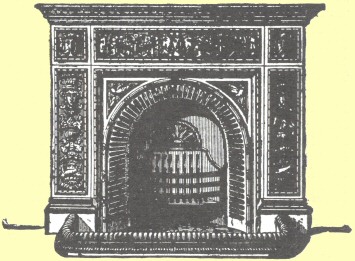
It was the excellency of the Broseley and Benthall clays,
above referred to, which attracted the Messrs. Maw to the spot
and led them to remove from Worcester, to where they had been in
the
habit, first of all, of having them conveyed by barges on the
river, to the present site of their works, fashioned out of the
old Benthall Iron Works, carried on a century ago by Mr. Harries,
then owner of the Benthall estate. Notwithstanding the
additions made by them, the trade has so wonderfully developed
itself that after building upon or in some way occupying every
inch of ground, they are cramped for room, and are on the look
out for more commodious premises. In addition to those
classical and other adjuncts of architectural comfort and
embellishment, embracing encaustic tiles—the reproduction
of an art limited in mediæval times to church decoration,
but now having a much more extended application, and the
manufacture of tesseræ, used in the construction of
geometrical mosaic pavements, similar in character to those found
in the mediæval buildings of Italy, also moresque mosaics,
like those occurring in Roman remains in this country and on the
continent, they now manufacture a superior majolica, and faience
of great purity, in both of which departments they have recently
received first class medals at the Philadelphia exhibition.
The accompanying engraving will convey an idea of the adaptation
of faience to articles of domestic utility.
Older even than the Haybrook Mug House are the Pot Works of
Jackfield, which, according to the parish register of
Stoke-upon-Trent, quoted by Mr. Jewitt and Mr. Chaffers, supplied
a race of potters to that great centre of early pot-making in the
year 1560. Excavations made too, soma years ago, brought to
light on a spot near which the present works of Craven, Dunnill
& Co., now stand, an oven, or kiln, with unbaked ware, which
appeared to have been buried by a land-slip; and in an old pit,
which it was said had not been opened for two centuries, a brown
mug was discovered, which had upon it the date 1634. If
Jackfield supplied early potters for Stoke, Stoke sent pot
masters to Jackfield. One of these was Mr. Richard
Thursfield, an ancestor of Greville T. Thursfield M.D., who took
these works and carried them on in 1713. He was succeeded
by his son John, of whom we have spoken as afterwards living at
Benthall and carrying on works there. The late Richard
Thursfield, Esq., had in his possession some good examples of
Jackfield ware. Among them was a handsome jug, gilt, having
on it, we believe, the name of one of the family.
In 1772, or soon after, Mr. Simpson carried on the works; and
he appears to have further improved the manufacture, for in
addition to the “black decanters,” as his mugs were
called, he made various articles of superior quality, which prior
to the breaking out of the war with America found a ready sale
there. The old mill turned by the waters of the Severn,
where he ground his materials, has just been taken down.
Mr. Blakeway afterwards carried on the works, and was joined
by Mr. John Rose, upon leaving Caughley, and, after carrying them
on a short time by himself, he removed them, as he did the
Caughley Works, to Coalport, on the opposite bank of the
river.
The site of the old pottery was on the ground which is
now occupied by the Jackfield Encaustic Tile Works, the clays of
which are specially adapted for geometrical and encaustic tiles;
and such tiles have been made here for a number of years; but
since the old works came into the possession of the present firm
of Messrs. Craven Dunnill and Co., great changes have taken
place. The firm took a lease of about four acres of ground,
and adjoining the old works built a large and commodious
manufactory, which has been in operation for nearly two
years. They have since taken down all the buildings of the
old works, and have erected on their site and joining up to the
new works, large warehouses, show room, offices, and entrance
lodge. The plan of the works is very complete, so as in
every way to economise in the process of manufacture, and they
are now among the most complete works of the kind.
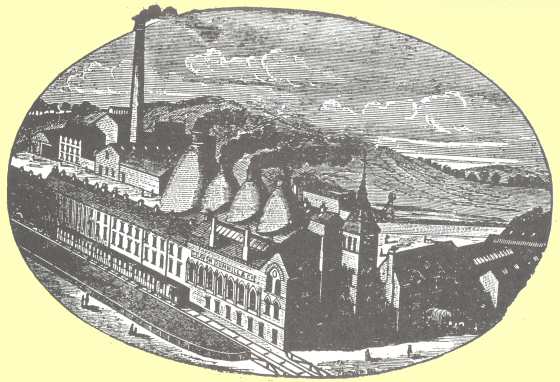
As shewn in the accompanying engraving, the buildings consist
of four blocks, one detached and the others connected, each block
accommodating a separate branch of the manufacture.
In the detached block the raw materials are reduced to a state
ready for the workman.
The second block contains the damping places, where the clays
are kept in a certain degree of moisture; pressers’ shops
for the various colours of geometrical tiles, and the encaustic
tile makers’ shops, with their stoves.
The next block provides for the drying and firing of the goods
and decorating shops.
On the first floor are workshops employed for painting,
printing and enamelling, or other decorative purposes.
The
fourth block provides for the sorting and stocking of goods and
for packing them for despatch; also the offices and showroom.
Near to the detached block first described a small gas-works
has been erected, which supplies the whole of the buildings.
The first works at Coalport were we believe founded and
carried on by William Reynolds, Thomas Rose, Robert Horton, and
Robert Anstice; the former William Reynolds, being then Lord of
the Manor. The buildings, or a good portion occupied by
them are still standing.
Mr. Thomas Rose, and Mr. John Rose, were sons of a respectable
farmer living at Sweeney. The latter was a clerk under Mr.
Turner, at Caughley, and left him to take the Jackfield works
about the year, it is said, 1780. Having carried them on
for a few years, in conjunction with Mr. Blakeway, during which
time he greatly improved the quality of the article manufactured
there, he established the present Coalport works on the side of
the canal, then recently opened, and opposite to those of
Reynolds, Horton, Thomas Rose, and Robert Anstice. On Mr.
Turner retiring from the Caughley works in 1799, Mr. Rose and the
new company he had formed purchased them, and by means of
increased capital shortly afterwards removed both plant and
materials from Caughley and Jackfield to the more advantageous
position they now occupy, on the banks of the canal and the
Severn. Even the buildings were pulled down and
the bricks and timber removed to the opposite side of the Severn,
where they were used in constructing the cottages now standing
opposite to the present Coalport Works.
A staff of excellent work-people had been obtained from
Caughley and Jackfield works combined, but an accident occurred
on the night of the 23rd of October in that year by the capsizing
of the ferry, as the work-people were crossing the Severn, by
which twenty-eight were drowned, some among them being the best
hands employed at the works. It was a dark night, the boat
was crowded, and the man at the helm, not having been accustomed
to put the boat over allowed the vessel to swing round in the
channel where, with a strong tide running, it was drawn under by
the rope which went from the mast to a rock in the bed of the
river. Some managed to scramble out on the Broseley side of
the stream; but the following were lost, notwithstanding the
efforts of those who rushed to the river side on hearing the
despairing cries raised to save them. Jane Burns, Sarah
Burns, Ann Burns, Mary Burgess, Elizabeth Fletcher, Mary
Fletcher, Elizabeth Beard, Jane Boden, Elizabeth Ward, Sarah
Bagnall, Sophia Banks, Mary Miles, Elizabeth Evans, Catherine
Lowe, Jane Leigh, Charles Walker, George Lynn, James Farnworth,
George Sheat, John Chell, Robert Lowe, William Beard, John Jones,
Benjamin Gosnall, Benjamin Wyld, Richard Mountford, Joseph
Poole.
The event, as may be expected, created a great sensation at
the time, and was thus commemorated by Mr. Dyas, one of the
Coalport workmen.
Alas! Alas! the fated night
Of cold October twenty third,
In seventeen hundred ninety-nine;
What cries, what lamentation heard,
The hour nine, when from yon pile,
Where fair porcelain takes her form,
Where energy with genius joins,
To robe her in those matchless charms,
A wearied band of artists rose,
Males and females, old and young,
Their toil suspend, to seek repose,
Their homes to gain, they bent along.
Sabrina’s stream was near to pass,
And she her frowning waves upraised,
Her mist condensed to darksome haze
Which mocked the light; no star appeared.
Yon boat, which o’er her bosom rides,
Enveloped in the heavy gloom,
Convulsive stretch’d along her sides,
To snatch the victims to their doom.
Soon e’er on board their faltering feet
A monster fell who grasped the helm,
Hove from the shore the distressed crew,
And so the dreadful overwhelm,
Swift horror’s wings o’er spread the tides,
They sink! they rise! they shriek! they cling!
Again they sink; alarm soon flies,
Along their shores dread clamours rise,
But Oh, the bleakest night preventing
Every means to save their breath,
Helpless, hopeless, life despairing
Twenty-eight sunk down in death.
Alas small time for Heaven’s implorings,
Quick sealed their everlasting state,
Or, in misery, or in glory.
The last tribunal will relate,
Here
fold, O muse thy feeble wings,
Hope where thou canst, but not decide,
Dare not approach those hidden things,
With mercy, justice, these abide.
Return with sympathetic breath,
See yon distracted mother stands,
Three daughters lost, to heaven she lifts
Her streaming eyes and wringing hands,
Hark! from those dells how deep the wailings,
Fathers, Mothers, join their moans,
Widows, orphans, friends and lovers,
Swell the air with poignant groans;
Recluse in grief, those worthy masters
Silent drop the mournful tear.
Distress pervades surrounding hamlets,
Sorrow weeps to every ear,
Sleepless sighings hail the morning,
Morning brings no soothing ray.
The author of these verses, Mr. Dyas, was a very clever carver
on stone and on wood. He engraved the blocks for a work
printed by Mr. Edmonds at Madeley, entitled
“Alexander’s Expedition down the Hydaspes and the
Indus to the Indian Ocean.” He was the author too of
an invention world-wide in its benefits, that of the
printers’ roller; an invention second only to the art of
printing itself, and infinitely superior to thousands of others
out of which vast fortunes have been made.
In 1804 the company consisted of Cuthbert Johnson, William
Clarke, John Wootton, and John Rose. In 1811 it was John
Rose, William Clarke and Charles Maddison. In 1820 they
bought the famous Swansea works and entered into an agreement with
Messrs. Billingsley and Walker to make a superior kind of
porcelain made by them, first at Nantgarw in Glamorganshire, and
afterwards at the Cambrian Pottery, Swansea, in the same
county. This was a pure soft paste porcelain, superior to
any at present produced in the kingdom, and second only to the
famous pate tendre of Sevres at the very best period of
its manufacture. This china was first made in 1813 by
Billingsley, who went from Derby to Worcester, and from there to
South Wales. He was an artist, and understood the
manufacture in all its branches. He produced a fret body,
by mixing the materials, firing them in order to blend them
together, then reducing the vitrified substance into clay—a
process which was carried on at Old Sevres during the reign of
Louis XV.—and thereby produced an article fine in texture,
beautifully transparent, and of a delicate waxy hue, very
superior to the dingy blue tinge given to much of the best china
of that day. Connoisseurs were at once attracted by it, and
Mr. Mortlock went down and entered into an engagement to purchase
all that Billingsley and his son-in-law could make. Mr.
John Rose finding he had lost a customer, whilst orders he was
wont to receive were going to South Wales, went over, bought the
plant, moulds, and everything, and entered into an agreement with
Walker and Billingsley for a period of seven years to make the
same quality of china at Coalport. The process however was
an expensive one, from the difficulty of working the clay, which
wanted plasticity, and also from the loss in the burning, as
being a soft body it was apt to melt or warp, and to go out of
shape, if it had a little too much fire in the biscuit
kiln. About that time, too, Mr. Ryan discovered a very pure
felspar in the Middleton, one of the Briedden hills, the true
Kaolin, to which the Chinese were indebted for the quality
of their egg-shell and other first class china. The fret
body was therefore abandoned, the pate tendre for a
pate dure, as the French say, and by adding pure felspar
to the Cornish stone and clay which contains a large percentage,
a good transparent body was obtained at a less cost than by using
a fret body. About this time also the Society of
Arts offered a prize to any one who should find a substitute for
lead in the glaze, the deleterious effects of which told upon the
dippers, and produced paralysis; and Mr. Rose by applying felspar
to the glaze succeeded in obtaining it. He was awarded the
Gold Medal of the Society; and from that time following, for some
years, a badge was either attached to the ware or engraved upon
it as follows:—“Coalport Felspar Porcelain, J. Rose
& Co: the Gold Medal awarded May 30, 1820; Patronised by the
Society of Arts.” The Devonports and other
manufacturers competed for the prize.
The felspar porcelain however never equalled the original
Nantgarw fret body ware for purity and transparency, a white
plate of which would at the present time fetch a couple of
guineas. It cannot be said that any new element was
introduced by using felspar, because the kaolin, contained in
Cornish stone and day, as discovered by Cookworthy in 1768, had
been, and was now used at Plymouth, Derby, Worcester, Caughley,
and Coalport; and by a judicious admixture of this and a
free use of bone (phosphate of lime) a good serviceable china was
produced. The former gave mellowness, and the latter
whiteness, which approached in a degree the qualities of old and
Oriental china. In fact Mr. Rose, who had the sole
management of the works, spared neither pains nor expense in
raising the character of the productions of the Coalport Works,
which were now by far the largest porcelain works in the kingdom,
if not in the world. Like Minton, he was a man of wonderful
energy, being strong in body, having a clear head, a cool
judgment, and gifted with remarkable perseverance.
The works were now in a state of prosperity; warehouses were
opened in Manchester, London, Sheffield, and Shrewsbury, and a
large trade was being done with dealers all over the
kingdom. There was plenty of employment, and a good
understanding generally prevailed between masters and their work
people. Both before and after the strike there were at
Coalport, as at other works of the kind elsewhere, an intelligent
class of men, among potters and painters, as well as in other
departments. Painters, especially, had good opportunities
for mental culture and obtaining information. Numbers
worked together in a room, one sometimes reading for the benefit
of the others, daily papers were taken, discussions were often
raised, and in politics the sharp features of party were as
defined as in the House of Commons itself. The rooms were
nicely warmed, and a woman appointed to sweep up, to bring coals,
to keep the tables clean, to wash up dishes, peel potatoes, and
fetch water for those who, not living near, brought their meals
with them. It is not surprising, therefore, that men,
having such advantages, should sometimes rise to higher
situations. Some became linguists, some schoolmasters,
engineers, and contractors; one, breakfasting with a bishop,
whose daughter he afterwards married, saw upon the table, some
time since, a service painted by himself when a workman at
Coalport. Some were singular characters: old Jocky Hill
kept his hunter; John Crowther, a very amiable fellow,
exceedingly good natured, and always ready to do a favour to any
one who asked him, lived quite a recluse, studying algebra and
mechanics. He has suggested many improvements in
locomotives, steam paddles, breaks, &c., &c., and had the
honour of submitting to the Government the plan of terminating
annuities, by which money at that time was raised to carry on the
war, and by which we have been saved the burden—so
far—of a permanent debt; also of making other suggestions,
which have been likewise adopted. He also invented a most
ingenious almanack applicable to all time.
Coalport men were usually great politicians; Hunt,
Hethrington, Richard Carlile, Sir Francis Burdett, and Cobbett,
had their disciples and admirers; and such was the eagerness to
get the Register, with its familiar gridiron on the cover, that a
man has been despatched to Birmingham for it from one of the
rooms, his shopmates undertaking to do his work for him whilst he
was away.
The works themselves are ill designed and badly constructed,
the greater portion of them having been put up at the latter end
of the past and beginning of the present centuries, whilst other
portions were added from time to time, with no regard to
ventilation or other requirements of health. Consequently
there are the most curious ins and outs, dropsical looking roofs,
bulging walls, and drooping floors, which have to be propped
underneath, to support half a century’s accumulations of
china, accumulations amounting to hundreds and hundreds of tons
in weight. In entering some of these unhealthy
ateliers and passages strangers have to look well to their
craniums. Some work-rooms have very stifling atmospheres,
charged with clay or flint; the biscuit room notably so. We
have said that a good understanding prevailed generally between
masters and workmen. There was one notable exception, the
great “strike” as it was called, which occurred
somewhere in November, 1833; a memorable event in the history of
the works, so much so that in speaking of occurrences it is usual
to the present time to ask in case of doubt if it happened before
or subsequent to the strike. The men had their
“Pitcher,” a well conducted sick society; and a
“Travelling Society,” for assisting those in search
of employment, with branches in all centres of the trade.
Trades unions, however, were just then coming to the front.
The Combination Laws had been repealed eleven years previously;
otherwise, such was the temper of the Shropshire magistrates, and
the feeling generally in relation to the trades unions, that had
they existed on the statute book not a few would have had to have
experienced the penal consequences of their acts. With the
men who still adhered to the masters the works continued to be
carried on to a limited extent; after much suffering and privation some of
the hands returned, whilst some obtained employment
elsewhere. The course taken by Mr. John Rose, in resisting
the men was warmly approved of by his neighbours, who subscribed
for a handsome silver cup, which is now in the possession of Mr.
Charles Pugh, who married Miss Martha Rose, daughter of Mr.
Thomas, and niece of Mr. John Rose. It is a large and
massive piece of plate. A vine stem entwines around the
foot and forms the handles, a vine border with grapes also forms
a border round the rim of the cover. On one side is the
following inscription:
Presented to John Rose
Esqr.,
of
Coalport China Manufactory,
By his
Friends and Neighbours
March 3rd
1834.
On the reverse side is the following:
Tribute of respect
to his
Public and Private Character
and to the
uncompromising firmness
with which
he has recently resisted the
demands of an illegal
conspiracy.
We have lived to see trades unions legalized, and trade
combinations adopted by masters as well as men.
Mr.
Walker had invented a maroon colour dip for grounds, which was
used with much success. A good deal was done too about this
time in imitation of the Sevres style of decoration, and
thousands of pounds were spent in endeavouring to make the famous
torquoise of the French; but a pale imitation, called celest,
only was obtained; some years afterwards however a much better
colour was produced, first by Mr. Harvey, secondly by Mr.
Bagshaw, thirdly by Mr. Hancock.
In 1839 the late William Pugh became one of the firm, it then
being John Rose, Charles Maddison, and William Pugh. In
1841 it was Charles Maddison, William Pugh, Thomas Rose, and
William Frederick Rose. In 1843 William Pugh, and William
F. Rose were the proprietors. In 1845 the Messrs. Daniell
received the command of the Queen to prepare a dessert service as
a present by herself to the Emperor Nicholas, and it was
manufactured at the works. It was a magnificent service of
bleu de roi, and had the various orders of the Russian
Empire enamelled, in compartments, with the order of St.
Nicholas, and the Russian and Polish eagles in the centre.
In 1850 the famous Rose-du-Barry was discovered. The
attempt to do so had been suggested by the Messrs. Daniell, in
1849; and after repeated experiments by Mr. George Hancock, who
is still the colour-maker at the works, it was produced.
This colour, so named after Mdme du Barry, one of the mistresses
of Louis XV, had been formerly made at the Sevres Works, but the
art had been lost, and its reproduction created a demand for very
rich dessert services and ornaments of the colour. Very costly services of it were produced
for the Messrs. Daniell, Mortlock, Phillips, Goode, and other
London dealers, which attracted considerable attention at the
Exhibition of 1851. One splendid dessert service of it was
purchased by Lord Ashburton; others also, after special models
and designs, of this colour were subsequently produced for the
head of the State, for the Emperor of the French, and for
noblemen like the duke of Northumberland, the Marquis of
Lansdowne and others.
The following are the remarks of the Jurors on that
occasion:—Rose J., and Co., Coalbrook Dale, Shropshire (47,
p. 727), have exhibited porcelain services and other articles,
which have attracted special attention of the Jury. A
dessert service of a rose ground is in particular remarkable, not
only as being the nearest approach we have seen to the famous
colour which it is designed to imitate, but for the excellence of
the flower-painting, gilding, and other decorations, and the
hardness and transparency of glaze. The same observation
applies to other porcelain articles exhibited by this firm.
The Jury have awarded to Messrs. Rose and Co. a Prize
Medal. The company also attained medals at the French
Exhibition in 1855, and at that of London in 1862.
A good deal has been done of late years in the Sevres style of
decoration on vases, the moulds of which came direct from Sevres
manufactory. It is a pleasing incident, and one worth
mentioning, that some years ago Mr. W. F. Rose in company with
Mr. Daniell visited Paris, and of course went to Sevres.
Mr. Daniell was at once taken round the works, but Mr. Rose feeling some
delicacy remained outside. Mr. Daniell mentioned the
delicacy of his friend, and the manager at once sent for him in,
and shewed him the greatest respect. He told him he might
send his best artists to copy any thing he saw, or employ theirs
to do so: and sometime after he sent over the moulds themselves
to Coalport.
In 1862 Mr. Pugh became sole proprietor of the works, and
continued so to his death, in June 1875. Mr. Charles Pugh,
brother of the deceased, and Mr. Edmund Ratcliff, brother-in-law,
were left executors; and for an adjustment of claims by them and
others the estate was thrown into Chancery and a receiver and
manager, Mr. Gelson was appointed. The stock which is
immense and had been accumulating for half a century is being
brought into the market. Hundreds of dozens of one pattern,
“India tree,” for example, which had remained out of
sight for forty years, are being brought to light. In some
instances a hundred dozen or so of saucers, (printed,) are found
stowed away, without cups to match; whilst scores of piles of
plates and dishes, sixteen or eighteen feet high, may be seen
(white) in others, which had been sorted and put on one side from
some defect or other. It speaks well for the quality of the
china that the biscuit and glazed are both sound and good.
In some cases the floors are literally giving way from the
immense weight of stock they have to sustain. In one place
a quantity of old Caughley China was discovered; whilst in
another were found a number of Caughley copper plates engraved by
the late Herbert Minton’s father.
It
may excite surprise that so large a stock should have been
allowed to accumulate, but much was the result of a wish to keep
the men employed. The fact of a number of copper plates
being found with his name on, confirms what we have previously
said about Thomas Minton, who founded the important commercial
house bearing his name and that of his son at Stoke, having been
employed as an engraver at Caughley. M. Digby Wyatt, also,
in his paper read before the Society of Arts and reported in the
Society’s Journal, May 28th, 1858, on the influence
exercised on ceramic art by the late Herbert Minton,
says:—“Mr. Thomas Minton was a native of Shropshire,
and he was brought up at the Caughley works, near Broseley, as an
engraver. He then went to town and worked for Spode, at his
London House of business.” In 1788 he went to Stoke,
bought land, and built the house and works which have since
become so celebrated. Up to 1798 however he only made
earthenware which was printed and ornamented in blue, similar to
that at Caughley.
Mr. Wyatt, in the paper just quoted, speaking of John Rose and
of the late Herbert Minton admitted that in the excellent, rapid,
and cheap production of porcelain for Mr. Minton to have stood
still for a moment would have been to have lost his lead in the
trade. And Mr. Daniell, in the discussion which followed,
said:—
“With reference to Mr. Minton’s
predecessors in this branch of art, he might remind the society
of one whose name was upon their records as the recipient of the
society’s gold medal for china and porcelain manufactures
long before Mr. Herbert Minton’s time.
He referred to John Rose, of Coalport, who made more china in his
day than all those who were mentioned in the paper.”
It will be seen from what we have written that Thomas Turner,
of Caughley, and J. Rose, of Coalport, were the creators, so to
speak, of new industries which drew around them large populations
and gave employment to thousands who otherwise might have sought
for it in vain, or have found it under less advantageous
circumstances. It will be seen also that not only were they
benefactors contributing materially to the common stock of
national prosperity themselves, but that their energies and
abilities inspired others who in turn became industrial
organisers, and through various channels carried on the work of
progress.
Excepting to the trade, and to some of the old inhabitants, it
is not generally known that Martin Randall established China
Works at Madeley, and made porcelain similar to that of Nantgarw
and little if at all inferior to old Sevres porcelain. He
and his brother Edward were Caughley men; he left there to go to
Derby. He afterwards went to Pinxton, and thence with Mr.
Robins, a Pinxton man, to London, where they entered into
partnership and carried on business. They were supplied
with Nantgarw white china by Mr. Mortlock, till Mr. Rose cut off
the supply from the Welsh Works, by engaging Billingsley and
Walker to make it for himself alone at the Coalport Works.
They still continued to carry on business at Islington, where
they erected buildings suitable, and fired the ware in box kilns
with charcoal.
About this time the demand was great with connoisseurs among
the aristocracy for old Sevres china; and the London dealers,
finding that it was not obtainable in sufficient quantities to
meet the demand for highly decorated specimens, hit upon the
expedient of employing agents in Paris to buy up Sevres china in
white for the purpose of having it painted in London, as Nantgarw
had been, and selling it to their customers as the bona fide
productions of Sevres. Slightly painted patterns too were
procured, and the colours got off with fluoric acid, and rich and
expensive paintings, grounds, and gilding substituted.
About the year 1826 they dissolved partnership and Mr. Randall
came to Madeley, where he occupied a house in Park Lane, now the
residence of the Wesleyan minister. He then took more
commodious premises at the lower end of Madeley, where he erected
enamelling, biscuit, and other kilns, and made and finished his
own ware. Thomas Wheeler, William Roberts, and F. Brewer,
were his potters; Philip Ballard, Robert Grey, and the present
writer, were painters there, and Enos Raby was ground
layer. John Fox of Coalbrookdale, William Dorsett, of
Madeley, also were with Mr. Randall for a short time. Not
having had experience in the making of china, great mistakes were
committed, and heavy losses sustained. We have known a
biscuit kiln fired till tea-pots and cups and saucers were melted
into a mass before a trial was drawn, crow bars being
necessary to remove them; in some instances they assumed the most
fantastic forms. At other times the ware would be short
fired in the biscuit kiln and would take up so much glaze that on
coming out of the glaze kiln it would fly off in splinters.
These wastrels were buried, broken up, or thrown into the canal,
to be out of sight.
Mr. Randall however, as the result of repeated and persevering
experiments, succeeded in producing a fret body with a rich glaze
which bore so close a resemblance to old Sevres china that
connoisseurs and famous judges failed to distinguish them.
He refused however, from conscientious motives, to put the Sevres
mark, the initials of Louis Louis, crossed at the bottom, which
was done with less hesitation at Coalport with much more feeble
imitations. When introduced on one occasion to a London
dealer, of the name of Frost, who had a shop in the Strand, as
Mr. Martin Randall’s nephew, the dealer in old china
observed that the old Quaker made the best imitation of Sevres
that ever was made, but added, “he never could be got to
put the double L on it, and we cannot sell it as
Sevres.” We remarked that he was “too
conscientious to do so,” upon which he replied, “O,
d—n conscience; there is no conscience in
business.”
Mr. Randall had less hesitation however in putting the Sevres
mark on what was known to be Sevres; and he did very much for
Mortlock, Jarman, and Baldock, who had agents in Paris, attending
all sales where old Sevres was to be sold, in redecorating it in
the most elaborate and costly manner. The less scrupulous
London agents however did not hesitate to pass it off as being
really the work throughout of Sevres artists. Indeed they
have been known to have boxes of china going up from Madeley,
sent on to Dover, to be redirected as coming from France,
inviting connoisseurs to come and witness them being unpacked on
their arrival, as they represented, from Paris. A little
entertainment would be got up, and supposing themselves to be the
first whose eyes looked on the rich goods after they left the
French capital, where it would be represented, perhaps, that they
had been bought of the Duc-de—or of Madame some one, after
having been in the possession of royalty, they would buy
freely.
Sevres porcelain fetched high prices then, but it has risen
higher in the market, even since, and has gone on rising to the
present time. In 1850 cups and saucers fetched from
£25 to £30 each, and bowls £66 or
£70. Three oval vases and covers at Lord
Pembroke’s sale fetched £1020. Prices have
however since gone up; and at Mr. Bernal’s sale a pair of
rose Dubarry vases sold for 1850 guineas; and cups and saucers
for £100. Single plates have since sold for
£200; vases for 500 or 600 guineas each, and cups and
saucers for 150, guineas. A year ago a set of three
Jardiniers fetched at Christie’s, by auction,
£10,000!
We remember seeing an ornament at the Marquis of
Anglesey’s at Beau Desert which we were assured was
old Sevres, and had been purchased at a great price on the
continent, but which we recognised as one of our own painting at
Madeley. A man can always tell his own painting;
but it is not an easy matter for another however experienced
sometimes to do so. An amusing instance occurred at
Coalport. Mr. F. W. Rose who had been conversant from a
child with china, on one occasion bought a vase, painted with
birds, believing it to be old Sevres, but which was made at the
Coalport Works and painted by the present writer at
Madeley. Mr. Rose, sending for us down to the office said,
“here, Randall, is a vase I have given a good price for,
which is the right thing; can you do anything like
it?” Our reply was, it would be strange if we could
not, as we did that when a lad, adding that it was made at his
own manufactory, that it was modelled by George Aston, and
purchased out of the warehouse, in the white, by T. Martin
Randall. We need scarcely say that he was very much
astonished on finding he had been duped by a London china dealer
with a piece of his own ware. It was put out of sight; but
the late Mr. Pugh did not forget occasionally to remind his
partner of the incident.
Mr. Randall removed from Madeley to Shelton, in the Potteries,
for the greater convenience of carrying on his works. He
was invited by the late Herbert Minton to become a partner, and
to make his ware for the benefit of both at his extensive works
at Stoke. Age however, and a longing for retirement led him
to decline, and he soon afterwards retired to a cottage at
Barleston, where he died, and was buried, in a sunny spot of his
own choosing, within sound of the murmuring waters of the
Trent. He was a good man; one holding large and liberal
views, and one who took an active part in various social and
religious movements of the day, being an active promoter more
particularly of Temperance Societies, when first established in
this country. Specimens of his ware are much prized and
sought after by collectors. A fine specimen with torquoise
ground is in the possession of Henry Dickinson Esq.
The chief beauty of Mr. Randall’s porcelain, like that
of other fret bodies, or pate tendre china, was that it
admitted of a complete amalgamation of the painting with the
glaze, and also of a richness and depth of colour, as in the case
of torquoise, not to be produced on ordinary china. It had
too that waxy whiteness and mellow transparency for which old
porcelain was distinguished.
Much interest attaches to the old church in which Mr. Fletcher
preached, but little that is definite and satisfactory appears to
be known. In one of the topographies of Shropshire it is
said to have been in the Norman style of architecture, but
nothing so early is shewn in the engravings of the windows and
tower. It was dedicated to the Virgin Mary, and a Chantry
is said to have been added in the 11th of the reign of Richard
II. It was small, damp, and dilapidated, in 1794, when it
was taken down. It appears to have contained some handsome
altar-tombs and other mural monuments, some of which we have
already noticed as having been in part removed at the building of
the present edifice, as the well sculptured figures representing
the Brooke family. A number of tablets were again placed in
position in the present church, which, as they refer to old
Madeley families, some of which have either died out or removed,
we give, together with others of a later date.
The following occur on the Eastern side of the
church:—
On the left hand side is the following:—
In memory of Walter and
Lucy Astley,
who died of the small-pox.
He died Dec. 11th, 1721, aged 30 years.
She died Dec. 30th, 1721, aged 24 years.
Also of
Matthias Astley, brother to the above,
Who died June 23rd, 1747, aged 53 years.
In the chancel
Near this place
lye the bodys of William Ashwood,
late of this parish, Esqr.,
And Elizabeth his wife,
daughter of William Adams,
of Longden, in this county, Esqr.
To whose memory John, their son
and heir, erected this monument,
in testimony of his duty to such
affectionate parents.
He died October 27, 1730, in his
47th year;
She March 22nd, 1740,
in her 50th year.
Another is as follows:—
In memory of
John Ashwood of this parish, Esq.,
Who died 31st Jan., 1750,
In the 30th year of his age.
And of Thomas Porter Ashwood,
His only son, by Dorothy his wife,
second daughter of Henry Spron,
late of the Marsh in this county, Esq.,
Who died 31st March, 1769, in his 19th year.
Also
In memory of the said
Dorothy, wife of the above
John Ashwood Esq.,
Who died 13th May, 1785,
In the 59th year of her age.
This family lived in the old hall, the remains of which now
form part of the stabling of Joseph Yate, Esq.
In the chancel is a handsome monument, surmounted by the arms
of the Smitheman and Brooke families, as follows:—
In this chancel are
interred the remains of
Catherine
The wife of John Unett Smitheman Esq.,
late of Little Wenlock, in this county,
By whom she had five children, (viz.)
Catherine, Catherine, Brooke, John, and Rose,
of whom, one daughter
Catherine, and John, only survived her.
The other 3 children died in their infancy.
CATHERINE
Died Oct. 1, 1741 at Willey in this
county,
where
she was buried.
She was the daughter and co-heir of
Cumberford Brooke Esq.,
Of this parish and Cumberford in Staffordshire,
By Rose his wife, daughter of Sir John Austin Bart.
of Boxley in Kent.
She was descended from
Sir Robert Brooke Knight,
Speaker of the House of Commons and afterwards
Chief Justice of the Common Pleas in the reign of
Queen Mary,
And through a long line of ancestors was allied to
many a noble and illustrious family in this kingdom
She departed this life May 1st, 1737.
To whose memory
Her son John Smitheman erected this
little monument.
At the top of this monument is the following coat of
arms:—
QUARTERLY: first chequy arg. and sa.
Second arg. a chevron gu. between Three
Helmets
Third gu. a Talbot passant, arg.
Fourth az. a lion rampant, between six
fleur-de-lis, or,
Crest, an Eagle with two heads, displayed, arg. collared, or.
In the chancel is the following:—
In a vault
near this place are interred the remains
of Mr. George Goodwin,
late of this parish,
who died Nov. 3rd 1773,
in the 54th year of his age.
He was a man of great worth, good sense and integrity, was
most deservedly esteemed and respected by all who knew him, more
particularly by the industrious inhabitants of this populous and
extensive parish.
To perpetuate the remembrance of so worthy a man, his son
William Goodwin hath with gratitude and respect erected this
little monument.
“An honest man’s the
noblest work of God.”
Also in the same vault is interred
the body of
Mr. John Goodwin,
(son of the above) who died Feb. 21st, 1774,
In the 28th year of his age.
Likewise in the same vault is
interred
the body of
Mr. Edward Reding,
(brother-in-law to the above Mr. Wm. Goodwin)
who died Jan. 19th, 1797, aged 39.
And also the remains of
Mr. William Goodwin,
who departed this life Feb. 25th, 1797,
in the 48th year of his age.
Here is another.
Near this place lie the
remains of
Benjamin Nicholls, late of this parish,
who died 27th May, 1775,
in the 75th year of his age.
He was a good husband, a tender
father,
A good neighbour and sincere friend.
Also
Elizabeth his wife who died 27th Dec., 1779,
in the 73rd year of her age.
And also of
Benjamin, son of William and Lydia Nicholls,
of the
parish of Stirchley,
who died 7th Sept., 1761,
in the 4th year of his age.
Near the entrance are the following:—
Mary Yate,
aged 45,
Died 20th May, 1779.
Prœivit.
Fanny Yate,
relict of Timothy Yate, Esq., of this parish,
died August 21st, 1834,
aged 53 years,
and was interred in the family vault in this
church yard.
The sad affliction which befel the family of the Rev. J. H. A.
Gwyther when vicar of Madeley, by the successive illness and
death of his children, has been commemorated by sympathising
friends and neighbours by means of a white marble tablet, on
which are a group of well executed crushed lilies, at the base,
and another erected by the family of Mr. Gwyther. The
following are the inscriptions:—
As
A Solemn
Memorial
Of the affecting death within nine days
of five children
of the Rev. J. H. A. Gwyther, M.A.,
Vicar of this parish,
And in testimony of respectful sympathy
with the bereaved parents
This tablet is erected by
friends and neighbours, parishoners of Madeley.
Hephzibah Mary, born Nov. 28th,
1845,
died April 12th, 1856.
Emily Maria, born August 17th, 1847,
died April 13th, 1656.
Phœbe Catharine, born August 10th, 1848,
died April 14th, 1856.
James Bulkley Phillips, born Aug. 7th, 1850,
died April 16th, 1856.
Clara Artemisia, born Oct. 10th, 1852,
died April 21st, 1856.
“The voice said cry, and he said what shall I cry? all
flesh is grass, and all the goodliness thereof is as the flower
of the field. The grass withereth, the flower fadeth, but
the word of our God shall stand for ever.”
Isaiah
xl. 6–8.
It is the Lord: let him do what
seemeth him good.
I. Samuel
iii. 18.
Shall not the Judge of all the
earth do right?
Genesis
xviii. 25.
In Affectionate Memory of
Richard Cecil Henry,
The second beloved son of
James Henry Gwyther, M.A., Vicar of this Parish,
And Mary Catharine his wife.
Born Sep. 21st, 1851. Died April 4th, 1855.
Yes, Thou art fled and saints a welcome sing,
Thine infant spirit soars on angels’ wing,
Our dark affection might have hop’d thy stay,
The voice of God has called his child away.
Sweet Rose of Sharon, plant of holy ground,
Like Samuel early in the temple found;
Oh; more than Samuel blest, to thee ’tis given,
The God he served on earth, to serve in heaven.
1706. May 28th, Basil Brooke, Esq. of Madeley gave by
will £40, to which an addition of £60 was made by
unknown Benefactors, wherewith certain Cottages and Premises were
purchased and conveyed to Trustees for the benefit of the Poor of
this Parish.
1800. The yearly sum of five shillings was given to the
Poor of this Parish to be paid out of the Rates of the Premises
lately belonging to Mr. Richard Beddoes, but now in the
possession of Walter Bowdler, of Madeley.
1825. Joseph Reynolds, Esq., of the Bank House,
presented a Service of Communion Plate for the use of this
Church, of the value of £100.
1810. Sept. 6th, Mr. William Yate, of this Parish, gave
by will to the Churchwardens for the time being in Trust, four
kneelings in his Pew, No. 13 in the Gallery, for the benefit of
the Sunday Schools of this Parish.
1852. Thomas Lister, Esq., of Broseley, gave £100
to the Sunday and National Schools connected with the Parish
Church of Madeley, which sum was invested in the three per cent
Consolidated Annuities, on the 19th day of January, 1853, in the
names of Rev. J. H. A. Gwyther, John Anstice, and Thomas Smith,
Vicar and Churchwardens, Managers of the said Schools.
The Foundation Stone of
this Church
was laid by the Rev. George Pattrick, L.L.B.,
September 22nd, 1794.
Divine Worship first performed therein by the Rev.
Samuel Walter, A. M., Curate of this parish, on Easter Day,
being
April 16th, 1797.
William Purton, Thomas Wheatly, }
Churchwardens.
An old book containing tithe charges has names of places now
no longer known. In 1786, for instance, Mr. Botfield is
stated to occupy under the family of the late Sir Joseph Hawley
some pieces of land called the Hoar Stones. The Rev.
Charles Hartshorne in his Salopia Antiqua describes hoar stones
at some length and quotes passages from sacred and profane
writers to shew that they were in some cases memorial, and in
others division marks between property. They occur at a
place called Hoar, or “Whure Edge,” on the
Titterstone Clee, and in several other places in Shropshire and
neighbouring counties, whilst in Wales, both north and south,
they are still more numerous.
Among old names of places applying to portions of Madeley
Court property we find the Hopyard, adjoining “the
slang,” a piece of 11 acres, 2 perches, and 16 roods,
formerly in the occupation of Mr. W. Purton, and belonging to
Richard Dyott Esq.; and the Coneberry, and Coneygrey; Deer Close,
and Battlefield, all belonging to the same in 1787.
Grants of markets and fairs appear to have been made by kings
in former times by way of favour to the holders of manors, rather
than from a wish to accommodate the people who shared the
privileges. Madeley market was granted by the necesstous
king, Henry III., to the Prior of Wenlock, July 6, 1269. He
also granted an annual fair, to be held on three days; namely, on
the vigil, the day, and the morrow of St. Matthew the
apostle. The market was to be held on Tuesdays, but it fell
into disuetude, and was either removed to or revived in another
portion of the same manor; and the inhabitants of the village for
many years, had no market nearer than Ironbridge or Dawley.
The old market was at one time held at Cross Hill, in an open
space where a group of cottages now divide the roads. It
was also held at one time in a building which served as a market
hall, now the property of Mr. Legge, adjoining the barn in which
king Charles was lodged. Subsequently it was removed to
Madeley Wood; and afterwards to Ironbridge, which was at that
time a rising place. Ineffectual attempts were made in 1857
to re-establish a market, but nothing effectual was done till
1869, when an energetic committee was appointed, of which Mr.
Legge was Treasurer and the writer of this article was Sec.,
which succeeded in establishing the market, first in the open
street and secondly in treating with the lord of the manor,
through his agent, W. R. Anstice, Esq., for the erection of a
suitable building, on condition that a scale of tolls was adopted
sufficient to cover the outlay. The market has proved of
great advantage to the town; not only to purchasers but to tradesmen,
by causing more ready money to be spent in the town than
formerly.
Madeley for the last 900 years has been associated with
Wenlock. It formed part of the possessions of the Church of
St. Milburgh in the time of King Edward (son of the Great Alfred)
at the commencement of the tenth century, and is mentioned as
such in Domesday. It shared the privileges which the many
franchises obtained by the Prior of Wenlock conferred.
These privileges and exemptions from taxation gave, Mr. Eyton
observes, to each acre of land a two-fold value. On the
other hand it suffered from the occasional extortions of the
Priors, and inconveniences from being subject, as all lands of
the Borough were, to the Mother Church of Holy Trinity,
Wenlock. It was subject to the Courts of Wenlock, and as
early as 1267 a case is mentioned in which the Provost of Wenlock
and the Prior were engaged in disseizen one of the tenants
of the Prior at Madeley.
The Bailiff and his peers, together with the Recorder, were
Justice of the Peace, with a Jurisdiction co-extensive with the
Borough.
These officers had Constables in the several divisions of the
Borough, termed Allotments, sometimes Constablewicks. The
men selected for the office appear to have been men of substance,
standing, and integrity; and upon them devolved the duties
of maintaining the laws, of collecting monies for the king
&c.
Here, for instance, are the “Articles which the
constables” of Madeley and Little Wenlock were called upon
“to present upon oath.”
1.—What felonies have been committed and
what default . and by and in-whom.
2.—What vagrant p’sns. and sturdy beggars have
passed through yo’r. limitts unpunished, and whether the
same and impotent poor of yo’r. p’ share provided
for, and poor children bound apprentices according to Law.
3.—What Recusants of about the age of sixteen are in
yo:e limitts, and who absent themselves from church on ye
Lord’s Day, and how many sabbaths.
4.—Who have profaned the Sabbath by swearing, labouring
or otherwise.
5.—What Ingrossers, forestalled, or . . . of the market,
of cow or cattle, or other dead victuals are within yo’r
limitts, or any Badgers or Drovers of cow or cattle.
6.—Who make mault to sell of corn or grain or tythe or
tylth not being their own . and are not licensed thereunto.
7.—What Masters or Servants give or take greater wages
than is appointed by Justices of the Peace according to Law.
8.—What cottagers or inmates are evicted, removed or
maintained, and by whom, and how long.
9.—What unlawful games, drunkenness, tipling other evil
rule or disorder hath been in Inns, ale houses &c. and by
whom.
10.—What Servants have departed from their
masters, and what masters have put away their servants within the
compass of their time.
11.—Who use gunns, or take or destroy hawks or
hawk’s eggs, of pheasants, partridges, younge deer, hares,
snipes, fish, or fowl, with snares or other engines whatsoever
for that purpose against the Law.
12.—Who use unlawful weights or measures or buy by a
greater and sell by a lesser weight or measure.
13.—Whether watch and ward be duly observed and kept
according to ye statute; that is to say, between Ascension Day
and Michaelmas in convenient places, and who has made default
therein.
14.—What highways have been repaired and what have been
neglected.
15.—Who have sold beer, or syder, or perry, &c.
unlicensed, or who hath evaded ye assize of bread and drink
unlawfully, either the bakers or assizers.
16.—What butchers have killed or sold meate on the
Lord’s Day, or sold any unwholesome flesh at any other
time.
17.—Who have any assault, battery, or bloodshed.
18.—Who have profanely sworn or cursed, and how
often.
19.—What common brawlers, drunkards, scoulds,
eavesdroppers, talebearers, and such disordered p’sns are
within y’re limits.
20.—Who have sold ale or beer on the Sabbath day, or who
have been drinking or tipling in any alehouse on that day.
As
the reader may surmise, from references to recusants and others
who refused or neglected to attend church, or to acknowledge the
supremacy of the King as the head, these instructions were drawn
up and submitted by the Bailiff to the Constables of Madeley,
Little Wenlock, Beckbury, and Badger, in the early part of reign
of William and Mary.
Vagrants and sturdy beggars, it appears, were to be strictly
looked after; they swarmed through the country, giving themselves
up to pilfering; the women breeding children whom they brought up
to the same idle way of living, so that, according to a writer
about that period, (1677) there were 100,000 paupers in
England. Harsh measures were therefore resorted to: the law
of Settlement was passed, and once more the poor were reduced to
bondage to the soil from which they had been emancipated a
century or two before. By this law, which remained in force
130 years, and which was not repealed till the close of the last
century, the poor were imprisoned within their allotments; and
upon the complaints of the Churchwardens or Overseers, any two
Justices of the Peace had power to lay hold of the new comer and
within forty days remove him to the Parish in which he was last
settled, unless he could prove that he was neither a pauper nor a
vagabond, or that he rented a tenement of the value of £10
per annum.
Here, for instance, is a copy of a letter addressed to the
constables of Madeley.
Wenlock
To the Constables of the p sh. of
Madeley,
Greeting.
Whereas I have been informed yt. Thomas Richasson doth
endeavour to make a settlement within the s’d p’ish
of Madeley, contrary to the laws &c. I am therefore in the
King and Queen’s Ma’ties names, of England that now
are, to will and require you the said Constables, or one of you
that you bring before me or some other of their Ma’ties
Justices of the Peace for the said Town and lib’ties, the
body of the said Thomas Richasson, to the Serjeant’s House
in Much Wenlock, upon Tuesday the tenth day of this instant month
of March, to answer to such matters as shall be objected against
him by the overseers of the poor of the parish of Madeley.
And you, the said constables, are required to give notice to John
York of yo’r p’sh, Smith, that he be and appear
before me &c. at the time and place above said, by nine
o’clock in the morning, to put in sureties for his and his
wife’s good behaviour towards Elinor Alnord, Widdy, and all
their Ma’ties loyal people. And you are to make due
returns of this warrant at the time above stated &c.
Given under my hand and seal this second day of March, Anno
domini 1690.
You must give notice to Thomas Cope, Anne Cludd, and Elizabeth
Morris to appear to testify the truth of their knowledge.
Lan. Stephens.
Probably there were other reasons for these strict
enquiries, as the feudal bondage to which the poor were reduced
was closely interwoven with another evil, the thriving-traffic of
Shipping likely young paupers to American Plantations, as was
done by the Bristol Corporation, which held out to the poor
wretches the alternative of leaving England or being flogged or
imprisoned.
It may perhaps be a redeeming feature in the character of that
“ermined iniquity and prince of legal oppressors,” as
Judge Jeffreys, who was not unconnected with Shropshire, was
called, to say that as Lord Chief-Justice he exerted himself
successfully to put down this abomination.
Another summons from Wenlock to the constables requires them
by virtue of an Act of Parliament (fifth of William and Mary) to
give notice to all householders, and to all others they may
believe to be disaffected, inhabiting within their
“Constablewick,” being sixteen years of age and above
sixteen, to appear at the house of, Humphrey Powell,
Sergent-at-mace, at Wenlock &c. to take the oaths of
allegiance and supremacy to their Ma’ties, and to subscribe
the declaration in the Act &c. Dated 16th June,
1692.
Signed Thos. Crompton, Bailf.
Chas. Rindar. Recorder.
Lan. Stephens.
John Mason.
This summons does not appear to have brought the parties to
book, for we find a large number charged with contempt, and again
summonsed under a fine of 40s. to appear before the
Sergeant-at-mace.
In 1693, William Hayward, Roger Brooke, Gent., and
John Smytheman, Gent., and others are applied to, as assessors
for Madeley, Beckbury and Little Wenlock, in carrying out the Act
passed in the fifth year of the reign of William and Mary,
entitled “an Act for granting to their Majesties an aid of
Four Shillings in ye pound for one year, for carrying on a
vigorous War against France.” After giving the nature
of the property to be taxed, the Bailiff and his Officers call
upon the assessors to levy a double tax upon “every papist,
or reputed papist, of ye age of 16 years or upwards, who hath not
taken the oath mentioned and required to be observed in an Act of
Parliament passed in the first year of that reign, entitled an
Act for abrogating the oaths of Supremacy and allegiance,”
unless they then take the oath they shall administer. The
papists however were not alone in this respect; others who had
not taken the oaths, or who refused to take those tendered, were
to be similarly rated or assessed.
In some cases the Constables were required to look after and
to report upon all young men of a certain age and height, likely
to be of use to his Majesty in war times, &c.
Here is a specimen.
(To the Constables of
Madeley.)
“We whose names” &c., His Ma’ties
Justices of the Peace, having received a summons from the Deputy
Lieutenant of the county, together with a copy of a letter from
the Lords of the Privy Council &c., Command you to make
diligent search for all straggling seamen, watermen, or seafaring
men, and to impress all such, giving each one shilling,
impressment money, and to bring the same before us, to the intent
that they may be sworn and provided for, as by the said letter directed;
and You, the sd. Constables are not to impress any very old,
crazy, or unhealthy men, but such as are younge, and of able
healthy bodies, fit for se’vice; and herein you are to use
yo’e: best endeavours as you and any of you will answer the
contrary. Given under our hands &c.
“You are to take notice that what monye you shall lay
out of yo’e: purse upon this service we will take care the
same shall be speedily repaid you according to the order of their
Majesties Privy Council.”
Jas: Lewis, Balf.
Geo: Weld.
Tho: Compton.
Turning back to the period when great political, religious,
and moral changes were taking place in the country, when
Royalists and Republicans had been struggling for the mastery,
and the latter were victorious, to ascertain their reflex and
influence upon the little local parliaments sitting in the
Guildhall at Wenlock, we found some characteristic presentments
by those then important officers the constables, from the several
constablewicks within the franchise, with other matters coming
before the bailiffs and Justices of the Peace, and instructions
issued by them such as may be of interest in shewing the
intermeddling spirit of Puritanism in its then rampant attitude,
when the neglect of public worship, and the walking out of
sweethearts, and even husbands and wives, during sermon time, was
punished with fines, imprisonments or the stocks. The
stocks in fact appear to have been in frequent requisition, and
fines as frequently imposed for such trivial offences as hanging
out clothes on a Sunday, being seen in an ale house on the
Sabbath, and for the very mildest form of swearing, or for the
least utterance of disaffection or disrespect of the
Commonwealth. Here, for instance, is the presentment of
“Articles of evil behaviour of Edward
Jeames, of Long Stanton Clee, in the Liberties of Much Wenlock,
xiiiith day of September, 1652, John Warham, gent., Bailiff.
“First, that the said Edward Jeames is a common
disturber of the Publike Peace, of this Commonwealth, by stirring
up strife and sedition among his neighbours.”
The presentment then proceeds to state that the said Edward
Jeames doth often quarrel with his owne wife and family.
“Secondly That the said Edward Jeames doth
take abroade wh. him a Welsh servt. Lad wch. he keepeth, to the
end yat if any neighboure being by him abused by opprobvious and
unseemely language and word of provocation, doe make any answeare
or reply to him, out of which any advantage may be taken, the
said Lad shall verify ye same upon oath on purpose to vex and
molest the same neighboure and to gaine revenge against
him. Thirdly that the said Edward Jeames, in September,
1651, when the titular king of Scotte invaded yis land wh. an
army, saied openly in ye heareing of divse persons yt he was glad
yt ye kinge was comen into ye land, for if he had not come he
thought yt ye pesent. government would have altered religion
& turned all unto Popery.”
We did not turn to other old parchments containing the
decisions of the Justices to see what punishment, if any, was
meted out to Mr. Jeames for his evil behaviour, but turned to
note some of the Informations laid against ale house keepers, and
persons frequenting ale houses on the Sabbath. Here is one
from Barrow, not from the Constable, or from one living within
the franchise; but from a gentleman who first proclaims his own
goodness by telling us that he himself had attended service twice
on the Sunday, but who, like many others just then, felt it to be
his duty to look after others. He commences by saying
“that yesterday, being Lord’s Day, I
was at Wenlock morning and evening prayer, and going home by the
house of John Thompson of Barrow, ale seller, both the doors
being open I saw both hall and parlour full of people, both men
and women drinkeinge and some drinkeinge forth of dores.
There is a private house standing farr from any rode and hath the
report to bee a verye rude house on ye Lord’s Day. I
am Louth to be the informer, because I doe nott live wthin ye
franchise, but leave yt to ye worshps. consideration hoping
you will take som course whereby God may bee better
honoured, and his Sabbathes less defamed in that house.
What I can speke of that man further I forbear, for ye
pesent.
Yours to command,
WILLIAM LEGG, senr.”
“Sworn before the Bailiff,
John Warham, gent.”
The above John Thompson appeared, and we find
“& is ordered
to appear at any tyme hereafter when Mr. Bailiff shall
requyer.
6th September, 1652.”
The next is an information against John Aston, of Madeley, in
the county of Salop, in which the said John is summonsed to
appear before the Bailiff, John Warham, gent., and Justices of
the Peace of the said town and liberties. The
information appears to have been sworn to by Thomas Smytheman, of
Madeley, husbandman, who states that Lawrence Benthall, and
William Davies, of Madeley, were seen drinking on the
Lord’s Day, at Aston’s ale-house. The summons
appears to have been issued by John Weld the younger, of
Willey. The case is now brought before the Bailiff who
says:
“Let a warrant issue forth to the officers
for the leviing of the monies forfeited for the said offence,
according to the Act of Parliament in that behalf; signed, John
Warham, Bailiff.”
We find similar informations as to ale-houses from Broseley
and other parts of the franchise about the same time.
“The information upon oath of John Eabs of Shurlett,
taken upon oath the xxvth day of May, 1648, conserninge some
Sheepe stolne from him of late.
“Deposeth that upon ffriday night last he had a Lamb
feloniously stolne from him either out of his yearde or out of
the pasture, and alsoe upon Wensday night he had likewise a
weather sheepe stolne, and upon search made for the same
yeasterday being Saturday he wh. Edward Buckley the Deputy
Constable, found in the house of Willm. Wakeley in Shurlett a
qter. of lambe hyd in a Milkepan, wh. a brest and halfe a brest,
a neck not cutt from the brest of lambe, all covered upon wh.
flower, yis said Edward Wakeleye’s Wife denynige soundly
yat there was any Mutton or lambe in the house or whin. yat
Milkepane, and desieringe ye searchers not to shead her flower in ye pan
wh. ye meate was hyd in, and indeavouringe to obscure ye place,
beinge a Cobard, in wh. ye lambe was, and further cannot informe
but yat he verily beleiveth in his conscience ye said meate was
feloniously stolne by ye said Wakely or his people.
Sworn before Audley Bowdler.
Edw. Wakeley upon being examined says that the lambe was one
of his own which he killed on Friday night, and that parte
of it was eaten by his own people before search was made next
morne; “being demanded why it was hid and hid over with
flower in such obscurity in his house, he says he knoweth not
whether it was hid or not, but if it was it was wht. ye privity
of ye said Examind, and done by his people unknown to
him.”
This puts us in mind of another famous old sheep stealer of
Shirlett, who having stolen a sheep hid it in the baby’s
cradle, and when the Constables called to search his house, with
the greatest nonchalance told them they might search away;
but added, “don’t make a noise or else you’ll
wake the baby”; and he continued to smoke his pipe and rock
the cradle till the search was completed, and the officers
departed without finding any “meate.”
The Constables appointed by the Corporation of Wenlock, were
officers who within the Constablewicks or allotments into which
the Borough was divided, were entrusted, under the Bailiffs with
very many important duties, such as collecting monies for the
king, and carrying into execution acts of parliament, as well as
executing summonses and bringing up defaulters. They were a
superior class of men, selected from such as held land, or were
persons of property. Later on quite a different class of
men were appointed; still, sometimes from small tradesmen, but at
others from men who sought the office for the sake of its
emoluments, and who often became the tools of unscrupulous men in
office, whether Bailiffs or Justices of the Peace; as in the case
of Samuel Walters, a broken-down tradesman, whose doings at last,
together with that of the Justices, attracted the attention of
parliament. Walters, was the son of the Rev. Mr. Walters,
incumbent of Madeley, and it may serve to give an idea of the
estimation in which he was held in the parish to mention, that he
on one occasion attempted to enlist his own father, by giving him
the shilling in the dark.
The powers exercised by the borough justices were often most
arbitrary, especially when the individual who came within their
power happened to be a dissenter, or “a dangerous
radical.” On the merest pretence blank warrants were
issued, which unscrupulous constables, like “Sammy
Walters,” as he was called, carried in their pockets, and
filled as occasion required. One notorious instance was
that of three Dutch girls, (Buy-a-Brooms, as they were called),
whom Walters overtook in his “Teazer,” between
Wenlock and Shrewsbury, and invited to ride with him.
Calling at a public-house on the road he went in, filled up three
of his warrants, and then drove them straight to Shrewsbury
gaol. This case came before the House of Commons, and was
inquired into by the Home Secretary, and the system of granting
blank warrants was abolished throughout the kingdom.
Madeley is one of the three Wards into which the borough is
divided. For parliamentary purposes Beckbury and Badger are
included, these having been, like Madeley, part of the extensive
possessions of the church of St. Milburgh. Madeley also
formed part of the wide extending parish of Holy Trinity of
Wenlock, a parish which embraced Broseley, and was not limited
even by the Severn. The words of the charter granted by
Edward IV. to Sir John Wenlock were these:—
“That the Liberty of the Town or Borough
shall extend to the Parish of the Holy Trinity, and through all
the limits, motes, and bounds of the same parish, and not to any
other Towns or Hamlets which are not of the Parish
aforesaid.”
The charter granted by Charles I., in the seventh year of his
reign, added somewhat to the privileges previously possessed, and
either gave or confirmed the right of the burgesses to send
one member to parliament. Originally it seems to
have been the prior who had the right of attending parliament;
for we find in 1308 Sir John Weld holding Willey by doing homage
to the prior by “carrying his frock to
parliament.” How the burgesses obtained the further
privilege of sending two members to parliament no one seems to
know, and there is no document, we believe, in the archives of
the corporation tending to throw light on the subject; but they
appear to have enjoyed that privilege as far back as Henry
VIII’s time.
The burgesses of Madeley were not numerous, we fancy; some
well known Madeley names, however, occur, both as burgesses and
as bailiffs, like those of Audley Bowdler and Ffosbrooke de Madeley;
the former was “Bailiff of the town and liberties” in
1655 and 1678. In 1661 Thomas Kinnersley de Badger,
Armiger, was bailiff, which would seem to indicate that the
burgesses of Badger at that time shared in the municipal duties
and privileges of the borough. In 1732 Mathew Astley de
Madeley, Gent, was bailiff. The Astleys lived in the old
hall, a stone building partly on the site of Madeley Hall, now
the residence of Joseph Yate, Esq., a portion of which building
is supposed now to form the stable. The names of the
Smithemans, one of whom married the co-heir of Cumberford Brooke,
Esq., of Madeley Court and Cumberford in Staffordshire, occur
among the bailiffs. Later on we get that of George Goodwin,
of Coalbrookdale and the Fatlands.
At the passing of the Municipal Reform Act in 1835–6
mayors were substituted for bailiffs; the last elected under the
old title and the first elected as chief magistrate under the new
title was likewise a Madeley gentleman, William Anstice, Esq.,
father of the present William Reynolds Anstice, Esq., of
Ironbridge. Mr. Anstice was elected bailiff in 1834; in
1835 there appears to have been no election, but in 1836 he was
the first gentleman elected, as we have just said, under the new
title. Subsequently the names of other parishioners, as
Henry Dickinson, Charles James Ferriday, John Anstice, Charles
Pugh, John Arthur Anstice, and Richard Edmund Anstice, Esquires,
occur. The present (1879) Aldermen and Councillors for the
Ward are Egerton W. Smith, first elected Alderman 1871, and
John Fox elected Alderman 1879; John Arthur Anstice first elected
Councillor 1869; Alfred Jones 1873; John Randall 1874; Richard
Edmund Anstice 1876; Andrew Beacall Dyas 1878; [235] and William Yate Owen 1879.
The electors for parliamentary purposes prior to the passing
of the Reform Rill in 1832 were few in number so far as Madeley
was concerned. They consisted of freemen, men who acquired
the right to vote for members of parliament either by birth,
servitude, or purchase. Such freemen however could live
many miles distant; they were often brought at a closely
contested election even from the continent, at considerable
expense; and the poll was kept open for weeks.
The Act of 1832, 2 William IV., limited this right to persons
resident within the borough for six calendar months, or within
seven statute miles from the place where the poll was taken, and
this was uniformly taken at Wenlock. It limited the right
of making freemen to those whose fathers were already burgesses,
or who were entitled to become such prior to the 31st March,
1831. The twenty-seventh clause of the act, which conferred
the right to vote upon ten-pound occupiers of houses or portions
of buildings, added greatly to the franchise in Madeley as
compared with other portions of the borough. The
alterations effected by the act of 1867 in the borough franchise
were, of course, very much greater, as it gave the right of
voting to every inhabitant occupier as owner or tenant of any
dwelling house within the borough, subject to the ratings and
payment of poors rates; also to occupiers of parts of houses where
rating was sufficient and separate.
Contests were not very frequent under the old state of things;
when they did occur they arose more out of rivalry or jealousy on
the part of neighbouring families than from anything else.
The most fiercely fought contests that we remember, under the old
limited constituency, were those of 1820 and 1826; when Beilby
Lawley and Beilby Thompson put up. The most memorable under
the ten pound franchise were those when Bridges put up in 1832;
and on a subsequent occasion Sir William Sommerville, in
1835. Bridges and Sommerville came forward in the liberal
interest, and the numbers polled from Madeley, were—
Sommerville
|
111
|
Forester
|
67
|
Gaskell
|
45
|
Among Sommerville’s supporters were many plumpers.
The more recent contests under the extended franchise were
when C. G. M. Gaskell, Esq. came forward, and only polled 846
votes against 1,708 polled by the Right Hon. General Forester,
and 1,575 by A. H. Brown, Esq., and the more recent of 1874, when
Sir Beilby Lawley came forward.
Madeley with its two sister wards has Petty Sessions once in
six weeks, which are held in the large room built for that
purpose over the Police Office at Ironbridge. In the lower
story are cells for prisoners, very different indeed as regards
cleanliness and conveniences of all kinds to the old Lock-up,
which many may remember near the potato market. The
justices for the borough generally sit here, the Mayor being
chief magistrate presiding. The first batch of magistrates,
in the place of the borough justices, took place in the 6th year
of the reign of William IV., those for Madeley being William
Anstice, Esq., of Madeley Wood, and John Rose, Esq., of the
Hay. Others have been appointed from time to time as
circumstances seemed to require.
The borough from the first period of incorporation had its
General Sessions, and its Recorder, who, being a lawyer or other
fit person, was chosen by the burgesses to sit with the Bailiff
to be justices of the peace, to hear and determine felonies,
trespasses, &c., and to punish delinquents therein; and King
Charles’s Charter fixed this court to be held once in two
weeks. There was also a General Sessions. The same
charter states
“That there shall be a General Sessions of
Peace to be holden by the said Bailiff and Justices in any place
convenient within the Borough aforesaid, from time to time for
ever; so that they do not proceed to any matter touching the loss
of life or member in the said Borough, without the presence,
assistance, and assent of the Recorder of the said Borough.
That they shall have all fines, &c., imposed as well in the
said Sessions aforesaid as in all other Courts to be held within
the said Borough.”
In our “History of Broseley,” p.p. 38 and 39, we
have given the names of the bailiff, recorder, justices of the
peace, those of the constables, and grand jury, who sat in cases
heard at Wenlock July 21st, 1653. The right to hold such Sessions
was originally granted by Edward IV. in 1468. When the
reconstruction of the borough courts took place in consequence of
the changes effected by the passing of the Municipal Act in 1836,
this institution of General Sessions appears to have been
overlooked: but the privilege was afterwards granted upon
petition by the council, in the 6th year of the reign of her
present majesty.
The magistrates resident in the parish at present
are—
|
Appointed.
|
John Arthur Anstice, Esq.
|
1869
|
William Gregory Norris, Esq.
|
1869
|
Charles Pugh, Esq.
|
1871
|
Richard Edmund Anstice, Esq.
|
1877
|
A County Court or sciremote was instituted by Alfred the
Great, and gradually fell into disuse after the appointment of
Justices of Assize in the reign of Henry II. Courts of
Request were afterwards created. The charter already
quoted, for instance, speaking of the burgesses says:—
“That they may have a Court of Record upon
Tuesday for ever, once in two weeks, wherein they may hold by
plaint in the same court all kinds of pleas whatsoever, whether
they shall amount to the sum of forty shillings; the persons
against whom the plaints shall be moved or levied, to be brought
into plea by summons, attachment, or distress.”
This court was held at Broseley, before Commissioners, of whom
there
were eight chosen, to represent the eight parishes over which it
had jurisdiction. It was held at the Hole-in-the-Wall
public house, and Jeremiah Perry (Jerry the Bum as he was called)
was bailiff, and after him Henry Booth, when we remember
it. It was abolished when the Act for the recovery of small
debts was passed and the present system of County Courts
established in 1847. The books and documents, three tons in
weight, were transferred to the court at Madeley, afterwards to
London, and were sent to the Government paper mills, we
believe.
The County Court at Madeley was formerly held in the Club Room
of the Royal Oak Inn; but a county court house was erected in
1858. The building is in the Grecian style, and comprises a
large court room, registrar’s and bailiffs office, and
dwelling house for the court keeper. The present judge of
the circuit, which comprises twelve courts, is Arundel Rogers,
Esq.; Registrar and High Bailiff, E. B. Potts, Esq.; Chief Clerk,
Mr. E. A. Hicks, with an efficient staff of bailiffs. The
court has jurisdiction in ordinary cases up to £50, in
equity to £500; and divides with Shrewsbury the whole
bankruptcy business of the county. A bill has already
passed the House of Lords proposing to greatly increase the
jurisdiction of all county courts. Scale of fees:
summary—
Under £2
|
1s. in the £.
|
Above £2
|
1s., and 1s. extra.
|
Hearing Fees
|
2s. in the £.
|
Executions
|
1/6 do. do.
|
There are between 2000 and 3000 new cases annually.
This court was originally held at the Court House, by the
Prior of Wenlock, as lord of the manor of Madeley, as shewn on
page , where the pleas and
perquisites of the said court are mentioned as being entered in
1379 at 2s. The right to hold such court, a Court Leet, as
it was called, was transferred, together with other privileges,
by Henry VIII. to Robert Brooke when he sold the manor. It
passed to John Unett Smitheman, Esq., who married Catherine
Brooke, daughter and co-heir of Cumberford Brooke, Esq., of
Madeley, and Cumberford in Staffordshire. The
Smitheman’s sold the manor to Richard Reynolds, from whom
it passed to his son William. The property belongs now to
the devisees of the late Joseph Gulson Reynolds, and those of his
brother William Reynolds, M.D.. Esq.
The Court Leet has not been held of late years. It had
jurisdiction over various offences, extending from nuisances,
eaves dropping, and various irregularities and offences against
the public peace.
This useful and valued institution was established in
1828. At its fiftieth anniversary, held July, 1878, the
president was the Right Hon. Lord Forester. The
vice-presidents: the Hon. and Rev. Canon Forester; W. O. Foster,
Esq.; the Rev. G. Edmonds; C. T. W. Forester, Esq., M.P.; A. H.
Brown, Esq., M.P.; C. G. M. Gaskell, Esq.; and the treasurer,
John Pritchard, Esq. The surgeons include E. G. Bartlam, Esq.,
Broseley; T. L. Webb, Esq., Ironbridge; C. B. H. Soame, Esq.,
Dawley; J. Procter, Esq., Ironbridge; Dr. Thursfield, Broseley;
H. Stubbs, Esq., Madeley; and J. J. Saville, Esq., Cressage.
At this meeting the following subscribers, together with the
president, vice-presidents, and treasurer, were appointed a
committee for the ensuing year:—
William Reynolds Anstice, Esq.
Mr. Alexander Grant.
Mr. Edward Burton.
Mr. Egerton W. Smith.
W. Gregory Norris, Esq.
Arthur Maw, Esq.
John Arthur Anstice, Esq.
Richard Edmund Anstice, Esq.
Edward Roden, Esq.
Rev. Frederick Robert Ellis.
Rev. George Fleming Lamb.
Mr. Francis G. Yates, (since deceased).
George Burd, Esq.
John Pritchard, Esq., Chairman.
Prior to the passing of the New Poor Law in 1836 each parish
maintained its own poor, a system which had been acted upon, we
suppose, from the time of Queen Elizabeth. But how the
Madeley poor were housed or treated prior to the erection of the
Old “House of Industry,” or “Workhouse,”
which stood on the hill overlooking the valley of the Severn, now
in course of demolition and conversion into cottages, we are unable to
say. [242] In all probability out-door
relief alone was administered. At all times there have been
kind and open hearted men of means who out of their worldly store
have taken care to make some provision for their less fortunate
brethren, either during their lifetime or by way of devise at
their death. In this way, as we have seen on page , there were two principal
charities, called the Brooke and Beddow charities which amounted
altogether to £100. At the latter end of the last
century the trustees appear to have invested this in the purchase
of several small leasehold cottages and lands, chiefly at Madeley
Wood. When it was resolved to build a house of industry in
1787 these properties were sold by the trustees for that
purpose. They consisted of two messuages and 15 perches of
land situate at the Foxholes, which produced
£45. One messuage and garden containing 6¼
perches in the possession of Samuel Hodghkiss, which produced
£24. An old messuage and garden in Madeley Wood
containing 17 perches and a piece of garden ground containing
2½ perches, which produced £53 10s. A stable
in Madeley Wood which produced £10. And two messuages
and gardens in Madeley Wood containing a quarter of an acre, and
a piece of garden ground containing five perches, which produced
£83; also another which fetched £23; making a total
of £235 10s.
The investment itself seems to have been so far a good one;
the value of the property having increased, owing to the works
springing up in the neighbourhood; and it was resolved to raise a
subscription in the parish to be added to this £235.
The further amount of £806 13s. 6d. was thus raised, making
altogether £1,042 3s. 6d., which sum was applied in the
erection on a part of the charity land of a house of industry,
the cost of which was £1,086 13s. 7¼d.; and a lease
of that piece of land, with the house so erected upon it,
containing 3r. 12p. or thereabouts, was at the 2nd of January,
1797, granted by the vicar and the major part of the trustees to
the then churchwardens and overseers for the use of the parish
for a term of 999 years, at the yearly rent of £18.
The Charity Commissioners say that the premises described in the
leases do not appear to tally exactly with the parcels contained
in the two deeds of purchase; and add:—
“Nor are we able to trace the variations of
the property which have taken place; as far as we can judge,
however, nothing has been lost to the charity. It appears
indeed to us that in former times there must have been
considerable inattention in the trustees of the affairs of the
charity, for we find that previously to the leases granted in
1797, the holders of the tenements claimed the property in them
on payment of the interest of the £100 which had been
vested in the purchase, and the trustees were obliged to
establish their right by an action of ejectment, a state of
things which could scarcely have taken place without much
previous remissness on their part. Whether the trustees
were strictly justified in making the disposal of the property
which they did in 1797 may be questionable. In effect they
have sold original property of the charity, and have purchased a
rent-charge on the house of industry. Under the
circumstances of the case, however, it does not at present appear
to us that they could have made a more beneficial
arrangement. The income of these premises, amounting to
£18 4s. 6½d., together with 5s. a year derived from
another fund, has been for many years applied in providing
clothing for the poor. At Christmas 1818, tickets of 5s.
value were distributed to 71 poor persons, which were received in
payment by the different tradesmen for such articles of clothing
as were wanted. In 1817 the distribution was wholly
suspended, and in the preceding year partially, in order to raise
a fund for defraying the expense of a new trust deed. This
had occasioned a balance in hand at the time of our inquiry of
£23 15s. The deed was prepared and paid for, and it
was intended that the whole of the remaining balance with the
accruing rents should be given away at the ensuing
Christmas.”
For
some years the proceeds of the charity were given away to the
poor—blankets were bought and distributed; but for over
forty years, prior to the last distribution in 1879, it had been
accumulating, excepting that on the first and second visitations
of the cholera, it was made use of for the purpose of alleviating
the distress then existing; and it had been thought advisable to
permit its accumulation for the purpose of forming a reserve fund
on which to fall back in times of urgent distress, whether
arising from contagious disease or depression of trade.
The charge of £18 per annum upon the old poor-house was
transferred to the new, and is still paid to the trustees; and to
the sum accumulated has been added the £750 which the old
workhouse sold for, and it was out of the interest of the whole
that the last distribution of the funds of the charity took place
in 1879, when blankets to the value of £70 or thereabouts
were given away.
The union of parishes was formed in 1836, and Wm. Anstice,
Esq. was chosen chairman. He held office for fifteen years,
and was succeeded by G. Pritchard, Esq. who held it for eleven
years. At his death W. Layton Lowndes, Esq. was elected,
and held the office for seventeen years. John Arthur
Anstice, Esq., who succeeded Mr. Lowndes on his retirement in
April 25th, 1879, now discharges the duties of the office.
A building erected and designed for the poor of one parish was
scarcely likely to be suited to the wants of a number of
parishes, like Barrow, Benthall, Broseley, Buildwas, Dawley,
Linley, Little Wenlock, Madeley, Posenhall, Stirchley, and Willey,
which formed the new Union; and although additions were made from
time to time the building was evidently inadequate for the
accommodation of the number of paupers, tramps, &c., who
sought aid or refuge within its walls. It was some time
however after the subject was broached before anything was
decided. Some Guardians advocated the further enlargement
of the old building, whilst others were for a new one entirely;
but these even differed among themselves, some being in favour of
a new building on the old site, whilst others advocated another
site and a new plan altogether. The Poor Law Commissioners
at Somerset House accelerated the issue by threatening to close
the old building, as unfit for the uses to which it was put; the
result being that a site was purchased and the present extensive
and well arranged suite of rooms, wards, &c., with their
various conveniences, were erected. The original loan of
£6,000 obtained in 1870 towards the purchase of the site
and the erection of the building was to be paid back by
instalments out of the rates levied in the several parishes of
the Union, according to the proportions of the rating. The
loan altogether has been £10,000, and, with interest, the
cost of the erection may be said to have been £13,800; but
a further sum of £600 is required for the erection of tramp
wards. The building stands upon 7¾ acres, which was
purchased at a cost of £1,700; and six acres, previously
very rough ground, is under cultivation, and made productive, and
in part highly ornamental, by the judicious labour of the inmates
of the house. Altogether the grounds and building have a
pleasing rather than that forbidding appearance such institutions
sometimes have. The building consists of a front range,
with central entrance, with master’s sitting room, board
room, and clerk’s offices, on the right; whilst on the left
are the visitor’s rooms, and one for the porter, with male
and female receiving wards, bath room &c.
Inside the quadrangle we get central offices of various kinds,
cooking and dining rooms, pantry, clothing room, master and
matron’s offices. On the right are the laundry, the
washhouse, work rooms, able bodied women’s rooms,
children’s room, old infirm women’s room, and three
small apartments for married couples. There is also a
dormitory on the ground floor for old and infirm women; and over
the whole of the offices and rooms mentioned are bedrooms.
On the left are similar arrangements to those we have mentioned
for the men, but with workshops for carpenters and tailors.
On the east is the infirmary, a detached building, with male and
female apartments, nurses, &c.; and below this a fever
hospital. The whole building is capable of giving
accommodation to 225 inmates; but at the time we write 88 are the
total number, notwithstanding the very depressed state of trade;
and 90, we learn, is about the average.
We visited many of the rooms, that in describing the building
we may be able to give our own impressions of the appearance of
the inmates. The bedrooms were tenantless, but clean, well
lighted and airy; we could not say however what they would be
from the breath of so many sleeping in them at night time.
Many of the old people we saw in the day rooms were very old, and a large
number imbecile, several having been recently brought here from
Bicton Heath Asylum. And although this was the case with
the women there seemed something about the internal domestic
arrangements, which, in giving them employment, seemed to create
interest. There was a cheerful alacrity among the female
workers, in washing, ironing, mending, making, and scrubbing, and
a readiness in replying to questions put by the matron which
seemed to speak favourably of the way in which she discharges her
duties amongst them. In the “day-rooms” of the
men too, although we saw feebleness and age, we saw little of
that torpid inanimateness, helplessness, and hopeless looking
withered faces one is apt to look for in workhouses. Some
were dim-eyed with age, but others were reading books, and more
would read no doubt if they had something to read which was
interesting. And why should they not have? Here were
old men 75, 80, and “going of 85,” sitting round a
good cheerful fire in a snug room to whom a few illustrated books
or newspapers, which everybody could spare, would be a
godsend. If all cannot read some can, and they would be
pleased to amuse or interest their fellows. We suggested as
much to Mrs. Hayes, the matron, who approved of the suggestion of
these and of a few prints hung up in the bedrooms, as well as the
day and school rooms; as also did the Rev. H. Wayne, one of the
Guardians, who wished we had been in time to make the suggestion
to the board. We mention it here that it may be acted upon
by others, if the board, or to the master, to whom all such
books, prints, or papers should be submitted, approve. Age and
infirmity require as much commiseration as childhood, and in very
many respects the same means will comfort and solace the aged and
impotent as the young child. We ought at any rate to try to
make old age endurable. If we do not do this we but add to
the weight of old age already bent down with infirmities,
and—
‘We furnish
feathers for the wing of death.’
One thoughtful lady had, we found, kindly furnished the
school-room with some really good prints and drawings. On
sunny and suitable days Mr. Hayes employs the men in the grounds,
and by the growth of vegetables contributes to the maintenance of
the establishment, of which we might say much more if space
permitted.
The amount administered in out-door relief at present is a
little over that of in-door maintenance, which for the half year
ending Michaelmas, 1878, was £544 11s. 2¼d
We have already mentioned Master and Matron: Clerk to the
Board Mr. H. Boycott; Chaplain Rev. G. Wintour. Relieving
officers Mr. W. Morris and Mr. W. T. Jones.
If some memorable occurrences in local history may be termed
‘red lettered,’ the fearful visitations of this
epidemic in 1832 and 1848 may be said to have been black, and
very black lettered events indeed. The steady march of this
dire disease from Asia over the continent of Europe towards our
shores in 1831 created the utmost alarm of approaching danger,
and led to precautionary measures being taken. Medical
science however was at fault; contradictory advice was given; orders in
council were issued and withdrawn; and people were at their
wits’ end what steps to take. A rigid system of
quarantine was at first enforced; and when the enemy did arrive
it was ordered that each infected district or house was to be
isolated and shut up within itself, and the inhabitants cut off
from communication with other parts of the country; and
‘all articles of food or other necessaries were to be
placed in front of the house, and received by the inhabitants
after the person delivering them had retired.’ It was
in fact the exploit over again of the gallant gentleman who
proposed, as Milton says, to ‘pound up the crows by
shutting his park gate.’ Clinging to the belief that
the disease was imported and spread by contagion, few really
remedial measures founded on the hypothesis of the low sanitary
condition of the population—as bad drainage, ill-ventilated
and overcrowded dwellings, offensive sewers, unwholesome water,
and the thousand other kindred abominations which afflict the
poor, were suggested. But feelings and sympathies were
naturally with the patient and against the unchristian edict
which said to him—‘Thou art sick, and we visit thee
not; thou art in prison, and we come not unto thee’.
Gradually too it dawned upon the minds of the
authorities—as the result of observation and
experience—that it was not so much from direct
communication that persons were affected, as from bad sanitary
conditions;—for persons were not consecutively affected who
lived in the same house or slept in the same bed with the sick;
and that children even suckled by mothers labouring under the
disease escaped. On Wednesday, the 21st of March, 1832, there was a
general fast for deliverance from the plague, as it was called,
but it was pretty much the same as Æsop’s case of the
carter who prayed Jupiter to get his cart wheel out of the rut;
and the answer vouchsafed by Providence was
similar—‘put your own shoulder to the wheel’,
do what you can first to make the people clean and
wholesome. We have no statistics or recorded facts to fall
back upon, but so far as our knowledge and experience serves us
we should say that the first victims in this neighbourhood were
among men and women who led irregular lives, and who lived in
dirty ill-ventilated homes, and in the decks and cabins of barges
going long voyages, in which men slept and ate their meals; and
persons on the banks of the Severn, who drank the polluted water
of the river. A case occurred at Coalport, on the 21st of
July, 1832, on board a barge on the Severn, which belonged to
owner Jones; and it was thought prudent to sink the vessel to
destroy the contagion. A man named Richard Evans also was
taken with the cholera on board a Shrewsbury barge, and was
removed to the “Big House,” as it was called, at the
Calcutts, which had been hired and set apart by Mr. George
Pritchard and others for the reception of victims. On the
23rd, Thomas Oakes, son of John Oakes, died on board Dillon
Lloyd’s vessel, and during that month and the next the
plague continued its ravages by the Severn. From an old
diary we learn that a man named Goosetree, his wife, and three
children, were seized on the 14th of August at the Coalport
Manufactory, and died the same day; as also did a Mrs. Baugh and her
mother.
The more ignorant of the people were suspicious of the
doctors; Mr. Thursfield on the 23rd of July visited a house at
Coalford, and offered a draught to a woman whom he suspected of
shewing symptoms of the disease, but was beaten off by her
daughter Kitty, who said her mother wanted food and not
medicine. The doctor does not appear to have been popular
judging from doggrel lines in circulation at the time—
‘The cholera morbus is begun
And Dr. Thursfield is the mon
To carry the cholera morbus on.’
A man named William Titley, whilst drinking, dancing, and
singing this to a public house company, was taken with the
disease, and died next day. William Fletcher, a carpenter,
whilst employed in making the coffin intended for Titley, was
seized, and died next day, and was buried in the coffin he had
made for another. A few days after, on the 14th of
September, Israel Weager, a barge block-maker, who wore dirty and
greasy clothes, who was grimy and dirty also in his person, and
worked in a wretched shed by the Robin Hood public house, was
another taken about the same time who died. During the
remainder of the same month, and those of October, November, and
December, the cholera continued to find victims. Men drank
hard to ward off the disease and sowed the seeds which brought it
on. Men and women were taken ill, died, and were buried the
same day; and some were probably buried before they were dead. One
man, a well known cock-fighter at Broseley, was attacked with the
disease, and so stupefied by brandy that he was supposed to be
dead. He was taken to the cholera ground adjoining
Jackfield church on the hill, and the rattle of the soil upon the
coffin which accompanied the words “ashes to ashes”
&c., roused him from his stupor, when the bystanders hearing
a noise lifted the lid and the old cocker came forth. [253] We believe his name was William
Roberts, judging from the diary before mentioned, and that the
event occurred on the 14th of September; and that on the 1st of
October his wife and two children died of the plague, and were
buried the same day. At many places it was much worse than
it was here. At Bilston, for instance, it raged so fiercely
that forty-five victims died in one day; and not less than twenty
for several days running; and their neighbours at Birmingham
presented a waggon load of coffins, as being the most acceptable
present they could make. It was bad enough here; church
bells were tolling, hearses and cholera carts were in motion
often, and at untimely hours, early and late, by torch light, or
accompanied by the feeble light of a lantern; and a melancholy sadness
settled upon all. Many journeys were made by the
“cholera cart from the Workhouse” to Madeley
church-yard, with just sufficient of the inmates of the house to
convey the corpse to the hole dug for it. It must not be
supposed however that the victims to this terrible plague were
confined to the lower classes, many of the well-to-do were
stricken and died: the sister of the present Lord Forester, we
are informed by the diary referred to, died on the 23rd of July
of cholera in London. At last the evil spent itself and
subsided; it was a fearful curse, but it had the effect of
convincing us that something more than fasts and well-seasoned
sermons were needed to prevent or remove the epidemic: and so
much was done by public attention being called to the effects bad
sanitary conditions had on the physical causes of sickness and
mortality, by Dr. Southwood Smith in 1838, and by evidence by Mr.
Slaney, M.P., for Shrewsbury, who obtained a select committee to
enquire into the circumstances affecting the health of the
inhabitants of large towns, with a view to improved sanitary
regulations for their benefit, in 1840, that the knowledge gained
enabled medical men successfully to grapple with the epidemic
when it again threatened to spread itself over the country in
1848.
The Severn at present is of little service to the parishioners
of Madeley, either as a source of food or a means of transit,
compared with what it was in former times. Yet washing as
it does the whole of the western side of the parish, from Marnwood brook
to the brook which separates Madeley and Sutton parishes, it
deserves notice. There was a time when it supplied a
considerable portion of food to those living upon its banks; and
when, whilst other parts of the country, less favoured, were
labouring under the disadvantages of land conveyance, over roads
scarcely passable, and by machines but imperfectly constructed,
its navigation conferred superior privileges; both by the
importation of hay, corn, groceries &c., and the exportation
of mines and metals produced along the valley through which it
runs. The river, inconsiderable in its origin, is indebted
for its navigable importance to physical peculiarities of country
that constitute its basins. An extensive water-shed of
hills, whose azure tops court the clouds, brings down a large
amount of rain to swell the volume of its stream. From its
source to its estuary in the Bristol Channel it gathers as it
rolls from rivers and brooks, which, after irrigating rich
pasture lands along their banks, pour their waters into its
channel. The Teme, augmented by the Clun, the Ony, the
Corve, the Avon, and the Wye, having each performed similar
pilgrimages through flower-dotted fields, also pay tribute of
their waters. Here weaving its way through a carpet of the
richest green it visits sheep-downs, cattle-pastures, orchards,
hop-plantations, and hay-producing fields, as it sweeps along,
conferring benefit upon the soil, increasing the fertility of
fields, aiding in the development of mines, linking important
wealth producing districts, bringing materials for manufacturing
purposes
together, and transporting their products to the sea.
This formerly more than now, so that Agriculture, and commerce
felt its quickening influence and bore witness to its sway.
Feeders, which capital with talismanic touch opened up by
cuttings on the plain, aqueducts or embankments across the vale,
tunnels, locks, and other contrivances among the hills to
overcome inequalities of surface ran miles through inland
districts to collect its traffic. The Shropshire, the
Shrewsbury, and the Ellesmere Canals, united the Severn, the
Mersey, and the Dee, and the rival ports, Liverpool and
Bristol. Shrewsbury, Coalbrookdale, Coalport, Bridgnorth,
Bewdley, Stourport, Worcester, and Gloucester, were centres from
which its traffic flowed; iron crude and malleable, brick and
tile, earthenware and pipes, were sent, the former in large
quantities from wharfs at Coalbrookdale, and from others between
Ironbridge and Coalport. The Shropshire trade was carried
on by means of vessels from 40 to 78 and 80 tons burthen, drawing
from three to four feet, which went down with the stream, and
were drawn back by horses, or men or both. In consequence
of the rapidity of the current over the fords not more than 20,
30, or 40 tons were usually carried up the river. About 20
voyages in the year were usually made by regular traders, but
vessels carrying iron made more. The time occupied for full
cargoes to get down to Gloucester was about 24 hours.
In 1756, there were at Madeley-Wood, 21 owners of vessels of
39 vessels. But many more than these came to the Meadow,
and Coalport wharves. Hulbert, writing about half a century ago
says: “standing upon Coalport bridge I have counted seventy
barges standing at Coalport Wharf, some laden and others loading
with coal and iron.” Madeley-Wood supplied fire-clay
and fire-bricks for many years to the porcelain and other works
at Worcester. Originally, when Fuller speaks of coals being
exported by barges, and when during the Civil Wars the
Parliamentary forces planted a garrison at Benthall to prevent
the barges carrying coal down the river, vessels were drawn
against the stream by strings of men linked to ropes by loops or
bows, who were called bow-haulers. It was slavish work; and
Richard Reynolds was so struck with the hardship and unfitness of
the practice that he exerted himself to obtain an Act of
Parliament for the construction of a road by the side of the
river, now called the towing path, by which horses were
substituted. Sometimes, when a favourable wind blew against
the stream, vessels with all sails set would make good progress
without further assistance; and it was a pleasing sight to see
these and the larger ones, the trows, sailing along the
valley. Had means been taken to improve the channel of the
Severn, this noble river, navigable for 180 miles, may have been
in a much more flourishing condition than at present.
Like opposing interests for and against improvements in the
channel, between which the battle of locks and weirs was fought,
two opposing forces have been striving for mastery in the tideway
of the channel. One contending for an estuary, the other
for a delta. Draining a district six thousand square miles
in extent, having a fall of two hundred and twenty feet in its
descent from its source on Plynlymmon, (1,500 feet above the
sea line), to its tideway in the Bristol Channel, and being fed
by boisterous brooks and precipitous streams that cut their way
through shales and clays and sand-rocks, it is not surprising
that the Severn should bring down a vast amount of silt to raise
its bed. To correct these irregularities along a portion of
the river, improvements, projected by Sir William Cubitt, some
years since, were completed at very considerable outlay, after an
expenditure of £70,000 before the sanction of Parliament
could be obtained. Above Stourport, where these
improvements terminate, the river is still in a state of
nature. Except some pedling attempts by means of earth,
loose stones, or sinking some dilapidated boats along the side,
nothing has been done to improve the channel. The scouring
action of the stream constantly undermines the banks. These
give way after every flood, and come down to choke the river, or
to change the channel, and every newly-formed shoal sends the
stream at right angles to its bed to make fresh attempts upon its
banks. Fords that served our painted ancestors to make
incursions beyond their boundaries, bends almost amounting to
circles around which they paddled their canoes, impede navigation
still. Attempts to overcome these natural obstacles to its
navigation were made as early as 1784, when Mr. Jessop proposed
to render the river navigable for vessels drawing four feet at
all seasons of the year from Worcester to Coalbrookdale. He
proposed to obtain a sufficient depth for that purpose at all
seasons of the year by the erection of 13 or 14 weirs
between those places; he also recommended that that depth should
be obtained below Diglis by dredging and correcting the natural
channel of the river, and the Stafford and Worcester Canal
Company, joined by the iron manufacturers of Shropshire, applied
in the year 1786 to parliament for powers to carry out Mr.
Jessop’s recommendations, so far as they related to the
portion of the river described in the title of the bill, as from
Meadow-wharf, Coalbrookdale, to the deep water at Diglis, below
the city of Worcester. The bill was lost owing to the
objections on the part of the public to the erection of locks and
weirs, and owing to the dislike of the carriers to pay toll at
all seasons of the year. As it is, there are often three,
four, and five months when barges cannot navigate the river with
a freight equal to defray the expenses of working them; indeed,
instances have occurred in which in only two months of the twelve
the river could be advantageously worked. Besides the
additional wear and tear, more strength is required to work the
vessel, and it takes treble the time to convey 15 tons at low
water as it does four times that weight at other times.
To improvements that affect only a portion of the river, and
that the lower portion, the Shropshire traders very naturally
took objection. They saw that for any benefit to be derived
from navigating the lower portion of the Severn they would be
taxed, without being able themselves to participate in it, and at
a meeting of iron and coal masters, Severn carriers, and others,
held at the Tontine Inn, Ironbridge, on the 2nd of December,
1836, for the purpose of taking into consideration the
propriety of opposing the project of the Worcester Severn
Navigation Company, for the introduction of locks and weirs upon
the river, Richard Darby, Esq., in the chair, it was
resolved,
“That having attentively considered the plan
proposed by the Worcester Severn Navigation Company, for
effecting alterations in the channel of that river, it is of
opinion that, whilst the execution of that plan affords no stable
prospect of extensive advantage to the public at large, its
effects upon a variety, of important local interests, and
particularly upon the trading community of this neighbourhood,
will be in the highest degree injurious. That the
introduction of these works, even if Shropshire vessels were
permitted to pass them free of any impost, would be injurious to
the traders of this county, but that the exaction from that body
of a toll or tonage for such passage would inflict on them a
burden of the most unjust and oppressive character. That a
petition or petitions in opposition be accordingly at the proper
stage presented, and supported by evidence, according to the
course of Parliamentary proceeding, and that every exertion be
used to obtain the support of members of both houses to the
prayer of such petitions.”
The following gentlemen were appointed a committee:—Mr.
Botfield, Mr. Mountford, Mr. John Horton, Mr. Richard Darby, Mr.
Abraham Darby, Mr. Alfred Darby, Mr. Anstice, Mr. Hombersley, Mr.
Rose, Mr. William Pugh, Mr. William James, Mr. Dickinson, Mr.
George Pritchard, Mr. John Owen, Mr. Samuel Roden, Mr. John
Burton, Mr. John Anstice, Mr. Francis Yates, Mr. John Dyer
Doughty, Mr. Edward Edwards, Mr. Samuel Smith, Mr.
George Chune. The agitation proved so far successful that a
clause was inserted in the bill exempting the Shropshire traders
coming down with full cargoes from toll. This exemption was
subject to the qualification that if in descending the river they
took in, or in ascending it they took out any goods whatever
within the improved portions of the river, their whole cargoes
should be subject to toll. This concession cost the
Shropshire interest a long and expensive opposition before a
committee of the House of Commons. At subsequent periods
the Shropshire iron and coal masters and Severn traders have had
similar battles to fight in order to maintain the exemption
clause. The commissioners appointed by the act of 1842,
who, in 1847, sought powers to erect the weir at Tewkesbury,
claimed the repeal of the qualified exemption from toll granted
to the Shropshire trade, on the ground that the system of
dredging below Worcester had been ineffectual in maintaining an
uniform depth of six feet of water. This was complained of
as an act of injustice and bad faith on their part towards the
Shropshire interest. The slight assistance which, in
certain states of the river, they derived from the diminished
force of the stream in ascending, was more than neutralised by
the loss of aid on their downward voyage and by the detention of
the locks. Again the Shropshire traders, through the
indefatigable exertions of W. R. Anstice, Esq., were successful
in maintaining the free navigation of the river, so far as they
were concerned, and subject to conditions above stated.
Traffic upon the Severn, it as been said, costs less than
on any other river in the kingdom; and at the present time,
notwithstanding the facilities railways afford, the river is
preferred for some kind of goods, as for the fine castings of
Coalbrookdale, such as grates, which are still carried cheaper
and better by means of barges, than by any other.
So much importance has been attached to the Severn as the
means both of supplying food and innocent recreation, that many
Acts of parliament have at various times been passed for its
protection. One sets forth that:
“The King our Sovereign lord James, &c.,
&c. Having certain knowledge that in his stream and
river of Severn and in other rivers, streams, creeks, brooks,
waters and ditches thereinto running or descending, the spawn and
brood of trout, salmon and salmon-effs and other fish is yearly
greatly destroyed by the inordinate and unlawful taking of the
same by the common fishers useing and occupying unsized and
unlawful nets and other engines,” &c., &c.
We have already said in our “History of Broseley”
that—
The earlier acts of parliament were designed with
a view to discourage rod-and-line fishing, anglers, who,
according to Holinshead ranked third among the rogues and
vagabonds, being subject to a fine of £5; and although
recent legislation has been intended to encourage this harmless
amusement, and to increase the growth of fish, the best efforts
of both legislators and conservators have been frustrated
hitherto by the Navigation Company, whose locks and weirs turn back the
most prolific breeding fish seeking their spawning grounds.
The first of these were erected in 1842; and four more have since
been added. By the 158th and 159th sections of the Severn
Navigation Act the Company were to construct fish passes; and
although attempts have been made at various times to do this, no
efficient means have been adopted. Not only salmon
decreased since their erection but shad, flounders, and lampreys,
never now visit this portion of the river. Formerly Owners
of barges and their men, when they were unemployed, could spend
their time profitably in fishing, and could half keep their
families with what they caught.
Of the one hundred and fifteen tons of salmon taken in the
Severn in 1877, 16,000 fish were supposed to have been taken in
the lower or tidal portion of the river, and 1.800 in the upper
or non tidal portions; but the latter proportion was larger that
year than usual. Salmon in the Severn have been still
further reduced by the too common practice of taking samlets, on
their downward course to the sea, and we are glad to find that
more stringent measures are being taken by the conservators and
the water-bailiffs to prevent this. Amateur fishermen,
gentlemen of intelligence, have not only contributed to this by
their own acts but by encouraging others to do likewise under the
pretence or excuse that they were not the young of salmon.
It is a well ascertained fact, however, not only that they are
young salmon, but that when grown to a proper size they come up
the river they go down. We heard the Duke of Sutherland
say, in his grounds at Dunrobin, where he rears hundreds
of thousands of young salmon to turn into the Brora and other
rivers, that he had marked their fins and found that they
invariably came up the same river they go down, and the author of
“Book of the Salmon,” says:—
“Take a salmon bred in the Shin, (one of the
duke’s salmon rivers) in Sutherland, and set it at liberty
in the Tweed, at Berwick, and it will not ascend the Tweed, but
will if not slain in transitu, return to its native river, the
Shin, traversing hundreds of miles of ocean to do so. Is
this wonderful! No more wonderful than,—
“The swallow twittering from
its straw-built shed,”
migrating, on the first appearance of winter from these
shores, to the warm atmosphere, yielding insect food, of Africa,
and returning to its natal locality in the spring, to live and
give life in the temperate summer of a temperate zone.”
It is owing to this unconquerable instinct we are indebted for
the few salmon we get in the upper Severn. At the spawning
season they make their appearance in the estuary, and, so long as
they meet with no insurmountable obstruction to their progress,
will traverse miles for the deposition of their ova. Slight
obstacles in the way will not deter them, and it is only after
repeated failures they give up; they swim through rapids, leap
from seven to ten feet high, and push on to their destination
through powerful floods of descending water; and it is only at
insurmountable barriers to their progress that they fall a prey
to the rapacity of poachers, who have been known at one time
to have taken cart loads with spears.
Since the above was in type Mr. Frank Buckland and Mr. S.
Walpole, as Inspectors of Salmon fisheries, have issued their
report, wherein we learn that the Severn is much polluted in its
upper waters by refuse from mines, and in the middle and lower
waters by the refuse from manufactories and town sewage; and that
out of the 290 miles of spawning ground which the Severn
possesses, only 75 are accessible to the fish. Mr. Willis
Bund, the chairman of the Severn Board, supplied Mr. Buckland
with the following figures as to the value of the Severn salmon
fisheries. The figures show the value of the fish
caught:
1869
|
£8,006
|
1870
|
13,000
|
1871
|
11,200
|
1872
|
8,000
|
1873
|
10,000
|
1874
|
10,500
|
1875
|
10,590
|
1876
|
14,560
|
1877
|
12,880
|
1878
|
8,978
|
As regards the future prospects of the Severn, Mr. Buckland
confesses he does not feel quite happy, but adds that the exact
cause of the non-increase of the produce of the river during
recent years may possibly depend upon the peculiar conditions of
the river between the first navigation weir and the sea.
The fish having such a long estuary to traverse before they can
get beyond the tidal nets are often unable to pass the lower
weirs, and being obliged to fall back with the tide, run a
second chance of being caught by the nets. The fish
taken in the Severn are usually very large. For the last
five years the average has been over 14 lbs. each; last year a
great many varying between 30 and 40 lbs. were captured, and some
even exceeding the latter weight. The largest recorded,
weighing 50 lb., was taken in a draft net on the 18th March,
1878, by Mr. Browning, of Longney, Gloucestershire. The
fish spawn in the Severn as early as, if not earlier than, in any
other river. During the past year, 1878, Mr. Buckland says
fishing was not prosperous, and he gives the number of salmon
taken as 12,450, and the weight as 86 tons, against the 16,000
fish, weighing 115 tons, given on a former page, as being the
take in 1877. Mr. Buckland adds that the Severn is the
largest salmon river in England, and he enumerates the weirs
which greatly obstruct the lower part of the river.
Shad were formerly taken in considerable numbers at the fords,
by bargemen chiefly, who caught more than they could consume, and
sold them to others; and in a commercial point of view, in this
portion of the river, they were even more important than
salmon. They were caught at night, generally by moonlight,
by men who stood at the fords, watching for them as they ascended
the river. Their approach was marked by a phosphorescent
light, or “loom” in the water. They were
difficult to catch in the daytime, as they would either go over
or under the net, and fix themselves with their heads in the bed
of the river, tail upwards. When in proper condition they
were well flavoured fish, and attained a large size, sometimes
two and three feet in length.
The flounder was another fine fish, and was as abundant as any
in the Severn, affording good sport to “bottom
fishers,” with rod and line. Since the
locks and weirs were made they have, like the shad, ceased
altogether. Lampreys too, which formerly were considered
even of more importance than salmon, and which also were caught
in this part of the Severn, are fish which have altogether ceased
to visit us since the erection of the first weir in 1842.
Again, the rich and oily flesh of the eel formed the staple
diet of dwellers along the river banks; and even the well-to-do,
whose roomy chimney corners were hung with salted swine flesh,
and on whose tables fresh meat appeared only at intervals,
esteemed eels a luxury. Eels, like shad, were migratory,
and before locks and weirs were placed upon the river myriads of
minute eels in spring made their way from the brackish waters of
the estuary of the Severn, keeping close to the shore. They
formed a dark dense mass, like a sunken rope, and were called
Elvers, a word said to be of Saxon origin, and a corruption, it
is supposed, of Eelfare, meaning to travel, as in wayfare,
thoroughfare, and seafaring. In this state they were
caught, bushels of them, and sold at a small sum, whilst the
remainder were used for manure or pig-wash. Vast numbers of
these eels, when left to their instinct, found their way into the
upper Severn and its tributaries.
An Act of the 30th of Charles II. for the preservation of
fishing in the river Severn, imposed a penalty on all persons
taking elvers; an Act of George III., but repealed so much of the
former, as related to the penalty on persons taking elvers for
their own use only, and not for sale; whilst the Salmon Act of
1861, repealed the 30th of Charles II. altogether; and left no law to
prevent the destruction of young eels, which was carried on in
Gloucestershire in what was called the elver season on a large
scale.
The Severn Board of conservators, under the powers granted by
Mr. Mundella’s Fresh Water Fishing Act, (41 and 42 Vic.
Cap. 39) passed a resolution in March, 1879, making it the duty
of eel fishermen to pay a sum of ten shillings for an annual
license to use their lines. Considerable opposition was
offered to this on the part of the Ironbridge and other
fishermen; a memorial was drawn up and signed at a meeting of
these and others from Bridgnorth and Shrewsbury, and a deputation
appointed to present it to the Severn Board of Conservators at
their meeting at Shrewsbury.
Mr. Yale who presented the memorial said: One
complaint was in regard to the license put upon the
rod-and-line. It was only 1s., it was true, and that was
not much, but it involved a principle which they thought might be
carried further at some future day, and to a very oppressive
extent. The greatest grievance, however, was the imposition
of licenses upon the use of night lines. He did not believe
that the scarcity of fish was owing to the anglers or to the
netters, for it was a matter of experience that when men were
allowed to go and catch as many as they thought proper there were
plenty of fish, but it was not so now. He used to think it
a very bad day if he could not catch 20 lbs. of fish, and now,
perhaps he would not take 10 ozs. That was not caused by
the rod-and-line, or by the use of nets, upon which it is now
sought to place these restrictions. He believed, as Mr.
George had told him the other day, that the scarcity of fish was
owing to the pollutions, and not to the taking of fish.
Samuel Sandals, made a statement to
the effect that he worked all the hours he could at his usual
work and spent the rest in fishing, and he thought it very hard
to put a license upon the night lines. As to the trout taken with
night lines, it was very rare indeed that they could take a trout
in that way, except in the spring when the water was muddy: he
believed the ducks destroyed “a sight” of the spawn
on the fords.
Mr. Watton said he did not for a
moment dispute what the last speaker had said with respect to his
not catching trout on night lines. There might possibly be
some very good local reasons for his non-success, but, speaking
from his own observation, he knew well enough that the night
lines were the destruction of the trout. They were laid
zig-zag fashion for a great distance down the river, and swept
every trout off the fords at night, and they were most
destructive engines.
Mr. H. Shaw said he quite agreed
with what Mr. Watton had said, and he could bring evidence to
prove that an immense quantity of trout was taken upon night
lines, and a very large number of small fish were destroyed in
baiting the lines. To take these baits stones were rooted
up and the young salmon were frequently disturbed and got
devoured by large fish. No less than 3,000 or 4,000 bait
were caught each day in and around Shrewsbury to supply the night
lines, and that must be a very serious drawback to the stock of
fish in the river.
The Chairman said it seemed to him
that the gentlemen who had attended the meeting of the Board
objected to the principle of issuing licenses, and if it was so,
so far as he understood the matter, that Board could do
nothing.
Petitions were also presented to the Home Secretary; one from
the fishermen themselves and another from the inhabitants.
Of course these were from fishermen’s point of view.
Those who are anxious that fish in the river should be increased,
who think the protective provisions of the Act favour such
increase, and who follow fishing more by way of sport and
pastime, take very different views; they naturally look upon
professional fishermen, men who lay night lines, and fish as a
means of obtaining a livelihood, as enemies of legitimate
sport. The object of protection is a laudable one,
namely, that the means of innocent recreation, and the food of
the people, may be increased; and eels are, there is no question,
a more important article of food, so far as the people on the
banks of the Severn are concerned, than Salmon, and that ten
times over. Salmon can never be multiplied so as to come
within the reach of the people generally. Eels, on the
contrary, are an article of food with the poor, the middle
classes, and the rich themselves. Moreover, they will bear
comparison with any well-flavoured fish the Severn produces.
It is chiefly for eel fishing, by means of night lines, but
sometimes also for fly-fishing for trout and other fish, that the
coracle, that ancient British vessel, is still retained on the
Severn. The men go down with the stream to lay their lines,
and then carry their coracles over their heads and shoulders; so
that looking at them from behind they look like huge beetles
walking along the road.
Of fish unaffected by the obstructions enumerated may be
mentioned the river’s pride—
“The crimson spotted trout
And beauty of the stream.”
But it must be sought for higher up or lower down the river,
generally at the fords, and the embouchers of streams which come
down to join the Severn, as Cound and Linley brooks. In
deeper parts of the river too, near these places, good sized chub
are found. But the chub is not much esteemed, although a
fine fish, and, according to Izaak Walton, “proves
excellent meat.” It grows to a large size, and may be
caught in holes near Sweyney, where the bushes overhang such
holes. Pike too are found here, but are more common about
Buildwas and Cressage.
That handsome fish the roach, known by the dusky bluish green
on head and back, with lighter shades on sides, its silvery white
belly, and dorsal and caudal fins tinged with red, is also to be
caught.
Dace, grayling, and perch, are met with, the latter
congregating in holes of the river, or seen herding together
hunting its prey. As Drayton says of—
“The dainty gudgeon, loche, the minnow, and
the bleak,
Since they are little, I little need but speak.”
The former makes up for its small size by the daintiness of
“meat.” Its favourite haunts are the swift
flowing portions of the river, with pebbly and sandy
bottoms. It is a ground feeder, greedy, and rushes at once
to seek its prey, if you stir up the bed of the river. The
bleak is about the size of the gudgeon, and is a quick biter.
From the peculiarities of its watershed the Severn is subject
to sudden and unlooked for
To quote from our “History of
Broseley”:—
In modern times these can to some extent be
guarded against, as the news of any sudden extraordinary rise in
the upper basin may be communicated to those living lower
down. Formerly this could not be done; a flood would then
travel faster than a letter, and coming down upon the villagers
suddenly, perhaps in the night time, people would find the enemy
had entered their households unawares. It was no unusual
thing to see haystacks, cattle, timber, furniture, and, in one
instance, we have heard old people tell of a child in a cradle,
floating down the stream. Many of these floods are matters
of tradition; others being associated with special events have been
recorded. Shakespeare has commemorated one called
“Buckingham’s Flood,” in his Richard III.,
thus:—
“The news I have to tell your majesty
Is,—that, by sudden floods and fall of waters
Buckingham’s army is dispersed and scatter’d
And he himself wandered away alone,
No man knows whither.”
Proclaimed a traitor, and forsaken by his army, he concealed
himself in the woods on the banks of the Severn and was betrayed
and taken in Banister’s Coppice, near Belswardine.
The newspapers of 1785 record a sudden rise in the Severn and
its disastrous results. It appears that on the 17th of
December, 1794, the season was so mild that fruit-trees were in
blossom, whilst early in January, 1795, so much ice filled the
Severn after a rapid thaw as to do great damage. The river
rose at Coalbrookdale 25¼ inches higher than it did in
November, 1770. The rise in the night was so rapid that a
number of the inhabitants were obliged to fly from their
tenements, leaving their goods at the mercy of the floods.
The publicans were great sufferers, the barrels being floated and
the bungs giving way. In the Swan and White Hart,
Ironbridge, the water was several feet deep. Two houses
were washed away below the bridge, but the bridge itself stood
the pressure, although Buildwas bridge blew up, the river having
risen above the keystone in the centre of the main arch.
Crowds visited the locality to see the flood and the ruins it had
made.
On the Coalbrookdale Warehouse, and on a house by the side of
the brook, the height of these floods are to be seen
recorded. At Worcester, a little above the bridge, a brass
plate has the following inscription:—“On the 12th
February, 1795, the Flood rose to the lower edge of this
plate.” The lower edge measures just three feet from
the pavement level. Another plate at the archway opposite
the Cathedral bears the following:—“On the 18th
November, 1770, the Flood rose to the lower edge of this Brass
Plate, being ten inches higher than the Flood which happened on
December 23rd, 1672.” This measures seven feet from
the ground immediately underneath.
There
are three other marks which have been cut out the stonework on
the wall adjacent to the archway referred to, which are as
follows:—
“Feb. 8th, 1852.
Nov. 15th, 1852.
Aug. 5th, 1839.”
The one in February measures from the ground six feet two
inches; November, 1852, eight feet two inches; and the one August
5th, 1839, six feet two inches.
As an important part of the parish of Madeley, still more as a
locality famous on account of its fine castings and other
productions, Coalbrookdale is deserving of a much further notice
than has incidentally been given on previous pages in speaking of
the Darbys and Reynoldses. There are few people perhaps in
the kingdom who have not heard or who do not know something of
Coalbrookdale; and there are none, probably, who pass through it
by rail who do not peer through the windows of the carriage to
catch a passing glimpse of its more prominent features.
These may be readily grouped, for the benefit of those who have
not seen them, but who may read this book, as follows. In
the trough of the valley lie the works, stretching along in the
direction of the stream, formerly of more importance to the
operations carried on in the various workshops than it is at
present. Upon the slope of the hill on the south-eastern
side the Church, the palatial looking Literary and Scientific
Institute, built for the benefit of the workmen, meet the eye,
and the more humble looking Methodist chapel. On both sides
are goodly looking houses and villa-like residences, where dwell
the men of directing minds; whilst here and there are thin
sprinklings of workmen’s cottages—few in number
compared with the hands employed. A few strips of grass
land intervene, whilst above are wooded ridges with pleasant
walks, and to the west some curiously rounded knolls, between
which the Wellington and Craven Arms branch railway runs, sending
down a siding for the accommodation of the works.
These are the chief features which strike the eye, and which
would come out into prominence in photographic views taken to
shew what Coalbrookdale now is. The buildings are
comparatively of modern construction, but quaint half-timbered
houses, rejoicing in the whitewash livery of former times,
suggest a phase of Coalbrookdale history much anterior to that
other buildings indicate. It is not difficult indeed to
depict the earlier stages of the progress the little valley has
passed through from its first primitive aspect to the present;
there are, for instance, in some of its many windings green nooks
and pleasant corners where nature yet reigns, and where lovers of
a quiet ramble may feast their eyes and indulge their
imaginations, undisturbed by the hammering, and whirl of wheels,
lower down. Such a spot is that to which the visitor is led
by following the stream above the pool, crossed by a
footbridge. To the left of the path is Dale House,
Sunnyside, the Friends Meeting House, and the road to Little
Wenlock. Little is seen of the brook on the right of the
path, but its presence on the margin of the slope is made known
beneath over-hanging bushes by prattlings over stones, and a
waterfall from some ledges of rock. Following it higher up
it is found to be partially fed by droppings from rocks dyed by
mineral colours of varying hue, and to present curious
petrifactions, rarely permitted however to attain any great
proportions. The place is variously called La Mole
and Lum Hole, and speculations have been indulged in as to each
derivation. The former would, of course, suggest a French
origin. Lum is Welsh, and signifies a point, as in
Pumlummon, now ordinarily called Plinlimmon, or the hill with
five points. It is quite certain that the valley here
terminates in a point, but whether this has anything to do with
it or not we cannot say. All we say of it is that it is a
quiet little sylvan retreat, with wooded heights, green slopes,
and precipitous yellow rocks, at the foot of which the stream is
treasured up and forms a glassy lakelet. But this stream,
in which six centuries since “Lovekin” the fisherman
set his baited lines, long ago was made to do other service than
that of soothing the listening ear, or paying tribute of its
trout to the abbot of Wenlock. The choice of the situation
for manufacturing operations was no doubt due to woods like
these, which supplied the needed fuel; but much more to the
motive power furnished by the stream, for turning the great
wheels required to produce the blast, and work the ponderous
hammers which shaped the metal.
Brave and strong as these Dale men were, their muscles were
too weak for the work demanded. As Vulcan found he
needed stronger journeymen than those of flesh and blood to forge
the thunderbolts of Jove, so an imperative necessity, a growing
demand, led men here to seek a more compelling force to blow
their leathern bellows, to lift their huge forge hammers, than
animal force could supply. Woods were no longer estimated
by pannage yielded for swine, but by the fuel supplied for
reducing the stubborn ore to pigs of another kind. Brooks
were pounded up, streams were turned back upon themselves, and
their treasured waters husbanded as a capital of force to be
disposed of as occasion required. Dryads now fled the woods
and Naiads the streams,—as beams and shafts and cranks were
reared or creaked beneath the labours they performed.
The presence of coal and iron ore could not have been
inducements for the first ironworkers to settle here; neither
tradition nor facts warrant the supposition that either were ever
found in the valley. The first syllable of the name is
deceptive, and the probability is that it was neither Coal
nor Cole-brook originally, although coal appears to have
been brought here for use more than five centuries ago from
places just outside. Wood fuel seems to have been growing
scarce as far back as the first quarter of the fourteenth
century, judging from an application on the part of a Walter de
Caldbrook to the Prior of Wenlock, to whom the manor belonged,
for a license to have a man to dig coals in “Le
Brockholes” for one year. It is not unlikely that
this Walter de Caldbrook had a forge or smithy in the Dale; a
situation chosen on account of the stream, which served to
furnish him with motive power for his machinery. This seems
all the more probable from the fact that distinct mention of such
smithy is made in Henry the Eighth’s time, and that it is
called “Smithy Place,” and “Caldbrooke
Smithy,” [277] in the deed or grant by which the
manor was conveyed by the King to Robert Brook, signed at
Westminster and dated July 23, 1544. (See page ). The fact too that this
smithy was still called Caldbrook Smithy strengthens the
suppositious, both as to the name and as to the fact that the
Caldbrookes used the Brockholes coal for their smithy in the
Dale. For smith’s work coal has always been preferred
to wood; but the word smithy did not then strictly mean what it
now does; that is a smith’s shop; but a place where iron
was made in blooms. Thus the “Smithies,” near
Willey, at present so called, was a place where there were small
iron-making forges, as heaps of slag there now testify; which
forges were blown with leathern bellows, by means of water power,
a man having to tread them to increase the pressure.
Again, the word “Place,” which is a Saxon term for
locality, situation, or a particular portion of space, itself
indicates an establishment on a scale greater than a modern
smithy. The words in the deed are “Smithy Place and
New House.” And again, “the rights and
privileges attached to the whole of the place and buildings that
go under the name of The Smithy Place, and Newhouse, called
Caldbrooke Smithy, with its privileges” &c. This
Newhouse long ago, no doubt, had become an old
house. At any rate we know of no house answering to this
description at present, unless it is the half-timbered house near
the Lower Forge; and if so this house must be about 100 years
older than the one which has the date upon it at the forge higher
up, shewing it to have been built a century later, or in 1642:
and both forges no doubt were then in existence. The latter
would be about the period when the flame of Civil War was
bursting forth in various parts of the kingdom, and when Richard
Baxter, whose old house still stands at Eaton Constantine, was
witnessing the battle of Edgehill and others. This old
house is such a fair specimen of the half-timbered structures of
two centuries and a half or three centuries ago that we add a
representation.
There are a number of square iron plates at the Lower Forge
supposed to have been hearth-plates, with the following dates and
initials:—
I. H.
1602.
|
T. K. W.
1609.
|
I. E. R.
1627.
|
T. A.
1653.
|
I. A.
1654.
|
B. S.
1693.
|
T. E.
1706.
|
The one with the date 1609 has a head cast upon it, and the
‘W’ was for the surname of one of the early
proprietors or partners named Wolfe, a member of the same family
that gave shelter to King Charles at Madeley: and ‘B’
may have signified Brooke, the family who resided at the Court
House, Madeley, and to whom the manor belonged at that
time. There is too a beam with the date 1658, being a
bearer in an old blast furnace, which is known to have been renewed by
Abraham Darby in 1777. This is supposed to have been
brought from Leighton, where there was a furnace in blast in
1707. Thus for long periods, during deadly feuds and
troubled times, absorbed in the simple arts of industry, these
men appear to have toiled on. During the Civil Wars, when
Cromwell and his Ironsides were preparing for the pages of
history one of its most striking passages, they worked their
bloomeries, taking no part, save that a clerk in the Shropshire
Ironworks was found to bear to the Protector news of the
successes of his troops.
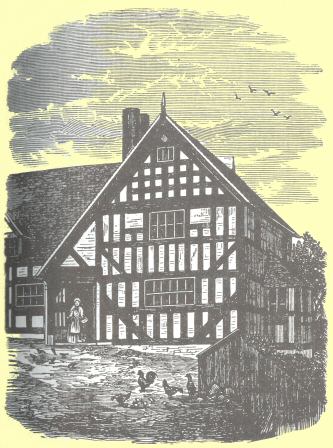
It may therefore be supposed that when the first Abraham Darby
came to the Dale he found works already in existence. Mr.
Smiles says “he took the lease of a little furnace which
had existed at the place for over a century”; and,
fortunately, since his time, the commencement of the 18th
century, (1709), records of the proceedings have been carefully
kept, so that there is little difficulty in tracing the progress
of the art, or in giving prominence to important points which may
serve to mark such progress. On page are enumerated some of these
discoveries, one being the successful use of coal in iron-making,
another the adaptability of iron in bridge making, and a third to
railroads. To these three starting points in the history of
the iron trade was added that of the discovery of puddling by
means of pit coal, by the Craneges; a discovery which preceded
that of Henry Cort by seventeen years. It will be seen also
from what has been already stated, that whilst Richard Reynolds
laid down the first iron rails his son William and the
Coalbrookdale Co. as early as 1800 were engaged upon locomotives to
run on railways.
These stages in the history of the works down to the
commencement of the present century have been enumerated
thus:—
“Abraham Darby. 1707.
Letters patent for a new way of casting iron pots, and other iron
ware, in sand only, without loam or clay.”
“Ditto. 1712. First
successfully superseded the use of charcoal by that of coke in
the blast furnace.”
“Abraham Darby (son of above).
1737. First used coal instead of charcoal for converting
pig iron into bar iron at the forge.”
“Ditto. 1760–63. First
laid down rails of cast iron, with carriages having axles with
fixed wheels.”
“Abraham Darby (the third). The
first iron bridge erected over the Severn in
1777.”
“Richard Reynolds. Letters
patent to Thomas and George Cranage, for a method of puddling,
1766.”
William, son of Richard Reynolds, invented a locomotive, upon
the plans for which the Coalbrookdale Company were engaged in
1800. This was a locomotive for railroads, as
we have shewn on page .
We have also on a previous page spoken of Mr. W. Reynolds as a
chemist, a fact which is borne out by an original letter of James
Watt to his friend William Reynolds, a copy of which, being too
long to insert here, will be given on a subsequent page.
Facts like these, recorded in various publications, added to the
intrinsic merits of the high class productions of the works,
naturally served to give to the establishment in the
Dale a very high position in the trade. To these too were
to be added the high integrity of the proprietors and managers of
the works, a guarantee of which was to be found in the fact that
they were Quakers. In our “History of Broseley”
page 219, we have shewn that the Friends had established
themselves there as early as 1673; that a Meeting house was
erected there in 1692; and that the Darbys, the Roses, the
Reynoldses, the Fords, the Hortons and others were buried there,
prior to the Meeting house at Sunnyside being built. The
fact of a man being a Quaker was a tolerable guarantee of his
being a fair dealer; and the utterance of the name of Darby or
Reynolds was sufficient to command respect.
Speaking of these works at an early stage, Mr. Smiles in his
“Industrial Biography” says:—
“By the exertions and enterprise of the
Darbys, the Coalbrookdale Works had become greatly enlarged,
giving remunerative employment to a large and increasing
population. The firm had extended their operations far
beyond the boundaries of the Dale: they had established foundries
at London, Bristol, and Liverpool, and agencies at Newcastle and
Truro for the disposal of steam-engines and other iron machinery
used in the deep mines of those districts. Watt had not yet
perfected his steam-engine; but there was considerable demand for
pumping-engines of Newcomen’s construction, many of which
were made at the Coalbrookdale Works.”
One of these engines having the date 1747 was seen at Bilston
in 1812. Castings for Watt’s engines also were made here;
but the first use to which the steam-engine itself was put was
the undignified one of pumping the water which had once gone over
the water-wheel back, that it may go over it a second time.
It is not our intention to give a detailed description of the
present productions of the Coalbrookdale Works; modern castings
like those of the Albert Edward bridge, and those high art
ornamental ones of a lighter kind with which the public are
familiar by means of various international exhibitions, afford
sufficient evidence that the firm occupy a position not unworthy
of their ancient renown.
It will be seen from what has been said that the religious no
less than the inventive element seems to have distinguished these
men, who, so far as we have gone were Quakers; but the brothers
Cranege, who anticipated Cort in the discovery of puddling were
Wesleyans. Little seems to be known of these men or of
their families; but Dr. Edward Cranage, of the Old Hall,
Wellington is, we believe, of the same family. Another
descendant of the family writes us to say that—
“George Cranage, one of the patentees, and
Thomas his brother, the other, both married daughters of John
Ward, of Eye Manor Farm, near Leighton; the writer’s
grandfather on his mother’s side. Thomas and his wife
died without issue, but George Cranage who married Ann Ward, left
two sons and five daughters; William, the elder of the sons, was
manager or in some such position at Coalbrookdale, and was
concerned in the construction of the Iron Bridge. From a
small manuscript volume of religious verses and paraphrases
into verse of the Psalms composed by him, and now in my
possession, he appears to have had some taste for
literature. I have his copy of Coke and Moore’s
life of Wesley, and Paradise Lost, the latter
containing his autograph. He was, I have heard, a Wesleyan
of the true type; worshipping at his chapel regularly, but always
communicating at Madeley Parish Church on Sacrament
Sundays. He lived in the house where Mr. Moses now lives,
opposite the church, which house, we believe was built for
him. He died in 1823, one son having died previously.
The following notice appeared in a Shrewsbury paper of his
death:
“Suddenly, at Coalbrookdale, aged 63, Mr. Wm. Cranage, a
man whose truly benevolent nature and friendly disposition
secured him the respect and esteem of all who knew him, and whose
loss as a member of society will be much felt by his
neighbours. In him the poor man recognised a friend, the
world an honest man, and the church a steady and useful
member.”
John the younger, and only other son of George, died in
infancy, while the five daughters all married in Bridgnorth or
the neighbourhood.
Whilst upon the subject of old workmen at the Dale it may be
well here to introduce a notice of the Luccucks, some of whom
were Quakers, but two of whom, Benjamin and Thomas, became
clergymen of the church of England. Benjamin was
apprenticed at Coalport, where he painted a set of china, which
whilst breakfasting with an English prelate he was surprised to
see produced at table. When a lad he was of a daring
disposition. He would lie down, for instance,
between the rails of the Incline Plane and allow the carriage and
a boat with five tons of iron in it to pass over him,
notwithstanding the risk run of being caught and drawn over the
rollers by the hook dangling at the end of the carriage.
The mother of Mr. W. G. Norris, the present manager, and one of
the proprietors, was a Luccock; and other members of the same
family are still employed in the works. The grandfather of
the former was apprenticed to the first Abraham Darby soon after
he came to the Dale. A copy of the indenture or agreement
between the parties may not be without interest at the present
day. It commences thus:
“Abraham Darby and Thomas Luccuck, concluded
and made this 13 day of June, 1714, between Abraham Darby, of the
city of Bristol, Smith, in behalf of himself and rest of his
co-partners in the ironworks of Coalbrookdale, in the County of
Salop, on the one part; and Thomas Luccuck, of the parish of
Norfield, in the County of Worcester, who agrees to serve in the
art and mystery of making or casting of iron pots and kettles,
&c.”
It then proceeds to state that
“Abraham Darby promises to pay the said
Thomas Luccuck the sum of 6s. per week
during the said term of the year. Thomas Luccuck also
covenants not to divulge or make known the mystery of the art of
moulding in sand, tools, or utensils, belonging to the said
works; and that if he divulges he will agree to pay the sum of
£5 for every pot or kettle made by another, &c.,
through him.”
The mystery alluded to, and which it was deemed then so
important not to divulge, was an improvement introduced by one of
the Thomases, an ancestor of the Bristol merchants of that
name, which consisted in the substitution of green sand
for the more expensive and laborious method of using clay and
loam in the manufacture of cast pots. By this means, not
only was the article cheapened, and the number multiplied, but a
more suitable and economical form was obtained; the old one being
now rarely seen, except in museums, or as an antiquated heir-loom
in some remote cottage. One of the old pots with a neat
border has the date 1717. These domestic utensils appear to
have formed the staple manufacture at the time that the first
Abraham Darby removed here from Bristol, in the year 1709.
One member of this old family of Dale workmen lived to the
extraordinary age of 103; and an allusion to the venerable
patriarch may serve to introduce at this stage of our history a
notice of two local circumstances: the extreme age of an old
Coalbrookdale workman of the above name, and the “Great
Land Flood” of the Dale. An account of the latter
appeared in the Philosophical Transactions of the time; but we
prefer following the example of Southey who on an occasion we
remember makes use of an old man’s memory to set forth his
views of certain changes which had taken place; but at the same
time with such toning down as becometh the thoughts of more sober
age. Every village has incidents and events associated with
it, which some old inhabitant is usually privileged to
expound.
Beyond the venerable grey-beards and wrinkled grand-dames
there is the village sage—vested with the dignity of a last
appeal, and whose version of matters local is deemed truthful as
the current coin. Age as a rule commands respect; and
the wider the span that measures intervening space between the
present and the past the greater the esteem. Coalbrookdale
within our recollection boasted, not an octogenarian merely, or
one whose claim to the honour was weakened by that of
half-a-dozen others—but one, the “oldest
inhabitant,” by being a quarter of a century in advance of
the whole of the Coalbrookdale elders. He not only lived to
celebrate the centenary of his natal day but—like a tree
blanched by the storms of ages yet putting forth its leaves
afresh—as showing the stamina that still
remained—cut, at a still riper age his second set of wisdom
teeth. Envy never sought to dim the lustre of his
fame. At local festivals, when, unfettered for the day, the
members of a club with flags and band met in gay summer time, he
was brought to crown the presidential chair. Old
Adam—such was his name—a name truly suggestive of the
past and well fitted for a village sage—old Adam Luccock
was widely known. He was a specimen of archæology in
himself—the solitary link of a patriarchal chain that had
fallen one by one—he the only one remaining. And old
Adam’s cottage—perched upon a rock beneath the
Rotunda, quaint, ancient, and impressed by the storms of passing
time,—odorous from a narrow strip of garden sheltered by a
grey limestone pile, catching the last lingering rays of the
setting sun as it mantled with deep shadow the Dale below, and
flooded with mellow light the uplands of the river’s
western bank—was a counterpart of himself. Like the
little vine that girdled its frail and wattled
walls—tapping with wiry fingers at the diamond leaded
window-panes—old Adam clung to the place long after his
friends began to fear the two would disappear together.
White as were these white-washed walls, Adam’s locks were
whiter, and the accessories of dress and minor details of person
and of place were in perfect keeping. A curious net-work of
wrinkled smiles accompanied the delivery of one of the old
man’s homilies; and amusing enough were the landmarks which
memory set up for giving to each event its place in point of
time. Of red-lettered ever-to-be-remembered occurrences in
the village the more prominent were the phenomena of the
land-slip at the Birches, and the land-flood at the Dale.
We still see the old man drawing slowly from his mouth a long
pipe, still more slowly letting out a wreath of fragrant smoke,
as speaking of the latter he would say:—
“I remember well; it was autumn, the berries
were ripe on the hedge, and fruits were mellow in the field; we
had a funeral that day at Madeley, it was on the 6th of
September, 1801. The air was close. A thin steamy
vapour swam along the valley, and a dense, fog-looking cloud hung
in the sky. The mist spread, and drops like ripe fruit when
you shake a tree came down suddenly. The leaves on every
tree trembled, we could hear them quake; and the cattle hung down
their heads to their fetlocks. The wind blew by fits and
starts in different directions, and waves of cold air succeeded
warm. Dull rushing sounds, sharp crackling thunderclaps
were heard, and streams of fire could be seen—like molten
iron at casting time—running in and out among the
clouds. Up the valley, driving dust and sticks and stones,
came on a roaring wind with pelting rain. Another current
moved in a different direction; they met where the black cloud
stood, and striking it both sides at once, it dropped like a
sponge filled with water, but large as the Wrekin. In a
moment houses and fields and woods were flooded by a deluge, and a
rushing torrent from the hills came driving everything before it
with a roar louder than the great blast or the splash of the
great wheel. Lightnings flashed, thunders roared, and
before the echo of one peal died you heard another—as if it
were the crack of doom. Down came the brooks, the louder
where they met, snapping trees, carrying bridges, stones, and
stacks of wood. Houses were inundated in an instant,
gardens were swept away, and women and children were carried from
windows through the boiling flood. Fiercer came the rush
and higher swelled the stream, forcing the dam of the great pool;
timber snapped like glass, stones were tossed like corks, and
driven against buildings that in turn gave way. Steam then
came hissing up from the furnace as the water neared and sought
entrance to the works. The elements met; it was a battle
for a time; the water driven with great force from behind was
soon brought into contact with the liquid iron, and then came the
climax! Thunders from below answered to those above; water
converted into gas caused one loud terrific explosion that burst
the strongest bars, shattered the stoutest walls, drove back the
furious flood, and filled the air with heated cinders and red-hot
scoria. The horrid lurid light and heat and noise were
dreadful. Many said ‘The day of God’s wrath is
come;’ ‘Let us fly to the rocks and to the
hills.’”
After a pause, and re-lighting his pipe, he added:
“I think I forgot to say it was Sunday, and
that the Darbys were at meeting; the Meeting-house was in
Tea-kettle-row, it was before the neat little chapel at Sunnyside
was built. It was a silent meeting,—outside among the
elements there was noise enough—I mean among the members
there had been no speaking, and if there had they may have heard
plain enough what was going on outside. Well, when the
furnace blew up they broke up and came down to see what was the
matter. They never appear in a hurry, Quakers don’t,
and did not then, though thousands of pounds of their property
were going to rack every minute. ‘Is any one
hurt?’ that was the first question by Miss Darby; she is
now Mrs Rathbone. She was an angel of a woman; indeed,
every one of the Miss Darbys have been. ‘Is there any
one hurt, Adam;’ she said. I said ‘no,
ma’am, there’s nobody hurt, but the
furnace, and blowing mill, the pool dam, and the buildings are
all gone.’ ‘Oh, I am so thankful,’ she
said; ‘never mind the building, so no one’s
hurt’; and they all looked as pleased—if you’ll
believe—as if they had found a new vein of coal in the
Dawley Field, instead of having lost an estate at
Coalbrookdale.”
Old age sat as fittingly on Adam as glory upon the sun, or as
autumnal bloom upon the mellow fruit ripened by the
summer’s heat. Nature, in the old man, had completed
her work, religion had not left him without its blessings; and,
while lingering or waiting, rather, upon the verge of another
world, he liked to live again the active past, and to amuse
himself by talking of scenes with which he had been
associated. He had none of the garrulous tendencies of age;
and when once upon his favourite topic, he was all smiles
immediately.
“We used,” he said, “to bring
the mine for the Dale on pack-horses; and Horsehay being one of
the halting places, was, as I believe, called Horsehay in
consequence. We used, also, to take minerals on horse-back
all the way to Leighton, where there was plenty of wood and
charcoal, and water to blow the bellows. Strings of horses,
the first having a bell to tell of their coming, used to go; they
called them ‘Crickers’—and a very pretty sight
it was to see them winding through upland, wood, and meadow, the
little bells tinkling as they went.”
“Aye, aye, sir,” said our ancient friend,
“Pedlars and pack-horses were the means of locomotion and
the medium of news in my day; and if we travelled, it was in the
four-wheeled covered waggon, over roads with three or four feet
ruts. Lord, sir, I remember, in good old George the
Third’s time, when turnpike gates were first put up, there
was a great outcry against them. Before that, roads
went just where they liked, and there was a blacksmith’s
shop at every corner to repair the damage done in bumping over
the large stones. Why, sir, in this ere Dale, I can
remember when there was no road through it but the
tram-road. The road then was over rocks and along the brow
of the hill—a bridle road only. There never was such
a thing as a one-horse cart seen in the Dale till just before the
road was made to Wellington; and then, as I can remember, the
road was so narrow that every carter carried a mattock to stock
the road wider, in order to pass, if he met another.”
The old man described the construction of those primitive
forerunners of that iron network which now spreads its meshes
over the entire kingdom, one of which, much worn on the one side
by the flange of the wheels is before us. It has a square
hole at the end, for the purpose of being pegged to the
sleeper. Down the steep banks that enclose the Dale
inclined planes were laid with rails of plain oblong pieces of
wood, six feet in length, eight inches in width, and four inches
in depth, and down these, by means of ropes, waggons by their
superior gravity brought up the empty ones to be refilled with
minerals which were conveyed for the use of the works. The
speed was regulated by a brake made to press, not as now upon the
barrel at the top, but upon the wheels of the descending
waggons. The man thus regulating their speed, was the
jigger, and the hill leading from Coalbrookdale to Wellington,
where one of these inclines was situate, became “The
Jigger’s Bank.” (Sometimes called the Jig-house
Bank, because, of a house there.) In addition to this
railway for the purpose of supplying the furnaces, there was
another, by which the furnaces at the top were connected with the
foundry at the centre; and rails, first of wood, and then of
iron, continued for many years to be used, facilitating the
transport of heavy materials from place to place.
On the last occasion on which we saw him we were sent by a
good old aunt, a Quaker lady who loaded us with presents for the
old man, when he had gone to live in “Charity Row,”
as it was called. Speaking upon matters connected with the
history of the Dale—more particularly in reference to the
Darbys and Reynoldses—the old man would grow eloquent; and
the effect of a little present—a basket of strawberries or
a packet of tobacco—had a wonderful effect in stimulating
memory. Nothing was “open sesame,” however,
like a drop of “Barnaby Spruce’s old Beer.” [292] Say you had sent for
half-a-gallon of Spruce’s best October brewing, and he grew
loquacious at once.
“Remember him,” speaking of Richard
Reynolds, he would say, arching his eye-brows, and growing
animated, as recollections of the past came tripping upon the heels
of each other. “I knew him well; all the poor knew
him; the robins and the sparrows knew him, for he would carry
crumbs a hundred miles in his pockets ‘for his
robins.’ He made a vast fortune, and then everybody
knew him; books, and tracts, and newspapers all talked about
him. He was a Quaker—not a thin, withered, crotchety
disciple of George Fox, but a full-fed Quaker, fair and ruddy,
with eyes of blue that gave back the bright azure of the sky and
lighted up a fine and manly face. I see him now—his
light hair flowing in curls beneath his broad brimmed hat upon
his shoulders. He yielded to every man his own, not only as
concerned money, but in demands upon his respect. I have
known him when in a fit of temper he thought he had spoken
harshly or slightingly to any one, follow him home and apologise
for his warmth. He loved everybody and was beloved by
everybody in return. There’s my neighbour, she will
tell you how when she was a child he would run into their shop in
a morning, put half-a-crown into her hand, saying, ‘There,
thee be a good child all day.’ He could not do with
the colliers, though; he built schools for their children, but
the mothers would not let them go unless he would pay them so
much a day for allowing them to attend. They were curious
schoolmasters in my day. Old John Share made nails and kept
a school in the Dale; he was one of the most learned about these
parts for a schoolmaster, but he never would believe that the
earth turned round, because, as he said, the Wrekin was always in
the same place. Then, there was old Carter, the chairmaker,
of Madeley Wood; he always spelt bacon with a ‘k,’ and I
remember him giving Charles Clayton a souce on the side of the
head that sent him reeling, because he insisted upon it that it
should be bacon. The Wrekin, sir, was always an object of
admiration to Mr. Reynolds. He had an arbour made from
which he could see the sun going down behind it (he used to revel
in a good sunset), and with no companion but his pipe was often
used to watch it. Every year he treated his clerks and most
of the members of the Society of Friends to the Wrekin.
Benthall Edge was another favourite resort, and he would revel at
such times in the scene.”
“I could tell you many more anecdotes (the old man
continued) of the Quakers; I mean the Darbys. They all
liked a joke right well; and as for kindness, it seemed as if
they thought it a favour to be allowed to assist you. They
allow me a weekly pension, have done for years, and pay a woman
to wait upon me. They are people that never like to be
done, however.”
“You knew old Solomon, the Sexton. Well he once
went to the haunted house, as they call it, for an Easter
offering. The servants were ordered to attend him, and he
sat for some time and eat and drank, and smoked his
pipe—but not a word was said about Easter dues. He
knocked the ashes out of his third pipe, and feeling muddled a
bit about the head thought it time to be moving. At last
Mr. Darby entered the room, and Solomon made bold to ask for the
Easter offering. ‘Friend,’ said Mr. Darby,
throwing up the sash, and assuming a determined attitude,
‘thou hast had a meat-offering and a drink-offering; thou
hast even had a burnt offering—as I judge from the fumes of
this room, and unless thou choosest to go about thy business,
thou shalt have an heave-offering.’ As Solomon
had no wish to be pitched head-foremost out of the window, you
may imagine (said the old man) that he quickly
disappeared.”
The old village sage, whose venerable form and long white
locks rise before us like some vision of the past—is gone;
he died, as his friends assert, at the advanced age of 107, or,
as his headstone more modestly states (and modesty is not a fault
common with posthumous records) at the age of 103. He died
January 27, 1831, and his gravestone may be seen near the
southwest door of Madeley Church, under the wall; but as the
inscription is near to the grave, being below those of the
Parkers, and that of Samuel Luckock, it will, we fear, be soon
obliterated by the damp acting on the stone.
Among other servants of the Darbys who succeeded each other
and held important positions in the works were the Fords.
Richard married Miss Darby, daughter of Abraham, and was manager
of the works in 1747. He also was a Quaker; and to him
really is due the credit ascribed to Mr. Darby, of the successful
use of coal in iron smelting. In the Philosophical
Transactions for 1747, for instance, the year Mr. Ford was
manager, it is stated that—
“Several attempts have been made to run
iron-ore with pit-coal: he (the Rev. Mr. Mason, Woodwardian
Professor at Cambridge) thinks it has not succeeded anywhere, as
we have had no account of its being practised; but Mr. Ford, of
Coalbrookdale in Shropshire, from iron-ore and coal, both got in the
same dale, makes iron brittle or tough as he pleases, there being
cannon thus cast so soft as to bear turning like
wrought-iron.”
A son or grandson of this Richard Ford was foreman and manager
in the engine department of the works, which flourished greatly
till he resigned his office, nearly half a century since.
The late John Cox Ford was a son, and A. J. Ford, recently of
Madeley, a grandson.
Of later members of the Darby family we may speak in part from
personal knowledge. Like their ancestors, they were members
of the Society of Friends, although not by any means the
straitest of the sect. Whilst adhering to the grand
cardinal doctrine of the Inner Light, they indulged their own
ideas of the extent to which the strict discipline of the body
should control their tastes. They were birth-members, but
lax in their opinions, and did not live by strict Quaker
rule. On one occasion, when a disciple of the old school
got up as was his wont to deliver himself in meeting, one of the
younger and more lax of the members rose and said, “Friend
N—y, it would be more agreeable to this meeting if thou
wouldst sit down.”
Francis Darby, of the White House, had great taste, loved high
art, and filled his rooms with costly paintings, which he felt a
pride in shewing to his friends. Others indulged a
forbidden love of music and luxury, contrary to the faith and
discipline of their fathers, without otherwise breaking through
bounds or committing faults to justify the advocates of the
truest code of Quaker rule to disown them.
Richard Darby, like his brother Francis, did not adhere
to the Quaker style of dress, either in the cut of his coat or
the shape of his hat, the latter being usually a white one of the
most approved fashion. He was a popular public man; one
whose services were sought, and whose sympathies were readily
enlisted in public movements of the day, such as the emancipation
of the slaves, and others relating to questions of civil and
religious progress. His name was well known through the
length and breadth of the borough, and we have seen small farmers
and labourers around the Clee Hills brighten up at the mention of
his name. William Henry and Charles Darby, the sons of
Richard, are proprietors of the Brymbo iron works, and their
sister, Miss Rebecca Darby, who resides at the house her father
lived in, is the only one of the name now living in the Dale.
The late Abraham and Alfred Darby, sons of Edmund, and cousins
of Francis and Richard, were young when their father died.
We have elsewhere said that they became managers of the extensive
and important works of Coalbrookdale, Horsehay, Lighmnoor, and
the Castle, at critical periods of their history, and when, to
maintain their existence, it was essential to do battle with lax
discipline, old customs, and deep-rooted prejudices. They
found men resting on their oars, trusting to the prestige
of a fame won by a former generation, and standing still while
others around them were advancing. They determined to prove
themselves worthy of their predecessors by advancing to the front
of the foremost in the rise. Surrounding themselves by
energetic agents, intelligent operatives, and introducing new modes
of manufacture, they succeeded. With clear views of
political economy, they zealously aided in battering down
barriers to a free exchange of the world’s productions,
which misconceived interest had erected. Penetrated with a
lofty sense of duty, and comprehending their positions rightly,
they pursued the even tenor of their way, sowing seed and
scattering blessings which refreshed and brightened the scenes of
their labours. They worked harmoniously together, in their
studies, in the laboratory, in their works, and at their books,
making themselves acquainted with every detail and minutiæ
of their great undertakings. Order and regularity
everywhere were observable, others under them being embued with
the spirit of their employers. The church on the hill side,
and its sweet and silvery bells as their music floats along the
valley and over the wooded boundaries of the Dale, tell of their
large-hearted benevolence and open handed munificence, and that
of their sister, Miss Mary Darby, and their mother, Mrs. Lucy
Darby.
Abraham, the elder, married his cousin, Miss Darby, daughter
of Francis Darby, on the 8th of August, 1839, on which occasion a
kindly demonstration was made, and 1,000 work-people dined at his
expense. He removed from the Dale to Stoke Court, near
Slough; and afterwards to South Wales, to be near the extensive
works of Ebbw Vale, which he, and some of his partners, purchased
for the sum of £360,000. He died, was brought to the
Dale and buried in the cemetery of the church which he chiefly
had built and endowed, amid deep demonstrations of feeling on
the part of thousands of spectators.
Alfred, the younger brother, married Miss Christy, sister to
the well-known collector of pre-historic relics of man in an
uncivilized state, with which he stored his mansion at
Westminster, and afterwards bequeathed to the British
Museum. Alfred died in the golden meridian of age and
usefulness, and his loss was deeply felt by all who knew
him. He left issue, and his son Alfred, of Ness, to which
place his mother removed from Stanley Hall, is a magistrate, and
is now old enough to discharge the duties of a country
gentleman.
Of other partners in the works we may mention Mr. Henry
Dickinson, who married a sister of Abraham and Alfred Darby, for
some years chairman of the Shropshire Banking Company, and who in
a most distinguished and disinterested way lent (but on such
terms as amounted to a gift) the princely sum of £100,000
at a critical period of its existence, to save it from falling,
and numbers dependent upon it from ruin. But for extending
our remarks too far, we might say something of men like Mr.
Thomas Graham, a former cashier in the works, of Mr. William
Norris, who succeeded him in that office; men useful in their day
and generation, being foremost in good works and words, as many
now living will remember. For the same reason we refrain
from speaking of the late Mr. C. Crookes, formerly the
enterprising manager of these works; and of the gentleman who has
succeeded him, and is himself a proprietor of these extensive
works, and in the commission of the peace for the borough.
For similar reasons, but much more because of the difficulty of
rightly discriminating and equally awarding a just meed of praise
where so much is due, we find ourselves prevented from speaking
of many trustworthy and clever men now engaged in various
departments of these important works, whose names occur to our
minds, but whose merits we commend not less heartily to some
future local historian, for whose labours the present work will,
we flatter ourselves, smooth the way.
It would be unpardonable not to say something here of the
means of education and mental culture provided by the proprietors
of the Coalbrookdale works for their workpeople. Before the
present system of national education was established, and whilst
hostile sects and parties were indulging in bitter feuds [300] as to the kind of education to be
given, this Company under the direction of Abraham and Alfred
Darby in the most noble and generous way came forward and at
great cost erected roomy and capacious Schools here and at
Horsehay, with every convenience and appliance possible to
further education.
We purpose speaking of education, with respect to the
schools, in connection with others at Madeley, Ironbridge, and
Madeley Wood; and will only add here a word or two on the subject
of other and more advanced institutions provided for the use of
the men and inhabitants generally of the Dale. First and
foremost amongst them comes, of course, the Literary and
Scientific Institute, with its library, its reading room, its
school of art, its high class lectures and entertainments, so
judiciously arranged and carried on under the management of Mr.
E. L. Squire, Hon. Secretary, and Mr. Isaac Dunbar, the
librarian. The School of Art too, of which Mr. Squires is
also Hon. Secretary, and Mr. Gibbons master, is admirably adapted
for developing and furthering a taste for drawing and decoration,
so essential among artizans engaged in the more ornamental and
decorative portions of the company’s productions. Nor
are the benefits of this admirable institution limited either to
the works or to the Dale: the day classes are attended by ladies
of the neighbourhood, desirous of pursuing an æsthetic
course of study, and who, following the examples of ladies whose
works merit such high approval in the Art Galleries of London and
Paris, have really achieved great success in painting birds,
flowers, and figures, in enamel colours, on plaques, tazzas,
&c., both for use and for drawing room decoration.
Nor must we omit, whilst on the subject of this institution,
to mention the splendid collection of British and foreign birds
lent by Mrs. Alfred Darby, which have adorned the lecture room
for so many years; or the very fine collection of coal-measure
fossils, which the late Dean Buckland pronounced in his time the finest
private collection of the kind in England, and so liberally given
by the late John Anstice, Esq.
Recently a “British Workman” has been added to
other institutions, at the room formerly occupied as a British
School, under the patronage of Mrs. Norris, who is ever active in
promoting similar works, and the present incumbent, the Rev. H.
S. Wood, who, it is only justice to say, spares no pains to make
himself useful to the inhabitants of the Dale.
Under the management of Mr. John Fox the clay-works of the
Coalbrookdale Company have become so expanded and improved, that
they now form an important department of the Company’s
undertakings, and are at the present juncture, no doubt, among
the more profitable of their industries. Since sanitary
science has so successfully called public attention to the
importance of the use of good bricks impervious to damp, the
productions from these excellent coal-measure clays have been
more in demand. Clays, as commonly understood, mean earth
of sufficient ductility to allow of being kneaded into some
useful shape or form, and rank as raw materials. Some are
soft, others are indurated, or hard and rocky; but all have in
one sense been prepared by certain poundings, grindings,
washings, and mixings, carried on by Nature on a larger scale
than that on which they are now still further fitted for
use. They differ in quality, in degree of fineness, and in
colour,
and show certain relationships by which it is clear that they are
descended from sand, just as sands are descended from a hardy
race of pebbles, which in turn bear close relationship to rocks,
from which undoubtedly they have been derived. Surface
clays used for making inferior bricks and tiles, whose earthy
odour gives evidence of alumina, are generally derived from red
sandstone rocks, ground down into mud by the machinery of waves
or streams whilst our deeper coal-measures clunches, and clays
were originally the sediment thrown by rivers at their
embouchures into inland lakes or seas, and are usually much more
free from lime, iron, grit, and other foreign substances and
impurities.
When brought to the surface, these clays are hard as a
rock. Formerly they were allowed to lie during the winter
to weather, as it is called; and a statute now obsolete required,
under a heavy penalty, that bricks should not be made unless the
clay for making them had been turned over at intervals, three
times at least before the first of March. But brickmakers,
not having patience to wait for the action of the weather, have
invented machinery to do the work, and the clay is taken direct
from the pit to be crushed by iron rollers, and then conveyed by
coarse canvas-screens to tanks to be moistened, and afterwards to
the pug mill. This is an upright cylinder, with a revolving
vertical shaft, fitted up with horizontal knives following each
other at an angle so as to cut, amalgamate, and temper the
material, and which also acts as a screw to deliver it.
Ornamental bricks of elaborate design for architectural purposes require more delicate
manipulation, and the clays for these undergo a more careful
preparation. Machines in some instances are used, which
take the clay, temper, thoroughly amalgamate it, and convert it
into the finished article, and at the brick-yards of the
Coalbrookdale Company presses have been erected by which bricks
may be stamped at once from the semi-dry clay.
This company, too, have been at great pains to turn their
clays to account by copying the Italian and Lombard style of
making bricks of various forms and colours; and the buildings
erected with these bricks, and others, with white facings of the
same material, of which the present Literary and Scientific
Institute is an example, possess great architectural
beauty. Still further examples of the æsthetic
treatment of these admirable clays were made a short time ago by
Monsieur Kremer, who modelled and prepared at the company’s
Lightmoor clay works, in relief, and on a large scale, an
historical subject, connected with Scottish history in the time
of King James, as a facade for a house in London; also some noble
groups, life size, of figures representing the four seasons, for
a gentleman’s grounds and park near London. The
reader may judge of the adaptability of these clays for such
purposes by inspecting a group of a similar kind in front of the
Institute.
We exhibited ourselves in 1851 specimens of these and other
coal-measure clays, with articles manufactured from them on both
sides the river, and we had the satisfaction of hearing from
distinguished judges, familiar with their merits, such as
presidents of foreign Academics of Science, speak of them as
superior to any they had ever seen. [306]
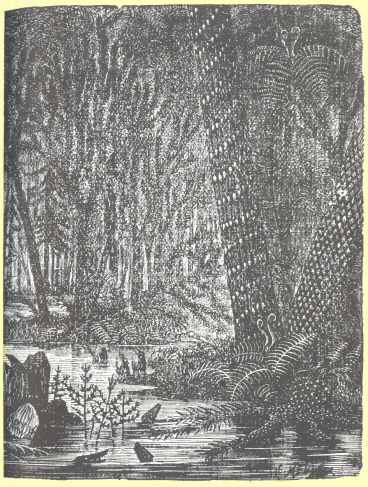
The works of the company in the Dale, at Lightmoor, Horsehay,
the Castle, and other parts of Dawley, are so intimately
connected and so entirely dependent upon the mineral resources of
the district, that some further notice is needed to complete this
stretch. We said at the commencement that neither iron nor
coal were found here, but in the quotation from the Philosophical
Transactions it is stated that Mr. Ford made iron either hard or
soft from ore and coal got in the dale; and it may perhaps
without being considered a sketch of language be said that the
opening into the Lightmoor valley, where coals were undoubtedly
worked at an early period, is a northern lip or extension of the
Dale itself. Indeed the whole of the rich mineral tract
extending from Broseley to the extreme limits of the Lilleshall
Company’s works, some seven miles in length, and
terminating in a Symon Fault on the south-east of Madeley parish,
about four miles in breadth, is universally known as the
Coalbrookdale Coalfield; but the Dale proper is a hollow scooped
out of soft Silurian shale, which shews itself at the railway
station, by the viaduct, on the road to Lightmoor, and in various other
places. Here two great faults or rents in the coalfield
meet; one coming down from the Dunge at Broseley, and the other
from the direction of Lilleshall, causing a difference of level
varying from fifty to seven hundred feet. The coal-measures
approach the northern extremity of the Dale on three sides,
forming a fringe which rises from a few feet above the Dale to
three hundred feet above the Severn at Ironbridge, and to over
seven hundred feet at the highest points. It was this
outside fringe of lower coals which tempted early miners, who by
means of levels in the hill sides got their “Smith’s
Coal,” leaving others, which they did not then need for
house fuel. Interesting instances of the outcrops of these
coals are to be seen at the surface on high grounds overlooking
the Dale, also on the side of the railway opposite to Black Rock
quarry, where an instructive section of the Best, Middle, and
Clod Coals are visible, with a slight fault displacing
them. They crop out on the side of the Lincoln Hill walks;
and on sinking a trial pit at Castle Green near there, many years
ago, it was found that the Middle and Clod coals had been
removed, and the space filled up with gob. The upper coals
here, and also the pennystone, as at the Lodge Pit, remained; but
at the latter the clod coal, the best coal for iron-making
purposes, was removed, and the space filled up with refuse.
When quarrying stone at the Black Rock, on the right hand side
of the tramroad leading to Lightmoor, for the purpose of
constructing the viaduct for the Wellington and Severn Junction
Railroad, an interesting discovery was made of a number of fossil
trees. Some were still clinging to the soil from which they
originally derived their nourishment, as here shewn, somewhat
imperfectly, by the accompanying engraving. One was twelve
feet in circumference at the point at which the roots, which were
eight in number, and two feet ten inches in their thickest part,
diverged and spread, at a distance of eighteen inches from the
trunk, and divided into two, and at a distance of four feet
dipped into ground. The tree appeared to have been buried
in mud before decay commenced, and to that circumstance was due
probably its preservation from further decay, portions of trunks
and branches were strewed around. We obtained a photograph
and forwarded it to the Illustrated London News, in which paper
an engraving appeared at the time. It was, we believe, a
sigillaria, but was smooth, and shewed few of the marks common to
the genus, such as appear on the accompanying enlarged section of
the upper part of trees of a like kind. The roots also were
smooth as far as exposed. The rock in which the roots were
embedded was the Crawstone crust, and the sandrock which
surrounded it was highly charged with oil or petroleum, derived
from the vegetation which had produced the seam of coal, (the
little flint coal) above, or from the decaying trees and branches
of trees which now lie prostrate, and are embedded in the rock
itself. There is one of considerable size at the time we
write, five feet of which is exposed to view, the other part is
obscured by the rock; and at the upper end where it enters the
rock is a soft brown substance, about an inch thick, with
impressions of the woody fibre of the tree itself. It is
just that kind of fleshy substance one would suppose to belong to
such trees, and one can scarcely resist the impression that it is
the bark. Examined by the lens it appears to be thickly
studded with small white crystals, strewed about.
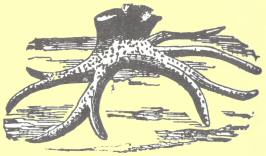
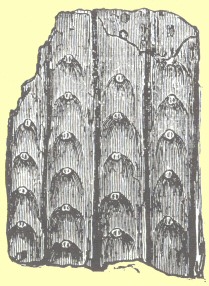
Interlacing each other are Calamites, the giant
representatives of our mares-tail which still flourishes near in
damp places on the surface. The following representation
will afford an idea of the gigantic proportions they then
attained. They are to be found at all stages of growth;
sometimes with their central pith, surrounded by a ligneous
cylinder, divided by medullary rays, and having a thick
bark. These reed-like plants were of course suited to the
moist condition then prevailing, and assumed magnificent
proportions.
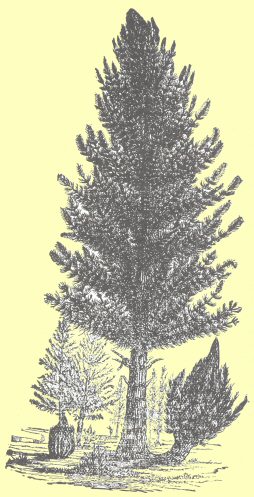
The
following is the section as it now appears, commencing at the
surface and taking the measures in a descending order.
Below the turf,—
|
|
ft.
|
in.
|
1
|
Yellow clay
|
4
|
0
|
2
|
Coal Smut; (might represent Sill, coal)
|
1
|
0
|
3
|
Clunch
|
1
|
0
|
4
|
Vigor coal
|
0
|
10
|
5
|
Ganey coal rock (shale)
|
1
|
0
|
6
|
Ganey coal
|
1
|
3
|
7
|
Linseed earth (A brown soapy kind of clay)
|
1
|
0
|
8
|
Best coal and middle coal (These are separated by a
parting which diminishes from 10 inches on the west to 2 in. on
the east.)
|
2
|
0
|
9
|
Fine clunch
|
1
|
0
|
10
|
Clod coal
|
2
|
0
|
11
|
Clunch with roots and plants, and nodules of ironstone at
bottom
|
5
|
0
|
12
|
Little flint coal
|
2
|
0
|
13
|
Little flint rock (with prostratetrees and petroleum)
|
27
|
0
|
14
|
Crawstone crust, with upright trees and roots
embedded.
|
|
|
|
Total
|
49
|
11
|
Beds of underclay so invariably accompany seams of coal that
some have come to the conclusion that there was no exception to
the rule. Here however is one, in the case of the Little
Flint coal, which lies immediately upon a sand rock.
Evidently it was not formed like peat from vegetation which grew
and accumulated on the spot. There is no underclay to
support the roots of ordinary coal-measure plants, but the coal
follows closely the contour of the rock on which it lies; as
though it had flowed over it and had been laid down upon it like
a sheet of bituminous matter. And there is not the least
doubt but that this was the case. Sigillarias,
Lepidodendrons, Calamites, and tree-ferns flourished on the slime
now hardened into shale, and which shows sun-cracks, and
worm-burrowings, indicative of the then surface, with tracks of
locomotive mullusca, as they dragged their shells along the soft
impressionable slime. Heavy tropical rains then falling
upon some upraised and exposed Caradoc or perhaps Millstone grit
lands, the latter scarcely yet consolidated, brought down and
held in suspension a quantity of sand which, as it settled down,
formed a bed varying from three to thirty feet in
thickness. The body of water which contained so much sand
must, of course, have been much greater, and would probably cover
the whole of the vegetation. The result was that the lower
parts of the largest trees which were buried first were preserved
in situ. The upper parts toppled over and lay embedded in
the sand, as we find them. In both cases the vegetable
matter decayed and was replaced atom by atom with fine sand; but
the vegetable tissues, oil, and seeds, being lightest, rose above
the sand, forming a pulpy bituminous plastic bed, which first
fermented, and then crystalized into coal. Even the little
disc-like seeds of the sigillaria, which make up a considerable
portion of the coal, and which floated with other matter, lie
flat and parallel with the lamina of the coal itself.
Nor is this the only instance of the kind. The Top coal
of Halesfield and Kemberton shews signs of liquefaction; portions
of fish, such as teeth, bones, and scales being embedded in the
coal.
We
ought to add in connection with the Black Rock section that the
five feet of clunch over the Little Flint Coal is the underclay
for the Clod Coal, and is full of roots and rootlets.
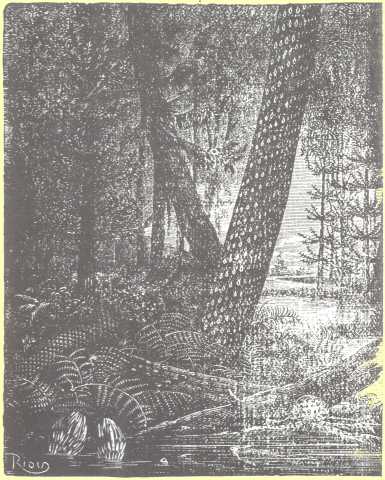
The
descent from the Crawstone crust to the Silurian shale of the
Dale cannot be traced. As passed through at the Limestone
pit at Lincoln Hill, it was as follows:—
|
|
Ft.
|
In.
|
1.
|
Crawstone Measure Crust
|
1
|
8
|
2.
|
Rock
|
10
|
6
|
3.
|
Coal Smut
|
0
|
9
|
4.
|
Clunch with balls of Sandstone
|
12
|
0
|
5.
|
Lancashire Ladies’ Coal
|
0
|
6
|
6.
|
Strong Clunch with Sandstone balls
|
19
|
0
|
7.
|
Sandstone Rock
|
10
|
6
|
8.
|
Chalkstone
|
12
|
0
|
9.
|
Limestone (Silurian)
|
28
|
6
|
Total
|
95
|
5
|
This then may be considered a fair representation of the
remainder of the measures which occur below those seen on the
surface at the Black Rock Quarry; but the passage from the
carboniferous to the Silurian formations is no where
conformable, and no mention is made of the Millstone grit, a
portion of which certainly intervenes, and which is to be seen in
small patches near, but which might possibly be represented by
the three or four last measures in the section of the Lincoln
Hill Limestone Shaft.
Excellent opportunities occur in this immediate neighbourhood
of studying the junction of the Silurian and Carboniferous
formations, and of the evidences afforded of the denudation of
the one prior to the formation of the other. To the general
reader these words may convey little meaning, but the scientific
student who studies the evidences here made clear cannot fail to
comprehend the fact that he has before him not only an old
sea-bed, rich in relics of the fauna which inhabited its waters,
but a sea-bed which had become a cliff, and had in turn been
gradually cut down and wasted during successive ages prior to
that at which a carboniferous flora had begun to flourish.
Two series of rocks are here in juxtaposition, yet so widely
separated by time, as to indicate a gap in the consecutive
history of the earth as great as if we were to blot out the
intermediate history of this country from the close of the
Heptarchy to the reign of George III.; only that the period of
time in the latter case would bear no manner of comparison with
the former. If we suppose the Wenlock limestone to have
been once covered at these points by the Ludlow limestone, and
this again by the old red sandstone—as is the case to the
south, to say nothing of the carboniferous limestone and
millstone grit, we are forced to the conclusion that thousands of
vertical feet, and hundreds of cubic miles of solid ground were
first piled up and then cut down and carried away by the
sea. Creation itself in the interval of their formation
passed through many phases, during which new species came slowly
into being and disappeared, and were again replaced by
others. To fill up the gap that succeeds this great
silurian flooring of the coal-measures, to study the intermediate
links of the missing strata we must go to the millstone grit in
its undenuded or partially denuded state, as it occurs beneath
the coal-measures of Little Wenlock, or at the bend of the road,
called “The Turn,” in going from Coalbrookdale to
Wellington.
The first thing striking the attention is a buff coloured
shale, weathered on the surface to clay, at the base of
the bold bluff cliff of gritty sandstone so conspicuous on the
brow of the hill. Whilst examining this member of the
Silurian series a man from a neighbouring cottage remarked,
“That is fuller’s earth; persons fetch it when they
are galled, and it is good for the eyes; large quantities are
fetched away and sent to Manchester.”
The fossils it contains show that it belongs to the lowest
member of the Ludlow group, and that the whole of the Aymestry
and Upper Ludlow have been stripped off and washed away before
either the millstone grit or the coal-measures were formed.
Among the fossils yielded by this shale, in addition to
bivalves and corals, are those interesting forms of crustaceans
called pen fossils, from their resemblance to a quill pen.
The species we found was Graptolithus priodon, described in the
early works of Murchison as Graptolithus Ludensis. The
trilobites, from the fineness of the material, are so sharply and
beautifully preserved that the visual organs of the little
creatures are clearly discernible, even to the optical tubes,
elongated cones, or crystaline lens such as are to be seen so
marvellously distinct on the eyes of the dragon-fly of the
present day. The beautiful markings too on the shield of
these wondrous little creatures which flourished in these seas,
in such numbers that they may be got out in groups—forms
which died out and perished before the close of the carboniferous
formation represented above it—are so delicate and fine as
to equal if not to defy imitation in ordinary materials in use at
the Dale Works; and it is we fancy at least worth the experiment
whether with this shale reduced to powder it might not be made to produce
delicate impressions after the example here set by nature.
We also found here some beautiful Lingula, a Patella, an
Orbicula, a Leptæna, a Lituites, a Fienestella, and other
fossils. To inhabitants of the Dale, here is a field of
research open which they may make their own, close to their own
doors.
This fine earth is known by various names where it occurs in
Shropshire and the adjoining county of Herefordshire. In
the latter county it is said to be used by country people for
cleansing purposes, in which case it is called
“Walker’s earth or soap.”
If the reader will follow this soft soapy shale, as we did,
higher up into the coppice, he will find large masses of rock
which have been toppled over through the shale giving way.
A slip on the side of the narrow path discloses a bed of it, and
immediately above it, consequent upon a former slip, we come upon
a sandstone rock from twelve to fourteen feet thick, with quartz
pebbles, representing the millstone-grit. Then a bed of
black shale occurs, about six inches thick, which is chiefly made
up of coal-plants, some of which are converted into
charcoal. These plants do not appear to have grown on the
spot, but to have been drifted into their present position.
They were evidently in a soft and yielding state, some of them being
pressed quite flat. [318] One good
sized slab opened with a cast of a Lepidodendron, and we met with
another cast, clearly of the same tree, a short distance west of
it. Another, a Sigillaria, was much more distinct, the leaf
scars being quite sharp, and the fibres of the inner bark very
clear. This interesting band of coal shale is succeeded by
another of yellowish clay, of about equal thickness; and these
are followed by a second and a third band of black shale, with
alternate ones of yellowish clay. Above these are thick
sandstone rocks, some white, and some coloured red by iron, which
here and there occurs in the form of hematite.
The whole of these rocks, from the surface to the soft Lower
Ludlow shale here described would better represent the series of
connecting links conducting us down from the Crawstone Crust at
the Black Rock Quarry than any shaft section we could find
described, and the whole may properly be classified as Millstone
grit, which is known to attain a thickness of 80 feet in this
locality, and to increase to 120 and 150 at a short distance from
here, whilst in Derbyshire it thickens to 350 feet, and elsewhere
to a maximum of 1,000 feet, and includes, as here, shales and
thin coals. Colliers recognise the ironstone which crops
out here as the Poor Robin of the Dawley Deep field pit, which
occurs 60 feet below the Little Flint Coal; which affords another
key to the series of measures which underlie the same coal at the
Black Rock Quarry. The Poor Robin however here described
must not be confounded with the one of the same name in south
Staffordshire, which occurs higher up in the series.
We have given a few, and those the lower coals only, such as
are found in the vicinity of Coalbrookdale; it would require more
space than we can devote to it to enter upon a description of the
measures occurring higher up in the series, in what is called the
Coalbrookdale Coalfield. The ideal representation given of
coal producing plants at the head of this article and in
subsequent pages, and the one given p. , will convey a tolerable idea of
the surface as it occurs to the minds of geologists during
successive periods of the coal formation, and upon which we
purpose offering some remarks, condensed and as brief as is
consistent with a due explanation of the circumstances. We
have already spoken of the oil which exudes from the rock
described. It is the same which oozed from a similar rock
at the “Tar Tunnel” at Coalport, at the rate, it is
said, of 1,000 barrels per week. We extract from it naptha,
rectified naptha, gas to illumine our houses, and those
magnificent colours derived from the sun’s rays when the
earth was young and green, mauve, magenta and a hundred medium
tints.
Coal itself rarely contains well preserved specimens of
plants, but Sporangia (Flemingites gracilis) may be found
in the Lancashire Ladies’, the Flint coal, and most if not
all others, the tough little seed cases having resisted the
effects of fermentation and crystallization, which destroyed the
cellular tissues of plants, but which may sometimes be seen in a
carbonised state. If the reader will be at the trouble to
split open a piece of coal where he finds brown streaks at the
edge, he may detect with the naked eye thousands of little discs
clustered and heaped together so thick as to constitute one third
at least of the coal; and if he applies a lens he will find some
open, with bright amber coloured matter inside; and others closed
and imbricated. We have found them in all the coals we have
yet examined. Let any one doubtful of the vegetable origin
of coal take a bass burnt white from the grate, tap it on the
edge, and he will find between the laminated plates numerous
impressions of plants. Lindley and Hutton, from experiments
instituted by them, state that plants such as are represented on
pages and , were peculiarly adapted for
preservation under water.
Many hundreds of species of plants have been made out, two
thirds being ferns. Very beautiful and clear impressions of
the accompanying one, Alethopteris lonchitica, or true fern, are
obtained, the finest impressions being generally in the
Ballstone. It was in fact the great age of ferns: as many
as 250 having been described, according to form, structure,
&c. Thus, we get:—Asterophyllites (star leaf
fern), Cyclopteris (round fern) chiefly in the Ballstone,
Caulopteris (star fern); Sphenopteris (wedge shape fern); also
Newropteris, or nerved winged fern, which are given on the two
following pages:—
Many
bear strong resemblances at a first glance to others cultivated
in our greenhouses, or growing wild in their favourite habitats,
and some approximate so closely to living forms as to make it a
question whether they should be classified with different genera
or not. The number is remarkable, considering that not more
than sixty distinct species are at present indigenous to
Europe. The tree ferns of modern horticultural gardens,
with their scar-marked trunks and branching fronds, like those
from the Mauritius, Brazil, and the Isle of Bourbon, convey
tolerable ideas of those of the coal-measure period. We
have already spoken of the mare’s-tail of antediluvian
times; it is seen in the full page representation, with its glorious
head towering high, and the young shoots peering above the
slime. Deep in the forest is a species sending forth silky
streamers; and prostrate is a species of Lepidodendron, or scaly
tree, with branches feathered to the end and bearing cones as
scaly as the tree. Others also shoot out their leaves; the
Ulodendron staggers beneath its large arm-bearing cones, whilst
the seal-impressioned Sigillaria towers high and overtops the
whole with its noble crown of foliage. The roots of the
latter lie by thousands on our coal-banks, showing distinctly
whence the smaller fibres started; some are still connected,
being protected by a matrix that formed the sandy soil in which
they grew. Water-reeds and forest trees, green parasitic
plants, ribbed and jointed, sending forth long-entangling feelers, must
have woven a mantle of vegetation rank, matted, and dense in
shadow, over the marshy platform where reptiles lurked at
intervals. Of the inhabitants of those newly-formed forest
lands, scorpions, beetles, flies, and a few reptiles, are all
that have yet been found among the relics of the Shropshire
coalfields. Saving the buzzing of a beetle and the whirring
flight of a scorpion, the shaking of great fronds and fruits, and
the sighings of the forest as hot breezes shook the giant pines
and rung the pendant catkins, or the sudden splash of some
strange fish seizing upon its prey, no sounds were heard.
Unlike our woods and copses, all was silence: no songs of birds,
no carolling of larks, no warbling of thrushes, no lowing of
cattle, no bleating of sheep, and no human voice to break the
stillness.
There were inequalities of surface then as now. The
country had its uplands and its valleys, its rivers and its
lakes, its dry and damp soils, its cool and sunny spots, but with
one general genial climate reigning over all.
We have said on page that
Mr. Cranege lived in the house Mr. Moses now lives in. It
should have been, where Mr. W. Hughes now lives, opposite the
Wesleyan chapel.
In mentioning this chapel we might add that the Rev. John
Fletcher assisted in its erection, working and carrying stones
like another man, with his coat off.
The lease for the ground was obtained by John Share from Mr.
Reynolds. Mr. Reynolds told Share he might make out the
lease for 99 years. Share made it out for 99 years and
added “and one year more.” Mr. Reynolds said
“Share thou art deep, but I’ll sign it.”
The lease has recently expired and the building has been handed
over to the Conference.
Ironbridge is a part of Madeley which, like Coalbrookdale, has
risen to an independent ecclesiastical division, and its church
now enjoys the unmerged rectorial tithes, valued at about
£115 yearly, which formerly belonged to the mother
church. In other respects also it enjoys privileges which
formerly belonged to Madeley proper, such as markets and
fairs. When the grants of these privileges were made, and
indeed for centuries afterwards, the slopes now covered with
houses, and the streets which show a busy population, not only
had no existence but the germs, even, which were to call them
forth did not exist. The Fox had not become the object of
sport it now is, but reared its young undisturbed in holes and
burrowings on the hill side which bears its name; and the Brock
or Badger shared with its brother burrower undisturbed dominion
along the face of the same slope. There was indeed higher
sport just then on this side of the Severn. Madeley-Wood
was in reality what its name implied. It stretched its
green unbroken mantle in front of the river from Coalbrookdale to
the Lees or Lay, where the young wood was beat down and an open
space kept for grazing. [325] It
then followed the declivity where Madeley-Wood Hall now stands, and
swept round the high ground of the Haye, where it joined on to
Sutton-Wood, which continued a wood till a century or three
quarters of a century ago. The Hay, opposite and on a level
with the Lay, was another clearing, but one fenced round, into
which deer or swine were driven. They could not well be
hunted along the rough ground on the slope, but men with dogs
rose early and drove them to the enclosures. High up at
Lincoln Hill is Lodge Farm, formerly the keeper’s, or the
Hunting Lodge—
“Where with
puffed cheek the belted hunter blew his wreathed bugle
horn.”
Any one who examines the building for himself will at once see
that it was erected for some very different purpose than that to
which it has been devoted of late years. On approaching it
you find substantially built old stables covered by thick heavy
tiles, and an ancient barn, with thick walls and heavy
timber. The house is of stone, and the windows appear to be
of the same date and style as those at the Court. On going
inside and ascending by winding stairs to what is called the
watch-tower, you find four projections, at the extremity of each
of which was a circular opening for a look-out; and beams inside,
which are supposed to have formed seats for the watchmen or
warders. These are now stopped up, and one, which is said
to have had a date is also plastered over. The view would
embrace the forest to the point where it united with that of
Sutton in one direction, to the Severn in another, the country in
the direction of Madeley in a third, and fourthly that
reaching beyond Leighton to beyond the Breidden Hills, as you see
over the high ground of Lincoln Hill. The thick oak doors
and their middle age hinges shew that it has been intended as a
place of some strength. The distance from the Park, the
Rough Park, and the Court House, render it probable that it was
erected for the protection of the forest in this direction.
And if its walls could speak they might tell of the visits of
many a noble steward or forest-ranger, who whilst hunting the
wild boar or stag, here rested and hung up his spear and horn,
and received refreshment. Dukes in his Antiquities says
that when many of the tenures dependent upon the forest grew
useless and obsolete, the king appointed stewards and rangers to
take care of the deer. Drayton has thus described these
forest-keepers:
“I am clad in youthful green, I other
colours scorn,
My silken bauldrick bears my bugle or my horn,
Which, setting to my lips, I wind so loud and shrill,
As makes the echoes shout from every neighbouring hill;
My dog-hook at my belt, to which my thong is tied,
My sheaf of arrows by, my wood-knife by my side,
My cross-bow in my hand, my gaffle on my rack,
To bend it when I please, or if I list to slack;
My hound when in my thong, I, by the woodman’s art,
Forecast where I may lodge the goodly hie-palm’d
hart.”
Drayton then describes how by the loftiest head he chooses his
deer, unherds him from the rest, and either hunts him down with
dogs, or stalks it underneath his horse to strike or take
alive.
Hawking too must have been a favourite sport among the
gentle-born long after this Lodge was built.
 The Peregrene falcon, the Gerfalcon, and the Goshawk were
used (of the former we give a representation) as well as dogs,
and King John’s Forest Charter allowed all freemen the
privilege of using them. One old writer says “every
degree had its peculiar hawk, from the emperor down to the
holy-water clerk.” This probably applied to
river-hawking, pond-hawking and field-hawking. At any rate
in 1267, the then rector of Madeley, Richard de Castillon, found
it necessary to obtain from Henry III., then at Shrewsbury, a
license “to hunt in the Royal Forest of Madeley,”
then reaching to the Severn; and in 1283 we find the
rector’s superior, the Prior of Wenlock, obtaining
permission to have a park there; to fence out a portion of the
forest, and to have a Haia (Hay) for his deer. The Prior
had no doubt by this time learnt a lesson, for he had been fined
in the heavy sum £126 13s. 4d. in 1250 for three trespasses
within the forest; and again in 1259, as shewn p. , he was again fined £100 for
building houses within the forest boundary, and ordered to pull
them down; but having the following year paid another £100,
a grant was made that he and convent may have their houses in
peace. The first perambulation of Edward the I.’s
time shews that “the Vill. of Madeleye, with its bosc
(wood) and two plains,” with “the bosc of Little
Caldebroc” were disaforested, and so freed from the severe
forest laws of the period. And again, the final
perambulation of 1300 in speaking of the jurisdiction abandoned,
again mentions Madeley, Capsi, and Caldebrok. Where Capsi
was, and to what place the name applied is a puzzle.
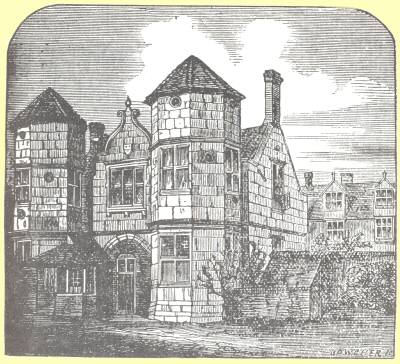
Capsi or Capsey is still the surname of families in
Wellington, and it is the christian name of a man in Bridgnorth,
Capsey, Cristie or Cristey. It is mentioned after Madeley
and before Coalbrookdale; might it not have been what is now
called the Castle, and Castle Green. This seems probable
enough, as there are no traces or traditions of anything
approaching to a castle having existed there since the
Conquest.
In a survey of the Lordship of Madeley in 1772, we find no
mention of Capsi; but we do of Conygray, Dove House Meadow, Doer
close, &c. The lords of the manor after the woods were
disaforested succeeded to all absolute authority to hunt, course,
hawk, fish, and fowl; and to authority to grant power to others
at their will and pleasure to do the same. Before
altogether quitting this forest it may be well to notice a
circumstance which goes to illustrate what we sometimes hear of
places of sanctuary in former times. There were poachers
then as now; and at the forest assizes in 1209 it is stated that
two men, named Hugh le Scot, and Roger de Welinton had taken a
doe. Hugh took refuge in a church, and lived a month there;
but admitted to the Foresters and Verderers his guilt. He
escaped at last, having disguised himself in woman’s
clothes; and both were then declared fugitives. In 1235,
the bosc of Madeley, with those of Kemberton, Sutton, Stirchley,
and Dawley were said to be in the Bailiwick, of Wombridge:
subject to officers such as Foresters, Verderers, or Stewards
there. It is not improbable therefore that the chief
officer of Wombridge may have had a Lodge where we find
one. It might have been one of the houses which the Wenlock
Prior had built, and which he was only permitted to retain by
payment of £100 fine to the king; or again, it might have
been built by him when, as Dukes says, he obtained leave of
Edward I., in the 11th year of his reign, to “convert
Madeley-Wood, within the perlieu of the forest of Mount
Gilbert,” as the Wrekin then was called in honour of a monk
resident there, into a park.
Any way, if the reader compares the styles of architecture and
the materials of which this Lodge and the Gateway or Lodge of the
Court are built he will find strong reasons for coming to the
conclusion that the latter are from the same quarry, and that the
former also correspond. Both have unglazed circular
openings at the top; but the one is covered with heavy shelly
limestone slabs, and the other with thick old fashioned
tiles. The windows of the Madeley-Wood Lodge are smaller,
for protection; the doors are of thick oak, studded with nails
driven in when the wood was green; portions of the old oak floors
only remain. A paved yard has at one time extended beyond
and under the stables, if not the barn, we are told by one of the
occupants. Domesday also says there was a wood capable of
fattening 400 swine, so that there must have been a good many
beeches, ancestors of those near the Lodge, to supply mast, or
oaks to furnish acorns.
The Old Court and these Lodges, almost the last relics of the
feudal times in Madeley and Madeley Wood, have had their ends
hastened by rents and cracks made by undermining, in search of
minerals, and will soon disappear. But for iron cramps and
strong buttresses of bricks the old Lodge would have gone down
long ago.
There is one other relic, and one even of greater
antiquity.
The oldest building of all in the parish is the old Mill by
the Court house. It is mentioned in Domesday; and looking
at the thickness and hardness of some of the beams they seem
calculated to last as long as they have done; and even they seem
to have done duty in some former building. The old wheel is
gone and the one which succeeded it, and the pool, originally a
fishpond, which supplied water power has gone too; it was, when
we remember it on the upper side the old granary or barn.
The Hay House also must be ranked among the oldest buildings
of its class, as one which comes down to us from forest times,
and in connection with this bosc or Madeley-Wood we have
been describing. The house stood here no doubt in forest
times, and in its capacious cellars good venison and wine have
ere now been stored.
Among the oldest houses in Madeley now standing must be
mentioned that belonging to and occupied by Mr. George Legge,
where Mr. Wolfe entertained King Charles. Also the house
belonging to Mr. John Wilcox. Mr. Wilcox informs us that in
the writings it was originally called “Little Hay;”
having been built for the son of the proprietor of the Hay house;
and that in front was the fold-yard, with a house or two at the
outside for farm servants. The interior of the house bears
marks of great antiquity; and one room appeals to have been used
as a chapel. In what was originally a field was found a
well formed with circular stones; on the top ranges are figures,
12 in number, probably representing saints of the Roman
Calendar.
Some of the old heavily timbered cottages have been pulled
down to make way for modern structures. Freed from exacting
forest laws openings in woods began to be made; and during the
next two centuries houses of timber, half timber, and wattle-and-dab, and
timber and bricks, began to rise up here and there, at Madeley,
along the Severn side, and at the Lloyds. Some houses were
fitted together, so far as their frame-work was concerned, in
woods where the timber grew, and the parts being afterwards
removed were pegged together: among them may have been the New
house mentioned in Henry the VIII’s grant of 1544, that
bearing the date 1612, in the Dale, Bedlam Hall, and the
Blockhouse. [333]
Nothing whatever is known, so far as we could learn, about the
history of Bedlam Hall; and little beyond conjecture concerning
the Block-house, which formerly meant a place to defend a harbor,
a passage, or station for vessels. That the ford above was
a passage at a very early time there can be no doubt; and it
might have been erected by the lords of the manor to protect such
a pass. (The date upon the old house nearly opposite is
1654; and this was built by Adam Crumpton, who owned the ferry
and paid duty to the lords of the manor (we presume) on each
side.) Some say it was a store for barge tackle; and others
that it owes its name to the fact that bargemen here put on a
block and reeved their lines to get up the ford. It is
quite certain that Madeley Wood bargemen had now begun to carry
coals, got by levels driven into the hill side under the
Brockholes and Foxholes, and to export them, as old Fuller speaks
of more than 200 years ago. The monks of Buildwas however
had vessels in the 13th century, as we have shewn in “our
History of Broseley” (p.p. 14 and 15); and as early as 1220
obtained a giant of a right of road, through Broseley-Wood to the
Severn, over which to carry stone to their barges, which they
loaded near what is now Ironbridge.
In 1756 there were 39 barges belonging to 21 owners at
Madeley-Wood; now there are not half a dozen. From an early
period there seems to have been a ferry here; probably boats were
kept on either side by the owners of the two old houses which
existed near. At any rate there were means of crossing the
river when king Charles came down for that purpose and found the
passage guarded, during the progress of his flight after his
defeat at Worcester. Of roads on this side we fancy there
were none, excepting the beds of brooks up which the Wenlock
monks scrambled to reach their granary, their mill, their park,
and fishponds at Madeley, but of these we shall speak
presently.
The present town may be said to owe its creation to the
construction of the far-famed iron bridge which here spans the
Severn, and from which it derives its name. The iron works
established at Madeley Wood, together with the flourishing works
of Coalbrookdale, and the communication the bridge opened up with
those of iron and clay at Broseley, so fostered its trade that it
soon sprang into importance as a town. John Locke, the
well-known author of the work on “The Understanding,”
has somewhere said that he who first made known the use of iron
“may be styled the father of arts and the author of
plenty.” Next to the discovery of the
material, in point of importance, is its adaptation to the uses
and conveniences of mankind. No bridge crossed the river
between Buildwas and Bridgnorth, and to the noble arch which
crosses the Severn the place is indebted alike for its
population, its importance, and its name. It has the credit
of having been the first of its kind, and in design and
construction was a triumph of engineering skill rarely witnessed
at the period at which it was built. A great advance upon
the rickety wooden structures, affected by wind and rain, it was
no less so upon those clumsy-looking ones of stone higher up and
lower down the river, which, choking up the stream and impeding
navigation, caused apprehensions at every flood for their
safety. The design originated at a period interesting from
the expansion of the iron trade and the progress of road making;
and was opposed by the ferry men, who thought boats a sufficient
accommodation in connecting both banks of the river. But as
stone succeeded more primitive formations—logs, single or
planked, thrown across a stream—so iron from its strength
and lightness triumphed over other materials. It may add to
the triumph of the achievement to remark, that both French and
Italian engineers who, during the last century took the lead in
engineering works of this kind, had made attempts in this
particular department, but failed—chiefly from the
inability of their iron founders to cast large masses of
metal. The first attempt, we believe, was made at Lyons, in
1775. One of the arches was put together, but the project
was afterwards abandoned as too costly, timber being substituted
in its stead.
The
second Abraham Darby had looked at the place and thought how it
was to be done. The third Abraham Darby, who on arriving at
man’s estate showed himself possessed of the same spirit of
enterprise as had distinguished his father and grandfather,
resolved to carry out the idea, and to erect a bridge which
should unite the parishes of Broseley and Madeley, the former
then in the full tide of its prosperity as an iron making, pot
making, and brick making district. The time was favourable
for the experiment, not only on account of the expansion of the
iron trade, but from the progress just then taking place in road
making; and the owners of the adjoining land as well as those at
the head of local industries were found favourable to the
scheme. A company was formed, and an Act of Parliament was
obtained, the provisions of which were so drawn as to provide
against failure, the terms being that the bridge should be of
“cast iron, stone, brick, or timber.” Like some
members of the company, the architect, Mr. Pritchard, of
Shrewsbury, does not seem to have had full faith in the new
material, as in the first plans prepared by him iron was to be
used but sparingly, and in the crown of the arch only. This
did not satisfy Abraham Darby, John Wilkinson, and others; and
Mr. Darby’s principal pattern maker, Thomas Gregory, made
other plans.
Wilkinson had made and launched his iron barge down at the
Roving, he had made “iron men” to get the coal, he
had made an iron pulpit, he had made himself an iron coffin,
which he kept in his greenhouse, besides one or two to give away
to his friends. He had faith in iron, in iron
only, and he insisted upon the employment of his favourite
metal.
Telford described him as the king of Ironmasters, in himself a
host; the others said he was iron mad, but submitted; and the
bridge was commenced. The stone abutments were laid in
1777, during which time the castings were being made at the
Dale. The ironwork took but three months to erect.
The following particulars may be interest.
On the abutments of the stone works are placed
iron plates, with mortices, in which stand two upright pillars of
the same. Against the foot of the inner pillar the bottom
of the main rib bears on a base plate. This rib consists of
two pieces connected by a dovetail joint in an iron key, and
fastened by screws; each is seventy feet long. The shorter
ribs pass through the pillar, the back rib in like manner,
without coming down to the plate. The cross-stays, braces,
circles in spandrils, and the brackets, connect the larger
pieces, so as to keep the bridge perfectly steady, while the
diagonal and cross-stays and top plates connect the pillars and
ribs together in opposite directions. The whole bridge is
covered with top plates, projecting over the ribs on each side,
and on this projection stands the balustrade of cast iron.
The road over the bridge, made generally of iron slag, is
twenty-four feet wide, and one foot deep. The span of the
arch is one hundred feet six inches, and the height from the base
line to the centre is forty feet. The weight of iron in the
whole is three hundred and seventy-eight tons, ten
hundred-weight. Each piece of the long ribs weighs five
tons, fifteen hundred. On the largest or exterior rib is
inscribed in capitals—“This bridge was cast at
Coalbrookdale, and erected in the year 1779.”
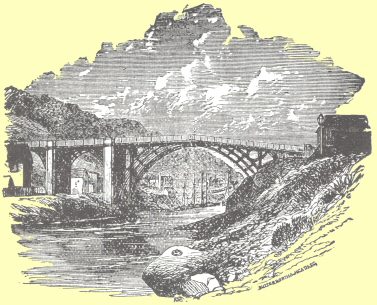
During the construction of the bridge a model was prepared and
sent up to the Society of Arts, who presented Mr. Darby with
their gold medal in recognition of his merits as designer and
erector; and a model and an engraving of the bridge may still be
seen in the Society’s rooms, John Street, Adelphi.
Mr. Robert Stephenson has said of the structure: “If we
consider that the manipulation of cast-iron was then completely
in its infancy, a bridge of such dimensions was doubtless a
bold as well as an original undertaking, and the efficiency
of the details is worthy of the boldness of the
conception.” Mr. Stephenson adds “that from
a defect in the construction the abutments were thrust inwards at the
approaches and the ribs partially fractured.” This
was not the case. It arose from the nature of the land and
its exterior pressure which was obviated by sinking and
underbuilding the foundation, and to remedy the supposed defect,
two small land arches were, in the year 1800, substituted for the
stone approach on the Broseley side. While the work was in
progress, Mr. Telford carefully examined the bridge, and thus
spoke of its condition at the time:—
“The great improvement of erecting upon a
navigable river a bridge of cast-iron of one arch only was first
put in practice near Coalbrookdale. The bridge was executed
in 1777 by Mr. Abraham Darby, and the ironwork is now quite as
perfect as when it was first put up. Drawings of this
bridge have long been before the public, and have been much and
justly admired.”
Mr. Smiles in speaking of the bridge quotes a Coalbrookdale
correspondent who, writing in May, 1862, says that
“at the present time the bridge is
undergoing repair; and, special examination having been made,
there is no appearance either that the abutments have moved, or
that the ribs have been broken in the centre or are out of their
proper right line. There has, it is true, been a strain on
the land arches, and on the roadway plates, which, however, the
main arch has been able effectually to resist.”
It is a pleasing object in the landscape, and passed its
centenary this year, 1879, with no other display than a few small
flags which Mr. Frisby placed on the balustrades. It has
paid for itself over, and over again; and the excessive toll is
at present severely felt. Those sharing the benefits of
the monopoly of course protest against attempts to make it a free
bridge, and being private property there is no other means of
effecting the object than by buying them out, or by obtaining ah
Act of Parliament. There is, it is true, one other: and
that the suicidal one of letting it rust to its own
destruction—a course the monopolists seem resolved to take.
[340]
The Severn formerly was a great liquid highway for heavy
goods; people took their boats to Shrewsbury to the fairs for
butter, cheese, and groceries, and came down with the stream,
others were carried on pack-horses; a strong enduring race now
extinct.
Roads were made pretty much at will, and were repaired at
pleasure. Covered waggons, like Crowley’s, drawn by 4
or 6 heavy horses, crept along the rough circuitous roads.
It was not till 1763 that turnpike-gates were established, to
raise money to keep roads in repair. Stage coaches then
ventured into districts they had not visited before.
Previous to a road being made along the Wharfage, coaches had to
toil up the hill at the back of the Swan, but after the bridge
was built they went under it and turned up by the stables to the
front of the Company’s Inn, the Tontine. Afterwards
they ran somewhere at the back and came into the old road at
Lincoln Hill. Ultimately the present road was made by
Styches pit to the top of the bank. At one time four
coaches ran through the town; two from Shrewsbury to Cheltenham,
L’Hirondelle and the Hibernia; and two from Shrewsbury to
Birmingham; the Salopian and, we think, the Emerald. The
two latter belonged to the brothers Hemmings, who drove
them; but who afterwards quarrelled and ran in opposition to each
other. Taylor of the Lion started the “Young
Salopian” in opposition; and Hemmings then called his the
“Old Salopian.” When the Birmingham and London
railway opened, Taylor got a petition numerously signed to the
Post Master General, asking in an apparently disinterested way to
be allowed to carry the mail bags gratuitously to Birmingham, at
the same time binding himself to forfeit a heavy sum if he failed
to be in time. He obtained his wish and immediately called
his coach the Royal Mail; which not only brought him custom but
saved him £1 4s. 0d. per week at Tern Gate, 18s. at Watling
street, £1 4s. 0d. at Priorslee, 12s. at Shifnal, and tolls
at all the other gates to Birmingham.
John Peters took a fancy for driving the Hibernia, thinking he
could take it down the steep hills between Shrewsbury and
Ironbridge without stopping to have the wheels looked. The
first steep descent was the Wyle-cop, and this he managed to get
down without accident; but in trying the experiment down Leighton
Bank, shortly before the first change of horses, the coach,
driver, and passengers came to grief, and were pitched right over
into a field at the bottom of the hill. Peters was
seriously injured, and some of the passengers were badly hurt;
but Peters never tried a similar experiment to the end of his
days.
In those days it was a strange sight for a stranger coming
down the bank towards Bedlam for the first time in the dusk of a
winter’s evening, when the works were in full
operation. We remember Hemmings once telling of a Cockney
coming down into the country for the first time, and waking up
from a snooze, unable to conjecture the true character of the
scene, and insisting upon going no farther. To him the mazy
river was the Styx; and had he been able to see the ferry
unpaddled moving slowly to and fro in mid-channel, he might have
imagined it was Charon’s boat; and the bellowing
blast-furnaces and coke-fires the entrance to Inferno.
These fires have long been extinguished, and the supply of
mineral riches being exhausted, labour has migrated to places
where nature had similar gifts in store to stimulate
wealth-creating industry. You may yet perceive the
crumbling outlines of the ruins, abrupt and massive, like the
tottering walls of some dismantled castle. Mr. Glazebrook,
Mr. E. Edwards, and others horsed some of the coaches from
Ironbridge, and the stopping and changing usually drew a group of
tradesmen and others to witness the sight.
L’Hirondelle was horsed from Shrewsbury by Jobson of the
Talbot, who took a special pride in his team. When Hemmings
left the road we had some few attempts at running Omnibuses by
the Rushtons, and by Walters; first to Wolverhampton, and next to
Wellington; but railways coming nearer drove them from the
road.
The tradesmen of Ironbridge naturally took great interest in
the various schemes proposed to bring railways within their
reach, and assisted manfully in meeting the difficulties which
for a long time delayed the execution of the works on the part of
interested landowners, and others who advocated rival schemes;
and it may be interesting here to place on record facts bearing on
the subject.
First by the 16th and 17th Vict.
Ch. 227, entitled “An Act for making a Railway from the
Oxford, Worcester, and Wolverhampton Railway near Hartlebury, in
the County of Worcester, to the Borough of Shrewsbury, in the
County of Salop, WITH A BRANCH to
be called the Severn Valley Railway, and for other
purposes.”
2ndly, in 1855. By the 18th.
and 19th. Vict. Ch. 188 entitled “An Act for making and
maintaining the Severn Valley Railway, and for other
purposes.”
3rdly. in 1856. By the 19th.
and 20th. Vic. Ch. 111 entitled “An Act for authorizing
deviations from the authorized line of the Severn Valley Railway,
and for making further provisions with respect to Shares in the
Capital of the Severn Valley Company, and for facilitating the
completion of their undertaking, and other purposes.”
4thly in 1858. By the 21st.
and 22nd. Vic. Ch. — entitled “An Act for making
further provisions with respect to the Severn Valley Railway in
order to the completion thereof, and for other
purposes.”
5thly in 1860. By the Severn
Valley Railway Leasing Act 1860 to the West-Midland.
Was authorized in 1853, but a portion only of this Railway
(from Wellington to Lightmoor) was constructed and the powers of
the Act lapsed. It was worked by the Great Western Company
in connexion with their line from Lightmoor to Shifnal and
Wolverhampton.
The
Great Western Company and the West Midland and Severn Valley
Railway Companies promoted Bills for Leasing this Railway in the
Session of 1861. The Great Western Bill also proposed for
the extension of their existing Line ending at Lightmoor, from
Lightmoor to Coalbrookdale. The West Midland and Severn
Valley (joint) bill in addition to its provisions for leasing the
Wellington line to Lightmoor provided for the construction of a
Railway from the Ironbridge Station on the Severn Valley Railway
over the river Severn through Coalbrookdale to the Lightmoor
Station of the Wellington line at Lightmoor. There were in
fact three Bills before Parliament for constructing Railways from
Lightmoor to Coalbrookdale, two crossing the river Severn, one
joining the Severn Valley Railway at Ironbridge, and the other
joining the Severn Valley and the Much Wenlock and Severn
Junction Railway at New Barn. The Much Wenlock & Severn
Junction Railway was authorized in 1859 by 22nd. and 23rd. Vict.
entitled “An Act for making a Railway from Much Wenlock, in
the County of Salop to communicate with the Severn Valley Railway
and the River Severn in the same County.”
These railways conferred great advantages upon the town of
Ironbridge both as a means of sending and receiving goods, and
also as enabling tradesmen to economise time in attending markets
or fairs, and in bringing men of business into the
neighbourhood.
They also bring numerous visitors in summer time, who are
attracted by the scenery in the neighbourhood. It may
indeed be taken as a fact, as we have said before, that
there are nooks and corners just outside and along the Severn
Valley now better known to strangers than to the inhabitants; and
which natives themselves have never seen. With eyes to
watch the till and see their way along the beaten track of
business, men not unfrequently lose sight of intellectual
pleasures within their reach; in their hurry to secure gain they
forget items that might serve much to swell the sum of human
happiness at which they aim. Like Wordsworth’s clay,
cold, potter; to whom
A primrose by a river’s brim,
A yellow primrose was to him,
And it was nothing more,—
so, insensible to the life that is within them and the glories
which surround them, they feel not that flow of which Milton
speaks, that—
Vernal joy, able to drive
All sadness but despair!
Coleridge too has said,
In Nature there is nothing melancholy.
And some one else, speaking lovingly of the Author of Nature,
has written:
“Not content with every kind of food to
nourish man,
Thou makest all Nature beauty to his eye
And music to his ear.”
There are no bolts, bars, or boundary walls, and there need
be
“No calling left, no duty broke,”
in making ourselves more acquainted than we are, by holiday
rambles and dignifying investigations, with wonders which
constantly surround us.
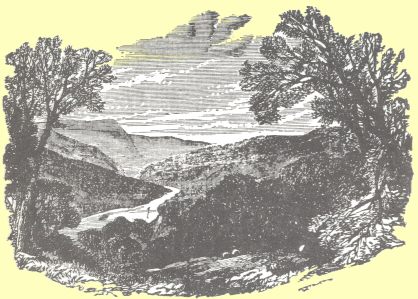
Few more interesting spots could be chosen than Ironbridge,
with its woods, and cliffs, and river, which from tourists, and
all lovers of the beautiful, never fail at once to secure
attention and admiration. You may travel far and not meet a
page so interesting in nature’s history. Many are the
occasional visits—many are the stated pilgrimages, made
from distances—by devotees of science, desirous of here
reading the “testimony of the rocks.” To such,
this natural rent in the earth’s crust; this rocky cleft,
the severed sides of which, like simple sections of a puzzle,
afford the clue to its original outline and primæval
features, and prove full of interest. Like some excavated
ruin, flooring above flooring, there are platforms and stages
where in rearing the old world’s structure the workers
rested. Coins of that far off period are plentiful where
human habitations now stand, terrace above terrace. Other
than these, the little town has no antiquities older than its
bridge; other than the hunting lodge and half-timber-houses
previously mentioned; there are no castle keeps, cathedral
aisles, or moss-crowned ruins; no suggestive monuments of the
past save those already noticed and such as nature
furnishes. ’Tis rich in these; these it has mature
and undecayed: and in such mute eloquence as no work of man can
boast. Massive and motionless there are around the most
interesting and instructive specimens of the world’s
architecture. Not a winding path threads the hill side but
conducts to some such memorial, but opens some page written
within and without. Take the favourite summer’s walk
of the inhabitants, that leading to the Rotunda, on the crest of
the hill; and you stand upon the mute relics of a former
world! Beneath is the upturned bed of a former sea, and
around is the storied mausoleum where hundreds of the
world’s lost species lie entombed. Few places boast a
more suggestive or more romantic scene. Lower still, just
at
“The swelling
instep of the hill,”
winds the silvery thread woven by the Severn through the
valley, interlacing meads, woods, upland swells, and round-topped
grassy knolls. Amid pasture land sloping to the
water’s edge and relieved by grazing cattle, rise the
ivy-topped ruins of Buildwas Abbey; beyond is a pleasing
interchange of land and water, the whole bounded by hills
scarcely distinguishable from the azure sky. Mingled sounds
of birds and men and running water strike strangely on the ear;
and often in the calm twilight fogs move slowly on the
river. How these rocks and caverns echo and reverberate
during a thunder-peal, when loud and long-continued. The
inhabitants tell, too, of curious acoustic effects produced along
the valley; how in under tones from one side the river to a point
of equal elevation on the other neighbours may whisper to each
other, the atmosphere acting as a sounding-board for the
voice. This is so in a rent in the rocks above the
Bower-yard, known to natives as the Bower Yord.
“Up the bower, and through the Edge,
That’s the way to Buildwas bridge,”
is a local ditty with no other merit than antiquity; but it
has served as a lullaby to generations cradled long ere the
bridge below was reared. Over-looking the Bower is
Bath-wood—minus now the bath. Tych’s-nest comes
next, where the kite formerly squealed, and had its eyrie; and
still later—as the oldest inhabitant is ready to
testify—where badgers were caught, and made sport of at
Ironbridge Wake.
Ironbridge abounds in pleasant walks and sunny spots; and
right pleasant ’tis to view from some eminence on the
opposite bank—Lady-wood or Benthall-edge, the prospect
spread out before you. Clustering cottages are seen to perch
themselves on ridges, or to nestle pleasantly in shady nooks half
hid by rocks and knolls and trees; while bits of nature’s
carpet, garden plots and orchards, add interest to the
scene. On points commanding panoramic sweeps of country, of
winding dales and wooded hills, have sprung up villa-looking
residences and verandahed cottages that tell of competence,
retirement, and those calm sweet joys that fringe the eventide of
prosperous life. There are no formal streets or rigid red
brick lines to offend the eye: but that pleasing irregularity an
artist would desire. Looking east or west, fronting or
turning their backs upon each other, many gabled, tall chimneyed,
just as their owners pleased; there is a freedom and rusticity of
style that gratifies the sight and harmonises well with the
winding roads that meets the poet’s fancy and goes beyond
the limner’s skill. To mention severally these
suburban hill or tree-embosomed retreats would be sufficient by
the name itself to indicate the faithful picture we have
drawn. From the Severn to the summit, the hill is dotted
over with villas, Gothic and fanciful, fronted by grottoed
gardens, flanked by castellated walls and orchards, with
ornamental hedge-rows and shady sycamores; whilst in mid-air,
lower down, like a gossamer on a November morn, appears the iron
net-work of the bridge. We have written so much and so
often of these scenes that we are tempted here to hand in
copy to the printer of what we have previously said on the
subject.
However beautiful these rocks and hills are by day, the view
of Ironbridge assumes a character equally sublime when the glare of
the sun is gone, when the hills cast their shadows deep and the
river gathering the few rays left of the straggling light gives
them back in feeble pencils to the eye. At sunset when the
hills are bathed in purple light, and the god of day before his
final exit between Lincoln Hill and Benthall-edge a second time
appears; by moonlight, when rosy tints have given way to hues of
misty grey, when familiar objects grow grotesque and queer, and
minor features melt away amid the deep calm quiet that reigns
below, serial pictures of quaint perspective and inspiring beauty
present themselves. To the stranger entering the valley at
night for the first time the scene is novel and impressive.
Silence,
Faithful attendant on
the ebon throne,
sways her sceptre over dim outlines which imagination shapes
at will, and the river, toned down to the duskiest hue, whispers
mournfully to each smooth pebble as it passes.
The church occupies a picturesque situation on the side of the
hill, opposite to the bridge, from which it is approached by a
long flight of steps on one side, and a circuitous path winding
round the hill on the other. It was built in 1836, and like
the bridge, is of a material with which the district
abounds. It would however have been equally in character
with the place, and more pleasing to the eye, had it been built
of stone. It has a tower, a nave, a chancel, and side
aisles, and a richly stained glass window, with full length
figures of St. Peter, St. James, and St. John. The
endowment has been augmented very much of late years through the
munificence of the Madeley Wood Company, who subscribed
£1,000, and the liberality of the late Rev. John Bartlett,
and others. Also by the purchase of the unredeemed
rectorial tithes. The sum of upwards of £1,000 was
raised too for better school accommodation for the place.
Ironbridge is one of the polling districts for municipal and
parliamentary purposes; and has about 450 electors for the
borough franchise. The Mayor and Borough Magistrates hold
here alternately with Broseley and Wenlock Petty Sessions, every
six weeks. Its central position gives it advantages which
outside towns cannot lay claim to; both in point of trade, and as
the seat of various local institutions.
It is the head quarters of the Sixth Shropshire Rifle Corps,
of which John A. Anstice, Esq., is Captain, and R. E. Anstice,
Esq., Lieutenant, and Searj. Johnson drill instructor.
The corps was first formed on the 20th of February, 1860, when
the first batch of recruits (fifty in number) were sworn in, in
the Guildhall at Wenlock, by Mr. Nicholas, of Broseley, (then
Mayor for the borough), Captain Lowndes, Lieutenant Blakeway, and
Ensign W. R. Anstice were amongst that number. Only three
of the old hands now remain in the corps, Cr. Sergeant W. Y.
Owen, Sergeant W. Roberts, and Sergeant Walton. Up to the
present time 453 men have passed through the ranks: the last
recruit that joined in 1879 being No. 453.
The
company stands well in the battalion as a shooting company,
having won the county challenge cup twice, viz: in 1876 and
1878. Cr. Sergeant Owen has also twice placed himself in
the first sixty at Wimbleton, and consequently has two
Queen’s Badges, as well as the St. George’s
Cross. He has also been the winner of the Martin’s
Challenge Cup. The company are in possession of four of
Major Owen’s Memorial Cups out of nine that have been shot
for at Berwick since 1870.
William Reynolds Anstice, Esq., uncle of the present captain,
on the retirement of W. L. Lowndes, Esq., commanded the corps,
and his name is still revered among the men.
The Shropshire Banking Company, which was formed by the union
of the Coalbrookdale, Wellington, and Newport Banks, for many
years had an office here in the Market Square. The Dale
Bank was in the hands of the Coalbrookdale Company. The
Wellington Bank stood in the names of Reynolds, Charlton, and
Shakeshaft, the former being Joseph Reynolds, late of Bristol,
who received his interest in it from his father, Richard
Reynolds; and Mr. Eyton, grandfather of the present T. C. Eyton,
Esq., was at one time, we believe, another partner.
The Shropshire Company, which embraced a large number of
shareholders, underwent great strain in consequence of
delinquencies to the extent of £120,000 by the manager, Mr.
Allen, of Shifnal. The noble act of Henry Dickinson, one of
the directors at the time, who felt it his duty
personally to stave off the ruin, which threatened so many, has
already been recorded under the head of Coalbrookdale; he first
lent and then gave £100,000. The appalling discovery
of these frauds practised by the absconding manager spread the
utmost alarm through the parish, and the county generally, and
gave hundreds of widows, old maiden ladies, and others, reason to
fear that the investments on which they depended were
irretrievably gone. The generous act of Henry Dickinson
however—who like the heroic Roman of old threw himself into
the gap—restored confidence; the bank rallied, soon
regained its position, and continued in existence till the shares
and business were purchased by Lloyd’s Banking Company,
Limited, in 1874. This enterprising and wealthy company
purchased the two houses belonging to Mr. William Hartshorne,
chemist and druggist, who for many years carried on business in
one, and Mrs. Aston in the other, and erected the present
commodious building, where they do a large business, half-yearly
paying a handsome dividend to shareholders. The subscribed
capital of the company is £2,750,000; in 55,000 shares of
£50 each. Capital paid up (55,000 shares, £8
paid) £440,000. It has thirty-one other branches, and
twelve sub-branches and agencies.
Of that valued institution the Dispensary we have spoken ante
p.p. –1. The 51st
annual meeting has since been held; at which meeting
“the committee desired to place on record
their acknowledgments of the considerate feeling which prompted
the late Edward Edwards, Esq., of Coalbrookdale, to bequeath the sum of
£50 for the general purposes of the institution, which sum,
less legacy duty of £5, has been invested in the purchase
of £42 Midland Railway 4 per cent. debentures stock, in
addition to the sum of £880 of the game stock already
standing in the names of the Rev. W. H. Wayne, W. Nicholas, W. G.
Norris, and B. B. Potts, Esqrs., on behalf of the society.
It was also stated that from the opening of the Dispensary the
number of cases has been 57,105. In the last year the
number was 1,019, of which 843 had been cured, 78 relieved, 32
renewed, 2 sent to the Salop Infirmary, and 38 remained under
treatment.”
The Temperance Society and Good Templars have branches here
and in other parts of the parish. Members of the former can
date back their conversion to its principles from the
commencement of the movement, forty or more years ago. We
have mentioned the “British Workman” at
Coalbrookdale; there is one also at Madeley Wood. And
besides the regular religious services at the various places of
worship, and means of instruction carried on through the
established schools, others might be mentioned, on Sundays and
week-days, the active promoters of which are Mr. D. White, Mr. A.
Maw, Mr. W. R. Bradshaw, Mr. G. Baugh, &c., &c.
Ironbridge too is the head quarters of the Ironbridge and
Coalbrookdale Building and Land Society, which has since its
establishment been uniformly progressive, and led very many to
become not only investors but owners of the houses they live
in.
We may here give details of other means of promoting
providence and thrift, such as Benefit Societies and Sick Clubs,
which are numerous in the parish, and place on record the
amounts raised in ways so creditable to the industrial portion of
the population, and which added to those raised annually for
various religious and other purposes reaches a very large amount
indeed.
Let us take first the Coalbrookdale and Madeley Temperance
Benefit Society.—This Society was founded during the
infancy of the Temperance movement, before total abstinence
societies were established. Spirits were forbidden to
members, and beer was only to be taken in moderation, rules which
have not been strictly adhered to. The members at one time
fell away, but they have since increased, and the annual
statement just issued for 1879 shews them to be 123 in
number. The amount received in monthly contributions for
the year ending midsummer was £115 13s. 3d. From
interest of money invested £61 5s. 4d., which with the
balance of the previous year £1239 10s. 4d. made
£1416 8s. 11d.
Shropshire Provident Society.—Number of members 74;
contributions £92 18s. 11½d.; Secretary Mr. Walter
Sharpe; Surgeons M. Webb, Esq., and H. Stubbs, Esq.; endowment
£10. Annual subscribers to the General Fund:
|
£
|
s.
|
d.
|
W. R. Anstice, Esq., Ironbridge
|
1
|
1
|
0
|
John Arthur Anstice, Esq., Madeley
|
1
|
1
|
0
|
George Anstice, Esq., Madeley
|
1
|
1
|
0
|
Richard Edmund Anstice, Esq., Madeley
|
1
|
1
|
0
|
Charles Pugh, Esq.,
|
1
|
0
|
0
|
Meets in one of the rooms of the Anstice Memorial
Institute.
Loyal Royal Oak Lodge, No. 3665, of the Independent Order of
Oddfellows, Manchester Unity, Friendly Society.—The place
of business is the Royal Oak Inn. Number of members
159. Annual subscriptions £137 16s. 0d. Nett
worth of the society £1267 1s. 9½d. Secretary
Mr. Joseph Haynes; Treasurer Mr. Henry Ray.
Rose of the Vale Lodge.—This lodge is held at the
Tontine Hotel, Ironbridge, and numbers 175 members, who pay into
the funds on an average £360 per annum. They have
standing to their credit the sum of £781 12s. 7d. Of
this sum £400 has been lent on mortgage; £220 has
been invested in the Building Society, and the remainder is in
Lloyd’s Bank and the treasurer’s hands.
Secretary Mr. E. Good; Treasurer Mr. William Skelton.
The Free Masons also meet at the Tontine; but as this does not
strictly come under the head either of a sick or benefit society
it does not come within the above category.
Ancient Order of Foresters, Pride of the District, No.
4345.—This lodge was founded in 1864, and meets in one of
the rooms in the Anstice Memorial Institute on alternate
Saturdays. Secretary Mr. T. Beddow, Bridge Street;
Treasurer Mr. J. W. Fletcher. Number of members 265;
average age 31; amount of funds £872. Annual
Subscriptions £341 5s.
Ironbridge, Royal George, meets at the Robin Hood Inn, Madeley
Wood, fortnightly. F. Johnson, Secretary; J. Page,
Treasurer. It has 114 members of the average age of 34; and
£444 in the court fund. Annual Subscriptions
£143 2s.
Honourable Order of Modern Masons.—Meets at the Barley
Mow Inn, Court Street, Madeley. Number of members 75;
contributions per month 2s.; funeral levy per quarter 9d.;
sick pay per week 8s.; member’s death £10;
member’s wife £5; amount of sick funds £40 3s.
2d. William Instone, secretary.
In addition to these societies there is the United Brothers,
but we did not obtain particulars. Also others in
connection with the Coalbrookdale and Madeley Wood works.
The object of the former society, as stated in the rules, is to
secure to its members weekly allowance and medical aid in
sickness, and an allowance at the decease of a member or
member’s wife. The cashier of the company is
treasurer, and Mr. John Hewitt is secretary. Each man and
boy employed in the Company’s works at Coalbrookdale, is
required to be a member of this society, and to pay his
contribution through the work’s office. Every member
above the age of eighteen pays one shilling per month; under the
age of eighteen, sixpence per month; and any workman entering
this society at the age of forty-five years, or upwards, one
shilling and sixpence per month. Every workman is
considered a member until he has a regular discharge from the
Coalbrookdale Company or their agent, provided that he continues
paying his contribution and resides in the neighbourhood.
The number employed are from 700 to 800; and the income of the
society is from £32 to £33 per month. About 440
of the members pay 9d. per quarter to the surgeon, Mr. James
Proctor. One of the rules is that should the funds of the
society at any time attain £200, the money shall be
divided; such divisions of money took place at Christmas 1868,
1870, and 1872; since which dates the society has not been so
fortunate in its surplus.
There is a similar society in connection with the Madeley Wood
Company’s Works, from which we get no particulars, but the
annual subscriptions to which may probably be put at about the
same as those at Coalbrookdale.
There is also a similar institution in connection with the
Madeley Court Works, with about 350 members, who pay annually
£113 15s.
Adding all these together we find that, without taking the
United Brothers and a sick society at Coalport called the Pitcher
into account, there are 2985 members of clubs, subscribing a
total of £2380 1s. 10d. annually, and possessing a capital
of £4721 6s. 5d.!!
These facts may be considered as a reply in a great measure to
the charge sometimes made against the working classes of an utter
want of thrift and forethought, and suggest the question whether
men making so much provision for the future for themselves and
families ought not to be excused to some extent the payment of
poor rates.
The sanitary state of Madeley and Ironbridge is far from what
it ought to be. There is not only a sad deficiency of
water, but much that is used is impure. Severn water is
carried and sold at Madeley Wood and Lincoln Hill at 1d.,
1½., and sometimes 2d. per pail, or 6d. for a small
barrel. Again, any one who knows the turbid tale of
Severn-water after rain, or is acquainted with the
amount of sewage thrown into the river, will question the quality
of such water for drinking purposes. Just above one of the
lading places a sewer comes down near the back of the Police
Office and empties its black sludge into the river. Some
use filters; but high authorities on the subject assert that
although mechanical impurities may be got rid of those which are
chemical or organic remain.
Let persons who undervalue an abundant supply of good water
ask their wives or some medical man as to its importance; or let
them beg it or buy it, and fetch it from long distances, often
waiting their turns at the well, or count the cost which impure
water entails. Let them look at the sickness, the pain and
distress of parents watching day by day the fevered or pallid
cheeks and withered forms of their household treasures.
Perhaps the mother herself is struck down, or the bread-winner of
the family; and in case death ensues, added to the crushing force
of the blow, there are doctor’s bills, and excessive
funeral expenses, which lie as a dead-weight from which the
family scarcely ever recovers!
“When,” as the Times newspaper put it
some time ago, “it is considered that water constitutes
nearly three-fourths of the entire weight of the animal body,
that it is the basis of all beverages, and the solvent by means
of which all food is assimilated and all secretion is performed,
the importance of obtaining it in a state of purity would seem to
require no further demonstration. Unfortunately, however,
although the facts have for a long time been universally
admitted, the practical conclusions to which they would lead have
comparatively seldom been acted upon. Not only do we obtain
the greater part of our supply of water from that which has
already washed the earth, but we have permitted water flowing in
its natural channels to be everywhere utilised as a carrier of
the worst descriptions of filth.”
All in fact must see on a little reflection that however
excusable certain things might have been at one time they are no
longer so under the light thrown upon them by deep and
long-continued investigations by scientific men who have devoted
much study to the subject. All must know that no proper
supervision has up to the present been taken, and nothing like
proper compulsion has been applied to the removal of glaring
evils.
Let those who are apathetic on this subject ponder the
following, taken from a paper read a short time since before the
Society of Arts by J. J. Pope, Professor of Hygiene to the
Birkbeck Institution. The author said:—
“it is a startling fact that one-fourth
of the children born into this world to endure for threescore
years and ten, die before they attain the age of five
years. This is a sad truth, and the more lamentable
when we know that these deaths mostly arise from causes that are
quite preventible.”
The same author said, and said truly, that:
“Very few people, indeed,
consider the subject of their own health, until warned
by a present attack of sickness, through failing to
acknowledge the true worth of science and medicine, which is far
more preventive than remedial. Can it be doubted that it
is better and wiser to abolish the cause of disease, to
prevent its appearance, than to wait for its attack and cure the
result?”
As regards houses: some have been built without reference
either to light, air, or dryness. Some have been made out
of cattle-sheds, cabins, and stables, and are far worse than
prison cells or workhouse wards. These damp dark dungeons
lower the temperature of the body, decrease the strength,
generate disease, cause rheumatism, and predispose to other
evils, not the least of which is consumption. We have it on
the authority of the highest medical men that with proper
sanitary objects attained a reduction of nearly half the present
premature disability from sickness, and mortality due to
conditions about their dwellings may be obtained.
Let the people ponder these things; let them balance such
heavy items against the trivial cost a better sanitary state of
things would entail.
Whatever such cost might be it is for them to consider what
they would save by the removal of causes of disease, and the
concomitant advantages arising from improved health and prolonged
life. Again, it is only fair for them to consider the
amount they pay and the precautions they take to mitigate the
evils of sickness.
And the question naturally arises whether whilst providing so
liberally for sickness, it is not worth while paying a slight
rate for the enforcement of such sanitary regulations as may prevent
sickness—especially if the statement made on the highest
medical authority, to the effect that a reduction of nearly half
the present sickness and premature mortality might be prevented,
be correct.
It will be seen from what has already been written how much
this parish has been associated with various improvements and
matters connected with the early history of the steam engine, and
although the subject might not be of universal interest, we might
mention here a correspondence between the Commissioners of
Patents and W. R. Anstice, Esq., senior partner of the Madeley
Wood Company. On the 24th of May, 1879, an article appeared
in the Times under the head of
Stating that a very interesting old engine, the last of its
kind which remained at work, had been removed from and re-erected
in this museum, having been presented for that purpose to the
Commissioners of Patents; and giving the following description
issued by the curator, Colonel Stuart Wortley.—
“Heslop’s Winding and Pumping
Engine. Letters Patent, A.D.
1790, No. 1760.—This engine was erected at Kell’s
Pit, for raising coals, about the year 1795, afterwards removed
to Castlerigg Pit, in 1847, to Wreah Pit, all near
Whitehaven. At the latter place it continued to raise
coals, also to work a pump, by means of a cast-iron beam placed
above the main beam, until the summer of 1878, when it was
removed here. Presented to the Commissioner of Patents by
the Earl of Lonsdale, through Mr. H. A. Fletcher, M. Inst.
C.E. Transmitted from Whitehaven to the Patent Museum by
the London and North-Western Railway Company, at half rate.
It will seem that this engine has two open-topped cylinders,
one on each side of the main centre beam, and both single
acting. The cylinders are respectively the ‘hot
cylinder’ and the ‘cold cylinder.’ The
steam, on being admitted into the first, or ‘hot’
cylinder, raises the piston by its pressure underneath; the
return stroke is then made by the weight of the connecting rod
and by the momentum given to the fly-wheel. The eduction
valve being now open, the steam passes from this cylinder to the
second or ‘cold’ cylinder by means of the connecting
pipe, which, being constantly immersed in cold water, produces
sufficient condensation to ‘kill’ or reduce it to
atmospheric pressure as it enters and fills the cold
cylinder. The cold piston having arrived at the top of its
stroke, and its cylinder being thus filled with steam and the
injection valve being now open, a jet of water is admitted, thus
bringing a vacuum into play. By this arrangement of two
cylinders Heslop obtained advantages closely approaching those of
the separate condenser, and effected a signal superiority over
the atmospheric engine of Newcomen, even as it then existed with
all the structural improvements introduced by Smeaton, who was
compelled to admit that, in its best state, 60 per cent, of steam
was wasted by alternate heating and cooling of the
cylinder. No other engine of this type now remains in
existence, and it is therefore appropriate that this one, the
last worked, should be preserved.”
On seeing the above W. E. Anstice, Esq., at once wrote to say
they had three of the same engines now at work, and which had
been at work for the past eighty years in the Madeley Wood
Co.’s Field; that they still had five, and had had
eight. This led to an interesting correspondence in the
course of which Mr. Anstice sent up an original drawing, which
proved to be one of an earlier engine even than the one they had,
and the one for which the original specification was taken
out.
The fact is that about Heslop’s time, and whilst Smeaton
was at work effecting improvements in Newcomen’s engines,
and whilst Watt, with the experience of those who went before him, was
to some extent endeavouring to strike out a course for himself
and preparing to eclipse the productions of his predecessors,
there were a number of minor geniuses engaged in carrying into
effect their own or others suggestions: men whose names are
little known in consequence of having been thrust aside by
greater or more favoured inventors than themselves. Heslop,
Murdock, and Cartwright appear have been among these; also Avery
and Sadler, and other local schemers and inventors like the
Glazebrooks, the Williamses, and Hornblowers. During the
latter half of the last century the inventive faculty, stimulated
by what had already been achieved, appears to have been in great
activity. The iron-making and mining interests were
undergoing great expansion, and men like the Darbys, the
Reynoldses, Wilkinsons, Guests, and others, were just then
prepared to avail themselves of means which would enable them to
clear out the water from their mines, that they might bring up
minerals from a greater depth, or add to the force of the blast
in their smelting operations; and several of these in return
rendered Watt and others great services. Wilkinson gave the
order for the first engine Watt made at Soho to blow his furnaces
at Broseley, where it was erected and ready for use early in
1776. Watt’s first rotary engine was made for Mr.
Reynolds, of Ketley, in 1782, to drive a corn mill. The
“Philosophical Transactions,” and Urban’s
Magazine seem to have been mediums of correspondence, and the
means of communicating so much of the discoveries and inventions
of the authors as they deemed fit to the public. We have
thirty or more volumes of extracts from original communications
in these, commencing about 1736, which Mr. William Reynolds had
written out, most of them beautiful, and many remarkable
specimens of that ornate style of calligraphy so much cultivated
at that time.
Also a large folio volume of original drawings and designs,
admirably executed. Some by Hornblower, Glazebrook, Sadler,
Reynolds, Wilkinson, Banks, Anstice, Chinn, Price, Rogerson,
Emerson, Telford, and others. The Hornblowers appear to
have trodden closely upon the heels of Watt at one time, and so
closely that Watt wrote to Boulton saying, “If they have
really found a prize it will ruin us.” We add a list
of these drawings, with dates attached.
No. 1 is a small steam engine made by James Sadler which was
at work on the hill at the Dale in 1792.
No. 2 Drawing shews Sadler’s plan of rotary motion, with
crank for winding engine, dated, 1793.
No. 3 S. Venables’ drawing of Sadler’s engine as
it stood when T. Griffiths was putting it up at the Bank
1793.
No. 4 Is a plan of Sadler’s engine sent by Dr. Beddows,
May, 1793.
No. 5 Are Drawings of an engine from J. Sadler’s, but
which was never completed, 1794.
No. 6 Drawings and description of Thos. Savory’s Engine
for raising water by the help of fire, June 14th, 1799; the
description states that the inventor entertained the Royal
Society by shewing a small model which he made to work before
them.
No. 7 Is a plan of Watt’s steam wheel in all parts, but
no date.
No. 8 Plan of a substitute for ropes, being an iron chain of
novel construction to be used for coal mines, by Bingley,
1795.
No. 9
Glazebrook’s scheme to effect a perpendicular motion,
1794.
No. 10 Plan of Adam Hislop’s engine to work without a
beam, scale 1 in. to ft. Drawn by S. Venables.
No. 11 Side view.
No. 12 Ground plan of an engine without a beam erected at
Wombridge, Dec. 5, 1794.
No. 13 General section of an engine for winding coal.
Scale about ½ in. to ft. July 23, 1793.
No. 14 Outside front view of Horsehay forge engine Feb 21,
1793. Scale one third in. to ft.
No. 15 Section of Hollins Wood Blast Engine. Scale
¼ in. to the ft. William Minor No. 84 Sept. 12,
1793.
No. 16 General section for winding engine, 1 in. to ft. no
date.
No. 17 Samuel Venables, Sept 1, 1793, No. 6 differs in
construction from the former ones, two cylinders.
No. 18 William Reynolds’ idea of the application of
Sadler’s engine to a rotable motion, the lower cylinder
communicating with the boiler; this method is applicable to
rowing boats with circular oars, 1795, drawn by Venables.
No. 18 Drawing of blast engine of the same period but no date
or description.
No. 18 Ditto, winding engine.
No. 19 One Richard Banks 1796.
No. 20 Drawing of old incline engine.
No. 21 Elaborate drawing of an engine for winding coals, sun
and moon motion, 30 strokes per minute, proper speed.
Nos. 22–34 Thirteen other engines.
No. 35 Sketch of Hornblowers’ air pump.
No. 36 Plan of Jinney for conveying wheeled corves down
descents.
No. 38 Calculation of Mr. Anstices’ rotative engine by
D. Rose March 17, 1799.
No. 39 Brick machines April, 1794.
No. 40 Sketch of a river Mill by W. R. improved by—
No. 41 A new method of boring as used by T. Price at the
Brownhill Colliery.
No. 42 Original letter by R. Reynolds describing
Blakey’s fire engine for raising water for furnaces at
Horsehay and Ketley, and one of which had been erected at
the Dale, with Sketch. Letter dated Dale 6, 1st month,
1767.
No. 43 Prospective view of Donnington Wood incline plane and
engine by William Minor Sept. 12 1793
No. 44 Engine with crank, Richard Speed, June 4, 1796.
No. 45 Plan for an Aqueduct over a river, Thomas Telford,
March, 1794, with span of 100 feet.
No. 46 Copy for Fire engine from Emerson’s Engine for
raising water.
No. 47 J. Wilkinson’s Idea of Chimney Boiler given by
him to W. R. November, 1799.
No. 48 Drawings of an engine under James Glazebrooks’
patent Feb. 24th, 1799. beautifully drawn and coloured.
No. 49 Outside front view of Horsehay large Engine Feb. 21,
1793.
No. 50 Principal arch, 100 ft. for an iron bridge for level
crossing (no date).
No. 51 Plans and Drawings of ribs &c., for an Aqueduct, by
Thomas Telford. With William Reynolds’ name signed to
it.
And a number of others.
Clay Industries.—We have in
earlier pages of this work spoken of some of these. There
are still the White Brick-works of the Madeley Wood Company, near
Ironbridge; the red brick-works of the same company at Blissers
Hill; the clay works of W. O. Foster, Esq., at the Court; and
those of Messrs. George Legge & Son at Madeley Wood and the
Woodlands; works which from the excellence of their varied
productions, no less than from the number of persons employed,
are of considerable importance to the district.
We have in the course of these pages given prominence to the
names of men who have in different ways merited distinction, and
whose deeds are deserving of record in a local history of
this kind; and we cannot omit a passing recognition of the
unparalleled feats of this distinguished Salopian, whose early
life is so closely associated with this parish. We had
prepared copious extracts from our “Life of Captain
Webb,” in which is detailed his extraordinary performances,
but can only give here a brief summary.
Before he was seven years old he had learnt to swim in the
Severn; and in his case the adage that “the boy is father
to the man” held good, for when a boy he and his elder
brother succeeded in saving from a watery grave another brother,
whose strength, in attempting to cross the Severn, failed him, so
that he had already sunk beneath the surface when he was
rescued. As shewing his pluck and daring it may be
mentioned that going along the Severn banks to Buildwas, where
boys usually go to bathe, he took off his shoes and walked along
the top of the bridge, with his hands in his pockets, his third
brother standing by not daring to look up lest he should fall and
be killed; but the chief actor stood calm and unmoved when they
afterwards met.
His second life-saving feat was performed on the Mersey, when
he succeeded in rescuing a comrade who had fallen overboard into
the river. The services he rendered to the owners of the
Silver Craig in the Suez Canal; but much more his
performance on board the Russia in his daring attempt to
save a seaman who fell overboard, shewed him to possess qualities
of the highest order as a man. He swam the English Channel,
Tuesday, August 24th, 1875, at the age of 27. Being
weighed and measured it was found that his height was five feet
eight inches; his weight when stripped, before starting, 14 st. 8
lbs.; and his girth round the chest 40½ in.
Webb’s subsequent feat in distancing all competitors in
his six days swim adds another laurel to his crown as the
champion swimmer of the world!
Signboards are scarcely so significant or important now as
formerly: yet an interest attaches to them still, and there is
some pleasure in pondering over their designs, as significant of
olden times and manners—the old ones especially. One
easily imagines too the jovial tenants of taverns in former
years, the noisy chafferings, the political discussions carried
on by those who sought recreation and enjoyment in them.
The Three Horse Shoes is the oldest
Sign in Madeley; it swings over the door of one of the oldest
houses in Madeley, the walls being of rubble, mud, and plaster:
and the Sign itself, no doubt, is one of the oldest in the
kingdom. A horse shoe, when found and nailed over the door
was supposed to bring good luck—hence the single shoe,
which is uppermost. The Horse
Shoes is kept by Mr. J. H. Robinson.
The Hammer, in Park Lane, kept by
Mrs. Lloyd, is the next in point of age. It was a trade
emblem when the house was much more used than at present by
ironworkers, particularly by forgemen.
The
Royal Oak was the first newly-licensed
house for many years in Madeley. The license for it was
very adroitly obtained by Mr. Charles Dyas. The Sign is a
universal favourite, as emblematic of our old ships and
seamen. The house is kept by Mrs. Shingler.
The Heart of Oak, in Court Street,
kept by Mr. Joseph Currier, is another popular Sign, indicative
of character, and illustrative of old national songs.
The Barley Mow, in Court Street, is
kept by Mr. Pitchford.
The Crown, Court Street, now void,
is one of the oldest English signs.
All Nations, kept by Mrs. Baguley,
is the only Sign of its name we know of.
The Six Bells, kept by Mr. Ward,
near the Church, is a Sign significant of the number of bells in
the Church tower.
The Royal Exchange, kept by Mr.
Goodwin, is a modern house, with an ancient Sign; whilst the
Railway Inn, kept by Mr. Taylor, is
modern in both respects.
The Coopers’ Arms is now
down, but another house has been built, which has not yet been
christened.
The Prince of Wales’s
Feathers, Lower Madeley, kept by Mr. Daniel Adams, as the
name implies, is a royal badge.
The Miners’ Arms, kept by Mr.
Kearsley, is so sufficiently significant, as not to need
comment. Also The Turners’
Arms, kept by Mr. John Brown; and the Three Furnaces, kept by Mr. Biddulph.
The Tweedale is kept by Mr. G.
Ray.
The Cuckoo-oak Inn, by Mr. H.
Wilkes, takes its name from the place.
The Britannia, kept by Mr. E.
Hopley, Aqueduct, and the Anchor, by
Mr. Evans, Court Street, are modern houses with ancient
signs.
There are also the Commercial Inn,
kept by Mrs. Heighway, and a Beershop in Church Street, kept by
Mr. Durnall.
Then there is the Chestnuts,
formerly the Red Lion, which fakes it name from the tree in
front, and is kept by Mr. James Hancock.
The Park Inn, by Mr. Reynolds, and
the New Inn kept by Mr. Jones, Park
Lane, with the Pheasant, kept by Mr.
Francis, complete the list of houses at Madeley, where, within
our recollection, there were formerly but two.
At Coalport we have the Shakespeare, kept by Mr. Beard, and the
Jug, we presume of Toby Philpot fame,
of whom it is said,
His body, when long in the ground it had lain,
And time into clay had resolved it again,
A potter found out, in his covert so snug,
And with part of old Toby he made this brown jug.
There is also the Brewery Inn, kept
by Mr. George Gough.
The Pit’s Head, formerly a
noted house for old beer, kept by Barnabas Spruce, has long since
disappeared; also the Turk’s
Head. Then there is the Robin
Hood, by Mr. J. Roe; the Block
House, by Mr. Dunbar, come next; and near to these is the
Bird in Hand, the motto of which (more
truthful than grammatical) is—
A bird in the hand far better ’tis
Than two that in the bushes is.
The Lake Head, by G. Barrat, takes
its name from a small reach of the Severn.
In
Madeley Wood we get the Unicorn, kept
by Mr. Fiddler; The Old House by Astbury, and the Golden Ball (formerly a silk mercer’s
sign) by Mr. T. Bailey.
The Horse and Jockey, by Mrs.
Davies, and the Fox, by Mr. Curzon,
come next, to remind us of old English sports.
The George & Dragon also, by
Mr. Granger, reminding us of still more ancient times.
Hodge Bower, by Mr. Wilson, is a
sign which lakes its name from the place.
The White Horse, kept by Mrs.
Edwards, at Lincoln Hill is a very old Sign.
The Crown, the Queen’s Head (by Mr. Nevitt), the
Oak by Ketley, the Severn Brewery and the Tontine (erected by the Bridge Company), and
Three Tuns are all well-known
Inns,
The Bath Tavern, the Setters’ Inn, the Roebuck, and Belle
Vue, are extinct.
The Wheat Sheaf by Aaron Lloyd, the
White Hart, by Woolstein; the Talbot, by Toddington; the Swan by Bailey; the Rodney, by Griffiths; the Meadow and the Commercial Inn, Coalbrookdale, complete the
list of Houses of Refreshment for the parish.
From the time that Lord Chief Justice Brooke purchased the
manor of Madeley, the names of members of the Brooke family
constantly figure in the ecclesiastical and civil records of the
parish of Madeley. Until the year 1706 they continued to
occupy the Elizabethan mansion known as the Old Court House, now
unhappily fallen into decay, the habitable portions being converted
into cottages, and the chapel in which they once worshipped
being, on the occasion of our last visit, occupied by poultry,
whose cackling takes the place of the chant and psalm, which once
rose to heaven from voices long ago silenced by the grim king
Death. In this, the most important house of the parish,
surrounded by a pleasant park, with moat, pleasure grounds, and
fish ponds, dwelt Ann Brooke with John her husband, performing
her duties as a wife and mother, as well as those social duties
pertaining to her station, with honour to herself and profit to
her family and neighbours. She died on the attainment of
the allotted three score years and ten, having been ten years a
widow.
Etheldreda was the daughter-in-law of Mrs. Ann Brooke, being
the wife of Sir Basil Brooke, of whose knighthood we have no
account. She was a woman richly endowed with mental and
moral qualities, and had received an education far in advance of
that acquired by most women of her day, having been conversant
with four languages in addition to her mother tongue, as well as
skilled in music.
The dust of these ladies was laid with that of their husbands
in the Old Parish Church of Madeley, their tombs being adorned
with their effigies. On the erection of the present
edifice, they were placed in the niches they now occupy outside
the church. We give below the Latin inscriptions and the
English translations, for which latter we are indebted to the
kindness and courtesy of the Rev. C. Brooke, of Haughton, himself
a descendant of a branch of this honoured family.
Madeley Church, 1815.
(British Museum) 21, 181.
Hic jacet Johannes Brooke, Arm: filius Roberti
Brooke: equitis aurati Justiciarii, capitalis de communi Banco
(qui eqregiam reginam Mariam in obtinendo avito regno contra
improborum machinationes navavit operam, et jus Anglicanum
pluribus editis voluminibus mirifice illustravit) et
Elizabethæ filiæ et hæredis Francisci Waring
armig: qui postquam vixerat jurisprudentiæ
doctrinæque ceteræ fama insignis, pluribus beneficus
omnibus charus diem sunm sancti pie-que obiit Anno Dom: 1598,
Oct. 20, ætat sua 60.
Hic jacet Anna uxor Johann: Brooke armig: et familia
Shirleyonis celeberrima et antiquissima oriunda viro suo filios
duos Basilium et Franciscum filias item tres Dorotheam Priscillam
et Milburgam peperit, priscæ disciplinæ matrona,
avitæ fideitenacissima, omnis officii quæ uxor, qua
mater singulare exemplum obiit, Anno Dom: 1608, September
29. Ætat sua 70, viduitatis 10.
Basilii Brooke equitis aurati fil: Johan: Brooke armig: et Ann
uxoris filiæ Francisci Shirley armigeri de Staunton Harold
com. Leicest: et nepotis Roberti Brooke equitis aurati
Justiciarii Capitalis de Communi Banco, duxit duas uxores (viz)
Etheldredam filiam et hæredem unicam Edmundi Brudenell
equitis aurati de Dene com Northam: et Frances filiam Henrici
Baronis Mordaunt et sororem Joannis Comitis de
Peterborough. Obiit Decem. 31. Anno 1646.
Hic jacet Etheldreda uxor Basilii Brooke equitis aurati, filia
et hæres unica Edmundi Brudenell eq: aurati, fæmina
pariten Latina, Gallica, Hispanica et musica perita, pietate fide et
prudentia maquanimite pudicitiata et mansuetudine
instructissima. Reliquit viro suo inaritissimo filium
unicum Thomam, filias quinque—Annam Wilhelmo Fitzherbert
armig: Autonii Fitzherbert eq: aurati Justiciarii Capitilis de
Cummuni Banco legum nostratium interpretis clarissimi
pronepoti. Mariam Tho: Moro armig: illustrissimi et sancti
illius Thomæ Mari summi olim Angliæ Cancellarii
(cujus vita et mors inomnium est ore) abnepoti et hæredi
nuptam—Dorotheam Agatham et Catharinam, singularis
materæ indolis (id est) optimam obiit anno Domini.
The following is the English translation:—
Here lieth interred John Brooke, Esquire, the son
of Robert Brooke, Knight Lord Chief Justice of the Common Pleas
(which said Robert assisted the illustrious Queen Mary in
obtaining her rights to the crown in opposition to the violent
factions of that time, and published an excellent Commentary on
the English Law in several volumes), and of Elizabeth the
daughter and heir of Francis Waring, Esquire. After he had
lived, distinguished for his knowledge in the Science of Law and
other learning, being of an extensively liberal mind, and
universally beloved, he made a pious and Christianlike end, Oct.
20th, in the year of our Lord, 1598, in the 60th year of his
age.
Here lieth Arm, the wife of John Brooke, Esquire, descended
from the very ancient and renowned family of the Shirleys.
She had by her husband two sons, Basil and Francis, and also
three daughters, Dorothy, Priscilla and Milburga. She was a
lady of strict discipline, a rigid adherent to her ancestral
faith, and as a wife and mother most exemplary in the discharge
of every duty. She died September 19th, in the year of our
Lord 1608, in the 70th year of her age, and in the 10th year of
her widowhood.
Sacred to the memory of Basil Brooke Knight, the son of John
Brooke, Esquire, and Ann, his wife, who was the daughter of
Francis Shirley, of Staunton Harold, in the County of Leicester,
Esquire, and the grandson of Robert Brooke Knight, Lord Chief
Justice of the Common Pleas. He had two wives, Etheldreda
the daughter and sole heiress of Edmund Brudenell, of Dean, in
the County of Northampton, Knight, and Francis, the daughter of
Henry, Baron Mordaunt, and the sister of John, Earl of
Peterborough. He departed this life the 31st of December,
in the year 1646.
Here lieth Etheldreda, the wife of Basil Brooke Knight.
She was the daughter and sole heiress of Edmund Brudenell
Knight—a woman not only well-skilled in the knowledge of
the Latin, Italian, French, and Spanish languages, and in the
science of music, but also exemplary for piety, faith, prudence,
courage, chastity, and gentle manners. She left to lament
her loss an husband with an only son, named Thomas, and five
daughters—namely Ann, the wife of William Fitzwilliam,
Esquire, the grandson of Anthony Fitzherbert Knight, Lord Chief
Justice of the Common Pleas, eminent for his Commentary on the
Laws. Mary, the wife of Thomas More, Esquire, a descendant
of that renowned and upright character, Thomas More, formerly
Lord High Chancellor of England, a man in his life and death
universally esteemed. Also Dorothy, Agatha, and Catharine,
of dispositions the most motherly, the best of all. She
died in the year of our Lord . . (the date is defaced).


