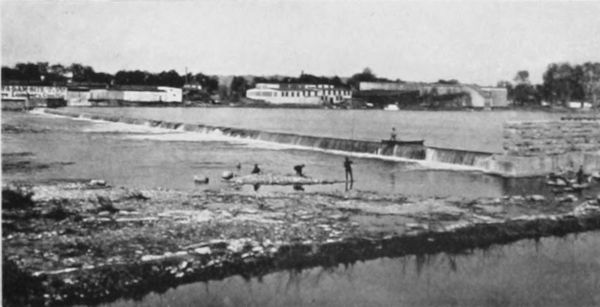
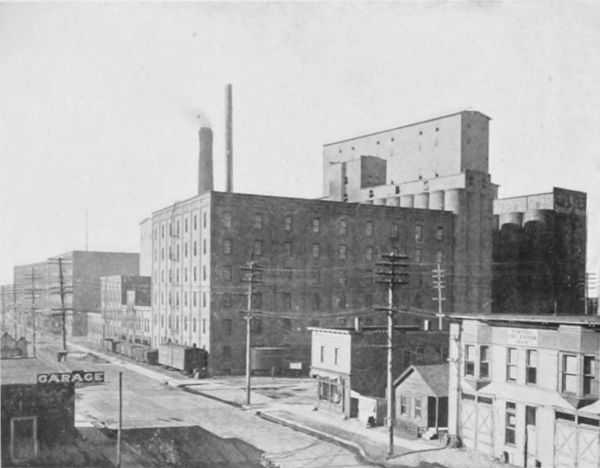
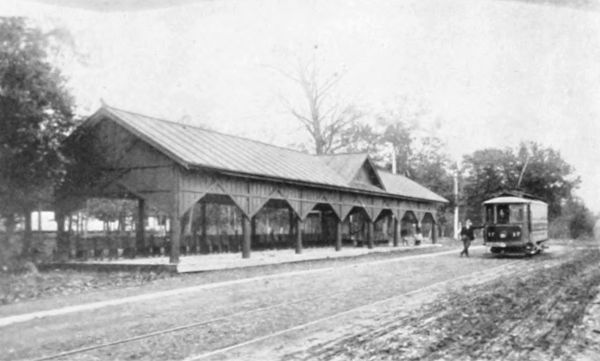
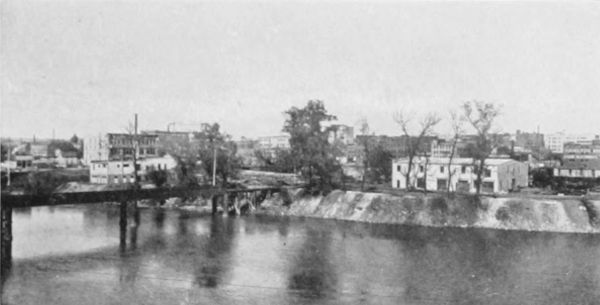
Cedar Rapids is not a new town. True, it has not been flourishing for
centuries, like the old European cities, with histories which reach
back several centuries, but as cities and towns in the middle west are
spoken of, it has a lengthy history and one of more or less interest.
Young as it is, Cedar Rapids has no definite chronicle as to who was
the first actual settler. Dyer Usher claimed that he and a companion
gazed upon the beauty of its banks and admired the river at the upper
falls as early as 1836. Osgood Shepherd maintained that he was the
first actual settler, and that he opened a tavern here in 1837 or 1838.
He, at least, sold his squatter right in the embryo town, and made the
first property deal involving landed rights in what later became the
city. J. Wilbert Stone, also known as Bill Stone and William Stone, was
here as early as any white man. He was born in the state of Rhode
Island about 1803, and emigrated to Iowa Territory in the early
thirties. Stone was a well educated, quiet, and refined man, who
possessed all the traits of a trader. He drifted into Davenport and
Rock Island, and came to Westport some time after William Abbe. No
doubt he came from Rockingham up along the river looking for a place to
barter with Indians, and the few white men who might come along as
hunters and trappers. He conducted a small trading post at Westport
some time in 1837, but whether he was the first storekeeper in the
county is not known, as this honor has also been accorded to John
Henry. Whether Henry bought Stone out or not is not certain, but this
is true, that Stone disposed of his interests and removed ten miles by
trail up to the lower rapids, at the bend in the Red Cedar river, where
the large packing plant of the T. M. Sinclair Company now stands, and
here laid out a squatter town, which he called Columbus. This town site
is supposed to have been staked out on the east side of the river. The
time must have been in 1837. He quarreled with Shepherd, who either
came about the same time, or closely followed Stone. Stone, being a
quiet, peaceable person, still single, was compelled to cross the river
and take up a claim on the west side. Robert Ellis asserts that he
found the first small hut on May 8, 1838, on what became Cedar Rapids,
and that it was located on the east side near the packing plant, and
was occupied by Philip Hull. Had Shepherd sold this cabin to Hull after
having driven Stone across the river? That might be probable, as
Shepherd tried the same dodge on Ellis a few months later when he was
building a cabin on his claim on the west side of the river. In that
instance Shepherd had a prospective purchaser who was willing to go
into Ellis's shack, and but for the nerve and presence of mind of
Ellis, Shepherd might have succeeded. From Stone's daughter, still
living, it would seem that Stone was the first actual settler who came
here to trade with the Indians, and the first to lay out the squatter
town which later became Cedar Rapids, and that this plat or staking out
was on the east and not the west side of the river, all of which would
be natural as all the other squatter towns had been staked on the east
side, and thus were better defended from an attack of Indians or border
ruffians, who were apt to congregate more frequently on the west side
of the stream.
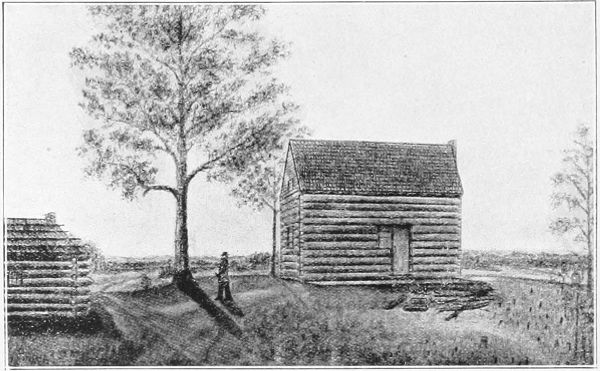
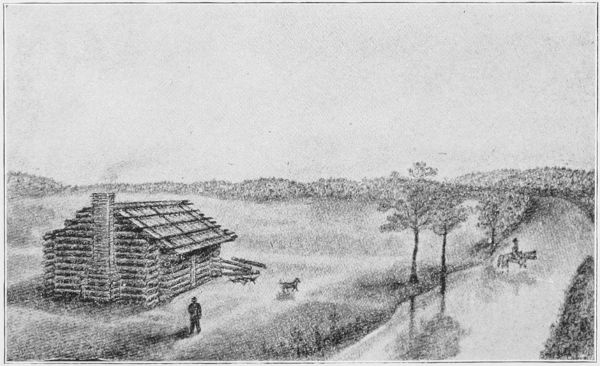
Robert Ellis walked into the town and found Hull, and later Shepherd,
located in a small cabin, which he called a tavern situated on the
river bank on what is now First avenue. Mr. Ellis also found at this
time John Young, a Scotchman, Granger, Fisher, and another Scot by the
name of Galloway. Shepherd laid claim at that time to nearly all of the
land on the east side of the river and especially the land adjoining
the dam site and the slough now called Cedar lake. A few hunters and
trappers came now and then and remained at the Shepherd cabin for days
at a time and then would depart as quietly as they had entered the
crude hotel on the river bank. It has been reported that Shepherd
harbored border ruffians and it has been said of him that while "he did
not willingly steal, he had not scruples about harboring those who
subsisted from that kind of traffic." So far as authentic records
indicate, we have no written or reliable sources of information except
hearsay, till Robert Ellis walked up the river and found the cabins of
Hull and Shepherd on the east side of the river, which property rights
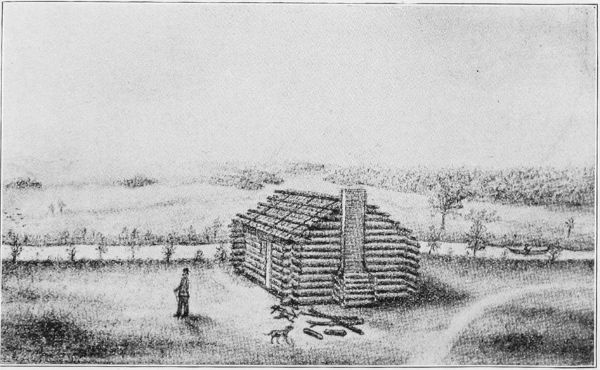
were claimed by these parties as squatter owners. By this time Stone
had removed to the west side of the river and had already erected a
cabin. Being a single man he was not at home at all times, and thus
might have been away at the time Ellis arrived. Ellis soon discovered
from what Shepherd said as well as from what Stone had intimated, that
these men were at outs, and the best way to keep peace was to have the
river between them. Ellis had been out in the world long enough not to
mix in the quarrels of other men and to keep as close-mouthed as
possible about the troubles between sworn enemies. They never
associated after their quarrel. The daughter of Stone claims that her
father told her many times that the reason he sold out and removed to
the Iowa river bottom was on account of Shepherd's attitude and that of
the members of his gang toward him. These men feared that Stone would
inform on them and wanted him out of the way so long as he refused to
become an associate of theirs or in any way to approve of their
actions.
It would seem plausible that in a community where so many were law
violators and enemies of law and order a man like Stone would not be
tolerated and the ruffians would do all in their power to get him out
of the way by intimidation or otherwise.
N. B. Brown, from what we have been informed by N. E. Brown and others,
must have passed through what became Cedar Rapids as early as 1839 but
he did not locate here till the following year, when he first realized
the full value of the falls and the feasibility of a plan to erect a
suitable dam across the river which would furnish power to run saw and
grist mills. Galloway, Young, Granger, O. S. Bowling, and a few others
were here in the meantime, all holding down claims, but no one thought
of any future city to be founded or of any valuable asset in the water
power which had never been harnessed to machinery. What appealed to
them was the fact that the stream could be forded at this place, that
the banks had plenty of timber, and that it was a sort of way station
for straggling Indian trappers and hunters. Mr. Brown was not a
frontiersman but a mechanic, who was a trained miller and looked into
the future and saw that the location was ideal. While he had but little
money, he could see far enough ahead that here would be the logical
point for mills. Mr. Brown interested George Greene, H. W. Gray, A. L.
Roach, and S. H. Tryon, and they purchased from Osgood Shepherd an
undivided three-fourths interest for $3,000. The other one-fourth
interest was later sold by Shepherd to J. E. Sanford and Addison
Daniels. Mr. Shepherd had nothing but a squatter claim to sell, but
Brown and the others figured that it would be cheaper to buy him out
than to make a fight on him, and so the bargain was made. From an old
account book still in the possession of N. E. Brown, we cite the
following:
"August 4, 1841. Commenced surveying 'Rapids City.' August 7, 2-1/2
days by N. B. Brown, same, S. Durham, same, J. W. Carson, 1-1/2 days
Geo. Greene, same, A. Daniels, 2-1/2 days O. Shepherd."
This proves that after the squatter right was purchased from Shepherd,
and the embryo town was first named by Brown the actual work of
surveying was commenced in August, 1841. All of the above named
persons became later well known in the county. Greene and Tryon were
clerks of court about this time, Durham was the newly arrived surveyor,
while Daniels became a merchant and prominent business man. Sanford was
an attorney and the owner of much land in this county, but died early
leaving his estate to his widow and aged father, who resided in
Connecticut. It would seem that Cedar Rapids was first called Columbus,
next Rapids City, and finally Cedar Rapids, taking its name from the
name of the river and the rapids which are formed here by the rock
foundations in the river bed.
Shepherd lingered around the place till the next year, when he found
that there was nothing further in his line, and that he was not
interested in corner lots or in any enterprises such as appealed to
Brown, David King, Greene, Sanford, Daniels, and many others. He
disposed of all his remaining rights and left for Wisconsin with his
family. He was later killed in a railway accident.
John Young also disposed of his squatter rights to Dr. J. R. Richey and
J. W. Carson. These purchasers sold again to Brown the following year.
J. L. Enos, a newspaper man, has the following to say of Shepherd,
writing in 1866: "The crimes committed by Shepherd and his gang were
for years a constant annoyance. John Young and a man by the name of
Granger were his immediate companions. The islands in the river,
particularly the one above the dam, were used as places to conceal
their plunder. A great many horses and much other property were stolen
by them, and in many cases they succeeded in hiding their booty. It is
known that this gang stole at one time six horses, getting away with
four of them. Granger was later caught in Chicago and tried for passing
counterfeit money. He was sent to the Alton prison for four years.
Young, it is stated on reliable authority, was executed in a
neighboring state, having been convicted of murder."
To prove that there is more or less truth in the stories as written of
Shepherd by Enos, Mr. Ellis says that shortly after he had located on
his claim and while he was building a cabin so as to hold his land,
Shepherd and some stranger came along one day and Shepherd insisted
that this was his claim and that Ellis should vacate as soon as he
could, as there would be trouble in store for a newcomer who had the
cheek to jump a claim of this kind. Ellis was much surprised and could
not believe that Shepherd, with whom he had stayed for a short time,
would come at him with such unfounded accusations. He had heard of the
trouble with Stone and knew from Hull that Shepherd was not a very good
man. Hull seemed to be all right. Ellis made up his mind that in a game
of bluff he would not take a back seat, and that he had not come all
the way from Pennsylvania on foot for nothing. He got mad and then did
not stop to count noses, but raised his ax and came towards Shepherd,
saying in his most emphatic way that the claim was his and that some
one would get killed before he gave it up. He said he had picked out
and improved the land and by right owned it till such time as the
government saw fit to throw it open for settlement. He then accused
Shepherd of some of the things he had heard and offered to back it up
by proof if he wanted it. He said further, "You have bluffed others out
of their claims, but you can't bluff me. You get off my land or I shall
be compelled to use my ax." Shepherd moved away and the stranger turned
pale and was uncertain whether he should run or stand there with his
hands raised. He had never been in such a place before. Never again was
Ellis molested, nor did Shepherd again refer to the unpleasant
incident.
It was later rumored that Shepherd for a consideration was to locate
the stranger on a good claim. He figured that as Ellis had already a
cabin partially built this would be a good chance to get a bit of money
and he reasoned that a stranger in the country would soon give in. He
had not figured on the fact that Ellis was "the bravest of the brave,"
when it came to a question of asserting his own rights, which he knew
were just. From this little episode as to the character of Shepherd as
displayed toward Ellis it would seem that Shepherd might have gone at
Stone in the same manner in which he tried to treat Ellis, and by force
and intimidation made him give up his claim. Shepherd's course while a
citizen of Linn county was not an honorable one and few, if any, of his
associates speak of him except in an unfavorable light.
In April, 1839, arrived Joe and John Listebarger, who erected a small
log house at what is now 818 North First street west and owned by
Ferdinand Uebel. A younger brother, Isaac, arrived later the same
summer. William Knowles erected a house on what later became known as
Mound Farm. John Stambaugh built a log house in what is now Bever Park,
which later was disposed of to John G. Cole. The upper part of the west
side was settled by Farnham Colby, who came shortly after Ellis had
staked out his holdings. During the years 1838-39 came others, such as
Thos. Gainor, Joel and James Leverich, P. W. Earle, and many others. It
was in July of this year that the family of Isaac Carroll arrived and
located a little to the east of what is now Cedar Rapids. A son of
Isaac Carroll, the Rev. George R. Carroll, writes as follows in his
Pioneer Life: "I cannot now recall anything of importance on the way
until we reached Linn Grove, where we found a few log cabins. In
conversation with one of the women who occupied one of these primitive
abodes we found that her language was so different from anything we had
heard, that it left a decided impression on our minds and was a source
of no little amusement to us children. Some of her peculiar expressions
were by-words with us for many years. She seemed very cordial and ready
as everybody was in welcoming newcomers, and she was quite
communicative, although her accounts were not always of the most
encouraging and inspiring character to the new arrivals.
"It was in the afternoon of July 4th, 1839, when we reached the county
seat and the only thing to mark the spot was a bower of bushes under
which our nation's birthday had been celebrated in primitive style and
in which, judging from hilarious demonstrations of two or three men
that we met on the way, whiskey must have played a somewhat conspicuous
part. A little at one side of the town L. M. Strong had a little cabin.
I do not remember of having seen either the cabin or the tenants at the
time but Mr. Strong was for many years after a well known and highly
honored citizen of this place. Passing on beyond Marion we crossed
Indian creek about a mile north of the present crossings and where
there was a beautiful crystal spring, near which was a little cabin
occupied by Mr. James W. Bassett. From this point, turning in a
southwesterly direction, we found our way by a dim track through the
woods reaching, towards night, the little bark shanty of Ephraim T.
Lewis, near where now stands the stone barn just south of the boulevard
two miles west of Marion. Mr. Lewis and his son-in-law, Nathaniel G.
Niece, were there and gave us a most hearty welcome and most cordial
invitation to share their hospitality over night, which we gladly
accepted.
"The next day we passed a half mile west to the little hut of Mr.
Jewell, later occupied by Barnet Lutz. Passing on sixty or eighty rods
west of Mr. Jewell's through the tall grass we found Mr. A. B. Mason
breaking up prairie on the higher ground just north of the Chicago,
Milwaukee and St. Paul Railway at a point forty or fifty rods west of
the boulevard crossing at Kenwood. This, I think, was the first furrow
plowed between Marion and Cedar Rapids. Passing Mr. Mason, we found
ourselves in a few moments on the ground which was to be our future
home. At a point of the ridge near the mound, which in later years has
been extensively known as Judge Greene's Mound Farm, we pitched our
tent, the little brook near by affording us water, and the grove close
at hand furnishing wood and poles and bushes for the erection of a
bower, which for a few days were to serve us as a kitchen and dining
room."
In this company came also B. F. and C. C. Cook, step-sons of Isaac
Carroll, and Sarah Carroll, a step-daughter. There were also the
following children: Isaac W., George R., and Julia Carroll.
Mr. Carroll, in his interesting recollections of pioneer days, speaks
of a number of people who at this time and in the next few years
resided in and around Cedar Rapids, such as William Vineyard, who
married Sarah Carroll, and various members of the Lewis family, who
arrived that same fall. James Ferguson and his family, the Weare
family, William Stewart, A. Sines, Arvin Kennedy, Isaac and William
Cook, members of the Ely families, Dr. J. W. Traer, J. F. Charles, the
Daniels families, and many others came a little later.
Thus within a few years from the time that Brown and others purchased
the claims of Shepherd, the scene along the banks of the Red Cedar had
changed from an Indian wilderness and a resort of border ruffians to a
landscape bearing all the evidences of a high degree of civilization.
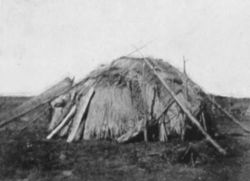
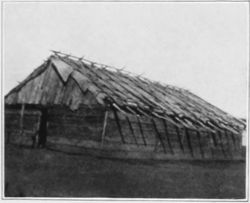
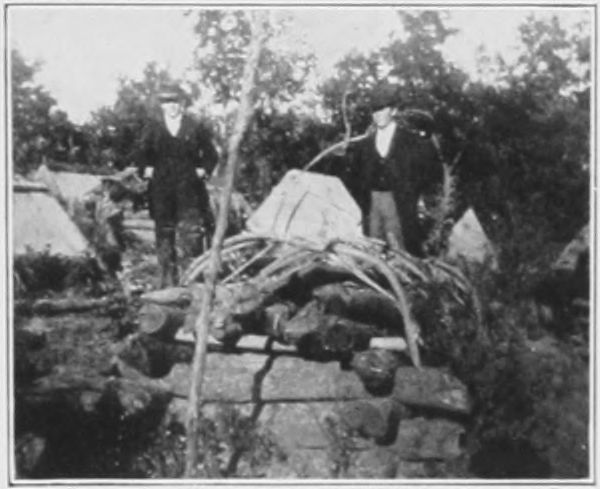
The old Indian burial grounds became the place of a Christian cemetery,
and the pole tepees covered with leaves and skins were removed to make
place for commodious log houses, erected by the whites.
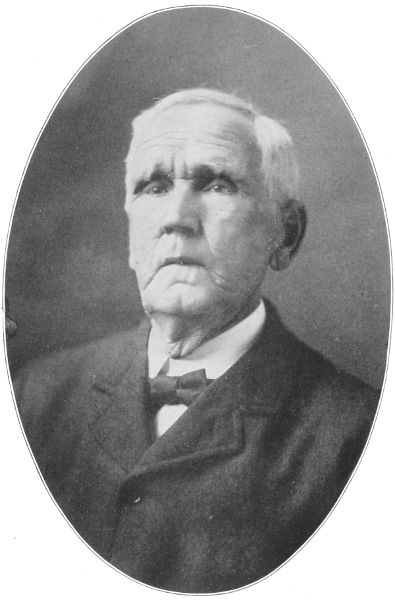
In a study of the beginnings in Cedar Rapids it has seemed to the
writer that heretofore due amount of credit for his work has not been
given to N. B. Brown. His was indeed a constructive genius. He early
interested himself in and in many instances began businesses that gave
employment to labor, the backbone of any thrifty community. His
enterprises were not always successful ones, whose are? All of them,
however, were busy institutions for a time, and while they were going
they gave employment to many people. It seemed to be the rule to send
strangers in the city seeking employment to Nick Brown if no one else
had use for their services, they being told that Mr. Brown was sure to
give them something to do.
And he always did as it was intimated he would do.
His manufacturing industries were many and varied. He built and
operated saw and flour mills, woollen and knitting factories, at one
time conducting two saw mills in the city, one on each side of the
Cedar. He also at one time ran a saw mill on Indian Creek, south of
town. He built a starch factory at McCloud's Run, and when this failed
owing to the dismissal by his foreman of the only man who knew the
secrets of the manufacture he converted the mill into a distillery,
thus making a market for the corn raised in the county.
Some of his early account books are now in the possession of his son,
N. E. Brown. They show page after page of names of employes in his
various manufacturing enterprises.
It is scarcely possible at this date to give a proper estimate to the
value of his services to the infant city. Pioneers of the energy and
public spirit manifested by Mr. Brown were indeed of great benefit to
the community in which they wrought, and honor and credit ought to be
extended accordingly.
We are glad here to testify to the great worth of Mr. Brown along
industrial lines in the pioneer days of our beautiful and prosperous
Cedar Rapids.
For the first few years the settlers got along as best they could. They
had few if any luxuries. Dubuque and Muscatine were the nearest
markets. It required from six to fourteen days to make the trip and
frequently longer when the roads were bad and when fierce storms
overtook the party. Robert Ellis built three flat boats in the winter
of 1841 and took a cargo of wheat to Burlington, trading this for a
cargo of flour which he delivered safely at New Orleans, in July of
that year. He got back during the summer but did not make any money out
of the enterprise and never again cared to try the experiment. Many
years later he received a settlement with the Burlington firm which was
hard pressed for money and could not pay for the 4,000 bushels he had
delivered. So while he did not get a fortune he perhaps came out even
on this hazardous trip.
While it is true this daring enterprise failed to make Robert Ellis a
wealthy man it did stir people up to the possibility of river traffic
and that of course helped. The venture was talked over and over time
and again, flat boats were built now and then, and a little grain
shipped. Small steamers made Cedar Rapids in the early spring of the
year, bringing a few groceries and notions, and taking away wheat,
oats, pork, and a little corn.
Artificial dams in the river were talked of but that was as far as it
went. No one was able to have any pull with the legislatures. Robert
Holmes, an old Marion resident, had a grain house at Ivanhoe, and took
cargoes of grain down the river in 1844, '46 and '51; Henry Thomson
also ran a few flat boats on the river as far as St. Louis.
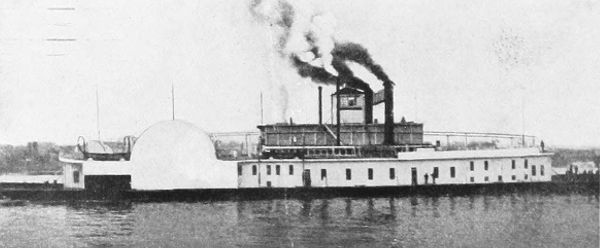
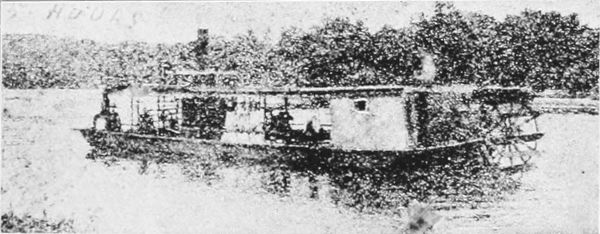
In 1858 a body of enterprising young men had built the steamer "Cedar
Rapids" at Beaver, Pennsylvania, at a cost of $20,000, the stockholders
being Wm. and George Greene, J. F. Ely, H. G. Angle, L. Daniels & Co.,
and W. W. Smith. This steamer ran during much of the spring and summer
and late into the fall, and did a big business. But within two years in
an accident on the Mississippi river the "Cedar Rapids" ran into
another steamer, litigation ensued, and the owners lost everything they
had made as well as the steamer.
Thus ended the first big adventure of the Cedar Rapids spirit. In the
same year another steamer, the "Black Hawk," was built to run up the
river to Waterloo and for a time did fair business. This was owned by
W. D. Watrous, J. J. Snouffer, W. W. Smith, J. Stanley, and several
others. This steamboat was sold to the government during the war and
used as a supply steamer on the Cumberland and Tennessee rivers. At one
time N. B. Brown was the owner of the boat. Just as the people were
demanding that another company be formed to invest in another steamer
enterprise the railways came, and now these daring business men
centered their efforts in developing railroads and won out, but not
until after many struggles, and after many failures. The people of Linn
county surveyed, planned, and talked about several lines before they
could realize the benefits of any.
The Chicago, Iowa and Nebraska Railway was organized in what is now
Clinton on January 26, 1856, the first officers being Charles Walker,
of Chicago, president, James Purdy, of Mansfield, Ohio, vice president,
T. T. Davis, of Syracuse, New York, treasurer, R. H. Norton, secretary,
and Milo Smith, of Clinton county, engineer. Many Cedar Rapids
residents put up money and notes to have the road come through the
city. Most of the necessary means were put up by eastern capitalists
and especially by John I. Blair, one of the most enterprising of the
early railroad promoters in America. Mr. Blair was born in New Jersey
in 1802 and passed away in 1892, one of the most noted men of this
country. He was at least in an early day the owner of more miles of
railways than any other man in the world, and had laid out more town
sites and villages in Iowa and Nebraska than any other person in the
west. It was John I. Blair who first saw the opportunity of making
Cedar Rapids a center on account of its progressive people, the water
power, and other advantages which this practical, wide-awake railway
man saw here, and which were lacking in other localities. In June,
1859, the road was completed to Cedar Rapids. Its coming was the most
important event in the history of the city. It was the beginning of the
end in the unique struggle for railways in Linn county, and marks an
epoch in the history of the city.
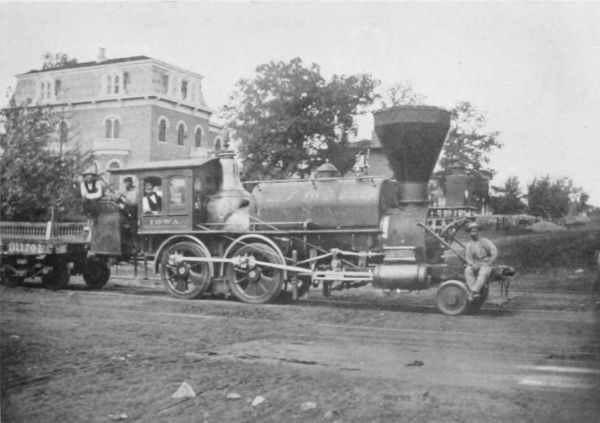
The road was extended west, and by 1862 the trains were running as far
as Marshalltown. By 1867 the road was completed to the Missouri river.
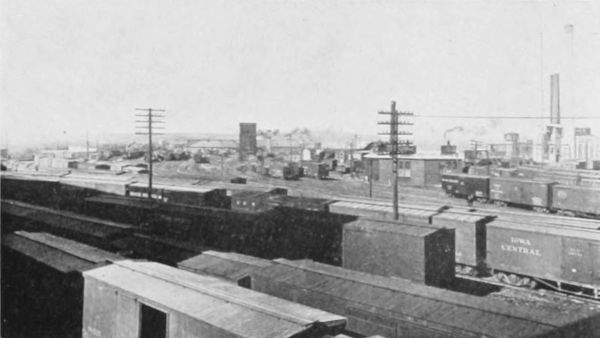
Both the Iowa and Nebraska and the Cedar Rapids and Missouri River
railways have for many years been under one management and are now
known as the Chicago and Northwestern Railway, which owns and operates
nearly 8,000 miles of road with a capital stock of $130,121,838.
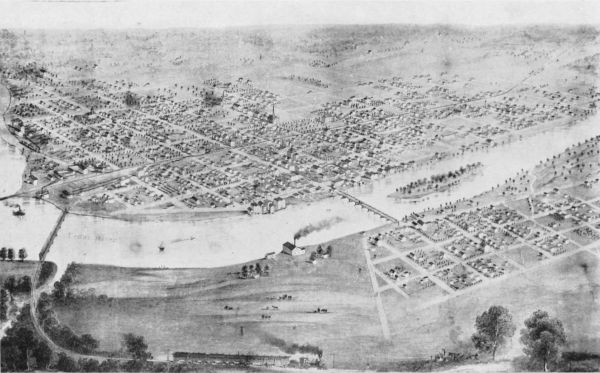
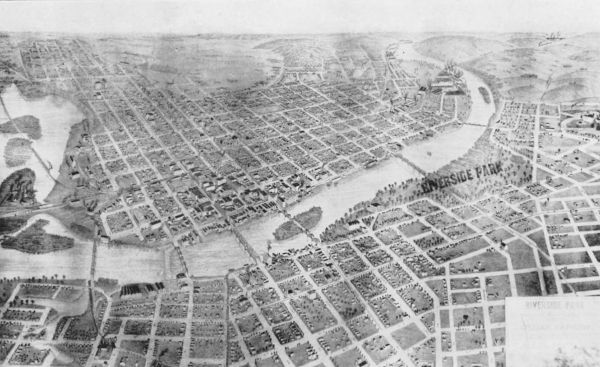 BIRDSEYE VIEW Of CEDAR RAPIDS IN 1889
In 1865 D. W. C. Rowley began grading for the Burlington, Cedar Rapids
and Northern Railway, which was organized in Cedar Rapids. A separate
company, known as the Cedar Valley Construction Company, was organized
to build this line to Waterloo. This company was composed of such men
as Dr. J. F. Ely, president, William Greene, superintendent, D. W. C.
Rowley, secretary. In December, 1866, another road was incorporated,
running to Burlington south via Iowa City. The men connected with this
enterprise were J. H. Gear, Burlington, president, J. E. Putnam,
Burlington, secretary, directors Dr. S. D. Carpenter, of Cedar Rapids,
E. Clark and Peter A. Dey, of Iowa City, and John Bird, Louisa county.
This southern branch did not progress rapidly and there was more or
less of a hitch with the plans, and a question as to how the road
should run. The articles were changed, leaving out Iowa City, and the
board increased to fifteen members, among whom may be mentioned N. B.
Brown, George Greene, and Charles Weare, who were added from Linn
county. George Greene was elected president and Charles Mason, vice
president. By June, 1868, the two roads were united under one name, the
Burlington, Cedar Rapids & Northern, Greene becoming president, and D.
W. C. Rowley secretary. By January 1, 1871, trains were running between
Cedar Rapids and Burlington, and early the following year they reached
to St. Paul, thus making one of the first great north and south roads
in Iowa. For many years C. J. Ives was president of the road till it
was absorbed by the Rock Island system, when the headquarters were
transferred to Chicago, the Cedar Rapids office becoming merely a
division point.
The Dubuque and Southwestern Railway was operated from Dubuque to Cedar
Rapids in October, 1865. This was an important factor in the upbuilding
of Marion and other towns along this road and in fact helped Cedar
Rapids. Like all small roads, it was not a financial success, and in
May, 1878, it was sold to the Chicago, Milwaukee & St. Paul Railway
Company and new life put into it. The Milwaukee road in 1883 extended
this line to Kansas City. The main line of the Milwaukee was extended
to Omaha.
The building of the interurban to Iowa City, a distance of twenty-eight
miles, a few years ago concludes the railway building in Linn county,
with the exception of the Anamosa and Northwestern, which runs along
the northern part of the county; and the extension of the Illinois
Central, which runs down from Manchester, connecting with the main line
at that place.
We are pleased to give space here to the following account of
beginnings in Cedar Rapids. It is from Bailey & Hair's Gazetteer for
1865:
"D. W. King and T. Gainor were the first settlers of any
advantage to the county. They reached here in 1839, and soon
after made a permanent settlement on the west side of the
river.
"The first white man, however, who pitched his tent on the
ground, now occupied by the Valley City, was a notorious
counterfeiter and horse thief by the name of Shepherd, who
took up his abode and erected his cabin on what is now
Commercial street, near the mills, in the year 1838.
"Thus early was this location selected as a central point
for commercial operations with the surrounding country, and
although the character of the operators was worse than some
who have followed them in business, it nevertheless
indicates their wisdom in making a good location for their
enterprise.
"In 1849 D. W. King established ferries for crossing the
river, and continued to run them up to the time of his
death, in 1854. They were located at Iowa avenue and Linn
street crossings. They were self-propellers, being forced
across the river by the power of the current. A wire rope or
cable extended across the stream upon which a pulley was
placed, and connected by ropes to the boat. The first dam
across the Cedar river was commenced in 1842, and the first
saw mill erected in 1843.
"In March, 1843, the lands came into market. The first
flouring mill was erected by N. B. Brown, in 1844-5, at a
cost of $3,000. Extensive additions have been made to this
mill since. It is still owned and run by Mr. Brown. In 1845,
A. Ely erected the second saw mill and the following year
the second flouring mill at a cost of $9,000. In 1848-9, the
first woolen factory was erected by N. B. Brown. Cost,
$10,000. The first steam engine was set in operation in
1855, in the machine shop of A. Hager.
"The first store was owned by J. Greene in the building now
standing on the northeast corner of Iowa avenue and
Washington street. The second store was opened by Mr.
Cleveland, and the third by Mr. Mulford. The proprietor of
these stores have all left the city. Mulford's store was
destroyed by fire in 1850, being the first building thus
destroyed in Cedar Rapids. The second fire occurred in 1855,
when the buildings on the west side of Commercial street,
between Iowa avenue and Linn street, were mostly consumed.
The postoffice was established in 1847, and J. Greene
appointed postmaster.
"The first brick building was erected in 1844, on the
northwest corner of Iowa avenue and Washington street, by P.
W. Earle, and is now occupied by him. The Union House, on
the northwest corner of Adams and Market streets, was the
first hotel. It was destroyed by fire early in 1865. The
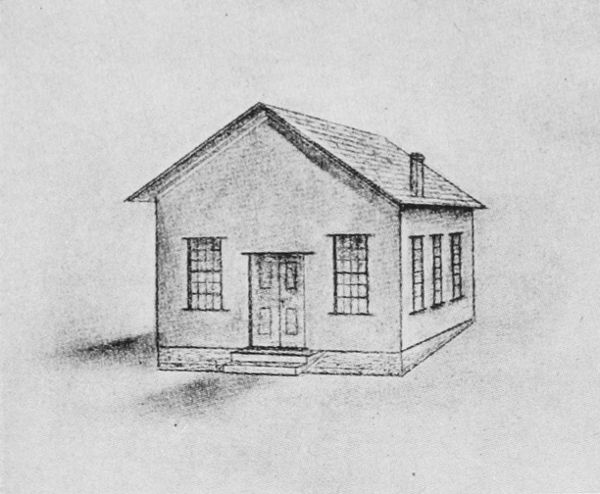
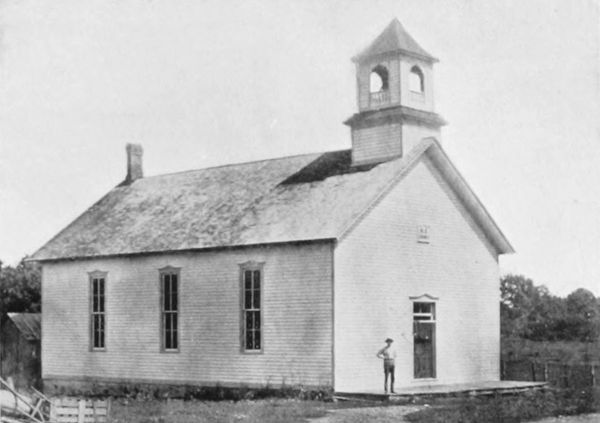
first school house was erected in 1847, and the first school
taught by Nelson Felch. This structure is now occupied as a
dwelling on the north side of Eagle street between Jefferson
and Madison. The first white child born was the daughter of
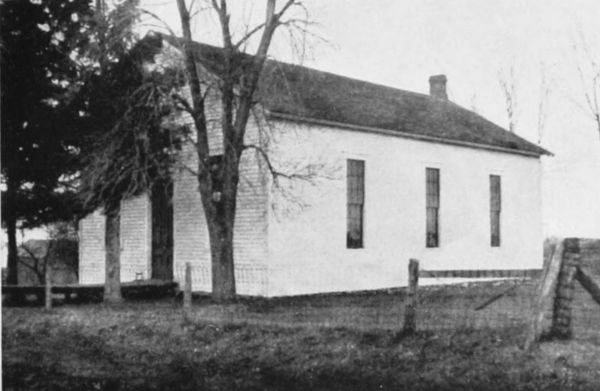
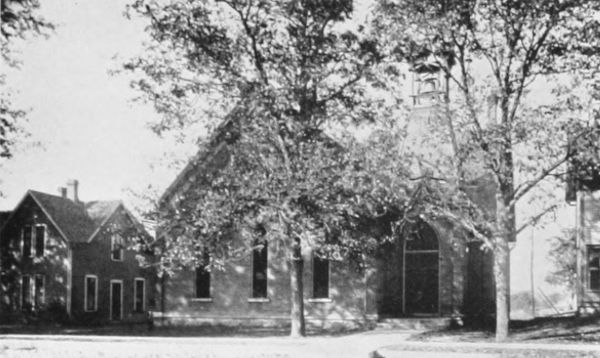
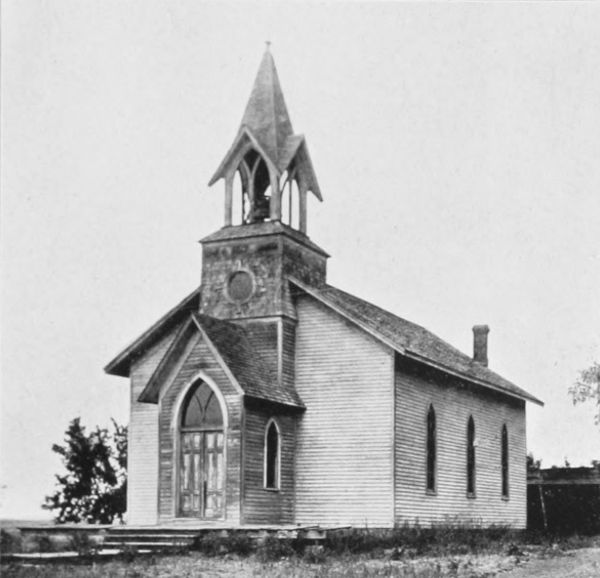
John Vardy, now removed to Texas. The first church erected
is that commonly known as the 'Muddy,' and is still used as
a house of worship. It is a small 'grout' building at the
southeast corner of Eagle and Adams streets. The first death
was that of a young man by the name of William Brookey, some
time in 1843. The first frame building was built by John
Vardy.
"The lodge of Free Masons was established in 1850, and James
Keeler, an Episcopal minister, was the first W. M. The lodge
took the name of Cedar Rapids Lodge No. 25. Its name was
changed in 1864 to the more euphonious and Masonic name of
Crescent.
"The first newspaper was established by D. O. Finch, in
1854. Three volumes only were issued. D. O. Finch, James J.
Child, and James L. Enos, were successively its editors. The
Era was purchased in 1854 by James L. Enos, and the name
changed to the Cedar Valley Times, by which name it still
flourishes. C. M. Hollis, Esq., is the present editor. The
second paper was the Cedar Valley Farmer, J. L. Enos,
editor. The Cedar Rapids Democrat was the third paper
established, by W. W. Perkins & Co., in 1856. The Voice of
Iowa was commenced in January, 1857, by the Iowa State
Teachers' Association, and J. L. Enos elected editor. This
journal reached a large circulation, and did much to give
form to the school system of the state. The present public
school edifice was erected in 1856-7-8, at a cost of some
$15,000. It has six departments, and employs seven or eight
teachers.
"Cedar Rapids was incorporated as a city in 1856, and Isaac
Newton Whittam, Esq., was chosen the first mayor. A free
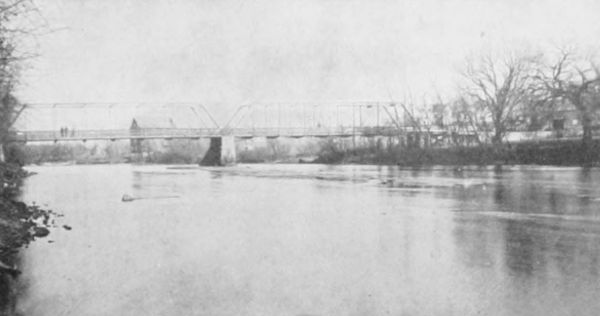
bridge was constructed across the Cedar in 1855-6, but was
soon carried away by the ice. As it fell, a large number
were standing on the banks watching the ice as it rapidly
tore the stone piers from their positions. Two sisters,
daughters of Mr. Black, passed by the guard, which was
stationed at the end of the bridge to keep the people from
passing on, and had reached about the middle, when the frail
fabric went down. Both young ladies were drowned, and the
body of one was never recovered. A toll bridge was erected
the following year, and though a slender structure, has thus
far withstood the action of the ice, though occasionally
broken down by cattle passing over it.
"Is a place of about 350 inhabitants, situated on the west
side of the Cedar river, opposite the city of Cedar Rapids.
It is connected with this city by a wooden bridge, and is
about one-quarter of a mile from the Cedar Rapids depot of
the Chicago and Northwestern railroad. In the year 1838
Robert Ellis and O. Bowling settled on land in the vicinity,
and in the year following Messrs. Isaac, John, and Joseph
Lichtebarger settled where Kingston now stands. During the
summer following David W. King and Thomas Gainor arrived
here. The first child born was Mary Jane, daughter of T. and
R. Gainor, on the 15th of May, 1840. Rosannah Gainor died on
the 8th of June, 1840. This was the first death in the
place. There is in the place one paper mill, one saw mill,
two blacksmith shops, two groceries, and one dry goods
store. There are three religious societies, Methodist
Episcopal, Congregationalist, and United Presbyterian. There
is also a commodious building for school purposes, and three
libraries. This region of country is especially adapted to
growing grain. Large quantities are annually shipped to
Chicago from this place. The immense water-power will at no
distant day make this a large manufacturing town."
The following as to early things in Cedar Rapids is taken from a copy
of the Cedar Valley Times, J. L. Enos, editor, in 1865:
"On the 4th day of July, 1841, N. B. Brown began
construction of a dam for utilization of the power. Carson,
Gray and Roach soon sold their interests to Messrs. Brown
and Greene, who became the sole proprietors of the
water-power, and constructed the first saw mill in 1842-3.
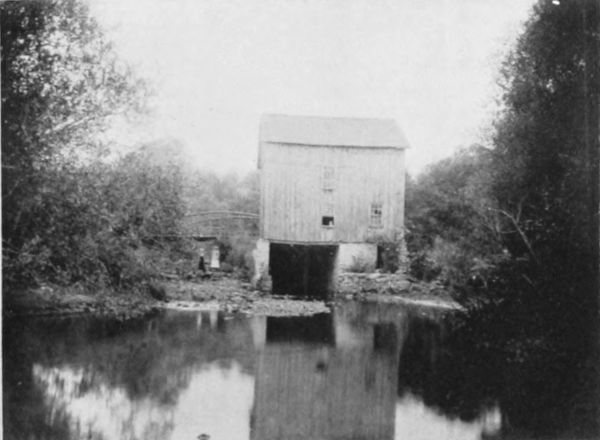
This mill is yet standing in the rear of Brown's flouring
mill, which was also the first grist mill, and erected in
1843, and extensively enlarged by the present owner in
1854-5.
"The first blacksmith in the place was Harrison Campbell,
who opened a shop in Shepherd's old cabin in 1843. Isaac
Cook, Esq., was the first lawyer, John L. Shearer the first
justice, and James Lewis the first constable. The name of
the first physician seems to be lost from the memory of the
'early day,' though many of his peculiar traits of character
are remembered. Like some others in the profession he was
disposed to blow his own trumpet, and the stories he told to
the uninitiated ones were marvelous in the extreme. Once
when he had returned from Muscatine he claimed to have lost
forty pounds of quinine in one of the streams which put into
the Cedar below the city—the water being unusually high.
His credit was evidently then better than afterward, as was
also his physical courage. Constable Lewis, at one time
called upon him with an execution to secure a judgment, when
the doctor becoming wrathy, threw off his coat for a fight.
The constable being more intent on collecting the claim than
emulous for notoriety as a pugilist, seized the coat and
made away with it—finding a sufficient amount of money to
pay the debt. Dr. S. M. Brice remained here for a few months
and then removed to Center Point. Dr. E. L. Mansfield was
the first physician who made a permanent location in this
city, and still enjoys a large and lucrative practice. He
came here in 1847 and has ever since been engaged in the
noble endeavor—to heal the thousand natural ills that flesh
is heir to.
"The first brick building was erected in 1844, by P. W.
Earle, Esq., on the west corner of Iowa avenue and
Washington street. This building is still occupied by Mr.
Earle, and shows but little the marks of age. A three-story
brick store was erected the same year on the south corner of
Iowa avenue and Commercial street. This building has since
been removed to make room for the block of stores extending
from Iowa avenue down the west side of Commercial street
toward Eagle street. Greene's hotel, a fine-appearing brick
hotel four stories high, also occupied a portion of this
ground. It was erected in 1853-4 by George Greene, and was
kept by various persons as a first-class hotel until it was
taken down to make room for a new brick block, which was
erected in 1862.
"The first store proper was opened in the building now
standing on the north corner of Iowa avenue and Washington
street, by Joseph Greene. As early as 1842 Mr. Greene had a
store in one part of a log building located on the north
corner of Commercial and Sugar streets, the other end of the
same building being occupied as a boarding house or hotel.
"The first building erected for a hotel was built by William
Dwyer in 1847, James Gunning being the first landlord. The
building was destroyed by fire in January, 1865. It was
known as the Union House and was located on the west corner
of Market and Adams streets.
"The Adventists held meetings here as early as 1842-3; a Mr.
Baker being the minister. The Protestant and Episcopal
Methodists also had organizations at an early day. The
Presbyterians organized soon after and erected the first
church edifice, known as the 'Big Muddy,' taking its name
from the material of which it was composed. It is a grout
building, occupying the east corner of Eagle street and
Adams street. The Universalists had an organization here
quite early and were 'ministered unto' by Rev. Mr. Westfall.
In either 1843 or '44 a somewhat noted discussion was held
between Mr. Westfall, the Universalist, and Mr. Roberts, Old
School Presbyterian, at which Joseph Greene acted as umpire.
The discussion continued for four days and nights. The
meetings were largely attended and the combatants were sharp
and excited. The conflict ended as such discussions usually
do—in the victory of both—and this was regarded by nearly
all as a drawn game.
"The first school was kept by Miss Emily Coffman. The first
school building was erected in 1846-7, by a company
consisting of N. B. Brown, George Greene, Alex. Ely, and
others, who sold it to the district, and had the
satisfaction of being taxed to pay themselves for it. This
building was on the north side of Eagle street between
Jefferson and Madison. It is still standing and is occupied
as a dwelling house. Nelson Felch was among the first
teachers, also a Mr. Freeman, who has since been receiving
instruction in a state institution located at Fort Madison.
"The second saw mill was erected by Alex Ely in 1844 and the
second flouring mill in 1844-5. Mr. Ely died shortly after
the completion of this mill. In 1848 N. B. Brown built the
first woolen factory. The first steam engine was put up here
in 1855 by A. Hager, in his sash, door and blind
manufactory. He had an extensive amount of machinery
connected with it and employed a number of workmen.
"The second store was established by Mr. Cleveland, and the
third by C. K. Mulford. Mulford's store was afterward
occupied as a dwelling, on the east corner of Commercial and
Linn streets, and was destroyed by fire in 1850. That was
the first fire in Cedar Rapids, and none occurred after it
until the autumn of 1855, when most of the block on the west
side of Commercial street, between Iowa avenue and Linn
street, was destroyed. No precautions have been taken to
prevent the spread of the destroying element, and were a
fire to occur tomorrow no more means would be found of
subduing it than existed twenty years ago. It would seem
that a wise people would not thus neglect what may at any
moment be of such vast importance. But so it is, and so it
is likely to remain until a fire shall occur that will lay
in ruins a large portion of our city and destroy thousands
of dollars worth of property. Personal insurance can best
cover a part of this loss and perhaps not one-half are
provided with this protection."
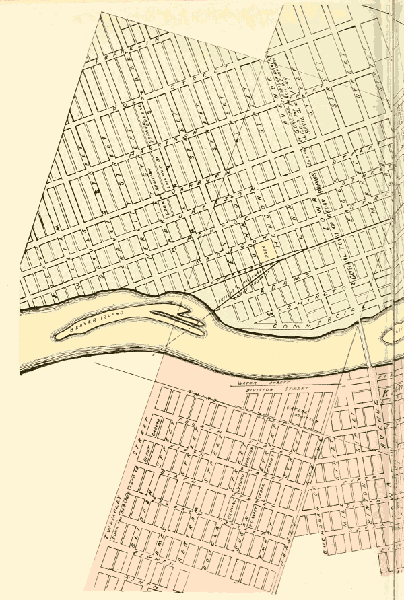 REPRODUCTION of THE FIRST MAP OF CEDAR RAPIDS
(Part 1)
REPRODUCTION of THE FIRST MAP OF CEDAR RAPIDS
(Part 1)
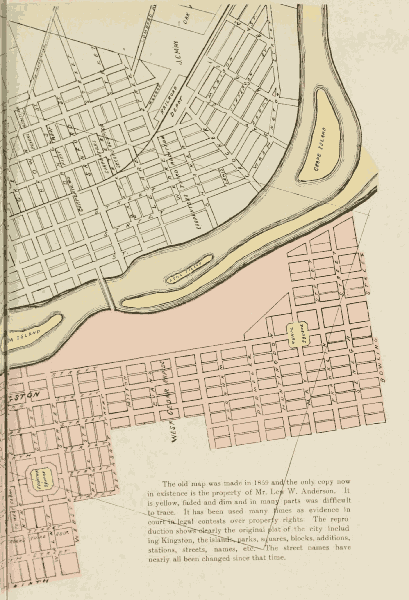 REPRODUCTION of THE FIRST MAP OF CEDAR RAPIDS
(Part 2)
REPRODUCTION of THE FIRST MAP OF CEDAR RAPIDS
(Part 2)
[The old map was made in 1859 and the only copy now in existence is the
property of Mr. Lew W. Anderson. It is yellow, faded and dim and in
many parts was difficult to trace. It has been used many times as
evidence in court in legal contests over property rights. The
reproduction shows clearly the original plat of the city including
Kingston, the islands, parks, squares, blocks, additions, stations,
streets, names, etc. The street names have nearly all been changed
since that time.]
Dr. Seymour D. Carpenter, who came to Cedar Rapids in 1849, contributed
the below quoted memoirs to a History of Crescent Lodge, J. E.
Morcombe, author, and published by the lodge in 1906. It is of value in
the consideration of the history of early times in the city and county:
"I wished to read law, but there was a family prejudice
against the profession, and I concluded to study medicine
and accordingly entered as a student the office of Drs.
Boerstler & Edwards, who were among the leading physicians.
There for a year I read books that were full of what are now
exploded theories and practice, at the end of which time I
was sent to the University of Pennsylvania, where two years
after I was graduated as a doctor of medicine. Returning
home in the spring of 1849, I remained but a few months and
then started west 'to grow up with the country.' I again
rode to Cincinnati on horseback, took steamer to St. Louis,
thence by another boat up the Illinois river to Haverville.
Not liking the place, I rode west and crossed the
Mississippi at Quincy and went to Kirksville in Missouri.
Still not pleased, I turned north and went to Ottumwa, Iowa,
where I met Judge Greene, then a member of the supreme bench
of Iowa. He persuaded me that Cedar Rapids was in the near
future to become a metropolis, and I decided to go there.
After four days' hard riding and swimming several swollen
streams, I struck the town on the afternoon of the 14th of
June, 1849. I crossed the river on a rope ferry operated by
David King, who lived in a cabin on the west side. On the
other side of the river stood the cabin once the home of a
man named Shepherd, and said to have been the resort of
thieves in an earlier day. I cannot say that I was very
favorably impressed by the thirty or forty mostly one-story
unpainted houses that were scattered about near the river.
There seemed to be a great deal of sand, and the houses were
so situated that there was no sign of a street. There were
three two-story houses, one on the river near the foot of
what is now Third avenue, called the 'Park house,' in which
the Greenes had their store; one on second street in which
John Coffman kept a hotel, and one on Third avenue, back of
the Dows & Ely block, also a hotel, but keeper's name
forgotten. I was discouraged and would have traveled further
but only had about ten dollars left, and from necessity had
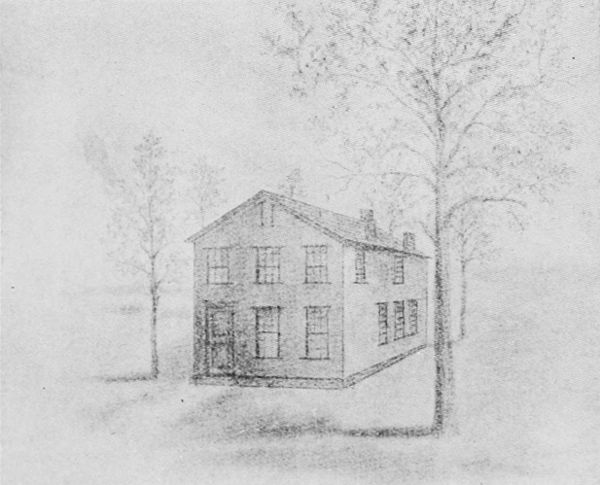
to stop. I put up at the Coffman hotel, which, as I have
said, was a two-story structure with a wing. It had been
built of unseasoned oak lumber and was not plastered. The
whole of the second story of the main building was in one
room, and contained eight or ten beds and was the common
sleeping room of the guests. The lumber had shrunk and there
could be no complaint as to ventilation, however short the
accommodations might be in other respects. I had hardly got
settled before I was interviewed by old Joe Leverich, a
noted character of Linn county of that day. He was known as
the 'Bogus Coon,' because, as was alleged, he had to do with
counterfeiters. He was a power in politics and was the kind
of a man from which the modern 'pop' has evoluted. Joe
looked me over, asked where I was from, where I was going,
what my business was, etc., etc. I was somewhat indignant
and tried to be sarcastic, but Joe, in terminating his
interview, squelched me by remarking: 'Young man, a fellow
that wears such a hat as you do may pass in this country,
but I consider it d—d doubtful.' I unfortunately wore a
'plug' hat which was not the style in Iowa a half century
ago. In subsequent years Joe and I became fast friends, and
I became quite convinced that the shady stories told of him
were the talk of enemies who were jealous of him because he
was smarter than the great majority of them. I was with him
when he died, and, although a free-thinker, he passed away
with all the calmness of a stoic philosopher.
"Within a week I made the acquaintance of all the people of
the town. Among the leading persons were William and Joseph
Greene, brothers of the judge, Lowell and Lawson Daniels,
Homer Bishop and John Weare, all of whom were merchants.
The three stores of which they were the proprietors would
not compare well with the department stores of today, but
all the same they were department stores, and in their
miscellaneous stocks the customer could find all he wanted,
from castor oil to broad-axes. Pollock & Stewart were the
blacksmiths, and the carpenters and wagon-makers were also
represented, but I cannot recall their names.
"Dr. Mansfield took me as a partner, and in company with
Judge Cook, we had a room, 10×16, in a small one-story
building opposite the mill, the other part being occupied by
S. L. Pollock and family. His blacksmith shop was near by.
Our medicines were kept on a shelf and a store box made a
table. Our bunks occupied one side and a few stools and two
split-bottomed chairs made up our furniture. We took our
meals at the Coffman house. Our field of practice embraced
the settlers, not numerous, in the valleys of the Cedar and
Iowa rivers and their tributaries. We made very long rides.
I was called to see a patient two miles above the present
town of Vinton, not then begun. I got lost in the night and
waited for daylight under a tree on the bank of the river at
the very spot where Vinton now stands. Bilious fever and
ague were the prevailing diseases, all the newcomers having
to undergo one or both. As patients and clients were not
very numerous, we had a good deal of leisure. Judge Cook was
a fine reader and we took turns at Shakespeare, a copy of
which we fortunately possessed. During the summer Dr.
Mansfield and myself built a story and half office on
Commercial street, about the middle of the block on which
the Daniels store was located. We had a mail three times a
week from Dubuque and Iowa City. The Higley brothers did the
service in a two-horse hack. I think Joseph Greene was
postmaster. John Weare, Sr., was justice of the peace. He
was a very original character, fond of company and full of
interesting reminiscences extending back to the war of 1812,
in which he had lost a leg. His small office was in the rear
of Mrs. Ely's residence, which stood on the ground where the
Dows & Ely block now is. He gave 'nicknames' to many people
and places which stuck to them like burrs. The first
Presbyterian or Congregational church building was begun
that summer, and as the walls were built of cement, old Mr.
Weare named it the 'Muddy,' which it retained to the last
day of its existence. Many buildings were put up that year
with a corresponding increase in population. All the people
were full of hope and ambition. We began to talk of
railroads. The people of Dubuque and Keokuk, the leading
river towns, started a scheme for a road running through the
interior and connecting them. The people along the line, at
Cascade, Anamosa, Marion, Cedar Rapids, Washington and
Fairfield eagerly endorsed the project, meetings were held
and it was resolved to hold two delegate conventions, on the
same day, one at Anamosa, the other at Fairfield. We had a
rousing meeting in Cedar Rapids. There were nearly a hundred
people present, and they resolved to have the railroad
forthwith. From our standpoint it was the government's duty
to donate land, and for eastern people to furnish the money.
Delegates were chosen to both conventions. Dr. John F. Ely
and myself were selected to go to Fairfield. Both
conventions were to be held on the 6th of December, 1849. We
left Cedar Rapids on the 3d of December and after three
days' hard and cold travel reached Fairfield. Marion sent
Col. I. M. Preston and Dr. Ristine. The convention met in a
small school house. All the counties were represented. The
Hon. C. W. Slagle, of Fairfield, then a very young man, was
chosen president. I was chosen secretary. The little school
house was packed, and if any doubt the courage and scope of
that convention, let him look up the old file of newspapers
of that day and read. Dr. Ballard, of Iowa City, Stewart
Goodsel, of Brighton, Joseph Casey, of Keokuk county, and
General Van Plank Van Antwerp were present and took active
part. We parted for our various homes, thinking the work
half done, but sad to relate, Cedar Rapids had to wait ten
years longer for the locomotive. These two meetings were,
as I think, the first railroad conventions held in the
interior of the state. Soon opposition schemes were started
for east and west lines, and our project was ignominiously
called the 'Ram's Horn.' The next year was quite a stirring
one. New people were coming in great numbers, but many were
leaving, for the California fever had broken out. Several
outfits left Cedar Rapids, and with one of them Dr.
Mansfield, my partner, whose place was taken by Dr. S. C.
Koontz, a cousin of mine, one well known to the old
citizens. That year the first brick buildings were erected,
a dwelling on Iowa avenue near Greene's opera house, and a
three-story building on Commercial street, by Judge Greene,
which for a long time was the show building of the town. We
began to put on city airs.
"At this time Martin L. Barber was mayor of the village. It
was before the present city organization. Barber was an
eccentric character, a millwright by trade. He was nearly as
wise as Solomon, with courage to match. A 'bad man' came to
the town. He hung about the saloon. It was said he drew a
knife and threatened to kill a citizen. The majesty of the
law was invoked. It was night. The offender took refuge in
the saloon and barricaded the door. The mayor called out the
'posse commitatus' numbering two or three dozen young
fellows like myself. He pounded on the door, demanding
admittance in the name of the law. No response. We got a
piece of timber and battered down the door. The mayor
collared the 'bad man' who offered no resistance. He was
hurried towards the Coffman house, where the mayor proposed
to deal out justice. As we neared the hotel he tore loose
from the mayor and made for the river. We in full cry in
pursuit. He plunged in just below the mill. We paused at the
brink. Gradually he disappeared, and was never seen
afterwards. It was the first and last exhibition of the
mayor's power.
"In 1850 Miss Mary S. Legare, sister of the Hon. Hugh S.
Legare of South Carolina, came to Cedar Rapids. She was a
woman of the highest culture, who had moved much in the
official circles of Washington, and had considerable wealth.
With her came numerous relatives named Bryan, Storey, and
McIntosh, the latter a well known lawyer of the early days.
She made investments in the town and took up large tracts of
land. In the spring of that year we had a very spirited
election. The people were divided into two factions, the
'codfish' and the 'catfish.' For mayor the former nominated
N. B. Brown, the latter Jacob Bressler. I cannot recall the
issues, but only remember that we almost came to blows
during the canvass. Less than one hundred votes were cast
and Brown was elected. Brown was one of the original owners
of the town site, and built the first mills. He was one of
the prominent characters in the early history of the town, a
modest, quiet, but genial man, with many friends.
"This year, on the 6th of July, I did one of the few wise
acts of my life. I married Sarah Weare, the daughter of John
Weare, Sr. We went to housekeeping in a small one-story
house, near where the old passenger depot stood. It was then
the only house east of the present railroad. The next year,
1851, was a very active one for the town. Judge Greene, who
had lived in Dubuque, moved to the town. The same year came
S. C. Bever, who had driven in a two-horse buggy from Holmes
county, Ohio, to Cedar Rapids. By this time I considered
myself an old citizen, thoroughly identified with the county
and town, and devoted all my leisure time to meeting
strangers and exploiting the town and county. I met Mr.
Bever soon after his arrival and spent several days with him
riding about the country. He made large investments both in
country and town. One was 160 acres about a mile from the
ferry, at $5.00 per acre. I made the sale for Mr. Addison
Daniels of Marion, who was so pleased with my effort that he
presented me with a four-bladed penknife. Both Mr. Daniels
and myself were satisfied and I have never heard that Mr.
Bever regretted the purchase. That same year my father, Mr.
Gabriel Carpenter, came out to see the country. After great
effort on my part and many misgivings on his, he purchased
of Mr. Levi Lewis 300 acres of land adjoining the town plat
on the south, for which he paid $2,500. The land embraced
the present cemetery. By this time Judge Greene had
completed his three-story building, into which the Greene
Bros. placed a large stock of goods. The most of their stock
was brought up the river in a keel boat of forty or fifty
tons capacity. It was rigged with a large square sail, but
the principal power was men with poles, who shoved it
against the current. They had loaded it with pork and sent
it down the river in the spring.
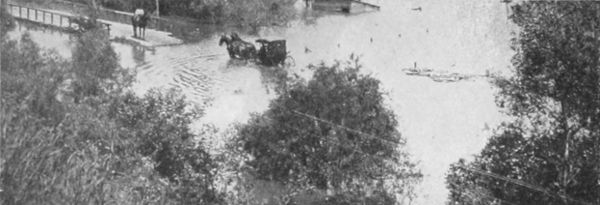
"In 1851 occurred the great flood. Most of the lower parts
of the town were under water. The grand lodge met that year
at Ft. Madison, and at the time the river was at its highest
point. We were cut off from all the neighboring country by
the swollen streams, but the lodge thought it must be
represented and I was chosen as the delegate. N. B. Brown
suggested that I should go down the river in a skiff to a
point opposite Muscatine, then by land to that place, which
is only ten or twelve miles distant, then by steamer to Ft.
Madison. The lodge furnished the skiff. I found a companion.
We embarked in the morning and so swift was the current that
we reached our destination by nightfall, and I was on time
for the meeting. At the meeting I renewed my acquaintance
with the grand master and the grand secretary, and met many
brethren who became lifelong friends.
"In the spring of 1852 a steamboat came to Cedar Rapids. It
was a great event, and brought in people from near and far.
She brought a full cargo of freight, among which was the
household effects of Mr. Bever and my father, both of whom
from that time forward became citizens of the town. This
year also came Mr. Daniel O. Finch with a printing press and
forthwith started the Progressive Era, the first paper in
the Cedar valley. Ezra Van Metre, a talented young lawyer
from Cincinnati, Ohio, also came that year. Every one was
rejoiced that we had an organ and the editor was overwhelmed
with original matter. There were at least a dozen young
fellows in the town, myself among the rest, who thought they
'knew it all,' and anxiously rushed into print. The paper
changed hands in a year or two, and became the Cedar Valley
Times and continued until a few years ago.
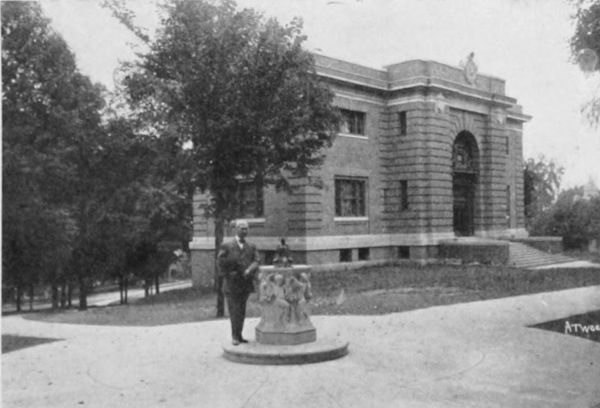
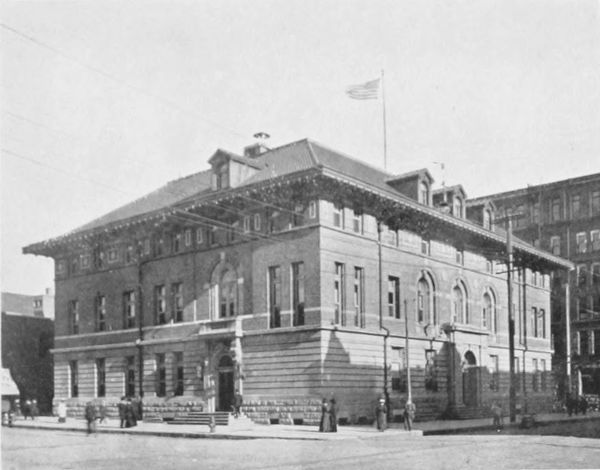 FEDERAL BUILDING, CEDAR RAPIDS
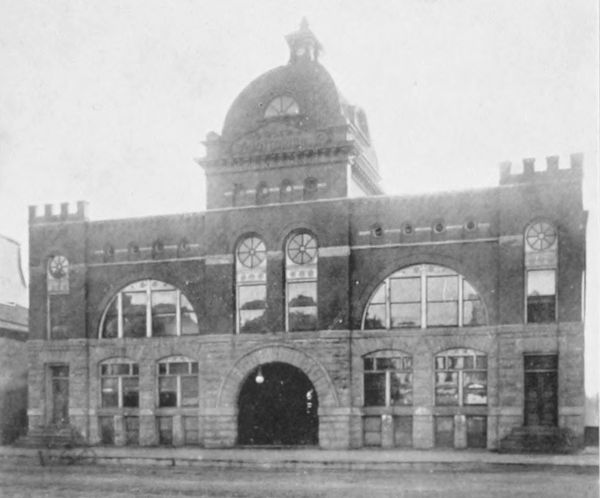 AUDITORIUM, CEDAR RAPIDS
"In the winter of 1852 I had a serious time in a
professional way. A young man living at Quasqueton, Buchanan
county, was riding across the prairie near that place and
met a bear. The bear fled and he pursued. In crossing a
strip of ice the horse fell. He was thrown and his foot
stuck in the stirrup and he was dragged four miles over the
snow, which was about six inches deep. In the mad flight the
horse kicked and broke his right leg below the knee in two
places. Finally the saddle turned, his foot was released and
he was dropped on the lone prairie. The horse found his way
home with saddle under his belly. This was on the evening of
the 17th of December. A search was organized, but he was not
found till the 21st, four days after the accident.
Fortunately the weather was not as cold as it sometimes
gets, but his hands and feet were badly frozen. Cedar
Rapids, about thirty-five miles distant, was the nearest
point where doctors could be found. I was sent for and went
by the way of Marion, and took with me Dr. Thomas Bardwell,
who was then a student in Dr. Ristine's office. There was a
road to Center Point. There we struck across the prairie to
Quasqueton, eighteen miles distant, without a house. We
reached there the evening of the 23d, nearly frozen
ourselves, for the weather was bitterly cold. They had got
the young man thawed out, but in a most miserable condition.
Mortification had set in, and there was no chance for the
broken leg. Immediate amputation was the only hope, but I
had no instrument but a small pocket case, and delay would
be fatal. Necessity is the mother of invention. A butcher
had just come to the place and had his tools. He sharpened
his knives and filed his saw. A strong handkerchief was
twisted, a knot made in the middle, which was placed over
the main artery. It was tied tightly and a strong stick
thrust under it and twisted till the circulation was shut
off. Then with the butcher's tool I amputated the thigh four
inches above the knee. Dr. Bardwell administered chloroform,
which fortunately we had taken with us, and he encouraged me
by word and deed. The young fellow, who was about 21, had
never been sick a day in his life, rallied well and improved
for about a week, but the other leg, which we hoped to save,
began to mortify and there was nothing left but to amputate
it. In the meantime we heard of a doctor about thirty miles
away, in the direction of Dubuque, who had a case of
instruments. I sent to borrow them. He refused to lend them
but came back with the messenger and insisted, as he owned
the instruments, he should perform the operation. That was
not professional, but as I thought the patient had not more
than one chance in ten to recover, I was not unwilling to
divide the responsibility; so he amputated the other leg
below the knee. During that winter I made eight trips
between Cedar Rapids and Quasqueton on horseback, and the
fellow recovered. He was the son of a well-to-do farmer in
Harrison county, Ohio. His father came out in the spring,
stole his son away without paying the doctors or the man in
whose house he had been during recovery, and to carry
ingratitude still further he procured a Methodist preacher
to write his life, in which I was depicted as an ignorant
butcher. This book he peddled about Ohio in person. I
confess that when I heard he had been sent to the
penitentiary for committing an aggravated rape I was not
very sorry. This experience rather disgusted me with the
practice of medicine in a new country. I was, however, in a
way compensated, for I sent a history of the case to the New
York Tribune, and its publication gave me quite a
reputation as a fearless surgeon and thereafter I was called
when surgery was required. As I have said before, I was in
the habit of showing strangers about the country who wanted
to buy land. In that way I became familiar with choice lots
of vacant land. Greene and Weare dealt in land warrants,
which they sold on a credit at three per cent per month
interest. I knew of a section of land in the Iowa river
bottom that I thought I should be able to sell. I borrowed
the land warrants, entered the section and in less than two
months had sold it for $3 per acre cash. That settled the
matter. By one transaction I had made more than I had done
in any year's practice. I sold out my medicines to Dr.
Koontz and thenceforth till the war had nothing to do with
medicine.
"About 1853-4 we began to lose confidence in the 'Ram's
Horn' railroad project. Congress had made grants of land to
aid railroad projects and public opinion seemed to favor
east and west rather than north and south lines. Roads from
Chicago were approaching the Mississippi river, and a line
from Rock Island to Council Bluffs was projected. The people
in the tier of counties north of the projected line became
stirred up and a railroad convention was called to meet in
Maquoketa, Jackson county, to organize a company to build a
line in their interest. Cedar Rapids sent a delegation as
follows: George Greene, N. B. Brown, Daniel Lothian, I. N.
Whittam, Donald McIntosh, Ezra Van Metre, and myself. Marion
also sent a large delegation and the counties along the line
were well represented. A company was organized to build a
line from Savanna on the Mississippi river to a point on the
Missouri river not named. A corps of surveyors was put in
the field and for two or three years it was the favorite
project of Cedar Rapids. The settlements both in town and
country were increasing rapidly and we suffered greatly for
lack of transportation. Judge Greene, with his usual energy
and public spirit, organized a steamboat company in which
the prominent citizens became stockholders. This was in the
winter. The judge went to Pittsburg, contracted for a boat
suitable for our river, which by spring was completed and at
the opening of navigation made her first trip, well
freighted with all kinds of goods for our own merchants, and
those of the surrounding towns. She was kept in commission
for two or three years and was a great benefit to the
community. The company hired a captain and various
stockholders were at different times supercargo. While H. G.
Angle was acting in that capacity she collided with and sunk
another boat on the Mississippi, which led to a law suit in
which our company had to pay large damages, which swept away
all our profits. She made her last trip under my charge, and
under direction of the company I sold her to parties in St.
Louis. By this time a great rivalry had grown up between our
town and Marion. Cedar Rapids claimed that she was to be the
commercial metropolis and therefore ought to be the
political center. The question was brought to an issue by
the county commissioners ordering a new court house at
Marion, subject to the approval of the voters of the county.
Cedar Rapids opposed the measure, believing that the
building would insure the permanent location of the county
seat. Then ensued a most bitter canvass. The voters were
deluged with oratory. Marion put on the stump Judge Isbell,
I. M. Preston, Col. Wm. Smythe, N. M. Hubbard, W. G.
Thompson, and R. D. Stephens, against whom Cedar Rapids
opposed Jas. J. Child, Ezra Van Metre, Donald McIntosh, A.
S. Belt, E. N. Bates, I. N. Whittam, and others. Every
school district was canvassed and much bitter feeling
engendered. The Marion people were more adroit politicians
and carried the election, but the result did not discourage
our citizens, who asserted that no election could affect
'manifest destiny.'
"About 1852 Major J. M. May came to Cedar Rapids from
Janesville, Wisconsin. The major was a stirring man with a
head full of schemes. He said that Cedar Rapids was a place
of immense possibilities and only wanted enterprise to make
it the great town of Iowa. He bought land at the lower part
of town adjoining that owned by my father, and land on the
west side adjoining the river and below that owned by Dr.
King. He platted out town lots on both sides of the river,
and induced my father and King to do the same, which were
the first additions made to the original town. He also
surveyed the island, sent a plat to the general government
and took possession of it, much to the chagrin and surprise
of the old settlers. Then he began to agitate the question
of a free bridge. Every one wanted a free bridge but were
undecided as to the location. The major induced my father to
subscribe $1,500, and he gave $1,000, which with sums
contributed by others in the lower end of the town, secured
the location below the island at the narrowest place in the
river. The bridge was completed and thrown open to the
public, I think, in the late fall of 1852, and proved a
great convenience. The construction was defective and when
the ice broke up in the spring, the heavy cakes knocked down
two of the piers, and destroyed the greater part of the
bridge. All the people of the town were collected on the
bank of the river watching the event, and two young women
who were crossing went down with the structure and were
drowned. This was the first bridge built at Cedar Rapids.
The next was a bridge of boats at the foot of Iowa avenue
which I believe was also swept away by ice. About this time
the Rev. Williston Jones, who officiated in the 'Muddy,' and
was a very good as well as energetic man, went east on some
missionary effort. While there he met a gentleman named Coe,
who made a donation of land adjoining the town plat for
educational purposes providing the people would also
contribute. A meeting was called and the terms complied with
and thus Coe college was founded. I was quite honored when
with others I was named as a trustee. Not long after this
time the Reverend Starr became rector of the Episcopal
church, and under the lead of Judge Greene and Mr. Bever,
they began the erection of the first Episcopal church, and
about the same time the Methodists built a brick church, so
you see Cedar Rapids began to get on 'praying grounds and
interceding terms.' In the winter of 1856-7 we were
surprised and flattered by receiving a communication from a
party of railroad men connected with the North-Western
railroad, then completed to Fulton, Illinois, asking us to
join them and organize a railroad company from Clinton on
the west side of the Mississippi river to our town. This was
a new proposition, and we had never heard of Clinton, which
in point of fact was only a cornfield staked out in town
lots, besides we were committed to the line that was to run
west from Savanna. We consulted with the Marion people, but
they would have nothing to do with it, arguing that we had
already applied for the land grant for the Savanna route.
After serious deliberation and with considerable misgivings,
we decided to send a delegation to spy out the land and be
governed by circumstances. John Weare and H. G. Angle were
chosen as our representatives. It took them three days to
drive to Lyons which was the nearest town to Clinton, the
proposed starting point. That was the first time any of our
citizens had come in contact with real capitalists, men who
built railroads. There they met a party of men from Boston,
from Maine, from New York, and Chicago, among whom was
Charles Walker of Chicago, then president of the
North-Western. Our deputations were swept from their old
moorings and immediately joined hands with these men and
formed a company, the 'Chicago, Iowa & Nebraska,' to build
west from Clinton, by the way of Cedar Rapids to the
Missouri river. Cedar Rapids was given first directors as
follows: Geo. Greene, John Weare, H. G. Angle, S. C. Bever,
and S. D. Carpenter, which positions we held till the road
was built to Cedar Rapids. This new departure on the part of
Cedar Rapids intensified the feeling of rivalry between her
and Marion; a direct line between Clinton and Cedar Rapids
would leave Marion off the route, besides the natural
obstacles were less from Mount Vernon to the river and
thence to Cedar Rapids. The Marionites denounced us as
traitors to the original scheme, with a malignant intent to
leave them out in the cold. We denied the 'allegation and
defied the alligators.'
"We said there was nothing behind the old project, but that
ours was a live scheme, with experienced men with bags of
money to put it through. Our deputies had pledged $200,000
from Cedar Rapids, which we proceeded to raise, $100,000 by
private subscription and $100,000 by city bonds. Greene &
Weare, then bankers, subscribed $10,000; George Greene,
$5,000; John Weare, $5,000; N. B. Brown, $5,000; S. C.
Bever, $5,000; Gabriel Carpenter, $5,000, and numerous
others smaller sums to make up the amount. Then a city
election was had and the $100,000 voted by an overwhelming
majority. Surveys of the route were begun at once and from
Mount Vernon and Cedar Rapids, two lines were seen; one by
the way of Marion, and the other by the river. It was
ascertained that the latter route would be shorter and
cheaper by $100,000 than the former, but the company
proposed to adopt the Marion route if she would subscribe
$100,000, which she declined to do, and the river line was
chosen. Work progressed slowly and the first year found the
rails no further west than De Witt, Clinton county. Nothing
had been done on the Savanna line.
"Meantime the legislature for 1857-8 assembled, and we were
astounded to learn that they had passed a bill giving a land
grant to that company. I do not remember why we had not
looked after our interests, but only know that we were taken
by surprise. We thought our enterprise in great jeopardy,
and resolved to compromise, if possible, with Marion. I
think that Judge Isbell was then president of the Savanna
company. Major May, who had favored the Marion line, for
what reason I now forget, and myself from a warm personal
friendship with Judge Isbell, were chosen ambassadors. We
met the judge and the Marion directors of the rival line.
They were courteous, but obdurate. They said we had deserted
them and run after strange gods, and now that the tables
were turned, they proposed to build the road straight west,
crossing the river eight miles north of Cedar Rapids, and
instead of their building a branch to Cedar Rapids, we if we
chose might build the branch from Cedar Rapids, and thus we
left them, sad and discouraged. 'Whom the gods would destroy
they first make mad,' and thus it turned out with the
Savanna route. The company was composed entirely of Iowa
men, directors from the various county seats and towns along
the line. Very soon after obtaining the grant, they got
together and voted each other $25,000 apiece for services
rendered in obtaining the land grant. As there were about
twenty of them, the scheme was loaded by about $500,000.
Then they tried to exploit the enterprise among eastern
capitalists. But the hard times of 1857-8 were upon us and
money was scarce both east and west. No one would take hold.
In the meantime our road was slowly creeping on, and was
within thirty miles of Cedar Rapids. The grading contract
was let to John G. Wolf, an experienced railroad builder
from the east. Most of the money to pay him had to be raised
among ourselves and pay day was a most serious time. I
remember upon one occasion, the cash entirely failed, but
the merchants of the town agreed to honor orders for goods,
Mr. Bever among the others. Mr. Bever had been a merchant in
Holmes county, Ohio, and brought his stock of goods from
there to Cedar Rapids. Among other things he had two or
three cases of bell crowned silk hats of a very ancient
date. On pay day our citizens were greatly amused to see our
streets crowded with Irishmen, all wearing bell crowned
hats, and as 'fire water' was plenty, before night a great
many of the hats were caved in. Our Marion friends hearing
of it said our company was 'busted,' our only assets
consisting of bell crowned hats. But we persevered and bided
our time. We called a mass meeting in the city preparatory
to forming a new company to build the road west from Cedar
Rapids to the Missouri river, and appointed a committee to
issue a prospectus to all the counties west of us on the
proposed line to meet in delegate convention at Cedar
Rapids. I had the honor of being chairman of that convention
and as such prepared the paper, and if you will examine the
file of newspapers of that day you will find a 'Spread
Eagle' document that I supposed would move the souls of our
frontier friends. They responded nobly and came on the time
designated, and we organized the 'Cedar Rapids & Missouri
Railroad Company,' at least I believe that was the name. L.
B. Crocker, of New York, was made president, with several
eastern and western directors, myself among the number. Then
as the company to whom the legislature had given the grant
of land, had not turned a spadeful of earth, we organized a
lobby embracing all our directors on the line west of us; L.
B. Crocker, the president, Major Bodfish, a Maine man, and
several of our Cedar Rapids directors, myself among the
others. When the legislature assembled in 1859-60 we invaded
the capital, and established our headquarters in an old
hotel near the river, whose name I have forgotten. Major
Bodfish was the commissary of the body. We had no money to
expend, but determined to be hospitable. The major laid in a
barrel of old rye whiskey; as it was before the war, whiskey
was cheap, also several boxes of cigars. One of our
strongest henchmen was J. M. Woodbury, a leading man from
Marshalltown, and with him Peter Hepburn, now an honored
congressman, then a very stripling, but showing evident
signs of what was in him. John J. Kasson was then a young
lawyer in Des Moines, and we secured him as our attorney.
Our opponents were not asleep, but were on hand from Marion,
east to the Mississippi river, with Platt Smith, a
distinguished member of the bar at Dubuque, as their lawyer.
Then the fight began, in and out of the state house.
Speeches were made by our adherents in both branches, and we
buttonholed and dragged to our headquarters all thirsty
souls, as well as those who indulged in the milder
stimulant. Our strong argument was, that our opponents had
done nothing after having the grant for two years, while we
had about completed eighty miles of road without help; that
we only asked for the grant to apply to the line west of
Cedar Rapids, while they would use it for the line from the
Mississippi, and that we would be able to accommodate the
people with a finished road at least two years before they
could. The law makers were not in a hurry, but towards the
last of the session they passed our bill, and you may be
sure there was great rejoicing in Cedar Rapids. On our
return the citizens gave us a grand banquet in Greene's
hotel, and we felt that we had at last secured a substantial
victory for our city, as in fact it was, for thenceforward
Marion could no longer be our rival. The cars came to Cedar
Rapids in the summer of 1859, just ten years after we had
held our first railroad meeting, and we felt at last that
hope had ended in fruition. An immense concourse greeted
their arrival from all parts of the surrounding country.
General D. N. Sprague, then mayor, welcomed the guests, and
the citizens threw open hospitable doors to all comers."
From 1840 to 1846 much work was going on in the thriving little town.
Glass had already a small grist mill on McCloud's Run and a saw mill
had been started on Indian creek which furnished lumber till the saw
mill on the Cedar river was completed. The labor on the dam was a big
undertaking and took much time as the enterprising adventurers were not
well prepared to cope with so large an undertaking.
Many settlers were coming constantly, all of them full of courage and
pleased with the location, which all proclaimed could not be improved
upon. There were Alexander Ely, Joseph Greene, Homer Bishop, P. W.
Earle, John Vardy, D. Fiddlar, A. Eddy, George Westlake, William Dwyer,
James Gunning, Charles Mulford, Isaac Cook, John Shearer, James Lewis,
Dr. S. M. Brice, and many others.
Churches were also organized, such as the Methodist, in 1841, by Rev.
Hodges, and the Baptist the same year by Rev. G. E. Eberhart. The
United Presbyterian church was organized by John Cunningham ten years
later. New settlers came and other church organizations were completed
and small church buildings were erected by the members.
The following chatty reminiscences of pioneer times is from the
Republican of recent date:
"'If two of us wanted to lunch together,' he said, 'we went
to a saloon and sat down over some black bread and a little
beer. Now you must stand up to drink your beer, and you may
eat nothing.'
"In the old days the city and the county politicians met
here and talked over the political situation. The
professional men met on equal grounds. Now it is all
changed.
"There were some interesting places in Cedar Rapids in those
old days. In the location where Mr. Armstrong is now about
to erect a fine business block there was an old German named
Moritz Hoffbeck. It was a sand hill then, but there was a
good cellar where Hoffbeck sold beer, gave away good lunches
and entertained the crowd. His good wife also served the
guests with good things to eat, cooked after her own
fashion. Here congregated the best business men of the town
after the day's business was over. They went home in the
best of spirits, but often it was rather late when they
went.
"Some of the city's poets of that day composed a little poem
about Moritz which ran as follows:
"Moritz Hoffbeck is my name,
Bavaria is my nation.
Cedar Rapids I dearly love,
For here I get my ration.
"Another German, Sam Leunch, kept a place at Third avenue
and First street, which was for many years a meeting place
for farmers as well as city men. It also had a reputation
for its fine lunches.
"Sych's place was on the present location of the Y. M. C. A.
This also was German and German dishes were one of its great
attractions.
"Frank Simon had a restaurant where Stark's hotel is now
located. It was an eating house; also a drinking house. It
was noted in five counties for being the place to get the
best oysters in any style. The German fries have never been
excelled. When Simon died, Ben Springer married his widow.
He retired many years ago and sold the business to the
Starks.
"Frank Mark was a Swede who kept a saloon where Denecke's
store is located, fronting on Second avenue. It was a small
place but it was always full for he served eatables and kept
private rooms for his city patrons who wished a quiet place
in which to talk things over.
"Pollack's where Severa's store is now located, was the
Bohemian restaurant much sought for its good things to eat
and for the imported drinks which he kept for his best
friends.
"Count Boshon kept a saloon down into prohibition times and
ran many saloons in various places. He was known as the King
of Bohemia and acted as though he might have been a count.
He imported the Philip Best beer from Milwaukee and stored a
car or two at a time in ice, and for this he obtained a
great reputation. Count Boshon was a chancellor and knew how
to secure the good will of prominent persons of the city and
of the county officials. He seemed to stand in with all. It
is said in his favor that while he may have violated the law
in some instance he tried to keep a decent place.
"The young business men would take a Saturday off and go up
fishing or hunting or hire Elias Doty and his boat, the
'Climax,' and take a sail on the murky waters on the Red
Cedar, sometimes up, and now and then when the water was
high, down stream. Now all has changed.
"In the olden times there were dances at the neighbors or
other old gatherings. All were common. No dress suits were
seen and there was no delay on account of lack of any
introduction.
"Doctors would get together and tell stories, lawyers would
joke over their trials in court and in every way people were
on an equality and truly happy.
"Then people did not devote all their time to making money.
They did not spend all the time in business. Young and old
had a better time of it, for they worked and played as well.
They were really content with the surroundings and with
their condition in life.
"In winter time people got together and had a good time,
going skating or sleighing—on Christmas there were not so
many gifts as now, but what was given was with the best of
feeling. Another thing we have lost, and that is, the New
Year's day calls. Old and young, married and single, made
calls on this day every year.
"It was a fine custom and it ought not to have been dropped.
Now people are too busy to call on their neighbors and they
seem to fear that society would not approve of it. In the
olden days no questions were asked about one's grandfather."
The old founders of Cedar Rapids were strong men in many ways. They
were real live wires, and frequently spent money and devoted much of
their time to exploit new industries. Such men as Geo. Greene, N. B.
Brown, David King, S. D. Carpenter, W. B. Mack, R. C. Rock, P. W.
Earle, H. G. Angle, J. E. Sanford, the Daniels family, the Ely family,
the Weare family, the Bever family, and many others were men of rare
intelligence, aggressive, enterprising, and wide awake, who came here
to make a city at all hazards. They were true as steel to their
convictions, enthusiastic in booming their town, and the "balance
wheels" in time of need which kept things going. Even when some of
these men lost heavily in the unfortunate steamboat ventures, in
railroad exploitations, in bridges, dams, factory properties, and in
other ways, they never complained, although at times it made them "men
of sorrow and acquainted with grief." They never lost courage, and
expected things to turn, even when they looked the darkest, and won in
the end. The early pioneers were men keen to see an opportunity. They
were able to look ahead, and for this reason they perhaps hung on when
times were hard and when enterprises failed to materialize. It was due
to the enthusiastic spirit of those leading citizens that caused the
Legare and Bryan families to invest $80,000 in gold in Linn county
property. It was no doubt due to the up-to-date, progressive spirit of
those citizens that led S. C. Bever to bring $30,000 in gold, which was
invested mostly in city property in Cedar Rapids in the early '50s. It
was no doubt due to the keenness of mind of the late Judge Greene, that
John T. Waterhouse in an early day came to Cedar Rapids and invested
much money in choice corner lots on which he erected, for that time,
modern business blocks. But outside of a few men, most of the early
pioneers came to the county without any means. These acquired in the
course of a few years, large holdings which have since doubled in value
several times. Few, if any, who invested in real estate in Cedar Rapids
and Linn county in an early day and who had foresight enough to hold on
to it, ever lost anything on such investments. Values have gradually
increased until corner lots which sold for $10 in the early '40s in
Cedar Rapids, have now a value of from $2,000 to $10,000, and lands in
and around the city which were disposed of at $5 to $10 an acre, have
sold at from $250 to $500 an acre, and even higher.
The settlement in Linn county was an event of more or less importance,
for it was the last stand of the "free booters," and the last rush for
cheap land in the Mississippi valley. The citizens came at an opportune
time and took up the cheap lands, which soon rose in value. While
during the panic of 1857, many of the farmers were unable to pay taxes
on their farms and the value of farm produce was very low, yet they
managed to get through. The panic of 1873 was not so disastrous on the
farmers of Iowa, because by that time they had acquired more property
and could afford to hold their stuff longer than in the panic of 1857.
The land values stood still for awhile, but soon they began to move
again and the farmer who had paid for an eighty-acre strip of land
generally purchased another eighty or two, as he had plenty of help and
the banks were willing to loan him the money. This land has more than
doubled in the past twenty years, but the value of a season's crop now,
as compared to forty years ago, has also more than doubled.
Elias Doty, the son of an old pioneer, contributes the following items
regarding Westport:
"The first squatter town in Linn county was Westport,
situated on the east bank of the Cedar river, near a spring
three-fourths of a mile below the mouth of Indian creek. In
1845 its buildings consisted of one double log cabin, one
frame dwelling, one frame storehouse, and one frame grain
elevator. My father occupied the storehouse as a pottery,
where he made earthenware. The elevator was owned by Robert
Holmes and occupied by H. G. Higley and Lawson Daniels, who
bought wheat and built flatboats to float it to the St.
Louis market. Our family were the only dwellers at the town
at that time. Higley and Daniels boarded with us. They built
their boats bottom up and when completed turned them over.
"Jacob Leabo lived a half mile below us, and Hiram Deem a
half mile above us. I. W. Carroll and C. C. Cook lived at
Dairy Dale, where they had started a brick kiln, which was
the first in the county so far as I know. The first lime
kiln was at Westport, where John Henry burned lime to
plaster the houses of the town. The saw mill of the county
at that time was near Bertram. It was started by my uncle,
Elias Doty, who was killed at its raising in 1841. It was
finished by James Briney."
While the Shepherd Tavern was the first place where strangers could be
entertained in Cedar Rapids, it was not long till several hotels were
started. "It has always been a hotel town," said an old settler, "for
the reason that when people came here they liked it so well that they
did not care to move and they stayed at the tavern as long as money and
credit held out."
John Young, who held a claim near Shepherd, erected a small house on
Fourth avenue close to the river, which became known as the "Astor
House." This was a double log house, 18×26, and one story high,
according to the testimony of Robert Ellis, George R. Carroll, and
others. This building had several additions built to it during the next
five years. A Mr. Verbeck, a native of Vermont, was one of the early
landlords. This house was occupied by J. L. Shearer, John Weare, James
Hamilton, and several other well known pioneer families. The
Listebargers kept a sort of hotel near the Sinclair ice houses in
1839-40, and here Robert Ellis and several other unmarried men boarded.
The Listebargers did not keep strangers, only regular boarders.
Wm. Dwyer erected a real up-to-date hotel in 1847, as it was said there
was a demand for such a building. It received the name of the Union
House, with Jas. Gunning as the first landlord. It was located on Third
avenue and Third street, near the present site of the Montrose Hotel.
It was well spoken of and much patronized. The building was destroyed
by fire in 1865. The American House and Greene's Hotel, both on First
street, were well known places, sought by the traveling public.
Greene's Hotel was for years one of the leading hotels in Iowa, a
four-story building on the corner of First avenue and First street
where political rallies were held and banquets were served, and where
balls occurred during the winter seasons.
The old Southern or Brown's Hotel was for many years one of the leading
hotels. It is still operated under the name of Gorman's Hotel. The old
Empire House was another hotel which in the early fifties was a place
much frequented by the commercial traveler. It stood on the corner of
Third avenue and Second street. Johnson's Hotel, on the west side,
formerly Kingston Hotel, was also a well known place of entertainment.
On the site of what is now the Cedar Rapids House there was operated
for many years a popular little hotel which was always full to
overflowing. One of the old clerks here used to reply to the fellow who
asked if they were full, "The clerk is, but the house never, come in."
Many of the pioneer travelers, who wanted to cross Dave King's ferry,
came to stay over night at this place. The river traffic increased
hotel trade, so did the gold craze in California, but in 1859, when the
railroads reached Cedar Rapids, every other home was turned into a
rooming house to accommodate the traveling public.
The Grand, the Clifton, Palace Hotel, the Pullman, were for years busy
places, till the Delevan, the Allison, and the Montrose were built.
A city is largely known by its hotels, as the word is generally passed
along by the traveling men. Cedar Rapids stands well in the state as a
hotel center.
In the Wolfe Directory for 1868 the following hotels are given Cedar
Rapids: American House, G. E. Cheny; Chicago House, Nick Pitting;
Dubuque House, Anton Christle; Eagle Hotel, R. E. Baldwin; Empire
House, J. L. Peak; Valley City House, Harvey & Sherund; Kingston Hotel,
William Friis; Dubuque House; National Hotel, Humphrey & Bean.
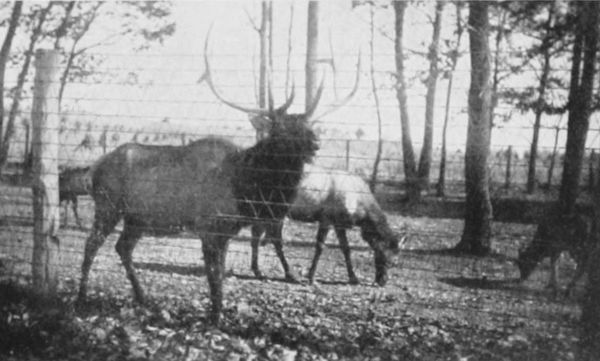 PART OF ZOO IN BEVER PARK, CEDAR RAPIDS
 A SCENE IN BEVER PARK, CEDAR RAPIDS
From 1850 to 1860 Cedar Rapids had a marvelous growth, despite the
panic of 1857 which wiped out some of the fortunes of those who had
invested heavily in wild lands and who had engaged in banking. The
Voice of Iowa, a local newspaper, has the following to say of the
wealth of the city's business enterprises:
Flouring mills, four; planing mills, sash, doors and blinds,
two; cooper, one; wagon and carriage factories, five; iron
foundry, one; cabinet and chair factories, two; plow
factories, three; boot and shoe factories, three; saddle and
harness factories, three; tin, copper and sheet iron
workers, four; woolen factory, one; brick yards, five; farm
implement factories, two; merchant tailors, two;
woodworking, two; newspapers, three; brick machine factory,
one; grocery and provision stores, eight; dry goods,
fifteen; clothing, five; drug stores, four; jewelers, two;
hardware, four; book stores, two; book bindery, one; liquor
and cigars, six; public halls, five; hotels, five; churches,
four; lumber yards, four; bakery, one; banks, three; barber,
one; public reading room, one. The same issue of the paper
cites that the town should have a pork packing plant as well
as a paper mill. It took a long time before the T. M.
Sinclair Company's plant became an assured reality, which
has become in time such a factor in the upbuilding of Cedar
Rapids and Linn county.
The following list of business firms in Cedar Rapids in 1856 is of
interest:
Dry Goods Stores—Shattuck & Dewey, Commercial street; L.
Daniels & Co., Commercial street; C. E. Livingston,
Carpenter's block, Commercial street; Partridge & Cook,
Commercial street; Leach & Wood, corner of Washington and
Eagle streets; Elder & McClelland, corner Iowa avenue and
Commercial street.
Grocery Stores—C. W. Stebbins, corner Front street and Iowa
avenue, Kingston; A. C. Keyes, Carpenter's block, Commercial
street; Bever & Rowley, Commercial street; J. H. Atwell,
Commercial street.
Clothing Stores—David Kahn, Commercial street; Bangs &
Bixby, Commercial street.
Hardware Stores—Rock & Camp, Commercial street; C. P.
Spaethe, Commercial street; A. H. Brown & Co., Commercial
street.
Drug Stores—J. P. Conkey, No. 3, Commercial block; James L.
Enos, No. 4, Iowa avenue.
Jewelry Stores—J. T. Walker, Commercial street; L. H.
Keyes, Commercial street.
Book Stores—James L. Enos, No. 4, Iowa avenue.
Banking Houses—Greene & Weare, Commercial street; Ward,
Bryan & Co., Commercial street; W. A. Dodge, Carr & Co.,
Commercial street.
Land and General Agency Offices—Whittam & Belt, Commercial
street; Bates & Tousley, Commercial street; Carpenter,
Lehman & Co., Commercial street; H. Mount & Co., Washington
street.
Furniture Ware Rooms—John Boyce, Iowa avenue; J. Alloway,
Commercial street.
Builders, Joiners, Etc.—W. D. Watrous, designer and
builder, Carpenter's block; Smith & Williams, S on Madison,
W on Washington street; Elihu Robbins, residence Washington
street; Hyatt & Moore, shop on Commercial street.
Blacksmith Shop and Plow Factory—Stephen L. Pollock, Linn
street.
Lumber Yard—Charles & Carroll, Commercial street.
Carriage Manufacturers—Roswell Tibbetts, Benton street,
West side; J. M. Chambers, Linn street.
Hotels—Empire House, W. M. McMahon, corner Washington and
Market streets; Greene's Hotel, Coffman & Smith, Commercial
street; Rapids Hotel.
Insurance Agents—S. C. Bever, Franklin and Marine; E. N.
Bates, Hartford Fire; J. L. Enos, Iowa Insurance Co.,
Oskaloosa.
Bakery and Restaurant—Alexander Clinton, Commercial street;
Walter D. Thompson, No. 6 South Commercial street.
Millinery—Mrs. E. A. Emery, Brown's block, Kingston; Miss
Mary E. Stewart, Rapids Hotel.
Physicians—S. C. Koontz, office Carpenter's block; J. H.
Camburn, residence Washington street; W. D. Barclay,
residence Iowa avenue; J. W. Edes, residence Washington
street; Smith & Larrabee, office Commercial street; R. R.
Taylor, office Carpenter's block; H. Mount, oculist,
Washington street; McCauley & Pulsifer, dentists, Commercial
street.
Attorneys and Counsellors—James J. Child, Commercial
street; Bates & Tousley, Commercial street; Henry Lehman,
Commercial street; D. M. McIntosh, Commercial street.
Nurseries—Central Iowa Nursery, J. B. Gate, proprietor, on
west side, near city. Was established 1853. Mound Nursery,
George Greene, proprietor, two miles north of the city.
Planing Mill—Alexander Hager, shop 45×50 feet, two engines,
one of nine and the other of twenty-four horsepower. Capital
invested in plant and machinery, $10,000.
Lumber Mills—Greene & Graves, located at upper end of city.
Mill 40×50 feet, two stories high; engine house, 24×60 feet,
one story high. Had capacity of 5,000 feet of lumber per
day, with lath, shingles, etc., in proportion. This
establishment also included a machine shop 35×70 feet, three
stories high; foundry of brick, 30×60 feet, and a brick
blacksmith and plow shop 25×35 feet. Capital invested,
$25,000. J. J. Snouffer, one saw, cutting 200,000 feet of
lumber during three months, ending June 30, 1856. A circular
saw for plow beams, wagon felloes, etc.
Saw Mill and Chair Factory—Dobbs & Dewey, capacity 10,000
feet of lumber a week. During year had turned out 8,000
chairs, 1,000 bedsteads and other articles. Fifteen hands
employed. Capital, $12,000.
Churches—Presbyterian (Old School), Rev. R. H. Morrow,
pastor. Worships in Daniels' Hall. Subscription of $2,700
secured for a building, which with site is expected to cost
$3,500. Membership, 46. Episcopal, Rev. S. Starr, rector.
Church a fine structure and furnished in the neatest manner.
Methodist Episcopal, destitute of pastor temporarily. More
than one hundred members; largest congregation in city, more
than 150 in attendance at Sabbath school. Baptist, West
Side, Rev. J. Woodward, pastor. Temporary edifice to be
erected present season. Membership between thirty and forty.
Presbyterian (New School), Rev. L. F. Dudley, pastor. Church
building small; was first to be erected in the city. Affairs
in a flourishing condition. Presbyterians (Seceders), Rev.
J. H. Sturgeon, pastor. Church edifice just erected and pews
sold.
Secret Societies—Cedar Rapids Lodge No. 25, A. F. & A. M.
(organized 1850), Hiram Deem, W. M.; Isaac N. Whittam,
secretary. Meets first Monday after new moon. Hope Lodge No.
201, I. O. O. F., organized 1851. Hiram Deem, N. G.; Joseph
G. Davenport, secretary. Meets every Tuesday evening.
Select Schools—Misses Farnham, in rooms under the Episcopal
church; Miss H. Latshaw, on Washington street.
Buildings Erected in Year—William Stewart, brick store, one
story; R. C. Rock, brick store, three stories; J. F. Ely,
two brick stores, three stories; A. Hager, machine shop,
brick, three stories; Gabriel Carpenter, three stores,
brick, four stories; S. C. Bever, store, brick, three
stories; H. G. Angle, store, brick front, two stories; Bates
& Tousley, banking house, brick, three stories; Shattuck &
Dewey, two stores, three stories; P. W. Earle, store, three
stories above basement; S. L. Pollock, addition to plow
factory; Greene & Graves, stone machine shop, three stories;
Greene & Graves, blacksmith shop and foundry; public school
building, brick, three stories.
Brick Dwellings—F. A. Lee, William Greene, James Bates, B.
E. Baker, W. & S. Johnson, Elihu Robbins (two), M. Ohler,
Ezra Havens, H. G. Angle, Watrous & Gillett, A. Whitensack.
Frame Dwellings—H. Riefensthall, W. W. Smith, John Graves,
Lowell Daniels, G. W. Westlake, H. L. Bryan, A. J. Reed, P.
W. Reeder, W. Harvey, Henry Ward, S. A. Shattuck, D. S.
Bryan, G. Dewey, Rev. Samuel Starr, Freeman Smith, ——
Jordan, J. Crabil, Mary Lucore, Mr. McDougal, Mary Clark,
Mr. Coon, Mr. Seabury.
As yet, however, the improvements were confined to but a small portion
of the present city. Iowa (First) avenue had been used as a sand bank,
at the convenience of builders, and being left in ridges and hollows
was impassable to teams. Lot owners on Eagle street (Second avenue)
were urged to cut out the underbrush in the street so that wagons might
pass, and thus that section of the city become attractive for
residences.
From Wolfe's Business Directory for 1869 we may note a few of the
business houses and professional men.
Agricultural Implements—Averill & Hamilton, A. C. Churchill,
Fleck & Dorwart, Higley Bros., Patterson & Co., F. J. Upton.
Ammunition—J. A. Nye.
Architect—S. S. Spaulding.
Attorneys—Boyd & Smith, J. J. Child, Craft & Sosel, A. V.
Eastman, R. H. Gilmore, H. H. Gray, Hubbard & Belt, J. W.
Leslie, M. P. Mills, A. St. C. Smith, O. O. Stanchfield, I.
N. Whittam.
Baker—P. Seitz.
Banks—City National, First National.
Bankers—Carpenter, Stibbs & Co.
Barbers—Brown & Bolin, W. K. Harris, Lightenberg & Reiss.
Billiard Halls—F. Witousek, D. T. Williams.
Blank Book Makers—J. C. Stoddard, C. Barthel, S. B. Carl,
Cook & Funk, J. E. Davis, R. H. Dutton, C. Everlien, C. A.
Files, J. Hough, A. S. Mershon, J. M. Nell, Delia Rudolph, L.
Turner.
Book and Job Printers—Ayers Bros., W. A. Ballard.
Book Stores—E. R. Derby, J. G. Graves, F. G. Bennett.
Boot and Shoe Dealers—E. R. Bradford, J. Gates, McClelland
Bros., J. E. Morrison, P. Necomb, A. G. Plumb, O. Robinson,
C. Tomasek, T. S. Wilson, J. Wolfe.
Brewers—C. Magnus, owner of the Eagle Brewery, Will
Williams, Cedar Rapids Brewery, owned by Joe Schneider.
Carpenters—Boss & Gray, M. J. Bourne, M. Moore, Null &
DeCamp, W. Richmond, S. S. Spalding, J. M. Waldt.
Carpets—I. N. Isham, J. Bell & Co., P. Newcomb.
Clothing—Arnold & Loucheim, Arnold & Levi, Jackson &
Lincoln, Otto Co., R. B. Tomlinson, J. Wiener.
Commission Merchants—H. L. Bryan, Charles & Carroll, C. H.
Hall, R. L. Porter, J. J. Snouffer & Co.
Dentists—E. Ebi, A. K. Miner.
Drugs—G. C. Haman, J. C. May, L. Roth, A. H. Taylor, W. L.
Weller, Wetherby & Bowen.
Flour Mills—Aetna Mills, by J. J. Snouffer & Co., Cedar
Rapids Flouring Mills, W. B. Leach & Co., Union Mills, by W.
S. Cooper.
Grocers—O. B. Coe, Anderson & Pettinger, Al Jacobs, P. G.
Garret, Hildebrand & Lansing, A. C. Keyes, P. Keech, W.
Lench, C. L. Lutz, Sam Neidig, G. Parr, F. Plucshel, P.
Seitz, J. B. Spry, J. H. Stibbs, T. S. Wilson, J. J. Witwer,
Wood & Wolcott.
Six hotels on the east side, and several on the west side,
known as Kingston.
The doctors were—C. F. Bullen, J. H. Camburn, G. P.
Carpenter, J. P. Coulter, J. W. Edes, Mansfield & Smith, F.
McClelland, J. North, Israel Snyder, C. H. Thompson, W.
Bolinger.
The live real estate agents were—Carpenter, Stibbs & Co., R.
H. Gilmore, St. Clair Smith, O. O. Stanchfield, West &
Eastman.
There were about twenty saloons operated.
The wagon makers were—R. C. Hall, John Hesse, Jos. Hrbek,
John Mehan, Star Wagon Co., run by Upton, Chambers & Co.
Kingston also boasted of two blacksmith shops, one boarding house,
three hotels, several grocers, wagon makers, lumber dealers, etc. The
population of Kingston as given by this directory was 300.
General Figures—Number of dwelling houses, 2,518; number of families,
2,612; number of males, 7,911; number of females, 6,791; colored, 6;
married, 5,110; widowed, 307; native voters, 2,946; naturalized voters,
236; aliens, 215; militia, 2,795; deaf and dumb, none; blind, 1;
insane, 1; idiotic, 14; owners of land, 1,824; paupers, 3; total
population of county, 14,792.
Agricultural Statistics—Acres of land improved, 66,132; acres of land
unimproved, 155,991; acres of meadow, 3,871; tons of hay, 8,551;
bushels of grass seed, 306; acres spring wheat, 14,739; bushels
harvested, 212,573; acres winter wheat, 249; bushels harvested, 1,532;
acres oats, 5,854; bushels harvested, 180,674; acres corn, 24,251;
bushels harvested, 1,025,375.
Live Stock Figures—Number hogs sold, 16,905; value of hogs sold,
$127,942; number of cattle sold, 3,284; value of cattle sold, $79,273.
Farm Products—Pounds butter made, 153,646; pounds of wool sold,
14,143; pounds of cheese sold, 25,506; value of domestic manufactures,
$7,269; value of general manufactures, $212,795.
Nativity of population—Ohio, 3,758; Indiana, 1,320; Pennsylvania,
1,914; Iowa, 2,770; New York, 1,209; Maine, 111; New Hampshire, 83;
Vermont, 189; Massachusetts, 188; Connecticut, 124; Rhode Island, 7;
Virginia, 436; Kentucky, 242; Illinois, 453; Michigan, 87; Alabama, 1;
Louisiana, 2; Mississippi, 4; North Carolina, 59; South Carolina, 23;
Tennessee, 55; Missouri, 40; Georgia, 2; Maryland, 208; New Jersey,
178; Wisconsin, 51; Delaware, 10; England, 166; Ireland, 204; Wales, 4;
Scotland, 72; Germany, 278; France, 11; Austria, 36; Russia, 0;
Prussia, 5; Norway, 16; Sweden, 2; Holland, 2; on the ocean, 1; Canada,
161; New Brunswick, 11; Switzerland, 6; Denmark, 1; West Indies, 2;
Bohemia, 139; Nova Scotia, 52; Prince Edward Island, 8; District of
Columbia, 4; Poland, 1; Moravia, 6; Hungary, 5; Unknown, 1.
From "Historical Sketch of the City," in the Cedar Rapids Directory
for 1870-71, we cull the following:
"During the year 1838 the first land claim was made by a
certain Wm. Stone on what constituted the present site of
Cedar Rapids. This was not the first claim made, however, as
John Mann, Esq., had the honor of being the first settler in
the county, having located at Pine Grove in the early part
of the same year.
"The attention of the early pioneers being drawn to the
manufacturing resources of the county, the present site was
early chosen as most suitable for a city, as the swift
current of the river at this place would afford, in all
probability, a valuable and extensive water-power. In 1841
the town was laid out, and within a short time thereafter
the improvement of the water-power was commenced. The land
lying along the margin of the river and commanding the
water privileges was soon purchased by Messrs. N. B. Brown,
George Greene, H. W. Gray, and others, who early commenced
the construction of the dam and the building of those mills
and manufactories which have since been the pride of the
city and which have contributed so much to its permanent
growth and development.
"N. B. Brown, Esq., has added an attractive feature to the
city by erecting a costly and elegant hotel on North
Commercial street, which, when finished, will be one of the
finest west of Chicago. In addition to these, the building
of the mammoth machine shops of the Burlington, Cedar Rapids
and Minnesota R. R. Company is shortly contemplated. This
will involve an expense of several hundred thousand dollars,
for which purpose fifty thousand dollars have been
appropriated to the company by this city and township.
"... As to educational interests Cedar Rapids has maintained
a high position among her sister cities of the state. It is
generally conceded that Iowa is the banner state of the
Union, regarding her system of free schools and the
advantages derived therefrom. This city has no less than
thirty-five thousand dollars in school buildings, including
the one recently built in West Cedar Rapids. The schools are
classified and graded under the latest improved system, and
are presided over by an able corps of teachers, chosen with
special reference to their attainments and adaptation to
impart instruction. James E. Harlan has at present the
entire superintendence of the schools, and by his efficiency
he is maintaining the high reputation which the schools have
before sustained. Over thirteen hundred pupils are in
constant attendance, and the number is yearly increasing.
"... The Young Men's Christian Association deserves even
more than a passing notice. The rooms of the Association are
in Mansfield's Block, over the postoffice, and are opened
each morning and evening through the week.
"... The Young Men's Library Association is also a pleasant
feature of the city. The enterprise has established a choice
and well selected library, consisting of historic,
scientific, poetic and biographic works, chosen from the
best authors in the land. The library rooms are in charge of
Miss Mary Thompson, a lady of rare grace and culture, who
takes delight in entertaining her guests and exhibiting the
many works of interest that adorn the shelves of her
library.
"... The social, moral and religious elements blend here in
sweet harmony, and much of the refinement and culture
witnessed in eastern cities and in eastern society is
equally exhibited here; hence to those wishing to settle in
a place combining the advantages of church, schools and
refined society, as well as a place of good business
facilities will find Cedar Rapids a desirable city in which
to locate. We venture the assertion that Cedar Rapids, in
the future as in the past, is destined to excel, in wealth
and numbers, her neighboring rivals, and evermore sit as
queen in the rich valley she so beautifully adorns."
The following obituary appeared in the Cedar Rapids Gazette in March,
1909, and gives a sketch of a person who had passed through much of
what is now the history of a thriving city, and is for that reason made
part of the history of the county. Mrs. Brown was at her death the
widow of one of the foremost men who ever lived in Cedar Rapids.
"Susan Emery, daughter of Nathan Emery and Cornelia
Broadhead, his wife, was born August 19, 1824, at Dingman's
Ferry, Pike county, Pennsylvania, and died March 4, 1909, at
Cedar Rapids, Iowa, thus having lived 84 years, 6 months and
15 days, a period of time much longer than the average
allotted to mankind. A woman in her younger days of a noble,
perhaps an imperious presence, strong in mental and physical
make-up; self-reliant and unswerving in the object sought
to be attained by her. Strong in likes and dislikes, no
truer, more loyal friend among mankind than she. She came of
a long-lived, stubborn warrior race. Through her mother,
Cornelia Broadhead, she was descended from Daniel Broadhead,
a Yorkshire Englishman, a captain of Grenadiers, who fought
for Charles the Second during the civil wars of England, and
by him was commissioned to serve under Colonel Nicholls in
the expedition to the new world to wrest New Netherlands
from the Dutch, that the same might become a new world
kingdom for James, duke of York, brother to the king.
"Captain Broadhead was made military governor of a portion
of New Netherlands, with his headquarters at the old Indian
town of Wiltwyck, called by the Hollanders Esophus and after
the English occupation named and is still known as Kingston,
in the state of New York. Captain Broadhead died in 1670. A
grandson, Daniel by name, in 1733 migrated through the
wilderness, down through the Jerseys to the water gap and
located there. He with his sons refused to be driven out of
the country and off his possessions by the savages during
the Indian wars and fought for what they considered their
own and won out. From this Daniel were descended three
revolutionary soldiers—General Daniel Broadhead, a noted
Indian fighter and close friend of George Washington; Luke
Broadhead, a captain and friend of LaFayette, and Garret
Broadhead, a captain. John Romeyn Broadhead, the historian,
was of this family of Broadheads. From this it will be seen
that Susan Brown came from no mean stock. In her younger
days she was known to be generous and charitable to any
worthy poor. Her giving was of the quiet and unostentatious
kind, and to a considerable extent. This trait of character
remained with her through her old age. She was a woman of
strict integrity, spotless purity, and the world and
community in which she lived was undoubtedly the gainer for
her having lived in it. In 1852 she was married to her
kinsman, Nicholas Broadhead Brown (a pioneer of 1840),
coming immediately with her husband and sister, Mrs. Hannah
E. Higley, to Cedar Rapids and has remained here
continuously from that time, thus making her, with possibly
one or two exceptions, at the time of her death, the oldest
continuous resident of this city. In laying the foundation
and the early upbuilding of this city were a number of
potent and conspicuous men and women, such as George Greene,
Alexander Ely, Addison Daniels, and others, but none more so
than Nicholas B. Brown and his wife Susan."
It is entirely proper to make some mention in these pages of Captain
Joshua John Snouffer, who came to Cedar Rapids in 1852 when the city
contained less than 400 people. He too had an intimate knowledge of
what it meant to be a pioneer.
Captain Snouffer was born in Maryland February 24, 1825, and though he
was a loyal citizen of Iowa he never ceased to love his native state,
nor did he ever forget its history, its traditions, and its people. He
entered the Mexican war where he was wounded in the head on the field
of battle on November 9, 1847. This wound troubled him all the
remaining days of his life. At the time he was wounded he was first
sergeant of a company of dragoons, and on several occasions had
commanded a company.
As a member of the firm of W. D. Watrous & Company he was closely
identified with the milling industry of Cedar Rapids. He superintended
the erection of "the brick mill" in 1875. With J. J. Child he was the
joint author of the city's charter. He took an active part in the
building of the Iowa & Nebraska Railroad, now the Northwestern. He was
a prime mover in establishing the water works, and was one of those who
gave the city its first street railway. At various times he was a
member of the city government both as alderman and mayor. He was a
skilled parliamentarian, and an honest man in every sense of the word.
W. I. Endicott, in The Saturday Record, July 10, 1909:
Cedar Rapids has had a civic existence since January 15, 1849, on which
date a town charter was adopted and town officers elected. In 1856, a
new city charter was granted by the legislature and under that charter
the affairs of the city were conducted until April 6, 1908, when the
charter was abandoned and the city went under what is known as the
"Commission Plan." Under the provisions of this law all ward lines and
divisions were abolished and five men—a mayor and four councilmen or
commissioners are elected at large. In the hands of these five men is
placed all responsibility for the appointment of the entire city
official staff and the management of city affairs.
The new plan is working in a most satisfactory manner in Cedar Rapids
and many things are being accomplished under it that were impossible of
accomplishment under the old ward system. The improvements under way
are all planned with a view to actual necessity and the harmonious
building up of the city in all its sections. Modern business methods
are in use in the conduct of the city's affairs and unwise or
extravagant expenditure of the public money is not permitted. The
council meets nearly every day and the citizen who has business to
transact with the council is given instant hearing and attention.
Under the law, the mayor is paid a salary of $2,500 and each of the
councilmen $1,800 annually, and they devote full time and attention to
the work of the city. The city's business is divided into departments
and each man is in charge of and responsible for a certain department.
The mayor is head of the department of Public Affairs and as such,
exercises a general supervision over all phases of the city business.
Then there are the departments of Accounts and Finances, the department
of Public Safety, the department of Streets and Public Improvements,
and the department of Parks and Public Property. The men elected have
first to be successful in a wide open primary and then in the regular
city election secure a majority of all the votes cast. In the election
of 1908 there were 48 candidates for councilman and nine candidates for
mayor on the primary ballot. From these names the two who received the
highest number of votes for mayor and the eight who received the
highest number of votes for councilman were declared the nominees and
their names appeared on the ballot at the regular election, the names
appearing in alphabetical order on both the primary and regular
election ballots, and without any party or other designation.
In 1908 the council accomplished the sale of the old city hall site and
the purchase of May's Island for park and public buildings purposes.
This island has an area of about six acres, and lying in the Cedar
river in the very center of the city, forms an ideal place for a civic
center. The city offices are now occupying temporary quarters on the
island and as rapidly as possible the low places are being filled with
dirt from the various excavations for business buildings, and from
other sources, so that what was once a municipal disgrace, is being
rapidly transformed into a place of beauty, to say nothing of forever
setting at rest any possibility of divisive strife between the two
sides of the river.
The public improvements of the city of Cedar Rapids represent
expenditures running into the millions of dollars. Few cities of like
size are so thoroughly or excellently paved. On the first of January,
1909, the city had three miles of asphalt, twenty miles of brick, and
five miles of macadam paving, or a total of twenty-eight miles. There
are now under construction, or already completed on contracts carried
over from 1908, two miles of brick and one mile of tar treated macadam,
giving Cedar Rapids at the present time thirty-one miles of paving.
The contracts let for 1909 will add more than five miles to that total,
so the city will have approximately thirty-six miles of paving at the
end of the present year.
Sidewalks are practically all of cement construction and laid under
city supervision. On January 1, 1909, there were more than 102 miles of
walk in the city, and of this more than ninety-six miles were of
cement, nearly four miles of brick or stone and only about two miles of
wooden construction. The contracts let for this season will represent
the construction of about eight miles of walks, giving the city a total
of 110 miles of sidewalks.
Cedar Rapids has two systems of sewers, sanitary and storm water. Some
of the storm water sewers are of large size, being seven feet in
diameter, and one—the Vinton ditch sewer, is even larger.
Cedar Rapids has an excellent fire department, equipped with the best
of apparatus. There are five stations—one central station and four
outlying hose houses.
In the matter of parks the city has made a most promising start. There
are now in the city twenty-eight parks, counting large and small and
not including any street parkways. Of this number Bever Park, Ellis
Park, Daniels Park, May's Island Park, Riverside Park, and Whittam Park
are considerable tracts, while George Greene Square, opposite the union
station, with its beautiful display of flowers and rich green lawn, is
one of the show spots of the city. Bever Park, the largest of the
parks, in the woods to the east of the city, was the gift of James L.
Bever, George W. Bever, and John B. Bever, as a memorial to their
father, Sampson C. Bever, who was one of the pioneers of the city.
Bever Park is flanked one side by picturesque Vernon Heights and on the
other by beautiful Ridgewood, forming an almost continuous park of
great extent and beauty. Daniels Park is the newest of the city parks.
It is located on the Old Marion Road and has been transformed into a
beautiful floral park, with well-arranged walks and driveways.
Riverside Park is the close-in park, being located on the bank of the
river south of Eleventh avenue, and this has been made a play park,
with plenty of out-door gymnasium apparatus for the children and young
people. Ellis Park, located on the river bank above the city, is one of
the most beautiful and attractive of all the parks, and when adequate
means of reaching it are installed, it will without question be one of
the most popular parks in the city. The river with its excellent
boating facilities, gives a charm to Ellis Park that is denied the
other breathing places of the city. The city of Cedar Rapids is
spending more than twenty thousand dollars each year on its park
system, and it is money well spent. There are about two hundred acres
in the park system, and a conservative value of the park grounds and
improvements is well over $300,000.
The Free Public Library is a most valuable asset to the city and aside
from the unmeasurable good done in the dissemination of knowledge,
represents a money investment of well toward $150,000. The building
proper was the gift of Mr. Carnegie and cost $75,000, the grounds and
other items and the contents of the library will add another $75,000 to
the valuation. It is supported by a city tax and costs about $12,000
per year to operate. Its affairs are in charge of a board of trustees,
appointed by the council.
The city owns and maintains five bridges across the Cedar river. Of
these bridges four are of steel construction and one—the Second avenue
bridge—is a magnificent reinforced concrete bridge of Melan arch
design. This bridge is one of the best and most attractive in the
middle west. Its cost was more than $100,000.
[The city contracted in 1909-10 a new concrete bridge to replace the
old steel bridge on Sixteenth avenue at a cost of $80,000. It is 40
feet wide and 2,600 feet long, and was opened for traffic January,
1910. A new concrete bridge will be contracted in 1911 at Third avenue
to replace one of the oldest in the city.]
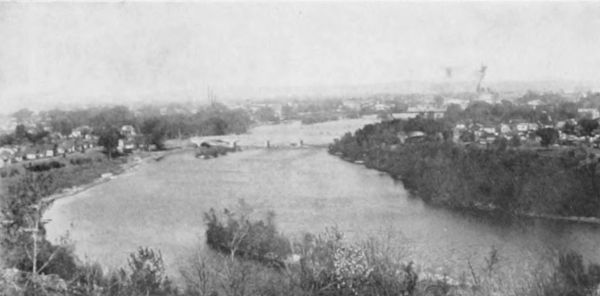 SIXTEENTH AVENUE BRIDGE, CEDAR RAPIDS
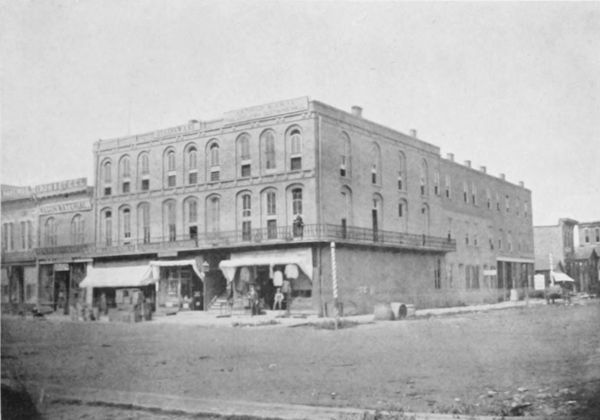 FIRST STREET, CORNER SECOND AVENUE, IN 1869
The city water works are owned by the city of Cedar Rapids, and are
managed by three trustees appointed by the council. The plant was
purchased from the water company July 1, 1903, at an agreed price of
$473,000. Of this amount, $23,000 was paid in cash and the remainder
was put in the form of bonds. In the past six years $158,000 of these
bonds have been retired, leaving a net indebtedness against the water
plant of $315,000. The net earnings of the plant from July 1, 1903, to
July 1, 1908, were $79,952.30, and for the year ending July 1, 1909,
were almost $25,000. In addition the city gets free hydrant rental and
fire protection. A conservative inventory of the water plant will show
a valuation of well over $600,000 at the present time. The water is
taken from large wells on an island in the Cedar river belonging to the
city and located some distance above the C. & N. W. bridge. It is
filtered by the Jewell system and is forced through the mains by large
pumps. There are three of these pumps in use, one of two million
gallons daily capacity, one of three million gallons capacity and one
of five million gallons capacity. The necessary power is supplied by
two water tube boilers of 350 horsepower each, and three tubular
boilers of 70 horsepower each. The filter system has a capacity of
three million gallons per day, and an additional reservoir for the
filter is now under construction. There are at the present time 390
fire hydrants and an excellent and satisfactory fire pressure is
maintained for all fire alarms. A loop of twelve-inch mains encircles
the business district and this loop is supplied by a twenty-inch main
direct from the pumps, giving the business section a fire protection
unexcelled by that of any city in the west.
Up to 1849 the village of Cedar Rapids had no formal organization. It
was simply a township. But the legislature of 1849 granted a town
charter and for the next decade the community throve apace. It was
during this period of years that Cedar Rapids strove for, and secured,
its first line of railway. In the fifties the railway lines to the west
left the bank of the Mississippi and pushed their way out into the
fertile prairies of Iowa. Among these lines was one known as the
Chicago, Iowa and Nebraska, and its purpose was to construct a line of
railway from Clinton, across Iowa, to some point on the Missouri river.
Among Cedar Rapids men who were prominently identified with the
enterprise and were on the board of directors were John Weare, Jr.,
William Greene, H. G. Angle and S. C. Bever. The company was organized
in 1856, but it was not until June, 1859, that the line was completed
from Clinton to Cedar Rapids, a distance of a little over eighty miles,
and train service established between the two towns.
Previous to the coming of the railroad, communication with the outside
world was maintained by means of stage lines; Dubuque, Clinton,
Davenport, Muscatine, Iowa City, and Waterloo being reached by that
method. Freight and supplies were brought in by wagon, though in the
early days there was some steamboat traffic on the Cedar river as far
as Cedar Rapids.
It required hard work, and plenty of it, to get that first new line of
railway into Cedar Rapids. Marion, the old, substantial town and the
county seat, wanted the road—and came pretty near getting it, too. The
next move in railway construction work for the community was the
extension of the new line west, on its way to the Missouri river, a
line which is today the main artery of the Chicago & Northwestern
system, forming an important part of the great highway of steel
connecting the Atlantic and Pacific.
The original promoters of the Chicago, Iowa and Nebraska Railway,
living in Cedar Rapids, were anxious that that company should build a
branch line up the Cedar valley from this point, and thus tap the rich
and rapidly growing territory lying to the northwest of Cedar Rapids.
But the company had no time or money with which to build side lines or
branches. Its objective point was the Missouri river and the great
beyond. So Judge George Greene, S. L. Dows, and other prominent public
spirited men took up the task of constructing a road from Cedar Rapids
to Vinton and Waterloo. Burlington capitalists and promoters joined in
the work of extending the line from Cedar Rapids southeast to
Burlington, and in a few years the embryo of what later became the
Burlington, Cedar Rapids & Northern, the "Cedar Rapids route," with its
lines radiating from Cedar Rapids to Clinton, Muscatine, Burlington,
What Cheer, Iowa City, Sioux Falls, Watertown, Worthington, Forest
City, Albert Lea, St. Paul, Minneapolis, and Decorah, was in existence.
The shops, roundhouses and general offices of the road were located in
Cedar Rapids, and everybody took pride and a personal interest in
speaking of the institution as the "Home Road." The absorption of the
Burlington, Cedar Rapids & Northern by the great Rock Island system,
thus giving Cedar Rapids direct connections with all stations on that
road, is a matter so recent as to be hardly history as yet. This change
has been more in name than in reality. The shops are maintained, as in
years past. An even larger army of trainmen and operative employes make
Cedar Rapids their home, and the general offices for the northern
district make use of the general office building constructed by the
Burlington, Cedar Rapids & Northern Railway Co.
Cedar Rapids' third railway enterprise was the securing of the Dubuque
& Southwestern, locally known as the "Slough Shore," from the manner of
its entrance into the town. This railway was built and operated by the
Farleys, father and sons, of Dubuque, and for many years, with its
connection with the Illinois Central at Farley, maintained the only
line of direct communication between Dubuque and Cedar Rapids. In the
early days some very peculiar railroading was done on the Farley line,
and the incidents and happenings, if gathered together, would make an
extended volume.
The Dubuque and Southwestern is now a part of the Chicago, Milwaukee &
St. Paul system, and over its tracks trains now run to Chicago, Omaha,
Kansas City, Minneapolis, and St. Paul, as well as to the original
sleepy little terminus of Farley.
The last steam road to enter Cedar Rapids was the Illinois Central, a
line being constructed from Manchester by the late S. L. Dows. This
line opens up to the shippers and business men of Cedar Rapids direct
connections with the Illinois Central, and is of peculiar value in the
traffic in southern and tropical fruits and commodities which come by
water to New Orleans.
More recently the interurban between Cedar Rapids and Iowa City has
been constructed, and with its hourly service it has won a business
which makes certain the building of other and equally as promising
lines in the near future.
Cedar Rapids of 1909, from a railroad point of view, is the traffic
pivot of the middle west. Centering here are four of the largest
railway systems of the country—the Chicago & Northwestern, the
Chicago, Milwaukee & St. Paul, the Rock Island, and the Illinois
Central. From Cedar Rapids direct lines radiate to Chicago, Peoria, St.
Louis, Kansas City, St. Joseph, Council Bluffs, Omaha, Sioux City,
Sioux Falls, Watertown, Minneapolis, St. Paul, and Milwaukee, the total
mileage of the lines entering Cedar Rapids being about 35,000 miles.
Direct service is maintained between Cedar Rapids and nearly 1,750
stations in Iowa, to say nothing of the thousands of stations in other
and surrounding states reached by direct train service from this city.
More than 225 railway and interurban trains arrive in or depart from
Cedar Rapids daily. Approximately 80,000 carloads of freight are
handled annually. The freight earnings are about $3,500,000 and the
passenger receipts are about $1,200,000 each year. Three express
companies, the American, the United States, and the Wells-Fargo,
maintain offices in Cedar Rapids.
Recognizing the future of Cedar Rapids as a railroad, manufacturing and
distributing center, the railroads have all been expending vast sums of
money in the past few years in the acquisition of property for
terminal purposes. The Chicago, Milwaukee & St. Paul, the Illinois
Central, and the Rock Island now control absolutely the entire section
of the city lying between Fifth and Ninth avenues, the river and Third
street, and it is only fair to presume that the four blocks between
Third and Fourth streets and Fifth and Ninth avenues will also be
devoted exclusively to railway purposes. South of the city, along the
river bank, the Chicago & Northwestern is expending thousands of
dollars in the filling in of a large section of low land and old river
bed, and on this made ground new and enlarged terminals and switch
yards will be built.
The Chicago, Rock Island & Pacific is now engaged in the construction
of its new terminals and freight depot on the blocks lying between
Second and Third streets and Fifth and Ninth avenues, and when
completed these terminals and depot will be ample for the accommodation
of a freight business of a city of hundreds of thousands of population.
In the matter of passenger travel the city is well accommodated in the
two depots, both on Fourth street, one occupied by the Chicago &
Northwestern and the Rock Island, and known as the Union station, and
the other occupied jointly by the Chicago, Milwaukee & St. Paul and the
Illinois Central lines.
Mention must also be made of the Cedar Rapids and Iowa City interurban
line, which maintains an excellent hourly service between the two
cities. This line of road is the pioneer in the interurban field for
the city, if the line to Marion be excepted, but is proving daily more
and more popular and its business is increasing in such a measure that
the building of additional lines of like character is only a question
of the near future.
From the days of its very earliest beginnings the people of Cedar
Rapids have paid especial attention to the manufacturing industry. A
large part of those who settled in Cedar Rapids came from the east
where manufacturing leads all other industries and it is but natural
that they should embark in their new home in those lines with which
they were familiar. The papers and records of the early days tell of a
long line of enterprises that have come and gone. There were flour
mills, woolen mills, implement works, engine factories, wagon
factories, oil mills—the list is a long and interesting one to the
delver into local history.
With the coming of the railways, opening up markets for the
manufactured products and affording means of collecting and bringing in
the raw material, the manufacturing side of Cedar Rapids' activities
has grown apace, until today Cedar Rapids, although not the largest of
Iowa cities, leads them all in the amount of manufactured goods
produced. In 1908 the total ran to nearly if not quite $22,000,000, and
the output for 1909 will far exceed that great figure. There are now
nearly 100 manufacturing institutions in Cedar Rapids, employing nearly
4,500 hands and paying more than $3,000,000 annually in wages.
Many of our manufacturing institutions are of many years' standing. The
great mill of the Quaker Oats Company, the largest milling plant in the
world, was originally established years ago as an oat meal mill by
George Douglas and Robert Stuart, two thrifty and persevering Scotchmen
to whose industry and far-sightedness is due the fact that at least the
first course of the world's breakfast (after fruit) comes from Cedar
Rapids. The great packing plant of T. M. Sinclair & Co., Ltd., giving
employment to 1,200 employees and sending its products to all parts of
the world, has done more to advertise Cedar Rapids than any other one
agency. It was established by T. M. Sinclair, a young man from Belfast,
and from its modest beginning many years ago it has become a plant
representing an investment of millions and an ability to supply at
least a large portion of the second course of the world's breakfast.
Then there is the big starch works of Douglas & Co., the largest
independent starch plant in the country—a plant where corn by the
train load is daily transformed into starch and gluten feed. In smaller
institutions note must be made of the Anchor Mill Co. and the T. G.
White Cereal Co., with their specialties in flour and wheat flakes.
While on the subject of cereals, note should be taken of the big
elevators and cleaning houses of the Cedar Rapids Grain Co., the
Clinton Grain Co., Jackson Grain Co., and the Wells-Hord Grain Co.
Without doubt, the name "Cereal City" which has been applied to Cedar
Rapids is not a misnomer.
In other lines Cedar Rapids leads as well as in those involving the
conversion of the native products of agricultural Iowa. This city with
its three great pump companies, the Cedar Rapids Pump Co., the Chandler
Pump Co., and the Iowa Windmill and Pump Co., control the pump,
windmill, iron pipe and plumbing supply business of the middle west.
While the collateral lines covered by the Dearborn Brass Co., the Iowa
Radiator Co., the Tokheim Manufacturing Co., the Vernier Manufacturing
Co., the Smith-Talbott Co., and others add materially to the leadership
of Cedar Rapids in these departments.
The Denning Fence works places Cedar Rapids in a leading position in
the fence manufacturing business. The Perfection Manufacturing Co., the
Hawkeye Skirt and Garment Co., the Welch-Cook Co., and the
Clark-MacDanel Co., give Cedar Rapids a high position in the business
of manufacturing clothing for both men and women that is not suspected,
even by some of the best posted people in the city. Then there are
other lines of manufacture. The J. G. Cherry Co., with their line of
dairy and creamery supplies; the Cedar Rapids Sash and Door Co., the
Williams & Hunting Co., and the Disbrow Sash and Door Co., with their
big wood working plants; the various furniture factories, the cement
and sand-lime brick plants; the big printing plants, for printing is a
most important industry in Cedar Rapids; in short, the list is endless
and as this is not a directory of the manufacturing industries of Cedar
Rapids, further individual mention will have to be abandoned.
What is manufactured in Cedar Rapids? The list is a long and mixed one.
It comprehends all kinds of breakfast foods, flour, starch, gluten
feed, all kinds of packing house products, woven wire fence, candy, ice
cream, pumps, iron pipe, windmills, plumbers' supplies, steam heating
plants, machinery of all kinds, stone and ore crushers, hot air
furnaces, cornices, bank, store and office fixtures, camp and lawn
furniture, corsets, parlor furniture, mattresses, woven wire springs,
undertakers' supplies, egg cases, dairy supplies, butter, concrete
fence posts, sand-lime brick, prepared plaster, ice, gasoline engines,
store step-ladders, hard wood specialties, electrical supplies,
gasoline storage tanks and measuring pumps, manure spreaders, overalls,
women's skirts, suits and jackets, shirts, photo paper, brass goods,
coffee, spices, extracts, baking powder, sash, doors and blinds, steel
baskets, tanks, stoves, school books, umbrellas, vinegar, pickles,
wagons, carriages, omnibuses, automobiles, patent medicines,
physicians' and hospital supplies, crushed stone, cigars, etc., etc.
It is noteworthy that of the many industries started in Cedar Rapids
within the past twenty years, a very large per cent have been financial
successes, some of them notably so. Nearly all of them have been
launched in modest fashion and while nowhere is it possible for all
enterprises to succeed, the few failures in Cedar Rapids have all been
brought about by causes purely individual in the management or because
of circumstances which seemingly no one could control.
Cedar Rapids has passed beyond the experimental stage as a
manufacturing city. It has been demonstrated that industries can be
established and operated successfully here and that goods made in Cedar
Rapids will find a ready and stable sale in all parts of the world. In
fact, Cedar Rapids is but just beginning her epoch of industrial
prosperity and growth and she extends to all the invitation to come,
see how those here are prospering, and join in the march of events
which will in the years to come make Cedar Rapids one of the best
known manufacturing communities in the whole United States.
In this connection it is not amiss to speak of the excellent conditions
which have always surrounded the labor situation in this city. The
manufacturing industry must, of necessity, depend very largely on the
element of labor and in many localities strikes and strife and
misunderstanding and trouble generally have added to the difficulty of
the local situation. There has been but little of this sort of thing in
Cedar Rapids. Labor has always been well paid, well treated and well
satisfied in this city, and the little differences which have come up
between employer and employee have all been settled promptly and
satisfactorily. There has been an absence of the grafting labor
agitator and all have worked harmoniously together to build up the city
and its best interests.
BY E. A. SHERMAN, EDITOR SATURDAY RECORD
The Marion and Cedar Rapids Improvement Company was incorporated March
8, 1879, to construct street railways on the streets of Cedar Rapids
and Marion, and the highway between, known as the "Boulevard."
The incorporators were Addison Daniels, J. L. Crawford, C. C. Cook, and
John Meredith Davis.
The officers were John Meredith Davis, president; James L. Crawford,
secretary; C. C. Cook, treasurer.
On March 13, 1879, the city council of Marion passed an ordinance
authorizing construction of the line in the city of Marion. On May
16th, the city council of Cedar Rapids passed an ordinance granting the
Marion and Cedar Rapids Improvement Company the right to construct and
operate street railways on Iowa avenue, and also on alternate streets.
October 13, 1879, the name of the company was changed to the Cedar
Rapids and Marion Street Railway Company. John Meredith Davis resigned
as president and was succeeded by W. M. Hewitt.
November 8, 1879, the city of Cedar Rapids passed another ordinance
granting a franchise to the Cedar Rapids and Marion Street Railway
Company for lines on Iowa avenue and on alternate streets. Up to this
last date the enterprise had been fathered by Milwaukee and Davenport
parties, who then dropped out. Construction had already been begun and
the work was continued by Marion parties, prominent among whom were Mr.
E. Latham, J. L. Crawford, and J. C. Davis. Mr. Latham advanced the
money necessary for construction.
On January 8, 1880, Mr. Latham was made president of the company. In
March of that year Judge George Greene (always foremost in any
enterprise which would help Cedar Rapids) took a controlling interest
in the company, and from that time forward, with the financial
assistance rendered by Judge Greene, the work went rapidly on so that
the line began carrying passengers between Cedar Rapids and Marion on
the 3d of May, 1880, by steam motor between Twelfth street in Cedar
Rapids and the terminal station in Marion, and from Twelfth street to
Fourth street in Cedar Rapids in horse cars.
Both Judge Greene and Mr. Latham died early in the summer of 1880, and
although Mr. S. C. Bever, Mr. A. J. McKean and other prominent citizens
of Cedar Rapids and Marion afterwards became interested in the
enterprise, the Greene family always held a controlling interest and
were foremost in management of the company up to the sale in 1890.
Mr. Latham was succeeded as president by William Greene on July 15,
1880.
The board of supervisors forbade the company laying its track on the
boulevard, and brought suit to enjoin such construction. The Eighteenth
General Assembly (1880) passed an act authorizing street railway
tracks on roads 100 feet wide. So the supreme court sustained Judge
Shane in refusing the injunction. Early in the spring of 1881, the line
was extended across the steam railway tracks at Fourth street to the
foot of Iowa avenue. Soon after that date the company were not allowed
to bring the steam motors below Fifteenth street, the horse cars
carrying the Marion passengers up to that point.
The track between Marion and the city limits of Cedar Rapids were laid
with "T" rails weighing sixteen pounds to the yard; afterwards changed
to thirty-five pounds per yard. The horse car tracks were laid with
flat rails weighing twenty-two to twenty-four pounds per yard, spiked
on the top of wooden stringers. The first equipment consisted of two
small second hand steam motors and four cars.
The extensions and additions made were: In 1882, track to fair ground
from First to B avenue, only operated during fairs and amusements. Line
on Adams (now Third) street, First avenue to Fourteenth avenue. Opened
September 7, 1882. Line from First avenue and Commercial (now First)
street to Third avenue, across Third avenue bridge on Third avenue to
Sixth street west; also line on Third street north from Third avenue to
A avenue, and south to Seventh avenue west. These west side lines began
doing business in the fall of 1882, and early in 1883 car and horse
barns were built at Third avenue and Third street west.
In 1884, line extended from Third street and Seventh avenue west to J.
C. Young's addition at Sixth street and Fifteenth avenue west and
afterwards taken up for want of business.
In 1886, line from First avenue east along Fifth street to Fifth
avenue, up First avenue to Tenth street, thence on Tenth street and
Mount Vernon road to Oak Hill cemetery; opened for business July 4,
1886.
Fair ground line taken up. New line on Sixteenth street from First to E
avenue, built and put in operation November 15, 1886.
As the branch lines of horse railroad within the city of Cedar Rapids
paid no profit, the Marion stockholders stoutly objected to the
earnings of the Marion line being used for the sole benefit of the
people of Cedar Rapids. So the Cedar Rapids and Marion Railway Co., on
the 13th of July, 1889, conveyed to John W. Henderson—for the sum of
one dollar—all of these branch lines excepting the Sixteenth street
line. Mr. Henderson on November 14, 1889, deeded the same to the Cedar
Rapids Street Railway, a company organized for the purpose of operating
these city lines, and for the further construction of other city lines
in Cedar Rapids, of which company C. G. Greene was president, U. C.
Blake, vice-president, W. J. Greene, secretary, and George Greene,
treasurer.
These city lines failed to earn enough to pay operating expenses and
were all conveyed back to the Cedar Rapids and Marion Railway Co. on
February 9, 1891. For the year ending June 30, 1884, the number of
employes of the company was twenty, the annual wages $11,667.44. In
1889 the number of employes averaged twenty-eight and the annual wages
$15,878.00.
During the years 1886 to 1890, the west side lines had been gradually
abandoned, so that on December 1, 1890, there was only remaining the
one on First street and across the Third avenue bridge to Third street,
and thence on Third street southwesterly to Seventh avenue.
The entire equipment at that date consisted of two steam motors, two
28-foot coaches, one open trail car, 20 feet long, one baggage car, one
18-foot, six 12-foot, and eleven 10-foot horse cars, two snow plows,
two flat cars and nineteen horses and mules, with the necessary harness
and fixtures.
In the autumn of 1890 it came to the knowledge of Mr. J. S. Ely that
non-resident parties were investigating the situation with a view of
acquiring the property of the Cedar Rapids and Marion Railway, together
with the city lines then owned by the Cedar Rapids Street Railway. Mr.
Ely believing that it would be best for the interests of the city of
Cedar Rapids that control of the transportation facilities be in the
hands of resident property owners, who would have a greater interest in
a more extensive system and better service, than those seeking merely
financial profit, obtained options on a controlling interest in the
capital stock of both of the companies. After which Mr. Ely and Mr.
Henry V. Ferguson organized a syndicate consisting of Messrs. A. T.
Averill, James L. Bever, Chas. H. Clark, Geo. B. Douglas, Walter D.
Douglas, C. J. Ives, C. Magnus, P. E. Hall, J. S. Ely, and Henry V.
Ferguson, who on December 15, 1890, purchased two-thirds of the entire
capital stock of the two companies (the C. R. & M. Ry. and the C. R.
Street Ry.) buying out all of the old stockholders except Frances R.
Greene, C. G. Greene, S. C. Bever, Geo. W. Bever, and U. C. Blake.
Immediately after this change of control, the stockholders paid in
money enough to clear up all the floating debt of the companies, and
put them on a good financial basis. The stockholders addressed the
following communication to the mayor and city council of Cedar Rapids:
"To the Honorable Mayor and City Council of the City of
Cedar Rapids, Iowa:
"The undersigned stockholders in the Cedar Rapids and Marion
Railway, and in the Cedar Rapids Street Railway Company,
respectfully represent to your honorable body that they are
the absolute owners of all the stock of the corporations,
and all are resident tax payers in said city, largely
interested in its general progress and prosperity; that it
is their purpose and intention to reconstruct, improve and
extend the properties now operated by the said companies and
to run the cars on said lines by electric power as soon as
the necessary authority and the additional rights and
franchises required are granted, and on the granting of the
same, we pledge ourselves to take immediate steps toward
putting on electric service, and to rebuild, maintain and
operate, and from time to time extend the lines in said city
to the full extent that ordinary business prudence will
warrant.
"We, therefore, petition your honorable body to grant said
corporations the necessary authority, rights and franchises
to enable them to enter upon and make the changes and
improvements above mentioned.
"P. E. Hall, A. T. Averill, Henry V. Ferguson, C. G. Greene,
Walter D. Douglas, Jno. S. Ely, Chas. H. Clark, C. J. Ives,
Jas. L. Bever, G. B. Douglas, C. Magnus, F. R. Greene, Geo.
W. Bever, S. C. Bever, U. C. Blake.
"Dated December 31, 1890."
The franchise asked for by these stockholders was for twenty-five
years.
Although the above application was warmly supported by the leading
newspapers of Cedar Rapids, the city council refused the franchise so
asked for, but instead on May 1, 1891, granted to the Thomson-Houston
Electric Co. a franchise for fifty years, for lines covering
substantially the same territory on the east side of the river as that
served by the horse cars, and also for three miles of new lines on the
west side of the river, to be afterwards located.
So these gentlemen who had put up their money to save the city of Cedar
Rapids from non-resident ownership of transportation lines, found their
purpose frustrated and with a fair prospect of losing their entire
investment. Rather than suffer this, a majority decided to acquire this
new franchise at the best price obtainable, and then go ahead with
construction according to its terms. After this decision Mr. Ives and
Mr. Magnus retired from the enterprise and took back their money.
Previously, during the negotiation for the franchise, Mr. S. C. Bever
and Mr. U. C. Blake had sold out. On the organization of the new
company to take over the Thomson-Houston franchise, Mrs. Frances R.
Greene, C. G. Greene and Geo. W. Bever sold their interests to the
remaining stockholders.
Neither the Cedar Rapids and Marion Railway nor the Cedar Rapids Street
Railway ever paid a dividend, so that all of the stockholders who had
invested their money in these enterprises went out with entire loss of
income, and most of them with considerable loss of principal.
J. P. Messer was superintendent from January 1, 1881, to February 22,
1883, when he resigned and was succeeded by Wm. Elsom, who remained
superintendent until after the system had been changed into an electric
railway.
The Cedar Rapids and Marion City Railway Company was organized May 14,
1891, and immediately thereafter purchased the franchise for electric
railways in Cedar Rapids recently granted to the Thomson-Houston
Electric Co., and also took over all the rights, property and
franchises of the Cedar Rapids and Marion Railway. A franchise for
twenty-five years for an electric line from the terminal point in the
city of Marion to the southwesterly city limits of Marion was granted
to this company at about that time. The first officers were: Jas. L.
Bever, president; Walter D. Douglas, vice-president; Chas. H. Clark,
treasurer; Glenn M. Averill, secretary.
Within a few months Jas. L. Bever and A. T. Averill sold out and
retired from the enterprise. After the reorganization resulting from
this change in ownership, the officers were: P. E. Hall, president; W.
D. Douglas, vice-president; Chas. H. Clark, treasurer; John S. Ely,
secretary.
The stockholders were: Chas. H. Clark, Geo. B. Douglas, John S. Ely, J.
S. Cook, Walter D. Douglas, Henry V. Ferguson, and P. E. Hall, of Cedar
Rapids, Horace Williams, of Clinton, Iowa, J. E. Ainsworth, of Council
Bluffs, Iowa, now of Williamstown, Vt., David P. Kimball and L. C.
Kimball, of Boston, Mass., and J. Van Deventer, of Knoxville, Tenn.
No change of ownership except through division of estates of deceased
stockholders has taken place up to the present time.
The work of construction and reconstruction was begun at once and
vigorously pushed during the season of 1891.
All tracks were entirely new excepting from Sixteenth street to Marion.
Those across the First avenue bridge were laid with strap rails, nailed
to the bridge plank. The balance of the double track with 58 pound
girder rails. All other new lines with 45 pound "T" rail. The strap
rail was taken off the bridge and girder rail substituted a few years
thereafter. The city lines on the east side of the river were open for
business in November, 1891, the west side lines in December, 1891, and
electric service begun to Marion in February, 1892.
The main line mileage of the road at this date, not counting spur and
sidetracks is, within the city of Cedar Rapids 12.85 miles, of which
2.28 miles is double track. From the city limits at Kenwood to Marion,
2.80 miles; total 15.65 miles.
The Marion line above Twentieth street through to Marion has been
entirely rebuilt with new rails, the grades cut down, the alignment
changed, the track ballasted, a new steel and concrete bridge built
over Indian creek; so as to make that portion of the road fully
adequate for the business.
Within the last three years all of the girder rail tracks east of the
river have been relaid with 60 and 80 pound "T" rails and the number of
ties increased fifty per cent.
The service has been increased to once in fifteen minutes each way and
extended to twelve o'clock at night on all the lines excepting the
Marion line, where the service is once in twenty minutes during the day
and up to 12:30 a. m.
The power plant first installed consisted of two 125 horsepower engines
connected by belts to two 75 k. w. generators. It now consists of one
400 horsepower engine belted to a 300 k. w. generator, and one 750
horsepower engine directly connected to a 450 k. w. generator. The
output of power is equalized by a storage battery of 272 cells. The
boilers, smoke stack, switch board, condensers and all minor machinery
have been correspondingly increased and improved.
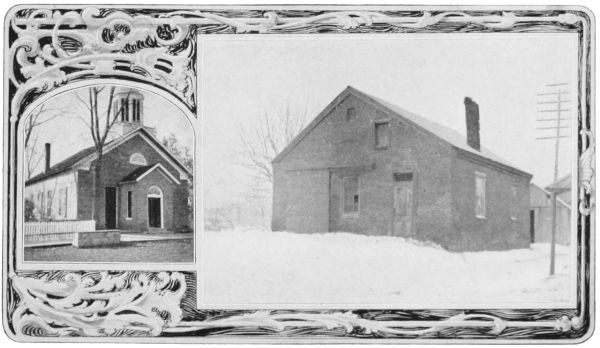 U. B. CHURCH, LISBON
Built 1855
FIRST U. B. CHURCH WEST OF MISSISSIPPI RIVER
Built and Presented to
Members at Lisbon in 1850 by Rev. Christian Hershey
The car barn (originally a wooden iron-clad building 80×140 feet) has
been enlarged and new brick buildings erected with shop room for
building car bodies and trucks, and making all necessary repairs to
cars and electric equipment; so that the present storage shop and
office buildings, with storage for lumber and ties, covers six full
sized city lots. The company now builds its own car trucks and car
bodies.
For the year 1892 (first year of operation of electric lines) the
average number of employes was 81, and the total wages paid $37,610.12.
For the year 1908 the average number of employes was 143 and the annual
wages $84,328.73.
William Elsom was superintendent from the organization of the company
until June, 1892, when he resigned and was succeeded by F. L. Diserens,
who still holds that position.
The present officers and directors are: P. E. Hall, president; Henry V.
Ferguson, vice-president and secretary; John S. Ely, treasurer.
The directors are P. E. Hall, John S. Ely, Henry V. Ferguson, George B.
Douglas, and Edward C. Clark, all of Cedar Rapids; Walter D. Douglas,
of Minneapolis, Minnesota; and David P. Kimball, of Boston,
Massachusetts.
FROM THE SATURDAY RECORD, JULY 10, 1909
The city of Cedar Rapids has had a number of commercial organizations,
formed to advance the business interests of the community, in the sixty
years of its existence, but all the earlier associations were of a more
or less informal character, and while they did good work as long as the
enthusiasm lasted, the time came when each and every one passed into
history. It was not until 1897 that a permanent commercial club came
into being and that organization, which is now known as the Cedar
Rapids Commercial Club, has for the past twelve years played a most
important part in the upbuilding of the city and the promotion of its
best commercial and industrial interests.
The events leading up to the organization of the Commercial Club form
an interesting story, and as the editor of The Record was personally
identified with them, he here takes the liberty of making the facts a
matter of record.
In April, 1897, a meeting of the Fifth District Editorial Association
was held at Excelsior Springs, Mo., and as part of the entertainment, a
delegation from the Commercial Club of Kansas City, escorted the
members of the Editorial Association from Excelsior Springs to Kansas
City and devoted a day to showing them Kansas City from every point of
view. The stock yards, the packing houses, the fire department, the
newspaper offices, the parks were visited, a reception and luncheon
were tendered at the Commercial Club rooms and a dinner was served at
one of the leading hotels. Following the return of the party to
Excelsior Springs, A. N. Palmer, president of the Cedar Rapids Business
College and editor of the American Penman, and the editor of The
Record were discussing the splendid entertainment of the Kansas City
boosters and what it meant to a city to have such a live organization;
and it was then and there decided that Cedar Rapids ought to have such
a club. The matter was talked over at length and the result was that as
soon as possible after returning home, Mr. Palmer issued a letter to
some 400 of the business men of the city reciting the need of such an
organization in Cedar Rapids and calling a meeting for the purpose of
considering its formation. That meeting was held in the assembly room
of the Cedar Rapids Business College on the evening of June 8, 1897. It
was decided to form the club and at a subsequent meeting, held July 2d,
the club was formally organized. A. N. Palmer was chosen the first
president and the editor of The Record was elected temporary
secretary, serving until the election of the first permanent paid
secretary, Ed. R. Shaw, who assumed office July 15th. The first offices
of the club were in the Granby building, the rent being a donation from
Mr. E. A. Higley. Subsequently, in May, 1901, came the consolidation of
the Commercial Club with the Occidental Club and the removal to the
Masonic Temple, which has since been the home of the club.
With the consolidation came the addition of the social feature,
including reading room, billiards, and later, the inauguration of the
noon-day lunch, which latter has proved to be most popular, and which
has done much to bring the members in closer touch each with the other.
Ever since organization the Commercial Club has been fortunate in
securing as officers men who have been willing and able to give the
organization their time, best thought and energy, with the result that
it has been and is now a live and potent force in the community. Such
men as Palmer, Anderson, Forbes, Newman, Safely, Rall, and others, have
filled the presidency with credit to themselves and profit to the club
and the city, and in Shaw, Lincoln, Charles, Simmons, Sessions, Shaver,
Bell, and Wunderlich the Commercial Club has had secretaries who have
labored faithfully to further the best interests of the organization
and city. The present officers, J. F. Rall, president, and John
Wunderlich, secretary, are making records in their administration and
achieving results that speak for themselves.
The work of the Commercial Club is so wide-spreading and presents so
many aspects that it is impossible to refer to it in any detail. The
idea of the club is to arrange systematic work to be done by the
members, as well as by the officers, and with that in view, there are a
number of committees in charge of various departments of the work, as
follows: Assembly, Civic, Entertainments, Executive, House, Interurban,
Legislative, Manufactures, Mercantile, Membership, Navigation on Cedar
River, Public Institutions, Trade Extension, Tariff and Transportation,
Special Convention, Railway Service, Statistics. These are all regular
standing committees. In addition, many special committees are appointed
to take up special or emergency matters.
As the result of the labors and aid of the Commercial Club, many
prosperous and valuable manufacturing industries have been brought to
Cedar Rapids the past twelve years. Many local businesses have been
encouraged to start and aided on their way to success. Many established
businesses that have needed encouragement have been given it and other
businesses that have found difficulties in their pathway have had those
difficulties removed through the offices of the Commercial Club and its
members. Conventions and public gatherings of many kinds have been
induced to hold their meetings in this city through work performed by
the Commercial Club. Vexatious local disputes have been adjusted, and
when cities like Indianapolis have attempted to entice such
organizations as the Order of Railway Conductors away from Cedar
Rapids, the Commercial Club has been found stanchly and successfully
contesting the removal. When it was found necessary to secure
legislation amending some phases of the commission plan law to make it
fully applicable to Cedar Rapids, it was the Commercial Club that went
before the legislature and secured the needed amendments. It was the
Commercial Club that first began the work of running trade excursions,
an idea that has grown with each year. The trip of this spring, to Le
Mars, via the Illinois Central and return via Sheldon, Mason City, and
Calmar on the Chicago, Milwaukee & St. Paul, occupying four days with
ninety in the party, was by all odds the best and most profitable of
all the series.
Within the past year a new and valuable department has been created in
the freight traffic bureau. The work of this department is to bring
about an equitable condition in freight rates for Cedar Rapids, as
compared with other cities of like location and surroundings and
eliminate discriminatory freight rates as compared with other jobbing
centers. In the prosecution of the work of this bureau, the Commercial
Club has been most successful, for up to the present time adjustments
brought about by the bureau represent a saving of about $24,000 per
year to the manufacturers, jobbers and business men of the city. In
addition to the work of bringing about an equalization of freight
rates, an individual service is maintained for the purpose of examining
freight claims against the railway companies. In this particular many
claims of long standing have been satisfactorily adjusted.
The Commercial Club has a present membership of 280, made up of the
leading business and professional men of the city. It is a live, active
organization, reflecting the best and most progressive citizenship of
the community. The club apartments occupy a large portion of the fourth
floor of the Masonic Temple, are commodious and comfortable, and form a
gathering place for the discussion of matters which affect the business
prosperity of the city. Regular meetings of the board of directors are
held every Monday noon, following a lunch served in the directors'
room, and at these meetings the docket for the week is cleared up. It
is a significant fact that these meetings are attended by practically
the entire membership of the directory and that no matter is allowed to
drag for want of immediate attention.
The officers and directors of the Commercial Club at the present time
are: President, J. F. Rall; first vice-president, F. Junkermann; second
vice-president, S. G. Armstrong; secretary, John Wunderlich; treasurer,
L. W. Anderson; directors, J. W. Barry, J. S. Broeksmit, W. L. Cherry,
J. M. Denning, Kent C. Ferman, J. M. Grimm, W. G. Haskell, Geo. T.
Hedges, E. E. Pinney, R. I. Safely, John H. Taft.
BY THOMAS DEVENDORF
Cedar Rapids has made many changes and improvements during the past
half century. But perhaps no change has been so great as the change in
the valuation of property. In 1858 there was a population of only about
thirty-five hundred within the city limits, and in the entire county
only eighteen thousand. Twenty per cent of the population then resided
in Cedar Rapids. Today we claim nearly thirty-five thousand and over
fifty per cent of the entire population of the county. At that time the
area of the city was very much less than at present. Franklin street,
now Eleventh street east, was as far as was platted. Beyond was heavily
wooded and used in summers for picnic parties; to the south Carpenter's
first addition had already been laid and but very few of the lots had
been improved, the lower end, where the packing plant of T. M. Sinclair
& Co. is located, was used as a race track, where the local horsemen
competed. Kingston, on the west side of the river, was an independent
municipality, having its own city government and city officers, and
remained so until the year 1870, when it was annexed and became a part
of the present Cedar Rapids.
The assessed valuation of the city for the year 1858 was for both real
estate and personal the sum of $535,912—what proportion that amount
will bear to the real cash value of the property the writer is unable
to state. But it is the rule generally adopted by assessors to make the
value much less than the price parties would buy and sell the same
property for, and on this assessment of $535,912 a levy was made of two
mills on the dollar, which, if the collector was diligent and had good
luck, would have produced the sum of $1,071.00, which the city officers
could use to carry on the affairs of the city—pay salaries, make
improvements, grade streets, build crossings, and to meet all other
expenses of the city. That this sum was inadequate for the purpose is
shown by the fact that the larger share of the taxes of this year were
paid in what they denominated "city script," which we call city
warrants, so that the city fathers had very little real cash in the
city treasury. This city script was issued for work and salaries and
such other expenses as were necessary and was not interest bearing, so
that a party that had such script was ready to dispose of the same to
the best advantage he could, and parties that had taxes to pay would
gather up such script at what discount they could get and use it for
the purpose of paying their taxes. The larger tax payers all paid in
"city script."
The city officials of that time are all dead. R. C. Rock was mayor;
George Seymour, recorder; A. S. Koontz, treasurer; A. S. Belt, city
attorney.
J. J. Snouffer and John G. Graves were the aldermen from the first
ward; D. W. Sprague and R. R. Taylor, aldermen from the second ward;
Wm. Richmond and S. A. Shattuck, aldermen from the third ward.
There are only eight residents of this city at the present time whose
names appear on the tax list of fifty years ago; the only ones we can
remember are the following: James Bird, Isaac Carroll, E. Coulter, C.
Fordyce, Jos. Perigo, David Lighty, P. F. Randall, and Wesley Stephens.
Some of the above paid a poll tax only. David Lighty paid tax on lot 3,
block 28, original town, and has paid taxes on this same lot all the
years since and owns the property today. Isaac Whittam paid the taxes
on lot 5, block 13, original town. This is the corner lot on which the
Montrose Hotel is located. The lot was then valued at $550, and the tax
was $1.10. Isaac Carroll paid the taxes on three city lots, the total
value of which was $585; also on two horses, value $150; one carriage,
value $75; his tax was $1.92, paid in script. E. Coulter paid on a
stock of merchandise (drugs) valued at $800.
A few others who are listed on the tax books of half a century ago are
known to be living, but have removed to other places.
W. W. Smith, of Minneapolis, who was an active business man at that
time, owned five lots on Second street, between Fifth and Sixth avenues
east, on which he built a large brick building, intending to use it as
a hotel. It was, however, used as a residence property, and was known
as the Wadsworth Block. This property was located where the Illinois
Central railroad lately erected their fine new freight depot, corner of
Fifth avenue and Second street.
S. D. Carpenter, now a resident of Chicago, paid the taxes on the south
280 feet of out lot 4, valued at $850, tax $1.90. This property is
located on Third avenue, between Eighth and Tenth streets, and includes
the homes of A. Sinclair, Rev. Burkhalter, Ed. Clark, and the late home
of Robert Williams.
Geo. Greene was the largest individual taxpayer of that day. He was
assessed with some 70 city lots. Many of them were in the business part
of town, the total assessed value of these was $28,575, and the tax was
$56.40.
In his list were lots 3, 4, 5, 6, block 24 original plat, property on
which is now located the Allison hotel, the College Inn and the three
business rooms to the west, all on First avenue. Also a lot at corner
of Second avenue and Fourth street, now owned by Mr. C. Magnus; these
four lots were valued at $2,200 and the tax was $4.40. He owned lots 4
and 5 block 42 assessed at $300 each. These are now the homes of Dr.
Geo. Carpenter and Mike Ford. He also paid the taxes on 125 feet on
First street lots now occupied by the Rudolph block, the Gazette
office, Geo. C. Haman drug store and Geo. Yuill farm implements. The
total value of this 125 feet was $3,600, the taxes $7.20. At that time
this property was occupied by a large three story hotel called Greene's
hotel, and it is said by those who were guests of the house that it was
one of the best west of Chicago. The next largest taxpayer was John F.
Ely, who was assessed on 38 building lots at an assessed value of
$24,800 and on which he paid a tax of $51.16. Lots 1, 2, 3, 4, 5, block
14, original plat, was valued at $3,500.00, tax on same $7.00. This was
his home. A comfortable, unpretentious cottage occupied the center of
block, surrounded by shrubbery, flowers and many apple trees. These
lots are now occupied by the large business houses of Jones & Luberger,
Martin Dry Goods Co., the Dows block on the corner of Second street
and Second avenue, and also Snowden's, corner of Third street and
Second avenue. He also was assessed with the property now belonging to
the Churchill estate, corner of First street and Second avenue, value
$1,150.00, tax on same $2.30. Lot 10, block 24, original plat, now
occupied by the Cedar Rapids National Bank and for many years known as
the old Baptist church corner, was assessed at $700.00 and the tax was
$1.40.
Mr. Ely was also the owner of lots 4, 5, 8, 9, block 15, which is now
the John H. Taft corner, and the store of Ludy & Taylor, all on First
avenue, together with the property on which is located the "Oriel"
block and part of the next lot to the west, both on Second avenue.
These four lots now just in the most valuable part of the business
district, were valued at $2,850.00, on which he paid the city tax of
$5.70. The lot on the corner of Second avenue and Fifth street on which
the Public Library is located, was one of his lots and is one that he
continued to own up to the time it was condemned by the library board
for the purpose of erecting the library building. This lot was assessed
at $425.00, tax paid 85 cents. He was also the owner of lots 8, 9, 10,
block 23, original plat. These are on First avenue between Fourth and
Fifth streets. These three lots were assessed at $1,350.00, tax paid on
same, $2.70.
The lots 1 and 2, block 4, was also included in his district. These are
on the corner of First street and Second avenue. It was regarded as
valuable property by the assessor of fifty years ago, as he has these
two lots assessed at $3,700.00. No other two lots in the city were
rated at so high a value as these. This must have been regarded as the
best business location of that day.
The next Cedar Rapids tax payer who had to gather up the next largest
amount of city scrip with which to pay his city tax was Mr. N. B.
Brown, who was assessed with 47 city lots the total value of which was
$20,750. This with some personal property, as merchandise, horses, cows
and bridge stock made his total property valuation $23,290.00 and on
this amount he paid a city tax of $46.58. Mr. Brown was one of the
owners of the original plat of the city and many pieces of property
which are now very valuable was at that time set off to him as his
share of the original town plat.
Lots 3 and 4, block 25, are two valuable pieces of property. These are
on Second avenue between Third and Fourth streets and on which is
located the Damour Grocery House, and some of the property on which the
new government postoffice is erected. These two lots were assessed at
$900.00 on which he paid a tax of $1.80. Mr. Brown also was the owner
of lots 6, 7, 8, block 23. These were on the north side of First avenue
and extended from Fourth street west to where the Grand hotel now is
and included the Chicago & Northwestern freight depot, the Pullman
House, the Delavan hotel and the property now owned by Mr. Lansing and
used as a saloon. These three valuable lots were then assessed at
$1,700.00 on which he paid the tax of $3.40.
Another fine piece of property was his home, which was the entire block
38. His fine brick residence was located in the center of the block and
was at that day one of the finest dwellings in this part of the state.
These ten lots which were all included was valued at $3,250.00. This
property has been sold and sub-divided until the only part left is the
southeast corner of the block which N. E. Brown his son, now occupies
with a fine modern brick dwelling, directly opposite Grace Episcopal
church.
He was also the owner of the property on which Gorman's hotel is
located. This hotel was built by Mr. Brown and a few years after it was
considered the best hotel to be found in this part of the state. The
upper story was finished for an amusement place and before the building
of Greene's opera house this was the only place that could be used for
that purpose.
Mr. Brown was largely engaged in milling at that time and owned and
operated a woolen mill and also a flouring mill, the buildings of both
are still standing but have not been in operation for some time.
Greene, Merritt & Co. were the bankers of that period and were assessed
with one city lot, corner of First street and B avenue, value $700.00,
together with their bank capital $20,000. Their city tax was $41.50.
The senior member of this firm was Geo. Greene, who was the largest
real estate owner of that date and who has been mentioned before in
this article. Mr. Merritt, the other member of the banking firm, was a
brother-in-law of Mr. Greene. Messrs. Geo. Greene, Wm. Greene and
Joseph Greene were brothers and together were largely instrumental in
shaping the development and growth of Cedar Rapids. They had faith in
its future and did not hesitate to give their money and their time to
every effort made to advance, build up and beautify their home city.
Wm. Greene was assessed with some twenty city lots, the value of which
was $5,625.00, which with some personal property assessed to him made
his total valuation $6,360 and his tax paid in city scrip $12.72. He
was the owner of the east 1/2 of out lot 6 and Mr. Merritt was the
owner of the west 1/2 of the same out lot. This property was assessed
at $19.00, for both Mr. Greene's and Mr. Merritt's part. This out lot
is situated between Fourth and Fifth avenues and Eighth and Tenth
streets and is now built up with some of the finest homes in the city.
A. C. Taylor, Luther A. Brewer, Mrs. N. Bourne, Henry S. Josselyn, Dr.
Ruml, Wm. H. Dutton, Geo. A. Mullin, John H. Taft, and many others have
homes in this out lot.
Greene Brothers were assessed with eight lots, all well inside the
business district, which were valued at $5,085.00; tax on same $10.17;
lots 6 and 7, block 16, value $1,300.00; tax $2.60. These lots are on
the corner of First avenue and Third street and are now occupied by
Tony Naso on the corner for a fruit store and the balance of the lots
by the "Fair Company."
Mr. Daniels was another large owner of Cedar Rapids real estate, fifty
years ago. The assessor for that year had him listed with 38 city lots
besides four entire out lots, together they were assessed at
$17,025.00, and the tax on the entire property was $34.05, all paid in
the usual city script. Some of this property lying in and near the
business part has become quite valuable. Lot 2, block 5, being a lot on
Second street between Third and Fourth avenue, was listed by the
assessor at $500.00. This piece of property was sold to John Murray
some two years ago for some $12,000.00, or thereabouts. This is now
occupied by the interurban railway as their depot. Another piece
assessed to the same party, lot 6, block 12, corner of Third street and
Fourth avenue, the rear part of this lot is being improved this present
season by the Bohemian Turners. This lot was assessed at $425. Tax on
same, 85 cents. Mr. Daniels was also owner of lots 8 and 9, block 14.
These lots are on Third avenue between Second and Third street and are
owned by Sam Armstrong and John S. Ely, the assessed value of the two
lots was $1,250.00 and tax on lots $2.50.
Lot 10, block 42, value $375.00. This is the corner lot on which the
Methodist church is located. Lot 1, block 43, value $350.00. This is
the corner on which the Christian church was built.
Lawson and Lowell Daniels, under the firm name of L. Daniels & Co.,
were assessed with 19 city lots, value of which was $8,775.00.
Merchandise, $1,000; five horses, $375.00; three carriages $150.00. The
total tax was $21.40.
Lot 5, block 2, is the lot on which the Masonic Temple is now located,
and was valued at that time at $2,400.00. They used it then and for
many years after as a store room and did a very large business. They
sold about everything to be found in a well regulated country store,
and were known for many miles around as reliable and enterprising
merchants. They were also owners of lot 3, block 15. This is the lot on
which the Reps Dry Goods Co. is located and was valued at $700.00. They
were also owners of out lot 16, valued at $350.00. This is located
between Third and Fourth avenue and Twelfth and Fourteenth streets, is
now nearly all improved with fine homes, the new Westminster church is
on this block, corner of Fourteenth street and Third avenue.
Harvey Higley and his brother, Henry Higley, under the firm name of
Higley & Co., were large owners of city real estate, the larger part of
which was in the district now given up to business. They were owners of
the lot on which the Granby Block now stands, which at that time was
only valued at $700.00. They were also assessed with the property on
which the Denecke Dry Goods store is now located. This was assessed at
a value of $80.00. On this lot was a large livery stable of which the
Higleys were the owners, and which they conducted for many years after.
They were also the owners of the lot, corner of First avenue and Second
street, now occupied by Oscar Solomon, and ten years after erected the
store building now standing thereon. This piece of property was valued
at that time at $725.00. They were also assessed with lot 3, block 2,
at a valuation of $1,700.00. This is on First street and is now
occupied by Kubias & Son, as a harness store.
Sampson C. Bever was assessed with real estate to the value of
$9,480.00, and personal property $515.00. On this assessment he paid a
tax of $19.99. The most valuable piece of property held by himself that
time was the homestead which was located on First avenue and between
Fourth and Fifth streets. These five lots were assessed at $2,325.00;
the house, which was a large brick structure, stood about where the old
B., C. R. & N. Railway erected their general offices a few years since.
The Milwaukee railway depot is also located on one of the lots of the
Bever home property.
Mr. Bever was also assessed with lot 1, block 3, original town, at a
valuation of $1,875.00. This is the lot on which the banking house of
the Commercial Savings Bank is located and is a property which the
Bever family have paid taxes on for over a half century. A large part
of Mr. Bever's property was in lands lying outside of the city limits
and which the writer of this article is not able to correctly describe.
Mr. Bever located in Cedar Rapids in April, 1852, and for a number of
years was engaged as a merchant, after which he became interested in
banking and was the head of the private banking house of S. C. Bever &
Sons. This bank afterwards became the City National Bank and was the
first national bank to be established in Cedar Rapids.
H. G. Angle & Co. paid on a valuation of $4,700.00 real, $3,000.00
personal. They were largely interested in milling and also conducted a
large store. The building in which they operated is still standing on
the corner of A avenue and First street and is now occupied as a
saloon. The company was assessed with twelve city lots.
A. M. Mekeel was assessed with personal property only, value $6,000 and
paid into the city treasury the sum of $12.00. He paid the largest tax
on money of any one in Cedar Rapids except the bankers on their bank
capital.
Geo. Ohler, lot 8, block 11, value $375.00. He paid a tax of 29 cents.
This was his home and was located on Sixth avenue and here he and Mrs.
Ohler resided for over fifty years. Mr. Ohler died about four years ago
and Mrs. Ohler more recently. The only member of the family remaining
is Mr. Frank Ohler.
S. Nyere paid on merchandise value of $100.00. Mr. Nyere was a tailor
and continued in that business for many years after. He was the father
of Geo. Nyere, late candidate for mayor, also of John and Louis Nyere,
plumbers, all successful and pushing business men.
Philip Otterbein, one city lot valued at $250.00, tax paid, 50 cents.
Henry Otterbein of the west side is a son of Mr. Otterbein.
S. L. Pollock was the owner of a number of city lots, the value of
which was $2,340, and on which he paid a tax of $4.58. He owned lot 8.
block 2, on which is located Greene's opera house, and valued at that
time at $700.00. He also owned a lot on First street about opposite
the auditorium valued at $375.00, and also a part of the land on which
the auditorium now stands.
Wm. Passmore was assessed with one business lot on First street about
the middle of the block on the east side between First and Second
avenues, and which was valued at $600.00. This with $535.00 of personal
property, made his city tax $2.27.
G. A. Reichenecker was assessed with lots 1, 2, 3, 4 and 5, block 48,
which were valued at $1,575 on which he paid a tax of $3.15. These five
city lots are located on Second avenue between Sixth and Seventh
streets, and on which are located the homes of the late Isaac Shaver
and U. B. Sanders and Mrs. Lawson Daniels.
Mr. Sanford, a non-resident, was assessed with out lot 5 at a value of
$1,700.00. This out lot is situated between Eighth and Tenth streets,
Third and Fourth avenues, and contains the homes of J. S. Frick, David
Blakely, Mrs. G. Carpenter, E. E. Pinney, all on Third avenue, and L.
Benedict, E. J. Carey, Mrs. L. Wallace, J. C. Pickering, R. M.
Garrison, David Lighty and Jas. W. Wiley, all on Fourth avenue. This
property at that time contained nothing but native timber and a
luxurious crop of sand burrs.
John Weare was the owner of out lot 2 and which was valued at $1,700.
This property is on First avenue and between Eighth and Tenth streets,
and on which is now located the homes of Col. Clark, John M. Redmond,
E. E. Rothrock, Jno, B. Henderson, Henry Soutter, Chas. J. Fox, Wm. J.
Greene, and a number of others. Mr. Weare paid taxes on several other
lots and also some personal property.
Geo. Parr paid the tax on lot 2, block 21, value $300.00. This was his
home lot and on which he had a good brick house. This was on C avenue
and has now been entirely taken up by the Quaker Oats mill plant.
C. B. Rowley was the owner of several pieces of city property. Lots 1
and 2, block 31, which was valued at $875.00, was owned by him. The
Perfection Manufacturing Company is located on lot 1. He was also the
owner of lots 1 and 2, block 47, corner of Third avenue and Sixth
street. The Sisters of Mercy now own lot 1 and Jos. F. Kouba resides on
and owns lot 2, these two last lots were valued at $575.00. Mr. Rowley
was engaged in buying grain and other farm produce. The warehouse was
located on ground now occupied by the Quaker Oats plant. He was for a
number of years a member of the school board of this city.
S. A. Shattuck was assessed with lots 4 and 5, block 29, which were
valued at $650.00. On these two lots he paid a tax of $1.30. Mr.
Shattuck built his home on lot 5 over fifty years ago and here he and
his wife lived until his death. Mr. Shattuck was one of the pioneer
business men of Cedar Rapids. He came here in 1852, and was active in a
business way until a very recent date. He was a partner of Geo. Dewey
under the firm name of Shattuck & Dewey, and together they had a store
on First street. Mr. Shattuck built the three store brick building now
standing on First avenue between the alley and Second street and then
known as the Franklin block. Frank Kilborn owns one of the store rooms
today.
Wm. Stewart became a taxpayer in Cedar Rapids at a very early day. He
came here in 1847. Fifty years ago he was the owner of lot 9, block 16,
valued at $700.00. This is on First avenue between Second and Third
streets, and is now occupied by Russell Confection store. He was also
owner of part of the property on which the Y. M. C. A. building is now
located. Mr. Stewart was a blacksmith, plowmaker, and had a shop on A
avenue. Ex-Alderman Jas. Hughes is now engaged in nearly the same
business and in the same building that Mr. Stewart built and occupied
fifty years ago.
M. S. Starr was assessed with lot 10, block 5, valued at $750.00. This
is the property on which T. J. Lowell has his hardware store.
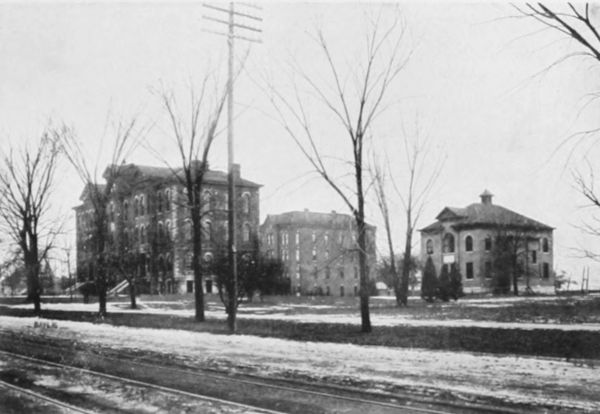 COE COLLEGE BUILDINGS
J. J. Snouffer was the owner of lot 6, block 3. This property was
valued at that period at $1,000.00 and is the corner on which the
Commercial National Bank is located, and a part of the Denecke Dry
Goods store. Mr. Snouffer also owned a lot on North First street
opposite the mills, which was assessed at $700.00, also personal
property valued at $130.00.
Mr. Snouffer came to Cedar Rapids in 1852, and was engaged in milling
under the firm name of W. D. Watrous & Co. He was an alderman from the
first ward for many terms and at one time mayor of the city.
D. F. Sprague was assessed with lot 5, block 25, which was listed at
$500.00. This is the lot on which the Muskwaki block is located, corner
of Second avenue and Fourth street.
Peter Snyder was the owner of lot 6, block 11, valued at $425.00. This
property is on the corner of Sixth avenue and Third street.
C. C. Taylor was listed with lot 6, block 32 and valued at $425.00.
This is the corner of Second avenue and Fifth street and was the home
of B. F. Howland for many years. It is now occupied by the new and
beautiful home of the Cedar Rapids Business college.
T. Wood was the owner of several pieces of Cedar Rapids property, in
all amounting to $1,650.00, on which he paid a tax of $3.30. His home
was on the corner of Fifth street and B avenue. He also was the owner
of the lot on which the Y. M. C. A. building is located, which was
valued at $900.00; also a lot, corner of Fifth avenue and Sixth street.
Mr. Edwin Wood, for many years connected with the J. S. Cook Dry Goods
Co., was a son of Mr. Wood.
The Iowa & Nebraska Land Company were assessed with 29 city lots and
all valued at $6,875.00, the tax of which was $13.75. The Iowa &
Nebraska railroad, from Clinton to this place, was then being built. It
was nearly completed to this point and these lots were doubtless
purchased for right of way and terminal purposes, as they were all
situated on or near where the road was built. The next spring, after
the road was open for traffic to this point, lot 1, block 25 was
assessed to unknown owner and was valued at $700. This is the lot upon
which the First Presbyterian church was built many years ago and
remembered by the older residents as the "Little Muddy." The new
federal building is now erected on this lot.
Lot 1, block 26 was also assessed to unknown owners and was valued at
$575.00. This lot is on the corner of Third street and Third avenue and
was used up to a very recent date by the Second Presbyterian church.
Lots 3, 4 and 5, block 30 was also in the unknown list and was valued
at $1,075.00 for the entire three lots. Two of these lots were bought
about this time and the third one a little later for school purposes
and on this ground was erected the first real substantial school
building ever built in this city. In this building was grouped the high
school and all the other grades from the primary up. This building was
used for school purposes until demolished a few years ago to make room
for the present Washington high school building.
Lots 6, 7, 8, 9 and 10, block 13 were assessed to unknown owners at a
value of $1,100.00. These lots are on Fourth avenue and between Second
and Third streets. The new telephone exchange is located on the rear of
lot 10.
Following is the text of the act incorporating Cedar Rapids, as passed
by the legislature of the State of Iowa and approved by Ansel Briggs,
Iowa's first governor, January 15, 1849:
An Act to Incorporate the Town of Cedar Rapids, in Linn
County.
Section 1. Be it enacted by the General Assembly of the
State of Iowa, that all that part of the State of Iowa
included within the boundaries of the town of Cedar Rapids
in Linn County, as surveyed and recorded in the recorder's
office in the said County of Linn, be and the same is hereby
constituted a town corporate and shall hereafter be known by
the name of the town of Cedar Rapids.
Sec. 2. It shall be lawful for the free male inhabitants of
said town having the qualifications of electors to meet at
the usual place of holding the elections in said town on the
first Wednesday in April next and on the first Wednesday of
April annually thereafter at such place in said town as the
town council shall direct and then and there proceed to
elect by ballot a mayor, recorder and three councilmen, who
shall have the qualifications of electors, and reside within
the corporate limits of said town, and said mayor, recorder
and councilmen shall hold their offices one year, and until
their successors are elected and qualified and any three of
them shall be a board for the transaction of business, but a
less number may adjourn from time to time until a quorum
shall assemble.
Sec. 3. That at the first election under this act judges and
clerks shall be chosen by the electors present who shall
each take an oath faithfully to discharge the duties
required by this act and at all subsequent elections the
mayor and any two of the councilmen shall sit as judges and
the recorder, or in his absence some one of the council pro
tempore shall act as clerk and at all such elections the
polls shall be opened at 1:00 o'clock, p. m. and close at
5:00 o'clock p. m., of the same day, and at the close of the
polls the votes shall be counted and a statement of the
result proclaimed at the door by the clerk; the clerk of
said elections shall thereupon make out a certificate to
each of the persons so elected and the persons receiving
such certificate shall, within ten days thereafter take an
oath to support the constitution and the laws of the United
States and of this state and faithfully discharge his duties
according to the best of his abilities, which oath shall be
endorsed on the back of said certificate and filed with the
recorder of said town.
Sec. 4. The mayor, recorder and councilmen of said town
shall be a body corporate and politic with perpetual
succession to be known by the name of the mayor and council
of the town of Cedar Rapids, and shall be capable in law to
acquire property, real, personal and mixed for the use of
said town and sell and convey the same. May have a common
seal and may alter the same at pleasure. May sue and be
sued, plead and be impleaded, answer or be answered unto in
any court of law and equity in this state; and when any suit
shall be commenced against said corporation a certified copy
of any writ issued against said corporation shall be left
with the recorder of said town at least ten days before the
return day thereof.
Sec. 5. That the mayor, recorder and council, or a majority
of them, of whom the mayor or the recorder shall always be
one, shall have authority to make, ordain, and publish all
by-laws and ordinances not inconsistent with the
constitution and laws of the land as they may deem proper
for the promotion of morality, interest, safety, health and
cleanliness of said town and the citizens thereof; they
shall have power to fill all vacancies that may happen by
death or otherwise of any of the officers of their board
herein named. They shall have power to appoint a treasurer,
marshal and such other subordinate officers as a majority of
said council may deem necessary, to prescribe their duties
and require surety of their performance, to remove them at
pleasure, and to establish the fees of all offices not
otherwise provided for by this act. They shall have power to
impose fines for the breach of their ordinances, which fines
may be recovered with costs before any justice of the peace
in said town by an action of debt in the name of said
corporation. All fines collected in pursuance of this act
shall be paid over by the officer collecting the same to the
treasurer of the corporation.
Sec. 6. It shall be the duty of the mayor to preside at the
meetings of the town council, and it shall be the duty of
the recorder to keep a true record of the by-laws and
ordinances, to attend all meetings of the council and keep a
fair and accurate record of their proceedings and perform
such other duties as the council may from time to time
require. Said recorder may under his hand and seal appoint a
deputy to perform his duties when absent, for whose acts the
said recorder shall be responsible.
Sec. 7. That the town council shall have power to assess for
corporation purposes an annual tax on all property in said
town made subject to taxation by the laws of this state for
state and county purposes not exceeding in any one year one
per centum on the valuation thereof which value shall be
ascertained by an assessor appointed by the town council for
that purpose, duplicate of which shall be made out and
signed by the recorder and delivered to the collector. They
shall have power to equalize any injudicious assessment then
made on complaint of the person aggrieved.
Sec. 8. That the town marshal shall be the collector of any
tax assessed by said council, and he is hereby authorized
and required, by distress and sale of property, as
constables on execution, to collect and pay over said tax to
the treasurer within three months after the time of
receiving the duplicate thereof and the treasurer's receipt
shall be his voucher. The town marshal shall make personal
demand of every resident charged with tax if to be found,
and before sale of property for delinquent tax shall give
ten days' notice in advertisement in three of the most
public places in said corporation, and if the property or
any lot or piece of land for which no personal property can
be found shall remain unpaid for three months after the
expiration of the time by this act allowed the collector for
the collection of the tax shall give notice in the nearest
newspaper stating the amount of such tax and the number and
description of the lots on which it is due and that the same
will be sold to discharge such tax unless the payment
thereof be made within three months from the date of such
advertisement, and if such tax be not paid within that time
the town marshal, after giving twenty days' notice of the
time and place of sale at the three most public places in
said town shall proceed to sell at public auction so much of
said lot or piece of land as will discharge said tax.
Sec. 9. That if the owner of any lot sold for taxes as
aforesaid shall appear at any time within two years after
such sale and pay the purchase money with interest at thirty
per centum per annum thereon he shall be entitled to the
right of redemption. If, however, the owner or his agent
shall neglect to redeem any real estate sold for taxes under
the provisions of this act within the time herein specified,
it shall be the duty of the mayor to make and execute a deed
to the purchaser countersigned by the recorder under the
seal of the corporation. Said deeds shall also be
acknowledged before a justice of the peace, and when so
executed and recorded in the office of recorder of deeds of
Linn County, shall be deemed and taken as valid by law.
Sec. 10. Twenty days before each annual election the town
council shall put up in some conspicuous place within said
town, an accurate account of the money received and expended
by said corporation since the last annual election, with the
sources from which they were derived and the objects on
which they were expended, which shall be certified by the
recorder.
Sec. 11. The said corporation shall have power to regulate
all streets, alleys, sidewalks, drains or sewers, to sink
and keep in repair public wells, remove nuisances, and make
other such needful regulations not incompatible with the
laws of the state as shall conduce to the general interest
and welfare of the inhabitants of said town. To provide for
licensing, taxing and regulating auctions, retailers and
taverns, theatrical and other shows of amusement, to
prohibit tippling houses, gaming houses and other disorderly
houses.
Sec. 12. The by-laws and ordinances of said corporation
shall be published in a newspaper in the county or posted up
in some public place in said town fifteen days before taking
effect thereof, and the certificate of the recorder upon the
town records shall be sufficient evidence of the same having
been done and every annual election herein authorized shall
be preceded by five days' notice thereof put up in three
public places in said town.
Sec. 13. That the streets and alleys of said town shall
constitute one road district including the several roads
leading from said town for the distance of one mile from the
corporation limits.
Sec. 14. That the mayor or a majority of the councilmen may
call a meeting of the town council whenever in his or their
opinion the same may be necessary. The mayor and councilmen
shall receive such compensation as shall be voted them by
the inhabitants of said town in legal meeting assembled.
Sec. 15. This act shall take effect from and after its
publication.
Smiley H. Bonham,
Speaker of House
John J. Selman,
President of the Senate
Approved January 15th, 1849.
Ansel Briggs, Governor
Secretary's Office, Iowa City, Iowa, March 27th, 1849.
I hereby certify that the foregoing is a true and correct
copy of the original act now on file in the said office.
Josiah H. Bonney, Secretary of State
At 1 o'clock of April 4, 1849, the citizens of Cedar Rapids met at the
school house, in accordance with the requirements of the law, and
proceeded to elect town officers under a charter issued by the
legislature and approved January 15, 1849 (for text of this document
see Laws of Iowa, 1849, p. 116). The first election was in the nature
of a mass meeting. William P. Harman was made chairman and Arven
Kennedy, John H. Brooks, and John G. Cole selected as judges of
election. Eber L. Mansfield was clerk of election. These judges
certified to choice of votes as follows:
Mayor, Martin L. Barber.
Councilmen, Joseph Greene, Stephen L. Pollock, and James Leverich.
Recorder, Homer Kennedy.
The mayor immediately took the oath of office before John L. Shearer,
justice of the peace.
The first meeting of the council was held May 11, 1849. Action was
taken appointing Lowell Daniels treasurer of the town, to give bonds of
$20. It was resolved that the municipal seal "shall consist of a raised
circle nine-tenths of an inch in diameter, enclosing an equilateral
triangle." The first ordinance in preamble declared, that "there exists
in the town divers unwholesome cellars, dung heaps, horse stables, cow
stables, barns, yards, hogpens, and other nuisances." The object of the
enactment was to abate these conditions. In July, 1849, Homer Kennedy
resigned as recorder and Porter W. Earle was chosen in his place. A
sort of omnibus ordinance was passed October 23, 1849. This prohibited
the sale of spirituous liquors, required that shows or other
exhibitions should pay license of not less than one dollar nor more
than ten dollars. A further section fixed penalties for disturbance of
any public meeting. This ordinance was given effective publication by
being "posted at G. Greene & Bro.'s store." Other ordinances, we find,
were "posted on John Coffman's door." John H. Brooks, marshal of the
town, was on November 8, 1849, allowed the sum of $16.73. Getting
possession of so much money he immediately resigned, presumably to
enjoy it without official cares.
The second election was held at the school house April 3, 1850. For
mayor Martin L. Barber received 39 votes and Johnson Hill 27. For
recorder John Palmer received 63 and Lawson Daniels 1. Stephen L.
Pollock, Thomas Downing and Charles C. Cook were the successful
councilmen, the defeated candidates being George H. Ely, Joseph Greene,
Isaac Cook, and W. P. Harman.
This new council on April 11, 1850, resolved to form a board of health,
but at the next meeting this action was rescinded. In its stead an
ordinance was passed for preservation of public health. Enforcement of
these provisions rested with the marshal. In May an ordinance was
passed permitting Harvey C. Higley to retail ardent spirits, upon
giving a good and sufficient bond "to keep a good and orderly house,
not permitting any gambling, drunkenness or rioting about his house or
premises." Such bond Mr. Higley refused to execute, and the employment
of counsel was authorized to commence suit against him for violation of
ordinance. July 24 a health board was appointed consisting of Drs. J.
F. Ely, S. D. Carpenter, and J. C. Traer. The marshal, under direction
of the board, was to abate all nuisances. The first recorders of the
city were evidently not of fixed mind or habitation. John Palmer
resigned as such December 8, and S. C. Koontz was chosen to fill the
vacancy. Isaac Cook was made attorney for the city in pending
litigation.
The first tax levy mentioned was ordered by action of council December
16, 1850. This amounted to "one and one-half mills on the dollar of all
taxable property within the corporation," and Johnson Hill was
appointed assessor. Another ordinance to prevent the sale of spiritous
and intoxicating liquors was passed December 16, 1850. Any quantity
less than a gallon sold "without advice of a physician," rendered the
seller liable to a fine of not less than five dollars nor more than
twenty-five. A license fee of from one to five dollars was exacted from
all peddlers, whether they were footmen with packs or sold goods from
wagons.
Annual town election was again held in April, 1851. At this time
Nicholas B. Brown was chosen as mayor. Benjamin Weizer, Michael Bryan,
and Joseph A. Love, councilmen, and S. C. Koontz, recorder. William G.
Furman was appointed marshal. The personnel of the board of health was
also changed. Dr. L. Larrabee, Dr. Thomas, and Dr. John F. Ely
constituting the same.
No recorded meeting of council was held from June 20, 1851, to February
24 of the next year. At this latter date N. B. Brown, mayor, by advice
and consent of the councilmen, "did grant license to David W. King for
free navigation of the Cedar River, opposite this place, for the term
of one year from the 1st day of March, 1857, by the said D. W. King
paying to the recorder the sum of ten dollars." The council fixed rates
of toll as follows: Horse and rider 10 cents; footmen, 5 cents; one
horse and wagon, 15 cents; a wagon and two horses, 20 cents; and every
additional span of horses or yoke of cattle, 20 cents. Loose cattle not
exceeding five in number, he shall be allowed 5 cents per head; if more
than that number, 3 cents per head. Hogs, if not exceeding twenty-five
in number, shall be 2 cents per head; if more than that number the toll
shall be 1 cent per head. Sheep at the rate of 1 cent per head.
The first sidewalk ordinance stipulated: "The sidewalks of Commercial
street shall be planked or paved, commencing at the corner of Benton
and Commercial streets, northeast side, and ending at the corner of
Sugar and Commercial streets. Also on the southwest side of said
street, commencing at the southeast side of Rock and Brather's shop and
coming up as far us Linn street. In case where planked the plank to be
oak and not less than one and one-half inches in thickness, also to be
placed upon a good and permanent foundation. In the front of buildings
the walk to be made ten feet in width, not less than five stringers to
be used. In front of lots or parts of lots not occupied by buildings it
is only required that walks be made five feet in width, in which case
three stringers are sufficient, but not less than three. All of which
must be completed by the 1st of September, 1852."
Samuel Brazelton was appointed marshal, Dr. Koontz treasurer, and Dr.
S. D. Carpenter, Wm. D. Wood, and Porter W. Earle, health board.
In 1853 election was held on Wednesday, April 6. W. W. Smith was chosen
mayor; S. C. Bever, Johnson Hill, and J. F. Ely, councilmen; and S. C.
Koontz, recorder. Hiram Deem was appointed assessor, Isaac N. Whittam,
town marshal. At this same date, May 6, 1853, John F. Ely was made
committee to secure a surveyor, "Major McKean, or some other suitable
person to take and establish the grades of the city of Cedar Rapids."
Pratt R. Skinner was the person selected and his report and profile
were presented and adopted July 6, 1853. Hiram Deem was made marshal
July 23, Mr. Whittam evidently not having qualified. At this meeting a
municipal tax levy of four mills was ordered. Hiram Deem, having
accomplished his work as assessor, and now being marshal, was
instructed to collect the taxes. He was further directed to order out
men to work the roads and streets immediately.
The beginning of Oak Hill cemetery dates from an ordinance of August
23, 1853. Gabriel Carpenter had purchased 300 acres of land adjoining
the city and including the site of the cemetery. The place of burial at
that time was upon the ground after owned by Coe College. The ordinance
enacted that "the proposition made by G. Carpenter in respect to ten
acres of land for purpose of graveyard be filed and accepted. Provided,
however, that if the collegiate institute will pay the aforesaid G.
Carpenter for the aforementioned ten acres of land, and, further
provided, that if the mayor and council hold and possess the power and
right to sell and convey the lot of land now occupied by a graveyard
(within the corporate limits) and can sell and convey the same to the
Collegiate Institute for the sum of three hundred dollars, then the
afore-mentioned proposition is accepted."
The legal and other difficulties in the way were surmounted and on
February 22, 1854, it was resolved to quit claim the interest of the
town in the present burial ground to Smith and Carpenter, at such time
as they shall lay off and deed to the corporation a block of ground in
the Washington cemetery for a "potter's field," which shall contain at
least three acres. It was conditioned also that Smith and Carpenter
should give bond for the careful removal of all occupants of the
present burial ground before making any use of the land.
On April 3, 1854, William W. Smith was elected mayor, William Greene,
Abraham Sines, and Daniel Lothian, councilmen, and William M. Wood,
recorder. The digging of sand from Iowa avenue was dignified by name of
bringing to grade. This was divided into six parts, and two were let to
W. W. Smith and E. Robins. These paid five dollars apiece for the
privilege. The other sections remained as before and the avenue was
rendered impassable. J. J. Snouffer was appointed marshal for ensuing
year and R. C. Rock treasurer. The famous "hog ordinance," which was
intended to keep swine from the street but failed absolutely in its
purpose, was introduced June 28, 1854.
George Greene was elected mayor April 4, 1855. Members of the council
were first styled aldermen on the tickets for this year and R. C. Rock,
Joseph A. Love, and J. F. Charles were chosen. W. D. Watrous was the
choice of the voters for recorder. J. H. Atwell was appointed marshal
and S. D. Carpenter, treasurer. The council was organized into proper
committees, indicating that more business came before the body. The
bond of the treasurer had by this time increased to one thousand
dollars. A city attorney was elected June 5, 1855, James J. Child being
the choice of the council. The report of the finance committee showed a
deficit—the city's revenues lacking $75.00 of meeting expenses.
Isaac Whittam was elected mayor at the April election in 1856, with
Walker, Smith, and Hager, councilmen. The recorder having resigned, D.
M. McIntosh was elected by the council to that office. The ferry
privileges had passed at death of D. W. King in 1854 to Stephen L.
Pollock and afterwards to Bowling & Gilbreath. Both of these failed to
pay for license, and the recorder was instructed to collect; Joseph
Hollan was appointed road supervisor.
On June 14, 1856, City Attorney James J. Child was instructed to
prepare an amended charter to be submitted to the next legislature.
This was accepted by council, June 28, 1856. The proposition was then
submitted to the voters and adopted 45 to 2. An election for city
officers under this new charter was ordered to be held at the office of
J. J. Child August 7, 1856. The votes cast were canvassed by the
council. It was found that 204 votes were cast for mayor, of which
Isaac N. Whittam received 120 and W. W. Smith 84. For recorder and
assessor D. M. McIntosh led with 123; F. P. Huntington 73; E. N. Bates
and S. C. Koontz one each. For treasurer and collector S. C. Koontz
received 121 votes and John P. Conkey 79. Charles Weare was elected
marshal by a vote of 131. In vote for aldermen in the first ward J. T.
Walker was elected and J. J. Snouffer and H. G. Angle were tied.
Alexander Hager and J. F. Charles were chosen to represent the second
ward, and Henry S. Ward and W. D. Watrous were duly elected from the
third ward.
This closes the official doings under the old town. The records
consulted will satisfy and settle all disputed questions as to
office-holding and the statements here made are correct beyond all
question.
1857 Isaac N. Whittam, mayor; F. P. Huntington, recorder; S. C.
Lampson, marshal; S. C. Koontz, treasurer; E. N. Bates, city attorney.
Aldermen, J. J. Snouffer, John G. Graves, S. D. Carpenter, J. J. Child,
William Richmond, A. Whitenack.
1858 R. C. Rock, mayor; George Seymour, recorder; C. T. Kellogg,
marshal; S. C. Koontz, treasurer; A. S. Belt, city attorney. Aldermen,
J. J. Snouffer, John G. Graves, D. N. Sprague, R. R. Taylor, William
Richmond, S. A. Shattuck.
1859 D. N. Sprague, mayor; George Seymour, recorder; William McMahone,
marshal; S. C. Koontz, treasurer; E. N. Bates, city attorney. Aldermen,
John G. Graves, T. Z. Cook, D. M. McIntosh, Charles Weare, S. A.
Shattuck, G. Livensbarger.
1860 E. H. Stedman, mayor; George Seymour, recorder; Benjamin Darnell,
marshal; J. S. Wattles, treasurer; I. N. Whittam, city attorney.
Aldermen, T. Z. Cook, A. Hager, W. B. Mack, R. P. Kingman, G.
Livensbarger, J. P. Coulter.
1861 Homer Bishop, mayor; M. A. Higley, recorder; Benjamin Darnell,
marshal; J. S. Wattles, treasurer; I. N. Whittam, city attorney.
Aldermen, S. C. Bever, H. E. Higley, R. P. Kingman, I. W. Carroll, J.
C. Adams, George Dewey.
1862 T. Z. Cook, mayor; S. C. Koontz, recorder; J. Hogendobler,
marshal; J. S. Wattles, treasurer; A. S. Belt, city attorney. Aldermen,
S. C. Bever, H. E. Higley, I. W. Carroll, H. B. Stibbs, George Dewey,
S. G. McClelland.
1863 Mowry Farnum, mayor; George C. Haman, recorder; A. Laurance,
marshal; Benjamin Harrison, treasurer; no city attorney elected.
Aldermen, S. C. Bever, D. Denlinger, H. B. Stibbs, I. W. Carroll, S. G.
McClelland, Thomas Slonaker.
1864 Mowry Farnum, mayor; George C. Haman, recorder; A. Laurance,
marshal; Benjamin Harrison, treasurer; I. N. Whittam, city attorney.
Aldermen, S. C. Bever, E. H. Stedman, D. Denlinger, Joseph Hollan, S.
G. McClelland, Thomas Slonaker.
1865 H. Church, mayor; George C. Haman, recorder; T. M. Parsons,
marshal; Benjamin Harrison, treasurer; J. J. Child, city attorney.
Aldermen, S. C. Bever, E. E. Leach, D. Denlinger, Charles Weare, G.
Livensbarger, J. C. Adams.
1866 A. R. West, mayor; George C. Haman, recorder; J. O. Stewart,
marshal; Benjamin Harrison, treasurer; J. J. Child, city attorney.
Aldermen, J. J. Snouffer, J. Wetzel, H. B. Stibbs, N. S. Mershon, J. C.
Adams, J. A. Hart.
1867 A. R. West, mayor; D. A. Bradley, recorder; A. Laurance, marshal;
Benjamin Harrison, treasurer; I. N. Whittam, city attorney. Aldermen,
J. J. Snouffer, J. Wetzel, H. B. Stibbs, E. Robbins, J. A. Hart, L.
Wallace.
1868 J. P. Coulter, mayor; D. A. Bradley, recorder; A. Laurance,
marshal; Benjamin Harrison, treasurer; I. N. Whittam, city attorney.
Aldermen, J. Wetzel, A. C. Churchill, E. Robbins, E. E. Leach, William
Stewart, James Albright.
1869 A. R. West, mayor; George C. Haman, recorder; A. Laurance,
marshal; Benjamin Harrison, treasurer; I. N. Whittam, city attorney; P.
C. Lusk, chief engineer. Aldermen, A. C. Churchill, E. S. Hill, E. E.
Leach, D. Denlinger, William Stewart, J. F. Charles.
1870 William B. Leach, mayor; W. B. Stewart, recorder; A. Laurance,
marshal; Benjamin Harrison, treasurer; M. P. Mills, city attorney;
George A. Lincoln, chief engineer. Aldermen, E. S. Hill, J. J.
Snouffer, E. E. Leach, E. Robbins, William Stewart, Elihu Baker.
1871 T. Z. Cook, mayor; H. J. Harvey, police judge; Benjamin Harrison,
treasurer; Hiel Hale, chief engineer: J. C. Stoddard, recorder; A.
Laurance, marshal; R. H. Gilmore, city attorney. Aldermen. J. J.
Snouffer, I. H. Shaver, E. E. Leach, C. C. Cook, William Stewart, J. L.
Bever, James Bell.
1872 E. S. Hill, mayor; A. St. Clair Smith, police judge; Benjamin
Harrison, treasurer; George L. Stearns, chief engineer; J. C. Stoddard,
recorder; Hiel Hale, marshal; I. N. Whittam, city attorney. Aldermen.
J. L. Bever, C. H. Clark, I. H. Shaver, C. C. Cook. W. Stewart, George
Dale, G. M. Howlett, E. E. Leach.
1873 J. F. Charles, mayor; A. St. Clair Smith, police judge; Benjamin
Harrison, treasurer; George L. Stearns, chief engineer; J. C. Stoddard,
recorder; Hiel Hale, marshal; West & Eastman, city attorneys. Aldermen,
J. L. Bever, C. C. Cook, C. H. Clark, George Dale, Henry Forsythe, S.
T. Wier, G. M. Howlett, W. S. Bradley.
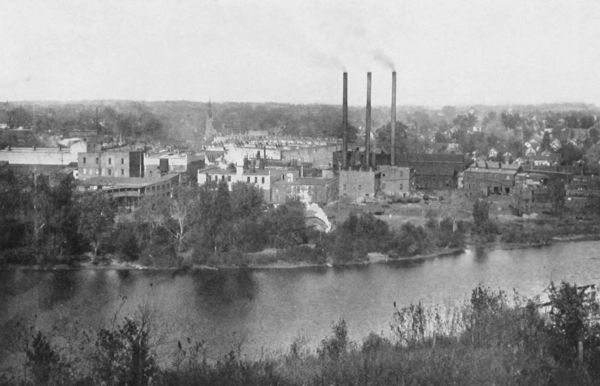 SINCLAIR PACKING PLANT, CEDAR RAPIDS
1874 A. B. Hull, mayor; H. J. Harvey, police judge; Benjamin Harrison,
treasurer; E. S. Hill, chief engineer; J. C. Stoddard, recorder; Hiel
Hale, marshal; A. D. Collier, city attorney. Aldermen, F. J. Upton, C.
C. Cook, C. H. Clark, W. S. Bradley, M. P. Mills, J. H. Smith, E. L.
Mansfield, C. H. Clark, George A. Lincoln, S. T. Wier.
1875 J. H. Smith, mayor; I. N. Whittam, police judge; Benjamin
Harrison, treasurer; Hiel Hale, chief engineer; A. G. Plum, recorder;
Hiel Hale, marshal; F. C. Hormel, city attorney. Aldermen, R. Cornish,
A. T. Averill, U. C. Blake, G. A. Lincoln, M. P. Mills, W. S. Bradley,
S. T. Wier, C. H. Clark, F. J. Upton, E. L. Mansfield.
1876 J. H. Smith, mayor; I. N. Whittam, police judge; Benjamin
Harrison, treasurer; George A. Lincoln, chief engineer; A. G. Plum,
recorder; Hiel Hale, marshal; F. C. Hormel, city attorney. Aldermen, J.
J. Snouffer, U. C. Blake, E. K. Larimer. W. S. Bradley, A. Mann, O. C.
L. Jones, S. T. Wier, M. P. Mills, R. Cornish, D. H. Richards.
1877 W. S. Bradley, mayor; W. B. Leach, superior judge; Benjamin
Harrison, treasurer; C. W. Eaton, chief engineer; A. G. Plumb,
recorder; Hiel Hale, marshal; F. C. Hormel, city attorney. Aldermen, C.
Magnus, E. K. Larimer, A. R. Foote, U. C. Blake, O. C. L. Jones, D. H.
Richards, J. J. Snouffer, D. T. Brown, A. Mann, Frank Witousek, D. B.
Ramsdell, Samuel Miller.
1878 J. T. Hamilton, mayor; W. B. Leach, superior judge; A. G. Plumb,
treasurer; C. W. Eaton, chief engineer; George A. Lincoln, recorder; H.
C. Morehead, marshal; I. N. Whittam, city attorney. Aldermen, J. J.
Snouffer, C. Magnus, D. T. Brown, W. W. Smith, U. C. Blake, A. R.
Foote, O. C. L. Jones, H. G. Bowman, E. R. Earl, Frank Witousek, James
Morton, E. L. Mansfield.
1879 O. N. Hull, mayor; W. B. Leach, superior judge; A. G. Plumb,
treasurer; C. W. Eaton, chief engineer; J. C. Stoddard, recorder;
Spencer Jackson, marshal; I. N. Whittam, city attorney. Aldermen, John
Meehan, W. W. Smith, E. R. Earl, John Gates, John Dale, James Morton,
A. Van Vleck, L. E. Jenkins, H. G. Bowman, J. J. Snouffer, O. C. L.
Jones, E. L. Mansfield.
1880 J. H. Smith, mayor; W. B. Leach, superior judge; A. G. Plumb,
treasurer; C. W. Eaton, chief engineer; J. C. Stoddard, recorder;
Spencer Jackson, marshal; C. J. Deacon, city attorney. Aldermen, J. J.
Snouffer, John Gates, John Dale, P. Mullaly, A. Van Vleck, L. E.
Jenkins, William Stewart, James Morton, E. R. Earl, John Meehan, E. L.
Mansfield, W. A. Fulkerson.
1881 J. H. Smith, mayor; W. B. Leach, superior judge; A. G. Plumb,
treasurer; C. W. Eaton, chief engineer; J. C. Stoddard, recorder;
Spencer Jackson, marshal; C. J. Deacon, city attorney. Aldermen, John
Meehan, William Stewart, E. R. Earl, John Gates, J. M. Searles, E. L.
Mansfield, J. R. Morin, M. P. Mills, James Morton, J. J. Snouffer, A.
St. Clair Smith, W. A. Fulkerson.
1882 Charles A. Clark, mayor; W. B. Leach, superior judge; A. G. Plumb,
treasurer; G. H. Murphy, chief engineer; J. C. Stoddard, recorder;
Spencer Jackson, marshal; J. J. Powell, city attorney. Aldermen, J. J.
Snouffer, John Gates, J. M. Searles, P. Martel, J. R. Morin, M. P.
Mills, A. Van Vleck, T. M. Giberson, E. R. Earl, John Meehan, C. D. Van
Vechten, W. A. Fulkerson.
1883 John W. Henderson, mayor; W. B. Leach, superior judge; A. G.
Plumb, treasurer; L. M. Ayers, chief engineer; J. C. Stoddard,
recorder; P. H. Francis, marshal; J. J. Powell, city attorney.
Aldermen, John Meehan, P. Martel, M. P. Mills, John Gates, A. Van
Vleck, James Fair, Frank Kouba, J. M. Searles, T. M. Giberson, J. J.
Snouffer, C. D. Van Vechten, W. A. Fulkerson.
1884 C. W. Eaton, mayor; W. B. Leach, superior judge; J. C. Stoddard,
treasurer; L. M. Ayers, chief engineer; John D. Blain, recorder; P. H.
Francis, marshal; I. N. Whittam, city attorney. Aldermen, J. J.
Snouffer, John Gates, W. A. Fulkerson, G. M. Olmsted, Frank Kouba, J.
M. Searles, A. Van Vleck, T. M. Giberson, M. P. Mills, John Meehan, C.
D. Van Vechten, C. B. Kennedy.
1885 F. C. Hormel, mayor; J. T. Stoneman, superior judge; J. C.
Stoddard, treasurer; L. M. Ayers, chief engineer; John D. Blain,
recorder; Michael Healy, marshal; A. R. West, city attorney. Aldermen,
H. T. Brown, G. M. Olmsted, C. F. Earl, Joseph Moore, John Gates, A.
Van Vleck, T. M. Giberson, A. H. Connor, J. W. Shapely, J. R. Morin, A.
J. Mallahan, W. A. Fulkerson, A. D. Stevens, E. I. Foster, J. J.
Snouffer, M. P. Mills, C. D. Van Vechten, J. F. Vondracek.
1886 C. W. Eaton, mayor; John T. Stoneman, superior judge; J. C.
Stoddard, treasurer; L. M. Ayers, chief engineer; John D. Blain,
recorder; P. H. Francis, marshal; M. P. Smith, city attorney. Aldermen,
H. T. Brown, J. R. Morin, C. F. Earl, Joseph Moore, George W. Bever, J.
M. Miles, R. J. Thompson, J. F. Vondracek, A. D. Stevens, John Gates,
A. J. Mallahan, M. P. Mills, J. W. Shapely, H. C. Waite, G. M. Olmsted,
H. F. Sutliff, C. D. Van Vechten, A. H. Connor.
1887 C. W. Eaton, mayor; John T. Stoneman, superior judge; J. C.
Stoddard, treasurer; L. M. Ayers, chief engineer; John D. Blain,
recorder; P. H. Francis, marshal; I. N. Whittam, city attorney.
Aldermen, George W. Bever, J. M. Miles, R. J. Thompson, J. F.
Vondracek, Frank Horak, George A. Lincoln, W. A. Fulkerson, A. Matyk,
H. C. Waite, G. M. Olmsted, H. F. Sutliff, M. P. Mills, A. H. Connor,
E. I. Foster, John Gates, William King, C. D. Van Vechten, W. C. Byers.
1888 P. Mullaly, mayor; John T. Stoneman, superior judge; J. C.
Stoddard, treasurer; L. M. Ayers, chief engineer; John D. Blain,
recorder; P. H. Francis, marshal; I. N. Whittam, city attorney.
Aldermen, Frank Horak, George A. Lincoln, M. P. Mills, A. Matyk, C.
Magnus, J. F. Allison, F. W. Harwood, Edward Roddy, E. I. Foster, John
Gates, William King, W. A. Fulkerson, W. C. Byers, H. C. Waite, G. M.
Olmsted, H. V. Ferguson, R. J. Thompson, J. E. Lapham.
1889 P. Mullaly, mayor; John T. Stoneman, superior judge; J. C.
Stoddard, treasurer; L. M. Ayers, chief engineer; John D. Blain,
recorder; P. H. Francis, marshal; I. N. Whittam, city attorney; G. A.
Mitchell, city engineer. Aldermen, C. Magnus, J. F. Allison, F. W.
Harwood, Edward Roddy, J. J. Snouffer, George A. Lincoln, George W.
Noble, F. W. Slapnicka, H. C. Waite, G. M. Olmsted, H. V. Ferguson, R.
J. Thompson, J. E. Lapham, F. A. Simmons, Warren Harman, F. J. Shefler,
M. Ottmar, W. C. Byers.
1890 J. J. Snouffer, mayor; John T. Stoneman, superior judge; J. C.
Stoddard, treasurer; L. M. Ayers, chief engineer; John D. Blain,
recorder; J. W. Hayes, marshal; N. W. McIvor, city attorney; J. D.
Wardle, city engineer. Aldermen, J. J. Snouffer, M. O'Brien, W. Harman,
A. St. Clair Smith, G. A. Lincoln, George W. Noble, F. W. Slapnicka, J.
F. Allison, J. B. Henderson, Joseph Zbanek, F. A. Simmons, F. J.
Shefler, M. Ottmar, W. C. Byers, J. A. Roach, T. C. Munger, A. B. Van
Albada, Frank Dietz.
1891 John B. Henderson, mayor; John T. Stoneman, superior judge; J. C.
Stoddard, treasurer; L. M. Ayers, chief engineer; John D. Blain,
recorder; J. W. Hayes, marshal; N. W. McIvor, city attorney; J. D.
Wardle, city engineer. Aldermen, M. O'Brien, J. F. Allison, P. H.
Francis, J. Zbanek, J. J. Snouffer, George W. Noble, F. A. Simmons, F.
W. Slapnicka, J. R. Amidon, T. C. Munger, M. Ottmar, Frank Dietz, A.
St. Clair Smith, F. J. Shefler, A. B. Van Albada, G. H. Spalding.
1892 John B. Henderson, mayor; John T. Stoneman, superior judge; J. C.
Stoddard, treasurer; L. M. Ayers, chief engineer; J. D. Blain,
recorder; A. W. West, marshal; N. W. McIvor, city attorney; J. D.
Wardle, city engineer. Aldermen, J. J. Snouffer, George W. Noble, F. A.
Simmons, F. W. Slapnicka, M. O'Brien, Warren Harman, M. S. Jackson, J.
Zbanek, J. R. Amidon, F. J. Shefler, M. Ottmar, A. F. Schindler, A. St.
Clair Smith, Ed R. Shaw, L. W. Richards, J. B. Leverich.
1893 William P. Daniels, mayor; Thomas M. Giberson, superior judge; J.
C. Stoddard, treasurer; J. D. Blain, recorder; A. R. West, marshal; L.
M. Ayers, chief engineer; Lewis Heins, city attorney; J. D. Wardle,
city engineer; board of public works, J. L. Hardwick, chairman, C. H.
Swab, W. P. Clark. Aldermen, M. O'Brien, Charles Bednar, F. H. Juckett,
S. J. Maloney, J. Kozlovsky, D. F. Anderson, J. W. Gerber, F. S. Salda,
F. W. Harwood, Ed. R. Shaw, L. W. Richards, J. B. Leverich, A. St.
Clair Smith, J. F. Shefler, L. J. Zika, A. F. Schindler.
1894 William P. Daniels, mayor; Thomas M. Giberson, superior judge; J.
C. Stoddard, treasurer; L. M. Ayers, chief engineer; J. D. Blain,
recorder; Thomas Farmer, marshal; Lewis Heins, city attorney; J. D.
Wardle, city engineer. Board of public works, Hosmer Tuttle, chairman.
Aldermen, Joseph Kozlovsky, D. F. Anderson, J. W. Gerber, F. S. Salda,
G. M. Schumm, George Eakle, F. H. Juckett, S. J. Maloney, F. W.
Harwood, F. J. Shefler, L. J. Zika, A. F. Schindler, Charles Weare, S.
L. Rudolph, W. A. Smith, J. B. Leverich.
1895 George A. Lincoln, mayor; T. M. Giberson, superior judge; J. C.
Stoddard, treasurer; Thomas Farmer, marshal; J. D. Blain, recorder and
assessor; William McGowan, chief engineer; Warren Harman, city
attorney; E. P. Boynton, city engineer. Board of public works, Charles
Weare, chairman. Aldermen, G. M. Schumm, George Yuill, John B. Turner,
S. J. Maloney, Ed H. Smith, George Eakle, J. W. Gerber, Joseph Kubicek,
F. W. Harwood, V. W. Johnson, James Monilaw, C. F. Hutchens, Charles
Weare, S. L. Rudolph, W. A. Smith, J. B. Leverich.
1896 George A. Lincoln, mayor; Thomas M. Giberson, superior judge;
Thomas Devendorf, treasurer; William McGowan, Jr., chief engineer; J.
D. Blain, recorder; Thomas Farmer, marshal; Warren Harman, city
attorney; E. P. Boynton, city engineer. Board of public works, Charles
Weare, chairman. Aldermen, Ed H. Smith, George Yuill, W. G. Haskell, S.
J. Maloney, W. G. Dows, George W. Eakle, John B. Turner, Joseph
Kubicek, F. W. Harwood, V. W. Johnson, James Monilaw, Henry J. Rapps,
C. W. Burton, David W. King, Joseph Pitlik, C. F. Hutchens.
1897 George A. Lincoln, mayor; Thomas M. Giberson, superior judge;
Thomas Devendorf, treasurer; Thomas Farmer, marshal; J. D. Blain,
recorder; J. L. Starman, chief engineer; W. Harman, city attorney; E.
P. Boynton, city engineer. Board of public works, Charles Weare,
chairman. Aldermen, W. G. Dows, George W. Eakle, W. G. Haskell, John
Juza, R. N. Buck, R. D. Mills, Joseph Pitlik, S. J. Maloney, F. W.
Harwood, David W. King, J. Y. Kennedy, J. B. Leverich, C. W. Burton, V.
W. Johnson, J. H. Rothrock, Jr., Henry J. Rapps.
1898 John M. Redmond, mayor; T. M. Giberson, judge superior court; J.
D. Blain, recorder; Thomas Devendorf, treasurer; J. A. Hildebrand,
assessor; Joseph Kozlovsky, marshal; John L. Starman, chief of fire
department; John N. Hughes, city attorney; G. H. Merridith, city
engineer. Aldermen, J. F. Allison, M. Ottmar, R. N. Buck, George T.
Hedges, R. A. Wallace, Charles D. Huston, W. G. Haskell, Joseph Pitlik,
F. W. Slapnicka, L. M. Rich.
1899 John M. Redmond, mayor; T. M. Giberson, judge superior court; J.
D. Blain, recorder; Thomas Devendorf, treasurer; J. A. Hildebrand,
assessor; Joseph Kozlovsky, marshal; Joseph P. Cook, chief fire
department; Henry J. Achter, auditor; John N. Hughes, city attorney; G.
H. Merridith, city engineer. Aldermen, J. F. Allison, M. Ottmar, R. N.
Buck, George T. Hedges, R. A. Wallace, Charles D. Huston, W. G.
Haskell, J. P. Grissel, F. W. Slapnicka, L. M. Rich.
1900 John M. Redmond, mayor; James H. Rothrock, judge superior court;
J. D. Blain, recorder; Thomas Devendorf, treasurer; J. A. Hildebrand,
assessor; Joseph Kozlovsky, marshal; Joseph P. Cook, chief fire
department; Henry J. Achter, auditor; John N. Hughes, city attorney; G.
H. Merridith, city engineer. Aldermen, J. F. Allison, M. Ottmar, R. N.
Buck, George T. Hedges, R. A. Wallace, Charles D. Huston, W. G.
Haskell, J. P. Grissel, F. W. Slapnicka, L. M. Rich.
1901 Charles D. Huston, mayor; Henry J. Achter, auditor; Thomas
Devendorf, treasurer; George L. Mentzer, recorder; J. A. Hildebrand,
assessor; Joseph P. Cook, chief of fire department; James H. Rothrock,
judge superior court; John N. Hughes, city attorney; T. F. McCauley,
city engineer. Aldermen, J. F. Allison, H. Cushman, James H. Hughes, W.
L. Cherry, F. E. Cerny, C. H. Chandler, Porter Hamilton, John Easker,
F. W. Slapnicka, John F. Powers.
1902 Charles D. Huston, mayor; Henry J. Achter, auditor; Thomas
Devendorf, treasurer; George L. Mentzer, recorder; J. A. Hildebrand,
assessor; Joseph Kozlovsky, marshal; James H. Rothrock, judge superior
court; John N. Hughes, city attorney; T. F. McCauley, city engineer.
Aldermen, J. F. Allison, H. Cushman, James H. Hughes, W. L. Cherry, F.
E. Cerny, C. H. Chandler, Porter Hamilton, John Easker, F. W.
Slapnicka.
1903 Charles D. Huston, mayor; Henry J. Achter, auditor; Thomas
Devendorf, treasurer; George L. Mentzer, recorder; J. A. Hildebrand,
assessor; Joseph Kozlovsky, marshal; James H. Rothrock, judge superior
court; Joseph P. Cook, chief fire department; John N. Hughes, city
attorney; T. F. McCauley, city engineer. Aldermen, H. Cushman, C. O.
Johnson, James H. Hughes, W. L. Cherry, George Lightner, D. A. Ross, W.
C. Byers, F. W. Barta, D. Feiereisen, John F. Powers.
1904 Charles D. Huston, mayor; Henry J. Achter, auditor; Thomas
Devendorf, treasurer; George L. Mentzer, recorder; J. A. Hildebrand,
assessor; Joseph Kozlovsky, marshal; John N. Hughes, city attorney; T.
F. McCauley, city engineer; Joseph P. Cook, chief fire department;
James H. Rothrock, judge superior court. Aldermen, H. Cushman, C. O.
Johnson, J. H. Hughes, W. L. Cherry, George Lightner, D. A. Ross, W. C.
Byers, F. W. Barta, D. Feiereisen, J. F. Powers.
1905 Charles D. Huston, mayor; Henry J. Achter, auditor; Thomas
Devendorf, treasurer; H. S. Keffer, recorder; J. A. Hildebrand,
assessor; Joseph Kozlovsky, marshal; John N. Hughes, city attorney; T.
F. McCauley, city engineer; Joseph P. Cook, chief fire department;
James H. Rothrock, judge superior court. Aldermen, H. Cushman, C. O.
Johnson, J. H. Hughes, W. L. Cherry, George Lightner, D. A. Ross, W. C.
Byers, F. W. Barta, D. Feiereisen, J. F. Powers.
1906-7 Amos H. Connor, mayor; James B. Gourley, auditor; Thomas
Devendorf, treasurer; H. S. Keffer, recorder; J. G. Crozer, marshal;
Joseph P. Cook, chief fire department; James W. Good, city attorney; T.
R. Warriner, city engineer. Aldermen, James H. Hughes, W. G. Rowley,
George Lightner, D. A. Ross, W. C. Byers, F. W. Barta, J. K. Starman,
D. Feiereisen, L. W. Anderson, Charles H. Campbell.
Mayor Connor died while in office and George S. Lightner was chosen for
the unexpired term.
The city went under the commission plan of government in 1908, the
officers being as follows: J. T. Carmody, mayor; Leslie J. Storey,
clerk; C. D. Huston, H. S. Keffer, Matt J. Miles, and E. A. Sherman,
councilmen; John M. Redmond, attorney; Percy P. Smith, engineer.
Mayor Carmody having died, Matt J. Miles was chosen mayor and J. F.
Allison councilman to succeed him.
1910 Matt J. Miles, mayor; Leslie J. Storey, clerk; W. H. Chamberlain,
attorney; T. F. McCauley, engineer; H. S. Keffer, W. H. Stepanek, Henry
Bennett, and Percy P. Smith, councilmen.
H. S. Keffer later resigned, and A. S. Reed was chosen to fill the
vacancy.
The following interesting account of early Cedar Rapids is taken from
Voice of Iowa for April, 1857, edited by James L. Enos. The article
was written by Mr. Enos himself:
"What constitutes the present city of Cedar Rapids, is
embraced mainly by sections 21, 22, 27 and 28, in T. 83 N.,
R. 7 W., in the township of Rapids in Linn county. The
location is one of the most delightful to be found in any of
the rich valleys of the west, being on the northeast side of
the Cedar river, on a plain rising above the river's bed,
and reaching back nearly half a mile, with but very slight
depressions or uprisings, serving to render the plat one of
great convenience for building, and giving a peculiar grace
to its appearance.
"In the rear of this table-land a somewhat abrupt elevation,
varying from 20 to 40 feet, occurs, which is covered with a
luxuriant growth of native oak. Upon this are the most
beautiful and romantic sites for residences, being
sufficiently elevated to overlook the entire valley for
miles in either direction. Back of this the depressions and
elevations alternate, making this portion of the city a
series of circular, undulating swells.
"The city proper also extends on the west side of the river
and embraces numerous other positions which are being
occupied with rapidity and improved with taste, and though
not embraced within the present city limits, forms of
necessity a part of the Valley City.
"Cedar Rapids is situated due west of Chicago, the present
emporium of the west, and is the present terminus of the
principal trunk railroad from that city penetrating the
heart of the northwest. It is 75 miles southwest from
Dubuque, 80 miles nearly west from Clinton, about the same
distance from Davenport, 55 miles from Muscatine, and about
110 from Des Moines—the capital of Iowa.
"Few interior cities are blessed with more natural
advantages than Cedar Rapids. The rapids in the Cedar river
are the first met with after leaving the Mississippi, and no
more occur of any considerable amount for many miles above.
These afford one of the best water powers in the west, and
with proper dams would afford power sufficient to run all
machinery that will ever be required on either side of the
river, even though our population should reach fifty
thousand. Surrounding the town for miles is one of the
richest agricultural districts in the Union, forming a part
of the Cedar valley country which Professor Owen has taken
as his type of perfection in fertility. There is a plentiful
supply of timber for all ordinary uses—numerous groves are
scattered upon the surrounding hills—giving the appearance
of an enchanted garden—probably unsurpassed in richness by
any region of equal extent on the American continent.
"Its position in reference to other towns and cities is such
as must of necessity make it a great railroad center, and
several are already projected, and one under contract to
this city. We shall speak more fully of this class of
advantages in another portion of this article.
"In point of healthfulness, it will compare favorably with
any of the river towns, the diseases being chiefly of a
bilious nature, and yielding readily to very simple
treatment. This fact applies with very general truth to all
the valleys of Iowa—while the more elevated districts are
more free from malaria, they are subject to a disease of a
more complex and serious character. This may seem fabulous
to the casual observer, but we feel assured that the
combined experience of western practitioners will bear
testimony to the correctness of our statements.
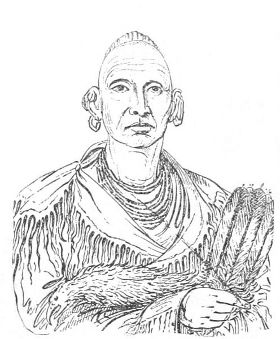 BLACK HAWK
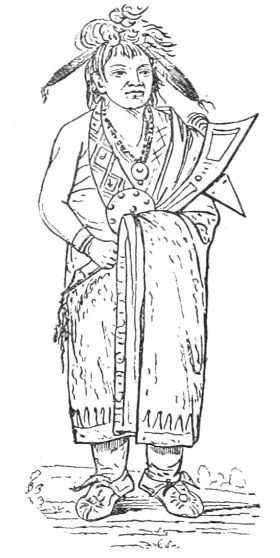 A WINNEBAGO INDIAN
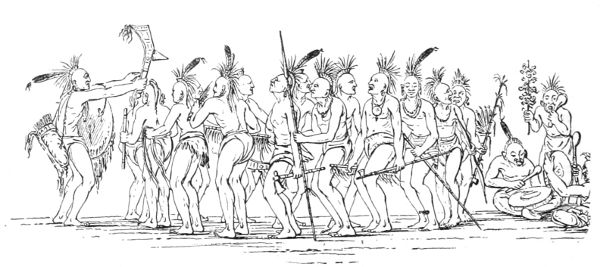 THE SLAVE DANCE OF THE SAC AND FOX
"There is always more or less of interest connected with the
early days of any city, and it is not until years after that
the record becomes of value. The pioneer suffers privations
and trials of which future occupants can realize but little.
In fact, the honor paid them is seldom equal to their merits
and oftentimes they are as illy prepared to receive as
others are to bestow sympathy and praise. Among the first
settlers of this city were some men of the first character,
and are yet with us, while others have moved farther on, to
enjoy what habit has taught them to love, a frontier life,
and a few have gone down to the gate of common entry, their
years being full and their memories yet linger, and make us
glad that we lived with, knew and loved them. Of this number
we name that generous and true man, D. W. King. Esq., who
departed from our midst in the autumn of 1854.
"The first man, however, who pitched his tent on the ground
now occupied by the Valley City, was a counterfeiter and
horse thief, of no little notoriety, by the name of Shepard,
who took up his abode and erected a log house on what is now
Linn street, near the mills, some time in the year 1838.
"D. W. King and Thomas Gainer, the first settlers of any
advantage to the country, reached here in 1839 and soon
after made a permanent settlement on the west side of the
river.
"The house of Shepard was soon found to be the home of a
lawless band of outlaws, who secreted much of their plunder
on the islands in the river above the city. John Young and a
man named Granger were connected with Shepard in their work.
They stole at one time six horses and made good their escape
with four of them. Granger was afterwards convicted of
passing counterfeit money in Chicago and sentenced to the
Alton prison for four years. The fate of Young is not known
with certainty, yet there is evidence to induce the belief
that he was executed for murder, in a neighboring state,
though he assumed a different name.
"The privations of the first settlers were at times very
great, and though such as are not uncommon in the history of
pioneer life, would cause many of our amateurs at the
present time to sigh for the home of their childhood and a
place at the luxurious tables of their fathers.
"In 1849 D. W. King established ferries for crossing the
Cedar, and continued to run them up to the time of his
death. The one doing most of the business was at the Iowa
avenue crossing. As it is probable that these boats will
soon, if indeed they have not already made their last
voyage, a brief note of them may not be out of place in this
connection. They were self-propellers, being forced across
the river by the power of the current. A wire rope extended
across the stream upon which a pulley was placed, and
connected by means of two ropes to the boat.
"The first dam across the Cedar was commenced in 1842, and
the first saw mill erected in 1843, and is still running.
"In March, 1843, the lands came into the market. The first
flouring mill was erected in 1844-5 at a cost of $3,000, by
the present owner. In 1845 A. Ely erected the second saw
mill, and the second flouring mill the following year, the
latter costing about $9,000. In 1848-9 the woolen factory
was erected at a cost of about $8,000. The first saw mill
was erected in 1850 by Greene, Legare & Co. This has a chair
and bedstead factory connected and cost about $4,000. These
are all propelled by water power. In 1855-6, Greene & Graves
erected a steam saw mill, and containing also a variety of
other machinery. The first and only mill erected on the
west side of the river went into operation in the summer of
1856. The first steam engine was stationed in this city by
A. Hager, in his machine shop, sash, blind, and door factory
in 1855. The second by Greene & Graves, and the third by S.
L. Pollock.
"The first store was opened by J. Greene, in the building
now occupied by the postoffice, on the northwest corner of
Iowa avenue and Washington street.
"The second store was opened by Mr. Cleveland, and C. R.
Mulford the third. This was located on Commercial street,
and was destroyed by fire in 1850, being the first building
thus destroyed in Cedar Rapids. No fire occurred thereafter
until late in the autumn of 1855, when most of the block
embraced on the west side of Commercial street, between Iowa
avenue and Linn street, was consumed. No fire has occurred
since.
"The postoffice was established in 1847, and J. Greene
appointed postmaster.
"The first brick buildings were erected in 1844, the
building on the southwest corner of Iowa avenue and
Commercial street, and the dwelling house on the northwest
corner of Iowa avenue and Washington street. The present
Union House was the first hotel.
"The village of Cedar Rapids was laid out and the plat
recorded in 1842. At this time, two log buildings
constituted the village, and the total population was six
persons.
"A public school house was erected in 1846 or '47, and the
first school taught by Nelson Felch. This structure is now
occupied as a dwelling, on the northwest corner of Eagle and
Madison streets. The first church, Presbyterian, was erected
in 1850.
"The first newspaper was published in 1851 by D. O. Finch,
entitled the Progressive Era. It was continued under this
name by various owners and editors until September, 1854,
when it was purchased by J. L. Enos and F. A. Wilmans, and
its name changed to the Cedar Valley Times by which name
it yet flourishes. In politics republican, it is at present
published by J. G. Davenport. The second paper was
established in January, 1856, under the editorial management
of J. L. Enos, entitled the Cedar Valley Farmer, but was
discontinued at the close of the first volume. The Cedar
Rapids Democrat was the third paper—commenced in June,
1856, by W. W. Perkins & Co. This is still published.
Democratic in politics, the Times and the Democrat are
both good papers, and appear to be well sustained.
"The Voice of Iowa was commenced in January, 1857, under
the auspices of the Iowa Teachers' Association, Phonetic
Association, etc., J. L. Enos, editor and publishing agent,
assisted by a number of corresponding editors. This journal
has met with more than ordinary success, the circulation
passing 1,000 during the first three months and commanding
nearly $1,000 in advertising patronage, thus showing that
the people of Iowa are aroused to the importance of paying
due attention to the education of their youth.
"The foundation for a very large graded school was laid in
the summer of 1856, but owing to the large amount of work
contracted and the scarcity of workmen, the completion was
of necessity deferred. It is designed to complete it early
the coming summer, and when finished will form one of the
finest educational structures in the state.
"During the past two years the growth of Valley City has
been equaled by few towns even in the west. It now contains
many blocks that would do credit to any eastern city.
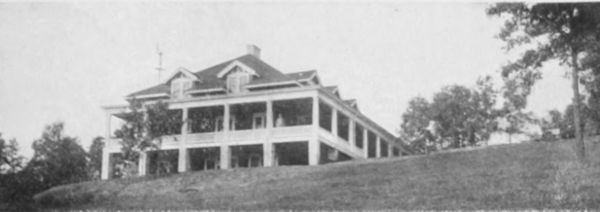 CEDAR RAPIDS COUNTRY CLUB HOUSE
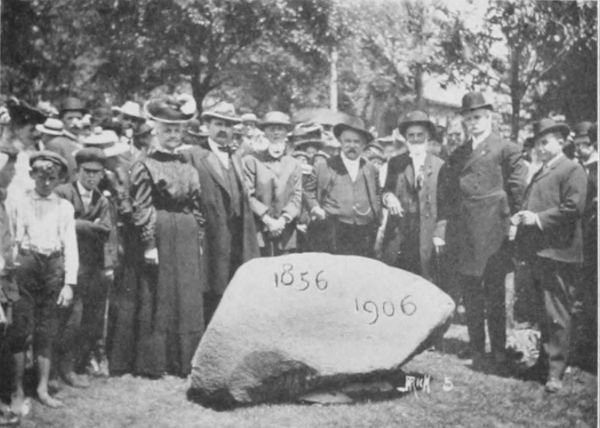 GEORGE GREENE SQUARE, SEMI-CENTENNIAL, 1906
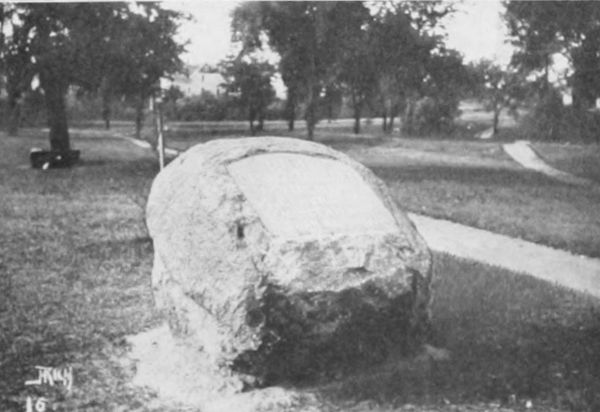 RIVERSIDE PARK
"The present city charter was adopted in the summer of 1856,
and Isaac Whittam, Esq., was elected mayor. A free bridge
across the Cedar was commenced in 1855, and is now ready for
crossing by teams. The chief credit of this structure is due
to a few, though many stood manfully by the free bridge and
aided liberally in its erection. A charter for a toll bridge
was obtained about the time that the free bridge charter
was procured, which gave rise to a warm controversy in which
much interest was manifest. The free bridge finally
triumphed, and its noble arches now span the Cedar with
every appearance of remaining for many years a proud
monument to the energy and liberality of those who aided in
placing it there. We have already intimated that Cedar
Rapids is the center of a very large and increasing trade,
and though not destined to become a city of the first
magnitude, is destined to rank as one of the principal
interior cities of Iowa. Its railroad connections—immense
water power—the fertility of the surrounding country and
the energy of its people will give it rank and importance as
a manufacturing city, worthy of note.
"Nor is this imaginary, as the following statistics will
show. Cedar Rapids now contains: 4 flouring mills, 2 door,
sash and blind, and planing mills, 1 cooper and barrel
factory, 5 wagon and carriage factories, 1 iron factory, 2
cabinet furniture and chair factories, 3 plow factories, 3
boot and shoe factories, 2 saddle and harness manufactories,
4 tin, copper and sheet iron establishments, 1 woolen
factory, 5 brick yards, 2 agricultural implement
manufactories, 3 merchant tailor establishments, 2 wood
turning establishments, 3 newspapers and magazines, 1 brick
machine factory, 8 grocery and provision stores, 5 clothing
stores, 5 dry-goods stores, 1 millinery and fancy goods
store, 6 liquor and cigar shops, 4 drug stores, 2
silversmith, clock and jewelry stores, 4 hardware stores, 3
book stores, 1 book bindery, 5 public and private halls, 5
hotels, 4 churches, 4 lumber yards, 3 banking houses, 1
public reading room, 1 shaving and hair dressing
establishment.
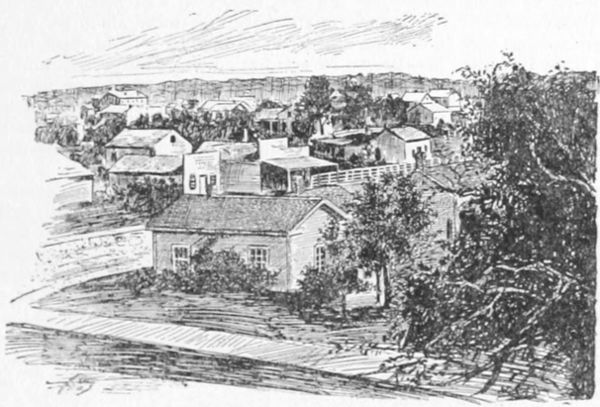 CEDAR RAPIDS IN 1856
"A paper mill is in contemplation, and there is room and
excellent openings for other branches of business.
"A hat and cap manufactory—pork packing establishment—in
fact nearly every branch of manufactory not included in the
above would do well. There are two nurseries contiguous to
town, where nearly every kind of fruit and a large variety
of ornamental trees can be procured. The Mound nursery is
one of the oldest and most extensive in the country, and the
proprietor furnishes orders on very liberal terms."
The following letter to A. T. Hall, as to a gavel, at the meeting of
carpenters of America at Des Moines, 1910, gives some interesting facts
as to early days in Cedar Rapids:
"Dear Sir: In reply to your request for such information as
I have concerning the small mallet or gavel which you had
made from a piece of the red cedar shaft, I can only say
that there is but little to its history. My father, the late
Nicholas Brodhead Brown, came to what is now the city of
Cedar Rapids in 1839, but did not remain here at that time.
He went as far north as Cedar Falls looking for a mill site,
and returned to this location in 1840. After building the
first manufacturing plant in Linn county for the Doty
brothers, a saw mill in Bertram township, located near the
mouth of Indian creek, he began in 1841 to improve the
waterfall in the Cedar river at this place. He first built a
temporary dam then built a saw mill, the second to be built
in the county, for himself. He then began the building of
the first flour mill in the county. This mill was completed
and in operation either in 1843 or 1844, and from this mill
came the cedar shaft from which the little mallet or gavel
was made. There is no doubt in my mind about the cedar tree
from which the mallet was made was cut very close to, and
perhaps within the present limits of Cedar Rapids. Nicholas
Brodhead Brown was in all probability the first mechanic who
used edged tools, to locate in Cedar Rapids. Nor is there
any doubt in my mind about his making the shaft above spoken
of. It was the real shaft in the old bolting chest in the
mill known as Brown's Mill. Mr. Brown by occupation was a
millwright and through force of circumstances worked at that
trade for some twelve or fifteen years after his arrival
here. He especially did all of the millwrighting that he
could do himself on this mill, working twelve and fourteen
hours a day for the purpose of getting it into operation as
soon as possible, as not only he himself needed its income
but the country all about this locality needed a mill.
"Another of the early mechanics to come to Cedar Rapids was
Samuel Sherwood, also a millwright. He worked for a time on
Brown's flour mill, and on the Alexander Ely flour mill, now
known as the Anchor mill. This was the second mill to begin
operation in Cedar Rapids. The Ely mill began operating the
same year as the Brown's, but later on in the year. Another
of the old-time mechanics, a user of edged tools, was Joseph
Love. He was the first cabinet-maker to locate in Cedar
Rapids. Another was John Vardy; he was the second
cabinet-maker to locate in Cedar Rapids, and was the builder
of the first house in Cedar Rapids to be constructed of
sawed lumber. The house still stands—is in use and owned by
the Stary family. John F. Boyce, the father of William and
Frank Boyce of this city, was another early mechanic. He
also was a cabinet-maker. John Patterson, an uncle of Chas.
A. Calder of this city, was another. He also was a
cabinet-maker. All of these men worked to a greater or less
extent at the carpenter's trade. In those days there were no
trade unions and consequently no limitations on the kind of
work a mechanic should do. To my mind these men could be
classed as carpenters as well as millwrights and
cabinet-makers. I should have said that Samuel Sherwood went
to Independence from this city and became the founder of the
milling industry at that thriving little place. I have
diverged largely from the gavel, but believe it will be
interesting to yourself and your fraternity to know who the
first users of edged tools were in this part of Iowa.
Respectfully yours,
"N. E. Brown."
T. DEVENDORF IN THE SUNDAY REPUBLICAN OF JUNE 10, 1906
The population of the city in 1856 was not to exceed 1,200 to 1,500
people. There was little wealth in the community. No manufacturing
enterprises had as yet located here. The principal dependence of the
people was in the farming community and the bountiful harvests that
Iowa never fails to produce.
The one great desire and ambition of the people was for a railroad to
the east on which they could transport their surplus product to an
eastern market. Railroad building had not been very extensive in the
west, the Chicago, Iowa & Nebraska had its track built as far west as
the Mississippi river and was formulating plans to bridge the river and
extend the road across the fertile prairies of Iowa. Some of our
pioneer citizens with shrewd business instincts and confidence in the
rapid settlement and development of the state, on the completion of the
railroad, became interested in this new project and advocated the
granting of a loan to them provided the road should be built to or
through our growing city. The subject of giving aid to this new
proposed railroad was discussed largely among the people, and on the
1st day of September, 1856, the city council passed a resolution
instructing the mayor to call an election of the qualified voters of
Cedar Rapids to vote on the question, shall the city in its corporate
capacity subscribe sixty thousand dollars to the capital stock of the
Chicago, Iowa & Nebraska railroad and pay for same in bonds issued by
the city. Said bonds were to bear interest at the rate of ten per cent
per annum, and were to mature 20 years after date at the option of the
city. The election was called by Mayor Isaac Whittam and held September
22, 1856, and resulted in the very decisive vote of 111 for the
proposition and only 2 against it.
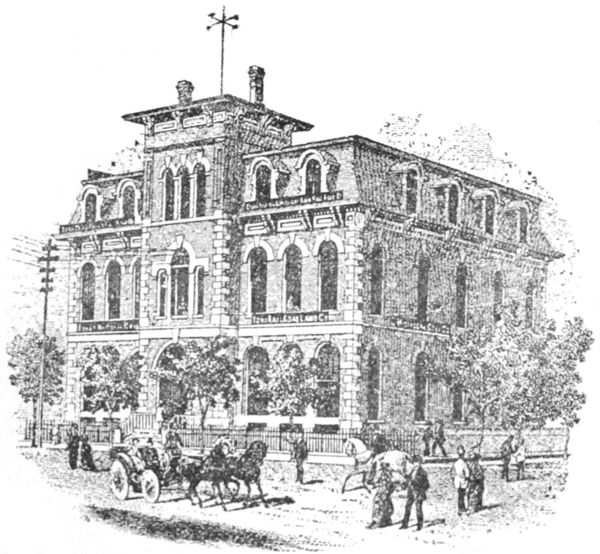 THE OLD BLAIR BUILDING, NOW THE SITE OF THE KIMBALL
BUILDING
THE OLD BLAIR BUILDING, NOW THE SITE OF THE KIMBALL
BUILDING
These bonds were to be issued in series as the work on the new road
progressed, fifteen thousand dollars worth when the contract was let
for building the road from De Witt to Cedar Rapids; the second series
of fifteen thousand dollars worth when the first five miles of grading
were completed in Linn county; and the balance of thirty thousand
dollars worth when the grading was finished into the city of Cedar
Rapids and the road in operation and cars running as far west as Mt.
Vernon.
On the 20th of February, 1857, Mayor Whittam in a report to the city
council made a statement that he, as representative of the city, had
attended the meeting of the stockholders of the Chicago, Iowa &
Nebraska, held on the 25th day of January, 1857, at Clinton and at that
time had passed over to the railroad company the fifteen bonds of one
thousand dollars each, to which they were entitled, they giving the
required stock certificates for same as per agreement. The railroad
company also entered into a contract with the city in which they agreed
to pay interest on said bonds and all others to be issued to the
railroad until such time as the road should be finished and the cars
running into the city of Cedar Rapids.
The mayor also complimented the men in charge of the affairs of the
road as men of means, honor, and energy, and finished his report by
predicting that when the road was completed it would be of great
benefit and advantage to our young but growing city. But
notwithstanding the financial aid and the general encouragement given
by the people the road advanced westward slowly and while the grading
had been nearly completed there were many other things necessary to
build a railroad and which could only be had by having the ready money
with which to buy such supplies. In June, 1857, another petition was
presented to the city council asking that the mayor call an election of
the legal voters of the city to vote on the question, shall the city
issue its bonds to the amount of forty thousand dollars to aid in
purchasing the iron rails to complete the road to Cedar Rapids, the
city to be a subscriber to the capital stock of the road to that
amount. On July 10, 1857, the mayor called the election to vote on the
proposition, shall the city in its corporate capacity issue its bonds
for forty thousand dollars, the money to be used to procure iron rails
and for no other purpose. The election was held on July 20, 1857, and
resulted as follows: For the proposition, 104 votes; against 25 votes.
These bonds were to be issued in series and were to be paid one-quarter
in 13 years, one-quarter in 14 years, one-quarter in 15 years, and the
balance in 16 years from date.
Some time after these bonds were issued and turned over to the railroad
company some legal point was raised touching their validity, and this
together with the fact that the financial standing of the railroad
company in the east among the iron manufacturers was not first class,
made it necessary that some other plan should be adopted to procure the
iron rails to build the road to Cedar Rapids. Heretofore they had found
it practicable to survey and locate and grade a road and pay for the
same in farm products, dry goods and groceries, etc. But when it came
to buying iron from the manufacturers it required the cash or a
suitable collateral. But our people were ready to meet this unforeseen
emergency. Six of our early and more wealthy citizens made notes of
$8,000.00 each, each note being signed by each of the other gentlemen,
making a joint note of each one and together amounting to the
$48,000.00. These notes were to be used as collateral and to strengthen
up their credit, so that the iron rails could be bought and the road
completed to this city. This was purely accommodation paper and the
road contracted that the interest and principal of these notes should
be paid by the railroad company from the first net earnings of the
company, but in the early years of the road there were no net earnings.
It was only by the most economical management that the operating
expenses could be met, and several years elapsed before these notes
given to aid the railroad were fully paid. The gentlemen aiding in the
early construction of the first railroad to Cedar Rapids were Gabriel
Carpenter, George Greene, Sampson C. Bever, J. J. Snouffer, and two
others whose names are not remembered.
After the railroad was completed and in operation to this place little
was said in regard to these city bonds. In the proceedings of the city
council June 13, 1860, a resolution was passed authorizing E. H.
Steadman, the mayor of the city, to represent the city at the annual
meeting of the stockholders of the C., I. & N. Ry., which was to be
held in Clinton at a later date.
On January 25, 1861, a committee was appointed consisting of the mayor,
I. N. Whittam, and Alderman G. Livensbarger who were to examine into
the legal condition of the city in relation to the $100,000.00 worth of
city bonds already issued for railroad purposes. What this
investigating committee did, and what their conclusions were, are not
matters of record. Nothing more is said in any of the proceedings of
the city council in regard to this matter until May 8, 1863, when it
appears from the preamble of a resolution introduced that the railroad
company was calling upon the city authorities to comply with the terms
of the contract entered into when the bonds were issued, which was that
the city should pay the interest on such bonds after the completion of
the road to this place.
The road had been finished and in operation some two years and still no
interest had been paid and the city made no efforts to collect any sum
for such purpose. At the meeting of the council May 8, 1863, a
resolution was introduced asking that a committee be appointed to
investigate and report on the recorded facts bearing upon this matter
of railroad bonds from its inception to this date. Aldermen McClelland,
Denlinger and Slonaker were desirous of having light on the subject and
voted for an investigation, but Aldermen Bever, Carroll and Stibbs
voted in the negative, and this being a tie vote it was decided by the
mayor, who also voted in the negative.
At the council meeting held June 11, 1864, another committee to
investigate was appointed who was authorized to procure legal advice in
regard to the liability of the city and also meet and confer with the
officers of the railroad company, and this committee consisting of
Aldermen McClelland and E. H. Steadman reported back to the council
that they had procured legal advice in the matter and from all data and
facts collected their attorney was of the opinion that the railroad
company had no legal claims against the city and that the bonds were
illegal and void.
In October of 1864 the same subject came up in the city council and a
committee of three consisting of S. C. Bever, H. C. Angle and John
Weare were appointed to confer with the railroad company and get the
best terms of settlement they could, either by taking reissued stock in
payment or a certain amount of money yearly in full settlement. This
committee were prompt in their investigations and reported back to the
council November 4, 1864. Their report was that they had a conference
with the railroad company and the best compromise they could obtain was
this:
First. That the city surrender to the company all its claims to stock
in said road.
Second. The railroad company would then return to the city $90,000.00
worth of the city bonds already issued together with all coupons on the
balance, leaving in the hands of the company $10,000.00 worth with all
coupons cut off to date. This surrendering of bonds to in no way affect
the legality of the bonds retained, the legal points to be settled
later.
At the meeting of the council Alderman Bever introduced a resolution
covering all the points made in the report of the committee that the
city surrender the stock and that the railroad company return the
$90,000.00 worth of bonds, leaving outstanding and in the hands of the
railroad company $10,000.00 worth of city bonds.
On the yeas and nays being called the following aldermen voted yea:
Bever, Denlinger, Holland and Slonaker, and in the negative, Alderman
McClelland, and the resolution was declared adopted.
Alderman McClelland then at once offered his resignation as alderman
from the Third ward and his resignation was as promptly accepted and
Wm. Richmond elected as his successor.
Nothing more appears in the records of the city council bearing on this
question of railroad bonds until June 29, 1866, when Alderman Adams of
the Third ward introduced a resolution that a committee of one
consisting of Alderman Snouffer be appointed to confer and negotiate
with Horace Williams, agent of the Chicago, Iowa & Nebraska railroad,
for the surrender of the outstanding bonds, and he was authorized to
release and exonerate the railroad company from performing certain acts
they had previously agreed to do. One was the grading of Jefferson
street and another was the grading of the North city park and the
building a fence of oak posts around said park, both of which they had
failed to do. These agreements of the railroad company the city would
relinquish, provided the railroad company would return the balance of
the city bonds in their hands, amounting to $10,000.00.
It is presumed that Alderman Snouffer failed to make these negotiations
with Horace Williams as instructed by the city council, at least there
is nothing in the records to show that this committee of one ever made
any report on this subject to the city council.
At the meeting of the city council held May 15, 1868, another committee
was appointed to investigate and try to induce the railroad company to
relinquish and return these outstanding city bonds and it is fair to
presume that the committee accomplished something in that direction as
at a subsequent meeting held June 26, 1868, Alderman Leach moved that
the city treasurer be authorized to receive the city bonds now in the
possession of the Chicago & Northwestern railroad and receipt for same.
This is the last record to be found in the proceedings of the city
council bearing on this subject of city bonds.
Going back to the time the railroad was built into Cedar Rapids it will
be remembered that little value was placed on the stock. People
subscribed for the stock and paid their subscriptions as called for
more to encourage the building of the road than for an investment.
Nearly every citizen had some few shares of the stock. They had all
done their share in getting the road here according to each one's means
and financial ability, and held their stock in the road. It was then
that men of means with confidence in the rapid growth and advancement
of this great state of Iowa began in a private way gathering up this
stock of the Chicago, Iowa & Nebraska R. R., buying up from the small
holders their stock at prices from 25 to 35 cents on the dollar of the
par value and in a few years the small holders had parted with their
holdings and in 1865 there was little or no stock of the Chicago, Iowa
& Nebraska R. R. to be had and in the latter part of that year the road
was merged into the Chicago & Northwestern system. At what price per
share the Chicago, Iowa & Nebraska went into the Northwestern is not
positively known, but it is generally supposed that one share of the
Chicago, Iowa & Nebraska R. R. was good for about three shares of the
new consolidated Chicago & Northwestern.
Charles Weare used to say that there was a brick building on the Y. M.
C. A. corner which was torn down many years ago, and which was supposed
to be one of the first brick buildings in Cedar Rapids; it was occupied
by Ingham Wood as a store building. Porter Earle erected one of the
first, if not the first, brick building at the corner of First avenue
and Second street where the Union Block is now standing, which was one
of the most commodious buildings of its kind in the city for many
years. The Michael Bryan family erected one of the first dwelling
houses of brick about where N. E. Brown's home now stands in 1849 or
1850, and for many years it was one of the best equipped houses in the
city and the west. This house had an open fire place in every room, and
consisted of eight rooms. The house was built according to the southern
style of architecture. Another member of the Bryan family erected a
stone and cement house about the same time at the corner of Third
avenue and Second street, which building was later occupied by the
family of William Greene.
D. M. McIntosh erected a one-story brick building near the present
library in 1850 or 1851, which building is still standing. About the
same time the father of James Snyder erected a brick dwelling which
stood on South Third street near where the Vardy cottage is located.
Greene's Hotel on First street was a brick structure erected between
1854 and 1855; it had an eighty feet front and ran back toward the
river about eighty feet. The picture of this building shows that it was
a four-story structure, although many claim that it was only a
three-story building. This buildup was erected by J. J. Snouffer; for
many years it was the largest and best equipped hotel in this part of
the west.
Part of the residence of Dr. Skinner was erected by George Berg and was
one of the most complete brick structures in this city. Elihu Baker
also erected a brick residence on the property now occupied by Dr. H.
W. Bender about the early '50s. Sampson C. Bever erected a brick
building on the premises where the Rock Island offices now stand, being
a two story structure similar to the Spangler residence which was
erected later across the street. In this structure Mr. Bever installed
the first hot air furnace used in Cedar Rapids, and a great many of the
early settlers came to inspect the house, and especially to examine the
hot air furnace which was a new thing in those days.
J. S. Cook in the early days erected a brick structure on the corner of
A avenue and Fifth street, which was one of the fine homes for many
years in this city. S. A. Shattuck built in the early '50s a brick
structure on Sixth avenue and Fifth street. John Newell, during the
years 1855 and 1856, erected a double brick structure at the corner of
Fifth street and Seventh avenue. The old Seabury house on Eighth avenue
was erected prior to 1860 and for many years was a landmark in that end
of town. The Barthel house which stood where the Majestic Theatre now
stands was one of the early brick veneer houses in the city and was
occupied by many of the prominent families from time to time.
R. C. Rock, one of the early merchants, erected a brick house in the
early days on the premises where George Williams has since erected a
magnificent mansion. Dr. Wilman, Dr. J. L. Enos and Dr. S. D. Carpenter
erected brick houses in the early days which were landmarks along
Second avenue up toward Tenth street. The Lawson Daniels brick
residence was on First avenue between Second and Third streets
adjoining the Thomas Building, and adjoining this was the dwelling of
Dr. Thomas, a friend of J. J. Snouffer and a native of Maryland; Dr.
Thomas returned to his native state in the '50s. Adjoining these brick
dwellings was also another brick building erected by the old pioneer H.
G. Angle and occupied by him as a residence for many years.
Another substantial brick dwelling was erected by John Graves on B
avenue and Fourth street, being a two-story brick building with an
upper and lower porch. The old Gillette house was on the east side of
Fifth street where William S. Bye now resides; it was known as the
Gillette house. Mr. Gillette being the brother-in-law of the late W. D.
Watrous.
Another large and commodious brick dwelling house was a two-story
structure erected on Fifth street between B and C avenues and near what
is known now as Whittam Park. Adjoining this was the Koontz house,
occupied by Dr. Koontz and his family for many years. The Tryon house
was also a brick structure erected near the corner of Third avenue and
Second street; Mr. Tryon was a surveyor and well known in the early
days.
Nearly all the brick used in the early days was made by a Mr. Geeslan
who operated a brick yard near what is now known as the "Lame Johnny"
place. Brick was cheap, labor was low and the cost of erecting these
dwellings in that day was much lower than later. It is said that Sam
Stambaugh in the early days worked as a brick mason and walked home to
Bertram every night, the wages paid being about $1.00 a day, which was
considered high. It is also said that during the '50s Cedar Rapids had
more commodious homes than any other town of its size in Iowa. It was
made up largely of a brainy, wide-awake, enterprising lot of men, such
as N. B. Brown, H. G. Angle, the Greenes, Earles, Elys, Daniels, Macks,
Weares, Bevers, and many others who had drifted into the town and who
soon built up an enterprising little town, engaging in various
ventures, not always successful, but they had Cedar Rapids before the
world so that they finally landed the railroad which henceforth made
the town. It is said by the late Charles Weare that "when they first
started a newspaper there were no settlers in the town, but they had to
use a newspaper to boom the town with."
FROM THE CEDAR RAPIDS REPUBLICAN, SUNDAY, JUNE 10, 1906
An ordinance creating a fire department was introduced in the council
in January, 1869, and it was passed February 12, 1869. This ordinance
was lengthy. It stipulated what officers should be appointed, what
their duties were, how many fire companies to each engine, how many men
to each company and many other details. One of the provisions of this
first and original ordinance was that the fire chief should be
appointed by the council.
On March 12, 1869, the fire company which had already been organized
but not officially recognized by the city council, presented a petition
to the council, asking that P. C. Lusk be appointed as fire chief. At a
subsequent meeting a vote was taken on the election of a fire chief
with the following result:
P. C. Lusk, who was the choice of the fire department, received four
votes and J. J. Snouffer one vote. Lusk having received a majority of
the votes cast was declared elected chief of the fire department. At
the meeting held April 9, 1869, the chief of the fire department
presented the names of the members of the first company which was
styled "The Steam Fire Engine Co., No. 1." It was organized under
Ordinance No. 78. Mr. Lusk reported the names of sixty members,
including officers, and asked the council to confirm them, which was
done.
The officers of this company were as follows:
- Foreman—Geo. A. Lincoln.
- Assistant Foreman—M. T. Bell.
- Secretary—E. W. S. Otto.
- Treasurer—W. B. Stewart.
- Hose Captain—D. A. Dingman.
- Assistant Hose Captain—N. H. Martin.
- Engineer—W. Berkley.
- Stoker—H. S. Gilmore.
Some of the "high privates" in this first organized fire company of
Cedar Rapids were as follows: Al Jacobs, Richard Cornish, C. E. Calder,
Lyman Ayers, Geo. Rhodes, Ed. Buttolph, John H. Smith, H. S. Bever, H.
E. Witwer, H. Hale, Geo. Hasse, John Bryan, Walter L. Clark, L. L.
Cone, Chas. L. Morehead, A. S. Mershon, Ely E. Weare, James Snyder,
John Shearer, Baxter McQuinn, W. J. Wood, Richard Moorhead, Don Harris,
Lowell Bressler, N. Rudolph, Ira Taft, and twenty-seven others.
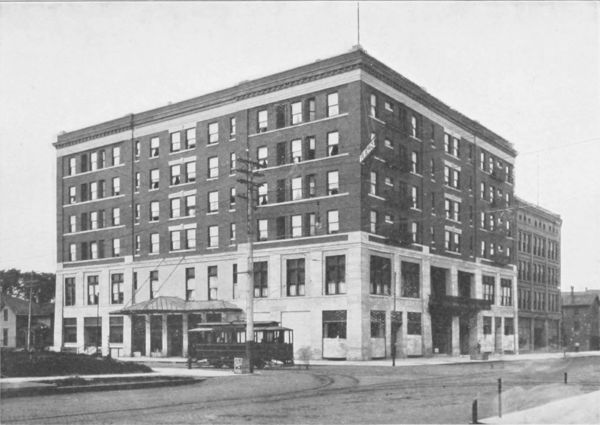 MONTROSE HOTEL, CEDAR RAPIDS
Early in April a hook and ladder company was organized and on April 16,
1869, was confirmed by the council as a part of the fire department of
Cedar Rapids. The officers of the company were as follows:
- Foreman—S. D. Fleck.
- First Assistant—J. S. Dickinson.
- Secretary—Geo. A. Gault.
- Recorder and Treasurer—J. G. Krebs.
Samuel A. Lilly. H. C. Morehead, James Fowler, P. C. Garrett, J. C.
Adams, Samuel Spalding, J. A. Hart, Joseph Lilly, J. M. Chambers, T.
Snook, J. J. Calder, G. M. Howlett, C. D. Pettibone and six others
constituted the active membership of this organization.
The official life of Chief Engineer Lusk was very brief and was marked
by continued strife and dissension among the members of the department.
He became persona non grata to the council and charges were preferred
against him. July 13, 1869, Alderman Hill introduced a resolution
reciting that while the chief engineer could not be declared guilty of
intentional fraud he was indiscreet in many things and his influence
for good in the department had been so impaired that his resignation
was demanded. This did the business, and on July 23 he resigned. W. B.
Leach was appointed chief engineer for the remainder of the term, and
peace and good feeling prevailed in the department.
In March, 1870, after the inauguration of the new council of which W.
B. Leach was mayor, a petition of the fire department was presented in
which they asked the council to appoint Geo. A. Lincoln as chief
engineer of the department. Another petition was also presented, signed
by many citizens, asking that W. D. Watrous be appointed chief engineer
of the department. On the 25th of March, a ballot being ordered, Geo.
A. Lincoln received three votes and W. D. Watrous three votes,
whereupon the mayor voted for Lincoln and declared him elected to the
position of chief engineer, and on the 26th day of March he was duly
qualified and took the oath of office.
Shortly after Mr. Lincoln assumed the authority vested in the office of
chief engineer of the fire department, an element of discord arose in
the council and an effort was made to secure by legislation and
diplomacy what they had failed to accomplish when the vote was taken in
March.
It was thought the original ordinance passed in January, 1869, was
faulty and should be amended and the ordinance committee was directed
to make such amendments as were necessary or to prepare an entirely new
ordinance.
During the summer of 1870 the committee had prepared an ordinance which
was practically the same as the old one. The only radical change was in
the manner of electing a chief engineer. The new ordinance placed the
election of the officer with the electors after the year 1870 and a new
section was added which read as follows:
"No person shall be eligible to the office of chief engineer unless he
be a resident of said city at least one year and shall have attained
the age of twenty-five years."
To understand the force of this last clause in the ordinance it will be
necessary to remark that at this time Mr. Lincoln was only twenty-three
years old. This ordinance, the records say, was passed July 29, 1870,
but it was found necessary to amend it and it was not until ordinance
No. 98 was passed on September 30, 1870, that the council felt safe in
electing a new chief engineer to take the place of the one so skilfully
legislated out of office. On the 15th of October, 1870, A. R. West
became the chief engineer of the fire department by the vote of the
council. After the election of Mr. Lincoln during the spring and summer
of 1870 it was uncertain whether the city of Cedar Rapids had a fire
department or not, and it was also a question as to the authority
possessed by the chief. There was much discord and bitterness among
some of the members of the fire organizations. The city council was far
from being harmonious and rarely acted in unison in legislating for the
well being of the fire department. The citizens who had labored long
and earnestly in this work of procuring fire apparatus felt that they
had a right to demand that this bickering and personal contention
between the organized fire department and the duly elected city council
should be ended, but the strife continued. Early in the administration
of Mr. Lincoln as chief of the department a communication was presented
to the city council in which the petitioners, after recounting their
many grievances, made the claim that the election of Mr. Lincoln was
unparliamentary, unfair and contrary to the wishes of the department
and to a great majority of the property holders, and that while the
petitioners were willing to obey all ordinances of the city and the
ruling of any legally appointed officer as chief of the fire
department, they did not consider themselves lawfully bound to give any
heed or attention to the said Geo. A. Lincoln. That they as members of
the fire department would pay no attention to the said unlawfully
elected chief engineer nor to any order coming from him. This petition
was signed by Sam Neidig, C. W. Eaton, G. M. Howlett, Sam Lilly, Chas.
Hubbard, J. C. Adams, Thos. Snook, and fifteen others.
Some time later the chief engineer made a report to the city council as
the ordinance directed he should do, giving the necessary information
in regard to the efficiency of the department and its probable needs
for the future, but the council refused to accept it as the report of
the chief engineer, making the broad claim that there was no fire
department or a legally elected chief engineer and this was backed up
by the opinion of the city attorney. Mr. Lincoln, not to be thwarted by
the city council in refusing to listen to his report, was obliged to
have it published in the city papers and some extracts are made here,
showing the friendly feeling existing between him and some members of
the city council. He reported that the steam engine was in good shape
excepting that the grate had burned out and the committee on the fire
department had refused to get it repaired. The hose was poor and not in
condition to stand the pressure necessary in case of a large fire. This
was owing to the committee on fire refusing to have the tower on the
city hall arranged so the hose could be hung up to dry after having
been used. Many small bills for supplies used by the department, and
which were necessary for the running of the steamer, were hung up and
not allowed, and in speaking of the cistern which the city had built he
reports that one of the aldermen had the keys of the same and refused
to turn them over to him and as to the amount of water in same he could
make no report.
After the election of Mr. A. R. West to the position of chief engineer,
the old original No. 1 Fire Engine Company, or a large proportion of
its members, at one of its meetings passed the following resolution:
"Whereas, The city council has seen proper to persecute and
finally to declare us not an organized fire company, and
"Whereas, We who compose the Fire Engine Company No. 1 have
since organization labored faithfully to make the department
as efficient as possible and have in all cases discharged
our duties as firemen, therefore
"Resolved, That we turn over to the city council all the
fire apparatus in our possession. That we refuse to offer
our services as firemen so long as any member of the city
council who has been persistent in our persecution shall
remain in said council.
"Resolved, That we condemn the city council in thus
deliberately and intentionally using their power to cripple
and destroy the efficiency of the fire department.
"Resolved, That we preserve our company organization and
that each and every one refuse to touch, use or handle any
of the fire apparatus belonging to the city of Cedar
Rapids."
This old, original company, No. 1, was then a fire company to all
intents and purposes, acting under the original organization, with most
of the original members belonging, but they had no apparatus, no
engines, nothing to use in case of fire. But this did not long remain.
A subscription was started among the members of the company, and they
with the aid of their friends and citizens soon had subscribed a sum
sufficient to buy a substantial hand engine of a late pattern, together
with 5,000 feet of new hose, a new hose cart, and also to put up a
comfortable and neat engine house in which to hold their meetings and
to shelter their engine and the other necessary equipment.
This engine was purchased of Josiah Gates & Son, Lowell, Mass., and
cost the sum of $800, which amount was paid in cash from the proceeds
of the many subscriptions. It was called the E. S. Hill Independent
Fire Company, in honor of E. S. Hill who was the patron saint in all
their contentions with the city council, being an alderman from the
First ward, and also one of the most liberal subscribers to the fund to
procure the engine, he having led the subscription list with $200.00.
The hose cart was procured from Quincy, Ill., where it had been
previously used by that city, and cost $300.00 all complete. The hose
to the amount of 500 feet cost the sum of $500.00. The material for the
building of the engine house was obtained free from the local dealers
and the construction was almost all done by the members of the company.
After this company had procured their apparatus and were domiciled in
their new building they developed into a very aggressive company of
fire fighters, and it was the boast of some of its members that they
could get out to a fire, extinguish the flames and be ready to return
home before the steam engine company could get to the fire and be ready
to work.
A. R. West, who had been duly elected chief engineer of the fire
department, together with John T. Hamilton, who was appointed assistant
fire engineer, succeeded after much labor in bringing order out of the
chaos that had so long existed in the affairs of the fire department.
The steam engine, together with the hook and ladder equipment, was put
into the hands of a newly organized company, most of the members of
which had not been identified with any of the previous unpleasantness
between the council and the fire department.
For the next five years Cedar Rapids had two fire departments, the one
belonging to the city and under municipal control, and the other
denominated the "Independent," owning their own equipment and subject
to no official orders from the city.
This continued until the advent of the Cedar Rapids Water Co., who put
in their system of waterworks and established hydrants in all parts of
the city.
Mrs. R. C. Rock, one of the earliest of the pioneers, is still living
in a serene and vigorous old age. She is a relative of Judge Greene,
and came west to Dubuque in 1849 at his request to assist him in
getting out his first volume of Iowa Reports, which was printed in New
York. She later came to Cedar Rapids with the judge and assisted
materially in getting ready for the press and in proof reading the
matter for the other volumes of his Reports. The members of the supreme
court would frequently gather in Cedar Rapids in chambers to prepare
their opinions and to O. K. them for publication. Mrs. Rock did much of
the law copying for these judges. Their decisions were turned over to
her to record and to edit for publication. She says Judge Williams was
flowery in his language and it became necessary to do a good deal of
trimming of his decisions so as to condense them properly before
publication, as attorneys were not so much interested in the language
of the court as they were in getting quickly at the meat of the
decisions. Mrs. Rock did not hesitate to do a great amount of pruning,
with the result that Judge Greene received many compliments over the
improvements noted in his second volume as compared with the matter
that appeared in the first publication.
For a time Mrs. Rock did editorial work on the Progressive Era, which
was published from the Greene Bros. building. J. O. Stewart was then
"devil" in the office, and many a time brought to her the proofs of her
contributions. The files of this early Linn county newspaper were
burned in a fire which destroyed the publication office, so that now
there are in existence but a few scattered issues. An early one was
given a few years ago to the Masonic Library by Mrs. Rock who found it
by accident among some of her effects.
Mrs. Rock came west by boat from Buffalo to Milwaukee, and then by
stage to Dubuque in 1849. The next year she removed to Cedar Rapids,
coming here by stage over the Old State Road laid out from Iowa City to
Dubuque by Engineer Barney of Washington, D. C. This road was a very
crooked one. His son, W. J. Barney, on being twitted about its many
windings replied that he believed his father was entirely sober when he
staked out the route, and that its numerous windings were necessary to
avoid the sloughs and swamps.
Mrs. Rock well remembers some of the trips she made on the old stage
from Dubuque to Cedar Rapids. It was customary to make 25 miles of the
journey the first day. On one trip on arriving at the usual stopping
place it was found impossible to obtain any hay for the weary horses.
After a further drive of five miles a stop was made at a farm cabin, it
being customary for the settlers at any place to provide entertainment
for travellers. Here they found feed for the horses, but they were told
there was no bread or flour in the house, the man not having returned
from the distant mill with his grist. There was some milk, and at last
a little flour or meal was discovered. The two were mixed and put in a
pan on the stove to cook. Unfortunately it was so badly burned that it
could not be eaten, and the travelers were compelled to go to bed
supperless. During the night the man returned with his grist, and Mrs.
Rock and party had a fairly good breakfast of saleratus biscuits and
pork.
One day while living in Cedar Rapids Mrs. Rock learned of the Spirit
Lake massacre. She states the people here for a time had a genuine
Indian scare, but nothing came of it.
Mrs. Rock has distinct recollections of prairie fires here. She says
they were beautiful but terrible to behold. They were especially
prevalent every fall on the west side, and many a time has she seen the
bright flames cover the hills that are now incorporated in the city of
Cedar Rapids. Judge Greene had early planted a large orchard at Mound
Farm, and once after it had borne fruit for a number of years it was
threatened with destruction from a prairie fire. All Cedar Rapids went
out to help fight the flames. They saved the orchard at this time, but
later the trees were killed by an unusually severe winter.
The ladies of Cedar Rapids were very patriotic during the war years.
They made all the uniforms for the boys of Col. T. Z. Cook's company,
and supplied them with generous quantities of bandages and lint. It
happened that after the severe engagement at Wilson's Creek those
bandages were the only ones available on the field. Mrs. Rock's
brother, then 18 years old, enlisted under Colonel Cook. After the
hundred days for which the company had entered the service he
re-enlisted under Captain Stibbs, being wounded at Ft. Donelson. He
then again entered the army under Captain Coulter, father of Ed.
Coulter now living in Cedar Rapids, and was later killed in the south.
Captain Coulter's company was known as the "Brindle Brigade," because
it was made up of men from so many regiments that had disbanded.
There were some lawless people among the earliest settlers, says Mrs.
Rock, and they occasionally appropriated a horse or two, necessitating
some corrective action by the community. On one occasion N. B. Brown
borrowed a horse from a man whose discipline was decreed and went to
Westport to secure tar for the purpose. At dusk the horse was returned
to the barn. C. C. Cook seized the individual, assisted by Gainor and
others. His legs were tied and he was taken to the side hill on B
avenue where his clothes were removed and he was treated to a coat of
tar and feathers. The following day he appeared among his fellows, and
my relator states there was "not even a smell of tar about him," but
the treatment proved effectual.
One of the early settlers, Joe Leverich, had a fine library, was a
great reader, a shrewd observer of human character, and his descendants
are people of intelligence and high morality. Among those who came
later were Dr. J. F. Ely and Dr. S. D. Carpenter in 1849, Judge Greene
in 1850. They were men of education and attainment. Soon followed Miss
Legare of Washington, D. C., the Bryans, and Stoneys from Charleston,
S. C., A. S. Belt, a lawyer, son of Commodore Belt, of Maryland, the
Taylors from Virginia, and many others whose character and culture gave
moral and mental tone to the growing community. In religious
intercourse a broad and kindly feeling characterized all, and now in
1910, the same feeling prevails. The Daniels brothers erected a store,
three stories, where the Masonic Temple now stands. In 1849 the Green
Brothers erected a three-story brick building diagonally across, the
first floor being used for merchandizing, the second for Judge Greene's
office and ware rooms. In one large room in this building Miss Calder,
from New York, opened a school for girls in the fall of 1850. In a hall
on the third floor, a Masonic lodge was organized the same year. Miss
Calder [Mrs. Rock] drew designs for the emblems and attended to making
the aprons.
The first district school house was built several years previous on the
lot on Second avenue and Fifth street. The Cedar Rapids Business
College is now located on this site. This was used also for religious
services on Sunday. Squire Abbe's daughter taught the first school, and
Miss Louisa Roberts, daughter of the Congregational minister, the
second. Squire Abbe was a member of the Territorial Legislature.
Miss Calder's school prospered; and two other teachers were secured;
one from New York for the piano, and another, Miss Parkhurst, to assist
in the English branches. She was a recent graduate from Miss Sill's
seminary at Rockford, Illinois. Miss Calder herself continued with some
of the English grades, also with French and Drawing. Pupils were
attracted from neighboring towns, Marion, Vinton, Dubuque, Muscatine,
Burlington, Fairfield, etc., but after a few years, failing health
caused her to relinquish it to two young ladies from Ohio, and within
two years it ceased to exist. The following year Miss Calder married R.
C. Rock, a hardware merchant. About the same date the Rev. Williston
Jones, Presbyterian minister, opened a school for boys in his private
residence, and after a few months turned it over to Mr. Blakeley, when
it was transferred to the "Little Muddy" church. Mr. Blakeley's public
examination was the occasion of a lampoon by Dr. S. D. Carpenter, but
he was a fine man and a good teacher. Geo. E. W. Leonard was financial
agent for this school.
These efforts resulted in Rev. Mr. Jones securing from Daniel Coe, of
Green county, New York, a gift of $1,000.00 with which was purchased
eighty acres of land adjoining the town, a part of which is now
occupied by Coe College and from which numerous lots were sold to aid
in establishing this school. The first college building was erected by
subscription of the citizens. The only surviving incorporator of the
institution is Dr. Seymour D. Carpenter, now residing in Chicago, aged
about eighty-four.
The first religious services were Methodist, held in the district
school house, and their circuit riders came every two weeks. They
organized a Sunday school and insisted on a union school. The
Presbyterians, New School, effected the first organization in 1847 in
Mr. Vardy's shop, corner Third street and Sixth avenue. They, too,
worshiped in the school house. Dr. Ely read the sermons, but their
first minister, Mr. Roberts, of Marion, was a Congregationalist. He was
succeeded by Rev. W. Jones, before mentioned. The first Episcopal
clergyman was Rev. James Keeler, who found an occasional opening for
service in the school house, but soon came to using Miss Calder's
school room for regular Sunday service.
Real estate investments have always been successful and profitable in
Cedar Rapids, and probably will always continue to be so. As shown in
other articles, the land upon which Cedar Rapids is built was
originally owned by five men, Judge Greene, Nicholas Brown, Addison
Daniels, Wm. Sanford, and Alexander Ely. The division of the property
was made in 1849 as is shown elsewhere, and it is from that time that
most of the real estate transfers were made. All the gentlemen made
fortunes from their speculations.
How these five gentlemen came to be possessed of all the land in the
city of Cedar Rapids would make an interesting story, especially if the
prices they paid for each lot could be secured. They doubtless bought
up the claims for almost nothing. We get some inkling of how the lots
came into their possession by a curious old document which was
deposited by Mr. C. G. Greene with the curator of the museum for the
semi-centennial week.
The property mentioned in it is the Grand Hotel corner, and this is a
copy of it:
"Received, Cedar Rapids, Sept. 7, 1848, of John L. Shearer,
one yoke of oxen valued at thirty-five dollars, in full for
Lot 9 in block No. 23 in the town of Cedar Rapids.
"Geo. Greene."
But it appears that Judge Greene did not think he had a very great
bargain, for only seven months later, in May of the following year, the
county records show that this same lot upon which the Grand Hotel now
stands, and forty feet additional, 120×150 feet in all, was sold by
Judge Greene back to John L. Shearer for $75. Up to 1865 it passed
through several hands, with slightly increased value, when it was sold
by Henry McBride to Charles Weare for $1,100. Weare sold immediately to
S. B. Fleek for $1,500, and Fleek sold it in 1871 to E. M. Greene for
$9,000. In 1877 Greene sold 80×140 feet to John T. Waterhouse for
$10,000, and this property which originally brought $75, could not now
be purchased, if unimproved, for less than $100,000. It is now held by
a syndicate.
William Stewart originally owned the ground where the Cook & Laurance
store used to be located. He traded an Indian pony for it in the early
days, and held it until 1873, when he sold it for $7,500.
The property upon which the Calder buildings now stand, 60×140 feet,
was also originally owned by Judge Greene. He sold it to Alexander Ely,
who sold it to Harvey Higley and Samuel Hook, and they in turn sold it,
in 1850, to Frederick Miles for $82. Miles held it until 1875, when he
sold it for $1,500. Mr. Calder's friends told him at the time that he
was throwing his money away, but now it doesn't look that way, as the
land unimproved would sell for many times that sum.
Where the Golden Eagle store is now located, 60×140 feet was sold in
1848 by James M. Berry to Homer Bishop for $150. After passing through
several hands the ground was purchased by P. Mullally and W. W. and M.
A. Higley, who, in 1874, sold 60×140 feet of it to John T. Waterhouse
for $12,300.
The ground where George A. Mullin's store is located, 120×140 feet, was
sold by Mary A. Ely in 1853, to D. M. McIntosh, for $350. H. G. Angle
bought it in 1854 for $600. It was afterwards taken by creditors, and
was held by them until 1875, when it was sold to J. T. Waterhouse for
$13,000.
These are cases illustrative of the wonderful growth in the value of
Cedar Rapids real estate. It will of course some day find its level,
and will very probably go above it, but it is quite safe to say that
just now it is worth all that is paid for it.
Every time a real estate transfer is made it is amusing to get an "old
citizen" started, and have him bemoan his failure to invest a few
dollars in a block or so twenty years ago, and hold on to it until the
present time. If he had done so he would have been rich—but the
trouble is he didn't do it.
Thomas McGregor, who was working for a Mr. Robinson in the fifties, was
offered lots where the Quaker Oats plant is now located at $10 a lot,
but needed the money to keep his family on as he got only 75 cents per
day.
On arrival of the first steamer in Cedar Rapids lots were offered free
to passengers and crew in case they wanted to locate. Many lots were
given away by real estate boomers in those days to increase the
population of the city. Many of these lots were later lost because the
owners thought so little of their value that they let them go to tax
sales.
Property on Second avenue between Second and Fourth streets was then
only residence property, sand hills, and the like. Now all of this has
become valuable business property and is held at not less than $1,000 a
front foot, and still going higher. These lots were sold less than
fifty years ago at $25 a lot.
Property on Third avenue was even less valuable than property on Second
avenue. With the location of the station here with the hotels, bank
buildings, etc., lots are now selling at fabulous prices. With the
advance of prices rents have also advanced. I. C. Emery some twenty
years ago had the same location which he has recently gone into, and
paid at that time about one-third of the rent he pays today. Rents on
the ground floor in the Kimball building, the Ely block, the Dows
block, and in others of the old buildings have gradually advanced in
accordance with the advance in prices of the real estate holdings, and
pretty much in the same ratio.
Large office buildings have been erected from time to time, and it has
been said that the city would never demand such quarters. It has only
been a little time till there has been a demand for more office and
store buildings on a larger scale and these have been filled without
any trouble.
The property where is located the Denecke building was once used for a
livery stable, and the property on which is located the Magnus block
was occupied as a dwelling house. These properties were traded back and
forth for a song. The O'Haras finally snapped them up and began
improvement and were thought at the time to be crazy. Mr. Denecke then
began purchasing and the same was said of him. When Mr. Magnus made his
purchase of the block in 1894, during the depression, they said he
would never get his money out of it. Today he has been offered more
than twice what he paid and refuses to consider the offer. The corner
where the Security bank is now located had been sold and re-sold, and
no one thought it worth anything, and when G. F. Van Vechten purchased
a few feet for a bank location many years ago the people of the town
still thought it impossible that this corner would be worth so much.
The bank later had to pay a handsome price in order to get ground
enough to make the improvements desired, and would have made money by
having bought much earlier. The Taft building was purchased by the
late Judge Hubbard some ten years ago at $55,000, and is now worth
twice that sum.
However old settlers say that for years real estate in Cedar Rapids did
not move and it was a drug on the market, and the rents were not in
ratio with the values. For years town lots were peddled about the town
and traded for stocks of goods, for old horses, and other personal
property, and it was always thought that the person who obtained the
real estate got the poor end of the bargain.
William Stone, Osgood Shepherd, Thomas Gainer, David King, H. G. Angle,
and others of the early settlers did not know what a mine they
possessed had they only hung on long enough. Stone settled on the Iowa
river and later left for Wisconsin, and Shepherd soon followed, all
thinking he had made a good thing by selling his squatter rights to
Brown and his friends.
Dr. E. L. Mansfield arrived in Cedar Rapids in 1847, going overland to
California in 1850. He traded the west one-half of the block between
Third and Second avenues west, and between First and Second streets for
a rifle, which was considered a high price in those days. On this lot
Dr. Mansfield erected a large dwelling house and lived there for many
years. He purchased the lot on which the Whelihan drug store now stands
for $600, and the lot adjoining many years later for $10,000, at what
was then considered a very high price. Thus the property of 140 feet
fronting on Second street and 120 feet fronting on Second avenue were
purchased for less than $12,000, property which is now some of the most
valuable in Cedar Rapids. Dr. Mansfield also held part of the property
which was later purchased by the Cedar Rapids Savings Bank, and was
held by him up to the time of his death. This had been purchased at an
early day at low prices, when it was nothing but the cheapest kind of
renting property.
A. C. Taylor, holder of much valuable real estate in Cedar Rapids,
first owned the property where the First Christian church now stands.
He also purchased the property on First avenue near the Union block.
Mr. Taylor is the second oldest merchant in Cedar Rapids, and has not
moved more than a block from the time he came here to locate in part of
the postoffice on the alley where the Masonic Temple now stands. In
speaking of rents, Mr. Taylor says that he has been surprised at the
way rents have gone up year by year.
Osgood Shepherd, of whom it is said that he jumped Wilbert Stone's
claim, held this claim till 1847, when he disposed of his squatter
interest in what became Cedar Rapids to N. B. Brown, George Greene, H.
W. Gray, A. L. Roach, and S. H. Tryon for the sum of $3,000.
FROM THE CEDAR RAPIDS REPUBLICAN, SUNDAY, JUNE 3, 1906
When was the first Decoration Day celebration in Cedar Rapids? That is
a question which many might find it hard to answer, and the story of
the preparations for that day and of the day itself is so interesting
that it is well worth a place here. There were comparatively few graves
to decorate on that occasion. Not many of those who fought in the war
had passed over the great divide in the year 1873, more than thirty
years ago. Men whose heads are silvered and their steps trembling were
then young and they marched firmly to the cemetery to take part in the
exercises on that first Decoration Day. Since that time many of them
have been laid beneath the sod and their comrades have done for them
what they helped to do for others.
The day was made memorable by an eloquent and beautiful address by the
late Judge Hubbard, a man who always loved the flag and the men who
fought for it. Patriotism was one of the subjects that always lay
nearest his heart.
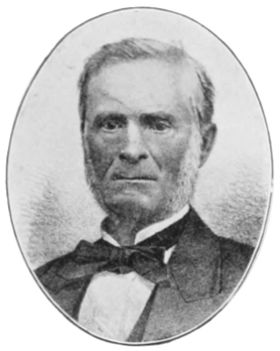 S. C. BEVER
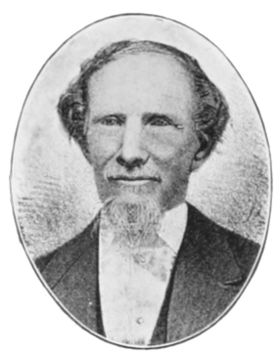 THOMAS GAINER
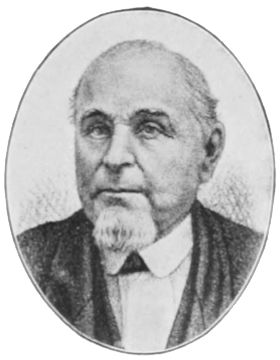 E. D. WALN
An Early Settler
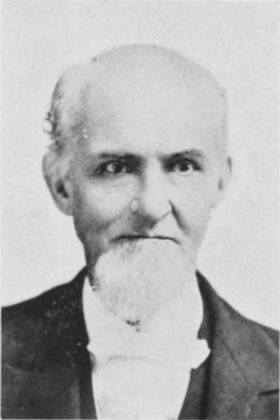 REV. ELIAS SKINNER
The first meeting to arrange for the Decoration Day exercises was held
May 8, 1873. The Cedar Rapids Daily Republican of the following
morning has the following interesting account of the meeting:
"The meeting called for the purpose of taking measures to
suitably observe Decoration Day, took place at the City Hall
last night.
"It was called to order by A. D. Collier, Esq., upon whose
motion J. H. B. Otto was elected president of the meeting.
"On motion of Hiel Hale, A. N. Neidig was chosen secretary.
"On motion of Mr. Collier, a committee of five was appointed
to recommend names to the meeting for the various committees
to be appointed to make preparations for that day.
"The following persons were selected as said committee:
"A. D. Collier, Geo. A. Lincoln, D. A. Dingman, P. H.
Francis, Hiel Hale.
"After some time spent in deliberation the committee
reported the following names to be placed upon the several
standing committees. They also reported names of persons as
officers of the day, the whole report being adopted:
"President of the day, Capt. Wm. B. Leach.
"Chief marshal, Col. T. Z. Cook, with power to choose his
own assistants.
"Finance committee, J. F. Charles, Capt. Otto, George Wynn.
"Committee on grounds, Ed. Thompson, Ed. Buttolph, J. I.
Calder.
"Flowers, L. M. Ayers, Geo. A. Lincoln, Geo. H. Rhodes, R.
A. Austin, George Hesse.
"Decorating graves, P. H. Francis, Hiel Hale, C. H.
Sterneman, Dr. Bliss, Jos. Stoddard, with privilege to
choose five ladies to fill the committee.
"Invitation, Capt. W. W. Smith, S. Neidig, Dr. Skinner.
"Speakers, A. D. Collier, D. A. Dingman, W. B. Leach.
"Printing, A. H. Neidig, Dr. F. S. McClelland, Dr. Camburn.
"Music, C. Ferguson, Mr. Baxter and Dr. Bliss.
"On general arrangements, W. B. Leach, J. F. Charles, Ed.
Thompson, L. M. Ayers, P. H. Francis, W. W. Smith, A. D.
Collier, A. H. Neidig, and C. Ferguson.
"On motion of Capt. Wm. B. Leach, Captain Otto, as the last
commander of the Grand Army of the Republic, was instructed
to call a meeting of the soldiers and sailors of this
vicinity to have them meet and consult with regard to the
part they shall take in the observance of the day.
"On motion adjourned."
The program of that first Decoration Day was as follows:
"The following programme will be observed on Decoration Day:
"President of the day—Col. W. B. Leach.
"Chief Marshal—Col. T. Z. Cook.
"Assistant Marshals—Capt. W. S. Bradley, Geo. W. Wynn, A.
D. Collier.
"Chaplain—Rev. A. B. Kindig.
"Orators—Rev. Col. S. H. Henderson, Hon. Col. N. M.
Hubbard.
"At ten o'clock a. m. the procession will form on the corner
of Iowa avenue and Commercial street in wagons, and headed
by the band, will proceed to the cemetery on the west side,
where the graves will be decorated, and after which an
oration will be delivered by Col. S. H. Henderson.
"At two o'clock the procession will form on Iowa avenue, the
right resting on Commercial street.
"The following will be the order.
- "Music.
- "1. Grand Army of Republic.
- "2. Independent Fire Company.
- "3. Bohemia Society.
- "4. Hook and Ladder Company.
- "5. Odd Fellows.
- "6. Fire Company Steamer.
- "7. Citizens on foot.
- "8. Carriages.
"Line of march will be down Commercial street to Eagle, up
Eagle to Madison, down Madison to Greene street, thence to
Oak Hill Cemetery, where the graves will be decorated, after
which an oration will be delivered by Hon. Col. N. M.
Hubbard.
"All soldiers and citizens in the vicinity are cordially
requested to be present, and assist in paying respect to our
honored dead.
"Soldiers will leave the number of their regiment at the
Times office and they will be furnished with a badge to
wear on the occasion."
Following is the account of the exercises of that day with the text of
the address delivered by Judge Hubbard. It is taken from the Daily
Republican of May 31, 1873:
"Decoration Day has come and gone. It brought with it the
noble thought to honor the heroic dead of our land, and left
thousands of green graves strewn with choicest flowers of
spring. This kindly and befitting token of love and honor
was placed on every soldier's grave, to show how green and
fresh in our hearts are the memories of their noble deeds.
This day is one of mixed sorrow and pleasure—sad for the
heavy sacrifices that had to be made, but happy to keep
green the sacred memories of those who fell for their
country's good.
"The soldiers and sailors, who have died to save the
nation's life, will never be forgotten so long as flowers
are strewn upon the quiet graves beneath whose verdant
mounds those gallant hearts lie stilled forever.
"It is the sum of mortal glory for posterity to gather
around the tombs of fallen heroes, as around holy shrines,
and pour out their libations in songs, prayers and in
fitting words of praise on their noble lives and gallant
deeds.
"The day opened yesterday morning with a rain storm, which
continued more or less until about ten o'clock. It looked
discouraging indeed, and many hearts felt sad at the
uninviting prospect.
"At eleven o'clock a few persons gathered on the west side
and proceeded to the cemetery on that side of the river, and
spent a short time in decorating the graves of a few
soldiers that lie buried there. Rev. S. H. Henderson spoke a
few moments on the importance of the occasion when the
company dispersed and returned to their homes.
"By noon the clouds had cleared away and the sun shone forth
beautifully. At half past 2 o'clock Washington street in the
vicinity of the City Hall was crowded with a large number of
people who were listening to the fine strains of music that
the Ferguson band were discoursing. About three o'clock the
procession began to move, and in pretty much the same order
as has already been published in the Republican. Between
seventy-five and a hundred carriages, buggies, and wagons
were in the procession, preceded by many footmen; also a
number were on horseback. It was one of the most brilliant
occasions of the kind that was ever witnessed in Cedar
Rapids.
"We are unable to go into the particulars, as we have not
the space today to record them.
"The number on the cemetery grounds has been estimated by
many at two thousand people, and some have raised the
estimate a thousand more. The following graves were
decorated:
"John Harrison, Henry N. Graves and Carter Berkley, 6th Iowa
Cavalry, Co. K; Henry Fleck, 40th Ind. Inft.; John Hall,
31st Iowa; Amos Fergeson, Band, 15th Iowa Inft.; James
Morehead, Sr., Co. I, 37th Iowa Inft.; James Morehead, Jr.,
Co. K, 9th Iowa Inft.; Judson L. Boughton, Co. D, 12th Iowa
Inft.; Parker Ayres, Co. D, 12th Iowa Inft,; Robert
Mallahan, Co. A, 37th Iowa Inft.; James Hammersley, 31st Vt.
Int., J. R. C.; Henry Berger, Minn., Minn.; Geo. Wells,
141st Penn. V. Inft,; Edward W. Calder, Co. D, 12th Iowa
Inft.; Lt. Joseph Hollan, 20th Inft.; Benj. Shaw, 20th
Inft.; Donald Lothian, 31st Inft. West side—David Martin,
24th Inft,; Ebenezer Martin, 12th Inft,; John Dean, 20th
Inft.; Donaldson,—. After these interesting decoration
ceremonies were over, the people gathered around the stand
that had been erected for the purpose, where the following
programme was carried out:
- "Music by the Band.
- "Music by the Glee Club, 'Praise of the Soldier.'
- "Prayer by Rev. A. B. Kendig.
- "Music, 'Star Spangled Banner,' by the Glee Club.
- "Oration by Col. N. M. Hubbard.
- "Music by the Band.
- "Music, 'America' Sung by the Glee Club and Audience.
- "Benediction by Rev. A. B. Kendig.
"Judge Hubbard's address was so fine that we reproduce it
entire. He spoke as follows:
"My Countrymen, and Comrades of the Army of the Union:
"Courage and bravery always challenge admiration, but when
combined with exalted patriotism, they command the affection
and gratitude of mankind.
"The highest earthly care of man is to preserve as long as
possible this life, and therefore the greatest human
sacrifice is to give this life for one's country.
"History is full of examples of this sacrifice in all time,
and yet its frequency has never lessened the appreciation of
it.
"Patriotism—love of country, makes a great nation possible.
Without it men would live isolated, or in mere tribes, and
powerless.
"The intellectual development of man shows him at once how
weak and insignificant he is alone, and he seeks, by a
combination of great numbers, to attain not only great power,
but even immortality. We all know that our own lives are
short, but the life of a nation may be so long, that we are
apt to make delusion that it may be immortal, real.
"The natural love and anxiety we have for our children, who
are to live after us, extend to and embrace the country and
the government in which they are to live.
"Hence, we may be said to have two lives, an individual and a
national one; and the latter commands the former in
proportion to its increased span. We value everything
somewhat in proportion to its power to last.
"The study and contemplation of the national life, of which
we are a part is always a matter of interest and solicitude.
"On every hand men are seemingly wholly engaged in devising
and planning for their individual prosperity and happiness,
and silently but surely national prosperity and greatness
follow these individual efforts. It is only when the nation
stands in immediate peril, that we become aware how much
greater our anxiety is for it, than even for ourselves.
"You who can recall the thrill of horror, of anxiety, and of
grim determination that came over you when the news first
came that Sumter was fired upon, and the Stars and Stripes
were shot away, can tell, but I can not describe what
boundless sacrifices the national life is capable of calling
forth.
"How quick we found what a pride and what an interest we had
in the magnitude, power, and prosperity of our country, and
how firmly we were attached to its beneficent government.
"The history of modern civilization in Europe has shown a
constant struggle for many years for what they call the
balance of power.
"Five leading nations, speaking five different languages, and
having different modes of thought and life, have watched and
emulated each other, and each at times has had the reputation
of being the most powerful. Fifty years ago France was
foremost, today Prussia is the first power in Europe. These
changes may be traced almost indefinitely.
"In all the past, the national life, the national pride has
grown with the growth of civilization.
"It would be impossible that a nation should become great or
powerful without a national self-love that wrought glowing
pictures of its manifest destiny.
"We find ourselves possessed of a country whose productive
extent is far greater than all Europe, with its 300 million
population, put together.
"Beginning a little less than a hundred years ago with a
population of three million, it has doubled every twenty-five
years, if we shall reach forty-eight million in 1875, which
scarcely admits of a doubt. The whole emigration added is
less than six million.
"At the same rate of increase for the next one hundred years
our population will reach the enormous figures of seven
hundred and sixty-eight millions. But suppose we shall touch
the resistance, namely the lack of territory to supply so
great a population with food; yet we may safely estimate
reaching five hundred million, and the population equally
distributed will then be about equal in density to the
present population of Massachusetts.
"I have neither time nor is it necessary to describe the
variety of climate embracing the tropic and the temperate
zones, nor the vastness, nor the fertility, nor the mineral
and coal resources of our country.
"Thus far nothing is problematical, but the people of future
America are a study.
"We know how sturdy and enduring the Anglo-Saxon is, how
volatile yet tenacious is the Frenchman, how sober, solid and
unwavering is the German, and how hardy and everlasting are
the people who inhabit with the Polar bear. These are
American now, but the Ethiopian and the Asiatic are to be
added. The Star of Empire from the East and from the West
have met upon the American continent. I believe the original
Anglo-Saxon trunk will sustain all these grafts and that a
nation will come of us by the cross of all civilized people
that will be as superior to any of them, as the grafted fruit
is superior to that of the seeding. Future America will be
fitly symbolized by the Lion and the Polar Bear, surmounted
by the American Eagle.
"With one country, one language, one hope, one aspiration,
bent sublimely upon achieving the highest intelligence,
virtue, and culture that man can ideal, diffused through a
population of five hundred million people, inhabiting
one-quarter of the habitable earth with a republican
government, is a spectacle that the world has never yet seen,
but is to see through us and our children.
"And but for these sacred graves, which we, and all the
people throughout the land, have come today to crown with
wreaths of flowers, no such hope, no such picture of the
future of our country would be possible.
"The future destiny of the American absolutely demanded that
the fundamental idea of the Declaration of Independence
should be made true, and that Liberty (in fact, as in name)
should be proclaimed throughout all the land to all the
inhabitants thereof, and also, that the United States should
be one and inseparable forever.
"Need I tell you how bravely and how well the army of the
Union settled these questions? The men who lie silent beneath
our feet and their comrades, have taught the South, and Great
Britain, and the world, that the belt of country usually
known as the North is the heart and power of the Republic. It
is the strong arm that pushes the car of civilization in the
new world. It is the second Defender of the faith of our
Forefathers. It has fought the good fight, and many of its
bravest sons have gone to their reward.
"The Republic is emancipated, impartial suffrage and equality
before the law established, and the work of regeneration is
left for us and our posterity.
"During all the long struggle which literally ridged the
country with graves like these, there was everywhere present,
through the ranks of the grand army, an abiding faith in the
future greatness of their country, and in the final triumph.
No soldier ever despaired of the Republic.
"We come today to crown their valor by decorating their
graves. What great eulogy can we pronounce upon them?
"These silent graves are more eloquent than the tongues of
the living. Their deeds commemorate their fame and their
names do live after them.
"As we meet year after year to perform this ceremony of love
and gratitude to our fallen comrades, new graves will be
added and new obligations will rest upon us, until the last
soldier of the Army of the Union is laid to rest.
"When that day comes, let us trust that the national life and
prosperity that has cost so much to maintain and defend, will
be inestimably dear to our children, and that they may fully
realize all the hopes and aspirations of our forefathers and
the second Defenders of the faith. If we shall not be
disappointed in this, the 30th day of May will be as sacred
as the 4th of July.
"But new trials and new perils await us. Poverty is the home
of virtue, and riches the abode of vice. The Republic has
passed the age of poverty, and is approaching the age of
wealth—always the sure accumulation of generations. Rome
withstood all her enemies from without and within, but the
corruption following in the train of her conquests overcame
her.
"If Heaven permits departed heroes still to know and watch
over our beloved country, what anxious prayers are being made
now, lest the blessing which the hand of their forefathers
have left shall be wasted by the political dissension,
frauds, corruptions, and wealth of coming generations! It is
not fitting that I should name here and now what you all know
so well and deplore. But may I not ask that we consecrate
ourselves anew over these sacred graves, and resolve that our
remaining days shall add something to the purity, patriotism,
and lustre of our country that has been vouchsafed to us
through the blood of these martyrs of liberty.
"But whatever of adversity or misfortune may be in store for
us as a nation, the fault in no way rests upon these graves.
Their services and their fame are secure.
"And today also the graves of the Confederate dead are
decorated and strewn with flowers. It is a deserved tribute
to their valor and patriotism. They had been educated to
believe that the South alone was the nation. We believed and
knew that the nation was from ocean to ocean and from the
gulf to the lakes. But it was half slave and half free.
"Today it is all free, and fifty years hence, if our hopes of
the future of the Republic are realized, the South and North
will rejoice in a common joy, that 'Union and Liberty' have
been so signally preserved to them and their posterity
forever.
"And while we wreath flowers for these graves, let us not
forget to return thanks and give honor to the brave seamen
who guarded our coasts, and let the 'Father of Waters go
unvexed to the sea.'
"And the widow and orphan of the soldier and sailor, let them
be remembered with blessings, with charity and with thanks.
All they have left them for their great sacrifice is their
country and its gratitude. Let these be generous and
unsparing.
"And still again let us not forget the brave men and women
who fed and clothed all, who nursed and cared for the sick
and wounded, who cheered and encouraged all with patriotic
deeds and words. And finally, and above all, let us thank God
who gave us the victory, whereby it has become possible that
the Stars and Stripes float over an unbroken emancipated
Republic, strong enough to maintain its existence against all
foes, and yet without power to abridge the liberties of the
humblest citizen."
FROM CEDAR RAPIDS REPUBLICAN, JUNE, 1906
It was in 1882 that an agitation was instituted in the city of New
York, in which all the great labor organizations of the United States
took part, and out of which grew the setting apart of Labor Day as a
day of recognition of the cause of labor. It was not until 1887,
however, that the germ thus planted gave fruit. On February 21, 1887,
the state of Oregon passed a law setting aside the first Saturday in
June for the observance of the cause of labor, and six years later the
first Monday in September was chosen by the same state. That day has
been observed ever since. The second state to legalize the holiday was
New Jersey, and in May of the following year New York passed a similar
law, Colorado and Massachusetts soon followed. In 1890 many of the
other states passed acts recognizing the day. West Virginia and North
Carolina were far behind the rest in this regard and did not legalize
the day until 1899.
The first great labor demonstration was held in New York city in 1882
and the parade which took place on that day is still remembered as an
event of unusual magnitude. All the labor organizations of the city
were in line and with their splendid floats, banners, etc., they made
an imposing spectacle.
The following year it was determined to repeat, if possible, the parade
of 1882, which had come to be termed "The Labor Day Parade." This time
the date was changed to the first Monday in September and when in 1884
the discussion of a repetition of the occasion came up, George B. Floyd
offered a resolution in the Central Labor Union convention to the
effect that the first Monday in September be declared Labor Day. The
resolution was unanimously adopted and at the next session of the
legislature a bill was introduced declaring Labor Day a legal holiday.
There was considerable objection to the measure, however, and it was
not until 1887 that a majority in its favor could be rallied together.
With the day recognized by the legislature of New York and two other
states a concerted effort was made to secure action by the various
labor organizations throughout the country, and in a few years the
majority of the states had declared in its favor.
Curiously enough the original Labor Day was just after the organization
of the first local in this city, which the "old residents" say is
Typographical Union No. 192. There may be some objection to this claim
on the part of some of the present members of the typographical union.
The charter of the Typographical Union local is now hanging in the K.
P. hall, and it is dated December 26, 1881. Unless challenged the
members of the Typographical Union will claim the honor of being the
first organization of union labor in the city of Cedar Rapids. The
charter bears the names of the following charter members:
C. M. Hopkins, George S. Bradley, Harry Ingalls, J. D. Canan, L. C.
Hay, L. B. Kramer, J. H. Enos.
If the memory of Sam Snouffer is correct the local was organized among
the employees of the Republican office and it was a local of
newspaper printers only. Sam says that he was a job printer at the time
and the boys on the cases who organized the local didn't at first allow
job printers to hold membership in their organizations. He says that
the local was organized for a fight and it had it at frequent intervals
during the early part of its history. But it grew and flourished and
today the Typographical Union Local in Cedar Rapids is recognized as a
conservative, yet aggressive body of men, with the courage to ask for
its rights and the level headedness to get those rights without
trouble.
During the war when the boys were about to return home they sought to
carry back mementoes of the long struggle. Company E of the Twelfth
Iowa as a trophy of the war picked up a mountain howitzer which had
been captured by the rebels and re-captured by the United States
troops. Some members of Company D of the Twelfth Iowa then, by some
means known only to the soldier boys, unlawfully laid claim to the
cannon and Homer Morehead, one of the old Cedar Rapids boys, was able
to get the cannon as far as Davenport, the city council of Cedar Rapids
providing means to get it to Cedar Rapids.
The cannon, a two hundred pounder, was used freely by every
organization for a number of years whenever any celebration took place.
During the Grant campaign, in October of that year, the republicans had
a blow-out and the cannon was used; in this celebration the cannon was
slightly damaged and was hauled down to John Mehan's for repairs. While
there some person, or persons, saw fit to take it in the night time and
nothing was heard of it for many years. A note was tacked up to the
wall where the cannon had been left for repairs to the effect that it
would be returned and shot off when a democratic president was
inaugurated. The soldier boys and many of the prominent citizens of
Cedar Rapids were very much stirred up over this affair and publicly
accused a number of prominent Cedar Rapids democratic citizens of
stealing the cannon, but no one, at least who was publicly accused,
admitted having anything to do with it.
The incident was nearly forgotten when Cleveland was elected, the first
democratic president since the Civil war. One morning as Harry Brown
was walking down the street John Mehan called to him to come over and
see what he had found. There, sure enough, was the same old mountain
howitzer cleaned up and in first class repair, with a note tied to it
that it was returned as agreed and would be ready for action in due
time. This affair stirred up the republican camp once more and threats
were made that this cannon would never be shot off to celebrate a
democratic victory, and it never was.
It now remains as a relic in the old postoffice building, and many are
the citizens of Linn county who have inspected this little cannon and
have heard the story told by the old settlers.
Not until a short time ago was it definitely known who removed the
cannon from the Mehan shop in 1868. A Center Point person had been
accused of having something to do with it; how true this is no one
knows. It is thought that two young men in the employ of N. B. Brown, a
stanch democrat, took the cannon and placed it in the stable owned by
O. P. Emery which stood on the ground where the Denecke building now
stands. Mr. Emery no doubt knew of the whereabouts of the cannon, and
when he removed up on Second avenue a heavy box was moved by workmen
supposed to contain tools. When Mr. Emery removed to the home of his
son-in-law, John B. Henderson, on First avenue, the same heavy box was
once more moved. Mrs. John B. Henderson noticed that her father, after
the election of Cleveland, spent several days in the barn working
steadily polishing up some iron, but she never inquired what he was
doing or what he wanted to accomplish. A short time before his death
O. P. Emery admitted to his daughter that while he did not remove the
cannon he knew of its whereabouts and had some of his intimate friends
restore it to the Mehan shop after Cleveland's election as it had been
agreed in the letter or note left the night of the capture of the
cannon when no one was around to watch this much prized treasure.
Linn county during the Civil war had its share of so-called
"copperheads," as well as a goodly number of loyal sympathizers known
as "fire eaters." During this period of our country's history many
unfortunate affairs occurred of which all parties ever afterwards were
ashamed. In a state where the majority was strong in favor of the war
measure it behooved those who were against this measure not to say too
much. Frequently innocent people had to suffer for the acts of some one
who talked openly and above board, not only against the president but
against those who were instrumental in sending troops to the front.
Democrats in the north were classed by the republicans as follows:
Those who went to the front as loyal democrats, and those who stayed at
home as "copperheads," although they may have been otherwise
law-abiding citizens.
On the morning that news was received of the assassination of Lincoln
Cedar Rapids became a town of turmoil and strife. Never in the history
of the town had excitement run so high. The question of another war was
discussed in saloons and on street corners, and during the entire day
this strife was kept up. Towards evening a story got started that Bill
Harper, a well-known anti-war democrat and a person who had frequently
when intoxicated said some pretty mean things of the republicans in
general, said "that he was glad that Lincoln got killed; that he should
have been shot four years ago." The story spread like a western wild
fire, and in less than an hour it was all over town. A crowd got
together and it was not long till a self-appointed committee was
organized for the sole purpose of hanging Bill Harper to a rafter or a
sour apple tree at sight and without trial. A good sized rope was
procured and the yelling crowd, headed by the late I. N. Whittam and
others, made for the store room kept by Brown & Harper, on what is now
North First street. That Harper was a well-known and outspoken
so-called "copperhead" was universally known and no question arose in
the minds of the mob as to the truth or falsity of the charge. A few in
the party uttered remarks that there might be a mistake and that there
ought to be some investigation to bear out the facts before the rope
was applied, but the majority ruled and these faint-hearted fellows
were laughed to scorn. N. B. Brown, who had heard of the trouble and
who was a partner of Harper, got into the store building, mounted a
barrel and talked to the crowd, claiming that Harper could not have
said the words with which he was charged, for he had not been in town
for several days. Squire Knowles, a republican and a believer in fair
play, tried to persuade the mob to disperse, but his plea found little
favor with a mob who insisted on a hanging. Then Bill Darr, a neighbor
of Harper, also a republican, had to come to the front and tell what he
knew about Harper. He said that Harper had been at home near Bertram
and had been sick in bed for several days, and that he had been to his
house and called on him the day before and he was certain that Harper
knew nothing of what had taken place at the national capital. Darr was
not treated any better than the others and was called "traitor" and all
sorts of names because he wanted to save his neighbor's life if
possible.
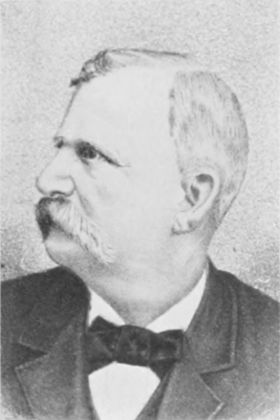 A. BOWMAN
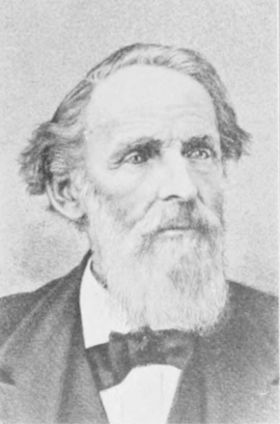 E. M. CROW
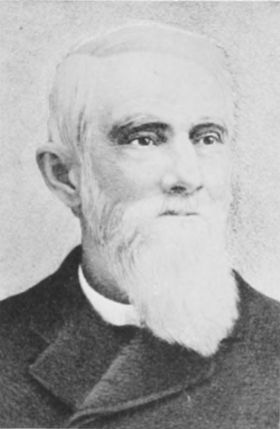 J. M. MAY
Many of the crowd had been drinking heavily and insisted that something
be done, and if they could not do any better they ought to fire the
building and burn up the whole thing, while Brown insisted that most of
the property was his and that he would vouch for his partner's honor
and reputation as far as that charge went. Whittam by this time had
gotten over the blood curdling period of his leadership and was willing
to turn the job over to other hands, but no one seemed willing to come
to his rescue, and there was no opportunity to put a motion for an
adjournment till the violence and the temper of the mob would somewhat
abate. Brown wanted to hold the mob as long as possible, having in the
meantime sent messengers to notify Harper of what might happen. He
realized that the infuriated mob at that stage of the game might hang
an innocent man.
Just at this point of the delicate proceedings, the crowd yelling like
warlike Indians, and threatening to hang any "copperhead" and to burn
the building provided Harper was not brought into the room, a fourteen
year old boy, long, lank and lean, who had also crowded into the
building wanting to see what was going on, and to get more air, climbed
on top of a hogshead which stood in one corner of the room. As he was
gazing out over the crowd others tried to get on to the same hogshead,
pushing and pulling, when suddenly the end gave way and the boy fell
into a mass of lard and dye stuff up to his neck. The stench acted like
morphine upon the infuriated mob. Someone called for the rope to pull
the boy out and then a general laugh broke out and when the boy ran
down through the crowd, dripping with lard and lye, making for the
river, the panic became general and they all followed his movements and
forgot all about Bill Harper or the words he was supposed to have
uttered.
The boy who thus saved the day and perhaps a life or two is no other
than O. C. Carpenter, for many years one of the best known constables
in Rapids township. Carpenter still insists that he saved the day,
although the ordeal he had to pass through was somewhat harsh. The lye
burned his legs and spoiled a suit of clothes, and he got a good
thrashing at home, in the bargain. The Greek boy of old fell on his
sword, but the modern Linn county boy fell into a soap barrel and by
that side-stepping cast honors on himself and on members of his family
for all time to come.
Bill Harper never uttered the words of which he was accused, and never
knew that Lincoln had been assassinated until the evening of the day
when the infuriated mob was hunting him with a rope, wishing to put an
end to his earthly existence. This shows how dangerous it is to stir up
the mob spirit at any time. It always leads to disgraceful acts, from
which a community suffers for a long time afterwards.
In running through the files of the early years of the Cedar Rapids
Daily Republican, the following interesting historical contribution,
from the pen of the late Sampson C. Bever, was found:
"Editor Cedar Rapids Republican:
"I notice in the last 'Daily Republican,' in referring to the
City National Bank of this city, in connection with the death
of the Hon. Oakes Ames, the following:
"'The death of Mr. Ames recalls to mind the successful aid
given S. C. Bever, Esq., in getting the charter of the City
National Bank. The First National had already been
established and as Cedar Rapids had a population of only
2,000 people at the time the comptroller of currency declined
to establish another bank here, but by the assistance of Mr.
Ames the charter was finally obtained.'
"The facts in the case are these: The City National Bank
received its certificate of authority and had commenced
successful business some time before the application for
charter or certificate of the First National Bank was
granted.
"It is true an application for a City National Bank, with a
capital of $50,000, was first made, and it was provided by
the law of congress, creating National banks, that no
charter for less than $100,000 should be granted, unless it
should receive the approval of the Secretary of the
Treasury. Mr. Ames being in Washington at the time this
application was made, and being a warm friend of mine, he
kindly offered to give me his influence, and wrote a strong
letter to Mr. Chase, then Secretary of the Treasury, urging
him to sanction my application for $50,000, but before
presenting this letter I was urged by Mr. McCullough, then
comptroller of the currency, that as there was no other
national bank organized in Cedar Rapids, and the population
was about 4,000, I should by all means make my application
for $100,000, to which I finally agreed. And as greenbacks
and government bonds were at my command, I had no further
need for 'successful aid' from anyone, being well known to
Mr. McCullough, the comptroller of the currency. But I none
the less highly appreciated the kindness tendered me by my
friend Mr. Ames.
"I make this explanation, not so much on my own account, as
that of others, who so well understand all the
circumstances.
S. C. Bever."
The Republican of that date, May 12, 1873, also printed the following
remarks:
"The statement that was made in the columns of the
Republican on Saturday, concerning Oakes Ames and the City
National Bank, is one of those unfortunate kind of errors
that often creep into a daily newspaper. The statement, as
it appeared in print, was precisely as it was handed us by
one of our prominent citizens, and we took it for granted,
of course, that it was correct. Since Mr. Bever's
communication has been handed us, we have made a personal
examination into the matter, and have discovered an
important fact which, it is due the City National Bank,
should be published. We find in the report of the
comptroller of the currency, that the City National Bank
stands upon record as number 483, and the First National
Bank as 500, which goes to show that the former was
organized some time before the latter. Of course neither
bank has any interest in this matter further than to be
placed before the public correctly, and we have it to regret
that the statement appeared in our columns on Saturday in
the form in which it did."