The Kings found the Roman Institutions.
I. “In the birth of societies,” says Montesquieu, “it is the chiefs of
the republics who form the institution, and in the sequel it is the
institution which forms the chiefs of the republics.” And he adds, “One
of the causes of the prosperity of Rome was the fact that its kings were
all great men. We find nowhere else in history an uninterrupted series
of such statesmen and such military commanders.”[8]
The story, more or less fabulous, of the foundation of Rome does not
come within the limits of our design; and with no intention of clearing
up whatever degree of fiction these earliest ages of history may
contain, we purpose only to remind our readers that the kings laid the
foundations of those institutions to which Rome owed her greatness, and
so many extraordinary men who astonished the world by their virtues and
exploits.
The kingly power lasted a hundred and forty-four years, and at its fall
Rome had become the most powerful state in Latium. The town was of vast
extent, for, even at that epoch, the seven hills were nearly all
inclosed within a wall protected internally and externally by a
consecrated space called the Pomœrium.[9]
This line of inclosure remained long the same, although the increase of
the population had led to the establishment of immense suburbs, which
finally inclosed the Pomœrium itself.[10]
The Roman territory properly so called was circumscribed, but that of
the subjects and allies of Rome was already rather considerable. Some
colonies had been founded. The kings, by a skilful policy, had succeeded
in drawing into their dependence a great number of neighbouring states,
and, when Tarquinius Superbus assembled the Hernici, the Latins, and the
Volsci, for a ceremony destined to seal his alliance with them,
forty-seven different petty states took part in the inauguration of the
temple of Jupiter Latialis.[11]
The foundation of Ostia, by Ancus Martius, at the mouth of the Tiber,
shows that already the political and commercial importance of
facilitating communication with the sea was understood; while the treaty
of commerce concluded with Carthage at the time of the fall of the
kingly power, the details of which are preserved by Polybius, indicates
more extensive foreign relations than we might have supposed.[12]
Social Organisation.
II. The Roman social body, which originated probably in ancient
transformations of society, consisted, from the earliest ages, of a
certain number of aggregations, called gentes, formed of the families
of the conquerors, and bearing some resemblance to the clans of Scotland
or to the Arabian tribes. The heads of families (patresfamilias) and
their members (patricii) were united among themselves, not only by
kindred, but also by political and religious ties. Hence arose an
hereditary nobility having for distinctive marks family names, special
costume,[13] and waxen images of their ancestors (jus imaginum).
The plebeians, perhaps a race who had been conquered at an earlier
period, were, in regard to the dominant race, in a situation similar to
that of the Anglo-Saxons in regard to the Normans in the eleventh
century of our era, after the invasion of England. They were generally
agriculturists, excluded originally from all military and civil
office.[14]
The patrician families had gathered round them, under the name of
clients, either foreigners, or a great portion of the plebeians.
Dionysius of Halicarnassus even pretends that Romulus had required that
each of these last should choose himself a patron.[15] The clients
cultivated the fields and formed part of the family.[16] The relation of
patronage had created such reciprocal obligations as amounted almost to
the ties of kindred. For the patrons, they consisted in giving
assistance to their clients in affairs public and private; and for the
latter, in aiding constantly the patrons with their person and purse,
and in preserving towards them an inviolable fidelity: they could not
cite each other reciprocally in law, or bear witness one against the
other, and it would have been a scandal to see them take different sides
in a political question. It was a state of things which had some
analogy to feudalism; the great protected the little, and the little
paid for protection by rents and services; yet there was this essential
difference, that the clients were not serfs, but free men.
Slavery had long formed one of the constituent parts of society. The
slaves, taken among foreigners and captives,[17] and associated in all
the domestic labours of the family, often received their liberty as a
recompense for their conduct. They were then named freedmen, and were
received among the clients of the patron, without sharing in all the
rights of a citizen.[18]
The gens thus consisted of the reunion of patrician families having a
common ancestor; around it was grouped a great number of clients,
freedmen, and slaves. To give an idea of the importance of the gentes
in the first ages of Rome, it is only necessary to remind the reader
that towards the year 251, a certain Attus Clausus, afterwards called
Appius Claudius, a Sabine of the town of Regillum, distinguished,
according to Dionysius of Halicarnassus, no less for the splendour of
his birth than for his great wealth, took refuge among the Romans with
his kinsmen, his friends, and his clients, with all their families, to
the number of five thousand men capable of bearing arms.[19] When, in
275, the three hundred Fabii, forming the gens Fabia, offered alone
to fight the Veians, they were followed by four thousand clients.[20]
The high class often reckoned, by means of its numerous adherents, on
carrying measures by itself. In 286, the plebeians having refused to
take part in the consular comitia, the patricians, followed by their
clients, elected the consuls;[21] and in 296, a Claudius declared with
pride that the nobility had no need of the plebeians to carry on war
against the Volsci.[22] The families of ancient origin long formed the
state by themselves. To them exclusively the name of populus
applied,[23] as that of plebs was given to the plebeians.[24] Indeed,
although in the sequel the word populus took a more extensive
signification, Cicero says that it is to be understood as applying, not
to the universality of the inhabitants, but to a reunion of men
associated by a community of rights and interests.[25]
Political Organisation.
III. In a country where war was the principal occupation, the political
organisation must naturally depend on the military organisation. A
single chief had the superior direction, an assembly of men pre-eminent
in importance and age formed the council, while the political rights
belonged only to those who supported the fatigues of war.
The king, elected generally by the assembly of the gentes,[26]
commanded the army. Sovereign pontiff, legislator, and judge in all
sacred matters, he dispensed justice[27] in all criminal affairs which
concerned the Republic. He had for insignia a crown of gold and a purple
robe, and for escort twenty-four lictors,[28] some carrying axes
surrounded with rods, others merely rods.[29] At the death of the king,
a magistrate, called interrex, was appointed by the Senate to exercise
the royal authority during the five days which intervened before the
nomination of his successor. This office continued, with the same title,
under the Consular Republic, when the absence of the consuls prevented
the holding of the comitia.
The Senate, composed of the richest and most illustrious of the
patricians, to the number at first of a hundred, of two hundred after
the union with the Sabines, and of three hundred after the admission of
the gentes minores under Tarquin, was the council of the ancients,
taking under its jurisdiction the interests of the town, in which were
then concentrated all the interests of the State.
The patricians occupied all offices, supported alone the burden of war,
and consequently had alone the right of voting in the assemblies.
The gentes were themselves divided into three tribes. Each, commanded
by a tribune,[30] was obliged, under Romulus, to furnish a thousand
soldiers (indeed, miles comes from mille) and a hundred horsemen
(celeres). The tribe was divided into ten curiæ; at the head of each
curia was a curion. The three tribes, furnishing three thousand foot
soldiers and three hundred horsemen, formed at first the legion. Their
number was soon doubled by the adjunction of new cities.[31]
The curia, into which a certain number of gentes entered, was then the
basis of the political and military organisation, and hence originated
the name of Quirites to signify the Roman people.
The members of the curia were constituted into religious associations,
having each its assemblies and solemn festivals which established bonds
of affiliation between them. When their assemblies had a political aim,
the votes were taken by head;[32] they decided the question of peace or
war; they nominated the magistrates of the town; and they confirmed or
abrogated the laws.[33]
The appeal to the people,[34] which might annul the judgments of the
magistrates, was nothing more than the appeal to the curia; and it was
by having recourse to it, after having been condemned by the decemvirs,
that the survivor of the three Horatii was saved.
The policy of the kings consisted in blending together the different
races and breaking down the barriers which separated the different
classes. To effect the first of these objects, they divided the lower
class of the people into corporations,[35] and augmented the number of
the tribes and changed their constitution;[36] but to effect the second,
they introduced, to the great discontent of the higher class, plebeians
among the patricians,[37] and raised the freedmen to the rank of
citizens.[38] In this manner, each curia became considerably increased
in numbers; but, as the votes were taken by head, the poor patricians
were numerically stronger than the rich.
Servius Tullius, though he preserved the curiæ, deprived them of their
military organisation, that is, he no longer made it the basis of his
system of recruiting. He instituted the centuries, with the double aim
of giving as a principle the right of suffrage to all the citizens, and
of creating an army which was more national, inasmuch as he introduced
the plebeians into it; his design was indeed to throw on the richest
citizens the burden of war,[39] which was just, each equipping and
maintaining himself at his own cost. The citizens were no longer
classified by castes, but according to their fortunes. Patricians and
plebeians were placed in the same rank if their income was equal. The
influence of the rich predominated, without doubt, but only in
proportion to the sacrifices required of them.
Servius Tullius ordered a general report of the population to be made,
in which every one was obliged to declare his age, his fortune, the name
of his tribe and that of his father, and the number of his children and
of his slaves. This operation was called census.[40] The report was
inscribed on tables,[41] and, once terminated, all the citizens were
called together in arms in the Campus Martius. This review was called
the closing of the lustrum, because it was accompanied with sacrifices
and purifications named lustrations. The term lustrum was applied to
the interval of five years between two censuses.[42]
The citizens were divided into six classes,[43] and into a hundred and
ninety-three centuries, according to the fortune of each, beginning with
the richest and ending with the poorest. The first class comprised
ninety-eight centuries, eighteen of which were knights; the second and
fourth, twenty-two; the third, twenty; the fifth, thirty; and the sixth,
although the most numerous, forming only one.[44] The first class
contained a smaller number of citizens, yet, having a greater number of
centuries, it was obliged to pay more than half the tax, and furnish
more legionaries than any other class.
The votes continued to be taken by head, as in the curiæ, but the
majority of the votes in each century counted only for one suffrage.
Now, as the first class had ninety-eight centuries, while the others,
taken together, had only ninety-five, it is clear that the votes of the
first class were enough to carry the majority. The eighteen centuries of
knights first gave their votes, and then the eighty centuries of the
first class: if they were not agreed, appeal was made to the vote of the
second class, and so on in succession; but, says Livy, it hardly ever
happened that they were obliged to descend to the last.[45] Though,
according to its original signification, the century should represent a
hundred men, it already contained a considerably greater number. Each
century was divided into the active part, including all the men from
eighteen to forty-six years of age, and the sedentary part, charged
with the guard of the town, composed of men from forty-six to sixty
years old.[46]
With regard to those of the sixth class, omitted altogether by many
authors, they were exempt from all military service, or, at any rate,
they were enrolled only in case of extreme danger.[47] The centuries of
knights, who formed the cavalry, recruited among the richest citizens,
tended to introduce a separate order among the nobility,[48] which shows
the importance of the chief called to their command. In fact, the chief
of the celeres was, after the king, the first magistrate of the city,
as, at a later period, under the Republic, the magister equitum became
the lieutenant of the dictator.
The first census of Servius Tullius gave a force of eighty thousand men
in a condition to bear arms,[49] which is equivalent to two hundred and
ninety thousand persons of the two sexes, to whom may be added, from
conjectures, which, however, are rather vague, fifteen thousand
artisans, merchants, or indigent people, deprived of all rights of
citizenship, and fifteen thousand slaves.[50]
The comitia by centuries were charged with the election of the
magistrates, but the comitia by curiæ, being the primitive form of the
patrician assembly, continued to decree on the most important religious
and military affairs, and remained in possession of all which had not
been formally given to the centuries. Solon effected, about the same
epoch, in Athens, a similar revolution, so that, at the same time, the
two most famous towns of the ancient world no longer took birth as the
basis of the right of suffrage, but fortune.
Servius Tullius promulgated a great number of laws favourable to the
people; he established the principle that the property only of the
debtor, and not his person, should be responsible for his debt. He also
authorised the plebeians to become the patrons of their freedmen, which
allowed the richest of the former to create for themselves a clientèle
resembling that of the patricians.[51]
Religion.
IV. Religion, regulated in great part by Numa, was at Rome an instrument
of civilisation, but, above all, of government. By bringing into the
acts of public or private life the intervention of the Divinity,
everything was impressed with a character of sanctity. Thus the
inclosure of the town with its services,[52] the boundaries of estates,
the transactions between citizens, engagements, and even the important
facts of history entered in the sacred books, were placed under the
safeguard of the gods.[53] In the interior of the house, the gods Lares
protected the family; on the field of battle, the emblem placed on the
standard was the protecting god of the legion.[54] The national
sentiment and belief that Rome would become one day the mistress of
Italy was maintained by oracles or prodigies;[55] but if, on the one
hand, religion, with its very imperfections, contributed to soften
manners and to elevate minds,[56] on the other it wonderfully
facilitated the working of the institutions, and preserved the influence
of the higher classes.
Religion also accustomed the people of Latium to the Roman supremacy;
for Servius Tullius, in persuading them to contribute to the building of
the Temple of Diana,[57] made them, says Livy, acknowledge Rome for
their capital, a claim they had so often resisted by force of arms.
The supposed intervention of the Deity gave the power, in a multitude of
cases, of reversing any troublesome decision. Thus, by interpreting the
flight of birds,[58] the manner in which the sacred chickens ate, the
entrails of victims, the direction taken by lightning, they annulled the
elections, or eluded or retarded the deliberations either of the comitia
or of the Senate. No one could enter upon office, even the king could
not mount his throne, if the gods had not manifested their approval by
what were reputed certain signs of their will. There were auspicious and
inauspicious days; in the latter it was not permitted either to judges
to hold their audience, or to the people to assemble.[59] Finally, it
might be said with Camillus, that the town was founded on the faith of
auspices and auguries.[60]
The priests did not form an order apart, but all citizens had the power
to enrol themselves in particular colleges. At the head of the
sacerdotal hierarchy were the pontiffs, five in number,[61] of whom the
king was the chief.[62] They decided all questions which concerned the
liturgy and religious worship, watched over the sacrifices and
ceremonies that they should be performed in accordance with the
traditional rites,[63] acted as inspectors over the other minister of
religion, fixed the calendar,[64] and were responsible for their actions
neither to the Senate nor to the people.[65]
After the pontiffs, the first place belonged to the curions, charged in
each curia with the religious functions, and who had at their head a
grand curion; then came the flamens, the augurs,[66] the vestals charged
with the maintenance of the sacred fire; the twelve Salian priests,[67]
keepers of the sacred bucklers, named ancilia; and lastly, the
feciales, heralds at arms, to the number of twenty, whose charge it
was to draw up treaties and secure their execution, to declare war, and
to watch over the observance of all international relations.[68]
There were also religious fraternities (sodalitates), instituted for
the purpose of rendering a special worship to certain divinities. Such
was the college of the fratres Arvales, whose prayers and processions
called down the favour of Heaven upon the harvest; such also was the
association having for its mission to celebrate the festival of the
Lupercalia, founded in honour of the god Lupercus, the protector of
cattle and destroyer of wolves. The gods Lares, tutelar genii of towns
or families, had also their festival instituted by Tullus Hostilius, and
celebrated at certain epochs, during which the slaves were entirely
exempt from labour.[69]
The kings erected a great number of temples for the purpose of deifying,
some, glory,[70] others, the virtues,[71] others, utility,[72] and
others, gratitude to the gods.[73]
The Romans loved to represent everything by external signs: thus Numa,
to impress better the verity of a state of peace or war, raised a temple
to Janus, which was kept open during war and closed in time of peace;
and, strange to say, this temple was only closed three times in seven
hundred years.[74]
Results obtained by Royalty.
V. The facts which precede are sufficient to convince us that the Roman
Republic[75] had already acquired under the kings a strong
organisation.[76] Its spirit of conquest overflowed beyond its narrow
limits. The small states of Latium which surrounded it possessed,
perhaps, men as enlightened and citizens equally courageous, but there
certainly did not exist among them, to the same degree as at Rome, the
genius of war, the love of country, faith in high destinies, the
conviction of an incontestible superiority, powerful motives of
activity, instilled into them perseveringly by great men during two
hundred and forty-four years.
Roman society was founded upon respect for family, for religion, and for
property; the government, upon election; the policy, upon conquest. At
the head of the State is a powerful aristocracy, greedy of glory, but,
like all aristocracies, impatient of kingly power, and disdainful
towards the multitude. The kings strive to create a people side by side
with the privileged caste, and introduce plebeians into the Senate,
freedmen among the citizens, and the mass of citizens into the ranks of
the soldiery.
Family is strongly constituted; the father reigns in it absolute master,
sole judge[77] over his children, his wife, and his slaves, and that
during all their lives: yet the wife’s position is not degraded as among
the barbarians; she enjoys a community of goods with her husband;
mistress of her house, she has the right of acquiring property, and
shares equally with her brothers the paternal inheritance.[78]
The basis of taxation is the basis of recruiting and of political
rights; there are no soldiers but citizens; there are no citizens
without property. The richer a man is, the more he has of power and
dignities; but he has more charges to support, more duties to fulfil. In
fighting, as well as in voting, the Romans are divided into classes
according to their fortunes, and in the comitia, as on the field of
battle the richest are in the first ranks.
Initiated in the apparent practice of liberty, the people is held in
check by superstition and respect for the high classes. By appealing to
the intervention of the Divinity in every action of life, the most
vulgar things become idealised, and men are taught that above their
material interests there is a Providence which directs their actions.
The sentiment of right and justice enters into their conscience, the
oath is a sacred thing, and virtue, that highest expression of duty,
becomes the general rule of public and private life.[79] Law exercises
its entire empire, and, by the institution of the feciales,
international questions are discussed with a view to what is just,
before seeking a solution by force of arms. The policy of the State
consists in drawing by all means possible the peoples around under the
dependence of Rome; and, when their resistance renders it necessary to
conquer them,[80] they are, in different degrees, immediately associated
with the common fortune, and maintained in obedience by
colonies—advanced posts of future dominion.[81]
The arts, though as yet rude, find their way in with the Etruscan rites,
and come to soften manners, and lend their aid to religion; everywhere
temples arise, circuses are constructed,[82] great works of public
utility are erected, and Rome, by its institutions, paves the way for
its pre-eminence.
Almost all the magistrates are appointed by election; once chosen, they
possess an extensive power, and put in motion resolutely those two
powerful levers of human actions, punishment and reward. To all
citizens, for cowardice before the enemy or for an infraction of
discipline,[83] the rod or the axe of the lictor; to all, for noble
actions, crowns of honour;[84] to the generals, the ovation, the
triumph,[85] the best of the spoils;[86] to the great men, apotheosis.
To honour the dead, and for personal relaxation after their sanguinary
struggles, the citizens crowd to the games of the circus, where the
hierarchy gives his rank to each individual.[87]
Thus Rome, having reached the third century of her existence, finds her
constitution formed by the kings with all the germs of grandeur which
will develop themselves in the sequel. Man has created her institutions:
we shall see now how the institutions are going to form the men.
Advantage of the Republic.
I. THE kings are expelled from Rome. They disappear because their
mission is accomplished. There exists, one would say, in moral as well
as physical order, a supreme law which assigns to institutions, as to
certain beings, a fated limit, marked by the term of their utility.
Until this providential term has arrived, no opposition prevails;
conspiracies, revolts, everything fails against the irresistible force
which maintains what people seek to overthrow; but if, on the contrary,
a state of things immovable in appearance ceases to be useful to the
progress of humanity, then neither the empire of traditions, nor
courage, nor the memory of a glorious past, can retard by a day the fall
which has been decided by destiny.
Civilisation appears to have been transported from Greece into Italy to
create there an immense focus from which it might spread itself over the
whole world. From that moment the genius of force and imagination must
necessarily preside over the first times of Rome. This is what happened
under the kings, and, so long as their task was not accomplished, it
triumphed over all obstacles. In vain the senators attempted to obtain
a share in the power by each exercising it for five days;[88] in vain
men’s passions rebelled against the authority of a single chief: all was
useless, and even the murder of the kings only added strength to
royalty. But the moment once arrived when kings cease to be
indispensable, the simplest accident hurls them down. A man outrages a
woman, the throne gives way, and, in falling, it divides itself into
two: the consuls succeed to all the prerogatives of the kings.[89]
Nothing is changed in the Republic, except that instead of one chief,
elective for life, there will be henceforward two chiefs, elected for a
year. This transformation is evidently the work of the aristocracy; the
senators will possess the government, and, by these annual elections,
each hopes to take in his turn his share in the sovereign power. Such is
the narrow calculation of man and his mean motive of action. Let us see
what superior impulse he obeyed without knowing it.
That corner of land, situated on the bank of the Tiber, and predestined
to hold the empire of the world, enclosed within itself, as we see,
fruitful germs which demanded a rapid expansion. This could only be
effected by the absolute independence of the most enlightened class,
seizing for its own profit all the prerogatives of royalty. The
aristocratic government has this advantage over monarchy, that it is
more immutable in its duration, more constant in its designs, more
faithful to traditions, and that it can dare everything, because where a
great number share the responsibility, no one is individually
responsible. Rome, with its narrow limits, had no longer need of the
concentration of authority in a single hand, but it was in need of a new
order of things, which should give to the great free access to the
supreme power, and should second, by the allurement of honours, the
development of the faculties of each. The grand object was to create a
race of men of choice, who, succeeding each other with the same
principles and the same virtues, should perpetuate, from generation to
generation, the system most calculated to assure the greatness of their
country. The fall of the kingly power was thus an event favourable to
the development of Rome.
The patricians monopolised during a long time the civil, military, and
religious employments, and, these employments being for the most part
annual, there was in the Senate hardly a member who had not filled them;
so that this assembly was composed of men formed to the combats of the
Forum as well as to those of the field of battle, schooled in the
difficulties of the administration, and indeed worthy, by an experience
laboriously acquired, to preside over the destinies of the Republic.
They were not classed, as men are in our modern society, in envious and
rival specialities; the warrior was not seen there despising the
civilian, the lawyer or orator standing apart from the man of action, or
the priest isolating himself from all the others. In order to raise
himself to State dignities, and merit the suffrages of his
fellow-citizens, the patrician was constrained, from his youngest age,
to undergo the most varied trials. He was required to possess dexterity
of body, eloquence, aptness for military exercises, the knowledge of
civil and religious laws, the talent of commanding an army or directing
a fleet, of administrating the town or commanding a province; and the
obligation of these different apprenticeships not only gave a full
flight to all capacities, but it united, in the eyes of the people, upon
the magistrate invested with different dignities, the consideration
attached to each of them. During a long time, he who was honoured with
the confidence of his fellow-citizens, besides nobility of birth,
enjoyed the triple prestige given by the function of judge, priest, and
warrior.
An independence almost absolute in the exercise of command contributed
further to the development of the faculties. At the present day, our
constitutional habits have raised distrust towards power into a
principle; at Rome, trust was the principle. In our modern societies,
the depositary of any authority whatever is always under the restraint
of powerful bonds; he obeys a precise law, a minutely detailed rule, a
superior. The Roman, on the contrary, abandoned to his own sole
responsibility, felt himself free from all shackles; he commanded as
master within the sphere of his attributes. The counterpoise of this
independence was the short duration of his office, and the right, given
to every man, of accusing each magistrate at the end of it.
The preponderance of the high class, then, rested upon a legitimate
superiority, and this class, besides, knew how to work to its advantage
the popular passions. They desired liberty only for themselves, but they
knew how to make the image glitter in the eyes of the multitude, and the
name of the people was always associated with the decrees of the Senate.
Proud of having contributed to the overthrow of the power of one
individual, they took care to cherish among the masses the imaginary
fear of the return of kingly power. In their hands the hate of tyrants
will become a weapon to be dreaded by all who shall seek to raise
themselves above their fellows, either by threatening their privileges,
or by acquiring too much popularity by their acts of benevolence. Thus,
under the pretext, renewed incessantly, of aspiring to kingly power,
fell the consul Spurius Cassius, in 269, because he had presented the
first agrarian law; Spurius Melius, in 315, because he excited the
jealousy of the patricians by distributing wheat to the people during a
famine;[90] in 369, Manlius, the saviour of Rome, because he had
expended his fortune in relieving insolvent debtors.[91] Thus will fall
victims to the same accusation the reformer Tiberius Sempronius
Gracchus, and lastly, at a later period, the great Cæsar himself.
But if the pretended fear of the return of the ancient régime was a
powerful means of government in the hands of the patricians, the real
fear of seeing their privileges attacked by the plebeians restrained
them within the bounds of moderation and justice.
In fact, if the numerous class, excluded from all office, had not
interfered by their clamours to set limits to the privileges of the
nobility, and thus compelled it to render itself worthy of power by its
virtues, and re-invigorated it, in some sort, by the infusion of new
blood, corruption and arbitrary spirit would, some ages earlier, have
dragged it to its ruin. A caste which is not renewed by foreign elements
is condemned to disappear; and absolute power, whether it belongs to one
man or to a class of individuals, finishes always by being equally
dangerous to him who exercises it. This concurrence of the plebeians
excited in the Republic a fortunate emulation which produced great men,
for, as Machiavelli says:[92] “The fear of losing gives birth in men’s
hearts to the same passions as the desire of acquiring.” Although the
aristocracy had long defended with obstinacy its privileges, it made
opportunely useful concessions. Skilful in repairing incessantly its
defeats, it took again, under another form, what it had been constrained
to abandon, losing often some of its attributes, but preserving its
prestige always untouched.
Thus, the characteristic fact of the Roman institutions was to form men
apt for all functions. As long as on a narrow theatre the ruling class
had the wisdom to limit its ambition to promoting the veritable
interests of their country, as the seduction of riches and unbounded
power did not come to exalt it beyond measure, the aristocratic system
maintained itself with all its advantages, and overruled the instability
of institutions. It alone, indeed, was capable of supporting long,
without succumbing, a régime in which the direction of the State and
the command of the armies passed annually into different hands, and
depended upon elections the element of which is ever fickle. Besides,
the laws gave rise to antagonisms more calculated to cause anarchy than
to consolidate true liberty. Let us examine, in these last relations,
the constitution of the Republic.
Institutions of the Republic.
II. The two consuls were originally generals, judges, and
administrators; equal in powers, they were often in disagreement, either
in the Forum,[93] or on the field of battle.[94] Their dissensions were
repeated many times until the consulate of Cæsar and Bibulus; and they
were liable to become the more dangerous as the decision of one consul
was annulled by the opposition of his colleague. On the other hand, the
short duration of their magistracy constrained them either to hurry a
battle in order to rob their successor of the glory,[95] or to interrupt
a campaign in order to proceed to Rome to hold the comitia. The defeats
of the Trebia and Cannæ, with that of Servilius Cæpio by the Cimbri,[96]
were fatal examples of the want of unity in the direction of war.
In order to lessen the evil effects of a simultaneous exercise of their
prerogatives, the consuls agreed to take in campaign the command
alternately day by day, and at Rome each to have the fasces during a
month; but this innovation had also vexatious consequences.[97] It was
even thought necessary, nine years after the fall of the kings, to have
recourse to the dictatorship; and this absolute authority, limited to
six months, that is, to the longest duration of a campaign, only
remedied temporarily, and under extraordinary circumstances, the want of
power concentrated in a single individual.
This dualism and instability of the supreme authority were not,
therefore, an element of strength; the unity and fixity of direction
necessary among a people always at war had disappeared; but the evil
would have been more serious if the conformity of interests and views of
individuals belonging to the same caste had not been there to lessen it.
The man was worth more than the institutions which had formed him.
The creation of tribunes of the people, whose part became subsequently
so important, was, in 260, a new cause of discord; the plebeians, who
composed the greater part of the army, claimed to have their military
chiefs for magistrates;[98] the authority of the tribunes was at first
limited: we may convince ourselves of this by the following terms of the
law which established the office:[99]—
“Nobody shall constrain a tribune of the people, like a man of the
commonalty, to do anything against his will; it shall not be permitted
either to strike him, or to cause him to be maltreated by another, or to
slay him or cause him to be slain.”[100]
We may judge by this the degree of inferiority to which the plebeians
were reduced. The veto of the tribunes could nevertheless put a stop to
the proposal of a law, prevent the decisions of the consuls and Senate,
arrest the levies of troops, prorogue the convocation of the comitia,
and hinder the election of magistrates.[101] From the year 297, their
number was raised to ten, that is, two for each of the five classes
specially subject to the recruitment;[102] but the plebeians profited
little by this measure; the more the number of tribunes was augmented,
the easier it became for the aristocracy to find among them an
instrument for its designs. Gradually their influence increased; in 298,
they laid claim to the right of convoking the Senate, and yet it was
still a long time before they formed part of that body.[103]
As to the comitia, the people had there only a feeble influence. In the
assemblies by centuries, the vote of the first classes, composed of the
richest citizens, as we have seen, prevailed over all the others; in
the comitia by curiæ, the patricians were absolute masters; and when,
towards the end of the third century, the plebeians obtained the comitia
by tribes,[104] this concession did not add sensibly to their
prerogatives. It was confined to the power of assembling in the public
places where, divided according to tribes, they placed their votes in
urns for the election of their tribunes and ediles, previously elected
by the centuries;[105] their decisions concerned themselves only, and
entailed no obligations on the patricians; so that the same town then
offered the spectacle of two cities each having its own magistrates and
laws.[106] At first the patricians would not form part of the assembly
by tribes, but they soon saw the advantage of it, and, towards 305,
entered it with their clients.[107]
Transformation of the Aristocracy.
III. This political organisation, the reflex of a society composed of so
many different elements, could hardly have constituted a durable order
of things, if the ascendency of a privileged class had not controlled
the causes of dissensions. This ascendency itself would soon have
diminished if concessions, forced or voluntary, had not gradually
lowered the barriers between the two orders.
In fact, the arbitrary conduct of the consuls, who were, perhaps,
originally nominated by the Senate alone,[108] excited sharp
recriminations: “the consular authority,” cried the plebeians, “was, in
reality, almost as heavy as that of the kings. Instead of one master
they had two, invested with absolute and unlimited power, without rule
or bridle, who turned against the people all the threats of the laws,
and all their punishments.”[109] Although after the year 283 the
patricians and plebeians were subjected to the same judges,[110] the
want of fixed laws left the goods and lives of the citizens delivered
to the will either of the consuls or of the tribunes. It became,
therefore, indispensable to establish the legislation on a solid basis,
and in 303 ten magistrates called decemvirs were chosen, invested with
the double power, consular and tribunitian, which gave them the right of
convoking equally the assemblies by centuries and by tribes. They were
charged with the compilation of a code of laws afterwards known as the
Laws of the Twelve Tables, which, engraved on brass, became the
foundation of the Roman public law. Yet they persisted in making illegal
the union contracted between persons of the two orders, and left the
debtor at the mercy of the creditor, contrary to the decision of Servius
Tullius.
The decemvirs abused their power, and, on their fall, the claims of the
plebeians increased; the tribuneship, abolished during three years, was
re-established; it was decided that an appeal to the people from the
decision of any magistrate should be permitted, and that the laws made
in the assemblies by tribes, as well as in the assemblies by centuries,
should be obligatory on all.[111] There were thus, then, three sorts of
comitia; the comitia by curiæ, which, conferring the imperium on the
magistrates elected by the centuries, sanctioned in some sort the
election of the consuls;[112] the comitia by centuries, over which the
consuls presided; and the comitia by tribes, over which the tribunes
presided; the first named the consuls, the second the plebeian
magistrates, and both, composed of nearly the same citizens, had equally
the power of approving or rejecting the laws; but in the former, the
richest men and the nobility had all the influence, because they formed
the majority of the centuries and voted first; while in the latter, on
the contrary, the voters were confounded with that of the tribe to which
they belonged. “If,” says an ancient author, “the suffrages are taken by
gentes (ex generibus hominum), the comitia are by curiæ; if
according to age and census, they are by centuries; finally, if the
vote be given according to territorial circumscription (regionibus),
they are by tribes.”[113] In spite of these concessions, antagonism in
matters of law reigned always between the powers, the assemblies, and
the different classes of society.
The plebeians laid claim to all the offices of state, and especially to
the consulship, refusing to enrol themselves until their demands had
been satisfied; and they went so far in their claims that they insisted
upon the plebeian origin of the kings. “Shall we, then,” cried the
tribune Canuleius, addressing himself to the people, “have consuls who
resemble the decemvirs, the vilest of mortals, all patricians, rather
than the best of our kings, all new men!” that is, men without
ancestors.[114]
The Senate resisted, because it had no intention of conferring upon
plebeians the right which formed an attribute of the consuls, for the
convocation of the comitia, of taking the great auspices, a privilege
altogether of a religious character, the exclusive apanage of the
nobility.[115]
In order to obviate this difficulty, the Senate, after suppressing the
legal obstacles in the way of marriages between the two orders, agreed
in 309 to the creation of six military tribunes invested with the
consular power; but, which was an essential point, it was the interrex
who convoked the comitia and took the auspices.[116] During
seventy-seven years the military tribunes were elected alternately with
the consuls, and the consulship was only re-established permanently in
387, when it was opened to the plebeians. This was the result of one of
the laws of Licinius Stolo. This tribune succeeded in obtaining the
adoption of several measures which appeared to open a new era which
would put an end to disputes. Still the patricians held with such
tenacity to the privilege of alone taking the auspices, that in 398, in
the absence of the patrician consul, an interrex was appointed charged
with presiding over the comitia, in order not to leave this care to the
dictator, and the other consul, who were both plebeians.[117]
But in permitting the popular class to arrive at the consulship, care
had been taken to withdraw from that dignity a great part of its
attributes, in order to confer them upon patrician magistrates. Thus
they had successively taken away from the consuls, by the creation of
two questors, in 307, the administration of the military chest;[118] by
the creation of the censors, in 311, the right of drawing up the list of
the census, the assessment of the revenue of the State, and of watching
over public morals; by the creation of the prætors, in 387, the
sovereign jurisdiction in civil affairs, under the pretext that the
nobility alone possessed the knowledge of the law of the Quirites; and
lastly, by the creation of the curule ediles, the presidency of the
games, the superintendence of buildings, the police and the provisioning
of the town, the maintenance of the public roads, and the inspection of
the markets.
The intention of the aristocracy had been to limit the compulsory
concessions; but after the adoption of the Licinian laws, it was no
longer possible to prevent the principle of the admission of plebeians
to all the magistracies. In 386 they had arrived at the important charge
of master of the knights (magister equitum) who was in a manner the
lieutenant of the dictator (magister populi);[119] in 387 access to
the religious functions had been laid open to them;[120] in 345 they
obtained the questorship; in 398, the dictatorship itself; in 403, the
censorship; and lastly, in 417, the prætorship.
In 391, the people arrogated the right of appointing a part of the
legionary tribunes, previously chosen by the consuls.[121]
In 415, the law of Q. Publilius Philo took from the Senate the power of
refusing the auctoritas to the laws voted by the comitia, and obliged
it to declare in advance if the proposed law were in conformity with
public and religious law. Further, the obligation imposed by this law of
having always one censor taken from among the plebeians, opened the
doors of the Senate to the richest of them, since it was the business of
the censor to fix the rank of the citizens, and pronounce on the
admission or exclusion of the senators. The Publilian law thus tended to
raise the aristocracy of the two orders to the same rank, and to create
the nobility (nobilitas), composed of all the families rendered
illustrious by the offices they had filled.
Elements of Dissolution.
IV. At the beginning of the fifth century of Rome, the bringing nearer
together of the two orders had given a greater consistence to society;
but, just as we have seen under the kingly rule, the principles begin to
show themselves which were one day to make the greatness of Rome, so now
we see the first appearance of dangers which will be renewed
unceasingly. Electoral corruption, the law of perduellio, slavery, the
increase of the poor class, the agrarian laws, and the question of
debts, will come, under different circumstances, to threaten the
existence of the Republic. Let us summarily state that these questions,
so grave in the sequel, were raised at an early date.
Electoral Corruption.—Fraud found its way into the elections as soon as
the number of electors increased and rendered it necessary to collect
more suffrages to obtain public charges; as early as 396, indeed, a law
on solicitation, proposed by the tribune of the people, C. Pœtelius,
bears witness to the existence of electoral corruption.
Law of High-treason.—As early as 305 and 369, the application of the
law of perduellio, or design against the Republic, furnished to
arbitrary power an arm of which, at a later period, under the emperors,
so deplorable a use was made under the name of the law of
high-treason.[122]
Slavery.—Slavery presented serious dangers for society, for, on the one
hand, it tended, by the lower price of manual labour, to substitute
itself for the labour of free men; while, on the other, discontented
with their lot, the slaves were always ready to shake off the yoke and
become the auxiliaries of all who were ambitious. In 253, 294, and 336,
partial insurrections announced the condition already to be feared of a
class disinherited of all the advantages, though intimately bound up
with all the wants, of ordinary life.[123] The number of slaves
increased rapidly. They replaced the free men torn by the continual
wars from the cultivation of the land. At a later period, when these
latter returned to their homes, the Senate was obliged to support them
by sending as far as Sicily to seek wheat to deliver to them either
gratis or at a reduced price.[124]
Agrarian Laws.—As to the Agrarian laws and the question of debts, they
soon became an incessant cause of agitation.
The kings, with the conquered lands, had formed a domain of the State
(ager publicus), one of its principal resources,[125] and generously
distributed part of it to the poor citizens.[126] Generally, they took
from the conquered peoples two-thirds of their land.[127] Of these
two-thirds, “the cultivated part,” says Appian, “was always adjudged to
the new colonists, either as a gratuitous grant, or by sale, or by lease
paying rent. As to the uncultivated part, which, as a consequence of
war, was almost always the most considerable, it was not the custom to
distribute it, but the enjoyment of it was left to any one willing to
clear and cultivate it, with a reservation to the State of the tenth
part of the harvest and a fifth part of the fruits. A similar tax was
levied upon those who bred cattle, large or small (in order to prevent
the pasture land from increasing in extent to the detriment of the
arable land). This was done in view of the increase of the Italic
population, which was judged at Rome the most laborious, and to have
allies of their own race. But the measure produced a result contrary to
that which was expected from it. The rich appropriated to themselves the
greatest part of the undistributed lands, and reckoning that the long
duration of their occupation would permit nobody to expel them, they
bought when they found a seller, or took by force from their
neighbouring lesser proprietors their modest heritages, and thus formed
vast domains, instead of the mere fields which they had themselves
cultivated before.”[128]
The kings had always sought to put a curb on these usurpations,[129] and
perhaps it was a similar attempt which cost Servius Tullius his life.
But after the fall of the kingly power, the patricians, having become
more powerful, determined to preserve the lands which they had unjustly
seized.[130]
And it must be acknowledged, as they supported the greatest share of the
burthen of war and taxation, they had a better claim than the others to
the conquered lands; they thought, moreover, that the colonies were
sufficient to support an agricultural population, and they acted rather
as State farmers than as proprietors of the soil. According to the
public law, indeed, the ager publicus was inalienable, and we read in
an ancient author:—“Lawyers deny that the soil which has once begun to
belong to the Roman people, can ever, by usage or possession, become
the property of anybody else in the world.”[131]
In spite of this principle, it would have been wisdom to give, to the
poor citizens who had fought, a part of the spoils of the vanquished;
for the demands were incessant, and after 268, renewed almost yearly by
the tribunes or by the consuls themselves. In 275, a patrician, Fabius
Cæso, taking the initiative in a partition of lands recently conquered,
exclaimed: “Is it not just that the territories taken from the enemy
should become the property of those who have paid for it with their
sweat and with their blood?”[132] The Senate was as inflexible for this
proposition as for those which were brought forward by Q. Considius and
T. Genucius in 278, by Cn. Genucius in 280, and by the tribunes of the
people, with the support of the consuls Valerius and Æmilius, in
284.[133]
Yet, after fifty years of struggles since the expulsion of the Tarquins,
the tribune Icilius, in 298, obtained the partition of the lands of
Mount Aventine, by indemnifying those who had usurped a certain portion
of them.[134] The application of the law Icilia to other parts of the
ager publicus[135] was vainly solicited in 298 and the following
years; but in 330, a new tax was imposed upon the possessors of the
lands for the pay of the troops. The perseverance of the tribunes was
unwearied, and, during the thirty-six years following, six different
propositions were unsuccessful, even that relating to the territory of
the Bolani, newly taken from the enemy.[136] In 361 only, a senatus
consultus granted to each father of a family and to each free man seven
acres of the territory which had just been conquered from the Veii.[137]
In 371, after a resistance of five years, the Senate, in order to secure
the concurrence of the people in the war against the Volsci, agreed to
the partition of the territory of the Pomptinum (the Pontine Marshes),
taken from that people by Camillus, and already given up to the
encroachments of the aristocracy.[138] But these partial concessions
were not enough to satisfy the plebeians or to repair past injustices;
in the Licinian law the claims of the people, which had been resisted
during a hundred and thirty-six years, triumphed;[139] it did not
entirely deprive the nobles of the enjoyment of the lands unjustly
usurped, but it limited the possession of them to five hundred jugera.
When this repartition was made, the land which remained was to be
distributed among the poor. The proprietors were obliged to maintain on
their lands a certain number of free men, in order to augment the class
from which the legions were recruited; lastly, the number of cattle on
each domain was fixed, in order to restrain the culture of the meadows,
in general the most lucrative, and augment that of the arable lands,
which relieved Italy from the necessity of having recourse to foreign
corn.
This law of Licinius Stolo secured happy results; it restrained the
encroachments of the rich and great, but only proceeded with moderation
in its retrospective effects; it put a stop to the alarming extension of
the private domains at the expense of the public domain, to the
absorption of the good of the many by the few, to the depopulation of
Italy, and consequently to the diminution of the strength of the
armies.[140]
The numerous condemnations for trespasses against the law Licinia prove
that it was carried into execution, and for the space of two hundred
years it contributed, with the establishment of new colonies,[141] to
maintain this class of agriculturists—the principal sinews of the
State. We see indeed that, from this moment, the Senate itself took the
initiative of new distributions of land to the people.[142]
Debts.—The question of debts and the diminution of the rate of interest
had long been the subject of strong prejudices and of passionate
debates.
As the citizens made war at their own expense, the less rich, while they
were under arms, could not take care of their fields or farms, but
borrowed money to provide for their wants and for those of their
families. The debt had, in this case, a noble origin, the service of
their country.[143] Public opinion must, therefore, be favourable to the
debtors and hostile to those who, speculating on the pecuniary
difficulties of the defenders of the State, extorted heavy interest for
the money they lent. The patricians also took advantage of their
position and their knowledge of legal forms to exact heavy sums from the
plebeians whose causes they defended.[144]
The kings, listening to the demands of the citizens who were overwhelmed
with debts, often showed their readiness to help them;[145] but, after
their expulsion, the rich classes, more independent, became more
untractable, and men, ruined on account of their military service, were
sold publicly, as slaves,[146] by their creditors. Thus, when war was
imminent, the poor often refused to serve,[147] crying out, “What use
will it be to us to conquer the enemies without, if our creditors put us
in bonds for the debts we have contracted? What advantage shall we have
in strengthening the empire of Rome, if we cannot preserve our personal
liberty?”[148] Yet the patricians, who contributed more than the others
to the costs of the war, demanded of their debtors, not without reason,
the payment of the money they had advanced; and hence arose perpetual
dissensions.[149]
In 305, the laws of the Twelve Tables decided that the rate of interest
should be reduced to ten per cent. a year; but a law of Licinius Stolo
alone resolved, in an equitable manner, this grave question. It enacted
that the interests previously paid should be deducted from the
principal, and that the principal should be repaid by equal portions
during an interval of three years. This measure was advantageous to all,
for, in the state of insolvency in which the debtors were involved, the
creditors could not obtain the interest of their money, and even risked
the loss of the principal; the new law guaranteed the debts; the debtors
in their turn, having become landed proprietors, found the means of
freeing themselves by means of the lands they had received and the delay
which had been given them. The agreement established in 387 was of
slight duration, and in the midst of disagreements more or less violent,
things were carried so far, in 412, that the entire abolition of debts
and the prohibition to exact any interest were decreed mere
revolutionary and transitory measures.
Résumé.
V. This rapid sketch of the evils already perceptible which tormented
Roman society leads us to this reflection: it is the lot of all
governments, whatever be their form, to contain within themselves germs
of life, which make their strength, and germs of dissolution, which must
some day lead to their ruin; and accordingly, as the Republic was in
progress or in decline, the first or the second became developed and
dominant in turn; that is, so long as the aristocracy preserved its
virtues and its patriotism, the elements of prosperity predominated; but
no sooner did it begin to degenerate, than the causes of disturbance
gained the upper hand, and shook the edifice which had been erected so
laboriously.
If the fall of the kingly power, in giving more vitality and
independence to the aristocracy, rendered the constitution of the State
more solid and durable, the democracy had at first no reason for
congratulation. Two hundred years passed away before the plebeians could
obtain, not equality of political rights, but even a share in the ager
publicus and an act of lenity in favour of debtors, overwhelmed with
liabilities through incessant wars. About the same length of time was
required by the Republic to re-conquer the supremacy over the
neighbouring peoples which she had exercised under the last kings,[150]
so many years a country requires to recover from the shocks and
enfeebling influence of even the most legitimate revolutions.
Yet Roman society had been vigorously enough constituted to resist at
the same time external attacks and internal troubles. Neither the
invasions of Porsenna, nor those of the Gauls, nor the conspiracies of
the neighbouring peoples, were able to compromise its existence. Already
eminent men, such as Valerius Publicola, A. Postumius, Coriolanus,
Spurius Cassius, Cincinnatus, and Camillus, had distinguished themselves
as legislators and warriors, and Rome could put on foot ten legions, or
forty-five thousand men. At home, important advantages had been
obtained, and notable concessions had been made to effect a
reconciliation between the two orders; written laws had been adopted,
and the attributes of the different magistracies had been better
defined, but the constitution of society remained the same. The facility
granted to the plebeians of arriving at all the State employments only
increased the strength of the aristocracy, which recovered its vigour of
youth without modifying itself, diminished the number of its
adversaries, and increased that of its adherents. The rich and important
plebeian families soon began to mingle with the ancient patrician
families, to share their ideas, their interests, and even their
prejudices; and a learned German historian remarks with justice that
after the abolition of the kingly power there was, perhaps, a greater
number of plebeians in the Senate, but that personal merit, without
birth and fortune, experienced greater difficulty than ever in reaching
preferment.[151]
It is not indeed sufficient, for the application of the state of
society, to study thoroughly its laws, but we must also take into
consideration the influence exercised by the manners of the people. The
laws proclaimed equality and liberty, but the manners left the honours
and preponderance to the upper class. The admission to place was no
longer forbidden to the plebeians, but the election almost always kept
them from it. During fifty-nine years, two hundred and sixty-four
military tribunes replaced the consuls, and of this number only eighteen
were plebeians; although these latter might be candidates for the
consulship, the choice fell generally upon patricians.[152] Marriage
between the two orders had been long placed on a footing of equality,
and yet, in 456, the prejudices of caste were far from being destroyed,
as we learn from the history of the patrician Virginia, married to the
plebeian Volumnius, whom the matrons drove away from the temple of
Pudicitia patricia.[153]
The laws protected liberty, but they were rarely executed, as is shown
by the continual renewal of the same regulations. Thus it had been
decided in 305 that the plebiscita should have the force of law, yet in
spite of that it was found necessary to re-enact the same regulation by
the laws Hortensia, in 466, and Mænia, in 468. This last sanctioned also
anew the law Publilia of 415. It was the same with the law of Valerius
Publicola (of the year 246), which authorised an appeal to the people
from the judgments of the magistrates. It appears to have been restored
to vigour by Valerius and Horatius in 305, and again by Valerius Corvus
in 454. And, on this occasion, the great Roman historian exclaims, “I
can only explain this frequent renewal of the same law by supposing that
the power of some of the great ones always succeeded in triumphing over
the liberty of the people.”[154] The right of admission to the Senate
was acknowledged in principle, yet no one could enter it without having
obtained a decree of the censor, or exercised a curule
magistracy—favours almost always reserved to the aristocracy. The law
which required a plebeian among the censors remained almost always in
abeyance, and, to become censor, it was generally necessary to have been
consul.
All offices ought to be annual, and yet the tribunes, as well as the
consuls, obtained their re-election several times at short intervals—as
in the instance of Licinius Stolo, re-elected tribune during nine
consecutive years; of Sulpicius Peticus, five times consul (from 390 to
403); of Popilius Lænas and Marcius Rutilus, both four times, the first
from 395 to 406, the second from 397 to 412. The law of 412 came in vain
to require an interval of ten years before becoming again a candidate
for the same magistracy. Several personages were none the less
re-elected before the time required, such as Valerius Corvus, six times
consul (from 406 to 455), and consecutively during the last three years;
and Papirius Cursor, five times (from 421 to 441).
The lives of the citizens were protected by the laws, but public opinion
remained powerless at the assassination of those who had incurred the
hatred of the Senate; and, in spite of the law of the consul Valerius
Publicola, the violent death of the tribune Genucius, or of the rich
plebeian Spurius Melius, was a subject of applause.
The comitia were free, but the Senate had at its disposal either the
veto of the tribunes or the religious scruples of the people. A consul
could prevent the meeting of these assemblies, or cut short all their
deliberations, either by declaring that he was observing the sky, or
that a clap of thunder or some other celestial manifestation had
occurred;[155] and it depended upon the declaration of the augurs to
annul the elections. Moreover, the people in reality were satisfied with
naming the persons on whom they wished to confer the magisterial
offices, for, to enter upon their functions, the consuls and the
prætors had to submit their powers to the sanction of the curiæ (lex
curiata de imperio).[156] It was thus in the power of the nobility to
reverse the elections which displeased them, a fact which Cicero
explains in the following terms, while presenting this measure in a
light favourable to the people: “Your ancestors required the suffrages
twice for all magistracies, for, when a curiate law was proposed in
favour of the patrician magistrates, they voted in reality a second time
for the same persons, so that the people, if they repented of their
choice, had the power of abandoning it.”[157]
The dictatorship was also a lever left in the hands of the nobility to
overthrow oppositions and influence the comitia. The dictator was never
elected, but appointed by a consul.[158] In the space of only twenty-six
years, from 390 to 416, there were eighteen dictators.
The Senate remained, therefore, all powerful in spite of the victory of
the plebeians, for, independently of the means placed at its disposal,
it was in its power to elude the plebiscita, the execution of which was
entrusted to it. If the influence of a predominant class sobered the use
of political liberty, the laws presented a still greater curb on
individual liberty. Thus, not only all the members of the family were
subjected to the absolute authority of the head, but each citizen was
obliged further to obey a multitude of rigorous obligations.[159] The
censor watched over the purity of marriages, the education of children,
the treatment of slaves and clients, and the cultivation of the
lands.[160] “The Romans did not believe,” says Plutarch, “that each
individual ought to be allowed the liberty to marry, to have children,
to choose his walk in life, to give festivities, or even to follow his
desires and tastes, without undergoing a previous inspection and
judgment.”[161]
The condition of Rome then bore a great resemblance to that of England
before its electoral reform. For several centuries, the English
Constitution was vaunted as the palladium of liberty, although then, as
at Rome, birth and fortune were the unique source of honours and power.
In both countries the aristocracy, master of the elections by
solicitation, money, or rotten boroughs, caused, as the patricians at
Rome, the members of the nobility to be elected to parliament, and no
one was citizen in either of the two countries without the possession of
wealth. Nevertheless, if the people, in England, had no part in the
direction of affairs, they boasted justly, before 1789, a liberty which
shone brightly in the middle of the silentious atmosphere of the
Continental states. The disinterested observer does not examine if the
scene where grave political questions are discussed is more or less
vast, or if the actors are more or less numerous: he is only struck by
the grandeur of the spectacle. Thus, far be from us the intention of
blaming the nobility, any more in Rome than in England, for having
preserved its preponderance by all the means which laws and habits
placed at its disposal. The power was destined to remain with the
patricians as long as they showed themselves worthy of it; and, it
cannot but be acknowledged, without their perseverance in the same
policy, without that elevation of views, without that severe and
inflexible virtue, the distinguishing character of the aristocracy, the
work of Roman civilisation would not have been accomplished.
At the beginning of the fifth century, the Republic, consolidated, is
going to gather the fruit of the many efforts it has sustained. More
united henceforward, in the interior, the Romans will turn all their
energy towards the conquest of Italy, but it will require nearly a
century to realise it. Always stimulated by their institutions, always
restrained by an intelligent aristocracy, they will furnish the
astonishing example of a people preserving, in the name of liberty and
in the midst of agitation, the immobility of a system which will render
them masters of the world.
Description of Italy.
I. ANCIENT Italy did not comprise all the territory which has for its
natural limits the Alps and the sea. What is called the continental
part, or the great plain traversed by the Po, which extends between the
Alps, the Apennines, and the Adriatic, was separated from it. This
plain, and part of the mountains on the coasts of the Mediterranean,
formed Liguria, Cisalpine Gaul, and Venetia. The peninsula, or Italy
proper, was bounded, on the north, by the Rubicon, and, probably, by the
lower course of the Arno;[162] on the west, by the Mediterranean; on the
east, by the Adriatic; on the south, by the Ionian Sea. (See the Maps,
No. 1 and No. 2.)
II

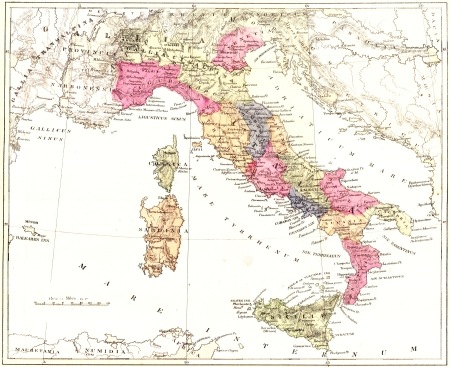
The Apennines traverse Italy in its whole length. They begin where the
Alps end, near Savona, and their chain proceeds, continually rising in
elevation, as far as the centre of the peninsula. Mount Velino is their
culminating point, and from thence the Apennines continue decreasing in
height, until they reach the extremity of the kingdom of Naples. In
the northern region they approach the Adriatic; but, in the centre,
they cut the peninsula into two parts nearly equal; then, at Mount
Caruso (Vultur), near the source of the Bradano (Bradanus), they
separate into two branches, one of which penetrates into Calabria, the
other into the Terra di Bari as far as Otranto.
The two slopes of the Apennines give birth to various streams which flow
some into the Adriatic and others into the Mediterranean. On the eastern
side the principal are—the Rubicon, the Pisaurus (Foglia), the
Metaurus (Metauro), the Æsis (Esino), the Truentus (Tronto), the
Aternus (Pescara), the Sangrus (Sangro), the Trinius (Trigno), the
Frento (Fortore), and the Aufidus (Ofanto), which follow generally a
direction perpendicular to the chain of mountains. On the western side,
the Arnus (Arno), the Ombrus (Ombrone), the Tiber, the Amasenus
(Amaseno), the Liris (Garigliano), the Vulturnus (Volturno), and
the Silarus (Silaro or Sile), run parallel to the Apennines; but
towards their mouths they take a direction nearly perpendicular to the
coast. The Bradanus (Bradano), the Casuentus (Basiento), and the
Aciris (Agri), flow into the Gulf of Tarentum.
We may admit into ancient Italy the following great divisions and
subdivisions:—
To the north, the Senones, a people of Gallic origin, occupying the
shores of the Adriatic Sea, from the Rubicon to the neighbourhood of
Ancona; Umbria, situated between the Senones and the course of the
Tiber; Etruria, between the Tiber and the Mediterranean Sea.
In the centre the territory of Picenum, between Ancona and Hadria, in
the Abruzzo Ulteriore; Latium, in the part between the Apennines and the
Mediterranean, from the Tiber to the Liris; to the south of Latium, the
Volsci, and the Aurunci, the débris of the ancient Ausones, retired
between the Liris and the Amasenus, and bordering upon another people of
the same race, the Sidicines, established between the Liris and the
Vulturnus; the country of the Sabines, between Picenum and Latium; to
the east of Latium, in the mountains, the Æqui; the Hernici, backed by
the populations of Sabellian stock, namely, the Marsi, the Peligni, the
Vestini, the Marrucini, and the Frentani, distributed in the valleys
through which run the rivers received by the Adriatic from the extremity
of Picenum to the River Fortore.
The territory of Samnium, answering to the great part of the Abruzzi and
the province of Molisa, advanced towards the west as far as the upper
arm of the Vulturnus, on the north to the banks of the Fortore, and to
the south to Mount Vultur. Beyond the Vulturnus extended Campania
(Terra di Lavoro and part of the principality of Salerno), from
Sinuessa to the Gulf of Pæstum.
Southern Italy, or Magna Græcia, comprised on the Adriatic: first,
Apulia (the Capitanata and Terra di Bari) and Messapia (Terra di
Otranto); this last terminated in the Iapygian Promontory, and its
central part was occupied by the Salentini and divers other Messapian
populations, while there existed on the seaboard a great number of Greek
colonies; secondly, Lucania, which answered nearly to the modern
province of Basilicata, and was washed by the waters of the Gulf of
Tarentum; thirdly, Bruttium (now the Calabrias), forming the most
advanced point of Italy, and terminating in the Promontory of Hercules.
Dispositions of the People of Italy in regard to Rome.
II. In 416, Rome had finally subdued the Latins, and possessed part of
Campania. Her supremacy extended from the present territory of Viterbo
to the Gulf of Naples, from Antium (Porto di Anzo) to Sora.
The frontiers of the Republic were difficult to defend, her limits ill
determined, and her neighbours the most warlike people of the peninsula.
To the north only, the mountains of Viterbo, covered with a thick forest
(silva Ciminia), formed a rampart against Etruria. The southern part
of this country had been long half Roman; the Latin colonies of Sutrium
(Sutri) and Nepete (Nepi) served as posts of observation. But the
Etruscans, animated for ages with hostile feeling towards Rome,
attempted continually to recover the lost territory. The Gaulish
Senones, who, in 364, had taken and burnt Rome, and often renewed their
invasions, had come again to try their fortune. In spite of their
defeats in 404 and 405, they were always ready to join the Umbrians and
Etruscans in attacking the Republic.
The Sabines, though entertaining from time immemorial tolerably amicable
relations with the Romans, offered but a doubtful alliance. Picenum, a
fertile and populous country, was peaceful, and the greater part of the
mountain tribes of Sabellic race, in spite of their bravery and energy,
inspired as yet no fear. Nearer Rome, the Æqui and the Hernici had been
reduced to inaction; but the Senate kept in mind their hostilities and
nourished projects of vengeance.
On the southern coast, among the Greek towns devoted to commerce,
Tarentum passed for the most powerful; but these colonies, already in
decline, were obliged to have recourse to mercenary troops, to resist
the native inhabitants. They disputed with the Samnites and the Romans
the preponderance over the people of Magna Græcia. The Samnites, indeed,
a manly and independent race, aimed at seizing the whole of Southern
Italy; their cities formed a confederacy, redoubtable on account of its
close union in time of war. The mountain tribes gave themselves up to
brigandage, and it is worthy of attention that recent events show that
in our days manners have not much changed in that country. The Samnites
had amassed considerable riches; their arms displayed excessive
extravagance, and, if we believe Cæsar,[163] they served as models for
those of the Romans.
A jealous rivalry had long prevailed between the Romans and the
Samnites. The moment these two peoples found themselves in presence of
each other, it was evident that they would be at war; the struggle was
long and terrible, and, during the fifth century, it was round Samnium
that they disputed the empire of Italy. The position of the Samnites was
very advantageous. Entrenched in their mountains, they could, at their
will, either descend into the valley of the Liris, thence reach the
country of the Aurunci, always ready to revolt, and cut off the
communications of Rome with Campania; or follow the course of the upper
Liris into the country of the Marsi, raise these latter, and hold out
the hand to the Etruscans, turning Rome; or, lastly, penetrate into
Campania by the valley of the Vulturnus, and fall upon the Sidicini,
whose territory they coveted.
In the midst of so many hostile peoples, for a little state to succeed
in raising itself above the others, and in subjugating them, it must
have possessed peculiar elements of superiority. The peoples who
surrounded Rome, warlike and proud of their independence, had neither
the same unity, nor the same incentives to action, nor the same powerful
aristocratic organisation, nor the same blind confidence in their
destinies. They displayed more selfishness than ambition. When they
fought, it was much more to increase their riches by pillage than to
augment the number of their subjects. Rome triumphed, because alone, in
prospect of a future, she made war not to destroy, but to conserve, and,
after the material conquest, always set herself to accomplish the moral
conquest of the vanquished.
During four hundred years her institutions had formed a race animated
with the love of country and with the sentiment of duty; but, in their
turn, the men, incessantly re-tempered in intestine struggles, had
successively introduced manners and traditions stronger even than the
institutions themselves. During three centuries, in fact, Rome
presented, in spite of the annual renewal of powers, such a perseverance
in the same policy, such a practice of the same virtues, that it might
have been supposed that the government had but a single head, a single
thought, and one might have believed that all its generals were great
warriors, all its senators experienced statesmen, and all its citizens
valiant soldiers.
The geographical position of Rome contributed no less to the rapid
increase of its power. Situated in the middle of the only great fertile
plain of Latium, on the banks of the only important river of Central
Italy, which united it with the sea, it could be at the same time
agricultural and maritime, conditions then indispensable for the capital
of a new empire. The rich countries which bordered the coasts of the
Mediterranean were sure to fall easily under her dominion; and as for
the countries which surrounded her, it was possible to become mistress
of them by occupying gradually the openings from all the valleys. The
town of the seven hills, favoured by her natural situation as well as by
her political constitution, carried thus in herself the germs of her
future greatness.
Treatment of the Vanquished Peoples.
III. From the commencement of the fifth century Rome prepares with
energy to subject and assimilate to herself the peoples who dwelt from
the Rubicon to the Strait of Messina. Nothing will prevent her from
surmounting all obstacles, neither the coalition of her neighbours
conspiring against her, nor the new incursions of the Gauls, nor the
invasion of Pyrrhus. She will know how to raise herself from her partial
defeats, and establish the unity of Italy, not by subduing at once all
these peoples to the same laws and the same rule, but by causing them
to enter, by little and little and in different degrees, into the great
Roman family. “Of one city she makes her ally; on another she confers
the honour of living under the Quiritary law, to this one with the right
of suffrage, to that with the permission to retain its own government.
Municipia of different degrees, maritime colonies, Latin colonies, Roman
colonies, prefectures, allied towns, free towns, all isolated by the
difference of their condition, all united by their equal dependence on
the Senate, they will form, as it were, a vast network which will
entangle the Italian peoples, until the day when, without new struggles,
they will awake subjects of Rome.”[164]
Let us examine the conditions of these various categories:
The right of city, in its plenitude (jus civitatis optimo jure),
comprised the political privileges peculiar to the Romans, and assured
for civil life certain advantages, of which the concession might be made
separately and by degrees. First came the commercium, that is, the
right of possessing and transmitting according to the Roman law; next
the connubium, or the right of contracting marriage with the
advantages established by Roman legislation.[165] The commercium and
connubium united formed the Quiritary law (jus quiritium).
There were three sorts of municipia:[166] first, the municipia of which
the inhabitants, inscribed in the tribes, exercised all the rights and
were subjected to all the obligations of the Roman citizens; secondly,
the municipia sine suffragio, the inhabitants of which enjoyed in
totality or in part the Quiritary law, and might obtain the complete
right of Roman citizens on certain conditions;[167] it is what
constituted the jus Latii; these first two categories preserved their
autonomy and their magistrates; third, the towns which had lost all
independence in exchange for the civil laws of Rome, but without
enjoyment, for the inhabitants, of the most important political rights;
it was the law of the Cærites, because Cære was the first town which
had been thus treated.[168]
Below the municipia, which had their own magistrates, came, in this
social hierarchy, the prefectures,[169] so called because a prefect was
sent there every year to administer justice.
The dediticii were still worse treated. Delivered by victory to the
discretion of the Senate, they had been obliged to surrender their arms
and give hostages, to throw down their walls or receive a garrison
within them, to pay a tax, and to furnish a determinate contingent. With
the exclusion of these last, the towns which had not obtained for their
inhabitants the complete rights of Roman citizens belonged to the class
of allies (fœderati socii). Their condition differed according to
the nature of their engagements. Simple treaties of friendship,[170] or
of commerce,[171] or of offensive alliance, or offensive and
defensive,[172] concluded on the footing of equality, were called
fœdera æqua. On the contrary, when one of the contracting parties
(and it was never the Romans) submitted to onerous obligations from
which the other was exempted, these treaties were called fœdera non
æqua. They consisted almost always in the cession of a part of the
territory of the vanquished, and in the obligation to undertake no war
of their own. A certain independence, it is true, was left to them; they
received the right of exchange and free establishment in the capital,
but they were bound to the interests of Rome by an alliance offensive
and defensive. The only clause establishing the preponderance of Rome
was conceived in these terms: Majestatem populi Romani comiter
conservanto;[173] that is, “They shall loyally acknowledge the
supremacy of the Roman people.” It is a remarkable circumstance that,
dating from the reign of Augustus, the freedmen were divided in
categories similar to those which existed for the inhabitants of
Italy.[174]
As to the colonies, they were established for the purpose of preserving
the possessions acquired, of securing the new frontiers, and of guarding
the important passes; and even for the sake of getting rid of the
turbulent class.[175] They were of two sorts: the Roman colonies and the
Latin colonies. The former differed little from the municipia of the
first degree, the others from the municipia of the second degree. The
first were formed of Roman citizens, taken with their families from the
classes subjected to military service, and even, in their origin, solely
among the patricians. The coloni preserved the privileges attached to
the title of citizen,[176] and were bound by the same obligations, and
the interior administration of the colony was an image of that of
Rome.[177]
The Latin colonies differed from the others in having been founded by
the confederacy of the Latins on different points of Latium. Emanating
from a league of independent cities, they were not, like the Roman
colonies, tied by close bonds to the metropolis.[178] But the
confederacy once dissolved, these colonies were placed in the rank of
allied towns (socii Latini). The act (formula) which instituted them
was a sort of treaty guaranteeing their franchise.[179]
Peopled at first by Latins, it was not long before these colonies
received Roman citizens who were induced by their poverty to exchange
their title and rights for the advantages assured to the colonists.
These did not figure on the lists of the censors. The formula fixed
simply the tribute to pay and the number of soldiers to furnish. What
the colony lost in privileges it gained in independence.[180]
The isolation of the Latin colonies, placed in the middle of the enemy’s
territory, obliged them to remain faithful to Rome, and to keep watch on
the neighbouring peoples. Their military importance was at least equal
to that of the Roman colonies; they merited as well as these latter the
name of propugnacula imperii and of specula,[181] that is, bulwarks
and watch-towers of the conquest. In a political point of view they
rendered services of a similar kind. If the Roman colonies announced to
the conquered people the majesty of the Roman name, their Latin sisters
gave an ever-increasing extension to the nomen Latinum,[182] that is,
to the language, manners, and whole civilisation of that race of which
Rome was but the first representative. The Latin colonies were
ordinarily founded to economise the colonies of Roman citizens, which
were charged principally with the defence of the coasts and the
maintenance of commercial relations with foreign people.
In making the privileges of the Roman citizen an advantage which every
one was happy and proud to acquire, the Senate held out a bait to all
ambitions; and this general desire, not to destroy the privilege, but to
gain a place among the privileged, is a characteristic trait of the
manners of antiquity. In the city not less than in the State, the
insurgents or discontented did not seek, as in our modern societies, to
overthrow, but to attain to. So every one, according to his position,
aspired to a legitimate object: the plebeians to enter into the
aristocracy, not to destroy it; the Italic peoples, to have a part in
the sovereignty of Rome, not to contest it; the Roman provinces to be
declared allies and friends of Rome, and not to recover their
independence.
The peoples could judge, according to their conduct, what lot was
reserved for them. The paltry interests of city were replaced by an
effectual protection, and by new rights often more precious, in the eyes
of the vanquished, than independence itself. This explains the facility
with which the Roman domination was established. In fact, that only is
destroyed entirely which may be replaced advantageously.
A rapid glance at the wars which effected the conquest of Italy will
show how the Senate made application of the principles stated above; how
it was skilful in profiting by the divisions of its adversaries, in
collecting its whole strength to overwhelm one of them; after the
victory in making it an ally; in using the aims and resources of that
ally to subjugate another people; in crushing the confederacies which
united the vanquished against it; in attaching them to Rome by new
bonds; in establishing military posts on all the points of strategic
importance; and, lastly, in spreading everywhere the Latin race by
distributing to Roman citizens a part of the lands taken from the enemy.
But, before entering upon the recital of events, we must cast a glance
upon the years which immediately preceded the pacification of Latium.
Submission of Latium after the first Samnite War.
IV. During a hundred and sixty-seven years, Rome had been satisfied with
struggling against her neighbours to re-conquer a supremacy lost since
the fall of her kings. She held herself almost always on the defensive;
but, with the fifth century, she took the offensive, and inaugurated the
system of conquests continued to the moment when she herself succumbed.
In 411, she had, in concert with the Latins, combated the Samnites for
the first time, and commenced against that redoubtable people a
struggle which lasted seventy-two years, and which brought twenty-four
triumphs to the Roman generals.[183] Proud of having contributed to the
two great victories of Mount Gaurus and Suessula, the Latins, with an
exaggerated belief in their own strength and a pretension to equality
with Rome, went so far as to require that one of the two consuls, and
half of the senators, should be chosen from their nation. War was
immediately declared. The Senate was willing enough to have allies and
subjects, but it could not suffer equals; it accepted without scruple
the services of those who had just been enemies, and the Romans, united
with the Samnites, the Hernici, and the Sabellian peoples, were seen in
the fields of the Veseris and Trifanum, fighting against the Latins and
Volsci. Latium once reduced, it remained to determine the lot of the
vanquished. Livy reports a speech of Camillus which explains clearly the
policy recommended by that great citizen. “Will you,” he exclaims,
addressing the members of the assembly, “use the utmost rigour of the
rights of victory? You are masters to destroy all Latium, and to make a
vast desert of it, after having often drawn from it powerful succours.
Will you, on the contrary, after the example of your fathers, augment
the resources of Rome? Admit the vanquished among the number of your
citizens; it is a fruitful means of increasing at the same time your
power and your glory.”[184] This last counsel prevailed.
The first step was to break the bonds which made of the Latin people a
sort of confederacy. All political communalty, all war on their own
account, all rights of commercium and connubium, between the
different cities, were taken from them.[185]
The towns nearest Rome received the rights of city and suffrage.[186]
Others received the title of allies and the privilege of preserving
their own institutions, but they lost a part of their territory.[187] As
to the Latin colonies founded before in the old country of the Volsci,
they formed the nucleus of the Latin allies (socii nominis Latini).
Velitræ, alone, having already revolted several times, was treated with
great rigour; Antium was compelled to surrender its ships, and become a
maritime colony.
These severe, but equitable measures, had pacified Latium; applied to
the rest of Italy, and even to foreign countries, they will facilitate
everywhere the progress of Roman domination.
The momentary alliance with the Samnites had permitted Rome to reduce
the Latins; nevertheless the Senate, without hesitation, turned against
the former again as soon as the moment appeared convenient. It
concluded, in 422, a treaty with the Gauls and Alexander Molossus, who,
having landed near Pæstum, attacked the Lucanians and the Samnites. This
King of Epirus, the uncle of Alexander the Great, had been called into
Italy by the Tarentines; but his premature death disappointed the hopes
to which his co-operation had given rise, and the Samnites recommenced
their incursions on the lands of their neighbours. The intervention of
Rome put a stop to the war. All the forces of the Republic were employed
in reducing the revolt of the Volscian towns of Fundi and
Privernum.[188] In 425, Anxur (Terracina) was declared a Roman colony,
and, in 426, Fregellæ (Ceprano?), a Latin colony.
The establishment of these fortresses, and of those of Cales and Antium,
secured the communications with Campania; the Liris and the Vulturnus
became in that direction the principal lines of defence of the Romans.
The cities situated on the shores of that magnificent gulf called
Crater by the ancients, and in our days the Gulf of Naples,
perceived then the dangers which threatened them. They turned their eyes
towards the population of the interior, who were no less alarmed for
their independence.
Second Samnite War.
V. The fertile countries which bordered the western shore of the
peninsula were destined to excite the covetousness of the Romans and the
Samnites, and become the prey of the conqueror. “Campania, indeed,” says
Florus,[189] “is the finest country of Italy, and even of the whole
world. There is nothing milder than its climate. Spring flourishes there
twice every year. There can be nothing more fertile than its soil. It is
called the garden of Ceres and Bacchus. There is not a more hospitable
sea than that which bathes its shores.” In 427, the two peoples
disputed the possession of it, as they had done in 411. The inhabitants
of Palæopolis having attacked the Roman colonists of the ager
Campanus, the consuls marched against that place, which soon received
succour from the Samnites and the inhabitants of Nola, while Rome formed
an alliance with the Apulians and the Lucanians. The siege dragged on,
and the necessity of continuing the campaign beyond the ordinary limit
led to the prolongation of the command of Publilius Philo with the title
of proconsul, which appeared for the first time in the military annals.
The Samnites were soon driven from Campania; the Palæopolitans
submitted; their town was demolished; but they formed close to it a new
establishment, at Naples (Neapolis), where a new treaty guaranteed
them an almost absolute independence, on the condition of furnishing a
certain number of vessels to Rome. After that, nearly all the Greek
towns, reduced one after another, obtained the same favourable
conditions, and formed the class of the socii navales.[190]
Yet the war was protracted in the mountains of the Apennine. Tarentum
united with the Samnites, the only people who were still to be
feared,[191] and the Lucanians abandoned the alliance of the Romans;
but, in 429, the two most celebrated captains of the time, Q. Fabius
Rullianus and Papirius Cursor, penetrated into the country of Samnium,
and compelled the enemy to pay an indemnity for the war and accept a
year’s truce.
At this epoch, an unforeseen event, which changed the destinies of the
world, came to demonstrate the difference between the rapid creation of
a man of genius and the patient work of an intelligent aristocracy.
Alexander the Great, after having shone like a meteor, and brought into
subjection the most powerful kingdoms of Asia, died at Babylon. His
fruitful and decisive influence, which carried the civilization of
Greece into the East, survived him, but at his death, the empire he
founded became in a few years dismembered (431); the Roman aristocracy,
on the contrary, perpetuating itself from age to age, pursued more
slowly, but without interruption, the system which, binding again the
peoples about a common centre, was destined by little and little to
secure her domination over Italy first, and then over the universe.
The defection of a part of the Apulians, in 431, encouraged the Samnites
to take arms again; defeated in the following years, they asked for the
restoration of friendly relations, but the haughty refusal of Rome led,
in 433, to the famous defeat of the Furcæ Caudinæ. The generosity of the
Samnite general, Pontus Herennius, who granted their lives to so many
thousands of prisoners on condition of restoring to force the old
treaties, had no effect upon the Senate. Four legions had passed under
the yoke—a circumstance in which the Senate only saw a new affront to
revenge. The treaty of Caudium was not ratified, and subterfuges little
excusable, although approved at a later period by Cicero,[192] gave to
the refusal an appearance of justice.
Meanwhile the Senate exerted itself vigorously to repair this check, and
soon Publilius Philo defeated the enemies in Samnium, and, in Apulia,
Papirius, in his turn, caused seven thousand Samnites to pass under the
yoke. The vanquished solicited peace, but in vain; they only obtained a
truce for two years (436), and it had hardly expired, when, penetrating
into the country of the Volsci, as far as the neighbourhood of
Terracina, and taking a position at Lautulæ, they defeated a Roman army
raised hastily and commanded by Q. Fabius (439). Capua deserted, and
Nola, Nuceria, the Aurunci, and the Volsci of the Liris took part openly
with the Samnites. The spirit of rebellion spread as far as Præneste.
Rome was in danger. The Senate required its utmost energy to restrain
populations whose fidelity was always doubtful. Fortune seconded its
efforts, and the allies, who had proved traitors, received a cruel
chastisement, explained by the terror they had inspired. In 440,[193]
not far from Caudium, a numerous army encountered the Samnites, who lost
30,000 men, and were driven back into the Apennine territory. The Roman
legions proceeded to encamp before their capital, Bovianum, and there
took up their winter quarters.
The year following (441), Rome, less occupied in fighting, profited by
this circumstance to seize upon advantageous positions, establishing in
Campania and Apulia colonies which surrounded the territory of Samnium.
At the same epoch, Appius Claudius transformed into a regular causeway
the road which has preserved his name.[194] The Romans turned their
attention to the defence of the coasts and communication by sea; a
colony was sent to the isle of Pontia,[195] opposite Tarracina, and the
armament of a fleet was commenced, which was placed under the command of
duumviri navales.[196] The war had lasted fifteen years, and, although
Rome had only succeeded in driving back the Samnites into their own
territory, she had conquered two provinces, Apulia and Campania.
Third Samnite war. Coalition of Samnites, Etruscans,
Umbrians, and Hernici (443-449).
VI. A struggle so desperate had produced its effect even in Etruria, and
the old league was formed again. Inured to war by their daily combats
with the Gauls, and emboldened by the reports of the defeat of Lautulæ,
the Etruscans believed that the moment had arrived for recovering their
ancient territory to the south of the Ciminian forest; they were further
encouraged by the attitude of the peoples of Central Italy, who were
weary of the continual passing of legions. From 443 to 449, the armies
of the Republic were obliged to face different enemies at the same time.
In Etruria, Fabius Rullianus relieved Sutrium, a rampart of Rome on the
north;[197] he passed through the Ciminian forest, and by the victories
of Lake Vadimo (445)[198] and Perusia compelled all the Etruscan towns
to ask for peace. At the same time, an army laid waste the country of
the Samnites; and a Roman fleet, composed of vessels furnished by the
maritime allies, took the offensive for the first time. Its attempt near
Nuceria Alfaterna (Nocera, a town of Campania) was unfortunate.
War next breaks out again in Apulia, Samnium, and Etruria, where the
aged Papirius Cursor, named dictator anew, gains a brilliant victory at
Langula (445). The year following Fabius penetrates again into Samnium,
and the other consul, Decius, maintains Etruria. Suddenly the Umbrians
conceive the project of seizing Rome by surprise. The consuls are
recalled for the defence of the town. Fabius meets the Etruscans at
Mevania (on the confines of Etruria and Umbria), and, the year
following, at Allifæ (447). Among the prisoners were some Æqui and
Hernici. Their towns, feeling themselves thus compromised, declared open
war against the Romans (448). The Samnites recovered courage; but the
prompt reduction of the Hernici allowed the Senate to concentrate its
forces. Two armies, penetrating into Samnium by way of Apulia and
Campania, re-established the old frontiers. Bovianum was taken for the
third time, and during six months the country was delivered up to
devastation. In vain Tarentum tried to raise new quarrels for the
Republic, and to force the Lucanians to embrace the cause of the
Samnites. The successes of the Roman arms led to the conclusion of
treaties of peace with all the peoples of Southern Italy, constrained
thenceforward to acknowledge the majesty of the Roman people. The Æqui
remained alone exposed to the wrath of Rome; the Senate did not forget
that at Allifæ they had fought in the ranks of the enemy, and, once
freed from its more serious embarrassments, it inflicted on this people
a terrible chastisement: forty-one places were taken and burnt in fifty
days. This period of six years thus terminated with the submission of
the Hernici and Æqui.
Five years less agitated left Rome time to regulate the position of its
new subjects, and to establish colonies and ways of communication.
The Hernici were treated in the same manner as the Latins, in 416, and
deprived of commercium and connubium. Prefects and the law of the
Cærites were imposed on Anagnia, Frusino, and other towns guilty of
desertion. The cities which had remained faithful preserved their
independence and the title of allies (448);[199] the Æqui lost a part of
their territory and received the right of city without suffrage (450).
The Samnites, sufficiently humiliated, obtained at last the renewal of
their ancient conventions (450).[200] Fœdera non æqua were
concluded with the Marsi, the Peligni, the Marrucini, the Frentani
(450), the Vestini (452), and the Picentini (455).[201] Rome treated
with Tarentum on a footing of equality, and engaged not to let her fleet
pass the Lacinian Promontory to the south of the Gulf of Tarentum.[202]
Thus, on the one hand, the territories shared among the Roman citizens;
on the other, the number of the municipia were considerably augmented.
Further, the Republic had acquired new allies; she possessed at length
the passages of the Apennines and commanded both seas.[203] A girdle of
Latin fortresses protected Rome and broke the communications between the
north and south of Italy; among the Marsi and the Æqui, there were Alba
and Carseoli; Sora, towards the sources of the Liris; and Narnia, in
Umbria. Military roads connected the colonies with the metropolis.
Fourth Samnite War. Second coalition of the Samnites,
Etruscans, Umbrians, and Gauls (456-464).
VII. Peace could not last long: between Rome and the Samnites it was a
duel to death. In 456, these latter had already sufficiently recovered
from their disasters to attempt once more the fortune of arms.[204] Rome
sends to the succour of the Lucanians, suddenly attacked, two consular
armies. Vanquished at Tifernum by Fabius, at Maleventum by Decius, the
Samnites witness the devastation of their whole country. Still they do
not lose courage; their chief, Gellius Egnatius, conceives a plan which
places Rome in great danger. He divides the Samnite army into three
bodies: the first remains to defend the country; the second takes the
offensive in Campania; the third, which he commands in person, throws
itself into Etruria, and, increased by the junction of the Etruscans,
the Gauls, and the Umbrians, soon forms a numerous army.[205] The storm
roared on all sides, and, while the Roman generals were occupied some
in Samnium and others in Campania, despatches arrived from Appius,
placed at the head of the army of Etruria, announcing a terrible
coalition formed in silence by the peoples of the north, who were
concentrating all their forces in Umbria for the purpose of marching
upon Rome.
The terror was extreme, but the energy of the Romans was equal to the
danger. All able men, even to the freedmen, were enrolled, and ninety
thousand soldiers were raised. Under these grave circumstances (458),
Fabius and Decius were, once again, raised to the supreme magistracy,
and gained, under the walls of Sentinum, a brilliant victory, long
disputed. During the battle, Decius devoted himself, as his father had
done before. The coalition once dissolved, Fabius defeated another army
which had issued from Perusia, and then came to receive the honour of a
triumph in Rome. Etruria was subdued (460), and obtained a truce of
forty years.[206]
The Samnites still maintained an obstinate struggle of mingled successes
and reverses. In 461, after having taken an oath to conquer or die,
thirty thousand of them were left on the field of battle of Aquilonia. A
few months later, the celebrated Pontius, the hero of Furcæ Caudinæ,
re-appeared, at the end of twenty-nine years, at the head of his
fellow-citizens, and inflicted upon the son of Fabius a check, which the
latter soon retrieved with the assistance of his father.[207] Finally,
in 464, two Roman armies re-commenced, in Samnium, a war of
extermination, which led for the fourth time to the renewal of the
ancient treaties and the cession of a certain extent of territory. At
the same epoch, an insurrection which broke out in the Sabine territory
was put down by Curius Dentatus. Central Italy was conquered.
The peace with the Samnites lasted five years (464-469). Rome extended
her frontiers, and fortified those of the peoples placed under her
protectorate; and at the same time established new military forts.
The right of city without suffrage was accorded to the Sabines, and
prefects were given to some of the towns of the valley of the Vulturnus
(Venafrum and Allifæ).[208] A Latin colony, of twenty thousand men,
was sent to Venusia to watch over Southern Italy.[209] It commanded at
the same time Samnium, Apulia, and Lucania. If, owing to the treaty
concluded with the Greek towns, the Roman supremacy extended over the
south of the peninsula, to the north the Etruscans could not be reckoned
as allies, since nothing more than truces had been concluded with them.
In Umbria, the small tribe of the Sarsinates remained independent, and
all the coast district from the Rubicon to the Æsis was in the power of
the Senones; on their southern frontier the Roman colony of Sena Gallica
(Sinigaglia) was founded; the coast of Picenum was watched by that of
Castrum Novum and by the Latin fortress of Hatria (465).[210]
Third coalition of the Etruscans, Gauls, Lucanians, and
Tarentines (469-474).
VIII. The power of Rome had increased considerably. The Samnites, who
hitherto had played the first part, were no longer in a condition to
plan further coalitions, and one people alone could hardly be rash
enough to provoke the Republic. Yet the Lucanians, always hesitating,
gave this time the signal for a general revolt.
The attack on Thurium, by the Lucanians and Bruttians, became the
occasion of a new league, into which entered successively the
Tarentines, the Samnites, the Etruscans, and even the Gauls. The north
was soon in flames, and Etruria again became the battle-field. A Roman
army, which had hastened to relieve Arretium, was put to rout by the
Etruscans united with Gaulish mercenaries. The Senones, to whom these
belonged, having massacred the Roman ambassadors sent to expostulate on
their violation of the treaty with the Republic, the Senate sent against
them two legions who drove them back beyond the Rubicon. The Gaulish
tribe of the Boians, alarmed by the fate of the Senones, descended
immediately into Umbria, and, rallying the Etruscans, prepared to march
to renew the sack of Rome; but their march was arrested, and two
successive victories, at Lake Vadimo, (471) and Populonia (472), enabled
the Senate to conclude a convention which drove back the Boians into
their old territory. Hostilities continued with the Etruscans during two
years, after which their submission completed the conquest of Northern
Italy.
Pyrrhus in Italy. Submission of Tarentum (474-488).
IX. Free to the north, the Romans turned their efforts against the
south of Italy; war was declared against Tarentum, the people of which
had attacked a Roman flotilla. While the consul Æmilius invested the
town, the first troops of Pyrrhus, called in by the Tarentines,
disembarked in the port (474).
This epoch marks a new phase in the destinies of Rome, who is going, for
the first time, to measure herself with Greece. Hitherto the legions
have never had to combat really regular armies, but they have become
disciplined in war by incessant struggles in the mountains of Samnium
and Etruria; henceforth they will have to face old soldiers disciplined
in skilful tactics and commanded by an experienced warrior. The King of
Epirus, after having already twice lost and recovered his kingdom, and
invaded and abandoned Macedonia, dreamt of conquering the West. On the
news of his arrival at the head of twenty-five thousand soldiers and
twenty elephants,[211] the Romans enrolled all citizens capable of
bearing arms, even the proletaries; but, admirable example of courage!
they rejected the support of the Carthaginian fleet with this proud
declaration: “The Republic only entertains wars which it can sustain
with its own forces.”[212] While fifty thousand men, under the orders of
the consul Lævinus, march against the King of Epirus, to prevent his
junction with the Samnites, another army enters Lucania. The consul
Tiberius Coruncanius holds Etruria, again in agitation. Lastly, an army
of reserve guards the capital.
Lævinus encountered the King of Epirus near Heraclea, a colony of
Tarentum (474). Seven times in succession the legions charged the
phalanx, which was on the point of giving way, when the elephants,
animals unknown to the Romans, decided the victory in favour of the
enemy. A single battle had delivered to Pyrrhus all the south of the
Peninsula, where the Greek towns received him with enthusiasm.
But, though victor, he had sustained considerable losses, and learned at
the same time the effeminacy of the Greeks of Italy, and the energy of a
people of soldiers. He offered peace, and asked of the Senate liberty
for the Samnites, the Lucanians, and especially for the Greek towns. Old
Appius Claudius declared it impossible so long as Pyrrhus occupied
Italian soil, and peace was refused. The king then resolved to march
upon Rome through Campania, where his troops made great booty.
Lævinus, made prudent by his defeat, satisfied himself with watching the
enemy’s army, and succeeded in covering Capua; whence he followed
Pyrrhus from place to place, looking out for a favourable opportunity.
This prince, advancing by the Latin Way, had reached Præneste without
obstacle,[213] when, surrounded by three Roman armies, he found himself
under the necessity of falling back and retiring into Lucania. Next
year, reckoning on finding new auxiliaries among the peoples of the
east, he attacked Apulia; but the fidelity of the allies in Central
Italy was not shaken. Victorious at Asculum (Ascoli di Satriano)
(475), but without a decisive success, and encountering always the same
resistance, he seized the first opportunity of quitting Italy to conquer
Sicily (476-78). During this time, the Senate re-established the Roman
domination in Southern Italy, and even seized upon some of the Greek
towns, among the rest Locri and Heraclea.[214] Samnium, Lucania, and
Bruttium were again given up to the power of the legions, and forced to
surrender lands and renew treaties of alliance; on the coast, Tarentum
and Rhegium alone remained independent. The Samnites still resisted, and
the Roman army encamped in their country in 478 and 479. Meanwhile
Pyrrhus returns to Italy, reckoning on arriving in time to deliver
Samnium; but he is defeated at Beneventum by Curius Dentatus, and
returns to his country. The invasion of Pyrrhus, cousin of Alexander the
Great; and one of his successors, appears as one of the last efforts of
Grecian civilisation expiring at the feet of the rising grandeur of
Roman civilisation.
The war against the King of Epirus produced two remarkable results: it
improved the Romans in military tactics, and introduced between the
combatants those mutual regards of civilised nations which teach men to
honour their adversaries, to spare the vanquished, and to lay aside
wrath when the struggle is ended. The King of Epirus treated his Roman
prisoners with great generosity. Cineas, sent to the Senate at Rome, and
Fabricius, envoy to Pyrrhus, carried back from their mission a profound
respect for those whom they had combated.
In the following years Rome took Tarentum (482),[215] finally pacified
Samnium, and took possession of Rhegium (483-485). Since the battle of
Mount Gaurus, seventy-two years had passed, and several generations had
succeeded each other, without seeing the end of this long and sanguinary
quarrel. The Samnites had been nearly exterminated, and yet the spirit
of independence and liberty remained deeply rooted in their mountains.
When, at the end of two centuries and a half, the war of the allies
shall come, it is there still that the cause of equality of rights will
find its strongest support.
The other peoples underwent quickly the laws of the conqueror. The
inhabitants of Picenum, as a punishment for their revolt, were despoiled
of a part of their territory, and a certain number among them received
new lands in the south of Campania, near the Gulf of Salernum
(Picentini)(486). In 487, the submission of the Salentines allowed the
Romans to seize Brundusium, the most important port of the
Adriatic.[216] The Sarsinates were reduced the years following.[217]
Finally, Volsinium, a town of Etruria, was again numbered among the
allies of the Republic. The Sabines received the right of suffrage.
Italy, become henceforth Roman, extended from the Rubicon to the Straits
of Messina.
Preponderance of Rome.
X. During this period, the conquest of the subjugated countries was
ensured by the foundation of colonies. Rome became thus encircled by a
girdle of fortresses commanding all the passages which led to Latium,
and closing the roads to Campania, Samnium, Etruria, and Gaul.[218]
At the opening of the struggle which ended in the conquest of Italy,
there were only twenty-seven tribes of Roman citizens; the creation of
eight new tribes (the two last in 513) raised finally the number to
thirty-five, of which twenty-one were reserved to the old Roman people
and fourteen to the new citizens. Of these the Etruscans had four; the
Latins, the Volsci, the Ausones, the Æqui, and the Sabines, each two;
but, these tribes being at a considerable distance from the capital, the
new citizens could hardly take part in the comitia, and the majority,
with its influence, remained with those who dwelt at Rome.[219] After
513, no more tribes were created; those who received the rights of
citizens were only placed in the previously existing tribes; so that the
members of one individual tribe were scattered in the provinces, and the
number of those inscribed went on increasing continually by individual
additions, and by the tendency more and more apparent to raise the
municipia of the second order to the rank of the first order. Thus,
towards the middle of the sixth century, the towns of the Æqui, the
Hernici, the Volsci, and a part of those of Campania, including the
ancient Samnite cities of Venafrum and Allifæ, obtained the right of
city with suffrage.
Rome, towards the end of the fifth century, thus ruled, though in
different degrees, the peoples of Italy proper. The Italian State, if we
may give it that name, was composed of a reigning class, the citizens;
of a class protected, or held in guardianship, the allies; and of a
third class, the subjects. Allies or subjects were all obliged to
furnish military contingents. The maritime Greek towns furnished sailors
to the fleet. Even the cities, which preserved their independence for
their interior affairs, obeyed, so far as the military administration
was concerned, special functionaries appointed by the metropolis.[220]
The consuls had the right of raising in the countries bordering on the
theatre of war all men capable of bearing arms. The equipment and pay of
the troops remained at the charge of the cities; Rome provided for their
maintenance during war. The auxiliary infantry was ordinarily equal in
number to that of the Romans, the cavalry double or triple.
In exchange for this military assistance, the allies had a right to a
part of the conquered territory, and, in return for an annual rent, to
the usufruct of the domains of the State. These domains, considerable in
the peninsula,[221] formed the sole source of income which the treasury
derived from the allies, free in other respects from tribute. Four
questors (quæstores classici) were established to watch over the
execution of the orders of the Senate, the equipment of the fleet, and
the collection of the farm-rents.
Rome reserved to herself exclusively the direction of the affairs of the
exterior, and presided alone over the destinies of the Republic. The
allies never interfered in the decisions of the Forum, and each town
kept within the narrow limits of its communal administration. The
Italian nationality was thus gradually constituted by means of this
political centralisation, without which the different peoples would have
mutually weakened each other by intestine wars, more ruinous than
foreign wars, and Italy would not have been in a condition to resist the
double pressure of the Gauls and the Carthaginians.
The form adopted by Rome to rule Italy was the best possible, but only
as a transition form. The object to be aimed at was, in fact, the
complete assimilation of all the inhabitants of the peninsula, and this
was evidently the aim of the wise policy of the Camilli and the Fabii.
When we consider that the colonies of citizens presented the faithful
image of Rome; that the Latin colonies had analogous institutions and
laws; and that a great number of Roman citizens and Latin allies were
dispersed, in the different countries of the peninsula, over the vast
territories ceded as the consequence of war, we may judge how rapid must
have been the diffusion of Roman manners and the Latin language.
If Rome, in later times, had not the wisdom to seize the favourable
moment in which assimilation, already effected in people’s minds, might
have passed into the domain of facts, the reason of it was the
abandonment of the principles of equity which had guided the Senate in
the first ages of the Republic, and, above all, the corruption of the
magnates, interested in maintaining the inferior condition of the
allies. The right of city extended to all the peoples of Italy, time
enough to be useful, would have given to the Republic a new force; but
an obstinate refusal became the cause of the revolution commenced by the
Gracchi, continued by Marius, extinguished for a moment by Sylla, and
completed by Cæsar.
Strength of the Institutions.
XI. At the epoch with which we are occupied, the Republic is in all its
splendour.
The institutions form remarkable men; the annual elections carry into
power those who are most worthy, and recall them to it after a short
interval. The sphere of action for the military chiefs does not extend
beyond the natural frontiers of the peninsula, and their ambition,
restrained in their duty by public opinion, does not exceed a legitimate
object, the union of all Italy under one dominion. The members of the
aristocracy seem to inherit the exploits as well as the virtues of their
ancestors, and neither poverty nor obscurity of birth prevent merit from
reaching it. Curius Dentatus, Fabricius, and Coruncanius, can show
neither riches nor the images of their ancestors, and yet they attain to
the highest dignities; in fact, the plebeian nobility walks on a footing
of equality with the patrician. Both, in separating from the multitude,
tend more and more to amalgamate together;[222] but they remain rivals
in patriotism and disinterestedness.
In spite of the taste for riches introduced by the war of the
Sabines,[223] the magistrates maintained their simplicity of manners,
and protected the public domain against the encroachments of the rich by
the rigorous execution of the law, which limited to five hundred acres
the property which an individual was allowed to possess.[224]
The first citizens presented the most remarkable examples of integrity
and self-denial. Marcus Valerius Corvus, after occupying twenty-one
curule offices, returns to his fields without fortune, though not
without glory (419). Fabius Rullianus, in the midst of his victories and
triumphs, forgets his resentment towards Papirius Cursor, and names him
dictator, sacrificing thus his private feelings to the interests of his
country (429). Marcus Curius Dentatus keeps for himself no part of the
rich spoils taken from the Sabines, and, after having vanquished
Pyrrhus, resumes the simplicity of country life (479).[225] Fabricius
rejects the money which the Samnites offer him for his generous
behaviour towards them, and disdains the presents of Pyrrhus (476).
Coruncanius furnishes an example of all the virtues.[226] Fabius Gurges,
Fabius Pictor, and Ogulnius, pour into the treasury the magnificent
gifts they had brought back from their embassy to Alexandria.[227] M.
Rutilius Censorinus, struck with the danger of entrusting twice in
succession the censorship in the same hands, refuses to be re-elected to
that office (488).
The names of many others might be cited, who, then and in later ages,
did honour to the Roman Republic; but let us add, that if the ruling
class knew how to call to it all the men of eminence, it forgot not to
recompense brilliantly those especially who favoured its interests:
Fabius Rullianus, for instance, the victor in so many battles, received
the name of “most great” (Maximus) only for having, at the time of his
censorship, annulled in the comitia the influence of the poor class,
composed of freedmen, whom he distributed among the urban tribes (454),
where their votes were lost in the multitude of others.[228]
The popular party, on its own side, ceased not to demand new
concessions, or to claim the revival of those which had fallen out of
use. Thus, it obtained, in 428, the re-establishment of the law of
Servius Tullius, which decided that the goods only of the debtor, and
not his body, should be responsible for his debt.[229] In 450, Flavius,
the son of a freedman, made public the calendar and the formulæ of
proceedings, which deprived the patricians of the exclusive knowledge of
civil and religious law.[230] But the lawyers found means of weakening
the effects of the measure of Flavius by inventing new formulæ, which
were almost unintelligible to the public.[231] The plebeians, in 454,
were admitted into the college of the pontiffs, and into that of the
augurs; the same year, it was found necessary to renew for the third
time the law Valeria, de provocatione.
In 468, the people again withdrew to the Janiculum, demanding the
remission of debts, and crying out against usury.[232] Concord was
restored only when they had obtained, first, by the law Hortensia, that
the plebiscita should be obligatory on all; and next, by the law Marcia,
that the orders obtained through Publilius Philo in 415 should be
restored to vigour. These orders, as we have seen above, obliged the
Senate to declare in advance whether or not the laws presented to the
comitia were contrary to public and religious law.[233]
The ambition of Rome seemed to be without bounds; yet all her wars had
for reason or pretext the defence of the weak and the protection of her
allies. Indeed, the cause of the wars against the Samnites was sometimes
the defence of the inhabitants of Capua, sometimes that of the
inhabitants of Palæopolis, sometimes that of the Lucanians. The war
against Pyrrhus had its origin in the assistance claimed by the
inhabitants of Thurium; and the support claimed by the Mamertines will
soon lead to the first Punic war.
The Senate, we have seen, put in practice the principles which found
empires and the virtues to which war gives birth. Thus, for all the
citizens, equality of rights; in face of danger to their country,
equality of duties and even suspension of liberty. To the most worthy,
honours and the command. No magisterial charge for him who has not
served in the ranks of the army. The example is furnished by the most
illustrious and richest families: at the battle of Lake Regillus (258),
the principal senators were mingled in the ranks of the legions;[234] at
the combat near the Cremera, the three hundred and six Fabii, who all,
according to Titus Livius, were capable of filling the highest offices,
perished fighting. Later, at Cannæ, eighty senators, who had enrolled
themselves as mere soldiers, fell on the field of battle.[235] The
triumph is accorded for victories which enlarged the territory, but not
for those which only recovered lost ground. No triumph in civil
wars:[236] in such case, success, be what it may, is always a subject
for public mourning. The consuls or proconsuls seek to be useful to
their country without false susceptibility; to-day in the first rank,
to-morrow in the second, they serve with the same devotion under the
orders of him whom they commanded the previous day. Servilius, consul in
281, becomes, the year following, the lieutenant of Valerius. Fabius,
after so many triumphs, consents to be only lieutenant to his son. At a
later period, Flamininus, who had vanquished the King of Macedonia,
descends again through patriotism, after the victory of Cynoscephalæ,
to the grade of tribune of the soldiers;[237] the great Scipio himself,
after the defeat of Hannibal, serves as lieutenant under his brother in
the war against Antiochus.
To sacrifice everything to patriotism is the first duty. By devoting
themselves to the gods of Hades, like Curtius and the two Decii, people
believed they bought, at the price of their lives, the safety of the
others or victory.[238] Discipline is enforced even to cruelty: Manlius
Torquatus, after the example of Postumius Tubertus, punishes with death
the disobedience of his son, though he had gained a victory. The
soldiers who have fled are decimated; those who abandon their ranks or
the field of battle are devoted, some to execution, others to dishonour;
and those who have allowed themselves to be made prisoners by the enemy
are disdained as unworthy of the price of freedom.[239]
Surrounded by warlike neighbours, Rome must either triumph or cease to
exist; hence her superiority in the art of war, for, as Montesquieu
says, in transient wars most of the examples are lost; peace brings
other ideas, and its faults and even its virtues are forgotten; hence
that contempt of treason and that disdain for the advantages it
promises: Camillus sends home to their parents the children of the first
families of Falerii, delivered up to him by their schoolmaster; the
Senate rejects with indignation the offer of the physician of Pyrrhus,
who proposes to poison that prince;—hence that religious observance of
oaths and that respect for engagements which have been contracted: the
Roman prisoners to whom Pyrrhus had given permission to repair to Rome
for the festival of Saturn, all return to him faithful to their word;
and Regulus leaves the most memorable example of faithfulness to his
oath!—hence that skilful and inflexible policy which refuses peace
after a defeat, or a treaty with the enemy so long as he is on the soil
of their country; which makes use of war to divert people from domestic
troubles;[240] gains the vanquished by benefits if they submit, and
admits them by degrees into the great Roman family; and, if they resist,
strikes them without pity and reduces them to slavery;[241]—hence that
anxious provision for multiplying upon the conquered territories the
race of agriculturists and soldiers;—hence, lastly, the improving
spectacle of a town which becomes a people, and of a people which
embraces the world.
Commerce of the Mediterranean.
I. ROME had required two hundred and forty-four years to form her
constitution under the kings, a hundred and seventy-two to establish and
consolidate the consular Republic, seventy-two to complete the conquest
of Italy, and now it will cost her nearly a century and a half to obtain
the domination of the world—that is, of Northern Africa, Spain, the
south of Gaul, Illyria, Epirus, Greece, Macedonia, Asia Minor, Syria,
and Egypt. Before undertaking the recital of these conquests, let us
halt an instant to consider the condition of the basin of the
Mediterranean at this period, of that sea round which were successively
unfolded all the great dramas of ancient history. In this examination we
shall see, not without a feeling of regret, vast countries where
formerly produce, monuments, riches, numerous armies and fleets—all,
indeed, revealed an advanced state of civilisation—now deserts or in a
state of barbarism.
The Mediterranean had seen grow and prosper in turn on its coasts Sidon,
and Tyre, and then Greece.
III
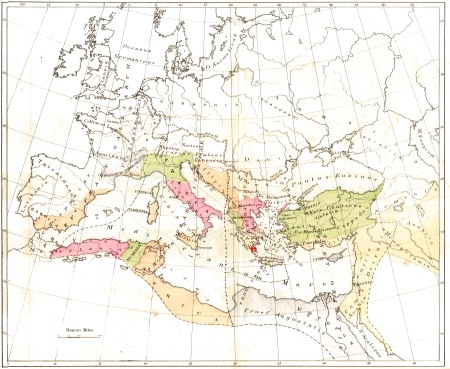
Sidon, already a flourishing city before the time of Homer, is soon
eclipsed by the supremacy of Tyre; then Greece comes to carry on, in
competition with her, the commerce of the interior sea; an age of
pacific greatness and fruitful rivalries. To the Phœnicians
chiefly, the South, the East, Africa, Asia beyond Mount Taurus, the
Erythrean Sea (the Red Sea and the Persian Gulf), the ocean, and the
distant voyages. To the Greeks, all the northern coasts, which they
covered with their thousand settlements. Phœnicia devotes herself to
adventurous enterprises and lucrative speculations. Greece, artistic
before becoming a trader, propagates by her colonies her mind and her
ideas.
This fortunate emulation soon disappears before the creation of two new
colonies sprung from their bosom. The splendour of Carthage replaces
that of Tyre. Alexandria is substituted for Greece. Thus a Western or
Spanish Phœnicia shares the commerce of the world with an Eastern and
Egyptian Greece, the fruit of the intellectual conquests of Alexander.
Northern Africa.
II. Rich in the spoils of twenty different peoples, Carthage was the
proud capital of a vast empire. Its ports, hollowed out by the hand of
man, were capable of containing a great number of ships.[242] Her
citadel, Byrsa, was two miles in circuit. On the land side the town was
defended by a triple enclosure twenty-five stadia in length, thirty
cubits high, and supported by towers of four storeys, capable of giving
shelter to 4,000 horse, 300 elephants, and 20,000 foot soldiers;[243] it
enclosed an immense population, since, in the last years of its
resistance, after a struggle of a century, it still counted 700,000
inhabitants.[244] Its monuments were worthy of its greatness: among its
remarkable buildings was the temple of the god Aschmoun, assimilated by
the Greeks to Æsculapius;[245] that of the sun, covered with plates of
gold valued at a thousand talents;[246] and the mantle or peplum,
destined for the image of their great goddess, which cost a hundred and
twenty.[247] The empire of Carthage extended from the frontiers of
Cyrenaica (the country of Barca, in the regency of Tripoli) into
Spain; she was the metropolis of all the north of Africa, and, in Libya
alone, possessed three hundred towns.[248] Nearly all the isles of the
Mediterranean, to the west and south of Italy, had received her
factories. Carthage had imposed her sovereignty upon all the ancient
Phœnician establishments in this part of the world, and had levied
upon them an annual contingent of soldiers and tribute. In the interior
of Africa, she sent caravans to seek elephants, ivory, gold, and black
slaves, which she afterwards exported[249] to the trading places on the
Mediterranean. In Sicily, she gathered oil and wine; in the isle of
Elba, she mined for iron; from Malta, she drew valuable tissues; from
Corsica, wax and honey; from Sardinia, corn, metals, and slaves; from
the Baleares, mules and fruits; from Spain, gold, silver, and lead; from
Mauritania, the hides of animals; she sent as far as the extremity of
Britain, to the Cassiterides (the Scilly Islands), ships to purchase
tin.[250] Within her walls industry flourished greatly, and tissues of
great celebrity were fabricated.[251]
No market of the ancient world could be compared with that of Carthage,
to which men of all nations crowded. Greeks, Gauls, Ligurians,
Spaniards, Libyans, came in multitudes to serve under her standard;[252]
the Numidians lent her a redoubtable cavalry.[253] Her fleet was
formidable; it amounted at this epoch to five hundred vessels. Carthage
possessed a considerable arsenal;[254] we may appreciate its importance
from the fact, that, after her conquest by Scipio, she delivered to him
two hundred thousand suits of armour, and three thousand machines of
war.[255] So many troops and stores imply immense revenues. Even after
the battle of Zama, Polybius could still call her the richest town in
the world. Yet she had already paid heavy contributions to the
Romans.[256] An excellent system of agriculture contributed no less than
her commerce to her prosperity. A great number of agricultural
colonies[257] had been established, which, in the time of Agathocles,
amounted to more than two hundred. They were ruined by the war (440 of
Rome).[258] Byzacena (the southern part of the regency of Tunis) was
the granary of Carthage.[259]
This province, surnamed Emporia, as being the trading country par
excellence, vaunted by the geographer Scylax[260] as the most
magnificent and fertile part of Libya. It had, in the time of Strabo,
numerous towns, so many magazines of the merchandise of the interior of
Africa. Polybius[261] speaks of its horses, oxen, sheep, and goats, as
forming innumerable herds, such as he had never seen elsewhere. The
small town of Leptis alone paid to the Carthaginians the enormous
contribution of a talent a day (5,821 francs [£232 16s.]).[262]
This fertility of Africa explains the importance of the towns on the
coast of the Syrtes, an importance, it is true, revealed by later
testimonies, because they date from the decline of Carthage, but which
must apply still more forcibly to the flourishing condition which
preceded it. In 537, the vast port of the isle Cercina (Kirkeni, in the
regency of Tunis, opposite Sfax) had paid ten talents to Servilius.[263]
More to the west, Hippo Regius (Bona) was still a considerable
maritime town in the time of Jugurtha.[264] Tingis (Tangiers), in
Mauritania, which boasted of a very ancient origin, carried on a great
trade with Bætica. Three African peoples in these countries lay under
the influence and often the sovereignty of Carthage: the Massylian
Numidians, who afterwards had Cirta (Constantine) for their capital;
the Massæsylian Numidians, who occupied the provinces of Algiers and
Oran; and the Mauri, or Moors, spread over Morocco. These nomadic
peoples maintained rich droves of cattle, and grew great quantities of
corn.
Hanno, a Carthaginian sea-captain, sent, towards 245, to explore the
extreme parts of the African coast beyond the Straits of Gades, had
founded a great number of settlements, no traces of which remained in
the time of Pliny.[265] These colonies introduced commerce among the
Mauritanian and Numidian tribes, the peoples of Morocco, and perhaps
even those of Senegal. But it was not only in Africa that the
possessions of the Carthaginians extended; they embraced Spain, Sicily,
and Sardinia.
Spain.
III. Iberia or Spain, with its six great rivers, navigable to the
ancients, its long chains of mountains, its dense woods, and the fertile
valleys of Bætica (Andalusia), appears to have nourished a population
numerous, warlike, rich by its mines, its harvests, and its commerce.
The centre of the peninsula was occupied by the Iberian and Celtiberian
races; on the coasts, the Carthaginians and the Greeks had settlements;
through contact with the Phœnician merchants, the populations of the
coast districts attained a certain degree of civilisation, and from the
mixture of the natives with the foreign colonists sprang a mongrel
population, which, while it preserved the Iberic character, had adopted
the mercantile habits of the Phœnicians and Carthaginians.
Once established in Spain, the Carthaginians and Greeks turned to useful
purpose the timber which covered the mountains. Gades (Cadiz), a sort
of factory founded at the extremity of Bætica by the Carthaginians,
became one of their principal maritime arsenals. It was there that the
ships were fitted out which ventured on the ocean in search of the
products of Armorica, or Britain, and even of the Canaries. Although
Gades had lost some of its importance by the foundation of Carthagena
(New Carthage), in 526, it had still, in the time of Strabo, so
numerous a population that it was in this respect inferior only to Rome.
The tables of the census showed five hundred citizens of the equestrian
order, a number equalled by none of the Italian cities, except Patavium
(Padua).[266] To Gades, celebrated for its temple of Hercules, flowed
the riches of all Spain. The sheep and horses of Bætica rivalled in
renown those of the Asturias. Corduba (Cordova), Hispalis (Seville),
where, at a later period, the Romans founded colonies, were already
great places of commerce, and had ports for the vessels which ascended
the Bætis (Guadalquivir).[267]
Spain was rich in precious metals; gold, silver, iron, were there the
object of industrial activity.[268] At Osca (Huesca), they worked
mines of silver; at Sisapo (Almaden), silver and mercury.[269] At
Cotinæ, copper was found along with gold. Among the Oretani, at Castulo
(Cazlona, on the Guadalimar), the silver mines, in the time of
Polybius, gave employment to 40,000 persons, and produced daily 25,000
drachmas.[270] In thirty-two years, the Roman generals carried home from
the peninsula considerable sums.[271] The abundance of metals in Spain
explains how so great a number of vessels of gold and silver was found
among many of the chiefs or petty kings of the Iberian nations. Polybius
compares one of them, for his luxury, with the king of the fabulous
Phæaces.[272]
To the north, and in the centre of the peninsula, agriculture and the
breeding of cattle were the principal sources of wealth. It was there
that were made the says (vests of flannel or goats’ hair), which were
exported in great numbers to Italy.[273] In the Tarraconese, the
cultivation of flax was very productive; the inhabitants had been the
first to weave those fine cloths called carbasa, which were objects
greatly prized as far as Greece.[274] Leather, honey, and salt were
brought by cargoes to the principal ports along the coast; at Emporiæ
(Ampurias), a settlement of the Phocæans in Catalonia; at
Saguntum,[275] founded by Greeks from the island of Zacynthus; at
Tarraco (Tarragona), one of the most ancient of the Phœnician
settlements in Spain; and at Malaca (Malaga), whence were exported all
sorts of salt fish.[276] Lusitania, neglected by the Phœnician or
Carthaginian ships, was less favoured. Yet we see, by the passage of
Polybius[277] which enumerates the mercantile exports of this province
with their prices, that its agricultural products were very
abundant.[278]
The prosperity of Spain appears also from the vast amount of its
population. According to some authors, Tiberius Gracchus took from the
Celtiberians three hundred oppida. In Turdetania (part of
Andalusia), according to Strabo, there were counted no less than two
hundred towns.[279] Appian, the historian of the Spanish wars, points
out the multitude of petty tribes which the Romans had to reduce,[280]
and during the campaign of Cn. Scipio, more than a hundred and twenty
submitted.[281]
Thus the Iberian peninsula was at that time reckoned among the most
populous and richest regions of Europe.
Southern Gaul.
IV. The part of Gaul which is bathed by the Mediterranean offers a
spectacle no less satisfactory. Numerous migrations, arriving from the
East, had pushed back the population of the Seine and the Loire towards
the mouths of the Rhône, and already, in the middle of the fourth
century before our era, the Gauls found themselves straitened in their
frontiers. More civilised than the Iberians, but not less energetic,
they combined gentle and hospitable manners with great activity, which
was further developed by their contact with the Greek colonies spread
from the maritime Alps to the Pyrenees. The cultivation of the fields
and the breeding of cattle furnished their principal wealth, and their
industry found support in the products of the soil and in its herds.
Their manufacture consisted of says, not less in repute than those of
the Celtiberians, and exported in great quantities to Italy. Good
sailors, the Gauls transported by water, on the Seine, the Rhine, the
Saône, the Rhône, and Loire, the merchandise and timber which, even from
the coasts of the Channel, were accumulated in the Phocæan trading
places on the Mediterranean.[282] Agde (Agatha), Antibes
(Antipolis), Nice (Nicæa), the isles of Hyères (Stœchades),
Monaco (Portus Herculis Monœcei), were so many naval stations which
maintained relations with Spain and Italy.[283]
Marseilles possessed but a very circumscribed territory, but its
influence reached far into the interior of Gaul. It is to this town we
owe the acclimatisation of the vine and the olive. Thousands of oxen
came every year to feed on the thyme in the neighbourhood of
Marseilles.[284] The Massilian merchants traversed Gaul in all
directions to sell their wines and the produce of their
manufactures.[285] Without rising to the rank of a great maritime power,
still the small Phocæan republic possessed sufficient resources to make
itself respected by Carthage; it formed an early alliance with the
Romans. Massilian houses had, as early as the fifth century of Rome,
established at Syracuse, as they did subsequently at Alexandria,
factories which show a great commercial activity.[286]
Liguria, Cisalpine Gaul, Venetia, and Illyria.
V. Alone in the Tyrrhene Sea, the Ligures had not yet risen out of that
almost savage life which the Iberians, sprung from the same stock, had
originally led. If some towns on the Ligurian coast, and especially
Genoa (Genua), carried on a maritime commerce, they supported
themselves by piracy[287] rather than by regular traffic.[288]
On the contrary, Cisalpine Gaul, properly so called, supported, as early
as the time of Polybius, a numerous population. We may form some idea of
it from the losses this province sustained during a period of
twenty-seven years, from 554 to 582; Livy gives a total of 257,400 men
killed, taken, or transported.[289] The Gaulish tribes settled in the
Cisalpine, though preserving their original manners, had, through their
contact with the Etruscans, arrived at a certain degree of civilisation.
The number of towns in this country was not very considerable, but it
contained a great abundance of villages.[290] Addicted to agriculture
like the other Gauls, the Cisalpines bred in their forests droves of
swine in such numbers, that they would have been sufficient, in the time
of Strabo, to provision all Rome.[291] The coins of pure gold, which in
recent times have been found in Cisalpine Gaul, especially between the
Po and the Adda, and which were struck by the Boii and some of the
Ligurian populations, furnish evidence of the abundance of that metal,
which was collected in the form of gold sand in the waters of the
rivers.[292] Moreover, certain towns of Etruscan origin, such as Mantua
(Mantua) and Padua (Patavium), preserved vestiges of the prosperity
they had reached at the time when the peoples of Tuscany extended their
dominion beyond the Po. At once a maritime town and a place of commerce,
Padua, at a remote epoch, possessed a vast territory, and could raise an
army of 120,000 men.[293] The transport of goods was facilitated by
means of canals crossing Venetia, partly dug by the Etruscans. Such
were those especially which united Ravenna with Altinum (Altino),
which became at a later period the grand store-house of the Cisalpine
territory.[294]
The commercial relations entertained by Venetia with Germany, Illyria,
and Rhætia, go back far beyond the Roman epoch, and, at a remote
antiquity, it was Venetia which received the amber from the shores of
the Baltic.[295] All the traffic which was afterwards concentrated at
Aquileia, founded by the Romans after the submission of the Veneti, had
then for its centre the towns of Venetia; and the numerous colonies
established by the Romans in this part of the peninsula are proofs of
its immense resources. Moreover, the Veneti, occupied in cultivating
their lands and breeding horses, had peaceful manners which facilitated
commercial relations, and contrasted with the piratical habits of the
populations spread over the north and north-eastern coasts of the
Adriatic.
The Istrians, the Liburni, and the Illyrians were the nations most
formidable, both by their corsairs and by their armies; their light and
rapid barques covered the Adriatic, and troubled the navigation between
Italy and Greece. In the year 524, the Illyrians sent to sea a hundred
lembi,[296] while their land army counted hardly more than 5,000
men.[297] Illyria was poor, and offered few resources to the Romans,
notwithstanding the fertility of its soil. Agriculture was neglected,
even in the time of Strabo. Istria contained a population much more
considerable, in proportion to its extent.[298] Yet she had, no more
than Dalmatia and the rest of Illyria, attained, at the epoch of which
we are speaking, that high degree of prosperity which she acquired
afterwards by the foundation of Tergeste (Trieste) and Pola. The Roman
conquest delivered the Adriatic from the pirates who infested it,[299]
and then only, the ports of Dyrrhachium and Apollonia obtained a
veritable importance.
Epirus.
VI. Epirus, a country of pastures and shepherds, intersected by
picturesque mountains, was a sort of Helvetia. Ambracia (now Arta),
which Pyrrhus had chosen for his residence, had become a very fine town,
and possessed two theatres. The palace of the king (Pyrrheum) formed a
veritable museum for it furnished for the triumph of M. Fulvius
Nobilior, in 565, two hundred and eighty-five statues in bronze, two
hundred and thirty in marble,[300] and paintings by Zeuxis, mentioned in
Pliny.[301] The town paid also, on this occasion, five hundred talents
(2,900,000 francs, [£116,000]), and offered the consul a crown of gold
weighing a hundred and fifty thousand talents (nearly 4,000
kilogrammes).[302] It appears that before the war of Paulus Æmilius,
this country contained a rather numerous population, and counted seventy
towns, most of them situated in the country of the Molossi.[303]. After
the battle of Pydna, the Roman general made so considerable a booty,
that, without reckoning the treasury’s share, each foot-soldier received
200 denarii (about 200 francs [£8]), and each horse-soldier 400; in
addition to which the sale of slaves arose to the enormous number of
150,000.
Greece.
VII. At the beginning of the first Punic War, Greece proper was divided
into four principal powers: Macedonia, Ætolia, Achaia, and Sparta. All
the continental part, which extends northward of the Gulf of Corinth as
far as the mountains of Pindus, was under the dependence of Philip; the
western part belonged to the Ætolians. The Peloponnesus was shared
between the Achæans, the tyrant of Sparta, and independent towns. Greece
had been declining during about a century, and seen her warlike spirit
weaken and her population diminish; and yet Plutarch, comprising under
this name the peoples of the Hellenic race, pretends that their country
furnished King Philip with the money, food, and provisions of his
army.[304] The Greek navy had almost disappeared. The Achæan league,
which comprised Argolis, Corinth, Sicyon, and the maritime cities of
Achæa, had few ships. On land the Hellenic forces were less
insignificant. The Ætolian league possessed an army of 10,000 men, and,
in the war against Philip, pretended to have contributed more than the
Romans to the victory of Cynoscephalæ. Greece was still rich in objects
of art of all descriptions. When, in 535, the King of Macedonia captured
the town of Thermæ, in Ætolia, he found in it more than two thousand
statues.[305]
Athens, in spite of the loss of her maritime supremacy, preserved the
remains of a civilization which had already attained the highest degree
of splendour,[306] and those incomparable buildings of the age of
Pericles, the mere name of which reminds us of all that the arts have
produced in greatest perfection. Among the most remarkable were the
Acropolis, with its Parthenon and its Propylæa, masterpieces of Phidias,
the statue of Minerva in gold and ivory, and another in bronze, the
casque and spear of which were seen afar off at sea.[307] The arsenal of
the Piræus, built by the architect Philo, was, according to Plutarch, an
admirable work.[308]
Sparta, although greatly fallen, was distinguished by its monuments and
by its manufactures; the famous portico of the Persians,[309] built
after the Median wars—the columns of which, in white marble,
represented the illustrious persons among the vanquished—was the
principal ornament of the market. Iron, obtained in abundance from Mount
Taygetus, was marvellously worked at Sparta, which was celebrated for
the manufacture of arms and agricultural instruments.[310] The coasts of
Laconia abounded in shells, from which was obtained the purple, most
valued after that of Phœnicia.[311] The port of Gytheum, very
populous, and very active in 559, still possessed great arsenals.[312]
In the centre of the peninsula, Arcadia, although its population was
composed of shepherds, had the same love for the arts as the rest of
Greece. It possessed two celebrated temples: that of Minerva at Tegæa,
built by the architect Scopas,[313] in which were united the three
orders of architecture, and that of Apollo, at Phigalea,[314] situated
at an elevation of 3,000 feet above the level of the sea, and the
remains of which still excite the wonder of travellers.
Elis, protected by its neutrality, was devoted to the arts of peace.
There agriculture flourished; its fisheries were productive; it had
manufactories of tissues of byssus which rivalled the muslins of Cos,
and were sold for their weight in gold.[315] The town of Elis possessed
the finest gymnasium in Greece; people came to it to prepare themselves
(sometimes a year in advance) for competition in the Olympic games.[316]
Olympia was the holy city, celebrated for its sanctuary and its
consecrated garden, where stood, among a multitude of masterpieces of
art, one of the wonders of the world, the statue of Jupiter, the work of
Phidias,[317] the majesty of which was such, that Paulus Æmilius, when
he first saw it, believed he was in the presence of the divinity
himself.
Argos, the country of several celebrated artists, possessed temples,
fountains, a gymnasium, and a theatre; and its public place had served
for a field of battle to the armies of Pyrrhus and Antigonus. It
remained, until the subjugation by the Romans, one of the finest cities
of Greece. Within its territory were the superb temple of Juno, the
ancient sanctuary of the Argives, with the statue of the goddess in gold
and silver—the work of Polycletus, and the vale of Nemæa, where one of
the four national festivals of Greece was celebrated.[318] Argolis also
possessed Epidaurus, with its hot springs; its temple of Æsculapius,
enriched with the offerings of those who came to be cured of their
diseases;[319] and its theatre, one of the largest in the country.[320]
Corinth, admirably situated upon the narrow isthmus which separates the
Ægean Sea from the gulf which has preserved its name,[321] with its
dye-houses, its celebrated manufactories of carpets and of bronze, bore
witness also to the ancient prosperity of the Hellenic race. Its
population must have been considerable, since there were reckoned in it
460,000 slaves;[322] marble palaces rose on all sides, adorned with
statues and valuable vases. Corinth had the reputation of being the
most voluptuous of towns. Among its numerous temples, that of Venus had
in its service more than a thousand courtezans.[323] In the sale of the
booty made by Mummius, a painting by Aristides, representing Bacchus,
was sold for 600,000 sestertii.[324] There was seen in the triumph of
Metellus surnamed Macedonicus, a group, the work of Lysippus,
representing Alexander the Great, twenty-five horsemen, and nine
foot-soldiers slain at the battle of the Granicus; this group, taken at
Corinth, came from Dium in Macedonia.[325]
Other towns of Greece were no less rich in works of art.[326] The Romans
carried away from the little town of Eretria, at the time of the
Macedonian war, a great number of paintings and precious statues.[327]
We know, from the traveller Pausanias, how prodigious was the quantity
of offerings brought from the most diverse countries into the sanctuary
of Delphi. This town, which, by its reputation for sanctity and its
solemn games, the Pythian, was the rival of Olympia, gathered in its
temple during ages immense treasures; and when it was plundered by the
Phocæans, they found in it gold and silver enough to coin ten thousand
talents of money (about 58 millions of francs [£2,320,000]). The ancient
opulence of the Greeks had, nevertheless, passed into their colonies;
and, from the extremity of the Black Sea to Cyrene, numerous
establishments arose remarkable for their sumptuousness.
Macedonia.
VIII. Macedonia drew to herself, since the time of Alexander, the riches
and resources of Asia. Dominant over a great part of Greece and Thrace,
occupying Thessaly, and extending her sovereignty over Epirus, this
kingdom concentrated in herself the vital strength of those cities
formerly independent, which, two centuries before, were her rivals in
power and courage. Under an economical administration, the public
revenues rising from the royal domains,[328] from the silver mines in
Mount Pangeum, and from the taxes, were sufficient for the wants of the
country.[329] In 527, Antigonus sent to Rhodes considerable succours,
which furnish the measure of the resources of Macedonia.[330]
Towards the year 563 of Rome, Philip had, by wise measures, raised again
the importance of Macedonia. He collected in his arsenals materials for
equipping three armies and provisions for ten years. Under Perseus,
Macedonia was no less flourishing. That prince gave Cotys, for a service
of six months with 1,000 cavalry, the large sum of 200 talents.[331] At
the battle of Pydna, which completed his ruin, nearly 20,000 men
remained on the field, and 11,000 were made prisoners.[332] In richness
of equipment, the Macedonian troops far surpassed other armies. The
Leucaspidan phalanx was dressed in scarlet, and carried gilt armour; the
Chalcaspidan phalanx had shields of the finest brass.[333] The
prodigious splendour of the court of Perseus and that of his favourites
reveal still more the degree of opulence at which Macedonia had arrived.
All exhibited in their dresses and in their feasts a pomp equal to that
of kings.[334] Among the booty made by Paulus Æmilius were paintings,
statues, rich tapestries, vases of gold, silver, bronze, and ivory,
which were so many masterpieces.[335] His triumph was unequalled by any
other.[336]
Valerius of Antium estimates at more than 120 millions of sestertii
(about 30 millions of francs [£1,200,000]) the gold and silver exhibited
on this occasion.[337] Macedonia, as we see, had absorbed the ancient
riches of Greece. Thrace, long barbarous, began also to rise out of the
condition of inferiority in which it had so long languished. Numerous
Greek colonies, founded on the shores of the Pontus Euxinus, introduced
there civilisation and prosperity; and among these colonies, Byzantium,
though often harassed by the neighbouring barbarians, had already an
importance and prosperity which presaged its future destinies.[338]
Foreigners, resorting to it from all parts, had introduced a degree of
licentiousness which became proverbial.[339] Its commerce was, above
all, nourished by the ships of Athens, which went there to fetch the
wheat of Tauris and the fish of the Euxine.[340] When Athens, in her
decline, became a prey to anarchy, Byzantium, where arts and letters
flourished, served as a refuge to her exiles.
Asia Minor.
IX. Asia Minor comprised a great number of provinces, of which several
became, after the dismemberment of the empire of Alexander, independent
states. Of these, the principal formed into four groups, composing so
many kingdoms, namely, Pontus, Bithynia, Cappadocia, and Pergamus. We
must except from them some Greek cities on the coast, which kept their
autonomy or were placed under the sovereignty of Rhodes. Their extent
and limits varied often until the time of the Roman conquest, and
several of them passed from one domination to another. All these
kingdoms participated in different degrees in the prosperity of
Macedonia.
“Asia,” says Cicero, “is so rich and fertile, that the fecundity of its
plains, the variety of its products, the extent of its pastures, the
multiplicity of the objects of commerce exported from it, give it an
incontestible superiority over all other countries of the earth.[341]”
The wealth of Asia Minor appears from the amount of impositions paid by
it to the different Roman generals. Without speaking of the spoils
carried away by Scipio, in his campaign against Antiochus, and by
Manlius Volso in 565, Sylla, and afterwards Lucullus and Pompey, each
drew from this country about 20,000 talents,[342] besides an equal sum
distributed by them to their soldiers: which gives the enormous total of
nearly seven hundred millions of francs [or twenty-eight millions
sterling], received in a period of twenty-five years.
Kingdom of Pontus.
X. The most northern of the four groups named above formed a great part
of the kingdom of Pontus. This province, the ancient Cappadocia Pontica,
formerly a Persian satrapy, reduced to subjection by Alexander and his
successor, recovered itself after the battle of Ipsus (453). Mithridates
III. enlarged his territory by adding to it Paphlagonia, and afterwards
Sinope and Galatia. Pontus soon extended from Colchis on the north-east
to Lesser Armenia on the south-east, and had Bithynia for its boundary
on the west. Thus, touching upon the Caucasus, and master of the Pontus
Euxinus, this kingdom, composed of divers peoples, presented, under
varied climates, a variety of different productions. It received wines
and oils from the Ægean Sea, and wheat from the Bosphorus; it exported
salt fish in great quantity,[343] dolphin oil,[344] and, as produce of
the interior, the wools of the Gadilonitis,[345] the fleeces of Ancyra,
the horses of Armenia, Media, and Paphlagonia,[346] the iron of the
Chalybes, a population of miners to the south of Trapezus, already
celebrated in the time of Homer, and mentioned by Xenophon.[347] There
also were found mines of silver, abandoned in the time of Strabo,[348]
but which have been re-opened in modern times. Important ports on the
Black Sea facilitated the exportation of these products. It was at
Sinope that Lucullus found a part of the treasures which he displayed at
his triumph, and which gives us a lofty idea of the kingdom of
Mithridates.[349] An object of admiration at Sinope was the statue of
Autolycus, one of the protecting heroes of the town, the work of the
statuary Sthenis.[350]
Trapezus (Trebizonde), which before the time of Mithridates the Great
preserved a sort of autonomy under the kings of Pontus, had an extensive
commerce; which was the case also with another Greek colony, Amisus
(Samsoun),[351] regarded in the time of Lucullus as one of the most
flourishing and richest towns in the country.[352] In the interior,
Amasia, which became afterwards one of the great fortresses of Asia
Minor, and the metropolis of Pontus, had already probably, at the time
of the Punic wars, a certain renown. Cabira, called afterwards
Sebaste, and then Neocæsarea, the central point of the resistance of
Mithridates the Great to Lucullus, owed its ancient celebrity to its
magnificent Temple of the Moon. From the country of Cabira, there was,
according to the statement of Lucullus,[353] only the distance of a few
days’ march into Armenia, a country the riches of which may be estimated
by the treasures gathered by Tigranes.[354]
We can hence understand how Mithridates the Great was able, two
centuries later, to oppose the Romans with considerable armies and
fleets. He possessed in the Black Sea 400 ships,[355] and his army
amounted to 250,000 men and 40,000 horse.[356] He received, it is true,
succours from Armenia and Scythia, from the Palus Mæotis, and even from
Thrace.
Bithynia.
XI. Bithynia, a province of Asia Minor, comprised between the Propontis,
the Sangarius, and Paphlagonia, formed a kingdom, which, at the
beginning of the sixth century of Rome, was adjacent to Pontus, and
comprised several parts of the provinces contiguous to Mysia and
Phrygia. In it were found several towns, the commerce of which rivalled
that of the maritime towns of Pontus, and especially Nicæa and
Nicomedia. This last, founded in 475 by Nicomedes I., took a rapid
extension.[357] Heraclea Pontica, a Milesian colony situated between the
Sangarius and the Parthenius, preserved its extensive commerce, and an
independence which Mithridates the Great himself could not entirely
destroy; it possessed a vast port, safe and skilfully disposed, which
sheltered a numerous fleet.[358] The power of the Bithynians was not
insignificant, since they sent into the field, in the war of Nicomedes
against Mithridates, 56,000 men.[359] If the traffic was considerable on
the coasts of Bithynia, thanks to the Greek colonies, the interior was
not less prosperous by its agriculture, and Bithynia was still, in the
time of Strabo, renowned for its herds.[360]
One of the provinces of Bithynia fell into the hands of the Gauls
(A.U.C. 478). Three peoples of Celtic origin shared it, and exercised in
it a sort of feudal dominion. It was called Galatia from the name of the
conquerors. Its places of commerce were: Ancyra, the point of arrival
of the caravans coming from Asia, and Pessinus, one of the chief seats
of the old Phrygian worship, where pilgrims repaired in great number to
adore Cybele.[361] The population of Galatia was certainly rather
considerable, since in the famous campaign of Cneius Manlius Volso,[362]
in 565, the Galatians lost 40,000 men. The two tribes united of the
Tectosagi and Trocmi raised at that period, in spite of many defeats, an
army of 50,000 foot and 10,000 horse.[363]
Cappadocia.
XII. To the east of Galatia, Cappadocia comprised between the Halys and
Armenia, distant from the sea, and crossed by numerous chains of
mountains, formed a kingdom which escaped the conquests of Alexander,
and which, a few years after his death, opposed Perdiccas with an army
of 30,000 footmen and 15,000 horsemen.[364] In the time of Strabo, wheat
and cattle formed the riches of this country.[365] In 566, King
Ariarathes paid 600 talents for the alliance of the Romans.[366] Mazaca
(afterwards Cæsarea), capital of Cappadocia, a town of an entirely
Asiatic origin, had been, from a very early period, renowned for its
pastures.[367]
Kingdom of Pergamus.
XIII. The western part of Asia Minor is better known. It had seen, after
the battle of Ipsus, the formation of the kingdom of Pergamus, which,
thanks to the interested liberality of the Romans towards Eumenes II.,
increased continually until the moment when it fell under their
sovereignty. To this kingdom belonged Mysia, the two Phrygias, Lycaonia,
and Lydia. This last province, crossed by the Pactolus, had for its
capital Ephesus, the metropolis of the Ionian confederation, at the same
time the mart of the commerce of Asia Minor and one of the localities
where the fine arts were cultivated with most distinction. This town had
two ports: one penetrated into the heart of the town, while the other
formed a basin in the very middle of the public market.[368] The theatre
of Ephesus, the largest ever built, was 660 feet in diameter, and was
capable of holding 60,000 spectators. The most celebrated artists,
Scopas, Praxiteles, etc., worked at Ephesus upon the great Temple of
Diana. This monument, the building of which lasted two hundred and
twenty years, was surrounded by 128 columns, each 60 feet high,
presented by so many kings. Pergamus, the capital of the kingdom, passed
for one of the finest cities in Asia, longe clarissimum Asiæ Pergamum,
says Pliny;[369] the port of Elæa contained maritime arsenals, and could
arm numerous vessels.[370] The acropolis of Pergamus, an inaccessible
citadel, defended by two torrents, was the residence of the Attalides;
these princes, zealous protectors of the sciences and arts, had founded
in their capital a library of 200,000 volumes.[371] Pergamus carried on
a vast traffic; its cereals were exported in great quantities to most
places in Greece.[372] Cyzicus, situated on an island of the Propontis,
with two closed ports forming a station for about two hundred
ships,[373] rivalled the richest cities of Asia. Like Adramyttium, it
carried on a great commerce in perfumery,[374] it worked the
inexhaustible marble-quarries of the island of Proconnesus,[375] and its
commercial relations were so extensive that its gold coins were current
in all the Asiatic factories.[376] The town of Abydos possessed gold
mines.[377] The wheat of Assus was reputed the best in the world, and
was reserved for the table of the kings of Persia.[378]
We may estimate the population and resources of this part of Asia from
the armies and fleets which the kings had at their command at the time
of the conquest of Greece by the Romans. In 555, Attalus II., and, ten
years later, Eumenes II., sent them numerous galleys of five ranks of
oars.[379] The land forces of the kings of Pergamus were much less
considerable.[380] Their direct authority did not extend over a great
territory, yet they had many tributary towns; hence their great wealth
and small army. The Romans drew from this country, now nearly barren and
unpeopled, immense contributions both in gold and wheat.[381] The
magnificence of the triumph of Manlius and the reflections of Livy,
compared with the testimony of Herodotus, reveal all the splendour of
the kingdom of Pergamus. It was after the war against Antiochus and the
expedition of Manlius that extravagance began to display itself at
Rome.[382] Soldiers and generals enriched themselves prodigiously in
Asia.[383]
The ancient colonies of Ionia and Æolis, such as Clazomenæ, Colophon,
and many others, which were dependent for the most part on the kingdom
of Pergamus, were fallen from their ancient grandeur. Smyrna, rebuilt by
Alexander, was still an object of admiration for the beauty of its
monuments. The exportation of wines, as celebrated on the coast of Ionia
as in the neighbouring islands, formed alone an important support of the
commerce of the ports of the Ægean Sea.
The treasures of the temple of Samothrace were so considerable, that we
are induced to mention here a circumstance relating to this little
island, though distant from Asia, and near the coast of Thrace: Sylla’s
soldiers took in the sanctuary the Cabiri, an ornament of the value of
1,000 talents (5,820,000 francs [£232,800]).[384]
Caria, Lycia, and Cilicia.
XIV. On the southern coast of Asia Minor, some towns still sustained the
rank they had attained one or two centuries before. The capital of Caria
was Halicarnassus, a very strong town, defended by two citadels,[385]
and celebrated for one of the finest works of Greek art, the
Mausoleum. In spite of the extraordinary fertility of the country, the
Carians were accustomed, like the people of Crete, to engage as
mercenaries in the Greek armies.[386] On their territory stood the
Ionian town of Miletus, with its four ports.[387] The Milesians alone
had civilised the shores of the Black Sea by the foundation of about
eighty colonies.[388]
In turn independent, or placed under foreign dominion, Lycia, a province
comprised between Caria and Cilicia, possessed some rich commercial
towns. One especially, renowned for its ancient oracle of Apollo, no
less celebrated than that of Delphi, was remarkable for its spacious
port;[389] this was Patara, which was large enough to contain the whole
fleet of Antiochus, burnt by Fabius in 565.[390] Xanthus, the largest
town of the province, to which place ships ascended, only lost its
importance after having been pillaged by Brutus.[391] Its riches had at
an earlier period drawn upon it the same fate from the Persians.[392]
Under the Roman dominion, Lycia beheld its population decline gradually;
and of the seventy towns which it had possessed, no more than thirty-six
remained in the eighth century of Rome.[393]
More to the east, the coasts of Cilicia were less favoured; subjugated
in turn by the Macedonians, Egyptians, and Syrians, they had become
receptacles of pirates, who were encouraged by the kings of Egypt in
their hostility to the Seleucidæ.[394] From the heights of the mountains
which cross a part of the province, robbers descended to plunder the
fertile plains situated on the eastern side (Cilicia Campestris).[395]
Still, the part watered by the Cydnus and the Pyramus was more
prosperous, owing to the manufacture of coarse linen and to the export
of saffron. There stood ancient Tarsus, formerly the residence of a
satrap, the commerce of which had sprung up along with that of
Tyre;[396] and Soli, on which Alexander levied an imposition of a
hundred talents as a punishment for its fidelity to the Persians,[397]
and which, by its maritime position, excited the envy of the
Rhodians.[398] These towns and other ports entered, after the battle of
Ipsus, into the great commercial movement of which the provinces of
Syria became the seat.
Syria.
XV. By the foundation of the empire of the Seleucidæ, Greek civilisation
was carried into the interior of Asia, where the immobility of Eastern
society was succeeded by the activity of Western life. Greek letters and
arts flourished from the Sea of Phœnicia to the banks of the
Euphrates. Numerous towns were built in Syria and Assyria, with all the
richness and elegance of the edifices of Greece;[399] some were almost
in ruins in the time of Pliny.[400] Seleucia, founded by Seleucus
Nicator, at the mouth of the Orontes, and which received, with five
other towns built by the same monarch, the name of the head of the
Græco-Syrian dynasty, became a greatly frequented port. Antioch, built
on the same river, rivalled the finest towns of Egypt and Greece by the
number of its edifices, the extent of its places, and the beauty of its
temples and statues.[401] Its walls, built by the architect Xenæos,
passed for a wonder, and in the Middle Ages their ruins excited the
admiration of travellers.[402] Antioch consisted of four quarters,
having each its own enclosure;[403] and the common enclosure which
surrounded them all appears to have embraced an extent of six leagues in
circumference. Not far from the town was the delightful abode of Daphne,
where the wood, consecrated to Apollo and Diana, was an object of public
veneration, and the place where sumptuous festivals were
celebrated.[404] Apamea was renowned for its pastures. Seleucus had
formed there a stud of 30,000 mares, 300 stallions, and 500
elephants.[405] The Temple of the Sun at Heliopolis (now Baalbek) was
the most colossal work of architecture that had ever existed.[406]
The power of the empire of the Seleucidæ went on increasing until the
time when the Romans seized upon it. Extending from the Mediterranean to
the Oxus and Caucasus, this empire was composed of nearly all the
provinces of the ancient kingdom of the Persians, and included peoples
of different origins.[407] Media was fertile, and its capital, Ecbatana,
which Polybius represents as excelling in riches and the incredible
luxury of its palaces the other cities of Asia, had not yet been
despoiled by Antiochus III.;[408] Babylonia, once the seat of a powerful
empire, and Phœnicia, long the most commercial country in the world,
made part of Syria, and touched upon the frontiers of the Parthians.
Caravans, following a route which has remained the same during many
centuries, placed Syria in communication with Arabia,[409] whence came
ebony, ivory, perfumes, resins, and spices; the Syrian ports were the
intermediate marts for the merchants who proceeded as far as India,
where Seleucus I. went to conclude a treaty with Sandrocottus. The
merchandise of this country ascended the Euphrates as far as Thapsacus,
and thence it was exported to all the provinces.[410] Communications so
distant and multiplied explain the prosperity of the empire of the
Seleucidæ. Babylonia competed with Phrygia in embroidered tissues;
purple and the tissues of Tyre, the glass, goldsmiths’ work, and dyes of
Sidon, were exported far. Commerce had penetrated to the extremities of
Asia. Silk stuffs were sent from the frontiers of China to Caspiæ Portæ,
and thence conveyed by caravans at once towards the Tyrian Sea,
Mesopotamia, and Pontus.[411] Subsequently, the invasion of the
Parthians, by intercepting the routes, prevented the Greeks from
penetrating into the heart of Asia. Hence Seleucus Nicator formed the
project of opening a way of direct communication between Greece and
Bactriana, by constructing a canal from the Black Sea to the Caspian
Sea.[412] Mines of precious metals were rather rare in Syria; but there
was abundance of gold and silver, introduced by the Phœnicians, or
imported from Arabia or Central Asia. We may judge of the abundance of
money possessed by Seleucia, on the Tigris, by the amount of the
contribution which was extorted from it by Antiochus III. (a thousand
talents).[413] The sums which the Syrian monarchs engaged to pay to the
Romans were immense.[414] The soil gave produce equal in importance with
that of industry.[415] Susiana, one of the provinces of Persia which had
fallen under the dominion of the Seleucidæ, had so great a reputation
for its corn, that Egypt alone could compete with it.[416] Cœle-Syria
was, like the north of Mesopotamia, in repute for its cattle.[417]
Palestine furnished abundance of wheat, oil, and wine. The condition of
Syria was still so prosperous in the seventh century of Rome, that the
philosopher Posidonius represents its inhabitants as indulging in
continual festivals, and dividing their time between the labours of the
field, banquets, and the exercises of the gymnasium.[418] The festivals
of Antiochus IV., in the town of Daphne,[419] give a notion of the
extravagance displayed by the grandees of that country.
The military forces assembled at different epochs by the kings of Syria
enable us to estimate the population of their empire. In 537, at the
battle of Raphia, Antiochus had under his command 68,000 men;[420] in
564, at Magnesia, 62,000 infantry, and more than 12,000 horsemen.[421]
These armies, it is true, comprised auxiliaries of different nations.
The Jews of the district of Carmel alone could raise 40,000 men.[422]
The fleet was no less imposing. Phœnicia counted numerous ports and
well-stored arsenals; such were Aradus (Ruad), Berytus (Beyrout),
Tyre (Sour). This latter town raised itself gradually from its
decline. It was the same with Sidon (Saïde), which Antiochus III., in
his war with Ptolemy, did not venture to attack on account of its
soldiers, its stores, and its population.[423] Moreover, the greater
part of the Phœnician towns enjoyed, under the Seleucidæ, a certain
autonomy favourable to their industry. In Syria, Seleucia, which
Antiochus the Great recovered from the Egyptians, had become the first
port in the kingdom on the Mediterranean.[424] Laodicea carried on an
active commerce with Alexandria.[425] Masters of the coasts of Cilicia
and Pamphylia, the kings of Syria obtained from them great quantities of
timber for ship-building, which was floated down the rivers from the
mountains.[426] Thus uniting their vessels with those of the
Phœnicians, the Seleucidæ launched upon the Mediterranean
considerable armies.[427]
Distant commerce also employed numerous merchant vessels; the
Mediterranean, like the Euphrates, was furrowed by barques which brought
or carried merchandise of every description. Vessels sailing on the
Erythræan Sea were in communication, by means of canals, with the shores
of the Mediterranean. The great trade of Phœnicia with Spain and the
West had ceased, but the navigation of the Euphrates and the Tigris
replaced it for the transport of products, whether foreign or
fabricated in Syria itself, and sent into Asia Minor, Greece, or Egypt.
The empire of the Seleucidæ offered the spectacle of the ancient
civilisation and luxury of Nineveh and Babylon, transformed by the
genius of Greece.
Egypt.
XVI. Egypt, which Herodotus calls a present from the Nile, did not equal
in surface a quarter of the empire of the Seleucidæ, but it formed a
power much more compact. Its civilisation reached back more than three
thousand years. The sciences and arts already flourished there, when
Asia Minor, Greece, and Italy were still in a state of barbarism. The
fertility of the valley of the Nile had permitted a numerous population
to develop itself there to such a point, that under Amasis II.,
contemporary with Servius Tullius, twenty thousand cities were reckoned
in it.[428] The skilful administration of the first of the Lagides
increased considerably the resources of the country. Under Ptolemy II.,
the annual revenues amounted to 14,800 talents (86,150,800 francs
[£3,446,032]), and a million and a half of artabi[429] of wheat.[430]
Besides the Egyptian revenues, the taxes levied in the foreign
possessions reached the amount of about 10,000 talents a year.
Cœle-Syria, Phœnicia, and Judea, with the province of Samaria,
yielded annually to Ptolemy Euergetes 8,000 talents (46 millions and a
half [£1,860,000]).[431] A single feast cost Philadelphia 2,240 talents
(more than 13 millions [more than half a million sterling]).[432] The
sums accumulated in the treasury amounted to the sum, perhaps
exaggerated, of 740,000 talents (about 4 milliards 300 millions of
francs [172 millions sterling]).[433] In 527, Ptolemy Euergetes was
able, without diminishing his resources too much, to send to the
Rhodians 3,300 talents of silver, a thousand talents of copper, and ten
millions of measures of wheat.[434] The precious metals abounded in the
empire of the Pharaohs, as is attested by the traces of mining
operations now exhausted, and by the multitude of objects in gold
contained in their tombs. Masters for some time of the Libanus, the
kings of Egypt obtained from it timber for ship-building. These riches
had accumulated especially at Alexandria, which became, after Carthage,
towards the commencement of the seventh century of Rome, the first
commercial city in the world.[435] It was fifteen miles in
circumference, had three spacious and commodious ports, which allowed
the largest ships to anchor along the quay.[436] There arrived the
merchandises of India, Arabia, Ethiopia, and of the coast of Africa;
some brought on the backs of camels, from Myos Hormos (to the north of
Cosseïr), and then transported down the Nile; others came by canals from
the bottom of the Gulf of Suez, or brought from the port of Berenice, on
the Red Sea.[437] The occupation of this sea by the Egyptians had put a
stop to the piracies of the Arabs,[438] and led to the establishment of
numerous factories. India furnished spices, muslins, and dyes; Ethiopia,
gold, ivory, and ebony; Arabia, perfumes.[439] All these products were
exchanged against those which came from the Pontus Euxinus and the
Western Sea. The native manufacture of printed and embroidered tissues,
and that of glass, assumed under the Ptolemies a new development. The
objects exhumed from the tombs of this period, the paintings with which
they are decorated, the allusions contained in the hieroglyphic texts
and Greek papyrus, prove that the most varied descriptions of industry
were exercised in the kingdom of the Pharaohs, and had attained a high
degree of perfection. The excellence of the products and the delicacy of
the work prove the intelligence of the workmen. Under Ptolemy II., the
army was composed of 200,000 footmen, 40,000 cavalry, 300 elephants, and
200 chariots; the arsenals were capable of furnishing arms for 300,000
men.[440] The Egyptian fleet, properly so called, consisted of a
hundred and twelve vessels of the first class (from five to thirty
ranges of oars), and two hundred and twenty-four of the second class,
together with light craft; the king had, besides these, more than four
thousand ships in the ports placed in subjection to him.[441] It was
especially after Alexander that the Egyptian navy became greatly
extended.
Cyrenaica.
XVII. Separating Egypt from the possessions of Carthage, Cyrenaica (the
regency of Tripoli), formerly colonised by the Greeks and independent,
had fallen into the hands of the first of the Ptolemies. It possessed
commercial and rich towns, and fertile plains; its cultivation extended
even into the mountains;[442] wine, oil, dates, saffron and different
plants, such as the silphium (laserpitium),[443] were the object of
considerable traffic.[444] The horses of Cyrenaica, which had all the
lightness of the Arabian horses, were objects of research even in
Greece,[445] and the natives of Cyrene could make no more handsome
present to Alexander than to send him three hundred of their
coursers.[446] Nevertheless, political revolutions had already struck at
the ancient prosperity of the country,[447] which previously formed, by
its navigation, its commerce, and its arts, probably the finest of the
colonies founded by the Greeks.
Cyprus.
XVIII. The numerous islands of the Mediterranean enjoyed equal
prosperity. Cyprus, colonised by the Phœnicians, and subsequently by
the Greeks, passing afterwards under the dominion of the Egyptians, had
a population which preserved, from its native country, the love of
commerce and distant voyages. Almost all its towns were situated on the
sea-coast, and furnished with excellent ports. Ptolemy Soter maintained
in it an army of 30,000 Egyptians.[448] No country was richer in timber.
Its fertility passed for being superior to that of Egypt.[449] To its
agricultural produce were added precious stones, mines of copper worked
from an early period,[450] and so rich, that this metal took its name
from the island itself (Cuprum). In Cyprus were seen numerous
sanctuaries, and especially the temple of Venus at Paphos, which
contained a hundred altars.[451]
Crete.
XIX. Crete, peopled by different races, had attained even in the heroic
age a great celebrity; Homer sang its hundred cities; but during several
centuries it had been on the decline. Without commerce, without a
regular navy, without agriculture, it possessed little else than its
fruits and woods, and the sterility which characterises it now had
already commenced. Nevertheless, there is every reason to believe that
at the time of the Roman conquest, the island was still well
peopled.[452] Devoted to piracy,[453] and reduced to sell their
services, the Cretans, celebrated as archers, fought as mercenaries in
the armies of Syria, Macedonia, and Egypt.[454]
Rhodes.
XX. If Crete was in decline, Rhodes, on the contrary, was extending its
commerce, which took gradually the place of that of the maritime towns
of Ionia and Caria. Already inhabited, in the time of Homer, by a
numerous population, and containing three important towns, Lindos,
Ialysus, and Camirus,[455] the isle was, in the fifth century of Rome,
the first maritime power after Carthage. The town of Rhodes, built
during the war of the Peloponnesus (346), had, like the Punic city, two
ports, one for merchant vessels, the other for ships of war. The right
of anchorage produced a revenue of a million of drachmas a year.[456]
The Rhodians had founded colonies on different points of the
Mediterranean shore,[457] and entertained friendly relations with a
great number of towns from which they received more than once succours
and presents.[458] They possessed upon the neighbouring Asiatic
continent tributary towns, such as Caunus and Stratonicea, which paid
them 120 talents (700,000 francs [£28,000]). The navigation of the
Bosphorus, of which they strove to maintain the passage free, soon
belonged to them almost exclusively.[459] All the maritime commerce from
the Nile to the Palus Mæotis thus fell into their hands. Laden with
slaves, cattle, honey, wax, and salt meats,[460] their ships went to
fetch on the coast of the Cimmerian Bosphorus (Sea of Azof) the wheat
then very celebrated,[461] and to carry wines and oils to the northern
coast of Asia Minor. By means of its fleets, though its land army was
composed wholly of foreigners,[462] Rhodes several times made war with
success. She contended with Athens, especially from 397 to 399; she
resisted victoriously, in 450, Demetrius Poliorcetes, and owed her
safety to the respect of this prince for a magnificent painting of
Ialysus, the work of Protogenes.[463] During the campaigns of the Romans
in Macedonia and Asia, she furnished them with considerable fleets.[464]
Her naval force was maintained until the civil war which followed the
death of Cæsar, but was then annihilated.
The celebrity of Rhodes was no less great in arts and letters than in
commerce. After the reign of Alexander, it became the seat of a famous
school of sculpture and painting, from which issued Protogenes and the
authors of the Laocoon and the Farnese Bull. The town contained
three thousand statues,[465] and a hundred and six colossi, among others
the famous Statue of the Sun, one of the seven wonders of the world, a
hundred and five feet high, the cost of which had been three thousand
talents (17,400,000 francs [£696,000]).[466] The school of rhetoric at
Rhodes was frequented by students who repaired thither from all parts
of Greece, and Cæsar, as well as Cicero, went there to perfect
themselves in the art of oratory.
The other islands of the Ægean Sea had nearly all lost their political
importance, and their commercial life was absorbed by the new states of
Asia Minor, Macedonia, and Rhodes. It was not so with the Archipelago of
the Ionian Sea, the prosperity of which continued until the moment when
it fell into the power of the Romans. Corcyra, which received into its
port the Roman forces, owed to its fertility and favourable position an
extensive commerce. The rival of Corinth since the fourth century, she
became corrupted like Byzantium and Zacynthus (Zante), which
Agatharchides, towards 640, represents as grown effeminate by excess of
luxury.[467]
Sardinia.
XXI. The flourishing condition of Sardinia arose especially from the
colonies which Carthage had planted in it. The population of this island
rendered itself formidable to the Romans by its spirit of
independence.[468] From 541[469] to 580, 130,000 men were slain, taken,
or sold.[470] The number of these last was so considerable, that the
expression Sardinians to sell (Sardi venales) became
proverbial.[471] Sardinia, which now counts not more than 544,000
inhabitants, then possessed at least a million. Its quantity of corn,
and numerous herds of cattle, made of this island the second granary of
Carthage.[472] The avidity of the Romans soon exhausted it. Yet, in 552,
the harvests were still so abundant, that there were merchants who were
obliged to abandon the wheat to the sailors for the price of the
freight.[473] The working of the mines and the trade in wool of a
superior quality[474] occupied thousands of hands.
Corsica.
XXII. Corsica was much less populous. Diodorus Siculus gives it hardly
more than 30,000 inhabitants,[475] and Strabo represents them as
savages, and living in the mountains.[476] According to Pliny, however,
it had thirty towns.[477] Resin, wax, honey,[478] exported from
factories founded by the Etruscans and Phocæans on the coasts, were
almost the only products of the island.
Sicily.
XXIII. Sicily, called by the ancients the favourite abode of Ceres, owed
its name to the Sicani or Siculi, a race which had once peopled a part
of Italy; Phœnician colonies, and afterwards Greek colonies, had
established themselves in it. In 371, the Greeks occupied the eastern
part, about two-thirds of the island; the Carthaginians, the western
part. Sicily, on account of its prodigious fertility, was, as may be
supposed, coveted by both peoples; it was soon the same in regard to the
Romans, and, after the conquest, it became the granary of Italy.[479]
The orations of Cicero against Verres show the prodigious quantities of
wheat which it sent, and to what a great sum the tenths or taxes
amounted, which procured immense profits to the farmers of the
revenues.[480]
The towns which, under Roman rule, declined, were possessed of
considerable importance at the time of which we are speaking. The first
among them, Syracuse, the capital of Hiero’s kingdom, contained 600,000
souls; it was composed of six quarters, comprised in a circumference of
180 stadia (36 kilometres); it furnished, when it was conquered, a booty
equal to that of Carthage.[481] Other cities rivalled Syracuse in extent
and power. Agrigentum, in the time of the first Punic war, contained
50,000 soldiers;[482] it was one of the principal garrisons in
Sicily.[483] Panormus (Palermo), Drepana (Trapani), and Lilybæum
(Marsala), possessed arsenals, docks for ship-building, and vast
ports. The roadstead of Messina was capable of holding 600 vessels.[484]
Sicily is still the richest country in ancient monuments; our
admiration is excited by the ruins of twenty-one temples and of eleven
theatres, among others that of Taormina, which contained 40,000
spectators.[485]
This concise description of the countries bordering on the
Mediterranean, two or three hundred years before our era, shows
sufficiently the state of prosperity of the different peoples who
inhabited them. The remembrance of such greatness inspires a very
natural wish, namely, that henceforth the jealousy of the great powers
may no longer prevent the East from shaking off the dust of twenty
centuries, and from being born again to life and civilisation!
Comparison between Rome and Carthage.
I. ROME, having extended her dominion to the southern extremity of
Italy, found herself in face of a power which, by the force of
circumstances, was to become her rival.
Carthage, situated on the part of the African coast nearest to Sicily,
was only separated from it by the channel of Malta, which divides the
great basin of the Mediterranean in two. She had, during more than two
centuries, concluded, from time to time, treaties with Rome, and, with a
want of foresight of the future, congratulated the Senate every time it
had gained great advantages over the Etruscans or the Samnites.
The superiority of Carthage at the beginning of the Punic wars was
evident; yet the constitution of the two cities might have led any one
to foresee which in the end must be the master. A powerful aristocracy
reigned in both; but at Rome the nobles, identified continually with the
people, set an example of patriotism and of all civic virtues, while at
Carthage the leading families, enriched by commerce, made effeminate by
an unbridled luxury, formed a selfish and greedy caste, distinct from
the rest of the citizens. At Rome, the sole motive of action was glory,
the principal occupation war, and the first duty military service. At
Carthage, everything was sacrificed to interest and commerce; and the
defence of the fatherland was, as an insupportable burden, abandoned to
mercenaries. Hence, after a defeat, at Carthage the army was recruited
with difficulty; at Rome it immediately recruited itself, because the
populace was subject to the recruitment. If the poverty of the treasury
caused the pay of the troops to be delayed, the Carthaginian soldiers
mutinied, and placed the State in danger; the Romans supported
privations and suffering without a murmur, out of mere love for their
country.
The Carthaginian religion made of the Divinity a jealous and malignant
power, which required to be appeased by horrible sacrifices or honoured
by shameful practices: hence manners depraved and cruel; at Rome, good
sense or the interest of the government moderated the brutality of
paganism, and maintained in religion the sentiments of morality.[486]
And, again, what a difference in their policies! Rome had subdued, by
force of arms, it is true, the people who surrounded her, but she had,
so to say, obtained pardon for her victories in offering to the
vanquished a greater country and a share in the rights of the
metropolis. Moreover, as the inhabitants of the peninsula were in
general of one and the same race, she had found it easy to assimilate
them to herself. Carthage, on the contrary, had remained a foreigner in
the midst of the natives of Africa, from whom she was separated by
origin, language, and manners. She had made her rule hateful to her
subjects and to her tributaries by the mercantile spirit of her agents,
and their habits of rapacity; hence frequent insurrections, repressed
with unexampled cruelty. Her distrust of her subjects had engaged her to
leave all the towns on her territory open, in order that none of them
might become a centre of support to a revolt. Thus two hundred towns
surrendered without resistance to Agathocles immediately he appeared in
Africa. Rome, on the contrary, surrounded her colonies with ramparts,
and the walls of Placentia, Spoletum, Casilinum, and Nola, contributed
to arrest the invasion of Hannibal.
The town of Romulus was at that time in all the vigour of youth, while
Carthage had reached that degree of corruption at which States are
incapable of supporting either the abuses which enervate them, or the
remedy by which they might be regenerated.
To Rome then belonged the future. On one hand, a people of soldiers,
restrained by discipline, religion, and purity of manners, animated with
the love of their country, surrounded by devoted allies; on the other, a
people of merchants with dissolute manners, unruly mercenaries, and
discontented subjects.
First Punic War (490-513).
II. These two powers, of equal ambition, but so opposite in spirit,
could not long remain in presence without disputing the command of the
rich basin of the Mediterranean. Sicily especially was destined to
excite their covetousness. The possession of that island was then shared
between Hiero, tyrant of Syracuse, the Carthaginians, and the
Mamertines. These last, descended from the old adventurers, mercenaries
of Agathocles, who came from Italy in 490 and settled at Messina,
proceeded to make war upon the Syracusans. They first sought the
assistance of the Carthaginians, and surrendered to them the acropolis
of Messina as the price of their protection; but soon, disgusted with
their too exacting allies, they sent to demand succour of Rome under the
name of a common nationality, for most of them called themselves
Italiots, and consequently allies of the Republic; some even were or
pretended to be Romans.[487]
The Senate hesitated; but public opinion carried the day, and, in spite
of the little interest inspired by the Mamertines, war was decided. A
body of troops, sent without delay to Messina, expelled the
Carthaginians. Soon after, a consular army crossed the Strait, defeated
first the Syracusans and then the Carthaginians, and effected a military
settlement in the island. Thus commenced the first Punic War.
Different circumstances favoured the Romans. The Carthaginians had made
themselves objects of hatred to the Sicilian Greeks. The towns still
independent, comparing the discipline of the legions with the excesses
of all kinds which had marked the progress of the mercenaries of
Agathocles, Pyrrhus, and the Carthaginian generals, received the consuls
as liberators. Hiero, master of Syracuse, the principal town in Sicily,
had no sooner experienced the power of the Roman armies than he foresaw
the result of the struggle, and declared for the strongest. His
alliance, maintained faithfully during fifty years, was of great utility
to the Republic.[488] With his support, the Romans, at the end of the
third year of the war, had obtained possession of Agrigentum and the
greater part of the towns of the interior; but the fleets of the
Carthaginians remained masters of the sea and of the fortresses on the
coast.
The Romans were deficient in ships of war.[489] They could, no doubt,
procure transport vessels, or, by their allies (socii navales), a few
triremes,[490] but they had none of those ships with five ranks of oars,
better calculated, by their weight and velocity, to sink the ships of
the enemy. An incomparable energy supplied in a short time the
insufficiency of the fleet: a hundred and twenty galleys were
constructed after the model of a Carthaginian quinquireme which had been
cast on the coast of Italy; and soldiers were exercised on land in the
handling of the oar.[491] At the end of two months, the crews were
embarked, and the Carthaginians were defeated at Mylæ (494), and three
years after at Tyndaris (497). These two sea-fights deprived Carthage of
the prestige of her maritime superiority.
Still the struggle continued on land without decisive results, when the
two rivals embraced the same resolution of making a final effort for the
mastery of the sea. Carthage fitted out three hundred and fifty decked
vessels; Rome, three hundred and thirty of equal force. In 498 the two
fleets met between Heraclea Minora and the Cape of Ecnomus, and, in a
memorable combat, in which 300,000 men[492] contended, the victory
remained with the Romans. The road to Africa was open, and M. Atilius
Regulus, inspired, no doubt, by the example of Agathocles, formed the
design of carrying the war thither. His first successes were so great,
that Carthage, in her terror, and to avoid the siege with which she was
threatened, was ready to renounce her possessions in Sicily. Regulus,
relying too much on the feebleness of the resistance he had hitherto
encountered, thought he could impose upon Carthage the hardest
conditions; but despair restored to the Africans all their energy, and
Xanthippus, a Greek adventurer, but good general, placed himself at the
head of the troops, defeated the consul, and almost totally destroyed
his army.
The Romans never desponded in their reverses; they carried the war
again into Sicily, and recovered Panormus, the head-quarters of the
Carthaginian army. For several years the fleets of the two countries
ravaged, one the coast of Africa, the other the Italian shores; in the
interior of Sicily the Romans had the advantage; on the coast, the
Carthaginians. Twice the fleets of the Republic were destroyed by
tempests or by the enemy, and these disasters led the Senate on two
occasions to suspend all naval warfare. The struggle remained
concentrated during six years in a corner of Sicily: the Romans occupied
Panormus; the Carthaginians, Lilybæum and Drepana. It might have been
prolonged indefinitely, if the Senate, in spite of the poverty of the
treasury, had not succeeded, by means of voluntary gifts, in equipping
another fleet of two hundred quinquiremes. Lutatius, who commanded it,
dispersed the enemy’s ships near the Ægates, and, master of the sea,
threatened to starve the Carthaginians. They sued for peace at the very
moment when a great warrior, Hamilcar, had just restored a prestige to
their arms. The fact is, that the enormity of her expenses and
sacrifices for the last twenty-four years had discouraged Carthage,
while at Rome, patriotism, insensible to material losses, maintained the
national energy without change. The Carthaginians, obliged to give up
all their establishments in Sicily, paid an indemnity of 2,200
talents.[493] From that time the whole island, with the exception of the
kingdom of Hiero, became tributary, and, for the first time, Rome had a
subject province.
If, in spite of this definitive success, there were momentary checks,
we must attribute them in great part to the continual changes in the
plans of campaign, which varied annually with the generals. Several
consuls, nevertheless, were wanting neither in skill nor perseverance,
and the Senate, always grateful, gave them worthy recompense for their
services. Some obtained the honours of the triumph; among others,
Duilius, who gained the first naval battle, and Lutatius, whose victory
decided peace. At Carthage, on the contrary, the best generals fell
victims to envy and ingratitude. Xanthippus, who vanquished Regulus, was
summarily removed through the jealousy of the nobles, whom he had
saved;[494] and Hamilcar, calumniated by a rival faction, did not
receive from his government the support necessary for the execution of
his great designs.
During this contest of twenty-three years, the war often experienced the
want of a skilful and stable direction; but the legions lost nothing of
their ancient valour, and they were even seen one day proceeding to
blows with the auxiliaries, who had disputed with them the possession of
the most dangerous post. We may cite also the intrepidity of the tribune
Calpurnius Flamma, who saved the legions shut up by Hamilcar in a
defile. He covered the retreat with three hundred men, and, found alive
under a heap of dead bodies, received from the consul a crown of
leaves—a modest reward, but sufficient then to inspire heroism. All
noble sentiments were raised to such a point as even to do justice to an
enemy. The consul, L. Cornelius, gave magnificent funeral rites to
Hanno, a Carthaginian general, who had died valiantly in fighting
against him.[495]
During the first Punic war, the Carthaginians had often threatened the
coasts of Italy, but never attempted a serious landing. They could find
no allies among the peoples recently subdued; neither the Samnites, nor
the Lucanians who had declared for Pyrrhus, nor the Greek towns in the
south of the Peninsula, showed any inclination to revolt. The Cisalpine
Gauls, lately so restless, and whom we shall soon see taking arms again,
remained motionless. The disturbances which broke out at the close of
the Punic war among the Salentini and Falisci were without importance,
and appear to have had no connection with the great struggle between
Rome and Carthage.[496]
This resistance to all attempts at insurrection proves that the
government of the Republic was equitable, and that it had given
satisfaction to the vanquished. No complaint was heard, even after great
disasters; and yet the calamities of war bore cruelly upon the
cultivators—incessantly obliged to quit their fields to fill up the
voids made in the legions. At home, the Senate had in its favour a great
prestige, and abroad it enjoyed a reputation of good faith which ensured
sincere alliances.
The first Punic war exercised a remarkable influence on manners. Until
then the Romans had not entertained continuous relations with the
Greeks. The conquest of Sicily rendered these relations numerous and
active, and whatever Hellenic civilisation contained, whether useful or
pernicious, made itself felt.
The religious ideas of the two peoples were different, although Roman
paganism had great affinity with the paganism of Greece. This had its
philosophers, its sophists, and its freethinkers. At Rome, nothing of
the sort; there, creeds were profound, simple, and sincere; and,
moreover, from a very remote period, the government had made religion
subordinate to politics, and had laboured to give it a direction
advantageous to the State.
The Greeks of Sicily introduced into Rome two sects of philosophy, the
germs of which became developed at a later period, and which had perhaps
more relation with the instincts of the initiated than with those of the
initiators. Stoicism fortified the practice of the civic virtues, but
without modifying their ancient roughness; Epicurism, much more
extensively spread, soon flung the nation into the search after material
enjoyments. Both sects, by inspiring contempt for death, gave a terrible
power to the people who adopted them.
The war had exhausted the finances of Carthage. The mercenaries, whom
she could not pay, revolted in Africa and Sardinia at the same time.
They were only vanquished by the genius of Hamilcar. In Sardinia, the
excesses of the mutineers had caused an insurrection among the natives,
who drove them out of the country. The Romans did not let this
opportunity for intervention escape them; and, as before in the case of
the Mamertines, the Senate, according to all appearance, assumed as a
pretext that there were Italiots among the mercenaries in Sardinia. The
island was taken, and the conquerors imposed a new contribution on
Carthage for having captured some merchant vessels navigating in those
latitudes—a scandalous abuse of power, which Polybius loudly
condemns.[497] Reduced to impotency by the loss of their navy and the
revolt of their army, the Carthaginians submitted to the conditions of
the strongest. They had quitted Sicily without leaving any regrets; but
it was not the same with Sardinia; there their government and dominion
were popular, probably from the community of religion and the
Phœnician origin of some of the towns.[498] For a long time
afterwards, periodical rebellions testified to the affection of the
Sardinians for their old masters. Towards the same epoch, the Romans
took possession of Corsica, and, from 516 to 518, repulsed the Ligures
and the Gaulish tribes, with whom they had been at peace for forty-five
years.
War of Illyria (525).
III. While the Republic protected its northern frontiers against the
Gauls and Ligures, and combated the influence of Carthage in Sardinia
and Corsica, she undertook, against a small barbarous people, another
expedition, less difficult, it is true, but which was destined to have
immense consequences. The war of Illyria, in fact, was on the point of
opening to the Romans the roads to Greece and Asia, subjected to the
successors of Alexander, and where Greek civilisation was dominant. Now
become a great maritime power, Rome had henceforward among her
attributes the police of the seas. The inhabitants of the eastern coasts
of the Adriatic, addicted to piracy, were destructive to commerce.
Several times they had carried their depredations as far as Messenia,
and defeated Greek squadrons sent to repress their ravages.[499] These
pirates belonged to the Illyrian nation. The Greeks considered them as
barbarians, which meant foreigners to the Hellenic race; it is probable,
nevertheless, that they had a certain affinity with it. Inconvenient
allies of the kings of Macedonia, they often took arms either for or
against them; intrepid and fierce hordes, they were ready to sell their
services and blood to any one who would pay them, resembling, in this
respect, the Albanians of the present day, believed by some to be their
descendants driven into the mountains by the invasions of the
Slaves.[500]
The king of the Illyrians was a child, and his mother, Teuta, exercised
the regency. This fact alone reveals manners absolutely foreign to
Hellenic and Roman civilisation. A chieftain of Pharos (Lesina), named
Demetrius, in the pay of Teuta, occupied as a fief the island of Corcyra
Nigra (now Curzola), and exercised the functions of prime minister.
The Romans had no difficulty in gaining him; moreover, the Illyrians
furnished a legitimate cause of war by assassinating an ambassador of
the Republic.[501] The Senate immediately dispatched an army and a fleet
to reduce them (525). Demetrius surrendered his island, which served as
a basis against Apollonia, Dyrrhachium, Nutria, and a great part of the
coast. After a resistance of some months, the Illyrians submitted,
entered into an engagement to renounce piracy, surrendered several
ports, and agreed to choose Demetrius, the ally of the Romans, for the
guardian of their king.[502]
By this expedition, the Republic gained great popularity throughout
Greece; the Athenians and the Achaian league especially were lavish of
thanks, and began from that time to consider the Romans as their
protectors against their dangerous neighbours, the kings of Macedonia.
As to the Illyrians, the lesson they had received was not sufficient to
correct them of their piratical habits. Ten years later another
expedition was sent to chastise the Istrians at the head of the
Adriatic,[503] and soon afterwards the disobedience of Demetrius to the
orders of the Senate brought war again upon Illyria. He was compelled to
take refuge with Philip of Macedon, while the young king became the ally
or subject of the Republic.[504] In the mean time a new war attracted
the attention of the Romans.
Invasion of the Cisalpines (528).
IV. The idea of the Senate was evidently to push its domination towards
the north of Italy, and thus to preserve it from the invasion of the
Gauls. In 522, at the proposal of the tribune Flaminius, the Senones had
been expelled from Picenum, and their lands, declared public domain,
were distributed among the plebeians. This measure, a presage to the
neighbouring Gaulish tribes of the lot reserved for them, excited among
them great uneasiness, and they began to prepare for a formidable
invasion. In 528, they called from the other side of the Alps a mass of
barbarians of the warlike race of the Gesatæ.[505] The terror at Rome
was great. The same interests animated the peoples of Italy, and the
fear of a danger equally threatening for all began to inspire them with
the same spirit.[506] They rushed to arms; an army of 150,000 infantry
and 6,000 cavalry was sent into the field, and the census of men capable
of bearing arms amounted to nearly 800,000. The enumeration of the
contingents of each country[507] furnishes valuable information on the
general population of Italy, which appears, at this period, to have
been, without reckoning the slaves, about the same as at the present
day, yet with this difference, that the men capable of bearing arms were
then in a much greater proportion.[508] These documents also give rise
to the remark that the Samnites, only forty years recovered from the
disasters of their sanguinary struggles, could still furnish 77,000 men.
The Gauls penetrated to the centre of Tuscany, and at Fesulæ defeated a
Roman army; but, intimidated by the unexpected arrival of the consul L.
Æmilius coming from Rimini, they retired, when, meeting the other
consul, Caius Atilius, who, returning from Sardinia, had landed at Pisa,
they were enclosed between two armies, and were annihilated. In the
following year, the Gaulish tribes, successively driven back to the
other side of the Po, were defeated again on the banks of the Adda; the
coalition of the Cisalpine peoples was dissolved, without leading to the
complete submission of the country. The colonies of Cremona and
Placentia contributed, nevertheless, to hold it in check.
While the north of Italy seemed sufficient to absorb the attention of
the Romans, great events were passing in Spain.
Second Punic War (536-552).
V. Carthage, humiliated, had lost the empire of the sea, with Sicily and
Sardinia. Rome, on the contrary, had strengthened herself by her
conquests in the Mediterranean, in Illyria, and in the Cisalpine.
Suddenly the scene changes: the dangers which threatened the African
town disappear, Carthage rises from her abasement, and Rome, which had
lately been able to count 800,000 men in condition to carry arms, will
soon tremble for her own existence. A change so unforeseen is brought
about by the mere appearance in the ranks of the Carthaginian army of a
man of genius, Hannibal.
His father, Hamilcar, chief of the powerful faction of the Barcas, had
saved Carthage by suppressing the insurrection of the mercenaries.
Charged afterwards with the war in Spain, he had vanquished the most
warlike peoples of that country, and formed in silence a formidable
array. Having discovered early the merit of a young man named Hasdrubal,
he took him into his favour with the intention of making him his
successor. In taking him for his son-in-law, he entrusted to him the
education of Hannibal, on whom rested his dearest hopes. Hamilcar having
been slain in 526, Hasdrubal had taken his place at the head of the
army.
The progress of the Carthaginians in Spain, and the state of their
forces in that country, had alarmed the Senate, which, in 526, obliged
the government of Carthage to subscribe to a new treaty, prohibiting the
Punic army from passing the Ebro, and attacking the allies of the
Republic.[509] This last article referred to the Saguntines, who had
already had some disputes with the Carthaginians. The Romans affected
not to consider them as aborigines, and founded their plea on a legend
which represented this people as a colony from Ardea, contemporary with
the Trojan war.[510] By a similar conduct Rome created allies in Spain
to watch her old adversaries, and this time, as in the case of the
Mamertines, she showed an interested sympathy in favour of a weak nation
exposed to frequent collisions with the Carthaginians. Hasdrubal had
received the order to carry into execution the new treaty; but he was
assassinated by a Gaul, in 534, and the army, without waiting for orders
from Carthage, chose by acclamation for its chief Hannibal, then
twenty-nine years of age. In spite of the rival factions, this choice
was ratified, and perhaps any hesitation on the part of the council in
Carthage would only have led to the revolt of the troops. The party of
the Barcas carried the question against the government, and confirmed
the power of the young general. Adored by the soldiers, who saw in him
their own pupil, Hannibal exercised over them an absolute authority, and
believed that with their old band he could venture upon anything.
The Saguntines were at war with the Turbuletæ,[511] allies or subjects
of Carthage. In contempt of the treaty of 256, Hannibal laid siege to
Saguntum, and took it after a siege of several months. He pretended
that, in attacking his own allies, the Saguntines had been the
aggressors. The people of Saguntum hastened to implore the succour of
Rome. The Senate confined itself to despatching commissioners, some to
Hannibal, who gave them no attention, and others to Carthage, where they
arrived only when Saguntum had ceased to exist. An immense booty, sent
by the conqueror, had silenced the faction opposed to the Barcas, and
the people, as well as the soldiers, elevated by success, breathed
nothing but war. The Roman ambassadors, sent to require indemnities, and
even to demand the head of Hannibal, were ill received, and returned
declaring hostilities unavoidable.
Rome prepared for war with her usual firmness and energy. One of the
consuls was ordered to pass into Sicily, and thence into Africa; the
other to lead an army by sea to Spain, and expel the Carthaginians from
that country. But, without waiting the issue of negotiations, Hannibal
was in full march to transfer the war into Italy. Sometimes treating
with the Celtiberian or Gaulish hordes to obtain a passage through their
territory, sometimes intimidating them by his arms, he had reached the
banks of the Rhone, when the consul charged with the conquest of Spain,
P. Cornelius Scipio, landing at the eastern mouth of that river, learnt
that Hannibal had already entered the Alps. He then leaves his army to
his brother Cneius, returns promptly to Pisa, places himself at the head
of the troops destined to fight the Boii, crosses the Po with them,
hoping by this rapid movement to surprise the Carthaginian general at
the moment when, fatigued and weakened, he entered the plains of Italy.
The two armies met on the banks of the Tessino (536). Scipio, defeated
and wounded, fell back on the colony of Placentia. Rejoined in the
neighbourhood of that town by his colleague Tib. Sempronius Longus, he
again, on the Trebia, offered battle to the Carthaginians. A brilliant
victory placed Hannibal in possession of a great part of Liguria and
Cisalpine Gaul, the warlike hordes of which received him with enthusiasm
and reinforced his army, reduced, after the passage of the mountains, to
less than 30,000 men. Flattered by the reception of the Gauls, the
Carthaginian general tried also to gain the Italiots, and, announcing
himself as the liberator of oppressed peoples, he took care, after the
victory, to set at liberty all the prisoners taken from the allies. He
hoped that these liberated captives would become for him useful
emissaries. In the spring of 537 he entered Etruria, crossed the marshes
of the Val di Chiana, and, drawing the Roman army to the neighbourhood
of the Lake Trasimenus, into an unfavourable locality, destroyed it
almost totally.
The terror was great at Rome; yet the conqueror, after devastating
Etruria, and attacking Spoletum in vain, crossed the Apennines, threw
himself into Umbria and Picenum, and thence directed his march through
Samnium towards the coast of Apulia. In fact, having reached the centre
of Italy, deprived of all communication with the mother country, without
the engines necessary for a siege, with no assured line of retreat,
having behind him the army of Sempronius, what must Hannibal do?—Place
the Apennines between himself and Rome, draw nearer to the populations
more disposed in his favour, and then, by the conquest of the southern
provinces, establish a solid basis of operation, in direct communication
with Carthage. In spite of the victory of Trasimenus, his position was
critical, for, except the Cisalpine Gauls, all the Italiot peoples
remained faithful to Rome, and so far no one had come to increase his
army.[512] Thus Hannibal remained several months between Casilinum and
Arpi, where Fabius, by his skilful movements, would have succeeded in
starving the Carthaginian army, if the term of his command had not
expired. Moreover, the popular party, irritated at a system of
temporising which it accused of cowardice, raised to the consulship, as
the colleague of Æmilius Paulus, Varro, a man of no capacity. Obliged to
remain in Apulia, to procure subsistence for his troops, Hannibal, being
attacked imprudently, entirely defeated, near Cannæ, two consular armies
composed of eight legions and of an equal number of allies, amounting to
87,000 men (538).[513] One of the consuls perished, the other escaped,
followed only by a few horsemen. 40,000 Romans had been killed or taken,
and Hannibal sent to Carthage a bushel of gold rings taken from the
fingers of knights who lay on the field of battle.[514] From that moment
part of Samnium, Apulia, Lucania, and Bruttium declared for the
Carthaginians, while the Greek towns of the south of the peninsula
remained favourable to the Romans.[515] About the same time, as an
increase of ill fortune, L. Postumus, sent against the Gauls, was
defeated, and his army cut to pieces.
The Romans always showed themselves admirable in adversity; and thus the
Senate, by a skilful policy, went to meet the consul Varro, and thank
him for not having despaired of the Republic; it would, however, no
longer employ the troops which had retreated from the battle, but sent
them into Sicily with a prohibition to return into Italy until the enemy
had been driven out of it. They refused to ransom the prisoners in
Hannibal’s hands. The fatherland, they said, had no need of men who
allowed themselves to be taken arms in hand.[516] This reply made people
report at Rome that the man who possessed power was treated very
differently from the humble citizen.[517]
The idea of asking for peace presented itself to nobody. Each rivalled
the other in sacrifices and devotion. New legions were raised, and there
were enrolled 8,000 slaves, who were restored to freedom after the first
combat.[518] The treasury being empty, all the private fortunes were
brought to its aid. The proprietors of slaves taken for the army, the
farmers of the revenue charged with the furnishing of provisions,
consented to be repaid only at the end of the war. Everybody, according
to his means, maintained at his own expense freedmen to serve on the
galleys. After the example of the Senate, widows and minors carried
their gold and silver to the public treasury. It was forbidden for
anybody to keep at home either jewels, plate, silver or copper money,
above a certain value, and, by the law Oppia, even the toilette of the
ladies was limited.[519] Lastly, the duration of family mourning for
relatives slain before the enemy was restricted to thirty days.[520]
After the victory of Cannæ it would have been more easy for Hannibal to
march straight upon Rome than after Trasimenus; yet, since so great a
captain did not think this possible to attempt, it is not uninteresting
to inquire into his motives. In the first place, his principal force was
in Numidian cavalry, which would have been useless in a siege;[521]
then, he had generally the inferiority in attacking fortresses. Thus,
after Trebia, he could not reduce Placentia;[522] after Trasimenus, he
failed before Spoletum; three times he marched upon Naples, without
venturing to attack it; later still, he was obliged to abandon the
sieges of Nola, Cumæ, and Casilinum.[523] What, then, could be more
natural than his hesitation to attack Rome, defended by a numerous
population, accustomed to the use of arms?
The most striking proof of the genius of Hannibal is the fact of his
having remained sixteen years in Italy, left almost to his own forces,
reduced to the necessity of recruiting his army solely among his new
allies, and of subsisting at their expense, ill seconded by the Senate
of his own country, having always to face at least two consular armies,
and, lastly, shut up in the peninsula by the Roman fleets, which guarded
its coasts to intercept reinforcements from Carthage. His constant
thought, therefore, was to make himself master of some important points
of the coast in order to open a communication with Africa. After Cannæ,
he occupies Capua, seeks to gain the sea by Naples,[524] Cumæ, Puteoli;
unable to effect these objects, he seizes upon Arpi and Salapia, on the
eastern coast, where he hopes to meet the ambassadors of the King of
Macedonia. He next makes Bruttium his base of operation, and his
attempts are directed against the maritime places, now against
Brundusium and Tarentum, now against Locri and Rhegium.
All the defeats sustained by the generals of the Republic had been
caused, first, by the superiority of the Numidian cavalry, and the
inferiority of the hastily levied Latin soldiers,[525] opposed to old
veteran troops; and, next, by excessive rashness in face of an able
captain, who drew his adversaries to the position which he had chosen.
Nevertheless, Hannibal, considerably weakened by his victories,
exclaimed, after Cannæ, as Pyrrhus had done after Heraclea, that such
another success would be his ruin.[526] Q. Fabius Maximus, recalled to
power (539), continued a system of methodical war; while Marcellus, his
colleague, bolder,[527] assumed the offensive, and arrested the progress
of the enemy, by obliging him to shut himself up in a trapezium, formed
on the north by Capua and Arpi, on the south by Rhegium and Tarentum. In
543 the war was entirely concentrated round two places; the citadel of
Tarentum, blockaded by the Carthaginians, and Capua, besieged by the two
consuls. These had surrounded themselves with lines of countervallation
against the place, and of circumvallation against the attacks from
without. Hannibal, having failed in his attempt to force these latter,
marched upon Rome, in the hope of causing the siege of Capua to be
raised, and by separating the two consular armies, defeating them one
after the other in the plain country. Having arrived under the walls of
the capital, and foreseeing too many difficulties in the way of making
himself master of so large a town, he abandoned his plan of attack, and
fell back to the environs of Rhegium. His abode there was prolonged
during several years, with alternations of reverse and success, in the
south of Italy, the populations of which were favourable to him;
avoiding engagements, keeping near the sea, and not going beyond the
southern extremity of the territory of Samnium.
In 547, a great army, which had left Spain under the command of one of
his brothers, Hasdrubal, had crossed the Alps, and was advancing to
unite with him, marching along the coast of the Adriatic. Two consular
armies were charged with the war against the Carthaginians: one, under
the command of the consul M. Livius Salinator, in Umbria; the other,
having at its head the consul C. Claudius Nero, held Hannibal in check
in Lucania, and had even obtained an advantage over him at Grumentum.
Hannibal had advanced as far as Canusium, when the consul Claudius Nero,
informed of the numerical superiority of the army of succour, leaves his
camp under the guard of Q. Cassius, his lieutenant, conceals his
departure, effects his junction with his colleague, and defeats, near
the Metaurus, Hasdrubal, who perished in the battle with all his
army.[528] From that moment Hannibal foresees the fate of Carthage; he
abandons Apulia, and even Lucania, and retires into the only country
which had remained faithful, Bruttium. He remains shut up there five
years more, in continual expectation of reinforcements,[529] and only
quits Italy when his country, threatened by the Roman legions, already
on the African soil, calls him home to her defence.
In this war the marine of the two nations performed an important part.
The Romans strained every nerve to remain masters of the sea; their
fleets, stationed at Ostia, Brundusium, and Lilybæum, kept incessantly
the most active watch upon the coasts of Italy; they even made cruises
to the neighbourhood of Carthage and as far as Greece.[530] The
difficulty of the direct communications induced the Carthaginians to
send their troops by way of Spain and the Alps, where their armies
recruited on the road, rather than dispatch them to the southern coast
of Italy. Hannibal received but feeble reinforcements;[531] Livy
mentions two only: the first of 4,000 Numidians and 40 elephants; and
the second, brought by Bomilcar to the coast of the Ionian Gulf, near
Locri.[532] All the other convoys appear to have been intercepted, and
one of the most considerable, laden with stores and troops, was
destroyed on the coast of Sicily.[533]
We cannot but admire the constancy of the Romans in face of enemies who
threatened them on all sides. During the same period they repressed the
Cisalpine Gauls and the Etruscans, combated the King of Macedonia, the
ally of Hannibal, sustained a fierce war in Spain, and resisted in
Sicily the attacks of the Syracusans, who, after the death of Hiero, had
declared against the Republic. It took three years to reduce Syracuse,
defended by Archimedes. Rome kept on foot, as long as the Second Punic
war lasted, from sixteen to twenty-four legions,[534] recruited only in
the town and in Latium.[535] These twenty-three legions represented an
effective force of about 100,000 men, a number which will not appear
exaggerated if we compare it with the census of 534, which gave 270,213
men, and only comprised persons in a condition to bear arms.
In the thirteenth year of the war the chances seemed in favour of the
Republic. P. Cornelius Scipio, the son of the consul defeated at Trebia,
had just expelled the Carthaginians from Spain. The people, recognising
his genius, had conferred upon him, six years before, the powers of
proconsul, though he was only twenty-four years of age. On his return to
Rome, Scipio, elected consul (549), passed into Sicily, and from thence
to Africa, where, after a campaign of two years, he defeated Hannibal in
the plains of Zama, and compelled the rival of Rome to sue for peace
(552). The Senate accorded to the conqueror the greatest honour which a
Republic can confer upon one of her citizens—she left it to him to
dictate terms to the vanquished. Carthage was compelled to give up her
ships and her elephants, to pay 10,000 talents (58,000,000 francs
[£2,320,000]), and, finally, to enter into the humiliating engagement
not to make war in future without the authorisation of Rome.
Results of the Second Punic War.
VI. The second Punic war ended in the submission of Carthage and Spain,
but it was at the price of painful sacrifices. During this struggle of
sixteen years, a great number of the most distinguished citizens had
perished; at Cannæ alone two thousand seven hundred knights, two
questors, twenty-one tribunes of the soldiers, and many old consuls,
prætors, and ediles were slain; and so many senators had fallen, that it
was necessary to name a hundred and seventy-seven new ones, taken from
among those who had occupied the magistracies.[536] But such hard trials
had tempered anew the national character.[537] The Republic felt her
strength and her resources unfold themselves; she rejoiced in her
victories with a just pride, without yet experiencing the intoxication
of a too great fortune, and new bonds were formed between the different
peoples of Italy. War against a foreign invasion, in fact, has always
the immense advantage of putting an end to internal dissensions, and
unites the citizens against the common enemy. The greater part of the
allies gave unequivocable proofs of their devotion. The Republic owed
its safety, after the defeat of Cannæ, to the assistance of eighteen
colonies, which furnished men and money.[538] The fear of Hannibal had
fortunately given strength to concord, both in Rome and in Italy: no
more quarrels between the two orders,[539] no more divisions between the
governing and the governed. Sometimes the Senate refers to the people
the most serious questions; sometimes the people, full of trust in the
Senate, submits beforehand to its decision.[540]
It was especially during the struggle against Hannibal that the
inconvenience of the duality and of the annual change of the consular
powers became evident;[541] but this never-ceasing cause of weakness
was, as we have seen before, compensated by the spirit of patriotism.
Here is a striking example: while Fabius was pro-dictator, Minucius,
chief of the cavalry, was, contrary to the usual custom, invested with
the same powers. Hurried on by his temper, he compromised the army,
which was saved by Fabius. He acknowledged his error, submitted
willingly to the orders of his colleague, and thus restored, by his own
voluntary act, the unity of the command.[542] As to the continual change
of the military chiefs, the force of circumstances rendered it necessary
to break through this custom. The two Scipios remained seven years at
the head of the army of Spain; Scipio Africanus succeeded them for
almost as long a period. The Senate and the people had decided that,
during the war of Italy, the powers of the proconsuls and prætors might
be prorogued, and that the same consuls might be re-elected as often as
might be thought fit.[543] And subsequently, in the campaign against
Philip, the tribunes pointed out in the following terms the disadvantage
of such frequent changes: “During the four years that the war of
Macedonia lasted, Sulpicius had passed the greater part of his
consulship in seeking Philip and his army; Villius had overtaken the
enemy, but had been recalled before giving battle; Quinctius, retained
the greater part of the year at Rome by religious cares, would have
pushed the war with sufficient vigour to have entirely terminated it, if
he could have arrived at his destination before the season was so far
advanced. He had hardly entered his winter quarters, when he made
preparations for recommencing the campaign with the spring, with a view
of finishing it successfully, provided no successor came to snatch
victory from him.”[544] These arguments prevailed, and the consul was
prorogued in his command.
Thus continual wars tended to introduce the stability of military powers
and the permanence of armies. The same legions had passed ten years in
Spain; others had been nearly as long in Sicily; and though, at the
expiration of their service, the old soldiers were dismissed, the
legions remained always under arms. Hence arose the necessity of giving
lands to the soldiers who had finished their time of service; and, in
552, there were assigned to Scipio’s veterans, for each year of service
in Africa and Spain, two acres of the lands confiscated from the
Samnites and Apulians.[545]
It was the first time that Rome took foreign troops into her pay,
sometimes Celtiberians, at others Cretans sent by Hiero of
Syracuse,[546] in fact, mercenaries, and a body of discontented Gauls
who had abandoned the Carthaginian army.[547]
Many of the inhabitants of the allied towns were drawn to Rome,[548]
where, in spite of the sacrifices imposed by the wars, commerce and
luxury increased. The spoils which Marcellus brought from Sicily, and
especially from Syracuse, had given development to the taste for the
arts, and this consul boasted of having been the first who caused his
countrymen to appreciate and admire the masterpieces of Greece.[549] The
games of the circus, in the middle of the sixth century, began to be
more in favour. Junius and Decius Brutus had, in 490, exhibited for the
first time the combats of gladiators, the number of which was soon
increased to twenty-two pairs.[550] Towards this period, also (559),
theatrical representations were first given by the ediles.[551] The
spirit of speculation had taken possession of the high classes, as
appears by the law forbidding the senators (law Claudia, 536) to
maintain at sea ships of a tonnage of more than three hundred amphoræ;
as the public wealth increased, the knights, composed of the class who
paid most taxes, increased also, and tended to separate into two
categories, some serving in the cavalry, and possessing the horse
furnished by the State (equus publicus),[552] the others devoting
themselves to commerce and financial operations. The knights had long
been employed in civil commissions,[553] and were often called to the
high magistracies; and therefore Perseus justly called them “the nursery
of the Senate, and the young nobility out of which issued consuls and
generals (imperatores).”[554] During the Punic wars they had rendered
great services by making large advances for the provisioning of the
armies;[555] and if some, as undertakers of transports, had enriched
themselves at the expense of the State, the Senate hesitated in
punishing their embezzlements, for fear of alienating this class,
already powerful.[556] The territorial wealth was partly in the hands of
the great proprietors; this appears from several facts, and, among
others, from the hospitality given by a lady of Apulia to 10,000 Roman
soldiers, who had escaped from the battle of Cannæ, whom she entertained
at her own private cost on her own lands.[557]
Respect for the higher classes had been somewhat shaken, as we learn
from the adoption of a measure of apparently little importance. Since
the fall of the kingly power, there had been established in the public
games no distinction between the spectators. Deference for authority
rendered all classification superfluous, and “never would a plebeian,”
says Valerius Maximus,[558] “have ventured to place himself before a
senator.” But, towards 560, a law was passed for assigning to the
members of the Senate reserved places. It is necessary, for the good
order of society, to increase the severity of the laws as the feeling of
the social hierarchy becomes weakened.
Circumstances had brought other changes; the tribuneship, without being
abolished, had become an auxiliary of the aristocracy. The tribunes no
longer exclusively represented the plebeian order; they were admitted
into the Senate; they formed part of the government, and employed their
authority in the interest of justice and the fatherland.[559] The three
kinds of comitia still remained,[560] but some modifications had been
introduced into them. The assembly of the curiæ[561] consisted now only
of useless formalities. Their attributes, more limited every day, were
reduced to the conferring of the imperium, and the deciding of certain
questions about auspices and religion. The comitia by centuries, which
in their origin were the assembly of the people in arms, voting in the
Campus Martius, and nominating their military chiefs, retained the same
privileges; only, the century had become a subdivision of the tribe. All
the citizens inscribed in each of the thirty-five tribes were separated
into five classes, according to their fortune; each class was divided
into two centuries, the one of the young men (juniores) the other of
the older men (seniores).
As to the comitia by tribes, in which each voted without distinction of
rank or fortune, their legislative power continued to increase as that
of the comitia by centuries diminished.
Thus the Roman institutions, while appearing to remain the same, were
incessantly changing. The political assemblies, the laws of the Twelve
Tables, the classes established by Servius Tullius, the yearly election
to offices, the military services, the tribuneship, the edileship, all
seemed to remain as in the past, and in reality all had changed through
the force of circumstances. Nevertheless, this appearance of immobility
in the midst of progressing society was one advantage of Roman manners.
Religious observers of tradition and ancient customs, the Romans did not
appear to destroy what they displaced; they applied ancient forms to new
principles, and thus introduced innovations without disturbance, and
without weakening the prestige of institutions consecrated by time.
The Macedonian War (554).
VII. During the second Punic war, Philip III., king of Macedonia, had
attacked the Roman settlements in Illyria, invaded several provinces of
Greece, and made an alliance with Hannibal. Obliged to check these
dangerous aggressions, the Senate, from 540 to 548, maintained large
forces on the coasts of Epirus and Macedonia; and, united with the
Ætolian league, and with Attalus, king of Pergamus, had forced Philip to
conclude peace. But in 553, after the victory of Zama, when this prince
again attacked the free cities of Greece and Asia allied to Rome, war
was declared against him. The Senate could not forget that at this last
battle a Macedonian contingent was found among the Carthaginian troops,
and that still there remained in Greece a large number of Roman citizens
sold for slaves after the battle of Cannæ.[562] Thus from each war was
born a new war, and every success was destined to force the Republic
into the pursuit of others. Now the Adriatic was to be passed, first, to
curb the power of the Macedonians, and then to call to liberty those
famous towns, the cradles of civilisation. The destinies of Greece could
not be a matter of indifference to the Romans, who had borrowed her
laws, her science, her literature, and her arts.
Sulpicius, appointed to combat Philip, landed on the coast of Epirus,
and penetrated into Macedonia, where he gained a succession of
victories, while one of his lieutenants, sent to Greece with the fleet,
caused the siege of Athens to be raised. During two years the war
languished, but the Roman fleet, combined with that of Attalus and the
Rhodians, remained master of the sea (555). T. Quinctius Flamininus,
raised to the consulship while still young, justified, by his
intelligence and energy, the confidence of his fellow-citizens. He
detached the Achaians and Bœtians from their alliance with the King
of Macedonia, and, with the aid of the Ætolians, gained the battle of
Cynoscephalæ in Thessaly (557), where the legion routed the celebrated
phalanx of Philip II. and Alexander the Great. Philip III., compelled to
make peace, was fain to accept hard conditions; the first of which was
the obligation to withdraw his garrisons from the towns of Greece and
Asia, and the prohibition to make war without the permission of the
Senate.
The recital of Livy, which speaks of the decree proclaiming liberty to
Greece, deserves to be quoted. We see there what value the Senate then
attached to moral influence, and to that true popularity which the glory
of having freed a people gives:—
“The epoch of the celebration of the Isthmian games generally attracted
a great concourse of spectators, either because of the natural taste of
the Greeks for all sorts of games, or because of the situation of
Corinth, which, seated on two seas, offered easy access to the curious.
But on this occasion an immense multitude flocked thither from all
parts, in expectation of the future fate of Greece in general, and of
each people in particular: this was the only subject of thought and
conversation. The Romans take their place, and the herald, according to
custom, advances into the middle of the arena, whence the games are
announced according to a solemn form. The trumpet sounds, silence is
proclaimed, and the herald pronounces these words: ‘The Roman Senate,
and S.T. Quinctius, imperator, conquerors of Philip and the Macedonians,
re-establish in the enjoyment of liberty, their laws, and privileges,
the Corinthians, the Phocians, the Locrians, the island of Eubœa, the
Magnetes, the Thessalians, the Perrhœbi, and the Achæans of
Phthiotis.’ These were the names of all the nations which had been under
the dominion of Philip. At this proclamation, the assembly was overcome
with excess of joy. Hardly anybody could believe what he heard. The
Greeks looked at each other as if they were still in the illusions of a
pleasant dream, to be dissipated on awakening, and, distrusting the
evidence of their ears, they asked their neighbours if they were not
deceived. The herald is recalled, each man burning, not only to hear,
but to see the messenger of such good news; he reads the decree a second
time. Then, no longer able to doubt their happiness, they uttered cries
of joy, and bestowed on their liberator such loud and repeated applause
as make it easy to see that, of all good, liberty is that which has most
charm for the multitude. Then the games were celebrated, but hastily,
and without attracting the looks or the attention of the spectators. One
interest alone absorbed their souls, and took from them the feeling of
every other pleasure.
“The games ended, the people rush towards the Roman general; everybody
is anxious to greet him, to take his hand, to cast before him crowns of
flowers and of ribbons, and the crowd was so great that he was almost
suffocated. He was but thirty-three years of age, and the vigour of
life, joined with the intoxication of a glory so dazzling, gave him
strength to bear up against such a trial. The joy of the peoples was not
confined to the enthusiasm of the moment: the impression was kept up
long afterwards in their thoughts and speech. ‘There was then,’ they
said, ‘one nation upon earth, which, at its own cost, at the price of
fatigues and perils, made war for the liberty of peoples even though
removed from their frontiers and continent: this nation crossed the
seas, in order that there should not be in the whole world one single
unjust government, and that right, equity, and law should be everywhere
dominant. The voice of a herald had been sufficient to restore freedom
to all the cities of Greece and Asia. The idea alone of such a design
supposed a rare greatness of soul; but to execute it needed as much
courage as fortune.’”[563]
There was, however, a shadow on the picture. All Peloponnesus was not
freed, and Flamininus, after having taken several of his possessions
from Nabis, king of Sparta, had concluded peace with him, without
continuing the siege of Lacedæmon, of which he dreaded the length. He
feared also the arrival of a more dangerous enemy, Antiochus III., who
had already reached Thrace, and threatened to go over into Greece with a
considerable army. For this the allied Greeks, occupied only with their
own interests, reproached the Roman consul with having concluded peace
too hastily with Philip, whom, in their opinion, he could have
annihilated.[564] But Flamininus replied that he was not commissioned to
dethrone Philip, and that the existence of the kingdom of Macedonia was
necessary as a barrier against the barbarians of Thrace, Illyria, and
Gaul.[565] Meanwhile, accompanied even to their ships by the
acclamations of the people, the Roman troops evacuated the cities
restored to liberty (560), and Flamininus returned to a triumph at Rome,
bringing with him that glorious protectorate of Greece, so long an
object of envy to the successors of Alexander.
War against Antiochus (563).
VIII. The policy of the Senate had been to make Macedonia a rampart
against the Thracians, and Greece herself a rampart against Macedonia.
But, though the Romans had freed the Achæan league, they did not intend
to create a formidable power or confederation. Then, as formerly, the
Athenians, the Spartans, the Bœotians, the Ætolians, and, finally,
the Achæans, each endeavoured to constitute an Hellenic league for their
own advantage; and each aspiring to dominate over the others, turned
alternately to those from whom it hoped the most efficient support at
the time. In the Hellenic peninsula, properly so called, the Ætolians,
to whose territory the Senate had promised to join Phocis and Locris,
coveted the cities of Thessaly, which the Romans obstinately refused
them.
Thus, although reinstated in the possession of their independence,
neither the Ætolians, the Achæans, nor yet the Spartans, were satisfied:
they all dreamt of aggrandisement. The Ætolians, more impatient, made,
in 562, three simultaneous attempts against Thessaly, the island of
Eubœa, and Peloponnesus. Having only succeeded in seizing Demetrias,
they called Antiochus III. to Greece, that they might place him at the
head of the hegemony, which they sought in vain to obtain from the
Romans.
The better part of the immense heritage left by Alexander the Great had
fallen to this prince. Already, some years before, Flamininus had given
him notice that it belonged to the honour of the Republic not to
abandon Greece, of which the Roman people had loudly proclaimed itself
the liberator; and that after having delivered it from the yoke of
Philip, the Senate now wished to free from the dominion of Antiochus all
the Asian cities of Hellenic origin.[566] Hannibal, who had taken refuge
with the King of Syria, encouraged him to resist, by engaging him to
carry the struggle into Italy, as he himself had done. War was then
declared by the Romans. To maintain the independence of Greece against
an Asiatic prince was at once to fulfil treaties and undertake the
defence of civilisation against barbarism. Thus, in proclaiming the most
generous ideas, the Republic justified its ambition.
The services rendered by Rome were already forgotten.[567] Antiochus
thus found numerous allies in Greece, secret or declared. He organised a
formidable confederacy, into which entered the Ætolians, the Athamanes,
the Elians, and the Bœotians, and, having landed at Chalcis,
conquered Eubœa and Thessaly. The Romans opposed to him the King of
Macedonia and the Achæans. Beaten at Thermopylæ, in 563, by the consul
Acilius Glabrio, aided by Philip, the King of Syria withdrew to Asia,
and the Ætolians, left to themselves, demanded peace, which was granted
them in 563.
It was not enough to have compelled Antiochus to abandon Greece. L.
Scipio, having his brother, the vanquisher of Carthage, for his
lieutenant, went in 564 to seek him out in his own territory. Philip
favoured the passage of the Roman army, which crossed Macedonia, Thrace,
and the Hellespont without difficulty. The victories gained at Myonnesus
by sea, and at Magnesia by land, terminated the campaign, and compelled
Antiochus to yield up all his provinces on this side Mount Taurus, and
pay 15,000 talents—a third more than the tax imposed on Carthage after
the second Punic war. The Senate, far from reducing Asia then to a
province, exacted only just and moderate conditions.[568] All the Greek
towns of that country were declared free, and the Romans only occupied
certain important points, and enriched their allies at the expense of
Syria. The King of Pergamus and the Rhodian fleet had seconded the Roman
army. Eumenes II., the successor of Attalus I., saw his kingdom
increased; Rhodes obtained Lycia and Caria; Ariarathes, king of
Cappadocia, who had given aid to Antiochus, paid two hundred
talents.[569]
The War in the Cisalpine (558-579).
IX. The prompt submission of the East was a fortunate occurrence for the
Republic, for near at home, enemies, always eager and watchful, might at
any moment, supported or excited by their brethren on the other side of
the Alps, attack her in the very centre of her empire.
Indeed, since the time of Hannibal, war had been perpetuated in the
Cisalpine, the bellicose tribes of which, though often beaten, engaged
continually in new insurrections. The settlement of the affairs of
Macedonia left the Senate free to act with more vigour, and in 558 the
defeat of the Ligures, of the Boii, of the Insubres, and of the
Cenomani, damped the ardour of these barbarous peoples. The Ligures and
the Boii, however, continued the strife; but the bloody battle of 561,
fought near Modena, and, later, the ravages committed by L. Flamininus,
brother of the conqueror of Cynoscephalæ, and Scipio Nasica, during the
following years, obliged the Boii to treat. Compelled to yield the half
of their territory, they retired towards the Danube in 564, and three
years afterwards Cisalpine Gaul was formed into a Roman province.
As to the Ligures, they maintained a war of desperation to the end of
the century. Their resistance was such that Rome was obliged to meet it
with measures of excessive rigour; and in 574, more than 47,000 Ligures
were transported into a part of Samnium which had been left almost
without inhabitants since the war with Hannibal. In 581, lands beyond
the Po were distributed to other Ligures.[570] Every year the frontiers
receded more towards the north, and military roads,[571] the foundation
of important colonies, secured the march of the armies—a system which
had been interrupted during the second Punic war, but was afterwards
adopted, and especially applied to the south of Italy and the
Cisalpine.[572]
In achieving the submission of this last province, Rome had put an end
to other less important wars. In 577 she reduced the Istrians; in 579,
the Sardinians and the Corsicans; finally, from 569 to 573, she extended
her conquests into Spain, where she met the same enemies as Carthage had
encountered.
War against Persia (583).
X. For twenty-six years had peace been maintained with Philip, the
Ætolians vanquished, the peoples of Asia subdued, and the greater part
of Greece restored to liberty. Profiting by its co-operation with the
Romans against Antiochus, the Achæan league had largely increased, and
Philopœmen had brought into it Sparta, Messene, and the island of
Zacynthus; but these countries, impatient of the Achæan rule, soon
sought to free themselves from it. Thus was realised the prediction of
Philip, who told the Thessalian envoys, after the battle of
Cynoscephalæ, that the Romans would soon repent of having given liberty
to peoples incapable of enjoying it, and whose dissensions and
jealousies would always keep up a dangerous agitation.[573] In fact,
Sparta and Messene rebelled, and sued for help from Rome. Philopœmen,
after having cruelly punished the first of these cities, perished in his
struggle with the second. Thessaly and Ætolia were torn by anarchy and
civil war.
Whilst the Republic was occupied in restoring tranquillity to these
countries, a new adversary came to imprudently attract its wrath. One
would say that Fortune, while raising up so many enemies against Rome,
took pleasure in delivering them, one after the other, into her hands.
The old legend of Horatius killing the three Curiatii in succession was
a lesson which the Senate had never forgotten.
Perseus, heir to his father’s crown and enmities, had taken advantage of
the peace to increase his army and his resources, to make allies, and to
rouse up the kings and peoples of the East against Rome. Besides the
warlike population of his own country, he had at his beck barbarous
peoples like the Illyrians, the Thracians, and the Bastarnæ, dwelling
not far from the Danube. Notwithstanding the treaty, which forbad
Macedonia to make war without the consent of the Senate, Perseus had
silently aggrandised himself on the side of Thrace; he had placed
garrisons in the maritime cities of Oenoe and Maronia, excited the
Dardanians[574] to war, brought under subjection the Dolopes, and
advanced as far as Delphi.[575] He endeavored to draw the Achæans into
an alliance, and skilfully obtained the good-will of the Greeks. Eumenes
II., king of Pergamus, who, like his father Attalus I., feared the
encroachments of Macedonia, denounced at Rome this infraction of the old
treaties. The fear with which a powerful prince inspired him, and the
gratitude which he owed to the Republic for the aggrandisement of his
kingdom after the Asian war, obliged him to cultivate the friendship of
the Roman people. In 582 he came to Rome, and, honourably received by
the Senate, forgot nothing which might excite it against Perseus, whom
he accused of ambitious designs hostile to the Republic. This
denunciation raised violent enmities against Eumenes. On his way back to
his kingdom, he was attacked by assassins, and dangerously wounded.
Suspicion fell on the Macedonian monarch, not without show of reason,
and was taken by the Republic as sufficient ground for declaring war on
a prince whose power began to offend it.
Bold in planning, Perseus displayed cowardice when it was necessary to
act. After having from the first haughtily rejected the Roman claims, he
waited in Thessaly for their army, which, ill-commanded and
ill-organised, was beaten by his lieutenants and repulsed into mountain
gorges, where it might have been easily destroyed. He then offered peace
to P. Licinius Crassus; but, notwithstanding his check, the consul
replied, with all the firmness of the Roman character, that peace was
only possible if Perseus would abandon his person and his kingdom to the
discretion of the Senate.[576] Struck by so much assurance, the king
recalled his troops, and suffered the enemy to effect his retreat
undisturbed. The incapacity of the Roman generals, however, their
violences, and the want of discipline among the soldiers, had alienated
the Greeks, who naturally preferred a prince of their own race to a
foreign captain; moreover, they did not see the Macedonians get the
better of the Romans without a certain satisfaction. In their eyes, it
was the Hellenic civilisation overthrowing the presumption of the
Western barbarians.
The campaigns of 584 and 585 were not more fortunate for the Roman arms.
A consul had the rash idea of invading Macedonia by the passes of
Callipeuce, where his army would have been annihilated if the king had
had the courage to defend himself. At the approach of the legions he
took to flight, and the Romans escaped from their perilous position
without loss.[577] At length, the people, feeling the necessity of
having an eminent man at the head of the army, nominated Paulus Æmilius
consul, who had given many proofs of his military talents in the
Cisalpine. Already the greater part of the Gallo-græci were in treaty
with Perseus. The Illyrians and the people of the Danube offered to
second him. The Rhodians, and the King of Pergamus himself, persuaded
that Fortune was going to declare herself for the King of Macedonia,
made him offers of alliance; he chaffered with them with the most
inexplicable levity. In the mean time, the Roman army, ably conducted,
advanced by forced marches. One single combat terminated the war; and
the battle of Pydna, in 586, once more proved the superiority of the
Roman legion over the phalanx. This, however, did not yield
ingloriously; and, though abandoned by their king, who fled, the
Macedonian hoplites died at their post.
When they heard of this defeat, Eumenes and the Rhodians hastened to
wipe out the remembrance of their ever having doubted the fortune of
Rome[578] by the swiftness of their repentance. At the same time, L.
Anicius conquered Illyria and seized the person of Gentius. Macedonia
was divided into four states called free, that is to say, presided
over by magistrates chosen by themselves, but under the protectorate of
the Republic. By the law imposed on these new provinces, all marriages,
and all exchange of immovable property, were interdicted between the
citizens of different states,[579] and the imports reduced one-half. As
we see, the Republic applied the system practised in 416 to dissolve the
Latin confederacy, and later, in 449, that of the Hernici. Illyria was
also divided into three parts. The towns which had first yielded were
exempt from all tribute, and the taxes of the others reduced to
half.[580]
It is not uninteresting to recall to mind how Livy appreciates the
institutions which Macedonia and Illyria received at this epoch. “It was
decreed,” he says, “that liberty should be given to the Macedonians and
Illyrians, to prove to the whole universe that, in carrying their arms
so far, the object of the Romans was to deliver the enslaved peoples,
not to enslave the free peoples; to guarantee to these last their
independence, to the nations subject to kings a milder and more just
government; and to convince them that, in the wars which might break out
between the Republic and their sovereigns, the result would be the
liberty of the peoples: Rome reserving to herself only the honour of
victory.”[581]
Greece, and above all Epirus, sacked by Paulus Æmilius, underwent the
penalty of defection. As to the Achæan league, the fidelity of which had
appeared doubtful, nearly a thousand of the principal citizens, guilty
or suspected of having favoured the Macedonians, were sent as hostages
to Rome.[582]
Modification of Roman policy.
XI. In carrying her victorious arms through almost all the borders of
the Mediterranean, the Republic had hitherto obeyed either legitimate
needs or generous inspirations. Care for her future greatness, for her
existence even, made it absolute on her to dispute the empire of the sea
with Carthage. Hence the wars, of which Sicily, Sardinia, Spain, Italy,
and Africa, by turns, became the theatre. It was also her duty to combat
the warlike peoples of the Cisalpine, that she might ensure the safety
of her frontiers. As to the expeditions of Macedonia and Asia, Rome had
been drawn into them by the conduct of foreign kings, their violation of
treaties, their guilty plottings, and their attacks on her allies.
To conquer thus became to her an obligation, under pain of seeing fall
to ruin the edifice which she had built up at the price of so many
sacrifices; and, what is remarkable, she showed herself after victory
magnificent towards her allies, clement to the vanquished, and moderate
in her pretensions. Leaving to the kings all the glory of the throne,
and to the nations their laws and liberties, she had reduced to Roman
provinces only a part of Spain, Sicily, Sardinia, and Cisalpine Gaul. In
Sicily she preserved the most intimate alliance with Hiero, tyrant of
Syracuse, for fifty years. The constant support of this prince must have
shown the Senate how much such alliances were preferable to direct
dominion. In Spain she augmented the territory of all the chiefs who
consented to become her allies. After the battle of Cynoscephalæ, as
after that of Magnesia, she maintained on their thrones Philip and
Antiochus, and imposed on this last only the same conditions as those
offered before the victory. If, after the battle of Pydna, she overthrew
Perseus, it was because he had openly violated his engagements; but she
gave equitable laws to Macedonia. Justice then ruled her conduct, even
towards her oldest rival; for when Masinissa asked the help of the
Senate in his quarrels with Carthage, he received for answer that, even
in his favour, justice could not be sacrificed.[583]
In Egypt her protection preserved the crown on the head of Ptolemy
Philometor and of his sister Cleopatra.[584] Finally, when all the kings
came after the victory of Pydna to offer their congratulations to the
Roman people, and to implore their protection, the Senate regulated
their demands with extreme justice. Eumenes, himself an object of
suspicion, sent his brother Attalus to Rome; and he, willing to profit
by the favourable impression he had made, thought to ask for him a part
of the kingdom of Pergamus. He was recommended to give up the design.
The Senate restored his son to Cotys, king of Thrace, without ransom,
saying that the Roman people did not make a traffic of their
benefits.[585] Finally, in the disputes between Prusias, king of
Bithynia, and the Gallo-græcians, it declared that justice alone could
dictate its decision.[586]
How, then, did so much nobleness of views, so much magnanimity in
success, so much prudence in conduct seem to be belied, dating from that
period of twenty-two years which divides the war against Persia from the
third Punic war? Because too much success dazzles nations as well as
kings. When the Romans began to think that nothing could resist them in
the future because nothing had resisted them in the past, they believed
that all was permitted them. They no longer made war to protect their
allies, defend their frontiers, or destroy coalitions, but to crush the
weak, and use nations for their own profit. We must also acknowledge
that the inconstancy of the peoples, faithful in appearance, but always
plotting some defection, and the hatred of the kings, concealing their
resentment under a show of abasement, concurred to render the Republic
more suspicious and more exacting, and caused it to count from
henceforth rather on its subjects than on its allies. Vainly did the
Senate seek to follow the grand traditions of the past; it was no longer
strong enough to curb individual ambitions; and the same institutions
which formerly brought forth the virtues, now only protected the vices
of aggrandised Rome. The generals dared no longer to obey; thus, the
consul Cn. Manlius attacks the Gallo-græcians in Asia without the orders
of the Senate;[587] A. Manlius takes on himself to make an expedition
into Istria;[588] the consul C. Cassius abandons the Cisalpine, his
province, and attempts of his own accord to penetrate into Macedonia by
Illyria;[589] the prætor Furius, on his own authority, disarms one of
the peoples of Cisalpine Gaul, the Cenomani, at peace with Rome;[590]
Popilius Lænas attacks the Statiellates without cause, and sells ten
thousand of them; others also oppress the peoples of Spain.[591] All
these things doubtless incur the blame of the Senate; the consuls and
prætors are disavowed, even accused, but their disobedience none the
less remain unpunished, and the accusations without result. In 599, it
is true, L. Lentulus, consul in the preceding year, underwent
condemnation for exaction, but that did not prevent him from being
raised again to the chief honours.[592]
As long as the object was only to form men destined for a modest part on
a narrow theatre, nothing was better than the annual election of the
consuls and prætors, by which, in a certain space of time, a great
number of the principal citizens of both the patrician and plebeian
nobility participated in the highest offices. Powers thus exercised
under the eyes of their fellow-citizens, rather for honour than
interest, obliged them to be worthy of their trust; but when, leading
their legions into the most remote countries, the generals, far from all
control, and invested with absolute power, enriched themselves by the
spoils of the vanquished, dignities were sought merely to furnish them
with wealth during their short continuance. The frequent re-election of
the magistrates, in multiplying the contests of candidates, multiplied
the ambitious, who scrupled at nothing to attain their object. Thus
Montesquieu justly observes, that “good laws which have made a small
republic great, become a burden to it when it has increased, because
their natural effect was to create a grand people, and not to govern
it.”[593]
The remedy for this overflowing of unruly passions would have been, on
the one hand, to moderate the desire for conquest; on the other, to
diminish the number of aspirants to power, by giving them a longer term
of duration. But then, the people alone, guided by its instincts, felt
the need of remedying this defect in the institution, by retaining in
authority those who had their confidence. Thus, they wished to appoint
Scipio Africanus perpetual dictator;[594] while pretended reformers,
such as Portius Cato, enslaved to old customs, and in a spirit of
exaggerated rigorism, made laws to interdict the same man from aspiring
twice to the consulship, and to advance the age at which it was lawful
to try for this high office.
All these measures were contrary to the object at which they aimed. In
maintaining annual elections, the way was left free to vulgar
covetousness; in excluding youth from high functions, they repressed the
impulses of those choice natures which early reveal themselves, and the
exceptional elevation of which had so often saved Rome from the greatest
disasters. Have we not seen, for example, in 406, Marcus Valerius
Corvus, raised to the consulate at twenty-three years of age, gain the
battle of Mount Gaurus against the Samnites; Scipio Africanus, nominated
proconsul at twenty-four, conquer Spain and humiliate Carthage; the
consul Quinctius Flamininus, at thirty, carry off from Philip the
victory of Cynoscephalæ? Finally, Scipio Æmilianus, who is to destroy
Carthage, will be elected consul, even before the age fixed by the law
of Cato.
No doubt, Cato the Censor, honest and incorruptible, had the laudable
design of arresting the decline of morals. But, instead of attacking the
cause, he only attacked the effect; instead of strengthening authority,
he tended to weaken it; instead of leaving the nations a certain
independence, he urged the Senate to bring them all under its absolute
dominion; instead of adopting what came from Greece with an enlightened
discernment, he indiscriminately condemned all that was of foreign
origin.[595] There was in Cato’s austerity more ostentation than real
virtue. Thus, during his censorship, he expelled Manlius from the Senate
for having kissed his wife before his daughter in open daylight; he took
pleasure in regulating the toilette and extravagance of the Roman
ladies; and, by an exaggerated disinterestedness, he sold his horse
when he quitted Spain, to save the Republic the cost of transport.[596]
But the Senate contained men less absolute, and wiser appreciators of
the needs of the age; they desired to repress abuses, to carry out a
policy of moderation, to curb the spirit of conquest, and to accept from
Greece all that she had of good. Scipio Nasica and Scipio Æmilianus
figured among the most important.[597] One did not reject whatever might
soften manners and increase human knowledge; the other cultivated the
new muses, and was even said to have assisted Terence.
The irresistible inclination of the people towards all that elevates the
soul and ennobles existence was not to be arrested. Greece had brought
to Italy her literature, her arts, her science, her eloquence; and when,
in 597, there came to Rome three celebrated philosophers—Carneades the
Academician, Diogenes the Stoic, and Critolaus the Peripatetic—as
ambassadors from Athens, they produced an immense sensation. The young
men flocked in crowds to see and hear them; the Senate itself approved
this homage paid to men whose talent must polish, by the culture of
letters, minds still rude and unformed.[598] Cato alone, inexorable,
pretended that these arts would soon corrupt the Roman youth, and
destroy its taste for arms; and he caused these philosophers to be
dismissed.
Sent to Africa as arbiter to appease the struggle between Masinissa and
Carthage, he only embittered it. Jealous at seeing this ancient rival
still great and prosperous, he did not cease pronouncing against her
that famous decree of death: Delenda est Carthago. Scipio Nasica, on
the contrary, opposed the destruction of Carthage, which he considered
too weak to do injury, yet strong enough to keep up a salutary fear,
which might prevent the people from casting themselves into all those
excesses which are the inevitable consequences of the unbounded increase
of empires.[599] Unhappily, the opinion of Cato triumphed.
As one of our first writers says, it must be “that truth is a divine
thing, since the errors of good men are as fatal to humanity as vice,
which is the error of the wicked.”
Cato, by persecuting with his accusations the principal citizens, and,
among others, Scipio Africanus, taught the Romans to doubt virtue.[600]
By exaggeration in his attacks, and by delivering his judgments with
passion, he caused his justice to be suspected.[601] By condemning the
vices from which he himself was not exempt, he deprived his
remonstrances of all moral force.[602] When he scourged the people as
accuser and judge, without seeking to raise them by education and laws,
he resembled, says a learned German, that Persian king who whipped the
sea with rods to make the tempest cease.[603] His influence, though
powerless to arrest the movement of one civilisation taking the place of
another, failed not to produce a fatal effect on the policy of that
period.[604] The Senate, renouncing the moderation and justice which
hitherto had stamped all its deeds, adopted in their stead a crafty and
arrogant line of action, and a system of extermination.
Towards the beginning of the seventh century, everything disappears
before the Roman power. The independence of peoples, kingdoms, and
republics ceases to exist. Carthage is destroyed, Greece gives up her
arms, Macedonia loses her liberty, that of Spain perishes at Numantia,
and shortly afterwards Pergamus undergoes the same fate.
Third Punic War (605-608).
XII. Notwithstanding her abasement, Carthage still existed, the eternal
object of hatred and distrust. She was accused of connivance with the
Macedonians, ever impatient of their yoke; and to her was imputed the
resistance of the Celtiberian hordes. In 603, Masinissa and the
Carthaginians engaged in a new struggle. As, according to their
treaties, these last could not make war without authorisation, the
Senate deliberated on the course it was to take. Cato desired war
immediately. Scipio Nasica, on the contrary, obtained the appointment of
a new embassy, which succeeded in persuading Masinissa to evacuate the
territory in dispute; on its part, the Senate of Carthage consented to
submit to the wisdom of the ambassadors, when the populace at Carthage,
excited by those men who in troublous times speculate on the passions of
the mob, breaks out in insurrection, insults the Roman envoys, and
expels the chief citizens.[605] A fatal insurrection; for in moments of
external crisis all popular movements ruin a nation,[606] as all
political change is fatal in the presence of a foreigner invading the
soil of the fatherland. However, the Roman Senate judged it best to
temporise, because of the war in Spain, where Scipio Æmilianus then
served in the capacity of tribune. Ordered to Africa (603), to obtain
from Masinissa elephants for the war against the Celtiberians, he
witnessed a sanguinary defeat of the Carthaginian army. This event
decided the question of Roman intervention; the Senate, in fact, had no
intention of leaving the entire sovereignty of Africa to the Numidian
king, whose possessions already extended from the ocean to Cyrene.[607]
In vain did Carthage send ambassadors to Rome to explain her conduct.
They obtained no satisfaction. Utica yielded to the Romans (604), and
the two consuls, L. Marcius Censorinus, and M. Manlius Nepos, arrived
there at the head of 80,000 men in 605. Carthage sues for peace; they
impose the condition that she shall give up her arms; she delivers them
up, with 2,000 engines of war. But soon exactions increase; the
inhabitants are commanded to quit their city and retire ten miles
inland. Exasperated by so much severity, the Carthaginians recover their
energy; they forge new weapons, raise the populace, fling into the
campaign Hasdrubal, who has soon collected 70,000 men in his camp at
Nepheris, and gives the consuls reason to fear the success of their
enterprise.[608]
The Roman army met with a resistance it was far from expecting.
Endangered by Manlius, it was saved by the tribune, Scipio Æmilianus, on
whom all eyes were turned. On his return to Rome, he was in 607 elected
consul at the age of thirty-six years, and charged with the direction of
the war, which henceforth took a new aspect. Carthage is soon inclosed
by works of prodigious labour; on land, trenches surround the place and
protect the besiegers; by sea, a colossal bar interrupts all
communication, and gives up the city to famine; but the Carthaginians
build a second fleet in their inner port, and excavate a new
communication with the sea. During the winter Scipio goes and forces the
camp at Nepheris, and on the return of spring makes himself master of
the first enclosure; finally, after a siege which lasted for three
years, with heroic efforts on both sides, the town and its citadel Byrsa
are carried, and entirely razed to the ground. Hasdrubal surrendered,
with fifty thousand inhabitants, the remains of an immense population;
but on a fragment of the wall which had escaped the fire, the wife of
the last Carthaginian chief, dressed in her most gorgeous robes, was
seen to curse her husband, who had not had the courage to die; then,
after having slain her two children, she flung herself into the flames.
A mournful image of a nation which achieves her own ruin, but which does
not fall ingloriously.
When the vessel laden with magnificent spoils, and adorned with laurels,
entered the Tiber, bearer of the grand news, all the citizens rushed out
into the streets embracing and congratulating each other on so joyful a
victory. Now only did Rome feel herself free from all fear, and the
mistress of the world. Nevertheless, the destruction of Carthage was a
crime which Caius Gracchus, Julius Cæsar, and Augustus sought to repair.
Greece, Macedonia, Numantia, and Pergamus reduced to
Provinces.
XIII. The same year saw the destruction of the Greek autonomy. Since the
war with Persia, the preponderance of Roman influence had maintained
order in Achaia; but on the return of the hostages, in 603, coincident
with the troubles of Macedonia, party enmities were re-awakened.
Dissensions soon broke out between the Achæan league and the cities of
the Peloponnesus, which it coveted, and the resistance of which it did
not hesitate to punish by destruction and pillage.
Sparta soon rebelled, and Peloponnesus was all in flames. The Romans
made vain efforts to allay this general disturbance. The envoys of the
Senate carried a decree to Corinth, which detached from the league
Sparta, Argos, Orchomenus, and Arcadia. On hearing this, the Achæans
massacred the Lacedæmonians then at Corinth, and loaded the Roman
commissioners with insults.[609] Before using severity, the Roman
Senate resolved to make one appeal to conciliation; but the words of the
new envoys were not listened to.
The Achæan league, united with Eubœa and Bœotia, then dared to
declare war against Rome, which they knew to be occupied in Spain and
Africa. The league was soon vanquished at Scarphia, in Locris, by
Metellus, and at Leucopetra, near Corinth, by Mummius. The towns of the
Achæan league were treated rigorously; Corinth was sacked; and Greece,
under the name of Achaia, remained in subjection to the Romans
(608).[610]
However, Mummius, as Polybius himself avows,[611] showed as much
moderation as disinterestedness after the victory. He preserved in their
places the statues of Philopœmen, kept none of the trophies taken in
Greece for himself, and remained so poor that the Senate conferred a
dowry upon his daughter from the public treasury.
About the same time the severity of the Senate had not spared Macedonia.
During the last Punic war, a Greek adventurer, Andriscus, pretending to
be the son of Perseus, had stirred up the country to rebellion, with an
army of Thracians. Driven out of Thessaly by Scipio Nasica, he returned
there, slew the prætor Juventius Thalna, and formed an alliance with the
Carthaginians. Beaten by Metellus, he was sent to Rome loaded with
chains. Some years later, a second impostor having also endeavoured to
seize the succession of Perseus, the Senate reduced Macedonia to a
Roman province (612). It was the same with Illyria after the submission
of the Ardæi (618). Never had so many triumphs been seen. Scipio
Æmilianus had triumphed over Africa, Metellus over Macedonia, Mummius
over Achaia, and Fulvius Flaccus over Illyria.
Delivered henceforth from its troubles in the east and south, the Senate
turned its attention towards Spain. This country had never entirely
yielded: its strength hardly restored, it took up arms again. After the
pacification which Scipio Africanus and Sempronius Gracchus successively
induced, new insurrections broke forth; the Lusitanians, yielding to the
instigations of Carthage, had revolted in 601, and had gained some
advantages over Mummius and his successor Galba (603). But this last, by
an act of infamous treachery, massacred thirty thousand prisoners.
Prosecuted for this act at Rome by Cato, he was acquitted. Subsequently,
another consul showed no less perfidy: Licinius Lucullus, having entered
the town of Cauca, which had surrendered, slew twenty thousand of its
inhabitants, and sold the rest.[612]
So much cruelty excited the indignation of the peoples of Northern
Spain, and, as always happens, the national feeling brought forth a
hero. Viriathus, who had escaped the massacre of the Lusitanians, and
from a shepherd had become a general, began a war of partisans, and, for
five years, having vanquished the Roman generals, ended by rousing the
Celtiberians. Whilst these occupied Metellus the Macedonian, Fabius,
left alone against Viriathus, was hemmed into a defile by him, and
constrained to accept peace. The murder of Viriathus left the issue of
the war no longer doubtful. This death was too advantageous to the
Romans not to be imputed to Cæpio, successor to his brother Fabius. But
when the murderers came to demand the wages of their crime, they were
told that the Romans had never approved of the massacre of a general by
his soldiers.[613] The Lusitanians, however, submitted, and the legions
penetrated to the ocean.
The war, ended in the west, became concentrated round Numantia,[614]
where, in the course of five years, several consuls were defeated. When,
in 616, Mancinus, surrounded by the enemy on all sides, was reduced to
save his army by a shameful capitulation, like that of the Furculæ
Caudinæ, the Senate refused to ratify the treaty, and gave up the consul
loaded with chains. The same fate was reserved for Tiberius Gracchus,
his questor, who had guaranteed the treaty; but, through the favour of
the people, he remained at Rome. The Numantines still resisted for a
long time with rare energy. The conqueror of Carthage himself had to go
to direct the siege, which required immense works; and yet the town was
taken only by famine (621). Spain was overcome, but her spirit of
independence survived for a great number of years.
Although the fall of the kingdom of Pergamus was posterior to the events
we have just related, we will speak of it here because it is the
continuation of the system of reducing all peoples to subjection.
Attalus III., a monster of cruelty and folly, had, when dying,
bequeathed his kingdom to the Roman people, who sent troops to take
possession of it; but a natural son of Eumenes, Aristonicus, raised the
inhabitants, and defeated the consul Licinius Crassus, soon avenged by
one of his successors. Aristonicus was taken, and the kingdom, pacified,
passed by the name of Asia under Roman domination (625).
Summary.
XIV. The more the Republic extended its empire, the more the number of
the high functions increased, and the more important they became. The
consuls, the proconsuls, and the prætors, governed not only foreign
countries, but Italy itself. In fact, Appian tells us that the
proconsuls exercised their authority in certain countries of the
peninsula.[615]
The Roman provinces were nine in number:—1. Cisalpine Gaul. 2. Farther
Spain. 3. Nearer Spain. 4. Sardinia and Corsica. 5. Sicily. 6. Northern
Africa. 7. Illyria. 8. Macedonia and Achaia. 9. Asia. The people
appointed yearly two consuls and seven prætors to go and govern these
distant countries; but generally these high offices were attainable only
by those who had been questors or ediles. Now, the edileship required a
large fortune; for the ediles were obliged to spend great sums in fêtes
and public works to please the people. The rich alone could aspire to
this first dignity; consequently, it was only the members of the
aristocracy who had a chance of arriving at the elevated position,
where, for one or two years, they were absolute masters of the destinies
of vast kingdoms. Thus, the nobility sought to keep these high offices
closed against new men. From 535 to 621—eighty-six years—nine families
alone obtained eighty-three consulships. Still later, twelve members of
the family Metellus gained various dignities in less than twelve years
(630-642.)[616] Nabis, tyrant of Sparta, was right then, when,
addressing the consul Quinctius Flamininus, he said, “With you, it is
regard for the pay which determines enlistments into the cavalry and
infantry. Power is for a small number; dependence is the lot of the
multitude. Our lawgiver (Lycurgus), on the contrary, did not wish to put
all the power into the hands of certain citizens, whose assembling
together you call the Senate, nor to give a legal pre-eminence to one or
two orders.”[617]
It is curious to see a tyrant of Greece give lessons in democracy to a
Roman. In reality, notwithstanding the changes introduced into the
comitia, the bearing of which is difficult to explain, the nobility
preserved its preponderance, and the habit of addressing the people only
after having taken the sense of the Senate, was still persisted in.[618]
The Roman government, always aristocratic, became more oppressive in
proportion as the State increased in extent, and it lost in influence
what the people of Italy gained in intelligence and in legitimate
aspirations towards a better future.
Besides, ever since the beginning of the Republic, it had harboured in
its breast two opposite parties, the one seeking to extend, the other to
restrict, the rights of the people. When the first came into power, all
the liberal laws of the past were restored to force; when the second
came in, these laws were evaded. Thus we see now the law Valeria, which
consecrates appeal to the people, thrice revived; now the law
interdicting the re-election of the consuls before an interval of ten
years, promulgated by Genucius in 412,[619] and immediately abandoned,
renewed in 603, and subsequently restored by Sylla; now the law which
threw the freedmen into the urban tribes, in order to annul their vote,
revived at three different epochs;[620] now the measures against
solicitation, against exactions, against usury, continually put into
force; and finally, the right of election to the sacerdotal office by
turn, refused or granted to the people.[621] By the Portian laws of 557
and 559, it was forbidden to strike with rods, or put to death, a Roman
citizen, before the people had pronounced upon his doom. And yet Scipio
Æmilianus, to evade this law, caused his auxiliaries to be beaten with
sticks and his soldiers with vine-stalks.[622] At the beginning of the
seventh century, the principle of secret voting was admitted in all
elections; in 615, in the elections of the magistrates; in 617, for the
decision of the people in judicial condemnations; in 623, in the votes
on proposals for laws. Finally, by the institution of permanent
tribunals (quæstiones perpetuæ), established from 605, it was sought
to remedy the spoliation of the provinces; but these institutions,
successively adopted or abandoned, could not heal the ills of society.
The manly virtues of an intelligent aristocracy had until then
maintained the Republic in a state of concord and greatness; its vices
were soon to shake it to its foundations.
We have just related the principal events of a period of one hundred and
thirty-three years, during which Rome displayed an energy which no
nation has ever equalled. On all sides, and almost at the same time, she
has passed her natural limits. In the north, she has subdued the
Cisalpine Gauls and crossed the Alps; in the west and south, she has
conquered the great islands of the Mediterranean and the greater part of
Spain. Carthage, her powerful rival, has ceased to exist. To the east,
the coasts of the Adriatic are colonised; the Illyrians, the Istrians,
the Dalmatians, are subjected; the kingdom of Macedonia has become a
tributary province; and the legions have penetrated even to the
Danube.[623] Farther than this exist only unknown lands, the country of
barbarians, too weak yet to cause alarm. Continental Greece, her isles,
Asia Minor up to Mount Taurus, all this country, the cradle of
civilisation, has entered into the Roman empire. The rest of Asia
receives her laws and obeys her influence. Egypt, the most powerful of
the kingdoms which made part of the heritage of Alexander, is under her
tutelage. The Jews implore her alliance. The Mediterranean has become a
Roman lake. The Republic vainly seeks an adversary worthy of her arms.
But if from without no serious danger seems to threaten her, within
exist great interests not satisfied, and peoples discontented.
State of the Republic.
I. THE age of disinterestedness and stoic virtues was passed; it had
lasted nearly four hundred years, and during that period, the antagonism
created by divergency of opinions and interests had never led to
sanguinary conflicts. The patriotism of the aristocracy and the good
sense of the people had prevented this fatal extremity; but, dating from
the first years of the seventh century, everything had changed, and at
every proposal of reform, or desire of power, nothing was seen but
sedition, civil wars, massacres, and proscriptions.
“The Republic,” says Sallust, “owed its greatness to the wise policy of
a small number of good citizens,”[624] and we may add that its decline
began the day on which their successors ceased to be worthy of those who
had gone before them. In fact, most of those who, after the Gracchi,
acted a great part, were so selfish and cruel that it is difficult to
decide, in the midst of their excesses, which was the representative of
the best cause.
As long as Carthage existed, like a man who is on his guard before a
dangerous rival, Rome showed an anxiety to maintain the purity and
wisdom of her ancient principles; but Carthage fallen, Greece
subjugated, the kings of Asia vanquished, the Republic, no longer held
by any salutary check, abandoned herself to the excesses of unlimited
power.[625]
Sallust draws the following picture of the state of society: “When,
freed from the fear of Carthage, the Romans had leisure to give
themselves up to their dissensions, then there sprang up on all sides
troubles, seditions, and at last civil wars. A small number of powerful
men, whose favour most of the citizens sought by base means, exercised a
veritable despotism under the imposing name, sometimes of the Senate, at
other times of the People. The title of good and bad citizen was no
longer the reward of what he did for or against his country, for all
were equally corrupt; but the more any one was rich, and in a condition
to do evil with impunity, provided he supported the present order of
things, the more he passed for a man of worth. From this moment, the
ancient manners no longer became corrupted gradually as before; but the
depravation spread with the rapidity of a torrent, and youth was to such
a degree infected by the poison of luxury and avarice, that there came a
generation of people of which it was just to say, that they could
neither have patrimony nor suffer others to have it.”[626]
The aggrandisement of the empire, frequent contact with strangers, the
introduction of new principles in philosophy and religion, the immense
riches brought into Italy by war and commerce, had all concurred in
causing a profound deterioration of the national character. There had
taken place an exchange of populations, ideas, and customs. On the one
hand, the Romans, whether soldiers, traders, or farmers of the revenues,
in spreading themselves abroad in crowds all over the world,[627] had
felt their cupidity increase amid the pomp and luxury of the East; on
the other, the foreigners, and especially the Greeks, flowing into
Italy, had brought, along with their perfection in the arts, contempt
for the ancient institutions. The Romans had undergone an influence
which may be compared with that which was exercised over the French of
the fifteenth and sixteenth centuries by Italy, then, it is true,
superior in intelligence, but perverted in morals. The seduction of vice
is irresistible when it presents itself under the form of elegance, wit,
and knowledge. As in all epochs of transition, the moral ties were
loosened, and the taste for luxury and the unbridled love of money had
taken possession of all classes.
Two characteristic facts, distant from one another by one hundred and
sixty-nine years, bear witness to the difference of morals at the two
periods. Cineas, sent by Pyrrhus to Rome, with rich presents, to obtain
peace, finds nobody open to corruption (474). Struck with the majesty
and patriotism of the senators, he compares the Senate to an assembly
of kings. Jugurtha, on the contrary, coming to Rome (643) to plead his
cause, finds his resources quickly exhausted in buying everybody’s
conscience, and, full of contempt for that great city, exclaims in
leaving it: “Venal town, which would soon perish if it could find a
purchaser!”[628]
Society, indeed, was placed, by noteworthy changes, in new conditions:
for the populace of the towns had increased, while the agricultural
population had diminished; agriculture had become profoundly modified;
the great landed properties had absorbed the little; the number of
proletaries and freedmen had increased, and the slaves had taken the
place of free labour. The military service was no longer considered by
the nobles as the first honour and the first duty. Religion, that
fundamental basis of the Republic, had lost its prestige. And, lastly,
the allies were weary of contributing to the greatness of the empire,
without participating in the rights of Roman citizens.[629] There were,
as we have seen, two peoples, quite distinct: the people of the allies
and subjects, and the people of Rome. The allies were always in a state
of inferiority; their contingents, more considerable than those of the
metropolis, received only half the pay of the latter, and were subjected
to bodily chastisement from which the soldiers of the legions were
exempted. Even in the triumphs, their cohorts, by way of humiliation,
followed, in the last rank and in silence, the chariot of the victor. It
was natural then that, penetrated with the feelings of their own dignity
and the services they had rendered, they should aspire to be treated as
equals. The Roman people, properly so named, occupying a limited
territory, from Cære to Cumæ, preserved all the pride of a privileged
class. It was composed of from about three to four hundred thousand
citizens,[630] divided into thirty five tribes, of which four only
belonged to the town, and the others to the country. In these last, it
is true, had been inscribed the inhabitants of the colonies and of
several towns of Italy, but the great majority of the Italiotes were
deprived of political rights, and at the very gates of Rome there still
remained disinherited cities, such as Tibur, Præneste, Signia, and
Norba.[631]
The richest citizens, in sharing among them the public domain, composed
of about two-thirds of the totality of the conquered territory, had
finished by getting nearly the whole into their own hands, either by
purchase from the small proprietors, or by forcibly expelling them; and
this occurred even beyond the frontiers of Italy.[632] At a later time,
when the Republic, mistress of the basin of the Mediterranean, received,
either under the name of contribution, or by exchange, an immense
quantity of corn from the most fertile countries, the cultivation of
wheat was neglected in Italy, and the fields were converted into
pastures and sumptuous parks. Meadows, indeed, which required fewer
hands, would naturally be preferred by the great proprietors. Not only
did the vast domains, latifundia, appertain to a small number, but the
knights had monopolised all the elements of riches of the country. Many
had retired from the ranks of the cavalry to become farmers-general
(publicani), bankers, and, almost alone, merchants. Formed, over the
whole face of the empire, into financial companies, they worked the
provinces, and formed a veritable money aristocracy, whose importance
was continually increasing, and which, in the political struggles, made
the balance incline to the side where it threw its influence.
Thus, not only was the wealth of the country in the hands of the
patrician and plebeian nobility, but the free men diminished incessantly
in numbers in the rural districts. If we believe Plutarch,[633] there
were no longer in Etruria, in 620, any but foreigners for tillers of the
soil and herdsmen, and everywhere slaves had multiplied to such a
degree, that, in Sicily alone, 200,000 took part in the revolt of
619.[634] In 650, the King of Bithynia declared himself unable to
furnish a military contingent, because all the young adults had been
carried away for slaves by Roman collectors.[635] In the great market of
Delos, 10,000 slaves were sold and embarked in one day for Italy.[636]
The excessive number of slaves was then a danger to society and a cause
of weakness to the State;[637] and there was the same inconvenience in
regard to the freedmen. Citizens since the time of Servius Tullius, but
without right of suffrage; free in fact, but remaining generally
attached to their old masters; physicians, artists, grammarians, they
were incapable, they and their children, of becoming senators, or of
forming part of the college of pontiffs, or of marrying a free woman, or
of serving in the legions, unless in case of extreme danger. Sometimes
admitted into the Roman communalty, sometimes rejected; veritable
mulattoes of ancient times, they participated in two natures, and bore
always the stigma of their origin.[638] Confined to the urban tribes,
they had, with the proletaries, augmented that part of the population
of Rome for which the conqueror of Carthage and Numantia often showed a
veritable disdain: “Silence!” he shouted one day, “you whom Italy does
not acknowledge for her children;” and as the noise still continued, he
proceeded, “Those whom I caused to be brought here in chains will not
frighten me because to-day their bonds have been broken.”[639] When the
people of the town assembled in the Forum without the presence of the
rural tribes, which were more independent, they were open to all
seductions, and to the most powerful of these—the money of the
candidates and the distributions of wheat at a reduced price. They were
also influenced by the mob of those deprived of political rights, when,
crowding the public place, as at the English hustings, they sought, by
their cries and gestures, to act on the minds of the citizens.
On another hand, proud of the deeds of their ancestors, the principal
families, in possession of the soil and of the power, desired to
preserve this double advantage without being obliged to show themselves
worthy of it; they seemed to disdain the severe education which had made
them capable of filling all offices,[640] so that it might be said that
there existed then at Rome an aristocracy without nobility, and a
democracy without people.
There were, then, injustices to redress, exigencies to satisfy, and
abuses to repress; for neither the sumptuary laws, nor those against
solicitation, nor the measures against the freedmen, were sufficient to
cure the diseases of society. It was necessary, as in the time of
Licinius Stolo (378), to have recourse to energetic measures—to give
more stability to power, confer the right of city on the peoples of
Italy, diminish the number of slaves, revise the titles to landed
property, distribute to the people the lands illegally acquired, and
thus give a new existence to the agricultural class.
All the men of eminence saw the evil and sought the remedy. Caius
Lælius, among others, the friend of Scipio Æmilianus, and probably at
his instigation, entertained the thought of proposing salutary reforms,
but was prevented by the fear of raising troubles.[641]
Tiberius Gracchus (621).
II. Tiberius Sempronius Gracchus alone dared to take a courageous
initiative. Illustrious by birth, remarkable for his physical advantages
as well as eloquence,[642] he was son of the Gracchus who was twice
consul, and of Cornelia, the daughter of Scipio Africanus.[643] At the
age of eighteen, Tiberius had been present, under the orders of his
brother-in-law, Scipio Æmilianus, at the ruin of Carthage, and was the
first to mount to the assault.[644] Questor of the Consul Mancinus in
Spain, he had contributed to the treaty of Numantia. Animated with the
love of virtue,[645] far from being dazzled by the splendour of the
moment, he foresaw the dangers of the future, and wished to prevent them
while there was still time. At the moment of his elevation to the
tribuneship, in 621, he took up again, with the approval of men of
eminence and philosophers of most distinction the project which had been
entertained by Scipio Æmilianus[646] to distribute the public domain
among the poor.[647] The people themselves demanded the concession with
great outcries, and the walls of Rome were daily covered with
inscriptions calling for it.[648]
Tiberius, in a speech to the people, pointed out eloquently all the
germs of destruction in the Roman power, and traced the picture of the
deplorable condition of the citizens spread over the territory of Italy
without an asylum in which to repose their bodies enfeebled by war,
after they had shed their blood for their country. He cited revolting
examples of the arbitrary conduct of certain magistrates, who had caused
innocent men to be put to death on the most futile pretexts.[649]
He then spoke with contempt of the slaves, of that restless, uncertain
class, invading the rural districts, useless for the recruitment of the
armies, dangerous to society, as the last insurrection in Sicily clearly
proved. He ended by proposing a law, which was simply a reproduction of
that of Licinius Stolo, that had fallen into disuse. Its object was to
withdraw from the nobility a portion of the lands of the domain which
they had unjustly seized. No landholder should retain more than five
hundred jugera for himself and two hundred and fifty for each of his
sons. These lands should belong to them for ever; the part confiscated
should be divided into lots of thirty jugera and farmed hereditarily,
either to Roman citizens, or to Italiote auxiliaries, on condition of a
small rent to the treasury, and with an express prohibition to alienate.
The proprietors were to be indemnified for the part of their lands which
they so lost. This project, which all the old writers judged to be just
and moderate, raised a tempest among the aristocracy. The Senate
rejected it, and, when the people were on the point of adopting it, the
tribune Octavius, gained over by the rich citizens,[650] opposed to it
his inflexible veto. Suddenly interrupted in his designs, Tiberius
embraced the resolution, as bold as it was contrary to the laws, of
obtaining a vote of the tribes to depose the tribune. These having
pronounced accordingly, the new law was published, and three triumvirs
appointed for carrying it into execution: they were, Tiberius, his
brother Caius, and his father-in-law Appius Claudius. Upon another
proposition, he obtained a decision that the money left by the King of
Pergamus to the Roman people should be employed for the expenses of
establishing those who were to receive the lands.[651]
The agrarian law had only passed by the assistance of the votes of the
country tribes.[652] Nevertheless, the popular party, in its enthusiasm,
carried Tiberius home in triumph, calling him not only the benefactor of
one city, but the father of all the peoples of Italy.
The possessors of the great domains, struck in their dearest interests,
were far from sharing in this joy. Not satisfied with having attempted
to carry off the urns at the time the law was voted, they plotted the
assassination of Tiberius.[653] In fact, as Machiavelli says: “Men value
riches even more than honours, and the obstinacy of the Roman
aristocracy in defending its possessions constrained the people to have
recourse to extremities.”[654]
The chiefs of the opposition, great landholders, such as the tribune
Octavius and Scipio Nasica, attacked in every possible way the author of
the law which despoiled them, and one day the senator Pompeius went so
far as to say that the King of Pergamus had sent Tiberius a robe of
purple and the diadem, signs of the tribune’s future royalty.[655] The
latter, in self-defence, had recourse to proposals inspired rather by
the desire of a vain popularity than the general interest. The struggle
became daily more and more embittered, and his friends persuaded him to
secure his re-election as tribune, in order that the inviolability of
his office might afford a refuge against the attacks of his enemies.
The people was convoked; but the most substantial support of Tiberius
failed him: the country people, retained by the harvest, did not obey
the call.[656]
Tiberius only sought a reform, and, unknowingly, he had commenced a
revolution. But to accomplish this he did not possess all the necessary
qualities. A singular mixture of gentleness and audacity, he unchained
the tempest, but dared not launch the thunderbolt. Surrounded by his
adherents, he walked to the comitia with more appearance of resignation
than assurance. The tribes, assembled in the Capitol, were beginning to
give their votes, when the senator Fulvius Flaccus came to warn Tiberius
that, in the meeting of the Senate, the rich, surrounded by their
slaves, had resolved on his destruction. This information produced a
considerable agitation round the tribune, and those at a distance
demanding the cause of the tumult, Tiberius raised his hand to his head
to explain by signs the danger which threatened him.[657] Then his
enemies hurried to the Senate, and, giving their own interpretation to
his gesture, denounced him as aiming at the kingly power. The Senate,
preceded by the sovereign pontiff, Scipio Nasica, repaired to the
Capitol. The mob of Tiberius was dispersed, and he himself was slain,
with three hundred of his friends, near the gate of the sacred
inclosure. All his partisans were hunted out, and underwent the same
fate, and among others Diophanes the rhetorician.
The man had succumbed, but the cause remained standing, and public
opinion forced the Senate to discontinue its opposition to the execution
of the agrarian law, to substitute for Tiberius, as commissioner for the
partition of lands, Publius Crassus, an ally of the Gracchi; the people
commiserated the fate of the victims and cursed the murderers. Scipio
Nasica gained nothing by his triumph; to withdraw him from the general
resentment he was sent to Asia, where he died miserably.
The execution of the law encountered, nevertheless, many obstacles. The
limits of the ager publicus had never been well defined; few
title-deeds existed, and those which could be produced were often
unintelligible. The value of this property, too, had changed
prodigiously. It was necessary to indemnify those who had cleared
uncultivated grounds or made improvements. Most of the lots contained
religious buildings and sepulchres. According to the antique notions, it
was a sacrilege to give them any other destination. The possessors of
the ager publicus, supported by the Senate and the equestrian order,
made the most of all these difficulties. The Italiotes showed no less
ardour in protesting against the partition of the lands, knowing well
that it would be less favourable to them than to the Romans.
The struggles which had preceded had so excited men’s passions, that
each party, as the opportunity occurred, presented laws the most
opposite to each other. At one time, on the motion of the tribune Junius
Pennus, it is a question of expelling all foreigners from Rome (628), in
order to deprive the party of the people of auxiliaries; at another, on
that of M. Fulvius, the right of city is claimed in favour of the
Italiotes (629). This demand leads to disturbances: it is rejected, and
the Senate, to rid itself of Fulvius, sends him against the Salluvii,
who were threatening Massilia. But already the allies themselves,
impatient at seeing their rights incessantly despised, were attempting
to secure them by force, and the Latin colony of Fregellæ revolts first;
but it is soon destroyed utterly by the prætor M. Opimius (629). The
rigour of this act of repression was calculated to intimidate the other
towns; but there are questions which must be resolved, and cannot be put
down. The cause which has been vanquished ten years is on the point of
finding in the brother of Tiberius Gracchus a new champion.
Caius Gracchus (631).
III. Caius Gracchus, indeed, nourished in his heart, as a sacred
deposit, the ideas of his brother and the desire to revenge him. After
serving in twelve campaigns, he returned to Rome to solicit the
tribuneship. On his arrival, the nobles trembled, and, to combat his
ascendency, they accused him of being concerned in the insurrection of
Fregellæ; but his name brought him numerous sympathies. On the day of
his election, a vast crowd of citizens arrived in Rome from all parts of
Italy, and so great was the confluence that the Campus Martius could not
hold them; and many gave their votes even from the roofs.[658] Invested
with the tribunitian power, Gracchus made use of it to submit to the
sanction of the people several laws; some directed merely against the
enemies of his brother;[659] others, of great political meaning, which
require more particular notice.
First, the importance of the tribunes was increased by the faculty of
being re-elected indefinitely,[660] which tended to give a character of
permanence to functions which were already so preponderant. Next, the
law frumentaria, by turn carried into effect and abandoned,[661]
gained him adherents by his granting without distinction, to all the
poor citizens, the monthly distribution of a certain quantity of wheat;
and for this purpose vast public granaries were constructed.[662] The
shortening of the time of service of the soldiers,[663] the prohibition
to enrol them under seventeen years of age, and the payment by the
treasury of their equipment, which was previously deducted from their
pay, gained him the favour of the army. The establishment of new tolls
(portoria) augmented the resources of the State; new colonies were
founded,[664] not only in Italy, but in the possessions out of the
peninsula.[665] The agrarian law, which was connected with the
establishment of these colonies, was confirmed, probably with the view
of restoring to the commissioners charged with its execution their
judicial powers, which had fallen into disuse.[666] Long and wide roads,
starting from Rome, placed the metropolis in easy communication with the
different countries of Italy.[667]
Down to this time, the appointments to the provinces had taken place
after the consular elections, which allowed the Senate to distribute
the great commands nearly according to its own convenience; it was now
arranged, in order to defeat the calculations of ambition and cupidity,
that the Senate should assign, before the election of the consuls, the
provinces which they should administrate.[668] To elevate the title of
Roman citizen, the dispositions of the law Porcia were put in force
again, and it was forbidden not only to pronounce capital
punishment[669] on a Roman citizen, except in case of high treason
(perduellio), but even for this offence to apply it without the
ratification of the people. It was equivalent to repealing the law of
provocation, the principle of which had been inscribed in the laws of
the Twelve Tables.
C. Gracchus attempted still more in the cause of equality. He proposed
to confer the right of city on the allies who enjoyed the Latin law, and
even to extend this benefit to all the inhabitants of Italy.[670] He
wished that in the comitia all classes should be admitted without
distinction to draw lots for the century called prærogativa, or which
had precedency in voting;[671] this “prerogative” had in fact a great
influence, because the suffrage of the first voters was regarded as a
divine presage; but these propositions were rejected. Desirous of
diminishing the power of the Senate, Gracchus resolved to oppose to it
the knights, whose importance he increased by new attributes. He caused
a law to be passed which authorised the censor to let to farm, in Asia,
the lands taken from the inhabitants of the conquered towns.[672] The
knights then took in farm the rents and tithes of those countries, of
which the soil belonged of right to the Roman people;[673] the old
proprietors were reduced to the condition of simple tenants. Finally,
Caius gave the knights a share in the judiciary powers, exercised
exclusively by the Senate, the venality of which had excited public
contempt.[674] Three hundred knights were joined with three hundred
senators, and the cognisance of all actions at law thus devolved upon
six hundred judges.[675] These measures gained for him the good-will of
an order which, hostile hitherto to the popular party, had contributed
to the failure of the projects of Tiberius Gracchus.
The tribune’s success was immense; his popularity became so great that
the people surrendered to him the right of naming the three hundred
knights among whom the judges were to be chosen, and his simple
recommendation was enough to secure the election of Fannius, one of his
partisans, to the consulship. Desiring further to show his spirit of
justice towards the provinces, he sent back to Spain the wheat
arbitrarily carried away from the inhabitants by the proprætor Fabius.
The tribunes had thus, at that epoch, a veritable omnipotence: they had
charge of the great works; disposed of the public revenues; dictated, so
to say, the election of the consuls; controlled the acts of the
governors of provinces; proposed the laws, and saw to their execution.
These measures taken together, from the circumstance that they were
favourable to a great number of interests, calmed for some time the
ardour of the opposition, and reduced it to silence. Even the Senate
became reconciled in appearance with Caius Gracchus; but under the
surface the feeling of hatred still existed, and another tribune was
raised up against him, Livius Drusus, whose mission was to propose
measures destined to restore to the Senate the affection of the people.
C. Gracchus had designed that the allies enjoying Latin rights should be
admitted to the right of city. Drusus caused it to be declared that,
like the Roman citizens, they should no longer be subject to be beaten
with rods. According to the law of the Gracchi, the lands distributed to
the poor citizens were burdened with a small rent for the profit of the
public treasury; Drusus freed them from it.[676] In rivalry to the
agrarian law, he obtained the creation of twelve colonies of three
thousand citizens each. Lastly, it was thought necessary to remove Caius
Gracchus himself out of the way, by appointing him to lead to Carthage,
to raise it from its ruins, the colony of six thousand individuals,
taken from all parts of Italy,[677] of which he had obtained the
establishment.
During his absence, things took an entirely new turn. If, on the one
hand, the measures of Drusus had satisfied a part of the people, on the
other, Fulvius, the friend of Caius, a man of excessive zeal,
compromised his cause by dangerous exaggerations. Opimius, the bitter
enemy of the Gracchi, offered himself for the consulship. Informed of
these different intrigues, Caius returned suddenly to Rome to solicit a
third renewal of the tribuneship. He failed, while Opimius, elected
consul, with the prospect of combating a party so redoubtable to the
nobles, caused all citizens who were not Romans to be banished from the
town, and, under a religious pretext, attempted to obtain the revocation
of the decree relating to the colony of Carthage. When the day of
deliberation arrived, two parties occupied the Capitol at an early hour.
The Senate, in consideration of the gravity of the circumstances and in
the interest of the public safety, invested the consul with
extraordinary powers, declaring that it was necessary to exterminate
tyrants—a treacherous qualification always employed against the
defenders of the people, and, in order to make more sure of triumph,
they had recourse to foreign troops. The Consul Opimius, at the head of
a body of Cretan archers, easily put to the rout a tumultuous assembly.
Caius took flight, and, finding himself pursued, slew himself. Fulvius
underwent a similar fate. The head of the tribune was carried in
triumph. Three thousand men were thrown into prison and strangled. The
agrarian laws and the emancipation of Italy ceased, for some time, to
torment the Senate.
Such was the fate of the Gracchi, two men who had at heart to reform the
laws of their country, and who fell victims to selfish interests and
prejudices still too powerful. “They perished,” says Appian,[678]
“because they employed violence in the execution of an excellent
measure.”[679] In fact, in a State where legal forms had been respected
for four hundred years, it was necessary either to observe them
faithfully, or to have an army at command.
Yet the work of the Gracchi did not die with them. Several of their laws
continued long to subsist. The agrarian law was executed in part,
inasmuch as, at a subsequent period, the nobles bought back the portions
of lands which had been taken from them,[680] and its effects were only
destroyed at the end of fifteen years. Implicated in the acts of
corruption imputed to Jugurtha, of which we shall soon have to speak,
the Consul Opimius had the same fate as Scipio Nasica, and a no less
miserable end. It is curious to see two men, each vanquisher of a
sedition, terminate their lives in a foreign land, exposed to the hatred
and contempt of their fellow-citizens. Yet the reason is natural: they
combated with arms ideas which arms could not destroy. When, in the
midst of general prosperity, dangerous Utopias spring up, without root
in the country, the slightest employment of force extinguishes them;
but, on the contrary, when society, deeply tormented by real and
imperious needs, requires reform, the success of the most violent
repression is but momentaneous: the ideas repressed appear again
incessantly, and, like the fabled hydra, for one head struck off a
hundred others grow up in its place.
War of Jugurtha (637).
IV. An arrogant oligarchy had triumphed in Rome over the popular party:
will it have at least the energy to raise again the honour of the Roman
name abroad? Such will not be the case: events, of which Africa is on
the point of becoming the theatre, will show the baseness of these men
who sought to govern the world by repudiating the virtues of their
ancestors.
Jugurtha, natural son of Mastanabal, king of Numidia, by a concubine,
had distinguished himself in the Roman legions at the siege of Numantia.
Reckoning on the favour he enjoyed at Rome, he had resolved to seize the
inheritance of Micipsa, to the prejudice of the two legitimate children,
Hiempsal and Adherbal. The first was murdered by his orders, and, in
spite of this crime, Jugurtha had succeeded in corrupting the Roman
commissioners charged with the task of dividing the kingdom between him
and Adherbal, and in obtaining from them the larger part. But soon
master of the whole country by force of arms, he put Adherbal to death
also. The Senate sent against Jugurtha the consul Bestia Calpurnius,
who, soon bribed as the commissioners had been, concluded a disgraceful
peace. So many infamous deeds could not remain in the shade. The consul,
on his return, was attacked by C. Memmius, who, in forcing Jugurtha to
come to Rome to give an account of himself, seized the occasion of
reminding his hearers of the grievances of the people and of the
scandalous conduct of the nobles, in the following words:—
“After the assassination of Tiberius Gracchus, who, according to the
nobles, aspired to the kingly power, the Roman people saw itself exposed
to their vigorous persecutions. Similarly, after the murder of Caius
Gracchus and Marcus Fulvius, how many people of your order have they not
caused to be imprisoned? At either of these epochs it was not the law,
but their caprice alone, which put an end to the massacres. Moreover, I
acknowledge that to restore to the people their rights, is to aspire to
the kingly power; and we must regard as legitimate all vengeance
obtained by the blood of the citizens.... In these last years you
groaned in secret to see the public treasure wasted, the kings and free
people made the tributaries of a few nobles—of those who alone are in
possession of splendid dignities and great riches. Nevertheless, it is
too little for them to be able with impunity to commit such crimes; they
have finished by delivering to the enemies of the State your laws, the
dignity of your empire, and all that is sacred in the eyes of gods and
men.... But who are they, then, those who have invaded the Republic?
Villains covered with blood, devoured by a monstrous cupidity, the most
criminal, and at the same time the most arrogant, of men. For them, good
faith, honour, religion, and virtue, are, like vice, objects of traffic.
Some have put to death tribunes of the people; others have commenced
unjust proceedings against you; most of them have shed your blood; and
these excesses are their safeguard: the further they have gone in the
course of their crimes, the more they feel themselves in safety.... Ah!
could you count upon a sincere reconciliation with them? They seek to
rule over you, you seek to be free; it is their will to oppress you, you
resist oppression; lastly, they treat your allies as enemies, your
enemies as allies.”[681]
He then reminded his audience of all Jugurtha’s crimes. The latter rose
to justify himself; but the tribune C. Bæbius, with whom he was in
league, ordered the king to keep silence. The Numidian was on the point
of gathering the fruit of such an accumulation of corruptions, when,
having caused a dangerous rival, Massiva, the grandson of Masinissa, to
be assassinated at Rome, he became the object of public reprobation, and
was compelled to return to Africa. War then re-commences; the consul
Albinus lets it drag on in length. Recalled to Rome to hold the comitia,
he entrusts the command to his brother, the proprætor Aulus, whose army,
soon seduced by Jugurtha, lets itself be surrounded, and is under the
necessity of making a dishonourable capitulation. The indignation at
Rome is at its height. On the proposal of a tribune, an inquiry is
opened against all the presumed accomplices in the misdeeds of
Jugurtha; they were punished, and, as often happens under such
circumstances, the vengeance of the people passed the limits of justice.
At last, after warm debates, an honourable man is chosen, Metellus,
belonging to the faction of the nobles, and he is charged with the war
in Africa. Public opinion, by forcing the Senate to punish corruption,
had triumphed over bad passions; and “it was the first time,” says
Sallust, “that the people put a bridle on the tyrannical pride of the
nobility.”[682]
Marius (647).
V. The Gracchi had made themselves, so to say, the civil champions of
the popular cause: Marius became its stern soldier. Born of an obscure
family, bred in camps, having arrived by his courage at high grades, he
had the roughness and the ambition of the class which feels itself
oppressed. A great captain, but a partisan in spirit, naturally inclined
to good and to justice, he became, towards the end of his life, through
love of power, cruel and inexorable.[683]
After having distinguished himself at the siege of Numantia, he was
elected tribune of the people, and displayed in that office a great
impartiality.[684] It was the first step of his fortune. Having become
the lieutenant of Metellus, in the war against Jugurtha he sought to
supplant his general; and, at a later period, succeeded in allying
himself to an illustrious family by marrying Julia, paternal aunt of the
great Cæsar. Guided by his instinct or intelligence, he had learnt that
beneath the official people there existed a people of proletaries and of
allies which demanded a consideration in the State.
Having reached the consulship through his high military reputation,
backed by intrigues, he was charged with the war of Numidia, and, before
his departure, expressed with energy, in an address to the people, the
rancours and principles of the democratic party of that time.
“You have charged me,” he said, “with the war against Jugurtha; the
nobility is irritated at your choice: but why do you not change your
decree, by going to seek for this expedition a man among that crowd of
nobles, of old lineage, who counts many ancestors, but not a single
campaign?... It is true that he would have to take among the people an
adviser who could teach him his business. With these proud patricians
compare Marius, a new man. What they have heard related by others, what
they have read of, I have seen in part, I have in part done.... They
reproach me with the obscurity of my birth and fortune; I reproach them
with their cowardice and personal infamy. Nature, our common mother, has
made all men equal, and the bravest is the most noble.... If they think
they are justified in despising me, let them also despise their
ancestors, ennobled like me by their personal merits.... And is it not
more worthy to be oneself the author of his name than to degrade that
which has been transmitted to you?
“I cannot, to justify your confidence, make a display of images, nor
boast of the triumphs or consulships of my ancestors; but I can produce,
if necessary, javelins, a standard, the trappings of war, twenty other
military gifts, besides the scars which furrow my breast. These are my
images, these my nobility, not left by inheritance, but won for myself
by great personal labours and perils.”[685]
After this oration, in which is revealed the legitimate ardour of those
who, in all aristocratic countries, demand equality, Marius, contrary to
the ancient system, enrolled more proletaries than citizens. The
veterans also crowded under his standards. He conducted the war of
Africa with skill; but he was robbed of part of his glory by his
questor, P. Cornelius Sylla. This man, called soon afterwards to play so
great a part, sprung from an illustrious patrician family, ambitious,
ardent, full of boldness and confidence in himself, recoiled before no
obstacle. The successes, which cost so many efforts to Marius, seemed to
come of themselves to Sylla. Marius defeated the Numidian prince, but,
by an adventurous act of boldness, Sylla received his submission, and
ended the war. From that time began, between the proconsul and his young
questor, a rivalry which, in time, was changed into violent hatred. They
became, one, the champion of the democracy; the other, the hope of the
oligarchic faction. So the Senate extolled beyond measure Metellus and
Sylla, in order that the people should not consider Marius as the first
of the generals.[686] The gravity of events soon baffled this
manœuvre.
While Marius was concluding the war with Jugurtha, a great danger
threatened Italy. Since 641, an immense migration of barbarians had
moved through Illyria into Cisalpine Gaul, and had defeated, at Noreia
(in Carniola) the consul Papirius Carbo. They were the Cimbri, and all
their peculiarities, manners, language, habits of pillage, and
adventures, attested their relationship to the Gauls.[687] In their
passage through Rhætia into the country of the Helvetii, they dragged
with them different peoples, and during some years devastated Gaul;
returned in 645 to the neighbourhood of the Roman province, they
demanded of the Republic lands to settle in. The consular army sent to
meet them was defeated, and they invaded the province itself. The
Tigurini (647), a people of Helvetia, issuing from their mountains, slew
the consul L. Cassius, and made his army pass under the yoke. It was
only a prelude to greater disasters. A third invasion of the Cimbri,
followed by two new defeats in 649, on the banks of the Rhine, excites
the keenest apprehensions, and points to Marius as the only man capable
of saving Italy; the nobles, moreover, in presence of this great danger,
sought no longer to seize the power.[688] Marius was, contrary to the
law, named a second time consul, in 650, and charged with the war in
Gaul.
This great captain laboured during several years to restore military
discipline, practise his troops, and familiarise them with their new
enemies, whose aspect filled them with terror. Marius, considered
indispensable, was re-elected from year to year; from 650 to 654, he was
five times elected consul, and beat the Cimbri, united with the Ambrones
and Teutones, near Aquæ Sextiæ (Aix), re-passed into Italy, and
exterminated, near Vercellæ, the Cimbri who had escaped from the last
battle and those whom the Celtiberians had driven back from Spain. These
immense butcheries, these massacres of whole peoples, removed for some
time the barbarians from the frontiers of the Republic.
Consul for the sixth time (654), the saviour of Rome and Italy, by a
generous deference, would not triumph without his colleague
Catulus,[689] and did not hesitate to exceed his powers in granting to
two auxiliary cohorts of Cameria, who had distinguished themselves, the
rights of city.[690] But his glory was obscured by culpable intrigues.
Associated with the most turbulent chiefs of the democratic party, he
excited them to revolt, and sacrificed them as soon as he saw that they
could not succeed. When governments repulse the legitimate wishes of the
people and true ideas, then factious men seize on them as a powerful arm
to serve their passions and personal interests; the Senate having
rejected all the proposals of reform, those who sought to raise
disorders found in them a pretext and support in their perverse
projects. L. Appuleius Saturninus, one of Marius’s creatures, and
Glaucia, a fellow of loose manners, were guilty of incredible
violences. The first revived the agrarian laws of the Gracchi, and went
beyond them in proposing the partition of the lands taken from the
Cimbri; a measure which he sought to impose by terror and murder. In the
troubles which broke out at the election of the consuls for 655, the
urban tribes came to blows with the country tribes. In the midst of the
tumult, Saturninus, followed by a troop of desperadoes, made himself
master of the Capitol, and fortified himself in it. Charged, in his
quality of consul, with the repression of sedition, Marius first
favoured it by an intentional inaction; then, seeing all good citizens
run to arms, and the factious without support, even deserted by the
urban plebeians, he placed himself at the head of some troops, and
occupied the avenues to the Capitol. From the first moment of the
attack, the rebels threw down their arms and demanded quarter. Marius
left them to be massacred by the people, as though he had wished that
the secret of the sedition might die with them.
The question of Italian emancipation was not foreign to the revolt of
Saturninus. It is certain that the claims of the Italiotes, rejected
after the death of C. Gracchus, and then adjourned at the approach of
the Cimbri, who threatened all the peninsula with one common
catastrophe, were renewed with more earnestness than ever after the
defeat of the barbarians. The earnestness of the allies to come to the
succour of Italy, the courage which they had shown in the battle-fields
of Aquæ Sextiæ and Vercellæ, gave them new claims to become Romans. Yet,
if some prudent politicians believed that the time was arrived for
yielding to the wishes of the Italiotes, a numerous and powerful party
revolted at the idea of such a concession. The more the privileges of
the citizens became extended, the more the Roman pride resisted the
thought of having sharers in them. M. Livius Drusus (663), tribune of
the people, son of the Drusus already mentioned, having under his
command in Rome an immense body of clients, the acknowledged patron of
all the Italiote cities, dared to attempt this salutary reform, and had
nearly carried it by force of party. He was not ignorant that there was
already in existence a formidable confederacy of the peoples of the
south and east of Italy, and that more than once their chiefs had
meditated a general insurrection. Drusus, trusting in their projects,
had had the art to restrain them and to obtain from them the promise of
a blind obedience. The success of the tribune seemed certain. The people
were gained over by distributions of wheat and concessions of lands; the
Senate, intimidated, appeared to have become powerless, when, a few days
before the vote of the tribes, Drusus was assassinated. All Italy
accused the senators of this crime, and war became inevitable.
The obstinate refusal of the Romans to share with the Italiotes all
their political rights, had been long a cause of political agitation.
More than two hundred years before, the war of the Latins and the revolt
of the inhabitants of Campania, after the battle of Cannæ, had no other
motives. About the same time (536), Spurius Carvilius proposed to admit
into the Senate two senators taken from each people in Latium. “The
assembly,” says Livy,[691] “burst into a murmur of indignation, and
Manlius, raising his voice over the others, declared that there existed
still a descendant of that consul who once, in the Capitol, threatened
to kill with his own hand the first Latin he should see in the curia;” a
striking proof of this secular resistance of the Roman aristocracy to
everything which might threaten its supremacy. But, after this epoch,
the ideas of equality had assumed a power which it was impossible to
mistake.
Wars of the Allies (663).
VI. This civil war, which was called the War of Allies,[692] showed
once more the impotence of material force against the legitimate
aspirations of peoples, and it covered the country with blood and ruins.
Three hundred thousand citizens, the choice of the nation, perished on
the field of battle.[693] Rome had the superiority, it is true, and yet
it was the cause of the vanquished which triumphed, since, after the
war, the only object of which was the assertion of the rights of
citizenship, these rights were granted to most of the peoples of Italy.
Sylla subsequently restricted them, and we may be convinced, by
examining the different censuses, that the entire emancipation was only
accomplished under Cæsar.[694]
The revolt burst out fortuitously before the day fixed. It was provoked
by the violence of a Roman magistrate, who was massacred by the
inhabitants of Asculum; but all was ready for an insurrection, which
was not long before it became general. The allies had a secret
government, chiefs appointed, and an army organised. At the head of the
peoples confederated against Rome were distinguished the Marsi and the
Samnites; the first excited rather by a feeling of national pride than
by the memory of injuries to be revenged; the second, on the contrary,
by the hatred which they had vowed against the Romans during long
struggles for their independence—struggles renewed on the invasion of
Hannibal. Both shared the honour of the supreme command. It appears,
moreover, that the system of government adopted by the confederation was
a copy of the Roman institutions. To substitute Italy for Rome, and to
replace the denomination of a single town by that of a great people, was
the avowed aim of the new league. A Senate was named, or rather a Diet,
in which each city had its representatives; they elected two consuls, Q.
Pompædius Silo, a Marsian, and C. Papius Mutilus, a Samnite. For their
capital, they chose Corfinium, the name of which was changed to that of
Italia, or Vitelia, which, in the Oscan language, spoken by a part
of the peoples of Southern Italy, had the same signification.[695]
The allies were wanting neither in skilful generals nor in brave and
experienced soldiers; in the two camps, the same arms, the same
discipline. The war, commenced at the end of the year 663, was pursued
on both sides with the utmost animosity. It extended through Central
Italy, from the north to the south, from Firmum (Fermo) to Grumentum,
in Lucania, and from east to west from Cannæ to the Liris. The battles
were sanguinary, and often indecisive, and, on both sides, the losses
were so considerable, that it soon became necessary to enrol the
freedmen, and even the slaves.
The allies obtained at first brilliant successes. Marius had the glory
of arresting their progress, although he had only troops demoralised by
reverses. Fortune, this time again, served Sylla better; conqueror
wherever he appeared, he sullied his exploits by horrible cruelties to
the Samnites, whom he seemed to have undertaken to destroy rather than
to subdue. The Senate displayed more humanity, or more policy, in
granting spontaneously the right of Roman city to all the allies who
remained faithful to the Republic, and in promising it to all those who
should lay down their arms. It treated in the same manner the Cisalpine
Gauls; as to their neighbours on the left bank of the Po, it conferred
upon them the right of Latium. This wise measure divided the
confederates;[696] the greater part submitted. The Samnites, almost
alone, continued to fight in their mountains with the fury of despair.
The emancipation of Italy was accompanied, nevertheless, with a
restrictive measure which was designed to preserve to the Romans the
preponderance in the comitia. To the thirty-five old tribes, eight new
ones were added, in which all the Italiotes were inscribed; and, as the
votes were reckoned by tribes, and not by head, it is evident that the
influence of the new citizens must have been nearly null.[697]
Etruria had taken no part in the Social War. The nobility was devoted to
Rome, and the people lived in a condition approximating to bondage. The
law Julia, which gave to the Italiotes the right of Roman city, and
which took its name from its author, the consul L. Julius Cæsar,
produced among the Etruscans a complete revolution. It was welcomed with
enthusiasm.
While Italy was in flames, Mithridates VI., king of Pontus, determined
to take advantage of the weakness of the Republic to aggrandise himself.
In 664, he invaded Bithynia and Cappadocia, and expelled the kings,
allies of Rome. At the same time he entered into communication with the
Samnites, to whom he promised subsidies and soldiers. Such was the
hatred then inspired by the Romans in foreign countries, that an order
of Mithridates was sufficient to raise the province of Asia, where, in
one day, eighty thousand Romans were massacred.[698] At this time the
Social War was already approaching its end. With the exception of
Samnium, all Italy was subdued, and the Senate could turn its attention
to the distant provinces.
Sylla (666).
VII. Sylla, appointed consul in recompense for his services, was charged
with the task of chastising Mithridates. While he was preparing for this
mission, the tribune of the people, P. Sulpicius, had formed a powerful
party. A remarkable man, though without scruples, he had the qualities
and the defects of most of those who played a part in these epochs of
dissension.[699] Escorted by six hundred Roman knights, whom he called
the Anti-Senate,[700] he sold publicly the right of citizen to freedmen
and foreigners, and received the price on tables raised in the middle of
the public place.[701] He caused a plebiscitum to be passed to put an
end to the subterfuge of the law Julia, which, by an illusory
re-partition, cheated the Italiotes of the very rights which it seemed
to accord to them; and instead of maintaining them in the eight new
tribes, he caused them to be inscribed in the thirty-five old ones. The
measure was not adopted without warm discussions; but Sulpicius was
supported by all the new citizens, together with the democratic faction
and Marius. A riot carried the vote and Sylla, threatened with death,
was obliged to take refuge in the house of Marius, and hastily quit
Rome. Master of the town, Sulpicius showed the influences he obeyed, by
causing to be given to the aged Marius the province of Asia, and the
command of the expedition against Mithridates. But Sylla had his army in
Campania, and was determined to support his own claims. While the
faction of Marius, in the town, indulged in acts of violence against the
contrary faction, the soldiers of Sylla were irritated at seeing the
legions of his rival likely to snatch from them the rich booty which
Asia promised; and they swore to avenge their chief. Sylla placed
himself at their head, and marched from Nola upon Rome, with his
colleague, Pompeius Rufus, who had just joined him. The greater part of
the superior officers dared not follow him, so great was still the
prestige of the eternal city.[702] In vain deputations are addressed to
him; he marches onwards, and penetrates into the streets of Rome.
Assailed by the inhabitants, and attacked by Marius and Sulpicius, he
triumphs only by dint of boldness and energy. It was the first time that
a general, entering Rome as a conqueror, had seized the power by force
of arms.
Sylla restored order, prevented pillage, convoked the assembly of the
people, justified his conduct, and, wishing to secure for his party the
preponderance in the public deliberations, he recalled to force the old
custom of requiring the previous assent of the Senate before the
presentation of a law. The comitia by centuries were substituted for
the comitia by tribes, to which was left only the election of the
inferior magistrates.[703] Sylla caused Sulpicius to be put to death,
and abrogated his decrees; and he set a price on the head of Marius,
forgetting that he had himself, a short time before, found a refuge in
the house of his rival. He proscribed the chiefs of the democratic
faction, but most of them had fled before he entered Rome. Marius and
his son had reached Africa through a thousand dangers. This revolution
appears not to have been sanguinary, and, with the exception of
Sulpicius, the historians of the time mention no considerable person as
having been put to death. The terror inspired at first by Sylla lasted
no long time. Reprobation of his acts was shown both in the Senate and
among the people, who seized every opportunity to mark their discontent.
Sylla was to resume the command of the army of Asia, and that of the
army of Italy had fallen to Pompeius. The massacre of this latter by his
own soldiers made the future dictator feel how insecure was his power;
he sought to put a stop to the opposition to which he was exposed by
accepting as a candidate at the consular comitia L. Cornelius Cinna, a
known partisan of Marius, taking care, however, to exact from him a
solemn oath of fidelity. But Cinna, once elected, held none of his
engagements, and the other consul, Cn. Octavius, had neither the
authority nor the energy necessary to balance the influence of his
colleague.
Sylla, after presiding at the consular comitia, went in all haste to
Capua to take the command of his troops, whom he led into Greece against
the lieutenants of Mithridates. Cinna determined to execute the law of
Sulpicius, which assimilated the new citizens to the old ones;[704] he
demanded at the same time the return of the exiles, and made an appeal
to the slaves. Immediately the Senate, and even the tribunes of the
people, pronounced against him. He was declared deposed from the
consulate. “A merited disgrace,” says Paterculus, “but a dangerous
precedent.”[705] Driven from Rome, he hurried to Nola to demand an
asylum of the Samnites, who were still in arms. Thence he went to sound
the temper of the Roman army employed to observe Samnium, and, once
assured of the dispositions of the soldiers in his favour, he penetrated
into their camp, demanding protection against his enemies. His speeches
and promises seduced the legions: they chose Cinna for their chief by
acclamation, and followed him without hesitating. Meanwhile two
lieutenants of Marius, Q. Sertorius and Cn. Papirius Carbo, both exiled
by Sylla, proceeded to levy troops in the north of Italy; and the aged
Marius landed in Etruria, where his presence was immediately followed by
an insurrection. The Etruscan peasants accused the Senate as the cause
of all their sufferings; and the enemy of the nobles and the rich
appeared to them as an avenger sent by the gods. In ranging themselves
under his banner, they believed that they were on the way with him to
the pillage of the eternal city.
War was on the point of re-commencing, and this time Romans and
Italiotes marched united against Rome. From the north, Marius,
Sertorius, and Carbo were advancing with considerable forces. Cinna,
master of Campania, was penetrating into Latium, while a Samnite army
invaded it on the other side. To these five armies the Senate could
oppose but one; that of Cn. Pompeius Strabo, an able general, but an
intriguing politician, who hoped to raise himself under favour of the
disorder. Quitting his cantonments in Apulia, he had arrived, by forced
marches, under the walls of Rome, seeking either to sell his services to
the Senate or to effect a conciliation with Marius. He soon saw that the
insurgents were strong enough to do without him. His soldiers, raised in
the Picenum and in the country of the Marsi, refused to fight for the
Senate against their old confederates, and would have abandoned their
general but for the courage and presence of mind of his son, a youth of
twenty years of age, the same who subsequently was the great Pompey. One
day the legionaries, snatching their ensigns, threatened to desert in
mass: young Pompey laid himself across the gateway of the camp, and
challenged them to pass over his body.[706] Death delivered Pompeius
Strabo from the shame of being present at an inevitable catastrophe.
According to some authors, he sank under the attacks of an epidemic
disease; according to others, he was struck by lightning in the very
midst of his camp. Deprived of its chief, his army passed over to the
enemy; the Senate was without defenders, and the populace rose against
it: Rome opened her gates to Cinna and Marius.
The conquerors were without pity in putting to death, often with
refinements in cruelty unknown to the Romans, the partisans of the
aristocratic faction who had fallen into their hands. During several
days, the slaves, whom Cinna had restored to liberty, gave themselves up
to every excess. Sertorius, the only one of the chiefs of the democratic
party who had some feelings of justice, made an example of these
wretches, and massacred nearly four thousand of them.[707]
Marius and Cinna had proclaimed, as they advanced upon Rome in arms,
that their aim was to assure to the Italiotes the entire enjoyment of
the rights of Roman city; they declared themselves both consuls for the
year 668. Their power was too considerable to be contested, for the new
citizens furnished them with a contingent of thirty legions, or about
150,000 men.[708] Marius died suddenly thirteen days after entering upon
office, and the democratic party lost in him the only man who still
preserved his prestige. A fact which arose out of his funeral, paints
the manners of the epoch, and the character of the revolution which had
just been effected. An extraordinary sacrifice was wanted for his tomb:
the pontiff Q. Mucius Scævola, one of the most respectable old men of
the nobility, was chosen as the victim. Conducted in pomp before the
funeral pile of the conqueror of the Cimbri, he was struck by the
sacrificer, who, with an inexperienced hand, plunged the knife into his
throat without killing him. Restored to life, Scævola was cited in
judgment, by a tribune of the people, for not having received the blow
fairly.[709]
While Rome and all Italy were plunged in this fearful anarchy, Sylla
drove out of Greece the generals of Mithridates VI., and gained two
great battles at Chæronea (668) and Orchomenus (669). He was still in
Bœotia, when Valerius Flaccus, sent by Cinna to replace him, landed
in Greece, penetrated into Thessaly, and thence passed into Asia. Sylla
followed him thither immediately, in haste to conclude with the King of
Pontus an arrangement which would enable him to lead his army back into
Italy. Circumstances were favourable. Mithridates had need to repair his
losses, and he found himself in presence of a new enemy, the lieutenant
of Valerius Flaccus, the fierce Flavius Fimbria, who, having by the
murder of his general become head of the army of Asia, had seized upon
Pergamus. Mithridates subscribed to the conditions imposed by Sylla; he
restored all the provinces of which he had taken possession, and gave
plate and money. Sylla then advanced into Lydia against Fimbria; but the
latter, at the approach of the victor of Chæronea, could not restrain
his soldiers. His whole army disbanded and passed over to Sylla.
Threatened by his rival, the murderer of Flaccus was driven to slay
himself. Nothing now stood in the way of Sylla’s projects on Italy, and
he prepared to make his enemies at Rome pay dearly for their temporary
triumph. At the moment of setting sail, he wrote to the Senate to
announce the conclusion of the war in Asia, and his own speedy return.
Three years, he said, had been sufficient to enable him to re-unite with
the Roman empire Greece, Macedonia, Ionia, and Asia, and to shut up
Mithridates within the limits of his old possessions; he was the first
Roman who received an embassy from the King of the Parthians.[710] He
complained of the violence exercised against his friends and his wife,
who had fled with a crowd of fugitives to seek an asylum in his
camp.[711] He added, without vain threats, his intention to restore
order by force of arms; but he promised not to repeal the great measure
of the emancipation of Italy, and ended by declaring that the good
citizens, new as well as old, had nothing to fear from him.
This letter, which the Senate ventured to receive, redoubled the fury of
the men who had succeeded Marius. Blood flowed again. Cinna, who caused
himself to be re-elected consul for the fourth time, and Cn. Papirius
Carbo, his colleague, collecting in haste numerous troops, but ill
disciplined, prepared to do their best to make head against the storm
which was approaching. Persuaded that Sylla would proceed along the
Adriatic to invade Italy from the north, Cinna had collected at Ancona a
considerable army, with the design of surprising him in the midst of his
march, and attacking him either in Epirus or Illyria. But his soldiers,
Italiotes in great part, encouraged by the promises of Sylla, and,
moreover, full of contempt for their own general, said openly that they
would not pass the sea. Cinna attempted to make an example of some of
the mutineers. A revolt broke out, and he was massacred. To avoid a
similar lot, Carbo, who came to take the command, hastened to promise
the rebels that they should not quit Italy.
Sylla landed at Brundusium, in 671, at the head of an army of forty
thousand men, composed of five legions, six thousand cavalry, and
contingents from Peloponnesus and Macedonia. The fleet numbered sixteen
hundred vessels.[712] He followed the Appian Way, and reached Campania
after a single battle, fought not far from Canusium.[713] He brought the
gold of Mithridates and the plunder of the temples of Greece, means of
seduction still more dangerous than his ability on the field of battle.
Hardly arrived in Italy, he rallied round him the proscripts and all
those who detested the inapt and cruel government of the successors of
Marius. The remains of the great families decimated by them repaired to
his camp as to a safe place of refuge. M. Licinius Crassus became one of
his ablest lieutenants, and it was then that Cn. Pompeius, the son of
Strabo, a general at twenty-three years of age, raised an army in the
Picenum, beat three bodies of the enemies, and came to offer to Sylla
his sword, already redoubtable.
It was the beginning of the year 672 when Sylla entered Latium; he
completely defeated, near Signia, the legions of the younger Marius,
whose name had raised him to the consulship. This battle rendered Sylla
master of Rome; but to the north, in Cisalpine Gaul and Etruria, Carbo,
in spite of frequent defeats, disputed the ground with obstinacy against
Pompey and Sylla’s other lieutenants. In the south, the Samnites had
raised all their forces, and were preparing to succour Præneste,
besieged by Sylla in person, and defended by young Marius. Pontius
Telesinus, the general of the Samnites, finding it out of his power to
raise the siege, conceived then the audacious and almost desperate idea
of carrying his whole army to Rome, taking it by surprise, and sacking
it. “Let us burn the wolves’ den,”[714] he said to his soldiers: “so
long as it exists, there will be no liberty in Italy.”
By a rapid night-march, Telesinus deceived the vigilance of his
adversary; but, exhausted with fatigue, on arriving at the foot of the
ramparts of Rome, the Samnites were unable to give the assault, and
Sylla had time to arrive with the choicest of his legions.
A sanguinary battle took place at the very gates of the town, on the day
of the calends of November, 672, and it continued far into the night.
The left wing of the Romans was beaten and took to flight, in spite of
the efforts of Sylla to rally it; Telesinus perished in the fight, and
Crassus, who commanded the right wing, gained a complete victory. At
daylight, the Samnites who had escaped the slaughter laid down their
arms and demanded quarter.[715]
More than a year still passed away before the complete pacification of
Italy, and it was only obtained by employing the most violent and
sanguinary measures. Sylla made this terrible declaration, that he would
not pardon one of his enemies. At Præneste, all the senators who were
the partisans of Marius had their throats cut, and the inhabitants were
put to the sword. Those of Norba, surprised through treason, rather than
surrender, buried themselves under the ruins of their city.
Sylla had scrupled at nothing in his way to power; the corruption of the
armies,[716] the pillage of towns, the massacre of the inhabitants, and
the extermination of his enemies; nor did he show any more scruples in
maintaining himself in it. He inaugurated his return to the Senate by
the slaughter, near the Temple of Bellona, of three thousand Samnites
who had surrendered prisoners.[717] A considerable number of the
inhabitants of Italy were deprived of the right of city which had been
granted them after the war of the allies;[718] he invented a new
punishment, that of proscription,[719] and, in Rome alone, he banished
four thousand seven hundred citizens, among whom were ninety senators,
fifteen consulars, and two thousand seven hundred knights.[720] His fury
fell heaviest upon the Samnites, whose spirit of independence he feared,
and he almost entirely annihilated that nation.[721] Although his
triumph had been a reaction against the popular party, he treated as
prisoners of war the children of the noblest and most respectable
families, and, by a monstrous innovation, even the women suffered the
same lot.[722] Lists of proscription, placarded on the Forum with the
names of the intended victims, threw terror into families; to laugh or
cry on looking at these was a crime.[723] M. Pletorius was slaughtered
for having fainted at the sight of the punishment inflicted on the
prætor, M. Marius;[724] to denounce the hiding-place of the proscripts,
or put them to death, formed a title to recompenses paid from the public
treasury, amounting in some cases to twelve thousand drachmas (about
11,640 francs [£460]) a head;[725] to assist them, to have had friendly
or any other relations with the enemies of Sylla, was enough to subject
the offender to capital punishment. From one end of Italy to the other,
all those who had served under the orders of Marius, Carbo, or Norbanus,
were massacred or banished, and their goods sold by auction. They were
to be struck even in their posterity: the children and grandchildren of
the proscripts were deprived of the right of inheritance and of being
candidates for public offices.[726] All these acts of pitiless vengeance
had been authorised by a law called Valeria, promulgated in 672, and
which, in appointing Sylla dictator, conferred upon him unlimited
powers. Yet, though Sylla kept the supreme power, he permitted the
election of the consuls every year, an example which was subsequently
followed by the emperors.
Calm re-established in Rome, a new constitution was promulgated, which
restored the aristocracy to its ascendency. The dictator fell into the
delusion of believing that a system founded by violence, upon selfish
interests, could survive him. It is easier to change laws than to arrest
the course of ideas.
The legislation of the Gracchi was abolished. The senators, by the law
judiciaria, acquired again the exclusive privilege of the judicatory
functions. The colony of Capua, a popular creation, was destroyed and
restored to the domain. Sylla assumed to himself one of the first
privileges of the censorship, which he had suppressed—the nomination
of the members of the Senate. He introduced into that assembly,
decimated during the civil wars, three hundred knights. By the law on
the priesthood, he removed from the votes of the people and restored to
the college the choice of the pontiffs and of the sovereign pontiff. He
limited the power of the tribunes, leaving them only the right of
protection (auxilium),[727] and forbidding their access to the
superior magistracies.[728] He flattered himself that he had thus
removed the ambitious from a career henceforward profitless.
He admitted into Rome ten thousand new citizens (called
Cornelians),[729] taken from among the slaves whose masters had been
proscribed. Similar enfranchisements took place in the rest of Italy. He
had almost exterminated two nations, the Etruscans and the Samnites; he
re-peopled their deserted countries by distributing the estates of his
adversaries among a considerable number of his soldiers, whom some
authors raise to the prodigious number of forty-seven legions,[730] and
created for his veterans twenty-three military colonies on the territory
taken from the rebel towns.[731]
All these arbitrary measures were dictated by the spirit of reaction;
but those which follow were inspired by the desire to re-establish order
and the hierarchy.
The rules formerly adopted for the succession of the magistracies were
restored.[732] No person could offer himself for the consulship without
having previously held the office of prætor; or for the prætorship
before he had held that of questor. Thirty years were fixed as the age
necessary for the questorship, forty for the prætorship, and forty-three
for the consulship. The law required an interval of two years between
the exercise of two different magistracies, and often between the same
magistracy, a rule so severely maintained, that, for having braved it in
merely soliciting for the consulship,[733] Lucretius Ofella, one of
Sylla’s most devoted partisans, was put to death. The dictator withdrew
from the freedmen the right of voting, from the knights the places of
honour in the spectacles; he put a stop to the adjudications entrusted
to the farmers-general and the distributions of wheat, and suppressed
the corporations, which threatened a real danger to public tranquillity.
Lastly, to put limits to extravagance, the sumptuary laws were
promulgated.[734]
By the law de provinciis ordinandis, he sought to regulate the
provinces and ameliorate their administration. The two consuls and the
eight prætors were retained at Rome during their year of office by the
administration of civil affairs. They took afterwards, in quality of
proconsuls or proprætors, the command of one of the ten provinces, which
they exercised during a year; after which a new curiate law became
necessary to renew the imperium; they preserved it until their return
to Rome. Thirty days were allowed to them for quitting the province
after the arrival of their successors.[735] The number of prætors,
questors, pontiffs, and augurs was augmented.[736] Every year twenty
questors were to be named, which would ensure the recruitment of the
Senate, since this office gave entrance to it. Sylla multiplied the
commissions of justice. He took measures for putting a stop to the
murders which desolated Italy (lex de sicariis), and to protect the
citizens against outrages (lex de injuriis). The lex magistratis
completed, so to say, the preceding.[737] In the number of crimes of
high treason, punished capitally, are the excesses of magistrates
charged with the administration of the provinces; quitting their
government without leave of the Senate; conducting an army beyond the
limits of his province; undertaking a war unauthorised; treating with
foreign chiefs: such were the principal acts denounced as crimes against
the Republic. There was not one of them of which Sylla himself had not
been guilty.
Sylla abdicated in 675, the only extraordinary act which remained for
him to accomplish. He who had carried mourning into so many families
returned into his own house alone, through a respectful and submissive
crowd. Such was the ascendency of his old power, supported, moreover,
by the ten thousand Cornelians present in Rome and devoted to his
person,[738] that, though he had resumed his position of simple citizen,
he was still allowed to act as absolute master, and even on the eve of
his death, which occurred in 676, he made himself the executioner of
pitiless justice, in daring to cause to be slaughtered before his eyes
the prætor Granius, guilty of exaction.[739]
Unexampled magnificence was displayed at his funeral; his body was
carried to the Campus Martius, where previously none but the kings had
been inhumed.[740] He left Italy tamed, but not subdued; the great
nobles in power, but without moral authority; his partisans enriched,
but trembling for their riches; the numerous victims of tyranny held
down, but growling under the oppression; lastly, Rome taught that
henceforth she is without protection against the boldness of any
fortunate soldier.[741]
Effects of Sylla’s Dictatorship.
VII. The history of the last fifty years, and especially the
dictatorship of Sylla, show beyond doubt that Italy demanded a master.
Everywhere institutions gave way before the power of an individual,
sustained not only by his own partisans, but also by the irresolute
multitude, which, fatigued by the action and reaction of so many
opposite parties, aspired to order and repose. If the conduct of Sylla
had been moderated, what is called the Empire would probably have
commenced with him; but his power was so cruel and so partial, that
after his death, the abuses of liberty were forgotten in the memory of
abuses of tyranny. The more the democratic spirit had expanded, the more
the ancient institutions lost their prestige. In fact, as democracy,
trusting and passionate, believes always that its interests are better
represented by an individual than by a political body, it was
incessantly disposed to deliver its future to the man who raised himself
above others by his own merit. The Gracchi, Marius, and Sylla, had in
turn disposed at will of the destinies of the Republic, and trampled
under foot with impunity ancient institutions and ancient customs; but
their reign was ephemeral,[742] for they only represented factions.
Instead of embracing collectively the hopes and interests of all the
peninsula of Italy, they favoured exclusively particular classes of
society. Some sought before all to secure the prosperity of the
proletaries of Rome, or the emancipation of the Italiotes, or the
preponderance of the knights; others, the privileges of the aristocracy.
They failed.
To establish a durable order of things there wanted a man who, raising
himself above vulgar passions, should unite in himself the essential
qualities and just ideas of each of his predecessors, avoiding their
faults as well as their errors. To the greatness of soul and love of the
people of certain tribunes, it was needful to join the military genius
of great generals and the strong sentiments of the Dictator in favour of
order and the hierarchy.
The man capable of so lofty a mission already existed; but perhaps, in
spite of his name, he might have still remained long unknown, if the
penetrating eye of Sylla had not discovered him in the midst of the
crowd, and, by persecution, pointed him out to public attention. That
man was Cæsar.