It is in vain, perhaps, to expect that the Literature or the Arts of any
other people can be so interesting to even the best educated Europeans
as those of their own country. Until it is forced on their attention,
few are aware how much education does to concentrate attention within a
very narrow field of observation. We become familiar in the nursery with
the names of the heroes of Greek and Roman history. In every school
their history and their arts are taught, memorials of their greatness
meet us at every turn through life, and their thoughts and aspirations
become, as it were, part of ourselves. So, too, with the Middle Ages:
their religion is our religion; their architecture our architecture, and
their history fades so insensibly into our own, that we can draw no line
of demarcation that would separate us from them. How different is the
state of feeling, when from this familiar home we turn to such a country
as India. Its geography is hardly taught in schools, and seldom mastered
perfectly; its history is a puzzle; its literature a mythic dream; its
arts a quaint perplexity. But, above all, the names of its heroes and
great men are so unfamiliar and so unpronounceable, that, except a few
of those who go to India, scarcely any ever become so acquainted with
them, that they call up any memories which are either pleasing or worth
dwelling upon.
Were it not for this, there is probably no country—out of Europe at
least—that would so well repay attention as India. None, where all the
problems of natural science or of art are presented to us in so distinct
and so pleasing a form. Nowhere does nature show herself in such grand
and such luxurious features, and nowhere does humanity exist in more
varied and more pleasing conditions. Side by side with the intellectual
Brahman caste, and the chivalrous Rajput, are found the wild Bhîl and
the naked Gond, not antagonistic and warring one against the other, as
elsewhere, but living now as they have done for thousands of years, each
content with his own lot, and prepared to follow, without repining, in
the footsteps of his forefathers.
It cannot, of course, be for one moment contended that India ever
reached the intellectual supremacy of Greece, or the moral greatness of
Rome; but, though on a lower step of the ladder, her arts are more
original and more varied, and her forms of civilisation present an
ever-changing variety, such as are nowhere else to be found. What,
however, really renders India so interesting as an object of study is
that it is now a living entity. Greece and Rome are dead and have passed
away, and we are living so completely in the midst of modern Europe,
that we cannot get outside to contemplate it as a whole. But India is a
complete cosmos in itself; bounded on the north by the Himalayas, on the
south by the sea, on the east by impenetrable jungle, and only on the
west having one door of communication, across the Indus, open to the
other world. Across that stream, nation after nation have poured their
myriads into her coveted domain, but no reflex waves ever mixed her
people with those beyond her boundaries.
In consequence of all this, every problem of anthropology or ethnography
can be studied here more easily than anywhere else; every art has its
living representative, and often of the most pleasing form; every
science has its illustration, and many on a scale not easily matched
elsewhere. But, notwithstanding all this, in nine cases out of ten,
India and Indian matters fail to interest, because they are to most
people new and unfamiliar. The rudiments have not been mastered when
young, and, when grown up, few men have the leisure or the inclination
to set to work to learn the forms of a new world, demanding both care
and study; and till this is attained, it can hardly be hoped that the
arts and the architecture of India will interest a European reader to
the same extent as those styles treated of in the previous volumes of
this work.
Notwithstanding these drawbacks, it may still be possible to present the
subject of Indian architecture in such a form as to be interesting, even
if not attractive. To do this, however, the narrative form must be
followed as far as is compatible with such a subject. All technical and
unfamiliar names must be avoided wherever it is possible to do so, and
the whole accompanied with a sufficient number of illustrations to
enable its forms to be mastered without difficulty. Even if this is
attended to, no one volume can tell the whole of so varied and so
complex a history. Without preliminary or subsequent study it can hardly
be expected that so new and so vast a subject can be grasped; but one
volume may contain a complete outline of the whole, and enable any one
who wishes for more information to know where to look for it, or how to
appreciate it when found.
Whether successful or not, it seems well worth while that an attempt
should be made to interest the public in Indian architectural art;
first, because the artist and architect will certainly acquire broader
and more varied views of their art by its study than they can acquire
from any other source. More than this, any one who masters the subject
sufficiently to be able to understand their art in its best and highest
forms, will rise from the study with a kindlier feeling towards the
nations of India, and a higher—certainly a correcter—appreciation of
their social status than could be obtained from their literature, or
from anything that now exists in their anomalous social and political
position.
Notwithstanding all this, many may be inclined to ask, Is it worth while
to master all the geographical and historical details necessary to
unravel so tangled a web as this, and then try to become so familiar
with their ever-varying forms as not only to be able to discriminate
between the different styles, but also to follow them through all their
ceaseless changes?
My impression is that this question may fairly be answered in the
affirmative. No one has a right to say that he understands the history
of architecture who leaves out of his view the works of an immense
portion of the human race, which has always shown itself so capable of
artistic development. But, more than this, architecture in India is
still a living art, practised on the principles which caused its
wonderful development in Europe in the 12th and 13th centuries; and
there, consequently, and there alone, the student of architecture has a
chance of seeing the real principles of the art in action. In Europe, at
the present day, architecture is practised in a manner so anomalous and
abnormal that few, if any, have hitherto been able to shake off the
influence of a false system, and to see that the art of ornamental
building can be based on principles of common sense; and that, when so
practised, the result not only is, but must be, satisfactory. Those who
have an opportunity of seeing what perfect buildings the ignorant
uneducated natives of India are now producing, will easily understand
how success may be achieved, while those who observe what failures the
best educated and most talented architects in Europe are constantly
perpetrating, may, by a study of Indian models, easily see why this must
inevitably be the result. It is only in India that the two systems can
now be seen practised side by side—the educated and intellectual
European always failing because his principles are wrong, the feeble and
uneducated native as inevitably succeeding because his principles are
right. The Indian builders think only of what they are doing, and how
they can best produce the effect they desire. In the European system it
is considered more essential that a building, especially in its details,
should be a correct copy of something else, than good in itself or
appropriate to its purpose; hence the difference in the result.
In one other respect India affords a singularly favourable field to the
student of architecture. In no other country of the same extent are
there so many distinct nationalities, each retaining its old faith and
its old feelings, and impressing these on its art. There is consequently
no country where the outlines of ethnology as applied to art can be so
easily perceived, or their application to the elucidation of the various
problems so pre-eminently important. The mode in which the art has been
practised in Europe for the last three centuries has been very
confusing. In India it is clear and intelligible. No one can look at the
subject without seeing its importance, and no one can study the art as
practised there without recognising what the principles of the science
really are.
In addition, however, to these scientific advantages, it will
undoubtedly be conceded by those who are familiar with the subject that
for certain qualities the Indian buildings are unrivalled. They display
an exuberance of fancy, a lavishness of labour, and an elaboration of
detail to be found nowhere else. They may contain nothing so sublime as
the hall at Karnac, nothing so intellectual as the Parthenon, nor so
constructively grand as a mediæval cathedral; but for certain other
qualities—not perhaps of the highest kind, yet very important in
architectural art—the Indian buildings stand alone. They consequently
fill up a great gap in our knowledge of the subject, which without them
would remain a void.
History.
One of the greatest difficulties that exist—perhaps the greatest—in
exciting an interest in Indian antiquities arises from the fact, that
India has no history properly so called, before the Mahomedan invasion
in the 13th century. Had India been a great united kingdom, like China,
with a long line of dynasties and well-recorded dates attached to them,
the task would have been comparatively easy; but nothing of the sort
exists or ever existed within her boundaries. On the contrary, so far as
our knowledge extends, India has always been occupied by three or four
different races of mankind, who have never amalgamated so as to become
one people, and each of these races have been again subdivided into
numerous tribes or small nationalities nearly, sometimes wholly,
independent of each other—and, what is worse than all, not one of them
ever kept a chronicle or preserved a series of dates commencing from any
well-known era.[4]
The absence of any historical record is the more striking, because India
possesses a written literature equal to, if not surpassing in variety
and extent, that possessed by any other nation, before the invention, or
at least before the adoption and use, of printing. The Vedas themselves,
with their Upanishads and Brahmanas, and the commentaries on them, form
a literature in themselves of vast extent, and some parts of which are
as old, possibly older, than any written works that are now known to
exist; and the Puranas, though comparatively modern, make up a body of
doctrine mixed with mythology and tradition such as few nations can
boast of. Besides this, however, are two great epics, surpassing in
extent, if not in merit, those of any ancient nation, and a drama of
great beauty, written at periods extending through a long series of
years. In addition to those we have treatises on law, on grammar, on
astronomy, on metaphysics and mathematics, on almost every branch of
mental science—a literature extending in fact to some 10,000 or 11,000
works, but in all this not one book that can be called historical. No
man in India, so far as is known, ever thought of recording the events
of his own life or of repeating the previous experience of others, and
it was only at some time subsequent to the Christian Era that they ever
thought of establishing eras from which to date deeds or events.
All this is the more curious because in Ceylon we have, in the
‘Mahawanso,’ and other books of a like nature, a consecutive history of
that island, with dates which may be depended upon within very narrow
limits of error, for periods extending from B.C. 250 to the present
time. At the other extremity of India, we have also in the Raja
Tarangini of Kashmir, a work which Professor Wilson characterised as
“the only Sanscrit composition yet discovered to which the title of
History can with any propriety be applied.”[5] As we at present,
however, possess it, it hardly helps us to any historical data earlier
than the Christian Era, and even after that its dates for some centuries
are by no means fixed and certain.
In India Proper, however, we have no such guides as even these, but for
written history are almost wholly dependent on the Puranas. They do
furnish us with one list of kings’ names, with the length of their
reigns, so apparently truthful that they may, within narrow limits, be
depended upon. They are only, however, of one range of
dynasties—probably, however, the paramount one—and extend only from
the accession of Chandragupta—the Sandrocottus of the Greeks—B.C. 325,
to the decline of the Andra dynasty, about A.D. 400 or 408. It seems
probable we may find sufficient confirmation of these lists as far back
as the Anjana era, B.C. 691, so as to include the period marked by the
life and labours of Sakya Muni—the present Buddha—in our chronology,
with tolerable certainty. All the chronology before that period is
purposely and avowedly falsified by the introduction of the system of
Yugs, in order to carry back the origin of the Brahmanical system into
the regions of the most fabulous antiquity. From the 5th century
onwards, when the Puranas began to be put into their present form, in
consequence of the revival of the Brahmanical religion, instead of
recording contemporary events, they purposely confused them so as to
maintain their prophetic character, and prevent the detection of the
falsehood of their claim to an antiquity equal to that of the Vedas. For
Indian history after the 5th century we are consequently left mainly to
inscriptions on monuments or on copper-plates, to coins, and to the
works of foreigners for the necessary information with which the natives
of the country itself have neglected to supply us. These probably will
be found eventually to be at least sufficient for the purposes of
chronology. Already such progress has been made in the decipherment of
inscriptions and the arrangement of coins, that all the dynasties may be
arranged consecutively, and even the date of the reigns of almost all
the kings in the north of India have been already approximately
ascertained. In the south of India so much has not been done, but this
is more because there have been fewer labourers in the field than from
want of materials. There are literally thousands of inscriptions in the
south which have not been copied, and of the few that have been
collected only a very small number have been translated; but they are
such as to give us hope that, when the requisite amount of labour is
bestowed upon them, we shall be able to fix the chronology of the kings
of the south with a degree of certainty sufficient for all ordinary
purposes.[6]
It is a far more difficult task to ascertain whether we shall ever
recover the History of India before the time of the advent of Buddha, or
before the Anjana epoch, B.C. 691. Here we certainly will find no coins
or inscriptions to guide us, and no buildings to illustrate the arts, or
to mark the position of cities, while all ethnographic traces have
become so blurred, if not obliterated, that they serve us little as
guides through the labyrinth. Yet on the other hand there is so large a
mass of literature—such as it is—bearing on the subject, that we
cannot but hope that, when a sufficient amount of learning is brought to
bear upon it, the leading features of the history of even that period
may be recovered. In order, however, to render it available, it will not
require industry so much as a severe spirit of criticism to winnow the
few grains of useful truth out of the mass of worthless chaff this
literature contains. But it does not seem too much to expect even this,
from the severely critical spirit of the age. Meanwhile, the main facts
of the case seem to be nearly as follows, in so far as it is necessary
to state them, in order to make what follows intelligible.
Aryans.
At some very remote period in the world’s history—for reasons stated in
the Appendix I believe it to have been at about the epoch called by the
Hindus the Kali Yug, or B.C. 3101—the Aryans, a Sanscrit-speaking
people, entered India across the Upper Indus, coming from Central Asia.
For a long time they remained settled in the Punjab, or on the banks of
the Sarasvati, then a more important stream than now, the main body,
however, still remaining to the westward of the Indus. If, however, we
may trust our chronology, we find them settled 2000 years before the
Christian Era, in Ayodhya, and then in the plenitude of their power. It
was about that time apparently that the event took place which formed
the groundwork of the far more modern poem known as the ‘Ramayana.’ The
pure Aryans, still uncontaminated by admixture with the blood of the
natives, then seem to have attained the height of their prosperity in
India, and to have carried their victorious arms, it may be, as far
south as Ceylon. There is, however, no reason to suppose that they at
that time formed any permanent settlements in the Deccan, but it was at
all events opened to their missionaries, and by slow degrees imbibed
that amount of Brahmanism which eventually pervaded the whole of the
south. Seven or eight hundred years after that time, or it may be about
or before B.C. 1200, took place those events which form the theme of the
more ancient epic known as the ‘Mahabharata,’ which opens up an entirely
new view of Indian social life. If the heroes of that poem were Aryans
at all, they were of a much less pure type than those who composed the
songs of the Vedas, or are depicted in the verses of the ‘Ramayana.’
Their polyandry, their drinking bouts, their gambling tastes, and love
of fighting, mark them as a very different race from the peaceful
shepherd immigrants of the earlier age, and point much more distinctly
towards a Tartar, trans-Himalayan origin, than to the cradle of the
Aryan stock in Central Asia. As if to mark the difference of which they
themselves felt the existence, they distinguished themselves, by name,
as belonging to a Lunar race, distinct from, and generally antagonistic
to, the Solar race, which was the proud distinction of the purer and
earlier Aryan settlers in India.
Five or six hundred years after this, or about B.C. 700, we again find a
totally different state of affairs in India. The Aryans no longer exist
as a separate nationality, and neither the Solar nor the Lunar race are
the rulers of the earth. The Brahmans have become a priestly caste, and
share the power with the Kshatriyas, a race of far less purity of
descent. The Vaisyas, as merchants and husbandmen, have become a power,
and even the Sudras are acknowledged as a part of the body politic; and,
though not mentioned in the Scriptures, the Nagas, or Snake people, had
become a most influential part of the population. They are first
mentioned in the ‘Mahabharata,’ where they play a most important part in
causing the death of Parikshit, which led to the great sacrifice for the
destruction of the Nagas by Janemajaya, which practically closes the
history of the time. Destroyed, however, they were not, as it was under
a Naga dynasty that ascended the throne of Magadha, in 691, that Buddha
was born, B.C. 623, and the Nagas were the people whose conversion
placed Buddhism on a secure basis in India, and led to its ultimate
adoption by Asoka (B.C. 250) as the religion of the State.[7]
Although Buddhism was first taught by a prince of the Solar race, and
consequently of purely Aryan blood, and though its first disciples were
Brahmans, it had as little affinity with the religion of the Vedas as
Christianity had with the Pentateuch, and its fate was the same. The one
religion was taught by one of Jewish extraction to the Jews and for the
Jews; but it was ultimately rejected by them, and adopted by the
Gentiles, who had no affinity of race or religion with the inhabitants
of Judæa. Though meant originally, no doubt, for Aryans, the Buddhist
religion was ultimately rejected by the Brahmans, who were consequently
utterly eclipsed and superseded by it for nearly a thousand years; and
we hear little or nothing of them and their religion till they
reappeared at the court of the great Vicramaditya (490-530), when their
religion began to assume that strange shape which it now still retains
in India. In its new form it is as unlike the pure religion of the Vedas
as it is possible to conceive one religion being to another; unlike
that, also, of the older portions of the ‘Mahabharata’; but a confused
mess of local superstitions and imported myths, covering up and hiding
the Vedantic and Buddhist doctrines, which may sometimes be detected as
underlying it. Whatever it be, however, it cannot be the religion of an
Aryan, or even of a purely Turanian people, because it was invented by
and for as mixed a population as probably were ever gathered together
into one country—a people whose feelings and superstitions it only too
truly represents.
Dravidians.
Although, therefore, as was hinted above, there might be no great
difficulty in recovering all the main incidents and leading features of
the history of the Aryans, from their first entry into India till they
were entirely absorbed into the mass of the population some time before
the Christian Era, there could be no greater mistake than to suppose
that their history would fully represent the ancient history of the
country. The Dravidians are a people who, in historical times, seem to
have been probably as numerous as the pure Aryans, and at the present
day form one-fifth of the whole population of India. As Turanians, which
they seem certainly to be, they belong, it is true, to a lower
intellectual status than the Aryans, but they have preserved their
nationality pure and unmixed, and, such as they were at the dawn of
history, so they seem to be now.
Their settlement in India extends to such remote pre-historic times,
that we cannot feel even sure that we should regard them as immigrants,
or, at least, as either conquerors or colonists on a large scale, but
rather as aboriginal in the sense in which that term is usually
understood. Generally it is assumed that they entered India across the
Lower Indus, leaving the cognate Brahui in Belochistan as a mark of the
road by which they came, and, as the affinities of their language seem
to be with the Ugrians and northern Turanian tongues, this view seems
probable.[8] But they have certainly left no trace of their migrations
anywhere between the Indus and the Nerbudda, and all the facts of their
history, so far as they are known, would seem to lead to an opposite
conclusion. The hypothesis that would represent what we know of their
history most correctly would place their original seat in the extreme
south, somewhere probably not far from Madura or Tanjore, and thence
spreading fan-like towards the north, till they met the Aryans on the
Vindhya Mountains. The question, again, is not of much importance for
our present purposes, as they do not seem to have reached that degree of
civilisation at any period anterior to the Christian Era which would
enable them to practise any of the arts of civilised life with success,
so as to bring them within the scope of a work devoted to the history of
art.
It may be that at some future period, when we know more of the ancient
arts of these Dravidians than we now do, and have become familiar with
the remains of the Accadians or early Turanian inhabitants of
Babylonia, we may detect affinities which may throw some light on this
very obscure part of history. At present, however, the indications are
much too hazy to be at all relied upon. Geographically, however, one
thing seems tolerably clear. If the Dravidians came into India in
historical times, it was not from Central Asia that they migrated, but
from Babylonia, or some such southern region of the Asiatic continent.
Dasyus.
In addition to these two great distinct and opposite nationalities,
there exists in India a third, which, in pre-Buddhist times, was as
numerous, perhaps even more so, than either the Aryans or Dravidians,
but of whose history we know even less than we do of the two others.
Ethnologists have not yet been even able to agree on a name by which to
call them. I have suggested Dasyus,[9] a slave people, as that is the
name by which the Aryans designated them when they found them there on
their first entrance into India, and subjected them to their sway.
Whoever they were, they seem to have been a people of a very inferior
intellectual capacity to either the Aryans or Dravidians, and it is by
no means clear that they could ever of themselves have risen to such a
status as either to form a great community capable of governing
themselves, and consequently having a history,[10] or whether they must
always have remained in the low and barbarous position in which we now
find some of their branches. When the Aryans first entered India they
seem to have found them occupying the whole valley of the Ganges—the
whole country in fact between the Vindhya and the Himalayan
Mountains.[11] At present they are only found in anything like purity in
the mountain ranges that bound that great plain. There they are known as
Bhîls, Coles, Sontals, Nagas, and other mountains tribes. But they
certainly form the lowest underlying stratum of the population over the
whole of the Gangetic plain.[12] So far as their affinities have been
ascertained, they are with the trans-Himalayan population, and it
either is that they entered India through the passes of that great
mountain range, or it might be more correct to say that the Thibetans
are a fragment of a great population that occupied both the northern and
southern slope of that great chain of hills at some very remote
pre-historic time.
Whoever they were, they were the people who, in remote times, were
apparently the worshippers of Trees and Serpents; but what interests us
more in them, and makes the inquiry into their history more desirable,
is that they were the people who first adopted Buddhism in India, and
they, or their congeners, are the only people who, in historic times, as
now, adhered, or still adhere to, that form of faith. No purely Aryan
people ever were, or ever could be, Buddhist, nor, so far as I know,
were any Dravidian community ever converted to that faith. But in
Bengal, in Ceylon, in Thibet, Burmah, Siam, and China, wherever a
Thibetan people exists, or a people allied to them, there Buddhism
flourished and now prevails. But in India the Dravidians resisted it in
the south, and a revival of Aryanism abolished it in the north.
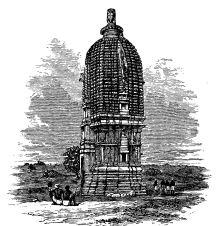
Architecturally, there is no difficulty in defining the limits of the
Dasyu province: wherever a square tower-like temple exists with a
perpendicular base, but a curvilinear outline above, such as that shown
in the woodcut on the following page, there we may feel certain of the
existence, past or present, of a people of Dasyu extraction, retaining
their purity very nearly in the direct ratio to the number of these
temples found in the district. Were it not consequently for the
difficulty of introducing new names and obtaining acceptance to what is
unfamiliar, the proper names for the style prevailing in northern India
would be Dasyu style, instead of Indo-Aryan or Dasyu-Aryan which I have
felt constrained to adopt. No one can accuse the pure Aryans of
introducing this form in India, or of building temples at all, or of
worshipping images of Siva or Vishnu, with which these temples are
filled, and they consequently have little title to confer their name on
the style. The Aryans had, however, become so impure in blood before
these temples were erected, and were so mixed up with the Dasyus, and
had so influenced their religion and the arts, that it may be better to
retain a name which sounds familiar, and does not too sharply prejudge
the question. Be this as it may, one thing seems tolerably clear, that
the regions occupied by the Aryans in India were conterminous with those
of the Dasyus, or, in other words, that the Aryans conquered the whole
of the aboriginal or native tribes who occupied the plains of northern
India, and ruled over them to such an extent as materially to influence
their religion and their arts, and also very materially to modify even
their language. So much so, indeed, that after some four or five
thousand years of domination we should not be surprised if we have some
difficulty in recovering traces of the original population, and could
probably not do so, if some fragments of the people had not sought
refuge in the hills on the north and south of the great Gangetic plain,
and there have remained fossilised, or at least sufficiently permanent
for purposes of investigation.
Sisunaga Dynasty, B.C. 691 TO 325.
Leaving these, which must, for the present at least, be considered as
practically pre-historic times, we tread on surer ground when we
approach the period when Buddha was born, and devoted his life to rescue
man from sin and suffering. There seems very little reason for doubting
that he was born in the year 623, in the reign of Bimbasara, the fifth
king of this dynasty, and died B.C. 543, at the age of eighty years, in
the eighth year of Ajattasatru, the eighth king. New sources of
information are opening out so rapidly regarding these times, that there
seems little doubt we shall before long be able to recover a perfectly
authentic account of the political events of that period, and as perfect
a picture of the manners and the customs of those days. It is too true,
however, that those who wrote the biography of Buddha in subsequent
ages so overlaid the simple narrative of his life with fables and
absurdities, that it is now difficult to separate the wheat from the
chaff; but we have sculptures extending back to within three centuries
of his death, at which time we may fairly assume that a purer tradition
and correcter version of the Scriptures must have prevailed. From what
has recently occurred, we may hope to creep even further back than this,
and eventually to find early illustrations which will enable us to
exercise so sound a criticism on the books as to enable us to restore
the life of Buddha to such an extent, as to place it among the authentic
records of the benefactors of mankind.
Immense progress has been made during the last thirty or forty years in
investigating the origin of Buddhism, and the propagation of its
doctrines in India, and in communicating the knowledge so gained to the
public in Europe. Much, however, remains to be done before the story is
complete, and divested of all the absurdities which subsequent
commentators have heaped upon it; and more must yet be effected before
the public can be rendered familiar with what is so essentially novel to
them. Still, the leading events in the life of the founder of the
religion are simple, and sufficiently well ascertained for all practical
purposes.[13]
The founder of this religion was one of the last of a long line of
kings, known as the Solar dynasties, who, from a period shortly
subsequent to the advent of the Aryans into India, had held paramount
sway in Ayodhya—the modern Oude. About the 12th or 13th century B.C.
they were superseded by another race of much less purely Aryan blood,
known as the Lunar race, who transferred the seat of power to capitals
situated in the northern parts of the Doab. In consequence of this, the
lineal descendants of the Solar kings were reduced to a petty
principality at the foot of the Himalayas, where Sakya Muni was born
about 623 B.C. For twenty-nine years he enjoyed the pleasures, and
followed the occupations, usual to the men of his rank and position; but
at that age, becoming painfully impressed by the misery incident to
human existence, he determined to devote the rest of his life to an
attempt to alleviate it. For this purpose he forsook his parents and
wife, abandoned friends and all the advantages of his position, and, for
the following fifty-one years, devoted himself steadily to the task he
had set before himself. Years were spent in the meditation and
mortification necessary to fit himself for his mission; the rest of his
long life was devoted to wandering from city to city, teaching and
preaching, and doing everything that gentle means could effect to
disseminate the doctrines which he believed were to regenerate the
world, and take the sting out of human misery.
He died, or, in the phraseology of his followers, obtained Nirvana—was
absorbed into the deity—at Kusinara, in northern Behar, in the 80th
year of his age, 543 years[14] B.C.
With the information that is now fast accumulating around the subject,
there seems no great difficulty in understanding why the mission of
Sakya Muni was so successful as it proved to be. He was born at a time
when the purity of the Aryan races in India had become so deteriorated
by the constant influx of less pure tribes from the north and west, that
their power, and consequently their influence, was fast fading away. At
that time, too, it seems that the native races had, from long
familiarity with the Aryans, acquired such a degree of civilisation as
led them to desire something like equality with their masters, who were
probably always in a numerical minority in most parts of the valley of
the Ganges. In such a condition of things the preacher was sure of a
willing audience who proclaimed the abolition of caste, and taught that
all men, of whatever nation or degree, had an equal chance of reaching
happiness, and ultimately heaven, by the practice of virtue, and by that
only. The subject races—the Turanian Dasyus—hailed him as a deliverer,
and it was by them that the religion was adopted and proclaimed, and
that of the Aryan Brahmans was for a time obliterated, or at least
overshadowed and obscured.
It is by no means clear how far Buddha was successful in converting the
multitude to his doctrines during his lifetime. At his death, the first
synod was held at Rajagriha, and five hundred monks of a superior order,
it is said, were assembled there on that occasion,[15] and if so they
must have represented a great multitude. But the accounts of this, and
of the second convocation, held 100 years afterwards at Vaisali, on the
Gunduck, have not yet had the full light of recent investigation brought
to bear upon them. Indeed the whole annals of the Naga dynasty, from the
death of Buddha, B.C. 543, to the accession of Chandragupta, 325, are
about the least satisfactory of the period. Those of Ceylon were
purposely falsified in order to carry back the landing of Vyjya, the
first conqueror from Kalinga, to a period coincident with the date of
Buddha’s death, while a period apparently of sixty years at least
elapsed between the two events. All this may, however, be safely left to
future explorers. We have annals and coins,[16] and we may recover
inscriptions and sculptures belonging to this period, and, though it is
most improbable we shall recover any architectural remains, there are
evidently materials existing which, when utilised, may suffice for the
purpose.
The kings of this dynasty seem to have been considered as of a low
caste, and were not, consequently, in favour either with the Brahman or,
at that time, with the Buddhist; and no events which seem to have been
thought worthy of being remembered, except the second convocation, are
recorded as happening in their reigns, after the death of the great
Ascetic—or, at all events, of being recorded in such annals as we
possess.
Maurya Dynasty, B.C. 325 TO 188.
The case was widely different with the Maurya dynasty, which was
certainly one of the most brilliant, and is fortunately one of the best
known, of the ancient dynasties of India. The first king was
Chandragupta, the Sandrocottus of the Greeks, to whom Megasthenes was
sent as ambassador by Seleucus, the successor of Alexander in the
western parts of his Asiatic empire. It is from his narrative—now
unfortunately lost—that the Greeks acquired almost all the knowledge
they possessed of India at that period. The country was then divided
into 120 smaller principalities, but the Maurya residing in
Palibothra—the modern Patna—seems to have exercised a paramount sway
over the whole. It was not, however, this king, but his grandson, the
great Asoka (B.C. 272 to 236), who raised this dynasty to its highest
pitch of prosperity and power. Though utterly unknown to the Greeks, we
have from native sources a more complete picture of the incidents of his
reign than of any ancient sovereign of India. The great event that made
him famous in Buddhist history was his conversion to that faith, and the
zeal he showed in propagating the doctrines of his new religion. He
did, in fact, for Buddhism, exactly what Constantine did for
Christianity, and at about the same distance of time from the death of
the founder of the faith. From a struggling sect he made it the religion
of the State, and established it on the basis on which it lasted supreme
for nearly 1000 years. In order to render his subjects familiar with the
doctrines of his new faith, he caused a series of edicts embodying them
to be engraved on rocks near Peshawur, in Gujerat, in the valley of the
Dhoon under the Himalayas, in Cuttack, and in several intermediate
places. He held the third and greatest convocation of the faithful in
his capital at Patna, and, on its dissolution, sent missionaries to
spread the faith in the Yavana country, whose capital was Alexandria,
near the present city of Cabul. Others were despatched to Kashmir and
Gandhara; one was sent to the Himawanta—the valleys of the Himalaya,
and possibly part of Thibet; others were despatched to the Maharatta
country, and to three other places in Central and Western India which
have not yet been identified with certainty. Two missionaries were sent
to the Souverna Bhumi, a place now known as Thatun on the Sitang river,
in Pegu, and his own son and daughter were deputed to Ceylon.[17] All
those countries, in fact, which might be called foreign, but which were
inhabited by races who might in any way be supposed to be allied to the
Dasyus of Bengal, were then sought to be converted to the faith. He also
formed alliances with Antiochus the Great, Antigonus, and with Ptolemy
Philadelphus, and Magas of Cyrene, for the establishment of hospitals
and the protection of his co-religionists in their countries. More than
all this, he built innumerable topes and monasteries all over the
country; and, though none of those now existing can positively be
identified as those actually built by him, there seems no reason
whatever for doubting that the sculptured rails at Buddh Gaya and
Bharhut, the caves at Bharabar in Behar, some of those at Udyagiri in
Cuttack, and the oldest of those in the Western Ghâts were all erected
or excavated during the existence of this dynasty, if not by him
himself. These, with inscriptions and coins, and such histories as
exist, make up a mass of materials for a picture of India during this
dynasty such as no other can present; and, above all, they offer a
complete representation of the religious forms and beliefs of the kings
and people, which render any mistake regarding them impossible. It was
Buddhism, but without a personal Buddha, and with Tree and Serpent
worship cropping up in every unexpected corner.
There is certainly no dynasty in the whole range of ancient Indian
history that would better repay the labour of an exhaustive
investigation than that of these Maurya kings. Not only were they the
first in historical times who, so far as we know, united the whole of
India into one great kingdom, but they were practically the first who
came in contact with European civilisation and Western politics. More
than even this, it is probably owing to the action of the third king of
this dynasty that Buddhism, from being the religion of an obscure sect,
became, at one time, the faith of a third of the human race, and has
influenced the belief and the moral feelings of a greater number of men
than any other religion that can be named.
Fortunately, the materials for such a monograph as is required are
abundant, and every day is adding to them. It is to this dynasty, and to
it only, that must be applied all those passages in classical authors
which describe the internal state of India, and they are neither few nor
insignificant. Though the Hindus themselves cannot be said to have
contributed much history, they have given us, in the ‘Mudra
Rakshasa,’[18] a poetical version of the causes of the revolution that
placed the Mauryas on the throne. But, putting these aside, their own
inscriptions give us dates, and a perfectly authentic contemporary
account of the religious faith and feelings of the period; while the
numerous bas-reliefs of the rails at Buddh Gaya and Bharhut afford a
picture of the manners, customs, and costumes of the day, and a gauge by
which we can measure their artistic status and judge how far their art
was indigenous, how far influenced by foreign elements. The dates of the
kings of this dynasty are also perfectly well known,[19] and the whole
framework of their history depends so completely on contemporary native
monuments, that there need be no real uncertainty regarding any of the
outlines of the picture when once the subject is fairly grasped and
thoroughly handled.
It is the firmest standpoint we have from which to judge of Indian
civilisation and history, whether looking to the past or to the future,
and it is one that gives a very high idea of the position at which the
Hindus had arrived before they came practically into contact with the
civilisation of the West.
Sunga Dynasty, B.C. 188 TO 76.
Kanwa Dynasty, B.C. 76 TO 31.
History affords us little beyond the dates of the kings’ reigns for the
next two dynasties, but there seems no reason to doubt the general
correctness with which these are recorded in the Puranas, and by degrees
we are collecting inscriptions and finding caves that certainly belong
to their time, so that we may hope to breathe life into what has
hitherto appeared only a dry list of names. Such inscriptions as bear
their names have yet only been discovered on the western caves at Karli,
Nassick, and similar places, but there seems no reason for doubting that
they reigned also in Magadha, and, if so, over Orissa, so that we may
look for further information regarding them on the eastern as well as on
the western side of India. These dynasties were not, however, apparently
known to the Greeks, and, being Buddhist, are passed over in comparative
silence in the Puranas. It is thus only from their monuments that we can
hope to recover their history. Up to the present time, those identified
as belonging to them are few and far between, but they have not yet been
systematically searched for, and till this is done there is no reason to
despair of ultimate success.
Andra Dynasty, B.C. 31 TO A.D. 429.
The dynasty that succeeded to these Rois fainéants is—after the
Mauryas—the most important of all those about this period of Indian
history. To the classical authors they are known as the Andræ, in the
Puranas as Andrabrityas, and in the inscriptions as Satakarnis or
Satavahanas; but under whatever name, notwithstanding occasional periods
of depression, they played a most important part in the history of
India, during more than four centuries and a half. Latterly they have
been very much overlooked in consequence of their leaving no coins
behind them, while it is from numismatic researches, principally, that
precision has been given to much of the history of the period. The
dynasties in India, however, who practically introduced coinage within
her limits, all came across the Indus as strangers bringing with them an
art they had learnt from the Bactrians, or those who succeeded them in
the north-west. The Andras, being a native dynasty of Central India, had
no coinage of importance, and have consequently no place in these
numismatic researches; they have, however, left many and most
interesting inscriptions in the western caves, and traces of their
existence occur in many parts of India.
Architecturally, their history begins with the gateways of the Tope at
Sanchi; the southern or oldest of these was almost certainly erected
during the reign of the first Satakarni in the first quarter of the 1st
century—while Christ was teaching at Jerusalem—and the other three in
the course of that century. It ends with the completion of the rail at
Amravati, which with almost equal certainty was commenced in the first
quarter of the 4th century, and completed about A.D. 450.[20]
Between these two monuments there is no great difficulty in filling up
the architectural picture from the caves, at Nassick and Ajunta, and
other places in western India, and more materials will no doubt
eventually be discovered.
The history of this dynasty is more than usually interesting for our
purposes, as it embraces nearly the whole period during which Buddhism
reigned almost supreme in India. It became the state religion, it is
true, two centuries earlier under Asoka, but there is no reason for
believing that the Vedic religion or Brahmanism vanished immediately.
During the first four centuries, however, of the Christian Era we have
not a trace of a Hindu building or cave, and, so far as any material
evidence goes, it seems that Buddhism at the time was the religion of
the land. It cannot, of course, be supposed that the Hindu faith was
wholly obliterated, but it certainly was dormant, and in abeyance, and,
to use a Buddhist expression, the yellow robes shone over the length and
breadth of the land.
It was during the reign of these Andras, though not by them, that the
fourth convocation was held by Kanishka, in the north of India, and the
new doctrine, the Mahayana, introduced by Nagárjuna—a change similar to
that made by Gregory the Great when he established the Church, as
opposed to the primitive forms of Christianity, at about the same
distance of time from the death of the founder of the religion. My
impression is, that this convocation was held in the last quarter of the
first century of our era, probably 79. Certain at least it is, that it
was about that time that Buddhism was first practically introduced into
China, Thibet, and Burmah, and apparently by missionaries sent out from
this as they were from the third convocation.
It was towards the end of the reign of the Andras that Fa Hian visited
India (A.D. 400). As his objects in doing so were entirely of a
religious nature, he does not allude to worldly politics, nor give us a
king’s name we can identify; but the picture we gather from his
narrative is one of peace and prosperity in so far as the country is
concerned, and of supremacy for his religion. Heretics are, it is true,
mentioned occasionally, but they are few and far between. Buddhism was
then certainly the religion of the north, especially in the north-west
of India; but even then there were symptoms of a change, in the central
provinces and outlying parts of the country.
Guptas, 319 TO 465.
Ballabhis, 465 TO 712 (?).
At the time when Fa Hian was visiting the sacred places in India, the
power of the Andra dynasty was passing away. It had culminated with
Gautamiputra (312 to 333), and they were fast sinking into a
second-class position among Indian princes. The dynasty that superseded
them was that of the Guptas, who, at the end of the fourth century of
our era, seem to have attained to the position of lords paramount in
northern India. They date their inscriptions, which are numerous and
interesting, from an era established by the Andra king Gautamiputra,
four cycles of 60 years each, or 240 years after the Saka era of A.D.
79, or in 319; but it was not apparently till under the third king,
Samudra, about 380, that they really obtained the empire of northern
India, which they retained till the death of Skandagupta, about the year
465, or it may be a little later.
It is during their reign that we first perceive in high places the germs
of that change which was gradually creeping over the religious system of
India. That the Guptas were patrons of Buddhism is evident from the
gifts Chandragupta II. made to the tope at Sanchi in the year 400, and
recorded on the rail of that Monument, but their other inscriptions, on
the lâts at Allahabad and Bhitari, show a decided tendency towards
Hinduism, but a class of Hinduism which was still far removed from the
wild extravagances of the Puranas. There seems little doubt that the
boar at Erun, and the buildings there, belong to this dynasty, and are
consequently among the earliest if not the very oldest temples in India,
dedicated to the new religion, which was then raising its head in
defiance to Buddhism.
From their coins and inscriptions, we may feel certain that the Guptas
possessed when in the plenitude of their power the whole of northern
India with the province of Gujerat, but how far the boasts of Samudra
Gupta on the Allahabad pillar were justified is by no means clear. If
that inscription is to be believed, the whole of the southern country as
far as Ceylon, together with Assam and Nepal, were subject to their
sway. However brilliant it may have been, their power was of short
duration. Gujerat and all the western provinces were wrested from them
by the Ballabhis, about the year 465, and a new kingdom then founded by
a dynasty bearing that name, which lasted till the great catastrophe,
which about two and a half centuries afterwards revolutionised India.
Ujjain Dynasty.
Although it was becoming evident in the time of the Guptas that a change
was creeping over the religious belief of India, it was not then that
the blow was struck which eventually proved fatal, but by a dynasty
which succeeded them in Central India. Being Hindus, we know less that
is authentic about their history than about the Buddhist dynasties, who
lived to inscribe their names on rocks and in caves; but there seems
very little doubt that the great Vicramaditya reigned in Malwa from 495
to 530, though the Hindus, in order to connect his name with an era they
thought fit to establish 56 years B.C., have done all they can to
mystify and obscure the chronology of the period. Notwithstanding this,
it seems perfectly clear that about this time there reigned in central
India a king who, by his liberality and magnificence, acquired a renown
among the Hindus, only second to that obtained by Solomon among the
Jews. By his patronage of literature and his encouragement of art, his
fame spread over the length and breadth of the land, and to this day his
name is quoted as the symbol of all that is great and magnificent in
India. What is more to our present purpose, he was an undoubted patron
of the Brahmanical religion, a worshipper of Siva and Vishnu, and no
tradition associates his name directly or indirectly with anything
connected with Buddhism. Unfortunately we have no buildings which can be
attributed to him, and no inscriptions. But the main fact of a
Brahmanical king reigning and acquiring such influence in Central India
at that time is only too significant of the declining position of the
Buddhist religion at that period.
His successor, Siladitya, seems to have returned to the old faith, and
during his long reign of sixty years to have adhered to the Buddhist
doctrines.
In the beginning of the next century, after a short period of anarchy,
we find a second Siladitya seated on the throne of Canouge as lord
paramount in India, and, during a prosperous reign of thirty-eight to
forty years, exercising supreme sway in that country. It was during his
reign that the Chinese pilgrim, Hiouen Thsang visited India, and gave a
much more full and graphic account of what he saw than his predecessor
Fa Hian. Nothing can be more characteristic of the state of religious
feeling, and the spirit of toleration then prevailing, than the fête
given by this king at Allahabad in the year 643, at which the kings of
Ballabhi and Kamarupa (Assam) were present. The king being himself a
Buddhist, the first days were devoted to the distribution, among the
followers of that religion, of the treasures accumulated during the
previous five years, but then came the turn of the Brahmans, who were
treated with equal honour and liberality; then followed the fête of the
other sects, among whom the Jains appear conspicuous. All were feasted
and fêted, and sent away laden with gifts and mementos of the
magnificence and liberality of the great king.
Pleasant as this picture is to look upon, it is evident that such a
state of affairs could hardly be stable, and it was in vain to expect
that peace could long be maintained between a rising and ambitious sect,
and one which was fast sinking into decay; apparently beneath the load
of an overgrown priesthood. Accordingly we find that ten years after the
death of Siladitya troubles supervened as prophesied,[21] and the
curtain soon descends on the great drama of the history of northern
India, not to be raised again for nearly three centuries. It is true, we
can still follow the history of the Ballabhis for some little time
longer, and it would be satisfactory if we could fix the date of their
destruction with precision, as it was the event which in the Hindu mind
is considered the closing act of the drama. If it was destroyed by a
foreign enemy, it must have been by the Moslem, either before or during
the time Mohammed Kasim, A.H. 712, 713. It was a flourishing city in
640, when visited by Hiouen Thsang, and from that time, till the death
of Kasim, the Moslems were in such power on the Indus, and their
historians tell us the events of these years in such detail, that no
other foreigner could have crossed the river during that period. If it
perished by some internal revolution of convulsion, which is more
probable, it only shared the fate that overtook all northern India about
this period. Strange to say, even the Moslems, then in the plenitude of
their power during the Khalifat of Bagdad, retired from their Indian
conquests, as if the seething cauldron were too hot for even them to
exist within its limits.
The more southern dynasty of the Chalukyas of Kalyan seem to have
retained their power down to about 750, and may, up to that time, have
exercised a partial sway to the north of the Nerbudda, but after that we
lose all sight of them; while, as a closing act in the great drama, the
Raja Tarangini represents the King of Kashmir—Lalitaditya—as
conquering India from north to south, and subjecting all the five
kingdoms, into which it was nominally divided, to his imperious sway.
We need not stop now to inquire whether this was exactly what happened
or not. It is sufficient for present purposes to know that about the
middle of the 8th century a dark cloud settled over the north of India,
and that during the next two centuries she was torn to pieces by
internal troubles, which have left nothing but negative evidence of
their existence. During that period no event took place of which we have
any record; no dynasty rose to sufficient distinction to be quoted even
in the lists of the bard; no illustrious name appears whose acts have
been recorded; no buildings were erected of which we have a trace;[22]
and but few inscriptions engraved. Dark night seems to have settled
over the land, and whether we shall ever be able to penetrate into its
mysteries seems more than doubtful.
When light again appears in the middle of the 10th century the scene is
wonderfully changed. Buddhism had practically disappeared in the north
and west at least, though it still lingered on in Bengal, and Jainism
had supplanted it in most places; but the mass of the people had become
followers of Vishnu or Siva. New dynasties had arisen which, though they
try to trace their lineage back to the troublous times when Ballabhi
fell, were new to Indian history. Old India had passed away, and the
history of modern India was about to open. The old dynasties had become
extinct, and the Rajput races were gaily stepping forward to assume
their places—too soon, alas! to be engaged in a life or death struggle
with the most implacable foe to their race and religion that India has
ever known. It was a cruel Nemesis that their victories over the
Buddhists should soon have been followed by the fatal siege at Somnath
in 1024, and the fight on the banks of the Ghaghar in 1193, which
practically laid India at the feet of the Moslem invader, and changed
the whole course of her subsequent career. But, as hinted above, with
the appearance of the Moslem on the scene, our chronological
difficulties cease, and the subject need not therefore be further
pursued in this introduction.
IMMIGRATIONS.
From the above brief sketch of ancient Indian history it may be gathered
that it is doubtful whether we shall ever be able to clothe with solid
flesh the skeleton of history which is all we possess anterior to the
advent of Buddha. It is also possible that pious frauds may have so
confused the sequence of events between his death and the rise of the
Mauryas, that there will be great difficulty in restoring that period to
anything like completeness. But for the thousand years that elapsed
between “the revenge of Chanakya” and the fall of Ballabhi the materials
are ample, and when sufficient industry is applied to their elucidation
there is little doubt that the whole may be made clear and intelligible.
It does not fall within the scope of this work to attempt such a task;
but it is necessary to endeavour to make its outlines clear, as, without
this being done, what follows will be utterly unintelligible; while, at
the same time, one of the principal objects of this work is to point out
how the architecture, which is one important branch of the evidence, may
be brought to bear on the subject.
No direct evidence, however, derived only from events that occurred in
India itself, would suffice to make the phenomena of her history clear,
without taking into account the successive migrations of tribes and
peoples who, in all ages, so far as we know, poured across the Indus
from the westward to occupy her fertile plains.
As mentioned above, the great master fact that explains almost all we
know of the ancient history of India is our knowledge that two or three
thousand years before the birth of Christ a Sanscrit-speaking nation
migrated from the valleys of the Oxus and Jaxartes. They crossed the
Indus in such numbers as to impress their civilisation and their
language on the whole of the north of India, and this to such an extent
as practically to obliterate, as far as history is concerned, the
original inhabitants of the valley of the Ganges, whoever they may have
been. At the time when this migration took place the power and
civilisation of Central Asia were concentrated on the lower Euphrates,
and the Babylonian empire never seems to have extended across the
Carmanian desert to the eastward. The road, consequently, between
Bactria and India was open, and nations might pass and re-pass between
the two countries without fear of interruption from any other people.
If any of the ancient dynasties of Babylonia extended their power
towards the East, it was along the coast of Gedrosia, and not in a
north-easterly direction. It is, indeed, by no means improbable, as
hinted above, that the origin of the Dravidians may be found among the
Accadian or in some of the Turanian peoples who occupied southern
Babylonia in ancient times, and who may, either by sea or land, have
passed to the western shores of India. Till, however, further
information is available, this is mere speculation, though probably in
the direction in which truth may hereafter be found.
When the seat of power was moved northward to Nineveh, the Assyrians
seem to have occupied the country eastward of the Caspian in sufficient
force to prevent any further migration. At least, after that time—say
B.C. 1000—we have no further trace of any Aryan tribe crossing the
Indus going eastward, and it seems mainly to have been a consequence of
this cutting off of the supply of fresh blood that the purity of their
race in India was so far weakened as to admit of the Buddhist reform
taking root, and being adopted to the extent it afterwards attained.
During the period of the Achemænian sway, the Persians certainly
occupied the countries about the Oxus in sufficient strength to prevent
any movement of the peoples. So essentially indeed had Bactria and
Sogdiana become parts of the Persian empire, that Alexander was obliged
to turn aside from his direct route to conquer them, as well as the rest
of the kingdom of Darius, before advancing on India.
Whether it were founded for that purpose or not, the little Greek
kingdom of Bactria was sufficiently powerful, while it lasted, to keep
the barbarians in check; but when about the year 127-126 B.C., the
Yuechi and other cognate tribes invaded Sogdiana, and finally about 120
B.C. conquered the whole of Bactria,[23] they opened a new chapter in
the history of India, the effects of which are felt to the present day.
It is not yet quite clear how soon after the destruction of the Bactrian
kingdom these Turanian tribes conquered Cabul, and occupied the country
between that city and the Indus. Certain it is, however, that they were
firmly seated on the banks of that river before the Christian Era, and
under the great king Kanishka had become an Indian power of very
considerable importance. The date of this king is, unfortunately, one of
those small puzzles that still remain to be solved. Generally, it is
supposed he reigned till about twenty to forty years after Christ.[24]
Evidence, however, has lately been brought to light, which seems to
prove that he was the founder of the Saka era, A.D. 79, and that his
reign must be placed in the last quarter of the first century of our
era, instead of in the earlier half.[25]
Be this as it may, it seems quite certain that the power of these
Turuska kings spread over the whole Punjab, and extended as far at least
as Muttra on the Jumna, in the first century of the Christian Era.
At the same time another horde, known to us only from the coins and
inscriptions in which they call themselves Sahs or Sah kings, crossed
the Indus lower down, and occupied the whole of the province of Gujerat.
It is not quite clear whether the first of them, Nahapana, was only the
Viceroy of one of these northern kings—probably of Kanishka
himself—though he and his successors afterwards became independent, and
founded a kingdom of their own. They seem to date their coins and
inscriptions from the Saka era, A.D. 79, and the series extends from
that date to A.D. 349, or at latest to 371.[26] It thus happens that
though Gautamiputra, the Andra king (312-333), boasts of having humbled
them,[27] they were only in fact finally disposed of by the rise of the
Guptas.
No other foreign race, so far as we know, seems to have crossed the
Lower Indus into India. But the whole external history of northern
India, from the time of Kanishka to that of Ahmed Shah Durani (1761) is
a narrative of a continuous succession of tribes of Scythian origin,
pouring across the Upper Indus into India, each more Turanian than the
one that preceded it, till the whole culminated in the Mogul conquest of
India, in the 15th century, by a people as distinct in blood from the
Aryans as any that exist.
Of the older races, it seems probable that the Yavanas must be
distinguished from the Turanians. It will hardly now be contended that
they were pure Greeks, though their name may be merely a
mispronunciation of Ionian. The term seems to have been applied by
Indian authors to any foreign race coming from the westward who did not
belong to one of the acknowledged kingdoms known to them. As such it
would apply to any western adventurers, who during the existence of the
Bactrian kingdom sought to establish settlements in any part of India,
and would also apply to the expatriated Bactrians themselves when driven
from their homes by the Yuechi, 120 or 130 years B.C. It is only in this
sense that we can explain their presence in Orissa before and about the
Christian Era, but in the west the term may have been more loosely
applied. The Cambojas seem to have been a people inhabiting the country
between Candahar and Cabul, who, when the tide was setting eastward,
joined the crowd, and sought settlements in the more fertile countries
within the Indus.
The Sakas were well known to classical authors as the Sacæ, or
Scythians. They pressed on with the rest, and became apparently most
formidable during the first four centuries of the Christian Era. It was
apparently their defeat by the great Vicramaditya in the battle at
Korûr, on the banks of the Indus, A.D. 524 or 544, that raised the
popularity of that monarch to its highest pitch, and induced the Hindus
at a subsequent age to institute the era known by his name 600 years
before his time, and another called by his other name, Sri Harsha, 1000
years before the date of the battle of Korûr.[28]
Another important horde were the Ephthalites, or White Huns, who came
into India apparently in the 4th century, and one of whose kings, if we
may trust Cosmas Indicopleustes, was the head of a powerful state in
northern India, about the year 535. They, too, seem to have been
conquered about the same time by the Hindus, and, as both the Sakas and
Hunas were undoubtedly Buddhists, it may have been their destruction
that first weakened the cause of that religion, and which led to its
ultimate defeat a little more than a century afterwards.
During the dark ages, 750 to 950, we do not know of any horde passing
the Indus. The Mahomedans were probably too strong on the frontier to
admit of its being done, and after that age they—and they
only—conducted the various invasions which completely changed the face
and character of northern India. For seven centuries they were
continued, with only occasional interruptions, and at last resulted in
placing the Mahomedan power supreme, practically, over the whole of
India, but only to fall to pieces like a house of cards, before the
touch of Western civilisation. All this, however, is written, and
written so distinctly, in so many books, that it need not be
recapitulated here.
Southern India.
If the records of the ancient history of northern India are
unsatisfactory and untrustworthy, those of the southern part of the
peninsula are at least ten times more so. The Dravidians have no ancient
literature like that of the Vedas. They have no traditions which point
to any seat of their race out of India, or of their having migrated from
any country with whose inhabitants they can claim any kindred. So far as
they know, they are indigenous and aboriginal. The utmost extent to
which even their traditions extend is to claim for their leading race of
kings—the Pandyas—a descent from Arjuna, one of the heroes of the
‘Mahabharata.’ He, it is said, when on his travels, married a princess
of the land, and she gave birth to the eponymous hero of their race, and
hence their name. It is true, indeed, that they produce long lists of
kings, which they pretend stretch back till the times of the Pandus.
These were examined by the late Professor Wilson in 1836, and he
conjectured that they might extend back to the 5th or 6th century before
our era.[29] But all that has since come to light has tended to show
that even this may be an over-estimate of their antiquity. If, however,
as Dr. Kern believes, the Choda, Pada, and Keralaputra of the second
edict of Asoka do really represent the Cholas, Pandyas, Cheras, of
modern times, this triarchy existed in the third century B.C.; but there
are difficulties in the way of this identification which have not yet
been removed. In fact, all we really do know is that, in classical
times, there was a Regio Pandionis in the country afterwards known as
the Pandyan kingdom of Madura, and it has been conjectured that the king
who sent an embassy to Augustus in 27 B.C.[30] was not a Porus, which
would indicate a northern race, but this very king of the south. Be
this, however, as it may, we do know, by the frequent mention of this
country by classical authors, that it was at least sufficiently
civilised in the early centuries of our era to carry on a considerable
amount of commerce with the western nations, and there is consequently
no improbability that at least one powerful dynasty may then have been
established in the south. If so, that dynasty was certainly the Pandyan.
The Chola and the Chera became important states only at a much later
date.
When we turn to their literature we find nothing to encourage any hope
that we may penetrate further back into their history than we have
hitherto been able to do. Dr. Caldwell, the best and latest authority on
the subject, ascribes the oldest work in the Tamil, or any southern
language, to the 8th or 9th century of our era,[31] and that even then
can hardly be called native, as it undoubtedly belongs to the Jains, who
are as certainly a northern sect. According to the same authority, it
was superseded by a Vaishnava literature about the 12th or 13th century,
and that again made way for one of Saiva tendency about the latter date.
There is no trace of any Buddhist literature in the south, and nothing,
consequently, that would enable us to connect the history of the south
with the tolerably well-ascertained chronology of Ceylon or Northern
India, nor am I aware of the existence of any ancient Buddhist monuments
in the south which would help us in this difficulty.[32]
Not having passed through Bactria, or having lived in contact with any
people making or using coins, the Dravidians have none of their own, and
consequently that source of information is not available. Whatever
hoards of ancient coins have been found in the Madras Presidency have
been of purely Roman origin, brought there for the purpose of trade, and
buried to protect them from spoliation.
The inscriptions, which are literally innumerable all over the
Presidency, are the one source from which we can hope that new light may
be thrown on the history of the country, but none of those hitherto
brought to light go further back than the 5th or 6th century, and it is
not clear that earlier ones may be found.[33] It is, at all events, the
most hopeful field that lies open to future explorers in these dark
domains. There is nothing, however, that would lead us to expect to find
any Tamil or native inscription in the country extending so far back as
the age of Constantine. Those on the raths at Mahavellipore, or the
caves at Badami, which may be as old as the age of Justinian, are in
Sanscrit, and consequently look more like an evidence of the northern
races pushing southward than of the southern races extending themselves
northward, or being sufficiently advanced in civilisation to erect for
themselves the monuments on which these inscriptions are found.
From a study of the architecture of the south we arrive at precisely the
same conclusions as to the antiquity of Dravidian civilisation that Dr.
Caldwell arrived at from a study of their literature. The only important
Buddhist monument yet discovered in the Presidency is that at Amravati,
on the Kistnah,[34] but that is avowedly a foreign intrusion. It was a
colony or settlement formed by the northern Buddhists at or near their
port of departure for Java and their eastern settlements. The rock-cut
temples at Mahavellipore and Badami seem to be the works of northern
Hindus advancing southward in the 5th or 6th century, and engraving the
evidence of their religion on the imperishable rock. So far as is yet
known, no indigenous native temple has been brought to light, built by
any native king, or with inscriptions in any southern tongue, whose date
can be carried further back than the 8th century. From that time forward
their building activity was enormous. The style culminated in the 16th
and 17th centuries, to perish in the 18th, under the influence of a
foreign and unsympathetic invader. It is, however, by no means
impossible that future investigation may enable us to fill up a portion
at least of the gap that exists between the 5th and the 8th century.
There may be buildings yet undescribed which are older than any we now
know. But if they do carry us back to the 5th century, which is more
than can reasonably be expected, they are still seven or eight centuries
behind what we know for certainty to have existed in the north. There we
have buildings and caves certainly, extending back to B.C. 250, and it
seems by no means impossible that with sculptures, coins, and
inscriptions, and written documents, we may some day be able to bridge
over the gulf that exists between the death of Buddha and the accession
of the Mauryas. In other words, the materials for history in the North
of India carry us back with the same relative degree of certainty for
more than a thousand years beyond what those found in the south enable
us to trace of her history or her arts.
When the history of the south does acquire something like consistency it
takes the form of a triarchy of small states. The eldest and most
important, that of Mádura—so called after Muttra on the Jumna—was also
the most civilised, and continued longest as a united and independent
kingdom.
The Chola rose into power on the banks of the Cauvery, and to the
northward of it, about the year 1000, though no doubt they existed as a
small state about Conjeveram for some centuries before that time. The
third, the Chera, were located in the southern Mysore country, and
probably extending to the coast as early as the 4th or 5th century, and
gradually worked their way northward, and became so powerful that there
is reason for believing that during the dark ages of the north (750 to
950) their power extended to the Nerbudda, and it may be to them that we
owe the Kylas and other excavations at Ellora, erected in the southern
style about that time. They were, however, superseded, first by the
Cholas, about A.D. 1000, and finally eclipsed by the Hoisala Bellalas, a
century or so afterwards. These last became the paramount power in the
south, till their capital—Hullabîd—was taken, and their dynasty
destroyed by the Mahomedan, in the year 1310.
With the appearance of the Mahomedans on the scene the difficulties of
Indian chronology disappear in the south, as well as in the north. From
that time forward the history of India is found in such works as those
written by Ferishta or Abul Fazl, and has been abstracted and condensed
in numerous works in almost every European language. There are still, it
must be confessed, slight discrepancies and difficulties about the
sequence of some events in the history of the native principalities.
These, however, are not of such importance as at all to affect, much
less to invalidate, any reasoning that may be put forward regarding the
history or affinities of any buildings, and this is the class of
evidence which principally concerns what is written in the following
pages.
Sculptures.
In order to render the subject treated of in the following pages quite
complete, it ought, no doubt, to be preceded by an introduction
describing first the sculpture and then the mythology of the Hindus in
so far as they are at present known to us. There are in fact few works
connected with this subject more wanted at the present day than a good
treatise on these subjects. When Major Moor published the ‘Hindu
Pantheon’ in 1810, the subject was comparatively new, and the materials
did not exist in this country for a full and satisfactory illustration
of it in all its branches. When, in 1832, Coleman published his
‘Mythology of the Hindus,’ he was enabled from the more recent
researches of Colebroke and Wilson, to improve the text considerably,
but his illustrations are very inferior to those of his predecessor.
Moor chose his from such bronzes or marbles as existed in our museums.
Coleman’s were generally taken from modern drawings, or the tawdry
plaster images made for the Durga puja of Bengali Babus. By the aid of
photography any one now attempting the task would be able to select
perfectly authentic examples from Hindu temples of the best age. If this
were done judiciously, and the examples carefully engraved, it would not
only afford a more satisfactory illustration of the mythology of the
Hindus than has yet been given to the public, but it might also be made
a history of the art of sculpture in India, in all the ages in which it
is known to us. It is doubtful, however, whether such a work could be
successfully carried through in this country at the present day. The
photographs that exist of the various deities have generally been taken
representing them only as they appear as ornaments of the temples,
without special reference to their mythological character. They are
sufficient to show what the sculptor intended, but not so detailed as to
allow all their emblems or characteristics being distinctly perceived.
To be satisfactory as illustrations of the mythology, it is
indispensable that these points should all be made clear. At the same
time it is to be feared that there is hardly any one in this country so
familiar with all the details of emblems and symbols as to be able to
give the exact meaning of all that is represented. It would require the
assistance of some Pandit brought up in the faith, and who is familiar
with the significance of all the emblems, to convey to others the true
meaning of these innumerable carvings. In India it could easily be
accomplished, and it is consequently hoped it may before long be
attempted there.
From its very nature, it is evident that sculpture can hardly ever be so
important as architecture as an illustration of the progress of the
arts, or the affinities of nations. Tied down to the reproduction of the
immutable human figure, sculpture hardly admits of the same variety, or
the same development, as such an art as architecture, whose business it
is to administer to all the varied wants of mankind and to express the
multifarious aspirations of the human mind. Yet sculpture has a history,
and one that can at times convey its meaning with considerable
distinctness. No one, for instance, can take up such a book as that of
Cicognara,[35] and follow the gradual development of the art as he
describes it, from the first rude carvings of the Byzantine school, till
it returned in the present day to the mechanical perfection of the old
Greek art, though without its ennobling spirit, and not feel that he
has before him a fairly distinct illustration of the progress of the
human mind during that period. Sculpture in India may fairly claim to
rank, in power of expression, with mediæval sculpture in Europe, and to
tell its tale of rise and decay with equal distinctness; but it is also
interesting as having that curious Indian peculiarity of being written
in decay. The story that Cicognara tells is one of steady forward
progress towards higher aims and better execution. The Indian story is
that of backward decline, from the sculptures of the Bharhut and
Amravati topes, to the illustrations of Coleman’s ‘Hindu Mythology.’
When Hindu sculpture first dawns upon us in the rails at Buddh Gaya, and
Bharhut, B.C. 200 to 250, it is thoroughly original, absolutely without
a trace of foreign influence, but quite capable of expressing its ideas,
and of telling its story with a distinctness that never was surpassed,
at least in India. Some animals, such as elephants, deer, and monkeys,
are better represented there than in any sculptures known in any part of
the world; so, too, are some trees, and the architectural details are
cut with an elegance and precision which are very admirable. The human
figures, too, though very different from our standard of beauty and
grace, are truthful to nature, and, where grouped together, combine to
express the action intended with singular felicity. For an honest
purpose-like pre-Raphaelite kind of art, there is probably nothing much
better to be found elsewhere.
The art certainly had declined when the gateways at Sanchi were executed
in the first century of the Christian Era. They may then have gained a
little in breadth of treatment, but it had certainly lost much in
delicacy and precision. Its downward progress was then, however,
arrested, apparently by the rise in the extreme north-west of India of a
school of sculpture strongly impregnated with the traditions of
classical art. It is not yet clear whether this arose from a school of
art implanted in that land by the Bactrian Greeks, or whether it was
maintained by direct intercourse with Rome and Byzantium during the
early centuries of the Christian Era. Probably both causes acted
simultaneously, and one day we may be able to discriminate what is due
to each. For the present it is sufficient to know that a quasi-classical
school of sculpture did exist in the Punjab, and to the west of the
Indus during the first five centuries after Christ, and it can hardly
have flourished there so long, without its presence being felt in India.
Its effects were certainly apparent at Amravati in the 4th and 5th
centuries, where a school of sculpture was developed, partaking of the
characteristics of both those of Central India and of the west. Though
it may, in some respects, be inferior to either of the parent styles,
the degree of perfection reached by the art of sculpture at Amravati
may probably be considered as the culminating point attained by that art
in India.
When we meet it again in the early Hindu temples, and later Buddhist
caves, it has lost much of its higher æsthetic and phonetic qualities,
and frequently resorts to such expedients as giving dignity to the
principal personages by making them double the size of less important
characters, and of distinguishing gods from men by giving them more
heads and arms than mortal man can use or understand.
All this is developed, it must be confessed, with considerable vigour
and richness of effect in the temples of Orissa and the Mysore, down to
the 13th or 14th century. After that, in the north it was checked by the
presence of the Moslems; but, in the south, some of the most remarkable
groups and statues—and they are very remarkable—were executed after
this time, and continued to be executed, in considerable perfection down
to the middle of the last century.
As we shall see in the sequel, the art of architecture continues to be
practised with considerable success in parts of India remote from
European influence; so much so, that it requires a practised eye to
discriminate between what is new and what is old. But the moment any
figures are introduced, especially if in action, the illusion vanishes.
No mistake is then possible, for the veriest novice can see how
painfully low the art of sculpture has fallen. Were it not for this,
some of the modern temples in Gujerat and Central India are worthy to
rank with those of past centuries; but their paintings and their
sculptured decorations excite only feelings of dismay, and lead one to
despair of true art being ever again revived in the East.
To those who are familiar with the principles on which these arts are
practised, the cause of this difference is obvious enough. Architecture
being a technic art, its forms may be handed down traditionally, and its
principles practised almost mechanically. The higher phonetic arts,
however, of sculpture and painting admit of no such mechanical
treatment. They require individual excellence, and a higher class of
intellectual power of expression, to ensure their successful
development. Architecture, may, consequently, linger on amidst much
political decay; but, like literature, the phonetic arts can only be
successfully cultivated where a higher moral and intellectual standard
prevails than, it is feared, is at present to be found in India.
Mythology.
Whenever any one will seriously undertake to write the history of
sculpture in India, he will find the materials abundant and the sequence
by no means difficult to follow; but, with regard to mythology, the case
is different. It cannot, however, be said that the materials are not
abundant for this branch of the inquiry also; but they are of a much
less tangible or satisfactory nature, and have become so entangled, that
it is extremely difficult to obtain any clear ideas regarding them; and
it is to be feared they must remain so, until those who investigate the
subject will condescend to study the architecture and the sculpture of
the country as well as its books. The latter contain a good deal, but
they do not contain all the information available on the subject, and
they require to be steadied and confirmed by what is built or carved,
which alone can give precision and substance to what is written.
Much of the confusion of ideas that prevails on this subject no doubt
arises from the exaggerated importance it has of late years been the
fashion to ascribe to the Vedas, as explaining everything connected with
the mythology of the Hindus. It would, indeed, be impossible to
over-estimate the value of these writings from a philological or
ethnological point of view. Their discovery and elaboration have
revolutionised our ideas as to the migrations of races in the remote
ages of antiquity, and establish the affiliation of the Aryan races on a
basis that seems absolutely unassailable; but it cannot be too strongly
insisted upon that the Aryans are a race of strangers in India, distinct
from the Indian people themselves. They may, as hinted above, have come
into India some three thousand years before Christ, and may have
retained their purity of blood and faith for two thousand years; but
with the beginning of the political Kali Yug—or, to speak more
correctly, at the time of the events detailed in the ‘Mahabharata,’ say
1200 years B.C.—they had lost much of both; while every successive wave
of immigration that has crossed the Indus during the last three thousand
years has impaired the purity of their race. From this cause, and from
their admixture with the aborigines, it may probably be with confidence
asserted that there is not now five per cent.—perhaps not one—of pure
Aryan blood in the present population of India, nor, consequently, does
the religion of the Vedas constitute one-twentieth part of the present
religion of the people.
Though this may be absolutely so, it must not be overlooked that there
are few things more remarkable, as bearing on this subject, than the
extraordinary intellectual superiority of the Aryans over the Dasyus, or
whatever we may call the people they found in India when they entered
it. This superiority was sufficient to enable them to subdue the
country, though they were probably infinitely inferior in numbers to the
conquered people, and to retain them in subjection through long ages of
time. Even now, when their purity of blood has become so diluted that
they are almost lost among the people, their intellect, as embalmed in
their writings, has left its impress on every corner of the land, and is
still appealed to as a revelation of the will of God to man.
With the Vedas, however, we have very little to do in the present work.
The worship they foreshadow is of a class too purely intellectual to
require the assistance of the stonemason and the carver to give it
expression. The worship of the Aryans was addressed to the sun and moon.
The firmament and all its hosts; the rain-bearing cloud; the
sun-ushering dawn; all that was beautiful in the heavens above or
beneficent on earth, was sung by them in hymns of elevated praise, and
addressed in terms of awe or endearment as fear or hope prevailed in the
bosom of the worshipper.[36] Had this gone on for some time longer than
it did, the objects worshipped by the Aryans in India might have become
gods, like those of Greece and Rome, endowed with all the feelings and
all the failings of humanity. In India it was otherwise; the deities
were dethroned, but never were degraded. There is no trace in Vedic
times, so far as at present known, of Indra or Varuna, of Agni or Ushas,
being represented in wood or stone, or of their requiring houses or
temples to shelter them. It is true indeed that the terms of endearment
in which they are addressed are frequently such as mortals use in
speaking of each other; but how otherwise can man express his feeling of
love or fear, or address his supplication to the being whose assistance
he implores?
The great beauty of the Veda is, that it stops short before the powers
of nature are dwarfed into human forms, and when every man stood
independently by himself and sought through the intervention of all that
was great or glorious on the earth, or in the skies, to approach the
great spirit that is beyond and above all created things.
Had the Aryans ever been a numerical majority in India, and consequently
able to preserve their blood and caste in tolerable purity, the religion
of India never could have sunk so low as it did, though it might have
fallen below the standard of the Veda. What really destroyed it was,
that each succeeding immigration of less pure Aryan or Turanian races
rendered their numerical majority relatively less and less, while their
inevitable influence so educated the subject races as to render their
moral majority even less important. These processes went on steadily and
uninterruptedly till, in the time of Buddha, the native religions rose
fairly to an equality with that of the Aryans, and afterwards for a
while eclipsed it. The Vedas were only ultimately saved from absolute
annihilation in India, by being embedded in the Vaishnava and Saiva
superstitions, where their inanimate forms may still be recognised, but
painfully degraded from their primitive elevation.
When we turn from the Vedas, and try to investigate the origin of those
religions that first opposed and finally absorbed the Vedas in their
abominations, we find our means of information painfully scanty and
unsatisfactory. As will appear in the sequel, all that was written in
India that is worth reading was written by the Aryans; all that was
built was built by the Turanians, who wrote practically nothing. But the
known buildings extend back only to the 3rd century B.C., while the
books are ten centuries earlier, or possibly even more than that, while,
as might be expected, it is only accidentally and in the most
contemptuous terms that the proud Aryans even allude to the abject
Dasyus or their religion. What, therefore, we practically know of them
is little more than inferences drawn from results, and from what we now
see passing in India.
Notwithstanding the admitted imperfection of materials, it seems to be
becoming every day more and more evident, that we have in the north of
India one great group of native or at least of Turanian religions, which
we know in their latest developments as the Buddhist, Jaina, and
Yaishnava religions. The first named we only know as it was taught by
Sakya Muni before his death in 543 B.C., but no one I presume supposes
that he was the first to invent that form of faith, or that it was not
based on some preceding forms. The Buddhists themselves, according to
the shortest calculation, admit of four preceding Buddhas—according to
the more usual accounts, of twenty-four. A place is assigned to each of
these, where he was born, and when he died, the father and mother’s name
is recorded, and the name, too, of the Bodhi-tree under whose shade he
attained Buddhahood. The dates assigned to each of these are childishly
fabulous, but there seems no reason for doubting that they may have been
real personages, and their dates extend back to a very remote
antiquity.[37]
The Jains, in like manner, claim the existence of twenty-four
Tirthankars, including Mahavira the last. Their places of birth and
death are equally recorded, all are in northern India, and though little
else is known of them, they too may have existed. The series ends with
Mahavira, who was the contemporary—some say the preceptor—of Sakya
Muni.
The Vaishnava series is shorter, consisting of only nine Avatars, but it
too, closes at the same time, Buddha himself being the ninth and last.
Its fifth Avatur takes us back to Rama, who, if our chronology is
correct, may have lived B.C. 2000; the fourth,—Narasinha, or man
lion—points to the time the Aryans entered India. The three first deal
with creation and events anterior to man’s appearance on earth. In this
respect the Vaishnava list differs from the other two. They only record
the existence of men who attained greatness by the practice of virtue,
and immortality by teaching the ways of God to man. The Vaishnavas
brought God to earth, to mix and interfere in mundane affairs in a
manner that neither the Aryan nor the Buddhist ever dreamt of, and so
degraded the purer religion of India into the monstrous system of
idolatry that now prevails in that country.
No attempt, so far as I know, has been made to explain the origin of the
Saiva religion, or even to ascertain whether it was a purely local
superstition, or whether it was imported from abroad. The earliest
authentic written allusion to it seems to be that of the Indian
ambassador to Bardasanes (A.D. 218, 222), who described a cave in the
north of India which contained an image of a god, half-man,
half-woman.[38] This is beyond doubt the Ardhanari form of Siva, so
familiar afterwards at Elephanta and in every part of India. The
earliest engraved representations of this god seem to be those on the
coins of Kadphises (B.C. 80 to 100[39]), where the figure with the
trident and the Bull certainly prefigure the principal personage in this
religion. Curiously enough, however, he or she is always accompanied by
the Buddhist trisul emblem, as if the king, or his subjects at least,
simultaneously professed both religions. Besides all this, it seems now
tolerably well ascertained, that the practice of endowing gods with an
infinity of limbs took an earlier, certainly a greater development in
Thibet and the trans-Himalayan countries than in India, and that the
wildest Tantric forms of Durga are more common and more developed in
Nepal and Thibet than they are even in India Proper. If this is so, it
seems pretty clear, as the evidence now stands, that Saivism is a
northern superstition introduced into India by the Yuechi or some of the
northern hordes who migrated into India, either immediately before the
Christian Era, or in the early centuries succeeding it.
It does not seem at first to have made much progress in the valley of
the Ganges, where the ground was preoccupied by the Vaishnava group, but
to have been generally adopted in Rajputana, especially among the Jats,
who were almost certainly the descendants of the White Huns or
Ephthalites, and it seems also to have been early carried south by the
Brahmans, when they undertook to instruct the Dravidians in the religion
of the Puranas. That of the Vedas never seems to have been known in the
south, and it was not till after the Vedas had been superseded by the
new system, that the Brahmanical religion was introduced among the
southern people. It is also, it is to be feared, only too true that no
attempt has yet been made to ascertain what the religion of the
Dravidians was before the northern Brahmans induced them to adopt either
the Jaina or the Vaishnava or Saiva forms of faith. It is possible that
among the Pandu Kolis, and other forms of ‘Rude Stone Monuments’ that
are found everywhere in the south, we may find the fossil remains of the
old Dravidian faith before they adopted that of the Hindus. These
monuments, however, have not been examined with anything like the care
requisite for the solution of a problem like this, and till it is done
we must rest content with our ignorance.[40]
In the north we have been somewhat more fortunate, and enough is now
known to make it clear that, so soon as the inquirers can consent to put
aside personal jealousies, and apply themselves earnestly to the task,
we may know enough to make the general outline at least tolerably clear.
When I first published my work on ‘Tree and Serpent Worship,’ seven
years ago, no one suspected, at least no one had hinted in type, that
such a form of religion existed in Bengal. Since that time, however, so
much has been written on the subject, and proof on proof has accumulated
with such rapidity, that few will now be bold enough to deny that Trees
were worshipped in India in the earliest times, and that a Naga people
did exist, especially in the north-west, who had a strange veneration
for snakes. It may be too bold a generalisation to assert, at present,
that no people became Buddhists who had not previously been serpent
worshippers, but it certainly is nearer the truth than at first sight
appears. It is, at all events, quite certain that underlying Buddhism we
everywhere find evidence of a stratum of Tree and Serpent Worship.
Sometimes it may be repressed and obscured, but at others it crops up
again, and, to a certain extent, the worship of the Tree and the
Serpent, at some times and in certain places, almost supersedes that of
the founder of the religion himself.
The five, or seven, or one thousand-headed Naga is everywhere present in
the temples of the Jains, and pervades the whole religion of the
Vaishnavas. In the great act of creation the Naga performs the principal
part in the churning of the ocean, and in almost every representation of
Vishnu he appears either as supporting and watching over him, or as
performing some subsidiary part in the scene. It is, in fact, the Naga
that binds together and gives unity to this great group of religions,
and it is the presence of the Tree and Serpent worship underlying
Buddhism, Jainism, and Vishnuism that seems to prove almost
incontestably that there existed a people in the north of India, whether
we call them Dasyus, Nishadhas, or by any other name, who were Tree and
Serpent worshippers, before they adopted any of the Hindu forms of
faith. Nothing can be more antagonistic to the thoughts and feelings of
any Aryan race than such forms of worship, and nothing more completely
ante-Vedic than its rites. It seems also to have no connection with
Saivism.[41] Nor is there any trace of it found among the Dravidians.
There appears, in fact, no solution of the riddle possible, but to
assume that it was an aboriginal superstition in the north of India, and
it was the conversion of the people to whom it belonged that gave rise
to that triarchy of religions that have succeeded each other in the
north during the last two thousand years.
This solution of the difficulty has the further advantage that it steps
in at once clearly to explain what philology is only dimly guessing at,
though its whole tendency now seems in the same direction. If this view
of the mythology be correct, it seems certain that there existed in the
north of India, before the arrival of the Aryans, a people whose
affinities were all with the Thibetans, Burmese, Siamese, and other
trans-Himalayan populations, and who certainly were not Dravidians,
though they may have been intimately connected with one division at
least of the inhabitants of Ceylon.
Both the pre-Aryan races of India belonged, of course, to the Turanian
group; but my present impression is, as hinted above, that the
Dravidians belong to that branch of the great primordial family of
mankind that was developed in Mesopotamia and the countries to the
westward of the Caspian. The Dasyus, on the contrary, have all their
affinities with those to the eastward of that sea, and the two might
consequently be called the Western and the Eastern, or the Scythian and
Mongolian Turanians. Such a distinction would certainly represent our
present knowledge of the subject better than considering the whole as
one family, which is too often the case at the present day.
These, however, are speculations which hardly admit of proof in the
present state of our knowledge, and would consequently be quite out of
place here, were it not that some such theory seems indispensable to
explain the phenomena of the architectural history of India. That of the
north is so essentially different from that of the south that they
cannot possibly belong to the same people. Neither of them certainly are
Aryan; and unless we admit that the two divisions of the country were
occupied by people essentially different in blood, though still
belonging to the building races of mankind, we cannot possibly
understand how they always practised, and to the present employ, styles
so essentially different. Until these various ethnographical and
mythological problems are understood and appreciated, the styles of
architecture in India seem a chaos without purpose or meaning. Once,
however, they are grasped and applied, their history assumes a dignity
and importance far greater than is due to any merely æsthetic merits
they may possess. Even that, however, is in many respects remarkable,
and, when combined with the scientific value of the styles, seem to
render them as worthy of study as those of any other people with whose
arts we are acquainted.
Statistics.
It would add very much to the clearness of what follows if it were
possible to compile any statistical tables which would represent with
anything like precision the mode in which the people of India are
distributed, either as regards their religious beliefs or their
ethnographical relations. The late census of 1871-72 has afforded a mass
of new material for this purpose, but the information is distributed
through five folio volumes, in such a manner as to make it extremely
difficult to abstract what is wanted so as to render it intelligible to
the general reader. Even, however, if this were done, the result would
hardly, for several reasons, be satisfactory. In the first place, the
census is a first attempt, and the difficulty of collecting and
arranging such a mass of new materials was a task of the extremest
difficulty. The fault of any shortcomings, however, lay more with the
enumerated than with the enumerators. Few natives know anything of
ethnography, or can give a distinct answer with regard to their race or
descent; and even with regard to religion their notions are equally
hazy. Take for instance the table, page 93 of the Bombay Report. The
compilers there divide the Hindus of that Presidency into three
classes:—
| 3,465,349 | Saivas. |
| 1,419,233 | Vaishnavas. |
| 8,029,989 | Mixed. |
| 12,914,571 | |
The mixed class they proceed to define as “all who simply worship some
god or goddess, without knowing anything of theology”—a description
that probably applies with equal truth to two-thirds of the Hindu
population of the other presidencies. The upper and educated classes do
know now what sect they belong to, and the sects are so distinctly
marked as to admit of no doubt; but even that was not so clear in former
days.
The great defect, however, of the census is, that it does not include
the population of the Native States, estimated at 46,245,000, or
one-fifth of the whole population of India; and, though it may be fair
to assume that the proportions of races and their beliefs are the same
as those of the adjacent states under British rule, this is only an
assumption, and as such must vitiate any attempt at precision in
statements regarding the whole of India.
Notwithstanding these difficulties or defects, it may be useful to state
here that the population of the whole of India—exclusive, of course, of
British Burmah—was ascertained by the late census to amount to
235,000,000 of souls. Of these, about 7-10ths—or, more nearly,
15-20ths—or 175,000,000, belonged to the various branches of the Hindu
religion; more than 1-5th or 4-20ths or 50,000,000, professed the
Mahomedan faith; and the remaining 1-20th was made up principally of the
uncivilised hill tribes, and various minor sects which cannot correctly
be classified with the followers of Siva and Vishnu. In this last group
of 11,000,000 are the Jains and the Christians, who, though so
influential from their wealth or intellect, form numerically but a very
small fraction of the entire population.
The tables of the census, unfortunately, afford us very little
information that is satisfactory with regard to the distribution of
races among the people. From the new edition of Caldwell’s ‘Dravidian
Grammar,’ we learn that upwards of 45,000,000 are Dravidian or speak
Tamil, or languages allied to that dialect.[42] This may be somewhat of
an over-estimate, but, taking it as it stands, it accounts for only
1-5th of the population; and what are we to say regarding the other
4-5ths, or 190,000,000 of souls? Four or five millions may be put on one
side as Koles, Bhîls, Sontals, Nagas, &c.—hill tribes of various
classes, whose affinities are not yet by any means settled, but whose
ethnic relations are of very minor importance compared with those of the
185,000,000 remaining.
As the census leaves us very much in the dark on this subject, supposing
we assume that one-half, or 90,000,000 more or less, of the inhabitants
of northern India are the descendants of the original inhabitants of the
country—Dasyus, Nishadhas, or whatever we may call them. Let us further
divide the remaining 90,000,000 into three parts, and assume that
one-third are lineal descendants of the Aryans who entered India before
the time of Buddha; one-third the descendants of Yavanas, Sakas, Hunas,
and other Scythian tribes who crossed the Indus between the Christian
Era and the time of the Mahomedan invasion; and that the remainder are
the Moslem races, or their descendants, who have entered India during
the last 800 years. Such a scheme may nearly represent the facts of the
case; but it seems almost certainly to exaggerate the importance of the
foreign immigrant element. Taking, for instance, the last, about which
we know most, it seems hardly probable that since the time of Mahmood of
Guzni any such number of tribes professing the Mahomedan religion could
have entered India so as to be able to procreate a population of
30,000,000 of souls, even supposing they had brought their women with
them—which they certainly did not, except in the most exceptional
cases. Two or three millions of warriors may have crossed the Indus in
that time and settled in India, and, marrying the females of the
country, may have had a numerous progeny; but thirty millions is a vast
population by direct descent, especially as we know how many of the
Moslems of India were recruited from slaves purchased and brought up in
the faith of their masters. In Bengal especially, where they are most
numerous, they are Bengalis pure and simple, many, perhaps most, of whom
have adopted that faith quite recently from motives it is not difficult
to understand or explain. Though there may consequently be 50,000,000 of
Mussulmans in India at the present day, we may feel quite certain that
not one-half of this number are immigrants or the descendants of
emigrants who entered India during the last eight centuries.
The same is probably true of the Turanian races, who entered India in
the first ten centuries after our era. It is most improbable that they
were sufficiently numerous to be the progenitors of thirty millions of
people, and, if they were so, the mothers, in nine cases out of ten,
were most probably natives of India.
Of the Aryans we know less; but, if so great a number as thirty millions
can trace anything like a direct descent from them at the present day,
the amount of pure Aryan blood in their veins must be infinitesimally
small. But, though their blood may be diluted, the influence of their
intellect remains so powerfully impressed on every institution of the
country that, had they perished altogether, their previous presence is
still an element of the utmost importance in the ethnic relations of the
land.
Another census may enable us to speak with more precision with regard to
these various divisions of the mass of the people of Hindustan, but
meanwhile the element that seems to be most important, though the least
investigated hitherto, is the extent of the aboriginal race. It has
hitherto been so overlooked, that putting it at ninety millions may seem
to many an exaggeration. Its intellectual inferiority has kept it in the
background, but its presence everywhere seems to me the only means of
explaining most of the phenomena we meet continually, especially those
connected with the history of the architecture of the country. Except on
some such hypothesis as that just shadowed forth, I do not know how we
are to account for the presence of certain local forms of buildings we
find in the north, or to explain the persistence with which they were
adhered to.
When from these purely ethnographic speculations we turn to ask how far
religion and race coincide, we are left with still less information of a
reliable character. As a rule, the Dravidians are Saiva, and Saiva in
the exact proportion of the purity of their blood. In other words, in
the extreme south of India they are immensely in the majority. In
Tanjore, 7 to 1 of the followers of Vishnu; in Mádura, 5 to 1; in
Trichinopoly, 4 to 1; and Salem, and generally in the south, 2 to 1;[43]
but as we proceed northward they become equal, and in some of the
northern districts of the Madras Presidency the proportions are
reversed.
In Bengal, and wherever Buddhism once prevailed, the Vaishnava sects
are, as might be expected, the most numerous. Indeed if it were not that
so much of the present Hindu religion is an importation into the south,
and was taught to the Dravidians by Brahmans from the north, it would be
difficult to understand how the Vaishnava religion ever took root there,
where Buddhism itself only existed to a slight extent, and where it,
too, was an importation. If, however, it is correct to assume that
Saivism had its origin to the northward of the Himalayas, among the
Tartar tribes of these regions, there is no difficulty in understanding
its presence in Bengal to the extent to which it is found to prevail
there. But, on the other hand, nothing can be more natural than that an
aboriginal Naga people, who worshipped trees and serpents, should become
Buddhists, as Buddhism was originally understood, and, being Buddhists,
should slide downwards into the corruptions of the present Vaishnava
form of faith, which is avowedly that most fashionable and most
prevalent in the north of India.
One of the most startling facts brought out by the last census, is the
discovery that nearly one-third of the population of Eastern Bengal are
Mahomedan—20,500,000 out of 66,000,000—while in the north-west
provinces the Mahomedans are less than 1-6th—4,000,000 among
25,000,000; and in Oude little more than 1-10th. It thus looks more like
a matter of feeling than of race; it seems that as the inhabitants of
Bengal were Buddhists, and clung to that faith long after it had been
abolished in other parts of India, they came in contact with the Moslem
religion before they had adopted the modern form of Vishnuism, and
naturally preferred a faith which acknowledged no caste, and freed them
from the exactions and tyranny of a dominant priesthood. The Mahomedan
religion is in fact much more like Buddhism than are any of the modern
Hindu forms, and when this non-Aryan casteless population came in
contact with it, before they had adopted the new faith, and were free to
choose, after the mysterious evaporation of their old beliefs, they
naturally adopted the religion most resembling that in which they had
been brought up. It is only in this way that it seems possible to
account for the predominance of the Moslem faith in Lower Bengal and in
the Punjab, where the followers of the Prophet outnumber the Hindus, in
the proportion of 3 to 2, or as 9,000,000 to 6,000,000.
Where Buddhism had prevailed the choice seemed to lie between Vishnu or
Mahomet. Where Saivism crept in was apparently among those races who
were Turanians, or had affinities with the Tartar races, who immigrated
from the north between the Christian era, and the age of the Mahomedan
conquest.
To most people these may appear as rash generalisations, and at the
present stage of the inquiry would be so in reality, if no further proof
could be afforded. After reading the following pages, I trust most of
them at least will be found to rest on the firm basis of a fair
induction from the facts brought forward. It might, consequently, have
appeared more logical to defer these statements to the end of the work,
instead of placing them at the beginning. Unless, however, they are read
and mastered first, a great deal that is stated in the following pages
will be unintelligible, and the scope and purpose of the work can be
neither understood nor appreciated.
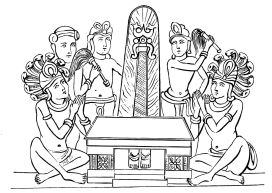
1. Naga people worshipping the Trisul emblem of Buddha,
on a fiery pillar.
(From a bas-relief at Amravati.)
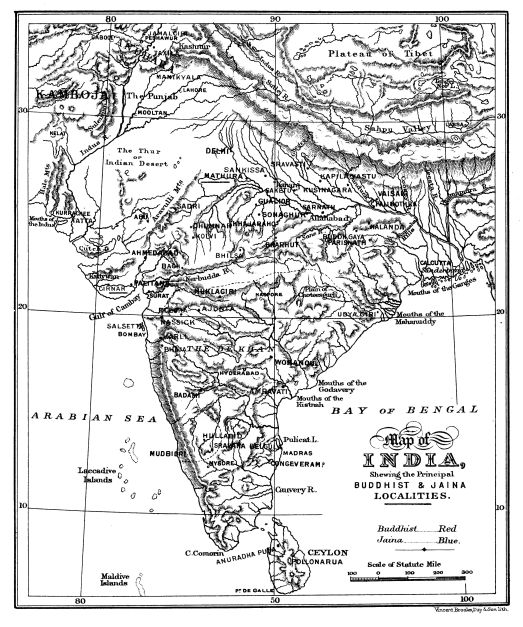
Map of
INDIA,
Showing the Principal
BUDDHIST & JAINA
LOCALITIES.


