The preceding sections have been
intended to exhibit a sketch of that narrative matter, so abundant, so
characteristic and so interesting, out of which early Grecian history
and chronology have been extracted. Raised originally by hands unseen
and from data unassignable, it existed first in the shape of floating
talk among the people, from whence a large portion of it passed into
the song of the poets, who multiplied, transformed and adorned it in a
thousand various ways.
These mythes or current stories, the spontaneous and earliest
growth of the Grecian mind, constituted at the same time the entire
intellectual stock of the age to which they belonged. They are the
common root of all those different ramifications into which the mental
activity of the Greeks subsequently diverged; containing, as it were,
the preface and germ of the positive history and philosophy, the
dogmatic theology and the professed romance, which we shall hereafter
trace each in its separate development. They furnished aliment to the
curiosity, and solution to the vague doubts and aspirations of the age;
they explained the origin of those customs and standing peculiarities
with which men were familiar; they impressed moral lessons, awakened
patriotic sympathies, and exhibited in detail the shadowy, but anxious
presentiments of the vulgar as to the agency of the gods: moreover
they satisfied that craving for adventure and appetite for the marvellous, which has in
modern times become the province of fiction proper.
It is difficult, we may say impossible, for a man of mature age to
carry back his mind to his conceptions such as they stood when he was a
child, growing naturally out of his imagination and feelings, working
upon a scanty stock of materials, and borrowing from authorities whom
he blindly followed but imperfectly apprehended. A similar difficulty
occurs when we attempt to place ourselves in the historical and
quasi-philosophical point of view which the ancient mythes present to
us. We can follow perfectly the imagination and feeling which dictated
these tales, and we can admire and sympathize with them as animated,
sublime, and affecting poetry; but we are too much accustomed to matter
of fact and philosophy of a positive kind, to be able to conceive a
time when these beautiful fancies were construed literally and accepted
as serious reality.
Nevertheless it is obvious that Grecian mythes cannot be either
understood or appreciated except with reference to the system of
conceptions and belief of the ages in which they arose. We must
suppose a public not reading and writing, but seeing, hearing and
telling—destitute of all records, and careless as well as ignorant of
positive history with its indispensable tests, yet at the same time
curious and full of eagerness for new or impressive incidents—strangers
even to the rudiments of positive philosophy and to the idea of
invariable sequences of nature either in the physical or moral world,
yet requiring some connecting theory to interpret and regularize the
phænomena before them. Such a theory was supplied by the spontaneous
inspirations of an early fancy, which supposed the habitual agency
of beings intelligent and voluntary like themselves, but superior in
extent of power, and different in peculiarity of attributes. In the
geographical ideas of the Homeric period, the earth was flat and round,
with the deep and gentle ocean-stream flowing around and returning into
itself: chronology, or means of measuring past time, there existed
none; but both unobserved regions might be described, the forgotten
past unfolded, and the unknown future predicted—through particular men
specially inspired by the gods, or endowed by them with that peculiar
vision which detected and interpreted passing signs and omens.
If even the
rudiments of scientific geography and physics, now so universally
diffused and so invaluable as a security against error and delusion,
were wanting in this early stage of society, their place was abundantly
supplied by vivacity of imagination and by personifying sympathy.
The unbounded tendency of the Homeric Greeks to multiply fictitious
persons, and to construe the phænomena which interested them into
manifestations of design, is above all things here to be noticed,
because the form of personal narrative, universal in their mythes,
is one of its many manifestations. Their polytheism (comprising some
elements of an original fetichism, in which particular objects had
themselves been supposed to be endued with life, volition, and design)
recognized agencies of unseen beings identified and confounded with the
different localities and departments of the physical world. Of such
beings there were numerous varieties, and many gradations both in power
and attributes; there were differences of age, sex and local residence,
relations both conjugal and filial between them, and tendencies
sympathetic as well as repugnant. The gods formed a sort of political
community of their own, which had its hierarchy, its distribution of
ranks and duties, its contentions for power and occasional revolutions,
its public meetings in the agora of Olympus, and its multitudinous
banquets or festivals.[834] The great Olympic gods were in fact only
the most exalted amongst an aggregate of quasi-human or ultra-human
personages,—dæmons, heroes, nymphs, eponymous (or name-giving)
genii, identified with each river, mountain,[835] cape, town, village,
or known
circumscription of territory,—besides horses, bulls, and dogs, of
immortal breed and peculiar attributes, and monsters of strange lineaments and
combinations, “Gorgons and Harpies and Chimæras dire.” As there were in
every gens or family special gentile deities and foregone ancestors
who watched over its members, forming in each the characteristic symbol
and recognized guarantee of their union, so there seem to have been in
each guild or trade peculiar beings whose vocation it was to coöperate
or to impede in various stages of the business.[836]
The extensive and multiform personifications, here faintly sketched,
pervaded in every direction the mental system of the Greeks, and
were identified intimately both with their conception and with their
description of phenomena, present as well as past. That which to
us is interesting as the mere creation of an exuberant fancy, was
to the Greek genuine and venerated reality. Both the earth and the
solid heaven (Gæa and Uranos) were both conceived and spoken of by
him as endowed with appetite, feeling, sex, and most of the various
attributes of humanity. Instead of a sun such as we now see, subject
to astronomical laws, and forming the centre of a system the changes
of which we can ascertain and foreknow, he saw the great god Hêlios,
mounting his chariot in the morning in the east, reaching at mid-day
the height of the solid heaven, and arriving in the evening at the
western horizon, with horses fatigued and desirous of repose. Hêlios, having
favorite spots wherein his beautiful cattle grazed, took pleasure
in contemplating them during the course of his journey, and was
sorely displeased if any man slew or injured them: he had moreover
sons and daughters on earth, and as his all-seeing eye penetrated
everywhere, he was sometimes in a situation to reveal secrets even to
the gods themselves—while on other occasions he was constrained to
turn aside in order to avoid contemplating scenes of abomination.[837]
To us these now appear puerile, though pleasing fancies, but to an
Homeric Greek they
seemed perfectly natural and plausible. In his view, the description
of the sun, as given in a modern astronomical treatise, would have
appeared not merely absurd, but repulsive and impious. Even in later
times, when the positive spirit of inquiry had made considerable
progress, Anaxagoras and other astronomers incurred the charge of
blasphemy for dispersonifying Hêlios, and trying to assign invariable
laws to the solar phænomena.[838] Personifying fiction was in this way blended
by the Homeric
Greeks with their conception of the physical phænomena before them, not
simply in the way of poetical ornament, but as a genuine portion of
their every-day belief.
It was in this early state of the Grecian mind, stimulating so
forcibly the imagination and the feelings, and acting through them upon
the belief, that the great body of the mythes grew up and obtained
circulation. They were, from first to last, personal narratives and
adventures; and the persons who predominated as subjects of them
were the gods, the heroes, the nymphs, etc., whose names were known
and reverenced, and in whom every one felt interested. To every
god and every hero it was consistent with Grecian ideas to ascribe
great diversity of human motive and attribute: each indeed has his
own peculiar type of character, more or less strictly defined; but
in all there was a wide foundation for animated narrative and for
romantic incident. The gods and heroes of the land and the tribe
belonged, in the conception of a Greek, alike to the present and
to the past: he worshipped in their groves and at their festivals;
he invoked their protection, and believed in their superintending
guardianship, even in his own day: but their more special, intimate,
and sympathizing agency was cast back into the unrecorded past.[839]
To give suitable
utterance to this general sentiment,—to furnish body and movement
and detail to these divine and heroic pre-existences, which were
conceived only in shadowy outline,—to lighten up the dreams of what
the past must have been,[840] in the minds of those who knew not what
it really had been—such was the spontaneous aim and inspiration of
productive genius in the community, and such were the purposes which
the Grecian mythes preëminently accomplished.
The love of antiquities, which Tacitus notices as so prevalent
among the Greeks of his day,[841] was one of the earliest, the most durable,
and the most widely diffused of the national propensities. But the
antiquities of every state were divine and heroic, reproducing the
lineaments, but disregarding the measure and limits, of ordinary
humanity. The gods formed the starting-point, beyond which no man
thought of looking, though some gods were more ancient than others:
their progeny, the heroes, many of them sprung from human mothers,
constitute an intermediate link between god and man. The ancient epic
usually recognizes the presence of a multitude of nameless men, but
they are introduced chiefly for the purpose of filling the scene, and
of executing the orders, celebrating the valor, and bringing out the
personality, of a few divine or heroic characters.[842] It was the glory of
bards and storytellers to be able to satisfy those religious and
patriotic predispositions of the public, which caused the primary
demand for their
tales, and which were of a nature eminently inviting and expansive.
For Grecian religion was many-sided and many colored; it comprised a
great multiplicity of persons, together with much diversity in the
types of character; it divinized every vein and attribute of humanity,
the lofty as well as the mean—the tender as well as the warlike—the
self-devoting and adventurous as well as the laughter-loving and
sensual. We shall hereafter reach a time when philosophers protested
against such identification of the gods with the more vulgar appetites
and enjoyments, believing that nothing except the spiritual attributes
of man could properly be transferred to superhuman beings, and drawing
their predicates respecting the gods exclusively from what was awful,
majestic and terror-striking in human affairs. Such restrictions on the
religious fancy were continually on the increase, and the mystic and
didactic stamp which marked the last century of paganism in the days of
Julian and Libanius, contrasts forcibly with the concrete and vivacious
forms, full of vigorous impulse and alive to all the capricious
gusts of the human temperament, which people the Homeric Olympus.[843] At
present, however,
we have only to consider the early, or Homeric and Hesiodic paganism,
and its operation in the genesis of the mythical narratives. We cannot
doubt that it supplied the most powerful stimulus, and the only one
which the times admitted, to the creative faculty of the people; as
well from the sociability, the gradations, and the mutual action and
reaction of its gods and heroes, as from the amplitude, the variety,
and the purely human cast, of its fundamental types.
Though we may
thus explain the mythopœic fertility of the Greeks, I am far from
pretending that we can render any sufficient account of the supreme
beauty of their chief epic and artistical productions. There is
something in the first-rate productions of individual genius which lies
beyond the compass of philosophical theory: the special breath of the
Muse (to speak the language of ancient Greece) must be present in order
to give them being. Even among her votaries, many are called, but few
are chosen; and the peculiarities of those few remain as yet her own
secret.
We shall not however forget that Grecian language was also an
indispensable requisite to the growth and beauty of Grecian mythes—its
richness, its flexibility and capacity of new combinations, its vocalic
abundance and metrical pronunciation: and many even among its proper
names, by their analogy to words really significant, gave direct
occasion to explanatory or illustrative stories. Etymological mythes
are found in sensible proportion among the whole number.
To understand properly then the Grecian mythes, we must try
to identify ourselves with the state of mind of the original
mythopœic age; a process not very easy, since it requires us to
adopt a string of poetical fancies not simply as realities, but as
the governing realities of the mental system;[844] yet a process which would only
reproduce something analogous to our own childhood. The age was one
destitute both of recorded history and of positive science, but full
of imagination and sentiment and religious impressibility; from these
sources sprung that multitude of supposed persons around whom all
combinations of sensible phænomena were grouped, and towards whom curiosity,
sympathies, and reverence were earnestly directed. The adventures
of such persons were the only aliment suited at once both to the
appetites and to the comprehension of an early Greek; and the
mythes which detailed them, while powerfully interesting his emotions, furnished
to him at the same time a quasi-history and quasi-philosophy: they
filled up the vacuum of the unrecorded past, and explained many
of the puzzling incognita of the present.[845] Nor need we wonder that
the same plausibility which captivated his imagination and his feelings was sufficient
to engender spontaneous belief; or rather, that no question as to
truth or falsehood of the narrative suggested itself to his mind. His
faith is ready, literal and uninquiring, apart from all thought of
discriminating fact from fiction, or of detecting hidden and symbolized
meaning; it is enough that what he hears be intrinsically plausible and
seductive, and that there be no special cause to provoke doubt. And
if indeed there were, the poet overrules such doubts by the holy and
all-sufficient authority of the Muse, whose omniscience is the warrant
for his recital, as her inspiration is the cause of his success.
The state of mind, and the relation of speaker to hearers, thus
depicted, stand clearly marked in the terms and tenor of the ancient
epic, if we only put a plain meaning upon what we read. The poet—like
the prophet, whom he so much resembles—sings under heavenly guidance,
inspired by the goddess to whom he has prayed for her assisting
impulse: she puts the word into his mouth and the incidents into
his mind: he is a privileged man, chosen as her organ and speaking
from her revelations.[846] As the Muse grants the gift of song to whom
she will, so she sometimes in her anger snatches it away, and the
most consummate human genius is then left silent and helpless.[847] It is
true that these expressions, of the Muse inspiring and the poet singing
a tale of past times, have passed from the ancient epic to compositions
produced under very different circumstances, and have now degenerated
into unmeaning forms of speech; but they gained currency originally in
their genuine and literal acceptation. If poets had from the beginning
written or recited, the predicate of singing would never have been
ascribed to them; nor would it have ever become customary to employ the
name of the Muse as a die to be stamped on licensed fiction, unless the
practice had begun when her agency was invoked and hailed in perfect
good faith. Belief, the fruit of deliberate inquiry and a rational
scrutiny of evidence, is in such an age unknown: the simple faith of
the time slides in unconsciously, when the imagination and feeling are
exalted; and inspired authority is at once understood, easily admitted,
and implicitly confided in.
The word mythe (μῦθος, fabula, story), in its original meaning,
signified simply a statement or current narrative, without any
connotative implication either of truth or falsehood. Subsequently the
meaning of the word (in Latin and English as well as in Greek) changed,
and came to carry with it the idea of an old personal narrative,
always uncertified, sometimes untrue or avowedly fictitious.[848]
And this change was the result of a silent alteration in the mental
state of the society,—of a transition on the part of the superior minds (and more
or less on the part of all) to a stricter and more elevated canon of
credibility, in consequence of familiarity with recorded history,
and its essential tests, affirmative as well as negative. Among the
original hearers of the mythes, all such tests were unknown; they had
not yet learned the lesson of critical disbelief; the mythe passed
unquestioned from the mere fact of its currency, and from its harmony
with existing sentiments and preconceptions. The very circumstances
which contributed to rob it of literal belief in after-time,
strengthened its hold upon the mind of the Homeric man. He looked for
wonders and unusual combinations in the past; he expected to hear
of gods, heroes and men, moving and operating together upon earth;
he pictured to himself the fore-time as a theatre in which the gods
interfered directly, obviously and frequently, for the protection
of their favorites and the punishment of their foes. The rational
conception, then only dawning in his mind, of a systematic course of
nature was absorbed by this fervent and lively faith. And if he could
have been supplied with as perfect and philosophical a history of his
own real past time, as we are now enabled to furnish with regard to
the last century of England or France, faithfully recording all the
successive events, and accounting for them by known positive laws,
but introducing no special interventions of Zeus and Apollo—such a
history would have appeared to him not merely unholy and unimpressive,
but destitute of all plausibility or title to credence. It would
have provoked in him the same feeling of incredulous aversion as a
description of the sun (to repeat the previous illustration) in a
modern book on scientific astronomy.
To us these mythes are interesting fictions; to the Homeric and
Hesiodic audience they were “rerum divinarum et humanarum scientia,”—an
aggregate of religious, physical and historical revelations, rendered
more captivating, but not less true and real, by the bright coloring
and fantastic shapes in which they were presented. Throughout the whole
of “mythe-bearing Hellas”[849] they formed the staple of the uninstructed
Greek mind, upon
which history and philosophy were by so slow degrees superinduced; and
they continued to be the aliment of ordinary thought and conversation,
even after history and philosophy had partially supplanted the
mythical faith among the leading men, and disturbed it more or less
in the ideas of all. The men, the women, and the children of the
remote dêmes and villages of Greece, to whom Thucydidês, Hippocratês,
Aristotle, or Hipparchus were unknown, still continued to dwell upon
the local fables which formed their religious and patriotic antiquity.
And Pausanias, even in his time, heard everywhere divine or heroic
legends yet alive, precisely of the type of the old epic; he found the
conceptions of religious and mythical faith, coëxistent with those
of positive science, and contending against them at more or less
of odds, according to the temper of the individual. Now it is the
remarkable characteristic of the Homeric age, that no such coëxistence
or contention had yet begun. The religious and mythical point of
view covers, for the most part, all the phænomena of nature; while
the conception of invariable sequence exists only in the background,
itself personified under the name of the Mœræ, or Fates, and produced
generally as an exception to the omnipotence of Zeus for all ordinary
purposes. Voluntary
agents, visible and invisible, impel and govern everything. Moreover
this point of view is universal throughout the community,—adopted
with equal fervor, and carried out with equal consistency, by the
loftiest minds and by the lowest. The great man of that day is he
who, penetrated like others with the general faith, and never once
imagining any other system of nature than the agency of these voluntary
Beings, can clothe them in suitable circumstances and details, and
exhibit in living body and action those types which his hearers dimly
prefigure. Such men were the authors of the Iliad and the Odyssey;
embodying in themselves the whole measure of intellectual excellence
which their age was capable of feeling: to us, the first of poets—but
to their own public, religious teachers, historians, and philosophers
besides—inasmuch as all that then represented history and philosophy
was derived from those epical effusions and from others homogeneous
with them. Herodotus recognizes Homer and Hesiod as the main authors
of Grecian belief respecting the names and generations, the attributes
and agency, the forms and the worship of the gods.[850]
History, philosophy, etc., properly so called and conforming to
our ideas (of which the subsequent Greeks were the first creators),
never belonged to more than a comparatively small number of thinking
men, though their influence indirectly affected more or less the whole
national mind. But when positive science and criticism, and the idea of
an invariable sequence of events, came to supplant in the more vigorous
intellects the old mythical creed of omnipresent personification,
an inevitable scission was produced between the instructed few and
the remaining community. The opposition between the scientific and
the religious point of view was not slow in manifesting itself: in
general language, indeed, both might seem to stand together, but in
every particular case the admission of one involved the rejection of
the other. According to the theory which then became predominant,
the course of nature was held to move invariably on, by powers
and attributes of its own, unless the gods chose to interfere and
reverse it; but they had the power of interfering as often and to as
great an extent as they thought fit. Here the question was at once opened, respecting a
great variety of particular phænomena, whether they were to be regarded
as natural or miraculous. No constant or discernible test could be
suggested to discriminate the two: every man was called upon to settle
the doubt for himself, and each settled it according to the extent
of his knowledge, the force of his logic, the state of his health,
his hopes, his fears, and many other considerations affecting his
separate conclusion. In a question thus perpetually arising, and full
of practical consequences, instructed minds, like Periklês, Thucydidês,
and Euripidês, tended more and more to the scientific point of view,[851] in
cases where the general public were constantly gravitating towards
the religious.
The age immediately prior to this unsettled
condition of thought is the really mythopœic age; in which the creative
faculties of the society know no other employment, and the mass of
the society no other mental demand. The perfect expression of such a
period, in its full peculiarity and grandeur, is to be found in the
Iliad and Odyssey,—poems of which we cannot determine the exact date,
but which seem both to have existed prior to the first Olympiad, 776
B. C., our earliest trustworthy mark of Grecian time.
For some time after that event, the mythopœic tendencies continued in
vigor (Arktinus, Leschês, Eumêlus, and seemingly most of the Hesiodic
poems, fall within or shortly after the first century of recorded
Olympiads); but from and after this first century, we may trace the
operation of causes which gradually enfeebled and narrowed them,
altering the point of view from which the mythes were looked at. What
these causes were, it will be necessary briefly to intimate.
The foremost
and most general of all is, the expansive force of Grecian intellect
itself,—a quality in which this remarkable people stand distinguished
from all their neighbors and contemporaries. Most, if not all nations
have had mythes, but no nation except the Greeks have imparted to them
immortal charm and universal interest; and the same mental capacities,
which raised the great men of the poetic age to this exalted level,
also pushed forward their successors to outgrow the early faith in
which the mythes had been generated and accredited.
One great mark, as well as means, of such intellectual expansion,
was the habit of attending to, recording, and combining, positive
and present facts, both domestic and foreign. In the genuine Grecian
epic, the theme was an unknown and aoristic past; but even as early
as the Works and Days of Hesiod, the present begins to figure: the
man who tills the earth appears in his own solitary nakedness, apart
from gods and heroes—bound indeed by serious obligations to the gods,
but contending against many difficulties which are not to be removed
by simple reliance on their help. The poet denounces his age in the
strongest terms as miserable, degraded and profligate, and looks back
with reverential envy to the extinct heroic races who fought at Troy
and Thêbes. Yet bad as the present time is, the Muse condescends to
look at it along with him, and to prescribe rules for human life—with
the assurance that if a man be industrious, frugal, provident, just
and friendly in his dealings, the gods will recompense him with
affluence and security. Nor does the Muse disdain, while holding out
such promise, to cast herself into the most homely details of present
existence and to give advice thoroughly practical and calculating. Men
whose minds were full of the heroes of Homer, called Hesiod in contempt
the poet of the Helots; and the contrast between the two is certainly
a remarkable proof of the tendency of Greek poetry towards the present
and the positive.
Other manifestations of the same tendency become visible in
the age of Archilochus (B. C. 680-660). In an age
when metrical composition and the living voice are the only means
whereby the productive minds of a community make themselves felt,
the invention of a new metre, new forms of song and recitation,
or diversified
accompaniments, constitute an epoch. The iambic, elegiac, choric, and
lyric poetry, from Archilochus downwards, all indicate purposes in the
poet, and impressibilities of the hearers, very different from those
of the ancient epic. In all of them the personal feeling of the poet
and the specialties of present time and place, are brought prominently
forward, while in the Homeric hexameter the poet is a mere nameless
organ of the historical Muse—the hearers are content to learn, believe,
and feel, the incidents of a foregone world, and the tale is hardly
less suitable to one time and place than to another. The iambic metre
(we are told) was first suggested to Archilochus by the bitterness of
his own private antipathies; and the mortal wounds inflicted by his
lampoons, upon the individuals against whom they were directed, still
remain attested, though the verses themselves have perished. It was the
metre (according to the well-known judgment of Aristotle) most nearly
approaching to common speech, and well suited both to the coarse vein
of sentiment, and to the smart and emphatic diction of its inventor.[852]
Simonidês of Amorgus, the younger contemporary of Archilochus,
employed the same metre, with less bitterness, but with an anti-heroic
tendency not less decided. His remaining fragments present a mixture
of teaching and sarcasm, having a distinct bearing upon actual life,[853] and
carrying out the spirit which partially appears in the Hesiodic Works
and Days. Of Alkæus and Sapphô, though unfortunately we are compelled
to speak of them upon hearsay only, we know enough to satisfy us that
their own personal sentiments and sufferings, their relations private
or public with the
contemporary world, constituted the soul of those short effusions which
gave them so much celebrity:[854] and in the few remains of the elegiac poets
preserved to us—Kallinus, Mimnermus, Tyrtæus—the impulse of some
present motive or circumstance is no less conspicuous. The same may
also be said of Solôn, Theognis and Phokylidês, who preach, encourage,
censure, or complain, but do not recount—and in whom a profound
ethical sensibility, unknown to the Homeric poems, manifests itself:
the form of poetry (to use the words of Solôn himself) is made the
substitute for the public speaking of the agora.[855]
Doubtless all these poets made abundant use of the ancient
mythes, but it was by turning them to present account, in the way
of illustration, or flattery, or contrast,—a tendency which we may
usually detect even in the compositions of Pindar, in spite of the
lofty and heroic strain which they breathe throughout. That narrative
or legendary poetry still continued to be composed during the seventh
and sixth centuries before the Christian æra is not to be questioned;
but it exhibited the old epical character without the old epical genius; both the
inspiration of the composer and the sympathies of the audience had
become more deeply enlisted in the world before them, and disposed to
fasten on incidents of their own actual experience. From Solôn and
Theognis we pass to the abandonment of all metrical restrictions and to
the introduction of prose writing,—a fact, the importance of which it
is needless to dwell upon,—marking as well the increased familiarity
with written records, as the commencement of a separate branch of
literature for the intellect, apart from the imagination and emotions
wherein the old legends had their exclusive root.
Egypt was first unreservedly opened to the Greeks during the
reign of Psammetichus, about B. C. 660; gradually it
became much frequented by them for military or commercial purposes,
or for simple curiosity, and enlarged the range of their thoughts and
observations, while it also imparted to them that vein of mysticism,
which overgrew the primitive simplicity of the Homeric religion,
and of which I have spoken in a former chapter. They found in it a
long-established civilization, colossal wonders of architecture, and
a certain knowledge of astronomy and geometry, elementary indeed,
but in advance of their own. Moreover it was a portion of their
present world, and it contributed to form in them an interest for
noting and describing the actual realities before them. A sensible
progress is made in the Greek mind during the two centuries from
B. C. 700 to B. C. 500, in the record
and arrangement of historical facts: an historical sense arises in
the superior intellects, and some idea of evidence as a discriminating
test between fact and fiction. And this progressive tendency was
further stimulated by increased communication and by more settled and
peaceful social relations between the various members of the Hellenic
world, to which may be added material improvements, purchased at the
expense of a period of turbulence and revolution, in the internal
administration of each separate state. The Olympic, Pythian, Nemean,
and Isthmian games became frequented by visitors from the most distant
parts of Greece: the great periodical festival in the island of Dêlos
brought together the citizens of every Ionic community, with their
wives and children, and an ample display of wealth and ornaments.[856] Numerous and flourishing
colonies were founded in Sicily, the south of Italy, the coasts of
Epirus and of the Euxine Sea: the Phokæans explored the whole of the
Adriatic, established Massalia, and penetrated even as far as the
south of Ibêria, with which they carried on a lucrative commerce.[857] The
geographical ideas of the Greeks were thus both expanded and rectified:
the first preparation of a map, by Anaximander the disciple of Thalês,
is an epoch in the history of science. We may note the ridicule
bestowed by Herodotus both upon the supposed people called Hyperboreans
and upon the idea of a circumfluous ocean-stream, as demonstrating the
progress of the age in this department of inquiry.[858] And even earlier
than Herodotus, Xanthus had noticed the occurrence of fossil marine
productions in the interior of Asia Minor, which led him to reflections
on the changes of the earth’s surface with respect to land and water.[859]
If then we look down the three centuries and a half which
elapsed between the commencement of the Olympic æra and the age of
Herodotus and Thucydidês, we shall discern a striking advance in
the Greeks,—ethical, social and intellectual. Positive history and
chronology has not only been created, but in the case of Thucydidês,
the qualities necessary to the historiographer, in their application
to recent events, have been developed with a degree of perfection
never since surpassed. Men’s minds have assumed a gentler as well as
a juster cast; and acts come to be criticized with reference to their
bearing on the internal happiness of a well-regulated community,
as well as upon the standing harmony of fraternal states. While Thucydidês treats
the habitual and licensed piracy, so coolly alluded to in the Homeric
poems, as an obsolete enormity, many of the acts described in the old
heroic and Theogonic legends were found not less repugnant to this
improved tone of feeling. The battles of the gods with the Giants
and Titans,—the castration of Uranus by his son Kronus,—the cruelty,
deceit and licentiousness, often supposed both in the gods and heroes,
provoked strong disapprobation. And the language of the philosopher
Xenophanês, who composed both elegiac and iambic poems for the express
purpose of denouncing such tales, is as vehement and unsparing as that
of the Christian writers, who, eight centuries afterwards, attacked
the whole scheme of paganism.[860]
Nor was it alone as an ethical and social critic that Xenophanês
stood distinguished. He was one of a great and eminent triad—Thalês
and Pythagoras being the others—who, in the sixth century before the
Christian æra, first opened up those veins of speculative philosophy
which occupied afterwards so large a portion of Grecian intellectual
energy. Of the material differences between the three I do not here
speak; I regard them only in reference to the Homeric and Hesiodic
philosophy which preceded them, and from which all three deviated by a
step, perhaps the most remarkable in all the history of philosophy. In
the scheme of ideas common to Homer and to the Hesiodic Theogony (as
has been already stated), we find nature distributed into a variety of
personal agencies, administered according to the free-will of different
Beings more or less analogous to man—each of these Beings having his
own character, attributes and powers, his own sources of pain and
pleasure, and his own especial sympathies or antipathies with human
individuals; each being determined to act or forbear, to grant favor
or inflict injury in his own department of phænomena, according as
men, or perhaps other Beings analogous to himself, might conciliate
or offend him. The Gods, properly so called, (those who bore a proper
name and received some public or family worship,) were the most
commanding and capital members amidst this vast network of agents visible and invisible,
spread over the universe.[861] The whole view of nature was purely
religious and subjective, the spontaneous suggestion of the early
mind. It proceeded from the instinctive tendencies of the feelings
and imagination to transport, to the world without, the familiar type
of free-will and conscious personal action: above all, it took deep
hold of the emotions, from the widely extended sympathy which it so
perpetually called forth between man and nature.[862]
The first attempt to disenthral the philosophic intellect from
this all-personifying religious faith, and to constitute a method of
interpreting nature distinct from the spontaneous inspirations of
untaught minds, is to be found in Thalês, Xenophanês and Pythagoras, in
the sixth century before the Christian æra. It is in them that we first
find the idea of Person tacitly set aside or limited, and an impersonal
Nature conceived as the object of study. The divine husband and wife,
Oceanus and Têthys, parents of many gods and of the Oceanic nymphs,
together with the avenging goddess Styx, are translated into the
material substance water, or, as we ought rather to say, the Fluid:
and Thalês set himself to prove that water was the primitive element,
out of which all the different natural substances had been formed.[863]
He, as well as Xenophanês and Pythagoras, started the problem of
physical philosophy, with its objective character and invariable
laws, to be discoverable by a proper and methodical application
of the human intellect. The Greek word Φύσις, denoting nature,
and its derivatives physics and physiology, unknown in that
large sense to Homer or Hesiod, as well as the word Kosmos, to
denote the mundane system, first appears with these philosophers.[864]
The elemental
analysis of Thalês—the one unchangeable cosmic substance, varying only
in appearance, but not in reality, as suggested by Xenophanês,—and the
geometrical and arithmetical combinations of Pythagoras,—all these were
different ways of approaching the explanation of physical phænomena,
and each gave rise to a distinct school or succession of philosophers.
But they all agreed in departing from the primitive method, and in
recognizing determinate properties, invariable sequences, and objective
truth, in nature—either independent of willing or designing agents,
or serving to these latter at once as an indispensable subject-matter
and as a limiting condition. Xenophanês disclaimed openly all
knowledge respecting the gods, and pronounced that no man could have
any means of ascertaining when he was right and when he was wrong, in
affirmations respecting them:[865] while Pythagoras represents in part the
scientific tendencies of his age, in part also the spirit of mysticism
and of special fraternities for religious and ascetic observance, which
became diffused throughout Greece in the sixth century before the
Christian æra. This was another point which placed him in antipathy
with the simple, unconscious and demonstrative faith of the old poets,
as well as with the current legends.
If these distinguished men, when they ceased to follow the primitive
instinct of tracing the phænomena of nature to personal and designing
agents, passed over, not at once to induction and observation, but to a
misemployment of abstract words, substituting metaphysical eideôla in
the place of polytheism, and to an exaggerated application of certain
narrow physical theories—we must remember that nothing else could be
expected from the scanty stock of facts then accessible, and that
the most profound study of the human mind points out such transition
as an inevitable law of intellectual progress.[866] At present, we have
to compare
them only with that state of the Greek mind[867] which they partially
superseded, and with which they were in decided opposition. The
rudiments of physical science were conceived and developed among
superior men; but the religious feeling of the mass was averse to them;
and the aversion, though gradually mitigated, never wholly died away.
Some of the philosophers were not backward in charging others with
irreligion, while the multitude seems to have felt the same sentiment
more or less towards all—or towards that postulate of constant
sequences, with determinate conditions of occurrence, which scientific
study implies, and which they could not reconcile with their belief
in the agency of the gods, to whom they were constantly praying for
special succor and blessings.
The discrepancy between the scientific and the religious point
of view was dealt with differently by different philosophers. Thus
Socratês openly admitted it, and assigned to each a distinct and
independent province. He distributed phænomena into two classes: one,
wherein the connection of antecedent and consequent was invariable
and ascertainable by human study, and therefore future results
accessible to a well-instructed foresight; the other, and those, too,
the most comprehensive and important, which the gods had reserved
for themselves and their own unconditional agency, wherein there
was no invariable or ascertainable sequence, and where the result
could only be foreknown by some omen, prophecy, or other special
inspired communication from themselves. Each of these classes was
essentially distinct, and required to be looked at and dealt with
in a manner radically incompatible with the other. Socratês held it
wrong to apply the scientific interpretation to the latter, or the
theological interpretation to the former. Physics and astronomy, in his
opinion, belonged
to the divine class of phænomena, in which human research was insane,
fruitless, and impious.[868]
On the other hand, Hippocratês, the contemporary of Socratês,
denied the discrepancy, and merged into one those two classes of
phænomena,—the divine and the scientifically determinable,—which the
latter had put asunder. Hippocratês treated all phænomena as at once
both divine and scientifically determinable. In discussing certain
peculiar bodily disorders found among the Scythians, he observes,
“The Scythians themselves ascribe the cause of this to God, and
reverence and bow down to such sufferers, each man fearing that he
may suffer the like; and I myself think too that these affections,
as well as all others, are divine: no one among them is either more
divine or more human than another, but all are on the same footing,
and all divine; nevertheless each of them has its own physical
conditions, and not one occurs without such physical conditions.”[869]
A third
distinguished philosopher of the same day, Anaxagoras, allegorizing
Zeus and the other personal gods, proclaimed the doctrine of one common
pervading Mind, as having first established order and system in the
mundane aggregate, which had once been in a state of chaos—and as still
manifesting its uninterrupted agency for wise and good purposes. This
general doctrine obtained much admiration from Plato and Aristotle; but
they at the same time remarked with surprise, that Anaxagoras never
made any use at all of his own general doctrine for the explanation
of the phænomena of nature,—that he looked for nothing but physical
causes and connecting laws,[870]—so that in fact the spirit of his particular
researches was not materially different from those of Demokritus or
Leukippus, whatever might be the difference in their general theories.
His investigations in meteorology and astronomy, treating the heavenly
bodies as subjects for calculation, have been already noticed as
offensive, not only to the general public of Greece, but even to
Socratês himself among them: he was tried at Athens, and seems to have
escaped condemnation only by voluntary exile.[871]
The three
eminent men just named, all essentially different from each other, may
be taken as illustrations of the philosophical mind of Greece during
the last half of the fifth century B. C. Scientific
pursuits had acquired a powerful hold, and adjusted themselves in
various ways with the prevalent religious feelings of the age. Both
Hippocratês and Anaxagoras modified their ideas of the divine agency
so as to suit their thirst for scientific research. According to the
former, the gods were the really efficient agents in the production
of all phænomena,—the mean and indifferent not less than the terrific
or tutelary. Being thus alike connected with all phænomena, they were
specially associated with none—and the proper task of the inquirer
was, to find out those rules and conditions by which (he assumed)
their agency was always determined, and according to which it might
be foretold. And this led naturally to the proceeding which Plato and
Aristotle remark in Anaxagoras,—that the all-governing and Infinite
Mind, having been announced in sublime language at the beginning of his
treatise, was afterward left out of sight, and never applied to the
explanation of particular phænomena, being as much consistent with one
modification of nature as with another. Now such a view of the divine agency could never
be reconciled with the religious feelings of the ordinary Grecian
believer, even as they stood in the time of Anaxagoras; still less
could it have been reconciled with those of the Homeric man, more
than three centuries earlier. By him Zeus and Athênê were conceived
as definite Persons, objects of special reverence, hopes, and fears,
and animated with peculiar feelings, sometimes of favor, sometimes of
wrath, towards himself or his family or country. They were propitiated
by his prayers, and prevailed upon to lend him succor in danger—but
offended and disposed to bring evil upon him if he omitted to render
thanks or sacrifice. This sense of individual communion with, and
dependence upon them was the essence of his faith; and with that faith,
the all-pervading Mind proclaimed by Anaxagoras—which had no more
concern with one man or one phænomenon than with another,—could never
be brought into harmony. Nor could the believer, while he prayed with
sincerity for special blessings or protection from the gods, acquiesce
in the doctrine of Hippocratês, that their agency was governed by
constant laws and physical conditions.
That radical discord between the mental impulses of science and
religion, which manifests itself so decisively during the most
cultivated ages of Greece, and which harassed more or less so many
of the philosophers, produced its most afflicting result in the
condemnation of Socratês by the Athenians. According to the remarkable
passage recently cited from Xenophôn, it will appear that Socratês
agreed with his countrymen in denouncing physical speculations as
impious,—that he recognized the religious process of discovery as a
peculiar branch, coördinate with the scientific,—and that he laid down
a theory, of which the basis was, the confessed divergence of these
two processes from the beginning—thereby seemingly satisfying the
exigencies of religious hopes and fears on the one hand, and those of
reason, in her ardor for ascertaining the invariable laws of phænomena,
on the other. We may remark that the theory of this religious and
extra-scientific process of discovery was at that time sufficiently
complete; for Socratês could point out, that those anomalous
phænomena which the gods had reserved for themselves, and into which science was
forbidden to pry, were yet accessible to the seekings of the pious man,
through oracles, omens, and other exceptional means of communication
which divine benevolence vouchsafed to keep open. Considering thus
to how great an extent Socratês was identified in feeling with
the religious public of Athens, and considering moreover that his
performance of open religious duties was assiduous—we might wonder,
as Xenophôn does wonder,[872] how it could have happened that the Athenian
dikasts mistook him at the end of his life for an irreligious man.
But we see, by the defence which Xenophôn as well as Plato gives for
him, that the Athenian public really considered him, in spite of his
own disclaimer, as homogeneous with Anaxagoras and the other physical
inquirers, because he had applied similar scientific reasonings
to moral and social phænomena. They looked upon him with the same
displeasure as he himself felt towards the physical philosophers, and
we cannot but admit that in this respect they were more unfortunately
consistent than he was. It is true that the mode of defence adopted
by Socratês contributed much to the verdict found against him, and
that he was further weighed down by private offence given to powerful
individuals and professions; but all these separate antipathies found
their best account in swelling the cry against him as an over-curious
sceptic, and an impious innovator.
Now the scission thus produced between the superior minds and
the multitude, in consequence of the development of science and the
scientific point of view, is a fact of great moment in the history
of Greek progress, and forms an important contrast between the age
of Homer and Hesiod and that of Thucydidês; though in point of fact
even the multitude, during this later age, were partially modified by
those very scientific views which they regarded with disfavor. And
we must keep in view the primitive religious faith, once universal
and unobstructed, but subsequently disturbed by the intrusions of
science; we must follow the great change, as well in respect to
enlarged intelligence as to refinement of social and ethical feeling,
among the Greeks, from the Hesiodic times downward, in order to
render some account of the altered manner in which the ancient mythes
came to be
dealt with. These mythes, the spontaneous growth of a creative and
personifying interpretation of nature, had struck root in Grecian
associations at a time when the national faith required no support
from what we call evidence. They were now submitted, not simply
to a feeling, imagining, and believing public, but also to special
classes of instructed men,—philosophers, historians, ethical teachers,
and critics,—and to a public partially modified by their ideas[873]
as well as improved by a wider practical experience. They were not
intended for such an audience; they had ceased to be in complete
harmony even with the lower strata of intellect and sentiment,—much
more so with the higher. But they were the cherished inheritance of a
past time; they were interwoven in a thousand ways with the religious
faith, the patriotic retrospect, and the national worship, of every
Grecian community; the general type of the mythe was the ancient,
familiar, and universal form of Grecian thought, which even the most
cultivated men had imbibed in their childhood from the poets,[874]
and by which they were to a certain degree unconsciously enslaved. Taken as a
whole the mythes had acquired prescriptive and ineffaceable possession:
to attack, call in question, or repudiate them, was a task painful even
to undertake, and far beyond the power of any one to accomplish.
For these reasons the anti-mythic vein of criticism was of no effect
as a destroying force, but nevertheless its dissolving decomposing
and transforming influence was very considerable. To accommodate the
ancient mythes to an improved tone of sentiment and a newly created
canon of credibility, was a function which even the wisest Greeks
did not disdain, and which occupied no small proportion of the whole
intellectual activity of the nation.
The mythes were looked at from a point of view completely foreign to
the reverential curiosity and literal imaginative faith of the Homeric
man; they were broken up and recast in order to force them into new
moulds such as their authors had never conceived. We may distinguish
four distinct classes of minds, in the literary age now under
examination, as having taken them in hand—the poets, the logographers,
the philosophers, and the historians.
With the poets and logographers, the mythical persons are real
predecessors, and the mythical world an antecedent fact; but it is
divine and heroic reality, not human; the present is only half-brother
of the past (to borrow[875] an illustration from Pindar in his allusion
to gods and men), remotely and generically, but not closely and
specifically, analogous to it. As a general habit, the old feelings
and the old unconscious faith, apart from all proof or evidence,
still remain in their minds; but recent feelings have grown up which
compel them to omit, to alter, sometimes even to reject and condemn,
particular narratives.
Pindar repudiates some stories and transforms others, because they
are inconsistent with his conceptions of the gods. Thus he formally
protests against the tale that Pelops had been killed and served up
at table by his father, for the immortal gods to eat; he shrinks from
the idea of imputing to them so horrid an appetite; he pronounces the tale to have
been originally fabricated by a slanderous neighbor. Nor can he
bring himself to recount the quarrels between different gods.[876]
The amours of Zeus and Apollo are no way displeasing to him; but he
occasionally suppresses some of the simple details of the old mythe, as
deficient in dignity: thus, according to the Hesiodic narrative, Apollo
was informed by a raven of the infidelity of the nymph Korônis: but
the mention of the raven did not appear to Pindar consistent with the
majesty of the god, and he therefore wraps up the mode of detection in
vague and mysterious language.[877] He feels considerable repugnance to the
character of Odysseus, and intimates more than once that Homer has
unduly exalted him, by force of poetical artifice. With the character
of the Æakid Ajax, on the other hand, he has the deepest sympathy,
as well as with his untimely and inglorious death, occasioned by the
undeserved preference of a less worthy rival.[878] He appeals for his
authority usually to the Muse, but sometimes to “ancient sayings
of men,” accompanied with a general allusion to story-tellers
and bards,—admitting, however, that these stories present great
discrepancy, and sometimes that they are false.[879] Yet the marvellous
and the supernatural afford no ground whatever for rejecting a story:
Pindar makes an express declaration to this effect in reference
to the romantic adventures of Perseus and the Gorgon’s head.[880]
He treats even those mythical characters, which conflict the most
palpably with positive experience, as connected by a real genealogical
thread with the world before him. Not merely the heroes of Troy and
Thêbes, and the demigod seamen of Jasôn and the ship Argô, but also
the Centaur Cheirôn, the hundred-headed Typhôs, the giant Alkyoneus,
Antæus, Bellerophôn
and Pegasus, the Chimæra, the Amazons and the Hyperboreans—all appear
painted on the same canvas, and touched with the same colors, as
the men of the recent and recorded past, Phalaris and Krœsus; only
they are thrown back to a greater distance in the perspective.[881]
The heroic ancestors of those great Æginetan, Thessalian, Thêban,
Argeian, etc. families, whose present members the poet celebrates for
their agonistic victories, sympathize with the exploits and second the
efforts of their descendants: the inestimable value of a privileged
breed and of the stamp of nature is powerfully contrasted with the
impotence of unassisted teaching and practice.[882] The power and skill of
the Argeian Theæus and his relatives as wrestlers, are ascribed partly
to the fact that their ancestors Pamphaês in aforetime had hospitably
entertained the Tyndarids Kastôr and Pollux.[883] Perhaps however
the strongest proof of the sincerity of Pindar’s mythical faith is
afforded when he notices a guilty incident with shame and repugnance,
but with an unwilling confession of its truth, as in the case of the
fratricide committed on Phôkus by his brothers Pêleus and Telamôn.[884]
Æschylus and Sophoklês exhibit the same spontaneous and uninquiring
faith as Pindar in the legendary antiquities of Greece, taken as a
whole; but they allow themselves greater license as to the details. It
was indispensable to the success of their compositions that they should
recast and group anew the legendary events, preserving the names and
general understood relation of those characters whom they introduced.
The demand for novelty of combination increased with the multiplication
of tragic spectacles at Athens: moreover the feelings of the Athenians,
ethical as well as political, had become too critical to tolerate the
literal reproduction of many among the ancient stories.
Both of them exalted rather than lowered the dignity of the mythical
world, as something divine and heroic rather than human. The Promêtheus of
Æschylus is a far more exalted conception than his keen-witted
namesake in Hesiod, and the more homely details of the ancient
Thêbaïs and Œdipodia were in like manner modified by Sophoklês.[885] The
religious agencies of the old epic are constantly kept prominent, and
the paternal curse,—the wrath of deceased persons against those from
whom they have sustained wrong,—the judgments of the Erinnys against
guilty or foredoomed persons, sometimes inflicted directly, sometimes
brought about through dementation of the sufferer himself (like the
Homeric Atê),—are frequent in their tragedies.[886]
Æschylus in
two of his remaining pieces brings forward the gods as the chief
personages, and far from sharing the objection of Pindar to dwell
upon dissensions of the gods, he introduces Promêtheus and Zeus in
the one, Apollo and the Eumenidês in the other, in marked opposition.
The dialogue, first superinduced by him upon the primitive Chorus,
gradually became the most important portion of the drama, and is
more elaborated in Sophoklês than in Æschylus. Even in Sophoklês,
however, it still generally retains its ideal majesty as contrasted
with the rhetorical and forensic tone which afterwards crept in;
it grows out of the piece, and addresses itself to the emotions
more than to the reason of the audience. Nevertheless, the effect
of Athenian political discussion and democratical feeling is
visible in both these dramatists. The idea of rights and legitimate
privileges as opposed to usurping force, is applied by Æschylus even
to the society of the gods: the Eumenidês accuse Apollo of having,
with the insolence of youthful ambition, “ridden down” their old
prerogatives[887]—while
the Titan Promêtheus, the champion of suffering humanity against the
unfriendly dispositions of Zeus, ventures to depict the latter as a
recent usurper reigning only by his superior strength, exalted by
one successful revolution, and destined at some future time to be
overthrown by another,—a fate which cannot be averted except through
warnings communicable only by Promêtheus himself.[888]
It is commonly understood that Æschylus disapproved of the march
of democracy at Athens during his later years, and that the Eumenidês
is intended as an indirect manifestation in favor of the senate of
Areiopagus. Without inquiring at present whether such a special
purpose can be distinctly made out, we may plainly see that the poet
introduces, into the relations of the gods with each other, a feeling
of political justice, arising out of the times in which he lived and
the debates of which he was a witness. But though Æschylus incurred
reproaches of impiety from Plato, and seemingly also from the Athenian
public, for particular speeches and incidents in his tragedies,[889] and
though he does not adhere to the received vein of religious tradition with the
same strictness as Sophoklês—yet the ascendency and interference of
the gods is never out of sight, and the solemnity with which they
are represented, set off by a bold, figurative, and elliptical style
of expression
(often but imperfectly intelligible to modern readers), reaches its
maximum in his tragedies. As he throws round the gods a kind of airy grandeur, so neither
do his men or heroes appear like tenants of the common earth: the
mythical world from which he borrows his characters is peopled only
with “the immediate seed of the gods, in close contact with Zeus,
in whom the divine blood has not yet had time to degenerate:”[890] his
individuals are taken, not from the iron race whom Hesiod acknowledges
with shame as his contemporaries, but from the extinct heroic race
which had fought at Troy and Thêbes. It is to them that his conceptions
aspire, and he is even chargeable with frequent straining, beyond
the limits of poetical taste, to realize his picture. If he does not
consistently succeed in it, the reason is because consistency in such
a matter is unattainable, since, after all, the analogies of common
humanity, the only materials which the most creative imagination has
to work upon, obtrude themselves involuntarily, and the lineaments of
the man are thus seen even under a dress which promises superhuman
proportions.
Sophoklês, the most illustrious ornament of Grecian tragedy,
dwells upon the same heroic characters, and maintains their grandeur,
on the whole, with little abatement, combining with it a far better
dramatic structure, and a wider appeal to human sympathies. Even
in Sophoklês, however, we find indications that an altered ethical
feeling and a more predominant sense of artistic perfection are
allowed to modify the harsher religious agencies of the old epic;
occasional misplaced effusions[891] of rhetoric, as well as of didactic prolixity, may also
be detected. It is Æschylus, not Sophoklês, who forms the marked
antithesis to Euripidês; it is Æschylus, not Sophoklês, to whom
Aristophanês awards the prize of tragedy, as the poet who assigns
most perfectly to the heroes of the past those weighty words,
imposing equipments, simplicity of great deeds with little talk, and
masculine energy superior to the corruptions of Aphroditê, which
beseem the comrades of Agamemnôn and Adrastus.[892]
How deeply this feeling, of the heroic character of the mythical
world, possessed the Athenian mind, may be judged by the bitter
criticisms made on Euripidês, whose compositions were pervaded, partly
by ideas of physical philosophy learnt under Anaxagoras, partly by
the altered tone of education and the wide diffusion of practical
eloquence, forensic as well as political, at Athens.[893] While Aristophanês
assails Euripidês as the representative of this “young Athens,”
with the utmost keenness of sarcasm,—other critics also concur
in designating him as having vulgarized the mythical heroes, and
transformed them into mere characters of common life,—loquacious,
subtle, and savoring of the market-place.[894] In some of his plays,
sceptical expressions and sentiments were introduced, derived from his
philosophical studies, sometimes confounding two or three distinct gods
into one, sometimes translating the personal Zeus into a substantial
Æthêr with determinate attributes. He put into the mouths of some of
his unprincipled dramatic characters, apologetic speeches which were
denounced as ostentatious sophistry, and as setting out a triumphant
case for the criminal.[895] His thoughts, his words, and the rhythm
of his choric songs, were all accused of being deficient in dignity
and elevation. The mean attire and miserable attitude in which he exhibited
Œneus, Têlephus, Thyestês, Inô, and other heroic characters, were
unmercifully derided,[896] though it seems that their position and
circumstances had always been painfully melancholy; but the effeminate
pathos which Euripidês brought so nakedly into the foreground, was
accounted unworthy of the majesty of a legendary hero. And he incurred
still greater obloquy on another point, on which he is allowed even
by his enemies to have only reproduced in substance the preëxisting
tales,—the illicit and fatal passion depicted in several of his female
characters, such as Phædra and Sthenobœa. His opponents admitted that
these stories were true, but contended that they ought to be kept back
and not produced upon the stage,—a proof both of the continued mythical
faith and of the more sensitive ethical criticism of his age.[897] The
marriage of the six
daughters to the six sons of Æolus is of Homeric origin, and stands
now, though briefly stated, in the Odyssey: but the incestuous passion
of Macareus and Canacê, embodied by Euripidês[898] in the lost tragedy
called Æolus, drew upon him severe censure. Moreover, he often
disconnected the horrors of the old legends with those religious
agencies by which they had been originally forced on, prefacing them
by motives of a more refined character, which carried no sense of
awful compulsion: thus the considerations by which the Euripidean
Alkmæôn was reduced to the necessity of killing his mother appeared
to Aristotle ridiculous.[899] After the time of this great poet, his
successors seem to have followed him in breathing into their characters
the spirit of common life, but the names and plot were still borrowed
from the stricken mythical families of Tantalus, Kadmus, etc.: and
the heroic exaltation of all the individual personages introduced, as
contrasted with the purely human character of the Chorus, is still numbered by
Aristotle among the essential points of the theory of tragedy.[900]
The tendency then of Athenian tragedy—powerfully manifested in
Æschylus, and never wholly lost—was to uphold an unquestioning faith
and a reverential estimate of the general mythical world and its
personages, but to treat the particular narratives rather as matter
for the emotions than as recitals of actual fact. The logographers
worked along with them to the first of these two ends, but not
to the second. Their grand object was, to cast the mythes into a
continuous readable series, and they were in consequence compelled to
make selection between inconsistent or contradictory narratives; to
reject some narratives as false, and to receive others as true. But
their preference was determined more by their sentiments as to what
was appropriate, than by any pretended historical test. Pherekydês,
Akusilaus and Hellanikus[901] did not seek to banish miraculous or
fantastic incidents from the mythical world; they regarded it as
peopled with loftier beings, and expected to find in it phænomena
not paralleled in their own degenerate days. They reproduced the
fables as they found them in the poets, rejecting little except the
discrepancies, and producing ultimately what they believed to be
not only a continuous but an exact and trustworthy history of the
past—wherein they carry indeed their precision to such a length, that
Hellanikus gives the year, and even the day of the capture of Troy.[902]
Hekatæus of Milêtus (500 B. C.), anterior to
Pherekydês and Hellanikus, is the earliest writer in whom we can
detect any disposition to disallow the prerogative and specialty of
the mythes, and to soften down their characteristic prodigies, some of
which however still
find favor in his eyes, as in the case of the speaking ram who carried
Phryxus over the Hellespont. He pronounced the Grecian fables to be
“many and ridiculous;” whether from their discrepancies or from their
intrinsic improbabilities we do not know: and we owe to him the first
attempt to force them within the limits of historical credibility; as
where he transforms the three-headed Cerberus, the dog of Hadês, into
a serpent inhabiting a cavern on Cape Tænarus—and Geryôn of Erytheia
into a king of Epirus rich in herds of oxen.[903] Hekatæus traced the
genealogy of himself and the gens to which he belonged through a line
of fifteen progenitors up to an initial god,[904]—the clearest proof both
of his profound faith in the reality of the mythical world, and of his
religious attachment to it as the point of junction between the human
and the divine personality.
We have next to consider the historians, especially Herodotus
and Thucydidês. Like Hekatæus, Thucydidês belonged to a gens which
traced its descent from Ajax, and through Ajax to Æakus and Zeus.[905]
Herodotus modestly implies that he himself had no such
privilege to boast of.[906] Their curiosity respecting the past had no other
materials to work upon except the mythes; but these they found already
cast by the logographers into a continuous series, and presented as an
aggregate of antecedent history, chronologically deduced from the times
of the gods. In common with the body of the Greeks, both Herodotus
and Thucydidês had imbibed that complete and unsuspecting belief in
the general reality of mythical antiquity, which was interwoven with
the religion and the patriotism, and all the public demonstrations of
the Hellenic world. To acquaint themselves with the genuine details
of this foretime, was an inquiry highly interesting to them: but the
increased positive tendencies of their age, as well as their own habits
of personal investigation, had created in them an historical sense
in regard to the past as well as to the present. Having acquired a
habit of appreciating the intrinsic tests of historical credibility
and probability, they found the particular narratives of the poets and
logographers, inadmissible as a whole even in the eyes of Hekatæus,
still more at variance with their stricter canons of criticism. And we
thus observe in them the constant struggle, as well as the resulting
compromise, between these two opposite tendencies; on one hand a firm
belief in the reality of the mythical world, on the other hand an
inability to accept the details which their only witnesses, the poets
and logographers, told them respecting it.
Each of them however performed the process in his own way. Herodotus
is a man of deep and anxious religious feeling; he often recognizes
the special judgments of the gods as determining historical events:
his piety is also partly tinged with that mystical vein which the
last two centuries had gradually infused into the religion of the
Greeks—for he is apprehensive of giving offence to the gods by reciting
publicly what he has heard respecting them; he frequently stops short
in his narrative and intimates that there is a sacred legend, but
that he will not tell it: in other cases, where he feels compelled
to speak out, he entreats forgiveness for doing so from the gods and
heroes. Sometimes he will not even mention the name of a god, though
he generally thinks himself authorized to do so, the names being
matter of public notoriety.[907] Such pious reserve, which the open-hearted
Herodotus avowedly
proclaims as chaining up his tongue, affords a striking contrast with
the plain-spoken and unsuspecting tone of the ancient epic, as well as
of the popular legends, wherein the gods and their proceedings were the
familiar and interesting subjects of common talk as well as of common
sympathy, without ceasing to inspire both fear and reverence.
Herodotus expressly distinguishes, in the comparison of Polykratês
with Minôs, the human race to which the former belonged, from the
divine or heroic race which comprised the latter.[908] But he has a firm
belief in the authentic personality and parentage of all the names in
the mythes, divine, heroic and human, as well as in the trustworthiness
of their chronology computed by generations. He counts back 1600
years from his own day to that of Semelê, mother of Dionysus; 900
years to Hêraklês, and 800 years to Penelopê, the Trojan war being
a little earlier in date.[909] Indeed even the longest of these periods
must have seemed to him comparatively short, seeing that he apparently
accepts the prodigious series of years which the Egyptians professed
to draw from a recorded chronology—17,000 years from their god
Hêraklês, and 15,000 years from their god Osiris or Dionysus, down
to their king Amasis[910] (550 B. C.) So much was his
imagination familiarized with these long chronological computations
barren of events, that he treats Homer and Hesiod as “men of
yesterday,” though separated from his own age by an interval which he
reckons as four hundred years.[911]
Herodotus
had been profoundly impressed with what he saw and heard in Egypt.
The wonderful monuments, the evident antiquity, and the peculiar
civilization of that country, acquired such preponderance in his
mind over his own native legends, that he is disposed to trace even
the oldest religious names or institutions of Greece to Egyptian
or Phœnician original, setting aside in favor of this hypothesis
the Grecian legends of Dionysus and Pan.[912] The oldest Grecian
mythical genealogies are thus made ultimately to lose themselves
in Egyptian or Phœnician antiquity, and in the full extent of
these genealogies Herodotus firmly believes. It does not seem that
any doubt had ever crossed his mind as to the real personality of
those who were named or described in the popular mythes: all of
them have once had reality, either as men, as heroes, or as gods.
The eponyms of cities, dêmes and tribes, are all comprehended in
this affirmative category; the supposition of fictitious personages
being apparently never entertained. Deukaliôn, Hellên, Dôrus,[913]—Iôn,
with his four sons, the eponyms of the old Athenian tribes,[914]—the
autochthonous Titakus and Dekelus,[915]—Danaus, Lynkeus,
Perseus, Amphitryôn, Alkmêna, and Hêraklês,[916]—Talthybius,
the heroic progenitor of the privileged heraldic gens at
Sparta,—the Tyndarids and Helena,[917]—Agamemnôn,
Menelaus, and Orestes,[918]—Nestôr and his son Peisistratus,—Asôpus,
Thêbê, and Ægina,—Inachus and Iô, Æêtês and Mêdea,[919]—Melanippus, Adrastus,
and Amphiaräus, as well as Jasôn and the Argô,[920]—all these are
occupants of the real past time, and predecessors of himself and his
contemporaries. In the veins of the Lacedæmonian kings flowed the blood
both of Kadmus and of Danaus, their splendid pedigree being traceable
to both of these great mythical names: Herodotus carries the lineage
up through Hêraklês first to Perseus and Danaê, then through Danaê to
Akrisios and the Egyptian Danaus; but he drops the paternal lineage
when he comes to
Perseus (inasmuch as Perseus is the son of Zeus by Danaê, without
any reputed human father, such as Amphitryôn was to Hêraklês), and
then follow the higher members of the series through Danaê alone.[921]
He also pursues the same regal genealogy, through the mother of
Eurysthenês and Proclês, up to Polynikês, Œdipus, Laius, Labdakus,
Polydôrus and Kadmus; and he assigns various ancient inscriptions
which he saw in the temple of the Ismenian Apollo at Thêbes, to the
ages of Laius and Œdipus.[922] Moreover, the sieges of Thêbes and
Troy,—the Argonautic expedition,—the invasion of Attica by the
Amazons,—the protection of the Herakleids, and the defeat and death of
Eurystheus, by the Athenians,[923]—the death of Mêkisteus and Tydeus before
Thêbes by the hands of Melanippus, and the touching calamities of
Adrastus and Amphiaräus connected with the same enterprise,—the
sailing of Kastôr and Pollux in the Argô,[924]—the abductions of
Iô, Eurôpa, Mêdea and Helena,—the emigration of Kadmus in quest of
Eurôpa, and his coming to Bœôtia, as well as the attack of the Greeks
upon Troy to recover Helen,[925]—all these events seem to him portions of
past history, not less unquestionably certain, though more clouded over
by distance and misrepresentation, than the battles of Salamis and
Mykalê.
But though Herodotus is thus easy of faith in regard both to the
persons and to the general facts of Grecian mythes, yet when he comes
to discuss particular facts taken separately, we find him applying
to them stricter tests of historical credibility, and often disposed
to reject as well the miraculous as the extravagant. Thus even with
respect to Hêraklês, he censures the levity of the Greeks in ascribing
to him absurd and incredible exploits; he tries their assertion by
the philosophical standard of nature, or of determinate powers and
conditions governing the course of events. “How is it consonant to
nature (he asks), that Hêraklês, being, as he was, according to the
statement of the Greeks, a man, should kill many thousand persons?
I pray that indulgence may be shown to me both by gods and heroes for
saying so much
as this.” The religious feelings of Herodotus here told him that he
was trenching upon the utmost limits of admissible scepticism.[926]
Another striking instance of the disposition of Herodotus to
rationalize the miraculous narratives of the current mythes, is to be
found in his account of the oracle of Dôdôna and its alleged Egyptian
origin. Here, if in any case, a miracle was not only in full keeping,
but apparently indispensable to satisfy the exigences of the religious
sentiment; anything less than a miracle would have appeared tame and
unimpressive to the visitors of so revered a spot, much more to the
residents themselves. Accordingly, Herodotus heard, both from the three
priestesses and from the Dodonæans generally, that two black doves had
started at the same time from Thêbes in Egypt: one of them went to
Libya, where it directed the Libyans to establish the oracle of Zeus
Ammon; the other came to the grove of Dôdôna, and perched on one of
the venerable oaks, proclaiming with a human voice that an oracle of
Zeus must be founded on that very spot. The injunction of the speaking
dove was respectfully obeyed.[927]
Such was the tale related and believed at Dôdôna. But Herodotus had
also heard, from the priests at Thêbes in Egypt, a different tale,
ascribing the origin of all the prophetic establishments, in Greece as
well as in Libya, to two sacerdotal women, who had been carried away
from Thêbes by some Phœnician merchants and sold, the one in Greece, the other in Libya.
The Theban priests boldly assured Herodotus that much pains had been
taken to discover what had become of these women so exported, and
that the fact of their having been taken to Greece and Libya had
been accordingly verified.[928]
The historian of Halicarnassus cannot for a moment think of
admitting the miracle which harmonized so well with the feelings of the
priestesses and the Dodonæans.[929] “How (he asks) could a dove speak with
human voice?” But the narrative of the priests at Thêbes, though its
prodigious improbability hardly requires to be stated, yet involved
no positive departure from the laws of nature and possibility, and
therefore Herodotus makes no difficulty in accepting it. The curious
circumstance is, that he turns the native Dodonæan legend into a
figurative representation, or rather a misrepresentation, of the
supposed true story told by the Theban priests. According to his
interpretation, the woman who came from Thêbes to Dôdôna was called
a dove, and affirmed to utter sounds like a bird, because she was
non-Hellenic and spoke a foreign tongue: when she learned to speak the
language of the country, it was then said that the dove spoke with a
human voice. And the dove was moreover called black, because of the
woman’s Egyptian color.
That Herodotus should thus bluntly reject a miracle, recounted to
him by the prophetic women themselves as the prime circumstance in the
origines of this holy place, is a proof of the hold which habits
of dealing with historical evidence had acquired over his mind; and
the awkwardness of his explanatory mediation between the dove and the
woman, marks not less his anxiety, while discarding the legend, to let
it softly down into a story quasi-historical and not intrinsically
incredible.
We may observe another example of the unconscious tendency of Herodotus to
eliminate from the mythes the idea of special aid from the gods, in
his remarks upon Melampus. He designates Melampus “as a clever man,
who had acquired for himself the art of prophecy;” and had procured
through Kadmus much information about the religious rites and customs
of Egypt, many of which he introduced into Greece[930]—especially the
name, the sacrifices, and the phallic processions of Dionysus:
he adds, “that Melampus himself did not accurately comprehend or
bring out the whole doctrine, but wise men who came after him made
the necessary additions.”[931] Though the name of Melampus is
here maintained, the character described[932] is something in the
vein of Pythagoras—totally different from the great seer and leech
of the old epic mythes—the founder of the gifted family of the
Amythaonids, and the grandfather of Amphiaräus.[933] But that which is most
of all at variance with the genuine legendary spirit, is the opinion
expressed by Herodotus (and delivered with some emphasis as his
own), that Melampus “was a clever man, who had acquired for himself
prophetic powers.” Such a supposition would have appeared inadmissible
to Homer or Hesiod, or indeed to Solôn, in the preceding century,
in whose view even inferior arts come from the gods, while Zeus or
Apollo bestows the power of prophesying.[934] The intimation of such an opinion by
Herodotus, himself a thoroughly pious man, marks the sensibly
diminished omnipresence of the gods, and the increasing tendency
to look for the explanation of phenomena among more visible and
determinate agencies.
We may make a similar remark on the dictum of the historian
respecting the narrow defile of Tempê, forming the embouchure of the
Pêneus and the efflux of all the waters from the Thessalian basin.
The Thessalians alleged that this whole basin of Thessaly had once
been a lake, but that Poseidôn had split the chain of mountains
and opened the efflux;[935] upon which primitive belief, thoroughly conformable to
the genius of Homer and Hesiod, Herodotus comments as follows: “The
Thessalian statement is reasonable. For whoever thinks that Poseidôn
shakes the earth, and that the rifts of an earthquake are the work of
that god, will, on seeing the defile in question, say that Poseidôn
has caused it. For the rift of the mountains is, as appeared to me
(when I saw it), the work of an earthquake.” Herodotus admits the
reference to Poseidôn, when pointed out to him, but it stands only
in the background: what is present to his mind is the phænomenon
of the earthquake, not as a special act, but as part of a system
of habitual operations.[936]
Herodotus
adopts the Egyptian version of the legend of Troy, founded on that
capital variation which seems to have originated with Stesichorus, and
according to which Helen never left Sparta at all—her eidôlon had
been taken to Troy in her place. Upon this basis a new story had been
framed, midway between Homer and Stesichorus, representing Paris to
have really carried off Helen from Sparta, but to have been driven by
storms to Egypt,
where she remained during the whole siege of Troy, having been detained
by Prôteus, the king of the country, until Menelaus came to reclaim
her after his triumph. The Egyptian priests, with their usual boldness
of assertion, professed to have heard the whole story from Menelaus
himself—the Greeks had beseiged Troy, in the full persuasion that
Helen and the stolen treasures were within the walls, nor would they
ever believe the repeated denials of the Trojans as to the fact of her
presence. In intimating his preference for the Egyptian narrative,
Herodotus betrays at once his perfect and unsuspecting confidence that
he is dealing with genuine matter of history, and his entire distrust
of the epic poets, even including Homer, upon whose authority that
supposed history rested. His reason for rejecting the Homeric version
is that it teems with historical improbabilities. If Helen had been
really in Troy (he says), Priam and the Trojans would never have been
so insane as to retain her to their own utter ruin: but it was the
divine judgment which drove them into the miserable alternative of
neither being able to surrender Helen, nor to satisfy the Greeks of
the real fact that they had never had possession of her—in order that
mankind might plainly read, in the utter destruction of Troy, the great
punishments with which the gods visit great misdeeds. Homer (Herodotus
thinks) had heard this story, but designedly departed from it, because
it was not so suitable a subject for epic poetry.[937]
Enough has been said to show how wide is the difference between
Herodotus and the logographers with their literal transcript of the
ancient legends. Though he agrees with them in admitting the full
series of persons and generations, he tries the circumstances narrated
by a new standard. Scruples have arisen in his mind respecting
violations of the laws of nature: the poets are unworthy of trust, and their
narratives must be brought into conformity with historical and ethical
conditions, before they can be admitted as truth. To accomplish this
conformity, Herodotus is willing to mutilate the old legend in one of
its most vital points: he sacrifices the personal presence of Helena in
Troy, which ran through every one of the ancient epic poems belonging
to the Trojan cycle, and is indeed, under the gods, the great and
present moving force throughout.
Thucydidês places himself generally in the same point of view
as Herodotus with regard to mythical antiquity, yet with some
considerable differences. Though manifesting no belief in present
miracles or prodigies,[938] he seems to accept without reserve the
preexistent reality of all the persons mentioned in the mythes, and
of the long series of generations extending back through so many
supposed centuries: in this category, too, are included the eponymous
personages, Hellen, Kekrops, Eumolpus, Pandiôn, Amphilochus the son
of Amphiaräus, and Akarnan. But on the other hand, we find no trace
of that distinction between a human and an heroic ante-human race,
which Herodotus still admitted,—nor any respect for Egyptian legends.
Thucydidês, regarding the personages of the mythes as men of the same
breed and stature with his own contemporaries, not only tests the
acts imputed to them by the same limits of credibility, but presumes
in them the same political views and feelings as he was accustomed
to trace in the proceedings of Peisistratus or Periklês. He treats
the Trojan war as a great political enterprise, undertaken by all
Greece; brought into combination through the imposing power of Agamemnôn, not (according
to the legendary narrative) through the influence of the oath exacted
by Tyndareus. Then he explains how the predecessors of Agamemnôn
arrived at so vast a dominion—beginning with Pelops, who came over (as
he says) from Asia with great wealth among the poor Peloponnêsians, and
by means of this wealth so aggrandized himself, though a foreigner, as
to become the eponym of the peninsula. Next followed his son Atreus,
who acquired after the death of Eurystheus the dominion of Mykênæ,
which had before been possessed by the descendants of Perseus: here
the old legendary tale, which described Atreus as having been banished
by his father Pelops in consequence of the murder of his elder brother
Chrysippus, is invested with a political bearing, as explaining the
reason why Atreus retired to Mykênæ. Another legendary tale—the defeat
and death of Eurystheus by the fugitive Herakleids in Attica, so
celebrated in Attic tragedy as having given occasion to the generous
protecting intervention of Athens—is also introduced as furnishing the
cause why Atreus succeeded to the deceased Eurystheus: “for Atreus, the
maternal uncle of Eurystheus, had been entrusted by the latter with
his government during the expedition into Attica, and had effectually
courted the people, who were moreover in great fear of being attacked
by the Herakleids.” Thus the Pelopids acquired the supremacy in
Peloponnêsus, and Agamemnôn was enabled to get together his 1200 ships
and 100,000 men for the expedition against Troy. Considering that
contingents were furnished from every portion of Greece, Thucydidês
regards this as a small number, treating the Homeric catalogue as an
authentic muster-roll, perhaps rather exaggerated than otherwise. He
then proceeds to tell us why the armament was not larger: many more
men could have been furnished, but there was not sufficient money to
purchase provisions for their subsistence; hence they were compelled,
after landing and gaining a victory, to fortify their camp, to divide
their army, and to send away one portion for the purpose of cultivating
the Chersonese, and another portion to sack the adjacent towns. This
was the grand reason why the siege lasted so long as ten years. For if
it had been possible to keep the whole army together, and to act with an undivided
force, Troy would have been taken both earlier and at smaller cost.[939]
Such is the general sketch of the war of Troy, as given by
Thucydidês. So different is it from the genuine epical narrative, that
we seem hardly to be reading a description of the same event; still
less should we imagine that the event was known, to him as well as to
us, only through the epic poets themselves. The men, the numbers, and
the duration of the siege, do indeed remain the same; but the cast and
juncture of events, the determining forces, and the characteristic
features, are altogether heterogeneous. But, like Herodotus, and
still more than Herodotus, Thucydidês was under the pressure of two
conflicting impulses—he shared the general faith in the mythical
antiquity, but at the same time he could not believe in any facts which
contradicted the laws of historical credibility or probability. He was
thus under the necessity of torturing the matter of the old mythes
into conformity with the subjective exigencies of his own mind: he
left out, altered, recombined, and supplied new connecting principles
and supposed purposes, until the story became such as no one could
have any positive reason for calling in question: though it lost the
impressive mixture of religion, romance, and individual adventure,
which constituted its original charm, it acquired a smoothness and
plausibility, and a poetical ensemble, which the critics were
satisfied to accept as historical truth. And historical truth it would
doubtless have been, if any independent evidence could have been found
to sustain it. Had Thucydidês been able to produce such new testimony,
we should have been pleased to satisfy ourselves that the war of Troy,
as he recounted it, was the real event; of which the war of Troy, as
sung by the epic poets, was a misreported, exaggerated, and ornamented
recital. But in this case the poets are the only real witnesses, and
the narrative of Thucydidês is a mere extract and distillation from
their incredibilities.
A few other instances may be mentioned to illustrate the views
of Thucydidês respecting various mythical incidents. 1. He treats
the residence of the Homeric Phæakians at Corkyra as an undisputed
fact, and employs it partly to explain the efficiency of the Korkyrean navy
in times preceding the Peloponnesian war.[940] 2. He notices,
with equal confidence, the story of Têreus and Proknê, daughter of
Pandiôn, and the murder of the child Itys by Proknê his mother, and
Philomêla; and he produces this ancient mythe with especial reference
to the alliance between the Athenians and Têrês, king of the Odrysian
Thracians, during the time of the Peloponnesian war, intimating
that the Odrysian Têrês was neither of the same family nor of the
same country as Têreus the husband of Proknê.[941] The conduct of
Pandiôn, in giving his daughter Proknê in marriage to Têreus, is
in his view dictated by political motives and interests. 3. He
mentions the Strait of Messina as the place through which Odysseus
is said to have sailed.[942] 4. The Cyclôpes and the Læstrygones (he
says) were the most ancient reported inhabitants of Sicily; but he
cannot tell to what race they belonged, nor whence they came.[943] 5.
Italy derived its name from Italus, king of the Sikels. 6. Eryx and
Egesto in Sicily were founded by fugitive Trojans after the capture
of Troy; also Skionê, in the Thracian peninsula of Pallênê, by Greeks
from the Achæan town of Pellênê, stopping thither in their return from
the siege of Troy: the Amphilochian Argos in the Gulf of Ambrakia was
in like manner founded by Amphilochus son of Amphiaräus, in his return from the
same enterprise. The remorse and mental derangement of the matricidal
Alkmæôn, son of Amphiaräus, is also mentioned by Thucydidês,[944]
as well as the settlement of his son Akarnan in the country called
after him Akarnania.[945]
Such are the special allusions made by this illustrious author
in the course of his history to mythical events. From the tenor
of his language we may see that he accounted all that could be
known about them to be uncertain and unsatisfactory; but he has
it much at heart to show, that even the greatest were inferior
in magnitude
and importance to the Peloponnesian war.[946] In this respect
his opinion seems to have been at variance with that which was
popular among his contemporaries.
To touch a little upon the
later historians by whom these mythes were handled, we find that
Anaximenês of Lampsacus composed a consecutive history of events,
beginning from the Theogony down to the battle of Mantineia.[947]
But Ephorus professed to omit all the mythical narratives which are
referred to times anterior to the return of the Herakleids, (such
restriction would of course have banished the siege of Troy,) and
even reproved those who introduced mythes into historical writing;
adding, that everywhere truth was the object to be aimed at.[948]
Yet in practice he seems often to have departed from his own rule.[949]
Theopompus, on the other hand, openly proclaimed that he could narrate fables
in his history better than Herodotus, or Ktesias, or Hellanikus.[950] The
fragments which remain to us, exhibit some proof that this promise was
performed as to quantity;[951] though as to his style of narration,
the judgment of Dionysius is unfavorable. Xenophôn ennobled his
favorite amusement of the chase by numerous examples chosen from the
heroic world, tracing their portraits with all the simplicity of an
undiminished faith. Kallisthenês, like Ephorus, professed to omit
all mythes which referred to a time anterior to the return of the
Herakleids; yet we know that he devoted a separate book or portion of
his history to the Trojan war.[952] Philistus introduced some mythes in
the earlier portions of his Sicilian history; but Timæus was
distinguished above all others for the copious and indiscriminate way
in which he collected and repeated such legends.[953] Some of these writers employed their
ingenuity in transforming the mythical circumstances into plausible
matter of history: Ephorus, in particular, converted the serpent
Pythô, slain by Apollo, into a tyrannical king.[954]
But the author who pushed this transmutation of legend into history
to the greatest length, was the Messenian Euêmerus, contemporary of
Kassander of Macedôn. He melted down in this way the divine persons
and legends, as well as the heroic—representing both gods and heroes
as having been mere earth-born men, though superior to the ordinary
level in respect of force and capacity, and deified or heroified
after death as a recompense for services or striking exploits. In
the course of a voyage into the Indian sea, undertaken by command of
Kassander, Euêmerus professed to have discovered a fabulous country
called Panchaia, in which was a temple of the Triphylian Zeus: he there
described a golden column, with an inscription purporting to have been
put up by Zeus himself, and detailing his exploits while on earth.[955]
Some eminent men, among whom may be numbered Polybius, followed the
views of Euêmerus, and the Roman poet Ennius[956] translated his Historia
Sacra; but on the whole he never acquired favor, and the unblushing
inventions which he put into circulation were of themselves sufficient
to disgrace both the author and his opinions. The doctrine that all the
gods had once existed as mere men offended the religious pagans, and
drew upon Euêmerus the imputation of atheism; but, on the other hand,
it came to be warmly espoused by several of the Christian assailants of
paganism,—by Minucius Felix, Lactantius, and St. Augustin, who found
the ground ready prepared for them in their efforts to strip Zeus and
the other pagan gods of the attributes of deity. They believed not only
in the main theory, but also in the copious details of Euêmerus; and
the same man whom Strabo casts aside as almost a proverb for mendacity,
was extolled
by them as an excellent specimen of careful historical inquiry.[957]
But though the pagan world repudiated that “lowering tone of
explanation,” which effaced the superhuman personality of Zeus and the
great gods of Olympus, the mythical persons and narratives generally
came to be surveyed more and more from the point of view of history,
and subjected to such alterations as might make them look more like
plausible matter of fact. Polybius, Strabo, Diodôrus, and Pausanias,
cast the mythes into historical statements—with more or less of
transformation, as the case may require, assuming always that there
is a basis of truth, which may be discovered by removing poetical
exaggerations and allowing for mistakes. Strabo, in particular, lays
down that principle broadly and unequivocally in his remarks upon
Homer. To give pure fiction, without any foundation of fact, was in his
judgment utterly unworthy of so great a genius; and he comments with
considerable acrimony on the geographer Eratosthenês, who maintains
the opposite opinion. Again, Polybius tells us that the Homeric Æolus,
the dispenser of the winds by appointment from Zeus, was in reality a man eminently
skilled in navigation, and exact in predicting the weather; that the
Cyclôpes and Læstrygones were wild and savage real men in Sicily;
and that Scylla and Charybdis were a figurative representation of
dangers arising from pirates in the Strait of Messina. Strabo speaks
of the amazing expeditions of Dionysus and Hêraklês, and of the long
wanderings of Jasôn, Menelaus, and Odysseus, in the same category
with the extended commercial range of the Phœnician merchant-ships:
he explains the report of Thêseus and Peirithöus having descended to
Hadês, by their dangerous earthly pilgrimages,—and the invocation
of the Dioskuri as the protectors of the imperiled mariner, by the
celebrity which they had acquired as real men and navigators.
Diodôrus gave at considerable length versions of the current fables
respecting the most illustrious names in the Grecian mythical world,
compiled confusedly out of distinct and incongruous authors. Sometimes
the mythe is reproduced in its primitive simplicity, but for the most
part it is partially, and sometimes wholly, historicized. Amidst this
jumble of dissentient authorities we can trace little of a systematic
view, except the general conviction that there was at the bottom of
the mythes a real chronological sequence of persons, and real matter
of fact, historical or ultra-historical. Nevertheless, there are some
few occasions on which Diodôrus brings us back a step nearer to the
point of view of the old logographers. For, in reference to Hêraklês,
he protests against the scheme of cutting down the mythes to the
level of present reality, and contends that a special standard of
ultra-historical credibility ought to be constituted, so as to include
the mythe in its native dimensions, and do fitting honor to the grand,
beneficent, and superhuman personality of Hêraklês and other heroes
or demi-gods. To apply to such persons the common measure of humanity
(he says), and to cavil at the glorious picture which grateful man
has drawn of them, is at once ungracious and irrational. All nice
criticism into the truth of the legendary narratives is out of place:
we show our reverence to the god by acquiescing in the incredibilities
of his history, and we must be content with the best guesses which
we can make, amidst the inextricable confusion and numberless
discrepancies
which they present.[958] Yet though Diodôrus here exhibits a
preponderance of the religious sentiment over the purely historical
point of view, and thus reminds us of a period earlier than
Thucydidês—he in another place inserts a series of stories which seem
to be derived from Euêmerus, and in which Uranus, Kronus, and Zeus
appear reduced to the character of human kings celebrated for their
exploits and benefactions.[959] Many of the authors, whom Diodôrus copies,
have so entangled together Grecian, Asiatic, Egyptian, and Libyan
fables, that it becomes impossible to ascertain how much of this
heterogeneous mass can be considered as at all connected with the
genuine Hellenic mind.
Pausanias is far more strictly Hellenic in his view of the Grecian
mythes than Diodôrus: his sincere piety makes him inclined to faith
generally with regard to the mythical narratives, but subject
nevertheless to the frequent necessity of historicizing or allegorizing
them. His belief in the general reality of the mythical history and
chronology is complete, in spite of the many discrepancies which he finds in it, and
which he is unable to reconcile.
Another author who seems to have conceived clearly, and applied
consistently, the semi-historical theory of the Grecian mythes,
is Palæphatus, of whose work what appears to be a short abstract
has been preserved.[960] In the short preface of this treatise
“concerning Incredible Tales,” he remarks, that some men, from want of
instruction, believe all the current narratives; while others, more
searching and cautious, disbelieve them altogether. Each of these
extremes he is anxious to avoid. On the one hand, he thinks that
no narrative could ever have acquired credence unless it had been
founded in truth; on the other, it is impossible for him to accept
so much of the existing narratives as conflicts with the analogies
of present natural phænomena. If such things ever had been, they
would still continue to be—but they never have so occurred; and the
extra-analogical features of the stories are to be ascribed to the
license of the poets. Palæphatus wishes to adopt a middle course,
neither accepting all nor rejecting all: accordingly, he had taken
great pains to separate the true from the false in many of the
narratives; he had visited the localities wherein they had taken place,
and made careful inquiries from old men and others.[961] The results of
his researches are
presented in a new version of fifty legends, among the most celebrated
and the most fabulous, comprising the Centaurs, Pasiphaê, Aktæôn,
Kadmus and the Sparti, the Sphinx, Cycnus, Dædalus, the Trojan horse,
Æolus, Scylla, Geryôn, Bellerophôn, etc.
It must be confessed that Palæphatus has performed his promise
of transforming the “incredibilia” into narratives in themselves
plausible and unobjectionable, and that in doing so he always follows
some thread of analogy, real or verbal. The Centaurs (he tells us)
were a body of young men from the village of Nephelê in Thessaly, who
first trained and mounted horses for the purpose of repelling a herd
of bulls belonging to Ixiôn king of the Lapithæ, which had run wild
and done great damage: they pursued these wild bulls on horseback,
and pierced them with their spears, thus acquiring both the name of
Prickers (κέντορες) and the imputed attribute of joint body with
the horse. Aktæôn was an Arcadian, who neglected the cultivation of
his land for the pleasures of hunting, and was thus eaten up by the
expense of his hounds. The dragon whom Kadmus killed at Thêbes, was
in reality Drako, king of Thêbes; and the dragon’s teeth which he was
said to have sown, and from whence sprung a crop of armed men, were in
point of fact elephants’ teeth, which Kadmus as a rich Phœnician had
brought over with him: the sons of Drako sold these elephants’ teeth
and employed the proceeds to levy troops against Kadmus. Dædalus,
instead of flying across the sea on wings, had escaped from Krête in
a swift sailing-boat under a violent storm: Kottus, Briareus, and
Gygês were not persons with one hundred hands, but inhabitants of the
village of Hekatoncheiria in Upper Macedonia, who warred with the
inhabitants of Mount Olympus against the Titans: Scylla, whom Odysseus
so narrowly escaped, was a fastsailing piratical vessel, as was also Pegasus, the alleged
winged horse of Bellerophôn.[962]
By such ingenious conjectures, Palæphatus eliminates all the
incredible circumstances, and leaves to us a string of tales perfectly
credible and commonplace, which we should readily believe, provided a
very moderate amount of testimony could be produced in their favor.
If his treatment not only disenchants the original mythes, but even
effaces their generic and essential character, we ought to remember
that this is not more than what is done by Thucydidês in his sketch of
the Trojan war. Palæphatus handles the mythes consistently, according
to the semi-historical theory, and his results exhibit the maximum
which that theory can ever present. By aid of conjecture, we get out
of the impossible, and arrive at matters intrinsically plausible,
but totally
uncertified; beyond this point we cannot penetrate, without the light
of extrinsic evidence, since there is no intrinsic mark to distinguish
truth from plausible fiction.[963]
It remains that we should notice the manner in which the ancient
mythes were received and dealt with by the philosophers. The earliest
expression which we hear, on the part of philosophy, is the severe
censure bestowed upon them on ethical grounds by Xenophanês of
Kolophôn, and seemingly by some others of his contemporaries.[964]
It was apparently in reply to such charges, which did not admit
of being directly rebutted, that Theagenês of Rhêgium (about 520
B. C.) first started the idea of a double meaning in
the Homeric and Hesiodic narratives,—an interior sense, different
from that which the words in their obvious meaning bore, yet to a
certain extent analogous, and discoverable by sagacious divination.
Upon this principle, he allegorized especially the battle of
the gods in the Iliad.[965] In the succeeding century, Anaxagoras and Metrodôrus
carried out the allegorical explanation more comprehensively and
systematically; the former representing the mythical personages
as mere mental conceptions, invested with name and gender, and
illustrative of ethical precepts,—the latter connecting them with
physical principles and phænomena. Metrodôrus resolved not only the
persons of Zeus, Hêrê, and Athênê, but also those of Agamemnôn,
Achilles, and Hectôr, into various elemental combinations and physical
agencies, and treated the adventures ascribed to them as natural
facts concealed under the veil of allegory.[966] Empedoklês, Prodikus,
Antisthenês, Parmenidês, Hêrakleidês of Pontus, and in a later age,
Chrysippus, and the Stoic philosophers generally,[967] followed more or
less the same
principle of treating the popular gods as allegorical personages; while
the expositors of Homer (such as Stesimbrotus, Glaukôn, and others,
even down to the Alexandrine age), though none of them proceeded to
the same extreme length as Metrodôrus, employed allegory amongst other
media of explanation for the purpose of solving difficulties, or
eluding reproaches against the poet.
In the days of Plato and Zenophôn, this allegorizing interpretation
was one of the received methods of softening down the obnoxious
mythes—though Plato himself treated it as an insufficient defence,
seeing that the bulk of youthful hearers could not see through the
allegory, but embraced the story literally as it was set forth.[968]
Pausanias tells us, that when he first began to write his work, he
treated many of the Greek legends as silly and undeserving of serious
attention; but as he proceeded, he gradually arrived at the full
conviction, that the ancient sages had designedly spoken in enigmatical
language, and that there was valuable truth wrapped up in their
narratives: it was the duty of a pious man, therefore, to study and
interpret, but not to reject, stories current and accredited respecting the gods.[969]
And others,—arguing from the analogy of the religious mysteries,
which could not be divulged without impiety to any except such as
had been specially admitted and initiated,—maintained that it would
be a profanation to reveal directly to the vulgar, the genuine
scheme of nature and the divine administration: the ancient poets
and philosophers had taken the only proper course, of talking to
the many in types and parables, and reserving the naked truth
for privileged and qualified intelligences.[970] The allegorical mode of
explaining the ancient fables[971] became more and more popular in the third and fourth
centuries after the Christian æra, especially among the new Platonic
philosophers; being both congenial to their orientalized turn of thought, and
useful as a shield against the attacks of the Christians.
It was from the same strong necessity, of accommodating the old
mythes to a new standard both of belief and of appreciation, that both
the historical and the allegorical schemes of transforming them arose;
the literal narrative being decomposed for the purpose of arriving
at a base either of particular matter of fact, or of general physical or moral truth.
Instructed men were commonly disposed to historicize only the heroic
legends, and to allegorize more or less of the divine legends: the
attempt of Euêmerus to historicize the latter was for the most part
denounced as irreligious, while that of Metrodôrus to allegorize the
former met with no success. In allegorizing, moreover, even the divine
legends, it was usual to apply the scheme of allegory only to the
inferior gods, though some of the great Stoic philosophers carried it
farther, and allegorized all the separate personal gods, leaving only
an all-pervading cosmic Mind,[972] essential as a co-efficient along with
Matter, yet not separable from Matter. But many pious pagans seem
to have perceived that allegory pushed to this extent was fatal to
all living religious faith,[973] inasmuch as it divested the gods of their
character of Persons, sympathizing with mankind and modifiable in their
dispositions according to the conduct and prayers of the believer: and
hence they permitted themselves to employ allegorical interpretation
only to some of the obnoxious legends connected with the superior gods,
leaving the personality of the latter unimpeached.
One novelty, however, introduced seemingly by the
philosopher Empedoklês and afterwards expanded by others, deserves
notice, inasmuch as it modified considerably the old religious
creed by drawing a pointed contrast between gods and dæmons,—a
distinction hardly at all manifested in Homer, but recognized in the
Works and Days of Hesiod.[974] Empedoklês widened the gap between the
two, and founded upon it important consequences. The gods were good,
immortal, and powerful agents, having free-will and intelligence, but without appetite,
passion, or infirmity: the dæmons were of a mixed nature between gods
and men, ministers and interpreters from the former to the latter,
but invested also with an agency and dispositions of their own. They
were very long-lived, but not immortal, and subject to the passions
and propensities of men, so that there were among them beneficent
and maleficent dæmons with every shade of intermediate difference.[975] It had been the mistake
(according to these philosophers) of the old mythes to ascribe to
the gods proceedings really belonging to the dæmons, who were always
the immediate communicants with mortal nature, inspiring prophetic
power to the priestesses of the oracles, sending dreams and omens,
and perpetually interfering either for good or for evil. The wicked
and violent dæmons, having committed many enormities, had thus
sometimes incurred punishment from the gods: besides which, their bad
dispositions had imposed upon men the necessity of appeasing them by
religious ceremonies of a kind acceptable to such beings: hence, the
human sacrifices, the violent, cruel, and obscene exhibitions, the
wailings and fastings, the tearing and eating of raw flesh, which it
had become customary to practise on various consecrated occasions, and
especially in the Dionysiac solemnities. Moreover, the discreditable
actions imputed to the gods,—the terrific combats, the Typhonic and
Titanic convulsions, the rapes, abductions, flight, servitude, and
concealment,—all these were really the doings and sufferings of bad
dæmons, placed far below the sovereign agency—equable, undisturbed,
and unpolluted—of the immortal gods. The action of such dæmons upon
mankind was fitful and intermittent: they sometimes perished or changed
their local abode, so that oracles which had once been inspired
became after a time forsaken and disfranchized.[976]
This distinction between gods and dæmons appeared to save in a
great degree both the truth of the old legends and the dignity of the gods: it
obviated the necessity of pronouncing either that the gods were
unworthy, or the legends untrue. Yet although devised for the
purpose of satisfying a more scrupulous religious sensibility, it
was found inconvenient afterwards, when assailants arose against
paganism generally. For while it abandoned as indefensible a large
portion of what had once been genuine faith, it still retained the
same word dæmons with an entirely altered signification. The
Christian writers in their controversies found ample warrant among
the earlier pagan authors[977] for treating all the gods as dæmons—and not
less ample warrant among the later pagans for denouncing the dæmons
generally as evil beings.[978]
Such were the different modes in which the ancient mythes were
treated, during the literary life of Greece, by the four classes above
named—poets, logographers, historians, and philosophers.
Literal acceptance, and unconscious, uninquiring faith, such
as they had obtained from the original auditors to whom they were
addressed, they now found only among the multitude—alike retentive
of traditional feeling[979] and fearful of criticizing the proceedings of the gods.[980] But
with instructed men they became rather subjects of respectful and
curious analysis—all agreeing that the Word as tendered to them was
inadmissible, yet all equally convinced that it contained important
meaning, though hidden yet not undiscoverable. A very large proportion
of the force of Grecian intellect was engaged in searching after
this unknown base, by guesses, in which sometimes the principle
of semi-historical interpretation was assumed, sometimes that of
allegorical, without any collateral evidence in either case, and
without possibility of verification. Out of the one assumption grew a
string of allegorized phænomenal truths, out of the other a long series
of seeming historical events and chronological persons,—both elicited
from the transformed mythes and from nothing else.[981]
The utmost
which we accomplish by means of the semi-historical theory, even in
its most successful applications, is, that after leaving out from
the mythical narrative all that is miraculous or high-colored or
extravagant, we arrive at a series of credible incidents—incidents
which may, perhaps, have really occurred, and against which no
intrinsic presumption can be raised. This is exactly the character
of a well-written modern novel (as, for example, several among the
compositions of Defoe), the whole story of which is such as may well
have occurred in real life: it is plausible fiction, and nothing
beyond. To raise plausible fiction up to the superior dignity of
truth, some positive testimony or positive ground of inference must
be shown; even the highest measure of intrinsic probability is not
alone sufficient. A man who tells us that, on the day of the battle
of Platæa, rain fell on the spot of ground where the city of New York
now stands, will neither deserve nor obtain credit, because he can
have had no means of positive knowledge; though the statement is not
in the slightest degree improbable. On the other hand, statements in
themselves very improbable may well deserve belief, provided they be
supported by sufficient positive evidence; thus the canal dug by order
of Xerxês across the promontory of Mount Athos, and the sailing of
the Persian fleet through it, is a fact which I believe, because it
is well-attested—notwithstanding its remarkable improbability, which
so far misled Juvenal as to induce him to single out the narrative
as a glaring example of Grecian mendacity.[982] Again, many critics
have observed that the general tale of the Trojan war (apart from
the superhuman agencies) is not more improbable than that of the
Crusades, which every one admits to be an historical fact. But (even
if we grant this position, which is only true to a small extent), it
is not sufficient to show an analogy between the two cases in respect
to negative presumptions alone; the analogy ought to be shown to hold
between them in
respect to positive certificate also. The Crusades are a curious
phænomenon in history, but we accept them, nevertheless, as an
unquestionable fact, because the antecedent improbability is surmounted
by adequate contemporary testimony. When the like testimony, both in
amount and kind, is produced to establish the historical reality of a
Trojan war, we shall not hesitate to deal with the two events on the
same footing.
In applying the semi-historical theory to Grecian mythical
narrative, it has been often forgotten that a certain strength of
testimony, or positive ground of belief, must first be tendered,
before we can be called upon to discuss the antecedent probability
or improbability of the incidents alleged. The belief of the Greeks
themselves, without the smallest aid of special or contemporary
witnesses, has been tacitly assumed as sufficient to support the case,
provided only sufficient deduction be made from the mythical narratives
to remove all antecedent improbabilities. It has been taken for granted
that the faith of the people must have rested originally upon some
particular historical event, involving the identical persons, things,
and places which the original mythes exhibit, or at least the most
prominent among them. But when we examine the pyschagogic influences
predominant in the society among whom this belief originally grew
up, we shall see that their belief is of little or no evidentiary
value, and that the growth and diffusion of it may be satisfactorily
explained without supposing any special basis of matters of fact.
The popular faith, so far as it counts for anything, testifies in
favor of the entire and literal mythes, which are now universally
rejected as incredible.[983] We have thus the very minimum of positive
proof, and
the maximum of negative presumption: we may diminish the latter
by conjectural omissions and interpolations, but we cannot by any
artifice increase the former: the narrative ceases to be incredible,
but it still remains uncertified,—a mere commonplace possibility. Nor
is fiction always, or essentially, extravagant and incredible. It
is often not only plausible and coherent, but even more like truth
(if a paradoxical phrase may be allowed) than truth itself. Nor can
we, in the absence of any extrinsic test, reckon upon any intrinsic
mark to discriminate the one from the other.[984]
In the
semi-historical theory respecting Grecian mythical narrative, the
critic unconsciously transports into the Homeric age those habits
of classification and distinction, and that standard of acceptance
or rejection, which he finds current in his own. Amongst us, the
distinction between historical fact and fiction is highly valued as
well as familiarly understood: we have a long history of the past,
deduced from a study of contemporary evidences; and we have a body
of fictitious literature, stamped with its own mark and interesting
in its own way. Speaking generally, no man could now hope to succeed
permanently in transferring any striking incident from the latter
category into the former, nor could any man deliberately attempt it
without incurring well-merited obloquy. But this historical sense,
now so deeply rooted in the modern mind that we find a difficulty in
conceiving any people to be without it, is the fruit of records and
inquiries, first applied to the present, and then preserved and studied
by subsequent generations; while in a society which has not yet formed
the habit of recording its present, the real facts of the past can
never be known; the difference between attested matter of fact and plausible
fiction—between truth and that which is like truth—can neither be
discerned nor sought for. Yet it is precisely upon the supposition
that this distinction is present to men’s habitual thoughts, that the
semi-historical theory of the mythes is grounded.
It is perfectly true, as has often been stated, that the Grecian
epic contains what are called traditions respecting the past—the larger
portion of it, indeed, consists of nothing else. But what are these
traditions? They are the matter of those songs and stories which have
acquired hold on the public mind; they are the creations of the poets
and storytellers themselves, each of whom finds some preëxisting, and
adds others of his own, new and previously untold, under the impulse
and authority of the inspiring Muse. Homer doubtless found many songs
and stories current with respect to the siege of Troy; he received and
transmitted some of these traditions, recast and transformed others,
and enlarged the whole mass by new creations of his own. To the
subsequent poets, such as Arktinus and Leschês, these Homeric creations
formed portions of preëxisting tradition, with which they dealt in the
same manner; so that the whole mass of traditions constituting the tale
of Troy became larger and larger with each successive contributor. To
assume a generic difference between the older and the newer strata of
tradition—to treat the former as morsels of history, and the latter
as appendages of fiction—is an hypothesis gratuitous at the least,
not to say inadmissible. For the further we travel back into the
past, the more do we recede from the clear day of positive history,
and the deeper do we plunge into the unsteady twilight and gorgeous
clouds of fancy and feeling. It was one of the agreeable dreams of the
Grecian epic, that the man who travelled far enough northward beyond
the Rhipæan mountains, would in time reach the delicious country and
genial climate of the virtuous Hyperboreans—the votaries and favorites
of Apollo, who dwelt in the extreme north beyond the chilling blasts
of Boreas. Now the hope that we may, by carrying our researches up the
stream of time, exhaust the limits of fiction, and land ultimately upon
some points of solid truth, appears to me no less illusory than this
northward journey in quest of the Hyperborean elysium.
The general
disposition to adopt the semi-historical theory as to the genesis of
Grecian mythes, arises in part from reluctance in critics to impute to
the mythopœic ages extreme credulity or fraud; together with the usual
presumption, that where much is believed some portion of it must be
true. There would be some weight in these grounds of reasoning, if the
ages under discussion had been supplied with records and accustomed to
critical inquiry. But amongst a people unprovided with the former and
strangers to the latter, credulity is naturally at its maximum, as well
in the narrator himself as in his hearers: the idea of deliberate fraud
is moreover inapplicable,[985] for if the hearers are disposed to accept
what is related to them as a revelation from the Muse, the œstrus
of composition is quite sufficient to impart a similar persuasion to
the poet whose mind is penetrated with it. The belief of that day
can hardly be said to stand apart by itself as an act of reason. It
becomes confounded with vivacious imagination and earnest emotion;
and in every case where these mental excitabilities are powerfully
acted upon, faith ensues unconsciously and as a matter of course. How
active and prominent such tendencies were among the early Greeks, the
extraordinary beauty and originality of their epic poetry may teach
us.
It is, besides, a presumption far too largely and indiscriminately
applied, even in our own advanced age, that where much is
believed, something must necessarily be true—that accredited
fiction is always traceable to some basis of historical truth.[986]
The influence
of imagination and feeling is not confined simply to the process
of retouching, transforming, or magnifying narratives originally
founded on fact; it will often create new narratives of its own,
without any such preliminary basis. Where there is any general body
of sentiment pervading men living in society, whether it be religious
or political—love, admiration, or antipathy—all incidents tending to
illustrate that sentiment are eagerly welcomed, rapidly circulated
and (as a general rule) easily accredited. If real incidents are not
at hand, impressive fictions will be provided to satisfy the demand.
The perfect harmony of such fictions with the prevalent feeling stands
in the place of certifying testimony, and causes men to hear them not
merely with credence, but even with delight: to call them in question
and require proof, is a task which cannot be undertaken without
incurring obloquy. Of such tendencies in the human mind, abundant
evidence is furnished by the innumerable religious legends which
have acquired currency in various parts of the world, and of which
no country was more fertile than Greece—legends which derived their
origin, not from special facts misreported and exaggerated, but from
pious feelings pervading the society, and translated into narrative
by forward and imaginative minds—legends, in which not merely the
incidents, but often even the personages are unreal, yet in which the
generating sentiment is conspicuously discernible, providing its own
matter as well as its own form. Other sentiments also, as well as the
religious, provided they be fervent and widely diffused, will find
expression in current narrative, and become portions of the general
public belief—every celebrated and notorious character is the source
of a thousand fictions exemplifying his peculiarities. And if it be
true, as I think present observation may show us, that such creative
agencies are even now visible and effective, when the materials of
genuine history are copious and critically studied—much more are we
warranted in concluding that, in ages destitute of records, strangers
to historical testimony, and full of belief in divine inspiration both
as to the future and as to the past, narratives purely fictitious
will acquire ready and uninquiring credence, provided only they be plausible and in
harmony with the preconceptions of the auditors.
The allegorical interpretation of the mythes has been by several
learned investigators, especially by Creuzer, connected with the
hypothesis of an ancient and highly instructed body of priests, having
their origin either in Egypt or in the East, and communicating to the
rude and barbarous Greeks religious, physical, and historical knowledge
under the veil of symbols. At a time (we are told) when language was
yet in its infancy, visible symbols were the most vivid means of acting
upon the minds of ignorant hearers: the next step was to pass to
symbolical language and expressions—for a plain and literal exposition,
even if understood at all, would at least have been listened to with
indifference, as not corresponding with any mental demand. In such
allegorizing way, then, the early priests set forth their doctrines
respecting God, nature, and humanity—a refined monotheism and a
theological philosophy—and to this purpose the earliest mythes were
turned. But another class of mythes, more popular and more captivating,
grew up under the hands of the poets—mythes purely epical, and
descriptive of real or supposed past events. The allegorical mythes,
being taken up by the poets, insensibly became confounded in the same
category with the purely narrative mythes—the matter symbolized was no
longer thought of, while the symbolizing words came to be construed in
their own literal meaning—and the basis of the early allegory, thus
lost among the general public, was only preserved as a secret among
various religious fraternities, composed of members allied together
by initiation in certain mystical ceremonies, and administered by
hereditary families of presiding priests. In the Orphic and Bacchic
sects, in the Eleusinian and Samothracian mysteries, was thus treasured
up the secret doctrine of the old theological and philosophical mythes,
which had once constituted the primitive legendary stock of Greece, in
the hands of the original priesthood and in ages anterior to Homer.
Persons who had gone through the preliminary ceremonies of initiation,
were permitted at length to hear, though under strict obligation of
secrecy, this ancient religious and cosmogonic doctrine, revealing
the destination of man and the certainty of posthumous rewards and
punishments—all
disengaged from the corruptions of poets, as well as from the symbols
and allegories under which they still remained buried in the eyes of
the vulgar. The mysteries of Greece were thus traced up to the earliest
ages, and represented as the only faithful depository channels of that
purer theology and physics which had originally been communicated,
though under the unavoidable inconvenience of a symbolical expression,
by an enlightened priesthood coming from abroad to the then rude
barbarians of the country.[987]
But this theory, though
advocated by several learned men, has been shown to be unsupported
and erroneous. It implies a mistaken view both of the antiquity and
the purport of the mysteries, which cannot be safely carried up even
to the age of Hesiod, and which, though imposing and venerable as
religious ceremonies, included no recondite or esoteric teaching.[988]
The
doctrine, supposed to have been originally symbolized and subsequently
overclouded, in the Greek mythes, was in reality first intruded into
them by the unconscious fancies of later interpreters. It was one
of the various roads which instructed men took to escape from the
literal admission of the ancient mythes, and to arrive at some new
form of belief, more consonant with their ideas of what the attributes
and character of the gods ought to be. It was one of the ways of
constituting, by help of the mysteries, a philosophical religion apart
from the general public, and of connecting that distinction with the
earliest periods of Grecian society. Such a distinction was both avowed
and justified among the superior men of the later pagan world. Varro
and Scævola distributed theology into three distinct departments,—the
mythical or fabulous, the civil, and the physical. The first had
its place in the theatre, and was left without any interference to
the poets; the second belonged to the city of political community
as such,—it comprised the regulation of all the public worship and
religious rites, and was consigned altogether to the direction of
the magistrate; the third was the privilege of philosophers, but was
reserved altogether for private discussion in the schools, apart
from the general public.[989] As a member of the city, the philosopher sympathized with
the audience in the theatre, and took a devout share in the established
ceremonies, nor was he justified in trying what he heard in the one
or saw in the other by his own ethical standard. But in the private
assemblies of instructed or inquisitive men, he enjoyed the fullest
liberty of canvassing every received tenet, and of broaching his own
theories unreservedly, respecting the existence and nature of the
gods. By these discussions, the activity of the philosophical mind was
maintained and truth elicited; but it was such truth as the body of the
people ought not to hear, lest their faith in their own established
religious worship should be overthrown. In thus distinguishing the
civil theology from the fabulous, Varro was enabled to cast upon
the poets all the blame of the objectionable points in the popular
theology, and to avoid the necessity of pronouncing censure on the
magistrates, who (he contended) had made as good a compromise with the
settled prejudices of the public as the case permitted.
The same conflicting sentiments which led the philosophers to
decompose the divine mythes into allegory, impelled the historians to
melt down the heroic mythes into something like continuous political
history, with a long series of chronology calculated upon the heroic
pedigrees. The one process as well as the other was interpretative
guesswork, proceeding upon unauthorized assumptions, and without any
verifying test or evidence: while it frittered away the characteristic
beauty of the mythe into something essentially anti-mythical, it sought
to arrive both at history and philosophy by impracticable roads. That
the superior men of antiquity should have striven hard to save the
dignity of legends which constituted the charm of their literature as
well as the substance of the popular religion, we cannot be at all
surprised; but
it is gratifying to find Plato discussing the subject in a more
philosophical spirit. The Platonic Socratês, being asked whether he
believed the current Attic fable respecting the abduction of Oreithyia
(daughter of Erechtheus) by Boreas, replies, in substance,—“It would
not be strange if I disbelieved it, as the clever men do; I might
then show my cleverness by saying that a gust of Boreas blew her down
from the rocks above while she was at play, and that, having been
killed in this manner, she was reported to have been carried off by
Boreas. Such speculations are amusing enough, but they belong to men
ingenious and busy-minded overmuch, and not greatly to be envied, if
it be only for this reason, that, after having set right one fable,
they are under the necessity of applying the same process to a host of
others—Hippocentaurs, Chimæras, Gorgons, Pegasus, and numberless other
monsters and incredibilities. A man, who, disbelieving these stories,
shall try to find a probable basis for each of them, will display an
ill-placed acuteness and take upon himself an endless burden, for which
I at least have no leisure: accordingly, I forego such researches, and
believe in the current version of the stories.”[990]
These remarks of Plato are valuable, not simply because they point
out the uselessness of digging for a supposed basis of truth in the
mythes, but because they at the same time suggest the true reason for
mistrusting all such tentatives. The mythes form a class apart, abundant as well as
peculiar: to remove any individual mythe from its own class into
that of history or philosophy, by simple conjecture, and without any
collateral evidence, is of no advantage, unless you can perform a
similar process on the remainder. If the process be trustworthy, it
ought to be applied to all; and e converso, if it be not applicable
to all, it is not trustworthy as applied to any one specially; always
assuming no special evidence to be accessible. To detach any individual
mythe from the class to which it belongs, is to present it in an
erroneous point of view; we have no choice except to admit them as they
stand, by putting ourselves approximatively into the frame of mind of
those for whom they were destined and to whom they appeared worthy of
credit.
If Plato thus discountenances all attempts to transform the mythes
by interpretation into history or philosophy, indirectly recognizing
the generic difference between them—we find substantially the same view
pervading the elaborate precepts in his treatise on the Republic. He
there regards the mythes, not as embodying either matter-of-fact or
philosophical principle, but as portions of religious and patriotic
faith, and instruments of ethical tuition. Instead of allowing the
poets to frame them according to the impulses of their own genius,
and with a view to immediate popularity, he directs the legislator to
provide types of his own for the characters of the gods and heroes,
and to suppress all such divine and heroic legends as are not in
harmony with these preëstablished canons. In the Platonic system, the
mythes are not to be matters of history, nor yet of spontaneous or
casual fiction, but of prescribed faith: he supposes that the people
will believe, as a thing of course, what the poets circulate, and he
therefore directs that the latter shall circulate nothing which does
not tend to ennoble and improve the feelings. He conceives the mythes
as stories composed to illustrate the general sentiments of the poets
and the community, respecting the character and attributes of the gods
and heroes, or respecting the social relations, and ethical duties as
well as motives of mankind: hence the obligation upon the legislator to
prescribe beforehand the types of character which shall be illustrated,
and to restrain the poets from following out any opposing fancies.
“Let us neither believe ourselves (he exclaims), nor permit any
one to circulate, that Thêseus son of Poseidôn and Peirithöus son of Zeus, or any
other hero or son of a god, could ever have brought themselves to
commit abductions or other enormities such as are now falsely ascribed
to them. We must compel the poets to say, either that such persons
were not the sons of gods, or that they were not the perpetrators
of such misdeeds.”[991]
Most of the mythes which the youth hear and repeat (according to
Plato) are false, but some of them are true: the great and prominent
mythes which appear in Homer and Hesiod are no less fictions than the
rest. But fiction constitutes one of the indispensable instruments of
mental training as well as truth; only the legislator must take care
that the fiction so employed shall be beneficent and not mischievous.[992]
As the mischievous fictions (he says) take their rise from wrong
preconceptions respecting the character of the gods and heroes, so
the way to correct them is to enforce, by authorized compositions,
the adoption of a more correct standard.[993]
The comments
which Plato has delivered with so much force in his Republic, and
the enactments which he deduces from them, are in the main an
expansion of that sentiment of condemnation, which he shared with
so many other philosophers, towards a large portion of the Homeric
and Hesiodic stories.[994] But the manner in which he has set forth
this opinion, unfolds to us more clearly the real character of the
mythical narratives. They are creations of the productive minds in the
community, deduced from the supposed attributes of the gods and heroes:
so Plato views them, and in such character he proposes to amend them.
The legislator would cause to be prepared a better and truer picture of
the foretime, because he would start from truer (that is to say, more
creditable) conceptions of the gods and heroes. For Plato rejects the
mythes respecting Zeus and Hêrê, or Thêseus and Peirithöus, not from
any want of evidence, but because they are unworthy of gods and heroes:
he proposes to call forth new mythes, which, though he admits them at
the outset to be fiction, he knows will soon be received as true, and
supply more valuable lessons of conduct.
We may consider, then, that Plato disapproves of the attempt to
identify the old mythes either with exaggerated history or with
disguised philosophy. He shares in the current faith, without any
suspicion or criticism, as to Orpheus, Palamêdês, Dædalus, Amphiôn,
Thêseus, Achilles, Cheirôn, and other mythical personages;[995]
but what chiefly fills his mind is, the inherited sentiment of deep
reverence for these superhuman characters and for the age to which they
belonged,—a sentiment sufficiently strong to render him not only an
unbeliever in such legends as conflict with it, but also a deliberate
creator of new legends for the purpose of expanding and gratifying
it. The more we examine this sentiment, both in the mind of Plato as
well as in that of
the Greeks generally, the more shall we be convinced that it formed
essentially and inseparably a portion of Hellenic religious faith.
The mythe both presupposes, and springs out of, a settled basis, and
a strong expansive force of religious, social, and patriotic feeling,
operating upon a past which is little better than a blank as to
positive knowledge. It resembles history, in so far as its form is
narrative; it resembles philosophy, in so far as it is occasionally
illustrative; but in its essence and substance, in the mental
tendencies by which it is created as well as in those by which it is
judged and upheld, it is a popularized expression of the divine and
heroic faith of the people.
Grecian antiquity cannot be at all understood except in connection
with Grecian religion. It begins with gods and it ends with historical
men, the former being recognized not simply as gods, but as primitive
ancestors, and connected with the latter by a long mythical genealogy,
partly heroic and partly human. Now the whole value of such genealogies
arises from their being taken entire; the god or hero at the top
is in point of fact the most important member of the whole;[996]
for the length and continuity of the series arises from anxiety on
the part of historical men to join themselves by a thread of descent
with the being whom they worshipped in their gentile sacrifices.
Without the ancestorial god, the whole pedigree would have become not
only acephalous, but worthless and uninteresting. The pride of the
Herakleids, Asklêpiads, Æakids, Nêleids, Dædalids, etc. was attached
to the primitive eponymous hero and to the god from whom they sprung,
not to the line of names, generally long and barren, through which the
divine or heroic dignity gradually dwindled down into common manhood.
Indeed, the length of the genealogy (as I have before remarked) was an
evidence of the humility of the historical man, which led him to place
himself at a respectful distance from the gods or heroes; for Hekatæus
of Milêtus, who ranked himself as the fifteenth descendant of a god,
might perhaps have
accounted it an overweening impiety in any living man to claim a god
for his immediate father.
The whole chronology of Greece, anterior to 776 B.
C., consists of calculations founded upon these mythical
genealogies, especially upon that of the Spartan kings and their
descent from Hêraklês,—thirty years being commonly taken as the
equivalent of a generation, or about three generations to a century.
This process of computation was altogether illusory, as applying
historical and chronological conditions to a case on which they had
no bearing. Though the domain of history was seemingly enlarged, the
religious element was tacitly set aside: when the heroes and gods were
chronologized, they became insensibly approximated to the limits of
humanity, and the process indirectly gave encouragement to the theory
of Euêmerus. Personages originally legendary and poetical were erected
into definite landmarks for measuring the duration of the foretime,
thus gaining in respect to historical distinctness, but not without
loss on the score of religious association. Both Euêmerus and the
subsequent Christian writers, who denied the original and inherent
divinity of the pagan gods, had a great advantage in carrying their
chronological researches strictly and consistently upwards—for all
chronology fails as soon as we suppose a race superior to common
humanity.
Moreover, it is to be remarked that the pedigree of the Spartan
kings, which Apollodôrus and Eratosthenês selected as the basis
of their estimate of time, is nowise superior in credibility and
trustworthiness to the thousand other gentile and family pedigrees
with which Greece abounded; it is rather indeed to be numbered among
the most incredible of all, seeing that Hêraklês as a progenitor
is placed at the head of perhaps more pedigrees than any other
Grecian god or hero.[997] The descent of the Spartan king Leonidas
from Hêraklês rests upon no better evidence than that of Aristotle or
Hippocratês from Asklêpius,[998]—of Evagoras or Thucydidês from Æakus,—of Socratês
from Dædalus,—of the Spartan heraldic family from Talthybius,—of the
prophetic Iamid family in Elis from Iamus,—of the root-gatherers in
Pêlion from Cheirôn,—and of Hekatæus and his gens from some god in the
sixteenth ascending line of the series. There is little exaggeration
in saying, indeed, that no permanent combination of men in Greece,
religious, social, or professional, was without a similar pedigree; all
arising out of the same exigences of the feelings and imagination, to
personify as well as to sanctify the bond of union among the members.
Every one of these gentes began with a religious and ended with
an historical person. At some point or other in the upward series,
entities of history were exchanged for entities of religion; but where
that point is to be found we are unable to say, nor had the wisest of
the ancient Greeks any means of determining. Thus much, however, we
know, that the series taken as a whole, though dear and precious to the
believing Greek, possesses no value as chronological evidence to the
historian.
When Hekatæus visited Thêbes in Egypt, he mentioned to the Egyptian
priests, doubtless with a feeling of satisfaction and pride, the
imposing pedigree of the gens to which he belonged,—with fifteen
ancestors in ascending line, and a god as the initial progenitor.
But he found himself immeasurably overdone by the priests “who
genealogized against him.”[999] They showed to him three hundred and
forty-one wooden colossal statues, representing the succession of chief
priests in the temple in uninterrupted series from father to son,
through a space of 11,300 years. Prior to the commencement of this long
period (they said), the gods dwelling along with men, had exercised
sway in Egypt; but they repudiated altogether the idea of men begotten by
gods or of heroes.[1000]
But these counter-genealogies, are, in respect to trustworthiness
and evidence, on the same footing. Each represents partly the religious
faith, partly the retrospective imagination, of the persons from whom
it emanated; in each, the lower members of the series (to what extent
we cannot tell) are real, the upper members fabulous; but in each also
the series derived all its interest and all its imposing effect from
being conceived unbroken and entire. Herodotus is much perplexed by the
capital discrepancy between the Grecian and Egyptian chronologies, and
vainly employs his ingenuity in reconciling them. There is no standard
of objective evidence by which either the one or the other of them can
be tried: each has its own subjective value, in conjunction with the
faith and feelings of Egyptians and Greeks, and each presupposes in the
believer certain mental prepossessions which are not to be found beyond
its own local limits. Nor is the greater or less extent of duration at
all important, when we once pass the limits of evidence and verifiable
reality. One century of recorded time, adequately studded with
authentic and orderly events, presents a greater mass and a greater
difficulty of transition to the imagination than a hundred centuries of
barren genealogy. Herodotus, in discussing the age of Homer and Hesiod,
treats an anterior point of 400 years as if it were only yesterday;
the reign of Henry VI. is separated from us by an equal interval, and
the reader will not require to be reminded how long that interval now
appears.
The mythical age was peopled with a mingled aggregate of gods,
heroes, and men, so confounded together that it was often impossible
to distinguish to which class any individual name belonged. In regard
to the Thracian god Zalmoxis, the Hellespontic Greeks interpreted
his character and attributes according to the scheme of Euêmerism.
They affirmed that he had been a man, the slave of the philosopher
Pythagoras at Samos, and that he had by abilities and artifice
established a religious ascendency over the minds of the Thracians,
and obtained from them divine honors. Herodotus cannot bring himself to believe
this story, but he frankly avows his inability to determine whether
Zalmoxis was a god or a man,[1001] nor can he extricate himself from a similar
embarrassment in respect to Dionysus and Pan. Amidst the confusion
of the Homeric fight, the goddess Athênê confers upon Diomêdês the
miraculous favor of dispelling the mist from his eyes, so as to enable
him to discriminate gods from men; and nothing less than a similar
miracle could enable a critical reader of the mythical narratives to
draw an ascertained boundary-line between the two.[1002] But the original
hearers of the mythes felt neither surprise nor displeasure from this
confusion of the divine with the human individual. They looked at the
past with a film
of faith over their eyes—neither knowing the value, nor desiring the
attainment, of an unclouded vision. The intimate companionship, and
the occasional mistake of identity between gods and men, were in
full harmony with their reverential retrospect. And we, accordingly,
see the poet Ovid in his Fasti, when he undertakes the task of
unfolding the legendary antiquities of early Rome, re-acquiring,
by the inspiration of Juno, the power of seeing gods and men in
immediate vicinity and conjunct action, such as it existed before the
development of the critical and historical sense.[1003]
To resume, in brief, what has been laid down in this and the
preceding chapters respecting the Grecian mythes:—
1. They are a special product of the imagination and feelings,
radically distinct both from history and philosophy: they cannot be
broken down and decomposed into the one, nor allegorized into the
other. There are indeed some particular and even assignable mythes,
which raise intrinsic presumption of an allegorizing tendency; and
there are doubtless some others, though not specially assignable, which
contain portions of matter of fact, or names of real persons, embodied
in them. But such matter of fact cannot be verified by any intrinsic
mark, nor we are entitled to presume its existence in any given case
unless some collateral evidence can be produced.
2. We are not warranted in applying to the mythical world the
rules either of historical credibility or chronological sequence. Its
personages are gods, heroes, and men, in constant juxtaposition and
reciprocal sympathy; men, too, of whom we know a large proportion to
be fictitious, and of whom we can never ascertain how many may have
been real. No series of such personages can serve as materials for
chronological calculation.
3. The mythes
were originally produced in an age which had no records, no philosophy,
no criticism, no canon of belief, and scarcely any tincture either
of astronomy or geography—but which, on the other hand, was full of
religious faith, distinguished for quick and susceptible imagination,
seeing personal agents where we look only for objects and connecting
laws;—an age, moreover, eager for new narrative, accepting with the
unconscious impressibility of children (the question of truth or
falsehood being never formally raised) all which ran in harmony with
its pre-existing feelings, and penetrable by inspired prophets and
poets in the same proportion that it was indifferent to positive
evidence. To such hearers did the primitive poet or story-teller
address himself: it was the glory of his productive genius to provide
suitable narrative expression for the faith and emotions which he
shared in common with them, and the rich stock of Grecian mythes
attests how admirably he performed his task. As the gods and the heroes
formed the conspicuous object of national reverence, so the mythes were
partly divine, partly heroic, partly both in one.[1004] The adventures of
Achilles, Helen, and Diomêdês, of Œdipus and Adrastus, of Meleager and
Athæa, of Jasôn and the Argô, were recounted by the same tongues, and
accepted with the same unsuspecting confidence, as those of Apollo and
Artemis, of Arês and Aphroditê, of Poseidôn and Hêraklês.
4. The time however came, when this plausibility ceased to be
complete. The Grecian mind made an important advance, socially,
ethically, and intellectually. Philosophy and history were constituted,
prose writing and chronological records became familiar; a canon
of belief more or less critical came to be tacitly recognized.
Moreover, superior men profited more largely by the stimulus, and
contracted habits of judging different from the vulgar: the god Elenchus[1005]
(to use a personification of Menander) the giver and prover of truth,
descended into their minds. Into the new intellectual medium, thus
altered in its elements, and no longer uniform in its quality, the
mythes descended by inheritance; but they were found, to a certain
extent, out of harmony even with the feelings of the people, and
altogether dissonant with those of instructed men. But the most
superior Greek was still a Greek, and cherished the common reverential
sentiment towards the foretime of his country. Though he could
neither believe nor respect the mythes as they stood, he was under an
imperious mental necessity to transform them into a state worthy of his
belief and respect. Whilst the literal mythe still continued to float
among the poets and the people, critical men interpreted, altered,
decomposed, and added, until they found something which satisfied
their minds as a supposed real basis. They manufactured some dogmas of
supposed original philosophy, and a long series of fancied history and
chronology, retaining the mythical names and generations even when they
were obliged to discard or recast the mythical events. The interpreted
mythe was thus promoted into a reality, while the literal mythe was
degraded into a fiction.[1006]
The habit of
distinguishing the interpreted from the literal mythe has passed
from the literary men of antiquity to those of the modern world, who
have for the most part construed the divine mythes as allegorized
philosophy, and the heroic mythes as exaggerated, adorned, and
over-colored history. The early ages of Greece have thus been
peopled with quasi-historical persons and quasi-historical events,
all extracted from the mythes after making certain allowances for
poetical ornament. But we must not treat this extracted product as
if it were the original substance; we cannot properly understand it
except by viewing it in connection with the literal mythes out of
which it was obtained, in their primitive age and appropriate medium,
before the superior minds had yet outgrown the common faith in an
all-personified Nature, and learned to restrict the divine free-agency
by the supposition of invariable physical laws. It is in this point
of view that the mythes are important for any one who would correctly
appreciate the general tone of Grecian thought and feeling; for they
were the universal mental stock of the Hellenic world—common to men
and women, rich and poor, instructed and ignorant; they were in
every one’s memory and in every one’s mouth,[1007] while science and
history were confined to comparatively few. We know from Thucydidês how erroneously
and carelessly the Athenian public of his day retained the history
of Peisistratus, only one century past;[1008] but the adventures
of the gods and heroes, the numberless explanatory legends attached to
visible objects and periodical ceremonies, were the theme of general
talk, and any man unacquainted with them would have found himself
partially excluded from the sympathy of his neighbors. The theatrical
representations, exhibited to the entire city population, and listened
to with enthusiastic interest, both presupposed and perpetuated
acquaintance with the great lines of heroic fable: indeed, in later
times even the pantomimic dancers embraced in their representations
the whole field of mythical incident, and their immense success
proves at once how popular and how well known such subjects were.
The names and attributes of the heroes were incessantly alluded to
in the way of illustration, to point out a consoling, admonitory,
or repressive moral: the simple mention of any of them sufficed to
call up in every one’s mind the principal events of his life, and the
poet or rhapsode could thus calculate on touching chords not less
familiar than susceptible.[1009]
A similar effect
was produced by the multiplied religious festivals and processions,
as well as by the oracles and prophecies which circulated in every city. The
annual departure of the Theôric ship from Athens to the sacred
island of Dêlos, kept alive, in the minds of Athenians generally,
the legend of Thêseus and his adventurous enterprise in Krete;[1010]
and in like manner most of the other public rites and ceremonies
were of a commemorative character, deduced from some mythical person
or incident familiarly known to natives, and forming to strangers
a portion of the curiosities of the place.[1011] During the period
of Grecian subjection under the Romans, these curiosities, together
with their works of art and their legends, were especially clung to as
a set-off against present degradation. The Thêban citizen who found
himself restrained from the liberty enjoyed by all other Greeks, of
consulting Amphiaräus as a prophet, though the sanctuary and chapel of
the hero stood in his own city—could not be satisfied without a knowledge of the story
which explained the origin of such prohibition,[1012] and which conducted
him back to the originally hostile relations between Amphiaräus and
Thêbes. Nor can we suppose among the citizens of Sikyôn anything less
than a perfect and reverential conception of the legend of Thêbes, when
we read the account given by Herodotus of the conduct of the despot
Kleisthenês in regard to Adrastus and Melanippus.[1013] The Trœzenian
youths and maidens,[1014] who universally, when on the eve of
marriage, consecrated an offering of their hair at the Herôon of
Hippolytus, maintained a lively recollection of the legend of that
unhappy recusant whom Aphroditê had so cruelly punished. Abundant
relics preserved in many Grecian cities and temples, served both
as mementos and attestations of other legendary events; and the
tombs of the heroes counted among the most powerful stimulants of
mythical reminiscence. The sceptre of Pelops and Agamemnôn, still
preserved in the days of Pausanias at Chæroneia in Bœôtia, was the
work of the god Hêphæstos. While many other alleged productions
of the same divine hand were preserved in different cities of
Greece, this is the only one which Pausanias himself believed to be
genuine: it had been carried by Elektra, daughter of Agamemnôn to
Phôkis, and received divine honors from the citizens of Chæroneia.[1015]
The spears of Mêrionês and Odysseus were treasured up at Engyium in
Sicily, that of Achilles at Phasêlis; the sword of Memnôn adorned the
temple of Asklêpius at Nicomêdia; and Pausanias, with unsuspecting
confidence, adduces the two latter as proofs that the arms of the
heroes were made of brass.[1016] The hide of the Kalydônian boar was
guarded and shown by the Tegeates as a precious possession; the
shield of Euphorbus was in like manner suspended in the temple of
Branchidæ near Milêtus, as well as in the temple of Hêrê in Argos.
Visible relics of
Epeius and Philoktêtês were not wanting, while Strabo raises his voice
with indignation against the numerous Palladia which were shown in
different cities, each pretending to be the genuine image from Troy.[1017]
It would be impossible to specify the number of chapels, sanctuaries,
solemnities, foundations of one sort or another, said to have been
first commenced by heroic or mythical personages,—by Hêraklês, Jasôn,
Mêdea, Alkmæôn, Diomêdês, Odysseus, Danaus, and his daughters,[1018]
etc. Perhaps in some of these cases particular critics might raise
objections, but the great bulk of the people entertained a firm and
undoubted belief in the current legend.
If we analyze the intellectual acquisitions of a common Grecian
townsman, from the rude communities of Arcadia or Phôkis even up to
the enlightened Athens, we shall find that, over and above the rules
of art or capacities requisite for his daily wants, it consisted
chiefly of the various mythes connected with his gens, his city, his
religious festivals, and the mysteries in which he might have chosen
to initiate himself, as well as with the works of art and the more
striking natural objects which he might see around him,—the whole set
off and decorated by some knowledge of the epic and dramatic poets.
Such was the intellectual and imaginative reach of an ordinary Greek,
considered apart from the instructed few: it was an aggregate of
religion, of social and patriotic retrospect, and of romantic fancy,
blended into one indivisible faith. And thus the subjective value of
the mythes, looking at them purely as elements of Grecian thought and
feeling, will appear indisputably great, however little there may be
of objective reality, either historical or philosophical, discoverable
under them.
Nor must we omit the incalculable importance of the mythes as
stimulants to the imagination of the Grecian artist in sculpture, in
painting, in carving, and in architecture. From the divine and heroic
legends and personages were borrowed those paintings, statues, and reliefs, which
rendered the temples, porticos, and public buildings, at Athens
and elsewhere, objects of surpassing admiration; and such visible
reproduction contributed again to fix the types of the gods and heroes
familiarly and indelibly on the public mind.[1019] The figures
delineated on cups and vases, as well as on the walls of private
houses, were chiefly drawn from the same source—the mythes being the
great storehouse of artistic scenes and composition.
To enlarge on the characteristic excellence of Grecian art would
here be out of place: I regard it only in so far as, having originally
drawn its materials from the mythes, it reacted upon the mythical
faith and imagination—the reaction imparting strength to the former as
well as distinctness to the latter. To one who saw constantly before
him representations of the battles of the Centaurs or the Amazons,[1020]
of the exploits performed by Perseus and Bellerophôn, of the incidents
composing the Trojan war or the Kalydônian boar-hunt—the process of
belief, even in the more fantastic of these conceptions, became easy
in proportion as the conception was familiarized. And if any person
had been slow to believe in the efficacy of the prayers of Æakus,
whereby that devout hero once obtained special relief from Zeus, at
a moment when Greece was perishing with long-continued sterility,
his doubts would probably vanish when, on visiting the Æakeion at
Ægina, there were exhibited to him the statues of the very envoys
who had come on the behalf of the distressed Greeks to solicit that
Æakus would pray for them.[1021] A Grecian temple[1022] was not simply a
place of worship, but the actual dwelling-place of a god, who was
believed to be introduced by the solemn dedicatory ceremony, and
whom the imagination of the people identified in the most intimate
manner with his
statue. The presence or removal of the statue was conceived as
identical with that of the being represented,—and while the statue
was solemnly washed, dressed, and tended with all the respectful
solicitude which would have been bestowed upon a real person,[1023]
miraculous tales were often rife respecting the manifestation of real
internal feeling in the wood and the marble. At perilous or critical
moments, the statue was affirmed to have sweated, to have wept, to
have closed its eyes, or brandished the spear in its hands, in token
of sympathy or indignation.[1024] Such legends, springing up usually in
times of suffering and danger, and finding few men bold enough
openly to contradict them, ran in complete harmony with the general
mythical faith, and tended to strengthen it in all its various ramifications. The
renewed activity of the god or hero both brought to mind and accredited
the preëxisting mythes connected with his name. When Boreas, during
the invasion of Greece by Xerxês, and in compliance with the fervent
prayers of the Athenians, had sent forth a providential storm, to
the irreparable damage of the Persian armada,[1025] the sceptical
minority (alluded to by Plato), who doubted the mythe of Boreas and
Oreithyia, and his close connection thus acquired with Erechtheus,
and the Erechtheids generally, must for the time have been reduced to
absolute silence.

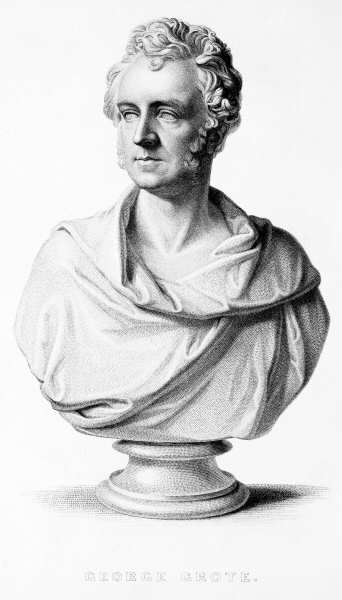
 GEORGE GROTE.