CHAPTER XXI. THE CIVIL WAR.
In a great many ways the War of the Rebellion
affected the commerce of the Missouri River.
Missouri was a slave State, and most of her citizens
along the river were Southern sympathizers. It is
stated that all the Missouri River pilots except two
were in sympathy with the South, and that General
Lyon had to go to the Illinois River for pilots when
he wanted to move his troops up the river in June,
1861.
The steamboat business on the river felt the weight
of the war almost immediately upon its breaking out.
Most of the business was with the loyal people and
was, of course, considered by the Confederates as a
legitimate subject of confiscation. Guerrilla bands infested
the country along the river, fired into the
boats, and did all they could to break up the business.
They succeeded in driving most of the traffic off the
lower river; but at the same time the demands of the
war stimulated the trade higher up. There was an
increased movement of government troops and
stores, and in the later years of the war many refugees
from both armies passed up the river to the mountains.
The discovery of gold in Montana added
greatly to the river commerce during these years.
The injurious effects of the war, therefore, were
mainly confined to the river below Kansas City.
GUERRILLAS IN MISSOURI.
The peril to navigation due to the operations of
the guerrillas was a formidable one. Wherever the
channel ran close to the high wooded banks or other
sheltered localities, ambush and attack could always
be expected. The danger was mainly from the
south bank. It became necessary to tie up at night
away from this bank, and Captain La Barge followed
the practice of anchoring in mid-stream. The
pilot-houses were regularly equipped with shields of
boiler iron, semi-cylindrical in form, inclosing the
wheel, and capable of being moved so as to be adjusted
to the changing course of the vessel. These
shields were of great service on the upper river also,
for the Indians at this time were as dangerous in that
section as were the guerrillas farther down. Occasionally,
when there was much government freight
aboard, troops were sent up on the boat until Kansas
City was passed.
The passions aroused by this internecine strife
deadened human kindness, and made men as ferocious
and brutal as wild beasts. This was particularly
true of the lawless bands of guerrillas whose desultory
operations have been in all wars the most cruel
and most difficult to suppress or control. Brigadier
General Loan, of the Missouri State Militia, in reporting
the tragedy which we shall next relate, said:
“The guerrillas and Rebel sympathizers are waging
a relentless, cruel, and bloody war upon our unarmed
and defenseless citizens, and are determined to continue
it until the last loyal citizen is murdered, or
driven from the State for fear of being murdered.”
Such was the true situation along the south bank of
the Missouri River, and it was only by the most
vigilant precaution on the part of the steamboat men
that they did not suffer more than they did. We
shall relate one instance in which these precautions
did not avail.
AFFAIR OF THE “SAM GATY.”
In the latter part of March, 1863, the steamboat
Sam Gaty was on her way up the Missouri with a
heavy load of freight and passengers, bound for the
far upper river. There were on board several persons
of wealth on their way to the newly discovered gold
fields of Montana. There were besides quite a number
of paroled Union soldiers and some forty contrabands,
as the negroes freed by the war were called.
While passing under a high wooded bank near Sibley,
Mo., the boat was attacked by a band of guerrillas
under the leadership of one Hicks, who had for
some time been the terror of the surrounding
country. The boat was ordered to come to the bank
and promptly obeyed, whereupon the guerrillas immediately
boarded her. The attack was unexpected,
and the passengers were seated around the cabin engaged
in games and conversation when the appalling
fact of their situation dawned upon them. A rush
was made to conceal valuable property, and the
paroled soldiers made haste to get into citizens’
clothes. The poor negroes could do nothing. The
guerrillas made quick and heartless work. They
robbed the passengers of all the valuables to be found
on their persons, and one man narrowly escaped
summary death for attempting to slip his gold watch
into his boot. All the property on board that seemed
to be of any use to the government was thrown into
the river. The safes were broken open and robbed.
Some of the paroled soldiers were taken off the boat
and shot. All of the contrabands were driven
ashore, where they were shot down in cold blood.
Their shrieks and cries were plainly heard on the
boat. After this attack the boat was allowed to
proceed.
AN ATROCIOUS CRIME.
Vengeance followed quickly in the wake of this
atrocious crime. A body of Kansas troops under a
Major Ransom pursued and overtook the guerrillas,
attacked and destroyed their camp, took twenty-one
horses, killed seventeen men in combat and
hanged two, and completely dispersed the organization.44
A UNION MAN
Captain La Barge had his full share of troublesome
experiences that followed the outbreak of the war.
As a slave-owner in a small way, and as a man born
and bred in the old ante-bellum atmosphere that surrounded
the institution of slavery, his natural sympathies
were with the South. But when it came to
a decision he did not hesitate a moment. As between
union and disunion he was for union. It required a
degree of self-denial and patriotism which many
Northerners have never fully appreciated to stand by
the country when one’s training and natural sympathies
would have led him to the other side. Captain
La Barge remained a Union man, took the oath
of allegiance, and throughout the war rendered constant
service to the government. He soon came to
see the wisdom of his decision, and before the war
was over his sympathies had swung into full line
with his action.
THE GALLOWS CHEATED.
In 1861 Captain La Barge was coming down the
river on the Emilie from Omaha, and, as usual,
stopped at St. Joseph for freight and passengers. A
good many people got on board, most of them
Southern sympathizers going south. When the boat
rounded out into the stream the passengers went up
on deck and cheered for Jefferson Davis. The news
of this event was telegraphed to Colonel R. D.
Anthony of Leavenworth45. This distinguished
agitator and ardent Union man called a meeting of
the citizens, and it was decided to hang La Barge
the moment the boat arrived. The Captain had a
stanch friend in Leavenworth of the name of
Alexander Majors, of the firm of Russell, Majors &
Waddell, overland freighters. He was waiting to
take passage to his home in Lexington, Mo. When
the boat approached there was a great crowd on the
levee. The instant the prow touched the bank
Majors leaped on board and told the Captain not to
make fast, as the crowd proposed to hang him. The
Captain asked the clerk what business they had for
Leavenworth. He replied that there were only a
few bills to collect. “Let them go for now,” said
the Captain, and tapping the bell to depart, drew
back into the stream. When the crowd saw that
they were outwitted, they swung their rope into the
air and yelled that they would get him at Wyandotte.
“All right,” replied the Captain, “I expect to stop
there,” but when he reached that place he kept right
on.
SERVING UNDER DURESS.
AN UNPLEASANT DILEMMA.
On one of the down trips in the season of 1861 the
Emilie arrived at Boonville just as the Confederates
were evacuating that place upon the approach of the
Federals under General Lyon. La Barge knew
nothing of what was transpiring there, and his first
intimation of any unusual state of things was a volley
of cannon shot whistling over the boat. The Captain
signaled that he would halt, and rounded to above
the town. The Confederate General Marmaduke
came on board and with him Captain Kelly and a
company of troops. “I knew Marmaduke well,”
said La Barge, “and asked him as soon as he got on
board what the matter was. He replied, ‘I want you
to turn around and take General Price up to Lexington.
He is sick and cannot stand the overland ride.’
I replied that I could not think of such a thing; that
I was in the service of the government. He then
took possession of the boat, placed me in arrest, and
forced me to take the boat back to Lexington. I
protested again, saying that the crew would look to
me for pay for this extra work, and the government
would hold me responsible for failure to fulfill my
contract. Marmaduke replied, ‘I will pay you every
cent you have to disburse on account of this trip.’
After Price came on board Marmaduke left, and we
then steamed up to Lexington, where the boat was
turned over to me and I was told to shift for myself.
I suppose they thought I ought to consider myself
fortunate to get off at all. They never paid me anything,
although they might easily have done so, for
the first thing done upon landing at Lexington, as I
was told, was to sack all the banks of that town. As
to my getting away, that was far from being a matter
of much satisfaction. It was, of course, known in
the Federal lines that I had carried Price up the river.
How should I answer for myself upon my return? I
went to Price, told him the dilemma I was placed in,
and asked him to help me. He gave me a very
strong letter, stating that I had acted under duress,
and had been forced to go back against my repeated
protest.
GENERAL LYON.
LA BARGE RELEASED.
“It was with no slight misgivings that I turned the
Emilie downstream and started in the direction of
Boonville. I knew that there was trouble in store for
me. When I approached the Federal lines a volley
was fired at the boat, apparently with the definite
purpose of hitting her. I promptly rounded to and
the firing ceased. A young Lieutenant by the name
of White came on board with a guard of a dozen men
to arrest me. I had known White in St. Louis as a
commission clerk, a young man of no account, but
who, having now some authority, felt disposed, like
all inferior men, to exercise it with a severity in inverse
proportion to his ability. He doubtless
thought it a great feather in his cap to have as
prisoner a man who would scarcely have deigned to
notice him in any other situation. He was insolent
and arbitrary, and lunging his sword toward me,
would order me to walk faster. I was taken to
General Lyon’s quarters, and when in that officer’s
presence, he said to me: ‘You are in a very bad scrape
here, sir.’ I took Price’s letter from my pocket and
handed it to him, saying, ‘General, please read that;
it may help to straighten matters out.’ He read the
letter, but pretended not to think much of it. After
hemming and hawing over the matter for a while he
said: ‘Do you know anyone here who can tell me
who you are?’ He knew very well who I was, for
he had been with Harney in the Sioux War of 1854–55
and we had met then. I asked him to name the
members of his staff, and I could tell. He finally
mentioned Frank Blair. I said with some irony,
‘I know Frank Blair very well, and I think he knows
me.’ We then walked up to Blair’s quarters. He
shook hands cordially and said, ‘I understand that
you are in a bad fix here.’ ‘It looks like it,’ I replied.
‘Rather be at home than here, I presume,’
he continued jokingly. ‘Much rather,’ I replied.
Lyon showed Blair Price’s letter. They consulted
together for a little while and Lyon then said to me,
‘You can take possession of your steamboat and go
home.’ I found the boat in Lyon’s fleet where it had
been taken, and all of her provisions confiscated. I
was not long in getting up steam, and left the inhospitable
region with the utmost expedition.
“I did not like Lyon. He was a Yankee, and his
disposition seemed to be to crush everyone who did
not think as he did. His language and bearing
toward me were so insolent and exasperating that
they left a lasting rancor in my mind.46
“This affair cost me about five thousand dollars,
although I was partially reimbursed for the stores
taken. I did not go up the river again that season,
being too much vexed and disgusted with my late
experience. I sent the boat up under charge of a man
of the name of Nick Wall, who ran her until my government
contracts were completed.”
In the year 1862 Captain La Barge was again impressed
temporarily into the service of guerrillas.
On October 16 of that year a body of Confederates
was at Portland, Mo., when the steamboat Emilie
came along. The Emilie stopped to put two men
ashore, when a gang of Rebels concealed behind a
woodpile took possession of the boat and compelled
Captain La Barge to set them across the river. He
was forced to unload his deck freight and take on 175
horses and as many men. Scarcely had they started
across when a force of Union cavalry of the Missouri
State Militia arrived, but not in time to arrest the
operation.
These were the only occasions on which Captain
La Barge had trouble on the river on account of the
War. Like all other boatmen, he welcomed the close
of this conflict and the tranquillity which it brought
to the river business.
UNITED STATES VOLUNTEERS.
A NOTABLE CHARACTER.
There was an organization in the military establishment
of the United States, growing out of the
progress of the war, of which very little is known. It
was called the United States Volunteers, and consisted
of six regiments and one independent company.
It was composed chiefly of deserters from the
Confederate army and prisoners of war who had
taken the oath of allegiance to the United States.
These troops served continuously on the Western
plains and in the Northwest, except the 1st and 4th
regiments, which served mainly at Norfolk, Va. On
the Missouri River, and perhaps elsewhere, they
were commonly spoken of as “Galvanized Yankees.”
In 1864, when Fort Rice was established
near the mouth of the Cannon Ball River, it was
garrisoned by the 1st Regiment of U. S. Volunteers
under Colonel Charles A. R. Dimon. This officer
was one of the remarkable characters of Missouri
River history, and made a great impression along the
valley, considering his brief service there. He was
the particular bugbear of the traders, and the character
which they have given him can be best expressed
by spelling his name with an “e” in the first syllable.
It was said that he ordered his men shot down on the
least provocation, and that many of the regiment
were slain in this way. Numbers of his men are said
to have deserted through fear of his tyrannical and
ungovernable temper. One of the traders has left a
record of his own special grievance.
DRASTIC MEASURES.
In the winter of 1864–65, as already stated, the
American Fur Company sold out to the Northwestern
Fur Company, more commonly known as
the firm of Hawley & Hubbell. In the following
spring these two gentlemen went up the river
with Mr. C. P. Chouteau on the American Fur
Company boat, the Yellowstone, to make the transfer
of the posts and property. There were many
passengers of different political creeds on board,
including a number of ex-Confederates. At a
point about one hundred miles above Fort Sully
news of Lincoln’s assassination was received, and the
passengers of all shades of opinion expressed their
horror of the event. When the boat arrived at Fort
Rice, Colonel Dimon, according to this authority,
came down to the boat with a large guard of soldiers
and placed the whole party under arrest on the charge
of jubilating over the assassination of the President.
The traders thought the whole proceeding was a
scheme of Colonel Dimon to advertise his intense
loyalty. He told Chouteau, whose Southern proclivities
were well understood along the river, that
he would take him out on the bank and shoot him
like a dog. Chouteau was thoroughly frightened
and trembled like a leaf, for there was no knowing
what the impetuous officer might take a notion to do.
Hubbell and Hawley determined to go down to
Sioux City and report to General Sully the detention
of their boat and the conduct of Colonel Dimon
toward themselves and others. Chouteau gave them
a yawl and wrote a letter to the General. Dimon
ordered them not to go without first reporting to
him. Although his authority to give such an order
is doubtful, the men did not dare to disobey for fear
of being shot. When they appeared they were required
to submit all their letters to his inspection.
The particular letter he was after was one he believed
Chouteau had written, but Hubbell and Hawley had
slipped it into the breech of a Henry rifle and left it in
the boat. Finally they were permitted to go. They
made a rapid trip, partly by river and partly by land,
and immediately reported their grievances to General
Sully. The General promptly gave them a written
order to Colonel Dimon to release their boat.
Armed with this they returned to Fort Rice by the
steamer G. W. Graham, and in an incredibly short
time, considering the distance and mode of travel,
appeared before Colonel Dimon. General Sully’s
order eased matters up somewhat, but still the traders
had a good deal of trouble with the irate post commander.
FACT AND FICTION.
How much there was in the stories about
Colonel Dimon is doubtful, but probably about an
equal mixture of fact and fiction. Certainly the view
of the traders concerning him was not shared by
General Sully, if we judge from the following extracts
from his own correspondence with General Pope.
Writing from Sioux City under date of June 10, 1865,
he says:
GENERAL SULLY’S VIEWS.
“I admire his energy and pluck, the determination
with which he carries out orders; but he is too young—too
rash—for his position, and it would be well if
he could be removed. He is making a good deal of
trouble for me, and eventually for you, in his over-zealous
desire to do his duty.... His regiment
was raised and organized by Ben. Butler, and he is
too much like him in his actions for an Indian country,
but he is just the sort of a man I would like to
have under me in the field.” Upon his arrival at
Fort Rice a month later he thus commented upon
Colonel Dimon:
“I am much pleased with the appearance of this
post and the way military duty is performed. Colonel
Dimon is certainly an excellent officer. A few
more years of experience to curb his impetuosity
would make him one of the best officers in our volunteer
service.”
Pope in the meanwhile authorized Sully to take
such action in regard to Colonel Dimon as he saw fit.
A board of officers was convened to investigate complaints
against him, and on the strength of their report
he was relieved July 21, 1865. He resumed
command of the post, however, October 10, 1865,
but was mustered out of the service on the 27th of
the following month. He was subsequently brevetted
Brigadier General of Volunteers for gallant and
meritorious service during the war.
A FAIR PROBABILITY.
Colonel Dimon probably showed an excess of
severity toward the traders where the average officer
showed far too little. That explains their chief
ground of dislike of him. Add to this the “impetuosity”
of temperament referred to by General
Sully, and we have a pretty close analysis of a situation
which caused a great flurry on the Missouri River
in its day. As a matter of fact a great many of the
men in the 1st Volunteers died at Fort Rice, but
from disease, and not by execution under Dimon’s
order. A number of men did desert, and seventeen
of them walked all the way to Fort Union. One of
these men made a pen drawing of that post which is
probably the most accurate now in existence.
CHAPTER XXII. GOLD IN MONTANA.
FIRST GOLD IN MONTANA.
If the Civil War operated to drive commerce from
the lower Missouri River, other forces were at work
at the head waters of that stream to multiply it many
fold. At the time when the attention of the nation
and of the world was centered on the tempest that
had burst over the eastern portion of the Republic,
a few hardy miners were prospecting the country
around the upper tributaries of the Missouri in their
ever-restless search for gold. It is a singular fact
that the gold-bearing regions of western Montana,
the very first in the mountain country to be extensively
frequented by white men, should have been the
last to give up the secret of their hidden wealth.
For nearly twenty years emigration had been pouring
into the West. The Mormons had settled a few
hundred miles to the south. Settlement had gained
a permanent foothold on the Pacific Coast from
Mexico to the British line. The Pike’s Peak gold
discoveries were rapidly filling up Colorado. The
reflex wave of emigration was rolling back from the
Pacific Coast across the Sierras and the Cascades
into Nevada, eastern Oregon, and Idaho. But as
yet there were no settlers to speak of in the mountains
of Montana, and that country was still practically
unknown to the general public. It is a remarkable
fact that a section of country in that neighborhood,
which is now considered the most wonderful in the
world, was the very last of all the national domain to
be discovered and explored.
FIRST SALE OF GOLD DUST.
The wave of gold discovery in the Northwest
moved from the west toward the east. In 1860–61
it made known the rich deposits in Idaho on the
Salmon and Clearwater rivers. Next came the findings
just west of the Continental Divide, and then the
rich discoveries on the head waters of the Missouri.
The existence of placer deposits within the limits of
the present State of Montana had been asserted as
early as 1852. A Canadian half-breed of the name
of Beneetse is said to have found pay dirt in that
year on a small tributary of Deer Lodge River, one of
the sources of the Columbia. The stream has since
been known as Gold Creek, and the place of discovery
is about fifty miles northwest of the modern
city of Butte. Four years later, 1856, the discovery
was confirmed by a party who were traveling from
Great Salt Lake to the Bitter Root Valley. In the
same year a man turned up at Fort Benton with what
he asserted was golddust. He came from the mountains
in the Southwest, most likely from the Deer
Lodge Valley. None of the people at the post were
gold experts, and they hesitated about receiving the
dust; but Culbertson finally took it on his own
responsibility, giving for it a thousand dollars’ worth
of merchandise. Next year he sent it down the river,
and it was found to be pure gold, worth fifteen hundred
dollars. This was the first exchange of golddust
in Montana.
The next step in the progress of discovery must be
credited to James and Granville Stuart, two of Montana’s
most distinguished pioneers. They had been
spending the winter of 1857–58, with a number of
other people, in the valley of the Bighole River, a
tributary of the Missouri, and in the spring of 1858
went over to the Deer Lodge Valley to investigate the
reported findings on Gold Creek. They remained
there for a time and found paying prospects, but
were so harassed by the Blackfeet Indians that they
were compelled to leave. They moved to a safer
locality, but here James Stuart met with an accident
which came near proving fatal, and the two
brothers left the country and went to Fort Bridger.
Although they had made no great discovery, their
report was considered as confirming those already
made of the existence of gold in the Deer Lodge
Valley.
Before these prospects were any further developed
attention was wholly diverted to the important discoveries
in Idaho already referred to. A great stampede
to the Salmon and Clearwater rivers began.
Emigrants poured in both by way of Salt Lake and
the Missouri River, and an even larger inflow came
from the Pacific Coast. But before the rush from
the East had gathered full force discoveries in
Montana arrested its course and held it permanently
in a new and greater Eldorado.
BEGINNING OF MINING IN MONTANA.
In the winter of 1861–62 a considerable floating
population, among them the Stuart brothers, remained
in the Deer Lodge Valley. The Stuarts
commenced sluicing in a systematic way on Gold
Creek, and their work was the beginning of the gold-mining
industry in Montana. Although nothing
particularly remarkable was found, it was enough to
attract attention, and reports soon got abroad that
the findings were very rich. The greater part of the
emigration from the East in the year 1862 was bound
for the Idaho mines, but did not get beyond the Deer
Lodge Valley, or other points in western Montana.
Among these parties was one from Colorado, including
J. M. Bozeman, for whom the town of Bozeman,
in the beautiful Gallatin Valley, is named. The newcomers
made a rich discovery on a branch of Gold
Creek, which was named, from the place whence the
party came, Pike’s Peak Gulch.
BANNOCK CITY.
Another party from Colorado, bound for the Idaho
mines, were deflected north by the difficulty of getting
through the Lemhi Mountains and by favorable
reports from the Deer Lodge Valley. Two of their
number discovered gold on Grasshopper Creek, in
the southwestern corner of the present State of
Montana. They carried the news to the main party,
who had gone on to the Deer Lodge, and all returned
to investigate the discovery. The report of the two
men was found to be true, and prospecting in that
part of the country was carried on extensively. This
work resulted in the finding of a very rich deposit by
a party under one White, for whom the spot was
named White’s Bar. Here the town of Bannock
sprang up, and before the end of the year boasted a
population of five hundred souls. Other rich discoveries
were made in that vicinity, while far to the
north the deposits on the Big Prickly Pear Creek
were found. It was now apparent that the whole
country on the head waters of the Missouri abounded
in gold, and the work of prospecting assumed enormous
proportions.
NORTHERN OVERLAND EXPEDITION.
Two other important expeditions came from the
East this season, bound for the Idaho mines, but
were stopped in their course, like that from Colorado,
by the new discoveries in Montana. One of these
was the firm of La Barge, Harkness & Co. of
St. Louis, and the other was a body of emigrants who
accompanied what was known in its day as the
Northern Overland Expedition from St. Paul. This
expedition was of a semi-official character, under a
Federal appropriation of five thousand dollars, and
its ostensible object was to open a wagon road from
St. Paul to Fort Benton. It was under the command
of Captain James L. Fisk, who, a private soldier in
the 3d Minnesota Volunteers, was appointed Captain
and Quartermaster and placed in charge. About
125 emigrants accompanied the expedition. The
journey was made in safety, and was full of interesting
happenings. It contributed one of the most important
additions ever made to population of the
rising State.47
The spring of 1863 was marked by one of the most
noted gold discoveries ever made. During the
previous winter a considerable party, under the
leadership of James Stuart, was organized at Bannock
City, to explore and prospect the country on the
sources of the Yellowstone. A portion of this party,
including William Fairweather and Henry Edgar,
went by the way of Deer Lodge Valley to secure
horses, having fixed on the mouth of the Beaverhead
River as the place of joining the main party.
Through some unavoidable delay the smaller party
did not arrive on time and Stuart went on without
them. The Fairweather party discovered Stuart’s
trail and made forced marches to overtake him. The
route lay up the Gallatin Valley and across the divide
to the Yellowstone, and thence down the valley of
that stream. Soon after reaching the Yellowstone
the smaller party were plundered by a band of Crows
of everything except their guns and mining tools.
The Indians had the generosity to give them in exchange
for their mounts old broken-down horses of
their own.
ALDER GULCH.
The party gave up their pursuit of Stuart and
started back for Bannock City. On the 26th of May
they stopped for noon on Alder Creek, a little branch
of one of the main tributaries of Jefferson Fork of
the Missouri. Here, as a result of a chance examination
of a bar by two men, Fairweather and Edgar,
the famous Alder Gulch discovery was made, and the
richest placer deposit in the history of gold mining
came to the knowledge of the world. The news of
this wonderful discovery drew to the spot a large part
of the population of the Territory, and the town of
Virginia City sprang up as if in a night. For several
years it was the principal town in the Territory and
became its first capital. In less than two years it
had grown to a city of ten thousand souls.
LAST CHANCE GULCH.
The next important discovery was made in the fall
of 1864, in what was named at the time Last Chance
Gulch. The deposits were very rich, and the history
of Alder Gulch was re-enacted here. The town
which arose on the spot was named Helena, and soon
outgrew its sister to the south. It became, and for
many years remained, the principal town of the
Territory. In 1874 it was made the Territorial
capital, and after Montana was admitted to the
Union, it was made the permanent capital of the
State.
Other discoveries followed those here mentioned,
many of them rich and of permanent value, but none
equaling those of Alder and Last Chance gulches.
The Territory at once took rank with California and
Colorado as a gold-producing territory, and has held
its high place ever since.
The mighty metamorphosis which, in the space of
five years, came over the country at the headwaters of
the Missouri, produced an equally marvelous change
in the commercial business of that stream. The river
gave a sure highway for travel to within one hundred
to two hundred miles of the mines. There was no
other route that could compete with it, for this could
carry freight from St. Louis to Fort Benton, in cargoes
of one to five hundred tons, without breaking
bulk. The emigrants themselves went in large numbers
by overland routes, but a great number also by
the boats; while nearly all merchandise, including
every necessary of life, and all mining machinery and
heavy freight, came by the river.
HIGH WATER MARK.
AN EXTRAORDINARY SCENE.
The steamboat trade jumped suddenly to enormous
proportions. Prior to 1864 there had been only six
steamboat arrivals at the levee of Fort Benton. In
1866 and 1867 there were seventy arrivals. The
trade touched high-water mark in 1867, and at this
time presented one of the most extraordinary developments
known to the history of commerce.
There were times when thirty or forty steamboats
were on the river between Fort Benton and the
mouth of the Yellowstone,48 where all the way the
river flowed amid scenes of wildness that were in
the strictest sense primeval. To one who could have
been set down in the unbroken wilderness along the
banks of the river, where nothing dwelt except wild
animals and wilder men, where the fierce Indian made
life a constant peril, where no civilized habitation
greeted the eye, it would have seemed marvelous and
wholly inexplicable to find this river filled with noble
craft, as beautiful as any that ever rode the ocean,
stored with all the necessaries of civilization, and
crowded with passengers as cultured, refined, and
well dressed as the cabin list of an ocean steamer.
What could it all mean? Whence came this handful
of civilization and what brought it here? Certainly
a most extraordinary scene, flashed for a
moment before the world and then withdrawn forever.
PERILOUS VOYAGE.
It was not the steamboat alone, however, that
made up the romantic history of Missouri navigation
in these exciting times. There were every
year many men from the mines who wanted to return
to the States because they were weary of the
country or wished to carry down the crude wealth
which they had secured. The steamboats came up
only in the spring, and if passengers were not ready
to go down it was necessary to seek other conveyance.
The usual resource in such cases was the
mackinaw boat. It was a perfectly comfortable and
very cheap mode of traveling, with only one drawback—danger
from the Indians, who, at this time,
were intensely hostile all along the river. It was
regarded as a sort of forlorn hope to go down in an
open boat, and yet many tried it every year. Generally
they got through all right, with their precious
freight, but there were some terrible tragedies as the
penalty of such reckless daring.
Some statistics have survived showing the magnitude
of the steamboat business on the Missouri River
during these years. In the year 1865, 1000 passengers,
6000 tons of merchandise, and 20 quartz mills
went to Fort Benton. In the year 1867 forty steamboats
had passed Sioux City before June 1 on their
way up the river. They carried over 12,000 tons of
freight, most of it for Fort Benton. There was not
much downstream traffic, although all the boats
carried golddust. In 1866 one boat, the Luella, had
on board $1,250,000 worth of dust.
FABULOUS PROFITS.
The profits of a successful voyage were enormous.
The reported profits for some of the trips of 1866
were as follows: The St. John, $17,000; the Tacony,
$16,000; the W. J. Lewis, $40,000; the Peter Balen,
$65,000. In 1867 Captain La Barge cleared over
$40,000 on the trip of the Octavia.
Freight rates from St. Louis to Fort Benton in
1866 were 12 cents per pound. Insurance rates were
6 1-2 per cent. in the case of sidewheel boats and
8 per cent with sternwheel boats. The fare for
cabin passengers was $300. It was not everyone,
however, who had a share in the high prices of those
times. The master of the boat received $200 per
month; the clerk $150; the mate and engineer each
$125. The pilot was the only member of the crew
who could command what salary he pleased. So
indispensable were his services that as high as $1200
per month was paid for the best talent.
CHAPTER XXIII. INCIDENTS ON THE RIVER (1862–67).
In the summer of 1863 a party of twenty-one men
and three women went down the Missouri in a
mackinaw boat from Fort Benton. They reached
the vicinity of the mouth of Apple Creek, near where
Bismarck, N. D., now stands, just as the Sioux
Indians, whom General Sibley was driving out of
Minnesota and across the country to the Missouri,
arrived on the banks of that stream. They had just
been defeated in three engagements with General
Sibley and were in a very angry temper. They
attacked the boat and fought the little party an entire
day, and finally killed them all and sunk the boat.
It was reported that the whites killed ninety-one
Indians in the fight, and that the captain of the boat,
whose name is supposed to have been Baker, “made
such a brave defense that the Indians were struck with
admiration for him and wanted to save him.” The
boat had a large amount of golddust on board, and
some of it was recovered by the Mandan and Aricara
Indians. An air of mystery has always hung over
this affair, and the details will probably never be
known. For some unexplained reason, certain individuals
who were believed to have had some knowledge
of it refused to disclose anything.
THE STOLEN MACKINAW.
In 1864, while Captain La Barge was at Fort
Benton, a number of miners applied to him to purchase
a mackinaw boat. He refused to sell because
he felt sure that it meant death to them to try to run
the gantlet of the Indians in that way. They replied
that they were afraid to go overland on account
of road agents. The Captain told them they had less
to fear from road agents than from Indians. The
road agents might take their gold, but the Indians
would spare neither treasure nor life. They were
unconvinced, however, and as the Captain would not
sell the boat, they stole it and set out. While passing
a high cut bank, about thirty miles below Fort
Berthold, where the channel ran close to the shore,
they were attacked by a war party of Sioux and all
killed. Pierre Garreau, the well-known interpreter,
went down from Berthold and recovered a part of
the golddust. La Barge saw some of it among the
Indians the following year.
In 1865 the steamer St. Johns, on her way down
the river, was attacked by the Indians and the mate
instantly killed. The boat was under full headway
and out of reach before it was possible to return fire.
SOWING THE WIND.
In the same year the General Grant lost three men.
They had been sent ashore at a wooding place to
make fast a line, when they were pounced upon by
the Indians and killed.
On April 23, 1865, a band of Blood Indians near
Fort Benton stole about forty horses belonging to a
party of beaver-trappers, of whom Charley Carson,
a nephew of “Kit” Carson, was one. On the night
of May 22 these men, having gotten on a drunken
spree, attacked a small party of Blood Indians who
happened to be near Fort Benton, but were not
known to be the thieves, killed three, and threw their
bodies into the Missouri. The survivors fled toward
the south and met a large band of warriors near Sun
River, on their way north. Exasperated at the outrage
upon their brethren, they were ready for any
measure of revenge, and accident soon threw the
desired opportunity in their way.
REAPING THE WHIRLWIND.
At the mouth of the Marias River lay the steamboat
Cutter. A town site had been laid off at this
point and named Ophir, and some timber had been
cut in the valley of the Marias for use in the erection
of buildings. The principal proprietor of the nascent
village was a passenger on the Cutter, and the business
of that boat seems to have been connected with
the building of the town. On the afternoon of May
25, about half-past two o’clock, eight men left the
boat with a wagon and three yoke of oxen to bring
down some of the timber, and an hour later two men
went on horseback to join them, for it was felt that
there might be trouble from the Indians, and that the
party should be as strong as possible. These men
were all well armed. Their route lay up the valley
of the Marias along its right bank, which they ascended
about three miles. At this point the valley,
which was quite broad below, narrowed to a width of
four hundred yards. There was a growth of timber
quite dense close to the river, but open farther back.
Just above this point the bluffs crowded close upon
the river, seamed with ravines and gullies, like all the
river bluffs along the Missouri. The roadway at the
foot of these bluffs was very narrow.
Beyond this defile the valley opened out again,
and there was another belt of timber. In the upper
opening the Indians seem to have been in camp and
to have been discovered by the wood-choppers just
as the latter were passing the defile. It was probably
the same band which we have noted as being near
Sun River two days before. The wagons were instantly
turned about, although in a most disadvantageous
situation. The Indians saw the whites at
about the same time. They were lying in wait for
another party with a mule train, and were intending,
after attacking it, to try to take the steamboat. As
soon as they saw the wood-choppers they at once
attacked them and killed every man and captured
all the property. The bodies of the slain were found
scattered along the river, fifty to one hundred yards
apart, except one, that of N. W. Burroughs, which
was found half a mile further downstream, where he
was overtaken on his flight to the boat. Of the
Indians the head chief and one other were killed and
a third dangerously wounded. The Indians, to the
number of about two hundred, immediately moved
toward the British line.
ENTIRE PARTY SLAIN.
The attack occurred about four o’clock and the
firing was distinctly heard on the boat. A party
prepared to go out and investigate when a hunter
came riding in from the bluffs, saying that the whites
were being assailed by a large party of Indians.
Three scouts set out immediately, and after proceeding
about two miles and a half found the body of Mr.
Burroughs. It being certain that all the rest had
been killed, and not knowing where the Indians were,
it was not thought best to go farther at the time.
Next morning a party went out with wagons and
brought in the bodies, all of which were found.
They were buried in one grave, side by side, with a
head board giving the names and date.49
YANKEE JACK AGAIN.
Captain La Barge arrived at the mouth of the
Marias on the Effie Deans soon after this affair and
saw the fresh graves. He remembered the circumstance
particularly, because, among the guard, which
had been stationed there after the massacre, was the
identical “Yankee Jack” who had whipped the two
Irishmen on the Robert Campbell in 1863.
About September, 1865, eight men left Fort Benton
in a skiff for the States. They were attacked by
some forty Indians near the mouth of Milk River
and five of their number were killed. The fight
lasted over five hours. One of the men who was
killed, T. A. Kent by name, is said to have actually
killed thirteen Indians before he himself fell.
In the year 1866 there were several noted open-boat
voyages down the river. One of these was
made by a party of ten miners, who purchased a
mackinaw at Fort Benton in which to transport themselves
and their golddust. When in camp on an island
about sixty miles above Fort Randall, one of the men,
of the name of Thompson, got up in the night, took
an ax, killed one companion and wounded another.
He was apparently bent on the destruction of the entire
party. The rest of the men, suddenly awakened
by the cries of their comrades, and believing that they
were attacked by Indians, rushed to the boat with the
wounded man and made off, leaving the murderer and
his victim alone on the island. Whether robbery was
the motive of the deed, or whether it was caused by
insanity, was never known.
More fortunate was another mackinaw party that
went down the same season. It consisted of seventeen
men, and made the trip from Fort Benton to
Sioux City in twenty-two days. They brought down
over two hundred thousand dollars in golddust.
The third party of this season consisted of one man
in a yawl and about twenty others in a mackinaw.
They made the entire trip without loss, although they
were attacked, some 225 miles below Benton, by
about five hundred Blackfeet. The river was in flood
stage, and thanks to its great width and swift current
the boats were able to keep out of range of the
Indians and to pass quickly beyond their reach.
HUBBELL’S MACKINAW.
The most important mackinaw trip ever made
down the river was in 1866 under the leadership of
J. B. Hubbell of the firm of Hawley & Hubbell. Hubbell
had advertised that his steamboat would leave
Fort Benton on her second trip about September 15,
promising, if she did not get to Fort Benton, to take
the passengers down in a mackinaw until they met
her. As late as October 20 she had not appeared,
and accordingly about thirty passengers started down
in a mackinaw. The boat was a very elaborate one,
built for this particular trip. It was eighty feet long,
twelve feet beam, housed in on both sides by bulletproof
walls for a distance of fifty feet, with sleeping
bunks along the sides, and open spaces at bow and
stern for managing the boat. Two masts rigged
with square sails were provided.
A SUCCESSFUL VOYAGE.
The boat was run until after dark every night and
was started before daylight in the morning. Wherever
possible she was tied to a snag out in the stream
for the night so as to make it impossible for the
Indians to attack by surprise. When the party arrived
at Fort Union they learned that the steamer
had been up, but had gone back. After some deliberation
it was decided to undertake the rest of the
journey and trust to luck not to be caught by the ice.
Everyone took a hand at the oars and rapid progress
was made. Game was plentiful and the boat was
full of golddust, and in spite of the fear of ice and
Indians the party were in the best of spirits. They
arrived at Sioux City November 22, with the river
running full of ice. Two days later and they would
have been frozen in. Mr. Hubbell received $175
per passenger.50
THE LOST NEGRO BOYS.
INCREDIBLE ENDURANCE.
A singular incident happened in the summer of
1867, growing out of the wreck of one of the river
boats. In July of that year the steamer Trover was
wrecked at a point 240 miles below Fort Benton.
The Ida Stockdale happened along about the time,
took her freight and passengers to Benton, and on
the way back took off her machinery and carried it to
St. Louis. When she left the wreck there were two
colored boys asleep in the hold, and the boat went
off without knowing they were there. On waking up
and finding themselves alone, without a thing to eat
or any means of defense, and surrounded by a wilderness
wholly unknown to them, they were completely
paralyzed with fright; but recovering their presence
of mind they saw that they must find some relief
immediately or they would die of starvation. They
left the wreck and started down the river. In crossing
a small tributary of the Missouri one of the boys
was drowned. The other kept on night and day,
most of the time back from the river, to avoid the
bends and the swamps and underbrush. He had
nothing to eat except a little bark and some flower
blossoms and did not stop a moment for sleep. His
keeping back from the river caused him to miss the
boats and trading posts. Finally, almost famished
and exhausted, he beat his way through a dense willow
growth to the bank of the river in the hope that
some boat would come along before he should die.
Shortly afterward a steamer hove in sight—the
Sunset—on her way up the river. She was a veritable
sunrise to the poor boy, who began waving an old
white hat, almost the only article of clothing he had
left. The people on the boat saw the signal and sent
the yawl out and brought the boy in. His face was
almost raw from mosquito bites, and he was so weak
that he could scarcely stand. He was found at a
point twenty-five miles below Fort Rice, or 642 miles,
by river channel, below where the Trover was
wrecked. He traveled this distance in nine days.
With all the cut-offs duly allowed for, he must have
averaged seventy miles a day during this time, and all
the while without food. Were it not that the facts
seem well established, such an example of physical
endurance would be incredible.51 The name of this
little hero was Frederick Good and his home was in
St. Louis.
CHAPTER XXIV. LA BARGE AGAIN IN OPPOSITION.
With a view to entering, upon a large scale, into
the newly developing business at the head waters of
the Missouri, the firm of La Barge, Harkness &
Co. was formed in St. Louis in the winter of
1861–62. The members were Joseph La Barge,
Eugene Jaccard, James Harkness, John B. La Barge,
and Charles E. Galpin. Each partner put in ten
thousand dollars. Two steamboats were purchased—Captain
La Barge’s boat, the Emilie, and a light-draft
boat, the Shreveport. In the division of duties
and responsibilities among the partners Jaccard was
to attend to the affairs of the firm in St. Louis, the
La Barges were to manage the steamboat business,
Galpin was to look after the trade along the river,
and Harkness was to go to the mines with an outfit
of merchandise, and was to remain there and develop
a business with those rapidly growing communities.
VOYAGE OF 1862.
When it was known that Captain La Barge was to
make a spring trip to Benton, he was overwhelmed
with applications, not merely from those who wanted
to go to the mines, but from business men and capitalists
who wished to join the enterprise. He could
easily have organized a capital of a million dollars,
but he adhered to his first plan and pushed his
preparations with vigor. The Shreveport was first
gotten ready to sail and left port April 30, 1862.
Captain John La Barge was master. The Emilie
followed on the 14th of May.
As a performance in steamboating the voyage of
the Emilie was a great success. She was loaded to
the guards with some 350 tons of freight and 160
passengers. Captain La Barge himself had never
been more than a hundred miles above Fort Union;
yet he made the whole trip, 2300 miles, in a little less
than thirty-two days, and would have finished it
sooner but for the fact that he had to help the
Shreveport the last hundred miles of the distance.
The boats arrived at Fort Benton at noon June 17,
and at 6 A. M., June 19, the Emilie started down the
river, reaching St. Louis on the 3d of July. Her
speed up averaged 71 miles per day; down, 152 miles.
A DESPERATE GAME.
An exciting incident of the trip was the passing of
the American Fur Company’s boat, the Spread Eagle.
The new opposition of La Barge, Harkness & Co.
was a formidable one, and the Company bestirred
itself with unusual vigor to be first on the
ground with its annual outfit. The Spread Eagle
left St. Louis with three days the start, but was overtaken
by the Emilie near Fort Berthold. For the
next two days the boats were near each other most
of the time. The day after leaving Berthold the
Emilie passed her rival for good. When the officers
of the Spread Eagle saw that they were beaten they
played a desperate game, which showed to what
lengths the Company’s servants would go when it
was a matter of rivalry in trade.
THE “SPREAD EAGLE” RACE.
At the point where the race took place there was a
towhead (a newly formed island) which at the stage
of the river then prevailing was covered with water.
The main channel, and at ordinary stages the only
channel, passed on the right-hand side going up, and
this channel the Spread Eagle took. But the water
was now high enough to give a good channel on the
other side of the towhead. As the distance by this
channel was somewhat shorter, and as the Emilie was
the faster boat anyway, it was a good chance to get
well ahead and out of the way. La Barge promptly
seized the opportunity. The pilot of the Spread
Eagle with quick eye realized that he had been out-maneuvered,
and seeing no other way to prevent the
Emilie’s passage, determined upon wrecking her. He
accordingly left the main channel and made for the
chute that the Emilie was entering. He steamed
alongside of her for a moment, but found that he was
losing ground.52 The boats were scarcely fifty feet
apart, when the pilot of the Spread Eagle, seeing that
he could not make it, deliberately put his rudder to
port, and plunged the bow of the boat into the Emilie
immediately opposite her boilers. Several of the
guards were broken and the danger of wreck was imminent.
La Barge was in the pilot-house at the time
and was not looking for such a move, for he did not
believe that even the American Fur Company would
play so desperate a game when human life was at
stake. He instantly called out to Bailey, the pilot of
the Spread Eagle, to stop his engines and drop his
boat back or he would put a bullet through him.
The passengers likewise became thoroughly aroused,
and some of them got their arms and threatened
to use them if the Spread Eagle did not withdraw.
These threats were effective; the Spread
Eagle fell to the rear and was seen no more on the
voyage. She was four days behind at Benton, and a
week on the whole trip. She lost four men on one of
the rapids by the grossest carelessness. A crew had
gone to the head of the rapids to plant a deadman,53
and having finished this work dropped down to the
boat in their yawl. Instead of passing alongside of
the steamer they made directly for the bow, and on
reaching the boat the swift current instantly rolled the
yawl under and the crew were drowned.
LA BARGE’S GENEROSITY.
When the Spread Eagle returned to St. Louis
charges were preferred against Bailey for having attempted
to wreck the Emilie. He was brought to
trial before the steamboat inspector and his license
was canceled. It was a hard blow to him, for steamboating
was his trade, and he had a large family to
support. About a month afterward he went to La
Barge saying that he had been trying to get the inspector
to reinstate him, but that he would not do it
except upon La Barge’s recommendation. Bailey admitted
his guilt, but said that he had acted at the instigation
of the Company’s agents, and he begged La
Barge to reinstate him for the sake of his wife and
children. The Captain was never good at resisting
appeals of this sort, and he accordingly went to the
inspector and got Bailey reinstated.
CHOUTEAU IN DOUBT.
When the Emilie was reported as back from her
trip, the old gentleman Chouteau sent his carriage to
bring La Barge to the office.
“At what point did you turn back?” he asked
when La Barge arrived, for the phenomenally quick
trip indicated that the Emilie did not reach Fort
Benton.
“Fort Benton, sir,” replied La Barge.
“Tut, tut! I know you could not have done that.
Tell me candidly where you left your trip.”
“Fort Benton, sir.”
“We’ll see about it. I don’t believe it, don’t believe
it.”
“Sorry you doubt my word, but it is nevertheless
true.”
“Where did you leave the Spread Eagle?”
“’Way below Benton; found her cordelling.”
“Well, if you got to Fort Benton you made a good
trip; but I don’t believe it.”
As soon as Captain La Barge reached St. Louis he
loaded his boat with merchandise for the new posts
along the river, intending to go back until he should
meet the Shreveport, a much lighter-draft vessel, and
transfer the cargo to her for the rest of the trip. The
Shreveport left Fort Benton July 6, and met the
Emilie at Sioux City. The transfer of cargo and
passengers was made, and the Emilie returned to St.
Louis. The Shreveport went as high as the mouth of
Milk River, the farthest of the new posts except that
near Fort Benton. After the Emilie’s return from
her second voyage she went to work for the government,
carrying stores from St. Louis to Memphis, and
remained in this service all winter.
The river portion of the season’s operations of the
new firm had been a complete success. Three large
cargoes had been sent up the river, two to Fort Benton
and one to the lower posts. Of these posts there were
four—La Framboise, near old Fort Pierre; another
near Fort Berthold; Fort Stuart, near the mouth of
Poplar River, and Fort Galpin, near the mouth of
Milk River. It remains to notice what was done at
Fort Benton and in the projected expedition to the
mines.
FORT LA BARGE.
The operations at Fort Benton and beyond were
placed in the hands of Mr. Harkness. The first step
was to build a post at Fort Benton, where it was intended
to locate the principal establishment of the firm.
The site chosen was near the spot where the Grand
Union Hotel later stood. The work was begun June
28, Mrs. La Barge driving the first stake. The inclosure
was made three hundred feet long by two hundred
feet wide, and the post was named Fort La Barge.
HARKNESS VISITS THE MINES.
Before the Shreveport set out to return to St. Louis,
a considerable party made an excursion to the Great
Falls of the Missouri. Among them were Father De
Smet, Eugene Jaccard, member of the firm; Giles Filley
of St. Louis, and his son, Frank; Mrs. John La
Barge, Miss Harkness, W. G. Harkness, Tom La
Barge, and Mrs. Culbertson, the Indian wife of the
noted trader. Mrs. La Barge and Miss Harkness are
supposed to be the first white women to have seen the
Great Falls of the Missouri. Four days after their
return the Shreveport left for St. Louis, taking with
them all who had come up only for the trip.
LA BARGE CITY.
The Shreveport having gone, and affairs at Fort La
Barge being well under way, Harkness set out July 9
with an ox train laden with assorted merchandise for
the mines in the Deer Lodge Valley. When the boat
left St. Louis it was expected to go to the Salmon
River mines, but the recent discoveries in Montana
gave a better prospect nearer home. In fact the demand
for goods, even at Fort Benton, was brisk, and
the firm had carried on a thriving trade ever since the
arrival of the boats. Harkness followed the usual
trail up the Missouri River and Little Prickly Pear
Creek, through the broad valley on the border of
which the city of Helena now stands, and thence to
the valley of the Deer Lodge. Nothing of unusual
note transpired on the trip. Harkness did not like
the experience, except the trout fishing. His journal
is full of complaints at the hardship he was compelled
to undergo, and he plaintively asks if he “will ever
live to reap the benefit.” He generally “nooned at
11 A. M.” in order to “catch trout for dinner.” He
reached the Deer Lodge Valley July 23, near the point
where the town of that name now stands.54 Here he
found a fellow passenger on the Emilie, Nicholas
Wall of St. Louis, who had reached the mines some
days before, and who was destined to figure prominently
in the future affairs of La Barge, Harkness &
Co.
After remaining in this section and prospecting
around for eleven days, Harkness grew disgusted at
the prospect, placed such of his goods as he did not
sell in the hands of Nick Wall to be sold on commission,
and set out for the Missouri “glad to be on the
road home.” On the Sun River he met the Northern
Overland Expedition from St. Paul. He visited
the Great Falls on his way down, and arrived at Fort
La Barge August 18. Harkness was now “tired and
out of spirits,” and “adjusted his expense accounts
and turned over everything to the store.” He had evidently
had enough of this kind of life, and forthwith
ordered “a boat built to go down the river.” The
boat was launched August 26 and was christened the
Maggie. Harkness lost no time in getting away, and
left Fort La Barge at 4 A. M. on the 28th. No incidents
occurred on this trip which are of much interest.
The party reached Omaha September 30, where Harkness
“sold the Maggie for five dollars,” and took
passage on the Robert Campbell to St. Joseph. From
that point he went by rail and the Mississippi River to
St. Louis, where he arrived October 6.
INCOMPETENT HANDS.
The foregoing details, taken entirely from the diary
of Harkness, show in what unfit hands the important
business of the company in the upper country had
been intrusted. From his arrival at Fort Benton
until his departure was only two months and a half,
including a trip of several hundred miles to the Montana
mining regions. Only eleven days did he spend
in establishing his trade in that section, the most important
point of all, and then practically gave his
goods away to Nick Wall, for the company never
received a cent for anything left with that gentleman.
Yet Harkness was the partner who was to remain in
the upper country two years. “He was back in St.
Louis almost as soon as I was,” said La Barge, with
just indignation, in commenting on the affair.
FIRST SEASON’S OPERATIONS.
Such were the first season’s operations of the firm
of La Barge, Harkness & Co. In most respects the
firm had made a brilliant beginning. The prospects
in the river portion of the business were all that could
be asked. Only Harkness’ weak management of his
part of the enterprise can be criticised. He was not
the man for the place, and lacked the courage and
hardihood for that kind of work, and he threw away
an opportunity from which a more enterprising man
would have made a fortune.
CHAPTER XXV. VOYAGE OF 1863—THE TOBACCO GARDEN MASSACRE.
DISASTROUS DELAY.
Deferring for the present our narrative of the
fortunes of La Barge, Harkness & Co., we shall recount
one of those mournful tragedies and one of those
instances of official corruption which marked the later
history of the Indian tribes along the Missouri River.
When Captain La Barge, in the spring of 1863, undertook
to leave the government service on the Mississippi,
to get ready for his trip to Fort Benton, he was
told by the Quartermaster in St. Louis that he could
not have the boat, for the government had further use
for it. Not having time to go to Washington to see
about it, he sold the boat for twenty thousand dollars
to the Hannibal and St. Joseph Railroad, and left to
that company the task of securing its release. He then
chartered the Robert Campbell, and, with the Shreveport,
prepared for a voyage to Fort Benton. It proved
to be a notable trip. The cargo and passenger lists
of the Shreveport were made up almost exclusively
for the mines and for the posts of La Barge, Harkness
& Co. The Campbell was loaded with annuities for
the Sioux, Crows, Blackfeet, and Assiniboines, together
with some other freight, making a cargo of
nearly five hundred tons. The Shreveport got away
from port in the latter part of April, but the Campbell
was subjected to annoying and even disastrous delay
by the failure of the annuities to arrive on time. Captain
La Barge, who had the contract to transport the
annuities, had been ordered to have his boat in readiness
on the 1st of April. The goods did not arrive,
and he was held in St. Louis for forty-two days before
he could start on the long journey. It was considered
of the highest importance to start as soon as the ice
disappeared in order that the trip, both coming and
going, could be made during high water. As the year
1863 happened to be a low-water year, the delay which
Captain La Barge suffered made it impossible to complete
the voyage. Even on the 12th of May, the day
of starting, only a portion of the goods had arrived,
and the rest were taken on at St. Joseph, whither they
were sent by rail.
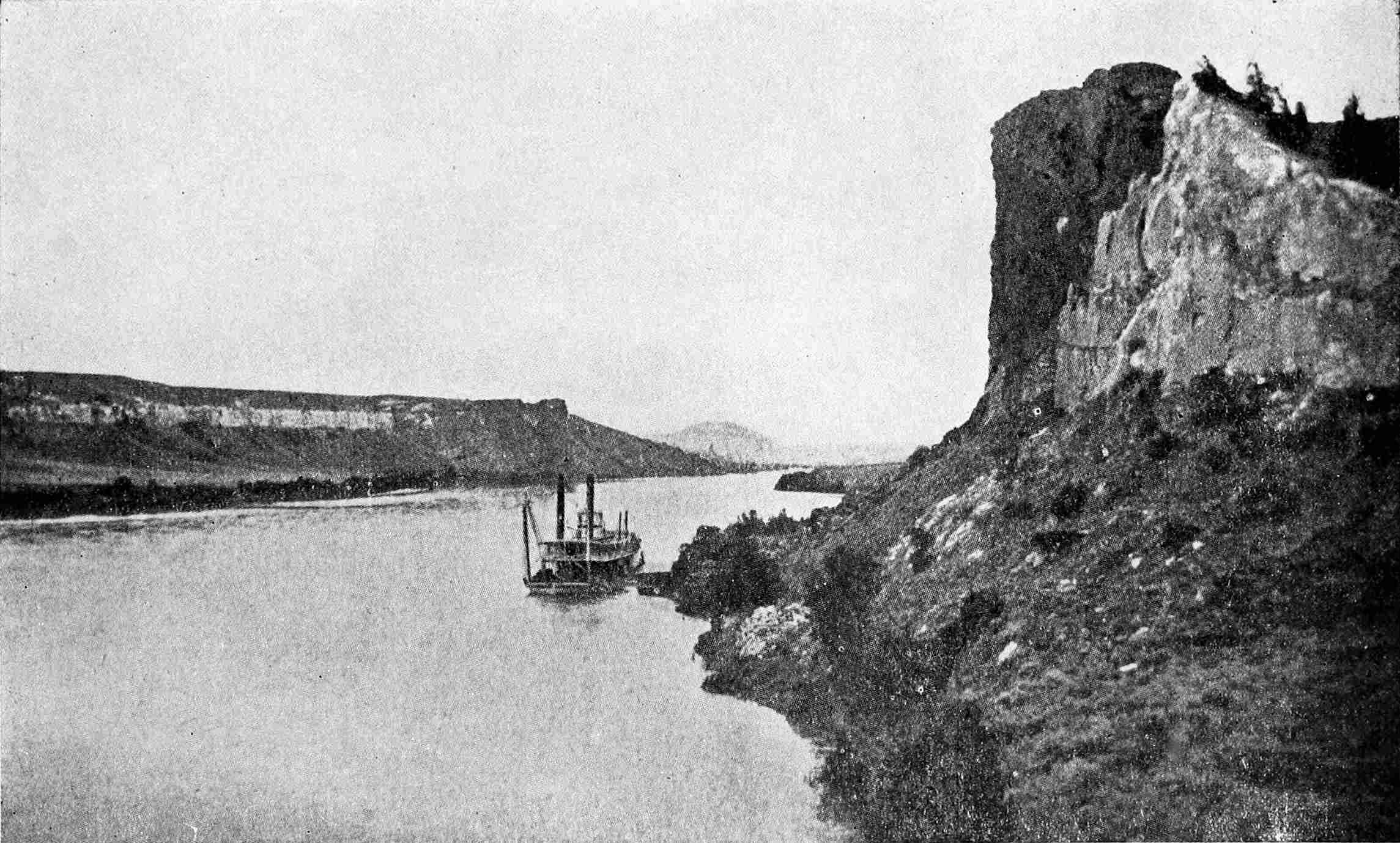
LA BARGE ROCK
The boat proceeded on her way, determined to accomplish
the trip if it were possible to do so. The
water was unusually low for that time of year, and it
took nearly a month to get to Sioux City, which ought
to have been reached easily in a third of the time.
Owing to the great danger from guerrillas below
Kansas City, a force of thirty soldiers accompanied
the boat as far as St. Joseph, Mo. This precaution
was very timely. Every boat that was met in the
lower river reported attacks with occasional loss of
life. Owing to the presence of soldiers on the Robert
Campbell, and Captain La Barge’s precaution to
anchor midstream at night instead of lying at the
bank, he got through all right. At Miami and at
Cogswell’s Landing parties tried to board the boat, but
without success.
INDIANS HOSTILE.
Among the passengers on the Campbell were two
Indian agents, Henry W. Reed and Samuel M. Latta,
the former for the Blackfeet tribes and the latter for
the Sioux, Crows, Mandans, and other tribes in that
region. Henry A. Boller, whose work, “Among the
Indians,” achieved some notoriety in its time, was
likewise on board, as were also Alexander Culbertson
and his Blackfoot wife. In all there were some thirty
passengers, and this number was considerably increased
at the various landings as far up as Sioux City.
The value of the annuity goods on board was upwards
of seventy thousand dollars.
CHEATING THE INDIANS.
The Indians all along the Missouri above the Niobrara
were at this time intensely hostile, but knowing
that their annuity goods were about to arrive, they
held aloof from any desperate measures until these
were received. It would have been a wise thing to
have sent a company of troops all the way on this important
trip, but not a soldier was to be had. The
boat reached Fort Pierre June 20, and here several of
the Sioux bands were assembled to receive their annuities.
It appears that the Two Kettles band were in
a great state of exasperation over the recent killing of
eight of their number by the soldiers near Fort Randall.
After a considerable amount of parleying the
distribution of the annuities commenced, but for some
reason, which Captain La Barge never heard explained,
only a portion (about two-thirds, as he estimated
it) of the goods to which the Indians were entitled
were put off. The Indians could not be deceived
in the matter and were very angry. They went
to the Captain and appealed to him to see justice done
them. They had the fullest confidence in him, for
they had known him for years, and he had always
treated them honestly. He was now helpless, however,
and could only tell them that he was under the
orders of the agent and had no control whatever over
the goods. They then assured him that they should
follow the boat and cause it all the trouble they
could, but they would not harm him if they could
avoid it.
REVENGEFUL SPIRIT OF THE INDIANS.
They were as good as their word. All the way
from Pierre to Union, six hundred miles, these Indians
followed the boat. It is a remarkable fact, when
we stop to think of it—this pursuit of a steamboat on
its laborious voyage through the Western prairies,
seeking at every turn to destroy it and kill its passengers
and crew. There was some deep and far-reaching
cause that could create and support so bitter and
vindictive a spirit as this. The warning of the Indians
to Captain La Barge was taken by him at its
full value. The boat was thoroughly barricaded with
the cargo by piling it so as to protect the vulnerable
points, and all the firearms on board were made ready
for use. These precautions proved to be of the
highest importance. At every woodpile Indians appeared
and attacked the crew. At every favorable
point shots were fired into the boat. On one occasion
a bullet passed through the pilot-house, barely missing
the pilot, Atkins, who was at the wheel. We shall relate
some incidents that occurred on the way to Union,
one more comical than serious, but one tragic and deplorable
as any in frontier history.
THE UPRIGHT HAT.
The Shreveport had gone up the river in advance of
the Robert Campbell, but being unable, on account of
low water, to get beyond Snake Point, or Cow
Island, 130 miles below Fort Benton, had discharged
her cargo on the bank and had returned down the
river. She met the Robert Campbell at Apple Creek,
thirteen miles below Bismarck, and was there stopped
by Captain La Barge. A part of the cargo of the
larger boat was transferred to the Shreveport, and the
two then proceeded up the river, the Shreveport being
sometimes ahead and sometimes in rear. The hunter
on the Shreveport was Louis Dauphin, already referred
to as one of the bravest men and most noted
characters of the upper country. He now acted as
hunter for both boats. It was his custom to go along
ahead of the boat, beating up the country and securing
whatever game was worth stopping the boat
for. Whatever he killed, as an elk or deer, he
would hang on a pole or tree near the bank
where it could be seen from the boat, and would then
continue his hunt. One day about noon Captain La
Barge’s eye, which was constantly studying the river
ahead, fell upon a curious object floating downstream.
It looked like a hat, but, strange to say, was standing
upright on the water, with no tendency to sink at all.
It caused the Captain no little perplexity. In the
windy country of the Missouri it was no uncommon
thing for hats to be blown into the river, but he had
never before seen one ride like that. He followed it
with his glass until it was near the boat, when up it
rose, securely perched on the head of a swimmer who
proved to be no other than the hunter Dauphin. “I
had to take to the water this time,” he said as he
climbed on board. “They were too many for me.
You are going to have trouble at the Tobacco Garden.
The Indians are gathered there to the number of at
least fifteen hundred and intend to capture the boat.”
The general amusement which Dauphin’s subaqueous
adventure had caused on the boat was quickly dispelled
by the sad fulfillment of the predictions which he
brought back.
A DISASTROUS SURPRISE.
Just above the mouth of Rising Water Creek the
boats stopped to wood, and were hailed by some Grosventres
(of the Missouri, Minnetarees) who offered
some meat if a boat were sent out for it. These Indians,
a friendly tribe, had been out hunting for two
weeks and were just returning well laden with meat.
The women had made some bullboats and were about
to ferry it over the river. The men had meanwhile
turned most of their horses out to graze, keeping only
one each fastened by lariats. Some meat was exchanged
for coffee and other articles and the Robert
Campbell resumed her voyage. Just as she was starting
one of the squaws uttered a piercing scream, and
the people on the boat saw a Sioux Indian riding at
full speed for the Grosventre herd, brandishing a red
cloth, and followed by a large body of his tribe. The
Grosventre squaws took to their boats and the men to
the tied horses. The Campbell drew in to the bank
and took men and horses on board and set them across
the river. The poor Grosventres lost nearly their
entire herd and all the fruits of their hunt.
THE TOBACCO GARDEN.
The name “Tobacco Garden” on the Missouri
River designated the bottoms at the outlet of Tobacco
Creek, on the left or north bank of the river,
eighty-eight miles below the mouth of the Yellowstone.
The origin of the name is uncertain, but the
place has long been well known to river men. Near
this point, but on the opposite shore, was a bottom,
covered with large trees, but open and free of underbrush.
The south bank of the river was a “caving
bank,” or one that was being undermined by the river.
At this time there was a very narrow beach at the
water’s edge, above which the bank rose perpendicularly
to a height of six or eight feet. The channel
was close to the shore and a boat in passing had to
come within thirty or forty yards of the bank. Even
if anchored to the sandbar immediately opposite, it
could not get more than sixty yards away. It was an
ideal place to “hold up” a boat, and the Indians were
shrewd enough to understand this perfectly.
LATTA NOT AFRAID.
It was toward noon of the 7th of July that the two
boats hove in sight of the Tobacco Garden, and there,
true to Dauphin’s prediction, they beheld on the south
shore a large body of Indians assembled with the evident
purpose of stopping them. There was no
use in trying to run a gantlet like that, and accordingly
the boats made fast to the opposite sandbar, the
Shreveport about one hundred yards below the Robert
Campbell. A parley ensued with the Indians, who
were so near that it was perfectly practicable to talk
back and forth. La Barge asked them what they
wanted. They said they wanted the balance of their
annuities; they wanted no trouble, but simply their
just dues. The agent refused them the goods, but
“requested the Captain to send his yawl and bring
aboard some of the chiefs and head men that we could
have a talk and ... make them a present of sugar,
coffee, tobacco, etc., and by this means quiet them.”
The Indians likewise wanted the yawl to be sent out,
but wanted the agent to go with it. They would then
send their principal chiefs back with him to the boat,
where everything could be talked over. They were
very shrewd, and the agent almost fell into the trap.55
The Captain told him that he could not possibly think
of ordering the yawl out, considering the disposition
of the Indians and their evident purpose of mischief.
Latta replied: “Why, I’ll go; I’m not afraid.” “All
right,” answered the Captain, “if you can get volunteers;
I will not order a crew out.” They then went
to the mate, Miller by name, and a crew was made up
to take Latta to the shore. When the yawl was ready
the Captain sent word to the agent, who had disappeared
upstairs. The latter sent back a reply that he
was suddenly taken ill and could not possibly go, but
to send the men and bring the chiefs on board.56
A BRAVE CREW.
The crew of the Robert Campbell were not lacking
in physical courage, and the necessary force to man
the yawl was easily made up. It was a little after
noon when the yawl left the boat. There is no truth
in the statements of Boller and Larpenteur that the
men were forced to go and clung to the side of the
steamer until the mate threatened to cut off their fingers
if they did not let go. It was easy enough for
them to get out of going if they chose to. The crew
of the yawl consisted of seven men. The steersman,
a gallant fellow of the name of Andy Stinger, sat in
the stern. Two men of the names of O’Mally and
Chris Sharky sat in the bow. There were four oarsmen,
one of them a young man of the name of Martin,
and the other, one of the Irishmen who had been
whipped by “Yankee Jack,” as related elsewhere.
The yawl put off, and as the distance was very short,
it quickly reached the opposite shore. It struck the
beach head on and then swung around under the force
of the current, so that it lay alongside of the bank.57
ANDY STINGER’S PRESENCE OF MIND.
A chief and three Indians were under the cut bank
on the beach when the yawl arrived. One of the Indians
stood exactly opposite Stinger, with a gun in his
hand covered with a leather case. The other two Indians
were armed with spears. The chief was a
fierce-looking man, and it seemed as if his eye would
pierce one through and through. Stinger motioned
him to get into the yawl. The men meanwhile were
sitting quietly with their oars across their laps. The
chief gave some quick directions and in an instant the
two Indians with spears jumped into the boat and the
one with the gun stripped the leather case off.
Stinger knew what this meant, and with great presence
of mind instantly threw himself into the water
on the river side of the boat, where it was fortunately
four or five feet deep. Slipping up along the boat he
seized it by the gunwale amidships and dragged it
from the bank. The movement, however, quick as it
was, was not quick enough. The two young bucks
who had leaped into the boat thrust their spears into
the bodies of two of the oarsmen, killing them instantly.
A third was killed by the Indian with the
gun, who had missed his chance at Stinger, and a
fourth was severely wounded by an arrow from the
bank. The two men in the bow instantly threw themselves
into the bottom of the yawl.
BOATS RETURN FIRE.
The Indians had no time to carry the attack further.
The crews of both the steamboats were watching with
breathless anxiety the progress of events. When they
saw Stinger jump into the water they thought him
killed. Someone exclaimed, “There goes Andy,” and
instantly both boats responded with their entire armament.
This included two howitzers on the hurricane
deck of the Robert Campbell and one on the Shreveport,
together with weapons of various sorts belonging
to the passengers and crew. One rattle-brained
Irishman was so upset that he brandished his revolver
in the air, firing off into space without the slightest
regard as to the whereabouts of the enemy. The fire,
on the whole, was very effective. Numbers of the Indians
were seen to fall, and Captain La Barge afterward
learned through Pierre Garreau, the interpreter
at Fort Berthold, that there were eighteen men and
twenty horses killed and many wounded. The Indians
soon withdrew, and in about an hour some were
seen trying to get water for their wounded near a pile
of driftwood half a mile below. It was an intensely
sultry day. The howitzers were turned on them and
they disappeared.
ANDY ANGRY.
Returning to the yawl, we find that Andy Stinger,
protected behind the gunwale, was steadily pulling the
boat into the stream and swimming toward the sandbar
as the current drifted him down. When about
halfway across he called to the men to get up, while
he himself climbed into the yawl, which was then
rowed to the bank. The people on the two boats were
so absorbed with the battle that no one thought of
going to the assistance of the yawl crew. The
wounded man and the two who were unharmed got
out and walked up the beach. Stinger was thus left
alone to drag the yawl and its mournful cargo up
alongside the boat. This apparent neglect fired him
to a desperate pitch, and he let go some powerful language
to the mate and others of the crew. Captain
La Barge presently came aft and looked into the yawl.
He said not a word, but turned away shaking his
head in a manner that showed plainly enough what
was passing in his mind.
HERO OF THE TOBACCO GARDEN.
Such was the celebrated “affair at the Tobacco
Garden.” After the return to St. Louis Captain La
Barge was talking to a friend about it when Andy
Stinger happened to pass by. He said, loud enough
for Andy to hear: “There goes the hero of the Tobacco
Garden.” The brave steersman treasured up
these words as his proudest title during the rest of his
life. Long years passed away before Captain La
Barge heard from him again. He did not even know
whether his old boatman was still alive when, in the
fall of 1896, thirty-three years after the massacre, he
received a most cordial and affectionate letter from
him,58 and two years later had the pleasure of meeting
him again.
LA BARGE’S CRITICISM.
Commenting upon the affair at the Tobacco Garden,
Captain La Barge said:
“This event was one which could not have happened
under ordinary circumstances. Master of both
boat and cargo, I should never have permitted the yawl
to go ashore. I was under orders of the agent in
everything except the mere handling of the boat, and
was bound to give him such opportunities to meet the
Indians as he desired. I had gone to the extreme of
my freedom of action when I refused to order a crew
to go ashore for him, but could not well decline to let
men volunteer. It was a lamentable affair, and one
of the many crimes which must ever lie at the door of
the Department of Indian Affairs in Washington.
Here was an agent who gave every evidence of being
corrupt and in collusion with the Fur Company, for he
retained about a third of the annuities due the Indians
and stored them in the Company’s warehouse,
from which they never reached the Indians except in
exchange for robes, as in the case of private merchandise.
Moreover, the agent was utterly ignorant
of Indian character, full of the self-assurance which
goes with ignorance, and not knowing himself what
to do became the passive tool of the crafty and trained
agents of the company.”59
CHARLES LARPENTEUR.
About 3 P. M. the boats resumed their voyage, as
the Indians had entirely disappeared. On the following
morning the burial of the victims took place at a
point about forty-seven miles above the Tobacco
Garden. They were buried on an eminence on the
south side of the river nearly opposite the mouth of
Little Muddy Creek, and a cedar cross was planted
at the head of their grave. The boat then pursued her
way up the river and arrived at the mouth of the Yellowstone
on the 8th of July. Here the Indians were
seen again, and a few shots were fired by them at the
boats, but no injury was done.
HEAVY RESPONSIBILITY.
The herculean labors of Captain La Barge on this
memorable voyage won the plaudits of all who observed
them. He seemed to be everywhere present,
and the only man on whom reliance could be placed.
“We got to the mouth of the Yellowstone,” says agent
Reed, “after the most untiring efforts, especially on
the part of Captain La Barge, who seemed to know
the only channel to be found in the Missouri.” The
Captain was constantly exposed to danger, and personally
conducted all soundings of the river, going far
from the boat with a few men in the yawl. The responsibility
resting upon him was very great. The
lives of the passengers, the safety of his valuable
cargo, the danger from the Indians if their expected
goods should be lost, and his own large pecuniary
stake in the voyage, all rested upon his own shoulders.
CHAPTER XXVI. THE BLACKFOOT ANNUITIES.
A BAD PREDICAMENT.
OFFICIAL REPORTS.
At the mouth of the Yellowstone the voyage of the
Robert Campbell came abruptly to an end. There
was only a depth of two feet over the Yellowstone bar,
and it was a physical impossibility to proceed. The
annuities had now been delivered to the lower tribes
so far as Captain La Barge was concerned, but there
still remained undelivered those going to the Crows,
Assiniboines, and Blackfeet. The annuities for the
first of these tribes were to be delivered wherever these
Indians could be found, but those of the Blackfeet were
to be delivered at Fort Benton. Fortunately, the
Assiniboines came in while the boats were at the Yellowstone,
and their annuities were delivered. Dr.
Reed, the agent for the Blackfeet, then advised La
Barge to abandon the idea of going further, and to
store the goods at Fort Union until the following
spring. This the Captain was very loath to do. He
knew only too well the complications that might arise,
particularly as such a course compelled him to place
himself in any degree within the power of the American
Fur Company. It seemed, however, the only
thing to do. The Robert Campbell simply could not
get any further. The Shreveport had not been able to
get above Snake Point, and since that time the water
had fallen materially. It was now the 8th of July,
and no further rise could be expected; in fact no boats
reached Benton that year. The only alternative to
storing the goods was to haul them by wagon to their
destination, and for this purpose the transportation
could not be had. The Captain very reluctantly concluded
to follow the agent’s advice, particularly as the
bulk of annuities were for the Indians belonging to
his own agency. An arrangement was made with
William Hodgkiss,60 agent of the American Fur Company,
and five days were consumed in transferring the
cargo to the warehouse. Full receipts were given by
Agent Hodgkiss, and these were witnessed by Captain
W. B. Greer, U. S. Army. In addition to the receipts
the Captain secured from Agent Reed a written
statement of the circumstances in order that his action
might have the fullest explanation possible. In those
days, when the government felt that it was being
robbed right and left by dishonest contractors, and
every claim was looked upon with suspicion, the adjustment
of any matter of that sort was extremely
difficult, and the innocent were made to suffer with
the guilty.61
THE “SHREVEPORT” IMPRESSED.
AT WORK FOR THE GOVERNMENT.
As soon as the business at Fort Union was cleared
up the two boats turned their prows down the river
and made the best of their way toward the lower
country. When they arrived at Crow Creek, eighty-two
miles below Pierre, they met General Sully, who
was engaged in his expedition against the hostile
Sioux. The General invited La Barge to his tent and
told him he should have to impress one of the boats
into his service for a time. As the Shreveport was
much the lighter boat it was considered best to take
her. Captain La Barge’s brother, however, absolutely
refused to remain, and accordingly Captain La
Barge had to. It was also necessary to use military
authority to secure a crew. The Robert Campbell
then went on her way to St. Louis, and Captain La
Barge commenced hauling supplies for General Sully.
He went up as far as the mouth of the Little Cheyenne,
and there awaited the result of General Sully’s expedition,
which was a victorious battle with the Indians.
He then dropped down below old Fort Pierre,
when he was ordered to proceed to Fort Leavenworth
and report to General Easton. By that officer he was
directed to take a cargo to Sioux City. Though late in
the season, the trip was successfully accomplished.
Captain La Barge then returned to St. Louis, where
he arrived late in November, and reported to the commanding
officer at that point. He had now been continuously
at work for over six months, during one of
the most trying seasons ever experienced upon the
river. His nightly sleep scarcely averaged five hours,
and he was constantly under the weight of a terrible
responsibility. Nothing but an iron constitution
could have withstood the incessant strain.
As soon as Captain La Barge could straighten matters
up at home he set out for Washington to see the
Indian Commissioner in regard to his past season’s
contract. He received full payment for everything delivered,
but nothing for the annuities still undelivered
and nothing for his great loss caused by the delay
of the Indian Department in delivering the goods
to him on time. He was, however, given a new contract
to transport the goods to their destination the
following year.
In order to pursue this particular subject to its
final outcome we shall step ahead of our narrative to
the year 1864. Captain La Barge went up the river
that year with the steamer Effie Deans, leaving space
on the boat for the undelivered annuities. Arrived
at Fort Union he first fell in with Captain Greer, who
had witnessed the receipt of Agent Hodgkiss for the
goods the previous summer. Captain La Barge told
him that he had come to take the annuities to their
destination. “I don’t believe that you will find
much,” said Captain Greer. “The Company has
traded it nearly all for robes.”
MANIFEST FRAUD.
THE GOODS UNDELIVERED.
Agent Hodgkiss had died during the winter, and
Captain La Barge presented the receipts to the new
agent, Rolette. The latter refused to deliver the
goods except upon payment of the extortionate storage
charge of two thousand dollars. He expected that
this charge would cause Captain La Barge to refuse
to take the goods. The sum, however, was tendered,
whereupon the agent refused to deliver them except
upon the prior surrender of Agent Hodgkiss’ receipts.
Suspecting that a large part of the goods were missing,
the Captain declined this condition, but offered to give
a receipt for all goods he should take from the warehouse.
Driven from every position, the agent openly
avowed that he could not deliver all the goods, for he
did not have them all. He stated that, under instructions
from Commissioner Dole, transmitted through
the Company, he had delivered a large portion of the
goods to the Grosventres and many packages to other
Indians. The delivery of the balance could, therefore,
not be made except upon surrender of the receipts of
the previous year. Captain La Barge asked to see the
receipts of the Indians to whom the goods had been
delivered. The agent had none, although it was an
invariable rule to secure such receipts for all annuities
delivered. The alleged order from Commissioner
Dole was then called for, but that could not be produced,
the agent stating that it came by messenger,
who delivered it verbally.
“You acknowledge, then, that a large portion of
these goods you have not got,” asked Captain La
Barge.
“Yes,” replied the agent; “they have been delivered
during the winter and have reached their proper
destination.”
GOODS TRADED WITH THE INDIANS.
All these proceedings were witnessed by the officer,
Captain Greer, whom Captain La Barge had taken
the precaution to have present. From what Captain
Greer had told him, and from the trader’s inability
to account satisfactorily for the disposition of the
goods, Captain La Barge became thoroughly convinced
that they had been used in trade, and he very
wisely declined to surrender his receipts. As the
trader would not give up the rest of the goods except
upon a surrender of the receipts for all, the Captain
went on his way without them.
UNPAID DEBT.
In the meanwhile Dr. Reed, who had been relieved
as Agent of the Blackfoot tribes, went up on
the American Fur Company boat Yellowstone to turn
over his charge to the new agent, Mr. Gad E. Upson.
Mr. Chouteau had received the contract for taking up
the annuities for the year 1864. He took them only
to Cow Island, where, for some reason, possibly low
water, they were put on the shore and the boat turned
back. Mr. Upson, who had gone down from Benton
to Union early in the spring, went back on the Yellowstone
with Mr. Reed. The boat, after unloading,
turned back, and a day later met the Effie Deans. La
Barge reported to Dr. Reed the facts as to the goods
at Fort Union. Mr. Chouteau, who was on the Yellowstone,
was called in and professed to disapprove of
Rolette’s course, but did nothing to rectify it. So far
as Captain La Barge knew at the time or ever learned
afterward, this large quantity of Indian goods was
traded out to the Indians by the so-called American
Fur Company and constituted an unqualified theft
from the government. The final outcome of the affair,
so far as Captain La Barge was concerned, was
a loss of nearly twenty thousand dollars.62 He died
a poor man, with the government in his debt by a
sum that would have given ample comfort to his declining
years.
CHAPTER XXVII. COLLAPSE OF THE LA BARGE-HARKNESS OPPOSITION.
The steamboat Shreveport, with the annual outfit
of the new firm for the year 1863, did not get above
Cow Island on account of the extremely low stage of
the river. No other boat went as far as that within
two hundred miles. Harkness and John La Barge
put the cargo out upon the bank and hastened back
to the assistance of the Robert Campbell. This event
further illustrated the incapacity of Harkness. No
arrangement was made for the transportation of the
goods to Benton, although he knew that a considerable
portion of the freight belonged to outside parties,
and that the firm had contracted to take it through
to that post. This precipitate action was due in part
to danger from the Indians. In the year 1863 the
tribes along the river were all in a state of unrest, and
some of them actually on the warpath against the
whites. Fort Union was practically in a state of
siege all summer, and the danger to steamboats was
a very formidable one. It was held by some parties
that the sudden termination of the voyage was due
to news received of the famous discovery of the Alder
Gulch placers and the desire to go back and notify
the firm; but of this there is not the slightest probability.
Whatever the explanation, the act itself was
disastrous upon the fortunes of the firm.
NICHOLAS WALL.
Among the number of outside parties who had
freight on the Shreveport was the firm of John J. Roe
and Nicholas Wall, both of St. Louis. Wall represented
the firm in Montana and Roe remained in St.
Louis. Some little account of Wall’s career and his
previous relations with Captain La Barge will be of
interest, to show how far a man may forfeit the sentiment
of gratitude when his business interests are in
any way involved. La Barge had previously been
connected with Wall in a business way. In 1861
Wall joined the Confederate sympathizers, in St.
Louis, and was captured by General Lyon in the
affair of Camp Jackson, St. Louis, May 10, 1861.
The prisoners taken there were all paroled, but were
confined to the limits of the city. At Wall’s urgent
appeal La Barge became bondsman for his good conduct
and secured his freedom of action. He worked
for La Barge during the rest of the season of 1861.
In the winter of 1862 Wall asked La Barge to
assist him in getting to Montana. La Barge gave
free transportation on the Emilie to Fort Benton for
himself and his goods, and advanced him seven hundred
dollars to get to the mines. Wall did a successful
business in the Deer Lodge Valley in 1862, and in
the fall of that year returned to St. Louis, where he
entered into a partnership with John J. Roe. The
outfit which this firm were to send to the mines was
taken up on the Shreveport. It was through La
Barge’s patronage that Nick Wall was extricated
from a perilous situation and placed in a position to
do a good business. His method of repaying his
benefactor will presently appear.
LA BARGE, HARKNESS & CO. SUED.
When Wall heard that the Shreveport could not
reach Benton and had discharged her cargo on the
bank at Cow Island, he organized a wagon train and
went down after his own freight and that of several
others. In the spring of 1864 he returned to St. Louis,
where he and Roe presented a claim to La Barge, Harkness
& Co. for forty thousand dollars’ damages, on
goods that were not worth at the outside ten thousand
dollars in St. Louis. Captain La Barge agreed
to pay the full price of the goods and charge no
freight, but his offer was refused. He then told Roe
and Wall that they could bring suit at once. Roe
replied that he was too sharp to think of bringing
suit in St. Louis; he would bring it in Montana,
where he knew that the chances were much more in
his favor. Robert Campbell and John S. McCune,
two of St. Louis’ leading citizens, protested against
this proceeding, and agreed to give bonds for the full
payment of all damages. Roe refused all compromise
and Wall returned to Montana and brought suit.
COLLAPSE OF AFFAIRS AT FORT LA BARGE.
In the meanwhile, affairs at Fort La Barge were
showing the effect of absence from that post of any
responsible member of the firm. Joseph Picotte,
brother of Honoré Picotte, a distinguished trader of
the American Fur Company, had been left in charge
in 1862; but word having been received that he was
not properly attending to his work, he was relieved
by Robert H. Lemon, who had been highly recommended
by Robert Campbell. Lemon proved to be
of less account even than Picotte, and actually took
the wholly unauthorized step of turning the firm’s
property over for safe-keeping to the American Fur
Company. The receipt for this transfer, signed by
Andrew Dawson, agent American Fur Company, is
still among the La Barge papers. The transaction
took place August 31, 1863, and included not only
the storage of all the firm’s property at Fort La
Barge, but the payment of their employees’ wages,
and the removal of the Shreveport freight from Cow
Island to Fort Benton. The sum of one thousand
dollars was to be paid for storage, and the goods were
to be held as security for the payment of this sum
and all other liabilities of the firm on account of
wages, transportation, or other cause. Thus the
entire business of the firm at Fort Benton was practically
surrendered to their great rival, and the new
“opposition” was crushed almost at its beginning.
OUTCOME OF THE SUIT.
As soon as Wall began legal proceedings the
goods were seized and held, pending the outcome of
the trial. This did not come off until 1865, when a
verdict was rendered against La Barge, Harkness &
Co. of twenty-four thousand dollars, which was paid
in due course. All the firm’s property in Montana
was absolutely lost, including a large quantity of furs
ruined by the long detention. The total loss
amounted to fully one hundred thousand dollars.
The lawsuit itself was an important one at the time.
It involved the rights and obligations of carriers on
the Missouri River. It was the first important legal
case in the history of the Territory. It brought into
distinguished notice one of the picturesque and leading
characters in the pioneer history of Montana,
Colonel Wilbur F. Sanders, who became one of
Montana’s first representatives in the Senate of the
United States. On the part of the defense the case
was badly managed. None of the principals was
present at the trial, which was held at a point nearly
three thousand miles from their home. With a skillful
defense it would probably not have resulted so
disastrously as it did.
CAUSES OF FAILURE.
The immediate result of the trial was the dissolution
of the firm of La Barge, Harkness & Co. It
went out of business upon an honorable footing.
Every liability was paid in full, but so much of it fell
upon Captain La Barge that it seriously impaired his
fortune. He cherished, not without reason, a very
bitter feeling toward some of the parties who were
instrumental in the downfall of his business, and
particularly toward the American Fur Company.
There is no doubt that that concern furthered the
result in every possible way. It was a principle of
their business to crush all opposition, and they made
no exception in this case. But it is evident that the
real cause lay in the reckless management of affairs
at Fort Benton and at the mines, and for this Harkness
was alone responsible.
THE DIAMOND R COMPANY.
The collapse of the La Barge, Harkness & Co.
business marked the inception of a system of land
transportation in Montana which grew to enormous
proportions. It was known as the Diamond R
<R> Company. Among the ill-gotten gains of
John J. Roe, in his successful effort to break up a rival
company, were a large number of oxen which La
Barge, Harkness & Co. had brought up the river to
transport freight between Fort Benton and the mines.
Roe organized a transportation company, using these
oxen as a nucleus for commencing the business. By
various changes of ownership it passed into the hands
of Montana men. It soon became a great company,
with a complete organization of agents, issuing its
bills of lading to all points, both in and out of the
Territory. At one time it employed no less than
twelve hundred oxen and four hundred mules, besides
a large number of horses, and the sustenance of
these animals was a source of no slight income to the
small farmers of that section. It went out of business
in 1883.
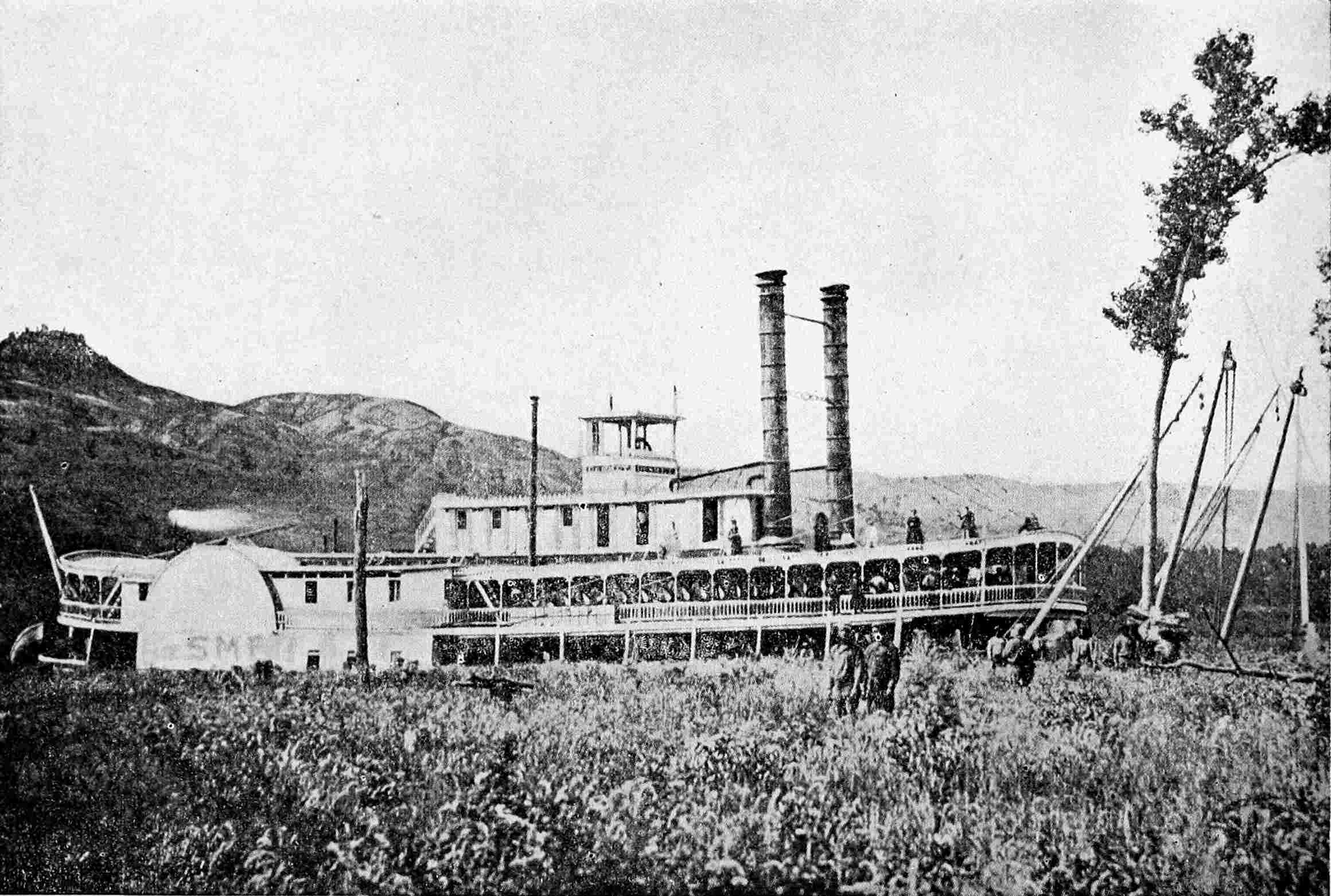
A STEAMBOAT AT THE BANK
CHAPTER XXVIII. CAPTAIN LA BARGE IN MONTANA.
Captain La Barge sold the Emilie late in the winter
of 1862–63. In the following winter he made an
unexpected sale of the Shreveport. Henry Ames &
Co., pork packers, sent their clerk one day to see if
the Captain would sell the boat. He replied that he
did not care to, but would if the price were satisfactory.
Being invited to come to the office of the
firm, he was told that the boat suited them and was
asked to name a price.
“Twenty-five thousand dollars,” he said.
“Give the Captain a check for twenty-five thousand
dollars,” said Ames, turning to his clerk.
“Don’t you want a bill of sale and the customary
evidence that she is clear of debt?” asked the Captain,
in some surprise.
“No,” was the reply; “you say she is so, and I will
take your word.”
La Barge went down to the levee, transferred the
boat, and then went to the bank and cashed the
check. He recalled this last circumstance by the fact
that the teller handed him the amount in twenty-five
notes, each of one thousand dollars.
PURCHASE OF THE “EFFIE DEANS.”
This sale took place in the winter, and it behooved
the Captain to cast about at once for a boat for the next
annual voyage. A new boat was being built on the
Ohio River by the Keokuk Packet Company, John
S. McCune, President. Not proving satisfactory for
their purposes, she was brought to St. Louis and
offered for sale. La Barge found her well fitted for
his work, and negotiated a purchase at forty thousand
dollars. McCune retained a one-fourth interest.
She was called the Effie Deans.
The boat was loaded with the usual assortment of
freight, and left St. Louis March 22, 1864, with forty-nine
passengers and a cargo of 160 tons. She succeeded
in getting only to the Marias River, where the
cargo was discharged. The boat was sent back in
charge of John La Barge, and the Captain himself
remained in the upper country. He hired wagons
and took his property up the river, selling part of it
in Benton and the rest in Virginia City. He remained
in the mining regions upward of two months,
although he finished his business in much less time.
On account of the danger from outlaws, or road
agents, it was necessary to await an exceptionally good
opportunity for getting away. The Captain had
decided to return via Salt Lake City, because to go
by way of the Missouri in an open boat would have
meant little less than suicide. The feeling of the
Indians was so bitter at this time that no one could
pass their country in safety unless well protected.
The Captain had almost a hundred thousand dollars
in golddust to take with him, and he knew that
this was not a secret with himself. He caused it to
be given out that he expected to depart on a certain
day, but actually stole away several days before, and
was safely in Salt Lake City before the announced
date of his departure. The coach he was to have
taken was held up by the road agents and a passenger
of the name of Hughes was killed.
COSTLY TRANSPORTATION.
In Salt Lake City Captain La Barge remained for
some time arranging for the rest of his journey home.
He could not hire a coach from Ben Holiday, proprietor
of the overland line, for less than eighteen
hundred dollars. The Wells-Fargo Express Company
wanted twenty-five hundred dollars to send the
dust by way of San Francisco, and would assume no
responsibility. These conditions were not satisfactory,
and the Captain purchased a team and
wagon, with which he and three or four others undertook
the journey alone. Their golddust was carried
in bags of thick buckskin.
TEMPTING INDUCEMENTS.
While in Salt Lake City the Captain renewed his
acquaintance with Brigham Young and other Mormons
whom he had known on the Missouri. An old
friend of his of the name of Hooper, who had turned
Mormon, and later became a delegate from the Territory
to Congress, called as soon as he heard that
La Barge was in town. He also found there another
friend, Hopkins by name, whom he had known from
boyhood. Hopkins tried his best to induce La Barge
to join the Mormons. He assured the Captain that
if he would sell out in St. Louis and come to Utah it
would be his fortune. As proof of this, he referred
to himself and others, who, he said, had gone into
Mormonism, not for any love of the doctrine, but as
a simple business proposition. Hooper and Hopkins
had both been unsuccessful in St. Louis. La
Barge had taken them up on his boat to Fort
Kearney, about 1852, and had always esteemed them
good men. He asked the wife of one of them one
day why her husband had never married again, since
the doctrine of the Church and the sentiment of the
community sanctioned it. “He doesn’t dare to; he
knows I would leave him if he did,” she replied.
DIGNITARIES OF THE MORMON CHURCH.
The Captain called on Young several times. That
dignitary received him very hospitably, took him to
the Tabernacle and other places of interest, and
presented him to several of his families. They
went to the theater together, where they sat in
a box with Young’s favorite wife, the other
wives being ranged in seats below. Young never
said anything intended to convert La Barge to
his religion. Other members of the Church did,
and particularly Orson Hyde, who was a man of
education and a very persuasive talker. La Barge
heard a sermon by Heber Kimball—a rough old
fellow who took off his coat, rolled up his sleeves, and
waded in. His language was coarse and vulgar, and
would not bear repetition in refined ears.
The route of the Captain’s party, on leaving Salt
Lake City, was through Weber Cañon to Fort Bridger.
They stopped there a short time with Captain
Carter, who, for many years, did business at that
frontier post. From there they made their way east,
and left the mountain country via the valley of the
Cache à la Poudre River. In the valley of the South
Platte they met an old man of the name of Geary,
who told them that a band of hostile Indians was
scouring the country between them and Denver, and
that they had better conceal themselves for a few
days on an island in the Platte River. They acted
upon this advice, and when they judged the danger
to be past they resumed their journey. They had
gone but a little way when they came to a spot where
a party of emigrants had been massacred only a day
or two before. Their timely measure of precaution
was therefore well taken.
A LONG VOYAGE.
The rest of the journey was made without noteworthy
incident. The party reached the Missouri
at Nebraska City just in time to catch the last boat
to St. Louis. They arrived home about December
1. Captain La Barge found that the Effie Deans had
returned and had been chartered by McCune’s company
to go to Montgomery, Ala. She made this trip
in safety, returning to St. Louis before ice closed in.
Probably no other boat ever made so long a trip on
inland waters in a single season, including also a sea
voyage, as did the Effie Deans in 1864. The distance
on the Missouri up and back was 4570 miles; that on
the Mississippi to the Gulf and back was 2522 miles;
that from Mobile to Montgomery and back was 676
miles; and that across the Gulf from the mouth of the
Mississippi to Mobile and back not less than 600
miles. The whole distance traveled was about 8400
miles.
ANOTHER DILEMMA.
In April, 1865, Captain La Barge started up the
river again on the Effie Deans. At Nebraska City
came the news of Lee’s surrender, and at Decatur
that of the assassination of Lincoln. There was
great commotion among the passengers at the news
of this terrible deed. There were many ex-Confederates
on board, some of whom expressed their
satisfaction at the event, and there might very easily
have been trouble between them and the Union passengers;
but Captain La Barge skillfully avoided all
difficulty.
The voyage, though a tedious one, was completed
without serious delay or accident. Captain La Barge
sent the boat back in charge of the pilot, Captain Ray,
and himself started with another outfit of goods for
the mines. This time he went to Helena, which had
sprung into existence since his last trip to Montana.
He bought a small house in which to store his goods
and he and his son acted as salesmen.
A TIMELY RESCUE.
In the meanwhile Captain La Barge’s brother had
again involved St. Louis parties in serious difficulty
on account of the non-delivery of freight. John S.
McCune had shipped to Fort Benton a fine cargo of
goods on the Kate Kearney, Captain John La Barge,
master. The very hostile attitude of the Indians
caused the Captain to abandon the trip a little above
Fort Union. When the news reached the mines suits
were brought against McCune aggregating some
three hundred thousand dollars. As soon as word
reached St. Louis, McCune saw the gravity of the
situation, and instantly dispatched a message to La
Barge in Montana via the overland route. It fortunately
reached the Captain before he had finished
his business in Helena, and he set out forthwith for
Fort Benton, leaving his son in charge of the store.
He felt certain that Captain Ray, the pilot of the Effie
Deans, would not abandon the cargo, and he was not
mistaken. When Ray met the Kate Kearney, on his
return trip, he transferred the cargo to the Effie Deans,
and brought it back to Fort Galpin, a little above the
mouth of Milk River, but could get no further on
account of low water. He then sent an express to
Fort Benton for teams. Captain La Barge was there
at the time, and at once procured thirty ox teams of
five yoke each, with the necessary wagons, and
started for Fort Galpin. There he took all the
freight and delivered it safely at its destination. It
was a prodigious task, but its timely completion saved
McCune from a disastrous loss. The suits were all
withdrawn, and the cost of transportation by wagon
was the sum of the extra expense.
La Barge left the Territory late in the season with
fifty thousand dollars in golddust. He went by way
of Salt Lake City, where he and two others chartered
a coach to take them through to Nebraska City.
When within about fifty miles of Denver the stage
driver refused to go farther on account of the Indians,
and the party were compelled to hire a wagon and go
the rest of the way alone. At Nebraska City they
found the steamboat Denver, on which they went to
St. Joseph, and thence by the railroad to St. Louis.
AN UNEXPECTED DELIVERANCE.
Captain La Barge had not been heard from in two
months. He at once went to McCune’s office to relieve
the fears under which that gentleman had so
long been laboring. McCune came up to him,
looked the travel-worn Captain in the face, and said:
“I don’t dare to ask you any questions. I am afraid
to know the worst.”
“Don’t be alarmed,” said La Barge; “I think I
have straightened everything out all right.”
“Are there no suits pending?” asked McCune.
“No; they are all settled, and here are the receipts.”
“How much has the misadventure cost me?”
“Not to exceed ten thousand dollars all told.”
McCune was overjoyed at the news, for he feared
that he was ruined. As it was, in spite of the extra
expense, he would reap a handsome profit. He
threw his arms around La Barge and embraced him
for joy at the unexpected deliverance, and could
never thereafter do enough for him.
CHAPTER XXIX. CAPTAIN LA BARGE IN WASHINGTON.
In connection with his work for the government
it became necessary for Captain La Barge to make
several visits to Washington. Considering the interesting
period through which the national Capital
was then passing, it was to be expected that these
visits should present some features of note. The
Captain went to Washington in all three times, once
in each of the winters of 1862–65.
INTERVIEW WITH LINCOLN.
On the occasion of his first visit he was a member
of a party who called upon the President to present
him with a fine robe of fur. Three years before this
Captain La Barge had promised Lincoln to procure
for him a good buffalo robe; but the rapid march of
events and the great matters that weighed upon the
public mind had so far kept him from fulfilling his
promise. On the present occasion it was proposed
to give the President an elegant robe composed of
ten beaver skins, the whole richly lined and embroidered.
The members of the party were Dr. Walter A.
Burleigh of Yankton, Dak.; Captain La Barge,
Charles E. Galpin,63 and several others. Dr. Burleigh
acted as spokesman. The delegation were
shown to a room apart from the general reception
room, and Lincoln, after a little while, came in, saying
that he had sent them in there so that he might
have some uninterrupted talk with them about the
West. He remembered at once the old steamboat
Captain with whom he had ridden on the Missouri,
and he greeted La Barge with great cordiality.
After some general conversation Dr. Burleigh arose,
took the robe, asked the President to stand up,
and then threw it over his shoulders. Lincoln
folded it around him like a blanket and danced
about for an instant in Indian fashion. He
seemed greatly delighted with the gift. He then
asked the party many questions about the West, for
the Indian troubles were at that time causing the
administration a great deal of annoyance.
LINCOLN AND THE INDIAN.
In the winter of 1863–64 La Barge saw the President
again. The only subject of importance which
was touched upon on that occasion was the Indian,
in whose welfare he always displayed the deepest interest.
As it was a subject which had often aroused
the Captain’s indignation and pity, he made the most
of his opportunity to acquaint the President with the
facts. He told him of the gross frauds practiced on
the Indians, and how their annuities, under present
conditions, had to pass through the hands of some
of the worst rascals on the face of the earth, who
deliberately cheated the Indians right and left.
Lincoln replied that he knew it; that, under the stress
of war, he was not able to send just the men he would
like to into that country as Indian agents, and that
too many of them were importunate place-seekers of
worthless character whom members of Congress were
anxious to get rid of somewhere. “But wait,” said
he, “until I get this Rebellion off my hands, and I
will take up this question and see that justice is done
the Indian.”
The Captain made his third visit to Washington in
the winter of 1864–65. His particular business was
to secure payment on his government contracts,
which had been approved by the Department of War
and the Bureau of Indian Affairs, but disallowed by
the Treasury. He went to Secretary Chase, but was
told by that gentleman that all Missourians were
prima facie Rebels, and that that was why his account
was being held up. La Barge did not relish this
very much, as he had been doing business for the
government all through the war, and had even gone
so far as to take the oath of allegiance. He went to
Lincoln and laid the matter before him. The President
smiled at Chase’s remark, gave La Barge a
card with his autograph on it to hand to Chase, and
said he presumed that would fix matters all right.
La Barge went back, and the account was paid without
further delay. La Barge, with his usual distrust
of the American Fur Company, suspected that some
of its members had been giving him a bad character
in Washington in order further to cripple his opposition.
THE BLACKFOOT’S ANNUITIES.
FINAL EVIDENCE.
On the occasion of his interview with the President
he brought up the matter of the Blackfoot annuities,
explicitly charging that these goods had been wrongfully
disposed of and had not reached their proper
destination. Lincoln sent for the proper officer of the
Indian Department to hear La Barge’s accusation.
This officer stated that he had receipts signed by the
Indian chiefs saying that they had received their
annuities. The signatures of the Indians were witnessed
by agents of the American Fur Company.
La Barge declared that the receipts were false; that
he had himself carried these goods and knew that the
Indians had not received them, but that they had
been appropriated by the American Fur Company
and sold. “Well,” said the official, “there are the
receipts; we cannot go back of them; they have been
considered final evidence in such cases since the foundation
of the government.” And there the matter
rested.
While in Washington on this visit La Barge was
summoned before the Senate Committee on Pacific
railroads and questioned by B. Gratz Brown upon
his knowledge of the Western country and his
opinion upon the availability of certain routes for a
transcontinental line.
LOOK AT YOUR MAP.
Before he left Washington the Captain was the
central figure in an amusing little incident that occurred
at Ford’s Theater. Harper’s Weekly had
published a story of La Barge’s steamboating experiences
which ran something like this: On one of
his trips up the river in the earlier part of his career
there were several Englishmen aboard. They had a
map and applied themselves industriously for the first
day or two in trying to identify the various places
upon it with those along their route. They were in
the pilot-house a good deal, and one of them questioned
La Barge rather officiously about the geography
of the country.
“What place is this that we are approaching, Mr.
Pilot?” he asked.
“St. Charles, sir,” La Barge replied.
“You are mistaken, sir; according to the map it
is ——”
La Barge made no reply. He stopped as usual at
St. Charles and then went on his way. Presently
they came to another village.
“What place, Captain?” inquired the Englishman.
“Washington, Mo., sir.”
“Wrong again. The map gives this place
as ——.”
This experience was gone through several times,
the Captain’s temper becoming more ruffled with
each repetition, though no one would have suspected
it from his unruffled exterior. Presently
a flock of wild geese passed over the river and drew
the attention of the passengers and crew. The
Englishmen were standing on the hurricane roof immediately
in front of the pilot-house.
“What kind of birds are those, Captain?” asked
one of them in eager haste.
The Captain, whose language still smacked somewhat
of the French idiom, replied:
“Look at your map; he tell you.”
The printed programme of the evening at the
theater happened to have this story under the heading
of “Old Joe La Barge.” The Captain and some
friends occupied a box, and as there were several
persons in the audience who knew him, the fact that
the hero of the story was in the box soon spread
itself about. At one of the pauses in the performance
someone called out for La Barge to stand up, and
cries of “La Barge” soon came from all parts of the
house. The modest steamboat pilot was panic-stricken
at the occurrence and clung desperately to
his seat, whereupon the audience called for him the
more; but nothing would induce him to stir.
AN EXTENSIVE ACQUAINTANCE.
We may here properly refer to Captain La Barge’s
extensive acquaintance with public men of the West.
His prominence in the carrying trade of Western
rivers, when travel was largely done by boat, brought
him into contact with distinguished characters from
all parts of the country. There were few public men
in the West whom he did not know, and his personal
estimate of their character as they appeared to him
is not without interest and value. We have already
noted his acquaintance with Audubon, General Warren,
Dr. Hayden, Brigham Young, and others.
The Captain knew General Lee when the latter
was stationed in St. Louis as an officer of engineers
in charge of river and harbor works on the Mississippi
and the Missouri rivers.
He knew both of the Johnstons,—Albert Sidney
and Joseph E.,—and at the time of the Mormon War
transported much of the supplies and munitions of
war used by Albert Sidney Johnston on his arduous
and perilous campaign.
GENERAL GRANT.
He saw Grant for the first time during the Mexican
War, and frequently in later years when he lived near
St. Louis. In Grant’s visits to town La Barge became
well acquainted with him. He saw him in the
early part of the war, while Fremont was in command
at St. Louis. He was trying to get an interview with
the General, but that officer was harder to reach than
a king or the Pope. He would keep people waiting
for hours, and then as like as not refuse them an
audience. In the winter of 1864–65 La Barge saw
Grant in Washington. The head of the armies of
the Union spoke to the steamboat pilot in as equal
and friendly a way as when he was unloading wood in
St. Louis. He asked the Captain if there was anything
that he could do for him, and expressed his
desire to serve him if he could.
GENERAL FREMONT.
La Barge saw a great deal at one time and another
of General Fremont. He first met him when he
went up the river as the assistant to the distinguished
geographer and scientist, Jean I. Nicollet. Nicollet’s
party traveled on the boat which La Barge was
piloting. At Leavenworth there was an extremely
rapid current, and La Barge expressed a curiosity
to know what its velocity was. Nicollet at once sent
Fremont to measure it. It was found to be eleven
miles per hour in the swiftest place. La Barge’s
opinion of Fremont was that which seems to have
universally prevailed in St. Louis—that he was
a greatly overrated man, and that his success was
due more to his fortunate marriage than to his own
merit. We must dissent, in a measure, from this
view. In his proper niche, Fremont was a great
man. He found that niche in the work of exploring
the unknown West. In the faculty of making the
unknown known, of doing work in such a way as to
make its results popular with the public, in spreading
a knowledge of the Great West throughout his country
and throughout the world, he stood without a
peer among the explorers of that region. In the
broader field of national politics or great military
responsibility, he was wading beyond his depth.
THOMAS H. BENTON.
Thomas H. Benton, Fremont’s father-in-law, and
Missouri’s greatest statesman, was an intimate acquaintance
of Captain La Barge, the two men having
known each other from La Barge’s childhood until
Benton’s death. Captain La Barge had a great admiration
for the bluff old Senator, although he did
not like the way in which he used his powerful influence
in shielding the American Fur Company on
so many occasions from the just consequences of
their illegal acts. Benton was a frequent passenger
on the Missouri River boats, and La Barge saw a
great deal of him there. He recalled particularly a
trip which the Senator made as far up as Kansas
City, where he went to meet Fremont, who was returning
from the West. It was a very interesting
voyage. The people all along the river wanted to see
him, and calls for “Old Bullion” compelled him to
appear at every landing place. He made numerous
addresses, and the boat was frequently delayed to
permit this interchange of greetings between the
people and their distinguished servant. Benton was
in the pilot-house a great deal,—as every traveler in
those days liked to be,—and La Barge never forgot
his expression of deep faith in the future of the West,
so unlike that of most of his Congressional associates
from east of the Mississippi. He said once to Captain
La Barge: “You will live to see railroads across
to the Pacific, and up the Missouri beyond the
Great Falls.” La Barge, a much younger man, replied
that he scarcely expected to see that in his lifetime.
“But I have,” said the Captain, in telling of
this conversation, “and I have seen far more than
even Senator Benton dared to hope for.” In the
same line of thought the Senator once said, as he
pointed to the west, which was overspread with the
marvelous glow of evening: “That is the East”—for
he felt that we should yet go in that direction to
reach the treasures of the Orient.
NOTED MEN OF THE WEST.
The interesting notes of Captain La Barge’s observations
of public men with whom he was thrown
in contact would fill a volume. His acquaintance
with the army was very extensive, owing to the
Indian wars along the Missouri, and he personally
knew nearly all the principal officers from General
Sherman down. The same was true of the Indian
agents, Territorial officers, and leading business men
of the West. In a time when so much public travel
went by steamboat he enjoyed exceptional opportunities
of seeing and knowing the men who made
the history of the Western country.
CHAPTER XXX. THE INDIANS OF THE MISSOURI VALLEY.
The course of this narrative has shown that a large
portion of the business of the Missouri River steamboats
pertained to the Indians who dwelt on the banks
of that stream. The great valley had been their home
for unknown generations. The tribes were distributed
along its course or those of its tributaries,
from its mouth to their sources. First came the Missouris,
whose name the river still bears—a tribe long
since extinct as a separate organization. The Osages
and the Kansas likewise bequeathed their names to
the rivers in whose valleys they dwelt. The Omahas
have lived, since the white man knew them, a short
distance above the city which perpetuates their name,
while a hundred miles to the westward in the valley
of the Loup Fork of the Platte dwelt the four tribes
of the Pawnees. From the point where Sioux City
now stands, northward nearly to the British line, the
great nation of the Sioux held a wide tract of country
on both sides of the river. Within their territory
dwelt the treacherous Aricaras, near the mouth of
the Grand River, and the stalwart Cheyennes at the
eastern base of the Black Hills. The unhappy tribe
of the Mandans lived near the river some distance
north of the modern town of Bismarck, and near them
were the Minnetarees, or Grosventres of the Missouri.
Along the northern shore of the river from
the Mandans to Milk River, and northward far into
British territory, roamed the numerous bands of the
Assiniboines, one of the most populous of the plains
tribes. From Milk River to the sources of the Missouri
was the land of the hostile Blackfeet, where
dwelt the Piegan, Blood, and Blackfoot bands and the
Grosventres of the Prairies. Finally, in the valley
of the Yellowstone and its great tributary the Bighorn,
was Absaroka, the home of the proud tribe of
the Crows.
GRAVITATE TOWARD THE RIVER.
All of these tribes gravitated toward the great watercourses,
as man, in every stage of his history has
done. It was not in this case the use of the stream as
a transportation route that made it attractive. The
Missouri Valley tribes, unlike those of the Great
Lakes, or the Coast, or the northern rivers, were not
good navigators. The stream was a treacherous one,
and its shores did not yield a timber suitable to the
crude workmanship of the Indian. Skin boats were
used to a limited extent, but as a rule the horse and
not the boat was the means of travel and transportation.
The great importance of the river arose from
other considerations. In a region where streams are
scarce and where most of them dry up in the summer,
this river furnished a never-failing supply of as
healthy a drinking water as flows on the surface of
the globe. Then its valley was the only timbered
region of consequence for hundreds of miles on either
side. Groves of cottonwood, walnut, cedar, and willow
lined its banks, and the Indian here found all the
wood that his simple order of life required. The
abundant groves along the bottoms gave splendid
shelter from the heat of summer and the cold of
winter.
STRANGE VISITORS.
The entire watershed of the river was thus
originally occupied by Indians. Considering its extensive
area, their numbers were very few—scarcely
one to ten square miles. But as they mostly dwelt
near the rivers, the country seemed to the early navigators
more densely populated than it really was.
Into this primeval domain there came, more than two
centuries ago, strange visitors who never went away.
They were welcomed at first; but every foot of ground
they gained was held, farther and farther up the river
to its source among the mountains, thence to the River
of the West, and down its rugged valleys to the
western sea. It was a sad day to the tribes of the
Missouri Valley, as to every other, when the white
man came, but a far sadder day when the emigrant
and settler came. Between these two epochs there
was a long interval in which the paleface and his red
brother lived in comparative harmony together. It
was the era of the trader. Under the fur-trade
régime the Indian might have continued his native
mode of life indefinitely. The trader never sought
to change it. He introduced but few innovations; had
no desire to introduce any; and looked with as
jealous an eye as the Indian himself upon the approach
of civilization. This relation of the two races
was ideal, and during its continuance the Indian is
seen at his best.
THE COMING OF THE EMIGRANT.
All this was changed when the emigrant came. The
traders were few in number and made no permanent
settlements. The emigrants came by the thousand
and spread themselves all over the country. They
made roads, discovered rich mines, laid out cities, and
declared their purpose to send the “fire-horse” across
the plains, as they had sent the “fire canoe” up the
great river. Before this ever-increasing host the game
wasted away. It was estimated that in the single year
1853 four hundred thousand buffalo were slain. As
the buffalo was the very life of the plains tribes, its
extermination meant inevitable starvation or hopeless
dependence upon the government.
AN UNSOLVABLE PROBLEM.
All this the Indian foresaw with unerring vision,
and it affected him just as it would any other independent
people. A state of unrest ensued. Depredations
and outrages occurred—for the Indian understood
no other way of expressing his displeasure,—and
the government was forced to interfere. The era
of the fur trade came to an end, and that of the treaty,
the agent, and the annuity, began—an era whose history
will bring the blush of shame to its readers to the
latest generations. And yet it would be wholly unjust
to charge the flagrant wrongs which followed to this
or that particular cause. History will exonerate the
government from any but the purest motives in its
dealings with the Indians. It may have been unwise
in some of its measures; it was certainly weak in carrying
its purposes into effect; but it always sought, with
the light it possessed, the highest good of the Indian.
The problem, unfortunately, was beyond human wisdom
to solve. The ablest minds of this country and
century have grappled with it in vain. It was the
problem of how to commit a great wrong without
doing any wrong—how to deprive the Indian of his
birthright in such a way that he should feel that no
injustice had been done him. It was the decree of
destiny that the European should displace the native
American upon his own soil. No earthly power could
prevent it. This was the wrong; all else was purely
incidental; and whatever consideration or generosity
might attend the details of the change, nothing could
alter the stern and fundamental fact.64
THE TREATY SYSTEM.
POLICY OF INSINCERITY.
With this impossible problem our law-givers wrestled
for a century in vain. They sought to deal with
the Indian on a basis of political equality, where such
equality did not and could not exist. The treaty system
was the outgrowth of this attempt. Perhaps it
was impossible to deal with the Indians except by
treaty, but it is difficult at this day to see the wisdom
of that method. It only deferred the inevitable. It
made promises which, in the nature of things, could
not be kept.65 Made to be broken, they served no
other purpose than to lull the natives into temporary
quiet while the paleface was fastening his grip ever
more tightly upon their country. It was throughout
a policy of insincerity; the fostering of a spirit of independent
sovereignty when in fact the tribes were only
vassals. Like all insincerity, it bred endless wrong.
The loss of his lands would not have been so bad to
him if he had understood it from the start; but as it
was, he had not only to bear this loss, but the ever-increasing
evidence of the white man’s bad faith; and
he thus came to hate the whites and distrust their
government.66
This, if we were to venture a criticism, has been
the government’s one great mistake in dealing with
the Indians. A firm attitude of authority toward the
tribes, with an unqualified claim to sovereignty of the
soil, and an assertion of the right to reduce it and
them to a condition of ultimate civilization, would
have eliminated the element of bad faith which has
always characterized the treaty system. But instead
of this the government continued to foster to the last
the notion of tribal sovereignty over the lands of the
West. Under the farce of obtaining these lands by
treaty it saved itself from the charge of wresting them
by force from the Indian. It was a distinction without
a difference, and in its effort to save its honor in one
direction, it hopelessly sacrificed it in another.
TREATY OF FORT LARAMIE.
A SUCCESSFUL COUNCIL.
The first general treaty with the tribes of the upper
Missouri was held at Fort Laramie in September,
1851. It included nearly every tribe in the valley from
the Omahas up, except the Blackfeet. The Indians
came from far and near and pitched their separate
camps on the council ground. Tribes that had never
met before here made each other’s acquaintance.
Others, who had met only on the battlefield, encamped
side by side in peace. The government was represented
by men of experience and dignity. In particular,
Superintendent D. D. Mitchell and Father P. J.
De Smet were men in whom the Indians felt the most
implicit trust. The council was convened for the purpose
of coming to some understanding among the
tribes themselves and between them and the whites
as to their immediate future relations. It was hoped
to put an end to inter-tribal wars and to outrages upon
the emigrants, and to secure the right of way for
roads and railroads across the Indian lands. The several
tribes showed the greatest interest in the work of
the council. The deliberations were conducted with
solemnity and evident sincerity on both sides. The
presents from the government were munificent and
well chosen, and were received with deep satisfaction.
When the work of the council was completed, the
tribes bade each other farewell, and departed for their
several homes with every appearance of mutual trust
and friendship. To all outward appearances the council
had been a complete success. Treaties were made
with all the tribes present. The gifts received were to
be in full compensation for all previous losses caused
by the white man, and the Indians were to receive
goods annually to the aggregate amount of fifty thousand
dollars. The treaties, as amended in Washington,
were to remain in force for fifteen years. Four
years later a similar treaty was made near Fort Benton
with the several bands of the Blackfeet by a commission
consisting of Governor I. I. Stevens and Alfred
Cummings, Superintendent of Indian Affairs.
A MIXING OF GOODS.
It was thus that the annuity system came into extensive
vogue among the tribes of the upper Missouri.
It probably gave rise to more abuses than any other
one thing in the conduct of Indian affairs. The
temptations for fraud were as great as the opportunities
for its commission were numerous and excellent,
and it required more than average public virtue
to resist them. The Indian could not go to the market
and help select his goods; he had no hand in awarding
the contracts for their transportation to his country;
nor any means of seeing that he received what
he was entitled to. His only function was to accept
what the agent saw fit to give him. During the Civil
War, when the currency depreciated to such an
enormous extent, the annuities shrank in quantity as
prices went up, and the Indian was a heavy loser from
causes that he could not comprehend. The annuities
were always sent up the river in the boats of the
traders, generally in those of the American Fur Company.
The agents were given no escort and no separate
residence or warehouse, and were compelled to
throw themselves upon the hospitality of the traders.
In this way the annuity goods became mixed with
those of the traders, and the Indian paid in furs for
what he was entitled to as a free gift. This abuse was
a grave one and very difficult to correct, for all that
the Department required in evidence of the delivery
was the signature of the chiefs, witnessed in the usual
manner. It is easy to see how wide open the door
was in this business for the commission of almost unlimited
fraud.67
ANNUITY SYSTEM.
It is doubtful if, during the period from 1850 to
1870, the Indian tribes along the Missouri River received
more than half the bounty which was promised
them by the government.
A CORRUPT ATMOSPHERE.
In the early days of the Republic the conduct of
Indian affairs was in the hands of the military authorities,
and it has always been a mooted question
whether it ought not to have remained there. The
verdict of history will undoubtedly be that it should.
The spoils system came into absolute control of the
agencies, and fitness and experience received scant
consideration. There was more or less friction between
the agents and the military, for the latter always
had to be called in when the former could no longer
control their flocks. But the greatest defect of the
system was the total absence of anything like a fixed
and recognized procedure. The annual reports of the
agents show how utterly lacking in all the elements
of practical business was their haphazard management.
Every new agent felt called upon, as a necessary preliminary
to his own work, to criticise the conduct of
his predecessor. He put forth new schemes and tried
new experiments, until finally he himself made way
for a successor who in turn deplored the failures of
those who had gone before him.
Probably the majority of the agents were men of
average integrity, but there were many who sought
the business solely for “what there was in it.” The
whole atmosphere of the Indian trade was so against
an honest conduct of the business that an agent who
should undertake to enforce strict integrity in his
official work was regarded as a fit subject for an
asylum of the feeble-minded. At one time the experiment
was tried of appointing only clergymen to the
agencies. But the scheme was a visionary one. What
these agents made up in honesty they lacked in experience,
and were pliant tools in the hands of the shrewd
trader. Their saintly character, moreover, was not
always a sure panoply against the attacks of worldly
temptation. To more than one of them, in the words
of Captain La Barge, “a dollar looked bigger than
a cart wheel,” and they, like the rest, learned how to
connive at the crookedness of the traders. But whatever
their virtues or intentions, they were powerless
to accomplish any good work. The fault was in
the system, which was inherently vicious, and mere honesty
in the individual could not eliminate its defects.
THE SYSTEM AT FAULT.
The actual results of the treaty-annuity-agency system
in the conduct of Indian affairs are now matters
of history. No treaty that it was possible to devise
could stand. The encroachment of settlement continually
increased. It led to resistance on the part of
the Indians, and resistance to chastisement and to new
treaties, and these invariably to loss of territory and
abridgment of rights. At last it led to war, and the
final transition of nearly all the tribes to their present
situation was accompanied by scenes of blood.
It is not possible to follow here the intricate pathway
of the treaty system through the quarter century
after 1850, for it is a long story. There were treaty
after treaty, commission after commission, and a constant
exercise of its best offices on the part of the government
to reach some satisfactory result; but in vain.
The life of a people, like that of an individual, cannot
be extinguished without a struggle. Whether in this
case the inevitable struggle was intensified by the procrastinating
policy of the government may be an open
question. It probably was, for it was preceded by
years of bad faith, broken pledges, and cruel wrongs,
until the hearts of this unhappy people were embittered,
and they drew the sword in a spirit of hatred
and revenge.
THE INDIAN AND THE STEAMBOAT.
Throughout the painful annals of the river tribes
during the past century there was no more attractive
feature of their relations with the whites than the
means of transportation by which the paleface came
to their country. The keelboat and the steamboat are
a part of their life history. The steamboat in particular
came to be what the buffalo had been—their principal
resource for the necessities of life. It was a difficult
rôle that it had to fill. To the Indian it was
friend and foe, truth and falsehood, honor and shame,
alike. It brought the early traders with their welcome
merchandise, and alas! with their liquor and
the smallpox. It brought the Commissioners to make
treaties, and the annuities which those treaties guaranteed.
It brought the Indian agent and the evils
that followed in his train, and finally it brought the
sword. When the Indian at last gave up the fight he
and the steamboat abandoned the river together, and
both are now strangers where once they made the entire
valley teem with life.
CHAPTER XXXI. THE ARMY ON THE MISSOURI.
The rôle which the army was called upon to fill
in the history of our Indian affairs was a most unpleasant
one. It began while the proud spirit of the
tribes was as yet unbroken, but had been aroused by
ever-increasing aggression to the point of active resistance.
It then became necessary to subdue them
by force to absolute subordination to the government,
and to remove them from their larger hunting
grounds to small reservations. This thankless task
devolved upon the army. It was not merely a thankless
task, but a most arduous and formidable one.
Compared with service in the Indian campaigns, that
in the South during the Civil War was a holiday
pastime. What tragedy in all our national wars can
compare with the battle of the Little Big Horn? What
record of retreat and pursuit is there like that of the
Nez Percé campaign of 1877? Napoleon’s retreat
from Moscow had no terrors for the individual
soldier like those of the winter campaign of Crook
in the Powder River country in March, 1876, when
it was so cold that the men were not permitted to go
to sleep at night for fear they would never wake up.
THE WEIGHT OF A DREAD POWER.
In the course of twenty years after 1855 military
posts sprang up all over the West. There was
scarcely an Indian trail in that entire region that did
not witness the passage of government troops. From
one haunt to another his relentless pursuers tracked
the desperate Indian. Ambushes and massacres were
met with crushing defeats in battle, but the general
drift of the conflict was uniformly one way. The
Indian was learning the weight of that dread power
which had so far tolerated his independence, but was
now to extinguish it forever. The struggle lasted in
its main features about sixteen years, or from 1862 to
1877; but its extreme limits were the Grattan Massacre
of August 19, 1854, and the battle of Wounded
Knee, December 29, 1890.
For some years the Indians who were parties to
the treaty of Laramie observed its conditions fairly
well; but in 1854 an unfortunate affair occurred which
temporarily interrupted the general peace. Some fifteen
hundred Indians of three different Sioux bands
were encamped in the Platte Valley, about six miles
below Fort Laramie, in August of that year. One of
the Indians drove off and killed a stray cow belonging
to an emigrant train. The owner complained of the
theft to the officer in command at Laramie, and Lieutenant
Grattan, with about twenty men, was sent to
bring in the thief. He probably did not show very
much tact in performing his delicate task, and made
the mistake of attempting to take the culprit by force
in the presence of nearly ten times his number of Indians.
The result was the massacre of his entire party.
The Indians then went to the American Fur Company
warehouse, where their annuity goods were in waiting,
broke open the building, and carried off the annuities.
BATTLE OF ASH HOLLOW.
Thereupon the government ordered General Harney
to take the field with a military force, establish convenient
bases of supplies, protect the frontier and the
emigrant routes, and to deal a heavy blow upon the
offending Indians. On September 3, 1855, General
Harney attacked a large force of Indians who had
taken part in the Grattan massacre, completely routed
them, killed and captured upward of two hundred,
and destroyed nearly all their property. This affair
took place across the Platte River from Ash Hollow,
a noted situation on the emigrant trail, from which
the battle has taken its name.
General Harney next moved his force to the Missouri
River, where the old trading post of Fort
Pierre had been lately acquired by the government,
and there held councils with various tribes, which
again resulted in general pacification. In the following
year the important military post of Fort Randall
was built, and Fort Pierre was abandoned because of
its undesirable situation. General Harney discharged
his task in a manner highly creditable to himself and
satisfactory both to the Indians and the government;
and seven years were to elapse before any further difficulty
of a serious character should occur.
SITUATION GROWING WORSE.
INTRIGUES OF THE HALF-BREEDS.
But while the severe lesson of Ash Hollow, the
frank counsel of General Harney, and the presence
of a military force at Fort Randall, kept the tribes in
comparative peace, the wrongs from which they suffered
continually increased, and their temper grew
constantly worse. The discovery of gold in Montana
brought a multitude of emigrants to and through this
country, with the consequent destruction of game and
threats of roads and railroads and loss of lands.
Events were fast developing into a crisis, when the
outbreak of the Civil War in the United States gave
the tribes their desired opportunity. The frontier garrisons
were depleted in order that the regular troops
might be sent south. New levies made up of the able-bodied
citizens went away to the war. The Indian was
quick to see how this movement weakened the frontier
settlements. He was made to believe, by gross exaggeration,
that the situation of the Great Father in
Washington was a desperate one, that his capital was
about to be taken and his power destroyed. It has
been asserted that the Confederates had emissaries
among the Indians, but there is no proof of any direct
intrigue of this character. Indirectly, however, they
exercised a powerful influence upon them. The people
of the British possessions, like those of the mother
country, sympathized ardently with the South, and
this sympathy found effective expression in the intercourse
of the British half-breeds north of the boundary
with the Indians south. These half-breeds knew the
border tribes perfectly, and had greater influence with
them than the whites, who were strangers to their
customs and the authors of their many wrongs. Selfish
motives of trade combined with national prejudice
to stir up strife against the Americans and to provide
means for making that strife effective. The half-breeds
circulated freely south of the border, and the
tracks of their carts could be seen everywhere from
the Red River of the North to the Missouri River.
They brought powder and balls, guns, rum, and regular
merchandise of trade, and their influence at this
particular time was decisive. Their territory, moreover,
offered a sure asylum from punishment for any
outrages which the Indians might commit.68
THE MINNESOTA MASSACRE.
Trouble first broke out in 1862 among the Minnesota
Indians, where the evil conditions from which the
tribes had been suffering had reached an acute stage.
Under the leadership of a noted Sioux chief, Little
Crow, the Indians in the valley of the Minnesota
River above Mankato attacked the settlement of
New Ulm and others in that vicinity, on the 18th of
August, murdering and taking captive the inhabitants,
destroying property, and spreading consternation
in every direction. In the course of three days
nearly a thousand persons were killed and two million
dollars’ worth of property destroyed.
The State and national governments sent instant
relief; the outrages were checked; the Indians were
driven up the Minnesota Valley and beaten in several
battles; the captive whites were mostly released, and
a large number of hostiles engaged in the massacre
were taken prisoners. This work was done under
the immediate leadership of General H. H. Sibley,
first Governor of Minnesota. The captured Indians
were tried by court martial, and a great number were
condemned to death, but this penalty was commuted
by President Lincoln except in the cases of thirty-eight,
who were hanged at Mankato, December 26,
1862.
AN INDIAN WAR.
In the meanwhile the Indians under Little Crow,
though checked and driven back, were not conquered
or discouraged. Their emissaries were active among
the tribes of the Missouri, who were aroused almost
to the point of war. The execution of the Indians at
Mankato exasperated Little Crow to a desperate pitch,
and he vowed extermination of the whites. It was
clear that an Indian war was at hand, and the government
at once prepared for it. Its conduct was placed
in the hands of General John Pope, who had been relieved
from his command of the Army of the Potomac
after the second Bull Run, and was now in command
of the Department of the Northwest, with headquarters
at Milwaukee. General Pope organized two
expeditions, one under General Sibley, to move west
from Mankato against the Indians and drive them toward
the Missouri, and the other under General Sully,
to move from Sioux City up the Missouri and cut off
their retreat. The plan was well conceived, but the
extreme low water in the Missouri in 1863 prevented
General Sully from receiving his supplies in time to
carry out his part of the programme.
EXPEDITION OF GENERAL SIBLEY.
Sibley’s expedition left Camp Pope in the Minnesota
Valley June 16, 1863, and two days later that of General
Sully left Sioux City. Sibley’s route lay up the
Minnesota to its source, thence by way of Lake
Traverse to the Cheyenne River of North Dakota, and
up that stream toward Devil’s Lake, where the Indians
were supposed to be. Learning that they had left that
region and had gone toward the Missouri, General
Sibley changed his march to the southwest, and pursued
the retreating enemy with great vigor. He came
upon them and fought three battles within a week—Big
Mound, July 24; Dead Buffalo Lake, July 26; and
Stony Lake, July 28. The Indians were defeated in
all three fights, and then crossed the Missouri River
just below where Bismarck, N. D., now stands. General
Sibley reached that stream on July 29, and here
his expedition ended. Two days later his command
set out on its homeward march.69
At this time General Sully was at Fort Pierre. The
transportation of his supplies had delayed him, and it
was not until the 14th of August that he started from
that point on his march north. He went up the east
bank of the Missouri, with a great deal of vexatious
delay, and finally reached the scene of Sibley’s third
fight just a month after it had taken place. The Indians,
meanwhile, far from being conquered or dispirited,
had recrossed the river and were on their way
back to the grazing grounds on the Coteau of the Missouri.
Some of them harassed the homeward-bound
column of General Sibley. Sully pursued them to the
northeast and overtook and fought them at Whitestone
Hill, some thirty miles south and slightly west of
Jamestown, N. D. The Indians were badly defeated,
many of them were killed, and a large amount of their
property was destroyed. Sully then returned to the
Missouri and built a new post, Fort Sully, on the left
bank of the river, opposite the head of Farm Island,
midway between Fort Pierre and Fort George. With
this work the campaign of 1863 came to an end.
CAMPAIGN INDECISIVE.
The movements of troops in this campaign and the
force of Indians engaged were the largest yet known
in the history of the United States. The number of
warriors was estimated at over six thousand, while the
troops under Sibley and Sully numbered about four
thousand. The campaign, however, was not conclusive.
Although the Indians had been defeated with
severe loss in every engagement, they were still unsubdued,
and retained their defiant attitude during the following
winter. Accordingly another campaign was
planned for the summer of 1864. General Sully was
placed in charge with a cavalry force of about 2500 men.
SULLY’S CAMPAIGN OF 1864.
General Sully’s first move was to build a post near
the mouth of the Cannon Ball River—Fort Rice, forty
miles below where Bismarck now stands, and on the
other side of the river. The Indians being reported
as near the source of Heart River, General Sully concluded
to continue his march in search of them,
whether found or not, until he should reach the Yellowstone
River. He took with him only the necessary
rations for the march and sent his steamboats with
supplies and materials for a new post around to meet
him at the Brasseau Houses on the Yellowstone, fifty
miles above the mouth of that stream. Accompanying
Sully’s march to the Yellowstone was an emigrant
train of about 125 people bound for the mines of
Montana.
Sully’s route lay up the Cannon Ball River nearly
to its source, and thence across to the head waters of
Heart River. Here the General packed his train and
left it with the emigrants under a strong guard, and
himself and command, in light marching order, struck
out for Knife River, where the Indians were reported
encamped. He found them as expected. They were
defiant and eager for battle, and an engagement immediately
followed. The Indians were badly defeated,
a large number being killed, and all of their
property destroyed. This was the battle of Tahkahokuty,
or Killdeer Mountain, and was fought July
28, 1864.
THE ARMY REACHES THE YELLOWSTONE.
Sully then returned to his camp on Heart River,
and, under the guidance of a single Indian, who, of all
those with him, professed to know a passable route,
started on the perilous undertaking of carrying a
wagon train through the Bad Lands to the Yellowstone
River. The route was west to the Little Missouri,
where it turned sharply to the northwest and
struck the Yellowstone about fifteen miles below the
Brasseau Houses. This point was reached on the 12th
of August, and fortunately the supply steamers were
close at hand to relieve the necessities of the troops.
This was the first expedition across the Bad Lands of
North Dakota, and was accomplished at the cost of
great labor and suffering.
The command crossed the Yellowstone and then
marched to the Missouri River opposite Fort Union.
This stream was forded with much peril, and the
troops then returned to Fort Rice along the north
shore. Garrisons were left at Forts Union and
Berthold, but the contemplated post on the Yellowstone
could not be built, owing to the wrecking of one
of the steamers with most of the material on board.
Thus the military forces of the United States were
advanced in permanent occupation to the mouth of the
Yellowstone River. Only twice before had the uniform
of the American soldier been so far up the Missouri—in
1805–06, when the Lewis and Clark expedition
passed this point, and in 1825, when General
Atkinson took his command to a point about a hundred
miles farther up. Neither of these earlier visits contemplated
permanent occupation.
SIGNS OF WEAKENING.
By this time the Indians began to realize the magnitude
of the power they were contending with, and
to show signs of weakening. No extensive campaign
was found necessary along the river for a number of
years, although many of the Indians continued hostile
and committed numerous depredations. The termination
of the Civil War, with complete victory for the
government, and the release of so many soldiers from
Southern fields who could now be sent to the frontier,
all tended to make the Indians proceed in their
schemes of war with greater caution and hesitation.
Could the evils of our Indian system have been corrected
the tribes might readily have been brought to
terms of “lasting peace,” which was so confidently
predicted at the time by Indian agents and even by
some military officers.
In this matter of the military conquest of the Missouri
Valley, as in that treated in the last chapter, it
is not possible, with our present space, to follow in
detail the course of events during the next twelve
years. The army made some new advances every
year, not only in the Missouri Valley, but throughout
the entire West. Campaigns, battles, and some appalling
massacres occurred, and the soldiers became as
familiar with the country and as expert in savage
methods of warfare as the Indian himself. Finally, in
1875–77, came the last act in the great tragedy, by
which the power of the Sioux nation was broken and
their career as an independent people brought to an
end.
NON-TREATY SIOUX.
Great efforts had been made for several years to
reduce the Sioux tribes, by peaceable methods, to life
on the reservations. Several government commissions
were sent to them, and one in particular, of
which General Sherman was a member, went into the
whole matter with the greatest possible care. Most
of the Sioux were finally located on the reservations
and appeared to be peaceably disposed. But there were
some exceptions, estimated to number not more than
six or eight hundred warriors, who had persistently
refused from the first to recognize in any way the
treaties or other arrangements with the government.
The agents had failed to get them to quiet down on the
reservations, and they continued to roam over the
country as of old, subsisting upon the fruits of the
chase. They were uncompromisingly hostile to the
whites and their Indian allies, and committed outrages
without number upon both. Finally the Indian Department
served notice upon them that unless they
settled down on the reservations before January 31,
1876, they would be turned over to the military authorities
and be dealt with by force. The Indians paid
no attention to this ultimatum, and their case was accordingly
placed in the hands of the army.
CAMPAIGN OF 1876.
An effort was made to reach these Indians by a
winter campaign, but after one attempt, which ended
in a battle of no decisive results, the scheme was
abandoned, because the excessive cold made it impossible
to conduct operations in that shelterless country.
General Sheridan, who was charged with the
conduct of this important business, thereupon planned
a campaign which was to be carried out as soon as the
season would permit. He determined upon a concentric
movement by which bodies of troops from
widely separated localities should move upon a given
section where it was believed that the hostile band
would be found. General Crook was to start from
Fort Fetterman, on the Platte, and move north; General
Terry from Fort Abraham Lincoln, on the Missouri,
and move west; and General Gibbon from Fort
Ellis, in western Montana, and move east. The
point of rendezvous was to be in the Yellowstone
Valley near the mouth of the Powder River, or wherever
in that vicinity further development might indicate.
General Crook left Fort Fetterman May 29
with about 1000 men; General Terry left Fort Lincoln
May 17 with about 1000 men, sending his supplies
around into the Yellowstone by steamboat. General
Gibbon, with 450 men, left Fort Ellis on the 1st of
April, crossed over to the Yellowstone, and marched
down the left bank of that stream.
ERRONEOUS ESTIMATES.
Up to this time all obtainable evidence indicated
that the hostile Indians did not number more than 800
warriors. As a matter of fact, discontented Indians
from nearly all the surrounding Sioux and Cheyenne
agencies had for some time past been leaving the reservations
and going to the hostiles, until the latter had
gathered a force of not less than 2500 men. It was
against this force, more than three times as large as
was supposed, that the joint movement of Generals
Terry, Crook, and Gibbon was directed.
General Crook was the first to encounter the Indians.
He met and fought them on the head of the
Rosebud River June 17, and although the Indians
withdrew, the battle was indecisive, and the great
number of the Indians, as disclosed by the fight, induced
General Crook not to take the risk of going
further. He withdrew to the valley of Goose Creek
and sent for re-enforcements.
Generals Terry and Gibbon met about fifteen miles
below the mouth of the Tongue River on the 9th of
June, and their combined forces formed a junction at
the mouth of the Rosebud on the 21st of that month.
Here the plan of operations against the Indians was
agreed upon. Nothing was known of Crook’s whereabouts,
nor of his recent fight, but it was pretty well
established, from various scouting parties, that the
Indian village was in the valley of the Little Big Horn,
from seventy-five to ninety miles distant. It was decided
that General Custer, with the 7th Cavalry,
should proceed up the Rosebud until he should strike
a large Indian trail which had been discovered a few
days before, and should then follow it to the Little Big
Horn, feeling well to the south to prevent the escape
of the Indians. General Gibbon, whose column General
Terry accompanied, was to ascend the Yellowstone
to the mouth of the Big Horn, and that stream
to the mouth of the Little Big Horn, where it was expected
to arrive not later than the 26th, and where it
should come into touch with Custer.
THE CUSTER MASSACRE.
In carrying out his part of the programme, General
Custer moved more rapidly than his instructions contemplated,
so rapidly, in fact, that he would have arrived
at the appointed rendezvous, had his march not
been interrupted, an entire day in advance of that fixed
for the arrival of General Gibbon. The result was
that his command came upon the Indian village on the
morning of the 25th while advancing in three separate
columns not within supporting distance of each other.
Custer’s column was surrounded and annihilated to a
man. The other two detachments, under Major Reno
and Captain Benteen, effected a junction and intrenched
themselves on the river bluff of the Little Big
Horn, where they withstood for nearly thirty hours the
terrific siege by the Indians, who were confident and
exultant from their late victory over Custer. The
total loss to Custer’s command was about 270 men.
General Gibbon’s column reached the scene of the
battle on the 27th, the Indians withdrawing upon their
approach.
MILITARY PROBLEM SOLVED.
This was the crowning tragedy of the long Sioux
wars, which had been waged at intervals for upward
of twenty years. Although a great disaster to the
whites, it marked the downfall of the Indian power.
The various bands into which the hostile force scattered
after the Custer massacre were relentlessly pursued
until all were driven into the reservations or beyond
the British line. Once on the reservations they
were disarmed and dismounted, so as to cripple them
from further resistance. Another year was consumed
in this work, and the military posts were further extended
into the Indian country; but by the end of
1877 the military problem in our Indian affairs was
practically solved.
CHAPTER XXXII. THE STEAMBOAT IN THE INDIAN WARS.
MILITARY USE OF KEELBOATS.
Throughout the Indian wars of the Missouri
Valley the steamboat played a part of the very highest
importance. It was almost the exclusive means of
transporting men and supplies along the river, except
when in active campaign work in the interior. Its use
in the military service dates from the very beginning
of steamboat navigation on the river, as well as from
the first important step toward the military occupation
of the valley. When the first steamboat entered
the Missouri, in 1819, arrangements were being perfected
to transport by steam to the mouth of the Yellowstone
a large body of troops designed to establish
a post there. Five boats were brought into requisition
for this purpose, and a sixth, the Western Engineer,
was built by the government to transport a
party of scientists who were to accompany the expedition.
Owing to the entire absence of experience in
navigating the Missouri with steamboats, this attempt
proved a failure. None of the boats except the
Western Engineer got as far as to the old Council
Bluffs, and the troops, after marching a part of the
distance, went into winter quarters at that point.
Four years later the first Indian campaign west of
the Mississippi River took place, when Colonel Leavenworth,
with a considerable body of troops, went up the
river from Fort Atkinson (old Council Bluffs) to
chastise the Aricaras, who had attacked a fur-trading
party under General Ashley and killed a number of
men. Keelboats were used on this expedition.
Two years later, 1825, General Atkinson took a
large body of troops from Fort Atkinson to a point
about one hundred miles above the mouth of the Yellowstone
and return. His purpose was to make
treaties with the Indian tribes along the valley and
acquaint them with the power of the United States.
Keelboats were used, and a novel feature was introduced
in propelling them—a wheel, or wheels, which
were operated by hand power, the soldiers being used
for this purpose.
No further use of steamboats in the military service
except at Forts Leavenworth, Kearney, and Croghan,
and in connection with the Mexican War, occurred
until Harney’s campaign of 1855. All the troops that
went up the river at that time were transported in
steamboats. The transfer of ownership of Fort
Pierre from the American Fur Company to the army,
and the movement of material connected therewith,
were also done by steam. The establishment of Fort
Randall and the subsequent maintenance of that post
were mainly accomplished by the aid of the steamboat.
A LONG WAY AROUND.
The outbreak of the Sioux War in 1863 and the
campaigns of 1863–64 called the steamboat again into
extensive use. A remarkable instance of this use was
the transportation of the Winnebago Indians from
their home near Mankato, Minn., to their new home
on the Missouri River. The feeling against the Indians
after the Minnesota massacre was so bitter that
it was taken advantage of to move them all from the
State. It does not appear that the Winnebagos were
active participants in the outbreak, but the hand of
vengeance fell upon them as upon the others. They
were moved westward several hundred miles, and in
exchange for the fertile lands of the Minnesota Valley
were given a home on the sterile wastes of the Missouri.
In making this transfer the Indians were not
taken directly across the country, which was perfectly
practicable for wagons all the way, but were transported
by steamboat. They were put on board the
Favorite and other boats at Mankato on the Minnesota
River, taken down that stream to the Mississippi at
Fort Snelling, down the Mississippi to the Missouri,
and up the Missouri to the mouth of Crow Creek,
twenty miles above the present site of Chamberlain, S.
D. The distance around was 1900 miles, against about
300 miles across. The Indians arrived at Crow Creek
on May 30, 1863. A reservation was laid off, the
necessary agency buildings were erected in a stockaded
inclosure, and the place was named Fort Thompson,
in honor of Clark W. Thompson, the Superintendent
of Indian Affairs for the Northern Superintendency.
Mr. Thompson personally supervised the work of locating
the Indians on this new reservation.
STEAMBOATS IN SULLY’S CAMPAIGNS.
In the campaign of General Sully in 1863 he relied
entirely upon steamboats for transporting his supplies
from Sioux City to the field of operations, and
one boat accompanied him from Fort Pierre well on
his way to the scene of actual hostilities. It was on
this campaign that General Sully impressed Captain
La Barge’s boat, the Shreveport, into his service for a
time.
The campaign of 1864 from Fort Rice to the Yellowstone
River was conducted in connection with
steamboats. Three boats were sent around into the
Yellowstone to meet the troops at the Brasseau
Houses. They were loaded with rations, forage, and
material for a new post which it was proposed to build
on the Yellowstone River near the mouth of Powder
River. These boats were the Chippewa Falls, the
Alone, and the Island City. The last-mentioned boat
had all the forage for the animals on board and was
unfortunately wrecked just below the mouth of the
Yellowstone River. This occurrence caused General
Sully to abandon for the time his contemplated establishment
on the Yellowstone.
During the next twelve years steamboats were constantly
in the service of the government in transporting
troops and supplies along the river. It is impossible
to estimate the great value in the military operations
of the valley of this important line of communication.
Forts and cantonments were strung all along
the river from Fort Randall to Fort Benton, and all
of them, as well as the troops in the field, depended
for their support upon the river boats. The conquest
of the Missouri Valley would have been a very different
matter had the government been deprived of
this important aid in its operations.
STEAMBOATS IN CAMPAIGN OF 1876.
In the Sioux campaign of 1876 steamboats bore
a prominent part, one of the very highest importance,
and one which had its full share of the thrilling incidents
of that tragic conflict. A considerable fleet of
boats was sent up the river from Fort Abraham Lincoln
to co-operate with the troops under Terry, who
marched across the country to the Yellowstone. They
not only carried supplies, but assisted in patrolling the
river to prevent the Indians from crossing, and moved
the troops from point to point as their services were
needed. One boat in particular, the Far West, Captain
Grant Marsh, master, performed a service which
will go down in the history of the campaign as one
of its most thrilling episodes.
THE “FAR WEST.”
The Far West was for a few days used by General
Terry as his headquarters boat while his command
was moving up the Yellowstone to the mouth of the
Big Horn. The boat, after ferrying General Gibbon’s
command to the north bank of the Yellowstone, was
directed to proceed up the Big Horn, and, if possible,
to reach the mouth of the Little Big Horn. General
Gibbon, being ill at the time, remained on the boat
with a company of infantry a part of the way, when
he joined Terry’s column and resumed command of his
own troops. The Far West ascended the Big Horn
fifteen miles above the mouth of the Little Big Horn
and then dropped down to that tributary. It remained
there until the 30th, by which time all the
wounded from Reno’s fight had been placed on board,
and it then moved down to the Yellowstone, where it
arrived on the same day. Three days later it started
down the river for Fort Abraham Lincoln with all the
wounded, and a volume of dispatches, official and private,
relating to the terrible tragedy of which the
world had but just been informed. The very nature
of its mission made the voyage of the Far West one
of romantic interest. Its cargo of wounded men,
its greater burden of news to anxious friends and
an impatient public, all mark it as one of the historic
incidents of our Indian wars. The Far West arrived
at Fort Lincoln July 5, about midnight.70
AN HISTORIC VOYAGE.
The Far West returned from Fort Abraham Lincoln
immediately after she had discharged her cargo,
and remained with other boats on the Yellowstone
until the subsiding waters made it impossible to navigate
that stream. Among these boats was another,
well known to the army for many years, and the only
one of the old fleet that still survives. This was the
Josephine, which is now in the service of the government
as a snagboat in the work of keeping the upper
river free from obstructions.
A STRANGE LAND; AN UNKNOWN RIVER.
DOWN THE SWIFT YELLOWSTONE.
LA BARGE IN CUSTER CAMPAIGN.
Captain La Barge also saw service in the Custer
campaign. The need of a light-draft boat for use in
the latter part of the season led the authorities to engage
his boat, the John M. Chambers, to carry supplies
to Fort Buford. The boat left St. Louis August
5 and reached Buford September 11. The commissary
stores were at once unloaded, with the assistance
of soldiers detailed for the purpose. General
Terry and staff, with a company of troops and a piece
of artillery, were then taken on board, and the boat
started for Wolf Point in the hope of heading off the
Indians, who were reported to be in that vicinity. The
boat started early on the morning of the 12th. She
proceeded about thirty miles that day, having made
a stop at Fort Union to put off General Hazen and
take on a supply of meat for the troops. Owing to the
low water she made only about twenty miles on the
13th. On the 14th the party stopped to examine a
broken-down ambulance on the shore. It was found
to have belonged to Reno’s troops, who were in pursuit
of the Indians. A little farther they came upon
a party of seven men on their way down the river
from Montana, and through them news of Reno and
the Indians was received. These men had been terribly
frightened the night before. The boat had laid up
near their camp and had thrown a shell into a grove of
cottonwoods to search for Indians. It struck near
their bivouac and almost paralyzed them with fright.
They came on board next day and went down by the
boat on its return home.
On the 15th the boat reached Reno’s camp. The
Indians had already crossed, and Captain La Barge
immediately commenced ferrying Reno’s command
over. This work was accomplished before night, and
the boat left for Buford the following morning, with
General Terry and staff and 270 men. Buford was
reached on the 17th, and the boat was discharged.
She at once started on her return to St. Louis, where
she arrived October 8.
THE NEZ PERCÉ CAMPAIGN.
Strange as it may seem, considering the nature of
a campaign like that of 1877 against the Nez Percé
Indians, the Missouri River steamboat played an important,
and perhaps a decisive, part in its operations.
Chief Joseph, in his long march from Idaho, had
crossed the Yellowstone National Park, and finding
himself pursued and harried in every direction, struck
north for the British line. The pursuing troops, whom
he had so far eluded, he felt confident would not overtake
him; but he did not count on a danger which
arose in a quite unexpected quarter. General Miles,
with about 350 men, was encamped on the Yellowstone
at the mouth of the Tongue River, where the
news reached him that Indians had crossed the Yellowstone
farther up and were making for the British
line. He at once put his command in motion to intercept
them. His first objective was the Missouri River
at the mouth of the Musselshell. As soon as he came
in sight of the river, scouts were sent on ahead to stop
any steamer that might happen along. By the greatest
good fortune the scouts reached the bank just as
the last boat of the season was passing down. Fifteen
minutes later and she would have been gone.
TIMELY AID.
The troops were brought down to the river and ten
days’ rations were put on the boat and taken to the
mouth of the Musselshell. The officers of the boat
stated that the Indians had not yet crossed the Missouri,
and General Miles accordingly decided to march
up the valley of the Musselshell to intercept them. The
boat was discharged and dropped downstream, stopping
about a mile below to take on some wood. While
there, two men came down the river in a mackinaw
and reported that the Indians had crossed the river,
some eighty miles above, and were making for the
British line. General Miles instantly ordered some
cannon shots fired in the direction of the steamboat.
A Captain Baldwin, who had been sent down on account
of sickness, was on board. He at once understood
that the boat was wanted, and caused her to be
brought back. The command was ferried over, and
on the following morning, September 27, set out to
the northwest after the Indians. They were overtaken
on Snake Creek, where Chief Joseph was defeated
in battle, and the greater part of his people
captured. This point was within fifty miles of the
boundary, and about one hundred of the Indians actually
got across the line. But for the timely aid of the
steamboat it is probable that the whole band would
have escaped.
CHAPTER XXXIII. THE PEACE COMMISSION OF 1866.
LOSS OF THE “EFFIE DEANS.”
We left Captain La Barge in 1865 just as he had
returned from Montana on his second journey by way
of Great Salt Lake. His boat, the Effie Deans, had
reached St. Louis some time before he did. The
boat was still owned in partnership with John S.
McCune and Eugene Jaccard. La Barge tried to
get full possession of her, offering, however, either to
buy or sell. Not being able to negotiate a purchase,
he demanded a dissolution of the partnership, and
bought the boat in. He then put six thousand dollars’
worth of repairs on her, and in the spring advertised
for a trip to Benton. He secured a full cargo,
and had every prospect of a profitable trip, when one
of those sudden accidents overtook him which were
so common in the hazardous business he was carrying
on. He had hesitated a good deal about insuring
the boat, and finally, upon McCune’s advice, concluded
not to do so. He felt safe if he could get out
of port, the greatest danger being from fire there.
The insurance rates were so high that it was a great
object to avoid them, if possible. It was on Friday
that he had his talk with McCune and decided not to
insure. He was to start next morning. He mentioned
to his wife what he had done, and she, with a
woman’s intuition, remonstrated strongly, saying
she knew he would repent it. About one o’clock
next morning the doorbell rang. La Barge raised
the window and asked who it was. “Watchman of
the Effie Deans,” was the reply. “What is the matter?”
asked the Captain. “The Effie Deans is
burned up.”
“The loss to me,” said Captain La Barge, “was
difficult to reconcile, from the fact of my having rejected
insurance the day before, as well as an offer of
forty thousand dollars for the boat the same day.
The fire had been communicated to the boat from one
of the neighboring vessels, the Nevada, and was in no
sense the fault of my crew. Next morning Robert
Campbell came down to the levee and said he understood
I had no insurance on the boat. I replied
that such was the case. He said that he had always
put me down as a prudent man, but that such a course
showed great recklessness. I replied that I thought
not; that the loss was the fault of my neighbors, and
not my own. ‘Well, if that is any consolation, I
have nothing more to say,’ he replied, and walked
away. His apparent indifference surprised me. I
had done business with him for many years, and had
paid him as high as sixty thousand dollars commissions.
Now, in my misfortune, he did not as much
as offer the least assistance.
BUILDING OF THE “OCTAVIA.”
“Very different was the conduct of John S.
McCune. He also came down soon after Campbell
left. He looked at the wreck, said it was most unfortunate,
talked very little, but told me to be early
at his office Monday morning. I called according
to appointment. McCune said, ‘You have got to
have a new boat. Let us go down to the Marine
Railway Ways in Carondelet and see what we can
do.’ We went down, saw the superintendent, told
him what we wanted, and asked him if he could
undertake the construction of a boat. He replied
that he could, and McCune told him to go ahead on
my plans, and he would back me with his credit. I
drew the entire plans and specifications for the boat,
machinery and all, and she was built that summer
accordingly. Before I got back in the fall McCune
had named her for me, but I renamed her Octavia,
for my second daughter. She cost fifty-seven thousand
dollars, and was a splendid boat. I paid for her
partly in cash and gave my notes for the balance.”
NORTHWESTERN TREATY COMMISSION.
In the meantime a commission had been appointed
to go up the river and make treaties with certain
tribes of Indians in regard to the right of way for
railroads across their lands. It was officially known
as the Northwestern Treaty Commission, but was
popularly referred to as the Peace Commission of
1866. It was composed of Newton Edmunds,
Governor of Dakota Territory; General S. R. Curtis,
a well-known officer of the Iowa Volunteers; Orrin
Guernsey, and the Rev. Henry W. Reed, who so long
figured as an Indian agent on the upper river.
The Commission were well provided with presents
and proposed to travel in becoming state. Captain
La Barge had secured for the summer, while
the Octavia was building, another boat, a fine new
one, the Ben Johnson. The Commission contracted
with the Captain to carry them up the river and
back at three hundred dollars per day. One of
the Commissioners wanted the Captain to hire his
son as clerk, or in some other capacity, at five dollars
per day. The Captain had made up his crew and
did not care to go to this extra and unnecessary expense.
But as the Commissioner rather insisted, the
charter price was raised to $305 per day, and the
young man enjoyed a fat sinecure during the trip—an
instance of the kind of corruption which was
almost universal in the period following the war.
PEACE COMMISSION A FAILURE.
To Captain La Barge the voyage seemed more
like a pleasure excursion than a business enterprise.
The boat moved by very leisurely stages,
always tying up early in the evening and starting
late in the morning. Whist and other
games were the order of the day. Long stops were
made at all interesting points, and the party enjoyed
exceptional opportunities of seeing Indian life in all its
wildness. As a means of accomplishing any good,
the Commission was looked upon from the first by
the people of the Missouri Valley as little more than
a farce. No end of ridicule was poured upon it, and
it was held up to the general contempt by those who
had any definite acquaintance with the situation.
The Indians were generally loath to negotiate, fearing
that the Commission “would want them to sign
some paper that would take from them their lands
and houses and oblige them to seek new ones farther
west.” It cannot be said that any good came from
this Commission—certainly nothing to justify its
great expense. It did without doubt create new
complications, lead to increased dissatisfaction on the
part of the Indians, and, on the whole, aggravate an
already serious situation.71
Some of the incidents on this trip had a flavor of
danger about them, and we shall narrate one as given
us by Captain La Barge. It related to an interview
of the Commissioners with the Yanktonais, who were
well known as the most relentlessly hostile of any of
the Sioux tribes.
“Some twenty miles below the mouth of White
Earth River,” said Captain La Barge, “I saw two
Indian hunters on the hills. I hailed them, landed
the steamer, asked them on board, and after feasting
them (an indispensable preliminary to the transaction
of any business), inquired if they were Yanktonais,
and if so where were the rest of the tribe.
They replied in the affirmative, and said that their
camp was about ten miles off, on the White Earth
River. The Chairman of the Commission asked
them to go to camp and tell the chiefs to move their
whole village down to the mouth of the White Earth
and there await the arrival of the boat for the purpose
of holding a council. He inquired the size of the
village, and found it to be six hundred tepees, which
meant about three thousand Indians.
A VIGOROUS REMONSTRANCE.
“I remonstrated at this proposition, strongly
urging that only the chiefs be invited. Should so
powerful a band of these hostile Indians get any advantage
of us they would certainly use it. We had
no power of resisting them, having only thirty people
in all, and they were poorly armed. The Indians
would, I feared, make a rush and attempt to capture
the steamer as soon as we landed. Our interpreter,
Zephyr Rencontre, seconded me in this opinion. I
had been in the power of these Indians once before,
and, thanks to Rencontre, I was wearing my hair on
this occasion.
AFRAID OF INDIANS.
“The Chairman of the Commission said he perceived
that I was afraid of the Indians, but not to be
alarmed; he would answer for all harm. The Indians
would never dare molest a government officer. To
me, who had spent all my life among the Indians,
this gratuitous insinuation from a mere novice in
Indian experience cut me to the quick, and I replied:
‘Very well, I will land as you say, but before we get
through we shall see who is afraid of Indians.’
“This was another instance of the mistakes made
by our government in the selection, to treat with the
Indians, of men without knowledge of the native
character. It was a universal rule that such men
would treat with contempt the cautious bearing of
those who knew the Indians; and this ignorant bravado
has many times led to disastrous consequences.
It is very unpleasant to act with such men, who
ridicule one’s honest knowledge of peril, and are
powerless to help when they get you into danger.
It was also a common observation with me that the
volunteer officers of the war were always more
haughty and overbearing than those bred to the profession.
They loved to assume, assert, and display
authority, where the trained soldier would see no
occasion to do so.
“I said to Curtis on this occasion, ‘This course
is contrary to my judgment, General; and in order
not to be responsible for the consequences I desire
a positive order from you before I adopt it.’ He
gave me the order. The Indians arrived just as we
were tying up the boat. The women immediately
commenced setting up the lodges and the men began
to rush on board. They were all armed. Curtis had
said, when I foretold this: ‘We will keep them off,
only letting on those we want.’ I replied, ‘You will
see, General. It will be impossible to keep them off.’
MATTERS BECOME SERIOUS.
“As already stated, the Indians at once rushed on
board, and unfortunately did not congregate in one
place, but scattered themselves in every direction.
Matters at once became serious. I was thoroughly
alarmed for the safety of the boat and her passengers,
but remained perfectly cool and indifferent in outward
appearance, and did not permit myself to resent
the actions of the Indians. An act of that sort
might have precipitated difficulty. We were over a
powder mine, and a spark was liable to fall at any
moment. The Indians became insolent, would elbow
us around, sneer at us, display their muscular arms,
and try in every way to provoke us to action. One
Indian, an ugly fellow and noted villain, Crazy Wolf,
followed me everywhere I went, armed with gun, pistol,
and bow and arrows. He tried in every way to
get me to notice him. At this time I consulted with
Zephyr on the situation, saying that I feared trouble
was brewing. He replied that he thought so too, and
that I had better prepare for prompt measures. I
had steam kept up. Pilot and engineer remained at
their posts, and the mate was kept forward. He had
been instructed to cut the line whenever he should
hear a single tap of the bell.
FUTILE ATTEMPT AT NEGOTIATIONS.
“Meanwhile the Commissioners had been attempting
negotiations, but to little purpose. In front, on
the boiler deck, there were a table and seats for the
principal Indians. Curtis tried to call them to order,
but without success. He then summoned Rencontre
and tried to talk to them. He told them he was
about to roll some bales of goods on shore and requested
that they would withdraw and distribute
them. They answered to roll them on shore; the
women would take care of them; for their part they
would remain on the boat.
“Nothing whatever could be done. Matters became
dubious. One by one the Commissioners
slipped away and locked themselves in their staterooms.
General Curtis was finally left alone, and
after a while he also withdrew, and told me to get out
of the scrape as best I could. He fully realized the
gravity of the blunder he had made, and his own inability
to cope with the situation.
A SUDDEN PANIC.
ENOUGH OF A GOOD THING.
“The Indians as yet had made no attempt on the
staterooms, but they were incensed at the withdrawal
of the Commissioners and might do so at any
moment. Rencontre said to me, ‘The Indians don’t
like this, and will give us trouble. We had better
do something right away.’ ‘Is it time to cut loose?’
I asked. ‘I think so,’ he replied. I gave the signal,
the line was cut, the wheels began to turn backward
and the boat slid quickly from the bank. The sudden
move astounded the Indians. Those on shore seized
the line and began pulling before they discovered
that it was cut. I knew they would not dare to fire,
for fear of shooting their own people. Those on the
boat were panic-stricken and began to leap overboard.
I caused the nose of the boat to be held
close to shore so that they could get to land
without drowning, and in a few minutes the boat
was clear of them. Then, reversing the engines,
we steered for the opposite shore and made
the boat fast. The danger being over, I went
to Curtis’ room and told him it was safe for him to
come out. When he appeared I said: ‘Who is afraid
of Indians now, General Curtis?’ His only reply
was: ‘Who would have thought that the rascals
would dare molest a government officer?’ They
cared a good deal about a government officer, indeed,
and the remark showed how little he knew
of the Indian character. I asked the General if he
wanted to make another trial, but he replied that he
had had enough.
“No further attempt was made to treat with these
Indians, and we went on up the river. As on a
previous occasion, the Indians followed us. Durfee
& Peck at this time had a post on the site where
Fort Buford later stood. The Indians made a
signal from the opposite side of the river that they
had robes to sell, and the agent at the post wanted
to borrow our yawl to go across and get them. I
consented, but advised against it. They crossed and
actually bought several hundred robes, but just as
the boat was about to put back, the Indians jumped
upon the crew, killed one, severely wounded another,
and would have killed all, had I not promptly crossed
over with the steamboat to their assistance. Mr.
Durfee afterward thanked me very heartily for this
action.”
The Commissioners then went on to old Fort
Union, where they remained for a time treating with
the Assiniboines, Crows, and Grosventres. The
Crows and the Grosventres came down by the steamboat
Miner, under promise that they should be taken
back to their camp on the Musselshell by boat. The
river being too low to take so large a boat as the
Ben Johnson farther up in safety, the Commission
impressed into their service, for the purpose of taking
these Indians back, a small boat, the Amanda,
which was in the employ of the War Department.
She was then on her way up the river to meet
Colonel Reeve, who was expected back from the
Judith, where he had just established a post. The
Crows and Grosventres, with their presents and with
copies of the new treaties, got on board and started
up the river. The agent for the Blackfeet, George
B. Wright, was also on board on his way to Fort
Benton.
CROWS HAVE TO WALK.
At the mouth of the Milk River the Amanda met
Colonel Reeve, who promptly took the boat into his
own charge, put the Indians ashore with their
presents and other property, and left them to walk
home. The anger of the Crows was fired to a
desperate pitch by this action. They refused to
take the presents, tore up some of the treaties, and
sent others back to the Commissioners, and declared
that they would henceforth fire upon every
boat going up the river. Agent Wright thought the
situation too critical for him to attempt to go on
overland to Benton, so he returned with the boat
and went to his station by way of Omaha, Salt Lake,
and Helena. The Commissioners criticised him
severely for this action, and he, on the other hand,
charged them with positive misrepresentation in regard
to their work. They had already prepared a
report setting forth in glowing terms their success in
treating with the various tribes. Agent Wright had
likewise written a report of his experiences at the
mouth of Milk River and the action of the Crows in
repudiating the treaties. As the two reports conflicted
in important matters the Commission requested,
and finally prevailed upon, Agent Wright to
modify his report, so as to be in harmony with their
own.
MERCENARY PATRIOTISM.
After the business was completed at Fort Union
the Ben Johnson turned her prow downstream and
proceeded homeward by leisurely stages, stopping at
the various camps, agencies, and military posts.
The property remaining on the boat was put off
partly at Yankton, partly at Sioux City, and partly
at Omaha. At Sioux City it was put off at night.
Captain La Barge knew nothing of it. Hearing the
noise of unloading he arose and went to see what was
going on, and found the crew unloading freight.
He asked by whose orders they were doing this, and
they replied, those of the Commission. He said no
more. It was clearly the intention to conceal this
move from him, and again he saw how mercenary
was the patriotism of many of our government
officials. The boat pursued her way safely to St.
Louis, where she arrived late in August.
THE “OCTAVIA” FINISHED.
Captain La Barge turned over the steamer to her
owners and took possession of his new boat, the
Octavia, brought her to the wharf, finished her construction,
and left on her first trip October 1. He
ran in the lower river the rest of the season, and then
on the Mississippi until ice closed in. He laid up the
boat for the winter at Kimmswick, twenty miles below
St. Louis.
CHAPTER XXXIV. THE MURDER OF CAPTAIN SPEAR.
The voyage of the Octavia in the summer of 1867
was one of the most successful and important in all
Captain La Barge’s career on the river. It was unhappily
marred by a most revolting crime, committed
on board, but in other respects passed off without
any untoward incident. Its narrative will be presented
in the Captain’s own words.
“Early in the spring of 1867 I started in the
Weston and St. Joseph trade, and about April 1 advertised
for a trip to Benton. Business on the river
seemed rather dull at this time, and people ridiculed
me for attempting a trip. But within two weeks my
boat was filled; in fact it was the largest trip I ever
had up the river. I remember that one morning,
about two days prior to our departure. Captain
Walker S. Carter, a merchant of St. Louis, who was
on the levee, said to me, ‘Have you got a trip?’ I
replied, ‘More than I can carry.’ ‘It is astonishing,’
said he. ‘Anybody else than you could not have
got half a trip.’ ‘That shows the value of a reputation,’
I replied.
“This trip of the Octavia was a very profitable one.
The cargo was composed entirely of private freight,
Mr. W. M. McPherson having been the successful
bidder for government contracts. I had freight for
nearly every firm in Helena, besides a good list of passengers,
among whom was Green Clay Smith, newly
appointed Governor of Montana, and also the Surveyor
General for the same Territory, Thomas E.
Tutt, now of the Third National of St. Louis, and
Robert Donnell, now a New York banker.
GENERAL SHERMAN.
THE MCPHERSON CONTRACT.
THE SHERMAN CONTRACT.
“An interesting incident took place just before the
departure of the boat in which no less a personage
than General Sherman was concerned. Colonel
Thomas, Sherman’s Quartermaster, had contracted
with W. M. McPherson, as I have said, for all the
season’s business up the Missouri River. The Octavia
was to leave port on Tuesday, and on the Saturday
previous General Smith came on board and said to
me, ‘Did I not understand you to say that you had
no government freight or troops to transport this
year?’ I answered in the affirmative—that McPherson
had the contract, and I would not carry for him.
‘Well,’ returned General Smith, ‘I am just from
General Sherman, where I went to apply for an
escort. I was told by the General that I would not
need one, for he was going to send a hundred men
by the Octavia to Camp Cook, near the mouth of the
Judith River, under Lieutenant Horrigan.’ To confirm
his statement he showed me a dispatch that he
had just sent to Omaha to have the men all ready, so
as not to detain the boat beyond a few minutes. This
was a good deal of a surprise to me, as I had had no
intimation of such action, and had my boat about
full. I told Smith I would go and see Sherman
about it, and did so at once. I found the General
in his office, and before I could tell him my business
he said, ‘I know what you want,’ and he took down
his dispatch book to show me that he had taken all
precautions not to cause me any delay. ‘But that
is not the question, General,’ I said; ‘I cannot take
the troops.’ ‘Ah! that alters the case. Haven’t you
room?’ I replied that I could probably make room,
but understood that this shipment was under the
McPherson contract. The General said it was.
‘Well then,’ I said, ‘I will not carry them, for I will
not work for McPherson.’ The General asked my
reasons. ‘Because McPherson will not pay enough
for the work,’ I said. ‘He gets a good price from
the government, but the poor steamboat man who
does the work gets nothing for it. For example, he
gets fifty dollars per man to haul the troops to Camp
Cook. He will pay me fifteen and pocket thirty-five,
and do no work nor take any risk. I will not
work for him on such terms.’ ‘I think you are
perfectly right,’ said the General. ‘In your place
I would do the same thing. But you will carry the
troops up for General Sherman?’ I replied that I
would if he would contract with me individually and
directly and pay me the McPherson rates. ‘That’s
fair,’ said he, and he called in Thomas and told him to
draw up a contract. ‘Well,’ said Thomas, ‘this
work is for McPherson to do under our contract
with him. If you pay La Barge you will also
have to pay McPherson.’ Thomas wanted to argue
the matter, but Sherman shut him off by saying,
‘It’s no use, Thomas; you just draw up that contract
as I tell you to.’ And he did.
CAPTAIN SPEAR SHOT.
“The Octavia left St. Louis Tuesday, May 7, 1867,
on the most important trip I ever made up the river.
There were no incidents of note until the boat
reached Omaha, where the troops were taken on
board. We also received at this point a passenger in
the person of a Captain W. D. Spear, 79th Royal
Rifles, an officer of the British Army, on furlough
from India. He was on his way to Salt Lake via the
Missouri River, and was going thence to California.
He seemed to be a man of means. This embarkation
of the troops and of this officer was the prelude
to one of the most distressing tragedies that ever
occurred on the Missouri River. The troops were
mostly Irish Fenians, and the Lieutenant in charge
was an Irishman, all intensely hostile to the English.
This fact may in part explain what subsequently
transpired. Spear himself felt doubts for his safety,
and one day remarked to me that he would be lucky
if he got out of this scrape without accident. I did
not know what he meant, for he was a very fearless
man, going on shore frequently in spite of danger
from the Indians. Just after midnight of the 7th of
June, or more precisely about 12.30 A. M. June 8,
as Captain Spear and Joseph C. La Barge, my son,
were going up the steps to the hurricane deck, Captain
Spear being a little ahead, a sentinel, William
Barry, stationed near there, fired at Captain Spear,
the bullet passing through his head at the base of the
brain and killing him instantly. The following day
an inquest was held by a committee of the passengers
consisting of Thomas E. Tutt, Green Clay Smith,
Sam McLean, Richard Leach, T. H. Eastman, Geo.
W. McLean, and W. J. McCormick, Secretary.
Several of the passengers and crew were sworn and
their testimony taken. No motive could be discovered
for the deed. The sentinel’s orders required him to
challenge only parties approaching the boat from
the shore, and it was expressly agreed with me,
by Lieutenant Horrigan, as a condition of permitting
sentinels to be posted on the hurricane deck,
that they should not interfere in any way with
the passengers. The finding of the committee
was that “the shooting was not in accordance with
any instructions given to said sentinel, and that he
deserves the most rigid punishment known to the
law.” There was indeed a strong sentiment among
the passengers in favor of lynching him, but the military
could easily have prevented it, and everyone
believed that he would meet with due punishment in
regular order. The sentinel was of course at once
relieved from duty and placed under arrest.
NEW METHOD OF EMBALMING.
“Our trip up the river was a dangerous one, owing
to the intense hostility of the Indians, but by taking
great precautions no accidents happened. I put off
the remains of Captain Spear at Fort Buford to await
my return. I asked the commanding officer if he
could suggest any way of embalming the body. He
advised the construction of a large box and the filling
of it with green cottonwood sawdust. The experiment
seemed to work well, although I had never
heard of such a thing before. The post commander
refused to receive the prisoner, who was taken on to
Camp Cook. The commanding officer there refused
to try him on the ground that the crime had been committed
in Dakota. He held him for us to take back to
Yankton.
“The troops were left at Camp Cook and the boat
went on to Benton. I found many passengers for
the down trip and great quantities of golddust. I
filled the office safe and every other available receptacle
with it. There were no incidents of especial
importance on the return trip. The soldier, Barry,
was taken down to Yankton and there turned over
to the United States marshal, who held him until
orders came from Washington for his release, when
he was sent back to his company.
TRIAL OF SPEARS MURDERER.
“I took Captain Spear’s remains back to St.
Louis, where I found telegrams directing the shipment
of them to Europe. A Lieutenant Terry of
Spear’s company came to St. Louis to get full particulars
of the affair. I was then living with my
family on the Octavia, and invited him to stay there
with me. He did so, and I gave him as full an
account as possible of Captain Spear’s death. When
the news reached England that the assassin had been
released without trial, the government promptly took
up the matter and I understood that a demand was
made upon our government through Minister Thornton
for a civil trial of the soldier. This demand was
complied with, and the man was tried before Judge
Kidder at Vermillion, Dak. Myself and several others
went up as witnesses. The evidence seemed to me overwhelmingly
against the accused, there being nothing in
his favor except his own statement that he acted in the
line of his duty. The jury returned a verdict of not
guilty, upon instructions from the judge that the
man had simply obeyed his orders. They were
given a verdict to sign written out by the judge, and
thus the culprit escaped.
TRAVESTY UPON JUSTICE.
“To us who knew the facts, this travesty upon
justice seemed the crowning outrage of the whole
deplorable affair. Here was as deliberate, cold-blooded,
and unprovoked a murder as the annals of
crime afford, actuated unquestionably by the national
hate of the murderer for the country of the victim.
The crime was considered by the passengers as meriting
the severest penalty of the law. The pretense
that the sentinel acted under orders had not the remotest
foundation, or if it had, it only made the officer
particeps criminis. The final outcome was the
grossest miscarriage of justice which even frontier
annals afford, and it was unquestionably a justifiable
ground for reprisal on the part of the British government.
Let those who lament British obduracy in the
case of Mrs. Maybrick ponder upon this far more
lamentable case of the unavenged death of Captain
Spear.
PHENOMENAL SUCCESS.
“Upon my return to St. Louis I called upon
McCune, who advised me to attend promptly to my
obligations for the construction of the boat, which had
now about matured. He offered to help me get
them renewed. I told him it was unnecessary, as I
should take them all up and clear the debt off. He
was greatly surprised and delighted at the success of
my trip, which was indeed almost phenomenal. I
made a clear profit of forty-five thousand dollars between
May 7, the date of leaving St. Louis, and the
date of my return. Yet it was a hard trip. The
responsibility was very great. I was heavily in debt
for my boat. I had on board three hundred passengers
and three hundred tons of cargo. The difficulties
of Missouri River navigation, the dangers
from the Indians, and the many other contingencies
of such a trip made it wearing in the extreme. Many
boats that had set out weeks before us were passed
on the way.72 On the trip I was awake the greater
part of the time night and day. I kept up all right
and stood the strain so long as the excitement was
on, but the moment we landed at Benton and I knew
the danger was over, I went to sleep and instructed
my wife not to awaken me even for meals. I slept
almost continuously for twenty-four hours.”
CHAPTER XXXV. THE BATTLE WITH THE RAILROADS.
The great enemy of the Missouri River steamboat
was the railroad. The impression now exists that
the river has ceased to be a navigable stream. It has
ceased to be a navigated stream, but it is as navigable
as it ever was. Let it be known that all railroads in
its valley will cease running for a period of five years
and there will be a thousand boats on the river in less
than six months. It is not a change in the stream,
but in methods of transportation, that has ruined the
commerce of the river.
ADVANCE OF THE RAILROADS.
The struggle between the steamboat and the railroad
lasted just about twenty-eight years, or from
1859—when the Hannibal and St. Joseph railroad
reached St. Joseph, Mo.—to 1887, when the Great
Northern reached Helena, Mont. The influence of
the railroads had been felt to some extent before this
on the lower river. The Missouri Pacific railroad,
which parallels the river from St. Louis to Kansas
City, was opened to Jefferson City, March 13, 1856,
but did not reach Kansas City until ten years later.
This road did not have much effect upon the steamboat
business of the river. Most of the boats ran
far beyond the points reached by the road, and would
have kept on the river whether the railroad were there
or not. Being there, they secured a large part of the
freight, even along the line of the railroad.
When the Hannibal and St. Joseph railroad
reached the Missouri River at St. Joseph in 1859,
that town became an important terminus for river
commerce connected with the railroad. A line of
packets including three boats ran south to Kansas
City and north to Sioux City, with an occasional trip
to Fort Randall. The first service of Captain La
Barge’s boat, the Emilie, was in this trade, in which
he remained for two years.
The next point on the river reached by the railroads
was at Council Bluffs and Omaha. On the
15th of March, 1867, the Chicago and Northwestern
railroad reached the former place and on March 15,
1872, the Union Pacific bridge was opened across the
river. Omaha largely supplanted St. Joseph in the
upper river trade, and still further restricted the business
from St. Louis.
The Sioux City and Pacific railroad entered Sioux
City in 1868 from Missouri Valley, thus connecting
with Omaha and Chicago. In 1870 the Illinois
Central reached the same place directly across the
State. Sioux City became, and for a long time remained,
a more important river port than either St.
Joseph or Omaha. All during the period of the
Indian wars, in the decade from 1870 to 1880 it was
the great shipping point for the army in all its work
on the upper river. Even the trade to Fort Benton
was in great part transferred to this point, and the
St. Louis trade with that port suffered another severe
falling off.
FINISHING BLOWS.
And now its bold antagonist attacked the steamboat
business on every side. The Union Pacific railroad
was opened to Ogden in 1869, and a freight line
was at once established through to Helena, thus diverting
south a large part of the business which had
before gone to the river. In 1872 the Northern
Pacific reached Bismarck, and cut off nearly all the
upper river trade from Sioux City. In 1880 the
Utah Northern entered Montana from Ogden and
captured a large share of the trade of that Territory.
In 1883 the Northern Pacific reached the valley of
the Upper Missouri, and virtually controlled all the
business that had hitherto gone to the Missouri River
except the small proportion which originated at Fort
Benton and below to Bismarck. The final blow was
delivered to the river trade in 1887, when the Great
Northern reached Helena.
DOOM OF OLD FORT BENTON.
This was practically the end of the steamboat business
on the Missouri River, and the doom of old Fort
Benton. A new town arose at the Great Falls, under
the fostering care of the railroad, absorbed most of
the former trade of Fort Benton, and grew into one
of the largest towns of the State. Fort Benton
dropped rapidly into a condition of decadence from
which it has never recovered. In the meanwhile all
the regular steamboat owners withdrew from the
river except the Benton Transportation Company,
which has maintained to the present day a very small
fleet of boats at Bismarck, N. D. It was a sad day
for the marine insurance companies when the fate of
the river commerce was settled by the railroads. Accidents
occurred with astonishing certainty whenever
it was found that boats were no longer needed; and it
was left to the underwriters to close up the final
account of this record of disaster.
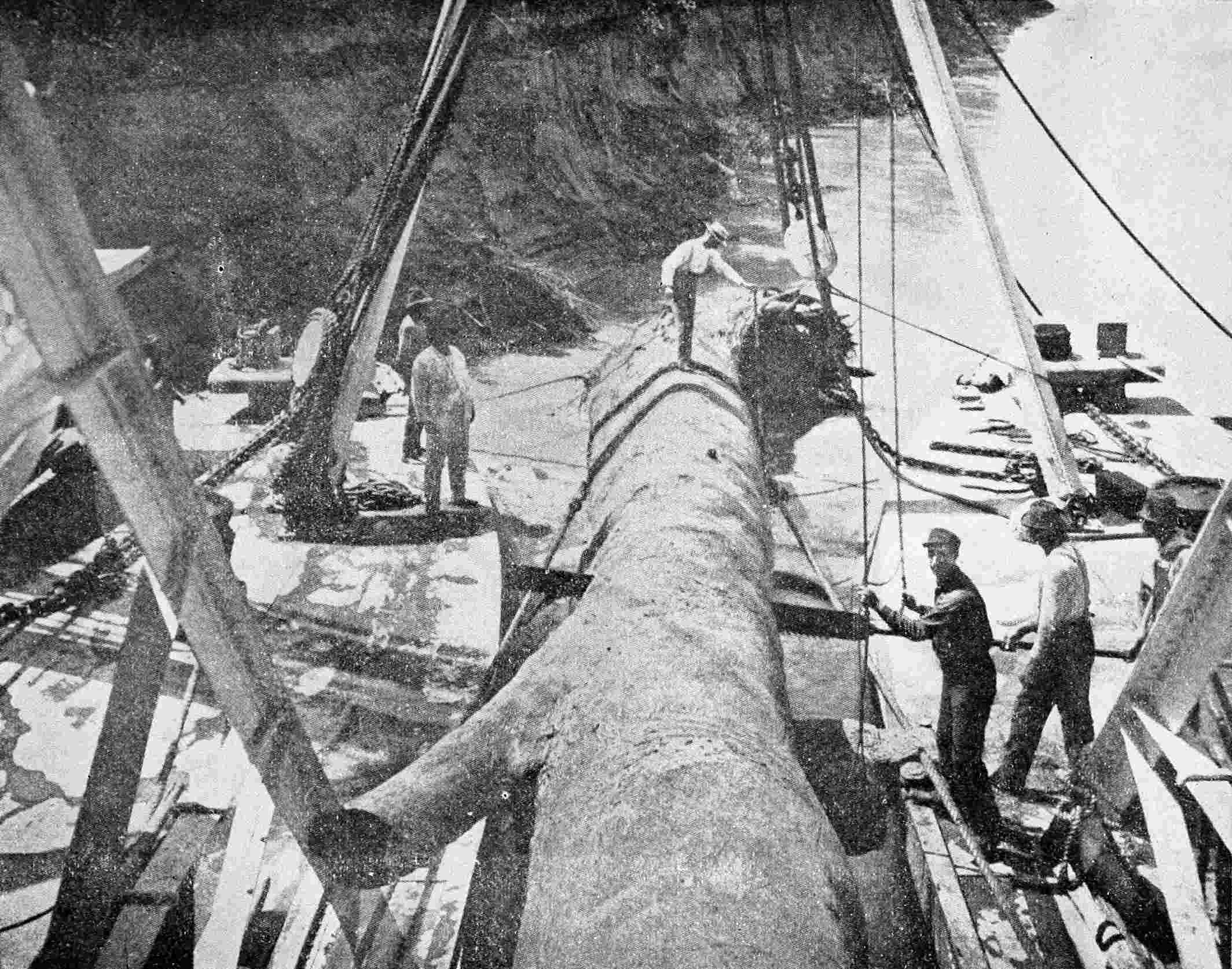
REMOVING SNAGS FROM THE MISSOURI
The last commercial boat that ever arrived at Fort
Benton left that port in 1890. The victory of the
railroads was complete, and every year since they
have extended their lines still further into the valley
and along the shores of the river, gradually cutting
off the small local trade to points not yet reached by
rail. The boat was never able to compete with the
locomotive. The river did not run in the right direction.
Mile for mile the transportation of freight upon
it cost more than by rail. As to passenger traffic—what
could forty miles a day do against four hundred!
Nothing but the absolute exclusion of railroads
could save the steamboat, and the development
of the country made this as undesirable as it was impossible.
IMPROVEMENT OF THE MISSOURI RIVER.
In this long and hopeless struggle the steamboats
found a strenuous ally in the government of the
United States, which cheerfully undertook to alter
the course of events and maintain a freight traffic
along the river. The history of government improvement
work upon the Missouri River is an instructive
one. For many years it consisted solely
in the removal of snags and obstructions, and to this
extent was a great and unquestionable benefit. Of
the hundreds of steamboats lost on the river
about seventy per cent. were lost from striking
snags, and the removal of these obstructions was
therefore an obvious step of good policy. Appropriations
began to be made for the Missouri River
jointly with the Mississippi and the Ohio as early as
1832, but the first actual work seems to have been
done in 1838. In that year two snagboats, the
Heliopolis and the Archimedes, ran up the river 325
miles and 385 miles respectively, removing altogether
2245 snags and cutting 1710 overhanging
trees from the banks, at a total cost of twenty thousand
dollars. In this same year the river was examined
as far up as Westport (Kansas City), with a
view of taking up the question of its general improvement.
The officer of Engineers who made this examination
was Captain Robert E. Lee.
From this time on to 1879 appropriations continued
to be made jointly for the Mississippi, Missouri,
Ohio, and Arkansas rivers, with occasional
lapses of one or more years. The work done under
these appropriations was exclusively the removal of
snags, and was undoubtedly of great value. It was
done when the traffic on the river was at its height,
and it was therefore applied when and where needed.
There can be little doubt that the property saved by
this work many times repaid its cost.
A DOUBTFUL POLICY.
DEAD BEYOND HOPE.
In 1879 the government began a general improvement
of the river by contracting its channel, so as to
produce a greater depth at low water and make
navigation possible at all stages. It was a doubtful
policy at best, in view of the rapid and inevitable
decline of traffic, but this consideration seems only
to have increased the determination to keep boats
on the river whether the interests of the public
required them there or not. The policy was kept up
in ever-increasing measure, and in 1884 Congress
created a Commission of five members to take the
matter in charge and conduct the work in a
systematic way. A more fatuitous course has rarely
been adopted by any government than this attempt to
reverse the decrees of destiny and accomplish the impossible.
Even at that time the fate of Missouri River
navigation was to most men as clear as the flash of
light in the night. It was dead beyond the hope of
resurrection, at least within another century. The
desultory traffic which existed here and there would
not amount, in the total value of the freight carried,
to the appropriations made for facilitating its transportation.
Nevertheless, in face of this inevitable march of
events, the problem was taken up in earnest. Millions
of dollars were appropriated, a vast accumulation
of plant was made, and an astonishing amount
of actual work accomplished. The result? So far
as its influence upon the commerce of the valley is concerned
the same as if this money had been used to build
a railroad in Greenland. Not a boat more has followed
the river than if the work had not been done. From
that point of view it has all been wasted effort. From
another viewpoint, however, it has been of great benefit.
It has protected many miles of river front, saved
from destruction thousands of acres of valuable
bottom lands, and millions of property on city fronts
and along the lines of railroads. It has developed
some of the most effective methods known to engineering
for the control of alluvial rivers, and has
made a solid contribution to the advancement of
science. From a purely engineering point of view
and its great value in the protection of property, the
work may be considered a success; from its influence
upon the commerce of the country, something very
different.
MISSOURI RIVER COMMISSION.
For seventeen years the Missouri River Commission
dragged out an unnecessary existence, and was
finally abolished by Act of Congress, June 13, 1902.
But the lesson, if a costly one, has been well learned.
So far as government work on the Missouri River is
concerned, it will, in the near future at least, be confined
to two purposes. On the lower stretches of the
river it will be devoted to the protection of property
along the banks; in the upper course to the building
of reservoirs and canals, for the utilization of its
waters in irrigation.73
Thus the battle between the railroads on the one
hand and the steamboats, with their government ally,
on the other, has resulted in overwhelming victory
for the former. It is a victory not to be regretted.
It is in line with progress. The country has passed
beyond any use that can come from transportation
methods like those of the Missouri River steamboat.
It served its purpose and served it well. It filled a
great place in the early development of the Western
country. But its day has passed, and henceforth it
will be of interest only to lovers of history.
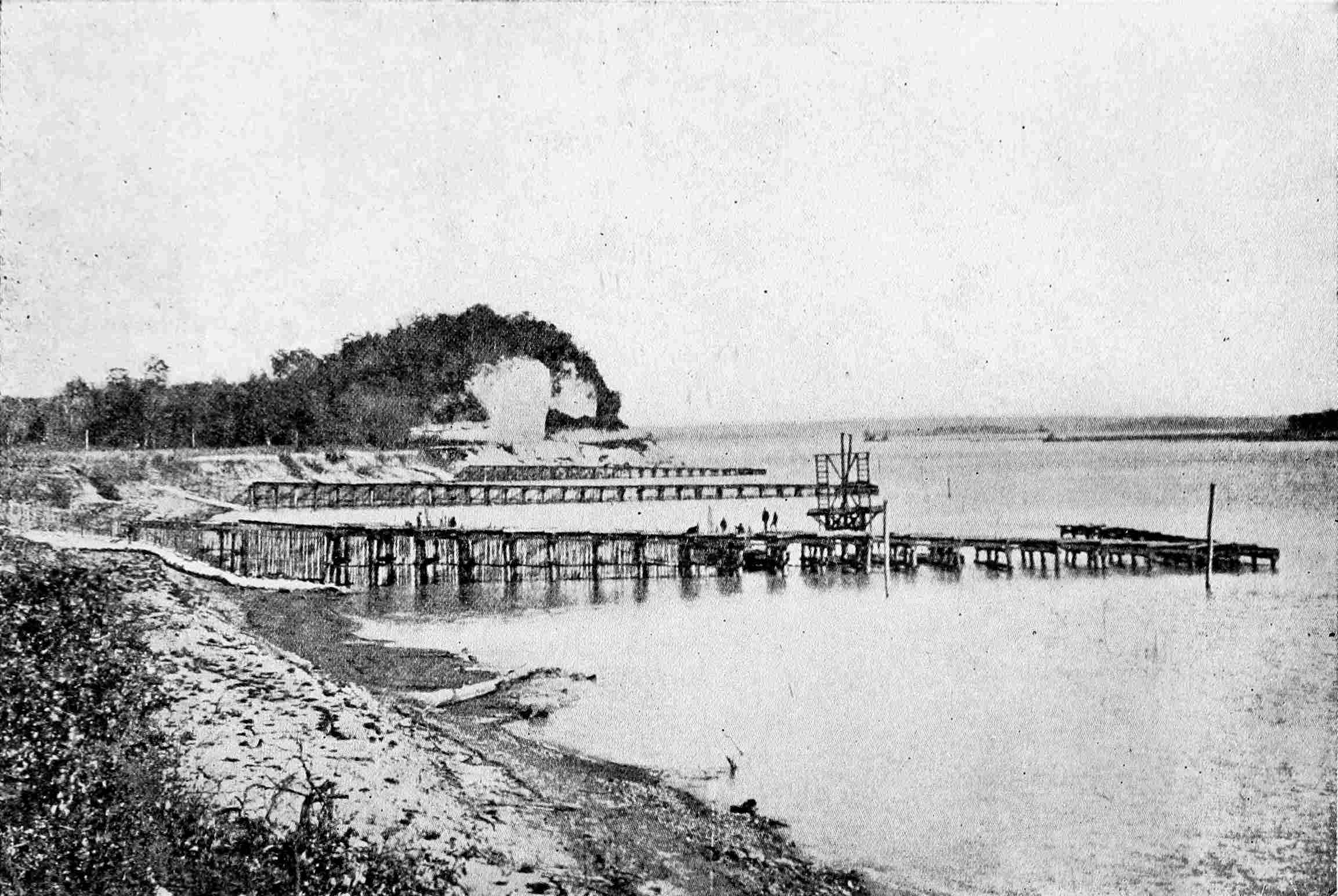
“IMPROVING” THE MISSOURI RIVER
CHAPTER XXXVI. LAST VOYAGES TO BENTON.
As soon as the ice broke up in the spring of 1868
Captain La Barge commenced work on the river,
and after two trips to St. Joseph advertised for a trip
to Benton. He received a good cargo and had a
fairly profitable voyage, but in no sense so satisfactory
as the year before. After his return in the
fall to St. Louis he received a proposition for the
charter of the boat in the government river work.
Terms were arranged with General McComb of
Cincinnati, through Captain Charles R. Suter, who
was later for many years in charge of the government
work on the Missouri River. Captain La Barge remained
on the boat, working for the government,
during the rest of the season, when he sold the boat
to the Engineer Department for $40,000.
THE MISSOURI HIS HOME.
“And here,” said the Captain, “I have to record
another of the great mistakes of my life. I was now
well ‘fixed,’ as the world goes. I had the $40,000
which I had received for my boat. I had about
$50,000 in the bank. My home, forty acres in
Cabanné place, was easily worth $40,000 even at that
time; and I was entirely out of debt. I had thought
much of retiring from the river and ought to have
done so. It was only too evident that the steamboat
business on the Missouri had seen its day. It had
passed its meridian in the middle of the sixties, and
henceforth it was sure to decline. The reluctance of
an active man, still in the prime of life (I was fifty-three),
to lay aside the pursuits of a thrifty career,
may have blinded my eyes to the certain and early
fate of the business I had been engaged in, and have
led me to hope that it would continue to be what it
had been in the past. I had no desire to go on any
other river. The Missouri was my home. I had
grown up on it from childhood. I liked it, and knew
I could not feel at home on any other.
“And so I unwisely concluded to continue at my
old business, and went into it on a larger scale than
ever before. I built the Emilie La Barge, a larger
and finer boat even than the Octavia, costing me
$60,000. The hull was built on the Ohio and
brought to St. Louis for completion. This was in
the winter of 1868–69.”
Government business up the river was still very
good, but competition for it was getting closer, as
other lines of steamboat trade declined, and Captain
La Barge failed to secure a contract. He went to
work, however, for the successful bidder and did a
paying business during the summer. He returned to
St. Louis in September and made two trips to New
Orleans, when the boat was laid up until the spring
of 1870. He then entered into a contract with the
government to transport Colonel Gilbert and 480
men with over 400 tons of freight to Fort Buford.
It was a low-water season and the trip was slow and
tedious; but the boat got through all right. After
his return Captain La Barge ran in the lower river
the balance of the season. But the profits were
small, for the railroads had thoroughly gotten the
upper hand. There was no longer any money in
the lower river trade.
AN OPEN BAR.
“I recall a little incident that amused me somewhat
while on this summer’s trip,” said the Captain.
“Colonel Gilbert was a strict disciplinarian, yet withal
much liked by his men. When he came on board he
told me that I need not close the bar on the boat unless
I chose to do so. If any of his men wanted a
drink and had money to pay for it, let them have it.
‘That’s something very unusual,’ said I, for generally
when troops were in transport I had to close the bar.
‘All right, I’ll take my chances,’ he replied. ‘If any
of them get drunk, they will not get drunk again.’
I noted throughout the trip that there was not a
single drunken soldier, although the bar was open all
the time.
COLONEL AND LIEUTENANT.
“It was customary whenever we stopped to have
a guard posted near the gangway, and this was done
on our arrival at Fort Randall. A guard from the
post was also ordered down, presumably to prevent
the post soldiers from getting on the boat. The
young lieutenant in charge made his way on board
past Colonel Gilbert’s guard, on telling who he was.
He inquired of me for Colonel Gilbert, and I took
him up and introduced him. After a few minutes’
conversation he noticed the open bar on the boat and
some soldiers there, drinking. He said to Colonel
Gilbert that he would like to have the bar closed, as
such were his orders. ‘Why don’t you have it
closed, then?’ said Colonel Gilbert bluntly. ‘Well,
I don’t like to order it when you are aboard with
troops.’ ‘It suits me to have it open,’ returned the
Colonel. The lieutenant explained that they were
afraid that some of the post soldiers would get aboard
and get drunk. ‘You have a guard out there,
haven’t you?’ asked the Colonel. ‘Yes, sir.’
‘Well, if they get past your guard they won’t
mine,’ and he turned and walked off, leaving the lieutenant
quite crestfallen at the encounter.
“It was while we were here at Randall that I was
subpœnaed by a United States marshal to appear at
the trial of the murderer of Captain Spear. I had
the greatest difficulty in getting permission to continue
my trip, although the trial was not to come off
for several months. I had to give $20,000 bonds for
my appearance.
DISASTROUS CONTRACT.
“After my return to St. Louis that fall I made
several Mississippi River trips and laid the boat up
late in the season. In the summer of 1871 I ran in
what is called the Omaha line all the season. In the
fall I sold the boat for $30,000. She had paid me
just about what she cost. I remained at home all
the winter of 1871–72, when I again got tired of doing
nothing; and being bred to the steamboat business,
and not daring to turn my hand to anything else,
commenced building another boat. She was completed
by the middle of the summer, and named
De Smet, in honor of the distinguished Jesuit missionary.
I at once took a contract to transport
freight from St. Louis to Shreveport, La., for the
construction of the Southern Pacific railroad. This
enterprise was disastrous in the extreme. I found
the Red River without water enough at the mouth
for me to enter, all of it going down the Bayou
Atchafalaya. I did not get away from there until
January, having had to import one hundred mules at
my own expense to get the freight through. The
enterprise was so disastrous that I was released from
the contract. I secured fifteen hundred bales of cotton
for my return trip to St. Louis, but the winter
was severe and I was stopped by ice at Helena, Ark.,
and had to send the freight on by rail. Take it all
in all, the season’s venture was a most ruinous one.”
AN OLD ACQUAINTANCE.
While engaged in this work Captain La Barge
found it necessary to run down to New Orleans with
his boat. He went to transact some business with
Jesse K. Bell, a man closely connected with Mississippi
River business and a capitalist well known
throughout the valley. While in his office someone
came in and asked to see Dave McCann. “What
McCann is that?” asked La Barge. “Dave McCann.”
“Dave McCann?” “Yes. Do you know him?”
“I used to know a Dave McCann over forty years
ago.” “Well, I guess it’s the same man. Let’s see
if he knows you,” and Bell sent his servant to call
McCann in. When La Barge was on the Warrior
during the Blackhawk war in 1832 McCann was
second engineer on the boat. The two young men
became intimately acquainted and very fond of each
other. They were together for a time during the
cholera scourge and promised to take care of each
other if either were taken sick. Finally their ways
parted and neither had seen or heard of the other
since. McCann quickly appeared in Mr. Bell’s office
and glanced at where La Barge was sitting. “Well,
if here isn’t Joe La Barge!” he exclaimed, grasping
his old associate by the hand. “And if this isn’t
Dave McCann!” was the Captain’s warm rejoinder.
McCann was at the time president of the Cotton
Compress Company and of the New Orleans
Foundry Company.
Captain La Barge did not reach St. Louis until
February, 1873. He remained there for a while and
made a second, and this time profitable, trip to
Shreveport. He then advertised for Benton, secured
a good cargo, and made a successful trip.
INCIDENT AT FORT RICE.
CUSTER AND STANLEY.
“An incident occurred on this voyage at Fort
Rice,” said the Captain, “which illustrates some
traits of General Custer’s military character. Custer
was daily expected to arrive opposite Fort Rice,
and General Stanley, who was commanding there,
wanted me to delay a day or two and ferry him
over. I made an arrangement with him to do this,
and when Custer arrived I crossed the river with
an order from Stanley to bring him over. I cleared
the deck of the De Smet entirely, and rigged stages
so that the horses and wagons could be driven
directly on board. As the command approached, I
saw an officer come riding down, clad in buckskin
trousers from the seams of which a large fringe was
fluttering, red-topped boots, broad sombrero, large
gauntlets, flowing hair, and mounted on a spirited
animal. I had never seen Custer, but of course had
heard a great deal of him, and there was no mistaking
this picture. I went out on the bank to meet
him. He stopped his horse, but did not get off. I
said, ‘General Custer, I suppose?’ He nodded assent.
I showed him my order for the transportation
of the command and told him that if he would have
the wagons brought down I would see to their proper
disposition on the boat. ‘Stand aside, sir,’ he replied;
‘my wagon-master will take charge of the boat
and see to ferrying the command over.’ ‘Not if I
know myself,’ I replied, and started for the boat.
Custer sent for a guard to arrest me, but I took time
by the forelock, drew in the stage, and steamed across
the river and reported to General Stanley. Stanley
immediately sent me back with an officer and guard,
who arrested Custer and brought him to his headquarters.
“Custer seemed to me to be generally unpopular,
that is, I rarely heard him well spoken of. Stanley,
on the other hand, always appeared to be a gentleman
of rare qualities, one who never forgot to treat a
civilian as a man—something that many officers were
little disposed to do.”
LA BARGE IN ARREST.
While at Benton awaiting passengers for a return
trip Captain La Barge had some new experiences of
the character of men who were delegated by the
government to do its business with the Indians. He
was one day arrested by Mr. C. D. Hard, deputy U.
S. marshal, sub-Indian agent, and special Indian detective
at this point, on charge of selling and trading
whisky on Indian reservations. The second day
afterward Captain La Barge was brought up for examination,
but not being allowed to introduce any
evidence in his own behalf, made no effort to clear
himself. The agent then seized his boat in the following
words: “I seize the boat as sub-Indian agent,
and turn her over to myself as deputy marshal for
safe keeping.” Being requested to produce papers
for such a proceeding, he replied that verbal seizure
was sufficient for him, and others would have to
accommodate themselves accordingly. He immediately
placed a fellow criminal over the boat and
applied to Captain Kirtland, the military officer in
charge, for a squad of soldiers to aid him in his
rascality. This request was peremptorily refused.
Hard became very insolent and abusive after the
seizure, and it was soon evident that the object of
himself and his confederates was to levy blackmail
upon the Captain. Being determined to defeat this
outrageous scheme, he left for Helena to consult legal
authorities.
When Captain La Barge reached Helena he had
no difficulty in securing a telegraphic order from
Chief Justice Wade, of the Territory, directing the
release of the boat, and he returned to Benton and
resumed possession of her, much to the chagrin of
the authors of this high-handed proceeding. This
virtuous public officer had endeavored to work a
similar game on another boat the same season, but
was defeated by some of the passengers.
The boat had been detained by this incident upward
of two weeks, and it was not until the middle of
July that she set out on her return trip. Among the
passengers was the family of Colonel Wilbur F.
Sanders, already known in these pages as counsel for
the plaintiffs in the case against La Barge, Harkness
& Co. The Captain and he were always on
good terms, however, and their former relations had
nothing to do with their subsequent friendship.
A SERVICE REWARDED.
On the way up the river this season two Catholic
Sisters came on board on a begging visit in the interest
of the Chicopee Mission in Minnesota. The Captain
gave them passage to Benton and back. They
visited Helena and Virginia City, and were very successful.
They came back from Helena with the
Sanders family and returned to Sioux City. About
a month later Captain La Barge received by express
a beautiful specimen of needlework handsomely
framed, representing St. Joseph. It is still in the
possession of the La Barge family.
LA BARGE SELLS HIS BOAT.
After Captain La Barge’s return to St. Louis he
entered the Alton trade, and made daily trips in opposition
to the Eagle Packet Company. He entered
the same trade again in 1874 under an arrangement
with John S. McCune, who had long controlled the
trade on this part of the river. But in March of
this year, while Mr. McCune was in Jefferson City
to settle some details in regard to the sale of lands
constituting the present Forest Park of the City of
St. Louis, he was taken sick with pneumonia and
died one day after his return to St. Louis. This
broke up all the Captain’s plans, and as he was not
able, unaided, to compete with the Eagle Packet
Company, he sold his boat to them.
Captain La Barge spent the remainder of the season
in St. Louis, and in the fall commenced building
a new boat, which he christened the John M. Chambers,
in honor of the infant son of B. M. Chambers,
President of the Butchers’ and Drovers’ Bank. The
boat was ready for use in the spring of 1877.
Captain La Barge made a trip as far as to Fort Rice,
loaded mainly with quartermaster stores. He then
entered the Yankton trade, that being at the time an
important terminus for the declining river business.
Certain defects in the boat’s machinery, which could
not be remedied at Yankton, compelled an early return
to St. Louis and the loss of some important work.
Captain La Barge remained in St. Louis until the
following spring. He then returned to Yankton
under a government contract to transport goods
from that point. He finished this work early, but
had scarcely returned to St. Louis when he was called
upon to go up the river again, as we have elsewhere
related, for service in the Custer campaign.
LAST COMMERCIAL VOYAGE.
In 1877 La Barge took the Chambers as far up the
Missouri as to the mouth of the Yellowstone, and up
the latter stream to the mouth of Tongue River. In
the following year he made a trip to Benton, arriving
there on the 4th day of June. This is believed to
have been the last commercial trip from St. Louis to
Fort Benton. Upon his return to St. Louis he sold
his boat and retired permanently from the business
of boat owner and builder. He served as pilot on the
lower river during the summer of 1879, and then
finally withdrew from connection with commercial
boating on the Missouri.
LA BARGE RETIRES FROM THE RIVER.
From 1880 to 1885 Captain La Barge was in the
service of the government as pilot of the steamer
Missouri, which was then engaged in making a survey
of the river valley. This duty was little enough like
the active business of his better days. It was filled
with reminiscences of his past career which could not
but bring regretful reflections. His intimate knowledge
of the river was of great help in recovering the
proper geographical nomenclature of the valley, and
might have been of far greater value had the surveyor
under whose charge he worked possessed an
ordinary appreciation of the mine of knowledge which
lay at his disposal. In 1885 the boat was taken from
St. Louis to Fort Benton, this being the very last
through trip ever made. The year 1885 closed
Captain La Barge’s career on the Missouri River, and
he took his hand from the wheel after a record of
service unequaled by any other pilot in its history.
Three years more than half a century had elapsed
since he made his first voyage up the river.
CHAPTER XXXVII. DECLINING YEARS.
It is a sad reflection that, after a life of hard and
useful work and the prominent part he took in up-building
the great West, Captain La Barge should have
closed his career in comparative want. But such were
the vicissitudes of the business to which his life had
been devoted. That business had passed away, and
like a sinking ship it dragged down all who clung to
it. Captain La Barge struggled bravely against these
adverse conditions, but it was impossible to withstand
the downward tendency.
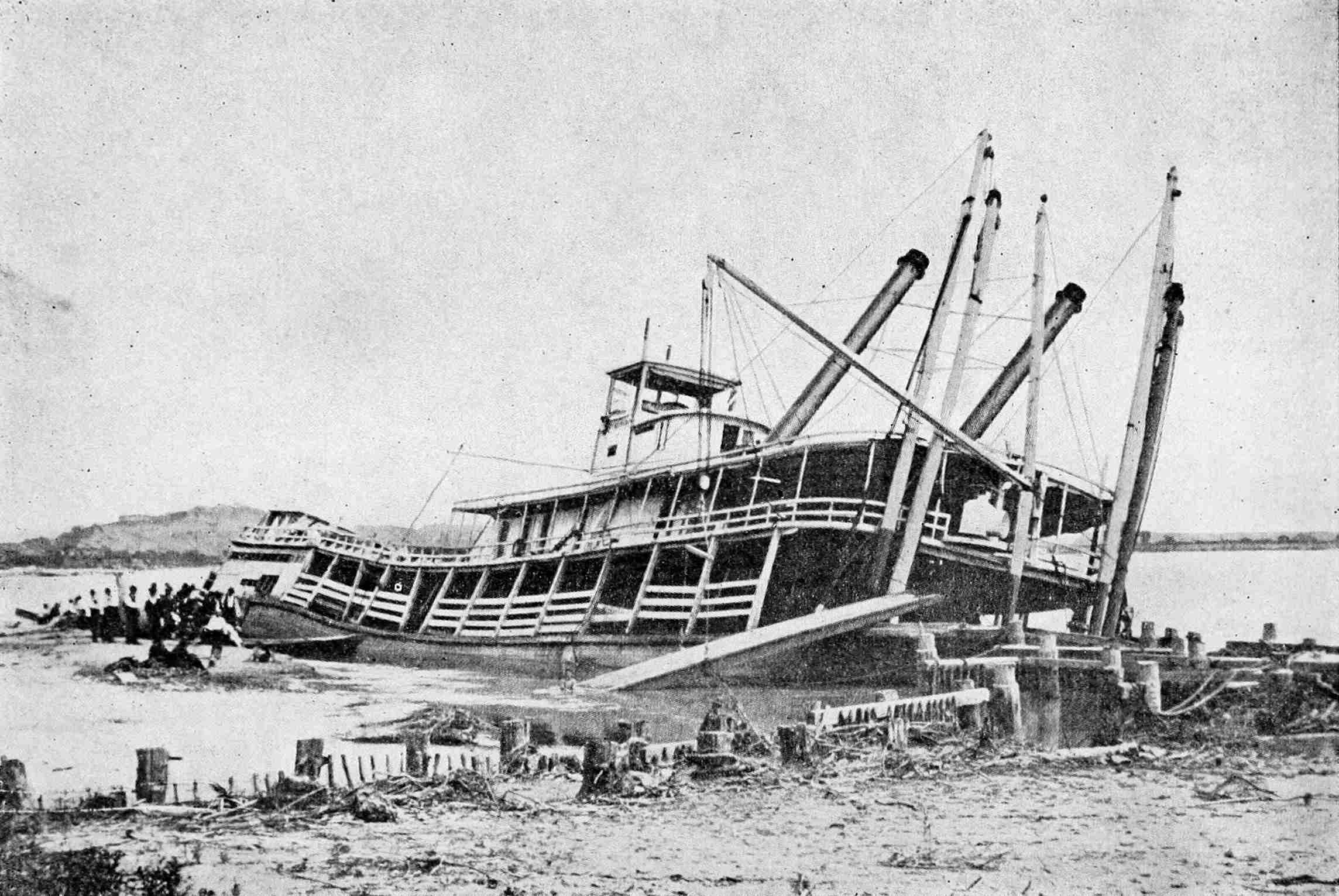
STEAMBOAT WRECK ON THE MISSOURI RIVER
From 1890 to 1894 Captain La Barge held a position
under the city government of St. Louis. His
very last remunerative work of any kind was for the
United States Government, under the direction of the
author of this work, whom he helped compile a list of
the steamboat wrecks which have occurred on the Missouri
River. This work was done in the year 1897,
and was published as a part of the report of the Missouri
River Commission for that year. Although the
number of these wrecks lacks but five of three hundred,
the Captain’s memory embraced them nearly all,
and most of them with great accuracy of detail.
GREATEST WRECK OF ALL.
Truly a mournful task was this to the veteran pilot.
What reminiscences of a strange and wonderful past
did it bring to mind! He lived over again his river
life of fifty years, saw the old keelboat, the mackinaw,
and the canoe, dodged again the bullets of the treacherous
savages, killed the wild buffalo, sparred his boat
over sandbars or warped it up the rapids, beheld
again the wild rush to the gold fields, heard the tramp
of the army going to battle on the plains, and mused
upon a thousand other features of a life that existed
no more. And as he recalled one by one these wrecks
of a once flourishing business, he could not but reflect
that the greatest wreck of all was the business itself.
It was gone—buried so deep in the sands of commercial
competition that not even the pennant staff or
smokestack caused a ripple on the surface—passengers,
cargo, and all that clung to her a total loss.
Captain La Barge survived most of his associates in
the river business, and in his later years was frequently
consulted by those who had occasion to recover
facts concerning the early history of the river.
He lived only about two years after the completion of
his work for the government. He had grown visibly
feebler during this time, and it was apparent to those
who knew him that the end of his life was near. It
came at last, however, quite unexpectedly. He was
taken suddenly ill on the 2d of April, 1899, and at 3
P. M. of the following day breathed his last.
JESUITS HONOR LA BARGE.
The funeral of Captain La Barge was from the St.
Xavier Cathedral in St. Louis, and was largely attended.
The Jesuits were under a deep debt of gratitude
to the Captain, who, throughout his career, had
extended to their missionaries the freedom of his boats.
Through mistaken information they had often credited
this generosity to the American Fur Company, for
which Captain La Barge worked so much. Upon discovering
their error they made due acknowledgment of
it, and upon this occasion made a particular point to
correct it and to acknowledge their lasting debt to the
great pilot. It was probably in line with this purpose
that the Church paid to the deceased its very highest
honors. On Thursday morning, April 6, solemn high
mass was celebrated at the Cathedral for the repose
of the soul. Archbishop Kain, assisted by eight
priests, officiated at the mass. Six grandsons of the
deceased acted as pall bearers. Father Walter H. Hill,
a lifelong friend of Captain La Barge, preached the
funeral sermon. In the course of his remarks he said:
“Captain La Barge led an honorable life. In the
eyes of the Church to which he belonged he led a
good life. There was no stigma upon his name. No
vice marred his character to bring the blush of shame
to his children. His life was an example of which
they might well be proud.”
A WONDERFUL METAMORPHOSIS.
The speaker drew an interesting picture of the
changes that had taken place in the city of St. Louis
and in the great West within the span of this man’s
life. In his infancy he had actually been in peril from
the Indians in what are now the outskirts of the city.
Then luxury and plenty, as we now know them, had
no existence. The mother cared for her children and
did the work of the house. The candle and not the
incandescent furnished light at night. Water was
pumped from the well and people did not ride to and
from their business in swift electric cars. In the words
of a local paper, commenting upon the Captain’s
career, “He passed through all the gradations and
progressive steps of the century until in its very last
year the sun of his life set forever, and his expiring
gaze beheld a little village grown to a great metropolis,
enmeshed in a perfect tangle of railways, factories,
and furnaces, teeming with busy activity, converting
the crude material into every possible contrivance
imaginable for the use of man; palatial mansions
where, in his youth, was a wilderness; in short, every
improvement that the brain of man had wrought.”
Father Hill illustrated this marvelous growth by a
reference to the growth of his own Church in St.
Louis: “As I stand here to-day,” he said, “to pay the
last sad tribute of respect to the memory of the friend
of my early youth, I cannot help thinking of the marvelous
changes that have been wrought in the last
eighty-four years. On the evening of October 22,
1815, a mother entered a little frame church on the
banks of the Mississippi, bearing an infant in her
arms. The parent had come to have the child baptized.
Tallow candles lighted her way through the
aisle to the rude altar where the ceremony was to be
performed. To-day the remains of that babe, grown
to manhood’s estate and full of years, lie before me.
The spirit now dwells in his Father’s house. At the
christening were only the most primitive conveniences;
at the burial services his remains rest in a magnificent
granite structure; hundreds of electric lights glare
upon the dead; hundreds of heads are bowed in silent
prayer. Which of us can ponder for an instant upon
the span of this life and not be bewildered at the contemplation?”
A FIT RESTING PLACE.
Captain La Barge was buried in the beautiful Calvary
Cemetery, which lies adjacent to the even more
beautiful Bellefontaine Cemetery in the northern part
of the City of St. Louis. His grave is within a short
distance of where he spent his earliest infancy, and is
in all respects a peculiarly appropriate resting place
after a life like his. To the eastward, in full view
where not cut off by the foliage, flows the mighty Mississippi.
To the northward the impetuous Missouri
brings down its flood from the dim and shadowy distance.
How often had this individual guided his
intrepid bark up the channels of these two streams,
headed for remote and almost unknown ports, and
anon, gliding swiftly on his homeward journey, sped
eastward into the Mississippi and south to the port
to which he always returned. Standing by his grave
and overlooking the valleys of these streams, their
history through the past two centuries thrills the mind
like a romance of the past.
PERSONAL APPEARANCE.
In personal appearance Captain La Barge was one
of the most distinguished-looking men of the West in
his time. He stood five feet ten, was well proportioned,
weighed about 180 pounds, was erect, muscular,
and alert, with a sharp, quick eye and a quiet
energy in all his movements. He always wore a beard
after reaching manhood’s estate, and in later years
bore a striking resemblance to General Grant. Colonel
Thomas of the army, long stationed in St. Louis, always
addressed him by the name, Grant; and only a
few years before his death a gentleman met him on
the street and said, “Well, if I did not know Grant is
dead, I should say there he comes.”
SUNSHINE AND TEMPEST.
Captain La Barge’s manner in social intercourse
was mild and agreeable, and his accent pleasant to a
degree. It was a satisfaction to hear him talk. Although
almost invariably soft and unobtrusive, his
voice would occasionally swell, under the influence of
emotion, until it possessed all the power of command.
It is said that this characteristic marked his entire
career. His men were not deceived by it. They never
dared to take undue advantage of the sunshine of his
manner, lest they call down upon them the thunder
of the tempest.
Captain La Barge was a lifelong, consistent Catholic
in religion, and in politics a lifelong, consistent
Democrat.
CHAPTER XXXVIII. DESTINY OF THE MISSOURI RIVER.
What of the future? Is the useful purpose of the
Missouri River in the up-building of the West already
fulfilled? Is its great history a closed book? Such,
it must be admitted, is the general view. In popular
estimation that river to-day is little more than a vast
sewer, whose seething, eddying waters bear down the
sands and clay and débris from the far upper country,
scattering them along its course, swelling the floods
of the Mississippi, and pushing ever seaward the delta
of that mighty stream. To the railroads it is a million-dollar
obstacle wherever they want to cross it. As
a competitive route of commerce it has sunk beneath
their notice. To the husbandman along its borders
it is a perpetual nightmare, for he knows not what
morning he may awake to find his worldly possessions
ruthlessly swept away. From all points of view it now
seems like one of those things in the economy of nature
which could be dispensed with and the world be none
the worse for its absence.
PAST AND PRESENT.
Nevertheless the river is still there—a fact, a thing
to be reckoned with in some way or other. It will not
let its presence be forgotten. In its old-time fashion
it carves up the lands, but with vastly greater destructiveness
now that they have become so valuable.
Its terrible ice gorges pile up as of yore, but are now
more dreaded than they used to be on account of the
property along the banks. In other respects as well
it is the same peculiar stream that it has ever been.
The weird sandstorms drive over its illimitable bars,
the willows bend to the blast, and the swift-rolling
waters are lashed into foam by the prairie gale. In
periods of calm its silvery sheen stretches away under
the morning and evening sun as when the pilot followed
its interminable windings through the prairies;
and its resistless tide rushes on, as in the blithe steamboat
days, when it carried upon its bosom the commerce
of the valley.
But here the likeness between the past and present
ends. No aboriginal savage now roams upon its borders.
The buffalo does not come to its shore to quench
his thirst, or to swim its current, or to cross upon its
ice. The lonely dwellers of the valley have long since
ceased to watch the eastern horizon where the river
runs into the sky, for the curling smoke no longer tells
them of the approach of those white-winged messengers
of civilization, the Missouri River steamboats.
They are gone, its greatness and glory, never, in their
ancient form, to return.
THE GERM OF EMPIRE.
But the river itself is still there, and those who dwell
on its shores refuse to believe that its power for good
has passed away. For years they have wistfully
looked upon its waters, flowing by in absolute waste,
and then upon the rich lands on either side, parching
in a rainless climate. A vague hope of what the river
may be already possesses their minds. Does it not
hold the secret germ of a mighty future empire?
Twenty-five millions of people these wasted waters
could sustain, if only they could be scattered upon the
neighboring lands. With great canals to divert them
from the river, with great reservoirs to keep them
from going to waste, there would follow the necessary
millions of money and men to turn them to proper
account.
This is the dream. Can it be realized, or must it
always remain nothing more than a dream? It is an
engineering problem purely. The grand desideratum
would be that everywhere, whether upon the main
stream or its tributaries, the water could be saved and
used in irrigation. But the obstacles in the way of so
complete a result seem at present almost insurmountable.
The higher tributaries can doubtless all be
utilized, but the main streams, in their lower courses,
have so little fall that it will be very difficult to build
canals of sufficient length to get the water upon the
higher ground. Whether the water will ever have a
value that will justify pumping it to the necessary
elevation it would be unwise at present to hazard a
conjecture. But even if not more than half can be
utilized, it will still be enough to maintain a population
equal to that at present existing in the entire arid
region of the West.
A MIGHTY FUTURE.
Here, then, is the answer to our question—What of
the future? Turn this river out upon the lands. Unlock
its imprisoned power. Where the rains do not
fall let it supply the need. Then the new and greater
history of the Missouri River will begin. Utility will
take the place of romance. The buffalo, the Indian, the
steamboat, the gold-seeker, the soldier, will be seen in
its valley no more, but in their stead the culture and
comfort, and the thousand blessings that come with
civilization. Such, let us hope, in drawing the curtain
over a mighty past, will be the consummation of
a still more mighty future.74