PREFACE.
In the summer of 1896 the author of this work,
while engaged in collecting data for a history of the
American Fur Trade of the Far West, met the venerable
Missouri River pilot, Captain Joseph La Barge,
at his home in St. Louis. In the course of several interviews
he became deeply impressed with the range and
accuracy of the old gentleman’s knowledge of early
Western history, and asked him if he had ever taken
any steps to preserve the record of his adventurous
career. He replied that he had often been urged to
do so, but that lack of familiarity with that kind of
work had hitherto caused him to shrink from it, and
he presumed he should die without ever undertaking
it. Believing that his memoirs were well worth preserving,
as a part of the history of the West, the author
proposed to prepare them for publication if he
would consent to dictate them. After some hesitation
he concluded to try it, and the work was forthwith
begun. Full notes were taken in the rough, and a
clean copy was then submitted to Captain La Barge
for revision. He went through the whole with painstaking
care, and the record was left as complete as a
memory of extraordinary power could make it. The
intention was, at the time, to put the notes into shape
for publication at once; but the Spanish-American
war interfered with the author’s part of the work, and
before it could be resumed Captain La Barge died.
This event led to a material change in the plan of
the work, and it was decided to make it, not merely
a narrative of personal experiences, but a history of
steamboat navigation on the Missouri River. Very
few people now have any conception of the part which
this remarkable business played in the upbuilding of
the West. There is no railroad system in the United
States to-day whose importance to its tributary country
is relatively greater than was that of the Missouri
River to the trans-Mississippi territory in the first
seventy-five years of the nineteenth century. The business
of the fur trade, the intercourse of government
agents with the Indians, the campaigns of the army
throughout the valley, and the wild rush of gold-seekers
to the mountains, all depended, in greater or
less degree, upon the Missouri River as a line of
transportation.
AN IMPORTANT BUSINESS.
It is not alone from a commercial point of view that
the record of this business is an important one. From
beginning to end it abounds in thrilling incident, and
the life which it fostered was full of picturesque and
even tragic details. The circumstances surrounding
a voyage up or down the Missouri, whether by canoe,
mackinaw, keelboat, or steamboat, were quite out of
the line of ordinary experience. No other river in this
country has a record to compare with it.
Captain La Barge’s life embraced the entire era of
active boating business on the river. He saw it all—from
the time when the Creole and Canadian voyageurs
cordelled their keelboats up the refractory
stream to the time when the railroad won its final
victory over the steamboat. He was on the first boat
that went to the far upper river, and he made the last
through voyage from St. Louis to Fort Benton. He
typified in his own career the meteoric rise and fall of
that peculiar business. He grew up with it, prospered
with it, and was ruined with and by it. He saw and
shared the wonderful metamorphosis that came over
the Missouri Valley in the space of fourscore years,
and his reminiscences are a succession of living pictures
taken all along the line.
HISTORICAL METHOD ADOPTED.
It is hoped that the method adopted, of weaving the
story which it is here attempted to relate around the
biography of its most distinguished personality, will
not detract from its value as historical material. It
is not the bare narration of events that gives history
its true value, but those intimate pictures of human
life in other times that show what people really did
and the motives by which they were actuated. To this
end, biography, and even fiction, possess distinct advantages
over the ordinary method of historical
writing.
SOURCES OF INFORMATION.
In the preparation of this work valuable personal
aid has been received from many sources, particularly
from the Hon. Phil E. Chappelle of Kansas City, Mo.;
Messrs. N. P. Langford and J. B. Hubbell of St. Paul,
Minn.; Hon. Wilbur F. Sanders of Helena, Mont.;
and General Grenville M. Dodge of New York City.
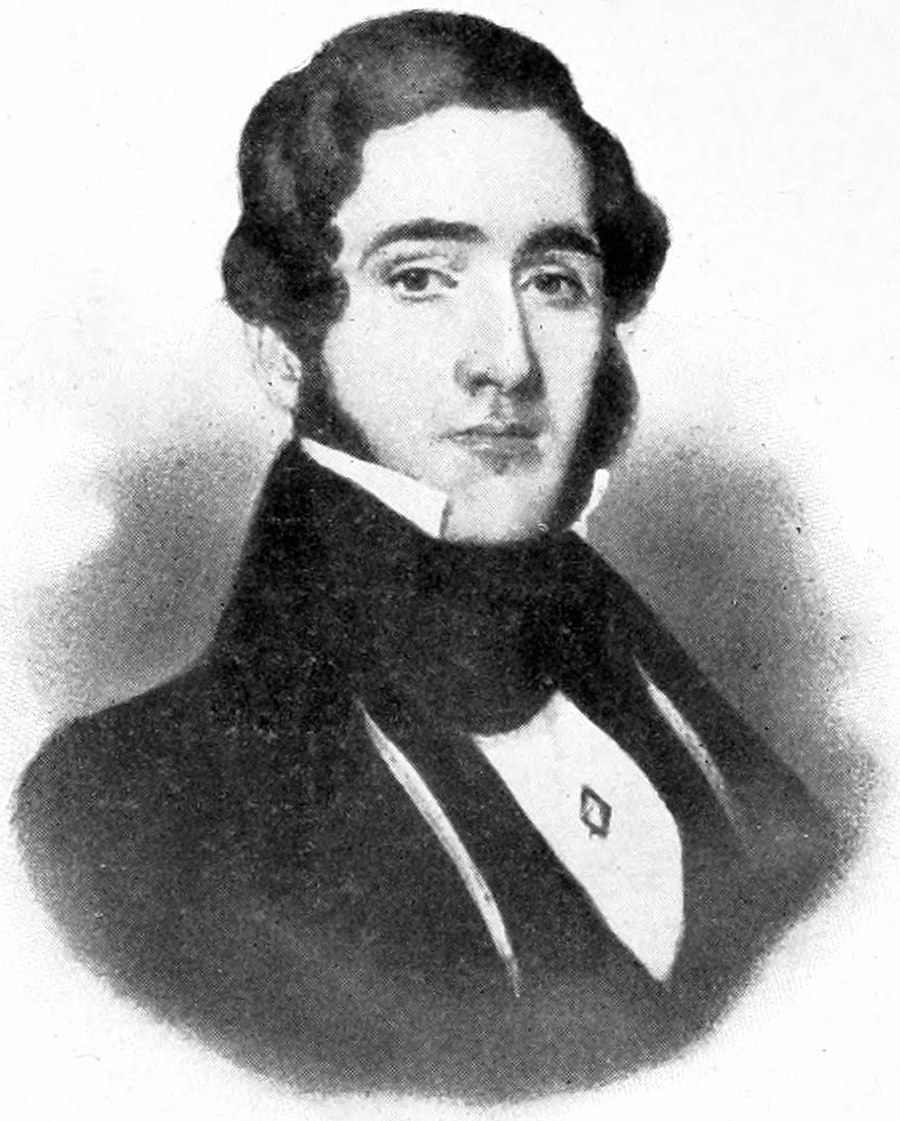
CAPTAIN JOSEPH LA BARGE
(When a young man)
CHAPTER I. ANCESTRY.
In the far-reaching operations of the French Government
upon the continent of America, by which its
western empire at one time embraced fully half of
what is now the United States and Canada, two
streams of colonization flowed inward from the sea.
The course of one was along the valleys of the St.
Lawrence River and the Great Lakes to the upper
Mississippi and its tributaries. That of the other was
along the lower Mississippi northward from the Gulf
of Mexico. The two streams met at the mouth of
the Missouri, where their blended currents were deflected
westward toward the unknown regions of the
setting sun. Near this place of meeting there arose,
more than a decade before the birth of the American
Republic, a village which has now become one of the
greatest cities in the western world. Here, in the
early days, the Canadians from the north and the
Creoles from the south, kindred in language and tradition,
mingled in common pursuits and enterprises,
and for many years bore an important part in the
great movement which proceeded onward from this
common starting-point.
Among the well-known families identified with this
movement was one whose ancestral line represented
both the northern and the southern blood, and was a
pure type of their united quality. This was the
family of Captain Joseph La Barge, the subject of the
present sketch. The father of Captain La Barge was
a typical representative of the French peasantry of
Quebec. His mother was a Creole descendant of both
the Spanish and French elements in the settlement of
the Mississippi Valley.
ROBERT LABERGE.
On the paternal side the ancestors of Captain La
Barge came from Normandy, France. Robert Laberge
was a native of Columbière in the diocese of
Bayonne, and was born in 1633. He came to
America early in life and settled in the county of
Montmorency, below Quebec, where he was married
in 1663. He is said to have been the only person of
the name who ever emigrated to America. His
descendants are now of the most numerous family in
the district of Beauharnois, if not in the entire province
of Quebec, where it has held important positions
both in Church and State. Its ramifications in the
United States have likewise become very extensive.
The true spelling of the name was Laberge, and this
form still prevails in Quebec; but the St. Louis branch
of the family has for many years spelled the name in
two words, La Barge.
JOSEPH MARIE LA BARGE.
Captain La Barge was of the sixth generation from
his Norman ancestors. His father, Joseph Marie La
Barge, was born at Assomption, Quebec, July 4,
1787.1 He emigrated to St. Louis about 1808, just
as he was arriving of age. He traveled by the usual
route, up the Ottawa River and through the intricate
system of waterways in northern Ontario which leads
to Georgian Bay and to Lake Huron. Thence he
went by way of Mackinaw Strait and Lake Michigan
to Green Bay, and along the Fox and Wisconsin
rivers to the Mississippi, which he descended to St.
Louis. He used a single birch-bark canoe all the way,
with only eight miles of portaging.
The elder La Barge led a varied career in St. Louis,
as did most of the pioneers in those days, when fixed
callings were few and men turned their hands to whatever
fell in their way. A good deal of information
has survived concerning him, and all to his credit.
He was evidently a man of good parts, of strict integrity,
loyal in his business relations, and a bold lover
of the adventurous life which characterized the early
history of this new country.2
IMPORTANT SERVICES.
At the time when the Sac and Fox Indians were
giving the government so much trouble, and endangering
human life all along the upper Mississippi,
La Barge senior was employed in the perilous business
of carrying dispatches to Rock Island, having volunteered
for this service when others refused to go.
He served in the War of 1812, and was present in
the battle of the River Raisin, or Frenchtown,
January 22, 1813, and was there shot in the hand,
losing two fingers. He also received a tomahawk
wound on the head, and carried the scar through life.
He became naturalized as a result of this service in
the army. Although entitled to a pension under the
laws of the United States, he never asked for nor received
any.
La Barge married in 1813, and some two years
afterward acquired a farm at Baden, a small village a
few miles north of St. Louis, and now within the
limits of that city. His main business here was the
manufacture of charcoal, which he hauled to St. Louis
for sale. He soon moved to town, where he had
gained quite an extensive acquaintance, particularly
among the Canadian voyageurs. Here he opened
up a boarding-house, which developed into a regular
hotel or tavern, with a livery attachment, at that time
one of the most important in the city. It was while
engaged in this business that he served the English
traveler, James Stuart, already referred to.
ENGAGED IN THE FUR TRADE.
La Barge senior was, to a considerable extent,
identified with the early trapping business in the Far
West, and has left his name on geographical features
in widely separated localities. There is a La Barge or
Battle Creek, a tributary of the Missouri, which took
its name from some affair with the Indians in which
La Barge bore a part; but the details are apparently
lost. The same is true of La Barge Creek, a tributary
of Green River in Wyoming, which was named before
1830. La Barge was present in General Ashley’s
disastrous fight with the Aricara Indians on the
Missouri River in 1823, and was the man who cut the
cable of one of the keelboats so that it might drift out
of range of the fire of the Indians.3
DEATH OF THE ELDER LA BARGE.
La Barge senior lived to a good old age, and was
sound and healthy to the last. As a remarkable evidence
of this, it was long remembered by his acquaintances
that he practiced in old age his favorite winter
pastime of skating. His death was the result of accident.
He had heard that a brother-in-law, Joseph
Hortiz, was ill, and he resolved to go to see him. It
was a cold wintry day, and Captain La Barge tried
to dissuade him, but to no purpose. He slipped on the
icy sidewalk at the corner of Olive and Fourth streets,
in St. Louis, struck the curb, and received injuries
from which he died two days later, January 22, 1860.
Many interesting anecdotes of the elder La Barge
have come down to us, some of which are worth relating
as illustrating the character of the man in different
situations. One of these comes from General
Harney, who was long an intimate friend of Captain
La Barge. In the later years of General Harney’s life,
when physical ailments prevented his leaving the house,
he used to send for Captain La Barge, if the latter
happened to be derelict in his visits, to come and talk
over old times. On one of these occasions, not long
before his death, he gave the Captain the following
story:
THE CAPTAIN AND THE LIEUTENANT.
“Your father,” he said, “was the only man who
ever scared me. We were ascending the Missouri
River on a keelboat laden with troops and supplies,
he in charge of the boat, and I, a lieutenant, on duty
with the soldiers. In one place the boat had to round
a sharp point, where there was an accumulation of
driftwood. The current was very strong, and it required
the utmost efforts of the men to stem it.
When we reached the most difficult place, the Captain
stimulated his men by calling out to them (in the
French language), ‘Hale fort! Hale fort!’ (‘Pull
hard! Pull hard!’). I didn’t understand French, but
thought I detected in the Captain’s language something
like the military command, ‘Halt.’ As some of
the troops were on the line with the voyageurs, and
as they might not understand, I thought I could help
the Captain by repeating to them his command. This
created some confusion, for my men began to slacken
while the Captain’s were pulling harder than ever.
Again he commanded, ‘Hale fort!’ and again I called
to the men to halt. The situation was extremely
critical when the Captain thundered a third time,
‘Hale fort!’ in a voice and manner not to be misunderstood.
The men all bent to the line and finally extricated
the boat from its perilous position. The Captain
then came over to where I was standing and told me
that if I ever dared interfere again with his management
of the boat he would pitch me into the river. I
knew he meant what he said, and thereafter confined
myself to my military duties.”
ASSAULT AND BATTERY.
One fine morning in the early twenties a man
called at the house of Mr. La Barge, who met him at
the door and asked him what he wanted. The man
said: “I applied to you a short time since for employment,
having heard that you were hiring men for the
Ashley Expedition.4 I was refused, and I would like
to know the reason.”
“Simply because you did not suit,” replied La
Barge.
“I am as good a man as you are or any you have
employed, and I take the liberty of telling you so,”
rejoined the six-footer.
“I want no trouble,” replied La Barge, “and therefore
will request you to get out, or I will be compelled
to put you out.”
“Just what I want you to undertake,” was the retort.
Scarcely were the words out of his mouth when
La Barge seized a rawhide riding whip and started for
the fellow and laid him about the back and shoulders
so vigorously that the man soon gave up the contest
and took to his heels.
The next morning a constable came and arrested
La Barge on the charge of assault and battery, with
directions to bring him at once before Esquire Garnier,
Justice of the Peace.
FUN CHEAP AT FOUR DOLLARS.
“Lead the way, and I will follow,” said La Barge,
taking down his rawhide and starting along with the
constable. La Barge told the people he met on the
way to come and see the fun. In due course the trial
came off and La Barge was fined four dollars. He
thanked the Justice, but handed him eight dollars, saying
that the fun was cheap at that price, and he would
give the fellow another dose. He then seized his
whip and started for him, chasing him out into the
street, where he gave him a second drubbing, to the
great delight of the crowd, who stood around shouting
and setting him on.
NOT A THIEF.
Another incident, which occurred late in life, exhibits
the sterling integrity of the man who could
withstand the temptations of wealth rather than do the
smallest act of injustice. About the time that the
elder La Barge was married he purchased from Joseph
Morin, for the sum of twenty-five dollars, a small tract
of land on Cedar Street, between Second and Third.
Land was then of very little value, and transfers were
often made without deed and with no more formality
than in exchanging cattle or horses. In this way La
Barge traded off his lot on Cedar Street to Chauvin
Lebeau for a horse, with which he moved to his Baden
farm, only recently purchased. Here, as already
narrated, he manufactured charcoal and hauled it to
town, where he sold it to Theodore Bosseron and Vilrais
Papin, then the principal blacksmiths of the village.
Long years afterward, when these transactions
were almost forgotten, and the property had become
very valuable, a lawyer presented himself to the old
gentleman and asked him if he had ever owned any
property on Cedar Street. La Barge replied in the
affirmative and described its locality. The lawyer
then asked him when and how he disposed of it. He
could not at first recall, but Mrs. La Barge remembered
the circumstances and related them to the lawyer, at
the same time remarking to her husband that that was
the way they got their horse to set themselves up on
the farm with. The lawyer then assured La Barge
that the title to this property was still in him, and that
he could hold it against all comers, for there was absolutely
no record of the conveyance in existence. The
old gentleman, with a look of indignation, asked the
lawyer if he took him for a thief. “I traded that
land,” said he, “to Chauvin Lebeau for a horse, which
was worth more to me then than the land was. I shall
stand by the bargain now. If Chauvin Lebeau’s heirs
have no title, tell them to come to me and I will make
them a deed before I die.”
Such are some of the glimpses we still have through
the mists of time of the father of Captain La
Barge.
MOTHER OF CAPTAIN LA BARGE.
On the maternal side he was likewise descended from
creditable ancestry. Among the early mechanics in
the village of Fort de Chartres, near the mouth of the
Ohio River, when to be a mechanic was to be a leading
citizen, were Gabriel Dodier and Jean Baptiste
Becquet, blacksmiths. The younger of these two men,
Becquet, married the daughter of the other. They had
three children, the eldest being a daughter, Marguerite
Marianne. On the 27th of January, 1780, this daughter
was married to Joseph Alvarez Hortiz, who was the
son of François Alvarez and Bernada Hortiz, and was
born in the town of Lienira, in the Province of Estremadura,
Spain, in the year 1753. Alvarez was a private
soldier in the military service of Spain, and came to
St. Louis after Spanish authority had been established
there in 1770. He attained the rank of sergeant, and
being a man of some education, was for several years
detailed as military attaché to the Governor. He
finally became Secretary to the last two Spanish Governors,
Trudeau and Delassus, and had charge of the
public archives down to 1804. He had nine children,
of whom the eighth was a daughter, of the name of
Eulalie. This daughter was married to Joseph Marie
La Barge in St. Louis, August 13, 1813.
HISTORIC DATA.
The parents of Captain La Barge thus represented
the best traditions of French and Spanish occupancy
of the Mississippi Valley. Their marriage took place
after their country had become American territory,
and their offspring, the subject of our present inquiries,
was born an American citizen.5
CHAPTER II. CHILDHOOD AND YOUTH.
Joseph La Barge, son of Joseph Marie La Barge
and Eulalie Hortiz, was born in St. Louis, October 1,
1815. He was the second child in a family of seven
children, three boys and four girls, who all grew to
adult years. The two brothers were Charles S., who
was killed in a steamboat explosion in 1852, and John
B., who dropped dead at the wheel in 1885 while making
a steamboat landing at Bismarck, N. D.
INDIAN AND INFANT.
Soon after the birth of Captain La Barge the parents
moved to the newly acquired farm in Baden. There is
but one incident relating to the young child while living
here that need detain us. Although this place was
distant only six miles from where the courthouse of
St. Louis now stands, it was at that time unsettled
and uncleared, and Indians not infrequently roamed
in the vicinity. The Sac and Fox tribes were particularly
troublesome, and many were the outrages which
they committed upon the isolated settlement. The
incident in question occurred one day just before the
father had started on his usual trip to town. He was
loading his cart at some distance from the garden,
where Mrs. La Barge had gone to dig some potatoes
to send to her mother in the village. Housewives in
those days seldom enjoyed the luxury of nurses, and
Mrs. La Barge was obliged to carry her child with her
into the garden. Depositing him between the rows of
potatoes, she was proceeding with her work, when
suddenly the house dog set up a cry of alarm. Looking
up, Mrs. La Barge was horrified to see an Indian
approaching. She uttered a scream and started
for the house, forgetting in the suddenness of her
alarm the baby in the garden. Meanwhile the father
had heard the dog’s bark and his wife’s screams, and
hastened to see what was the matter. His first question
was about the baby, and Mrs. La Barge, more
terrified than ever, rushed back to where she had left
him. Fortunately the dog had held the Indian at bay,
and when the father arrived, gun in hand, he beat a
prompt retreat. Captain La Barge’s father often reminded
him of this incident in after years, predicting
that he would always escape harm from the Indians,
for they had had their opportunity and had failed. In
his many experiences with the Indians throughout a
life spent in their country, he never suffered personal
injury at their hands, and came to have faith in his
father’s prediction.
Captain La Barge was not yet two years old when
the first steamboat came to St. Louis, nor four when
the first one entered the Missouri River. It is said
that his father used to take him to the river bank to
see these early boats, and that they always had a great
attraction for his youthful fancy. To be a steamboat
master was his ambition, and he spent much of his
time as a child in drawing boats and making models,
and thus unwittingly training himself for his after
career.
The boy was a leader among his fellows, and an
expert in all youthful games practiced at the time. In
contests of skill among the boys of the village each side
was anxious to secure Joe La Barge. “He could
jump higher,” says one authority, “run faster, and
swim farther than any other lad in the town.”
LAFAYETTE’S VISIT.
BOTH FRENCHMEN.
Among the noteworthy events of Captain La
Barge’s childhood, the memory of which clung by him
even in old age, was the visit of Lafayette to St. Louis
in 1825. This venerable patriot, whom, next to
Washington, Americans in that day delighted to honor,
arrived in St. Louis on board the steamer Natchez, at
9 A. M., May 29. He was met at the wharf by a
committee of leading citizens, and an address of welcome
was made by the Mayor, to which Lafayette
responded. He then entered a carriage with the
Mayor and Mr. Auguste Chouteau and Stephen Hempstead,
a soldier of the Revolution, and was driven to
the house of Mr. Pierre Chouteau, Sr., which had been
prepared for his reception. He was escorted by a
company of light horsemen, and also by a company of
uniformed boys, of whom Captain La Barge, then ten
years old, was one. The Captain always remembered
the venerable appearance of the General and his review
of the youthful troop. He shook hands with them,
indulged in the pleasant questions which age delights
to ask of youth, and doubtless himself took a keen
pleasure in the incident, because most of his youthful
auditors could reply in his own tongue.6
An interesting sequel of Lafayette’s visit to St.
Louis occurred in that city in 1881, on the occasion of
the visit of Lafayette’s grandson with General Boulanger
and party, who had come to America to attend
the centennial celebration of the surrender of Yorktown.
Captain La Barge was sent for, to meet the
distinguished company at the Merchants’ Exchange.
When introduced to the members of the party, the
grandson of Lafayette came forward, and taking La
Barge by both hands, looked at him a moment and
said: “You have seen one whom I wish it were my
lot to have seen, and that is my revered grandfather.”
He cordially urged the Captain to come to his home
if he should ever visit France, and in other ways
showed an almost affectionate interest in this individual
who had once, though but a boy, beheld the face
of his distinguished ancestor.
EARLY SCHOOLING.
Captain La Barge’s schooling was necessarily very
limited, for the educational facilities of St. Louis in
those days were of a truly primitive order. He first
went to a schoolmaster of considerable local renown,
Jean Baptiste Trudeau, at the latter’s private residence
on Pine Street, between Main and Second. Here he
studied the common branches, all in French. He went
for a time to Salmon Giddings, founder of the First
Presbyterian Church, in St. Louis, and later to a more
pretentious school kept by Elihu H. Shephard, an
excellent teacher. At both of these schools instruction
was given in English. Captain La Barge’s
parents foresaw that their native tongue could not
long survive in common use, and felt it to be their duty
to equip their son, so far as their slender means would
permit, with the language of his country. The pupil
found the task a tedious one, and was a long while in
mastering it. He never forgot the almost insurmountable
obstacle he found in the English “th.” He used
his native language in common intercourse down to
nearly 1850, and retained a fluent command of it to his
death. He also acquired a very perfect command of
English, in which there was no trace of foreign accent,
but in which the mellowing influence of the softer
tongue had produced a modulation of the voice that
was very pleasant to listen to.
IN COLLEGE.
In 1819 there was established in Perry County,
Mo., a Catholic School, St. Mary’s College. Young
La Barge was sent there at the age of twelve, and
remained three years. On their way to the college
himself and father traveled by the steamer Tuscumbia.
It was Captain La Barge’s first ride in a kind of boat
with which most of his after life was to be connected.
The desire of the young man’s parents was to educate
their son for the priesthood, and his course at college
was shaped somewhat to that end. But the boy did
not fall in with their plans, as his tastes ran in a different
direction. He did not finish the course, for his
career at the school was summarily cut short by a
delinquency which is the only one we have to record
in a life of more than fourscore years. He became
involved in intrigues with young women to an extent
which barred him from a further continuation of his
course.
IN HARD LUCK.
Associated with him in this unfortunate episode was
Edward Liguest Chouteau, a youth of about the same
age as himself. The young men walked to St. Genevieve,
on the Mississippi. Chouteau was without
funds, and La Barge nearly so, having scarcely the
amount of a single steamboat fare to St. Louis.
They found the De Witt Clinton at the bank on her
way up the river. La Barge told the captain of the
boat the straight story of their misfortune: that they
had only enough money for a single fare to St. Louis,
and would have to walk unless they could make some
arrangement with him. He laughed, and told them
to get on board and he would see them home. This
incident, in which the two young men were companions
in misfortune, was not forgotten by either, and we
shall have occasion to refer to it again in the course
of this narrative.
After La Barge left college his father placed him in
the office of John Bent, a leading lawyer of St. Louis,
and one of the noted Bent brothers. He soon became
disgusted with his new situation on account of his
preceptor’s habit of excessive drink. He then went
into a clothing store, and after remaining about a year,
left that.
ATTRACTIONS OF THE FUR TRADE.
The restless ambition of the young man was now
directed toward a kind of life which, in every portion
of the country, has filled up the period between discovery
and settlement—the business of the fur trade.
At this particular time it was the only business carried
on in the trans-Mississippi territory beyond the few
scattering settlements along the lower Missouri.
Large parties of hunters and trappers remained constantly
in the wilderness, wandering all over those vast
regions in quest of beaver and other fur. Each spring
expeditions set out for various points in the Far West
from Santa Fe to the British boundary, carrying supplies
and recruits and bringing back the furs collected
during the previous year. The great bulk of this
business was done along the Missouri River, where
trading posts were established throughout the entire
valley. The annual journeys to these posts were always
made by water. In the keelboat days they consumed
an entire summer, but after the steamboat came
they were completed by the middle of July.
CHOICE OF CAREER.
From its very nature this business was one of adventure
and excitement, and particularly attractive to
those who were fond of an independent and out-of-door
life. We can but faintly imagine at this day how
strong was the attraction for youth in this wild life.
Now it is considered a great piece of good luck for a
boy to get on a common surveying party in the mountains,
where he may see something of the wildness of
nature, and perhaps catch sight of some surviving
specimens of the larger game. In those days a trip
to the mountains meant adventure of the genuine sort—absence
from civilization, ever-present danger from
the Indians, game of all kinds in abundance, and the
grandeur and beauty of nature in a region still unknown
except to a very few.
Being now at the impressionable age of sixteen,
young La Barge became infatuated with the tales of
adventure related by those who came back every year
from the distant mountains. He told his father that,
for the present, his mind was made up. He would
join one of the fur-trade expeditions and see something
of the Indian country. This decision met a
responsive chord in the adventurous nature of the
father, who said he had no objection if the mother
were willing. The matter was laid before her, and
after much entreaty and expostulation, her consent
was secured. This was in the year 1831.
CHAPTER III. ENTERS THE FUR TRADE.
Captain La Barge did not immediately find an
opportunity to visit the Indian country. The annual
expeditions for the year had all gone. The Yellowstone
was already far away on her historic first trip up
the Missouri for the American Fur Company, and
nothing was left for the impatient youth but to await
a later opportunity. When the Yellowstone returned
from her voyage, she was sent down the Mississippi to
pass the time until the following spring in the Bayou
la Fourche sugar trade. La Barge was engaged as
second clerk on this voyage and found himself in constant
demand as interpreter during the winter. The
people of the Bayou la Fourche district spoke only
French, which most of the officers of the boat did not
understand. La Barge, who knew both French and
English well, was of great use in carrying on the
trade.
In the spring of 1832 the Yellowstone returned to
St. Louis to prepare for her second voyage up the
Missouri. This boat had been built as an experiment,
to determine if it would be practicable to substitute
steamboats for keelboats in the trade of the upper
river. In the summer of 1831 she had gone as far as
Fort Tecumseh, which stood on the opposite shore
from the present capital of South Dakota. It was now
proposed to take her as far as the mouth of the Yellowstone.
The attempt was completely successful, and
the voyage has ever since been considered one of the
landmarks of the early history of the West.
ENTERS AMERICAN FUR COMPANY SERVICE.
Although La Barge was only in his seventeenth
year he signed a contract binding himself to the service
of the American Fur Company, as voyageur,
engagé, or clerk, for a period of three years, at a
salary of seven hundred dollars for the whole time.7
He did not go as part of the boat’s crew, but as an
employee of one of the posts. No place was specified
in his engagement, but his assignment was left to the
bourgeois of the different posts, who came down to
the boat when it arrived, looked over the new engagés,
and selected such as they thought would suit
them. Young La Barge was a promising-looking lad,
and did not get above Council Bluffs, where he was
taken off and put to work at Cabanné’s post, a few
miles above the modern city of Omaha.
BATTLE OF BAD AXE.
When the Yellowstone returned from Fort Union,
John P. Cabanné, the bourgeois in charge of the post,
went down to St. Louis and took La Barge with him.
While waiting to return to the upper country the
young engagé took temporary service on the steamboat
Warrior, Captain Throckmorton, bound for the seat
of the Blackhawk, or Sac and Fox, war. She was
loaded with government stores for Prairie du Chien,
and La Barge went along in some subordinate capacity.
It happened that she arrived at the scene of
the Battle of Bad Axe just as that decisive conflict
was going on. Captain Throckmorton saw a number
of Indians trying to make their escape by swimming
the river and he fired into them, killing several.
They proved to be all women, and the over-zealous
captain long had reason to regret his hasty action.
After this adventure the Warrior returned to St.
Louis.
CABANNÉ AND LECLERC.
When Cabanné went back to his post at the Council
Bluffs young La Barge went with him to commence in
earnest his life in the Indian country. His initiation
into the business of the fur trade was such as to leave
a lasting impression on his mind. He had not been
at Cabanné’s post very long when he had a lively experience
of the evils of competition in that business,
and of the extreme measures to which unrestrained
rivalry sometimes led. Narcisse Leclerc, at one time
an employee of the American Fur Company, had
saved a little means, which certain parties in St. Louis
eked out to a respectable sum, and he resolved to go
into the trading business on his own and their account.
Under the style of the Northwest Fur Company he
carried on a prosperous trade in a small way for two
or three seasons. The American Fur Company,
jealous of all opposition, always treated these petty
rivals with the utmost severity, and, if possible,
crushed them by sheer force. When it could not do
this it bought them out. Leclerc, who was a shrewd
fellow, and as unscrupulous as any of the company’s
agents, had developed staying qualities which caused
the company a good deal of uneasiness. He went up
the river in the autumn of 1832 with a larger outfit
than ever, and the company determined that something
must be done to arrest his career. The problem
was left for Cabanné to solve, and he was given authority,
as a last resort, to offer Leclerc outright a
thousand dollars if he would not carry his trade up
the river beyond a specified point.
RUDE INITIATION.
Circumstances, however, threw in Cabanné’s way
what he considered a better means of dealing with
Leclerc. Congress had lately passed a law prohibiting
the importation of liquor into the Indian country.
Cabanné found out in some way that Leclerc had
smuggled a considerable quantity past the military authorities
at Leavenworth. Here was his opportunity.
He would stop the expedition, and confiscate the property
on the ground that Leclerc was violating the law
of the land. It did not seem to occur to him that the
enforcement of the law is intrusted to duly constituted
officials, and that he, not being one of these, could
not legally do more than inform against Leclerc. He
did not trouble himself about fine distinctions of that
sort. Exultantly he wrote to the house in St. Louis:
“Have no fear; leave the matter to me, and I will
make our incapable adversary bite the dust.”
Cabanné laid his plans well for the capture of Leclerc’s
outfit. As soon as the boat passed his post he
organized a party under charge of Peter A. Sarpy,
clerk at the post, to go and arrest Leclerc. Sarpy
picked out about a dozen men, among whom was the
new engagé, La Barge. They were all well armed
and carried besides a small cannon. Going to a point
near old Fort Lisa, where the channel of the river
came in close to a high impending bank, Sarpy stationed
his men there and awaited Leclerc’s arrival.
At the proper time, when the voyageurs were cordelling
the boat along a sandbar just opposite, scarcely
a hundred yards off, he ordered Leclerc’s party to surrender
or he would “blow everything out of the
water.” Although Leclerc had some thirty men, they
were mostly unarmed, and could make no effective
resistance. They surrendered, and the whole outfit
returned to Cabanné’s post, where the liquor was confiscated
and the expedition broken up.
SERIOUS COMPLICATIONS.
This drastic measure came near proving fatal to
the company’s business upon the river. Leclerc immediately
returned to St. Louis, where he began suit
against the company and lodged a criminal complaint
against Cabanné. The matter bore a very serious
aspect for a time. It was with the utmost difficulty,
and with an evident resort to misrepresentation, that
the company’s license was saved; and doubtless it
would have been revoked but for the influence of Senator
Thomas H. Benton. As it was, it cost the company
a large sum of money, increased the public distrust
of this powerful concern, and banished Cabanné,
one of its most efficient servants, permanently from
the country.
THE PAWNEES.
At Cabanné’s post La Barge was employed in the
various duties of engagé, and was frequently sent out
to surrounding bands of Indians with small outfits of
merchandise to trade for their furs. His most interesting
and valuable experience in this line was with the
Pawnees, who resided on the Loup Fork of the Platte,
about one hundred miles west of the Missouri. They
were what are called permanent village Indians; that
is, they had fixed villages made of large, strong
houses, where they regularly lived; while many of the
tribes, like the Sioux, Crows, and Blackfeet, lived only
in tents, and were always moving from one place to
another. The Pawnees, it is true, roved about a great
deal on their hunting and war expeditions, but they
had a fixed place of abode to which they always returned
from their wanderings. Their houses were
circular in form and quite large, being sometimes sixty
feet in diameter, and, to judge from pictures of them,
resembled in appearance, when seen from a distance,
a group of oil tanks in a modern petroleum district.
Near to their villages the Pawnees cultivated extensive
fields of maize or Indian corn. After the
spring planting was over they generally went on long
excursions to hunt buffalo, to make war, or to secure
wood and other materials for the village. Their cornfields
were left to shift for themselves during this
period, and their enemies sometimes took advantage of
this fact; but on the whole the latter were very cautious
about what they did, for they knew that the wily
Pawnee would learn who the robbers were and would
not fail to exact full retribution. When the corn was
ripe the Indians gathered it and remained in their villages
a considerable part of the winter. Their business,
however, compelled them at this season to make their
hunts for robes and furs, which were salable only
when taken during the cold weather. When the skins
were brought into the villages the squaws took them,
scraped them down, rubbed them with brains or pork,
and otherwise manipulated them until they were soft
and flexible and ready for the trade.
The custom of the traders was to send over from
their posts near the old Council Bluffs one or more
clerks, with a few men and the necessary merchandise,
to reside in the villages until the trade was over. The
clerk generally lived in the lodge of the principal chief,
kept his goods there, and also such furs as were received
in trade. After the season’s business was over
the furs were loaded into bullboats, in which they were
floated down the Loup and the Platte rivers to the
Missouri. Here they were reshipped in large cargoes
to St. Louis.
LA BARGE WITH THE PAWNEES.
It was on a business of this kind that young La
Barge spent his first winter in the Indian country—1832–33.
His party consisted of four men, who, with
the merchandise, were accommodated in the lodge of
the chief Big Axe. Here they settled down to
genuine Indian life—not half so uninteresting and repulsive
as one might be disposed to think. The business
of the trade, the ceremonials, the games and gambling,
and the never-failing attractions of the gentler
sex, which, one may easily believe, are as potent in
the wilderness as in the city, all operated to make the
time pass agreeably during the long and severe winters.
The huts were very comfortable, and Captain
La Barge always remembered them as the coolest
habitations in summer and the warmest in winter of
any that he had ever occupied. He noted as a remarkable
peculiarity that mosquitoes never entered
them.
LEARNING PAWNEE LANGUAGE.
During his winter sojourn among the Pawnees La
Barge applied himself assiduously to learning their
language. The interpreter would give him words and
sentences in Pawnee and he would write them down
and learn them. He practically mastered the language
in the course of the winter, to the great astonishment
of the natives and even of the whites. To the Indians
the process of writing was a great curiosity, a “big
medicine,” and when they saw young La Barge write
down something and then read it off, they would put
their hands to their mouths in their characteristic
manner of expressing wonder.
THE CROW PRISONER.
There were numerous Indian scares during the
winter, and Captain La Barge fully expected to see
something of Indian warfare before he left the villages,
but nothing of the sort actually occurred. In
the spring of 1833, before he left for the Missouri,
Major John Dougherty, Indian agent residing at
Bellevue, about ten miles below the modern city of
Omaha, arrived at the villages for the purpose of ransoming
a female prisoner of the Crow nation, who had
been sentenced to be burned at the stake. He prevailed,
through Big Axe, chief of the Pawnee Loups,
upon having her given up on payment of the ransom.
He then started back with her to Bellevue, accompanied
by an escort, until at a safe distance from the
villages. When about ten miles on their way they
were overtaken by a Pawnee chief, Spotted Horse,
who came riding up at a gallop, and when opposite
the woman, shot an arrow through her heart.
When the high water of spring arrived the furs
were loaded into bullboats and shipped down to the
mouth of the Platte. La Barge returned to Cabanné’s,
and after a short time started for St. Louis
with a fleet of mackinaw boats loaded with furs. He
reached St. Louis in the latter part of May, 1833.
CHAPTER IV. CHOLERA ON THE “YELLOWSTONE.”
Before La Barge arrived in St. Louis the company
had dispatched two boats to the upper river—the
Yellowstone and the Assiniboine. The voyage of 1833
is particularly noteworthy as the one on which Prince
Maximilian of Wied made his celebrated visit to the
upper Missouri—a visit which has done more than
any other one thing to preserve a true picture of those
early times. The Yellowstone went only as far as Fort
Pierre, whence she returned immediately, and as soon
as another cargo could be shipped, started on a trip
to Council Bluffs.
CHOLERA ON THE “YELLOWSTONE.”
Captain La Barge went back up the river on this
second trip of the Yellowstone to return to his post. It
proved to be a most trying and pathetic voyage. The
cholera, which was then epidemic throughout the
country, broke out with great virulence on the boat,
and so many of the crew died that Captain Bennett
was forced to stop at the mouth of the Kansas River
until he could go back to St. Louis for a crew. His
pilot and most of his sub-officers were dead, and he
was compelled to leave the boat in care of young La
Barge, who thus began his career as a steamboat man
on the Missouri. His several voyages had given him
considerable knowledge of the art of handling these
boats, and he had no misgivings in being left in charge,
except the fear that the cholera might take him off.
It was a very trying moment. Captain Bennett, when
he started back to St. Louis, cried like a child. The
terrible power of the disease unstrung everyone’s
nerves. Victims often died within two hours after
being attacked, and no one knew when his turn would
come.
Scarcely had Captain Bennett left when a new difficulty
arose. The “graybacks,” as the scattered
population of western Missouri were then called, having
learned that the Yellowstone had cholera on board,
organized themselves into a pro tempore State board
of health and ordered Captain La Barge to take the
boat out of the State, or they would burn her up. The
engineer and firemen were dead, so Captain La Barge
fired up himself, and, acting as pilot, engineer, and
all, succeeded in getting the boat above the mouth
of the Kansas and on the west shore of the river, outside
the jurisdiction of the State of Missouri.
A FRIEND IN NEED.
The Yellowstone had a quantity of goods on board
consigned to Cyprian Chouteau’s trading post, which
was located some ten miles up the Kansas River.
Captain Bennett had directed La Barge to turn over
these goods to the consignees during his absence. Accordingly,
at the first opportunity, he set off alone on
foot to find the trading post and tell Mr. Chouteau
to come and get his goods. When about a mile from
the post he was met by a man who had been stationed
there to watch for anyone coming from the Missouri.
The news of the cholera was abroad and the lonely
post had quarantined itself against the civilized world.
The man would not permit La Barge to come nearer,
and threatened to shoot him if he persisted. La
Barge agreed to stay where he was if the man would
return to the post and carry his message to Chouteau.
This was done, and Chouteau sent back word to store
the goods on the bank and leave them there. It was
now too late to return to the boat that night after
a fatiguing day’s work, and La Barge would have had
to go supperless and coverless to sleep but for the
kind offices of his old college chum and former companion
in misfortune, Edward Liguest Chouteau, who
happened to be at the post. Hearing of La Barge’s
situation, he went to find him. He reached his friend’s
bivouac about midnight and found him trying to pass
the night in some comfort around a large bonfire. He
brought something to eat and a large buffalo robe
to sleep on, and La Barge got through the remainder
of the night very well.
DISTRESS SIGNAL UNANSWERED.
While the Yellowstone was lying above the mouth
of the Kansas the Assiniboine passed down on her return
trip.8 La Barge signaled for assistance, but Captain
Pratt would not stop. “It was pretty hard,”
observed the captain, in narrating this affair. “I
never refused to answer a distress signal, even if the
boat were engaged in the strongest opposition; but
our two boats were in the same trade, bound to assist
each other, and yet we were left there alone in the
severest straits, with no idea when we should be
relieved.”
BURIALS ALONG THE MISSOURI.
When asked how these grave dangers, which were
more or less his portion through life, affected him,
Captain La Barge replied that, if in idleness and given
time to think about them, they always depressed and
in a measure unnerved him; but he was generally
actively engaged, and the interest in his work and the
responsibility resting upon him caused him to forget
the danger. Violence and death were a familiar feature
of the life in which he was engaged, and to some
extent he became hardened to them. Speaking of the
great number of deaths along the river, the Captain
shook his head reflectively as he told of the many
burials that it had been his lot to make. “There is
a spot just below Kansas City—I could point it out
now,” he said, “where I buried eight cholera victims
in one grave. I could easily name a hundred localities
along the river where I have buried passengers or
crew. I generally sought some elevated ground for
this purpose, which the ravages of the river could not
reach. The graves were marked, if at all, with
wooden head-boards, for there was generally no other
material at hand, and if there were, time did not permit
the use of it. It will never be known, and cannot
now even be conjectured, how many of these forgotten
graves there are, but enough to make the
shores of the Missouri River one continuous cemetery
from its source to its mouth. Were every white
man’s grave along that stream distinctly marked, the
voyageur would never be out of sight of these pathetic
reminders of futile contests with the universal
enemy. But, alas! no mark remains upon any but a
very few, and the names of those who are buried in
them are forever wrapped in oblivion.”
After a long delay Captain Bennett returned with
a crew on the steamboat Otto, Captain James Hill, an
opposition boat in the service of Sublette & Campbell.
This was the year when Sublette & Campbell made
such a strong show of competition with the American
Fur Company.9 Sublette himself was on board the
Otto at the time. As soon as Captain Bennett resumed
charge of the Yellowstone the boat proceeded on her
way and reached Cabanné’s post in August.
IN THE PAWNEE CORNFIELDS.
Cabanné having been expelled from the Indian country,
the post had a new bourgeois, Joshua Pilcher, a
man of long experience in the Indian country, and
former president of the Missouri Fur Company. Late
in the month of August Pilcher sent La Barge with
a small outfit of goods to the Pawnee villages to buy
some buffalo meat. La Barge packed his goods on
five horses and set out. He found the Pawnees still
absent, and as war parties of their enemies might
be lurking around the vacant villages, he thought it
prudent to await at a distance the return of the Indians.
In the meanwhile his party ran out of provisions, and
their situation was becoming serious when La Barge
decided to go and get corn enough from the fields to
last them until the Pawnees should return. He went
with another man, and they soon loaded themselves
with ears and returned to camp. This process continued
successfully for several days, great pains being
taken to levy tribute uniformly throughout the cornfield,
so that the Indians might not detect the loss.
They were not skillful enough in this, however, and
finally had to pay for the corn.
STANDING OFF THE SIOUX.
On the fourth day of their foraging expeditions they
were discovered by a small war party of Sioux about
a mile off. They took to flight, and tried to infuse
some life into their mules, but the stolid animals would
not hurry. This was particularly the case with La
Barge’s mule, which could scarcely be driven into a
slow gallop. La Barge saw that at the rate they
were going they would surely be cut off, and he told
his companion, who had the best mule, to hurry to
camp for help, and he would stand the Indians off with
his rifle. The companion did not like to do this, but
La Barge insisted. He felt comparatively safe for
a short time, for he was in a perfectly open plain,
where it was impossible for the Indians to approach
under cover. Whenever they drew too near he would
level his rifle at them and they would venture no further.
In the meanwhile he kept moving on toward
camp, and soon had the pleasure of seeing his companion
riding up at full speed with re-enforcements.
COMPLIMENTARY OFFER.
When the Pawnees returned La Barge bought a
good supply of meat and took it to Cabanné’s. There
he found that veteran mountaineer, Etienne Provost,
who at that time probably knew the western country
better than any other living man. He had just come
in for the purpose of guiding Fontenelle and Drips,
partners in the American Fur Company mountain
service, and owners of the trading post at Bellevue,
to the Bayou Salade (South Park, Colorado), where
they intended to spend the winter trapping beaver.
Provost heard of La Barge’s adventure and complimented
him very warmly upon it. He was now an
old man, but he came up to La Barge, took him by
both hands, and said to him: “I am glad you did not
show the white feather to those rascals. You are the
kind of man for this country. I am going to ask
Major Pilcher to let you go with me. I have need
of such men.” La Barge was very anxious to go,
filled as he was then with the thirst of youth for adventure.
But Major Pilcher needed his services and
would not consent. Pilcher was very kind to La
Barge, even permitting him to eat at his table—a great
concession, for none of the employees were allowed
to eat with the bourgeois of the post unless it was so
stipulated in their contract of service. Pilcher took
a special pride in his young engagé, and tried to put
opportunities for distinction in his way.
CHAPTER V. FURTHER SERVICE AT CABANNÉ’S.
METEORIC SHOWER.
In November, 1833, Pilcher sent La Barge down
to a small trading post at the mouth of the Nishnabotna
(river where they make canoes), kept by
Francis Duroins for the convenience of a local band
of Indians. La Barge’s mission was to take two
twenty-gallon kegs of alcohol to Duroins. He was
accompanied by a half-blood Indian, and they made
the trip in a canoe. The first night they encamped
on Trudeau Island, about two and a half miles above
the mouth of the Weeping Water River. This island
was named after Zenon Trudeau, a trader, brother
of the noted schoolmaster, Joseph Trudeau, and was
later called Hurricane Island, from the circumstance
of its having been swept by a tornado. It has since
been entirely washed away. This was the night of
the ever-to-be-remembered meteoric shower of 1833.
La Barge was awaked from his sleep by the brilliant
light, and, though not apprehensive of any impending
calamity, was naturally awe-struck at the extraordinary
display. The meteors were flying, as it seemed
to him, in all directions, and their number and
brilliancy made the night as light as day. The half-breed
companion was absolutely panic-stricken, and
declared that the day of doom was at hand. But he
did not forget, in his fright, the divine injunction to
“eat and drink, for to-morrow we die.” Rolling himself
up in his blanket, he besought La Barge to open
the keg of alcohol and let him meet his fate as became
a man in that wild and lawless country.
As nearly as La Barge could recall, the heavier part
of the shower lasted about two hours. A singular
incident occurred early in its duration. A deer which
had become frightened at the unusual sight came
bounding through the undergrowth and plunged directly
into camp, coming to a dead halt scarcely six
paces from where La Barge was sitting. He seized
a shotgun and killed it with a load of buckshot.
THE EXPRESS.
In January, 1834, the winter express came up from
St. Louis. The express was a matter of great importance
in the early fur trade. It was sent from St.
Louis every winter to all the posts. Usually an express
started downstream from the upper posts before
the arrival of that from below. They generally met
at Fort Pierre, exchanged dispatches, and each made
the return trip from that point. By means of the express
an interchange of views was had between the
house in St. Louis and the partners in the field; and
the latter were able to send down statements of business,
requisitions for supplies, with information as to
the prospects for the ensuing season’s trade at the
upper posts, and the condition of snow in the mountains.
The carrying of the express was a matter of
great danger and hardship. It was generally done in
the dead of winter. Between Pierre and St. Louis it
was carried on horseback; above Pierre on dogsleds.
The packages were put up with the most scrupulous
care, and were intrusted only to those in whom the
company had absolute confidence. The bearers were
not permitted to carry anything else, nor to do errands
for others, but were required to attend to the
express only. The chief danger on the long journey
was from the cold, for at this season the Indians were
not dangerous, being generally huddled together in
their villages for the winter. The route above Bellevue
was along the west shore to opposite Vermillion,
where it crossed the river and remained on the east
shore the rest of the way until opposite Fort Pierre.
Captain La Barge’s father brought up the express
from St. Louis in the winter of 1834. He was to
return from Cabanné’s post, and Pilcher was to provide
for its carriage the rest of the way. A few days
before his arrival a brutal murder occurred at the
post. A half-breed named Pinaud, while in a state
of drunkenness, shot and killed a white man named
Blair. Both of the men were hunters for the post.
Pilcher immediately put Pinaud in irons, to be held
until he could be sent to St. Louis for trial. When
the elder La Barge arrived Pilcher asked him if he
would undertake to deliver the prisoner to the United
States authorities in St. Louis. He agreed to try it.
When ready to start he requested Pilcher to remove
the irons and put Pinaud on a mule. This astonished
Pilcher a good deal, but La Barge explained that
the man could ride better with the free use of his
limbs, which was also necessary to keep him from
freezing to death. He said he could catch him if he
undertook to run, for the mule was no match in speed
for his horse. He would take the irons and put them
on in camp.
TRAVESTY OF JUSTICE.
The prisoner was delivered in due time to the proper
authorities in St. Louis, where he was held for trial.
And now ensued one of those miscarriages, or rather
travesties, of justice which marked the entire history
of the American Fur Company on the Missouri River.
Although Pinaud’s crime was a cold-blooded and
causeless murder, it was nevertheless of vital importance
that he be acquitted; otherwise it would bring
out the fact that the Company was violating the Federal
statutes by selling liquor at its posts. The company
therefore took good care that none of the people
from the upper country who were conversant with the
facts should be in St. Louis when the trial came off.
The prosecution, consequently, could produce no witnesses,
and the man was acquitted.
LA BARGE CARRIES EXPRESS.
Two or three days after the elder La Barge left
Cabanné’s post for St. Louis, Pilcher summoned young
La Barge to him and asked him to take the express to
Pierre. “There are old voyageurs here whom I can
send,” he said, “but I can’t trust them. I want you
to go. What do you say to it?”
“Well, Major,” La Barge replied, “I have never
been as far above this post in my life, but if you have
confidence in me I think I can get through.”
“I believe you will,” said the Major. “I will trust
you, at any rate. Get ready and you shall have the
best horse in the post.”
In fact Pilcher gave La Barge his own horse, a very
fine animal. Captain La Barge made ready and set
out alone in a country entirely new to him, uninhabited
by white men, and now buried in the embrace of
a northern winter. He took a few pounds of hard
bread and a few ears of corn to parch, but for the rest
subsisted on game. He followed the foot of the
bluffs as far as possible, and in due time reached Fort
Pierre. Fortunately, the day after his arrival the express
from Fort Union came in. Exchanges were
made, and after a short rest La Barge set out on his
return trip. He reached Cabanné in good time.
The exploit gratified Pilcher highly, and he said to
La Barge, “I knew I had made no mistake.”
A MOMENTARY FRIGHT.
Captain La Barge recalled only two incidents on this
trip: He saw one day, what he never saw before nor
afterward, although he had heard hunters and Indians
relate similar experiences, two dead elk whose horns
had become interlocked in fighting, and who had died
bound together in that way. While in camp one night,
just above Vermillion, he had a good fire of dry cottonwood
and willows, and was roasting a prairie
chicken in the flame. Happening to look up, he saw
four gray wolves only a little way off on the opposite
side of the fire, looking steadily at him. He was almost
paralyzed at the sight, but nevertheless did not
leave his place, but quietly got his gun and pistols convenient
for action and sat still and watched his visitors.
After looking at him a few minutes, and concluding,
apparently, that he was not the kind of game
they were after, they withdrew.
AFTER HORSE THIEVES.
In the month of April, 1834, La Barge was sent
with a party under one La Chapelle to go to the Pawnees
and bring down the bullboats with the winter’s
trade. They were detained several days at the Pawnee
Loup village, waiting for some of the Indians to come
in. During this delay a band of horse-stealing Sioux
slipped into the village one stormy night, and, opening
the corrals, let out some sixty head of horses and
got away without waking anybody up. When the
theft was discovered the following morning the chief
called for volunteers to go in pursuit. Some seventy-five
men started, and with them La Barge and a companion
named Bercier. La Barge had never had an
experience of this sort, and thought the present opportunity
a good one. On the second evening after
their departure they discovered the thieves and their
horses encamped on the Elkhorn River. There were
about fifteen of the Indians. The pursuers carefully
reconnoitered the position, and next morning at daybreak
attacked it, killing eleven of the Indians and
capturing all of the horses. The man Bercier, who
accompanied La Barge, met death at the hand of
another tribe of Indians thirty-one years afterward.
In 1865 he went up the Missouri with Captain La
Barge to Fort Benton, and was killed by the Blackfeet
on the Teton River near that post.
RATTLESNAKES.
On their way down the Platte from the Pawnees,
on this trip, the party were greatly annoyed by rattlesnakes
at the camps on shore. If they made camp
before dark they carefully scoured the entire neighborhood
and killed or drove off these dangerous reptiles.
But they often kept on the river as long as they
could see, and on such occasions could not take the
usual precaution. The snakes were not pugnacious,
and sought the camp only because of the warm nestling
places they found there. They liked to creep into
or under the blankets, and the great danger was that
when the occupant of the bed awoke he might step on
or otherwise hurt the snakes and cause them to strike
before he was conscious of their presence. On one
occasion Captain La Barge found two of these snakes
under his coat, which he had folded and used for a
pillow. In some places they were so numerous as to
cause the Indians to move their camps. An instance
of this kind occurred at Red Cloud, below what is now
Chamberlain, S. D., where the site of the agency had to
be changed. As late as 1883, when Captain La Barge
was pilot of a boat in the service of a United States
surveying party, he took some members of the party to
a point near the Bijoux hills, where he remembered
having seen long years before a colony of rattlesnakes.
Sure enough, there they were, still as thick as in
former days. The party killed 130 within a few
minutes. Captain La Barge could not recall a single
death from a rattlesnake bite in his whole experience
on the river. He stated that swine were the best
exterminators of these reptiles.
As soon as the robes had been packed into mackinaw
boats at the mouth of the Platte, about the middle
of May, 1834, La Barge started for St. Louis.
This was the last of his service with Pilcher, for before
his return the Major had left the post for some more
important business in St. Louis. He had taken a great
liking to the young engagé and undertook to secure
him a promotion. He sent down by La Barge a letter
of recommendation to Daniel Lamont, one of the
partners of the upper Missouri department of the
American Fur Company. Captain La Barge knew
nothing of the letter at the time. It eventually found
its way into the Chouteau archives, where it was discovered
by the author of this work and shown to Captain
La Barge sixty-two years after it was written.
It read as follows:
LETTER OF RECOMMENDATION.
“Near the Bluffs, May 16, 1834.
“Dear Sir: The bearer of this, Joseph La
Barge, wintered with me last winter, and has been
faithful, active, and enterprising. He wishes to get
a clerkship on the Missouri, but I have not employed
him for the reason that I have no use for him, nor do
I suppose that Mr. Chouteau will employ him for this
post, as I have informed him that there is no use for
additional clerks. La Barge writes a tolerably good
hand, and if you have any place for him above, I can
recommend him as a modest and good young man
who has done his duty here (as an engagé) very
faithfully, and I think him worthy of a better
situation.
“Your friend,
“Joshua Pilcher.”
CHAPTER VI. LAST YEAR AT CABANNÉ’S.
After a few weeks’ visit among his friends in St.
Louis in the spring of 1834 La Barge started back on
the steamer Diana for Cabanné’s post. Pilcher was
no longer in charge, having been succeeded by Peter
A. Sarpy. During his service under Sarpy La Barge
had an adventure which came near cutting off his
career on the river almost at its beginning. Late in
the fall of the year Sarpy sent him down to Bellevue
to take charge of a herd of horses which was being
wintered there for the mountain expeditions of Fontenelle
and Drips. There were about 150 horses in
the herd, and they were kept on the east side of the
river in the bottoms, where they subsisted mostly on
the bark of young cottonwood trees. This kind of
forage was extensively used in those days. It was an
excellent food and was liked by the stock. Instances
are recorded where they have taken it in preference to
grain. Horses throve well upon it, and it is related
that Kenneth McKenzie at Fort Union fed it exclusively
to his hunting stock.
HORSE WOOD.
The method of preparing the bark for forage along
the Missouri River was as follows: The trees were
cut down and the trunk then cut into short logs three
or four feet long. In the winter time the bark was
frozen and had to be thawed out before using. To do
this the logs were stood up in front of a fire and turned
around gradually until the bark was warmed through.
It was then peeled off with drawknives and cut up into
small pieces, after which it was ready for food. It was
very essential that the bark be thawed out when fed,
for the sharp edges of the shavings were like knife
blades if frozen, and liable to cut the throats and
stomachs of the horses. Animals were occasionally
lost from this cause. After the logs had been stripped
of their bark they were split and piled on the river
bank, forming an excellent fuel for the next season’s
steamboat. Traders at the various posts were under
standing instructions to gather up the “horse wood”
in their vicinity and pile it on the bank of the river,
where it could be reached by the boats.
INTO AN AIR HOLE.
It was while engaged in this work of caring for
horses that La Barge had the adventure just alluded
to. It was mid-winter, 1834–35. The Missouri was
frozen deep, and a pathway led from the post at
Bellevue across the river on the ice to the east bottoms,
where the herd was kept. The path ran between
two large airholes through the ice—one just
above and the other about a hundred yards below.
The weather was extremely cold, and there was every
indication of an approaching blizzard. Captain La
Barge wrapped himself in a blanket coat, held tight to
his body by a belt, and was armed with a rifle, tomahawk,
and knife. He experienced no difficulty in
crossing to the east shore, for the wind was behind his
back. But before he was ready to return the blizzard
was on in full force; the wind came from the west
obliquely across the river, and the drifting snow completely
obliterated the path. La Barge nevertheless
felt confident of crossing all right, for the distance
was short, and he knew the way so well that he felt as
if he could follow it blindfolded. In fact, that was
practically his present situation, for the wind drove
the snow into his face so violently that it was impossible
to look ahead. Getting his bearings as well as
he could, he started across on a slow run in face of the
blinding storm. It would seem in any case to have
been a reckless performance, considering the existence
of the airholes near the path; but La Barge was not
given to enlarging upon future dangers, and forged
boldly ahead. For once his confidence deceived him.
All of a sudden he plunged headlong into the river. He
instantly realized that he was in one of the air holes—but
which one? If the lower one, he was certainly
lost, for the swift current had borne him under the
ice before he came to the surface. If the upper hole,
he might float to the lower. But did the current flow
directly from one to the other, and would he be at
the top at the critical instant? All these questions and
many more flashed through his mind with the rapidity
of thought in the presence of imminent peril. He soon
rose to the surface and bumped the overlying ice.
Sinking and rising again he bumped the ice a second
time. The limit of endurance was almost reached,
when suddenly his head emerged into the open air.
Spreading out his hands, he caught the edge of the
ice. He held on until he could draw his knife, which
he plunged into the ice far enough to give him something
to pull against, and after much severe and
perilous exertion he drew himself out. He had stuck
to his rifle all the time without realizing the fact, and
came out as fully armed as when he went in.
MIRACULOUS ESCAPE.
But now a new peril awaited him. The storm was
at its height, the cold intense, and his clothing was
drenched through. The bath which he had received
had not chilled him in the least, for the water was
much warmer than the air outside, and his exertion
would have kept him warm anyway; but out in the
wind the chances were that he would freeze if he did
not quickly reach a fire. Hastily recovering his bearings,
he set out anew, and had the good fortune to
reach the post without any further delay.
It is needless to say that the inmates of the post
were slow to credit the Captain’s story, in spite of
the proof afforded by his frozen clothing. Martin
Dorion, one of the most respectable of the numerous
family of that name, said to La Barge, “Your time
hasn’t come yet. Your work remains to be done.” It
was not until after he had changed his clothing and
had settled down by a strong fire that the reaction
from the terrible strain came; but then for a little
while he felt as if he could not keep himself together.
EXPERT SWIMMER.
La Barge was an expert swimmer, having practiced
the art from childhood. He learned to swim in
the old Chouteau pond, which filled the hollow near
where the Union Station of St. Louis now stands. It
was not an uncommon feat for him in his younger
days to leap from a boat when he saw an elk or deer
crossing the river, outswim and catch it, hold on to
it until its feet touched the bottom, and then kill it
as it was ascending the bank.
In the year 1850 La Barge was making a voyage
to the upper river on the steamer St. Ange. Mrs. La
Barge and some other ladies were on board. One day
a boy fell overboard from the forecastle. La Barge,
who happened to be near, instantly leaped in and
seized him, keeping him from the wheel (it was a sidewheel
boat), and got him to shore before the boat
could get there. A lady sitting on the deck with Mrs.
La Barge asked her if she was not alarmed when her
husband leaped overboard. She replied that she was
not in the least; that she knew Captain La Barge’s
qualities as a swimmer too well to doubt his ability
to rescue the boy.
RECOVERING A YAWL.
In the summer of 1838, when La Barge was serving
as pilot on the Platte, another incident occurred which
illustrated his skill as a swimmer. At a point some
twelve miles below Fort Leavenworth one of the guys
of the yawl derrick broke, precipitating the yawl into
the river. This craft was so essential to the steamboat
in navigating the Missouri River that its loss
would at any time be irreparable. The alarm was instantly
given that the yawl was overboard. Captain
La Barge was in his stateroom, but immediately hastened
to the stern of the boat, where he met Captain
Moore, the master. The latter said he had ordered
the steamboat to the shore and would send men down
the bank to try to recover the yawl. Captain La Barge
replied, “I will get the yawl; send some men down
to help me bring it back.” So saying, he plunged into
the river, overtook the yawl, and brought it to land
half a mile below the boat.
In the spring of 1835 Captain La Barge went down,
as usual, with the mackinaws to St. Louis. This
terminated his three years’ engagement with the company.
He remained in St. Louis all summer except
when absent on short river trips in the vicinity. In
the fall he went up the Missouri to the Black Snake
Hills (St. Joseph, Mo.), where he engaged for the
winter to the trader Robidoux, who was in charge.
Nothing of interest transpired, and in the spring he
returned to St. Louis.
PRACTICAL APPRENTICESHIP.
The next four years of Captain La Barge’s life
were a practical apprenticeship in the business which
he was to follow as a career. They were spent almost
entirely on the lower river in the various capacities
of clerk, pilot, and master on different boats. Not
many events of special note occurred, and the actual
voyages made are now somewhat uncertain. But the
experience was a useful one, and by the time it was
over the Captain had won a reputation as a pilot which
thereafter insured him continuous service.
LEAVES AMERICAN FUR COMPANY SERVICE.
The Captain’s first service during this time was as
assistant pilot on the steamer St. Charles, but the boat
was burned at Richmond landing, opposite Lexington,
Mo., July 2, 1836. He then engaged as pilot on
a new boat, the Kansas, and ran in the lower river
the rest of the season. In the spring of 1837 he
shipped as clerk on the steamboat Boonville, but this
boat was wrecked on a snag early in November near
the mouth of the Kansas River, and was lost with
a full cargo of government freight. In the spring of
1838 he went as pilot on the Platte, a boat built during
the previous winter, and the first double-engine
boat that ever plied the river. He remained on this
boat for two years, mainly on the lower river. He
made but one trip to the far upper river, and started,
in the fall of 1838, for the Bayou la Fourche, to
spend the winter in the sugar trade. The boat had
gone scarcely thirty miles below St. Louis when she ran
upon a snag, which tore an immense hole in the bottom
and caused her to sink immediately. In the
spring of 1840 the Captain again entered the service
of the American Fur Company as pilot of the
steamer Emily, which was to make a trip to Fort
Union. Before the season was over the company
assigned him to work on a new steamboat, the
Trapper. For some reason the Captain did not like
this assignment and refused to accept it. This incensed
the company, who considered him bound to
serve wherever directed. Neither side would yield,
and the Captain forthwith left the service of the company.
THE MORMONS.
During these four years of apprenticeship several
incidents of interest occurred, some pertaining to the
local history of the country and others of a purely
personal character. Captain La Barge saw a good
deal of the Mormons, who at this time were undergoing
those persecutions in western Missouri which
finally drove them from the State. They were frequently
on the steamboats, and the Captain at one
time or another saw nearly all the leaders, including
Joseph Smith and his brother Hyrum, Sidney Rigdon,
Orson Hyde, and others. Captain La Barge
never liked the appearance or demeanor of Smith, and
never believed in his sincerity. He thought more of
Rigdon, who was a most pleasant talker and who once
preached a sermon on his boat. Captain La Barge’s
knowledge of the Mormons and their doings at this
time led them to request him, nearly sixty years afterward
(1895), to appear for them and give evidence
as to their title to the land in Independence, Mo., on
which their temple was built.
DANIEL BOONE.
Another incident which occurred about this time
calls up one of the famous characters of American
frontier history—Daniel Boone. This noted pioneer
had passed most of his life in Kentucky, but when
settlement began to crowd upon his primeval domain
he moved westward and settled in Warren County,
near St. Charles, Mo., where he died in 1820. Some
years later, by agreement between the governments of
Kentucky and Missouri, Boone’s remains were moved
to the latter State. A committee from the Kentucky
Legislature went to Missouri on the occasion of the
removal and were taken up the river to Marthasville,
where Boone was buried, on the steamer
Kansas. Captain La Barge, who was serving on the
Kansas at the time, recalled the circumstances perfectly.
Many years later he was invited to go to
Frankfort, Ky., to attend an anniversary celebration pertaining
to Boone’s career, but was not able to accept.
La Barge’s father knew Boone intimately, and La
Barge himself was a warm friend of his son Nathan
Boone.
CHAPTER VII. CAPTAIN LA BARGE IN “OPPOSITION.”
The term “opposition” in the early Missouri River
fur trade had a definite and specific meaning. It applied
to any trading concern, great or small, individual
or collective, which was doing business in competition
with the American Fur Company. So powerful
was this company that it never permitted any other
company or trader to occupy the same field with itself
except at the cost of ruinous commercial warfare.
There were many attempts to compete with it, but
all of them ended in failure.
The incident related in the last chapter, which led
Captain La Barge to quit the company’s service, induced
him to try his own luck as an opposition trader;
but the result, which quickly developed, was quite like
that of his many predecessors and successors in the
same line. The Captain had laid by a few thousand
dollars, which he put into the venture, and secured
additional capital from J. B. Roy and Henry Shaw
of St. Louis. The steamer Thames was chartered to
convey the cargo as far as Council Bluffs, for, owing
to the lateness of the season, it was not thought safe
to attempt to take the boat further. An outfit of
wagons was carried along, and it was expected that
they would be able to purchase enough horses and
oxen to haul the goods the rest of the way.
EN ROUTE TO FORT LOOKOUT.
It was late in the summer when the boat arrived
at Council Bluffs. She was promptly unloaded and
turned over to her owners, and the Captain immediately
set about organizing his wagon train. October
had come before he was finally ready to start. His
plan was to reach old Fort Lookout before winter set
in. He knew that that post had been abandoned, but
he understood that it was still in a good enough state
of preservation to winter in. At L’Eau qui Court
(Niobrara River) he was compelled to abandon his
wagons on account of the snow, and build sleds. He
traveled the rest of the way on the frozen surface
of the river.
TROUBLE BEGINNING.
Soon after leaving the Niobrara Captain La Barge
had a foretaste of what he must expect from the
American Fur Company, and found that he must be
prepared to contend, not only with the long-established
power and unscrupulous methods of that great organization,
but with the petty trickery of small traders
who were trying to make some headway in the country.
At the Niobrara he found Narcisse Leclerc, the
same whose expedition he had helped break up at
Council Bluffs eight years before. The Captain knew
him well as a man acquainted with the Indians and
capable of rendering efficient service, but devoid of
good principle and ready for any underhand action that
would promote his interest. La Barge found him,
with his family, entirely destitute, and, counting on
his well-known hostility to the company, he thought
that if he were to employ him he might depend on his
loyalty. He accordingly engaged him, but later
bitterly regretted it.
Soon afterward, when Captain La Barge and Leclerc
had passed Handy’s old trading post, where Fort
Randall later stood, they were met by a party of ten
Indians and a white man by the name of Bruyère, who
claimed that they were en route from Pierre to Vermillion.
Leclerc cautioned La Barge not to believe
them, for he was certain that they had been sent down
from Pierre to spy out La Barge’s movements and
break up his expedition if possible. La Barge’s experience
in the Indian trade, and his strong backing
in St. Louis, made his opposition a matter of much
importance. It was decided that it must be gotten rid
of in some way, by force if that were practicable, and
if not, by purchase or competition. The party that
had come down the river was evidently sent to find
out what could be done.
HAPPY EFFECT OF LIQUOR.
A parley ensued and La Barge invited Bruyère and
his party to go back to Handy’s old post and he would
give them a feast. This was agreed to, and after
reaching the post and fixing camp they were first
treated to coffee and hard tack. La Barge then gave
Bruyère some liquor, and asked him if he should give
the Indians some. Bruyère assented, saying the Indians
liked it and he could take care of them.
Bruyère’s party numbered eleven in all. The Captain
resolved to get them all deadly drunk and then set
out, leaving some liquor to keep them drunk the
longer. As the liquor began to work on Bruyère he
became communicative, and openly avowed his mission,
which was the same as Leclerc had sagaciously
foreseen. “You treat me better than any trader ever
treated me before,” he said. “I was sent here to do
you harm, but now I am for you, and if any Indians
attempt to harm you I will defend you.”
THE UNARMED INDIANS.
La Barge then went on to Fort Lookout without any
further molestation and took possession of the abandoned
buildings, intending to conduct his winter trade
there. Shortly afterward he received, by the hands
of an Indian, a note from the agent at Pierre, inviting
him in the most polite and courteous terms to
come to his post, as he had some business to propose,
and particularly wanted to have a friendly visit.
Here again La Barge’s suspicions were aroused. The
Indian messenger, who was a brother-in-law of the
agent, had come to Fort Lookout totally unarmed, a
thing unheard of in the Indian country. He at once
inferred that the Indian hoped to allay any fears which
La Barge might have of traveling alone with him.
La Barge received him kindly, said he would decide
in a day or two, and asked him to wait. At the first
opportunity the Captain strolled off with his gun, as if
on a chicken hunt, and set out on the route by which
the Indian had come. He followed the trail several
miles, when he found the place where the Indian had
cached his gun under a tree top. La Barge confiscated
the outfit, took it to camp, and hid it. He then told
the Indian that he was ready to go to Pierre, and that
they would start the next morning. They accordingly
set out at an early hour, intending to accomplish the
journey in two days. The distance was something
over sixty miles by land, though one hundred by river,
for the great bend of the Missouri lay between the two
places. When they reached the place where the Indian
had cached his gun the latter excused himself for
a moment, telling La Barge not to wait. After a while
he came up, but showed no signs of what his feelings
must have been. He behaved very well all the way.
The first night was spent on a sandbar of the river,
and Fort Pierre was reached at a good hour on the
afternoon of the second day.
LA BARGE UNSOCIABLE.
The agent could not at first conceal his astonishment
at seeing La Barge, but quickly recovered himself,
and feigned great pleasure at the meeting, saying
he was glad La Barge had gotten through safely—there
were so many scoundrels around the country
that one’s life was in danger, if unprotected. The
agent then gave La Barge a good supper, and after it
was over insisted that he must sit up all night and talk
about things in St. Louis. Jacob Halsey was clerk
at the time. They pressed the Captain to join them
in their drinks, but without success. The agent then
lost his temper, declared that La Barge was “unsociable,”
and that he was insulting his host by refusing
his hospitality. La Barge replied that if it was necessary
to get drunk in order to be sociable he would not
be sociable.
PROPOSITION FOR PURCHASE.
“I had not been in the Indian country so many
years for nothing,” said Captain La Barge, when describing
this affair. “I knew perfectly well the unscrupulous
methods of the company, for I had been an
eyewitness of them. They cared not how desperate
the measure to arrive at their end if only they could
escape detection, and this was a comparatively easy
matter. ‘Killed by the Indians,’ and similar reports,
were used to veil deeds which were too black to expose
to the world. It was no uncommon thing for servants
of the company who had started for St. Louis, with
a statement of the amount to their credit, to be heard
of no more. Knowing these things, I was confessedly
distrustful of my hosts. I knew that they dared do
nothing openly, for that would lead to prompt report
and investigation; but if I were to join in their revels,
and lose my self-control, it would be easy enough to
involve me in a fray with an Indian and get rid of me
in that way, or get me to sign some agreement drawn
up by themselves, which should rob me of my outfit
and drive me out of the country. Although a temperance
man anyway, I resolved to be particularly so
on this occasion, and remain absolutely sober. I knew
well enough that a proposition would soon come to
buy me out, and I had no intention of losing my ability
to drive a good bargain.
“The expected proposition came from the agent
on the morning of my second day at Pierre. It was
not as liberal as I thought it ought to be, and I rejected
it. Next day an express came from Lookout
with serious news for me. Leclerc, without the
slightest authority, had taken a third of my outfit and
had gone to the Yanktonais Indians to trade. This
would seriously interfere with my plan, which was
to hold my outfit at Lookout until I knew what terms
the company would offer. I now felt that the quicker
the matter was closed up the better, and knowing the
great hazard of attempting to oppose so powerful a
company, I accepted the proffered terms. These were
that the company should take my entire outfit at an
advance of ten per cent. upon the cost to me where it
was, while I was to engage myself to the company for
a period of three years.
SEEKING A SHORT CUT.
“Even after this arrangement the agent subjected
me to new and imminent peril, as if still hoping that
he would arrive at his end by a shorter cut. Although
he could just as well have instructed his trader on the
Little Cheyenne to receive and receipt for the goods
in Leclerc’s possession, he insisted that I should go
to that post and either get the goods or make a personal
transfer to the trader there. He refused me any
escort, and the only thing that he would do was to
lend me a horse and sled. The mission was a particularly
perilous one. The Yanktonais were the most
dangerous and hostile of all the Sioux tribes. They
knew the value of opposition in securing them better
terms in trade, and if they were to learn that my
mission was to sell out to the company, they would
unquestionably undertake to wreak vengeance on me.
Notwithstanding the needlessness, as well as the peril,
of the trip, I was compelled to go, and accordingly
set out.
ZEPHYR RENCONTRE.
INDIANS INSOLENT.
“The overland distance to the mouth of the Big
Cheyenne was about forty miles, and I made it in one
day. Here the American Fur Company had a wintering
post under charge of a man named Bouis, who
had with him as interpreter a very valuable man by
the name of Zephyr Rencontre.10 Zephyr was a good
friend of mine and I resolved to practice a little
strategy to secure his company to the Little Cheyenne
and his assistance there. When I reached the post at
the Big Cheyenne, Bouis exclaimed, with a good deal
of astonishment, ‘What! are you alone?’ I replied
that I was, but that I had authority to take Zephyr to
the Little Cheyenne camp and return. Bouis was
somewhat surprised at this, but said that if such
were the orders he would go. We set out at
once, and as soon as we were well on the way, I laid
the whole matter before Zephyr. He advised me by
all means not to try to take the goods away, for such
an attempt would enrage the Indians. The thing to
do was to get an inventory of the goods from Leclerc,
transfer it to the trader there, Paschal Cerré, get his
receipt, and thus transact the whole business on paper
without the knowledge of the Indians. We arrived
safely at the post and proceeded at once to our business.
Everything went well under Zephyr’s management
for a time, but the suspicion began to spread
among the Indians that I was there either to remove
my goods or to sell out, and they began to assume
a tone of insolence and bravado. Leclerc was probably
responsible for this, for he did not relish at all the
turn that things had taken. In the meanwhile I took
refuge in the lodge of an Indian who was a friend of
Zephyr. The latter said he would dispatch the business
with all possible speed. The Indians were feasting
from lodge to lodge, and Zephyr said they might
try to annoy me at any time, but told me to remain
right there, say nothing to them, nor resent their
actions if they became troublesome. ‘I am looking
out for you,’ he said, ‘and have also some of my
Indian friends on guard.’ Along in the evening
the Indians began to come around, evidently in very
bad temper, but none of them entered the tent. They
made things very uncomfortable, however, and several
times I concluded that all was over. They
slashed the tent with their knives, and stuck their
guns through and shot into the fire, throwing the
coals all over me. They were trying to anger me to
the point of resistance, as Zephyr had said they would,
and they came near succeeding. I could hardly stand
it. It seemed certain that I should be killed, and if
I failed to take off one or two of them I should die
that much less satisfied. I kept control of myself,
however, and presently Zephyr came to me announcing
that the business was completed, the inventories
receipted, and that when a young Indian should come
and tell me to follow I was to get up and go. It was
about midnight that the Indian appeared and beckoned
me to follow. I left the tent through one of
the openings which the Indians had slashed in it, and
we immediately struck out at a rapid pace down the
Little Cheyenne. After proceeding four or five miles
I was joined by Zephyr, and the young Indian was
sent back.
NIGHT MARCH.
“We then started straight across the hills for the
mouth of the Big Cheyenne, some forty miles distant.
It was very important to get there early the next
day, lest we be cut off by the Indians. We ran a good
deal of the way, but such was the severity of the
weather that we almost froze. The thermometer must
have reached thirty degrees below zero. On the open
hills the cold was terrible, and the side of my body
next to the wind became thoroughly numbed. The
journey was not without decided interest, however,
for we were treated to one of the most beautiful displays
of the Aurora Borealis that I have ever seen.
“We reached the mouth of the Big Cheyenne a
little after sunrise, and I immediately got breakfast
and set out for Pierre, where I arrived about nightfall.
When I reached the fort the agent could hardly believe
his eyes. ‘What! are you back already?’ he
said. ‘I hardly thought you would succeed in
turning those goods over.’ I replied that I too was
astonished that I had got out of that scrape uninjured.
‘How did you manage it?’ he asked. ‘I took
Zephyr along with me.’ ‘Why, how could Bouis
spare him?’ ‘By your order. Didn’t you authorize
me to take him?’ ‘No, I never gave any such authority,’
said the agent, as he turned away in anger
that he had been so completely outwitted.
“The next day the agent detailed James Kipp, with
three or four men and a dozen Indians, to go with me
to Lookout and receive the goods at that point. The
Indians were wholly unnecessary, and I can explain
their being sent only on the theory that the agent had
not yet given up the short cut for destroying this new
opposition. But Kipp was a different sort of man,
and although he was sometimes compelled to do the
bidding of others to save himself, he never approved
of such desperate measures.
UGLY BUSINESS TERMINATED.
“When we set out Kipp was on horseback and I
on foot, and he said, ‘Well, let’s see who will get
to Lookout first.’ Bercier and I were the only ones
who reached there that night, but I was so badly used
up that it was several days before I could walk naturally.
Kipp did not get in for two days. The rest
of the property was then turned over and the ugly
business brought to a close.”
Such was Captain La Barge’s first experience in
opposing the American Fur Company; and if it resulted
in a quick collapse the profitable termination
to himself, and the extreme opposition of the company,
showed that they did not regard his enterprise
with an easy eye. The whole affair made them set
a higher value on La Barge’s services and treat his
opinions and rights thereafter with more consideration.
As soon as the business with the Fur Company was
completed La Barge set out for Bellevue, arriving
there about April 1, 1841. He at once went to the
Pawnees, where he used to go seven or eight years
before, and brought down the bullboats. He was glad
to make this trip, for he always liked the Pawnees.
Having arrived at the mouth of the Platte with the
bullboats and transferred their cargo, he set out for
St. Louis with the mackinaws.
MARRIAGE OF CAPTAIN LA BARGE.
PELAGIE GUERETTE.
The summer of 1842 was mostly spent on the lower
river, without any incident of especial note. This year
was marked, however, by a very important event in
the life of Captain La Barge. On the 17th of August,
1842, he was married to Pelagie Guerette. His wife’s
mother’s name was Marie Palmer, one of a noted
Illinois family of that name. Her father’s name was
Pierre Guerette, one of the Louisiana French, and
he was born in Kaskaskia, Ill. He was a millwright
and architect. He built for Auguste Chouteau one of
the first grist mills run by water in St. Louis. The
mill was located at the old dam which extended from
Chouteau Avenue to Market Street, in the vicinity of
Ninth Street. Pelagie Guerette was born January 10,
1825, and was therefore nearly ten years Captain La
Barge’s junior. He had known her from childhood.
She was a beautiful woman, and although not robust
in health, reared a family of five boys and two girls,
to adult years. She was a very sensible, noble woman,
and a constant help to her husband during their married
life of nearly sixty years.
CHAPTER VIII. THE MISSOURI RIVER.
DEPARTED GLORY.
We have now followed the career of Captain La
Barge through the various experiences of youth and
early manhood until he is finally settled in the business
of his subsequent life—the navigation of the
Missouri River. It is therefore a proper time to consider
the nature of that business, its features of peculiar
interest, and its relation to the growth of the
western country. This is the more important because
it is a phase in the development of that country which
has permanently passed away, and in the general mind
is already buried in oblivion. Yet for fully a hundred
years the history of the Missouri River was the history
of the country through which it flowed. Its importance
no one to-day can comprehend. Now the railroad
has made accessible almost every section of the
country. Then there were no railroads to speak of
west of the Mississippi, nor, for that matter, any other
roads worthy of mention. The river was the great,
and almost the only, highway of travel and commerce.
Everything was done with reference to it. Commercial
posts and military garrisons were established; expeditions
were undertaken, and all business operations
were carried on with careful reference to this mighty
stream, which descended from the distant mountains
to the very heart of the continent and thence to the
sea, whence the road was open to every quarter of
the globe. But now its influence upon the growth
of the western country has ceased to exist. The
mighty river, which was once alive with steamboats
and other craft, from the Great Falls to its mouth,
cannot boast a single regular packet. In the most
absolute sense its glory has departed, and not a trace
is left to remind the modern observer of its former
greatness. In the following descriptions, therefore,
we hope to be serving the true purpose of history, in
gathering together for preservation some interesting
features of a type of our frontier life which has long
since run its appointed course.
Of all the rivers on the globe the longest is the
Missouri-Mississippi. On the summit of the Rocky
Mountains, above the upper Red Rock Lake, some
forty miles west of the Yellowstone National Park,
and directly on the boundary between the States of
Montana and Idaho, Jefferson Fork of the Missouri,
finds its source. From this point, by a continuous
water course to the Gulf of Mexico, the distance is
4221 miles. The river is formed by the confluence
of three fine mountain streams which unite at a point
about fifty miles south of Helena, Mont. They were
named by their discoverers, Lewis and Clark, the Jefferson,
Madison, and Gallatin rivers, in honor of the
national administration which set on foot the expedition
of these explorers. Two of these streams
rise in the Yellowstone National Park, and the other,
as we have seen, a little distance to the westward.
THE YELLOWSTONE.
Of the many tributaries of the Missouri the most
important is the Yellowstone, which rivals in size
the main stream and joins it nearly eight hundred miles
below the Three Forks. Like the Missouri it finds its
source in and around that now famous region, where
Nature has lavished without stint her most marvelous
handiwork, and which the government of the
United States has set apart for the common enjoyment
of the people. Both the Missouri and the Yellowstone
rivers, in the upper portions of their course, flow
over immense cascades and rapids which have become
well known among the cataracts of the globe. The
Great Falls of the Missouri are located near the modern
city of the same name. They comprise several
cataracts and rapids, the highest perpendicular distance
being 87 feet, and the total fall over 500 feet.
The falls of the Yellowstone are within the National
Park, the highest perpendicular distance being 310
feet, and the total descent from Yellowstone Lake to
below the first cañon near Livingston, Mont., being
about 3200 feet.
ALLUVIAL CHARACTER.
Upon emerging from the foothills of the mountains,
both streams begin to assume that peculiar character
which distinguishes them throughout the rest
of their course to the sea. They flow through alluvial
bottoms, built up of the detritus from the highlands
and mountains, until the present bed of the river is in
most places fifty to a hundred feet above the original
bed in the solid rock. The usual characteristics of an
alluvial river are here found in their highest development—a
muddy current, freshly formed islands, sandbars
innumerable, an unstable channel, and a shifting
bed which is never in the same place for two years in
succession.
Among the most striking phenomena of a river like
the Missouri is the constant change that is going on
in the location of its channel. This seems to be in
some places a periodical matter. The forces of the
river get to working on particular lines and push their
devastations for many years in one general direction.
Being finally arrested by some insurmountable obstacle,
or turned, it may be, by trifling causes, they work
in another direction, and invade lands which have enjoyed
long immunity, and upon which the cottonwood,
walnut, and cedar have attained mature growth.
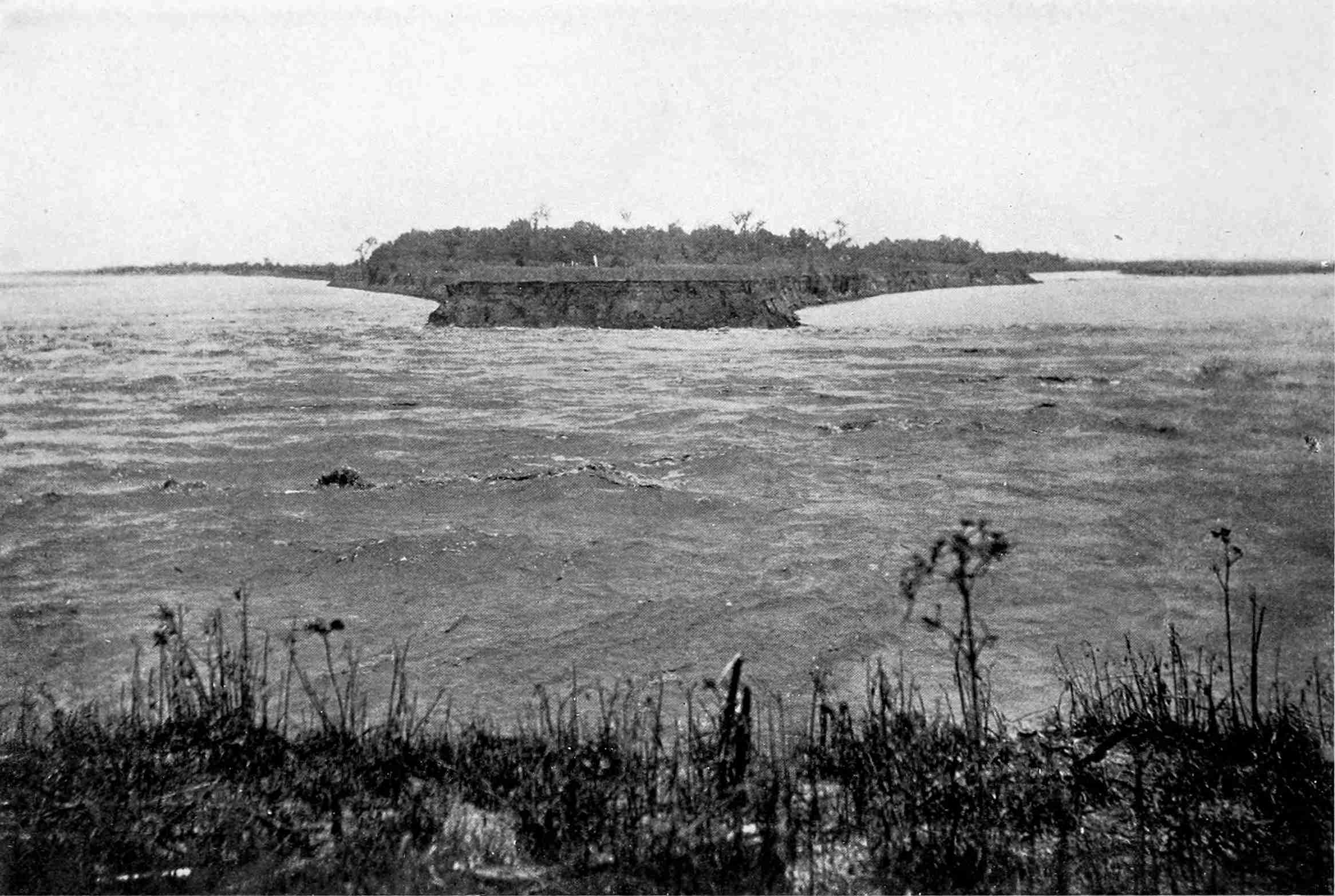
A NEW “CUT OFF”
Old course of river
toward background
Old course of river
from background
A WINDING WATERWAY.
The river, in its unrestrained rambles from bluff
to bluff, performs some curious freaks. It develops
the most remarkable bends, varying in length from
one to thirty miles, with distances across the necks
but a small fraction of those around. In time these
narrow necks are cut in two, and the river abandons
its old course, which soon fills up near the extremities
of the bends and leaves crescent-shaped lakes in
the middle. This process is a never-ending one, and
the channel distances along the river are in a
state of never-ending change. There is one bend in
the upper river, known from the earliest times as the
Great Bend, which was not formed in the way just described.
The course of the river here is comparatively
permanent, and is evidently the same as that of
the original stream bed. The distance around is nearly
thirty miles, while that across is only a mile and a half.
It was a regular custom with travelers, when the Indians
were not too dangerous, to leave the boats at
the beginning of this bend and walk across, going on
board on the other side.
The existence of so many bends increased the length
of the channel, but this drawback was more than offset
by the reduction of the slope which made the current
less strong and enabled steamboats to overcome it with
greater ease. The river is like a great spiral stairway
leading from the ocean to the mountains. A steamboat
at Fort Benton is 2565 feet—two and one-half
times the height of the Eiffel tower in Paris—above
the level of the sea; yet so gentle is the slope nearly
all the way that, in placid weather, the water surface
resembles that of a lake. This wonderful evening-up
of the slope of the river by the extreme sinuosity of
its course is a fact not only interesting as a natural phenomenon,
but of the utmost importance in the behavior
and use of the stream.
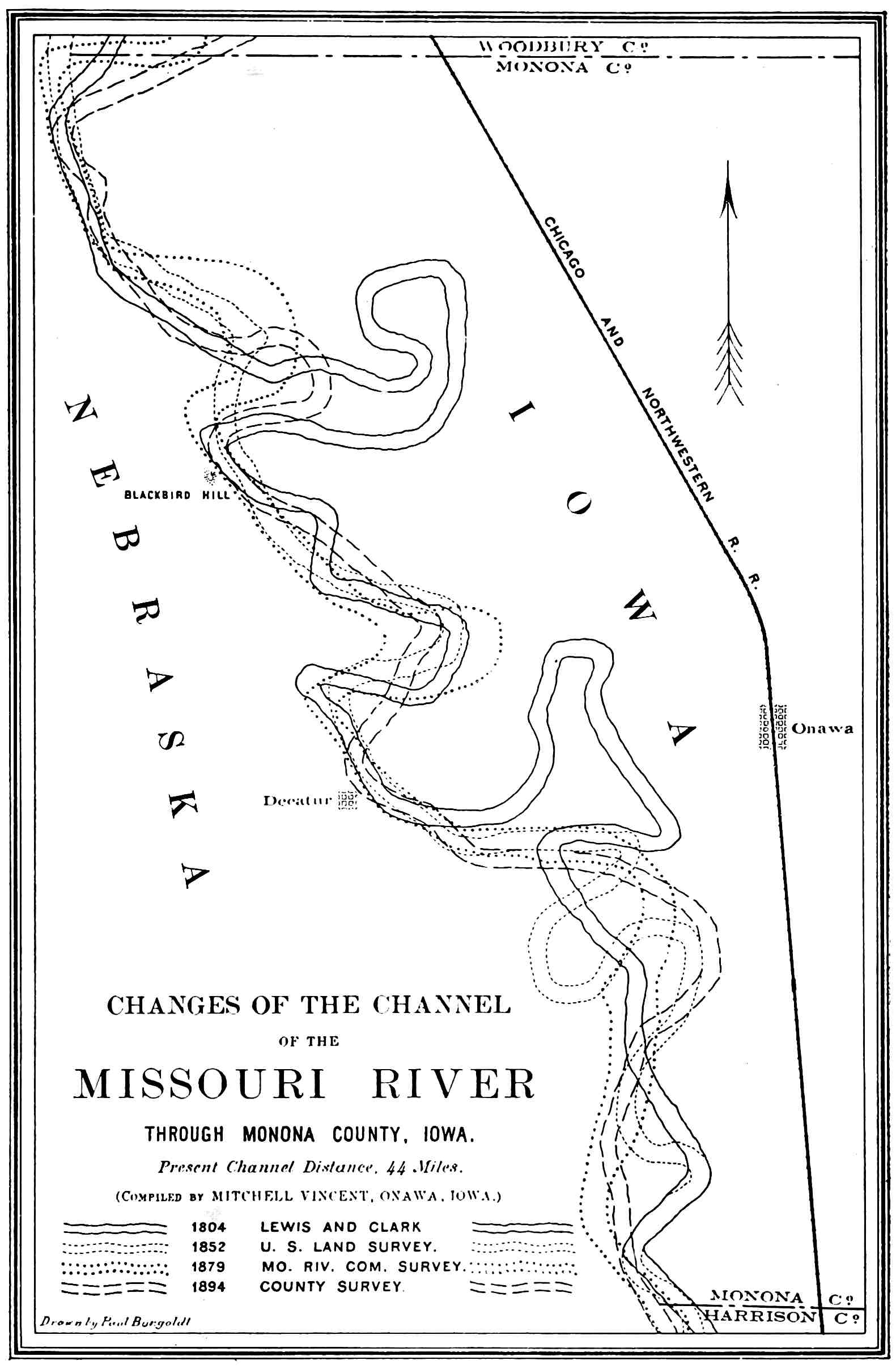
CHANGES OF THE CHANNEL
OF THE
MISSOURI RIVER
THROUGH MONONA COUNTY, IOWA.
Present Channel Distance, 44 Miles
(Compiled by MITCHELL VINCENT, ONAWA, IOWA.)
Not only does the general course of the river have
these larger windings, but in periods of low water they
are multiplied many fold. When a large proportion
of the river bed between its banks becomes exposed, as
it does in the low-water season, the stream flows back
and forth across this bed until its length is largely increased
over that at high water. Here again is to be
seen the wisdom of nature’s methods. In periods of
high water, when it is important to move the floods
rapidly down the valley, the river straightens out,
shortens its length, increases its slope, and accelerates
its velocity of flow.
ANNUAL TONNAGE.
Of the immense carrying power and potential energy
of this stream it is difficult to form an adequate conception.
It yearly carries into the Mississippi 550,000,000
tons of earth, which has been brought an
average distance of not less than 500 miles. The work
thus represented is equivalent to 275,000,000,000 mile-tons,
or tons carried one mile. The railroads of the
United States carried in the year 1901 141,000,000,000
mile-tons of freight.
BEDS OF THE OLD RIVER.
That such an exercise of power should leave its impress
deep upon the country through which the river
flows is not to be wondered at. Every year thousands
of acres of rich bottom lands are destroyed. Forests,
meadows, cultivated fields, farmhouses, and villages
fall before its tremendous onslaught, and the changes
that have been wrought in the topography of the
valley during the past one hundred years almost defy
belief.11 To one familiar with its history, the many
crescent-shaped lakes and curvilinear benches show
where the river once flowed and where it may flow
again. In recent years the government has seriously
undertaken to set metes and bounds to the migratory
habits of the stream; but it has found a most refractory
subject to deal with. Even with the expenditure
of vast sums of money in the construction of the most
powerful dikes and improved bank protection known
to engineering, it can never feel certain that its prisoner
will not break its bonds at any moment and
escape.
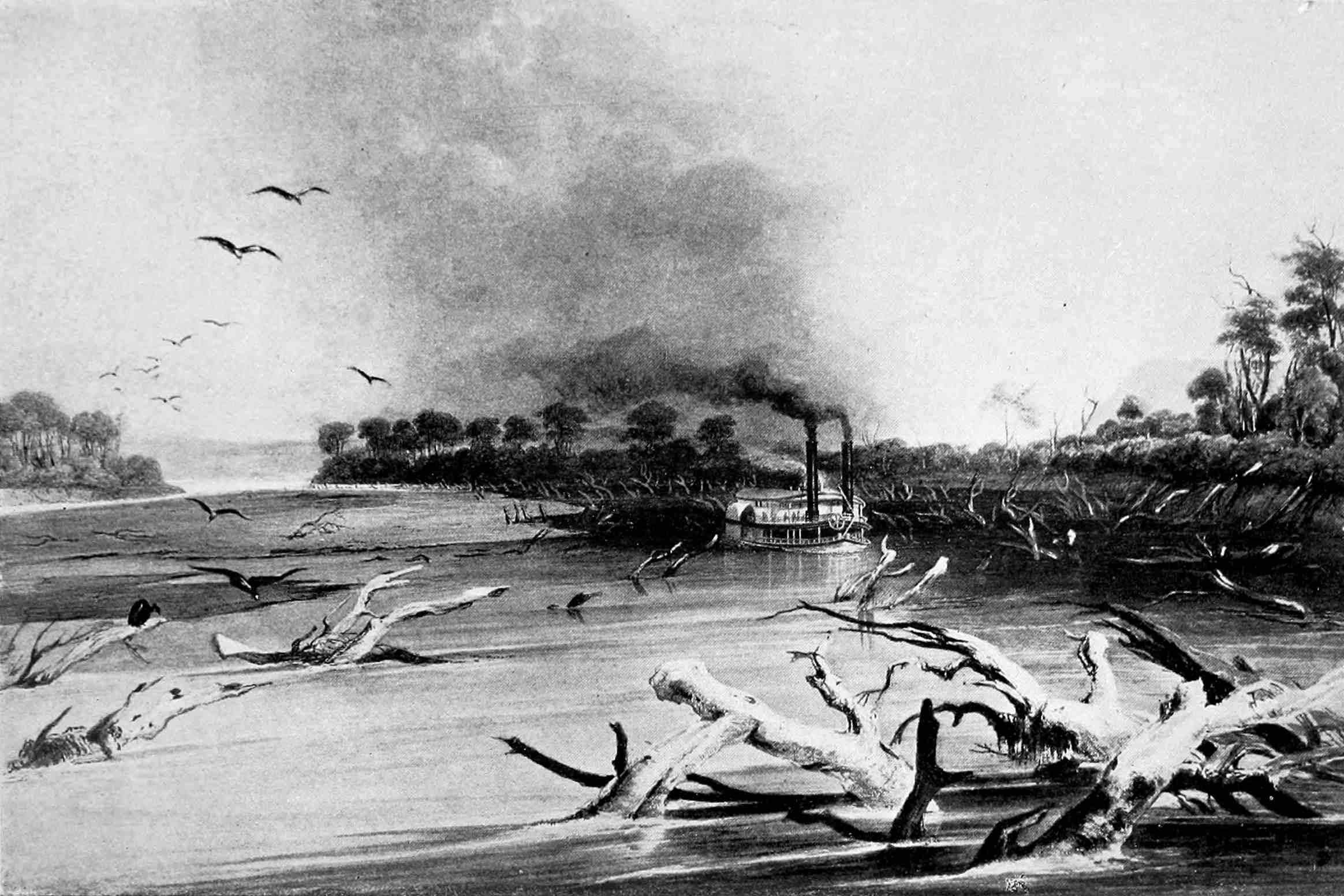
SNAGS IN THE MISSOURI RIVER
(After Maximilian)
SNAGS AND SAWYERS.
As with most of our Western streams the principal
arboreal growths along the banks of the Missouri are
the willow and cottonwood. The willow matures very
rapidly, and well-grown forests are constantly met
with in places where the river flowed but two or three
years before. The cottonwood requires more time to
mature, but this is afforded by those longer cycles of
change in which the river passes back and forth across
the bottoms. On many of the islands along the central
portion of the river there were formerly extensive
growths of cedar. The walnut and other trees abound
to a less extent. Every year great numbers of trees
that line the river bank are undermined and fall into
the stream. They are borne along by the current until
they become anchored in the bottom, where they remain
with one end sticking up and pointing downstream,
sometimes above and sometimes below the
surface. These trunks or branches have always been
the most formidable dangers to navigation of the river.
They are called snags or sawyers, though sometimes,
from the ripple or break in the surface of the water,
“breaks.” It is, in fact, only by the appearance of
these breaks that a submerged snag can be discovered
by the pilot; and fortunately, in a rapid current, like
that of the Missouri, a snag will cause such a break
if it is near enough to the surface to touch the bottom
of a boat. These snags were the terror of the pilot,
as well they might be. The record of steamboat
wrecks on the Missouri, and it is an appalling one,
shows that about seventy per cent. were due to this
cause.
THE MISSOURI IN WINTER.
A large portion of the river is in a latitude where
it freezes over every winter. During the ice period
it is indeed effectually enchained. The banks are safe
for a season, and the water itself becomes comparatively
clear. But as soon as the breezes of spring
soften the ice the river resumes its customary wanderings,
with renewed vigor after its long rest. By
way of celebration of its release from its icy prison
it frequently gives exhibitions of power that far surpass
all its other manifestations. When the ice
“breaks” and begins to “run,” it is liable to strand
like a steamboat on the shallow bars. Other ice following,
and finding the way obstructed, piles up on
that before it. Gradually, sometimes, and sometimes
rapidly, the accumulation spreads, cutting off the
channel of the river, until, as often happens, it forms
a veritable dam across the entire stream. These ice
“gorges” develop a power that nothing can withstand,
and the amount of property destroyed by them
in the history of the river has been very great. There
is almost nothing that can be done to break them.
Dynamite explosions are resorted to, but the ice piles
up so rapidly and in such vast quantities that the most
powerful blast seems harmless. In the face of this
appalling danger man is forced to stand a helpless
spectator until the river itself accumulates sufficient
force to burst through the dam. It has more than
once happened that, before the dam has given way,
the river has cut an entirely new channel.
ICE GORGES.
The moving of the ice, even when not accompanied
by serious blockades, is always an impressive sight.
Usually the warm weather loosens it from the shore
before it begins to move, and even disintegrates it, so
that it is unsafe to cross upon. The softer it becomes
before it begins to run the less danger is there of its
gorging. After the movement begins it continues for
several days, until the vast quantities of ice stored in
the river above have floated by, or melted away. During
the height of the movement the crushing of
innumerable ice cakes upon each other produces a
continuous roar which can be heard for a long distance
from the river.
To the lonely dwellers of the valley in the early
times the annual “break-up” of the ice was the most
welcome event of the year, for it was the knell of the
long and tedious winter, and the certain harbinger of
approaching spring.
ANNUAL FLOODS.
The river has two regular floods every year, one
usually in April and the other in June. The first
flood is short, sharp, and often very destructive. The
second flood is of longer duration and carries an immensely
greater quantity of water, but does less damage
than the first. The April flood is due to the
spring freshets along the immediate valley as the snow
melts off and the first rains come. The June rise
comes primarily from the melting snows in the mountains.
The great and exceptional floods, however, are
not due to these regular causes, but to periods of long
and excessive precipitation in the lower portions of
the valley.
The slope of the river in the lower half of its course
is less than a foot to the mile, and the velocity of its
current varies from two to ten miles per hour, depending
upon the stage of the water.
BEAUTY OF THE RIVER.
From an æsthetic point of view, the Missouri River
has an unenviable reputation. People who never see
it except in crossing railroad bridges, from which they
look down into a mass of muddy, eddying water, are
liable to compare it unfavorably with other important
streams. But to him who is fortunate enough to
travel upon it, and study it in all its phases, it is not
only an attractive stream, but one of great scenic
beauty. As seen in its more placid periods, near
morning or evening, when the slanting rays of the
sun show the water mainly by reflection, robbing it of
its muddy tinge, and replacing it by a crimson hue or
silver glimmer that stretches away toward the horizon,
cut off again and again by the bends of the river,
but ever and anon reappearing until lost in the distance,
there are few scenes in nature that appeal more
strongly to the eye of the artist.
Again, in its less peaceful moods, when the persistent
prairie winds blow day after day without ceasing,
there is a peculiar attractiveness about the weird
scene. In all directions, as far as the eye can reach,
the air is filled with clouds of sand, drifting along the
naked bars, and changing their forms almost as
rapidly as does the water those in the bed of the river.
The willows and cottonwoods bend complainingly
before the blast. The river is lashed into foam, and
often becomes so tempestuous that rowboats cannot
live in it, while larger craft, making a virtue of necessity,
lie moored to the shore until the wind has abated
its fury.
PRAIRIE STORMS.
Perhaps the most frightful scenes on the river are the
violent summer storms of thunder, hail, and rain, with
the characteristic tornado tendencies so common in
the central prairies. When these black storms gather,
and the incessant lightning seems to bind the clouds to
the earth, and the rolling and agitated vapors disclose
the terrible play of the winds, the river man discreetly
makes for shore, and loses no time in gaining
the shelter of some friendly bank. The fury of these
storms as they break into the valley, pouring down
wind and rain with terrific violence, until the river
yields up clouds of spray like the vortex of Niagara,
forms one of the wildest and most sublime manifestations
of the forces of nature. It cannot be truly enjoyed
by an eyewitness, because of the element of danger
which is present, but the impression produced
upon one who is fortunate enough to pass safely
through it remains ineffaceable in the memory. These
storms generally come from the southwest, and it was
a well-recognized rule on the river in boating days to
tie up for the night on the southwest, or right shore of
the river, so as to be under cover of a bank if a storm
should come before day. Accidents from these
storms were numerous. Boats were often torn from
their moorings and driven upon the bars, where they
were as good as lost. Smokestacks, hurricane deck,
and pilot-house were frequently carried away and
windows destroyed by the hail.
INFLUENCE OF THE WEATHER.
The condition of the weather had an influence
upon the business of navigating the river which was
of the highest importance, yet would never occur to
one unless his attention were directed to it. The excessively
uneven and broken condition of the bed of
the river, filled as it was with ever-shifting sand-drifts
or bars, sometimes called reefs by the river men, produced
an appearance upon the surface of the water
which was almost the only guide in tracing out the
sinuous channel. The experienced pilot could tell
from this appearance, not only where snags and other
hidden obstructions were, but the outlines of submerged
sandbars, and the position of the deepest
water. Anything, like wind or rain or a slanting sun,
which disturbed this normal appearance, disturbed the
serenity of the pilot’s mind. Wind was less troublesome
than rain, for it ruffled the deep water more than
the shallow, and thus left some indication of the
locality of each. Rain, on the other hand, reduced
everything to a common appearance. The sun, when
below forty-five degrees from the horizon, was exceedingly
troublesome on account of the reflection
from the water whenever the boat was sailing toward
it.
Captain La Barge records a curious fact in regard
to the appearance of the Mississippi and Missouri rivers
as seen by night. He found the Missouri much easier
to “read,” and always experienced a feeling of relief
when he left the main stream and entered its great
tributary. The Mississippi seemed black in the night,
and this appearance aggravated the darkness. The
Missouri, on the other hand, had a distinct whitish
tinge, and it seemed, as he entered the stream, as if a
faint light had been struck up along its surface.
DISCOVERY OF THE MISSOURI.
Such are some of the more striking physical characteristics
of this very remarkable stream. It is not
surprising that, in the early times, when it first came to
be known, it produced a profound impression on the
minds of explorers and drew from them expressions of
wonder and awe. Marquette and Joliet, who discovered
the river in 1673, were floating down the Mississippi
in a comparatively clear current, when they came
to a point where a mighty volume of water poured
itself into the Mississippi from the west shore, carrying
trees, stumps, and drift of all descriptions. It
filled them with amazement, as it has every person
since who has stood at the confluence of these two
mighty streams, particularly when the Missouri is
bringing down the great floods of spring.
We do not know when the Missouri was first entered
by white men, but probably about the year 1700.
The French had made sufficient progress along its
course in the early years of the eighteenth century to
alarm the Spaniards, who, in the year 1720, sent an
expedition to destroy the Missouri Indians, the allies
of the French. This expedition was itself destroyed
by the Missouris, but the event caused the French to
build a post some two hundred miles up the river
on an island opposite the village of the Missouris.
This was Fort Orleans, and was, so far as we know,
the first structure erected by white men along the
course of the stream.
NAME OF THE RIVER.
The name of the river comes from the tribe of Indians
just mentioned, who once dwelt at its mouth,
but were driven from this position by the Illinois Indians.
The word means “dwelling near the mouth
of the river,” and has no reference to the muddy
quality of the water.
The fact that the Missouri River is longer than the
entire Mississippi, and more than twice as long as that
portion of the latter stream above the mouth of the
Missouri, has led to the frequent observation that the
name which applies to the lower course of the Mississippi
should apply also to the tributary. But this
would evidently not be a fitting nomenclature. The
Mississippi is the trunk stream, receiving the drainage
from the Alleghenies on the east and the Rockies on
the west. It divides the continent into approximately
symmetrical portions. This division has entered into
the very life of our national development, and is so
natural and convenient that the stream itself from
north to south is appropriately known by a single
name. The Missouri is the great tributary from the
mountains on the west, as the Ohio is from the mountains
on the east. The characteristics of the Missouri
are so peculiarly its own that a separate name is more
befitting than one divided between itself and another
and very different stream.
EARLY EXPLORATION.
During the eighteenth century the French gradually
extended their knowledge of the river. It is not likely
that the voyageurs had ascended as far as to the Mandan
villages, a short distance above the modern capital
of North Dakota, when, in 1738–43, De la Verendrye
crossed over from the north and struck the river at that
point. But it is quite certain that at the time of the
founding of St. Louis, 1764, the river was well known
for a thousand miles above its mouth. From that
time knowledge of it increased more rapidly, and when
Lewis and Clark went up the river in 1804, they
found that white men had preceded them almost to
the mouth of the Yellowstone.
CHAPTER IX. KINDS OF BOATS USED ON THE MISSOURI.
RIVER BOATS.
The swift and turbulent character of the Missouri
River led to exaggerated accounts by the early explorers
of the difficulty of navigating it. Such navigation
was at first considered wholly out of the question
except in the simplest craft. Tradition says that
Gregoire Zerald Sarpy was the first to introduce keelboats
on the river, but the date of this essay is not very
definitely fixed. It would seem that the French must
have used large boats at the time they were established
at Fort Orleans. In any event the advent of the keelboat
on the Missouri in connection with the fur trade
could not have been long after the founding of St.
Louis, and probably antedated it. Gradually these
boats made their way to points farther and farther up
the river, until in 1805 they were taken by Lewis and
Clark to the head of navigation. A similar experience
was gone through with in the case of the steamboat.
It was at first thought impossible for such boats
to navigate the river at all, but in 1819 the attempt
was made, and the Independence entered the Missouri
on either the 16th or 17th of May, and ascended the
river two hundred miles. The Western Engineer, a
government boat, went as far as the old Council Bluffs
in the same year. From that time on steamboats remained
on the river, making farther and farther advances
toward the head of navigation, which was
finally reached forty years after the first boat entered
the river.
The principal craft which have been used on the
Missouri and its tributaries are the canoe, mackinaw,
bullboat, keelboat, and steamboat. The yawl, a very
important boat, was not much used for independent
navigation, but rather as an appurtenance to the
steamboats.
* * * * *
THE CANOE.
The canoe was the simplest and most generally used
of all the river craft. It was the wooden canoe, or
“dugout,” and not the bark canoe which was so much
used where the proper material could be found. The
Missouri River canoe was generally made from the
logs of the cottonwood, though frequently from the
walnut, and occasionally from cedar. The cottonwood
in the river bottoms attained immense size, ample for
the largest canoes, for these boats rarely exceeded
thirty feet in length and three and one-half in width.
The ordinary length was between fifteen and twenty
feet. A suitable tree having been found, it was felled
and a proper length of the trunk was cut out. The
exterior was straightened with the broad-ax, and reduced
to a round log shorn of all roughness and irregularity.
The top was then hewn off, so as to leave
about two-thirds of the log. The ends were given a
regular canoe model, and were sometimes turned up
on bow and stern with extra pieces for purpose of
ornament. The log was then carefully scooped out
from the flat surface so as to leave a thin shell about
two inches thick at the bottom and one at the rim.
To support the sides and give strength to the craft the
timber was left in place at points from four to six feet
apart, making solid partitions or bulkheads. A good-sized
canoe was easily built by four men in as many
days. They had tools especially adapted to the work,
the most important being the tille ronde, or the round
adz.
These log canoes made excellent craft, strong, light,
and easily managed. A full crew generally consisted
of three men, two to propel and one to steer. The
paddle (French aviron) was always used. A mast
was occasionally placed in the center and rigged with
a square sail, but this could be used only with an aft
wind, for fear of capsizing the canoe.
Sometimes these boats were made with a square
stern, and were then called pirogues; but this name
was more frequently used where two such boats were
rigidly united in parallel positions a few feet apart and
completely floored over. On the floor was placed the
cargo, which was protected from the weather by the
use of skins. Oars were provided in the bow for rowing
and a single oar in the stern between the boats for
steering. Sails could be used with a quartering wind
on these boats without danger of upsetting. Dubé’s
ferry, on the Mississippi, one of the earliest ferries of
St. Louis, used a boat of this kind.
BEAR’S OIL AND HONEY.
The principal use of the canoe was for the local
business of the larger river posts. Often, however,
they were used in making trips to St. Louis, even from
the remotest navigable points of the main stream or its
tributaries. Many such a journey has been made
with a single voyageur running the gantlet of hostile
tribes all the way from the mountains to the Mississippi.
A common use of the canoe was for sending
express messages down the river, and there are several
records of their having been used to transport
freight. An example of this last use was the shipment
of bear’s oil, which was extensively used in St.
Louis as a substitute for lard in the early days when
swine were scarce and black bears plentiful. The oil
was extremely penetrating, and would rapidly filter
through skin receptacles. Barrels or casks not being
available, the center apartment of the canoe was filled
with the oil and tightly covered with a skin fastened
to the sides of the boat. Honey was also transported
in this way. In those days bee trees were exceedingly
plentiful in the Missouri bottoms, and large
quantities of honey were taken from them.
* * * * *
THE MACKINAW.
The mackinaw boat, as the name implies, was an imported
design, having already been used on the
Eastern lakes and rivers. It was made entirely of
timber, and before nails were carried up the river all
the parts were fastened with wooden pins. The bottom
was flat, and was made of boards about one and a
half inches thick. On these rested cross-timbers, to
which, and to the bottom, were fastened the inclined
knees that supported the sides. The boats were sometimes
made as large as fifty feet long and twelve feet
beam. The plan was that of an acute ellipse, and the
gunwale rose about two feet from the center of the
boat toward both bow and stern. The keel showed a
rake of about thirty inches from the bow or stern to
the bottom. The hold had a depth of about five feet
at the two ends of the boat, and about three and one
half at the center.
The central portion of the boat was partitioned off
from the bow and stern by two water-tight bulkheads
or partitions. Between these the cargo was loaded,
and piled up to a height of three or four feet above the
gunwale and given a rounded form. Over the cargo
lodge skins were drawn tight and fastened with cleats
to the sides and gunwales of the boat, so as to make
practically a water-tight compartment. In the bow
were seats for the oarsmen, and in the stern an elevated
perch for the steersman, from which he could
see over the cargo in front, and give directions to the
crew in the bow or study the river ahead.
The crew of the boat ordinarily consisted of five
men, four at the oars and one at the rudder. The
latter had charge of the boat, and was called the
patron. Only experienced, courageous, and reliable
men were chosen for this responsible work.
CHEAP TRANSPORTATION.
These boats were only used in downstream navigation,
and the labor of handling them was not arduous.
The men found ample time for song and gossip, and
every hour or so, after a vigorous pull, would take advantage
of a good stretch of river to rest their oars
(laisser aller) and take a smoke (fumer la pipe).
Then they would let fall their oars (tomber les râmes)
and bend to their work for another hour. They ran
from fifteen to eighteen hours per day and made from
75 to 150 miles. The boats carried about fifteen tons
of freight, and the cost per day was about two dollars.
Transportation by mackinaw boat was therefore inexpensive.
These boats were cheaply made, and were intended
only for a single trip down to St. Louis, where they
were sold for four or five dollars apiece. After the
advent of the steamboat the mackinaws were frequently
carried back to the upper rivers on the annual
boat, for even steam did not absorb the peculiar field of
usefulness of these craft. They were quite safe and
were preferred to the keelboat for downstream navigation.
THE CHANTIER.
The lumber for the mackinaws was manufactured
where the boats were built, or rather the latter were
built where suitable timber could be found. There
being no sawmills, the boards had to be sawed by
hand, and for this purpose the logs were rolled upon a
scaffold high enough for a man to work underneath.
They were first hewed square, and were then sawed by
two men, one standing above and the other below.
At all important posts there was a chantier (French
for boatyard) located where timber was to be had.
Here all woodwork was done. The Fort Pierre
chantier, always called the navy yard, was some fifteen
miles above the post, and was a very active place.
The Fort Union chantier was twenty-five miles above
the post, while that at Fort Benton was three miles below
at the mouth of Chantier (now Shonkin) Creek.
At all these workyards skilled artisans were employed.
* * * * *
THE BULLBOAT.
The bullboat of the fur traders, in distinction from
the tubs which were used by some of the Missouri
River tribes, was an outgrowth of the conditions of
navigation on such streams as the Platte, Niobrara,
and Cheyenne. The excessive shallowness of these
streams precluded the use of any craft drawing more
than nine or ten inches. The bullboat was probably
the lightest draft vessel ever constructed for its size,
and was admirably fitted for its peculiar use. It was
commonly about thirty feet long by twelve wide and
twenty inches deep.
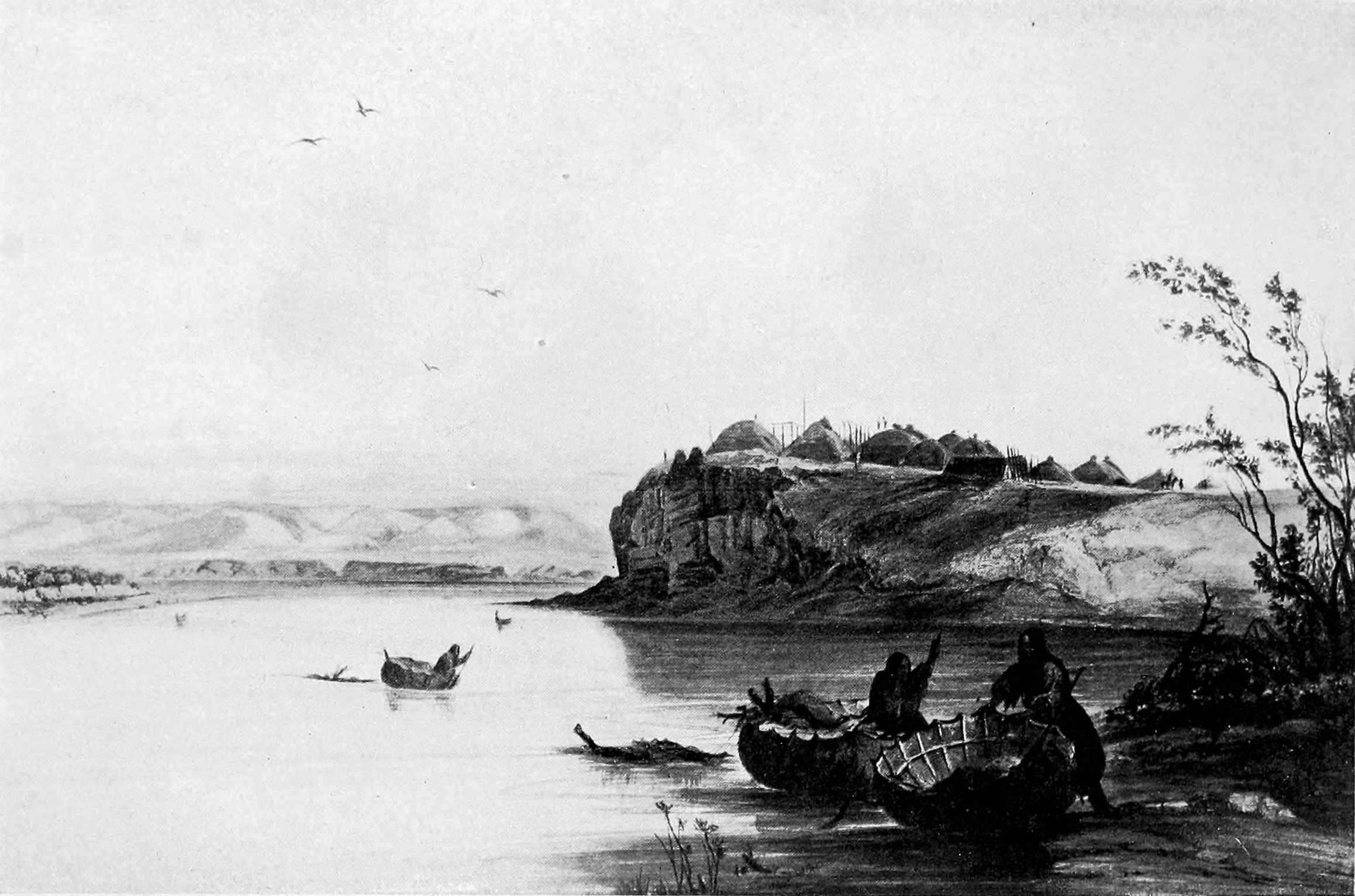
THE INDIAN BULLBOAT
(After Maximilian)
The frame of the bullboat was constructed by laying
stout willow poles, three or four inches in diameter,
lengthwise of the boat, and across these similar poles,
the two layers being firmly lashed together with rawhide.
The side frames were made of willow twigs
about an inch and a half in diameter at the larger end
and six to seven feet long. The smaller ends were
lashed to the cross-poles, and about two feet of the
larger ends were then bent up to a vertical position.
Along the tops of the vertical portions and on the inside
was lashed a stout pole like those forming the
bottom of the framework. To this gunwale were
lashed cross-poles, at intervals of four or five feet, to
keep the sides from spreading. No nails or pins were
used for fastenings, but rawhide lashings only. The
frame so constructed was exceedingly strong, and its
flexible quality, by which it withstood the continuous
wrenching to which it was subjected, was an important
element of strength.
METHOD OF CONSTRUCTION.
The framework, being completed, was then covered
with a continuous sheet of rawhide formed by sewing
together square pieces as large as could be cut from a
single buffalo hide. Only the skins of buffalo bulls
were used for this purpose (whence the name of the
boat), for they were the strongest and best able to resist
abrasion from rubbing on the bottom of the river.
The pieces were sewed together with buffalo sinew.
Before this work was done the hides were carefully
dressed by the Indians so as to be free of hair and perfectly
flexible. When the covering was all sewed together
it was thoroughly soaked and then placed over
the framework and the sides and ends made fast to
the gunwale of the boat. The hides would then dry
and shrink until they were drawn as tight as a drumhead.
The final operation in the work was to pitch the
seams. The material used was a mixture of buffalo
tallow and ashes, and it was carefully rubbed into all
seams or cracks until the whole covering was water-tight.
NAVIGATION BY BULLBOAT.
The boat so built was very light, and could be easily
turned over by two men. When in the water and
ready for its cargo, a layer of loose poles was laid
lengthwise on the bottom so as to keep the cargo five
or six inches from the bottom and protect it from any
water that might leak in. The cargo nearly always
consisted of furs, securely packed in bales about thirty
inches long, fifteen inches wide, and eighteen inches
deep. They were placed one bale deep over the bottom
of the boat, leaving space in bow and stern for the
pole men. The bales were always laid flatwise, so
that if the water should reach them it would injure
only the bottom skins and not all, as it would if they
were set edgewise. The cargo rarely exceeded six
thousand pounds.
The boat was handled by means of poles, and the
crew generally consisted of two men. The draft of
the boat, when placed in the water in the morning,
was about four inches, but the boat hide becoming
soaked during the day, and possibly some water leaking
in, it would probably be as much as six or eight
inches by night. Every evening when camp was
made the boat was unloaded, brought up on the bank,
and placed in an inclined position, bottom side up, to
dry. In this position it served as a shelter for both
cargo and crew. In the morning the seams were repitched,
and any incipient rents or abrasions were carefully
patched. The boat was then launched and reloaded
and the voyage resumed.
FREAKS OF THE WIND.
Low water, even on the Platte, was generally preferred
to high water for bullboat navigation, because
in high water the current was too strong. Every
little while the boat would glide into deep pockets,
where the poles could not touch bottom, and it was
then necessary to drift with the current until a shallower
stretch would give the men control again.
Sometimes in those wide and shallow expanses, which
give the Platte such a pretentious appearance in high
water, the wind would play vexatious pranks with the
bullboat navigators. A strong prairie gale blowing
steadily from one direction during the day would drift
most of the water to the leeward side of the stream.
The boat would naturally follow the same shore, and
the night camp would be made there. If, as often
happened, the wind changed before re-embarkation,
the river would very likely be wafted to the other side
of its broad bed, and the crew would find themselves
with half a mile of sandbar between them and the
water.
NOTED BULLBOAT VOYAGES.
Bullboat navigation, as here described, was most
frequently resorted to in bringing the trade of the
Pawnees on the Loup Fork of the Platte to the Missouri,
but it was likewise extensively used on the
Cheyenne and Niobrara and other tributaries. There
were some very extensive bullboat voyages. A good
many were made from Laramie River to the mouth of
the Platte, but generally it was impossible to find
enough water to make a continuous voyage. In 1825
General Ashley loaded one hundred and twenty-five
packs of beaver into bullboats at the head of navigation
on the Bighorn River, with the intention of conveying
them in that way to St. Louis. But at the
mouth of the Yellowstone he met General Atkinson,
who offered him the use of his keelboats for the rest
of the journey. In 1833 the Rocky Mountain Fur
Company, Captain Bonneville and Nathaniel J.
Wyeth, embarked all their furs, the product of a year’s
hunt, in bullboats on the Bighorn River, and together
went downstream to the mouth of the Yellowstone.
Sometimes these boats were actually given names,
and we have a record of the bullboat Antoine, in which
a free trapper, Johnson Gardner, shipped his furs from
the “Crossings of the Yellowstone” to Fort Union in
1832.
The boats just described were quite different from
the hemispherical tubs used so extensively by the Mandans
and other tribes of the upper Missouri. These
little boats had a circular rim or gunwale, and the willow
supports passed from one side entirely under the
boat to the other. The frame was generally small
enough to be covered with a single hide, and was designed
to carry ordinarily but one person. A fleet of
these boats, numbering a hundred or so, was one of
the most singular sights ever witnessed on the river.
The squaws often used them, on occasions of buffalo
hunts above the village, to transport the meat downstream.
In fact the women rather than the men
were the navigators of this picturesque little
craft.
* * * * *
THE KEELBOAT.
We now come to the keelboat, the representative
river craft of ante-steamboat days. It was in this
boat that the merchandise for the trade was transported
to the far upper river, and it was used on all
important military or exploring expeditions. It was
a good-sized boat, sixty to seventy feet long, and built
on a regular model, with a keel running from bow to
stern. It had fifteen to eighteen feet breadth of beam
and three or four feet depth of hold. Its ordinary
draft was from twenty to thirty inches. It was built
in accordance with the practice of approved shipcraft,
and was a good, stanch vessel. Keelboats were generally
built in Pittsburgh at a cost of two to three
thousand dollars.
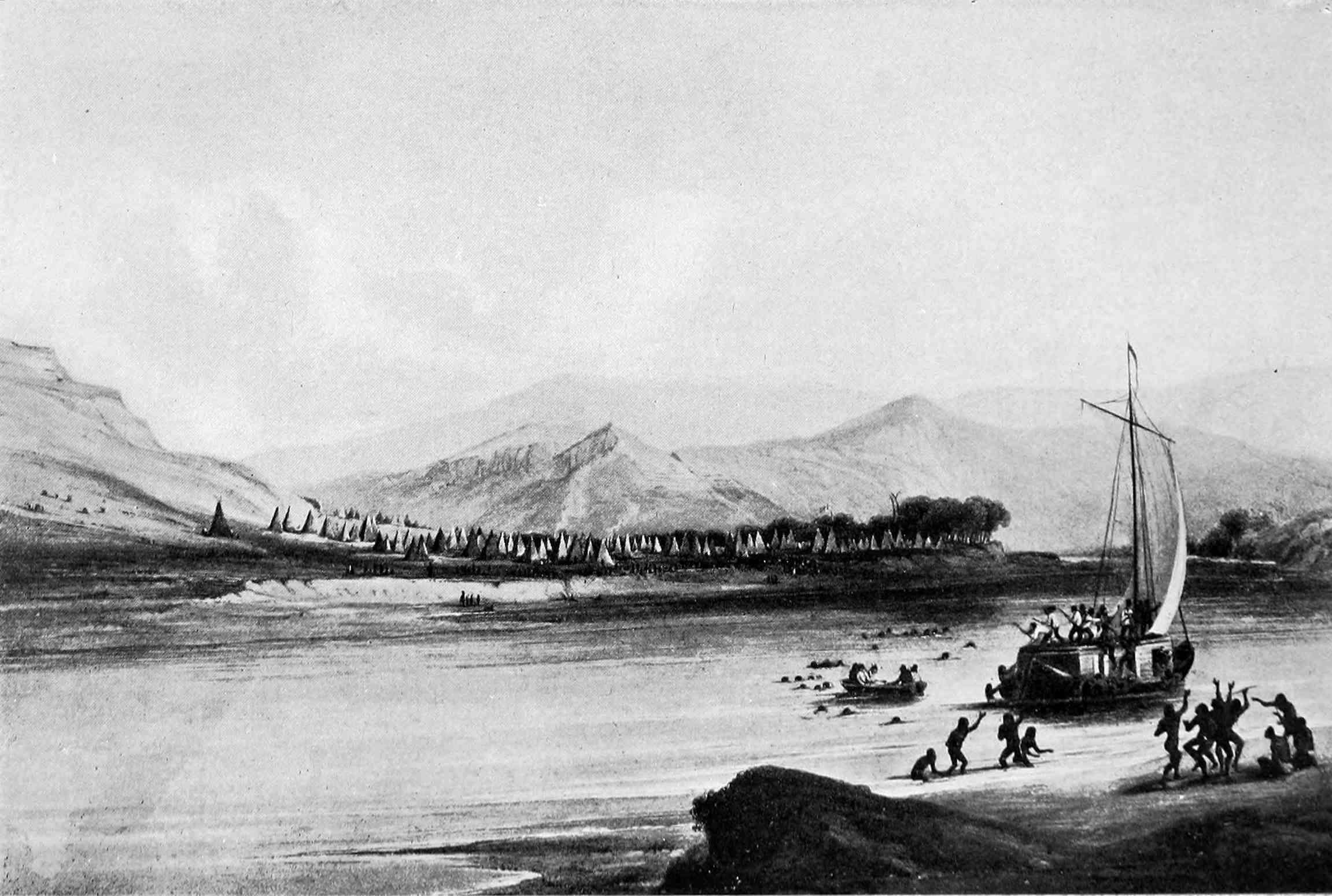
MISSOURI RIVER KEELBOAT
(After Maximilian)
For carrying freight the keelboat was fitted with
what was called a cargo box, which occupied the entire
body of the boat excepting about twelve feet at
each end. It rose some four or five feet above the
deck. Along each side of the cargo box was a narrow
walk about fifteen inches wide, called the passe
avant, the purpose of which will be explained further
on. On special occasions when these boats were used
for passenger traffic, as on expeditions of discovery or
exploration, they were fitted up with cabins, and made
very comfortable passenger boats.
THE CORDELLE.
For purposes of propulsion the boat was equipped
with nearly all the power appliances known to navigation
except steam. The cordelle was the main reliance.
This consisted of a line nearly a thousand
feet long, fastened to the top of a mast which rose
from the center of the boat to a height of about thirty
feet. The boat was pulled along with this line by
men on shore. In order to hold the boat from swinging
around the mast, the line was connected with the
bow by means of a “bridle,” a short auxiliary line
fastened to a loop in the bow and to a ring through
which the cordelle passed. The bridle prevented the
boat from swinging under the force of the wind or
current when the speed was not great enough to accomplish
this purpose by means of the rudder. The
object in having so long a line was to lessen the
tendency to draw the boat toward the shore; and the
object in having it fastened to the top of the mast was
to keep it from dragging, and to enable it to clear the
brush along the bank.
It took from twenty to forty men to cordelle the
keelboat along average stretches of the river, and the
work was always one of great difficulty. There was
no established towpath, and the changing conditions
of the river prevented the development of such a path
except along a few stable stretches. It was frequently
necessary to send men ahead to clear the most
troublesome obstructions away. In some places,
where it was impossible to walk and work at the same
time, a few men would carry the end of the line beyond
the obstruction and make it fast, while the rest would
get on board and pull the boat up by drawing in the
line. This operation was called warping.
NAVIGATION BY CORDELLE.
When the boat was being cordelled there stood at
the bow, near where the bridle was attached, an individual
called in French a bosseman (boatswain’s
mate), whose duty it was to watch for snags and other
obstructions, and to help steer the boat by holding it
off the bank with a pole. There was selected for this
place a man of great physical strength, prompt decision,
and thorough knowledge of the river. The
patron, or master of the boat, stood at the rudder,
which was manipulated by means of a long lever from
the rear end of the cargo box. This position gave
him an elevated point of view, from which he could
overlook everything.
NAVIGATION BY POLE.
There were many places where the keelboat could
not be cordelled at all, as along sandbars where the
water was too shallow for the boat to get near the
shore, or the alluvium too soft for the men to walk in.
At such times it was necessary to resort to the pole,
as it was called. This was a turned piece of ash wood
regularly manufactured at St. Louis. On one end
was a ball or knob to rest in the hollow of the shoulder,
for the voyageur to push against; and on the
other was a wooden shoe or socket. In propelling the
boat with these poles eight or ten voyageurs ranged
themselves along each side, near the bow, facing aft,
pole in hand, one in front of the other, as close together
as they could walk. The whole operation was
under the direction of the patron. At his command
“A bas les perches” (down with the poles), the
voyageurs would thrust the lower ends into the river
close to the boat and place the ball ends against their
shoulders, so that the poles should be well inclined
downstream. They would all push together, forcing
the boat ahead, as they walked along the passe avant
toward the stern, until the foremost man had gone as
far as he could. The patron then gave the command
“Levez les perches” (raise the poles), upon which they
would be withdrawn from the mud, and the men would
walk quickly back to the bow and repeat the operation.
All steering was done while the poles were up, for the
boat could not change direction while the men were
pushing. It was always essential to give the boat
sufficient momentum at each push to keep her going
while the men were changing position. The passe
avant had cleats nailed to it to keep the feet from slipping,
and the men, when pushing hard, sometimes
leaned over far enough to catch hold of the cleats with
their hands, thus fairly crawling on all-fours.
In some places where the water was too deep for
the poles and where cordelling was impracticable, oars
were resorted to. There were five or six of these on
each side of the bow. They often furnished assistance
also when the boat was being cordelled.
NAVIGATION BY SAIL.
A great reliance in propelling the keelboat, strange
as it may seem considering the nature of Missouri
River navigation, was the wind. A mast was rigged,
with a square sail spreading about one hundred square
feet of canvas, which often gave sufficient power to
propel the boat against the swift current of the river.
Unless the direction of the wind were altogether
wrong the sinuous course of the stream would every
now and then give an aft or quartering breeze.
In some places the wind seemed to follow the bends,
blowing up or down the river clear around. Thus
Brackenridge relates that when Manuel Lisa’s boat,
in June, 1811, was going around the Great Bend
below Fort Pierre, where in the course of thirty miles
the river flows toward every point of the compass, an
aft wind was experienced all the way, and the entire
circuit was made under sail. Some idea of sailing
speed up the Missouri under favorable conditions may
be gleaned from the fact that, on the day of passing
the Great Bend, Lisa’s boat made seventy-five miles, a
portion of the distance being made at night by the
light of the moon. And on another occasion on the
same trip Brackenridge records that “we had an
extraordinary run of forty-five leagues from sun to
sun.”
KEELBOAT SPEED.
Thus, by means of the cordelle and pole, the oar and
sail, the sturdy keelboat worked and worried its way
up the turbulent Missouri in the early days. It was a
slow and laborious process at best. A good idea of its
maximum accomplishment under rather unfavorable
conditions is furnished by Manuel Lisa’s voyage, already
referred to. It was made with an exceptionally
fine boat, a picked crew, and the most untiring and
energetic commander that ever ascended the Missouri.
There was especial necessity for rapid progress, for it
was of the greatest importance to overtake the
Astorian expedition, which was a long distance ahead,
before it should reach the dangerous Sioux country.
The difficulties from wind and storm were greater
than the average, and the rate of progress was not increased
by any fortuitous aids. Lisa left St. Charles,
28 miles above the mouth of the Missouri, April 2,
1811. He overtook Hunt at 1132 miles, on the morning
of June 11. He therefore made about 1100 miles
in sixty-one days, or about 18 miles per day. This,
however, was better than the average. A keelboat
trip to the upper river was practically an entire summer’s
operation.
LABORIOUS OCCUPATION.
Above the mouth of the James or Dakota River keelboating
was easier than below, because the natural obstacles
of all sorts were less; but everywhere it was a
very laborious process. Captain La Barge often remarked
that it would be wholly impossible in this day
to get men to undergo such exertions as were required
of the keelboat crews. They worked early and
late, in water and out, and often to the very limit of
endurance. Their food was of the plainest description,
consisting mainly of pork, lyed corn, and navy
beans. From this allowance, slender as it was, meat
was cut off as soon as the game country was reached.
The cooking was done at the night camp for the following
day. On top of the cargo box there was sometimes
placed a cooking stove, in a shallow box filled
with ashes or gravel to protect the roof from fire.
The men’s baggage was stored in the front of the
cargo box, where there was also a place for anyone to
lie down who might fall sick. It was, however, a very
poor place to be sick in. There were no medicines,
no physicians, no nurses or attendants, and
nothing but the coarsest food. The prospect itself
was enough to frighten everyone into keeping well.
The hired laborers who did the work on these river
expeditions were called voyageurs, and were generally
of French descent. They were an interesting class of
people, and presented a phase of pioneer life on the
Missouri which has become wholly extinct. They
were a very hard-working class, obedient, cheerful,
light-hearted, and contented. It was a marvel to see
them, after a hard day’s work, dance and sing around
the evening campfire as if just awakened from a refreshing
sleep. The St. Louis Creoles were regarded
as more desirable boatmen than the French Canadians.
The American hunter was not so useful in river work
as the French voyageur, but was far more valuable
for land work and in situations involving danger or
requiring the display of physical courage.
* * * * *
DECAY OF ROMANCE.
NOTEWORTHY SCENES.
THE FIRE CANOE.
Washington Irving, whose love of the romance
of early Western history was ardent and sincere, beheld
with unfriendly eye the introduction of the steamboat
upon the Missouri. He lamented the “march
of mechanical invention,” which was “fast dispelling
the wildness and romance of our lakes and rivers,”
and “driving everything poetical before it.” However
well-founded this fear may have been in the general
case, we are inclined to think that the exact reverse
was true of the Missouri River steamboat. This
remarkable craft introduced romantic features of
which the old keelboat and its Creole crew never
dreamed. The incidents of a single steamboat voyage
from St. Louis to Fort Union would make an entertaining
chapter in any book of adventure. As to impressiveness
of appearance, certainly no craft on our
Western waters, if upon any waters of the globe, displayed
more majesty and beauty, or filled the mind
with more interesting reflections, than these picturesque
vessels of the early days in the boundless
prairies of the West. The very surroundings lent a
peculiar attraction to the scene. In every direction the
broad and treeless plains extended without water
enough anywhere in sight even to suggest a boat.
Winding through these plains was a deep valley several
miles broad, with a ribbon of verdure running
through it along the sinuous course of the river.
Everything was still as wild and unsettled as before
the advent of the white man, and there was little or
nothing to suggest the civilization of the outside
world. In the midst of this virgin wildness a noble
steamboat appears, its handsome form standing high
above the water in fine outline against the verdure of
the shore; its lofty chimneys pouring forth clouds of
smoke in an atmosphere unused to such intrusion, and
its progress against the impetuous current exhibiting
an extraordinary display of power. Altogether it
formed one of the most notable scenes ever witnessed
upon the waters of America. Naturally enough the
wild Indian viewed with feelings of awe this great
“fire canoe,” whose power to “walk on the water”
had subdued the intractable current to its own will.
It is said to have been the advent of the steamboat
which finally turned the scale of the Indian’s favor toward
the Americans as against the British.
In truth, the Missouri River steamboat was a most
attractive-looking craft. Unlike an ocean vessel, which
is in large part buried beneath the waves, the river
boat drew only three or four feet of water, and was
therefore almost entirely above the surface. This
gave it a great apparent size compared with its actual
dimensions and tonnage. Its architectural design was
pleasing to the eye. Its successive decks, surmounted
by the texas and pilot-house, all painted a clear, even
white, made it look like a veritable floating palace as
it moved majestically among the groves of cottonwood
and willow, or through the parched plains of the
ashen-colored sage brush.
The criticism has been made that the river steamboat
is one of the few modern mechanical contrivances
which have shown no particular development, but remain
to-day as they were long ago. The criticism
is a mistaken one. If comparison be made between the
first river steamboats and the best of to-day it will
be found that progress in this development is quite up
to that in other lines, and it is doubtful if any other
machine is more perfectly adapted to its peculiar
work. In very recent years there has naturally been
but little development, for the steamboat business on
Western rivers has largely passed away.
THE FIRST “YELLOWSTONE.”
The earlier boats were usually of the sidewheel pattern,
with only one engine, and an immense flywheel
to keep it from stopping on the dead point. Unlike
the modern boat, most of the accommodations for
freight and passengers were abaft of the wheels. The
stages for getting on and off were located there. The
forward part was mainly taken up with machinery.
The men’s cabins were in the hold. The shape of the
boat was ill adapted to its work. It had a model keel,
which gave it fully six feet draft with half of the load
which has since been carried on three feet.12
THE MODERN STEAMBOAT.
Far different from this early boat was that used
in the later years of business on the Missouri. The
first-class modern river steamboat was about 220 feet
long and 35 feet wide, and would carry 500 tons. It
was built with a flat bottom, so that it would draw, say,
thirty inches light and fifty loaded. It was propelled
by a stern-wheel, a most excellent arrangement, which
had become practicable through the invention of the
balanced rudder: that is, a rudder with a part of the
blade on each side of the rudder post. There were
two engines of long stroke, one on each side of the
boat, communicating directly with the wheel shaft
and thus avoiding all loss from the friction of gearing.
A proper distribution of the weight required
that the boilers be placed well forward. This left a
large space between them and the engine room, which
was well aft.
FIGURATIVE DESIGN.
The forecastle was equipped with steam capstans
and huge spars, which served a purpose similar to that
of the poles on a keelboat in pushing the boat over
sandbars. Steam hoisting apparatus was used, and
in the hold were light tramway cars to convey the
freight from the hatchway to its place of deposit.
Enormous stages, swung from derricks on either side
of the bow, facilitated communication with the high
banks of the river. The quarters of the crew and
steerage passengers were on the boiler deck. On top
of the hurricane deck was the texas—a suite of rooms
for the officers of the boat. Above the texas stood the
pilot-house, high over the river—a very important consideration,
for the more directly the pilot could look
down the better he could see the channel. The hurricane
deck, and particularly the pilot-house, were favorite
resorts for the passengers.
High above all towered the lofty smokestacks, carrying
the sparks from the wood fire well away from
the roof of the boat and giving a strong draft to the
furnace. Between the two chimneys the name of the
company generally appeared in large initial letters,
legible for a long distance.13 One or more flags displayed
their colors to the breeze, and a light armament,
consisting of one or two small cannon, answered the
double purpose of firing salutes and terrifying Indians
who became too defiant.
CHAPTER X. STEAMBOAT NAVIGATION ON THE MISSOURI RIVER.
The Missouri River pilot was beyond question the
most skillful representative of his profession. In no
other kind of navigation were the qualities of quick
perception, intuitive grasp of a situation, nerve to act
boldly and promptly, coolness and judgment in times
of danger, so important and so constantly in demand.
Navigation on the ocean was child’s play in comparison.
The Missouri represented in the highest degree
the peculiar dangers characteristic of alluvial
streams. Its current was swift, its channel full of
snags, its surface nearly always ruffled by the prairie
gale, and never for five minutes in succession in a condition
which would permit the pilot to take his hand
from the wheel or the engineer to let go of the
throttle. The elaborate system of communication between
the pilot-house and the engine room was always
in service, and the tinkle of signal bells in the engineer’s
ear was almost continuous. The position of
pilot was responsible and exacting, and called for a
high order of ability. And so it resulted that the
better class of pilots were men of high standing and
character, in whose care business men unhesitatingly
intrusted their property and the lives of their families.
THE TWO BARKS.
The ever-shifting condition of the river channel14
caused the pilot to seek all available information as to
its latest position. When other boats were met there
was an eager swapping of notes, for it was a common
practice in later years for pilots to assist each other
by keeping notes of the condition of the river over
which they passed.15 The pilots thus came to know
the river by heart from its mouth to the head of navigation.
The extraordinary knowledge of its topography
and nomenclature which Captain La Barge retained
to the end of his life was almost incredible.
There was not a bend or rapid, a bed of snags, or other
feature in all of its twenty-six hundred miles that was
not as familiar to him as the rooms of his own house.
THE FUEL PROBLEM.
The most serious problem with which the Missouri
navigator had to deal was that of procuring fuel.
Wood alone was used, and this was obtained from
the growths on the banks of the river. Cottonwood
was the main reliance, because of its greater abundance,
but it was not a first-class firewood. If green,
it was next to impossible to maintain steam with it
except by the aid of rosin. It was often found impracticable
to carry the boat from one established
wooding place to another, and it was then necessary
to gather drift logs, or anything else that could be
found. Whenever a trading post was abandoned its
palisades and buildings quickly found their way into
the steamboat furnaces, to the great, though transient,
delight of the crew.
In the earlier years the fuel was cut by the crew
itself as the boat proceeded on her voyage. But as
the traffic became more regular, wood yards were established,
either by the boat-owners or by others who
cut wood for sale. The Indians themselves found the
business a profitable one, and finally refused to let the
whites cut wood at all. The sale of their wood thus
became a source of considerable revenue to them. In
later years, during the Sioux hostilities, the wooding
of boats was a most perilous matter. Crews were
attacked at the landings and only the most vigilant
precaution prevented great loss of life at such times.16
To reduce this danger as much as possible, Captain
La Barge equipped one of his boats with a
sawmill, and took along a yoke of oxen. When he
had to have wood he swung out a large stage, drove
the team ashore, and dragged several logs on board
with the utmost speed. As soon as this was done the
boat proceeded on her way and the crew then sawed up
the wood.
The “wooding” of a boat was an interesting performance.
The moment the boat touched the bank
for this purpose the mate called out “woodpile,” and
every available man leaped ashore, loaded himself with
wood, and hastened back to the boat. In an incredibly
short time the work was done and the boat was
again on her way.
STEAMBOAT HOURS.
Steamboat hours were as long as the light of day
would permit. It was not customary to run at night,
unless there was ample moonlight and the business
was extremely urgent. But every hour of daylight
was improved. In the higher latitudes morning and
evening twilight almost touched hands across the few
hours of intervening darkness. Three o’clock A. M.
was a common hour of starting, and 9 P. M. of stopping.
The crew were divided into four watches, so
that they could take turns in getting sleep during the
day.
EFFECT OF WIND.
The early morning run was liable to be the most
successful of the day, unless it were the late evening
run. At both times the wind was generally low
enough to form no serious drawback. The landscape
likewise appeared at its best, and the sight of sunrise
or sunset on the river was one to be remembered.
The water was comparatively calm at those hours,
particularly in the early morning. Later in the day
the wind generally began to rise, and the pilot always
viewed as an evil omen the first cloud of sand that
he saw drifting over the valley. If the wind increased
beyond a certain point he was compelled to make for
the shore and wait for it to subside. The area of the
boat exposed to the wind was so great that in narrow
channels it was impossible to keep within them, and
it was often necessary to lie at the bank for several
hours. This enforced idleness was generally improved
in cutting wood for present and future needs.
SOUNDING THE CHANNEL.
The danger from snags was always present and
sometimes very great, and the passage of these obstructions
was a matter of anxious solicitude on the
part of both officers and passengers. Less dangerous,
but not less annoying, was the passage of shallow bars
where there was not sufficient depth to float the boat.
This usually occurred at the “crossings,” or places
where the channel, after having followed one side of
the river-bed for a distance, crossed over to the other.
In these places the channel generally split up into
chutes, none of which might have the required depth
of water. The pilot’s first step would be to select the
most promising channel. If this failed, he retreated
and tried another. Always at such times one of the
deck hands was kept at the bow on the forecastle
sounding the channel—a function most interesting
and novel to one who had never witnessed it. On the
shallow Missouri a pole was used instead of a lead
line. A deck hand seized this pole and thrust it
into the water every five seconds, at the same time
calling out the depth in a drawling, sing-song voice.
The Canadian boatmen would generally preface these
calls with a snatch from some of their native songs,
winding up with the required information as a sort
of refrain. So novel was the performance to the uninitiated
that an expert sounder would attract around
him an audience of listeners.
WALKING OVER SANDBARS.
In case no channel was found by direct trial with
the boat, the pilot sent the mate out in a yawl, or more
generally went himself, and carefully sounded the
entire river over the shallow portion. Having determined
where the deepest water lay, he returned to the
boat, and if the obstacle were not too great, at once
proceeded to move the boat over it. Steaming in the
proper direction, as determined from the sounding, he
would run the boat as far as she would go. The crew
then lowered the huge spars on either side, set them
in the sand with the lower ends pointing downstream
so that a pull on the lines would both lift the boat and
crowd it ahead; then hauled taut the lines, threw them
around the capstans, and proceeded to “walk” the
boat over the bar. The process was often long and
laborious, and instances were not uncommon where
one or two days were consumed in this way. An occasional
resource, which always puzzled the uninitiated,
was to set the wheel going with a reverse motion, as if
trying to back the boat. The object of this was to
dam the river up slightly and relieve as much as possible
the pressure on the bar. The water was sometimes
backed in this way up to a height of four inches, and
this meant a great deal. The backward power of the
wheel was so much less than the forward power of
the spars that it was not considered at all. This was
one of the scientific aspects of Missouri River navigation.
WARPING OVER RAPIDS.
The few rapids on the river which were too steep
for the boat to stem unaided were usually passed by
the method of warping. As soon as the boat reached
the foot of a rapid she made for the shore. The
moment her prow touched the bank a dozen men
leaped out and started on the run up along the water’s
edge. The foremost carried a pick and spade and a
few stakes, the second a stick of timber a little smaller
than a railroad tie, and the rest at proper intervals a
strong line which was rapidly uncoiled from the boat.
Having arrived well beyond the head of the rapid the
men proceeded to plant a “dead man”: that is, they
dug a trench three or four feet deep in the hard
prairie soil, large enough to receive the stick of timber,
and with the long dimension at right angles to
the river. The timber was then buried and firmly
staked down, and the line fastened to it at its middle,
while the crew on the boat threw their end of the line
around the capstan, which was then slowly wound in
under the power of steam. The operation was a very
slow one, though less so as a general thing than sparring
over sandbars.
Occasionally the pilots encountered genuine whirlpools
of such magnitude that steamboats could not
cross them. In 1867 the Bishop was swamped in an
eddy caused by a new cut-off on the river. The boat
was caught at the point where the swift current of the
cut-off entered the old channel. At about the same
time the Miner narrowly escaped disaster in a violent
eddy not far below Sioux City, Ia. The whirl of the
water was so swift that the center of the eddy was
nearly twelve feet below its circumference. The boat
was trying to pull itself by with a line when it was
caught by the eddy, swung out into the stream,
whirled violently around and careened over until the
river flowed right across the lower deck. Wood and
all other movable material were swept off, and two
men were drowned. Only the mate’s presence of mind
in slacking off the line saved the boat.
DANGER FROM INDIANS.
One of the most formidable perils of Missouri
navigation during the period from 1860 to 1876 was
the hostility of the Indians. The Sioux tribes in particular
terrorized the boatmen all along the valley
from the Niobrara to Milk River. Many were their
actual attacks and many were the lives lost. It became
necessary on some voyages to barricade the
decks and staterooms, and the most careful vigilance
night and day was required in order to avoid disaster.
STEAMBOAT EXPLOSIONS.
An exciting and often dangerous pastime indulged
in by the river boats was racing. This was particularly
true of the period about 1858, when the boating business
was rather overdone and there was great competition
in the trade. Racing on the Missouri was
very risky in any case, owing to the uncertainty of
the channel and the abundance of shags; but the chief
danger arose from the temptation to raise the steam
pressure above a safe limit. Of all classes of steamboat
disasters, the most dreadful were those caused by
boiler explosions. There were six of these wrecks in
the history of the river, although it is not known that
they were all caused by racing. In 1842 the Edna was
destroyed at the mouth of the Missouri, and forty-two
German emigrants were killed. The most terrible
accident was that of the Saluda, April 9, 1852, at Lexington,
Mo. The boat was a sidewheeler, with two
large boilers, and was on her way up the river with a
load of merchandise and many Mormon passengers.
The river was very high and the current so strong that
the boat could not round the point just above town.
After waiting several days without any improvement
of the situation, the captain, Francis F. Belt, ordered
another trial. Going into the engine room, he inquired
how much steam was being carried. The
engineer replied that he was carrying every pound that
the boilers could stand. The captain recklessly ordered
more steam to be made, and declared with an
oath that he would round the bend or blow the boat
to pieces. He then went above, rang the bell, and
ordered the lines cast off. The boat swung into the
stream; the engines made but one or two revolutions
when the boilers burst with a terrific explosion that
blew the boat into splinters and scattered them far
and wide. Nearly all the officers were killed, among
them the pilot, Charles La Barge, Captain La Barge’s
brother, and the second pilot, Louis Guerette, Mrs. La
Barge’s brother. It is said that over one hundred
bodies were found. Several children who escaped, but
had lost their parents, were adopted by the people of
Lexington and grew up to be citizens of Missouri instead
of Mormon residents of the future State of
Utah. The bell of this boat was blown out on the
bank while yet it was ringing under the hand of Captain
Belt. It was purchased with other wreckage by
a resident of Lexington, who sold it to the Christian
Church in Savannah, Mo., where it has done duty for
the past fifty years.
HUNTERS FOR THE BOATS.
After the time when the boats began to carry passengers
in considerable numbers, much more attention
was paid to the table fare than in the days when the
passenger list was made up almost entirely of men
going to service with the fur companies. In those
days pork, lyed corn, and navy beans made up the
substance of the bill of fare. It was always a rule,
when in the Indian country, to rely on game for meat.
For this purpose hunters were regularly employed
on the various boats, selected for their skill, and never
called upon for any other work. The hunter’s custom
was to leave the boat about midnight, some three or
four hours before she was to start, and to scour the
bank of the river, keeping well ahead. Whenever any
animal was killed it was hung up in some conspicuous
place, and was brought in by the steamboat yawl as
the boat came along.
Captain La Barge had many of these hunters in his
employ during his career. Henry Chatillon, the same
who appears in Francis Parkman’s “Oregon Trail,”
was one. He was a fine man, an excellent hunter, and
sensible and gentlemanly in all his relations. The Captain’s
favorite hunter, however, was Louis Dauphin,
who was more fearless than Chatillon and equally
skillful as a hunter. He had a very long career on
the Missouri River. He seemed to delight in danger,
and was never afraid of the Indians; but his lack of
prudence at last cost him his life, and he was killed by
the Sioux near the mouth of Milk River in 1865.
PASSENGERS AND CARGO.
Such are some of the peculiar features of Missouri
River navigation as it existed fifty years ago. To
bring back more of the reality of what has now become
only a reminiscence, let us follow one of these
steamboats on a typical voyage up the river. The
principal event on the annual trip was the embarkation
at St. Louis. The cargo consisted of a heterogeneous
assortment of goods, designed for the Indian trade
and for the equipment of hunting and trapping parties.
It frequently included also the government annuities
for the various tribes, and stores for the Indian agencies
and military posts. The passengers composed an
even more heterogeneous mixture than the cargo
itself. There were, first, the regular boat crew, numbering
from thirty to forty. Very likely there were
several Indians returning home from St. Louis, or
even from Washington. Then there were recruits for
the various trading companies, consisting of hunters,
trappers, voyageurs, and mountaineers, and possibly
a company of soldiers for some military service.
Nearly always there were passengers distinguished for
wealth or scientific attainment, who were making the
journey for pleasure or research. Government exploring
parties generally traveled by boat to the initial
point of their expeditions. In all there were from one
hundred to two hundred people on board, with sufficient
variety to insure vivacity and interest, however
monotonous the journey might otherwise be.
DEPARTURE FROM PORT.
The departure from port was always attended with
more or less carousing and revelry, particularly in the
keelboat and early steamboat days, when a trip up
the river might mean years of absence. The kind of
farewell that captured the fancy of the average voyageur
was a general debauch, which often disqualified
him from being ready when the hour of departure arrived.
Sometimes these delinquents who failed to appear
hied themselves across the country to St. Charles,
and joined the boat there. In order to protect itself
from loss, the American Fur Company made all its
payments to the men conditional upon a certain
amount of service. It made an allowance of clothing
and blankets, but never delivered them until the men
were on board and out of port. Wages were never
advanced except to trusted employees.
As the boat swung out into the stream a running
salute of musketry was kept up by the mountaineers
and others until it was out of hearing. The roll was
then called, and the engagés were given their parcels
of clothing. Next began the work of putting the boat
deck in order for the trip. The bales of goods, which
were strewn about in disorderly heaps, were carefully
stowed away, and before night the boat was reduced
to the appearance which it would wear during the remainder
of the trip.
SETTLING CHAMPIONSHIP.
There still remained to be settled a final preliminary
to a successful and harmonious voyage—the championship
for physical prowess among the engagés
on the boat. As in a herd of cattle, so here, someone
must be recognized as the strongest—able to whip
anybody else in open contest. The crew being largely
strangers to each other in starting, there were more or
less friction and bickering until a settlement by fist
force was reached. Usually the contest would settle
down to a small number in a short time. It was a favorite
pastime with that veteran mountaineer, Etienne
Provost, who was often sent up in charge of recruits,
to compel an early settlement which would determine
all blustering and quarreling. He would form a ring
on the forecastle and compel every braggart to make
good his claims before the assembled passengers and
crew. One after another would succumb, until one
man would emerge from the contest victorious over
all the others. He would then be awarded the championship,
and receive a red belt in token thereof.
YANKEE JACK.
Captain La Barge recalled an interesting incident
of this kind in which he himself had a hand. It was
on the Robert Campbell, in 1863. He had on board
a large quota of Irish engagés, in fact they were mostly
of this nationality; but there was one well-built, quiet,
rawboned American, whose full name he had forgotten,
but who was commonly known as Yankee
Jack. In modern slang, the Irishmen “had it in” for
this Yankee, and made his life as uncomfortable as
possible. Two men in particular made it a point to
harass and annoy him in every conceivable way, until
the Captain finally asked Jack why he did not resent
their conduct. Jack, who had a higher respect for
authority than his persecutors, had not felt at liberty
to take the matter up on the boat, but now told the
Captain that, if he would permit it, he would settle the
matter once for all very promptly. The Captain told
him to go ahead, and himself arranged the preliminaries,
and told the Irishmen that they would have to
stand up and “take their medicine.” With a good
deal of contempt for the Yankee they made ready for
the fray. A place was cleared on the deck and one of
the men stepped out before Yankee Jack, and the
battle began; but before the Irishman knew “where
he was at” he lay sprawling upon the floor totally hors
de combat. The next man stepped up and was led to
the slaughter with as little ceremony as the other.
For the rest of the voyage the Yankee was unmolested.
INTERESTING DIVERSIONS.
While the officers and crew were kept alert and
active the livelong day in getting their boat up the
troublesome stream, the passengers whiled away their
time as best they could. Games of all practicable
sorts were indulged in. It was a common pastime to
stand on the forecastle or boiler deck and shoot at
geese and ducks on the river. Now and then the sight
of deer and other animals enlivened the moment, and
occasionally the appearance of Indians on the bank
caused a flutter of excitement. To relieve the tedium
of the voyage it was a common thing, when there
was no danger from the Indians, to land at the beginning
of extensive bends, and ramble across the
country to the other side, rejoining the boat when it
came along.
THE PILOT’S STORIES.
The pilot-house was the favorite resort on the boat
when the condition of navigation would permit the
passengers to be there. The pilot was always an interesting
personage to get acquainted with. When in
the proper mood and sailing along some easy stretch
of river, he would unloosen his tongue and entertain
his listeners with tales of his adventurous experiences,
in reality the accumulated stories of many years, but
as new to the tenderfoot as if told for the first time.
Here he would point out a dry sand waste where the
channel ran the year before and where now a fine crop
of willows was shooting vigorously upward. The
high bank yonder, with a grove of cottonwoods close
to the water’s edge, was where the boat was attacked
by Indians a few years before and two of the crew
killed. The holes where bullets tore through the
pilot-house were still visible as tragic reminders of a
hairbreadth escape. A little further on was where the
boat once had to stop to let a herd of buffalo cross the
river, for it would not do to try to run through the
herd lest their huge bodies become entangled in the
wheels and cripple it altogether. Sometimes these
delays amounted to several hours. In another place
the Captain would point out the grave of some Indian
chief reposing in the arms of a tree, where it had been
placed by his people years before, and the sight would
suggest many thrilling experiences, and even tragedies,
which marked the intercourse of these primitive
people with the navigators of the river. The recital
of these traditions appealed to the imagination of the
traveler, and helped allay the monotony of the voyage.
If the landscape might often be likened to the “uniform
view of the vacant ocean,” there were nevertheless
a thousand features on every trip which the most
interesting ocean voyage lacks.
ARRIVAL AT TRADING POST.
Among the important events of every voyage were
the arrivals at the various trading posts. To the occupants
of these remote stations, buried in the depths of
the wilderness, shut out for months from any glimpse
of the world outside, the coming of the annual boat
was an event of even greater interest than to the passengers
themselves. Generally the person in charge
of the post, with some of the employees, would drop
down the river two or three days’ ride and meet the
boat. When she drew near the post, salutes would be
exchanged, the colors displayed, and the passengers
would throng the deck to greet the crowd which lined
the bank. The exigencies of navigation never left
much time for celebration and conviviality. The exchange
of cargo was carried on with the utmost dispatch,
and the moment the business was completed
the boat proceeded on her way.
These are some of the typical features of steamboat
life as it used to exist on the Missouri River. In later
years, when the gold discoveries in Montana gave the
business such an astonishing impetus, other features
of interest developed. The business was always a
romantic one, and will stand in American frontier history
as one of its most picturesque and delightful
memories.
CHAPTER XI. THE STEAMBOAT IN THE FUR TRADE.
The most important early use of steamboats upon
the Missouri River was in connection with the fur
trade, for this was the principal business conducted
along the valley in the first half of the nineteenth century.17
Steamboats had entered the river in 1819, but
that early experiment had not been very successful
and had led to no regular traffic as late as 1830. The
American Fur Company, which monopolized the fur
trade of the Missouri Valley, continued to send its
annual cargoes of merchandise up the river in keelboats.
The great difficulty, heavy cost, and extreme
delay by this method of transportation were a serious
handicap upon the business. It took an entire summer
to reach the far upper posts and not infrequently ice
closed the river before this could be done. A large
crew was required for a comparatively small cargo,
and it was necessary to bring them all back in order
not to have more men in the field than were needed.
A STEAMBOAT FOR THE FUR TRADE.
It was from considerations of this character that the
use of steamboats was determined upon in the summer
of 1830, and from that time the true history of Missouri
River navigation begins. The American Fur
Company then had its headquarters in New York.
John Jacob Astor was the real head of the company,
although his son, William B. Astor, was its president.
The Western Department of the Company was established
in St. Louis and managed by the firm of
Bernard Pratte & Company. Pierre Chouteau, Jr.,
writing for the firm, August 30, 1830, to the house
in New York, thus describes the beginning of this new
undertaking:
DISADVANTAGES OF KEELBOATS.
“Since the loss of our keelboat and the arrival of
Mr. McKenzie,18 we have been contemplating the
project of building a small steamboat for the trade of
the upper Missouri. We believe that the navigation
will be much safer in going up, and possibly also in
coming down, than it is by keelboat. The only serious
drawback will be the danger of breakage of some important
pieces of machinery, which it would be difficult
and perhaps impossible to repair on the spot. However,
after consultation with some of the ablest steamboat
captains, we think that by having spare parts and
a good blacksmith outfit on board, we may be able to
overcome this difficulty. I imagine that there will
always be a little risk to run, but I also believe that,
if we succeed, it will be a great advantage to our
business. The expenses we are annually put to in the
purchase of keelboats and supplies, and in advances to
engagés before their departure, are enormous, and
have to be repeated every year. With the steamboat
we could keep all our men in the Indian country,
where we could pay the greater part of their wages in
merchandise instead of making the large outlay of
cash which we are now constantly required to do.19
The boat would make the voyage to the upper river
every spring. By starting from here [St. Louis] at
the beginning of April with the full season’s outfit of
merchandise, it would probably be back early in June,
and bring with it a portion of the peltries. The finer
furs could still be brought down in the ordinary way.
The merchandise would all reach its destination before
ice closed in the fall, which we now sometimes fail to
do, to our great loss. Furthermore, by having boats
on hand at the trading posts, we can always bring
down the returns in case of accident to the steamboat.
After the return of the latter from the annual trip it
can be used in freighting on the lower river during
the balance of the season. Such a boat as we require
we think will cost in Cincinnati or Marietta about
$7000, but as we shall want a number of duplicate
parts and extras the cost may amount to $8000.
“Our plan, promising as it seems to us, has its difficulties,
and we submit it to you for approval before
taking definite action. We beg you to think it over
and reply as soon as possible, for, in case of your approval,
we have no time to lose in getting the work
under way, if the boat is to be ready by spring.”
FIRST VOYAGE.
Such is the clear statement of the origin of a business
which thirty years later assumed enormous proportions.
The house in New York gave its approval,
the boat was built, and was named, most appropriately,
the Yellowstone, and in the spring of 1831 started on
its first voyage for the far upper river.
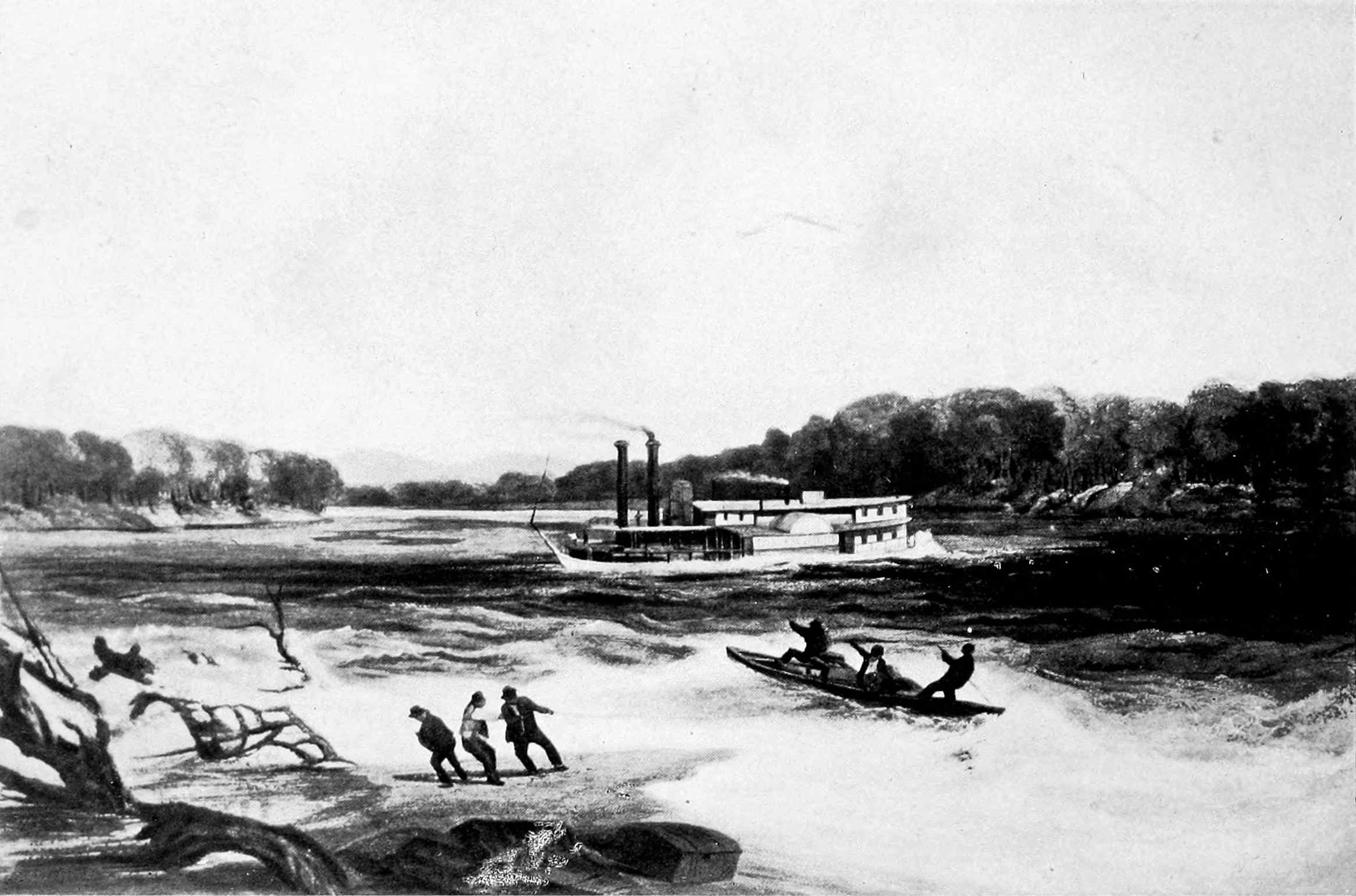
THE FIRST YELLOWSTONE
(After Maximilian)
CHOUTEAU BLUFFS.
The boat did not get as far as was expected on this
trip. A little above the mouth of the Niobrara River
it was stopped for a time by low water. Pierre Chouteau,
Jr., who, with McKenzie, was the soul of the
enterprise, was a passenger. Burning with impatience
at the delay, he sent to Fort Tecumseh for lighters to
take off a portion of the cargo. Every day he got
out upon the high bluffs overlooking the river and
paced up and down, watching for the desired assistance
and praying for a rise in the river. The bluffs
have ever since been known as the Chouteau Bluffs.
At last three boats came down and relieved the
steamer of enough of her cargo to enable her to reach
Fort Tecumseh, where Fort Pierre, S. D., now
stands. No attempt was made to go farther, and in
a short time she returned to St. Louis.
In spite of the failure to reach the mouth of the
Yellowstone the experiment was considered enough
of a success to justify its repetition. Accordingly, in
the spring of 1832, the Yellowstone set out again, and
this time reached Fort Union. The voyage was
highly successful, and the return trip was made at the
rate of a hundred miles a day. Pierre Chouteau, Jr.,
was again a passenger. Since the previous year Fort
Tecumseh had been rebuilt in a situation less exposed
to the ravages of the river, and was ready for occupancy
when the Yellowstone arrived on her upward
trip. It was at that time christened Fort Pierre, in
honor of the distinguished visitor and member of the
company. George Catlin, the painter of Indian scenes
and portraits, was also a passenger, and his writings
and sketches have added to the celebrity of the
voyage.
SUCCESSFUL EXPERIMENT.
The success of the second experiment in navigating
the Missouri gave great satisfaction to the company
and to the public in general, for it had never been
considered possible to take steamboats so far. It
added seventeen hundred miles to the internal navigable
waters of the United States, with every prospect
that this would be extended to the very foothills of the
Rocky Mountains. The voyage created great interest
both in this country and in Europe, and John Jacob
Astor, who was in France at the time, wrote home
that nearly all the public journals of the Continent
had made mention of it. Ramsay Crooks, general
agent of the company in New York, thus expressed
his pleasure to the house in St. Louis at the great success
which they had achieved:
CONGRATULATIONS.
“I congratulate you most cordially on your perseverance
and ultimate success in reaching the Yellowstone
by steam, and the future historian of the Missouri
will preserve for you the honorable and enviable
distinction of having accomplished an object of immense
importance, by exhibiting the practicability of
conquering the obstructions of the Missouri, considered
till almost the present day insurmountable to
steamboats, even among those best acquainted with
their capabilities. You have brought the Falls of the
Missouri as near, comparatively, as was the River
Platte in my younger days.”
The experiment thus inaugurated grew into a regular
business. The American Fur Company sent up
one or more boats every spring, as long as it continued
in the business. In the spring of 1833 it sent up
two boats, the Yellowstone and the Assiniboine. It
was this year that Maximilian, Prince of Wied, went
up and spent several months at Forts McKenzie,
Clark, and Union.20 The Assiniboine went above Fort
Union for some distance, thus making another advance
toward the head of navigation. It was caught in this
advanced situation by low water, and was compelled
to remain there all winter.
AN EARLY LOGBOOK.
A most interesting and valuable relic of these early
steamboat days has survived in the form of a journal,
or logbook, covering the voyages from 1841 to 1847
inclusive. It is all in French except that for the year
1847. It is very complete, and exhibits in the clearest
detail the manner of life which existed on the Missouri
River steamboat in those early days. Captain
La Barge was pilot on some of these voyages, and
we shall now note a few of the interesting incidents
with which he was connected, for they furnish a living
picture of a condition of things which has long
since ceased to exist.
CHAPTER XII. VOYAGE OF 1843.
The voyage of 1843 is known in more complete
detail than any other in the history of the river.
There are two complete journals of it—the Sire logbook,
just referred to, and the published journal
of the great naturalist, Audubon, who was one of the
passengers. Captain La Barge himself gave the present
author his full recollections of the trip. There
were in all about one hundred passengers, besides some
Indians returning to their country from a visit to St.
Louis. The passenger list included the usual picturesque
variety, but its most conspicuous and noteworthy
feature was, of course, the presence of Audubon
and his party of scientists. Captain Joseph Sire
was master of the boat and Captain La Barge pilot.
The Omega left St. Louis April 25, 1843. Along the
lower course of the river the voyage was more than
ordinarily difficult. The waters were high and the
bottoms were badly overflowed, making shore excursions
very unpleasant. The current was strong and
the winds so severe and constant that the boat had to
lie at the bank for several hours nearly every day.
These delays were improved by the boat crew in procuring
wood, and by the scientists in studying the
country.
AN INDISPENSABLE ARTICLE.
No incident worthy of particular mention occurred
until the boat reached Bellevue, a few miles below the
modern site of Omaha, Neb. The importation of
liquor into the Indian country was prohibited under
the severest penalties, and inspectors were stationed at
Leavenworth and Bellevue to examine all cargoes
bound up the river. Now it so happened that liquor
was the one article above all others that the traders
considered indispensable to their business, and they
never failed to smuggle it through in some way or
other. In the earlier years there was only one place
at which the cargoes going up the river were inspected,
and that was Fort Leavenworth. Later, when an Indian
agency was established at Bellevue, that place
also became a point of detention. At this particular
time it was the bête noire of the American Fur Company
traders. The military authorities at Fort
Leavenworth, from long experience in the country and
intimate knowledge of conditions prevailing there,
exercised their office as inspectors with reasonable
judgment and discretion. They understood very well
that the small competing traders would smuggle liquor
past them in spite of all they could do, and that to deprive
the only responsible company on the river of its
means of maintaining itself was simply to debauch the
trade with the Indians to a reckless and demoralizing
rivalry among a horde of irresponsible traders. They
were therefore very lenient in their inspections, and
the company rarely had any difficulty in getting past
them.
A ZEALOUS CLERGYMAN.
Not so, however, with some of the newly appointed
Indian agents. It was about this time that the Indian
Department tried the experiment of assigning clergymen
to the agencies—an example of good intentions
but bad judgment. These new agents showed more
zeal than discretion in their work, and although they
put the traders to a great deal of trouble, it is doubtful
if they lessened by a single drop the amount of liquor
carried into the country.
On the occasion of the voyage of 1843 the agent at
Bellevue happened to be absent from his station when
the boat arrived. Elated at this unexpected good fortune,
Captain Sire lost no time in putting off the
freight destined for this point and in getting on his
way. He pursued his voyage until nine o’clock that
evening, and doubtless felicitated himself that he was
out of danger. But it appears that the agent had delegated
the function of inspector during his absence to
the commander of the United States troops in the
vicinity. The boat left her mooring at daylight next
morning, but had scarcely gotten under way when a
couple of rifle shots were fired across her bow. She
brought to at once and made for the shore. There
Captain Sire found a lieutenant in charge of a few
dragoons, who had come from his camp four miles distant.
The young officer came on board and presented
to Captain Sire a polite note from Captain Burgwin,
commander of the camp, stating that his orders required
him to inspect the boat before letting her proceed.
A DASH OF COLD WATER.
This was like a dash of cold water to the buoyant
spirits of Captain Sire, and none the less so to Audubon,
to whom, as well as to the company, the loss of
the liquid portion of the cargo would have been irreparable.
The naturalist had a permit from the government
to carry with him a quantity of liquor for the
use of himself and party, and upon showing his credentials
to the young officer he was, to use his own
words, “immediately settled comfortably.” But in
the moment of his good fortune he did not forget his
companions who were not yet “settled comfortably.”
He understood that time was required to prepare for
the approaching function, and he could at least help to
secure this time by delaying inspection as long as possible.
He accordingly expressed a desire to visit the
camp, and the lieutenant detailed a dragoon to accompany
him. The great naturalist rode four miles to call
upon an obscure army officer whom he knew he could
see in a short time by waiting at the boat. The officer
was overwhelmed at the honor of the visit, and when
Audubon offered to present his credentials he politely
and gallantly replied that his name was too well
known throughout the United States to require any
letters. Audubon says of the occasion: “I was on
excellent and friendly terms in less time than it has
taken me to write this account of our meeting.” Between
his entertaining conversation and the shooting
of some birds he contrived to detain the Captain for
a good two hours before they returned to the boat.
THE TRAMWAY IN THE HOLD.
The time had not been wasted by Captain Sire and
his loyal crew. The shallow hold of the steamboat of
those days was divided lengthwise into two compartments
by a partition or bulkhead running the full
length of the boat. A narrow-gauge tramway extended
down each side of the hold its entire length,
the two sides connecting with each other by a curve
which passed under the hatchway in the forecastle.
Small cars received the cargo let down through the
hatchway, and carried it to its place in the hold or
brought it out again when the boat was being unloaded.
A car could pass from the stern of the boat
on one side of the hold around the curve in the bow
and to the stern of the boat on the other side. There
being no windows in the hold, everything was buried
in blackness a few feet from the hatchway. Workmen
were lighted to their labors by means of candles.
During the absence of Audubon the crew had loaded
all the liquor upon the cars, and had run them down
on one side of the hold far enough from the hatchway
to be entirely concealed in the darkness. They were
carefully instructed in the part they had to play in the
approaching comedy, and very likely were put through
a preliminary rehearsal or two.
THE VIRTUOUS SIRE.
When Captain Burgwin arrived in Audubon’s company,
he was received most hospitably and treated to
a luncheon, in which was included, as a matter of
course, a generous portion from the private store embraced
in Audubon’s “credentials.” By this time the
young Captain was in most excellent temper and was
quite disposed to forego the inspection altogether.
But the virtuous Sire would not have it so. “I insisted,
as it were,” says the worthy navigator in his
log of May 10, “that he make the strictest possible
search, but upon the condition that he would do the
same with other traders.”21
A FAIR PROPOSITION.
A proposition so eminently fair was at once agreed
to by the inspector, whose mellow faculties were now
in a most accommodating condition. The shrewd
steamboat master, who never forgot to be sober when
his company’s interests were at stake, escorted the officer
down the hatchway, and together they groped
their way along the hold by the light of a not too
brilliant candle. It may be imagined with what zeal
the scrupulous Captain thrust the ineffectual flame
into every nook and corner, and even insisted that the
inspector move a box or bale now and then to assure
himself that everything was all right.
Arrived at the foot of the hold, they passed through
an opening and started back on the other side. The
officer was doubtless too much absorbed with the effects
of his recent collation to notice the glimmer of
light under the hatchway at the other end of the boat,
where a miniature train with its suspicious cargo was
creeping stealthily around the curve and disappearing
toward the side which they had just left. The party
finished their inspection, and everything was found
quite as it should be. With many protestations of
good will the clever hosts and their delighted guest
parted company, and the good Captain Sire went on
his way rejoicing. But woe to the luckless craft of
some rival trader which should happen along with no
Audubon in the cabin and no tramway in the hold.22
The ordeal of inspection being over, the boat proceeded
on her way with no further drawbacks than
those arising from the various hindrances to navigation.
One of the disagreeable features of the trip
above the mouth of the Big Sioux River was the vast
number of dead buffalo that were encountered. They
had been drowned on the upper river at the time of
the spring break-up in attempting to cross the ice after
it became too weak. Their bodies had then floated
downstream and had lodged all along the river on
sandbars, islands, or the low shores. Some time having
elapsed since they were drowned, their flesh was
now in a condition that rendered the air almost insupportable.
AN INDIAN ATTACK.
An incident which caused considerable excitement,
but luckily no misfortune, occurred at Handy’s Point
(where Fort Randall later stood) on the 22d of May.
A band of eight or ten Santee Indians, apparently
angered because the boat would not stop for them,
opened fire upon it from the bank. The bullets tore
through the cabins and pilot-house, but by the greatest
good luck no one was hurt. A Scotchman who was
asleep in his bunk was awakened and terribly frightened
by one of the bullets which entered his berth,
passing through his pantaloons, and flattening itself
against a trunk. Audubon saved two of the spent
bullets as relics. He was himself standing near one of
the chimneys and saw a bullet splash in the water just
in front of the boat. Considering the large number of
people on board, the escape of everyone was almost
miraculous.
CAREFUL OF HIS EYESIGHT.
Captain La Barge was at the wheel at the time. In
the pilot-house with him was a French negro from
Louisiana named Jacques Desiré, always known as
Black Dave. He was an excellent pilot and was on
board with a crew to return with the steamboat
Trapper, which had been left up the river the previous
autumn on account of low water. When the bullet
crashed through the pilot-house Black Dave walked
quietly out and took shelter behind one of the smokestacks,
where he remained until the boat was well
away from the scene of the attack. Captain La Barge
asked him why he did not remain in the pilot-house,
so as to be ready to take the wheel in case he himself
were disabled. Dave replied that it was not the fear
of bullets that drove him away, but that his eyesight
was all he had to make his living by, and he was afraid
of its getting injured by the flying glass.
AN UNPOPULAR PASSENGER.
As may readily be understood, a feature of first importance
on this trip was the presence of so distinguished
a passenger as the naturalist Audubon. The
impression which the celebrated scientist made upon
the crew and those who were entertaining him was
quite unfavorable. He was very reserved, and when
he did hold intercourse with members of the crew it
was generally in an overbearing manner which
alienated their good will. It thus resulted that his
hunters rendered him inefficient service, and his journal
is full of complaints at their failure to keep their
promises. Certain personal habits aggravated this
defect, and altogether he was not a popular traveler
with the crew.
Captain La Barge mentions several instances of his
ill treatment, one of which concerned himself, and is
here given in his own words, as he once prepared
them for publication in the Missouri Republican:
THE BLACK SQUIRREL.
“On one occasion he [Audubon] asked me if I had
ever seen any black squirrels during my voyages on
the upper Missouri River. My answer was that I had
often killed them. ‘Do you know what a black
squirrel is?’ he asked. I replied that I knew what
I called a black squirrel, and would try to get him one
at the first opportunity. A few days later we were
windbound. Seeing that we would be compelled to
remain tied to the bank most of the day I took my
gun and started around to look for a black squirrel. I
was fortunate. I ran across a very fine one and shot
him. He proved to be a fine large buck. I brought
him aboard. The first person I met was Mr. Bell,
taxidermist of the Audubon party, who remarked,
after examining the squirrel, that it was certainly a
very fine specimen. He called Mr. Audubon’s attention
to it, who examined the animal carefully, and
then said to me: ‘That is what you call a black squirrel,
is it? I expected as much. It is very strange that
people born and raised in a country do not know the
names of the animals and birds which it produces.’
After the squirrel had been thus criticised for some
time, I remarked that I would take it down to the cook
and have it baked for dinner. ‘No, no!’ said Mr.
Audubon, ‘Mr. Bell will take care of it’; and then
walked off.
“Some few days after this one of his assistants
called to me to show me a painting that Mr. Audubon
had finished that morning. This was after dinner, as
Mr. Audubon had always to retire to his stateroom
after that meal and have his long afternoon nap. The
assistant took advantage of this opportunity to show
me some of the drawings which Mr. Audubon was
opposed to our seeing. On entering the room I saw
the drawing of the squirrel just finished, and certainly
I never saw anything representing life so strikingly.
The assistant then told me that Mr. Audubon had remarked
that it was the best specimen of a black squirrel
that he had ever painted.”
THE OVER-WISE BOTANIST.
A KERNEL OF CORN.
The crew soon lost a good deal of the deference and
respect which were justly due to individuals of such
scientific attainments as were those of the Audubon
party; and it is to be feared that they played pranks
on them now and then which they would have avoided
with people of more congenial manner. Etienne
Provost was serving as guide to the party. No one
in that day knew the Western country better than he,
and he was quite astonished when Mr. Prou, Audubon’s
botanist, said to him one day that he could
tell the name of any plant in that country from the
leaf and stalk, even if he had never seen it growing.
“You may think so,” said Provost, “but I will undertake
to prove that you are mistaken; for I know
a plant that grows in this country whose name you
will not be able to tell, even with the aid of your
books.” Soon afterward the boat landed to take on
wood near the mouth of the Cheyenne River. A band
of Indians had spent the previous winter near by and
had dropped some of their corn on the ground. This
was now well sprouted and the tender blades were
just shooting up. Provost carefully cut the ground
around a spear of the corn so as not to disturb the
roots or the kernel, which was still attached thereto.
He deftly concealed everything except one leaf and
then showed it to Mr. Prou. The eager scientist was
looking for some test of a formidable character, and
anything like corn did not even occur to him. It is
doubtful if he realized at the time that corn was
grown in that country. He racked his brain for a
plant that he could identify with the specimen. He
grew nervous under the scrutiny of the on-lookers that
had gathered around him. Taking his book, he
searched back and forth, but to no purpose. It was
indeed a new species, and he finally acknowledged himself
beaten. Provost then, with provoking gravity,
pulled away the dirt around the roots and finally disclosed
to the astonished scientist—a kernel of corn.
Above Omaha the boat made its way with more
than usual speed and good luck to its destination. It
reached Fort Pierre May 31 and Fort Union at sundown
June 12. It left Fort Union June 14, reached
Pierre June 21, and St. Louis June 29. The time consumed
was forty-nine days from St. Louis to Fort
Union and seventeen days returning. Mr. Audubon
and party remained at Fort Union until autumn, returning
in a mackinaw boat.
CHAPTER XIII. VOYAGE OF 1844.
A POPULAR FALLACY.
In the winter of 1843–44 the American Fur Company
built a new boat, the Nimrod, designed to correct
certain defects in the Omega, and in this boat the voyage
of 1844 was made. As in the previous year, Captains
Sire and La Barge were master and pilot. It
was in the spring and summer of this year that occurred
the great flood of 1844. This appears to have
been the greatest flood in the lower Missouri and central
Mississippi ever known before or since. The
entire bottoms in the vicinity of St. Louis were covered
with water to a width of several miles. The
flood had the curious effect of completely filling up
the old bed of the river, so that, when it subsided, the
river had to cut out a new channel, and it was many
years before the channel was restored to its condition
before the flood. The high water lasted far into the
summer. When Captain La Barge returned from his
trip to Fort Union he ran his boat up Washington
Avenue to Commercial Alley, where he made her fast
through a window in J. E. Walsh’s warehouse at the
corner of those streets. This great flood was mostly
from the lower country, and scarcely at all from the
mountains. When the Nimrod reached the Omaha
villages, a short distance below the modern site of
Sioux City, Ia., she found the water so low that she
was compelled to wait several days for a rise. This
fact is a noteworthy one, as another refutation of the
popular idea that floods in the Mississippi have their
origin in the melting snows of the Rocky Mountains.
As a matter of fact they always come from the heavy
rains of the lower country.
The Nimrod passenger list, like that of the Omega
the year before, included some notable names.
Among these were the Comte d’Otrante, son of the
famous Fouché of France, and another Frenchman,
the Comte de Peindry. D’Otrante was much liked by
the crew. He was an accomplished gentleman, very
wealthy, and had with him a retinue of servants who
had been reared with him upon the ancestral domain
in France. He was making the present journey solely
for the purpose of pleasure. De Peindry was a different
sort of man. He and d’Otrante met by accident
on this trip and had little to do with each other.
It was noted that de Peindry treated his compatriot
with great deference and respect as being his superior.
He was silent and impenetrable, and spent much of his
time hunting. When leaving the boat on these hunts
he would give directions not to wait for him if he did
not return. He was repeatedly cautioned that the
boat could not wait for him, but his invariable reply
was: “Do not wait; I will turn up; if I do not, it is
no matter.” He caused a great deal of uneasiness on
several occasions by not getting back in time, and
Captain Sire in his journal comments severely upon
his conduct. He was said to be a noted duelist, who,
for some unknown cause, had been compelled to leave
Paris. He was very much of an enigma to the passengers
of the Nimrod. In 1845 he went to California,
whence the report came a few years later that
he had been assassinated.
MORE SHARP PRACTICE.
In passing the Indian agency at Bellevue this year
it was necessary to indulge in some more sharp practice
to get the annual cargo of alcohol past that point.
The new Indian agent at Bellevue was an ex-Methodist
minister of the name of Joseph Miller—as
zealous in his new role of liquor inspector as he had
ever been in the regular practice of his profession. It
was his boast that no liquor could pass his agency.
He rummaged every boat from stem to stern, broke
open the packages, overturned the piles of merchandise,
and with a long, slender, pointed rod pierced
the bales of blankets and clothing, lest kegs of alcohol
might be rolled up within. The persistent clergyman
put the experienced agents of the company to their
wit’s ends, and it was with great difficulty that they
succeeded in eluding his scrutiny.
NECESSITY THE MOTHER OF INVENTION.
The urgency of the problem, however, produced
its own solution. Captain Sire had the alcohol all
packed in barrels of flour. But he knew that even this
device would not alone be enough, for the energetic
agent would very likely have the barrels burst open.
The Captain therefore had them all marked as if consigned
to Peter A. Sarpy, the Company’s agent at
Bellevue, and they were labeled in large letters “P. A. S.”
The moment the nose of the boat touched the
landing at Bellevue, the Captain, as was his custom,
ordered the freight for that point placed on shore, and
the barrels were promptly bowled out upon the bank
and carried into the warehouse. The agent, never
suspecting this freight, went on board, and after a
most rigid search, found nothing wrong. The boat
was permitted to proceed, but, contrary to its usual
haste in getting away as soon as the loading and unloading
were complete, it remained the rest of the day,
and gave out that it would not sail until the following
morning. The extraordinarily good character of
the boat on this occasion, and the unusually long delay
in departing, roused the suspicions of the agent, who
stationed a man to watch the boat and to whistle if he
saw anything wrong.
Everything remained quiet until some time after
midnight, except that a full head of steam was kept
up in the boilers. Presently there was great activity
on the boat, although with an ominous silence about
it all. The pilot, Captain La Barge, was quietly engineering
the reloading of the barrels. He had spread
tarpaulins on the deck and gang plank to deaden the
noise, and the full crew of the boat were hurrying
the barrels back in a most lively fashion. “What does
this mean?” one of the deckhands asked of another.
“We unloaded these barrels yesterday.” “Why,
don’t you see?” was the brilliant reply of another,
“they’re marked ‘P. A. S.’; they’ve got to pass.”
THE PARTED LINE.
The work was quickly over and every barrel was on
board, when the agent’s sleepy guard awoke to the
fact that something was going on. He uttered his
signal, and the agent made haste to turn out and see
what was the matter. La Barge and Captain Sire,
who knew full well what the whistle meant, did not
linger to make explanations. Captain La Barge
seized an ax and cut the line. “Get aboard, men!”
he shouted; “the line has parted!” The boat instantly
dropped back into the current and then stood
out into the river under her own steam. She was already
out of reach of the bank when the reverend inspector
appeared and wanted to know why they were
off so early. It was about 3 A. M. “Oh, the line
parted,” replied Captain La Barge, “and it was so
near time to start that it was not worth while to tie
up again.”23
TOO MUCH FOR CREDULITY.
This was a little too much for the agent, who
could not understand how it happened that the boat
was so thoroughly prepared for such an accident, with
steam up, pilot at the wheel, crew at their places, and
all at so early an hour. Next day he found that the
barrels consigned to Sarpy were gone, and saw how
completely he had been duped. Mortified and indignant,
he reported the company to the authorities, and
a long train of difficulties ensued, with ineffectual
threats of canceling the company’s license.24 Meanwhile
the alcohol found its intended destination in the
stomachs of the Indians, and the company reaped the
enormous profit which traffic in that article always
yielded.
CAPTURED BY THE PAWNEES.
As already noted, when the Nimrod arrived at the
site of the Omaha villages, the river was so low that
she could not proceed for several days. A crew was
kept constantly busy with the yawl, sounding the
channel to detect any favorable changes in its shifting
bed. On one of these sounding excursions, when
about five miles from the boat, and under a high cut
bank, La Barge was surprised and captured by a Pawnee
war party on their way to steal horses from the
Yanktonais. When the Captain heard them speak
Pawnee he felt safe, and at once opened conversation
with them in their own tongue. Although he knew
none of the Indians personally, he succeeded in inducing
them to come to the boat and partake of a
feast. Thus the Captain’s knowledge of the Pawnee
language, acquired in the villages of that tribe ten
years before, stood him in excellent stead. These Indians
might not have killed him, belonging as they
did to a friendly tribe; but war parties, even of
friendly Indians, were lawless and desperate, and
they would no doubt have handled the little boat crew
pretty roughly.
THE LOST SAILORS.
A TIMELY RESCUE.
Among the crew of the Nimrod there were two
ocean sailors, good men, but with no river experience,
who had engaged for the trip to see the interior of the
country. They were employed principally in handling
the rigging. One Sunday morning, May 19, while
the boat was still at the Omaha villages, they set off
together with a single gun to try their luck hunting.
They failed to return that day and likewise the next,
when general uneasiness began to be felt about them.
Parties were sent after them in all directions, guns
were fired, and everything done to find them, but to
no purpose; and the boat proceeded on her way without
them. The general opinion was that they had
been killed by some vagrant war party of Indians.
Some two weeks later, as the boat was setting out one
morning, a trader by the name of Kensler was seen
coming down the river with a small boatload of furs.
La Barge ran his boat to shore and hailed the trader,
who promptly hove to and came on board. La Barge
explained the circumstance of these two men having
been lost, gave Kensler some provisions for them, and
asked him to stop at the woodpile,25 where the boat
had laid up so long, and see if he could find any traces
of the men. He did so, and actually found them there.
They had converted the woodpile into a rude fortress,
with one opening on the river just large enough to
enable them to get out for water. They were almost
starved to death, being reduced to mere skeletons,
scarcely able to crawl back and forth to the river.
Kensler took them to P. A. Sarpy’s trading post at
Bellevue, where the Nimrod found them on her way
back and took them to St. Louis. They gave La
Barge the following story: On the first day of their
hunt they became confused and lost, and after much
wandering came to the bank of the river. But they
were utterly unable to conjecture whether they were
above or below the steamboat, and in this dilemma
resolved to build a raft and float down the river. If
above the boat they would, of course, come to where
it was; if below, they would land after having proven
the fact, and return on foot. As a matter of fact they
were below the boat, and after drifting some thirty
miles concluded to start back. They were considering
the question of landing when their raft ran upon
a snag, broke to pieces, precipitated them into the
water, and lost them their gun. They swam ashore
and walked up the river bank until they reached the
place where the boat had been. They resolved to stay
there and wait for someone to come along. They disposed
the woodpile so as to make a rough fort, and
gathered into their fortress all remnants of camp
refuse left by the Nimrod which could sustain life.
Here they waited for several weeks, and had about
given themselves up as lost when they were rescued
in the manner already related.
NOT “UP TO” BUFFALO.
The fare provided by the company for its steamboat
crew was exceedingly plain and scanty. The men
got very tired of it, and as they were much delayed by
low water in getting into the buffalo country, La
Barge told them that the first buffalo they came in
sight of they should have, even if he had to lie to half
a day to get it. La Barge had as first mate an excellent
man, John Durack, who had served in the English
navy, and had made his way to New Orleans and thence
to St. Louis. He had been on the river before, but had
never been engaged in a buffalo hunt, and the Captain
thought this a good opportunity to initiate him.
When the boat reached the vicinity of Handy’s post
four buffalo bulls were seen swimming the river.
“Man the yawl, John,” said La Barge. “I will go
with you and we will have a buffalo before we get
back.” The Captain gave orders to the men on the
boat to shoot the buffaloes, and he would then lasso
one of the wounded ones and drag it to the boat. He
put Durack in the bow with a line while he took the
rudder. The men on the steamboat fired and wounded
two of the buffaloes. To get to the wounded ones
the boat had to pass close to the two uninjured ones.
The Captain supposed that Durack fully understood
the programme, but the mate was not “up to buffalo,”
and to La Barge’s consternation slipped the
noose over the head of one of the uninjured animals.
Too late Captain La Barge shouted to him not to do
this—that he did not want to anchor to a live buffalo.
“Oh,” replied Durack, “he’s as good as any.” The
buffalo kept straight on his course. The men backed
their oars, but to no purpose; they could not stop
him. Finally his feet touched bottom and up the
bank he went with the boat and its helpless crew after
him. They might indeed have taken a boat ride over
the bare prairie had not the stem of the yawl given
way, being wrenched entirely out of the boat and carried
off by the terrified animal. There stood the sorry
crew, shipwrecked on a sandbar across the river from
the steamboat—and with no buffalo. A whole day
was consumed in getting back to the boat and in repairing
the broken yawl. Meanwhile the crew kept
on eating salt pork and navy bread.
A TERRIBLE STORM.
On the 23d of June, when the Nimrod was a little
below the site of the Aricara villages, near the mouth
of Grand River, there arose one of those frightful
tempests of wind, hail, and rain which were so frequent
on the central prairies. For a little while the
safety of the boat was despaired of. All the glass on
the windward side was broken and the interior of the
boat deluged with rain and hail. The hail accumulated
in the cabin to the depth of a foot, and some of
the hailstones were as large as turkey eggs. Captain
La Barge made clay impressions of some of them
and sent them to the St. Louis Republican as curiosities
deserving public notice. Besides the damage to
the cabins the wind carried away the pilot-house, which
had to be replaced with a skin roof.
On another of Captain La Barge’s voyages he encountered
a storm which carried away the smokestacks.
He extemporized some skin chimneys, which
enabled him to complete the trip. The Captain was
once summoned as an expert witness in a trial which
grew out of a similar accident to another steamboat,
whose owners had been sued for damages for not delivering
freight. The defense was that a storm had
so wrecked the boat that she could not proceed. The
particular damage alleged was the blowing down of
the smokestacks. La Barge explained how he had
managed in a similar case, and the court instructed
the jury against the defendant.
EXPERT WITNESS.
ACCIDENT TO BE AVOIDED.
In another case La Barge’s evidence, as an expert
steamboat man, was decisive. It was a case of collision
in which the pilot of the boat that was lost had
not followed strictly the recognized signals and rules
in passing the other boat. The owners had sued for
damages. The defense was that the defendant’s
pilot had followed the strict rules of steamboating,
and the other pilot had not. The main question was
whether the defendant’s pilot, when he saw the danger,
should not have given way if possible, even if the
other pilot was violating the rules, whether through
willfulness or ignorance. La Barge was asked what
course he would have pursued in the premises. He
replied that, under any circumstances, it was a pilot’s
duty to avoid accident, if possible. The court agreed
with this view.
The rest of the voyage of the Nimrod passed off
without noteworthy incident. The boat reached Fort
Union on June 22, started back June 24, and reached
St. Louis July 9, after an absence of seventy-one days.
CHAPTER XIV. CHANGED CONDITIONS.
Down to the date to which our narrative has now
arrived, the steamboat business of the Missouri was
mainly that of the fur trade. A small traffic was carried
on with the settlements along the lower river and
with the government establishment at Fort Leavenworth.
In 1829 a regular packet was put on between
St. Louis and Leavenworth, and this was kept up at
intervals during the next fifteen years. But still the
main business was the trade with the Indians or with
Santa Fe and the parties of white hunters who roved
all over the Western country. Its single noteworthy
feature, as late as 1845, was the annual voyage of the
Fur Company’s boat to the mouth of the Yellowstone.
FROM PILLAR TO POST.
At about the date last mentioned a profound
change came over the business—a change inseparably
connected with the foundation of civilization in the
Far West. The emigration of the Mormons to Great
Salt Lake was one feature of this new development.
That singular sect, whose origin and doctrines have
excited the contempt of the civilized world, as its marvelous
growth and material achievement have commanded
its admiration, was at this time about fifteen
years old. Its founder was Joseph Smith, its birthplace
Fayette, in New York State, and the year of its
birth 1830. For causes which are differently stated by
the friends and enemies of the church, Smith and his
followers found it expedient to emigrate from New
York. They went to Kirtland, O., where they laid
the foundations of their New Jerusalem, and where
they flourished with varying fortune for several years.
In the meantime another location was also chosen, possibly
as a refuge in case of expulsion from Kirtland—a
situation on the very frontier of civilization, twelve
miles west of Independence, Mo. Here the corner-stone
of Zion was laid, under the sanction of divine
revelation, and here the church began to erect its
earthly temple. Hither in a few years came the faithful
from Kirtland, having been expelled by the community,
to whom their doctrine and practices had
rendered them obnoxious.
JOSEPH SMITH.
In western Missouri their experience was even more
discouraging than in Ohio. The neighboring communities
would have none of them. The State authorities
were appealed to by both sides, and finally
entered the contest; the militia was ordered out, and
things assumed the aspect of civil war. Blood was
shed, and the Mormons were finally compelled to flee
from the country, leaving Joseph Smith and Sidney
Rigdon prisoners in the hands of their enemies. These
worthies, however, soon escaped and joined the
refugees near Commerce, Hancock Co., Ill.
Their first reception in Illinois was one of welcome,
for the people of that State believed that they had
been persecuted with uncalled-for severity by the citizens
and State of Missouri. Under the impulse of this
friendly feeling Smith secured a charter from the
State, and forthwith began building the city of
Nauvoo, on a site which has been universally admired
for its great natural beauty. The powers conferred
by this charter were very broad, and Smith became
virtually emperor of an imperium in imperio. He was
mayor of the city, Lieutenant General of the newly
created Nauvoo legion, and President of the church.
He acquired wide notoriety throughout the country,
and became a political factor of no little importance
in the State of Illinois. The colony flourished under
the impulse of missionary effort, which sent proselytes
hither from America and Europe alike. On the
6th of April, 1841, the corner-stone of still another
temple was laid.
But the same causes which proved disastrous to the
settlements in Ohio and Missouri soon began to operate
in Illinois. The people were outraged at the immoral
doctrines of the new sect, and alarmed at the arrogant
defiance of civil authority by its spiritual and temporal
head. Finally an act of violence under Smith’s
authority led to his arrest and that of his brother
Hyrum, and their confinement in the Carthage jail,
under guarantee of safety by the Governor of the
State. But a mob was organized which overbore the
civil authority, broke into the jail, and slew the
brothers in cold blood.
For the future development of the sect, this was
the most fortunate event in its history. It set the seal
of martyrdom upon the founder of the church; it
healed internal dissensions; it intensified the high purpose
to succeed; and finally it opened up the career of
the one man who above all others was qualified to
carry the movement to success. This was that astute
and gifted leader of men, prophet Brigham Young.
NO ABIDING PLACE.
A FINAL HOME.
It was now apparent that there was no abiding place
for the church upon the soil of the United States, and
it was necessary to look beyond. From the narratives
of those who had visited the regions west of the Rocky
Mountains, Young determined to lead his people to
the valley of the Great Salt Lake, at this time a possession
of the Mexican Republic. In that remote and
benighted wilderness his people could at least have
freedom from persecution, for the civil authority of
Mexico could scarcely reach so far. The movement
was decided upon. Smith had been killed in June,
1844, and the general exodus began in the spring of
1846. In July, 1847, Young laid the foundation of
the final home of his people on the shores of the Great
Salt Lake.
In the course of this movement large bodies of Mormons
remained encamped for long periods on both
shores of the Missouri near Council Bluffs and
Omaha. This situation became the great rendezvous
for the expeditions before starting across the plains,
and it was here that the Mormons came into relation
with the steamboat traffic of the Missouri. Large
quantities of freight and great numbers of passengers
were brought up and disembarked here. The Saluda,
whose tragic fate we have elsewhere described, was
loaded with Mormons. In 1851 the steamer St. Ange
carried up two hundred of these people, and the Sacramento
four hundred. Many other boats, for fully a
decade after 1846, brought up passengers and freight
destined to the distant colony in the heart of the Rocky
Mountains.
WAR WITH MEXICO.
Another of the great movements of the time, which
gave a marked impetus to Missouri River navigation,
was the War with Mexico. This great event—great
not so much in its battles as in its far-reaching results—had
been gathering force for years. The influx of
American settlers into the province of Texas caused
the Mexican Government to adopt repressive measures
toward them. This led to successful revolution on the
part of Texas, and her independence was finally won
by force of arms in 1836. For the next ten years
Texas was practically an independent republic seeking
annexation to the United States. The question of
annexation was the determining issue in the national
election of 1844, and the pro-annexationists prevailed.
Texas was annexed in the spring of 1845, and in the
following December was admitted as a State, against
the protest of the Mexican Government. The administration
ordered American troops to occupy certain
disputed territory claimed by both Mexico and Texas.
Collision with the Mexican troops followed: blood
was shed, and the United States declared war.
Among the minor operations of the war from a military
point of view, but of transcendent importance in
their results, were the conquests of New Mexico and
California under Harney, Doniphan, and Fremont.
All the country so won became a part of the United
States. It lay in the pathway of emigration to the
West, and must sooner or later have given rise to
grave complications. The inevitable issue was precipitated
sooner than was expected, but the result must
ultimately have been the same. The importance of
this acquisition in the history of the nation cannot be
overestimated.
The invasion of New Mexico naturally followed
the line of the Santa Fe trail. The expeditions were
organized on the frontier, mostly at Fort Leavenworth,
but also at other points, such as Fort Kearney
and St. Joseph. The transportation of troops and
supplies to Westport, Leavenworth, and Kearney gave
a great deal of work to the Missouri River boats,
which thus became an important factor in one of our
national wars.
DISCOVERY OF GOLD.
Scarcely had the treaty of Guadaloupe Hidalgo,
which closed the war, been signed, when an event took
place in the newly acquired territory which completely
revolutionized the situation of things in the West.
This was the discovery of gold in California in 1848.
Emigration had been moving to the coast, principally
into Oregon, for the previous six years. The first
large movement took place in 1843. In 1845 and 1846
several parties crossed the Sierras into California, and
there was a strong nucleus of American settlers there
when the conquest came. The discovery of gold
swelled this incipient stream into a mighty river.
From every part of the world, by land and by sea, the
rush to California began. The overland movement
was one of the greatest and most wonderful migrations
of a people which history records. It ran in full
strength for several years, beginning in 1849, and by
1854 a vast but unknown number had crossed the
plains.
There were various starting points from the Missouri
River in this migration, although the different
routes united before Fort Laramie was reached.
Westport, Leavenworth, Fort Kearney, and Omaha
became initial rendezvous, and a great deal of traffic
for the emigrants was done by the river boats from
St. Louis to these points.
Following the three great movements just described
came the period of government exploration of the
entire Western country, and the search for practical
railroad routes across the mountains. Large exploring
parties were sent into the field, and bodies of troops
were dispatched to the Pacific Coast and to distant
points in the interior.
LARGE RIVER BUSINESS.
The aggregate amount of business brought to the
lower Missouri from these various causes was large.
Viewed from the standpoint of transportation, the
Western country in that day can be likened in shape to
a fan. The handle was that portion which extended
from St. Louis to the mouth of the Kansas River.
Thence the various routes to all parts of the country
diverged along the arms of the fan, which were outspread
from Santa Fe on the south to Fort Union on
the north. Most of the business below the point of
divergence was done by steamboat. Vessels in large
numbers plied the river over this first four hundred
miles, and the amount of freight and passenger traffic
carried by them was very great. Boats departed
daily from St. Louis, carrying an almost inconceivable
variety of articles for use of the emigrants, and nearly
as large a variety of emigrants themselves. To one
who witnessed this business in the noontide of its
activity, it would have seemed scarcely possible that
another generation should witness its total extinction.
LA BARGE AND THE MORMONS.
Of the river business which grew out of the several
movements just described, Captain La Barge had his
full share. He knew the Mormons well. He had
already seen much of them during their sojourn in
western Missouri, and came into business relations
with them on a considerable scale during their emigration
of 1846 and subsequent years. He always liked
them, and had several warm friends among them.
He was introduced to Brigham Young by Peter A.
Sarpy at Bellevue, where the American Fur Company
post for that section was situated. The Mormons
were encamped in this vicinity so long that they
brought to Sarpy’s post a large amount of business.
La Barge himself became well acquainted
with Young and with others of the principal men.
Young impressed him from the first as a man of
great ability. Apparently deficient in education and
refinement, he was fair and honest in his dealings,
and seemed extremely liberal in conversation
upon religious subjects. He impressed La Barge as
anything but a religious fanatic or even enthusiast;
but he knew how to make use of the fanaticism of
others and direct it to great ends. He was kind and
considerate, but a firm and strict disciplinarian. In
the Mormon movement he had found his niche. He
saw in it his opportunity to achieve power and fame,
to amass a fortune, and to become a great leader.
The freight business which came to the steamboats
as a result of the gold rush was not of a desirable character.
Many of the emigrants were so poor that it
was difficult to collect from them, and once out of
reach there was scarcely a chance of ever hearing
from them again. This condition improved in later
years, and the emigrant trade on the whole was one of
great magnitude and importance.
THE GOLD CRAZE.
Referring to the gold craze, Captain La Barge said:
“I was never seized with the craze. My wife
wanted me to go, but I was too busy and was already
making money. Had I been idle, or unsuccessful in
business, I should undoubtedly have gone. I saw
enough of the movement to show me how many
chances of failure there were to one of success; and
as I saw the thousands of disheartened adventurers
who turned back without ever reaching the desired
region, I never repented not going.”
CHAPTER XV. INCIDENTS ON THE RIVER (1845–50).
The annual voyages of 1845–46 were made on the
steamer General Brooks. In the fall of the latter year
Captain La Barge bought this boat for twelve thousand
dollars, but sold her again at the close of the season.
This was the first boat he had ever owned. He
then went to Cincinnati, where he supervised the building
of a new boat. She was named the Martha, and
in her the voyage of 1847 was made. Captain Sire,
who for several years had gone up as master, now decided
to leave the river, and Captain La Barge accordingly
made the trip alone in full charge of the Company’s
business.
Besides the regular freight for the company trading
posts, the boat carried up a large quantity of annuities
for the several Indian tribes. A more extended reference
to this annuity business and the abuses to which
it led will be made further on. It is enough here to
say that the agents were sent into the country without
any protection; that the Company traders adroitly
worked on their fears until they were fain to place
themselves under the shelter of the trading posts; and
that the Company was thus enabled to manage the
government business to its own great profit. On
this particular trip there was a new agent by the name
of Matlock, and a good deal of time had to be spent
at the various agencies to permit him to confer with
the Indians.
At Crow Creek there was a band of Yankton Sioux
near a trading establishment under charge of Colin
Campbell. Here agent Matlock gave the Indians a
feast and left part of their annuities, but not all, being
induced by the Company’s agent to deposit the
balance at Fort Pierre. The Indians were sharp
enough to see that they had not received all they were
entitled to and naturally could not understand why.
Campbell assured them that they would receive the
balance at Fort Pierre. “Why not here?” asked the
Indians. “Why make this long journey for what we
can just as well get right here?” Campbell turned
them off by saying that the Indian agent could attend
to the matter there better.
SULLEN ACQUIESCENCE.
BADLY SCARED.
The Indians sullenly acquiesced, evidently much dissatisfied.
Campbell had cut ten or twelve cords of
wood at this place for use of the boat, but it was not
needed till the down trip. Captain La Barge feared,
however, that, if it was left, the Indians, in their
present temper, would burn it, and he therefore concluded
to take it along. The Indians refused to let
the wood be taken without pay, and seated themselves
on the pile so that the men could not get at it. The
captain was compelled to pay for the wood, although
it had been cut by Company men. But the matter did
not end here. Etienne Provost, who, as elsewhere
stated, was employed on these trips to take charge of
the rough and turbulent mountain men, was asked to
attend to the loading of the wood, as it was feared
there might be trouble. Provost came up on the
boiler deck and sat down by La Barge, saying: “We
are going to have some fun before that wood is on
board.” He then shouted “Woodpile! Woodpile!”
and enough men rushed out to the bank, to take the
whole woodpile at once. Provost ordered them to
pick up all they could carry and then to move on to
the boat one after another, so as to have no crowding
or confusion on the gang plank. Meanwhile a dozen
or more Indians were standing by, looking on. When
the men were loaded up and were jammed close together
in single file on their way to the boat, the Indians
jumped upon them and began to belabor them
with the rawhide horsewhips which they always had
fastened to their waists. The men were frightened
almost out of their wits, and dropping their wood,
scrambled on board the best way they could. Provost
lay back and roared with laughter, saying, “I told
you we should see some fun.”
AFRAID OF PROVOST.
He then went out himself onto the bank where the
Indians were, and said, “Now, men, come out here
and get this wood.” They came and loaded up.
“Now go on board,” he said, and they went entirely
unmolested. Provost went last, and before descending
the bank, turned toward the Indians and asked
them: “Why don’t you stop them? Are you afraid
of me?” The truth is they were afraid of him.
They knew him well and respected him, and understood
that he would stand no foolishness.
PROMPT MEASURES.
La Barge thought nothing further of the affair, for
the Indians soon disappeared, as he supposed, for good.
The wind was too high to proceed, and the boat remained
at the bank nearly all the afternoon waiting
for it to subside. “Everything quieted down,” said
the captain, in describing what followed, “and I was
sitting in the cabin reading a paper, when all of a sudden
there was a heavy volley of firearms and the
sound of splintered wood and broken glass. This
was instantly followed by an Indian yell and a rush for
the boat, and in the uproar someone cried out that a
man had been killed. The Indians got full possession
of the forward part of the boat and flooded the boiler
grates with water, putting out the fires. They had
learned something of steam in the fifteen years that
boats had been going up the river. My first act was
to rush to my wife’s stateroom, where I found Mrs.
La Barge unharmed. I told John B. Sarpy, who with
his son was making the trip, to barricade her door
with mattresses and to stay there until the trouble was
over. I then hastened to the front of the cabin, but
was met at the door by the Indians. Retreating, I
met Colin Campbell, and asked him what the Indians
wanted. Campbell replied that they wanted me to
give up the boat; that if I would do so they would let
the crew go, but if I resisted they would spare no one.
EFFECT INSTANTANEOUS.
“After the first rush the Indians seemed timorous
and uncertain, evidently fearing some unpleasant surprise
in the unknown labyrinths of the boat. This
gave me time for effective measures. I had on board
a light cannon of about 2½ inches caliber, mounted on
four wheels. Unluckily it was at this time down in
the engine room undergoing some repairs to the carriage.
I had in my employ a man on whom I could
absolutely rely—a brave and noble fellow, Nathan
Grismore, the first engineer. Grismore had just finished
the work on the cannon, and told me he thought
he could get it up the back way, since the fore part of
the boat was in possession of the Indians. He got
some men and lines and soon hoisted the gun on deck
and hauled it into the after part of the cabin. I always
kept in the cabin some powder and shot for use
in hunting. I got the powder, but the supply of shot
was gone. Grismore promptly made up the loss with
boiler rivets and the gun was heavily loaded and
primed, ready for action. By this time the forward
part of the cabin was crowded with Indians who were
evidently afraid something was going to happen. I
lost no time in verifying their fears. As soon as the
gun was loaded I lighted a cigar, and holding the
smoking stump in sight of the Indians, told Campbell
to tell them to get off the boat or I would blow them
all to the devil. At the same time I started for the
gun with the lighted cigar in my hand. The effect
was complete and instantaneous. The Indians turned
and fled and fairly fell over each other in their panic
to get off the boat. In less time than it takes to tell
it, not an Indian was in sight. I had the cannon
brought onto the roof, where it remained for an hour
or more.
“As soon as the Indians were off the boat I began
to look up the crew who had ingloriously fled at the
first assault, leaving the boat practically defenseless.
They had hidden, some here and some there, but most
of them on the wheels (it was a sidewheel boat) where
I found them packed thick as sardines all over the
paddles. These were the brave mountaineers who
were never slow in vaunting their courage and valorous
performances! I was so disgusted that I was disposed
to set the wheels in motion and give them all a
ducking; but the fires had been put out by the Indians.
“The wind having subsided, we resumed our journey,
and about a mile further on attempted to cross to
the other shore. Failing in this we encamped for the
night. On the following morning we buried the deckhand,
Charles Smith, who had been killed when the
attack began.”
Captain La Barge said that this was the only time
that he was ever caught napping by the Indians, and
it taught him a lesson that he did not forget.26
FIRST WHITE WOMAN AT FORT UNION.
As already mentioned, Captain La Barge’s wife was
on board. It was always understood on the upper
river that she was the first white woman to ascend the
river from old Fort Lisa near the modern site of
Omaha, Neb., to Fort Union, at the mouth of the Yellowstone.
Her presence created great curiosity
among the Indians. They would come on board and
examine her with the liveliest interest, measuring her
waist and the length of her hair, and wondering at the
tastefulness and beauty of her dress. The leading
squaws in great numbers visited her, and several
adopted her as their sister. A good deal of time was
lost in satisfying their importunities to see her. Years
afterward they would inquire of La Barge after their
white sister, and would send her presents. She never
failed to send them something in return. As late as
1885, when La Barge was in the government service
on the survey of the Missouri River in the vicinity of
the ancient Aricara villages, an aged half-breed squaw,
old Garreau’s daughter, told La Barge that she remembered
seeing his wife on this early trip.
In the year 1848 Captain La Barge again went up
the river with his boat Martha, on business for the
Company. There were no noteworthy incidents on
the trip except that the captain brought back quite a
menagerie of the native animals from the upper country.
There were buffalo, bear, beaver, antelope, elk,
and deer. A large tank was made for the use of the
beaver. All of the animals were for Kenneth
McKenzie except the buffalo, which were for Pierre
Chouteau, Jr.
LEAVES COMPANY’S SERVICE.
On this trip La Barge had some difficulty with the
Company, which induced him to sell his boat to them
at the close of the season. He immediately contracted
for a new boat which, when completed, he named the
St. Ange, in memory of St. Ange de Bellerive, the first
military governor of upper Louisiana. It was a fine
boat, and probably the only one ever built entirely
complete upon the ways, and launched with steam
up ready to start the moment she struck the
water.27
BLOODY ISLAND.
As soon as the boat was done, La Barge, being no
longer in the Company’s service, went to work for the
Quartermaster Department of the Army, hauling supplies
up the river. He had made two trips to Fort
Leavenworth, and on his way back on the second trip
encountered a severe storm, which delayed him several
hours. This delay, vexatious enough at the time,
was a blessing in disguise. Instead of getting into
port at St. Louis before dark, it was nearly an hour
after midnight before he reached there. As he was
nearing the mouth of the Missouri a broad gleam of
light overspread the sky in the direction of the city.
Its extent and brilliancy clearly enough indicated a
great conflagration. When La Barge reached port
it was to find the river front wrapped in flames. He
steamed the whole length of the levee, seeking a safe
place to land, but finding none, turned back, crossed
the river, and tied up for the night at Bloody Island,
on the east shore.28
THE GREAT FIRE OF ST. LOUIS.
A FLAMING FLEET.
This conflagration, which is the historic “Great
Fire” of St. Louis, commenced at about 10 P. M. on
the night of May 17, 1849, and continued until 7 A. M.
next day. Fire alarms had been heard several times
early in the evening, but nothing had come of them,
until about the hour above mentioned, when it was
found that fire had broken out in earnest on the
steamer White Cloud, which lay at the wharf between
Wash and Cherry streets. The Endors lay just above
her and the Edward Bates below. Both caught fire.
At this time a well-intended, but ill-considered, effort
to stop the progress of the fire was made by some parties,
who cut the Edward Bates’ moorings and turned
her into the stream. The boat was soon caught by
the current and carried down the river; but a strong
northeast wind bore it constantly in shore, and every
time it touched it ignited another boat. An effort was
now made to turn other boats loose before the Bates
could reach them, but a fatality seemed to attend every
effort. The burning boat outsped them all, and by
frequent contacts set fire to many more. These in
turn ignited the rest, until in a short time the river
presented the spectacle of a vast fleet of burning vessels
drifting slowly along the shore. The fire next
spread to the buildings, and before it could be arrested
had destroyed the main business portion of the city.
It was the most appalling calamity that had ever visited
St. Louis, and followed as it was by the great cholera
scourge of 1849, it was a terrible disaster. At the
levee there were destroyed twenty-three steamboats,
three barges, and one small boat. The total valuation
of boats and cargo was estimated at about
$440,000, and the insurance thereon was $225,000;
but this was not all paid, for the fire broke up several
of the insurance companies.29
Among the boats destroyed was the Martha, which
La Barge had sold to the Company. She was loaded
with a full cargo for the mountains. The day after
the fire La Barge received a note from Captain Sire,
requesting him to call at the Company’s office. He
complied, and was met with an urgent appeal to go to
the mountains with the Company’s annual outfit. He
was at that time engaged for a government trip to
Leavenworth, but offered to go as far as Fort Pierre
upon his return, if it were possible to do so. Sire replied
that that was all they could expect. The trip to
Leavenworth was completed in June, and La Barge
immediately started for Pierre. He made a quick and
successful voyage, and returned early in August.
CHOLERA EPIDEMIC.
The year 1849 was one of the terrible cholera years
in the West. Thousands died in St. Louis, and there
were many deaths on every boat that went up the
Missouri.
In the following year, 1850, Captain La Barge went
to the mouth of the Yellowstone for the American
Fur Company. It was the quickest trip on record,
being made in the extraordinarily short time of
twenty-eight days up and back, doing all the Company’s
business at the various posts.
CHAPTER XVI. INCIDENTS ON THE RIVER (1851–53).
The St. Ange left St. Louis on her voyage to Fort
Union for the American Fur Company, June 7, 1851.
She had on board about one hundred passengers,
mostly employees of the Company. The cabin list
included two distinguished Jesuit missionaries,
Father Christian Hoecken and Father De Smet,
bound for the Rocky Mountains.
CHOLERA BREAKS OUT.
The spring had been particularly backward and
wet, and the Missouri was in one of its most dangerous
floods. The whole bottom country was overflowed,
and the river looked like a floating mass of
débris of every description. Navigation, though
relieved of the danger from snags, was much impeded
by these floating obstructions, and the gathering of
fuel was unusually difficult. The overflowed condition
of the country made it malarial and unhealthy—as
bad as possible for a year when the cholera was
abroad in the land. Sickness in one form or another
soon appeared among the passengers. In a little
while the vessel, according to Father De Smet,
resembled a floating hospital, and a feeling of gloom
fell over the passengers. Father De Smet himself
was seized with a bilious fever which completely
prostrated him, and for a time his recovery was
doubtful. When about five hundred miles up the
river the cholera broke out. A clerk of the American
Fur Company was the first victim, and from that
time on for the next few days there were several
deaths every day. The situation was a terrible one,
and oppressed passengers and crew alike with the
most dismal forebodings.
There was a physician on board of the name of Dr.
Evans, a distinguished scientist who was making the
voyage in the interests of the Smithsonian Institution.
He did everything in his power to allay the
plague. Father De Smet was too ill to do anything,
but Father Hoecken worked incessantly, caring for
the sick and watching over their spiritual needs.
This heroic priest won the hearts of the passengers
by his untiring labors in their behalf; but he so completely
exhausted himself that he had no reserve
strength to combat the disease if it should attack himself.
He seemed everywhere at once, like a ministering
angel, and Father De Smet earnestly besought
him to spare himself somewhat or he would not hold
out. Father De Smet’s condition was so serious that
he had asked Father Hoecken to receive his confession;
but the latter did not think his brother in
immediate danger, and hastened to the bedsides of
those who were in a more precarious condition. In
the midst of his unselfish labors the zealous missionary
was himself stricken. Father De Smet thus
records the sad story of his death:
DEATH OF FATHER HOECKEN.
“Between one and two o’clock at night, when all
on board was calm and silent, and the sick in their
wakefulness heard naught but the sighs and moans
of their fellow-sufferers, the voice of Father Hoecken
was suddenly heard. He was calling me to his assistance.
Awaking from a deep sleep, I recognized
his voice, and dragged myself to his pillow.
Ah, me! I found him ill and even in extremity. He
asked me to hear his confession: I at once acquiesced
in his desire. Dr. Evans, a physician of great experience
and remarkable charity, endeavored to relieve
him, and watched by him, but his care and
remedies proved fruitless. I administered extreme
unction; he responded to all the prayers with a recollection
and piety which increased the esteem that
all on board had conceived for him. I could see him
sinking. As I was myself in so alarming a state, and
fearing that I might be taken away at any moment,
and thus share his last abode in this land of pilgrimage
and exile, I besought him to hear my confession,
if he were yet capable of listening to me. I knelt,
bathed in tears, by the dying couch of my brother in
Christ—of my faithful friend—of my sole companion
in the lonely desert. To him in his agony, I, sick
and almost dying, made my confession! Strength
forsook him; soon, also, he lost the power of speech,
although he remained sensible to what was passing
around him. Resigning myself to God’s holy will,
I recited the prayers of the agonizing with the
formula of the plenary indulgence, which Christ
grants at the hour of death. Father Hoecken, ripe
for heaven, surrendered his pure soul into the hands
of his Divine Redeemer on the 19th of June, 1851,
twelve days after our departure from St. Louis.
BURIAL OF FATHER HOECKEN.
“The passengers were deeply moved at the sight
of the lifeless body of him who had so lately
been ‘all to all,’ according to the language of
the apostle. Their kind father quitted them at the
moment in which his services seemed to be the
most necessary. I shall remember with deep gratitude
the solicitude evinced by the passengers to
the reverend father in his dying moments. My
resolution not to leave the body of the pious
missionary in the desert was unanimously approved.
A decent coffin, very thick, and tarred
within, was prepared to receive his mortal remains:
a temporary grave was dug in a beautiful forest, in
the vicinity of the mouth of the Little Sioux, and the
burial was performed with all the ceremonies of the
Church, in the evening of the 19th of June, all on
board assisting.”
On the return trip from Fort Union, Captain La
Barge, despite the protests of the passengers, took
Father Hoecken’s remains on board and delivered
them to the Jesuits at St. Louis, and they were buried
in the Novitiate of the Society of Jesus at Florissant,
whither Father De Smet was to follow twenty-two
years later.
ABATEMENT OF THE PLAGUE.
After the burial of Father Hoecken near the mouth
of the Little Sioux River, Captain La Barge put
everyone ashore, made the passengers roam around
the neighborhood, unloaded and aired all the baggage,
and completely renovated the boat. These
measures, with the increasing healthfulness of the
country as the boat entered the more arid sections,
brought complete relief from the plague. Only one
more death occurred, and in a short time everything
assumed a normal aspect. The boat reached Fort
Union on the 14th of July, and here Father De Smet
left it to make a journey overland, southward to Fort
John, on the Laramie River, where a great council of
plains Indians was to assemble. Captain La Barge
went on a hundred miles further, to the mouth of
Poplar River, it being, as he then understood, the
highest point reached by any steamboat; but it was
not much, if any, farther than the Assiniboine went in
1834.
CHARACTER OF FATHER DE SMET.
This may be a proper place to record some incidents
in the career of Father De Smet which fell
under Captain La Barge’s observation. De Smet,
as is well known, traveled a great deal in nearly all
parts of the far northwest. Sometimes he went
around by sea, and then came overland to the headwaters
of the Missouri; sometimes he went by the
Oregon trail; and at others by the Missouri River.
La Barge, who saw much of him, found him always
a pure and excellent man, very companionable, full
of anecdotes, and fearless and brave in all situations.
He was liked by everyone who knew him. The
Mormons were well acquainted with him and thought
much of him. The Indians had the very highest regard
for his character, and he seemed always to be
safe in their hands. The Government of the United
States likewise held him in high esteem, and on
several occasions called on him for responsible and
delicate work among the Indians.
Father De Smet entertained the most affectionate
regard for Captain La Barge. He presented him
with autograph copies of all his works, and always
referred to him in terms of deepest affection. The
incidents which follow were witnessed by La Barge
himself.
DE SMET AND THE BLACKFEET.
On one occasion near Poplar River a band of
Blackfeet came down to the bank near where the boat
was. In addition to the well-known traditional
hostility of these Indians to the whites, there were
other reasons for believing that they were at this
time in an ugly temper and meditated trouble.
Father De Smet, grasping the situation, said, “It
looks as if those Indians mean mischief. I will go
out and meet them.” La Barge remonstrated, saying
that De Smet was not acquainted with these
particular Indians, and that they might kill him,
when, if they knew who he was, they might spare
him. But De Smet knew that his reputation had
traveled where he himself had not been, and he believed
that they would recognize and protect the
Black Robe, as they called him. He accordingly
donned his cassock, and with the crucifix before him,
went ashore and walked boldly to where the Indians
were. As he had expected, they received him well,
made him sit down on a buffalo robe, and then lifted
him up and carried him on the boat. La Barge gave
them a feast and presented the chief with a suit of
clothes, which greatly pleased his vanity. After a
time the Indians withdrew without attempting any
harm.
MAKING IT RAIN.
Although the spring of 1851 had been very backward
and wet in the lower country, it was not so
higher up, and when the St. Ange arrived at the
Aricara villages the corn crop of those Indians was
found to be actually suffering from drouth. The
Aricara chief, White Shield, came on board and said
to La Barge, who understood his language well:30
“I am glad to see you, and I hear the Black Robe
is on board.”
La Barge replied that that was so. The chief then
continued:
“I want to ask him a favor. It is very late in the
season and no rain. Corn ought to be up now. We
want the Black Robe to send us rain.”
La Barge took the Indian back to De Smet’s room
and said to the priest, “Father, here is the White
Shield, who wants you to make it rain, for the corn
is not up yet.”
De Smet, who knew the White Shield well,
laughed heartily, and said he would do all he could.
He then asked La Barge if the boat was going to
remain there all day, and being informed that it was,
he said to the White Shield: “Go to your village and
put your lodge in order, and call in some of the chiefs.
I will come and offer prayer to the Almighty and ask
him to be merciful and grant your requests; and I
am satisfied that, if you deserve it, the Great Spirit
will look down and favor you.”
A COPIOUS SHOWER.
Captain La Barge and several of the passengers
went along with the father, and the interpreter translated
the prayer to the Indians. They left the Indians
satisfied, and at noon had them on the boat for
a feast, after which they returned to their village.
As good fortune would have it, along about three or
four o’clock in the afternoon, there came up a heavy
thunder shower which fairly deluged the place.
Father De Smet laughed and said:
“They will think I did it. They will give me all
the credit for it.”
Some time after the shower Pierre Garreau, a
French Canadian, who had spent all his life among
the Indians, and had become almost an Indian himself,
came to the boat and said to La Barge:
“I want you to help me. I want to find out how
Father De Smet did that.”
“Did what?” asked La Barge.
“Made it rain. I will pay a good price if he will
tell me. I will give him ten horses.”
La Barge took him back to De Smet, where he
presented his request himself. De Smet told him to
be a good Christian, and pray when he wanted it to
rain, and if he deserved it, it would come. Garreau
went away disappointed, for he fully believed that the
father had some secret art by which he produced so
signal a result. After he had gone, De Smet laughed
and said: “Did I not tell you they would say I did
it?”
ATTEMPTED RETIREMENT.
After La Barge returned from this trip he laid the
boat up for repairs, and soon after sold her. He had
now about made up his mind to quit the river and
retire from active business. He had already accumulated
a snug fortune for those days, and concluded
to enjoy it. He made the best financial move
of his life in the purchase of a large tract of land in
what is now Cabanné Place in St. Louis. Had he
held on to this purchase, the mere growth of the city
would have made him immensely wealthy.31 But
retirement from business is one of the hardest things
for a man to do, even in old age. For a man in the
prime of life, as La Barge was at this time, being only
thirty-six, it was not to be expected; and fate soon
threw in his way a temptation that brought him back
to the river.
PURCHASES THE “SONORA.”
In the spring of 1852 he met in town one day
Captain Edward Salt-Marsh, who had just arrived
from Ohio with a handsome new boat. She was
called the Sonora, as almost everything in those days
was given a California name. “Nothing would do
but that I should go and inspect his boat,” said La
Barge. “I found her an excellent craft, and soon
learned that Salt-Marsh was disposed to sell her. A
desire to purchase at once took possession of me and
led to a lengthy negotiation, which ended in my buying
the boat for thirty thousand dollars. Next day I
went into town and raised the entire amount.”
The Captain this year made a contract with the
Company to take their annual outfit up the river.
He went to Union and back, but there were no
especial incidents on the trip. After the return
of the Sonora he ran in the New Orleans trade for the
rest of the season. This was a yellow-fever year in
that section, and so many boats had left the river that
Captain La Barge found plenty of business.
There were some untoward incidents on the Fort
Union trip this season which decided La Barge not
to go up for the Company the following year. He
sold the Sonora in the fall of 1852, purchased a small
boat, the Highland Mary, with which he ran in the
lower river the entire season of 1853. He sold his
boat in the fall of that year.
CHAPTER XVII. ICE BREAK-UP OF 1856.
During the season of 1854 Captain La Barge was
in the employ of the government most of the time.
In the previous winter Colonel Crossman, of the
army, Quartermaster at St. Louis, contracted with a
company of boat-builders on the Osage River for a
steamboat for government use. When the hull was
nearly completed Captain La Barge went up and
brought the boat down by the use of sweeps. He
supervised her completion and remained on her as
pilot during the entire season. This boat was called
the Mink, from the color selected in painting her.
The American Fur Company chartered a boat to
take up the outfit of 1854, but the crew mutinied, and
the voyage proved a failure. Mr. Chouteau then
asked La Barge to recommend him a boat for the
next year’s trade and join with him in purchasing her.
It so happened that two St. Louisans, Sam Gaty and
a man named Baldwin, had recently won a prize of
forty thousand dollars in the Havana lottery, and
were using it in building a boat. They sold the boat
in her unfinished state, the Company purchasing a
half interest and La Barge and John J. Roe each one-fourth.
La Barge supervised her completion and
named her the St. Mary, after a new town which
P. A. Sarpy had just laid out a few miles below
the modern Council Bluffs, Ia., and which has been
long since entirely washed into the river.
TRANSFER OF FORT PIERRE.
Captain La Barge made the annual voyage of 1855
in this new boat. Mr. Charles P. Chouteau, son of
Pierre Chouteau, Jr., accompanied the trip. The only
incident of particular moment on this voyage was the
transfer of Fort Pierre to the United States Government
in accordance with the terms of a sale which
had been consummated the previous spring. This
important event, which will again be referred to more
at length, marked the beginning of the conquest of
the upper Missouri country by the army of the
United States. The St. Mary was used in making
the transfer of the post to the War Department and
in moving the Fur Company’s property to a new
situation some distance above the old site, near
the mouth of Chantier Creek.
General Harney was in command of the troops
sent to the upper Missouri in 1855, and La Barge
saw him at Fort Pierre. The Captain always liked
him, and considered him one of the best friends of
the Indians that the army ever produced—a terrible
fighter when fight was unavoidable, but always
desirous of accomplishing his purposes by peaceful
means. The Captain recalled an incident of Harney’s
intercourse with the Sioux which created a
great deal of mirth on the frontier at the time.
THE POWER OF THE WHITE MAN.
MEDICINE TOO STRONG.
While holding a council at Pierre with about three
thousand Sioux, the General told them of the great
power of the American people and the uselessness
of their trying to resist them. He was anxious
to exhibit some proof that would appeal to the
native imagination. Finally a thought struck him.
Chloroform was just coming into use in surgery, and
the hospital equipment with the expedition had
some of it along. “I will show you the great power
of the white man,” said the General with impressive
gravity. “I will show you how he can even kill and
bring to life again.” He called the surgeon, explained
what he wanted, and then, through the interpreter,
commanded that a dog be killed and
afterward restored to life. He cautioned the surgeon
to be extremely careful not to overdo the matter.
The surgeon proceeded to chloroform the dog, while
the Indians looked on in mute astonishment, if not
with superstitious awe. After the dog was insensible
the General called the chiefs and told them to satisfy
themselves that he was actually dead. The surgeon
was then ordered to resurrect the dog. He applied
the usual restoratives, but the dog slept on. He
nipped his tail with a pair of pincers, but still no
sign of life. The surgeon finally gave it up, and the
white man’s marvelous power did not materialize.
The Indians looked on, and putting their hands to
their mouths said: “Medicine too strong, too
strong.”32
ICE BREAK-UP OF 1856.
After the return of the St. Mary to St. Louis,
Captain La Barge, as was his wont, ran in the lower
river trade the rest of the season. In the following
winter, February 27, occurred the famous ice “break-up”
of 1856 on the Mississippi River at St. Louis.
The winter had been very cold and the ice was three
or four feet thick and the water low. The break-up
was not caused in the usual way by the thawing of the
ice, but by a rise in the river from above, which
caused the ice to move before it had become much
disintegrated. It was an appalling and terrible example
of the power of a great river when restrained
in its course. The following account is from the pen
of an eyewitness:
TERRIBLE DISPLAY OF POWER.
“The ice at first moved very slowly and without
any perceptible shock. The boats lying above
Chestnut Street were merely shoved ashore. Messrs.
Eads & Nelson’s Submarine No. 4, which had just
finished work at the wreck of the Parthenia, was
almost immediately capsized and became herself a
hopeless wreck. Here the destruction commenced.
The Federal Arch parted her fastenings and became
at once a total wreck. Lying below were the
steamers Australia, Adriatic, Brunette, Paul Jones,
Falls City, Altona, A. B. Chambers, and Challenge,
all of which were torn away from the shore as
easily as if they were mere skiffs, and floated down
with the immense fields of ice. The shock and the
crashing of these boats can better be imagined than
described. All their ample fastenings were as nothing
against the enormous flood of ice, and they were
carried down apparently fastened and wedged together.
The first obstacles with which they came
in contact were a large fleet of wood-boats, flats, and
canal-boats. These small fry were either broken to
pieces or were forced out on the levee in a very
damaged condition. There must have been at least
fifty of these smaller water craft which were destroyed,
pierced by the ice or crushed by the pressure
of each against the other.
A DESOLATE SCENE.
“In the meantime some of the boats lying above
Chestnut Street fared badly. The F. X. Aubrey was
forced into the bank and was considerably damaged,
the noble Nebraska, which was thought to be in a
most perilous position, escaped with the loss of her
larboard wheel and some other small injuries. A
number of the upper-river boats, lying above Chestnut
Street, were more or less damaged. Both the
Alton wharf-boats were sunk and broken in pieces.
The old Shenandoah and the Sam Cloon were forced
away from the shore and floated down together, lodging
against the steamer Clara, where they were soon
torn to pieces and sunk by a collision with one of the
ferryboats floating down. The Keokuk wharf-boat
maintained its position against the flood and saved
three boats below, viz., the Polar Star, Pringle,
and Forest Rose, none of which was injured.
“After running about an hour the character of the
ice changed, and it came down in a frothy, crumbled
condition, with an occasional heavy piece. At the
end of two hours it ran very slowly, and finally
stopped about 5 1-2 o’clock P. M. Just before the
ice stopped and commenced to gorge, huge piles,
twenty and thirty feet in height, were forced up by
the current on every hand, both on the shore and at
the lower dike, where so many boats had come to a
halt. In fact these boats seemed to be literally buried
in ice.
* * * * *
“The levee on the morning after the day of the
disaster presented a dreary and desolate spectacle,
looking more like a scene in the polar regions than in
the fertile and beautiful Mississippi Valley. The
Mississippi, awakened from her long sleep, was pitching
along at a wild and rapid rate of speed, as if to
make up for lost time. The ice coat of mail was
torn into shreds, which lay strewn along the levee,
and was in some places heaped up to a height of
twenty feet above the level of the water. Where the
boats had lain in dense crowds only a few hours before,
nothing was to be seen save this high bulwark
of ice, which seemed as if it had been left there purposely
to complete the picture of bleak desolation.
The whole business portion of the levee was clear of
boats, except the two wrecked Alton wharf-boats,
which were almost shattered to pieces, and cast like
toys upon the shore in the midst of the ridge of ice.
There was not a single boat at the levee which entirely
escaped injury by the memorable breaking up
of the ice on February 27, 1856.”
LA BARGE RESCUES HIS BOAT.
Captain La Barge retained a vivid recollection of
this great catastrophe, for he was the only steamboat
man who succeeded in extricating his boat from the
wreck. The sight was something terrible to him,
and a marvelous exhibition of power. The ice piled
up in enormous masses as easily as a child would
heap up sand, and then it collapsed and gave way.
There were three of these pilings-up, or gorges.
The noise of the crushing ice was terrific. Some of
the boats were smashed to splinters; some were sunk,
and others were pushed far up onto the bank.
The St. Mary was lying at the wharf when the
movement began. La Barge at once got up steam
and prepared to do what he could to save her.
Sarpy came down to see him, and said to him, “Do
just what you think best with the boat. If anyone
can save her you can. Draw on me for anything
you want.” It was a very risky thing to trust one’s
life in a chaos of wreckage like that. Hooper, the
mate, came and said that he should go too if the
Captain was going to risk the river. He thought he
could get five or six men to venture. The final give-way
came about dark, and La Barge backed the boat
away from the shore, let her drift in the ice, and
thus escaped the crush which came along the shore.
He drifted some twenty miles downstream before
he could extricate himself from the ice.
GOUVENEUR K. WARREN.
La Barge went to Fort Union for the Company
again in 1856. On this trip Lieutenant Gouveneur
K. Warren, afterward general and corps commander
in the Civil War, took passage on the boat nearly all
the way from St. Louis. He had with him a corps
of scientific assistants, among them the eminent
geologist Dr. F. V. Hayden, who was then just beginning
his explorations of the West. Lieutenant
Warren sketched the course of the river from the
pilot-house as the boat proceeded, taking compass
bearings and estimating the distances. He speaks in
his report of the uniform courtesy extended him by
Captain La Barge in facilitating his operations. The
Captain remembered him well, as he was in the pilot-house
nearly all the time. He was very active, and
kept his men vigorously employed gathering information.
At night he went on shore and took observations.
La Barge became very much interested
in his work, and assisted him in every possible way,
often stopping the boat to allow him to do some
particular work. He seemed so interested and
pleased with everything, and so intelligent and well
posted, that he quite won the Captain’s admiration.
He was, as Captain La Barge remembered him, a
handsome man, with a fine head and clear eye, at
that time rather slender, but well built and erect.
He was always pleasant, and was liked by his men,
but was nevertheless a strict disciplinarian. We can
easily discover in the Captain’s recollections the
youthful portrait of the future hero of Little Round
Top at Gettysburg, and the accomplished leader of
the Fifth Corps.
DR. F. V. HAYDEN.
DANGEROUS BUSINESS.
The Captain also distinctly remembered Dr. Hayden,
and related a certain incident which came very
near proving disastrous to that enthusiastic explorer.
Hayden was a man of rather small stature, talkative
and companionable, well informed, and very energetic
and eager in his work. On one occasion his
devotion to his scientific pursuits came very near
getting him into danger. The incident in question
occurred at the site of old Fort Clark, which stood
upon a high cut bank. “We laid up here for an
entire day,” said the Captain in narrating this event.
“The bank was full of fossils, some of them very
rare. I had told Hayden of this on a former trip,
and he was anxious to investigate the place. He went
down under the bank, pick in hand and his rifle over
his shoulder. An Aricara village was on the top,
and while he was absorbed in his investigations some
young bucks took it into their heads to have a little
fun at his expense. They commenced pelting him
with small pebbles, corncobs, etc., from the top of the
bank, at the same time keeping themselves concealed
from his view. For some time Hayden could not see
where the missiles came from, but at length caught
sight of the Indians, and instantly leveled his rifle at
them. I had been a quiet spectator from the boiler
deck of the boat, and quick as thought called to him
to desist or he was a dead man. He lowered his
gun and came on board and hunted no more fossils
under that bank. If he had fired he would certainly
have been killed, and as it was, the Indians were
greatly incensed that he should have leveled his gun
at them.”
A DISAGREEABLE INCIDENT.
Upon this trip a disagreeable incident happened
which led Captain La Barge to leave the Company’s
service for good. He had as clerk of the boat a son
of one of the partners. The young man’s wife was
also on board, going up for the pleasure of the voyage.
La Barge had been particularly requested by
the clerk’s father to use his best offices for her protection,
comfort, and pleasure in the wild and lawless
country to which she was going, and he promised
to do so. Everything passed off pleasantly until
Fort Clark was reached, when one of the partners of
the Upper Missouri Outfit, the bourgeois of the post
at Fort Clark, came on board to accompany the boat
to Fort Union. He was naturally a rough, arrogant,
blustering character, disposed to override everyone,
and on two previous occasions La Barge had been
compelled to deal pretty severely with him. He was,
nevertheless, a man of great energy, well versed in
the business of the fur trade, and a good man for the
Company. He was therefore tolerated where a less
capable man with his faults would have been gotten
rid of.
INSULTING INSINUATIONS.
“When he came on board,” said Captain La Barge,
“he went to the office and told the clerk to assign
him a stateroom so that he could have his baggage
sent to it. The clerk promised to attend to it and
the bourgeois withdrew. The clerk and myself then
looked over the register to see what we could do for
him. There was only one room that could be made
available except by causing passengers who had
secured and paid for their rooms to vacate them.
This room was occupied by two clerks, who were
compelled to give it up and sleep on cots outside. It
was a forward stateroom, and hence not so desirable
as those further aft, but still a good room, and the
only one that was available. I directed the clerk to
have the bourgeois’ baggage put in, and to show
him the room when he should request it. About
9 P. M., when the boat was tied up for the night, and
I was in the office writing up the journal, the bourgeois
came in and asked the clerk for his room.
The clerk took him out and showed him his room
and told him that two of the clerks had given it up
for him. The bourgeois turned up his nose and exclaimed,
‘What! that room for ——, a member of the
firm? Can’t I have a room in the after cabin, where
the bourgeois are usually assigned?’ He was told
that it was impossible without ousting others who
could not reasonably be disturbed. He did not ask
me, for he knew I would not grant it. Then drawing
himself up in a pompous fashion, he said to the
clerk, calling him by name: ‘I will occupy your room
to-night and you may occupy this,’ and added other
suggestions not calculated to mollify the feelings of
the young husband.
SEVERE DISCIPLINE.
“The clerk came into the room deathly pale, but
made no response to the bourgeois’ insulting insinuations.
I overheard the whole conversation, and
determined to remain up and see the affair out.
After a while the bourgeois came to the door of the
office and said to the clerk: ‘Good-night, Mr. ——.’
‘Good night, Mr. ——,’ replied the clerk, and the
bourgeois withdrew and started for the ladies’ cabin.
I immediately stepped out and followed him. He
walked directly back to the clerk’s stateroom and
was about to take hold of the door knob, when I
seized him by the collar, jerked him around, gave
him a smart kick in the direction of the forward
cabin, followed it up by two or three others, and in
short order landed him in front of the boat yelling
‘Murder!’ and calling for help. Culbertson and
others came out, but I told them not to interfere, as
I was simply protecting a lady from insult. The
bourgeois would not be quiet, and I ordered my mate
Hooper to put him on the bank. This was promptly
done, the boat was held off shore by a spar, the gang
plank drawn in, and the bourgeois could not get
back on board. The weather was so warm that he
would not suffer from the cold, and the pestering
mosquitoes, which swarmed in the willows, kept him
active all night.
“When I returned to St. Louis I made no report
of this affair, leaving it to the clerk, whose wife’s
honor had been protected, to lay the matter before
his father. Instead of reporting the facts he represented
that I had treated the bourgeois with uncalled-for
severity, and that such things ought not
to be allowed to go on. He said nothing of the real
cause of the trouble, although his wife, a refined,
cultured, and beautiful woman, drove to my house as
soon as she returned, and told my wife how thankful
she was for what I had done.
“A few days after my return from Union I was
summoned to the office, and was there informed that
the men in the upper country thought me altogether
too hard on them, and that, to avoid future difficulty,
it was best to terminate our relations. I replied that
I felt so fully justified in my action that I should retire
from their service with the utmost willingness if
such was their view of the affair. This was in the
fall of 1856, and was the last time that I worked for
the Company.
THE TRUTH DISCLOSED.
“Three years later I was again called to the office
and thus addressed by the father of my ungrateful
clerk:
“‘I have called you in to scold you for your conduct.’
“‘Why so, Mr. ——?’
“‘You remember the cause of the trouble in 1856
that led to our separation?’
“‘Very distinctly.’
“‘Why did you not defend yourself? Why did
you not make me a full report?’
“‘I thought, sir, it was your son’s place to lay the
matter before you, as the whole trouble had been on
his and his wife’s account. I had promised you that
I would protect her, and all I did was in fulfillment
of that promise. I am glad that you now know the
truth of the matter.’
“‘Perhaps you are right; it was my son’s place to
tell me; but he was influenced by others and never
mentioned it.’
“The old gentleman was very indignant over the
affair, and ever after treated me with the greatest
consideration.”
LEAVES AMERICAN FUR CO.’S SERVICE.
As has been stated already, this was the last service
of Captain La Barge for the American Fur Company.
Many years of the most active part of his life had
been spent in their interest. They never had a pilot
on whom they could more confidently rely, and
his careful management of their expeditions was
worth hundreds of thousands of dollars to them.
But their hard and exacting ways, often sullied with
open injustice, gave rise to misunderstandings, which
on several occasions virtually compelled him to quit
their service and finally led to permanent separation.
CHAPTER XVIII. THE HEAD OF NAVIGATION REACHED.
The decade from 1850 to 1860 saw a very rapid
growth in the steamboat business of the Missouri
River. The stream of emigration across the plains
continued practically unchecked. Settlement was
rapidly filling up the lower valley of the river, and by
1856 had reached as far as Sioux City, and all the
modern towns below that point had commenced their
existence. Government exploration was being pushed
with vigor in all directions into the country beyond.
The Indians were becoming restive under the pressure
of settlement; their annuities were increasing, and the
presence of troops in all parts of their country was
becoming more imperative. The long Indian wars of
the Missouri Valley were beginning.
STEAMBOAT STATISTICS.
All these developments had their effect upon the
steamboat traffic of the Missouri River, for that
stream was the one great transportation route into
the heart of the West. Some idea of the magnitude
of the business may be gleaned from the records of the
times as published in the newspapers along the river.
In the year 1858 there were 59 steamboats on the
lower river and 306 steamboat arrivals at the port of
Leavenworth, Kan. The freight charges paid at that
point during the season amounted to $166,941.35. In
1859 the steamboat advertisements in the St. Louis
papers showed that more vessels left that port for the
Missouri River than for both the upper and lower
Mississippi. In 1857 there were 28 steamboat
arrivals at the new village of Sioux City before July
1. There were 23 regular boats on that part of the
river, and their freight tonnage for the season was
valued at $1,250,000. The period from 1855 to 1860
was the golden era of steamboating on the Missouri
River. It was the period just before the advent of the
railroads. No other period before or after approached
it in the splendor of the boats. All the boats
were sidewheelers, had full-length cabins, and were
fitted up more for passengers than for freight. It
was an era of fast boats and of racing. It was the
heyday of that most important personage, the Missouri
River pilot.33
PROGRESS UP THE RIVER.
While this rapid development of traffic on the lower
river was going on, the American Fur Company was
laying its plans to carry steamboat navigation to Fort
Benton. We have elsewhere told how the Assiniboine
in 1834 reached a point near the mouth of Poplar
River, a hundred miles above the Yellowstone, and
being caught by low water, was compelled to stay
there all winter. For the next nineteen years this remained
the farthest point reached by steamboats. In
1853 the El Paso went about 125 miles further, to a
point five miles above the mouth of Milk River. El
Paso point, as this place came to be called, marked the
limit of steamboat progress up the river for the next
six years.
In 1859 the final step, or very nearly so, was taken
in reaching the real head of navigation. The record
of this event is quite as definite as are those of the entrance
of steamboats into the mouth of the Missouri
in 1819 and the voyage of the Yellowstone to Fort
Union in 1832. In the spring of 1859 the American
Fur Company sent up two boats with its annual outfit,
its own boat, the Spread Eagle, and a chartered boat,
the Chippewa. The Chippewa was a light boat, and
her owner, Captain Crabtree, contracted to take her to
Fort Benton, or as far as it was possible to go. At
Fort Union he defaulted in his contract and sold the
boat to the Company for just about the charter price
for the voyage. Such freight as the Spread Eagle
carried for Fort Benton was then transferred to the
Chippewa, making a total cargo of 160 tons. Captain
John La Barge,34 brother of Joseph La Barge, and
pilot of the Spread Eagle, was assigned to charge of
the Chippewa on her adventurous undertaking. Mr.
Charles P. Chouteau went along as the Company’s
representative.
The boat made her way successfully, and without
any notable incident, to within fifteen miles of Fort
Benton, and discharged her freight at Brulé bottom,
where Fort McKenzie stood in former years. Her
arrival at this point was on July 17, 1859, forty years
and two months after the Independence entered the
mouth of the river.35
This noteworthy event must be classed as one of the
celebrated feats in steamboat navigation. The Chippewa
had reached a point further from the sea by a
continuous water course than any other boat had ever
been. She was now 3560 miles from, and 2565 feet
above, the ocean, and the whole distance had been made
by steam on a river unimproved by artificial works.
HEAD OF NAVIGATION REACHED.
In 1860 the Chippewa and the Key West completed
the short remaining distance to Fort Benton, and made
fast to the bank in front of the old post July 2 of that
year. On June 16, 1866, the steamer Peter Balen
ascended the river to the mouth of Belt Creek, six
miles from the Great Falls, and thirty-one miles above
Fort Benton. This is believed to be the farthest point
reached by steam on the Missouri River.36 The feat
was accomplished during the June flood and would
have been impossible at ordinary stages. Fort Benton
has always been considered the head of navigation
on the Missouri River.
LOSS OF THE “CHIPPEWA.”
ALCOHOL AND CANDLES.
In 1861 the heroic Chippewa made her last trip up
the river. Again bound for Fort Benton, she reached
the end of her voyage and of her career at a point a
little below the mouth of Poplar River, Mont., since
known, from this connection, as Disaster Bend. She
was loaded with American Fur Company goods and
Blackfeet annuities, and had a goodly quantity of
alcohol on board. One Sunday evening in the month
of May, while supper was being served, the boat was
discovered to be on fire. She was immediately run
ashore, the passengers were put off, and she was set
adrift to avoid the danger from an expected explosion
of gunpowder that was in the hold. The boat floated
across the river and about a mile downstream, when
she blew up, just as the upper works were fairly consumed
to the water’s edge. The explosion was terrific,
and packages of merchandise were found at a
great distance from the place. No lives were lost, and
the personal effects of the passengers were saved.
The fire was caused by some deckhands, who went into
the hold with a lighted candle to steal some liquor.
CHAPTER XIX. FORT BENTON.
Few, if any, towns in the Far West country possess
so unique and varied a history as Fort Benton. With
the exception of some of the old Spanish villages in
the southwest it is the oldest settlement in the mountain
country, for the traders made their first establishment
there in 1831. The true historic career of Fort
Benton did not embrace more than half a century, yet
in that brief space it saw more of romance, tragedy,
and vigorous life than many a city of a hundred times
its size and ten times its age.
OPENING TRADE WITH THE BLACKFEET.
The commercial importance of Fort Benton arose,
of course, from its situation at the head of navigation
on the Missouri River; but this was not the cause of
its first location there. The surrounding country was
the home of the Blackfeet Indians—great fur producers,
but in early times inveterate enemies of the
whites. From the time when the traders began to
penetrate those distant regions it was their ambition
to open up trade relations with this fierce and refractory
tribe. Attempts were made in the years
1807–10 and again in 1822–23, but wholly without success.
The Indians always evinced a deadly hostility,
attacked the trappers, killed a great many, drove them
out of the country, and gave them no opportunity to
explain their pacific purposes.
In 1831 Kenneth McKenzie, ablest of the American
Fur Company traders on the upper Missouri, resolved
to make another attempt. He had already securely
established himself at Fort Union, near the mouth of
the Yellowstone. Fortune threw into his hands at
this time the very instrument required for his purposes—an
old trapper who had long served under the Hudson
Bay Company in the Blackfoot country north of
the boundary. His name was Jacob Berger. He
understood perfectly the language of these Indians
and knew many of them personally. McKenzie prevailed
upon him to go to their country with overtures
of peace and the promise of a trading post. The real
origin of the enmity of the Blackfeet had been the
apparent favoritism of the whites, in years gone by,
toward their hereditary enemies, the Crows; and
McKenzie felt confident that, if he could once get
their ear and explain the true purpose of the traders
toward them, he would secure their friendship and
custom.
Berger set out with a small party in the fall of 1830,
carrying unfurled an American flag, and traveled
upward of four weeks before he saw an Indian.
Finally he came upon a large village in the valley of
the Marias River. The sight so terrified the little
band that they were for instant flight before they
should be discovered. Berger, however, persisted in
his mission, and the party moved forward, scarcely
expecting to be alive another hour. They were
quickly discovered, whereupon a number of mounted
warriors started at full gallop to meet them. The
whites halted and Berger advanced with his flag. The
Indians paused and Berger made signs of peace, and
called out his own name. As he was well known to
the tribe, they recognized him at once. There was a
rush to shake hands and Berger and his party were
taken to the village, where, to their infinite relief, they
were received with every demonstration of good will.
A FAIR PROPOSITION.
Berger remained at the village for some time, and
made the Indians fully acquainted with the purpose
of his mission. He finally induced about forty of the
leading men to return with him to Fort Union, where
they could confer with McKenzie direct. The journey
was long, and the fickle nature of the Indians
showed signs of weakening before it was nearly completed.
They began to fear treachery, and it took all
of Berger’s ingenuity to keep them from turning back.
Finally, as a last resort, when almost at their journey’s
end, he pledged them his scalp and his horses if they
did not reach the fort in one day more. They agreed
to this eminently fair proposition, and before the day
had passed they saw, from the top of a hill, in the plain
below them, the imposing palisades and bastions of
Fort Union. This was about the beginning of the
year 1831.
SUCCESSFUL NEGOTIATIONS.
McKenzie did all in his power to impress the delegation
favorably. He made them liberal presents, and
sent a trader with an outfit of goods to remain in their
village during the winter. Finally he promised them
a permanent trading post the following year. Before
the year had passed he induced the Blackfeet and
Assiniboines to make a treaty with each other, and he
thus established peace all along the northern border.
In the fall of 1831 he sent a complete outfit under
James Kipp to the Blackfoot country for the purpose
of establishing the promised post. After a long and
tedious voyage Kipp reached the mouth of the Marias
River and selected the point of land between the two
streams for the proposed establishment. It was begun
about the middle of October. The Indians
appeared soon after his arrival, but Kipp requested
them to withdraw for seventy-five days, until he could
finish the work. They went away and returned
punctually on the day fixed. To their astonishment
they found the fort entirely finished and everything
ready for the trade. This post was very properly
named, from the sub-tribe of the Blackfeet in whose
country it was located, Fort Piegan.37
THE BLACKFEET NATION.
Thus was the white man’s first foothold established
in the land of the Blackfeet, near where the great post
of Fort Benton stood in later years. Kipp drove a
thriving trade during the winter, and in the spring
went down to Union with the returns and with all his
men, for they refused to remain if he went. It is said
that the Indians burned the post after Kipp withdrew.
Whether from this cause or from some other, it was
not rebuilt upon the original site. D. D. Mitchell, one
of the Company’s most capable servants, was sent up
in 1832 to reopen trade with the Blackfeet. On his
way up he lost his boat in a storm, with all the property,
worth some thirty thousand dollars, and two
men, one of them a Piegan Indian. The Indians who
were with him suspected foul play and Mitchell had
all he could do to maintain himself while sending back
to Union for another outfit. He succeeded, however,
and in due time reached the mouth of the Marias.
FOUNDING OF FORT MCKENZIE.
Not liking the situation selected by Kipp, he went up
the river some seven miles farther, and chose a spot on
the left bank in a fine bottom with abundant growths
of timber near by. The erection of the new post was
one of the dramatic incidents of the early fur trade.
There were several thousand Indians present, suspicious
of the whites and ready for trouble upon any
pretext. The men worked like beavers in getting up
the pickets, and during this time slept on the keelboat.
It required the utmost tact and firmness on the part of
Mitchell to prevent an outbreak, and several times it
seemed as if all were lost. The work was finally completed,
and once within the fort the little party felt
safe. The new post was named Fort McKenzie, a
merited tribute to the man who had accomplished a
feat which the traders had hitherto considered impossible.
In the summer of 1833 Alexander Culbertson, next
to McKenzie the greatest of the American Fur Company
traders, went up with Mitchell from Fort Union,
and began his long and eventful career on the upper
river. Prince Maximilian was a guest of the party,
and remained at Fort McKenzie nearly all summer.
While there he was treated to a genuine Indian battle.
The Assiniboines, becoming weary of peace, broke the
treaty of two years before, and fell upon a band of
Piegans who were encamped around the fort. They
killed several Indians in the first onset, but were
quickly repulsed by aid of the inmates of the post, and
were finally driven back beyond the Marias. Mitchell
and Culbertson took part in the fight, and the venerable
Prince became its historian.
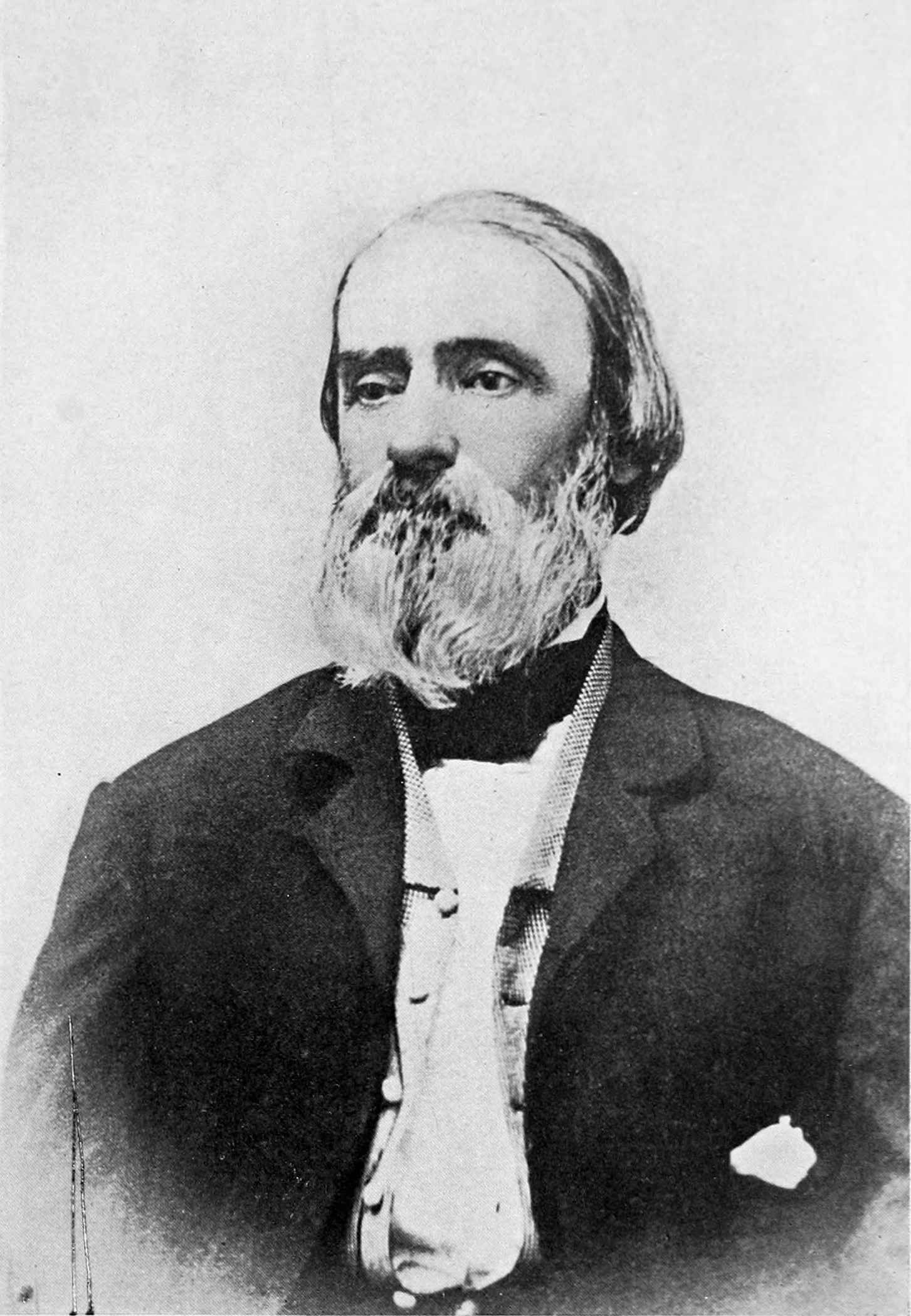
ALEXANDER CULBERTSON
BLACKFEET AND CROWS.
The history of Fort McKenzie had more of excitement
and incident about it than any of the other early
trading posts. The Blackfeet and the Crows were
deadly enemies of each other, and many were the
bloody encounters between them. The Crows often
came to seek their enemy in his own country, and the
Blackfeet went to the Crow country on the Yellowstone,
where the inmates of Fort Cass witnessed the
counterpart of scenes which fell under the eyes of the
traders at Fort McKenzie. It is said, but upon uncertain
authority, that the Crows once actually laid
siege to Fort McKenzie, but as they were a friendly
tribe to the whites, this may be taken with some allowance.
It is certain, however, that for many years the
warfare between these two tribes raged with great
fury, though not with much loss to the traders, for the
booty captured from one party found its way directly
to the trading post in the country of the other.
SMALLPOX AMONG THE BLACKFEET.
The thrilling incidents with which the annals of
Fort McKenzie abounded in these early years would
fill a volume; but we can note only the more important.
The year 1837 was the year of the terrible smallpox
scourge among the tribes of the Missouri Valley.
Great care was taken at Fort Union to dispatch the
annual outfit for Fort McKenzie without carrying the
smallpox along with it. The expedition was in charge
of Alexander Harvey, one of the most noted and desperate
characters which the fur trade produced. Harvey
took every possible precaution, but in spite of his
efforts the disease broke out in his party. He therefore
thought it prudent to stop before he reached Fort
McKenzie and send word to Culbertson, who had been
in charge of the fort since 1834, when Mitchell left.
Culbertson wisely decided to leave the cargo at the
mouth of the Judith until the disease had run its
course. There were large numbers of Indians encamped
near the fort awaiting the arrival of the boat,
and when they learned of the proposed delay they became
suspicious and insisted that the boat should be
brought up. Culbertson expostulated with them, but
all in vain, and to avoid the capture and destruction of
the boat and its crew, he yielded to their demands.
TERRIBLE MORTALITY.
The result was exactly what had been foreseen.
The disease was communicated to the inmates of the
post and to the Indians as well. The latter completed
their trade and left the fort before the pest actually
broke out among them, and the garrison remained for
some time in ignorance of what their fate had been.
For upwards of two months not an Indian was seen,
and Culbertson, fearing the dreadful truth, resolved
to go in search of them. With a single companion he
set out for the Three Forks of the Missouri, where the
Piegans usually spent their autumns hunting beaver.
They finally came upon a village of about sixty lodges,
only to find it absolutely deserted, with dead bodies
strewn in every direction, and carrion birds of prey the
only sign of life anywhere around. The smallpox had
done its work well, and the few survivors of the village
had fled in scattered groups among the surrounding
mountains. The mortality among the Bloods and
Blackfeet had been as great as among the Piegans,
and Culbertson estimated the total loss among the
three bands at six thousand souls. The Grosventres,
for some cause, escaped with small loss.
The annals of Fort McKenzie during the next six
years find their chief sensational interest in the exploits
of Alexander Harvey. Many were the desperate
deeds committed by him, and it required all the steadying
authority of Culbertson to offset his sinister influence
among the Indians. Harvey was, however, an
excellent trader, and rendered the company good
service. He was left in charge of the post during the
occasional temporary absences of Culbertson at Fort
Union, and in spite of his many outrages upon the Indians,
and even upon the whites, was considered too
valuable a man to lose.
CULBERTSON TRANSFERRED.
Under Culbertson’s prudent management Fort
McKenzie had become, next to Union, the most paying
establishment on the river. The Company were
so pleased with his record that they decided to send
him to Fort John, on the Laramie River, to build up
the trade of that post, which was doing a losing business
on account of bad management. Culbertson protested
that it would be a mistake to take him away
from McKenzie, but the Company overruled him, and
Francis A. Chardon, one of their most experienced
clerks, was sent to relieve him.
REVOLTING CRIME.
Chardon was the same manner of man as was Alexander
Harvey, and it goes without saying that such a
pair traveled rapidly the highway to commercial ruin.
Chardon, being new to his duties and new to the post,
relied a great deal upon Harvey, who became the real
head of the establishment. The natural consequences
of this arrangement quickly followed. Some little
offenses committed by the Indians, which a prudent
trader would have passed by without trouble, were
made the excuse for one of the most atrocious crimes
ever committed by either white man or Indian upon
the other. The plan was to fall upon the unsuspecting
Indians the next time they should come in to trade,
and to kill all they could and confiscate their property.
It only partly succeeded, owing to the failure of the
actors to co-operate exactly; but it went far enough to
arouse the hatred of the Indians to the highest pitch.
They began a war of vengeance, and soon rendered
the situation at Fort McKenzie untenable. Chardon
accordingly moved down to the Judith River, and
erected a new post on the left bank of the Missouri,
opposite the mouth of the smaller stream. He named
the post Fort Chardon. Fort McKenzie was burned,
some say by Chardon himself and some by the Indians.
The fort lost its old name and became known as Fort
Brulé, or burned fort, a name which still survives in
Brulé bottom, where Fort McKenzie stood. The
massacre took place early in the winter of 1842–43.38
RETURN OF CULBERTSON.
As a result of their reckless management, Chardon
and Harvey had by this time ruined the trade with
the Blackfeet tribes. In this emergency the Company
turned to Culbertson, acknowledged their error in removing
him from Fort McKenzie, and besought him
to return and restore things to their old-time condition.
Culbertson went back in the summer of 1844,
abandoned and burned Fort Chardon, and established
a new post twelve miles above the modern Fort Benton.
The fort was built on the right bank of the Missouri,
and was named Fort Lewis, in honor of the
great explorer, Captain Meriwether Lewis.
On his way up from Fort Union this season Culbertson
was accompanied by Jacob Berger, James Lee, and
Malcolm Clark. Clark had served at Fort McKenzie
five years before. He was a noted frontier character
of good family connections, an unsuccessful student at
the West Point Military Academy, a man of fine physical
presence, and possessed of a bold and desperate
character, which brought to his name the stigma of
more than one crime.39 Clark and his companions
seem to have plotted the murder or severe punishment
of Alexander Harvey; for when Harvey came down
from Fort Chardon to meet the boat, he was attacked
by Clark and Lee and barely escaped with his life.
He fled to the post, barricaded himself, induced the
inmates to stand by him, and would not admit even
Culbertson without a guarantee of personal safety.
He then closed up his affairs at the post, left the Company’s
service, went down the river, and soon after
became senior member in the opposition firm of
Harvey, Primeau & Co. He returned to the upper
river, built a small post near the mouth of Shonkin
Creek, and did a fair business for several years, when
he sold out to his old employers.
BLACKFEET TRADE RESTORED.
With Chardon and Harvey away, Culbertson soon
won back the trade of the Blackfeet. The site of Fort
Lewis, however, proved unsatisfactory. The valley
of the Teton River, a tributary of the Marias, which
flowed parallel with the Missouri for many miles, was
a favorite camping ground of the Indians. Fort
Lewis was a long way off, and across the Missouri
from this valley. Accordingly, in the spring of 1846
the post was dismantled, moved down the river, and
set up in the fine open bottom where the village of Fort
Benton now stands.
FORT BENTON FOUNDED.
The post was thus finally settled in its future permanent
location, although the name, Fort Lewis, was
still retained for several years. Business flourished
under Culbertson’s management, and he at one time
had three outlying posts in the country round about.
In 1850 he determined to rebuild the post of adobe,
after the manner of Fort John, on the Laramie. The
soil was well adapted to the purpose, and although
the work was begun late in the season, it was completed,
thanks to an open fall, before winter set in.
On Christmas night, 1850, it was dedicated with a
grand ball, and was rechristened Fort Benton, in honor
of Senator Thomas H. Benton, who had so often rescued
the Company from the peril of its own malefactions.
The name Fort Benton, as applied to the post
of the Blackfeet, and to the head of navigation on the
Missouri River, thus dates from the year 1850, nineteen
years after the first trading post was established
in that vicinity.
THE STEVENS EXPLORATION.
No events of other than a routine nature transpired
at Fort Benton until the year 1853, when the extensive
exploring expedition of Governor I. I. Stevens took
the field to find a northern railroad route to the Pacific
Ocean. These explorations brought a great deal of
business to Fort Benton, and added a new feature to
the life of that hitherto almost unknown post. Growing
out of this work came the effort to negotiate
treaties with the Blackfeet similar to those which had
been formed at Fort Laramie three years before with
most of the plains tribes. Congress made a large appropriation
to cover the expense of the negotiations,
and Governor Stevens and Alfred Cummings were
appointed treaty commissioners. The necessary gifts
for the Indians were purchased, the American Fur
Company was awarded the contract for their transportation,
and in due time Commissioner Cummings
and party left St. Louis on the Company’s steamboat
St. Mary.
There were on board, besides Commissioner Cummings,
Major Culbertson, Indian agents Vaughn and
Hatch, and a friend of Captain La Barge, an army
officer, who later became paymaster in the army. At
Fort Union the goods were transshipped in keelboats
for Fort Benton, while the passengers took wagons
for the same destination. Arrived at Milk River
crossing, the party met Governor Stevens just returning
from the Pacific Coast, and here the details of
organization of the Commission were decided upon.
There was much dispute over the question of precedence,
and although Governor Stevens finally
yielded to his colleague, the relations of the two men
were so embittered that their subsequent work lacked
harmony and effectiveness.
CHANGE OF CONDITIONS.
From Milk River the party went on to Fort Benton,
but the boats were not able to get up that far except
with very great delay, and it was decided to hold the
expected council at the mouth of the Judith River. The
goods were stopped at that point and hither repaired
the Commissioners and the various Blackfeet bands to
the number of about two thousand. The work was
completed and in about ten days the Indians departed
with their lavish presents. The era of the fur trader
had ended and that of the Indian agent had come. In
this case, as in all that had preceded it, the change, so
far as the Indians were concerned, was a change for
the worse.
GREATNESS OF FORT BENTON.
These events bring our sketch of the history of Fort
Benton down to the point already reached in our regular
narrative. The arrival of the first steamboat in
1859 was an epoch in her history. Followed, as it
was, almost immediately by the discovery of gold in
Montana, and the consequent rush of emigration, it
changed the whole order of things at the post. Stores
and other buildings began to appear, and in 1865 a
town site was laid off.40 The young city grew with
astonishing rapidity and became a place of very great
importance. Strange indeed must it have seemed to
the Indians and to the old trappers to behold upon this
spot, where for so many years there had been only a
single palisade—sole habitation of white men within
five hundred miles—buildings of metropolitan style
and quality, trains of wagons coming and going, and
lines of noble steamboats lying at the bank along the
entire front of the town.41 It was a wonderful metamorphosis,
scarcely paralleled in any other city of the
country. Mushroom towns have sprung up all over
the West, but no permanent city from causes like those
which built up Fort Benton. Her rise and greatness
were due solely to her position as a strategic point in
the commerce of the far Northwest, not from any
great mineral discovery in her neighborhood. Her
supremacy she maintained until other commercial
routes had rendered useless the great natural highway
which found its terminus at her door.42
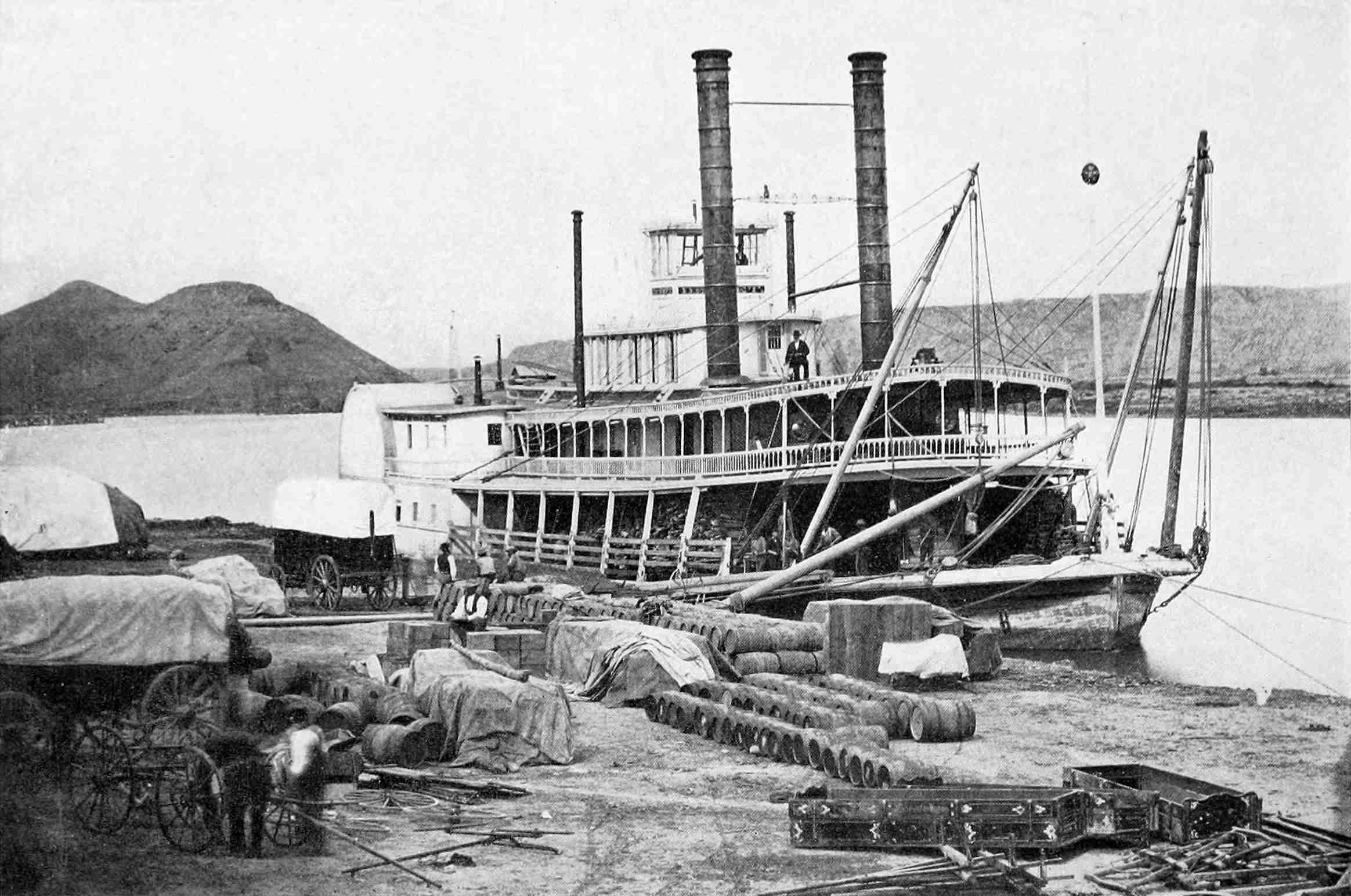
FORT BENTON LEVEE
AMERICAN FUR CO. LEAVES THE RIVER.
The American Fur Company, founders of Fort
Benton, continued to do business on the upper river
until 1864, when they sold out to the firm of Hawley,
Hubbell & Co., under the style of the Northwestern
Fur Company. The negotiations were concluded in
the winter of 1864–65, and the actual transfer accomplished
in the following season. In 1869 the Northwestern
Fur Company sold out all its interests below
Fort Union to Durfee & Peck, and in 1870 abandoned
all the trade above Fort Union.
CHAPTER XX. LINCOLN ON THE MISSOURI.
Having permanently left the service of the American
Fur Company, Captain La Barge spent the three
years, 1857–59, mainly on the lower river, not generally
going above Council Bluffs. In the summer of
1859 he built a fine new boat, one of the best that ever
went up the river. Pierre Chouteau, Jr., having heard
of his undertaking, sent to him and offered any assistance
that might be needed. The Company still cherished
a high appreciation of Captain La Barge’s
services and would gladly have taken him back into
their employ. The captain thanked Mr. Chouteau,
but never took advantage of his offer. When he had
finished his boat he named her the Emilie, for one of
his daughters. Soon after this he received a polite
note from Mr. Chouteau, telling him to order a complete
stand of colors for the boat and he would pay the
bill. The captain was much embarrassed, for he
knew that Mr. Chouteau had made the offer under the
impression that the boat had been named in honor of
his wife. When La Barge declined his generous
offer and explained why, Mr. Chouteau said: “That’s
all right. I am glad you have told me so frankly.
You did well to name the boat for your daughter.”
THE “EMILIE.”
The Emilie was one of the famous boats of the Missouri
River. She was 225 feet long, 32 feet beam,
with a hold 6 feet deep, and could easily carry 500
tons. She was a sidewheel boat, built on the most
approved lines, and an exceedingly beautiful craft.
Captain La Barge was designer, builder, owner, and
master, and set out on his first voyage with her
October 1, 1859, his forty-fourth birthday.
Before the boat was completed he entered into a contract
with the Hannibal and St. Joseph Railroad,
which had just reached the Missouri River at St. Joseph,
to run from that point up and down the river in
connection with the road. The Emilie was accordingly
taken at once up the river, and remained all the
fall in that section, going up as far as Fort Randall
once or twice.
LINCOLN AT COUNCIL BLUFFS.
LINCOLN’S SPEECH.
It was during the boating season of 1859 that Captain
La Barge first saw Abraham Lincoln. Among
the more obscure incidents in that great man’s career
were his visits to the Missouri River in the summer
and fall of this year. In August he visited Council
Bluffs, and in December several towns in Kansas.
The purpose of his first visit was not political, although
during his stay at the Bluffs he was induced to
make a political speech.43 He had evidently come out
to take a look at the great West, and possibly also to
make some investments in real estate. At any rate, in
November following he purchased from N. B. Judd
lot 3, block 1, of Riddle’s Subdivision of Council
Bluffs. In 1867 this property was conveyed back to
Mr. Judd by the Lincoln heirs. It is a very singular
fact that the adjoining lot 4 of this subdivision was
owned by Clement L. Vallandigham, Mr. Lincoln’s
greatest political enemy.
UNION PACIFIC.
General Grenville M. Dodge, who later became a
distinguished officer in the Civil War, was at this time
engaged in surveys for the proposed Union Pacific
railroad. He had just come in from the plains, and
Lincoln, hearing of the fact, sought him out and had
a long talk with him in regard to his surveys. His
great interest in the matter and his skill in drawing
out information soon gave him all that the young surveyor
knew. The latter thought no more of this at
the time than that possibly he had been giving away
secrets that belonged to his employers only. In 1863,
while in command of the district of Corinth, Miss., he
received a dispatch from General Grant directing him
to proceed to Washington and report to the President.
He was a good deal perturbed over the matter, for
he feared it might be something pertaining to his military
work that had not given satisfaction. When he
appeared before Mr. Lincoln he found that the President
wanted to consult with him in regard to the
eastern terminus of the proposed Pacific railroad,
which would soon have to be determined. Mr. Lincoln
had remembered the conversation in Council
Bluffs, and now sought assistance from the same
source from which he drew so freely on the former
occasion. The result was that Council Bluffs instead
of Omaha was fixed as the terminus, and that is why
the Union Pacific railroad begins just across the river
in Iowa, and not, as would have seemed natural, on
the west shore of the river.
LINCOLN IN KANSAS.
Late in the fall of 1859 Mr. Lincoln visited Kansas.
He arrived at St. Joseph December 1, via the new
Hannibal and St. Joseph railroad. He was met at
the station by D. D. Wilder and M. W. Delahay, who
escorted him at once to the ferry. Mr. Wilder was
a member of the reception committee, and had spent
several days in the office of Lincoln & Herndon the
previous summer. While waiting for the boat they
sat down on the bank, and Lincoln talked freely of
the recent exciting political events in Illinois. The
party then crossed to Kansas, the first stop being at
Elwood, where Lincoln spoke on the night of December
1. The next day he went to Troy, Kan.,
where he gave an address, and in the evening he made
a speech at Doniphan. The following day he went to
Atchison and spoke in the Methodist church. Lincoln’s
speeches on these occasions were essentially the
same as that delivered at a later date at Cooper Union,
New York. Lincoln seems to have gone to Leavenworth
on the 4th of December. He remained there
two or three days, delivering two speeches at Stockton’s
Hall and holding a public reception. His long
stay at this place was probably due to his having to
wait for the steamboat to take him back to St. Joseph.
He left Leavenworth on the 7th of December, accompanied
by Mr. Parrott, the Kansas delegate to Congress.
LINCOLN ON LA BARGE’S BOAT.
It was on the occasion of one of these visits to the
Missouri River that Captain La Barge met Mr. Lincoln.
It is understood that Mr. Lincoln made his
journey to Council Bluffs by boat, either from St.
Louis or St. Joseph, and returned home across the
State; and that on his Kansas visit he went back by
boat from Leavenworth to St. Joseph in December.
On one of these trips he traveled on Captain La
Barge’s boat. The Captain retained with great distinctness
his impressions of the appearance and
personal peculiarities of the distinguished passenger.
The tall and relatively slender build of Mr.
Lincoln, his high hat, sallow complexion, and not
very elegant costume, gave him a somewhat comical
appearance at first sight. He seemed to La Barge
rather quick in his movements, and apparently a good
walker. The captain noticed that he was scarcely
ever alone, there being always someone listening to
him. Although he made no speeches on his way up,
he had an audience all the time, and his agreeable
address, and interesting way of putting things, made
him a constant center of attraction.
LINCOLN’S ELECTION.
La Barge remembered that he frequently came into
the pilot-house, and asked many questions, particularly
about the fur trade and the Indians. He expressed
his desire to make a visit to the upper country. Before
he left the boat he asked La Barge if he would
not procure for him a fine buffalo robe and send it to
him, giving him to understand that he should of
course expect to pay him well for all expense he
might be put to. La Barge promised to do so. Lincoln
was not at this time much talked of for the
Presidency, and in Missouri was unpopular on account
of his attitude toward slavery.
* * * * *
THE NEGROES FREED.
Captain La Barge did not take his boat down the
river in the fall of 1859, because the ice cut him off.
She was laid up a little below Atchison. He himself
went to St. Louis, and in February returned with his
family. In the spring of 1860, when the ice was about
to break up, the citizens of Atchison offered to furnish
fuel for the boat if La Barge would attempt to cut
through the ice to St. Joseph. He undertook it, running
his boat up on the ice until her weight broke it
in, and in that way succeeded in getting through. The
captain remained in the service of the railroad all
summer, running to Kansas City and Omaha and
intermediate points. In the fall he started for St.
Louis, but was caught by the ice at Liberty, Mo., and
compelled to lay up his boat there. It was at this
point that he first heard of Lincoln’s election. When
John Baxter, keeper of Liberty Landing, came on
board with the news, La Barge said to him: “Up go
all your niggers.” “Oh, you don’t think that’ll make
any difference, do you?” “Up go all your niggers,”
replied La Barge; “they will all be set free.” “And
they were all set free,” remarked the captain in narrating
this dialogue, “and mine with the rest, for I
had some.”