The End of Cleopatra.
The case of Mark Antony affords one of the most extraordinary examples of
the power of unlawful love to lead its deluded and infatuated victim into
the very jaws of open and recognized destruction that history records.
Cases similar in character occur by thousands in common life; but
Antony’s, though perhaps not more striking in itself than a great
multitude of others have been, is the most conspicuous instance that has
ever been held up to the observation of mankind.
In early life, Antony was remarkable, as we have already seen, for a
certain savage ruggedness of character, and for a stern and indomitable
recklessness of will, so great that it seemed impossible that any thing
human should be able to tame him. He was under the control, too, of an
ambition so lofty and aspiring that it appeared to know no bounds; and yet
we find him taken possession of, in the very midst of his career, and in
the height of his prosperity and success, by a woman, and so subdued by
her arts and fascinations as to yield himself wholly to her guidance, and
allow himself to be led about by her entirely at her will. She displaces
whatever there might have been that was noble and generous in his heart,
and substitutes therefor her own principles of malice and cruelty. She
extinguishes all the fires of his ambition, originally so magnificent in
its aims that the world seemed hardly large enough to afford it scope, and
instead of this lofty passion, fills his soul with a love of the lowest,
vilest, and most ignoble pleasures. She leads him to betray every public
trust, to alienate from himself all the affections of his countrymen, to
repel most cruelly the kindness and devotedness of a beautiful and
faithful wife, and, finally, to expel this wife and all of his own
legitimate family from his house; and now, at last, she conducts him away
in a most cowardly and ignoble flight from the field of his duty as a
soldier—he knowing, all the time, that she is hurrying him to disgrace
and destruction, and yet utterly without power to break from the control
of his invisible chains.
The indignation which Antony’s base abandonment of his fleet and army at
the battle of Actium excited, over all that part of the empire which had
been under his command, was extreme. There was not the slightest possible
excuse for such a flight. His army, in which his greatest strength lay,
remained unharmed, and even his fleet was not defeated. The ships
continued the combat until night, notwithstanding the betrayal of their
cause by their commander. They were at length, however, subdued. The army,
also, being discouraged, and losing all motive for resistance, yielded
too. In a very short time the whole country went over to Octavius’s side.
In the mean time, Cleopatra and Antony, on their first return to Egypt,
were completely beside themselves with terror. Cleopatra formed a plan for
having all the treasures that she could save, and a certain number of
galleys sufficient for the transportation of these treasures and a small
company of friends, carried across the isthmus of Suez and launched upon
the Red Sea, in order that she might escape in that direction, and find
some remote hiding-place and safe retreat on the shores of Arabia or
India, beyond the reach of Octavius’s dreaded power. She actually
commenced this undertaking, and sent one or two of her galleys across the
isthmus; but the Arabs seized them as soon as they reached their place of
destination, and killed or captured the men that had them in charge, so
that this desperate scheme was soon abandoned. She and Antony then finally
concluded to establish themselves at Alexandria, and made preparation, as
well as they could, for defending themselves against Octavius there.
Antony, when the first effects of his panic subsided, began to grow mad
with vexation and resentment against all mankind. He determined that he
would have nothing to do with Cleopatra or with any of her friends, but
went off in a fit of sullen rage, and built a hermitage in a lonely place
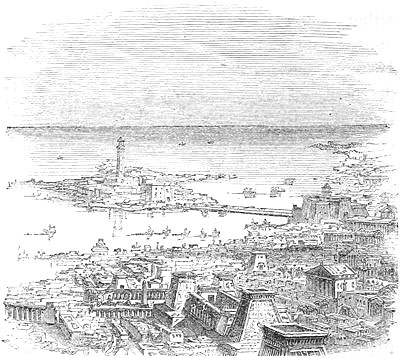
on the island of Pharos, where he lived for a time, cursing his folly and
his wretched fate, and uttering the bitterest invectives against all who
had been concerned in it. Here tidings came continually in, informing him
of the defection of one after another of his armies, of the fall of his
provinces in Greece and Asia Minor, and of the irresistible progress which
Octavius was now making toward universal dominion. The tidings of these
disasters coming incessantly upon him kept him in a continual fever of
resentment and rage.
At last he became tired of his misanthropic solitude, a sort of
reconciliation ensued between himself and Cleopatra, and he went back
again to the city. Here he joined himself once more to Cleopatra, and,
collecting together what remained of their joint resources, they plunged
again into a life of dissipation and vice, with the vain attempt to drown
in mirth and wine the bitter regrets and the anxious forebodings which
filled their souls. They joined with them a company of revelers as
abandoned as themselves, and strove very hard to disguise and conceal
their cares in their forced and unnatural gayety. They could not, however,
accomplish this purpose. Octavius was gradually advancing in his progress,
and they knew very well that the time of his dreadful reckoning with them
must soon come; nor was there any place on earth in which they could look
with any hope of finding a refuge in it from his vindictive hostility.
Cleopatra, warned by dreadful presentiments of what would probably at last
be her fate, amused herself in studying the nature of poisons—not
theoretically, but practically—making experiments with them on wretched
prisoners and captives whom she compelled to take them, in order that she
and Antony might see the effects which they produced. She made a
collection of all the poisons which she could procure, and administered
portions of them all, that she might see which were sudden and which were
slow in their effects, and also learn which produced the greatest distress
and suffering, and which, on the other hand, only benumbed and stupefied
the faculties, and thus extinguished life with the least infliction of
pain. These experiments were not confined to such vegetable and mineral
poisons as could be mingled with the food or administered in a potion.
Cleopatra took an equal interest in the effects of the bite of venomous
serpents and reptiles. She procured specimens of all these animals, and
tried them upon her prisoners, causing the men to be stung and bitten by
them, and then watching the effects. These investigations were made, not
directly with a view to any practical use which she was to make of the
knowledge thus acquired, but rather as an agreeable occupation, to divert
her mind, and to amuse Antony and her guests. The variety in the forms and
expressions which the agony of her poisoned victims assumed—their
writhings, their cries, their convulsions, and the distortions of their
features when struggling with death, furnished exactly the kind and
degree of excitement which she needed to occupy and amuse her mind.
Antony was not entirely at ease, however, during the progress of these
terrible experiments. His foolish and childish fondness for Cleopatra was
mingled with jealousy, suspicion, and distrust; and he was so afraid that
Cleopatra might secretly poison him, that he would never take any food or
wine without requiring that she should taste it before him. At length, one
day, Cleopatra caused the petals of some flowers to be poisoned, and then
had the flowers woven into the chaplet which Antony was to wear at supper.
In the midst of the feast, she pulled off the leaves of the flowers from
her own chaplet and put them playfully into her wine, and then proposed
that Antony should do the same with his chaplet, and that they should then
drink the wine, tinctured, as it would be, with the color and the perfume
of the flowers. Antony entered very readily into this proposal, and when
he was about to drink the wine, she arrested his hand, and told him that
it was poisoned. “You see now,” said she, “how vain it is for you to watch
against me. If it were possible for me to live without you, how easy it
would be for me to devise ways and means to kill you.” Then, to prove that
her words were true, she ordered one of the servants to drink Antony’s
wine. He did so, and died before their sight in dreadful agony.
The experiments which Cleopatra thus made on the nature and effects of
poison were not, however, wholly without practical result. Cleopatra
learned from them, it is said, that the bite of the asp was the easiest
and least painful mode of death. The effect of the venom of that animal
appeared to her to be the lulling of the sensorium into a lethargy or
stupor, which soon ended in death, without the intervention of pain. This
knowledge she seems to have laid up in her mind for future use.
The thoughts of Cleopatra appear, in fact, to have been much disposed, at
this time, to flow in gloomy channels, for she occupied herself a great
deal in building for herself a sepulchral monument in a certain sacred
portion of the city. This monument had, in fact, been commenced many years
ago, in accordance with a custom prevailing among Egyptian sovereigns, of
expending a portion of their revenues during their life-time in building
and decorating their own tombs. Cleopatra now turned her mind with new
interest to her own mausoleum. She finished it, provided it with the
strongest possible bolts and bars, and, in a word, seemed to be preparing
it in all respects for occupation.
In the mean time, Octavius, having made himself master of all the
countries which had formerly been under Antony’s sway, now advanced,
meeting none to oppose him, from Asia Minor into Syria, and from Syria
toward Egypt. Antony and Cleopatra made one attempt, while he was thus
advancing toward Alexandria, to avert the storm which was impending over
them, by sending an embassage to ask for some terms of peace. Antony
proposed, in this embassage, to give up every thing to his conqueror on
condition that he might be permitted to retire unmolested with Cleopatra
to Athens, and allowed to spend the remainder of their days there in
peace; and that the kingdom of Egypt might descend to their children.
Octavius replied that he could not make any terms with Antony, though he
was willing to consent to any thing that was reasonable in behalf of
Cleopatra. The messenger who came back from Octavius with this reply spent
some time in private interviews with Cleopatra. This aroused Antony’s
jealousy and anger. He accordingly ordered the unfortunate messenger to
be scourged and then sent back to Octavius, all lacerated with wounds,
with orders to say to Octavius that if it displeased him to have one of
his servants thus punished, he might revenge himself by scourging a
servant of Antony’s, who was then, as it happened, in Octavius’s power.
The news at length suddenly arrived at Alexandria that Octavius had
appeared before Pelusium, and that the city had fallen into his hands. The
next thing Antony and Cleopatra well knew would be, that they should see
him at the gates of Alexandria. Neither Antony nor Cleopatra had any means
of resisting his progress, and there was no place to which they could fly.
Nothing was to be done but to await, in consternation and terror, the sure
and inevitable doom which was now so near.
Cleopatra gathered together all her treasures and sent them to her tomb.
These treasures consisted of great and valuable stores of gold, silver,
precious stones, garments of the highest cost, and weapons, and vessels of
exquisite workmanship and great value, the hereditary possessions of the
Egyptian kings. She also sent to the mausoleum an immense quantity of
flax, tow, torches, and other combustibles. These she stored in the lower
apartments of the monument, with the desperate determination of burning
herself and her treasures together rather than to fall into the hands of
the Romans.
In the mean time, the army of Octavius steadily continued its march across
the desert from Pelusium to Alexandria. On the way, Octavius learned,
through the agents in communication with him from within the city, what
were the arrangements which Cleopatra had made for the destruction of her
treasure whenever the danger should become imminent of its falling into
his hands. He was extremely unwilling that this treasure should be lost.
Besides its intrinsic value, it was an object of immense importance to him
to get possession of it for the purpose of carrying it to Rome as a trophy
of his triumph. He accordingly sent secret messengers to Cleopatra,
endeavoring to separate her from Antony, and to amuse her mind with the
profession that he felt only friendship for her, and did not mean to do
her any injury, being in pursuit of Antony only. These negotiations were
continued from day to day while Octavius was advancing. At last the Roman
army reached Alexandria, and invested it on every side.
As soon as Octavius was established in his camp under the walls of the
city, Antony planned a sally, and he executed it, in fact, with
considerable energy and success. He issued suddenly from the gates, at the
head of as strong a force as he could command, and attacked a body of
Octavius’s horsemen. He succeeded in driving these horsemen away from
their position, but he was soon driven back in his turn, and compelled to
retreat to the city, fighting as he fled, to beat back his pursuers. He
was extremely elated at the success of this skirmish. He came to Cleopatra
with a countenance full of animation and pleasure, took her in his arms
and kissed her, all accoutered for battle as he was, and boasted greatly
of the exploit which he had performed. He praised, too, in the highest
terms, the valor of one of the officers who had gone out with him to the
fight, and whom he had now brought to the palace to present to Cleopatra.
Cleopatra rewarded the faithful captain’s prowess with a magnificent suit
of armor made of gold. Notwithstanding this reward, however, the man
deserted Antony that very night, and went over to the enemy. Almost all of
Antony’s adherents were in the same state of mind. They would have gladly
gone over to the camp of Octavius, if they could have found an opportunity
to do so.
In fact, when the final battle was fought, the fate of it was decided by a
grand defection in the fleet, which went over in a body to the side of
Octavius. Antony was planning the operations of the day, and
reconnoitering the movements of the enemy from an eminence which he
occupied at the head of a body of foot soldiers—all the land forces that
now remained to him—and looking off from the eminence on which he stood
toward the harbor, he observed a movement among the galleys. They were
going out to meet the ships of Octavius, which were lying at anchor not
very far from them. Antony supposed that his vessels were going to attack
those of the enemy, and he looked to see what exploits they would perform.
They advanced toward Octavius’s ships, and when they met them, Antony
observed, to his utter amazement, that, instead of the furious combat that
he had expected to see, the ships only exchanged friendly salutations, by
the use of the customary naval signals; and then his ships, passing
quietly round, took their positions in the lines of the other fleet. The
two fleets had thus become merged and mingled into one.
Antony immediately decided that this was Cleopatra’s treason. She had made
peace with Octavius, he thought, and surrendered the fleet to him as one
of the conditions of it. Antony ran through the city, crying out that he
was betrayed, and in a phrensy of rage sought the palace. Cleopatra fled
to her tomb. She took in with her one or two attendants, and bolted and
barred the doors, securing the fastenings with the heavy catches and
springs that she had previously made ready. She then directed her women to
call out through the door that she had killed herself within the tomb.
The tidings of her death were borne to Antony. It changed his anger to
grief and despair. His mind, in fact, was now wholly lost to all balance
and control, and it passed from the dominion of one stormy passion to
another with the most capricious facility. He cried out with the most
bitter expressions of sorrow, mourning, he said, not so much Cleopatra’s
death, for he should soon follow and join her, as the fact that she had
proved herself so superior to him in courage at last, in having thus
anticipated him in the work of self-destruction.
He was at this time in one of the chambers of the palace, whither he had
fled in his despair, and was standing by a fire, for the morning was
cold. He had a favorite servant named Eros, whom he greatly trusted, and
whom he had made to take an oath long before, that whenever it should
become necessary for him to die, Eros should kill him. This Eros he now
called to him, and telling him that the time was come, ordered him to take
the sword and strike the blow.
Eros took the sword while Antony stood up before him. Eros turned his head
aside as if wishing that his eyes should not see the deed which his hands
were about to perform. Instead, however, of piercing his master with it,
he plunged it into his own breast, fell down at Antony’s feet, and died.
Antony gazed a moment at the shocking spectacle, and then said, “I thank
thee for this, noble Eros. Thou hast set me an example. I must do for
myself what thou couldst not do for me.” So saying, he took the sword from
his servant’s hands, plunged it into his body, and staggering to a little
bed that was near, fell over upon it in a swoon. He had received a mortal
wound.
The pressure, however, which was produced by the position in which he lay
upon the bed, stanched the wound a little and stopped the flow of blood.
Antony came presently to himself again, and then began to beg and implore
those around him to take the sword and put him out of his misery. But no
one would do it. He lay for a time suffering great pain, and moaning
incessantly, until, at length, an officer came into the apartment and told
him that the story which he had heard of Cleopatra’s death was not true;
that she was still alive, shut up in her monument, and that she desired to
see him there. This intelligence was the source of new excitement and
agitation. Antony implored the by-standers to carry him to Cleopatra, that
he might see her once more before he died. They shrank from the attempt;
but, after some hesitation and delay, they concluded to undertake to
remove him. So, taking him in their arms, they bore him along, faint and
dying, and marking their track with his blood, toward the tomb.
Cleopatra would not open the gates to let the party in. The city was all
in uproar and confusion through the terror of the assault which Octavius
was making upon it, and she did not know what treachery might be intended.
She therefore went up to a window above, and letting down ropes and
chains, she directed those below to fasten the dying body to them, that
she and the two women with her might draw it up. This was done. Those who
witnessed it said that it was a most piteous sight to behold—Cleopatra
and her women above exhausting their strength in drawing the wounded and
bleeding sufferer up the wall, while he, when he approached the window,
feebly raised his arms to them, that they might lift him in. The women had
hardly strength sufficient to draw the body up. At one time it seemed that
the attempt would have to be abandoned; but Cleopatra reached down from
the window as far as she could to get hold of Antony’s arms, and thus, by
dint of great effort, they succeeded at last in taking him in. They bore
him to a couch which was in the upper room from which the window opened,
and laid him down, while Cleopatra wrung her hands, and tore her hair, and
uttered the most piercing lamentations and cries. She leaned over the
dying Antony, crying out incessantly with the most piteous exclamations of
grief. She bathed his face, which was covered with blood, and vainly
endeavored to stanch his wound.
Antony urged her to be calm, and not to mourn his fate. He asked for some
wine. They brought it to him, and he drank it. He then entreated
Cleopatra to save her life, if she possibly could do so, and to make some
terms or other with Octavius, so as to continue to live. Very soon after
this he expired.
The raising of Antony to the upper Window of the Tomb
In the mean time, Octavius had heard of the mortal wound which Antony had
given himself; for one of the by-standers had seized the sword the moment
that the deed was done, and had hastened to carry it to Octavius, and to
announce to him the death of his enemy. Octavius immediately desired to
get Cleopatra into his power. He sent a messenger, therefore, to the tomb,
who attempted to open a parley there with her. Cleopatra talked with the
messenger through the keyholes or crevices, but could not be induced to
open the door. The messenger reported these facts to Octavius. Octavius
then sent another man with the messenger, and while one was engaging the
attention of Cleopatra and her women at the door below, the other obtained
ladders, and succeeded in gaining admission into the window above.
Cleopatra was warned of the success of this stratagem by the shriek of her
woman, who saw the officer coming down the stairs. She looked around, and
observing at a glance that she was betrayed, and that the officer was
coming to seize her, she drew a little dagger from her robe, and was
about to plunge it into her breast, when the officer grasped her arm just
in time to prevent the blow. He took the dagger from her, and then
examined her clothes to see that there were no other secret weapons
concealed there.
The capture of the queen being reported to Octavius, he appointed an
officer to take her into close custody. This officer was charged to treat
her with all possible courtesy, but to keep a close and constant watch
over her, and particularly to guard against allowing her any possible
means or opportunity for self-destruction.
In the mean time, Octavius took formal possession of the city, marching in
at the head of his troops with the most imposing pomp and parade. A chair
of state, magnificently decorated, was set up for him on a high elevation
in a public square; and here he sat, with circles of guards around him,
while the people of the city, assembled before him in the dress of
suppliants, and kneeling upon the pavement, begged his forgiveness, and
implored him to spare the city. These petitions the great conqueror
graciously condescended to grant.
Many of the princes and generals who had served under Antony came next to
beg the body of their commander, that they might give it an honorable
burial. These requests, however, Octavius would not accede to, saying that
he could not take the body away from Cleopatra. He, however, gave
Cleopatra leave to make such arrangements for the obsequies as she thought
fit, and allowed her to appropriate such sums of money from her treasures
for this purpose as she desired. Cleopatra accordingly made the necessary
arrangements, and superintended the execution of them; not, however, with
any degree of calmness and composure, but in a state, on the contrary, of
extreme agitation and distress. In fact, she had been living now so long
under the unlimited and unrestrained dominion of caprice and passion, that
reason was pretty effectually dethroned, and all self-control was gone.
She was now nearly forty years of age, and, though traces of her
inexpressible beauty remained, her bloom was faded, and her countenance
was wan with the effects of weeping, anxiety, and despair. She was, in a
word, both in body and mind, only the wreck and ruin of what she once had
been.
When the burial ceremonies were performed, and she found that all was
over—that Antony was forever gone, and she herself hopelessly and
irremediably ruined—she gave herself up to a perfect phrensy of grief.
She beat her breast, and scratched and tore her flesh so dreadfully, in
the vain efforts which she made to kill herself, in the paroxysms of her
despair, that she was soon covered with contusions and wounds, which,
becoming inflamed and swelled, made her a shocking spectacle to see, and
threw her into a fever. She then conceived the idea of pretending to be
more sick than she was, and so refusing food and starving herself to
death. She attempted to execute this design. She rejected every medical
remedy that was offered her, and would not eat, and lived thus some days
without food. Octavius, to whom every thing relating to his captive was
minutely reported by her attendants, suspected her design. He was very
unwilling that she should die, having set his heart on exhibiting her to
the Roman people, on his return to the capital, in his triumphal
procession. He accordingly sent her orders, requiring that she should
submit to the treatment prescribed by the physician, and take her food,
enforcing these his commands with a certain threat which he imagined might
have some influence over her. And what threat does the reader imagine
could possibly be devised to reach a mind so sunk, so desperate, so
wretched as hers? Every thing seemed already lost but life, and life was
only an insupportable burden. What interests, then, had she still
remaining upon which a threat could take hold?
Octavius, in looking for some avenue by which he could reach her,
reflected that she was a mother. Cæsarion, the son of Julius Cæsar, and
Alexander, Cleopatra, and Ptolemy, Antony’s children, were still alive.
Octavius imagined that in the secret recesses of her wrecked and ruined
soul there might be some lingering principle of maternal affection
remaining which he could goad into life and action. He accordingly sent
word to her that, if she did not yield to the physician and take her food,
he would kill every one of her children.
The threat produced its effect. The crazed and frantic patient became
calm. She received her food. She submitted to the physician. Under his
treatment her wounds began to heal, the fever was allayed, and at length
she appeared to be gradually recovering.
When Octavius learned that Cleopatra had become composed, and seemed to be
in some sense convalescent, he resolved to pay her a visit. As he entered
the room where she was confined, which seems to have been still the upper
chamber of her tomb, he found her lying on a low and miserable bed, in a
most wretched condition, and exhibiting such a spectacle of disease and
wretchedness that he was shocked at beholding her. She appeared, in fact,
almost wholly bereft of reason. When Octavius came in, she suddenly leaped
out of the bed, half naked as she was, and covered with bruises and
wounds, and crawled miserably along to her conqueror’s feet in the
attitude of a suppliant. Her hair was torn from her head, her limbs were
swollen and disfigured, and great bandages appeared here and there,
indicating that there were still worse injuries than these concealed. From
the midst of all this squalidness and misery there still beamed from her
sunken eyes a great portion of their former beauty, and her voice still
possessed the same inexpressible charm that had characterized it so
strongly in the days of her prime. Octavius made her go back to her bed
again and lie down.
Cleopatra then began to talk and excuse herself for what she had done,
attributing all the blame of her conduct to Antony. Octavius, however,
interrupted her, and defended Antony from her criminations, saying to her
that it was not his fault so much as hers. She then suddenly changed her
tone, and acknowledging her sins, piteously implored mercy. She begged
Octavius to pardon and spare her, as if now she were afraid of death and
dreaded it, instead of desiring it as a boon. In a word, her mind, the
victim and the prey alternately of the most dissimilar and inconsistent
passions, was now overcome by fear. To propitiate Octavius, she brought
out a list of all her private treasures, and delivered it to him as a
complete inventory of all that she had. One of her treasurers, however,
named Zeleucus, who was standing by, said to Octavius that that list was
not complete. Cleopatra had, he alleged, reserved several things of great
value, which she had not put down upon it.
This assertion, thus suddenly exposing her duplicity, threw Cleopatra into
a violent rage. She sprang from her bed and assaulted her secretary in a
most furious manner. Octavius and the others who were there interposed,
and compelled Cleopatra to lie down again, which she did, uttering all the
time the most grievous complaints at the wretched degradation to which she
was reduced, to be insulted thus by her own servants at such a time. If
she had reserved any thing, she said, of her private treasures, it was
only for presents to some of her faithful friends, to induce them the more
zealously to intercede with Octavius in her behalf. Octavius replied by
urging her to feel no concern on the subject whatever. He freely gave her,
he said, all that she had reserved, and he promised in other respects to
treat her in the most honorable and courteous manner.
Octavius was much pleased at the result of this interview. It was obvious,
as it appeared to him, that Cleopatra had ceased to desire to die; that
she now, on the contrary, wished to live, and that he should accordingly
succeed in his desire of taking her with him to grace his triumph at Rome.
He accordingly made his arrangements for departure, and Cleopatra was
notified that in three days she was to set out, together with her
children, to go into Syria. Octavius said Syria, as he did not wish to
alarm Cleopatra by speaking of Rome. She, however, understood well where
the journey, if once commenced, would necessarily end, and she was fully
determined in her own mind that she would never go there.
She asked to be allowed to pay one parting visit to Antony’s tomb. This
request was granted; and she went to the tomb with a few attendants,
carrying with her chaplets and garlands of flowers. At the tomb her grief
broke forth anew, and was as violent as ever. She bewailed her lover’s
death with loud cries and lamentations, uttered while she was placing the
garlands upon the tomb, and offering the oblations and incense, which were
customary in those days, as expressions of grief. “These,” said she, as
she made the offerings, “are the last tributes of affection that I can
ever pay thee, my dearest, dearest lord. I can not join thee, for I am a
captive and a prisoner, and they will not let me die. They watch me every
hour, and are going to bear me far away, to exhibit me to thine enemies,
as a badge and trophy of their triumph over thee. Oh intercede, dearest
Antony, with the gods where thou art now, since those that reign here on
earth have utterly forsaken me; implore them to save me from this fate,
and let me die here in my native land, and be buried by thy side in this
tomb.”
When Cleopatra returned to her apartment again after this melancholy
ceremony, she seemed to be more composed than she had been before. She
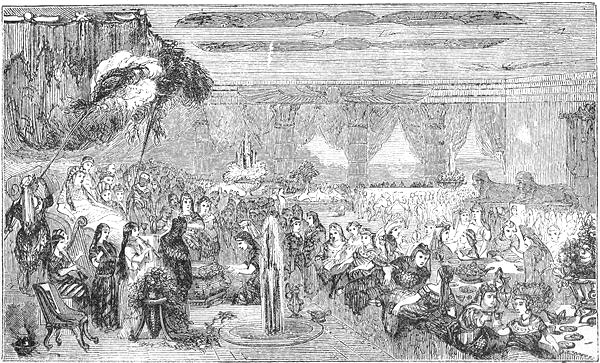
went to the bath, and then she attired herself handsomely for supper. She
had ordered supper that night to be very sumptuously served. She was at
liberty to make these arrangements, for the restrictions upon her
movements, which had been imposed at first, were now removed, her
appearance and demeanor having been for some time such as to lead Octavius
to suppose that there was no longer any danger that she would attempt
self-destruction. Her entertainment was arranged, therefore, according to
her directions, in a manner corresponding with the customs of her court
when she had been a queen. She had many attendants, and among them were
two of her own women. These women were long-tried and faithful servants
and friends.
While she was at supper, a man came to the door with a basket, and wished
to enter. The guards asked him what he had in his basket. He opened it to
let them see; and, lifting up some green leaves which were laid over the
top, he showed the soldiers that the basket was filled with figs. He said
that they were for Cleopatra’s supper. The soldiers admired the appearance
of the figs, saying that they were very fine and beautiful. The man asked
the soldiers to take some of them. This they declined, but allowed the man
to pass in. When the supper was ended, Cleopatra sent all of her
attendants away except the two women. They remained. After a little time,
one of these women came out with a letter for Octavius, which Cleopatra
had written, and which she wished to have immediately delivered. One of
the soldiers from the guard stationed at the gates was accordingly
dispatched to carry the letter. Octavius, when it was given to him, opened
the envelope at once and read the letter, which was written, as was
customary in those days, on a small tablet of metal. He found that it was
a brief but urgent petition from Cleopatra, written evidently in agitation
and excitement, praying that he would overlook her offense, and allow her
to be buried with Antony. Octavius immediately inferred that she had
destroyed herself. He sent off some messengers at once, with orders to go
directly to her place of confinement and ascertain the truth, intending to
follow them himself immediately.
The messengers, on their arrival at the gates, found the sentinels and
soldiers quietly on guard before the door, as if all were well. On
entering Cleopatra’s room, however, they beheld a shocking spectacle.
Cleopatra was lying dead upon a couch. One of her women was upon the
floor, dead too. The other, whose name was Charmion, was sitting over the
body of her mistress, fondly caressing her, arranging flowers in her hair,
and adorning her diadem. The messengers of Octavius, on witnessing this
spectacle, were overcome with amazement, and demanded of Charmion what it
could mean. “It is all right,” said Charmion. “Cleopatra has acted in a
manner worthy of a princess descended from so noble a line of kings.” As
Charmion said this, she began to sink herself, fainting, upon the bed, and
almost immediately expired.
The by-standers were not only shocked at the spectacle which was thus
presented before them, but they were perplexed and confounded in their
attempts to discover by what means Cleopatra and her women had succeeded
in effecting their design. They examined the bodies, but no marks of
violence were to be discovered. They looked all around the room, but no
weapons, and no indication of any means of poison, were to be found. They
discovered something that appeared like the slimy track of an animal on
the wall, toward a window, which they thought might have been produced by
an asp; but the animal itself was nowhere to be seen. They examined the
body with great care, but no marks of any bite or sting were to be found,
except that there were two very slight and scarcely-discernible punctures
on the arm, which some persons fancied might have been so caused. The
means and manner of her death seemed to be involved in impenetrable
mystery.
There were various rumors on the subject subsequently in circulation both
at Alexandria and at Rome, though the mystery was never fully solved. Some
said that there was an asp concealed among the figs which the servant man
brought in in the basket; that he brought it in that manner, by a
preconcerted arrangement between him and Cleopatra, and that, when she
received it, she placed the animal on her arm. Others say that she had a
small steel instrument like a needle, with a poisoned point, which she had
kept concealed in her hair, and that she killed herself with that, without
producing any visible wound. Another story was, that she had an asp in a
box somewhere in her apartment, which she had reserved for this occasion,
and when the time finally came, that she pricked and teased it with a
golden bodkin to make it angry, and then placed it upon her flesh and
received its sting. Which of these stories, if either of them, were true,
could never be known. It has, however, been generally believed among
mankind that Cleopatra died in some way or other by the self-inflicted
sting of the asp, and paintings and sculptures without number have been
made to illustrate and commemorate the scene.
This supposition in respect to the mode of her death is, in fact,
confirmed by the action of Octavius himself on his return to Rome, which
furnishes a strong indication of his opinion of the manner in which his
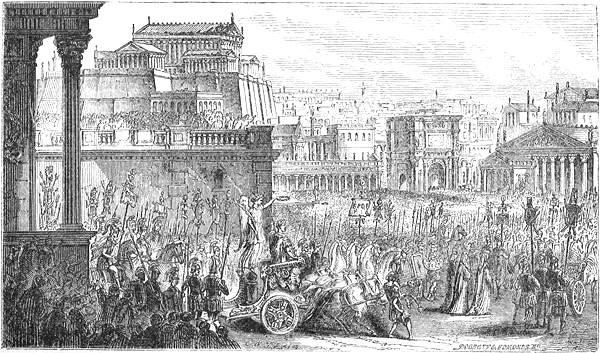
captive at last eluded him. Disappointed in not being able to exhibit the
queen herself in his triumphal train, he caused a golden statue
representing her to be made, with an image of an asp upon the arm of it,
and this sculpture he caused to be borne conspicuously before him in his
grand triumphal entry into the capital, as the token and trophy of the
final downfall of the unhappy Egyptian queen.
Footnotes:
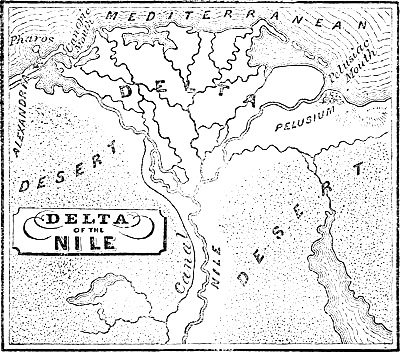
[1] See Map of the Delta of the Nile, page 29; also the View of
Alexandria, page 162.
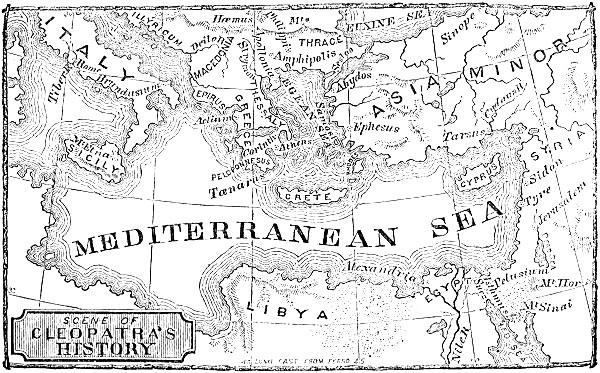
[2] See map; frontispiece.
[3] It will be sufficiently accurate for the general reader of history to
consider the Greek talent, referred to in such transactions as these, as
equal in English money to two hundred and fifty pounds, in American to a
thousand dollars. It is curious to observe that, large as the total was
that was paid for the liberation of these slaves, the amount paid for each
individual was, after all, only a sum equal to about five dollars.
[4] For an account of one of these disasters, with an engraving
illustrative of the scene, see the History of Cyrus.
[5] For the position of this island in respect to Egypt and the
neighboring countries, see map, frontispiece.
[6] This Octavius, on his subsequent elevation to imperial power, received
the name of Augustus Cæsar, and it is by this name that he is generally
known in history. He was, however, called Octavius at the commencement of
his career, and, to avoid confusion, we shall continue to designate him by
this name to the end of our narrative.
[7] See map, at the frontispiece.
[8] Pearls, being of the nature of shell in their composition and
structure, are soluble in certain acids.
[9] See map for the situation of Ephesus and of Samos.
[10] These letters, in accordance with the scale of expense and
extravagance on which Cleopatra determined that every thing relating to
herself and Antony should be done, were engraved on tablets made of onyx,
or crystal, or other hard and precious stones.