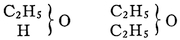
The suggestions of Couper and Kekulé that
an explanation of the properties of chemical
compounds should be sought in the nature
and mutual affinities of their constituent elements
rather than of their radicals were not
wholly accepted at the time they were first made.
Speculative ideas have to justify themselves by
facts. The value of an hypothesis depends upon
its usefulness and expediency, and on its power
of indicating the lines of future inquiry. How
far it is inductively sound and deductively
useful is a matter for individual judgment.
Consequently the tendency to pass from purely
rational and constitutional formulæ to formulæ
which sought to symbolise the inner structure—the
very skeleton, as it were—of a molecule,
was resisted for a time, and by no one more
strongly than by Kolbe.
Kolbe’s attitude to the new doctrine may be
said to have had its justification in his own
work. His remarkable prediction, based on
considerations which had nothing in common
with Kekulé’s doctrine, of the existence of the
secondary and tertiary alcohols, so soon to be
confirmed by Friedel’s discovery of secondary
propyl alcohol, and by Butlerow’s isolation of
tertiary butyl alcohol, served to retard the
general adoption of Kekulé’s views by showing
that apparently they were no more fruitful in
suggestiveness than those they were intended
to supplant. But it was exactly in their suggestiveness
with regard to the development of
isomerism that structural formulæ based upon
valency were gradually found to be most useful.
It was perceived that it was now possible
not only to foretell the existence of isomers,
but to determine their number, and to some
extent to forecast their properties and modes
of decomposition. Cayley, for example, calculated
the number of possible isomers of
the hydrocarbons of the generic formula
CnH2n+2 up to C6H14 all those that
theory predicted have been discovered. In no
single case have more been obtained than the
number indicated by theory. The accumulated
weight of this and similar testimony ultimately
established the doctrine of chemical structure
on a firm basis.
This conception received a great extension as
the result of Kekulé’s application of his ideas
to the explanation of the chemical constitution
of the group of substances of vegetable origin—consisting
of essential oils, balsams, resins, and
their products, which, on account of their
characteristic odours, were collectively known
to the older chemists as the aromatic compounds.
Some of these, like oil of bitter almonds, gum
benzoin, coumarin, oil of wintergreen, oil of
anise, oil of cinnamon, oil of cumin, balsam of
tolu, phenol, and certain of their derivatives,
such as benzene, aniline, salicylic acid, cinnamic
acid, toluene, cymene, had already been investigated
with important theoretical results; but
as a class they had received far less attention
than the derivatives of the great group of homologous
radicals of which methyl is the initial
member. Of course it was part of the doctrine
of Liebig—the discoverer of benzoyl—that the
aromatic compounds also contained specific
radicals; but the relation of these compounds to
those we now call aliphatic (fatty) compounds
was not understood, although certain analogies
were recognised.
In 1866 Kekulé drew attention to the following
significant peculiarities of the aromatic compounds:
(1) All aromatic compounds, even the
simplest, are comparatively richer in carbon
than the corresponding class of fatty (aliphatic)
compounds; (2) among the aromatic substances,
as among fatty compounds, numerous homologous
compounds exist; (3) the simplest aromatic
substances contain at least six atoms of carbon;
(4) all decomposition products of aromatic
substances show a certain family resemblance;
the main product of the decomposition contains
at least six atoms of carbon—e.g., benzene
C6H6, phenol C6H6O, etc., which would seem
to indicate that all aromatic substances contain
a nucleus or atomic grouping containing six
carbon atoms. Within this nucleus the carbon
atoms are in closer connection or denser combination,
from which it follows that all aromatic
compounds are comparatively rich in carbon.
More carbon atoms can then be added to this
nucleus according to the same laws that govern
the fatty compounds. In this way the existence
of homologous compounds may be explained.
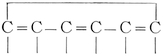
On the assumption that carbon is tetravalent
and that its valency is constant, Kekulé showed
how, by linking together six carbon atoms by
alternate single and double bonds, six affinity
units may be left free. If we assume that six
carbon atoms are attached to one another
according to this law of symmetry, we obtain a
group which, regarded as an open chain, contains
eight unsaturated units of affinity:
By making the further assumption that the two
carbon atoms at the ends of the chain are linked
together by one unit of affinity each, a closed
chain (a symmetrical ring) is obtained which
now contains six unsaturated units of affinity:
From this closed chain all the substances usually
designated as “aromatic compounds” are derived.
In these a common nucleus may be
assumed: it is the closed chain C6A6, where A
denotes an unsaturated affinity. The six affinities
of this nucleus may be satisfied by six
monovalent elements. They may also, wholly
or in part, be satisfied by one affinity of polyvalent
elements, the latter necessarily bringing
with them other atoms into the compound, thus
producing one or more side chains, which in their
turn may be lengthened by the addition of other
atoms.
If each of the free units is satisfied by an atom
of hydrogen, we obtain benzene, which, as
Kekulé demonstrated, becomes the centre
round which the great group of aromatic compounds
might be said to revolve. Benzene
was discovered by Faraday in 1825 among the
volatile liquids condensed from the oil-gas
made by the Portable Gas Company. It had
already played a notable part in the development
of chemical theory in connection with the
discovery of isomerism. It was now to play a
far more important rôle: to become, in fact, the
progenitor of a great family of substances, not
only of theoretical value, but of great economic
importance.
The limits of this work preclude any attempt
to trace in detail the development of the conception
with which Kekulé enriched science,
or to dilate upon the great extension of benzenoid
or cyclic chemistry which has resulted from it
during the past forty years. It has been said
that Kekulé’s memoir on the benzene theory is
the most brilliant piece of scientific prediction
to be found in the whole range of organic chemistry.
Of course, on its promulgation it had to
run the gauntlet of criticism; and an army
of eager, active workers was soon engaged in
testing its sufficiency and in developing the rich
province which it first made known. As the
facts multiplied, other statical formulæ were
suggested by Dewar, Ladenburg, and Claus,
but they have not proved more adequate to
explain the facts as these have become better
understood. Observations which seemed to
contradict Kekulé’s theory, or which seemed
to be imperfectly explained by it, have, in
the light of fuller knowledge, been shown to be in
harmony with it; and such additional proofs
of agreement have thereby served to strengthen
its position. Its capacity for development is,
indeed, as in the case of every other hypothesis
of the first rank, one of its cardinal qualities.
It adequately explains the constitution of great
numbers of derivatives whose analogies and
relations, apart from it, would have remained
obscure and in many cases unintelligible. The
symmetrical distribution of the carbon and
hydrogen atoms in the benzene molecule, assumed
by Kekulé on indirect grounds, has been
established by the independent investigations
of Ladenburg and others, and its ring structure
has been demonstrated by Baeyer and Perkin.
Purely physical evidence, based upon its thermo-chemical
and optical characters can be adduced
in its support. Determinations of the molecular
volume and magnetic rotation of its compounds
further serve to substantiate it.
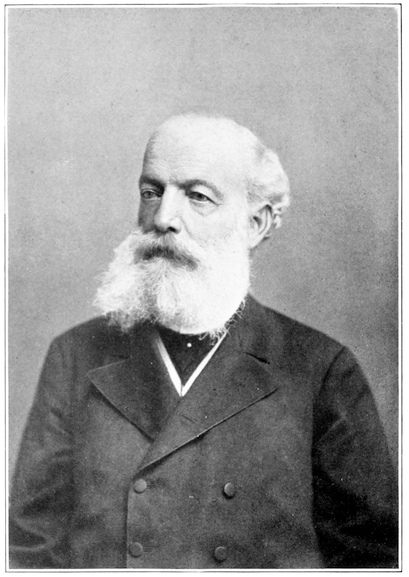
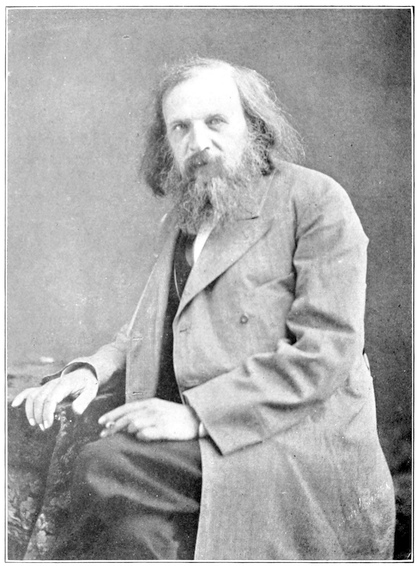
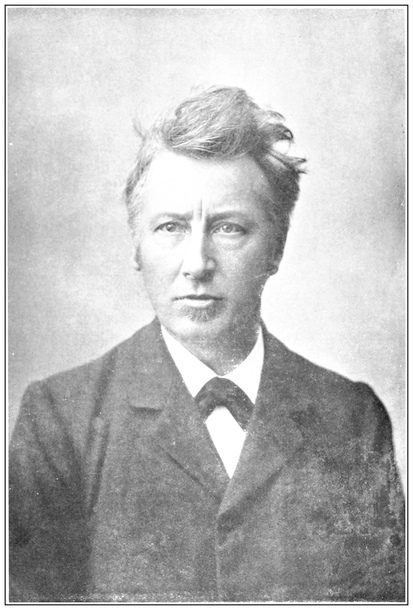
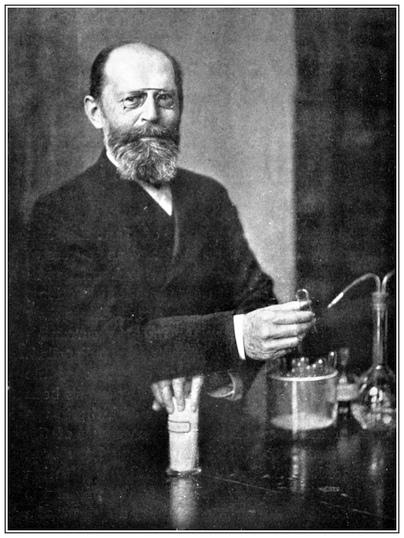
August Kekulé von Stradonitz.
Friedrich August Kekulé was born at Darmstadt
on September 7, 1829. After passing
through the gymnasium of his native town, he
entered, in 1847, the University of Giessen,
with the intention of becoming an architect.
Attracted by Liebig’s teaching, he turned to
chemistry, and worked with Will on amyl sulphuric
acid and its salts. In 1851 he went to
Paris, heard Dumas’s lectures, and formed a
friendship with Gerhardt, whose Traité de
Chimie Organique largely moulded his views.
He became an assistant to Von Planta, occupying
himself with the chemistry of the alkaloids.
Subsequently he came to London,
worked under Stenhouse, and made the acquaintance
of Williamson, then in the full
vigour of his scientific activity. Here he discovered
thioacetic acid. It was at this time,
also, that his ideas with regard to structural
chemistry began to take shape. Returning to
Germany, he attached himself to the University
of Heidelberg as a privat-docent, and had for a
pupil Baeyer, who took up the study of the
organo-arsenic compounds. In 1858 he published
his memorable paper “On the Constitution
and Metamorphoses of Chemical Compounds and
on the Chemical Nature of Carbon,” in which he
developed his views on the linking of atoms, out
of which has grown our system of constitutional
formulæ. The immediate result of this celebrated
memoir was a call to the chemical chair
of the University of Ghent, where Kekulé had
among other students Baeyer, Hübner, Körner,
Ladenburg, Linnemann, and Dewar. Here he
remained nine years, and here he published his
classical Lehrbuch der Organischen Chemie.
The years he spent in Ghent were the most
productive time of his career, and it was there
that he developed his benzene theory—a conception
as fruitful as that of his doctrine of atom-linking.
In 1867 Kekulé was called to Bonn to
take charge of the newly erected laboratory
which Hofmann had designed. Although he
continued to work, mostly in collaboration with
his pupils, among whom may be named Anschütz,
Bernthsen, Thorpe, Carnelley, Claisen, Dittmar,
Franchimont, Van ’t Hoff, Japp, Schultz,
Wallach, and Zincke, his health after 1876
began to fail. He died on July 13, 1896.
* * * * *
Of course no statical formula can be the ultimate
representation of the constitution of benzene.
However convenient and suggestive such
a formula may be, it can be only a transitional
phase in its complete chemical and physical
history. Kekulé was early conscious of this
fact, and suggested a dynamical hypothesis
based upon a mechanical conception of valency.
This he imagined might represent the number
of contacts with other atoms which a vibrating
atom experienced in the unit of time. Two
atoms of tetravalent carbon, each linked by one
combining unit, will experience four oscillations,
striking each other and three other atoms in
the unit of time, while the monovalent hydrogen
atom makes only one oscillation. The doubly
linked carbon will collide with its neighbouring
atom twice, and also with two other atoms
within the same period. The assumption that
the carbon atom has a more rapid motion than
the hydrogen atom is, however, not warranted
by the kinetic theory. Other dynamic formulæ
have been proposed by Knorr and by Collie.
Collie and Baly have further suggested that
the absorption bands of benzene observed in the
ultra violet of its spectrum point to synchronous
oscillations of its molecule, due to dynamic
changes in the making and breaking of the links
between the several pairs of the carbon atoms,
setting up vibrations in the benzene ring comparable
with those of an elastic ring in the act
of expanding and contracting.
* * * * *
The large group of the essential oils, containing
hydrocarbons similar to oil of turpentine, and
classed under the generic term of terpenes,
might, from their origin and mode of occurrence,
be expected to be allied in constitution to the
aromatic compounds; and such is found to be
the case. The terpenes are isomeric hydrocarbons
of the formula C10H16. They are found
sometimes singly, at other times mixed, in a
great variety of plants, associated with sesquiterpenes
C15H24, and oxygenated substances,
such as camphor, borneol, menthol, etc., some
of which have long been known and valued for
their medicinal properties and technical applications.
The elucidation of their constitution
has taxed the skill of many workers during
the past thirty years; but, thanks to the labours
of Wallach, Baeyer, Perkin, Tiemann, Bredt,
Komppa, and others, an insight has been gained
into their nature and analogies. They are
apparently all cyclic compounds with certain
attributes which connect them with hydrocarbons
of the aliphatic series. Pinene, the
characteristic constituent of oil of turpentine,
obtained by distilling the resinous exudations of
many species of pines, exists in two modifications,
distinguished by differences in optical
activity, known respectively as australene,
found in American, Russian, and Swedish
turpentine, and terebenthene, found mainly in
French turpentine. It would seem from their
empirical formulæ, as well as from their association
in nature, that the terpenes and camphor,
which Dumas first showed to have the composition
C10H16O, should be closely allied in
constitution, and that it ought to be readily
possible to effect their mutual transformation.
The constitution of camphor was long one of
the standing problems of organic chemistry,
and dozens of formulæ have been suggested at
various times during the last twenty years in
explanation of its structure. That it contained
a benzene nucleus seemed to be proved by the
ease with which it yielded toluene, cymene, and
other benzene homologues. The first real insight
into its structure was gained when Bredt ascertained
the constitution of camphoronic acid,
C6H11 (CO2H)4—a product, together with camphoric
acid, of the oxidation of camphor—which
he found broke up into trimethylsuccinic
acid and isobutyric acid, and the structure of
which was established by Perkin and J. F.
Thorpe.
The result of the Japanese monopoly has been
to greatly enhance the price of natural camphor;
during the last ten years it has practically
trebled. This has naturally stimulated endeavours
to prepare this substance by synthetical
means. Artificial camphor is now made
from pinene by transforming the hydrocarbon
into bornyl chloride by the action of hydrochloric
acid. From this camphene is prepared;
by treatment with glacial acetic acid it forms
isobornyl acetate. On hydrolysis this is transformed
into isoborneol, which by oxidation
yields camphor, differing from the naturally
occurring variety only in the fact that it is
optically inactive. All so-called aromatic compounds
are not necessarily cyclic systems, for
it has been recognised within the past few years
that some of the most valuable natural perfumes,
such as that of the rose, lavender, and orange
blossom, lemon-grass, geranium, ylang-ylang,
neroli, etc., owe their characteristic aroma to
the presence of terpenes and camphors, which
are not strictly benzenoid or cyclic compounds,
but “ruptured rings” behaving like open-chain
or aliphatic substances. To judge from past
experience, it may confidently be stated that,
now the constitution of these substances is
understood, their synthetical preparation on an
industrial scale is practicable. The discovery by
Cahours in 1844 that oil of wintergreen is substantially
methyl salicylate led to its artificial
production from synthetically prepared salicylic
acid. Sir William Perkin in 1868 effected the
synthesis of coumarin, the aromatic principle
in woodruff and hay. Fittig and Mielck in
1869 synthesised heliotropin, and in 1871
Tiemann and Haarmann obtained vanillin, the
characteristic aromatic body in the vanilla pod,
by synthetic means, and established its manufacture
on a commercial scale. The chemical
nature of the characteristic odoriferous substances
in oil of cumin, anise, rue, cinnamon,
heliotrope, jasmine, violet, parsley, etc., has
now been established and some of them are
made industrially. The artificial essence of
violets known as ionone, prepared by Tiemann
in 1893, and now made commercially, is similar
but not identical in structure with the true
perfume—irone. What is known as artificial
musk is a trinitro-butyl toluol. Artificial orange-flower
oil is a methyl ester of anthranilic
acid.
In Vol. I. a short account has been given of
the early history of the large and important group
of vegetable products known as the alkaloids.
Many of these have long been valued on account
of their powerful physiological action. As they
all contain nitrogen and are generally basic,
they were regarded by Berzelius, and subsequently
by Liebig and Hofmann, as akin to
ammonia in constitution, and were classed as
amines. The first experimental evidence of
their nature was obtained by Gerhardt, who
found that, when strychnine and certain of the
alkaloids belonging to the quinine group are
treated with potash, an oil was obtained which
he termed quinoline, and which was recognised
by Hofmann as identical with a substance
obtained in 1834 from coal-tar by Runge, and at
that time known as leucol. By other modes of
treatment certain alkaloids—e.g., nicotine and
conine—are found to yield pyridine, a basic
substance found by Anderson, in 1846, in the
fœtid liquor obtained by distilling bones, and
since found in coal-tar. Others of them—e.g.,
papaverine, narcotine, etc.—yield isoquinoline,
an oil also discovered in coal-tar, by Hoogewerff,
and Van Dorp, in 1885. These three substances—quinoline,
isoquinoline, and pyridine—constitute
so many nuclei in the constitution
of a large number of alkaloids. Pyridine resembles
benzene in being a cyclic compound,
consisting of five carbon atoms and one nitrogen
atom. Quinoline stands to pyridine in much
the same relation that naphthalene stands to
benzene. It can be obtained synthetically, as
first shown by Koenigs and Skraup, and subsequently
by Doebner and Von Miller, from
benzene derivatives.
Isoquinoline, isomeric with quinoline, differs
from that substance in the position of the
nitrogen atom. It, too, has been synthetically
prepared from benzene derivatives in a number
of ways.
Among the naturally occurring pyridine alkaloids
may be named piperine, found in black
pepper, and conine, the poisonous principle of
hemlock (conium maculatum). The latter alkaloid
was prepared synthetically by Ladenburg
in 1886; as first obtained it differed from
the naturally occurring product, which is dextro-rotatory,
in being optically inactive. Ladenburg
surmised that the synthetic preparation
stood to the naturally occurring compound in
the same relation that racemic acid stood to
tartaric acid, and that, by treatment in the
manner employed by Pasteur, the racemic modification
of conine might be separated into its
dextro- and lævo-constituents. This was found
to be the case; but the separated dextro component
was now found to be distinctly more
optically active than the pure, natural variety.
It was, in fact, an isomeric modification—iso-conine.
By heating this to 300° it was transformed
into ordinary conine, identical in all
respects with the natural alkaloid. Ladenburg
has also effected the synthesis of piperine
by condensing piperidine and piperinic
acid.
Nicotine, the alkaloid of tobacco, was discovered
by Posselt and Reimann in 1828. Its
constitution was first ascertained by Pinner,
and it was synthetically obtained by Amé
Pictet, in 1904, as an inactive substance, capable
of being resolved by the crystallisation of
its tartrates into a dextro- and lævo-modification,
the latter of which was identical with that
found in the tobacco leaf.
Atropine and hyoscyamine—the poisonous
principles of belladonna and henbane—are isomeric
alkaloids, the former of which is optically
inactive, and the latter is lævo-rotatory.
Atropine is, in fact, the racemic modification.
The constitution of both alkaloids is known,
and their synthesis is now possible.
The successive steps may be thus indicated:
1. Synthesis of glycerin (Faraday, Kolbe,
Melsens, Boerhave, Friedel, and Silva).
2. Glycerin to glutaric acid (Berthelot and De
Luca, Cahours and Hofmann, Erlenmeyer,
Lermantoff, and Markownikoff).
3. Glutaric acid to suberone (Brown and Walker,
Boussingault).
4. Suberone to tropidine (Willstätter).
5. Tropidine to tropine (Willstätter, Ladenburg).
6. Synthesis of tropic acid (Berthelot, Fittig
and Tollens, Friedel, Ladenburg, and Rügheimer).
7. Tropine and tropic acid: atropine (Ladenburg).
The alkaloid cocaïne, contained in the leaves of
erythroxylon coca and now employed as a local
anæsthetic, was discovered by Niemann in
1860. It has been shown to be closely related
to atropine in constitution, and has now been
synthetically prepared in the dextro-modification.
The alkaloids papaverine, narcotine, narceïne,
contained in opium, are derivatives of isoquinoline,
as also is berberine, found in the
common barberry (berberis vulgaris). Papaverine,
which occurs in opium to the extent of
about one per cent., was first isolated by Merck
in 1848. Its constitution has been established
by Goldschmidt. Narcotine is, next to morphine,
the most abundant constituent of opium.
The study of the products of its hydrolysis and
oxidation—viz., opianic acid and cotarnine,
both of which substances have long been known—has
indicated its probable structure. Narceïne
is closely allied to narcotine, and can, indeed,
be obtained from it by combining the latter
alkaloid with methyl iodide and treating the
compound with caustic potash. The constitution
of berberine, which is one of the few coloured
vegeto-alkaloids known, has been worked out
by Perkin. As yet nothing definite is known
concerning the structure of the most important
and largest constituent of opium—viz., morphine;
or of its congeners codeïne and thebaine.
Grimaux, however, in 1881 converted morphine
into codeïne by treatment with methyl iodide
and potash; hence the two alkaloids stand in a
relation somewhat similar to that in which
narceïne stands to narcotine. There is very
little doubt that the three alkaloids are very
closely related, and that a knowledge of the
constitution of one of them would immediately
elucidate the structure of the others. They are
probably phenanthrene derivatives.
Quinine and cinchonine, the most important
of the cinchona alkaloids, are quinoline compounds,
and are closely related in constitution.
But the many attempts to unravel their structure
have yielded no definite results up to the
present.