Chemistry, as an art, was practised thousands
of years before the Christian era; as a
science, it dates no further back than the middle
of the seventeenth century. The monumental
records of Egypt and the accounts left us by
Herodotus and other writers show that the
ancient Egyptians, among the earliest nations
of whom we have any records, had a considerable
knowledge of processes essentially chemical in
their nature. Their priests were adepts in certain
chemical arts, and chemical laboratories
were occasionally attached to their temples, as at
Thebes, Memphis, and Heliopolis. It is to be
supposed, too, that in a cultured class, as the
priesthood undoubtedly was, there would be now
and again curious and ingenious persons who
would speculate on the nature and causes of the
phenomena which they observed. But there is no
certain evidence that the Egyptians ever pursued
chemistry in the spirit of science, or even
in the manner in which they and the Chaldæans
followed, for example, astronomy or mathematics.
The operations of chemistry as performed
by them were of the nature of manufacturing
processes, empirical in character and utilitarian
in result. It was comparatively late in the
world’s history that men were found willing to
occupy themselves in chemical pursuits in order
to gain an insight into the nature of chemical
change, and to learn the causes and conditions
of its action.
Although we have cited the ancient Egyptians
as practising the chemical arts, there is no proof
that these arts actually originated with them.
China, India, Chaldæa have each in turn been
regarded as the birthplace of the various technical
processes from which chemistry may be
said to have taken its rise. Nevertheless, it is
mainly from Egyptian records, or from writings
avowedly based on information from Egyptian
sources, that such knowledge as we possess of the
earliest chemical processes is derived. It is
significant that the word “chemistry” has its
origin in chemi, “the black land,” the ancient
name for Egypt. The art itself was constantly
spoken of as the “Egyptian art.”
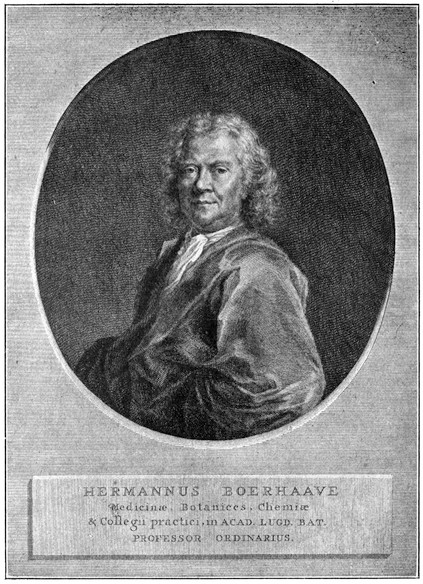
“The word chemistry,” says Boerhaave in
the Prolegomena of his New Method of Chemistry
(Shaw and Chambers’s translation, London,
1727),
in Greek should be wrote χημíα, and in Latin and
English chemia and chemistry; not as usual,
chymia and chymistry.
The first author in whom the word is found
is Plutarch, who lived under the Emperors
Domitian, Nerva, and Trajan. That philosopher,
in his treatise of Isis and Osiris, takes
occasion to observe that Egypt, in the sacred
dialect of the country, was called by the same name
as the black of the eye—viz., χημíα—by which
he seems to intimate that the word chemia in
the Egyptian language signified black, and that
the country, Egypt, might take its denomination
from the blackness of the soil.
But [continues Boerhaave] the etymology and
grammatical signification of the name is not so
easily dispatched. The critics and antiquaries,
among whom it has been a great subject of
inquiry, will not let it pass without some further
disquisition. Instead of black, some will have
it originally denote secret, or occult; and hence
derive it from the Hebrew chaman, or haman—a
mystery, whose radix is cham. And, accordingly,
Plutarch observes that Egypt, in the
same sacred dialect, is sometimes wrote in
Greek χαμíα—chamia; whence the word is easily
deduced further from Cham, eldest son of Noah,
by whom Egypt was first peopled after the
deluge, and from whom, in the Scripture style,
it is called the land of Cham, or Chem. Now,
that chaman, or haman, properly signifies secret
appears from the same Plutarch, who, mentioning
an ancient author named Menethes Sibonita,
who had asserted that Ammon and Hammon
were used to denote the god of Egypt, Plutarch
takes this occasion to observe that in the
Egyptian language anything secret or occult
was called by the same name, ἅμμον—Hammon....
Lastly, the learned Bochart, keeping
to the same sense of the word, chooses to derive
it from the Arabic chema, or kema—to hide;
adding that there is an Arabic book of secrets
called by the same name Kemi.
From the whole of which Boerhaave gathers that
chemistry was thus originally denominated because
it was considered of old as “not fit to be
divulged to the populace, but treasured up as a
religious secret.”
If we are to credit Zozimus the Panopolite,
who is said to have lived about the beginning of
the fifth century, there were sound reasons for
thus treasuring up chemistry as a religious
secret, since, as it sprang from the pretium
amoris, its origin was not too reputable. “What
the divine writings relate is that the angels,
enflamed with the desire of women, instructed
’em in all the works and mysteries of nature.
For which indiscretion they were excluded heaven,
as having taught men things unfit for ’em
to know.” And Scaliger asserts that “Hermes
testifies as much; and all our learning, both open
and occult, confirms the account.” But who
Hermes was, adds that author, is hard to say,
for none of his writings has survived to our age,
“that lately published in Italy under the name
of Hermes Trismegistus being a manifest forgery.”
This legend of the “feministic” origin of chemistry
is in reality much older than the fifth century
of our era, and is but a variant of that
which, according to Jewish writers, led to the
expulsion of man from Paradise. A similar myth
was current among the Phœnicians, Persians,
Greeks, and Magi. We trace it in the legend of
Sibylla, who demanded, as the price of her favour
to Phœbus, not only length of years, but a
knowledge of the divine arcanum. Some of the
ecclesiastics who elaborated these myths are
particular in their accounts of the mysteries thus
imparted. They included the use of charms, a
knowledge of gold and silver and precious stones,
the art of dyeing, of painting the eyebrows,
etc.—the kind of arcana, in fact, which women
in all ages were presumably most keen to know.
It is, however, significant that in all allusions to
chemia, even after the translation of the seat of
the Roman Empire to Constantinople, it is implied
that a knowledge of it was a sacred mystery
to be known only to the priesthood, and jealously
guarded by them. It was characteristic of
writers who had affixed an eternal stigma on Eve
to make the sex in general answerable for an
illicit knowledge of “things unfit for men to
know.”
For, in reality, chemistry originated with men,
and it was not so much in the love of women as
of wine that it took its rise.
The manufacture of alcohol by processes of
fermentation is probably the oldest of the chemical
arts. The word wine means, in fact, a product
of fermentation. Mosaic history relates that
Noah, soon after he got to dry land, “planted a
vineyard and drank of the wine,” with results
that would appear to show that the potency of
wine was not unfamiliar to him. Diodorus
Siculus, who studied Egyptian antiquities when
Egypt was a Roman province, states that the
ancient Egyptians ascribed the origin of wine to
Osiris. It was a sacrificial offering even in the
earliest times, as was bread. Wine seems to
have been prepared by the Chinese as far back
as the time of the Emperor Yü, circa 2220 B.C.
Beer was manufactured in Egypt in the time
of Senwosret III. (Sesostris) B.C. 1880.
The Egyptians were skilled in dyeing and in
the manufacture of leather, and in the production
and working of metals and alloys. They
were familiar with the methods of tempering iron.
They made glass, artificial gems, and enamels.
The oldest known enamel was found as an amulet
on the Egyptian Queen Aahotep (1700 B.C.),
and glass beads were made before the time of
Thutmosis III. (1475 B.C.). The Jews knew of
gold, silver, copper, iron, lead, and tin. Indeed,
it is through them and the Phœnicians, who were
among the earliest of traders, that Europe was
gradually made acquainted with many technical
products of Eastern origin.
The beginnings of the art of extracting and
working of metals are lost in the mists of antiquity;
the chemistry of metals, indeed, has been
said to be almost coeval with mankind. Diodorus
Siculus found traditions in Egypt as to the
first inventor of metallurgical processes identical
with that of the son of Lamech and Zillah, Tubal-cain,
or Tuval-cain, of the Hebrews—the Vulcan
of the Romans.
Gold was undoubtedly one of the earliest metals
to be made use of by men, as it probably was
one of the first to be discovered. It occurs free
in nature, and is met with in many rocks and in
the sands of rivers. Its colour, lustre, and density
would early attract attention to it; and its malleability
and ductility and the ease with which
it could be fashioned, together with its unalterability,
would render it valuable. Ethiopian
and Nubian gold were known from the earliest
times, and quartz crushing and gold washing
were practised by the Egyptians. Representations
of these processes have been found on
Egyptian tombs dating from 2500 B.C. Gold-wire
was used by the Egyptians for embroidery, and
they practised plating, gilding, and inlaying as
far back as 2000 B.C.
Silver also was employed by them, and appears,
like gold, to have been coined into money. It
was originally known as “white gold.” Some of
the oldest coins in existence are alloys of silver
and gold, obtained probably by the fusion of
naturally occurring argentiferous gold, such as
the pale gold of the Pactolus. Such an alloy
was termed electrum, from its resemblance in
colour to amber.
Copper is also found to a limited extent in the
metallic state, but probably the greater part of
that used by the ancients was obtained from its
ores, which are comparatively abundant and
readily smelted. It was also used for coinage by
the Egyptians, and was fashioned by them into a
variety of utensils and implements. The older
writers drew no clear distinction between copper,
bronze, and brass, and the terms designating
them—æs and χαλκός—are frequently employed;
as by Pliny, indiscriminately. The statement in
Deut. viii. 9—“Out of whose hills thou mayest
dig brass”—obviously cannot mean an alloy
of copper and zinc, since this does not occur
naturally.
Pure copper is too soft a metal to be used for
swords and cutting instruments, but copper ores
frequently contain associated metals, as, for
example, tin, which would confer upon the
copper the necessary hardness to enable it to be
fashioned into weapons. Such copper would be
of the character of bronze, and it was known to
the early workers that the nature of the metal
was greatly modified by the selection of ores
from particular localities. It was comparatively
late in the metallurgical history of copper
that bronze was produced by knowingly adding
tin to the metal.
Copper was largely used by the Romans,
who obtained it from Cyprus; it was known to
them as æs Cyprium, and eventually Cuprum,
whence we obtain the chemical symbol Cu.
What the Romans called æs was found also at
Chalkis, in Eubœa, whence χαλκός, the Greek
word for copper.
Aurichalcum, or golden copper—that is,
brass—was well known to the early workers in
copper, and was made in Pliny’s time by heating
together copper, cadmia (calamine), and charcoal.
Bell metal was employed by the Assyrians, and
bronze was cast by the Egyptians for the manufacture
of mirrors, vases, shields, etc., as far back
as 2000 B.C. Statuary bronze, largely used by
the Romans, usually contained more or less
lead.
Tin, which was also known to the early
Egyptians, would appear to have been first
obtained from the East Indies, and to have
been known under the Sanscrit name of
Kastîra (Kâs, to shine), whence we have the
Arabic word for tin, Kàsdir, and the Greek
κασσίτερος, used by Homer and Hesiod. Tin
ores are found in Britain (Cornwall), and were
brought thence by the Phœnicians. The group
of islands, including the Scilly Islands and
the larger island to the east (Britain), was
known to the Romans as the Insulæ Cassiterides.
Pliny states that the tin is found in grains in
alluvial soil, from which it is obtained by washing;
but he gives no description of the method of
smelting. The Latin word for tin was stannum;
it was also known as plumbum album, in contradistinction
to lead, which was called plumbum
nigrum. Tin was used by the Romans for
covering the inside of copper vessels, and was
also occasionally employed in the construction
of mirrors.
Lead was well known to the Egyptians. In
Pliny’s time it was mainly procured from Spain
and from Britain (Derbyshire). Leaden pipes
were used by the Romans for the conveyance
of water, and sheet lead was employed by
them for roofing purposes. The Romans were
also aware of alloys of lead and tin. Argentarium
was composed of equal parts of lead and
tin; tertiarium, used as a solder, consisted of two
parts of lead and one part of tin.
Iron, although now the most important of the
common metals, was not in general use until
long after the discovery of gold, silver, and
copper. This was probably due to the fact that,
although its ores are relatively abundant and
widely distributed, its extraction as a metal
demanded greater skill and more appliances
than were possessed by the earlier races. Metallic
iron was, however, well known to the Egyptians,
who employed it in the manufacture of
swords, knives, axes, and stone-chisels, both as
malleable iron and as steel. Steel was also
known to the Chinese as far back as 2220 B.C.,
and they were acquainted with the methods of
tempering it. The good quality of Chinese steel
caused it to be highly prized by Western nations.
The earliest people to smelt iron are supposed to
have been the Chalybes, a nation inhabiting the
neighbourhood of the Black Sea; it is from them
that the ancient name for steel—chalybs—is
derived, and also our word “chalybeate.”
Mercury has long been known, but there is no
evidence that the ancient Egyptians were aware
of its existence, or it would probably have been
mentioned by Herodotus. It was familiar to
Aristotle, and its mode of manufacture from
cinnabar is described by Theophrastus (320 B.C.),
who terms it “liquid silver.” Processes of
amalgamation were known to Pliny, who notes
the readiness with which mercury dissolves gold.
Pliny appears to distinguish the native metal
found in Spain, which he terms argentum vivum
(quicksilver), from that obtained by sublimation
or distillation from cinnabar, which he calls
hydrargyrum, from which we get the chemical
symbol for mercury Hg.
A considerable number of metallic compounds
were known to the ancients, and were employed
by them as medicines and as pigments. The
oxides of copper, known as flos æris, and scoria
æris, obtained by heating copper bars to redness
and exposing them to air, were used as escharotics.
Verdigris, or ærugo, was made by the same
methods as now. Blue vitriol, or chalcantum,
is described by Pliny, who says that the blue
transparent crystals are formed on strings suspended
in its solution.
Chrysocolla, malachite, or copper carbonate,
was used as a green pigment. The blue κύανος of
the Greeks, or cœruleum of the Romans, was
obtained by fritting together alkali, sand, and
oxide of copper. Botryitis, placitis, onychitis,
ostracitis, were varieties of cadmia or oxide of
zinc, obtained by calcining calamine, and were
used in the treatment of ulcers, etc. Molybdena,
which was the Latin name for litharge, was
employed externally as an astringent and in the
manufacture of plaster. The lead plaster employed
by Roman surgeons was practically
identical in character and mode of preparation
with that in use to-day. Cerussa, or white lead,
was made as now by exposing sheets of lead to
the fumes of vinegar. It was used in medicine,
as a pigment, and in the preparation of cosmetics.
Cerussa usta was probably red lead. Its present
name of minium was originally applied to cinnabar,
the red sulphide of mercury, which was
frequently adulterated with red lead.
Cinnabar, formerly obtained from Africa, and,
by the Romans, from Spain, was also used
externally in medicine, and was a highly prized
pigment, whose value was known to the Chinese
from very early times. The black sulphide of
antimony, the stimmi and stibium of Dioscorides
and Pliny, was employed by women in Asia,
Greece, and latterly in Western Europe, and is
still so used in the East, for blackening their
eyelashes. Preparations of antimony were used
in medicine. Realgar, the scarlet sulphide of
arsenic, the sandarach of Aristotle, and the
arrenichon of Theophrastus, was employed as a
pigment, and also in medicine, both internally
and externally. The yellow sulphide of arsenic
or auri pigmentum (orpiment), was also used for
the same purposes.
A variety of yellow and red ochres, in addition
to the pigments above mentioned, were used by
painters, such as rubrica, an iron ochre of a dark
red colour, and sinopis, or reddle, obtained from
Egypt, Lemnos, and the Balearic Isles. Oxides
of manganese were used as brown pigments.
The white pigment, paratonium, was probably
meerschaum. Melinum was a variety of chalk
found in Samos. The ancients were well
acquainted with indigo and madder, and with
the method of manufacturing lakes, which was
employed by Grecian artists.
The famous purpurissum was chalk or clay
stained by immersion in a solution of Tyrian
purple. Atramentum was lamp-black: ivory-black
was used by Apelles, and was known as
elephantinum. The ink of the ancients consisted
of lamp-black suspended in a solution of gum or
glue. The atramentum indicum, imported from
the East, was identical with China ink.
The ancients were well skilled in the art of
dyeing, and even of calico printing. The
Tyrians produced their famous purple dye as
far back as 1500 B.C. It was obtained from
shell-fish, mainly species of Murex, inhabiting
the Mediterranean. Tyrian purple has been
shown to be dibrom-indigo, and to have been
produced by the action of air and light upon
the juices exuded from the shell-fish. The fine
linen of the Old Testament was probably cotton,
for the production of which Egypt was long celebrated.
That the Egyptians were acquainted with
the use of mordants seems evident from the following
passage from Pliny, quoted by Thomson:—
There exists in Egypt a wonderful method of
dyeing. The white cloth is stained in various
places, not with dye stuffs, but with substances
which have the property of absorbing colours;
these applications are not visible upon the cloth,
but when they are dipped into a hot caldron
of the dye they are drawn out an instant after
dyed. The remarkable circumstance is that,
though there be only one dye in the vat, yet
different colours appear upon the cloth; nor
can the colour be afterwards removed.
This passage accurately describes the process of
madder dyeing on cotton, whereby a variety of
fast colours—reds, browns and purples—can
be obtained from the same vat by the employment
of different mordants, such as alumina,
oxide of iron, or oxide of tin, etc.
Glass has been known from very early times.
Representations of glass-blowing were found
on the monuments of Thebes and Beni Hassan,
and large quantities of glass were exported to
Greece and Rome from Egypt, mainly by Phœnicians.
Aristophanes mentions it as hyalos,
and speaks of it as the beautiful transparent
stone used for kindling fire. The Egyptians
made use of various metallic oxides in colouring
glass. The hæmatinon of Pliny was a red
glass coloured with cuprous oxide. Cupric oxide
was used to colour glass green; and ancient blue
glass has been found to contain cobalt. The
costly vasa murrhina of the Romans, obtained
from Egypt, probably consisted of fluorspar,
identical with the Blue John of the Derbyshire
mines.
Stoneware has been made from time immemorial,
and the Chinese have manufactured
porcelain from very remote periods. Bricks and
tiles were made by the Romans, and mortar and
stucco were employed by the ancient Egyptians.
Soap (sapo) is mentioned by Pliny, but its
detergent properties were apparently unknown
to him. It appears to have been first made by
the Gauls, who prepared it from the ashes of the
beech and the fat of goats, and used it as a
pomatum, as did the jeunesse d’oreé of Rome.
Wood ashes, as well as natron, were, however,
used by the ancients for their cleansing properties.
Starch, acetic acid, sulphur, alumen or crude
sulphate of alumina, beeswax, camphor, bitumen,
naphtha, asphalt, nitrum (carbonate of soda),
common salt, and lime, were all known to the
Egyptians, and were used by them for many
of the purposes in which they are employed
to-day.
It will be evident from this brief survey that
the ancients possessed a considerable acquaintance
with many operations of technical chemistry;
but, although they must necessarily have
accumulated a large amount of knowledge, very
little has come down to us concerning the mode
in which their processes were conducted, or as to
the precautions they employed to ensure uniform
results. Their methods were probably
jealously guarded and handed down by successive
members of the crafts as precious secrets.
The experienced masters of these crafts must
have met with many strange and perplexing
phenomena in the course of their operations, and
a spirit of inquiry must thereby at times have
been awakened. But, under the conditions in
which their industries were prosecuted, the scientific
spirit was not free to develop, for science
depends essentially upon free intercommunication
of facts and the spread of knowledge of
natural phenomena. Moreover, the great intellects
of antiquity, for the most part, had little
sympathy with the operations of artisans, who,
at least among the Greeks and Romans, were,
for the most part, slaves. Philosophers taught
that industrial work tended to lower the standard
of thought. The priests, in most ages, have
looked more or less askance at attempts, on the
part of the laity, to inquire too closely into the
causes of natural phenomena. The investigation
of nature in early times was impossible
for religious reasons. There was an outcry in
Athens when the thunderbolts of Zeus were
ascribed to the collision of clouds. Anaxagoras,
Diogenes of Apollonia, Plato, Aristotle, Diagoras,
and Protagoras were charged by the priests
with blasphemy and driven into exile. Prodikos,
who deified the natural forces, as did
Empedokles the primal elements, was executed
for impiety. Sacerdotalism in Athens had no
more sympathy with science than had the Holy
Congregation in Italy when it banned the writings
of Copernicus, Kepler, and Galileo, and sent
Giordano Bruno to the stake. The educated
Greeks had no interest in observing or in explaining
the phenomena of technical processes.
However prone they might be to speculation,
they had no inclination to experiment or to
engage in the patient accumulation of the
knowledge of physical facts. “You Greeks,”
says Plato in one of his Dialogues, “are ever
children, having no knowledge of antiquity, nor
antiquity of knowledge!” The influence of a
spurious Aristotelianism, which lasted through
many centuries and even beyond the time of
Boyle, was wholly opposed to the true methods
of science, and it was only when philosophy had
shaken itself free from scholasticism that chemistry,
as a science, was able to develop.