The Tzendal Rebellion—A New Miracle—Atrocities—A Novel
Hierarchy—The Tzendales Repulsed—Segovia's Operations—President
Cosío Assumes Command—Fall of Cancuc—Spread of
the Rebellion—Its Suppression—Decadence of Chiapas—Earthquakes—Riots—Venality
of the Clergy—Establishment of the
Archbishopric—Heresy—Boundaries of Provinces—Abolition of
Corregimientos—Another Great Earthquake—Quarrels Over
Removal—Expulsion of the Jesuits.
When the storm raised by the Berropistas and Tequelies
had subsided, a political calm appears to have
prevailed for a period in Guatemala. Unfortunately, in
other respects the colonists were far from enjoying
repose, and the eighteenth century was the most calamitous
epoch in the history of the country. Nor
was the freedom from strife between church and state
permanent, since humiliating contests for authority in
time sprang up afresh.
The first important event which disturbed the quiet
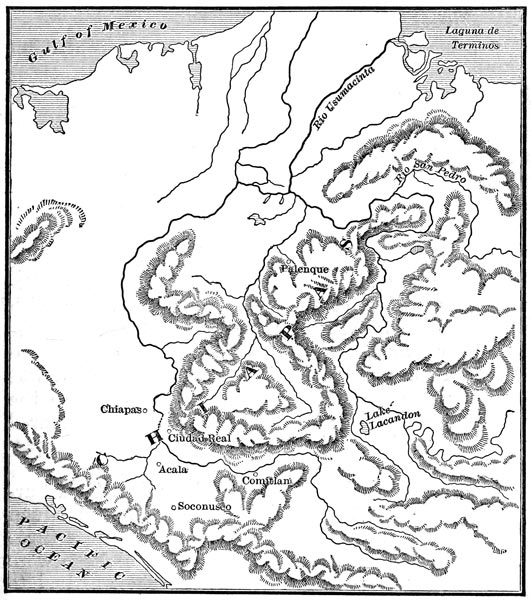
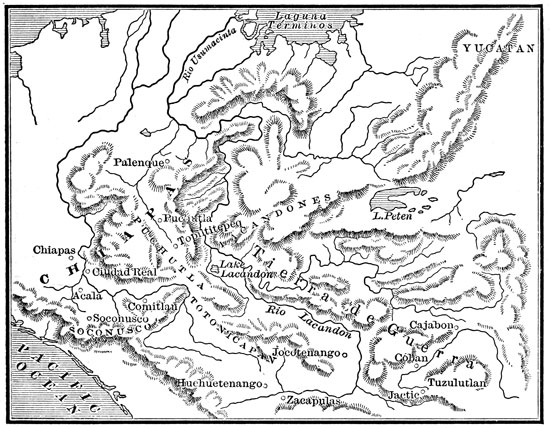
order of affairs, was the rising of the Tzendales[XXXVII‑1] in
Chiapas during the presidency of Toribio José de
Cosío y Campa.[XXXVII‑2] In 1712 the Tzendales formed an
alliance with numerous kindred nations, and grafting
some Christian rites upon their paganism, followed the
lead of an Indian girl, who claimed inspiration from
the virgin Mary.
THE INSPIRED INDIAN GIRL.
The first outbreak occurred at Diasolo, where Fray
Pedro Villena was beaten almost to death in the
church while attempting to remove certain ornaments
which were to be conveyed to a neighboring
town by the bishop. This outrage was followed by
the seizure of the Spaniards who resided there. They
were, however, released two days afterward. Somewhat
later the bishop visited the disaffected town, and
was openly informed by the Indians that it was their
intention to rise in arms.[XXXVII‑3]
About the middle of the year Simon de Lara, priest
of Cancuc, was informed of the miraculous interposition,
which was on the wrong side of his orthodoxy,
a miracle of Satan's; and that the natives had
erected a chapel near that town in consequence of the
event. He immediately convened the inhabitants,
who promptly assembled, bringing with them the
Indian girl to whom the divine revelation had been
made. Standing in their midst she calmly told how
the virgin had appeared to her, and commanded that
a chapel to her glorification should be built on the
spot where she had made her presence visible. Had
this divine display been free from the taint of aboriginal
faith, much capital might have been made of
it by the fathers. Padre Lara addressed the Indians
on the matter and wished to destroy the chapel, but
the Tzendales induced him to allow it to remain, that
it might serve as a place in which to make bricks.
In spite of the bishop's prohibition, religious rites
continued to be celebrated there, and owing to the
inertness of the authorities at Ciudad Real the hydra
of rebellion grew apace. The neighboring towns entered
into a compact with the people of Cancuc, and
the league spread far and wide in the neighboring
districts.
Thus passed the month of July. In the beginning
of August the Cancucs sent messengers to all the
Tzendales, in the name of the virgin, and with letters
signed in her name, commanding them to bring to
her chapel at Cancuc all the silver and ornaments of
the churches, and all the money and books, for there
was now neither God nor king of the Spaniards.
On receiving this summons the leaders of the rebellion
in each town artfully evoked the fanaticism of the
low orders by calling upon them to hasten to the
assistance of the virgin, who they asserted was going
to be put to death.[XXXVII‑4] A multitude was gathered, and
on the 10th a great feast was celebrated at the chapel
of Cancuc, where a council of war was held in order
to complete their plans for the extermination of the
Spaniards. The towns of Tenango and Chilun were
soon afterward attacked by a body of Tzendales, two
thousand strong, who were called the "soldiers of the
virgin." Tenango fell an easy prey; the fiscal Nicolás
Perez was flogged till he died, and many others
were put to death with every ingenuity of torture.[XXXVII‑5] At
Chilun the feeble garrison defended itself for some
time; but when their ammunition was exhausted and
they had no hope of escape or further defence, they
gave up their arms under assurances that their lives
would be spared. Most of them were immediately
clubbed or stoned to death, and the remainder died
under the scourge.
GROWTH OF THE NEW FAITH.
In obedience to the commands of their prophetess
the Tzendales then proceeded against Ococingo, but
the Spaniards retreated in time to Comitán. Aware
that neither woman nor child had been harmed at
Chilun, they unfortunately left their families behind.
When the Tzendales entered the town they were
deceived by the women as to the direction their husbands
had taken. On discovering the deceit the
Indians were enraged, and returning to Ococingo they
tore the children from the mother's arms and murdered
them before their eyes; then after beating the
women they sent them to Cancuc.
A high festival was held to celebrate their success,
and over it presided their prophetess, whose word was
law. In the chapel at Cancuc she issued her mandates.
Before the spurious altar of the virgin hung
a screen of Indian matting, behind which the priestess
would retire; thence issuing forth she pronounced the
commands of holy Mary.
The inventor of this imposture was a Tzendale, who
henceforth assumed the name of Sebastian Gomez de
la Gloria. He asserted that Saint Peter had taken
him up to heaven and appointed him his vicar on
earth, with power to elect bishops and priests. And
he went on to the full completion of his holy mission.
All the fiscals of the towns were summoned to Cancuc
and the elect ordained. The only qualifications required
were ability to read, and to perform the feat
of kneeling for twenty-four consecutive hours, candle
in hand, reciting the rosary; after which La Gloria
sprinkled the priest-elect with holy water, and the
ordination ended.
The hybrid faith spread apace. Sebastian celebrated
mass; and on the first performance a great
feast was held, bull-fights and games being celebrated
in honor of the event, while the church was converted
into a dancing-hall. The priestess also celebrated
mass, and daily preached to the natives, dressed in
sacerdotal robes; in the surrounding towns, too, the
newly consecrated priests zealously plied their calling
by discoursing from the pulpit and administering the
sacraments.
But ere long murmurings began to prevail. The
natives had been led to believe that the virgin had
oracularly announced that there should be no more
tribute and no more priests.
By dint of flogging the new hierarchy maintained
order for a time, but as the discontent increased
Nicolás Vasquez, styling himself captain-general, in
the name of Gomez de la Gloria, envoy of Saint Peter,
fulminated a proclamation against the malecontents.[XXXVII‑6]
The next action of the Cancuc ecclesiastics was the
appointment of a bishop, and the individual selected
was offered the pleasant alternative of accepting the
bishopric or being hanged. The test of his ability to
fill the office is curious. For three days and nights
he was kept fasting in the chapel at Cancuc under
threat of instant death at the first display of weakness.
Having passed this ordeal he was consecrated
by Gomez de la Gloria with appropriate solemnity and
mummery.[XXXVII‑7]
A government was also formed, the head of which
was Doña María Angel the priestess. She was assisted
by twelve of the principal Tzendales, styled
majordomos.[XXXVII‑8] Sessions were held in the chapel where
contributions were received with which to defray the
expenses of government, and to propitiate the virgin.
Thither also were conveyed the gold and silver taken
from the different churches.[XXXVII‑9]
The new régime did not long give satisfaction.
Discontent soon showed itself among the multitude,
and dissension among the members of the government.
The Tzendal angel took offence at one of her
chief supporters, and caused him to be flayed alive;
other offending officials were publicly scourged, and
an Indian named Juan Lopez was hanged for having
in the division of plunder taken at the sacking of a
town appropriated the virgin's share. Disputes arose,
and it was only by dividing among the confederated
towns the money in the chapel treasury that the
inhabitants of Cancuc avoided war with their neighbors.
COMPETITION IN MIRACLES.
At this juncture an opposition miracle was announced
at Yajalon by Magdalena Diaz, an aunt of
Doña María Angel. Magdalena considered that she
had not received the attention to which she was entitled,
and denouncing the Cancuc miracle as false proclaimed
herself a divinely inspired agent of heaven.
This apostasy and counterfeit imitation of the original
miracle was too criminal to go unpunished. The
Cancuc priestess therefore sent a strong force of the
soldiers of the virgin to Yajalon to bring the false
prophetess to her. With some bloodshed this was
accomplished. Magdalena Diaz was hanged, and with
her an Indian of Tila who proclaimed that he was
Christ. So perish all who oppose the true faith!
Meanwhile the Spaniards were making preparations
to suppress the rebellion. When it first broke out
there were not more than thirteen hundred armed
men in the province, and these were scattered in the
different garrisons. It chanced at this time that there
was no one at the head of the government as chief
executive, and the alcalde's ordinaries of Ciudad Real
did not consider that they had the power to act in
such an emergency. One of them, however, despatched
a message to Pedro Gutierrez, the commanding
officer in Tabasco, informing him of the state of
affairs and soliciting aid. Gutierrez at once hastened
to Ciudad Real, and having presently received from
the president and audiencia of Guatemala his appointment
as lieutenant-general and chief-justice of Chiapas,
called the panic-stricken inhabitants to arms.
While Gutierrez was on his way to Ciudad Real
the alcalde Fernando del Monje had marched with
one hundred and fifty raw recruits to Huistlan—the
nearest town in the direction of the revolted districts.
Here he had fortified himself, but was besieged by the
Tzendales in great force,[XXXVII‑10] under the leadership of
Nicolás Vazquez,[XXXVII‑11] who made several fierce assaults
upon the place but was repulsed with severe loss.
Gutierrez hastened to the relief of Huistlan with
one hundred and forty Chiapanecs and two hundred
men of Ciudad Real. Forcing his way through the
Tzendales he united his troops with the besieged Spaniards,
and a sortie being made the besiegers were
thrown into confusion and many slain. The Tzendales
abandoned the siege,[XXXVII‑12] and Gutierrez at once prepared
to pursue them, but the timidity of the people of
Ciudad Real fettered his movements. News had
reached the capital that Sinacantlan had revolted and
that an immediate attack upon Ciudad Real was determined
upon by the Tzendales. This intelligence
struck terror into the pusillanimous inhabitants and
Gutierrez was implored to return.
Meanwhile the parish priest of Sinacantlan, Padre
José Monroy, who was at Ciudad Real when these
events occurred, went to his disaffected flock and urged
their return to allegiance. The news of the disaster
before Huistlan had so discouraged the Sinacantlans
that the padre had little difficulty in effecting
his object.[XXXVII‑13]
ASSAULT ON OCCHUC.
Thus matters remained for some weeks, Gutierrez
being unable to organize any expedition against the
insurgents, through want of means and the lack of
spirit in the people he had come to support. The
magnitude of the revolt was now realized by President
Cosío, and in October he appointed Nicolás de
Segovia, an officer experienced in Indian warfare, commander-in-chief
of the operations against the Tzendales,
and despatched him with troops to Ciudad
Real. This able officer was soon prepared for an
active campaign, and about the 20th of the month
took the field at the head of four hundred Spaniards,
fifty-four negroes, and one hundred and fifty
Chiapanec warriors, accompanied by a number of
Dominicans, whose order had rendered great assistance
in supplying men, horses, and money. Segovia
marched to Occhuc, while Gutierrez in command of
a strong force[XXXVII‑14] proceeded to San Pedro Chimalco.
A series of engagements followed. Segovia, who
had divided his forces by sending two detachments of
one hundred men each to occupy towns in the vicinity
of Cancuc, was besieged in Occhuc by six thousand
of the enemy; but every assault upon his position
was repulsed with heavy loss to the Tzendales, who
at last took to flight and were pursued with great
slaughter. This was on the 22d of October; and
shortly afterward a reënforcement of these men arrived
under command of the maestre de campo, Juan
de Lozada.[XXXVII‑15] On the 26th the Tzendales, hoping to
effect a surprise,[XXXVII‑16] again assaulted Occhuc, but were
beaten off with heavy loss. They then sought for a
parley, and endeavored to induce the Spaniards to
surrender their arms by the same specious promises
that had been so fatally alluring at Chilun. But the
two positions were not similar, and it was only through
the efforts of the fathers that the indignant Segovia
was restrained from firing upon the treacherous truce-seekers.
The Tzendales were summoned to return to
their allegiance, and one hour's cessation of hostilities
was granted. The time of the armistice was occupied
in burying their dead. They then retreated in the
direction of Cancuc.
President Cosío, deeming it necessary to march
against the rebels in person, on the 10th of November
left Ciudad Real,[XXXVII‑17] in company with the auditor-general,
Diego de Oviedo, in charge of a strong detachment
destined for Occhuc. Though formidable intrenchments
had been thrown up by the enemy on the line
of march, the Spaniards by a skilful movement compelled
the Tzendales to abandon them, and a juncture
was effected with Segovia. The combined forces then
advanced against Cancuc and encamped in front of
the town. The enemy was strongly intrenched and
several assaults directed against the fortifications were
repulsed by the Tzendales, the officers being ill supported
by their men. In one of these Segovia was
wounded; many of the soldiers were also severely
injured by the stones hurled against them with remarkable
skill and force.[XXXVII‑18] Success eventually crowned
the Spanish arms, and Cancuc fell into their hands.
Owing to the hiatus in García's manuscript, it is
impossible to say what were the military movements
on both sides during the remainder of the year; but
it is certain that the rebellion spread widely, and that
even the native population of Ciudad Real rose in
revolt. With the exception of Chamolla, in fact, the
whole province appears to have risen in arms.[XXXVII‑19]
END OF THE TZENDAL REBELLION.
At the beginning of 1713 the Spanish army was
stationed at Chamolla, and the insurgents after a series
of defeats had become dispirited. Sebastian Gomez
de la Gloria had fled; dissension was rife in the ranks
of the Indians; and the end of the struggle was drawing
near. Marching from Chamolla at night, the
president with his forces advanced against Ciudad
Real. His approach was conducted with the greatest
precaution and in silence, for strong fortifications had
been erected by the enemy about three quarters of a
league from the capital. These he passed unnoticed,
and about an hour after midnight Ciudad Real was
surrounded. The alcalde, who resided in the outskirts
of the city, was surprised and seized, and forthwith
despatched to warn the people to make no attempt at
resistance. Bugles were sounded on all sides to
intimate to the inhabitants how closely the city was
invested, and the army moved silently on to San
Pablo, where the Guatinpan female leader was captured.
Henceforth the Spaniards were everywhere
triumphant; the Indians returned to their allegiance;
and about the month of March the Tzendal rebellion
was at an end. All attempts to capture Gomez de la
Gloria and Doña María Angel proved unsuccessful;
they escaped into the woods and nothing more is
known of them.[XXXVII‑20]
The effect of the Tzendal rebellion was disastrous
in the extreme; and later in the century other causes
tended to hasten the decline of the Spanish settlements
in Chiapas. In August 1785 Ciudad Real
with the surrounding country was flooded; numbers
perished; houses were swept away; the churches and
convents were injured, and the growing crops destroyed.
The report of Intendente Sayas in 1800
represents a lamentable condition of affairs. Roads
were almost impassable, bridges dilapidated, and
churches falling in ruins; the country towns possessed
no decent municipal buildings, and even the jails were
so dilapidated that prisoners could not be securely
confined. Sayas in fact describes the province as in a
state of decay.[XXXVII‑21]
A SEVERE EARTHQUAKE.
By a royal cédula of November 6, 1714, the term
of Cosío's presidency was extended for a period of
two years in acknowledgment of his able management
during the Tzendal insurrection. He then meditated
an expedition against the Mosquito Indians, but while
engaged in preparations for the campaign was promoted
to the presidency of the Philippine Islands, and
was succeeded by Francisco Rodriguez de Rivas in
1716. This president continued in office until 1724.
During his term occurred a destructive earthquake.
There were also violent eruptions in 1702, 1705, and
1710 which occasioned much alarm and considerable
damage to buildings, and in 1717 the city of Santiago
was almost totally destroyed by shocks which continued
for many days. Particulars of some of the
events of this year are preserved in the official report
of the licentiate Tomás Ignacio de Arana, oidor of
the audiencia, and an eye-witness of many of the
scenes described. From August 18th to September
27th, the Volcan de Fuego vomited fire and ashes,
while intermittent shocks of earthquake kept the people
in constant alarm. On the night of the last named
date a shock more violent than any that had ever
shaken the city occurred, and not a building of any
importance was left uninjured. A scene of terrible
confusion ensued. Men, women, and children rushed
from the doors, or threw themselves from windows into
the street in the wildest consternation. Even the ties
of relationship were forgotten in the awful belief that
divine judgment was at hand. The lamentations continued,
as the people, carrying crucifixes and images of
the virgin, thronged the churches and public squares.
The bishop, holding aloft the host, solemnly exorcised
the evil spirits of the human race.
The following day was the feast of San Agustin,
and both civil and ecclesiastical authorities exhorted
the people to prayer and confession; but while thus
engaged, about sunset an eruption took place, and
from the sides of the mountains sprung rivulets of
fire. Again the people resorted to the sanctuaries,
and an image of the Christ was borne in a procession
to the church of Nuestra Señora de las Mercedes,
which was thronged with an awe-stricken crowd,
anxious to be near the sacred shrine. The bishop in
sacerdotal robes implored the divine mercy, and when
the flames died out there was the usual miracle attributed
to the bishop and the sacred image.
Next day, before sunrise, subterranean noises and
fresh flames, vomited from the mountain's crater,
again struck terror to the inhabitants;[XXXVII‑22] and on the
30th a tremendous convulsion shook the earth,[XXXVII‑23] the
sky being hidden by a dense black cloud, which hung
over the city like a funeral pall. The instinct of preservation
prompted flight, and the roads were covered
with fugitives, even modest nuns mingling with the
frightened throng and hurrying away on foot from the
crumbling city.[XXXVII‑24]
The loss of life had been great; and when the convulsions
had ceased the appearance which Santiago
presented was that of a city crushed by the hand of
omnipotence. The cathedral was in ruins, and the
churches and convents more or less shattered. The
wrecks of demolished houses were seen in every direction,
and the few persons who remained were painfully
impressed by the silence which had now succeeded to
the busy hum of a populous community. Throughout
all these distressing circumstances the president
and the bishop displayed unflinching courage, and
strove to alleviate distress and assuage alarm.[XXXVII‑25]
Many meetings of the audiencia were held to
discuss the question of again locating the city. It
was finally left to the decision of the king; but when
a license for the removal at length arrived, the inhabitants
had recovered from their panic, returned to
their dilapidated dwellings, and repaired the greater
part of the city.
On the 12th of April 1718 the cabildo of Santiago
addressed a memorial to the king,[XXXVII‑26] setting forth the
pitiable condition to which the city had been reduced,
and the impoverishment of its citizens. His Majesty
was petitioned to take liberal measures for their relief,
and that the church edifices and public buildings
might be restored or built anew.[XXXVII‑27] Pedro Antonio de
Echevers y Suvisa succeeded Rivas in the presidency.[XXXVII‑28]
During his administration serious riots occurred,
caused by the assassination of the presbyter Lorenzo
de Orozco, and the barbarous murder of all his household
for purposes of robbery. The evidence of a
widespread conspiracy was brought to light, and
though no arrests were made, many persons were implicated
during the progress of the inquiry. Grave
disputes also arose between the president and two
members of the audiencia; and when the former attempted
to banish them, they were rescued by a mob
and took refuge in the cathedral.[XXXVII‑29]
RIGHT OF SANCTUARY.
A more serious matter, involving the right of
sanctuary and leading to a civil and ecclesiastical conflict,
arose from the conduct of one Juan Manuel
Ballesteros, who had fatally stabbed a man. The
murderer sought refuge in a convent church, whence
he was dogged by a force sent by the alcalde, García
de Hijas. He sought refuge behind the grand altar;
but the sanctity of the place was not regarded, and
despite his struggles he was arrested. The prisoner
was immediately put to the torture, and died under
its effect. The alcalde was promptly excommunicated,
and the ecclesiastics appealed to the king, petitioning
for a royal declaration of their rights in such cases.
The monarch, by a decree of the 18th of June 1720,
decided that in this case the prelate was justified in
proceeding against the alcalde, but that all doubtful
cases, as a rule, must be decided by the king himself
in council.[XXXVII‑30]
CHURCH MATTERS.
During the next twenty years no political event
occurred that is worthy of record. Several able prelates
occupied the episcopal chair,[XXXVII‑31] but their administration
was greatly interfered with by the improper
action of the secular and regular clergy. So flagrant
were the abuses committed by the priests in the exercise
of their duties, that the bishops were embarrassed
in their visits, and the natives oppressed by the venal
conduct of their pastors. The abuse of this mock
religion was carried to such an extreme that the sale
of the sacraments, the failure to visit the dying sick,
and the charges for the performance of funeral ceremonies[XXXVII‑32]
brought on the ecclesiastics the censure of
the crown.
In 1729 Juan Gomez de Parada succeeded to the
bishopric, and the reforms which he effected were so
beneficial that the cabildo ordered his portrait to be
painted and preserved, with an appropriate inscription—an
honor which had been paid to no prelate
except Marroquin. In 1736 Parada was promoted
to the see of Guadalajara, and the next bishop of Guatemala,
Pedro Pardo de Figueroa, took possession of
the episcopal chair.[XXXVII‑33]
The occasion of Figueroa's consecration was made
memorable through the action taken by the cabildo,
the members of which deemed that their right of municipal
claim to seats of honor was not duly acknowledged.
The audiencia, the religious orders, and all
the principal personages of the city had convened in
the cathedral at nine o'clock in the morning, and for
some time awaited the arrival of the municipal authorities.
These, however, after an ungracious delay,
sent a message to the effect that the day was not one
on which they could be called upon for the transaction
of business. The audiencia attempted to negotiate,
and after a fruitless loss of time, without
proceeding to their hall of sessions, appointed in the
cathedral other alcaldes and regidores, and notified
the contumacious cabildo that its members were to
consider themselves under arrest. Owing to this
jealous claim for precedence on the part of the municipality
the enthronement of the bishop did not take
place till two o'clock in the afternoon.[XXXVII‑34]
Figueroa decorated the cathedral with sumptuous
altars, rare paintings, and exquisite works of art; restored
the convent of the Carmelite friars; enlarged
the episcopal palace, and rebuilt the church of Esquipulas,
in which a so-called miraculous image of the
crucifixion was preserved.
During the seventeenth century the elevation of
the see of Guatemala to an archbishopric had been
frequently brought before the notice of the kings
of Spain; and not without reason; the bishopric of
Honduras was a suffragan of Santo Domingo, while
the far distant archbishopric of Peru was the metropolitan
of Nicaragua. In 1742 Pope Benedict XIV.
at the request of Felipe V. issued a bull conferring
the pallium upon the bishop[XXXVII‑35] of Guatemala.
The suffragan bishoprics were those of Chiapas, Nicaragua,
and Comayagua. The pallium was brought
to Vera Cruz by Isidro Marin, bishop of Nicaragua,
and thence to Guatemala by Francisco Molina,
bishop of Comayagua, who arrived at the capital
October 28, 1745. On the 14th of November the archbishop
was installed and formally invested with the
insignia of office by José Cabero, bishop of Chiapas.
The event was celebrated with great rejoicings. The
archbishop died on the 2d of February 1751, at Esquipulas,
and was interred at the foot of the grand altar of
the cathedral, beside the remains of Alvarado and other
celebrities distinguished in the history of the country.
PROVINCES.
The suffragan sees of Honduras and Chiapas present
little additional material for history during this half
century, the proceedings of the church and regular
orders being one uninterrupted continuance of labors
which year by year became less arduous and were less
carefully attended to.[XXXVII‑36] In the latter province the
regular orders had become much impoverished by the
devastations caused by the Tzendal insurrection, and
the Dominicans in particular were so much reduced
by the ravages committed upon their sugar and cacao
plantations that the proceeds of those estates, together
with the yield of their grist-mill, did not supply the
means wherewith to repair their church.[XXXVII‑37]
Whether owing to the increasing carelessness and
indolence of the ecclesiastics, or to the pertinacious
adherence on the part of the natives to the creed of
their forefathers, heresy became so prevalent during
this epoch that the inquisition of Mexico in 1745
fulminated a terrible anathema against offenders in
Central America. In this edict every curse, plague,
or misfortune that could fall upon the greatest sinners
of mankind was invoked upon the head of apostates.[XXXVII‑38]
In the middle of the eighteenth century the captain-generalcy
of Guatemala included the territory lying
between 7° 54' and 17° 49' north latitude,[XXXVII‑39] being about
six hundred leagues in length from north-west to
south-east, and varying in width from sixty to one
hundred and fifty leagues, making an approximate
area of sixty-four thousand square leagues.[XXXVII‑40]
At this time the ruler of Guatemala held control
over the provinces of Costa Rica, Honduras, Nicaragua,
Soconusco, San Antonio, San Salvador, Chiapas,
Sonsonate, and Vera Paz; and the districts of Huehuetenango,
Atitlan, and Tecpanatitlan, Quesaltenango,
Chiquimula de la Sierra, Escuintla and Guazacapan,
Tegucigalpa, Sutiaba, Realejo, Sebaco, and
Nicoya.[XXXVII‑41] In 1787 the territory subject to the captain-general
included thirteen provinces—those of
Soconusco, Chiapas, Suchitepec, Vera Paz, Honduras,
Izalcos, San Salvador, San Miguel, Nicaragua, Jerez
de la Choluteca, Tegucigalpa, Costa Rica, and Guatemala.[XXXVII‑42]
By royal cédulas of the 11th of March and 20th of
June 1776, the office of regent of the audiencias was
created.[XXXVII‑43] Although little is said about their doings
in Guatemala, they were invested with great powers,
and their authority was greater than that of the president.
In January 1778 Vicente de Herrera was appointed
regent, and between that date and 1800 the
office was held by six of his successors.[XXXVII‑44]
In no other respect does any change appear to
have been made in the officers composing the government.[XXXVII‑45]
Important changes, however, had been
introduced in the system of government. Since its
organization the political divisions had been subject
to many variations. During the seventeenth century
there were as many as thirty-two, of which four were
governments, nine alcaldías mayores, and nineteen
corregimientos.[XXXVII‑46]
CORREGIMIENTOS ABOLISHED.
About 1660 eight of the corregimientos were abolished
and united to the governments,[XXXVII‑47] and from the
beginning of the eighteenth century until about 1790
the corregimientos were further reduced, new alcaldías
mayores being formed and others abolished.[XXXVII‑48]
At about this latter date the intendencias[XXXVII‑49] were
established, reducing the number of provinces to fifteen,
which embraced four intendencias, thirty-nine
subdelegaciones, four politico-military districts, three
corregimientos, and seven alcaldías mayores.[XXXVII‑50]
Between 1752 and 1773 eight governors ruled in
Guatemala; but their administrations were marked
by no event worthy of special notice. With the accession
of Martin de Mayorga at the latter date,[XXXVII‑51]
however, began one of the most eventful periods in
the history of the country.
MAGNIFICENCE OF THE CITY.
Notwithstanding the disasters which the city of
Guatemala had experienced, it had continued to increase
in wealth and importance, until at this time it
was noted for the number and elegance of its private
and public buildings and the magnificence of its
numerous churches and convents. It still maintained
its rank as the second city in North America, being
inferior only to Mexico in its advantages of location,
scenery, climate, and varied resources. On every
side of its well watered and fertile valley extended
villages and farms, where cultivated fields and green
pastures afforded a pleasing prospect; while high above
the hills and mountains, which flanked it on either
side, towered in majestic grandeur the three dreaded
volcanoes.
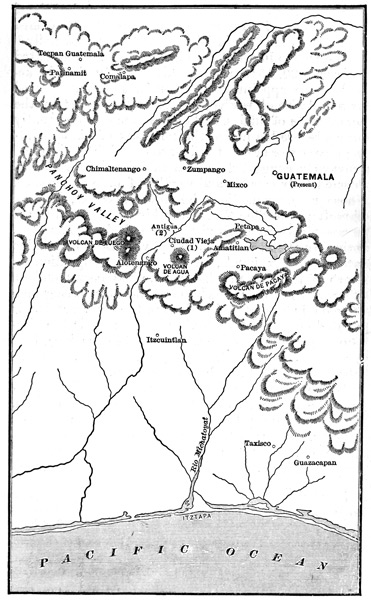
In the centre of this beautiful valley, and nearly
opposite the Volcan de Agua, stood the city. Over a
mile in width at its narrowest part, its numerous
streets were broad, well paved, and, excepting in the
suburbs, laid out at right angles. Every portion of
the city was abundantly supplied with water, and in the
principal square there was a large and handsome stone
reservoir, fed by two streams. Facing on this square
were the governor's and archbishop's palaces, the city
hall, mint, and cathedral. The government buildings
were remarkable for their solidity; and within their
spacious corridors, formed of columns and arches, was
displayed every variety of merchandise. The churches
of Guatemala, of which there were nineteen, were
famed for their architectural beauty, their size, and
the richness of their ornaments. Besides the cathedral
and the churches, there were eighteen convents
and eleven chapels. The cathedral was over three
hundred feet in length, one hundred and twenty in
width, and sixty-six feet high. It had three naves with
eight chapels on each side. Its interior was richly
carved and gilded, and decorated with rare and costly
statues, paintings, and tablets, while it possessed many
precious relics, and numerous utensils of gold and silver.
The high-altar was of exquisite design.[XXXVII‑52]
The private dwellings were many of them of great
beauty, solidly and commodiously built, richly furnished,
and with spacious gardens and courts. The
number of inhabitants at this time was little short of
twenty-five thousand,[XXXVII‑53] and from the neighboring
pueblos, the chief occupation of whose inhabitants
was agriculture and various industrial arts, Guatemala
was supplied with all the necessaries and many
of the luxuries of life.[XXXVII‑54]
Such, in June 1773, was the fair city of Guatemala,
destined for a second time soon to be laid low by envious
powers. During the past twenty-three years the
metropolis had experienced frequent disturbances, some
of a political nature, others in the appearance of that
familiar and dreaded visitant—earthquake. Two severe
shocks, occurring March 4, 1751, did considerable
damage, chiefly to the churches;[XXXVII‑55] in 1757 a shock was
felt to which the natives gave the name of San Francisco.
Two more were felt in 1765; the first, called the
holy trinity, was disastrous to the province of Chiquimula,
and the second, called San Rafael, desolated the
province of Suchiltepeque, but neither did any damage
in the city of Guatemala.[XXXVII‑56]
About 1756 a riot occurred in the city on account
of the prohibition of the sale of certain liquors, but
was soon suppressed by the personal courage and
prompt measures of President Arcos.[XXXVII‑57] In 1766 a
serious outbreak was threatened because of the establishment
of the tobacco monopoly, and was only prevented
by reducing the price of that article. The
alarm and excitement caused by this danger was increased
by the atrocious murder of two friars.[XXXVII‑58]
The minds of the people were for a time diverted
from their local troubles by the funeral obsequies of
the queen of Spain. The official notification of her
death was received in Guatemala March 25, 1759, and
on the 29th of the following June pompous funeral
ceremonies were celebrated.[XXXVII‑59]
ANOTHER GREAT EARTHQUAKE.
Two years later the oath of allegiance to Cárlos
III. was taken.[XXXVII‑60] In October 1762 the valley was
flooded, and the town of Petapa, and the portion of
the city known as the Barrio de los Remedios was
inundated.[XXXVII‑61] But the crowning disaster was yet to
come. A few slight shocks of earthquake in the latter
part of May 1773 gave no cause for apprehension
and were almost forgotten, when on the 11th of June
they returned with such violence as to damage several
houses and churches, notably the Carmelite and
Dominican convents, and the hospital of San Juan de
Dios. The shocks continued for several days with
diminishing force and frequency until they had nearly
ceased. On the 25th of July they were again renewed,
but although frequent and violent there was no serious
damage until the 29th, when the people had partially
recovered from their alarm. Then they were startled
by a sudden shock, coming on about four o'clock in
the afternoon, which, though comparatively slight,
seemed portentous of evil. So great was the apprehension
felt by the inhabitants that many instantly
abandoned the city, and those who remained were
ready at the first indication of its return to flee from
their dwellings. Scarcely ten minutes had elapsed
since the first shock when there was a second, and
of such violence that with the first vibration the work
of destruction began. The motions were as varied as
they were sudden and destructive; now horizontal,
now vertical, the latter uplifting the earth with explosions,
and compelling man and beast to remain
prostrate. On every side were heard the crash of
falling walls, the doleful clangor of the church bells as
their towers rocked under the impulse of unseen powers,
and above all the loud wailings of the terror-stricken
people, who, collected in the squares and
streets, vainly implored divine protection.
DESTRUCTION AND DEATH.
Throughout the night the shocks continued at brief
intervals, and the horrors of darkness were increased
by a severe rain-storm, accompanied by thunder and
lightning, to which the thinly clad inhabitants were
fully exposed, none daring to seek shelter from its
fury lest a worse fate should overtake them. When
day broke they were enabled to realize the full extent
of the calamity. Of the magnificent cathedral nothing
was left but a heap of ruins. Not a house in the city
had escaped either destruction or serious damage. In
many cases where the houses remained standing their
foundations had settled or their walls were shattered
or twisted. The greatest ruin, however, was caused
in that portion called the Barrio del Candelaria. Here
every house, including the church and the Dominican
convent, was levelled to the ground. In many parts
of the city even the pavements of the streets and
the tiled floors of private dwellings were uplifted and
shattered. The deaths, strange to say, were comparatively
few, not exceeding one hundred and thirty
within the city, and probably a smaller number in the
surrounding country.[XXXVII‑62]
On the following day the duty of interment was
begun under the direction of the civil and ecclesiastical
authorities. Fearful of pestilence the dead were
buried wherever found, the grounds having first been
consecrated. Hunger and thirst next stalked about
the ruins. Most of the supplies within the city had
been destroyed or buried beneath the fallen houses,
and none dared venture in those yet standing, as the
shocks still continued. The aqueducts had been
destroyed, and but a scanty supply of muddy water
could be obtained. This distress, however, was soon
relieved by the prompt measures of the president,
who caused to be distributed a quantity of stores destined
for the fortress of Omoa. Vigorous measures
were also taken to suppress the pillage of the ruined
houses, already begun. Thefts to the value of ten
pesos or more were made punishable by death, and
for lesser amounts, the breaking-open of any trunk,
or the approach after evening prayers to the temporary
quarters of the nuns, two hundred lashes
and ten years' penal servitude was the penalty fixed.
As proof of their determination to carry out these
measures the authorities caused a gallows to be at
once erected in the principal square. The presence of
the militia, who had been summoned from the neighboring
town, also helped to keep the criminal classes
in check.[XXXVII‑63]
THE QUESTION OF REMOVAL.
Many had left the city for the adjacent villages, or
had erected temporary shelters in the outskirts, but
more lingered near their homes suffering from lack of
food, clothing, and shelter. Within a few days when
the shocks had gradually diminished, and it was a
question whether the city should be rebuilt or removed
to a new site, the president convoked a meeting
of the civil and church authorities and prominent
citizens, and it was finally decided to remove to the
valley de la Ermita, the portion known as the Rodeo
being chosen, and the choice approved by a decree of
May 24, 1774. But finally, at the instance of the
new fiscal of the audiencia, the site was changed to
the plain of the virgin adjoining La Hermita, where
were greater advantages.
Although a removal was favored by a majority of
the prominent persons, subsequent events showed that
it was not the free expression of the popular will.
Many of the citizens were not in a condition to reason
calmly. The apprehension of fresh calamities was
kept alive by the continued shocks, which on the 7th
of September and 13th of December were unusually
severe. Those of the latter date were said by some
to have equalled in violence that of the 29th of July,
and caused further damage to the remaining buildings.
As time went on, however, the fears of the
people disappeared, and the opposition to a removal
grew stronger among all classes; but still the audiencia
objected. This body, together with the royal
officials and the troops, had been established in the
Hermita since September; but few if any of the
citizens appear to have joined them, and not even a
petechial fever, which appeared and raged until May
1774 could induce them to abandon the ruined city.[XXXVII‑64]
The president would fain have compelled the removal,
but the royal decree which arrived in the
latter part of 1774, made the selection of the site
subject to the approval of the viceroy of Mexico, and
ordered that until such approval was obtained the
erection of permanent buildings should not be made.
The viceroy was duly informed of the choice of site,
but instead of approving it he reported the matter to
the crown.
The removal of the city to the plain of the virgin
was confirmed by royal decree of November 1775,
and immediately following its receipt President Mayorga
issued decrees inviting the citizens to select
their lots in the new locality. But few responded to
this invitation, and none began the construction of
houses, believing that this site would be ultimately
abandoned.
Toward the end of December a second royal decree
arrived with instructions as to the manner of removal,
but forbidding the total abandonment of the old city.
Suppressing such portions of these instructions as
suited his design, the president continued his measures
of coercion, but apparently with little success,
for on the 29th of July, 1777, he found it necessary
to decree that within a year the old city must be
abandoned and all buildings pulled down. The ayuntamiento
had been ordered to take up their permanent
residence in La Hermita at the end of 1775, and their
protests, first to the president and subsequently to
the crown, appear to have availed nothing.[XXXVII‑65] The
archbishop, however, and the ecclesiastics still remained
in the ruined city.
MORE QUARRELS.
The archbishop had opposed the removal from the
beginning, and in his numerous representations to the
crown had occasion to complain of the minister Galvez.
One of these letters fell into the hands of Galvez, who
determined on revenge. Through his influence secret
and stringent orders were issued for the total abandonment
of the ruined city, and a former resignation
of the archbishop, made in 1769, and rejected by the
crown, was reconsidered and accepted. The orders
issued by the president became more and more stringent,
but as he refused to show the royal decrees to
the archbishop the latter paid no heed to them.
Thus affairs continued until August 1778, when
Don Matías Galvez, a brother of minister Galvez,
arrived in Guatemala with the rank of inspector-general
and acting president of the audiencia in the
absence or sickness of Mayorga. In the beginning
of 1779 the entry to the ruined city of all kinds of
merchandise was forbidden; repairs on houses, grounds,
or streets were prohibited; music, bull-fighting, and
all other public diversions were interdicted; the temporary
huts in the streets and squares were ordered
removed, and all artisans, militia, and others of this
class were ordered to transfer their residence to the
new site within a limited period.
On the 5th of April Galvez took temporary possession
of the presidency, Mayorga being promoted to
the viceroyalty of New Spain, for which place he set
out toward the end of the month. The appointment
of Galvez arrived the 14th of May when he took
formal possession of the office. Through his subordinates
he at once issued peremptory orders to all seculars
for the immediate abandonment of the old city
under severe penalties. This tyrannical measure could
not be fully carried out, and such was the suffering it
caused among the poorer classes that many were
allowed to remain among the ruins. The principal
cause of all these troubles, however, was the archbishop.
The civil authorities could not compel him
to leave the old city, and it was hoped that a systematic
course of annoyance would induce him to repair
to Spain, and that during his absence the new archbishop
who had already been appointed would quietly
take possession. Having set out on a pastoral visit,
August 21, 1778, it was supposed that he had departed
for Spain; but in September 1779 he was again in
Guatemala City, whence he issued an edict disputing
the validity of his successor's claims, this latter, Cayetano
Francos y Monroy, having arrived in Guatemala
during the preceding month. From the 9th to
the 30th the struggle between the archbishop and
the audiencia continued. To the former's threats of
excommunication the latter replied with demands
for the recognition of the new archbishop, and this
proving ineffectual he was ordered to depart for Spain,
and the recognition of Monroy by the people enjoined
under heavy penalties. It is uncertain to what extremes
the president might have proceeded had not
Archbishop Cortés secretly left for Spain at the end
of the month. Monroy at once took possession, and
thus ended this scandalous affair.[XXXVII‑66]
Notwithstanding its want of resources the new
city, aided by the cession of the revenues for ten years
made by the royal decree of 1774, was soon rebuilt,
and in 1800 had its paved streets, fine squares, public
buildings, and churches. The cathedral, of smaller
proportions than that of the old city, and the Jesuit
college, were still unfinished.
Alarms and disaster still followed the people of
Guatemala. On the 11th of July 1775 a violent
though harmless eruption of the volcano of Pacaya
occurred; in 1776 the eruption of the volcano De
Tormentos, near Amatitlan, destroyed the village of
Tres Rios, three leagues distant, and filled with lava
the rivers from which it took its name.[XXXVII‑67]
In 1780 the new city was visited by small-pox,
which extended over the whole country and carried
off many victims. The use of vaccine was now for
the first time tried in Guatemala, and proved a success,
as few if any of those inoculated died.[XXXVII‑68]
SALAZAR AND GALVEZ.
Before these events had fairly passed, the declaration
of war between England and Spain in 1779, and
the almost immediate invasion of Honduras and Nicaragua,
compelled the reorganization of the military
force of the kingdom. We have no information of
the condition of either the regular army or militia at
this date, but it is hardly probable that any material
change in their condition had taken place since the
report of President Salazar in 1778-9. As therein
shown the country was not in a condition for war.
The whole number of regular troops in the kingdom
consisted of two companies of dragoons numbering
sixty men, and who were stationed at the capital.
The militia force included all the able-bodied men in
the kingdom, the majority of whom were mulattoes;
but in the rare event of their being called out for
service a certain proportion only was taken from each
town, the remainder being indispensable to the cultivation
of the soil. Both infantry and cavalry were
poorly disciplined, and their arms, usually deposited
in the principal towns, would not suffice for one half
of the troops, besides being for the most part out of
repair for want of an armorer. A few of the mulattoes
had rude side arms of home manufacture, but it
was rare to find one who had acquired any skill in the
use of fire-arms. The regular force was subsequently
increased to two hundred, a detachment of one hundred
Spanish troops arriving in August 1777.[XXXVII‑69] At
this same time infantry and cavalry officers, artillerymen
and engineers were asked for by President
Salazar to reorganize and instruct the militia and
take charge of the artillery and fortifications. The
various fortresses and principal cities were well provided
with artillery and small arms, but many of
them in an apparently unserviceable condition.[XXXVII‑70] At
the first note of alarm President Galvez applied himself
to the organization of an army, and such was the
energy and ability displayed in his conduct of the
subsequent campaign, that he earned merited fame
and promotion for himself, and, as we have seen, led
his troops to victory.[XXXVII‑71]
The rule of President Galvez ended on March 10,
1783, when he was transferred to the viceroyalty of
New Spain. His administration was an exceedingly
prosperous one for Guatemala, and his departure was
greatly regretted by all classes.[XXXVII‑72] His successor was
José Estachería, who assumed office the 3d of April
the same year. He was brigadier-general and ex-governor
of Nicaragua. His term of office expired
December 29, 1789. To him succeeded Bernardo
Troncoso Martinez del Rincon, lieutenant-general,
formerly king's lieutenant of Habana and ex-governor
of Vera Cruz, who was in power until 1794,
and José Domas y Valle, a knight of Santiago, gefe
de escuadra, who held office from the latter date until
the 28th of July 1801.[XXXVII‑73]
From May 13, 1753, until June 24, 1765, the archiepiscopal
chair of Guatemala was filled by Doctor
Francisco José de Figueredo y Victoria, who had been
promoted from the see of Popayan.[XXXVII‑74]
MISSIONARY WORK.
The only event of importance during his rule was
the partial secularization of missions. The order was
received from Mexico by the audiencia sometime
after the death of President Vazquez, but was not
made public until 1754, when the secularization of
the missions in the valley of Guatemala at once
began.[XXXVII‑75]
On the arrival of President Arcos, a little over a
month later, the Dominicans, who had appealed to
the crown against this measure, prevailed on him to
delay, under some pretext, the transfer of their missions.
This, however, proved only a temporary relief;
for though the provinces of Vera Paz and Quiché
were left to these friars, Archbishop Figueredo reported
the conduct of the president to the crown,
whereupon the secularization was ordered continued,
and Arcos was reproved. The Dominicans redoubled
their exertions, but succeeded only in obtaining a
cédula ordering that the transfer of the remaining
missions should be made only on the death of the
friars in charge. Later, even this concession was revoked
by the archbishop of Guatemala.[XXXVII‑76]
At the time the missionary field in the province
of Guatemala proper seems, with the exception of
the Lacandon territory, to have been exhausted; for
we find that the Franciscan college of Cristo Señor
Nuestro Crucificado, founded April 27, 1756, had missions
in Veragua, Costa Rica, Honduras, and Mosquitia,
but there is no mention of any in Guatemala.[XXXVII‑77]
In 1790 the parish priest of Palenque made a feeble
attempt to reduce the Lacandones. Having obtained
pecuniary aid from the intendente of Chiapas, he
founded a town, baptized several natives, and won
their good-will by numerous presents; but the advantage
thus gained does not appear to have been
improved.[XXXVII‑78]
Some excitement was caused in Guatemala City
in July 1772 by a disturbance in the convent of the
Recollets. Owing to violent dissension among the
inmates, the audiencia, at the request of the friar,
caused the arrest and remittance to Spain of two of
the ringleaders. The populace, ignorant of the cause
of this interference, were with difficulty quieted. This
action of the audiencia was approved by the crown, and
the remainder of the turbulent friars were suspended.
EXPULSION OF THE JESUITS.
Having become blind from old age, being now in his
eightieth year, Archbishop Figueredo petitioned the
crown to appoint a coadjutor. Accordingly, Doctor
Miguel de Cilieza y Velasco, a native of Guatemala
and chancellor of the cathedral, was selected; but the
archbishop died before he was consecrated, and he
was nominated for the see of Chiapas, whence he
departed in October 1767. The archbishop's death
occurred June 24, 1765. In accordance with his request
his remains were deposited in the church of the
Jesuit college, to whose members he had been warmly
attached.[XXXVII‑79] The archiepiscopal chair remained vacant
after Figueredo's death until 1768, when it was occupied
by Doctor Don Pedro Cortés y Larraz.[XXXVII‑80] Preceding
his arrival in 1767 the famous decree of
expulsion against the Jesuits was carried into effect
in Guatemala, but was unattended with any of the
serious disturbances which marked its enforcement
in New Spain.[XXXVII‑81] The utmost secrecy and despatch
were observed. At 6 o'clock on the morning of the
26th of June, troops having been stationed at certain
points, the president and audiencia with an escort
of dragoons proceeded to the Jesuit convent. It was
the feast of the sacred heart, and service had already
begun. Awaiting a favorable opportunity the president
requested the celebrants to cease, and the sacrament
having been covered and the doors closed,
in tears he notified the friars of the fatal decree.
Silently and with bowed heads they signified their
submission. The convent was surrounded by a guard
of militia, and all communication with friends forbidden.
On July 1st they were conducted to Golfo
Dulce and embarked on a Spanish frigate, and a
month later the members of their order from Chiapas
joined them. The decree was published on the 30th
of July. The total number of exiles was eleven. The
rector and two lay brothers remained, the former to
deliver the church property, and the latter because
they were unable to travel.[XXXVII‑82]
Archbishop Cortés took possession of his office in
February 1768. The chief event during his rule was
his difficulty with the audiencia, owing to his opposition
to the removal of the city, and which has been
related in connection with that event. These differences,
however, were evidently of an earlier date.
Cortés, who had been appointed by the king in opposition
to his council, did not find matters to his liking
in Guatemala, and accordingly in August 1769 he
tendered his resignation. This was rejected by the
king, who expressed himself as satisfied with his conduct,
and this rejection was considered final. In opposing
the removal of the city, however, he did not
count on the influence of President Mayorga, who
was protected by the chief minister of the royal council;
and however justifiable in the beginning this
opposition may have been it was unwisely prolonged.
Minister Galvez succeeded in having the resignation
of Cortés reconsidered, notwithstanding the protests
of that prelate. He caused his brother to be appointed
Mayorga's successor, had Cortés transferred
to the bishopric of Tortosa, and, as we have seen, a
new archbishop nominated to Guatemala. The refusal
of Cortés to surrender his chair, it is claimed, was
because he had not received his bulls confirming his
appointment to the bishopric of Tortosa. After leaving
Guatemala, as previously narrated, he proceeded
to his new bishopric, where he continued until his
death, which occurred in 1786. His interest in the
welfare of Guatemala did not end with his departure,
for he subsequently donated sixty thousand dollars
with which to found a college for the education of
the young.[XXXVII‑83]
Doctor Cayetano Francos y Monroy, his successor,
was installed and duly recognized after Cortés' departure;[XXXVII‑84]
but not satisfied with the manner in which
he had been appointed he procured a confirmatory
bull from Pope Pius VII. in 1779. This irregularity
was also recognized by the council of the Indies, as is
shown by the fact that they declared that the revenues
of the archbishopric of Guatemala until December
1779 belonged to Cortés, whose appointment to
Tortosa was not confirmed until this date.
HISTORICAL REVIEW.
Thus we have traced the history of Spanish conquest
and colonization in Central America from the
time when Rodrigo de Bastidas first touched Tierra
Firme to the close of the eighteenth century. We
have seen the sword and the cross side by side, without
a shadow of right or recompense, enter in and
take possession of the broad area from Darien to New
Spain; then sitting down to wrangle and to rest.
During the process of gradual extinction the natives
broke out in occasional rebellions; but for the most
part they were docile, and submitted with philosophic
or Christian resignation to the inevitable, which was
too often infamous on the part of civilization and
Christianity.
It was a period of repose, the two and a half centuries
of Central America's existence under Spain's
audiencias and governors, a period of apathy and
stagnation as far as intellectual and moral progress
are concerned. Nor is there much to be said in the
way of material improvement. Neither God nor
mammon could truthfully claim much higher or
nobler results from the country under European
domination than under American. The province and
policy of rulers, civil and ecclesiastical, were fixed, and
the duties of subjects was determined. Although the
people did not know it, the grasp of the mother government
upon the country, however nervous and
jealous it might be, was in reality weak, for the parent
herself was rapidly declining.
There was nothing to fight for, and nothing to
work for. If we except an occasional attempted subjugation
of unpacified peoples, and the descent of
pirates, the greatest issues of the time were those
affecting precedence and place. It was easier to evade
obnoxious laws than to quarrel with them. The natives
found it less burdensome to perform the little
labor necessary to the support of themselves and
their masters than to endure the penalties of opposition.
Between the poor kings of Spain and the
pirates of England, France, and Holland, the wealth
of the people was far from secure; there was no
great incentive to enterprise in any direction, and
had there been it is not certain that men would
have exerted themselves. Simple existence satisfied
them; high development and limitless wealth could
do no more.
The appearance on their shores of legalized robbery
and murder, in the form of freebooters, was not generally
regarded as retribution, though their infamies
were scarcely greater than those which had been perpetrated
by the Spaniards in this quarter a century
or two before. The buccaneers and Scotch settlers
were right enough in looking upon the Spaniards as
intruders, having no more ownership in the country
than they, except such as priority in wrongs committed
gave them; which wrongs by no means made
right the cruelties and injustice of the English and
French inflicted upon the Spaniards.
APPROACHING REVOLUTION.
In the third and concluding volume of the History
of Central America will be more fully presented the
social, industrial, and political condition of the country
in the nineteenth century, particularly at the
transitional epoch following the achieving of independence
from Spain, and immediately afterward.
Twice during the sixteenth century did Spain narrowly
escape the loss of her richest territories by rebellion.
Twice during the eighteenth did British
armaments threaten to overthrow her dominion in the
New World. And now, at the close of the latter
century, the Spaniards of Central America, goaded
by heavy and unjust taxation, and by the vexatious
restrictions imposed on the trade of the colonies,
stimulated, moreover, by the success with which the
republic of the west had thrown off the yoke of England,
and by the brilliant career which the great republic
of Europe had achieved under the dazzling
leadership of the first Napoleon, were already ripe for
revolution. Spain meanwhile is about to reap the
reward of nearly three centuries of misrule. Through
her indifference the commerce of the western hemisphere
had long since fallen into the hands of foreigners;
and her colonies no longer desired to maintain
their connection with the mother country, from which
they had nothing to gain, and with whose interests
they had little in common.
For the history of the colonial period of the Central American provinces,
especially that portion immediately following the conquest, when, a secure
foothold having been gained by the Spaniards, gradual exploration and settlement
completed their subjugation, the data supplied by the earlier Spanish
chroniclers and official reports are abundant; but the evidence from these
sources is, in some respects, so incomplete and contradictory, that it is only
after an examination of the numerous valuable collections of original documents
brought to light in modern times, that the student is able to fix with precision
the true character and sequence of events. The standard general historians
of the sixteenth century, such as Bernal Diaz, Gomara, Oviedo, and Las Casas,
give us but little information concerning Central America after 1530; and
in consequence the special accounts of individuals like Gage, Benzoni, and
Andagoya, not to mention the writings of the buccaneers, with occasional special
efforts of a time or place like those of Reynolds, and of Fuentes y Guzman,
followed by Juarros, and all supplemented by documents, assume paramount
importance, and become the chief sources of historic material for this epoch.
The founding and subsequent progress of the church in this territory are
traced in a general way by its representative chroniclers, Motolinia, Mendieta,
Torquemada, and Fernandez, until Remesal and Vazquez, chroniclers respectively
of the Dominican and Franciscan orders in Central America, profiting
by the labors of the former, and adding some original research, bring the
history of the church down to the end of the seventeenth century. Some
attempt is also made by the last two writers to follow the political history,
but only in a desultory way.
The first special history to be written was that of Fuentes y Guzman,
containing much original matter, but not generally reliable. The manuscript
was never published, but was used by Juarros. Later appeared the pamphlet
of Cadena, devoted entirely to a description of the destruction of
Guatemala City, and about the same time Escamilla compiled from official
sources a list of governors and bishops and of the more important historical
events, and gave a special account of the destruction of Guatemala City.
Without the valuable collections of Squier, Pacheco and Cárdenas, Cartas
de Indias, Ternaux-Compans, Arévalo, Icazbalceta, and Coleccion de Documentos
Inéditos, the result of modern research, the history of this territory
from 1531 to 1800 would be meagre indeed. These collections, special
notices of nearly all of which I have already given, contain almost numberless
official letters and reports, which were either unknown or inaccessible to
early writers. Prominent among them all is what has been called the Squier
collection, consisting mostly of manuscripts, and which fell to my collection
by purchase after the death of Mr Squier. It consists of extracts and copies
of letters and reports of audiencias, governors, bishops, and various government
officials, taken from the Spanish archives at Madrid and from the
library of the Spanish Royal Academy of History, mostly under the direction
of the indefatigable collector Mr Buckingham Smith. Many rare and valuable
documents relating to Central America, including numerous letters and reports
of Las Casas, are also to be found in the voluminous collection of Pacheco
and Cárdenas, and, though fewer in number, in that of Ternaux-Compans.
In the absence of any early local chronicler, and by reason of the neglect
of those who came later, many of the records have been lost. The only portions
of those published are to be found in the collections of Arévalo, which
are indispensable to the local history of Guatemala, though evidently not
complete, and containing some omissions owing to the apparent illegibility of
the originals. The second of these collections, Coleccion de Documentos Antiguos
de Guatemala, published in Guatemala in 1857, contains, besides the
grants of the coat of arms and privileges to the city of Guatemala, and memorials
and reports of the city council from 1537 to 1782, a few letters of
Alvarado and Bishop Marroquin, some without date, not found elsewhere.
REMESAL, VAZQUEZ, JUARROS.
The work of Remesal, though published in Madrid, was the first one written
in Guatemala. In connection with the special history of the Dominican order
and a general account of the church, considerable political history is given,
though in a desultory manner. This author was the first to make use of the
archives of Guatemala, but in the presentation of this original matter much
carelessness is shown. Las Casas, the Dominican order, and the natives are
his favorite topics, and events are colored accordingly. A century later,
deeming his order neglected by Remesal, the Franciscan chronicler Vazquez
issued his work. Borrowing much from Remesal and other writers for
the earlier epoch, he continued the history of the church down to the end of
the seventeenth century, giving also, as that author had done, the political
history in a disconnected form. With the same facilities as regards original
sources Vazquez makes better use of them than Remesal, but while exposing
the errors of his rival he falls into others equally great, displaying a narrow-minded
prejudice against the natives, while fanatically defending their oppressors.
Remesal and Vazquez are at variance on many points of church
history, but on none more than the missionary labors of their respective
orders. Each claims for his order the honor of first entering the missionary
field in this quarter, but neither makes good his pretensions.
The next work to appear was that of Juarros, which, having absorbed that
of Fuentes y Guzman, was the first published of what might be called a history
of Guatemala. Notwithstanding his access to original documents,
Fuentes y Guzman committed many errors which were unwittingly copied by
Juarros. With the aid of subsequent research, however, these errors are
readily detected, Juarros still remaining the leading historian of Central
America, though owing to the greater importance of Guatemala as the seat of
government, the greater portion of the work is taken up with the history of
this province. In fact this is the only comprehensive history extant of Guatemala
and its adjoining provinces, while the other portions of Central America
make scarcely any pretext to the possession of a history. From no other
source can the writer obtain connected accounts of their conquest and settlement,
description of towns, early resources, and lists of officials and biographies
of prominent men. Of the Spanish writers he is also one of the most
impartial, even in matters pertaining to the church, though he was one of its
ministers. Nevertheless, Juarros is in many respects incomplete. He has
failed in a lamentable degree to present anything like the true political, social,
and moral condition of the people, or the development of the country during
this period; and for the conquest and early colonial epochs there is a manifest
lack of study and research. Noting these defects, Pelaez in his Memorias
attempted to supply them, and has succeeded in a measure. Arranged in a
clear concise form, under their appropriate headings, and with corresponding
references, the student will find collected all the evidence presented on the
different subjects by nearly all of the earlier and modern authors of note; to
which is added the testimony from a large number of original documents
overlooked or neglected by his predecessors. But while the history of Guatemala
for the latter colonial period is comparatively complete, that of the
remaining provinces of Central America, as I have intimated, is but a meagre
outline, dependent for the most part on occasional documents. Among the
modern authorities composed chiefly of English, French, and German, but
a brief historical review is given of this period, a mere compilation from
well known works, which serve as an introduction to narratives of travel, or
books describing the different provinces and their resources.
A peculiar feature of Central American bibliography is the buccaneer
literature, here being the principal scene of the piratical operations of the
sixteenth and seventeenth centuries. The total absence of any Spanish work
on this subject has left the field open to the English, French, and Dutch,
whose accounts of the exploits of their countrymen on the Spanish main are
not always impartial.
Preceding this class of literature and closely allied to it, owing to the
spirit of adventure and the geographical knowledge which it diffused, are the
numerous accounts of voyages made for the purposes of trade, exploration, or
discovery in this part of the world. Some of these I will here notice; though
in truth many of them relate as much to other sections of my work as to
Central America, or even more.
GALVANO AND HAKLUYT.
Complete as is the Raccolta of Ramusio and like collections, in reproducing
the leading voyages up to its time, a large number of minor narratives
remained unnoticed, while others stood briefly recorded upon mere hearsay
in the writing of others. This deficiency had been observed by Antonio
Galvano in earlier collections, and his effort to repair it gave rise to the first
comprehensive history of voyages. Born at Lisbon in 1503, Galvano left at
the age of twenty-four for the Indies, where he was intrusted with the conquest
and government of the Moluccas. Of this he remained in charge for
six or seven years, distinguishing himself both as a just and benevolent ruler,
and as a zealous proselytizer. His unselfish conduct served only to attract
calumny and to reduce him to poverty, so much so that he had to seek refuge
in the royal hospital at Lisbon, where he died in 1557. His undoubted talent
had been fostered by extensive reading, particularly of narratives of voyages.
While so employed he kept notes with a view to form an outline of
the progress of navigation and discovery, which should serve as introductory
to a collection. During the latter part of his life, while suffering under the
ban of royal displeasure, he found ample time to perfect these researches,
and at his death a friend, Francisco de Sousa Tavares, was intrusted with the
papers. Among these appears to have been a history of the discovery and
resources of the Moluccas, a manuscript in ten books, according to Faria, of
which Pinelo says: "Por no haverle visto, duda, si permanece." Epitome,
ii. 636. De Sousa caused the treatise under consideration to be published
at Lisbon in 1563, under the title of Tratado que compōs o nobre e notauel
capitão Antonio Galuão de todos os descobrimentos antigos e modernos que são
feitos á era de mil e quinhentos e cincoenta, with a dedication to the duke of
Aveiro, wherein he records Galvano's many services, and comments on their
poor recognition. Mention has been made of a duodecimo edition of 1555,
but this must be a mistake, to judge by Sousa's preface to the edition of 1563.
Of this only three copies are known to exist, one owned by Mr John Carter
Brown, of Providence, from whom the Hakluyt Society obtained a copy,
printed as a running foot-note to their reissue of Hakluyt's version, under
the editorship of Admiral Bethune. The latter is called The Discoveries of
the World from their first originall vnto the yeere 1555, by Antonie Galvano,
Londini, 1601, to be found also in the reprint of Hakluyt's Voyages, and in
Churchill's Collection, while Purchas gives it in reduced form. The Portuguese
copy was reprinted at Lisbon in 1731. Hakluyt explains in the dedication
to Sir Robert Cecil that his publication thereof was intended as an
introductory to his own work, and was made from an old manuscript translated
by an English merchant. In order to modify the "manifold errours"
therein, Hakluyt took pains to consult Spanish works for the corrections and
additions which are to be noticed in this version. The treatise goes back to
the discovery voyages related by Chinese, Greek, and Latin writers, and
brings the concise record for every region of the globe, in chronologic order,
down to 1550. The East India voyages are partly from his own notes, while
other contemporary expeditions are derived from the chroniclers. The pre-Columbian
period occupies only a little over one fourth of the text, and shows
the want of access to material revealed by subsequent investigations in different
countries. The later period is pretty complete for Spanish and Portuguese
voyages, considering the tardiness with which occurrences were published.
Hakluyt, while regretting that English voyages are "scarce fower times
mentioned," admits that at the time "there was little extant of our men's
trauailes." Muñoz speaks slightingly of Galvano, saying "compendia infelizmente"
what others have done more fully. Whatever its defects, the treatise
was certainly a most valuable contribution to the subject, and is still
highly important as one of the first essays toward a history of voyages.
Among those who followed Ramusio's example of collecting and publishing
narratives of voyages and travels stands pre-eminent Richard Hakluyt,
whose work was remarkable not only as the first but as the most valuable in
English for the originality and rarity of its narratives, particularly those
relating to America. When Hakluyt began his studies Eden's Historie of
Travayle, containing translations from Martyr and Oviedo, was the only
English book extant on maritime discovery. Nor was much known abroad
of English voyages, partly because the traders preferred to keep their own
counsel. Hakluyt's perusal of foreign collections, and his private researches,
showed him, however, that the English had performed deeds worthy of being
recorded, and he was fired with ambition to make them public.
Hakluyt belonged to a good Herefordshire family, settled at Yatton,
which had for centuries held a leading position in the county. After passing
through Westminster school as a queen's scholar, he was in 1570, at the age
of 17, elected to Christ Church college, Oxford, and took the degree of B. A.
four years later; that of M. A. being obtained after three years' further
study. While yet a boy he had been directed by a cousin to the study of
geography and navigation, which henceforth became his favorite pursuit. So
well did he use his opportunity at Oxford, where he also mastered several
languages for his studies, that he appears to have been appointed lecturer on
cosmography. In the dedication to Walsingham of the first edition of his
collection he says: "I in my publike lectures was the first that produced and
shewed both the olde and imperfectly composed and the new lately reformed
mappes, globes," etc. Between 1584 and 1589 he held the post of chaplain to
the embassy at Paris, and while there pursued actively his researches,
besides publishing narratives of voyages in French and English. In 1590 he
obtained a rectory in Suffolk County, on the strength of which he married
four years later, and in 1605 he succeeded Dr Webster as prebendary of
Westminster abbey. Dying November 23, 1616, he was buried in St Peter's
of this abbey, leaving to his son a fair estate which was soon squandered.
Although interested in Raleigh's patent for making discoveries, and forming
one of the chief adventurers in the company for the colonization of Virginia,
he took no other share in maritime projects than to promote them by his
writings. His devotion to researches was so great that he once rode two
hundred miles to meet the only survivor of Hare's disastrous voyage. He
corresponded with Ortelius and Mercator, and received the friendly encouragement
of Walsingham, Cecil, Admiral Howard, Drake, and others. His
first publication was Divers Voyages touching the Discoverie of America and
the Islands adiacent, London, 1582, dedicated to Philip Sydney. Of the
original only five copies are supposed to exist, from one of which the Hakluyt
Society issued a reprint in 1850, under the editorship of John Winter Jones,
of the British Museum, who prefaces it with a valuable review of Hakluyt's
life and writings. The several narratives refer to the north-east and north-west
passages, the East Indies, and the east coast of North America. A
curious map herein of conic projection shows the North American continent
extending to about latitude 46°, where the California peninsula connects with
a range called Sierra Neuada, running latitudinally. Above 46° all is open
ocean, bordered on the east, however, by a strip of land connected with
Florida by a narrow isthmus, and extending to Cape Labrador. The northern
part of California bears the name Quiviri, the southern (Cape) California,
and the central part S. Croce (Santa Cruz). On the mappemonde the Tierra
del Fuego forms part of a great antarctic continent. While at Paris, Hakluyt
caused to be published in French an account of Florida, from a manuscript
found by him, and this was issued the following year, 1587, in English, as
A notable historie containing foure voyages unto Florida, both versions dedicated
to Raleigh, with an exhortation to prosecute the colonization of Virginia.
The same year he published at Paris an improved edition of Martyr's De
orbe novo which some years later was translated into English by M. Lock.
In 1589 appeared the first instalment of the great work The principall
navigations, voiages and discoveries of the English nation made by sea or
over land, a folio, dedicated to Sir Francis Walsingham. It is divided
into three parts, relating respectively to Asia and Africa, to the north and
north-east of Europe and Asia, and to America, including Drake's voyage.
Nine years later he published the first volume of a new edition of his collection,
followed in 1599 and 1600 by two more volumes, in none of which reference
is made to the first issue. They are fine specimens of black-letter type,
with marginals and headpieces, but with the prefaced Latin text, headings,
and names in roman type and italics. The first volume is dedicated to Lord
Howard as a tribute to the patriotic services of the family, and in recognition
of the favors received by Hakluyt and his brother; the others to Sir
Robert Cecil, secretary of state. They are properly a rearranged enlargement
of the first issue, volume i. containing voyages toward the north and
north-east of England; volume ii. to the Mediterranean and Africa; and
volume iii. to America, including several voyages by foreigners to parts not
visited by the English. The narratives are generally in the language of the
narrator, and in the first two volumes their order is chronologic; but in the
American section they are grouped under different geographic headings. This
opens with the dubious voyage of Madoc in 1170, and continues with expeditions
to the extreme northern parts of the continent, chiefly with reference to
the north-west passage. The region between Canada and Florida comes
next, followed by explorations toward New Mexico and California, and in
Mexico; then the Antilles and Central America, succeeded by a series of groups
for South America, the whole concluding with circumnavigations and voyages
directed to the South Sea. In the dedication to the third volume Hakluyt
says: "Now because long since I did foresee, that my profession of diuinitie,
the care of my family, and other occasions might call and diuert me from
these kinde of endeauors, I have for these 3 yeeres last past encouraged and
furthered in these studies of Cosmographic and forren histories, my very
honest, industrious, and learned friend Mr Iohn Pory." Profiting by this
training, Pory in 1600 issued a translation of Leo's History of Africa. Others
were similarly directed to geographical research, among them Parke who
issued a translation of a history of China, and Erondelle who published a part
of Lescarbot's Histoire de la Nouvelle France. Hakluyt himself continued to
devote to his favorite subject the little leisure remaining, and left enough
manuscript to have added a fourth volume to his collection; but coming into
Purchas' hands they were abridged for his Pilgrimes. Some of them were evidently
prepared for the guidance of the East India Company, which had not
failed to consult the renowned cosmographer, without whose advice few maritime
enterprises were then undertaken. In 1601 he issued a translation of
Galvano's Discoveries of the World, and in 1609 his last book, a translation
of Soto's Discoveries in Florida, with the main object of encouraging the
Virginia colony. Virginia is greatly indebted to Hakluyt, and the maritime
enterprise of England in general was much promoted by his personal application
and writings. Robertson adds that to him "England is more indebted
for its American possessions than to any man of that age." A reprint of all
Hakluyt's works was issued in five volumes quarto in 1809-12, by R. Evans,
only 325 copies being printed. The fifth volume, issued in a larger edition,
is entitled A Selection of Curious, Rare, and Early Voyages, and Histories of
Interesting Discoveries, Chiefly Published by Hakluyt, but not included in his
Compilation; London, 1812, 807 pp., and is really a supplement to Hakluyt
and Purchas, offering reprints of documents touching different parts of the
globe, as Galvano's Discoveries, The Historie of the West Indies by Martyr,
from Lock's translation of Hakluyt's version, and several others, chiefly relating
to Asia. Hakluyt's works stand an enduring monument to well earned
fame, and his spirit, after influencing contemporary enterprise, continued to
animate the nation, and to assume embodiment in the Hakluyt Society,
which has for its aim to continue the labors that have done so much for literature
and science.
DE BRY, ENS, GOTTFRIEDT, PURCHAS.
Among foreign writers influenced by Hakluyt's exhortation and example
may be mentioned Theodore De Bry, the engraver of Frankfort. The opportunity
afforded him in his profession to become acquainted with and to collect
works relating to voyages and conquests, had not failed to awaken an interest
for the subject. But a visit to Hakluyt, then engaged upon his collection,
gave a decided impulse to his ideas, and being a man of enterprise he forthwith
engaged editors, and in 1590 began publishing, simultaneously in Latin,
German, and French, the famous Collection des Grands et Petits Voyages, referring
respectively to the new and old worlds, the larger size of the volumes
for America giving rise to the title. Under the supervision of his sons and
other members of the family, the collection was continued after his death, in
1598, till completed in its fortieth year. The numerous reprints of volumes
and sets during this interval, with more or less changes, have given no little
trouble to collectors in search of the complete issue. Formed without critique,
it is remarkable rather as a convenient set and as a bibliographic curiosity,
wherein the engravings constitute the main attraction, then for geographic
value, since most of the narratives had already been published in better form,
and have been reproduced in later works.
De Bry's set proved a fertile source in text and engravings for compilers,
and among them Gaspar L. Ens, the author of several individual European
travels, and one of the editors employed by De Bry, who issued the Indiæ
Occidentalis Historia, Coloniæ, 1612. On the same plan as Ens', but on a
larger scale, and partly based upon it, is the Newe Welt Vnd Americanische
Historien, Franckfurt, 1631, reprinted 1655, folio. The author, Johann Ludwig
Gottfriedt, whose proper name appears to be Jean Philippe Abelin, was
also an editor of De Bry, and wrote several works, one of them being the
"Archontologia Cosmica, que es Farrago de diversos Autores, sin distinguir lo
cierto de lo dudoso." Pinelo, Epitome, tom. iii. pp. 1288. It is also called a
translation of D'Avity's Les etats. Gottfriedt naturally sets up a claim for his
Newe Welt to be compiled from leading writers, without referring to De Bry,
who no doubt supplied the material for the text as well as the plates.
De Bry, says Brunet, Manuel, tom. ii. p. 1674, "a abrégé des douze premières
parties de la collection." The plates, which are perhaps the most interesting
part of the volume, have been selected chiefly from the nude and the
curious, such as Indians driving whales, playing with mermaids, or hunting
semi-human beasts. The arrangement of the text shows no improvement
upon Ens, but the third section differs in being more of a supplement to both
the preceding parts.
Hakluyt's unpublished papers, failing to attain their destined object,
accomplished a wider result by giving rise to the larger collection of Samuel
Purchas; for it was their possession that gave impulse to a work so much
needed, both to fill the gaps of the former and to narrate the numerous expeditions
which had taken place since its date. The precursor of the work was
Pvrchas his Pilgrimage, or Relations of the World and the Religions observed
in all Ages and Places, London, 1613, dedicated to the archbishop of Canterbury.
It was reprinted in 1614, and soon reached several editions, the fourth,
1626, being dedicated to King Charles, who had deigned to inquire for it,
and whose royal father had read it seven times, as the author proudly announces.
This object of kingly delight claims to be a compilation from over
thirteen hundred authors, which are decidedly well represented in the numerous
marginals, and gives a review in nine books of the social condition and
the institutions of the nations in Asia, Africa, and America, particularly the
religious feature, with some reference to political history. Beginning with the
Mosaic creation it takes up the nations of south-east Asia, of the East Indies
and China, and reaches Africa in the sixth book. The last two are devoted
to the New World, whose physical and natural features receive two chapters,
followed by the general description of the region above Florida in five chapters,
while the eighth is given to the country west of this, and the next six to New
Spain. The fifteen chapters of book nine cover South America and the Antilles,
the last being an attack on Spanish cruelty and maleconversion. Three
parts similar to this volume were promised, the second to relate to Europe,
and the others to continue the subject for the four divisions of the world; but
the necessary aid was withheld, as Purchas hints in an address to the Pilgrimes,
and wherein he attempts a pun upon his name by intimating that Europe cannot
now be purchased. The project had evidently to yield to others, as Microcosmus,
or the History of Man, 1619, and to the great collection which soon
engrossed his whole attention. Purchas was like Hakluyt a preacher, but of
the rival university of Cambridge, trained at St John College, as he states
in the dedicatory to volume iii. He attained the degree of bachelor of divinity,
conferred also by Oxford in 1615. In 1604 he assumed charge of a vicarage
in his native county of Essex, but was soon called by his literary
researches to London, where he fell into difficulties, and had recourse to lecturing
and to friends. Finally Bishop King came to his aid with means to
prosecute the publication of his work, and by conferring upon him the rectory
of St Martins. Purchas expresses his gratitude for these favors in the opening
address to volume i., wherein he speaks of "my decessed Patron Doctor King,
... to whose bountie vnder God, I willingly ascribe my life, deliuered from a
sickly Habitation, and consequently (as also by opportunities of a London
Benefice) whatsoeuer additions in my later Editions of my Pilgrimage; these
present Pilgrimes also." In the dedication of the Pilgrimage to the archbishop,
he signs himself his chaplain, which may be a figurative expression.
He is generally supposed to have died in poverty, and even in prison; but
the title-page portrait of 1625, at the age of forty-eight, presents him as a
sleek, contented-looking preacher, with a full though not large beard; and
the several editions of the Pilgrimage would indicate that he had prospered
up to that time at least. According to Wood he died in his own house about
1628. In 1625 appeared Haklvytvs Posthumus or Pvrchas his Pilgrimes. Contayning
a History of the World, in Sea voyages & lande-Trauells. Imprinted
at London for Henry Fetherston. In four parts or volumes, folio, each
dedicated to a different personage. The first title-page is filled with emblematic
designs, and portraits of princes and great men, among them
Purchas, at the foot, between two hemispheres, with his anagram of "Pars
sva Celvm." The other title-pages are all headed Pvrchas his Pilgrimes,
and this quaint name the author sustains to some extent by opening the
dedication to Prince Charles with: "May a poore Pilgrime salute Your
Highnesse in the words of a better Samvel." Directly afterward, however,
he assumes another higher role in "hauing out of a Chaos of confused intelligences
framed this Historicall World, by a New way of Eye-evidence;" and
then he begins to lose himself in an attempt at magniloquent phraseology,
with no great promise for his power to bring order out of chaos. Later he
declares himself a mere laborer "howsoeuer here a Masterbuilder also," doing
everything with his own hands, except where aided by his son. The manuscripts
left by Hakluyt, although forming a very small proportion of the book,
"encouraged me to vse my endeuours in and for the rest," he gratefully
observes. The printing of the work began in 1621, although not with volume
i. The first of the twenty books into which the set is divided, treats of
ancient navigation, progress of discovery, and religious phases. The second
begins with Portuguese and Columbian voyages, and continues with circumnavigations,
after which come the regular narratives of voyages, chiefly by
Englishmen, interspersed with extracts from notable journals and histories,
with a view to cover subjects and periods not otherwise disposed of. Volumes
i. and ii. relate almost wholly to Asia, Africa, and the Levant, and also
the next two books, while books iii. and iv., following, deal partly with
north-west voyages, beginning with Zeno. Book v. gives extracts from
Herrera, Oviedo, Acosta, and Cortés, which chiefly concerns Mexico, and a
part of vi. touches the Isthmus, but the main portion of this and the next
book are occupied with South America. Book viii. is divided between Mexico
and the country northward to Virginia, which latter takes up the whole
of ix. The last book is shared among New England, Newfoundland, and
the English expeditions against Spain. Altogether the arrangement is as
confusing as the text, and in both respects far inferior to Hakluyt's; nor is the
work as complete as might have been expected. In the attempt to introduce
foreign narratives the limits of space were overstepped, to the prejudice of
other accounts, which were often injudiciously condensed. Pinkerton remarks,
somewhat too severely, I think, that Purchas directed his utmost
attention to "selecting the most useless parts of the unhappy authors." Col.
Voy., vol. i. p. iv.
THÉVENOT AND HARRIS.
Purchas' labors found recognition abroad in the well known Relation de
divers voyages, Paris, 1663-96, 5 parts, by Melchisedech Thévenot, formed
mainly with a view to reproduce the best portions of Hakluyt and his successor,
while adding some unpublished narratives. Thévenot appears to have
been particularly well fitted for such undertakings. A savant, and somewhat
of a diplomatist, he was for eight years in charge of the Royal Library at
Paris, dying at his post in 1692, at the age of 71. The selection of his material
gives evidence of good judgment; yet the arrangement and other points
may be questioned.
Another reproduction, and a continuation of the two great English collections,
was offered some years later by John Harris, Navigantium atque Itinerantium
Bibliotheca: or, a Compleat Collection of Voyages and Travels; London,
1705, 2 vols, folio, with copper-plates and maps. One of its chief aims being
to repair the many omissions that had become apparent in the original works,
the first volume is devoted to the same period as Purchas' collection, while
introducing a number of additional voyages. Its five books refer respectively
to circumnavigation, to Asia, to Africa, to the north and north-east
parts of the globe, and to America, the latter embracing one third more narratives
than Purchas. The mappemonde places the strait of Anian above
the island of California, but on the American map this is not marked. The
second volume, relating to voyages and travels after this time, chiefly by
Englishmen, is less distinct and careful in its arrangement. Books i. and ii.
cover Russia, Asia, and the Levant; book iii., Europe; and book iv., America.
The latter includes only the buccaneer expeditions, Dampier's voyage, and explorations
in the Mississippi and Canada regions. A varied appendix concludes
the volume. According to Green, of the Astley collection, John
Harris, who is styled an A. M., and Fellow of the Royal Society, had little
or nothing to do with the work besides writing the introductory on the
origin and emigration of races, and on the progress of navigation. Four
hundred authors are claimed to have been included in the text, in abridged
or compiled form. Rich, Bib. Amer., vol. i. 9, remarks that "it appears to
have been got up in competition with Churchill's Collection;" but it is much
more general in its scope. Of undoubted value it was reissued in 1743-4, with
numerous corrections and additions, and reprinted in 1764.
VAN DER BOS, VANDER AA, CHURCHILL.
A book typical of its nationality is Leeven en Daaden Der Doorluchtigste
Zee-Helden, Amsterdam, 1676, by Lambert van der Bos or Bosch, wherein
are given the biographies of naval heroes from Zeno down, but of course with
particular prominence to those of Holland, and foremost among them Admiral
Ruyter, to whose son the dedication is addressed. While entering into the
biography and political events connected with their lives the object is mainly
to describe naval expeditions and encounters in various zones, and to this end
tend also the plates. Columbus, Vespucci, Drake, Cavendish, and some of
the searchers for the north-west passage are those touching my field who have
been accorded a comparatively small space. Despite the laudable object of
the book, to place before the people their chief glories, the author feels it
necessary to bring forward the now well worn excuse that to the solicitation
of persons interested in the subject was due the publishing of what his own
inclination had led him to prepare. The German translation of Nürnberg,
1681, is an abnormally stout little volume, with an appendix by Erasmus.
Naaukeurige versameling der gedenkwaardigste Reysen naar Oost en West-Indien,
Leyden, 1706-7, is a black-letter book of 30 volumes 12mo, issued by
Pieter vander Aa, and embracing voyages to all parts of the globe from
1246 to 1693. Interspersed are compilations of minor expeditions, and of
political affairs, apparently with a view to cover some of the many chronologic
and geographic gaps in the regular series of narratives, and to form a
complete historic review; but this effort is merely spasmodic and serves rather
to expose the haste of the editor in not consulting more authorities, or in
doing so carelessly. In addition to the incompleteness must be noted the
lack of order in chapters as well as divisions, distinct and disconnected narratives
being not unfrequently jumbled under inappropriate headings. The
matter relating to America is, in accordance with the original though neglected
plan, scattered throughout the set, in fair proportion for the earlier
periods at least. This applies particularly to the northern Spanish colonies,
for which the period from Columbus to Cortés is pretty fully told, chiefly
from Herrera. Acosta and Marquette are given in abbreviated form. After
1526 this region receives little notice beyond the relation of a few voyages
from Purchas, such as Ulloa, Chilton, Drake, and Cavendish, the latest date
being 1595. The numerous copper-plates and maps are an attractive feature
as may be judged from the fact that De Bry had been largely borrowed from.
His text has also been used to some extent, Meusel, Bib. Hist., tom. ii. pt. i.
336, going so far as to say that all belongs to De Bry; but this is an exaggeration,
for most of the text can readily be traced to Herrera, Hakluyt, De
Barros, and others. A revised edition of this work was published in 1727 as
De Aanmerkenswaardigste en Alomberoemde Zee- and Landreizen, folio, 8 volumes
bound in 4. The same black-letter type and plates are preserved, but
the arrangement differs, each set being in chronological order, and each
narrative in a separately paged section. The first two volumes relate to
Portuguese voyages toward the East India region; the next two to Spanish
voyages up to 1540, to both hemispheres though chiefly to America;
the two following to similar English voyages, till 1696; and the last two
volumes to those of other nations, and to narratives supplementary to the
preceding. The Portuguese division is chiefly made up from De Barros
and De Couto, and the following Spanish from Herrera. Volume iii., bearing
on the title-page the portraits of Columbus, Vespucci, Magellan, and
Ponce de Leon, opens with the voyages of the great admiral, and continues
with expeditions and events in Tierra Firme, the Antilles, Nicaragua,
and Florida, concluding with Grijalva's discovery of New Spain.
The next volume is almost wholly devoted to Cortés, and events in connection
with his conquest and rule, alternating with sections on contemporary
expeditions under Magellan, Narvaez, Godoy, Loaisa, and Cabot. In
the following set, obtained chiefly from Hakluyt, Frobisher's voyages are the
first to touch America, followed by Drake's and other circumnavigations and
the settlement of the English American colonies. In volumes vii. and viii. we
find Verrazano, Pizarro, and Soto, Dutch and French expeditions to South
and North America, including P. Marquette, and extracts from Benzoni and
Acosta. On the title-page Vander Aa chooses to announce that the collection
is based on the German works of I. L. Gottfried, but largely augmented with
material from his originals and from later authorities. This affectation can
be regarded only as an advertisement.
A Collection of Voyages and Travels, Some now First Printed from Original
Manuscripts, others Now First Published in English, is generally known by
the name of Churchill, the publisher, who, in connection with Awnsham,
issued the first edition in 1704, in four volumes. In 1733 it was increased by
two volumes, and the reprint of 1744-7 by two more of the so-called Harleian
Collection, culled from the Oxford Library, and printed by Thomas Osborne.
The whole eight were reissued in 1752, and also used by foreign publishers,
the introductory discourse by Caleb Locke, on the progress of navigation,
being translated into French to form, with additions, two duodecimo volumes
known as Histoire de la Navigation, Paris, 1722. Although neither so universal
in its scope as Hakluyt's or Harris', nor so well translated and arranged,
yet it stands as one of the most valuable of collections from its many
rare narratives, such as the life of Columbus by his son, in vol. ii.; Gemelli
Carreri's much questioned yet interesting voyage, vol. iv.; an account of the
Mosquito kingdom, vol. vi., and Castell's description of America, in the Harleian
Collection. A number of other pieces refer to America, as Monson's
tracts, and Ovalle's history of Chile, but they do not touch my field.
PRÉVOST, GREEN, DIDOT, ROZET.
The most famous collection of voyages published in the eighteenth century
is the Histoire Générale des Voyages, Paris, 1746, etc., 20 vols, 4to, edited by
Abbé Antoine François Prévost d'Exiles. Provost was one of those bright
bubbling geniuses whose life and writings have assisted in making the capital
of La Belle France also the capital of the literary and fashionable world.
In the role of a dashing young officer, he had at an early age sipped of all
frivolities in that gay city, till a misdirected Cupidian barb caused him in
1719, at the age of twenty-two, to exchange the glittering uniform for the
simple garb of a Benedictine. His success as a preacher again drew him into
the whirl of society, and, tiring of the vows that held him bound, he cast
aside the robe and retired to Holland in 1729. Already famous as a writer,
he entered with ardor upon the career for which he saw himself destined,
producing a number of romances, histories, biographies, and periodical works.
The protection of Prince de Conti, whose almoner he became, enabled him to
return to France and to obtain the robe of a secular ecclesiastic. In November
1763, while in the height of his fame, he was seized with an apoplectic
fit, and, regarded as dead, the scalpel of an unskilful hand cut off the life that
was just returning. The most important of his many works is the Histoire
des Voyages, which might indeed be pronounced of English origin. In 1745
Astley, the London publisher, began issuing with great flourish the weekly
numbers of A New General Collection of Voyages and Travels, edited by
I. Green. Planned on a large scale, it was intended to supersede all other
collections as a standard work. Every country was to be represented, and
every first and leading voyage to any region was to be narrated in extenso.
To avoid useless and uninteresting repetition, later and minor expeditions
were to be used merely for extracts and notes, as a complement to those preceding.
It was also proposed to form a compiled description of the several
countries. Hakluyt and his successors were to be overhauled, and their
mutilations and omissions repaired, while later narratives would be supplemented
with a proportion of foreign voyages. The government was besought
to grant aid to so valuable a work, but failed to comply; and the cost proving
too great, the collection stopped in 1747 with the fourth volume, after covering
nearly half of the proposed field by its Asiatic and African narratives.
The only voyages relating to America are those by Captain Roberts, and
I. Atkins, in 1721, extending from Bermuda to Brazil.
No sooner had Green's first volume appeared than the French publisher,
Didot, resolved to be the means of giving France the benefit of so great a
project, and Abbé Prévost's skill as an English translator being well known
it was arranged that he should be the editor. Prévost did not follow the
English edition implicitly, but made several alterations in text as well as
arrangement, some of which were severely condemned, and corrected in a
supplementary volume. He also gave perhaps too much play to the style of
writing so much admired in his romances. With his seventh volume the
English set was exhausted, and Prévost now continued the collection independently,
introducing, with the aid of French libraries and foreign ministers,
more foreign narratives than had been done by the English editor. He also improved
the order by allowing several travellers to the same region to succeed
one another, so as to form a continuous account. The conclusion of the set,
so far as he and Didot are concerned, came with the sixteenth volume, containing
the index. Soon after a seventeenth volume was added, with further
matter and corrections, chiefly from the Dutch edition. Among the medley
of narratives in volume xi., forming the sequel to Old World voyages, is
Gemelli Carreri's journey round the world, which touches also New Spain.
The New World division, covering volumes xii. to xv., begins with Columbus'
voyages, and contemporary and immediately succeeding events in and round
the Isthmus region, followed by the conquest of Mexico, together with a compiled
description of its social and political condition under native and
Spanish rule. After this comes Charlevoix' history of New France at disproportionate
length, succeeded by narratives on the conquest and condition of
the South American countries. The region from Florida northward is treated
in a similar series, followed by north-west voyages, including those made by
Spaniards on the Pacific side, particularly under Aguilar and Fonte. A description
of the Antilles concludes the division, though several additional
pieces are given in the supplementary volume on Vespucci, Pizarro, and
Spanish South Sea voyages. This partial review shows that faults have been
committed both in the arrangement and in the selection of material, due
partly to haste, with a consequent confusion and repetition, and a carelessness
of facts, which greatly impair the value of the work. The uniformity of
style for the varying subjects and the dissertations on trifles are also to be
objected to. After Didot's death the collection passed into the hands of
Rozet, who caused three volumes to be added by Querlon and de Leyre.
They are the best edited part of the set, according to La Harpe, and form a
continuation of the voyages to the north begun in vol. xv., with a full description
of the northern regions in the three parts of the world. The fine engravings,
after Cochin, have aided greatly to make the first edition in quarto
esteemed above others, and to make the fortune of the publishers. Two reprints,
one of eighty volumes duodecimo, were issued while the publication
was still progressing. The Dutch version of Hague, 1747-80, in 25 vols, 4to,
begun from the English, but continued from Prévost, contains the portions
omitted by Prévost in his early volumes, and several additional narratives,
chiefly on the Dutch Asiatic possessions. A German translation in 21 vols
4to was issued at Leipzig in 1747-74 by Arkstee and Merkus. The editors,
Kästner and Schwaben, begin with a round of abuse on Prévost's faulty production,
and announce that they will follow the English original, while copying
the superior French engravings. With the stoppage of Green's labors,
they suddenly discover Prévost's superiority, but in adopting him as their
guide for the remainder, they maintain their former division of chapters and
sub-headings. The last three volumes cover Rozet's additions.
The plan of a general history of voyages outlined by Green had been projected
already by the academician Du Perier de Montfraisier in his Histoire
Universelle des Voyages faits par Mer & par Terre dans l'ancien & dans le
nouveau Monde, Paris, 1707, wrongly ascribed to Abbé Bellegarde. Although
dedicated to the duke of Burgundy, the king's father, the patronage failed
to give it popularity, and the first duodecimo volume proved also the last.
Beginning with an introductory on the development of navigation, he opens
the narrative with Columbus and closes it with Cortés, giving in addition to
the intermediate voyages, a general description of resources and nations of
tropic America. The whole is brief and superficial, with particular attention
to the marvellous, as indicated also by the engravings. The English hastened
to give their approval by issuing a translation, but only to be superseded like
Prévost's collection. If this work had anything to do with promoting Green's
plan, it may be said not altogether to have failed in its aim.
DU PERIER, LA HARPE, WALCKENAER, BERNARD.
The size and cost of Prévost's popular work induced the well known litterateur
and academician La Harpe to issue an Abrégé de l'Histoire Générale des
Voyages, Paris, 1780-1801, 32 vols, 8vo, the last eleven by Comeyras. La Harpe
was moved to this also by the numerous faults of the original, in prolixity,
dryness, and confusion, as he takes pains to explain. His plan, while taking
Prévost as a base, was to give a clear, attractive review of voyages in all that
is of interest to the majority of readers, eliminating matter not to the point,
as navigation notes, accounts covered by preceding narratives, and superfluous
details on physical and other features. This plan is carried out by dividing
the set into four parts, on Africa, Asia, America, and circumnavigations,
arranged chronologically, and interspersed or prefaced with reviews of natural
geography, and by giving prominence to adventures, social features, and
whatsoever may prove attractive to the ordinary reader, even at the risk of
tampering with credulity. It is to be regretted that La Harpe should have confined
himself so much to a collection declared incomplete and inexact, instead
of expending a little more time and trouble to provide a work of greater value.
As it is he achieved his declared object, a series of sprightly narratives, full
of striking incidents and graphic details, traits to which Irving among others
have paid the tribute of a borrower. The part by Comeyras exhibits far less
skill. To this edition has been added twelve volumes of a Histoire des Voyages
en Europe poorly prepared. La Harpe's set passed through several
editions, one of 1816 being in 24 vols, 8vo. The similar set of 1820 was revised
by Eyriès, and subsequently enlarged to 30 volumes. Eyriès in 1822-24
issued a continuation under the title of Abrégé des Voyages Modernes depuis
1780, 14 volumes, 8vo.
About this time C. A. Walckenaer, the well known writer on Africa, arranged
with publisher Lefèvre to prepare the Histoire Générale des Voyages,
ou Nouvelle Collection de Relations des Voyages, Paris, 1826-31, which according
to the prospectus was to excel Prévost's in completeness and reliability,
and to comprise not over sixty volumes. But so badly did Walckenaer
manage his material that twenty-one octavo volumes had been printed long
before the first division of African voyages had been exhausted, and the publisher
thereupon abandoned the work.
Among less noted collections is Recueil de divers Voyages faits en Afrique
et en l'Amérique, Paris, 1674, 4to, which presents a few select pieces, such as
the history of Barbadoes Islands; de la Borde's account of Carib customs and
mission work; and a description of the Antilles, besides African narratives.
Recueil de Voiages au Nord, Amsterdam, 1715-27, 9 vols, 12mo, is a collection
of entire and abridged narratives of voyages to northern countries, including
searches for the north-east and north-west passages, and with the
main object of displaying the resources of those regions, with the routes of
approach, so as to promote trade. This laudable purpose is indicated by the
dedication in which Bernard, the bookseller, places the work under the
patronage of the emperor of Russia. The earlier volumes contain a number
of valuable pieces on America, extending as far south as Louisiana and the
gulf of California, among them the memoirs of De Lisle and Piccolo on
Lower California. The later volumes are confined to Asia and Europe, embracing
respectively Corea and the Scandinavian peninsula. The arrangement
is not quite satisfactory; but this was improved somewhat in a later edition,
increased to ten volumes. In one of the division prefaces the editor enters a
protest against the predilection shown by travellers for describing the marvellous,
and against the prevalent bigotry and prejudice. Some able observations
are also made on the character of the narrative to follow, which are
quite refreshing in face of the inane remarks to be found in the introductions
of this period.
Within the brief compass of three duodecimo volumes entitled A New
Universal Collection of Voyages and Travels, London, 1755, an effort is made
to present a synopsis of all celebrated voyages to different parts of the world;
but the result is a rather unequal medley of individual narratives and compiled
reviews, chiefly relating to Englishmen. America is more or less referred
to in the series of circumnavigations covered by the first volume. In
the second is given the history of trade with the East India region, followed
by the discovery and settlement of American countries, New Spain being
described in chapter vii. The last volume relates almost wholly to Europe.
The mappemonde outlines California as an island.
Of wider scope is The World Displayed; or, A Curious Collection of Voyages
and Travels, London, 1760-1, 20 vols, 16mo, which devotes the first seven
volumes to America and to circumnavigation, leaving the remainder to the
other three continents. The material has been selected apparently from one
of the larger collections, with no attempt at critical investigation or completeness,
but mainly for its interesting features. In the first volume are
given the voyages of Columbus and contemporary events, and in the second,
the expeditions of Cortés. In the appended map of North America "the
supposed Str. of Annian" is still retained in about 42° lat. Volume iii. opens
with the conquest of Panamá and passes into South America, while iv. and v.
relate to English and French discoveries, including Drake's voyage. Dampier
and Rogers share volume vi., leaving the whole of volume vii. to Anson's
circumnavigation.
A Curious Collection of Travels, London, 1761, 8 vols, 16mo, maps and
illustrations, treats of the different parts of the world, partly in the form of
voyages, partly in historical reviews of countries, including discovery, explorations,
and settlement. Of the three volumes devoted to America, iv.
and v. relate to English, Dutch, and French colonies, and vi. to the Spanish
and Portuguese.
Disgusted with bulky collections and their profuse 'rubbish' on winds,
currents, and log-book records, the editor of A Compendium of Authentic and
Entertaining Voyages, London, 1766, 7 vols. 12mo, resolves to present only the
useful and attractive, and further to carry on the narratives, beginning with
Columbus, in a chronologic order, so as to give his readers the annals of navigation.
The authorities consulted are probably one of the larger collections,
from which are culled the interesting voyages. Thus volume i., the only one
referring to my field, presents simply those of Columbus, Cortés, Gama, and
Cabral.
Another refuge from verbose and credulous collections is thrust before the
public in A New Collection of Voyages, Discoveries, and Travels, London, 1767,
7 vols, 8vo, with maps and engravings, wherein the editor promises to show
none of the bad judgment and neglect to be found in other compilations destined
only for the vulgar. Whatever improvements may have been introduced
they are more than counterbalanced by incompleteness, and want of
proportion. Of the three volumes on America for instance, vol. i. refers
chiefly to Columbus and Cortés, with minor accounts of Pizarro and Ulloa,
and the regions touched by them. Volume ii. contains extracts from Wafer,
and descriptions of British and Portuguese colonies, while iii. covers the
circumnavigations of Drake, Dampier, Rogers, and, chiefly, Anson; iv. v. and
vii. concern Europe, the last treating of England's navy and constitution,
and in vi. are collected odd travels in Asia, Egypt, and the Levant.
DRAKE, PELHAM, HENRY, BERENGER.
A New Universal Collection of Authentic and Entertaining Voyages and
Travels, by Edward Cavendish Drake, London, 1771, folio, with cuts, consists
of a number of abridged narratives, each forming a division by itself,
with special chapters, but without a defined arrangement. The aim, while
seeking to embrace all regions of the globe, is to please the ordinary reader
by exciting and curious accounts, including stories of semi-human beasts, as
shown by the illustrations, engraved by Grignon. America, which covers
fully one third of the text, is on the mappemonde projected into two branches,
the northward one connected with Greenland, and the other with a land
made to extend over all the pole. Beginning with Columbus the editor takes
up the circumnavigators to Anson, and then returns to the conquest of the
Isthmus, Mexico, and Peru. After this come the Portuguese conquest, the
English settlements, Wafer's adventures in Darien, and the north-west and
north-east searches. The rest concerns the three old continents.
New Voyages and Travels; Consisting of Originals, Translations, and
Abridgments, 9 vols, 8vo, explain their appearance very correctly, and the
need of a periodical publication of recent voyages, to which they are confined.
Each original, or set of compiled narratives, forms a separately paged part,
but follows no order, the object being to give in each volume pieces relating
to several parts of the world, and America is accordingly represented in every
one. Kotzebue and Roquefeuil's voyages, in vi. and ix. respectively, are the
only ones relating to my field.
The World; or the Present State of the Universe. Being a General and Complete
Collection of Modern Voyages and Travels, by Cavendish Pelham, London,
1808-10, 2 vols, 4to, has in view not only to present the most recent narratives,
in abridged form, but to give a modern account of every country, in a
geographic, politic, and social aspect. Beginning with a lengthy relation of
La Pérouse's voyage and the search for him, the editor continues with a tour
in Kamchatka, and with Portlock and Dixon's voyage, followed by a medley
of narratives on Africa, Asia, and particularly Europe. Toward the end is
given an outline of physical and political geography, whereof America receives
seven pages; and last comes a sketch of the leading voyages not already
given.
An appropriate subdivision of voyages is presented in An Historical Account
of all the Voyages round the World, performed by English Navigators.
London, 1773-4, 4 vols, 8vo, maps and engravings. Volume i. contains
Drake, Cavendish, and Dampier, with briefer references to Cowley and Roggewein,
while Cook's voyages occupy not only the greater part of iii., but
part of iv., and the whole of a fifth and sixth volume added in 1775 and 1781
by David Henry, the editor of the first two.
Berenger, Collection de tous les Voyages faits autour du Monde, Paris, 1788-9,
9 vols, embraces circumnavigations by all nations, but shows itself even more
disproportionate in its arrangement than Henry's. Magellan's all-important
voyage is so hastily disposed of as to create a belief that the work was never
based upon a plan; nor have any prefatory remarks been given to assist the
wondering reader. Drake and Cavendish are not shown much more favor,
while the doubtful voyage of Carreri occupies the whole of ii., and Cook's three
voyages fill the last three volumes.
An Historical Account of the Circumnavigation of the Globe, and of the
Progress of Discovery in the Pacific Ocean, from Magellan to Cook, Edinburgh,
1837, 12mo, has for its chief aim the relation of Cook's voyages, to which half
the volume is devoted. It is claimed that several original papers and points
were obtained from the family of the great navigator for the perfection of the
narrative. The book opens with a brief review of the progress of navigation
till the discovery of the South Sea by Balboa, and then begins the narrative
proper with Magellan's voyage, and with voyages that have assisted in opening
the Pacific Ocean. The freely sprinkled foot-notes indicate that, although
the work is small, considerable care has been bestowed upon it. A continuation
was issued under the title of Voyages round the World from the Death of
Captain Cook to the Present Time, Edinburgh, 1843, which gives even greater
attention to scientific features and to generalizations, than to details of voyages;
yet a sufficient number of curious and exciting incidents are introduced
to attract the ordinary reader.
FORSTER, BURNEY, DALRYMPLE, DELAPORTE.
The preceding work on circumnavigations shows the value of a subdivision
of the collections and histories of voyages, wherein the attempt to embrace
too much naturally leads to superficiality, to a neglect of important points, and
wherein the arrangement forbids a comprehensive view of particular sections.
A subdivision affords better opportunity for the proper study of special subjects
and regions in connection with history and sciences. Such works as
Recueil de Voiages an Nord are convenient for this purpose, to be used by
scholars for the preparation of more complete and critical works, as Forster,
Geschichte der Entdeckungen und Schiffahrten im Norden, Francfurt, 1785,
translated into English in 1786, and into French in 1789. The latter opens
with a review in books i. and ii. of the beginning of discovery voyages
among the ancients, and their progress during the middle ages, particularly
under the Italians, among them the brothers Zeno. In book iii. follows at
greater length the history of voyages to northern regions in modern times,
each nation engaged receiving a chronologically arranged chapter. Most of
the voyages are of course directed to the search for a north-east or north-west
passage, but they also include those that have merely been directed
northward, as Ulloa's and Alarcon's in 1539 and 1540, which did not pass beyond
Lower California. The latter occur in the Spanish chapter, embracing
the several American voyages from Gomez in 1524 to Bodega in 1775, and including
Fuca's and Fuente's. The voyages close with the Russian entry into
Alaska. Like most German works of research it has received careful study,
and forms an authority for its field. John Reinhold Forster was one whose
talents and investigations had met with the recognition of membership in
several learned societies. He had made the geography of the north his particular
study, and had accompanied Cook round the world, in 1772-75, as
a naturalist, and with a view to prepare a philosophic history of the voyage.
He also wrote Observations Made during a Voyage round the World, London,
1778, 4to, dedicated to the Royal Society of London, and relating to geography,
ethnology, and ethics. The journal kept by him during this voyage,
together with the reports to the government and to societies, was elaborated
by his son and voyage companion into the Reise um die Welt, a work to
which Humboldt gratefully ascribes the first impulse to his love for nature.
Besides several books on Egypt and Africa, Forster issued the Magazin von
Reisebeschreibungen, Berlin, 1790-1802, 24 vols, which is not prepared with the
care due to his fame.
A Chronological History of the Discoveries in the South Sea, by James Burney,
London, 1803-17, 5 vols, 4to, owes its existence, like several of Forster's
works, to companionship with Cook. The later Admiral Burney sailed as
lieutenant with the great navigator during the last two voyages, and having
made geographic discoveries a particular study, his attention was naturally
directed to the Pacific. Stimulated by Forster's example, he determined to
write a history of voyages to cover this field, a project which received the
encouragement of Sir Joseph Banks, who opened his library and lent his influence,
receiving in return the grateful dedication of the work. After some
preliminary remarks on attempts between 1492 and 1517 to find a passage to
the South Sea, the chronologic account of voyages therein is begun with Magellan's.
Amongst the earliest cruises are those in search of a route to the
Philippines, and of a passage to the Atlantic, north of Mexico, both bearing
good fruit in the extension of geographic knowledge. With Drake is resumed
the lengthy series of circumnavigations to which the second volume is chiefly
devoted, interspersed with minor expeditions, and with cautious reviews of
the doubtful narratives of Maldonado and Fuca. Volume iii. gives considerable
attention to the Asiatic coast, and to the unfolding of the Australian
group, and the following is swelled with a full history of the buccaneers,
which concerns chiefly the Antilles; but after this Pacific voyages are resumed
with Dampier, Shelvocke, Roggewein, Anson, and minor local expeditions
until about 1766, when their increasing number called for a different treatment,
and they were therefore left for another pen. The whole forms an able
digest, not only of maritime expeditions, but of the progress and condition
of settlements along the coast. The author is not perhaps so consistent with
his plan of thoroughness and comprehensiveness as the very sensible preface
leads us to expect, nor is the lengthy account of the Antilles quite relevant
to the subject when so much matter to the point might have been included.
These objections are more than balanced, however, by an evident research,
and a study of the material, manifest also in the sound comments and conclusions.
As supplementary works may be regarded A Chronological History of
North-Eastern Voyages of Discovery; London, 1819; A Memoir on the Geography
of the North-eastern Part of Asia, London, 1818; A Memoir of the
Voyage of d'Entrecasteaux, London, 1820. The continuation of the work is
supplied by Hawkesworth's collection, Bougainville's voyage, and later publications.
It will be seen that a portion of the Chronologic History had already been
covered by Forster's volume, for the north, while the southern region had
found an exponent in De Brosses, Histoire des Navigations aux Terres Australes,
translated into English with additions. This work was rather a
hasty preparation, having for its object chiefly to demonstrate the advantages
of the South Pacific for colonies; so that there was ample room for An Historical
Collection of the several Voyages and Discoveries in the South Pacific
Ocean, by Alexander Dalrymple, London, 1770-1, 2 vols, 4to, which treats
of Spanish and Dutch voyages between South America and Papua. A French
translation appeared at Paris in 1774 by Fréville, who the same year issued
in his Hydrographique what may be regarded as a continuation.
Le Voyageur François, ou la Connoissance de l'Ancien et du Nouveau Monde,
Mis au jour par M. l'Abbé Delaporte, Paris, 1767-72, 42 vols, 12mo, presents an
historical and descriptive account of the world by a fictitious French traveller
who addresses himself to a lady in the form of letters, dated at leading towns
in different countries. While describing the actual condition of the country
in a politic, economic, and social sense, he also gives lengthy reviews of the
past history and of the ancient customs of the people, as if related by a native
or culled from memory. The narrative is by this means rendered most
interesting, and assumes a freshness and a sprightliness of style which condone
greatly for its superficiality, incompleteness, and want of critical discernment
in adopting statements. The epistolary form, while intended to
court the public, doubtless adds to the flippancy, in which respect La Harpe,
among others, expresses himself rather like a jealous rival. Beginning his
tour in the Mediterranean, the author passes through Asia Minor to India and
China, and in volume ix. turns up in the British American colonies. In the
three volumes following he enters the Pacific States, devoting to Mexico the
greater part of x., describing chiefly the conquest and the ancient customs of
the Aztecs, and leaving almost untouched the later history and condition;
but then the object is to interest the ordinary reader. Only the first 28 vols.
are from the pen of the abbé; the rest show the inferior style of De Tontenai
and Domairon. The success was such as to warrant a new edition in 1792-95.
A German duodecimo edition was issued at Leipzig immediately upon the
completion of the original, under the title of Reisen eines Franzosen. A
Spanish translation was begun as El Viagero Universal ó Noticia del Mundo,
Madrid, 1795-1801, 43 vols, including four supplementary. By D. P. E. P.
The editor soon tired of the faults of the original, and with the 6th vol. began
an independent work, in which much new information is given, so that the
book greatly surpasses the French in the value of its material, while it falls
behind in style and treatment. Volumes xii. xxvi. and xxvii. relate to
Mexico, Central America, and California, and several adjoining volumes treat
of other parts of America, including searches for the north-west passage. So
conscientious is the editor that he devotes the supplementary volumes to
complete and correct the first five wherein he had followed Delaporte.
D'URVILLE, DE LURCY, PINKERTON.
Voyage Pittoresque autour du Monde, Paris, 1834-5, 2 vols, 4to, under the
direction of Dumont d'Urville, is also a voyage round the world by an imaginary
person, who starting from Toulon proceeds by way of Rio de Janeiro
to South Africa, coasts along the East Indies to China, visits the Pacific
groups and Australia, whence he returns to France with barely a reference to
America. The object is to fasten the attention with a pleasing narrative,
while imparting as much information as possible on geography, political and
social history, and curious facts, illustrated by a profusion of neat cuts.
A work covering much of the same ground, and somewhat similar in character,
though written by the navigator himself, is Voyages autour du monde
et Naufrages Célèbres, Paris, 1844, 8 vols in 4, by Gabriel Lafond de Lurcy,
part of which had already appeared in 1840 as Quinze ans de Voyages, 2 vols.
The narrative begins with a voyage performed during the Spanish American
revolution from Manila to Mexico, to which latter country and the adjoining
dependencies the whole volume is devoted, reviewing the political and social
condition, the conquest, the Spanish rule, and the insurrectionary war. In
ii. to v. the author relates several voyages along the South American coast
to China, the East Indies, and the Pacific groups, which are made the vehicle
for similar reviews, including Columbus' voyages and the conquest of Panamá
and the region to the south. The last three volumes relate to notable voyages
by others, and to adventures of shipwrecked crews in Africa and in the Pacific
groups. The easy narrative inclines to the romantic style, and little attention
is given to exactness or completeness. Still, the account of revolutionary
events deserves attention from the fact that Lafond was an actual participant.
He also wrote Études sur l'Amérique Espagnol, 1848, and some other treatises.
Curious and Entertaining Voyages, London, 1790, 4to, consists of a Portuguese
and Spanish collection from Prince Henry's time to 1520, given in
chronologic order, and without repetition in later narratives of matter already
related; but there is little merit in the treatment, and negligence is
shown even on the title-page, where particular attention is called to Columbus'
conquest of Mexico! Of the four books forming the division, i. and iii.
relate to Portuguese, and the others to Spanish voyages and expeditions, from
Columbus to Cortés and Magellan.
A General Collection of the best and most interesting Voyages and Travels in
all parts of the World, by John Pinkerton, London, 1808-14, 17 vols, 4to, is
announced as "the most voluminous of the kind ever published," next to the
Histoire of Prévost. After pointing out the numerous defects of this collection,
and of its prototype by Green, with even more details than La Harpe,
the accomplished Pinkerton, friend of Gibbon, proposes not only to avoid
their dryness, inaccuracy, and repetition, but to embrace all the material of
former collections, together with many additional narratives. Dividing his
subject into five parts, corresponding to the five continents, he devotes volume
i. to the north and north-east, besides two or three southern voyages; the
two following to travels in Great Britain, and iv. to vi. to other parts of
Europe; while vii. to x. relate to Asia; xi. to Australasia; xii. and xiii. to
North America, beginning with Columbus; xiv. to South America; and the
two following to Africa. Volume xvii. contains a retrospect of the progress
of discovery, a catalogue of books on each region, and a detailed index. In
these groups he collects, with little attempt at order, a mass of narratives
which, however excellent in themselves, often cover but a portion of the field
already better described in other works by several or more thorough narratives.
Of the conspicuous and absorbing conquest of Mexico and adjoining regions
not a word appears, and the only description of that country is from the later
incomplete and comparatively unimportant travels of de Menonville. The
north-west coast, with California, is only slightly referred to under Drake's
visits. In other instances, several voyages to the same region are given with
valueless repetitions, as Frobisher's three searches for a north-west passage
and the five voyages to Persia. A mass of uninteresting extracts from log-books
are also presented, besides other verbose trivialities. Altogether the
collection fails to realize its promises, and is decidedly inferior in selection,
arrangement, treatment, and above all in completeness, to many less pretentious
sets.
KERR, LARDNER, DUMÉNIL, GOODRICH.
A much more thorough, though less known work, is A General History
and Collection of Voyages and Travels, from the earliest ages, by Robert Kerr,
Edinburgh, 1811-24, 18 vols, 8vo. It is the first work of the kind issued in
Scotland, and claims to be the first systematically arranged history of voyages
in English. Purchas is admitted to possess system, but is incomplete and
merges the traveller's individuality too often, faults which Kerr promises to
avoid. He divides the work into five parts; first, voyages and travels from
King Alfred's time to the fifteenth century, nearly all directed to Asia, yet
including in volume i. Zeno's voyages, and in ii. the discoveries of Galvano:
second, voyages between 1492 and 1760, constituting volumes iii. to xi.
These open with two accounts of Columbus' discovery and contemporary
events, by his son and by Herrera. The same volume has the beginning of
Cortés' conquest, which is continued in iv. together with Pizarro's. From
the conquest of South America, concluded in v., the chronologic order takes
the reader to the north-east coast of America, from Florida northward; and
in vi. the voyages change to the East Indies, to return in x. and xi. to America,
with the circumnavigators, who occupy both volumes. The third part
relates to particular voyages in each of the five parts of the globe, arranged
under each country and section, and begins in xii. with Byron, Wallis, Carteret,
and Cook. The several voyages of the latter occupy the remainder of
the work, xiii. to xvii., with the exception of a brief space to Bougainville,
and to circumnavigations. This by no means completes the part, as promised,
nor the fourth part on general voyages during the reign of George III.
Whether this is owing to the early abandonment of the plan announced, or to
Kerr's death, is not clear, but the work certainly leaves gaps by concluding,
in volume xviii. with the fifth part, a historical deduction of the progress of
navigation, discovery, and commerce, which was written several years after
volume xvii. by W. Stevenson. This well prepared treatise is followed by a
list of books on voyages and geographic descriptions. The method, so far as
carried out, has been to give in chronologic order, at considerable length, and
chiefly in the original form, the most valuable voyages and travels, particularly
such as have extended geographic knowledge; and further, to review at
the beginning or end of such narratives all minor accounts, so as to furnish a
history of voyages. Objections may be raised in many instances, such as
giving Columbus two versions where one might have sufficed if notes had been
added from the other or from others. Cook's voyages, so well known by this
time, are out of proportion to the rest, particularly when narratives were so
greatly needed to cover the progress of discovery and settlement in different
regions, as the Northwest Coast, Mexico, and other Spanish colonies.
A method similar to Kerr's is more consistently adhered to, on a smaller
scale, in The History of Maritime and Inland Discovery, London, 1830-1, 3
vols, 12mo, which forms volumes ii. xi. and xvi. of The Cabinet Cyclopædia,
conducted by Rev. Dionysius Lardner. It certainly is a most thorough history
for its size, and valuable as a guide to larger incomplete sets. Volume
i. ends with Columbus' first voyage, while ii. carries along with Magellan and
Cortés the circumnavigators and buccaneers, and closes with the discovery of
Alaska by the Russians. Vol. iii. opens with Byron and Wallis, and closes
in 1822.
In Nouvelle Bibliothèque des Voyages anciens et modernes, Paris, 12 vols, 8vo,
with maps and engravings, P. Duménil, editor, presents a selection of the
most noted and interesting voyages in full and abridged form, the latter rendered
in attractive style. After an introductory essay on the progress of exploration
by Duponchel, the series begins with circumnavigations; Anson,
Byron, and Bougainville occupying the first volume, while Cook takes ii. to v.
In vi. are given the narratives of La Pérouse and five other French voyagers
between 1800 and 1840. The three following volumes embrace African travel,
while Asia and Egypt combined find a place in x. and xi. Vol. xii. treats of
Columbus, Cortés, and Pizarro, followed by minor and abridged narratives on
north and north-east America and the Levant.
Historia de la Marina Real Española, Madrid, 1849 and 1854, 2 vols, 4to,
profusely illustrated, forms a useful subdivision of voyages, by giving a history
of all expeditions performed not only by the Spanish royal navy, but in
the interest of the government. Of the two books in volume i. the first is
almost wholly devoted to Columbus, while the second is occupied with Isthmian
expeditions, the conquest of Mexico, and Magellan's circumnavigation.
Volume ii. begins with Garay's expedition to Pánuco, and passes on to Molucca
voyages from Spain and Mexico, to Pizarro's conquest, and Cortés'
expeditions in the Pacific. The last three books, vii. to ix., cover the remainder
of the sixteenth, and the whole of the seventeenth and eighteenth
centuries respectively. The measures connected with Drake's raid on the
Spanish main form a striking feature in the seventh book, and Vizcaino's
voyage opens the next. In the eighteenth century are given the several
Mexican voyages to the north-west Pacific, from the time of Perez to that of
the Sutil y Mexicana; and in the battle of Trafalgar is found the apt finale to
a history intended to record the glories of the Spanish fleets. Although useful
for the field it covers, the work shows little investigation or critique. The
editors were José Terrer de Couto, who prepared the first 600 pages, and José
March y Labores, who finished the work. The dedication to the king, which
is almost republican in its straightforward tenor, bears the names of Vila and
Manini, proprietors.
Man upon the Sea; or, a History of Maritime Adventure, Exploration,
and Discovery from the Earliest Ages, by Frank B. Goodrich, Philadelphia,
1858, 8vo, while presenting a most complete and useful history, lays claim to
no particular research, but depends for popularity on the prominence given
to curious facts, striking incidents, and alluring narratives, pleasingly illustrated
with cuts. Beginning with a review of early notions on geography,
it considers the beginning of navigation, including the development of shipbuilding,
and enters upon the regular history of voyages in the Phœnician
era, carrying it to the present time in as chronologic an order as the narrative
will allow. Section iii. covers the period from Columbus to Magellan, and
the next two sections are devoted to the sixteenth and seventeenth centuries,
with the northern voyages and the circumnavigations, while vi. is chiefly
occupied with the Arctic voyages and the laying of the Atlantic cable. An
abridgment of the book appeared as The Sea and her Famous Sailors, London,
1859, 12mo.
Nuevo Viajero Universal, Enciclopedia de Viajes Modernos, Madrid, 1859,
5 vols, 4to, edited by N. Fernandez Cuesta, and forming a part of the Biblioteca
Ilustrada of Gaspar and Roig, is a collection of the latest voyages, profusely
illustrated, and so selected and arranged as to give a description of all parts
of the world, with more or less completeness. The volumes are equally
distributed among the five continents in the order of Africa, Asia, America,
Europe, and Oceania. North America is covered by six narratives referring
respectively to the western United States, Canada, California, Mexico, and
Central America, while five others describe South America. The account of
California is extracted from Bryant; that of Guatemala and adjoining regions
from Morelet; and of Mexico from Basil Hall and Zamacois. Each narrative
has its own division and chapters.
Perhaps no individual navigators have done so much for the extension of
coast geography in America in early times as the buccaneers, who, ever
flitting about in quest of Spanish gold, and ever in need of a refuge from stern
pursuers, left no available harbor or point on the main unnoticed. Nor were
they chary of imparting the information, but published it freely in their narratives
for the benefit alike of friend and foe. Among the special works compiled
from these as well as the more secret Spanish documents was that of Sharp,
which was specially devoted to the Pacific coast. A valuable supplement to
this is An Appendix to Sharp's South Sea Waggoner, translated out of the
original Spanish, a MS. folio of 145 pages, giving sailing directions from Chile
to California, with a minute description of the coast, reefs, and harbors, explained
by the seventy-two rude charts of the appendix. These are particularly
interesting, from the fact that they are relics of a collection of two to
three hundred original charts, collected by the traveller Nic Witsen, and
valued by him at over twenty thousand gulden, partly perhaps because they
indicated the localities where Spanish vessels had sunk with their treasures.
He had sold them to the king of Spain, but they perished in a shipwreck while
on the way to Madrid. So runs the story told in the autographic preface in
Dutch, signed by Witsen at Amsterdam, 1692.
The first important work of this class, issued in the United States, was the
American Coast Pilot of Blunt, which has grown in size and importance with
every succeeding edition since 1796, when it appeared at Newburyport as a
small 8vo of 122 pages, prepared by Captain Furlong. Since 1815 the Blunts,
father and son, have had control of it, improving and adding until the
twenty-first edition came out as a closely printed royal 8vo of 926 pages. This
volume, after an introduction on winds, currents, and other general matter,
begins its description of coast line and harbors at Newfoundland, and carries it
to the north-east coast of South America, giving also a full account of the
Antilles. The part relating to the United States occupies about half the
volume. An instance of the interest manifested by the Spanish government
in navigation is furnished by the Derrotero de las islas Antillas de las
Costas de Tierra firme y del seno Mexicano, Madrid, 1810, sm. 4to, prepared
by the Direccion de Hidrografía of Madrid as a hand-book to accompany
their charts. The Antilles are first described, then the mainland northward
to Florida, pages 340-455 being devoted to the section between Portobello
and San Bernando. Several improved editions were published in Spain as
well as America; that of Mexico, 1825, being noticeable, as revised by Guadalupe
Victoria, the first president of Mexico. As a valuable complement to the
preceding coast guides may be regarded A Directory for the Navigation of the
Pacific Ocean, London, 1851, 1 vol. in 2, 8vo, by Alexander G. Findlay. It is
equally thorough and well arranged, with many statistical facts in connection
with harbors. The first part relates to the west coast of America, the
second to Asia and the Australian groups.
TERNAUX-COMPANS, BERCHTOLD, CAMUS.
Voyages, Relations et Mémoires originaux pour servir à l'Histoire de la Découverte
de l'Amérique, by Henri Ternaux-Compans, Paris, 1837-41, 20 vols, 8vo, in
2 series of 10 vols each, is one of the valuable collections of original documents
or reprints which have of late years been discovered by zealous students and
published at their own cost, or with the aid of the rapidly increasing number
of historical societies. Of the first series, only the last two volumes are
original publications, the rest being reprints of rare German, Portuguese, and
Spanish works, chiefly of the sixteenth century. Several of them refer to the
Pacific States, as Relation véridique de la Conquête de Pérou, etc., by Xerez in
vol. iv., which also relates to the discovery of Panamá; Relation de Cabeça de
Vaca, vol. vii., which runs through northern Mexico; Cruautés Horribles des
Conquérants du Mexique, by Ixtlilxochitl, vol. viii.; the valuable Relation du
Voyage de Cibola, vol. ix., giving an account of the first entry into New Mexico;
Recueil de Pièces Relatives à la Conquête du Mexique, vol. x. The second series
is even more valuable and interesting, as all the volumes publish selections
from the manuscripts collected by Muñoz for his Historia del Nuevo Mundo,
and partly issued by Kingsborough in his large work. Those relating to the
Pacific States are, Zurita, Rapport, vol. xi.; Ixtlilxochitl, Histoire des Chichimèques,
vol. xii., xiii.; Oviedo, Histoire de Nicaragua, vol. xiv.; Recueil de
Pièces sur le Mexique, vol. xvi.; Id., sur la Floride, vol. xx., which contains
letters on New Spain. Only a limited number of copies were printed. In
connection with it was formed the Bibliothèque Américaine, Paris, 1837, a
valuable addition, particularly in reference to Spanish and German works.
Ternaux-Compans' Archives des Voyages and Recueil de Documents, both published
in Paris in 1840, 8vo, have also important material on America.
From the preceding review it will be seen that even the largest collections
of voyages failed to keep pace with the extension of maritime progress, and
recorded at the most the leading undertakings of a few nations, complemented
by references to a certain number of minor ones. This gap was partly covered
by booksellers' catalogues; but even their lists were for a long time
incomplete, and surpassed in many instances by those appended to their
works by authors. Berchtold, for instance, in his Essay to Travellers, London,
1789, gives a full list of European travels arranged under countries. A
more extensive list for voyage narratives was that of Reuss, issued during the
eighteenth century, and Stuck's, published at Halle, 1784-7. But these
were mere catalogues with few or no notes to indicate contents or character
of books; and this regardless of the admirable example and aid given by
Guill. Fr. de Bure, to whom is due the credit of issuing the first descriptive
bibliography, the Bibliographique Instructive, Paris, 1763-8, 7 vols, 8vo, the
germ of which lies in his imperfect Musæum Typographicam, Paris, 1755. The
work is perhaps needlessly profuse in its notes, but nevertheless of some value,
even now, beside the many modern works of this class to which it may be
said to have given rise. It devotes considerable space to voyages, and among
other collections it treats pretty fully of De Bry's. The interest manifested
in this set, however, and the confusion which its numerous partial editions
had created, warranted the special Mémoire sur la Collection des Grand et
Petits Voyages, et sur la Collection de Thévenot, Paris, 1802, prepared by A. G.
Camus. This gives not only a satisfactory amount of De Bry for the collector,
but a review of its composition for the benefit of students. It does not excel
De Bure's in details of contents, but surpasses it in scientific treatment and in
critique, presenting quite a model analysis. Camus had at first prepared a
briefer memoir which l'Institut National induced him to elaborate and publish
at its expense, with a similar notice of Thévenot's collection. Camus was
the author of a voyage narrative, and a noted work in connection with his
profession of the law.
While Camus was yet occupied with his memoir, a more extensive work of
the same class had been undertaken by G. Boucher de la Richarderie, who
after ten years of research among the various literary deposits in Paris, aided
by translators and others, issued the Bibliothèque Universelle des Voyages,
Paris, 1808, 6 vols, 8vo. Despite the labor bestowed the work is far from
perfect, either in its titles or notes, and the number of omissions becomes more
and more apparent when later catalogues are brought into comparison. The
arrangement, however, displays considerable judgment, beginning with a
review of voyage narratives and travelling guides in general, and proceeding
with accounts of voyages during the classic and middle ages. After this
come collections and general histories of voyages and circumnavigations,
followed by the main subject, an account of individual voyages, arranged
chronologically under the part of the world, the region, or the country to
which they are directed. Works on geography, natural history, antiquities,
and conquests are excluded, but not purely descriptive accounts of a country.
In most cases only the title of the work is given, in French and in the original,
with a sprinkling of notices on various editions, their rarity and character, but
at times a more or less lengthy review of the contents is presented in order to
furnish from the best works a concise account of the different countries. The
book is accordingly a combination of bibliography and historio-geographic
description of the world. The value of descriptive extracts in such a work
is questionable, and a more satisfactory treatment, in consonance with its
mission, would have been to present a larger proportion of bibliographic notes,
thus increasing its value.
ULLOA, VILLAGUTIERRE, PINELO.
The field covered by De Natura found a modern and more profound exponent
in Antonio de Ulloa, one of the most enlightened Spaniards of the last
century. His Noticias Americanas, Madrid, 1772, presents a philosophic
treatise on climate, natural products, and customs of the natives. At first
glance the obscure style and conceit gleaming throughout the preface might
lead one to suspect the pedant; but the merit of the work soon becomes apparent,
and appears worthy of the attention it has received in several editions
and translations. In the French Mémoires Philosophiques it numbered in 1787
the third edition. It must not be confounded with the curious Noticias Secretas
de America, by Juan and Ulloa, which forms a report on the political
administration of the Spanish colonies in South America, though applicable
also to the northern provinces, and aiding not a little to explain the causes
which led to the war of independence. As a secret report it was kept from
the public, and did not see the light till David Barry came across the MS. and
published it in London, 1826, in 4to form. To Ulloa's revision are greatly
due the merits of the Relacion Histórica del Viage, by Juan and Ulloa, Madrid,
1748-9, so widely translated. He also prepared some valuable reports on the
revival of trade and manufactures in Spain.
Villagutierre Soto-Mayor, Historia de la Conquista de la Provincia de el Itza,
Redvccion, y Progressos de la de el Lacandon. Madrid, 1701, folio, 1 vol. 660
pp. To this author we are indebted for a very complete history of the operations
conducted against the Itzas and Lacandones during the seventeenth
century. The work contains an excellent résumé of the partial and transitory
occupation by the Spaniards of the country inhabited by those tribes, and of
the efforts of ecclesiastics to effect a peaceful entry into it during the first
three quarters of the century. Then follow full details of the campaigns
organized by President Barrios and of the final conquest of the Itzas by Ursua.
The authorities from whom Villagutierre obtained the material for this portion
of his work were such as to render it thoroughly authentic, being Captain
Nicolás de Valenzuela, who took part in the expedition of Barrios, and President
Ursua. According to Pelaez, Mem. Guat., ii. 267, Valenzuela, with
official documents at his service, wrote a minute account of the campaign in
which he took part. His narrative, contained in 402 pages of manuscript
divided into 26 chapters, was never published, but Ursua supplied Villagutierre
with material to continue the history. Cogolludo, Hist. Yuc., Madrid,
1688, also furnished Villagutierre with some material, else both authors had
access to certain original documents, since passages almost word for word alike
occur in their respective works. Villagutierre dedicated his book to the council
of the Indies. The volume contains a frontispiece on which are depicted the
arms of Spain suspended between the pillars of Hercules, the whole framed in
a border composed of nude female busts and clusters of fruit, with a cherub
on the upper border and an idol's head on the lower. It was the chronicler's
intention to publish a second part to his history "si el Material de lo que
se obrare lo diere de sì," p. 660, but this has never appeared. The bibliographer
Brunet states that the volume contains "2 part, en 1 vol." Cáldas,
Sebastian Alvarez Alfonso Rosica, Copia de Carta Escrita a Sv Magestad, Impressa
en Goatemala, Por Ioseph de Pineda Ybarra, Año de 1667, is a copy
of the proposal made by President Cáldas to the king, by which he
undertook to accomplish the subjugation of the Lacandon country at
his own expense, and open a road between Guatemala and Campeche, if
assisted by the governor of the latter province. He calls his Majesty's attention
to the great commercial advantage which both provinces would gain by
such a consummation, and among other stipulations requests that the king
will be pleased to give to the territory in the event of its conquest the name
of "Provincia de Caldas, para que aya memoria de quien la reduxo, pacificó,
convirtió, y pobló"! p. 5. Though the president was in no way benefited by
this address to the crown, being shortly deposed from office, his having
caused it to be printed in Guatemala excited interest in such an undertaking
and stimulated future enterprise. The printed copies of this letter are rare,
since nearly every one of them was lost in the earthquake which destroyed
the city in 1773. Pinelo, Antonio de Leon, Relacion qve en el Conseio de Indias
hizo, Sobre la Pacificacion, y poblacion del Manché i Lacandon, que pretende
hazer Don Diego de Vera Ordoñez de Villaquiran, Cavallero de la Orden de
Calatrava, &c., año 1638, folio 11, is a report of Antonio de Leon Pinelo,
the celebrated historical secretary of the council of the Indies, on the district
occupied by the Lacandones, Manchés, and other unconquered native
nations. The book is extremely rare, and probably not more than two or
three copies are in existence, since only a limited number were printed
for the individual use of the members of the council. The one in my possession
was the property of the late E. G. Squier. It contains a brief description
of the Manché and Lacandon country, which is followed by a concise
sketch of the various attempts to pacify and people those districts, from
the time of the conquest down to the date of the report. The greater
part of the treatise consists of a careful consideration of the proposition made
by Diego de Vera Ordoñez de Villaquiran for the pacification of the Lacandon
territory. Attached to the document is a copy of the royal patent extended
to Villaquiran approving his proposition and appointing him governor and
captain-general of the "Provincia de el Prospero (alias el Lacandon)," drawn
up in 1638, and issued by the king on the 29th of March 1639. Mention has
already been made of Pinelo's labors in vol. i. p. 287, Hist. Cent. Am. Informe
del Rev. P. Prior del Convento de Coban al Ilimo y Rimo Sr D. Fray
Andrés de Navas y Quevedo, Arzobispo de Guatemala, sobre las Misiones de
Verapaz y Ahitzaes, escrita en Coban á 8 de Febrero de 1685, MS., 27, is an
interesting report, formerly belonging to the Abbé Brasseur de Bourbourg,
and containing an account of the Dominican missions in the Chol country
from 1673 to the date of the document. It constitutes a spirited refutation
of the charge of abandonment thereof brought against the order by Sebastian
de Olivera y Angulo, the alcalde mayor of Vera Paz. The letter is ably and
courteously written, and, as the production of a Spanish friar, not very verbose.
FURTHER REFERENCES.
Herewith I give further references to some authorities consulted for the
preceding chapters: Vazquez, Chron. de Gvat., 1-771; Escamilla, Not. Cur.,
1-78; Oviedo, i. 115, 157-8, 599-602; iii. 123, 131-2, 189-208, 211-20, 222-3,
255, 488-94, 540; iv. 8-10, 19-32, 239-42; Concilios Prov., MS., i. 160, passim;
Id., 1555 y 1565, pp. vi.-vii., 283-89, 293-8; Herrera, dec. i. lib. vii. cap.
xii.; lib. x. cap. xi.; dec. iii. lib. v. cap. xiv.; lib. ix. cap. vii. x.; lib. x.
cap. ix. xi.; dec. iv. lib. i. cap. vi. vii. xi.; lib. ii. cap. i. iii. vi.; lib. iii. cap.
ii.; lib. iv. cap. vii.; lib. vi. cap. iii.; lib. vii. cap. v.; lib. x. cap. v. xv.;
dec. v. lib. i. cap. ix.; lib. iii. cap. v.; lib. vi. cap. i.; lib. ix. cap. viii. ix.;
dec. vi. lib. i. cap. viii. ix.; lib. iii. cap. xix.; lib. vii. cap. iv. vi.; dec. vii.
lib. ii. cap. x. xi. xii.; lib. vi. cap. v. vi.; dec. viii. lib. vi. cap. i. ii. iii. v.
vii.; dec. viii. lib. x. cap. xx.; Torquemada, i. 322-31, 333-4; iii. 338-40,
384, 468-70, 535-6; Bernal Diaz, Hist. Verdad., 177-83, 205, 219-21, 235-7,
245-6; Gonzalez Dávila, Teatro Ecles., 45-308, passim; Cartas de Indias,
23-5, 414, 451-55, 662, 673-8, 708-10, 735, 745-6, 757-8, 776, 797, 834, 841,
857; Remesal, Hist. Chyapa, 1-771; America, Descrip., MS., 2-4, 130-5, 155,
166, 182-9; Gomara, Hist. Mex., 233; Id., Hist. Ind., 64, 243-4, 268-70;
Chiapas, Doc. Orig., MS., 6-8, 55 et seq.; Dávila Padilla, Hist. Fvnd. Mex.,
50-1, 89-93, 109-15, 179-89, 303-29, 343, 478; Alegre, Hist. Comp. Jesus, i.
183, 254-5, 429-48; ii. 16, passim; iii. 3-6, 18-30, 48-80, 172, 179-80, 295-6;
Centro América, Extractos Sueltos, MS., 1-149; Pacheco and Cárdenas, Col.
Doc., i. 511, passim; ii. 209 et seq.; iii. 351-62, 386-8, 507-8; iv. 131-5; v.
522-9; vi. 6-17, 304, 342-3; vii. 6, passim; viii. 19-46, 89, 224; ix. 81-115;
x. 32 et seq.; xi. 91-153; xiii. 136, passim; xiv. 47 et seq.; xv. 9, passim;
xvi. 324-7; xvii. 489-95; xix. 329-40; xxii. 515-24; xxiii. 171-89; Dávila,
Continuacion de la Cronica, MS., 127-30, 290; Icazbalceta, Col. Doc., i. pp.
lvi.-cxv.; ii. pp. xxxvi.-xl. 509-14, 595-600; Robles, Prov. de Chiapa, 5-71;
Barcia, i. 166-79; ii. 29-33, 173; iii. 172-5; Calle, Mem. y Not., 72, passim;
Chimalpain, Hist. Conq., ii. 181; Beaumont, Crón. Mich., i. 540-1; ii. 12
et seq.; iv. 104-6, 252, 489-93; v. 475; Id., MS., 322-4, 435, 638-42, 1083;
Cáldas, Carta sobre Lacandon, 1-13; Alcedo, Dic., iii. 325-6; Ixtlilxochitl,
Horribles Crueldades, 71; Florida, Col. Doc., 138; Papeles Franciscanos, MS.,
i. 53-221, 308-13; ii. 321-6; Burgoa, Geog. Descrip. Oaj., i. 83-7, 387-8; ii.
233-8, 385, 410-11; Id., Palestra, 174; Reales Cédulas, MS., 12, 192; ii. 159,
194-7; Codex, Tell. Rem.; Benzoni, Mondo Nuovo, 99, 106-7, 159-60; Ordenes
de la Corona, MS., i. 96, 158-60; ii. 58; iii. 45-73; iv. 130-1, 150-7; Vetancvrt,
Chron. San Evang., 24, 77; Id., Teat. Mex., 24-6, 37, 53; Id., Menolog.,
24-8, 44-5, 135-6, 259; Garcilaso de la Vega, Comment. Reales, ii. 57-81, 369-75,
466-7; Medina, Chron. S. Diego, 11-12, 239-41; Puga, Cedulario, 24-7,
75-93, 115, 161-3, 188-201; Las Casas, Carta Amonest. 1545, p. iv.; Id.,
Carta al Gattinara, 1520, 1-5; Id., Carta a los PP. de Guat., 1554, 1-10; Id.,
Hist. Apolog., MS., 28-9, 222; Id., Hist. Ind., i. 406, p. vii.; Id., Regionvm,
35-40; Providencias Reales, MS., 10-15, 49-77, 158-60, 178-208, 221-54, 270-309;
Espinosa, Chron. Apost., 308-407, 490-9, 534-90; Estrada Rávago,
Descripcion, MS., 2-11; Arévalo, Actas Ayunt. Guat., 15-172; Id., Col. Doc.
Antig., 1-198; Arricivita, Crón. Seráfica, 1-157, 227-35, 588-9, 603-5; Col.
Doc. Inéd., 1. 122-4, 140-1; lvii. 318, 344, 384-412, 478; Mendieta, Hist.
Ecles., 382-94, 545-8, 619-21, 667-74; Gavarrete, Copias de Doc., MS., 1-55;
Guat., Col. de Cédulas, MS., 1-130; Id., Sto Domingo, en 1724, MS., 1-74;
Haya, Informe al Rey, MS., 1-23; Prov. Sant. Evang., MS., 1-7, 160-6,
206-10; Doc. Hist. Mex., série i. tom. i. 103, passim; tom. ii. 3-520; tom. iii.
238-495; tom. iv. 116-237; tom. v. 109, 142; série ii. tom. iv. 21-2, 212-88,
349-72, 463; tom. vi. 41-8; tom. vii. 75-6; Recop. de Indias, i. 11, passim;
ii. 17, passim; iii. 311, passim; Juarros, Guat., 1, passim; Id. (ed. London,
1823), 1-520; Cogollvdo, Hist. Yuc., 93, 234-42, 326, 637, 745-51; Reales
Ordenes, ii. 305-31; iii. 94-245, 308-12; viii. 188-9, 422-39; Fernandez, Hist.
Ecl., 29-32, 115-185; Pelaez, Mem. Guat., i. 1-310, passim; ii. 1-311, passim;
iii. 1-291; Gracias, Estadistica, 22-31; Squier's MSS., i.-xxxii.; Criado de
Castilla, Descub., MS., 1-64; Maltratamiento de Yndios, MS., 1-4; Cortés,
Residencia, i. 51-60, 96-7, 155-6, 232-4, 424; Purchas, His Pilgrimes, iv. 877,
1146-7, 1569-1603; v. 886-8; Cerezeda, Carta, MS., 1-62; Derrotero para
Naveg., MS., 17-133, passim; Cabrera Bueno, Naveg. Especvl., 313; Lobo,
Relacion, MS., 1-217, passim; Gallego y Cadena, Relacion, MS., 1-18; Lazcano,
Vida del Oviedo, 17; Papeles de Jesuitas, MS., 3; Apiano, Cosmog.,
18-19, 75; Garcia, Sublev. Zendales, MS., 1-154, passim; Avila y Lugo, Descrip.,
MS., 1-8; Ramusio, iii. 300-4; Cedulario, MS., i. 34-46, 246-8; iii.0
81-91; Garcia de Hermosilla, Memorial, MS., 1-65; Simon, Conq. Tierra
Firme, 401-32; Fvndacion y Prog. de Prov. Santiago, MS., 2-5; Duarte,
Relacion, MS., 1-5; Carriedo, Estudios Hist., 1-117, passim; Villagvtierre,
Hist. Conq. Itza, 4-17, 76-314, 341-401, 504-11, 542-659; Figueroa, Vindicias,
MS., 70-104; Ramon, El Informe, MS., 20-89; Zurita, Relacion, MS., 65;
Aniñon, Discurso, MS., 1-3; Niebla, Memorial, MS., 1-20; Alvarado, Cartas,
MS., 1-42; Morelli, Fasti Novi Orbis, 107-15, 140, 181-3, 206, 348, 361-5,
480-9; Pinelo, Relacion, 2-11; Velasco, Carta, MS., 1 et seq.; Miranda, Memoria,
MS., 1-20; Piedrahita, Hist. Gen., 529-30; Morel, Sta Cruz Visita, MS.,
1-104; Izaguirre, Relacion, MS., 1 et seq.; Costa Rica, Cabildo de Relacion,
MS., 1-18; Haklvyt, Voy., iii. 567-9, 590-7; Ariza, Darien, MS., 2-38; Panamá,
Col. Doc., passim; Guat., Const. del. Colegio, MS., 1 et seq.; Verapaz y
Ahitzaes, Misiones, MS., 1-27; Andagoya, Carta al Rey, MS., 9-10; Acosta,
Comp. Hist. N. Granada, 324; San Salv., Tratado de la Fundacion, MS.,
1-27; Darien, Defence of Scots Settlement, 1 et seq.; Id., Enquiry, 1 et seq.;
Id., Humble Address; Id., Letter Relating; Id., Original Papers, 1 et seq.;
Id., Vindication, 1 et seq.; Touron, Hist. Gen. Am., v. 193-214, 249-97; vi.
74-124, 307-48; vii. 69-163, 233-48, 269-78; Santos, Chron. Hisp., ii. 479-85;
García, Hist. Beth., i. 25-7; ii. 3-12, 28-203; iii. 1-173; iv. 1-39; Id., Reseña
Geog., 7; Coreal, Voy., i. 94-5, 101-12; Id. (ed. Amsterdam), 73-112, 125-47;
Id. (ed. Paris), 65-100, 251-2; Pineda, Descrip. Geog., 11-14, 45, 85-8, 129-33;
Cadena, Breve Descrip., 5-56; Rivera, Hist. Jalapa, i. 60-3; Ordenanças para
remedio de Navíos, 1-24; Lynch, Rel. Puntual, MS., 1-19; Gottfried, Newe
Welt, 82-3, 282-6; Oexmelin, Hist. de Flib., i. 162-5, 197-228; ii. 3-11, 31-193,
207-46; iii. 30-202, 301-47; Ramirez, Proceso, pp. xi.-xxiii., 6-82, 102-3,
124-30, 277-90; Feuillée, Journal, 65-86, 146-60, 311-23; Larrainzar, Soconusco,
1-3, 17-25; Squier's Notes, 121 et seq.; Id., States, 44, passim; Id.,
Travels, 82 et seq.; Laet, Novi Orbis, 325, 333-46; Exquemelin, Am. Zee-Roovers,
59 et seq.; Id., Buccaneers of Am., 29 et seq.; Id. (ed. Boston,
1857), 76 et seq.; Id., Hist. de Boecaniers (ed. Amst. 1700), 12 set seq.; Heylyn,
Cosmog., 1080-9; Dampier, Voy., i. 3 et seq.; Ulloa, Noticias, 345;
Cleveland, Nic. Transit, MS., 52-66; Larenaudière, Mex. et Guat., 268, 287-90;
Prescott's Mex., i. 377-86; Id. (ed. Madrid), iv. 228; Id., Hist. Peru, ii.
561-72; Montanus, Nieuwe Weereld, 268-81; Soc. Mex. Geog., Boletin, iii. 87,
passim; v. 326-32; Id., 2da ép., i. 222-50, 293, 456, 565-73; iii. 77-80; iv.
699-712; Id., 3da ép. ii. 304-26; Archenholtz' Hist. Pirates, 93, passim; South
Sea Co., View of, 1 et seq.; Sharp, Voy. and Adv., 2, passim; Lussan, Journal
de Voy., 30-110, 129-43, 152-274, 384-436; Fancourt's Hist. Yuc., 147, passim;
Calvo, Traités, ii. 205-9, 359-81; iii. 249-55; xi. 190-203; Ayon, Consid.
Limites, 9-19; Luyts, Introduc. Geog., 727-9; Aa, Naaukeurige Versameling,
x. 19-25; Humboldt, Essai Pol., ii. 467-73; Bustamante, Medidas, MS., ii.
11-12; Zamacois, Hist. Méj., i. 715-18; ii. 375; iii. 144; iv. 485-6, 632-84;
v. 187, 422-8, 617-34; x. 1123-5; Montemayor, Svmarios, 11, 163-6, 189,
203-4; Pap. Var., xliv. pt. i.-x.; cxlix. pt. x. 403-14; Id., clxvii. pt. i. 1
et seq.; Id., ccxv. pt. xvii. passim; Reichardt, Nic., 31-2, 71-80, 110-13,
136-8, 140-4, 205-7; Davity, Descrip. Gen., 91-4; Brasseur de Bourbourg,
Bib. Mex. Guat., 36; Id., Hist. Nat. Civ., iv. 574-633, 781-98; Morelet, Voy.,
ii. 291, 303; Helps' Cortés, ii. 162-3; Id., Life of Las Casas, 182, passim; Id.,
Span. Conq., iii. 275, passim; iv. 9-14; Quintana, Vida, 129 et seq.; Rivera,
Gob. de Mex., i. 31, 248, 254, 258-9; Burney's Discov. South Sea, iv. 59,
passim; Nouvelles An. de Voy., xxi. 244, 261-2; xxvi. 405-6; xxxv. 127-8;
lxxx. 129-69; xcii. 58; xciii. 25-6; xcix. 192; c. 51-4; cli. 1-15; clviii. 200;
Guat., Apunt. Agric., 42, passim; West Indies, Descrip. of Span. Settl., 1-106;
Lerdo de Tejada, Apunt. Hist., 261-2, 299; Antunez, Mem. Hist., pp. lviii.-lxiii.
lxxxiii.-xciii.; Buccaneers of Am., ii. 1 et seq.; La Harpe, Abrégé, x.
116-20, 257-314; xi. 237, passim; Russell's Hist. Am., i. 388-93, 416-19, 517-43;
Jesuits, Col. Gen., i. 1 et seq.; ii. 1 et seq.; Clement, Tablas Chron., 170-97,
205; Kerr's Col. Voy., v. 175-80; x. 214, passim; Id., Travels, 229; Costa
Rica, Boundaries, 10-50; Palacio, S. Salv., 1-70; Iglesias y Conventos de Mex.,
277-81; Cortes, Diario, v. 220; xix. 390-1; West Indies, Geog. and Hist., 60,
passim; Molina, Bosquejo Cost. R., 67 et seq.; Id., Coup d'Oeil, 6 et seq.; Seemann's
Isth. of Panamá, 7-53; Id., in Panamá Star and Herald, March-May,
1868; Gage's New Survey, 180-265, 308-9; Id., Voy. (ed. Paris, 1676), ii. pt.
iii. 1-66, 179-297; Id. (ed. Amst. 1720), i. 303-76; Douglas' Hist. and Pol.,
i. 44-6, 88-9; Drake's Voy., 56-65, 303-15; Ternaux-Compans, Voy., série i.
tom. x. 151-91, 269-85, 415-28; série ii. tom. v. 142-3, 179-81, 202-3, 275-83;
Fricius, Indianischer Relig., 180-4; Carbajal, Hist. Mex., ii. 654-6; Drake,
Cavendish and Dampier, Lives, 179, 182-5, 188-99, 233-40, 263-70; Julian,
Trasformazione dell, 1-286; Cooke's Geog., ii. 166-8; Fernando, vii.; Decretos,
86-90; Arosemena, Examen, 20-2; Archivo Mex., i. 113; Linschoten, Voy.,
229; Original Letters to an Honest Sailor, 6-19; Album Mex., i. 417-18;
March y Labores, Marina Esp., ii. 583-7, 648, 662-7; Kewen's Nic. and
Walker, MS., 61-4; Macpherson's Annals, i. 744-7; ii. 379, 451, 664-9; iii.
354, 548, 589; iv. 4, 159, 179, 460; Diorama, 146-75; Alaman, Disert., i.
29-37, 172; iii. 338; Ogilby's Am., 96 passim; Mazariegos, Chiapa, 5 et seq.;
Ribera Payo, El Maestro, 1-42; Lopez, Mercurio Ind., MS., 42-5; Wafer's
Voy., 4-188; Viagero Univ., xii. 72, passim; xxiii. 63-78; xxvii. 159 et seq.;
Navarro, Extract. Guat., 1-32; Lettres Edificantes, iv. 359; Sammlung aller
Reisebesch., ix. 69-106, 617; xii. 373-7; xiii. 513, passim; xv. 252-62; Nueva
España, Breve Res., MS., 349, passim; Batres, Rel. de las Fiestas, 1-9; Larrainzar,
Biog., 1-15; Id., Discurso, 12-17; Spanish Empire in Am., 134,
passim; Nicaragua, Defensa de Derechos del Pais, 15-21; Ocios, Espan. Emigrad.,
222-3; Ancona, Hist. Yuc., 202, passim; America Cent., Reclam. de
Intervencion, 7-10; Berenger, Col. Voy., ii. 411; iii. 284, 291; Variedades
Jurisp., v. 39-43; Astaburuaga, Cent. Am., 54, 108-9; Haefkens, Cent. Am.,
23, 27; Uring's Hist. Voy., 164-6, 354-7; Gastizabal, Por el Maestro, 2; Voyages,
A New Col., i. 422-36, 488-504; ii. 43 et seq.; iii. 42, passim; Crowe's
Gospel in Cent. Am., 18 et seq.; Eastern Coast of Cent. Am., 4-8; Cockburn's
Journey, 20-264; Poinsett's Notes on Mex., 15-21; Salmon's Modern Hist., iii.
63-5, 219-22; Beccatini, Vida Carlos, iii. 211-12; Bidwell's Panamá, 38,
passim; American Rev., July 1851, 3 et seq.; Churchill's Col. Voy., vi. 298-312;
viii. 734, 761-769; Page, Nouveau Voy., ii. 403-10; Creassy's Plan MS.,
1-47; Nicaragua, Nueva Discusion, 4-5; Macgregor's Progress of Am., i. 311,
728, 741-2, 749; Stout's Nic., 101, passim; Amérique Cent., Comp. Belge, pt.
ii. 35-6, 92-3; Nicaragua, De Orden del Director, 1-16; United Service Jour.,
pt. ii. 208, 315-18, 433-40, pt. iii. 4-9, 289-95; Pim's Gate to Pacific, 26
et seq.; Niles' Register, xliv. 358; Bussière, L'Empire Mex., 371-5; Conde,
Golfe de Hond., 5-6; Carranza, Descrip., 66-70, 118; Griswold's Panamá,
8 et seq.; Pinkerton's Col. Voy., xiv. 361-87; Larrañaga, Prospecto Eneida,
1-28; Harleian Col. Voy., ii. 761-5; Dunn's Guat., 64, passim; Delaporte,
Reise, x. 343, 397-416; Quarterly Rev., xxxv. 326-9; Morden's Geog., 582-4;
Polynesian, vii. 5, 181; World Displayed, vi. 9-17, 44-9; Democratic Rev.,
xxx. 546; Bastide, Mem. sur Nouveau Passage, 21-4, 30-2; Betagh's Voy., 132-3;
Harper's Mag., xvii. 28-9; xviii. 18-23, 31; xix. 20-37, 434-7, 449-50; Seaward's
Nar., ii. 271-99; Dunlop's Cent. Am., 68-70, 77, 93; Thompson's
Guat., 236-7; San Miguel, Mex., ii. 24; North Am. Rev., xxiv. 278-80;
Young's Mosq. Shore, 12-15; Florencia, Zodiaco Mariano, 234-55; Gordon's
Anc. Mex., ii. 247; British Quart. Rev., xcix. 238-9; Mex. and Guat., ii. 155;
Burke's Europ. Settlement, i. 291-2; Mission Scientifique de Mex., 509; Pim
and Seeman's Dottings, 85 et seq.; London Geog. Soc., Jour., i. 85; xi. 81;
xxiii. 180-1; xxxviii. 108-9; Codman's Round Trip, 14-15; St Francis of
Assisi, 563; Annals Brit. Legis., ii. 397; Marshall's Christian Missions, ii.
224-6; Shepard's Papers on Span. Am., 35-7; Rogers' Voy., app. 13-54;
Thesaurus Geog., ii. 267-71; Holmes' Annals of Am., i. 72; Pinkerton's Modern
Geog., iii. 216; Bury's Exodus, ii. 58-99, 171-2; Mosquito Terr., Correspondence
Respecting, 7 et seq.; Indicador, iii. 156-73; Campbell's Span.
Amer., 64, passim; Espinosa, Peregrino Sept., 1-456; Id., Nuevas Empresas,
1-46; Martin's Hist. W. Indies, i. 137-9; Warburton's Darien, 169-396;
Diezmos de Indios, 1, passim; Voyages, New Univ. Col., i. 188-9; ii. 373-8;
Boddam-Whetham, Across Cent. Am., 109-12; Thompson's Recol., 119; Mayer's
Mex. Aztec, i. 253; Weatherhead's Account of Exped., 36; Overland
Monthly, iv. 497; Strains' Inter. Comm., 15-18; Prior's All the Voy., 57-70;
Greenhow's Mem., 35-8; Thiers' Mississippi Bubble, 229-57; Fanshaw's World in Min.,
ii. 23; Imray's Sailing Direct., 12; Holinski, La Cal., 66-8; Crosby's
Statement, MS., 116-18; Findlay's Direct., i. 213, 242, 258; Arana, Relacion,
380-98; Guerra, Hist. Revol., ii. 616-17; Mexico, Notes on in 1822, 239-44;
Frost's Pict. Hist. Mex., 129; Shelvocke's Voy., 292-3; Noticia Individual de
los Derechos, 1-143; Ponton's Earthquakes, 36, 46; Nicaragua y Hond. Doc.,
1-56; Paredes' Coast of Mosq., 1-62; Linage, Spanish Rule of Trade, 207-8,
227; Conder's Mex. and Guat., ii. 153, passim; Hassel, Mex. und Guat., 406;
Wilson's Mex., 257; Lardner's Hist. Marit., ii. 302-4; Panamá, The Isthmus,
8-9; Anderson's Commerce, iii. 165; iv. 47, 449; Roberts' Nar. Voy., 37-42;
Harris' Col. Voy., i. 748, 754; Wells' Honduras, 415, 457-9, 530-1; Goodrich's
Man on Sea, 34, 337-8; Correo Merc. Esp., iv. 270; Tomes, Panamá, 162-3,
208-12; Oviedo y Baños, Por el Licenciado, 1-9; Guat., Instruc. Arreglo, 1-24;
Otis' Isthmus of Panamá, 127; Payne's Univ. Geog., iv. 461-3; Silicio, Mem.
Foment. Col. Ind., 74-8; Suarez, Informe, 33; Voyages, Hist. Voy. round the
World, i. 302-9, 325-9, 443-4; Cullen's Darien, 147-93; Winterbotham's Hist.
of U. S., iv. 120-8; Puydt et Binckum, Colonisation, 72; Flint's Geog., ii.
145; Alzate, Gacetas, iii. 326, 442; Castellon, Doc. Nic. y Hond., 51-6; Mosquitolandes,
23, passim; Moro, Informe, 1-127; Cavo, Tres Siglos, i. 104; ii.
67-8, 147; iii. 35-43; Bvla, Confirmationis, 1-16; Nicaragua, Nueva Discusion,
6-7, 20-5; Dic. Univ. Hist., i., passim; Arancel, Derechos, 2-6; Lacunza,
Discursos Hist., 461; Mosquito-Küste und Ter., 14-18; Fonseca y Urrutia,
Real Hacienda, i. 519-20; Guat., Aranceles, 1-100; Belly, Nic., i. 28-30,
192, 226, 349-50; ii. 38, 261; Raynal, Hist. Phil., iv. 74-5, 200, 205, 221-50;
Leon's Travels, 15-19, 35-40; Pinelo, Relacion, 1-11; Mosquito, Correspondence,
27, passim; Relacion Historica de Iance, 1-8; Muro, Utilidades, 1-73;
Fabrica y Estampa de Naypes, 1-16; Llorente, Œuvres, 1-409; Fernando, vii.;
Doc., 314-27; Margil de Jesus, Noticie della Vita, 1-216; Id., Nuevas Empresas,
1-46; Cancelada, Tel. Mex., 109; Moreno, Reglas Cientas, 1-136;
Nicaragua, Mem., 8-28; Cent. Amer. Pamphlets, passim; Mosquito Doc.,
passim; Museo Mex., i. 193-5, 229, 261; Iturriaga, El Dolor Rey, 1-27; Ilust.
Mex., iv. 414-16; Iglesia de Guat., El Dean, 1-4; Linage, Norte de la Contratacion,
1-264; Navarrete, Col. Viages Descub., iii. 452-3; Guatemala,
Autos de Parte, MS., 1-41.