CHAPTER I.
1
Formation of Battery H—Camp Mauran—On to
Washington—Camp Barry.
Rhode Island enjoys the distinction of sending
to the field in the War of the Rebellion a regiment
of volunteer light artillery which ranked second to
none in the service. The State was fortunate in having at
the commencement of the conflict a battery of light artillery,
which was widely known for its efficiency throughout the
length and breadth of the land. It was originally chartered
as an independent organization in 1801, and was composed
of seafaring men, the officers being members of the Providence
Marine Society, from whence its name was derived.
It was equipped with heavy guns, adapted for coast defence.
Subsequently muskets were used, and with old style field
pieces it took part in the expedition to Acote’s Hill in 1842.
In the year 1847 it was equipped as a light battery with four
guns and caissons, battery wagon and forge. The first
parade was made at a training on Smith’s Hill, in Providence,
Oct. 17, 1847, and it was known as “flying artillery,”
being the first light battery ever organized in the United States
outside the regular army.
2In 1852 it made an excursion to Boston, with four guns,
battery wagon and forge, and encamped on the Common. By
its novel and interesting evolutions of “light artillery,” and
firing six-pounder cannon with rapidity, which had never
before been witnessed by the people of that city, it so excited
their wonder and admiration that a movement was
inaugurated to organize a similar battery there. Accordingly
a delegation of gentlemen was chosen to proceed to
Providence, who were instructed in the light artillery drill
by Colonel Balch, of the Marine Artillery. Therefore it is
justly claimed that this famous corps is not only the mother
of Rhode Island batteries in the Civil War, but also of Massachusetts
batteries, and through them of all volunteer light
artillery.
From this battery sprang the men who subsequently won
renown in the light artillery branch of the service during the
war. Indeed, Governor Sprague himself commanded this
battery for several years prior to the Rebellion, and had
spared neither time nor money to raise it to a high standard
of discipline and efficiency. Is it a marvel, then, that when
the call to arms resounded through the land, this battery
furnished from its membership officers and men who were a
credit to their State and country, and were enabled to send
at once a battery to the field fully manned and equipped for
the service.
On the 13th of September, 1861, Governor Sprague received
authority from the War Department to increase the
number of Rhode Island batteries to eight, the whole to be
known as the First Regiment Rhode Island Light Artillery.
3In May, 1862, although seven batteries had already been
furnished for the regiment, yet when one more battery was
required to complete the number it was promptly recruited
and forwarded to the seat of war.
Battery H, First Regiment Rhode Island Light Artillery,
was organized in the city of Providence, R. I., about the first
of May, 1862. It was quartered temporarily in Railroad
Hall, where the men were drilled in marching movements
until the formation of an artillery camp near Mashapaug
Pond, Cranston, R. I., whither the battery was subsequently
ordered. This camp was designated Camp Mauran, in honor
of Gen. Edward C. Mauran, the adjutant-general of the
State.
The first commander of the battery was Capt. Charles H.
J. Hamlin, who was promoted from the position of quartermaster
of the regiment. Captain Hamlin assumed command
of the battery about the sixteenth of May, 1862, while it was
in Camp Mauran. It recruited here more than four times
its complement of men, but in consequence of the many
requisitions from batteries in the field, whose ranks had been
reduced by the casualties of war, it was deemed necessary
to furnish them with recruits from this battery, and it was
only after they were supplied that Battery H was completed
and permitted to leave the State.
Sergt. Kirby Steinhauer, of Battery G, was promoted to second
lieutenant of Battery H in September, 1862, and immediately
reported for duty. Captain Hamlin resigned his
commission the latter part of September, and Lieutenant
Steinhauer assumed command of the battery. While in
4Camp Mauran the men were drilled by Lieutenant Steinhauer,
and Sergeants Messinger, Lewis, Sayles, Colwell and
Carpenter. Sergt. Franklin P. Burlingame was on duty in
the city of Providence, engaged in recruiting for the battery.
On the 3d of October, 1862, Lieut. Jeffrey Hazard, of
Battery A, who had been acting adjutant of the regiment,
was commissioned captain of Battery H, arrived in camp and
took command. Shortly after his arrival Captain Hazard
was ordered by Governor Sprague to proceed to the Dexter
Training Ground, where the Twelfth Rhode Island Infantry
was encamped. Trouble was anticipated in regard to the
bounties promised them by the State. Governor Sprague
had decided that these bounties should not be paid until the
arrival of the regiment within the lines of the army in Virginia.
As a number of recruits from other regiments had
received the bounty and deserted before arriving at the front,
the governor took this precautionary measure to prevent
desertions in the Twelfth. This order caused intense dissatisfaction
among the men of this regiment, so much so
that it threatened to culminate in open mutiny. On reaching
the Training Ground Captain Hazard was ordered by the
governor to place one gun of his battery at each of the four
corners of the grounds, presumably with the view of intimidating
into submission the soldiers of this regiment.
This movement only enraged the infantry and made our situation
extremely unpleasant, having less than fifty men against
their one thousand. Had a gun been fired it is probable
that a bloody encounter would have ensued, and it was with
great difficulty that the guns were retired at the instance of
5the governor without a collision, and the battery returned to
Camp Mauran.
The roll of the original officers and men attached to the
battery while in Camp Mauran, comprised the following:
Captain.
Jeffrey Hazard.
First Lieutenant.
Clement Webster.
Second Lieutenant.
Kirby S. Steinhauer.
First Sergeant.
George Messinger.
Quartermaster-Sergeant.
Jenckes B. Stevens.
Sergeants.
| First Duty Sergeant, |
Jacob B. Lewis. |
| Second Duty Sergeant, |
Thomas W. Sayles. |
| Third Duty Sergeant, |
George P. Carpenter. |
| Fourth Duty Sergeant, |
Samuel G. Colwell. |
| Fifth Duty Sergeant, |
Frank Burlingame. |
Charles DeWolf Gibson,
Esek S. Owen,
Henry C. Brown,
James H. Rhodes,
Charles E. Bonn,
Wellington P. Dolloff,
6John P. Campbell, 1st,
Albert F. Allen,
Hiram A. Carey,
Gilbert Mortimer Thain,
James C. Engley.
Charles P. Marsh,
Thomas J. Goff.
Samuel T. Allen,
Thomas Carter,
Leon Allison.
Abbott, William
Albertes, Charles
Alden, Warner
Alderwick, George
Alexander, Henry A.
Arnold, Gideon W.
Arnold, Henry N.
Arnold, Henry O.
Balcom, Orville
Bellows, Jay G.
Bennett, Gardner L.
Bingham, Joseph
Booth, James
Bowen, William J.
Brady, Henry
Briggs, Horace C.
Briggs, Isaac
Brown, Charles
Brown, Francis A.
Brown, George W.
Brown, William S.
Butterfield, Francis H.
Campbell, James
Campbell, John P., 2d
Carman, Gilbert
Carman, Solomon
Carter, Benjamin
Chace, Lorin R.
Cheever, Emolus A.
Conner, Stephen H.
Copeland, Silas
Crandall, James B. B.
Crogan, Michael
Cross, George G.
Dawley, Reynolds
Dee, Charles
7Deney, Emil
Dickson, William
Dougherty, Charles
Drown, William
Easterday, Christian
Ellison, Charles E.
Ellsworth, William
Farrell, Joseph
Fenner, Earl
Ferguson, John
Fitton, Joseph
Floyd, Horace F.
Flynn, Thomas P.
Foster, Richard
Fox, Michael
Gilleland, Alexander
Gould, Lewis
Grey, John A.
Green, Charles
Grimes, Joseph
Hall, Henry
Hall, James
Hammond, Daniel A.
Hardon, Rufus P.
Harris, Edward
Hart, John
Hayfield, Isaac F.
Hayfield, James F.
Higgins, John
Hixon, William M.
Howard, Albert E.
Howard, William E.
Hunnewell, William H.
Ingraham, Martin O.
Jack, Robert
Jackson, Rowland
Johnson, Edwin C.
Jones, William
Keenan, Patrick
Knowles, Lucian B.
Lagenusse, Jules
Leonard, John
Lewis, Franklin
Lovely, Judson
Maine, Gershom P.
Mahon, Thomas
Mahon, William
Manter, William G.
Mason, James
Mathey, Ernest A.
Maurin, Patrick
McAnery, James
McCan, Barney
McDonough, James
McPartland, Matthew
Mellor, William H.
Merrill, Asa T.
Moore, John
8Murphy, Bartlett
Nelson, John
Northrop, Edwin
Noyes, Isaac P.
Paul, Franklin E.
Peck, Allen G.
Peck, William
Phillips, Henry A.
Phillips, John
Phillips, Luther A.
Phinney, Thomas R.
Pierpont, Thomas
Potter, Hezekiah
Potter, Leonard L.
Powers, John
Poyheren, Robert
Randall, Job
Reid, Thomas
Reid, Uriah H.
Reid, William H.
Riley, Sylvester
Rourke, John O.
Ryan, Cornelius
Ryan, William
Sampson, John A.
Schanck, Aaron B.
Simmons, Thomas E.
Smith, Ashael
Smith, Charles
Smith, Elisha
Smith, Frederick A.
Smith, George H.
Smith, James
Smith, John
Smith, Thomas
Smith, William H.
Snell, Otis P.
Sprague, Charles
Springer, William H.
Stringer, Charles S.
Taylor, Alfred M.
Taylor, Robert W.
Thompson, Richard
Thompson, Robert P.
Tobias, Michael
Tracy, George E.
Trucksaes, Herman E. O.
True, Elias R.
Tschamer, Baptiste
Turner, Andrew
Varney, Henry C.
Weiner, T. Felix
Wellman, Henry A.
Wells, Albert P.
White, Reuben G.
Wilson, Charles
Wilson, James
Wilson, James, 2d
Wood, James
9On the 23d of October, 1862, the battery received orders
to proceed to Washington, D. C. Preparations were immediately
made to move from Camp Mauran. Marching to the
railroad station in Providence, the battery boarded the cars,
and the soldiers, after bidding adieu to the relatives and
friends who had assembled there to witness their departure,
were soon speeding along on their journey, eager to enter
upon the untried scenes awaiting them. On arriving in
New York city a number of recruits for the battery were
received. Again proceeding on its way, the battery reached
Washington on the 26th of October, and, until the 28th,
were quartered in the Soldiers’ Retreat, when it was ordered
to proceed to Camp Barry, situated on the Corcoran farm,
on the Bladensburg road, near the toll gate.
This camp was established as an artillery camp of instruction
for all volunteer batteries, for drill and discipline preparatory
for service in the field. Soon after its arrival the
battery exchanged the James rifled pieces with which it left
Rhode Island for three-inch ordnance guns.
In November General McClellan was relieved from command
of the Army of the Potomac, and General Burnside
reluctantly assumed the position. His career while connected
with its leadership is so well known to every one
interested in the history of that army, that it is deemed
inexpedient to dwell upon it here. The delay in sending
forward the pontoons with which the army was to cross the
Rappahannock and the lack of support that General Burnside
received from some of his subordinates is attributed the
disaster of the battle of Fredericksburg.
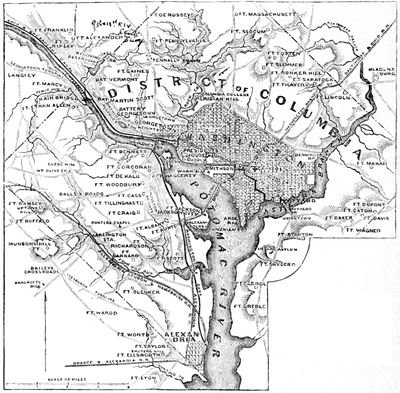
10At this time Washington was well protected by a cordon
of forts completely encircling the city. We present herewith
the accompanying map, which will more fully indicate
the positions of the several forts than any description we
might be able to give.
[Click anywhere on map for high resolution image.]
Washington
and its
Defences.
CHAPTER II.
11
Camp Barry—Artillery Drill—March to Fairfax
Station—First Death in the Battery—Union
Mills.
During the fall and winter of 1862–3 the battery
was chiefly occupied in perfecting itself in drill.
With other batteries, it frequently went to East
Capitol Hill and engaged in battalion drill, and became
quite proficient in light artillery movements. While at
Camp Barry the battery suffered severely by the desertion
of the men who had joined it in New York city. Their only
apparent motive in enlisting was to obtain the bounty which
was offered them, and then desert on the first opportunity.
This was a serious drawback, and greatly impaired the usefulness
of the battery.
Jan. 1st, 1863. This was a red-letter day in our history.
We moved into new wooden barracks, which had recently
been constructed. It was an agreeable change to our men
from the cold and cheerless Sibley tents to the warm and
comfortable quarters to which we were now assigned. We
celebrated the event by a grand house-warming in the evening.
The bill of fare was in marked contrast to what soldiers
12were accustomed to select while serving in the field.
It consisted of a roast turkey supper with all the fixings.
Not wishing to share our feast and pleasures alone, we
invited as our guests the men of the Third New Jersey and
Second Maine batteries. That occasion will long be remembered
by the participants as a bright epoch in their soldier
lives.
While encamped here we often obtained permission to
visit Washington, and we made good use of our time while
there. The Capitol was a place of special interest to us, and
we were accustomed to visit the Senate Chamber and the
House of Representatives, and hear the lawgivers of our land
expound the momentous questions of the day. We recall
the stalwart forms of Sumner and Wilson of Massachusetts,
Anthony of our own little Rhody, and a score of others well
known to fame, who stood as beacon lights in that stormy
period of our nation’s history. The White House and
Treasury Building were visited by us, likewise the Patent
Office, where our First Rhode Island regiment was quartered
in the spring of 1861, received our attention. What a
contrast the city presented at that time to the Washington
of to-day. Then (in 1863) the uncompleted monument of
the “Father of his Country” was a disgrace to every patriotic
citizen. Now that majestic shaft in full completion
towers above all others in this country, while the public and
private buildings will vie in splendor and magnitude with
many of the capitals of the old world. The unpaved
streets through which roamed the swine and fowl in the old
war time days excite the wonder and admiration of the
visitor at the present time by their well constructed appearance
and cleanly condition.
13January 5th. A mounted drill took place at nine A. M.
to-day of all the batteries encamped here. Lieut.-Col. J.
Albert Monroe, of our First Rhode Island Light Artillery
regiment, was present in command.
January 19th, we received orders to prepare three days’
cooked rations. On the following day we marched into
Washington in a terrific rain-storm. When we arrived on
Arlington Heights the wheels of the battery sank into the
mud nearly to the hubs.
On the 23d we arrived at Fairfax Station about noon, and
went into camp. This was a severe and exhausting march,
and many of our men became disabled and contracted diseases
from the effects of which they never fully recovered.
On the 24th our battery was assigned to General Casey’s
division, and attached to the Vermont brigade commanded
by General Stannard. He was a brave and gentlemanly
officer, and respected by the entire command. He was commissioned
lieutenant-colonel of the Second Vermont Infantry
in May, 1861, and was in May, 1862, assigned as colonel of
the Ninth Vermont Infantry; promoted brigadier-general
United States Volunteers, March 12, 1863, and brevetted
major-general United States Volunteers, Oct. 28, 1864.
General Stannard’s prompt movement upon the flank of
Pickett’s division at Gettysburg won for him the strongest
commendation of his superiors. He was four times
wounded, the last time losing an arm in the successful
assault on Fort Harrison, Sept. 29, 1864. He died in
Washington, June 3, 1886.
14February 10th. Bugler Thomas J. Goff died to-day. The
death of our comrade cast a sadness over us, as it was the
first that had occurred since our existence as a battery.
February 12th. The battery was reviewed at two o’clock
P. M. to-day, by General Stannard.
February 13th. Private William G. Manter died in camp
hospital. He was buried in the little graveyard near our
camp.
March 1st. Sergt. George P. Carpenter and Private John
Phillips died in company hospital to-day. They were comrades
tried and true, and we sorely missed them.
As we lacked a sufficient number of men to fully man our
battery, several soldiers were detached from the different
regiments of the Vermont brigade and sent to us on the
16th of this month.
March 23d. At seven A. M. the battery received orders to
proceed with the Vermont brigade to Union Mills, Va. On
arriving there the right section was ordered on picket on the
heights overlooking the fording place at Kettle Run Shoals,
and a detail of men was also sent to man an iron clad car on
the Orange and Alexandria Railroad, to act as guard at the
same place.
April 9th. A severe snow storm set in which continued
through the day and night, and was particularly trying to
our men on picket, and a disappointment to the hopes of the
government. It was the severest storm (so the traditional
“oldest inhabitant” said) that had visited that section of the
country for several years.
CHAPTER III
15
Battles of Chancellorsville and Salem Heights—Battery
H Ordered to Chantilly, and Afterwards
to Fairfax Court House—Return to Camp
Barry—Picket Duty at Fairfax Seminary—Moved
to Vicinity of Fort Scott.
When Gen. Joseph Hooker was appointed to succeed
Burnside in command of the Army of the
Potomac, he made earnest efforts to raise its
morale and increase its efficiency. In the meantime the
inclement season and the bad roads prevented any forward
movement before spring. On the 13th of April General
Hooker commenced his campaign by sending a force of
cavalry, with artillery, across the upper fords of the Rappahannock,
and thence to the Rapidan, preparatory to a general
advance of the army. A storm and bad roads delayed
the latter movement until the 27th. On the morning of
that day the Fifth, Eleventh, and the Twelfth Corps moved
toward the upper fords, which they reached the next day,
and crossed on the 29th. Thence they moved to the Rapidan,
and crossed that stream at Germania Ford and another
some eight or ten miles above its confluence with the Rappahannock.
16From this stream they advanced to the vicinity
of Chancellorsville, a village consisting of a single house and
out-buildings, and here three corps were massed on the 30th.
On the morning of the 1st of May four corps were there
prepared for an advanced against the enemy. During the
2d and 3d of May occurred one of the hardest fought battles,
of the war. The losses on both sides were severe. On the
3d and 4th of May, Sedgwick’s Corps of nearly twenty thousand,
fought an almost independent battle at Salem Heights,
near Fredericksburg, about fourteen miles from Hooker’s
position. They fought with determined bravery, but were
compelled by the presence of a superior force to fall back,
and recrossed the river in good order. The main body of
Hooker’s army safely recrossed the river on the evening of
the 5th. When morning revealed to the enemy the movement,
they seemed more content to have it take place, and
made no attempt to hasten it. The Union army had fought
three days with about one-third of its numbers against the
massed forces of the enemy, and though forced to yield some
ground had repulsed their desperate assaults, and then returned
to its old camps having suffered large losses but not
seriously weakened.
May 4th. At the time of the battle of Chancellorsville,
General Abercrombie ordered the right section under command
of Captain Hazard, in connection with the Twelfth
Vermont regiment of our brigade, to Rappahannock Station
for the purpose of guarding the river at this point. While
stationed here Captain Hazard relates that a number of
negroes came across the river one morning, and the next day
17Hon. John Minor Botts crossed and claimed them as his
property. He talked with them quite a while and endeavored
to induce them to return with him. This they declined
to do. Mr. Botts claimed to be a Union man, and said he
would go to President Lincoln for redress. He also threatened
to use his influence to have his friend, the Hon. John
J. Crittenden, of Kentucky (who was holding out as a Union
man), espouse the cause of the Confederacy unless his
(Botts’s) property was returned. His “boys,” as he called
them, were soon scattered and were employed in the army
or at the north, and were about as free as they were after
the Emancipation Proclamation. As an instance of the
financial situation of the Confederacy at that period of the
Rebellion, Mr. Botts, who wore a pair of cowhide shoes
at this time, said they cost him twenty-five dollars in Confederate
money, in Richmond.
While the right section of the battery was with Captain
Hazard at Rappahannock Station, First Lieut. George W.
Blair remained in command of the camp at Union Mills.
On the 17th of the month the centre section, which was on
picket guarding the ford at Kettle Run Shoals, was relieved
by the left section.
At ten o’clock on the morning of the 20th the battery
received marching orders and left Union Mills for Chantilly,
near Centreville, arriving there about one P. M., and going
into park near the Twenty-fifth and Twenty-seventh Maine
regiments of infantry.
On the 24th many of the members of the battery availed
themselves of the privilege of visiting the old Chantilly battlefield.
18May 26th. The sound of artillery firing was heard in the
direction of Drownsville, causing our battery to be held in
readiness to move at a moment’s notice.
May 29th. The long roll awakened us from our slumbers,
and “boots and saddles” call was sounded. The battery
was hitched up and ready to move in eight minutes. We
anticipated an attack of the rebels on our picket line. If
they had come upon us then they would have found confronting
them the Twenty-fifth and Twenty-seventh Maine
regiments (each eleven hundred strong), and, with the Eleventh
Massachusetts Battery and our own battery, they would
have met with a warm reception, as the night was very dark
and we had the advantage of a good position.
June 7th. Reviewed at ten A. M. by Gen. Alfred Pleasonton.
June 12th. While the battery was drilling in rapid movements,
this forenoon, one of our attached men, Private John
D. White, of Company D, Sixteenth Vermont Infantry, met
with a painful accident. In mounting, and while throwing
his right leg over the back of his horse his left foot slipped
from the stirrup, throwing him on the pummel of his saddle
and causing a severe rupture. He remained in camp a week
or more, and was then sent to the post hospital, at Camp
Barry, and remained there until the muster out of his regiment.
It being the plan of the rebel General Lee to attempt an
invasion of the northern States, he at once set his troops in
motion and did not meet with any serious obstacle to his
progress until Gettysburg was reached, which we will notice
further on.
19On June 15th the battery witnessed the passage by its
camp of the Eleventh, Twelfth, Second and Third Corps of
the Army of the Potomac, on their way to intercept the rebel
army, which was moving on Gettysburg. On this date
Private Earl Fenner was ordered on special duty to carry
dispatches to the commanding general of the Army of the
Potomac. On his return he narrowly escaped capture by
Mosby’s guerillas.
June 17th. We can hear distant cannonading in the direction
of Aldie Gap. We learn that our forces are having
quite a brush with the enemy. A large body of our troops
are concentrating at Fairfax Court House, awaiting orders
to move toward Gettysburg. A number of rebel prisoners
passed our camp to-day under guard. Their brown butternut
uniforms and slouch hats indicated that they hailed from
North Carolina.
June 25th. The battery received orders to leave camp at
Chantilly this morning at eight A. M., and proceed to Fairfax
Court House, and report to Brig.-Gen. Henry J. Hunt, who
had command of the Reserve Artillery of the Army of the
Potomac. On our arrival there, Captain Hazard reported to
General Hunt that the term of service of the attached men
assigned from the Vermont brigade to our battery would
expire on or about July 10th. The general, having more
artillery than he needed, and noting the deficiency in the
number of men in our battery, ordered Captain Hazard to
report to Gen. William F. Barry, Chief of Artillery in the
vicinity of Washington. Thus, owing to the depleted condition
of the battery, we were not permitted to share with
20our sister batteries from our State in the honor of participating
in the mighty struggle at Gettysburg a few days
later, which shed so bright a lustre on the fame of the light
artillery that Rhode Island furnished to the armies of the
Union.
In accordance with the instructions from General Hunt
our battery marched to Arlington Heights, camping outside
of the intrenchments near Annandale Court House. About
midnight an officer on General Barry’s staff directed Captain
Hazard to withdraw his battery inside of the intrenchments,
as there were no infantry troops to support us should
the enemy appear in force. Accordingly we hitched up and
shortly afterward moved within the intrenchments.
At eight o’clock on the morning of the 26th we left Arlington
Heights and marched to Camp Barry.
June 28th. Our battery was again ordered to march, and,
at eight P. M., left Camp Barry for Fairfax Seminary, passing
through Washington, going over Long Bridge to Alexandria,
Va., and from thence to Fairfax Seminary. On arriving
in the vicinity of the Seminary a soldier on picket,
from a New York regiment, fired upon our battery, mistaking
us for the enemy. We then took position near Fort
Ward, coming into action front, running our guns out of the
embrasures and in line with the breastworks. As an attack
was expected there our cannoneers remained at their posts
till reveille the next morning. Captain Hazard reported with
his command to Col. H. L. Abbott, of the First Connecticut
Heavy Artillery, commanding the Third Brigade, Defenses
South of the Potomac.
21General Hooker ascertained that Lee’s army instead of
threatening to attack him in front of Washington, had
crossed the Potomac into Maryland. He accordingly made
a similar movement, crossing between Harper’s Ferry and
the capital. The 27th of June found the greater portion of
his forces in the vicinity of Frederick. When nearing this
place an order was received relieving him of the command
of the Army of the Potomac, and appointing in his place
Maj.-Gen. George G. Meade. Considerable astonishment
was manifested among the army and the people at this unexpected
change. It was subsequently stated that General
Hooker was relieved at his own request, some of his plans
not meeting with the approval of those in authority. He
declared in his orders he felt that his usefulness was impaired,
and he relinquished the command with regret at parting
from his brave comrades, especially at this time when
they were moving to drive the invaders from the loyal States.
General Meade, upon whom this unsolicited and unexpected
honor and responsibility was conferred, had been identified
with the army from its organization, and had proved himself
an able and competent officer. On the same day that he assumed
command he issued orders for the movement of the
army, rendered necessary in order to checkmate the operations
of the Confederates.
On the 29th the position of our battery is thus defined by
Colonel Abbott, commanding our brigade, in his report of
affairs on Little River Turnpike, where our pickets were established.
He says:
“I have the honor to report that the enemy have been reconnoitering
22on the Little River Turnpike, just in front of
our pickets, both last night and to-day. On the first occasion
three men put to flight a whole company of the One
Hundred and Seventy-eighth New York (infantry), although
the only demonstration (the Confederates) made was to retreat
on being challenged by the pickets. On the second
two armed men shot a civilian and drove two others into our
lines in sight of our pickets.
“Fort Worth is too high to command this road by night
by artillery fire, and my infantry is too bad to be trusted to
protect even a section of the light artillery there, where there
is no retreat for it from cavalry.
“I have ridden over the position this morning, and would
respectfully suggest that the Twenty-fifth Maine regiment,
now near my right, be placed where this company now is, to
hold the road, and cover a section of my battery (Hazard’s)
to-night.
“After due examination I have decided, unless more force
is available, to put the whole battery in position in the rifle-pits,
between Forts Worth and Ward, covered by three companies
of the One Hundred and Seventy-eighth New York
infantry, with orders to hold the Leesburg Turnpike, and
await further developments in case of an attack to-night.
“I cannot hold the Little River Turnpike without more infantry.
If the rebels pass Fort Worth on it, they ought to
be stopped by the forces near Alexandria; if they then turn
up on the Seminary plateau the light battery is ready to prevent
their attacking our line in rear in that vicinity, and the
convalescent men ought to hold their own camp. Their
raid will thus do little good to them.
23“If I try to block the Little River pike, I fear I shall lose
my guns to no purpose.”
Let us pause for awhile to observe the movements of the
Union and Confederate armies now approaching Gettysburg,
the county seat of Adams County, Pennsylvania, and
eight or ten miles north of the Maryland line, and about
forty miles north of Frederick, from which place the Federal
army moved. On the evening of June 30th the Federal
cavalry advance reached Gettysburg, passed through the
village and encamped on the northerly side. On the following
morning a deadly encounter took place between the Union
and Confederate forces, which resulted in the success of the
troops of the enemy and in the withdrawal of the Union
forces to Cemetery Hill, which lies nearly south of Gettysburg,
and derives its name from a cemetery which crowns
its summit. Here our troops encamped for the night, throwing
up breastworks along the whole front, the artillery well
posted, and the positions on Cemetery Hill and Culp’s Hill
(to the right) were made exceedingly strong.
On the morning of July 2d, General Meade arrived on the
field, and determined to fight a defensive battle. The Federal
line was an irregular semi-circle, the centre of which
was Cemetery Hill, fronting the village, and thence running
on the left southwest along the ridge fronting the Emmitsburg
road, to the hill called Round Top; and on the right
running nearly south over Culp’s Hill, and along the ridge
fronting Rock Creek to the Baltimore Turnpike. The rebels
furiously attacked our lines, and the result of the second
day’s battle was the gain of some half a mile of ground
24where the Third Corps had been forced back, and the occupation
of the extreme right of the Federal works. The
gain of the Confederates on the left was at a heavy cost, the
Union lines being in a stronger position than the day before.
The next day, the 3d, preparations were made to dislodge
the enemy on our right. Our troops advanced at that point,
and drove the entire force of the enemy out, and the Federal
line was re-established as on the previous day, the rebels
also returning to their former positions. While this engagement
was transpiring on the right, it was comparatively
quiet along the other parts of the line except the usual desultory
picket firing.
At one o’clock a desperate charge on the Union lines at
Cemetery Hill was made by the rebels, composed of a
division of Longstreet’s corps under Pickett, which led the
attack supported by other troops from Longstreet’s and
Hill’s corps. Says Longstreet: “The signal gun broke
the prevailing stillness, and immediately 150 Confederate
cannon burst into a deafening roar, which was answered by
a thunder almost as great from the Federal side.” The
attack was gallantly made and the struggle fierce, but the
picked troops of the rebel army were finally routed, and thus
ended one of the greatest battles of modern times, which
resulted in a glorious victory to the Union arms and turned
the tide of rebel invasion, hurling Lee’s army back into
Virginia, discomfited and disheartened.
We will now return to the Department of Washington,
which was under the command of Maj.-Gen. Samuel P.
Heintzelman, with Brig.-Gen. Gustavus A. De Russy commanding
25defenses south of the Potomac, in which the brigade
under Col. Henry L. Abbott formed a part. Battery H
was attached to this brigade.
At three o’clock on the morning of July 2d, long roll was
sounded. Our battery occupied the breastworks near Fort
Ward, and remained in that position until reveille.
July 6th. At ten A. M. a review took place of the entire
Twenty-second Corps by Generals Casey and De Russy.
Our battery is assigned to the First Brigade, Third Division
of the corps.
July 10th. The attached men from the Vermont regiments,
who have served with the battery since last March,
left us to-day. Their term of service has expired and they
are about returning to their regiments to be mustered out.
They are good soldiers and we part from them with sorrow.
July 16th. Our battery was inspected to-day by Captain
Howard on General De Russy’s
staff.
July 18th. The paymaster arrived in camp and we received
two months’ pay, which was very welcome. While in camp
here the several sections of the battery were drilled by the
bugle call by First Lieut. Charles F. Mason, he also acting
as bugler. First Sergt. Charles E. Bonn also assisted in
drilling the battery.
August 6th. We find on this date only twenty-seven men
fit for duty in camp, a large number being sick with chills
and fever.
August 17th. Capt. Jeffrey Hazard, our battery commander,
took his departure, having tendered his resignation
26from the service. He bade us “good bye” at retreat roll
call and started for Rhode Island. Captain Hazard was a
skillful and efficient officer, loved and respected by his men.
While in command of the battery he brought it to a high
state of proficiency in drill and discipline. Upon the resignation
of Captain Hazard, First Lieut. Charles F. Mason
assumed command of the battery. He was a brave and
accomplished soldier, having previously served with Captain
Hazard in Battery A, First Rhode Island Light Artillery.
At the battle of Antietam both of these officers, then lieutenants
in that battery, after many of their number had
been killed or wounded, bravely worked the guns for the
want of men.
August 30th. Our battery was inspected by Colonel
Abbott, commanding Third Brigade, Twenty-second Army
Corps, of the forces south of the Potomac.
August 31st. At 12.30 A. M. we bade farewell to our old
camp at Fairfax Seminary and marched to Fort Scott, going
into park in that vicinity.
September 1st. Moved our camp to higher land and
nearer Fort Scott. Farrier George W. Tracy died to-day in
hospital at Fairfax Seminary.
September 12th. Again the welcome paymaster appeared
in camp. We signed the rolls and received two months’
pay.
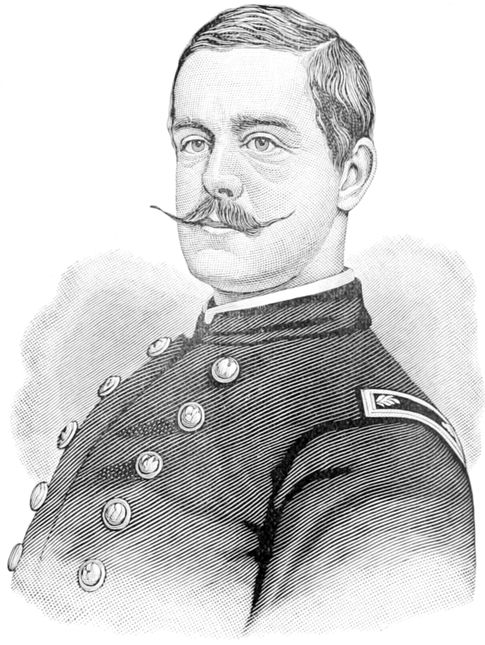
September 30th. First Lieut. Crawford Allen, Jr., of Battery
G, First Rhode Island Light Artillery, has been promoted
to the command of our battery. Captain Allen came to us
with a record of good service in the field. He was commissioned
27second lieutenant in Battery G, First Rhode
Island Light Artillery, Nov. 7, 1861, and on the 18th of
November, in the following year, was promoted to first lieutenant.
He participated with his battery in the Peninsular
campaign, and in the battles of Antietam and the first and
second Fredericksburg. In the latter engagement, May 2d,
1863, Captain Allen was slightly wounded. He was subsequently
made adjutant of his regiment and acting adjutant-general
of the artillery brigade of the Sixth Army Corps,
which positions he continued to hold until he was promoted
to the captaincy of Battery H, to fill the vacancy occasioned
by the resignation of Captain Hazard.
October 14th. We heard the sound of artillery firing in
the direction of Thoroughfare Gap, caused by a skirmish of
our troops with Gen. Fitz Hugh Lee’s cavalry. Our battery
was ordered to hold itself in readiness to move at a moment’s
notice.
October 18th. The battery was reviewed by Colonel
Abbott, commanding our brigade.
October 20th. Captain Peirce, Chief of Artillery on the
staff of General De Russy, inspected our battery to-day.
November 18th. Private Andrew Turner, who had gone
to his home in Hope Village on a sick furlough, died in that
place on this date.
November 17th. The battery was reviewed by Gen. William
F. Barry, chief of artillery.
CHAPTER IV.
28
Again in Camp Barry—Batteries Reviewed by President
Lincoln—Battery H Assigned to the Ninth
Army Corps.
On the 22d of November our battery was ordered to
proceed to our old camping ground, Camp Barry, on
the Bladensburg Road, in the vicinity of Washington.
We moved at two P. M. from Fort Scott, passing
through Washington to Camp Barry, and occupied the old
barracks that we had dedicated on January 1st. As this
was the Sabbath, and as we observed the worshipers returning
from church, it brought vividly to our minds the scenes
we were accustomed to witness in our far-away northern
homes, and of the privileges we had been deprived since
we “donned the blue” and set forth to defend the Union
established by our fathers.
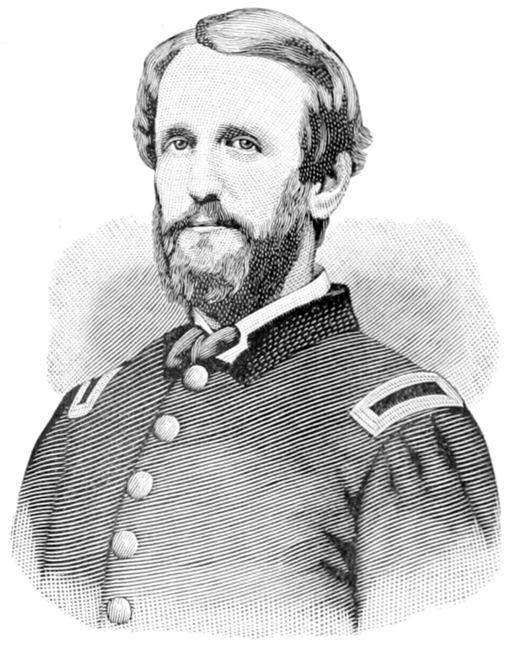
Brevet Lieut.-Col. Crawford Allen, Jr.
29A little more than a year ago we had first encamped on
this familiar ground, and although our battery had not suffered
from the casualties of direct conflict with the enemy,
yet we mourned the loss of several tried comrades who had
succumbed to disease and lay buried near the little chapel at
Fairfax Station, while others who could not withstand the
hardships and exposures incident to a soldier’s life had been
discharged from the service for disability, and had returned
to their homes with shattered constitutions, the result of
disease contracted in the army. Besides, we had lost many
by desertion. The men who enlisted in New York had no
intention of exposing their worthless bodies to rebel shot or
bullet, and such recruits were a dead loss to the government.
We record with great satisfaction the fact that but very few
of these deserters were men who had enlisted in Rhode
Island. Now that we had been rid of these worthless and
unprofitable soldiers, those that remained in Camp Barry
were comrades whom we had learned to respect and trust,
and with whom we were still further to share the vicissitudes
of a soldier’s career.
We found on our arrival at Camp Barry that Lieut.-Col.
J. Albert Monroe, who had formerly been in command of
the camp, had gone to the front and had been promoted to
chief of artillery commanding the artillery brigade of the
Second Corps. He had been relieved by Lieut.-Col. James
A. Hall.
December 1st. A battalion drill of the batteries stationed
here took place on East Capitol Hill. The troops consisted
of the First Pennsylvania, Seventh Massachusetts, Second
Connecticut, Second Maine, Thirty-third New York, Nineteenth
New York, Fourth and Fifth New Jersey, and Battery
H, First Rhode Island. All of these were light batteries
under command of Major Hall.
December 15th. There was a grand review of the several
batteries encamped here before President Lincoln and Cabinet
30and General Barry and Staff. The following batteries
took part: First Pennsylvania, Second Connecticut, Second
Maine, Thirty-third New York, Nineteenth New York, Fifth
New Jersey, Fourth New Jersey, and Battery H, First Rhode
Island Light Artillery. To our battery was accorded the
honor of firing a salute upon the arrival of President Lincoln
and party at the reviewing stand.
It was an inspiring scene, and we were grateful for the
privilege of observing our good president, Abraham Lincoln,
a man providentially raised up to lead our nation through the
trials and difficulties through which we passed in our late
civil conflict. Surely no other man in our times had such a
tremendous burden of responsibility thrust upon him. How
patiently and uncomplainingly he bore himself during all
those years of war is fully recorded by the historian and well
known to all.
December 23d. At eleven A. M. a review occurred before
Gen. William F. Barry, participated in by all the batteries in
camp. It took place on East Capitol Hill, in rear of Lincoln
Hospital.
December 31st. We find on this date that our battery is
incorporated in the Twenty-second Army Corps, commanded
by Maj.-Gen. Christopher G. Augur, and that Lieut.-Col.
James A. Hall is in command of our Light Artillery Camp
of Instruction.
January 1st, 1864. The battery repeated to-day nearly the
same order of exercises which occurred here just one year
ago. We moved into new and more commodious barracks
than those we had formerly occupied. In the evening a
31turkey supper was provided, and we invited the soldiers of
the Third New Jersey and Second Maine batteries to be our
guests. After supper, in the absence of the fair sex the
comrades arranged what is known among old soldiers as a
“stag dance.” This is a dance with the ladies left out.
The comrades who personated the ladies were distinguished
from their partners by white handkerchiefs tied on their
right arms. And now the fun began. A grand march was
the first in order, and then came the ball, which consisted of
the following programme: Quadrille, Lanciers, Cotillion,
Spanish Quadrille, Portland Fancy, followed by an old-fashioned
Irish Break Down (with no broken heads, however).
The entertainment continued until two o’clock the next
morning, and was thoroughly enjoyed by all present.
February 5th. The following recruits came to the battery
to-day: Edward Sweeney, William H. Stone, Thomas J.
Lofts, Charles E. Millard and Josiah Sheffield.
February 12th. A grand review of all the batteries in
camp took place to-day on East Capitol Hill. On returning
to camp we learned that Private Henry N. Arnold had taken
poison. The surgeons in charge were called to attend him,
but he was beyond all help and died in great agony at four
P. M. What prompted Comrade Arnold to commit this rash
deed we never learned. His father came and conveyed his
remains to Warwick, R. I., where they were interred in the
family cemetery.
February 15th. The following recruits came to us:
Charles Tweedale, Apollos Seekell, Hurbert Ochee, Franklin
W. Dawley and George A. Williams.
32February 21st. A number of the men attended Divine
service in Washington. In the evening our battery held
services in the barracks. A clergyman from Washington,
of the Free Will Baptist denomination, conducted the exercises.
March 3d. We had a grand review before President Lincoln
and Cabinet on East Capitol Hill to-day, all the batteries
encamped here participating. As on a previous occasion,
Battery H was privileged to fire the salute on the arrival at
the grand stand of the Presidential party, an honor we
greatly appreciated. General Barry and staff and a large
concourse of spectators also witnessed the ceremony.
March 14th. The battery was reviewed on East Capitol
Hill by Gen. A. P. Howe.
Sunday, March 20th. Mounted inspection at ten A. M.
Divine service was held in our barracks in the evening, led
by a clergyman from the city.
April 10th. Mounted inspection to-day at ten A. M. The
battery has at last received marching orders, and we expect
to join the Ninth Army Corps, commanded by Gen. Ambrose
E. Burnside, when it arrives from Annapolis. This news
was joyfully received by us, as we had become weary of the
seeming inactivity of camp life and longed for more active
duties in the field.
April 24th. Gen. Ambrose E. Burnside and Rev. Augustus
Woodbury, late chaplain of the First Rhode Island
Infantry, visited us to-day and received a soldier’s welcome.
We have now received orders to join the old Ninth Army
Corps. We are proud of being attached to this gallant
33corps, commanded by the loved and esteemed Burnside,
Rhode Island’s foremost soldier. This corps since its transfer
from the West has been reorganized at Annapolis, and now
numbers nearly twenty-five thousand men. It is composed
of four divisions, three of white and one of colored troops.
It has been well designated as “Burnside’s Geography
Class,” for its tattered banners bear the inscriptions of
battles in six states in which it has participated. Its history
began in 1861, and was then known as “Burnside’s Coast
Division,” and won substantial victories for the Union cause
in North Carolina. It was afterwards reenforced by large
accessions of regiments to its force, and was then organized
into what is now designated as the Ninth Corps.
After the transfer of the larger portion of the corps to the
Army of the Potomac it was joined by a division from Port
Royal under command of Gen. Isaac I. Stevens. It fought
with great bravery at Chantilly, South Mountain, Antietam,
and Fredericksburg, and when General Burnside was placed
in command of the Department of the Ohio, the Ninth Corps
was assigned to that department. It was subsequently dispatched
to the assistance of General Grant at Vicksburg.
It arrived at General Grant’s lines on the 14th, and was
immediately employed in protecting the besieging forces
from any hostile demonstrations in their rear. With other
troops it kept the rebel General Johnston at bay, forced him
back and drove him beyond Jackson, and then returned to
Vicksburg. Its presence assured the successful termination
of the siege. It was afterwards ordered to Annapolis, as we
34have already mentioned, and is now about to enter another
field of action.
On the 23d of April, 1864, the Ninth Corps marched from
Annapolis and proceeded to Washington, encamping on the
Bladensburg Road about six miles from the city, on the night
of the 24th. The next day, as it passed our camp at eleven
A. M. on its way to Washington, Battery H joined the column
and moved to its position, it being assigned to the First
Brigade of the First Division. Our division commander was
Gen. Thomas G. Stevenson; our brigade commander, Col.
Sumner Carruth. On its arrival in the city the corps
marched down Fourteenth Street and passed in review
before President Lincoln, General Burnside, and a number
of civil and military dignitaries. The colored division, under
General Ferrero, was the first body of colored troops that
had marched through Washington, and they appeared to
great advantage, President Lincoln acknowledging their
cheers with great respect and courtesy. The corps crossed
Long Bridge and went into camp near Alexandria.
Lieut. Benjamin H. Child.
CHAPTER V.
35
Battery H with the Ninth Corps Moves towards
Fairfax Court House—March to the Rapidan—Battles
of the Wilderness and Spottsylvania—Battery
Ordered to Washington—Fort Richardson.
As our battery had now joined its fortunes for a time
with a corps that had won a well-earned reputation
for valor shown on many hard contested fields, it
was but natural we should realize that we were leaving
behind us the comparative quiet of a defensive position to
enter upon the more exciting scenes of aggressive warfare.
What the future had in store for us we could only conjecture,
but we were desirous of performing our share of labor
and privation if we could but hasten the final overthrow of
the fratricidal strife now waging so fiercely in our land.
April 27th. At eight A. M. the battery moved with the
corps on the road towards Fairfax Court House. Our division
led the advance. Camped that night at the above
named place.
April 28th. Marched to Bristoe Station, arriving there at
eight P. M., and encamped for the night.
36April 29th. At seven A. M. moved with our brigade and
division to Catletts’ Station; reached there about two P. M.
First Sergt. Charles E. Bonn left us to-day, he having
received a commission as second lieutenant in Battery D,
First Rhode Island Light Artillery. We bade him “good
bye” with regret, as he had proved himself an efficient
soldier and worthy comrade.
May 1st. No forward movement of our corps this beautiful
Sabbath day, and we are enjoying ourselves by remaining
quiet in camp. In the night a severe rain storm came
on, which made our situation anything but agreeable, and
was a strange contrast to the earlier part of the day.
May 2d. We received to-day twenty-five attached men
from the Fourteenth New York Heavy Artillery. It was a
welcome accession as our battery was greatly reduced in
numbers. One of the Fourteenth shot himself severely in
the hand, which will probably disable him for future service
in the army.
May 4th. Moved at 7.30 A. M. Our battery and brigade
took the advance. Marched as far as Brandy Station, where,
after a brief halt, we again started on our way toward
Rappahannock Station, and encamped on the same ground
occupied by our right section one year ago, when it was
performing picket duty on the Rappahannock River.
May 5th. Moved at 5.45 A. M. and crossed the Rapidan.
The Army of the Potomac was now about to begin a campaign
which was to finally result in crushing out the Rebellion.
Upon the advance of the army soon after midnight,
May 3d and 4th, from its position north of the Rapidan, the
37Ninth Corps, which had been guarding the Orange and Alexandria
Railroad from Bull Run moved forward to preserve
control of it in case the crossing of the Union army should
be long delayed. On receiving word that the army had
safely crossed the Rapidan, Burnside moved across with his
corps and found our troops hotly engaged with the enemy.
And now began the sanguinary battle of the Wilderness.
The country into which the Union army had advanced was
heavily wooded and covered with dwarf pines, cedars and
scrub oaks, and presented serious obstacles for the movement
of infantry, while it was wholly unfit for the use of
cavalry or artillery. Our battery encamped that night near
the Rapidan, and we were ordered to hold ourselves in
readiness to move at a moment’s notice.
On the morning of the 6th of May Hancock with his corps
was ordered by General Grant to make an assault in his
front at five o’clock. General Burnside, who was approaching
with his two divisions (the other, the colored division,
having been sent to guard the wagon train,) was directed to
move in between Wadsworth’s division of Warren’s corps,
which was on the right of Hancock, and the remainder of
Warren’s corps, which was still further to the right. Burnside
was ordered, if he should succeed in breaking the
enemy’s centre, to swing around to the left and envelop the
right of Lee’s army. He arrived at the Wilderness Tavern
at 6.50 A. M., and at that time was directed to send a division
to the support of Hancock, but to continue with the remainder
of his command in the execution of his previous order.
Burnside had great difficulty in making his way through the
38dense forests which retarded his progress, but he finally
succeeded in getting into the position assigned him.
Our battery marched at four A. M. to near Chancellorsville,
where we heard heavy firing at the front. As we
approached the Wilderness we passed many of the wounded
going to the rear. We moved towards Yellow Pine Church
and joined the artillery reserve of the Ninth Corps, commanded
by Capt. John Edwards, Jr. Here we saw our
infantry charging and driving the enemy across Mine Run.
The Confederates reformed charged in return, forcing our
troops back, to be driven themselves again in turn. This
was repeated three times until our men finally held the
ground and the enemy retired. The battery went into
position near Yellow Pine Church, well advanced, remaining
in position till nearly dark, then changed position and moved
to the left and halted near Chancellorsville. After a brief
stay here we marched a few miles and halted in the vicinity
of Marysville, remaining in the saddle all night. We learned
that our troops had taken 2,000 prisoners and forty-two
pieces of artillery during the day. Thus ended the battle of
the Wilderness. Our losses were severe. Those of the
enemy were even more so.
On the evening of May 7th the army commenced its
march towards Spottsylvania Court House. General Grant’s
object in moving to this place was to prevent Lee from
returning to Richmond in time to attempt to crush Butler,
who was at City Point. By accident Lee obtained possession
of Spottsylvania before our troops arrived. He had
ordered Longstreet’s corps, now commanded by Anderson,
39to move in the morning (the 8th), but the woods being still
on fire Anderson could not go into bivouac and marched
directly to Spottsylvania that night. Some fortifications had
already been thrown up here, and the Confederates immediately
began to extend them, while a force was sent out to
delay the advance of the Federal army. General Warren’s
corps, after marching all night, reached a point about three
miles from Spottsylvania Court House early Sunday morning,
May 8th. As General Warren’s troops advanced the
enemy’s artillery commenced to throw shells at it, but their
cavalry and infantry fell back without offering much resistance.
It soon appeared that they had selected a better
position for battle. As the Union troops reached a large
clearing the artillery of the rebels was found posted
there with infantry supports. Beyond these was other
infantry supports. General Warren immediately made
preparations for battle. The Union troops were soon engaged
and an obstinate combat ensued. The losses were
large and many officers fell, and regiments that went into
the contest two or three hundred strong returned with a
mere handful of men. General Warren, however, steadily
gained ground in spite of the efforts of the enemy to drive
him back, and in the afternoon, being reinforced by a brigade
from General Sedgwick’s corps, he succeeded in driving
the enemy back to their intrenched line. The battle then
ceased till the other corps should arrive and get into position.
On the morning of May 7th, we find Battery H moving
towards Mary’s Cross Roads, where it halted and awaited
orders.
40May 8th, the battery marched at seven A. M., crossed the
Po River and halted near Spottsylvania Court House. We
could hear heavy cannonading on our extreme front.
On the 9th Battery H occupied the same position as the
day before, opposite the court house. It was a great boon
to our men to be allowed to obtain some needed rest, as they
were very tired, and our horses had not been unharnessed
for three days and nights. Most of this day was occupied
by the Federal troops (nearly all of which arrived during the
night and on that morning) in manœuvring to obtain good
positions for further operations and in throwing up breastworks.
It was while posting his forces and superintending
the mounting of some artillery that the intrepid commander
of the Sixth Corps, the lamented Sedgwick, was killed by
one of the sharpshooters of the enemy. He was remonstrated
with for exposing himself unnecessarily, for the bullets
were whizzing through the air uncomfortably close to
those standing near the general. “Why,” said Sedgwick,
“they cannot hit an elephant at this distance.” Hardly
had these words been uttered when the bullet of the sharpshooter
struck him, and he fell into the arms of his attendant
officer. He was one of the ablest soldiers in the army.
He was modest, manly and courageous. General Grant
says of him: “His loss was a severe one to the Army of
the Potomac and to the nation.” He was beloved by the
soldiers of the Sixth Corps, who regarded him as a father.
May 10th. At ten A. M. the march of our battery was
reversed to Mary’s Cross Roads. Marched a few miles and
camped for the night. We found the roads very muddy.
41Our base of supplies having been changed to Aquia Creek,
we were ordered to join General Abercrombie’s forces at that
place.
We learn that in the fight at Spottsylvania to-day the
commander of our division in the Ninth Corps, Brig.-Gen.
Thomas G. Stevenson, was killed. He was a brave and
fearless soldier. Woodbury, in his Burnside and the Ninth
Corps, says of him: “But the Ninth Corps suffered a severe
loss in the death of General Stevenson, the commander of
the First Division. He was killed early in the day by one
of the enemy’s riflemen, while near his headquarters.” He
further says: “He was the son of Hon. J. Thomas Stevenson
(of Boston), well known as an able lawyer and a sagacious
man of affairs. He was educated in the best schools
of Boston, and at an early age he entered the counting-room
of one of the most active merchants of that city. There by
his faithfulness in duty, his promptness, and his generosity
of disposition, he secured the entire confidence and love of
his principal and the high esteem of the business community,
and a brilliant commercial career opened before him.
But when his country called him he could not neglect her
summons. The parting words of his father to himself and
his younger brother when they left home for the field well
express the appreciation in which his domestic virtues were
held: ‘Be as good soldiers as you have been sons. Your
country can ask no more than that of you, and God will bless
you.’
“In the spring of 1861 he was orderly sergeant of the
New England Guards, and, upon the formation of the Fourth
42battalion of Massachusetts infantry he was chosen captain
of one of its companies. On the 25th of April the battalion
was sent to garrison Fort Independence, in Boston Harbor,
and, on the 4th of May, Captain Stevenson was promoted to
the rank of major. In this position he was distinguished
for an excellent faculty for discipline and organization, which
were subsequently of great benefit to him. On the first of
August he received authority to raise and organize a regiment
of infantry for a term of three years, and on the 7th of
September he went into camp at Readville with twenty men.
On the 9th of December he left the State of Massachusetts
with the Twenty-fourth regiment—one of the finest and best
drilled, organized, equipped and disciplined body of troops
that Massachusetts had yet sent to the war. His regiment
was assigned to General Foster’s brigade in the North Carolina
expedition, and he soon gained the respect and friendship
of his superior officers.
“The conduct of the Twenty-fourth regiment and its commander
in North Carolina has already been made a matter
of record. When Colonel Stevenson was assigned to the
command of a brigade, in April, 1862, the choice was unanimously
approved by his companions-in-arms. General Burnside
regarded him as one of his best officers. ‘He has
shown great courage and skill,’ once wrote the general, ‘and
in organization and discipline he has no superior.’ General
Foster was enthusiastic in his commendation. ‘He stands
as high as any officer or soldier in the army of the United
States,’ said he, ‘on the list of noble, loyal and devoted men.’
On the 27th of December he was promoted to the rank of
43brigadier-general, and, on the 14th of March, 1863, he was
confirmed and commissioned to that grade. In February,
1863, he accompanied General Foster to South Carolina,
where his brigade was attached to the Tenth Corps, and
where he served with great fidelity and zeal throughout the
year under Generals Foster, Hunter and Gillmore. In April,
1864, he reported to General Burnside at Annapolis, and
was assigned to the command of the First Division.”
May 11th. Early this morning 9,000 rebel prisoners
taken at the battle of Spottsylvania passed our camp going
to the rear under guard.
May 12th. The men were given permission to view forty-two
pieces of artillery taken from the enemy at Spottsylvania,
as they were parked in the vicinity of our camp.
Marched at seven A. M. to Oak Hill and camped for the
night. Here we found batteries D and G, First Rhode
Island Light Artillery, the Third New Jersey, Second
Maine, Eleventh Massachusetts, and Twenty-second New
York batteries, and the First Rhode Island Cavalry,
besides three regiments of the infantry of the Invalid
Corps.
May 13th. Marched at seven A. M. for Marye’s Heights,
where we encamped for the night.
May 14th. Although yesterday was stormy, this morning
it cleared off and the weather was very pleasant, giving the
men an opportunity to dry their clothing. About eleven
P. M. we were routed out, ordered to hitch up and prepare to
move at a moment’s notice.
May 15th. At four A. M. made preparations to move, but
44did not get started until six A. M., when we marched as far
as Belle Fonte and encamped.
May 16th. At eight A. M. our battery moved into Fredericksburg
and went into camp on the west side of the city.
While here permission was given our men to visit the place
and observe the effects of the destruction made by the shot
and shell of Burnside’s army in 1862. Some of the churches
and houses were badly riddled. Our corps commander,
General Abercrombie, is waiting for the Eighth Corps to
pass through the city to the front; then we will cross the
Rappahannock River and march to Aquia Creek Landing
to guard the base of supplies.
May 17th. Marched at 7.30 A. M. through Fredericksburg,
crossing the Rappahannock River on pontoons, and
encamped near Falmouth for the night.
May 18th. Again on the move towards Aquia Creek
Landing. On arriving there went into camp on high land
near the Landing.
May 19th. It is raining this morning and our boys are
out on a foraging expedition, searching for hard tack and
salt pork, for we are very short of rations, being allowanced
to three hard tack a day until our supplies are brought down
the river. There was a regiment of heavy artillery breaking
camp near us and they left a number of boxes of hard
bread and some salt pork, which our men brought into camp,
and it proved a welcome addition to our stock of rations
until our supplies can be forwarded to us.
May 20th. During the day four hundred rebel prisoners
passed our camp going to the Landing to take the boat north.
45May 24th. At seven A. M. we marched to White Oak
Barn, reporting to Major Cowan, chief of artillery. Waited
in line three hours for the Third New Jersey Battery, which
was lost somewhere on the road. When they came up our
chief of artillery rode out to meet the captain. The major
said: “Captain, where have you been?” “I have been
trying to find the ‘white oak barn’ all the morning,” replied
the Jerseyman. The major then said: “Here is the
‘White Oak Barn,’ captain, right here.” After a hearty
laugh at the expense of the Jerseyman, the whole command
moved to and through Fredericksburg and encamped a few
miles beyond the city, and were guarded by the First Rhode
Island Cavalry. Towards morning we marched to Westmoreland
Plain.
May 25th. Moved at 7.30 A. M. towards Port Royal, Va.
One squadron of the First Rhode Island Cavalry acted as
advance guard, with squadrons on our right and left flanks
as a precautionary measure against a surprise. Our battery
followed the advance guard of the First Rhode Island
Cavalry. During the day the Third New Jersey Battery
again lost its way. The column arrived at Port Conway
about 4.30 P. M. Here we found the Third New Jersey in
position with their guns trained on the woods beyond the
river. At seven P. M. the battery crossed the river on pontoons
to Port Royal and encamped a mile and a half from
the landing on Dr. Judd’s farm, a short distance from the
barn where, in the following year, the assassinator of President
Lincoln (Booth) was shot by Sergt. (Boston) Corbett.
May 28th. We are expecting to move with the troops
46here by transports to protect the capital from an attack by
Gen. Jubal Early’s forces who have been detached from
Lee’s army and are now moving in the direction of Washington.
Sunday, May 29th. Our battery was put aboard the
transport St. Nicholas. We moved out on the river in tow
of the steamer General Hooker, having for our protection and
escort three gunboats.
May 30th. Steamed down the Rappahannock River at
five A. M., under the escort of the gunboats, and anchored
opposite Port Tappahannock.
May 31st. Moved again this morning down the river and
anchored at nightfall.
June 2d. Arrived at the Sixth Street wharf in Washington
at ten P. M., but did not disembark.
June 3d. This morning the battery disembarked, and
marched to the Arsenal and turned our pieces over to the
authorities in charge there. We then proceeded to the general
corral and turned in our horses, as it is rumored that we
are to go on duty acting as heavy artillery to garrison the
forts in the defenses of Washington. From the corral we
marched to the Soldiers Rest, where we were quartered for
the night.
June 4th. At ten A. M. marched out of the Soldiers Rest,
through Washington over Long Bridge to Fort Richardson,
where we are to perform garrison duty for awhile.
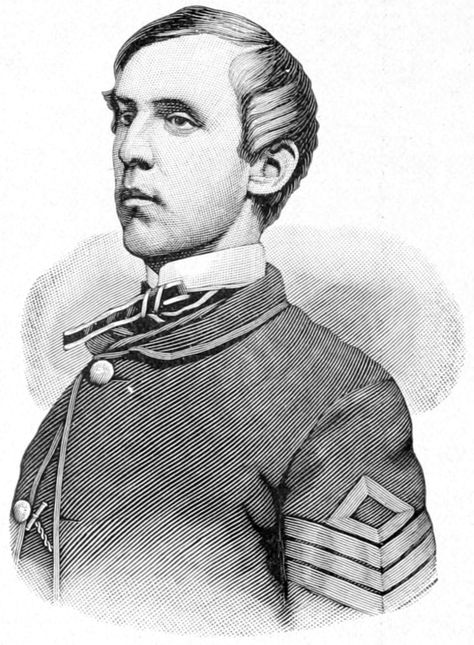
First Sergt. George Messinger.
CHAPTER VI.
47
Life at Fort Richardson—Moved to Fort Smith and
stationed there—Battery equipped again and sent
to City Point.
Once more our battery was destined to forego an
active participation in the stirring scenes at the
front, and to the disappointment of our men we
were assigned to the dull routine of garrison life, instead of
the more congenial duties of a mounted battery.
Nothing of especial importance transpired during our
stay in Fort Richardson. Our men were drilled at the guns
in heavy artillery work, and also practiced in the use of
mortars. An occasional long roll at night would relieve the
monotony of our existence, when the men would hasten to
the guns remaining there until reveille.
It was a source of regret to us that we were not permitted
to remain with the Ninth Corps, which was at that time with
the Army of the Potomac confronting the enemy at Cold
Harbor, where a severe battle had just been fought. After
the Wilderness and Spottsylvania battles General Grant
became convinced that he had more artillery than could be
48brought into action at any one time. It occupied the roads
in marching and taxing the trains in bringing up forage.
He therefore sent back to the defenses of Washington over
one hundred pieces of artillery, with the horses and caissons.
As will be observed our battery was among the number
returned. But we did not share our misfortunes alone,
for Battery D, of our regiment, was ordered to turn in its
guns and equipments to the Arsenal at Washington, and for
a time garrisoned Fort Lincoln within the defenses.
General Burnside, who always took pride and satisfaction
in having Rhode Island troops in his command, in a letter to
General Grant dated June 28, 1864, requesting that more
artillery might be added to his corps, said: “In addition to
Benjamin’s battery, I should like Gitting’s battery of the
Third Artillery and Allen’s (H) and Buckley’s (D) Rhode
Island batteries, unless by so doing it would bring up too
much field artillery. These have all been sent to Washington.
If we are to continue our operations here, guns of
heavier calibre will also be required, but these have been
promised by General Hunt.”
We conclude that General Grant deemed it inexpedient to
comply with this request, as the Rhode Island batteries were
not sent to the Ninth Corps. At this time our battery was
attached to the Twenty-second Corps, DeRussy’s Division,
in the District of Alexandria.
July 10th. Left Fort Richardson at 9.30 A. M., and
marched to Fort Smith, which is situated on the Potomac
River, near Aqueduct Bridge. On our arrival at the fort we
were assigned to No. 1 Barracks. During the night the
49assembly call was sounded, and we were ordered to take
muskets and fall in. This greatly displeased our men, and
at first they were inclined to rebel, but better counsels prevailed,
and they accepted the situation with the best
grace possible. Associated with us in the fort were
several companies of the Fourteenth New York Heavy
Artillery.
On the 14th, the left section of our battery was sent to
Bailey’s Cross Roads for picket duty.
July 18th. Inspection at 10.30 A. M. of all the troops in
the fort.
July 19th. The centre section was detailed for picket
duty near Fort Strong. On the 25th the right section went
on picket at the same place.
August 16th. Our battery was inspected and reviewed at
ten A. M. by Capt. C. H. Whittlesey, Assistant Adjutant-General
of the Artillery Reserve.
August 18th. At nine A. M. we bade adieu to the
attached men of the One Hundred and Sixty-fourth Ohio
Infantry, who have served with us since the first of
July. We held these soldiers in high esteem. Their
term of service has expired and they are about to return
to their regiment for muster-out. The original members
of our battery are very much exercised, as they claim
that they enlisted to serve the unexpired term of the regiment,
and their term of service has already expired, and
insist that they too should be mustered out. A meeting
was held in the company mess room, and Corporal Howard
50was appointed a committee to wait upon President Lincoln
and present our grievances to him. Upon interviewing the
president he listened attentively to the complaint made by
the committee, and then said: “I see by your petition that
it has been through all the departments, and I find that
your claim is right and just, and you should be discharged.
You come at the eleventh hour to ‘Old Abe’ thinking he
will order you discharged. But the government has 50,000
men just the same as you are. We cannot spare these men
at present, but as soon as you can possibly be spared you
shall be sent home. I am truly sorry for your men.” And
this closed the interview of President Lincoln with our
committee.
August 29th. Private Earl Fenner was detailed as acting
sergeant, and ordered to duty as sergeant of the guard
at the fort. Privates Sampson, Alderwick and Stone
were detailed for picket, and ordered to report to the commanding
officer of the picket near Fort Strong. During
the afternoon the paymaster appeared in the fort and the
men were paid two months’ pay. The men on picket were
ordered to return to the fort and receive their pay, but they
arrived too late as the paymaster had gone, and they were
ordered back on picket, Private Alderwick having been
detailed to relieve Private Hayfield on the outpost. On
proceeding to the place, he was challenged and shot by
Hayfield. He was hit in the right shoulder, causing a severe
wound. It was generally thought that Hayfield was an unfit
person to occupy the position of an outpost.
51August 31st. Long roll was sounded at three A. M. All
the companies in the fort were ordered to the guns and
remained there until reveille.
October 6th. Artificer Leon Allison was sent into Washington
to-day by Captain Allen on official business. On
his return he was brutally assaulted and all his valuables
taken from him, even to the shoes on his feet. On his arrival
at the fort he was sent to the hospital, where it was found
that his jaw was broken.
October 13th. Private James Booth died in hospital near
Fort Strong. He was buried by a detail of men from our
battery.
October 16th. We have received welcome news to-day.
Our battery is ordered to Camp Barry, where we are to
receive guns and horses and be remounted again as a light
battery. The men are delighted and almost beside themselves
with joy. They have been very much dissatisfied, not
having enlisted as heavy artillerymen it was but natural
that they should long to return to their own arm of the
service. We moved from Fort Smith at ten A. M., and on
arriving at Camp Barry occupied barracks No. 1.
October 18th. Twenty-five men were detailed to draw
horses and harnesses for the battery. This order was
obeyed with alacrity. We were subsequently ordered to
draw a battery of Napoleon guns.
October 25th. More good news. At twelve A. M. we
marched into Washington to Sixth Street wharf and embarked
on steamer St. Nicholas, bound for City Point, Va.,
where we are to join General Benham’s forces. This command
is guarding the base of supplies for twenty miles or
52more down the James River, and the line of breastworks
from City Point toward our front.
October 26th. We arrived at City Point at eleven A. M.
and went into camp near the Landing for the night.
October 27th. Marched to main line of breastworks and
encamped. At twelve P. M. the long roll was sounded,
caused by an attack by the enemy on our front and the rebel
gunboats on the James River. The cannoneers were ordered
to their guns and remained there until reveille. On the
31st the battery was mustered for two months’ pay.
During the month of November all was quiet along our
lines and winter quarters were ordered to be built for the
men. They were arranged in groups of four. The month
was cold and stormy.
December 25th, being Christmas, we were bountifully
supplied with turkeys for our Christmas dinner. There was
a turkey for each group of four men who occupied the log
cabins which had been erected the previous month. It was
a Christmas long to be remembered by every man in the
battery, bringing to mind the good cheer and kind faces of
our loved ones at home, and we looked forward with intense
longing for the time when we should be permitted to return
to them again.
CHAPTER VII.
53
Battery H Proceeds to Petersburg and Encamps
near Fort Tracy—Life in the Trenches—Rebel
Attack on Fort Stedman Repulsed.
When Battery H was ordered to the defenses of
Washington, in May, 1864, the Army of the
Potomac was engaged in a deadly struggle with
the Confederate forces at Spottsylvania. Shortly after this
encounter with the enemy Grant commenced his celebrated
left flank movement, crossed the North Anna River, where
a sharp battle was fought, and a few days later the Union
army was engaged in the more hotly contested battle of
Cold Harbor. After this engagement General Grant became
convinced that he could not accomplish all he desired north
of Richmond, and determined to hold the ground then occupied
by his forces, and, after his cavalry had been sent to
break up the railroad communication between Richmond
and the Shenandoah Valley and Lynchburg, he began to
move the Army of the Potomac again by the left flank to
the south side of the James River, and where he believed
he could more effectually cut off the sources of the
enemy’s supplies. He accordingly moved his army from
54Cold Harbor and crossed the Chickahominy and James Rivers,
and finally reached the vicinity of Petersburg, which he proceeded
to invest with his forces. To the Army of the
Potomac was entrusted the task of investing the place, while
the Army of the James occupied Bermuda Hundred and the
ground in possession of our troops north of the James River.
The Army of the Potomac was still investing Petersburg
when Battery H reached City Point, in October, 1864. It
will be observed that the battery did not immediately join
the forces on the Petersburg front at that time, but remained
at City Point until Jan. 2, 1865, when it was ordered to join
the Artillery Brigade of the Sixth Corps.
On the 2d of January our battery moved toward Patrick
Station, in front of Petersburg, Va., arriving there between
three and four in the forenoon, and went into camp near
Fort Tracy.
January 7th, soon after tattoo, the long roll sounded, and
the men of the battery not on guard were ordered into the
fort at double-quick and the troops on the right manned
Batteries Nos. 9, 10, and 11. As our forces on the extreme
right of the line, beyond the “Yellow House,” were heavily
engaged with the enemy, our cannoneers remained at their
guns till reveille.
Again on the 9th we were routed out at four o’clock in
the morning by the sound of the long roll, caused by our
pickets on the right of our lines being driven in by the
enemy, and a sharp engagement followed. The rebels were
finally driven back with a heavy loss. Our cannoneers, as
usual, stood by their guns till morning.
55While our forces were besieging Petersburg, the pickets
of the two armies would frequently engage in conversation,
and a colloquy like the following would take place:
“I say, Billy Yank?”
“What do you want, Johnny Reb?”
“Have you got any soft tack?”
“Yes,” replied the Yank. “Do you want to trade tobacco
for soft tack?”
“Yes,” said the Reb.
“Lay down your gun, then,” says our Yankee soldier,
“and we will trade with you.”
Then the pickets on either side would approach each other
and exchange soft tack for tobacco, and other commodities.
This illustrates the good feeling that existed between the
men who perhaps a few hours before had been opposed to
each other in deadly combat, and the war might possibly
have been brought to a speedier termination if it had been
left to the soldiers of the two contending armies to
settle.
On the 9th of January long roll sounded about four P. M.,
when we found that our pickets had been driven in on the
right of our lines. A sharp engagement ensued between
our troops and the enemy, which finally resulted in the rebels
being forced back to their former positions with considerable
loss. Our men stood to their guns until seven o’clock
in the morning.
In consequence of our close proximity to the enemy, and
the fear that they might make a sudden attack on our immediate
front, the men were strictly enjoined not to leave camp
56without permission. On the evening of the 11th heavy
firing was heard on the right of our lines, and we were
ordered to be ready to move at short notice. The left section
of our battery, under command of Lieut. Anthony B.
Horton, had been ordered on the morning of this date to
Hatcher’s Run for picket duty. This was in accordance
with a movement in conjunction with other troops to get
possession of the South Side Railroad. This section
returned to camp on the 13th. At midnight we were again
aroused from our slumbers by the sound of the long roll.
We were led to expect that the enemy might be endeavoring
to make an attack on our lines directly in our front, as heavy
firing was heard in that direction. This, however, proved to
be only a feint to withdraw attention from our right where
the real attack of the enemy was made. They did not succeed,
however, in gaining any advantage at that point and
were forced to retire.
Again on the 14th the cannoneers were summoned to their
posts to be ready to repel an attack of the enemy, and were
ordered to remain by their pieces till reveille the next morning.
On the succeeding night the same programme was
repeated, with the exception that the men were allowed to
retire at twelve P. M. On the 16th, one-half of the men of
the battery remained by the guns until midnight, and the
other half from midnight until the next morning. On the
19th at ten P. M. orders were received to be prepared to
march to Hatcher’s Run at short notice. At reveille on the
20th the orders were countermanded and we returned to our
quarters.
57For several days we were occupied in constructing a barrack
to shelter us from the inclement weather. It was
built of logs and said to resemble somewhat Noah’s
ark. This ark was eighty-five feet long, seventeen feet wide,
and a roof was made of poles, taking ninety-two pieces of
our shelter tents to cover it. Five chimneys were
built, with the intention of carrying the smoke out from the
ark, but on the contrary when the wind was high, about as
much smoke remained inside as was carried out at the top
of these so-called chimneys, and occasioned the men to
designate it as “The Old Smoke House.”
Perhaps it may not be amiss to insert the following
stanzas, as they portrayed our thoughts and feelings at that
time, and are indicative of the many privations and hardships
endured by our soldiers at the front:
THE OLD SMOKE HOUSE.
Air.—“The Old Oaken Bucket.”
How near to our hearts are the thoughts of that Smoke House,
As returning from duty we entered the door,
Not all the wealth of the Indies could tempt us to love it
As we strode o’er the planks of that old Smoke House floor.
As we crossed its foul portals what a smell there came from it,
Especially when pork had been fried on the fire;
How loud and how long were those deep exclamations
That greeted our ears and stirred up our ire.
How well we remember when the winds they were contrary,
And the smoke filled our eyes and our nostrils as well.
How we vowed that the man who had planned that old Smoke House
Should be consigned to a place I care not to tell.
58Some called it an ark, and some an old barrack,
The Black Hole of Calcutta resembled it well;
But by whatever name or title you call it,
Its smoky old memories we cannot dispel.
And now far removed from that lone habitation,
The tear of regret will intrusively swell,
As fancy reverts to that Southern plantation,
And that dingy old Smoke House we all knew so well.
On the 7th of February cannonading was heard on our left
in the direction of the position occupied by the Second
Corps, and we understand that the Fifth and Second Corps
with Gregg’s cavalry on the fifth of this month moved out
from our left to Reams’s Station, and thence to Dinwiddie
Court House, the Fifth Corps being directed to turn the enemy’s
right, while the Second assailed it in front. The two
corps then took position on the rebel flank, Smythe’s division,
and McAllister’s brigade of Mott’s (of the Second Corps)
gallantly repulsed the enemy’s attempt to turn the right of
the former. The Confederates then sent a strong force
around our left to strike it in flank and rear. Gregg’s cavalry
was the first assailed and pushed back to Hatcher’s
Run; Ayres’s division, which was hurrying up to the support
of Crawford’s (both of the Fifth Corps), was next stricken
in flank while marching, and pushed back, when the blow
fell on Crawford with heavy loss. Following up their success
the Confederates then attacked Humphrey’s (Second)
Corps, which had had time to intrench, and which promptly
sent them to the right about. The ground taken by the
Second Corps was held, and our left thus permanently
59extended to Hatcher’s Run. These movements to the left
involved the transfer of the Sixth and Ninth Corps to new
positions. General Wheaton’s division of the Sixth Corps
was engaged on the 7th, losing seventeen men wounded and
about fifty prisoners. The engagement resulted in a prolongation
of our line for a few miles and its intrenchment
for a future point of departure. Lieut. Anthony B. Morton,
with the left section of our battery, accompanied the Sixth
Corps in this movement.
February 21st, a salute was fired in honor of the capture
and occupation of Charleston and Columbia, South Carolina,
by the army of Sherman, which had just completed its
famous “march to the sea,” and was then moving through
that state toward Goldsboro, North Carolina. That evening
expecting an attack from the rebels, we remained by our
guns all night, but no enemy appeared.
On the 22d, this being the birthday of the “Father of his
Country,” we were hoping that the trite saying of “all quiet
along the lines” might be our experience, and that we be
allowed to celebrate it in a becoming manner, but we were
doomed to disappointment, as the boom of cannon on our
right, where the Ninth Corps was located, was a sure indication
that the rebels were about to commence a celebration
on their own account. At eight P. M. long roll sounded and
our cannoneers repaired to their posts at the guns on the
double-quick. The Fifth Corps, which was stationed in our
rear, hastened to the assistance of the Ninth Corps. The
Confederates had driven in our pickets and their reserves,
and captured Batteries Nine, Ten and Eleven, near Yellow
60House, on the Welden Railroad, holding them for a short
time. Our troops soon recovered from the attack, and in
turn poured a heavy flanking fire on the Confederates, causing
them to evacuate our batteries and retire in haste to
their own lines.
February 26th, the left section of our battery, under Lieutenant
Horton, was ordered to Hatcher’s Run to participate
in a movement in conjunction with portions of the Fifth,
Sixth, and Ninth Corps. He returned to the battery with
his section on the 28th.
Early in March President Davis and General Lee had a
consultation about the situation of affairs in and about Richmond
and Petersburg, and they came to the conclusion that
they must evacuate those places as soon as possible. General
Lee determined to make an attack upon our lines around
Petersburg to aid him in his plan of escape by the Danville
Road. Near daybreak on the morning of the 25th, General
Gordon (Confederate) made an attack on Fort Stedman and
Battery Ten, nearly east of Petersburg, where our lines were
the closest together. They captured our pickets and sent
them to the rear as prisoners. Then they came upon our
main line, where our men were sleeping, surprising them,
capturing many and putting to flight the residue. Then
turning to the right and left they took possession of Fort
Stedman and Battery No. Ten. They also charged and
carried Batteries Eleven and Twelve to our left, which they
turned upon City Point.
In the absence of General Meade, who was at City Point,
General Parke, commander of the Ninth Corps, took command.
61He ordered Hartranft with his division to the right
of the breach, where he headed the rebels off in that direction
and drove them back into Fort Stedman, while Wilcox
with his division drove the enemy back into the intrenched
lines which they had captured, and Batteries Eleven and
Twelve were retaken by our forces. General Parke threw a
line around outside of the captured fort and batteries, and
the Confederates, being completely hemmed in, surrendered
themselves as prisoners. General Meade, who had now
arrived, at once ordered an advance along the front of the
other corps holding our works on the left. Our forces succeeded
in wresting from the enemy their intrenched picket
line, which was held and strengthened by our troops.
While heavy firing was going on in our front, from the
position of our battery near Fort Fisher we witnessed a
grand and imposing sight as our infantry marched out of
our lines and moved forward to the attack. This movement
was observed by President Lincoln and several members of
his Cabinet.
On the 28th of March our battery was ordered to be ready
to move at a moment’s notice.
CHAPTER VIII.
62
Forward Movement of the Army of the Potomac—Capture
of Petersburg and Richmond—Pursuit
of Lee’s Army—Battle of Sailor’s Creek.
General Grant was now tightening his grip on
the rebel lines, and he ordered a forward movement
of all the forces concentrated around Petersburg,
with the intention of capturing that city and Richmond
also. On the 29th, in a communication to General Sheridan,
he says: “Our line is now unbroken from the Appomattox
to Dinwiddie. We are all ready, however, to give
up all, from the Jerusalem Plank Road to Hatcher’s Run,
whenever the forces can be used advantageously.... I
now feel like ending the matter, if it is possible to do so,
before going back. I do not want you, therefore, to cut
loose and go after the enemy’s roads at present. In the
morning push around the enemy, if you can, and get on to
his right rear.... We will act all together as one
army, until it is seen what can be done with the enemy.”
The rain fell in torrents from the night of the 29th to the
morning of the 31st, and the roads were almost impassable.
Sheridan advanced from Dinwiddie Court House, on the
6330th, towards Five Forks, and found the enemy there in full
force, and, reinforced by the rebel cavalry, forced him back
to Dinwiddie Court House. Here General Sheridan, instead
of retreating with his command to the main army, deployed
his cavalry on foot, leaving only mounted men enough to
take charge of the horses, and compelled the enemy to
deploy over a vast extent of wooded and broken country,
making his progress slow. Two divisions of the Fifth Corps
and General Mackenzie’s cavalry were sent to Sheridan’s
assistance.
Thus reinforced, General Sheridan on the morning of the
1st of April drove the enemy back on Five Forks, where he
assaulted and carried his strongly fortified works, capturing
all his artillery and between five and six thousand prisoners.
Our battery marched at twelve P. M. to Fort Fisher, where
the signal gun was to be fired at four A. M. and answered on
our left by troops at Hatcher’s Run and on the right of our
lines near Yellow House, which were signals for a general
advance of our army on the works of the enemy. We
received orders to join the First Brigade, First Division,
of the Sixth Corps. This gallant corps had already won
imperishable renown on many sanguinary fields under the
lamented Sedgwick, and now, under Wright, its able corps
commander, still maintained its well-earned reputation.
Our division commander, Gen. Frank Wheaton, a native
of Rhode Island, was a brave and accomplished officer,
respected and esteemed by every soldier of his command.
The following sketch is taken from Bartlett’s Memoirs of
Rhode Island Officers: “He is the son of Dr. Francis L.
64Wheaton [himself a surgeon in the war] and Amelia S.
(Burrell) Wheaton. He was born in Providence, received
his education in the public schools in his native city, and on
graduating from the high school entered on a partial course
of study in Brown University preparatory to his destined
pursuit in life, that of civil engineering.
“In 1854, he went on a survey as chief of a party of
reconnaissance to meet the Mexican commissioner, Senor
Salazar.
“In June, 1855, two weeks after the survey had been
completed, Mr. Wheaton received from President Pierce the
appointment of first lieutenant of cavalry. On the first of
March, 1861, he was promoted to a captaincy, and on the
breaking out of the war was detailed with Captain Sitgreaves,
Topographical Engineers, to muster into service the United
States troops in Albany.
“In June, 1861, Captain Wheaton was appointed by Governor
Sprague lieutenant-colonel of the Second Rhode Infantry.
On the death of Colonel Slocum he was immediately
promoted to the colonelcy of his regiment. In November,
1862, he was appointed a brigadier-general of volunteers.
He commanded a brigade of the Sixth Corps, and was with
it in its various campaigns and battles, until the battle of
Winchester, Va., Sept. 19, 1864, when, by order of General
Sheridan, he was assigned to the command of the First
Division, Sixth Corps. One month later he was recommended
for promotion for services rendered at the battle of
Cedar Creek, Va., and was breveted major-general of volunteers.
After the battle of the Wilderness he received the
65brevet of lieutenant-colonel in the regular army, and later on
received the brevet of colonel for distinguished services at
the battle of Cold Harbor.
“On the 2d of April, 1865, the rebel lines before Petersburg,
Va., were successfully assaulted by the Sixth Corps,
the First Division of which was commanded by General
Wheaton. For his services on this occasion he received the
brevet of brigadier-general in the United States army. But
the crowning honor of his career was the brevet of major-general
in the regular army, conferred upon him for the
masterly manner in which he defeated and drove back the
rebel General Early, at Fort Stevens, within the city of
Washington, on the night of the 12th of July, 1864. He
was the immediate commander, on this occasion, of the
United States forces, consisting of twelve regiments. At
the close of the war he was ordered to the frontier, and, as
brevet major-general of volunteers, commanded a district
including the territories of Nebraska, Dacotah, and Montana.
In November, 1865, he was appointed lieutenant-colonel in
the Thirty-ninth United States Infantry, and subsequently
colonel Second United States Infantry, and is at the
present time a brigadier-general in the United States
army.”
We will now return to the position occupied by our battery
near Fort Fisher on the morning of April 2d. General
Grant had issued orders for an assault on the enemy’s lines
by General Wright with the Sixth Corps, and General Parke
with the Ninth Corps, while General Humphreys with the
Second, and General Ord with the Army of the James were
66ordered to hold themselves in readiness to take any advantage
that could be taken from weakening in their front.
At half past four o’clock in the forenoon, our battery
moved forward with the division, and, after crossing the rifle-pits,
the right section of the battery was ordered into action
in front of Fort Fisher, between two chimneys, and were
soon engaged with a rebel battery, compelling it to retire.
Then we poured an enfilading fire on a rebel fort, silencing
its guns. The section then moved to our left, to the assistance
of our infantry, who were hotly engaged with the enemy.
The section was subsequently ordered to return to Fort Fisher.
Here we found Generals Grant, Meade, Wheaton, Parke,
Getty, and Sheridan, intently observing the movements of
our troops, and the result of the battle. Our whole battery
then moved nearer to a rebel fort in our front, opened
fire upon it, and finally succeeded in silencing the enemy’s
guns.
During the day the battery occupied seven different positions,
the last one being in the rear of the Whitworth House.
The enemy placed a rifle battery in position on the left, and
obtained an enfilading fire at one thousand seven hundred
yards, being beyond the extreme range of our guns. The
battery was subsequently ordered to withdraw from this
position, and went into park in rear of the First Division
headquarters for the night. In this day’s action, three men
of our battery were killed: Privates Gerritt S. Hill (an
attached man from the Fourteenth New York Heavy Artillery),
Thomas Carter, and Charles Vaslett; wounded severely,
Private Eben Tongue; wounded slightly, Sergt. Esek S.
67Owen, Corp. John P. Campbell, 2d, and Privates William
H. Stone, Gideon W. Arnold, and George W. Freeborn.
Private Charles Tweedale was made permanently deaf. Our
Battery Guidon, Horace F. Floyd, had his horse killed by a
shell. The horse fell on Comrade Floyd, injuring him
severely. Ten horses were killed in this action.
General Wheaton, in his report to Major Whittlesey,
says:
“During our advance towards Petersburg, Capt. Crawford
Allen, Jr.’s Battery H, of the First Rhode Island Artillery,
was admirably handled and his losses were severe.
His guns were always in front, frequently in advance of the
skirmishers; and, as our lines moved forward, he invariably
forced the enemy’s batteries to retire, and followed them
closely. Earlier in the day, when the assault commenced,
Captain Allen very handsomely compelled a section of the
enemy’s artillery to retire. If these guns, occupying one of
their intrenched works and thoroughly enfilading our lines,
had not been silenced, they might have materially retarded
our advance.”
While the Sixth Corps under Wright swung around to
the left and moved to Hatcher’s Run, sweeping everything
before them, the other corps were not idle. Ord and Humphreys
succeeded in capturing the intrenched picket lines
in their front. Ord took possession of the enemy’s intrenchments,
the Second Corps soon followed, and the outer
works were in the hands of the Union troops. Sheridan
had also been successful on his part of the line. He
met the enemy at Sutherland Station, and, with the assistance
68of Miles’ division of the Second Corps, captured the
place, taking a large number of prisoners and some pieces of
artillery, and putting to flight portions of three Confederate
corps.
General Grant, in a dispatch to Col. T. S. Bowers at City
Point well describes the situation of our army on the afternoon
of the 2d of April. He says: “We are now up and
have a continuous line of troops, and in a few hours will be
intrenched from the Appomattox below Petersburg to the
river above.... The whole captures since the army
started out gunning will amount to not less than twelve
thousand men, and probably fifty pieces of artillery.”
An assault was ordered to be made the following day at
six A. M.; but the enemy evacuated Richmond and Petersburg
on the morning of the 3d, and retreated toward Danville.
General Sheridan with his cavalry, followed by General
Meade with the Second and Sixth Corps, started in pursuit.
General Ord proceeded to Burkeville along the South Side
Road, the Ninth Corps following closely. Battery H moved
with the First Division of the Sixth Corps. We crossed the
South Side Railroad, passing a station on the road which
read “Black and White Station,” meaning that both white
and black persons could take the cars at that point. We
marched about fifteen miles and encamped for the night at
about ten P. M.
On the morning of the 4th of April we again started in
full pursuit of the enemy. Our corps being in the centre of
the other corps we marched on parallel roads. We here
received an official dispatch that our forces were in possession
69of Richmond and Petersburg. We encamped that night
about eleven P. M.
President Lincoln, who had been at City Point for several
days, on the morning of the capture of Petersburg, received
a dispatch from General Grant inviting him to ride out to
Petersburg and he would meet him there. He found Grant
in the captured city occupying the piazza of a deserted
house. Mr. Lincoln warmly congratulated the general on
the recent victory, thanking him and his army for the good
results accomplished, and said: “Do you know, general,
that I have had a sort of sneaking idea for some days that
you intended to do something like this.” General Grant had
with him at this time the officers of his staff and only a
small escort of cavalry, all the troops having been sent in
pursuit of General Lee and his fleeing army.
April 5th still found our division pursuing the Confederate
forces. We did not meet many rebels, only a few prisoners
captured by our cavalry at the front. After a short march
we bivouacked for the night. On the morning of this date
General Grant addressed the following communication to
General Sherman: “All indications now are that Lee will
attempt to reach Danville with the remnant of his force.
Sheridan, who was up with him last night, reports all that is
left, horse, foot, and dragoons, at twenty thousand, much
demoralized. We hope to reduce this number one-half. I
shall push on to Burkeville, and if a stand is made at Danville
will go there. If you can possibly do so, push on from
where you are, and let us see if we cannot finish the job with
Lee and Johnston’s armies. Whether it will be better for
70you to strike for Greensboro’, or nearer to Danville, you will
be better able to judge when you receive this. Rebel armies
now are the only strategic points to strike at.”
On the morning of the 6th of April, Sheridan with his
cavalry advanced on the road running from Deatonsville to
Rice Station. Before long the enemy’s trains were discovered
on this road, but little impression could be made upon
them they were so strongly guarded. Leaving a sufficient
force there to harrass the retreating column, he shifted the
rest of his cavalry toward the left, across-country, but still
keeping parallel to the enemy’s line of march. After crossing
Sailor’s Creek he again attacked the enemy vigorously,
destroying several hundred wagons, made many prisoners
and captured sixteen pieces of artillery. But the most
important fact was that he had prevented a corps of Confederate
infantry, under Ewell, from joining Longstreet. The
separation of these two rebel commands from each other led
to the battle of Sailor’s Creek, a hard fought combat, in
which infantry, artillery, and cavalry were all brought into
action. This small creek, which is a tributary of the Appomattox,
flows in a northwesterly direction across the road
leading from Deatonsville to Rice’s Station. Sheridan sent
Merritt with his division to the left on the Rice’s Station
Road, west of the creek, making havoc with the enemy’s
wagon trains, while Crook struck them further on and
planted himself square across the road. This blocked
Ewell’s progress, and he endeavored to make a stand here
with a portion of his forces under Anderson, while the main
body should escape through the woods in a westerly direction
71toward Farmville. But Crook at once assaulted Anderson’s
front, overlapping his right, and Merritt attacked to the right
of Crook. The enemy were thus held until the arrival of
the Sixth Corps, under Wright, who were advancing “as fast
as legs could carry them.”
Grant had directed that the Sixth Corps should follow
Sheridan’s route of march since the discovery in the morning
that Lee had evacuated Amelia Court House. In a note
to Sheridan he said: “The Sixth Corps will go in with a
vim any place you may dictate.”
On that morning our brigade with Battery H, led the
advance of our division on the march, expecting every
moment to encounter the enemy. When our corps reached
Sailor’s Creek in the afternoon Seymour’s division was
placed in position on the right of the road, while our division
(Wheaton’s) formed on Seymour’s left. Both divisions moving
forward together assailed the enemy’s front and left,
together with Stagg’s brigade of cavalry which had been
placed between Wheaton’s left and Devin’s right, while
Merritt and Crook resumed the fight from their positions in
front of Anderson.
Our battery went into action with our division, and fired
fifteen rounds. We then changed our position to the brow
of a hill overlooking the creek, where we remained until the
close of the engagement. Generals Sheridan, Wright, and
Custer were on this hill observing the progress of the battle.
The enemy had now little chance of escape, and fought like
tigers, but were pressed vigorously by Seymour and Wheaton,
our forces gaining ground at all points except where Seymour’s
72left was checked. Here the enemy made a counter-charge,
surging down almost to the creek, but our artillery,
supported by Getty, who had arrived upon the ground,
opened such a terrible fire upon them that they fell back to
their original position. Ewell seeing that he was completely
hemmed in on all sides, surrendered all those under his
immediate command.
Anderson’s troops (rebel) had by this time become disorganized,
and he with two thousand of his men escaped
through the woods toward the Appomattox River, before
they could be entirely surrounded. The fight was now over
and night had fallen, but the cavalry and a part of the Sixth
Corps pursued the enemy a few miles, anxious to complete a
victory which had annihilated one corps of Lee’s army, and
had compelled Longstreet to move to Farmville, and take a
road north of the Appomattox River, instead of continuing
toward Danville. The result of this victory was the capture
of six general officers (including General Ewell) and seven
thousand men. Sheridan immediately sent a staff officer to
General Grant apprising him of the situation. At midnight
he dispatched a message to Grant giving the names of the
generals captured. He also wrote in the same dispatch:
“If the thing is pressed, I think that Lee will surrender.”
General Grant on receiving this message transmitted it by
telegraph to President Lincoln, who was at City Point. The
President in his quaint way telegraphed this characteristic
reply: “Let the thing be pressed.”
CHAPTER IX.
73
Pursuit of Lee’s Army still continued—Surrender
of the Army of Northern Virginia at Appomattox
Court House—Sixth Corps march to Danville.
The morning of the 7th still found our troops in hot
pursuit of Lee’s retreating army. Crook’s cavalry
division overtook the main body of the Confederates
at Farmville, and promptly attacked their trains on the
north side of the Appomattox, with Gregg’s brigade. The
enemy fiercely turned upon our forces, compelling them to
recross the river, and captured a number of prisoners, among
them Gregg himself. It was apparent that Lee had abandoned
all effort to escape to the southwest by the way of
Danville. He was no doubt endeavoring to make Lynchburg
his objective point now. Sheridan determined to
throw his cavalry across his path, and hold him till the
infantry could overtake him.
On this morning Battery H moved with the corps toward
Farmville, where it arrived about four P. M. Our infantry
skirmished with the enemy successfully, and passing through
this beautiful little village camped on the heights beyond.
Several of the chief officers of the fleeing army had met
74around a bivouac fire on the night of the 6th, and concluded
that a capitulation was inevitable. They saw the hopelessness
of the contest. Even if they could cut through the
host of pursuers following so sharp upon their trail, they
could only do so by the sacrifice of their remaining guns and
munitions, and in a state of utter inefficiency from famine.
General Lee was not present at this council, but its judgment
was subsequently made known to him.
General Grant, who was now at Farmville, spared General
Lee the pain of first proposing a surrender of his army, and
addressed him a letter to that effect, saying: “The result
of the last week must convince you of the hopelessness of
further resistance on the part of the Army of Northern Virginia.”
General Lee replied that he did not entertain the
opinion of Grant concerning “the hopelessness of further
resistance,” but reciprocated his desire “to avoid useless
effusion of blood,” and asked what terms would be offered
on condition of the surrender of his (Lee’s) army. To this
Grant responded, “Peace being my great desire, there is but
one condition, that the men and officers surrendered shall be
disqualified for taking up arms against the Government of
the United States until properly exchanged.”
Receiving no immediate reply, the pursuit was continued
on the 8th. Sheridan now pushed his cavalry along the
roads parallel to the railroad leading to Appomattox Station,
followed by General Ord’s command and the Fifth Corps.
The Sixth Corps moved rapidly to the small village called
Prospect Station, where we made a brief halt, and then
marched a few miles out and encamped for the night on
Farmville Heights.
75At midnight of the 8th General Grant received a communication
from General Lee stating that he did not agree
with Grant that the “emergency has arisen to call for the
surrender of this army, but as the restoration of peace
should be the sole object of all, I desire to know whether
your proposals would lead to that end.”
On the morning of the 9th General Grant returned him
an answer as follows: “I have no authority to treat for
peace.... I will state, however, General, that I am
equally anxious for peace with yourself, and the whole North
entertains the same feeling. The terms upon which peace
can be had are well understood. By the South laying down
their arms they will hasten that most desirable event, save
thousands of lives, and hundreds of millions of property not
yet destroyed. Seriously hoping that all our difficulties may
be settled without the loss of another life, I subscribe
myself, etc.”
General Grant, immediately after sending this message to
Lee, started to join the column south of the Appomattox
River. Early in the morning Battery H with the Sixth
Corps moved out and advanced along the narrow road leading
to Appomattox Court House. Late in the evening of
the 8th, General Sheridan had struck the railroad at Appomattox
Station, drove the enemy from there, and captured
twenty-five pieces of artillery, a hospital train, and four
trains of cars loaded with supplies for Lee’s army. Sheridan,
in a characteristic dispatch to Grant, says: “Custer is still
pushing on. If General Gibbon and the Fifth Corps can
get up to-night, we will perhaps finish the job in the
76morning.” The following morning General Ord’s command
and the Fifth Corps reached Appomattox Station just as the
enemy was making a desperate effort to break through our
cavalry. The infantry was at once thrown in. Sheridan
then moved his troops around to the enemy’s left and decided
to attack at once. Just as Custer’s division was forming to
charge, a white flag appeared, and Custer sent word to Sheridan:
“Lee has surrendered; do not charge; the white flag
is up.” Sheridan immediately rode over to Appomattox
Court House, where he was met by General Gordon, who
requested a suspension of hostilities with the assurance that
negotiations were then pending between Generals Grant and
Lee for a capitulation. General Ord then joined the party.
After shaking hands all around, and explaining the situation
to Ord, General Gordon went away, agreeing to return in
half an hour. When he came back at the appointed time
he was accompanied by General Longstreet, who brought
with him a dispatch, the duplicate of one that had been sent
General Grant through General Meade’s lines back on the
road over which Lee had been retreating. This dispatch
read as follows:
“I received your note of this morning on the picket-line,
whither I had come to meet you, and ascertain definitely
what terms were embraced in your proposal of yesterday
with reference to the surrender of this army. I now ask an
interview in accordance with the offer contained in your letter
of yesterday for that purpose.”
General Grant joined Sheridan and Ord about one o’clock
in the afternoon, and in company they proceeded to the
77dwelling of a Mr. McClean at Appomattox Court House.
The interview here between the two commanders was brief,
the business in hand frankly discussed, as became soldiers,
and the result summed up in these concluding letters:
Appomattox Court House, Va.,
April 9, 1865.
General: In accordance with the substance of my letter to you of
the 8th instant, I propose to receive the surrender of the Army of Northern
Virginia on the following terms, to wit: Rolls of all the officers and
men to be made in duplicate: one copy to be given to an officer to be
designated by me, the other to be retained by such officer or officers as
you may designate. The officers to give their individual paroles not to
take up arms against the Government of the United States until properly
exchanged: and each company or regimental commander sign a like
parole for the men of their commands. The arms, artillery, and public
property to be parked and stacked, and turned over to the officers
appointed by me to receive them. This will not embrace the side-arms of
the officers, nor their private horses or baggage. This done, each officer
and man will be allowed to return to his home, not to be disturbed by
United States authority so long as they observe their paroles and the laws
in force where they may reside.
Headquarters Army of Northern Virginia,
April 9, 1865.
General: I received you letter of this date, containing the terms of
the surrender of the Army of Northern Virginia as proposed by you. As
they are substantially the same as those expressed in your letter of the
8th instant, they are accepted. I will proceed immediately to designate
the proper officers to carry the stipulations into effect.
R. E. LEE, General.
78Let us now return to Battery H, which was moving on the
road toward Appomattox. We had proceeded but a few
miles when we heard the sound of cannon to our right and
left, and we could not rid ourselves of the impression that
the end of the continuous fighting of the past seven days
was not far off. We knew that Grant had dogged the footsteps
of the retreating foe with unrelenting vigor, and that
Lee’s chances of escape were still growing less as the Union
army pushed on, but we did not anticipate that before the
sun had set on this eventful day that the Confederate host
would lay down their arms and surrender to the Union
forces.
On every side there were manifest indications of the utter
demoralization of the rebel troops. Already weakness and
fatigue had compelled many of them to throw away the arms
which they were no longer able to carry, and hundreds of
Confederate soldiers were lying by the roadside completely
exhausted. A large number of cannon and ammunition
wagons were scattered around in great confusion, as the
horses were too weak to haul them, and had been cut loose.
The ammunition had been scattered broadcast, the guns
spiked, and some were buried in order to render them useless
to our army. About eleven o’clock General Grant and staff,
bespattered with mud, came galloping along, and passing us,
disappeared in the direction of Appomattox. What movement
was now on foot we could only conjecture, but of this
much we were confident that the silent and modest chieftain
who was riding swiftly by had Lee in his power, and would
soon bring matters to a crisis.
79At ten o’clock our battery and about six thousand infantry,
and cavalry of the Sixth Corps were ordered to file off into
an open field on our right, and await further orders, and the
commanding officers were directed to proceed to headquarters
about half a mile away. It was evident that something
unusual was about to transpire. We remained in this position
until about three o’clock in the afternoon, when Gen.
Frank Wheaton, our division commander, accompanied by
his staff, came riding swiftly down the road and halted before
our battery, and said: “Captain Allen, General Lee has
surrendered; get your battery out on yonder hill and fire a
salute of one hundred guns.”
Captain Allen turning to his command gave the order:
“Battery attention!” He then said: “Boys, General Lee
has surrendered. No more fighting. We are going to let
you go home. We have orders to fire a salute of one hundred
guns.” He then gave the command: “Drivers and
cannoneers mount—forward double-quick—march!” No
words can describe the effect of such news upon the men of
our battery and the soldiers of the infantry near us. The
men shouted, threw up their hats, the infantrymen flung
down their muskets, hugged each other and rolled over on
the ground in excess of joy. The men of our battery were
so excited that the captain was compelled to repeat his order
three times before it was obeyed.
We were well pleased that to our battery was accorded the
honor of firing the first salute to celebrate the glorious victory
won by the Union arms. The good news spread rapidly
along our lines, and the boys in gray also heard the joyful
80tidings, and we have no doubt inwardly rejoiced in the
thought that the long struggle was ended, and all would be
allowed to return to their homes in peace.
As we review the events which transpired at this time,
we are impressed with this thought: Was ever such generous
terms allowed or magnanimity displayed as was shown by
Grant to Lee’s defeated army? When informed by Lee that
his troops were suffering for want of food, Grant directed
that twenty-five thousand rations should be issued to the
Confederate forces. In the meantime our soldiers hastened
to divide their rations with their late enemies, to stay their
hunger until provisions from the trains could be drawn for
them. When Grant stipulated that the officers and men
of Lee’s army should retain their horses as they would be
needed in raising a crop “to carry themselves and their families
through the next winter,” it deeply touched the heart of
Lee, who said that this kind and thoughtful act would have
a happy effect upon his army. Grant did not lose sight of
the fact that these men were Americans, and his own countrymen,
and his noble soul could not suffer any indignity to
be heaped upon his misguided but gallant foes. Washington
received the surrender of the British army at Yorktown in
the War of the Revolution, although his antagonist Lord
Cornwallis affected indisposition and declined to be present
in person, but Grant spared Lee this humiliation at Appomattox,
and designated three of his subordinate generals to
carry into effect the paroling of Lee’s troops, while he himself
hastened to Washington to stop the purchase of supplies,
and what he deemed other useless outlay of money.
81The final parting of Lee with his soldiers who had followed
him so faithfully during the entire war is said to have been
very affecting. As the men crowded around their departing
chief, he, with streaming eyes, grasped and pressed their outstretched
hands, saying: “Men, we have fought through
the war together. I have done the best that I could for
you.” There were few dry eyes among those who witnessed
the scene. The Confederates as fast as paroled took their
way severally to their homes, many of them supplied with
transportation, as well as food, by the government they had
fought so long and bravely to destroy.
On the 11th of April our corps was ordered to march to
Burkeville Station. We started at eight A. M., marched several
miles and encamped. The next day, the 12th, we continued
our march, and reached our destination on the 13th.
This was a charming place, evidently a large and well
ordered plantation before the war. Here we remained several
days, enjoying to the utmost a much needed rest.
On the 15th we learned with profound sorrow and great
indignation of the assassination of our beloved president
Abraham Lincoln, at the hands of the miscreant Booth. It
seemed almost incredible that this generous spirit, who in
the words of his own declaration, “with charity to all, with
malice toward none,” should have met such an untimely end
when he was about to enter into the full fruition of the
reward of his labors in the preservation of a “government
of the people, for the people, and by the people.”
On the 22d of April Captain Allen forwarded the following
report to the Adjutant General of the State of Rhode
82Island, concerning the movements of Battery H from the
1st to the 13th of April, 1865:
Battery H, 1st R. I. Lt. Artillery,
Artillery Brigade, 6th Corps,
Burkeville Junction, Va.
April 22d, 1865.
General: I have the honor to submit the following report of the part
taken by my battery during the recent battles between April 1st and 13th,
1865. On the evening of April 1st I received orders to join the First
Division of the Sixth Corps, which I did at twelve P. M. of that day.
At 4.30 A. M., April 2d, I moved forward with the Division; and after
crossing the rifle-pits opened upon a section of artillery which had a flank
fire on our infantry. They were soon driven off, when I ceased firing,
moved to the left brought up the caissons and awaited further orders. I
then moved the battery forward with the skirmish line, and we soon
engaged with one of the enemy’s batteries. This battery soon had to leave
its position. I followed it up until I arrived at the Whitworth House,
where I went into position. The enemy placed a rifle battery in position
on my left, and obtained an enfilading fire upon my battery at seventeen
hundred yards. Being beyond my extreme range I was ordered by Major
Cowan to withdraw my guns, and went into park in rear of First
Division headquarters for the night.
In this day’s action I lost four men killed: Privates Gerritt S. Hill,
Thomas Carter, Charles Vaslett, and Eben Tongue.[1] Wounded: Sergt.
Esek S. Owen, slightly; Corp. John P. Campbell, 2d, severely; Privates
Gideon W. Arnold, Michael Barry, and George W. Freeborn, slightly, and
William H. Stone, severely.
April 6th, I went into action at Sailor’s Run Creek, remaining half an
hour; no casualties. From April 1st to 13th, I have expended six hundred
and thirty rounds of ammunition. Great credit is due to my
officers and men for the manner in which they behaved while under a
very hot fire.
I remain, General,
Very respectfully yours,
CRAWFORD ALLEN, JR.,
Captain 1st R. I. Lt. Artillery, Comd’g, Co.
To Brigadier-General E. C. Mauran.
Adjt. General State of R. I.
83It was not known whether General Johnston would surrender
on hearing the news of Lee’s capitulation, and if he did
not Burkeville Station was the natural point from which to
attack him. General Sheridan with his cavalry and the
Sixth Corps was instructed to proceed to Greensboro, North
Carolina, for the purpose of aiding General Sherman in
hastening the surrender of Johnston.
At half-past six o’clock on the morning of the 23d the
Sixth Corps started from Burkeville Station, our battery
being attached to the First Brigade, First Division, which
led the advance. We marched rapidly toward Danville, and
camped for the night near Keyes Station.
On the 24th, we marched at 6.50 A. M., to Clark’s Ferry, on
the Staunton River, a branch of the Roanoke River, and
encamped for the night on the road to Danville.
April 25th, we marched twenty-one miles and camped for
the night near Halifax Court House. Before going into
camp we passed by an old farm-house, and in the doorway
sat an old lady knitting. She said to us: “Where did all
you Yankees spring from? Did you spring out of the
ground? God bless you, boys, I wish you all good luck. It
does my soul good to see the old flag once more. Peace has
come at last. Thank God the war is over at last.”
The morning of the 26th at half past seven o’clock
found us on the march. We reached the town of Halifax,
where we met a large number of soldiers from Johnston’s
army going to our rear, and they informed us that Johnston
would soon surrender, and they were going home. They
appeared to be contented that the war was drawing to a close.
84We arrived at Danville at five o’clock on the afternoon of
the 27th. This town appeared to have been quite a business
place before the war. Five railroads centred here, and the
surroundings were very pleasant. A printing-office was
discovered which was taken possession of by our troops, and
a paper issued called “The Sixth Army Corps.” Some of
our cavalry who had preceded us liberated the Union prisoners
who had been confined in the slave-pen here. We
encamped on the west side of the town.
April 28th, the official report of the surrender of General
Johnston’s army was read to our battery at assembly call.
We immediately moved into the town and fired a salute in
honor of the surrender. General Sheridan with his cavalry
had now arrived at South Boston, on the Dan River. On
receiving a dispatch from Washington announcing the surrender
of Johnston’s army, Sheridan returned with his cavalry
to Petersburg.
CHAPTER X.
85
Return to City Point—March to Richmond—From
thence to Washington—Returning Homeward—Muster-out.
Now that the two principal armies of the Confederacy
had surrendered to the Union forces, the ultimate
end of the Rebellion was a foregone conclusion, and
the thoughts of muster-out and return home became uppermost
in all our minds. We enjoyed several days’ rest at
Danville before a retrograde movement was made.
On the morning of the 2d of May, in conjunction with
the First Brigade of the First Division of the Sixth Corps,
we started on our return march, camping at night at Laurel
Hill. The next day (3d) we marched twenty-one miles,
crossing Banister River at nightfall and went into camp.
On the 4th we marched as far as Staunton, and camped for
the night on the banks of the river near the railroad. Here
we observed an extensive line of rifle-pits which had been
constructed by the Confederates to defend the bridge and
the railway at this point. On the 5th crossed the Staunton
River on pontoons, and moved to Keyes’s Station, arriving
there about three o’clock in the afternoon. After a short
86stay here we marched a few miles further on, to obtain
good water, and encamped about six P. M.
May 6th, we broke camp at 7.30 A. M., and arrived at
Burkeville Station at two o’clock in the afternoon. After
a brief halt we moved two miles beyond and encamped.
We were informed that the War Department had ordered
the discharge of all men in the army as soon as possible,
with the exception of regular troops. We remained here
several days.
On the morning of the 15th we were ordered to hitch up,
marched to the station, and loaded our battery, comprising
the pieces and limber chests on the train for City Point.
On the 20th of May we left Burkeville Station at seven
A. M., and marched toward City Point. On the 22d, the battery,
with the Sixth Corps, arrived at City Point at three
o’clock in the afternoon.
On the 23d of May the Army of the Potomac under
Meade, with the exception of the Sixth Corps, passed in
review before President Johnson and his cabinet in Washington.
It was witnessed by thousands of spectators, and
is said to have been grand and impressive. It occupied
over six hours in passing the grand stand which had been
erected in front of the President’s house.
On the morning of the 24th, Sherman’s army commenced
at ten o’clock to pass in review. The appearance of this
army was in striking contrast to that of the Army of the
Potomac the day before. The latter troops had been operating
where full supplies of food and clothing had been
regularly received from the North, while Sherman’s army,
87being far from its base of supplies, were not so well dressed
as their comrades of the Army of the Potomac, and were to
a great extent compelled to obtain their food from the
country through which they passed. Perhaps they did not
keep the perfect alignment of the well drilled troops of the
Army of the Potomac, but nevertheless the marching of the
Western army could not be excelled, and it was thoroughly
drilled to endure hardships, either by long and continuous
marches or through exposure to any climate without the
ordinary shelter of a camp.
On the 25th of May, we painted the battery preparatory to
going on review with the Sixth Corps in Washington. May
27th, we marched from City Point at seven A. M., and camped
for the night near the outskirts of the town of Manchester.
On the 28th, we marched through Manchester, crossing
the James River on pontoons, and marching up the main
street of Richmond which had been the objective point of
the Army of the Potomac for so many long years, we passed
through and encamped outside the city.
We observed in Richmond the devastation made by the
recent conflagration. It was said by an eye witness that on
the evacuation of the place by the rebel army that an order
was issued from General Ewell’s headquarters to fire the
four principal tobacco warehouses of the city. The mayor
dispatched by a committee of citizens a remonstrance against
this reckless military order, but it was not heeded, and nothing
was left but to submit to the destruction of their property.
The authorities had taken the precaution to empty
all the liquor into the streets, and to throw out the provisions
88which the Confederate government had left for the people
to gather up. Some of the retreating rebel soldiers managed
to get hold of a quantity of liquor, and from that moment
law and order ceased to exist. Many of the stores
were pillaged, and the sidewalks were encumbered with
broken glass where the thieves had smashed the windows in
their reckless haste to lay hands on the plunder within.
The air was filled with the wild cries of distress, or the yells
of roving pillagers. When our forces entered the city on
the morning of the 3rd of April, it was found to have been
fired in two places, and the place was in the most utter confusion.
Our troops immediately set to work to extinguish
the flames, which they finally succeeded in accomplishing.
May 29th, we moved to Hanover Court House and encamped.
On the 30th, we left Hanover Court House at seven o’clock
in the morning, crossed the Pamunkey River on pontoons,
marched a short distance, and encamped for the night. At
eight o’clock the next morning (31st) we crossed the Mattapony
River, directed our march toward Bowling Green, and
camped there for the night.
June 1st, found the battery marching toward Fredericksburg;
on the 2d, we were at Dumfries; on the 3d, at Fairfax
Court House; on the 4th, at Hall’s Hill. On the 7th, we
reached Long Bridge at Washington, where we went into
camp. On the 8th, the Sixth Corps, which was necessarily
absent on the occasion of the great review of the Army of
the Potomac on the 23d of May, now passed in review before
the President. The troops made a fine appearance, and their
89marching and perfect alignment received favorable comments
from the spectators along the route of march. Our battery
was excused from participation in the review.
At ten o’clock on the morning of the 9th, an order came
directing Captain Allen to march his battery to the Arsenal
at Washington, and turn the guns and equipage over to the
commanding officer there, and the horses were turned into
the general corral. We returned to camp about four P. M.
Private Franklin P. Burlingame came out to visit us, he having
been on detached service in the adjutant-general’s office
in the War Department since the fall of 1863, when our battery
lay at Fort Scott.
June 12th still found our battery in camp near Long-Bridge.
Private Earl Fenner, who was orderly at headquarters,
imparted the joyful information to us about nightfall
that our battery had been ordered to proceed to Washington
on the following day, at noon, and take the cars for Providence,
R. I. These glad tidings induced the men to strike
up the familiar song:
“When Johnnie comes Marching Home!”
On the morning of the 13th, there was hurry and bustle in
the various camps in our neighborhood. Preparations were
being made to cross over Long Bridge into Washington, and
from thence the different organizations would proceed on
their homeward journey. At 12.30 we received orders to
pack knapsacks, strike tents, and turn over all property
belonging to the government to Quartermaster Sergeant
Allen, and be ready to fall in at a moment’s notice. At
90two o’clock we bade adieu to old Virginia, and, marching into
Washington, proceeded to the depot, and, at six P. M., boarded
the train, with our faces toward the north, and our destination
Rhode Island. While crossing the switch just out of
Washington, a passenger train on the switch approached us
from the opposite direction. There being but one track it
should have waited on the upper end of the switch until our
train had passed. The danger signal was up and could be
seen a long distance, but instead of heeding the signal the
passenger train from Baltimore came thundering along, and
a frightful collision ensued. The locomotive of the passenger
train struck our train in the centre, demolishing three
cars, and resulted in the loss of thirty-four men killed and
wounded. Ambulances from Washington were immediately
dispatched to the scene, and removed the wounded.
Although none of Battery H were injured it was a sad
sight to see our comrades of other commands after passing
through all the dangers and vicissitudes of war, killed and
mutilated in a railroad accident while returning to their
homes. Comrade George F. Woodley, for many years since
the war an honored citizen of Providence, was on board this
train, and his escape from immediate death was almost
miraculous. He was a member of Battery A, First New
Jersey Artillery. He was sitting with a comrade on the top
of a freight car, with a rubber blanket thrown over both of
them as a protection from the rain. When the collision
occurred his companion was instantly killed, while Comrade
Woodley sustained a dislocation of the shoulder, besides
receiving severe bruises. Just after midnight the track was
cleared and we started on our way again.
91At sunrise on the 14th, we arrived in Baltimore, marched,
through the city, and embarked on the cars for Philadelphia.
We arrived in that city about eleven A. M. After disembarking
from the cars we received a royal welcome from the good
people of this city while on our way to the famous Cooper
Shop, so well known to every Union soldier who passed
through Philadelphia on his way to and from the seat of war.
Here we found a bountiful collation awaiting us. After partaking
of this welcome repast we continued on our way,
and about four o’clock in the afternoon took the train for
New York, arriving there about dark, and quartered for the
night in the barracks at Castle Garden.
At three o’clock on the afternoon of the 15th, we left
Castle Garden and marched to the wharf of the Neptune line
of steamers, and embarked on the propeller Galatea for
Providence. We were accompanied by Battery G, First
Rhode Island Light Artillery. We left New York at five
P. M., and arrived in Providence Friday morning, June 16th.
A salute was fired in honor of our arrival, and, under escort
of the Burnside Zouaves we marched to Washington Hall,
where an elegant collation had been provided under the
direction of the Commissary-General of the State. We
were welcomed by Adjutant-General Edward C. Mauran, and
then partook of the refreshments before us, after which we
marched to the Silvey Barracks on the Cove lands, and were
dismissed until the 28th of June, when we were ordered to
report at the same place for final muster out. We were
subsequently ordered to report on South Main Street, July
3d, where we received our discharge papers, and were paid
off and mustered out of service.
92The following officers and men returned to Rhode Island
with the battery:
Captain.
Crawford Allen, Jr.
First Lieutenants.
Walter M. Knight,
Allen Hoar.
Second Lieutenant.
Anthony B. Horton.
First Sergeant.
John P. Campbell, 1st.
Quartermaster Sergeant.
Albert F. Allen.
Sergeants.
| First Duty Sergeant, |
Thomas Smith. |
| Second Duty Sergeant, |
Benjamin Carter. |
| Third Duty Sergeant, |
Esek S. Owen. |
| Fourth Duty Sergeant, |
Gardner L. Bennett. |
| Fifth Duty Sergeant, |
Apollos Seekell. |
William H. Springer,
Job Randall,
Hurbert Ochee,
Michael Crogan,
Hiram A. Casey,
Marvin Ryan.
James H. Rhodes,
Franklin E. Paul,
Alexander Gilleland,
Earl Fenner,
Isaac Briggs,
John P. Campbell, 2d.
Frank Dawson,
Charles S. Stringer.
Samuel T. Allen,
Leon Allison.
Adams, George A.
Alden, Warner
Alderwick, George
Arnold, Gideon W.
Arnold, Henry O.
Balcom, Orville
Barry, John
Barry, Michael
Barry, William
Bean, Asa S.
Begley, Michael
Bishop, John
Blabon, George R.
Briggs, Horace C.
Brown, Francis A.
Brown, William S.
Butterfield, Francis H.
Butts, Horace R.
Byrns, Bernard
Caswell, Joseph
Chapman, Cornelius
Cheever, Emolus A.
Cheney, Moses B.
Close, Solomon
Coffee, Daniel
Conner, Stephen H.
Cross, George G.
Cutting, Erastus
Dailey, Patrick
Dawley, Franklin W.
Dougherty, Charles
Dunn, Robert
Easterday, Christian
Ellison, Charles J.
Evans, John
Farrell, Patrick
Fox, Michael
Fox, Peter
Floyd, Horace F.
Freeborn, George W.
Gardner, Peter
Gilbert, William G.
Gladding, James M.
Goodrich, Sydney A.
Graham, Michael
Grey, John A.
Haradon, George W.
94Hardon, Rufus P.
Hart, Thomas
Haskins, Amos H.
Hayfield, Isaac F.
Hayfield, James F.
Hazelton, Andrew
Heckman, David
Higgins, John
Hixon, William M.
Howard, Henry I.
Howard, William E.
Howe, Charles W.
Jack, Robert
Jackson, Rowland
Johnson, Edwin C.
Kennedy, John
Kettelle, John B. F.
Knowles, Henry L.
Laugherty, Robert
Lawton, Edward N.
Leonard, John
Lewis, John
Lillibridge, Jacob L.
Lucas, Albert B.
Mahon, Thomas
Martin, Thomas H.
McComb, William
McGuire, Bernard
Merrills, Henry
Messinger, George
Millard, Charles E.
Murphy, Daniel
Newman, John C.
Northrop, Edwin
Noyes, Isaac P.
O’Conners, Thomas
Packard, George W.
Pearsons, John
Phillips, Luther A.
Pitts, George H.
Price, Ellery W.
Rearey, James
Reed, William
Ryan, Cornelius
Sampson, John A.
Schanck, Aaron B.
Sheffield, Josiah
Smith, Frederick A.
Smith, George H.
Snell, Otis
Sprague, Charles
Stafford, Levi
Stone, William H.
Taber, Otis
Tasker, William H.
Taft, John
Thornley, William H.
Tood, James W.
Tongue, Eben
95Tweedale, Charles
Tweedle, William B.
Vallette, Gilbert P.
Vaughn, Albert A.
Vaughn, Charles D.
Venner, John F.
Vincent, Charles
Wade, James
Walden, Joseph, Jr.
Ward, John
Wells, Albert
White, William H.
Wood, James
Woodward, Alden H.
As has already been mentioned Battery H was the last
battery sent out from Rhode Island, and it labored under
many disadvantages. It suffered severely by the desertion
of men who enlisted solely for the bounty obtained, and
many incurred physical disability incident to the service,
causing their transfer to the Veteran Reserve Corps. All
these circumstances contributed to weaken the battery for
effective work, and we were unable to show such a long and
honorable record as the majority of our Rhode Island batteries
won on many hotly contested fields, yet every true soldier
of our battery may take pride in the consciousness that
he faithfully performed every duty and task assigned him,
and that his name is recorded on the rolls as among those
who risked their lives in the defense of constitutional liberty
in the dark hours of the nation’s peril, and although ours
may have been the humbler service, yet we stood ready to
offer our all for home and fatherland.
MEMOIRS. — JEFFREY HAZARD. — CRAWFORD ALLEN, JR. — CLEMENT WEBSTER. — CHARLES F. MASON. — GEORGE W. BLAIR. — ELMER L. CORTHELL. — BENJAMIN H. CHILD. — ANTHONY B. HORTON. — WILLIAM B. WESTCOTT. — GEORGE LEWIS. — GEORGE MESSINGER. — HEZEKIAH POTTER. — JOHN P. CAMPBELL. — ESEK S. OWEN. — EMULOUS A. CHEEVER. — EARL FENNER. — FRANKLIN E. PAUL. — JOHN P. CAMPBELL. — LEON ALLISON. — HORACE F. FLOYD. — WARNER ALDEN. — SOLOMON CLOSE. — GEORGE W. FREEBORN. — SYDNEY A. GOODRICH. — JOHN A. GRAY. — GEORGE W. HARADON. — EDWARD N. LAWTON. — EDWIN NORTHROP. — ORVILLE BALCOM. — OTIS P. SNELL. — JOHN TAFT. — WILLIAM H. TASKER. — CHARLES D. VAUGHN. — ALBERT WELLS. — HENRY A. ALEXANDER. — HORACE C. BRIGGS.
97
99[We have inserted sketches of the officers and men of the battery so far as obtainable.]
Capt. Jeffrey Hazard, son of John Hazard, and grandson
of Governor Jeffrey Hazard, was born in the town of
Exeter, R. I., on the 23d day of September, 1835. His
elder brother, John G. Hazard, served with distinction in the
War of the Rebellion, rising from the rank of first lieutenant
to brevet brigadier-general of volunteers. The subject
of our sketch obtained his education at the Providence High
School, and, previous to the war, was a teller in the Manufacturers’
Bank.
He received a commission as second lieutenant in Battery
A, First Rhode Island Light Artillery, Oct. 5, 1861, and
was subsequently appointed regimental adjutant. He participated
with his battery in many engagements. Among
these may be mentioned Balls Bluff, Yorktown, Fair Oaks,
Malvern Hill, and Antietam. At the latter battle the battery
won for itself great renown, holding an advanced position
under a heavy fire from the enemy. It fought nearly
100four hours within three hundred yards of the enemy’s line of
battle, losing four men killed and fifteen wounded. The
only officers of the battery present with Captain Tompkins
were lieutenants Hazard and Mason, who bravely worked
the guns for want of men.
On the 1st of October, 1862, Lieutenant Hazard was promoted
to the captaincy of Battery H, to fill the vacancy
occasioned by the resignation of Capt. C. H. J. Hamlin.
Captain Hazard immediately proceeded to Rhode Island,
joined the battery at Camp Mauran, and assumed command.
Shortly after his arrival he was ordered by the governor to
proceed with his battery to the Dexter Training Ground,
where the Twelfth Rhode Island Infantry was encamped.
Trouble was anticipated in regard to bounties, which had
been promised the men before leaving the State. Four
guns of the battery were placed at the corners of the
grounds ready to repel any mutiny that might arise. Happily
no blood was shed, and Captain Hazard returned with
his command to Camp Mauran.
Oct. 23, 1862, Captain Hazard’s battery left Providence
for Washington, D. C, and proceeded to the artillery camp
of instruction, Camp Barry. While stationed here the battery
attained great efficiency in drill and discipline, due in
great measure to the indefatigable efforts of its commander.
At the time of the battle of Chancellorsville Captain
Hazard, with one section of his battery, was ordered to Rappahannock
Station, where it remained nine days with the
Twelfth Vermont Infantry, for the purpose of guarding the
river at that point.
101On the 29th of June, we find Captain Hazard with his
battery on Little River Turnpike in the vicinity of Forts
Worth and Ward, where it was engaged in supporting the
picket line, as it was apprehended that the enemy, who were
reconnoitering on the turnpike, might be seeking to force an
entrance within our lines at that point. Commendable mention
is made of the services rendered by Battery H at this
time by Colonel Abbott, commanding the brigade to which
the battery was attached.
On the 17th of August, Captain Hazard resigned his commission
and took his departure on the evening of that date.
The battery deplored the loss of its commander, for by his
energy and ability he had labored to bring it to a high state
of proficiency, and he had the satisfaction of knowing that
it was unsurpassed by any of the volunteer batteries stationed
around Washington.
On his retirement from the army Captain Hazard engaged
in mercantile pursuits, and is now the senior member of the
well known firm of the Hazard Cotton Company, cotton
merchants, in the city of Providence.
He is connected with the Massachusetts Commandery
Loyal Legion of the United States, and is a member of
Prescott Post, No. 1, Department of Rhode Island, Grand
Army of the Republic.
He is a member of the Providence Board of Trade, and
held the office of president in 1887–8.
Lieut.-Col. Crawford Allen, Jr., was born in Providence,
R. I., April 2, 1840. He is the son of Crawford and
Sarah S. Allen, and grandson of the late Rev. Nathan B.
Crocker. He received his education at Brown University,
and, upon leaving that institution, he traveled in Europe,
and subsequently made a voyage to China, visiting various
islands in the East Indies. He afterwards went to California,
and was in the city of San Francisco upon the
breaking out of the Rebellion. He immediately returned
to Rhode Island, and received a commission as second lieutenant
in Battery G, First Rhode Island Light Artillery,
Nov. 7, 1861. This battery proceeded to Washington Dec.
7, 1861. It took part with the Army of the Potomac in the
campaign on the Peninsula. It withdrew from the Peninsula,
marching by way of Yorktown to Hampton, where it
embarked for Alexandria. The guns were sent forward by
transports, in charge of Lieutenant Allen. At the battle of
Antietam, Sept. 17, 1862, the battery under Captain Owen
fought with great bravery. This battery also performed
good service at the second battle of Fredericksburg, May
2d and 3d, 1863, when Lieutenant Allen received a slight
wound.
Shortly after this battle Lieutenant Allen was made adjutant
of the regiment, and acting adjutant-general of the
Artillery Brigade Sixth Army Corps, which positions he
continued to hold until Sept. 30, 1863, when he was promoted
103to the captaincy of Battery H, to fill the vacancy
occasioned by the resignation of Captain Hazard. Captain
Allen was mustered into Battery H Oct. 1, 1863. Captain
Allen commanded Fort Richardson, near the falls of the
Potomac, for several months.
A correspondent of the Providence Press, writing from
Camp Barry, under date of November 30th, says:
“Captain Allen, in the time he has been with us, has
shown himself quite efficient as a commander, as well as
exceedingly popular with the men.”
In the battle before Petersburg, Va., April 2, 1865, Captain
Allen with his battery bore an honorable part. The
battery went into action at four A. M., with one section under
the immediate command of Captain Allen. It moved forward
with the division, and, after crossing the rifle-pits,
opened upon a section of rebel artillery which had a flank
fire on the Federal infantry. It was soon driven off,
when the battery ceased firing, moved to the left, towards
Hatcher’s Run, bringing up the caissons and awaited
orders. It then moved forward again with the skirmish line
and engaged with a rebel battery, which soon had to leave
its position. It was followed up until arriving at the Whitworth
House, where the battery went into position, near the
house which General Lee (Confederate) had occupied as his
headquarters. The enemy had placed a rifle battery in position
on the left, and obtained an enfilading fire at one thousand
seven hundred yards. As the rebel battery was beyond
the extreme range of our guns, Captain Allen went to Captain
Adams of Battery G, of our regiment, and requested
104him to open fire upon the enemy. Captain Adams immediately
opened on the rebel battery and soon silenced its
fire.
Captain Allen was then ordered by Major Cowan to withdraw
his guns, which he did, and went into park in rear of
his First Division headquarters for the night. In this day’s
action four men and ten horses were killed, and six men
wounded.
General Wheaton, commanding the First Division of the
Sixth Corps, in his report to Major Whittlesey, under date
of the 15th of April, says:
“During our advance towards Petersburg Capt. Crawford
Allen Jr.’s Battery H, of the First Rhode Island Artillery,
was admirably handled, and his losses were severe. His
guns were always in front, frequently in advance of the
skirmishers; and as our lines moved forward he invariably
forced the enemy’s batteries to retire, and followed them
closely. Earlier in the day, when the assault commenced,
Captain Allen very handsomely compelled a section of the
enemy’s artillery to retire. If these guns, occupying one of
their intrenched works and thoroughly enfilading our lines,
had not been silenced, they might have materially retarded
our advance.”
Captain Allen was promoted major for gallantry and meritorious
services before Petersburg. He subsequently
received the brevet rank of lieutenant-colonel.
At the surrender of Lee’s army at Appomattox Court
House, to Captain Allen with his battery was accorded the
honor of firing the first salute in honor of the victory.
First Lieut. Clement Webster, son of Stephen and
Lydia (Kimball) Webster, was born in Kennebunk, Me.,
Oct. 16, 1817. He attended the public schools of Kennebunk
in his youth, and later, a seminary at Leamington, Me.
He learned the trade of printer in Saco, Me., where he and
his brother Stephen started the York County Herald, a
weekly paper. About the year 1841 or 1842, he removed to
Providence, R. I., where he worked at his trade as a printer,
and was also for a time employed in the Providence post-office.
He started the Providence Daily Post as editor, and
was with the exception of brief intervals, its editor until
his death.
In the early period of the war he received a commission in
the Third Rhode Island Heavy Artillery, but Governor
Sprague insisted that he should remain in Rhode Island,
where he considered that he could be of greater service with
his voice and pen, than in the field. Nevertheless later on
he was desirous of taking a more active part in the Union
cause, and accordingly was commissioned a first lieutenant
in Battery H, First Rhode Island Light Artillery. He was
mustered into the service Oct. 14, 1862, but did not enter
the field, and resigned his commission Feb. 7, 1863, in consequence
of ill health. He died at Providence, R. I., Oct.
16, 1864.
He married Catherine P. Littlefield, of New Shoreham,
R. I., May 15, 1839, by whom he had two sons. The elder
son, Benjamin F., died at Providence in 1861. The other
106son, George E., after the death of his father became private
secretary to Governor (then Senator) William Sprague, and
was clerk of the Senate Committee of which the Senator
was chairman during the session of 1864–65. He afterwards
entered the Pension Bureau, where (interrupted by
secret service work) he remained until the winter of 1871–72.
He is at the present time (1894) clerk of the Common
Pleas Division of the Supreme Court of this State.
Lieutenant Webster remarried Oct. 21, 1858, and of this
marriage one child, Arthur M., was born. He died while a
member of the Junior Class in Brown University.
First Lieut. Charles F. Mason, son of Earl P. and Ann
(Larcher) Mason, was born in Providence, R. I., March 30,
1842. He is descended from good stock, his ancestor, Sampson
Mason, being a dragoon in Cromwell’s army, the famous
“Ironsides.” He came to this country in 1649, and settled
in Dorchester, Mass., and afterwards removed to Seekonk,
and thence to Rehoboth. The father of Lieutenant Mason
was a prominent business man in Providence, being intimately
identified with various railroad, steamship, and commercial
interests, besides being connected with the celebrated
firm of Mason, Chapin & Co., a house which still
controls an immense trade in drugs, dye-stuffs, and chemicals.
107The subject of our sketch was educated at Merrick and
Emory Lyon’s University Grammar School, in this city,
and subsequently entered Brown University, graduating in
the class of ’61.
Lieutenant Mason entered the service as second lieutenant
of Battery A, First Rhode Island Light Artillery, Dec.
24, 1861. He was present with his battery in the Peninsular
campaign, and distinguished himself by his gallantry
at the battle of Antietam, Md., where he personally assisted
in working the guns, rendered necessary by the want of men.
He was promoted to first lieutenant Oct. 1, 1862, and was
subsequently transferred to Battery H, and mustered in
Oct. 15, 1862.
Upon the resignation of Captain Hazard, Lieutenant
Mason assumed command of the battery until the arrival
of Capt. Crawford Allen, Jr., who had been appointed to
succeed Captain Hazard.
In November, 1863, he was appointed on the staff of Col.
Charles H. Tompkins, Chief of the Artillery Brigade, Sixth
Army Corps, where he served with honor until he resigned
his commission, April 21, 1864.
Lieutenant Mason is now prominently engaged in business
in Providence, R. I. He is President of the Rhode
Island Locomotive Works, and Treasurer of the Bolton
Manufacturing Company. He is also connected with various
commercial and mercantile enterprises. He is a member
of the Providence Board of Trade.
First Lieut. George W. Blair, son of William and
Zilphia (Ross) Blair, was born in Woolwich, Me., May 28,
1835. His grandfather, James Blair, was a soldier in the
War of the Revolution, and was present at the battle of Bunker
Hill. On his mother’s side, his grandfather, Ebenezer
Ross, served in the War of 1812.
His parents removed to Bath, Me., when George was about
four years of age, where he received a common school education.
His father was a sea captain, and was lost at sea on
a voyage from Bath to Baltimore. At the age of seventeen
he learned the trade of blacksmithing, of Duncan & Davenport,
of Bath, manufacturers of shipping supplies. He
removed to Boston in 1856, and worked in the repair shop of
the Eastern Railroad Company, East Boston. The following
year he went to Providence, R. I., and was employed in
the blacksmithing department of Thomas J. Hill’s machine
shop. He remained here until the breaking out of the
Rebellion, when he enlisted as a private in the First Rhode
Island Light Battery, April 17, 1861. The battery was mustered
into service May 2, 1861, at the Patent Office, at Washington,
D. C. At the expiration of its term of service (Aug.
6, 1861), it was mustered out. Soon after his return to
Rhode Island, he enlisted for three years as sergeant in Battery
B, First Rhode Island Light Artillery, Aug. 13, 1861.
While he was with this battery he participated in every
engagement in which it took part. At the battle of Ball’s
Bluff, the battery received its first baptism of fire. In the
109Peninsular campaign it took part in the Siege of Yorktown,
battles of Fair Oaks, Seven Pines, Peach Orchard, Savage’s
Station, White Oak Bridge, Glendale, and Malvern Hill.
It also distinguished itself at the battles of South Mountain,
Antietam, and Fredericksburg.
On the 2d of December, 1862, Sergeant Blair was promoted
to first sergeant, which position he held until discharged
to accept an appointment as first lieutenant in Battery
I, of the same regiment, to date from Feb. 2, 1863.
This battery was never organized, and he was subsequently
transferred to Battery H, April 23, 1863. He served with
credit in this battery, participating in the battles of the
Wilderness and Spottsylvania Court House. He resigned
his commission April 29, 1864.
Shortly after his return north he was employed by the
Fairbanks Scales Company, of Boston. He was afterwards
appointed to the police force of that city, and served four
years in that capacity. He then returned to his old position
in the Fairbanks Scales Company. He was subsequently
appointed special officer of the property connected with the
Old South Church, of Boston.
About the year 1875, he removed to Providence and entered
the employ of the Barstow Stove Company, remaining
there several years, when he went to Sing Sing, N. Y., and
was appointed inspector of stove mountings in the prison,
and in the employ of the Perry Stove Company, formerly of
Albany, N. Y. He remained with this company two years,
but in consequence of ill health he was compelled to relinquish
this position and returned to Providence, and entered
110the employ of the Providence Furniture Company, and had
charge of the Stove Department for several years. Since
that time he has been employed as night watchman at the
Weybosset Mills, Olneyville, R. I.
Lieutenant Blair was at one time a member of Slocum
Post, in Providence, but soon after the organization of Arnold
Post, he was transferred to the latter post, where he has ever
since retained his membership. He has held the several
positions of adjutant, junior and senior vice commanders,
and commander. He has also been president of Battery B
Veteran Association.
Capt. Elmer L. Corthell enlisted as private in Battery
A, First Rhode Island Light Artillery, June 6, 1861.
He was promoted to corporal soon after the first battle of
Bull Run, and was transferred to Battery F, of the same regiment,
Oct. 31, 1861, and appointed sergeant the same date.
He was promoted to second lieutenant Oct. 11, 1862, and
assigned to Battery H; first lieutenant Nov. 6, 1863, and
transferred to Battery G. He having established an excellent
military reputation by long service in the field, was
promoted to captain of Battery D, Oct. 21, 1864, to fill the
vacancy occasioned by the resignation of Captain Buckley.
He was mustered out of service July 17, 1865. After the
war he engaged in the business of civil engineering, and
located at Chicago, Ill.
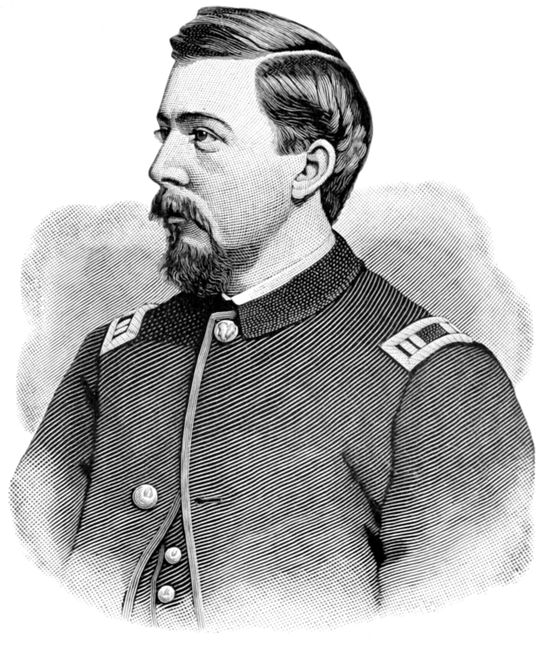
Second Lieut. Benjamin H. Child, son of John G. and
Mary A. Child, was born in Providence, R. I., May 8, 1843.
He was educated in the public schools of his native city.
When he was fourteen years of age he was apprenticed to
Grenville Greenleaf, to learn the wire working business.
At the age of eighteen he enlisted as a private in the
Second Rhode Island Battery, afterwards known as Battery
A, First Rhode Island Light Artillery, June 6, 1861. The
battery was hotly engaged at the first battle of Bull
Run, July 21, 1861. It was the only six-gun volunteer battery
taking all of its pieces from the field, two of them
being in a disabled condition. Private Child was slightly
wounded in this action. Battery A was connected with the
Sixth, Ninth and Second Corps, Army of the Potomac. It
was engaged in every battle in which the Second Corps
participated. Private Child was present with his battery in
the fight at Bolivar Heights, Sept. 16, 1861, and subsequently
in the campaign on the Peninsula. On the 16th
of July, 1862, he was promoted to corporal, and Sept. 12,
1862, he was made a sergeant. At the battle of Antietam
he was again wounded, this time severely by a bullet in
the head.
In the severe struggle at the battle of Gettysburg, Pa.,
Battery A fought with distinguished bravery, losing five
men killed and twenty-three wounded. Here Sergeant
Child was severely wounded in the shoulder, at the time of
112Pickett’s charge on Cemetery Ridge. He was sent to
Satalee Hospital, at West Philadelphia. When sufficiently
recovered to be removed he started for Rhode Island.
While on his way home he passed through New York City,
at the time of the draft riots. Sergeant Child witnessed
the fearful scenes in the streets while he was being conveyed
in a carriage through the city to the Fall River
steamer where he was to embark for Rhode Island. It
appeared as if the rabble might attempt to attack the
wounded Union soldier, and he remarked that it would be
“rather humiliating to be slaughtered by a mob after passing
through the charge of Gettysburg.” But the driver of
the carriage kept as far as possible from the centre of disturbance,
and Sergeant Child was soon safely aboard the
steamer. He was hurried aboard in such haste and in such
rude fashion that, his wound, but imperfectly healed, had to
be opened again, and the result is that he is troubled with a
stiff shoulder to this day.
In recognition of his services in the field Governor Smith
commissioned him a second lieutenant in Battery A. He
was afterwards transferred to Battery H, his commission
dating from Nov. 6, 1865. Owing to his wound he was
unable to report for duty until after Christmas. He then
proceeded to Brandy Station, where Battery A was at the
front, and received his discharge from that battery. The
mustering officer at General Sumner’s headquarters had
hardly signed the papers when a shell burst through the
tent, and seriously wounded that officer. Lieutenant Child
then returned to Washington, and reported for duty to Captain
113Allen commanding Battery H, which was then stationed
at Camp Barry, in the defenses of Washington. He was
mustered into this battery Jan. 8, 1864. He served with
credit in his new position until he was compelled in consequence
of his wounds to resign his commission, Nov. 23,
1864. For about eighteen months he was employed in the
quartermaster’s department at Washington.
On his return to Providence he was employed with Greenleaf
& Company, on Westminster Street, for about two
years. He was subsequently appointed watchman at the
Rhode Island State Prison.
On the 1st of May, 1868, he was appointed by the late
Mayor Thomas A. Doyle a patrolman on the police force of
the City of Providence, and he was promoted to doorman,
Station 1, June 4, 1874; sergeant, Aug. 16, 1877; captain,
Aug. 8, 1879. Elected chief Jan. 5, 1881. Re-elected
every year since.
He joined Prescott Post, No. 1, June 7, 1867. He was
appointed Aide-de-Camp to the Department Commander in
1887–8; he was elected a delegate at large to the National
Encampment in 1888; and elected a member of the Council
of Administration of the Department of Rhode Island in
1889. In 1890 he was elected to the position of Senior Vice
Department Commander, and in the following year (1891) to
that of Department Commander. He is a member of the
Massachusetts Commandery, Loyal Legion of the United
States. He is one of the committee on the publication of
the History of Battery H.
114It may not be out of place here to mention the fact that
Lieutenant Child’s twin brother, William D. Child, served
with distinction in Battery A, entering the service as private
and rising successively to the rank of first sergeant. After
this battery was consolidated with Battery B, it took part in
the fierce battle of Reams’s Station, Aug. 25, 1864, when
the combined battery was nearly annihilated. The total of
killed, wounded and missing numbered fifty-two, with a loss
of all the guns and fifty horses. Lieut. William S. Perrin,
who was in command of the battery, had his leg shattered
and was taken prisoner. Lieutenants Chace and Spencer
were also made prisoners. This disaster reduced the battery
to seventy-two men. Captain Brown being on duty in
Rhode Island, and the other officers in the hands of the
enemy, the command devolved on First Sergeant Child, who
continued to serve in that capacity until the arrival of Captain
Brown.
On the fiftieth anniversary of his birth, which occurred
May 8, 1893, the friends of Chief Child (and they are
legion), in recognition of his long and faithful service on the
police force of the city, determined to show their affection
and esteem for him in a substantial manner. On the evening
of the above date, at his own home, with a large
assembly present, he was made the recipient of an elegant
solid silver tea service, the gift of the officers and members
of the Police Department; also a handsome remembrance
from the Mayor and the Board of Aldermen of the
City of Providence. One of the gifts which he prizes
highly is a beautiful picture presented to him by his comrades
115of the Grand Army of the Republic. His estimable
wife was also pleasantly remembered by several appropriate
gifts from many friends and acquaintances.
Second Lieut. Anthony B. Horton, the son of John
W. and Mary A. Horton, was born in the city of Providence,
R. I., on the 22d of January, 1836. He attended the Fountain
Street School in that city until his tenth year, when his
parents removed to Rehoboth, Mass. He assisted his father
on the farm during the spring, summer and fall months of
the year, and attended the district school in the winter.
At the breaking out of the Rebellion he enlisted as private
in Battery B, First Rhode Island Light Artillery. Aug.
13, 1861. On the 25th of March, 1862, he was promoted to
corporal, and on the 1st of December of the same year he
was advanced to sergeant. He re-enlisted Feb. 8, 1864, and
was appointed first sergeant Oct. 3, 1864. He was discharged
Dec. 19, 1864, to receive promotion as second lieutenant
in Battery H, to date from Nov. 29, 1864. He was
mustered into that battery Dec. 20, 1864. He was a very
brave and gallant officer, cool and collected in the hour of
battle. He was promoted to brevet first lieutenant April 2,
1865, for gallant and meritorious services before Petersburg,
Va., to date from Nov. 29, 1864. He was mustered out of
service June 28, 1865.
First Lieut. William B. Westcott, son of Harley
and Laura Westcott, was born in Pawtuxet, R. I., March 16,
1841. He received his education in the public schools of
his native village. In 1857 he went to Providence and was
employed as a clerk in the grocery store of Thomas Merewether,
and was thus engaged when the War of the Rebellion
began.
On Dec. 2, 1861, he enlisted as a private in Battery G,
First Rhode Island Light Artillery. He was promoted to
sergeant Dec. 15, 1861, and quartermaster sergeant, June 9,
1862. On the 26th of April, 1864, he was promoted to
second lieutenant of Battery H, and was mustered in May 1,
1864. He was promoted to first lieutenant March 2, 1865,
and transferred to Battery B. He was mustered out with
his battery June 12, 1865, and returned with it to Rhode
Island.
Oct. 14, 1865, he entered the wholesale drug store of
Oliver Johnson & Co., as a clerk, and has remained in the
service of that company ever since. He is at the present
time (1894) head clerk in that establishment.
Comrade Westcott joined Prescott Post, No. 1, G. A. R.,
of Providence, about December, 1867. He served as officer
of the day for two years. He was department inspector in
1870–71, and assistant quartermaster-general of the department
in 1874.
Comrade Westcott is a member of Hope Lodge, No. 4,
I. O. O. F., and is also connected with Providence Council,
No. 566, American Legion of Honor, having held the office
of Commander in that order.
117His brother, Gilbert O. Westcott, also served honorably
for three years in Battery G, First Rhode Island Light Artillery,
and is a member of Prescott Post, No. 1, G. A. R.
Another brother, George H. Westcott, served as a corporal
in Company D, First Rhode Island Detached Militia. He
died in 1875.
Second Lieut. George Lewis was born near Summit,
in the town of Coventry, R. I., Nov. 1, 1831. His father,
Benoni E. Lewis, in early life was a farmer, but afterwards
became a carpenter and builder, doing business mainly in
the villages of Harrisville, Quidnick, and Anthony. Sarah
Lewis, the mother of Lieutenant Lewis, was the only
daughter of the Hon. George and Martha (Stone) Hawkins,
and a niece of the late venerable Rev. Richard C. Stone,
“who with each of his nine children,” says the Bunker Hill
(Ill.) Gazette, “have taught yearly in high schools, colleges
and universities, from two to thirty-one years each.” His
grandfather Hawkins in early life passed through the subordinate
military ranks till he held a major’s commission.
He was a representative in the General Assembly from
1819 to 1829, and senator from May, 1829, to 1831. For
over forty years he was deacon in the Rice City Christian
Church, of Coventry, R. I.
118In early youth Mr. Lewis attended the public schools at
Rice City, in Coventry, and at Sterling, Conn. In March,
1841, his parents moved to the Crompton Mills, in Warwick,
R. I. Here George was employed in the cotton mill as a
back-piecer in the mule room. He afterwards went to live
with his uncle in Coventry, working in the shingle mill and
on the farm, except in the winter months, when he attended
the public school.
About the first of April, 1848, at the age of sixteen,
George was apprenticed for three years to his uncle, Jason
Lewis, then of Phenix, to learn the carpenter’s trade. He
afterwards left his uncle’s employ, and worked for his father,
who had commenced the same business, continuing with him
most of the time until the summer of 1852. In September
of that year he moved to Providence, R. I., and worked for
several firms until the spring of 1854. He was then employed
by Cyrus T. Eddy & Company, with whom he continued
the greater portion of the time until September, 1861,
when he entered the service of his country as a private in
Battery E, First Rhode Island Light Artillery.
He was mustered into the service Sept. 30, 1861, and participated
in all the battles in which his battery was engaged.
He was wounded slightly May 3, 1863, at the battle of Chancellorsville.
He was promoted to lance corporal May 29,
1863; corporal Sept. 4, 1863; re-enlisted Feb. 1, 1864;
lance sergeant April 9, 1864; sergeant Oct. 20, 1864, to
date from October 4th; second lieutenant March 31, 1865;
assigned to Battery H, May 29, 1865; never reported or
mustered as such; mustered out of service June 14, 1865.
119After the close of the war Lieutenant Lewis resumed
work for the same firm with whom he was employed before
entering the army. He continued with them until February,
1866. He then went to Worcester, Mass., where he
was employed as foreman in the carpenter shop of the
“Earle Stove Company.” That company not succeeding in
business closed their works in June, 1869. In July of that
year Mr. Lewis entered the employ of Spicers & Peckham
(now the Spicer Stove Company), the well-known and successful
stove founders of Providence, R. I., with whom he
is still (1894) employed, having had charge of their carpenter
shop for over twenty-four years.
Mr. Lewis is a member of Slocum Post, No. 10, Grand
Army of the Republic, and is also connected with the
Soldiers’ and Sailors’ Historical Society. He has served as
a vice-president of the First Rhode Island Light Artillery
Veteran Association.
He was chosen historian by his comrades to write the
history of Battery E, First Regiment Rhode Island Light
Artillery. He labored with untiring zeal and ability to further
this object, and the imperishable record he has been
instrumental in preserving to the archives of the State will
ever redound to his honor as a soldier and patriot.
First Sergt. George Messinger, the son of Eli and
Ann J. (Roberts) Messinger, was born in the city of Providence,
R. I., March 27, 1842. At the commencement
of the Civil War, he was attending a private school in that
city, preparatory to entering Brown University. With all
the ardor and patriotism of youth, and imbued with a strong
desire to serve his country in her hour of peril, he offered
his services and was mustered into service as a private in
Battery A, First Rhode Island Light Artillery, June 6, 1861.
He participated with his battery in the first battle of Bull
Run.
The battery was subsequently ordered to the Upper Potomac,
and was stationed at different points between Harper’s
Ferry and Washington. At the time of the battle of Ball’s
Bluff one section of the battery to which Private Messinger
had been assigned was stationed near Poolesville, Md. It
was dismounted and crossed the Potomac on a scow, but
took no active part in the engagement, and the next day recrossed
the river and returned to its old camping ground.
About this time Private Messinger was seriously attacked
with typhoid fever and pneumonia. His father, who had
enlisted in the same battery, was detailed to attend him
during his illness. His mother also came on from Providence,
R. I., to render her assistance. He was removed to
the house of Mrs. White, the mother of the well known
(Confederate) Gen. Harry White. Private Messinger after
becoming convalescent was granted a furlough, and returned
to Rhode Island. On regaining his health he was detailed
on recruiting service in Providence.
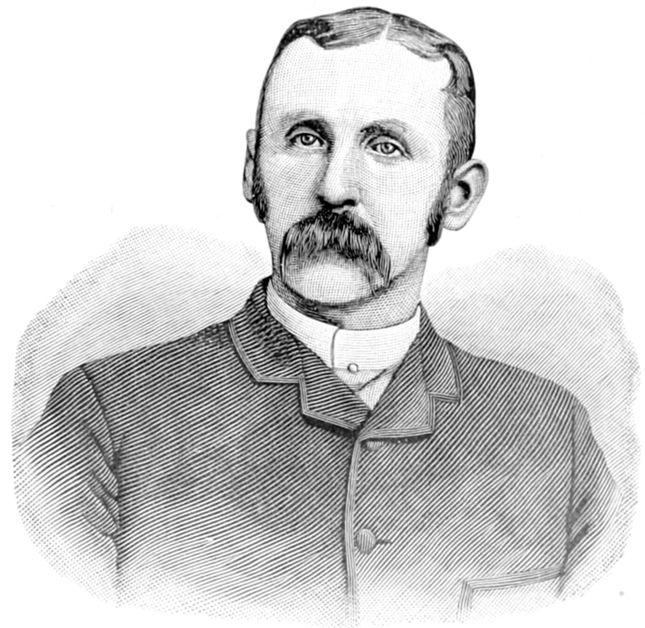
Company Clerk George Messinger.
121Battery H was then organizing in that city, and Private
Messinger was transferred from Battery A and promoted to
first sergeant of Battery H. The battery was subsequently
ordered into camp near Mashapaug Bond, in Cranston, R. I.
At this time frequent drafts were made upon the battery for
recruits to serve in the batteries already in the field. Sergeant
Messenger combined with his other duties that of drill
master, and was kept constantly employed in that capacity
until the battery left its camp and proceeded to Washington
in October, 1862.
His career from that period until the termination of the
war was closely identified with the history of the battery.
In October, 1863, while the battery was stationed at Fairfax
Court House, Sergeant Messinger was wounded by the accidental
discharge of his revolver, the ball passing down his
leg on the inside of his boot, entered his heel, and went
through and lodged in the heel of his boot. It being in a
vulnerable spot, he suffered considerable inconvenience from
his wound.
Soon afterward, entirely unsolicited on his part, an application
was made for him for a commission, which was signed
by all of the officers of his battery and by the colonel and
major of his regiment. The application was supposed to
have been forwarded to the governor of Rhode Island, but
nothing was ever heard from it, and in January, 1864, Sergeant
Messinger re-enlisted as a veteran and received the
customary furlough of thirty days.
122While at home on his furlough he had strong hopes that
he might receive a commission from the governor. One day
while reading a newspaper he was astounded to learn that a
commission had been granted to a personal friend of his, but
whose service as a non-commissioned officer was of a very
recent date. Feeling aggrieved at this treatment he had
received he went to the governor and requested that his
application for a commission might be returned to him. He
was greatly astonished to find that no application or recommendation
had ever been received, and it was not until sixteen
years later that he learned what had become of the
papers that had been forwarded to the governor.
It may be well to state here that his friend who received
the appointment was assigned to Battery E, in the very
position which Sergeant Messinger had anticipated might be
allotted to himself. In the very first battle in which this
officer took part after he had joined his battery he was
killed, so that Sergeant Messinger has good reason to congratulate
himself that he did not receive the coveted commission
at that time.
And now we are able to inform our readers what became
of those papers. It seems there was a soldier well known
in the battery (now deceased) whose name we do not desire
to make public, who cherished an enmity against Sergeant
Messinger because he had appointed him a corporal at Camp
Mauran against his wishes. He only held the position a
short time, then returned to the ranks, and was appointed
mail carrier for the battery. He was present in the officers’
quarters to take the mail the morning the captain sent the
123papers to Rhode Island, and heard the captain express the
desire that the papers might soon bring Sergeant Messinger
his commission.
The mail carrier afterward said to Sergeant Messinger
that he determined at that time that he (Messinger) should
not have the commission if he could prevent it. He took
the papers from the mail bag and destroyed them. No
wonder they could not be found in the governor’s office, and
that Sergeant Messinger did not receive appointment to the
position which he was so well qualified to adorn.
After Captain Allen took command of the battery, Sergeant
Messinger was appointed company clerk, and served
in that capacity until the muster out of the battery. He
settled all the affairs of the battery for Captain Allen in a
manner creditable to himself and to all concerned. Even to
this day there is no member of the battery who is more
highly esteemed and respected than he, and no one who
takes a livelier interest in the welfare of his comrades. He
has had the opportunity and privilege of visiting many of
the members who are scattered over the country, and they
always find him ready to extend a hearty welcome to all;
and no deserving comrade ever found him turning a deaf ear
to his plea for help in time of need.
He is at present engaged in the manufacture of pottery at
East Brookfield, Mass. He is a member of the Grand
Army of the Republic in his town, and is an honored citizen
of the community in which he lives. He is one of the committee
on the publication of the History of Battery H.
Lieut. Hezekiah Potter, son of Christy and Lucius
(Smith) Potter, was born in Pawtucket, R. I., on the 1st day
of July, 1834. His parents subsequently removed to Providence,
R. I., where he received his education in the public
schools of that city.
Previous to the War for the Union he was engaged in the
wholesale grocery business, first with his brother in the
city of Syracuse, N. Y., and afterwards managed the same
business for A. & W. Sprague with marked success for
about five years. He was subsequently connected with
William Sheldon in the same capacity.
In August, 1862, he was enrolled as private in Battery H,
First Rhode Island Light Artillery. He was afterwards
promoted to the rank of quartermaster-sergeant in this battery
March 28, 1864. On the 21st of October, 1864, he
received a commission as second lieutenant, and was
assigned to Battery E. He was mustered into the battery
on the same day of his arrival, Nov. 11, 1864.
Although a man of few words he won the respect and
esteem of all the members of the battery. He was cool
and self-possessed under fire, and was always found reliable
in every position he was placed. He participated
with the battery in the almost daily conflicts with the enemy
in the intrenchments before Petersburg, and was present at
the final and successful assaults on the enemy’s lines, April
2, 1865. He was mustered out of service June 4, 1865.
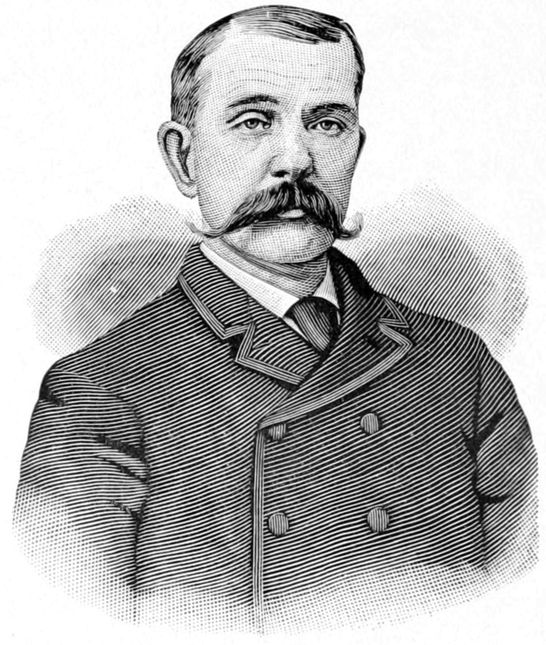
First Sergt. John P. Campbell.
125After the close of the war he was employed for several
years with Hubbard & Aldrich, wholesale grocers, in Providence,
R. I. He has since been employed in various kinds
of business.
First Sergt. John P. Campbell, son of James S. and
Ann Campbell, was born in Treat’s Village, in the town of
Voluntown, Conn., March 29, 1844. He was educated in the
public schools of that place. During the Civil War he
enlisted as a private in Battery H, First Rhode Island Light
Artillery, June 24, 1862. He was mustered into service with
his battery Oct. 14, 1862. By good conduct, gentlemanly
bearing and kind consideration of all with whom he came in
contact, he won the love and confidence of his comrades,
and the approbation and esteem of his superior officers, and
was successively promoted to corporal, sergeant, and in
December, 1864, first sergeant, retaining that position on his
muster out of service with the battery, June 28, 1865.
Comrade Campbell is at the present time (1894) a
respected citizen of the village of Lafayette, in the town of
North Kingstown, R. I. He holds the position of head
overseer in the Rodman Mill, and is greatly beloved by all
for his sterling worth, and especially by those employed
under him for his many acts of kindness toward them.
Sergt. Esek S. Owen, son of Thomas J. and Dorcas
(Sayles) Owen, was born in Smithfield, R. I., Aug. 21, 1839.
His parents subsequently removed to Central Falls, R. I.,
where Esek attended school. His parents afterwards moved
to Connecticut, and he attended school there for three
years. He also pursued a course of study at the East Greenwich
Academy.
He enrolled as a private in Battery H, First Rhode Island
Light Artillery, May 19, 1862, and was mustered into service
with his battery Oct. 14, 1862. In the battle before
Petersburg, Va., April 2, 1865, he commanded the left piece
of the right section. In this engagement he was slightly
wounded. He also commanded the left piece of the right
section in the Battle of Sailor’s Creek, Va. He was always
cool and self-possessed under fire, winning the respect and
confidence of the men under his command. He was mustered
out of service with his battery June 28, 1865. He is
at the present time (1894) an esteemed citizen of Pueblo,
Colorado.
Sergt. Emulous A. Cheever, son of Amos and Abigail
(Keech) Cheever, was born in Attleboro, Mass., Aug. 27,
1841. Sergeant Cheever’s parents formerly resided in
Wrentham, Mass., but subsequently removed to Attleboro,
Mass., where the subject of our sketch was born.
He received his education in the public schools of the
town.
127He enlisted in the service of his country Aug. 4, 1862,
and was mustered in with his battery Oct. 14, 1862. He
was promoted to corporal in 1862; and November 6th of
that year was made a sergeant. He endeared himself to
his comrades by his manly and upright character, and by
many sterling qualities. He was mustered out of service
with his battery June 28, 1865.
Corp. Earl Fenner was born in Providence, R. I., on the
20th day of April, 1841. He is the second son of James
M. and Sarah A. Fenner. His mother was the daughter of
Gould and Alary Brown, of North Kingstown, R. I. His
ancestor, Capt. Arthur Fenner, erected in Johnston, R. I.,
(then a portion of the town of Providence) what was known
as the “Old Fenner Castle,” a strongly constructed log
house, built for the purpose of resisting the assaults of the
Indians. The old “Castle” and the lands adjacent thereto
descended in direct succession to James, son of Capt.
Arthur Fenner; then to his son Thomas Fenner; then to
James M. Fenner, the father of Comrade Earl Fenner.
The subject of our sketch attended the public schools of
Providence in his youth.
When the War for the Union began Comrade Fenner
128became imbued with the martial spirit of the times, and was
desirous of taking part in the great struggle for national
existence. On the 25th day of August, 1861, he enrolled as
a private in Battery C, First Rhode Island Light Artillery.
This battery left Providence on the 31st of August, and proceeded
to Washington. It remained at Camp Sprague
engaged in daily drill until October, when it crossed the
Potomac and encamped near Fort Corcoran, giving to its
encampment the name of “Camp Randolph.” From thence
it removed to Hall’s Hill, and again to Miner’s Hill, Va.,
and became identified with Porter’s division of the Army of
the Potomac. While the battery was stationed here the privations
and hardships of a soldier’s life greatly impaired the
health of Comrade Fenner, and eventually caused his discharge
from the service Dec. 9, 1861.
Regaining his health the following year he again yearned
to serve his country in her hour of peril, and enlisted as a
private in Battery H, First Rhode Island Light Artillery,
Sept. 24, 1862. From this time on until its final muster out
Comrade Fenner became closely identified with its history.
During his term of service he served as private, bugler and
non-commissioned officer.
When the Army of the Potomac was moving towards
Gettysburg, Pa., in June, 1863, Comrade Fenner was detailed
to headquarters of the Third Brigade, of the Twenty-second
Army Corps, and was ordered on special duty as a bearer of
dispatches to the commanding general of the Army of the
Potomac. As that army was on the march against the
enemy his instructions were very explicit to deliver the dispatches
129entrusted to him to the general commanding
wherever he might be found. On one occasion while
returning from one of these journeys he narrowly escaped
capture by Mosby’s guerillas near Germantown, Va.
In the battles before Petersburg, the engagement at Sailor’s
Creek, and the closing scenes at Appomattox, where the
surrender of the Confederate army occurred, Comrade Fenner
was an active participant with his battery, and at the
termination of the war returned to Rhode Island, where the
battery was mustered out of service June 28, 1865.
Comrade Fenner is a member of the First Rhode Island
Light Artillery Veteran Association, and served as Executive
Committee of Battery H in the regimental association
a number of years. In 1891 he was chosen first-vice president
of the association, and in 1892 president.
On the 27th of June, 1891, he called a meeting of the old
members of Battery H, for the purpose of forming a veteran
association of the battery. Starting with only four
members, through his untiring efforts as secretary and treasurer,
the association now numbers on its roll fifty members.
He was unanimously chosen historian by his comrades of
the battery. Having in his possession a very valuable war
diary that he kept while in service it has formed the nucleus
from which a large portion of the facts and incidents relating
to the history of the battery have been gathered. This diary
has also been the means of aiding many of his comrades and
their widows in obtaining pensions, and likewise been of
great service to the pension office in settling disputed cases.
Comrade Fenner is connected with various societies. He
130is a past chief patriarch of Narragansett Encampment, No. 1,
I. O. O. F., and has held the office of recording secretary
in Hope Lodge, No. 4, I. O. O. F. He is a past great
sachem and past great prophet of the Great Council of the
Improved Order of Red Men of Rhode Island, also holding
the position of great mishewina in the Great Council for two
years.
Comrade Fenner has been for several years in the employ
of his brother, James M. Fenner, druggist, in the city of
Providence.
Corp. Franklin E. Paul, son of Captain Clark and May
(Young) Paul, was born in Dover, N. H., Sept. 14, 1829.
He received his education in the public schools of his native
town. His father was a sea captain, and followed the sea for
over forty years. At the age of fifteen he went to North
Bridgewater, now Brockton, Mass., and lived on a farm for
about a year, and then learned the trade of boot and shoemaking.
After serving faithfully three years as an apprentice,
he started out for himself, working in different towns
in Massachusetts.
In 1858 he removed to Mansfield, Mass., and in September
of that year he married Almira Alger, daughter of Edmund
Alger, Esq., of that town. While busy in his calling, the
tocsin of war resounded throughout the land, and aroused
within him a spirit of loyalty and devotion to country, and
he determined to enroll himself among his country’s defenders,
and do all in his power to maintain the honor and integrity
of free institutions and good government.
131On the 29th of September, 1862, he enlisted with five
others from Mansfield, in Battery H, First Rhode Island
Light Artillery, and was mustered into service Oct. 14, 1862.
Leaving a good home, a devoted wife, and a little daughter,
he offered all upon his country’s altar, and served loyally and
faithfully with his battery until the termination of the war.
He was promoted to corporal in 1865. He was mustered
out with the battery June 28, 1865.
On returning to his home in Mansfield, Mass., he worked
at his trade for two years, and then removed to Boston to
take charge of a large shoe manufactory on Pearl Street, in
that city. He continued in this position until May 27, 1877,
when he received an appointment as clerk in the Boston post-office,
in which capacity he still remains.
In the year 1892 he was unanimously chosen first vice-president
of Battery H Veteran Association, and in August,
1893, was elected to the office of president. On assuming
the chair he delivered an excellent address appropriate to the
occasion, which was listened to with marked interest and
attention. He is also a member of the publication committee
on the History of Battery H. He is held in high esteem
by his comrades of Battery H, his associates in the Boston
post-office, and by his fellow townsmen of Chelsea, Mass.,
where he now resides.
Corp. John P. Campbell, son of John and Nancy J.
(Malin) Campbell, was born in Boston, Mass., on the 8th day
of April, 1846. His parents were of Scotch descent. On
his father’s side he is descended from the Campbells of
Clyde, having an ancestry of rank in the Scottish Highlands.
On his mother’s side also his ancestors attained high distinction.
The subject of our sketch in his youth was brought up in
the family of Jeremiah Russell Smith, father of William
Russell Smith, a noted musician in South Medfield, Mass.
He attended the South Medfield and Walpole schools, previously
going to schools in Boston.
In the War of the Rebellion he enlisted as a private in
Battery H, First Rhode Island Light Artillery, Sept. 19,
1862, and was mustered in Oct. 14, 1862. He was subsequently
promoted to corporal. That he served with credit
and honor in his battery is attested by his being wounded
severely in hand, shoulder, and foot, in action near Petersburg,
Va., April 2, 1865. He was corporal of the right
piece, of the right section of his battery in that engagement.
He was mustered out of service June 28, 1865.
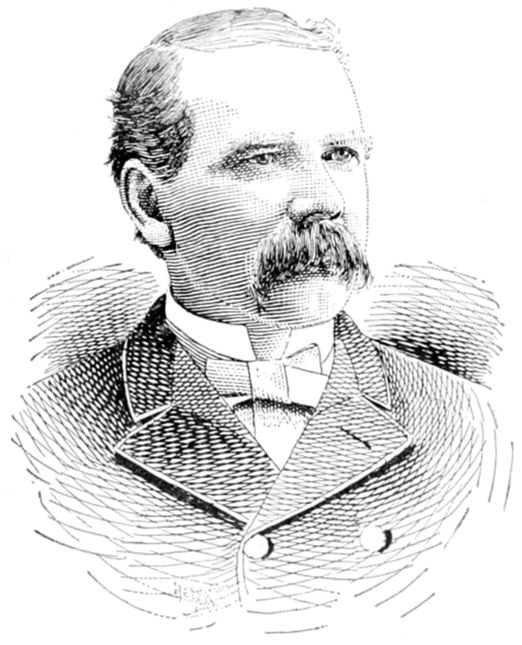
Corp. John P. Campbell, 2d.
133Immediately upon his return from the army he went West,
and was engaged in teaching in schools, holding some
important positions in high schools, etc. He received his
college education in Cornell College, Mount Vernon, Iowa.
After leaving college he read law under Judge Alonzo Converse,
and was admitted to the bar in Iowa. He went to
Abilene, Kansas, in the year 1876, where he located in the
practice of law, and where he has since resided. He there
established the “J. P. Campbell Collection Agency,” at the
head of which he has continued since its formation. His
practice has been in all courts, and has been a successful and
profitable one. He is the author of several literary publications,
brought out by some of the best known publishing
houses in the country.
He is also well known as a lecturer, and has met with
much success in that direction. His lectures on “What is
Life?” “Courtship, Marriage, Divorce,” “A View of
Heaven, from the Poet’s Standpoint,” and “The Soldier,”
have been spoken of in the highest terms, and been received
with universal favor. Of the author of these lectures this
has been said:
“John Preston Campbell has, perhaps, the most complete
and choicely selected law and literary library in the State of
Kansas, and being greatly attached to books, of his more
matured and written deliberations much that is entertaining,
ennobling and beneficial may be expected. An hour was
spent in his rooms examining his books and chatting with
one of the most genial conversationalists we had ever met.”
He has always been in warm sympathy with his comrades-in-arms,
the “boys who wore the blue” in the trying days of
the Rebellion, and is an honored member of Post No. 63,
Department of Kansas, Grand Army of the Republic.
Artificer Leon Allison, son of James and Josephine
Allison, was born in Three Rivers, Canada, May 1, 1820.
He worked on a farm until his eighteenth year, when he
went to Spencer, Mass., where he learned the shoemaker’s
trade. From there he removed to Providence and worked at
his trade for awhile and then enlisted in the navy about the
year 1841, serving on board the United States man-of-war
Delaware for three years, when he was honorably discharged,
returned to Providence, and resumed his former
occupation, the shoemaking business, and was thus engaged
when he entered the army in the War of the Rebellion.
He enlisted as a private in Battery H, First Rhode Island
Light Artillery, Oct. 9, 1862, and was mustered into service
Oct. 14, 1862. He was subsequently promoted to artificer.
While the battery was stationed at Fort Smith on the Potomac
River, near Aqueduct Bridge, Comrade Allison was
sent into Washington on official business. On his return he
was brutally assaulted and all his valuables taken from him,
even to the shoes on his feet. Upon his arrival at the fort
he was sent to the hospital, where the surgeon found that his
jaw was broken. After he had recovered from his injuries
he resumed his duties in the battery, and served with credit
until his muster out June 28, 1865.
On returning to Providence he again followed his accustomed
avocation, and has been engaged in the shoemaking
business ever since. Although a veteran in years as well as
of the war, he is still active and strong for a man of his age,
and is highly respected in the community.
135He is a member of Prescott Post, No. 1, G. A. R., of
Providence, and also of Battery H Veteran Association.
Guidon Horace F. Floyd was but a stripling of fifteen
years of age when he entered the service of his country.
He became so imbued with martial ardor that he walked
from Webster, Mass., to Providence, R. I., and from thence
to Camp Mauran, where he enlisted as a private in Battery
H, First Rhode Island Light Artillery, and was mustered
into service Oct. 14, 1862. He was subsequently promoted
to battery guidon.
In January, 1863, while the battery was encamped near
Fairfax Station, Va., Comrade Floyd was taken sick with
typhoid and rheumatic fever, and was sent to the hospital at
Fairfax Seminary, returning to the battery at Chantilly, Va.,
in May or June of that year. While stationed at Fort
Scott in the fall of 1863, he was sick with rheumatism and
malaria.
In the battle before Petersburg, Va., on the 2d of April,
1865, he won special commendation from his superior officers
for his gallant conduct. He carried the battery guidon at
the head of the battery throughout the entire action. In
the seventh and last position which the battery occupied on
that eventful day in rear of the Whitworth House, while the
136battery was under a very severe cross fire from the enemy
he was ordered by Captain Allen to deliver a message to
Colonel Cowan, commanding the Artillery Brigade of the
Sixth Corps, requesting assistance. In compliance with this
request the Colonel sent his New York battery to our support.
Comrade Floyd on returning to the battery after
delivering his message, while riding down our line of battle
his horse was struck by a shell, killing him instantly. Our
comrade was prostrated by the concussion of the shell, and
his horse also falling upon him, injured his leg severely and
caused a severe strain upon his bodily powers, producing
nervous prostration, with which he suffered for some time
afterwards. Colonel Cowan in referring to this affair said:
“I received a dispatch from Captain Allen by the boy guidon
of Battery H, and could not help admiring the courage and
patriotism displayed by this lad on that occasion.” Comrade
Floyd subsequently recovered from his injuries, and
was mustered out with the battery, June 28, 1865.
Comrade Floyd now (in 1894) resides in Buffalo, N. Y.
He is a member of Chapin Post, No. 2, Department of
New York, and has held the office of adjutant in the post,
and is also a past president of the Army and Navy Union of
Buffalo. For over nineteen years he has been connected
with the Seventy-fourth Regiment New York National
Guard, rising from the ranks as private to the position of
first lieutenant. He resigned this office several years ago to
accept the position of armorer in the regiment. He is a
member of DeMolay Lodge of Free and Accepted Masons,
and has held the office of marshal. He is also an active
member of the Royal Arcanum.
137Comrade Floyd is held in high esteem by his military
associates, his brethren in the various societies with which
he is connected, and by his fellow citizens generally. In the
opinion of the writer Comrade Floyd deserves a medal
from Congress for the bravery he displayed in front of
Petersburg.
Warner Alden, son of Oliver and Lucinda (Cobb) Alden,
was born in North Middleboro, Mass., Feb. 3, 1830. He is
a lineal descendant of John Alden, who came over in the
Mayflower, and was one of the founders of the Plymouth
Colony. His father, Oliver Alden, served in the War of
1812. His mother, Lucinda (Cobb) Alden, was the daughter
of Ansel and Cynthia (Howard) Cobb. Comrade
Alden’s parents had three children, Abner, William C., and
Warner. Abner served at the age of nineteen in the Florida
War, and was discharged as a first lieutenant. He died in
1883, in Iowa. William C. enlisted in the Third Massachusetts
Infantry, during the War of the Rebellion, and went to
Fortress Monroe, and served three months. Upon the expiration
of his term of service he returned home with his regiment,
re-enlisted and served three years in the Fortieth
Massachusetts Infantry, and is now living in Boston.
In his youth Comrade Warner Alden received a common
school education in the public schools of his native town.
After leaving school he learned the trade of mason, which
calling he still follows.
138Comrade Alden enlisted Oct. 1, 1862, in Battery H, First
Rhode Island Light Artillery, and was mustered into service
with his battery Oct. 14, 1862. He served faithfully and
continuously with his battery until he was mustered out of
service June 28, 1865, at the termination of the war.
He married Matilda White. They have four children:
Mabel J., May F., Lizzie N., and Gordon Brooks.
Comrade Alden is a worthy member of Prescott Post, No.
1, Department of Rhode Island, Grand Army of the Republic,
having joined that Post Sept. 2, 1892. He is also a
member of Battery H Veteran Association, First Rhode
Island Light Artillery.
Solomon Close, son of Joseph and Sarah (Brown) Close,
was born in the town of Greenwich, Fairfield County, State
of Connecticut, Oct. 19, 1845. His ancestor, Thomas Close,
came from England about the year 1661, and settled in
Greenwich, Conn. He had four sons, Thomas, Joseph, Benjamin,
and John. Comrade Close is a direct descendant
from Joseph. The names of Thomas Close and Thomas
Close, Jr., appear on the list of seventy-two proprietors who
purchased a large tract of land in West Greenwich, Conn.,
in 1762.
The grandfather of Comrade Close (Solomon Close) was
a soldier in the War of the Revolution. At the time of the
attack made by the British upon West Greenwich, under
139Governor Tryon, Feb. 26, 1776, he was an eye witness of the
escape of General Putnam down the precipice as he was
being pursued by the British soldiers. Putnam afterwards
said he could hear the enemy’s bullets strike in the trees as
they fired at and overshot him as he rode down the steep
declivity.
It is also related of Comrade Close’s grandfather that two
other soldiers and himself were concealed for twenty-four
hours in an old stone wall at Throg’s Neck, then occupied by
the British. They were there for the purpose of capturing
a British officer. They failed in the accomplishment of this
object, however, as the enemy obtained information of their
designs and instituted a search for the Yankee soldiers, who
were hiding in an arch in the old stone wall, which was covered
over with salt grass by a friend of the Yankee soldiers.
While lying there the British walked over the very spot
where they were concealed, and our comrade’s grandfather
says he could have struck the blade of his knife into their
feet as they walked over him. They halted near the spot
for quite a while, as the grass was considerably trampled
down at that point. One of the British soldiers remarked
that the “d——d rebels” must have lain there the night
before. They were subsequently released from their perilous
position by the aid of their friend already alluded to, and
made good their escape. It is stated that Solomon Close
was present at the storming of Stony Point, by the Continental
forces under the command of Gen. Anthony Wayne.
Our comrade’s grandfather died Jan. 28, 1840, before his
grandson was born, and for whom he was undoubtedly
140named. Other members of the Close family served with
distinction in the War of the Revolution, and one particularly,
Elnathan Close, was engaged in privateering. His
exploits in connection with others like himself have formed
the basis of many exciting tales.
Captain Andrew Meade and Elnathan Close, of Greenwich,
with other daring spirits were engaged in privateering
to the great annoyance of the enemy. They sallied out on
their expeditions provided with large whaleboats, which
were easily hidden from view in the day time in the small
bays along the coast. On one occasion they proceeded by
night to Ferry Point and seized upon a small store vessel,
and secured her as a prize. The vessel was anchored in a
small inlet known as Chimney Corner. The prize was so
valuable that the enemy pursued them with one of their
war vessels. They anchored off Chimney Corner, and began
making dispositions to retake their vessel. But the people
on shore who had assembled for the purpose of defending
the prize, determined if possible to prevent its falling into
the hands of the British. With a six-pounder, which was
the only large gun in the town, they fired upon the British
vessel. The first shot struck the deck of the vessel. The
enemy returned the fire, but finding it impracticable to
retake the vessel or inflict injury to the people on shore
they relinquished their efforts in that direction and hastily
withdrew.
The attack on the British vessel at Ferry Point had been
made in two divisions. One division was commanded by
Captain Meade and the other by Elnathan Close. Captain
141Meade while leaving the vessel with his division was
wounded in both arms from shots fired by two marines on
guard. Elnathan Close with his division at the same time
boarded the vessel on the opposite side, soon had possession
of the decks, and the forces below quickly surrendered with
but little resistance.
Thus it will be seen that Comrade Close came of good
military stock. On his mother’s side his ancestor, Thomas
Brown, of Sussex, England, emigrated to this country in
1632. Comrade Close’s father, Joseph, was at one time captain
of a company of militia at White Plains, N. Y., where
he then resided. He subsequently removed to Greenwich,
Conn., and purchased a farm of about one hundred acres,
and pursued there his occupation of farmer and drover, dealing
largely in cattle, which he bought mostly in the middle
and western states.
Joseph Close’s family consisted of six children, four boys
and two girls. One of these boys, Solomon, the subject of
our sketch, was attending school when the War of the
Rebellion began. He became imbued with martial ardor
and had a strong desire to enter the army. But his parents
opposed it. Not because they were not loyal to the Union
cause, but they deemed it advisable that Solomon should
remain at school a while longer.
In February, 1865, while his father was away buying cattle,
our comrade decided that if he could not enter the service
of his country as a soldier, he would go on a whaling
voyage. To this proposition his mother reluctantly gave
her consent. He proceeded to New York city and shipped
142for a voyage. From that city he was sent to New Bedford,
from which port the ship was to depart. While waiting
for the vessel to sail Comrade Close observed the arrival of
a whaler from a long voyage in the Arctic regions. The
appearance of the vessel and the crew and the rough usage
to which they had been subjected cooled the ardor of our
friend for a cruise in the northern seas, and he sought the
shipping agent and requested that he might be allowed to
enter the army instead. To this arrangement the agent consented,
and, as there was no recruiting office in New Bedford,
our comrade proceeded to Providence, R. I., and
enlisted as a private in Battery H, First Rhode Island Light
Artillery, March 7, 1865, and joined the battery at Burkeville
Junction, Va., April 22, 1865, the day before the battery
left that place for the long march to Danville, Va. Although
not permitted to share in the more stirring scenes of the
battery’s history, yet he cheerfully performed every duty
incumbent upon him during his brief term of service, and
was mustered out with the battery June 28, 1865.
On the 11th of June, 1866, he enlisted in the city of New
York in Troop K, Fourth United States Cavalry, and served
three years on the Texas frontier. In August, 1866, that
dread scourge, cholera, made its appearance, and several men
of his company were taken sick and died. Two of his tent-mates
were among the victims. Comrade Close was detailed
to regimental hospital to care for the sick, and remained
there until the epidemic abated. His regiment was at that
time stationed a few miles outside of the city of San Antonio,
Texas. After the cholera had disappeared the several companies
143of the regiment were scattered for a time, some of
them being sent to different posts on the frontier, his company
being assigned to Fort Inge, about ninety-five miles
west of San Antonio. His company scouted the country in
the vicinity of the post for two years, having several sharp
engagements with the Comanche Indians. In this capacity
the company continued the larger portion of its stay in
Texas, hunting Indians, Mexican bandits, and outlaws. It
was subsequently relieved by the Ninth United States Cavalry,
and the company was ordered to Fort Brown, Texas,
where Comrade Close was honorably discharged, June 11,
1869, his term of service having expired. He arrived home
July 4, 1869.
On the 22d of October, 1869, he was employed as locomotive
fireman on the New York and New Haven Railroad.
May 28, 1873, he was promoted to locomotive engineer, and
still retains that position. Although our comrade has seen
twenty-four years of railroad service, yet he has never had a
collision, nor has a passenger been injured on any of the
trains he has run. It is a singular coincidence that three of
his brothers have also been locomotive engineers.
Comrade Close married Cornelia J. Husted Sept. 25, 1872.
She died Oct. 29, 1873. He married Mary F. Knapp Sept.
26, 1876. They have two children, Joseph, born Feb. 25,
1878, and Mary F., born Dec. 11, 1879.
Comrade Close is a resident of Stamford, Conn., and is an
honored member of Hobbie Post, No. 23, Department of
Connecticut. As indicative of the esteem in which Comrade
Close is held we will state that on the 11th of April,
1441893, he was made the recipient of a handsome gold badge
of the Grand Army regulation pattern, studded with diamonds,
rubies, and sapphires, and presented to him by a
number of his comrades and friends. He was elected Junior
Vice Commander of Hobbie Post, Dec. 7, 1893. He is also
a member of Battery H Veteran Association.
George W. Freeborn, son of Samuel and Eliza P. Freeborn,
was born in Newport, R. I., on the 18th day of May,
1845. He received his education in the public schools of
his native city. He enlisted as a recruit for Battery H, First
Rhode Island Light Artillery, Feb. 25, 1865, and reported to
the battery at Fort Tracy, in front of Petersburg, Va.,
March 1, 1865. In the battle before Petersburg, April 2,
1865, he proved to be a man of courage and thoroughly reliable
in every emergency. He was mustered out of service
with the battery June 28, 1865. He returned to Newport,
R. I., and in 1867 married Martha A. Goslin, the daughter of
John and Jane Goslin. They have five children.
Comrade Freeborn is now residing in Fall River, Mass.,
and is foreman of the packing house of David M. Anthony.
He is a member of Richard Borden Post, of Fall River, and
is also a member of the Veteran Firemen’s Association, and
the Firemen’s Relief Association. He is connected with
the American Order of Druids, and a member of Battery
H, First Rhode Island Light Artillery Veteran Association.
Sydney A. Goodrich, son of Jacob M. and Hannah
Goodrich, was born in Shapleigh, Maine, March 1848. In
his youth his parents removed to Providence, R. I., where he
attended the Transit and Arnold Street schools, until his
enlistment in Battery H, First Rhode Island Light Artillery,
Oct. 12, 1863. He reported to the battery at Camp Barry,
Washington, D. C., about Oct. 17, 1863. He served with
credit in his battery until his muster out of service June 28,
1865.
Comrade Goodrich is a member of Gen. Lander Post, No.
5, of Lynn, Mass., where he now resides. He is also a
member of Battery H Veteran Association.
John A. Gray, son of Lawson D. and Harriet E. Gray,
was born in the town of Walpole, Mass., Jan. 17, 1839. He
attended the schools of that town in his youth. In the War
of the Rebellion he enlisted in Battery H, First Rhode
Island Light Artillery, Sept. 22, 1862, and was mustered into
service with his battery Oct. 14, 1862. He served with
credit during his entire service, and was mustered out June
25, 1865.
Returning to Walpole on the completion of his army service,
he has ever since been an honored resident of that
146town. He is a member of Post No. 157, Department of
Massachusetts, a member of Lodge No. 39, United Workmen,
and is also connected with Battery H Veteran Association,
and with the First Rhode Island Light Artillery
Veteran Association.
George W. Haradon, son of Elisha and Sarah M. Haradon,
was born in the town of Sharon, Mass., June 14, 1842.
He attended the district school of the town in his youth,
and later he attended the Bristol Academy at Taunton,
Mass. After graduation he learned the carpenter’s trade.
He enlisted as a recruit in Battery H, First Rhode Island
Light Artillery, March 2, 1865. He reported to the battery
at Fort Tracy, in front of Petersburg, Va. He participated
with his battery in the battle before Petersburg, April 2,
1865, where he displayed all the qualities that are requisite
to make a good soldier. He was mustered out of service
June 28, 1865.
He is now located in Manchester, N. H. He is a member
of Passaconnaway Tribe of the Improved Order of Red
Men, attaining the rank of a chief in the tribe. He is
regarded by his fellow townsmen as a man of sterling character
and a good citizen.
Edward N. Lawton, son of Isaac and Mary Ann Lawton,
was born in Newport, R. I., Jan. 15, 1847. He attended
the public schools of that city in his youth. He enlisted as
a recruit and was assigned to Battery H, First Rhode Island
Light Artillery, Feb. 27, 1865. He reported to the battery
at Fort Tracy, Va., in front of Petersburg, Va., and was
present with his battery at the battle before that place April
2, 1865, where he exemplified all the attributes that constitute
a good soldier. He was mustered out with the battery
June 28, 1865.
He is a member of Charles E. Lawton Post, No. 5, of
Newport, R. I. He served two years as junior vice commander,
and declined further advancement. He is also a
member of Battery H First Rhode Island Light Artillery
Veteran Association. He was a brave soldier, and, consequently,
is a good citizen.
Edwin Northrop was born in Fishkill, N. Y., Dec. 15,
1838, his father being Jonas Northrop, of Bradford, Yorkshire
County, England, who came to this country in the year
1830, at the age of nineteen. His mother, Ann Gaunt, was
a native of Leeds, England.
Comrade Northrop received a common school education,
and at the age of seventeen was apprenticed to learn wool
148sorting, and continued in this calling until his entrance into
the service.
Comrade Northrop married Sarah Kyle, daughter of John
Ballantine, of Blackstone, Mass., and four children were the
fruit of this union.
At the commencement of the War of the Rebellion he
made an ineffectual attempt to enlist in a company then
forming in Woonsocket for the Second Rhode Island
Infantry, afterwards designated as Company I, but so eager
at that time were the young men of that town to enroll
themselves among the defenders of the Union, that before
Comrade Northrop’s turn came to enter the armory, it was
announced that the roll was complete, and he was debarred
the honor of enrolling his name with a company that won
fame and renown in the annals of the history of the State.
Aug. 25, 1862, after making careful provision for his little
family, he enlisted in Battery H, First Rhode Island Light
Artillery. He was mustered into service with his battery
Oct. 14, 1862, and served faithfully and continuously with it
until its final muster out June 28, 1865.
Soon after his return from the army he learned the dyer’s
art, which calling he has since followed. He worked at his
trade in Blackstone, Mass., leaving there in 1867, and settling
in Norwalk, Conn. While here he became intensely
interested in the principles of the Grand Army of the
Republic, and was largely instrumental in the organization of
Buckingham Post, No. 12, at that place. He was adjutant
of the post from 1881 to 1883, and again in 1885, and its
commander in 1884. He was aide-de-camp on the staff of
149Department Commander Ira E. Hicks, in 1882, and served
the department as assistant mustering and inspecting officer.
In 1886 he removed with his family to Dalton, Mass., and
here again took up the work of the Grand Army. He took
an active part in organizing Hancock Post, No. 187, Department
of Massachusetts. He was elected junior vice commander
in 1887–8, senior vice commander 1889, commander
1890, and was also appointed post historian. His wife is an
earnest working member of Hancock Woman’s Relief
Corps, No. 133, of the Department of Massachusetts.
He was aide-de-camp to Department Commander Myron
P. Walker; served as inspector and mustering officer, and
was elected an alternate to the National Encampment in
1888.
On his removal to Kenyon, R. I., 1892, where he is
employed by E. Kenyon & Sons, he became interested with
the comrades of Burnside Post, No. 2, of Shannock, and
before joining the post was, for services rendered, voted an
honorary member. He is now (in 1894) commander of the
post. He has received many testimonials of the esteem in
which he is held by his comrades of Buckingham and
Hancock posts, which he values very highly.
He is also a Free Mason, having joined the order in 1868,
at Norwalk, Conn.
[This sketch was received too late to be placed in the list of sergeants.]
Sergt. Orville Balcom, son of William and Eliza
Doty (Thomas) Balcom, was born in the town of Cumberland,
R. I., in 1841. His parents removed to Attleboro,
Mass., when he was six years of age. During his youth he
attended the public schools of Attleboro. He was mustered
as a private into Battery H, First Rhode Island Light Artillery,
Oct. 14, 1862. He was subsequently promoted to corporal
and sergeant. In the battles before Petersburg and at
Sailor’s Creek he performed every service incumbent upon
him with credit to himself and likewise to the battery. He
was mustered out of service June 28, 1865. He is a member
of Battery H Veteran Association, and is connected
with various societies in Attleboro, and enjoys the esteem
and confidence of the citizens of that town.
Otis P. Snell, son of Barney and Rebecca Snell, was
born in Cranston, R. I., in the year 1832. After he became
a lad his parents removed to Smithfield, R. I., where Otis
attended the district school in the fall and winter months,
and assisted his father on the farm during the remainder of
the year. He subsequently worked in a cotton mill for a
time.
In the War of the Rebellion he enlisted in Battery H,
151First Rhode Island Light Artillery, Sept. 6, 1862, and was
mustered into service Oct. 14, 1862. He participated with
his battery in all the battles in which it was engaged, and
proved himself a good soldier.
Since his return from the army Comrade Snell has worked
in a cotton mill, but is now (1894) employed on a farm near
Georgiaville, R. I. He is a member of Battery H Veteran
Association. He is held in high esteem by his old comrades
and his fellow townsmen.
John Taft, son of John and Jane (Moore) Taft, was born
in Ireland June 5, 1832. He attended a private school in
his youth. He afterwards emigrated to the United States,
and located in Natick, R. I.
On the 20th of February, 1865, he enlisted as a recruit
and was assigned to Battery H, First Rhode Island Light
Artillery. He reported to the battery at Patrick’s Station,
Va., Feb. 24, 1865. In the battles before Petersburg and at
Sailor’s Creek he evinced great courage and proved to be
reliable in every emergency. He was mustered out with the
battery at Providence, R. I., June 28, 1865.
Comrade Taft married Jane Rafferty, daughter of John
and Mary Rafferty. Two children have been born to them,
namely, Thomas and Joseph P. Taft. Our comrade is an
esteemed member of Reno Post No. 6, of East Greenwich,
R. I., where he now resides, and is honored and respected
by his fellow townsmen.
William H. Tasker, son of William and Annie (Carroll)
Tasker, was born in Providence, R. I., Nov. 12, 1842. His
father served as a soldier in the Mexican War, and was
especially commended by his superior officer for bravery in
battle. The subject of our sketch attended school in his
youth in the city of Providence and also in the town of
Johnston, R. I. In the Fall of 1862 he enlisted in the navy
as an able seaman, and was assigned to the United States
gunboat Iris. He was subsequently promoted to signal
quartermaster for good conduct, and afterwards to quartermaster.
After serving his time in the navy he was mustered
out, and shortly afterwards enlisted as a private in Battery
H, when it was stationed near Fort Tracy at Petersburg,
March 7, 1865. In the battles before Petersburg, and also
at Sailor’s Creek, he displayed good conduct in action, and
was finally mustered out with his battery June 28, 1865.
Comrade Tasker is a member of Slocum Post, No. 10, of
Providence, and is also a member of Farragut Naval Association,
having served as lieutenant, lieutenant-commander,
and commander in that association. He is connected with
Battery H Veteran Association. He is now a resident of
Rehoboth, Mass., having purchased the Bowen farm, and is
therefore a respected tiller of the soil, honored and respected
in the community.
Charles D. Vaughn, son of John and Catherine (Danforth)
Vaughn, was born in Providence, R. I., July 17, 1836.
He attended the public schools of that city in his youth.
At the breaking out of the Rebellion he enlisted as a private
in Company C, First Rhode Island Detached Militia,
May 2, 1861. He participated with his regiment in the
battle of Bull Run, July 21, 1861, and was mustered out at
the expiration of his term of service, Aug. 2, 1861. He
enlisted as a private in Battery H, First Rhode Island Light
Artillery, Feb. 23, 1864, and served with credit in the
battery until its muster out of service, June 28, 1865.
Albert Wells, son of Silas and Mary (Bowen) Wells,
was born in Exeter, R. I., March 21, 1830. He attended
the public schools of this place in his youth, also those in
River Point and West Greenwich, R. I. His parents removing
to Sterling, Conn., he attended school there, working a
portion of the time in the Valentine mill in that town. His
parents subsequently removed to Central Village, Plainfield,
Conn., in 1847, and afterwards, in 1848, to Griswold, Conn.,
where he worked in Doane’s mill.
In 1849 Albert left home and went to Crompton to work
in the machine shop in that place. In 1851 he married
154Almira O. Johnson, and subsequently went to West Greenwich
where he worked on a farm, and afterwards engaged as
a contractor for ship timber for Dexter Irons. In 1855 he
took a contract for supplying ties for the Providence, Hartford
and Fishkill Railroad Company. In 1857 he was a
contractor for ship timber with the United States government.
Comrade Wells enlisted as a private in Battery H, First
Rhode Island Light Artillery, Aug. 5, 1862, and served
honorably with the battery until its muster out of service
June 28, 1865.
Shortly after his return to Rhode Island he worked for a
while in the Liberty factory in West Greenwich, R. I. In
1866 he built a small shingle mill in that place, and was
afterwards engaged in furnishing wood supplies for woolen
mills. In 1877 he built a large mill farther up the stream
for the same purpose. In 1882 he removed to Providence,
R. I., and was employed in the Rhode Island Locomotive
Works, remaining there until 1889, when he engaged in the
carriage business for himself for one year, and then went to
work in the repair shop of the Union Railroad Company,
where he has remained until the present time (1894).
Comrade Wells is a member of Prescott Post, No. 1, of
Providence, and is also connected with Battery H Veteran
Association.
Henry A. Alexander, son of James A. and Jerusha M.
(Skinner) Alexander, was born in Foxboro, Mass., on the
20th day of January, 1824. He attended the district school
of that town in his youth, and subsequently attended school
in Natick, Mass. He afterwards learned the business of a
rubber worker, which calling he still follows.
He enlisted in Battery H, First Rhode Island Light
Artillery, Sept. 25, 1862, and was mustered into service Oct.
14, 1862. Owing to failing health he was transferred to the
Veteran Reserve Corps Sept. 30, 1863. On his return from
the army he located in his native town (Foxboro), and is an
honored member of E. P. Carpenter Post, No. 91, of the
Department of Massachusetts, Grand Army of the Republic.
He is also a member of Fair Oaks Commandery No. 20,
of Natick, Mass. He is also connected with Battery H
Veteran Association.
Horace C. Briggs, son of Silas and Robey Briggs, was
born in the town of Pittsfield, Oswego County, State of New
York, on the 12th day of May, 1829. His grandfather,
Joseph Briggs, served in the Continental Army in the Revolutionary
War. During his youth the subject of our sketch
attended the district school in his native town.
156Comrade Briggs enlisted in Battery H, First Rhode
Island Light Artillery, Sept. 9, 1862. During a portion of
his term of service he was on detached duty as an orderly
for Lieut.-Col. J. Albert Monroe, of the First Rhode Island
Light Artillery, who was chief of artillery of the Second
Army Corps. He was mustered out of service with his battery
at Providence, R. I., June 28, 1865.
Comrade Briggs is a member of E. B. Piper Post, No. 157,
Department of Massachusetts. He has served as junior
and senior vice commander of his post, and is held in high
esteem by his fellow townsmen of Walpole, Mass., where he
now resides. He is also a member of Battery H Veteran
Association.
ROSTER. — Captains. — First Lieutenants. — Second Lieutenants. — First Sergeants. — Quartermaster-Sergeants. — Sergeants. — Corporals. — Buglers. — Artificers. — Privates.
157
Charles H. J. Hamlin. First lieutenant and quartermaster,
First Rhode Island Light Artillery, Oct. 3, 1861;
promoted to captain, Battery H, May 16, 1862; never
mustered; resigned, Sept. 27, 1862.
Jeffrey Hazard. Mustered Oct. 14, 1862; second lieutenant,
Battery A, First Rhode Island Light Artillery,
Oct. 5, 1861; promoted to first lieutenant and regimental
adjutant; captain, Battery H, Oct. 1, 1862;
resigned, Aug. 17, 1863.
Crawford Allen, Jr. Mustered Oct. 1, 1863; second
lieutenant, Battery G, First Rhode Island Light Artillery,
Nov. 7, 1861; first lieutenant, Nov. 18, 1862;
wounded May 3, 1863, at Fredericksburg; appointed
regimental adjutant; acting adjutant-general, Artillery
Brigade, Sixth Corps; captain, Battery H, Sept. 30,
1863; brevet major, April 2, 1865, for gallant and meritorious
service before Petersburg, Va.; brevet lieutenant-colonel,
June 12, 1865; mustered out of service
June 28, 1865.
Clement Webster. Mustered Oct. 14, 1862; resigned
Feb. 7, 1863.
Charles F. Mason. Mustered Oct. 15, 1862; second lieutenant,
Battery A, First R. I. Light Artillery, Dec. 24,
1861; first lieutenant, Oct. 1, 1862; transferred to Battery
H, Oct. 15, 1862; subsequently appointed aide on
Colonel Tompkins’s staff; resigned April 21, 1864.
George W. Blair. Mustered Feb. 6, 1863; private, First
Rhode Island Light Battery, May 2, 1861; discharged
Aug. 6, 1861; sergeant, Battery B, First Rhode Island
Light Artillery, Aug. 13, 1861; first sergeant, Dec. 2,
1861; discharged Feb. 6, 1863; first lieutenant, Battery
I, to date from Feb. 2, 1863; battery never organized;
first lieutenant, Battery H, April 23, 1863; resigned
April 29, 1864.
Walter M. Knight. Mustered April 8, 1863; quartermaster-sergeant,
Battery F, First Rhode Island Light
Artillery, Oct. 29, 1861; second lieutenant, Battery H,
March 11, 1863; first lieutenant, April 22, 1864; brevet
captain, April 2, 1865, for gallant and meritorious services
before Petersburg, Va.; mustered out of service,
June 28, 1865.
Allen Hoar. Mustered Aug. 24, 1864; private, Battery
G, First Rhode Island Light Artillery, Dec. 2, 1861;
sergeant, June 9, 1862; wounded slightly Sept. 17, 1862,
at battle of Antietam, Va.; second lieutenant, May 14,
1863; first lieutenant, Battery H, Aug. 17, 1864; mustered
out of service June 28, 1865.
Kirby Steinhauer. Mustered Oct. 14, 1862; sergeant,
Battery G, First Rhode Island Light Artillery, Dec. 2,
1861; second lieutenant, Battery H, June 4, 1862; first
lieutenant, Battery D, Feb. 8, 1863; resigned April 19,
1864, on account of disability.
Elmer L. Corthell. Mustered about Oct. 30, 1862; private,
Battery A, First Rhode Island Light Artillery,
June 6, 1861; transferred to Battery F, Oct. 31, 1861;
sergeant, Oct. 31, 1861; second lieutenant, Battery H,
Oct. 11, 1862; first lieutenant, Battery G, Nov. 6, 1863;
captain, Battery D, Oct. 21, 1864; mustered out of service
July 17, 1865.
Walter M. Knight. See first lieutenant.
Benjamin H. Child. Mustered Jan. 8, 1864; private, Battery
A, First Rhode Island Light Artillery, June 6,
1861; slightly wounded July 21, 1861, at battle of Bull
Run; corporal, July 16, 1863; wounded slightly in head
at battle of Antietam, Sept. 17, 1862; sergeant, Sept.
12, 1862; wounded severely in shoulder at battle of
Gettysburg, July 2, 1863; second lieutenant, Battery H,
Nov. 6, 1863; mustered Jan. 8, 1864; resigned Nov.
23, 1864, on account of wounds.
Samuel G. Colwell. Mustered Nov. 11, 1863; sergeant,
Battery H, Oct. 14, 1862; second lieutenant, Nov. 6,
1863; transferred to Battery A, Nov. 14, 1863; resigned
April 15, 1864, for physical disability.
162Anthony B. Horton. Mustered Dec. 20, 1864; private,
Battery B, First Rhode Island Light Artillery, Aug. 13,
1861; corporal, March 25, 1862; sergeant, Dec. 1, 1862;
re-enlisted, Feb. 8, 1864; first sergeant, Oct. 3, 1864;
discharged, Dec. 19, 1864; second lieutenant, Battery
H, to date from Nov. 29, 1864; mustered, Dec. 20,
1864; brevet first lieutenant, April 2, 1865, for gallant
and meritorious services before Petersburg, Va.; mustered
out of service June 28, 1865.
William B. Westcott. Mustered May 1, 1864; private,
Battery G, First Rhode Island Light Artillery, Dec.
2, 1861; sergeant, Dec. 2, 1861; quartermaster-sergeant,
June 9, 1862; second-lieutenant, Battery H, April 26,
1864; first lieutenant, Battery B, March 2, 1865;
mustered out of service June 12, 1865.
George Lewis. Enlisted as private in Battery E, First
Rhode Island Light Artillery, Sept. 24, 1861; mustered
Sept. 30, 1861; wounded slightly May 3, 1863, at Chancellorsville,
Va.; lance corporal, May 29, 1863; corporal,
Sept. 4, 1863; re-enlisted, Feb. 1, 1864; lance sergeant,
April 9, 1864; sergeant, Oct. 20, 1864, to date
from Oct. 4; second lieutenant, March 31, 1865;
assigned to Battery H, May 29, 1865; never reported or
mustered as such; mustered out June 14, 1865.
George Messinger. Mustered Oct. 14, 1862; private, Battery
A, First Rhode Island Light Artillery, June 6,
1861; transferred and promoted to first sergeant, Battery
H, July 8, 1862; appointed company clerk; reënlisted
Jan. 4, 1864; mustered out of service June 28,
1865.
Jacob B. Lewis. Mustered as sergeant, Oct. 14, 1862;
sergeant, Battery B, First Rhode Island Light Artillery,
Aug. 13, 1861; discharged Dec. 11, 1861; first sergeant,
Battery H, Oct. 14, 1862; mustered out, June 28, 1865.
Charles E. Bonn. Mustered as corporal, Oct. 14, 1862;
sergeant; first sergeant; second lieutenant, Battery D,
First Rhode Island Light Artillery, April 26, 1864;
first lieutenant, April 3, 1865; breveted captain; mustered
out of service July 17, 1865.
John Evans. Mustered as private, Jan. 6, 1863; first
sergeant; mustered out of service June 28, 1865.
John P. Campbell, 1st. Mustered as private, Oct. 14,
1862; corporal; sergeant; first sergeant in December,
1864; mustered out as such June 28, 1865.
Jenckes B. Stevens. Mustered Oct. 14, 1862; mustered
out of service June 28, 1865.
164Hezekiah Potter. Mustered as private, Oct. 14, 1862;
quartermaster-sergeant, March 28, 1864; second lieutenant,
Battery E, First Rhode Island Light Artillery,
Oct. 21, 1864; mustered Nov. 11, 1864; first lieutenant,
June 12, 1865; mustered out of service June 14, 1865.
Albert F. Allen. Mustered as sergeant, Oct. 14, 1862;
quartermaster-sergeant, Oct. 21, 1864; mustered out of
service June 28, 1865.
Thomas W. Sayles. Mustered as private, Battery A, First
Rhode Island Light Artillery, June 6, 1861; transferred
to Battery H and appointed sergeant, Aug. 21, 1862;
first lieutenant, Troop D, Third Rhode Island Cavalry,
Dec. 16, 1863; captain, Troop H, Dec. 26, 1864; mustered
out of service Nov. 29, 1865.
Samuel G. Colwell. See second lieutenant.
George P. Carpenter. Mustered as sergeant, Oct. 14,
1862; died in hospital at camp near Fairfax Station,
Va., March 1, 1863.
Franklin P. Burlingame. Mustered as sergeant, Oct. 14,
1862; subsequently ordered on detached service in
adjutant-general’s office, war department, Washington,
D. C., remaining there until June 28, 1865, when he
was appointed to a clerkship in adjutant-general’s office.
165Charles De Wolf Gibson. Mustered Oct. 14, 1862; promoted
to sergeant in November, 1862; discharged from
battery Nov. 2, 1863, to receive promotion as second
lieutenant, Fourteenth Rhode Island Heavy Artillery
(colored). Never mustered as such.
Alfred M. Taylor. Mustered as private, Oct. 14, 1862;
sergeant; first lieutenant, Company I, Fourteenth Rhode
Island Heavy Artillery (colored), March 9, 1864; dismissed
the service, Dec. 29, 1864.
Esek S. Owen. Mustered as private, Oct. 14, 1862; corporal,
August, 1862; sergeant in 1864; wounded slightly
in action near Petersburg, Va., April 2, 1865; mustered
out of service June 28, 1865.
Benjamin Carter. Mustered as private, Oct. 14, 1862;
sergeant; mustered out of service June 28, 1865.
Thomas Smith. Mustered as private, Oct. 14, 1862; sergeant;
mustered out of service June 28, 1865.
Gardner L. Bennett. Mustered as private, Oct. 14, 1862;
sergeant; mustered out of service June 28, 1865.
Apollos Seekell. Veteran; mustered as private in Battery
H, Feb. 9, 1864; sergeant; mustered out of service
June 28, 1865.
James H. Rhodes. Mustered as corporal, Oct. 14, 1862;
sergeant; mustered out of service June 28, 1865.
Emulous A. Cheever. Mustered as private, Oct. 14,
1862; corporal in 1863: sergeant, Nov. 6, 1863; mustered
out of service June 28, 1865.
166Orville Balcom. Mustered as private, Oct. 14, 1862;
corporal; sergeant; mustered out of service, June 28,
1865.
John P. Campbell, 1st. See first sergeant.
Henry C. Brown. Mustered Oct. 14, 1862; mustered out
of service June 28, 1865.
John P. Campbell, 1st. See first sergeant.
James H. Rhodes. See sergeant.
Charles E. Bonn. See first sergeant.
Wellington P. Dolloff. Mustered Oct. 14, 1862; discharged
Feb. 3, 1863, on surgeon’s certificate at Emory
Hospital, Washington, D. C.
Hiram A. Carey. Mustered Oct. 14, 1862; mustered out
of service June 28, 1865.
Gilbert Mortimer Thain. Mustered Oct. 14, 1862; discharged
Dec. 5, 1862, on surgeon’s certificate.
James C. Engley. Mustered Oct. 14, 1862; discharged
Dec. 15, 1862, to receive promotion as second lieutenant
in Fifth Rhode Island Heavy Artillery. Resigned
April 21, 1863.
William H. Springer. Mustered as private Oct. 15, 1862;
promoted corporal in 1863: absent sick in hospital since
May 30, 1864; mustered out of service June 28, 1865.
Emulous A. Cheever. See sergeant.
167Michael Crogan. Mustered as private, Oct. 14, 1862; corporal
in 1864; mustered out of service June 28, 1865.
Earl Fenner. Enlisted as private in Battery C, First
Rhode Island Light Artillery, Aug. 25, 1861; discharged
on surgeon’s certificate, Dec. 15, 1861; enrolled
as private in Battery H, Sept. 24, 1862; mustered Oct.
14, 1862; bugler; corporal, November, 1862; mustered
out of service June 28, 1865.
Hurbert Ochee. Mustered as private, Feb. 10, 1864; corporal;
mustered out of service June 28, 1865.
Franklin E. Paul. Mustered as private, Oct. 14, 1862;
corporal, 1865; mustered out of service June 28, 1865.
Isaac Briggs. Mustered as private, Oct. 14, 1862; corporal;
mustered out of service June 28, 1865.
Alexander Gilleland. Mustered as private, Oct. 14,
1862; corporal; mustered out of service June 28, 1865.
Orville Balcom. See sergeant.
William Boyer. Mustered as private, Dec. 31, 1862; corporal;
deserted Nov. 26, 1863.
Isaac P. Noyes. Mustered as private, Oct. 14, 1862; corporal;
mustered out of service June 28, 1865.
Job Randall. Mustered as private, Oct. 14, 1862; corporal;
mustered out of service June 28, 1865.
Marvin Ryan. Veteran; mustered as private, Feb. 23,
1864; corporal; mustered out of service June 28, 1865.
John P. Campbell, 2d. Mustered as private, Oct. 14, 1862;
corporal; wounded severely, April 2, 1865, in action
before Petersburg, Va.; mustered out of service June
28, 1865.
Charles P. Marsh. Mustered Oct. 14, 1862; transferred
to Veteran Reserve Corps Aug. 13, 1864.
Thomas J. Goff. Mustered Oct. 14, 1862; died in hospital
at Fairfax Station, Va., Feb. 1, 1863.
Robert H. Cokeley. Mustered as private, Nov. 3, 1863;
discharged Dec. 11, 1864, on surgeon’s certificate.
Charles S. Stringer. Mustered as private, Oct. 14, 1862;
bugler; mustered out of service June 28, 1865.
Earl Fenner. See corporal.
Frank Dawson. Mustered as private, Feb. 23, 1864;
bugler; mustered out of; service June 28, 1865.
Samuel T. Allen. Mustered Oct. 14, 1862; mustered
out of service, June 28, 1865.
Thomas Carter. Mustered Oct. 14, 1862; killed April 2,
1865, in action near Petersburg, Va.
Leon Allison. Enlisted as a landsman in the United States
Navy in 1841; served on United States man-of-war
Delaware, and honorably discharged on expiration of
term of service; mustered as an artificer in Battery
H, Oct. 14, 1862; mustered out of service June 28, 1865.
George E. Tracy. Mustered as private, Oct. 14, 1862;
artificer; died in General Hospital at Fairfax Seminary,
near Fort Worth, Va., Sept. 1, 1863.
Abbott, William. Mustered Oct. 14, 1862; deserted from
battery at Fort Scott, Va., Sept. 25, 1863.
Adams, George A. Veteran; mustered Oct. 16, 1862;
mustered out of service June 28, 1865.
Albertes, Charles. Mustered Oct. 14, 1862; deserted
from battery at Camp Barry, D. C., Nov. 22, 1862.
Alden, Warner. Mustered Oct. 14, 1862; mustered out
of service June 28, 1865.
Alderwick, George. Mustered Oct. 14, 1862; mustered
out of service June 28, 1865.
Aldrich, Frank A. Mustered Feb. 8, 1864; mustered out
of service Jan. 24, 1865.
Alexander, Henry A. Mustered Oct. 14, 1862; transferred
to Veteran Reserve Corps, Sept. 30, 1863.
Arnold, Gideon W. Mustered Oct. 14, 1862; wounded
slightly April 2, 1865, at battle of Petersburg, Va.; mustered
out of service June 28, 1865.
Arnold, Henry N. Mustered Oct. 14, 1862; died in barracks
at Camp Barry, Washington, D. C., from effects
of poison, Feb. 12, 1864.
Arnold, Henry O. Mustered Oct. 14, 1862; mustered out
of service June 28, 1865.
Balcom, Orville. See sergeant.
Bannon, Robert. Mustered Dec. 22, 1862; deserted Jan.
24, 1863.
170Barry, John. Mustered Feb. 28, 1864; mustered out of
service June 28, 1865.
Barry, Michael. Mustered Nov. 4, 1863; wounded slightly
in battle before Petersburg, April 2, 1865; mustered out
of service June 28, 1865.
Barry, William. Mustered Feb. 17, 1864; mustered out
of service June 28, 1865.
Bean, Asa S. Mustered Oct. 18, 1862; ambulance driver;
mustered out of service June 28, 1865.
Begley, Michael. Mustered Feb. 20, 1865; mustered out
of service June 28, 1865.
Belain, Edward. Mustered Jan. 10, 1863; deserted from
battery at Fairfax Station, Va., Jan. 31, 1863.
Bell, Peter. Mustered Jan. 10, 1863; deserted from battery
at Fairfax Station, Va., Feb. 6, 1863.
Bellows, Jay G. Mustered Oct. 14, 1862; deserted from
battery at Camp Barry, Washington, D. C., Nov. 2, 1862.
Bennett, Gardner L. See sergeant.
Bingham, Henry. Mustered Jan. 10, 1863; deserted from
battery at Fairfax Station, Va., Jan. 31, 1863.
Bingham, Joseph. Mustered Oct. 14, 1862; discharged
March 13, 1863, on surgeon’s certificate.
Bishop, John. Mustered March 1, 1865; mustered out of
service June 28, 1865.
Blabon, George R. Mustered Oct. 14, 1862; mustered out
of service June 28, 1865.
171Blessington, Edward M. Mustered Dec. 24, 1862;
deserted from battery at Fairfax Station, Va., Jan. 24,
1863.
Bonhelt, Earl. Mustered Jan. 7, 1863; deserted from
battery at Fairfax Station, Va., Jan. 7, 1863.
Booth, James. Mustered Oct. 14, 1862; died in hospital
near Fort Strong, Va., Oct. 12, 1864.
Bouden, Charles H. Mustered Oct. 24, 1864; transferred
to Battery B, Aug. 24, 1864.
Boyer, William. See corporal.
Brady, Henry. Mustered Oct. 14, 1862; deserted from
battery at Camp Barry, Washington, D. C., Nov. 14,
1862.
Briggs, Horace C. Mustered Oct. 14, 1862; mustered out
of service June 28, 1865.
Briggs, Isaac. See corporal.
Bowen, William J. Mustered Oct. 14, 1862; discharged
Feb. 4, 1863, on surgeon’s certificate.
Brahanny, William. Mustered Jan. 19, 1863; deserted
from battery at Fairfax Station, Va., Feb. 7, 1863.
Brown, Charles. Mustered Oct. 14, 1862; deserted from
battery at Camp Barry, Washington, D. C., Nov. 2,
1862.
Brown, Francis A. Mustered Oct. 14, 1862; mustered
out of service June 28, 1865.
Brown, George W. Mustered Oct. 14, 1862; discharged
Jan. 30, 1863, on surgeon’s certificate.
172Brown, Thomas. Enrolled Sept. 23, 1862; deserted Sept.
24, 1862.
Brown, William S. Alias William S. Huntley. Mustered
Oct. 16, 1862; mustered out of service June 28, 1865.
Butterfield, Francis H. Mustered Oct. 14, 1862; mustered
out of service, June 28, 1865.
Butts, Horace R. Mustered as a veteran, Feb. 17, 1864;
mustered out of service June 28, 1865.
Byars, Joseph. Mustered Oct. 14, 1862; discharged on
surgeon’s certificate.
Byrns, Bernard. Mustered March 7, 1865; mustered out
of service June 28, 1865.
Cahoone, James H. Mustered Oct. 14, 1862; discharged
Jan. 3, 1863, on surgeon’s certificate.
Carmel, Thomas. Mustered Jan. 19, 1863; deserted from
battery at Fairfax Station, Va., Feb. 4, 1863.
Campbell, James. Mustered Oct. 14, 1862; mustered out
of service June 28, 1865.
Campbell, John P., 2d. See corporal.
Carlin, Michael. Veteran; mustered Dec. 3, 1863; mustered
out of service June 28, 1865.
Carman, Gilbert. Mustered Oct. 14, 1862; discharged
on surgeon’s certificate, date unknown.
Carman, Solomon. Mustered Oct. 14, 1862; discharged
March 27, 1863, on surgeon’s certificate.
173Carter, Benjamin. See sergeant.
Caswell, Joseph. Mustered Feb. 27, 1865; mustered out
of service June 28, 1865.
Chace, Lorin R. Mustered Oct. 14, 1862; discharged
April 29, 1863, on surgeon’s certificate.
Chapman, Cornelius. Mustered Feb. 18, 1865; mustered
out of service June 28, 1865.
Cheever, Emulous A. See sergeant.
Cheney, Moses B. Mustered Nov. 3, 1863; mustered out
of service June 28, 1865.
Clarke, George. Mustered Dec. 29, 1862; deserted from
battery at Fairfax Station, Va., Feb. 2, 1863.
Close, Solomon. Mustered March 7, 1865; mustered out
of service June 28, 1865.
Coffee, Daniel. Mustered Jan. 13, 1865; mustered out
of service June 28, 1865.
Coffee, William. Mustered January, 1863; deserted from
battery at Fairfax Station, Va., Jan. 31, 1863.
Cokeley, Robert H. See bugler.
Conner, Stephen H. Mustered Oct. 14, 1862; wagoner;
mustered out of service June 28, 1865.
Cook, William C. Mustered Jan. 3, 1863; deserted from
the battery while on the march from Camp Barry, D. C.,
to Fairfax Station, Va., Jan. 21, 1863.
Cooper, William. Mustered Jan. 19, 1863; deserted from
battery at Fairfax Station, Va., Feb. 7, 1863.
174Copeland, Silas. Mustered Oct. 14, 1862; transferred to
navy May 5, 1864.
Costello, James. Veteran; mustered Dec. 1, 1863; mustered
out of service June 28, 1865.
Crandall, James B. B. Mustered Oct. 14, 1862; mustered
out of service June 28, 1865.
Crogan, Michael. See corporal.
Cross, George G. Mustered Oct. 14, 1862; mustered out
of service June 28, 1865.
Crowell, Charles. Enrolled Sept. 26, 1862; never mustered;
deserted at Camp Mauran Sept. 28, 1862.
Cushman, William. Enrolled Sept. 26, 1862; never mustered;
deserted from Camp Mauran Sept. 28, 1862.
Cutting, Erastus. Mustered Oct. 14, 1862; mustered out
of service June 28, 1865.
Dailey, Patrick. Mustered Feb. 25, 1865; mustered out
of service June 28, 1865.
Damon, Charles H. Mustered Dec. 22, 1862; deserted
from battery at Fairfax Station, Va., Jan. 24, 1863.
Dawley, Franklin W. Mustered Feb. 10, 1864; mustered
out of service June 28, 1865.
Dawley, Reynolds. Mustered Oct. 14, 1862; deserted from
battery at Union Mills, Va., May 4, 1863.
Dawson, Frank. See bugler.
Dee, Charles. Mustered Oct. 14, 1862; deserted from
battery at Camp Barry, Washington, D. C., Nov. 9,
1862.
175Deney, Emil. Mustered Oct. 14, 1862; deserted from battery
near Fort Scott, Va., Sept. 8, 1863.
Dickson, William. Mustered Oct. 14, 1862; deserted from
battery at Camp Mauran, date unknown.
Dolan, Thomas. Mustered Jan. 21, 1863; deserted from
battery at Fairfax Station, Va., Feb. 17, 1863.
Doramus, Robert H. Mustered Jan. 10, 1863; deserted
from battery at Fairfax Station, Va., Jan. 31, 1863.
Dougherty, Charles. Mustered Oct. 14, 1862; mustered
out of service June 28, 1865.
Drowne, William. Mustered Oct. 14, 1862; mustered out
of service June 28, 1865.
Dunn, Robert. Mustered Feb. 11, 1865; mustered out of
service June 28, 1865.
Easterday, Christian. Mustered Oct. 14, 1862; mustered
out of service June 28, 1865.
Ellison, Charles J. Mustered Oct. 14, 1862; mustered
out of service May 22, 1865.
Ellsworth, William. Mustered Oct. 14, 1862; discharged
Jan. 26, 1863, on surgeon’s certificate.
Evans, John. Mustered Jan. 6, 1863; mustered out of service,
June 28, 1865.
Farrell, Joseph. Mustered Oct. 14, 1862; deserted from
battery while on the way to Washington, D. C., Oct. 23,
1862.
Farrell, Patrick. Mustered Feb. 28, 1865; mustered out
of service June 28, 1865.
176Fay, Thomas. Enrolled May 7, 1862; never mustered;
deserted June 2, 1862, at Camp Mauran.
Fenner, Earl. See corporal.
Ferguson, John. Mustered Oct. 14, 1862; no further
account of him.
Fitton, Joseph. Mustered Oct. 14, 1862; deserted from
battery at Union Mills, Va., May 4, 1863.
Fitz Maurice, Charles. Mustered Jan. 21, 1863; deserted
from battery at Fairfax Station, Va., March 10, 1863.
Flannigan, Peter. Enrolled May 17, 1862; never mustered;
deserted from Camp Mauran May 16, 1862.
Foster, Richard. Mustered Oct. 14, 1862; deserted from
battery at Camp Barry, Washington, D. C., Nov. 2,
1862.
Fox, Michael. Mustered Oct. 14, 1862; mustered out of
service June 28, 1865.
Fox, Peter. Mustered Feb. 20, 1865; mustered out of
service, June 28, 1865.
Floyd, Horace F. Mustered Oct. 14, 1862; mustered out
of service June 28, 1865.
Flynn, Thomas P. Mustered Oct. 14, 1862; deserted from
battery at Camp Barry, Washington, D. C., Nov. 2, 1862.
Freeborn, George W. Mustered Feb. 25, 1865; wounded slightly Apr. 2, 1865; mustered
out of service June 28, 1865.
Gardner, Peter. Mustered Aug. 25, 1863; mustered out
of service June 28, 1865.
Gilbert, William G. Mustered Jan. 17, 1863; deserted
from battery at Fairfax Station, Va., Feb. 3, 1863.
177Gilleland, Alexander. Mustered Oct. 14, 1862; mustered
out of service June 28, 1865.
Gladding, James M. Mustered Feb. 24, 1865; mustered
out of service June 28, 1865.
Goetz, William. Mustered Oct. 14, 1862; deserted from
battery at Camp Barry, D. C., Dec. 16, 1863.
Gongrady, Julius. Mustered Feb. 8, 1864; deserted from
battery at Camp Barry, D. C., April 9, 1864.
Goodrich, Sydney A. Mustered Oct. 12, 1863; mustered
out of service June 28, 1865.
Gould, Lewis. Mustered Oct. 14, 1862; discharged March
9, 1863, on surgeon’s certificate.
Graham, Michael. Mustered Feb. 10, 1865; mustered
out of service June 28, 1865.
Gray, John A. Mustered Oct. 14, 1862; mustered out of
service June 28, 1865.
Green, Charles. Enrolled May 17, 1862; never mustered;
deserted July 25, 1862.
Grimes, Joseph. Mustered Oct. 14, 1862; discharged Dec.
19, 1862, on surgeon’s certificate.
Hall, Henry. Mustered Oct. 14, 1862; deserted from battery
while on the way to Washington, D. C., Oct. 23,
1862.
Hall, James. Enrolled Sept. 22, 1862; deserted Sept. 26,
1862.
Hamilton, John E. Mustered Jan. 21, 1863; deserted from
battery at Fairfax Station, Va., Feb. 5, 1863.
178Hamilton, William. Mustered Jan. 10, 1863; deserted
from battery at Fairfax Station, Va., March 10, 1863.
Hammond, Daniel A. Mustered Oct. 14, 1862; deserted
April 9, 1864.
Haradon, George W. Mustered March 28, 1865; mustered
out of service June 28, 1865.
Hardon, Rufus P. Mustered Oct. 14, 1862; mustered out
of service June 28, 1865.
Harris, Edward. Mustered Oct. 14, 1862; deserted from
battery at Camp Barry, D. C., Nov. 4, 1862.
Hart, John. Mustered Oct. 15, 1862; deserted from battery
at Camp Mauran, Oct. 20, 1862.
Hart, Thomas. Mustered Nov. 17, 1864; mustered out of
service June 28, 1865.
Haskins, Amos H. Mustered Dec. 16, 1862; mustered out
of service June 28, 1865.
Haskins, John. Mustered Jan. 17, 1863; deserted from
battery at Union Mills, Va., April 6, 1863.
Hayfield, Isaac F. Mustered Oct. 14, 1862; mustered
out of service June 28, 1865.
Hayfield, James F. Mustered Oct. 14, 1862; mustered
out of service June 28, 1865.
Hazelton, Andrew. Mustered Feb. 25, 1865: mustered
out of service June 28, 1865.
Heckman, David. Mustered Feb, 27, 1865; mustered out
of service June 28, 1865.
179Higgins, John. Mustered Oct. 14, 1862; mustered out of
service June 28, 1865.
Hill, John S. Mustered Jan. 10, 1863; deserted from battery
at Fairfax Station, Va., Feb. 3, 1863.
Hixon, William M. Mustered Oct. 14, 1862; wagoner;
mustered out of service June 28, 1865.
Hodges, Edward F. Mustered July 28, 1863; discharged
June 9, 1864, on surgeon’s certificate.
Holmes, Albert. Mustered Jan. 21, 1863; deserted Feb.
5, 1863.
Howard, Albert E. Mustered Oct. 14, 1862; deserted
from battery at Camp Barry, D. C., Nov. 2, 1862.
Howard, Henry I. Mustered Nov. 24, 1863; mustered out
of service June 28, 1865.
Howard, William E. Mustered Oct. 14, 1862; mustered
out of service June 28, 1865.
Howe, Charles W. Mustered Feb. 17, 1864; mustered
out of service June 28, 1865.
Hudson, George. Mustered Jan. 7, 1863; deserted from
battery at Fairfax Station, Va., Feb. 6, 1863.
Hunnewell, William H. Mustered Oct. 14, 1862; transferred
to Veteran Reserve Corps April 17, 1864.
Ingraham, Martin O. Mustered Oct. 14, 1862; discharged
June 9, 1864, on surgeon’s certificate.
Jack, Robert. Mustered Oct. 14, 1862; mustered out of
service June 28, 1865.
180Jackson, Rowland. Mustered Oct. 14, 1862; mustered
out of service June 28, 1865.
Jason, William. Mustered Jan. 21, 1863; deserted from
battery at Fairfax Station, Va., Feb. 23, 1863.
Johnson, Edwin C. Mustered Oct. 14, 1862; mustered out
of service June 28, 1865.
Jones, Charles. Mustered Jan. 5, 1863; deserted from
battery at Fairfax Station, Va., Jan. 24, 1863.
Jones, William. Mustered Oct. 14, 1862; deserted while
on the way to Washington, D. C., Oct. 23, 1862.
Keenan, Patrick. Mustered Oct. 14, 1862; no further
record of him.
Kennedy, John. Mustered Feb. 20, 1865; mustered out of
service June 28, 1865.
Kent, Joseph. Mustered Jan. 17, 1864; discharged May
30, 1864, on surgeon’s certificate.
Kettelle, John B. F. Veteran; mustered Feb. 23, 1864;
mustered out of service June 28, 1865.
King, Frederick. Mustered March 21, 1864; deserted
from battery at Fort C. F. Smith, Va., Sept. 19, 1864.
Knowles, Henry L. Mustered Jan. 1, 1863; mustered out
of service June 28, 1865.
Knowles, Lucian B. Mustered Oct. 14, 1862; deserted
from battery at Camp Barry, D. C., Dec. 31, 1862.
Lagenusse, Jules. Mustered Oct. 14, 1862; no further
record of him.
181Laugherty, Robert. Mustered Feb. 20, 1865; mustered
out of service June 28, 1865.
Lawton, Edward N. Mustered Feb. 27, 1865; mustered
out of service June 28, 1865.
Leach, George T. Mustered Nov. 27, 1863; transferred
to navy May 5, 1864.
Leonard, John. Mustered Oct. 14, 1862; mustered out of
service June 28, 1865.
Lewis, Franklin. Mustered Oct. 14, 1862; deserted from
battery at Camp Barry, D. C., Nov. 2, 1862.
Lewis, John. Mustered Feb. 21, 1865; mustered out of
service June 28, 1865.
Lillibridge, Jacob L. Mustered Nov. 6, 1863; mustered
out of service June 28, 1865.
Lofts, Thomas J. Mustered Jan. 13, 1864; transferred to
navy May 5, 1864.
Logan, Matthew. Mustered Dec. 29, 1863; unjustly sentenced
to hard labor by General Court Martial, July 8,
1865, for a trivial offence; released from confinement
Nov. 12, 1865.
Lovely, Judson. Mustered Oct. 14, 1862; discharged
March 9, 1863, on surgeon’s certificate.
Lucas, Albert B. Mustered March 2, 1865; mustered out
of service June 28, 1865.
Mahon, Thomas. Mustered Oct. 14, 1862; mustered out
of service June 28, 1865.
182Mahon, William. Mustered Oct. 14, 1862; deserted from
battery at Camp Barry, D. C., Nov. 2, 1862.
Maine, Gershom P. Enrolled May 14, 1862; never mustered;
deserted July 31, 1862.
Martin, Thomas H. Mustered Feb. 27, 1865; mustered
out of service June 28, 1865.
Mason, James. Mustered Oct. 14, 1862; deserted from
battery at Camp Barry, D. C., Nov. 2, 1862.
Manter, William G. Mustered Oct. 14, 1862; died in
hospital Feb. 13, 1863, at Fairfax Station, Va.
Mathey, Ernest A. Mustered Oct. 14, 1862; deserted from
battery at Camp Barry, D. C., Nov, 14, 1862.
Maurin, Patrick. Mustered Oct. 14, 1862; discharged on
surgeon’s certificate, date unknown.
McAnery, James. Mustered Oct. 14, 1862; deserted from
battery at camp near Fairfax Station, Va., Feb. 6, 1863;
returned to battery April 19, 1863; deserted July, 1863.
McCabe, John. Mustered Jan. 23, 1863; deserted from
battery at Fairfax Station, Va., Feb. 3, 1863.
McCan, Barney. Enrolled Aug. 2, 1862; deserted Oct.
1, 1862.
McComb, William. Mustered Sept. 23, 1863; mustered
out of service June 28, 1865.
McDonough, James. Enrolled July 29, 1862; deserted
Aug. 8, 1862.
McDonough, John. Mustered Nov. 13, 1863; deserted
from battery at Camp Barry, D. C., Nov. 26, 1863.
183McGuire, Bernard. Mustered Dec. 4, 1862; mustered
out of service June 28, 1865.
McMann, William. Mustered March 21, 1864; deserted
from battery at Camp Barry, D. C., April 9, 1864.
McPartland, Matthew. Mustered Oct. 14, 1862; discharged
Jan. 5, 1863, on surgeon’s certificate.
McPratt, John. Mustered Dec. 16, 1862; deserted from
battery at Fairfax Station, Va., Jan. 24, 1863.
Mellor, William H. Enrolled June 23, 1862; never mustered;
deserted Aug. 8, 1862.
Merrill, Asa T. Mustered Oct. 14, 1862; discharged
Dec. 19, 1862, on surgeon’s certificate.
Merrills, Henry. Mustered Feb. 28, 1865; mustered out
of service June 28, 1865.
Millard, Charles E. Mustered Jan. 30, 1864; mustered
out of service June 28, 1865.
Mitchell, John. Mustered Jan. 19, 1863; deserted from
battery at Fairfax Station, Va., Feb. 3, 1863.
Moore, John. Enrolled Oct. 6, 1862; never mustered;
deserted Oct. 6, 1862.
Murphy, Bartlett. Mustered Oct. 14, 1862; discharged
Sept. 12, 1863, on surgeon’s certificate.
Murphy, Daniel. Mustered Feb. 24, 1865; mustered out
of service June 28, 1865.
Murphy, Patrick. Mustered Nov. 30, 1863; discharged
Feb. 20, 1865, on surgeon’s certificate.
Murray, Michael. Mustered Jan. 20, 1864; mustered out
of service June 28, 1865.
184Nelson, John. Mustered Oct. 14, 1862; discharged April
16, 1864, on surgeon’s certificate.
Newman, John C. Veteran; mustered Feb. 23, 1864; mustered
out of service June 28, 1865.
Northrop, Edwin. Mustered Oct. 14, 1862; mustered out
of service June 28, 1865.
Noyes, Isaac P. See corporal.
Nute, Edwin. Mustered Dec. 31, 1862; deserted from
battery at Fairfax Station, Va., Jan. 25, 1863.
Ochee, Hurbert. See corporal.
O’Conners, Thomas. Mustered Feb. 12, 1865; mustered
out of service June 28, 1865.
O’Neil, William. Mustered Jan. 20, 1863; deserted from
battery at Fairfax Station, Va., Jan. 31, 1863.
O’Rourke, John. Mustered Oct. 14, 1862; discharged Aug.
10, 1863, on surgeon’s certificate.
Packard, George W. Mustered Feb. 25, 1865; mustered
out of service June 28, 1865.
Paul, Franklin E. See corporal.
Pearsons, John. Mustered March 2, 1865; mustered out
of service, June 28, 1865.
Peck, Allen G. Mustered Oct. 14, 1862; discharged May
15, 1863, on surgeon’s certificate.
Peck, William. Mustered Oct. 14, 1862; deserted from
battery at Camp Barry, D. C., March 18, 1864.
Phillips, Henry A. Mustered Oct. 14, 1862; transferred
to Veteran Reserve Corps, Sept. 12, 1863.
185Phillips, John. Mustered Oct. 14, 1862; died in hospital
at Fairfax Station, Va., March 1, 1863.
Phillips, Luther A. Mustered Oct. 14, 1862; mustered
out of service June 28, 1865.
Phinney, Henry. Mustered Feb. 23, 1864; died April 24,
1864, near Alexandria, Va.
Phinney, Thomas R. Enrolled Sept. 4, 1862; never mustered;
deserted Oct. 10, 1862.
Pierpont, Thomas. Enrolled May 19, 1862; deserted July
1, 1862.
Pitts, George H. Mustered Feb. 24, 1865; mustered out
of service June 28, 1865.
Potter, Hezekiah. See quartermaster-sergeant.
Potter, Leonard L. Enrolled Oct. 7, 1862; no further
record of him.
Powers, John. Mustered Oct. 14, 1862; discharged March
16, 1864, on surgeon’s certificate.
Poyheren, Robert. Mustered Oct. 14, 1862; deserted from
battery at Camp Barry, D. C., Nov. 2, 1862.
Pratt, John M. Mustered Dec. 16, 1862; deserted from
battery at Fairfax Station, Va., Jan. 24, 1863.
Price, Ellery W. Mustered March 2, 1865; mustered out
of service June 28, 1865.
Randall, Job. See corporal.
Read, William H. Mustered Feb. 19, 1864; mustered
out of service June 28, 1865.
186Rearey, James. Mustered Feb. 18, 1865; mustered out
of service June 28, 1865.
Reid, Uriah H. Mustered Oct. 14, 1862; discharged Jan.
28, 1863, on surgeon’s certificate.
Reid, William H. Mustered Oct. 14, 1862; deserted from
the battery at Camp Barry, D. C., Nov. 2, 1862.
Riley, Sylvester. Mustered Oct. 14, 1862; discharged
Jan. 16, 1863, on surgeon’s certificate.
Ryan, Cornelius. Mustered Oct. 14, 1862; mustered out
of service June 28, 1865.
Ryan, John. Mustered Jan. 30, 1863; deserted from battery
at Fairfax Station, Va., Feb. 3, 1863.
Ryan, Marvin. Veteran; see corporal.
Ryan, William. Enrolled July 25, 1862; deserted Aug.
10, 1862.
Salas, Joseph. Mustered Jan. 17, 1863; deserted from
battery at Fairfax Station, Va., Feb. 25, 1863.
Sampson, John A. Mustered Oct. 14, 1862; mustered out
of service June 28, 1865.
Schanck, Aaron B. Mustered Oct. 14, 1862; mustered
out of service June 28, 1865.
Seekell, Apollos. See sergeant.
Sheffield, Josiah. Mustered Feb. 5, 1864; mustered out
of service June 28, 1865.
Simmons, Paul. Mustered Feb. 5, 1864; deserted from
battery at Camp Barry, D. C., April 9, 1864.
187Simmons, Thomas E. Mustered Oct. 14, 1862; discharged
Nov. 25, 1863, on surgeon’s certificate.
Smith, Ashael. Mustered Oct. 14, 1862; discharged March
13, 1863, on surgeon’s certificate.
Smith, Charles. Enrolled Sept. 19, 1862; deserted Sept.
22, 1862.
Smith, Elisha. Mustered Oct. 14, 1862; discharged Aug.
7, 1863, on surgeon’s certificate.
Smith, Frederick A. Mustered Oct. 14, 1862; mustered
out of service June 28, 1865.
Smith, George H. Mustered Oct. 14, 1862; mustered out
of service June 28, 1865.
Smith, James. Mustered Oct. 14, 1862; transferred from
Battery E; discharged March 25, 1863, on surgeon’s
certificate.
Smith, John. Mustered Oct. 14, 1862; sick in hospital in
Washington, D. C., Jan. 20, 1863.
Smith, Thomas. See sergeant.
Smith, William H. Enrolled July 21, 1862; deserted
July 26, 1862.
Snell, Otis P. Mustered Oct. 14, 1862; mustered out of
service June 28, 1865.
Spencer, Edward. Mustered Jan. 19, 1863; deserted from
battery at Fairfax Station, Va., Feb. 16, 1863.
Sprague, Charles. Mustered Oct. 14, 1862; mustered
out of service June 28, 1865.
188Springer, William H. See corporal.
Stafford, Levi. Mustered Jan. 5, 1863; mustered out of
service June 28, 1865.
Stewart, William P. Mustered Jan. 17, 1863; deserted
from battery at Fairfax Station, Va., Feb. 17, 1863.
Stone, William H. Mustered Jan. 16, 1864; severely
wounded April 2, 1865, at battle of Petersburg, Va.;
mustered out of service July 15, 1865.
Stringer, Charles S. Mustered Oct. 14, 1862; mustered
out of service June 28, 1865.
Sullivan, Dennis. Mustered Oct. 30. 1862; deserted from
battery at Camp Barry, D. C., Jan. 1, 1863.
Sullivan, Patrick. Mustered Jan. 12, 1863; deserted from
battery at Fairfax Station, Va., Feb. 17, 1863.
Sweeney, Edward. Mustered Jan. 18, 1864; mustered
out of service June 28, 1865.
Taber, Otis. Mustered March 2, 1865; mustered out of
service June 28, 1865.
Taft, John. Mustered Feb. 20, 1865; mustered out of service
June 28, 1865.
Tasker, William H. Enlisted in the navy in 1862. Mustered
March 7, 1865; mustered out of service June 28,
1865.
Taylor, Alfred M. See sergeant.
Taylor, Robert W. Mustered Oct. 14, 1862; deserted
from battery at Camp Mauran Oct. 22, 1862.
189Thompson, Richard. Mustered Oct. 14, 1862; deserted
from battery at Union Mills, Va., May 4, 1863.
Thompson, Robert P. Mustered Oct. 14, 1862; deserted
from battery at Camp Barry, D. C., Nov. 2, 1862.
Thornley, William H. Mustered Feb. 16, 1865; mustered
out of service June 28, 1865.
Tobin, Michael. Enrolled Sept. 3, 1862; deserted Sept.
10, 1862.
Todd, James W. Mustered Feb. 15, 1864; mustered out
of service June 28, 1865.
Tongue, Eben. Mustered Feb. 23, 1865; severely wounded
at battle of Petersburg, Va., April 2, 1865; mustered
out of service June 28, 1865.
Tracy, Francis. Mustered Jan. 17, 1863; deserted from
battery at Fairfax Station, Va., Feb. 1, 1863.
Tracy, George E. See artificer.
Trucksaes, Herman E. O. Mustered Oct. 14, 1862; deserted
from battery at Camp Barry, D. C., Dec. 16,
1862.
True, Elias R. Mustered Oct. 14, 1862; deserted from
battery at Camp Barry, D. C., Dec. 20, 1862.
Tschamer, Baptiste. Mustered Oct. 14, 1862; deserted
from battery at Camp Barry, D. C., Nov. 22, 1862.
Tully, John. Mustered Jan. 6, 1863; absent sick since
April 14, 1863.
Turner, Andrew. Mustered Oct. 14, 1862; died Nov. 18,
1863, at Hope Village, R. I.
190Tweedale, Charles. Mustered Jan. 15, 1864; transferred
from Battery G; mustered out of service June 28, 1865.
Tweedale, William B. Mustered March 2, 1865; mustered
out of service, June 28, 1865.
Vallette, Gilbert P. Mustered March 8, 1865; mustered
out of service, June 28, 1865.
Varney, Henry C. Mustered Oct. 14, 1862; deserted from
battery at Camp Barry, D. C., Nov. 2, 1862.
Vaslett, Charles. Mustered Feb. 23, 1864; killed in battle
of Petersburg, Va., April 2, 1865.
Vaughn, Albert A. Mustered Feb. 28, 1865; mustered
out of service June 28, 1865.
Vaughn, Charles D. Mustered as private in Company C,
First Rhode Island Detached Militia, May 2, 1861;
mustered out at expiration of term of service Aug. 2,
1861; enlisted as private in Battery H, First Rhode
Island Light Artillery, and mustered in Feb. 23, 1864;
mustered out of service June 28, 1865.
Venner, John F. Mustered Nov. 11, 1864; mustered out
of service June 28, 1865.
Vernon, George W. Mustered Jan. 17, 1863; deserted
from battery at Fairfax Station, Va., Feb. 3, 1863.
Vincent, Charles. Mustered Feb. 18, 1864; mustered
out of service June 28, 1865.
Wade, James. Mustered Nov. 28, 1863; mustered out of
service June 28, 1865.
191Walden, Joseph, Jr. Mustered Feb. 20, 1865; mustered
out of service June 28, 1865.
Ward, George. Mustered Dec. 17, 1862; deserted from
battery at Fairfax Station, Va., Jan. 24, 1863.
Ward, John. Mustered Feb. 24, 1864; mustered out of
service June 28, 1865.
Weiner, T. Felix. Mustered Oct. 14, 1862; deserted from
battery at Camp Barry, D. C., Nov. 15, 1862.
Wellman, Henry A. Mustered Oct. 14, 1862; no further
record of him.
Wells, Albert. Mustered Oct. 14, 1862; mustered out
of service June 28, 1865.
White, Reuben G. Mustered Oct. 14, 1862; discharged
Jan. 23, 1863, on surgeon’s certificate.
White, William H. Veteran; mustered Feb. 23, 1864;
mustered out of service June 28, 1865.
Whitney, George. Mustered Oct. 15, 1862; transferred
from Battery G; deserted from Battery H at Camp
Barry, D. C., Dec. 3, 1862.
Williams, George. Mustered Jan. 19, 1863; deserted from
battery at Fairfax Station, Va., Feb. 27, 1863.
Williams, George A. Mustered Feb. 10, 1864; discharged
May 30, 1864, on surgeon’s certificate.
Wilson, Charles. Mustered Oct. 14, 1862; no further
record of him.
Wilson, Charles. Mustered Jan. 22, 1863; deserted from
battery at Fairfax Station, Va., Feb. 2, 1863.
192Wilson, Charles. Mustered Feb. 25, 1864; deserted from
battery at Camp Barry, Va., April 24, 1864; arrested
as a deserter June 6, 1864; deserted from Fort Richardson,
Va., June 11, 1864.
Wilson, George. Mustered Dec. 24, 1862; deserted from
battery at Fairfax Station, Va., Feb. 23, 1863.
Wilson, James. Mustered Oct. 14, 1862; deserted from
battery at Camp Barry, D. C., Nov. 2, 1862.
Wilson, James, 2d. Mustered Oct. 14, 1862; deserted
from battery at Camp Mauran, Oct. 19, 1862.
Wilson, James J. Mustered Jan. 1, 1863; deserted from
battery at Fairfax Station, Va., Jan. 29, 1863.
Wilson, John. Mustered Jan. 19, 1863; deserted from
battery at Fairfax Station, Va., Feb. 6, 1863.
Wood, James. Mustered Oct. 14, 1862; mustered out of
service June 28, 1865.
Woodward, Alden H. Mustered Oct. 23, 1863; mustered
out of service June 28, 1865.
Roll of Men Temporarily Attached to Battery.
193
[This roll is not complete, but we have inserted the names and records
of the attached men so far as obtainable.]
Clifford, Thomas, Twelfth Vermont Infantry, from March
16, 1863; absent sick in hospital at Alexandria, Va., as
per regimental return, April 14, 1863.
Ormsbee, William H., Thirteenth Infantry, from March 16,
1863; absent sick in hospital at Alexandria, Va., since
April 24, 1863; still in hospital June, 1863, as per regimental
return.
White, Lucian, Thirteenth Vermont Infantry, from March
16, 1863; reported absent without leave since April 26,
1863; still absent without leave May 26, 1863, as per
regimental return.
Connelly, J. C., Fourteenth Vermont Infantry, from March
16, 1863; absent without leave since May 28, 1863;
no further account of him as per regimental return
June, 1863.
Clark, I. T., Fifteenth Vermont Infantry, from March 16,
1863; reported sick on regimental return April 14, 1863.
Davis, Charles, Fifteenth Vermont Infantry, from March
16, 1863, to July 10, 1863.
194White, John D., Sixteenth Vermont Infantry, from March
16, 1863; badly hurt while on field drill at Chantilly,
Va., June 12, 1863, being thrown on the pommel of his
saddle, causing him to be ruptured. On the return of
the battery to Camp Barry, June 26, 1863, he was sent
to post hospital, remaining there until his regiment was
mustered out of service, July 10, 1863.
Abbott, James M., Fourteenth New York Heavy Artillery,
from May 3, 1864, to Aug. 18, 1864.
Arnold, James, Fourteenth New York Heavy Artillery,
from May 3, 1864, to Aug. 18, 1864.
Avery, Palmer, Fourteenth New York Heavy Artillery,
from May 3, 1864; reported sick in hospital since Aug.
15, 1864, when he reported to battery, no date given;
reported as a deserter while on the march April 2,
1865.
Bacon, Charles D., Fourteenth New York Heavy Artillery,
from May 3, 1864, to Aug. 18, 1864.
Curtis, Frederick, Fourteenth New York Heavy Artillery,
from May 3, 1864; absent sick in hospital at Alexandria,
Va., until June, 1864, when he returned to battery;
returned to his regiment for muster-out Aug. 18, 1864.
Decker, Alonzo, Fourteenth New York Heavy Artillery,
from May 3, 1864, to Aug. 18, 1864.
Degrane, Theodore, Fourteenth New York Heavy Artillery,
from May 3, 1864, to Aug. 18, 1864.
195Derby, Edwin B., Fourteenth New York Heavy Artillery,
from May 3, 1864; absent sick in Emory Square Hospital
since July 31, 1864; still in hospital September,
1864; reported to battery February, 1865; reported as
a deserter while battery was on the march to Burkeville
Junction, Va., April 17, 1865. The record reads,
went to hospital at City Point, Va., May 6, 1865, and
died there.
Gardner, Peter, Fourteenth New York Heavy Artillery,
from May 3, 1864, to Aug. 18, 1864.
Hart, Thomas E., Fourteenth New York Heavy Artillery,
from May 3, 1864; absent sick in hospital at Alexandria,
Va., May 16, 1864.
Hill, Gerritt S., Fourteenth New York Heavy Artillery,
from May 3, 1864; killed on Telegraph Road, in front
of Petersburg, Va., April 2, 1865, while the battery was
under a very severe fire.
Hill, Seeley F., Fourteenth New York Heavy Artillery,
from May 3, 1864, to Aug. 18, 1864.
Mettler, Charles, Fourteenth New York Heavy Artillery,
from May 3, 1864; detailed as stretcher bearer at Artillery
Brigade Headquarters, Sixth Army Corps, March
9, 1865.
Moss, Giles S., Fourteenth New York Heavy Artillery,
from May 3, 1864, to Aug. 18, 1864.
Murphy, John, Fourteenth New York Heavy Artillery, from
May 3, 1864, to Aug. 18, 1864.
196Murphy, John B., Fourteenth New York Heavy Artillery,
from May 3, 1864, to Aug. 18, 1864.
O’Connor, John, Fourteenth New York Heavy Artillery,
from May 3, 1864, to Aug. 18, 1864.
Rafflesbanner, Christian, Fourteenth New York Heavy
Artillery, from May 3, 1864, to Aug. 18, 1864.
Slocum, John E., Fourteenth New York Heavy Artillery,
from May 3, 1864, to Aug. 18, 1864.
Slocum, Northrop, Fourteenth New York Heavy Artillery,
from May 3, 1864; absent sick in hospital since
June, 1864; no further record of him; supposed to be
discharged.
Starks, John, Fourteenth New York Heavy Artillery, from
May 3, 1864, to Aug. 18, 1864.
Swartwout, James, Fourteenth New York Heavy Artillery,
from May 3, 1864, to Aug. 18, 1864.
Tanney, Duane, Fourteenth New York Heavy Artillery,
from May 3, 1864, to Aug. 18, 1864.
Tenney, Amos, Fourteenth New York Heavy Artillery,
from May 3, 1864, to Aug. 18, 1864.
Vroman, William, Fourteenth New York Heavy Artillery,
from May 3, 1864, to Aug. 18, 1864.
ADDENDA. — ERRATA.
200
Through inadvertence the services rendered to the battery by Surgeon
John H. Merrill have been omitted. He was appointed Assistant Surgeon
First Rhode Island Light Artillery Regiment, Aug. 25, 1862.
He served with Battery H. for several months, and was afterwards
on duty with the Artillery Brigade of the Second Corps. He was promoted
to Surgeon April 6, 1863, and resigned March 16, 1864, in consequence
of ill health. He was a kind and skillful surgeon, and universally
beloved and respected by the officers and men.
On page 7, Willard M. Hixon, should read William M. Hixon.
On page 8, Edwin Northup, should read Edwin Northrop.
On page 25, “Capt. John G. Hazard, chief of artillery on General De
Russy’s staff,” should read “Captain Howard on General De
Russy’s staff.”
On page 82, William Freeborn is reported as slightly wounded. This is
an error in Captain Allen’s report. It should read, “George W.
Freeborn,” and mention should be made of his being wounded in his
record on page 176. Also his name should appear on page 93 as one
of the men mustered out June 28, 1865.
On page 132, Corp. John P. Campbell’s sketch reads: “born April,
1842,” should read “1846.”
On page 169, “Camp Barry, Va.,” should read “Camp Barry, D. C.”
201Sergt. George Messinger’s name should appear on page 94 as mustered
out June 28, 1865.
Lieut. Benjamin F. Child in the Index to Illustrations, page ix., should
read Benjamin H. Child.
Luther A. Phillips’s name appears in the Mortuary Record as having died
since the war. This is erroneous, as we have recently learned that
he is still living.