CHAPTER XXV. BIOGRAPHICAL HISTORY — GEORGE WASHINGTON GLICK. — HORACE MORTIMER JACKSON. — ZAREMBA E. JACKSON. — THOMAS FRABLE. — JAMES W. ORR. — ANDREW B. SYMNS. — BALIE PEYTON WAGGENER. — ALBERT E. MAYHEW. — JOSEPH COUPE. — JOHN SEATON. — AARON S. BEST. — LOUIS C. ORR. — CARL LUDWIG BECKMAN. — JAMES GRANVILLE MORROW. — ORLANDO C. SCOVILLE. — JOHN JAMES INGALLS. — SIDNEY MARTIN. — ROBERT M. THOMAS. — WILLIAM McADAM. — CLAUDIUS D E MONT WALKER. — ALVA CURTIS TRUEBLOOD. — WILLIAM J. CLEM. — JARED COPELAND FOX. — JAMES EMERY PENNINGTON. — DR. EARL A. GILMORE. — ALFRED JONATHAN HARWI. — FRANK EDWIN HARWI. — JOSEPH TROMPETER. — JOSEPH N. ARTHUR. — DON CARLOS NEWCOMB. — WILSON R. SMITH. — GEORGE E. HENDEE. — WILLIAM D. KISTLER. — ANDREW KEITHLINE. — ABRAM STEVER. — REV. Z. S. HASTINGS. — KNUD G. GIGSTAD. — ALBERT BARNES HARVEY. — MARTIN KLEIN. — BARNEY CUMMINS. — ALVA CLAPP. — HON. GEORGE STORCH. — THOMAS BROWN. — ALBERT H. BLAIR. — GEORGE H. T. JOHNSON. — CHARLES H. JOHNSON — THOMAS C. TREAT. — CHARLES H. FUHRMAN. — CHARLES LINLEY. — WILLIAM H. BUSH. — MICHAEL J. HINES. — CHARLES H. FALK. — GEORGE DORSSOM. — CYRUS E. DAVIS. — HENRY BUTTRON. — W. H. SMITH. — JOSEPH W. ALLEN. — RALPH U. PFOUTS. — OLE G. GIGSTAD. — JOHN H. BARRY. — WARREN W. GUTHRIE. — JOHN PETER ADAMS. — WILLIAM ANTHONY JACKSON. — ROY C. TRIMBLE. — CHARLES J. CONLON. — JOHN F. CONLON. — THOMAS O. GAULT. — WILFULL A. STANLEY. — CHRISTIAN W. STUTZ. — MICHAEL JOSEPH HORAN. — RINHOLD FUHRMAN. — JOHN E. REMSBURG. — GEORGE J. REMSBURG. — WIRT HETHERINGTON. — HARRY L. SHARP. — HENRY KUEHNHOFF. — MRS. D. N. WHEELER. — NAPOLEON B. PIKE. — JOHN A. SCHOLZ. — WALTER E. BROWN. — E. G. BURBANK. — H. C. HANSEN. — JULIUS DEUTSCH. — STARK WILBOR ADAMS. — GEORGE SCHOLZ. — THOMAS E. HORNER, M. D. — JOSEPH E. GIBSON. — BENJAMIN PATTON CURTIS. — JOHN W. ABNER, M. D. — WILLIAM HENDERSON. — LUMAS M. JEWELL. — WILLIAM R. DONNELLAN. — LAFAYETTE T. HAWK. — JAMES R. GRAGG. — URI SEELEY KEITH. — CHARLES H. BURROWS. — JAMES EDWARD WILSON. — FREDERICK W. KOESTER. — CHARLES MYERS. — GEORGE H. T. SCHAEFER. — AMEL MARKWALT. — RUFUS BENTON PEERY. — JOHN L. RATERMAN. — ULYSSES B. SHARPLESS. — CONRAD M. VOELKER. — SAMUEL S. KING. — CHARLES T. GUNDY. — LOUIS R. KUEHNHOFF. — BENJAMIN FRANKLIN SANDERS. — KARL AUGUST KAMMER. — MARSHALL J. CLOYES. — MARK D. SNYDER. — EDWARD PERDUE. — DR. CHARLES L. HIXON. — LOUIS KLOEPPER. — CHARLES W. FERGUSON. — EARL V. JONES. — MRS. JULIA E. ADAMS BOYINGTON. — JOHN L. BLAIR. — ALFRED SHORTRIDGE. — O. M. BABCOCK. — JULIUS KUHN. — PETER WEBER. — ROBERT F. BISHOP. — HARRISON W. RUDOLPH. — EDWARD B. McCULLOUGH. — THOMAS E. BALLINGER. — ROGER PATRICK SULLIVAN. — JOHN FLEMING. — MARK H. HULINGS. — FRANK SUTTER. — BISHOP K. HAM. — CHARLES H. LINLEY. — L. C. ARENSBERG. — W. B. COLLETT. — JAMES DOOLEY. — ABRAHAM HOOPER. — ALBERT J. SMITH. — JOHN E. DUNCAN. — WILLIAM SCHAPP. — THOMAS LINCOLN BLODGETT. — JOHN R. OLIVER. — LEO NUSBAUM. — CHARLES J. KEITHLINE. — SHEFFIELD INGALLS. — E. P. PITTS, M. D. — JOHN FANKHANEL. — EDWARD J. KELLY. — Farmers and Merchants State Bank, Effingham, Kansas. — BENTON L. BROCKETT. — JOHN STUTZ. — A. S. SPECK. — ROBERT L. GRIMES. — CHRIST KANNING. — THEO INTFEN. — THOMAS FINNEGAN. — SAMUEL E. BALLINGER. — CHARLES WILLIAM ROBINSON. — JOHN McINTEER. — HENRY HANSON LOUDENBACK. — FRANK P. WERTZ. — THOMAS L. CLINE. — ROBERT FORBRIGER. — HIRAM H. HACKNEY. — GEORGE EDWIN WHITE. — GEORGE W. THOMPSON. — B. F. TOMLINSON. — JOHN D. HAWK. — HERBERT J. BARBER. — ROBERT PINDER. — THOMAS J. POTTER. — BENJAMIN F. SHAW. — LAWRENCE GRIFFIN. — CHARLES E. BARKER. — JOHN E. SULLIVAN. — SAMUEL L. LOYD. — JULIUS KAAZ. — GEORGE W. REDMOND, M. D. — FREDERICK W. LINCOLN. — JOHN C. VALENTINE. — GUSTAVE STUTZ. — THOMAS O. PLUMMER. — HOWARD E. NORTH. — NICHOLAS BOOS. — JUNE E. MOORE. — W. PERRY HAM. — FRANK BEARD. — THOMAS HIGHFILL. — JOHN H. BEAN. — ANDREW SPEER. — SAMUEL EDWARD FIECHTER. — MRS. JENNIE CIRTWILL. — ASA BARNES. — CHARLES ARTHUR CHANDLER. — GRACE CROSBY POWER. — WILLIAM H. THOMPSON. — JOHN HENRY NASS. — FRANK M. WOODFORD. — HOLMES DYSINGER, D. D. — CHARLES LANGE. — CHARLES L. ALKIRE. — W. D. CHALFANT. — JACOB BUTTRON. — GEORGE SCHRADER. — WILLIAM T. HUTSON. — JOHN BEYER. — JOSEPH H. WATOWA. — NATHAN T. VEATCH. — JAMES L. ARMSTRONG. — JOHN FERRIS. — MARCUS J. LAIRD. — ALLEN T. BILDERBACK. — WILLIAM M. NITZ. — HENRY GLATTFELDER. — THOMAS W. TUCKER. — J. F. FLYNN. — ERNEST C. HAZEL. — ALEXANDER H. CALVERT. — JOHN STODDARD. — AARON B. EVANS. — RALPH A. ALLISON. — FRED SUTTER. — EDMOND W. ALLEN. — LUTHER CORTELYOU. — WILLIAM S. HUBBARD. — O. O. BARKER, M. D. — DR. CHARLES M. LUKENS. — JAMES M. TRIMBLE. — JOHN EDWARD SULLIVAN. — RIENZI M. DUNLAP. — LEWIS P. Du BOIS. — EDWIN S. WOODWORTH. — HAL C. LOW. — D. ANNA SPEER. — JOSEPH C. GREENAWALT. — HENRY NIEMANN. — FRED W. KAUFMAN. — ARNOLD LANGE. — WILLIAM H. GRANER. — HENRY C. GRANER. — RICHARD E. KING. — JOHN MOECK. — JOHN O. A. MILLER. — CHARLES CARLTON HART. — WILLIAM YOUNG. — JAMES E. BEHEN. — FRED HARTMAN. — OSCAR A. SIMMONS. — H. B. WALTER. — HEKELNKAEMPER BROTHERS. — CLEM P. HIGLEY. — WILLIAM E. HUBBARD. — DRENNAN L. DAWDY. — JOHN M. PRICE. — BOYD ROYER. — LEWIS H. HUBBARD. — ARTHUR S. SCHURMAN. — C. A. LILLY, M. D. — FRANK J. WATOWA. — LEWIS BRADLEY. — ALFRED J. HAMON. — JOHN GRIFFIN. — DAVID BEYER. — GEORGE W. GIBSON. — FRANK J. HUNN. — AUGUST J. WOLF. — FRANK J. WAGNER. — WILLIAM WEHKING. — WILLIAM HARTMAN. — ROYAL BALDWIN. — DAVIS W. COLLINS. — GEORGE GOODWIN. — RICHARD B. CLEVELAND. — GEORGE V. ANDERSON. — GEORGE L. BROWN. — JOHN A. REYNOLDS. — WILLIAM SUTTER. — JAMES ISHAM HOLMES. — EDWIN TAYLOR SHELLY, M. D. — EDGAR WATSON HOWE. — WILLIAM F. SPEER. — EDMUND BULLOCK. — PRESLEY H. CALVERT. — WILLIAM THOMAS WARREN. — WILLIAM MANGELSDORF. — ALBERT H. MANGELSDORF. — FRED BINKLEY. — JOHN DRIMMEL. — AUGUST MANGELSDORF. — FRANK A. MANGELSDORF. — PAUL ATKIN. — PETER PARSONS. — HENRY SCHIFFBAUER. — WILLIAM ADDISON MCKELVY. — GEORGE ROBERT HOOPER. — RUTHERFORD B. HAWK. — CALVIN BUSHEY. — MARTIN C. VANSELL. — FRANK W. BISHOP. — WILLIAM RYAN. — JAMES H. GARSIDE. — WILLIS J. BAILEY. — JOHN A. KRAMER. — JOHN BELZ.
351
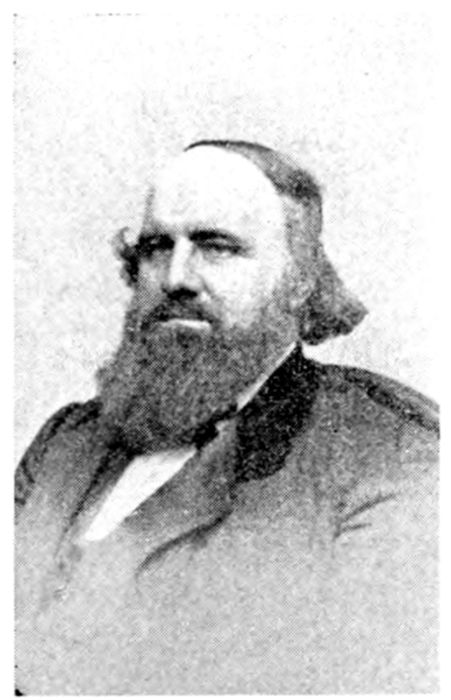
George W. Glick, ninth governor of Kansas, was born at Greencastle,
Fairfield county, Ohio, July 4, 1827. His great-grandfather, Philip Glick,
a Revolutionary soldier, was one of five brothers who came to Pennsylvania
from Germany. His grandfather, George Glick, served in the War of 1812, as
did also his mother’s father, Capt. George Sanders. Governor Glick’s father,
Isaac Glick, was a man of influence in the community in which he lived, took
an active interest in State and local politics, and held many positions of public
trust. His mother, Mary Sanders, was of Scotch parentage. Both parents
lived to a good old age.
George W. Glick was reared on his father’s farm near Fremont, Ohio,
and there acquired the habits of industry, economy and self-reliance that made
his later life so successful. At the age of twenty-one he entered the office of
Bucklin & Hayes as a law student, and was admitted to the bar two years
later at Cincinnati by the supreme court. He began practice at Fremont, and
soon won an enviable reputation as a hard-working and successful lawyer. He
fully sustained this reputation after coming to Kansas.
Locating at Atchison in the spring of 1859, he formed a partnership with
Hon. Alfred G. Otis, which lasted until 1874, when an affection of the throat
compelled him to abandon the practice of law. Mr. Glick soon took a leading
place at the Kansas bar. His practice extended to all the courts. He was a
salaried attorney for two railroads and a number of corporations.
Mr. Glick was a natural leader and began early in life to take an active
part in politics. When but thirty-one years of age he was nominated for
Congress by the Democracy of his district in Ohio, but declined the nomination.
The same year he was nominated for State senator and made the race
against Gen. R. P. Bucklin, his former law preceptor. He was elected to the
352Kansas legislature in 1862 without opposition, and reëlected in 1863, ’64,
’65, ’66, ’68, ’76 and ’82.
During his service as a legislator, he secured the passage of many needed
and important laws which have settled and fixed the policy of the State on matters
of vast interest, that have stood the test of time and experience. In 1876
Mr. Glick was made speaker pro tem. of the house of representatives, although
that body was strongly Republican. He was a delegate to Democratic National
conventions in 1856, 1868, 1884 and 1892. The Kansas delegation in
the Democratic National convention at Chicago in 1892 presented his name
to that convention as its candidate for vice-president, after the nomination of
Grover Cleveland for President, and, although not the nominee of the convention
for that office, he received many votes. He was nominated for governor
in 1868 and made the race in obedience to his party’s call, though his
defeat was inevitable. In 1882 he was again the unanimous choice of his
party for governor and made a memorable campaign, speaking in nearly
every county in the State; and, though fighting against great odds, among
them being a Republican majority of over 52,000, he defeated that distinguished
Republican and Prohibitionist, John P. St. John, by 8,079 votes.
Governor Glick was inaugurated January 8, 1883, and his administration was
marked by dignity, intelligence, and a careful and discreet management of
the material and financial interests of the State. His long experience as a
legislator gave him an intimate knowledge of its needs, and many valuable reform
measures recommended in his message to the legislature were accomplished.
He entered an earnest protest against the burdens imposed upon
the agricultural classes by the railroads and asked that legislation be enacted
to prevent these exactions. A law creating a railroad commission, and embodying
substantially all the improvements asked by him, was passed, and
proved of great benefit to the people of the State.
In 1885 he was appointed by President Cleveland pension agent at Topeka
and re-appointed when Mr. Cleveland again came into office. During Mr.
Glick’s two terms as pension agent at the Topeka agency, he received and disbursed
over $85,000.00.
In 1857 he married Elizabeth Ryder, of Massillon, Ohio, a lady descended
from a distinguished colonial ancestry. Her ancestors were among
the first settlers of Concord, Mass., and she derived her name from forbears
who were well known among the early colonists of New York City. For fifty
years and more this noble matron, having with her the best traditions of American
life, presided over the hospitable home of George W. Glick, with the grace
353and dignity inherited from a fine ancestry. She added to the success of his
public life the greater blessings of domestic happiness. Two children were
born to this union: Frederick H. Glick and Mrs. James W. Orr, of Atchison,
Kan. He died at Atchison, Kan., April 13, 1911, aged eighty-four years; his
wife and children survive him.
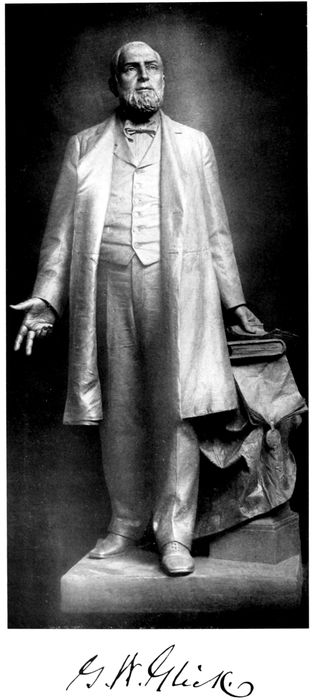
Each State is entitled to place in Statuary Hall at the capitol in Washington,
statues of two of its citizens renowned in literature, art, war or civil life,
and several years ago one of such places was filled by the State of Kansas with
a statue of John James Ingalls, of Atchison, Kan. The regular session of the
1913 legislature of Kansas adopted a concurrent resolution and made an appropriation
for the purchase of a suitable statue as a tribute to the memory of
George Washington Glick, to be placed in Statuary Hall, where the Nation
has granted to its people the privilege of placing it. The statue was designed
and executed by Charles H. Niehaus and accepted by Congress as a gift from
Kansas, with suitable ceremonies, and is now in Statuary Hall. A cut representing
it precedes this sketch. Sixteen thousand five hundred copies of a volume
containing the proceedings in Congress, and a plate of the statue, were,
by authority of Congress, printed and distributed.
He who leaves behind him, when he passes beyond the goal from which
no mortal man has ever returned, a pleasant and abiding memory of his
existence on this earth, and has bequeathed to his progeny and posterity a
heritage of right living and right thinking, has accomplished much. His
memory will be revered long after that of the individual who has done nothing
but accumulate wealth and has made no effort to leave this earthly abiding
place a better place to live than when he came upon it. Judge Horace Mortimer
Jackson, deceased, was a man who lived an upright life, and was accorded
the universal respect of his fellow men and was a legal practitioner of high
rank, whose honorable methods of practice and manner of living were such
as to commend him for most favorable mention in the archives of his adopted
county of Atchison.
Judge Horace M. Jackson was born near Albion, Penn., July 11, 1839, a
son of Lyman Jackson, who was the son of Michael Jackson, whose father
was also named Michael, and was a native of Ireland. Michael Jackson,
354the founder of the family in America, came from Ireland and settled near
Hartford, Conn. He went to the coast to trade and was not thereafter heard
from and was supposed to have been killed by Indians. He had three sons,
one of whom, Ebenezer, died in service as a soldier during the French and
Indian war. Another son went south, and the third was Michael Jackson,
the direct ancestor of Horace M. Jackson. Michael was born March 28, 1735
and on June 4, 1755, was married to Susanna Willcocks, who was born April
19, 1732. They settled in Windham county, Connecticut, later removing to
Pownal, near Bennington, Vt. Michael Jackson was a soldier in the colonial
army during the French and Indian war, and was a member of Company Ten,
First regiment. He was discharged December 12, 1759. He also enlisted
in the Seventh Company of the Third regiment of volunteers, Army of Independence,
May 5, 1775, and was discharged December 15, 1775. He later
volunteered for service in Col. Samuel Herrick’s regiment of “Alarm Men.”
Lyman, the son of Michael, also served in the Revolution on the American
side. He was born February 29, 1755, at Simsbury, Hartford county, Connecticut.
He enlisted eight different times in the American army. Lyman
married Deidama Dunham on January 3, 1782. This couple lived at Albany,
Otsego and Wyoming, N. Y., at different times. To them were born thirteen
children. About 1805, Lyman Jackson settled in Erie county, Pennsylvania,
and obtained a dense tract of timber land in the Holland Purchase from which
he cleared a farm. Seven sons and a son-in-law of this redoubtable patriot
fought in the War of 1812.
Lyman Jackson died March 20, 1835. David Bardsley Jackson, a son
of Lyman, born May 29, 1797, at Richfield, Otsego county, New York, married
Lucy Hendryx, on April 11, 1822, near Albion, Penn. He was the ninth
child of Lyman Jackson and cleared a farm of forty acres in the Holland
Purchase on which he resided until the year 1830. He then sold his land,
loaded his effects in a farm wagon, drove to Pittsburgh, and took passage
down the Ohio river and thence up the Mississippi to Warsaw, Ill., from
which landing place on December 15, 1839 he drove to Knoxville, Ill., and
bought a farm ten miles west of the village. He returned to Pennsylvania
in 1841, driving overland with his team 1,000 miles each way accompanied
by his wife and two youngest children. In the year 1846 he removed
to a residence in Knoxville and engaged in the grocery business. In 1854
he settled on a farm one-half mile west of Cambridge, Henry county, Illinois.
He lived here until 1876, then sold out and made his home at Gilson, for the
remainder of his days. This sturdy pioneer died January 18, 1879. His
children were: Mrs. Elizabeth Ruth Pierce, Zaremba, Obadiah H., Gershom,
355David, Francis Marion, Charles Wilmer De Loss, Horace Mortimer, and
Mrs. Annie Lucelia Wing.
Horace Mortimer Jackson was reared on the farm, attended the schools
of Knoxville, Ill., clerked in his father’s grocery store, sawed wood for forty
cents per cord, and did the hardest kind of farm work while yet a boy. During
1860–61, he taught school for $28 per month. On August 7, 1861, he started
for De Soto, Neb., by way of Hannibal and St. Joseph. On April 12, 1861, he
boarded a steamer at St. Joseph en route for Omaha. Arriving there he joined
his brother Zaremba on his farm in Nebraska. He worked here for some
time and assisted his brother in tilling the farm with oxen in the most primitive
way. He saved his money and in 1862 returned to Cambridge, Ill.,
taught school during the winter and read law at night. He followed farming,
served as deputy sheriff of the county and finally located at Versailles, Mo.,
in the practice of law. He was a member of the board of education which
gave the first public school to the town of Versailles. He married Lavanchia
Isabelle Valentine, December 12, 1865. She was the eldest daughter of
John O. Valentine. For a time the newly wedded couple were in very poor
circumstances.
Their furniture was of crude workmanship, made from store boxes. It
was here that the future judge made the friendship of Anderson W. Anthony,
a good lawyer whom he esteemed highly, who became his first law partner.
He made a journey to Wichita, Kan., in August, 1870, but located at Marysville,
Mo., in September of the same year. He became a partner of D. L.
Palmer, who later went to Jewell City, Kan. He then formed a partnership
with Judge Thomas J. Johnston, and served as prosecuting attorney of the
county. In December of 1878 he started for Beloit, Kan., with the intention
of locating in that city, but stopped at Atchison where he met W. S. Greenleaf
and Gen. W. W. Guthrie. He remained in their law offices during the
ensuing winter. General Guthrie at that time was a member of the State
senate. He formed a partnership with Mr. Greenlea on March 17, 1879,
which continued until Mr. Greenlea’s death in September, 1880. His wife
died March 26, 1883, and he later, on February 11, 1886, married Matilda
(Adams) Rook, who had one daughter by a former marriage, Effie, now the
wife of C. A. Chandler, of Atchison. Matilda Adams Rook was a daughter
of Peter and Martha Adams, of England, and sister of J. P. Adams, of Atchison.
Horace M. Jackson was appointed judge of the district court on March
1, 1887, and continued as judge until his successor was elected. He and his
son, William A., conducted the law business and served as the local attorneys
for the Santa Fe and the Burlington railroads until his death, which occurred
356December 11, 1910. Judge Jackson left two sons, William Anthony and
Zaremba Edward. He was a member of the Masonic fraternity, the Elks,
Modern Woodmen and the Ancient Order of United Workmen. He bequeathed
to his children and posterity a heritage of an honorable, upright life
without stain or blemish and will long be remembered as one of the honored
citizens of Atchison.
The measure of a living citizen is his genuine worth to his community.
If he unselfishly strives to make his home city a better place in which to live,
and does something by which he will long be remembered, as of lasting good,
he has accomplished a task well worth while. While every town and city can
boast of such individuals who are striving to do things in behalf of the public
welfare, there are not a great number who can act without any ulterior motive
and without desire to bring pecuniary reward to themselves. Of the class
of better citizens mentioned as doing things for the betterment of the condition
of the citizenry, Z. E. Jackson, attorney of Atchison, occupies a prominent
place in the city. Gifted as an attorney, upright in all of his dealings
with his fellow men, interested to a high degree in the welfare of his fellow
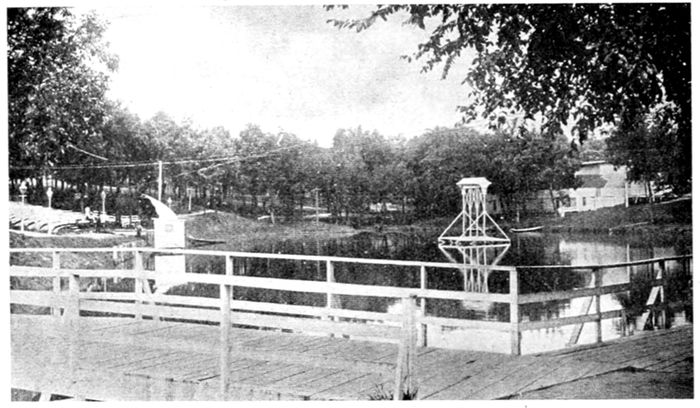
citizens, he has striven unselfishly to do good. Jackson Park, named after
this gentleman, represents the culmination of one of his dreams and years
of endeavor to create a breathing place of woodland beauty and a public
playground of which the city may well be proud.
Z. E. Jackson was born in Maryville, Mo., September 23, 1872, and
is a son of Judge Horace Mortimer Jackson, late of Atchison, and a review
of whom appears in this work. He came to Atchison with his parents when
six years of age. He received his primary education in the public schools of
Atchison and afterward studied for two years in Midland College. He then
matriculated in the University of Illinois, with the intention of preparing
himself to become an electrical engineer. After studying for two years in
the Illinois university, he abandoned his original intention and returning to
Atchison, entered his father’s law office in 1893. He studied stenography
without a regular instructor and prepared himself to take dictation, filling
the post of stenographer in his father’s office while reading law. He studied
law under his gifted father’s tutelage and was admitted to the bar in 1899,
being later admitted to practice in the higher State and federal courts. At
first he practiced alone and was then made a member of the law firm of
357Jackson & Jackson. This firm was at first composed of Judge Horace M.
Jackson, and his son, William A., and when William A., was elected
to the position of judge of the district court, it was composed
of Horace M. and his son, Z. E. Jackson. Mr. Jackson is local attorney
for the Home Building and Loan Association, and a director of the same concern.
He is the local attorney for the Santa Fe Railroad System and the
Burlington Railroad Company. He is also the legal adviser for several of
Atchison’s corporations. Mr. Jackson has the reputation of being one of
the ablest and cleanest practitioners of the Atchison county bar who has
followed in the footsteps of his illustrious father in never refusing counsel
or advice to a public official, religious denomination or to a charitable organization,
whether or not any fee was forthcoming—in fact, his office has always
been ready to give advice to applicants of the character of the foregoing
without charge or recompense of any kind. Mr. Jackson has never turned
away a client who had a meritorious cause, because of lack of funds, and in
this respect resembles his father in his manner of conducting his legal practice.
While Mr. Jackson is not a member of any particular religious denomination,
he has always been a liberal contributor to all movements which have had
for their intent the betterment of the community. He is owner of Atchison
real estate and farm lands in Jackson county, Kansas, to which he gives his
personal attention.
Mr. Jackson’s career as a public official began in 1901, when he was
elected police judge of the city and again elected in 1903, after which he
declined to again become a candidate for the office. His career as police
judge was marked by uniform fairness and impartiality, tempered with kindness
in dealing with the city’s minor malefactors who were brought before
him for judgment in his official capacity. From 1905 to 1909 he was assistant
city attorney, and in 1912 was elected to the office of city attorney to
fill the unexpired term of Daniel S. Hooper, deceased. He served out the
unexpired term and declined to become a candidate in 1913, because of the
growing demands of his large law practice. While serving as city attorney
many important problems came up before the city for solution, such as
the telephone merger, and the renewal of the city’s contract with the Atchison
Light and Power Company. His wise advice and counsel steered the city
government safely over the shoals, incidental to the settlement of these questions.
Mr. Jackson found the city finances in bad shape, as related to the
renewal of the lighting contract, a condition of affairs brought about by his
predecessor’s long illness preventing him from attending to business, and he
immediately set to work to unravel the tangle and brought order out of
358chaos to the advantage of the city. Another matter to which he gave considerable
attention while city attorney was the intercepting sewer problem
which he handled satisfactorily.
Mr. Jackson is a pronounced Republican in his political views, having
become a convert to Republican principles when he became of age, a decision
which he was influenced to make by the panic of 1893. He is affiliated with
the Knights of Pythias.
He was united in marriage with Miss Maud K. Smith, April 30, 1903.
Mrs. Jackson was born in Burlington, Iowa, a daughter of Lewis T. and
Theresa June (Chadwick) Smith, the former a native of Pennsylvania, and
the latter a native of Canada. Lewis T. Smith was born in 1846 in West
Lebanon, Pa., and is one of the old-time railroad men of the early days.
Mr. Jackson’s creed of living is best expressed in his own words, “I believe
that every man should do something for the community in which he lives,
besides getting a living out of it.” It was the practice of his creed which led
to the beautiful park in the southeast part of the city being named in his
honor, over his personal objections. The Atchison Globe says of his connection
with the building and equipping of the park in the issue of August 18,
1913, in part, after quoting Mr. Jackson’s creed, as above given:
“That explains the principal reason why he (Z. E. Jackson) has taken
such an interest in the park which now bears his name. Another reason is he
likes to dig in the ground, and investigate things as he finds them in the woods
and wild places. He is also handy at improving on Nature here and there
without spoiling the general effect.
“Seven or eight years ago, after spending many of his boyhood and young
manhood days in Jackson Park, he saw the possibilities of it for a beautiful
playground for young and old. He invited several of his South Atchison
neighbors to meet in his law office one night and a park improvement association
was formed. In order to start a fund for improvements in the park
each member present put up five dollars. Other citizens were invited to contribute
and thus a small fund was raised.
“That proved to be the redemption of City Park, a tract of fifty-six acres
of woodland which cost the city $7,500 about thirty years ago.
“With the few hundred dollars raised by private subscription it was shown
what might be accomplished if the necessary funds were forthcoming. From
the sale of a park bond, issued when the city was trying to put the coal mine
on its feet, the committee secured $500 which was used in replacing the dam
which makes the lake and other improvements.
359“If effective service is to be rewarded, then the city council made no
mistake when it acted on the petition presented to it, asking that the name of
City Park be changed to Jackson Park in honor of Z. E. Jackson, a young
man who decided that the making of a park was the debt he owed the community
where he makes his living.”
The action referred to in the foregoing was taken August 1, 1913, when
the official name of Jackson Park was given to the tract in honor of Mr. Jackson.
Besides his work of superintending the park and bringing about its redemption
with the assistance of other public spirited men, Mr. Jackson and
others secured a ten-acre tract of land lying between the original fifty-six
acres and the Missouri river, which has been added to and is now a part of
the park.
Thomas Frable, retired farmer, of Benton township, is one of the oldest
living pioneer citizens of Atchison county, both in age and number of years
of residence in the county. He was one of the old-time freighters who conducted
his own freighting outfit across the plains in the days of the Civil war,
and before the advent of the trans-continental railroads. Mr. Frable was
born in March, 1832, and has spent fifty-six of his four score and four years
of life in Atchison county and Kansas. He was born on a farm in Pennsylvania,
a son of Thomas Frable, who died when the subject was three years
of age, leaving his widow in such poor circumstances that she was unable to
rear her children in comfort. Thomas was given a home by a man named
Queen, who owned a large farm, and he lived with Queen until attaining his
majority. Queen owned a farm of 300 acres, and Thomas was started to
work when still a small boy, learning to guide a plow across the fields when
he was but eleven years of age. When he became of age and was free to do
as he liked, the germ of adventure and ambition seized him and he decided
to try his fortunes in the great West. In line with this resolve, he crossed
the country to Kansas in 1859, in company with another young fellow named
Reuben Ferguson, with whom he finally bought a tract of land which they
farmed in common for a time, and then made a division. Mr. Frable still
owns eighty acres of the original tract which he and Ferguson purchased.
Mr. Frable engaged in the freighting business and made considerable money
in the old days. He became the owner of two teams which he drove with
the great trains which were constantly leaving Atchison in the early sixties,
360en route to the far West, and transported blasting powder to Denver and
mining points in Colorado for the use of the gold and silver miners. He also
carried corn for the United States Government. During the Civil war Mr.
Frable was enrolled as a member of the Kansas State militia, and served at
the battle of Westport in the expedition against the rebel, General Price.
After the war he settled down to farming in Benton township, and has prospered
exceedingly, he and his son, Harry, now owning over 560 acres
of fine land. The Frable home is one of the most imposing and best built
farm residences in the county, and Harry Frable recently erected a large barn
in which the live stock of this extensive farm is housed. Mr. Frable and
Harry have been life-long Republicans.
Thomas Frable was married in 1862 to Rebecca Graham, a daughter of
Richard Graham, who came from Pennsylvania with his family to Atchison
county in the early days, and was one of the well known pioneers of this
county. Mrs. Frable was born October 5, 1835, and died in November, 1908.
Five children were born to Mr. and Mrs. Thomas Frable, namely: Clara, deceased;
Margaret, dying in infancy: two died in infancy; and Harry
was born January 22, 1865.
The reviewer, in attempting to write a comprehensive and truthful
biography of an individual, must take into consideration the related facts as
to birth and subsequent career, the success attained, the underlying principles
which have combined to assist him in achieving his desires and ambitions, and
to lay particular stress upon the special talent which has been developed in
the life of the subject under review. In reviewing the life career of James
W. Orr, a leading member of the Atchison county bar, the fact is determined
that he is truly an able and distinguished lawyer, whose reputation for success
at the bar, for having a profound knowledge of the law, and his ability
to successfully practice in the courts of the land, arrayed against the brightest
minds of the legal profession of the country, is recognized, not only by the
people of the State of Kansas and his profession generally, but by the United
States Government, in whose employ he now is as special assistant to the
attorney general of the United States.
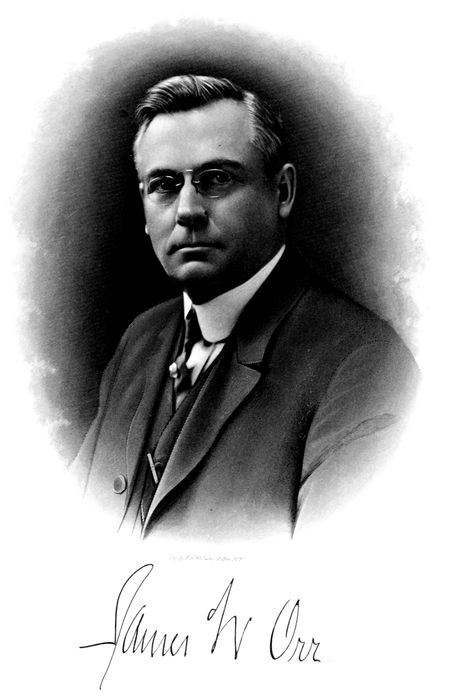
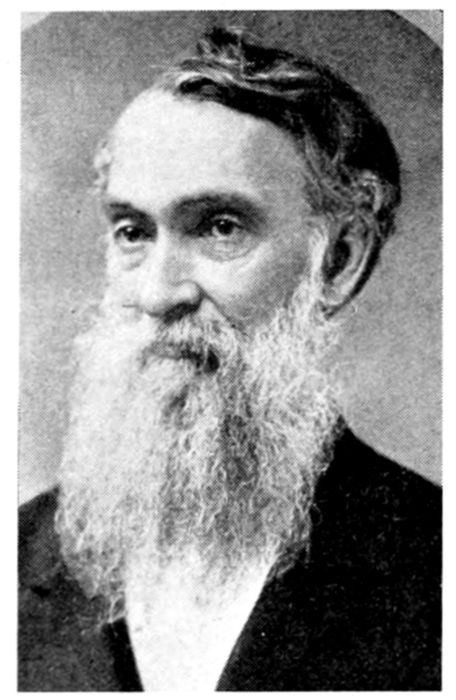
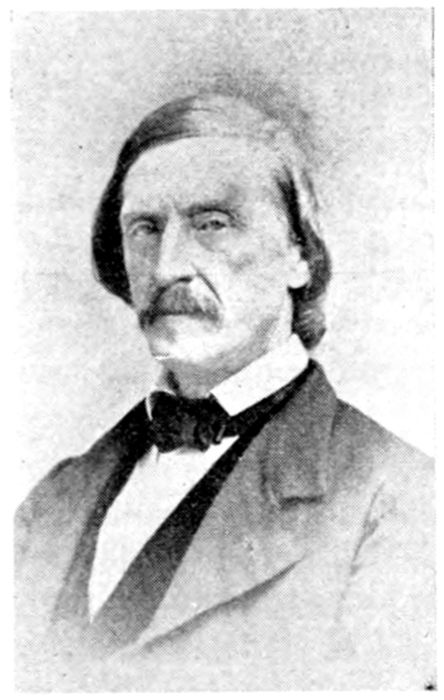
Eng. by E. G. Williams & Bro. N. Y.
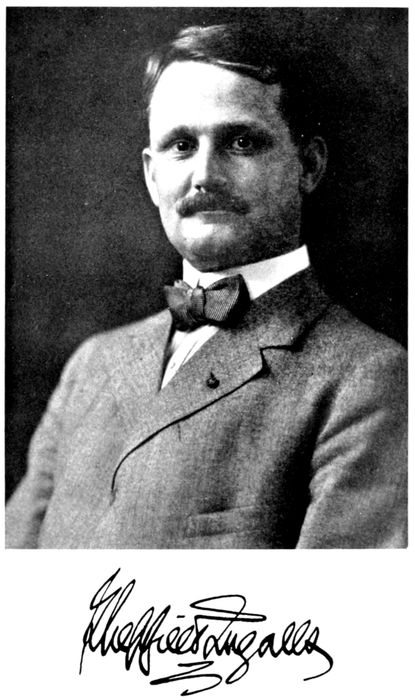
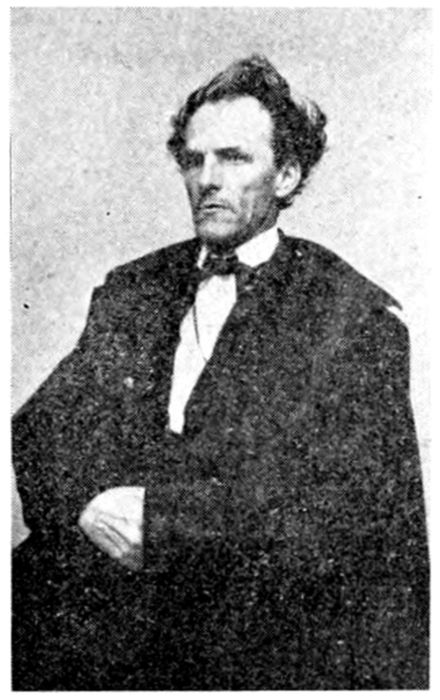
James W Orr.
361James W. Orr was born September 14, 1855, in the town of Reading,
Hillsdale county, Michigan. In his boyhood days, and during the struggle
to educate himself for the practice of his chosen profession, he knew what
adversity meant and has the satisfaction of knowing that his education was
obtained through his own unaided efforts. He is a son of James and Mary
Elizabeth (Underhill) Orr, both of whom were natives of New York City.
His father was of Scotch-Irish descent, his forebears emigrating from Scotland
to the north of Ireland in the days of old to escape religious persecution.
His paternal grandfather left Ireland in an early day and made his home in
New York. The Underhill family is of English origin and a very old one
in America, several generations of whom have been born and reared in this
country. His maternal grandfather was Daniel Underhill, a goldsmith in
New York City. James Orr, the father, was a merchant in New York till about
1848, when he left his native city and engaged in merchandising in Rome,
Syracuse and Utica, N. Y., (three stores), following which he engaged in
wholesale business in Toledo, Ohio. While a resident of Toledo he became
identified with some of the enterprises of that day and was a stockholder,
director and one of the builders of the Erie & Dunkirk railroad. In 1861
he removed to Coldwater, Mich., and conducted a merchandise business there
until 1868, when, in broken health, he settled in Niles, Mich., where he died.
When James W. Orr was fourteen years of age he began earning his own
living and educating himself. He and his brother, Louis C. Orr, the present
postmaster of Atchison, worked together for several years, sharing their work
with each other and pooling their earnings. The boys were fortunate in having
a wise and ambitious mother who was well educated and who taught
them at home, thus giving them the education they were financially unable
to obtain at school. At the age of seventeen years while employed in a drug
store he was reading law at nights and at odd times when his work was not
pressing. By persistent endeavor he managed to secure two years of study
at Michigan University, at Ann Arbor. He then took his examination for
admission to the bar in open court, and was admitted to practice when but
twenty years of age. His first employment in his new profession was with
the McCormick Harvester Company, settling claims, etc., in behalf of that
company. He remained in this position until 1880, and in January, 1881,
came to Atchison where he has since continuously resided. It was necessary
for him to begin the upward climb of the ladder to fame and success without
assistance from any individual or friend. How well Mr. Orr has succeeded
during the past thirty-four years is attested by his present high position in the
ranks of the legal profession and the competence he has accumulated. He
was first employed in Atchison by the New England Loan & Trust Company
as attorney to examine abstracts of titles, etc., at a salary of forty
362dollars per month. It was not long until he was receiving a salary of $150
per month and a share of the profits in the employ of the same concern.
When the concern moved to Kansas City and became known as the Equitable
Loan & Trust Company, Mr. Orr remained in Atchison. In 1883 he was
married to Miss Jennie Glick, the only daughter of Governor George W.
Glick, of Atchison. He took up the practice of law, purchasing the interest
of Judge W. D. Webb in the firm of Webb & Martin, and entered into partnership
with A. F. Martin, which partnership existed from 1882 until April,
1887. During the five years he had been in Atchison he had been extending
his acquaintance over the county, and in November, 1866, was a successful
candidate for county attorney on the Democratic ticket, being elected over
W. D. Gilbert by a substantial majority, despite the fact that the county
was then normally Republican by over 800 majority. In April, 1887, he
formed a law partnership with B. P. Waggener and Judge David Martin, the
firm having previously been known as Everest & Waggener. Judge Martin
resigning the position of judge of the Atchison district court to join the firm,
which was known as Waggener, Martin & Orr. In the year 1895 Judge Martin
retired from the firm, and Judge A. H. Horton, then chief justice of the
supreme court of Kansas, resigned his office of chief justice, a position he had
held continuously for nineteen years, to become a member of the firm. Judge
Dawn Martin was appointed to the vacancy so made on the supreme bench.
Judge Horton remained a member of the firm until his death, when ex-Chief
Justice Frank Doster became a member of the firm known as Waggener,
Doster & Orr. During Mr. Orr’s association with B. P. Waggener in the
practice of law they had charge of the legal business for the Gould system of
railroads in Kansas and Nebraska; the Western Union Telegraph Company;
express companies, and the Pullman Palace Car Company. They were
associated in partnership with three ex-chief justices of the supreme court of
Kansas during this period. In June, 1910, Mr. Orr resigned his position
as attorney for the Missouri Pacific Railway Company, and his connection
with B. P. Waggener, which had then continued for twenty-three years, was
also terminated. The position of special assistant to the attorney-general
of the United States was proffered him by Attorney-General McReynolds in
October, 1913, while Mr. Orr was engaged in the trial of a case in St. Louis.
He accepted and was given charge of the suit of the Government against the
Southern Pacific Company and others, including the Central Pacific Railway,
to dissolve the relations between those companies. Mr. Orr conducts his cases
for the Government in addition to his private practice. His rise has been
steady and consistent during the years he has been practicing his profession
in Atchison, and it is true that the youth who began his career in the city of
Atchison for the modest salary of forty dollars per month now enjoys a lucrative
private law practice, in addition to his income from the Government and
not supplemented by corporation salaries. Mr. Orr has accumulated a comfortable
fortune during the years of his practice and has what is considered
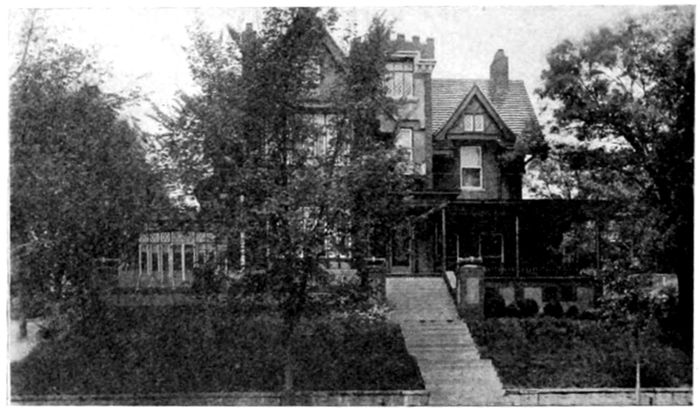
the most beautiful home in Atchison. In his home he has his private library
of several hundred volumes, including the standard works of literature. His
law library lines the walls of his down-town offices and exceeds 2,000 volumes
in number.
363Mr. and Mrs. Orr had but one child, a son, George Glick Orr, who was
drowned while bathing in the Pacific ocean, near San Diego, Cal., on July
21, 1909, at the age of twenty-five years. The loss of this talented young
man saddened the lives of his parents for years. At the age when most
young men are just beginning to gain a higher education, George Glick Orr
could read, write and speak six different languages. For seventeen years of
his life he was a student, graduated at the University of Kansas, and had
been admitted to the bar, showing great promise in his chosen profession and
being frequently entrusted with important legal matters.
Mr. Orr has received all the Masonic degrees except the thirty-third,
and is a member of several fraternal societies. He attends and contributes to
the support of the Christian Science Church, of which Mrs. Orr is a member.
In politics and as a public official and law-maker, Mr. Orr has a record
of which any man may well be proud. He became a member of the Kansas
Democratic State central committee in 1884 and remained such continuously
364until 1908, and in point of service was its oldest member. He has attended,
as a delegate, six National Democratic conventions, and on three occasions
was a member of the notification committee appointed to officially notify the
presidential candidate of his nomination by the convention, including Cleveland
in 1892; Parker in 1904, and Woodrow Wilson in 1912. His exceptional
career in politics began as early as 1880, when he served as assistant
secretary of the committee chosen to notify General Hancock at Governor’s
Island, N. Y., of his nomination for the Presidency. Mr. Orr was an original
Wilson man and one of the committee of five having the floor management
of the Wilson forces at the Baltimore convention in 1912 which nominated
Mr. Wilson for the Presidency. From 1901 to 1907 Mr. Orr served three
terms successively as mayor of the city of Atchison and gave the city one of
the best administrations in its history. He served two terms in the State
legislature as representative from the Atchison city district, the sessions of
1911 and 1913. During the 1911 session he was one of the three legislators
selected by the house to draft and did prepare the present public utilities law,
under which all railroads and public utilities in this State are now managed
and controlled; he was the author of the present comprehensive drainage
laws; the law requiring the attorney-general to pay into the State treasury all
fees received by him in the prosecution of State cases; the so-called “Orr
viaduct law,” which requires railroads to construct and maintain at their expense
all necessary viaducts over or tunnels under their tracks in cities, and
under which the Fourteenth street viaduct in this city and viaducts in many
other cities have been built and then maintained by the railroads, also many
other laws of public interest and importance. In the session of 1913 he was
chairman of the judiciary committee and was elected majority leader of the
house. At the close of the legislative session of 1913 Mr. Orr was presented
with a resolution, unanimously adopted by the members of the house, beautifully
engraved in India ink, artistically framed and containing a reproduction
of the great seal of Kansas. This resolution thanks Mr. Orr for the assistance
he had given individual members of the house and for his service to the State,
both as chairman of the judiciary committee and as majority house leader,
and is signed by every member. It follows:
“HOUSE RESOLUTION, NO. 51—BY MR. RIDDLE.
“Resolved. That the members of the house extend to the Hon. James
W. Orr their sincere thanks for the splendid service he has given to them and
to the State during the present session. In addition to his work as floor leader
365of the majority party, and his work as chairman of the judiciary committee,
he has been tireless, patient, and industrious in giving to individual members
the benefit of his learning and ability by helping them in their work. His help
has been extended alike to members of all political parties, and has been
especially beneficial to members who have had little experience in legislative
work. He has the confidence, esteem and love of all the members.
“Done in the city of Topeka, this eighth day of March, 1913.”
When the late A. B. Symns passed beyond mortal ken on April 9, 1905,
Atchison suffered a loss from its business circles which could never be replaced.
He left behind him a monument in the A. B. Symns Grocer Company,
one of the largest of the wholesale establishments of the city and State, which
was the product of his brain and ability. He was one of the noted pioneer
figures of a decade which produced great and strong men. From a modest
beginning he rose to become a national character in the business world of the
great West and realized his ambition during a long and useful life. He not
only succeeded in accumulating a comfortable fortune but left a reputation
for integrity and upright citizenship which has never been surpassed by any
of his compeers of the building age in Atchison and Kansas. From boyhood
to the time he had passed the age of three score years and ten, Mr. Symns
was an indefatigable worker and never relaxed except for much needed
recreation and rest, occasionally. Early in his career he had great faith in
the future of Atchison and that faith was fully justified by his own success
in the jobbing field.
A. B. Symns was born in Monroe county. West Virginia, March 27, 1831,
and was a son of John and Elizabeth (Peters) Symns, natives of old Virginia,
of Scotch-Irish descent.
As a boy he worked on his father’s farm, attending school three months
each winter. At the age of eighteen he clerked in a store at Petertown and
later on attended Lewisburg Seminary one year. He also worked at White
Sulphur Springs before coming west in 1853. He listened to the call of the
great unpeopled western country for young and ambitious men to develop
her dormant resources, and in 1853 crossed the country to St. Joseph. Mo.,
where he clerked in a store for two years and then went to St. Louis. After
clerking in St. Louis for one year he became an eighth owner of the steamboat
366“Hesperian” and served as clerk aboard the steamer. This boat made
its first trip on the Missouri trade in 1856 and it was while passing up and
down the Missouri river that he was attracted to the then flourishing town of
Doniphan. It far overshadowed Atchison at that time and he determined
to locate in Doniphan. During the time he was connected with the steamboat
service he had many interesting experiences. He opened a grocery store in
1858, but during the same year the land office was removed to Atchison and
Doniphan lost ground, but the Symns store grew in size and importance and
was the nucleus around which his great business was subsequently builded.
He removed the store to Atchison in 1872, and began wholesaling in a small
way in connection with his retail business. In 1877 he was doing business in
the corner store room at Sixth and Commercial streets, on the southeast corner.
While located in this building he closed out his retail business and engaged in
jobbing exclusively. With the impetus given by his splendid business mind
and his remarkable energy the business grew rapidly, and he soon found
himself at the head of one of the largest wholesale grocery houses in the
western country. Thirty men are employed as traveling salesmen by the
Symns Grocer Company alone, and the Symns Utah Grocer Company, which
he established, has its own force. Customers of Mr. Symns over Kansas,
Nebraska, Oklahoma, Missouri, Texas, Colorado and Utah have always agreed
that A. B. Symns was the fairest man with whom they ever did business. He
had faith in Atchison as a great jobbing center, and the success of his business
fully justified that belief. The immense jobbing house of the Symns Grocer
Company on Main street of Atchison was built from plans prepared by Mr.
Symns himself and is one of the most complete establishments of the kind to
be found anywhere. So extensive did the business become, however, that it
was necessary to erect an addition in 1903. The capitalization of the Symns
Grocer Company at the time of the demise of Mr. Symns was $300,000 and
that of the Utah concern at Salt Lake City was $80,000. Mr. Symns was
president of both companies and had a controlling interest in each. He left
an estate valued at over $300,000.
One of the interesting episodes of Mr. Symns’ mercantile career was the
looting of his Doniphan store by Cleveland’s band of outlaws, who made
Atchison their headquarters in the winter of 1861–62. At the time Mr.
Symns was absent in St. Joseph, but his brothers, Sam and William Symns,
were in charge when it was surrounded one evening by Cleveland and his
gang. They forced William Symns to open the safe and took what money
there was on hand in addition to clothing, saddles, etc. While the robbery was
367in progress, Mrs. Symns ran out to arouse the neighbors, but no help was
forthcoming because of the fact that everybody was afraid of Cleveland and
his gang, and the thieves got away with their booty unmolested.
A. B. Symns was married in 1858, returning to Old Virginia for his
bride, Miss Elizabeth Tiffany, who was his boyhood sweetheart. Mrs. Symns
was a member of an excellent Virginia family and bore him the following
children: Mrs. A. S. Rowan, who died December 31, 1903; Miss Effie
Symns, of Atchison; Charles, Atchison, and Guy. The mother of these children
departed this life September 12, 1900, at the age of sixty-four years, having
been born in 1836. Six children were born and died in infancy at Doniphan:
John, Joseph, Lee, Hugh, Edna and Louis. Mr. Symns died April
9, 1905, at Hot Springs, Ark. He was sincerely mourned and Atchison business
circles suffered a loss which could hardly be estimated.
While Mr. and Mrs. Symns were on their wedding trip on the steamer
“Carrier” en route up the Missouri river from St. Louis to Doniphan, the
boat sank near Hermann, Mo. They easily escaped drowning because the
“Carrier” sank slowly, but they lost their newly purchased household goods
and a large amount of supplies with which Mr. Symns intended to stock the
Doniphan store. Mrs. Symns continued to Doniphan on another boat, while
Mr. Symns returned to St. Louis to lay in another stock of household goods
and provisions for his store.
The Symns family came of old Scotch Presbyterian stock. Although a
southerner by birth, he was a Union man in Kansas. He was an independent
Democrat in politics.
Mr. Symns was in active pursuits even after attaining the age of three
score years and ten, and was always found early at his desk. He was not
only the active head of the business but closely watched the details. He was
always hurrying and was ever busy, and it was his custom to walk daily to
the postoffice for his mail so as to have the benefit of the exercise. Having
always been a man of correct habits he belied his years and his demise came
unexpectedly at Hot Springs. He was accidentally killed by a locomotive on
a railroad crossing at Hot Springs, where it had been his custom to go for
his health during the latter ten years of his life. He was fond of his family
and dearly loved his home life. He was quiet, unassuming, and was one of
the kindest and gentlest of men, probably no man being more universally
admired and beloved in Atchison during his day. His life story furnishes a
decided inspiration for any one who may read of his success in Atchison.
368
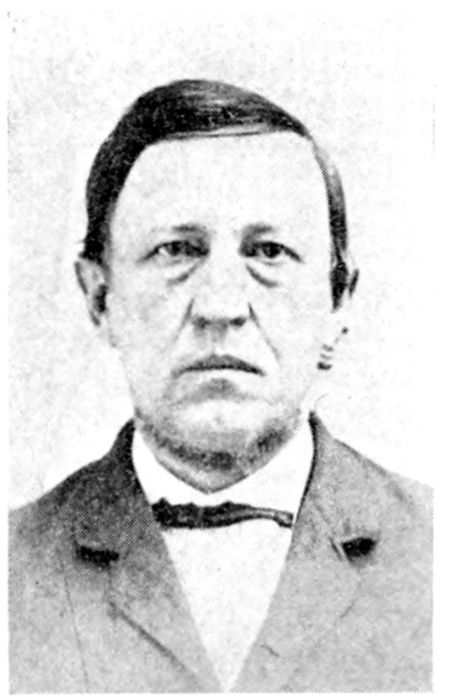
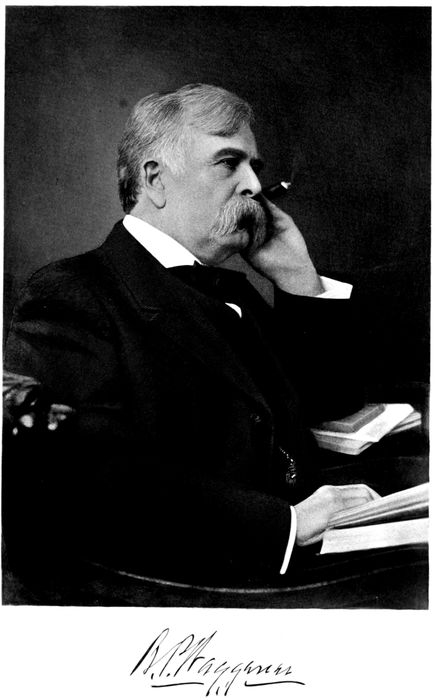
It is not difficult to classify Balie P. Waggener so as to determine his
position in the civic body of Atchison, but it is not easy to write a review comprehensive
enough to give a proper estimate of this distinguished citizen who
has been honored in his home city and in the State of Kansas. When one
thinks of Atchison it is only natural to refer to the city as the home of Balie
Waggener, who is indisputably grouped among the prominent and widely
known figures who have shed fame and luster upon their home city. A leading
attorney, statesman, progressive citizen, builder, farmer and stockman,
friend of all children, capitalist, and public benefactor are some of the terms
which might be applied to him without fear of contradiction from the mass
of the people who know him best.
He was born in Platte county, Missouri, July 18, 1847, a son of Peyton
R. and Sophronia Briseis (Willis) Waggener, who were American born and
descended from old American families. The great-grandfather of Mr. Waggener
served in the Continental army as a lieutenant-colonel during the American
war of independence, and his grandfather was a major in the United
States army during the War of 1812. Balie Waggener attended the public
schools until he attained the age of fourteen years and then obtained a situation
as toll-gate keeper on the old Platte City & Western turnpike. He was
ambitious to become a lawyer and during the interims of his duties in attending
the toll-gate, and after his day’s work was done, he read his law books.
The next step in his preparation to become a member of the legal profession
was to enter the law office of Otis & Glick, in Atchison. This was in 1866,
and so assiduously did the young man apply himself to his studies that he was
admitted to the bar June 10, 1867. Three years later he formed a partnership
with Albert H. Norton, then United States district attorney, under the firm
name of Horton & Waggener, which lasted until the election of Judge Horton
to the office of chief justice of the Kansas supreme court in 1876. In 1887
Mr. Waggener formed a partnership under the firm name of Waggener, Martin
& Orr, which continued until April 30, 1895, when the firm was dissolved
and the firm became Waggener, Horton & Orr, Chief Justice Horton having
resigned his position and again entered the firm. David Martin, Mr. Waggener’s
former partner, became chief justice of the supreme court of Kansas
to succeed Chief Justice Horton. In 1902 Judge Horton died, and later his
place in the firm was taken by Ex-Chief Justice Frank Doster, under the firm
name of Waggener, Doster & Orr. It will thus be seen that Mr. Waggener
has been associated in the practice of law with three chief justices of the
supreme court of Kansas. In 1913 Mr. Orr withdrew from the firm to become
special assistant to the attorney-general of the United States, and the firm is
now known as Waggener, Challiss & Crane, being composed of W. P. Waggener,
James Challiss and Albert Crane. Mr. Waggener now devotes his
time and legal talents almost exclusively to his duties as general solicitor for
the Missouri Pacific railway.
369The ability of a lawyer having the calibre of Mr. Waggener was bound
to attract attention, and on January 4, 1876, he was appointed general attorney
of the Missouri Pacific railway for the State of Kansas, and on May 1,
1910, he was made general solicitor for that company for the States of Kansas,
Nebraska, and Colorado, his son, W. P. Waggener, succeeding him as
general attorney for Kansas. During the forty-four years Mr. Waggener has
been engaged in the practice of law he has won an enviable position at the
bar through his own personal efforts. He has never ceased to be a student
of all subjects pertaining to that most jealous of professions, and it is worthy
of note that he is the possessor of one of the most complete law libraries in
the United States, containing upward of 10,000 volumes on every conceivable
legal subject. He keeps his library at his residence, which is one of the handsomest
and best appointed in the city of Atchison, and he prepares most of his
cases in the study of his home where privacy is possible.
Naturally, a man of Mr. Waggener’s vigor and broad-mindedness would
engage in enterprises outside of the practice of his profession, and he has done
so in such a manner as to profit himself and the community. In 1892 he was
elected president of the Exchange National Bank of Atchison, which position
he has since held. He perfected and put into operation the Atchison Railway,
Light and Power Company in the city, and is the owner of the famous “Green
View Stock Farm,” comprising 500 acres, beautifully located a short distance
west of Atchison, and which is one of the best equipped and most modern
farms in Kansas. Through experimentation and adapting modern methods
of agriculture to the cultivation of his land and the breeding of fine live
stock, Mr. Waggener has become a recognized authority on agriculture and
animal husbandry. The annual sales of fine live stock which are produced
on his farm have become an annual event in this section of Kansas and
the West, and are largely attended by buyers from all parts of the country.
In addition to his professional and business interests, Mr. Waggener has
manifested a public spirit in matters pertaining to the political conditions of
his city and State. Firmly grounded in Democratic principles, he has become
one of the foremost leaders of his party and occupies a high place in its councils.
In 1869 he was elected to the Atchison city council when he had barely
370attained his majority. In the year 1872 he was the nominee of his party
for the office of attorney-general of the State of Kansas, and in 1873 was
made city attorney. From 1889 to 1891 and again in 1895–97 he was mayor
of the city. In 1902 he was elected a member of the lower branch of the
State legislature, which had a large Republican majority, and during the term
held the important position of chairman of the judiciary committee. It is
generally conceded that he influenced much of the legislation at that session,
and his record so commended him to his constituents that in 1904 he was
elected to the State senate from a strong Republican district, carrying the
district by a majority of 1,500 votes, although at the same election Theodore
Roosevelt, the Republican candidate for President, carried the same district
by over 3,600, an indisputable testimonial to Mr. Waggener’s personal popularity
and his ability. Mr. Waggener served in the senate of the Kansas
State legislature in the sessions of 1905 and 1907, and was reëlected by a handsome
majority of over 2,000 in November of 1912. He is now holding the
position of State senator from this district.
Mr. Waggener is a member of many secret orders, and is prominent in
Masonic circles, being a Knights Templar and a Thirty-second degree member
of the Scottish Rite, and a member of the Mystic Shrine.
On May 27, 1869, Mr. Waggener married Miss Emma L., daughter
of William W. Hetherington, one of Atchison’s prominent citizens, now deceased,
a review of whose life and career is given elsewhere in this volume.
Two children were born to this union: William Peyton Waggener, a “chip
off the old block,” and present general attorney of the Missouri Pacific railway
for the State of Kansas, and president of the Exchange State Bank of
Atchison; Mabel L., wife of R. K. Smith, vice-president and general manager
of the Mississippi Central railway.
Perhaps the trait of character that most endears Mr. Waggener to the
people of Atchison county is that liberality which led him in 1897 to inaugurate
the system of giving an annual picnic to the children. Every year, at
his own personal expense, he furnishes free transportation, free entertainment,
and free refreshments to all the children of Atchison county who can attend
his picnic, and the larger the crowd the greater is his delight. These picnics
are not given for the purpose of increasing his popularity or for any self-aggrandizement
whatever, but solely that he may steal at least one day from
his business cares and derive a wholesome recreation in contributing to the
amusement of the young people. This innovation has occasioned at various
times favorable and commendatory comment in the press of the State, and a
record of these picnics has been placed in the annals of the Kansas State Historical
371Society. The report of the secretary of the historical society for the
year 1911 has considerable to say concerning the visit of President Taft to
Kansas in that year and his attendance upon Balie Peyton Waggener’s picnic
to the children of the neighborhood. The President left Topeka on September
27, about one hour after laying the cornerstone of the Memorial Hall building
and reached Atchison in time for Mr. Waggener’s twelfth annual picnic.
The President spoke words of high praise of Mr. Waggener and presented
him with a silver loving cup in behalf of the people of Atchison county. Mr.
Taft’s words in making the presentation were: “A token is this, Mr. Waggener,
that carries real sincerity of friendship. I present this beautiful vase
of silver in the name of the people here assembled as a sign of love and esteem.
I congratulate you on the eminence you have attained.” Mr. Waggener responded:
“This is a distinction unmerited. I have no words to express my
grateful acknowledgment.” Balie Waggener’s picnic has become a feature
of Kansas history of a most pleasant nature. He is a life member of the State
Historical Society, and has always been an ardent and most liberal friend of
the society.
When Mr. Waggener was forced by illness to go to Rochester, Minn.,
for the purpose of having a surgical operation performed, his safe return to
his home was made the occasion of a time of great rejoicing by the children
of the city, and a reception was given him, such as has never been given an
Atchison citizen before nor since, and which occasioned State-wide comment
on the part of the press as a fitting testimonial of the great love and esteem
in which he was held by the children and people of his home city. During
the time he was at Rochester undergoing a surgical operation and his subsequent
recovery, the children of the city had been praying for his restoration
to health and his safe return to their midst. It was their great friend who
was ill, and, when the word came that he would arrive home on a certain
evening the children prepared to receive him in an appropriate manner. All
the children of Atchison turned out to give him welcome, and hundreds
formed in line, through which Mr. Waggener passed on his way to his home.
He and his automobile were pelted with flowers and tears filled his
eyes, and he was unable to express his heart-felt appreciation of the reception
which his people had given him. It has been described as the most beautiful
and touching thing that has ever happened in the life of Mr. Waggener. To
quote briefly from the Kansas City Journal, which described the incident:
“Few men in this world were so fortunate as to enjoy such an ovation. Men
who have done important things have been received by town bands and by
citizens covered with fluttering badges. Men have come back to their home
372people to be received in the opera house, and cheers have echoed in their receptive
ears. But it must be understood that no such home-coming as Mr.
Waggener’s could come to an ordinary man. It was the tribute of sincere
devotion and genuine friendship. It couldn’t be bought with money or earned
by material success. These Atchison children didn’t care a rap for Waggener,
the railroad attorney, nor Waggener, the politician, nor even for Waggener,
the exemplary citizen. It was Mr. Waggener, the good, kind friend they
loved, to whom the welcome was given, and it sprung from sheer joy that he
had recovered his health and was with them once more. And who can say
that the earth holds a more splendid triumph as the crowning glory of a life
than this? All other laudations and exclamations are tame compared with
the flushed enthusiasm of hundreds of happy children shouting from their
hearts:
“‘Waggener, Waggener sis boom ah!
Our friend, our friend, rah! rah! rah!’”
Personal achievement on the part of the individual who accomplishes
things worth while for himself and in behalf of his fellow men, is always
worth recording. The inherent qualities possessed by an able man will develop
and become pronounced in decided results if he be given the proper opportunity.
Albert E. Mayhew, legislative representative from the Atchison
county district, and a successful merchant, belongs to that type of men who
by force of intellect and sheer ability to do things have placed themselves in
the forefront of affairs and taken their proper places as leaders in their respective
communities. Forty-five years of his life have been spent in Kansas,
and he can properly be classed as one of the pioneers of the State. Mr. Mayhew
established himself in business in Effingham January 1, 1899, and his
success since his advent into Atchison county has been marked and rapid.
He began at first with a capital of $3,000 invested in a hardware and implement
business. With characteristic energy and enterprise he developed his
business to the extent that his extensive stock of goods now requires a capital
of $10,000. In 1912 he purchased a lot at the corner of the two principal
streets of Effingham and erected a handsome two-story brick building
and a warehouse at the same time. This building measures 84×60 feet, including
the warehouse and two splendid show rooms, filled with high class goods.
373The stock of goods in the Mayhew establishment embraces hardware, farming
implements and wagons, paints, furniture, and he also conducts an undertaking
establishment. Three men are employed to attend to the extensive
trade of this store, which is the most important institution of its kind in this
section of the county.
Albert E. Mayhew was born March 17, 1866, at St. Mary’s, Ontario,
Canada, a son of William, born in 1833, died in March, 1906, and Mary (Lancaster),
born in 1833, died December 25, 1878, Mayhew, both of whom were
born in England and immigrated to Canada when in their youth. William
Mayhew ran away from home and made his way to Canada where he became
a farmer and married. William Mayhew and his wife resided in Canada until
May, 1870, when they immigrated to Kansas, settling in Nemaha county.
They purchased a farm near the town of Centralia, developed it and Mr. Mayhew
made a success of farming and stock raising. He began with a large
tract of land at first, but soon ascertained that it were better to have a smaller
farm, and accordingly reduced his acreage to 160 acres, upon which he prospered.
Mrs. Mayhew, the mother of Albert E., died on the home place in
Nemaha county. William, as old age crept upon him, removed to San Diego,
Cal., where his demise occurred. He is buried in the cemetery of the California
city. Five sons and a daughter were born to William Mayhew and
wife, namely: John, a merchant, of Denver, Colo.; Robert, a retired farmer
and merchant, living in Topeka. Kan.; George, a merchant, of Denver, Colo.;
Eliza, wife of A. B. Clippinger, Kansas City, Mo.; Albert E., the subject of
this review, and Leonard, of Los Angeles, Cal.
Albert E. was reared to young manhood on the home farm in Nemaha
county, and received his education in the public schools of Centralia, Kan., and
the Seneca, Kan., high school, completing his education in the normal school
at Emporia, Kan. He taught school for a number of years in his home
county, saved his earnings and in 1887 embarked in the hardware and implement
business at Vermilion, Kan. He conducted this business with fair success
until 1897, and then sold out, coming to Effingham soon afterward and
engaging in the same line of business in this city. In addition to his extensive
business Mr. Mayhew is the owner of two excellent farms in Marshall
county, Kansas, aggregating 640 acres in all, which has his attention. He
has a beautiful, modern residence in the south part of Effingham.
Mr. Mayhew was married in September, 1887, to Anna J. Tinker, of
Vermilion, Kan., born in Humboldt county, Kansas, a daughter of Avery
and Ellen Tinker, natives of New York State, born at Hastings Center, that
State. Two children have blessed this union of Albert E. and Anna Mayhew:
374Avery, born in 1889, and died June 2, 1901; Carl H., born January,
1891 and associated with his father in business. Carl H. married Miss Vera
Snyder, and has one daughter, Lucille, aged two years.
Mr. Mayhew is a stanch Republican in his political affiliations and has
taken an active and influential part in the affairs of his party since coming
to Atchison county. In November, 1914, he was the candidate of his party
for the high office of State representative from this district and was elected,
subsequently serving in the 1915 session of the Kansas legislature with such
marked ability as a legislator that his course and activities conferred distinction
upon himself and his constituents. During this session he was a member
of the committees on insurance, education, legislative appointments, mines
and mining, and judicial apportionments. Having always taken a keen interest
in educational affairs, his position as a member of the committee on
education gave him an opportunity to support and advocate legislation which
would enhance the cause of education throughout the State. He succeeded
in having passed through the house an act requiring the school moneys of the
State to be loaned to farmers. There was plenty of precedence behind an
act of this character, and the fairness of its provisions is very evident, although
it was opposed by the banking interests of the State. The act, however,
failed to take its regular course through the senate, because of the adjournment
of the legislative body. It is probable that the act will be finally
passed at the next session and it is morally certain to have strong support, if
Mr. Mayhew is again representative from Atchison county. He also introduced
and successfully fathered an act, allowing districts to levy higher taxes
to provide more amply for bridge building and road improvements, two provisions,
which were of direct benefit to the farming interests of the State,
inasmuch as the movement for better highways is fast gaining ground in
Kansas. Mr. Mayhew also assisted in the passing of better automobile laws,
and took an active part in all the deliberations of the legislative body, specializing,
however, in legislation which had for its ultimate object the betterment
of the school system of the State. He is a member and trustee of the Presbyterian
church, of Effingham, and is fraternally associated with the Odd
Fellows and the Modern Woodmen. It is probable that no citizen is more
widely or more favorably known throughout Atchison county than A. E.
Mayhew, and his course as a successful merchant and public official has been
such as to favorably commend him to the masses of the people, who are always
found appreciative of honesty and square dealing on the part of men
375in public life, whom they honor with their political preference. He is well
worthy of the confidence and trust which have been bestowed upon him by
the people.
Joseph Coupe, late of Benton township, was born December 6, 1852, in
Utica, N. Y., and was a son of James and Jane (Latus) Coupe, both of whom
were born in England. James emigrated from his native land when a young
man and located in New York, where he married and reared a family, cultivating
a farm located one mile from the limits of Utica. He died on his
farm. Joseph was reared on the family farm and attended the Utica public
schools, receiving an excellent education, after which he took up the study
of law and was admitted to practice in his home city. He practiced his profession
in Utica until 1881 and then came west and located at Falls City, Neb.,
where he continued his practice with considerable success until 1906, when
he removed with his family to his farm, west of Effingham. Failing health
induced him to make the change, and it was thought by his physicians that
the open air life would be beneficial to him. He died February 10, 1908.
Judge Coupe was married in 1890 to Miss Anna Mooney, and to this
union were born six children: Margaret, a graduate of the county high school,
and a teacher in the Effingham public schools; James, who is managing the
home farm with his mother; Richard, a graduate of the county high school;
Anna, likewise a high school graduate; Mary, a junior in the high school; and
Joseph, a pupil in the Sisters’ school at Effingham. The mother of these
children was born in Atchison, Kan., confirmed and baptized in St. Benedict’s
church, and was a daughter of James, born in 1833, and Julia (Ryan)
Mooney, born in 1837, both of whom were natives of Ireland. James Mooney
emigrated from Ireland when a youth, was first a resident of Buffalo, N. Y.,
and in 1857 moved to Nebraska, and was later employed at the nursery in
Atchison, Kan. From Atchison he removed to Rulo, Neb., where he still
lives. He was married in 1860, and the family lived in Atchison during the
Civil war. James and Julia Mooney were the parents of five children,
namely: Thomas, deceased in March, 1908; John and James, farmers: Margaret,
at home in Rulo with her parents; Mrs. Joseph Coupe.
Previous to locating in Kansas, Mr. Coupe had resided on a farm near
Falls City, but was induced to remove to Effingham and here purchased a
farm of 194 acres west of the city in Benton township, this farm consisting
376of 160 acres of excellent tillable land and thirty-four acres of pasture. He
was prominently identified with civic and political affairs in Falls City and
Richardson county, Nebraska, and had built up a large and lucrative law practice.
He was a Democrat in politics and was one of the leaders of his party
in Nebraska, serving four years as county judge and was successful in re-election
to a third term, but resigned on account of poor health. He was
popular with the masses of the people and well liked by all who knew him,
being universally admired for his many excellent qualities of mind and heart.
The name and accomplishments of the late John Seaton appear prominently
in the history of the constructive period of the development of Kansas
and the city of Atchison. Destiny and natural endowments designed Mr.
Seaton to become a creator and builder; inherent ability also made him a
statesman and leader of men; design and inducement led him to locate his
enterprise, which was the work of his own hands and brain, in the city of
Atchison. In the course of time he was the gainer, becoming one of the
first citizens of Kansas, and Kansas and Atchison were doubly gainers, because
of him and his great work. What John Seaton wrought, in an industrial
sense, will live long as a monument to his energy and enterprise; the
record of right doing, honesty, plain living and his work in behalf of his
fellowmen in the halls of the State legislature will live in the minds and
hearts of his fellow citizens in the long years to come.
John Seaton was a builder whose vision of a great industrial enterprise
in the city of the great bend of the Missouri came true in a material sense,
inasmuch as Atchison will continue to benefit through the continued whirring
of the industrial wheels which his genius set going. While the evidence of
his handiwork is visible, and the smoke of the factory which he built will
continue to be seen day after day as time goes on, the greatest reminder of
Mr. Seaton’s life on this earth will be the lesson which his manner of living
and his strict attention to the highest duties of citizenship have left to posterity.
Atchison suffered a sincere loss when his demise occurred and his departure
from the realms of mortal ken created a void which could never be
filled, although Mr. Seaton’s work continues to exist after him.

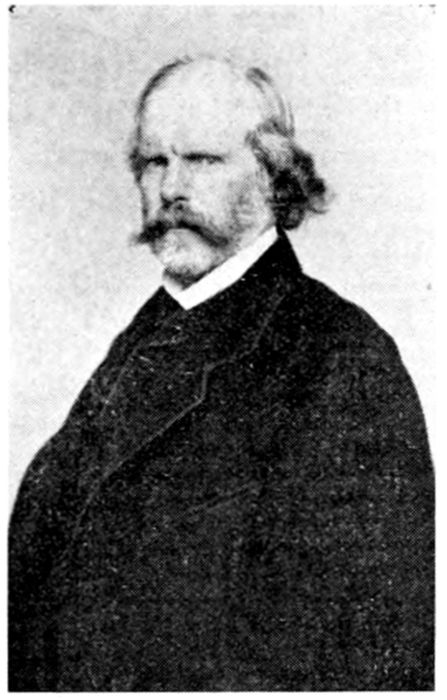
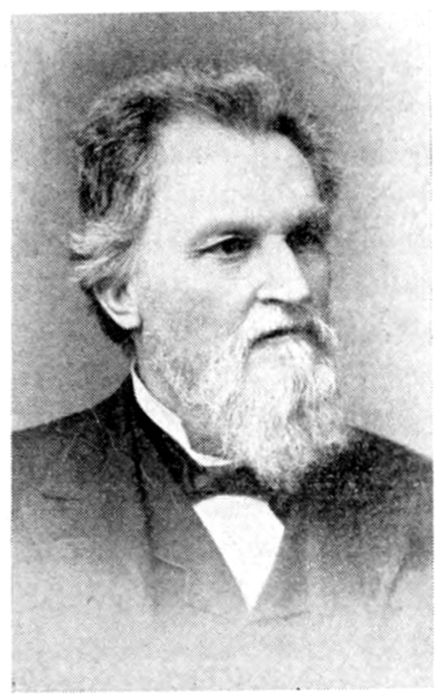
Eng. by E. G. Williams & Bro. N. Y.
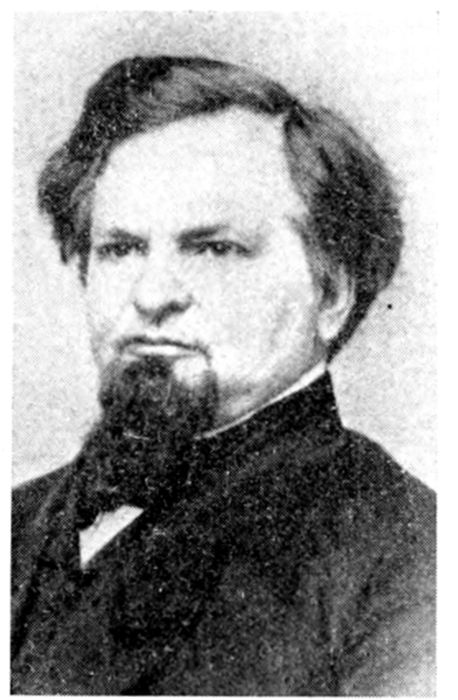
John Seaton
377John Seaton was born in Cincinnati, Ohio, June 11, 1834, a son of John
M., and Elizabeth (Jones) Seaton, the former a native of Virginia and the
latter having been born in Vermont. John M. Seaton, the father, was a
soldier in the Mexican War and was killed in battle at the storming of the
heights of Cerro Gordo, Old Mexico. When John was three weeks old his
parents removed from Cincinnati to Louisville, Ky., where his boyhood days
were spent. He was eleven years of age when his father was killed on the
field of battle. He attended school until he was fifteen years of age, and
then began learning the trade of a machinist. A few years later finds him
working as a journeyman machinist in St. Louis, Mo. In 1856 with a cash
capital of two dollars and fifty cents, John Seaton started a foundry at Alton,
Ill. A natural aptitude for mechanics and machinery appliances, combined
with pluck, energy and perseverance, enabled him to make a success of his
first undertaking and the enterprise prospered.
At the outbreak of the Civil war Mr. Seaton offered his services in defense
of the Union, and was commissioned a captain of Company B, Twenty-second
regiment, Illinois infantry. His first engagement was the battle of
Belmont under General Grant, and Captain Seaton was in command of the
skirmish line that opened this engagement. One of the precious possessions
of his family at this day is the personal letter he received from the famous
commander, commending him for the efficient manner in which he performed
the task allotted to his command. He served for one year and then
resigned his commission and returned to Alton to take charge of his business.
After the war Mr. Seaton remained in Alton in charge of his foundry until
1872, when he removed to Atchison with his entire force of fifty employees.
He was induced to remove westward by the fact that six months previous to
the time of his removal to Atchison, the city had voted $10,000 in bonds to
any man who would establish a foundry. He accepted the offer and the
result was one of the most beneficial industries ever located in Atchison. The
Seaton foundry gave employment to over 200 men, and he built up an
industry which today stands without a peer in its line in the West. The
secret of Mr. Seaton’s success lay in the fact that every detail of his business
received his direct supervision, and he insisted that only first class work be
turned out by his factories. For over eighteen years this captain of industry
carried his dinner pail with him to the foundry and worked side by
side with his men. He continued doing this after he had attained to a position
of wealth and affluence which enabled him to own a home at the seashore at
Orient, L. I., and could have retired from active work at any time he chose.
None but the finest finished products were allowed to leave his establishment,
and the name of Seaton and the output of his plant are noted over the West
for the excellence of the finished manufactured materials and for their absolute
reliability. In addition to general architectural work, he filled orders
378for the Santa Fe, Missouri Pacific and Ft. Scott and Gulf railroads, such as
casting locomotive wheels, smoke stacks, steam cylinders, etc., all known as
locomotive finished material products. The business of his large establishment
in Atchison was built up until it amounted to over $250,000 annually,
and the plant covered an area of 700×400 feet. Mr. Seaton was in business
continually from 1856 until the time of his demise, January 12, 1912.
The activities of this noted citizen of Atchison were not confined entirely
to his business, but he took an active and influential part in civic and
political affairs after his advent in Atchison. His career showed that he
possessed statesmanship ability of a high order. For a period of eighteen
years Mr. Seaton was a member of the Kansas State legislature, and so great
was his influence in the house, and so long and distinguished was his service
that he became known throughout the State as the “Father of the House.”
His name is associated with many of the important measures enacted into law
by the State legislature, among them being the binding twine factory law,
which act is responsible for the establishment of a plant for the manufacture
of binder twine at the State penitentiary. He probably did more for the success
of the “Douglass House,” during the legislative trouble of 1893 than any
other member of the Republican body. As a citizen and a legislator he enjoyed
the respect and esteem of the people of Kansas without regard to
political affiliations. He was opposed to the dominance of “trusts and monopoly,”
and it was his firm conviction that the great corporations were devoid
of feeling of a personal nature.
April 9, 1857, Mr. Seaton was married to Miss Charlotte E. Tuthill, of
Alton, Ill., and this marriage was blessed with five children: Mrs. Lillie M.
Hendrickson, of Atchison; John C. in California; Mary, wife of Dr. W. H.
Condit, of Kansas City; Mrs. Nellie Taber (Seaton) Byram, deceased, and
George L., married Amy Cox, of Weston, Mo., and resides on South Fourth
street, Atchison; John C. Seaton married Gertrude Hickman, of Coffeyville,
Kan. and resides in Kansas City and Los Angeles, Cal.; Mrs. Charlotte
E. (Tuthill) Seaton was born in Alton, Ill., November 10, 1840, a daughter
of Pardon Taber Tuthill, who was born and reared on Long Island, N. Y.,
and was a scion of one of the oldest American families. The great-great-grandfather
of Mrs. Seaton, John Tuthill, known as Pilgrim John Tuthill,
came from England with early settlers to Long Island. The home built by
Pilgrim John on Long Island in the early part of the eighteenth century is
still standing in a good state of preservation. The ancestral home of the
Tuthills is located in the village of Orient, Long Island. On the maternal
side an ancestor of Mrs. Seaton, named Capt. Andrew Englis, commanded a
379company in the Revolution and was a great patriot. Pardon Taber Tuthill
was a pioneer in Alton, Ill. He was a contractor and builder and in his later
years devoted his time and talents to horticulture. He was continually experimenting
and developed several new varieties of fruit. He was blessed with
a scientific mind and became famous as a horticulturist.
John Seaton was a member of John A. Martin Post, No. 93, Grand Army
of the Republic, the Loyal Legion and the Knights of Pythias lodges. Through
him the Enterprise theater was rebuilt and remodeled in Atchison, and he was
always found in the forefront of public movements to advance the interests
of his home city. Socially Mr. Seaton was a genial, approachable, unassuming
gentleman, whose pride was manifest concerning his Civil war record and
the fact that he had amassed wealth and attained a leading position in the
civic life of his adopted State through his own efforts, and built up his fortunes
from the ground. He was a man of undoubted integrity and was a
noble character whose demise was sincerely mourned by the whole city of
Atchison. He was a kind and indulgent husband and father. In his passing
Kansas lost one of her best and most widely known statesmen and Atchison
one of her most useful citizens. His was a life well spent in behalf of
the city and State where his name will long be remembered and revered as
one of the honored pioneers of a widely known city and great State which
he helped to create.
It is meet that considerable space in this history of Atchison county be
devoted to the stories of the lives of real pioneers of the county. The old
pioneers were the salt of the earth, and a stronger or more vigorous race of
men, never conquered a wilderness. In the class of the real, old pioneer settlers,
comes Aaron S. Best, retired farmer, of Effingham, Kan. Captain
Best has lived in Atchison county for nearly fifty-five years, and has seen
the country transformed from a vast tract of pasture and grazing land to a
region of fertile and productive farms, and well built towns and cities. During
all these years he has taken an active and prominent part in county affairs,
and in his younger days was a political leader in his own neighborhood.
Aaron S. Best was born June 27, 1839, in Clinton county, Pa., a son of
John W. and Catharine (Schaefer) Best, of German descent, and native
born and reared in Pennsylvania. John W. Best was born in 1809 and died
in 1881. He was the son of Peter Best, a native of Pennsylvania, of German
parentage. In the year 1860, John W. Best, accompanied by his wife and
380seven children, crossed the country to find a new home in Kansas. He had
made a trip to Atchison county in the previous year, and, after carefully looking
over the ground, made up his mind that the country had a great future,
and he decided to move his family so as to make a permanent home in Kansas.
The Best family arrived in Atchison in March of 1861, and at once
moved to a farm in old Monrovia. In June of the same year, the wife and
mother died, at the age of forty-five years. The following children were
born to John W. Best and wife: Mary and Elvina, deceased, in Pennsylvania;
Henry, living at Parr, Tex.; Louis, Luther and Reuben, deceased; Mrs. Henrietta
Lamberson, of Argentry, Ark.; and Michael, deceased.
Aaron Best was twenty-one years of age when the family removed to
Atchison county. Being a Free State advocate, it was only natural that he
take some part in the struggle which finally made Kansas a free State. When
General Price’s threatened invasion of Kansas seemed imminent, he assisted
in raising a company of militia among his neighbors and was chosen captain.
This company marched to Westport, and took part in the famous engagement
which resulted in Price’s retreat to the southward. Captain Best
was in command of Company F, Twelfth regiment, Kansas cavalry. Only
two companies of the Twelfth regiment were under fire, and Company F was
one of these, Capt. Asa Barnes’ company being the other actively engaged.
Captain Best’s horse was shot from under him and badly crippled.
After coming to Kansas, he spent one year assisting his father on the
home farm, and then moved to a farm of his own, south of Monrovia, which
he developed from raw prairie land to a very productive farm, residing on
until 1907, when he rented his land holdings and retired to a comfortable
home in Effingham. The first land which Mr. Best owned was bought
by his father for $750, and he farmed this on the share plan for six years,
after which he paid his father $2,000 for 140 acres. His next purchase was
eighty acres of land nearby, and he continued to add to his land possessions
until he was the owner of 275 acres in all. In the spring of 1914 Mr. Best
sold his farm land for $21,000. His farm was one of the best improved
in Atchison county, and naturally brought a good, round price, because of the
good condition of the buildings and of the fertility of the soil.
Mr. Best was married in February, 1860, to Malinda Bricker, and to
this union have been born one son and three daughters, as follows: Mrs. Ella
Rebecca Sharp, living at Helena, Mo., and mother of two children, Albert
and Twila; Mrs. Mary C. Bonnell, living on a farm southeast of Effingham,
and who has eight children, Nellie, Edith, Grace, Ruth, Catharine, Lea,
Claude, Malinda; Mrs. Emma Wood, of Council Grove, Kan., and mother
381of four children, Clara, Beulah Morris, Ralph, Esther; John a merchant, of
Monrovia, Kan., father of three children, Leota, Hazel, and Blanche. The
mother of these children was born in Hanover township, Daulphin county,
Pennsylvania, December 15, 1837, and was a daughter of Joseph and Rebecca
(Lohs) Bricker, both of whom were of Pennsylvania German ancestry,
and died in their Pennsylvania home.
Mr. Best has always been allied with the Republican party, and has been
a stanch advocate of Republican principles for a long period of years. He
and his wife are members of the Methodist Episcopal church and contribute
generously to the support of that denomination. He is fraternally affiliated
with the Odd Fellows Lodge and Encampment, No. 5, and the Modern
Woodmen. Physically and mentally, Mr. Best is a remarkably well preserved
man, when one considers his age and the fact that he endured so
many hardships in his first struggles to attain to the position of affluence and
comfort which he enjoys at present.
Faithfulness to duty on the part of public officials is always appreciated
by the people, and an official who regards his office as other than a sinecure,
is recognized as honest, capable and well meaning. In Louis C. Orr, postmaster
of the city of Atchison, Kan., the patrons and citizens of Atchison have
a capable and conscientious public servant, whose sole interest is to see that
the affairs of this important Government office are conducted smoothly, and
for the convenience of the patrons of the postoffice. Although, in times past,
the Atchison postoffice has been looked upon as a sinecure, operated as a well
oiled piece of Government machinery with an efficient and well trained force,
Mr. Orr, since taking over the duties of his position, has demonstrated that
he can work as hard and efficiently as any of the many employees making up
the postoffice force. Probably no postoffice in the State of Kansas is better
conducted, or the welfare of the patrons more carefully looked after than the
Atchison postoffice, and credit is due Mr. Orr for his diligent application to
the duties of his office since his appointment.
Louis C. Orr, postmaster of Atchison, was born August 3, 1857, in McGregor,
Iowa, a son of James and Man Elizabeth (Underhill) Orr, concerning
whom further mention will be found in the biography of James W. Orr,
brother of Louis C., in this volume. When Louis C. was eight years of age
382the family removed from Iowa to Niles, Mich. Louis C. and his brother
James W. knew what poverty was in their youthful days, and shared their
hardships in common. Louis C. was ambitious to obtain an education, and
at an early age was compelled, by force of circumstances over which he had
no control, to practically earn his own living and the wherewithal to obtain an
education. For some years he and James W. pooled their earnings and
worked together for their mutual benefit, and to this day this trait of brotherly
devotion is present. Louis C. attended school until he had attained the age of
eighteen years, and he then entered a drug store at Niles, Mich., in the capacity
of clerk. He remained in Michigan until 1885, when he came to Atchison.
Kan., where his brother, James W., had preceded him in 1881. Mr.
Orr entered the Government railroad mail service, and was employed in this
capacity on the Santa Fe Railway System, on the run from Atchison to
Topeka, during Grover Cleveland’s first administration. He then left the
railway mail service and was employed as clerk in the drug store of A. W.
Stevens for the following period of eight years. For the six years following
he was in charge of the paint department of the McPike Drug Company, a
wholesale drug firm then operating in Atchison, and since removed to Kansas
City, Mo. For four years, from 1907 to 1911, he served as city collector
of Atchison. He was engaged in the real estate and fire insurance business
until January, 1915. Mr. Orr was appointed postmaster of Atchison December
29, 1914, by President Wilson, to take effect January 4, 1915, although
Mr. Orr did not begin his duties until January 15, 1915.
Mr. Orr was married in 1886 to Mary Isabelle Smith, of Richmond, Ind.,
a daughter of John P. and Mary (Sedgwick) Smith, residents of Richmond,
Ind. One son has been born to this marriage, Richard Sedgwick Orr, born
in 1888, and at present employed as manager for the Standard Oil Company
in Atchison.
Louis C. Orr is a Democrat and is affiliated with the Christian Scientist
church. For the past twenty-five years he has been a member of Lodge No.
127, Ancient Order of United Workmen. It can be said of him that he is
courteous, efficient and obliging to all with whom he is brought in contact.
Successful as an agriculturist, and again achieving success as a live stock
buyer and shipper, is a summary of the life and accomplishments of Carl
Ludwig Beckman, one of the best known and progressive citizens of Effingham,
383Kan. Mr. Beckman’s live stock operations invoke the buying and
shipping of over fifty carloads of live stock yearly. In addition to his business
dealings, he also looks after his fine farm of 200 acres in Benton
township.
Mr. Beckman was born April 2, 1861, in Quincy, Ill. As the name indicates,
he is the son of German parents, his father, William Beckman, having
been born in Germany, in 1830, and was unfortunately killed by a stroke
of lightning in Burlington, Iowa, in 1863. When a young man, William
Beckman left his native land to seek his fortune in this country. He located
at Quincy, Ill., where he married Elizabeth Kipp, who bore him four children,
and was also born in Germany in 1824. William Beckman removed
his family to Burlington, Iowa, in about 1862. The four children born to
this couple were: William, a resident of Parnell, Atchison county, Kansas;
Mrs. Hannah Buhrmaster, living on a farm in Benton township; Minnie,
and Carl Ludwig, with whom this review is directly concerned. The mother
of these children later married Henry Vollmer, a farmer, in Iowa, who gave
her and the children a good home and left his widow well provided for. Mrs.
Vollmer, mother of C. L., resides at Mediapolis, Iowa.
When Carl was twenty years of age he left the farm in Iowa, and
came to Kansas in 1881, and in partnership with his brother, William,
rented a farm near Effingham for thirteen years, dissolving partnership in
1894. Through purchase and by inheritance, on his wife’s part, Mr. Beckman
and his wife came into possession of 200 acres of land in 1894, upon
which they resided until 1908. In that year they bought a small farm of
thirty-five acres, one mile west of Effingham, upon which they resided for
three years, and then made a permanent home in Effingham. Since 1908
Mr. Beckman has been engaged in the buying and shipping of live stock,
with Robert M. Thomas as a partner in the enterprise, and has been very
successful in this business, being an accurate judge of live stock and keeping
abreast of market conditions.
He was married in 1894 to Miss Lebeldine Gersbach, born in Atchison
county in 1863, a daughter of Samuel and Catharine Gersbach, both of
whom were natives of Germany, and, after emigrating from their native
country to America, settled in Atchison county as early as 1854, and were
among the earliest pioneers of Kansas. Mr. Gersbach preëmpted land and
built up a fine farm which is now owned by Mr. and Mrs. Beckman. Two
children were born of this marriage: Rosa, aged twenty years, and a student
in the Atchison county high school, class of 1916; and Pearl, aged
seventeen, also a student in the high school, class of 1916.
384Mr. Beckman is a Republican in politics, and takes an interest in the
civic and political affairs of his home town and county. He is a member
of the Odd Fellows and the Modern Woodmen. Mrs. Beckman and daughters
are members of the Methodist Episcopal church. Mr. Beckman is a stockholder
of the Farmers’ Mercantile Association of Effingham, and is generally
found in the forefront of all undertakings which are intended for the
betterment and progress of conditions in his home city.
We are taught that life is eternal; that when the course of man has been
run upon this earth and his work is done, his spirit returns to his Maker and
he is judged according to his deeds while a mortal among his fellow creatures.
This thought and belief is comforting alike to the dying and the bereaved
ones left behind to mourn their earthly loss for the time being. Longfellow
has written: “Life is real, life is earnest, and the grave is not its goal; dust
thou art, to dust returneth, was not written of the soul.” So thought and so
lived the late Capt. James Granville Morrow, who at the time of his demise
was the oldest living pioneer resident of Atchison, and a man famed for his
upright life and beloved for his good and kindly deeds. Life was very “real
and earnest” to Captain Morrow and he enjoyed his earthly existence to the
fullest extent, the latter years of his residence in Atchison being the fullest
and best of all, in the sense that he indulged his taste and talents to doing
things which he loved, all the while being surrounded by a loving wife and
children whose respect and love he had to comfort him through the greater
part of his long and useful life. Captain Morrow lived in such a manner as
to endear him to all of his associates and he will long be remembered as one of
the noted figures of the pioneer and the present era of Kansas development.
It is meet that the life story of this truly noble citizen be recorded in these
annals of his county and city for the inspiration and encouragement of the
present and coming posterity for all time to come.
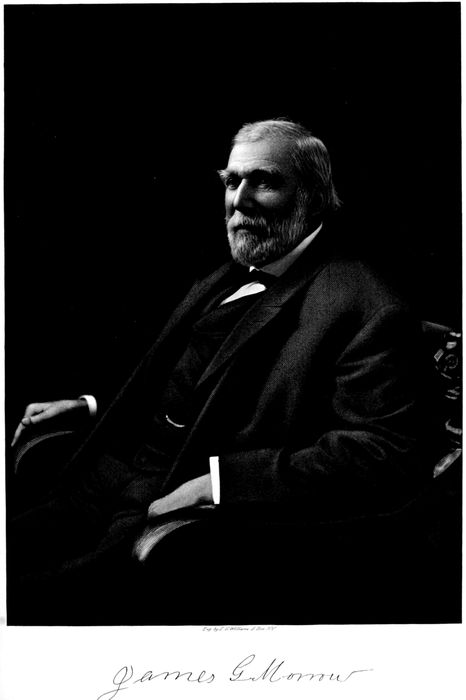
Eng. by E. G. Williams & Bro. N. Y.
James G. Morrow
385James Granville Morrow was born on a farm in Wayne county, Kentucky,
June 27, 1827, a son of Jeremiah and Lydia (Holder) Morrow, both
of whom were born and reared in Kentucky. Jeremiah Morrow was the son
of Matthew Morrow, a native of Virginia, who was one of the early pioneers
of Kentucky, and of Scotch descent, his ancestors having emigrated from
Scotland to America in the early colonial period of American history. Jeremiah
Morrow, father of James G., was born in 1802, and after his removal to
Kentucky married Lydia Holder. Six sons and two daughters were born to
Jeremiah Morrow and wife, only one of whom survives, Mrs. W. H. Crisp,
residing in Kentucky. Their children were as follows: Mahala, wife of
Rev. W. H. Crisp, of Kentucky; Floyd, deceased; James Granville, the subject
of this review; Nimrod, deceased; Riley, William, Nancy, deceased wife
of John Pennington; Percy, deceased. Granville Morrow spent his boyhood
days on the family farm in Wayne county, Kentucky, and at the age of sixteen
years was sent to a select school. He made his home with his parents
until he attained his majority and then set out to make his own way in the
world. He dealt quite extensively in horses which he drove from Kentucky
to Georgia. He was also associated with his brothers in raising, purchasing
and selling hogs, which they drove 400 miles into Georgia, where they were
sold to the Georgia planters. Sometimes a single planter would buy 500
head and the price ranged from eight to nine dollars per 100 pounds, live
weight. The Morrow brothers frequently drove as high as 13,000 head, traveling
only seven miles a day. There were no railroads in those days, but the
country was dotted with stations. Hog cholera did not bother swine in those
days and it was Captain Morrow’s frequent expression that hog cholera was
a product of civilization and high breeding, and, although the hogs were
driven as far as 400 miles they did not lose weight on the trip. The business
of the Morrow brothers was not always profitable, however, and they lost
money on some of the trips. Mr. Morrow abandoned the business in 1850,
and in 1854 arrived in Atchison en route to California, but he did not go
any farther. On April 5, 1854, he arrived at Rushville Landing, now East
Atchison. This was shortly before Kansas was opened for settlement, and
the only man living at that time on the townsite of Atchison was George
Million, who operated a rope ferry across the Missouri river. Mr. Morrow
found on landing at Atchison that the overland train which he expected to
join en route to the far West had left, and, as he was ill he decided to wait
for the next train. Captain Morrow ate his first dinner in Kansas with
Samuel Dixon at Dixon Spring, now included in the city of Atchison. The
food was ladled out of a common kettle to which all the diners had access
without style or invitation other than “help yourself.” A tree trunk sawed
off smooth answered the purpose of a table on which the meal was served.
While waiting he found a job with Million and decided to remain in Kansas.
In the fall of 1854, he, with John Alcorn, bought out Portumous Lamb’s
ferry boat which was operated by horse power and a tread-mill, and from
386that time on for seventeen consecutive years Mr. Morrow plied his ferry between
Atchison and Winthrop. In the fall of 1855 he began operating a
side-wheel steam ferry which had been brought here from Brownsville, Pa.
In 1857 he became captain of the steam ferry, “Ida,” later running the steam
ferry, “Pomeroy,” after which he went to Brownsville, Pa., where he built the
transfer boat, “William Osborne,” remaining there eight months while the
work was in progress. When he brought the “William Osborne” to Atchison
it was loaded with 300 tons of rails for the Central Branch of the Missouri
Pacific railroad, now the Northern Kansas Division. This boat also conveyed
across the Missouri river the first locomotives used on the road after
its construction.
Not long after his arrival in Atchison Captain Morrow began to
accumulate land, and in 1869 turned his attention to farming, retiring from
the steamboat business entirely in 1871. He accumulated 1,240 acres of rich
bottom lands in the Missouri river bottoms near East Atchison which has
never failed to produce a crop and is very valuable. He formerly owned a
section of land in Osage county, Kansas, near Lebo. He also was the owner
of two valuable farms on the Atchison side of the river, 320 acres near Jacksboro,
Texas, and owned considerable real estate in the city, all of which has
been left to his widow in trust for his children and heirs. He was very successful
as a wheat grower, and in this way gained the greater part of his working
capital. He erected a beautiful home called “Enidan Heights” at Eighth
and U streets, on the south side of Atchison, where he spent his declining
years in peace and comfort. About 1875 he opened a general store in East
Atchison which he conducted until 1883. Those were still pioneer days, and
the settlers in the vicinity were poor and sometimes were unable to pay for
the goods they needed. The captain’s big heart and generous impulses frequently
led him to extend credit to patrons whom he knew would not be able
to pay for their purchases, and it was a favorite expression of his when his
clerk would report to him that a poor man wished credit, “Gracious to goodness,
if we don’t let him have the stuff he’ll starve to death.” The captain
sold hundreds of dollars’ worth of goods which were probably never paid for,
but his good heart would not permit him to see a fellow creature in want for
the necessities of life. This trait of kindness was the predominating characteristic
of his life and endeared him to hundreds of people. After quitting
the mercantile business Captain Morrow devoted himself entirely to his farming
interests and his transfer business which he established in 1888 with his
partners, later becoming the sole owner of the business. He retired entirely
from active business pursuits and his farming in 1910 and spent the most
387of his time working around the gardens of his fine home in Atchison. For
years it was his custom to drive back and forth to his big farm on the Missouri
side and he was gradually persuaded to abandon this activity. His demise
occurred December 2, 1915, after a brief illness, beginning with an attack of
la grippe, his great age and depleted vitality militating against his recovery.
James Granville Morrow was married November 20, 1874, to Miss Sarah
J. George, and this happy marriage was blessed with the following children:
Della, born November 11, 1875, and died in 1904; Mary Etta, born in Missouri
March 17, 1880, dying October 2, 1880, and who is buried in Orearville
cemetery, Saline county, Missouri; James Granville George, born September
16, 1878, married Ethel Worrell, and is the father of four children: James
Granville, Jr., John Worrell, Frances and Robert George; Nadine, wife of
John Raymond Woodhouse, who lives with Mrs. Morrow, of Atchison, and
mother of John Granville, born December 16, 1914; James G. Morrow resides
in Buchanan county, Missouri, and has charge of the immense Morrow
farm in the Missouri bottoms. The children of Captain and Mrs. Morrow
have all been well educated and afforded every facility for mind cultivation.
Mrs. Nadine Woodhouse was educated in Mount St. Scholastica Academy
and the College Preparatory School of Atchison, after which she completed
her studies at Central College of Missouri. Miss Della Morrow studied in
Mount St. Scholastica Academy, Midland and Central colleges, and Washington
University, at St. Louis, and was a bright and talented young lady prior
to her demise. James Morrow, the son, studied in the Atchison public schools
and Midland College. The mother of these children, Mrs. Sarah J. (George)
Morrow, was born March 30, 1853, near Orearville, Saline county, Missouri,
a daughter of Dr. James Jameson George, a native of Prince William county,
Virginia. Dr. George was born in Virginia November 25, 1810, a son of
William Henry George, a soldier in the War of 1812, who moved from Virginia
to Hardin county, Kentucky, in 1816 with his brothers, Moses and
Lindsey George, who settled at Shelbyville, Ky. The mother of Dr. George
was a member of the Jameson family, an old Virginia family. The ancestry
of both the George and Jameson families goes back to the pre-Revolutionary
days of the Virginia colony. Dr. J. J. George was a graduate of the Transylvania
College at Bairdstown, Ky., and also studied at Lexington, Ky. He
was married in 1841 at Mt. Sterling, Ky., to Mary (Catlett) Orear, a daughter
of Robert Catlett Orear, who was born in Mt. Sterling. Ky., January 30,
1814, and departed this life March 27, 1876, in Johnson county, Missouri.
Dr. J. J. and Mary George were the parents of the following children: Robert
died in June, 1905, on his ranch in Coffey county, Kansas; Joel S., who
388resides at Peace River Crossing, Alberta, Canada; Mary E., wife of J. H.
Russell, died June 28, 1911; Mrs. Malinda Morrison, of Tecumseh, Okla.;
Benjamin Franklin, born in Saline county, settled in Coffey county, Kansas,
and now resides in Denver, Colo.; Mrs. James Granville Morrow; two who
died in infancy; James Nelson contracted fever at Central College, and died
October 26, 1875, aged twenty-one years and twenty-nine days; Lee Davis,
a ranchman, of Coffey county, Kansas. Four of these children were born
in Kentucky, and the last four were born in Missouri, where the family removed
in 1850.
Dr. George was a minister of the Gospel and a member of the Methodist
Episcopal conference in Kentucky from 1838 to 1839. He came to Missouri
to farm and preach the Gospel, but was impressed very early in his western
career with the woeful dearth of skilled medical care for the sick and ailing
of the backwoods country, and was frequently called to the bedside of people
who were supposed to be dying, and whom he realized could be easily saved
with some medical attention. Fired with zeal to assist an unfortunate and
suffering people, he conceived the worthy idea of studying medicine, so that
he could be of material assistance to his people other than in a religious sense.
He returned to Kentucky and entered the Medical College at Lexington. After
completing his course he returned to Saline county, Missouri, and engaged
in the practice of his profession until old age came upon him. He then removed
to Cass county, Missouri, and became a local minister. His was a
long and useful life, every matured year of which was given in behalf of his
fellowmen, unselfishly and devotedly. He was one of the noted missionaries
of the early days in Missouri and extended the word of the Gospel to the
remotest settlements. He organized churches and Sunday schools where they
seemed needed most and his work called him to preach the Word in log houses
and the most primitive habitations of man. Dr. George was deeply in love
with his great work, and loved the people, and worked tirelessly for their
well being in a religious and practical way. He departed this life August 4,
1875. The last public utterance which he made was when he spoke to a
Sunday school assemblage in Coffey county, Kansas, in the village of Key
West. His end was peaceful and tranquil, and the departure of this good
man’s soul to the realms beyond mortal kin marked the passing of one of
the truly great men of the western country whose work will go on and on
forever. Dr. George and Captain Morrow became great friends in the early
sixties.
On Thanksgiving day of 1915, just the day before Mr. and Mrs. Morrow’s
forty-first wedding anniversary, the captain’s last illness began which
389resulted in his passing away. His burial occurred on December 4 from Trinity
Episcopal Church, Rev. Otis E. Gray officiating, with the Masonic lodge
of Atchison conducting burial service at the grave. He was for many years
a Mason and was greatly interested in the Masonic fraternity, rarely being
absent from the lodge meetings, his last spoken regret having been that he
would be unable to attend the ceremonies held at the laying of the cornerstone
of the new Masonic Temple in Atchison. The last five years of Captain
Morrow’s life were perhaps the most satisfactory and the happiest of his existence.
His years of retirement, although few as compared with that of most
men, were spent almost entirely at his beautiful home, with occasional visits
to his farm lands. He was loath to retire, and did so only at the urgent
insistence of his devoted wife, and for quite a long time after he was eighty
years of age he would insist on driving across the river to his farm. He
took the greatest pleasure with his grandchildren, and especially with his
namesake. In his later years he became a specialist in gardening and fruit
growing merely for his own satisfaction and would frequently surprise his
family with some very choice and rare fruits grown in his gardens and
orchards. From his orchard of peach trees he gathered over 400 bushels of
peaches in one season, and also set out an apple orchard which he attended
assiduously. He became a disciple of the famous Luther Burbank and was
a member of the Luther Burbank corporation. Through the exercise of his
skill as a fruit grower be produced several kinds of rare berries and was
continually experimenting in small fruits and vegetable growing. It was
fitting that the life of Captain Morrow should close in such a manner and that
during his last years he was permitted to indulge himself in his favorite pursuits,
surrounded with the loving and watchful career of his devoted wife, who
was always his confidant and adviser, and to whom he went in time of stress
or trouble for comfort and advice. His was a life well spent and his memory
will live long in the hearts and minds of those who knew him best.
In the northeast part of Benton township, in a comfortable farm home on
section 11, range 18, there resides the oldest pioneer settler of that section
of the county, the review of whose career takes one back to the days of the
Civil war when he shouldered a musket in defense of the Union, and to the
early days of Kansas history when the long freight trains hauled by oxen and
390mules were leaving Atchison for the far West. We are reminded of the
Indian troubles which beset the hardy freighters as they convoyed their treasures
across the wide reaches of prairie and mountain. In all these things Orlando
C. Scoville, Union veteran, old-time freighter, and pioneer farmer, participated,
and it is meet that the story of his life and adventurous career be
recorded for the entertainment of succeeding generations of men and women
in order that they might know how a wilderness was redeemed and what
manner of men their forefathers were and whence they came.
Orlando C. Scoville was born February 4, 1846, in Cook county, Illinois,
on a farm located just twenty-two miles from the city of Chicago. His father
was William Scoville, born in 1820, at Watertown, N. Y., a son of Abijah
Scoville, a native of Connecticut, and a scion of an old New England family.
Abijah Scoville was a carpenter by trade and his art was transmitted to his
descendants. William Scoville received a good education in his native State,
and taught school in New York when a young man seventeen years old. As
early as 1842 he came west, to Cook county, Illinois, and owned a farm in that
county which he cultivated until 1865 when he came to Atchison, Kan., where
he first engaged in the handling of live stock. Later he was in the lumber
business with a Mr. McCoy, who later sold out to Henry T. Smith, and he and
Smith conducted a wagon and lumber business on Utah avenue, just east of
the old Episcopal church, between Fourth and Fifth streets. William eventually
sold out his business and moved to a farm in Benton township, south of
where his son, O. C., lives, and there died in December, 1891. Previous to
removing to his farm he was foreman of the Hixon Lumber Company’s interests
in Atchison. The mother of Orlando C. was Lucinda Lasher, whom
William Scoville married in New York, and who removed to Arrington after
her husband’s death, and there died in November, 1893, at the age of seventy-five
years. William and Lucinda Scoville were the parents of seven
children, two of whom died in infancy: Imogene, wife of A. W. Mulligan, of
Blue Rapids, Kan.; Orlando C.; Eulalie, died in Atchison in 1866, and is
buried in Oak Hill cemetery; Freeman, a railroad engineer for many years,
and who died at Arrington, in 1911; Giles, a successful law practitioner, located
in Chicago, and who studied law under the late Senator John J. Ingalls.
O. C. Scoville was reared to young manhood on the farm in Cook county,
Illinois, and when eighteen years of age enlisted (1864) in Company B, One
Hundred and Thirty-second regiment, Illinois infantry. He served for six
months in the Army of the Tennessee, under General Thomas, and took part
in the several hard-fought battles, among them being the battle and siege of
Atlanta. His command started on the march with Sherman, to the sea, but
391were turned back by department orders. After his war service expired he
came to Atchison and joined the family. His first occupation in Atchison was
the operating of a wagon shop, just across the street from the Blair Mill, and
it is a matter of history that his shop was used as the first depot of the Central
Branch railroad, then building. He ran the wagon shop for two years and
then made two trips across the continent in the capacity of freighter and convoying
a herd of cattle. In 1867 he was one of the freighters in charge of
the first train sent over the Smoky Hill route for Butterfield to Denver. The
live stock was run off by the Indians during this trip, and Butterfield came
out and found them after four weeks’ search; his next trip was to Salt Lake
City. In 1868, he with others, drove a herd of milch cows which had been
sold by McCoy to a man named Murray, and consigned to him in California.
This trip required eighteen months to consummate, and they were forced to
winter in the Antelope valley on Walker river. After taking the cattle to
their destination he returned across the mountains to Reno, Nev., and there
boarded the train for the rest of the journey home, Reno at that time being
the western terminus of the railway. During 1869 he worked for one year
in the engineering corps of the Santa Fe railroad, and in that winter his father
bought his present farm in Benton township. In the fall of 1872 he moved to
the farm where he has resided continuously for the past forty-three years. In
1893 he bought the farm formerly owned by the family and has increased
his acreage until he and his son are the owners of 400 acres of land, the latter
owning 180 acres, upon which formerly stood three sets of farm buildings,
one of which was destroyed by fire in April, 1915. His present residence was
erected in 1893.
Mr. Scoville was married in Atchison May 8, 1873, to Virginia Williams,
born in Greenbrier county, Virginia, in 1854, and a daughter of Alexander
Williams. Her father died when she was very young and she came with her
mother and stepfather to Missouri in the early pioneer days when her mother
died and she was adopted by Mrs. Miller, a music teacher, of Atchison, Kan.
Three children were born to this union, namely: Katie died in infancy; William
C., born August 10, 1875, married Myrtle Lollar, and has two children,
Earl, born December 13, 1911, and Alice, born May 16, 1914. William C. is
the only living son of Orlando C. Scoville. Mrs. Scoville died in October,
1913.
This sturdy pioneer has been a Republican ever since he cast his first
vote, and is one of the true blue variety who prides himself on being a “stand-patter,”
who believes thoroughly in the principles of his party and will never
desert the standard of Republicanism. He has never held office and has
392never been a seeker after political preferment; has never been a party to a law
suit, never served on a jury, and has been called only once in his lifetime to
the witness stand. He has endeavored at all times to live at peace with all
mankind and has succeeded to such an extent that at a ripe old age, this pioneer
settler of Atchison county is living in peace and comfort in the home which he
created out of a wilderness.
Mr. Scoville cast his first vote for Abraham Lincoln in St. Louis, in 1864.
John James Ingalls, author, lawyer, and United States Senator, was born
in Middleton, Mass., December 29, 1833, a son of Elias T. and Eliza (Chase)
Ingalls. He was descended from Edmond Ingalls, who, with his brother,
Francis, founded the town of Lynn, Mass., in 1628. His father was a first
cousin of Mehitable Ingalls, the grandmother of the late President Garfield.
His mother was a descendant of Aquilla Chase, who settled in New Hampshire
in 1630. Chief Justice Chase was of this family. After going through
the public schools Ingalls attended Williams College, at Williamstown, Mass.,
graduating in 1855. He then studied law and was admitted to the bar in
1857. The next year he came to Kansas and in 1859 was a member of the
Wyandotte constitutional convention. In 1860 he was secretary of the territorial
council and was also secretary of the first State senate, in 1861. The
next year he was elected State senator from Atchison county. In that year,
and again in 1864, he was nominated for lieutenant-governor on the anti-Lane
ticket. During the Civil war he served as judge advocate on the staff
of Gen. George W. Deitzler with the rank of lieutenant-colonel. In 1865 Mr.
Ingalls married Miss Anna Louisa Chesebrough, a descendant of William
Chesebrough, who came to this country with Gov. Winthrop in 1630. Her
father, Ellsworth Chesebrough, was a New York importer who came to
Atchison, Kan., in 1859, and at the time of his death, in 1860, was an elector
on the Lincoln ticket. Of this union eleven children were born, six of whom
were living at the time of Mr. Ingalls’ death, viz: Ellsworth, Ethel, Ralph,
Sheffield, Marion and Muriel.
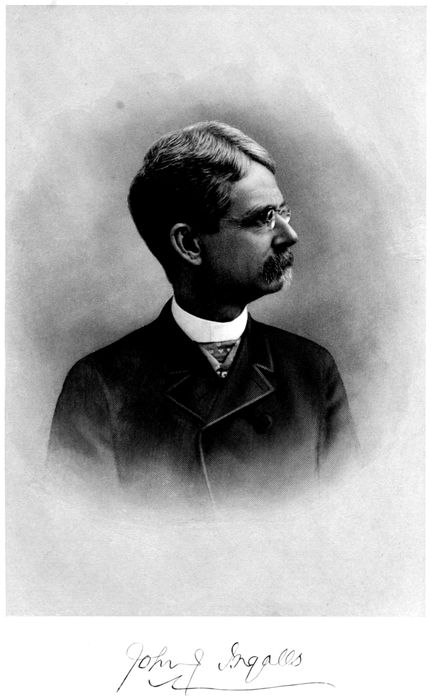
393In 1873, “Opportunity,” of which Mr. Ingalls wrote in his declining years,
knocked at his door. He was made a candidate for United States senator at
a private caucus one night and was elected by the legislature the next day.
His career at Washington, covering a period of eighteen years, was one of
great brilliancy. He quickly acquired distinction, and Speaker Reed remarked
before he had learned the name of the new senator: “Any man who can state
a proposition as that senator does is a great man.” As a parliamentarian he
was unsurpassed. Senator Harris, a Democrat from Tennessee, said: “Mr.
Ingalls will go down upon the records as the greatest presiding officer
in the history of the senate.” His speeches made him famous. He was the
master of sarcasm and satire, as well as of eulogistic oratory. His address
on John Brown, a speech of blistering satire; the one delivered in Atchison
after his vindication in the senate; and his eulogies of Senator Hill and Senator
Wilson are classic masterpieces, seldom if ever excelled in oratory. Senator
Ingalls was a strict partisan, an invincible champion of any cause, and
a bitter and persevering opponent. During his three terms in the senate his
greatest efforts were in the advocacy of the constitutional rights of the freedom
of the South and the rights of the veterans of the Civil war. When a
wave of Populism came over Kansas it found him practically unprepared.
He had given little attention to the money question and the tariff, and it was
these things which were clamoring for solution. He was defeated by the
Populists for senator in 1891. Mr. Ingalls said many times that he valued
a seat in the senate above any other honor in the gift of the American people.
As an author Mr. Ingalls won his reputation first by a number of articles
appearing in the old Kansas Magazine, among which were “Cat-Fish Aristocracy”
and “Blue Grass.” His poem, “Opportunity,” is worthy to be
classed with the greatest in the English language, and it may yet outlive his
reputation as an orator and statesman and be his lasting monument. After
leaving the senate Mr. Ingalls retired from active life, traveled for his health,
and died in New Mexico, August 16, 1900. In January, 1905, a statue of him
was installed in Statuary Hall at Washington with fitting ceremonies, being
the first statue to be contributed by Kansas, although Mr. Ingalls during his
lifetime had urged upon the State to place one of John Brown in this hall.
A publication of this nature exercises its most important function when
it takes cognizance of the life and labors of those citizens who attained prominence
and prosperity through their own well directed efforts and
who were of material value in furthering the advancement and development
of the commonwealth. Sidney Martin came to Atchison county in 1856
394when a boy of eleven. He endured the hardships common to the resident
of Kansas previous to and during the Civil war period. He made several
trips between Atchison and Denver as a freighter; drove over some 400
miles of country infested with Indians and narrowly escaped death
at their hands. He bought the first section of land that was sold in the Kickapoo
reservation and became one of the most successful farmers and stock
breeders in northeastern Kansas. He was actively identified with the development
of this section of the State and attained prominence and influence as
a citizen.
Sidney Martin was a native of Kentucky, born in Estill county on November
1, 1846, a son of Jackson H. and Polly (Walters) Martin. His ancestors,
paternal and maternal, were among the first to settle in the Virginia colony,
coming from England in 1607. His father, Jackson H. Martin, best known
to the residents of Atchison county as “Uncle Jack” Martin, was also a
Kentuckian, born in Estill county on January 15, 1812, a son of Robert and
Mary (Harris) Martin, both of whom were natives of Virginia. Robert
Martin served in the War of 1812 and was a commissioned officer. The
epaulets from his uniform were in the possession of the family until a few
years ago. Subsequent to this service he removed to Kentucky and was one
of Daniel Boone’s companions and was with him during many Indian fights.
He was one of the pioneer settlers of Estill county.
Jackson H. Martin, or “Uncle Jack,” as he was commonly called, was
reared in Estill county, married there, and in 1855 brought his family to
Buchanan county, Missouri, where he lived one year. In the spring of 1856
he came to Kansas and settled at Mormon’s Grove. The place derived its
name through being a former Mormon emigrant settlement. It was about
five miles from Atchison. “Uncle Jack” and his family occupied the Mormon
cabin until he could build one of his own. He preëmpted a quarter section
of land at this point and engaged in farming. A native of Kentucky, a Democrat
as well, he naturally became involved in the turmoil of events preceding
the Civil war. For the protection of himself and family, he built a double
wall of stone and earth around his dwelling. This caused it to be called Ft.
Martin. The place was attacked one night by Jayhawkers who were after
horses. The attacking party were driven off without booty and several of
their number were wounded. “Uncle Jack” continued to reside at Ft. Martin
until 1878, when he became a resident of Effingham. He built the Martin
Hotel and conducted it for a number of years. He was a success as a host,
his hotel was famous for its cookery and hospitality and Effingham the
gainer by his coming. His death occurred in April, 1902, at the age of
395ninety years. He had lived an eventful life, had watched Kansas grow from
a sparsely settled, faction-torn border State to one of the most prosperous
agricultural commonwealths of the Union. He had met many of the most
famous men of her formative period, and was a personal friend of John A.
Martin, Paddy Brown, Governor Glick and Charles Robinson. His wife,
Polly Walters, whom he married in Estill Springs, Ky., died in April,
1895. They were the parents of four children: Ann Elizabeth, the wife of
William Hight, of Fremont county, Colorado; Sidney, the subject of this
review; Mary W., widow of Gilbert Keithline, of Atchison county, and Sally,
widow of Henry Woodard. Twins died in infancy. Martha died at the age
of sixteen years. Sally (Martin) Woodard was born in Estill county, Kentucky,
in 1852, and came with her parents to Kansas in 1856. She was
reared on the old Martin farm in Atchison county, and in 1869 married Henry
Woodard, who was born in Evansville, Ind., in 1844. He was a son of
Philander Henry Woodard, who came to Atchison in the early sixties and
engaged in the milling business. After his marriage Henry Woodard settled
on a farm in Jackson county, where he remained until 1874, when he located
in Effingham and engaged in the mercantile business. He followed this line
of occupation until a few years before his death which occurred May 30,
1914. He is survived by his widow and the following children: Philander
Henry, Jack Martin, Gilbert Campbell, Dorothy, wife of Elmer Percival, of
Sheridan county, Kansas; Helen Lee, wife of Rolla Taliaferro; and Sally
Bernice, a student in the Atchison Business College.
Sidney Martin acquired his education in the schools of Atchison, and
later completed a course in the Platte City (Missouri) Academy. He was
reared on his father’s farm, near Atchison, and assisted in its carrying on
until about sixteen years of age. He then secured employment with Mr.
Teuschau, a pioneer French trader and freighter, who had an Indian wife.
He was also with the Scotch freighter, Kisskadden, on several trips. The
latter recommended him as a capable guide and driver to G. T. Smith, who
wished to secure the services of some one who could take his wife and baby,
and the aged wife of his partner, from Atchison to Denver in 1864, where
Smith owned a hardware store. Although but sixteen years of age, young
Martin secured the job. This was in 1864, a time when the Indians were
on the war path and Smith’s wagon with young Martin as driver, started
alone, but joined a freighting outfit numbering some forty wagons and
drivers. Just before they reached Ft. Kearney at Big Sandy, they met fleeing
Blue River ranchmen, who were hurrying to the nearest settlement, and
who told them the Indians were on the war path. They stayed all night at
396the home of a settler and heard the following day that Indians had murdered
the settler’s family and burned their house. The wife of Smith’s partner
was insistent on a proper observance of the Sabbath day, and while
in the Indian country caused Mrs. Smith to order that their wagon remain
in camp over Sunday. The wagon train left them behind and the Lord’s
day was properly kept by the women, although they were warned by Martin
that it was dangerous to leave the protection of the train. As related by
Martin “that was the longest day I ever spent.” About midnight he fed
and harnessed the team and started on with the intention of joining the train
of eleven men and wagons which had preceded them. At sunrise they
reached a lone ranch and its owner, who was postmaster, told Martin the
wagons were just ahead, over the first hill. Here he mailed a letter to his
mother. On arriving at the hill top Martin was able to see the valley where
the train had camped. The wagons were in flames, had been robbed of their
contents, a large part of which was whiskey. Two women were taken captives
and the eleven freighters had been killed and scalped by Indians. The
savages had indulged in the captured whiskey and were so thoroughly stupefied
that they were incapable of riding a horse and also failed to follow the
wagon which Martin drove. He wheeled his team and drove them at full
speed to the nearest ranch and found the buildings burned. They drove on to
the next ranch where they secured protection, a company of soldiers arriving
there the same day. The officer in command was drunk and refused to attack
the red-skins that night when victory would have been easy. When
the company reached the scene of the massacre the following day, the Indians
were not to be seen. Martin’s next stop was at another ranch and here Mr.
Smith joined the wagon, having rushed forward in the belief that Martin
had been killed and the women captured by the savages. On parting from
his charges Martin was given a plain band gold ring by Mrs. Smith with
her blessing. He made several other trips across the plains, the last one with
his father, “Uncle Jack” Martin, which took them to Montana. When the
Kickapoo Indian reservation was thrown open to purchase, Sidney Martin
bought the first section that was sold and several years later he bought the
last, becoming the owner of 560 acres in one body. He entered actively into
the developing of his raw land and brought it up to a highly productive state.
He became widely and favorably known as a breeder of Shorthorn cattle,
and from time to time purchased additional acreage until his holdings in
land were extensive, owning at one time 747 acres, at the time of his demise.
He took an active part in political affairs of his section, and, while disinclined
to accept office, was called upon frequently for counsel and advice. He
397was a man of keen perceptions, knew men and the motives which actuated
them, and was a student thoroughly familiar with the questions of the day. He
numbered among his close personal friends, Governor Glick. His death
occurred on January 3, 1904.
Mr. Martin married on February 20, 1868, Miss Mary Elizabeth White,
a daughter of George B., born May 10, 1815, and Mary Elizabeth (Lindsay)
White, born December 14, 1820, the former a native of Woodford county,
Kentucky, and the latter of Carroll county. They were married January 25,
1839. She died September 25, 1860, while the family was residing in Missouri.
After the death of his wife, Mr. White came to Atchison and engaged
in the grain business. With S. R. Washer he built the first elevator in the
city of Atchison. He died in November, 1900. Mrs. Martin was born on
May 15, 1848, while her parents were living in Missouri. On the maternal
side she is descended from the Blackburn family, members of which fought
with the Continental troops in the war for independence. After the death of
her husband, Mrs. Martin became a resident of the city of Atchison, where
she has since resided.
In every community we find that there are some individuals who seem
naturally endowed with the ability to go ahead and do things and take a place
of leadership among their associates. Robert M. Thomas is one of those who
possess the natural endowments, peculiar to leadership and the ability to make
things go with which he is connected. A successful farmer, a good citizen and
business man, makes an excellent combination, and Mr. Thomas has made his
mark in his community as a progressive and enterprising citizen.
Robert M. Thomas was born in Buchanan county, Missouri, February 2,
1868, a son of Moses and Katie (Critchfield) Thomas, who were born and
partly reared in old Kentucky. The parents of both were early settlers of
Buchanan county. Moses was the son of Robert Thomas, and the father of
his wife was Martin Critchfield. They were Southern born, and were descendants
of old Southern families. Moses Thomas was born in 1843, and
still resides in Buchanan county; his wife, Katie, was born in 1850, and is still
living. The Thomas family has a farm of 140 acres in Buchanan county,
upon which was reared a large family of eleven children, nine of whom are
living: Robert M.; John, deceased; Walter, living in California; Forrest, residing
398in St. Joseph, Mo.; Harriet and Cecil, at home; Ollie, deceased; Louise,
Margaret, Cora and Ellen, at home with their parents.
R. M. Thomas received his education in the public schools of his native
State and assisted his father in the operating of the home farm until 1892,
when he married and farmed for three years in Buchanan county, Missouri,
and then worked his farm in Platte county, Missouri, for four years. His
first purchase of land was in 1899 when he invested in a farm of 120 acres
in Buchanan county, which he sold three years later at a profit over the original
purchase price. In 1902 he bought another farm, and in 1903 located two and
one-half miles northwest of Effingham in Benton township. This farm comprises
160 acres and is now one of the best improved places in the neighborhood.
Mr. Thomas did so well in Atchison county that he was enabled to
buy another farm of 160 acres in 1912. This farm is located in Grasshopper
township, about three miles north of Muscotah. Upon the organization of the
Farmers’ Mercantile Company in June, 1913, in which Mr. Thomas took an
active part, he assumed the managership of the same and attends to his
business during the day, while still making his home at the farm. This plan
gives him an excellent opportunity to oversee his farming operations at all
times.
Mr. Thomas was married in 1892 to Katie Stanton, of Platte county,
Missouri, a daughter of William and Cynthia (Hall) Stanton, natives of
Platte county, and of Eastern origin. To this union the following children
have been born: William, married Pearl, daughter of Thomas O. Gault, and
is managing his father’s farm, two miles north of Muscotah; Clara, a graduate
of the Atchison County High School, and a teacher in the public schools;
Margaret, Ollie and Jessie, students in the county high school; Elva, Emma,
Robert M., and Daisy, attending the district school near their home.
Mr. Thomas is a Democrat in politics and has filled the office of trustee
of Benton township one term. He and his family are members of the Christian
church. He is fraternally connected with the Odd Fellows lodge.
The Farmers’ Mercantile Association, of which Mr. Thomas is the manager,
was organized in June of 1913 for the purpose of handling grain, coal,
feed and seeds. The capital stock of the concern is $10,000, of which $6,800
is fully paid up. The officers of the association were: President, C. A. Taliaferro;
vice-president, Stewart Hefflefinger; secretary and manager, R. M.
Thomas; treasurer, C. M. Snyder. The directors are: C. A. Taliaferro, S.
Hefflefinger, Charles M. Snyder, John E. Sullivan, R. M. Thomas, E. H.
Cawley, W. M. Sutter, R. B. Hawk, Reuben Hargrove. The present officers
are the same with the exception that Reuben Hargrove is now serving
399as the vice-president, and Fred Wyatt was elected to fill the vacancy in the
board of directors, caused by the demise of C. A. Taliaferro and Edward
High succeeded W. M. Sutter. The concern has a grain elevator with a
capacity of 8,000 bushels. The largest shipment of grain made in any one
year has exceeded 115,000 bushels.
William McAdam, retired farmer, of Effingham, Kan., was born February
6, 1861, in Sterlingshire, Scotland, and is a son of James and Helen
(Macnee) McAdam, who, with their children emigrated from their native
country in 1882 and settled on a farm near Effingham in Atchison county,
Kansas. They reared a family of five children, of whom William is the oldest,
the others being as follows: Mrs. Jane Drummond, of Ellenville, Kan.;
George, of Holton, Kan.; Mrs. Nellie Drummond, residing in Cottonwood
Falls, Kan.; and James, living at Holton, Kan. The father of these children
was born in 1820, and died in 1885, just three years after coming to
America. He was a hard-working, industrious farmer. The mother was
born in 1839 and departed this life in May, 1899.
William McAdam was twenty-one years of age when the family came
to Atchison county and for three years after his arrival here he assisted his
parents in the operation of the home farm. He then worked out for one
year and began renting land on his own account, renting twelve years in
all, five of which were in Jackson county, Kansas. His first purchase of
land was a tract of ninety-six acres in Jackson county, which he improved
and resided upon until 1907, when he moved to Effingham, where he and
his family reside in one of the most attractive homes in the city, located on
a tract of ten acres. Mr. McAdam is now the owner of 160 acres of good
land south of Effingham, over which he has supervision.
He was married in 1888 to Miss Augusta Sutter, a daughter of Frederick
Sutter, now deceased, who was one of the earliest settlers in Atchison
county, and who became one of the wealthy land owners of the county.
(See sketch of Fred Sutter.) Two children have been born to Mr. and Mrs.
McAdam, Fannie and Mabel, both of whom are at home with their parents.
The mother of these children was born in Atchison county in 1861.
Mr. McAdam is an independent Democrat, who votes as his conscience
400dictates, and prefers to support the man rather than any one political party
or creed, believing in this manner that better government will result. He is a
member of the Presbyterian church, and is fraternally connected with the
Ancient Free and Accepted Masons.
The citizen who loves his city to the extent that he is willing to devote his
energies toward making it a better abiding place for his fellow men, and does
his duty in a public capacity, regardless of criticism or adverse comments, is
a man worth while. He whose name heads this review is such an individual.
As mayor of Atchison, C. D. Walker made a record which will outlive the
present generation; as an attorney he has achieved a signal success and ranks
high in the legal fraternity of the State of Kansas; as a religious worker he
has accomplished much good of a lasting and enduring quality for the community
in which he lives. Born of Kansas pioneer parents, his training and
education were such as to prepare him for the career which has made him distinguished
among his fellow men; and he has proven that a wholesome example
set by noble parents is the best incentive that a man can have to guide him
through life.
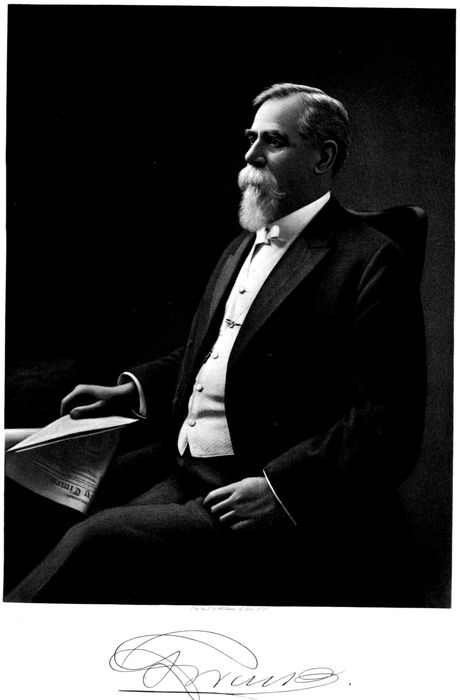
Eng. by E. G. Williams & Bro. N. Y.
C. D. Walker
401C. D. Walker was born March 29, 1851, at Greenville, Pa., a son of Harvey
and Anna M. Walker, the former a native of Pennsylvania and the latter
a native of Ireland. Harvey Walker, the father, was born in 1820 and was
a son of Harvey Walker, a native of the Keystone State, who married at
Pittsburgh, Pa., Miss Mary Ann Carr, who was born at Mile End, England.
The grandfather of C. D. Walker was a wagon and carriage maker by trade
and operated a shop in Greenville for many years. The history of the Walkers
in America begins with three brothers who emigrated from the north of Ireland
in colonial days. One of whom, Samuel Walker, located near Rochester,
N.Y., one, Andrew Walker, settled in Virginia, and one, the great-grandfather
of C. D. Walker, settled in Pennsylvania. Being north Ireland people it is
practically certain that the Walker family is of Scotch descent, their ancestors
having emigrated from the ancestral home of the family to the north of Ireland
a few centuries ago when the migration of the protestant people from the
Isle of Britain to escape religious persecution occurred. Harvey Walker
learned his father’s trade of wagon and carriage making, but worked but little
at the business. Imbued with the desire to better his fortunes in the great
West, he left the old home of the family in about 1854 and migrated to Oneida,
Ill., near which town he purchased a homestead. After farming for a few
years he sold out and started overland to the new State of Kansas, which at
that time was attracting adventurers from all parts of the country. The family
possessions were loaded upon wagons drawn by horses, and in due time the
Walkers arrived at Ft. Scott in Bourbon county, Kansas, their destination.
During the years ’57–’58–’59, the senior Walker traded with the Indians, and
eventually located on a homestead, twelve miles northwest of Ft. Scott. Harvey
Walker was a stanch Methodist of the uncompromising type and was unalterably
opposed to the institution of slavery. He fearlessly and freely voiced
his convictions at every opportunity, and his outspoken tendencies frequently
brought trouble upon him from the slavery advocates, who had settled in the
neighborhood in considerable numbers. He was always introducing new innovations
in farming methods and machinery. It is a matter of history that
he owned and used the first rake harvester brought to that part of the country.
The slavery advocates and border ruffians annoyed him considerably. They
stole his horses, broke up his wagons and farming implements and so pronounced
were the threats of the slavery men that Mr. Walker was forced to
spend most of his time in Ft. Scott away from his family. He was greatly interested
in the success of the anti-slavery propagandists and used great influence
in determining the ultimate destiny in Kansas becoming a free State.
When the war broke out he decided to move north. In the spring of 1861 he
arrived in the city of Atchison, which at that time was a small village, and was
induced by Capt. Asa Barnes to locate in Atchison county, where he remained
about a year. He afterwards purchased and settled on a tract of land adjoining
the town of Winchester, Jefferson county, Kansas. Here he located his
permanent Kansas home, and developed a fine farm. Here he raised a large
family, and gave his children the best education the school facilities at that
time afforded. Harvey Walker was married December 24, 1848, to Anna
Mariah Nelson, who bore him the following children, namely: Crandall C.,
an importer of thoroughbred horses, Sioux City, Iowa; Claudius D., with
whose career this review is directly concerned; Marion D., a farmer and fruit
grower, living near Midland College, Atchison county; Marvin L., a banker
of Oklahoma City, Okla.; Ellis Lytle, living in Washington State; Schuyler
R., a farmer of Stillwater Okla.; Harvey Mitchell, an importer of thoroughbred
horses of Oklahoma City; William Nelson, a farmer of Stillwater, Okla.; Roland
Ferris, who died in infancy; Orlina L., widow of William McKenney, deceased,
a hardware merchant of Winchester, Kan., and Anna M., wife of
William B. Stevenson, a Methodist minister. The mother of the foregoing
402children was born in north Ireland, September 24, 1824, a daughter of James
and Elizabeth (Farris) Nelson. James Nelson was agent for an English
estate in Ireland, and was the son of William Nelson and Catherine (Stewart)
Nelson. His wife, Elizabeth Farris, was the daughter of Robert and Jane
Farris, all of English descent. Anna Mariah Nelson came to America when
eight years old with a brother, and went to live with an aunt in Greenville, Pa.,
while her family settled in Bayfield, Canada. She was educated in the schools
at Greenville and afterwards became a teacher in the public school where she
was wooed and married by Harvey Walker. Harvey Walker and his noble
wife were sturdy God-fearing Christians, and the family prayers were a part
of the regular regime of the religious creed followed by them through life.
They were ardent Methodists who believed in living faithfully according to the
precepts of their religion, and the examples set by their upright and consistent
conduct throughout their long lives left an indelible imprint upon the lives
of their children, who have endeavored to follow in the footsteps of their parents.
Claudius DeMont attended the district school at Winchester, and when
eighteen years of age left home to enter Baker University at Baldwin, Kan.
After two years of hard work in Baker University he entered the agricultural
college at Manhattan, which at that time was a college controlled by the Methodists
and had the best facilities of any college of the State of Kansas. Here
he spent four years and should have graduated in the class of 1873, but on
account of ill health was compelled to leave school before the end of the term.
In the fall of 1876 Mr. Walker matriculated in the law department of the
University of Michigan at Ann Arbor. During the year previous to this, he
had studied law in the office of Boyce & Boyd in Cincinnati, Ohio, and upon
his matriculation at Ann Arbor entered the junior class of the university. He
graduated from the law department at Ann Arbor in the class of 1878, and
immediately located in Atchison, where he began the practice of his profession.
From the very beginning his professional career was a success. In February,
1882, he formed a partnership with Judge Gilbert, which continued until Gilbert’s
election to the district bench in the fall of 1887. Since that time Mr.
Walker has practiced his profession alone for thirty-four consecutive years,
which has been filled with gratifying success. The district records of Atchison
county show that for many years Mr. Walker was interested in virtually
all of the important cases pending. For many years he was attorney for the
First National Bank of Atchison, Kan., together with many other large institutions
of the city.
During his long successful legal career, Mr. Walker has not neglected the
material side of his affairs and early invested his money in loans and real
403estate. His investments were so judiciously made that he has become one of
the largest land owners of Kansas, and is rated as one of Atchison’s wealthiest
citizens. His total holdings in Atchison county will exceed 1,700 acres of
farm lands, and he also owns other lands in Texas and western Kansas.
The political and civic career of Mr. Walker has been a noteworthy one
and portrays the rugged honesty and public spirited feeling which have actuated
him during his whole life. He was first appointed to the office of county
auditor by Judge Gilbert in 1888, and served for two years; and was elected
to the office of county attorney in 1891, and served in this capacity until 1894.
His service as county attorney included the most strenuous years of his life,
inasmuch as the court docket was continually crowded during his entire incumbency.
This was the time that Coxey’s army of unemployed was making
its journey from this part of the country toward Washington and on its way
committed all kinds of small crimes, and many arrests were made daily. It
was Mr. Walker’s duty to prosecute these numberless cases as they came up
for trial which overwhelmed him. He has served as a member of the city
council of Atchison several terms, and was mayor for two years, 1911 to 1913.
Mr. Walker’s administration of the city’s affairs during his incumbency as the
chief executive is considered to have been the best that Atchison ever had
in a constructive and law-abiding sense. Several miles of street paving was
accomplished and many bad streets were repaved thoroughly and well. The
first concrete paving in the city was laid on Division street and done in the best
manner possible. The city purchased the finest fire apparatus ever brought
to a northeast Kansas city. The West Atchison fire station was built. Three
large sewer districts were created and the sewers installed. One of these was
the intercepting sewer in White Clay creek. For many years the city of Atchison
suffered from the filth and stench of White Clay creek until
the same became intolerable. The remedy had been thought impossible, but
on Mr. Walker’s election he conceived the plan of installing an intercepting
sewer which has proved a great success, and a benefit to the city.
The electric light rate was reduced from 15 to 10 cents per kilowatt, thus
saving to the consumer thousands of dollars annually. The street lighting
was changed from the half night to the all night moon light schedule, with
many new lights added and without a dollar’s increase in expenses. The city
was freed from joints and gambling places and houses of ill repute within the
first few months after Mr. Walker went into office and remained so during
his entire term. As mayor he first raised the question of requiring the mills
and other large institutions located along railroads, and the railroads entering
the city to light their own premises and yards.
Mr. Walker was the promoter and organizer of the first independent
404telephone company in the city, which company succeeded in putting the Bell
Telephone Company out of business for the time being, and until the Home
company was sold to the Bell company in 1911, and a consolidation effected.
Mr. Walker is a Republican and has always taken a more or less active
part in his party’s affairs. He was at one time a candidate for Congress from
the First Congressional district of the State of Kansas, at the time the three-cornered
fight for the nomination between Ex-Governor Bailey, Charles Curtis
and C. D. Walker was waged, and a deadlock ensued which lasted for more
than one week.
His family life has been an ideal one, and in keeping with the career of
the man himself. The marriage of Mr. Walker and Miss Lizzie E. Auld took
place June 7, 1881, at Atchison, Kan. One daughter has blessed this union,
Isabelle, wife of Louis D. Brockett, a son of B. L. Brockett, a leading lumber
merchant of Atchison. Mr. Brockett has charge of the loan business established
by Mr. Walker. Mrs. Lizzie Auld Walker was born in Brownsville,
Pa., a daughter of William W. and Isabelle Mullen Auld, natives of Pennsylvania,
of Scotch-Irish ancestry. The Auld family is one of the oldest of
American families. Its members are related closely with the Carrolls of Carrollton,
Va., whose ancestors came from north of Ireland and were originally
of Scotch ancestry. William W. Auld migrated from Pennsylvania to Atchison,
Kan., in, 1872, and was a member of the milling firm of Blair & Auld,
from that time until his death in 1895. Mr. Walker has been a member of
the Masonic fraternity for over thirty years, and has taken a regular course of
Masonry, being a Knight Templar. He is fraternally affiliated with the
Benevolent and Protective Order of Elks, the Knights of Pythias, the Modern
Woodmen, Knights and Ladies of Security, the Ancient Order of United
Workmen, and the Royal Arcanum. It is only natural that a man reared in
a religious atmosphere, as he has been, should take an active and influential
part in church and religious work. Mr. Walker has been a member of the
official board of the First Methodist Episcopal Church of Atchison, since 1880,
and has been a liberal and cheerful supporter of this denomination. At present
he is chairman of the building committee which has charge of the erection
of the new building planned by the church for the ensuing year. Since 1889
he has served as a member of the board of trustees of Baker University, of
Baldwin, Kan. In 1908 he was a delegate to the National conference of the
Methodist denomination at Baltimore. Successful as a lawyer, having
achieved substantial competence in his behalf, made history as a public official,
followed the teachings of his Christian parents as regards an upright life
and doing his duty in a religious sense, sums up the life career of this useful
Atchison citizen.
405
Alva Curtis Trueblood, a former Atchison merchant and city official
and Union veteran, now deceased, was born in Salem, Washington county,
Indiana, in 1838, a son of Dr. Joshua and Zelpha (Arnold) Trueblood, natives
of South Carolina, who emigrated from their native State to Indiana in the
early pioneer days when the Indians were still camping on the streams and
roaming the forests of the Hoosier State. The parents of A. C. Trueblood
settled in Salem and he was there reared to manhood, receiving his education
in the district schools and the Seminary at Battle Creek, Mich., where he
was graduated. After his graduation in the classical course at Battle Creek,
he returned to his home town of Salem and embarked in the newspaper business,
purchasing the Salem Times, which he edited until the outbreak of the
Civil war. He enlisted at the first call for troops issued by President Lincoln
and was mustered in as a member of Company H, Thirteen regiment,
Indiana infantry, under Captain Sales, who was later promoted to the rank
of colonel, private Trueblood being successively promoted to a second lieutenancy
and then to first lieutenant of his company. Later, he was commissioned
a captain and remained Captain Trueblood until the close of the war.
He saw much active service during the great rebellion and was under fire
with his regiment at the very first battle in which it was engaged, at Green
Brier Mountain, W. Va. Captain Trueblood fought in thirty-six terrific
battles during his term of service, and was engaged in the nine days’ battle
at Cold Harbor under General Grant. Captain Trueblood often gave a vivid
and heart-rending description of the terrific slaughter of human lives which
took place at this great battle, and told of how a person could walk for miles
on the dead bodies with which the field was strewn. His time of enlistment
expired while the battle of Cold Harbor was in progress, and he then returned
to his home, where he was married December 29, 1864, to Hattie
Allen.
Mr. and Mrs. Trueblood resided in Salem, Ind., until after the close of
the war when he entered the mercantile business in Salem and was very successful.
His health failing him it was deemed advisable that they seek a
new home in the West. During his business career he had invested in Atchison
county land, and they came to this county in 1880, settling on their farm
in the spring of that year. They remained on the farm but a short time,
however, until Mr. Trueblood regained his health, in a measure, and then
removed to Atchison, where he embarked in the queensware business, which
he conducted for about three years. He was then elected city clerk and held
406this office for about ten years. Captain Trueblood died April 16, 1904.
Mr. and Mr. Trueblood have reared the following children: Albert, now engaged
in the newspaper business at Sacramento, Cal.; Victor T., manager of
the Van Nuys News Company, of Kansas City, Mo.; Paul T., a traveling
salesman, residing in Grand Island, Neb.; Owen T., of Kansas City, an express
messenger of the Missouri Pacific railroad; Nellie, a graduate of Midland
College, and a teacher in the Ingalls school; Norvel died in 1867, at the
age of four years. The mother of these children was born in March, 1840,
a daughter of Thomas and Annis (Brinkley) Allen, both natives of West
Virginia, and pioneer settlers of Washington county, Indiana. She was
educated in the common schools of her native county and attended the Salem
Female College. Thomas Allen, father of Mrs. Trueblood, was proprietor
of a cotton and woolen manufactory at Salem, and was forced to pay Gen.
John Morgan and his raiders the sum of $1,000 to prevent the burning of his
mill, when Morgan and his troops made their memorable raid and burned the
depot at Salem and raided the stores. Thomas Allen and wife were the parents
of eight children, six sons and two daughters. Three of the sons were
Union soldiers, William Allen, the twin brother of Mrs. Trueblood, serving
in the same regiment with Captain Trueblood.
Mr. Trueblood was an efficient and capable city official during his
many years of service in the city clerk’s office and had many warm friends
in Atchison. He was allied with the Republican party and was prominent
in the affairs of his party. He was well known in Masonic circles and was
high in the councils of the Masonic lodge, being master of Washington Lodge,
No. 5., of Atchison, Kan., for several years, and was a leading member of
the Grand Army of the Republic, both of which bodies officiated at the ceremonies
held when his body was laid away for the long rest.
William J. Clem, deceased farmer and horticulturist, of Shannon township,
was born June 9, 1851, in Randolph county, Virginia, a son of Aaron
Clem, who immigrated to Kansas in 1863 and settled on Independence creek,
near the Doniphan-Atchison county line. On the farm, which his father
owned in this pioneer settlement of Kansas, William was reared to young
manhood, and married, after which he lived on a farm in the southern part
of Doniphan county for four years, then moved to the Myers farm, which
407he and his wife purchased some years later and cultivated until March of
1898. In this year he purchased the fine farm which is now owned by his
widow and immediately began improving it. This farm consists of sixty
acres and lays within a few miles of Atchison in a northwesterly direction.
Its acreage is divided as follows: Twenty acres of apples and small fruits,
and forty acres of farm land and pasture. Realizing that it was necessary
to follow intensive farming on a sixty-acre farm, Mr. Clem set out an
orchard of 350 trees, which have been bearing prolifically for several
years. An attractive farm residence, set in a fine lawn in which shrubbery
and flower beds please the eye, together with a good barn and silo,
greets the eye as they stand out on a rise of land. Mr. Clem was a very industrious
farmer, a good citizen, and a kind father and husband, and will
long be remembered by those who knew him best and were aware of his many
excellent qualities. He departed this life on May 26, 1906. He was a member
of the Baptist church and a Democrat in politics.
W. J. Clem, and Laura E. Myers, his widow, were married June 16,
1879, and to this union were born children, as follows: Mrs. Effie Randolph,
of Atchison, who is the mother of two children, Elizabeth and Bernice; Mrs.
Clara Waltz, of Shannon township, and mother of one child, Virginia
Frances; Mrs. Addie Underwood, residing on a farm in Shannon township,
who has one child, Spencer Eugene; Mrs. Laura Demmel, living near Rushville,
Mo., and mother of one son, Raymond; Albert, married Ella Turner,
and Edgar, at home; Mrs. Lissa Marie Altauf, of south Tenth street, Atchison;
Frances and Jessie, at home. Mrs. Laura E. (Myers) Clem was born
June 9, 1859, in Buchanan county, Missouri, a daughter of Augustus and
Hulda (Snyder) Myers, natives of Germany and Indiana, respectively.
Augustus Myers was born in 1825 and died October 6, 1909. His parents
with their family immigrated to this country from Germany in 1831.
Augustus was reared on a farm, south of St. Joseph, and was there married.
His wife, Hulda, was born in 1831 and died October 8, 1907. She
came with her parents to Buchanan county, Missouri, in 1841. There were
nine children in the Myers family, namely: Hiram K., deceased; Edward
S., deceased; William H., living in Doniphan county; Mrs. Laura E. Clem,
with whom this review is directly concerned; Winslow, of Gower, Mo.;
Charles W. of Lancaster township, this county; Mrs. Dora Augusta Saeger,
of Quincy, Ill.; Mrs. Malinda Frances Underwood, of Shannon township;
and Ray Evans, of Seattle, Wash. The Myers family came to Atchison
county in August of 1875, living in Atchison until February, 1876, and settled
on a farm in Shannon township, which he purchased from Andrew
408Evans, living on their place near Good Intent, until March of 1891, when
the old couple sold their farm to Mr. and Mrs. Clem, and retired to a home
in Atchison, where they died. Augustus Myers was a soldier in the Union
army and served for a few months under Captain Snyder, an uncle of
Mrs. Clem.
Mrs. Clem and her children are all members of the Christian church and
take an active part in the social and religious affairs carried on by the large
membership of this flourishing denomination. She and her sturdy sons
carry on the farming operations in a creditable and profitable manner and
are happy and contented. The boys are greatly interested in athletics and
were an important part of the winning church baseball team during the
season of 1915. A happier nor more contented family can not be found in
Atchison county. Mrs. Clem is a capable and intelligent woman who did
not hesitate to take over the management of the farm upon her husband’s
demise and has made a success of the undertaking.
The late Jared Copeland Fox was one of Atchison’s ablest citizens, public
spirited, a successful financier and a familiar figure in the leading circles
of the city for many years. Merchant, banker, scholar, a kind husband and
father, his demise left a void which can never be filled. Coming of a distinguished
family, born October 30, 1841, in Chili, N. Y., his life bears out
the oft repeated assertion that lineage and birth have something to do with
shaping a man’s destiny, and influencing his career. His parents were Jared
Ware and Mercy Chapman (Copeland) Fox. Jared Ware Fox was a son
of Alanson and Elizabeth (Ware) Fox. His maternal grandfather was Jonathan
Copeland, who married a Miss Wells at Charlton, Mass., who was a direct
descendant of Ruth, a daughter of John and Priscilla Alden. On April
2, 1816, Jonathan Copeland was commissioned a captain in the militia and
adjutant on the governor’s staff of Massachusetts in 1816. In 1819 he was
appointed a brigadier commander of the State militia. After his marriage he
removed to New York and was there a colonel in the State militia of New
York. He held five different commissions in Massachusetts and New York.
The Fox family is of English descent and originally settled in Connecticut.
The maiden name of the wife of Col. Jonathan Copeland was Rebecca Edwards
and she was a connection of the family of which Rev. Jonathan Edwards
was a member. Colonel Copeland had three children: Mercy, Elizabeth
and the Rev. Jonathan Copeland, a Congregational minister of New
York, who conducted an academy in that city and one of whose pupils was
Philip Armour of beef packing fame. Jonathan was born October 16, 1786,
died in 1858 in New York; Rebecca was born in 1790, died February 6, 1863,
in Kansas.
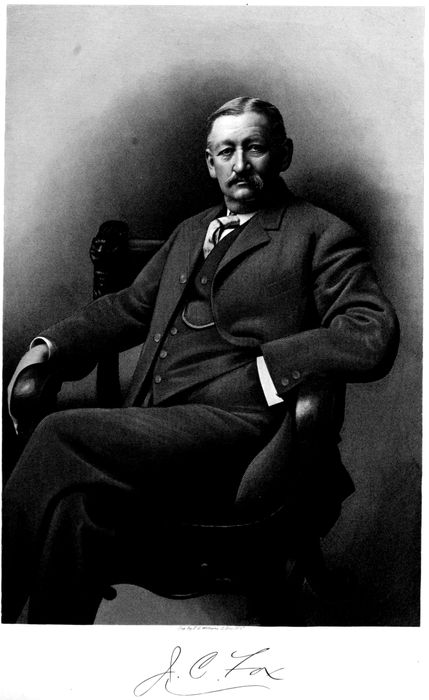
Eng. by E. G. Williams & Bro. N. Y.
A. C. Fox
409Alanson Fox, grandfather of Jared C., removed from Connecticut to a
farm near Sherburne, N. Y., and here Jared Ware was born December 5, 1810.
Rev. Jared Ware Fox was educated for the ministry, studying four years in
Oneida Institute and one year in a seminary in New York City, and for
fifty years preached the Gospel according to the Congregational faith. In
the early days he was sent to Kansas by his church to establish and organize
churches in the new towns and cities building up on the broad prairies. He
formed a church at Burlingame and Ridgeway, Kan., making his home at
the latter place and preaching throughout the country serving churches at
Kunwaka, Waveland, Valley Brook and one year at Lawrence. He spent
one year in Topeka in charge of a church in the capital city. He was a strong
abolitionist and was in his natural element when he first came to Kansas in
1860, the year of the “great drought.” He took an active part in the relief
work in Kansas at that time and sent his son, Jared C., then but eighteen
years of age, back to Galesburg, Ill., where an old friend of the family resided,
to gather potatoes and produce for the sustenance of the drought suffers.
He died March 2, 1898, leaving the following children: Charles G., on
the old homestead at Ridgeway, Kan.; Jared C.; Irving Dwight, deceased;
Herbert Everett, of California; Herman Elliot, Davenport, Iowa. The mother
of these children, Mercy C. (Copeland) Fox, was born February 16, 1816, and
died April 11, 1893.
Jared C. Fox received an academic education in New York and accompanied
his parents to Kansas. At the age of nineteen years he was first
employed in a general store conducted by Crosby Brothers at Valley Falls,
Kan., at a salary of $150 per year and his board. He yearned for a larger field
and came to Atchison in 1862, entering the employ of William Smith, who
owned a dry goods store. During a part of the Civil war he served as clerk
in the commissary department at Rolla, Mo., under Major Grimes for two
years. After the close of the war he was deputy county treasurer under Sam
C. King, and upon Mr. King’s resignation from the county treasurership, he
was appointed to serve for six months finishing out Mr. King’s unexpired
term. He then served as deputy United States marshal under Charles Whiting.
For some years previous to embarking in the drug business he was
410associated in the real estate business with H. Clay Park, former postmaster
of Atchison and editor of The Patriot, and now one of the editors of the St.
Joseph News. In 1869 Mr. Fox made the business venture which was the
turning point of his fortunes and launched him on the high road to financial
success. He entered into partnership with W. C. McPike, S. C. King and
Frank Allen in the wholesale drug business. Later Mr. Fox and Mr. McPike
became the sole owners of the business, Mr. Fox disposing of his interest to
T. M. Walker and the firm removed to Kansas City, where it is still doing
business under the name of the McPike Drug Co. Mr. Fox became interested
in banking and at the time of his death was vice-president of the Atchison
Savings Bank, the oldest State bank in Kansas. He conducted a loan business
as his financial resources increased in strength and he became one of
Atchison’s wealthy citizens.
On December 22, 1868, Mr. Fox was married to a charming southern
lady, Miss Virginia Alexina Tortat. This union was blessed by the birth
of five children as follows: Jared Copeland, Jr., manager of the Howard
Manufacturing Co., of Atchison, and father of eight children, Virginia Parker,
Marjorie Parker, Jared Copeland, Jr., Parker, Amelia Joanna, Lawton,
Edith and William Horan; Edith Fox Jackson, wife of Judge W. A. Jackson,
and mother of two children, Jared Fox and Edmund Valentine; Henry Irving,
wholesale druggist at Wichita, Kan., and father of Everett Cranson, Florence,
Mary Anne and Sarah Virginia Fox; William Tortat, assistant cashier in the
Atchison Savings Bank, and father of one daughter, Mary; Florence, at home
with her mother. The mother of these children, Mrs. Virginia Fox, was born
at Eufaula, Ala., December 20, 1847, a daughter of Henri Sylvest and Nancy
(Decker) Tortat. Henri S. Tortat was born in October, 1811, in France.
He was destined to be a clergyman by his parents, but, having no intention to
enter the priesthood, took part in the three days’ revolution against Charles
X. He left home and joined an uncle who was an officer in the French army
of occupation in Algiers in 1833. He came to America in 1836 when a
young man and was married at Wiscassett, Me., to Nancy Decker, whom he
met at Boston, Mass. After his marriage he took his bride to Charleston,
S. C., and thence to Eufaula, Ala., and conducted a merchandise store there
until he was induced to join a colony of southern people who were going to
Kansas in May, 1857. When he came to Kansas he first took up a homestead
claim and then purchased a bakery at Tecumseh, Shawnee county, but
died July 6, 1858, before he could get fairly settled in the new country. Seven
children were born to and reared by Henri and Nancy Tortat: Henri Alexis,
deceased; Mrs. Amelia Caroline Barry, deceased; Mrs. J. C. Fox; Jean Paul,
411deceased; Augusta makes her home with Mrs. Fox; William Marshall, Peabody,
Mass.; Mary died at the home of Mrs. Fox. Six years after Mr.
Tortat’s demise, the mother and children removed to Atchison, where she
died December 20, 1864.
In his younger days Mr. Fox was a Republican, but later became a Democrat
and was a strong Cleveland adherent. He was a supporter of President
Theodore Roosevelt during his first administration. He was a staunch supporter
of Woodrow Wilson when Wilson was a candidate for the Presidency,
but was generally broad minded in his political views. He was a member of
Washington lodge, Ancient Free and Accepted Masons, Knights Templar,
a Mystic Shriner and an Odd Fellow; he was reared in the Congregational
church atmosphere but after marriage chose to attend the Episcopalian church
with his wife. His death occurred August 23, 1914, when a strong and noble
character passed to the great beyond. Mr. Fox was blessed with a singularly
happy temperament which manifested itself even on his bed of illness; he was
always good humored and had a strong sense of humor which, combined
with a kindly disposition, made him a prime favorite with his friends and
acquaintances. He was a great reader, an expert accountant, possessed a
strong memory and was a Shakespearean scholar, quoting from Shakespeare
while lying on his couch awaiting the last summons, and also quoting the
Twenty-first Psalm on his last day on earth. He served the city as a member
of the city council and was president of the school board for a term, being
of material assistance in handling their financial affairs, because of his genius
in this direction.
The Western Advocate, Mankato, Kan., in an issue of July, 1899, has
this to say in part regarding one of the most remarkable family reunions ever
held in Kansas or anywhere in the country: “Without doubt the most remarkable
family reunion ever held in Jewell county has been for the past week
at Burr Oak and among the various members of the family in that vicinity.
It is the reunion of the eleven children, together with many of the sixty-four
grand children of the late James Pennington and Susan Wisdom Pennington.
The Pennington family is a Southern family, the elder Pennington being a
native of Tennessee, and his wife of North Carolina. All of the eleven children,
however, with the exception of the oldest son, were born and raised in
Missouri. The Pennington family is remarkable in that there were just
412eleven children and they are all living and enjoying good health, although the
youngest is now fifty years of age, the eldest being a little past seventy. These
family reunions, which are an annual event, prove that the family tree, nourished
by the good old warm Southern blood, is still bearing the fruits of hospitality
and good cheer. Once a year they get together, parents, children and
grand children, and the ties of family, of kinship, and affection are drawn a
little closer. Hearts are cheered, lives are brightened and days are lengthened.”
Speaking of the gathering on Saturday of the reunion week, the
Western Advocate goes on to say: “On this day a company of one hundred
gathered around the banquet board, and the eleven brothers and sisters were
weighed and their combined weight found to be 1,832 pounds, an average of
166 pounds each.”
The father of this remarkable family was James Pennington, a native of
Tennessee, born in that State in 1822, and was there married to Susan Wisdom.
They migrated to Missouri in the early thirties and settled in Nodaway
county, developing a fine farm until the discovery of gold in California. James
then set out across the plains and mountains to the gold fields of the New Eldorado
in quest of fortune. While in California he became a freighter and
transported flour and provisions to the mining camps afoot. He would carry
a fifty pound sack of flour a distance of sixteen miles and was paid at the rate
of $50 per sack for transportation, the flour costing $50 per sack at the point
of purchase and being valued at $100 when it was taken to its destination by
the carrier. James, Sr., remained in California until 1851 and then returned
to his home and family in Missouri, where he lived the remainder of his days,
dying in 1878, in Platte county. James and Susan Pennington were the
parents of eleven children as follows: William W., born in 1837, died February,
1913, at Lebanon, Kan.; John Thomas, California, born in 1839; Mrs.
Telitha Thorp, Marysville, Mo., born in 1841; Mrs. Julia Denney, Benedict,
Kan., born in 1842; Mrs. Clementine Conner, Santa Ana, Cal., born in
1844, a widow; Mrs. Nancy Miller, California, born in 1845, a widow; James
Emery, with whom this review is directly concerned; Mrs. Sarah Robertson,
Elk City, Okla., born in 1849; Mrs. Mary Robertson, Burr Oak. Kan., born
in 1853; Mrs. Cynthia Jane Judy, Burr Oak, born in 1855; Mrs. Rocksinah
Graves, Burr Oak, Kan., born in 1857.
James Emery Pennington, retired farmer of Potter, Kan., was born on a
farm in Nodaway county, Missouri, October 30, 1847. He was reared on
the farm in Missouri until seventeen years of age, and he then left home and
crossed the plains. The occasion of his going was because of the fact that
two brothers and three brothers-in-law had already enlisted in the Union army
413for service in the Civil war, and the father felt that he could not spare his
son, James E., so it was agreed between father and son that the boy should go
west for a time. He made his way across the Missouri to Ft. Leavenworth
and there joined an overland freight train which was bound for Salt Lake
City, Utah. At that time all the freight and merchandise west of the Missouri
river was transported in wagons, drawn by horses, mules or oxen.
These wagons were loaded with from six to twelve thousand pounds of merchandise
and were drawn by teams ranging in numbers from twelve to twenty-four
animals. From twenty to forty men, wagons and teams constituted
what was then known as a “freight train.” The train to which young Pennington
attached himself consisted of forty wagons, forty teamsters, two
wagon masters, four assistants, two night herders, and two extras, in all, fifty
men, four hundred and ninety oxen and a few horses for herding purposes.
Being a farmer boy and having a working knowledge of animals, young
Pennington soon made himself indispensable to the outfit and received the
name of “Our Boy” from the other men in charge of the train. The train
proceeded its long way over the plains of Kansas and followed the valley of
the South Platte to the Rockies without mishap, other than a few Indian skirmishes.
In October of 1864, “Our Boy” stood on the crest of the Rockies with
one foot on the Atlantic and one foot on the Pacific slope. Winter soon came
on and stock perished and they arrived at their destination in the dead of
severe winter. Young Pennington spent the winter in the home of a Mormon
family, consisting of a Mormon and his seven wives. From Utah he
went north into Idaho and Montana, and in that region took up his favorite
pursuit of freighting, which he followed for four years. His operations were
mainly from Ft. Benton, the head of navigation on the Missouri river, to
which point the river steamers carried the freight destined for the mining
camps of the mountain regions. He, with others, transported the first quartz
mill to the mining camp, later widely known as Butte City, Mont. He returned
home in 1869 and lived there for three years, coming to Kansas in
1872. He had saved some capital which he brought with him to Atchison
county, and invested this money in a herd of cattle which he grazed upon the
free ranges, in this manner getting his first real start in life, and which was
the beginning of his later prosperity. After his marriage in 1872 to Elizabeth
Snoddy, he and his wife settled on the home farm of the Snoddy’s, and at the
end of one year the father of Mrs. Pennington deeded the young couple eighty
acres of land which became the nucleus of their present acreage. This land
is four miles east and one-half mile south of Potter. Leavenworth county,
and the farm has been increased to 320 acres of well improved land. Mr.
414Pennington removed to Potter in the spring of 1916, from the farm in Leavenworth
county, and has recently completed a fine, modern, ten-room residence
which will serve as his future domicile during the remainder of his days.
James E. Pennington was married February 1, 1872, to Elizabeth, daughter
of Thomas and Margaret (Brown) Snoddy, the former a native of Tennessee,
and the latter a native of Missouri. Thomas Snoddy first came to Kansas
in 1854, and preëmpted the farm which he improved and where his children
were reared. He was a Mexican war veteran and the Government gave him
for his services a grant of land in northwestern Missouri, which he sold for
$1,600, and with the proceeds of the sale built his home on his preëmption in
Kansas. The upper part of the house was used as headquarters for the
Kickapoo Masonic lodge for many years. Thomas Snoddy was born August
27, 1825, and died October 8, 1909. His remains were interred in the
Round Prairie cemetery. A remarkable fact about the Snoddy house is, that
the roof existed without repairs for over fifty-five years and at the time of its
repair by Mr. Pennington, the excellence of the material which went into the
building of the house excited newspaper comment. Mrs. Pennington was
born on September 25, 1856, and lived her whole life on the farm which her
father preëmpted.
The following children were born to Mr. and Mrs. James Emery Pennington:
Rebecca, wife of William Ehart, of Atchison county, Kansas; Bessena,
wife of Joseph James, of Atchison county, a farmer and horse and mule
dealer; Roxie, wife of John Goff, of Potter, Kan., a thresher and farmer;
Thomas W., living on the home farm; Frank P., a lumber merchant, of Burr
Oak, Kan., who was associated with his father in the grain business in Potter,
in 1906; George, a farmer living in Leavenworth county; Mamie, a student
in the Potter High School.
Mr. Pennington, with others in his neighborhood, organized and placed
in operation the Farmers’ Elevator Company, of which he was president.
This concern built the Potter grain elevator and later sold it to H. A. Ode.
He has long been identified with the Democratic party, but has never sought
political preferment of any kind. At the time of the organization of the Potter
High School district, Mr. Pennington was one of the prime movers in the
building of the new high school building. Perhaps the best known trait of
this grand old pioneer is his inherent hospitality, which has made him famous
and one of the best loved men in his section of the State. Concerning a great
Christmas celebration held at the Pennington home in 1911, the Atchison
Globe, of December 27, 1911, says:
“J. E. Pennington, a well known farmer of the Round Prairie neighborhood,
415south of town, always provides a big entertainment for his immediate
friends and relatives every Christmas, and spares no pains or expense to make
these annual affairs highly enjoyable. The late holiday was no exception to
the rule. On Monday quite a crowd gathered at Mr. Pennington’s home, as
usual, and spent a day of merriment. A big Christmas tree loaded with almost
everything conceivable in the way of holiday gifts, was provided by Mr.
Pennington; a big dinner was also served, and in the afternoon the men indulged
in a hunt. A long wire was stretched across a field, with a horse
hitched to each end of it. The wire was thus dragged across the field and in
this manner all of the rabbits were scared up. The men followed behind the
wire and shot the rabbits as they jumped out. Four jack rabbits were scared
up and one of them killed; also many cottontails. It is said that Mr. Pennington
expended nearly $200 on this affair. He is a very prosperous farmer and
is noted for his hospitality.”
Dr. Earl A. Gilmore, veterinary surgeon, of Effingham. Kan., was born
September 27, 1887, at Ames, Iowa, a son of William T. and Jerusha (Norton)
Gilmore. His father was born in 1850, in New York State, and when
an infant accompanied his father, George Gilmore, to Iowa. His mother
was born at Zearing, Iowa, November 10, 1855, and died March 7, 1898.
William J. was reared on the pioneer farm in Iowa, and was able when a
young man to take advantage of the opportunity to amass wealth in the new
and rich State, which was being developed during his day and lifetime. He
was married September 5, 1869. He became one of Iowa’s most prosperous
farmers, and in his later days, when he retired from active farm work, he
traveled extensively throughout the country, visiting many points in the West,
and the Philippine Islands. On February 1, 1915, while aboard a Missouri
Pacific train en route to Kansas City, the train was wrecked, and he was
injured to such an extent that he was laid up in the hospital at Kansas City
for several weeks, and then returned to his home at Ames, Iowa. There
were ten children in the Gilmore family: Mrs. Uretta Stevens, of Star City,
Mich.; Mrs. Maria Pellersells, of Grand Rapids, Wis.; Maines Gilmore, now
in Alaska; Charles, of Greeley, Colo.; George, living in Iowa; William, a
college professor at Winnipeg, Canada; Earl A., the subject of this review;
Mrs. Eva Burton, of Ames, Iowa; Ella, deceased: one child died in infancy.
The mother of these children was a daughter of Isaac Gilmore, a native of
416Ireland. The Gilmore family is also of Irish descent, all four of Dr. Gilmore’s
grandparents having emigrated from the Emerald isle.
Earl A. Gilmore was educated in the Nevada (Iowa) High School, and
studied at Drake University for one year; the Iowa State College at Ames
for two and one-half years; then studied for two years in the Kansas City
Veterinary College, graduating April 16, 1912. His funds being exhausted,
when he decided to become a veterinary surgeon, he found it necessary to
work his way through his final college course, by doing reportorial work
on the staff of the Kansas City Star. Upon his graduation he immediately
located in Effingham and has built up an extensive practice in his profession,
covering a territory of twelve miles, north and south, and nine miles, east
and west.
Dr. Gilmore is a member of the Missouri Valley Veterinary Association,
and the National veterinary fraternity, the Kansas City chapter of the Delta
Alpha Psi. He is a Republican in politics and is fraternally affiliated with
the Independent Order of Odd Fellows lodge and the Knights and Ladies of
Security. Dr. Gilmore takes a keen and active interest in the civic welfare of
Effingham and is usually found in the forefront of undertakings which are
intended to promote the best interests of the city.
In writing the history of a city and county such as Atchison, the reviewer
very naturally finds that among the large number of men who have had much
to do with the upbuilding of the community, and who can be counted among
the really successful men of the period covered, there are few who stand out
preëminently among their fellows, and whose individuality looms far above
the average, and who are noted not only for their individual accomplishments
on their own behalf, but who have performed deeds which have endeared
their memory to posterity for generations to come. In this respect we must
consider the late Alfred Jonathan Harwi, founder of the great A. J. Harwi
Hardware Company, millionaire, statesman, and philanthropist, of Atchison.
Mr. Harwi will long be remembered as one of the leading figures in the business
world of Atchison. He was a pioneer in the establishment of the great
wholesale houses which have made Atchison famous over the western country.
Beginning his career a poor man, endowed with financial and business ability
of a high order, blessed with a keen foresight into the future, having confidence
in the ultimate development of the country, tireless and industrious in
all his undertakings, he achieved a truly remarkable success, and through it
all he was a man among men, who never lost the respect and regard of his
fellow men because of his great success in the realms of business and finance.
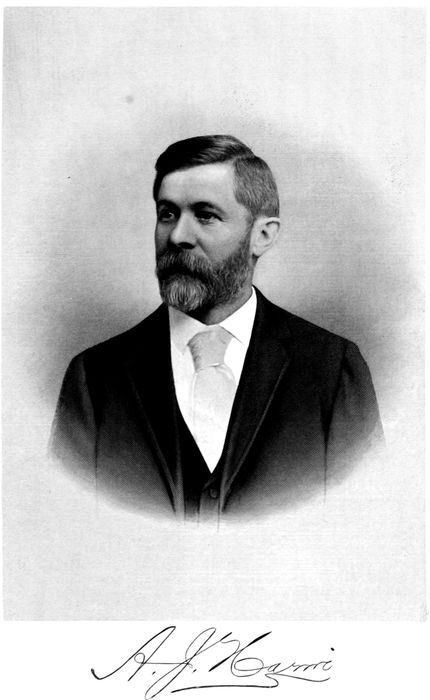
417Alfred Jonathan Harwi was born at Ritterville, Lehigh county, Pennsylvania,
January 21, 1847, the eldest of four sons, born to Michael and Lucretia
Harwi. One of the children died in infancy, and the others, Edwin C. and
W. H., followed Alfred J. to Atchison and became associated with him in the
hardware business which he had established. Edwin C. died September 4,
1903, and Wilson H. Harwi died May 30, 1911. A sister died in Pennsylvania
when but a child. Michael Harwi followed the trade of carpenter in
heavy construction work during his life, and was engaged in the building of
canal locks in the days when the construction of internal waterways was in
vogue. He was also a farmer, and at the time of his death was engaged in
quarrying and contracting for slate. His sons having all come to the West, he
made preparations to join them here in Atchison, but on the point of his departure
on October 8, 1882, he was taken ill and died. His widow, Lucretia
Harwi, then came to Atchison and resided here with her children until her
demise, in November, 1904.
A. J. Harwi received his education in the schools of his native State,
attending the district school of his neighborhood until ten years of age, then
becoming a student at a Moravian school in Bethlehem, which was located
four miles from his home and required him to walk the distance across a
mountain both morning and evening. After spending two years in diligent
study in this institution he entered a general store at Bethlehem for the purpose
of acquiring business experience. However, while learning the art of
barter and trade over the counters of the general store he did not neglect the
cultivation of his mind. He read, listened and learned, and in his spare time
continued his studies until his mind was broadened and he became a man of
advanced thought, learned to read and judge his fellow men, and acquire
a refinement and polish which in later years assisted him in his undertakings
and enabled him to command the respect of his fellows. His ambition was to
eventually engage in business for himself, and he saved his money to this end,
and in 1868, when he was twenty-one years of age, he became a partner in the
furniture business with J. B. Zimmele, but sold out two years later and hearkened
to the advice of Horace Greeley, who said: “Go west, young man, go
west, and grow up with the country.” While at Bethlehem Mr. Harwi married
Cora Wheeler, with whose father he became associated in the hardware
and implement business at Butler, Mo. When this partnership was dissolved
418a few years later, Mr. Harwi went to Cedar Rapids, Iowa, and for a few
months was a clerk in a hardware store. In the year 1875 he came to Atchison
equipped with considerable commercial experience, but having little capital.
He and C. H. Dearborn began a retail hardware business in a small
way in the building at 408 Commercial street. The concern prospered
from the start and its success was undoubtedly due to Mr. Harwi’s intelligence
and common-sense business methods and his wonderful capacity for hard and
unremitting work. This hardware business soon became one of the leading
local business enterprises of the rapidly growing city of Atchison. Like
other men who have been successful in life, Mr. Harwi was visionary, but his
vision did not take on the dream-like character. It was practical and foresaw
the inevitable development of the western country and an increased demand
for all kinds of products as the country became more and more settled. He
believed in common with others of the period that Atchison was destined to
become the gateway and the distributing point for a large section of territory.
Acting upon this sound, practical belief in the early eighties when the retail
business had assumed large proportions and necessitated expansion in other
ways, he conceived the idea of engaging in the jobbing business. He did so,
and again his wonderful business acumen and ability came into play, with the
result that the A. J. Harwi Hardware Company is known throughout the
West and middle West, and has done a noteworthy part in making Atchison
famous as a wholesale center. The result of its founder’s vision and industry
is one of the great wholesale houses of the West, represented by about twenty
traveling salesmen covering four States, while over fifty local employes are
engaged to handle the vast amount of office work and the great warehouse
and shipping details incident to such an important commercial institution as
the A. J. Harwi Hardware Company has developed into within thirty-five
years. Their commodious four-story office and warehouse building, located
on the corner of Commercial and Ninth streets, is one of the handsome modern
business houses of Atchison. One can begin to realize the scope and extent
of this business when he stops to think that it requires 75,000 feet of floor
space to afford ample warehouse facilities. In 1889 the A. J. Harwi Hardware
Company was incorporated with a capital stock of $100,000.
Mr. Harwi was three times married. His first wife, Cora Wheeler,
whom he married in Bethlehem, left one daughter, Mrs. E. P. Ripley, of
Boston. His second marriage was with Elizabeth Whitehead, of Atchison,
in 1873, to which union two children were born: Mrs. H. P. Shedd, of Bensonhurst,
Long Island, and Frank E., president of the A. J. Harwi Hardware
Company. The mother of these children died October 14, 1907. Mr. Harwi’s
419third marriage occurred June 3, 1909, to Mrs. Mary E. Holland, who survives
him. Mr. Harwi passed away September 5, 1910. During his later
years the stress of business and the ceaseless activity which had been his lot
during life began to tell upon him, and for over twenty-five years prior to his
demise he was a sufferer from locomotor ataxia. The things which he
accomplished necessarily demanded that he be a hard and tireless worker,
but he never spared himself, and at a time when he should have begun to conserve
his bodily strength he worked the hardest, with the result that his span
of life was shortened under what it might have been.
It is not alone through the magnificent mercantile concern which Mr.
Harwi conceived and built up that he is known, but he was a public spirited
gentleman who contributed generously to charity and philanthropic work.
Although he accumulated wealth outside of his business to exceed a half million
dollars and loaned out considerable money on mortgages, he was never
known to have taken advantage of a debtor and to foreclose a mortgage.
Although he was a member of the Congregational church, he was a trustee of
Midland College, Atchison, and established and endowed the Harwi scholarship
prizes, which have been of inestimable benefit to many young students.
He was one of the trustees of the Atchison County High School at Effingham,
and was also a warm advocate of providing well for the education of the
youth of the community. Mr. Harwi was elected State senator from
the Atchison district in 1884, but did not allow his duties as legislator
to interfere with his business affairs, it being his custom while the legislature
was in session to spend the day in the legislative halls at Topeka,
return home and spend the greater part of the night in the supervision of the
business. His ability as a legislator came naturally into the limelight, and
there was talk of running him as the party’s candidate for governor of the
State, but this talk met with little encouragement from Mr. Harwi, inasmuch
as he was wrapped up heart and soul in the reorganized Harwi Hardware
Company at the time, the project demanding all of his time and energy.
Frank Edwin Harwi, president of the A. J. Harwi Hardware Company,
is one of Atchison’s live young citizens who is following in the footsteps of
his highly successful father. Mr. Harwi is in charge of the extensive wholesale
hardware concern founded and built up by his father, A. J. Harwi.
420Frank E. Harwi was born October 11, 1884, in Atchison. He received his
education in the public schools of his native city and in the Andover Preparatory
School at Andover, Mass. He matriculated as a freshman at Yale University,
but was called home by the illness of his father, and he became his
father’s assistant for the ensuing year. In 1905 he entered the sophomore
class of Kansas University, but gave up his college course in 1906 to enter his
father’s hardware establishment, and upon his father’s demise took over
the active management of the concern and became president of the A. J. Harwi
Hardware Company.
Mr. Harwi was married September 30, 1908, to Miss Florence Cain,
a daughter of John M. and Lucy Cain. To this union two children have been
born: Alfred J., born August 22, 1909, and Lucy E., born January 12, 1912.
John M. Cain, father of Mrs. Harwi, was born July 30, 1839, at Castletown,
Isle of Man. He was educated in the select schools of his native island, learned
the carpenter’s trade and emigrated from the Isle of Man in 1856, locating in
Kansas, where he was successively farmer, soldier, merchant and banker.
He was a volunteer soldier in the company organized by A. S. Speck and Asa
Barnes, and was accepted for service in 1862, enlisting in Capt. P. H. McNamara’s
company, of which he became sergeant, and upon the organization
of the regiments of colored troops he was appointed first lieutenant of a company
in the Eighty-third regiment, colored infantry. He was afterwards commissioned
a captain and did splendid service throughout the Civil war. After
the close of the war he farmed in Atchison county, became a merchant, and
was connected with the old Atchison State Bank. He died in 1897. Mr.
Cain was married May 15, 1879, to Lucy Neerman, a daughter of Frank and
Isabella (Rust) Neerman. The following children were born of this marriage
Eva, wife of Foster Branson, of River Forest, Ill.; Ralph R., a banker,
at Ada, Okla.; Florence, wife of Frank E. Harwi; John Milton, with the A. J.
Harwi Hardware Company: William O., an attorney in Atchison, and Alfred
Neerman, deceased.
Mr. Harwi is an independent in politics. He was one of the organizers
of the Atchison Commercial Club and served as president of this thriving
organization in 1913, and is at present a member of its board of directors.
He is a member of the board of trustees of Midland College and is a member
of the Atchison city board of education. He has likewise been one of the
trustees of the Atchison city hospital since its establishment. While the
responsibilities connected with the conduct of the great business establishment
thrust upon his shoulders at the demise of his father have been such as would
probably daunt the young man of average ability, Mr. Harwi has shown that
421he fully measures up to the requirements of his important position in the
mercantile world and has made a reputation on his own individual account
as a business head of decided executive ability of a high order.
When Joseph Trumpeter departed this life Effingham lost one of its
best and most-highly respected citizens and his family suffered the lost of a
kind and industrious husband and father, whose sole ambition in life was to
provide well for his kindred and those dependent upon him for a livelihood,
and to accomplish his purpose in the most honorable and upright manner
possible. To him fell the task of erecting the first county high school building
in Effingham, and many of the most pretentious dwellings of the city were
built by him. He was one of the widely known and successful contractors
of the county, whose operations extended over a wide stretch of territory, and
whose work was always strictly up to a certain high standard and honestly
performed.
Mr. Trompeter was born June 15, 1857, in Prussia, Germany, and when
ten years of age he accompanied his parents to America. His father was
Maurice Trompeter, who settled on a farm in Illinois and who went from Illinois
to Texas, but after a short residence in that State returned to Illinois,
where he passed the remainder of his days. Joseph was reared to young
manhood in Illinois and there married Hannah Sowers. He also went to
Texas and removed from there to Horton, Kan. His father before him was
a carpenter and Joseph learned his trade and followed it, becoming a contractor
and builder when a young man. He erected several court houses in
Texas, and built several school buildings and church edifices in Kansas. His
first wife died in Horton, Kan., eight children being born to this union, of
whom two are living, namely: Mrs. Tina Demmer, of Effingham. Kan.; Mrs.
Bertha Wallace, also residing in Effingham. Mr. Trumpeter removed to
Effingham, and at once engaged in building and contracting on an extensive
scale. He erected all the buildings on the main street of the town, on the
north side of the street, running from the banners and Merchants Bank building
to the newspaper office, at the end of the block. He also built the greater
part of the finer residences in Effingham and it is due to his handiwork and
taste that the city presents such an attractive appearance to the visitor. In
the spring of 1912 he and the family moved to his farm of 160 acres southeast
422of Effingham on which with his own hands Mr. Trompeter erected a
handsome farm dwelling and fitted it with all modern improvements, adding
an attractive barn at the same time. He did not live to enjoy the comforts
of his new home long, however, as illness brought on by overwork, caused him
to take to his bed and his demise occurred August 19, 1915.
His second marriage was with Louise Richter, on November 8, 1892, at
Effingham. Four children were born of this marriage, namely: Amelia,
John, James and Mary, all of whom are at home with their mother. Mrs.
Trompeter was born in Austria, in 1874, a daughter of John, born September
2, 1852, and Amelia (Wohletz) Richter, born May 31, 1849. The Richters
are of German birth and immigrated to America in 1882, first residing in
Atchison and then coming to Effingham. For twenty-eight years Mr. Richter
was employed in railroad work on the Central Branch of the Missouri
Pacific railroad. Mr. and Mrs. Richter now make their home with their
daughter, Mrs. Trompeter, and assist in the farming operations. The Richter
children are as follows: Mrs. Joseph Trompeter; Domineck, conducting a
meat market in Effingham; Leapold, living at Tacoma, Wash., also a builder
and contractor; Mrs. Amelia Hansen, residing in Texas; Mrs. Anna Royer,
Tacoma, Wash. There are eleven grand children in the Richter family.
Mr. Trompeter was affiliated with the Democratic party, but was never
a seeker after political preferment. He was a member of the Catholic church,
and was fraternally connected with the Knights of Columbus and the Modern
Woodmen. Throughout his life he was an industrious and hard-working citizen
who did his duty as he saw it and lived an upright and honest life. He
was prominently identified with the civic life of Effingham and was highly
respected for his many excellent qualities.
Joseph N. Arthur, automobile salesman and garage proprietor, of Effingham,
Kan., is one of the progressive and enterprising business men of
the second city of Atchison county. Signal success has attended his efforts
during the years he has been a resident of Atchison county. He embarked
in the automobile business and established a garage in Effingham, despite
the fact that predictions were made that the venture would not be a success,
and Mr. Arthur as a result is the recognized pioneer automobile man of
his part of the county. Since taking the agency for the Ford cars in 1912,
he has sold over half the total of Ford cars sold in the county and vicinity.
423Mr. Arthur first started in business in 1910 and established a small garage
in the rear of his real estate office. His business grew to such an extent
that larger quarters became necessary, and in 1913 he erected a large concrete
building, forty by eighty feet in extent, in which is incorporated his
office, display and repair rooms. He employs a skilled mechanic, assistant
and driver. Mr. Arthur handles the Dodge Brothers, the Maxwell, and
Ford automobiles.
J. N. Arthur was born June 3, 1869, near Corning, Adams county, Iowa,
and is a son of John and Martha Arthur, natives of Ohio. Both parents
were reared in the old Buckeye State, and were early pioneer settlers in
Iowa, coming from Bucyrus, Ohio, in 1855, and driving overland via the ox
team route, with all their movable possessions loaded on wagons en route
from St. Joseph, Mo., to their destination in Adams county, Iowa. John
Arthur homesteaded Government land in Adams county and preëmpted along
the river where timber and water were plentiful. He prospered as the years
went on and the country became more and more settled, and he became the
owner of over 800 acres of excellent Iowa farm lands. He resided in Adams
county, Iowa, until his demise, in 1907.
John Arthur settled on the banks of a river for the purpose of having
timber, fuel and water, three essentials in keeping alive in the then sparsely
settled country in the southwestern part of Iowa. He built a log cabin of
logs hewn from trees chopped down with his own hands and chinked the
cracks and crevices with mud. When he preëmpted his first tract of land
in Iowa he had a yoke of oxen, $10 in money and a favorite bull-dog, things
which he was fond of telling about as he grew older and more prosperous.
During his fifty-two years of residence in Iowa he accumulated 800 acres
of land and had money loaned out to the amount of $10,000. He was the
father of eleven children, nine of whom grew to maturity, each of whom
as he married was assisted by the father to settle on a farm of his own, and
all have prospered—an enviable record for a pioneer family to make.
Joseph N., with whom this review is directly concerned, was reared on
the Iowa farm, and knew something about the hardships of the pioneer days
in his boyhood. He attended the district school in his neighborhood, and
followed farming until he engaged in the implement business in his home
county for some years, with a fair degree of success. He left his native
State in 1904 and came to Effingham, Kan., purchasing 120 acres of land
about one and one-half miles distant from Effingham in Atchison county.
One year later he embarked in the real estate business, in partnership with
B. F. Snyder. This partnership lasted for two years and then Mr. Arthur
424engaged in the business for himself. He also began to write insurance, and
was reasonably successful in both the real estate and insurance business. He
erected a brick building for his office quarters, and, when automobile owners
multiplied in Effingham and vicinity he foresaw the need of a repair shop
and established one in the rear of his real estate office. He soon afterward
rented an abandoned garage and hired a mechanic to do the repair work.
It was not long until larger quarters became necessary, and he built as told in
a preceding chapter. In July of 1915, Mr. Arthur disposed of his insurance
business, and has since devoted his energies entirely to the automobile
business.
He was married in 1892 to Lillie M. Ramsey, daughter of Newton Ramsey,
a pioneer settler of Adams county, Iowa, and a Union veteran of the
Civil war. Four children have blessed this union: Pearl, aged twenty-one
years; Jennie, aged eighteen years, and a teacher of music, and an accomplished
musician; Le Roy, nine years of age; Charles, three years old. Three
children are deceased: Chester A. died at the age of eight years; Milton died
at the age of eighteen months; Blanche died at the age of nine months.
Mr. Arthur is a Republican in politics, and has identified himself more
or less with the civic life of his adopted community, and is considered as one
of Effingham’s best boosters and live wires. He is a member of the Methodist
Episcopal church, contributes to the support of the same, and is affiliated
with the Odd Fellows lodge and the Knights and Ladies of Security.
It is a pleasure for the biographer to write a story of the life of a man
who has arrived at the evening of life and be able to record something really
worth while for the benefit of posterity. The life annals of a man who has
succeeded in making a name for himself, achieving a well deserved competence,
and been of some use to his community, and has arrived at the time of
life when he can look back over the vista of the busy years that have passed,
is interesting to a high degree. In D. C. Newcomb, pioneer merchant and
patriarch, of Atchison, we find embodied that spirit of the West which enabled
men to build up this great country and to achieve things of importance
in the business and civic world. Mr. Newcomb loves his home city, its people
and prestige and is proud of its standing among the cities of the West. He
has had no small part in the upbuilding of Atchison, and it would have been
better in the days gone by if the city had more men like him to assist its
growth. Ever ready to contribute to any enterprise which might help the
growth of the city, his liberality and boosting proclivities became proverbial,
and it has oft been a saying of his that Atchison could just as well have been
a city of fifty or sixty thousand inhabitants as to be its present size. Such
men as he are of decided benefit to any community.
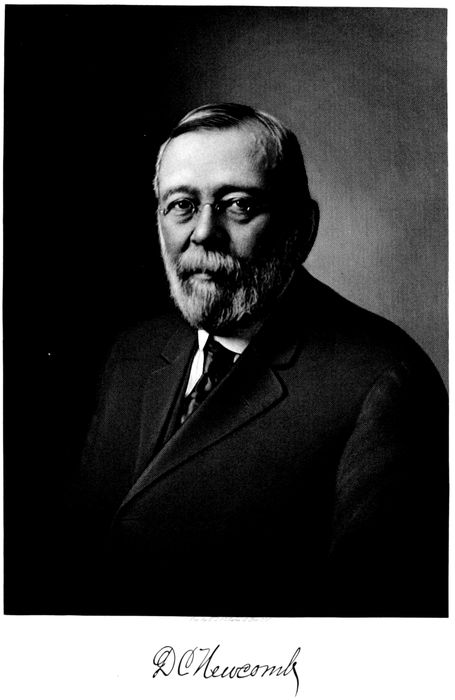
Eng. by E. G. Williams & Bro. N. Y.
D. C. Newcomb
425D. C. Newcomb, a pioneer merchant of Atchison, perhaps has had as
much to do with the commercial development of Atchison county for the past
half century as any other man within its borders. When Mr. Newcomb came
to Atchison county in 1858 it was a difficult matter to tell whether Atchison,
or its rival town, Sumner, was to be the chief town of the county. Sumner
was a thriving frontier town, but Mr. Newcomb picked Atchison as the winner
and time has demonstrated that his judgment was sound. D. C. Newcomb
was born in Washington county, Vermont, on Friday, July 13, 1836,
and is a son of Hosea and Harriet (Bixby) Newcomb, the former a native
of New Hampshire and the latter a native of Roxbury, Mass., born in 1805.
Hosea Newcomb was born in 1803 and came from a prominent New England
family of English descent. The Newcomb family was founded in New England
in 1635 by Francis Newcomb and his wife, who came from England and
located in New England at that time. It is recorded that they made the voyage
on a sailing vessel named “Planter.” Hosea Newcomb, the father of
D. C., was prominent in the affairs of his native town, Waitsfield, Vt., where
he remained until 1859, when he came to Kansas, settling at the new town of
Sumner, now extinct, in Atchison county. He took an active part in the early-day
development of that promising frontier town and served as postmaster
there. However, he returned to Vermont in 1873, where he died in 1889,
at the age of eighty-six, and his wife passed away March 17, 1903, age ninety-seven
years, eight months and one day.
426
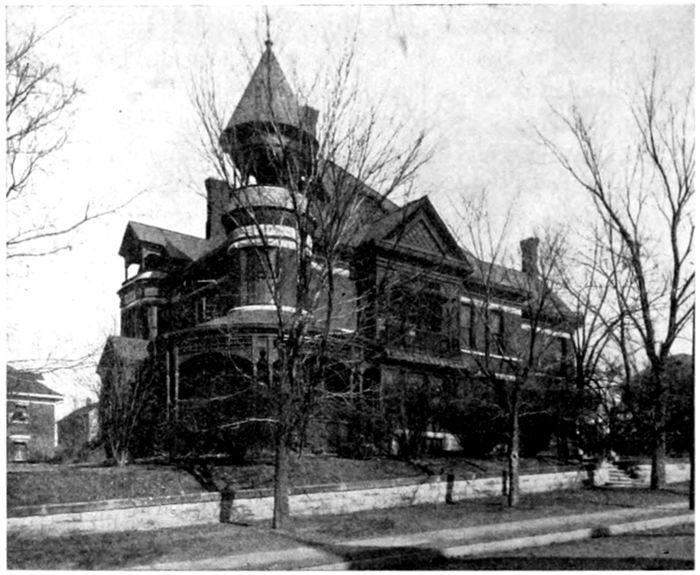
Residence of D. C. Newcomb, Atchison, Kan.
D. C. Newcomb was one of a family of five children and is now the only
one living, except a sister, Mrs. Lydia M. Shephard, of Minneapolis. A
brother, Dan J. Newcomb, was a very early settler in Atchison county, coming
here some time before D. C. arrived. He was prominent in the organization
of Atchison county and was the first register of deeds of the county,
D. C. serving as his deputy. D. C. Newcomb was reared in the town of
Waitsfield, Vt., where he attended the public schools and later was a student
at Newbury Seminary. In early life he clerked in a store at Johnson, Vt., and
also clerked for a time in Montpelier, Vt. In 1858 he came to Atchison
county and first landed at Sumner, but immediately went to Atchison, and,
although the latter town was also in its early stages of development, the location
impressed Mr. Newcomb so favorably that he determined to locate there.
Soon after coming here he was appointed deputy register of deeds and served
in that capacity for three years. He then engaged in clerking in a store, and
in 1864 entered into partnership with Samuel Gard, who had been a fellow
clerk of his, and they organized the firm of Gard & Newcomb and engaged
in the mercantile business. Their capital was limited, perhaps less than $2,500,
but they were two industrious young men and had a reputation for honesty
and square dealing, which was an important asset. Mr. Newcomb went to
New York and bought a stock of goods valued at about $15,000, mostly on
credit, and at the end of the first year they had paid for every dollar’s worth
of goods which they had bought in the meantime and had a stock of about
$15,000 worth on hand. The partnership arrangement continued about four
years, when Mr. Newcomb purchased his partner’s interest, who desired to
dispose of his business on account of failing health. Mr. Newcomb continued
in business alone and conducted the great Newcomb department store, the
business of which developed far beyond his most fanciful dreams. Mr. Newcomb
continued in the mercantile business until 1905, and for years was the
427leading merchant of Atchison. He sold his business to Ed Lake, who has
conducted it since 1905.
Mr. Newcomb has not only been a merchant prince in northeastern Kansas,
but has been identified with the growth and development of Atchison
from many standpoints. He was one of the organizers of the First National
Bank and was closely identified with that financial institution for fifteen years.
He served successively as director, vice-president and president, but when he
went out of business he disposed of his banking interests.
Mr. Newcomb was united in marriage in 1866 with Miss Anna E.,
daughter of Capt. George W. Bowman, an early-day steamboat captain, but
later engaged in the mercantile business at Atchison. He was a native of
Brownsville, Pa. To Mr. and Mrs. Newcomb have been born two children:
Hattie May, now the wife of Maj. Harry A. Smith, U. S. A., a graduate of
West Point Military Academy. During the Spanish-American war he held
the rank of major in the Twenty-first regiment, Kansas infantry, and is now
major in the Twenty-eighth regiment, United States infantry, doing duty on
the Mexican border. To Major Smith and wife have been born two children:
Newcomb, a cadet in the United States Military Academy, West Point, N. Y.,
and William A., a graduate of Shattick’s school, Fairibault, Minn., now a
student in the University of Minnesota. George Edgar, the youngest child
born to Mr. and Mrs. Newcomb, born March 19, 1869, died March 25, 1909,
aged forty years. He was married in October, 1895, to Miss Dorothy Jones,
a native of Wisconsin, and three children were born to this union: Clara
Forest, D. C., and Charles Jones. Mr. Newcomb has been a life-long Republican
and has always supported the policies and principles of that party. He
has had many flattering inducements to enter politics, but has refused to accept,
preferring to follow his commercial career in which he has been so successful.
Mr. and Mrs. Newcomb are members of the Methodist Episcopal
church, and for years have been active in the work of their congregation and
both have lived exemplary Christian lives. Mr. Newcomb has held every office
within the gift of the church, all of which have come to him without
solicitation. In fact, every preferment has come to him unsolicited. In 1896
and 1900 he was elected a lay delegate to the general conference of the Methodist
Episcopal church held at Omaha in 1896 and Chicago in 1901.
Wilson R. Smith, of the firm of Snyder, Smith & Company, Effingham,
Kan., is an admirable type of a successful business man who has been a resident
of Effingham for the past six years, and has so identified himself with
428the life of the community that it seems to the average citizen that Mr. Smith
has been a resident of the city and county all of his natural life. The firm,
of which he is an active member, handles hardware, implements, grain, coal
and feed, and is composed of G. M. Snyder, W. R. Smith and U. B. Sharpless,
present county treasurer. This firm was organized in February of
1915 and took over the business of Sharpless & Snyder. The concern also
operates a grain elevator of 10,000 bushel capacity, and has two large warehouses
and coal-yards, in addition to the business room on Main street.
Mr. Smith is a Virginian by birth, and was born at Salt Sulphur Springs,
Monroe county, W. Va., on April 28, 1856. He is a son of Granville and
Caroline (Clark) Smith, both of whom were born and reared in Virginia, and
were descended from colonial ancestors. A direct ancestor of Wilson R. was
the first settled in Monroe county, and headed a long line of tillers of the
soil, the parents of Wilson R. living on their farm in Virginia until their
deaths.
Wilson R. left his ancestral home in Virginia in April of 1884 and
journeyed to the town of Craig, Holt county, Missouri, purchasing a farm in
the neighborhood of Mounty City, which he cultivated with considerable
success for ten years, and then engaged in the grain and stock business for
a period of nine years. He resided in Holt county until 1909 and then came
to Effingham, Kan. His first venture here was in the grain and elevator
business, which he conducted for a period of four years, and then sold out
to the Farmers’ Elevator Company. In February of 1915, he purchased an
interest in the business in which he is now engaged. Continuous success has
followed Mr. Smith’s efforts, and practically every business venture in
which he has embarked has proved to be uniformly successful. His methods
of transacting business are above reproach and are such as to commend him
to the public in general.
He was married in 1885 to Mrs. Celia C. Zachary, a widow, who was
the mother of one child, Edith Belle, by a former marriage. Two children
have blessed this marriage: Alberta, wife of Ross Meador, living on a farm,
five miles southwest of Effingham; Jennie, wife of C. A. Hawk, residing
three miles north of Effingham on a farm.
Mr. Smith is a stanch Republican in his political affiliations, and is a
member of the Modern Woodmen and the Brotherhood of American Yeoman.
He is one of Effingham’s substantial and enterprising citizens, who
is ever ready to assist his adopted community to better the conditions of
things in general and readily lends a hand when needed to assist the growth
and well being of the city.
429
Mr. Hendee is an automobile salesman, machinist and garage proprietor,
is one of Atchison’s hustling business men who has made good in the automobile
business. Seven years in the motor industry in Atchison has seen him
advance in his chosen work until he now owns the largest and best equipped
garage in the city, and has a plant including equipment and cars in stock valued
at over $15,000. Mr. Hendee is salesman for the Regal, Chalmers and
the White automobiles.
He was born on a farm in Lancaster county, Nebraska, July 31, 1872,
being a son of George and Loretta (Kistler) Hendee, who were the parents
of five children: William, deceased; Mrs. Margaret Bennethy, of Logansport,
Ind.; George E.; Delbert, of Logansport, Ind., and Leona, at home with her
parents. George Hendee, Sr., was born in Canada, in 1846, removing from
his native country to Indiana with his parents when a boy. He was reared
to young manhood in Indiana and served as a soldier in Company G, Twenty-first
regiment, Indiana infantry, until the close of the war, in 1865. After
the Civil war he migrated to Lancaster county, Nebraska, and homesteaded
on 160 acres of Government land. He built up a splendid farm
from the raw and unbroken prairie and prospered as he deserved, living on
his acreage until 1891, at which time he started a general store at Panama,
Neb. He retired from active pursuits in 1898 and moved to Royal Center,
Ind., where he is now living. The Hendee family is of French origin, and
the founders of the family first settled in the Dominion of Canada. The
mother of George E. was born in Pennsylvania in 1842, a daughter of Pennsylvania
Dutch parents.
He of whom this review is written was reared on the Nebraska farm and
received his elementary schooling at Panama and York, that State. Early in
life he displayed an aptitude for machinery and determined to fit himself
to become an expert machinist. Accordingly, in 1895, he enrolled as student
in the State University at Lawrence, and pursued the machinist’s course, having
previously studied electrical engineering at York, Neb. When thirteen
years of age, George started out to make his own way, educate himself and
at the same time earn his living. While a student in the York Technical
School, he worked nights in the electric light plant. For a period of three
years he was a fireman on the Chicago, Burlington & Quincy railroad and the
Santa Fe System, being promoted to the post of railway engineer while in the
employ of the latter system, He was then employed by the General Electric
Company, of Chicago, in the installation of and erecting mining machinery.
430his duties requiring him to travel in the South for over a year. He was employed
by the Chalmers company for one year erecting heavy engines, and was
employed as engineer of the Pearsons’ Flouring Mills at Lawrence, Kan., for
seven years. For a time he served as master mechanic at the Leavenworth
coal shaft on the Government grounds at Leavenworth, Kan. In the year
1901 he built and operated a machine shop at Cripple Creek, Colo., but his
plant was destroyed by fire in 1902. He then moved to Grand Junction, Colo.,
where he worked in the oil fields and was round house foreman for the railroads
in that city until he resigned his position and located in Denver, Colo.,
where he worked as a machinist in the Missouri Pacific shops until he took
employment as engineer on the Colorado & Southern railway. After this
he was employed as a machinist in the shops of the Santa Fe railroad, but
resigned this place to become foreman in the plant of the Locomotive
Finished Material Foundry in Atchison. Following this he was chief engineer
for the Blair Milling Company, resigning to take employment as an expert
machinist with the Atchison Motor Company until 1908. In that year
he engaged in business, and has made a name for himself in the motor and
business world of Atchison. Mr. Hendee is looked upon as one of the rising
and successful young business men of Atchison, and justly deserves all of
the success which has come to him.
His marriage with Laura Hall, of Lawrence, Kan., occurred in 1902 and
gave him a faithful helpmate who has assisted him in every way to achieve his
present success. Two children were born of this marriage, Velva and Kenneth,
both deceased. Mrs. Hendee was born in August, 1879, in Wisconsin,
a daughter of John and Nettie (Crow) Hall, natives of Wisconsin. She is
a well educated lady and is a graduate of the college at Burlington, Kan. Mr.
Hendee is an independent in political affairs, and is fraternally allied with
the Ancient Free and Accepted Masons, Independent Order of Odd Fellows,
and the Modern Woodmen of America.
William D. Kistler, prosperous farmer of Shannon township, is descendant
of good old Pennsylvania Dutch stock, and has lived in Atchison county
for thirty-six years. He came to this county from his ancestral home in
Pennsylvania, in moderate circumstances, if not actually a poor man, and during
that time has accumulated a fine farm of 200 acres which ranks
among the best and most productive farms of the county. The little shack
431in which he and his family lived when they first came to Kansas has been
superseded by a handsome and comfortable residence and great shade trees
have grown up around it. The modest “eighty” in which Mr. Kistler invested
all of his small capital on his arrival here has grown steadily with substantial
additions from time to time as he was enabled to purchase adjoining tracts. A
large red barn alike shows evidence of thrift and good management on the
part of the proprietor.
W. D. Kistler was born in Lehigh county, Pennsylvania, December 5,
1853, a son of Nathan J. and Catharine (Dietrich) Kistler, both of whom were
born in the adjoining county near Lehigh county. Nathan J. Kistler was
born April 6, 1811, and died September 11, 1878. He was a son of Jacob
S., who was a son of Samuel Kistler, whose father, John George Kistler, emigrated
with his wife, Dorothia, from Germany and settled in Pennsylvania
early in the eighteenth century, arriving in Philadelphia October 5, 1737.
Nathan J. Kistler was a captain of State militia and died at the old home in
Lehigh county. Two brothers of W. D. and a sister out of a family of nine
children settled in the West. After his public school training Mr. Kistler
attended the Kutztown, Pennsylvania, Normal School and prepared himself
for the teaching profession. He taught school in his native State for four
years, after which he clerked in a general store for four years, previous to
migrating to Kansas. He left the old home in Pennsylvania in 1879 and
came to Atchison county, Kansas, investing in an eighty-acre tract in Shannon
township which he gradually improved. The small house which he first
erected was gradually enlarged as the needs of his family demanded more
room and his means permitted. In 1883 he erected the present handsome
home, which is one of the most attractive places in the township. Mr. Kistler
raises cattle, horses and hogs and feeds his grain products to the live stock on
his farm, thus managing to keep up the fertility of his acres and being able
to market his farm products in the most profitable manner.
He was married in 1876 to Ellen Brobst, who was born in Lehigh county,
Pennsylvania, in 1853, a daughter of Daniel and Lydia (Kunken) Brobst, of
Lehigh county, and whose ancestry came from Germany. They are the parents
of five children: Mrs. Alice Bunnell, of Lancaster township, this county:
Anna, wife of Samuel Du Bois, also of Shannon township; Calvin, a farmer,
residing at the Du Bois home, and assisting in the management of the farm;
Bertha, wife of James Dooley, residing in Shannon township; William, at
home, married Catharine Wolters.
Mr. Kistler is a Republican in politics, but he has never been an office
432seeker, or sought preferment at the hands of his fellow citizens. He is
affiliated with the Ancient Order of United Workmen. He and the members
of his family stand well among their neighbors and are highly esteemed by all
who know them.
The late Andrew Keithline enjoyed the distinction of being one of the
oldest, if not the oldest living pioneer resident of Atchison. Fifty-six years of
his four score and seven years of life were spent in Atchison and vicinity. In
the fulness of his years, and satisfied in the reflections concerning a long and
useful life well spent he lived a quiet, retired life in his comfortable home at
1121 Santa Fe street until the Death Angel called him. He loved to meet
his many friends and speak reminiscently of the days when Atchison was in
the embryo stage, and of the stirring scenes during the days when Kansas was
in the throes of becoming an integral part of the great American Union. He
was one of the city’s grand old men who was universally loved and respected
by all who knew him. He came of that sturdy Pennsylvania German stock,
noted the country over for their sterling qualities of endurance and the ability
to do their share in the transformation of a wilderness to a land of homes
and plenty.
Andrew Keithline was born on a farm in Luzerne county, Pennsylvania, a
son of John and Mary (Neyhart) Keithline. The first Keithline to come to
America was Colonel Keithline, who figures prominently in Revolutionary annals
and who accompanied Baron De Kalb to this country in 1775. Andrew
Keithline’s grandfather, Joseph Keithline, was born in Northhampton county,
Pennsylvania, served in the War of 1812, and died in 1850. He was a tailor by
trade and contracted to make buckskin breeches for the Government, to be worn
by the soldiers during the war. Joseph’s children wore buckskin breeches
made by their father. John Keithline, the father of Andrew, operated a
wagon shop which also served as the family residence for some years, in fact,
Andrew was born in his father’s wagon shop. He prospered, in the course of
time and came west in 1863 and invested in eighty acres of land, south of
Atchison and later owned 320 acres west of Atchison on the Parallel road.
This tract was partly fenced at the time of purchase and cost John Keithline
$25 per acre. He made his home thereon and was joined by his family in
1864. The mother of Andrew died in 1865 and John returned to the old
home in Pennsylvania where he died in 1868. Nine children were born to
John Keithline and wife: Samuel, Catharine, Andrew, Julia, Sarah, Priscilla,
John, Peter and Mary E. Of these, Samuel, Sarah and Andrew came to
Atchison county.
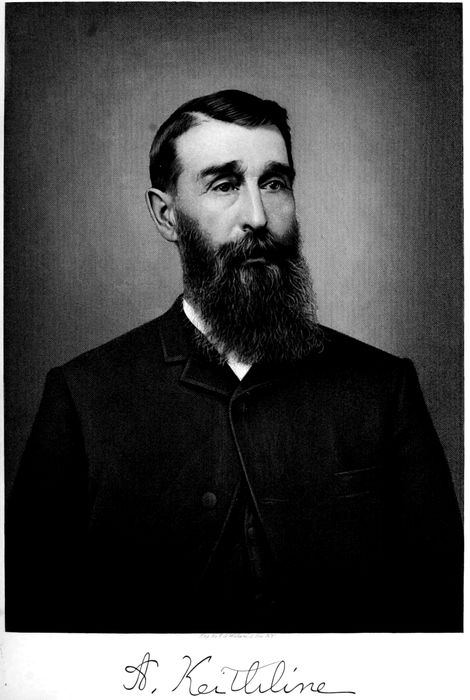
433Andrew left the parental home in December of 1857, and went to Michigan,
remaining until 1859, when he came to Atchison, where he resided until
the fall of 1864. His first employment was with the firm of Walters & Roswell,
who conducted a general store and wanted a clerk familiar with the German
tongue. For the two years previous to his locating in Atchison he conducted
a coöperative store in Michigan. His first trip to the Far West was
taken in 1860, when he went to Denver and disposed of a stock of goods for
his firm. He made another trip across the plains later than this. In 1864
he was called out with the Kansas State militia to repel the Price invasion.
On October 31, 1864, he moved to his farm west of Atchison, and remained
there tilling his acreage until September 1, 1898, and made his permanent
home in Atchison until his death. His fine farm consisted originally of 220
acres and when he removed to Atchison he still owned 190 acres of the original
farm. Mr. Keithline bought a handsome brick residence on Santa Fe
street and by wise investments and carefully husbanding his resources accumulated
a comfortable competence for the support of his declining years. He
was considered a well-to-do citizen. He was married on November 5, 1854, to
Rose Varner, born in 1832 in Luzerne county, Pennsylvania, a daughter of
George Varner, whose father was a soldier in the Revolution. Two children
were born to this well respected couple, namely: Gilbert, born in 1855, died
in Jackson county in the spring of 1915. He was the father of seven children,
Herschell, Sydney, Rose, Emma, Mary, Andrew and Laura. Mrs. Cora
Warters, a daughter of Mr. Keithline, lives in Atchison. She is the mother
of four children: Bessie, Andrew, Cora Willis and Lorene.
Mr. Keithline was one of the original Free State men of Kansas, and
was induced to come here by the fact that men in favor of making Kansas a free
State were needed in the Territory. He consistently espoused the principles
of the Republican party, taking an active part in politics during his younger
days and served for two years as justice of the peace. One of the bright spots
in his memory of bygone days was his warm friendship for Senator John J.
Ingalls, which friendship was reciprocated by the illustrious senator. He always
adhered to the Lutheran religious denomination, which was the faith
of his fathers. The evening of life must come to us all and happy is the man
who can calmly wait for the last call to summon him to his just reward in the
world to come, at peace with all mankind and cared for by capable hands;
434such was the life of this fine old gentleman of whom it has been a pleasure
to write this brief review.
Andrew Keithline departed this life December 14, 1915. The end came
peacefully, as he had wished. The worn-out body of this grand old patriarch
ceased to be able to hold the immortal soul of one of the grandest and best
loved men of the early pioneer days of Atchison county. Mr. Keithline was
a good and honest citizen whose upright and sturdy character will long prove
an inspiration and guidance for the present and future generations of Kansans
who may peruse these pages. He was a prominent factor in the building up of
Atchison county, and was intimate with the great men of his day and generation.
When his time came and the Angel of Death called him to the long rest
he was content to go and had no regrets. Death had no terrors for him as
his life was unspotted and clean, and in keeping with the attributes of the man
himself.
Abram Stever, one of the early settlers of Benton township, Atchison
county, and now deceased, was born November 3, 1837, and departed this
life on July 27, 1881. He was born in Schoharie county, New York, a son
of Abram and Nancy Stever, both of whom were born and reared in New
York State, the father being a son of German parents, who were founders
of the family in this country. Two brothers emigrated from Germany, one
of whom settled in New York and the other made his home in Ohio.
Abram was reared to young manhood in his native State and when twenty
years of age migrated to the new State of Wisconsin, then in process of settlement.
He became a farmer in Walworth county and cleared a home
from the timber. Five years later he was married, and in 1867 came to
Kansas, driving his movable possessions across the country, his wife and
children coming by train to St. Joseph, Mo., where they crossed the Missouri
river by ferry. The first location of the family was in Brown county,
Kansas, where they lived until 1874 and then came to Atchison county, where
Mr. Stever purchased 160 acres of wild prairie land in Benton township,
one and three-fourths miles northwest of Effingham. He improved his farm,
erected a good home and beautified the premises with fine shade trees and
shrubbery. After his demise in 1881, Mrs. Stever made her home on the
farm until 1893, when she removed to Effingham, and has since resided
435here, with the exception of a few years’ residence in Mankato, Jewell county,
Kansas, with her daughter, maintaining a permanent home in Effingham.
Abram Stever was married December 24, 1862, to Sarah Elecia Bailey,
of Walworth county, Wisconsin. To this union have been born the following
children: Leona May, died at the age of fifteen years; Jennie Bailey,
died at the age of thirteen; Joseph Warren, died when twenty-two years old;
Arthur Carlton, a clothing merchant at Wetmore, Kan., who married Maud
Hawk, of Effingham, and they have one daughter, Leona May; Carrie
Adella Stever, at home with her mother, a graduate of the county high
school, and taught for seven years in the Effingham schools, and is a specialist
in music, having graduated from Bethany Conservatory at Lindsborg,
Kan., in 1906. She pursued a post-graduate course at Lindsborg during
winter vacation, and studied during one winter under William H. Sherwood,
America’s greatest pianist. She was for five years a successful teacher
of music at Mankato, Kan. Returning to Effingham in 1911, she became music
director in the Atchison County High School, but resigned to take up studio
work entirely; Ray Howard, conducting a suitatorium at Frankfort, Kan.,
married Inez McFarlan; Ralph Roy Stever, a teamster at Nevada, Mo., married
Treva Spell, and has had four children: Lloyd Orr, Warren Clayton,
Ralph Vern, Lola Esther, deceased; Ernest Clayton, a graduate of the
county high school, proprietor of a suitatorium at Macon, Mo., married
Charlotte Henderson, and has one child, Roy Estell; Frank Abram Stever,
county high school graduate, located on the family estate in Benton township,
married Daisy McFarlan, and is the father of three children: Coral
Nadine, Geneva Fay, and Mildred Lorene. Mrs. Stever was born January
10, 1843, on a farm in Walworth county, Wisconsin, a daughter of Joseph
and Sarah (Perry) Bailey, natives of Maryland and Dundee, Ill., respectively.
An uncle, Amos Bailey, was one of the first surveyors in the city
of Chicago, and run the first line in what is now the city. Joseph Bailey
was one of the first settlers in Walworth county, Wisconsin, at a time when
there were very few people in the State and neighbors were twelve miles
distant from one another. It was a common custom for a number of settlers
to band together and market their produce together in the city of Chicago.
Amos Bailey was the owner of several sections of land near Lake Geneva,
Wis., which is now the great millionaires’ resort, near Chicago. Joseph
Bailey was twice married, his second wife being Mary Catharine Sipperly.
It is also worth recording that a brother of Abram Stever, named Washington
Stever, was a soldier in the Union army and fought in the Army of
the Potomac from the beginning to the end of the war. At the time of Mr.
436Stever’s death, the oldest son was only thirteen years of age, and Mrs. Stever
was left with a large family, the youngest of whom was six months old.
Abram Stever was a Republican in his political affiliations, but will best
be remembered for his activity in behalf of the organization of the Presbyterian
church in Effingham. He was one of three men who raised the
fund to pay for the building of the First Presbyterian Church erected in
Effingham, and was a deacon and trustee, having been one of the only two
deacons ever installed in the early church. He was active in church work
during his entire life and was a thoroughly honest, religious gentleman, who
carried his belief into his daily life and in all his undertakings. He was
a good husband, a kind parent and an excellent citizen, and loved by everyone
who knew him.
Few pioneer citizens of Atchison county have lived more useful or
cleaner lives than Rev. Z. S. Hastings, retired minister and farmer, of Effingham,
Kan. During his nearly fifty years of residence in Kansas as a
farmer, educator, preacher, and statesman, he has worked continually for the
well-being of his neighbors and friends. Without fear of contradiction it can
be stated that Rev. Hastings has performed a greater number of marriage
ceremonies and officiated at the funerals of more deceased residents than
any minister in Atchison county. Despite his three score and seventeen
years this grand old patriarch bears his age lightly and takes an active interest
in the affairs of his community.
Rev. Z. S. Hastings was born March 15, 1838, on a farm near Bedford,
Lawrence county, Indiana, a son of Howell and Edith (Edwards) Hastings,
natives of North Carolina. On his father’s side the family is of Quaker
origin and a very old one in America. The first Hastings having been a
follower of William Penn, came from England to settle in the Quaker colony
in Pennsylvania. A descendant of the first American Hastings, Joshua
by name, migrated to North Carolina and there founded another branch of
the family. Here in the Southland, Howell Hastings was reared and married,
and with his wife and two sons migrated to Indiana to become one of the pioneer
settlers of the Hoosier State. He died at his home in Indiana December
25, 1854, leaving seven children: Joshua Thomas, deceased; William
Henry, John Arthur, Nancy Elizabeth, deceased; Zachariah Simpson, with
whom this review is concerned; Charlotte Ann, deceased; Rufus Wiley, living
437in Arkansas. Of the foregoing, Joshua Thomas and William Henry
fought in the Union army during the late rebellion of the Southern States;
Joshua first fought in the Home Guards of Missouri, and, returning to
Indiana he raised a company for service in the war, after fighting under
General Lyons at the battle of Springfield. He taught school for a time
in Missouri, but returned to Indiana. He died in Kentucky. William Henry
enlisted in a Missouri regiment.
Z. S. Hastings was educated in the common schools of his native State,
studied in Indianapolis, and also pursued a course at Hiram College, in
preparation for the Christian ministry. In 1857 he went to Missouri and
taught school for five years, studying in the meantime while teaching. In
1862 he returned to his native State and began preaching the Gospel in the
Christian denomination. He taught and preached at the same time while
preparing himself further for the ministry. His first experience in the ministry
was obtained in 1860 while in Missouri. In 1867 Mr. Hastings came
to Kansas, resided in Leavenworth county for one year and in 1868 came
to Atchison county and located on a farm near Farmington. He taught the
Farmington school for five years and preached in the vicinity of his home
during this time. He cultivated his farm of 130 acres and preached at the
Farmington church and in the surrounding country for a period of twenty-five
years. In 1895 he removed to Effingham and continued preaching
until 1903 when he retired from active work in the ministry. Mr. Hastings
was an excellent farmer as well as minister and made a success of his farming
operations, having the distinction of selling an eighty acre tract of farm
land, the first for $100 an acre ever sold in the county up to that time. This
farm was located east of Effingham, and was the first tract near the town to
bring the price of $100 an acre.
He was married on June 28, 1870, to Miss Rosetta Butler, and to
this union have been born seven children: Harry Howell, an electrical engineer,
located at St. Louis, and who was educated in Holton College and
Kansas University; Paul Pardee, assistant freight and passenger agent of
the Santa Fe railroad, with headquarters at San Francisco; Otho Ono, a
graduate of the Atchison county high school, taught school for ten years,
served as county superintendent of Atchison county four years, and graduated
from the Atchison Business College, and is at present bookkeeper for
Urich’s planing mill at Independence, Kan.; Wiley Wyatt died in infancy;
Clara Charlotte, deceased, formerly a teacher, wife of Charles Sprong, of
Potter, Kan.; Edith Eliza, deceased, who was also a public school teacher;
Milo Milton, a journalist and author, of New York City. Milo graduated
438from the Atchison county high school, the State Agricultural College at
Manhattan, and pursued a post-graduate course in the State university.
The mother of these children was born August 5, 1844, in Sandusky Plain,
Ohio, a daughter of the Rev. Pardee Butler, a famous figure in Kansas history,
and who was an outspoken advocate of the anti-slavery principles during
the struggle which made Kansas a free State. He was so frank and
fearless in the expression of his views and so strenuous in the support of the
anti-slavery doctrine that his utterances brought him frequently in contact
with the pro-slavery men and border ruffians, and on one occasion
when in Atchison he was captured by ruffians and sent down the
Missouri river on a raft. Complete details of the life and activities
of Pardee Butler are given in another chapter in this volume. “Pardee
Butler’s Own Book,” begun during the latter part of his life, and finished
and published by Mrs. Hastings, tells of his life and adventures in Kansas.
Speaking biographically, Mr. Butler was born March 9, 1816, and died
October 20, 1888. He first saw the light of day at Skaneateles, N. Y., and
immigrated with his parents, Phineas Butler and wife, who came to Ohio in
1818. Phineas Butler was born in New York State. Pardee Butler was
reared to young manhood in Ohio and there married Sybil Carlton, of Sullivan,
Ohio, who was born July 4, 1823, and died August 7, 1898. She was
a daughter of Joseph Carlton, a native of Massachusetts, who immigrated
to Ohio in an early day. In his boyhood, Pardee herded sheep on Sandusky
Plain, and after his father’s death resided in Sullivan, Ohio. In 1850
he removed to Iowa and settled on a farm in Cedar county, where he lived
for five years. While a resident of Iowa he preached in Illinois for two
years. In May of 1855 he set out for Atchison county, Kansas, on horseback
and settled on a farm at Farmington. For many years he served as a
Christian minister and conducted farming operations. He had a remarkably
retentive memory, which enabled him to memorize the whole of the New
Testament while herding sheep in Ohio. Rev. Butler was the first State
evangelist of the Christian denomination to visit Iowa and was also the first
State evangelist to take up the work of his church in Kansas. Practically
all of his traveling while engaged in missionary work was accomplished on
horseback. Night coming on he would picket his horse in a grassy spot and
use his saddle for a pillow. Pardee Butler was one of the notable figures
in the history of Kansas, and will be remembered as long as history endures,
as a brave, useful and faithful patriot, and minister, whose life was full of
good deeds and who always stood for the right. He was the father of seven
439children: Mrs. Rosetta Hastings, Clara Louise, Eugene Pardee, Maria
Corintha, all of whom died in infancy; Charles Pardee on the home farm;
Ernest, died in infancy; George, living at White City, Kan.
Rev. Hastings has always been a steadfast advocate of prohibition, but
has generally allied himself politically with the Republican party principles.
In 1876 he was selected by the Republican party in the county as their candidate
for the legislature, although at the time he was an avowed Prohibitionist,
and was elected, serving in the Kansas legislature during the ensuing
session. For eighteen years he served as a member of the school board in
his home district, and was for six years a member of the Atchison County
High School Board. He believes in education for the young to the fullest
and is heart and soul in favor of giving young men and women every opportunity
to acquire a higher education, as is attested by the splendid training
which he was enabled to give each of his own offspring. Rev. Hastings
has baptized hundreds of converts during his ministerial career and started
them onward in the better life. His whole life has been dedicated for good.
Knud G. Gigstad, farmer and breeder of fine cattle, was born in Norway
September 28, 1856, and is a son of Gulick and Anna Gigstad. He was
one of seven children one of whom is now dead. Four of the boys and one
daughter are living in the United States. The father was a native of Norway
and spent his life in that country.
Knud G. Gigstad left Norway at the age of twenty to try his luck in
America. He came without funds and went to work as a farm hand in Brown
county, Kansas. He remained at that place two years and then rented 160
acres from his uncle, Benedict Mutson. This was a profitable venture and
before long he was able to buy eighty acres of unimproved land in section
28, Lancaster township, Atchison county, for which he paid $16.25 an acre.
Mr. Gigstad worked hard to get his farm in workable shape, each year finding
him a little more prosperous, and finally he added 320 acres to the farm,
besides 436 acres of rice land in Liberty county, near Houston, Texas.
Eighteen years ago he built a large house on the farm and has since erected
a large barn and other substantial buildings. Mr. Gigstad is a breeder of
Shorthorn cattle and has made exhibits at the American Royal stock show in
Kansas City, Mo., and in 1913 was awarded the prize as grand champion of
440America on his Shorthorns. This is a high honor and is ample testimony of
the quality of Mr. Gigstad’s stock. He is an extensive shipper to all parts
of the United States. His reputation as a breeder is firmly established among
cattle men all over the country. He is almost sure of one or two first prizes
whenever he enters his cattle in a fair. Mr. Gigstad also has a fine three
acre orchard. He is a hard working man and has succeeded despite great
handicaps, and his financial success has not caused him to neglect the welfare
of his county, as he has always been active in supporting measures for
the good of Atchison county.
He is married to Lena Olsen, a native of Atchison county, and a daughter
of Herrol and Julia Olsen. She was born in 1866. Her parents are natives
of Norway and her father was an early settler of Atchison county. Mr. and
Mrs. Gigstad have eleven children: Anna Flattre, of Lancaster township;
Mrs. Julia Henz, of Lancaster, Kan.; Harry, Clara, Gena, Gilbert, Matilda,
Lillian, Gladis, Carl, Charles, all living at home. Mr. Gigstad is a Republican
and a member of the Lutheran church.
The memory of a good and noble man lingers long after his demise in
the hearts and minds of those who knew him best. The late Albert Barnes
Harvey, of Muscotah, Kan., during the course of a long and notable career,
covering ever forty years in Atchison county, accomplished much in a material
sense and left behind him an unimpeachable record for integrity and upright
living which will long endear his memory to his former mortal associates.
He lived in the days when men were more closely drawn together in the
great struggle to create a State from a wilderness of prairie and unpeopled
waste, and did his part in the development of his adopted county, of which he
was one of the real pioneers. Soldier, farmer, banker and religious worker
who lived true to his ideals as a man and citizen, he walked with the leaders
of the great State which he assisted in upbuilding.
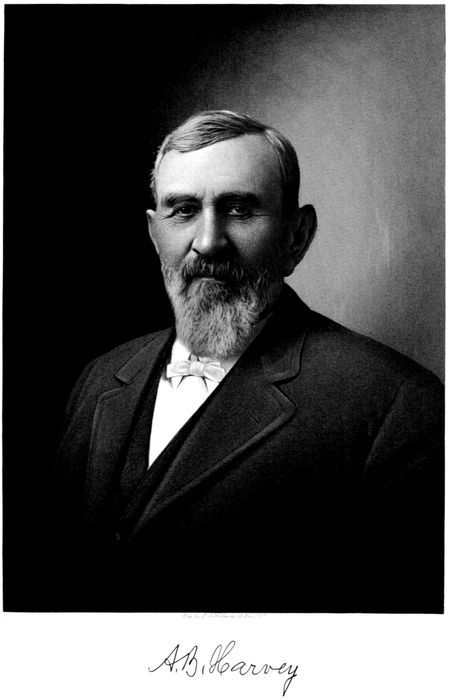
Eng. by E. G. Williams & Bro. N. Y.
A. B. Harvey
441Albert Barnes Harvey was born May 12, 1841, at Williamsport, Pa., a
son of Samuel and Margaret Harvey. His parents went from their native
State to Illinois in the early days of the settlement of that State, developing
a fine farm in Henderson county, Illinois. Samuel Harvey prospered in the
State of his adoption, reared a fine family, and in his later days retired to a
comfortable home in Monmouth, Ill., removing to the city for the purpose
primarily, of giving his children the advantages afforded there for obtaining
a good school education. He died at the home of his son in Henderson
county after a long and useful life. The subject of this review, Albert Barnes,
when a young man twenty years of age, hearkened to the first call of President
Lincoln for troops with which to quell the rebellion of the Southern
States and enlisted in Company G, Tenth infantry, regiment of Illinois volunteers,
and served faithfully throughout the Civil war. He was engaged with
his regiment in many great battles, such as Corinth, Island Number Ten, Missionary
Ridge, Lookout Mountain, Chickamauga, Siege of Vicksburg, and
Capture of Atlanta, and took part in Sherman’s famous march from Atlanta
to the sea and the subsequent taking of Savannah. He marched in the Grand
Review at Washington, D. C., and was mustered out of the service July 12,
1865. He then returned home and engaged in the peaceful pursuit of farming
until 1874, when he came to Kansas and settled on a farm southwest of
Muscotah. This farm was only partially improved at the time of his purchase
and he improved and cultivated it until 1880, at which time he came to
Muscotah and engaged in the hardware business in partnership with A. J.
Harwi; later he was in partnership with F. S. Roberts, who was succeeded
by W. C. Allison. In 1890 he became associated with J. H. Calvert in the
banking business at Muscotah, he and his partner purchasing the bank founded
by George Storch and changing the name to the Muscotah Exchange Bank.
This bank was later changed to the Muscotah State Bank and is one of the
thriving financial concerns of Atchison county, now incorporated with the
Farmers State Bank. Mr. Harvey was in the banking business for twenty
years and served as president of the Muscotah State Bank, and was successful
in his business ventures to such an extent that he became one of the wealthy
citizens of the county. During his later years he and Mrs. Harvey enjoyed
traveling about the country, the condition of his health becoming such that
it was practically necessary for him to spend his winters in the Southland.
He and Mrs. Harvey spent many happy days in visiting the battlefields of
the South over which his regiment had fought and they enjoyed life to the
utmost during those later years.
Mr. Harvey was married October 25, 1871, at Stronghurst, Ill., to Miss
Viola Allison, who was born October 25, 1841, in Washington county, Pennsylvania,
a daughter of John and Margaret (Carter) Allison. John Allison
was born in Pennsylvania and was a second cousin of President William McKinley,
whose mother was an Allison. Margaret Carter Allison was born
in Scotland and accompanied her parents to this country when twelve years
of age, where they settled in Henderson county, Illinois. Both of Mrs.
442Harvey’s parents died in Illinois, and a brother, John C, who enlisted in
the Union army at the age of seventeen years, died at Ft. Donelson. An
older brother, Hugh, also served in the Union army, and a half brother, W. C.
Allison, now of Horton, resided in Muscotah for many years and was one
of the pioneer business men of the city. The Allison family is a very old and
numerous one of Scotch descent. No children came to bless this happy wedded
life of Albert H. and Viola Harvey, but they reared two adopted daughters,
who are now established in comfortable homes of their own, namely:
Lela, wife of A. P. Bishop, of Topeka, now a farmer living southwest of
Muscotah, and Lula, wife of E. H. Purdy, of Kansas City, Mo. Mrs. Bishop
has four children: Albert, George, Dorothy and Ruth. Mrs. Harvey spends
the spring and summer seasons in her beautiful residence in Muscotah and
invariably travels in the South during the winter. Mr. Harvey retired from
active banking pursuits in 1910.
Mr. Harvey was a member of the Congregational church at Muscotah
and served as deacon of the church from 1898 until his demise, on Monday,
July 22, 1912. For many years he was superintendent of the Sunday school
and was very fond of young people, nothing giving him more pleasure than
to gather about him a group of intelligent young folks with whom he was
always at his best. He took a keen interest in church and Sunday school work
and endeavored to follow the precepts of the Greatest of All Teachers during
all the days of his long and useful life. He was prominent in Masonic and
Odd Fellows lodge circles and served as worshipful master of the Muscotah
Masons on two occasions. He was a member of the Grand Army of the
Republic. He was a Republican in politics and took a keen interest in the
political and civic affairs of Atchison county, serving three terms as a member
of the Atchison County High School board and a term as mayor of his home
city. Many of the distinguished men of Atchison and the State of Kansas
were his personal friends, among them being the late Governor George W.
Glick, with whom he spent a winter in Florida, Ex-Governor W. J. Bailey,
and the late Judge Horace M. Jackson, of Atchison. He was, withal, a home
and church man above everything else. He loved his home and his family
and was hospitable to the core of his being, always ready to entertain friends
or even strangers at his board, jolly and big-hearted, always.
Martin Klein, living a retired life in the town of Potter, Atchison county,
Kansas, at the advanced age of four score and two years, is one of the oldest
of the Kansas pioneers, who for over sixty-one years of his long life has
443lived in the Sunflower State, and has seen the steam railway take the place
of the overland freight trains, hauled by oxen and mules, and has witnessed
the automobile superseding the farm wagon and horse and buggy as a means
of transportation. On his lonely claim in the north part of Leavenworth
county, near Potter, he could see the great trains passing along the Ft. Riley
road from Leavenworth to Salt Lake; he remembers the dread visitation of
the grasshoppers in the seventies, when the “hoppers” came in dense clouds,
ate up all the growing crops and left devastation and desolation in their
wake. Martin Klein is one of the best known of the old-timers in this section
of Kansas and took an active part in the slavery contest which was bitterly
waged on Kansas soil, and nearly gave his life in defense of his principles,
later to shoulder a musket in defence of his adopted country.
Martin Klein was born March 2, 1833, in Alsace-Lorraine, a son
of Peter and Teresa (Miers) Klein, both of whom were born and reared in
Alsace-Lorraine, and were of ancient French extraction. When Martin was
fourteen years of age, his parents in 1847, left their native land and immigrated
to Oneida county, New York, where they settled on a farm near
Rome. The elder Klein prospered in the land of his adoption and Martin
grew up imbued with American ideals, along with the other five children
of the Klein family. Martin was the youngest of a family of six children
born to Peter and Teresa Klein. Three brothers of Mrs. Klein, Joseph
Miers, and two others, were soldiers, who served under Napoleon Bonaparte,
and were members of the Grand Army of Napoleon which marched to the
siege of Moscow. Two of the brothers were killed at Moscow, and Joseph
was one of the few out of the many thousands of soldiers who lived to
return home and tell about the ill-fated expedition which cost Napoleon his
grand army.
In the fall of 1854, Martin Klein left his old home in New York and
set out for Kansas, to grow up with the country. He arrived in Leavenworth
on September 18 of that year, and lost no time in taking up a claim
in Leavenworth county, which served as his home until 1900, when he retired
to a comfortable home in the town of Potter. Six years after his
arrival in Kansas he married Miss Paulina Hawley, whom he espoused on
March 29, 1860. She was a daughter of Francis H. and Louise Hawley,
both of whom were natives of old Virginia, and were early settlers in Kentucky,
where Mrs. Klein was born November 12, 1826. She departed this
life January 4, 1907, in Potter, Kan. She was a loving and faithful helpmeet
to Mr. Klein for forty-seven years, and endured with him many hardships
incident to the pioneer life in Kansas.
444When Mr. Klein first came to Kansas in 1854, the turmoil and the border
warfare waged between the pro- and anti-slavery forces, was just beginning,
and he, being a pronounced anti-slavery man, was thrown into the
thick of the fight. He was an accurate marksman with the revolver, and
often found occasion to make use of his ability with the pistol. He was so
active in his work in behalf of the Free State party that he was marked
for vengeance by border ruffians. An occasion which is memorable, and
marked the savagery of this warfare, is worth recording: “On a Sunday in
the spring of 1856, when Mr. Klein was at church, three strangers came to
church, ostensibly to buy corn from him. After the bargain had been struck,
and he had agreed to sell the men the corn wanted, they insisted on him
accompanying them to Easton, Kan., in order to get his pay for the corn.
This Klein refused to do. During the parley one of the men had kept a
hand hid under his coat on the plea that he had a sore member. The wind
blowing the coat flap to one side, Klein noticed that the man was concealing
a revolver in his hand. They finally showed him a warrant for his arrest.
He then knew that his life was in danger, and again refused to accompany
the men to Easton. He turned to go back to the church and they opened
fire on him, firing eight shots in all, four of which took effect in his body,
one shot striking him in the head, one in the side, and one in the hip. He
fell to the ground and the ruffians rode away, leaving him for dead. Happily,
the wounds were not fatal, and he recovered, and lived to see the final
triumph of the cause which he loved, and for which he had sacrificed his
peace and nearly lost his life in advocating. During those early days Mr.
Klein served as constable and deputy sheriff and was constantly in danger
of his life. In the fall of 1856, he and others of the Free State men deemed
it prudent to leave their homes and go to Lawrence, Kan., where they joined
the citizen army, which was being organized in defense of Free State principles.
He took part in several incipient battles and scraps with the pro-slavery
advocates during those years, and when the war broke out he enrolled
in the Kansas militia and fought in Captain Baird’s company when it
marched to battle against General Price’s army of invasion.
Mr. Klein has a keen remembrance of his first day in Kansas, when
he walked a distance of twenty-four miles from Ft. Leavenworth to find his
brother-in-law, Charles C. Foster. He was all day finding Foster’s claim.
Starting out without his breakfast, he lost his way, and it was 8 o’clock
that night before he arrived at his destination, footsore, weary and hungry.
The prairie grass in those days grew as high as a man’s head in the bottom
lands, and was knee high on the uplands, and the richness of the soil was
445apparent to a man brought up on a farm. From his cabin door Mr. Klein
could look out in the distance and see the old Ft. Riley trail which led from
Ft. Leavenworth to Salt Lake. One morning on arising he saw eighty covered
wagons standing on the trail, each of which had hitched to it six yoke
of oxen. This was a sight worth seeing and entertaining to a plainsman,
being an indication of the onward march of civilization as it moved ever
westward. On one occasion while serving as an officer of the law, Mr. Klein
was sent to the cabin of Jim Foster, a noted border desperado, to effect his
arrest, but Foster was absent at the time from his home on the bluffs overlooking
Big Stranger creek. After the war was over, Mr. Klein settled
down to farming and peacefully tilled his acres until his retirement to Potter.
He took an active and influential part in the affairs of his community,
and has always been allied with the Republican party, never, however, having
been a seeker after political preferment, and never held office except the
post of school director in his district.
Barney Cummins, farmer and trustee of Mt. Pleasant township, Atchison
county, was born in Atchison December 17, 1859, a son of Patrick and Mary
(Faulkner) Cummins, the former a native of Roscommon county, and the
latter a native of County Caven, Ireland. Both came to America from their
native land when young, and met, and were married in Philadelphia. After
their marriage they went to Wisconsin and lived there one year and then
came to Atchison, Kan. Patrick was employed on a Missouri river steamboat
for a time, saved his money and moved to a farm, which he rented
for about ten years, accumulating sufficient capital to then purchase a quarter
section of school land in Mt. Pleasant township, the tract now known as
the old Cummins homestead. Patrick Cummins succeeded in his farming
venture and became prosperous as the years passed. During the Civil war
he was enrolled as a member of the Kansas State militia. He was known
as a Free State Democrat, and was a member of the Catholic church. He
died in 1871, and the widowed mother of Barney Cummins is still living at
the age of seventy-six years, on the old home farm. There were six children
in the Cummins family, namely: Barney; Charles, on the home place; John,
a farmer in Atchison county; Kathrine, living with her mother; Mary, wife
446of William Rogers, of Nortonville, Kan.; Sophia, wife of Thomas Cavanaugh,
of St. Joseph, Mo.
Barney was about four years of age when the family removed from
Atchison to the farm in Mt. Pleasant township. He received his education
in the district school, near his home, and has lived on the farm all of his life,
excepting one year spent in Atchison. Mr. Cummins recollects with sadness
the severity of the early-day teachers as compared with the teachers of
today. He recalls that he was frequently given his choice of punishments,
which included either having his ears cut off, or take a sound whipping with
a great gad. This badly frightened him, and he also remembers how the
teacher jerked a big boy from his seat and threw him unconscious to the
floor of the school room. Happily, the days of brute strength control of
pupils in the schools is past, and a new and better era of kindness and forbearance
has dawned, years since. Mr. Cummins is the owner of 100 acres
of well improved land and is a progressive farmer.
He was married January 9, 1882, to Sarah Maylen, a daughter of
Joseph and Elizabeth Maylen. The father was a native of Canada, and the
mother was born in Liverpool, England, their children being a product of the
intermarriage of French, English and Welsh ancestry. Joseph Maylen was a
French Canadian and his wife was of Welsh and English descent. They
came to Kansas in the early days and settled on a farm in Doniphan county.
Four children have been born to Mr. and Mrs. Cummins: William, living at
Potter, Kan.; Ella, wife of Luther Blodgett, a farmer in Atchison county;
Anna, wife of Harry Linsey, living in Atchison county; Joseph, at home
with his parents. Mr. and Mrs. Cummins have reared all of their children
on the farm upon which they have lived continuously since their marriage.
Mr. Cummins is affiliated with the Modern Woodmen lodge of Potter,
and is a member of the Catholic church. He is a Democrat of the old school,
and since attaining his majority he has taken a more or less active part in
political affairs. He has served several terms as trustee of Mt. Pleasant
township, and it can be said of him that no man ever filled the office more
capably or administered the affairs of the township to better advantage or
more economically and honestly than Barney Cummins. He was first elected
to the office in 1892, again in 1907, then in 1908 and again in 1912, being
re-elected in 1914. As trustee, Mr. Cummins has the supervision of eight
schools in his township, including the graded high school of Potter. He
is a faithful and conscientious public official in whom the people impose
every trust.
447
Alva Clapp, president of the retail hardware company which bears his
name, has been engaged in business on Commercial street in Atchison since
May, 1907. At that time he purchased the retail store of a local wholesale
firm, and has made a pronounced success of the venture. It is one of the
most attractive and well stocked stores of the city and is well patronized.
Mr. Clapp is popular with his patrons and the citizens of Atchison generally.
He takes an active part in city affairs and is especially interested in the public
school system. Having been a teacher before he became a merchant, he has
never lost interest in the schools, and is now the president of the Atchison
city board of education.
Mr. Clapp was born August 23, 1868, at Carthage, Mo. He is a son of
Isaac and Susan B. (Eckler) Clapp, natives of North Carolina and Illinois,
respectively. Isaac Clapp emigrated from North Carolina to Danville, Ill.,
when a young man, and married in his adopted State. His parents were slave
owners in the southland, and he himself owned slaves, but having a pronounced
distaste for the institution of slavery he disposed of his human chattels
and moved to the North. After a residence of some years in Illinois, he
located in Carthage, Mo., and owned a farm in Jasper county which he cultivated.
In 1875 he removed to Cherryvale, Kan., and invested in a tract
of land near that city. Here he resided until his death in October, 1913.
Alva Clapp received his education in the schools of Cherryvale, Kan., and
began teaching school when a very young man. He taught two terms in a
district school and served for two years as high school principal. He had a
liking for business and obtained his first experience in the retail hardware
trade in a store at Conway Springs, Kan., from 1891 to 1900, or a period of
ten years. He then traveled for two years in the interest of a local wholesale
hardware company and was then employed for five years in the various departments
of the local concern. In 1907 he organized the Alva Clapp Hardware
Company and purchased the retail department of the Blish, Mize &
Silliaman Company of Atchison. Mr. Clapp has given evidence of a pronounced
aptitude for business affairs, and faithfully attends to the numerous
details which require the undivided attention of the proprietor of a thriving
concern, such as is in his charge.
He was married in September of 1896 to Beatrice Kathrine De Haven,
of Wichita, Kan. They had one child, Harold De Haven, who died at the
age of one and one-half years. Mr. Clapp refers to Mrs. Clapp as his partner
in the business and his best and most competent assistant. Mrs. Clapp is
448not only a good wife and socially active in the city, but she takes a just pride
in assisting her husband in making a success of his business. Mr. Clapp is
politically allied with the Republican party and has served for fourteen years
as a member of the school board. During his period of service as a member
of the board the school system of Atchison has made its greatest advances,
and the high school has achieved considerable prestige. New buildings have
been erected to accommodate the growing needs of the school system, and
others are in course of erection. All of these improvements have received
the hearty support of Mr. Clapp and he enjoys the respect and esteem of
his brother members to such an extent that when the presidency of the board
became vacant he was elected to the position. He was also recently elected
treasurer of the Commercial Club of Atchison, another city boosting organization
in which he is a prominent figure. Mr. Clapp is affiliated with the
Modern Woodmen and the Elks lodges.
One of the notable and influential figures of the first and second decades
in the history of Atchison county was the late George Storch, of Atchison.
He came to Kansas when the State was in its infancy of development and was
a pioneer merchant of old Kennekuk, becoming in turn a merchant, banker,
statesman, and was, withal, one of the most useful citizens of Atchison county
of whom the reviewer has had opportunity to write. Mr. Storch was a pioneer
with a vision which enabled him to see far ahead into the future. This
vision, coupled with faith in the eventual prosperity of Kansas, led him to
invest heavily in farm lands which made him one of the wealthy citizens of
Kansas prior to his demise. For nearly half a century, Mr. Storch was closely
identified with the financial and civic life of Atchison county, and twice represented
the county in the halls of the State legislature, each time acquitting
himself with credit and honor.
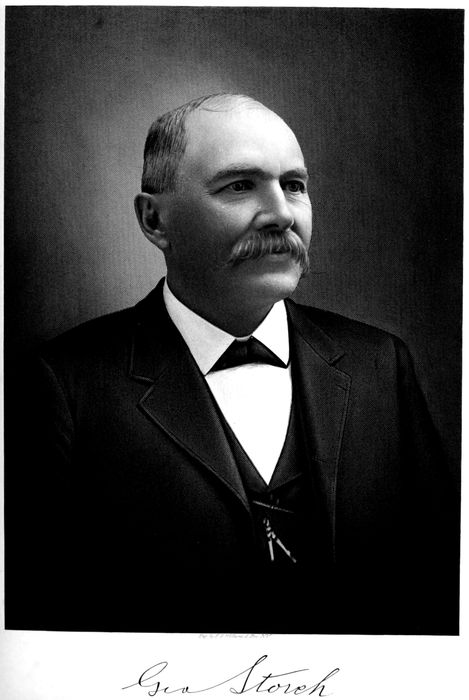
449George Storch was born near Poppen-Hausen, Bavaria, Germany, February
22, 1835, and was a son of Thomas and Margaret (Breitung) Storch.
Thomas, the father, was a farmer and linen dealer in his native locality and
was considered fairly well to do. George was reared to young manhood in
his native land and received a good common school education. When seventeen
years of age he determined to cross the seas and seek his fortune in
America. In accordance with this determination he embarked on a sailing
vessel which landed him at New Orleans. From this southern city he made
his way by river steamer up the Mississippi and Missouri rivers to Herman,
Mo. Here he joined a brother who was farming in the neighborhood and who
assisted George in securing employment on a nearby farm. He worked at
farm labor in Missouri for some years and in April, 1859, he came to Atchison,
Kan. This city did not offer much inducement for the ambitious young
man and he was desirous of engaging in the mercantile business. Kennekuk,
in the north central part of the county, was then in the heyday of its prosperity
and seemed to offer a better location than Atchison. After a few
months’ stay in Atchison he went to Kennekuk and opened a general merchandise
store with the capital which he had saved while working on the farms in
Missouri. He was successful from the start and his judgment in the matter
of Kennekuk being an excellent business location proved correct. Kennekuk
was at that time a prosperous and thriving village located on the overland
mail and emigrant route and the Storch store made money for its owner to
such an extent that he was enabled to branch out and invest in lands and
engage in the banking business. Mr. Storch justified his faith in his adopted
State by investing heavily in lands which have greatly increased in value since
his original purchase of the same. In the early days of the development of
the West, the railroad companies were granted large tracts of farm lands
along the right of way by the Federal Government. These tracts were placed
on sale by the railroads, and were sold for very low prices and easy terms
in order to induce settlers to locate in the regions being developed. Mr.
Storch took advantage of the low prices of the farm lands and invested heavily.
This property comprised many thousands of acres which have since increased
enormously in value over and above the original purchase price. Kennekuk
had its day, and the time came when the decline of the village was inevitable
owing to the building of the Central Branch railway out of Atchison, and
which passed to the southward of Kennekuk. Mr. Storch saw the time coming
when the once flourishing inland village would be no more, and in 1867
he removed to Atchison and managed his large farming interests from this
city.
Upon his removal to Atchison he immediately became identified with the
leading financial interests of the city and in 1873 organized the German Savings
Bank which was for many years one of the strong financial institutions
of the city. He was also identified with the first bank established in Muscotah,
Kan. He engaged in the real estate and farm loan business in Atchison
and organized the Eastern Kansas Land and Loan Company, a concern
which is still doing business and of which his daughter, Mrs. Louisa J. Lips,
450is president. Mr. Storch served as president of the German Savings Bank
until its stock was purchased by the United States National Bank, and also
filled the office of president of this bank during the period of its existence.
He was engaged in banking pursuits for a period of eighteen years.
He was married in 1859 to Miss Elizabeth Fox, a daughter of John and
Elizabeth Fox, who removed from Evansville, Ind., where Mrs. Storch was
born, to Carroll county, Missouri, and settled on a farm. Two children
blessed this union of George and Elizabeth Storch: George H., who will be
remembered as a bright, intelligent and capable Atchison citizen and who was
associated with his father in business for several years, and died in July, 1911,
and Louisa Justina, widow of Oscar Lips. Mrs. Storch died in February,
1905, and almost three years later followed the demise of the husband and
father, who departed this life in January, 1908. Oscar Lips and Louisa Justina
Storch were married in 1891, and that union was blessed with a son,
Charles, born in October, 1896. Charles Lips received his primary education
in the public schools of Atchison, his preparatory work in the Culver, Ind.,
Military Academy, and is now pursuing a collegiate course in the Kansas
University at Lawrence. Oscar Lips was born in St. Louis, Mo., a son of
Dr. Charles August Lips, a former practicing physician of St. Louis, and
who was of German descent. Oscar was reared and educated in his native
city, and when a young man engaged in the wholesale drug business. His demise
occurred in Atchison, August, 1905.
George Storch was a Republican in politics and took an active and influential
part in political affairs during his long years of residence in Kansas.
Not long after establishing himself in business at Kennekuk he became postmaster
of the town, and assisted in establishing the first union school in the
village, serving as a member of the board of education which had charge of
this school. The Horton Headlight has the following historical account of
this school in an issue of August, 1905, in part: “The old stone school house
was not the first school building in the Kennekuk neighborhood, but it was
the first substantial one in this part of the country and marks an important
epoch in its development. It was built in 1867. It was a joint district, eight
miles north and south. The west line was the road between Atchison and
Jackson counties. A strip of country two miles wide and eight miles long
was in Atchison county and a corresponding trip of country was just over
the line in Brown county. The school house was quite a structure to be builded
in that early day, but the settlers did not complain at the high taxes, since
their children had a good place to attend school. The cost was about $3,000,
quite a good sized sum for early settlers to expend, but it shows their determination
451to provide an education for their children. The first school board
was composed of George Storch, Squire Willis and Henry Claunch....”
Mr. Storch was always greatly interested in the cause of education and
after his removal to Atchison he served as a member of the Atchison board of
education and was president of this body for a time. While a resident of
Kennekuk he was elected to represent Atchison county in the Kansas legislature
in 1864. During the ensuing session he voted for Gen. James H. Lane
for United States senator and voted to ratify the fourteenth amendment to
the National constitution. In 1876 he was elected a member of the legislature
from the city of Atchison, and during the session following his election
he was a member of the ways and means committee and voted for P. B. Plumb
for United States senator. Mr. Storch made an excellent record as an able
and honest legislator, who had the best interests of his State at heart. He was
active in civic and political affairs in Atchison and served as a member of the
city council of which body he was president for one year, declining re-election
when his term of office expired. The following tribute to his ability as a
city father appeared in the Atchison Champion of April 6, 1873: “One of
the best councilmen our city has ever had leaves that body after two years’
service in it. We refer to Hon. George Storch, chairman of the committee on
improvements. He has been industrious, independent, and energetic. Having
the chairmanship of the most important and laborious committee, he has
given his time and attention to the discharge of the duties devolving upon
him, and in the decision of all questions in the council he has exhibited a
clearness of judgment and a carefulness in guarding the interests of the city
that entitle him to general commendation. He declined re-election.”
Mr. Storch served for three years as city treasurer and exhibited the
same judgment and careful management of the city’s affairs in this important
capacity that has marked the performance of his official duties as a councilman
and school trustee. It is worthy of record that in 1865, while in Kennekuk,
he was elected a member of the board of county commissioners and served
as chairman of that body.
Few pioneer citizens of Atchison lived a more useful or busier life than
he of whom this review is written. The name of George Storch figures prominently
in the historical annals of Atchison county as a builder and creator and
an honorable and upright citizen, who left behind him when his soul winged
its way beyond the knowledge of mortal ken, a record imperishable, and a
name unblemished and untarnished of which his descendants may well be
proud. While opportunities for achieving fortune and fame may not be as
great at this day as they were in George Storch’s time and era, the story of
452this poor German emigrant boy who made his own way in Kansas from poverty
to affluence and won an honored place in the history of his adopted county
and State is well worth reading and may serve as an inspiration and guidance
to others of the present and rising generations.
There is considerable satisfaction in writing the life story of a man who
has worked his way upward from poverty to a position of wealth and influence
in the space of a lifetime, and accomplished it all with his own strong
arms and mind. When one adds to this accomplishment the rearing of a
large family to lives of usefulness, and to bring up a bevy of young men and
women to comfort their parents in their declining years, there is not much
for any one individual to wish for. Thomas Brown, retired farmer, of
Effingham, Kan., has done all of this and is the proud father of one of the
largest families in Atchison county. Had he done no more than to bring into
the world his thirteen children, he would have been worthy of praise and
been entitled to honorable mention in this volume, as a patriotic and sturdy
American citizen. A native of the Emerald isle, he came to America in his
youth, and now ranks as one of the Kansas and Atchison county pioneers.
Thomas Brown was born in the little village of Altone, Ireland,
and is a son of John and Mary (Dalton) Brown. His birth occurred on
February 10, 1847. His father was a farmer in his native country, and made
a good living for his family, later moving to the town of Altone and engaging
in the transfer business, in which occupation he was fairly successful and
enabled to provide for his family in comfort. He was the father of ten
children, seven of whom came to America to seek their fortunes in the land
of opportunity. The seven who came across the Ocean were: J. P. Brown,
a pioneer merchant and capitalist, of Atchison, now deceased; Mrs. Bridget
Norton, who died in 1913 at her home in Pittsfield, Mass.; Mrs. Mary Scully,
of Troy, N. Y.; Mrs. Anna Elkhorn, of Troy, N. Y.; Mrs. Margaret Hewitt,
of Independence, Mo.; Mrs. Kate Waters, deceased, who was the wife of a
soldier in the British army. The father of these children died in Ireland,
and the mother died in Troy, N. Y.
Thomas Brown emigrated from his native land to this country in 1865,
and hired out to a farmer in Orange county, New York, at $20 per month.
The farm where he was employed was located seventeen miles north of Newburg,
453on the Hudson river. He worked there for two years and carefully
saved his earnings until he had $300. With this capital he set out for the
West and joined his brother, J. P. Brown, who was then located in Atchison.
His first employment was on his brother’s stock farm, located north of Monrovia.
Unfortunately, he was taken ill not long after his arrival, and lay
sick for a long time with typhoid, all of his savings going to pay for medical
services and nursing. He remained on his brother’s farm for ten years and
laid by another stake during that time. During this period he cultivated
three farms, owned by J. P. Brown, who did not require him to pay any
rental fees. Even the taxes were paid by his brother who was only anxious
to keep the land in cultivation and give his brother, Tom, a start in the
world. In the year 1877, Thomas, having saved enough money to buy a
farm of his own, invested his savings in a tract of 160 acres of high prairie
land, northwest of Effingham, in Benton township. His first land investment
cost him $2,250. The land had on it only a small shack which was soon
replaced by a comfortable home. It is now one of the best improved places
in this section of Kansas, and the Brown farms are among the most productive
in the whole State of Kansas. A handsome white farm house graces
the home place, which can be seen for miles around, and it is quite imposing.
Mr. Brown prospered as he deserved and increased his holdings to
the grand total of 640 acres of good Kansas land. The remarkable part
about his purchases of land is that he paid cash for every tract of land
which he bought and never went in debt for a single acre. This land, purchased
at varying prices, is now easily worth $125 an acre. Mr. Brown
carried on general farming and live stock raising until February of 1911,
when he turned over the management of the home farm to his son, and removed
to Effingham, where he has a beautiful and comfortable residence
in the west part of the city.
He, of whom this review is written, was married on October 20, 1869,
to Miss Anna Neely, born in Ohio in 1846, a daughter of Samuel Neely,
who migrated to Atchison county, Kansas, in 1868. Sixteen children have
been born of this marriage, thirteen of whom are living, all of whom are
married excepting one daughter and a son: John, a farmer, living near Blue
Rapids, Kan.; Mrs. Ida Fishburn, living on a farm near Meriden, Kan.;
William, Charley, Frank, and Edward, who are located on their father’s
ranch; George lives at Effingham; Richard, a successful farmer, living south
of Muscotah; Mrs. Pearl Dunn, of Oklahoma; Mrs. Ethel Smith, residing in
Oklahoma; Edith, at home with her parents; Mrs. Julia Wagner, living near
454Mortimer, Kan.; Mrs. Mary Kemp, on a farm near Vermilion, Kan. This
worthy couple have thirty-six grandchildren.
Mr. Brown is a Republican in politics, but is decidedly independent in
his voting and making up his mind concerning political questions of the
day. He believes in supporting the man best qualified to serve the people in
a civic capacity, rather than blindly following the dictates of political leaders
or so-called bosses, a characteristic of the man in all of his conduct through
life. He is a member of the Effingham Catholic church and is a liberal supporter
of this denomination, having contributed liberally toward the building
of the local church. He is a member of the Ancient Free and Accepted
Masons lodge and became a member of this lodge in 1871. It is a matter
of historical record that Mr. Brown, Willis Walker and Hump. Henderson,
of Effingham, are the three oldest living Masons in Atchison county in
point of years of membership in the order. What more honor does a man
wish than has befallen this Atchison county pioneer?
Albert H. Blair, farmer, of Center township, Atchison county, was
born March 6, 1862, near Astoria, Ill., and is a son of William and Alcinda
(McCormack) Blair. He was one of five children, Daisy being the only
other survivor. She resides in Center township and is now Mrs. Warner.
Two other children died in infancy, and William died while living on the
farm which Bert now owns. The father was born May 18, 1833, in Brownsville,
Fayette county, Pennsylvania. He was a son of William Blair, and
was a glass cutter while living in the East, but when he went to Illinois,
he engaged in farming. Later, he farmed in Fulton county, Illinois. In
1863 he came to Kansas and engaged in freighting between Atchison and
Denver, with his brother, Edward. They followed this exciting occupation
about three years, and in that short time had many experiences which they
related with great delight in after years. They were never attacked by the
Indians, for the reason that they drove in large numbers, with 100 wagons
to the train, and the Indians were shy of such a large force. However, one
night they thought that their luck had changed. Mr. Blair can just barely
remember the incident, although his father has told it over so many times
that it seems to him as if he remembered the original incident. One night
the party camped on the trail between Atchison and Denver, lying asleep
455under their wagons. Indians had been seen that day and the freighting
party was a little uneasy, and some of the more nervous members feared an
attack. Late in the night the mules became frightened and woke up Mr.
Blair. William jumped up, and off in the dark he could see a white object
approaching. The cry of “Indians” went out and rifles were aimed.
William shot, but could not hit the object. No one else could, for it was
very dark and the object could not be seen distinctly. The white object
kept approaching, and finally took a definite outline in the darkness. It
was a white steer. One night when Indians stampeded the mules of the train,
William and a comrade set out in pursuit of the Indians by flaying the mules
with arrows and drove them so fast that the pursuers caught up with them
by hard exertion and recaptured the horses. These are typical of many
narratives which the elder Blair related of his early-day experiences on the
plains. After quitting the freighting business, he and his brother engaged in
milling in Atchison, Kan. Three years later William sold his interest to his
brother, and started a livery business. A year later he went to farming in
Doniphan county, Kansas, and moved from one farm to another for several
years. In 1882 he was elected sheriff of Atchison county on the Democratic
ticket, and his first term was so successful that he was re-elected. After his
term expired he continued to live in Atchison for some time. He then bought
160 acres of land in Center township and remained there until 1891, when
he removed to Effingham, where he lived in retirement until his death in
1899. The mother of Bert Blair was born January 11, 1842, in Brownsville,
Pa. She is a daughter of Alonza and Sarah J. (Hibbs) McCormack,
who were natives of Pennsylvania. They came west in the early days and
farmed in Illinois and Iowa. The mother is now living with her daughter,
Mrs. Daisy Warner, in Center township, Atchison county.
Bert Blair grew up on his father’s farm and in Atchison, and was educated
in the district schools and the Atchison public schools. He lived at
home until he was eighteen years of age when he engaged in railroading. It
may have been the stories of his father about the travelers that prompted him
to go into railroading. At any rate he found the adventurous work to his
liking and he worked as a fireman on the Missouri Pacific railroad passenger
train from Kansas City to Omaha, until he was promoted to the position
of locomotive engineer. His run was from Hiawatha to Kansas City,
which was a division of the Missouri Pacific then. In 1890 he rented his
father’s farm, and at the death of the latter, he inherited eighty acres, and
he has since increased his holdings to 160 acres. He has built a fine modern
456barn on his place, 50×54 feet in size, with a capacity of ninety-two tons of
hay, and was designed and built by Mr. Blair himself.
In 1886 he married Sarah P. Jeffery, who was born February 20, 1869,
in Missouri. She was a daughter of Ira P. and Mary (Farley) Jeffery,
both of whom were born in Virginia. They came to Atchison county, Kansas,
in the seventies, and are now deceased. To Mr. and Mrs. Blair have
been born four children, as follows: Roberta, deceased; Claude, Effingham,
Kan., married Vera Pittman, of Effingham, and has one son, Thomas
Albert, who was born December 24, 1909; William C., who married
Elsie Stickler, of Lancaster, and has two sons, Chester Eugene, born
April 23, 1913, and Bert William, born October 20, 1914. A daughter,
Sarah, died in infancy in Kansas City. Mrs. Blair died November 20, 1915,
and her remains were interred in the cemetery at Lancaster. Mr. Blair is a
Democrat. He attends the Methodist church, and is a member of the Eagles
and Modern Woodmen of America.
There is considerable distinction in being the oldest practicing physician
in Atchison county, and this well merited honor properly belongs to Dr. George
H. T. Johnson, of Atchison, Kan., who for nearly half a century has practiced
his profession continuously in the city with ever increasing prestige and
success which has never abated during the long period of his career. Dr.
Johnson is one of the best loved and well respected professional men of the
city who has won his place in the front rank of his profession by sheer merit
and ability of a high order. Despite his seventy-three years of age he still
continues to minister to the ailing and has kept abreast of the wonderful
advances made in medical science.
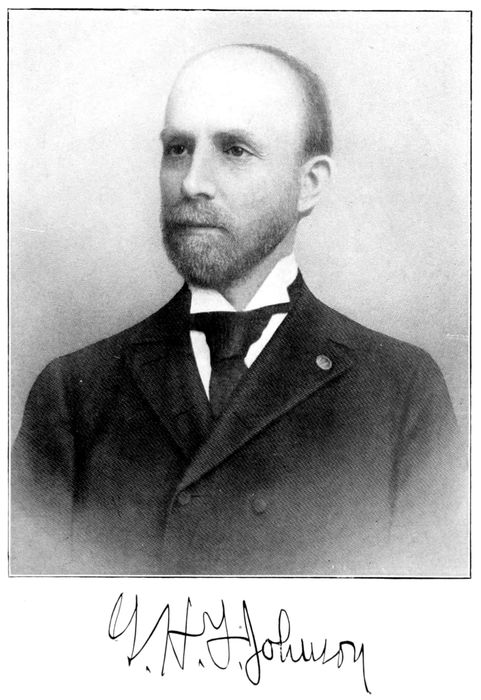
457Dr. G. H. T. Johnson was born near Mt. Vernon, Jefferson county, Illinois,
October 15, 1842, a son of James and Lydia (Cricle) Johnson, the
former a native of Connecticut and the latter of Illinois. His paternal grandfather,
George Johnson, was a soldier in the American army during the War
of 1812. The father of Dr. Johnson died when he was an infant and his
mother departed this life at the age of seventy-eight years. George H. T.
was educated in the public schools of Jefferson county and Mount Vernon.
He remained at home until the summer of 1862, when he enlisted in the
Union army as a member of Company G, One Hundred and Tenth regiment,
Illinois infantry. In September of the same year this regiment was assigned
to the command of General Buell, then at Louisville, Ky., and first saw action
at the battle of Perryville, Ky., October 8, 1862. Subsequently, the One
Hundred and Tenth was transferred to General Rosecrans’ army and took
part in the great battle of Stone River and the campaign which resulted in
the capture of Chattanooga, and the great battle of Chickamauga. He was
under General Thomas at the battles of Chattanooga, Lookout Mountain and
Missionary Ridge. General Grant in person directed the maneuvers of Generals
Thomas’ and Rosecrans’ combined forces during these famous engagements.
Subsequently, his regiment was assigned to the command of General
Sherman and served under Sherman until the close of the Civil war. He took
part in the siege and capture of Atlanta and the famous March to the Sea,
which culminated in the capture of Savannah, which city Sherman presented
to President Lincoln as a Christmas gift. He also participated in the campaign
of the Carolinas and was at the last battle fought by Sherman’s army
at Bentonville, N. C., and at the surrender of the Confederate army under
Gen. Joseph Johnston near Raleigh. From there the victorious army marched
to Richmond, thence to Baltimore and on to Washington, where they participated
in the Grand Review. Mr. Johnson was honorably discharged from
the service and mustered out June 8, 1865. The doctor tells many anecdotes
of his long and varied army experience which are all interesting and show
that he proved himself not unworthy of the martial blood coursing through
his veins and transmitted from his grandfather.
Upon his return home from the war Mr. Johnson taught one term of
school and then decided to take up the study of medicine and make the science
of healing his life vocation. Accordingly, he entered the Cleveland Homeopathic
Medical College and subsequently attended the Homeopathic Medical
College of St. Louis, Mo., where he was graduated February 26, 1869. While
a student at college he heard of the city of Atchison and was impressed with
the idea that it would be a good place to locate. After looking around for
a few weeks he became convinced that Atchison was a desirable location for
a young physician and he came here in April of 1869 and soon built up an
excellent practice which grew in volume as the years went on. In 1885 Governor
Martin appointed Dr. Johnson a member of the State board of health,
and in April of that year he was elected president of the board and retained
the position for eight years. He is president of the Atchison board of pension
examiners for the United States Government and has acted in that capacity
for several years, his service as pension examiner beginning during the term
of President Arthur and continuing under the administrations of Presidents
458Harrison, McKinley, Roosevelt and Taft. He always takes an interest in
the brothers who fought in the army under the stars and stripes for the
preservation of the American Union and does everything in his power to aid
the old soldiers. He is a charter member of the Homeopathic Medical Society
of Kansas and served two terms as president of this society. He is also a
member and has been a senior member of the American Institute of Homeopathy,
the oldest medical institute in the United States. For many years he
has been a member of the American Public Health Association, as well as
the County, State, and American Medical Associations. Fraternally, he is
affiliated with the Masonic order, the Independent Order of Odd Fellows,
and the Ancient Order of United Workmen, and has been a surgeon of John
A. Martin Post, No. 93, Grand Army of the Republic, since its organization,
excepting two years when he served as the post commander. Dr. Johnson
is a man of wide and thorough experience, broad and tolerant in his views,
who has commanded the confidence and high esteem of the people of Atchison
and the surrounding country during the many years in which he has
been a resident of the city. He is one of the best known men in the county
and holds high rank as a physician whose skill has not suffered abatement
as the years have gone by.
Dr. Charles H. Johnson, his son, practices with his father. He is a
graduate of the Kansas State University and completed a course in the medical
department of Columbia University, N. Y., and also graduated from the
College of Physicians and Surgeons of New York City. For two years he
served as staff physician of the Roosevelt Hospital of New York City, where
he gained a wide and varied experience in the practice of his profession that
has proven to be invaluable to him in his later career. Since locating in Atchison
with his father he has built up a fine practice and served for ten years as
surgeon of the Orphans’ Home at Atchison.
Thomas C. Treat, who is engaged in the investment brokerage business
in Atchison, is one of the extensive land owners of Atchison county. Mr.
Treat is a native of Atchison county, born March 26, 1865, and is a son of
Levi S. and Mary D. (Cooper) Treat, the former a native of Connecticut
and the latter of England. Mary D. Cooper was born in Exeter, Devonshire,
England, and was a daughter of Thomas and Mary A. Cooper. The Cooper
459family immigrated to America when Mary D. was a child. The family consisted
of the parents and three children. They made the trip across the
Atlantic in a sailing vessel, the voyage taking six weeks. They located at
Covington, Ky., where the parents spent their lives. Mary D. Cooper had
friends living in Atchison, and came here in 1857, where she later met and
married Levi S. Treat. Levi S. Treat was born in Connecticut in 1814, and
was a son of Amos Treat, who removed with his family to the Western Reserve,
which comprised twelve counties in northeastern Ohio. The Treat
family located in that section in 1828, when Levi S. was fourteen years old,
and there the parents spent the remainder of their lives.
When a young man, Levi S. Treat was in the employ of the Government,
prospecting for copper in the Lake Superior region. He was thus engaged
for eight or ten years, and in 1856 came to Atchison county, Kansas. Shortly
after arriving here, he preëmpted 160 acres of land, part of which is now included
within the city limits of Atchison. Here he followed farming and
fruit growing in the early days and prospered and acquired considerable
land. He dealt quite extensively in real estate and was one of the early promoters
of Atchison, and built the first brick business house in that city. This
building was located two doors east of the Byrum Hotel. Levi S. Treat
was a successful business man and one of the substantial citizens of Atchison
county. During the Civil war he was a colonel of the Twelfth regiment,
Kansas militia. He died April 13, 1881, and his wife survived him for several
years, passing away March 29, 1913. They were the parents of six
children, as follows: Kate married Samuel K. Woodworth, and they reside
in California; Frank resides in Arizona; Thomas C., the subject of this
sketch; Alice married George Guerrier, of Atchison, Kan.; Grace married
William Berry, of Atchison, Kan., and Ethel married Harry McDuff, of
Omaha, Neb.
Thomas C. Treat was reared in Atchison and educated in the public
schools, and later attended St. Benedict’s College. He then was engaged in
fruit growing for a number of years, and in 1889 engaged in the investment
and brokerage business in Atchison, and has continued in that business to
the present time. Mr. Treat owns over 1,100 acres of land besides various
other interests and investments. He is one of the pioneer fruit growers of
Atchison county, and owns a fifty-acre fruit farm, which has few equals, if
any, in the State of Kansas. The trees on this place are about fifteen years
old, and, under normal conditions, are very productive. Mr. Treat has made
an extensive study of the fruit business and has developed a scientific system
460of treating his trees. He was the first fruit man in Atchison county to use
the spray method, and he has been very successful in the fruit business.
Mr. Treat was one of the organizers of the Union Trust Company,
which was later merged into the Exchange State Bank, and has been a director,
or other officer, in that institution since its organization. He is also a
stockholder in the Exchange State Bank. He is a member of the Benevolent
and Protective Order of Elks, and is one of the progressive and public spirited
citizens of Atchison county.
Charles H. Fuhrman, farmer and stockman, of Lancaster township, Atchison
county, Kansas, was born in Schleasien, Germany, December 13, 1852.
He is a son of Ernst and Louise (Heine) Fuhrman, and is their only
child. The father was married again, however, and to his second wife, Johanna
Gerlach, twelve children were born, as follows: Ernst, Atchison, Kan.;
Caroline (Dierking), Dodge City, Kan.; Louise (Repstein), Jefferson
county, Kansas; William, St. Joseph, Mo.; Reinhold, farmer, Lancaster
township, Atchison county, Kansas; Julius, Doniphan county, Kansas; Traugot,
Center township, Atchison county; Herman, Lancaster township, Atchison
county; Paul, Center township, Atchison county; Emma (Schwope),
Center township. Two children died in infancy. The father was
born in Germany July 8, 1826, and in 1872 came to America
and settled in Atchison county, Kansas, where he bought 160 acres
of land in section 16, Lancaster township. This was timber and
prairie land and there was only a small, poorly built house on it at the time,
but during the twenty years which he owned it he built several substantial
buildings and made numerous improvements. He then sold the place to his
son, Herman, and removed to Lancaster, where he lived in quiet, well-earned
retirement for five years, when he went to live with his son, Paul, in Center
township, where he died September 2, 1915. The mother, Louise (Heine)
Fuhrman, died in Germany when a young woman in 1852. Charles Fuhrman’s
stepmother, Joehanna (Gerlach) Fuhrman, was born in Germany, and
is now living with her daughter, Emma, in Center township, Atchison county,
in her eighty-fifth year.
Charles Fuhrman left Germany with his parents when he was nineteen
years of age. He had received his education under the German system, and
461had been taught the carpenter’s trade, but never followed this occupation
after he came to America. He remained with his parents, helping his father
on the farm in Lancaster township until he was twenty-five years old,
when he bought 160 acres of land in section 18, Lancaster township. When
he took possession the farm had no improvements, and he first built a house
and a barn, and added other improvements and conveniences. He acquired
more land until he now owns 390 acres, including eight acres of
fine timber land on his home place and ten acres of timber on
the farm which he rents. He has stocked his farm with graded animals. Besides
his real estate investments, Mr. Fuhrman is a shareholder in the Huron
Telephone Company. He was married in 1878 to Louise Roerchen, who was
born in Germany July 16, 1857. She left her native land with her uncle,
Karl Schwope, in 1860. They came to Wathena, Doniphan county, Kansas.
Her mother died on the ocean while coming to America and the little daughter
was reared by her grandparents in Doniphan county and attended the
grammar school at Wathena. Six children were born to Mr. and Mrs. Fuhrman:
Ernst, farmer, Lancaster township, Atchison county; Ida (Tuley), deceased;
William, Lancaster township; Selma (Lange), Grasshopper township,
Atchison county; Edward, living at home; Mabel, also living with her
parents. Mr. Fuhrman is a Republican, and has been road overseer of Lancaster
township. He belongs to the Evangelical church, and is a member of
the Modern Woodmen of America.
A true analysis of the growth and development of the manufacturing
and commercial enterprises of a city invariably brings forth
the fact that while the interested principals furnished capital, energy
and ability, its financial institutions were also material factors. The
city of Atchison is not an exception to the rule. The policy of her banks has
been, since the first one was established, to extend assistance to merchants
and manufacturers. Both executives and directors have been keenly alive
to the fact that a liberal policy, in so far as was consistent with sound banking,
was essential to commercial growth. Among those who have realized
success in this field of activity is he whose name initiates this article. He first
entered the banking life of the city in the early nineties, subsequently served
Atchison county in an official capacity and re-entered financial circles as one
of the organizers of the Union Trust Company in 1907, was later elected
462cashier of the Exchange State Bank, and in 1911 resigned to accept his present
position, that of cashier of the First National Bank.
Charles Linley was born in the city of Atchison July 10, 1867, and is
the only surviving member of the family of Dr. James M. Linley, a pioneer
physician of the city and one of her most influential citizens. Dr. Linley
was born in Salem, Ky., the son of a pioneer, and was of English descent.
He was reared in his native State, received a good academic and classical
education, and subsequently entered Miami Medical College at Cincinnati,
Ohio, from which he was graduated with the Degree of Doctor of Medicine.
During the closing years of the Civil war he entered the Union army as a regimental
surgeon and served until the close of the conflict. Previous to entering
the army he had married Mary A. Hubbard, a daughter of Charles Hubbard,
of Hickman, Ky., a member of one of Kentucky’s most prominent
families, an influential citizen and a widely known and successful physician.
Following his service in the Union army, he came to the conclusion that
Kansas spelled opportunity for him, and bringing his family, located in the
city of Atchison in 1865. From this time until his death, which occurred
November 28, 1900, he continued in the active practice of his profession. He
was recognized as one of the most successful physicians and surgeons in
northeastern Kansas. He was a man of attractive personality, was intimately
acquainted throughout the city and county and held in the highest esteem by
all who knew him. His record for continuous years of practice has seldom
been equaled in the State. He was a believer in the religion of deed, and his
creed was to do good. He believed in the gospel of help and hope. For forty-five
years he lived his creed and preached his gospel to the citizens of his
adopted State. He was not only a successful physician but also realized a
substantial success in a commercial way. He was directly or indirectly
interested in many business enterprises. He was one of the active forces in
the organization of the First National Bank, and from the establishment until
his death was a member of its directorate. He and his wife were prominent
in the social and religious life of the city, and the Linley residence was
known for its gracious hospitality which was extended to their many friends
with true Kentucky spirit. Dr. and Mrs. Linley were the parents of five
children, all of whom, with the exception of our subject, are deceased. Hubbard
Linley, the eldest, was graduated in medicine and became one of the
most prominent surgeons in northeast Kansas. He was division surgeon of
the Missouri Pacific railway, Atchison district. His death occurred in July,
1911. Thomas died in childhood; Victor, on November 20, 1915; and Maria
died in childhood.
463Charles Linley was reared in the city of Atchison and received his early
education in its public schools. Subsequently, he entered Kansas University,
where he completed a course in English. He initiated his commercial career
in 1887 when he entered the employ of the First National Bank of Atchison
in the capacity of collector. In 1892 he was appointed deputy treasurer of
Atchison county. That he filled this position satisfactorily is attested
through his having been elected treasurer of the county in 1899 and re-elected
to that office in 1902. His second term expired in 1905, but he held over
until 1907, as the gentleman elected to the office in the fall of 1904 died
before being sworn in. The administration of the affairs of this office under
Mr. Linley was marked by efficiency, economy and courtesy. During the
last two years of this service he was the junior member of the Antle-Linley
Grain Company of Atchison. In 1907 he was actively concerned in organizing
the Union Trust Company of Atchison, and was elected secretary and
treasurer. He filled this position until 1909, when the Exchange State Bank
was organized. This institution took over the Union Trust Company, and
Mr. Linley was elected cashier. He remained with the Exchange State Bank
until 1911, when he was elected cashier of the First National Bank, the institution
in which he had received his first business experience some twenty
years previous, and in the organization of which his father was an active
factor. To the banking fraternity Mr. Linley is known as an energetic, able
and progressive executive, one who has brought the administrative policy of
his bank to a point of high efficiency. He has extensive commercial interests
aside from the bank. He is a stockholder in the Globe Publishing Company,
the Bailor Plow Company, and the Cain Milling Company. Since
attaining his majority, he has been active in the political life of the county,
and is one of the influential members of the Progressive party. Mr. Linley
is a member and past exalted ruler of Atchison Lodge, No. 647, Benevolent
and Protective Order of Elks. He is also a member of Atchison Lodge,
No. 404, Loyal Order of Moose.
On June 26, 1890, in Atchison, Mr. Linley married Miss Roberta Wilson
Riddell, a daughter of Mrs. Josephine E. Riddell. They have one child
Robert Wilson Linley, born in Atchison, March 8, 1894. He was educated
in the public schools of his native city and graduated from its high school.
In 1911 he entered the law department of Kansas University, remaining
until 1913, when he entered the University of Wisconsin, where he completed
a course in English. In 1915 he entered the employ of the First National
Bank of Atchison in the capacity of collector and remittance clerk.
464
William H. Bush, farmer and stockman, of Lancaster township, Atchison
county, was born January 16, 1856, in Hanover, Pa. He is a son of
Elias D. and Sarah (Keithline) Bush, and was one of six children, as follows:
William, subject of this sketch; Samuel, deceased; John, deceased;
Andrew, foreman of tailoring establishment in St. Louis, Mo.; Charles F.,
signal man for the Missouri Pacific railway in Colorado; Minnie, Atchison,
Kan. Elias D. Bush, the father, was born December 16, 1834, in Pennsylvania.
He was a stationary engineer and also followed farming for a time.
During the eighties he came to Atchison county and took up farming in
Shannon township. For a few years he rented his land, but later bought
160 acres in section 26, Lancaster township, which is now owned by Amel
Markwalt. Elias D. Bush followed farming here until 1904, when he sold
his place and removed to Atchison, where he is now living in retirement.
William H. Bush’s mother was born February 27, 1834, in Hanover, Pa.,
and died in 1890, and is buried in Lancaster cemetery.
William H. Bush attended the common schools in Hanover, Pa., and
later worked in the coal mines. In 1876 he left the East and came to Atchison
county, Kansas, and for five years worked for his uncle, Andrew Keithline,
and then rented land in Shannon township for eleven years. He was
successful in this venture, and in 1890 bought the farm of 160 acres which
he now farms, in Lancaster township. When he took the farm it had only
the most meager improvements, consisting chiefly of a small house and an old
barn, both in a dilapidated condition. Mr. Bush has built a fine eleven-room
house and a large barn, 64×60 feet. This barn cost him $3,000, and he is
willing to wager that it is one of the best, though perhaps not the largest, in
Atchison county. He now owns 320 acres of land in Lancaster township
and has a number of head of high grade stock, including Shorthorn cattle
and Duroc Jersey hogs. Mr. Bush is a practical farmer, who, with practically
no start, has, by hard work and diligent economy, become a man of
comfortable circumstances. He holds a position of high esteem among the
many acquaintances he has made in Atchison county.
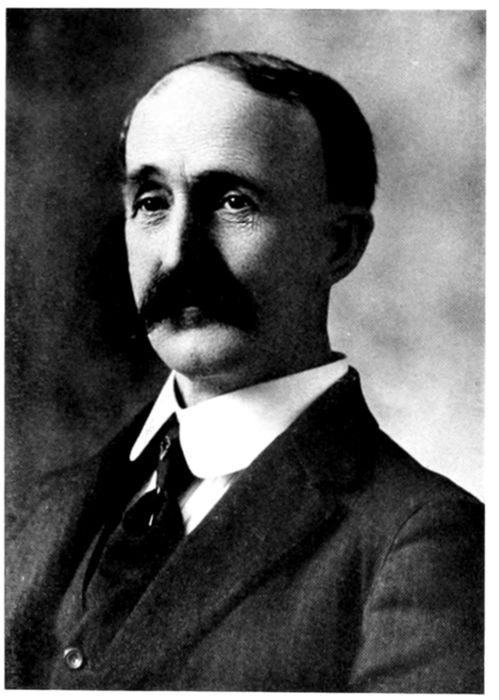
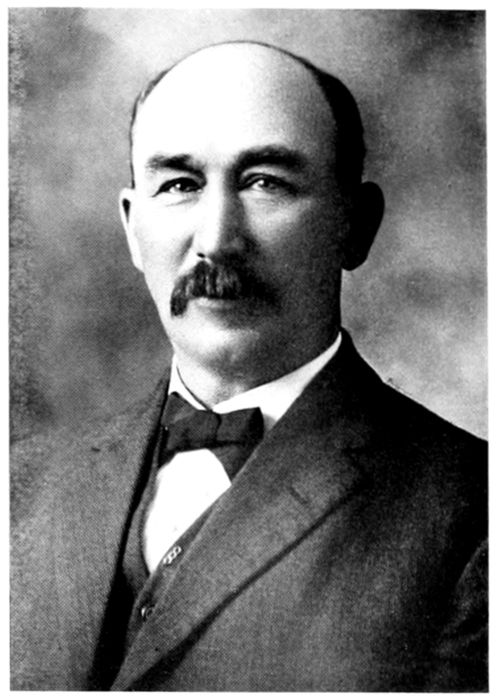
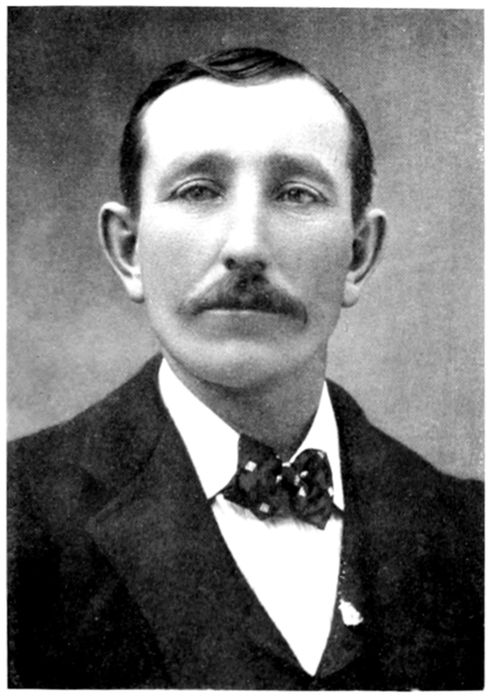
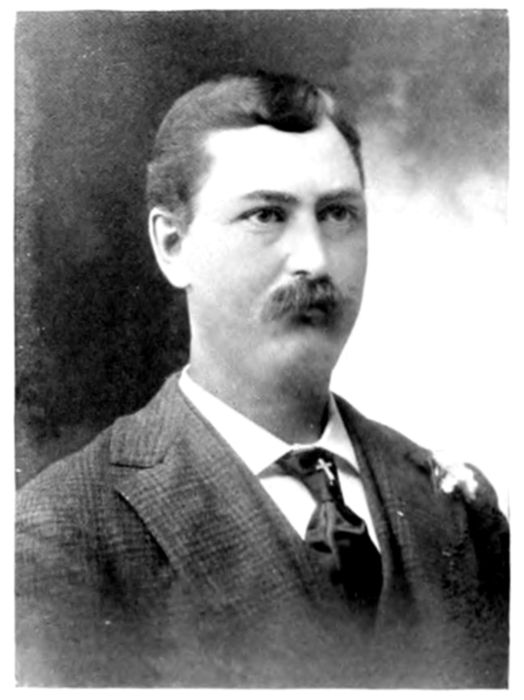
465On March 30, 1881. Mr. Bush was united in marriage with Ellen J.
Christian, a native of the Isle of Man, a small island in the Irish sea lying
between Ireland and England. She was born January 24, 1857, a daughter
of Charles and Mary (Kneale) Christian, both of whom were natives of the
Isle of Man. Mrs. Bush died in February, 1911. They had six children, as
follows: Cora, Atchison, Kan.; Harry, Atchison, Kan.; Mary Smithson,
Lancaster, Kan.; Ina, deceased; Sarah, Atchison Kan.; Jessie, Atchison, Kan.
On October 29, 1913, Mr. Bush married Mary E. Christian, a niece of his
first wife, and a daughter of Charles and Ellen J. (Wade) Christian, natives
of the Isle of Man. She was born near Pardee, Atchison county, March 21,
1869, and attended the Catholic parochial school of Atchison. They have no
children. Mr. Bush is a Republican and attends the Methodist church. He
is a member of the Independent Order of Odd Fellows and Modern Woodmen
of America of Lancaster. He also is a member of the Atchison County Protective
Association, of which he was one of the organizers, and served as
president of the association for a number of years.
Mr. Bush is one of the most successful farmers in Kansas and is the
owner of a highly productive tract of land. As an illustration of his success
as a farmer, the records show that from a tract of twenty-one acres there
was corn produced at an average of 108 bushels to the acre the first year,
ninety-seven bushels to the acre the second year, and eighty-four bushels to
the acre the third year, after which the land was sown to wheat in the natural
order of crop rotation and the yield was thirty-eight bushels to the acre.
Mr. Bush is a firm believer in crop rotation as a means of preserving the
fertility of the soil.
For an individual to come to Atchison county without funds and with
practically no influential friends to assist him to achieve success, it is remarkable
for him to accomplish in the rather brief period of twenty-six years as
much as has been done by Michael J. Hines, of Lancaster township, Atchison
county. It is apparent that Kansas presents unusual opportunities for a man
to better his condition, if one man can accumulate 480 acres of land, become
president of a flourishing banking concern and a stockholder in another important
city bank. The main reason for Mr. Hines’ wonderful success must
lie in the ability of the man himself, and the reviewer must of necessity conclude
that the power to achieve was inherent in his mental and physical makeup,
which, combined with industry, decided financial ability, honesty and
uprightness has made him one of the leading citizens of his adopted county.
Mr. Hines is a scion of old southern families, and comes of good old Virginia
stock on his mother’s side, being descended from the well known Hunter
family of Virginia, who were among the founders of the Baptist church
in the southland. Mr. Hines is a large stockholder and director, and was
466formerly vice-president of the Antelope Peak copper mines of Arizona. He
is the owner of a 320–acre irrigated ranch in the Valier valley of Montana,
near Valier.
Michael J. Hines was born July 5, 1863, in Roanoke county, Virginia,
and was one of the twelve children of Henry and Katherine (Jeter) Hines,
six of whom are living. The father was born in Rockingham county, Virginia,
in 1833. He was a Confederate soldier during the Civil war, having
enlisted in Virginia but was not in any battles during the war. His life was
spent in farming except for a time when he speculated in Confederate money.
At the close of the war he had a sack full of Confederate scrip which
could not be redeemed. He died at his home in Abington, Va., in 1898. His
father, Richard Hines, was of Irish descent and was a plantation owner in
Virginia. His mother was Sallie (Howmaker) Hines, and was of German
descent. The mother of Michael Hines was also a Virginian, having been
born in Bedford county, Virginia, in 1841. She died in 1890. She was a
daughter of Allison Jeter. Her mother was a member of the Hunter family,
who were among the first members of the Baptist church.
Michael Hines was reared and educated in Virginia and left that State
in 1883 when he was twenty years of age, settling in Morgan county, Illinois,
where he worked as a farm hand for six years. He then came to Atchison,
Kan., and was engaged as foreman by the Greenleaf & Baker Grain Company.
Six years later he bought his present farm of 160 acres. It was unimproved
and none of the land was broken. Since buying the land he has
made $10,000 worth of improvements on his place and has set out fifteen
acres of orchard. This evidence speaks for the thrift and good judgment of
Mr. Hines. He also has bought 480 acres of land in Lancaster township.
He is a live, progressive farmer and stock raiser and keeps graded stock of
all kinds on his farm. Mr. Hines is a shareholder and president of the Lancaster
State Bank, and is also a stockholder in the German-American Bank
of Atchison, Kan. In politics Mr. Hines is a Democrat, but votes independently
in county and State affairs, and for the individual.
Mr. Hines was married in 1890 at Alexander, Ill., to Lillie Kaiser, who
was born August 27, 1870, and six children have been born to this union, as
follows: Samuel, who was graduated from the Atchison business college,
and is now farming at home; Frank, Helen, Louise and Lillian, all living
at home, and one died in infancy. Mr. Hines is a member of the Methodist
church and is a trustee and steward in the Shannon Methodist Episcopal
Church. He belongs to the Modern Woodmen of America and the Independent
Order of Odd Fellows of Lancaster, Kan.
467
Charles H. Falk, of Shannon township, is the owner of the first tract of
land which was filed upon in the Atchison county land office in 1854. This
farm was preëmpted by Capt. William Jackson, who was a justice of the
peace and a captain of home guards during the Civil war, and died at Ft.
Worth, Tex., in 1911. The first house built on the place was made from
material taken from the cabin of a river steamer sunk in the Missouri river.
Henry Falk, father of Charles, and his son, have made so many excellent
improvements on the dwelling that the dining room of the present residence
is the only part of the old cabin now in use. This part of the home
was built in 1857. The original owner set out a grove of cottonwoods in
1857 which was cut down in the fall of 1892 by the present proprietor, and
erected a barn from the lumber sawed, which made over 112,000 feet of good
merchantable lumber. Mr. Falk’s barn was built from this lumber, with the
exception of the shingles. Captain Jackson sold the land to Frank Fisher,
who died in 1877, six months after the purchase, and it was bought by Henry
Falk, father of Charles H., in 1878. After Henry Falk’s death, Charles H.
came into possession of the land by inheritance, and by purchase of the interests
of the other heirs. He has made very extensive improvements since becoming
the owner and despite that the soil has been in constant cultivation
for more than sixty years the yield of crops is greater now than ever before,
and the wheat crops in late years have exceeded twenty-two bushels an acre.
The farm residence is attractively situated, in the center of the tract of 155
acres and is reached by a splendid driveway, kept in first class condition by
Mr. Falk. In fact, the private road to the Falk residence is kept in far better
condition than many of the country roads in Atchison county, and is in keeping
with the general appearance of this fine farm.
Charles H. Falk was born May 23, 1864, in Watertown, Wis., a son of
Henry, born in 1815, and died, 1894, and of Wilhelmina (Clout) Falk, born
1819, and died in 1901. Both parents were born on the River Rhine in Germany,
and married in their native land. Henry Falk was a cabinet-maker
and immigrated to Wisconsin in 1857, and worked at his trade until 1866,
when he settled on a farm. He came to Atchison county with his family in
1879, and on February 2, of that year, moved on the farm which he had
purchased the preceding year.
Charles H. Falk was married in 1885 to Elizabeth Wolters, a daughter
of John Wolters, a native of Holland, who was one of the first brick-makers
in Atchison and Doniphan counties. John Wolters emigrated from Holland
468to Doniphan county, Kansas, in 1857, and came to Atchison in 1858. During
his long residence in Atchison he has been a manufacturer of brick, and
the results of his handiwork are seen in the construction of many of the brick
buildings in the city. Mr. Wolters was born in May, 1827, and is now over
eighty-nine years of age and the oldest Atchison county resident at the present
time. He lives a retired life on South Second street. Mr. and Mrs.
Falk have children as follows: John H., a resident of Beattie, Marshall county,
married Margaret Gressel, and they have two children, Karl and Pauline;
Henry, in the employ of the Symns Grocer Company; Anna, a seamstress, living
with her parents; Rose, wife of John McGrath, a traveling salesman for
the Symns Grocer Company, and they have one child, Rosemary; Herbert,
aged twenty years, and Irene, aged ten years, both of whom are at home with
their parents.
Mr. Falk and his family are members of St. Benedict’s Catholic Church,
and Mr. Falk is a member of the church committee of four councilors. He
is a Democrat, but is inclined to be independent in his voting, having
a decided leaning toward the support of those candidates that seem best fitted
for the office. He has filled no civic office but that of township trustee,
which he held for one year, having been appointed by the county commissioners
to fill a vacancy in Shannon township. He is affiliated with the
Catholic Mutual Benefit Association and the Central Protective Association
and is a member of the St. Joseph society.
George Dorssom, one of the oldest living pioneer settlers of Lancaster
township in point of residence, now living retired at Lancaster, Atchison
county, was born August 4, 1864, in Lancaster township, Atchison county.
He is a son of George and Sophia (Storm) Dorssom, and was one of thirteen
children, four boys and five girls of whom are still living. The subject
of this sketch was the seventh child of the family. The father of George
Dorssom, whose name also was George, was born in Germany January 8,
1820. He sailed to America and settled in New Orleans when a young man
and worked as a tailor there. He then went to Wayne county, Ohio, where
he worked as a tailor for a time, when he engaged in farming. In 1860 he
came to Atchison county, Kansas, and bought forty acres of prairie land in
section 21, Lancaster township, which he broke with oxen. He farmed on
469this place until his death in January, 1895. He came to America a stranger
and without funds, but by hard work he accumulated considerable means and
reared ten out of a family of thirteen children. His wife, Sophia, was a devoted
helpmate, and when they were struggling to make their farm pay, she
would load up a small hand wagon with vegetables and garden truck and pull
it to Lancaster, where she would sell or exchange the produce for goods. This
trip was two miles, and it was a great exertion for Mrs. Dorssom, but she
was glad to be able to help her husband in whatever way she could. After
the death of her first husband she was married again on February 19, 1896,
to Jacob Merkel, a native of Germany. He died March 12, 1908. His wife
is still active, despite her age, and lives in Lancaster with a maid. She is
able to be about her work and takes a keen interest in life. Her children are:
Mrs. Margaret Kleppe, a widow, residing in Brown county, Kansas; Mrs.
Katherine Hinz, a widow, Lancaster, Kan.; John, farmer, Lancaster township;
Mrs. Caroline Kloepper, deceased; Mrs. Sophia Myer, living in Soldier,
Jackson county, Kansas; Adam, Lancaster township; Louisa Henrietta,
dead; Mrs. Lizzie Myer, of Lancaster; Dora W., deceased; Adam, of Lancaster,
Kan.; Mrs. Louisa Fridel, Brown county, Kansas; Henry, farmer,
and three children who died in infancy. She has forty-five grandchildren
and fifteen great-grandchildren and is very proud of them all. Her descendants
all carry the idea of an industrious woman with them and the influence
of the life of this woman will stay with them all through their lives.
George Dorssom, the subject of this sketch, was reared on the farm of
his father. He attended school in the Bell district and worked on his father’s
farm until he was twenty-five years of age. He then bought eighty acres of
land from his father in section 21, Lancaster township, and followed farming
for fifteen years. He has added forty acres to his farm and made extensive
improvements to the extent of $7,000. He now owns 138 acres of land
and a fine residence with about five acres of residence property in Lancaster,
Kansas. Mr. Dorssom was a breeder of Berkshire hogs, to which he paid
special attention. In 1909 he retired and moved to Lancaster, Kan. He is
a Republican and was a member of the city council for four years. For a
term of seven years he was road supervisor of Lancaster township. He has
always taken an active interest in public affairs of his community. He has
led a useful life and looks back on one of the longest careers of living citizens
who were born in Atchison county. He has traveled in many parts of the
United States, but is glad to have settled down in retirement in Atchison
county, believing it to be the happiest country he has ever seen.
On December 31, 1890, Mr. Dorssom married Hulda Hinz, who was
470born in Germany October 1, 1860. She came to America when she was
twenty years old. Her father, Edward Hinz, died in Germany in 1895, at
the age of fifty-eight years. The mother, Caroline (Lutce) Hinz, came to
Atchison county, Kansas, in 1896, and now resides at Leavenworth. Mrs.
Dorssom attended school in Germany. She was one of nine children. A
brother, Richard, is a florist at Leavenworth, Kan., and two brothers
are in the same business, one, Rudolph, at St. Joseph, Mo., and the other,
Amiel, at Leavenworth. Mr. and Mrs. Dorssom have no children, but
they adopted a child, Gustave Hinz, a nephew of Mrs. Dorssom. They reared
and educated him, and he is now farming on the home place. Both Mr. and
Mrs. Dorssom are members of the English Lutheran church. He is a charter
member of the Independent Order of Odd Fellows, and has been a member
of the Lancaster Lodge of Odd Fellows, No. 355, since October, 1891,
nearly twenty-five years. Mrs. Dorssom is a charter member of the Daughters
of Rebekah Lodge, No. 431.
Cyrus E. Davis, founder and proprietor of the firm C. E. Davis &
Sons, plumbing and heating contractors, at 509 Kansas avenue, is one of
Atchison’s leading citizens, and a successful business man who has built up his
business from a modest beginning in a few short years. He first started with
a small shop on Commercial street, and in October, 1914, moved to his present
location. A complete stock of plumbing, heating and steam fitting goods is
carried in the shop, exceeding a value of $2,500. The excellence and thoroughness
of the work done by the Davis establishment is marked, and the
business is constantly on the increase.
Mr. Davis was born October 10, 1864, in Frederick county, Maryland,
son of George W. and Belinda (Saunders) Davis. The Davis family is a
very old one of Welsh extraction in America. The founders of this family
were four brothers, who crossed the ocean and left their native land of Wales
early in the seventeenth century. George W. Davis was also born in Frederick
county, Maryland, and became a contractor and builder. He followed
his trade in his native State until 1873, when he migrated to Nebraska with
his family. Later he went to Texas, where he died in 1900. He was the
father of nine sons, as follows: George W., a contractor and builder, of
David City, Neb.; Harry W., a building contractor, of Houston, Texas; Theodore
471E., a contracting painter, of Columbus, Neb.; Mahlon, a tailor, located
in Norwalk, Ohio; William M., deceased; Lewis A., a tinner and coppersmith,
of San Bernardino, Cal., in the employ of the Santa Fe railroad; Cyrus E.,
with whom this review is directly concerned; Frank H., business agent for
the Carpenters’ Union of Oklahoma City, Okla. The mother of these children
was also born in Frederick county, Maryland, in 1825, a daughter of
Mr. and Mrs. Walter Saunders, natives of England. Walter Saunders came
of a good English family and studied in a boarding school of Southhampton,
England, and became a school teacher in Maryland. He had the distinction
of having taught for forty years in one school district in Frederick county,
Maryland, and became well-to-do. Mrs. Davis died in 1889.
Cyrus E. Davis was educated in the public schools of Columbus, Neb.,
learned his father’s trade when a young man, and after taking a correspondence
course in bridge engineering, he entered the employ of the Missouri
Pacific Railway Company as bridge constructor. He remained with this
road for five years and came to Atchison in 1886. He was employed by the
Missouri Pacific Railway Company until 1905 and then entered the plumbing
and heating department of the Farwell Heating Company for one and one-half
years, and then became foreman for the Thayer Supply Company of
Atchison. In the year 1912 he started a shop of his own on Commercial
street and was successful from the start. It became necessary for him to
seek larger quarters, and in October of 1914 he moved his business and shop
to his present location.
Mr. Davis was united in marriage with Ida Mayhood in 1889, and to
this union have been born seven children, as follows: Frank M., George E.,
Reynold, Fred, Norma, Charles, and Verner, deceased. All of Mr. Davis’
sons are associated with him in his business, and have learned to become
expert plumbers and steamfitters under their father’s tutelage. The mother
of these children was born November 9, 1869, in Leavenworth county, Kansas,
a daughter of George and Mary (Carr) Mayhood, natives of Ireland,
and Canada, respectively. George Mayhood emigrated from Ireland in an
early day and settled in Leavenworth county about 1865, where he engaged
in farming. He and his wife were married in Lowell, Mass.
Mr. Davis is a Republican, and has taken an active and influential part
in the civic life of his adopted city, having served two terms as a member
of the city council. He and his family are members of the Christian church,
and he is fraternally connected with the Ancient Free and Accepted Masons,
Active Lodge, No. 158, and the Modern Woodmen of America, in both of
which lodges he is much interested.
472
The life story of Henry Buttron, late of Lancaster township, Atchison
county, Kansas, reveals the accomplishments of a poor German emigrant, who
began his career in Kansas with no money, and rose to become the practical
leader of the German colony in the township, and to amass considerable
wealth. His large farm of 960 acres which he owned at the time of his demise
was left intact, to be held in trust for his children and heirs.
Henry Buttron was born in Hesse-Darmstadt, Germany, October 12,
1831, and he was one of the five sons of Jacob and Margaret (Zimmer) Buttron,
two of whom came to America from their native land. Two brothers of
the family, Frederick and Henry, came to America in 1852; Frederick settled
in Pittsburgh, as did Henry, and he resided there until 1854, and then came
to the West. In his native land, Henry Buttron had learned the trade of
blacksmith; he worked at his trade in Pittsburgh, and after he came west, he
was employed as a smith at Elgin, Ill., until 1857. He then came to Kansas
and preëmpted a claim on section 22, Lancaster township, Atchison county.
He brought a small amount of money with him, and was enabled to build a
very small house, and then began to improve his farm. The crops failed in
1860, and he found it necessary to resort to the hammer and anvil in order
to gain a livelihood for himself and his family. He, accordingly, removed to
Atchison and was employed at his trade by Tom Ray, of the firm of Ostertag
& Carmichael, and Anthony & Ostertag, consecutively for nine years. He
then returned to his claim, redeemed the unpaid taxes, and entered upon a new
era of progress and industry which led to his great success in the ensuing
years. In 1882 he erected a large, handsome farm house, which at the time
was one of the most conspicuous homes in the county. He added to his possessions
as he was able, and accumulated a total of six quarter sections of
good land, of 960 acres in all, all of which he left to his widow, who resides
on the old home place.
Henry Buttron was married in Atchison, Kan., in 1866, to Rosa Scheu,
whose father, Andrew Scheu, came from Wittenberg, Germany. The following
children were born to this union: Rosa, wife of Louis Gerhardt, of
Atchison; Emma, wife of Charles Kammer, of Lancaster township; Kate and
Jacob, at home; Henry, who married Bertha Kemmer; Fred, married Louise
Meek, lives near Nortonville, Kan.; Anna, wife of George Schulz, Lancaster
township; Karl, married Anna Hegland, Lancaster township; William, George
and Louis, at home. The mother of these children was born in Germany, in
May, 1845, and came to America with her parents when nine years of age.
She was a daughter of Andrew and Rosena (Baner) Scheu, both deceased.
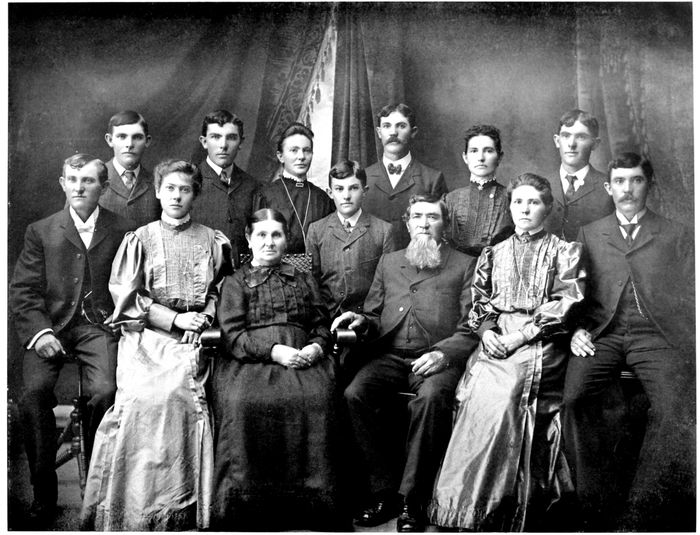
Mr. and Mrs. Henry Buttron and Family, of Lancaster Township
473Mrs. Buttron has grandchildren as follows: Kathrine, Rosa and Henrietta
Kammer; Henry Buttron’s children, three, Clarence, Esther and Ruth;
Fred Buttron has three children, Karl, Ralph, Mildred; Mrs. Anna Schulz
has two children, Gilbert and Karl; Mrs. Rosa Gerhardt has one son, William;
Karl Buttron has one child, Edward; Jacob Buttron has four children, Bertha,
Emma, Alice and John.
Henry Buttron died February 8, 1913. During the Civil war he was a
member of the Kansas State militia, and was in the engagement fought at
Westport, and which resulted in the rout of the forces of the rebel general,
Price. Mr. Buttron always took a keen interest in local and county affairs,
and took a prominent part in affairs of importance to the well being of the
people. He was always modest and unostentatious in his conduct, and was
greatly respected by the people of his neighborhood for his cool judgment
and patriotism at all times. Henry Buttron was a good citizen, and a kind
parent who was highly esteemed by all who knew him.
Some men are natural organizers and blessed with such a deep love for
the well being of their fellowmen that their activities are to a considerable
extent devoted to spreading the gospel of good fellowship among mankind.
The social and fraternal orders which are popular among men of any locality
are simply the outgrowth of that desire, for the realization of a great
dream for the “Brotherhood of Man,” which was predicted 2,000
years ago. A man who furthers the growth of organizations which have
the welfare of the individual, singly and collectively, at heart is doing a considerable
amount of definite good for the betterment of social conditions.
Such a citizen is W. H. Smith, the widely known and efficient clerk of the
district court of Atchison county, and a likeable and able personality, who
figures prominently in the history of his county.
Mr. Smith was born February 3, 1855, at Knoxville, Ill. He is a son of
John and Harriet (Gibbons) Smith, natives of England. John Smith, the
father, was born in 1808, and died in the year 1863. He was a scion of an
English family and was a graduate of Oxford University. He became a
contractor and builder in his native land, but immigrated to America with his
474wife and three children in 1852, settling in Knoxville, Ill., where he died
eleven years later. He was the father of the following children: Mrs. Sarah
Ann Simpson, deceased; Mrs. Harriet Ann Webb, of Burlington Junction,
Mo.; Charles E., of Sierra Blanca, Texas, employed as a stationary engineer
by the Texas Pacific railway since 1880. The mother of these children departed
this life February 2, 1890, aged seventy-eight years, at the home of
her daughter, Mrs. Simpson.
W. H. Smith was reared in Knoxville, Ill. Being left an orphan at an
early age, by the death of his father, it was necessary for him to start work
when a boy and practically earn his own living and educate himself. By
working on neighboring farms during the spring and summer he was enabled
to attend school during the winter months, and succeeded in attending
the Knoxville high school. He did farm work until 1865 and then
learned the printing trade in Knoxville, being attached to the staff of the
Knoxville Republican during the winter of 1866 and ’67, and remained until
1874 in that capacity. At the early age of twenty years he wedded Elmira
Kistler, and then settled on a farm in Lehigh county, Pennsylvania, on which
was located a tannery. He operated both farm and tannery until 1880, when
he decided to cast his fortunes in the western country. March 2, 1880, he
came to Atchison with his family and moved to a farm near Good Intent, five
miles northwest of Atchison. The year before this he had made a trip to
Atchison county and invested in eighty acres of land which was partly improved.
He developed this tract into a very fine farm and sold it at a considerable
advance over and above the purchase price in 1895. In the spring
of 1890 Mr. Smith removed to Atchison and for three years served as night
agent at the union station for the Wells, Fargo and American Express companies.
He then bought an interest in the Home Show Printing Company,
and was connected with this concern in active capacity for a period of twelve
years, or until 1905. The printing company was then taken over by other
parties and he continued working in the office until 1909.
During his residence in Atchison county previous to this time, Mr. Smith
had become prominently identified with the Republican party and had become
known as a “wheel horse” of the organization and universally esteemed
by the rank and file of the party. He was elected to the office of clerk of
the district court in the fall of 1908, and began the duties of his office
in January of 1909. He was reëlected in 1912 and again in 1914. He was
elected without opposition from any source in 1912, and overcame his opponent
in 1914 by the immense plurality of 3,010 votes. For a
period of three years he was secretary of the Republican central committee,
475and was for six years a member of the first Atchison county high
school board, being one of the surviving members of the original board which
erected the county high school at Effingham, and was likewise a member of
the board which rebuilt the school house when it was destroyed by fire. Mr.
Smith was a member of this board while still a resident of the county and
took a prominent part in the inauguration of this worthy institution, which
has been so much appreciated by the people of Atchison county.
In religious matters Mr. Smith is identified with the Episcopal church.
Probably no man in Atchison county is identified with a greater number of
fraternal organizations than is he. He became a member of the Odd Fellows
August 2, 1882, and is also a member of the encampment. Since January
1, 1915, he has served as a secretary of Friendship Lodge, Independent Order
of Odd Fellows, No. 5, and has been scribe of the encampment for the past
fifteen years. For eighteen years he has been secretary of the board of trustees
of the Odd Fellows lodge and is affiliated with the Rebekahs, and is a member
of the canton. Since 1880 he has been a member of the Central Protective
Association and was practically its originator, and has been the grand
secretary of the order since 1886. The first of the annual outings and picnics
held by this famous association was conducted in the grove on Mr. Smith’s
farm. Visitors and guests to the number of 10,000 people have attended these
picnics. Mr. Smith has been a member of the Ancient Order of United Workmen
since 1895, and recorder of the order for thirteen years. He is a member
of the Woodmen of the World and has been their banker for six years
past. He is affiliated with the Knights and Ladies of Security; the Kansas
Fraternal Citizens; a member of Atchison Aerie, Fraternal Order of Eagles,
No. 173, and its secretary since 1904. Before removing to Atchison he was
secretary of the Central Protective Association at Good Intent for five years.
He is at present serving his second term as State secretary of the Kansas
Eagles, and has held various offices in the State aerie, including the important
post of State representative. Since 1895 Mr. Smith has been a member of
the Modern Woodmen; is a member of the Fraternal Aid Union, and the
Improved Order of Red Men, and is an honorary member of the Typographical
Union.
Mr. Smith’s happy wedded life began July 4, 1874, when he married
Elmira, daughter of Joel and Matilda Kistler, of Lehigh county, Pennsylvania,
members of an old Pennsylvania family. Joel Kistler was a large land
owner and tannery operator in Lehigh county. He and his brother, Stephen,
operated a number of tanneries, and were extensive farmers, and were very
wealthy. Joel Kistler came west, located in Knoxville, Ill., and invested
476heavily in Illinois land. He died at Stony Run, Berks county, Pennsylvania.
Mrs. Kistler died at Schnecksville, Pa. To Mr. and Mrs. Smith have been
born the following children: Estella, born July 14, 1875, deceased; Harriet
Matilda, born June 6, 1876, wife of J. A. Wilkinson, of Hershey, Pa., and
the mother of two children, John J., aged twelve years, and Michael aged
eight years; Isabelle, born December 15, 1880, wife of Dr. J. E. Exter, of
Atchison, and mother of one child, Eugene, aged five years; Pearl, born October
12, died April 25, 1890; Helen, born May 1, 1885, wife of R. H. Jones,
chief train dispatcher for the Missouri Pacific railroad at Falls City, Neb.,
and mother of one child, Mary Elmira, aged six years; Frank Gibbons Smith,
born August 8, 1891, and died February 23, 1901.
W. H. Smith is considered as one of the best officials who has ever
filled a county office, and he is held in high esteem for his many excellent
qualities. To his many friends and associates he is affectionately known as
“Big Bill,” an appropriate name on account of his large stature, and an appellation
which can well be applied to his heart and mind. While large of
body, he is also big-hearted and blessed with a breadth of mind and good
will which embraces all mankind.
For over forty-five years Joseph W. Allen, veteran, merchant, and
descendant of an old and distinguished colonial family, has been identified
with the civic and mercantile life of the city of Atchison. He comes of
rugged New England stock, noted for their integrity, honesty and proverbial
industry throughout the United States, and has been one of the builders of
Atchison’s largest wholesale grocery house. Mr. Allen has grown up with
Atchison, and has come to be one of its best known and highly respected
citizens, having risen from moderate circumstances at the outset of his career
to a position of affluence and decided prestige among the commercial men
of northeast Kansas.
Joseph W. Allen was born in Craftsbury, Orleans county, Vermont,
March 2, 1841, a son of Hollis F. and Sophia (Root) Allen, natives of
Massachusetts. The father was a merchant and when a young man removed
from his native State to Craftsbury, Vt., where he was engaged in the mercantile
business for a number of years, and in the latter part of his life he
came to Atchison, Kan., dying in 1874. He had three sons who served in
477the Union army: Frank H., who later came to Atchison and was a member
of the wholesale drug firm of McPike & Allen; George R. Allen, a retired
manufacturer, living at Alton, Ill., and Joseph W., with whose career this
review is directly concerned. A daughter, Anna H., wife of the late Frank
Howard, founder of the Frank Howard Manufacturing Company of Atchison,
died in 1915 at her home in this city. Another daughter, Nellie, makes
her home with her brother, Joseph W., in Atchison, and is now in Honolulu.
The Allen family is of Scotch origin, and Ethan Allen, of Revolutionary
fame, was a member of the same family.
Mr. Allen was reared to manhood in Vermont and received a good common
school education, attending the Craftsbury Academy. On October 2,
1861, in answer to the President’s call for volunteers to defend the Union,
he enlisted for three years in Company I, First regiment, Vermont cavalry.
He was mustered in with the regiment November 19, 1861, at Burlington,
Vt., as bugler, and was mustered out of the service November 18, 1864. He
left Burlington December 12, 1861, for Washington, D. C., and remained
there with his regiment until February, 1863, at which time he was detailed
at General De Forest’s headquarters as musician. Afterwards, he was detailed
to General Kilpatrick’s headquarters as musician and remained there
until General Wilson took command of the division in April, 1864. He was
then detailed to General Sawyer’s headquarters until October, 1864, at which
time he came to Burlington Vt., where he was mustered out of the service.
Mr. Allen was in thirty-seven engagements during his three years of service,
and was never wounded nor captured, nor was he absent from duty a single
day on account of sickness. His regiment did notable service under Generals
Sheridan and Custer, and he was engaged in the famous battle of Winchester.
An incident of Mr. Allen’s army career is well worth recording. He
effected, single handed, the capture of four Confederate soldiers, and the
story of the capture is one of the historical incidents of the great conflict.
The incident took place near Lightersville, Md., and it was after the regiment
had taken part in the battle of Huntersville, Pa., July 2, 1863, and the battle
of Gettysburg, July 3, 1863, the battle of Monterey on the Fourth of July,
Lightersville on July 5, and on the sixth of July occurred the battle of Hagerstown.
The men were all fatigued and had been deprived of both sleep and
rest for several nights in succession, Joseph Allen among the rest. When
they had ridden nearly all night to a point near Lightersville, they halted for
rest in the small hours of the morning. Many were dismounted and fell
asleep on the ground, Mr. Allen doing likewise. He slept so soundly, however,
that when he awoke his comrades were gone. It was dark and he was
478uncertain in which direction the command had gone. He mounted his horse
and let the animal pursue its own way without guidance. Dashing down
the road, horse and rider came out into a main highway and unexpectedly
came upon four men who were as much taken by surprise and fright as
Allen himself. The rebels, supposing that there was a larger number of
Union men following, made haste to surrender without waiting for an invitation.
Allen promptly accepted their surrender and took them along to
the main body which was some distance ahead. His prisoners proved to be
a major, a captain and two lieutenants of the Eighth Georgia regiment.
Mr. Allen rode during the war a very sensible and intelligent cavalry
horse, and thereby hangs a tale. In one of the cavalry engagements in which
he participated he and his comrade were riding together under heavy fire.
His riding partner was shot from the saddle and Mr. Allen felt his own horse
sinking under him. Believing that the animal was mortally hurt he dismounted
and jumped on the back of his dead comrade’s mount and rode
away to safety. That night while lying in his blankets with the earth for
his couch and the starlit sky for a canopy overhead he felt something soft
and gentle nudging him. Startled, he arose hastily and was overjoyed to
find that it was his favorite horse which had returned safely, but badly
wounded, from the battlefield, and had hunted out his master from among
the hundreds of recumbent and sleeping forms on the camping ground.
He returned to Craftsbury after his war service and engaged in mercantile
business which he continued until 1870, when he came to Atchison at
the solicitation of his brother, Frank H., who was at that time the junior
member of the firm of McPike & Allen, wholesale druggists of Atchison.
Mr. Allen entered the employ of the company as traveling salesman and was
thus engaged for a period of three years. He then embarked in the grocery
business in partnership with Colonel Quigg under the firm name of Quigg
& Allen. Colonel Quigg commanded the Thirteenth Kansas infantry regiment
during the Civil war. The firm of Quigg & Allen carried on a wholesale
grocery business for about three years. Then Mr. Allen purchased his
partner’s interest, and three years later consolidated with the A. B. Symns
Grocer Company. A. B. Symns became the president of the company and
Mr. Allen became vice-president. When Mr. Symns died in 1905 Mr. Allen
became president and held the position until 1911 when he retired from
active participation in the business, although he still retains a substantial interest
in the company. Mr. Allen was one of the dominant individuals in
the development of the Symns Grocer Company in the extensive concern
which it is at the present time. When he joined forces with Mr. Symns their
479combined capital did not exceed $15,000, and during his period of association
with this company their business developed into enormous proportions,
and the capital of the Symns Grocer Company now amounts to $300,000.
Mr. Allen was a natural salesman and had complete charge of the traveling
sales department of the Symns Grocer Company, and, in fact, during the first
few years was the entire traveling sales force himself. Later, as additional
salesmen were added to the force he continued to direct the sales department
of the business. Mr. Allen is a prominent factor in the business world of
Atchison, and is vice-president of the Atchison Savings Bank. He is a member
of the Benevolent and Protective Order of Elks, and in his political
views is absolutely independent.
Ralph U. Pfouts, a leading young attorney of Atchison, is a native son
of Atchison county. He was born at Monrovia December 4, 1890, and is a
son of William A. and Ollie (Sharpless) Pfouts. William A. Pfouts, the
father, is also a native Kansan, born in Nemaha county in 1861 and is a
son of James and Caroline (Kellam) Pfouts, natives of Pennsylvania, where
they were reared and married, and in 1860 came to Kansas, locating in
Nemaha county. The father, James Pfouts, died a few months after coming
to this State and his wife returned to Pennsylvania with her little family.
A few years later, however, the Pfouts family returned to Kansas, locating
at Lancaster, Atchison county, and here William A. Pfouts was educated
and reared to manhood. He followed farming in early life and for eighteen
years was a school teacher. In 1896 he engaged in the general mercantile
business at Lancaster. To William A. and Ollie (Sharpless) Pfouts were
born two children, as follows: Ralph, the subject of this sketch, and Mabel,
deceased. The wife and mother died in 1901, and in 1905 William A. Pfouts
married Miss Sadie M. Monnies.
Ralph U. Pfouts was educated in the public schools of Atchison county,
and Kansas University, at Lawrence, Kan., graduating from the law department
of the latter institution with the class of 1914. Shortly after graduating
he passed the State bar examination and engaged in the practice of his
profession at Atchison where he is meeting with well merited success. He
has appeared in connection with important litigations in both the State and
Federal courts and is enjoying a lucrative practice. He possesses the natural
480qualities of an able lawyer and is an untiring student, and those who know
him best predict for him a successful career in his chosen profession. Politically,
he is a Republican. Mr. Pfouts is a member of the Ancient Order of
United Workmen, Independent Order of Odd Fellows, and Atchison Aerie
No. 173, Fraternal Order of Eagles.
Ole G. Gigstad, farmer and stockman, Lancaster township, was born
in Norway, October 25, 1856. He is a son of Gulick and Anna (Grannan)
Gigstad. He was one of seven children, one of whom is now dead. Four
sons and one daughter are now living in the United States. A brother, Knud
G. Gigstad, is also a farmer and stockman in Lancaster township. The father
was a native of Norway and spent his life there. Ole Gigstad left Norway
in May, 1883, and came to Atchison county, Kansas, where he worked a year
for his brother, Knud. Then for three years he rented a farm from his
uncle in Brown county, Kansas, and in 1887 bought the farm in Lancaster
township. It is an eighty acre farm and Mr. Gigstad has made improvements
to the extent of $5,000, including a fine house and barn. He now owns 320
acres of well improved land, 160 acres of which are being farmed by his
oldest son, Gustave, and it has a comfortable residence.
Ole Gigstad attended school in Norway, but when he sailed for America
he could not speak the English language, and when he arrived here he was
in debt to the extent of fifty dollars, which was an additional handicap. But
his industry has brought him to the front rank of Atchison county farmers.
He owns a fine herd of graded stock and is a successful farmer and stockman.
He rented eighty acres additional in 1915 and he had 100 acres in corn
last year.
Mr. Gigstad was married in 1888 to Severine Knudson, who was born in
Norway, September 23, 1866. She left her native land in the spring of 1883
and settled at Everest, Kan., where her brothers were living at the time. In
1884 she removed to St. Joseph, Mo., where she worked four years. Her
parents were Knud and Inger Sofie (Berntson) Knudson, natives of Norway.
Her father was born in 1814, and immigrated to America in 1891, coming to
Atchison county, Kansas, where he lived with his children until his death, in
1894. The mother was born in 1827, and died in her native country in 1887.
Mr. and Mrs. Gigstad have eight children: Gustave A., farming the 160 acres
481west of his father’s farm; Ida, Charles, Albert, Emma, Edna, Alice, Benjamin,
all living at home. Mr. Gigstad is a member of the Lutheran church and is
a Republican.
John H. Barry, chairman of the board of directors of the First National
Bank of Atchison, is one of the well known citizens of the city who has
figured in the development of Kansas, especially the eastern portion of the
State, for a period of many years. For fifty-seven years he has been a resident
of the State, and has made his own way from comparative poverty in
his youth, to a position of affluence which compares most favorably with that
of the men of his day with whom he has been associated. He has seen the
Sunflower State develop from a wilderness, unsettled and unpeopled, except
by the wild animals and Indians, to become one of the fairest and greatest
of the sub-divisions of the American Union. He is proud of Atchison
and her prestige, and has played no small part in the task of advancing his
adopted city to the forefront of western municipalities.
J. H. Barry is of Celtic origin, having been born in the city of Boston, of
Irish parents, in 1849. His parents, Michael and Ellen (Roach) Barry, were
natives of County Cork, Ireland, where they were reared and married, and
crossed the Atlantic to seek their fortune in the new world. Settling in Boston
in the early forties, Mr. Barry plied his trade of tailor with fair success
and owned and conducted his own tailoring establishment. He died there
when John H. was a small boy. His widow, accompanied by her son, then
journeyed across the country to Leavenworth in 1858. Here the boy was
brought up until he was fifteen years of age and in 1862 became a freighter
in the employ of the Government. He was a “mule whacker,” or driver, who
had charge of a team of six mules which he drove from Ft. Leavenworth
across the Great Plains to New Mexican points. Saving his earnings, he embarked
in the freighting business at Leavenworth for himself in 1866, driving
his outfit over the route of the Ft. Scott & Gulf railroad, via Baxter
Springs, Kan., through the Indian Territory to Indian agencies in the territory
and Texas, carrying wagon loads of merchandise and trinkets on the
outward bound trip, and bringing back a load of furs, hides and osage orange
seed. The trinkets taken along were intended for the Indians who exchanged
their furs for adornment. The osage orange seed was in great demand at
482this period inasmuch as the settlers were then girding their lands with osage
hedges. Mr. Barry’s freighting venture proved profitable, and he made considerable
money during the two years in which he made trips to the Southwest.
In 1870 he engaged in railroad contracting, and was fairly successful
until 1873. He graded and built many miles of railroad in southern Kansas
and through Oklahoma, and in the building of the L. L. & G. R. R., he reaped
excellent profits. He had his ups and downs, like other contractors, however,
and one experience in particular very nearly proved his undoing. This was
in the building of the M. K. & T. R. R., in which Mr. Barry had contracted
to build a twenty foot embankment for a distance of one mile. It was understood
with the railroad officials that the grading was to be completed by the
first day of the following year, but he rushed the work so as to have it completed
before the fall rains began. He succeeded in doing this early in the
fall, but the head contractor, Stewart McCoy, would not accept the work as
finally done before the time limit of the contract, unless he would deduct
twenty per cent, from the contract price agreed upon. This arrangement
meant the complete dissipation of his profits, and he finally came through
with only his outfits. This experience ended Mr. Barry’s contracting career,
as far as railroad building was concerned, and disposing of his outfits, he
came to Atchison in 1873 with a small capital. Here on March 17, 1873,
he entered the employ of the Missouri Pacific railroad as switchman and remained
in the employ of this road until 1879, filling various positions, such
as baggageman, trainman and yardmaster. While engaged in railroading
he became interested in the civic and political life of Atchison, and possessing
an engaging and candid personality, he made many warm friends, and was
given political preferment. In the spring of 1879 he was elected constable
and held the post and various others for three years. Following this office
he was appointed chief of the Atchison city police in 1883 by Mayor C. C.
Burns and served until 1885. In 1885 he served as superintendent of the
Street Railway Company. Since then he has taken a more or less active part
in political matters in the city and county, and is considered one of the political
leaders of his party. While serving as city marshal he was a United
States deputy marshal under United States Marshal Ben Simpson. In 1885
he established the Barry Coal and Wood Company, which he successfully
conducted along with other commercial propositions until 1910. He became
interested in the Atchison Paving Brick Company, and was active in the
affairs of this manufacturing concern for over fifteen years, being still interested
in the company. Upon the organization of the Commercial State Bank
in November, 1906, he was elected president of the institution, and upon its
483consolidation with the First National Bank of Atchison he became chairman
of the board of directors of the new organization.
Mr. Barry’s marriage with Kate Curtin occurred November 28, 1874,
and to this marriage have been born the following children: John, engaged
in business in New Mexico; Henry, Helen and C. W., deceased; Frances
Barry Simmons, and one son, who died in infancy. The younger daughter
is the wife of O. A. Simmons, whose biography appears in this volume. The
mother of these children was born and reared in Leavenworth, Kan., a
daughter of John and Helen Curtin, natives of Ohio, who came to Leavenworth
in 1856. John Curtin was a landscape gardener by profession.
Mr. Barry has always been a Democrat. In 1885 he became a candidate
for sheriff of the county, but was defeated by only four votes. In 1887
he was again a candidate for the office and was elected by the large majority
of 1,150 votes. This, too, in the face of the fact that Atchison county has
generally been considered a stronghold of Republicanism. So well did he
perform the duties of his office, and so popular did he become that he experienced
no difficulty in a second election to the sheriff’s office in 1889,
with a majority of 850 to his credit. It is stated that his majority when
elected sheriff of the county was the largest ever given a candidate for the
place. He is a member of the Catholic church and is fraternally connected
with the Ancient Order of United Workmen, the Knights of Columbus, and
the Elks. Mr. Barry’s success has been due to a strong and winning personality,
squareness in the conduct of his business transactions which have been
proverbial, a genius and capacity for organization, which enabled him to plan
and carry out his various undertakings to a successful issue, and the ability
to make and retain friends.
It is given to relatively few men to leave this world for the mysteries
of the next, contented with what they have done here, and without regret
for duties unfulfilled. At the end of a lingering illness, giving ample time for
reflection, and as a last utterance, General Guthrie called closer to his bedside
his faithful wife and companion and his six living children then gathered
about him and whispered to them: “I know that I am about to leave you forever.
I want you to know that I am going without regret except for our
separation. I have raised a family in which I have had only pride. I have
484tried to prepare you to be good members of your own families and useful
citizens. I have fought the fight and my work is done. I am ready to go.
I want you to know that I leave you feeling that I have never done any man
an intentional wrong, or left unfulfilled any duty I was capable of accomplishing,
and that I go content.”
These last whispers give a fair index to the life and character of this
sturdy pioneer Kansan. He was a type of a product of the early years of
struggle in Kansas, now largely passing away. Diplomacy was a word of
which he might never have known the meaning. He at least never practiced
it to the prejudice of frankness. Whether as a friend who could be depended
upon in any emergency and regardless of consequences to himself, or whether
as a foe who could not be placated by excuses or offers of advantage personal
to himself, and equally regardless of consequences his cards in the game were
always upon the table face up. He despised sham and pretense in every
form, and whether in business, politics or the judicial forum, he always fought
his way double-fisted, straight for the goal.
Born June 9, 1834, on a flinty hillside farm on the banks of the Housatonic
river in Connecticut, and ambitious for a broader field, W. W. Guthrie
struck out for himself early in life. At seventeen he was providing for his
further education by teaching a rural school in New Jersey, on the present
site of Long Branch, where the chief qualification for the teacher was his
ability to thrash the biggest young fisherman in the school. In his later years
it was one of the delights of General Guthrie to tell of his experiences in
instructing the youth of New Jersey with a clapboard.
In 1857 under the well known general advice of Horace Greeley, Mr.
Guthrie, then admitted to the bar, came, seeking his fortune, to Kansas by way
of steamboat up the Missouri river from St. Louis, landing at Whitecloud,
thirty-one miles north of Atchison, then one of the cities upon the Missouri
with small population but unlimited future possibilities. Shortly afterwards
he moved again westward to Hiawatha, the county seat of Brown county,
where he established himself in practice, his business radiating to the surrounding
counties, which were reached principally on muleback. General
Guthrie was over six feet in height, and he loved to tell how, as a lanky
young lawyer with a small mule, it was difficult to keep his feet off the
ground in traveling from county seat to county seat. At Hiawatha he and
the late Gov. E. N. Morrill were close friends, kept “bach” together, and
had the usual quarrels as to whose turn it was to scrape the skillet.
Elected to the Territorial legislature, his service attracted such attention
that in his absence, and without his knowledge, he was given by the Republicans
485the first nomination under State organization for the office of attorney
general; he was duly elected and served as the first attorney general of the
newly created State. It was from his incumbency in that office that he became
known as General Guthrie. He was not acceptable for military service
and took no part in the Civil war except as a volunteer in the organization
hastily effected to repel the invasion of Gen. Sterling Price, which was cut
off by his defeat at the battle of Westport.
Some of General Guthrie’s friends have felt that he would not have
been nominated for attorney general if he had been at the convention where
he was nominated, or had known that he was to be suggested as a candidate.
While General Guthrie subsequently served with credit in the Kansas State
senate and was an influential factor in Kansas politics for many years in the
interests of others, he was not a successful politician as a candidate in conventions
not made up of a majority of men who personally knew him well.
He was thrice a candidate for the Republican nomination for Congress, and
once nominated by one of the two factions of a convention which split up in
a row and nominated two different candidates. When it came to bodies
made up of trading delegations dickering for local advantages, General Guthrie’s
straightforwardness, his aversion to crooked deals and trades, and his
unwillingness to offer personal reward for political assistance put him at a
serious disadvantage. If he thought a man or thing was wrong he never
hesitated to say so, even though he understood what the results would be.
It is said that at the last congressional convention in which he was a candidate,
and in which he was the favorite candidate, the balance of the power
was held by a delegation amenable to the allurements of promise of office,
or more direct substantial and immediate reward. His less scrupulous
friends tried to “dope” the General with some medicine that would put him
out of action while they used the necessary means to the end. But the General
refused to be either doped or to retire and shut his eyes to the situation,
preferring an honorable defeat.
General Guthrie had physical as well as moral courage. Contesting the
candidacy of a former prominent citizen of Atchison who had come from another
State under a cloud, General Guthrie collected the record of this candidate
in his former home and announced that he would read it at a meeting
to be held in old Turner Hall. This was in the early days when Atchison
had her quota of “roughneck” citizens. General Guthrie was notified
that they would attend and that he would read his documentary evidence at
the peril of his life. He had never owned or carried a firearm except during
the preparation to resist the Price raid, but on the night of the meeting
486he stepped out on the platform at Turner Hall, and laying upon the table a
pair of old army revolvers, he looked down on the “roughnecks” in the front
row and advised them that he was about to proceed with his speech, and that
persons who didn’t like trouble had better leave before it began. He made
the speech. The trouble did not start. The candidate he was opposing was
defeated.
From the time Kansas became a State until his death, General Guthrie
was a citizen of Atchison contemporary with that circle of brilliant and able
men who in the early days made Atchison the mother of the political history
of the State, such as Senator John J. Ingalls, Governor John A. Martin,
Governor George W. Glick, United States District Judge Cassius G. Foster,
Chief Justices Samuel A. Kingman and Albert H. Horton, and such early-day
business men as David Auld, the Challiss brothers, Jacob Leu, and
Samuel Hollister.
After his election as attorney general on December 21, 1863, General
Guthrie, accompanied by his friend, Chief Justice Albert H. Horton, as best
man, crossed the Missouri river to St. Joseph upon the ice, crawling upon
their hands and knees, the ice being too treacherous to support a man walking
upright, to be married to Julia, daughter of Capt. William Fowler, of
St. Joseph, also a pioneer, the first county clerk in the territory of which
St. Joseph is now the county seat. There were born of this marriage eight
children, two of whom died in infancy, the others and the wife surviving
General Guthrie. W. F. Guthrie, the eldest son, practiced law with his father
until about the time of the death of the latter, when, with his wife and three
children he removed to Kansas City and is still in practice. The second son,
F. L. Guthrie, a retired banker, with wife, resides at Paola, Kan. Mary Louise
Guthrie is the wife of A. E. White, head of the commissary department
of the Burlington system, residing in Chicago, and the mother of four children.
Warren W. Guthrie, Jr., practiced law in Atchison in association with
his father and brother, and afterwards practiced alone until his death on
August 17, 1914, being one of the most beloved men personally of all the
people of Atchison. Theodore F. Guthrie, also the father of four children,
is, as he has been since before his father’s decease, the manager of the Guthrie
ranch in Chase county, Kansas. Gilbert L. Guthrie has been the wanderer
of the family, a metallurgical engineer who has seen distinguished service on
every continent of the globe, but has given up his work to be a companion to
the widow, residing on the old Guthrie homestead adjoining Atchison.
From the first General Guthrie became and until ill health overtook him
remained a notable figure at the bar, not only of Atchison, but of the State at
487large, and particularly northeast Kansas, where his early successes brought
him in as a consultant in the territory he had formerly covered on muleback,
long after that territory had developed many able lawyers of its own.
His name appears frequently in the reports of the supreme court of Kansas,
and in connection with the establishment of many new and novel precedents
in the courts. General Guthrie was an original thinker along legal lines, and
not over-tolerant of the law as he found it in the books. When it did not
suit him his vigorous mind would discern logical modifications and novel
applications of old doctrines to meet the new necessities of his litigation.
Every fight for the general good of the community found General Guthrie
in the front of battle. No difficulty daunted him. All that was required
for him was to decide as to what he thought right, and his hat was in the
ring. Perhaps the greatest personal, direct service rendered by General Guthrie
to the community was in connection with the failure of the Peoples Savings
Bank. The Peoples Savings Bank was an auxiliary of the United States
National Bank, the closing of which was brought about by the circulation
of rumors affecting its solvency. It paid its liabilities in full before it closed,
but the assets of the Peoples Savings Bank were invested chiefly in real estate
mortgages and bonds not immediately payable, and as times were then, not
readily convertible, so that its closure, following that of the United States
National, left hundreds of citizens with their needed savings not immediately
realizable. General Guthrie was a holder of one share of stock only in each of
these banks, for the purpose of qualifying as a director as an accommodation
to the operating officers, his friends. This double failure, at a time of general
financial uneasiness, helped by stories circulated by enemies of the bank
officials anxious to bring them into disgrace, filled Atchison with excitement.
Nightly meetings, attended by hundreds of depositors, were held, and in their
ignorance measures were initiated which would have resulted in a sacrifice
of the assets and the realization to the depositors of but a small per cent.
of their claims. General Guthrie undertook to stem this tide and save the
depositors from themselves. He arranged with his co-directors to advance a
sum to buy up at face value the deposits of the smaller and more needy depositors,
and out of his own funds advanced the moneys necessary to protect
the assets from sacrifice, and lent his own uncompensated efforts to their
realization at their actual value, with the result that within a year every
claim of the bank was paid in full.
Like many successful men who have been born and spent their early
years upon a farm. General Guthrie was interested in farming and in farm
development and in showing what could be done through proper cultivation
488and stock development. He left ample provision for his widow and younger
children, chiefly in farm lands. He gave personal attention to the operation
and improvement of his farms, and took particular delight in the management
of his 6,000 acre ranch in Chase county, Kansas, and in the development of a
grade of cattle originated by himself, the Polled Herefords, a strain of Herefords,
from which he succeeded in breeding off the horns. Nothing gave
him greater pleasure in the later years of his life than to explain his farming
and cattle operations to his friends and intimates. He was ready to put aside
the most intricate litigation at any time for a chat on this subject.
While General Guthrie’s open-handed warfare upon the things he
thought wrong made him many enemies, his untiring energy, integrity and
readiness to help anyone or anything he believed to be right, brought him a
host of friends, not only among the young lawyers he raised and trained,
but among the public at large, and he died an honored and respected member
of this community on April 22, 1903, at the old home place adjoining
the city of Atchison.
Faithfulness to duty is generally recognized and rewarded by the people
of an average American community. Atchison county is singularly fortunate
in having as its officials men of whom it can be said are above the average
type of county officials. The office of probate judge of the county is no
exception, and is ably filled by the present incumbent of whom this biography
treats. John Peter Adams is an able member of the Atchison county bar and
a painstaking and conscientious public official. In the performance of the
duties of his high office he has won the esteem of the people of the county
and showed such marked ability in his judicial capacity that he was elected to
the office for the third time without opposition from any source.
Judge John Peter Adams was born in the town of Lock Berlin, Wayne
county, New York, June 7, 1855. His parents were Peter and Martha (Eldridge)
Adams, and Judge Adams was one of six children.
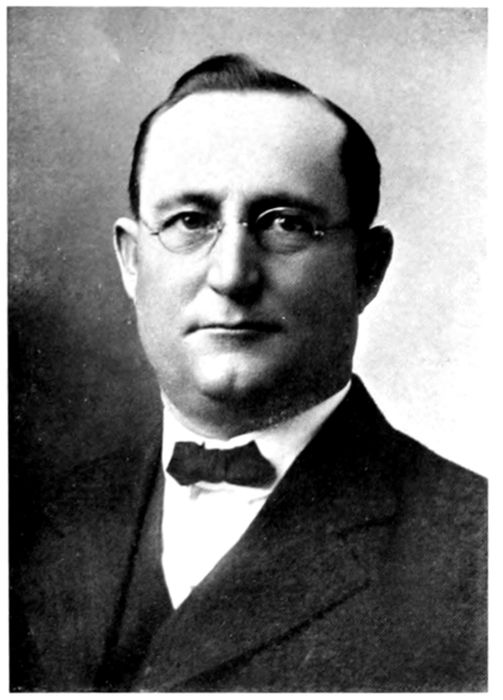
WILLIAM A. JACKSON,
Judge District Court.
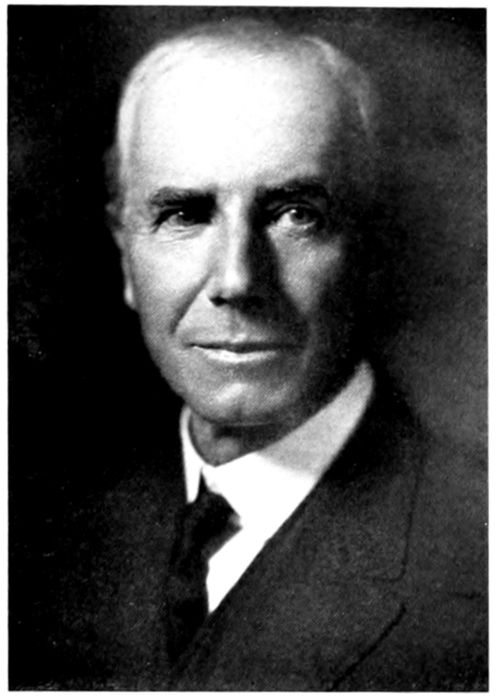
CHARLES J. CONLON,
County Attorney.
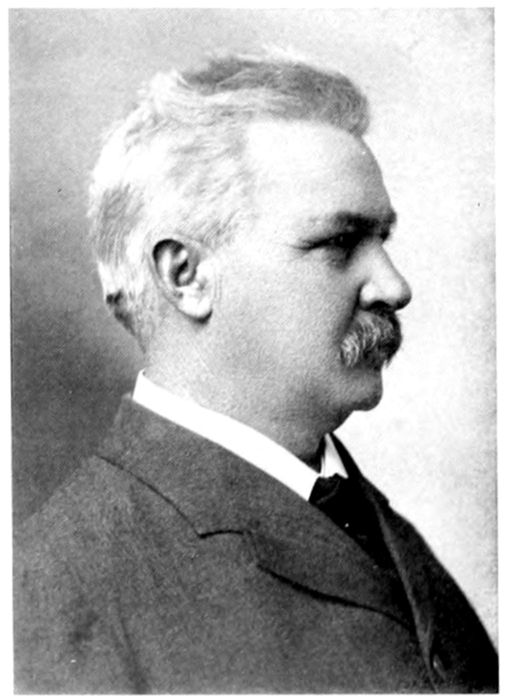
JOHN PETER ADAMS,
Judge of Probate Court.
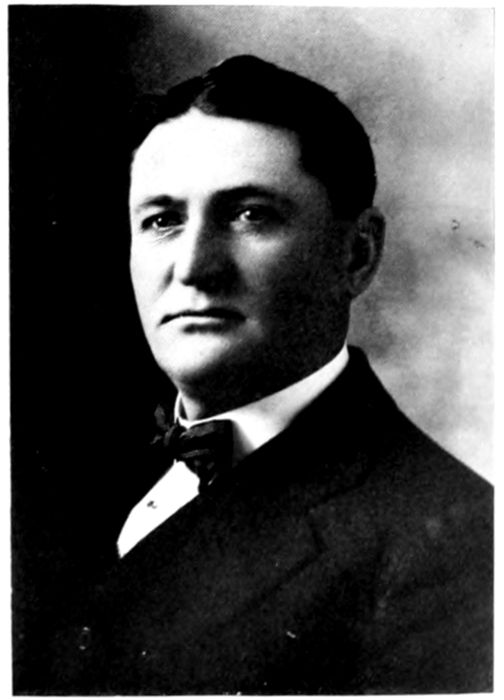
489Judge Adams received his early education in the schools of his native
State and the Macedon Academy, following which he completed a business
course at the Eastman Business College, Poughkeepsie, N. Y. He practically
worked his way through school by teaching, becoming a teacher at the early
age of eighteen. He came to Atchison in 1879 and entered the law office
of Judge H. M. Jackson, as a law student, and was admitted to the practice
of law in 1880. A short time following his admission to the bar he opened
an office for himself, and later became a partner with Roy C. Crawford. A
partnership with Charles J. Conlon was formed some time afterward, which
continued until the election of Mr. Adams to the office of probate judge in
1910. Judge Adams was reëlected in 1912, and again in 1914, without
opposition for the nomination or election. He is a Republican and a firm
believer in a high protective tariff. Previous to his election to the probate
judgeship, he served as judge of the Atchison city court, having been appointed
by Governor Bailey in 1902, and reëlected three times following
his appointment without opposition. Judge Adams has always earnestly
advocated Republican principles and has been a faithful party worker.
Judge Adams was married in Albion, Mich., June 24, 1885, to Mary
Stevens, a native of Lock Berlin, N. Y., and a daughter of Wells J. L. and
Nancy Stevens. To Judge and Mrs. Adams have been born three children,
who are the pride of their parents, as follows: Eldridge, born November 30,
1892. He received his classical education in Kansas University and graduated
in medicine from Rush Medical College at Chicago in 1914, after a
thorough course of study in the University of Chicago, now a practicing
physician and surgeon in the Illinois State Hospital for eye, nose and
throat, at Chicago. Dr. Adams is a rising young physician of marked ability
and was an apt student, and is ambitious to succeed in his chosen profession.
He graduated from the Atchison High School at the age of fifteen, from the
Kansas University at the age of nineteen, and received his Doctor of Medicine
degree from Rush College of Medicine when but twenty-three years of age.
It is safe to predict a brilliant future for this Atchison boy. A daughter of
Judge Adams, Eleanor, aged twenty, is a student of Knox College, Galesburg,
Ill., class of 1916, where she is specializing in music—violin and voice.
Genevra, the youngest child of Judge and Mrs. Adams, is eighteen years old,
a graduate of the Atchison High School, and a student in Baker University.
The Adams family has resided in the same house at Fourth and Laramie
streets for thirty years, or since the marriage of Judge and Mrs. Adams.
They believe in giving their children the advantages of a good education, as
the best preparation possible for their future success.
Judge Adams was reared in the Episcopalian faith, which was the church
of his fathers, but is an attendant with the members of his family at the
Methodist Episcopal church. He became a member of the Masonic lodge
in 1876.
490
While we reverence the courts and look upon them as the final refuge of
the citizenry in time of oppression or trouble, we realize that the tribunals of
the people for safeguarding our inalienable rights as citizens are measured
in their usefulness by the character of the men chosen to sit at the head of
the judiciary. Society is protected from those criminally inclined, and we
accept without criticism the decisions of the judges with whom we come into
personal contact, because of the fact that the masses of the people have an
abiding faith in the integrity of the courts. This confidence is more in evidence
in a community where all have an opportunity of judging at close range
the qualifications and personal integrity of those chosen by the people to
administer the judicial affairs of the people. It is meet and necessary that
the judges in whom we place implicit confidence be men of the highest calibre,
broad-minded and sympathetic in dealing firmly with the many diverse cases
which are brought before them for adjudication. The district court of Atchison
county is presided over by a learned jurist who has the confidence and
esteem of the people, and who enjoys the universal respect of the citizens of
the county. Hon. William A. Jackson, judge of the district court of Atchison
county, is such a man wisely chosen to fill the highest office within the gift
of the people in his district. His career as presiding officer of the court has
been marked by a display of ability, legal acumen, broad-minded and sympathetic
discernment of right and wrong in handing down his decisions that
have satisfied the most exacting. He was born in Versailles, Morgan county,
Missouri, October 6, 1866. He is a son of Judge Horace M. and Lavanchia
Isabelle (Valentine) Jackson, a review of whose life is given in this volume.
Judge Jackson has a reputation for fairness and impartiality in his judicial
decisions which has gone far beyond the borders of his county. The Atchison
Daily Champion in its issue of September 25, 1913, has this to say of his high
honor and integrity:
“In these days of alleged lawless lawyers and corrupted courts it is a good
thing to know that Atchison county has an honest and efficient judge to
administer justice from the district bench. Many big men,—men of splendid
qualifications and sterling integrity—have occupied the important position now
held by Judge Jackson, but never before has this county had a judge whose
service on the bench commanded more universal satisfaction than that rendered
by Judge Jackson. It is the unanimous opinion of the Atchison bar
that he is the best district judge in the State. Absolutely fair, impartial,
capable, he performs the functions of his office with a high sense of duty
491and responsibility to the law and to his fellow men, a duty and responsibility
which precludes all other results, save only unqualified justice for each case
that comes under his supervision.”
The supreme test which could be applied to a man in his position came on
an occasion when the father and brother of Judge Jackson appeared for the
defendant in a case which was tried in the Atchison court with Judge Jackson
on the bench, and he was not found wanting. Quoting from the Atchison
Daily Champion in its issue of April 19, 1909, concerning this unique situation
and the conduct of Judge Jackson during the course of the trial of the case:
“Many people have attended court the past week as witnesses, jurors
and spectators in the Norris-Mapes trial, and the fact was freely commented
upon that the appearance in the trial of father and son as attorneys for the
defendant and another son was on the bench, presented a situation that was
quite unusual. Some at first indulged in unfriendly criticism of the circumstances
and it is therefore a pleasure for the Champion to say that it has heard
nothing but the most universal praise for the fairness, the impartiality and
the splendid integrity of purpose Judge Jackson displayed in his rulings on
every disputed question of law and evidence in the case. It is a fact worthy of
comment that the Champion takes pleasure at this time in giving public recognition
to so important a matter. There is nobody in Atchison who has a
stronger following of loyal friends than Will Jackson, and it is because of his
manhood, his honesty and fine sense of honor that he has earned them and
retains them.”
William Anthony Jackson was trundled in a home-made baby-cart and
dressed in clothing spun and made by his devoted mother. Few were the
luxuries in which he was indulged; the plainest of fare was his sustenance
during his childhood days. In 1870 he was placed in school at Marysville,
Mo., and after coming to Atchison with his parents he attended the city
schools. He attended the Monroe Institute and later entered Kansas University
at Lawrence, graduating therefrom in 1888. He was admitted to the
bar and in 1889 was made a member of the law firm of Jackson & Jackson.
His success in the practice of his profession has been marked and he is widely
known as a capable lawyer and jurist. His first public office was that of city
attorney, to which he was elected in April, 1905, and served until 1909. During
the four years of his incumbency of the office of city attorney he lost but
one case which came up for trial under his care for the city. He was
elected judge of the district court, second judicial district, in November of
1908, and resigned the office of city attorney to take up his duties on the
bench in order to qualify in January, 1909. His career on the bench speaks
492for itself and the fairness of his decisions is proverbial. Judge Jackson is
remarked frequently for his kindness of heart, and soon after he was
admitted to the bar the opportunity came to him to “return good for evil”
in one particular case. A lad with whom he had come into contact on the
school ground at Marysville, and who had tried to impose on him, with the
result that strained feeling existed for many years between them was the
beneficiary of his goodness. This lad, then grown to man’s estate, came to
the judge in Atchison and asked him to assist him in getting employment.
The judge did so and earned the thanks of his boyhood enemy.
Judge Jackson’s wedded life began April 26, 1894, when he was united
in marriage with Edith Fox, of Atchison. To this union have been born
two children: Jared Fox Jackson, born November 19, 1895, and now a student
in the law department of Kansas University; Edward Valentine Jackson,
born June 6, 1900, a student in the Atchison High School. The mother of
these children is a daughter of Jared Copeland. (See sketch of Jared Copeland
Fox elsewhere in this volume.)
Judge Jackson is fraternally affiliated with the Masonic Lodge, Washington,
No. 5, of Atchison, the Knights of Pythias, the Elks, the Fraternal
Order of Eagles, and the Phi Gamma Delta fraternity of the Kansas State
University. He is a liberal contributor to charitable and religious denominations,
and is usually found in the van of all projects which have for their purpose
the betterment of his home city and county.
In Roy C. Trimble, sheriff of Atchison county, the people have an efficient
and capable public official, who believes that his duties are paramount
over all other considerations, and he has shown by his steadfast and unswerving
loyalty to the ethics of his office that he is a man eminently fitted for
high public office. Mr. Trimble is a young man to hold such an important
office, but is old in ability and experience. He is a native of Atchison
county, and a son of James M. and Margaret E. (McCreary) Trimble.
Roy C. Trimble was born August 11, 1877, on a farm, four miles southwest
of Atchison. His father, James M. Trimble, was born September 10,
1843, in Buchanan county, Missouri, and died in January, 1910, in Atchison
county. He was the son of Benjamin F. Trimble, a native of Kentucky, who
immigrated to DeKalb, Mo., where he conducted a blacksmith and wagon repair
shop, and later removed to Texas. After a residence of some years in
493Texas he settled in Atchison county, where the son, James M., bought a farm
which he cultivated until 1905, when he disposed of his land and invested in
a livery business. He was thus engaged until his death. During the Civil
war, Mr. Trimble was enrolled in the State militia. Benjamin F. Trimble
was one of the early pioneer settlers of Atchison county and owned a farm
near Effingham. The children of James M. Trimble are J. P., a railway
mail clerk on the Central Branch railroad; A. F., a rural mail carrier; K. S.,
a farmer, south of Atchison; E. S., a resident of Lake Ballinger, Wash.; Roy
C., and T. O., a ranchman, near Seattle. Wash.
The mother of the foregoing children was Margaret E. McCreary, born
in 1850 and died in 1890. She was a daughter of Solomon McCreary, a
pioneer settler of Atchison county, who had a farm eight and one-half miles
south of Atchison. Solomon McCreary was born in Clay county, Missouri,
in 1822, and died in July, 1911. He was a son of Elijah McCreary, and
was the youngest of a family of thirteen children. The family is of Scotch-Irish
ancestry, and originally settled in South Carolina. S. K. came to
Kansas in 1854, first settling in Leavenworth county, and four years later
moving to Atchison county. He bought a land patent from a Mexican war
veteran, and made his home on the pioneer farm until his death. His children
were as follows: Mrs. B. Frank Trimble, Mrs. Margaret Trimble, deceased;
Mrs. Nellie Adams; Cora, deceased; W. S., deceased; Mrs. Nettie
Perkins, Leavenworth; S. K., and Mrs. Grace Salmon, of Los Angeles.
Roy C. Trimble was educated in the district school No. 5, located south
of the city, and resided on the farm until 1905 when he was engaged in the
livery business with his father, continuing until the latter’s death, after which
he conducted the business for a few years and then traded it for some real
estate. He was first a candidate for sheriff in 1912 on the Republican ticket,
but lost out by 288 votes. He was again a candidate in 1914 and won by the
considerable margin of 700 votes.
Sheriff Trimble was married November 2, 1904, to May Florence Hartman,
who was born near Purcell, seven miles southwest of Atchison, and is a
daughter of Ex-Sheriff F. C. Hartman, now deceased. To Mr. and Mrs.
Trimble have been born the following children: Guy Roy, born August 7,
1905; Cynthia Grace, born May 2, 1907; Clara May, born May 10, 1913,
and Henrietta Gale, born June 4, 1915.
Mr. Trimble and wife are members of the Presbyterian church. He is
fraternally affiliated with the Independent Order of Odd Fellows and the
Fraternal Aid. Mr. Trimble is likeable, and has a winning personality which
goes far toward making him a successful and popular official. Such encomiums
494and praise as have come to him for his conduct of the duties of the
sheriff’s office are well deserved and he is constantly widening his circle of
friends.
Charles J. Conlon, a prominent attorney of Atchison, who is now serving
his second term as county attorney, is a native of the Empire State. He was
born at Orwell, Oswego county, New York, October 31, 1860, and is a son
of James and Anna (Bowen) Conlon, the former a native of New York and
the latter of Ireland. Anna Bowen, the mother, came to America with her
parents, William and Nancy Bowen, when she was thirteen years of age.
James Conlon was born in Oneida county, New York, and was a son of Charles
Conlon, a native of Ireland, who immigrated to America in 1814 and settled in
Oneida county, New York, where he spent the remainder of his life. James
Conlon grew to manhood in Oneida county, and in 1859 was married and
about a year later removed to Oswego county, bought a farm and followed
farming there until 1867. He then returned to Oneida county, where he
remained until 1870, when he came to Kansas, locating in Atchison county.
He bought a farm about a mile and one-half southwest of the city of Atchison,
where he was successfully engaged in farming and stock raising until
about a year prior to his death, November 1, 1899, at the age of seventy-three.
He was a very successful farmer and a highly respected citizen, and at the
time of his death owned 200 acres of valuable land, which is still owned by the
Conlon family. He was a life-long Democrat and a member of the Catholic
church. His wife died September 22, 1898, aged sixty-three years. They
were the parents of the following children: Anna M. married Peter Donovan,
now deceased, and three children were born to this union, Peter, Fredrick and
Charles, and after the death of her first husband, Anna M. married John McInteer,
who is also now deceased and she resides in Atchison; Charles J., the
subject of this sketch; William H. resides on the old homestead; John F.,
farmer, Atchison; James D., plumber, St. Louis, Mo.; Letitia M. McKenna,
Denver, Colo., and Fred J. died in Atchison at the age of thirty-three years.
He was a machinist and well and favorably known in Atchison county.
Charles J. Conlon was educated in the public schools, St. Benedict’s College,
Atchison, Kan., and Whitestown Seminary, Whitestown, N. Y., graduating
from the latter institution in the class of 1882. He then entered the law department
of the University of Michigan, at Ann Arbor, Mich., and was
495graduated in the class of 1884 with the degree of Bachelor of Laws. He then
engaged in the practice of his profession at Atchison, Kan., and has continued
in the practice to the present time. He was elected county attorney of Atchison
county in 1912 and reëlected to succeed himself in 1914. Mr. Conlon
is a capable lawyer and is a fair and fearless prosecutor. Mr. Conlon was
united in marriage February 14, 1903, to Miss Mae Flanigan, a native of Oswego
county, New York.
John F. Conlon, farmer, was born October 15, 1865, in the town of Orwell,
Oswego county, New York. He was educated in the common schools
of his native town and later attended the Whitestown Seminary at Whitestown,
N. Y. After coming to Atchison county, Kansas, in 1885 with his parents,
he studied at St. Benedict’s College. He remained with his parents on
the home farm southwest of Atchison until their death, and managed the
estate for several years thereafter successfully.
Personal achievements of the individual are always worth recounting
when he has accomplished something worth while. There is considerable
satisfaction in the latter years of the life of an industrious couple, who,
having begun at the foot of the ladder of success and having climbed upward
by degrees, have attained to a state of wealth and comfort by the time
middle age has been reached. Thomas O. Gault and his wife, residing in a
beautiful farm home in the northeast part of the city of Effingham, are
among the most respected citizens of Atchison county. Mr. Gault is one
of the large land owners of the county, and while not an old resident he
can lay claim to the fact that he was a homesteader in Kansas back in the
“grasshopper” era, and has had as many ups and downs as the average
western pioneer.
Thomas O. Gault was born November 7, 1849, in Wycomico county,
Maryland, a son of Archibald and Eliza (Littleton) Gault, natives of Maryland,
and descendants of old American colonial families. The ancestry of
the Gault and Littleton families dates back to the earliest days of the settlement
of the eastern coast of America. Archibald was the son of Obid Gault,
who was a soldier in the War of 1812, and was an early pioneer settler of
Indiana. Eliza Littleton was a daughter of Thomas Littleton, and died when
Thomas O. was seven years of age. Archibald Gault emigrated from Maryland
496to Ripley county, Indiana, about 1859, and settled on a farm south of
Pierce City, or near Stringtown. This was in a timbered country, and he
lived there only three years, returning to Maryland during the dark days
of the Civil war, where he remained until the war was over. In 1865 he returned
to his farm in Ripley county, and cultivated his Indiana farm until
old age overtook him, and he finally returned to the old home in Maryland,
there spending his declining years, dying in 1900, at the age of eighty
years.
Thomas O. Gault was educated in the district schools of Ripley county,
Indiana, and began working at the hardest kind of farm labor when yet
a boy. When he attained his majority he came to the great West, where
opportunity seemed to beckon with a more lavish hand than among the hills
and forests of his native county and State. He located in Jasper county,
Iowa, and worked at farm labor until twenty-five years of age, then came
to Kansas and homesteaded a Government claim in Phillips county. This
was a sad experience, however, as the grasshoppers came along soon afterwards
and “cleaned out” the crops of the homesteaders in his neighborhood,
and he abandoned his claim and left the country. He returned to Jasper
county, Iowa, in 1873, where he remained for three years, after which he
remained in Iowa, locating in Pottawattamie county in 1878, where he
had purchased a farm. He and his wife developed the farm and prospered
for a period of fourteen years. Selling out their Iowa farm at a good round
price in 1903, they located in Effingham, where they have resided since
March of 1903. Mr. Gault invested his capital in Kansas and Missouri lands
and has made money since he came to Kansas. Being gifted with the moneymaking
instinct and capacity, he has dealt somewhat in land and been successful
in his farming operations in Atchison county. He is the owner of an
eighty acre tract of valuable land, purchased in 1902, adjoining Effingham,
Kan., on the northeast, and has one of the most attractive modern farm
homes in the county. He owns at the present time a total of 582.5 acres of
land, 262.5 acres of which is located in Grundy county, Missouri, and the
rest in Atchison county. He has a large farm of 240 acres near Pardee in
Center township, which is one of the best improved tracts in the vicinity.
This farm was purchased in 1902 and is equipped with excellent buildings,
including a house of twelve rooms and three good barns.
He was married on March 4, 1888, to Miss Melissa Drury, of the town
of Drury, Rock Island county, Illinois. They are the parents of two children:
Essie, at home with her parents, and Pearl, wife of William Thomas, a son
of Robert M. Thomas, of Effingham. Mrs. Gault was born March 4, 1861,
497in Drury, Rock Island county, Illinois, a daughter of Eli and Margaret
(Hubbard) Drury, natives of Wayne county, Indiana, and Bedford county,
Pennsylvania, respectively. Mr. Drury served as postmaster of the village
named in his honor in Rock Island county for thirty-five years, and was
filling the office at the time of his death, in 1892.
Mr. Gault is a stockholder in the Farmer’s Mercantile Company of Effingham.
He is a Republican in politics, but is an independent voter, who
believes in doing his own thinking as regards the merits of respective candidates
for office and the principles which influence good government. He
became an Odd Fellow in Marshall county, Iowa, in the early eighties, and
has continued in good standing in the order to the present time. One of
the incidents of his early career which left an impression on Mr. Gault’s
memory, which time has never been able to eradicate, was his first Kansas
experience. He was so thoroughly cleaned out during the great grasshopper
scourge in the seventies, in Phillips county, Kansas, that he was forced to
walk the entire distance from Blue River, Kan., to Atchison.
Wilfull A. Stanley, a Civil war veteran, who perhaps has had more military
experience than any other man in Atchison county, is a native of New
Jersey. He was born at Salem, November 26, 1838, and is a son of Joseph
C. and Rebecca D. (Gosline) Stanley, both natives of New Jersey and descendants
of colonial ancestors, who trace their family genealogy back for
several generations in this country. The first white child born in the English
colony that settled in New Jersey, opposite Egg Harbor, was an ancestor of
Wilfull A. Stanley. Joseph C. Stanley, the father of Wilfull A., was a son
of Friend Richard Stanley, who was a soldier in the War of 1812. The
Stanley’s were Quakers, but there were a great many fighting Quakers distributed
along the line of descent. Friend Richard was a son of John Stanley,
who was a Revolutionary soldier and served in Lighthorse Harry Lee’s
cavalry. He was captured and confined in a British prison ship for some time.
He lived to be a very old man and died in 1845, at the age of 102. He was
very active physically and mentally to a very old age. Wilfull A. Stanley
was reared in New Jersey and received a common school education. On
December 22, 1860, he enlisted as a private in the United States marine; and
after making a trip around the world was detailed in 1861 as orderly to
Admiral Dahlgren at Washington, D. C. He also served as orderly to Commanding
498Officer C. R. P. Rogers. Mr. Stanley was at the taking of Hatteras
Inlet and the operations on Roanoke Sound in conjunction with General
Burnside’s expedition. He was at the engagement of Port Royal and served
as orderly to Capt. C. R. P. Rogers there. He was also at the engagement
at Ft. Walker. The “Wabash,” upon which he was serving then, joined
Admiral Farragut’s fleet at New Orleans. Here Mr. Stanley was transferred
to the “Hartford,” Admiral Farragut’s flag ship, and served as orderly
to Farragut and participated in the engagements at Fts. Jackson and Phillip,
and was at the capture of New Orleans when he was again detailed to the
“Wabash.” Shortly after that he was taken sick with a fever and sent to
the marine hospital at Brooklyn, N. Y. After recovering he was discharged,
and with his discharge received a very complimentary letter from Admiral
Rogers. After remaining home a short time he enlisted in the Second regiment,
New Jersey cavalry. He participated in the battle of Nashville and
was at the siege of Mobile. He went from there to Montgomery, Ala.
About this time the war closed, but Mr. Stanley’s regiment was kept in the
South for nearly a year during the reconstruction period, and in 1866 he was
discharged and returned to his New Jersey home. Mr. Stanley had learned
the plasterer’s trade when he was a young man and at the close of the war
worked at it for some time, when the military spirit took possession of him
again and he enlisted at Philadelphia, Pa., and was assigned to Troop L, Seventh
United States cavalry, and was sent from Ft. Leavenworth to Ft. Morgan
on the Platte river. Capt. Michael V. Sheridan, a brother of “Little
Phil,” commanded this troop and they were mobilized at Ft. Hayes for a
winter campaign against the Indians in the Wichita mountains. This campaign
was against the Arapahoes, Comanches and some other tribes.
After an engagement with Lone Wolf’s band the soldiers were forced to
retreat, but soon after were re-inforced at Big Timber by a Kansas regiment,
and after that captured Lone Wolf and Satanta, chief of the Kiawas,
and returned the Indians who had been on the war path to the Ft. Sill reservation.
After that Mr. Stanley returned to Ft. Leavenworth and had charge
of the hospital stores for two years, when he was transferred to Wingate,
N. M., where he also had charge of the hospital stores until 1872, when he
was discharged and returned to New Jersey. In 1889 he came to Kansas,
locating in Atchison, where he has since worked at his trade most of the
time. He had lived in Philadelphia for some time and in Georgetown, S. C.
before coming to Kansas, and came to this State on account of his wife’s
health. Mr. Stanley was married in 1877 to Mrs. Mary E. (Ingram)
Fpuntain, a widow. She is a native of Bellefont, Pa., born June 25, 1842,
499a daughter of Isaac D. and Deborah (Grant) Ingram, natives of Pennsylvania
and descendants of old Pennsylvania stock. Joshua Bloomfield Williams,
a major in the Revolutionary war, and at one time colonial governor
of New Jersey, was a grand-uncle of Mrs. Stanley’s mother, and Mrs. Stanley
is a Daughter of the American Revolution. She is a member of the
Ladies’ Corps of the Grand Army of the Republic, and is past department
president of Kansas, and National press correspondent, and has filled all the
offices from the local circle to the National. Mr. and Mrs. Stanley have one
child, Leon Glen, born in 1881. He served in Troop B, Sixth United States
cavalry. He was in China at the rescue of the foreign legations and suppression
of the Boxer uprising and later served in the Phillipine Islands, and
after three years’ service he was honorably discharged. He was the first
post printer at Ft. Leavenworth, and is now in the employ of the Atchison
Globe, in the capacity of pressman and mailing clerk. He married Sadie
Wiggins, and two children have been born to them, as follows: Inez Leona
and Richard. Wilfull A. Stanley is a member of the Grand Army of the
Republic and has been adjutant of the Atchison post for ten years and is
past commander.
Christian W. Stutz, a substantial farmer of Center township, Atchison
county, was born and reared in Lancaster township, this county, and is a
son of pioneer settlers of the county. The Stutz family came to Kansas
from Missouri in 1859. Christian W. is a son of Christian and Catharine
(Schweitzer) Stutz, both of whom were born in Germany from whence they
came to America in 1855, and first settled in Jackson county, Missouri, coming
from there to Lancaster township in Atchison county four years later.
Christian, the father, was born in Germany, March 25, 1825, and when thirty
years of age decided to locate in the new country where there were better
opportunities for gaining a livelihood and laying up a competence. Accordingly,
we find that after a residence of four years in Jackson county, Missouri,
he came to Atchison county, and with his savings invested in eighty acres of
timber and prairie land in Lancaster township. He hired a man to break this
land with ox teams, and proceeded to cultivate his land. He made extensive
improvements on his farm from time to time as he was able, and added to
his acreage to such an extent that at the time of his death, December, 1898,
he was the owner of 380 acres of land. Christian Stutz was the father of
500seven children as follows: Mrs. Caroline Demel, of Central City, Neb.;
Mrs. Katherine Wilkins, of Atchison, Kan.; Frederick, a member of the
Atchison police force; Christian W.; Gustave, a prosperous farmer of Lancaster
township; John, a farmer in Center township; one child died in infancy.
The mother of these children was born in Germany in February of
1829, and died in Lancaster township, in December, 1888.
Christian W. Stutz, whom this review directly concerns, was reared on
the old home place of the Stutz family in Lancaster township, and educated
in the Lancaster school. He assisted his father in the operation of the home
farm until he was twenty-three years of age, and then began farming for himself
on land which he rented from his father. He continued to till the
rented land for four years, all the time saving his earnings, with a view of
eventually owning a farm of his own. He made his first investment in 1891
when he purchased and inherited, partly, eighty acres of improved farm land
in section 8, Center township. He at once began to remodel the home and
make extensive improvements, and it might be said that he has never ceased
to improve his surroundings. In 1908 he erected a new barn, 50×50 feet,
and now has one of the attractive places of his township and county. Mr.
Stutz has continued to add to his land holdings until he is now the owner of
393 acres of land, all of which he has secured through his own efforts. During
1915 he had planted 160 acres to corn which gave him an excellent
crop. He keeps good graded stock and maintains a herd of Shorthorn cattle.
He has made quite a reputation as a breeder, and in 1914 exhibited
a “Mahrath Jack” at the Atchison county fair which was awarded the second
prize. In addition to his farming interests he is a share holder in a copper
mine located in Arizona.
Mr. Stutz was married in 1891 to Kathrine Walz, and of this union
have been born ten children, as follows: Charles F., William, John E., Clara,
a graduate of the Atchison County High School; Arthur, Mary and Margaret
(twins), the latter deceased; Francis, Nora B., Reidel, all of whom are
at home with their parents. Mrs. Stutz was born September 8, 1868, in
Atchison, Kan., a daughter of Charles and Kathrine (Reidel) Walz, both
natives of Germany. Charles Walz emigrated from Germany to Cincinnati,
Ohio, and there learned the butcher business and trade. When nineteen
years of age he left Germany to seek his fortune in America, and about
1857 came to Atchison and worked in the first butcher shop ever operated
in that city. He later bought the shop of Phillip Link, and after operating
it for a time bought a farm in Shannon township, where he lived until his
death, in 1891, at the age of sixty-one years. Kathrine, his wife, was born
501in 1842, and died on the old home place in Shannon township.
Mr. Stutz is a Democrat, but has never sought political preferment, having
no time other than for the management of his large farming interests.
He is fraternally connected with the Odd Fellows and the Fraternal Order
of Eagles.
In observing the management of the leading commercial houses of Atchison,
the fact is determined that, invariably, the executive departments are in
charge of young men who have practically grown up with the business. The
Dolan Mercantile Company is one of the oldest wholesale institutions of the
city, and one of the most successful and substantial. Its affairs are conducted
by young men who entered the employ of its founder when boys, and
have advanced, step by step, in the management of the concern. M. J. Horan,
the president of the Dolan Mercantile Company, began his career in a humble
capacity in the business of which he is now the chief executive, and has become
an honored and able member of the body of commercial men who have
made Atchison preëminent among the cities of the West. The story of a
self-made man is always interesting and this review is a story of a self-made
man.
Michael Joseph Horan is a native of Atchison, born November 12, 1875.
He is a son of Michael Frank Horan, a native of Bir, Kings county, Ireland,
born in 1824. The elder Horan left his native heath when a young man,
with his young wife, who died later in Atchison. He first located in Peru,
Ind., and there met William Dolan in 1840. He came to Kansas in 1865 and
located some land at Wetmore, proved up on his homestead, and one year
afterward located in Atchison. Here he engaged in the real estate business,
and became fairly well to do. For years he was a well known figure in
Atchison and took an active interest in Democratic politics. He died in 1888.
His second wife was Anna Dean, whom he married in her native county of
Queens, Ireland. She was born in 1844 and died in February, 1910. They
were the parents of the following children: Mrs. John A. Reynolds, Atchison;
Miss Bridget Horan, Atchison; Anna, at home; Michael Joseph, Atchison;
Frank, Marshalltown, Iowa; Charles L., secretary of the Dolan Mercantile
Company, and in charge of the shipping department.
M. J. Horan was educated in the parochial schools and St. Benedict’s
College, of Atchison. At the age of sixteen years, or in 1892, he entered the
502employ of the Dolan Mercantile Company, as office boy. He applied himself
diligently to his duties and promotion step by step followed, as a matter
of course. His next position was that of bill clerk. This was followed by
his promotion to the post of bookkeeper and then buyer. When the company
was incorporated in 1900, he was elected vice-president. He succeeded Mr.
Dolan as president of the company, upon the latter’s death in 1913.
Mr. Horan was united in marriage in Kansas City, Mo., with Martha
Emma Malone in 1909. To them have been born four children: Michael
Joseph, Mary Ann, Francis and William. Mrs. Horan is a daughter of
Edward Malone, formerly a resident of Atchison, and who died here, after
which the mother and all of the family except Martha Emma removed to
Chicago. In political affairs Mr. Horan is an independent Democrat, who
favors good and efficient government, and believes that it can best be obtained
by good and capable officials regardless of their political adherence.
He is a member of St. Benedict’s Catholic Church, and is affiliated with the
Benevolent and Protective Order of Elks and the United Commercial Travelers.
Mr. Horan is recognized as one of the substantial and progressive
business men of the city, and he and his wife have many warm friends
among the best families of the city, who esteem them for their many excellent
qualities of mind and heart. Mr. Horan’s dignified and courteous demeanor
in the conduct of his business affairs has won him universal respect
and esteem both of patrons and employes of the concern of which he is the
head.
Rinhold Fuhrman, farmer and stockman, of Lancaster township, Atchison
county, Kansas, was born in Germany February 11, 1863. He is a son
of Ernest and Johanna (Gerlach) Fuhrman, and was one of twelve children
born to them. The others are as follows: Caroline Deaking, Dodge City,
Kan.; Louise Repstein, Jefferson county, Kansas; William, St. Joseph, Mo.;
Julius, Doniphan county, Kansas; Trauget, Center township, Atchison
county; Herman, Lancaster township, Atchison county; Paul, Center township,
Atchison county; Emma Schwope, Center township, Atchison county;
Ernest, Atchison, Kan., and two children who died in infancy. The father
by an earlier marriage to Louise (Heine) Fuhrman had one son, Charles,
a farmer and stockman of Lancaster township, Atchison county.
Ernest Fuhrman was born in Germany July 8, 1826, and immigrated to
503America in 1872, settling in Atchison county, Kansas, where he bought 160
acres of land in section 16, Lancaster township. This was timber and prairie
land and had only a small, poorly built house on it at the time, but during
the twenty years that he owned it he built several substantial buildings and
made numerous other improvements. He eventually sold the place to his
son, Herman, and then bought 160 acres in Doniphan county, where Julius
lives, and moved into Lancaster where he lived in retirement. He bought
eighty acres in Center township. Five years later he went to live with his
son, Paul, to whom he sold the eighty acre tract, in Center township. He
died on Paul’s second farm of 160 acres in Center township September 2,
1915. The mother, Johanna (Gerlach) Fuhrman, was born in Germany and
resides with her daughter, Emma, in Center township, Atchison county, at the
age of eighty-five years.
In 1872 Rinhold Fuhrman left Germany with his parents who came to
Atchison county, Kansas. He was reared on his father’s farm and attended
school at Rock district No. 59, and when eighteen years of age began life
for himself as a farm hand for $15 a month and proved himself a capable
worker and later was given $20 a month, which was more than the average
farm hand was paid at that time. He worked three years as a hired hand
and then rented his father’s farm for five years, and later bought it. The
farm consisted of 160 acres in section 20, Lancaster township. He improved
it considerably after he took charge of it in 1899, erecting a house at a cost
of $1,000, and he also built a barn which cost $500. He has built sheds and
other improvements since and did most of this work with his own hands.
He has always been a hard worker and obtained all that he now owns by
hard labor. He has a fine little orchard which is in a thrifty condition. He
keeps graded stock and takes great care to keep his animals up to the standard.
On October 8, 1890, he married Emma Kammer, a native of Lancaster
township, who was born April 18, 1868. She attended school at Rock district
and is a daughter of Karl and Johanna Kammer. She has a brother,
Karl, who is a farmer in Atchison county. Mr. and Mrs. Fuhrman are the
parents of three children, as follows: Mrs. Laura August Poos, Lee’s Summit,
Mo.; Edna and Karl, both living at home. Mr. Fuhrman is a Republican and
he and his wife are members of the Evangelical church. He is a conscientious,
hard working farmer who has deservedly attained success. In March,
1916, Mr. and Mrs. Fuhrman left the farm and retired to a home in Lancaster,
where Mr. Fuhrman purchased a residence. He has rented his farm
after accumulating a competence which will enable him to live in comfort the
remainder of his days.
504
The past half century has witnessed the transformation of the section of
Kansas known to the world as Atchison county from wilderness to a smiling
and peaceful land of thriving towns and cities and checkered with fertile
farms, a development which has been duplicated many times over in the great
State of Kansas. While this wonderful transformation was going on as the
handiwork of man—particular individuals from out of the mass of men who
were working wonders in giving to this Nation a new commonwealth, were
likewise developing mental attributes with which they had been gifted—statesmen,
soldiers, and men of letters were in the making. Atchison county, Kansas,
has been made famous by several illustrious sons who have achieved more
than ordinary renown in the world of letters, as well as in other lines of endeavor.
John E. Remsburg, editor and publisher of the Potter Kansan, educator,
author and lecturer, during nearly a half century of residence in the
county, has become as widely known in the realm of literature as any Kansan
citizen. He has achieved a reputation as a writer and lecturer of force which
is world-wide and deserved by the recipient. Mr. Remsburg came to Kansas
from his native State of Ohio in 1868. Two years after his arrival in Atchison
county he was married to Miss Nora M. Eiler, of Walnut township, this
county, who came with her parents from Missouri to Kansas in 1855. Seven
children were born to this marriage: George J., John J., Reullura R., Wirt
A., Charles B., and Claude A., all of whom are living, and Eugene, deceased.
“The International Who’s Who,” printed in English, German, French
and Italian, and published in London, Paris and New York, contains the following
biographical sketch of Mr. Remsburg:
“John E. Remsburg. Teacher, lecturer, author; born near Fremont,
Ohio, U. S. A., January 7, 1848. Of German-English descent, his paternal
ancestors emigrating from Germany to Maryland about 1760; his maternal
ancestors emigrating from England to Boston in 1640. His father was
George J. Remsburg, son of John P. Remsburg, who removed from Maryland
to Ohio in 1831; his mother was Sarah A. (Willey) Remsburg, daughter
of Eleazer Willey, who removed from New York to Ohio about the same
time. Educated in the public schools of Ohio and at Fort Edward Collegiate
Institute, New York, continuing his studies after leaving school. Entered
Union army at 16, serving until close of Civil war. For fifteen years engaged
in educational work in Ohio and Kansas, serving as superintendent of public
instruction of Atchison county, Kansas, four years (1872 to 1876). Married
in 1870 Nora M. Eiler, daughter of Jacob Eiler, a Free State pioneer
of Kansas. In 1880 became a lecturer and writer in support of free thought
and State secularization. Delivered over 3,000 lectures, speaking in fifty-two
States, Territories and Provinces, and in 1,250 different cities and towns, including
every large city of United States and Canada. In the performance
of this work traveled over 360,000 miles. Author: ‘Life of Thomas Paine,’
1880; ‘The Image Breaker,’ 1882; ‘False Claims,’ 1883; ‘Bible Morals,’ 1884;
‘Sabbath Breaking,’ 1885; ‘The Fathers of Our Republic,’ 1887; ‘Abraham
Lincoln,’ 1893; ‘The Bible,’ 1903; ‘Six Historic Americans,’ 1906. Portions
of his writings have been translated into French, Italian, German, Dutch,
Swedish, Norwegian, Bohemian, Bengali, Singalese and Japanese.”
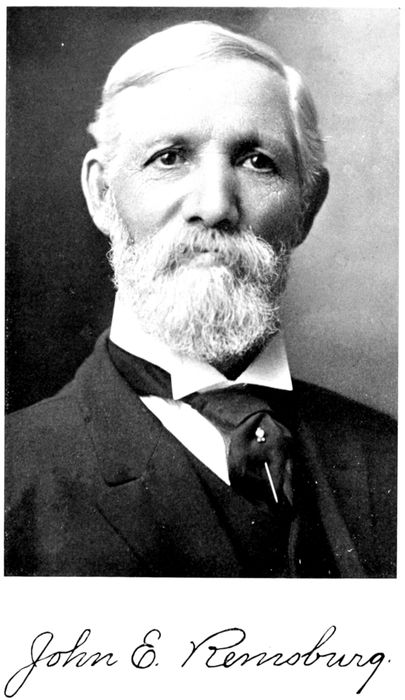
505It may interest Mr. Remsburg’s Atchison county friends to know in
what esteem he is held as a speaker and writer by the world at large. From
the hundreds of reviews and commendatory notices of his lectures and books
which have appeared a volume of testimonials like the following could be
compiled:
“One of the best speakers and writers to be found in the West, if not in
the whole country.”—Charles Robinson, first governor of Kansas.
“His lectures are models of logic and good sense.”—Arnold Krekel,
LL. D., Judge United States District Court, Missouri.
“Mr. Remsburg’s address was given with great eloquence and power.”—E.
W. Howe.
“A brilliant lecture.”—San Francisco Chronicle.
“Most eloquent words.”—Boston Globe.
“An interesting and eloquent address.”—Rev. J. F. Wilcox, Chicago.
“It is lit up with such flashes of genius, it is so poetical and picturesque
that one never wearies of hearing it.”—E. M. Macdonald, New York, President
American Secular Union.
“He retired with the reward of loud and long continued applause.”—Kansas
City Star.
“Came in for his full meed of praise today.”—New York Herald.
“J. E. Remsburg was paid at the rate of two dollars a minute for his
New York address; probably the highest price yet paid for a Kansas talk.”—Noble
L. Prentiss, 1882.
“A noble lecture.”—Ernestine L. Rose, noted reformer, London.
“He has given to the world several volumes of priceless worth.”—L. K.
Washburn, editor Boston Investigator.
“This volume of 600 pages is a digest of all that is known on the subject.”—Franklin
Steiner, author, New York.
“Nothing equal to it has been published within my recollection either
506in America or Great Britain.”—Charles Watts, President British Secular
Union.
“It is indeed excellent—nothing could be better.”—Sir Hiram Maxim,
London.
“In many respects the most important volume on the subject that has
yet appeared.”—Le Pensee, Brussels.
“Excellent, bold, direct, unanswerable.”—James Parton.
“Mr. Remsburg is an orator of high and wide reputation.”—Washington
Post.
“One of America’s noted orators.”—Montreal Times.
“A most able lecturer and writer.”—Charles Bradlaugh, M. P., noted
orator and statesman of England.
“My translations of Bradlaugh’s and Remsburg’s writings have an enormous
circulation in this country.”—Kedarnath Basu, India.
“His [Remsburg’s] lectures have an immense circulation in India.”—Calcutta
Gazette.
“One of the most promising orators in America.”—Secular Review,
London.
“His style is simple, earnest and attractive, and in these qualities he is
eloquent.”—W. H. Herndon, law partner of Abraham Lincoln.
“I have listened to all of our great orators from Clay to Ingersoll, but
I have never heard a more polished oration than Remsburg delivered last
night.”—Hon. William Perkins, associate counsel of Lincoln in several important
cases.
“A graphic, yet concise sketch.”—Rev. S. Fletcher Williams, Liverpool,
England.
“Imparted in language clear and forcible and not seldom with grace
and beauty.”—Thomas Gray, author, Edinburgh, Scotland.
“I have never heard the case so fairly and so ably stated as he has stated
it tonight.”—Richard B. Westbrook, D. D., LL. D., Philadelphia.
“I have asked a bookseller to order twenty copies of Remsburg’s work.”—U.
Dhammaloka, President Buddhist Tract Society of Burmah.
“Such an admirable book is always welcome.”—Rev. J. Lloyd Jones,
LL. D., Chicago.
“This effort to right the wrongs of Thomas Paine is, in my opinion, a
service to mankind.”—Andrew D. White, LL. D., first president of Cornell
University, minister to Russia and ambassador to Germany.
“The most fair and honest of all the biographies which have yet appeared
of the great iconoclast.”—Boston Herald.
507“It will help restore to honor a much abused name and forward the cause
of human rights the country over.”—Rev. Charles Wendt, D. D., Ex-President
Taft’s pastor at Cincinnati.
“May this brilliant work bring its author the praise of posterity.”—Der
Freidenker.
“A very strong case.”—Public Opinion.
“A valuable contribution to literature.”—Wm. McDonald, author, Canada.
“His lectures have as large a circulation in Europe, India and Australia
as in this country.”—S. P. Putnam, author, New York.
“A most interesting lecture.”—New Orleans Delta.
“A large audience and frequent applause.”—Baltimore Sun.
“Skillfully and vigorously written.”—Unitarian Herald, Manchester,
England.
“His style is pleasing and his arguments incontrovertible.”—The Universe,
Berhampur, India.
“A noble and eloquent work.”—Charles Bright, lecturer, Australia.
“It is really a remarkable work.”—Yoshira Oyama, President Japanese
Rationalist Association, Japan.
“Clearly, Mr. Remsburg has done his duty as he sees it, and has had the
fairness to present at the outset the opposite view of the question.”—New
York World.
“Given in evident fairness and remarkable completeness.”—Chicago
Times.
“J. E. Remsburg, of Kansas, who addressed the Congressional Committee
on the Sunday question at the Capitol yesterday, made a good impression.
Every member heartily applauded him.”—Washington Star.
“My views are well expressed by him.”—Hon. George W. Julian, one
of the founders of the Republican party and a prominent leader in Congress.
“I will gladly contribute to his work.”—Rear Admiral George W. Melville.
“I have the pleasure to inform you that at the meeting of the Committee
held this day (January 5, 1910) you were elected an ‘Oversea’ member of the
Authors’ Club.”—Reginald H. B. Giller, Secretary Authors’ Club, London.
“Member Authors’ Club, London; National Geographic Society (Washington);
life member American Secular Union (president three years).—Who’s
Who In America.
“I have watched with interest his growing influence.”—Hon. John J.
Ingalls, president pro-tem United States Senate.
508“Ably and well have you done your work.”—Parker Pillsbury, noted
Anti-Slavery leader.
“When truth and freedom triumph at last your name will be known
and honored by all men.”—Eugene V. Debs, four times the nominee of his
party for President of the United States.
George J. Remsburg was born in Atchison county, Kansas, September
22, 1871. His life has been devoted mainly to horticultural, journalistic,
archaeological and historical work. He spent many years on a fruit farm, removing
to Atchison in 1892, where he engaged in newspaper work on the
Daily Champion, the oldest newspaper in Kansas; he was a reporter, city
editor, and even did editorial work on that paper up to 1900, when he returned
to the farm on account of ill health. In 1894–95 he was editor of the
Missouri Valley Farmer, now the leading agricultural journal west of the
Mississippi. During the winter of 1905–6 he was on the reportorial staff of
the Leavenworth Daily Post, and editor of Western Life, published in that
city. He has also acted as special correspondent of the Leavenworth Times,
St. Joseph Gazette, Kansas City Journal, Topeka Mail and Breeze, Topeka
Capital, Atchison Globe, and other well known western newspapers, besides
having been an editorial contributor to many different magazines and other
publications.
He has spent many years in archaeological explorations, principally in
northeastern Kansas and northwestern Missouri, has opened a number of
ancient mounds and identified and explored old village sites of the Kansa
Indians, visited by Bourgmont in 1724, and Lewis and Clark in 1804, on the
Missouri river. He has published a pamphlet describing one of the more
important of these old villages, entitled, “An Old Kansas Indian Town on the
Missouri.” In all, he has discovered and examined more than 100 old Indian
village, camp, workshop and grave sites in the region mentioned and gathered
one of the most extensive private archaeological collections ever assembled in
Kansas.
In 1897 he was elected a corresponding member of the Western Historical
Society upon the unsolicited recommendation of United States Senator
George G. Vest, of Missouri. In 1901 he became associated with Hon. J. V.
Brower, of St. Paul, Minn., in important archaeological investigations relative
509to the ancient Indian province of Quivira, visited by Coronado in 1541,
and upon the organization of the Quivira Historical Society by Mr. Brower,
he was made a life member. In 1905 he was elected president of this society
to succeed Mr. Brower, deceased. The Quivira Historical Society erected a
number of costly monuments to commemorate historical events of Coronado’s
time in Kansas.
At the annual meeting of the McLean Historical Society of Illinois at
Bloomington in 1909 he was elected an honorary member in recognition of
his researches regarding the Kickapoo Indians, of which tribe the McLean
society is making a special study. He has thoroughly explored the old village
of the Kickapoos near Ft. Leavenworth, occupied from 1832 to 1854, and
visited these Indians on their reservation in Brown county, Kansas, on several
occasions, gathering a vast amount of ethnologic and historic material
pertaining to the tribe. He is also a member of the Kickapoo Club, of Bloomington,
Ill.
Mr. Remsburg is a member of the National Geographical Society, having
been elected at the annual meeting of the society in Washington in 1911.
He has been a member of the International Society of Archaeologists since its
organization in 1909; was appointed an associate editor of the Archaeological
Bulletin, official organ of this society, in 1910, and elected vice-president of
the same society in the same year. In 1901 he was elected a member of the
American Society of Curio Collectors; was elected vice-president of the same
in 1902, and appointed a contributing editor of the society’s official organ in
1906. He is also an active member of and contributor to the Kansas State
Historical Society, and is a member of its committees on archaeology and
Indian history.
Brower’s “Memoirs of Explorations in the Basin of the Mississippi,”
Volume VII, contains a summary account of Mr. Remsburg’s archaeological
work, and says of him: “He has long been a capable and painstaking
archaeological explorer in the Missouri Valley.” Chappell’s “History of the
Missouri River” says he is an acknowledged authority on early western history
and the archaeology of the Missouri valley.
He has held a number of local offices, such as justice of the peace, member
of school board, and secretary of various clubs and societies. He was
at one time a member of the Kansas National Guards. He is now connected
with the staff of the Potter Weekly Kansan and doing special correspondence
for several newspapers. His home is at Potter, in this county. He is a son
of John E. Remsburg, whose sketch appears elsewhere.
510
Heredity, undoubtedly has an important bearing upon the choice of a
life vocation for the individual citizen, and it is evident that this maxim governing
the destiny of man himself holds good in the life of Wirt Hetherington,
cashier of the Exchange National Bank of Atchison. In the city of
Atchison, three generations of bankers from the Hetherington family have
toiled in the financial activities of the city, the first of whom was William
Hetherington, grandfather of W. Wirt, the present scion of the family, engaged
in banking. Following William, the pioneer banker of Atchison, and
who established the first banking concern in the city, came Webster Wirt
Hetherington, father of him whose name heads this review.
William Hetherington, the first of the line in Kansas, was born in the
town of Milton, Penn., May 10, 1821, and was there reared and received his
education. When he became of age he was married, at Pine Grove, Penn.,
to Miss Annie M. Strimphfler, who was born in Womelsdorf, Berks county,
Pennsylvania, September 24, 1827. This marriage occurred May 9, 1848,
and William and his bride, shortly afterwards, became residents of Pottsville,
Penn., where he engaged in the operating of a flouring mill. Three
children were born to them in this city, namely: Mrs. Balie P. Waggener, of
Atchison; Webster Wirt and C. S. Hetherington. In 1859 they removed to
Atchison and the youngest child of the family, Mrs. William A. Otis, was
born here. Mr. Hetherington first located in St. Louis, when he came west,
later going to Kansas City, and from there to Leavenworth, Kan., where he
purchased a bankrupt stock of goods, which he hauled by wagon to Atchison
in 1859. He at once established the Exchange Bank, which absorbed the
Kansas Valley Bank, at that time owned by Robert L. Pease. When Mr.
Hetherington came into possession of the bank it was located in a basement
at the corner of Third and Commercial streets. A short time later he moved
it to the building now occupied by the water works company, and it was here
that an attempt was made by the outlaw Cleveland to rob the bank, but the
attempt was unsuccessful, Cleveland being frightened away by some freighters
who were working nearby. Some years later, Mr. Hetherington erected
a bank building at the northwest corner of Fourth and Commercial streets,
which was the home of the bank until the erection of the handsome Exchange
National Bank Building, two blocks further west, in 1885. In 1882 the
Hetherington bank was merged into a national bank, and it was known as
the Exchange National Bank, one of the successful banking concerns of the
State of Kansas. Mr. Hetherington was a man of considerable ability, whose
511efforts to advance the growing city of Atchison were worth a great deal,
and he became a leading factor in the material advancement of the city. His
influence on public thought and movement was marked and it was the more
powerful, for he was largely unbiased in his judgments. He died in 1890.
Webster Wirt Hetherington, father of the subject of this review, was
born in Pottsville, Penn., December 19, 1850. He was educated in Gambier
College in Ohio, and came directly from his studies in that institution to
enter the Exchange National Bank of Atchison, of which his father was
the founder and president. He became cashier of the bank, and upon his
father’s demise, in 1890, he became the president of the bank, remaining
in this position until his death, January 28, 1892. Mr. Hetherington,
during his financial career, became widely known in banking circles, and had
many valuable acquaintances among New York financial men, with whom he
had many transactions in western securities. When the Rock Island road
was building in Kansas and Nebraska, Mr. Hetherington made arrangements
to purchase all the municipal bonds the road received from the counties and
townships through which it passed. The deal was successful, and won him
the confidence of the New York brokers through whom he sold the bonds.
In 1889 he received, as a reward from W. P. Rice, of New York City, $10,000
in cash and also traveling expenses for himself and wife on a tour in Europe,
in payment for his services in going to London and assisting Mr. Rice in
interesting English capitalists in investing in American enterprises. Mr.
Hetherington was married November 18, 1875, to Miss Lillie Miller, the
oldest daughter of Dr. John G. and Anna B. (Bennett) Miller, both natives
of Pennsylvania. This marriage was blessed with five children as follows:
Ruthanna, wife of Dr. L. A. Todd, of St. Joseph; Mary Louise, wife of Lieut.
J. G. Pillow, U. S. A., of Honolulu; Webster Wirt, cashier of the Exchange
National Bank of Atchison; Gail, wife of B. R. Allen, of Atchison; Harry
Hale, Seattle, Wash.
Wirt Hetherington, third in line of the bankers of this estimable family,
was born in Atchison, February 21, 1881, and received his education in the
public schools of the city, after which he became a student in the Military
School at Orchard Lake, Mich., from which institution he was graduated in
1900. Soon after his graduation, he entered the Exchange National Bank
in the capacity of receiving teller and bookkeeper, and since that time he
has advanced to higher positions of trust and responsibility in this important
banking institution, learning the banking business in a thorough and painstaking
manner as he passed from one position to a higher one. In 1905 he
became assistant cashier, a position which he held until February, 1914, when
512he became cashier of the bank, of which he is also a director. Mr. Hetherington
is unmarried and makes his home with his widowed mother.
Politically, Wirt Hetherington is a Democrat as were his father and
grandfather before him. He is a communicant of the Episcopalian church,
which is the church of his forefathers, who were of English origin. He is
affiliated with the Ancient Free and Accepted Masons and the Benevolent and
Protective Order of Elks. Mr. Hetherington is destined to follow in the footsteps
of his able and distinguished father and grandfather, and has already
given decided evidence that he has inherited and is developing marked financial
ability of a high order. His demeanor in the conduct of the duties of
his important position is commendatory and his pleasant and courteous manner
of greeting those with whom his duties bring him in daily contact betokens
the innate gentlemanly attributes which he possesses to a considerable degree.
Harry L. Sharp, secretary of the Atchison Commercial Club, is one of the
“live wires” of the city and has given evidence of great ability in his chosen
profession. He is industrious, frugal, sincere and unpretending. His accurate
knowledge as to the departmental matters is a constant surprise to those
who have occasion to consult him with reference to any branch of public
service. He realizes that facts, and not theories, must be the working forces
in this organization. He is not only able, intelligent and practical in the
discharge of his duties as secretary of the Commercial Club, but is thoroughly
conscientious and always shows the courage of his convictions.
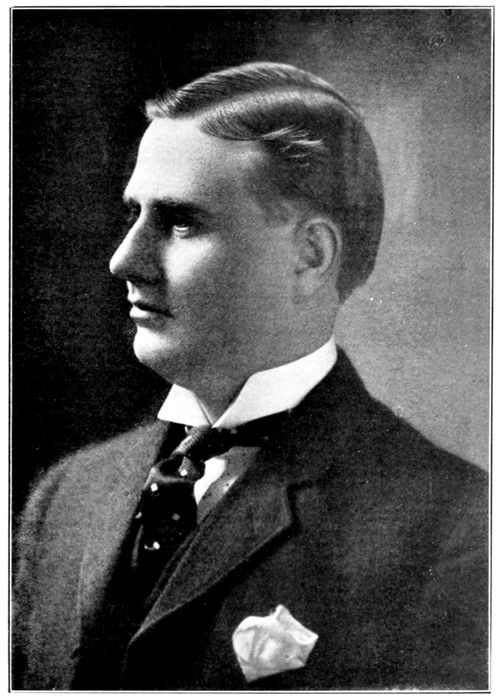
Harry Sharp,
Sec’y Atchison Commercial Club.
513Harry L. Sharp was born in Moravia, Iowa, January 14, 1883, a son
of John Wilson and Cora Wright Sharp, who trace their ancestry to Thomas
Brown and Col. William Crawford, of Pennsylvania. Thomas Brown was one
of the early pioneers in western Pennsylvania and founded the town of
Brownsville, that State, in the year 1776. Col. William Crawford was a confrere
of George Washington. Colonel Crawford married a daughter of
Thomas Brown, which closely related both sides of Mr. Sharp’s family, his
father’s people being the Crawfords and his mother’s the Browns. He was
graduated from the Moravia High School, after which he entered the restaurant
and bakery business for himself, conducting the same for a period of
three years. Disposing of this business, he came to Atchison and was for a
time associated with Sawin & Douglass in the undertaking business, qualifying
and obtaining a license to do embalming in the State of Kansas. Following
this, he was clerk at the Byram Hotel for a period of three years.
During the following year he wrote life insurance and resided in Hiawatha,
Kan. Returning from Hiawatha, he took a position as yard clerk in the
Missouri Pacific railroad yards. From this position he worked up to that
of claim clerk for that company, which position he resigned to become traffic
manager for A. J. Harwi Hardware Company. Upon the death of A. J.
Harwi, Mr. Sharp succeeded F. E. Harwi, as buyer of the house furnishings
goods department of this concern, continuing his traffic work. He held
this position until he was tendered and accepted the secretaryship of the Atchison
Commercial Club. While Mr. Sharp is a Democrat, he has always been
inclined to be independent in his views of things political. He is a Royal
Arch Mason and a member of the Elks and Eagles and other fraternal societies.
In December, 1906, Mr. Sharp was married to Mary, daughter of Edward
C. Wolters, a native of Germany, and a resident of Atchison, where
Mr. Wolters was a contractor for many years. Mr. and Mrs. Sharp have
one child, LeRoy Edward, born May 31, 1909.
Mr. Sharp is one of the most capable and efficient experts in his particular
vocation that can be found in the West. He seems to be naturally
adapted for the difficult and exacting position which he holds, and is gifted
with rare tact and diplomacy which is so necessary in handling the various
affairs which are placed in his hands in the interest of Atchison and the
Commercial Club. He is possessed also of decided literary ability, evidence
of which talent will be readily seen in the perusal of the chapter on Atchison
Industries which was written and compiled for this volume by Mr. Sharp.
Henry Kuehnhoff, farmer and stockman, of Lancaster township, Atchison
county, was born August 3, 1869, in Lancaster township. He is a
son of Charles and Caroline Kuehnhoff, who were the parents of nine children,
six of whom are living. The father was born in Germany in 1841
and left there when a boy of sixteen years, sailing for New York. He remained
there a short time and then went west, arriving at St. Joseph, Mo.,
where he enlisted in Company B of the Volunteer infantry, serving in the
Civil war. He was discharged at Lexington, Mo., at the close of the war,
having made a good military record.
514He returned to civil life and worked at St. Joseph, Mo., as a laborer for
$8 a month. Shortly afterward he came to Atchison county, Kansas, and
bought eighty acres of land in section 10, Lancaster township. Using oxen,
he broke the ground on his newly acquired farm and began to improve it
as far as his resources would permit. In 1894 he retired and went to the
National Soldiers’ Home at Leavenworth, where he died in 1903. The
mother was born in Germany, in 1845, and died in 1899. Henry Kuehnhoff
grew to manhood on his father’s farm and attended the Eden district school
No. 37, and also attended No. 3 school for one term. He worked on the
farm until he was twenty-one, and, then with his brother, William, rented
the old home place. At the death of his father he became heir to a share
of the place, and in 1905 bought the farm where he now lives in section 9,
Lancaster township, Atchison county. He now owns 157 acres of well improved
land and has a large amount of graded stock, and is a stockholder
in a telephone company.
In 1901 he was married to Caroline Kloepper, who was born July 20,
1882, in Atchison county. She is a daughter of Crist and Caroline (Dorssom)
Kloepper, natives of Germany and Atchison county, respectively. The mother
is now dead, but her father resides at DeKalb, Mo. Mr. and Mrs. Kuehnhoff
have one child, John, who lives at home. Mr. Kuehnhoff is a Republican
and a member of the Independent Order of Odd Fellows lodge. He is a
member of the school board of district No. 3, Lancaster township.
The average woman, left penniless, destitute, and even burdened with
debt at the hour of her greatest sorrow in life, the demise of a loved husband,
is very likely to throw herself upon the more or less doubtful mercies
of friends or relatives, and make no attempt to take up the burden of gaining
a livelihood by her own exertions. However, this may be the case in many
instances, but the exact opposite has been the career of Mrs. D. N. Wheeler,
one of the wealthiest real estate proprietors in Atchison, who, during the
thirty-four years that have elapsed since the demise of her husband which left
her with a small home burdened with debt, and otherwise penniless, has
amassed a competence which has placed her in the ranks of the largest individual
taxpayers in the city of Atchison.
She was born in Chautauqua county, New York, a daughter of Ezekiel
515and Almirah (Trowbridge) Rooks, both of whom were natives of New York.
Her father died when she was four years of age, and she was reared in Erie
county, Pennsylvania, where her mother removed after her father’s death.
Rooks county, Kansas, is named in honor of the Rooks family of New York,
who formed one of the first settlements in Rooks county, during the pioneer
days of the early sixties in Kansas. While a student in the academy at Erie,
Penn., she met her future husband, who was then traveling passenger agent
for the Chicago & Northwestern railway. After their marriage in Erie
in 1869, they went to Omaha, Neb., where Mr. Wheeler was connected with
the Union Pacific railway. They had the honor of being the guests of
George Pullman of the Pullman Car Manufacturing Company, as passengers
on the first Pullman train run over the Union Pacific tracks, en route from
Omaha to San Francisco. Upon their arrival in San Francisco they attended
a reception at the Occidental Hotel, after which Mr. and Mrs. Wheeler
traveled in California visiting points of interest. They had some interesting
experiences during their travels over the country while Mr. Wheeler was
engaged in his duties in connection with the Union Pacific railroad. S. H. H.
Clark, president of the Union Pacific railroad, was a very dear and warm
friend of the Wheelers, and after Mr. Wheeler’s death, she accompanied
the Clark family to San Francisco and was domiciled at the Palace Hotel as
their guest. She was with the Clarks at St. Louis when the Union Pacific
railroad was sold for $60,000,000, and she was in New York when Mr.
Clark signed this transfer. Mrs. Wheeler still retains the friendship of
the Clark family and frequently visits them.
Mr. Wheeler had charge of the expedition to North Platte when Generals
Grant and Sherman made the treaty with the Indians, and Mr. and Mrs.
Wheeler became personally acquainted with the famous generals. A souvenir
of this experience is a pack of playing cards which General Sherman gave
Mrs. Wheeler when the party was on the return trip, and which was used
in playing Bezique by the two generals to while away the time. Mr. Wheeler
was the conductor of the train which brought in the survivors of the Plum
Creek, Neb., Indian massacre, in which many of the settlers were killed and
scalped by Indians. Mr. Wheeler died in 1881, leaving his young wife
practically destitute, in the little three room house which they had undertaken
to buy in Atchison for $600. At the time of his death there was an incumbrance
of $400 on this house, and Mrs. Wheeler was so poor that a load of
coal which she had ordered for delivery at the home was returned because it
was thought she would be unable to pay for it. She at once began to display
the spirit which has enabled her to triumph over all difficulties, and
516earned her living by teaching drawing and painting in the old Monroe Institute,
supplementing her salary by giving private lessons at her home on
Saturdays. She managed by dint of the strictest economy to pay off the
mortgage on her little home, and has since remodeled it into one of the most
attractive places in Atchison. This beautiful home is situated high up on
the bluffs, bordering the Missouri river, and offers a view from the east
windows over broad reaches of the Missouri which is unsurpassed for beauty
and distance anywhere in the West. Mrs. Wheeler, while without business experience
of any kind whatever, at the time of her husband’s demise, embarked
upon a career of investing her savings in residence properties until she is
now the owner of twenty fairly valuable pieces of real estate in Atchison.
She followed the time tried plan of the cumulative method of buying houses,
which she would place in good repair for rental purposes, going in debt for
a house and then gradually paying out, and eventually buying another and
so on, until she is now paying taxes on a property valuation of over $40,000,
her taxes alone amounting to $2.00 per day, or over $730 yearly. At the
same time she has gained a valuable knowledge of real estate, she has learned
to know and accurately judge human nature, a combination of wisdom which
is irresistible in achieving success. She is a saleswoman of great ability,
and has frequently been pitted against some of the shrewdest traders in Atchison,
and has never been worsted in an encounter. Endowed with a keen
observant mind and a remarkable memory, she has made many prominent
friends during her career, and has often been called upon to assist them in
various capacities, an instance of which is found in the aid which she gave
Bishop Tuttle in the preparation of his reminiscences of the Old Santa Fe
Trail. To quote the words of a prominent friend of hers, who has known
her for many years and witnessed her struggles to attain affluence, “Mrs.
Wheeler is a very remarkable woman.”
Napoleon B. Pike, farmer and stockman, was born May 10, 1856, in
Washington county, Iowa, and is a son of Charles and Maria (Salers) Pike,
and was one of eleven children, seven of whom are living. The father of
Napoleon Pike was born in New York State, November 13, 1826. He came
to Ohio with his parents and after his marriage went to Iowa. For a time
he was engaged in a small mercantile business in Iowa, but later engaged in
517farming. He also farmed a place of his own near Atchison, Kan., where he
removed in 1882, but his larger holdings were in Iowa. He died in 1903.
The mother was born in New Jersey in 1836, and died in Atchison county,
Kansas, in 1898. Both were members of the Methodist church.
Napoleon Pike grew up on his father’s Iowa farm. He was married
there and came to Kansas with his father in 1882. For a year he rented land
in Doniphan county, Kansas, when he came to Atchison county, and rented
a farm in Lancaster township. In 1907 he bought the forty-acre farm which
he now works. When he took the place it had few improvements, but he has
invested $8,000 since then, and made a modern farm and keeps graded stock.
In 1878 he married Julia Utterback, who was born in Lancaster, Iowa,
July 17, 1856. She is a daughter of Nels and Matilda Utterback, both
natives of Indiana. To Mr. and Mrs. Pike have been born five children,
as follows: Charles, Center township; Alta (Higley) Lancaster township;
Walter, farmer, Lancaster township; Willard, farmer, Center township, and
Warren, deceased. Mr. Pike is a Republican and a member of the Christian
church of Atchison. He belongs to the Modern Woodmen of America at
Atchison.
During the thirty-seven years in which the Scholz family has resided
in Atchison county, its members have made a record for each and every one
which is a credit to their parents and themselves, individually and collectively.
John and August Scholz, farmers and live stock breeders of Lancaster township,
take high rank in the county as enterprising and successful agriculturists,
and have both achieved success, and attained a reputation as specialists,
being well known breeders of Shorthorn cattle. Their father, the late
August Schulz, was wise in his day and generation, in that when he came to
Atchison county, a comparatively poor man, he secured enough land which
would require that his sons remain at home and become farmers. He was
successful in his plan, and the result is seen in the enterprising sons whom he
trained to till the soil in the best manner possible, and who have been successful,
as their father had wished. John Scholz is a native son of Kansas, and
was born and brought up on the farm where he now resides. He has one
of the attractive country places in the county, nicely located, with a well built
farm residence, good barns and out-buildings for housing his live stock and
storing the harvests of the Scholz fields. He and his brother, August, have
518long held their land in common, and worked together on a partnership basis
in a manner satisfactory to both and productive of good results.
John A. Scholz was born November 27, 1879, in Atchison county, and is
a son of August and Johanna (Seidel) Scholz, who were the parents of the
following children: Mrs. Pauline McCowin, Renton, Wash.; Herman, Doniphan
county, Kansas; Charles, Lancaster township; Mrs. Louise Thoren, Los
Angeles, Cal.; Caroline, wife of J. W. Louthian, Lancaster township, Atchison
county; George, Lancaster township; Paul, living near Lancaster, Kan;
Mrs. Anna Stockebrand, Yates Center, Kan.; August, farming in partnership
with his brother, John, in Lancaster township; John A., farmer, Lancaster
township; Robert, Lancaster township. The family was reared on the
father’s farm and the sons were all taught farming. The father was born in
Schlesien, Germany, November 25, 1835. He learned the blacksmith trade
from his father, and worked at the trade until he left Germany in 1870. He
was a son of George Frederick Scholz. His mother died when he was an
infant. Coming to America with his family of six children, August Scholz
resided in St. Joseph, Mo., for a time when he bought a farm of 160 acres
in Doniphan county, Kansas, which he operated about six years. He broke
the soil on this place with oxen and made all necessary improvements himself.
After leaving Doniphan county he rented a farm in Atchison county, and then
bought 480 acres of prairie and timber land in Lancaster township, Atchison
county, in 1882. He bought the farm of Morgan Osborne, and paid $15,000
for it. The place is known as the “Three Springs Farm” and is located on
the northwest quarter of section 9. This name comes from the fact that the
farm has a fine natural water supply coming from springs located on it. The
springs furnish water enough for the stock on the farm even in the longest
drought and supplies the neighborhood when necessary. The father bought
an unusually large farm for a special purpose. He wanted his boys to grow
up with him, and did not want to see them go out as hired hands for other
farmers, so he went into debt to buy enough land so that the boys could work
it themselves and make a living on it. He had very little capital, but he was
industrious and his family was also industrious. This enabled them to go
in debt for the farm without fear of not being able to pay for it. The farm
was paid for in due time and improvements were made constantly. The
father farmed until his death, in 1901. The mother of John Scholz was a
daughter of Godfred and Rosanna (Schwartzer) Seidel. She was born in
Schlesien, Germany, April 10, 1840. The father was a farmer in his native
land. The mother lives with John Scholz. John Scholz attended the Atchison
County High School at Effingham, Kan., having previously gone to
519school in District No. 3, of Lancaster township. He remained at home after
leaving high school, and helped his father on the farm. When the father died
John was married and began life for himself. He and his brother, August,
bought 160 acres each from the heirs, and engaged in farming. They bought
320 acres comprising the old home. March 1, 1915, they bought eighty acres
additional in Lancaster township, making 400 acres in all. John and his
brother began to take a fancy to high grade stock and they are now breeding
fine Shorthorn cattle. They have a herd of twelve head of thoroughbreds.
They have a graded stock of horses and breed Poland China hogs also.
John A. especially takes great interest in mules, and at one time had the
largest span in the county. These sold for $600. They were five years old
and weighed 3,300 pounds.
John Scholz married Ida R. Meyer, October 1, 1913. She was born
March 3, 1882, in Center township, Atchison county, and is a daughter of
John and Caroline (Schroeder) Meyer. John Meyer was born in Switzerland,
and came to Atchison county when he was four years old, with his
parents, John and Verena (Slaughter) Meyer, natives of Switzerland. They
were early settlers in Center township where they died. John Meyer was
born May 8, 1854, and his wife, Caroline (Schroeder) Meyer, was born in
Elgin, Ill., April 2, 1859. Mrs. Meyer was the daughter of Nicholas and
Katherine Schroeder, natives of Germany. Mr. and Mrs. Scholz have one
child, Ralph Edward, born August 17, 1914. Mr. Scholz is a Democrat, and
he and his wife belong to the Evangelical church.
Walter E. Brown, of the law firm of Waggener, Challiss & Crane, and
the present city attorney of Atchison, is a native son of Kansas. He was
born at Whiting, Jackson county, Kansas, November 17, 1887, and is a son
of William E. and Martha W. (Gilmore) Brown, natives of Pennsylvania.
William E. Brown, the father, came to Kansas with his parents in 1872 at
the age of sixteen. He is a son of Michael Brown, a native of Ireland. The
Brown family settled in Brown county, Kansas, where the parents spent their
lives.
In 1879 William E. Brown removed to Jackson county and engaged in
the lumber business at Holton, where he is still an extensive lumber dealer
and one of the substantial business men. To William E. and Martha W.
520(Gilmore) Brown were born three children, as follows: Walter E., the subject
of this sketch; Bernice and Harold.
Walter E. Brown was reared in Holton and educated in the public schools,
graduating from the high school there. He then entered Kansas University,
Lawrence, Kan., and was graduated in the class of 1909 with the degree of
Bachelor of Laws. He then came to Atchison and became associated with
the law firm of which he is now a member. Some few changes have taken
place in the personnel of the firm of Waggener, Challiss & Crane within the
last few years, but it substantially remains the same.
Mr. Brown is a Republican and since coming to Atchison has taken an
active part in political matters. He was elected city attorney in 1913 and
reëlected to succeed himself in 1915. He is a Knights Templar and Royal
Arch Mason and a member of the Benevolent and Protective Order of Elks,
Loyal Order of Moose, and the Fraternal Order of Eagles. Mr. Brown is a
very capable attorney and has a wide acquaintance in northeastern Kansas.
E. G. Burbank, proprietor of the Burbank printshop, is a native son of
Atchison county. In 1905 Mr. Burbank founded this printing establishment
in a very humble way, which within ten years has developed into one of the
leading printing plants of eastern Kansas. The phenomenal success of this
enterprise is, no doubt, due to the fact that Mr. Burbank was an expert job
and edition printer when he embarked in the business for himself. Burbank’s
printshop catered to high class printing from the start, which has been its
specialty and in which it has made a clean record. They do a large amount of
high class catalog printing and other high grade work of a kindred nature.
They are also well known as book printers and binders and printers of high
class stationery. The plant has a floor space, 30×50 feet and is equipped
with all modern machinery and methods for up-to-date printing.
When Mr. Burbank started in business for himself he was able to do
most of his work alone, but he now has ten people on his payroll, and the
plant is now one of the most prosperous concerns of Atchison.
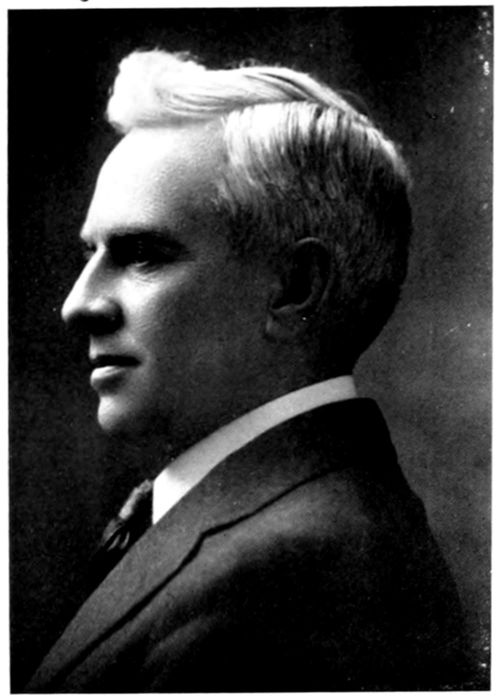
S. W. ADAMS,
Aetnea Life Insurance Co.
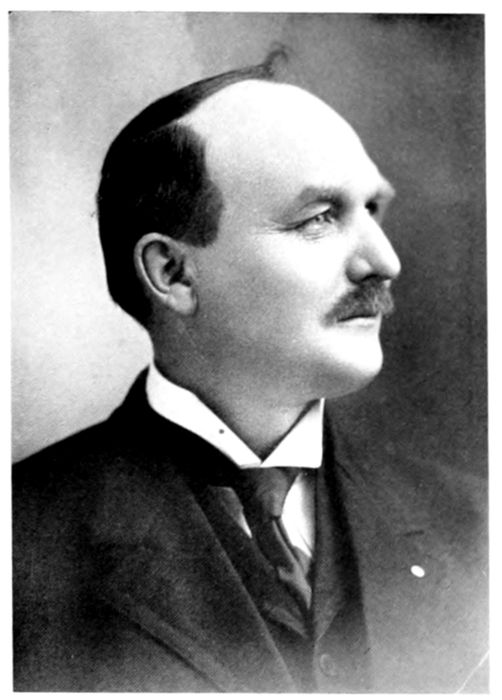
H. C. HANSEN,
Penn Mutual Life Insurance Co.
521E. G. Burbank was born at Muscotah, Kan., January 17, 1881, and is a
son of Henry N. and Mina S. (Hazlett) Burbank. Henry N. Burbank, his
father, was a native of Vermont and came to Atchison county with his father,
George S. Burbank, in the pioneer days of Atchison county. He died in 1913,
and his wife now resides at Billings, Mont. E. G. Burbank was reared in
Muscotah, and after receiving a high school education began his printing
career as “devil” in the office of the Muscotah Record. Shortly afterwards,
he entered the office of the Atchison Globe and was connected with that paper
as a printer for four years, when he organized the plant which now bears his
name.
Mr. Burbank was married in 1908 to Miss Millie Anderson, and they
have two children: Millie Ervin, born in December, 1910, and John Maxwell,
born in July, 1912. Mr. Burbank is of the type of business men who
are making Atchison the commercial and center that it is. He is a member
of Washington Lodge, No. 5, Ancient Free and Accepted Masons, and the
Benevolent and Protective Order of Elks.
The story of a young man who has been successful in his chosen field
through sheer force and energy and aptitude is always interesting. Consequently,
it is fitting that the biography of one of the most successful life
insurance men of northeast Kansas have a proper place in the pages of the history
of Atchison county. The rise of H. C. Hansen in the insurance field has
been rapid and substantial until his high place among the business men of his
home city is assured. Born in the little kingdom of Denmark and reared on
American soil, he has given evidence of possessing the sturdy qualities peculiar
to the Danish people which have led them to the forefront in America
wherever they have settled. It is probable that no people coming here from
foreign shores and speaking an alien tongue have shown greater adaptability
and more acumen in being assimilated into the great American body of citizens
than those who have come from Denmark.
H. C. Hansen was born in Denmark January 17, 1867. His parents were
Hans and Anna Hansen, who left their native land to seek their fortunes in
America in 1869. Hans Hansen was a blacksmith, and the family first located
in Atchison. From here they went to Brown county, and a few years afterward
settled in Doniphan county. Mr. Hansen operated a blacksmith and
wagon-shop at Severance, Kan., until 1890. He then removed to Graham
county and settled on a farm where he still resides. His first wife, Anna,
died in 1875, leaving four children, as follows: Mrs. Mary Kellenberg, of
Brown county; Mrs. Minnie Knoop, of Canton, Okla.; Mrs. Ellen Moore, of
Cottonwood Falls, Chase county, Kansas, and Hans Christian.
522H. C. Hansen was reared in Doniphan county and was forced by circumstances
to look after his own education. When still a boy he learned the
blacksmith’s trade and also worked as a farm hand. He had little opportunity
to secure an education and received no encouragement from his parents to
acquire knowledge. It was necessary for him to earn money to support himself
while attending school. He studied for two years in the Christian Brothers
College of St. Joseph after he became of age. Beginning with December 20,
1892, he served twelve years as salesman for the Edward Heeney Hardware
Company, of Severance, Kan. He then became local agent for the Penn
Mutual Life Insurance Company at Severance. So successful was Mr.
Hansen in his new vocation that in a short period of eighteen months he was
tendered the position of general agent of the company, with headquarters in
Atchison. He has written as high as $200,000 in life insurance policies
yearly and his success still continues. A strong and amiable personality combined
with energy and persistence have been factors in enabling him to advance
with such rapid strides in a field which is full of able competitors. In addition
to his duties as general agent of the Penn Mutual Insurance Company,
he looks after his farm of 120 acres, located five and one-half miles
east of Potter. Mr. Hansen has purchased this farm with money earned in
selling life insurance, and he is displaying the same energy in developing his
farm acreage that placed him to the forefront in the life insurance field. An
old, rundown orchard of about ten acres was located on his farm. He had
this orchard placed in shape for fruit bearing by trimming the trees and spraying
with a power sprayer. The results are seen in the fine quality of fruit
which the trees have yielded. He has been awarded three first prizes at the
Atchison county horticultural display.
Mr. Hansen was married August 20, 1891, to Katie Browning, a daughter
of Frank Browning, an early pioneer settler of Doniphan county. To
them have been born the following children: Anna, a graduate of the public
school and high school, and now a teacher in the schools of Sparks, Kan.;
Bettie, a trained nurse, who graduated from the Sisters of Charity Hospital,
at St. Joseph, in October of 1915; Crystelle, a milliner in the Ramsey store;
and William Penn or “Pat,” the youngest of the family.
Politically, Mr. Hansen is an independent Republican, inclined to be
progressive in his ideas of government by the people, and favoring those candidates
for office who seem to be capable of serving the people to the best
advantage of all. He is a member of St. Benedict’s Catholic Church, and is
fraternally connected with the Knights of Columbus.
523
Julius Deutsch, retired merchant and capitalist, of Atchison, is a citizen
who has made his own way in the world, and achieved a satisfactory measure
of success in the mercantile field. He was born in Lorraine, the French
province of Germany, November 27, 1858, a son of Molling and Melanie
Deutsch, who were born and reared in Lorraine. Molling Deutsch was a
wholesale grain and flour merchant in his native town. Melanie Deutsch
was a daughter of M. Friend, a soldier in the Napoleonic wars, and who was
awarded the Medal of St. Helena for bravery on the field of battle. Both
parents lived their lives and died in the land of their nativity.
When Julius Deutsch had completed his education at the age of fourteen
years, in 1872, he immigrated to America, coming direct to Atchison,
where he made his home for a short time with an uncle, L. Friend. Later, he
entered the employ of another uncle, I. Friend, a merchant, doing business
in Seneca. He worked in the store at Seneca for two years, sold goods in
Atchison for another year, spent one year in a mercantile establishment at
Topeka, and then embarked in business for himself. Mr. Deutsch established
a general store at Muscotah in 1878, which was a successful venture.
Prosperity attended his efforts, and it was not long until he and his brothers
embarked in the mercantile business at Horton, Kan., and established a store
which they still own. He was associated in his business ventures with his
brothers, Sylvain, Maurice, Simon, and Isaac. Simon is now a resident of
Cleveland, Ohio. Isaac is deceased. The brothers established a chain of
stores and operated them at Beloit, Atchison, Valley Falls, Muscotah, and
Concordia, which were generally successful, and made money on the investments.
Mr. Deutsch continued in active mercantile pursuits until his retirement
to Atchison in 1902. He first came to Atchison from Muscotah in
1885, turned over the business at Muscotah to his brother, and then engaged
in business in this city. His brother, Maurice, now operates the store at
Horton, Kan. Sylvain Deutsch makes his home principally in Kansas City.
During later years the Deutsch brothers have disposed of a number of their
various stores, and now operate the Horton concern only. Their capital
is mainly invested in real estate, consisting of city property and farm lands
in Kansas and the West. Isaac Deutsch was the first of the family to come
to America to seek his fortune, and his brothers followed, and a community
of interests which held them together at all times, resulted in all becoming
well-to-do.
Mr. Deutsch and his brothers are interested in a number of financial
524institutions, and he has many friends among the substantial citizens of his
home city. He took an active part in the incorporation of the town of Muscotah,
serving as city councilman. He is of the Jewish faith, and is prone
to assist all religious denominations to the extent of his ability, being tolerant
and broad-minded in this respect. He is fraternally allied with the Odd
Fellows and the Elks. Mr. Deutsch possesses a likable personality, which,
coupled with a kindly and courteous demeanor at all times, makes him well
liked by his associates and esteemed for his many excellent qualities.
Stark Wilbor Adams, general manager for the Aetna Life Insurance Company,
with offices in the new Masonic Temple, and secretary of the Atchison
County High School board, is a native of the Buckeye State, born in May,
1866, at Huron, Ohio, and a scion of an old American family which traces its
lineage back to the colonial days of New England. His father, Stark Adams,
and his mother, Mary (Chandler) Adams, were born in Milan, Ohio, and
Birmingham, Ohio, respectively. Stark Adams was a son of Philo, a son of
Daniel Adams, of Vermont, who was a soldier in the Continental army during
the American war of independence, and was a brother-in-law of Ethan Allen,
of Vermont. Daniel was second in command of the “Green Mountain Boys”
at the capture of Crown Point and Ticonderoga. In recognition of his services
in behalf of the new nation, he was given a grant of land in the Western
Reserve. His son, Philo, rode horseback from Middlebury, Vt., to the Huron
river valley in 1816 and took possession of the tract which had been granted
to the family by the Government. He also traded a horse for an eighty-acre
tract in addition to his own grant. He and three brothers settled on the land
lying along the course of the Huron river, Philo locating at the mouth of the
river where it flows into Lake Erie, and upon which the town of Huron was
eventually built. The brothers became the owners of about 600 acres of land
in the neighborhood. They cleared the land of standing timber, planted corn,
harvested and shelled it during the first season, then crossed the lake to Buffalo
to trade grain for supplies, which they again traded with the Indians for furs.
They conducted a general trading business and the settlement grew from this
beginning, in course of time to be of considerable importance. Philo Adams
was a first cousin of John Quincy Adams, and was appointed the first collector
of the Port of Huron. The first of the family to come to America was Henry
525Adams, who came to Plymouth on the “Mayflower,” when the good ship made
its second voyage to bring over the Puritans, and he settled at Mt. Wolaston,
(now Quincy, Mass.) in 1638. Joseph Adams II was the son of Henry,
the founder of the family in America; Joseph III, son of Joseph Adams, was
next in line, and was the father of Daniel and President John Adams, second
President of the United States. Daniel Adams was the father of Philo Adams,
and direct ancestor of the Adams family.
Stark Adams, accompanied by his family, left the old home in Ohio in
1878, crossed the country to Hays City, Kan., and there homesteaded on 160
acres of land, taking up a timber claim of the same number of acres at the
same time. Settlers were few and far between in that part of Kansas in those
days, and the country was settling up slowly because of the droughts and other
vicissitudes with which the farmers had to contend. Ten years after locating
near Hays City, Mr. Adams came to Atchison and eventually bought a farm
four miles south of the city, on which he lived until his retirement to a residence
on the corner of Q and Sixth streets in Atchison. He was born October
14, 1827, and died August 30, 1909. His children are: Augusta J., at home;
C. B., of 714 Park street; James Otis, on a farm, eight miles southwest of
the city; Stark Wilbor; Margaretta L., at home, associated with S. W. in the
office located on the second floor of the new Masonic Temple; J. D., at the
family home in Atchison at 517 South Seventh street.
S. W. Adams and family came to Atchison from the farm in February,
1908, and engaged in the insurance business, the mother and father and family
coming to the city in December of the same year. He opened his present
office May 1, 1914, when Mr. Adams was appointed manager of the Aetna
Life Insurance Company for northeast Kansas. His career as an insurance
solicitor and manager has been very successful. The real estate and loan
business conducted in the same office is in charge of Jay D. Adams.
Mr. Adams was married December 25, 1899, to Miss Mary Speck, who
was born on a pioneer farm in Atchison county on Stranger creek in Mt. Pleasant
township. She was a daughter of Archimides S. and Sarah E. Speck, natives
of Kentucky and North Carolina, respectively, who emigrated from Indiana
to Kansas, driving a team the entire distance, during the year 1855.
(Further data concerning Mr. and Mrs. Speck will be found elsewhere in this
volume.) To this union have been born, Dorothy M., Sarah E., Mildred J.,
Lorena Wilberta, Wilbor Speck.
Mr. Adams is a Republican in politics and has taken a more or less active
part in political and civic affairs. For the past five years he has served the
county as secretary of the Atchison County High School board. He and the
526members of his family are affiliated with the Presbyterian church. Fraternally
he is allied with the Odd Fellows, Knights of Pythias and the Benevolent
and Protective Order of Elks.
George Scholz, farmer and stockman of Lancaster township, Atchison
county, Kansas, was born in Germany, April 22, 1870, and is a son of August
and Johanna (Seidel) Scholz, who were the parents of seven children:
Mrs. Pauline (McCowin), Renton, Wash.; Herman, Doniphan county, Kansas;
Charles, Lancaster township, farmer; Louise, wife of C. Thoren, Los
Angeles, Cal.; Caroline, wife of J. W. Louthian, Lancaster township; Paul,
living near Lancaster, Kansas; Mrs. Anna Stockebrand, Yates Center, Kan.;
August, farming with his brother, John, in Lancaster township, and John,
farmer, Lancaster township; Robert, Lancaster township. The family was
reared on the father’s farm where all the sons were taught farming. The
father was born November 25, 1835, in Schlesien, Germany, and learned the
blacksmith trade from his father, and worked at that trade until he left Germany
in 1870. He was a son of George Frederick Scholz. His mother
died when he was an infant. Coming to America with his family of six
children, August Scholz resided in St. Joseph, Mo., for a time and then bought
a farm of 160 acres in Doniphan county, Kansas, which he worked about six
years. He broke this place with oxen and made all necessary improvements
himself. After leaving Doniphan county he bought 480 acres of prairie and
timber land in Atchison county, Kansas. This was in 1882. He bought the
farm of Morgan Osborne and paid $15,000 for it. The place is known as the
“Three Springs Farm.” It is located on the northwest quarter of section 9.
The name comes from the fact that the farm has a fine natural water supply
from springs located on it. The springs supply water for the stock on the
farm even in the longest drought.
The father bought an unusually large farm for the reason that he
wanted his boys to grow up on his own farm. He did not want to see them go
out and work for strangers. His capital was limited but he and his sons were
industrious, and they were able to go into debt to acquire more land, and
the farm was paid for in due time and improvements were made as rapidly as
possible. The father farmed his place until his death, in 1901. The mother of
George Scholz was a daughter of Godfred and Rosanna (Schwartzer) Seidel,
527and was born in Schlesien, Germany, April 10, 1840, and is now living with
her son, John. The father was a farmer in his native land.
George Scholz attended the Atchison county schools, finishing at the
Rock district school. He remained at home until he was twenty-six years
old, when he rented a farm which he operated in partnership with his brother,
Charles A. In 1905, George bought the farm which he now owns, and which
consists of 120 acres in section 24, Lancaster township. The place was comparatively
unimproved, having only an old house and barn. Since then he has
built a modern eight-room house, electric lighted and modern in all respects.
In addition, he has erected a fine barn, 40×36 feet in size. It is electric
lighted and equipped with up-to-date conveniences. Mr. Scholz keeps graded
stock on his farm and is a progressive farmer and conducts his farm in an
efficient manner. When he and his brother were farming together, ten or
more years ago, they sold corn from the field as low as fourteen cents per
bushel.
Mr. Scholz was married to Anna Buttron, February 10, 1909. She was
born October 20, 1877, and is the daughter of Henry and Rosanna Buttron.
Mr. and Mrs. Scholz have two children: Gilbert, born December 31, 1909,
and Karl, born January 16, 1914. Mr. Scholz is an independent voter. He
is a member of the Independent Order of Odd Fellows lodge, of Lancaster,
No. 355, and attends the Lutheran church, of which his wife is a member.
Mr. Scholz made his first investment in 160 acres in Sheridan county, Kansas,
for $1,100 in 1902, and sold it three years later for $2,400.
Diligence in the pursuit of success is inevitably rewarded, be it in the
marts of finance or in the ranks of the learned professions. The profession
of medicine has from earliest times offered opportunity for honor and social
prominence, as well as giving its members a chance for bettering the condition
of mankind in general as well as physical. The physician is at once
the friend in need who alleviates our ills and is often the family adviser. To
him very frequently are intrusted the secret troubles which beset his patients
many times and he thus becomes a benefactor to mankind in more ways than
one. Thus, the needs of this noble profession require a high type of individual
who is at once a learned and skilled practitioner and gentleman in
whom the people can place their trust. Dr. Thomas E. Horner is of the type
528of physician in whom one can have confidence and whose ability in his life
work is marked, the best evidence of which is his large practice in and near
the city of Atchison.
He is a native born Kansan, born on a farm on Independence creek in
Doniphan county August 8, 1875, a son of Isaac and Elizabeth (Farrell)
Horner, natives of Ireland. His father was born in 1836 in the town of
Coleriyne, Ireland, and his mother is a native of County Cavan, North
Ireland, born in 1842. Isaac died in Atchison county in 1911. He immigrated
to America with his father, James Horner, who bought a farm near
New York City, returning to Ireland where he resided for twelve years, after
which he located in western Pennsylvania. From there Isaac removed to
Kansas in 1859 and became a freighter across the plains, operating his own
outfit. He married in 1866 and settled on Independence creek. Isaac left
the farm in 1880 and removed to Atchison where he engaged in buying and
shipping live stock until his death. He became well-to-do and was the
owner of over 1,000 acres of land in Doniphan and Atchison counties.
He was an excellent business man and a keen trader who was honest in his
dealings and enjoyed the respect and esteem of those with whom he came in
contact during his long life. Coming of an excellent Irish family, he was a
younger son and had a brother named Samuel who was educated in Oxford
University, and was an early settler in Atchison county, dying in Jackson
county, Kansas, in 1886. The children born to Mr. and Mrs. Isaac Horner
are as follows: Mrs. Elizabeth McGurk, Frankfort, Kan.; Mrs. Ella St.
Peters, Denver, Colo.; James, who married Nellie Deigan and resides in Parnell,
Kan.; Rose, at home with her mother, and Dr. Thomas E. Horner, with
whom this review is directly concerned; Mrs. Marie Farrell, widow of James
Farrell, of Atchison; and Samuel, who married Mollie Butler, and resides
at Jarbalo, Leavenworth county.
Dr. Horner was educated in the parochial schools and Christian Brothers
College at St. Joseph, Mo., from which academic institution he graduated in
1893 with the highest honors of his class. He then pursued the study of
medicine and graduated from the Kentucky College of Medicine in 1897.
For two years he practiced medicine at Vliets, Marshall county; then at Severance,
Doniphan county, for a period which ended in 1911, prior to his location
in Atchison. He has built up an excellent practice and has a beautiful
home at 1114 Santa Fe street.
In politics Dr. Horner is a Democrat; he is a member of the Catholic
church, and is affiliated with the Knights and Ladies of Security, the
Fraternal Aid Societies, the Mystic Workers, and the Knights of Columbus.
529He is likewise associated with the Atchison County, the Kansas State and the
American Medical associations. He served as police surgeon of the city of
Atchison.
Dr. Horner was married January 11, 1898, to Sadie E. Armstrong, and
to them have been born three children: Elizabeth, aged fifteen years; Mary,
fourteen years of age, and Thomas, aged seven years. The mother of these
children is a daughter of Thomas T. and Mary J. (White) Armstrong.
Thomas T. Armstrong was born in 1846 in Canada and came to Kansas
when a young man and entered the employ of the Missouri Pacific railroad.
He is now living a retired life in Atchison. His wife, Mary J., died January
9, 1902, leaving one son, Fred, a resident of Seattle, Wash.
Joseph E. Gibson, farmer, of Center township, Atchison county, Kansas,
and a widely known breeder of Shorthorn cattle, has one of the attractive
and well kept farm homes in Atchison county, located directly on the White
Way, a much traveled and fairly well kept highway, crossing Atchison county
from east to west. Mr. Gibson was born August 22, 1861, in Union county,
Ohio, and is a descendant of good old Virginia stock. His parents were John
and Susannah (Westlake) Gibson, the former a native of Virginia and the
latter of the Buckeye State. John Gibson, the father, was born in Westmoreland
county, Virginia, June 17, 1824, and was the son of Leven and
Mary (McClure) Gibson, who were among the early settlers of the State
of Ohio, migrating from their old homestead in Virginia in 1833 and settling
in Ohio, where they lived on a pioneer farm the remainder of their days.
John Gibson was reared to young manhood on his father’s farm, and after
his marriage settled on a farm of his own in Union county, Ohio, where
Joseph was born and reared. John Gibson was the father of seven children,
namely: Arthur, a farmer living in Union county, Ohio; Joseph E.; Mattie,
deceased; Mrs. Rosa F. Staley, of Union county, Ohio; Thomas, a farmer
and sawmill operator in Louisiana; Mrs. Lizzie Schuler, residing in New
Dover, Ohio; and Asa, a farmer, of New Dover, Ohio. The father of these
children died in 1899. The mother was born in Belmont county, Ohio, in
1829 and departed this life in 1907. She was a daughter of Josiah and Christena
(Knughouf) Westlake.
Joseph E. Gibson, of whom this review directly treats, was brought up
530on his father’s farm in Union county, Ohio, and there attended the district
school. He remained with his parents until 1891 and then migrated to Kansas,
to become a foreman in the fruit orchards owned by J. W. Parker in
Atchison county. Eight years later he rented a farm three miles north of
Shannon, Kan., and in 1901 purchased the farm of eighty acres which he is
now cultivating in Center township. This tract of eighty acres lies in sections
10, 6 and 19 of this township and is well improved. The improvements
which Mr. Gibson has placed on his farm since buying it will exceed
$1,400. For some years he has been a breeder of pure bred Shorthorn cattle
and ships the product of his farm to all parts of the country. He has a
herd of high grade Shorthorn cattle to the number of twenty-eight head.
The cattle bring good prices at private sale, the buyers visiting the farm for
the purpose of purchase. He also is a breeder of Big Type Poland China hogs
of the best breed obtainable.
Mr. Gibson was married November 8, 1888, to Miss Virginia I. Weaver,
and to this union the following children have been born: Imogene, a graduate
of the Atchison County High School; Walter S., at home, attending
business college at Atchison; one child died in infancy. The mother of these
children was born on April 17, 1864, near Lockburn, Franklin county, Ohio,
a daughter of Samuel and Isabella (Gavel) Weaver, the former a native of
Ohio, and the latter a daughter of German parents. The mother of Mrs.
Gibson is aged eighty-one years and makes her home with her daughter.
Samuel M. Weaver was born in Pickaway county, Ohio, May 20, 1826,
a son of George and Isabel (McConnell) Weaver, who were the parents of
six children. The father, George, was a native of Berks county, Pennsylvania,
where he remained until 1806, when he came west and located in Pickaway
county, Ohio, near where the city of Circleville is now located. He was
a tailor by trade, and for many years held the office of deputy sheriff of that
county. He was a soldier in the War of 1812. He died in 1848. Samuel
Weaver was well educated. When twenty years of age he went west and
traveled in different states for ten years. When thirty years old, while traveling
in Iowa he met Isabel Gavel, to whom he was married December 16, 1856.
She was born in Germany and immigrated with her parents to America when
one year old and was reared in Franklin county, Ohio. She was born April
3, 1835. Samuel and Isabel Weaver were the parents of five children: Mrs.
Catharine E. Cunningham. She died at Cleveland, Ohio, in 1911; Mrs. Virginia
I. Gibson; Mrs. Mary F. Southern died at Marysville, Ohio, in 1900;
George H. and Samuel, deceased. Samuel, after a residence in Franklin
531county, located in Delaware county, Ohio, in 1869 and farmed until his death,
July 26, 1904.
Mr. Gibson is a Democrat who has taken an active interest in political
and civic affairs in the county, and is now serving his third term as trustee
of Center township. It is needless to remark that he is satisfying the people
of the township and is an efficient and capable official who looks after the
township affairs as carefully as he does his own personal affairs, he is
fraternally affiliated with the Odd Fellows lodge, the Modern Woodmen, and
the Central Protective Association.
Mrs. Gibson takes a just pride in keeping the place in spick and span
condition and she has a beautiful lawn fronting the White Way road which
attracts the attention of travelers.
Benjamin Patton Curtis has been for sixty-one years a Kansan. Looking
back what wonderful changes do these years present to the onlooker! The
privations, vicissitudes and perils of those days in which the State was born;
the beginning of her commerce when the ox team and flat-boat were the
principal means of transportation; the five long drawn-out years of civil strife
in which the Union was preserved; the era of agricultural development, when
the wild prairies were transformed into fruitful fields of golden grain; the
epoch in which railways were keeping pace with the settler, the merchant,
the manufacturer, and steam and electricity displaced the ox team and stage
coach. Sixty-one years in Kansas, from the days of the prairie schooner,
flat-boat and pony express, to the days of the automobile, air-ship and telephone;
to have done his share in connection with these great developments;
to have through his unaided efforts and with determination and energy
achieved success to have so lived that he is honored by his friends and neighbors,
entitles the man whose name initiates this review to a prominent place
in this publication, the history of the county in which he is passing the sunset
years of his life.
Benjamin Patton Curtis, pioneer, successful farmer and Civil war veteran,
since 1904 a resident of the city of Atchison, was born on the twenty-seventh
day of March, 1839, while his parents were encamped in the wilderness
of Missouri, a terrific snow storm having interrupted their journey to
Illinois. His father, John M. Curtis, was a native of southern Tennessee.
532He had married when a young man, Mary Ann Warren, also of that State,
and with his young wife had settled in Missouri. They were both of Scotch-Irish
ancestry and came from a remarkably long-lived line of forebears, one
of whom lived to the age of 104 years. In 1839 the family removed from
Missouri and settled in Adams county, Illinois, where they remained until
1854, when they came to Kansas Territory, settling just across the Missouri
river from St. Joe. John M. Curtis became a stanch Republican after seeing
the abuse of slaves while in Missouri, and he was one of the fearless men
who came to Kansas for the purpose of making her a free State. He preëmpted
a quarter section of land and then engaged in “following the river,”
as it was then termed, flat-boating, rafting and steam-boating. His three
sons, among whom was our subject, also followed that occupation for a time.
Ben P. Curtis spent the first fifteen years of his life in Adams county,
Illinois. His schooling was scant and that little was acquired in the country
schools. In his fifteenth year he came to Kansas Territory with his parents,
as has been previously stated, and within a short time was employed on the
Missouri river. The free life of the plains called him, but as his two brothers
had run away from home, and he was the only son left, his longing to become
a freighter was unsatisfied, as he preferred to remain with his father. He
was one of the first in his section of the State to heed President Lincoln’s
call for volunteers, and in May, 1861. he enlisted in Company A, First Kansas
Volunteer infantry, under Capt. B. P. Chenowith. He was with his regiment
in all its engagements, and is Atchison’s only survivor of the battle of Wilson’s
Creek. After the burning of Holly Springs with $2,000,000 worth of
supplies; the First Kansas was compelled to live off the country. During
the march to Memphis, and while out foraging, Ben Curtis was captured and
taken to Ripley, Miss. He was paroled, and while waiting to be exchanged
he and a companion, Alverton Abbey, decided to exchange their uniforms for
the rebel grey and join the Union lines as deserters and reënlist in some regiment
other than their own, knowing full well they would be shot if they were
again captured while serving with the First Kansas. They were successful in
securing the rebel uniforms and gained the Union lines, Curtis taking the
name of C. F. Barker and his comrade, Abbey, that of William Payne. He
enlisted in the Fifth Illinois cavalry, and Ben Curtis, under the name of C. F.
Barker. At the time of his capture he was serving as sergeant, and when
enlisting under Captain Chandler he showed him his parole as Sergeant B. P.
Curtis. The captain assured him he would not lose his rank and he was
accordingly made a sergeant and served as such until mustered out in
February, 1864.
533On conclusion of his military service he returned to Doniphan county
and resumed his old employment of “following the river,” remaining in this
field of occupation until 1867, when he bought a quarter section of land in
Doniphan county and engaged in farming. He made a success as an agriculturist,
was an active and influential factor in the life of his section and
reared a family of six daughters, all of whom are women of education, intellectuality
and refinement. In 1901 Mr. Curtis’ health failed and he disposed
of his farming interests and became a resident of Troy, and in 1904
came to Atchison, where he has since resided.
On July 23, 1865, Mr. Curtis married Mary Eliza Ashcraft, a daughter
of Jeddiah Ashcraft. She was born July 23, 1844, in Larue county, Kentucky,
her marriage being on the twenty-first anniversary of her birth. The
first eight years of her life were spent in her native State, the following three
in Missouri, and in 1855 her father brought his family to Kansas and took
up a claim near Mt. Pleasant, where she lived until her marriage with Mr.
Curtis. She was for a time a teacher in the Doniphan school. They are
the parents of the following children: Bird, the wife of Judson F. Thayer, of
Stormsburg, Neb.; Anna, the wife of Julian Tait, of St. Joseph, Mo.; Mable,
the wife of William Maynard, of Cologne, S. D.; Maude, the wife of A. W.
Toole, of St. Joseph, Mo.; Jessie, the wife of C. H. Allison, of Chicago, Ill.;
and Frances, the wife of A. E. Williamson, of Troy, Kan.
On July 23, 1915, their children, sons-in-law, grandchildren, friends and
acquaintances gave them signal honor in a fitting observance of their golden
wedding anniversary. The Atchison Globe of that date says in part: “Fifty
years ago today Miss Mary Eliza Ashcraft and Benjamin Patton Curtis
were married in Doniphan.” Of their first meeting it states: “The Ashcraft
home was on the old Military road, and when Ben Curtis, a soldier in the
Civil war, passed there Mary Ashcraft handed him a cup of water which he
drew up from the well. However, that was not the beginning of the love
affair which culminated in the marriage of Mary Ashcraft and Ben Curtis.
They fell in love with each other in Doniphan, where Miss Mary Ashcraft
went to teach school, and Mr. Curtis does not accuse his wife of ‘chasing’ him.
He asked for an introduction to the pretty school teacher. After he received
it he never took another girl.” Mrs. Curtis is the type of woman everyone
admires. Her home is her kingdom and she rules it wisely and well. She
has never belonged to a woman’s club, but when there is sickness or trouble
at her own home, or in the neighborhood, Mrs. Curtis is on hand, capable,
gentle and sympathetic. She rules her home with a velvet hand, and her husband
says that he notices as the years glide by he gets off at the stations for
534which she has bought the tickets, not because he has to, but because he
wants to.
Of Mr. Curtis it states: “If you don’t know Ben Curtis there is missing
from your acquaintance one of the most companionable of men. Friends who
have hunted and fished with him say that he is a seventy-seven year old prince.
A lover of wild life, he has thoroughly enjoyed his retired life, which has
now covered a period of fourteen years. In the summer he hunts the best
game and fishing resorts of the North, and the winter is liable to find him
down around Corpus Christi, Texas, or some other locality that is attractive
when this climate isn’t. At Leach Lake, Minn., a famous resort on Leach
Lake, if you tell the people that you are from Atchison and a friend of Ben
Curtis, the place instantly belongs to you.” Without sons of his own, he has
naturally taken a great interest in his nephews and is justly proud of the position
attained by the following, all of whom are Doniphan county boys: Edward
Franklin, formerly of the Smithsonian Institute at Washington, now
professor of chemistry at Leland Stanford University; Thomas Franklin, a
prominent insurance underwriter, of Chicago; and Professor Will Franklin,
of Lehigh University. The latter is also the author of several text books
which are in general use.
Mr. Curtis has been a life-long Republican, and during his residence in
Doniphan county took an active part in its political affairs. Political office
has never appealed to him, and, although often urged by his friends to accept
nomination, he refused. He is a member of Severance Post, No. 391, Grand
Army of the Republic, and is prominent in Masonic circles. He has attained
the Knights Templar degree and is affiliated with Abdallah Temple, Mystic
Shrine.
John W. Abner, M. D., although recently locating in Atchison, his skill
and ability as a capable and painstaking physician has met with ready recognition
and he has a large and growing practice. Dr. Abner is a native of
Kentucky. He was born in Clay county, in 1867, a son of John and Matilda
(Robinson) Abner, both natives of Kentucky. Dr. John W. Abner was
one of a family of three children whose parents died when they were very
young and the children were reared by friends and neighbors.
When Dr. Abner was fifteen years old he started out to make his own
way in life. He was always of a studious turn of mind and by his own efforts
535obtained a very good education. At an early age he determined to be
a physician and bent his every effort in that direction. He learned the carpenter
and cabinet maker’s trade, and after working at his trade for some time
he entered the Eclectic Medical College of Kansas City, where he was graduated
in the class of 1912 with the degree of Doctor of Medicine and Doctor of
Philosophy. He engaged in the practice of his profession in Kansas City. Mo.,
where he remained until February, 1915, when he located in Atchison, Kan.
He has a fine suite of offices at 712 1–2 Commercial street and is meeting
with well merited success. Doctor Abner was married in 1902 to Ada Pearl
Wade, of Kansas City, Mo., and they have one child, Dorothy, born January
6, 1905. Dr. Abner is a member of the Christian church and takes an active
part in the work of his denomination and has served on the board of trustees.
He is a member of the Independent Order of Odd Fellows and the Woodmen
of the World. Dr. Abner is a past noble grand and senior warden of Subordinate
Lodge, No. 577, Independent Order of Odd Fellows, and past chief
patriarch of Encampment, No. 27, of Kansas City, Mo., and is a member of
the Patriarchs Militant, No. 14, Kansas City, Mo.
Politically, he is an independent Republican and takes a keen interest
in political as well as current events generally. He is a close student of the
science of his profession and aims to keep himself thoroughly posted in the
rapid advances that are constantly being made in the world of medicine and
surgery.
William Henderson, one of the most industrious farmers of Benton
township, Atchison county, Kansas, was born December 29, 1872, in the
locality where he now lives. His parents, George and Amelia (Stockwell)
Henderson, had six children, of whom the subject is the oldest. The others
are James, Atchison, Kan., in the employ of the International Harvester Company;
Josie married Walter Kelsey, and now dead; Ella married Clayton
Davidson, of Effingham, Kan.; Etta, wife of Arthur Olinger, Jefferson
county, Kansas; Iva, married Elmer Grabiel, Garden City, Kan.; George
Henderson was born in Platte county, Missouri, in 1844, and came to Leavenworth
county, Kansas, with his parents when eleven years of age. Seven
years later he came to Atchison county, where he has since lived, and is now
retired, making his home in Effingham. The mother of William Henderson
was born in Missouri in 1846.
536William Henderson was reared on the farm and attended the district
school near the farm, and the Effingham high school one year. He worked
for his father until he was married to Nettie R. Jenkins September 5, 1900.
His wife was born in Mitchell county, Kansas, in 1883, and is a daughter of
James Q. Jenkins, who came to Atchison county, Kansas, in 1894, from
Nebraska, but was born in Illinois. Mr. Henderson owns 180 acres of land
which is all well improved, the improvements costing $5,000. Of four children
born to Mr. and Mrs. Henderson, three died in infancy. The living child,
Floyd, was born May 28, 1904.
Mr. Henderson is a Democrat. He belongs to the Elks lodge of Atchison,
Kan., and the Masonic lodge at Effingham. Though not a church member,
he attends regularly. Mr. Henderson has made a success by hard work
and good management. He is always in favor of movements which benefit
the community and is a public-spirited citizen.
Potter is one of the coming and enterprising towns of Atchison county
and Kansas. During the past few years the town has taken wonderful strides
in the matter of public improvements and new buildings. A considerable
portion of this push and enterprise is directly due to the energy and influence
of Lumas M. Jewell, retired merchant and banker, who can well be called
the “father of the present day Potter.” Mr. Jewell has been a consistent
booster for the town ever since his advent in the town, and has given of his
time and money toward its development. Mr. Jewell is a self-made Kansan,
who has had an interesting career, and whose rise from a poor boy to a position
of comparative wealth and affluence is well worth recording in the annals
of Atchison county.
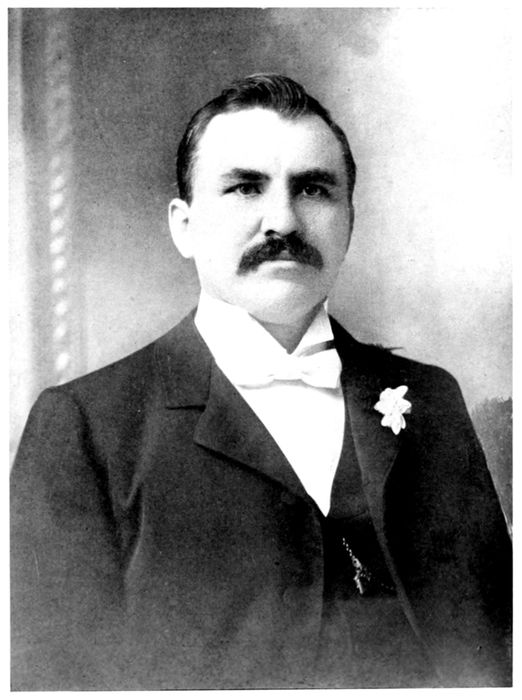
L. M. Jewell,
Potter, Kan.
537L. M. Jewell was born on a farm in Wayne county, Kentucky, December
3, 1861, a son of Heman S. and Susan Mary (Weaver) Jewell. His
father was a native of Vermont, who immigrated to Kentucky when a young
man, and engaged in farming operations. He followed farming during his
life, until a few years before his demise, at the home of his son, G. W. Jewell,
at Kidder, Mo., in 1913. L. M. Jewell received a meager education in the
schools of his native State, and his later success in life has been due entirely
to his own efforts. His greatest education has been received in the stern
school of experience, which is the best after all, and most useful, in developing
the real attributes of a man. When he was seventeen years of age, he left
home and went to the home of an uncle in Michigan, where he attended school
for a time. When he had attained his majority in 1882, he went to South
Dakota and homesteaded a tract of prairie land. He stayed in South Dakota
for two years and developed his homestead to such an extent that he was able
to dispose of it for a good round price, and he then moved to Caldwell county,
Missouri, and bought another farm, which he cultivated with a fair degree of
success. Later, he embarked in the mercantile business in Marvel, Mo., for a
period of three years, disposing of his business in 1892, and locating in Potter,
Kan. His first employment in Potter was with the general merchandise
firm of Paxton & Kemper. Three years after entering the employ of this
firm, Mr. Jewell purchased Mr. Paxton’s interest for $1,500, paying $400
cash, and borrowing the remaining $1,100 with which to complete his purchase.
It is remarkable that he could have so established a reputation for
business ability and integrity in that time as to be able to command that
amount of capital to swing his first business deal in Kansas. His later successes
date from that time on, and in the short time of three years he was
out of debt, and the business had taken on larger proportions. W. T. Kemper,
his partner, then sold his interest in the store to a cousin, Madison Kemper,
from whom Mr. Jewell purchased the remainder of the business and
became the sole owner. During this time the stock of the store had been
increased, and the business had taken on a wider and a more general scope
through Mr. Jewell’s enterprise and the exercise of his decided business ability.
He became sole owner of the store in 1897, and during the next three years
the business was placed upon a permanent and stable footing, which yielded
large profits for its owner. In 1900 Mr. Jewell conceived the idea of engaging
in the real estate business, primarily for the purpose of building up the
town of Potter and attracting more residents to the place. He acquired several
business lots and began to erect buildings to such an extent that Potter
soon began to take on the airs of a growing city. Where there was but one
store building on the side of the street occupied by the Jewell store, he erected
five new store buildings, which are occupied by merchants who have moved
into the town in the past fifteen years. It is due to Mr. Jewell’s enterprise in
this regard that the business part of Potter has been developed. Whereas,
when he first came to Potter the town boasted but three stores—his own store,
a small hardware shop, and a grocery. All the stores were small and the
town did not have a bank. At the present time Potter has two banks and
every line of business is represented. As Mr. Jewell’s business expanded his
enterprises included a lumber yard, furniture stock and a grain elevator. Seeing
538the need of a bank, he started a plan of organizing the Potter State Bank
in 1899, and after almost a year’s effort, he received the assistance of O. A.
Simmons in effecting the organization, and Mr. Simmons was the first cashier
of the bank. Mr. Jewell later served as cashier, and is now the president
of this bank. In 1910 Mr. Jewell disposed of his mercantile interests, and
is interested mainly in real estate and farm lands in Jackson county, Missouri,
and Atchison county, Kansas. He has also made a number of large
trades in merchandise stocks.
Mr. Jewell was married in 1897 to Sinnie M. Shaw, a daughter of Henry
Shaw, who was an early settler of Kansas. One child was born to them,
Edna Fern Jewell, born in 1901. Mr. Jewell is a Democrat in politics, and
Mrs. Jewell is a member of the Methodist church.
Mr. Jewell’s efforts to advance Potter among the Kansas municipalities
have not been confined to commercial activities alone, but he has always had
in mind the welfare of the people along other lines. He had not been a citizen
of the town but a few years when he conceived the idea that a newspaper
would be of great benefit to the community in more ways than one. Consequently,
he used every effort to have a paper established in the town, and the
Potter Kansan, one of the best edited small weeklies, and one of the most prosperous
newspaper enterprises in the State, is the result of his dream. He has
been foremost in the cause of education, and he worked unremittingly toward
the erecting of the present modern school building and the establishment of a
graded school system in the town. Such men as Mr. Jewell are the kind of
citizens every town needs, and Potter has been the gainer for his civic enterprise
and the fostering of the growth of his adopted city.
William R. Donnellan, hardware merchant and postmaster of Lancaster,
Atchison county, Kansas, was born June 25, 1868, at Lancaster. He is one
of six children of John and Mary J. (Davidson) Donnellan, as follows:
Anna A. (Ostertag), of Atchison; Thomas E., Parsons, Kan.; William R.,
the subject of this sketch, Lancaster, Atchison county, Kansas; Emma B.,
Atchison, Kan.; Margaret (A. Manglesdorf), Atchison, Kan.; Junia (J.
Cleary), Shannon township farmer. John Donnellan, the father, was born
in Ireland in 1827. When twenty years of age he left the Emerald Isle to
trust his fortunes in America. Landing at Ellis Island, N. Y., he set out
539for the interior of New York State and found employment on a dairy farm.
After a few years of hard labor there he went to Crawfordsville, Ind., and
worked in a hardware store. In 1856 he left Crawfordsville and came to
Kansas, where he preëmpted 160 acres of land in Lancaster township, Atchison
county, and built a small, four room house and lived in the most primitive
way. When he first broke the soil on his farm he used oxen, but later,
as he prospered, he used improved methods of farming. He died on his farm
in 1893. The mother of the subject of this sketch was born in Harrisburg,
Pa., and died in 1892, a year preceding the death of her husband.
William R. Donnellan was born and reared on his father’s farm in Lancaster
township. He attended the public schools of Lancaster, and at the age
of twenty-one went to Kansas City, Mo., and secured employment as a motorman
and conductor in the service of the Street Railway Company there.
Three years later he became shipping clerk for the A. J. Harwi Hardware
Company of Atchison, Kan., and a year later returned to his home and engaged
in farming on the home place. He remained on the farm until 1903
when he moved to Lancaster and purchased the hardware stock of H. O.
Whittaker. This is a large store, carrying $8,000 worth of stock. In politics
Mr. Donnellan is a Republican. He was elected mayor of Lancaster in
1907 and served until 1911. In 1903 he was appointed postmaster.
Mr. Donnellan was married in 1893 to Lillian M. Sanders, who was born
February 12, 1870, at Lewisburg, Pa. She is a daughter of George L. and
Elizabeth (Harrison) Sanders, both natives of Pennsylvania. They have one
child, Eva M. (Carson), living in Lancaster. She is a graduate of the high
school and business college. Mr. Donnellan is a member of the Independent
Order of Odd Fellows, Modern Woodmen of America, and the
Knights and Ladies of Security lodges.
The biographical annals and the history of Atchison county, Kansas,
record three distinct periods of settlement in Kansas and Atchison county.
The first was the real pioneer era, when an influx of settlers came, who were
the first to break the prairie and lay the foundation for future development.
The second was directly after the Civil war, when many people came from all
parts of the East and European countries. The later period was in the
eighties, when there came from Ohio and Pennsylvania many excellent American
540families who have prospered and taken leading places in the civic and
agricultural development of the county. The Hawk family, of old Pennsylvania
German stock, came to this county in the latter era. Lafayette T. Hawk,
substantial and well respected, and prominent farmer of Benton township, was
among this number, who can be reckoned among the latter-day old settlers
of the county, and who has resided here for over thirty-four years, and has
worked his way upward from the station of comparatively a poor man to a
position of affluence in the county.
L. T. Hawk was born August 22, 1849, in Coshocton county, Ohio, a
son of Jonathan and Margaret (Neede) Hawk, both of whom were born and
reared in the Buckeye State. Jonathan Hawk was born in Coshocton county,
Ohio, in 1822, and was a son of Leonard Hawk, born in Pennsylvania, of
German parents. Leonard Hawk was an early immigrant in Coshocton
county, Ohio, and settled in that county when the whole region was a wilderness
and carved a farm from the dense woods which covered that part of the
Buckeye State in the early part of the nineteenth century. He first came
to Ohio in 1814. Jonathan Hawk came into possession of the old home place
of his parents’ in Coshocton county, but sold out in 1883, and came to Kansas,
to join his son, Lafayette T., who had preceded him to Atchison county by
one year. During the first year of his residence here, he made his home on
his son’s farm, and then purchased the Shell property in Effingham, where
he made his home until his demise in December, 1889. He was the owner
of eighty acres of land which he farmed. Jonathan Hawk was the father of
eight children, namely: Sarah died in Ohio; Lafayette T., of whom this review
is written; Mary Jane Roll, widow of Samuel Roll, and residing in Effingham;
Samuel, living in Oklahoma; Mrs. Margaret Denbow, of Great
Bend, Kan.; George Leonard, of Oklahoma; Edith Elzina died at the age
of four years; John, deceased. The mother died in January, 1891, at the
age of sixty-six.
Lafayette T. was reared on the ancestral farm in Coshocton county, Ohio,
and received his education in the district schools of his neighborhood. He
learned in his youth to do the hardest kind of farm work and was taught by
his parents the best methods of tilling the soil. When a young man he became
imbued with the desire to locate in the West where opportunities seemed
to be greater than in his home State, and he saved his earnings toward this
purpose. Not long after his marriage he came to Kansas, in 1882, and located
in Benton township, Atchison county. His cash capital being limited
to the sum of $300, he deemed it advisable to rent land for the first year, then
bought his first farm of 160 acres at the purchase price of $25 per acre. This
541farm was necessarily bought on time, but with good management and industry,
Mr. Hawk was enabled to pay out and add considerably to the improvements
of his place, which is one of the most attractive in the county and
one of the most fertile and productive. Mr. Hawk also added ninety acres
to his land holdings in later years, and invested his surplus in western land
which he traded for the Effingham Hotel property which he now owns. He
is a stockholder and director of the Farmers and Merchants Bank of Effingham,
he is also a stockholder in the Midnight Oil Company, a producing
concern with headquarters at Morris, Okla.
Mr. Hawk was married March 21, 1874, to Miss Harriet Pitt, of
Coshocton county, Ohio, and who was born in Kentucky. To this union have
been born the following children: Charles, who served in the Twenty-second
regiment, United States infantry, during the Spanish-American war, and is
at present chief of police at Shawnee, Okla.; John D., a prosperous and progressive
farmer in Benton township; Margaret, wife of Clem Higley, a farmer
living in Center township, near Pardee; Homer, who was killed in a railway
accident in October, 1913; Fred, died in April, 1913, and who had held the
position of cashier of the Farmers and Merchants Bank of Effingham prior
to his death; Wilbur D. Hawk, business manager of the Atchison Daily Champion,
and former deputy warden of the Federal penitentiary, Atlanta, Ga.;
Mrs. Mary Foster, of Trenton, Mo.; Robert, a farmer in Benton township;
Clifford, a farmer and auctioneer in Benton township, and Vera, at home with
her parents. The mother of these children was born, November 8, 1851, in
Kentucky, a daughter of William and Frances (Phillips) Pitt, the former
a native of New Jersey and the latter of Vermont. In 1853 Mrs. Pitt and
their children removed to Coshocton county, Ohio, Mr. Pitt having died when
Mrs. Hawk was an infant. Two of the three children were reared: Mrs.
Hawk and Mrs. Lenore (Miller), who died in September, 1915, at Carlton,
Ohio. Mrs. Pitt’s second marriage was with Dr. Ephraim P. Stewart, of
Coshocton county, Ohio, where he practiced after moving from Carroll
county, Ohio, his birthplace.
With the exception of a few years spent in Atlanta, Ga., with his son,
Wilbur D., when on duty as deputy warden of the Federal Penitentiary, Mr.
Hawk has lived continuously in Atchison county, since 1882, and has taken
an active and influential part in the affairs of the county. He is a stanch
Republican in his political affiliations, but has never sought political preferment.
He and the members of his family are affiliated religiously with the
Lutheran denomination, which was the faith of his father. He is prominent
in lodge circles and is a member of the Independent Order of Odd Fellows,
542and the Knights and Ladies of Security. He is one of the original Central
Protective Association members and is a charter member of Sunny Hill Lodge,
No. 158, of Effingham, and is prominently connected in Central Protective
Association circles throughout the State of Kansas, having organized seven
lodges in this State.
For nearly fifty-nine years James R. Gragg, wealthy farmer and stockman,
of Lancaster township, Atchison county, Kansas, and the present township
treasurer, has lived in Kansas, and is one of the real pioneers of the
State. Since a lad six years of age he has been a resident of Atchison county,
and has lived to see the once wild and barren prairie become one of the garden
spots in America, and has seen the towns and cities grow within the borders
of the county where once was a wild, unbroken waste. When a boy he was
taught by his father that the greatest returns from the pursuit of agriculture
could be obtained by the raising and feeding of live stock, and he has endeavored
to follow his father’s teachings in this respect and has met with
success, resulting from following a definite plan of getting the best results
from his efforts. He is a descendant of a southern pioneer family, who were
among the original settlers of eastern Tennessee, and again were pioneers in
Clay county, Missouri, early in the nineteenth century. It is a topic of interest
to compare the comfortable residence and farm buildings of Mr. Gragg, at
this day, to the log cabin in which he was reared, and the stock shed made of
poles and slough grass, which his father was forced by necessity to erect in
the early days of the settlement of Kansas. Few families settled in Lancaster
township as early as the Graggs, and in point of years of residence, James
R. is probably the third oldest living settler of the township.
James R. Gragg was born February 5, 1851, in Clinton county, Missouri.
He is a son of Jefferson and Mary (White) Gragg, to whom fifteen children
were born. Four children, two sons and two daughters, are still living, as
follows: Mrs. Mahala Martin, Gower, Mo.; James R.; Mrs. Alice Muks,
near Oklahoma City, Okla.; and Bishop or Bascomb Gragg, Stafford, Kan.
The Graggs are of Irish descent. The father of James Gragg was born in
1814 in eastern Tennessee. When he was a child his parents removed to Clay
county, Missouri, where he grew up as a farmer. In the spring of 1856 Jefferson
Gragg came to Kansas and settled in Leavenworth, where he had
taken a claim. He sold this a year later and came to Atchison county, and
543preëmpted 160 acres in section 24, Lancaster township, on which James R.
is now living. He paid $1.25 an acre. As soon as he took charge of the land
he built a log house, twelve feet square and also erected a hay barn with a
slough-grass roof. He brought a covered wagon to Kansas and lived in it
until the log house was ready for occupancy. During the border war he was
forced to return to Missouri for three months, but at the end of that time
came back to Kansas and continued to improve his farm. It was slow work, as
he did most of the plowing with oxen and this took a great deal of time, but
he was able to accumulate a little money slowly, and in ten years erected a
better house on his place. He had a hard fight for existence the first few
years in the face of crop failures, droughts and grasshoppers, but when he
retired, about 1890, he owned 640 acres of land which he divided among
his children, and lived with them until his death, April 10, 1910. His wife,
the mother of James R. Gragg, was born in Clinton county, Missouri, in 1816,
and died in 1912. She was the daughter of Robert White, and her mother
bore the maiden name of Cooley. Both parents were members of the South
Methodist church, and helped to organize and build the Bethel church in
Grasshopper township, which was one of the early Methodist churches in Kansas.
Both parents are buried in old Huron cemetery.
James R. Gragg, the subject of this sketch, was reared on the farm
where he now lives, and attended school in Lancaster and Huron, Kan.,
although his early educational opportunities were limited. In early days the
father and his son were stock buyers on a large scale. The father did the
actual buying, and the son had charge of the herds on the prairie. They did
a large business in trading and buying and selling stock, and the son has
continued this until the present time. James has always lived on the Gragg
land and was with his father until the latter retired in 1890 and the land
was divided. James later bought out the other heirs and now owns 1,040
acres in Atchison and Wabaunsee counties, 560 acres of this land being located
in Atchison county, with three sets of farm buildings. He gives a great
deal of attention to the stock selling part of his business, and feeds and winters
150 head each winter. On December 25, 1872, Mr. Gragg married Mrs.
Viola A. Norris, who was born May 26, 1855, in Buchanan county, Missouri.
She is a daughter of David and Martha (Cook) Norris. The father’s
family came from Kentucky and the mother’s from Indiana. Mr. and Mrs.
Gragg have two children: Jefferson K., born February 23, 1875, in Atchison
county, Kansas; married in October, 1894, to Ella Walls, and has two children,
Paul, aged twenty years, and George, aged twelve years. He is now
engaged in the live stock commission business in Kansas City, Mo., and Arch,
544born May 3, 1889, who is farming on the home place, married March 11,
1914, to Edna Wilson, of Lancaster township, a daughter of J. E. Wilson.
Jefferson, the older son, completed a course in the Atchison Business College.
Mr. Gragg is a Democrat, and has been a member of the school board,
and is now treasurer of Lancaster township. He is a member of the Methodist
church and the Independent Order of Odd Fellows and Modern Woodmen
of America.
Uri Seeley Keith is one of the grand old men of Atchison. His career
has been interesting, and borders upon the romantic, when many incidents
in which he has figured are recounted. A valiant soldier of the Union during
the Civil war, it fell to him to perform the arrest of Vallandingham in
Ohio when his activities in favor of the Confederacy had rendered him obnoxious
to the State and Federal governments. Few men in Atchison have had
a more varied or active life than Mr. Keith. He was born June 27, 1841, in
Massillon, Ohio, the son of Fordyce M. and Parthena J. (Seeley) Keith, natives
of New York and the Western Reserve of Ohio, respectively. Mrs.
Keith was a daughter of Uri Seeley. Fordyce M. Keith was born in 1816
and died May 14, 1906. He was a son of Ansell Keith, a native of New
York. The Keith family is descended from two brothers who were sons of
General Keith, at one time a field marshal in the Russian army. He was a
Scotch-Englishman, who quarreled with Queen Elizabeth and left England
to take service under Peter the Great of Russia. His two sons immigrated to
America in 1690, one settling in New York and the other going to the Southland.
Two branches of the family thus sprang from these sons of Marshal
Keith. Brigadier General Keith served under General Washington during
the Revolution and the General lived at the Keith home in New York for a
time. Ansell Keith served in the War of 1812. The Seeley family originally
settled in Connecticut. Uri Seeley was born in 1791 and settled in the Western
Reserve on a land grant of 100 acres where he died. Ansell, the father
of Fordyce M., and grandfather of the subject of this sketch, settled in Lorain
county, Ohio, in 1832, near Elyria and was a contractor and builder. Data
regarding the members of the family is as follows: Ansell Keith was born
June 24, 1786, and Betsy M., his wife, was born January 2, 1794; Uri Seeley
was born May 25, 1791, and died August 10, 1877, and his wife, Abbey, was
born October 23, 1792.
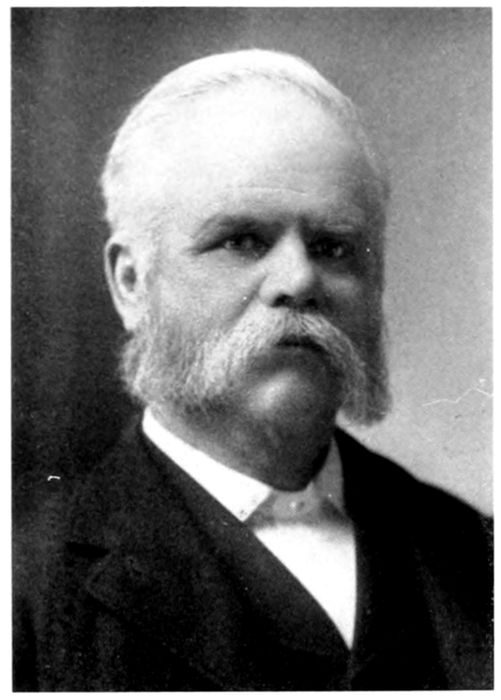
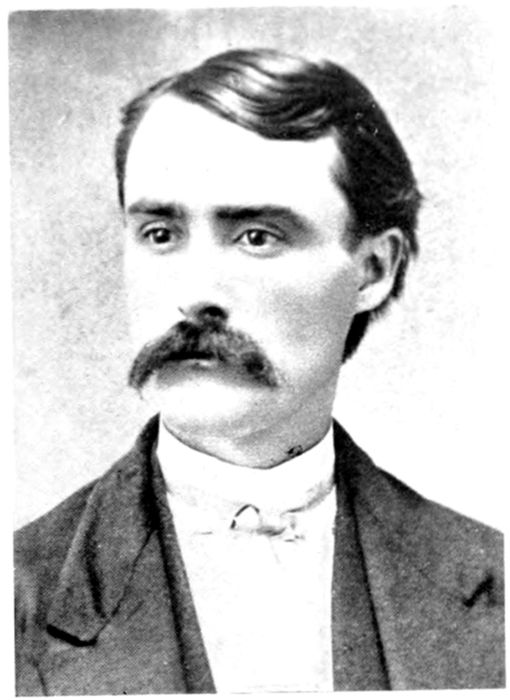
C. H. BURROWS.
Commander G. A. R. Post No. 93.
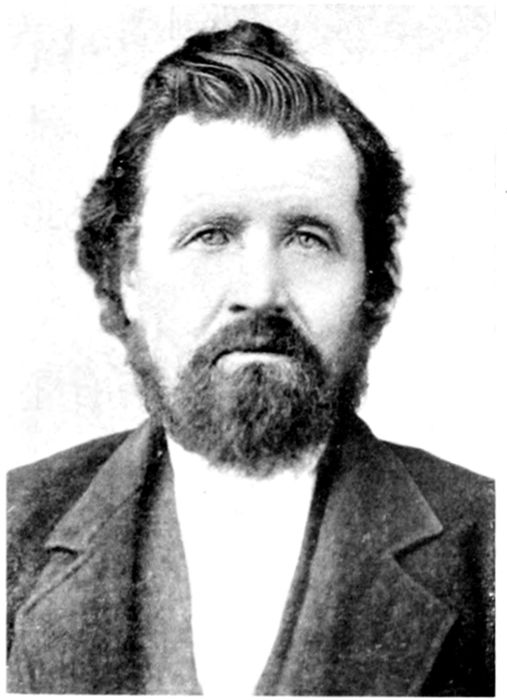
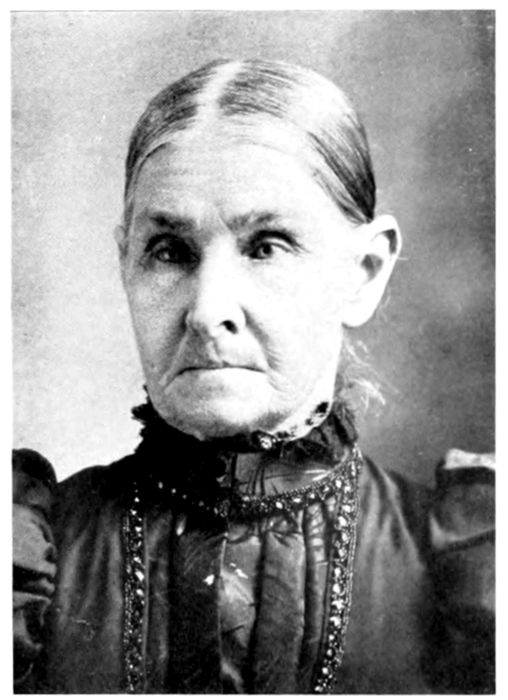
545Fordyce M. Keith was born April 27, 1816, and died May 12, 1906. His
wife, Parthena, was born August 4, 1816, and died at Seneca, Kan., February
18, 1893. He received an excellent education and was admitted to the practice
of law in Ohio, practicing for some years at Massillon. He served in the Union
army, enlisting in the One Hundred and Seventeenth regiment, Ohio infantry,
and later the First Ohio heavy artillery. His service extended throughout
the war from August 30, 1862, to August 1, 1865. He was a major in the
One Hundred and Seventeenth regiment, Ohio infantry, and was created a
lieutenant colonel in the heavy artillery August 1, 1863. He came to Kansas
in 1866 and practiced law in Brown county where he served as county attorney.
In old age he resided with his granddaughter in Oklahoma. He was
the father of the following children: Uri Seeley; Fordyce M., Jr., who died in
Pueblo, Colo., August 1, 1900; Clarence M., and Herbert Brewster died in
infancy; Lamar Burrett, born February 22, 1847, and lives at Seneca, Kan.
Uri Seeley Keith was educated in the common schools of his native State.
He enlisted April 20, 1861, when Lincoln issued his first call for troops. His
first enlistment was in Company I, Eighteenth regiment, Ohio infantry, for
a period of three months, which was extended to five months. He again enlisted
in Company E, Eighty-seventh regiment, Ohio infantry, June 2, 1862,
for four months. November 4, 1862, he enlisted in Company K, One Hundred
and Seventeenth regiment, Ohio infantry, for a period of three years, or until
the close of the war. He was promoted to the second lieutenancy of Company
C, First Ohio heavy artillery, December 23, 1863. The One Hundred
and Seventeenth regiment was transferred to the heavy artillery organization
May 2, 1863 with Mr. Keith as second lieutenant and later as first lieutenant
of his company. He was regimental quartermaster sergeant of the One Hundred
and Seventeenth regiment, Ohio infantry, and received his final discharge
at Knoxville, Tenn., July 25, 1865, and was mustered out at Camp Denison,
Ohio, August 1, 1865. This valiant soldier participated in the following engagements:
Chickamauga, September 10–20, 1863; Knoxville, November 16 to
December 9, 1863; Campbell Station, October 16; Carter Station, December
21; Lowden, October 15, 1863; Rogersville, December 19; Taylorsville, December
19, 1863; Seaversville, October 9, 1864; Charleston, October 19, 1864;
Cleveland, October 24; Columbus, October 27; Franklin, November 30;
Nashville, December 12 to 16, and Duck River, December 18, 1864. He
served as quartermaster of the Second battalion of the First Ohio heavy artillery
from April 1, 1864, to the close of the war. Other engagements in which
he fought were: Rich Mountain, July 7, 1861; Gainesville, July 24, 1861; Red
House, July 29, 1861 (Eighteenth Ohio volunteer infantry) and Harper’s
546Ferry, September 14 and 15, 1862; South Mountain, September 13, 1862;
Antietam, September 17, 1862 (Eighty-seventh Ohio volunteer infantry)
Paintville, January 11, 1863; Peach Orchard, January 27, 1863 (One Hundred
and Seventeenth Ohio volunteer infantry). An interesting episode in Mr.
Keith’s career which has been published in various newspapers is worth recording.
He was the man who arrested Vallandingham at Dayton, Ohio, May 1,
1863. Early in 1863 while he was an officer in the heavy artillery, General
Burnside, then in command of the Department of the Ohio, issued general
order Number 38, which was especially obnoxious to southern sympathizers,
the Knights of the Golden Circle, and Associated Sons of America, and kindred
organizations which had for their object the placing of every obstacle in
the path of the Federal Government and the overthrow of the Union. Vallandingham
made an incendiary speech at Mt. Vernon, Ohio, on May 1. Captain
Hutton of General Burnside’s staff was detailed to effect the arrest of
Vallandingham, who was to be transported to the rebel lines. Lieutenant
Keith was second in command of the expedition. They reached Vallandingham’s
home at midnight, and knocked at the door, but the woman of the house
stated that the object of their capture was not at home. Lieutenant Keith
did not believe her and pushed open the door and rushed up stairs to find
Vallandingham, who was in bed. When Keith broke open the bed room door
his prisoner rushed to the window and called “Asa,” presumably in search of
assistance, but no one came to his aid. He was then taken to Cincinnati and
sent through the Union lines to the Confederate general, Bragg, for safe
keeping.
Mr. Keith came west to Doniphan county September 8, 1865, and located
in the town of White Cloud for a time and then came to Atchison. He bought
a farm a few miles west of White Cloud which he cultivated until 1872, and
then followed railroading for a time. In 1872 he was in the employ of the
United States Government on the Great Nemaha Indian reservation. In
1875 he again returned to White Cloud and from there went to his farm,
remaining until 1885 when he engaged in the hotel business at Hiawatha until
1890. He removed to Atchison in 1890, and was employed for a number of
years as inspector of city contract work. He has superintended practically
all of the paving and contract work which has been done in the city except
during the past few years since his retirement. Many miles of paving have
been honestly done under Mr. Keith’s supervision and he has had charge of
the building of practically all of the concrete culverts erected in the city. For
four years he served as deputy sheriff of Atchison county.
Mr. Keith was married September 11, 1866, to Mary Frances Grossman,
547who was born in Massillon, Ohio, August 24, 1842, the daughter of Daniel
and Martha Grossman, natives of Pennsylvania, and pioneer settlers in Ohio.
The Grossmans moved to Ohio in 1836 and both died in Massillon. To Mr.
and Mrs. Keith have been born the following children: Minnie L. born July
24, 1867, wife of J. R. Bailey, of Enid, Okla., and the mother of one child,
Mildred, wife of Dr. Lee J. Render, of Falls Valley, Okla., and who also has
one child, Bailey Adrian; Mrs. Ruby V. Doyle, born April 1, 1870, and residing
in Lincoln, Neb., the mother of one child, Halbert K.; Edward C., and Charles
R., born June 6, 1875, of whom Charles R. died May 24, 1898, and Edward
C. married Elsie Schmitt, engaged in United States mail service. Mr. Keith’s
daughter, Mrs. Bailey, is a talented writer and has issued a volume of poems
which has decided literary merit. She is counted among the leading authors
of the “New State” and is fast gaining a place in the world of letters.
Mr. Keith has always been aligned with the Republican party and has
been active in its councils during his long and busy life. He is a Mason and
a member of the Grand Army of the Republic, Post No. 93, having been
quartermaster of the local post for the past eight years. He served as post
commander at White Cloud, Hiawatha, and of E. C. Johnson post, of Atchison,
which was later consolidated with Post No. 93. Few men can look back
over long years crowded with incidents and with such activity as has fallen
to the lot of Uri S. Keith, one of the last of the Old Guard who offered their
lives that the Union might be forever preserved. As the years pass and time
rolls on the ranks of those brave men who wore the blue are becoming thinner
and their steps more feeble. It is only the more vigorous who have survived
thus far and Mr. Keith is one of them.
Charles H. Burrows, Union veteran and clerk in the Missouri Pacific
railroad offices at Atchison, has had a long and varied career in the railway
service of the country. He is a native of the Buckeye State and was born at
Cincinnati, November 19, 1843, a son of James H. and Nancy A. (Lynchard)
Burrows, both of whom were descended from old American families. James
H. Burrows was born in Maryland and his wife was a native of Kentucky.
The Burrows family settled in America in about the year 1647. There were
at first two branches of the family, one of whom settled in Maine and the
other on the south shore of Maryland. The great-grandfather of Charles H.
548settled first in Maryland and here his grandfather, William Burrows, was
born and reared. The sons of the family were sea-faring men and several
of the descendants of the first Burrows have been officers in the United
States navy. Nancy A., wife of James H., was a daughter of Mr. Lynchard
of Virginia, who became a pioneer settler of Kentucky, and married a member
of the Talbot family, of Virginia. He had two sons and four daughters and
came from Kentucky to Hamilton county, Ohio, in 1838. In 1845 James H.
Burrows was married in Cincinnati where he made his residence. Upon the
outbreak of the Civil war both father and son, C. H., enlisted. The family
removed to Springfield, Ill., in 1858 and here James H. operated a cooperage
shop. As before stated, father and son enlisted in the same regiment, the
One Hundred and Twenty-fourth Illinois volunteer infantry, on September
10, 1862, for a period of three years. The father died in the Union hospital
at Cairo, Ill., after his honorable discharge on account of sick disability, in
February, 1863. Charles H. fought in the battles of Champion Hills, Vicksburg,
Spanish Fort, Blakely, and took part in many other engagements until
the close of the war. He was also engaged in the Mobile campaign. Charles
H. was the eldest of a family of five children, namely: Charles H., James died
in 1856; Mrs. Alice A. Direen, of Jacksonville, Ill.; William C., deceased;
Emma D., wife of Judge Henry Phillips, of Beardstown, Ill.
In 1873 he, with whom this review is directly concerned, left the old
home in Illinois and began his railroading career which was eventually to
end with his present berth in Atchison. Forty-two years of railroading, or
rather fifty years of railway service with the exception of two years in the
practice of law at Mondamin, Ill., is the proud record of this sturdy patriot.
During this long period he has served as telegraph operator, superintendent of
telegraph, engineer, brakeman, conductor, etc. He was in the employ of the
Chicago & Alton railroad, the Wabash, the Gilman, Clinton & Springfield
railroads, while located at Springfield, Ill., and was in the employ of
the Vandalia when it was building out of St. Louis. As early as 1868 he
was in the employ of the Missouri Pacific railroad and was with the Denver
and Rio Grande in the early days of its operation; was with the Ft. Scott
& Memphis railroad one year; the St. Louis & St. Joseph road; was
station agent on the old Hannibal & St. Joe road; served on the Chicago,
Burlington & Quincy railroad in Missouri and Iowa; the Chicago & Northwestern;
the Sioux City & Pacific; the Fremont, Elkhorn & Missouri Valley
roads. After a railroad experience in the states of Illinois, Iowa, Missouri,
Nebraska, Kansas and Colorado, he came to Atchison in September of
1890, as a clerk in the offices of the Missouri Pacific railroad system.
549He was married August 10, 1871, at Lawson, Mo., to Susan E. Morrow,
a native of Missouri, and daughter of Vincent Morrow. To this union has
been born one child, Pearl, wife of Adolph Frailey. By a former marriage
with B. F. Shumalt, Mrs. Frailey had two children, Ruth E. and Frances
Shumalt. Mr. Burrows has been and is now an independent voter, not allied
with any particular political party or creed. He is fraternally connected with
the Sons and Daughters of Justice, the Fraternal Order of Eagles, and the
Ancient Free and Accepted Masons, and has served as commander of the Grand
Army Post, No. 93, of Atchison, for the past two years. Commander
Burrows has the great distinction of having been one of the original organizers
of the Grand Army of the Republic and has been prominent in the affairs of
this great organization since 1866. In February of 1866, he assisted in the
organization of Springfield, Ill., Grand Army Post, No. 2. He served as
officer of the day when this noted post (the second in America) was organized.
James Edward Wilson, farmer, of Lancaster township, Atchison county,
was born December 14, 1865, on the farm which he now manages. He is a
son of Charles and Mary K. (Brown) Wilson, who were the parents of eleven
children, as follows: Sarah E. died in infancy; Louise C. died when two years
old; William M., deceased; Andrew J., Hill City, Kan.; Martha E., deceased;
Nancy J., deceased; James E., subject of this sketch; Julia A. Martin, Wabaunsee
county, Kansas; Charles T., Atchison county, and Samuel H., deceased.
The father, Charles Wilson, was born February 7, 1827, in Bartholomew
county, Indiana, a son of Martin and Elizabeth (Mitchell) Wilson,
who migrated to Missouri. Charles Wilson left the farm in Buchanan county,
was married and came to Kansas. In 1855 he settled on the farm which
his son now owns in section 14, Lancaster township, Atchison county. The
father with his wife and infant child went through many hardships in their
pioneering days.
The family came from Buchanan county, Missouri, in a covered wagon,
driving a yoke of oxen. He preëmpted 160 acres, the site of his son’s present
farm. He built a small log cabin to shelter his family, and, with the aid of two
other men, he began to break the prairie. This was slow work with oxen,
and during the first year they cleared but ten acres each. Fifty acres of the
farm was in fine wooded land along the creek. This furnished them plenty
550of lumber with which to build their cabin and other buildings. They planted
the land, which was in tillable condition, in corn, and were soon able to live
in some degree of comfort, but it was still a wild country. An old trail ran
near the farm, now known as the “Military trail,” and the Indians following
this frequently camped along the trail near the farm. They prowled around
the house frequently, and the father always kept close to his house to protect
his family from possible danger. Those were the true pioneer days,
and they had to go to Atchison for their provisions. It was a lonely trip, only
one house being between the Wilson cabin and Atchison. But in those days
people only bought the barest necessities of life which were all that they could
afford. They paid two dollars a bushel for corn meal during the second
spring there. Wild game was plentiful and furnished much of the food.
Badgers and wolves were numerous and gave danger to the sheep of the
pioneers. Many nights were spent with loaded gun within reach in preparedness
for the wolves which could be heard howling about. On the trips to
Atchison to trade travelers and pioneers often stopped at Mormon Grove for
a rest. The place was about seven miles west of Atchison, and took its name
from the fact that the Mormons, on their way to Utah, frequently camped
in this grove over night. Travelers along this road always watered their
horses from the pond there.
After two years the settlers began to feel the need of educational advantages
for their children, as there was no school near enough for the children
of the pioneers to attend. For the two years they had lived here they
had no school advantages, and the men of the neighborhood joined together
and built a log school house. It was in the district now known as old Huron
school district No. 24. A postoffice also was established near the school
house, but when the railroad was built through that section of the county,
the postoffice was moved to Huron, where the station was located.
Charles Wilson died in 1897, at the age of seventy years. His wife,
Mary K. Wilson, was born October 31, 1831, in eastern Tennessee. She
was a daughter of Joseph and Polly (McCurry) Brown. They were natives
of Tennessee. The mother is now living with her son, James, the subject
of this sketch. She had a great deal to do with the success of her husband.
When she came into the wild country with her young husband she was facing
a new life, and one which was to test her courage and strength, but she
was equal to the occasion. She toiled early and late on the new farm and
helped shear sheep and spun wool. The paternal grandparents of James
Wilson were Martin and Elizabeth (Mitchell) Wilson, both natives of Indiana.
James Wilson was reared on the farm where he now resides. He was
551educated in the district school and went to work on his father’s farm, and is
now farming the place, renting it from his mother. He operates about 115
acres of it.
Mr. Wilson was married in 1880 to Martha Louisa Culpepper, who was
born in Dallas county, Iowa, September 5, 1867. She is a daughter of Benjamin
and Amanda (Lowery) Culpepper, natives of Alabama. Mr. and Mrs.
Wilson are the parents of eleven children: Charlie, deceased; Anna Edwards,
Dardanelle, Ark.; Archibald, living at home; Edna Gragg, Lancaster township,
Atchison county, Kansas; Frank, living at home; Marie, at home; Eva,
Thelma, Leslie and Vera, all living with their parents, and one child died in
infancy. Mr. Wilson is a Republican and is now a member of the school
board for his district. He attends church, although he is not a member of
any denomination. Mrs. Wilson, mother of James E., is the oldest living
pioneer settler of Lancaster township.
Frederick W. Koester is a native of Atchison, born April 6, 1860. He is
a son of Fred and Anna (Bertha) Koester, the former a native of Germany
and the latter of Zurich, Switzerland. The mother immigrated to America
when she was a young girl, coming to this country with her mother. Fred
Koester, the father, was born in Minden, Germany, January 18, 1835, and
came to America when he was about twenty-one years of age. He landed in
New Orleans, but remained there only a short time when he came up the
Mississippi river by boat, and located at St. Louis. He remained there but a
short time, however, when he went to St. Joseph, Mo. While there he learned
the barber’s trade, and in 1857 came to Atchison, Kan., and established one of
the first barber shops in the city. He was an industrious and thrifty man and
although not highly educated, he was a man of unusual foresight and good
judgment. Soon after coming to Atchison he began to invest his savings in
real estate and became one of the extensive property owners of the city in
the early days. He built several residences which he sold at a good profit and
he built one of the first brick houses in Atchison. He also built the first
pressed brick house in the city. The building is still standing and is known
as the Koester house situated on Second street, between Commercial and
Kansas streets. This was considered one of the magnificent residences of
Atchison in the early seventies. Fred Koester owned a number of business
552places in Atchison as well as several residences. Frederick W. Koester is
the older of a family of two. His sister, Susie Bertha, is now the wife of
Carl Hachette, and resides in San Francisco, Cal.
Frederick W. Koester attended the public schools of Atchison, and later
was a student in St. Benedict’s College, and also attended the Jesuits’ College,
St. Louis, Mo. His father had advanced ideas in regard to education, and
endeavored to give his children the best that could be obtained. After completing
school F. W. Koester began life as a clerk in D. C. Newcomb’s dry
goods store at Atchison. He remained there but a short time, however, when
he went to work in his father’s barber shop and later opened a six chair shop
of his own. He then went on the road as traveling salesman for a barber
supply house, and was thus engaged for seven years. He went to California
in 1886 where he was employed as timekeeper for a railroad contractor.
Mr. Koester was married in 1883 to Miss Bertha Bracke, a daughter of
Albert Bracke, an Atchison county pioneer, who was engaged in freighting
across the plains in the early days. Later, he was engaged in a cattle and
butchering business in Atchison and was a very extensive dealer.
Mr. and Mrs. Koester are the parents of two children, Albert, born on
January 21, 1885, is in the employ of the Seaton Foundry, Atchison, and Frederick
William, Jr., born July 25, 1895, in San Francisco, is a student in Kansas
University, department of journalism, and during his vacations is connected
with the Atchison Champion as a reporter. Mr. Koester was appointed by
Governor Hodges secretary of the Kansas State Barbers’ Board in April, 1913,
serving two years. He is a member of the Knights of Pythias, the Red Men,
and secretary of the insurance department of Golden Cross. He and his
family are members of the Christian Science church. Mrs. Koester died
October 13, 1904, and on October 23, 1915, Mr. Koester was united in marriage
with Miss Lillie Barth Hood, a native of Kentucky, and daughter of
J. H. Hood, of McCloud, Okla.
Charles Myers, farmer, stockman and contractor, of Lancaster township,
Atchison county, Kansas, was born May 13, 1864, in Buchanan county Missouri.
He is a son of Augusta and Hulcia (Snyder) Myers, and one of nine
children, seven of whom are living. The father was born in Germany in
1818 and left there with his parents when a young man, the family settling
553in Cincinnati, Ohio. At the age of twenty-two he came to St. Joseph, Mo.,
and learned the carpenter’s trade. Later he engaged in farming in Missouri,
and came to Atchison county, Kansas, and bought the old Captain Evans
farm in Shannon township. He improved it considerably and then sold it, and
moved to Atchison, where he resided until his death in 1905. The mother
was born in Indiana. She died in 1903, at the age of seventy-four years.
Charles Myers, the subject of this sketch, was reared on his father’s farm
in Shannon township and attended the district school. He worked for his
father until he was twenty years old, and then rented land in Doniphan
county, Kansas, and farmed for himself, and later came to Atchison county,
where he rented a farm for two years. Having accumulated some capital,
he bought 120 acres in section 13, Lancaster township, and farmed this for
sixteen years, meanwhile making extensive improvements. He sold this land
and bought 160 acres in section 23, Lancaster township, in 1904. The farm
was comparatively unimproved and he set to work building the place up. He
erected a large, modern, nine room, brick house, superintending the work
himself. He also built an excellent barn and a commodious ice house. These
buildings were planned by Mr. Myers, who had learned the carpenter’s trade
at odd times. He selected the materials used in the construction and by his
careful supervision thus insured the best of buildings. This work comes
natural to Mr. Myers, although he has never spent much time at the work,
but it was so easy for him that he just naturally drifted into it. Whenever
he had any work to be done he personally took it in hand. Other important
improvements were made by Mr. Myers. Several additions to his farm land
were made, and he now owns 240 acres of good tillable farm land. Mr.
Myers also keeps graded stock and takes pride in keeping up his breeds. Besides
these activities Mr. Myers holds stock in the Independent Harvester
Company of Plano, Ill.
He was married to Eva Kenbal in 1897. Mrs. Myers was born August
19, 1867, in Ohio, and is a daughter of Nelson Kenbal. Eight children have
been born to Mr. and Mrs. Myers: Ora (Snyder), Frazer, Mo.; Edna (Taylor),
Lancaster township, Atchison county, Kansas; Merrel, Augusta, Glen,
Hubert, Irene, Lafayette, all living at home. Mr. Myers is a Republican in
politics and has served on the school board of his district. He belongs to the
Baptist church, and is a member of the Modern Woodmen of America. Mr.
Myers, in addition to his occupation as a farmer and stockman, has found
time for constructing several buildings in Atchison county, and has been remarkably
successful in his construction work.
554
George H. T. Schaefer, contractor and builder, has achieved such a reputation
in his avocation during his more than thirty years of residence in
Atchison, as to place him in the front rank of artisans in his adopted city.
History is constantly repeating itself, when we chronicle the fact that “from
small beginnings, great things have grown.” Mr. Schaefer began contracting
in a small way, after quitting the first job which he held in Atchison.
The results of his handiwork are now seen on every hand, and include the
most stately and costly buildings of the city and structures throughout Kansas
and Nebraska. Through all of his success Mr. Schaefer has remained the
same, unassuming, plain citizen, whose motto has been, “honest work for
honest money.” There are few men in his profession who can point to a
more successful career, and who can look back over long years spent in erecting
abiding places for mankind, and realize that every contract was fulfilled
faithfully and the work well and consistently done to the satisfaction of the
owners.
G. H. T. Schaefer was born November 11, 1857, in Indianapolis, Ind.,
and is a son of Rev. J. George and Minnie Schaefer. His father was a native
of Stuttgart, Germany, and his mother of Hamburg, Germany. Both came
to this country in youth with their respective parents. The father was educated
for the Lutheran ministry, and in 1863 left Indianapolis and took charge
of a church at Lanesville, Ind., twelve miles from New Albany, on the stage
route in Indiana. From that time on he filled various charges and died in
the midst of his pastoral labors in New Boston, Ind. The mother now resides
in Atchison. He, with whom this review directly concerns, left the
parental roof when thirteen years of age and went to Indianapolis, where he
learned the trade of carpenter. After serving his apprenticeship he spent two
years in the vicinity of his father’s home at New Boston, working for an old
German contractor. This experience was invaluable, inasmuch as his employer
took contracts for erecting barns, churches and bridges from the
standing timber. The future contractor here learned to create buildings from
the virgin timber of the forests. Desiring to gain a wider experience in his
calling, in 1876 he went to Evansville, Ind., then, as now, an important river
city. He spent one year in this city, and during that time witnessed the
great cyclone which swept this section of the country and destroyed lives and
many buildings. Mt. Carmel, Ill., was badly wrecked, and he arrived on the
scene of the disaster in time to help bury the dead and assist in the rebuilding
of the city. In 1879 he went to Greenville, Miss., and during the winter
555the yellow fever, which had been epidemic in New Orleans, broke out in Greenville,
and he managed to catch the last boat leaving the wharf for St. Louis.
From here he went to Kansas City, but no sooner did he set foot on the streets
of this growing metropolis than he was besieged by real estate men who
wanted to sell him property. He became disgusted with Kansas City and
took a train for Atchison. Here he purchased a ticket for a point 200 miles
west on the Central Branch railroad and landed at Cawker City. Upon
alighting from the train and making inquiries about work he was informed
that, inasmuch as he did not belong to any lodges, and had no connections
in the western town, he could get no work. However, he got a job and was
kept busily employed for two years, building in the surrounding country. He
erected dwellings and business houses in Jewell and Mitchell counties, at a
time when the country was in the initial stage of its development. He invested
his savings in property, only to see his hopes of gaining a permanent
competence swept away, when the hot winds came and ruined the corn crop
and scorching everything in its path. Mr. Schaefer promptly left and decided
to locate in Omaha. On his way eastward he drew matches to decide
upon his stopping place and the choice fell to Atchison. This was in 1882.
On reaching this city he saw in the Atchison Globe an advertisement, reading:
“Competent man wanted to take charge of building,” etc. The following morning
he applied for the job, and was given the post of foreman by Mr.
Jones, a contractor, who had undertaken to erect the Presbyterian church, a
stone structure. He received two dollars per day for his services as foreman,
with the understanding that his employer was to advance his wages according
to his worth as a foreman. As foreman he did not receive any more pay
than the men who were working under him; consequently, when he had supervised
the erection of the stone structure as far as the roof, he quit the job,
despite the fact that his boss offered him three dollars per day to continue
working for him. Mr. Schaefer’s first contract in Atchison was the erection
of a barn on south Third street. Since his first job he has not lacked for
contracts, and he has been employed repeatedly by the same patrons who were
well satisfied with the work done. His most notable building operations included
the magnificent Ingalls high school building, erected at a cost of
$125,000; the G. C. Wattles residence, the Bradley residence, the Blish, Mize
Silliman building, costing $125,000; three double officers’ quarters at Ft.
Leavenworth; thirty church edifices in Kansas, Missouri and Nebraska; the
Presbyterian church in Ottawa, Kan., and the Masonic Temple in Atchison,
built at a cost of $65,000, and completed in December of 1915. He employs
from ten to seventy-five skilled men, as occasion requires. He formerly operated
556a large planing mill on Eighth street, which was destroyed by fire
in 1913. Mr. Schaefer was married in 1884 to Lizzie Jacobs, of Atchison,
Kan. To them have been born the following children: Clara, wife of John
Frommer, Oak street, Atchison; Minnie, wife of John Krusemark, 915 North
Eleventh street; Etta, wife of Albert Frommer, St. Paul, Minn.; Corrine, wife
of Paul Smith, merchant, of Atchison; Julia, Edwin, Laura, and Ruth, at
home with their parents. Edwin is a machinist in the employ of the Railway
Specialty Company. Mrs. Schaefer was a daughter of J. H. and Catharine
Jacobs, who came from Germany in 1860, accompanied by their three children:
Henry, deceased; Mrs. Schaefer, and John E., and a son, Conrad V.,
was born here. The Jacobs first located in Pennsylvania, and then in Ft.
Wayne, Ind., removing from there to Illinois in 1865, and coming to Atchison
in 1867. J. H. Jacobs was employed by the Hixon Lumber Company,
and died February 8, 1896, at the age of seventy-two years. His wife died
December 26, 1895, aged seventy-three years.
Politically. Mr. Schaefer is an independent Republican, and served one
term as city councilman from the Fifth ward. He is a member of the Lutheran
church, belongs to no lodges, and is essentially a home man when he is
not engaged in building. His investments are principally in Atchison real
estate and Texas farm lands. His handsome residence at 911 North Eleventh
street was remodeled after his own ideas and presents an attractive appearance.
Amel Markwalt, farmer, of Lancaster township, Atchison county, Kansas,
was born in Germany July 14, 1864. He is a son of Gottlieb and Minnie
(Schraum) Markwalt, and was one of five children, as follows: Gustave,
Manistee, Mich.; Augusta, address unknown; Amelia (Lidkye), widow,
Manistee, Mich.; William, Manistee, Mich.; and Amel, the subject of this
sketch. The parents were both German, and died when Amel was but five
years of age. He knows nothing of his parents, except that his father was
in the German war of 1866, when the Prussians were fighting the Austrians.
The schooling of Amel was neglected, owing to the death of his parents,
and he spent his youth working on a farm in Germany. In 1882 he sailed
for America, and upon arriving in this country he went to work in the lumber
mills at Manistee, Mich., remaining there three years. He then came to
Atchison, Kan., and worked in the Central Branch railroad shops as a laborer.
557He did various kinds of work of a mechanical nature during his six years
of employment there. He then engaged in the retail oil business for himself,
and finding this profitable he enlarged his business to include the selling of ice.
A few years later he sold his business, and in 1903 bought 160 acres of land
in Lancaster township and moved there the following year, where he has
since resided. He has built a fine residence and a barn since buying the land,
and has a two-acre orchard. His barn is an excellent one, with a capacity of
fifty tons of hay.
Amel Markwalt was married in 1885 to Augusta Stolp, who was born
in Germany August 2, 1865, and left her native land in 1883 and came to
Atchison, Kan. She is a daughter of August and Charlotte (Weisgean)
Stolp, both now deceased. Her father came to Atchison, Kan., in 1884. Mr.
and Mrs. Markwalt have six children: Ida, wife of J. Ziegler, Nortonville,
Kan.; William, living at home; Henry, deceased; Charlotte, Elsie, and Otto,
living at home. Mr. Markwalt does not affiliate himself with any political
party, believing that he can vote more conscientiously by voting independently.
He is a member of the German Lutheran church.
Dr. Rufus Benton Peery, president of Midland College, Atchison, is a
true type of scholarly and progressive educator, one of that class of men who
seem fitted or destined for the high places, and are adapted by profound learning
and natural endowments to be instructors and leaders of the youth of the
land. His work as the head of Midland College is attracting favorable attention.
He has won fame as a lecturer and achieved a measure of renown as an
author. Endowed with inherent powers of leadership, he occupies a place
among the educators of the nation which is unquestioned, and he is universally
recognized as a man of brilliant attainments and a strong personality.
Although he has occupied his present position but a few years, during that
time Dr. Perry has done much toward advancing the interests of Midland
College and pushing this institution forward to its rightful place among the
seats of learning in the Middle West.
Dr. Perry is a native of Virginia, born April 9, 1868, at Burke’s Garden,
and is a son of Thomas and Sarah Henrietta (Repass) Peery. His father
was a farmer and stockman, who eventually became an extensive buyer and
shipper of live stock in Virginia and Tennessee. He traveled over the region
558in quest of cattle and other live stock, buying it up and shipping train loads to
the New York City markets. Rufus B. early learned to do farm work and
assisted his father as other boys have been wont to do on the farm. After he
had entered college he became his father’s assistant in the live stock business
during his vacations, and thus earned the money to continue with his studies.
During his boyhood on the farm he raised a fine mare named “Gypsy” which
was the apple of his eye. He became ambitious to enter college, but had not
the means to make the start. His only recourse seemed to be to part with
“Gypsy,” and thus get the funds to realize his ambition. He sold his favorite
for the sum of $125, and was enabled to matriculate in Roanoke College,
Salem, Va., from which institution he was graduated with the degree of A. B.
in 1890. He received his Master’s degree from Roanoke in 1895.
Imbued with a desire to enter the ministry, he continued his studies
in the theological seminary at Greensburg, Pa., for the next two years, and
was ordained in the English Lutheran ministry in 1892. Actuated by a desire
to assist the Japanese people, he became a missionary and remained in
the Orient from 1892 to 1903. For four years he was professor of theology
in Japan, and traveled extensively in the Orient, including the Chinese Empire.
Being a close student and observer of condition in the lands which he
visited while pursuing his missionary tasks, he was enabled to write entertainingly,
the results of his observations, and embody them in an interesting
volume “Gist of Japan,” in 1897, which has run through eight editions. He
has also written and published a volume entitled “Lutherans in Japan,” issued
in 1900. His “Lectures to Young Men” (Japanese) was issued in 1902.
Dr. Peery is a regular contributor to religious and secular journals. His
work has decided literary merit, and he has attained high rank as a writer on
religious subjects. In the year 1895 he received the degree of Ph. D. from
the Pennsylvania College at Gettysburg. He took the non-resident course in
theology and homiletics in Chicago University from 1898 to 1901. In 1909
Dr. Peery received the degree of Doctor of Divinity from Midland College.
Upon his return from the far East he lectured in America on Oriental and
missionary subjects from 1903 to 1905. In 1905 he received a call and
accepted the pastorate of St. Paul’s Lutheran Church at Denver. He had
charge of the Denver church until 1912 when he came to Atchison and became
president of Midland College. While in Denver he served as president
of the Denver Ministerial Association from 1909 to 1910, inclusive. Dr.
Peery is a trustee of the Tabitha Home at Lincoln, Neb.; a member of the
Red Cross Society of Japan; member of the Sons of the American Revolution
Society, and the Phi Gamma Delta.
559He was married to Letita Rich, of Wytheville, Va., August 21, 1905.
To Mr. and Mrs. Peery have been born six sons, namely: Harold Rich,
Thomas Benton and Rob Roy, born in Japan; Paul Denver, and William Wallace,
born in Denver, Colo.; Donald Lee, born in Atchison. Dr. Perry, like
many other college heads, began at the bottom rung of the ladder, and is essentially
self-made. His first teaching experience was in the district schools of his
native State. While a student at college he served as private tutor to the
student son of a wealthy man and thus earned sufficient funds to continue
his studies. His father gave him a share of the proceeds of the live stock
business which he earned in New York City, during his vacations. Nothing
develops the individual more than the necessity of striving for himself, and
thus developing his own powers by combining the gaining of a livelihood
with the attaining of a higher education. Dr. Peery’s aspirations have been
noble, and he has been actuated by the high and unselfish purpose of being of
service to his fellow men. Atchison is proud of Midland College and the great
work being done within its walls, and the reputation of the college is growing
under Dr. Peery’s management.
From office boy to manager for one of the most widely known concerns
in the United States, or the civilized world, is the story of the life of him of
whom this review is written. The history of J. L. Raterman, manager for
R. G. Dun & Company, Mercantile Agency, shows what can be accomplished
by beginning at the lowest rung of the ladder, learning every detail of the
business, and eventually fitting himself for the important and responsible
position of manager.
The business of R. G. Dun & Company was first established in Atchison
in 1886, with G. T. Bolman as manager. Other managers succeeded Mr.
Bolman in the course of time, but Mr. Raterman has held the position longer
than any of his predecessors. He began as office boy in 1890, when but fourteen
years of age, it being necessary for him to leave his school studies when
a pupil of the sixth grade. During his idle moments around the office, young
Raterman practiced on the typewriter, and it was not long until he was able
to do typist’s work efficiently and satisfactorily. He was soon promoted and
became a regular typist, and mastered shorthand at the end of three years
of study. Seven years later he was advanced to the post of chief clerk, and
in 1900 was promoted to the important post of manager of the Atchison
560branch of R. G. Dun & Company. As manager, Mr. Raterman travels over
seven counties, collecting necessary data regarding the business concerns of
his territory, including the six counties of northeast Kansas and DeKalb
county, Missouri. He is personally acquainted with practically every business
man in his district.
J. L. Raterman was born in Atchison, Kan., October 25, 1876, a son of
John and Elizabeth (Myers) Raterman, both of whom were born in Germany,
immigrated to this country in youth and were married in Cincinnati, Ohio.
John Raterman came to Atchison in 1857, and was one of the well known
pioneer merchants of the city, operating a grocery store here in the early
days. He conducted his grocery store for twenty-five years, and died December
21, 1902. Mrs. Raterman is living in Atchison at the advanced age of
eighty years. Mr. and Mrs. Raterman left a family of seven children.
Ulysses B. Sharpless, treasurer of Atchison county, is one of the most
successful citizens and business men of the county. He is the son of pioneer
parents. Reared on a pioneer farm, successful as a merchant and public official,
he is universally recognized as one of the most influential men of Atchison
county today. Mr. Sharpless is a descendant of old American stock, his
ancestors having been among the original 100 Quaker families brought
over from England by William Penn, and colonized near and within the city
of Philadelphia, in 1682. Joseph Sharpless, the direct ancestor of U. B.
Sharpless, erected a stone house on the ancestral farm of the family in 1700,
near the city of Chester, Pa., which is still standing in an excellent state of
preservation. One room of this old and stanch dwelling is still in exactly
the same condition as the original builder left it. The timbers and boards
of this house were drawn together by means of wooden pins instead of nails.
U. B. Sharpless was born January 18, 1870, in Delaware, a son of Benjamin
T. and Susan (Green) Sharpless, the former of whom was a native of
Delaware, and the latter a native of Pennsylvania. The family resided in
Delaware until 1878 and then migrated to the West, settling on a farm near
Pardee in Atchison county, Kansas. Here Benjamin T. lived and reared his
family of six children, as follows: Mrs. Cora E. (Burdick), deceased; Mrs.
Olivia R. (Pfouts), deceased; Mrs. Susan Ella (Shifflet), of Atchison;
Ulysses B., with whom this narrative is directly concerned; Carrie died in
infancy; Mrs. Emma M. Hulings, Center township, Atchison county. Benjamin
Sharpless died in 1894, and the mother of the foregoing children departed
this life in 1908.
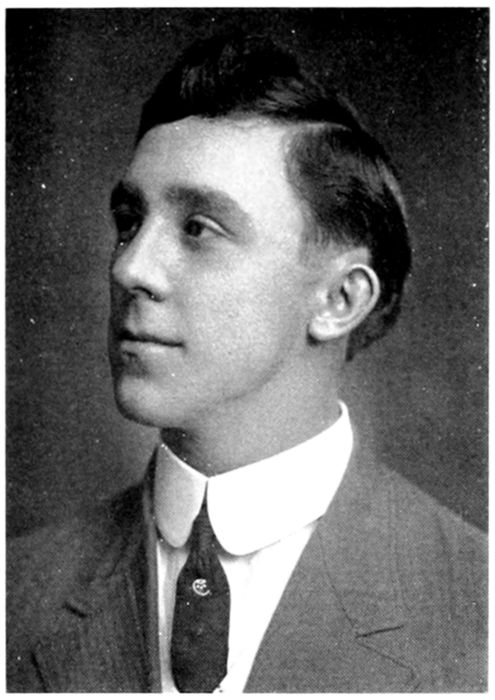
C. M. VOELKER,
County Clerk.
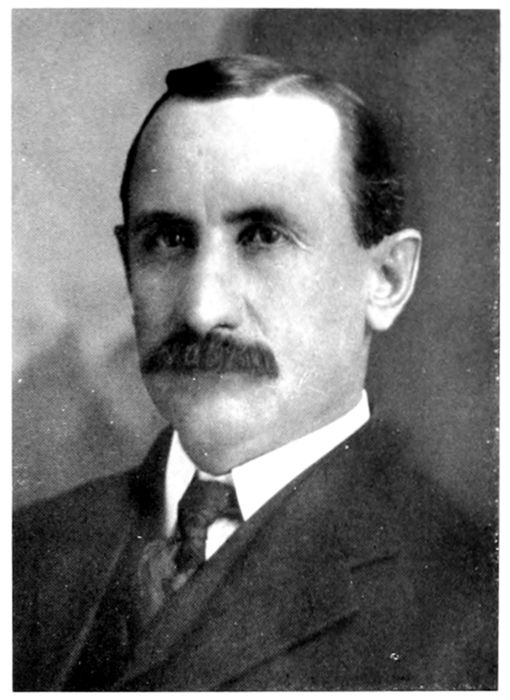
U. B. SHARPLESS,
County Treasurer.
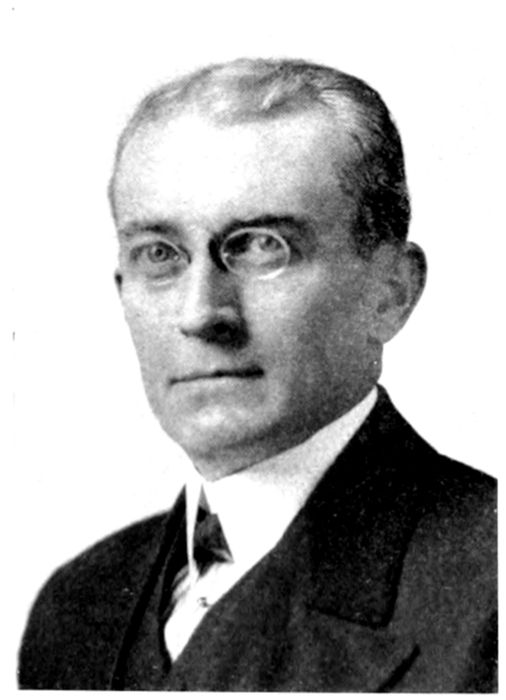
S. S. KING,
County Commissioner.
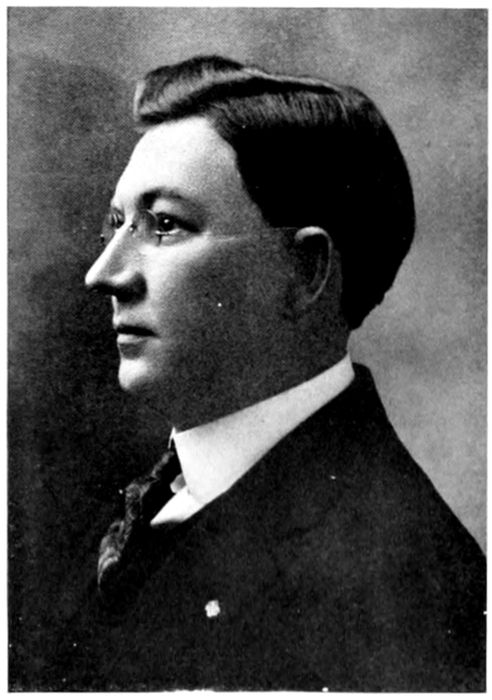
CHAS. T. GUNDY,
City Judge.
561He of whom this review is written was eight years of age when the
Sharpless family came to Atchison county. He was reared to young manhood
on his father’s farm and learned to cultivate the soil under the tutelage of his
father, who was a successful farmer. He was educated in the common schools
and early learned to apply his education to the best advantage for himself.
When twenty-one years of age he obtained his first position as manager of a
general store at Monrovia, Kan. This position entailed a number of duties
which kept him busily employed for a number of years. From 1891 to 1903
Mr. Sharpless managed the Monrovia store, served as postmaster, and performed
the duties of station agent for the railroad company. However, he
found time to take an interest in politics and became active in the affairs of
the Republican party when yet a young man. In 1903 he removed to Effingham,
Kan., and engaged in the hardware and implement and grain business
with considerable success. He still retains his interest in this business, although
now a resident of Atchison. Mr. Sharpless has also become a land
owner in the county and has farm lands near Effingham.
He was married in 1892 to Sadie A. Cook, born and reared in Atchison
county, and a daughter of Thomas F. and Margaret Cook, who were pioneer
settlers of this county, coming here from Missouri in 1860. To Mr. and Mrs.
Sharpless have been born five children: Gladys A., Margaret S., Edith Aubine
died at the age of seven years; Lois A., and Alice Marie. All of the
living children are attending the Atchison public schools.
The civic and political career of Mr. Sharpless has been an interesting
one and he has risen from the rank and file of the Republican party to become
one of the recognized leaders of his party in Atchison county and Kansas.
His first civic office was as police judge of Effingham. He also served a
term as mayor of that city. He was elected a member of the State legislature
from legislative district No. 3, in Atchison county in 1910 and
again elected to succeed himself in 1912. He was also a member of the Atchison
County High School board and served as treasurer of this organization.
In the fall election of 1914 he was elected to the office of county treasurer
by a large and handsome majority—evidence of his great personal popularity
among all classes of citizens. He assumed the duties of the treasurer’s office
in October of 1915, and is bestowing the same care and application in the
discharge of his public duties in this capacity as he has always taken in the
conduct of his personal business affairs.
562Mr. Sharpless is affiliated with the Ancient Free and Accepted Masons,
Blue Lodge, No. 48, and is a Knights Templar and Royal Arch Mason. He is
past noble grand of Spartan Lodge, No. 250, Independent Order of Odd Fellows,
of Effingham, Kan., and is a member of the Modern Woodmen of
America, of the latter city. He is also fraternally allied with the Benevolent
and Protective Order of Elks, the Fraternal Order of Eagles, and the Fraternal
Aid Union of Atchison.
It is certainly a distinction to be known as the youngest county clerk,
and in all probability the youngest county official ever elected in the State of
Kansas. Such is C. M. Voelker, the efficient and justly popular county clerk
of Atchison county. Political honors and preferment rarely come to a really
young man, unless he is especially qualified for the work, and has a host of
friends who are willing and able to support him and his candidacy. Although
young in years, Mr. Voelker is performing his duties in a manner which
would reflect distinct credit upon an older individual.
Conrad M. Voelker is a native of Atchison county, having been born
May 20, 1889, on a farm, four miles north of Atchison, in Shannon township.
His father is Conrad Walker, who was born in Germany November
20, 1856, a son of Karl and Christiana Voelker, who immigrated to America
in 1861, and settled on a farm, two miles north of the city, where he operated
a dairy and truck farm until his demise. To Karl and Christiana Voelker
were born the following children: Conrad; Mrs. Joseph Biddle, of Atchison;
Henry, residing in New Orleans; Karl Voelker was twice married, Mrs. S. L.
Loyd, of Shannon township, being a daughter of the second marriage.
Conrad, father of C. M. Voelker, was reared to manhood in Atchison county,
and when he became of age, settled on a 160 acre farm, four miles north of
Atchison, which is now one of the best improved farms in the State of Kansas.
For a number of years he specialized in the cultivation of cabbage,
making a success of the venture, and accumulated considerable money. He
became known far and wide as the “Cabbage King” of Kansas, always having
the first cabbage on the market, and shipped the product of his fields to
points in Kansas and Nebraska in carload lots. The Voelkers have a beautiful,
well appointed home, with excellent out buildings. Conrad Voelker married
Jennie Mueller, who was born in Cooper county, Missouri, November
56315, 1862, a daughter of German parents. To Conrad Voelker and wife were
born the following children: Fred C. W., a farmer, living north of Atchison;
Conrad M. The Voelkers are members of the Lutheran church.
Conrad M., with whom this narrative is directly concerned, was educated
primarily in the district schools, his education being supplemented with
one year’s study in the German school in Atchison, and a course in Midland
College, where he was graduated with the degree of Bachelor of Science in
1909. He then completed a course in commerce and bookkeeping in the Atchison
Business College. While a sophomore of Midland College he won first
honors in the oratorical contest, and represented his alma mater at the State
oratorical contest, held in Salina, Kan. While yet a student he received the
appointment of deputy county clerk under Edward Iverson, March 13, 1910.
He was elected to the office on the Republican ticket in November, 1912, and
again elected without any opposition in the fall of 1914.
A more intimate personal view of this rising young man was published
in the Atchison Champion just previous to assuming the duties of his office
after his election:
“Conrad M. Voelker, county clerk elect, when he takes office January 1,
1913, will have the distinction of being the youngest man ever elected to the
office of county clerk in Kansas. Mr. Voelker, while he appears to be much
older, is but twenty-three years old. He is popular; this was proven by the
fact that he was elected by a majority of 955 votes.
“Mr. Voelker is the son of Conrad Voelker. He was born four miles
north of Atchison. He never passes up an opportunity to learn something.
When four years old Mr. Voelker started to school. He was graduated from
the eighth grade at ten years of age, and in 1909 he was graduated from
Midland College. When he finished the common schools he studied in a
German school for one year; so he both reads and writes German. He completed
a double course at the Atchison Business College in five months, graduating
in March, 1910, and a few days later he was appointed deputy county
clerk. When Mr. Voelker was eighteen years of age he took part in the Kansas
intercollegiate oratorical contest, which was held at Salina. There were
nineteen other contestants, several of them being men twice the age of Voelker,
who were going through college for the second time. Voelker won
fourth place in the contest, which in addition to being quite an honor, demonstrated
that he has great ability as a public speaker.
“There is no doubt that he will be re-elected two years hence. He undoubtedly
will prove to be one of the most efficient county clerks in the history
of the county.”
564The last paragraph was prophetic, as Mr. Voelker’s second election to the
office in 1914 will testify. His re-election was the best evidence of his success
and strong personal popularity. Mr. Voelker is affiliated with several
fraternal societies, an active party worker, what is known as a good mixer,
and a rising young citizen of the county, whose future career will be well
worth watching, inasmuch as he is bound to gain greater honors in the
years to come, and to climb to a still higher place in the civic life of his home
county and State.
Samuel S. King, a member of the board of county commissioners of Atchison
county, was born in Moorestown, N. J., May 16, 1856. One year later,
in 1857, he came to Atchison with his parents, John and Violet King, on a
boat owned by Dr. Challiss. The King family arrived at Atchison in April
of 1857. John King soon afterward settled on a farm six miles southwest of
Atchison, where Samuel S. lived until he was fifteen years of age. He then
came to Atchison for the purpose of attending the city schools. During vacations
he worked for McPike & Allen (later McPike & Fox). After finishing
his public school education Mr. King was employed as bookkeeper for
some time by White, Washer & King, now the S. R. Washer Grain Company.
He was also employed as bookkeeper by McPike & Fox, W. F. Dolan and
others until 1881. In that year he was appointed by Senator John J. Ingalls
to a position in the United States railway mail service and was sent to New
Mexico and Arizona as railway mail agent. Here he remained in the United
States Government service for about two years and then resigned to enter the
employ of P. B. Brannen & Company as bookkeeper and manager at Flagstaff,
Ariz. This firm conducted a jobbing house at Flagstaff which was then the
largest town on the railroad between Albuquerque, N. M., and Los Angeles,
Cal. In June, 1886, he and his family returned to Atchison and Mr. King
became the confidential bookkeeper of McPike & Fox, wholesale druggists,
and remained with this concern until the fall of 1897, when he resigned to
take up his duties as county clerk.
Mr. King had always been more or less interested in politics and he was
elected to the office of county clerk on the Republican ticket in the fall of
1897. He was subsequently reëlected and held the office for nine years, or
until January, 1907. He then engaged in the real estate and insurance
business which he still follows with offices at 106 North Fifth street. Mr.
565King was elected mayor of the city of Atchison in April, 1907, and served as
the city executive for two years, and later was appointed city clerk to fill
out the unexpired term of C. A. Hawk, who resigned. In the fall of 1914
he was elected county commissioner, an office which he is at present filling
in a capable and efficient manner.
Mr. King was married April 14, 1885, at Flagstaff, Ariz., to Miss Sarah
Hawks, of Newton, Kan. Two children have been born of this marriage,
namely, Grace and Victor. Mr. King is affiliated with the Ancient Free and
Accepted Masons, the Benevolent and Protective Order of Elks, the Fraternal
Order of Eagles, of which lodge he is a trustee, the Modern Woodmen of
America, the Ancient Order of United Workmen, the Mystic Workers, and
the Central Protective Association. There are few citizens who are more
highly esteemed, and Atchison county has not a more popular public official
than S. S. King.
This history of Atchison county is issued not only for the purpose of
inscribing a record of those who have built up the county and were here during
the pioneer days and endured the hardships of the pioneer life, but for
recording as well the life stories of those who came later and have won places
of merit and distinction in the affairs of the city and county of Atchison. It
is probable that few men have attained such eminence as Judge Charles T.
Gundy of the city court of Atchison during his brief residence here. The
esteem in which he is held and the successful manner in which he has performed
the duties of his judicial position are decided evidences of his ability.
His standing among the members of the legal fraternity is high and he well
merits the confidence of his fellow citizens. The conduct of his court is
marked for the fairness of his decisions in suits of equity and the settlement
of such cases as come under his jurisdiction have been accomplished to the
satisfaction of the parties concerned.
Judge Charles T. Gundy is a native of Scotland county, Missouri, and
he was born and reared on his father’s farm, eight miles northwest of the
thriving and progressive city of Memphis. He evinces much of the characteristics
of the good people of Scotland county, who are noted for their hospitality
and kindliness. He was born February 10, 1878, and is a son of George
M. and Margaret M. (Needham) Gundy, natives of Illinois and Missouri,
respectively. George M. Gundy was born in 1845 and is a son of Jacob
Gundy, a native of Holland, who settled in Scotland County, Missouri, as early
566as 1846. George M. still resides on the old home place of the Gundy family.
This farm consists of 160 acres of well tilled land on which have been reared
six children out of a family of seven, as follows: Charles T., with whom this
review is directly concerned; Louis W. and Jacob R., farmers of Scotland
county, Missouri; Mrs. Corda Crawford, of Scotland county; Gladys, deceased;
Pearl and Merl at home with their parents. The mother of these
children is a native of Scotland county, and was born in 1858, a daughter of
David Needham, a veteran of the Civil war and a scion of an old Kentucky
family. He served three years as a soldier in the late rebellion, and after
returning home met an accidental death by a falling tree. The ancestral home
of the Needhams is near Frankfort, Ky. The Gundy family is held in high
esteem in their home county and the members of the family are well respected
by their friends and acquaintances.
Charles T. Gundy was educated in the rural schools and attended the
Memphis Academy for one year. Circumstances were such that he found it
necessary to do considerable studying at home and “burned the midnight oil”
in the pursuit of an education. He fitted himself for teaching and taught
for four years in the schools of his native county. In the meantime he read
law and was successful in being admitted to the bar in 1902. For three years
thereafter he practiced his profession in Memphis. He then secured a Government
position in the postoffice department at Washington, D. C., and
pursued his law studies in the National University at Washington. He graduated
from that institution May 30, 1908. Having small desire to become a
mere cog in a great machine, as seemed to be the lot of thousands of Government
employes, he resigned his position in October of the same year and located
in Keokuk, Iowa, and had charge of the farm loan department of the
State Central Savings Bank. He resigned this position in March of 1910 and
came to Atchison, opening an office in the Auld building on Commercial street.
Since this time he has built up an excellent practice. He was appointed city
judge in December of 1910 to fill a vacancy caused by the resignation of
Judge J. P. Adams. He was elected to the office in 1912 and again elected
in 1914.
Judge Gundy was united in marriage with Eleanor M. McCormick on
August 12, 1909. Mrs. Gundy was a resident of Washington, D. C., and is
a daughter of John McCormick, who died in 1905. Judge Gundy is a member
of the Baptist church and he and Mrs. Gundy have a wide circle of friends
who esteem them for their many likable qualities.
The Republican party has always claimed the allegiance of Judge Gundy
and he takes an active and influential interest in political affairs.
567
Louis R. Kuehnhoff, farmer and stockman, of Lancaster township,
Atchison county, Kansas, was born January 1, 1880, on the
farm where he now resides. He is a son of Charles and Caroline Kuehnhoff,
and is one of nine children, six of whom are living. The father was born
in Germany in 1841, and left there when a boy of sixteen years and sailed for
New York. He remained there a short time when he went west, arriving at
St. Joseph, Mo. He had not been there very long when the Civil war broke
out and he enlisted at St. Joseph in Company B of the Volunteer infantry.
After the war was over he was mustered out at Lexington, Mo., having won
a praiseworthy military record in his country’s service. He then returned to
civil life in St. Joseph, Mo., where he worked for a time as a laborer, receiving
eight dollars a month. Shortly afterward he came to Atchison county,
Kansas, and bought eighty acres of land in section 10, Lancaster township.
Using oxen, he broke the ground on his newly acquired farm and began to
improve it as rapidly as his resources would permit. In 1894 he retired and
went to live at the National Soldiers’ Home at Leavenworth, Kan., where he
died in 1903. The mother was born in Germany in 1845, and died in 1899.
Louis R. Kuehnhoff grew up on his father’s farm, and attended Eden
district school, and also District No. 3, Lancaster township. He remained at
home until he was nineteen years of age, and the next five years worked as
a farm hand, and then he bought the old home place of 200 acres. Louis
Kuehnhoff is an industrious worker. He keeps graded stock of all kinds and
takes a special interest in fine mules. He always attends the county fairs in
Atchison county and occasionally makes entries. On April 26, 1905, he was
married to Lena Werner, who was born in Germany November 2, 1881. Her
parents were John and Marie (Earhart) Werner. The father was born in
Germany in 1815. He belonged to the Masonic lodge in Germany. In 1889,
when he was quite an old man, he came to America and settled at Leavenworth,
where he died in 1891. The mother was born in Germany January
17, 1843, and is now living with her children, of whom there are six, as
follows: Adam, teamster, Leavenworth, Kan.; Martha Nolan, deceased; Lizzie
Loman, Bowling, Kan.; Katherine Weimer, Wallula, Wyandotte county,
Kansas; Lena, wife of Mr. Kuehnhoff, of this review. Mrs. Kuehnhoff
attended the Pleasant Ridge school and the German school, north of Potter,
Kan. She is a good, loyal, hard-working mother, and has three children:
Marie, Edna and Edwin. The last two are twins and are three years old.
In politics Mr. Kuehnhoff is independent. He is a member of the Independent
568Order of Odd Fellows. He is a progressive farmer and is constantly on the
lookout for improvements in agricultural methods. He has a fine eight-room
house and a large barn equipped with modern conveniences. He also has a
stone milk-house which was built by his father years ago. He has a small but
thriving orchard and has twelve head of fine cattle. Besides these, he has
four horses and a span of excellent mules. Mr. Kuehnhoff takes a lively
interest in his stock and in his farm generally.
All honor to the pioneer settlers of Kansas. It was they who broke the
way in the unpeopled wilderness and endured the hardships and privations
on the frontier of advancing civilization in order that the path of empire
might be pushed steadily westward, ever onward toward the setting sun.
Their work is done; the halcyon pioneer days when this broad land was but
a vast unbroken wilderness of waving prairie grass, dotted here and there
with belts of timber along the streams, is no more; towns and cities have
sprung up; the locomotive shrieks its way over the ribbon-like rails, hauling
the products of the land to the millions in need of sustenance, where once
the hardy freighters drove their mule teams and guarded the precious freight
overland to the homes of the settlers in the West. Benjamin Franklin Sanders
is one of the few remaining members of the “old guard,” who sixty
years ago began the task of reclaiming a wilderness. He is one of the ranking
old pioneer settlers of Atchison county and has lived a record which is thrilling
and interesting to a high degree. He is the only living “ye old time
fiddler” in Atchison county, who with his comrade was wont to play at the
old-time dances and “hoe downs” in northeast Kansas fifty years and more
ago.
Benjamin Franklin Sanders is now living retired in Center township,
Atchison county. He was born August 8, 1833, in Franklin county, Missouri,
and is a son of George and Elizabeth (Graham) Sanders, who were
the parents of the following children: Nancy married William McQuillan,
and by her second marriage became Mrs. William Burns, and died in Benton
county, Missouri; Robert, deceased; Oliver died in Jewell county, Kansas;
Lydia married Fred Wilming, and died in Shannon township, Atchison
county; William died in Franklin county, Missouri; and Benjamin, the subject
of this sketch. Benjamin F. Sanders was sent to the country school in
Franklin county, Missouri, but the school was poor and the roads were bad
in the winter time, and, altogether, he had little opportunity to learn. His
whole time in school, he estimates, did not amount to more than three months.
His father was a Kentuckian and followed farming all of his life, and died in
1856, at the age of fifty-five years. The mother was a native of Missouri and
of Scotch descent. She died in Kansas, in 1872, at the age of seventy-six
years.
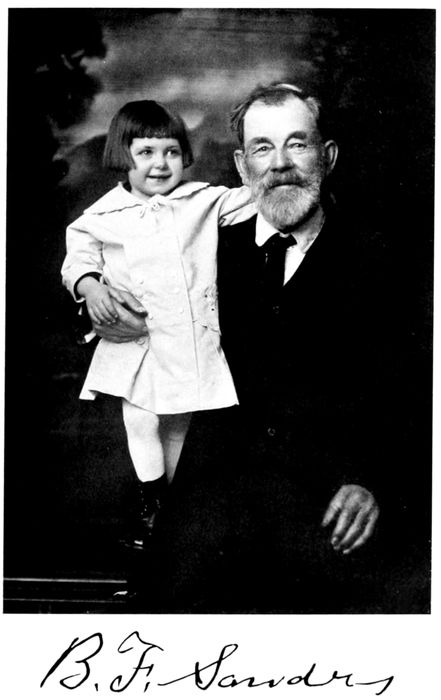
B. F. Sanders
B. F. Sanders and His Great-Granddaughter, Gail Maxine Keirns, Daughter of Mr. and Mrs. Art Keirns.
569At the age of twelve Benjamin F. Sanders was apprenticed to a carriage
and wagon-maker in St. Louis, Mo. He remained there twelve years, coming
to Kansas in 1856. He returned to Missouri for a short time and
then came back to Kansas the following year. He opened a wagon-maker’s
shop at Monrovia, Atchison county, which he operated for two years. He
then engaged in farming, taking up a claim near where Effingham now stands.
This was ten miles from any settlement then and Mr. Sanders, fearing that
the district would not be settled, gave up his claim and preëmpted eighty acres
one and one-half miles north of where he now lives, in Center township, and
began his life as a real farmer. He hired a man from Iowa who had six
yoke of oxen to break up his land. He lived in the most primitive way during
the first years on this place. Coffee, for one thing, was very high in
price at that time, and there also was very little money in the territory, so a
substitute for coffee was used. They mixed wheat and rye, calling it essence
of coffee, and used this as a beverage in place of the regular coffee. It was
the same way with flour. When he needed flour he would take a quantity of
wheat to the gristmill where it would be ground into coarse flour, nearest mills
being at Valley Falls and Kickapoo. His nearest postoffice was at Oceana,
just north of Pardee, where the postoffice was located later. In 1860 Mr.
Sanders bought more land. At one time he owned as high as 400 acres of
land in Center township, Atchison county, Kansas. He went through the
whole evolution of civilization, beginning in a little log house on his first
eighty acres of land and passed through the wild days of the border war.
In 1863 he was a member of Captain Whittaker’s company of Colonel McQuigg’s
regiment of the Kansas State militia. He participated in several
skirmishes and was honorably discharged at Ft. Leavenworth in 1864.
In 1859 Mr. Sanders married Margaret Ramsey in Putnam county, Ohio,
who was born in 1840. She was a daughter of John and Elizabeth (Dorothy)
Ramsey, natives of Ohio. She died in 1868, leaving the following children:
Ira, farmer, Whiting, Kan.; Bertha (Mrs. C. G. Moore), deceased; William
and Little Joy, both deceased. Mr. Sanders was married a second time in
1870 to Mrs. Elizabeth (Ramsey) Keirns, a sister of his first wife. She died
570in May, 1904. She was the widow of Rufus Keirns, and by her last marriage
three children were born: Henry R., farmer, Pardee, Kan.; Mrs. Etta
C. Browne, Pardee, Kan.; Benjamin, Jr., died when seventeen years of age.
Mr. Sanders is a Republican and a member of the Methodist Episcopal
church. He is now living with Arthur Keirns, a son of his step-son. In
these days his life is rather quiet compared with the early-day existence
which he passed through. Indians camped near his farm when he first came
to Kansas. The trail to the Kickapoo reservation passed near his farm and
the Indians were constantly traveling back and forth along it. He has a
hobby of “fiddling.” He calls himself a “fiddler” in distinction from a
violinist. He played at the first corn carnival held in Atchison and won a
prize. He used to play with Samuel King, a well known “fiddler,” and they
played for all the old “hoe down” or “break down” dances. Although he
is eighty-three years old, he still plays his “fiddle” with as much vim as ever
and his ear is just as ready as it was when he was a young man. In addition
to being a farmer, Mr. Sanders has done a large amount of carpenter work
in Kansas. He has built a number of barns and other buildings. Mr. Sanders
was elected to the office of township trustee and held the office two
terms, having been reëlected at the close of his first term.
Karl August Kammer, farmer and stockman, Lancaster township, Atchison
county, Kansas, was born on the farm where he now lives, October 12,
1869, and is a son of Karl and Joehanna (Hida) Kammer. He is one of
six children: Joehanna (Gutzman), deceased; Emma (Fuhrman), Lancaster
township; Karl, subject of this sketch; Julius, Lancaster township; Bertha H.
(Buttron), Lancaster township; one child who died in infancy. The father
was born in Germany in 1840. Leaving there in 1862, he came to Atchison
county, Kansas, where he worked in a vineyard for two years. The following
four years he was employed in a brewery at Atchison, and then farmed
two years in Lancaster township. At that time he had a chance to buy 160
acres in section 16 of Lancaster township, and with the aid of a partner, the
land was bought. He built a one-room shanty and a thatched barn, and broke
prairie with the oxen and planted the first crop. Later a better house and
barn were built, and gradually, other improvements were added and a fine
orchard planted. At the time of his death, in October, 1910, Mr. Kammer
571owned 240 acres of land. The mother was born in Germany, February 20,
1840, and married in her native land just before coming to America. She
died in 1904.
Karl Kammer, the subject of this sketch, was reared on his father’s farm
in Lancaster township. He attended High Prairie district school, No. 3, and
remained on the home farm until he was twenty-six years old, when he rented
some land from his father, and six years later he was able to buy the land
he had been renting. He improved the farm considerably and stocked it with
graded cattle, and now has an excellent farm, modern in every respect, consisting
of 160 acres of land, and also has a fine orchard of two acres.
Mr. Kammer was married October 23, 1895, to Emma Buttron, a native
of Lancaster township, Atchison county, born August 14, 1870. She is a
daughter of Henry and Rosa (Scheu) Buttron, the father a native of Germany,
born in 1833. When a young man he left his native land and came to
America, locating in Pennsylvania where he worked as a blacksmith. From
there he went to Elgin, Ill., and continued at his trade, and in 1857, he moved
to Atchison, Kan., following blacksmithing for a short time. He then preëmpted
160 acres of land in Lancaster township, where he built a house. The
first crop was destroyed by grasshoppers, and he was forced to return to
his trade during the following winter. When spring came, he went back to
his farm and that year was successful and his start was assured. Mr. Buttron
bought more land and continued to make improvements, and after a long
and prosperous career he died in 1914. Mr. and Mrs. Kammer are the parents
of three children: Katherine, Rosa and Henrietta, all living at home with
their parents. Mr. Kammer is a Republican, and is a member of the Independent
Order of Odd Fellows. Mr. and Mrs. Kammer and family are members
of the Evangelical Lutheran church of High Prairie neighborhood.
The demise of Marshall J. Cloyes May 5, 1915, marked the passing of
one of the sturdy figures who assisted in developing Atchison county, and
was one of the grand old men of the city. At the time of his death he was
probably the oldest living pioneer settler of Atchison county, in point of age
and years of residence in the county. For over half a century he had been one
of the well known and distinguished characters whom people trusted and respected.
In the days when strong men were required to redeem a wilderness
572and make it habitable for men and their progeny, Marshall Cloyes was one of
those who never gave up the fight. During the terrible drought of 1860, when
scores of families deserted their homes and left the State, he and his family
were among those who decided to remain and win out over the vagaries of
nature. His faith in the future of Kansas was amply justified as the years
rolled on and ever increasing prosperity came to him and his, as a just and
equitable reward for a faith and confidence bestowed upon the new country
during a time which tried men’s souls and caused weaker mortals to give
up the fight.
He was born at Salisbury, Vt., October 24, 1826, and descended from
sturdy New England ancestry. His parents were Elijah and Mary (Beach)
Cloyes. On his father’s side his ancestry can be traced back in the centuries
to two brothers who settled in New England in the seventeenth century. His
grandfather was William Cloyes, who fought for his country in the War of
1812. The boyhood days of Marshall were spent in the town of Salisbury,
where he attended the public schools and later pursued his education in a private
school. He learned the trade of shoemaker but did not follow it to
any great extent. In 1847 he engaged in the lumber business at Ripton, Vt.,
and was there for twelve years prior to coming to Kansas. From the town in
which he was born he came to Kansas, arriving here in Atchison June 2, 1859.
The following autumn his wife and sons followed him and during the ensuing
winter the family lived in a two room hut, on the rear of the lots where
Mrs. Jacob Leu’s residence now stands. On February 21, 1860, they loaded
all their goods in a wagon, and with an ox team moved to a farm north of
Lancaster. During the night an old-time Kansas blizzard gave them a cold
reception in their new home. When Mr. Cloyes had agreed to pay $650 for
his first quarter section of land he was still shy $2.50 of the necessary amount,
and was forced to borrow this small sum from a kind neighbor. During the
following summer he worked in Oliver Davis’ sawmill and got enough lumber
to build a shanty on his farm. While this was building the family lived in
two rooms in the home of John S. Rust. In the fall of the bad year of 1860,
Mr. Cloyes decided to try to cash in on the reputation he had left behind him
in Vermont, and applied to an uncle for a loan of $400. The uncle readily
responded with the statement in his letter, “If you are ever able, I know you
will pay it back; if you are never able to pay it back I can get along without
it.” During the summer Mr. Cloyes put in his spare time cutting prairie hay
and stacking it. When fall and winter came on, the returning freighters from
Pike’s Peak were willing to sell their oxen and wagons for almost any price.
Mr. Cloyes invested a part of his $400 capital in these outfits, wintered the
573cattle on the hay, and in the spring was able to dispose of the oxen for more
than double the purchase prices. During the next two years he was enabled
to pay off all of his debts, and prosperity attended his efforts from that time
on. By the hard work and good management of himself and his two sons
he increased his holdings to an entire section of land. He remained on the
farm until 1872, then gave the farm to his sons and removed to a home at
417 North Seventh street in Atchison.
On July 5, 1848, Mr. Cloyes was married to Miss Betsy Henderson, of
Middlebury, Vt., who died in Atchison in 1893, leaving two sons, Frank E.
and Mark S. On September 15, 1909, he took a second wife, the bride being
this time Mrs. Matilda Franke, of Atchison. She was born at Thuringen,
Germany, November 16, 1855, a daughter of John and Christiana (Temme)
Franke, who immigrated to America in 1858, making the long sea voyage in
a sailing vessel which took six long weeks to make a trip, which is now
made in six days. From New York City the Frankes came directly to St.
Louis, and there made their home until their removal to Atchison. At the
outbreak of the Civil war, John Franke volunteered his services in defense of
the Union which had given him a home. He served in a Missouri regiment of
volunteers for one year, and was then discharged on account of serious disability,
caused by the hardships which he had undergone. He was never
the same man afterwards, and died in 1865 as a direct result of his disabilities
incurred in behalf of his adopted country. The mother and family lived in
St. Louis until 1883 when they removed to Atchison. Mrs. Franke died some
years later at the home of her daughter, Mrs. Cloyes. Matilda Franke was
first married to Theo A. Franke, a native of Saxony, Germany, in 1879, and
who came to America when a youth of eighteen years of age, and settled in
Pittsburgh, Penn. Theo A. Franke was also a veteran of the Civil war, having
enlisted in 1861 in Company D, Seventy-fourth regiment, Pennsylvania
infantry. He served throughout the great conflict and was wounded several
times while participating in the battles fought by the Army of the Potomac.
He enlisted again, after being discharged on account of a serious wound, and
was a brave and valiant soldier who fought for sheer love of his adopted
country. Mr. Franke’s first trip to Atchison was made in 1859, but he returned
to Pittsburg upon the outbreak of the Civil war and there proffered
his services as stated above. He returned to Atchison after the close of the
war and here met, in the course of years, Matilda, who was visiting friends in
Atchison. Their acquaintance ripened into a warm friendship which gave
place to love and they were married March 10, 1879. A happy wedded life
endured until Mr. Franke’s death in 1882. Children blessed this union as
574follows: Rose M., wife of Bert Gilmore, an electrician of Atchison; Elsa,
wife of Fred Moore, a railway engineer of Falls City, Neb.; Theo Franke, of
Pierce, Ariz. During Mr. Franke’s first year of residence in Atchison he
was a freighter across the plains. Upon his return in 1865 he entered the
grocery business and prospered, accumulating considerable property interests.
He was well known in Atchison and was considered to be one of the city’s
most substantial men.
Mr. Cloyes was prominently identified with the political affairs of the
county and was an influential leader of the Republican party for many years.
Even before coming to Atchison from the farm he had taken an active interest
in politics in his home township and county. He was elected to represent
his district in the State legislature in 1867, leaving the impress of his
individuality upon laws passed in the following session. For eight years he
served in the Atchison city council and in 1891 was elected mayor. Two
years later he was reëlected. Honorable and thoroughly upright in all his
dealings, his administrations were characterized by integrity, sound judgment
and an unusual amount of good sense. He was a member of Washington
Lodge, No. 5, Ancient Free and Accepted Masons, and all who knew
him respected him for his sterling worth.
Mark D. Snyder, retired farmer, living in Monrovia, Atchison county,
Kansas, is a native son of Kansas, having been born in Atchison county
November 2, 1858. He is a son of Hon. Solomon J. H. Snyder, one of the
influential figures of the early pioneer days of Kansas, and who was a
stanch and uncompromising adherent of the Free State principles. The father
of Mark D. was born in Washington county, Maryland, February 7, 1812,
and died at Monrovia, Atchison county, November 28, 1873. When eight
years of age he accompanied his father to Tuscarawas county, Ohio, where
he was educated in the district schools and a graded school at Canton, Ohio.
Between 1830 and 1833 he cleared a farm of 160 acres of heavily timbered
land. In 1838 he married Susan Winklepleck and then cleared and cultivated
a tract of timber land which he purchased until 1848. His wife died in that
year, leaving him with three small children. He sold all of his holdings,
placed his children with neighborhood families and then traveled 4,000
miles in an endeavor to forget his great loss and overcome his grief over
575the death of his wife. Later, he married Eliza Fisher, and in 1852 removed
to Indiana, and then came west to Ft. Leavenworth in 1854. On the morning
of May 4, 1854, he made the first legal homestead claim ever entered
in the State of Kansas, comprising the land upon which the southern part of
the city of Leavenworth now stands, and then returned to Indiana for his
family. On his return to his homestead he found his claim “jumped” and the
country in the hands of border ruffians. He was driven from the polls at
the first election held in the Territory on account of his Free Soil principles.
Two other claims which he bought were wrested from him by a pro-slavery
“squatter court,” his life threatened, and he sought refuge in an unsettled part
of the State where Monrovia now stands. Here he made his home and became
prominently identified with the politics of the new State of Kansas.
In 1862 Mr. Snyder was elected to the State legislature and served for two
terms in the house of representatives, and one in the senate, where he did
faithful and conscientious work in behalf of the people of Kansas.
Solomon J. H. Snyder was a devoted Christian, and was one of the organizers
of the first Lutheran church organization in the State, at Monrovia,
of which he remained a member until his demise. He was a great Sunday
school worker and wrote two very interesting and valuable Sunday school
books, “The Lost Children” and “Scenes in the Far West,” and at the time of
his death was engaged in the preparation of a work entitled, “The Evidences
of Christianity.” His influence was ever in behalf of the betterment of mankind
and his Christianity was of the practical kind which introduces helpfulness,
kindness and forbearance into our daily lives. The children of S. J. H.
and Eliza (Fisher) Snyder were as follows: Angeline (Conley), deceased;
Mrs. Sarah Dunn, of Anadarko, Okla.; Mrs. Cora Shifflet, deceased; and
Mark D. The three children by his first wife were: Mrs. Susan Reck, deceased;
Mrs. Anna Berndt, of Mexico City; and J. H., San Diego, Cal. The
mother of these children was born in Ohio in 1838, and died at her home near
Monrovia, in 1896.
Mark D. Snyder, with whom this review is directly concerned, was born,
reared, and reared his own family in Atchison county. He is one of the real
native born citizens of the county. Upon the death of his father he took
charge of the old home place, and when his mother died he purchased the
family estate. By the exercise of industry and economy, aided by good
financial judgment, he has become the owner of 240 acres of excellent land
which is well improved and one of the most productive tracts of land in northeast
Kansas. He cultivated his broad acres assiduously until 1909, when he
576turned over the management of his farm to his son, and retired to Monrovia,
where he now resides.
Mr. Snyder was married November 30, 1881, to Helen M. Maxfield, and
this union has been blessed with eight children, namely: Elsie and Minnie,
deceased; John, who is farming the home place; Mark, living in Omaha, Neb.;
Mildred, deceased; Margaret and Marguerette, twins, deceased; James, a boy
twelve years old, living with John on the home farm. The mother of these
children was born in Henry county, Illinois, a daughter of David and Anna
(Freeze) Maxfield, who first emigrated from Illinois to Sedgwick county,
Kansas, and in 1873 came to Atchison county. Mrs. Snyder died in 1909.
Mr. Snyder has always been a loyal supporter of the Republican party, is an
attendant of the Lutheran church, and is a member of the Ancient Order of
United Workmen, of Effingham, Kan.
Edward Perdue, president of the First National Bank of Atchison, and
extensive farmer, of Huron, Kan., has been a resident of Atchison county
for the past forty-five years. Like other successful men who were pioneers
in Kansas, he arrived here from Canada when a young man of twenty years
of age without money, but possessed of strength, a willingness to work at
honest labor and an ambition to succeed. How well he has succeeded is seen
in the substantial fortune which he has accumulated and the honors which
have been conferred upon him by his fellow citizens.
Mr. Perdue was born on a farm in Peterboro county, Ontario, Canada,
June 27, 1850, a son of Thomas and Catharine Perdue, natives of Ireland,
who left the Emerald Isle in their youth and settled in Canada. Edward
Perdue was reared to sturdy young manhood on the parental farm and attended
the country school in the vicinity of his home as opportunity afforded.
In March of 1870 he arrived in Atchison, and during his first year worked
at any odd jobs which were presented, including labor on the streets and harvesting
on the nearby farms. During the following five years he was employed
as a construction foreman on the grading and building of the Santa
Fe railroad from Atchison to the Colorado-Kansas State line. He saved his
money and by the exercise of strict economy, which meant the denial to himself
of all but the actual necessities of life, he was enabled to accumulate sufficient
funds to invest in a farm near the town of Huron, on which he resided
for the next five years. He then sold this farm and bought another one about
one and one-half miles east from Huron, which remains his home to the
present time. Mr. Perdue has given his attention mostly to the raising and
feeding of live stock in his farming operations and has succeeded in amassing
a comfortable fortune during the forty years he has been an agriculturist. He
has increased his land holdings until at the present time he is the owner of
1,040 acres of splendid farm lands in Lancaster township. His home farm
is one of the best improved tracts of farm land in the county and all of his
farms show the results obtained from soil conservation and advanced methods
of farming.
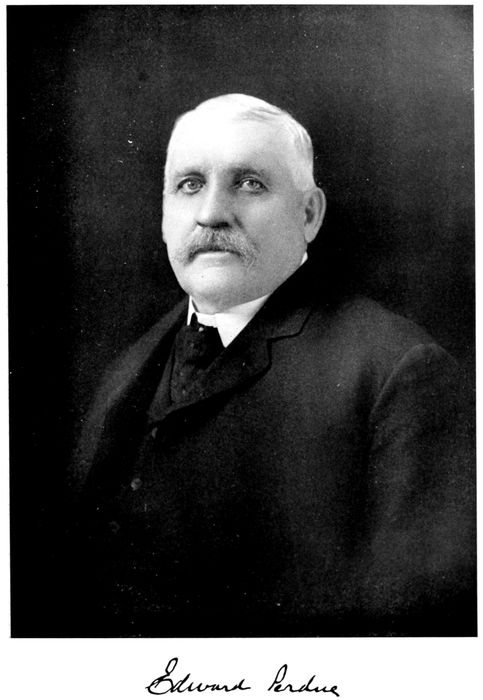
577While Mr. Perdue has been primarily a farmer, he has given his attention
to other matters as betokens a man of influence and substance. In the
year 1891 he assisted in the organization of the Huron State Bank and is
president of this thriving concern. In 1906 he took part in the organization
of the Commercial State Bank of Atchison, which was succeeded later by the
First National Bank, of which banking institution he has served as president
since 1900. He is also a stockholder of the State Savings Bank of Leavenworth,
Kansas.
Mr. Perdue was married in 1878 to Mary Viola Davey, of Brown county,
Kansas, a daughter of Charles Davey, which marriage has resulted in the
birth of seven children, as follows: Mrs. Maria Walters, living on a farm
near Huron; Edna, wife of J. M. Delaney, merchant, of Huron, Kan.; Mrs.
Mabel Schmidt, wife of the assistant cashier of the Huron State Bank; Charles,
who is cultivating the home farm; Thomas Hendricks, at home; George, a
farmer in North Dakota; and Edward, Jr.
Mr. Perdue has been a life-long Democrat, who has always taken a
more or less active part in the political affairs of the county. He was elected
county commissioner in 1897 and served one term. In 1904 he served one
term as a member of the State legislature, representing this district, declining
reëlection when his term of office expired. While he was reared in the
Catholic belief, Mr. Perdue is tolerant of all creeds and takes a broad-minded
view of religious matters. He belongs to the Ancient Order of United Workmen
and the Modern Woodmen.
Dr. Charles L. Hixon, a leading dental practitioner of Atchison is a
native son of Kansas and comes of a pioneer family of the State. He was
born on a farm in Jackson county, Kansas, January 14, 1872, and is a
578son of John S. and Alice (Clark) Hixon. His father, John S. Hixon, was
born in Ohio in 1850, a son of Jacob and Cassandra (Stonebraker) Hixon,
who resided in Ashland county, Ohio, until their removal to Putnam county,
Indiana, in the early pioneer days when that part of the Hoosier State was
being settled by large numbers of Ohio people. Alice Clark Hixon, mother of
Dr. Hixon, was likewise born in 1850 in Putnam county, Indiana, a daughter
of Andrew Jackson and Harriet (Mann) Clark, natives of New York
State, and also pioneer settlers of Putnam county, Indiana. While John S.
Hixon and Alice Clark were attending the district school in the neighborhood
of their respective homes, they became great friends, and the warm friendship
ripening into love which culminated in their marriage several years later in
Jackson county, Kansas.
The Hixons and Clarks were essentially pioneers, and the history of the
family for generations shows that some member of the family, or several of
them, have been continually pushing westward and settling in the newer
countries. Jacob Hixon was one of the first men in his neighborhood to
hearken to the call of the West, and, after disposing of his land holdings in
Putnam county, Indiana, he with all of his family migrated to Kansas, settling
in Jackson county. They arrived in Atchison during the stormy days
of the Civil war, and at a time when the local vigilance committee was in
control of community affairs and were naturally very suspicious of all
strangers. There had been considerable lawlessness in Atchison and neighboring
towns and many outrages had been perpetrated by border ruffians and
outlaws. The vigilance committee had taken charge of the affairs and had
summarily lynched three men on the banks of White Clay creek just previous
to the arrival of the Hixon family. Mr. Hixon was interrogated as to his
loyalty to the Union and asked his intentions. His replies being satisfactory
to the members of the committee, he was allowed to proceed on his way to
Jackson county and arrived at Holton, Kansas, without further delay. Jacob
Hixon settled on a fine farm near Holton, developed it and prospered as the
years rolled on and the country became more and more settled. He died in
1905, at the advanced age of eighty-four years, his wife, Cassandra, departing
this life in 1885.
The Clark family came to Kansas from Indiana in 1868, and Andrew
Jackson Clark naturally settled in that part of Jackson county where his old
friend and neighbor had chosen his place of residence. The intimacy which
had existed between the two families in Putnam county, Indiana, was renewed,
and as time went on, John S. Hixon and Alice Clark grew to maturity
and were united in marriage. Their married life has been a happy
579and prosperous one, and five children have blessed this union: Dr. Charles
L. Hixon, with whom this review is directly concerned; Mrs. J. C. Neeley,
of Weiser, Idaho; Ernest H. Hixon, of Kansas City, Mo.; one child died in
infancy. John S. Hixon became prominently identified with the civic life of
Jackson county and is serving his county well and faithfully as treasurer
for two terms, having been elected on the Republican ticket in 1912 and again
in 1914. Mr. and Mrs. John S. Hixon reside in Holton, in Jackson county,
and are prosperous and well respected in the neighborhood.
Dr. C. L. Hixon spent his boyhood days on the farm and early learned
to assist in the farm work. He received his elementary education in the district
schools, and was ambitious to secure a higher education. He has practically
educated himself, and after learning all that was possible for him to
learn in the country school, he attended Campbell College, at Holton, Kan.,
for two years. His ambition was to become a dentist, and with this end in
view he matriculated in the University of Iowa in 1895. After spending two
profitable years in this institution in the study of dentistry he returned home,
and a short time later opened an office in Atchison, where he has practiced
continuously for the past eighteen years. After seven years of practice in
his first location, he opened well equipped offices at 519 Commercial street,
and remained there until his removal to his present location at 613 Commercial
street, where he has offices equipped with all the latest appliances for
facilitating his work. Dr. Hixon is kept very busy attending to the calls
made upon him in the practice of his profession, and during the many years
he has been located in Atchison, he has built up an extensive and lucrative
practice. He finds time, however, to keep abreast of the latest developments
made in his profession, and is ever seeking to better his skill and knowledge
of dentistry. He has been distinctly honored by the members of his profession,
having served as president of the Northeast Kansas Dental Association,
and is at present an active member of this association. He is a leading member
of the Atchison Dental Association, and ranks high in his profession,
not only as a successful practitioner, but as a citizen who has the best interests
of his home city at heart. He is a member of the Ancient Free and Accepted
Masons, Washington Lodge, No. 5, and is fraternally affiliated with
the Odd Fellows, the Modern Woodmen of America, the Rebekah and Eastern
Star lodges.
Dr. Hixon was united in marriage with Miss Inez B. Horn in 1902, and
one child has been born to this union, Charles Horn Hixon, born May 25,
1907. Mrs. Inez B. Hixon was born in Atchison county, a daughter of J. H.
580and Catharine (Wallick) Horn, who reside at 1126 North Third street, Atchison.
Mrs. Horn is a daughter of Benjamin Wallick, who served as sheriff
of the county during the time of the Civil war.
Louis Kloepper, farmer and stockman of Lancaster township, Atchison
county, was born January 18, 1888, on the farm where he now lives. He is a
son of William and Fredericka (Von Derahe) Kloepper, who were the parents
of four children as follows: Louis, subject of this sketch; Emma, deceased;
William, deceased; Pauline, living at home. The father was born
in Germany, December 14, 1853. He left there in 1883 and came directly
to Atchison county, Kansas, where he bought eighty acres of land in section
27, Lancaster township. He farmed this one year, and in 1885 returned to
Germany to be married. In 1886 he returned to his farm and began to
improve it, building a large eight-room house in 1899 in place of the little
three-room affair which stood on the place. In 1903 he built a fine 32×40
feet granary, and in 1904 he erected a large barn, 40×48 feet. The following
year he bought more land and put up additional buildings, building in
1908 another barn, 32×40 feet. At the time of his death, February 7, 1913,
he owned 240 acres of well improved land under cultivation, and thirteen
acres of fine timber land. This achievement is the more remarkable in view
of the fact that he landed with only $1,200. But he was industrious, and
worked faithfully to improve his farm. He was a member, trustee and
steward of the German Lutheran church. His wife was born in Germany,
February 15, 1858, and is a daughter of Henry and Fredericka (Von Behren)
Von Derahe, natives of Germany. The mother is now living with her son,
Louis.
Louis Kloepper attended the old Huron school of Lancaster township,
and grew to manhood on the farm which he now operates. Since the death
of his father he has had charge of the farm and has worked to the extent of
his ability in installing modern improvements on his place. He owns 160
acres in section 27, Lancaster township, in addition to the home place, and
has three acres of orchard and grove. He also has a vineyard which was
the feature of the place which Louis, and his father before him, always loved
most. Special attention has been given to the vineyard when other things
had to be neglected, perhaps. It is the pride of Mr. Kloepper’s place. He
581keeps graded stock and is a practical farmer. He now is operating 400 acres
of land, 114 acres of which are in corn, and ninety-three acres are in cloves,
the latter having been unusually successful. He owns a threshing outfit and
two clover hullers, a corn shredder, and three gas engines. He utilizes these
engines in numerous ways, including pumping and threshing and plowing.
Mr. Kloepper has a modern farm in every way and has all up-to-date improvements
of a labor and time saving kind, as well as an automobile. He is a
stockholder in the Farmers’ Mercantile Association of Effingham, Kan. He
is a practical farmer, of the progressive type.
In 1911 he married Marie Meier, a native of Germany, born July 3, 1888.
She is a daughter of Henry and Fredericka (Finke) Meier, and was educated
in Germany and left her native land at the age of seventeen. Mr. and Mrs.
Kloepper have two children, Fredia, born November 13, 1911, and Emma,
born April 21, 1913. Mr. Kloepper is an independent voter. He belongs to
the German Lutheran church.
Charles W. Ferguson, vice-president of the Atchison Savings Bank, is
one of the best known men in financial circles of northeastern Kansas, and
he is equally as well known over a large section of western Missouri. Mr.
Ferguson was born at Plattsburg, Mo., December 29, 1862, and is a son of
William L. and Fannie A. (Carpenter) Ferguson, both natives of Kentucky,
whose parents were Virginians and very early settlers of the Blue Grass State.
The Ferguson family removed from Kentucky to Missouri about 1851. They
came up the Missouri river by boat as far as Liberty Landing, and later located
in Clinton county, Missouri. The father was a merchant and also engaged
in the grain business, and was an all around progressive business man. He
was a Republican, and in 1862 was elected sheriff of Clinton county, being
the first Republican elected to office in that county within a period of twenty-five
years. During the Civil war he was captain of the Home Guards. He
died in 1893, age 64 years. Charles W. Ferguson is one of a family of six
children, as follows: John L., assistant general passenger agent of the Chicago
& Northwestern railroad, Chicago, Ill.; Mary F., widow of M. B. Riley, and
resides in St. Joseph, Mo.; Adelia M., Plattsburg, Mo.; Katherine, Plattsburg,
Mo.; Charles W., the subject of this sketch, and Louis, a conductor on the
Chicago & Northwestern railroad, resides at Highland Park, Ill. Charles
582W. Ferguson attended the public schools in Plattsburg until he was thirteen
years old, and at that early age went to work in the express office at Plattsburg,
where he remained about five years. He then entered the employ of
Stonum Brothers, remaining with that company two years. He then accepted
a position in the Plattsburg Bank, as bookkeeper and assistant cashier, remaining
with that institution for seven years. He then went with the Schuster-Hax
National Bank, St. Joseph, Mo., as receiving teller, and served in that
capacity for four years. He resigned that position in June, 1894, to become
bookkeeper of the Exchange National Bank of Atchison. He served with
that institution in the capacity of paying teller, assistant cashier and cashier,
resigning the latter position February 1, 1914. In November, 1914, he accepted
a position with the Federal Reserve Bank, of Kansas City, Mo., and
was with that institution for eight months, and in July, 1915, became vice-president
of the Atchison Savings Bank. Mr. Ferguson has had a vast experience
in the field of banking, and is well posted on the intricate problems
of finance, and possesses the keen discriminating qualities of the successful
banker. Mr. Ferguson was married April 28, 1892, to Miss Sallie Clay, of
Plattsburg, Mo. She is a daughter of James M. Clay, a member of the Kentucky
branch of the Clay family. Mr. Ferguson is a member of the Masonic
lodge, the Benevolent and Protective Order of Elks and the Modern Woodmen
of America.
Signal success in any one field of endeavor is worthy of recognition
by the public, whether it be professional, inventive, mercantile or of an industrial
nature. Some men are naturally gifted with the ability to become
successful in the industrial and manufacturing field, and are mentally equipped
with a certain amount of mechanical genius, along with decided business
ability to take hold of a proposition, and makes it succeed, despite difficulties.
E. V. Jones, treasurer and manager of the Bailor Plow Company, of Atchison,
is one of the latter type who is fast climbing to a place of eminence in
his chosen field of endeavor, and holds a high place among the manufacturing
and mercantile interests of Atchison and the Middle West.
Mr. Jones was born in Livingston county, Missouri, January 21, 1878, a
son of Charles Jones, a building contractor, who was a native of Kentucky and
a son of William Jones, owner of a large plantation in Kentucky, which was
lost as one of the misfortunes which befell the family as a result of the Civil
583war’s ravages in Kentucky. Desirous of making a new start in a land further
removed from internecine strife, and where opportunities for success seemed
greater, William Jones removed to Missouri, and here Charles, the father of
E. V., was reared and became successful in agricultural pursuits, the son,
Earl V., being reared on the family estate in Livingston county, Missouri.
The Jones family is originally of Scotch-Irish stock, the founder of the family
emigrating from the north of Ireland to this country several generations ago.
Charles Jones married Miss Jennie Wills, a daughter of John Wills, native
of the east coast of England, and who immigrated to this country with his
brother, George, and followed his trade of wagon maker successfully. John
Wills owned and operated an extensive blacksmith and wagon maker’s shop
at Chillicothe, Mo., which did a large business and made moderate wealth
for its proprietor.
Earl V. Jones, with whom this review is directly concerned, was educated
in the common and high schools of his native county, and attended the
military school at Palmyra, Mo., supplementing his academic education with
one year’s study in business college at Atchison, Kan. For some years before
the outbreak of the Spanish-American war, he had been a member of
the Missouri State militia, Company H, Fourth infantry regiment. When
the war broke out and troops were called for to fight the Spaniards in Cuba
and the Philippines, he responded with his company and regiment, and went
to the front immediately, serving at Camp Alger, near Washington, D. C.,
on the Potomac river, and Camp Meade, at Harrisburg, Pa., and at Greenville,
S. C. After the close of the war, and receiving his honorable discharge
at Greenville, S. C., and being mustered out of the service, he returned to his
home city, Chillicothe, and entered the employ of the Jackson Woodenware
Company as a workman in 1899. His capacity for work and an inherent
genius for detail and management here asserted itself and his rise in this
concern was rapid and substantial. It was not long until his faithfulness and
decided ability was recognized by his employers and he was promoted to the
post of superintendent of the factory. When the Jackson Woodenware Company
was removed to Atchison in 1902, Mr. Jones came along in the capacity
of shipping clerk, and later served as superintendent of the company until its
dissolution in 1910. During this time Mr. Jones had made a reputation as
a manufacturer and organizer, which had become generally recognized
throughout this section of the country, and, although many flattering offers
came to him to accept executive positions of importance, he decided to cast
his lot with the Bailor Plow Company as treasurer and manager in 1910,
when a company was organized for the purpose of locating the factory in
584Atchison. His judgment in this respect was essentially sound, inasmuch as
the Bailor Plow Company, under his management, is one of the flourishing
manufacturing concerns of the city. The company and Mr. Jones, the manager,
have made good, the large payroll, and the constantly increasing output
of the plant having fully justified the decision of the Atchison men who were
instrumental in locating the plant in this city. A great future is decidedly in
store for the Bailor Plow Company and its manager.
Mr. Jones was united in marriage with Katherine Barton, of Livingston
county, in 1901. To this union have been born two sons: Raymond and Earl.
Mrs. Jones is a daughter of Prof. John W. Barton, widely known educator
of Missouri, who formerly served as city superintendent of various schools, and
was formerly a member of the faculty of the University of Missouri.
Mr. Jones finds time, aside from his duties as manager of the factory,
to take an active part in the social and civic life of Atchison, and has identified
himself with the city’s institutions in a substantial manner, as befitting a
man of his position and attainments. He is a member of the Masonic lodge,
the Benevolent and Protective Order of Elks, the Knights of the Maccabees,
and is affiliated with the United Commercial Travelers.
Mrs. Julia E. Adams Boyington comes of parents who were important
factors in the early history of Atchison county. Her father, William Adams,
came to Kansas in the fifties for the purpose of helping make Kansas a free
State. He was a leader of the Cayuga settlement and he was intimately connected
with the making of Kansas history for many years. Mrs. Boyington
was born May 15, 1849, in Skaneateles, Onondaga county, New York. Her
parents, William and Mary Ann (Ellsbury) Adams, were both born in England.
The father was born October 6, 1820, in Summersetshire, England,
and was a son of George Adams, who married Miss Thayer, also a native of
England.
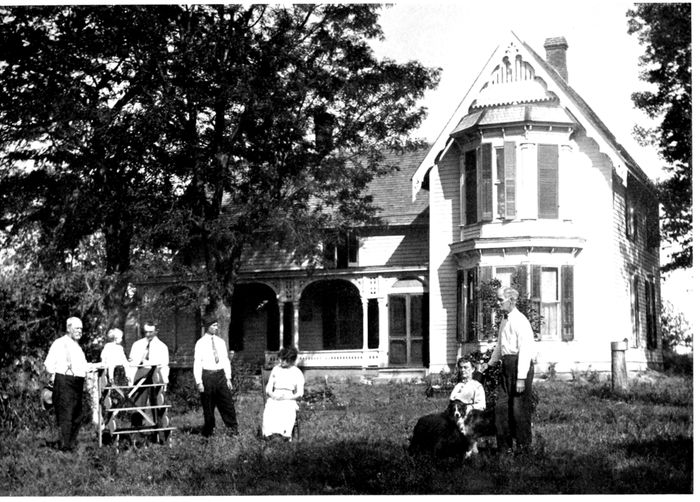
Home of
Frank W. and Julia (Adams) Boyington
Extreme Left—SAMUEL ADAMS
Right—MRS JULIA E. BOYINGTON
FRANK W. BOYINGTON
585At the age of seventeen, William Adams left his native country and came
to New York. He farmed there until 1856, when he came to Kansas and settled
in Atchison county for the express purpose of helping John Brown in his
fight along the border, and assisting the Free State party. He passed through
many thrilling experiences during these troubled years and though he was
often subjected to great bodily danger, he never wavered in his convictions
and was always ready to fight for his convictions. He preëmpted eighty
acres of land which he increased to 800 acres during his life time. When he
took his first land the country was wild and undeveloped, and he built a log
cabin on his place and used a yoke of oxen in breaking the land. He was a
great stockman and kept a large number of animals and farmed until his
death in 1889, remaining in active life until within a short time of his death.
Mr. Adams was a Republican and was loyally devoted to the welfare of his
party. He always took a great deal of interest in the activities of his party
and helped it at every opportunity, though he never desired an office as a reward
for his work, and never held a political job.
On July 4, 1848, Mr. Adams was married to Mary A. Ellsbury, also a
native of Summersetshire, England. She was born October 19, 1825, and
died December 15, 1895. Mrs. Boyington, though a small girl when she
came to Kansas, remembers many incidents of that early life with remarkable
vividness. She still keeps a rifle and an old shot gun which her father
brought from New York, and prizes them very highly. They were the means
of protecting her and her mother many times from the depredations of the
Indians, who were numerous in that section then, and lived on a reservation
only four miles from the Adams home. They passed the little Adams cabin
when they went after whiskey. As they would return completely intoxicated,
they would quarrel and disturb the neighborhood, often frightening the
women whose husbands were working out in the fields. The Cayuga settlement
numbered about forty people during the early days. The township
elections in Grasshopper township were always held in the Adams house, and
Mr. Adams was always generous in helping public affairs along.
Mr. and Mrs. Adams were parents of five children: Julia, the subject of
this sketch; Georgia Anna, deceased; Samuel, of Grasshopper township; Millicent,
who died in infancy; Julia, born a twin, but the other child died in infancy.
Samuel, married Mrs. Ida Hitchcock, a native of Scranton, Penn., in
California, May 31, 1887. By her marriage to Mr. Adams she was the
mother of two children: William J., who was born March 19, 1890, and Earl,
who was born October 10, 1891. These two children were partly reared by
their aunt, Mrs. Boyington, and she is very fond of them. Though she has
no children of her own, she has made these two nephews her favorites and has
treated them as though they were her own children. Frank W. Boyington,
the husband of Julia E. Adams Boyington, was born February 15, 1845, in
Pennsylvania, and was a son of Edwin C. and Susan (Smith) Boyington, the
former a native of Litchfield, Conn., and the latter a native of Pennsylvania.
In their old age they came to Kansas and lived with their son, Frank W., and
586died here. The father died 1872, and the mother died in 1875. He left
there in 1867 and settled in Grasshopper township, Atchison county, where
Samuel Adams was reared to manhood in Grasshopper township; lived for
ten years in California and returned to his farm in Grasshopper township in
1913. He was married to Mrs. Julia Bartlet before his marriage to Miss
Adams. His first wife was a school teacher in Grasshopper township before
her marriage. Three children were born to them. Edward, of Atchison,
United States mail clerk, Alice Spangler, Marion county, Kansas, and one
deceased. After her death in 1899, he was married to Miss Julia E. Adams,
the subject of this sketch.
Mr. Boyington was an early settler in Kansas and has been a successful
farmer. His wife owns 480 acres of land which once was a part of the old
home place. Mr. Boyington owns 160 acres in Marion county, Kansas. He
has lived in Kansas since 1867 and has seen much history made during that
time. Mr. Boyington is a Republican and is a member of the Ancient Free
and Accepted Masons. Although he is not a church member, he attends
services. Mr. Boyington is one of the most successful farmers of Atchison
county, and with his wife, who is also a good manager, has made a financial
success of farming.
The historian must ever take cognizance of the facts concerning the lives
of those who have contributed most to the upbuilding and the welfare of their
community. In looking backward over the half century, and more, which has
elapsed since the Kansas Territory was thrown open to settlement, it is found
that there are quite a number of men and women who are deserving of more
than mere casual mention in the history of Atchison county. Among these
are John L. and Amanda (Meeker) Blair, whose names will go down in history
as having taken a very prominent part in the social, political and intellectual
development of Doniphan and Atchison counties. Mrs. Blair has the
honored distinction of having been the first public school teacher in Atchison
and she and her husband were prominently identified with the historical
course of events in northeast Kansas for a long period of years.
John L. Blair, deceased, was born in Fayette county, Pennsylvania, April
25, 1833, a son of Alexander and Rachel (Lynch) Blair. The family is of
Irish origin. Alexander Blair was a minister of the Methodist Episcopal
church in Pennsylvania. He died in Pennsylvania, and in 1860 the widow
587joined John L., who had come to Kansas in 1858. They settled in Doniphan
county, near the Atchison-Doniphan line. Mr. Blair developed a fine farm
and made quite a reputation as a breeder of fine live stock, being one of the
pioneer stock breeders of Kansas. In 1863 he was united in marriage with
Amanda Meeker. This was after he had served some time in the Civil war
as a member of Company D, Seventh regiment, Kansas cavalry, as a sergeant,
enlisting at the beginning of the war and serving for two years. After being
mustered out, he returned home and was married in June of 1863. Mr. and
Mrs. Blair immediately moved to a farm in Doniphan county, Kansas, and
were successful from the start. Both being endowed with more than ordinary
intelligence and thrift, they foresaw the inevitable rise in land values and invested
all of their earnings in land, accumulating over 600 acres of land which
was located in Doniphan county and since Mr. Blair’s demise Mrs. Blair has
purchased 320 acres in Lyon county, Kansas. Mr. Blair was an active and
influential figure in the civic and political life of Doniphan county, and frequently
stumped the county in the interest of the Republican party candidates.
He was a public speaker of power and ability, and was a warm adherent of
the cause of women suffrage, stumping Atchison and Doniphan counties in
1884 in the interest of the suffrage movement in Kansas. He filled the office
of county commissioner of Doniphan county for two terms, and was at one
time a candidate for State senator. During the years 1873 and 1874, when
the Grange movement was spreading over Kansas, Mr. Blair was the official
organizer for Atchison and Doniphan counties. He had a good knowledge
of parliamentary law and this came in very useful in his work among the
different granges. It was in the Grange meetings that the movement for
woman suffrage first gained headway in Kansas, and the women learned how
to vote. Mr. Blair died in 1891, February 4. To Mr. and Mrs. Blair were
born the following children: Mamie, widow of James Hunter, of Doniphan
county, and mother of two children; Alexander, a farmer in Doniphan county
and father of seven children; Kate, wife of Thomas Evans, a breeder of fine
Hereford cattle, hackney horses and pure bred hogs, in Lyon county, and who
is the owner of the famous hackney mare formerly owned by Jay Gould.
Mrs. Evans was educated in the schools of Doniphan county, and the old
Monroe Institute of Atchison, and is a graduate of Holton University, at Holton,
Kan., and graduated from the Kansas State University at Lawrence in
1893. Mr. and Mrs. Evans have one daughter, Mary Frances. Mrs. Blair
has ten grandchildren and seven great-grandchildren. Mr. and Mrs. Blair
belonged to the Methodist Episcopal Church and he was an Odd Fellow.
Mrs. Amanda (Meeker) Blair was born in Franklin county, Ohio, near
588the city of Columbus, June 24, 1837. She was a daughter of Caleb and Mary
(Grant) Meeker, her mother being a relative of Gen. U. S. Grant, and her
father being a member of the famous Meeker family of America. Ezra
Meeker, who crossed the continent en route to Oregon with an ox team, was
a second cousin of Caleb Meeker. Caleb Meeker was born in New Jersey, a
son of Aaron, who was born in New Jersey, of German origin. Caleb Meeker
was born in Essex county, New Jersey, August 9, 1807, a son of Aaron
Meeker, also of New Jersey, who had eight sons and four sons-in-law in the
Meeker, also of New Jersey. Aaron was a brother of Timothy Meeker,
who had eight sons and four sons-in-law in the American army during
the Revolutionary war. Mary Grant Meeker was born in Pennsylvania.
In 1808 the Meeker family migrated from New Jersey to Ohio
and resided there until 1857, when they went to Fulton county, Illinois,
stopping for one year. In November of 1858 Amanda Meeker came to
Atchison to take a position as teacher in the first public school in Atchison.
Caleb came in January of 1859 to visit his daughter and invested in a tract
of land near Huron, Kan., moving his family in March, 1859. He lived on
his farm all the rest of his life, dying in September, 1886. Amanda was
educated in the district schools of her native county in Ohio and received a
certificate to teach school when but fifteen years of age. She taught three
months in 1852 for $9.00 per month and then attended school for the remainder
of the season. The following year she taught six months for $20
per month, after which she studied for two years in the Ohio Wesleyan University,
at Delaware, Ohio. Her teaching experience embraced six years
in Ohio, five months in Illinois and three years in Atchison and six months in
Hiawatha, Kan. Mrs. Blair was a very successful teacher, and had the
faculty of exercising great control over her pupils.
A brother, Jeptha Meeker, served in the Union army during the Civil war.
Mrs. Blair kept the postoffice at Huron, Atchison county, when the village
was one of the stations on the old Military road, from Ft. Leavenworth to
Denver and Pike’s Peak, Colo.
Mrs. Blair is distinguished among the pioneer women of Atchison county
as having been the first public school teacher in the county appointed by a
board of education, duly organized and elected. During the summer of 1858,
this board was organized in the office of F. G. Adams in Atchison, and the
members of the board were Dr. William Grimes, treasurer; F. G. Adams,
clerk; James A. Coulter, director; Philip D. Plattenburg, principal of the
schools at Lewistown, Ill., had been engaged as superintendent of the Atchison
schools and this board elected Amanda Meeker as his assistant. This was the
589first public school in the city of Atchison, and was located over a grocery
store in a frame building, where the Y. M. C. A. edifice now stands at the
corner of Fourth and Commercial streets. The school term began on November
1, 1858, and lasted for seven month, ending July 1, 1859. The following
year the school term was extended to nine months. Miss Meeker
taught for three years without a certificate. The first teacher’s certificate
in Atchison county was issued to W. D. Rippey, a young man who came from
Valparaiso, Ind. Mrs. Blair recalls that Mr. Rippey had no intention of
teaching when he came to Atchison, and remained here for about five months
and then went to Doniphan county, where he became quite wealthy in the
course of years. Applicants for teacher’s certificates had little or no trouble
in passing, the whole procedure of examining being conducted verbally and
the chief requisite apparently being the one dollar fee which was required from
the applicant.
Few Kansas pioneer women at this day occupy the honored position in
history which is held by Mrs. Blair. To have taught the first public school
in Atchison is a great honor, and to have been one of the pioneers of a great
State in such a capacity is a great honor which is claimed by very few people.
Mrs. Blair, despite her age, is possessed of a keen mentality and is remarkably
well preserved, her long life being best attributed to her mental vigor and
student powers which she has kept nourished these many years.
Alfred Shortridge, deceased pioneer of Atchison, was born in Milton,
Ind., February 27, 1834. When twenty-three years of age he listened to the
admonition of his elders to come to the great West, where opportunities for
amassing a competence were much better for a young man than in his home
community. He came by train to St. Louis and after stopping a few days
at the Planter’s Hotel, he boarded a Missouri river steamer which brought
him to Atchison. His intention was to get a farm from the Government,
and he accordingly took up a claim one-half mile south of Monrovia. He developed
his homestead, sold it and later bought a farm, ten miles south of
Atchison, in Walnut township, near Potter. He added to this first farm of
120 acres until he became the owner of a finely developed farm of 200 acres,
which he still owned at the time of his demise.
Mr. Shortridge was one of the early day freighters and during the years
590of 1862 and 1863 he freighted from Atchison to Denver, and in 1863 made
two trips overland to Denver and return with Pardee Butler, with whom he
was on intimate terms. He enlisted in the company of soldiers which was
formed in his neighborhood for the purpose of repelling Price’s invasion of
Kansas in 1864 and was present at Westport when Price’s army of invasion
was driven southward. After he had made his last trip to Denver in 1863, he
sold his wagon and four mules for $1,500, and then engaged in farming. He
resided on his farm near Potter until the year 1912, and then removed to a
home in Atchison.
He was married February 23, 1867, to Miss Catherine Elizabeth Clasby,
of DeKalb, Buchanan county, Missouri, and to this union five children were
born as follows: Mrs. J. A. Edwards, Fairmount. Kan.; J. T. Shortridge, W.
O. Shortridge, and Mrs. C. N. Faulkner, of Potter, Kan., and Miss Florence
Shortridge, at home. The mother of these children was born March 20,
1843, a daughter of John D. and Sarah Ann (Ellison) Clasby. John D.
Clasby was a native of Virginia, whose mother was a member of the Dunlap
family of Virginia, one of the old colonial families of America. One of the
Dunlaps, a direct ancestor of Mrs. Shortridge, served in the Continental army
in the Revolutionary war. He was a pioneer settler of Buchanan county,
Missouri, and is buried on a hill within sight of Atchison.
Mrs. Shortridge’s mother, Sarah Ann (Ellison) Clasby, was born in Missouri,
a daughter of James and Elizabeth (Dunlap) Ellison, who were residents
of Kentucky, and who were among the pioneer settlers in Buchanan
county, Missouri. There were nine children in the Clasby family, as follows:
James T., Robert, Orlando, Joseph, Franklin, Julian, deceased; Mrs. Ann
Eliza (Stewart), and Mrs. Alfred Shortridge.
Alfred Shortridge departed this life on July 17, 1915, and was sincerely
mourned by a host of friends and acquaintances who had known him
for many years in Atchison county. During his life, after attaining his
majority he was affiliated with the Republican party, and was always active
in the affairs of his party, although he was never a seeker after political preferment.
He was a member of the Christian church, and lived according to
the precepts of his religious belief, as nearly as mortal man could. He carried
his religion into his daily life and believed implicitly in the golden rule,
which admonishes mankind to treat his neighbor as he would have his neighbor
do unto him.
On February 23, 1911, Mr. and Mrs. Shortridge celebrated their forty-fourth
wedding anniversary at the old Shortridge homestead, and it was a fitting
culmination of one of the happiest life unions on record. Mr. Shortridge
591was deeply devoted to his noble wife and family and was always kind
and considerate, not only with the members of his immediate family, but with
his many friends and acquaintances. He was never known to complain or find
fault but took things as he found them and made the best of every occasion.
One of the last of the old guard of Atchison pioneers, he was a fitting example
of the type which did so much to develop the Sunflower State and make Atchison
county one of the garden spots of the country. One by one the old
pioneers are passing to the great beyond from which no man returneth; it
is fitting that we record in imperishable print the record of their lives and
their deeds and accomplishments while on earth in order that it all may live
after them forever and their memories be kept continually green and fresh
in the minds of succeeding generations which will know them not except
through the pages of these Atchison county historical annals.
O. M. Babcock, of the Babcock-Avensberg Shoe Company, is one of
the most progressive merchants of Atchison. He is a native of the Empire
State, and was born at Adams Center, Jefferson county, New York, in
November, 1872, and is a son of M. S. and Amy (Green) Babcock, both
natives of New York and of English descent.
The Babcock family was founded in America by Capt. James Babcock,
who settled in Rhode Island during the seventeenth century. M. S. Babcock
came to Kansas with his family in 1883 and settled on a farm in Benton
township, one mile north of Nortonville in Atchison county. Here he bought
160 acres of unimproved land, which he developed to a high state of cultivation
and followed farming there successfully until he and his wife removed
to Battle Creek, Mich., where they now reside. O. M. Babcock, the subject
of this sketch, was eleven years old when he came to Atchison county with
his parents. He was educated in the district schools and the Atchison County
High School at Effingham. After completing school he taught in Atchison
county about two years when he accepted a position in a general merchandise
store at Nortonville and later at Effingham. He remained at Effingham one
year and then came to Atchison and entered the shoe department of D. C.
Newcomb’s general store, where he remained about three years. He then
accepted a position as traveling salesman for a wholesale shoe house, and for
three years was a successful knight of the grip with St. Joseph, Mo., as his
592headquarters. He then came to Atchison as general sales manager for a
retail shoe establishment, and four years later, in 1902, organized the Babcock
Shoe Company, which he still conducts. This is Atchison’s leading shoe store.
Mr. Babcock was united in marriage in 1903 to Miss Edith L. Hooper, a
daughter of George R. Hooper, of Atchison, a personal sketch of whom appears
in this volume. Mr. Babcock takes a keen interest and an active part
in the welfare and development of Atchison and is one of its booster citizens.
He is a member of the Masonic lodge and active in the work of that organization.
He is also a member of the Elks and belongs to the Commercial Club.
He is president of the Kansas Retail Shoe Dealers’ Association, and politically,
is a supporter of the policies and principles of the Republican party.
Julius Kuhn, deceased pioneer merchant of Atchison, was a man of
sterling worth, industry and purpose who achieved a success in the commercial
life of his adopted city which ranked with the greatest accomplishments
of those who figured most prominently in the early civic life of Atchison. He
was born in Bavaria, Germany, May 10, 1831, and received an excellent education
in the famous university at Munich, where he fitted himself to become
an architect. He was gifted with more than ordinary talent as a draughtsman
and architect and to this day many of his best drawings and designs are
hanging on the walls of the art room in St. Benedict’s College. When twenty
years of age he took passage on a sailing vessel for America, then as now, the
land of promise for the poor and ambitious youth of the old world. After a
stay of a few years in New York City and points in Connecticut, he journeyed
to St. Louis where he was married, his wife, Lucetta, dying in Atchison in
the spring of 1881. To this union one son was born, Gustave, who died July
15, 1883. While in St. Louis Mr. Kuhn heard tales of the opportunities
waiting for industrious young men in the new State of Kansas and came
hither to seek his fortune in the year 1859. He had some means which he
had saved and at once invested in a lot on the corner of Eighth and Commercial
streets, upon which he built a story and a half frame building, which for
many years was a well known landmark in Atchison. He installed a stock
of groceries in his new building, and from the start met with success. His
store soon became the outfitting point for the freighters who were crossing
the plains to the far western points and he prospered in excess even of his
expectations. Mr. Kuhn’s store was rarely closed in those early days and it
was his wont to retire at 1 o’clock a. m. and was often called out of bed at 3
o’clock in the morning to assist some freighter just arriving from the trail
half frozen, or, perchance, to trade with some farmer who had traveled a long
distance to transact business with him and exchange his produce for groceries
and necessities.
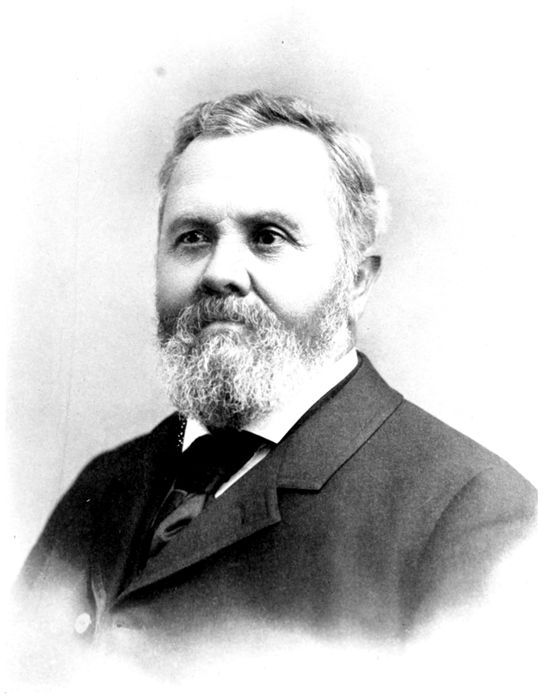
593During the Civil war he served in the commissary department of the
Union army, called out to repel the invasion of Kansas, threatened by General
Price. He established himself in the wholesale business in 1870 as he foresaw
that Atchison was to become an important distributing point for the
northeastern part of the State as the country grew more and more settled
with the influx of immigrants from all parts of the compass. In time the little
frame store, which he had erected when he first came to Atchison, was
replaced by the pretentious brick structure which bears his name. He invested
his surplus profits in real estate in Atchison and Kansas points and
left a substantial fortune on his demise. In the early sixties he purchased
for his family residence the old Judge Gilham house, at that time the only
house on the hill, from his store northwestward. For a number of years the
Kuhn store was the only business house west of Third street, but in time the
business center gradually moved westward from the river, and encompassed
his business place. Speaking reminiscently of those early days a few incidents
showing conditions at that time are worth recording. When Mr. Bartholow
first came to Atchison, at the outbreak of the Civil war when business
was in a state of paralysis, he had on hand over $2,000 worth of tobacco, for
which he could not find storage. He approached Mr. Kuhn and asked him
to either buy the stock or store it until such a time as it would be marketable.
Mr. Kuhn took a chance and when tobacco soared to an extremely high price
toward the last days of the war, he disposed of it at a profit of $1.00 per pound.
Flour rose to the high price of $7.00 per sack during those troublous days,
while beef was very cheap, a “half of beef” often selling for ten cents.
Mr. Kuhn was married the second time, September 30, 1883, to Anna
Glattfelter, and to this union were born two sons, Julius Otto, at home with his
mother, and Gustave Adolphus, living in Kansas City, married Irene King,
and is the father of one child, Ruth Kuhn. Mrs. Anna Glattfelter Kuhn was
born in Glattfelter, Switzerland, a daughter of Henry and Margaret Glattfelter,
who immigrated to America in 1864, and located on a farm in Atchison
county. Henry Glattfelter died in 1867, and his wife died in Atchison in
1903. They were the parents of Mrs. W. A. Dilgert, living on a farm in Walnut
township; Mrs. Martin Dilgert, residing on Ninth street; Margaret, wife
594of Mr. John Meyer, living on Seventh street; Fannie, wife of Dr. Sievers, of
Manning, Iowa; Henry, on the old home farm, near Cummings. Mrs. Kuhn
resides in the family residence at 1029 Atchison street, and looks after the
interest of the Kuhn estate. She is a keen, intelligent lady, who has shown
marked business ability in caring for the property interests left in her charge.
Mr. Kuhn retired from active mercantile pursuits in 1889, and died October
30, 1902, universally respected and loved by all who knew him. He was a
Republican in politics and took an active part in the civic and political affairs
of Atchison, serving as a member of the city council, and filling several important
city offices of trust during his long residence here. He was always
a consistent and unremitting booster for Atchison, and had a deep love for
the city and his home life. He was a member of the Elks and a social member
of the Turner Society. Mr. Kuhn was not a member of any religious denomination
but was a friend and liberal supporter of all denominations which
sought his aid. While not a professed Christian he lived a blameless and
upright life, and was ever ready to assist a needy acquaintance when his aid
would do the most good.
Peter Weber, retired farmer, residing at 921 North Sixth street, Atchison,
Kan., is one of the real pioneer residents of the county. He has lived
in the county for over fifty-six years, and recalls many of the incidents of the
old days when the settlement of the county was in the embryo stage. Like
most of the prosperous and successful men in the county he has worked his
way upward from a small beginning to a state of affluence, which reflects
credit upon his industry and his capabilities. Times, fifty years ago, and the
present, give opportunity for making contrasts which are striking and very
interesting. When Mr. Weber was a boy it was the family custom
to go to church on Sundays via the ox wagon route, father, mother and all
of the children seating themselves in a big farm wagon, and going to church
at the rate of two miles per hour, the trip requiring almost the entire day
to go and return. Now, Mr. Weber cranks the engine of his fine automobile,
and in an incredibly short space of time he travels from his city home to his
country estate, can spend hours in looking over the farming operations, and
return to his own home in time for the next meal.
Peter Weber was born in Kenosha, Wis., March 8, 1859, and came to
Atchison county with his parents a few weeks later. His father, John Weber,
595was a native of Luxemburg, Germany, and his mother was Mary (Penning)
Weber, also a native of Luxemburg, and a daughter of Nicholas Penning,
who emigrated from his native country to Wisconsin. John Weber was married
in Wisconsin, after coming to this country. He migrated to Atchison
county, Kansas, from Wisconsin in 1859, and was equipped with a cash capital
of nearly $300. He attended a lot sale in the boom days of Old Sumner, and
invested nearly all of his savings in lots, purchasing 275 lots in all, at prices
varying from $5 for the first one bought, to a price as low as twenty-five
cents. This was more or less a speculation on his part, and the price of lots
in Sumner fell rapidly after the county seat election which selected Atchison as
the seat of government for the county. Real estate values naturally deteriorated
in Sumner, and John Weber later sold seventy-five of his lots for $15
and allowed the greater part of his initial Kansas investment to be sold for
taxes, inasmuch as the property had no real value. His next investment was
a much better one, however, and he purchased 160 acres of land in Walnut
township for $360, on which he erected a home and proceeded to develop it
into a fine farm. He became well to do, and was highly respected throughout
the neighborhood in which he resided. Originally John Weber had been a
wheelwright by trade, and his skill as a wood worker and wagon maker stood
him in good stead when he took up agricultural pursuits in Atchison county.
During the Civil war John Weber was enrolled in the State militia and was
called away to serve his country at Independence, Mo., leaving his wife and
young children at home in mortal fear of their lives while the father and his
comrades were in battle array to repel the Price invasion of Kansas. The
movable property of the family was kept hidden in the drawers. Mr. Weber
had over $800 in gold buried in the cellar in an empty peach can. He reared
a fine family of sons and daughters as follows: Peter, the eldest of the family
and with whom this review is directly concerned; Mathias, who is cultivating
the old home place in Mt. Pleasant township, and Mrs. Katherine Keefer, a
widow residing near Nortonville, Kan., are the surviving children of a family
of six born, three of whom died in infancy. John Weber died in 1905, his
wife preceding him to the great beyond in 1901.
Peter Weber, when a boy, attended the district school of his neighborhood
in Mt. Pleasant township, and was reared to become an agriculturist. He was
married in 1881 and then began doing for himself, renting land in Mt. Pleasant
township for a time and carefully husbanding his resources and saving his
money with a view to eventually owning a farm of his own. He was enabled
to purchase his first farm of 160 acres in 1895 in Walnut township. He still
owns this fine farm, which is one of the best in Atchison county, and is now
596being cultivated by his son. Mr. Weber retired from active agricultural pursuits
in May, 1912, and removed to Atchison, where he owns real estate
and lives comfortably, as befitting a man who has earned the right to enjoy
home comforts. He was married in 1881 to Mary Weinmann, and to this
union have been born the following children: Mary, wife of Theo Vanderweide,
of Atchison county; Katherine, wife of John Wagner, residing in
Walnut township, Atchison county; Jacob, living on the home farm; Ida, wife
of Charles Harrison, a foreman in the A. J. Harwi Hardware Store, in Atchison;
Annie, wife of Gustave Boehme, Rulo, Neb., where Mr. Boehme conducts
a bakery. The mother of these children was born August 9, 1860, in
Salt Creek Valley, Leavenworth county, Kansas, a daughter of Jacob and
Katherine Weinmann, natives of Germany, who came to Leavenworth county,
Kansas, as early as 1858. She was one of sixteen children born to these
parents, thirteen of whom were reared, and five came to America and died
here.
Mr. Weber has always been a Democrat, but is more or less independent
in his political views and believes in voting for the candidate who seems best
fitted to perform the duties of the office, regardless of his political affiliations.
While a resident of Mt. Pleasant township he took an active part in the civic
affairs of the township and served nine years as treasurer and then served
as trustee in 1895. Later when he took up a permanent residence in Walnut
township, in 1896, he was selected as township treasurer by the people in
1906 and filled the office to the satisfaction of everybody for six years. He
and the members of his family are members of the St. Benedict’s Catholic
Church, and have always been liberal contributors to the support of this institution.
He is also affiliated with the Knights of Columbus, and takes a keen
interest in city and county affairs as befitting a man of broad general attainments,
who has lived in Atchison county for over half a century and watched
its evolution from a wilderness to become one of the fairest divisions of the
great State of Kansas.
Robert F. Bishop, farmer, residing in Mt. Pleasant township, Atchison
county, Kansas, and whose farm is located two and one-half miles west of
Potter, is one of the most substantial and progressive agriculturists of his
neighborhood. He was born August 16, 1861, in the town of Watkins, in
Schuyler county, New York, at the foot of Watkins Glen, which is now a noted
597summer resort, and one of the most beautiful spots in all New York. He is a
son of Freeman and Annie (Sims) Bishop, both of whom were born and
reared in New York State and descendants of old eastern families. The
Bishop family is of English origin and is descended from old colonial stock,
members of which figured in the early wars in which America has been
engaged. The Sims family is of Scotch and Irish extraction. The Bishops
were early settlers in the section of New York where Robert F. Bishop was
born. Freeman was a ship carpenter by trade who followed his trade in New
York, and in 1872 came to Kansas, settling in Jefferson county on a farm,
where he prospered and reared his family of four children, Robert F. being
the eldest.
He of whom this review is written was a boy ten years of age when the
family came to Kansas to make a permanent home. He lived on the home
place and assisted his father in the cultivation of his farm until he was twenty-four
years of age, then married, and two years later, in 1885, came to Mt.
Pleasant township, Atchison county, and purchased the old Miller farm consisting
of 180 acres of good, tillable land. Mr. Bishop has added to his
original farm as he was able and now owns 261 1–2 acres all in one body and
well improved. Besides his home farm he is also the owner of another tract
of 208 acres, which makes his total acreage 469 1–2 acres in all. The accumulation
of this amount of land in about thirty years is a considerable undertaking,
in Kansas especially, when the possessor had very little of this world’s
goods at the start of his career. Mr. Bishop began with very little capital
but imbued with a determination to succeed and the willingness to work hard
and deny himself the luxuries of life until he was well able to afford them.
When he purchased his first farm his cash capital was so limited that he was
forced to go in debt for two-thirds of the purchase price of the land. Since
then he has risen to become one of the wealthy farmers of Atchison county,
and has one of the finest and best improved places in Kansas, equipped with
excellent buildings and a modern silo. His farm is considered a model one
in the county and was one of the first to be visited by the county farm visitors
for the purpose of ascertaining the progress made and using it as a model for
others in the county. Mr. Bishop is a natural born agriculturist who has
kept pace with the advancement made in the science of agriculture, and is
blessed with an intuitive knowledge of the best methods of tilling the soil.
Mr. Bishop was married in 1883 to Elizabeth Shaw, a daughter of Henry
Shaw, well-to-do farmer of Leavenworth county. To this union have been
born seven children, namely: Caude, a farmer, in Atchison county; Curtis, a
farmer; Robert, living at home and assisting his father in the farm operations;
598Myrtle S., Mable, Maude, and Irene, at home with their parents. The father
of Mrs. Bishop is the owner of the old Penseneau farm, which is the first
piece of land ever tilled in Atchison county.
The Republican party has generally had the allegiance of Mr. Bishop,
and while he has not taken an active part in political matters, he was one of
the stanch supporters of the movement which resulted in the establishment
of the high school at Potter. It is only natural to learn that he, like others who
have succeeded in Kansas, has always been a live stock man and believes in
feeding the grains and grasses raised on his land to the live stock on his place,
in order to preserve the fertility of the land and make marketing the output
much more convenient. He maintains a dairy herd of thirty well bred Holstein
milch cows and is a well known breeder of Duroc Jersey hogs, having 200
head or more on his farm.
Harrison W. Rudolph is not only a leading photographer of Atchison,
but ranks among the best in his profession of the entire country. Mr. Rudolph
is a native of the Keystone State, born at Allentown, Pa., May 30, 1866. He
is a son of John and Levina (Messer) Rudolph. The Rudolphs are of old
American stock of German descent. Sometime during the seventeenth century,
two Rudolph brothers immigrated to America. One settled in Pennsylvania,
and the other went farther West, locating in Ohio, and Harrison W.
Rudolph, whose name introduces this review, is a descendant of the one who
settled in Pennsylvania. Mrs. James A. Garfield bore the maiden name of
Rudolph, and was a member of the Ohio branch of the Rudolph family, and
James Rudolph Garfield, son of the former President, retains his mother’s
maiden name as his middle name. John Rudolph, the father of H. W., is
now living and has reached the ripe old age of eighty. He resides in Allentown,
Pa.
Harrison W. Rudolph was reared in Allentown, and after receiving a
good common school education served an apprenticeship at photography in
his native city, and later completed a course in the Atchison Business College.
About the time he was twenty years old he obtained a position from an Atchison
photographer through correspondence. He came here and worked at his
profession for M. A. Kleckner about nine years, when he opened a studio of
his own at 509 1–2 Commercial street, where he has been located for twenty
599years. Mr. Rudolph is recognized as an artist and has a large patronage from
all over northeastern Kansas, and he even gets work from Kansas City. The
excellency of his work is readily recognized by particular people who know
and appreciate art. Mr. Rudolph has been awarded five prizes and medals for
his work by the Kansas State Photographers’ Association, and his work is
always in great demand. He is a member of the Kansas Photographers’
Association, the National Photographers’ Association of America, the Missouri
Valley Photographers’ Association, the Modern Woodmen of America,
and the Methodist Episcopal church.
Mr. Rudolph was married in Denver April 9, 1889, to Miss Martha
Hausser, of New York City, and two children have been born to this union,
as follows: Rodney, born January 21, 1892, is a traveling representative for
the Standard Oil Company, and Fred, born June 2, 1894, a clerk in the Atchison
office of the Standard Oil Company. Mr. Rudolph is not only a successful
artist, but has made good in a financial way and is one of the substantial
business men of Atchison county. He is a member of the Atchison Commercial
Club and the Young Men’s Christian Association.
Edward B. McCullough, deputy sheriff of Atchison county, was born
on a farm in Atchison county in 1880, and is a son of Hugh Elden and
Sarah J. (Rankin) McCullough, both of whom were born and reared to maturity
in Pennsylvania, married there and shortly afterward set out for the
West, settling in Atchison county. Mr. McCullough bought a farm in Lancaster
township, and improved it, but did not live long after settling here. He
died at the age of twenty-eight years, leaving one son, Edward B. At the
time of his father’s death, Edward B. was but fifteen months old, and soon
afterward his mother moved to the village of Lancaster where she has since
made her home, with the exception of some years spent on her cousin’s farm
near Lancaster. Edward B. was reared to young manhood in Lancaster and
attended the public school. When still a youth he learned to hustle for himself
and became self-reliant and self-supporting at a time when most boys are
still in the coddling stage. When but sixteen years of age he bought a team
and outfit and engaged in business for himself. He continued as a teamster
and in draying until 1914 when he removed to Atchison to enter upon his
duties as deputy sheriff under Sheriff Roy Trimble. During the course of
his teaming experience he became the proprietor of a livery barn in Lancaster.
600On October 28, 1903, he married Mildred May Lowe, a daughter of Austin
and Anna Lowe, of Atchison county. They have one child, Gayle Mateel,
born September 23, 1904. Mr. McCullough is a member of the Modern
Woodmen, and is a Republican. Since early young manhood he has taken
an active part in political affairs, and loves the game for its own sake, as well
as he loves baseball and kindred sports, for he is and has been quite an athlete,
being a proficient baseball player.
For the past eight years he has been one of the wheel horses of the
Republican party in Atchison county and has naturally attained a wide acquaintance
among the voters of both parties. He assiduously campaigned
for his favorite candidates during the campaigns of 1912 and 1914, but has
never been a candidate for office. He was appointed to the post of deputy
sheriff in November, 1914, and took up the duties of his office January 11, of
the following year. It is needless to state that he is faithfully performing the
duties of his position and is gaining more friends as his general worth is becoming
more widely known.
Thomas E. Ballinger is one of the substantial and well respected residents
of Atchison who has accomplished much in a material and civic way
since first coming to the county in 1869. He has acquired and improved one
of the finest farms of the county, served the people well and faithfully in an
official capacity, and, best of all, has reared a fine family, every member of
whom is a useful addition to society, and a credit to their parents and the
communities in which they reside. What more could any man expect to accomplish
during a long and busy life? A man who accomplishes so much
with the assistance of an intelligent and faithful wife can well be content to
retire to a pleasant home, imbued with the satisfaction of knowing that the
future of himself and his is well provided for during the declining years which
can be likened to a beautiful sunset at the end of a long and glorious day spent
in gleaning from mother earth her treasures.
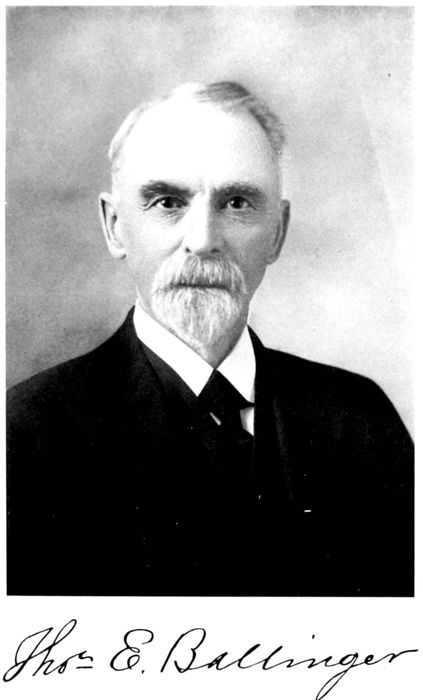
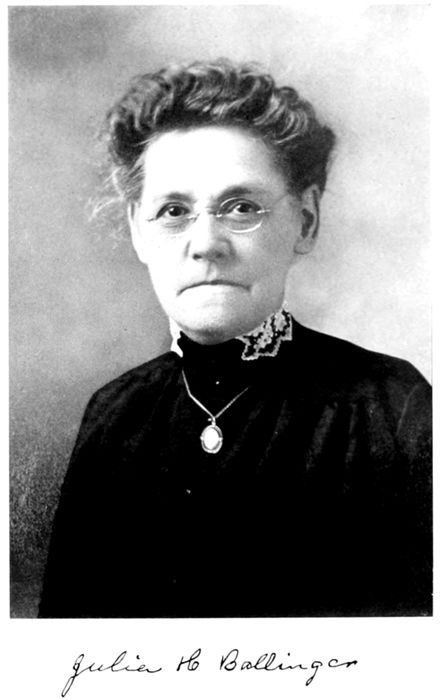
601Mr. Ballinger is a native of New Jersey and comes of good, old English
stock. He was born in Salem county, that State, November 21, 1845. His
parents were John G. and Sarah Ann (Reeves) Ballinger, also natives of
New Jersey. His paternal grandfather was John G. Ballinger, who married
a Quaker woman and died when Thomas E. was but a boy. His mother was
a daughter of Stephen Reeves, a scion of an old eastern family and a leading
shipbuilder of New Jersey. The Reeves family settled in Alloway township,
Salem county, New Jersey. John G. Ballinger, the father, was born in 1827,
and died in 1906. He was a miller, and operated a mill during the active
years of his long life. His wife, Sarah Ann, died in 1850, leaving three children:
Stephen R., a miller, who resided in New Jersey, and died October 15,
1915; Samuel E., a retired farmer, living in the suburbs of Atchison, and
Thomas E., with whose career this review is directly concerned. John G.
Ballinger married a second time, to Sarah Austin, who bore him the following
children: John, Charles, Walter, Ellen, Sadie, Emma and Minnie.
The elder Ballinger had both the means and the incentive to give his
children an education. Accordingly, Thomas E. had the advantages of
thorough schooling and, after attending the district school of his home neighborhood,
he studied in the Cumberland County Academy at Bridgetown. N. J.,
the Crittendon School in Philadelphia and the Eastman Business College at
Poughkeepsie, New York, completing his course in the latter institution in
1865. He then became a clerk in a grocery store at Glouster, N. J., and was
later employed in a drug store. All the while, however, he was hearkening
to the call of the West, which had reached the ears of thousands of young
men in the East. The call proved so strong that in 1869 he made the long
journey to Kansas to become one of the pioneers of the new State. For the
first two years he worked out as a farm hand in Shannon township, Atchison
county, saving his funds in order that he might begin farming for himself.
In 1871 he made his first purchase of eighty acres of unimproved land in
Lancaster township, Atchison county, at a cost of $15 per acre. On this tract
he built a two room house in which he lived for two years, and was there
joined by his brother, Samuel E. He then married, and the first five years
of a happy wedded life were spent on this farm. He traded this farm for
eighty acres of land in Shannon township, which served as the family home
until 1888. He then exchanged the Shannon township farm for 240 acres,
near Huron, Atchison county, which he retained for two years, and then made
his last trade for 160 acres in the east central part of Lancaster township.
For seventeen years, until his retirement to Atchison in 1907, this fine farm
was the family home. Mr. Ballinger greatly improved this farm, added to
it another forty acres, and with its two sets of buildings and well kept fields,
is one of the finest and most productive agricultural plants in the county.
He was married on Saturday, March 21, 1874, to Julia H. Holland, and
to this union have been born the following children: Ralph, a talented physician
602of Chicago, married Flora Groom, of Indiana; Mrs. Marie Shuffleberger,
Doniphan county, Kansas, mother of three children, Dorothy, Reeves and
Wayne; Adel, at home; Grace, wife of J. W. Coleman, of Atchison, having
two children, John Ballinger, born June 14, 1911, and James Henry, born
November 3, 1915; Thomas Edward, Jr., on the home farm, married Nellie
Colgan and is the father of one child, John Edward; Julia Gladys resides at
home with her parents. Father, mother and daughters reside in a handsome
brick residence, erected by Mr. Ballinger at 210 North Eleventh street. Mrs.
Ballinger was born December 29, 1853, in England, and is a daughter of
Joshua and Maria (Relph) Holland, who immigrated to America in 1856,
and first settled on an Illinois farm. The family came to Kansas in 1860,
settling in Nemaha county, going from there to Ft. Leavenworth, where
Joshua Holland followed his trade of stone mason. During the Civil war
Mr. Holland served in the commissary department at Ft. Leavenworth. In
1870 he came to Atchison county and cultivated a farm of 120 acres near
Lane until his death. Mr. Holland was born in April, 1822, and died in
September, 1884. Mrs. Holland was born in November, 1824, and died in
April, 1894. They were the parents of the following children: Emma, deceased;
Misses Mary and Harriet Holland on a farm near Lancaster; Mrs.
Julia Ballinger, and William, a retired farmer in Lancaster.
Thomas E. Ballinger has always been a Republican in politics and took
an active part in political and civic affairs in his home township, serving as
township clerk for a number of years. He was elected to the office of county
commissioner in 1910, and served from January, 1911, to January, 1915.
While a member of the board of county commissioners the best interests of
the county were paramount with him, and he was an honest and capable
public official. He and his family are members of the Presbyterian church.
The accounts of many of the prosperous and substantial families who are
the backbone and substance of the rural population in Atchison county are
very similar, beginning far away, across the ocean, in one of the older countries
from whence the parents came to seek fortune in America. The Sullivan
family had its origin in Ireland and it was from the Emerald Isle that the
father of the family came when twelve years of age, struggled from poverty
to comparative wealth and left his sons well provided for, as a reward for
603their filial devotion to the parents when old age came upon them. Roger
Sullivan, a progressive farmer of Benton township, is one of the best known
men in his section of the county. The Sullivan home is an attractive one,
and the home farm of Mr. Sullivan is one of the most fertile and best kept
in Atchison county.
Roger Patrick Sullivan was born December 4, 1862, in Atchison, a son
of Michael and Bridget (Tobin) Sullivan, natives of Ireland. Michael Sullivan
was born in 1826 and lived in his native land until he was twelve years
of age when he made his way to America. His travels while seeking fortune
in the new country took him ever westward and he was married in Keokuk,
Iowa, to Bridget Tobin, who was his faithful helpmate during the years when
he was rising from poverty to affluence. In 1860 they came to Atchison,
Kan., where Mr. Sullivan engaged in railroad contract work and assisted in
the grading of the Central Branch railroad. He made money in his railroad
contract work and was enabled to purchase a farm in Grasshopper township,
or rather traded for it. While living in Atchison, with true Irish thrift, he
and his wife managed to become owners of a home which they exchanged for
eighty acres of land in Grasshopper township, upon which they moved and developed
it into a fine farm. Mr. Sullivan in the course of time bought an
additional quarter section and with the help of his sturdy sons he increased
his acreage to 320 acres of well improved farm land. When old age crept
upon Michael and his wife they turned over the farms to their two sons, who
cared for them in their declining years, which were spent in peace and comfort.
Mr. Sullivan died at the home of his son. John Edward, December
24, 1906, and his wife followed him to the great beyond two years later, February,
1908. Three children were born to this worthy couple, namely: John
Edward, a farmer residing in Grasshopper township; Roger Patrick, the
subject of this review, and Mary, deceased.
Roger P. learned when a youth the art of cultivating the soil, and diligently
applied himself to the task of helping to build up the family estate,
and received as his share of the farm lands owned by his father a fine quarter
section of land upon which he resided until his removal to his present location
in the spring of 1908. Prosperity has smiled upon his efforts, and he is now
the owner of 360 acres of land, 160 acres of which are comprised in his home
farm, eighty acres is located five miles west of his home in Kapioma township,
and he still retains 120 acres of the original Sullivan farm, which is entirely
devoted to pasture. If one should ask Mr. Sullivan how he had managed
to attain the considerable acreage which he now possesses, his answer
would probably be, “By hard work,” which would be true, but the reviewer
604is also of the opinion that the “hard work” was also supplemented by intelligent
effort, self-denial at times, sobriety, and good financial judgment.
Mr. Sullivan was married January 11, 1892, to Miss Mary Linehan, who
was born in Atchison county, Kansas, in 1865, a daughter of James and
Kathryn Linehan, natives of Ireland, and who were pioneer settlers in Atchison
county. To this union four children have been born, namely: Catharine,
aged seventeen years, and a student in the Atchison County High School,
class of ’17; Daniel, fifteen years old, a freshman in the county high school;
Mary, aged twelve years, and Helen, aged nine, pupils in the parochial school
at Effingham.
The Democratic party has always claimed the allegiance of Mr. Sullivan
and his father before him was a Democrat. He and his family are members
of the Catholic church which was the faith of their fathers. He finds time to
give attention to the social side of life, and is fraternally affiliated with the
Knights of Columbus and the Benevolent and Protective Order of Elks, of
Atchison. Mr. Sullivan is a thorough Kansan, and is proud to be numbered
among the real pioneers of Atchison county, and in his opinion there is no
better spot than the county which has always been his home.
John Fleming, a successful merchant of Atchison, was born October 29,
1864, in Holland. When four years old his parents left the land of their birth
and came to America in 1868. He was one of twins, the other twin brother
dying during the ocean voyage to America. His parents were Lambert and
Rosena (Johnson) Fleming, who set out from their native land imbued with
the desire to better their condition in America and finally located in Atchison.
The elder Fleming had been a skilled wooden-shoe maker in his native land,
and he plied his trade in Atchison, being able to market the product of his
skilled workmanship through the kindly assistance of John Ratterman, who
exchanged groceries and the necessities of life for the shoes which Mr. Fleming
made. The family finally located on a farm south of Atchison, and resided
there until the death of the father in 1882, at which time John, his
mother and two sisters, Bertha, now widow of Henry Nass, deceased: Ida
Van Benthen, residing at Seventeenth and Atchison streets, removed to
Atchison.
John Fleming was four years old when his parents took up their residence
605in Atchison county, and he was reared on the farm, south of the city,
attending the district schools, and was able to secure a limited education in
this manner. Upon coming to the city to reside he worked in various grocery
stores for several years. With true thrift, for which those of Holland
birth are noted the world over, he carefully saved his money over and above
actual living expenses, and in 1898, equipped with a capital of $500, he started
in business with this amount and some borrowed money. For over seventeen
years he has been conducting a grocery business at 321 North Seventh
street and his business has been constantly on the increase. The demands
of his growing trade and the expansion of his business became
such that in 1907 it became necessary for him to erect the modern
brick buildings which now houses his excellent stock of goods at 321 North
Seventh street. It is one of the most attractive and best kept establishments
of the kind in the city, and is noted for the tasteful manner in which the
goods of the very best quality are displayed and the unvarying courtesy with
which the patrons are treated. Prosperity has come to Mr. Fleming, and in
1908 he invested his surplus in the erection of a four-suite apartment house,
each apartment of which contains six rooms. He is also the owner of other
real estate in north Atchison, and is rated as one of the city’s enterprising and
progressive business men.
Mr. Fleming was married in 1889 to Emma C. Hilligoss, a daughter of
Alfred and Anna Eliza (McLain) Hilligoss, who located in Atchison when
she was twelve years of age. Seven children have been born to Mr. and Mrs.
Fleming, four living: William J., associated with his father in the grocery
business; Henry A., also his father’s assistant; Agnes R., John Edwin; Bertha
died at the age of four years; Ruth died in infancy, and Theodore died at
the age of four months.
Mr. Fleming is a member of St. Benedict’s Catholic Church, and is fraternally
connected with the Modern Woodmen of America.
For an Atchison county man to start out in life with a capital of fifteen
dollars, which was given to him by a loving mother, with the injunction that
he purchase an article for personal adornment, and then to invest said fifteen
dollars in a span of mules, which became the nucleus to a fortune, and for
this citizen to rise to the position of being one of the large landed proprietors
606of Kansas, sounds like a tale from modern fiction. But the tale is true, and
the incident which marked the starting point of the career of Mark H. Hulings,
of Center township, is the keystone of the man’s character, and shows
wherein lies the material from which he was created. Mr. Hulings decided
that a pair of mules would do him more material good than adorning his person,
and therein used rare and capable judgment. Mr. Hulings is a Kansas
man, who during a career in agricultural pursuits embracing but little more
than thirty years, has achieved a success which is truly remarkable. Not content
with just common every-day farming, as has been practiced with indifferent
success by others, Mr. Hulings became a specialist and has taken his rightful
place among the many skilled cattle breeders of this county, who in time
to come will receive the credit and honors which are theirs by right. By industry,
persistence, intelligence, and keen financial judgment he has risen to
become one of the leading farmers of Atchison county and Kansas. Born
in the old Buckeye State, of Virginia parents, he is a loyal and steadfast Kansan,
and takes pride in the fact that he is one of the real pioneers of this section
of a great State.
Mark H. Hulings, farmer and stockman, of Center township, was born
February 14, 1862, at Walnut Hill, a suburb of Cincinnati, Ohio. He is a son
of Samuel and Louise (Brown) Hulings. They had four children, as follows:
Mrs. Lillie High, widow, Atchison, Kan.; Cincinnatus, deceased; Mark, the
subject of this sketch, and Ruth J., twins, the latter deceased. The father was
born in what is now West Virginia in 1832. He was a baker by trade, and
his early days were spent on a steamboat, where he was employed as a cook
and baker. When a young man he came to Cincinnati, where he worked for
some time, and then he began farming. In 1867 he came to Atchison county,
Kansas, where he bought 160 acres of land, and built a seven-room house of
brick, which was considered a fine residence in that day. He was a successful
farmer and his crops were always good, with the exception of one year
when they were destroyed by the grasshoppers. The father conducted his farm
until his death in 1898. The mother was born in New York and died about
1905, aged about seventy years. An accident in an Atchison hardware store
elevator which injured her leg led to her death.
Mark Hulings attended the school in District No. 28, Center township,
and later the Pardee Seminary. When he started out in life for himself he
had only fifteen dollars which his mother gave him to buy a ring for himself.
But caring little for personal jewelry, bought a span of mules instead, for
which he paid the fifteen dollars as the first payment. This was his first
investment, but it was a profitable one, and he has continued to invest until
607he is now an extensive land owner. He and his brother, Cincinnatus, bought
land of their own after their parents died, and farmed together about eight
years when each bought a farm of his own. Mark bought land in Center
township and now owns 810 acres, a large part of which is well improved. He
was a breeder of registered Hereford cattle for a time, but now devotes his
attention to Shorthorns. He has worked his way to the first rank of Atchison
county farmers, and now holds land that makes him one of the largest
land owners of the county. On April 27, 1890, he married Emma Sharpless,
who was born September 22, 1871, in Delaware. (See sketch of U. B. Sharpless
for a sketch of the Sharpless family history.) To Mr. and Mrs. Hulings
have been born two children: Mark S. and Susie E., living at home. Mr.
Hulings is a Republican. He and his wife and children are members of the
Christian church at Farmington.
Frank Sutter, owner of “Highlington,” a splendid farm of 245 acres, in
Benton township, Atchison county, located one-half mile west of Effingham,
is a native of Atchison county, and is one of its most successful and progressive
farmers. A beautiful, modern farm home of eight rooms occupies a
rise of land fronting the main highway, running east and west from Effingham,
and is fully equipped with a water system and private gas plant installed
by Mr. Sutter. A large red barn stands in the rear of the home. This farm
is operated as a dairying plant, and Mr. Sutter maintains a herd of fifteen
milch cows of the Jersey and Shorthorn breeds.
Frank Sutter was born January 8, 1871, on a pioneer farm in Walnut
township, Atchison county, and is a son of Frederick Sutter, deceased, of
whom a complete biography is written in this volume. Frank Sutter
came with the family to Benton township in 1880 and lived on the home
place, two miles west of Effingham, and after his father’s death he and his
brothers, Fred and William, became the owners of the section of land which
has since been divided, Frank taking a quarter section as his share when the
division of land was made. The sons of Frederick Sutter farmed the family
estate in common until 1902, and, after various changes following the division
of the estate Frank became the proprietor of 245 acres in one tract, which he
is now cultivating.
Mr. Sutter was married in 1909 to Mrs. Kate (Cook) Pitman, a widow,
608who is the mother of eight children by her first marriage, as follows: George,
now in Montana; Ralph, living in Iowa; Mrs. Elsie Mann, of Nebraska; Mrs.
Vera Blair, a resident of Effingham; Margaret, at home; Mrs. Geneva Perdue,
of Huron, Kan.; Helen and Thomas reside at home. Mrs. Sutter was a
daughter of E. F. Cook.
While Mr. Sutter is a Republican in politics, he votes independently in
county and local matters, and supports the candidate who seems best fitted
for the office, in his judgment. He is a member of the Ancient Free and
Accepted Masons, and the Ancient Order of United Workmen. Mr. Sutter
is of a high type of the successful farmer who has made good in his inherited
vocation. The success of each individual member of the Sutter family is
due, to a great extent, to their coöperation and ability to work together for
the common good of the whole family, collectively and individually, while
the family fortunes were in process of building.
Bishop K. Ham, one of the younger successful farmers and stockmen of
Grasshopper township, Atchison county, is the last surviving representative of
one of the oldest pioneer families of the western part of the county. He
resides on the old homestead of the Ham family, consisting of 170 acres of
land, upon which his father homesteaded in 1861. B. K. Ham was born on
this farm July 23, 1882, a son of Martin W., and Margarette (Black) Ham,
natives of Fleming county, Kentucky.
Martin W. Ham was born near the town of Flemingsburg, Ky., April
13, 1834, and was a son of George and Ruth Ham, also reared in Kentucky.
The grandfather of Martin W. was John or “Jackie,” a native of Greenbrier
county, Virginia, and was of Scotch-Irish lineage. The Ham family is a
very old one in this country, and the great-grandfather of B. K. Ham was
John, better known as “Jackie” Ham, who was one among the earliest pioneer
settlers of Kentucky. Martin W. was reared to young manhood in Fleming
county, Kentucky, and there married Jane Humphreys. In 1861 the Ham
family left Kentucky in search of a home in the West, making the long trip
overland to Missouri by wagon. After a short stay in Missouri they came to
Atchison county, Kansas, and settled on the farm now owned by Mrs. Margarette
Ham. All of Martin W. Ham’s worldly possessions when he landed
in Kansas was his team and wagon and a few household necessities. The land
was wild and there were few settlers on the prairies in Grasshopper township,
where he made his settlement and eventually developed a fine farm. He became
an extensive cattle and hog raiser and made considerable money in this
manner.
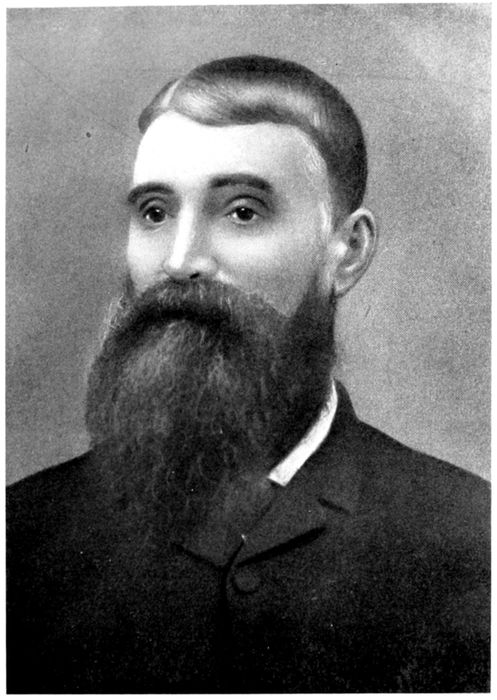
609Martin W. Ham was twice married, his first wife, Jane Humphreys Ham,
dying May 18, 1879. He married his second wife, Margarette Black, June
28, 1880. One son was born of this second marriage, Bishop K. Mrs. Margarette
(Black) Ham was born March 29, 1854, a daughter of M. M. and
Rebecca (Simms) Black, the former a native of Virginia, and of Irish lineage.
He was one of the early pioneer settlers of Kansas. Martin W. Ham died
in 1908. From the start of his career in Kansas M. W. Ham took an active
and influential part in civic and political affairs of his county and State.
During the border ruffian days he was active in affairs and was a Free State
man. He was captain of Company G, Kansas Home Guards, during the
Civil war. He held various township offices and was elected a member of
the Kansas State legislature in 1869, serving one term. He was a member
of the Methodist Episcopal church, and was affiliated with the Masonic and
Odd Fellows lodges.
Bishop K. Ham, with whom this review is directly concerned, received
his education in the district school of his neighborhood and also studied in
the college at Hiawatha, Kan., for one year. He then took up farming, and
after his marriage lived on a neighboring farm until his father’s demise. He
then came to the home farm which he has since been cultivating with considerable
success. Mr. Ham has made a record as a breeder of horses and mules
second to none in Atchison county. He is the owner of a magnificent, imported
black stallion, “Illico,” six years old, which he purchased from the
well known importer, Charles Kirk, of St. Joseph, Mo. He is the owner of
a high class jack and is a successful breeder of mules. The pride of his farm
is his fine herd of thirty thoroughbred Jerseys, headed by the pedigreed bull
“Loren’s Lad,” both the sire and dam of which were imported. By means
of holding annual sales Mr. Ham will dispose of the surplus stock of his herds
of cattle and horses. The Ham farm is well improved in every way with
good commodious buildings, silo, etc., a fine modern home, all grouped together
on a beautiful location.
Mr. Ham was married October 19, 1905, to Miss Carrie B. McCubbins,
and to this union has been born: Marguerite Ham, born April 17,
1907. Mrs. Carrie B. Ham is a daughter of Robert D. and Elizabeth (Tenry)
McCubbins, who were early settlers in Atchison county. The McCubbins
610family first settled near the city of Atchison, and later came to Grasshopper
township.
Mr. Ham is a Republican in politics, and is a member of the Ancient Free
and Accepted Masons of Muscotah, the Modern Woodmen of America
and the Fraternal Aid societies. He is one of the best known and rising
young agriculturists of the county and will undoubtedly make a name for himself
among the breeders of the State of Kansas and middle West.
Charles H. Linley, a prominent physician and surgeon, of Atchison, may
very appropriately be called the dean of the Atchison county medical profession.
Dr. Linley is a Kentuckian. He was born in Livingston county,
Kentucky, June 19, 1847, and is a son of Dr. Thomas and Maria (Barker)
Linley, natives of Lewis county, Kentucky. Maria Barker, the mother, was a
daughter of Admiral Barker of the United States navy. Dr. Thomas Linley,
the father, was born in 1806. He was a son of Thomas Linley, a native of
England, who settled in Virginia at an early date and later removed to Kentucky,
and was a pioneer of this State. Thomas Linley, the father of Dr.
Charles H. Linley, was a large plantation owner and owned many slaves in
Kentucky prior to the Civil war, but was a strong Union man and believed
that slavery was wrong, and when the Civil war came on he was pronounced
in his anti-slavery views, and notwithstanding the position of many of his
neighbors and friends and life-long associates, he stood firmly by the Union.
He was a graduate of the old Transylvania Medical College, at Lexington, Ky.
He began the practice of his profession at the early age of nineteen years, and
for forty-five years practiced most of the time in the vicinity of Salem, Ky.
He came to Atchison, Kan., in 1866, but remained a short time, when he returned
to Kentucky, where he died March 31, 1880. Dr. Thomas and Maria
(Barker) Linley were the parents of thirteen children, three of whom died
in infancy, and four are now living, as follows: Dr. Charles H., the subject
of this sketch; Isaac resides on the old homestead in Salem, Ky.; Mrs. Laura
Hill resides at Liberty, Mo., and Joseph W., now living retired in Atchison,
Kan. After receiving a good academic and classical education, Dr. Charles H.
Linley entered Miami Medical College, now known as the Ohio Medical College,
at Cincinnati, and was graduated from that institution in 1877 with the
degree of Doctor of Medicine. In 1880 he located in the city of Atchison
611where he has practiced his profession with uniform success for the past thirty-five
years. He is one of the oldest physicians in the number of years in
practice in Atchison.
Dr. Linley was married in 1879 to Miss Fannie W. Gregory, a native of
Kentucky. She was born in 1854 and is a daughter of James Gregory and a
member of a prominent Kentucky family. Her father died when Mrs. Linley
was fourteen years of age. Dr. and Mrs. Linley are the parents of the
following children: Maria, born in 1880, and died in 1909; Corinne, a teacher
in the Atchison high school, and a graduate of Midland College and the State
Normal school at Emporia; Ray G., traveling salesman for Blish, Mize &
Silliman; Nora B., a graduate of Midland College, now a teacher in Colorado;
Alice, a graduate of Midland College, now a teacher in the grades at
Atchison, and Louis D., traveling salesman for Blish, Mize & Silliman.
Dr. Linley is a Democrat and has taken an active part in the welfare of
his city and county. He has served as city health officer for several terms
and was police commissioner for Atchison for one year. He served on the
board of United States pension examiners for eight years during Cleveland’s
administrations. He is a member of the Knights of the Maccabees, the Fraternal
Aid, and the Foresters of America. The Linley family are members
of the Christian church.
L. C. Arensberg, one of the younger business men of Atchison, and member
of the enterprising and successful firm of Babcock & Arensberg, shoe
merchants, is a Hollander by birth, and a hustling American in every sense
the word implies. It has long been a matter of note that the natives of
Holland who became American citizens are more apt and take more kindly
and quickly to the ways of this nation than the people of any other European
country. This country seems to become their natural habitat, and they become
citizens in both deed and word after a few years’ residence here. Mr.
Arensberg was born in Holland, September 17, 1880, and is a son of William
and Alegunde (Muskens) Arensberg, who immigrated to this country in 1885,
actuated by a desire to locate in a land where their children would have more
and better opportunities for success than their own little, crowded, native
country afforded. They believed rightly and were successful in establishing
a home in Atchison where they had relatives who had preceded them to the
newer country. The Arensberg family established themselves in reasonably
612comfortable circumstances in Atchison in a short time. There were nine
children in the family of William and Alegunde Arensberg.
L. C. Arensberg was educated in the parochial and high schools of
Atchison. Then he obtained a position as all round man in Bradley & Ostertag’s
shoe store. Here he was employed for ten years and thoroughly learned
the ins and outs of the shoe business, becoming a very proficient salesman.
In the meantime he carefully saved his money, with a view to eventually engaging
in business for himself. His ambition was at last realized, and in
1906 he purchased an interest in the Babcock & Stallons shoe store, buying
out the interest of Mr. Stallons. He is a full partner in the business and
has won a place of merit and honor among the leading merchants of Atchison.
Politically, Mr. Arensberg is a Democrat, and is inclined to be liberal in
his views and independent in his voting. He is a member of the Knights of
Columbus and the Loyal Order of Moose, and is a member of St. Benedict’s
Catholic Church. He is active in the affairs of the Atchison Commercial
Club, and is recognized as one of the real “live wires” of the business and civic
life of his home city.
W. B. Collett, district agent for the Northwestern Mutual Life Insurance
Company of Milwaukee, Wis., is one of the progressive business men of Atchison.
He was born in Liverpool, England, in 1860, and is a son of John and
Mary (Henston) Collett, the former a native of Wolverhampton, Staffordshire,
England, and the latter of Tipperary, Ireland. John Collett was a
prosperous importing provision merchant when the Civil war broke out in
this country. The importing business fell off to such an extent in European
ports that business was injured to such an extent that he failed, and came to
the United States, and in 1862 sent for his family, consisting of his wife and
three children. During his youth he served a seven-year apprenticeship in
the provision trade. In 1879 he came to Atchison as head salesman for the
Fowler Brothers Packing Company, and remained with that company until
1883. He then went with the Armour Packing Company, of Kansas City,
in the same capacity, and was with that company for fourteen years, when he
was made manager of their branch at St. Paul, Minn., and later he was the
European representative for Jacob Dold Packing Company, of Buffalo, N. Y.
In 1908 he retired from active business and took up his residence on a farm
near Richards, Mo., where he died, in 1911, at the age of seventy-nine years.
His wife survives him and resides on the farm where he died.
613John Collett was a man of unusual ability, and had few equals as a
salesman. He was a capable executive and thoroughly understood handling
large commercial enterprises. He was a master salesman and always commanded
a large salary. He was a money maker, although he died possessed
of but a small amount of this world’s goods; he was a money maker rather
than a hoarder of dimes.
W. B. Collett, whose name introduces this sketch, was educated in the
public schools, and when a young man went to work in the Elgin watch
works, at Elgin, Ill., and in 1879, when the family came to Kansas, he went
to work for the Fowler Brothers Packing Company, where he remained about
a year. He then entered the employ of Bowman & Kellogg, millers, as bookkeeper,
and later became a buyer and salesman for that company. In 1888 he
engaged in the general insurance business, and three years later entered the
employ of the Northwestern Mutual Life Insurance Company, and has been
with that company ever since with headquarters at Atchison. Mr. Collett
was married in December, 1886, to Miss Annie Heermance, who came to
Atchison with her mother in 1883 from Hudson, N. Y. She was one of the
old Holland families of New York and taught in the Atchison High School
prior to her marriage.
Mr. and Mrs. Collett have two children as follows; Mary E., educated at
Wellesley College, took her master degree at the University of Pennsylvania,
then one year of post-graduate work at Brown University, at Providence, R. I.,
when she became instructor of biology at the Carnegie Institute, Pittsburgh,
Pa., and W. B., Jr., who was educated in the Atchison public schools. Culver
Military Academy, Culver, Ind., and the State Agriculture College at Manhattan,
Kan.
Mr. Collett is an Episcopalian, a York Rite Mason and a member of the
Young Men’s Christian Association, and has been active in the work of these
organizations for years.
The late James Dooley, of Shannon township, left behind him
a life’s record that is well worth recounting, and deserved an honored
place in the memoirs of the county, in which he was for over forty years
a prominent and well known figure. As a pioneer he did his part well in
building up Atchison county. The story of his life is romantic in many ways,
614and he was always imbued with the idea of providing well for his beloved
family, and leaving his affairs in such a stable condition that his descendants
could earn on the great work which the father and founder of the family
had so well begun and brought to such a substantial culmination.
James Dooley, deceased, was born January 6, 1835, in Ireland, a son of
Irish parents, James and Catharine Dooley, who left their native land in 1847,
and located in Canada, where the father, James Dooley, the elder, became ill
and died in the city of Hamilton. Although the young Irish lad was but
twelve years of age and immature, it was necessary for him to go to work
and gain a livelihood the best way he could. He managed to get a job which
paid him one dollar and a half per month with his board. He was knocked
about from pillar to post while a youth, and managed to make his way. His
adventures in making a struggle for an honest livelihood were similar to those
of other poor orphan boys left in a strange land without friends or relatives,
other than those who were as poor as himself. One bright rift in the lonely
life of this orphan boy is to be noticed when he became a boarder in the Hurley
home at Harrisburg, Canada. It was here that he met with a genuine
kindness and formed an attachment for the noble-hearted girl who later became
his inspiration, and was his faithful wife during the years in Kansas
when he was working his way upward to wealth and affluence, aided and
abetted by her wise counsel and assistance. Imbued with a desire to secure
capital so that he could come to this new country and realize an inherent ambition
to own a farm, he set out for the gold fields of Colorado during the
Civil war years, and there amassed a small fortune of $500 in gold, saved
during the months of his hard and unremitting labor in the gold mines of
the western State. With this capital he felt able to make the venture which
he and his sweetheart had planned, and, accordingly, after his marriage at
Paris, Canada, with Catharine Hurley, he and his wife set out for Atchison
in March of 1866. During the first few months of their residence in Atchison
county they lived with a sister of Mr. Dooley, Mrs. Slattery, in Shannon township,
and James worked in the city at any honest labor he could get. Their
first investment was for eighty acres of school land in Shannon township,
for which they paid cash, and it then became necessary for Mr. Dooley to
borrow forty dollars in order to get the deed for the land. During the whole
course of Mr. Dooley’s career in Atchison county, while the modest eighty
acres were growing to the large total of 600 acres of some of the
best agricultural land in the county, they never undertook a debt, but each
time an additional tract of farm land was purchased, the savings were drawn
upon and cash paid for the land. Each of three sons now has a fine farm of
615200 acres. The home place upon which Mrs. Dooley now resides,
which consists of 200 acres, cost an even $10,000. This farm is one
of the oldest in the county and was originally preëmpted by a Mr. Collins,
who set out a large grove of forty acres or more in walnut and cottonwood
trees which have become very valuable, having grown to considerable size.
Catharine (Hurley) Dooley, widow of James Dooley, was born April
28, 1847, in Ireland, a daughter of James and Bridget Hurley, who left their
native land in 1847 while Katharine was but an infant, and located in Hamilton,
Canada, later residing in Harrisburg, Canada. A brother of Mrs. Dooley,
James Hurley, served three years and three months in the Union army.
He was a member of a Pennsylvania reserve regiment of sharpshooters and
was wounded during the battle of Richmond, Va. For six months, while the
wound in his wrist was healing, he served as sergeant in the quartermaster’s
department. Some years after the war he became an inmate of the National
Soldiers’ Home at Dayton, Ohio, and lost his life while aboard an excursion
boat which sank in Lake Michigan, near Chicago. Mr. and Mrs. Dooley were
the parents of fourteen children: Mrs. James Baker, Huron, Kan., and mother
of eight children, Celia Baker, a trained nurse in Chicago, Mary, wife of
George Perdue, Joseph, William, Bertha, Ruth, Rita and James; Catharine,
James and Mary, deceased; Sister Lucy, of Mt. St. Scholastica Academy;
Lucy, wife of David Lawless, and mother of two sons, Harold and
Clevett; Mrs. Celia Finnegan, wife of Thomas Finnegan, of Houston, Texas,
who had two children, Thomas Lillis and Mary; Bertha, Sister Dorothy, of
the Order of St. Benedict’s in Mt. St. Scholastica Academy; Nora, wife of
Roger Finnegan; William, managing the home farm; John, deceased; James
married Bertha Kistler, and has three children: Florence, Bernice, and
Francis; Edward married Henrietta Kramer, and has two children, John
and Gerard; Joseph, deceased; Irene, at home with her mother.
It is well to add here that James Dooley was one of the notable army of
hardy freighters who crossed the plains with the long mule trains in the late
sixties. This was in April of 1866, when he convoyed a train load of goods
to Denver, Colo., in company with William Slattery. During his whole life,
after attaining his majority, Mr. Dooley was a stanch Democrat and was ever
loyal to Democratic principles. While a member of the Catholic church, he
was a liberal supporter of all denominations, and took a broad and tolerant
view of all religious matters as becoming a widely traveled and experienced
man. His life-long wish to perpetuate his name and keep the family estate
in the family was expressed while lying on his death bed. Calling his faithful
helpmeet to his bedside, he said: “Mother, I am leaving you without having
616my dearest wish come true.” On being asked what it was, he said: “I
have always longed for the time to come when I could see my sons settled on
this farm of ours, with a Dooley here with his family, a Dooley there, and
another son on that part of the farm.” He was at once assured by his wife
that his wishes would be respected, and after his demise Mrs. Dooley at once
took steps to carry out the plans of her husband with the result that within
sight of her home the other two sons are comfortably located on 200 acres
of land each and have attractive homes of their own.
Abraham Hooper, deceased, was one of the pioneer settlers of Atchison
county. He was one of the well known and sturdy figures in the early days
of the settlement of Kansas when strong and brave men were required, who
were able to face the vicissitudes and hardships incident to the settlement
of a new country and perform their tasks without succumbing, as weaker
mortals were wont to do. Mr. Hooper was born in Platte county, Missouri,
November 23, 1839, on a farm, near Parkville. His father was Abraham
Hooper, a native of Tennessee and early settler of Missouri, who died in
Mexico. Abraham Hooper, the subject of this review, was reared in Platte
county and came to Atchison county in 1858, settling on a farm near Pardee.
While engaged in farming he followed his trade of plasterer in the neighborhood
of Pardee. For a distance of ten miles around his own residence he
plastered all of the houses then building by the incoming settlers. During the
Civil war he was enrolled in the State militia. In his younger days Mr.
Hooper was a freighter and crossed the plains in charge of great trains on
three different occasions. On one of his trips to Colorado he was placed in
charge of a train load of twenty-five wagons, and one of his other trips was
to Ft. Union, N. M. His affiliations were with the Christian church, the
Ancient Order of United Workmen and the Knights of Pythias lodges.
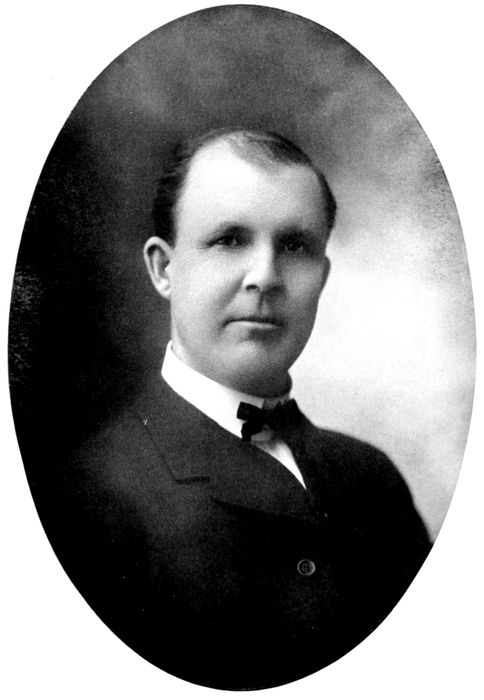
617Mr. Hooper was married in 1863 to Louisa Campbell, born in Tennessee
in 1842, a daughter of Daniel and Nancy Campbell. The Campbell family
left Tennessee in 1854, and in 1855 removed to a farm which they preëmpted
near Farmington in Atchison county. This was in a day when things were
in a primitive state in Kansas. The Campbells lived in a cabin which was
one of the first dwellings built in that section of the county. The mother of
Mrs. Hooper lived and died on their farm, and her father died on the western
plains while on a trip to the Black Hills. Mr. and Mrs. Hooper removed from
the farm to Atchison in 1887, and here Mr. Hooper died February 18, 1914,
at the advanced age of seventy-four years, having been born November 3,
1839. Three children were born to this well respected couple: Addie B.
died at the age of six years; Daniel, deceased, and Nellie died at the age
of one year. Mrs. Hooper lives all alone in her home, but remembers fondly
the days of old and has many sweet memories of her husband and children
to solace and comfort her during her declining years. Despite her age she
is physically and mentally vigorous and is distinguished in being one of the
oldest pioneer women now living in the county.
Her well beloved son, Daniel Hooper, was born in 1868, and died January
22, 1912. He was one of the most talented and best liked men in Atchison,
and was far on the road to fame and prosperity when he was cut off
in the prime of his vigorous and virile manhood. He received the rudiments
of an elementary education in the district school near his country home and
early developed ambitions which were partly realized during his life. After
leaving school he studied shorthand and typewriting, and while holding a
position in the law office of C. D. Walker he studied law and was admitted
to the bar. A winning personality and his pronounced ability won him clients
from the start of his legal career. His personal popularity and ambitious tendencies
led him to enter politics, and he was elected to the office of probate judge
of the county, serving the people well and faithfully for a period of six years,
and then served two terms as city attorney. Just in the prime of his manhood
and at the zenith of a career his health failed, and he died at Excelsior
Springs, Mo., where he had gone in the hope of regaining his health. Judge
Hooper was sincerely mourned by a large circle of friends and acquaintances
and it is probable that there was not a man in his class better liked or more
highly respected in Atchison county at the time of his demise. He was a
Republican in politics and was fraternally connected with the Modern Woodmen,
the Knights of Pythias, in whose councils he was very prominent, and
an attendant at the Christian church. The most notable trait in Judge
Hooper’s character was his sincere devotion to his parents. Because of the
love he bore his mother he never married and cared for no woman but her.
His constant thought was to make provision for her in the event of his own
demise, and he carefully looked after her immediate and future wants. Such
men as he are deserving of a greater tribute than that embodied in this brief
review. A memorial window with his and the name of his father thereon was
placed in the Christian church in his memory. Printed on this window are
618Judge Hooper’s words of faith often expressed: “I believe in a great and
a good God.”
Mrs. Hooper is rearing and educating a girl, Ruth Jones, who serves as
company for her in the home.
Albert J. Smith, the efficient cashier of the State Bank of Lancaster,
Kan., is a native son of Kansas, and has grown up with Atchison county. He
is a son of one of the prominent early pioneer settlers of the county, and while
yet, comparatively, a young man, he has made good at his chosen avocation and
is considered one of the really successful banking men of this section of the
State, his talents and ability seeming to be especially adapted to the profession
of banking.
Mr. Smith was born on a farm in Brown county, Kansas, January 13,
1879, a son of Thomas B. and Mary E. (Woodruff) Smith. The father of
Albert J. Smith was born August 16, 1843, in Grant county, Indiana, a son
of William J. and Lucinda (Barkley) Smith, who were born and reared in
Pennsylvania. The father of Lucinda Barkley Smith was a soldier in the
War of 1812. William J. Smith removed with his family to Grant county, Indiana,
and in 1851 migrated further westward to Bureau county, Illinois,
where he made a permanent settlement, and died in that county in 1869. Lucinda
(Barkley) Smith died in Illinois in 1862, at the age of sixty-two years.
They were the parents of the following children: Mrs. Margaret Pugh; Alvah,
a veteran of the Civil war; Mrs. Lucinda Spangler; Isaac, Joseph, and William
R. Thomas B. Smith, the father of Albert J., was eight years old when the
family removed to Bureau county, Illinois, where he spent his boyhood days
and received a common school education, finishing in the Dover (Illinois)
Academy. On the second call for volunteers issued by President Lincoln,
he enlisted in Company B, Ninety-third regiment, Illinois infantry. He took
part in a number of decisive and important battles and campaigns. Among
them are, Jackson, Miss., and Dalton, Ga. On May 16, 1863, while serving
in General McPherson’s corps, he fought at the battle of Champion Hill and
was severely wounded in the left shoulder. He was forced to remain in the
hospital for some time and after his recovery he was placed on guard duty
for the purpose of guarding the railroad bridges. At the close of the war he
was honorably discharged and returned to his home in Bureau county,
619Illinois. After his marriage in 1866, he continued to farm in Illinois until
1874, when he removed to Kansas, locating first in Brown county, where he
and his family lived for six years, and then came to Atchison county, where
Mr. Smith purchased a farm of 160 acres in Grasshopper township, northeast
of the town of Muscotah. He resided on this farm for twenty years and then
moved to Effingham in 1900. He died in Effingham, November 29, 1914.
Mrs. Mary E. (Woodruff) Smith, his wife, was a native of New Jersey, and
a daughter of Nathan and Delia Woodruff.
Thomas B. Smith was married January 24, 1866, to Mary E. Woodruff,
at Princeton, Ill. They were the parents of nine children, six of whom are
living: Mrs. M. E. Beven, of Muscotah. Kan.; Mrs. H. T. Reece, of Muscotah;
Mrs. J. C. Harman, of Auburn, Neb.; Albert J., the subject of this review;
C. E., cashier of the Huron Bank, and T. B., of the Exchange National Bank
of Atchison. Three daughters are deceased: Lettie, Gracie and Goldie. Mr.
Smith was an enterprising and progressive citizen who did his duty in whatever
community he was located, during his long and useful life. While a
resident of Grasshopper township he served as township trustee for four
years. He was a member of the city council of Effingham one term, and
filled the office of mayor for one term, and also proved his efficiency as a
member of the Atchison County High School board for two terms. He was
an honored member of the Independent Order of Odd Fellows, Ancient Order
of United Workmen and the Grand Army of the Republic, at Effingham.
He was a stockholder and director of the banks at Lancaster and Huron, Kan.
Mr. Smith was a member of the Presbyterian church for over fifty years.
Mrs. Smith, the widowed mother, was born in New Jersey, in November,
1845, and now resides in Atchison.
Albert J. Smith was reared on the farm of his father and attended the
district school in District No. 23, Grasshopper township, and later entered
the Atchison County High School, Effingham, and was graduated in 1897.
After his graduation he taught school in his home district for two terms, and
in 1900 he received an appointment as clerk in the census bureau at Washington,
D. C., and served for two years in that capacity. He then returned to
Effingham and entered the State Bank of Effingham, as assistant cashier
and bookkeeper. He made a fine record for himself in this bank and in July,
1905, was one of the organizers of the Farmers and Merchants State Bank of
Effingham, and held the office of cashier from the time of its opening until
1909, when he resigned his position and removed to Lancaster, where he became
cashier of the Lancaster State Bank. Mr. Smith, in addition to his
620banking interests, is the owner of eighty acres of good land in Kapioma
township, Atchison county.
Albert J. Smith was married in 1899 to Elizabeth R. Smith, and to
this union have been born the following children: Dorothy, deceased; Gladys,
Elizabeth and Albert, all living at home. Mrs. Elizabeth (Smith) Smith,
was born on a farm in Grasshopper township, February 26, 1879, and, like
her husband, is a graduate of the Atchison County High School. She also
taught school for two years. She is a daughter of James K. and Elizabeth
(Asquith) Smith, the former a native of Pennsylvania, and the mother a native
of England, and early settlers of Atchison county. Both are now deceased.
Mr. Smith has identified himself with the civic affairs of Lancaster and
is recognized as one of the town’s leading and enterprising citizens. He is a
Republican and has served four years, from 1911 to 1915, inclusive, as mayor
of Lancaster. His administration was successful and the affairs of the city
were conducted with efficiency. He is a regular attendant of the Presbyterian
church, and is affiliated with the Anti-Horse Thief Association, the Independent
Order of Odd Fellows, the Modern Woodmen of America, and the
Knights and Ladies of Security.
There is a proverbial saying that opportunity knocks once at every man’s
door, and a classic has been written by a great Kansas statesman, since departed
from among us, which tells in musical language that Kansas spells
opportunity for the young man. Opportunity presented itself to John E.
Duncan, Missouri Pacific agent, at Shannon, Kan., and Mr. Duncan seized it,
and held on for all he was worth, and made a success of his venture. His
ambition first was to become a railroad man and telegraph operator, and
probably in the early stages of his career the post of telegraph operator seemed
to him to be the great height of attainment. He realized his first dream, and
when he came to Shannon, Kan., to take charge of the Missouri Pacific business
at that place, he conceived the idea of engaging in the buying and shipping
of grain. This idea grew and he became a grain buyer and shipper,
built an elevator, established a general store, opened an implement establishment,
and became a prosperous and trusted business man of his adopted
county. It is a fact that more grain is shipped from the little village of Shannon
through the agency of Mr. Duncan than any other point in Atchison
621county, outside of the city of Atchison. Mr. Duncan enjoys the respect,
esteem and confidence of the prosperous farmers of the section tributary to
Shannon, and they trade with him because of this confidence in his squareness.
A few years ago, when real hard times struck Kansas as a result of the
droughts, Mr. Duncan showed his hearty good will and confidence in the
eventual betterment of conditions by placing his trust in his farmer friends,
and supplying such of those who were not blessed with ready cash, with credit
for supplies at his store, and carried them until they were able to pay. This
kindness has been appreciated, and the most cordial relations exist between
Mr. Duncan and his patrons.
John E. Duncan was born March 21, 1863, in Moro, Madison county,
Illinois. He is a son of John and Mary (Hooley) Duncan, who had eight
children, three of whom are now dead. The father was born in December,
1818, in Ireland. He left his native land in 1846 and sailed for New York.
He engaged in farming in New York State, and was married two years later.
In 1851 he came to Illinois and remained there until 1891. The mother of
John Duncan was born in Ireland, also, in 1827. In 1848 she left there with
a brother, William, and came to America. She died in 1907. Both parents
were members of the Catholic church. The subject of this sketch was reared
on the farm of his father and attended the grammar schools of Madison
county, Illinois. When he grew to be a young man the long days of labor
on the farm palled on him and he longed to get into different work. He
had always had an ambition to become a telegrapher and when he was twenty-one
years old he had a chance to learn that work. He worked as telegrapher
for the Chicago & Alton Railroad Company until 1887, when he went to
Everest, Brown county, Kansas, to become night operator for the Missouri
Pacific Railroad Company. In the fall of 1887 he was sent by the same company
to Shannon, Atchison county, Kansas, to become the agent for the Missouri
Pacific there. In 1892 he went into the grain business. He bought and
sold grain for eight years, and at the end of a successful business period he
erected the grain elevator at Shannon. This proved a profitable investment,
and in 1907 he invested in a general merchandise store which he conducted
until August, 1915, when his store building and stock were destroyed by fire,
which was caused by lightning. Mr. Duncan has recently completed a handsome
new store building of cement blocks, 36×56 feet in size, which
is attractively finished throughout and is well stocked with goods. In
the fall of 1915 Mr. Duncan installed a line of agricultural implements and is
the real merchant prince of his section of the county. Besides his business
622interests he is the owner of 200 acres of land in Macoupin county, Illinois, a
nice residence in Shannon, and several town lots.
Mr. Duncan was married in 1890 to Margaret V. Clark, and to this
union the following children have been born: John, associated with his father
in business; Kathrine, aged sixteen years; Margaret, eleven years old;
Bernadette, aged nine; and Dorothy, four years of age, all of whom are living
at home with their parents. Mrs. Duncan is a daughter of Mathias and
Katherine (O’Grady) Clark, both of whom were born and reared in Ireland,
and emigrated from their native land to America. She was graduated from
the school of telegraphy at St. Louis, Mo., in 1889, and assisted her husband
in his work at Shannon. Mr. Duncan is a Democrat and he and his family
are members of the Catholic church. He is a member of the Knights of
Columbus, of Atchison, Kan.
William Schapp, a Civil war veteran and an Atchison county pioneer, is
a native of Germany. He was born in Wyler, Germany, January 26, 1840,
and is a son of Peter and Margaret (Bonns) Schapp. The Schapp family
immigrated to America in 1854, landing at New Orleans, La. They remained
there but a short time, however, when they came up the Mississippi
and Missouri rivers by boat and located at Weston, Platte county, Missouri,
where a brother of Mrs. Schapp had located some time previously. Here the
father entered the dairy business and prospered and the parents moved to
Atchison, Kan., in 1868 and died in Atchison.
William Schapp received a common school education and grew to manhood
in Platte county. He entered the employ of James Steele, an extensive
land owner, as overseer of his estate, and was thus employed when the Civil
war broke out and soon after the beginning of hostilities, Mr. Schapp was
drafted into the Confederate service. Four days after he became a Confederate
soldier, his company was encamped on the banks of the Missouri river
near Iatam, Mo. Young Schapp began to lay plans to escape, as he was a
Union man at heart, and he had made up his mind that if he was going to
serve in the army that he would serve under the stars and stripes. On the
night he escaped the lieutenant of the company was killed accidentally while
showing the men how to use a gun, and during the excitement incident to the
killing, Mr. Schapp made his escape. During the night he secured a boat
623with one oar and drifted down the river, landing at Ft. Leavenworth. Here
he lost no time in enlisting in Captain Black’s company which afterwards
became a part of Company B, Eighth Kansas regiment. The following night
he piloted this company across the river to Iatum where they surprised and
captured the Confederate company of which he had been a member the day before.
This act won from him the intense hatred of the members of the Confederate
company, and even after the close of the war members of that company
attempted to take his life. After serving about a month in Captain Black’s
company, he joined Company H, Eighteenth Missouri regiment and participated
in a number of important engagements. After the battle of Shiloh
he was promoted to sergeant major. He was with Sherman on his
march to the sea, and during that campaign, while at Decatur, Ala., his term of
enlistment expired and he received special permission to accompany General
Sherman’s army through the campaign. On arriving at Savannah, Ga., he
was placed in charge of fourteen soldiers whose term of enlistment had expired
and was the first to arrive in New York City, where they were met by
bands of music and were treated royally by the people. He then returned to
his former home in Platte county, but the secession spirit was so strong and so
much antipathy was shown him on account of his loyalty to the Union that he
decided not to remain, and accordingly, came to Atchison. The second night
after arriving home he was warned by a friendly member of the Confederate
company he had deserted to leave at once, as plans had been made to hang him.
He left at once on the next train. He had saved about $800 during the war
and loaned it to his uncle, John Bonns, who was engaged in the brewery business,
and through a failure, Mr. Schapp lost every dollar of his savings. He
then entered the employ of Julius Holthaus, who conducted a saloon and a
grocery store. About a year later he engaged in the manufacture of brick in
partnership with Jacob Nash. About five years later he engaged in the ice
business, which he conducted about six years. He then bought a farm north
of where the orphans’ home is located, where he remained for twelve years,
when he sold his farm and removed to Atchison, and engaged in the real estate
business and has since been engaged in that business. Mr. Schapp has
been very successful and has accumulated considerable property.
He was married in February, 1865, to Miss Margaret, a daughter of
Gearhardt Kunders, a pioneer settler of Weston, Mo. Eight children have
been born to Mr. and Mrs. Schapp, as follows: Peter P. resides in California;
Dora F. resides at home; Mrs. Theodore Geritz, Atchison county; Mrs. Theodora
Arensberg, Atchison; Mrs. Henry Wersling, Atchison county, and Albert
A.; William H., deceased; Maggie, deceased.
624Mr. Schapp is one of the old timers of Atchison, and has seen that town
develop from a little settlement on the bank of the Missouri river to the
great prosperous commercial center that it is today. He has taken an active
part in the political life of Atchison, and for seven years was a member of the
city council, and served two years on the Atchison school board. Mr. Schapp
cast his first vote for Abraham Lincoln for President, and has been a stanch
adherent to the policies and principles of the Republican party since that day.
He is a member of the Grand Army of the Republic.
The passing of a good, industrious citizen from this mundane sphere to
the realms of a higher and better life beyond the grave is always saddening,
especially if his demise occurs while yet in the prime of his vigorous manhood.
Such a one was Thomas Lincoln Blodgett, late of Mt. Pleasant township,
who, though not permitted to dwell upon this earth the allotted time
decreed for mankind, accomplished in the brief time he was actively engaged
in agricultural pursuits more than the average man, and will long be remembered
for his many excellent qualities by those who knew him best.
Thomas Lincoln Blodgett, late of Mt. Pleasant township, was born July
27, 1860, and lived and died in the township in which he was born in Atchison
county, his demise occurring May 4, 1905. He was a son of George M. and
Mary (Cline) Blodgett, his father having been born and reared in Michigan
and came to Kansas when the State was created in the late fifties.
George M. Blodgett, the father of Thomas Lincoln Blodgett, was born
in Livingston county, New York, October 6, 1834, a son of George W. and
Lucinda (Garfield) Blodgett, and was a grandson of Thomas Blodgett.
Thomas Blodgett, who was a soldier under Washington and fought for the
independence of the American colonies, lived in Vermont, where he was a
blacksmith and a farmer. He went to Michigan in 1856 and remained there to
be near his son, George W., who had settled at Kalamazoo about 1846. Mr.
Rowel, the father of Thomas Blodgett’s wife, was also a Revolutionary soldier.
The children of Thomas Blodgett were named George W., Riley and
Jared. Riley went to Rhode Island and became connected with shipping interests,
navigating waters in the vicinity of Newport. Thomas died in Michigan
in 1850, aged ninety years.
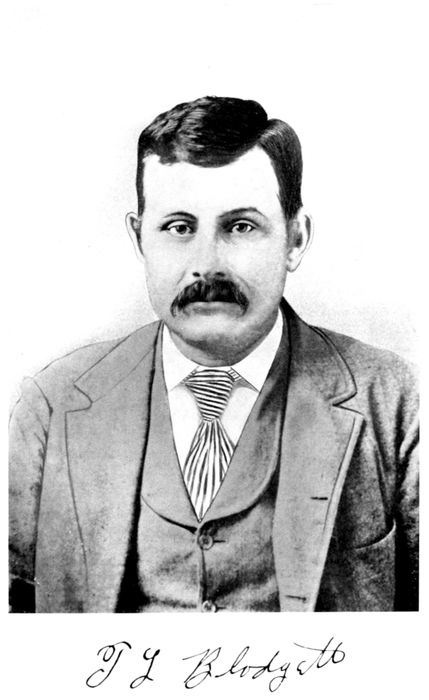
625George W. Blodgett, the father of George M., was born in Vermont in
1800, and died in 1880, aged eighty years. His wife, Lucinda, was a daughter
of Solomon Garfield, of Ontario county, New York. She died in 1840,
leaving the following named children: Orinda, who married Thomas Sanders;
George M.; Emma, who was Mrs. Nathan Allen, of Michigan, and
John, deceased.
The education of George M. Blodgett was limited and he became used
to hard work at an early age. He worked as hired hand and at logging in
the pine woods of Michigan. When twenty-one years of age he left home
and went to Winnebago county, Illinois, and took charge of a quarter section
of land for which he had traded. Not liking his prairie surroundings he
traded his farm for a small tract now within the limits of the city of Moline,
Ill. He remained here for four years; then he traded this farm for a farm
in Iowa which he sold. With his small means he came to Kansas, arriving
in Atchison April 5, 1855. He took up a claim and bought land from the
Delaware Indian lands and began developing his farm.
When volunteers were called for at the outbreak of the Civil war, Mr.
Blodgett offered himself for the defense of his country’s honor and was
accepted as a member of Company F, Thirteenth regiment, Kansas infantry,
(Colonel Bowen’s regiment), of the Seventh army corps, which was mustered
into service at Leavenworth, Kan., and was in the military department of the
West. Mr. Blodgett was a sergeant of his company and participated in many
battles fought by his regiment in Missouri and eastern Arkansas and was
once wounded by a bursting shell.
George M. Blodgett was married in 1857 to Mary E. Cline, a daughter
of Henry Cline, an early settler of Atchison county. The children born to
this union were: Thomas Lincoln, Frank F., Frederick, Luther, Mrs. Lavina
Lawler, Mrs. Jessie Ellerman, and Lulu. The father of Thomas Lincoln
Blodgett became quite wealthy and accumulated 500 acres of land. He served
as deputy sheriff of the county in 1856 and filled many offices of trust in
Mt. Pleasant township.
George M. settled on a pioneer farm in Mt. Pleasant township which
he developed, reared a family, and died in the home which he built to house
his family. He was the father of seven children, of whom Lincoln was the
eldest.
Thomas Lincoln Blodgett was named in honor of Abraham Lincoln, who
was greatly admired by the elder Blodgett. He was reared to young manhood
on his father’s farm and learned to become an excellent farmer and
stockman. After his marriage in 1881 he and his young wife lived on a
farm owned by his father for four years, when they purchased 120 acres of
626land which formed the nucleus for a large farm which was later increased to
400 acres, now owned by Mrs. Blodgett. The first tract was bought on time,
but by industry, economy and self-denial on the part of the ambitious couple,
the debt was soon paid off and additional acreage was gradually added as the
years went on. Mr. Blodgett was a successful live stock feeder and frequently
fed one or two carloads of cattle on his farm each year. He was noted as a
good judge of cattle and made money in his operations. The Blodgett farm
is well improved and is considered to be one of the best in Atchison county.
He was married August 18, 1881, to Miss Ella Hudson, and to this marriage
have been born five children, as follows: Robert, a farmer, near Cummings,
Atchison county, Kansas; George, managing the home farm; Elmer,
Mabel and Stella, at home with their mother. Stella is attending the high
school at Potter. Mrs. Blodgett was born May 20, 1862, in Illinois, and is
a daughter of Cyrenus and Elizabeth (Shaw) Hudson, the former of whom
came to Kansas in 1867 with his family. Cyrenus Hudson was a native of
Illinois who made good in Kansas, and at one time was the owner of 900
acres of land in Atchison and Jefferson counties, Kansas. In 1901 he removed
to a home in Potter, where he is living retired. With other live citizens
of the thriving town he has taken an active part in the upbuilding of his
adopted city.
During his life and ever since he attained his majority, Thomas Lincoln
Blodgett was allied with the Republican party and took a prominent part in
political and civic affairs in his home township and county. He was a progressive
citizen as well as a successful and progressive farmer who was always
in favor of matters which had for their intent the betterment of the public
welfare and the advancement of the citizenship of Atchison county. He was
ever ready to do his part in educational matters and was a member of the
local school board. He was fraternally allied with the Modern Woodmen
lodge, and was blessed with many warm friends and well wishers who
esteemed him as a man and citizen. He was a kind parent who loved his
wife and children and highly prized his home life and surroundings, and was
ever striving to make his family happy and comfortable.
John R. Oliver, deceased pioneer of Atchison county, was born in Cayuga
county, New York, April 5, 1825, and was a son of William Oliver, a native
of Scotland, who emigrated from his native land when a youth. John R.
627was educated in the schools of his native county and State and learned the
carpenter’s trade. He was married January 3, 1850, to Helen M. Packard,
who was born in New York State February 17, 1832, a daughter of Thaxton
Packard, of English extraction, who married a lady of Holland descent.
After John R. and Helen Oliver were married they settled at Sterling Center,
Cayuga county, New York, where Mr. Oliver worked at his trade of contractor
and builder until 1856, when he and his wife and two children came
west and settled on a farm near the western border of Atchison county, in
Grasshopper township. They became a part of the Cayuga settlement, made
up of several families who had migrated from their native county in New
York State. There are only four of the original Cayuga colony living, as
far as known: Fred L. Oliver, Frances Josephine Anderson, of Atchison; Mrs.
Frank Boyington, of Atchison county, and brother, Samuel Adams. John
R. Oliver came first, and in the fall of 1857 he sent back for his wife and
two children to join him. Mrs. Oliver and the children boarded a steamboat
on Lake Erie and made the voyage by way of the Great Lakes to Chicago,
going from Chicago to Leavenworth, Kan., and thence by steamer to Atchison,
from which place they were taken across the county to the new home
in the Cayuga settlement, by a man named Sandy Coburn. The family lived
in the settlement for about six years and then moved to Leavenworth, Kan.,
where they resided until Mr. Oliver’s death, in 1906; the wife and mother
died in 1911. John R. Oliver served in the Kansas State militia during the
Price invasion, but was unable physically to withstand the rigors of the campaign
which resulted in Price’s army of invasion being driven southward. He
was an ardent Republican in politics and was a follower and supporter of
Abraham Lincoln, to whom he was related by marriage. Mr. and Mrs. Oliver
were the parents of the following children: Fred L., born in Sterling Center,
N. Y., November 8, 1851, now residing in Atchison with his sister, Mrs.
Anderson; Parthenia K., widow of Wesley Chaffee, a nephew of General
Chaffee, was born August 8, 1861, and now resides in Leavenworth, Kan.
Frances Josephine Oliver Anderson was born March 1, 1855, and was six
years of age when the family moved to Leavenworth. She received her education
in the public schools of Leavenworth and was married there on May 8,
1873, to James A. Anderson, who was born March 16, 1849, in Loudon
county, Virginia, about twenty miles south of Washington, D. C. An
anecdote which tells of the stirring and troublesome times in the beginning of
the Civil war is here worth recording. When a child on the farm in Atchison
county, Mrs. Anderson and her teacher, Miss Missouri Batsell stayed all
night at the home of the Reece family, as it was unsafe to be abroad after
628dark. This was in the fall of 1861. Mr. Reece, the head of the family, was
very ill. Along about dark the people of the Reece home heard a furious
noise of yelling and shooting outside. The noise makers rapped on the door
with the butts of their guns, and when Mrs. Reece opened the door it was
ascertained that the night prowlers were a band of Bushwhackers who demanded
a meal. She told them that her husband was very ill, and that
she had nothing cooked which would suffice for a meal. They swore at her,
and after talking the matter over decided to go to the barn and steal the horses
for their own use. The gang went toward the barn, and another altercation
arose among them which resulted in the killing of one of the men who had
counseled them not to steal the horses. A dead body was thrust through
the doorway and slid part way across the floor after a shot was fired. Mrs.
Anderson has never forgotten the horrors of that night.
James A. Anderson was a son of Charles W. and Mary Francis (Hough)
Anderson, both of whom were members of very old and prominent families in
Virginia, the Hough family being large plantation and slave holders. Charles
W. Anderson was profoundly opposed to the institution of slavery, and was
high in the councils of the Democratic party. He was a thirty-second degree
Mason and was a personal friend of men high in the Government affairs at
Washington, D. C. A son, Fleming Anderson, was killed by Mosby’s guerrillas
while at home from the war on a furlough, and was shot as he ran out
of the door of his home. Charles W. Anderson was a paymaster in the
Union army and was killed by robbers while on official duty. After the
death of the father of the family, James A., with his widowed mother and
sister. Mrs. Captain Spence, Charles W., and C. C. Anderson of the transfer
company, of Atchison, came to Kansas, first residing at Topeka, then at
Lawrence shortly after Quantrell’s raid. James was but seventeen years old
at this time, and being the eldest son was the actual head of the family. When
still a young man he engaged in the transfer business and took a contract
from the Government to supply Ft. Leavenworth with fuel, and while fulfilling
his contract with the Government, and transporting goods to and from
the fort, he met and fell in love with his future wife, Frances Josephine Oliver,
and the marriage took place as stated in the preceding paragraph. After the
marriage Mr. and Mrs. Anderson lived in Lawrence, Kan., until their removal
to Atchison, in July of 1873. Mr. Anderson continued in the transfer business
and established the Anderson Transfer Company. He had associates at
various times, but was always at the head of the company. He died July 12,
1906. His widow, Mrs. Frances Josephine Anderson, is one of the best
known ladies of Atchison and is prominent in social and religious circles.
629When thirteen years of age she became a Christian and became a member
of the Atchison Methodist Episcopal Church in 1883. She has been
actively and prominently identified with the church work for many years, and
has been especially successful as a teacher of boys. She is a class leader of
the church and a member of the official board, and was captain of one of the
teams which raised a $43,000 fund to provide for the erection of the new
Methodist Episcopal church building. She is a charter member of the Epworth
League and is a singer of ability, having sung in the Methodist Episcopal
church choir for thirty years. In 1911 she began her evangelical career,
in which chosen field she is achieving marked success. Mrs. Anderson is a
member of the Knights and Ladies of Security and is affiliated with the
home and foreign missionary societies of the Methodist Episcopal church.
Faithfulness to duty and perseverance invariably bring their reward. Give
a truly ambitious young man an opportunity to advance himself, and he will
succeed. The opportunity was given to Leo Nusbaum, vice-president of the
Dolan Mercantile Company of Atchison, and he has made a success of the
business in which he began at the lowest rung of the ladder. Entering the
employ of the firm of which he is now one of the important heads, he worked
his way steadily upward until he is now one of the recognized business factors
in the city of Atchison.
Leo Nusbaum was born in Poweshiek county, Iowa, December 6, 1877,
and is the son of Frederick and Eva (Link) Nusbaum, both natives of Germany.
Frederick Nusbaum was born in the Fatherland in 1855, and came
to America in 1869, when a boy fourteen years of age. He worked as a
farm hand in Iowa, and eventually owned a farm of his own. From Iowa he
moved to Nebraska where he purchased and operated a farm. From Nebraska
he removed to St. Joseph, Mo., where he was employed in a grain elevator.
He died in St. Joseph in 1903.
He, with whom this review is directly concerned, was educated in the
schools of Council Bluffs, and St. Peter’s parochial school, and came to Atchison
in 1898. On coming here he entered the employ of the Dolan Mercantile
Company as office boy and packer. His first work consisted of preparing
orders for shipment. After attaining proficiency in this department, he was
promoted to the position of billing clerk and made a success in this department.
630being next advanced to the position of city salesman for the concern. All
the while he was studying the wholesale business, and gaining such a knowledge
as would best fit him to take a more responsible position in the affairs
of the company. His next important service was as the secretary of the
company. From this place it was but a step to the sales managership. Upon
the demise of William F. Dolan, the founder of the wholesale business, in the
year 1913, Mr. Nusbaum became vice-president and one of the managers. He
and his associates, in charge of the Dolan Mercantile Company’s affairs, are
capable and energetic men who are building up a more extensive business
upon the broad and stable foundation erected by its late founder, whose
example has been an inspiration and guide to the young men whom he took
into his employ and educated in the details of his extensive business. Mr.
Nusbaum has justified the confidence and faith held in his ability by his
employer, and is an able and dignified executive.
Mr. Nusbaum was united in marriage with Gertrude Delaney, at Atchison,
Kan., in 1900. She is a daughter of Mr. and Mrs. Martin Delaney. To
this union four children have been born, who are the pride of their parents,
namely: Leo, Mary Clare, Robert, and Frances. Mr. and Mrs. Nusbaum are
members of the Catholic church and have a host of friends who esteem them
for their many excellent qualities. Mr. Nusbaum is a director of the First
National Bank of Atchison and a vice-president of the Atchison Commercial
Club and the Atchison Hospital. He is politically allied with the Democratic
party. His primary interests, however, are mainly concerned with the growing
success of his firm, and the welfare and growth of his home city, and he
is universally recognized as a citizen of worth and standing in the community.
He was the most active force in the organization of the Atchison Commercial
Club, called its first meeting and has been continuously one of its most
aggressive members.
Charles J. Keithline, a prosperous farmer and stockman of Lancaster
township, Atchison county, Kansas, is a native of the Keystone State, and is
a descendant of an old American family which traces its ancestry back to the
Revolutionary days, when the founder of the family in America, Colonel
Keithline, came from Germany, his native land, to America with Baron De
Kalb, and assisted the colonial army to achieve American independence.
Charles J. was born in Luzerne county, Pennsylvania, July 9, 1857, a son of
631Samuel and Eliza (Hoover) Keithline, both of whom were born and reared
in Pennsylvania and there married. Samuel Keithline was a son of John
and Mary (Neyhart) Keithline, who also lived in Luzerne county, Pennsylvania.
The great grandfather of Charles J. was Joseph Keithline, who served
in the War of 1812, and made buckskin breeches for the United States Government,
which were worn by the United States soldiers. He was a tailor
by trade. Samuel Keithline learned the trade of wagon maker in his younger
days and operated a wagon shop at Hanover, Penn. He lived in his native
State until 1884, when he migrated to Kansas and invested his capital in land
in Shannon township upon which he lived in retirement until his demise in
1900, at the advanced age of eighty-two years. Samuel and Eliza Keithline
were the parents of the following children: John A. died May 17, 1915, in
Atchison, Kan.; Samuel died in infancy; Joseph died at the age of three years;
Charles J.; Augustus L., Lancaster township; Sarah E., in Shannon township;
Emma Carlton, Franklin county, Kansas, and Mrs. Cora Riley, Atchison, Kan.
The mother of Charles died in 1910, at the age of seventy-nine years.
Charles J. Keithline, with whom this narrative is directly concerned, was
educated in the graded schools of Nanticoke, Penn., and worked as farm hand
in Pennsylvania. In 1883, five years after his marriage in 1879, he migrated
westward with his family to Kansas, and located on a farm in Shannon township
on the old home place. He rented land for twenty-eight years and
finally became the owner of the fine farm which he is now cultivating. This
farm is fitted with excellent improvements consisting of an attractive farm
residence and excellent out-buildings, much of which has been erected or remodeled
by the proprietor. The 187 acres comprised in this farm are well
and closely cultivated so as to yield the maximum of results. The farm is
nicely located six miles west of Atchison on the Parallel road. Mr. Keithline
has been a breeder of Poland China hogs for several years and takes pride
in the animals bred and raised on his place.
He was married in 1879 to Frances Goss at Wilkes-Barre, Penn., and this
union has been blessed with the following children: Ira, a hardware dealer in
Atchison, Kan.; Samuel, a farmer, living at home with his parents; Amy, deceased;
Mrs. Elsie Vollmer, Bronson, Kan.; Frances, living at home; Grant,
deceased; Charles died in infancy. The mother of these children was born
in Pennsylvania in 1856, and was a daughter of Floren and Maria (Keyser)
Goss, the former a native of Germany and the latter a native of Pennsylvania.
Mr. Keithline is identified with the Republican party, but has never been
an aspirant for political preferment. He and the members of his family are
affiliated religiously with the Methodist Episcopal church and contribute of
632their means to its support. He is fraternally allied with the Modern Woodmen
lodge, and during his residence in this county has taken an active and influential
part in affairs which concern the welfare of the people in general.
Sheffield Ingalls is a resident and a native son of Atchison, having been
born in that city March 28, 1875. He is a son of the late United States Senator
John James Ingalls. Mr. Ingalls’ ancestors, both paternal and maternal,
were representative New England pioneers. The Ingalls family in America
originated with Edmond Ingalls, who with his brother, Francis, founded
Lynn, Mass., in 1628. The mother of our subject was Anna Louisa Chesebrough,
a direct descendant of William Chesebrough, who emigrated to America
with John Winthrop in 1630. The paternal grandparents of our subject
were Elias T. and Eliza (Chase) Ingalls, the former of whom was a first
cousin of Mehitable Ingalls, the grandmother of President Garfield, while
the latter, Eliza Chase, was descended from Aquilla Chase, who settled in
New Hampshire, in 1630, and who was also the ancestor of the late Chief
Justice Chase.
Sheffield Ingalls was reared principally in his native town and received
his public school education at Atchison and at Washington, D. C. After
attending Midland College at Atchison for four years he entered the University
of Kansas and was graduated in that institution in June, 1895, with the
degree of Bachelor of Arts. He then studied law and was admitted to the
bar in 1897, but as the profession did not appeal to him he practiced but little
and turned his attention to more genial pursuits. He early developed a predilection
for politics and became actively identified with the Republican party
in both the city and county of Atchison at an early age. In July, 1898, he
was appointed police judge of Atchison by Mayor Donald and, in April,
1899, was elected to the same office for a term of two years, serving until
April, 1901. In the spring of 1904 he was a prominent candidate for the
Republican nomination for probate judge, but through the exigencies of politics,
instead of receiving the nomination sought for, he was nominated by
the same convention for the legislature from the third representative district.
However, at the election his opponent, Edward Perdue, defeated him by
thirty-two votes. Two years later he was nominated again for the legislature
from the same district and received a tie vote with Alonzo Wilcox. The
633contest was decided by lot in Topeka and Mr. Ingalls won. He served as
a member of several important committees and was made chairman of the
committee on education. He cast his vote for Charles Curtis for United
States senator, and in the work of that session became actively identified with
that progressive element in the legislature which was known at that time as
“the boss busters.” He is in sympathy with all efforts to purify politics and
to raise the tone of public life and during that session he voted for all reform
legislation. He is a man of deep convictions, a political and social reformer
of exceptional ability and courage, and has always opposed machine politics.
It was due to an obnoxious political machine’s influence in local Republican
circles at Atchison that Mr. Ingalls entered the arena of political strife in
order to assist in effectively opposing said machine and to secure needed
reform in political methods. Shortly after the adjournment of the legislature
Mr. Ingalls assumed the editorial management of the Atchison Champion,
and for the following two years exposed through its columns the corruption
in city affairs and fought against the domination of the city by a political
ring. He then endeavored to purchase a controlling interest in the Champion
to enable him to be more aggressive in fighting corruption though its columns,
but through various influences operating against him he was unsuccessful.
In the fall of 1907 he originated and organized the Commercial State Bank
and served as its vice-president until its consolidation with the First National
Bank, in the spring of 1910. He then organized the Commerce Investment
Company, of which he was made president and continuously served as such
until March 2, 1916, when he became the president of the Commerce Trust
Company of Atchison, a company which is a development of the Commerce
Investment Company. Besides the interests mentioned he is a director of
the First National Bank and also of the Railway Specialty Company of
Atchison. He was appointed a member of the board of regents of the Kansas
State normal schools by Governor Stubbs in April, 1908. He is a member
of the State Historical Society, and is a member of the Sons of the Revolution.
Fraternally he is a member of the Benevolent and Protective Order
of Elks.
On January 9, 1901, was solemnized the marriage of Mr. Ingalls and
Miss Lucy Cornell Van Hoesen, of Lawrence, Kan. To their union five
children have been born: Robert Chesebrough, who died in infancy; Ruth
Constance, Sarah Sheffield, John James, and David Bagle.
In 1912 Mr. Ingalls received the Republican nomination for lieutenant-governor
of Kansas and was elected, although the head of the State ticket
was defeated. It fell to Mr. Ingalls’ lot to preside over a Democratic senate,
634which he did in such a fair and impartial manner as to win the commendation
of both Democrats and Republicans. (Copied from Blackmar’s History of
Kansas and revised by R. M. Gibson.)
E. P. Pitts, M. D., a prominent Atchison physician and surgeon, and
well known specialist in diseases of the eye, ear, nose and throat, is a native
of Virginia. Dr. Pitts was born in Northampton county, Virginia, October
13, 1880, and is a son of E. D. and Emory (West) Pitts, both natives of
the Old Dominion. E. D. Pitts, the father, was a prominent lawyer and
was successfully engaged in the practice of his profession for a number of
years at Norfolk, Va. He was a son of Edward P. Pitts, who was also a
prominent Virginia lawyer of Northampton county, and for a number of
years served as United States district judge in Virginia. He was a graduate
of William and Mary’s College, and Dr. Pitts still has in his possession the
diploma which his grandfather received from that institution. The Pitts
family is of English descent and traces its ancestry back to the Hon. William
Pitt, Earl of Chatham. Dr. Pitt’s mother belongs to an old Virginia family,
and is also of English descent.
Dr. Pitts was reared to manhood in his native State and received a good
education. When he was eighteen years of age he went to St. Joseph, Mo.,
where two of his uncles, brothers of his father, were practicing physicians.
Here, Dr. Pitts entered the Ensworth Medical College in 1898, and was
graduated in the class of 1902 with the degree of Doctor of Medicine. He
then studied under, and practiced in conjunction, with Dr. Barton Pitts, his
uncle, who is a noted specialist in diseases of the eye, ear, nose and throat.
Dr. Pitts then went to New York, and after spending six months in an eye
and ear infirmary, he came to Atchison in the summer of 1902 and engaged
in the practice of his profession, specializing in diseases of the eye, ear, nose
and throat. Dr. Pitts has met with a marked degree of success in his chosen
field of special professional work. He is a close student of the wonderful
advances made in his profession and ranks as a leader.
Dr. Pitts was united in marriage to Miss Beulah Judah, a daughter of
Samuel Judah, of Buchanan county, Missouri, and Dr. and Mrs. Pitts have
one child, Spencer, born in 1907. Dr. Pitts is a member of the Masonic
lodge and the Benevolent and Protective Order of Elks.
635
John Fankhanel, deceased, was born June 11, 1822, in Saxony, Germany.
When a youth he learned the blacksmith’s trade which he plied in his
native village until 1862, when he immigrated to America, first settling in
Weston, Mo., and later going to Ft. Leavenworth, where he was employed
as a blacksmith by the United States Government. He saved his money,
and in 1879 came to Atchison county and invested in 160 acres of land in Benton
township, located four miles northeast of Effingham. He improved this
farm and cultivated it successfully for a number of years, and about the year
1900 he turned it over to his son, Henry, and purchased the farm now owned
by Gus Stutz. He resided on this place until his retirement to a comfortable
home in Lancaster in 1901, where he died December 24, 1914, leaving a reputation
for honesty and industry second to none in his neighborhood. Mr.
Fankhanel was a member of the German Lutheran church. He was twice
married, his first wife having been born in Germany, and died in Leavenworth,
Kan., leaving one son, Henry, now a farmer in Benton township.
Mr. Fankhanel was again married in 1882, to Mrs. Emma Lindel, widow
of Frederick Lindel. She was born in Bavaria, Germany, August 20, 1841,
and lived in her native country until she was eighteen years of age, and then
came to Illinois. Shortly after her arrival she married Frederick Lindel,
also a native of Germany, and a farmer in Illinois. To this union were born
five children, two of whom are living, namely: Mrs. Minnie Dorety, of
Garfield, Okla.; and Herman, a farmer, residing near Leavenworth, Kan.
The marriage of John and Emma Fankhanel was without issue.
Mrs. Fankhanel is a capable and worthy lady, who enjoys the respect
and esteem of her neighbors and friends. She is kind and neighborly, and
is ever ready to assist those of her acquaintances who are in need. She is
living in Lancaster in comfortable circumstances, where she owns a good home
and village property, and also a farm of sixty-five acres in Leavenworth
county. She is a member of the German Lutheran church.
Edward J. Kelly, cashier of the Farmers and Merchants State Bank, of
Effingham, was born June 14, 1868, at New Brunswick, N. J., a son of
James and Alice (Tobin) Kelly, both natives of Ireland. Upon immigrating
636to this country in 1844 they made their first home in New Jersey, and from
there came to Kansas in 1869, locating in Grasshopper township, where James
met with wonderful success as an agriculturist. His first investment was for
eighty acres of prairie land which he improved and gradually added to his
holdings until he was the owner of 500 acres of good land. James Kelly
accumulated his estate by the exercise of good judgment in his farming operations,
hard labor, and the exercise of the strictest economy. At first
he did not like the new country. Becoming discouraged, as many others did,
after the bad years during the seventies, he sold out, but fortunately, as
it later proved for him, he was compelled to take back his land from the purchaser.
He later changed his opinion concerning the future of Kansas and
invested heavily in land at every opportunity. James Kelly was born in 1828,
and died in 1894. His wife was born in 1830, and died in 1912. He first
came to America in 1844 when but sixteen years of age, and was married in
New Jersey. The children of this estimable pioneer couple were: James,
who died at the age of seven years; Lawrence P., a resident of Colorado
Springs, Colo.; Edward J., and Mary E., residing in Effingham.
Edward J. Kelly was educated in the district schools and spent two
years as a student in St. Benedict’s College in Atchison. He lived on the
old home place of his parents until 1885, in the meantime improving one of
his father’s farms in Benton township, upon which he moved and resided
thereon until 1894, at which time he married and moved on another farm
which he owned in the same township. Mr. Kelly followed farming until
1903, and then removed to Effingham and engaged in the hardware and
grain business for a period of five years. In 1909 he entered the State Bank
of Effingham as bookkeeper and remained one year, when he became
financially interested in the Farmers and Merchants State Bank, of which
he is the present efficient cashier.
Mr. Kelly was married February 16, 1898, to Mary Gerety, of Monrovia,
Kan., a daughter of Richard and Sarah Rooney Gerety, natives of
Ireland, who first immigrated to Indiana, and from there came to Kansas
as early as 1856. Both are now deceased. The Gerety’s settled on the prairie
south of Monrovia, when Indians were camping in the neighborhood. They
lived there all of their days and prospered. Richard Gerety died in 1906,
and his widow removed to Effingham, where she died in 1910. They were
the parents of the following living children: Mrs. Elizabeth (Berney), Horton,
Kan.; Thomas Gerety, near Nortonville, Kan.; James, Everest, Kan.;
John, Wichita, Kan.; Margaret, Independence, Kan.; Richard, Wichita,
637Kan.; Sarah, Colorado Springs, Colo. During the Civil war Mr. Gerety purchased
horses for the United States Government.
It is not alone as a farmer, merchant and banker that Mr. Kelly has
achieved a certain amount of prominence, but he has taken an active part
in political affairs during his life and stands high in the councils of the Democratic
party. He was elected to represent Atchison county in the State
legislature in the session of 1909, and during that session acquitted himself
creditably as an honest and fearless legislator. He was a member of the
committees on roads and highways, mines and mining, and judicial apportionments,
etc., and has the unique record of never missing a roll call of the
house while attending the session. Mr. Kelly has likewise shown his interest
in his home city by serving on the city council for four years. His religious
affiliations are with the Catholic church.
This bank was organized in 1905, with a capital stock of $12,000, and
officers as follows: President, U. B. Sharpless; secretary and cashier, A. J.
Smith; vice-president, Fred Sutter; directors, R. M. Thomas, J. W. Davis,
C. N. Snyder, U. B. Sharpless, A. J. Smith. Since this time there have been
some changes in the personnel of the official body governing the bank’s
affairs, and the present officers are as follows: President, Fred Sutter; vice-president,
L. T. Hawk; cashier, E. J. Kelly; assistant cashier, D. R. Gerety;
directors, Fred Sutter, L. T. Hawk, Alexander McKay, U. B. Sharpless; E.
J. Kelly. The capital and surplus now exceed $15,000 and the bank averages
in deposits over $120,000. In 1910 the bank erected a handsome brick building
on the corner of Main and Howard streets, which is fitted up with handsome
new fixtures and a new burglar proof vault of the latest construction at
a cost of over $4,000. This bank is purely a local concern and is financed by
local capital, all of the stockholders residing in Effingham and vicinity, and
comprising the leading merchants and farmers of Effingham and the surrounding
country.
Successful business man, upright citizen and Christian worker, are characterizations
which aptly describe Benton L. Brockett, who has been established
in the lumber business in Atchison for over thirty years. He began
as a poor man with little capital, and has built up a splendid retail concern at
6381019 Main street. Mr. Brockett first established a small lumber yard at East
Atchison in 1885, and six years later moved to Atchison. His buildings and
warerooms occupy space 175×150 feet, and he employs six men and four
teams to handle his extensive business. The concern supplies Atchison and
vicinity with lumber, lime, cement, and builder’s material, including cement
blocks, and practically all materials used in building. The yard work includes
the only cement working plant in the city which turns out cement blocks for
foundation work and porches.
Benton L. Brockett was born in Ashtabula, Ohio, September 5, 1864.
His parents were Lewis B. and Lucy S. (Fisk) Brockett, natives of New York
and Ohio, respectively. The Brockett family is of English origin, and the
founder of the family in America first settled near New London, Conn. His
descendants afterward located in the state of New York. Lewis B. was
the son of Ambrose Brockett, who moved to Ashtabula county, and was one
of the first settlers of the Western Reserve. Here Lewis was reared, and
married Lucy S. Fisk, a daughter of an early settler of the Western
Reserve. He became a merchant at Saybrook, and served as postmaster
under President Cleveland’s administration. He died at the advanced
age of eighty-six years. The mother of Benton L. is still living and is
now over eighty-three years of age. To them were born three sons and three
daughters, namely: James D., of Lincoln, Neb.; Haddie, the wife of Charles
C. Parker, a resident of Portland. Ore.; Ellen F., residing in Ashtabula; and
Amy, the wife of Charles Simon, of Ashtabula, Ohio; and two died in infancy.
Benton L. was educated in the Ashtabula schools, and came west in
1884, where he engaged in business, as stated in a preceding paragraph. Success
has attended his efforts, and he is universally recognized as one of the
substantial men of the city. The account of the growth of Mr. Brockett’s
business is simply a narrative of his life work on the material side. His
prosperity is well deserved, and has been acquired by close application to his
affairs and square and honorable dealings with his fellow men. Mr. Brockett
was married on October 10, 1888, to Daisy Denton, a daughter of Henry
Denton, an attorney of Atchison; she died July 15, 1898, leaving two sons,
namely: Louis D., born August 14, 1889, who is associated in the real estate
and loan business with C. D. Walker, and married Isabella, a daughter of
Mr. Walker. The second son is Wallace James Brockett, born February 14,
1895, and is a student at Baker University, at Baldwin, Kan. On July 23,
1903, Mr. Brockett married Margaret Schriver, a daughter of Peter P.
Schriver, of Cedar Point, Kan. To this union one child has been born, Helen
Louise, born November 12, 1907.
639Mr. Brockett has always espoused the principles of the Republican party,
although his father was a Democrat. He has served his home city as a member
of the city council, and has been generally active in all undertakings
tending to advance the best interests of Atchison and make the city a better
and more attractive place in which to live. He is a member of the Ancient
Free and Accepted Masons. It is in church work, however, that Mr. Brockett
is most active, aside from his business affairs. Ever since coming to the
West he has been identified with church and Sunday school work, and is a
prominent and active member of the Methodist Episcopal church. He supplemented
his work in behalf of making better men and women of the growing
boys and girls of this locality in East Atchison, where he has conducted
a mission school for the past four years. He is a trustee of his church, and
has taken part in the work of the Sunday school for several years. The
highest tribute that can be paid to him is that he is universally known as an
earnest Christian, who has reared his family to be valuable members of the
community.
John Stutz, one of the younger successful farmers of Center township,
Atchison county, was born November 5, 1870, on his father’s farm in Lancaster
township. His parents were Christian and Kathrine Stutz, concerning
whom a complete review is given in the biographies of Gustave and Christian
W. Stutz. The reader is referred to these sketches for the history of this
worthy pioneer couple, who were among the early settlers of the county. John
grew up on the home farm and attended the public schools of Lancaster, remaining
at home with his parents until 1898, at which time his father died and
John was employed by the Cain Milling Company of Atchison for two months.
He became heir to eighty acres of land as his share of the family estate, and
began farming for himself. His farm was only partly improved by a small
shack and granary. He at once set about to remedy conditions on the land,
and erected a substantial home, a good barn and other out-buildings which are
well kept. He built a two-story five-room house, and in 1903 erected a fine
barn, 48×30 feet in dimension. He has also added to his acreage, and now
owns 160 acres of highly productive land.
Mr. Stutz was married October 8, 1895, to Nora Walz, and to this union
have been born three children, namely: Christian W., Grover J. and Lester E.
all at home with their parents. Mrs. Nora Stutz was born August 24, 1876,
640on a farm in Shannon township, a daughter of Charles and Margaret (Diehsback)
Walz. Charles Walz, the father, was twice married, his first wife
being Kathrine Reidel, who bore him four children: Mrs. Rosa Buff, of
Shannon township; Charles, deceased; Mary married Fred Stutz, a member
of the Atchison police force, and Kathrine, wife of Christian W. Stutz. By
the second marriage of Charles Walz, that with Margaret Diehsback, there
were born eight children, as follows: Margaret, wife of Gustave Stutz, of
Lancaster township; Nora, wife of John Stutz, the subject of this sketch;
Frederick, deceased: Mrs. Anna Hager, of Atchison; William, farmer, Shannon
township; Mrs. Clara Peterson, Atchison; Albert, Atchison; and Jerry
resides on the old home place, in Shannon township.
Mr. Stutz is a Democrat, and a member of the Fraternal Order of Eagles.
Naturally he has a deep and abiding love for his home county, and thinks there
is no place on earth better than Atchison county. His labor and interests
have generally been given towards the welfare of his home county, and his
standing in his community is assured, as a well respected and industrious citizen
who has the respect and esteem of all who know him.
The Speck family is one of the oldest of the pioneer families in Kansas
and the date of the settlement of A. S. Speck in Atchison county goes back to
sixty years ago, when in September 20, 1855, Mr. and Mrs. Speck with their
two children arrived at the banks of the Missouri river, after a six weeks’ trip
overland in a covered wagon from their old home in an eastern State. They
crossed the river by ferry to the Kansas side and landed near old Sumner,
traveled over the hills and finally stopped at a little log cabin, not far from
Stranger creek, which stream is said to have received its name from an unknown
man having been drowned in the stream some years previous. The
Specks made a settlement in the county and experienced a great deal of trouble
from the border ruffians and pro-slavery advocates because of the fact that
Mr. Speck was a pronounced anti-slavery man. It was the aim of the border
ruffians to intimidate or “get rid” of all Free State people in order to gain
their ends and make Kansas a slave State. A story concerning these troublous
times is timely here. One afternoon Mrs. Speck glanced from her cabin door
and saw a cannon facing the house and planted on a little knoll with about
thirty men surrounding the sinister looking weapon. They sent one of their
641number to the door of the cabin to ascertain if Mr. Speck was at home. In
reply to their question as to Mr. Speck’s whereabouts, Mrs. Speck said, “If he
were here he would never send his wife to talk for him.” After a long conference
the men went away, but returned that night and demanded the privilege
of searching the house. All the weapon of defense Mrs. Speck had was an axe
which she held in her hand when she opened the door. As the door was
opened she asked for the revolver held by one of the men who entered. This
he refused to do, but the leader of the gang, a man named Adkins, called out
with an oath, “Give it to her, we will protect you.” The gang searched the
house thoroughly and were satisfied that the man they sought was not there.
They then went away leaving the children crying in fear, and the mother so
fearful of her life that she sat up the remainder of the night on the outside
of the cabin with her babe in her arms, thinking they would return. Not long
after this came the news of the Quantrell raid and the burning of Lawrence,
Kan., and Mr. Speck with others went to the relief of the sufferers. The ruffians
returned to the Speck cabin in the afternoon of the day of Mr. Speck’s
departure, but this time Mrs. Speck was armed with a gun which Mr. Speck
had left with her. She also had another gun which had been given her by a
neighbor named Martin, who had had similar trouble with the ruffians, who
searched through Martin’s cornfield for him, and when the raiders would get
near him he would slip away unseen to the rows through which they had already
searched and thus elude them. When the men saw the gun one of them
insisted that she give it up, and wrenched it from her hands. She at once
reached for the other gun which she kept hidden behind her and fired at her
assailant, frightening him so that he dropped the gun he had seized and ran
from the vicinity of the home. The others who remained near the cannon saw
on a high ridge some distance away what they thought was a company of
men coming to capture them. They at once took flight and left hastily, leaving
behind them a long rope which was evidently intended to be used in hanging
Mr. Speck. The small army seen in the distance later proved to be neighbors
driving a herd of cattle. One little son of the family made a vow to whip
Adkins when he grew up and had the later satisfaction of fulfilling his vow
when still a boy. The old neighbor of “cornfield fame” still lives in practically
the same locality. Pardee Butler, the famous Free State advocate, who was
placed on a raft and set adrift on the Missouri by border ruffians, was an
intimate friend of the Speck family. When the Civil war broke out and the
call for volunteers was sent out by President Lincoln, Mr. Speck enlisted as
lieutenant of Company F, Thirteenth regiment, Kansas infantry, in September,
6421862, serving until his resignation, and later being appointed recruiting officer
in August, 1863.
Mr. and Mrs. Speck lived on their farm until death took them, the demise
of Mr. Speck occurring in February, 1901, and that of Mrs. Speck occurring
January, 1904. They are survived by eight children: William A., of Kay
See, Wyo.; Frank, James and Arthur, of Nortonville, Kan.; Mrs. D. P. Barber,
of Cummings, Kan.; Mrs. Joseph Hotchkiss, of Willow Springs, Mo.;
Mrs. S. W. Adams, of Atchison, Kan.
Robert L. Grimes, farmer and stockman, of Lancaster township, Atchison
county, Kansas, is one of the representative and enterprising citizens of the
county who have made good. He has been a resident of Kansas for the past
forty-four years, and during that time has worked his way upward by his
own unaided efforts and is now the owner of 350 acres of good Kansas soil.
Of late he has practically retired from active farming, and has rented out his
land, that he may be able to take a well earned repose and enjoy a life of
leisure.
Robert L. Grimes was born February 11, 1852, in Fayette county, Pennsylvania,
a son of James and Margaret (Laughlin) Grimes, both of whom
were born and reared in that county. The father was born May 1, 1824, and
was the son of Henry and Sallie Grimes, who came of old pioneer stock in the
Keystone State, and were of Scotch and German descent. Henry was a blacksmith
and made a good living for his family. James Grimes was reared in his
native county, and when he grew up became a farmer. He tilled the soil in
Pennsylvania until 1871, and then disposed of his holdings, and migrated westward,
to Kansas, investing his cash capital in Lancaster township, where he
bought 160 acres, located in sections 15, 5 and 18, Atchison county. There
were little or no improvements on his land when he bought it, but with characteristic
thrift, he improved the land and made it into a desirable place of residence.
Like others who came to the county in that early day he went through
the “grasshopper era,” and was discouraged for a time but held on, and as a
result became fairly well to do in the course of time, as better years followed
the lean era. He lived on his farm until his demise in 1905, and at the time
of his death was one of the well respected and best known citizens of his
township. Grimes, senior, was married in Fayette county, Pennsylvania, to
643Margaret A. Laughlin, and this marriage was blessed by the following children:
Robert Laughlin, subject of this sketch; William, a farmer of Lancaster
township; Elizabeth, deceased; John A., Huron, Kan.; Mrs. Sallie Hardin,
Lancaster township, and Hugh L., Lancaster township. The mother of the
foregoing children was born February 12, 1828, and departed this life in
1901. She left the impress of a noble and womanly character upon the lives
of her children, who have all led exemplary lives and been a credit to their
parents. She was a daughter of Robert Laughlin, a farmer of Pennsylvania.
Robert L., with whom this review is directly concerned, was reared to
young manhood on the family farm in Fayette county, Pennsylvania, received
his early education in the nearby district school, and at the age of nineteen
years accompanied his parents to the new home in this county. His first
schooling was obtained in the Mt. Vernon district in his native county, and he
also attended the school near his new home in Lancaster township, when not
assisting his father in developing their Kansas farm. He remained on the
home farm until he was twenty-seven years of age, and after his marriage, he
launched into agricultural pursuits for himself by renting a tract of land for
two years. His first efforts in his own behalf were successful and he then
used his savings to purchase a tract of land in Lancaster township, south of
Eden. His first investment was in a farm of 160 acres, which he improved as
his prosperity continued to increase. By the exercise of industry, self-denial
and good financial management, he has become the owner of 350 acres of fine
land. This land has twenty-five acres of standing timber, which is a valuable
asset when one considers that timber is almost a rarity in the greater part of
Kansas. Mr. Grimes cultivated his land until 1914, when he decided to shift
some of the burden which grew heavy as he felt himself taking on added
years, and he accordingly rented it, but retains the supervision of the farm.
For several years Mr. Grimes has been a breeder of Shorthorn cattle, and
takes considerable interest in his fine stock. His success in farming is due to
the fact that he has not been content to just be an ordinary farmer, but has
endeavored to keep abreast of the latest developments in agriculture and has
aimed to keep the best of live stock on his place. He has an excellent barn,
32×60 feet in dimension, with a capacity of eighty tons of hay, and which
cost over $1,500, despite the fact that most of the lumber used in its construction
was cut and sawed from the timber on his place.
Mr. Grimes was married April 16, 1879, to Miss Viola Wilson, who has
borne him two children: Mrs. Edith Shufflebarger, living on a farm in Lancaster
township, and Mrs. Franketta Carson, whose husband is farming the
Grimes farm land. Mrs. Grimes was born in Lancaster township, December
64421, 1862, and is a daughter of Andrew and Nancy (Carpenter) Wilson, who
came to Atchison county from Kentucky in the early pioneer days. Andrew
Wilson was a Union veteran who saw valiant service during the Civil war.
In political matters Mr. Grimes has always been identified with the Democratic
party, and has served as a member of the school board in his township.
He attends religious services at the Methodist Episcopal church, and is
a member of the Modern Woodmen of America.
The proverbial success of the members of the German race, who have
left the Fatherland in search of fortune in America, is well illustrated in reviewing
the career of Christ Kanning, of Lancaster township, Atchison
county, Kansas. In a little more than a score of years, beginning with practically
no capital, Mr. Kanning has accumulated 240 acres of the best land in
Atchison county. He is the owner of two well improved farms, and it was
necessary for him to build practically all of the improvements on his home
place since purchasing the land in 1893.
Christ Kanning was born in Westphalia, a province of Prussia in the
German Empire, May 20, 1854. He is a son of Henry and Christena (Poos)
Kanning, who were the parents of seven children, three of whom are deceased.
The parents spent their lives in the Fatherland. Christ Kanning is
the only member of the family living in Atchison county; two of the children
live in Germany, and the other resides in Illinois. Christ received eight years
of schooling in his native land, became a farmer in Westphalia, and in 1889
left the old home and immigrated to Madison county, Illinois, where he
worked as a farm hand four years. In 1893 he migrated westward, to Atchison
county, and with his savings bought eighty acres of land in section 24,
Lancaster township. This tract was improved at the time of purchase, but
Christ, in keeping with the policy of his neighbors and the other enterprising
farmers of this noted township, was not satisfied with the buildings, and has
practically replaced all the original improvements with residence and barns
more in keeping with his ambition and prosperity. He has erected a large,
eight-room residence, and a barn 40×46 feet, a granary, and a large
windmill which pumps the water for his home and live stock. The
Harry Searls place, which he also owns, is a very well improved farm, and is
located just one-half mile east of the home farm of Mr. Kanning. It is a well
kept modern place. Mr. Kanning keeps graded stock on his place.
645Mr. Kanning was married February 29, 1888, to Caroline Stahlhut, and
this marriage has been blessed with seven children, namely: Henry, deceased;
Mrs. Christina Poos, Benton township; Mrs. Mary W. Poos, Benton township;
Bertha, Otto, William, and Ada, all of whom are at home with their
parents. Mrs. Kanning was born April 27, 1869, in Madison county, Illinois,
and is a daughter of Henry and Mary (Debtner) Stahlhut, both of whom
were natives of Germany, immigrating to America and settling in Madison
county, Illinois, where they died. Mr. Kanning is one of those citizens who
believe in doing their own thinking in political affairs, and is not allied with
any political party, voting for the man, regardless of his politics, and making
up his own mind as to each candidate’s personal fitness to ably perform the
duties of the office sought. He and his family are members of the German
Lutheran church.
Theo Intfen has been a resident of Atchison county for over half a
century. He has seen the county transformed from a wilderness and unbroken
prairie to a land of fertile farms and thriving cities and towns. Practically
all of his life has been spent within sight of, or within, Atchison, and
he has witnessed and taken part in the wonderful growth of his home city.
Nearly thirty years of his life have been spent in building up the immense
furniture and house furnishing business now located in his own building at
623–625 Commercial street. This business had its initial beginning in 1887
in the old Municipal theater building, under the firm name of Miller & Intfen.
In 1890 the store was moved to the west half of the Ramsey building, where
it remained under Mr. Intfen’s management until November 25, 1912, when
it was removed to the present quarters. Mr. Intfen purchased the building
and thoroughly remodeled it, erecting a new and modern front, and building
an addition on the rear, 50×150 feet. A stock worth over $40,000 is carried
on three floors and the basement. An immense credit business is handled
in a successful manner, and nine men are employed by Mr. Intfen in the caring
for the trade. Goods from the Intfen store are sold over a wide range
of territory, the store having patrons located in Tennessee, Iowa, Florida,
Philippine Islands, the Dakotas, Arkansas, Nebraska, Oregon, Illinois, Michigan,
Oklahoma, and other states. He does an extensive business in Kansas
and Missouri, and cares for a great many orders received from a distance.
646During the year of 1913 he made over 757 shipments from Atchison to distant
railway points. Mr. Intfen is an extensive advertiser and believes in
publicity for a healthy, growing concern such as he has built up.
Theo Intfen was born December 24, 1861, in Weston, Mo., and is
a son of William and Mary (Piekman) Intfen, of Prussia. The Intfen
home was just across the Holland-Prussian line. William Intfen and his
wife immigrated to America in 1853 and made their first home for a number
of years at Weston, Mo. In October, 1862, they crossed the Missouri river
by means of a ferry and located on a farm, two and one-half miles north of
Atchison. The elder Intfen developed his farm and reared a family. At this
time there were not many settlers in Atchison county, and the city was but
a village. The first store of the town was then doing business, and Theo
Intfen can recall its appearance. Large trees stood on the site of many of
the present business blocks. William Intfen became the owner of 180 acres
of land, and was a prosperous farmer for those days. Mrs. Intfen died on
the home farm in 1885. William Intfen came to Atchison after her death
and died in 1901, at a ripe old age. Five children were born to them, namely:
John J., a merchant of Atchison; Theo, the subject of this sketch; Mrs.
Minnie Miller, living at 714 Laramie street; Mrs. Anna Falk, of Andale,
Kan.; Henry died at the age of two years.
Theo Intfen was reared on the pioneer farm and attended the district
school in his neighborhood. He assisted his father on the home place
until he attained his majority, and then decided to do things for himself. He
went to Kanopolis, Eldridge county, Kansas, and opened the first store in
the town. He sold sixty-two dollars’ worth of merchandise the first day he
arrived from boxes in the street before getting into the store. He placed
the first stock of goods in Kanopolis, and made the first sale of merchandise
in the town. One year after establishing this store he sold out at a nice profit
and returned to Atchison, where he engaged in the furniture business, as
before stated. His success has been due to pronounced ability as a salesman,
and his excellent judgment in financial affairs, and a knowledge of what the
people will buy, and the carrying out of his plan to supply patrons on the
credit plan, which is optional with the customer.
Mr. Intfen was married in 1893 to Miss Emma Zibold, and to this union
has been born a daughter, Louise, born September 29, 1894, educated in
Atchison and graduated from the Atchison Business College. From 1912
until her marriage she was her father’s bookkeeper. She was married on
October 17, 1915, to LeRoy A. Osterbog, in charge of cost department of the
Atchison Saddlery Company. Mrs. Intfen is a daughter of Merman Zibold,
647a native of Germany, who first settled in St. Louis, then lived in St. Joseph,
and from there came to Atchison.
Mr. Intfen is an independent Democrat, politically, and does his own
thinking as to what candidates he will support for office, when it is time for
him to cast his ballots. While interested in good government, he does not
take an active part in political affairs. He is strictly a business man, who
has built up a monument to his own individual enterprise and energy through
the development of the large Intfen store. He is likewise interested in his
home city and takes a just pride in the fact that he has done his share to
assist the development of Atchison, and is proud of the knowledge that he
has witnessed the growth of a beautiful and prosperous city from its very
beginning. He is a member of St. Benedict’s Catholic Church, and is affiliated
with the Modern Woodmen.
Thomas Finnegan, an Atchison county pioneer, who came to this county
forty-eight years ago, is a successful farmer of Shannon township, and has
resided on his present place for forty years. Thomas Finnegan is a native
of Ireland, born in 1842, and is a son of Patrick and Hanora Finnegan. The
father died when Thomas was less than a year old, and the mother came to
this country, and died in Atchison county, at the home of her son, Thomas, in
1899, at the remarkably advanced age of 102 years.
When Thomas Finnegan immigrated to America, he first settled in Connecticut,
where he remained for five years. He then went to Iowa, remaining
in that State for fifteen years. While living in Iowa he worked out by
the month a great deal and often worked for as low as eight dollars per
month. In March, 1867, he came to Kansas, and after spending a short time
in Atchison county, removed to Doniphan county, and for about two years
worked at breaking prairie land with ox teams. He followed farming about
two years in Doniphan county, and was also interested in a threshing outfit,
which he operated for a time, and in 1870 he returned to Atchison county,
and in 1871 bought 160 acres of land in Shannon township, where he has since
been engaged in farming and has met with uniform success. He has one of
the best farms in Atchison county, under an excellent state of cultivation,
with a large producing orchard. Mr. Finnegan is a great lover of trees and
timber, and in the early days in Kansas planted a great many trees, and now
648has a fine grove on his place, with many large maple, elm and walnut trees,
as well as cottonwood, which adds greatly to the appearance of his place.
During the war Mr. Finnegan was employed as a Government teamster,
and in 1863 he drove transfer teams in St. Louis. He was married in 1869
to Miss Anne Morley, a native of Ireland, born in 1850. The following
children have been born to Mr. and Mrs. Finnegan: Nora married J. J. Slattery,
Shannon township; John resides in Atchison; Mary married Joseph
Schlesbaum, Atchison; Thomas, Houston, Tex.; James resides in California;
Margaret married Joseph Longan, Doniphan county; Agatha resides at home,
and Roger, farmer, Atchison county. Mr. Finnegan leans to independence in
politics, and the family are members of the Catholic church.
Adjoining Atchison, to the westward there are many beautiful and
well kept suburban homes. Along the road which borders Forest park
on the west are some especially fine homes with well kept grounds,
dotted with flowers and shrubbery, in striking contrast to the unkempt condition
of the park upon which these suburban estates front. These homes
make ideal places for people who have spent the greater part of their lives in
farming pursuits, and, while wishing to be near the city, yet wish to have
a larger space for a home setting than the thickly settled parts of the town
would afford. In one of the beautiful homes fronting the highway resides
Samuel E. Ballinger and his faithful wife and helpmeet, who have been residents
of Atchison county for many years and are both descendants of old
eastern families.
Samuel E. Ballinger was born September 7, 1843, in Salem county, New
Jersey, a son of John G. and Sarah Ann (Reeves) Ballinger. His paternal
grandfather was also named John G., who married a Quaker lady. His
maternal grandfather was Stephen Reeves, a scion of an old eastern family,
and in his day a leading ship builder of New Jersey. The father of Samuel
E. was born in 1827 and died in 1906. During his life he was a miller and
farmer and prominent in the affairs of Salem county, New Jersey. He was
twice married, his first wife, Sarah Ann, dying in 1850, leaving three children:
Stephen R., a retired miller of New Jersey, now deceased; Samuel E.,
and Thomas E., residing in Atchison. John G. Ballinger’s second wife was
Sarah Austin, who bore him the following children: John, Charles, Walter,
Ella, Gertrude, Emma, and Minnie.
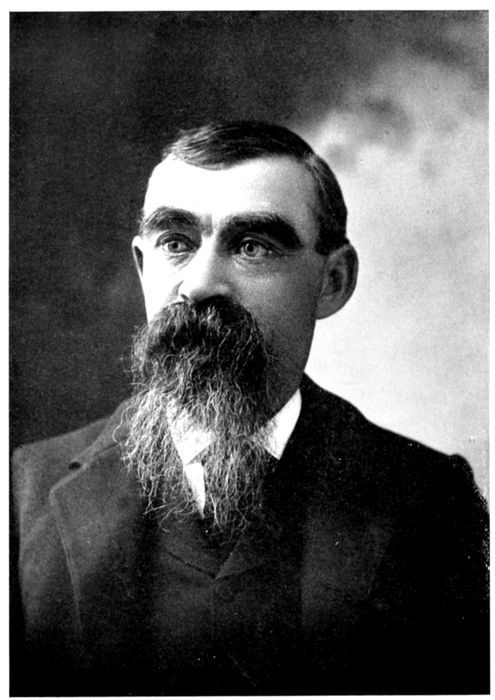
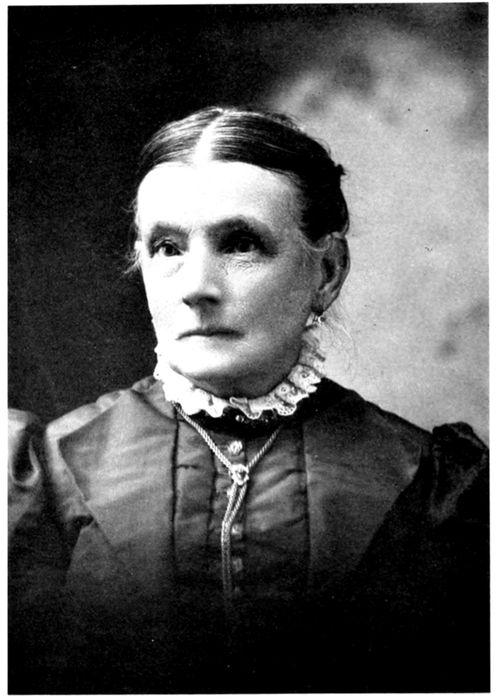
649Samuel E. received his education in the public schools of his native
county and State and early learned to perform his share of the work required
in the operation of his father’s gristmill and farm. He hauled grist from the
mill to town and to the patrons of his father’s mill and assisted in cultivating
his father’s farm when yet a boy in years. When he attained young manhood
he was associated with his father in the livery and feed business at
Camden, N. J., for a period of three years. He and his brother, Stephen,
then bought the gristmill which they operated in partnership until 1871, following
which he farmed for one year and then disposed of all of his holdings
with the intention of migrating to Kansas. He came to Atchison, Kan., with
a capital of $350 which he invested in eighty acres of improved land, costing
him $2,400. This land was but partly improved, with a modest home of
two rooms and a lean-to at the rear. He and his good wife by dint of
economy and perseverance soon managed to pay off their indebtedness and
to erect a rather pretentious dwelling, at the same time increasing their land
holdings. Their first purchase was an eighty acre tract near the home farm,
and they later bought a tract of 160 acres near Huron in Lancaster
township, which they later traded for eighty acres near Shannon.
Mr. Ballinger was the possessor at one time of 240 acres of well improved
land. As age crept upon this worthy couple they gradually disposed
of their land holdings until they retained but forty acres of the home place,
and they moved to Atchison in September of 1907, where they invested in
a beautiful suburban estate of five acres. Later, when they disposed of the
forty acre farm they added ten acres to the suburban tract which has since
become very valuable on account of its nearness to the city.
Mr. Ballinger was married September 7, 1870, to Janie Louise Paxson,
and to this union have been born children, as follows: Mrs. Evelina Lancaster,
of Severance, Kan., who is the mother of six children, namely: Samuel
E., Sarah Catharine, William Andrew, Fred, Harry and Leonard: Mrs. Sarah
Elizabeth Yaple, of Atchison, mother of children as follows: Albert, Louise,
Ruth, Esther (deceased), John, Edwin, Austin, Raymond, and Ernest, and
twin boys, Harold Paxson and Herbert Ballinger. The mother of these
children, Jane Louise (Paxson) Ballinger, was born December 2, 1844, in the
city of Philadelphia, daughter of Samuel W. and Catharine (Speer) Paxson.
Her father was the son of Irish parents and her mother was born of
German parentage. Samuel W. was a carpenter by trade who was married
in Camden, N. J., and plied his trade in that vicinity for many years. He
650served in behalf of the Union during the Civil war in a Pennsylvania regiment
of volunteers. A brother, Henry, served in the Tenth regiment of New
Jersey volunteer infantry.
Mr. Ballinger has always been a Republican in politics, but has never
taken an active part in political matters. He is a member of the Central
Protective Association. He is essentially a home man and takes a
pride in keeping his attractive home in excellent condition, and can be seen
most any day working about the grounds surrounding the Ballinger home.
Mr. and Mrs. Ballinger are a worthy couple, kind and indulgent with their
children whom they have endeavored to rear so that they might lead upright
and worthy lives in the community.
Charles William Robinson, county physician of Atchison county, assistant
surgeon for the Missouri Pacific Railroad Company, and one of the prominent
and successful members of the medical profession in northeastern Kansas,
is a native son of the Sunflower State and was born on his father’s farm
in Noble township, Marshall county, March 1, 1890, a son of William F. and
Mary (Critchfield) Robinson. His parents were born in Buchanan county,
Missouri, his father in 1853, and his mother in 1857. William F. Robinson
became a resident of Kansas in the seventies, locating in Marshall county,
where he engaged in farming and stock raising. He is one of the extensive
land owners of that county, his properties exceeding 1,200 acres. He has
been actively identified with the development of his section, is one of his
county’s most influential citizens, and has attained a secure position in its
commercial, social and political life. Mr. Robinson has been married twice.
Two children, James M. Robinson, M. D., of Hiawatha, Kan: and Lucille,
now Mrs. Dr. A. E. Ricks, of Atchison, were born of the first marriage.
Our subject, Dr. Charles W. Robinson, is the only child of the second
marriage.
Dr. Robinson received his early educational discipline in the public
schools of his native county, supplemented by a course in the Hiawatha
Academy. He subsequently completed a course in Washburn College, Topeka,
and then entered the medical department of Kansas University, from
which he was graduated with the degree of Doctor of Medicine, a member
of the class of 1913. Following his graduation, he located for practice in the
651city of Atchison, where he formed a partnership with Dr. C. A. Lilly. Shortly
after engaging in the practice of his profession, he was appointed county
physician, an unusual honor for a practitioner to receive during his first year
of practice. That he has filled the office with credit is attested by his having
been re-appointed in 1914, and again in 1915. Dr. Robinson has built up a
very lucrative practice and is recognized as one of the most able of the younger
members of the medical profession in his section of the State. The demands
of his practice have not caused him to forego his habit of study. He keeps
abreast of the advancement in medicine and surgery, and during the winter
of 1914–15 completed a post-graduate course in diseases of children at the
Nursery and Child’s Hospital, New York City. He is a member of the
Atchison County Medical Society, the Kansas State, and the American Medical
Associations. He is also a member of Orient Lodge, No. 57, Ancient
Free and Accepted Masons, of Topeka; Atchison Lodge, No. 647, Benevolent
and Protective Order of Elks; Atchison Aerie, No. 173, Fraternal Order of
Eagles, the Independent Order of Odd Fellows, Royal Arcanum, Fraternal
Aid, Kansas Fraternal Citizens, Homesteaders, Yeoman of America, and
Ancient Order of United Workmen.
Since becoming a citizen of Atchison, Dr. Robinson has taken an active
interest in those measures and projects which have had for their object the
betterment and development of the city. He also finds time to take an active
part in its social life. Dr. Robinson is unmarried.
John McInteer was a builder who had an abiding faith in the eventual
development of the West. He was a pioneer citizen of Atchison, and a prominent
figure in the city for over forty-five years, and had an intimate
acquaintance with the sturdy characters who had much to do with the development
of the Sunflower State. He came to Atchison in the days when the
great wagon trains left in a continuous, and often unbroken, stream for the
Far West with their valuable cargoes of freight. So great was his confidence
in the ultimate growth of his adopted city that he invested his savings in
real property, built of brick and stone, which are still standing in the city.
The handsome McInteer block on Commercial street is a monument to his
enterprise and faith in the growth of the city. Mr. McInteer was well and
652favorably known among the coterie of famous men who have cast luster upon
Atchison and the State of Kansas. He was a consistent and unremitting
booster for his home city and State, and the substantial fortune and good
name which he left behind prove his judgment and business acumen to have
been sound and essentially correct.
Mr. McInteer was born in Donegal, Ireland, in 1827, and immigrated to
America alone when a boy. He had heard of the wonders of the new land
across the ocean, and dreamed of one day sailing across the waters of the
broad Atlantic to the land of the free, there to seek his fortune. How his
dream came true is told in the succeeding paragraphs. His first employment
was in Philadelphia as a laborer. Opportunity did not seem to beckon to him
in the “City of Brotherly Love” sufficient to hold him, however, and he
turned his face still farther to the westward, going to the newer State of Indiana,
where he learned the trade of harness maker. He first started a business
of his own in Jeffersonville, Ind. While busily engaged in this Ohio river
town in plying his trade with a fair modicum of success, he heard of the opening
up of the vast stretches of land west of the Missouri river. His Celtic
imagination was still working and he pictured to himself the possibilities of
realizing his ambitions in one of the new cities of Kansas. His decision was
soon made; he heeded the famous Greeley’s advice, “Go West, young man, go
West, and grow up with the country.” Accordingly, he sold out his little
shop and started for Omaha. On the way up the Missouri river his wife
was taken ill and he changed his plans to the extent of stopping in Doniphan
county, Kansas, and taking up a homestead. One year later he traded his
claim for a lot at Eighth and Commercial streets in Atchison. Upon this
lot he built a small shop, where he again began the manufacture of harness
and saddles. For several years he supplied the great overland trains which
passed to the Far West. His trade grew and he was compelled to enlarge his
quarters and engaged in the manufacture of harness and saddles on an
extensive scale. As he prospered and accumulated capital he erected buildings
and invested in real estate in Atchison and the nearby city of St. Joseph.
He also erected a modern brick residence where his widow now lives. He
died July 17, 1901.
He was twice married, his first wife being Alice Conley, who died in
1892 without issue. In 1895 he married Mrs. Anna (Conlon) Donovan, of
Montreal, Canada, whose parents, James and Anna Conlon, were well known
citizens of Atchison, and whose personal history will be found in the biography
of Charles J. Conlon, brother of Mrs. McInteer. Mrs. McInteer was reared
653in Atchison, returned to New York with her parents, and was there married
to Peter Donovan, who was a customs officer under the Canadian Government
at Montreal. He died in Montreal in 1891. Three sons were born of
this marriage: Peter Donovan, a widely known journalist, of Toronto, now
a contributor to the Toronto Saturday Night; Fred, in the insurance and real
estate business in Atchison; Charles, a farmer and stockman, residing with
his mother.
Mr. McInteer was a member of the Catholic church, and a liberal contributor
to his own and other religious denominations. He was one of those
big-hearted, whole-souled gentlemen, who was a friend to all, and who was
highly regarded for his many excellent qualities of heart and mind. He was
independent in politics. The foregoing brief review is thus contributed to
the history of Atchison county in order that it be placed on record for all
time, and perchance, prove an inspiration for other young men, poor in purse,
whose destiny is yet to be worked out, and who probably dream of accumulating
wealth or a competence in their generation.
A review of the educational institutions of Atchison county would be
incomplete without mention being made of the Loudenback School of Music.
It is probable that no institution within the borders of the State of Kansas
has had a more rapid, substantial and satisfactory growth than has the school
under the direct supervision and management of Professor Loudenback.
Established in 1912 as a school of piano and theory, enlarged in 1913, and
incorporated in 1914, it is now authorized by the State to issue diplomas and
certificates. It is rapidly building an enviable reputation for thoroughness
of instruction, having graduated pupils who are conceded to be artists of
recognized ability, and its importance as an educational institution of the
highest grade is appreciated by the residents of its home city.
Henry Hanson Loudenback, founder and principal of the Loudenback
School of Music, was born in a log cabin on his father’s farm in Hancock
county, Indiana (the county seat, Greenfield, being the birthplace of James
Whitcomb Riley), March 17, 1879, a son of Daniel and Margaret (McCray)
Loudenback. His paternal grandparents were Henry Loudenback, a native
of Pennsylvania, who came to Hancock county, Indiana, in 1836, one of the
654early pioneers of that section, and Elizabeth Brown, a native of Virginia, of
German ancestry. Daniel Loudenback was born in Hancock county in 1846
and reared in a district which at that time was almost a wilderness. Splitting
rails was an occupation which took up a good portion of his time. With his
father, he settled on a farm about three miles from Charlottesville. This
property they developed into a highly productive farm. Henry Loudenback
died in 1905. Daniel engaged in business in Charlottesville in 1882, and in
1883 established a store at Wilkinson, which he conducted until his death, in
1888. He had married, when a young man, Margaret McCray, now a resident
of Wilkinson, who survives him. They were the parents of two children:
Henry Hanson, the subject of this review, and Allie Almeda Cook, of
Wilkinson, Ind.
Henry Hanson Loudenback received his educational discipline in the
public schools of his native State, and in 1898 came to Kansas and joined
relatives who resided near Centralia. He became a teacher in the country
schools, and later spent one year teaching music, going from place to place
on horseback. From early childhood he had given evidence of remarkable
musical ability, and had sung in public when only four years of age. After
learning harmonies from his sister, he began to improvise his own melodies,
and to harmonize them upon the reed organ. His first real lessons were
taken when thirteen years of age. In the fall of 1901 he entered Campbell
University at Holton, Kan., and was graduated from that institution, in
music, in 1902. Since receiving his degree from Campbell College he has
studied piano, harmony and composition with the best teachers of these subjects
in America, his training being under such noted musicians as Fannie
Bloomfield Zeisler, of Chicago, the world’s greatest woman pianist; Mr.
and Mrs. A. K. Virgil, of New York City; Peter C. Lutkin and Arne Oldberg,
of Northwestern University, at Evanston; and Allen Spencer, of the
American Conservatory of Music, Chicago. From 1902 until 1906 he was
director of music in the Atchison County High School; from 1906 until 1910,
professor of music in South Dakota State College of Agriculture and Mechanical
Arts; from 1910 until 1912, director of piano, pipe organ, and musical
theory at the Dakota Wesleyan University. In 1912 he founded the Loudenback
School of Music at Atchison, and since its establishment has devoted
his entire time to its management and the teaching of piano and musical
theory. He is an accredited teacher of piano and theory by the Kansas State
Music Teachers’ Association, and was a member of the executive committee
of that organization which issued certificates to accredited teachers in December,
6551914, and was appointed a member of the committee on piano standards
for 1915, and in December, 1910, was elected vice-president of that association,
and was appointed a member of the special accrediting committee. He
has appeared twice as piano soloist with the Minneapolis Symphony Orchestra,
and numbers among his friends many of the great musicians of the
present day.
Professor Loudenback married on June 28, 1900, Miss Flora Donald,
a daughter of George and Christy (Black) Donald, of Centralia, Kan. Her
father was an early settler and prominent farmer.
Professor and Mrs. Loudenback are the parents of the following children:
George Daniel, born November 23, 1901; Allie Mae, born March 12,
1904; Ramona Lolita, born July 25, 1905; Henry, born August 17, 1907;
and Donald, born July 19, 1909. The children have inherited their father’s
love of music and show talent.
Frank P. Wertz, deputy county clerk of Atchison county, is one of the
progressive young men of the county. He was born at Parnell, Atchison
county, September 2, 1888, and is a son of David M. and Elizabeth
Caroline Wertz, natives of Pennsylvania. They were married in their native
State and shortly afterwards came West, and located on a farm in Atchison
county, where they have been very successful. David M. Wertz began life
with nothing, and by industry and keen foresight has become one of the substantial
and well-to-do men of Atchison county. He has always taken a commendable
interest in the welfare of his community. To David M. Wertz
and wife have been born the following children: Frank P., the subject of
this sketch; Eva married H. J. Barber, a banker, of Cummings, Kan.; Abraham,
a farmer and stockman, Mt. Pleasant, Atchison county; Fredrick, a
farmer in Mt. Pleasant township, Atchison county; Rosetta, the wife of Fred
C. Voelker, a farmer, of Shannon township, Atchison county, and Bertha E.,
who resides at home.
Frank P. Wertz was reared on the home farm in Atchison county and
educated in the public schools, graduating from the Atchison County High
School. He then took a course in the Atchison Business College, and graduated
in 1909. He then became assistant cashier of the State Bank of Cummings,
656and remained in that position for two years, when he resigned to
accept his present position. Frank P. Wertz takes a live interest in the welfare
of the community. He is a member of the Masonic lodge and the
Ancient Order of United Workmen. He is a popular county official, and
his genial manner and obliging nature, coupled with efficiency and close
application to the duties of his office, have won for him many stanch friends
and supporters.
For sixty years Thomas L. Cline has lived in Mt. Pleasant township,
Atchison county, and he is one of the oldest of Kansas pioneers in point of
years of residence in the State. Coming to this county when he was ten
years of age with his parents he has lived to see Kansas become prosperous
and the vast prairie transformed by the hand of man into a truly good place
to live. He, himself, has risen in the course of time to become one of the
wealthy farmers of the county, and despite his three score and ten years of
age he still oversees the work on his large farm of 320 acres.
Mr. Cline was born October 8, 1845, in Henry county, Iowa, a son of
Henry and Eleanor (Leanord) Cline, both natives of Ohio. The parents of
both Henry and Eleanor moved at a very early day from Ohio to Illinois,
where they were married. The parents of T. L. Cline lived but a short time
in Illinois and then removed to Henry county, Iowa, where four of the children
were born, of whom T. L. was the youngest. The family lived in Iowa
for sixteen years and came to Kansas as early as 1855. Henry settled on a
quarter section of land, which is still in the family, and is owned by Thomas
L., adjoining the quarter section upon which the home of the subject is
located. At the time the Clines located in Atchison county the country was a
vast reach of unpeopled prairie broken by belts of timber along the streams.
Prairie fires were very common in those days. Henry Cline persuaded a
neighbor to preëmpt the adjoining section to his and eventually bought it and
increased his acreage to 480 acres in all. An interesting feature of the Cline
farm is the stone fencing which is built around a portion of the farm. Stone
fences are a rarity in Kansas and are found only in the occasional places where
stone is plentiful, and their building required time and plenty of it on the part
of men who in the early days made the building of stone fences a vocation
and followed it as their method of earning a living. While a portion of the
stone work on the farm has been replaced by wire fencing, 300 rods of this
657fence are in excellent condition despite the fact that it was erected over forty-five
years ago. T. L. Cline in speaking reminiscently of the old days recalls
that the “grasshopper” visitation of 1866 was every whit as bad as in the years
of 1874 and 1875, and he also recalls seeing a company of “red shirts” or
border ruffians encamped near his father’s farm. Henry Cline died in 1875,
his widow dying in 1901 at the home of her daughter, Mrs. Mary E. Blodgett.
Henry and Eleanor Cline reared the following children: Julia Ann (Jay), deceased,
at Rock Creek, Kan.; Mary E. Blodgett, Walnut township; Charles W.
died in Union service at Drywood, Mo., and Thomas L., the youngest.
T. L. Cline grew up on his father’s farm and has never lived anywhere
else since he was ten years of age. He was married in 1874 to Miss Susan
Vandiver. The following children were born of this marriage: Ora, wife of
Edward Bradley, of Atchison county; Nellie, wife of Martin Decker, living in
Leavenworth county, Kansas; Charles Cline, farming on the home place; T. L.,
Jr., better known as Lloyd, at home with his parents and assists in farm work.
The mother of these children was born February 11, 1853, in Green county,
Wisconsin, a daughter of Edward and Irene (Holloway) Vandiver, the
former a native of Kentucky and the latter of Providence, R. I. The respective
parents of Edward and Irene Vandiver removed from their native states
to Illinois, and it was in that State that they were married. Shortly after
their marriage they moved to Wisconsin and settled on a farm near Monroe,
in Green county. They resided in Wisconsin for sixteen years and then returned
to Schuyler county, Illinois. After a residence of ten years in Illinois
they came to Atchison county, Kansas, to make a permanent home. Edward
Vandiver was a personal friend of Abraham Lincoln and often rode with Lincoln
to and from political gatherings. His political beliefs were the same
as Mr. Lincoln’s. Mr. Vandiver was also acquainted with Stephen A.
Douglas and attended the famous Lincoln and Douglas debates.
For one year after their marriage Mr. and Mrs. Cline lived at the home
of Mr. Cline’s parents, when T. L. built a home for himself on a part of the
family estate. After his father’s demise he bought his mother’s interest in
the estate and moved to the old home place where he still resides. Mr. Cline
has always been a stockman and a large feeder of cattle and hogs. He is now
raising sheep and has about 140 head of these animals on his farm. He has
always been a stanch Republican, as his father was before him, and has usually
taken an active part in political and civic affairs. He served for many years
as a member of the school board and was succeeded by his son, Charles, as
a member of the board when T. L. refused to serve any longer. He was one
658of the organizers of the Farmers State Bank of Potter, Kan., and is generally
found in the forefront of all good movements tending to promote the welfare
of the people in his neighborhood. Mr. Cline carries his years lightly and can
be seen almost any day directing the farm work and is very active for his
years. Thomas L. Cline is one of Atchison county’s grand old men and is a
true Kansas pioneer.
In the present incumbent of the county assessor’s office, the people of
Atchison county are extremely fortunate in having a painstaking, faithful
and conscientious public servant who believes in doing his duty by the people,
taxpayers, and for the people as the law provides. It is probable that no other
individual in the county has a wider or more intimate knowledge of values
and property ownership in Atchison county than Mr. Forbriger. Born in
Atchison county in the pioneer days when the county was in process of early
settlement, he has grown up with the city and county and has a speaking acquaintance
with almost every person within the confines of his native heath.
Kind and obliging to a high degree, he has made himself invaluable as a
citizen and able county official, and is well liked and highly esteemed for his
many excellent qualities.
The father of the gentleman named in the foregoing paragraph was
Robert Forbriger, a native of Saxony, Germany, born in 1825, immigrated to
America in 1848 and died in the city of his adoption in 1886. The senior
Forbriger was a man of good education, and came of a family of scholars
and educators in his native land. Therefore, he was well equipped to fight
a winning battle for success in the land of his adoption. He first located in
Elgin, Ill., and after a residence of ten years in that city, came to Atchison
in 1858. This thriving and beautiful city was then in its infancy, and Mr.
Forbriger had the distinction of being one of its foremost citizens and builders
in the early days. He obtained a job in the J. E. Wagner hardware store,
which was situated on the southeast corner of Fourth and Commercial streets.
Not long afterward he engaged in the insurance and real estate business and
from that drifted into the banking business. He, with George Storch and
John Belz, established the German Savings Bank, which was later reorganized
as the United States National Bank. This new organization erected the
building at the corner of Sixth and Commercial streets. Mr. Forbriger was
659connected with the banking concern until his death, after which the institution
was again reorganized. He was active in civic and business affairs in
Atchison during his long residence here, and was always a booster for his
adopted city, liberal in his donations and support of public enterprises, and
a benefactor of churches and charitable enterprises. It is said of him that
he always generously responded to calls for assistance in the name of charity,
religion or civic betterment of the community. As a citizen he did his duty
in an official capacity, serving as a member of the city council and as an active
member of the city school board. During the early sixties when Atchison
was yet a village he served as a member of the town council. In addition he
served three terms as city assessor. While a Democrat in politics, he was a
great admirer and warm personal friend of the late Senator Ingalls, and it
was the Senator’s custom to make his headquarters in Mr. Forbriger’s office
while at home, on his return from Washington. This pioneer citizen was a
charter member and officer of the Turner’s Society, a famous athletic organization
in the early days. He was reared in the Lutheran faith, but was
broadly tolerant of all creeds and religious beliefs. It was only natural that
he should have been a charter member of the Atchison Masonic lodge, and the
Independent Order of Odd Fellows. During the Civil war he was enrolled
as a member of the State militia, and responded to the call for volunteers
to repel Price’s invasion and served in Colonel Quigg’s command.
Robert Forbriger, the elder, was married in 1862 to Helen Geier, born
in Limbach, Baden, Germany, and died in Atchison. She came from her
native land to Philadelphia with a sister and cousin, and from there journeyed
to Atchison. To them were born three children as follows: Robert, of this review;
Emil, engaged in business in East Atchison; Bertha, wife of M. Noll,
druggist of Atchison.
Robert Forbriger, the son, was educated in the public schools and St.
Benedict’s College. He then entered his father’s bank and also engaged in
the insurance business. After his father’s death he continued in the insurance
business for a number of years, until he began his service as postoffice
clerk, during Cleveland’s administration. After four years in the mercantile
business he filled the office of deputy register of deeds for four years; served
three years as deputy county assessor, and was elected to the office of county
assessor in 1912, and again elected or appointed to the office by the board of
county commissioners in 1914. In his younger days he served several years
as a regular fireman under three successive fire chiefs, and two terms as city
councilman. While originally a Democrat, he deserted the party in 1896, as
many others did, to follow the teachings of William McKinley, and now takes
660an active part in Republican politics, and is sincere and active in his work in
behalf of the candidates of his party. Having been born in Atchison, April
4, 1863, it is only natural that he should gather for his sustenance some of
the needful in the way of property, and is the owner of a fine fruit farm of
twenty-eight acres near the city, and in addition has five residence properties
in the city, with properties in Oklahoma and Seattle, Wash.
Mr. Forbriger was married May 21, 1888, to Carrie Wagner, and to them
have been born two children: Helen, wife of Leo T. Markey, a banker of
Greeley, Kan.; Ralph, a student of electrical engineering in the Mississippi
Agricultural and Mechanical College, at Starkville, Miss. The mother of these
children was born at Port Washington, near Milwaukee, and is a daughter of
Henry and Rosa Wagner, natives of Germany, who removed from Milwaukee
to Atchison where Henry Wagner became a bridge contractor and builder.
Mr. Wagner for a long period of years did practically all of the bridge construction
work in Atchison county.
Mr. Forbriger is a member of St. Benedict’s Catholic Church, and is
broad and tolerant in his religious views, taking the staple ground that the
manner of life a man lives, regardless of his religious belief, determines his
salvation. He is affiliated with the Modern Woodmen, the Ancient Order
of United Workmen, the Fraternal Citizens, and the Modern Brotherhood of
America.
The measure of a man’s real worth to a community determines his standing
and niche in the local hall of fame. While several things may be summed
up in the final reckoning as to what constitutes a really useful citizen, his
service to his fellow citizens in furthering institutions which are of the greatest
benefit to the greatest number takes precedence over wealth, business
ability, political success, or any accomplishments which have a tendency to
place the individual ahead of his fellow men. No greater service to a city
can be rendered than by the building up of a modern, progressive public school
system. He who furthers the cause of education in a practical manner and
takes a keen interest in the success of the city’s educational systems, as an unselfish
task, befitting his citizenship, is entitled to an everlasting place in the
hearts and minds of his fellow citizens. The public school system of Atchison
is a monument to the labors of Hiram H. Hackney, and his fellow members of
the board of education during the eight years while Mr. Hackney served as
president of the board.
661Hiram H. Hackney is a native of Fayette county, Pennsylvania, born
near Uniontown, November 30, 1859. He is a son of Hiram H. and Elizabeth
(Wyley) Hackney, both natives of Pennsylvania. The Hackney family in
America came originally from the town of Hackney, England, now a part
of the city of London, in the early part of the seventeenth century. Hiram
H., the elder, was born in 1822, and died in 1899. He was the son of John
Hackney, born in 1776, and lived on the original homestead of the Hackneys,
who were Quaker followers of William Penn. Elizabeth Wyley was
born in 1830, a daughter of Jacob and Hannah Way Wyley, members of
an old colonial family of Irish descent. Hiram H., Sr., was a resident of
Uniontown in his old age, and was the last surviving member of the board of
directors, chartering the First National Bank of Uniontown. He was well
to do and invested some of his funds in the West, becoming one of the
original stockholders of the First National Bank of Atchison. He was also
a “Forty Niner,” going overland to the gold fields of California in 1848, with
a train of fortune hunters who outfitted at St. Louis and fought continually
with the Indians on the trip across the plains and mountains. He engaged in
the mercantile business at Sacramento and Marysville, Cal., for a period of
two years. He returned home by way of Cape Horn, but made another trip
before settling down to the pursuit of farming and business in his native
State. His brother, Samuel, died of mountain fever while engaged in mining
in the gold fields of California. Mr. Hackney became an extensive farmer,
stockman and banker, and prospered exceedingly. He was known as a solid
Quaker citizen “whose word was as good as his note.” Of his five children,
four are living as follows: Mrs. Edward G. Hudson, of Newton, Kan.; Edgar
S., of Uniontown: Dr. Jacob S., a practitioner in Uniontown, and Francis,
who died in Pittsburgh.
Hiram H. Hackney, of Atchison, was educated in the State Normal
School at California, Penn., and Duff’s Mercantile College, Pittsburgh. He
did farm work while a youth, and taught school for two years. His father
having purchased an interest in the First National Bank of this city he came
here in 1881 and served as assistant cashier and director of the bank until
1910. He then sold his holdings and retired from banking pursuits on account
of ill health, due to long years of close confinement to his duties. He
then established a real estate, insurance, bond and loan business which he is
now conducting with success. Mr. Hackney is interested in Atchison real
estate, and coal lands in Pennsylvania, and is vice-president of the Blair
Milling Company of Atchison.
662In politics he is a Republican, and the only office he has ever held has
been that of member of the board of education, from the presidency of which
body he has only recently retired. Of his services on behalf of the public
schools during his sixteen years’ membership on the board. The Atchison
Globe said: “H. H. Hackney retired last night as a member of the school
board and that board has lost its most useful member for at least two reasons:
Mr. Hackney had the ability to handle the school finances and the time necessary
to accomplish the things the board laid out. In addition he possessed
an ambition to establish a system of schools and equipment that would reflect
credit on the city and on the school board. He was a member of the board
for sixteen years and its president for eight years, and during the eight years
he was president he never had a disagreement with a member and there was
never a question came up which was not settled either by an unanimous vote
or in a way that left the members friendly. There never was a ‘row’ in the
school board and there never was a session where reporters were barred. In
the last eight years and under the management of Mr. Hackney, the school
board has spent $300,000 in school betterments and the total indebtedness is
but $25,000 greater than it was eight years ago. This includes the new
Ingalls Building, Washington Building, accepting the plans and letting all
contracts for the new Martin building, now under course of construction, rebuilding
Franklin and building the new Douglas school. In these eight years
manual training, mechanical drawing, domestic art and science, a commercial
department, normal training, agriculture and physical training have been
added to the high school, a school nurse employed, music added to all grades
and kindergartens established in two buildings. Since Mr. Hackney became a
member of the board the high school enrollment has increased from 66 to 338
and the faculty from three to twenty members.”...
During the time Mr. Hackney was a member of the school board he
missed but one regular meeting. He is president of the board of trustees of
the First Presbyterian Church and is a member of the board of directors of
the Young Men’s Christian Association.
He was married in September of 1888, to Frances Blair, a daughter of
E. K. Blair, deceased, formerly of Fayette county, Pennsylvania, founder of
the Blair Milling Company of Atchison. Mrs. Hackney’s mother was Barbara
(Allen) Blair. She was born and reared in Atchison, in the house located
on the same lot where the Hackneys now live, with the exception of
their first two years of married life, during which the new home was erected
at 1021 North Third street. To Mr. and Mrs. Hackney have been born
two children of whom they are justly proud, Helen Elizabeth, born 1890, a
663graduate of the College Preparatory School of Atchison, and the Bennett
School for Girls, located on the Hudson, in New York, carrying honors at
both her graduations; Edward Blair Hackney, born in 1893, is a graduate
of the city high school and the Kansas University at Lawrence, where he received
the degree of Bachelor of Arts. While a student of the university
he managed the Jay Hawker, the college annual, and performed his duties so
ably and so thoroughly that Chancellor Strong declared that the “Annual”
issue under his management was the best ever issued, the cost of which was
$4,500, and managed so well that a nice profit was earned. The young man
is now a traveling salesman for the Blair Milling Company.
George Edwin White, leading physician, of Effingham, Kan., was born
at Savanna, Andrew county, Missouri, April 18, 1867, a son of Willis and
Rachel (Hall) White, natives of Indiana. Willis was the son of Drury
White, who was born and reared in Virginia, and was a pioneer settler in
Grant county, Indiana, where he hewed a farm and home from the virgin
timber at a time when it required men of hardihood and the greatest
endurance to withstand the rigors of a life in the unbroken wilderness of
the Hoosier State. Willis White was born August 12, 1840, and when
he attained young manhood, hearkened to the call of President Lincoln for
troops to quell the rebellion of the Southern States, and enlisted at the first
call for “thirty thousand.” He served for ninety days in the Tenth regiment,
Indiana infantry. He migrated to Missouri in 1866 and plied his trade of
blacksmith in the town of Savanna until 1880, when he moved to Greenleaf,
Kan., and conducted a blacksmith shop, in addition to cultivating his farm,
which he purchased near Greenleaf. In the fall of 1907 he moved to Effingham,
Kan., and is living a retired life. Mrs. White died in 1885, at the age
of forty-three years. Twelve children were born to Willis White and wife,
four of whom are deceased: John, Henry, and Mary, deceased; Frank, for
several years a practicing physician of note in Effingham, and who died in
October, 1912, as a result of an accident; Charles, of Kansas City; Dr. George
Edwin, with whom this narrative is directly concerned; Albert H., a farmer,
in Dickinson county; Mrs. Dora Hill, of Kansas City; William, living in
California; Mrs. Laura Shields, of California; Elmer, a farmer, of Jackson
county; Leroy, a farmer, of Effingham. Willis White was twice married,
664his second wife being Elizabeth Heavenridge, of Indiana, who bore him six
children: Julia, employed in the Soldier’s Home at Leavenworth, Kan.; Herman,
a farmer in western Kansas; Earl, of Effingham; Edith, at home;
Ralph, also at home, and a child who died in infancy.
George Edward White received his elementary education in the public
schools, studied three years in the Kansas Medical College at Topeka, and
graduated from the Medical University at Kansas City in 1905. For a period
of five and one-half years he practiced medicine in Dickinson county, Kansas;
practiced for two years in Brown county, Kansas, and located in Effingham
in the fall of 1912.
Dr. White was married in 1895 to Sadie A. Phillippi, who died in 1911,
leaving five children, namely: Willis, George, Lester, Birdie, and Harold, all
of whom are at home and attending the public and high schools. One child,
Ralph, died in infancy. Dr. White again married in 1912, to Ada M. Elliot,
a capable and talented woman, who is a good and kind mother to the doctor’s
children.
Dr. White has achieved a reputation as a well read and capable practitioner,
and his practice in Effingham and the surrounding country is constantly
growing. He keeps abreast of the times and the latest discoveries in
the science of healing, and is associated with various important medical societies,
among them being the county, State, and National societies, the Golden
Belt, and the Northeast Kansas Medical association, the Aesculapian
Society, and the University Medical College of Kansas City Alumni. He is a
member of the Church of the Brethren, and is fraternally connected with the
Knights of Pythias, the Knights and Ladies of Security, and the Mystic
Workers. He is a Republican, but has very little time for political affairs.
Dr. White is a genial, whole-souled gentleman, who loves his profession and
his fellowmen.
George W. Thompson is one of the oldest pioneers living in the State of
Kansas, and is all probability the oldest living pioneer in Atchison county
today. His career has been an interesting and even romantic one, and reads
like a tale from modern fiction. Homesteader, farmer, statesman, politician
and man of wide influence are terms which can well be applied to this aged
gentleman who has spent sixty-one years of his four score and eight in assisting
in the development of the Sunflower State.
George W. Thompson and Wife
One of the Oldest Pioneer Couples in Atchison County
665George W. Thompson was born in Georgetown, Ky., October 18, 1827,
a son of Benjamin and Nancy (Baxter) Thompson, natives of Virginia and
Maryland, respectively, and descendants of old southern stock. Benjamin
Thompson was born in Virginia in 1799, the same year in which George
Washington died. He was a son of George Thompson, who removed from
Virginia to Kentucky in 1811, walking the entire distance over the Blue Ridge
mountains to the new home in the forests of Kentucky, where they lived until
1843, and then joined the influx of settlers who were going into Platte county,
Missouri. The Thompsons loaded their entire effects on wagons and drove as
far as Frankfort, Ky., and then boarded an Ohio river steamer which carried
them to St. Louis. An interesting episode of this trip concerns the passage of
the boat over the falls at Louisville, Ky., or five miles below that city. At
that time the water was very high in the river, and the captain of the steamer
decided to take a chance and go over the falls. During the passage the
pilot’s steering gear broke and the boat drifted over the falls without guidance
in safety, but not without expressions of fear on the part of the passengers.
This boat was the “Meridian,” one of the fast steamers of the river,
and it frequently raced with other river craft. The trip required about three
days from Louisville to St. Louis, which was at that time a city of about 50,000
inhabitants. Mr. Thompson recalls that the boats were lined up along
the wharfs at St. Louis for over one and one-half miles, and he has never forgotten
the sight. About five days longer were required to make the trip
from St. Louis to Parkville, Mo., the trip ending on June 14, having commenced
June 1, 1843. Benjamin plied his trade of bricklayer in Platte
county, and built the Green Hotel in Platte City, which is still standing as a
monument to his skill and handicraft as a mason. He was the first brick
mason in Platte City and he erected the Green Hotel in 1844. Benjamin
became prominent in the affairs of Platte county and was a fine orator and
public speaker.
For many years he was an active and influential figure in the political
life of Platte county, and he was a poet who left many evidences of creative
literary ability which are still prized among the archives of the county. He
resided in Missouri until 1860 and then came to Kansas where he spent the
remainder of his days, dying in Mt. Pleasant township in 1862. His wife
survived him and lived to an advanced age, dying in 1892, having been born
in Rosamount county, Maryland, near Curlew. They reared a fine family
of nine children, of which George W. was the third child.
George W. Thompson, with whom this review is directly concerned, grew
to sturdy manhood in old Kentucky, and was educated in the neighborhood
666schools. Since boyhood, he has been a student and is at this day one of the
best read men of his generation. He learned the trade of bricklayer under
his father and followed the trade while living in Missouri. As early as
1854 he came to Kansas, on the day following the passage of the Kansas-Nebraska
act which threw the Territory open to settlement. He came up
the Missouri river in a small boat and landed at the mouth of Nine Mile
creek in Leavenworth county. After investigating the possibilities in this
county, he filed upon a Government claim and went back to his home in Platte
county, returning in January of 1854 to erect a log cabin. This erected, he
again went home, returning in November and roofed his cabin with clapboards
made by him and his brother, and built a stone chimney and daubed
the chinks with mud. He located permanently on his claim January 15,
1855, and on his way nearly lost his oxen in the river. In the meantime a
man named Dunham had jumped his claim, and it became necessary for him
and Dunham to compromise matters and divide the land which was considered
valuable because it had a very fine spring of good, pure water available. Two
years later Mr. Thompson sold his claim and entered 160 acres of land in
Mt. Pleasant township, Atchison county. He moved to Atchison June 14,
1856. He developed this farm and lived on it for forty-eight years, or until
1914, when he came to Atchison to reside with his daughter, Mrs. Keats.
Mr. Thompson was married in Missouri in 1850, to Rebecca Stigers, a
native of Knox county, Ohio, born April 18, 1831, a daughter of Conrad Stigers,
a native of Germany. The mother of Mrs. Thompson was Mary Snell
Stigers, who was born in Virginia, of French parents, and whose father was
shipwrecked on the coast of Virginia. She was a direct descendant of the
famous French family of D’ Estang, and her father was a connection of Count
D’ Estang. To Mr. and Mrs. George W. Thompson were born nine children:
Benjamin T., born October 11, 1850, in Missouri, and died March 12, 1902;
Mary Katharine, born October 2, 1854, wife of Asa Barnes, of Mt. Pleasant
township, Atchison county; John Emmet, born February 17, 1857, in Atchison
county, and now residing in California; Harriet M., born April 2, 1859,
wife of T. M. Grant, Atchison county; Louis T., born May 8, 1861, died May
1, 1864; Mrs. Dora T. Keats, born March 21, 1864, wife of H. T. Keats, of
Atchison; George McClelland, born May 20, 1867, a farmer, Mt. Pleasant
township; Clara Thompson, born September 5, 1870, and Albert T., born
October 5, 1873, died in infancy.
The Thompson family is one of the oldest in America and is of English
origin. The founder of the family came to Virginia with Capt. John Smith
in 1607, and through the marriage of John Rolfe with Pocahontas, the
667princess daughter of old King Powhatan of the Indian tribes of Virginia, the
family and successive generations claim to have Indian blood in their veins.
They are or were connected with the famous Pickett family, of whom General
Pickett was a member. It will thus be seen that on one side the present members
of the family can lay claim to being descended from the nobility and on
another to being descended from an Indian princess and one of the earliest
of the old Virginia gentlemen. It is not to be wondered that the founder of
the family in Atchison county has made such a fine record during his long
residence here.
Mr. Thompson has always taken an active and influential part in the
political affairs of Kansas, and has been a life-long Democrat. He has the
unique distinction of having voted for but one candidate who was elected
President, and that was Franklin Pierce in 1852. This is probably due to the
fact that he has always been independent in his voting, and acted upon his
own convictions when it came time to cast his ballot. His last vote was cast
for Theodore Roosevelt. When Populism was in vogue in Kansas he voted
for the Populist candidate for President. It was only natural that he himself
become a candidate for office on account of his education and the inherent
gift for leadership. He served as a member of the Kansas legislature at the
sessions of 1867, 1868 and 1869, and has been a candidate a few times since.
At another time, early in his career, he was elected superintendent of public
instruction in Atchison county, but refused to serve, and sent in his resignation.
His last candidacy for the legislature was given him by the fusion of
the Populists and Democrats, but he was defeated by White by a very small
majority. During the campaign of 1866, he was asked to become a candidate
for the legislature by many Republican friends and upon the advice of
his many friends in the county, he cast his votes for both Ross and Pomeroy
for the positions in the United States Senate. It is a matter of history that
both Ross and Pomeroy were elected to represent Kansas in the United
States Senate, Ross subsequently making himself very conspicuous by voting
against the impeachment of Andrew Johnson.
This fine old pioneer was also a soldier in the Civil war, and served as
first lieutenant of the company commanded by Capt. Asa Barnes in the
battle of Westport. Mrs. H. T. Keats, daughter of Mr. Thompson, has in
her possession a number of interesting souvenirs of this battle, among them
being the belt buckle, and bayonet worn by her father in the battle, and the
company’s flag, Captain Barnes’ shoulder straps, and James Binkley’s cap
box, in addition to having some of the Government scrip, with which the
soldiers were paid. The colonel of the Twelfth regiment was Colonel Louis
668L. Treat, another member of the company being T. L. Cline. Very few of
the members of this company or regiment are now living.
On October 8, 1915, this noted old pioneer was eighty-eight years old
and still vigorous, mentally. His power of thinking is not much diminished,
and he is still a reader and student. Constant reading and thinking, we are
told, is conducive to longevity and Mr. Thompson has always been a great
reader and student of history and philosophy. He is a man, self-made and
self-taught, and is blessed with a keenness of intellect far above the average.
His life has been a well rounded and useful one, and he has had a career of
which he and his children and grandchildren can well be proud. His long
life has been clean and for years he has been a stern advocate of temperance
and has practiced his own belief. In his younger days he was a noted and
powerful orator who had the ability to thrill and sway his hearers. Few men
can look back over a longer vista of years, well spent in honest pursuits, and
in behalf of his fellow men than George W. Thompson. All honor to him
as the oldest and most distinguished living pioneer of Atchison today.
B. F. Tomlinson, deceased, was a pioneer merchant and meat packer
of Atchison, and left behind him an imperishable record for honesty and fair
dealing, which has never been surpassed in the mercantile history of the city.
He was born December 25, 1838, in Covington, Ky., a son of Leroy Tomlinson,
who was also a native of Kentucky. The mother of B. F. Tomlinson
died when he was a small boy, and as a consequence little is known regarding
her antecedents. The Tomlinsons are a very old American family. Leroy
Tomlinson was a commission merchant and meat packer, who later removed
from Covington to Louisville, Ky., and became prominently identified
with the business interests of that city. He conducted a large packing
establishment and handled as high as 100 beeves at one time in his
abattoirs, wholesaling the product of his packing houses to meat merchants
in the cities and towns bordering the Ohio river.
B. F. Tomlinson, with whose career this review is directly concerned,
was reared and educated in the city of Louisville, Ky., and when he was but
fifteen years of age his father died, his stepmother dying one year later. Being
an only child, he was left with the responsibility of his father’s extensive
business. The excellent training which his father had given him, here came
669into good stead, and he carried on the packing business successfully, paying,
in the course of time, a considerable indebtedness which his father had incurred.
After his marriage in Louisville in 1860, he continued to conduct
his business in Louisville until 1870, at which time he disposed of his possessions
and came to Atchison. Here he engaged in the butcher and packing
business, and soon held a prominent place in the mercantile life of the
city.
B. F. Tomlinson was married September 11, 1860, to Miss Elizabeth
Alexander, who was born May 11, 1840, in Bedford, Ind. She was a daughter
of Robert M. and Emily (Legrant) Alexander. Her father was a coach-maker
by trade, and removed from Bedford, Ind., to Louisville, Ky., where
he died in 1900, at the age of eighty-nine years. Much interesting history can
be narrated concerning the mother of Mrs. Tomlinson, who was born in New
Orleans, and was one of three children born to her parents, who were of
French origin. The elder Legrant was a drygoods merchant in the southern
city, and the story goes, that on one of his regular trips to Cincinnati, Ohio,
to buy a stock of goods for his store, he left two of the children at home, and
on arriving in Cincinnati he placed Emily in charge of a Scotch family by
the name of McDonald, and with whom he had been in the habit of stopping
while on business in Cincinnati. Emily at that time was twelve years of age,
and was a prime favorite with the McDonald’s who begged her parents to
leave her at their home during the time which would elapse until Mr. and
Mrs. Legrant made their next trip from New Orleans to Cincinnati. They
did so, but sad to relate, the little girl never saw nor heard from her parents
again, and what became of them she never learned, and she was consequently
reared to womanhood by the kind foster parents. In an earlier year than
this at New Orleans, and at a time when Emily’s father was very sick with
rheumatism, a band of over one hundred Indians was encamped near the
Legrant home at New Orleans. One of the other children was also afflicted
with cancer of the face. The medicine men of the Indian tribe effected a
cure of both the cancer and the father’s rheumatism. The Indians were very
affectionate toward Emily and called her the “pretty squaw,” which was
only natural, as she grew up to become a very beautiful woman, eventually
becoming the wife of Robert M. Alexander, and after her husband’s demise,
made her home with her daughter at Atchison, where she died in November
of 1904, at the advanced age of eighty-nine years.
B. F. Tomlinson died in January, 1895. Mr. and Mrs. Tomlinson were
the parents of eight children: Martha J., wife of Louis Nelson, of St. Joseph,
Mo., and mother of one child, Frank B.; Emma T. Bosanko, deceased, left
670one son, Harry; Lydia, wife of Frank Russell, of St. Paul, Minn., and mother
of one son, Clarence Russell; Alice, wife of W. L. Johnson, of Atchison;
Anna A., wife of Charles Robertson, of Chicago; Robert, a resident of Columbia,
Mo., and who has one daughter, Ecce Tomlinson; Franklin, deceased;
Birdie died in infancy. The mother of these children is now three
score and fifteen years of age, but does not appear to be over fifty years old.
She is remarkably well preserved and has a keen mind, and is especially
proud of her husband’s record and fine family of children.
Mr. Tomlinson was a member of several fraternal societies, among them
being the Modern Woodmen, the Knights of Honor, and the Ancient Order
of United Workmen. He was politically allied with the Democratic party,
but never sought political preferment. He was well and favorably known
and highly respected in business circles in Atchison, his greatest and kindliest
trait being his generosity in giving assistance to the poor and deserving
of the city. He was always ready to listen to the call of the suffering and
improvident, and never turned away a supplicant in dire need empty handed.
It might be said of him that he was too generous for his own financial welfare,
but he sincerely believed in the wholeness of his nature in giving of his
sustenance to those whom he deemed in need. The indulgence of this Christian
trait of giving naturally endeared his memory to a host of friends, who
will long remember him. Few men were more liberal or kinder than this
upright gentleman.
In the science of agriculture, as well as the learned professions, there
are always men who are naturally endowed with the powers of leadership,
and are so progressive and energetic that they lead in the van of better and
more productive farming where others follow. Atchison county has its
quota of these progressive agriculturists who are not content to be just common,
every-day farmers, but are ambitious to become specialists in agricultural
work. John D. Hawk, of Benton township, Atchison county, holds a
place in the front rank of successful and enterprising farmers in Atchison
county, and is the owner of one of the most productive and best equipped
agricultural plants in the county, or northeast Kansas. His farm comprises
170 acres, located in section 2, range 618, Benton township. A good farm
home sets well back from the road, in the rear of which is a large red barn.
86×46 feet, hip roofed and flanked by a modern silo, built in 1910,
671and which is the first wood silo erected in Atchison county. Mr.
Hawk is beginning the breeding of thoroughbred Jersey cattle, and at the
present time has a fine dairy herd of twenty-five head, among which is a
number of pure breds. Leading this herd is “Shawan Majesty,” a pure bred
bull. He also specializes in Poland China hogs, and is meeting with success
in the breeding and raising of live stock. Mrs. Hawk keeps a pure strain of
Black Langshan poultry and handles this end of the farm work with profit
and satisfaction.
John D. Hawk was born November 19, 1875, on a farm in Coshocton
county, Ohio, a son of Lafayette T. Hawk, of Benton township, a sketch of
whom appears in this volume. He was seven years of age when his parents
removed to Atchison county, Kansas, from their Ohio home. Here he attended
the district school, and had the advantage of one year’s study in the
county high school. He worked on the home farm with his father until 1898,
when he began for himself in the spring of that year on the McClennon farm
which he rented for two years. After his marriage he removed to his present
place which is the old Law homestead. He erected the present barn and
the large poultry house on the place and made various other improvements
including the building of the silo.
Mr. Hawk was married March 15, 1899, to Miss Alice M. Law, who has
borne him eight children, of whom seven are living: Walter Gale, born January
12, and died February 1, 1900; Herbert, aged fifteen years; Kenneth,
born November 19, 1902; Dorothy, aged ten; Mateel, nine years old; John,
aged six years; and twins, Vera and Veda, born December 12, 1911. The
mother of these children was born in Toronto, Canada, a daughter of Edwin
and Mary Alice Law, both of whom were born in England. Edwin Law
comes of a family of singers, and it is a matter of record that his mother
sang before Queen Victoria on one occasion, and was noted throughout England
as a singer of note. The Laws immigrated from England and first settled
in Canada, going from there to Ohio, and after a short residence in the
Buckeye State, migrated to Doniphan county, Kansas, from whence they
came to Atchison county and purchased the farm where Mr. and Mrs. Hawk
now reside. There were five children in the family: Alfred Law, Ella, Alice,
Walter, and one died in infancy. Mrs. Law died on the farm, and Mr. Law
died in Canon City, Colo. After his first wife’s death, Mr. Law again married,
and had one daughter, Lillie, by his second marriage.
Mr. Hawk is a Republican, but his activities do not tend to political
affairs. For several years he has been actively identified with agricultural
affairs in Atchison county, and his influence has ever been exerted in behalf
672of better farming. He is president of the Atchison County Farm Bureau,
of which institution he is one of the organizers. In connection with Fred
Sutter, Alexander McClennon, he assisted in the promotion of the Farm
Bureau and its establishment, and the consequent employment of County
Agent Taylor as a skilled farm instructor. This is now considered as one
of the finest and most beneficial moves ever made in the county in behalf of
the farmers of the county, and even the most incredulous who were unwilling
to support the movement are now coming into line and becoming enthusiastic
over the possibilities for bettering farm conditions in the county as the result
of the efforts put forth by its zealous supporters. This committee during the
winter of 1914–1915 visited every part of the county, in the preliminary
organization and missionary work, and enrolled 200 farmers as supporters
of the project. Mr. Hawk is likewise president of the Atchison county
Farmers’ Institute. He attends the Christian church, of which Mrs. Hawk
is a member, and is fraternally affiliated with the Central Protective
Association.
A man’s standing in the community where he resides or transacts his
business affairs is usually gauged by his usefulness to society and his activities
in behalf of the general good of his fellows. If he be of the class of citizens
who are seeking to benefit the community in which he is engaged in business,
he is a decided benefit to that community. Such an individual is Herbert
J. Barber, banker of Cummings, Kan. Mr. Barber is a native of the Sunflower
State, and is a son of one of the early pioneers. The story of Moses
Barber, his father, Union veteran, Kansas pioneer, and one of the first successful
fruit growers of Atchison county, is interesting and borders on the
romantic to a considerable degree. Over fifty years ago, directly after his
honorable discharge from the Union service at Leavenworth, Moses Barber
set out on horseback to find a place for a home in Atchison county. He found
the homestead, and at the same time found a sweetheart who later became
his wife and fought the good fight with him through the lean years and good
ones until he attained to the realization of his ambitions to obtain a competence.
He became widely known as the “Apple King” of Kansas as
a result of his remarkable success as a grower of apples, and cultivated what
was in all probability the largest apple orchard in existence in the State of
Kansas in his day. His son, Herbert, has followed in his father’s footsteps
and is fast making a name for himself in the field of finance. Speaking in
a biographical sense, Herbert J. Barber was born on the old homestead of
his father in Mt. Pleasant township, April 11, 1871, a son of Moses and Mary
(Hubbard) Barber, the former a native of Rhode Island, and the latter a
native of Virginia.
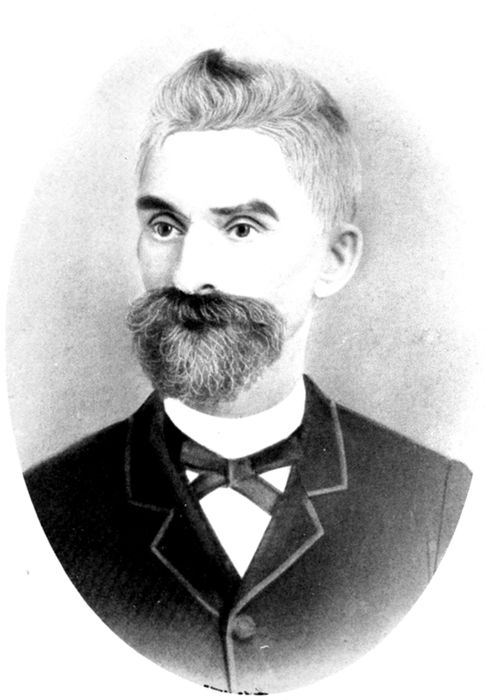
Mrs. Mary (Hubbard) Barber
673Moses Barber was born in South Kingston, Rhode Island, April 22,
1833, a son of James and Elizabeth Barber, natives of Rhode Island, of colonial
ancestry and English descent. A brother of James was Colonel Barber,
who served in the War of 1812, and the grandfather of Moses Barber was a
Revolutionary soldier. Moses was reared to young manhood on his father’s
farm in Rhode Island, and then migrated westward to Illinois. After a
residence of a few years in Illinois he came to Kansas and was a resident of
the State upon the outbreak of the rebellion of the Southern States. He enlisted
in Company I, Second regiment, Kansas cavalry, in 1861, and was soon
promoted to ranking sergeant of his company. He served his country well
and faithfully and took part in several hard fought engagements with his
regiment, and received his honorable discharge at the close of the war at
Leavenworth, Kan. After receiving his discharge from the service he set
out on horseback in search of a homestead, riding the faithful cavalry horse
which had carried him through the strenuous days of the Civil war. His
route led him in a northwesterly direction from Ft. Leavenworth through
Atchison county. He stopped for sustenance and rest at the home of a family
named Hubbard at Parnell, Kan. Mr. Hubbard was a pro-slavery and
State rights man who had removed from the Southland in 1855 after two
years in Missouri, a State rights advocate, and although Mr. Barber was his
guest, they had frequent clashes over the troubles of the South and war incidents.
The bitterness of the great conflict had not yet been obliterated, and
it was only natural that the Union veteran and State’s rights man should
have disagreements. This was not all of their troubles, as time soon developed.
Mr. Hubbard had an attractive daughter, and thereby hangs a tale
of romance. Mary Hubbard was the acme of beauty in the eyes of young
Barber and he purposely stayed around in the neighborhood that he could be
near Mary and do his courting despite the evident antipathy of Father Hubbard.
In fact, Moses often said later, “That was the reason I stayed there.”
The attraction between Mary and Moses grew into friendship, friendship ripened
into love, and the son of the North and the daughter of the South were
married. The parental opposition to this natural outcome of the meeting
of two young souls who were evidently destined for each other was so great
674that a quiet marriage was necessary. Moses and Mary quietly departed one
day and returned to the parental roof as man and wife. Mr. and Mrs. Hubbard
soon afterwards decided to accept the inevitable and become fond of
their son-in-law. Time and subsequent events proved that Moses and Mary
were well mated and the marriage, if a hasty one, proved to be very happy
in the years to come. Mr. Hubbard soon afterward went west to satisfy the
gold fever which obsessed him and Moses Barber settled down on his father-in-law’s
farm which he purchased, thus beginning a highly successful career
as an agriculturist. The first home of him and his young wife was a little
log cabin which formerly belonged to the Hubbards, but as prosperity came
as the reward of years of careful husbandry, he erected a handsome farm
residence of thirteen rooms which still stands on the place, built in 1882. Mr.
Barber was one of the first men in Kansas to see the possibilities in fruit
growing and early began to develop that part of the farming avocation. He
planted four or five acres of apple trees as a start in his horticultural experiments,
and his success with his first orchard was so gratifying that he increased
his apple orchards to sixty acres of bearing trees. He became widely
known as the “Apple King of Kansas.” While managing his immense fruit
orchard he did not neglect the other side of the farm work and cultivated
assiduously and successfully his large farm of 320 acres of land in Mt. Pleasant
township. In the early days he was a large cattle feeder and made large
shipments to the stock markets.
Moses Barber was married May 15, 1865, to Miss Mary Hubbard and
this union was blessed with two children: Mrs. Abigail Brayman, of Wickford.
R. I., and Herbert J., with whom this review is directly concerned. Mr.
Barber departed this life July 3, 1896, after having lived a long and useful
life which was profitable as well as happy. Mrs. Mary (Hubbard) Barber,
his surviving widow, was born May 7, 1845, in Roanoke county, Virginia, and
was a daughter of Clark and Rebecca Hubbard, both of whom were born and
reared in Virginia and came to Kansas in 1855. Mrs. Barber resides with
her son, Herbert J., in Atchison, Kan.
Herbert J. Barber attended the district school of his neighborhood in
Mt. Pleasant township and later pursued a course in the Atchison Business
College. After finishing his business course he returned to his father’s farm
and took charge of the fruit growing and general farming. Later he spent
three years in Colorado in the employ of a Denver wholesale book and stationery
house. In 1894 he returned to the home farm and successfully managed
it until 1908. He then removed to Cummings, Kan., and assisted in the
675organization of the Cummings State Bank. He became the cashier of this
institution and has given evidence of decided financial and business ability
of a high order in his vocation. Besides his banking interests Mr. Barber
has land holdings in Colorado and western Kansas. He makes his residence
at 1020 Santa Fe street in Atchison.
The marriage of H. J. Barber and Miss Eva Wertz was solemnized in
February 19, 1902. Mrs. Barber was born the twenty-sixth of May, 1878, in
Pennsylvania, a daughter of David and Eliza Wertz, both of whom were born
and reared in the Keystone State. David Wertz was for many years a merchant
at Parnell, Kan., and is now living in retirement at that place. The
mother of Mrs. Barber is now deceased. One child, Mary Reta, born August
13, 1904, has blessed the marriage of Herbert J. and Eva Barber.
Politically, Mr. Barber is a Republican, and has held the office of trustee
of Mt. Pleasant township for four years. He and his family are religiously
affiliated with the Baptist church. He is a member of the Ancient Free and
Accepted Masons, Washington lodge, No. 5, of Atchison, and the Modern
Woodmen of America. Mr. Barber is a booster and public-spirited citizen
by nature and is always ready and willing to support anything for the good
of the community and the people. Every civic program which will have a
tendency to benefit the whole of the people finds him as one of its warmest
supporters.
Robert Pinder, the efficient and capable manager of the Effingham
Lumber Company, while having been a resident of Effingham but a few
years, has so identified himself with the life of the community and taken
such an active part in the city’s affairs, that his citizenship is an important
and component part of the body politic. He is a hustler in both thought
and deed, and strives to advance his city as well as managing his business
at profit, and so as to gain increasing prestige for the lumber company’s
business, which has been under the present management since 1912.
The company conducts a general lumber business, and sells all kinds of building
material, such as farm gates, Crown and Tulsa silos, of superior make,
tiling, roofing and roof paints, etc. The sheds and yards cover six lots,
and Mr. Pinder employs two men to care for the business. The president
of the company is W. C. Alexander, of Atchison; the vice president is T.
676B. Pinder, of Clifton, Kan., and the general manager and secretary-treasurer
is Robert Pinder, with whom this narrative is directly concerned.
Robert Pinder was born September 5, 1872, in Timberland, England, a
son of John and Anna (Burton) Pinder, who were farmers in their native
country, and about 1894 immigrated to this country and settled on a farm near
Everest, Kan., where they died. In 1886 Robert was indentured at Martindales,
England, for three years and one and one-half years at Horncastle, to
grocery and provision merchants, with the understanding that he was to
receive his board and lodging, and his father was to provide for other necessaries,
such as wearing apparel, and medicine, in case of sickness. His
periods of indenture required both day and night service and to play no
games, or frequent taverns or dice tables, or contract matrimony, or buy
and sell. For an American boy to be required to do anything of this sort
would be considered the rankest injustice, and he would rebel at being compelled
seemingly to sacrifice his liberty and become a bound employe for so
long a time. But such is the custom in England, and the training which
Robert Pinder received during his four and one-half years of indenture
proved exceedingly valuable lo him in later years. After serving his time
as an apprentice he continued in the provision business for three and one-half
years longer, and then came to America, journeying direct to Doniphan
county in 1894. In the spring of the following year he moved out on the
farm owned by his father, who had brought the entire family, with the
exception of one brother, to this country. He assisted his father in the cultivation
of the farm for four years, and then accepted a position in the lumber
business of E. L. Alexander, at Everest, Kan., in the spring of 1899.
Three months later he became manager of the Purcell Lumber Company,
at Purcell, Kan., and remained in this position for three years, following
which employment he was manager of the Alexander Lumber Company
at Havensville, Kan., for over ten years. In the spring of 1912 Mr. Pinder
came to Effingham and took charge of the Effingham Lumber Company.
His success in the lumber business has been marked and rapid, and
is an indication of true and tireless business ability of a high order. He is
secretary and a stockholder of the Alexander Lumber Company, a large concern:
secretary of the Harrison Lumber Company, of Garnett, Kan., and is
interested in this concern as a stockholder. Mr. Pinder also administered
the family estate after his father’s death in 1909, and his mother’s demise
in the year following. There were eight children in the family: Frederick
died in infancy; John W., living, in England; Edith Mary, wife of William
677Pinder, of Huron, Kan.; Robert; Charles, a farmer living near Huron:
Henrietta died at Everest; Emma A., wife of Arthur Harris, of Everest;
Thomas Benton, in the lumber business at Clifton, Kan.
Mr. Pinder was married November 1, 1900, to Harriet M. Pinder, who
was born in Denton, a daughter of A. G. Pinder, a farmer, residing near
Huron, Kan. Four children have blessed this union: Ruth Mary, born in
November, 1901; Cecil Francis, born in 1903; Leslie Benton, born in 1906;
John Sylvester, born in 1909.
Mr. Pinder is a progressive Republican, and has pronounced and decided
views upon independence in politics, and believes in “a government of
the people and by the people,” and not for the benefit of the favored few. He
is affiliated with the Methodist Episcopal church, and is fraternally allied
with the Knights and Ladies of Security, and the Lumberman’s “Hoo-Hoo”
society.
For twenty-four years Thomas J. Potter has served the people well and
faithfully as postmaster of the town which was named in honor of his father.
Joseph Potter, one of the distinguished pioneer settlers of Atchison county,
Kansas. Thomas J. Potter was born January 29, 1856, on a farm which
later became the townsite of Potter, Kan., and was settled upon by his
father in 1854. Mr. Potter probably holds the record for long and continuous
residence in Atchison county as a native son of this county. He was a son
of Joseph and Minerva (Wiley) Potter, natives of Kentucky and descendants
of colonial ancestry. Thomas Potter, father of Joseph, tracing his ancestry
direct to a member of the colony founded at Jamestown, Va., by Capt. John
Smith, in 1607. Thomas Potter, grandfather of T. J., was born in old Virginia,
and was a pioneer settler in Lincoln county, Kentucky.
Joseph Potter was born in 1819 in Kentucky, married there and reared
a family. When Kentucky began to take on a crowded condition, which was
inimical to a great many of the early settlers of the Daniel Boone class,
Thomas Potter conceived the idea of migrating westward, as Boone had done.
Accordingly, he sent his son, Joseph, to the wild country of Saline county,
Missouri, to find out about the fertility of the land, and to determine whether
or not the country was suitable for settlement. Joseph made the trip in
safety and made a favorable report on his arrival home. The family, thereupon,
678disposed of their land holdings in Kentucky and made the overland
trip to Missouri, finally locating in Buchanan county of that State, near the
town of DeKalb, in 1846. Here Joseph Potter was married in 1851 to
Minerva Wiley, whose parents had migrated from the old home in Kentucky
to Buchanan county, Missouri, about the same time the Potter family had
settled there. Three years later, in 1854, Joseph Potter and his wife removed
to Atchison county and filed upon an 160 acre claim, on part of which
acreage the town of Potter is now built. This was some years before Kansas
became a State, and about the time the great struggle between the pro-
and anti-slavery men was beginning for the control of Kansas. Joseph Potter
was a strong anti-slavery man, who was not afraid to voice his convictions
in unmistakable language at any and all times. He was firm in his
belief that slavery was an evil which should be abolished, and his aggressiveness
led him into frequent conflicts with the pro-slavery advocates. He was
one of the able and fearless leaders of the anti-slavery contingent in Atchison
county, and many times he was threatened with physical violence. At the
time of one of the territorial elections, only three Free State votes were cast
in Joseph Potter’s precinct. Four thousand votes, a number far in excess of
the actual number of voters in the territory, were cast at this election, and
pro-slavery men came from Missouri, and even from Kentucky, and voted
several times in favor of making Kansas a slave State.
Joseph Potter was a Mexican war veteran. He enlisted in 1846 as a private
soldier in the regular army of the United States, and served throughout
the Mexican conflict under Col. Sterling Price. When the Civil war broke
out he was appointed recruiting officer for the Federal Government, and
later served as a captain in the Kansas State militia. Joseph Potter served
one term as a member of the State legislature. In the year 1886 the town
of Potter was established and named in his honor.
One of the most cherished of the friendships of this hardy pioneer was
that of the late Senator John J. Ingalls, a friendship which began in the
troublous days preceding the Civil war, and endured until death parted them,
long afterward. Mr. Potter’s first impression of John J. Ingalls was obtained
at an anti-slavery meeting held in Mount Pleasant township, and he was fond
of relating the occurrence after the Senator became a Nation-wide character
of prominence. Joseph Potter was the political leader of the anti-slavery
party in that section of the State at the time, and Mr. Ingalls, then a young
man of twenty-five, had opened his law office a few weeks previously in the
old town of Sumner, Kan. Ingalls spoke at this meeting, and it is recalled,
679that as he arose to speak, a tall young man, pale and slender, the impression
that he made upon his audience was small, and there were those present who
even sneered when he began to speak. It was not long, however, as the
future senator swung into his theme, until he convinced his auditors that he
had a thorough knowledge of Kansas conditions, and could speak with an
eloquence and honesty of delivery that was convincing. The listeners who
came to scoff, left the meeting as warm admirers of Mr. Ingalls, and Mr.
Potter was forever afterward his warm supporter.
Joseph Potter and his wife were the parents of eight children, as follows:
Celia J., wife of T. Lawler, of Cowles, Neb.; Francis, living on the
old home place in Walnut township; Alice P., residing on the home farm;
Josephine P., wife of J. W. Miller, of Atchison; Thomas J.; Samuel L., a
banker, living at Cutbank, Mont.; John J., also living on the old homestead.
Thomas J. Potter was born and reared on the old home farm of the
Potter family, and followed the occupation of a tiller of the soil until he was
twenty-seven years of age. He was appointed postmaster of the town of
Potter, and was re-appointed in 1898, and has held the office continuously ever
since. He was married in 1882 to Fannie M. Brown, a daughter of John
Brown, of Missouri. Two children bless this union: George Potter, in the
United States mail service in Chicago, Ill., and Garland J., wife of Charles
Pruitt, of Sioux Falls, S. D. The mother of these children died in February,
1906. In the year 1913 Mr. Potter took for his second wife, Mrs. Estella
Everhardt, widow of Charles Everhardt, and a daughter of N. D. West, a
native of New Jersey, who settled in Kansas in the early territorial days.
Mr. Potter is politically allied with the Republican party and is a supporter
of Republican principles. He belongs to the Christian church, and is fraternally
affiliated with the Modern Woodmen of America.
Benjamin F. Shaw, hardware merchant, of Potter, Kan., is a native of
Atchison county, and is one of Potter’s younger successful business men. He
was born October 11, 1882, on a farm in this county. He is a son of Henry
and Martha (Nelson) Shaw, the former a native of Roodhouse, Ill., and
the latter of Missouri. Both parents are of English ancestry. Henry Shaw
came to Kansas in 1867 when a young man twenty years of age. When he
came here he had a cash capital of about $100. He was of a saving disposition,
680however, and it was not long until he became the owner of a fine farm
of 320 acres in Leavenworth county, Kansas. He is now residing in Leavenworth,
living on a small farm of twenty acres within the city limits.
Benjamin F. is the fourth of six children born to Henry and Martha
Shaw, and is the only son. He spent his boyhood days on his father’s farm
and attended the district school in his neighborhood. When nineteen years
of age he came to Potter and entered the employ of L. M. Jewell, in his general
merchandise store. He began working for a salary of sixteen dollars
per month. When Mr. Jewell took charge of the Potter State Bank as cashier,
Mr. Shaw was placed in charge of the Jewell lumber yard and furniture
store. Shortly afterward he was enabled to purchase a half interest in the
furniture store. Within a year he sold his interest in the furniture business
and bought a half interest in the hardware store of J. C. Helvey. Upon Mr.
Helvey’s death, three years later, Mr. Shaw purchased his former partner’s
interest, and has since conducted the business entirely in his own name, as the
sole proprietor. Mr. Shaw has met with signal success in his business venture,
and has grown with the town of Potter. He has increased the value of
the hardware stock in his establishment from $2,200 to over $7,000. In
addition to his business he is the owner of farm lands near the town of Potter.
This is a considerable accomplishment for a young man who began his
career with practically no capital, but a willingness to do the best he could,
and endowed with plenty of energy and intelligence.
Mr. Shaw was married in November of 1904 to Miss Louise Bessler,
of Leavenworth, Kan. His political affiliations are with the Democratic
party, and he is fraternally connected with the Modern Woodmen lodge.
A review of the life of the late Lawrence Griffin, of Effingham, Kan.,
is the story of a poor Irish lad who left his native land, served his adopted
country in the Civil war, became a pioneer in Kansas, and was a railroad
builder and successful farmer, and in the course of years realized in full his
boyhood dream of wealth and position in the great, free land of America.
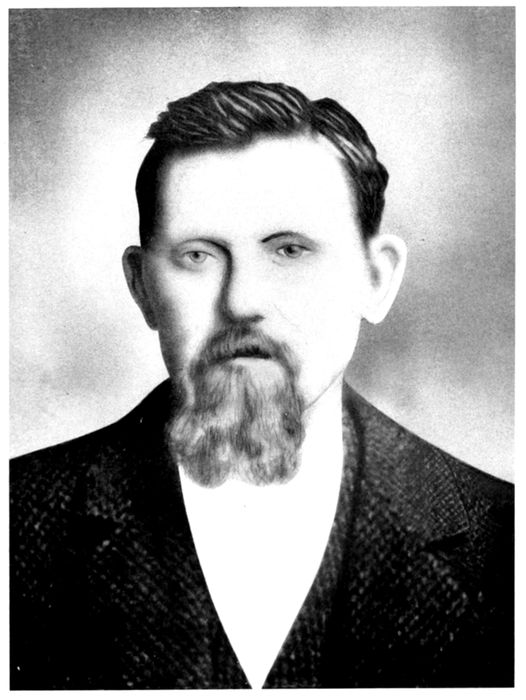
681Lawrence Griffin was born in County Galway, Ireland, in 1838, a son of
poor Irish parents. When a boy in his teens he immigrated to America
and joined his brother, Michael, in Ohio, and there engaged in farm work for
a living. He worked his way westward, and at the outbreak of the Civil war
was driving a stage coach out of Springfield, Ill., where he enlisted August
3, 1862, in Company C, Twenty-seventh regiment, Illinois infantry, and served
until his honorable discharge, September 20, 1864. He fought in many important
battles, among them being Belmont, Mo., Union City, siege and capture
of Island No. 10, Farmington Mills, siege and capture of Vicksburg,
Lookout Mountain, Mission Ridge, and the battle of Chattanooga. After the
war he went to St. Louis, Mo., and from that city made his way to Atchison,
where he took a contract under J. P. Brown for building a portion of the
grade of the Central Branch railroad, at that time under course of construction.
His first job was the grading of one mile of road called section 20
in partnership with a Mr. Keean. In partnership with James Brady he then
graded two miles of road near Wetmore, Kan. He saved his money which
he made from his grading operations and in 1867 was married and purchased
a farm of eighty acres near Arrington on the creek bottoms. He was compelled
to leave this place after one year on account of ague and invested in
160 acres of land north of Arrington, which he later sold and bought 160 acres
of higher land four miles west of Effingham. This was prairie land which
he at once began to improve and made into a permanent home for his family.
He and his wife first lived in a small house and were often discouraged and
faced failure many times, but persistence and fortitude finally won out and
they became the possessors of 400 acres of well improved land on which were
erected two sets of farm buildings. Three hundred and twenty acres yet remain
intact of the original holdings, which are rented to tenants. In 1908
Mr. and Mrs. Griffin left the farm and purchased a handsome residence in
Effingham where Mrs. Griffin now resides.
Mr. Griffin was married November 25, 1865, in the old St. Benedict’s
Church in Atchison, to Miss Ellen Gallagher, the marriage ceremony being
performed by Father Timothy. Ten children have blessed this union, as
follows: Michael died in infancy; Martin Lawrence, a farmer at Wetmore,
Kan.; Ellen, wife of James Bergen, Graham county, Kansas; Elizabeth, wife
of Michael Murphy, Dallas, Texas; Anna, at home with her mother; Patrick
Henry, conducting a livery business at Effingham; John J., cultivating the
home farm; Frank, agent for the Southern Life Insurance Company, Wichita
Falls, Texas; Walter L., a traveling salesman, Dallas, Texas, and who graduated
from the Atchison County High School, and studied two years at St.
Benedict’s College; James Ambrose, also a graduate of the Atchison County
High School, and now a stenographer in the office with his brother at Dallas,
Texas. The mother of these children was born September 15, 1850, at La
Salle, Ill., a daughter of Martin and Anne (Corcoran) Gallagher, both of
682whom were born in County Mayo, Ireland. They came to this country when
young and Mr. Gallagher took up a homestead in Illinois and also engaged
in freighting from La Salle to Chicago. He died in 1851, and the widow,
accompanied by Ellen and two sons, came to Atchison county in 1860 and made
their home here. Mrs. Gallagher married again, her second husband being
Frank Cullen, who preëmpted land near Muscotah, upon which the family
moved from Atchison in 1863. Mr. Cullen died in 1888. The mother of
Mrs. Griffin died in 1890, at the age of sixty-six years.
Lawrence Griffin was a member of the Catholic church and was always
a liberal contributor to the support of that denomination, giving substantially
in aid of the building of the Catholic church in Effingham. While he was a
rough and ready type of man who took the world as he found it, he was very
moral and believed in living according to the golden rule. He was very
charitable to the poor and worthy and was a kind husband, and a loving and indulgent
father, whose sole aim in amassing a comfortable fortune was to provide
well for his wife and children. In this aim he succeeded.
The Nation owes a debt to the veterans of the Civil war, who gave the
best years of their young lives to the defense of the Union, and marched
under the star-spangled banner under the leadership of such heroes as Grant,
Sherman and Sheridan, which can never be fully repaid. The ranks of the
grand army of brave and true men who have worn the blue are gradually
thinning out, and where once they were numbered in hundreds and thousands
throughout this broad land, there are now but few in each community. These
veterans were of the salt of the earth, and no better type of manhood ever
trod the earth or marched to the strains of martial music than the old guard,
which saved the Union, at the call of Abraham Lincoln. Living on a farm,
in the northwest part of Benton township, Atchison county, Kansas, is a survivor
of General Sherman’s victorious “march to the sea.” Comrade Charles
E. Barker gave three years of his life in the defense of the Union and flag,
and has a war record which has been equalled or surpassed by but few men
who shouldered a musket to save the Union from dissolution.
Charles E. Barker, well-to-do farmer, of Atchison county, Kansas, was
born in Fulton county, Illinois, April 4, 1842, a son of John and Eleanor
(Rutledge) Barker. The father of Charles was born in Virginia July 20,
6831786, and learned the blacksmith’s trade when yet a boy. He migrated to Fulton
county, Illinois, as early as 1826, and there operated a blacksmith shop.
He was twice married, his second wife being Eleanor Rutledge, who bore
him three children: George R., deceased; James Lee, deceased: Charles E.
The four children by the first marriage were Joseph, John W., Sarah, and
Elizabeth, deceased. The mother of Charles E. was born in Greenbrier county,
Virginia, November 28, 1801, and died September 3, 1873. John Barker died
in Fulton county, Illinois, in September of 1861.
Charles E. Barker grew up on his father’s farm, and helped in the shop
and on the farm until his enlistment, at the age of twenty years. At the
outbreak of the war he harkened to Lincoln’s call for volunteers to quell the
rebellion of the Southern States, and went to Vermont, Ill., where he enlisted
in Company F, One Hundred and third regiment, Illinois infantry,
August 14, 1862, under the command of General Sherman, and Mr.
Barker acted as commissary sergeant in Tennessee and the South. He participated
in the following engagements: Vicksburg, Mission Ridge, Kenesaw
Mountain, Resaca, Ga., Peachtree Creek, Ga., Dallas, Gristleville, November
26, 1864, and many others, his regiment being in twenty-seven battles in all.
He marched under Sherman’s banner from Atlanta to the sea, and then
marched in the Grand Review at Washington, D. C. He was honorably discharged
at Chicago, Ill., July 7, 1865. He returned home after his discharge,
and remained in Fulton county, Illinois, until 1883, when he disposed of his
holdings there and went to Dade county, Missouri, where he bought a farm.
He remained in Dade county for several years, living on various farms which
he bought and sold. In August, 1887, he went to Furnace county, Nebraska,
and purchased a half section of land, to which he added 160 acres later, which
he sold in 1903 to his son, Harry. On March 1, 1891, he went to Brown
county, Kansas, and lived there until his removal to Atchison county. In
1894 he came to Atchison county, Kansas, and bought 160 acres of land in
the northwest corner of Benton township. He improved this farm and cultivated
it with profit to himself. He maintains good graded live stock on
his acreage and is considered one of the really successful agriculturists of
the county. Nearly all of his land is sown to alfalfa and grasses.
On April 19, 1866, Mr. Barker was married to Mary E. Pontious, who
has borne him six children, as follows: Leonard, a farmer, of Norton county,
Kansas; Ira C., of Gooding, Idaho; Harry E., living in Brown county, Kansas;
William L., a farmer, of Kapioma township, Atchison county, Kansas;
Perry, residing in Stanford, Neb.; Nora, deceased. The mother of these
684children was born in Ohio, a daughter of Andrew and Ann (Bear) Pontious,
natives of Germany.
Mr. Barker is a Democrat of the old school, and is a firm believer in
Democratic principles. He belongs to the Grand Army of the Republic, Effingham
Post, and numbers among the members of this organization many
warm friends and comrades. He has taken his place in the community as a
representative citizen, who enjoys the respect and esteem of all who know
him. He can look back over his three score and thirteen years of life
with satisfaction and realize with complacency that it has been well spent, and
he has accomplished all that any good American could wish for on this earth.
If a man has the inherent ability and energy in his makeup to enable him
to succeed, he is going to do it. The life stories of all successful, self-made
men bear out this contention, and there are numberless instances of success
among the younger generation in the West which are well worth recounting.
John E. Sullivan, real estate dealer, loan and insurance agent, of Effingham,
Kansas, is a representative example of the class referred to in the foregoing
statement. Mr. Sullivan was destined to succeed in his farming and business
ventures, and, while a young man, he has already made his mark in the world,
and is one of the substantial and influential citizens of Atchison county.
John E. Sullivan was born on a farm, near Rulo, Richardson county,
Nebraska, January 20, 1873. He is a son of Murty and Mary (Rawley)
Sullivan, substantial and well respected citizens of Effingham. The former
was born in Ireland in 1847, and the latter is a native of Canada, born of
Irish parents in 1852. Murty Sullivan left Ireland in 1865, immigrated to
America and settled near Rulo, Neb. He made his own way in this country,
and accumulated a large farm in Nebraska, on which he resided until 1910,
when he removed to Effingham and purchased a farm adjoining the town on
the south. Murty and Mary Sullivan are the parents of the following children:
James and Murty, Jr., living at Hardin, Mont.; Daniel D., a farmer, of
Benton township, Atchison county, Kan.; John E., the subject of this review;
Mrs. John Vogel, of Falls City, Neb.; Sister M. Teresa, a sister of the Ursuline
Convent, of York, Neb., and a teacher in St. Angela’s Academy there.
The family are all members of the Catholic church.
685John E. received his primary education in the common schools of his
native county in Nebraska, and finished his education in St. Benedict’s College,
Atchison, Kan., graduating from the commercial department of that
institution in 1894. He then took a special teachers’ course at the Lincoln,
Neb., Normal School. He taught school for seven years in Richardson
county, Nebraska, and practically all of his teaching was done in two schools
of his home county. Upon his marriage in 1897 he engaged in farming in
Nebraska, and it is a matter of pride with Mr. Sullivan that he earned more
money in two years of farming operations than he had in all of his seven
years of teaching, another reason why the farm is the best place for a
young and ambitious man to make money. His success as a farmer determined
his future career, and he decided to stick to the agricultural country
for all time, imbued with the belief that there is money to be earned in
farming, or in handling farm lands. He left Nebraska in December of 1901,
and came to Atchison county, Kansas, where he purchased a farm, one and
one-half miles south of Effingham, his first farm being the northwest quarter
of section 34–618. He is at present the owner of 400 acres of well
improved land which is kept in a high state of cultivation by improved
methods of farming. Mr. Sullivan raises considerable live stock on his acreage
and aims to feed all the grain raised on the land to live stock. He
specializes in Hereford cattle and Poland China hogs and aims to keep only
good grade of stock of all kinds. At the time of his purchase of the farm
land in Atchison county, the land itself was in poor condition, and the soil
had become impoverished by continual cropping of a single staple. Through
the modern method of crop rotation Mr. Sullivan is reviving the fertility of
the soil, and at the present time the greater portion of his farm is planted to
clover and grasses, for the purpose of renewing the strength of the soil, the
process being assisted by the raising and feeding of live stock on the place.
The Sullivan farm has splendid improvements, which were placed on it by
Mr. Sullivan, who erected a modern eight-room house and a good barn. In
1907 Mr. Sullivan was induced to take up insurance work as a side line, in
the interest of a Nebraska insurance company, and met with great success
in his new line of work. He later took up the real estate business and the
handling of loans, and has been likewise successful in establishing a permanent
business which requires his attention and necessitates an office in Effingham.
The Sullivan real estate and loan office is well located in the
Farmers and Merchants State Bank, of which concern Mr. Sullivan served
as cashier and a director for several years.
686He was married February 16, 1897, to Mary Majerus, a native born resident
of Richardson county, Nebraska, and a daughter of Jacob and Elizabeth
(Wilker) Majerus, the former a native of Germany, and the latter of
Ohio, of German parents. Seven children have blessed this union, namely:
P. Justin, aged seventeen, and a student of St. Benedict’s College, class of
1916; Leo, aged thirteen years; Nellie, ten years old; Elizabeth, aged eight;
Edward, six years old; Agnes, three years of age; and Mary, born January
28, 1915.
Mr. Sullivan is a Democrat who takes an active and influential part in
the affairs of his party in Atchison county, having been the candidate of the
party for county treasurer in 1914. He is fraternally affiliated with the
Modern Woodmen, of Effingham, the Knights of Columbus, of Atchison,
and the Central Protective Association.
Samuel L. Loyd, an enterprising and successful farmer, of Shannon
township, was born June 11, 1860, in Brown county, Ohio, a son of Thomas
F. and Celina (McGinness) Loyd, natives of Kentucky and Ohio, respectively.
His paternal ancestors were of Welsh extraction. William Loyd, grandfather
of Samuel Loyd, after making a home for his family in this country, started
on a return trip to his native land, in order to secure a legacy which had
been willed to him by a deceased relative, and on the way was afflicted with
cholera, and died. With his death, practically all knowledge of the family in
the old country passed away, and his widow and two children were left to
get along as best they could. Two years later the widow died. Thomas
F. Loyd was reared by a Mr. Boyd, and removed from Kentucky to Brown
county, Ohio, when he became of age, and there married Celina McGinness.
About 1865 he set out for the western country to obtain cheaper land, and
make a permanent home for his family. After living for one year in Clark
county, Missouri, he loaded his effects on a covered wagon, and with his
wife and children crossed the Missouri river at St. Joseph, and settled on
a farm in Doniphan county, Kansas, April 14, 1866. Thomas F. Loyd was
a member of the Home Guard in Brown county, Ohio, during the Civil war.
He was born in 1825, and died in 1910. His wife, Celina, was born in 1829,
and died in 1906. They were the parents of ten children, seven of whom are
687living: William, Mollie, deceased, Charles, deceased, Samuel L., Anna,
George, Effie, Otis, Oscar, and Celina, deceased.
Samuel L. Loyd was six years of age when his parents located in Doniphan
county, and consequently knows a great deal about the early days in
Kansas, and the struggles of the early settlers to make homes on the prairie.
He was brought up on the farm, and attended the district school when possible,
and learned very early in life to do farm work. After his marriage
he farmed in Doniphan county until 1899, when he came to Shannon township
in Atchison county, and purchased 160 acres of fine land, which he has
brought to a high state of cultivation. During his sixteen years of residence
here he has improved his farm to a considerable extent, and has spent over
$5,000 in the erection of a handsome brick residence which sets far back on a
rise of ground and is reached from the highway by a private driveway. Other
improvements on the place in the way of buildings and fences have cost him
over $1,500. A severe storm, which swept this section May 3, 1903, did
damage to the extent of over $500 to his buildings, and he found it necessary
to repair all of this.
Mr. Loyd was married September 2, 1896, to Miss Lulu Voelker, born
and brought up in Atchison county, a few miles north of the city of Atchison.
To this union five children have been born: Myrtle Ceina, Edna Lula,
good educations by their ambitious parents. Mrs. Loyd is a sister of Conrad
Voelker, a wealthy and prominent farmer residing on one of the finest
farms in the county, about four miles north of Atchison, and who
earned the title of “Cabbage King” of Kansas, because of his wonderful
success in growing that vegetable some years ago. Mrs. Loyd
was born July 14, 1872, and is a daughter of Karl Voelker, who immigrated
to this country from Germany in 1861, and operated a dairy and truck farm
in Shannon township for several years. The mother of Mrs. Loyd was
Christina Neuhaus, of German parents. Further details of the history of the
Voelker family are found elsewhere in this volume. Conrad M., a nephew
of Mrs. Loyd, is county clerk of Atchison county.
Mr. Loyd is a Republican, but gives little or no attention to political
affairs, other than to vote as his conscience dictates. He is affiliated with
the Central Protective Association, and is a member of Good Intent lodge,
of Shannon township. While Mrs. Loyd was reared in the Lutheran faith,
the members of the Loyd family attend the Methodist church. For a man
who was forced to make his own way in the world, Mr. Loyd, with the
688assistance of his faithful wife, has accomplished a great deal, for which he
deserves credit and honor among his neighbors.
The life story of Julius Kaaz, founder and proprietor of the manufacturing
concern which bears his name, is an account of the achievements of
a self-made man who left his native land to seek opportunity and fortune
in Atchison, and found it. During the period of thirty-four years of his life
which has been spent in his adopted city, Mr. Kaaz has succeeded even beyond
his expectations and has made a place for himself an enviable one in the city.
He arrived in Atchison in 1881 without a dollar, but endowed with a willingness
to do whatever came to hand, imbued with a desire to succeed where the
opportunity awaited him. The Julius Kaaz Manufacturing Company is a
monument to his industry and ambition. This is one of the thriving and
important establishments in the city of Atchison, and is widely known as one
of the city’s leading industries. The extensive plant covers two floors of a
building, 52×130 feet, and from eighteen to twenty men are employed in
the mill proper, and from five to thirty-five men are given employment at
outside work. The factory is conveniently located at 1200–1208 Main street
and is fully equipped with all modern machinery to facilitate the manufacture
of the high grade products which consist principally of bank, church
and store fixtures, made to the order of the purchaser. An example of the
high grade work turned out by the Kaaz plant can be seen in the interior
fixings and furniture of the German-American State Bank of Atchison. Mr.
Kaaz ships his output to Kansas and Nebraska cities and all parts of the
United States, and it is unsurpassed in quality and finish.
Julius Kaaz was born March 26, 1854, in Prussia, German Empire, a
son of Daniel and Christina (Schroeder) Kaaz, who were the parents of four
children: Wilhelmina Loeproeck, a widow residing in Atchison county; Ernest,
Atchison; Mrs. Christina Schmeling, deceased; Julius, the youngest of the
family. Daniel Kaaz was a carpenter by trade and came to Atchison from
Germany with his family in 1881. He resided with his son Julius upon his
retirement from active labor until his death in 1902. His wife, Christina,
was born in 1821, and died in 1895.
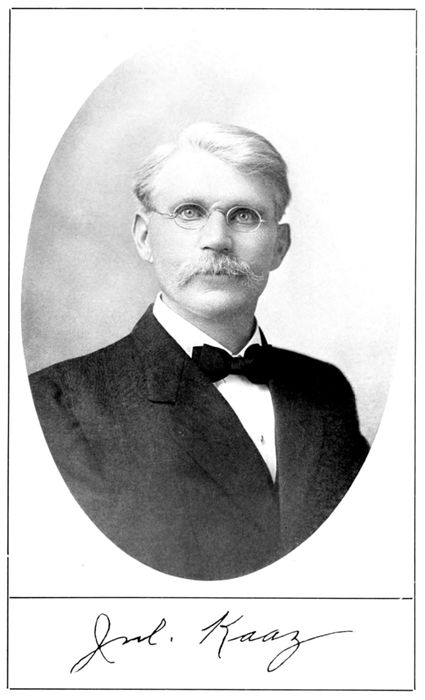
689Julius Kaaz attended the schools of his native land and studied architecture.
He learned the trade of carpenter under his father, but could not
content himself to settle down in his native land and follow in the footsteps
of his forebears. When still a young man the germ of ambition called him to
other lands, and his goal was America. His desire to better his condition led
him to set sail for this country in 1881, arriving in Atchison, where he at once
sought employment. His first work was cutting cordwood in the timber land,
south of the city, during the winter, and in the spring of the following year
he worked on the Missouri river, making and placing riprap. Soon afterward
he was given a job working at his trade for $1.50 per day. For one year he
worked for wages, and at length decided to embark in business for himself and
began taking contracts at a time when he had no capital worth speaking of. It
was even necessary for him to borrow the saw and hammer which he used in
his work. In 1885 he formed a partnership with Henry Braun in the contracting
business which continued until 1909, when they dissolved partnership. In
1907 Mr. Kaaz erected his first planing mill which has grown into his present
extensive establishment consisting of plant, yards and warerooms.
He was married to Ida Schmeling in 1883, and to this union have been
born nine children, as follows: Emil, Lena, Robert, Lydia, Julius E., Otto,
Fred, Arthur, Martha. Of these children Martha is deceased, Lydia is her
father’s secretary, Fred is also employed in the office, and Otto H. is employed
in the mill. Mrs. Kaaz was born September 6, 1856, in Prussia, German Empire,
and is a daughter of August and Ernestine (Polzien) Schmeling. She
left her native land when sixteen years of age and came to Atchison.
Mr. Kaaz, while politically allied with the Republican party, is an independent
voter who believes in voting for the individual who seems to be most
capable of serving the people, rather than supporting an avowed politician.
He and the members of his family are affiliated with the German Lutheran
church and are liberal supporters of this denomination.
A greater service in behalf of mankind than a life devoted to healing the
sick and curing the halt and the lame can not be considered, and when this
service has been rendered far from the comforts of the city and during the
storms of many seasons in the open country from the pioneer era in Kansas
down to the present time, the value of such service to humanity is inestimable.
The unsung heroes of the medical fraternity are the large class of country
690practitioners who go their way year after year, uncomplainingly and satisfied
with the good they are doing for their fellow creatures. Great fortune
is not theirs, but the inevitable reward and the satisfaction of a task well and
faithfully done is theirs to have. Of this great class the biographer is pleased
to record the facts concerning the life and career of George W. Redmond, the
second oldest physician in Atchison county, and one of the oldest medical
men in Kansas. For nearly half a century Dr. Redmond has practiced his
profession among the tillers of the soil in the neighborhood of Potter, and
the southeastern part of Atchison county, and in the northeast part of Leavenworth
county, Kansas. During all this time he has remained true to his
calling, and resisted the call of the towns and cities, where an easier life
might be lived. He has likewise progressed with the profession and endeavored
to keep abreast of the wonderful developments in the science of
medicine, arriving at the point in his career where he is a specialist in his
profession.
Dr. George W. Redmond was born in Bourbon county, Kentucky, October
19, 1849, a son of Oscar Redmond and Susan (Orr) Redmond, the former a
native of Bourbon county, and the latter a native of Nicholas county, Kentucky.
Both were born in the same year, 1820, and the mother of Dr. Redmond
was a daughter of William Orr, a captain in the American army in the
War of 1812. William migrated to Kentucky from Pennsylvania shortly
after peace was declared between England and the United States, and was
one of the pioneers of that State. Oscar F. Redmond, father of George W.,
was a son of William Redmond, was also one of the pioneers in the settlement
of old Kentucky. Both the Orr and Redmond families were of that
sturdy Scotch Presbyterian stock, who were prominent in the early history
of Kentucky, and were noted as true pioneers in several of the middle
Western States. Oscar F. Redmond was a farmer in Kentucky, and reared
a family of twelve children, of whom George W. was the fourth child. In
1856 the Redmond family removed to Cooper county, Missouri, where they
remained until 1858, and then settled in Platte county, Missouri, where the
father made a permanent home for many years, afterwards ending his days
in Muscotah, Atchison county, Kansas. The mother of Dr. Redmond died
in Kansas City in 1892.
When the Redmond family left Kentucky, George W. was five years
of age. He received his primary education in the district schools of Platte
county, Missouri, and graduated from the Gaylord Institute, after which he
began the study of medicine with his uncle, Dr. H. B. Redmond, in Saline
691county, Missouri, with whom he studied one year. He then entered the St.
Louis Medical College, of St. Louis, Mo., completed the prescribed two years
course, and graduated therefrom in 1869. While trying to decide upon a
location, and almost having his mind set upon a city location, he received
a letter from his sister, Mrs. Samuel E. King, in Atchison county, informing
him that Dr. John Parsons, of Mt. Pleasant, was in need of a young assistant
and partner, and he could have the place if he came to Kansas. This letter
decided his course, and he came at once to Atchison county and began his
practice with Dr. Parsons. At this period Mt. Pleasant was an important
inland town, but it has long since passed into the realm of “disappeared cities.”
Dr. Redmond remained in Mt. Pleasant a little over two years, and then
located in Oak Mills, where he owned a farm, and built up an enormous medical
practice in the village and surrounding countryside. He practiced in Oak Mills
for thirty years, although prevailed upon by his many admirers in Atchison
to remove to the larger city and open an office. During the winter of
1903 and 1904 he pursued a post-graduate course in the post-graduate
school of Chicago, and upon his return to Kansas, in the spring of 1904, he
located in Potter, Atchison county. Of late years Dr. Redmond has become
a specialist in the diseases of women, and it is in this branch of practice that
he is achieving his greatest successes. Obstetrics has long been his specialty,
and he undoubtedly holds the record in Kansas for the number of successful
confinement cases at which he has officiated, and it can be said of him, that
in all of his many years of practice he has never lost a confinement case,
although there have been times in his career when he has had three and four
cases of this character in one day.
Dr. Redmond has been twice married, his first marriage occurring in
1874 with Anna Douglass, a daughter of J. M. and Sarah Douglass, who
were among the earliest of the Atchison county pioneers. Four children
blessed this union: Ethel, of Leavenworth, Kan.; Edith, wife of Charles Munger,
of Atchison county, Kansas; Virginia, living in Leavenworth, Kan.;
Georgia Redmond, also residing in Leavenworth. Dr. Redmond’s second
marriage took place in 1906 with Carrie A. Sprong, a daughter of D. H.
Sprong, an early pioneer settler of Kansas, a sketch of whom appears in this
volume.
While Dr. Redmond is a Democrat in politics, he has never found the
time to take an active part in political affairs. For the past thirty-five years
he has been a contributor to various medical journals, among them being the
Medical World, of Philadelphia, one of the oldest and most widely read medical
692publications in the United States. He is a member of the Atchison
County Medical Society, the Kansas State Medical Society, and the American
Medical Association, and was one of the organizers of the county society in
1869, and is the only surviving original member of the society. He is a
member of Kickapoo Lodge, No. 4, Ancient Free and Accepted Masons.
From small beginnings larger things very often naturally grow. The
candy and soft drink manufactory of Frederick W. Lincoln on South Fifth
street, Atchison, had its inception in a very modest beginning. In fact, Mr.
Lincoln first began manufacturing his fine candies at his residence, corner of
Seventh and S streets, but the constant growth of the concern soon required
larger quarters, and his present factory, erected in 1893, is the result of his
enterprise, a building 20×60 feet in extent, with the basement in use.
He employs ten people the year round, and is his own traveling salesman,
his son, Edward, having charge of the business during his father’s absence on
the road. The products of the Lincoln factory are in demand, and are noted
for their excellency. In 1912 the manufacture of soda and soft drinks was
added to supply a demand in Atchison and the surrounding territory. The
manufactured goods of the Lincoln factory are distributed to all points in
Kansas and western Missouri.
Frederick W. Lincoln was born in England January 29, 1852, a son of
Edmund B. and Jane (Barrell) Lincoln, the father being born in Norfolk,
Intwood county, England, and the mother being a native of County Clingford,
England. They were the parents of four children: Edward, a veteran
of the Civil war, and inmate of the National Soldiers’ Home at Sandusky,
Ohio; Mrs. Mary King, of Michigan; Mrs. Emily S. Moffit, deceased; Frederick
W., with whom this review is directly concerned, and who was reared
by an uncle, Mr. Barrell, who taught him the baker’s trade. The Lincoln
family immigrated to America in 1853, and settled in Ohio, where Frederick
was reared to manhood in the home of his uncle. He worked at his
trade of baker until 1875, when he came to Atchison, and was employed in
the hardware store of W. W. Marlborough for a few years, after which he
worked in a candy shop for W. B. Howe, who taught him the candy maker’s
trade. About 1880 he embarked in the manufacture of candies with T. L.
693White, with whom he was associated for a short time, and eventually engaged
in business for himself, starting in his home, making a very modest beginning.
His first shop was near his residence, but the business soon outgrew
the demands made upon the little shop, and larger quarters soon became
necessary. The business is the direct outcome of the persistence, integrity
and industry of the proprietor, and the future of this flourishing concern
is bright with promise, as the years see it extend its natural field, and it
achieves a natural and deserving growth.
Mr. Lincoln was married January 26, 1879, to Laura Averill, born July
20, at Cooper, Maine, a daughter of Joseph and Julia A. (Whitney) Averill,
natives of England and Scotland respectively. Mrs. Lincoln came to Atchison
with her mother and resided with her stepfather and mother until her
marriage with Mr. Lincoln. To Mr. and Mrs. Lincoln have been born the
following children: Mrs. Leona Andrews, of Atchison; Edward E., born
May 11, 1883, educated in the public and high schools of Atchison and
brought up with his father in the business, married in 1903 to Freda Spatz,
who was born November 9, 1896, in Atchison, a daughter of Jacob and Josephine
(Latenser) Spatz, natives of Germany and St. Joseph, Mo., respectively;
the third child being Frank, a machinist, employed at Horton, Kan.
Mr. Lincoln is a Republican, and is fraternally allied with the Ancient
Order of United Workmen, the United Commercial Travelers, and the
Modern Woodmen of America. He and the members of his family belong
to the Christian church. Mr. Lincoln’s career is an exemplification of the
adage, “Success never comes to him who waits,” and his standing in the
commercial life of Atchison today is due to the fact that he made his opportunity
and is justly entitled to proper recognition as one of the city’s leading
factors.
John C. Valentine, owner and proprietor of the Northern Kansas Telephone
Company of Effingham, for more than forty years has been a resident
of Atchison county. The Northern Kansas Telephone Company, of
which he is the head, was organized in 1903 as a coöperative concern, but
is now owned and operated by Mr. Valentine and his son, A. G. Valentine.
The lines of the company cover a section of country within a radius of six to
ten miles of Effingham. Twenty-six lines are supplied with good service,
694and the company has over 435 subscribers at the present time. The plant
is well equipped and is noted for the excellent service given the patrons.
John C. Valentine is a native of Dearborn county, Indiana, and was born
in the Hoosier State July 28, 1845, a son of George and Sarah (Cornforth)
Valentine. His father was born in New Jersey, and accompanied his parents
to the Middle West, locating in Cincinnati when George was a child. He was
reared in Cincinnati, and later settled in Indiana. His mother was the daughter
of pioneer stock of English descent, and was connected with the Eubanks
family, which figured in the early history of Indiana. Sarah Valentine died
in 1863, and George married again, after which he settled in Illinois, and died
near Xenia, that State. He was a soldier in the Civil war, and served in an
Ohio cavalry regiment throughout the conflict. John C. Valentine enlisted
in the 134th regiment, Indiana infantry, in the spring of 1864, and served
until his honorable discharge in the fall of the same year. His health became
poor while serving in Tennessee, and he was transferred to Louisville,
Ky., and sent home from that city. He was kept on the reserve force while
serving in Alabama, and was in the breastworks at Decatur, Ala. At this
place he was exposed to a hot fire, and recalls that it was a very uncomfortable
place in which to be. During the winter of 1866 he taught school in
Decatur county, Indiana. He remained at home with an uncle, William Sawdon,
at Aurora, Ind., after returning from the war, until September, 1867,
at which time he went to Ft. Madison, Iowa, and there met some friends.
He worked on farms in the neighborhood until Christmas of that year, and
then left for Kansas, arriving at Leavenworth January 1, 1868.
During his first year in Kansas he broke prairie land for a living; the
next year he sold sewing machines, and made good at that avocation; the
second year, winter of 1868–69, he taught school in Leavenworth county, and
two years after coming to this State he was married. He and his brother,
Charles, broke prairie with their two teams in Jefferson county, and for four
years after his marriage, Mr. Valentine had great success in farming in that
county, raising immense crops of wheat. In the year 1874 he came to Atchison
county and settled on a farm four miles northwest of Effingham on
the south side of the Parallel road. He at first bought a tract of eighty
acres and erected a small house on his land, erecting other buildings as he
was able. Mr. Valentine has prospered in the years following his first purchase
of land in this county, and he and his son now own a total of 200 acres
of well improved land. He resided on the farm until January of 1896, then
turned over the farm to the management of his son, and came to Effingham.
695For ten years following he traveled as salesman, and in 1905 engaged in the
telephone business by the purchase of the coöperative company which
formerly owned the lines he is now operating.
Mr. Valentine was married April 7, 1870, to Miss Lena Smith, of Johnson
county, Kansas, who was born in 1855. The children born to this union
are: Albert G., on the home farm, married Alice Frame, and is the father of
one son and five daughters; Mrs. Mattie Stevenson, of near Beloit, Kan.; Edward
died at the age of twenty-two years, and Robert died at the age of
thirteen years.
Mr. Valentine is a Republican in politics, and has always remained loyal
and steadfast to the party of Abraham Lincoln. He has served as city councilman
and mayor of Effingham. He is an Odd Fellow, and a member of
the Grand Army Post, No. 176, Effingham.
Gustave Stutz, farmer and stockman, of Atchison county, Kan., was
born April 20, 1867, in Lancaster township, this county, and is the son
of Christian and Katherine (Schweitzer) Stutz. Seven children were born
to them, as follows: Caroline (Demel), of Central City, Neb.; Katherine
(Wilkins), Atchison, Kan.; Frederick, policeman, Atchison, Kan.; Christopher
W., Center township, Atchison county; Gustave, subject of this sketch;
John, Center township; and one child died in infancy. The father of Gustave
Stutz was born March 25, 1825, in Germany. He left there in 1855, and settled
in Jackson county, Missouri, and in 1859 came to Atchison county,
where he bought eighty acres of land in Lancaster township. The land was
timber and prairie country, and he employed a man to break it up with
oxen. Mr. Stutz made extensive improvements on his farm, and added more
land from time to time. When he died, December 28, 1898, he owned 380
acres of land. The mother of the subject of this sketch was born in Germany,
in February, 1829. She died in Lancaster township in December, 1888.
She is buried in Maple Grove cemetery.
Gustave Stutz was reared on his father’s farm and attended the public
schools of Lancaster. In 1893 he rented a farm from his father for a year,
and then bought 160 acres in Center township. Five years later he sold that
and bought eighty acres near the Madison school house. Having made a
696number of improvements, he sold this farm and bought the present one of
160 acres. When he took this land there were only a few ramshackle buildings
on it, but he has made it one of the most modern farms in the State.
He built a large seven-room house at a cost of $4,500, which is fitted with all
modern conveniences, including hot and cold water, electric lights, bath, and
a basement fitted up as a laundry. The house is lighted by electricity, which
is generated from a private plant located on the farm. Mr. Stutz was the
first to install one in Atchison county. In 1912 he built a barn, 52×46
feet, for general purposes. Mr. Stutz is a breeder of Shorthorn cattle
and takes great pride in his herd. He has a herd of thirty fine Shorthorn
cattle, including four pure breds, and has been gradually improving his herd
for the purpose of embarking in the business of breeding Shorthorns for the
trade. He is a stockholder in the Independent Harvester Company, of Plano,
Ill. He is a Democrat in politics, and was for a time road supervisor of Lancaster
township.
Mr. Stutz was married October 10, 1893, to Margaret Waltz, who was
born April 30, 1875, in Shannon township, Atchison county. She is a daughter
of Charles and Margaret (Diesback) Walz, both natives of Germany.
The father died February 4, 1890, at the age of sixty-two. He immigrated
from Germany in 1847. The mother is living in Atchison county. Mr. and
Mrs. Stutz are the parents of three children: Albert, born June 2, 1895; Edward,
born January 3, 1898, and Pearl, born June 24, 1899, all living at
home. Mr. Stutz attends the Presbyterian church, and is a member of the
Independent Order of Odd Fellows.
There is some distinction in being a pioneer in the State of Kansas, and
there is certainly considerable distinction coming to the man who can justly
lay claim to being the first white child born of pioneer parents in a component
part of a great county like Atchison. Thomas O. Plummer, prosperous
farmer and stockman of Grasshopper township, Atchison county, is the first
white child born within the borders of his township, and has lived all of his
fifty-nine years within the borders of the township.
697T. O. Plummer was born December 6, 1857, a son of Leven Vincent and
Matilda (Norman) Plummer, both of whom were born in Kentucky. Leven
Vincent was a son of Lewis Plummer, a native of Germany, who immigrated
to America when quite young and married a Miss Vincent in Kentucky.
She (his wife) was a daughter of English parents and was a large woman.
The fact that her descendants are all men of large physique is explanatory
of the inheritance of strength and size which predominates in the men of the
Plummer family. The mother of Thomas O. was a daughter of Lewis Norman,
a Kentucky pioneer and expert blacksmith, who was of French-English
descent. He (Lewis) was a maker of plows and farming implements which
he would manufacture in his shop, load on a river boat and sell in the towns
and villages on the banks of the Ohio river. On one of his trading expeditions
he was shot by the crew of a rival trading boat.
Leven Vincent Plummer was the father of eight children, as follows:
Mary Elizabeth Baker, Oklahoma; Dempsey died at the age of sixteen years;
Charles died in 1907; Thomas O. and Benjamin F., (twins), Arrington, Kan.;
Leonidas, Atchison; Commodore, Oklahoma; Harriet Ratley, Cowley county,
Kansas; Lucullus, on old home place.
In the year 1854 he left Kentucky and migrated to Platte county, Missouri,
where he resided until 1855 and then made a settlement in Grasshopper
township, Atchison county. He was the first white settler on Brush creek in
the Kickapoo Indian reservation lands. He did his trading at old Kennekuk.
It is recalled that the old Mormon trail passed by his home and Mr. Plummer
remembers the story of a large party of Mormon immigrants being stricken
with the cholera and over 100 of them died as a result of the terrible
attack of the dread disease. The dead bodies of the victims were hurriedly
buried in shallow graves, but, unfortunately were rooted up by hogs owned
by the Indians. Inasmuch as the white settlers were afraid to bury the bodies
again the hogs were permitted to eat the bodies. Leven Plummer was on
extremely good terms with the Indians of the neighborhood and several of
them worked for him at different times. When the Indians disposed of their
land holdings to the Government and moved to a new reservation, he purchased
of them 100 of their “razorback” hogs and 10,000 fence rails
at a cost of ten cents a hundred rails. He hauled the rails to his place in immense
wagon loads, hauled by two yoke of oxen and a team of horses. He
became fairly well to do and was a large feeder of live stock, frequently feeding
as high as 100 head of cattle, four-year-old steers and 400 head of
hogs. He died in 1867, at the age of forty-seven years, leaving eight children
to the care of his widow. Leven Plummer was noted as one of the
strongest men of his day and was a man of large stature who could perform
feats of strength which would appall the average man.
698Thomas O. Plummer attended the district school of his neighborhood
and when twenty-one years of age began for himself. His first employment
away from home was for six months with Martin W. Ham. He
then worked for a bachelor neighbor at ten dollars per month. In 1879 he
began renting land on his own account. From boyhood he has always had
to hustle for himself and has made good. He made his first purchase of land
in 1893 and has accumulated a total of 241 acres of well improved farm lands
in Grasshopper township.
In 1884 Mr. Plummer was united in marriage with Mary Ratley, and
the union was blessed with one son, James Oliver Plummer, who is now the
efficient superintendent of highways in the township. Mary (Ratley) Plummer
was the daughter of John and Hannah Ratley, and departed this life
in September 15, 1887. In September of 1893, Mr. Plummer was again
married to Miss Mary E. Clark, who has borne him one child, Thomas McKinley
Plummer, who as a youth attended the agricultural college at Manhattan,
Kan., and is much interested in scientific farming. Mrs. Mary (Clark)
Plummer died March 13, 1908. She was a daughter of P. J. Clark, a very
early settler of Atchison county, and formerly a member of the Atchison city
police force. The third marriage of Thomas O. Plummer occurred March 2,
1909, with Mrs. Bessie May De Bord (Floyd), widow of James Floyd, a
native of Kentucky, and to this union have been born two children: Theodore
Ole, and Calvin Vincent Plummer. By her first marriage, Mrs. Plummer
has one child, Ruby Jewell Floyd, born September 30, 1905.
Mr. Plummer is one of Atchison county’s best known and successful
self-made men and everything he owns has been earned by hard labor and
diligence, combined with good management. Besides his farming interests
he is a stockholder in the Farmers Grain Elevator and the Mutual Telephone
Company, at Muscotah. He is a Republican in politics, and is a member of the
Mystic Workers and the Modern Woodmen of America.
Howard E. North, farmer, of Lancaster township, Atchison county, was
born January 25, 1867, in Walnut township, this county, and is a son of
Edwin T. and Elizabeth (McCully) North, natives of New Jersey. Of the
eight children born to them six are living, as follows: Walter M., Atchison,
Kan.; Joseph H., of Kansas City, Mo.; Percy, of Ottawa, Kan.; Claude, Lancaster,
699Kan., and Mrs. Sadie Dunkle, of Los Angeles, Cal., besides Howard
E. North, subject of this sketch. The father was born April 23, 1830,
in Burlington county, New Jersey, of English descent. Leaving there about
1865, he came west and settled in Atchison county, Kansas, living one year
in Walnut township, and then bought a farm in Lancaster township. He
made improvements, and later sold the farm to his son, Howard E., and
retired in 1896. In December, 1912, he died, after having lived a long and
useful life. The mother was born in New Jersey, as was her husband, and
was born in the same year, 1830, of Scotch descent, and died in March, 1902.
Howard E. North was reared on his father’s farm, and attended the
public school at Lancaster, and also the Bell district school, No. 59. He was
born on the place which he now owns, and it has been his home since boyhood.
It consists of 180 acres, and is exceptionally well improved. Extra
attention has been given to stock raising facilities. Mr. North takes a great
deal of interest in fine cattle, hogs and horses, and has some excellent Shorthorns
and some valuable Poland China hogs. Mr. North has a graded stock
of horses, some of which are the best in this part of the country. He is a
stockholder in the German-American Bank at Atchison, Kan. Politically, he
is a Republican, and has always been a loyal citizen, taking keen interest in
the welfare of his community and his county. He is a member of the school
board of Bell district.
In 1896 Mr. North was married to Alice Guyer, who was born October
1, 1866, in Union county, Pennsylvania. Mrs. North was a daughter of
Israel and Catharine (Brown) Guyer, natives of Pennsylvania, and who lived
and died in the land of their nativity. Mrs. Alice North came to Kansas in
August of 1893, and joined her sister, Mrs. Annie Gemberling, who now
resides in a home on the Parallel road, near Lancaster, Kan. One child, Emlin
E., has been born to Mr. and Mrs. North. Mr. North is a member of the
Methodist church, and of the Independent Order of Odd Fellows, and Modern
Woodmen of America.
Nicholas Boos, proprietor of one of the best improved farms in Shannon
township, has resided on the land which he now owns for over fifty
years, and is widely known as a progressive farmer who has applied his
accurate knowledge of the best farming methods to such good account that
700he is now the owner of 250 acres of good land, upon which he erected in 1912
a handsome brick residence, modern throughout, at a cost of $4,500. Mr.
Boos installed his own light and water plant, and in the rear of his handsome
home he has built a large and commodious bank barn. His residence faces
the main highway running northward from Atchison, and presents a substantial
evidence of the enterprise of its owner.
Mr. Boos was born November 11, 1862, in Germany, a son of Nicholas
and Catharine Boos, who left their native land with their two children and
came to Atchison county, Kansas, in July of 1865. After one month’s stay in
the city they removed to a point in Shannon township, about three miles north
of Atchison, and settled upon eighty acres of land which the elder Boos purchased.
Nicholas Boos and his wife reared their children here, and lived on
the farm until death called them away. Nicholas Boos, Sr., was born in 1833,
and died in October of 1899. Catharine, his wife, was born in 1833, and
died in November of 1898. Their two children are: Nicholas, with whom this
narrative is directly concerned, and Catharine, now known as Sister Hilda
of the Order of St. Benedict’s, Mt. St. Scholastica Academy, Atchison.
Upon the death of their parents, Nicholas Boos and his sister inherited
the eighty acre farm upon which they had been reared. Nicholas bought his
sister’s share of the estate, and by dint of hard, unremitting labor, and the
exercise of frugality and good financial judgment, has added 170 acres to the
original tract. There are 205 acres in the home farm on the east side of the
highway and forty-five acres on the west side, some distance from his home.
Mr. Boos was married May 1, 1889, to Mary Wolters, born in Atchison
county, and daughter of Matthew and Catharine Wolters, both of whom were
natives of Germany, Matthew being now deceased and his widow residing in
Mr. Boos’ home. Ten children have been born to this estimable couple,
namely: William, aged twenty-five years; Albert, aged twenty-three, employed
by Dolan Mercantile Company; Nicholas, aged seventeen years; Edward,
twelve years of age; Harold, aged eight years; Hilda, twenty-three
years of age, and a dressmaker; Marie, aged twenty-one, second bookkeeper
for John J. Intfen, grocer; Frances, aged eighteen, bookkeeper for Byrnes’
drug store; Bertha, aged fourteen, and Rosa, aged ten years: William, an
employee of the Symns Grocer Company, married Marie McGraff. Mr. and
Mrs. Boos have endeavored to give all of their children good school and
college educations, and have succeeded in rearing a fine and worthy family,
of which they have a good and just right to be proud.
Mr. Boos is a member of St. Benedict’s Catholic Church and is a liberal
701supporter of Catholic institutions. He is affiliated with the Modern Woodmen
lodge. While a Democrat in politics, he endeavors to exercise the right
of suffrage in a manner befitting his own ideas, and supports such candidates
for office as come the nearest to his ideal of a good man and official regardless
of political protestations.
June E. Moore, president of the Symns Grocer Company, of Atchison,
Kan., is a native of Cincinnati, Ohio, and a son of Thomas H. and Lydia Ann
(Gordon) Moore, the former a native of Virginia, and the latter of New Jersey.
The Moore family came to Kansas in 1865, and the father engaged in
the mercantile business at Iowa Point, Doniphan county. He was engaged
in business there about ten years, or until 1876, when he sold his business and
removed to Kansas City, where he remained until his death, in 1889. His
wife died in 1886. June Moore, the subject of this sketch, received a good
common school education, and remained at home, at Iowa Point, until 1873,
when he came to Atchison and accepted a position as bookkeeper in the grocery
house of A. B. Symns. About three months later he went on the road as traveling
salesman for Mr. Symns, and was the first man to represent Mr. Symns
in that capacity. After remaining in Mr. Symns’ employ for about three
years, he went to Falls City, Neb., and engaged in the mercantile business for
himself, and conducted a business there for seven years. He then returned
to Atchison, and in 1879 engaged in the grocery business for himself. Mr.
Moore continued in the grocery business in Atchison from 1879 to 1887, when
he again became connected with the Symns Grocer Company, which had been
reorganized in the meantime. Since that time Mr. Moore has been connected
with the Symns Grocer Company, which is one of the leading institutions
of the kind in the State. From 1889 until 1907 Mr. Moore had charge
of their Topeka branch. During the year of 1907, M. S. Peterson, who had
been the buyer of the company for a number of years, died, and Mr. Moore
was obliged to return to Atchison to assume the responsibilities in connection
with the purchasing department. He looked after the purchasing department
of the company for one year, when he became president of the company,
and has since capably filled that responsible position. Mr. Moore is a
stockholder in the company, and is one of the men who have contributed many
702of the best days of their lives to the upbuilding and development of this great
commercial institution, of which the people of Atchison are justly proud.
Mr. Moore was united in marriage July 27, 1871, to Miss Rebecca Armstrong,
a native of North Carolina. Mrs. Moore was a daughter of Francis
K. Armstrong, of Virginia, who moved to North Carolina, and there married
Jerusha Eliza Belt, and returned to Virginia, and in 1859 migrated to Missouri,
remaining in St. Joseph until the fall of 1860, and then settled on a
farm in Doniphan county, Kansas, where he died in November, 1861. Mr.
Moore is a member of the Masonic lodge, and one of the substantial business
men of Atchison.
The powers of leadership are inherent in some individuals, and there
are in every community such men who seem naturally gifted to lead their
fellows in political affairs. In reviewing the life career of W. Perry Ham,
the official head of the Republican party in Atchison county, the fact is
brought out that his natural gifts have tended to lead him to activity in
political affairs, and that he is gifted with ability of a high order, which
is universally recognized by the men of his party who look to him for leadership.
Mr. Ham is a thorough American, whose ancestry goes back to the
earliest days of the foundation of the Republic.
W. Perry Ham was born October 11, 1861, at Flemingsburg, Fleming
county, Kentucky, a son of James P. and Eliza (Jones) Ham, both of whom
were born and reared in Kentucky, and were children of pioneer parents.
James P. was the son of William and Mary E. Ham, and the great-grandfather
of W. Perry was John Ham, better known as “Jackie,” a native of
Greenbrier county, Virginia, who married a Miss Woods, and migrated to
Kentucky in the days of the illustrious Daniel Boone, the famous hunter.
These were troublous times in Kentucky, and the Indians fiercely disputed
the advent of the white settlers into their favorite hunting grounds. The
mother and two sisters of “Jackie” Ham were captured by the Indians, killed
and scalped, and their bodies burned in the cabin fireplace by blood-thirsty
Indians. The Ham family is of Welsh extraction. James P. Ham, although
a southerner by birth and breeding, was a strong Union man, who was opposed
to the institution of slavery. While still residing in Kentucky, in the
year 1865, he received a telegram from his brother. Joseph, calling him to
703Buchanan county, Missouri, where his life was in danger from Union men.
Joseph kept a general store at DeKalb, and was forced to go in hiding to
preserve his life, he being a southern sympathizer. It was his desire that
James P. come to Missouri and take charge of his store until times were better,
and it was safe for him to appear. James made all haste to comply
with his brother’s request, and with his wife and family made a hasty trip
to Buchanan county, only to find on his arrival that his brother’s store at
DeKalb had been burned to the ground. The wife of James P. was overcome
by the excitement, and her strength overtaxed by the trials of the family,
and she died in 1865. This left the father with three children to care for,
and he removed to Atchison in 1866. Here he engaged in market gardening,
and took more or less interest in political affairs until his demise, November
2, 1894, at the age of sixty-six years, in Rural township, Jefferson county,
Kansas, where he removed a few years after coming to Atchison.
W. Perry Ham was reared in Kansas, and attended the common and
high schools of Atchison county. From the time he was six years of age he
found it necessary to shift for himself, and secured his education mainly
through his own efforts. He did chores and worked for farmers in return
for his board and schooling, and generally had a hard time of it trying to
make his own way in the world. During the famous “grasshopper” years the
family lived in Jefferson county, and privation and suffering were predominant
among the settlers. Perry was sent twice each week a distance of
seven miles, astride his pony, to the nearest relief station for food and clothing.
His first position was in the old Grant bakery, operated by Gerber &
Hagen, and he was employed there for two years. He afterwards bought the
grocery business at Tenth and Laramie streets, and was engaged in business
for another period of years until he bought a farm near Atchison and moved
upon it. He farmed this land for two years, and in 1895 returned to Atchison,
and again entered the grocery business, at Ninth and Parallel streets. In 1898
he disposed of his business and accepted a traveling position in the interest of
the Select Knights of the Ancient Order of United Workmen as State manager
and organizer. He continued in this position until 1901, and then
opened a feed and poultry business, in which undertaking he was engaged
until 1909, when he sold out. He served as chief of police of Atchison during
1908 and 1909 under Mayor S. S. King, and has been a member of the
city council for three terms during his residence in Atchison. Since 1909
Mr. Ham has been general organizer of the Fraternal Aid Union, and has
made a great success of his work, which requires that he oversee the work
704of organizing in the States of Kansas, Oklahoma and Nebraska. His reputation
as an organizer in the interest of the Fraternal Aid Union is unsurpassed,
and it is in this capacity that his remarkable gifts have received full
play.
Mr. Ham was married in 1883 to Rosa Frommer, who has borne him
children as follows: Lloyd Perry, clerk in the Atchison postoffice; Mable
Rose, wife of Roy Castle, of Falls City, Neb.; James Harwi Ham, of Atchison;
Walter, of Atchison; Herbert, a jeweler, of Atchison; Myrtle, at home
with her parents; and Luther, in the city high school. The mother of these
children was born and reared in Germany, near the city of Stuttgart, and was
a daughter of John Frommer, who was a stone-cutter by occupation. Mrs.
Ham came to this country in 1879.
Mr. Ham is a member of the Odd Fellows, the M. B. A., the Knights
and Ladies of Security, the Mystic Workers, the Central Protective Association,
and the Fraternal Aid Union. In political matters, Mr. Ham has been
for years a prominent figure in Atchison county and Kansas, and enjoys a
wide and favorable acquaintance among the political leaders of the Republican
party in Kansas. He has been a member of the central executive committee
of his party for several years, and is at present the county chairman and virtual
leader of his party in Atchison county.
Frank Beard, furniture dealer, of Potter, Kan., was born on a farm
near Abingdon, Knox county, Illinois, a son of William M. and Sarah (Hawthorne)
Beard, the former a native of Tennessee and the latter of Maryland,
both of Scotch Presbyterian ancestry. William M., the father, was born in
Wilson county, Tennessee, on a farm not far from Nashville. The grandfather
of Frank Beard was Rev. John Beard, born of Virginia parents, who
were among the earliest settlers of Tennessee. The Beards are a family of
pioneers, the pioneering of the family having begun over 100 years ago when
the parents of Rev. John Beard crossed the mountains and made a settlement
in western Tennessee, where John Beard was born December 25, 1800. The
home of the family was not far from the birthplace of Andrew Jackson, with
whom John was personally acquainted. The family later became pioneers in
Illinois, and ever moved westward until they came to Kansas, and were among
the first of the sturdy characters to build homes in the new State.
705Rev. John Beard was a minister of the Cumberland Presbyterian denomination.
He left Tennessee in 1848 and settled in Knox county, Illinois, and
in 1856 came to Kansas, and was one of the first men to preach the Gospel
in Atchison county. He was an ardent Free State man who was emphatically
opposed to the institution of slavery and fearlessly attacked the pro-slavery
party and its principles from the pulpit. On one occasion he preached a sermon
in Mt. Pleasant and laid a huge revolver on the pulpit beside his Bible
with the remark, “I hope there will be peace during the services,” and there
was peace. This action was in keeping with the fearless character of the man
himself. Rev. John Beard died at the age of sixty-six years. No pictorial
likeness of this famous pioneer is available or his grandson, Frank, would have
it inserted in the history. His last sermon was preached at Pleasant Grove
church in South Atchison. During his career he served the Round Prairie and
High Prairie churches in Leavenworth county, the Wolf Creek congregation in
Brown county, and the Pleasant Grove church in Atchison county. He was
traveling at all times, to and fro, in northeast Kansas while engaged in the
Lord’s work. His son, William M., left Illinois in 1862 and settled in Brown
county, Kansas, and in 1865 came to Atchison county. Border ruffians at
one time raided the home of William Beard in Brown county. Mattie Beard,
a three months’ old babe, was awakened by the noise made by the raiders and
screamed loudly. One of the ruffians walked to the cradle, drew his revolver
and said: “I’ll stop her noise.” The mother made frantic by this threat picked
up a chair, and with all her strength, augmented by her fright, rushed at the
raider and knocked him down. After this occurrence the Beards left Kansas
and returned to Illinois, where people were more of one mind on the subject
of slavery and life was much safer. They remained in Illinois until the close
of the war and then came again to Atchison county, settling on a farm in
Walnut township. This farm has been owned by the Beard family for fifty
years and is now in possession of John Beard, a son of William. Rev. John
Beard died in Atchison county in August, 1866. William M. died in 1905,
and his faithful wife followed him to the great beyond two years later, in
1907. The father of Sarah Hawthorne Beard was also a pioneer settler of
Knox county, Illinois, and planted the first apple orchard in that section of
the State, and was the first and only apple exhibitor at the first county fair
ever held in Knox county, Illinois.
Frank Beard was a boy of seven when his parents removed to Atchison
county and was reared on the farm in Walnut township, receiving his schooling
in district No. 60. He followed farming until 1909, when he came to
706Potter and engaged in the general merchandise business in partnership with
Mr. Hodges. This partnership continued until 1911, when he sold out his interest
in the general store, and in July of that year purchased the furniture
and undertaking business which he is now conducting successfully.
Mr. Beard was married in 1898 to Miss Bee Henson, a daughter of A.
T. and Amanda (Cox) Henson, the former a native of Kentucky and the
latter having been born in Missouri. The Hensons migrated to Kansas in
1854 before the organization of the State and settled in Jefferson county.
They were Free State advocates and took part in the struggle which made
Kansas a Free State. Mr. and Mrs. Beard have one child, Leona Beard,
born in 1903.
The Democratic party has always claimed the allegiance of Mr. Beard
in National affairs, but he is inclined to independence of voting in local,
county and State affairs. He is a member of Kickapoo Lodge, No. 4, Ancient
Free and Accepted Masons, the Modern Woodmen of America, the Modern
Brotherhood, and the Knights and Ladies of Security. Mr. Beard is one of
Potter’s best and well respected citizens, a successful and prosperous business
man who is ever willing to put his shoulder to the wheel to advance the interests
of his home community.
The late Thomas Highfill, of Easton township, Leavenworth county,
Kansas, was born April 9, 1844, on a farm near the city of Madison, in
southeastern Indiana. He was a son of William Highfill, who was born in
South Carolina of German parents, and was there reared to young manhood,
went to Kentucky from South Carolina, and there met and married Elizabeth
Bonnell, born in Kentucky of German ancestry. Shortly after their marriage
William Highfill and his wife crossed the Ohio river and settled near Madison
on the Flat Rock river. He had charge of the toll-gate entrance of the bridge
crossing the Flat Rock at that time. When Thomas was four years of age,
or in 1849, the father and his family loaded their movable effects on wagons
and started across the plains, en route to California, consuming six months
on the long trip, their wagons being hauled by slow-moving oxen. The family
remained in California for four years, and William spent the time profitably
in placer mining for the yellow metal, after which they returned to the middle
West, this time making the return trip with horses instead of oxen. They
707settled in Platte county, Missouri, and resided there until 1862, when William
Highfill made a final settlement in Mt. Pleasant township, Atchison county.
He died the same year in Atchison county. George Highfill, son of Thomas,
is now the owner of the original home place of the Highfill family in Atchison
county.
Thomas Highfill was eighteen years of age when his father came to
Atchison county. He assisted in the operation of the home farm until his marriage,
November 24, 1864, to Elvira Porter, who was born in Casey county,
Kentucky, February 7, 1847, a daughter of George and Sarah Ann (Foster)
Porter, both of whom were born in Kentucky, and resided in their native
State until November, 1850, when they removed to Buchanan county, Missouri,
and there farmed for two years on the McDonald farm, near Wallace.
The Porters came to Atchison county, Kansas, among the earliest of the
pioneers in the spring of 1855 and settled on a tract of land just one-half
mile west of the present town of Potter. George Porter filed on 160 acres
of land in the fall of 1854 which has never changed ownership but once and
has never been out of the family, being now owned by George Highfill, the
eldest grandson of George Porter. The elder Porter, although born and bred
in a slave State, abhorred the institution of slavery, despite the fact that his
father, Isaac Porter, was a slave owner. He saw the evils of slavery when a
youth and determined never to support it, because it was utterly wrong. He
came to Kansas imbued with the determination to do his part in making
the State free. He suffered considerably from the forays of the border ruffians
and his homestead on the banks of the Big Stranger was raided frequently
by the pro-slavery element. At one time Mr. Porter had a fine saddle
horse stolen from him by border ruffians. As soon as he learned of the theft
he set out after the thieves armed only with a bowie knife stuck in his boot
top. He followed them to Atchison and lay hid in a clump of jimson weeds,
near the camp of the ruffians on the spot where the Santa Fe railroad yards
are now located. The marauders were drinking and carousing in seeming
safety and had no idea that they would be followed. As a consequence of their
neglect in not placing a sentry Mr. Porter was enabled to secure his horse and
return home in safety at 4 o’clock in the morning. At the outbreak of the
Civil war Mr. Porter enlisted in the Thirteenth Kansas regiment and served
throughout the war. While absent in defense of the Union his wife and five
children were left to shift for themselves as best they could. George Porter
was a stanch Republican in his political affiliations and was a member of
the Grand Army of the Republic. He died February 19, 1887, the age of
sixty-five years, having been born January 21, 1822. His wife, Sarah Ann,
708died June 23, 1897. They were the parents of eight children, of whom Mrs.
Thomas Highfill was the eldest. Mrs. Highfill was ten years old when the
Porter family located in Kansas, and during the days of the Civil war, when
the breadwinner of the family was absent fighting for the Union, this brave
woman ploughed with an ox team and did the hardest kind of farm labor.
To Thomas Highfill and wife were born the following children: George,
born September 8, 1865, and is the owner of the farm preëmpted by his grandfather
Porter; John, born December 12, 1866; Sarah Elizabeth, wife of P. H.
Fleer, of Potter, Kan., was born June 23, 1868, and died May 11, 1909;
Thomas J., born April 8, 1870, residing in Potter; Mrs. Rose, wife of Clarence
Binkley, of Atchison, born December 23, 1878; Abigail, wife of Ashton
Hundley, of Atchison county, born October 19, 1879; Martina, wife of Louis
Linville, of Spring Lake, Texas, born November 14, 1880; and Benjamin F.,
born June 10, 1884. The mother of these children resides on the Highfill
place, west of Potter. Her son, George, is a prosperous farmer and good
business man, who is connected with the Farmers State Bank of Potter.
Thomas Highfill departed this life March 7, 1899. He was a well respected
and industrious citizen who did well his part in the development of
Atchison county.
John H. Bean, having been a resident of Atchison county for a period
of nearly sixty years, is naturally considered as one of the pioneers of the
county. He has lived in the county since the year 1857, when his father,
Michael Bean, filed on a Government homestead in Mt. Pleasant township,
seven miles southwest of Atchison. John was born on a farm in Illinois
October 22, 1850. His parents were Michael, born in Winchester, Ky., and
son of William Bean, a native of Virginia, and Rebecca Northcutt, wife of
Michael, who was born and reared near Winchester, Ill. Michael Bean came
to Atchison February 5, 1853, filed on a claim, as stated above, and developed
it into a splendid farm. On account of border troubles he returned to Independence,
Mo., and remained for four years, and then returned to his claim.
Michael died December 9, 1893, when a little over sixty-five years of age.
He was a soldier in the Union army, having enlisted in Company F of the
Thirteenth Kansas regiment in 1862 and served until the close of the war. He
was mustered out at Ft. Leavenworth, after taking an active part in military
operations in southeast Missouri, Ft. Smith and Little Rock, Ark. To
709Michael and Rebecca Bean were born seven children, namely: John H.; Mrs.
Mary Barber, deceased; William, in Colorado; Paul, deceased; Mrs. Minnie
Ledger, of Kansas City; Mrs. Ida Mayfield, living on the old homestead in
Mt. Pleasant township; Alvin, farmer, living in Shannon township; Barbara
died in infancy; Mrs. Barbara Helen Hayes, of Lincoln, Neb. The mother
of these children died in 1903, at the age of seventy-five years.
When John H. Bean was twenty-three years of age he left home and
went to Colorado, where he spent the intervening years until 1893 in the gold
and silver mines of the State with intermittent fortunes attending his efforts.
After two years’ residence in St. Joseph, Mo., he spent four years engaged
in lumbering in the woods of northern Michigan. He then returned to Atchison,
and after two years on the Atchison police force, and for four years,
from 1909 to 1913, inclusive, he was cell-keeper in the State reformatory at
Hutchinson, Kan. He returned to Atchison and was attached to the Atchison
police department as one of its most efficient and faithful members until
October 1, 1915, when he became gate-tender for the Atchison Bridge Company.
He has been twice married, his first wife being Florence Bridges,
who bore him one child, Mrs. Armina Bolen, of Leon, Kan. His second
wife was Ella Mitchell, who died in Michigan in 1898.
Mr. Bean has always been a Republican in politics, but has never been a
candidate for any political office. In this respect he follows in the footsteps
of his father, Michael, who was an active politician in his day, although he
never sought official preferment. Michael Bean was considered as one of the
really influential men of Atchison county in political affairs and was a great
and stanch friend of Senator John J. Ingalls, besides having a wide and
favorable acquaintance with the people of the county. He counted among his
friends many of the famous men of Atchison and the State. For thirteen
years he was in charge of the county poor farm, and during that time he
made a record since unsurpassed for management of the farm. Michael was
a large man, physically, of the true pioneer type—one of those outspoken,
honest fellows, who said outright what he thought, and was a friend to all
who knew him and trusted him. It is said that no needy settler went to
Michael Bean for assistance when in dire need and came away empty-handed.
If a settler needed money to buy a cow or horse, it was forthcoming without
the usual security or note which accompanies latter-day transactions of this
character. Liberal in his views, he was liberal with his means and was always
ready and willing to help an acquaintance.
710
Andrew Speer, county commissioner for the second district of Atchison
county, Kansas, was born in this county, February 20, 1863. He was a son
of Joseph and Mary (Fountain) Speer, both of whom were natives of Lawrence
county, Indiana. In 1859 Joseph and his wife left the old home in Indiana,
en route to Kansas, and stopped during the winter in Iowa, where the
oldest child of the family was born. Joseph came on to Kansas, leaving his
wife in Iowa among friends, and preëmpted a quarter section of land in Grasshopper
township, three miles northeast of Muscotah, now owned by William
Speer. In the spring of 1860, the year of the great drought, the father of the
family returned to Iowa and brought his wife and son, William, to the new
home which he had prepared for them on the Kansas plains. While the
drought of their first year in Kansas worked considerable hardship upon the
settlers, Joseph was better prepared to withstand this hardship, because of
the fact that he had brought considerable means with him, which enabled
him to successfully weather the crop failure of that year. Joseph Speer was a
man of more than ordinary education and had been a school teacher in Indiana
in his younger days. All of his life, he was a student and was a fine mathematician.
While teaching in Indiana he had read law to some extent, and became
a justice of the peace in Grasshopper township, a position which he held
for many years. He also served several years as township trustee. Nine
children were born to Mr. and Mrs. Joseph Speer, of whom Andrew is the
third in order of birth. (See biography of D. Anna Speer, county superintendent
of schools, for further details regarding the Speer family.)
Andrew Speer, with whom this review is directly concerned, was educated
in the district school of his neighborhood, and brought up on his father’s
farm. His marriage occurred after a trip to the western part of Kansas in
1888, and he then rented a farm. He has continually been engaged in farming
and is now cultivating the Moore farm of 320 acres in Grasshopper township.
When the Cherokee strip was thrown open to settlement in the Indian
Territory by the Government in 1892 Mr. Speer, with eleven other Kansans
from his neighborhood, made the run for homesteads on the opening day.
Six thousand or more men were lined up ready for the great race and all
rushed forward when the cannon boomed for the start. Andrew drove a
wagon and was unfortunate in staking out his claim which proved to be a
quarter section of school land. Each of the other eleven men who accompanied
him secured a good claim.
Mr. Speer was married May 1, 1889, to Miss Alida Gilliland, who has
711borne him five children, namely: Myrtle, wife of Fred Draper, a farmer of
Atchison county; Albert, at home; Joseph, a teacher at Prospect Hill, Atchison
county, and the first school teacher ever graduated from the Muscotah
schools and directly became a teacher; Stephen, a pupil of the eighth grade of
the Muscotah schools, and Nicholas, deceased. The mother of these children
was born in Illinois, October 22, 1863, a daughter of Josiah and Delitha
(Maxwell) Gilliland, who died when she was but a child four years of age.
She then went to the home of an aunt, Mrs. Kline, living in Jackson county,
Kansas, who reared her to young womanhood. Josiah Gilliland lives in
Nebraska, aged eighty-three years. He was a veteran of the Civil war from
Illinois, and served in the Union army, and moved to Missouri directly after
the war ended.
The Democratic party has always had the unswerving allegiance and
support of Mr. Speer, and he stands high in the councils of his party in Atchison
county. He was first elected to the office of township trustee and served
for four years. Two years after his term of office as trustee expired he was
elected to the office of county commissioner of the second district. Mr. Speer
has performed the duties of his official position with great credit to himself
and for the benefit of his constituents. He is an honest and capable county
official who has the best interests of the entire county at heart. He is a member
of the Masonic lodge of Muscotah, the Modern Woodmen of America,
and the Central Protective Association. Mrs. Speer is a member of the
Methodist church, the Eastern Star lodge, the Royal Neighbors and the Mystic
Workers.
Samuel Edward Fiechter, now living retired on his beautiful suburban
place near Atchison, which is located on the west side of Forest Park, is a
native of Missouri. He was born in Andrew county August 25, 1856, and
is a son of John George and Anna (Bright) Fiechter. The father was born
in Baden, Germany, January 27, 1815, and died in Brown county, Kansas,
December 20, 1893. Anna Bright, his wife, was born in Berne, Switzerland,
October 26, 1822, and died in Brown county, Kansas, August 8, 1900.
George Fiechter immigrated to America with his parents about 1835. They
located in Missouri, and George engaged in farming in Andrew county, that
State. In 1860 he traded his Missouri farm for a farm in Brown county,
Kansas, where he was successfully engaged in farming until he retired. He
712accumulated considerable property, and at the time of his death owned something
over 400 acres. To John George and Anna (Bright) Fiechter were
born the following children: John resides in Brown county; Fred, deceased;
Louise, deceased; George, deceased; Susan married S. E. Rush, and resides
in South Dakota; Samuel E., the subject of this sketch; Jacob, deceased; Tina
married Oscar Dean, and resides in Chase county, Kansas.
Samuel Edward Fiechter was reared on the farm, and received a good
common school education. At the age of twenty-one he engaged in farming
for himself, and later rented his father’s farm, and cared for his parents during
their lives. He followed farming in Brown county until 1902, when he
removed to Atchison, and after residing in the city for eight months purchased
his present place. His farm is one of the best improved places in
Brown county, consisting of 360 acres of land, under a high state of
cultivation.
Mr. Fiechter was married November 20, 1884, to Miss Sarah Parker.
She was born in Andrew county, Missouri, July 17, 1863, and is a daughter
of William and Rachel (Esslinger) Parker, the former a native of Indiana,
born March 12, 1835, and the latter was born in Andrew county, Missouri,
September 20, 1842. William Parker came to Missouri with his parents,
Daniel and Sarah (Davis) Parker, when he was a child. The parents were
natives of Kentucky, and after coming to Missouri, spent the remainder of
their lives in that State. Mrs. Fiechter was the oldest of a family of six children;
the others in order of birth are as follows: Frank resides in Colorado
Springs, Colo.; Jennie resides with her parents; Daniel, Boise, Idaho; Mrs.
Mae Zimmerman, Boise, Idaho; and Stella Allen died September 16, 1915, at
Cosby, Mo. To Mr. and Mrs. Fiechter has been born one child, Edna, who
married Ray McGaughey, and resides on a farm in Brown county. Mr.
Fiechter is a member of the Modern Woodmen of America, and is a Republican.
The family are members of the Lutheran church.
Mrs. Jennie Cirtwill, of Lancaster, Kan., is the widow of Richard N.
Cirtwill, one of the well known and substantial farmers of Atchison county,
who was among the early settlers of this county. Richard N. Cirtwill was
born in Jefferson county, New York, September 20, 1828. He was reared
to young manhood in New York, and at the outbreak of the Civil war offered
his services in defense of the Union. Mr. Cirtwill enlisted August 24, 1864,
in Company I, One Hundred and Eighty-sixth regiment of New York infantry,
and served until his honorable discharge, June 2, 1865. He was color
bearer of his regiment, and fought at the battle of Petersburg and at the siege
and capture of Richmond. Mr. Cirtwill carried the regimental colors at
Petersburg and during this fierce engagement his clothing and flag were riddled
with bullets, and he received a slight wound in his side. His son, Albert
D., was also a member of the same company and regiment, as his father
and was wounded at the battle of Petersburg. Mr. Cirtwill was first married
in New York State to Susan Burns, who departed this life in 1885.
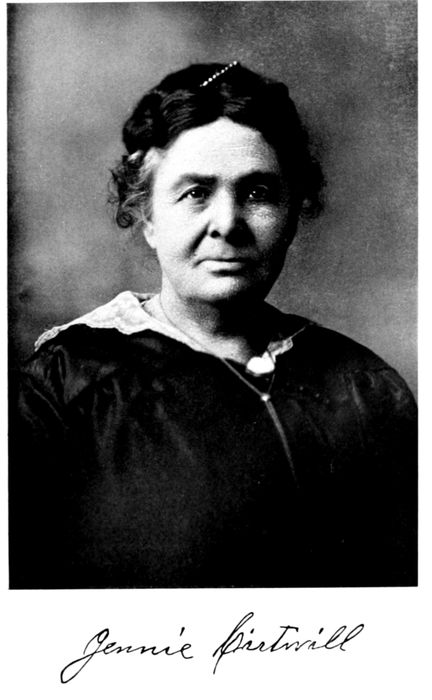
713Mr. Cirtwill came to Kansas in 1871 and developed a fine farm and became
well-to-do.
In January, 1889, Mr. Cirtwill married Mrs. Jennie (McClain) Cameron,
whose first husband was James Cameron, a native of Carrickfergus, Ireland,
born in 1848. When a young man, James Cameron became a sailor,
and was first mate on a vessel sailing the Atlantic ocean. At the outbreak
of the Civil war, Mr. Cameron enlisted in the Union army at Bangor, Me.,
and served until the close of the war. In 1869 he came to Muscotah, Kan.,
and worked as a contractor and brick mason. Six children were born of
this marriage: Frank, deceased; William, a traveling salesman, Kansas City,
Mo.; John R., a railway operator, of Mountain Home, Idaho; Rose died
in infancy; Frank J., a railroad conductor, St. Joseph, Mo., and Walter H., a
traveling salesman, Kansas City, Mo. The father of these children died
in 1903.
Mrs. Jennie Cirtwill was born at the Bank Cottages, Scotland, May 1,
1849, a daughter of William and Rosanna (Saul) McClain, who emigrated
from their native heath in 1855, and first settled in Illinois, where the father
became a contractor and builder in the employ of the Illinois Central Railroad
Company. He, too, became a soldier, thus making a remarkable coincident,
wherein Mrs. Cirtwill was the daughter of a soldier, and both of her former
husbands were Union veterans. Mr. McClain served with bravery in an
Illinois regiment of volunteers. In 1870 he came to Atchison county and
engaged in the lumber and building business at Muscotah, Kan. He became
the owner of several farms and was well-to-do at the time of his death, February
13, 1907. The mother of Mrs. Cirtwill died in 1915, at the ripe old
age of ninety-three years. Both parents are buried at Lancaster, Kan. A
bright spot in the memories of Mrs. Cirtwill is the fact that she was permitted
to care for her aged parents in their declining years and made a home and furnished
every comfort for them.
714When residing in Muscotah, Mrs. Cirtwill, nee Cameron, was left almost
destitute with the care of her five children on her hands. She was forced
to do the hardest kind of work to keep them in comfort and send them to
school. She worked as a tailor and seamstress in order to do this, and long
and exacting hours of toil were necessary to hold the little family together,
but later, better days came and she has had the extreme satisfaction of seeing
her children, for whom she made sacrifices in those earlier days, become substantial
and well-to-do citizens of their respective localities.
A brother of Mrs. Cirtwill, John McClain, was killed by a horse when
four years of age. William, the only brother reared to manhood, was a
banker at Huron, Kan., but sold his interests there and removed to Peru,
Kan., where he started a bank of his own. Three years later he went to
Coffeyville, Kan., and lived there for a short time. Very early he began to
see the future value of oil lands in Oklahoma, and invested heavily in Oklahoma
land which proved to be a very profitable investment. Besides being
a capitalist and builder he was a speaker and public man, well known in Atchison
county and Kansas. He died in Coffeyville, Kan., January 5, 1911, at
the age of fifty years. He left a widow and one daughter.
The mother of Mrs. Cirtwill, who was Mrs. Rosanna (Saul) McClain,
was a skilled seamstress, and had the honor of attending the coronation ceremonies
of Queen Victoria in England. Her father was Thomas Saul, a poet
of unusual ability, endowed with a wonderful memory and an ability to quote
poetry and the classics which his daughter inherited to a great extent.
Through her great-grandmother, Rosanna Saul McClain was of royal lineage,
having been born in a royal golden bed of honor, only vouchsafed to those of
kingly lineage. This great-grandmother became very wealthy and left a
large estate to her two daughters. Rosanna and her sister were highly skilled
in tailoring and needle work and embroidery, and were highly rewarded by
Queen Victoria for making and embroidering a beautiful dress for the queen
to wear on state occasions.
Mrs. Cirtwill is the owner of considerable property in Atchison county,
including 260 acres of fine land, a store building and a home in Lancaster,
Kan. She has two grandchildren: Cecil Mae, and Jeanette Rose Cameron,
children of Frank J. Cameron. Besides her Atchison county property this
well-to-do Atchison county woman has several vacant lots and residence
properties in St. Joseph, Mo., and is considered to be an able business woman.
She is a member of the Rebekah lodge, of Lancaster, and is a prominent member
of the Methodist Episcopal church. For many years she has taught a
715Sunday school class, of which she is very fond. Mrs. Cirtwill usually spends
the summer seasons in traveling and during the summer and fall of 1915, she
spent several weeks in the West, principally in Denver and vicinity.
The name of Barnes figures prominently in the early history of Kansas
and Atchison county, and the history of the family in Kansas dates from the
spring of 1858 when Capt. Asa Barnes came from the ancestral home of the
Barnes family in New Jersey, and settled in Mt. Pleasant township, Atchison
county, and immediately identified himself with the Free State party.
Asa Barnes, the present representative of the family living on the old
Barnes homestead in Mt. Pleasant township, five miles northwest of Potter,
was born in January, 1854, in New Brunswick, N. J., a son of Asa and Harriet
(Cook) Barnes, the former a native of Connecticut and the latter of New Jersey
of English descent. Asa Barnes, the father of the subject, was born
in 1821, and became a papermaker in New Brunswick, where several of his
children were born. In 1858 he disposed of his belongings and property in
New Jersey and migrated to Kansas, settling in Mt. Pleasant township, Atchison
county. His wife and children followed him in April, 1859. When he
first came to Kansas he was a Democrat in politics, but changed his political
belief soon afterward and espoused the cause of the Free State party. He
took a prominent and active part in political affairs and became well known
throughout the State as an able and influential champion of freedom. On
two different occasions he was elected to represent Atchison county in the
State legislature and served the people with distinction and ability. When
the Civil war broke out between the States he organized Company A of the
Twelfth Kansas cavalry and served as captain of the company; he also helped
to organize a company for the Thirteenth Kansas infantry. He was further
distinguished by his war service in a manner which reflected credit upon himself
and his home county. Captain Barnes died January 12, 1889. Asa
Barnes was the father of ten sons and one daughter, as follows: R. A., deceased;
M. N., deceased; Enoch, deceased; Asa, Jr., Fillmore died in New
Jersey; Frank, living in California; Laura (Willis), Corning, Kan.; Louis,
living at Binger, Okla.; Harry, Bisbee, Ariz.; Orrin, of Nevada; Reuben C.,
deceased. The mother of these children died February 12, 1909, at the age
of eighty-two years.
716Asa Barnes, the younger, was one of three sons of Capt. Asa Barnes, and
grew to manhood on his father’s farm in Atchison county. He remained at
home and assisted his father in the management of the home farm until he attained
his majority. After his marriage in 1874 he rented land on his own
account for six years and then bought the home farm of 207 acres from his
father and the heirs, part of which is now owned by his sons. He has followed
a plan of general farming and has prospered to a considerable extent.
Mr. Barnes was married November 5, 1874, to Miss Kate Thompson, of Atchison
county. This marriage has been blessed with five children, as follows:
Fannie, deceased; Herbert, at home with his parents; Bertha, wife of A. J.
Pease, of Atchison; Leola, wife of A. J. Saggs, of Falls City, Nebraska;
Ernest L., at home; Dora, wife of Ed Lee, of Atchison county; Cora, deceased.
The mother of these children was born October 2, 1854, and is a
daughter of Hon. George W. Thompson, now living in Atchison, and who is
probably the oldest living pioneer settler of Atchison county, and concerning
whose career an extended review is given in this volume.
In political affairs Mr. Barnes, while favoring the Progressive party
principles, is inclined to be independent in his voting. He is a member of the
Christian church, and is well and favorably known throughout this section
of Atchison county, being rated as a substantial well-to-do farmer, who is
deserving of considerable credit for what he has accomplished.
Charles Arthur Chandler is one of the self-made men of Atchison. Some
men are successful because of a fortunate chain of circumstances attending
their efforts which we commonly refer to as “good luck”; others by dint of
steady employment, saving their surplus funds and investing them wisely, are
enabled to secure the necessary wherewithal to embark in business and attain
a substantial modicum of wealth. It is to the latter class that Mr. Chandler
properly belongs. While good fortune has generally attended his industry
and plans, his success is due to the husbanding of his resources, and planning
ahead with the coöperation of a faithful wife, so that he could eventually be
his own employer and engage in mercantile pursuits for himself. Since January
1, 1910, he has been engaged in the lumber business in connection with
the Shulz-Fisk Lumber Company, one of the oldest concerns in the city. Four
717men are employed to take care of the extensive business which comes to the
yards. Lumber, lime, cement, plaster and building material of all kinds are
sold in large quantities. The extensive yards, 100×250 feet, are rated as
among the best equipped and most modern in northeastern Kansas, and the
management is constantly improving the appearance and facilities of the
buildings.
Mr. Chandler was born November 22, 1860, in Fond du Lac, Wis., a son
of Charles and Maria (Moore) Chandler, natives of Munson, Mass., and
Montreal, Canada, respectively. The Chandler family is a very old one in
America, and an extensive genealogy of the family has been compiled. William
Chandler, progenitor of the family in this country, emigrated from the
ancestral home in England to Roxbury, Mass., in 1637, dying there November
26, 1641. He had a son named John, born 1635, who married Elizabeth
Douglas, of Roxbury, Mass. Succeeding generations are as follows, in a
direct line to C. A. Chandler: Captain Joseph Chandler, born June 4, 1683,
wife, Susannah Perrin, of Roxbury, Mass.; David Chandler, born May 28,
1712, wife, Mary Allen, of Pomfret, Conn.; Elijah Chandler, born May 3,
1737, wife, Sarah Frizzel, of Woodstock, Conn.; Charles Chandler, born June
23, 1779, wife, Margaret Edgerton, of Munson, Mass.; Charles Chandler,
born February 21, 1822, wife, Maria Moore Shepard; C. A. Chandler, born
November 22, 1860, wife, Effie Rook, of Atchison, Kan.; Elijah Chandler
was a soldier in the French and Indian war. Charles Chandler, father of
the subject of this review, was a “Forty-Niner,” who made the long trip to
California across the plains in 1849. He mined gold in the placer fields of
the Golden State for some time, and then returned to the East, via the
Nicaragua route, settling down in Fond du Lac, Wis., where he engaged in
the grain business with fair success. He died at his home in Fond du Lac
in 1896, at the age of seventy-five years. He was the father of three children:
Mrs. Charles E. Rogers, Fond du Lac; Fred Shepard, also of Fond du
Lac, and Charles A., with whom this review is directly concerned. The
mother of these children, Maria Moore Shepard, was born in 1826, and is
a direct descendant of Governor William Bradford, of Massachusetts. The
genealogical tree in a direct line from the colonial governor is as follows:
Gov. William Bradford; his son, Maj. William Bradford; Alice Bradford
married Maj. James Fitch, 1649–1727; Daniel Fitch, 1693–1752, wife, Anna
Cook; William Fitch, 1720—, wife, Mary Paine; Abigail Fitch, 1745–1785,
married Joseph Moore, 1745–1823; Anna Moore, 1770–1854, married Timothy
Shepard, 1764–1817; Maria Moore Shepard, 1826, etc.
718C. A. Chandler was educated in the public schools of his native city and
fitted himself for the profession of civil engineer by a considerable amount of
home study and practical experience. After getting launched in his chosen
profession, he entered the employ of the Missouri Pacific railroad and remained
in the employ of this railroad for a period of twenty-five years. He
first came to Atchison in May, 1885, and has since been a resident here.
Mr. Chandler is the owner of the Graham farm of 310 acres near Cummings,
Atchison county, Kansas. Every dollar’s worth of property which he
owns has been accumulated by his own endeavors; not one dollar was ever
received by him through inheritance or gift, and he and his wife have the great
satisfaction of knowing that what they have and own is theirs by right of
industry and thrift. Mr. Chandler is a Republican, a member of the Episcopal
church, and is fraternally associated with the Masonic order, a member of
Active Lodge, No. 158, Ancient Free and Accepted Masons, and the Ancient
Order of United Workmen. He was married February 4, 1891, to Effie
Rook, of Atchison. To this union have been born: Horace F., born September
19, 1896, a graduate of the Atchison High School, class of 1913, and now
a sophomore in Kansas University, Lawrence; Esther, born March 5, 1898,
senior student in the Atchison High School, class of 1916. The mother of
these children is a daughter of Judge Horace M. Jackson, a biography of
whom is published in this volume.
The city of Atchison is fortunate in having as the present superintendent
of the city hospital a lady of talent and ability, which, combined
with great personal charm, constitute a splendid equipment
for the important position which Miss Power holds. She is eminently qualified
by training and executive capacity to perform the exacting duties required
of a hospital superintendent, and she is fast becoming deservedly popular
among the people of Atchison, who support this justly famous institution.
Grace Crosby Power is a native of Indiana, born October 23, 1880, in the
town of Milroy, Rush county, and is a daughter of William Strange and
Mary E. (Crosby) Power. Her father was also a native of Rush county,
Indiana, born in 1837, a son of an Indiana pioneer family. His parents were
John A. and Mary A. (Smisor) Power, both of whom were natives of Germany
and Scotland, respectively. They immigrated to America from Germany
719in an early day, and cleared a farm from the dense wilderness of Rush county
by dint of hard labor and the exercise of fortitude. This German-American
couple had the satisfaction of gaining a substantial competence from the soil
and of bequeathing a good family of sons and daughters to their adopted
land. William Power was one of the first fine live stock breeders of Rush
county, and his farm became famous for the Hambletonian horses which it
produced. He died in 1906 in his home town, Milroy. His wife, Mary,
was born in Milroy, Ind., in 1837, a daughter of Michael and Lucinda Crosby,
natives of Ireland, and also early settlers of Rush county, Indiana. The
Powers were all members of the Methodist Episcopal church, and have been
prominent in the affairs of Rush county for many years. William Power
was one of the well-to-do men of the county. To Mr. and Mrs. William
Power were born four children: Cora Estelle, wife of Prof. E. F. Engel, of
Lawrence, Kan.; Kathrine, wife of Rev. W. F. Smith, of the Methodist
church, at Huntington, Ind.; Frank A., Wichita, Kan., a director of the
Power-Myers music house; Miss Grace Crosby Power, with whom this review
is directly concerned.
Miss Power received her elementary education in the public schools of
Milroy, Ind., and afterwards entered DePauw University, at Greencastle,
Ind., where she pursued a music course for two years. She then came to
Kansas and studied in the liberal arts department of Kansas University, at
Lawrence. While her original intention had been to perfect herself in art
and music, she became imbued with the idea of becoming a nurse, feeling
that a wider field was offered in the art of caring for the sick, and that she
could be of greater service to humanity. Accordingly, Miss Power entered
the University Medical Hospital of Kansas City, Mo., in 1905, and began
the studies which were to prepare her for her life work as a hospital nurse.
She applied herself diligently to her medical studies and was graduated from
the Kansas City institution in 1908. She was then offered the position of
superintendent of the Galesburg, Ill., hospital, and accepted, remaining there
until 1911. She was not yet satisfied with her professional preparation, and
resigning her position, she spent one year in Europe, traveling and studying
the methods in vogue in the hospitals of the old world. Returning to Kansas
City in 1912, she was employed by Drs. Jabez and Jackson, of that city, in a
professional capacity, until she was called to her present post, September 29,
1915. Since taking charge of the Atchison City Hospital, she has given
every evidence of being eminently fitted for the duties of her position and
calling. Miss Power is a member of the Methodist Episcopal church, and
is affiliated with the A. X. U. sorority, of DePauw University.
720
The late William H. Thompson, of Mt. Pleasant township, Atchison
county, was born on a Kentucky farm, near the city of Louisville, in 1838.
His parents were Benjamin and Nancy (Baxter) Thompson, and both were
born and reared in Kentucky, their old home being located on a small stream
called Dry Beauty. Nancy Baxter Thompson was the belle of the neighborhood
and was a famous beauty in her day. In 1848 the Thompsons migrated
from Kentucky to Platte county, Missouri, where they resided until the spring
of 1860, and then came to Atchison county and purchased the farm where
William H. lived until his death, in 1884. Benjamin, the father, was born
in Kentucky in 1799, and died on his Kansas farm in 1861, just after locating
in this county. He was a man of fair education, who was self-taught. He
taught school in his native State, and his father was a famous hunter in the
early days of Kentucky history. He disappeared while absent from home on
a hunting expedition, and it is supposed that he was killed or captured by
Indians, leaving a wife and three children. Times were hard and educational
advantages were either very poor or absent altogether. Benjamin educated
himself by night study and home reading, and became well versed in books
and knowledge.
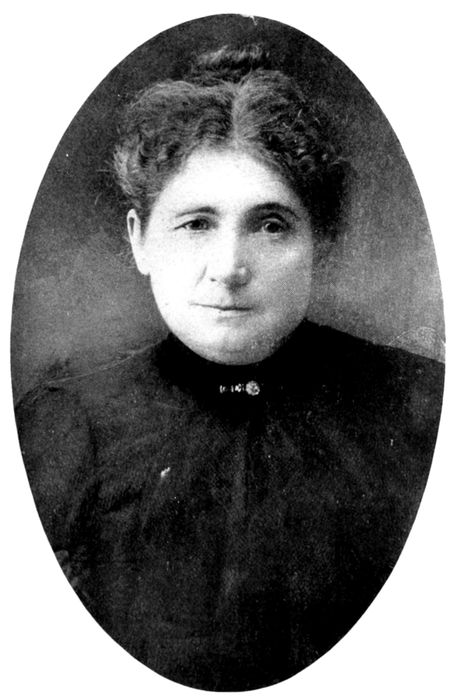
721William H. Thompson was ten years of age when the family removed
to Missouri, and he was reared to young manhood on the pioneer farm in
Platte county. After his marriage in 1862, he and his wife lived with his
widowed mother after the death of his father, October 26, 1861. He came
into possession of the home place and cultivated the land until his demise in
1884. He was married July 6, 1862, to Matilda Thompson, and eight children
were born to this marriage: Annie, wife of Frank Williamson, of California;
Ada, wife of Henry Knobloch, of Atchison county; Robert Lee, at
home with his mother; William H., a mining expert, in Colorado; Gertrude,
wife of Ed. Myer, of Atchison; Sirena Ella, deceased wife of Patrick Burns;
Benjamin Isaac, at home; Gladis, deceased wife of Eugene Thornburg. The
mother of these children was born in 1842 in Buchanan county, Missouri, a
daughter of Isaac Thompson, born in New York State, on a farm near New
York City, in 1804. The grandfather and a great-uncle of Isaac came to
America from England some time before the American revolution, and became
separated and never saw each other again. They were of Scotch origin.
The paternal grandmother of Mrs. Thompson was a Miss Fiske of the New
York family of Fiskes. Isaac Thompson married Elizabeth Fiscus in Indiana.
In the year 1808, the parents of Isaac Thompson removed from New
York to Ohio and twelve years later migrated westward to Shelby county,
Indiana, where the parents died. After his marriage Isaac migrated to
Buchanan county, Missouri, in about 1839, and developed a fine farm in that
county. In about 1847 he sold his farm in Missouri and set out on the long
overland journey to Oregon. A large party were en route to this new country
and the outfit comprised twenty-one wagons and teams. An incident of this
journey is here worth recording. While the emigrants were encamped for the
night at a point hundreds of miles from any human habitation, an Indian came
to the camp and informed them that a band of hostile red men intended to
attack them and destroy the outfit. A band of emigrant Mormons drove
up and joined them and they at once formed a corral with their wagons and
prepared to defend themselves against the threatened attack, but the attack
did not take place because of the preparations made. The Thompson family
remained in Oregon for five years. Isaac went to California in 1848 and
engaged in gold mining. Mr. Thompson was fortunate in his prospecting
and accumulated a small fortune. During the winter of ’49
he was shipwrecked while making a voyage from California to his
Oregon home, the vessel being driven far and out of its course by terrific
storms and he was forced to spend the winter on the Sandwich Islands. After
arriving home safely, he again went to California and continued his gold
mining. In 1851 the family returned to the Middle West. They boarded
a ship at Portland, Ore., journeyed to San Francisco, where they took a ship
for New Orleans. On the way down the coast the party was landed on the
west coast of the Isthmus of Panama and the emigrants were packed across
the Isthmus to the east side, where they boarded a vessel which carried them
to New York City, arriving there on Christmas day of 1851. From New
York they went to Philadelphia where Mr. Thompson had his gold minted
at the Government mint. From Philadelphia they traveled to Pittsburgh, and
here the children all contracted measles and two of them died. From
Pittsburgh they went down the Ohio river by steamer and up the Mississippi
to St. Louis where they boarded a Missouri river steamer which took them
to Camden, Mo. Here the wife and mother died. At Camden Mr. Thompson
purchased oxen and wagons and took the family to Buchanan county,
Missouri, arriving there in the summer of 1852. They lived in Missouri
until 1856 and then made a permanent settlement in Kansas preëmpting land
and locating on Walnut creek in Mt. Pleasant township, about four miles
southwest of the city of Atchison, which is now the Herzog farm. After eight
years’ residence here they again moved, this time to Illinois, where they lived
722for three years and came again to Kansas, this time settling in Nemaha
county. Isaac died in Nemaha county in 1871. His was certainly a rich and
varied experience and his life was filled with adventure and continual changes.
Mrs. Matilda Thompson, widow of William H., although having attained
the age of three score and thirteen years, is active, spry and in full possession
of her mental faculties. She is a wonderful woman for her age and is fond
of relating reminiscences of the old days when the family crossed the plains
and traveled half way around the world in quest of riches and adventure.
When the soul of the late John Henry Nass departed from its earthly
habitation to go to his Maker, the city of Atchison lost one of its excellent
citizens and merchants who had lived all of his life in the city of his birth.
The late J. H. Nass was born in Atchison, February 15, 1865, a son of Jacob
and Johanna Nass, both of whom were born and reared in Germany and
emigrated from the Fatherland in 1856, to America. They first settled at
Weston, Mo., but a short time later came to Atchison, Kan., where Jacob Nass
became the first brick manufacturer of the city. He erected the first brick
plant and made brick for many of the large brick buildings still standing in
the city. Jacob Nass continued actively in the brick business until 1875, when
he retired and the business was carried on by his four sons. During the course
of his business career he established the hardware store which was later owned
by his son, the subject of this review. He left at his demise, in 1899, a considerable
estate consisting of the brick plant, a hardware store, and real estate.
Jacob and Johanna Nass were the parents of six children, namely: Werner,
J. H., Theodore, Herman, all living in Atchison; Gertrude, and Mary Nass,
who is caring for her aged mother.
J. H., or Henry Nass, as he was better known by his friends and associates,
was reared in Atchison and attended the parochial schools and St.
Benedict’s College. At the age of sixteen years he entered his father’s hardware
store, and took complete charge of the business when he attained the
age of eighteen years. In 1886, with a partner named Frank Hess, of Weston,
Mo., he purchased the hardware store of his father. Six years later he
bought out his partner and became the sole owner of the store, which he conducted
until his demise, in 1903. He was married September 27, 1893, to
723Bertha Fleming, who bore him children as follows: Charles, born September
16, 1895, educated in St. Benedict’s College, and is now in the employ of the
Dolan Mercantile Company of Atchison; Raymond, born July 31, 1898, a
graduate of St. Benedict’s College, and is now with the Harwi Hardware
Company of Atchison; Rose, born October 31, 1899, at home with her mother;
Margarette, born June 2, 1901, student in St. Louis parochial school; William,
born November 19, 1902, a student in a St. Louis school; Henry John,
born December 7, 1903, and died at the age of eighteen months. Mrs. Nass
is justly proud of her children and has endeavored to rear them so that they
will lead upright lives and be a credit to her and the public. The Nass home
is located near St. Benedict’s College, and it is a happy one at all times. When
Mr. and Mrs. Nass were married in 1893 their honeymoon trip included the
World’s Fair at Chicago. She was born in Holland, a daughter of Lambert
and Rosa (Johnson) Fleming, both of whom were born and reared in Holland
and married there, after which they immigrated to America with their family
and settled in Atchison where Lambert made wooden shoes for a time and
later moved to a farm where he died June 15, 1880. Mrs. Fleming died
in 1903.
J. H. Nass was moderately successful in his business pursuits, and left
his family comfortably provided for. He was a Democrat but did not take
a very active interest in political matters. He was a member of St. Benedict’s
Catholic Church. His life was a good and useful one and his main interest
was in the well being of his family, of whom he was very thoughtful and
treated kindly and justly.
Frank M. Woodford, the well known cashier of the Atchison Savings
Bank, was born at Niles, Mich., November 29, 1874. He is a son of James
H. and Emma (Bickell) Woodford, both natives of Niles, Mich., the former
born in 1851 and the latter in 1855. James H. Woodford is a son of Benjamin
Woodford, who was a native of New York, and an early settler in Michigan.
His wife, Emma Bickell, is a daughter of Thomas J. Bickell, a Virginian.
James H. Woodford came to Kansas with his family in 1887, and
located in Atchison, and was an employee of the Missouri Pacific Railroad
Company for a number of years, and later purchased a farm in Atchison
county, where he now resides. Frank M. Woodford is the only son born to
724James H. and Emma (Bickell) Woodford. He attended the public schools
and graduated from the Atchison High School in the class of 1894. In 1896
he entered the employ of the Exchange National Bank of Atchison, and
worked in the collection department of that institution for two and one-half
years. He then entered the employ of the Missouri Pacific Railroad Company
as yard clerk and later served in the capacity of inspector and bookkeeper.
August 1, 1900, he became bookkeeper of the Atchison Savings Bank, and in
1910 succeeded to the cashier-ship of that bank, and has capably filled that
position to the present time. Mr. Woodford possesses the safe and conservative
judgment of the successful bank cashier and is recognized for his efficiency
in that important branch of the commercial world. Mr. Woodford
was united in marriage December 21, 1898, with Miss Mabel Santchfield, of
Macon, Mo., and two children have been born to this union: Millard, aged
eleven, and Maurice, aged eight. Mr. Woodford is a Royal Arch Mason, a
member of the Knights of Pythias, Fraternal Order of Eagles, Knights of
the Maccabees, Modern Woodmen of America, and Knights and Ladies of Security.
He is a Democrat and a member of the Baptist church.
Holmes Dysinger, D. D., dean of the Western Theological Seminary of
Atchison, Kan., was born March 26, 1853, in the town of Mifflin, Juniata
county, Pennsylvania, and is a son of Joseph and Mary Amelia (Patterson)
Dysinger, both natives of Pennsylvania. The genealogical record of the
Dysinger family traces its beginning in America to the seventeenth century,
the ancestry on the paternal side being South German and on the maternal
side, of English origin. The members of the family for succeeding generations
were farmers and carpenters, Joseph Dysinger being a carpenter and
contracting builder in his younger days, and later became a farmer. He died
on his farm in Pennsylvania, near his birthplace. There were six sons and a
daughter in the family which Joseph Dysinger reared, as follows: Holmes,
with whom this review is directly concerned; George Washington Dysinger,
a practicing dentist at Minneapolis, Minn.; Rev. William Stewart Dysinger,
a minister of the Lutheran church in Los Angeles, Cal.; Prof. James H. Dysinger,
a teacher at Los Angeles, Cal., and a daughter died at the age of six
months.
725Holmes Dysinger was reared on his father’s farm and received his elementary
education in the district school of his neighborhood. The initial part
of his higher education was obtained in the Airyview Academy at Port Royal,
Penn. The means at the disposal of the Dysinger family did not permit of
Holmes continuing his studies uninterrupted, and he found it necessary to make
his own way through the higher realms of learning. Consequently, in order
to make his way through college and the university, he began teaching at the
early age of seventeen years, and has taught continuously since that time, with
the exception of three years in college and a few years in a pastorate. In 1878
he received the degree of Bachelor of Arts from Pennsylvania College at
Gettysburg, Pa., and taught in the academic department of that college for
a period of four years, while studying theology in the seminary at that
place. His next position was as professor of Latin and Greek in the North
Carolina College, Mt. Pleasant, N. C., from 1882 to 1883. From 1883 to
1888, inclusive, he was professor of Latin and Greek at Newberry College, in
South Carolina, and from 1888 to 1895 he filled the position of president of
Carthage College, Carthage, Ill. From 1895 to 1900 he filled the pastorate
of the Lutheran church at Polo, Ill.; he was pastor of the First Lutheran
Church of Kansas City, Mo., from 1900 to 1902, and had charge of the Lutheran
church at Vandergrift, Pa., from 1902 to 1905. He became dean of
the Western Theological Seminary at Atchison, Kan., in November of 1905.
He received the degree of Doctor of Divinity from Wittenberg College, at
Springfield, Ohio, in 1889.
Dr. Dysinger was united in marriage with Ada Frances Ray, of Blairsville,
Pa., September 22, 1886, and to this union have been born five children:
Mary Ray Dysinger, librarian of Midland College, Atchison; Cornelia,
Helen Frances and Dorothy Homes, at home with their parents, and Mrs. Dr.
C. F. Malmberg, of Greenville, Pa.
Charles Lange, farmer, Center township, Atchison county, was born in
Germany, January 11, 1865. He is a son of Karl and Marie (Poos) Lange,
who were the parents of three children, as follows: Charles, subject of this
sketch; Mrs. Mary Rathert, Center township, Atchison county, and Minnie,
married C. Kloepper, living in Jefferson county. Karl Lange, the father,
was born March 13, 1838, in Germany, and left his native land in the fall of
7261874, coming to Atchison county, where he rented for a short time. He then
bought the place where his son now lives, which contained 140 acres. The
place was fenced with rails and a log cabin had been built, and the barn was of
straw. Taking this primitive farm in 1874, Mr. Lange began improving
it, and in 1883 he built a fine six-room house and made a number of other
improvements. In 1902 he retired and moved to Nortonville, Kan., where
he died in 1910. The mother of Charles Lange was born in Germany, July
31, 1841. She is now living in Nortonville, Kan.
Charles Lange attended school in Germany four years and also went to
the district school in Center township, Atchison county. He has always lived
on his present farm, and looked after his father’s affairs until the latter’s
death. He now owns the old home place, which includes 375 acres, sixty acres
of which is in corn. He is a thorough farmer and keeps high grade stock. In
1901 Mr. Lange was married to Martha Straub, who was born January 17,
1881, in Baden, Germany. At the age of five years she left Germany with
her parents, Joseph and Salme (Hilderbrandt) Straub, who came to America.
In 1904 they settled in Mt. Pleasant township, Atchison county, where the
father followed farming. Mr. and Mrs. Lange have six children, all of whom
are living at home. They are: Erna, Charles, Jr., Henry, Emma, Julius,
and Ella. Mr. Lange is a Republican, and attends the Lutheran church.
Charles L. Alkire, proprietor and manager of the Troy laundry of Atchison,
was born December 1, 1876, in Saline county, Missouri, a son of George
A. and Ellen H. (Dickson) Alkire, who were the parents of two children, as
follows: George D., a farmer of Bronaugh, Mo., and Charles L. George A.
Alkire was born August 28, 1846, in Illinois, and was a son of George Alkire,
who had the distinction of founding the Texas town which bears his name.
In early life he was a merchant, and came to Missouri when a young man, and
established a general merchandise store in Saline county. Later he engaged
in banking and was cashier of the bank at Blackburn, Mo. For six years he
served as county collector of Vernon county, Missouri. He is now living a
retired life in Dallas, Tex. His father, George Alkire, was an extensive fruit
grower, after whom the town of Alkire, Texas, was named and who died
there. Ellen H. (Dickson) Alkire, mother of Charles L., was born on a
727farm near Booneville, Tipton county, Missouri, September 3, 1839, and is
living in the family home at Dallas, Texas.
Charles L. Alkire received his education in the schools of his native
county, and attended the State school at Nevada, Mo., graduating from business
college in Nevada. He served as deputy collector in Vernon county
under his father, and then went to Norman, Okla., where he embarked in
the newspaper business, running the Troy laundry in connection with his
publishing duties, from 1899 to 1902. He then disposed of his holdings in
Norman and located in Kansas City, Mo., where he had charge of the shoe
department in G. B. Peck’s drygoods store, until his removal to Atchison, Kan.
He was first employed in the freight department of the Chicago, Burlington
& Quincy railroad, and was then engaged in the inspection bureau of the
Western Weighing Association of Railroads. He served as traveling salesman
for the A. J. Harwi Hardware Company until he purchased the Troy
laundry, in October of 1915. He was a successful traveling salesman, and
is making a marked success in his latest business venture.
Mr. Alkire was married in 1899 to Elizabeth H. Clapham, and to this
union one child, Elizabeth, has been born. Mrs. Alkire was born March 12,
1878, in Fremont, Neb., and is a daughter of Edward and Anna (Bradley)
Clapham, natives of England, who came to Iowa from their native land with
their parents when both were infants. Mr. and Mrs. Clapham have been
dead for a number of years. Mrs. Alkire was educated in the University of
Oklahoma and graduated from that institution. Mr. Alkire is an independent
voter and is not allied with any particular political party, being self-reliant
in such matters as he has always been in his business affairs. He is a
member of the Baptist church and his wife is a member of the Methodist
church.
W. D. Chalfant, a prominent farmer of Shannon township, Atchison
county, is a native of Pennsylvania. He was born at Brownsville, Fayette
county, August 2, 1862, a son of Benjamin M. and Mary Amanda (Lynn)
Chalfant, both natives of Pennsylvania, the former born in 1838, and the
latter in 1836. The Chalfant family is of English origin, and was founded
in America prior to the Revolutionary war. Benjamin M. Chalfant was a
son of James Chalfant, of Fayette county, Pennsylvania. Benjamin M. owned
the old Chalfant homestead in Fayette county, Pennsylvania, and in 1882 he
728sold his Pennsylvania property and came to Kansas, locating in Shannon
township, Atchison county, where he purchased 320 acres of land, and was
successfully engaged in farming until his death, which occurred June 3, 1914.
He was accidentally killed at the railroad crossing at Fourth street, Atchison,
while walking across the track. In an effort to avoid an approaching car, he
did not notice an approaching Missouri Pacific train, which struck him. His
wife died January 18, 1905. They were the parents of the following children:
James M. resides in Graham county, Kansas; Elsworth died in infancy:
William D., the subject of this sketch; Mary B. Bean lives in Kingman
county, Kansas: Henry died at the age of ten, Alice died at the age of
ten, and Elvira P. resides in Atchison.
William D. Chalfant was twenty years of age when he came to Atchison
county, and has resided in this county since 1882, with the exception of two
years, one of which he spent in California and the other in Nemaha county,
Kansas. He bought the home place in 1914, shortly after his father’s death.
He was united in marriage in 1891 to Miss Mary Mann, a native of Monroe
county, West Virginia, and a daughter of Austin and Susan Mann. The
father is deceased, and the mother resides in Arkansas. To Mr. and Mrs.
Chalfant have been born eight children, as follows: Bonnie Miller resides in
West Virginia, and has two children, Raymond and George; Benjamin M.
resides at home; Delilah, Jenette, Helen, Henry, Marie, and Mildred. Jenette
and Henry died in infancy. Mr. Chalfant is a Republican, and his fraternal
affiliations are with the Fraternal Order of Eagles and the Central Protective
Association.
He of whom this review is written is one of the enterprising and successful
farmers of Lancaster township, Atchison county, and is a son of Henry
Buttron, a pioneer settler of the county, and who at the time of his death was
one of the wealthiest and best known citizens of Lancaster township. A biography
of Henry Buttron appears in this history.
Jacob Buttron was born in Lancaster township, April 16, 1872, and has
always lived in the vicinity of his early home. He was reared on his father’s
farm and attended the school in the Bell district, No. 59. He remained
on the farm and gave his best endeavors to assisting his father in
building up the family estate until 1904, at which time he started out for himself
on a rented farm. He first rented 160 acres of land from his father.
729Later he bought an equal amount of the north quarter of the Cloyes farm.
He has through his father, at the present time, one of the best improved and
productive farms of Lancaster township and is on the high road to prosperity.
Mr. Buttron has his farm stocked with only the best grades of live stock and
has made an excellent record as a stockman.
He was married December 14, 1904, to Miss Emma Flattre, and four
children have blessed this union, namely: Bertha, Emma, Alice and John.
Mrs. Buttron is a daughter of Thomas and Emma (Manson) Flattre. Mr.
Buttron is a Republican in politics, but has never sought political preferment
of any kind, and contents himself in doing his duty at the polls at election
time. While he professes no religious creed, he is a church goer and is considered
to be an upright and exemplary citizen who has many friends in his
neighborhood, who esteem him highly for his industrious habits and honest
demeanor.
George Schrader, farmer and stockman, of Center township, Atchison
county, was born in Lancaster township, January 25, 1868, and is a son of
Nicholas and Kathrine Schrader. He was one of six children. The parents
were born in Germany, but each came to America when young. They were
married in the United States about 1856, and came directly to Kansas, settling
in Lancaster township, Atchison county. Later they removed to Mount
Pleasant township, and followed farming until the father retired. The mother
died in 1907, aged seventy-three years, and the father lived with his children
until his death, in 1914, at the age of eighty-six. George Schrader grew to
manhood on the home farm in Atchison county, and at the age of nineteen began
to work as a farm hand. A year later he went to California and worked
on a ranch. In 1890 he returned to Atchison county and rented his father’s
farm for a year, when he bought 180 acres, located on the Topeka State
road, two and one-half miles north, and one-half mile west of Cummings,
Kan. The farm had only scanty improvements, with a house in bad condition
and a small barn. He built a good two-story, modern, nine-room house,
which is situated in one of the finest building places in the county, commanding
an excellent view. He then erected a large barn, 36×50
feet, with a cement basement. It is well equipped and built especially for a
stock barn. Mr. Schrader takes great pride in his stock, which includes fine
730Hampshire hogs, Percheron and Coach horses. His farm consists of 200
acres, forty acres of which is timber land.
When a young man Mr. Schrader operated a threshing outfit, and continued
in that business for many years as a sideline. He is also a carpenter,
and built most of the buildings on his farm. In 1894 he married Carrie Kuhn,
who was born in Atchison county in 1874. She is a daughter of Fred and
Anna (Gruner) Kuhn. The father was a native of Germany, and the mother
of Illinois. Both parents are living. Mr. and Mrs. Schrader have three
children: Herbert, Lester, and Ida, all living at home. Mr. Schrader is a
Republican, and is treasurer of Center township. He is a member of the
German Evangelical church. He is a stockholder in the Cummings State
Bank. Mr. Schrader is a citizen active in the interest of his community, and
takes pride in his farm and in his community, and is always in favor of any
movement which will be for the good of the community.
William T. Hutson, an Atchison business man, who has extensive industrial
and commercial interests, and is a large land owner, is a native of
Missouri. He was born in Platte county August 1, 1874, and is a son of E. P.
and Johanna (Kelley) Hutson, the former a native of Clay county, Missouri,
and the latter of Dublin, Ireland. E. P. Hutson, the father, had a very
successful career, and at the time of his death, which occurred in Platte
county, Missouri, in 1892, he owned over 2,000 acres of valuable land. He
and his brother, Isaac, went to California in 1850, shortly after the discovery
of gold. They were interested in the live stock business on the coast at that
early day, buying cattle and driving them to the mining camps, where they
found a ready market at very good prices. They were engaged in this business
for twelve or thirteen years, and were very successful in a financial way.
Isaac’s health failed while on the coast, and he returned to his Platte county
home, where he died in 1864. After returning to Missouri, E. P. Hutson
followed farming, and looked after his extensive interests until about the time
of his death.
William T. Hutson, whose name introduces this sketch, is one of a
family of six children, as follows: William T., the subject of this sketch;
G. E., farmer, Platte county, Missouri; Capitola married W. P. Page,
731Platte county, Missouri; Pluma married Dr. Kirkfast, Austin, Neb.;
Goldie married Barney Nolan, Sioux City, Iowa, and Galena married
Edward Back, Atchison, Kan. William T. Hutson was reared on the home
farm in Platte county, Missouri, and received his education in the public
schools, and has made farming the chief occupation of his life. He and his
brother, G. E., now own and operate 1,000 acres of land in Platte county,
Missouri, where they are extensive growers of wheat and other grains. They
are also extensive hog raisers and are among the most extensive farmers of
Platte county.
Mr. Hutson came to Atchison in December, 1909, and since that time
has been closely identified with industrial Atchison. He is president of the
Atchison Paving Brick Company, and is a director in the First National Bank
of Atchison. He was united in marriage in June, 1909, to Miss Esther Jackson,
of Bigelow, Mo. She is a daughter of Richard and Varney Jackson,
members of old and highly respected Platte county families. Mr. and Mrs.
Hutson have one child, Virginia Lee, born June 23, 1912. Mr. Hutson is a
Democrat.
John Beyer, banker and stock buyer of Arrington, Atchison county,
Kansas, was born in Kapioma township, on October 9, 1871. His parents,
Asa and Susan Beyer, were both natives of Pennsylvania, the father having
been born there in 1835. They came to Kansas in 1868, and settled in Kapioma
township, Atchison county, where the father died in 1898, and the
mother is still living. John Beyer is one of eleven children, as follows: Mrs.
Mary Lewton, Benton township; Samuel, Kapioma township; Mrs. Christen
High, Texas; David, farmer, Kapioma township; Jane, living on the home
place; Clarissa, deceased; Martha Schiffbauer, Sumner county, Kansas; John,
the subject of this sketch; Albert, Caldwell, Kansas, and Luctria Dodson,
Kapioma township.
John Beyer attended the Cole Creek district school and at the age of
twenty-one started out in life for himself. He bought an eighty-acre farm
from his father, and worked this place five years and made a success of it.
In 1900 he moved to Arrington, Kapioma township, and engaged in the
livery business. He ran this until the following year when he sold out and
bought the elevator on the Union Pacific railroad at Arrington. He bought
732and sold grain for six years, but owned the elevator until 1912. The year
previous he began to deal in live stock and has continued in that business
since. In 1904 the need of a bank was felt, and John Beyer, together with
other leading citizens of Arrington, organized the present bank. For the
past eight years he has been assistant cashier of the institution. Mr. Beyer
owns farm land in Kapioma township.
In 1897 Mr. Beyer married Maud A. Coots, who was born in Holt county,
Missouri, January 13, 1875. She is a daughter of Presley W. and Sarah
(Campbell) Coots, both Missourians, whose parents were from Kentucky.
The father is now living in Muscotah, Kan. Mr. and Mrs. Beyer have one
child, Flossie A., who is living at home. Mr. Beyer is a Republican and a
member of the Independent Order of Odd Fellows.
Joseph H. Watowa, a prosperous Atchison county farmer, is a native of
Missouri. He was born in Buchanan county, January 24, 1864, and is a son
of Joseph and Catharine (Fischer) Watowa, both natives of Austria. They
were married in their native land, and immigrated to America in 1855, first
settling in Wisconsin. Later, they located in Buchanan county, Missouri, and
in 1879 came to Kansas, locating in Shannon township, Atchison county, on
the place where Joseph H., the subject of this sketch, now resides. They
were the parents of six children, as follows: Frank resides in Atchison
county; Mary, deceased; Henry resides in Atchison county; Amelia; Joseph
H., the subject of this sketch; and Paulina.
Joseph H. Watowa is one of the successful farmers of Atchison county,
and has one of the fine farms of that section in the State, consisting of 160
acres of well improved land under a high state of cultivation. His land is
located in an ideal spot, and a fine tract of timber is located on the place.
He is an extensive alfalfa grower and an all around practical modern farmer.
Mr. Watowa was married in 1892 to Miss Theresa, daughter of Joseph
and Johanna Zeit, natives of Austria and early settlers in Atchison county,
where they still reside. To Mr. and Mrs. Watowa have been born the following
children: Mary, age nineteen; Johanna, age eighteen; Elizabeth, age
seventeen; Helena, age sixteen; Joseph, age thirteen; Bertha, age twelve, and
Catherine, age four. Mr. Watowa has lived on his present place for thirty-six
733years, and, although still a young man, he counts himself among the old
landmarks of Atchison county. He is a Democrat, and has always supported
the policies and principles of that party. He has taken a commendable part
in local politics, and has served as town clerk for six years. He and his family
are members of the St. Benedict Catholic Church at Atchison.
Nathan T. Veatch, superintendent of the Atchison city schools, is a
native of Illinois. He was born near Astoria, Fulton county, and reared on
a farm. After receiving a common school education, he began his career as
a teacher in the district schools of Schuyler county, Illinois. Later he
attended the State Normal school of Illinois, and was graduated from that
institution with the class of 1881. He was principal of the graded school at
Butler, Ill., for two years, and later was principal of an eighth grade ward
school in Little Rock, Ark., for four years. He served as superintendent and
principal of the Rushville city schools at Rushville, Ill., for fourteen years,
and in 1901 was elected superintendent of the Atchison city schools, and has
held that position to the present time.
Mr. Veatch was married in 1883 to Miss Lizzie Montgomery, of Rushville,
Ill. She was a successful teacher prior to her marriage. To Mr. and
Mrs. Veatch have been born two children, as follows: Nathan T., Jr., born
at Rushville, Ill., and is now a civil engineer, and a member of the firm of
Black & Veatch, consulting engineers, Kansas City, Mo., and Francis M.,
born at Rushville, Ill., a sanitary engineer, in the employ of Kansas
University.
James L. Armstrong, farmer and breeder of prize winning Percheron
horses, was born in Winnebago county, Illinois, July 11, 1867. He comes
of sturdy Irish stock, his parents having been born on the Emerald Isle. The
father, James Armstrong, was born October 22, 1836, in County Sligo, Ireland.
He was a farmer there, and at the age of twenty-four sailed for America
and found his first job in Philadelphia. In a short time he came west and
followed farming in Illinois. Several years later, in 1867, to be exact, he
734came to Atchison county, Kansas, and bought eighty acres of land near Huron,
Kan., in Lancaster township. He farmed this place until his death in 1886.
In addition to his farming he was an extensive breeder and feeder of cattle.
His wife was also born in Ireland, the date of her birth being December 25,
1830. She died in 1902. They were married in Ireland and three children
were born to them there. After coming to America five other children were
born. Both parents were members of the Methodist church.
James L., Jr., the subject of this sketch, grew up in Lancaster township,
and attended school in district No. 44. He remained at home with his parents
until they died. He then bought 320 acres in Kapioma township and
built an unusually fine residence at a cost of about $4,000. The interior is
finished in white oak, and a cement basement underlies the house, and all
modern conveniences have been installed, including hot and cold running water.
He keeps all of his buildings painted and in repair so that everything around
the place presents a fresh and orderly appearance. Horses are Mr. Armstrong’s
hobby, and several times he has won prizes at the Effingham fair
with his Percherons, and now has four thoroughbred Percherons registered.
He is a shareholder in the Muscotah elevator. He is unmarried and has a
man and his wife, who care for the household. Mr. Armstrong is a member
of the Christian church and has affiliated himself with the Republican party.
He is a member of the Percheron Society of America. He has received as
high as $600 for Percheron horses bred on his place.
A man’s usefulness in his community need not necessarily be confined to
working entirely for his own individual aggrandizement, and there are frequently
found conspicuous examples of good citizenship who are broad-minded
and enterprising enough to extend their activities outward, so as to
embrace the well-being of their fellowmen. John Ferris, banker and prosperous
farmer, of Center township, Atchison county, is a shining example of
broad and upright citizenship, with whom family, church and social ties have
been preëminent during his long residence in the county. Successful as a
farmer and stockman, his ambitions have led him into banking pursuits with
considerable success to his credit. His deeply religious nature having endowed
him with a love for church work, many fruitful years of his life have
735been devoted to Sunday school and church work, which have won him high
esteem and infinite respect among the people of his neighborhood.
The twenty-eight years of Mr. Ferris’ residence in Center township have
been productive of much material good on his part, and he is rated as one
of the really successful men of the county. This period marks his rise from
comparative poverty to a position of affluence and prestige, attained by few
citizens. Mr. Ferris saw opportunity and embraced it, and has made good in
more ways than one.
John Ferris is a man whose pluck and industry have brought him out of a
long struggle with high honors. Starting out in life as a poor boy, he worked
long and hard, until now he lives in comfort and security. Mr. Ferris was
born at Sharonville, Ohio, November 25, 1860, and is a son of Peter and Hettie
(Phares) Ferris, who were the parents of seven children, as follows: John,
the subject of this sketch; Joseph, Winchester, Kan.; Alice, wife of W. T.
Birt, Topeka, Kan.; Louvinca, wife of F. L. Stephens, Topeka, Kan.; Thomas,
Mt. Pleasant township, Atchison county; Peter, farmer, on old Eastman place,
Center township, Atchison county, and Mrs. Della Coppinger, deceased. The
father was born August 8, 1839, in Sharonville, Hamilton county, Ohio. He
was a son of John and Rebecca (Myers) Ferris, natives of Pennsylvania,
who came to Ohio as early settlers, in 1804. The father of John Ferris, subject
of this sketch, was reared on the farm in Ohio. He came to Kansas in
1878, and settled in Osborne county. Two years later, after being starved out
by the ravages of the grasshoppers and the hot winds, which burned up his
crops, he went to Rawlins county, Kansas, where he preëmpted 640 acres of
land. He did not live there, but came to Nortonville, Kan., and began work
as a laborer and farmer.
In 1887 he came to Center township, where he rented for five years. He
then rented 640 acres south of Nortonville. In 1892 he and his son, John, the
subject of this sketch, bought 160 acres in Jefferson county. Then, for a
number of years, they bought and sold farms in Atchison and Jefferson counties,
until 1903, when they bought the farm of 215 acres, which John and
his father are working. This land is located in Center township and includes
the northwest quarter of section 3 and the southwest quarter of section 34,
and includes ten acres of natural timber. He has thirty acres of alfalfa and
fifty acres in corn each year. Mr. Ferris also devotes considerable attention
to his stock. He keeps only graded animals on his farm, and makes a specialty
of feeding hogs and cattle for the market. He started out with little capital,
and had to begin as a laborer at day wages, but he saved his earnings and
736invested them wisely, and, now, besides being a substantial farmer, he is a
shareholder and president of the State Bank of Cummings. Mr. Ferris is unmarried.
His mother was born in Little Rock, Ark., in 1840. She is a
daughter of Joseph and Matilda (Todd) Phares. The father came from New
Jersey, and the mother from Tennessee. In politics, Mr. Ferris has identified
himself with the Republican party. He is a member of the Pardee Methodist
Episcopal Church and takes an active part in its organization. He is
a steward, and for many years has been superintendent of the Sunday school.
He is a member of the Ancient Free and Accepted Masons, and of the Independent
Order of Odd Fellow lodges of Cummings. Mr. Ferris is a conspicuous
example of the self-made man. His career proves the possibilities
of a man, who, though handicapped by lack of capital, is willing to work consistently
and save judiciously.
The history of the Laird family in Kansas begins three score years ago,
in the old days when the first sturdy pioneers were coming from the older
states to find new homes in the unpeopled waste of Kansas, and to break
the way for others who have since followed in increasing numbers. It is a
long reach which witnesses the transformation of a wilderness of prairie and
woods to a beautiful, productive landscape of peace and plenty, but Marcus
J. Laird and his wife have been fortunate in growing to maturity with Atchison
county. Few families in this county can claim an older lineage than the
Lairds or Cummings families, and no family is more respected than that of
Marcus J. Laird. His father, J. B. Laird, was one of the earliest pioneers of
Atchison county, and on the other hand the father of Mrs. Laird was another
pioneer. William Cummings, who founded the town of Cummings, thus
leaving a monument which will perpetuate his name for all time to come.
Through the medium of these historical annals of Atchison county these
pioneers will be duly honored and this volume is dedicated to their everlasting
memory in order that the story of Atchison county might be transmitted
truthfully and accurately to posterity.
Marcus J. Laird has been successively, farmer, merchant and postmaster,
and is proud of the fact that he is a native born citizen of Kansas, and a son of
one of the earliest pioneers of the State. Like a good many men who have
been reared to farm life, after a successful career as merchant and public
official, he has returned to the farm where living is sure and certain and a
competence is the inevitable reward of years of labor.
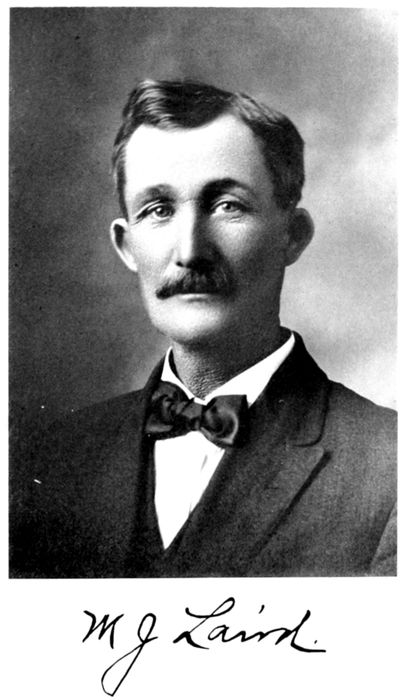
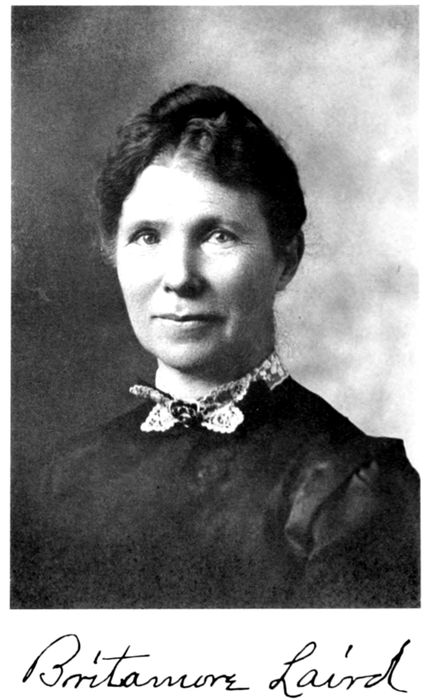
737Marcus J. Laird was born August 26, 1860, in Center township, Atchison
county, and is a son of James B. and Marinda (Martin) Laird, who were
the parents of fourteen children as follows: Mary died in infancy; Thomas
died in infancy; James W., Jackson county, Kansas; Marcus, the subject of
this sketch; Abraham, Jefferson county, Kansas; Mrs. Emma Leland, Atchison,
Kan.; John, deceased; Ulysses, deceased; Rose, wife of C. Barnes, Chase
county, Kansas; Robert, Jackson county, Kansas; Paul, a teacher, Durant,
Okla.; Mrs. Amanda Hanson, Nortonville, Kan.; Mrs. Mabel McDonald,
Muscotah, Kan., and Frank, Seattle, Wash. James B. Laird, the father, was
born in Zanesville, Ohio, June 13, 1834, and was a son of Thomas and Elton
(Saffle) Laird, both natives of Pennsylvania. The Lairds are of Scotch
descent. James was brought up on his father’s farm, and when he was thirteen
years of age his parents removed to Livingston, Mo., where he grew to
manhood. He then went to Buchanan county, Missouri, where he was married
to Marinda Martin, the wedding taking place at DeKalb, Mo., in 1854.
Marinda (Martin) Laird was born August 1, 1836, in Morgan county, Indiana.
She is a daughter of Hanson and Mary (Holman) Martin. Her father
was a farmer in Kentucky before coming to Atchison county, Kansas, in 1856,
where he died in 1878, and the mother died in 1840, at the age of thirty years.
James B. Laird and his bride came to Kansas in the fall of 1854 and settled
in Mt. Pleasant township, Atchison county, where they homesteaded 160
acres of prairie and timber land. They drove from Missouri in a covered
wagon pulled by oxen. Atchison, Kan., had but one house at that time; it
had been moved there from Missouri. James Laird built a sawmill on his
farm the first year he was there and sawed 1,000 feet of lumber, but a flood
swept it all down into Crooked creek. They built a log cabin on the place,
and the first child, Mary, was born there. The fact that Mt. Pleasant, which
was only three miles away, provided a nearby market, helped the Lairds out
considerably. They farmed the homestead until 1860, when they sold it for
$900 and moved farther west and bought 276 acres in Center township. This
property became the old home place and the Lairds owned it for many years.
James B. Laird moved to Cummings and conducted a general merchandise
store for a few years preceding his death, in 1892. The widow returned
to the farm with the children, where she brought them up and educated them.
In 1909 she left the home place and has since lived with her children, and at
738present she lives with Marcus, the subject of this sketch. Marcus J. Laird
grew up on the home place and attended school in district No. 36, Center
township, and at the age of sixteen he left home and worked as a farm hand
for about a year, and later rented land from his father. In 1883, at the age
of twenty, he bought sixty acres in Center township and farmed it a year
when he traded it for a stock of merchandise at Cummings and was in partnership
with Nelson Cox there for five years. Selling his interest in the business
he rented land and farmed for a while. In 1892 he bought the place which he
now owns and has increased the original eighty acres to 104. He has always
kept good stock on his place and takes pride in keeping his animals up to
standard. In 1884 Mr. Laird married Britamore Cummings, who was born
August 20, 1866, in Center township, Atchison county. She is a daughter of
William and Sarah (Quiet) Cummings. Her father was a founder of Cummings,
Kan., and was a native of Pennsylvania. He came to Kansas in 1855
and engaged in farming. He died July 27, 1900, at the age of eighty-six.
The mother, Sarah, was born in Illinois and is now living in Kansas City,
Kan. Five children were born to Mr. and Mrs. Laird, as follows: James W.,
Kansas City, Mo.; Meda B., wife of L. Reynolds, Center township, Atchison
county, Kansas; Anna McKanna, living at home; Edith Hammer, Effingham,
Kan.; Blanche, a teacher, living at home. Mr. Laird is a Republican. He
was postmaster of Cummings for thirteen years. He is a member of the
Baptist church and of the Independent Order of Odd Fellows and Ancient
Order of United Workmen.
The history of the Bilderback and Johnson families in Kansas goes back
to the old freighting and pioneer days when the hardships of the first settlers
were many and conveniences were few. The father of Allen T. Bilderback,
whose name heads this review, was one of the early stage coach drivers whose
route took him on many journeys from Kansas to Denver, and other Colorado
points. Aaron Bilderback drove a stage coach from Atchison to Denver and
Central City, Colo., beginning in 1864, for several years, until he finally settled
on a farm in Center township, Atchison county. Jesse R. Johnson, grandfather
of Mrs. Bilderback, had the honor of assisting in establishing the first
Methodist church in Kansas, and Methodism is said to have had its origin
in the State from a Sunday school which was started in his home at Oak
739Mills, nearly sixty years ago. From this small beginning a great religious
denomination had its inception in the new State of Kansas.
Allen T. Bilderback, with whom this review is directly concerned, is a
native born Kansan, a man of good education, who has been useful as an educator
and farmer during his residence in his native county. He was born in
Center township July 21, 1878, and is a son of Aaron and Sarah (Jones)
Bilderback, who were the parents of two children: Allen, the subject of this
sketch, and Leslie, who lives in Atchison. The father was born in Indiana
September 17, 1843. When a young man he came to Kansas in 1855, and
freighted across the plains to Denver. The trail extended from Atchison to
Denver, and Aaron Bilderback drove a stage coach and a prairie schooner. He
later bought forty acres of land just south of Cummings, Atchison county,
where he remained a few years. In August, 1881, he bought the farm
which his son now owns. He improved it and lived there until his death,
January 4, 1890. Allen Bilderback’s mother was born in Mt. Pleasant township,
Atchison county, in 1855. She was a daughter of Vincent Jones, an
early settler in Kansas. She died in 1885, at the age of thirty years. Both
parents died when Allen was very young, and he was brought up by his uncle,
Gabriel T. Bilderback. He attended school in District No. 36, Center township,
and later attended the Atchison county high school at Effingham. At
the age of twenty-one he began teaching in District No. 19, Mt. Pleasant
township. In 1902 he went to Granada, Colo., where he started a livery business.
Three years later he returned to Atchison county and taught school
again. After a term of teaching, he took charge of the old home place and
engaged in farming. He now owns 149 acres and has graded stock.
On March 28, 1906, Mr. Bilderback married Edith K. Jones, who was
born November 15, 1884, near Mayetta, Jackson county, Kansas. She also
was a teacher before her marriage, having taught for a number of years
in Jackson county, Kansas. She is a daughter of Samuel R. and Sarah J.
(Johnson) Jones. The father was born in Miami county, Ohio, and came
to Atchison county in 1856, settling near Oak Mills. For a time he farmed
there, at first using oxen, and lived in a log cabin. A number of years later
he moved to Jackson county, Kansas, where he died January 23, 1916. His
wife was born in Virginia, a daughter of Jesse and Nancy (Davis) Johnson.
Her father was born in New York April 11, 1819, and came to Kansas in
1834, settling near Oak Mills, and helped organize the first Methodist church
in Kansas. For some time a Bible class met at his house, and when it grew
to a membership of forty, a Methodist church was organized by Rev. Bowen.
That was the origin of Methodism in Kansas. Jesse Johnson died in 1904.
740and his wife died in 1907, at the age of eighty-three. Mr. and Mrs. Bilderback
have three children, all living at home, as follows: Allen, Jr., born
March 18, 1907; Sarah Naomi, born July 27, 1909, and Lucile Elizabeth,
born June 8, 1913. Mr. Bilderback is a member of the Methodist church, and
now holds the office of trustee. He belongs to the Modern Woodmen of
America, and is president of the farmers’ institute at Cummings.
America is proud of her citizens of German birth, and glories in their
accomplishments, their successes, and affluence, wherever they are located.
It is an undisputable fact that the farmers of German birth or ancestry in
Kansas today are rated as among the most prosperous of this great commonwealth.
Atchison county has its quota of successful German agriculturists,
and William M. Nitz, of Center township, is one who is deserving of special
mention. It is a noteworthy rise from a poor German immigrant boy to become
one of the large landed proprietors of the county, but Mr. Nitz has
accomplished all this. His 400 acres or more of land in Center township
were all obtained by hard labor, economy, intelligence and good financial
judgment. The rearing of his large family of nine children, and their gift to
the county and country as sturdy and upright citizens, is alone a matter for
praiseworthy mention.
William M. Nitz was born in Germany, March 26, 1864, and is a son
of Ludwig and Johanna Louisa (Linstad) Nitz, who were the parents of
eleven children, eight of whom are living. The father was born in Germany,
in August, 1836, and left his native land in 1883 with his wife and one child,
coming to America. He came west and worked a year as a laborer, and then
bought eighty acres of land in Doniphan county, Kansas, where he farmed
until 1911. He then removed to Kansas City, Mo., where he and his wife
now live. His wife, the mother of William Nitz, was also born in Germany,
in 1845. William N. Nitz immigrated to America when he was fifteen years
of age. He worked in Pennsylvania as a farm hand for a year, then he came
to Doniphan county, Kansas, where he also worked as a farm hand. He then
rented land in Lancaster township, Atchison county, for two years, when he
returned to Doniphan county, where he bought eighty acres of land. In
1902 he sold out and bought 307 acres in Center township. This farm was
741poorly improved, the house and barn being old and dilapidated. Mr.
Nitz proceeded to rebuild and improve the buildings. He is now located in
section 11, and owns 427 acres of land. He is a fancier of good mules and
keeps graded stock on his farm. Mr. Nitz, together with several other farmers
in his neighborhood, hold stock in a thresher outfit which they operate
jointly.
In 1890 Mr. Nitz married Miss Lena Lawson, a native of Kansas, born
February 27, 1873. Mr. and Mrs. Nitz are the parents of eleven children:
George, born January 12, 1893, farmer, Center township; Charles, born November
11, 1891, on his father’s farm of 120 acres; Otto, born August 28,
1894, living at home; Johanna and Nava, deceased; Edward, born June 26,
1898, living at home; Oscar, born January 28, 1903; Irvin, born October 22,
1906, and Ida, born March 5, 1913, living at home, and two children died in
infancy. Mr. Nitz is an independent in politics and he and his wife are members
of the Lutheran church, as are Charles and George. Though Mr. Nitz
could not read or write the English language very well when a young man,
he has always been a student of new conditions, and was quick to learn the
customs and language of his adopted country and has proved himself to be a
useful member of his community. Of late years he has become very proficient
in reading English and keeps abreast of the times by reading the daily
newspapers.
Henry Glattfelder, farmer, Center township, Atchison county, Kansas,
was born in the township where he now lives, September 16, 1871, and is a
son of Henry and Margaret (Kuntz) Glattfelder. They were the parents of
seven children: Elizabeth married J. Meyers, died in Atchison. Kan.; Maggie
married widower of her deceased sister, and he is a baker and merchant, Atchison;
Anna, wife of J. Kuhn, Atchison, Kan.; Fannie married H. H. Severs,
Manning, Iowa; Mary married M. L. Dilgert, Atchison; Bertha married W.
A. Dilgert, Mt. Pleasant township, and Henry, the subject of this sketch.
The father was born in Switzerland, January, 1827. He came to America and
settled in Atchison county, on a rented farm in Mt. Pleasant township. He
worked this from 1863 until his death in 1871. The mother was also born
in Switzerland, December 18, 1832, and died in Atchison, Kan., in 1904.
Henry Glattfelder, the subject of this sketch, attended the district schools
742of Center township, and grew up on his mother’s farm and began farming
for himself when he was twenty-two years old. He bought 125 acres of land
in Center township, and now owns 130 acres. He has made many improvements
on his place since taking possession of it, and keeps graded stock. In
1894, the year in which he started out for himself, he was united in marriage
with Miss Anna Cline, a daughter of Peter J. and Bersheba Cline. Mrs.
Glattfelder was born March 21, 1877, in Mt. Pleasant township, Atchison
county, Kansas. Her father was a native of Iowa, and her mother of Missouri.
To Mr. and Mrs. Glattfelder have been born six children: Leona,
Ellsworth, Harold, Kennith, Lucile, all living at home. One child, Henry,
is deceased. Mr. Glattfelder is an independent voter. He attends church
but does not profess any creed. He is a practical farmer and is a liberal giver
to all movements for the benefit of the community. Never has Mr. Glattfelder
allowed his selfish interests to stand in the way of the community’s progress
and he has proven himself a patriotic citizen of the commonwealth.
Thomas W. Tucker, live stock dealer, Effingham, Kan., is a native of
Atchison county, and has lived all of his life in Benton township. He was
born on a farm three and one-half miles northeast of Effingham, November
27, 1872. His parents were J. Martin and Polly (Cummings) Tucker, both
of whom were born in Crawford county, Indiana. J. M. Tucker was the son
of Sloan Tucker, also a native of Indiana, who emigrated to Kansas in 1860.
When he attained young manhood the father of Thomas W. rented land for a
few years in Doniphan county, and then bought a farm in Atchison county.
He prospered and became the owner of two farms in Benton township, aggregating
280 acres. When old age came he and Mrs. Tucker retired to a home
in Effingham, where they spent the remainder of their days in peace and comfort.
J. M. Tucker was born in 1831 and died in 1896, and his wife was born
in 1838 and died in October, 1910. Mr. Tucker served in the Kansas State
militia during the Civil war. The following children survive J. Martin and
Polly Tucker: John R., a farmer living west of Effingham; Mrs. C. C. Anderson,
of Atchison, Kan.; Thomas W.; Albert, a resident of Atchison.
Thomas W. Tucker attended the Maple Grove school when a boy and
lived on the home farm, assisting in its operation, until he attained the age of
743twenty-two years. In 1894 he engaged in the livery business in Effingham
and continued operating the same until 1898, when he sold out and spent
one year cultivating the home farm. After his marriage in 1898, he removed
to the Noffsinger farm, east of Effingham, and managed it for six years, returning
to Effingham in 1905. While on the farm he became interested in
the buying and selling of live stock, and since taking up a permanent residence
in Effingham, he has devoted his entire time and attention to this business
with signal success. His live stock dealings embrace the purchase and shipment
of over seventy-five carloads of stock yearly, which is no inconsiderable
item and involves transactions requiring capital of several thousands of dollars.
He is also interested in real estate and farm lands and has made several
profitable deals in this line. Mr. Tucker owns one of the best residences in
Effingham and is the owner of some town lots.
He was married in 1898 to Miss Maude Noffsinger, who was born and
reared on a farm, four miles southeast of Effingham, a daughter of Peter
and Margaret Noffsinger, residing on their home place, east of Effingham.
Both Peter and Margaret Noffsinger are deceased, Mrs. Noffsinger dying
in September, 1915. Mr. and Mrs. T. W. Tucker are the parents of two children:
Ramona, aged fifteen years, and Maurice, aged eleven.
Mr. Tucker is a Republican in politics and is prominent in the affairs of
his party, at present being the central committeeman of the Effingham precinct,
being a part of the county organization. He and his family are members
of the Christian church. He is fraternally affiliated with the Ancient
Free and Accepted Masons, the Benevolent and Protective Order of Elks, the
Modern Woodmen, and the Knights and Ladies of Security.
J. F. Flynn, farmer, resides on the old Flynn homestead in Mt. Pleasant
township, Atchison county, of which he is the owner and upon which his
father settled in March. 1855. Mr. Flynn was born on this farm, October 8,
1855, and has lived all of his sixty years of life on the place. During this time
he has simply grown up with Atchison county, and his earliest recollections
were of the vast stretches of prairie in Atchison county, which were awaiting
the homesteaders and settlers who have since transformed the unpeopled wilderness
into a land of homes and plenty. His father was Jeremiah Flynn, who
744was born in County Cork, Ireland, and left his native land when a young man
and immigrated to America, locating after a time in Kentucky, where he met
Julia Sullivan, who was born in his own native county in Ireland. The acquaintance
ripened into love and culminated in their marriage at Frankfort,
Ky., September 24, 1854. In March, 1855, they came to Kansas and settled
on a tract of part prairie and part timber in Mt. Pleasant township where
both lived and died.
J. F. Flynn was the first born of ten children of Jeremiah and Julia
Flynn. He received a common school education, supplemented with a course
in bookkeeping at St. Patrick’s common school, district No. 14, after which
he settled down to farming the home place, coming into possession of the
homestead by inheritance and purchase after his father’s demise. For several
years he was a successful fruit grower, but of late has devoted all of
his time and activities to general farming.
Mr. Flynn was married March 31, 1880, to Mary Desmond, of Missouri,
and to this union have been born five children: Kathrine, wife of John Begley,
of Kansas City, Kan.; John E., at home, assisting his father in the farm
work; Joseph J., in Kansas City, Mo.; Julia and Mary, at home with their
parents.
Mr. Flynn is a Democrat in national politics, but is inclined to be an independent
voter who votes for the best man who seems qualified for the
office regardless of his political affiliations. He and all of his family are
members of the Catholic church, which was the faith of his parents.
Industry and effort are generally rewarded. The successful man is usually
found filling the niche for which he was designed. It affords some satisfaction
to chronicle the facts in the life of a self-made man who has won an
enviable place in the commercial and manufacturing life in his home city.
Ernest C. Hazel, vice-president and general manager of the Lockwood-Hazel
Printing and Stationery Company, of Atchison, has achieved his position by
industrious application of talents which have enabled him to rise above the
mediocre and general station of the average man. Considerable credit is due
him for having been a potent factor in building up the extensive business
which his firm enjoys.
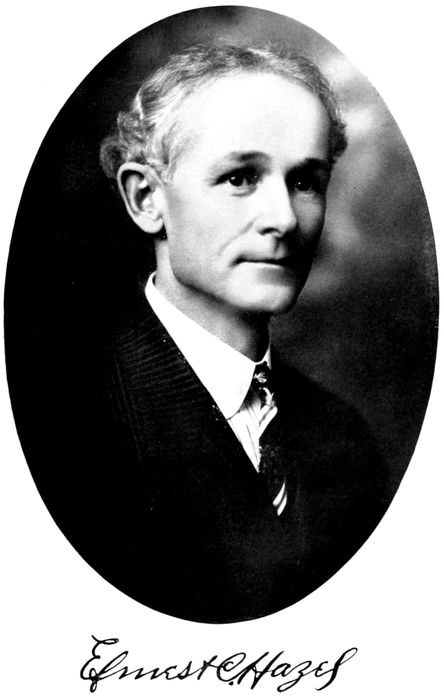
745The Lockwood-Hazel Printing and Stationery Company was established
in 1912. It originated as the Trade Printing Company in 1903. This was
a small concern but grew constantly until the business reached its present proportions.
The business is housed in the handsome new Masonic Temple on
Fifth and Kansas avenues, and occupies the first floor and basement of the
building. The arrangements and equipment are the most modern which can
be obtained and are especially adapted for a high grade quality of printing
which this firm turns out. The greatest progress of the firm has been made
since its organization as the Lockwood-Hazel Co., in 1912. The firm is
composed of C. A. Lockwood, president and treasurer, and E. C. Hazel, secretary
and general manager. The firm manufactures blank books and does
general printing of the highest grade. The line of printing includes county
and bank supplies, loose leaf systems, and embossed stationery. They supply
leading banks with their outfits and deal extensively in wood and steel office
furniture and equipments, and also vault accessories. C. A. Rowe is manager
of the sales department which employs three traveling salesmen and the firm
conducts a large mail order business in eight states. So excellent is the
product turned out and so fair is the treatment accorded a patron that a first
order supplied by this enterprising establishment leads to constant repetitions
from the purchaser when in need of supplies of the character furnished.
Ernest C. Hazel was born March 30, 1875 in Newman, Ill. His parents
were Thomas and Lydia (Kinney) Hazel, natives of Virginia and Ohio,
respectively. Thomas Hazel was born in Page county, Virginia, a son of
Richard and Elizabeth Hazel. He was a veteran of the Union army, and
served his country faithfully during the Civil war in Company E, of the
Twelfth regiment, Illinois infantry. He served for two years under General
Grant and was under General Sherman’s command for two years and six
months. His first engagements were at Ft. Henry and Ft. Donelson. He
fought in the battles of the Wilderness, Lookout Mountain, Mission Ridge,
Siege of Vicksburg, and was with Sherman on his victorious march from Atlanta
to the sea. He enlisted at Springfield, Ill., at the first call for volunteers
and served until the end of the war. To the end of his days he was a
member of the Grand Army of the Republic. A brother, John, also fought in
the Union army and like many other southern families it was a house divided
against itself and three brothers, Richard, Benjamin and William, fought
on the side of the confederacy. Lydia Hazel was born in Muskingum county,
Ohio, and was the daughter of Thomas C. and Levina Kinney.
In 1876 the family emigrated from Newman, Ill., and settled on a farm
near Pawnee Rock, Kan., which the father had homesteaded. After spending
746some years in developing the farm Thomas Hazel removed to Missouri,
from where he came to Atchison in the year 1888. Here he lived a retired
life, dying November 19, 1904, at the age of sixty-seven years. Mrs. Lydia
Hazel resides with her daughter in Leavenworth, Kan. The Hazels are
descendants from a fine old Virginian family and their ancestry traces back
to the colonial days.
To Lydia and Thomas Hazel were born six children, as follows: Mrs.
Elnora Allen, of Atchison; Mrs. Ida Stucker, of Leavenworth; Marion Hazel,
of Leavenworth; Ernest C. Hazel, of Atchison. Two children died in infancy.
Ernest C. Hazel was educated in the public schools of Atchison and
learned the trade of bookbinding with Mr. Caldwell, beginning at the age of
fourteen years. After serving an apprenticeship of three years, he was employed
by the Haskell Show Printing Company. This concern was succeeded
by the Home Printing Company, and he was employed by them until 1901.
For a period of two years he was a traveling salesman for the Western Paper
Company. In 1903 he entered the employ of the Trade Printing Company,
which was succeeded by the present firm in 1912. He purchased an interest
in the firm in 1908.
The married life of Mr. Hazel has been a happy one, and has been in
keeping with his success in the business world. He was married March 30,
1897, to Mary Elizabeth Semple, of Atchison, a daughter of Andrew and Jennie
Semple, both of whom were natives of Glasgow, Scotland. Andrew
Semple was one of the pioneer contractors of Atchison. His last contract was
the Atchison county court house. Mr. Semple is deceased and his widow still
resides in Atchison.
To Mr. and Mrs. Ernest Hazel have been born five children, namely:
Ernest C., Jr., seventeen years of age, and a student of Midland College; Robert
R., fourteen years of age, and also a student at Midland College; Constance
Marie, who died in infancy; Kenneth C., nine years of age, a pupil in
the public schools, and Neola Christine, aged five years.
Mr. Hazel finds time in the midst of his busy life to give considerable attention
to civil and social affairs and is an active member of the Christian
church of Atchison, in which thriving religious institution he and his wife
are warmly appreciated for their good qualities. He is a Republican in politics,
and is fraternally affiliated with the Ancient Free and Accepted Masons,
the Ancient Order of United Workmen, and the Fraternal Aid Union, and
also the United Commercial Travelers. Pronounced ability, combined with
an engaging personality, have won him this high place in his home city.
747
Alexander H. Calvert, lumber and grain dealer, Muscotah, Kan., was
born on his father’s farm in Platte county, Missouri. He is a son of
Warren Calvert, a native of Kentucky, whose ancestors were among the earliest
settlers in America. It is a matter of tradition that he was a descendant
of the original Lord Baltimore, or Cecil Calvert, who founded the State of
Maryland, in the seventeenth century. The father of Warren Calvert was
a pioneer settler in Kentucky and was the owner of a large plantation. Warren
Calvert was born in 1815 and died in 1875. With his wife, Lucy Calvert,
he migrated from Kentucky, accompanied by his retinue of slaves, to form
a part of the Kentucky colony which settled Platte county, Missouri, in 1835.
He was one of the original settlers in Platte county, and operated a large
tract of land. He and his wife, Lucy, reared a family of nine children,
namely: Presley Hawkins, a retired farmer of Muscotah; James Harvey, deceased
banker of Muscotah, who was a soldier in the Confederate army; Mrs.
Anne May Buford, deceased; John Hawkins, who died on his farm near Arrington
in 1910; Ambrose Owens, living in California, near Los Angeles;
Mrs. Ella (Burt) Jackson, died in 1903.
A. H. Calvert came to Kansas in the spring of 1878 and settled on a
farm south of Muscotah in Atchison county. Three brothers came at this
time, Presley H., James H. and himself. For a number of years Mr. Calvert
rented land in Kapioma township and then purchased the farm of 220 acres,
which he owns. He rented land for over fifteen years and then began to
buy land. His first farm of 135 acres was purchased in 1903, and he has
continued to invest heavily in farm lands in the vicinity of Muscotah until
he is now the owner of 700 acres, besides a small tract in Leavenworth
county, Kansas.
Mr. Calvert resided on his farm until 1897 and then removed to Muscotah
where he engaged in the lumber business under the firm name of Calvert
& Sharp. This partnership continued until 1902 when he purchased his
partner’s interest in the business, which he has since operated. In November
of 1905 he formed a partnership with M. E. Bevin, of Muscotah, and they
purchased the grain elevator and engaged in the buying and shipping of
grain. This firm also does an extensive live stock business, buying and shipping
several carloads of live stock during each year. In addition to his extensive
business affairs, Mr. Calvert is a stockholder in the Muscotah State
Bank.
748His first marriage was with Miss Nora Rice in 1881. Two children
(twins) were born of this union, namely: Ella, wife of Will Warren, of Muscotah,
who served for seventeen years as assistant cashier of the Muscotah
State Bank; Alma, a highly educated lady who studied in the Camden Point
Young Ladies’ Seminary, the Emporia Normal College, and received her
degree of Bachelor of Arts from Washburn College, at Topeka, now a
teacher of mathematics in the Atchison city high school. The mother of
these children was a daughter of D. Rice, a native of Illinois, and a pioneer
settler of Atchison county. She died in 1883, at the age of twenty-six years.
In 1889 Mr. Calvert was united in marriage with Miss Hattie Burt, of Platte
county, Missouri, a daughter of John Burt, who came from Indiana to Platte
county. Three children have been born to this marriage: George, conducting
a garage at Effingham, Kan.; Marguerite, aged twenty-one years, a
teacher, at present studying in Washburn College; Charles Cecil, aged fifteen
years, a student in the Atchison County High School.
Mr. Calvert is an old-line Democrat and takes considerable interest in
local and county political matters. He is a member of the Modern Woodmen
and the Knights and Ladies of Security. A man of good education and attainments,
he has succeeded in making his own way in the world and has risen
from comparative poverty to become one of the substantial and best known
citizens of the county.
John Stoddard, a late resident of Muscotah, was born in Allegheny
county, Pennsylvania, in 1833, and departed this life February 18, 1901. He
was the son of Robert and Margaret (Jordan) Stoddard. On the Stoddard
side of the family the lineage is Scotch-Irish. John Stoddard grew to young
manhood on the Pennsylvania farm, and received a good common school education
in his youth. When twenty years of age, fired by the stories of the
riches being obtained in the gold fields of California, he boarded a vessel in
New York harbor. It carried him to Aspenwall, on the east coast of the
Isthmus, which he crossed on mule back. He then boarded the vessel,
“Golden Rule,” which carried him to San Francisco, Cal., from which city
he journeyed to Sacramento, where he equipped himself with a prospecting
outfit, and for ten years followed the trail of the elusive metal. He spent
this time in various mining campaigns and prospecting for gold. He returned
home by re-tracing the same route which he had traveled on his way to California,
749and arrived in Pennsylvania, not rich, but with considerable gold in
his possession, and the remembrances of a wonderful experience.
Soon after his return to his Pennsylvania home he removed to Iowa and
purchased a farm, and was married there in 1869, after which he lived five
years on his first farm in Iowa, and then moved to another farm, on which
he resided for seven years. In 1881 he came to Muscotah, Kan., and invested
in 320 acres of land near that city. Mr. Stoddard looked after his farming
interests and lived a retired life while in Muscotah, and died there in 1901.
Mr. Stoddard was married October 20, 1869, to Miss Martha Piggott, a
native of Harrison county, Ohio, and a daughter of Israel and Liddie (Goodwin)
Piggott, the former a native of Belmont county, Ohio, and the latter a
native of Westchester, Pa. The Piggott family originally came from
Virginia, where the founder of the family in America settled in early
colonial days. Israel P. was an early settler in Iowa. To Mr. and Mrs.
Stoddard were born four children: Grace, the wife of Dr. J. O. Ward, Horton,
Kan,; Guy, a railway mail clerk, Los Angeles, Cal.; Alice V., the wife
of J. C. Thurman, Los Angeles, Cal.; Eva, wife of Carl Young, of Kansas
City. Guy Stoddard, the son, who is located at Los Angeles, Cal., is a bright
young man of more than ordinary ability. After completing the course of
study in the public schools of Muscotah, he graduated from the Atchison
County High School at Effingham. Later, he attended college for a while.
After completing his education he became the owner and editor of the Muscotah
Record. The newspaper gained a wide prestige and was prosperous.
After his marriage to Miss Pearl Knox, of Muscotah, he and his wife removed
to Los Angeles, where he became a member of the reportorial staff
of the Los Angeles Times. He later entered the United States railway mail
service at Los Angeles. John Stoddard, the subject of this review, was a
Democrat during the latter years of his life, and served two terms as mayor
of Muscotah. Mrs. Stoddard is a member of the Congregational church of
Muscotah, and spends a portion of her time each year in California.
Aaron B. Evans, pioneer auctioneer and livery proprietor, of Muscotah,
Atchison county, was born April 16, 1857, in Union county, Tennessee, He
was a son of George W. and Orlena (Wolfenbarger) Evans. His mother
was a native of Granger county, Tennessee, and was of German extraction.
750George W. Evans, the father, was the owner of a large farm on the south
side of Clinch river, in Union county, Tennessee, just opposite the old home
of the Vansell family. A. B. Evans and M. C. Vansell, of Grasshopper township,
were boys and play-mates together in Tennessee, and are first cousins.
Like most boys living in the South, during that period, and in the time of the
Civil war, their early education was sadly neglected. In fact, during the war
the school system of Tennessee was entirely destroyed. When Aaron B.
Evans was twenty years of age he left home and came direct to Kansas. He
had no means wherewith to pay his transportation, and borrowed sufficient
money from a neighbor to pay his railroad fare to Atchison. When he
arrived at Atchison he had no money with which to pay for a meal or hotel
accommodation. He and M. C. Vansell, who accompanied him on the trip,
walked from Atchison to Kennekuk, where they stopped at the home of their
uncle, M. C. Willis, for a few days.
Mr. Evans’ first employment in Kansas was on the farm of Dave Moore,
located three and one-half miles northeast of Kennekuk, in Atchison county.
He worked for various farmers in the county until he saved sufficient money
to buy his first farm. For two years previous to his marriage, in 1881, he
was in the employ of George Storch, who at that time was engaged in the
general mercantile business at Muscotah, Kan. In 1881 Mr. Evans moved
to a farm three miles northeast of Kennekuk, where he resided for three
years, and was very successful in his farming operations. He then bought
ninety-six acres of land near Kennekuk, which he cultivated for two years,
when he sold it at a good profit. After selling his first farm he moved to
a rented farm west of Muscotah, which he operated for one year, and invested
in partnership with M. C. Vansell, and divided the land in a quarter
section of raw prairie land, three miles northwest of Muscotah. He erected
improvements on this farm and resided upon it for eighteen years. He sold
his farm in 1901, and in May of the same year invested in a livery barn, and
also entered upon his career of auctioneer, which he has followed since that
time with considerable success. Mr. Evans also maintains a breeding stable,
for the equipment of which he went to Lexington, Ky., in 1906 and purchased
the best jack to be had in the Lexington market, and shipped him to
Muscotah. This animal is the first high class jack ever brought to this section
of Kansas. During this same year Mr. Evans also bought a pure bred
black Percheron stallion, which he lost during the first year of his ownership.
At the present time the Evans barn stands two high class jacks and one
pure bred grey Percheron stallion.
751On January 27, 1881, Mr. Evans was united in marriage with Recy
Tannyhill, who was born in Marion county, Ohio, a daughter of William and
Nancy Tannyhill, both of whom were natives of the Buckeye State, and emigrated
to Kansas when Mrs. Evans was but eight years of age, and settled
on a farm in Grasshopper township, Atchison county. Mr. and Mrs.
Evans are the parents of seven children: Elizabeth, the wife of J. L. Morgan,
St. Joseph, Mo.; William George, a farmer, Grasshopper township; Fred,
who is associated with his father in the livery business; Orlena, the wife of
Bert Annis, Chicago, Ill.; Nannie, living in Des Moines, Iowa; Nora, St.
Joseph, Mo., and Frank, at home.
Mr. and Mrs. Evans are members of the Christian Advent church of
Muscotah. He is a stanch and true Republican of the uncompromising
variety, and has been one of the political leaders of his section of Atchison
county for many years, serving as delegate several times to the Republican
county conventions. He has always been an advocate of educational advancement,
and has offered his children every opportunity to acquire a good common
school education. He was one of the pioneers in the auctioneering profession
in Atchison county, and was the second man to enter the business of
crying sales.
Ralph A. Allison, the capable, efficient and obliging cashier of the
Muscotah State Bank, was born and reared in the town where he resides.
He was born July 1, 1889, at Muscotah, Kan., a son of Webster C. and
Irene (Alexander) Allison, the former a native of Illinois, and the latter of
Wisconsin. Webster C. Allison was born in 1861 on his father’s farm in
Illinois, and was the son of John Allison, who was born and reared in Pennsylvania,
and immigrated to Illinois in the pioneer days of that State. Webster
C. Allison attended the district schools of his native State, and assisted his
father on the home farm until he was eighteen years of age. He then came
to Kansas, where his first employment was on a farm west of Muscotah,
owned and operated by A. B. Harvey. He worked for Mr. Harvey for one
year, and then went to Jackson county, Kan., where he broke up and developed
a tract of prairie land which he purchased. He improved his farm
and cultivated it with profit until 1888, when he came to Muscotah
and established a hardware store which he conducted successfully for twenty-five
752years. In 1913 Mr. Allison disposed of his interests in Muscotah, and
removed to Horton, Kan., where he is now conducting a hardware and implement
business.
To Webster C. and Irene Allison were born the following children:
Lola, wife of Luther Cortelyou, assistant cashier of the First National Bank
of Parsons, Kan.; Minnie, wife of Charles Hail, an oil operator, LeRoy,
Kan.; Jennie, wife of William McClennon, Owasa, Iowa; Ralph A., with
whom this review is directly concerned. Ralph A. received his primary education
in the public schools of Muscotah, after which he completed a course
in the Atchison County High School at Effingham, from which institution he
graduated in 1907. For one year following his graduation he served as
stenographer for a wholesale fruit company, and then entered his father’s
hardware store in Muscotah, where he remained until the stock was sold in
1913. In 1914 be became manager of the Farmers Elevator Company of
Muscotah. He became cashier of the Muscotah State Bank July 1, 1914,
and is filling this responsible position to the satisfaction of the bank patrons,
and in a manner which reflects credit upon himself and the bank’s officials
and stockholders. Mr. Allison was married in April, 1912, to Miss Ella
Ellson, who was born in Muscotah, a daughter of Charles Ellson, proprietor
of the local meat market. Mr. and Mrs. R. A. Allison are the parents of one
daughter, Priscilla, born April 17, 1913.
Mr. Allison is a Republican in politics, and is a member of the Methodist
Episcopal church. He is affiliated with the Ancient Free and Accepted
Masons and the Modern Woodmen of America.
Fred Sutter, president of the Farmers and Merchants State Bank of
Effingham, is a native son of Atchison county and prominently identified with
the affairs of his county. Mr. Sutter is rightly considered as one of the
real leaders of the county, and it can be said of him that he has met with
unusual success in anything which he has undertaken. To him and his influence,
more than any other individual, the farmers of the county are indebted
for the inauguration of a skilled county farm expert. Kindred things
of this character in behalf of the welfare of the county have been Mr. Sutter’s
hobby for several years past.
753
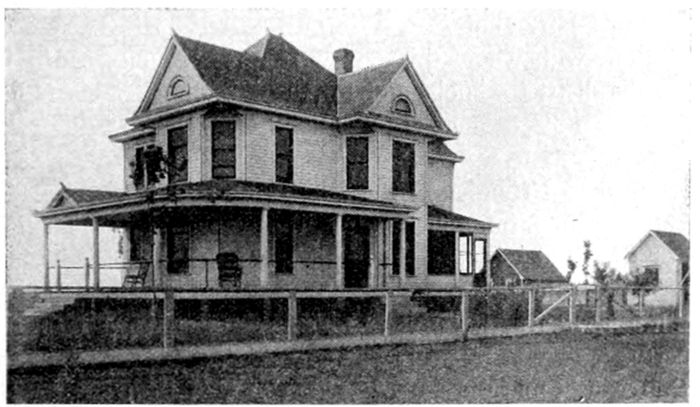
Fred Sutter was born July 20, 1869, on a pioneer farm in Walnut
township, and is a son of Fred Sutter, who was born in Bath, Germany, in
1827, and immigrated to America about 1844, and died in Atchison county
in September of 1887. Fred Sutter, Sr., landed at New York City and made
his way from there to St. Louis, Mo., where he married Fredericka Miller,
who was born at Bath, Germany, September 23, 1837. She died in Atchison
county September 10, 1914. The elder Sutter had learned the trade of carpenter
in his youth and he plied his trade in St. Louis until 1857, when he
came up the Missouri river by steamer to old Sumner, then in the heyday of
its brief glory and prosperity. He found plenty to occupy his talents at Sumner
and helped to build a great many of the first houses there. It might be
well to add here, however, that the first home of the family in Kansas was
at old Port William, where one or two of the children were born. From Port
William the family removed to Sumner, and in the course of time Fred Sutter,
Sr., made his home on a farm in the northwestern part of Walnut township,
near the Mt. Pleasant and Walnut line. The family lived there until the
spring of 1880, during which time he worked at his trade. In 1880 he moved
to Benton township, and for the first seven years of his residence there he
rented the A. G. Otis farm, about two miles west of Effingham and then
purchased the farm. The next investment was made by his sons in the Osborn
tract of 480 acres of school land. Two years after buying this an additional
quarter section was added, making 640 acres in all, which was owned
by this enterprising family. During all these years in which he was accumulating
754valuable farm lands, the elder Sutter had the assistance of his sons, and
the greater part of the estate is still tilled and owned by the children of this
pioneer. Fred Sutter, Sr., came to this country a poor man and worked in a
planing mill and furniture factory at St. Louis until he heard of the opening
of the Kansas territory, when he determined to be one of the first to settle in
the new State. He was farseeing, and by the practice of rigid economy and
the better plan of holding his family together, was able to leave a considerable
estate at his demise. He was an honored and respected member of the community
and was well known throughout the county. The children born to
Frederick and Fredericka Sutter were as follows: Kate, deceased wife of H.
W. Barkow, of the Kessler-Barkow Saddlery Company, of Atchison; Mrs.
Augusta McAdam, of Effingham; Fannie, housekeeper for her brother,
William, who resides on the old home place; Mrs. Anna Shannon, of Effingham;
Carl F., of Kipp, Kan.; William and Fred, and Frank, on a farm one-half
mile west of Effingham.
Fred Sutter, with whom this review is directly concerned, received his
education in the district schools, and for three years after his father’s death
lived on the home place, or until 1890. He settled on part of the family estate,
consisting of 640 acres held jointly by the Sutter sons, improving the property
until his removal to Effingham, where he resided for three years, and then
purchased his present farm, which is just at the edge of Effingham. He has
160 acres of fine land within sight of the town upon which he has erected
(in 1909) one of the handsomest, modern ten-room farm houses in the county.
He also built a new barn, 40×40 feet, which is in keeping with the rest of his
farm property.
Mr. Sutter was married May 20, 1908, to Sarah, daughter of Robert
McPhilimy, and to this union have been born the following children: Mabel,
aged five years, and Geneva, aged three years. He has been connected with
the Farmers and Merchants State Bank since 1905 and was elected president
of this thriving financial institution in 1906. Mr. Sutter is a Republican and
is one of the wheel horses of the party in Atchison county. He was appointed
a member of the Atchison County High School board in September of 1913,
reëlected to the office in the fall of 1914 and is now serving as treasurer of
this board. He is a member and trustee of the Presbyterian church of Effingham
and is a liberal contributor to the support of this religious denomination.
He is affiliated fraternally with the Ancient Free and Accepted Masons, the
Benevolent and Protected Order of Elks of Atchison, and the Central Protective
Association, being one of the original members of Effingham Lodge,
755No. 158, Central Protective Association, and has been its treasurer for the past
four years.
While Mr. Sutter is connected with the Presbyterian church of Effingham,
his ideal of a church for a small town is the community church which
can be used by the entire population of the town for public and social purposes.
To this end he was the prime mover in the erection of the handsome
Presbyterian church building in Effingham, at a cost of $14,000, which was
dedicated in June, 1913. This church building is used for many public purposes
and has been a decided benefit to Effingham in many ways. Mr. Sutter
started the movement for the building of this church and headed the subscription
list, never desisting in his work until the church was erected and dedicated.
Another monument to his enterprise is the farmers’ institute, with
which he was connected for five years and assisted materially in organizing.
His energy and influence kept the institute going in fine shape for the five
years with which he was connected with the movement. Mr. Sutter has a
likable personality and is one of the forceful and influential men of Atchison
county.
Edmond W. Allen, merchant, of Muscotah, Kan., is a leading and successful
retailer of his city, and one of the hustling citizens of Muscotah. The
grocery and meat market of which Mr. Allen is proprietor was first established
by Jacob P. Sprang, with whom Mr. Allen became a partner in 1902.
He became the sole owner of the business in 1910. Allen’s store is nicely
located in one of the large business rooms, 80×25 feet in extent, on
the main street of Muscotah, supplemented with an ice house and a
ware house for feed and flour. In addition to conducting the grocery and
meat market, Mr. Allen is a retailer of ice and conducts a produce exchange,
which enabled him to ship eggs and poultry in considerable quantity to distant
markets.
Edmond W. Allen was born January 29, 1868, on a farm adjoining the
present county farm on the northwest corner, consisting of eighty acres, in Mt.
Pleasant township, Atchison county. He was the son of M. L. Dunlap and
Amanda (Walker) Allen, natives of Kentucky. Amanda (Walker) Allen
was the daughter of Philip Walker, who immigrated to Kansas from Kentucky,
settled on the prairies of Atchison county, but later moved to Missouri.
756M. L. Dunlap Allen moved from Kentucky to Missouri, and came from that
State to Atchison county, Kansas, in 1863. He purchased the farm of 130
acres on which he erected a small house, built out of native sawed lumber.
In this house of two rooms several of his children were born, and as the
family increased in size, he added four rooms to the residence. He was born
in 1830, and died in March, 1886. He was the father of eight children, as
follows: Mrs. Francis J. Bucknum, of Oklahoma City; Emily, deceased;
William H., living at Saugatuck, Mich.; Robert M., former traveling salesman,
who died at Holdredge, Neb., in 1913; Edmond W., the subject of this
review; Mrs. Etta M. Hubbard, living in Michigan; Mrs. Addie Myrtle Latta,
of Oklahoma City, and Dudley M., deceased. The mother of these children
died in 1881. The senior Allen was again married in 1883 to Ruth Robinson,
who now resides in Wyandotte county, near the town of Piper. One child,
Ethel, was born of this marriage.
Edmond W. Allen was reared on the pioneer farm of his father’s, near
Atchison, Kan., and received his primary education in the district schools of
his neighborhood, and completed his schooling at Beloit, Kan. When his
father died, in 1886, William H. Allen, the oldest son, was appointed administrator
of the estate, and guardian of the minor children. He removed all
of them to his home at Beloit, where he was engaged in the implement business.
This was done in order that William might properly care for the
younger children and look after their education. Edmond W., after finishing
his schooling, was employed for two years in his brother’s store at Beloit,
following which he worked for one year in a grocery store and meat market
in Kansas City, Kan., owned by Robert Robinson. His brother, William H.,
in the meantime, sold out his stock in Beloit and removed to Hoxie, Kan., and
was employed in a bank for a year and one-half. Financial disaster overtook
the bank, and he then spent one year in Kansas City, Kan., after which, in
1891, he went to western Nebraska and entered the employ of Harris Bros.,
a firm of grain dealers with headquarters in Lincoln, Neb. Mr. Allen was
located in the town of Stamford, Lebanon, and Republican City, Neb.,
in the employ of Harris Bros. and was then transferred to the main office of
the firm of Lincoln, Neb., where he remained until 1893. From 1893 to 1895,
he was in the employ of Hathaway & Williams, fire insurance agents, of Lincoln,
and when this firm sold out he traveled for a period of six months in
the interests of an Omaha fire insurance company. After his marriage, in
1895, he resided in Michigan for one year, and in 1896 he again entered the
employ of the Harris Bros. Grain Company, which firm was later incorporated
757as the Central Granaries, a very rich corporation. He remained with
this concern until 1898, when he entered the employ of the McCormick
Harvester Company as bookkeeper, with headquarters at Lincoln, Neb. He
was in the employ of the McCormick people until 1903. In the meantime he
had formed a partnership with his father-in-law, Jacob P. Sprang, in the grocery
and meat market business in Muscotah, where Mr. Allen has resided permanently
since 1903.
Edmond W. Allen was married in 1895 to Miss Lucie Sprang, and their
children are as follows: Una L., born in 1896, and is a senior in the fine arts
and music department of Kansas University. Miss Una is a teacher of piano
and violin, and has a large class of pupils. Mrs. Allen was born on a farm
in Benton township, Atchison county, five miles south of Effingham, and is
a daughter of Jacob P. Sprang, who built up a fine farm in Atchison county,
and established the business which is now owned by Mr. Allen. While Mr.
Allen is a Republican, he votes independently on local and county matters.
He was formerly a member of the Methodist Episcopal church, but since
coming to Muscotah has united with the Congregational church of this place.
He is a member of the Knights and Ladies of Security.
For a citizen of a small Kansas city to achieve State-wide prominence,
and to become the official head of the body of mercantile men with whom
he became affiliated during a long and successful career, is somewhat out of
the ordinary, and is decided evidence that the recipient of such honors has
received them solely because of pronounced ability of a high order. For several
years, Luther Cortelyou, farmer, grain merchant, and banker, of Muscotah,
Kan., was the recognized leader among the grain men of Kansas,
attaining to his position by virtue of executive ability and powers of leadership.
He is one of the first and best known citizens of Muscotah and Atchison
county, who for more than twenty-seven years has been active in civic
affairs in the county.
Luther Cortelyou was born December 23, 1851, in Somerset county,
New Jersey, and is a son of James G. and Cornelia (Polhemus) Cortelyou.
James Garretson Cortelyou, the father, was the son of Abraham Cortelyou,
who was descended from French Hugenot colonists, who first settled on Long
Island in 1624. The original ancestor of the family fled from France to a
758safe refuge in Holland during the persecution of the Huguenots in France.
Jaques Cortelyou was the founder of the family in America and was prominent
in the affairs of the colony on Long Island. His son, Peter, was a
governor of the borough in which is now located Brooklyn. The descendants
of Jaques Cortelyou figured in Revolutionary history.
James G. was reared in New Jersey, and there married Cornelia, a daughter
of C. Polhemus, also of an old Holland family. He was the father of
three children: John Gardner, deceased; Luther, of this review; and Peter J.,
now deceased, formerly a resident of Corning, Nemaha county, Kansas. The
father died in Middlesex county, New Jersey.
Luther Cortelyou was reared to young manhood on his father’s farm,
and received his primary education in the public schools of Somerset county,
New Jersey. He received his academic education in Rutgers College, a
Dutch Reformed college, at New Brunswick, N. J., and then attended Eastman’s
Business College, at Poughkeepsie, N. Y. After his marriage he removed
to Maryland, where he lived on a farm which he purchased and cultivated
for twelve years. In 1889 Mr. Cortelyou sold his Maryland property
and came to Kansas and located in Muscotah, Atchison county. He
invested his capital in the M. J. Walsh grain elevator, and for eighteen years
was engaged in the buying and shipping of grain. He extended his operations,
and owned an elevator at Corning, Kan., which he sold in 1909.
Mr. Cortelyou amassed a considerable competence during the many years
in which he was engaged in the grain business, and became prominent in
mercantile circles in the State of Kansas. For seven years he served as president
of the Kansas Grain Dealers’ Association, and gained a wide acquaintance
among grain dealers throughout the State and Nation. He served for
one year as second vice-president of the National Grain Dealers’ Association,
and also filled the post of first vice-president of the national body for one
year. He disposed of his elevator in Muscotah in 1907, and has since retired
from active business pursuits other than his farming and banking interests.
Mr. Cortelyou is the owner of a fine farm of 250 acres in Grasshopper township,
and was one of the organizers of the Farmers State Bank of Muscotah,
of which thriving institution he is the president.
Mr. Cortelyou was first married in New Jersey in 1876 to Miss Gertrude
Stelle, of Middlesex county, New Jersey, and this union was blessed
with four children, namely: Luther, Jr., assistant cashier of the First National
Bank at Parsons, Kan., married Miss Lola Allison, a daughter of Webb Allison,
of Nortonville, Kan.; Stelle, formerly an engineer in the United States
Government service, died in Panama of yellow fever, in 1905, at the age of
759twenty-two, having been the last victim to die from yellow fever on the Isthmus;
Peter J., postmaster of Muscotah; Frank Morgan, born in 1886, a talented
engineer, who was graduated from Kansas University engineering department,
and is connected with the engineering firm of Waddell & Harrington,
of Kansas City, Mo., and is now located in Vancouver, Wash., in charge
of the construction of an immense bridge across the Columbia river, costing
$1,750,000; this bridge connects Vancouver, Wash., and Portland, Ore., and
is a link in the Pacific highway. It has twenty-nine steel-spans, and is over
17,200 feet in length. The largest dredges and pile-driving machinery in the
world are required in its construction. The permanent roadway of this great
structure is thirty-five feet wide with sidewalks five feet in width. Frank M.
married Miss Marney Burney, of Green Forest, Ark. The mother of these
children was born March 19, 1856, in New Jersey, a daughter of Peter and
Sarah J. Stelle, and she departed this life February 5, 1905. Mr. Cortelyou
was again married to Mrs. Alice T. Calvert, widow of J. H. Calvert, deceased
merchant and banker of Muscotah, February 19, 1907.
The Democratic party has always had the allegiance of Mr. Cortelyou,
and he has been prominently identified with the affairs of his party in Atchison
county, and was the candidate of his party for county treasurer in 1896.
He is a warm admirer of President Wilson and a supporter of the President’s
policies. He was elected mayor of Muscotah in April, 1900, and served one
term, and also has served as a member of the school board of Muscotah.
Mr. Cortelyou is a member of the Congregational church of Muscotah, to
which denomination he has been a liberal contributor: he assisted in the building
of the church edifice, and has served as trustee of the church for several
years. For the past thirty years or more he has been a member of the Ancient
Free and Accepted Masons, and he also is affiliated with the Modern
Woodmen.
Living in comfortable retirement in Muscotah is one of the pioneer settlers
of Atchison county, who fought the good fight with grasshoppers and
hot winds in the old days of hardships on the prairies over forty years ago.
William S. Hubbard is one of the fine old gentlemen of Muscotah who came
to Kansas a poor man, has reared a fine family of prosperous sons and daughters,
and achieved a competence sufficient to support him in comfort during
his declining years.
760W. S. Hubbard was born March 10, 1839, on a farm near Cloverdale,
Putnam county, Indiana, a son of Asa and Melinda (Holland) Hubbard,
natives of Kentucky, who founded a pioneer home in the forests of Putnam
county, Indiana. Asa Hubbard, the father, died when William S. was a
child, and his mother married W. Davis. In 1844 the family moved to Illinois,
where the mother and stepfather died in later years. The Davis farm
was located in Henry county, Illinois. Here W. S. was reared to young manhood,
and knew very few luxuries in those early days of privation and struggle.
After a two years’ residence on a farm near Burlington, Iowa, he decided
to come farther west to find a home and fortune where lands were
cheap and opportunities seemed to be much better than in Illinois. In 1874
he set out with his wife and five children to find a home in Atchison county,
Kansas. All of his worldly possessions consisted of a team of horses, a cow,
and twelve dollars in cash. His first year on a rented farm in Grasshopper
township was a disastrous one, and the “hoppers” got his crops, even to a fine
crop of cabbage, which he harvested and tried to cover up by piling hay upon
the cabbages to keep the greedy “hoppers” from eating them. Sad to relate,
the grasshoppers burrowed down through the hay and ate the cabbage. The
following year was much better, Mr. Hubbard raising a fine crop of corn.
During his first year he raised a good flax crop which he sold for one dollar
and forty cents per bushel. He was eventually able to invest in 220 acres of
rich bottom land, bordering the Delaware river, at a cost of fifteen dollars
an acre. Mr. Hubbard had saved $800 to make the initial payment on this
tract, and in nine years succeeded in lifting the debt. During the period in
which he was paying off the indebtedness on his land he was also paying
interest on the money at the rate of ten per cent, annually. He sold his first
farm some years after this and invested in the fine tract of seventy-two acres
which he now owns. On June 12, 1913, he and Mrs. Hubbard decided that
they had worked long enough, and left the farm for a home in Muscotah.
Mr. Hubbard was married January 29, 1861, to Miss Mary Ann Pence,
a native of Lycoming county, Pennsylvania. Six children have been born
to this worthy couple, namely: William Elsworth, a farmer, of Kapioma
township, Atchison county, and the owner of 160 acres of well improved farm
land; he married Mattie Roth, and they have six children: Lewis Henry Hubbard,
a farmer of this county, owner of 160 acres of land: he married Ann
Hinxton, and they have two children: Lillie Jane, wife of Malcolm Connor,
residing on a homestead in South Dakota, and they have three children: Cora
May, wife of Simeon Routh, Atchison county; they have six children. The
761other children are deceased. All of Mr. and Mrs. Hubbard’s children are
prosperous and highly respected citizens of their respective communities, and
are a credit and comfort to their aged parents, who are proud of the family.
Mrs. Hubbard was born December 27, 1839.
Few people in Atchison county can point to a better record than Mr. and
Mrs. Hubbard, or can look back with greater satisfaction over long
years well spent in achieving a livelihood and rearing a fine family to maturity.
They came to Atchison county at a time when Indians still roamed the prairies,
and very little of the prairie land was improved.
Mr. Hubbard is an old-line Democrat, and, while he has taken an active
interest in political affairs in his township and county, he has never been an
aspirant for office, preferring to play the game for the pure love and fun
of it rather than to become an aspirant for political honors. He and Mrs.
Hubbard are members of the Second-Day Adventist church of Muscotah.
O. O. Barker, M. D., is one of the younger members of the medical profession
in Atchison county, located at Muscotah, Kan. During the nine years
which he has been located in Muscotah, he has built up an excellent practice
in his profession, and has demonstrated that he has an accurate knowledge of
the art and science of medicine. Dr. Barker was born March 30, 1885, in the
town of True, Sumner county, West Virginia. He is a son of J. Lee and
Anna (Milburn) Barker, the former having been born in 1860, and the latter
in 1862, in Virginia. Both parents still reside at True, W. Va. J. Lee Barker
was a son of M. Calloway Barker, also a native of Virginia, and a descendant
of an old Virginia family. The history of the Barker family dates back to the
birth of Chaplain Barker, of Liverpool, England, who was born in 1750, and
immigrated to Virginia in 1785. David Barker, a son of Chaplain Barker, distiller,
in Richmond, Va. William Barker, the son of David, was a tanner
by trade, and had three sons: William A., Joseph, and Isaac. Of these sons,
Joseph was killed by Indians; Isaac lives at Liberty, Va., and reared the following
children: James M. Calloway, Mary E., A. L., Thomas J., Francis, and
Joseph G. Thomas J. Barker immigrated to Kansas and became a wealthy citizen
of Kansas City, where he died. M. Calloway Barker lived at True, W.
Va., and reared a family of twelve children: William A., who died in the
762Confederate service during the Civil war; Mary E., deceased; R. J., residing
in Kansas City, Kan.; J. W., deceased; Thomas B., living near Hinton, W.
Va.; James L., deceased; Dr. Joseph L.; J. Lee, father of Dr. Barker; David
M., of Parsons, Kan.: Francis I.; Ollie, living at True, W. Va., and Maria, deceased.
J. Lee Barker has always been a farmer, and has made a success of
his life’s vocation. He is one of the prominent and well known citizens of
his section of West Virginia, and for several years has served as president
of the school board of True, W. Va. He has reared three children: Orus O.,
with whom this review is directly concerned; Mrs. Grace M. Skaggs, Topeka,
Kan., and Mrs. Nellie B. Deeds, of Hinton, W. Va.
Dr. Barker received his primary education in the public schools of his
native town in West Virginia, and then decided to take up the study of medicine.
He studied for two years in the medical department in the University
of Maryland, and completed his medical education in the University of Louisville,
Ky., from which institution he received his degree of Doctor of
Medicine in 1906. After his graduation he came to Kansas, visited for a
few months with an uncle in Kansas City, Kan., and after passing an examination
given by the state board of medical examiners of Topeka, he opened
an office at Muscotah, Kan., October 1, 1906. Dr. Barker is a member of
the Northeast Kansas Medical Society, the Kansas State Medical Association,
and the Country Doctors’ Business and Social Club. He endeavors
at all times to keep abreast of the latest advancement in medical science, and
has built up an excellent practice in Muscotah and the surrounding country.
He was married June 2, 1906, to Miss Ethel M. Morton, a daughter of G. W.
Morton, of Columbus, Ohio. Dr. Barker is a fraternal member of the Knights
and Ladies of Security, Modern Woodmen of America, and Mystic Workers
of the World.
Charles M. Lukens, dentist, Muscotah, Kan., is a fine type of professional
man who is self-made, and has achieved success in his profession,
which is gratifying and worthy of mention in a favorable manner. Dr.
Lukens was born June 28, 1872, in Harrison county, Ohio, and is a son of
William Ellis and Margaret (McLaughlin) Lukens, both of whom were
born and reared in Ohio. William Ellis Lukens was born in 1849, and was
a son of Moses Lukens, born in Lycoming county, Pennsylvania, in 1812,
763and was an uncompromising abolitionist. He was an early settler of Harrison
county, Ohio, where he conducted a station on the famous “Underground
Railway.” He lived to a great age, and it is a fact that longevity
is a characteristic of both the Lukens and the McLaughlin families. The
Lukens family was of Quaker origin, and the founder of the family in America
was one of the original followers of William Penn. Another characteristic
of the Lukens family is the fact that a brother of William Ellis Lukens
was a dentist, and Dr. Lukens has five cousins who are practicing dentistry.
William Ellis Lukens migrated to Holt county, Missouri, in 1882, where
he resided for four years, and in 1886 he settled in Nemaha county. He was
one of the early pioneers in Nemaha county, and first engaged in the live
stock business at Corning, Kan., where he conducted a grain elevator, and
bought and shipped live stock. He has become well-to-do, and is the owner
of two large farms in Nemaha and Jackson counties. Mr. and Mrs. Lukens
now make their home on a farm in Jackson county, Kansas, south of Netawaka.
Their children are: Dr. C. M. Lukens, of Muscotah; Chester W., a
farmer, living south of Netawaka, and Kinney E., a farmer, living in the
northwest corner of Jackson county, Kansas. The mother of these children
was born in 1850.
Charles M. Lukens received his primary education in the public schools
of Corning, Kan., and then decided to work his way through college. His
ambition was to become a dentist, and for a period of five years he did all
kinds of honest labor in order to pay for his tuition and expenses while attaining
his collegiate education. He not only earned his way through college,
but saved money in the meantime. He followed farming and railroad bridge
work during this time, and eventually graduated from the Western Dental
College of Kansas City, Mo., on May 6, 1905. He located in Muscotah,
June 29, 1905, and has made a signal success in the practice of his profession.
Dr. Lukens also maintains an office at Whiting, Kan., and divides his time
between the two towns, Whiting and Muscotah.
Dr. Lukens was married April 10, 1901, at Corning, Kan., to Miss
Hallie A. Graham, a daughter of Dr. J. W. Graham, of Wetmore, Kan.
They have one child, Graham St. Clair Lukens, born June 21, 1902. The
Republican party claims the allegiance of Dr. Lukens, and he has always been
active in political affairs in Atchison county, being one of the leaders and
“wheel-horses” of the party in the county. He is affiliated with the Ancient
Free and Accepted Masons of Muscotah, and the Fraternal Order of Eagles
of Horton, Kan., and is a member of the Modern Woodmen. Dr. Lukens
764is possessed of a likable and generous personality, which enables him to make
friends easily, and to retain them for all time. He is a good provider for his
family, and is fast accumulating a comfortable competence. He is a member
in good standing of the Northeast Kansas Dental Association.
J. M. Trimble, deceased, was born September 10, 1843, in Buchanan
county, Missouri, a son of Benjamin F. Trimble, a native of Kentucky and
early pioneer settler of De Kalb, Mo., where he conducted a blacksmith and
wagon shop for a number of years, until his removal to Texas. After living
in Texas for some years, he finally located in Atchison county, Kansas. James
M. Trimble purchased a farm in this county and cultivated it until 1905 and
then removed to Atchison and engaged in the livery business, continuing the
same until his demise in January of 1910. The first wife of James M.
Trimble was Margaret McCreary, a daughter of Solomon McCreary, a pioneer
settler of Atchison county. To this first marriage were born the following
children: J. P. Trimble; A. F. Trimble; K. S. Trimble; Ed. Henry; Roy C.,
sheriff of Atchison county, and T. O. Trimble.
Mr. Trimble was married the second time, to Mrs. Emma A. (Hayden)
Gallup, widow of Frank Gallup, January 21, 1892. She is a daughter of
Levi and Martha Hayden, natives of Kentucky, and pioneer settlers of Coffey
county, Kansas. The Hayden family were settlers in Coffey county, Kansas,
at a time when the county was largely populated by Indians. At one time,
while a resident of this county, Levi Hayden and a number of other settlers
were hunting buffalo and were surrounded by hostile red-men, who robbed
the hunting party of their provisions and horses and left the hunters on the
plains destitute. A terrible snow storm came up, and several of the party
perished from cold and starvation, Mr. Hayden being among the number lost.
After his death his widow reared the family of seven children with the exception
of two sons and a daughter, Emma, who went to reside with an uncle,
John Hayden, in Iowa. This uncle was a very prominent resident of Taylor
county, Iowa, and served as county clerk and county surveyor. He ran a
survey line from his farm in Taylor county, Iowa, to a place later named Hayden
Junction, near Council Bluffs. He was a school teacher and a man of
more than ordinary ability and reared his adopted children to become good
765citizens. Emma lived at her uncle’s home until January 1, 1874, and while
attending high school at Bedford, Iowa, she met Frank Gallup, whom she married.
Mr. Gallup died August 11, 1888. To this union were born children
as follows: Nellie M., wife of Gale Trimble, of Atchison county; Jennie B.
married Edwin E. Buchanan, now deceased, and she lives in Atchison; Clara
Maude, wife of Ed. Trimble, residing near Seattle, Wash.; Samuel D., of
Atchison; Agnes Gertrude, wife of Blake Balaock, of Memphis, Tenn.
At the time of the marriage of Mr. Trimble and Mrs. Gallup, Mr. Trimble
was serving as superintendent of the Atchison county poor farm. They had
charge of this institution for over six years and then moved to Mr. Trimble’s
farm, which is now owned by John M. Price, in Mt. Pleasant township. They
resided on the farm until their removal to Atchison in 1905. After another
short period of residence on the farm they finally purchased the property
which is the family home at 1206 South Seventh street, Atchison. Mr. Trimble
conducted a livery and horse trading business in Atchison until his demise.
He dealt extensively in horses and cattle, and frequently conducted farm and
real estate deals to advantage.
James M. Trimble was a life-long Republican and took an active and influential
part in the affairs of his party. He was well and favorably known
throughout Atchison county. He and Mrs. Trimble were affiliated with the
Presbyterian church, and Mr. Trimble belonged to the Grand Army of the
Republic by virtue of having enlisted for service in a Kansas regiment during
the Civil war, at the time of the Price invasion. It can be said of him that
he was an honest, upright citizen, who cared well for those who depended upon
him and he was, according to those who knew him best, a good man.
For fifty-five years John Edward Sullivan has resided in Atchison
county, Kansas, and can be readily classed with the old-timers of the county.
His parents came from Iowa to Kansas when he was but one year old, and
his father, with the assistance of his sons, Roger P. and John Edward, was
enabled to rise from poverty to become the owner of half a section of land
in Grasshopper township. The account of this family is similar to that of
several other prosperous Irish families in Atchison county.
John E. Sullivan was born May 15, 1859, in Keokuk, Iowa, a son of
766Michael and Bridget (Tobin) Sullivan, both of whom were born in Ireland.
Michael Sullivan was born in 1826 in Ireland, and lived in his native land
until he was twelve years of age, and then made his way, alone and unaided,
to America. His travels for seeking fortune in the new country took him ever
onward, and he was married in Keokuk, Iowa, to Bridget Tobin, who was
his faithful helpmeet when he was rising from poverty to affluence. Mr.
Sullivan came to Atchison, Kan., in 1860, and for some time was engaged
in the railroad contract work, and assisted in the grading of the Central
Branch railroad. With the money saved in his railroad contract work he
became the owner of a home in Atchison, which he exchanged for eighty acres
of land in Grasshopper township, upon which he settled and soon developed
into a fine farm. Mr. Sullivan, in the course of a few years, was enabled to
buy an additional quarter section, and with the help of his sturdy sons, he
increased his holdings to 320 acres of well improved farm land. When old
age crept upon Michael Sullivan and his wife they turned the farm over to
their two sons, who cared for them in their declining years, which were spent
in peace and comfort. Mr. Sullivan died at the home of his son, John Edward,
December 24, 1904. He was the father of three children: John Edward,
the subject of this review; Roger Patrick, a prosperous farmer of
Benton township, Atchison county, and Mary, deceased.
John Edward Sullivan attended the public schools of Atchison until he
was fourteen years of age, and after his parents removed to the farm in
Grasshopper township he remained at home and assisted his father on the
home farm until he was thirty years old. He then purchased his present
farm of 160 acres, made improvements upon it, and has brought the land up
to a high state of cultivation. Mr. Sullivan has his farm stocked with well
graded horses and cattle, and has frequently exhibited his fine draft colts
and mules at the county fairs, held at Effingham, Kan.
Mr. Sullivan was married in 1890 to Anna Small, and to this union were
born eight children, namely: Mary E., deceased: Anna, John, Lauretta, Leo,
and Lucy, all at home with their parents; Grace, deceased; one child died in
infancy. Mrs. Sullivan was born October 29, 1864, in Ireland, a daughter
of Patrick and Elizabeth (McVay) Small, who immigrated to America,
settling in Pennsylvania, and came to Atchison, Kan., in 1879; they were engaged
in farming for some years, and are now living at Effingham, Kan.
Mrs. Sullivan died November 23, 1906. She was a well educated woman,
being an accomplished musician and a teacher of music. Mr. Sullivan is
a stockholder and director of the Farmers State Bank of Muscotah. He is
767not allied with any political parties, and casts his vote independently at election
time for the candidates of his choice, who seem best fitted to perform
the duties of the office sought. He is a member of the Catholic church, and
is fraternally allied with the Knights of Columbus of Atchison.
Rienzi M. Dunlap, editor and publisher of the Muscotah Record, Muscotah,
Kan., was born in Illinois, February 25, 1850. He is the son
of John M. and Nancy (Fletcher) Dunlap, the former a native of Maine,
and the latter a native of Illinois. John M. Dunlap was a descendant from
Scotch-Irish ancestry, who immigrated from North of Ireland to America.
His wife was of English descent, and a daughter of Kentucky parents, who
emigrated from Kentucky to Illinois in the early days. John M. received his
education in his native State, and was engaged in teaching school, a profession
which he followed for twenty-five years. He taught school in Illinois,
southern Wisconsin, and also in the State of Iowa. He finally located on a
farm in northern Iowa, near Nashua, which he developed into a fine productive
plant. He became well known as a skilled horticulturist, and originated
several different kinds of fruits. He died at his home near Nashua, Iowa, in
1909. His widow still lives on the home place.
Rienzi M. Dunlap was educated in the schools of northeastern Iowa, and
entered college with the intention of completing a college course, but his eyesight
failing him, he was unable to complete his classical studies. Later, he
prepared himself for the teaching profession by self-study, and received a
teacher’s certificate. He taught school for fifteen years at various places in
Iowa, Minnesota and South Dakota. The last five years of his teaching was
of a professional character, with the backing of a professional certificate.
During all this time he had been preparing himself by hard study to enter
the ministry, and on September 1, 1893, went to Wisconsin and began preaching
in an Advent Christian church. He preached for four years in Wisconsin
in the interest of the Advent Christian denomination, and later engaged
in the market gardening business for the benefit of his health at Baraboo,
Wis., where he resided until 1909, in the meantime preaching in the churches
of the nearby towns. From 1909 until 1910 he had charge of a church at
Linn, Kan. Mr. Dunlap, while engaged in teaching, managed to obtain considerable
768journalistic experience by working in various newspaper offices,
among them being that of his uncle. Consequently, it is not surprising that
in 1910 he came to Muscotah, Kan., and purchased the Muscotah Record.
He is operating an excellent newspaper, which is noted for its clean, moral
and fearless stand on all public questions.
Mr. Dunlap was married at Mendota, Ill., August 23, 1893, to Miss
Retta Morris, of Ohio, who was also a public school teacher, who taught
school fifteen terms previous to her marriage, several years of which were in
Iowa. Mr. and Mrs. Dunlap are the parents of three children: Morris O.,
a student of journalism in the Advent Christian College, Aurora, Ill., which
course is to be followed by two years in the university; Ella M., a pupil in
the eighth grade in the Muscotah school; Mary, a pupil in the sixth grade in
the public school. Mr. Dunlap is an independent in politics, who has not
allied himself in any form of politics, and believes that the best government
results from the independent voting of its citizens. His newspaper is also
noted for its independence.
Lewis P. Du Bois has the distinction of being the oldest living pioneer settler
of Atchison county residing in Shannon township. The story of his life
since coming to the great West in search of health reads like a romance and is
well worth recounting in the pages of this history of the county which he has
helped to create during the past fifty-seven years or more. The last days of
his eventful life are being peacefully spent in the beautiful country home which
he erected several years ago, which sets far back in a park created by his own
hands and shaded by great trees planted in years gone by on the barren prairie
which he broke and brought to a high state of cultivation. Mr. Du Bois can
look out over the broad acres which he and his good and faithful wife have
accumulated, and be well content that providence has been kind to them and
theirs.
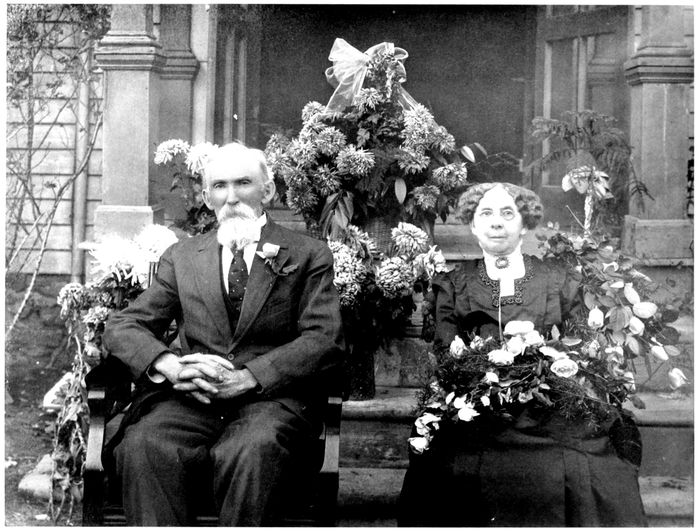
Mr. and Mrs. Lewis Du Bois—Golden Wedding Anniversary.
769Lewis P. Du Bois is a descendant of an old American family. He was
born March 23, 1834, in Salem county, New Jersey, a son of Samuel and
Mary (Johnson) Du Bois, both of whom were natives of New Jersey. Louis
Du Bois, a Frenchman, who came to America in about 1660, and established
the French settlement of New Palz, was the original founder of the family in
this country. His children were as follows: Jacob, Abraham, Sarah, Isaac,
David, Solomon, Rebecca, Rachel and Matthew. Samuel Du Bois was the
son of Matthew, a great-grandson of the first Louis Du Bois. Lewis Du Bois,
direct ancestor of Lewis, and son of Mathias, was a soldier in the Revolution
and served for seven years under General Washington, and was engaged in
all of the battles in which Washington’s army participated. Matthias’ children
were: Sarah, Lewis, Anna, Rachel, Cornelius, Matthew and Benjamin.
Lewis Du Bois, the Revolutionary patriot, married Rebekah Craig and was
the father of the following children: John, Matthew, Polly, Lewis, Rebekah,
Benjamin, Elizabeth, and Samuel, father of the subject of this review. Samuel
Du Bois was born September 26, 1800, and died in May, 1873. He married
Mary Johnson, who was born January 17, 1824, and died January 28,
1879.
To Samuel and Mary Du Bois were born children as follows: Rebecca,
who became the wife of Clarence Struper, and is now-deceased; Adaline, wife
of Jacob Kaeley, deceased; Mary Jane, wife of John Du Bois, of Fairfield,
Iowa; Lewis, with whom this review is directly concerned; Emeline, wife of
Daniel Hitchner, Nemaha county, Kansas; Eliza, wife of A. Hitchner, deceased;
Samuel Johnson, Salem county, New Jersey. Mr. Du Bois has an old
Bible over 150 years old and also has in his possession genealogical
works concerning the Du Bois, Patterson and the Ewing families which
can be consulted for further genealogical data if need be. Samuel Du Bois
was a farmer and his father, Lewis, was a paymaster in the American
army of defense during the War of 1812. Both lived and died on the old
ancestral farm which has been in the family for many generations. Lewis
donated one farm of 160 acres to the Daretown Presbyterian church and practically
endowed it. Samuel was a very prominent citizen in his neighborhood
and held several important offices and was one of the twelve free holders of
Salem county, New Jersey.
Lewis P. Du Bois was educated in the common schools of his native
county and when twenty years of age was employed as clerk in a store at
Bridgeton, Cumberland county, New Jersey, for three years, after which he
spent one year assisting his father farm the old homestead. His health failing,
he was told by the family doctor that he must go west or he could live
but a short time. Leaving the old home, his sweetheart and all associations
behind him, he set out and arrived in Atchison in April, 1858, with only $50
in cash in his pockets. For the first year he made his home with Dr. Challiss,
on the doctor’s farm. Dr. Challiss advised him to spend one year near the
river and then go to the mountains for an indefinite stay until he was cured.
770At the end of his first year’s residence in the West he set out for the mountain
country as assistant to Eli Mason, the first sheriff of Atchison county, in the
conduct of a wagon train en route to Ft. Kearney. His first trip to the West
and the outdoor life proved beneficial and upon his return he clerked in the
store of P. R. King until November of 1859, and again crossed the plains
with Henry Macey, of Weston, Mo. This was a very hard and long trip, taken
in the winter time, but he gained rapidly in strength and general health and
accumulated weight until he tipped the scales at 158 pounds. Upon his arrival
in Denver, Colo., the mining excitement was at its height and he was seized
with the gold fever. He took up a mining claim in the mountains, but left
it and went further into the mountainous country. He spent all of his money
on developing another claim, building a sluice and dam and turning the course
of a stream in order to get a sufficient flow of water for placer mining. All of
his efforts came to naught and his mining fixtures were washed away by a
disastrous flood and he was left in debt over $1,000. He and his associates
then went to Georgia gulch and bought another claim which yielded sufficiently
to enable him to pay off his debts and then the gold gave out entirely.
News came to the camp during his first winter in the mountains that a number
of men were snow bound over the divide and were starving for food. The
snow was from seven to ten feet deep on the level and twenty feet deep on the
ranges. Mr. Du Bois and another man were the only men brave enough to
volunteer to carry succor to the destitute prospectors and had the distinction of
being the first men to cross the Rockies in the dead of winter. From Colorado
he went to Wyoming and then returned to Atchison in 1861, meeting the
fast pony express on his way and learning of Abraham Lincoln’s election to
the Presidency.
From Atchison he returned to the old home in New Jersey and there
married the sweetheart who had been waiting for him to come back, restored to
vigorous health and strength. He followed farming in New Jersey for three
years, suffering in the meantime from rheumatism and sickness, brought on
from too much exposure to the elements. In 1865 he and his wife again returned
to Atchison with a cash capital of $500 and he took charge of a farm
owned by his friend, Dr. Challiss, on the share plan for a period of three years.
His farming experience for those three years was not at all profitable, and he
was left at the end of the time with practically no funds. Jayhawkers took
practically all that he made, and one time, after he had fattened a lot of hogs on
corn which cost him $1.10 per bushel, thieves stole the porkers and he was
left without a dollar. He then ventured to sell fruit trees to the settlers in
Colorado on the route to Denver and was very successful in taking many
771orders. The delivery of this consignment consisting of two wagon loads cost
over $1,850 by overland freight train in the fall of the year. The Indians were
troublesome at the time and during one eventful night which demonstrated
that the biggest braggarts with the train were the greatest cowards, the Indians
tried to run off their mules but were finally driven off. This venture resulted
in replenishing his store of funds and he bought his first farm with the proceeds,
paying cash for it. Like many others during those early days, Mr. Du
Bois herded cattle on the great free ranges but was unfortunate in having fifty
head die of Texas fever contracted from an infected herd of Texas cattle
which were being pastured over the range on the way to market. Many, indeed,
were the discouragements which beset his attempts to secure a livelihood,
at one time having purchased a horse from a Mr. Galbreath, it developed that
the beast was afflicted with glanders in a contagious form. This necessitated
the killing of all of his horses and the consequent restocking of his farm.
Prosperity eventually smiled upon him and his, however, and better times
came and he became the owner of 320 acres of exceedingly fine land in Shannon
township. He is a director of the Bank of Vliets, Kan.
Mr. Du Bois was married November 3, 1863, to Sarah Jane Jones and
to this union have been born children as follows: Mrs. Carrie C. Buck, born
in 1865, and residing at Vliets, Kan.; Lewis P. died in infancy; Samuel T.,
born July 7, 1876, operates the home farm, married Anna Katharine Kistler,
daughter of William D. Kistler, and has two children, Lewis P., Jr., and Kathryn
Ellen. The mother of these children was born April 5, 1835, in Salem
county, New Jersey, daughter of Joseph and Mary Ann (Van Meter) Jones.
The Jones family of which she is a descendant is a very old one in America,
and a history of the family is being now published. The Van Meter family
had its origin in this country as far back as 1660 and they were members of
the new Palz settlement in New Jersey. Her grandfather, Samuel Van
Meter, married Lady Anna Bishop, a titled English lady who was a member
of a noble English family. Several of her ancestors served in the war of
independence.
On November 3, 1913, there was celebrated at the hospitable and beautiful
Du Bois home, the fiftieth or golden wedding anniversary of this widely
known and well loved pioneer couple. Guests to the number of 500 came to
congratulate them from far and near, among them being the notable men and
women of Atchison county, who are proud of the friendship of Mr. and Mrs.
Du Bois. The tables groaned with good things to eat and the day was spent
happily in merrymaking, the wedding ceremony of Lewis and Sarah being
again duplicated for the edification of the interested guests. No invitations
772were issued for the occasion, but a general country-wide notice printed in the
Atchison newspapers caused a perfect hegira to the Du Bois home of old and
new friends of this worthy couple, who wished to be in line to grasp their
hands and wish them many more happy years of wedded life which have been
unmarred by a single serious discord. The fifty-three years of wedded life
have been replete with happiness and blessings for Mr. and Mrs. Du Bois, in
the main, while tinged with sorrows which are the inevitable lot of all mankind.
Mr. Du Bois and the members of his family are affiliated with the Presbyterian
church. He is a member of the Masonic lodge, the Independent Order
of Odd Fellows and the Central Protective Association, having been one
of the founders of the Good Intent lodge of the Central Protective Association.
He has been a life-long Democrat, and, while never having sought political
preferment and not having filled any office but that of trustee of Shannon
township, he has always taken in other years a very active part in county,
State and National politics. He was a great personal friend of Governor
Glick.
The name Woodworth is a noted one, not only in Kansas, but in American
history. A long line of distinguished men have descended from the
original founders of the family in America, and the men of each successive
generation have added additional luster to the family name by deeds of valor
and statesmanship which stand out prominently in the annals of their respective
abiding places. Edwin S. Woodworth, farmer and live stock breeder,
of Kapioma township, is a well and favorably known member of the civic
body of Atchison county, and a son of Maj. Caleb A. Woodworth, who was
one of the famous figures in the early period of the making Kansas into a
great State. His grandfather, Caleb A. Woodworth, Sr., was one of the
earliest of the Kansas pioneers.
Major Caleb A. Woodworth was born in Wilkesbarre, Pa., April 14, 1838,
and was a son of Caleb Woodworth, a native of Tyre, N. Y., whose father,
also named Caleb, was a captain of artillery under General Scott in the War
of 1812. Gresham Woodworth, the great-grandfather of Major Woodworth,
was a colonel in the Continental army during the American Revolution,
and fought at the battle of Saratoga. The Woodworth family is of
English origin, the progenitors of the family having emigrated from the Isle
773of Man early in the seventeenth century. The father of Major Woodworth
was a farmer by occupation, and married Miss Ellen Gordon, of Goshen,
N. Y., a cousin of Gen. Gordon, of Goshen, and a daughter of Cornelius
Gordon, who was born in Ireland, of Scotch-Irish parents, and settled in
Virginia. The elder Woodworth died at the age of seventy-four years, and
the wife and mother died in December, 1898, at the age of eighty-six years.
Caleb, Sr., immigrated to Kansas in 1857, and settled at Muscotah, Atchison
county. Both Caleb Woodworth and his wife were members of the Congregational
church, and Caleb was an Odd Fellow. He was well educated, and
in his younger days was a school teacher, becoming a farmer in later life.
The line of Woodworths in America tells of many men of letters and distinction,
and many soldiers who have shed luster on the family name in the
successive generations.
There were five children born to Caleb, Sr., and wife, namely: Caleb A.,
father of Edwin S.; Gilbert M., who came to Kansas at an early day, and
served three years in a Kansas regiment during the Civil war, first as corporal,
then as sergeant, and later was captain of a company of the Fourth
Arkansas infantry, and was made lieutenant-colonel of the Twelfth Kansas
militia in 1864. He became prominent in political life, and served as State
senator in Colorado, and died while marching in the G. A. R. reunion parade
in Philadelphia, September 8, 1899; eighty veterans succumbed to the heat.
He left one son, Charles G., of Onanga, Okla.; Ben F., a resident of Downs,
Okla., served three years in the Union army, part of the time as bugler of
Company A, Fifth regiment, Kansas infantry, and later as captain in the
Fourth Kansas regiment; David G., a graduate of Monroe Institute, a teacher,
and a Kansas militiaman. David Woodworth assisted in the survey of Oklahoma,
moved to the new State in 1889, and settled at Downs. He was a
successful farmer, but is now postmaster at Kingfisher, Okla. The mother
accompanied him to Oklahoma, and died there; Sarah Elizabeth, deceased,
was the wife of B. A. Colville, and left one son, Dr. Frank Colville, who died
in St. Joseph, Mo.
Major Caleb A. Woodworth came to Kansas in 1857, from Virginia, and
engaged in farming near Muscotah until 1859, when he entered the University
of Chicago, and pursued his collegiate education until the outbreak of
the Civil war. He then returned to Kansas and offered his services in defense
of the Union. His first enlistment was for a period of nine months in Company
B, Fourth regiment, Kansas infantry. He then assisted in organizing
the Thirteenth Kansas regiment, and was a member of Company F of that
774regiment, which he joined September 20, 1862. He rose rapidly in rank, was
commissioned major of his regiment, and served for three years, or until the
close of the war. He served directly under Colonel Bowen, and under Generals
Blount, Schofield, Steele, and Reynolds. He participated in the battles
around Springfield, Mo., and in Arkansas. At the battle of Prairie Grove,
in 1862, his horse was shot from under him. Three times his mount was
killed in battle, but he seemed to bear a charmed life, and was never wounded.
After the close of the war he returned to Atchison, Kan., and engaged in
freighting across the plains, making three trips in all with a freighting outfit.
He was the first man to telegraph money from Denver, Colo., to Atchison.
He operated a livery barn where the union depot now stands in Atchison.
About 1868 he again turned his attention to farming, and settled in Kapioma
township, where his father had preëmpted half a section of land. Major
Woodworth farmed the home tract, and erected the house where Edwin S.
now lives. He became an extensive cattle feeder, and was very successful
in his farming operations.
Major Woodworth was married in June, 1867, to Miss Margaret Shaw,
of Valley Falls, Kan. Three children were born of this union, namely: Nora,
wife of E. M. Wilcox, Kamaloops, British Columbia; Edwin S.; Jennie,
living in Wood, S. D. The mother of these children was born in Akron,
Ohio, January 21, 1850, a daughter of William and Louise (Fletcher) Shaw,
natives of Ohio. She is now residing with her daughter at Wood, S. D.
The civic and political career of Major Woodworth was a distinguished
one. He was elected State senator from Atchison county on the Republican
ticket in 1876, and served for four years. During his term as senator he
wrote the bill and presented the same to the State legislature, organizing the
Kansas State Historical Society. In 1892 he was chosen to represent the
third district in the lower house of the legislature, this time being elected on
the Democratic ticket. In 1895 he removed to Effingham, Kan., and resided
in that city until 1897, when he removed to Atchison to take up his duties
as superintendent of the State Soldiers’ Orphans’ Home. He filled the duties
of this position until 1900, when he resigned and retired to a home in Muscotah,
Kan. Major Woodworth died October 24, 1908. His demise marked
the passing of one of the most noted of the Kansas pioneers, a distinguished
soldier and statesman. He left a heritage of honorable and upright service
to the people of the State, of which his descendants can well be proud.
Edwin S. Woodworth was born April 20, 1874, on the farm where he
now resides. He was educated in the common schools of his native county,
and studied in Bolton University, after completing a course in the high school
775at Effingham, Kan. After his marriage, in 1895, he began farming the
home place of the Woodworth family. He is the owner of 163 acres of rich
farm land, which is well improved. Mr. Woodworth is a well known breeder
of registered Shorthorn cattle, and ships the product of his farm in this respect
to all parts of the country. He is a member of the American Shorthorn
Breeders’ Association. During 1915 he had a herd of fifty thoroughbred
Shorthorns, but has sold to buyers at excellent prices until he has depleted
his herd.
Mr. Woodworth was married May 29, 1895, to Miss Sadie E. Speer,
born June 11, 1875, and reared on a farm three miles east of Muscotah.
(See biography of D. Anna Speer for details concerning the Speer family.)
Four children have been born to Edwin S. and Sadie E. Woodworth, namely:
Mrs. Marguerite Mulligan, of Benton township; Mabel, a student in the
county high school at Effingham; Isabelle and Mildred, at home.
Politically, Mr. Woodworth is allied with the Democratic party. He
attends the Methodist Episcopal church, and is affiliated with the Knights
of Pythias, the Modern Woodmen of America and the Central Protective
Association. There is no doubt in the minds of those who know Mr. Woodworth
and esteem him for his many excellent qualities, that he will keep
alive the traditions of the Woodworth family and endeavor to follow in the
footsteps of his illustrious ancestors as regards right living and doing his
duty to his county and State.
Hal C. Low, of the firm of Johnson-Low Clothing Company, of Atchison,
was born in 1879 in Doniphan county, Kansas. His parents were J. W. and
Mary (Collins) Low, natives of the Buckeye State, the father’s home having
been at West Milton, Ohio. The grandfather of Hal C. was Ansel Low,
who was one of the earliest pioneer settlers of Kansas, first coming to Atchison
in 1852, following which he located in Doniphan, where he kept the first
hotel, or tavern, and also operated a general store. To the home of this
pioneer came in the fall of 1860, Abraham Lincoln, who was then touring
the country in his first campaign for the presidency. Lincoln’s visit and stay
at the Low hostelry was an event which awakened a great deal of pride with
J. W. Low and he was fond of relating the circumstance and describing in
detail how Mrs. Low served the simple wants of the greatest of all Americans.
776He was always a stanch supporter of the martyred President and gave direct
evidence of his loyalty to the Union by his enlistment in Company I, Seventh
regiment, Kansas cavalry, serving under Generals Rosecrans and Grant successively,
and was in active service throughout the entire war.
Hal C. Low was educated in the common and high schools of Atchison,
and then entered his father’s dry goods store, where he spent several years
profitably, absorbing the details of the business and in becoming a proficient
salesman and buyer. This experience stood him in good stead, and in 1905
he organized the Johnson-Low Clothing Company and has made an unqualified
success of the venture. The store is one of the most complete in this
section of the State, and carries high grade goods of the best workmanship
and design. The ever increasing trade, which flows to this establishment,
is the best evidence of its continued success.
Mr. Low was married in 1905 to Miss Jane Pollock, daughter of S. M.
Pollock, an early pioneer settler of Iowa, later a resident of Kansas, and now
residing in Atchison. Mr. Low is a Republican.
The public owes much to the teachers who have made a life work of
their chosen profession. While the teaching profession is used to some extent
as a stepping-stone to something supposedly higher and better, or as an opportunity
on the part of young people to earn some money in preparation for embarking
in some other vocation, there are in the ranks of the profession a
considerable number of efficient and painstaking educators who through a deep
and abiding love of the work of teaching the youth of the land and a desire
to advance themselves high in their profession, have made themselves indispensable
members of the community, and have shown by application and actual
practice that they are fitted above the rank and file to hold executive positions.
D. Anna Speer, county superintendent of schools for Atchison county, is a
capable and successful educator whose marked ability has received due recognition
from the people of the community in which she was reared.
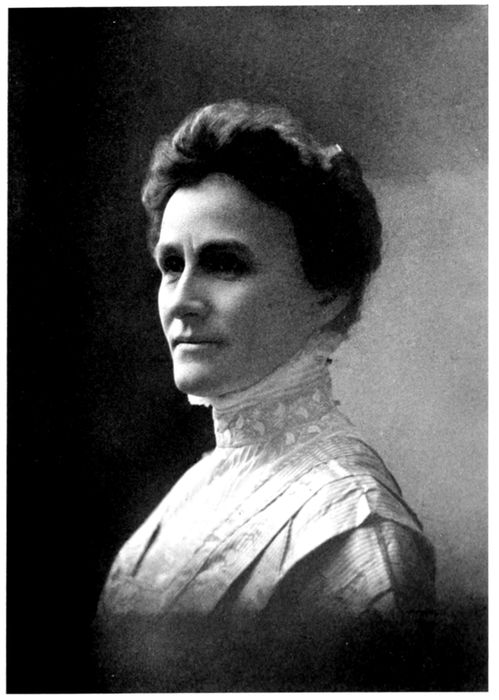
777She was born in Atchison county, a daughter of Joseph and Mary (Fountain)
Speer. Her father, Joseph Speer, was born March 4, 1834, in Leesville,
Ind., and was the son of Andrew and Dicie (Kirby) Speer, both natives of
Kentucky. Miss Speer’s mother was a daughter of Stephen Fountain and
Mary (Clark) Fountain, natives of North Carolina. The ancestors on the
side of each parent were pre-Revolutionary colonists of Virginia and the Carolinas.
The Speers were among the earliest settlers of Kentucky and the
great-great-grandfather of Miss Speer on the maternal side was a signer of
the Declaration of Independence. Joseph and Mary Speer were married in
Indiana and came west in 1859, settling on a farm near Muscotah in the spring
of 1860. Mr. Speer invested in a partly improved farm of 160 acres on which
they lived until old age required that they leave the farm for a town home in
Muscotah. During the Civil war Mr. Speer served in the Kansas State militia
and took part in the expedition against the Price invasion. Joseph Speer
died March 5, 1900. His wife was born in September, 1833, and departed
this life June 19, 1909. To them were born six sons and three daughters:
William F., who resides on the home farm; Mrs. Mary J. Long, of Fowler,
Kan.; Andrew, present county commissioner and farmer residing near Muscotah;
James R., one of the pioneer settlers of Guthrie, Okla.; John W., a
farmer of Morrison, Okla.; George T., a resident of Guthrie, Okla., and auditor
of the Arkansas Lumber Company; D. Anna; Jesse A., engaged in the livery
business at Medford, Okla.; Sadie E., wife of E. S. Woodworth, of Muscotah,
a son of Major Woodworth. The Speers are a family of pioneers and
are found to be leading citizens of their respective communities. Joseph and
Mary Speer reared their large family of children to become useful and influential
members of society and God-fearing men and women. Before death
called them to the eternal rest they had the satisfaction of seeing the county
where their earliest and most arduous labors had been accomplished grow to
become a prosperous and populous community.
D. Anna Speer was educated in the rural school of her home neighborhood
and the Muscotah public school. She completed a teachers’ course in
Campbell College and was graduated, receiving a life diploma from the State
Normal College at Emporia, Kan., in 1893. She then taught school for a
number of years. During the summer vacations she did post-graduate work
in the University of Chicago, Kansas University and Colorado College, at
Colorado Springs, Colo., and received the degree of Bachelor of Arts in 1911.
She entered the University of California at Berkeley and received the
degree of Master of Arts in 1913. Miss Speer is self-educated, having worked
her way through college and university while teaching school to earn money
for tuition and expenses. She began her teaching career with a few years’
service in the rural schools and in 1893 became a teacher in the Effingham
County High School, where she taught continuously for seventeen years. She
was then an instructor for two years in the State Normal School at Emporia,
Kan., after which she spent one year as a student in the University of California.
778After receiving her degree from the University of California she
served as instructor in Grass Valley, Cal., High School. This was a delightful
experience in one of the most beautiful spots on the globe, but she returned
home, and on July 1, 1915, entered upon her new duties as county superintendent
of public instruction of her home county. That she will make a success
of her work is assured.
Miss Speer is affiliated with the Methodist Episcopal church, the Eastern
Star lodge and is a member of the County and State Teachers’ associations,
and is a member of the National Educational Association. She is a deep and
capable student: a thorough and progressive educator, who is familiar with
the most advanced methods of teaching and is destined to achieve marked success
in her present important position.
Joseph C. Greenawalt, retired lawyer, Muscotah, Kan., was born April
17, 1840, on a farm in Montgomery county, Pennsylvania. He comes of old
Holland Dutch stock and the progenitors of the Greenawalt family emigrated
from Holland to America in 1665. He is a son of George and Sarah (Conner)
Greenawalt, natives of Pennsylvania. George Greenawalt was a son of
John, and his wife’s father was John Conner, a native of England. Joseph
C. was eighteen months old when his father died, leaving a widow with six
children to rear, namely: Mary Amanda, Sarah Ann and Margaret, now deceased;
Samuel C., deceased, who served as captain in a company in the Seventy-third
regiment, New York infantry, in the Union army, and was a wanderer
from choice, having gone to sea for several years, his first service in
the Union army being as a scout; Elmina C., deceased, and Joseph C., with
whom this review is directly concerned, and who was reared in eastern Ohio
at the home of his aunt. He lived at his aunt’s home until he attained the
age of sixteen years, attended school and learned the trade of carpenter and
cabinet maker in a shop operated by his uncle.
As a boy Joseph C. Greenawalt had been ambitious to acquire an education
and was not content with the idea of spending his days at the carpenter’s
bench. Accordingly, at the age of sixteen, we find that he started out to
make his own way in the world and to educate himself by partly working his
way through college. He entered Mt. Union College, at Alliance, Ohio, and
was one of the first students enrolled in this college when it was advanced
779from a seminary to a regular college. He worked during the summer seasons
and was thus enabled to pay his way through the college course. When he
was eighteen years of age, he also taught one term of school. He studied
languages for one year in the Hayesville Institute at Ashland, Ohio. After
studying for three years at Mt. Union, he matriculated at the University of
Michigan in Ann Arbor, Mich., entering the junior class of this university in
1860. In 1862 he received his bachelor’s degree from the University of Michigan,
but did not acquire his master’s degree until five years later, in 1867.
In May of 1862 Mr. Greenawalt enlisted in Company I, Eighty-sixth regiment,
Ohio infantry, and served for four months, when he was commissioned a
lieutenant of the Ohio Sharpshooters, but resigned his commission and took
charge of the Canton, Ohio, Union School for the ensuing six months. He
then served as deputy clerk of the circuit court, studied law in the meantime
and was admitted to the bar at Ravenna, Ohio. In the spring of 1864 Mr.
Greenawalt went to Colorado and engaged in mining engineering in the
mountains, forty miles west of Denver. After a stay in the West he settled
in Platte City, Mo., and practiced law there until 1871, and after a trip to the
Pacific coast, he located permanently in the city of Atchison in August of
1871. He practiced law successfully for twenty-five years in Atchison, and
held the office of city attorney in 1875.
Mr. Greenawalt has always been a great lover of horses, and more to
gratify his love of horse flesh than anything else he established in 1882, the
famous Greenview Stock Farm, near Atchison, now owned by B. P. Waggener.
He erected the residence and several of the buildings now on the farm
and engaged in the breeding of fast trotting horses. For some years he made
his home on the farm and practiced his profession in the city, going to and fro
from his law office and giving the farm work his personal supervision. The
Greenview Stock Farm became famous for the many fast horses bred there,
one of the most noted of which was Samuel G., record 2:29, and who made a
trial record of 2:18¼ when a four-year-old. He made a practice of breeding
two-year-olds for speed and succeeded, shipping horses to buyers in eastern
and southern points where racers were desired for the tracks. In 1900 Mr.
Greenawalt removed to Muscotah and continued his horse breeding until 1912,
when he practically retired from the pursuit of his favorite hobby. He is the
owner of a fine farm of 160 acres adjoining Muscotah on the east.
Mr. Greenawalt has been twice married, his first wife being Sophia E.
Bowers, of Cleveland, Ohio, and who died May 26, 1870, at the age of twenty-seven
years, leaving an infant daughter, Maude Mary, born February 11,
1870, and died August 2, 1870. He married Mary C. Bowers, of Stark
780county, Ohio, in September of 1882. This marriage was blessed with one son,
Samuel O., born November 6, 1885, and died March 1, 1902. Mrs. Greenawalt
was born December 15, 1845, in Stark county, Ohio, a daughter of Elijah
and Mary Bowers, natives of Pennsylvania. In politics, Mr. Greenawalt is
an independent. Mrs. Greenawalt is a member of the Congregational church
of Muscotah. For many years Mr. Greenawalt has been a Mason and served
as eminent commander of Washington Commandery, No. 1, at Atchison for
two years, and also served as worshipful master of Active lodge of Masons,
and is a member of the Knights of Pythias.
Wherever members of the German race have settled in the agricultural
sections of the Middle West, we find that they have been uniformly successful,
and it is only natural to find that certain individuals achieve greater success
than others. Henry Niemann, of Center township, Atchison county, is
an American citizen of German birth, who came to this country a poor emigrant
lad, and has made a wonderful success since he purchased his first eighty
acre tract in this county, nearly forty years ago. He is now one of the largest
landed proprietors of the county, and one of the best known stockmen of
northeast Kansas.
Henry Niemann was born February 14, 1853, in Minden, Germany, a son
of Christian and Mary (Krouse) Niemann, who lived and died in the Fatherland.
They were the parents of seven children as follows: Crist, deceased;
Henry, whom this review directly concerns; Fred, a farmer of Center township;
Mrs. Christena Krouse, deceased; Charles, a farmer of Atchison county;
William, living in Germany, and Augustav, deceased. Henry was educated
in the schools of his native land and at the age of eighteen years left the
Fatherland and immigrated to America in search of his fortune, which he was
eventually to find in Kansas. He first settled in Madison county, Illinois,
and worked there as a farm hand for five years. He saved his money carefully
while working on the farms of Illinois, and in 1876 came to Kansas and
invested in a tract of eighty acres of land in Center township. He erected a
small two-room cabin on his land and a barn to house his team of horses. He
broke his land gradually and at first was able to farm only a small portion of
it. The neighbors tried to discourage him by telling him that the strong winds
might wreck his home at any time and advised him to find a better and safer
781location. He failed to find a place which suited him as well as his first
choice, and although he has lived for forty years on the farm his buildings
have never yet been blown away by the Kansas zephyrs. Mr. Niemann has
prospered as he deserved and by the exercise of economy, hard work and good
financial judgment, has become the owner of 615 acres of land in several
farms, all of which are well improved and highly productive. Mr. Niemann
is an extensive feeder of hogs and raises large numbers annually for the market.
He believes in feeding the grain products of his farm to live stock on
the place and thus reaps greater benefits than the ordinary methods of farming
would yield. He is a stockholder in a prosperous mercantile concern at
Nortonville, Kan.
Mr. Niemann was married in 1897 to Louise Frommer, and to this marriage
have been born ten children, namely: Mrs. Mary Dietrich, a widow,
who lives with her parents; Rosa, widow of George Moeck, also living with
her parents; Christena, deceased; Dena, deceased; William, a farmer living in
Center township; Mrs. Dora Dietrich, deceased; Harry, Henry and Julius, living
at home, and Mrs. Lillie Poos, Nortonville, Kan. The mother of these
children was born in Wurtemberg, Germany, in 1858, a daughter of John and
Kathrine (Markley) Frommer, natives of Germany, who were early settlers
of Atchison county.
Mr. Niemann is an independent Republican voter, who refuses to wear
the collar of any one set of political bosses, and votes as his judgment indicates.
He and his family are members of the German Lutheran church.
Henry Niemann is a fine type of successful German-American farmer and is a
tiller of the soil first and last; he lays claim to no ambition beyond tilling his
broad acres and making his land yield the maximum of sustenance for man and
beast; his great success lays in the fact that he has confined his energies to the
soil and its cultivation and he has managed to get a good slice of the best land
obtainable.
Fred W. Kaufman, merchant, Cummings, Kan., was born in Nortonville,
Kan., February 18, 1879. He is a son of Frank and Louise (Baker) Kaufman,
who were the parents of thirteen children. Frank Kaufman was born
in Servia, Germany, in 1833. When a youth, in his native land he learned the
shoemaker’s trade which he followed there until eighteen years of age, and he
then emigrated from Germany to America in 1851. He came to Atchison,
782Kan., and worked as a cobbler. When the town of Pardee, Kan., was
founded, Mr. Kaufman opened a shoe shop in that town and conducted it for
about four years, after which he located in Nortonville and worked at his
trade until his demise in 1911. The children of Frank and Louise Kaufman
were as follows: Charles, deceased, merchant of Nortonville, born 1866, died
1908; Edward, a merchant, Nortonville; Fred, a merchant of Cummings,
Kan., the subject of this review; Mrs. Anna Coon, of Rock Creek, Kan.; Mrs.
Flora Hilderbrand, Independence, Kan.; Walter, a farmer, living near Cleveland,
Okla.; Grace, residing at Nortonville. The mother of these children
was born near the city of Atchison, and is now living in Nortonville.
Fred Kaufman was reared in Nortonville and attended the public schools
of his native city after which he studied in the Atchison Business College.
At the age of fifteen years he was employed as clerk in a general merchandise
store in his home city. In 1900 he went to St. Joseph, Mo., where he was
employed in the wholesale department of the Wheeler & Motter Mercantile
Company for a period of nine years, and served in the capacity of mail order
clerk in this establishment. He was then given a traveling position as salesman
with his firm and for three years sold goods in the surrounding territory
with considerable success. His ambitions led him to undertake things
in his own behalf, however, and in 1912 Mr. Kaufman located in Colorado,
where he was engaged in ranching for three years. Three years’ hard work
enabled him to develop his Colorado farm into a good piece of salable property
and he then disposed of his holdings and came to Cummings where he
invested his cash capital in a general merchandise store which he is conducting
with considerable success. His previous commercial experience has
proven to be invaluable to him since entering the mercantile field in his own
behalf, and he has developed a splendid business in Cummings. Besides his
large store in Cummings, Mr. Kaufman has invested in 210 acres of land in
Colorado and Oklahoma.
Mr. Kaufman was married September 6, 1905, to Carrie E. Hackney,
and this marriage has been blessed with two children: Fred, Jr., and Maxine
C., both of whom are at home with their parents. Mrs. Kaufman was born
October 27, 1884, at Agency, Buchanan county, Missouri, and is a daughter
of Alfred and Pauline (Slover) Hackney, natives of Wisconsin and Missouri,
respectively. Alfred Hackney was a son of Thomas and Mary (Saxton)
Hackney, the former a native of England. Thomas was an early pioneer settler
in Doniphan county, Kansas, coming there about 1852, and also operated
a drug store at Wathena, Doniphan county. Mrs. Thomas Hackney is still
783living at the age of eighty-eight years, born August, 1827. Alfred is now
living in retirement at St. Joseph, Mo., and has attained the age of sixty-five
years. Mrs. Kaufman’s mother died in 1904, at the age of forty years.
Mr. Kaufman is a Republican in politics and is affiliated with the United
Commercial Travelers’ lodge at Hastings, Neb. He and Mrs. Kaufman attend
religious worship at the Baptist church, of which Mrs. Kaufman is a
member. Mr. Kaufman is a splendid type of self-made man whose success
in the mercantile field is certain to continue in the years to come. His business
methods are such as to commend him favorably to the many patrons of
his store; he is likewise a good citizen who has the best interest of his town
and county at heart.
Lancaster township, Atchison county, is rightly considered as one of the
genuine garden spots of the State of Kansas, because of the fertility of the
soil, the well kept appearance of the fields, and the excellent improvements on
the farms, the owners of which seem to vie with each other as to who can
have the nicest looking and most productive farm. This township has a large
German population, or rather, American citizen farmers, of German birth or
descent, and it is a proverb in this land that, wherever you see a community of
thrifty farmers of German descent, there you will find enterprise, thrift and
progress. Arnold Lange, of this township, is a successful farmer and breeder,
of German birth who has made good in his adopted country and holds a high
place in the citizenship of the county.
Arnold Lange was born in Westphalia, Prussia, German Empire, December
23, 1853, and is a son of Herman and Charlotte (Mittendorf) Lange,
who were born and reared in the Fatherland. Herman Lange was a farmer
and coal dealer, and also conducted a grocery store for a time. He was born
in 1824, lived all of his life in his native land and died in 1907. His wife,
Charlotte, died in 1899, at the age of seventy-six years. They were the parents
of twelve children, six of whom are living.
Arnold Lange received his schooling in Germany and worked as farmer
and teamster until his emigration from Germany to America in 1882. He settled
in Atchison county and invested his capital in eighty acres of land north
of Huron, which he cultivated for nine years with fair success. He then sold
the farm at an increase over the purchase price and bought the farm which now
constitutes his home place and which contains 240 acres of good land. The
784improvements on the land when Mr. Lange purchased the tract were indifferent
and included a small house. Naturally one of his thrift and pride
could not remain long content with poor accommodations and he has built a
commodious farm residence and a very fine barn and improved the looks of his
place with shrubbery and trees until it presents a handsome appearance. He
has also set out an orchard of six acres. Mr. Lange has specialized in his
live stock raising with considerable success and his efforts in breeding thoroughbred
Percheron horses have met with reward commensurate with his
efforts. He has bred and raised some very fine animals of this class and
in 1906 was awarded first prize on Percheron draft animals at the county
fair held in Effingham. His interest is given to breeding fine cattle and
his herd of shorthorns are as good as can be found in the county.
Mr. Lange was married in 1883 to Miss Minnie Kloepper, who has borne
him three children: Herman, of Huron, Kan.; William, a farmer, of Grasshopper
township, and Arnold, a graduate of the Huron schools and at home
assisting his father in the farm work. The mother of these children was born
December 14, 1865, in Illinois, and is a daughter of Mr. and Mrs. Christian
Kloepper deceased. Mr. Lange is a Democrat, and is a member of the German
Lutheran church. He is fraternally connected with the Modern Woodmen
lodge.
According to competent authority there are in Atchison county a number
of pure bred live stock breeders, who, if they received the recognition to
which they are rightly entitled, would take high rank among the leading live
stock men of the country. Among these specialists are William H. and Henry
C. Graner, sons of one of the pioneer pure bred live stock breeders of the
county who are following in their father’s footsteps and have made a name
and fame for themselves which extend far beyond the borders of this county
and beyond the borders of the State of Kansas. William H. Graner, proprietor
of the “Graner Farm,” which is the old homestead of the Graner
family, is one of the most successful agriculturists of the county and is deserving
of special credit for his progressiveness and decided ability as a breeder
of fine live stock. The “Graner Farm” is one of the best stocked and best
equipped ranches in the West and is noted for its fine Shorthorn cattle and
standard bred Percheron horses. Mr. Graner learned the breeding business
from his father and has made a success of the undertaking. His farm consists
of 160 acres, which was formerly owned and developed by his father,
Gottlieb Graner. On this farm are some very fine animals of the pure bred
Shorthorn type which will compare most favorably in breeding and appearance
with anything of the kind in the country. His herd of Percherons include
twenty registered mares which have won many prizes at county fairs and live
stock exhibits in Kansas. Mr. Graner has owned and used two grandsons
of “Brilliant,” the sons of “Old Brilliant,” and sire of these animals, the
“Colored Gentleman,” was awarded first and championship over all draft
horses at the world’s exhibit of live stock at the Chicago international exhibition
in 1893. All of his mares’ ancestry is traced back to “Old Brilliant” and
this strain predominates in his drove of fine Percherons.
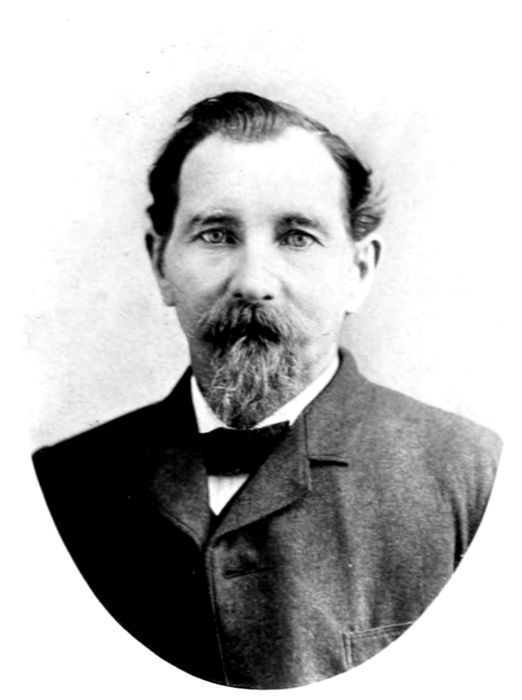
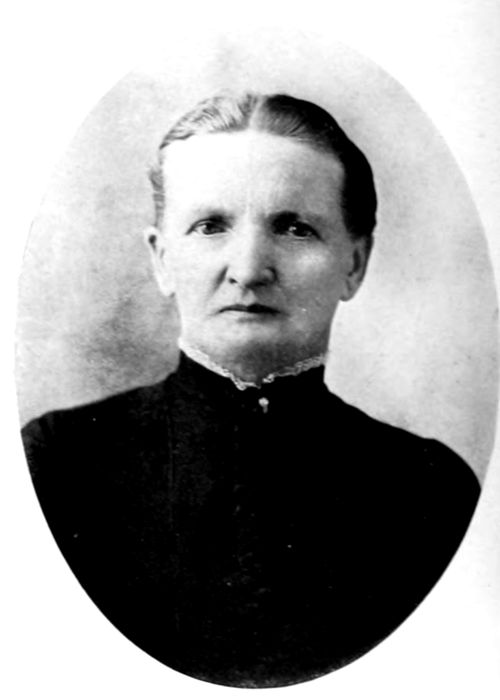
Mrs. Martha (Hauck) Graner
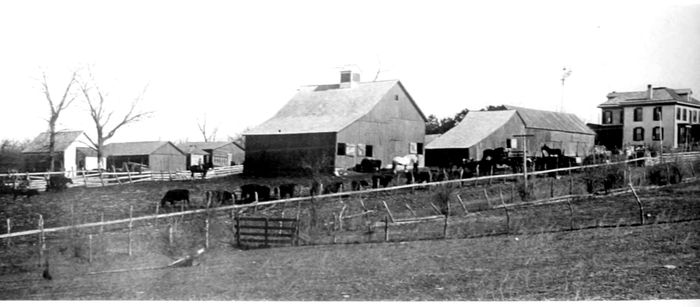
The Old Graner Homestead, W. H. Graner, Owner.
785
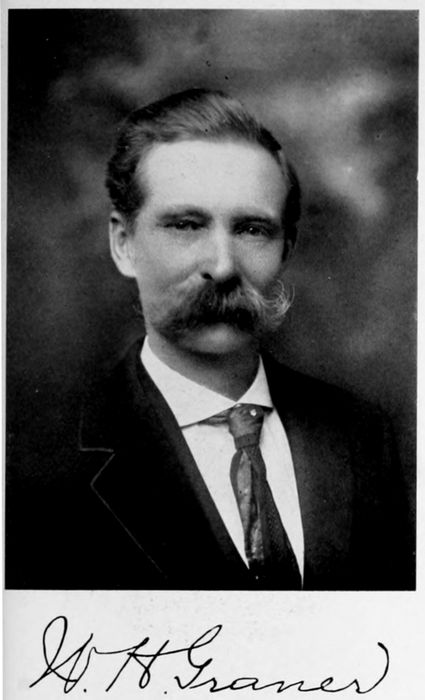
Crowd of prosperous Kansas farmers at H. C. Graner’s Annual Sale of Large Type Poland China Sows, May 27, 1913. Pleasant Hill Stock Farm, Lancaster, Kansas.
In the breeding of Shorthorn cattle he has used such sires as a son of
the imported cow, “Ballechin,” “Charming Maid,” V67–616, “Sire Ceremonious
Archer,” 171479. A number of the cows in Mr. Graner’s herd are
sired by “Victor Archer,” 223102, a pure Victoria, and one of the finest strains
of Shorthorn cattle known. Mr. Graner has not shown any of his fine stock
cattle outside of Atchison county. He has six large cattle barns for the housing
of his live stock and ships the product of his farm to buyers and fanciers
in all parts of the United States.
Gottlieb Graner, founder of the “Graner Farm,” and father of William
H. and Henry C. Graner, of Lancaster township, was born in Germany in
1835, and immigrated from the Fatherland to America at the age of sixteen
years. He first settled in Illinois where he worked as a farm hand, and a few
years later came west to Kansas City, Mo. In this city he invested his savings
in a city lot which is now in the heart of the most valuable business district
of the southwest metropolis, but he eventually let the lot go for taxes.
From Kansas City he made his way to the city of Atchison where he found
employment in a brewery at a salary of $100 per month. He saved his money
and in 1868 purchased 160 acres of raw prairie land in Lancaster township,
for which he paid five dollars an acre. He became a breeder of Shorthorn
cattle and Percheron horses and succeeded in this undertaking, being one of
the pioneer breeders of the western country. At the time of his demise, in 1894,
he was the owner of 560 acres of well improved farm lands.
Gottlieb Graner married Martha Hauck, also a native of Germany, and
who died in 1905. To this well and favorably known pioneer couple were
born the following children: Mrs. Matilda Stansburger, a widow, residing
in California; William H., with whose career this review is directly concerned;
786Henry C., a farmer and stockman, living near William H.; Ferdinand, living
in New York, and Adolph, residing in California. Mr. and Mrs. Gottlieb
Graner were Lutherans, and honest, industrious, God-fearing people.
William H. Graner was born June 13, 1869, on the farm which he now
owns in Lancaster township. He was reared on his father’s farm and attended
the Bell district school and also studied in the Monroe Institute at Atchison,
after which he pursued a course in the Atchison business college. His commercial
course occupied a period of four years and has proven to be invaluable
to him in the management of his extensive farming interests. After completing
his commercial course Mr. Graner went to work on the home farm with
his father. After his father’s demise in 1894 he took charge of the farm and
managed it until all the children became of age. The estate left by his father
was then divided, and William bought the interests of the other heirs in the
home farm and came into possession of the homestead place of 160 acres
which he has improved with several barns and modern farm buildings. He
has prospered and is now the owner of 560 acres of land, two farms, each of
which is well equipped with good buildings. One of these farms is tilled by
a tenant, and Mr. Graner had planted in 1915 140 acres of corn.
Mr. Graner was married in 1898 to Miss Clara Matthias, and to this
union have been born four children, namely: Martha, deceased; Louis, Marguerite
and Esther, at home with their parents. Mrs. Graner was born February
6, 1871, in Lancaster township, a daughter of Fred and Agnes (Bodendoerfer)
Matthias, both of whom were natives of Germany and immigrated
from the Fatherland to America and became early pioneer settlers in Atchison
county. Mrs. Graner attended the Rock district school in her youth and is an
excellent helpmeet to her husband and a kind mother to her children.
Mr. Graner is an independent in politics and prefers to vote for the man,
regardless of party affiliations. He is a member of the Lutheran church, Independent
Order of Odd Fellows, and Modern Woodmen of America. He is a
well educated and versatile citizen and a capable and successful business man,
as well as farmer and breeder. He has achieved a considerable measure of
prominence in the county and State because of his decided ability. Besides
his farming interests he is a stockholder of the Independent Harvester Company
of Plano, Ill., of which concern he is the county agent, a large warehouse
having keen erected on the “Graner Farm” for the purpose of housing the
implement stock sold to farmers in the neighborhood. Mr. Graner is a member
and stockholder of the Percheron Society of America, the Importers and
Breeders, and the American Percheron Registry Association, and is a member
of the American Shorthorn Breeders’ Association. He is a director in the
787Brown County Mutual Fire Insurance Company, of which prosperous concern
he has been a director for fifteen years.
“Pleasant Hill Stock Farm.”
Situated on a hillside within sight of the old Graner homestead in Lancaster
township, Atchison county, is the “Pleasant Hill Stock Farm,” owned
and managed by Henry C. Graner, one of the most successful and best known
farmers and breeders of northeast Kansas. Mr. Graner is a son of Gottlieb
Graner, a pioneer in the pure bred live stock industry of Atchison county,
whose biography appears in the review of the life of William H. Graner on
the preceding pages of this history of their home county. The “Pleasant Hill
Stock Farm” is unquestionably one of the best equipped modern breeding
plants in the State of Kansas and is famed over the West for the product
of its fields and barns. This farm consists of 240 acres of well tilled and well
improved land, situated two miles north of the town of Lancaster and only
a quarter of a mile from the birthplace of Henry C. Graner. In addition to
his home place, Mr. Graner is the owner of 160 acres of land which he uses
for pasturing his live stock. The home farm is well equipped with two farm
dwellings and five well built barns and granaries with other conveniences to
facilitate the handling of live stock. The owner has given special attention
to equipping his farm for the breeding of fine cattle and hogs. He pays a
great deal of attention to his Poland China hogs and is a breeder of the Big
Type Poland China swine, which are among the best in the United States.
Mr. Graner ships the product of his breeding pens to all parts of the country
and has annual sales of thoroughbred hogs which are a feature of the countryside.
To show the prices obtained from his sales in 1914, one small sow sold
for $500. He handles the Big Type Poland China breed exclusively and is a
regular exhibitor at county fairs and has frequently taken first prizes and
many blue ribbons. His drove of fine hogs exceeded 300 in 1915, all pure
bred stock.
Mr. Graner’s herd of Shorthorn cattle is of the Scotch pure bred strain
and bred to “Choice Goods,” a famous strain known the world over for quality.
He has also shown his fine cattle at the county fairs and live stock
exhibits and carried off many first prizes. His herd of pure bred Shorthorns
numbers fifty head at the present time, all registered stock. In addition to
being a breeder of hogs and cattle Mr. Graner breeds standard Percheron
horses of the imported strain sired by “Brilliant,” of which he has usually
from twenty-five to thirty head of fine stock on the place.
788Henry C. Graner was born April 19, 1871, on the old Graner homestead
in Lancaster township, on which he was reared to young manhood. When
a small boy he attended school in the village of Lancaster, and after the school
house was erected in the neighborhood he went to the district school. He
was one of the first students to enter Midland College in Atchison and there
completed his education. He remained on the home farm until 1901 and then
bought the farm which he now owns, first consisting of 160 acres, to which
lie afterwards added an eighty. He later invested in another quarter section
which he uses for pasture.
He was married June 6, 1901, to Miss Mary K. Meck, who has borne
him five children, as follows: Lillian, born October 11, 1902; Matilda, born
April 21, 1904; Louise, born June 1, 1907; Henrietta, born March 11, 1910;
and Frederick, born April 8, 1913. The mother of these children was born
in Center township August 31, 1874, a daughter of Fred Meck, now living on
a farm in Center township, Atchison county. Mrs. Graner is a capable
woman, a devoted wife and mother, and the Graner home is a very happy one
at all times.
Mr. Graner is a Democrat in politics, but has little time to devote to the
political game other than to vote for his favorite candidates at election time.
He and Mrs. Graner are members of the Lancaster Presbyterian church, of
which institution Mr. Graner is a trustee. He is affiliated with the Ancient
Free and Accepted Masons, the Independent Order of Odd Fellows, and the
Modern Woodmen of America. He is also a member of the Standard Bred
Poland China Record Association, and the Percheron Society of America.
Mr. Graner’s success has been mainly due to hard work, close application to
his affairs and keen financial judgment.
Richard E. King, farmer of Oak Mills, Walnut township, Atchison
county, was born in this county, January 11, 1876. He was a son of Richard
M. King, pioneer, farmer, merchant and early-day freighter, who was born in
Smith county, Tennessee, January 23, 1837. Richard M. was a son of Abraham
and Mahaley (James) King, natives of Virginia, who came to Tennessee
in 1833. They migrated from Tennessee to Buchanan county, Missouri, in
1851, and one year later moved to a farm in Platte county, Missouri, where
Abraham King and his wife eventually died. Richard M. King crossed the
plains with a freighting outfit which started from Ft. Leavenworth en route
Ft. Laramie in Wyoming, and met with considerable adventure on the long
789trip, which consumed ninety days going and returning. The Indians molested
them frequently, and one time a mischievous band stole all the tongue pins
from their wagons. Another time, when they were in camp, a band of hundreds
of Pawnees swarmed around the train and tried to intimidate the men.
One big Pawnee buck, uttering a loud “woof,” stuck a spear in Mr. King’s
stomach. On account of the Indian force being of superior number to the
whites, they did not dare take offense at anything they did, or seem offended
at any of their pranks for fear of massacre. Richard M. King followed
freighting four years and made his last trip to the far West in 1862, from Ft.
Leavenworth, Kan., to Ft. Union, N. M. He came back from this trip, and
with his savings bought a tract of land on the Missouri river in Walnut township.
Unhappily, this land was eventually cut off from the mainland by the
freakish Missouri, when it once more changed its course, and, although
the deed to the land is still held by Richard M. King the muddy waters of the
Missouri flow over it. In 1866 he bought forty acres of land in the hills,
back from the river. He was married November 22, 1863, to Mary Frances
Hottle, a daughter of David and Frances (Creal) Hottle, both of whom were
natives of Brook county, Virginia. They too, came to Kansas in the early
days, and settled in Leavenworth county, in 1855. David Hottle was a
butcher by trade and bought and killed the first beef ever slaughtered in the
historic town of Kickapoo, Leavenworth county. Kickapoo was a hotbed of
the pro-slavery element in those days and woe betide the man who opposed
their wishes. Two children were born to Richard M. King and wife: Lucy
Ann, born August 27, 1864, deceased wife of Thomas Reagan, a passenger
conductor on the Missouri Pacific railway. To Mr. and Mrs. Reagan were
born two children, Thomas D., born March 8, 1889, and John M., born August
7, 1905; Richard E., the subject of this review.
Richard E. King grew to manhood on the home farm and was educated
in the common schools of his native county and the high school at Kansas
City, Kan. He was married in 1895 to Mary Sacks, a daughter of Henry
Sacks, of Atchison county. She died in 1898, and after her death, Mr.
King went to Kansas City, Kan., to reside and was there engaged in various
pursuits. He married Miss Sue Allen in Kansas City, Kan., January 16,
1900. Mrs. King is a daughter of James T. and Jane (McCampbell) Allen,
both natives of Woodford county, Kentucky, whose people removed from the
ancestral home of the family in Virginia to Kentucky. The old Allen homestead,
built of natural stone is still standing in the latter State, a picturesque
and beautiful reminder of ante-bellum days. In 1885 James T. Allen and
family left Kentucky and went to Cass county, Missouri, where they resided
790on a farm until 1903, and then removed to Harrisonville, Mo., where they
now live. One child has been born to Mr. and Mrs. Richard E. King, Richard
Allen King, born July 12, 1903, a bright and intelligent boy and is an excellent
student in school.
The King home, situated on a bluff overlooking the reaches of the old
Missouri river, is noted for its hospitality and good cheer. Their home has
been named “Che-me-o-kah,” a Kaw Indian term, meaning “Lodge of the
Rising Sun,” or “Sunrise Cottage.” The Kaw Indians had a village on this
farm in ancient times. Mr. and Mrs. King are a fine young couple who are
highly esteemed by all who know them. Mrs. Richard M. King has one of
the most remarkable collections of family heirlooms in Kansas.
John Moeck, farmer, of Center township, Atchison county, was born in
Wurtemberg, Germany, March 17, 1869. He is a son of Henry and Eva
(Heinz) Moeck, who were the parents of the following children: Mrs. Kathrine
Younger, living near Potter, Kan.; Anna, deceased; Henry, farmer, Germany;
John, subject of this sketch; Karl, Osborne county, Kansas; Regina,
Atchison, Kan.; and George, deceased. The father was born April 3, 1839,
in Germany, where he spent his life. He was a son of Henry Moeck, also
a native of Germany. His wife, Eva, was born December 1, 1841. She is
a native of Germany, and is now living on a farm in that country. John
Moeck, the subject of this sketch, attended the schools in Germany, and in 1883
immigrated to the United States, settling in Atchison county, Kansas, where
he worked on a farm for his board and clothing. He attended the district
schools of Center township until he was twenty-one years old. During this
time he was living with his uncle, Fred Moeck, and the following five years
he worked as a farm hand. He was then married, and settled down on the
farm which he now owns. He rented it for a time, until he was able to
accumulate enough to buy it. He bought the place in 1898, and has owned
it since that time. The farm consists of 145 acres of fine land, which the
owner has improved extensively. Two acres of the place is planted with fine
fruit-bearing trees. Mr. Moeck keeps high grade stock on his farm.
The career of Mr. Moeck shows what one can do by hard work. When
he arrived in Atchison county he had only four dollars, and every cent that
he now owns has been earned by hard work since he came to Atchison county.
791Mr. Moeck is a self-made man, who has won a desirable place for himself
in his community. That his fellow citizens hold him in high regard, is shown
by the fact that they elected him to the office of township treasurer for two
terms. He has been road overseer, and is now a member of the school board.
In 1895 Mr. Moeck married Kathrine Ziegler, who was born April 5,
1875. She is a native of Germany, and the daughter of George and Agnes
(Frommer) Ziegler. When a child five years old Mrs. Moeck came to
America with her parents, who settled in Center township, Atchison county.
Mr. and Mrs. Moeck have four children: Eva, Louise, Frieda, and Walter,
living at home. Mr. Moeck is a Republican. He is an elder in the German
Lutheran church. In reviewing his life, it is only fair to say that he is one
of those self-made citizens who form the solid foundation of our democracy.
By his own efforts he has climbed to the top, and has shown by his life
what the man who will try can accomplish.
John O. A. Miller, farmer and stockman, of Kapioma township, Atchison
county, was born January 1, 1872, in Kapioma township. He is a son of
James and Eliza (Russell) Miller, who were the parents of eight children, one
of whom is dead. The father, James Miller, was born in Clay county, Missouri,
August 3, 1831, and was a son of Moses Miller, a native of Kentucky.
James Miller grew up on his father’s farm and at the age of eighteen crossed
the wild western plains to New Mexico, working for the Government. He
found a few years of the strenuous life enough and settled down to farming
in Atchison county in 1854. He bought 160 acres of land from a land company.
The farm was composed of good bottom land and he made extensive
improvements on the profitable returns which his large crops brought. He
was a large breeder of cattle, especially Shorthorns, and his judgment on
cattle was regarded as authoritative. He was known throughout that part of
the country as the “cattle king.” He farmed 700 acres until his death. During
his life time he held a number of township offices. His successful career
ended September 12, 1913, with his death at Muscotah, Kan. His wife, who
was a native of Iowa, died in 1879.
John Miller grew up on his father’s farm. He attended the Atchison
County High School at Effingham, Kan., and after working a short time
he went to the State Normal School at Emporia, Kan. To earn his way
792through college he worked as a farm hand until he had saved enough money
to carry him through school. After leaving the State Normal School he
rented the farm which he now owns, and in 1912 bought it. The place consists
of 160 acres. In 1914 he built a fine barn, which is one of the best in
the State for its size. It is 40×52 feet and has a smaller wing, 26×14
feet, with a capacity of seventy-five tons of hay. It is strongly constructed
and is a model barn. Mr. Miller maintains that stock as fine as his ought to
have a good barn in which to live. He makes a specialty of Percheron
horses and Chester White hogs. He is also a breeder of Shorthorn cattle
and has maintained the same strain which his father kept. In addition to his
activities in the rural life of his neighborhood Mr. Miller is active in the business
affairs of Muscotah. He is a director and stockholder in the State Bank
at Muscotah, Kan., and has an interest in the Farmers’ Grain and Elevator
Supply Company and the Mutual Telephone Company.
In 1903 he married Jane Ernst, who was born November 6, 1871, in
Kapioma township, Atchison county. She is a daughter of John and Eliza
(Lewis) Ernst. The father is a native of Germany and the mother of Norway,
and both came to Atchison county, Kansas, in the early days. Mr. and
Mrs. Miller have two children: Alice E. and Mary E., twins, who are living
at home. Mr. Miller is a Democrat and has been treasurer of Kapioma
township. He is a member of the Ancient Free and Accepted Masons.
For a Kansas citizen and pioneer settler to spend the better part of a lifetime
in building up a fine and highly productive farm, and then to enter the
banking business at a time when most men are ready to retire and live a life
of ease, is rather out of the ordinary, but such has been the experience of C.
C. Hart, banker, of Muscotah, Kan. Mr. Hart has lived in Kansas for forty-seven
years and has been successively farmer and banker during that time.
He is a descendant of one of the old families in America and comes of a
family of ministers and teachers.
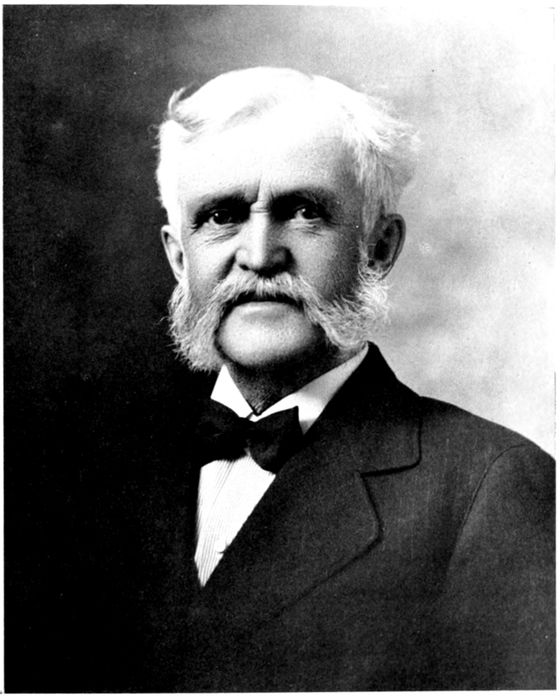
793C. C. Hart was born December 6, 1842, in Sandusky, Ohio, and was a
son of Rev. Ichabod and Harriet (Whitcomb) Hart, the former a native of
New York, and the latter was born in Templeton, Mass., April 22, 1819, and
died in Chicago, Ill., April 30, 1889. The Hart family is a very old one in
America and is descended from two English immigrants who settled in Connecticut
in the colonial period of our Nation’s history, and from whom the
city of Hartford took its name in the seventeenth century. Several descendants
of these early pioneers fought for the cause of American independence
in the American Revolution and also in the War of 1812. Two brothers of
C. C. Hart served in the Union army in the late Civil war. The father of
C. C. Hart was educated for the Presbyterian ministry and later became a
Congregational minister. He received his college training in Princeton University
and migrated to Ohio in 1840; resided at Sandusky until 1843, and
then took charge of a church at Medina, Ohio, until 1844, when he removed
to Kenosha, Wis. After several years’ ministerial work in Wisconsin he
located in Illinois, and died at Wheaton, that State, in 1870, at the ripe old age
of eighty-four years. Rev. Hart was the father of eight children: Edwin R.
received a college education and served in the Union army; Rev. Walter O.
Hart, a Union veteran, now located in North Carolina; Eliza born in
Kenosha, Wis., January 23, 1847, married George W. Phillips, and died September
15, 1875, at Llano, Texas, one and one-half years after her marriage.
While carrying on his ministerial work the Rev. Ichabod Hart also conducted
a farm in the neighborhood of his work. Edwin R. Hart was educated in
Oberlin College, Ohio, and Walter O. received a college and theological institute
education and is now living in retirement with his son who also is a
minister.
C. C. Hart, with whom this review is directly concerned, was reared to
young manhood on his father’s farm and attended the schools of Genoa, Wis.
During the Civil war lie remained at home and assisted his father in the farm
work. In 1868 he decided to strike out for himself and try his fortunes in
the West. He came to Kansas and located in Jackson county, on the western
border of Atchison county, where he purchased 160 acres of railroad owned
land, at a cost of five dollars and forty cents per acre. He at once began improving
this tract which was raw prairie at the time of purchase and in the
course of time developed it into a fine and highly productive farm. The
Hart farm is one of the most productive and best improved in the State of
Kansas and is widely known for the excellent shape in which the grounds and
improvements are kept. Mr. Hart added eighty acres adjoining in Atchison
county to the original quarter section and now has 240 acres in all. He remained
on the farm until 1905, in the meantime having become interested in
the Muscotah State Bank as a stockholder and director. In that year he
removed to the town of Muscotah, where he has since made his residence in
an attractive home. Mr. Hart was elected cashier of the bank January 1, 1910,
and served in this capacity until August 1, 1915. While cashier he also served
794as vice-president of the institution and is now connected with the bank in
that capacity.
Mr. Hart was married in 1867 to Miss Emma A. Olden, who has borne
him the following children: Arthur C., born in 1873, married Bertie Stockton,
and has one child, Dorothy, residing in Bakersfield, Cal.; Dwight Hart
died in youth. Mrs. Emma A. (Olden) Hart, the mother, was born in Wisconsin
in 1846, and is a daughter of Enos Olden, a native of New York
State, and a descendant of an old eastern family.
The Republican party has always claimed the allegiance of Mr. Hart,
and he has taken an active part in political affairs during his long residence
in Grasshopper township and Muscotah. While living on the farm he held
various township offices, and was always found in the forefront of civic movements
which had for their intention the ultimate good of all the people. He
filled the post of mayor of Muscotah for four years and was a good official.
In church work he has been very active and is at present the treasurer of the
Congregational church. His work in the interest of the young people of Muscotah
has endeared him to all of the residents and for twenty-five years he
has served as the superintendent of the Sunday school of his church. Mr.
Hart was secretary of the Atchison County Sunday School Association for
ten years. Although this grand old pioneer has passed the allotted three
score and ten years of age. He is still active, mentally and physically, and
rarely a day passes which does not find him at his desk attending to his
duties in the bank or working about the grounds of his attractive, well kept
home. Mr. Hart is a courteous and kindly gentleman of the old school whom
one can not help but admire for his many sterling qualities.
A native born Kansan, who became a successful agriculturist and banker,
and left an indelible imprint upon the business and social life of Atchison
county, was the late William Young, of Arrington, Kan. The Young family
was one of the real pioneer families of the county, and the late Mr. Young
was born on a pioneer farm in Mt. Pleasant township May 20, 1858. He was
a son of William Johnson Young, whose wife was Mrs. Martha (Wamach)
Snowden, widow, born in Virginia, a daughter of Abraham Wamach, an
early pioneer settler of Atchison county, who came to this county in 1854
and settled on adjoining homesteads with W. J. Young. W. J. Young, the
795father of William, was born in Tennessee in 1815, and was the first judge
of Atchison county. He settled on a farm in Walnut township, two and one-half
miles northeast of Potter, Kan., which farm is now owned by Peter C.
Griner. The elder Young was a natural born leader of men, and took an
active and influential part in the political affairs of the county in the early
days. He was a religious man, whose home was a meeting place for the
politicians and ministers of the Gospel, and he was very hospitable. His
father was the Rev. Duke Young, a native of Tennessee, who came to Kansas
in 1854, and preached the first sermon in the county, on the doctrine of
the Christian denomination. The Rev. Mr. Young was about sixty years of
age when he came to Atchison county, and he had been preaching the Gospel
for many years in Tennessee. J. W. Young became a member of the Christian
church when sixteen years of age. The Young family was of Scotch-Irish
ancestry.
William Young, with whom this review is directly concerned, was one
of a family of fourteen children reared by his parents. He grew to manhood
on his father’s farm, and after his marriage, in 1880, he and his wife located
on a farm in Mt. Pleasant township, near the town of Potter, and developed
it into a fine and productive tract. He continued in agricultural pursuits
until 1908, when he went to Arrington, Kan., and purchased the Arrington
State Bank, which he operated until his demise, January 12, 1910. After Mr.
Young’s death, his widow disposed of the bank and the Arrington property,
and removed to Atchison, where she has since made her home at 419 Kearney
street.
William Young was married February 5, 1880, to Miss Angie Cooley,
and to this union were born the following children: Maude, wife of Earl
Stapler, Atchison; Duff D. Young, born April 8, 1901. The mother of these
children was born November 9, 1861, a daughter of James and Cassendania
(Waddle) Cooley, both of whom were born and reared in Kentucky. James
Cooley, her father, migrated to Kansas in 1854 and settled on a homestead
south of Potter, in Leavenworth county. His wife, Cassendania, came to
Kansas to reside with her sister, Mrs. Masterson, who lived in Mt. Pleasant
township, and she was married in 1860 to James Cooley. Eight children
were born to them, of whom Mrs. Young was the fifth in order of birth.
James Cooley took an active and prominent part in political affairs in Kansas
in the early days, and served as the representative to the State legislature
from Leavenworth county for two terms, from 1868 to 1872, inclusive. He
died in 1876.
796William Young was a member of the Ancient Free and Accepted
Masons, the Odd Fellows, and the Fraternal Aid Union. He was a man who
lived his life according to Christian precepts, and was a regular attendant at
church and Sunday school of the Christian denomination. His start in life
was at the foot of the ladder, and he was successful in his undertakings, building
for himself and his family, and leaving behind him on this earth the
memory of a life well spent, and to his family a heritage of industry, honesty,
straightforwardness and right living which will long be remembered by those
who knew him best.
In the compilation of the biographical department of this history of
Atchison county, Kansas, the fact is frequently brought to the mind of the
reviewer that the really successful men of this county are essentially self-made,
and began at the foot of the ladder of success, working their way upward
by various means, all of which were honest and based upon hard and
painstaking labor at the outset of their careers. Very few were well educated,
or had been blessed with opportunities in their youth such as are the
heritage of the youth of the present day. James Edward Behen, successful
farmer, of Center township, Atchison county, is one of those citizens who
are deserving of credit for what they have accomplished. Starting out as
a boy of twelve, he has made his own way in the world, and after he attained
manhood, with the assistance of a good and faithful helpmeet, he has accomplished
results which are really creditable. Starting with a tract of
eighty acres of land in 1900, which he found necessary to improve, he soon
added another eighty, then another eighty, and now has a fine farm of 240
acres, which is one of the most fertile tracts of land in the county, practically
all of which is in cultivation. Mr. Behen has the right idea of farming,
inasmuch as he sells the product of his farm “on the hoof,” and has become
an extensive feeder of cattle and hogs. This plan insures the fertility of
the soil, and his farm is steadily improving as the result of a wise method of
cultivation.
Mr. Behen is a native son of Kansas, who was born and brought up on
Kansas soil, and will not admit that there is any better place under the sun
for a man to acquire a fortune than right here in Atchison county, and,
judging by what he has done in Kansas, the writer is prone to agree with
him. James E. Behen was born March 28, 1864, at Leavenworth, and is a
797son of Michael and Mary Behen, who had six children. The father was of
Irish descent. He followed bridge building. James, the subject of this
sketch, started out to make his own way at the age of twelve years, and went
to work on the farm of Edward Whalen, in Doniphan county, Kansas, and
stayed there eight years. Meanwhile, he attended the district school, receiving
a rudimentary education. He then worked as a farm hand until he was
twenty-two years old. For several years following he rented land in Atchison
and Doniphan counties. In 1900 he bought eighty acres in Center
township, and five years later bought the eighty acres adjoining his farm
on the west. Now he owns 240 acres, which he has improved considerably.
He built a modern barn, 32×35 feet in size, and also built a fine cattle barn,
forty feet square. He does a large feeding business, handling a carload of
cattle each year. He keeps graded stock of all kinds on his farm.
In 1888 he was married to Lizzie Pauly, who was born March 30,
1862, in Doniphan county, Kansas. She is the daughter of John and Anna
(Hartzinger) Pauly, natives of Germany. The parents were early settlers
in Illinois, and moved to Doniphan county, Kansas, in 1857. Mr. and Mrs.
Behen have eight children: Mrs. Agnes McCibben, Atchison, Kan.; Alice,
deceased; Mary, graduate of Atchison High School, living at home; Thomas,
living at home; Joseph, at home; John, whereabouts unknown; Roy and Fred,
living at home. Mr. Behen is a Democrat. He is a member of the Roman
Catholic church.
It is meet that considerable space be devoted to the valiant old pioneers
of Kansas who assisted in the settlement of the country, and had much to do
with its development. Not all of them figured prominently, and it was given
to a very few to be honored above their fellows. In the latter class the reviewer
must of necessity and choice place the late Fred Hartman, pioneer,
successful farmer, Union veteran and well known public official, who for
more than two decades was a well known and highly esteemed citizen of
Atchison county.
Fred Hartman was born in Franklin county, Indiana, December 7, 1844,
a son of Jonathan and Christina (Wolking) Hartman. His paternal grandfather
was Henry Hartman, a native of Pennsylvania, of German extraction,
and his wife, Alice Case, whom he married in Pennsylvania, migrated to Indiana
in the early days of the settlement of the Hoosier State. Jonathan
798Hartman, father of the subject, was born in Franklin county, Indiana, January
22, 1822, and was reared to young manhood among the rugged hills of
his native county, learning the carpenter’s trade, and then moving to Platte
county, Missouri, with his family in 1846. Nine years after settling in
Platte county, he removed to Port William, at that time a thriving settlement
on the banks of the Missouri river in Atchison county. Here he erected one
of the first sawmills in Atchison county and the State of Kansas, and furnished
all the sawed lumber for the settlers for many miles around. The year
1856 saw the beginning of the struggle between the Free State and pro-slavery
men for possession of Kansas, and the summer of that year witnessed some
lively times. History records the fact that a man named Bob Gibson, leader
of the Kickapoo Rangers, came from the headquarters of the gang with a
squad of men for the purpose of mobbing Jonathan Hartman on account of
his opposition to slavery. Mr. Hartman was a man of high courage and
assumed a defiant attitude toward the Rangers who finally left without doing
the damage which they had boasted was their intent. About this time the
noted Pardee Butler was set afloat on a raft down the Missouri river by the
pro-slavery men of Atchison, and Butler appealed to Hartman for aid after
landing, near Port William. Mr. Hartman gave Butler every assistance
possible, in getting him to his home. In 1857 Jonathan Hartman sold his
sawmill and settled on a farm in Mt. Pleasant township, near the old military
road which ran from Ft. Leavenworth to Denver, and the Far Western points.
Great trains of thirty or more heavily laden wagons drawn by six and twelve
yoke of oxen were constantly passing the home of the Hartmans. Mrs.
Hartman recalls the great drought of 1860 and the great snows of the following
winter. During the year of the great drought the settlers did not
raise any crops and were forced to journey to Atchison for provisions, on the
return trip stopping at the Andrew Parnell farm for assistance in their dire
need. Two of the drivers on a wagon train that terrible winter had their
feet frozen, one of the men afterwards losing both feet as a result of the hardships
undergone. The Parnell home was a welcome and hospitable place of
refuge for the starving and suffering settlers, during that winter. Mrs.
Hartman also recalls the beautiful and inspiring sights made by the troops of
United States cavalry which were frequently seen from her home in those days.
Fred Hartman hearkened to the call of the Union in the second year of
the great civil conflict and enlisted in Company F, of the famous Thirteenth
Kansas volunteer regiment, under Captain Hayes, Major Woodworth and
Colonels Bowen and Speck. He was engaged chiefly in scout duty, and
was stationed at Ft. Smith and other points in the Southwest during his
799term of service, which lasted for three years, and was finally mustered out at
Ft. Leavenworth in 1865. He then came home and resumed the farm work
on his father’s farm. He was married January 21, 1866, to Cynthia Parnell.
To this union were born the following children: Henrietta, wife of R. H.
Ripple, died in 1896; Hannah Ann, wife of James Iddings, both of whom are
deceased, and who left one child, Geneva Iddings, of Topeka, Kan.; Dora, wife
of Joseph Speck, died in 1896, leaving one daughter, Dora, who lives with
her grandmother; Jonathan, a salesman of Kansas City; Josephine, wife of
John Putman, of Atchison; May Florence, wife of Roy Trimble, sheriff of
Atchison county, has four children; Birdie, wife of Henry Barr, died in 1906;
Frederick, died in 1911, was married to Blanche Baker, daughter of Captain
Baker. The mother of these children was born January 14, 1849, in Buchanan
county, Missouri, a daughter of Andrew and Mirah (Wilson) Parnell
natives of Kentucky and Indiana, respectively. Andrew and Mirah Parnell
began their wedded life in Franklin county, Indiana, where they were reared
and then migrated to Arkansas, and from there to Missouri in the early forties.
In 1859 the family left Buchanan county and settled in Mt. Pleasant township,
Atchison county, where they figured prominently in the early history of
the county. The little Parnell was named after Andrew Parnell and the old
town of the same name took its appellation from the family which settled
in the neighborhood. Mr. Parnell spent his last days in Jefferson county,
Kansas, where he died in 1872. He became very well-to-do and prospered.
He was one of the original Free State men and suffered considerable loss at
the hands of the Jayhawkers and border ruffians. Andrew Parnell was
the father of eleven children, six sons and five daughters, and sent three of
his sons to serve their country in the Thirteenth Kansas regiment, one son
being killed. Mrs. Hartman is the youngest child of this large family.
When Mr. and Mrs. Fred Hartman were married they settled on a farm
near Parnell, which Mrs. Hartman still owns. They developed this farm
and cultivated it successfully until 1896, when they removed to Atchison,
where Mr. Hartman died October 25, 1909. Mr. Hartman was a life-long
Republican and began taking an active part in political and civic affairs when
he had attained his majority. He was elected sheriff of the county in the fall
of 1895, and served four years in all, in this important office. Previous to
his removal to Atchison, he had capably filled the office of trustee of Mt.
Pleasant township. He became identified with the civic life of Atchison and
served as a member of the city council and was held in high esteem for his
ability and capabilities as a citizen. Mr. Hartman was prominent in Odd
Fellow and Masonic circles during his long life in the county.
800Fred Hartman was one of those pioneer citizens of Atchison county
which are distinguished for their qualities of leadership, and his descendants
are proud of his record as a citizen and public official. He was, during his
whole life, a reader and student who believed in keeping abreast of the times
and made a hobby of gathering historical data, being much interested in the
history of his adopted State. His mind remained keen to the end of his days
and he will always be fondly remembered by those who knew him. To him
and his comrades who laid the foundation of the prosperous and happy community
of Atchison, this volume is respectfully dedicated.
Successful banking calls for qualifications somewhat different from those
required in other pursuits or professions. It calls for a keen mind, decisive
action, ability to pass judgment upon a proposition and its merits, and the
power to judge and gauge human nature, and determine upon the honesty
or sincerity of those with whom the banker is constantly doing business.
Oscar A. Simmons, active vice-president and manager of the First National
Bank of Atchison, possesses the qualifications of a successful banker to a
considerable degree. He is unquestionably one of the rising financiers of
Kansas with an ever increasing prestige in financial circles. He is one of
those broad-minded men who keep abreast of progress and have the faculty
of adapting their capabilities to the advanced needs of the times. Although
a comparatively young man, as years measure a man’s age, his experience
in banking has been such as to eminently fit him for the important position
which he holds.
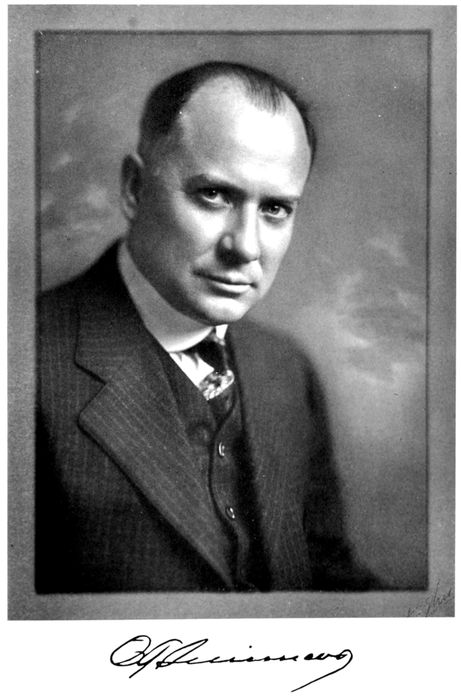
801O. A. Simmons is a native of Kansas, and was born in Jefferson county
February 11, 1874. His father was Joshua Simmons, a native of Indiana,
and his mother was Susan Pitcher Simmons, born and partly reared in Missouri.
The parents of both Joshua and Susan Simmons were among the
pioneer settlers in Jefferson county, and it is probable that they located there
in about 1855. Both the Simmons and Pitcher families were prominent in
the affairs of Jefferson county in the early days of the county’s growth, and
were highly respected. Joshua Simmons and Susan Pitcher were married in
Jefferson county. At the outbreak of the Civil war, Joshua Simmons offered
his services in behalf of the Union, and enlisted in Company A, Eleventh regiment,
Kansas infantry, at the age of seventeen years, and was under the
command of Colonels Moonlight and Plumb. Mr. Simmons took part in
some hard campaigns during his enlistment, the Eleventh regiment being a
part of the division which fought General Price’s army of invasion throughout
Missouri and Arkansas. On a number of occasions he showed his personal
bravery in volunteering for scout duty in the Southwest. He was mustered
out at the close of the war, returned home, and was married shortly
afterward. After a long and successful career as a farmer and merchant,
he is now living a retired life at Brondon, Colo., at the ripe age of seventy-one
years. Eight children were born to Joshua and Susan Simmons, five
of whom are living, as follows: Mrs. J. W. Faubion, of Anthony, Kan.; Oscar
A.; Mrs. P. H. Scales, of Birmingham, Ala.; W. C. and C. T. Simmons,
of Los Angeles, Cal. The mother of these children departed this life in 1886.
She was a good wife and a kind and loving mother.
O. A. Simmons attended the common and high schools of his native
county and town, after which he was employed in a general store at Winchester,
Jefferson county, until 1899. He was then employed in charge of the
gents’ furnishing department of a large department store at Leavenworth
for one year. His ambitions had always been headed toward entering the
field of banking, inasmuch as he believed that he could make a success as a
banker. Opportunity naturally beckoned; he saw the need of a bank in the
town of Potter, Atchison county. Taking what funds he could muster he
went to Potter and organized the Potter State Bank, serving as the cashier of
this institution for two years. He then sold his holdings in the Potter bank
and organized the Exchange State Bank at Nortonville. For a period of five
years he was in charge of this flourishing bank, and here had the opportunity
of demonstrating his inherent ability as a financier. A wider and
larger field beckoned to him and he came to Atchison in 1906. Here his
genius as an organizer has had full opportunity for exercise and he organized
the Commercial State Bank, which later bought control of, and was consolidated
with, the First National of Atchison. Mr. Simmons was elected
vice-president of the bank at the time of the reorganization and was installed
as the bank manager. He has since taken an active part in the organization
of other banking concerns, having organized the Farmers State Bank
of Anthony, Kan., in 1910, of which his brother-in-law, J. W. Faubion, is
the cashier. In 1901 he organized the Jarbalo State Bank at Jarbalo, Kan.,
of which T. J. Mains is cashier. Mr. Simmons disposed of his interests in
the Jarbalo bank in 1911, and bought the Farmers State Bank at Effingham,
selling control of this bank in 1912. His next venture was the purchase of
802the controlling interest in the State Savings Bank at Leavenworth, of which
Mr. Mains is now the vice-president. He reorganized the Arrington State
Bank at Arrington, Kan., in 1903, and is still interested in its affairs. He
organized the Citizens State Bank at Elmo, Mo., in 1913, and is the principal
owner of this bank, and a stockholder in the Union State Bank at McLouth,
Kan. It is a noteworthy fact that every financial institution with which Mr.
Simmons has been connected has prospered, and is in sound condition. In
every bank in which he has been interested he has displayed ability of a high
order as a financier and manager.
Mr. Simmons has been twice married, his first wife being Margaret
Mains, whom he espoused in 1902, being a daughter of James Mains, of
Oskaloosa, Kan. She died in 1907. His second marriage, in 1910, was with
Mary Frances, daughter of J. H. Barry, a substantial and well known citizen
of Atchison (see biography of J. H. Barry). Two children have blessed
this union: John Barry, born December 17, 1911, and O. A. Simmons, junior,
born March 9, 1913.
From farmer boy to banker and capitalist in the short period of a little
over forty years, with no initial capital to begin with, but a keen mind and
strong body, is the gist of the career of him of whom this review is written.
When a boy he worked for fifty cents per day in Jefferson county. Coming
from the soil, and being reared on the farm, he has never entirely lost a love
for the land itself, and is heavily interested in various tracts of good farm
land, and owns 400 acres of Atchison county farm land, and 700 acres in
eastern Colorado, which, together with holdings in Missouri and Texas, will
aggregate over 1,500 acres. His financial interests are varied, and in Atchison
are of such nature as to be of distinct benefit to the welfare of the city.
He holds stock in several of the city’s leading mercantile concerns. His first
work was as a farm laborer at $10 per month. His commercial career practically
began in a general store at Winchester, Kan., at a salary of $17 per
month, and during the twenty-three years following, he has amassed a fortune
of over $100,000. Yet, there are those who say that opportunity for
attaining wealth and position are gone, and that a young man has no chance
to succeed because of the great competition of the financial trusts of the
country. The life story of O. A. Simmons is a direct contradiction to the
wail of the pessimist, and furnishes a decided inspiration to any young fellow
blessed with mentality and strength to go and do likewise in his favorite line
of endeavor. While Mr. Simmons is a stanch Republican, he does not take
an active part in political affairs, and has declined political preferment.
803
H. B. Walter, of Benton township, Atchison county, Kansas, is one of
the most widely known and successful live stock breeders in Kansas, and has
made a signal success as a breeder of Poland China hogs during the past ten
years. He first began the breeding of fine live stock in Republic county,
Kansas, and while he has been a resident of Atchison county only since 1909,
he has become known the length and breadth of the county for his fine live
stock production. Mr. Walter did not venture in the breeding department
of specialized agriculture for the purpose of producing show animals, but
began his work purely as a commercial venture, and has succeeded even beyond
his most sanguine expectations. He is the owner of 160 acres of fine
farm land, located three and one-half miles northwest of Effingham, on
which are excellent improvements. His farm is headquarters for supplying
breeders with registered stock in all parts of the country, and he has the
distinction of having developed the world beater of big type litters, and has
produced and sold a world’s record type of Poland China swine of the big
variety. For the past four years he has made the sales record for the State
of Kansas in the numbers produced and the prices obtained. His farm produces
200 head of registered Big Type Poland China swine annually, and
he holds two sales each year, in the months of October and February. In
February of 1915, Mr. Walter sold fifty head of hogs, at an average price
of sixty dollars per head, to buyers who attended the sale from all parts of
the West. In February of the preceding year he sold at his regular sale fifty
head, which brought an average price of seventy dollars each. The output of
his breeding pens is shipped to points as far west as Oregon, and to places
ranging from Minnesota to the Gulf States. In July of 1915 he filled an
order for three high priced hogs sent in from Connecticut. He has done no
exhibiting except at the local stock shows.
H. B. Walter was born on a farm in Jay county, Indiana, July 31, 1871,
a son of Thomas S. and Sarah (Sherman), the former a native of Indiana,
and the latter a native of Ohio. The family migrated from Indiana to Republic
county, Kansas, in 1892, and settled on a farm in that county, where
Thomas S. still resides. H. B. received his education in the public schools
of his native county and State, and studied at Ridgeville College, Indiana.
He prepared himself for the teaching profession, and taught school
in Indiana for one year, and taught for nine years in Republic county, after
moving to Kansas. He held the highest average grade possible to obtain in
his teacher’s certificate, and met with considerable success in his profession,
804but abandoned teaching to engage in farming, in which avocation he began
with the same determination to succeed as he had been imbued with when
he began to teach. He purchased a farm in Republic county, which he cultivated,
later buying a place in Brown county, Kansas, which he sold in
1909, and made the purchase of his present farm.
He was married in 1895 to Fanny Kunkel, a daughter of Noah and Caroline
Kunkel, who were residents of Republic county, Kansas, from 1867
until their death. Mrs. Walter was also a teacher for eight years, and lived
in Republic county over forty years. Mr. and Mrs. Walter have two living
children: Frank, born in 1898, and Ruth, born in October, 1902.
Mr. and Mrs. Walter are members of the Methodist Episcopal church.
Politically, Mr. Walter is an independent voter, who is not tied to the principles
of any political party or leader. He is a member of the Central Protective
Association.
This firm has the distinction of operating the oldest soda and vinegar
manufactory in Kansas, which was founded by William H. Hekelnkaemper,
father of the present proprietors, in 1863. The first factory was located
in a little shed, 14×14 feet, one door east of the A. J. Harwi hardware
store on Commercial street, Atchison, Kan. Mr. Hekelnkaemper operated
the business for ten years, and gradually enlarged his quarters as much as his
limited means would allow, and about 1873 removed the plant to the present
location on the corner of Ninth and Laramie streets. He erected a brick
structure, 22×50 feet, and also built an ice house. His business prospered
from the start when he moved to his new location, and was confined to the
trade in Atchison with the exception of supplying the towns within a radius
of fifty miles in northeast Kansas, and western Missouri. In the old days
patrons drove in wagons for a distance of fifty miles and more to purchase
the products of the factory, and many of the former patrons are still buying
from the sons. After the founder’s death in 1881, the business was allowed
to languish to some extent owing to the enforcement of the State prohibition
law, for the reason that the products of the factory, while not intoxicating,
were largely purchased by saloons. Trade naturally fell off for a time until
conditions were adjusted to the new regime, and new demands were created
in other retail circles than the saloon business. The plant was closed for
about a year and the widow then leased the buildings for ten years to M. L.
805Greenhut, who later retired. The sons then took charge in 1900, and it has
since been operated by F. W. and G. A. Hekelnkaemper. The boys had no
capital to begin with, but had a wonderful amount of determination and perseverance
which stood them in good stead and enabled them to make good.
The business had to be built over again, but fortunately paid a small profit
during the first years. In time other additions were made to the plant and
the capacity has been increased to over 15,000 bottle of soda water per day.
This is the main product of the factory which also produces fruit syrups and
flavoring extracts of a superior grade and quality, in addition to fifty thousand
gallons of high grade vinegar each year. During the busy season fourteen
men are employed and Hekelnkaemper Brothers has grown to become
one of the important manufacturing concerns of Atchison. During the past
eight years the business has practically doubled itself over that of each preceding
year.
William H. Hekelnkaemper, Sr., was born in April of 1837, in Westphalia,
Germany, and emigrated from his native land when a young man. He
landed at New Orleans from a sailing vessel and then came by river boat to
St. Louis where he lived for a number of years and engaged in the grocery
business. His store was burned and he left St. Louis and came to the town
of Rollin, Mo., where he again established a grocery store about 1861. In
the spring of 1863, he came to Atchison, Kan., and opened and operated the
first pool and billiard room in the city. One year later he disposed of part
of his equipment and moved a part to Seneca, Kan., where after operating a
pool room for a time, he sold out and returned to Atchison. In about 1863
he embarked in the soda manufactory as stated in the preceding paragraph.
While a resident of St. Louis, Mr. Hekelnkaemper was married to Theresa
Houk, who was born in St. Louis, Mo., of German parents, who both died
during the great cholera epidemic when Theresa was about three years of
age. The children born to this union are as follows: Gustave A., Frederick
W.; William G., Frank V., Laura, Edith, Emma and Anna.
F. W. Hekelnkaemper was married September 17, 1901, to Pauline Ostertag,
a daughter of George Ostertag, one of the pioneer wagon makers of
Atchison, and to this union have been born two children: Irene and Lucille.
He is a Democrat and is a member of the Elks, Eagles and the Moose.
G. A. Hekelnkaemper is associated with F. W. in the business as above
mentioned. He was married in August, 1901, to Lydia Weik, a daughter of
Christian Weik, an Atchison county pioneer, and to this union have been born
two children: Marie and Louise. G. A. is a Democrat in politics.
806William H. Hekelnkaemper died August 20, 1881. He was politically
allied with the Republican party during his life, and was a member of the
Atchison city council for a number of years, having been a particular and
close friend and admirer of the late Senator John J. Ingalls. He was one of
the founders of the famous Turner Society, and was its first president. He
was prominently identified with the affairs of the society and the civic affairs
of Atchison until his demise. He was a man of great resourcefulness which
aided him in making a new start on occasions when everything looked darkest
for his future. He had many warm friends in Atchison and was universally
respected by all who knew him.
Clem P. Higley, farmer and stockman of Center township, Atchison
county, was born there March 25, 1869. He is a son of Russell and Carrie
(Hooper) Higley, who were the parents of nine children, as follows: William,
deceased; Otto, deceased; Emma Winsor, Las Vegas, N. M.; Hallie Nelson,
Las Vegas, N. M.; Theodore, a traveling man; Clem, the subject of this
sketch; Frank, farming the old home place, and Gilbert and Mina, both deceased.
The father was born just west of New York City, January 3,
1833. In his early manhood he followed the blacksmithing trade, and at the
age of twenty went to Illinois, where he remained for two years. Coming to
Atchison county, he preëmpted 160 acres of land in section 3, Center township,
and sold it shortly afterward and bought 80 acres in section 35, a mile
east of old Pardee, Kan. He made extensive improvements on this place
and farmed it until he retired in 1895. He now lives with his son, Clem.
Russell Higley’s life did not run as smoothly as it might seem from this account
of it. In his early days in Kansas the drought destroyed his crops
one year. He gathered only one bushel of corn from his field that year.
Having started out with no capital, this misfortune was a serious one. He
and his twin brother, Russell, worked for Pardee Butler, while he returned to
Illinois. They worked for Mr. Butler all summer and in the fall of 1856
started to walk back to Illinois, so as to be home during the winter. A winter
in Kansas was a serious thing in those days, and with the best of provisions,
it was a fierce ordeal. In the spring of 1857 they returned to Kansas, having
the confidence in this country to develop into a prosperous district. Russell
was a son of Francis Higley, and his mother died when he was a very
807small boy. Carrie Higley, the mother of Clem, was born in Tennessee in
1837. Her father was a freighter from Missouri to Santa Fe, N. M. Mrs.
Higley died in 1899.
Clem Higley, the subject of this sketch, attended school at Pardee, Kan.,
and when twenty-one years old, started out to work by the month. A year
later he rented a farm in Benton township, five miles south of Effingham,
Kan. Then for a period of nine years he rented in Benton township, and
the following three years rented his father’s farm and in 1903 bought 105
acres. The place was not well improved and he set to work erecting buildings,
and now has a large two-story home and two barns, one 24×50
feet and the other 40×42 feet. The latter has a cement basement. Higley’s
total holdings now number 185 acres of land. He keeps graded stock,
including fine Poland China hogs. In 1896 he was married to Margaret
Hawk, who was born March 21, 1877, in Ohio. She is a daughter of Lafayette
and Hattie (Pitt) Hawk, both natives of Ohio. Mr. and Mrs. Higley
have had six children born to them, the second child dying in infancy. The
others are, Newell, Wilber, Morris, Marie, Dale. All are living with their
parents. Mr. Higley is a Republican and is a member of the Christian
church.
William E. Hubbard, farmer and stockman, Kapioma township, Atchison
county, was born September 8, 1861, in Henderson county, Illinois. He
is a son of Simeon and Mary Ann (Pence) Hubbard, who were the parents
of the following children: Mrs. Lillie O’Connor, widow living in Muscotah;
Mrs. Cora Routh, Kapioma township; Lewis, farmer, Kapioma township;
William, the subject of this sketch, and two children who died in infancy.
Simeon Hubbard, the father of William, was born March 10, 1840, in Indiana.
He was a farmer in his young manhood, and on coming to Kansas
in 1874, followed the same occupation. Settling near Muscotah, he rented
land for four years, and during this time saved his earnings for future investment.
At the end of four years he had accumulated enough to buy the
farm, and he became a landowner and led a prosperous career as a farmer.
He fed stock for the market as well as grew crops. He now resides in Muscotah,
Kan. The mother of William Hubbard is also living.
William E. Hubbard grew up on his father’s farm in Illinois and attended
the district school in Kapioma township, Atchison county. When he was
808of age he began farming in partnership with his father. At the age of twenty-eight
he was married and located on a rented farm near his father’s place.
He lived there until 1895, when he bought 180 acres just south of where he
had rented. After working this place seven years, he sold it and bought the
160–acre farm which he now owns. On this place William has invested a
considerable sum in improvements which include a fine granary. He is a
stockholder in the Grange elevator at Muscotah, Kan. It should also be mentioned
that William keeps graded stock on his farm.
In 1889 he married Martha Routh, who was born near Leavenworth,
Kan., in 1869. They are the parents of seven children as follows: Jesse,
Atchison county; Mrs. Bessie Roberts, Kapioma township; Fred, Lola, Ollie,
Mabel and Frank, all living at home. Mr. Hubbard is a Democrat and is
now serving as a member on the school board in his district, Rose Valley,
No. 49. He is a member of the Mission church. Mr. Hubbard is a citizen
interested in the welfare of his community and is always active in any project
that will improve his neighborhood.
Drennan L. Dawdy is a stockman first, last and always. Pedigrees and
prices are his stock in trade, and to talk with Mr. Dawdy without hearing
about his fine stock is impossible. Next to his family his stock is his pride.
Mr. Dawdy confines his stock raising to the best strains. It is his theory that
it never pays to bring up a scrub. The same amount of feed and the same
amount of care, if intelligently applied to registered animals, will bring in
double and treble returns, Mr. Dawdy believes, and it is his policy not to waste
time on inferior breeds. Mr. Dawdy has a cow that cost him $75. The
former owner of the cow did not see any marks of good blood in the animal,
but Mr. Dawdy did, and he has made $4,000 out of that one cow in the last
seven years. The buying of this cow at the price, however, was simply a very
fortunate investment, as Mr. Dawdy says, generally speaking, “The highest
priced cattle were much the best investments, and he has paid as high as $800
and $900 for cows and $1,000 for a bull. He sold one of the calves for $755
and another for $500. He learned his business well, for he learned it in the
best way possible, from his father. The father, John W. Dawdy, was a
breeder of fine cattle in Illinois and probably inherited that trait from his
parents, who were Kentuckians. The father was born in the blue grass
809country March 30, 1840, but at the age of seven was taken by his parents, Jefferson
and Elizabeth (Amos) Dawdy, to Illinois, where he remained until
1910. While he was living at Abingdon, Ill., he met Sarah J. Latimer, to
whom he was married May 7, 1847. She was a daughter of Alexandria and
Julia Ann (Hart) Latimer, natives of Tennessee, and was the mother of six
children, three of whom are living. Drennan, the subject of this sketch, is
the oldest. The others are Norval M. and Daisy E., who live in California.
In 1910 the parents removed to Napa, Cal., where the father is now living.
The mother died August 12, 1915.
After attending the country school near his Illinois home, Drennan attended
Hedding College at Abingdon and later went to business college at
Chicago. But he was a natural born stockman and could not resist the lure.
So he went back to his father and joined him in the livestock business and became
associated with his father in the breeding of Shorthorn cattle under the
firm name of J. W. Dawdy & Son. In the latter part of 1889 he and Walter
Latimer purchased the entire herd of cattle known as the Shannon Hill herd
owned by the late Ex-Governor George W. Glick, of Atchison, Kan. This
herd was the largest collection of pure Bates cattle in America at that time,
and were dispersed by D. L. Dawdy & Co., at auction in Kansas City, Mo.,
April 11–12, 1900, the ninety-one head bringing a total of $20,460, which was
considered a remarkable sale for an entire herd, which included a number of
aged cows, the general average of the sale being $225 per head with a top
price of $800 for the “Second Dutchess” of Atchison, the buyer of whom was
the late W. R. Nelson, of the Kansas City Star. Mr. Nelson bought fifteen
head of cattle at this sale at an average price of $415 per head. In June of
the same year this firm bought the entire herd of Scotch and Scotch topped
Shorthorns of J. T. Kinmouth & Son, Columbus Junction, Iowa, paying
$11,000 cash for the 100 head. This was one of the most notable private
deals in registered cattle of recent years. In 1901 they bought sixty-five head
of registered cattle in one lot. D. L. Dawdy & Co. have made many successful
sales both private and public. In 1899 Mr. Dawdy came to Atchison
county, Kansas, and took charge of the George W. Glick farms, near Atchison,
Kan. This position gave him charge of a herd of registered Shorthorns.
In 1901 he bought the farm which he now owns, consisting of 405
acres, lying one-half mile north of Arrington, Kan. On this place he has
devoted himself to the breeding of fine cattle and has made that his principal
work. His exhibits have taken high honors at the stock shows in Kansas
City and Chicago. A number of years ago he bought “Sunshine,” a fine cow
in the herd owned by Senator W. A. Harris, paying $225 for her. Four of
810her calves have brought him $1,365. He has owned three cows which sold
for $800 each, and in 1902 he sold thirty head of cattle at $266.66 each.
On May 15, 1901, Mr. Dawdy married Nellie B. Prim, who was born on
a farm near Atchison, Kan., April 3, 1881. Her father, Charles S. Prim,
was a native of Tennessee, while the mother, Sophia (Christian) Prim, came
from the Isle of Man. Both parents are now dead. Mr. and Mrs. Dawdy
have four children, all of whom are living at home: Ruth, John, Helen and
Glenn. Two died in infancy. Mrs. Dawdy carries her husband’s hobbies
into the domestic end of the farm. She makes a specialty of raising fine
turkeys, raising the bronze variety. She sells eggs from her turkeys for
fifty cents apiece, and often gets as high as $7.50 for a turkey. She saved
$150 from the sale of eggs and bought a Shorthorn calf which is worth $300
today. Mr. Dawdy is working to make his home an ideal country place.
His house is on one of the finest locations in the county. By installing 15,000
feet of drainage, at a cost of $1,200, he has reclaimed fifty-two acres of soil,
which previous owners of the place had thought to be too wet to cultivate, but
since installing the drainage system Mr. Dawdy has raised annually fine
crops of corn and wheat on it. The Delaware has a habit of overflowing
and Mr. Dawdy was one of the first farmers to suggest the organization of
County Drainage District, Number One, comprising 8,300 acres, and is nine
miles in length as the crow flies, while the Delaware river course is at present
nineteen and one-half miles, and the drainage system shortens the run seven
and one-half miles, doubles the velocity of the stream and increases its carrying
capacity four and one-half times. The expense or total cost of the ditch
will be $100,000 and will increase land values tremendously. Mr. Dawdy
is one of the directors of the enterprise. Mr. Dawdy owns 405½ acres of
land which has a fine large residence on it. The location is one of the most
beautiful in Atchison county. On a clear day Horton, fifteen miles north,
can be plainly seen; Holton looms up twelve miles west, Muscotah, seven
miles north, Valley Falls, twelve miles southeast, Larkin, two and a half miles
west, and Arrington, one-half mile south. Mr. Dawdy has a complete set
of volumes of American herd books, and knows the pedigree of every animal
on his place. He is a member of the American Shorthorn Breeders’ Association
of Chicago, and knows the latest facts about the cattle business. His
home is highly improved with silos and drainage facilities. He is a Democrat
in politics and a member of the district school board and the drainage district
No. 1, of Atchison county, Kansas. He belongs to the Ancient Free and
Accepted Masons, of Muscotah.
811
John M. Price, deputy county treasurer, farmer and stockman, of Mt.
Pleasant township, Atchison county, is a native born Kansan, and son of John
M. Price, deceased, who was one of the most distinguished members of the
Kansas bar, and who practiced his profession in the city of Atchison for forty
years.
John M. Price, the father, was born in Richmond, Madison county,
Kentucky, in October, 1829, a son of Thomas S. and Sarah (Jarman) Price.
His paternal grandfather was Moses M. Price, and his maternal grandfather
was John Jarman. Moses M. married Catherine Broadus, and John Jarman
married Elizabeth Broadus, the two women being distant relatives. Moses
M. Price and wife were both natives of Virginia, and removed to Madison
county, Kentucky, in the early part of the nineteenth century, with their respective
parents. After his marriage in Kentucky, Moses M. made his home
in Estill county, Kentucky. He was the father of ten children, the fourth
of whom was Thomas M. Price, father of John M., the elder, and who married
Sarah Jarman in 1828. Sarah (Jarman) Price was a daughter of John
and Elizabeth (Broadus) Jarman. This marriage was blessed with three
children: Thomas E., John M., and Mary W. The mother died in 1836, and
in 1838 Thomas M. Price married Miss Elizabeth Combs, of Clark county,
Kentucky, and the following fall removed to a home in Johnson county, Missouri.
From Johnson county he removed to Pettis county, Missouri, and
farmed there until 1845, after which he returned to Estill county, Kentucky.
In 1853 Thomas S. and family started for Texas, where he resided until
his demise at Mt. Pleasant, Titus county, in 1857.
John M. Price, father of the present deputy county treasurer, returned
from Missouri to Kentucky with his father, and remained at the home of his
uncle, Morgan M. Price, whom he assisted in his farm work, and also attended
school at Irvine, the county seat of Estill county. In 1845 and 1846
he was employed in a drygoods store at Irvine, and in the fall of 1847 he
accepted a home with Col. Walter Chiles, a prominent lawyer and politician
of Mt. Sterling, Ky., who had married Jane Price, an aunt of John M. Price.
After attending school in the fall and winter, Mr. Price became a clerk in
the office of the county clerk of Montgomery county, Kentucky. While performing
his duties in the county clerk’s office he read law in the office of
Colonel Chiles and was admitted to the practice of his profession in March,
1848. He first opened a law office at Irvine, and in 1851 was elected county
attorney of Estill county; reëlected in 1855, and continued to serve until
812July, 1858, when he resigned in order to remove to Kansas. He determined
on Atchison as his future abiding place, and accordingly, located in this city
September 1, 1858.
Kansas was then a territory, and for forty-one years of the development
of the State, Mr. Price was an important factor in promoting its interests
and welfare. He soon built up an extensive law practice in the growing city
of the great bend on the Missouri, and took an active and influential part in
political affairs, allying himself with the newly formed Republican party. He
early identified himself with the controlling organization of his party, and
for twenty years prior to his demise he was a delegate to every Republican
county convention, and to many State conventions. In 1859, when Judge
Otis resigned the office of county attorney, Mr. Price was appointed to fill
the vacancy by the board of county commissioners, and served until Kansas
was admitted into the Union, when he was nominated and elected to the
office at the first general election under the State constitution. In 1861 he
was elected police judge of the city and re-elected in 1862 and 1863. He
was elected a member of the city council in 1864 and served for three years
in succession as a member of that body. He was elected mayor of the city
without opposition in 1867. In the fall of 1866 he was elected State senator
from Atchison county for a two years’ term, and while serving as State senator
he was appointed by Governor Crawford as one of the commissioners to
revise the general laws of the State. Mr. Price was chairman of the commission,
which was composed of himself, Samuel A. Riggs, of Lawrence, and
James McCahon, of Leavenworth. The revision thus made was adopted by the
legislature without much amendment, and the general statutes of 1868 were
printed and published during that year under the supervision of this commission.
In the same year Mr. Price was made chairman of the judiciary
committee of the senate, to which body he was reëlected in 1870, and served
during the sessions of 1871 and 1872, and on the organization of the senate,
he was chosen president of the body. He was a candidate for governor of
the State before the Republican convention in the fall of 1872, and was a leading
candidate until the tenth and last ballot, when all the opposing candidates
threw their support to Thomas A. Osborne. In the memorable contest for
the United States senatorship in 1873, Mr. Price’s friends presented him as
a candidate before the anti-Pomeroy caucus, and for the first nineteen ballots
Mr. Price was the leading candidate, and then John J. Ingalls was chosen by
the convention on a unanimous vote. In 1892 he was again elected to the
State senate and served in the memorable sessions of 1893 and 1895.
813On January 10, 1854, John M. Price was married in Irvine, Ky., to
Eliza Jarman Park, the only daughter of Elihu and Mary Park. This marriage
was blessed with the following children: Mollie F., born in Irvine,
October 12, 1854, married Charles B. Singleton, of Atchison, for twenty-seven
years assistant postmaster, and now bookkeeper for the Exchange
National Bank; Nannie B., born in Irvine August 28, 1856, wife of F. L.
Vandergrift, editor of the Santa Fe publications, Kansas City, Mo.; John M.
died in January, 1875; John M., Jr., with whom this review is directly concerned,
and Eliza P. The mother of these children was born in Irvine, Ky.,
August 22, 1832, and resides at present in Kansas City, Mo.
John M. Price, Sr., died October 19, 1898. He was one of the distinguished
Masons of Kansas. He served as the grand high priest of the
Grand Royal Arch Chapter of Kansas, and was secretary of that body: he
was president of the council of the Holy Order of High Priesthood; grand
treasurer of the Grand Council of Royal and Select Masters of the State;
also president of the Kansas Masons’ Protective Association; was a thirty-second
degree Mason, and a member of Medina Temple, No. 31, of the Mystic
Shrine, and was also a member of Shiloh Conclave, No. 1, Knights of the
Red Cross of Constantine, Knights of the Holy Sepulchre, and Knights of
St. John the Evangelist. He served one term as grand master of the most
worthy grand lodge of the Odd Fellows, and was twice elected a grand representative
to the grand lodge of the United States. He served one term as
grand chancellor of the grand lodge, and of the Knights of Pythias was the
supreme representative to the supreme lodge of the world for four years. He
was the grand master workman of the grand lodge of the Ancient Order of
United Workmen of Kansas; was a member of the grand lodge of the
Knights of Honor, served as assistant director, and as president of the Atchison
lodge of the Independent Order of Mutual Aid. For years a distinguished
and able member of the legal profession, he was one of the most
respected and useful citizens of Atchison and the State of Kansas.
John M. Price, whose career naturally follows that of his distinguished
parent, was born March 27, 1876, in Atchison. He was educated in the public
schools, and graduated from Midland College in 1894. After completing
the course in Midland College, he entered Wittenberg University, at
Springfield, Ohio, and was graduated from that institution in 1897, with the
degree of Master of Arts. For some time he was engaged in the profession
of teaching, and was assistant professor of chemistry and physics at Midland
College from 1894 until 1895. For two years he filled the post of buyer at
the Kansas State penitentiary, at Lansing, and then located on his farm in
814Mt. Pleasant township, near the city of Atchison. He followed farming and
stock raising with success. He was appointed deputy county treasurer under
U. B. Sharpless in the fall of 1915, and is now filling the duties of his office
faithfully and conscientiously.
Mr. Price was married August 12, 1903, to Miss Fan Ballew, who has
borne him one child, Jane Ballew Price, born June 2, 1911. Mrs. Price was
born in Madison county, Kentucky, March 19, 1885, a daughter of George
W. and Jennie (Francis) Ballew, both of whom were descended from old
Kentucky families It is a matter of history that the grandfather of Mrs.
Price, Francis, by name, owned the slaves which escaped from the Kentucky
plantation across the Ohio river, and from whom the character, Eliza, in
“Uncle Tom’s Cabin” was taken.
Undoubtedly, John M. Price is one of the rising young men of Atchison
county, who is at the beginning of a career which is destined to reflect credit
upon the memory of his illustrious father. He is a member of the Benevolent
and Protective Order of Elks, and is the present exalted ruler of that body,
and is a prominent member of the Ancient Order of United Workmen, and
the Fraternal Aid Union.
Boyd Royer, farmer and stockman, of Kapioma township, Atchison
county, Kansas, has reason to be proud of his family tree. His mother was
the first white child to be born in Kapioma township, Atchison county. She
was Emma Hammond before her marriage to George Royer, and was born in
1861 to William and Lena (Brutton) Hammond, who came over from Missouri
and settled in Kansas a short time before her birth. Her ancestors were
Kentuckians. The father of Boyd Royer was a Pennsylvanian, having been
born in Union county, that State, in 1859. He grew up with the common
schooling of the time and learned the blacksmith’s trade. Coming to Kansas
in 1879, he worked by the month near Effingham for a while and later engaged
in farming in Kapioma township, where he rented a farm until his
retirement in 1910. when he moved to Valley Falls, Kan.
Boyd Royer, the subject of this sketch, was born May 13, 1881, four
miles east of Arrington, Kan. He was the oldest child of four children. The
other children are: Walter, with the J. I. Case Company, Kansas City, Mo.;
Miles, a Government employee, Washington, D. C, and George, Kansas
815City, Mo. The mother died in 1905. Boyd Royer grew up on his father’s
farm and attended school in district No. 31 of Kapioma township. In 1901
he rented land near Arrington, Kan., and in 1909 bought 160 acres, and built
a fine barn, 36×36 feet, on this place and has a large eight-room house on
the place. All buildings are well painted and kept in excellent condition, and
everything around the place is kept in neat order.
In 1905 Boyd Royer married Mabel Beyer, who was born June 26, 1882,
in Kapioma township, Atchison county. She is a daughter of Asa and Susan
Beyer, both natives of Pennsylvania, who came to Atchison county in the
early days. Mr. Royer is a Republican. He is a steward in the Methodist
Episcopal church. Mr. and Mrs. Royer have no children.
Lewis H. Hubbard, farmer and stockman, of Kapioma township, Atchison
county, was born March 13, 1872, in Cass County, Missouri. He is a
son of Simeon and Mary Ann (Pence) Hubbard, who were the parents of
the following children: William, Kapioma township, Atchison county, Kansas;
Lillie O’Conner, widow, Muscotah, Kan.; Cora Routh, Kapioma township;
Lewis, subject of this sketch, and two children who died in infancy. The
father of Lewis Hubbard was born March 10, 1840, in Indiana, and grew
up as a farmer, following that occupation after coming to Kansas in 1874. He
settled near Muscotah and rented land for a period of four years and during
that time he saved his money carefully. When he came to Kansas he was
without funds, but at the end of four years he had accumulated enough to
enable him to buy a farm. In addition to growing his crops he fed stock and
did a hustling business in that line. He is still living and resides at Muscotah,
Kan. The mother of Lewis Hubbard is also living. Lewis Hubbard
went to school in the Rose Valley district. He received a common school education
and worked with his father on the latter’s farm until 1909, when he
bought a farm of his own and became his own manager. The place consisted
of 160 acres of fine tillable soil and is located in section 16, southeast
quarter of Muscotah township. Mr. Hubbard has devoted considerable attention
to improving the appearance of his farm and has constructed a fine seven-room
cottage, and has built a large barn to provide shelter for his stock and
hay. He keeps the best Jersey cows and milks eight to twelve of them for
816the dairy. Mr. Hubbard is a stockholder in the farmers’ grain elevator at
Muscotah, Kan.
In 1897 Mr. Hubbard married Anna Hinkston, who was born May 5,
1880, in Doniphan county, Kansas. She is a daughter of Frank and Dorinda
(Tate) Hinkston, who now live in Jackson county, Kansas. Mr. and Mrs.
Hubbard are the parents of two children, as follows: Ethel, aged sixteen, who
attends the Atchison County High School at Effingham, and Leslie, aged
seven, living with his parents. The daughter is also studying music, and her
father hopes to give her a thorough education in that subject. Mr. Hubbard
is a Democrat of an independent stamp. He is a member of the Adventist
church and is a deacon in that denomination. If there is one thing that Mr.
Hubbard takes pride in more than another it is in his children’s education.
He realizes the value of an education and desires that his children have every
advantage of education that he can give them.
Atchison county is principally an agricultural community, and not unlike
most sections of the great Middle West, the general wealth and standing of
the community is commensurate with the thrift, enterprise and industry of
the individual farmers. He whose name introduces this sketch is a representative
of that type of men whose efforts have placed Atchison county
in the foremost rank of the 110 political sub-divisions of the great state
of Kansas.
Arthur S. Schurman is one of the substantial and enterprising agriculturists
in Benton township, and has been a resident of the township for the
past thirty years. He is the owner of 202 acres of well improved land, which
is noted for its excellent yields of grain. For the past ten years Mr. Schurman
has been one of the most successful wheat growers in Atchison county,
or even in the State. He has produced the great yield of 2,330 bushels of
wheat on a tract of eighty acres. A handsome farm residence, tastefully
painted a clean white, presents an attractive appearance on a rise of land
fronting the highway, which passes east and west in front of his land. This
fine home was built by Mr. Schurman in 1911, and comprises eleven rooms in
817all, with a heating and water pressure system, which completely modernizes
the home. The residence is nicely situated in the midst of a fine grove, which
affords a generous shade in summer. Mr. Schurman carries on diversified
farming and raises a considerable amount of live stock.
Arthur S. Schurman was born January 11, 1864, in Prince Edward
Island, Dominion of Canada, and is a son of Caleb Schurman, who was born
December 8, 1829, on Prince Edward Island, a son of English parents, who
left their native land and settled on the island many years ago. The great-grandfather
of Arthur Schurman was a German by birth, who established
a home in England. The mother of Arthur S. was Sarah Creswell before
her marriage. She was born May 15, 1835, and died on the home place in
Benton township, November 15, 1889. When but a child she went from
England to Prince Edward Island with her parents. The Schurman family
lived on their native island until 1876, and then immigrated to the United
States, going first to Des Moines, Iowa, in search of a suitable location.
After a residence of eight months in Des Moines, the family came to Atchison,
Kan., where Arthur Schurman was employed in a harness shop for
three years, and also drove a coal wagon for a retail coal dealer for a time.
Caleb Schurman rented a farm south of Atchison, and later bought the farm
now owned by his son, Arthur. Four children were born to Caleb and Sarah
Schurman, namely: Mrs. J. B. O’Connell, Denver, Colo.; Frederick Robert,
a resident of Effingham, Kan.; Percy Ernest, who died in September, 1896,
and Arthur S., the oldest of the family.
Arthur Schurman was twelve years of age when the family came to
the United States, and received a portion of his schooling in his native land.
He remained with his father, and assisted him in developing his Atchison
county farm, purchasing the land from his father when he came to man’s
estate. Caleb Schurman makes his home with his son, Arthur S., who married
in August of 1890, to Emma Pruitt, of Atchison, Kan., a daughter of
James Pruitt. This marriage has been blessed with the following children:
Sadie Mary, born October 5, 1892, the wife of Fred Dooley, of Lancaster
township; Martha, born April 3, 1893: George Herbert, born September 21,
1895; Arthur Ernest, born June 3, 1899, and died October 19, 1900: Ralph,
born March 25, 1902.
Mr. Schurman is a Republican, but has never found time to take an
active part in political affairs. He was reared in the Episcopalian faith.
818but the members of his family attend the Christian church at Effingham.
He is a member of the Masonic lodge and the Central Protective Association.
C. A. Lilly, M. D., a well known member of the medical profession of
Atchison county, is a native of the Buckeye State. He was born at Mansfield, Ohio,
and is a son of S. and Clara (Beard) Lilly. The father was a
lumberman. Dr. Lilly was reared and educated in Mansfield, Ohio, and
Chicago, Ill., and after obtaining a good academic and classical education, he
entered the Chicago Medical College in 1897 and was graduated in the class
of 1901 with the degree of Doctor of Medicine. He then came to Kansas
and engaged in the practice of his profession at Seneca. After remaining
there about one year and a half he returned to Chicago and took a post-graduate
course in Rush Medical College, and did considerable hospital work. In
1904 he located in Atchison, where he has since been successfully engaged in
the practice of medicine and has one of the extensive practices of Atchison
county. He has been division surgeon for the Missouri Pacific railroad since
1911.
Dr. Lilly was united in marriage in 1902 to Miss Isabel Smith, of Hiawatha,
Kan. Dr. Lilly is a member of the Northeastern Kansas and the
Missouri Valley Medical associations and also belongs to the County, State
and American Medical association.
Frank T. Watowa, a successful farmer of Shannon township, Atchison
county, was born in Jefferson county, Wisconsin, October 3, 1854, and is
a son of Joseph and Catherine Watowa, natives of Austria, who emigrated
from their native land to Wisconsin where they resided until 1860, when they
came to Missouri, locating in Buchanan county. About 1870 the family came
819to Atchison and located on a farm in Shannon township where his son, Joseph
H. Watowa, now resides. The father died in 1895. Frank J. Watowa is
one of a family of seven children, born to Joseph and Catherine Watowa, as
follows: Mary, Henry, Joseph H., Mollie, Earnest, Paullina and Frank.
Frank J. Watowa was married in 1879 to Miss Anna Falk, who died in
1885, leaving three children, as follows: Mary, the wife of Antone Lutz, of
Lancaster township; Josephine resides in Colorado Springs, Colo., and Anna,
deceased. On June 24, 1892, Mr. Watowa was united in marriage to
Amanda Smith, and four children have been born to this union, as follows:
Sarah, Frances, Frank and Lawrence.
Mr. Watowa is one of the extensive farmers of Atchison county. He
has 280 acres of land, nicely located and very productive. In 1895 he built
a handsome stone residence, which is one of the finest farm homes to be
found in the county. Politically he is a Democrat, and he and his family are
members of the Catholic church. He is a progressive and public spirited
citizen and one of the substantial men of Atchison county.
Lewis Bradley, farmer and stockman, of Kapioma township, Atchison
county, was born February 24, 1857, in Henderson county, Illinois, and is
a son of Hamilton J. and Sarah E. (Pence) Bradley. The father was born
in Steuben county, New York, October 27, 1834. He followed the stonemason’s
trade. Coming to Atchison county, Kansas, several years later, in 1880, bought
the farm of 160 acres which his son now owns. He came to Kansas with
very little capital, but was able to save enough money to buy 160 acres in
Canadian county, Oklahoma. His death occurred May 24, 1914. The mother,
who died March 8, 1908, was born in Lycoming county, Pennsylvania, May
14, 1837. Lewis Bradley, the subject of this sketch, spent the first few years
of his life in Illinois, Missouri and Iowa, and then was brought to Kansas by
his parents in 1874. He farmed with his father until 1898, when he bought
the home farm and built a fine nine-room house on the place, a two-story
dwelling. In 1913 he erected a large barn, 48×60 feet, and keeps the best
graded stock. Mr. Bradley was married September 5, 1881, to Minnie
Streeter, who was born in Boone county, Illinois, October 28, 1865. She is a
daughter of Rev. William H. and Hanna (Vandicar) Streeter, both natives
of Watertown, N. Y. Mr. Streeter came to Kansas in 1870. He was a Methodist
820minister and established churches all over Kansas. He was born September
16, 1825, and died February 28, 1911. Hanna, his wife, was born
May 16, 1826, and died July 29, 1879. Mr. and Mrs. Bradley have four
children as follows: Maud married Albert Williams, railroad contractor,
Muscotah, Kan., who is a graduate of the county high school and taught for
fourteen years; Bessie, deceased; Henry, living at home, graduate of
business college of Kansas City, Mo.; Leslie married Miss Mabel Swisher, and
has three children, Elberta, Clarence and Bessie. Mr. Bradley is a Republican,
and belongs to the Modem Woodmen of America and to the Mystic Workers
of the World. He and his wife were charter members of the Advent Christian
church at Muscotah. Mr. Bradley is the oldest living of a family of
eleven children; the others living are: Lavelle Green, Levi, Ellen Sheets,
Elmer, May Sommers, and Mary Raasch.
Alfred J. Hamon, farmer, stockman and builder, is one of those self-made
men whose careers demonstrate to our growing youths the possibilities
of industry and good management. Born with no unusual gifts and of parents
who were only in moderate circumstances, he has, by his own efforts,
built up a worthy name for himself in the community in which he lives. Mr.
Hamon was born in Kapioma township, Atchison county, Kansas, July 10,
1863. He was one of five children born to William and Leanah (Brutton)
Hamon. Emma Royer, the oldest child, is dead; Alfred, the subject of this
sketch, is the second in order of birth. The others are: Nancy Heimbach, Effingham,
Kan.; John, Jefferson county, Kansas: Samuel, Kapioma township.
The father was a Kentuckian, born in 1835, and during part of his young
manhood he farmed in his native State. Coming to Kansas in the early
days, he homesteaded 160 acres in Kapioma township, Atchison county. This
land was covered with timber, and rather than attempt to clear it, he traded
it for prairie land which composed the farm on which he lived until his
death in 1873, and his widow is living on the farm in Kapioma township, at
the age of seventy-six years.
Alfred Hamon grew up on the farm and attended school at Cole Creek
district a few months each year, and at the age of twenty-one he started out
for himself, renting a farm. Three years later he bought the place and owned
821it three years. He then worked at the carpenters’ trade in Atchison for three
years and during this time he worked in many places around Atchison and
helped erect some of the more important buildings, which were constructed
during that time. Another two years was spent on the farm in Kapioma
township, and Mr. Hamon returned again to Atchison to work at his trade.
Carpenter work appealed to him more than farming and he spent twenty-three
years handling the plane and the saw. For thirteen years of this time
he did contracting and supervised the erection of many buildings. Meanwhile
he accumulated considerable property in Atchison, and in 1906, the
exacting work of carpentry became tedious to Mr. Hamon, and he returned
to farming, after twenty-three years in Atchison. He had eighty acres of
well improved land in Kapioma township, section 23. He built a fine house
and barn, utilizing his experience in construction work to put up the best
buildings that the money would afford. His improvements cost $4,000. Mr.
Hamon was a real farmer as well as a carpenter. In 1911 he won first prize
with an exhibit of yellow corn at the Muscotah fair.
In 1884 he married Emma Tull, who was born in October, 1863, in Kapioma
township, Atchison county. She is a daughter of John and Hanna H.
(Rust) Tull, Virginians, who settled in Atchison county at an early date.
Mr. and Mrs. Hamon have five children as follows: Effie, deceased; Edna
Piper, California: Susan Clark, of Kansas City, Kan.; Roy and Ruth, living
at home. Mr. Hamon is a member of the Christian church. He is a Republican
and has been a member of the school board in his township.
John Griffin, farmer and stockman, of Kapioma township, Atchison
county, Kansas, is a native of Kansas, having been born on the farm where
he now lives March 25, 1882. His parents, Lawrence and Ellen Griffin, lived
on the farm in Kapioma township. John Griffin was brought up on the farm
and when a small boy divided his time between chores and school at district
No. 60, Kapioma township, and later attended St. Benedict’s College at Atchison,
Kan. Considering the time spent in school, John started out in life
remarkably early, making his first venture at the age of eighteen, renting a
farm from his father. He continues to work the farm rented from his
mother at the present time.
822On October 15, 1912, John Griffin married Christena Hanson. Mrs.
Griffin was born November 12, 1885, in Doniphan county, Kansas. Her parents,
Nels and Christena (Henderson) Hanson, were natives of Denmark,
who came to Doniphan county, Kansas, about 1870, where they engaged in
farming. The father died in 1892, at the age of fifty. The mother is living
with her son, Crist Hanson, in Kapioma township, Atchison county, and is
sixty-three years old. Mrs. Griffin attended the district schools in Doniphan
county, Kansas. Mr. Griffin is a member of the Catholic church, and politically,
has affiliated himself with the Democratic party. Mr. Griffin is a
conscientious citizen and a hard worker.
David Beyer, farmer and stockman of Kapioma township, Atchison
county, was born August 29, 1866, in Clearfield county, Pennsylvania. He
was the fourth child born to Asa and Susan Beyer, who were the parents of
eleven children, ten of whom are living, as follows: Mary Lewton, Benton
township; Samuel, Kapioma township; Christena High, Texas; David, the
subject of this sketch; Jane, living on the home place; Clarissa, deceased;
Martha Schiffbauer, Sumner county, Kansas; John, banker, Arrington, Kan.;
Albert, Caldwell, Kan.; Luctria Dodson, Kapioma township; Mabel B. Royer,
Kapioma township, Atchison county.
Asa Beyer, the father of David, was a carpenter by trade; he was born
in Pennsylvania in 1835, and after following his trade in his young manhood,
came to Kansas in 1868, and bought an eighty-acre farm in Kapioma township,
Atchison county. He gradually increased his holdings to 340 acres,
which he owned at the time of his death in 1898. The mother of David
Beyer is a Pennsylvanian also and is now living on the home place in Kapioma
township. David attended district school in Pennsylvania and started out to
shift for himself at the age of twenty-one. When he came to Kansas and
bought the eighty-acre farm, there were no improvements on the place. In
1892, he built a substantial house and in 1907, he built a fine two-story, ten-room
house, and modern in every respect. In 1911 he built a large barn,
36×52 feet. Mr. Beyer now owns 258 acres of land which were formerly
owned by his father.
In 1897 Mr. Beyer married Anna Cawley, who was born in Atchison,
Kan., June 30, 1862. She is a daughter of John and Margaret (Welch)
823Cawley, both natives of Ireland. They were early settlers in Atchison, having
come here in 1858. Later they came to Kapioma township. Mr. and
Mrs. Beyer are the parents of three children, as follows: Asa, Marie and
Margaret, all living at home. Mr. Beyer attends church regularly though he
is not a member of any denomination. He belongs to the Independent Order
of Odd Fellows. He is a Republican, and has served as township treasurer.
George W. Gibson, farmer, of Kapioma township, Atchison county, was
born May 16, 1855, in Clearfield county, Pennsylvania. He is a son of
Jacob and Leah (High) Gibson, who were the parents of eleven children, eight
of whom are living. The father was born in Maryland, and the mother in
Pennsylvania. They came to Kansas in 1871 and settled in Kapioma township,
Atchison county. Here the father bought 160 acres of land and erected
a small house on it. In the early days when he was just getting on his feet
financially, he had to economize at every point and to begin with built a straw
barn. Later, he improved the farm until it was a modernly equipped place.
Mr. Gibson lived on this farm until his death in 1900, at the age of seventy-six
years. The mother died the following year at the age of seventy.
George Gibson, the subject of this sketch, attended the district schools
in Pennsylvania, Illinois and Kansas. At the age of twenty-one years he
started out to farm for himself. He rented land for a year when he engaged
in teaching at Larkinburg, Jackson county, Kansas. Later he taught at Arrington,
Atchison county, and, altogether, Mr. Gibson taught school for three
years. He then bought eighty acres of unimproved prairie land, which he
broke and improved. Mr. Gibson used good judgment in his investments and
was successful in every venture. He now owns 840 acres of land in Kansas
and Texas. The farm on which he lives, is modern in every respect and he
has built an especially fine barn on it.
In 1880 Mr. Gibson was married to Elizabeth Miller, who was born
May 9, 1860, in Atchison county, Kansas. She is a daughter of James and
Eliza (Russell) Miller. The father was born in Clay county, Missouri, August
3, 1831, and was a son of Moses Miller, a Kentuckian. James Miller
spent his early days in the West, working for the Government. Later he became
a large cattle breeder in Atchison county and came to be known as the “Cattle
King” because of his extensive activities in the cattle business. He died at
824Mscotah, Kan., September 12, 1913, and the mother of Mrs. Gibson died in
1879. She was a native of Iowa. Mr. and Mrs. Gibson have nine children:
Daisy M. Anderson, of Muskogee, Okla., who was graduated from the Kansas
Western Business College, and later taught school in Kansas and Colorado;
Dr. Frank C. Gibson, a graduate of the Physicians’ and Surgeons’ School
of Chicago, now practicing in Bovill, Idaho, where he is surgeon for a railroad
company and has charge of a hospital; Charles R., farmer, Kapioma
township, Atchison county; Lucy M. Irwin, Dallas, Texas; Harry L., farmer
on the home place; Ruth, attending Kansas University, Lawrence; George
W., Jr., John and William, living at home. Mr. Gibson is an independent
progressive Republican. He has held the township offices of clerk, treasurer
and trustee.
Frank J. Hunn has combined the activities of banker, public citizen,
farmer, and stockman, with the refinements of education, and lives today as
an example of an all around man of influence. Mr. Hunn is a native Kansan,
having been born in Garfield township, Jackson county, Kansas, March 2,
1860. He comes of parentage of the sturdy pioneer type, brave, but God-fearing.
The father, Joseph Hunn, was born in 1815, of English descent,
being a son of a London minister. He was a native of Connecticut and lived
there until he was of middle age. Coming to Kansas in 1857, he preëmpted a
claim one mile east and a mile north of Arrington, Atchison county, Kansas.
Here he constructed a cabin home and lived in the rough life of the frontier.
But this was not new to Joseph Hunn, for he had been one of that vast army
of adventurers who crossed the western plains in “forty-nine,” to seek gold
in California. For four years he had undergone the hardships of prospecting
and the rigors of Kansas winters weighed less heavily on him than they did
on many settlers. After two years on the Atchison county place, he sold out
and removed to Larkin, Jackson county, Kansas, living there until 1865,
when he took possession of the farm now owned by his son, Frank J. The
father died two years later, leaving his wife, Elizabeth, with two children,
Frank, and a daughter, Bessie, since married to Mr. Kathrens, a merchant,
of Arrington, Kan.
Elizabeth Hunn, whose maiden name was Redman, is of English and German
descent, coming from a line of religious ancestors, all of her family being
of a devout nature. She was born in 1825, and died December 16, 1912, having
825lived a long and useful career. After the death of her husband she was
occupied with the management of the farm, but in her younger days she led a
life full of service to others. She worked as a nurse among the sick in the early
times, when medical attention was expensive and hard to get, and her efforts
saved untold suffering and expense to many settlers. She was a school
teacher in Iowa for some time, and always took a great deal of interest in the
affairs of the church and Sunday school. Until two years before her death
Mrs. Hunn taught a Sunday school class at the Arrington Methodist church,
and, although she was eighty-five years old, her age never kept her away from
her class. She was always on time and in her place and constantly set a good
example for younger persons.
With such persons for parents it is to be expected that Frank Hunn
would develop into a good citizen. With the high ideals instilled in his young
mind, Frank when a boy was encouraged to study hard at school, and when he
finished the graded courses at the Arrington school, he went to Campbell
College, at Holton, Kan. Here he spent a short time, and at the age of twenty-two
years began farming for himself. In 1893 he bought his father’s old
place and has since increased it to 250 acres. But his activities do not stop
at the limits of his farm. He has broken the isolation of the farmer and has
taken an active part in affairs for the good of the community. He is recognized
as a conservative, shrewd business man, and now is president of the
Arrington Bank, a position of trust and responsibility. The fact that his
fellow-shareholders in the enterprise were willing to place such an honor upon
him is proof of his character and achievements. He takes a great deal of
interest in Shorthorn cattle and is recognized as a breeder of fine strains. He
also keeps graded horses and hogs.
In 1894 Mr. Hunn was married to Susie Gibson. (A sketch of her
brother, George W. Gibson, appears elsewhere in this volume.) Mrs. Hunn
was born in January, 1860, in Pennsylvania, and was a teacher in the district
school of Kapioma township before her marriage. Mr. and Mrs. Hunn
are the parents of three children, the oldest of whom is Frank, a graduate of
Effingham high school, now living at home; Edna and Mildred, the other
two children, also live with their parents. Mr. Hunn attends the Methodist
church, although he is not a member. He is an independent voter, preferring
to cast his ballot for the man whom he thinks will make the best official regardless
of party affiliations. He has held the office of township clerk, township
trustee, and township treasurer, which positions he filled in a praiseworthy
manner. At present Mr. Hunn is a member of the school board of Kapioma
township.
826
August J. Wolf, farmer and stockman, of Atchison county, was born
October 17, 1862, in Doniphan county, Kansas. He is a son of Gottlieb and
Joehanna Wolf, who were the parents of fourteen children, seven of whom
are living. The parents of August Wolf were born in Germany and both
grew up there and were married in the capital city. In 1860 they left the
Fatherland with their five children and came to Doniphan county, Kansas,
where they engaged in farming. In 1880, they came to Atchison county,
Kansas, and bought the farm of 240 acres which is now owned by their son,
August, the subject of this sketch. Five years later they moved to Atchison,
Kan., where the father died in 1904, at the age of eighty-five years. The
mother died in 1914, at the age of eighty-one. August Wolf grew up on his
father’s farm and at the age of twenty-seven started out to shift for himself.
He rented his father’s farm, and also helped his father in the threshing business.
While feeding a thresher he had his right hand torn off. This, of
course, disabled him greatly, but he kept up courage and after his injury had
healed engaged in threshing again. In 1902 he bought his father’s farm, and
kept up both farming and threshing until 1905, when he gave all of his attention
to farming. Just after this a storm destroyed many of the buildings on
his place and he rebuilt them better than they were before and made several
additions. He now owns 320 acres of land, seventy of which he plants in
corn each year. In 1910 he retired from active work on the farm, and his
son-in-law, Will Graham, now has actual charge of the place. Mr. Wolf
has been twice married, his first wife being Mary Walsh, a native of Germany,
to whom he was married in 1890. No children were born to them and the
wife died in 1912. Mr. Wolf later married Dorothea Hoffman, who was born
in Atchison county, April 15, 1870, and is the daughter of Frederick and
Katharena (Scheu) Hoffman. Her parents are of German birth, both having
left their native country when quite young. They were married in Illinois
and came to Kansas about 1860, where nine children were born to them.
Three had been born to them while they were living in Illinois. The father
engaged in farming in Center township and worked the place which Frank
Hubbard now farms and was also a blacksmith in Atchison, Kan., for a
few years. He died in July, 1887, at the age of fifty-six years. No children
were born to Mr. and Mrs. Wolf, and the wife died in July, 1913, at the age
of seventy-six years. Mr. Wolf is a Republican. He is a member of the
Fraternal Order of Eagles and belongs to the Evangelical church. Mr. Wolf
has striven under the greatest difficulties, having lost his right hand when a
827young man, he has been immeasurably handicapped through the greater part
of his life. This is especially true in view of the fact that he followed farming,
where, if anywhere, the use of both hands is necessary. Though it was a
great disadvantage that Mr. Wolf was placed under, he made a success of
his career by hard work and good management.
Frank J. Wagner, farmer and stockman, of Center township, Atchison
county, was born July 16, 1864, in Austria. He is a son of Frank J. and
Louise (Frennar) Wagner, and was one of seven children, four of whom are
living. The parents were born in Austria and the father remained there until
his death in 1870. He was a farmer and was seventy-eight years old when
he died. In 1888 the mother left Austria and came to Atchison, Kan., where
she is now living. She was married a second time and this husband is also
dead. She will be seventy-six years old in August, 1916. Frank J. Wagner,
the subject of this sketch, was educated in his native land and after attending
the Austrian schools learned the trade of wagon maker. Until 1884
he worked at this trade in Austria. He then immigrated to America and
came to Atchison, Kan., where he worked for a lumber company for some
time. Three years later he went to work on a farm, and after five years he
returned to Atchison and worked two years. He then rented land in Shannon
township, Atchison county, and in 1905 bought 160 acres in Center township.
He bought this place just in time to have his buildings torn to pieces
by the storm of 1905. Most of the buildings were blown down by the wind
and it was necessary to rebuild practically all of them. In doing this he
made some $5,000 worth of improvements. Mr. Wagner takes a great deal
of interest in the breeding of fine Poland China hogs.
He was married to Amelia Wonder, March 5, 1890. She is a daughter
of Wenzel and Amelia Wonder, and was born in Austria in August, 1873.
She came to America with her mother in 1888, and later settled in Atchison
county. Mr. and Mrs. Wagner are the parents of the following children:
Frank, farming with his father; Karl, living with his father; Frances, married
to M. Mudice; Ada, deceased: John, Albert and George, living at home. Mr.
Wagner is an independent Democrat in politics. He is a member of the
Catholic church and of the Fraternal Order of Eagles.
828
William Wehking, farmer and stockman, of Center township, Atchison
county, was born in Westphalia, Germany, November 26, 1866. He is a son
of Christian and Christena (Ruhe) Wehking, who were the parents of seven
children, one of whom is dead. The parents both died in their native land.
William Wehking worked in a flour-mill in Germany until 1886, when he
immigrated to America. He thought that the West offered the best opportunity
to a poor boy, and came to Kansas, settling in Cummings, Atchison
county. He began working on a farm at thirteen dollars a month. Eight
years later he rented land near Nortonville, Kan. In 1894 he bought eighty
acres in Jefferson county, Kansas, where he farmed eight years. Later, he
sold this place and bought the farm of 150 acres which he now owns. He
erected a fine silo on this place and is especially prepared to raise fine stock.
He has since increased his holdings to 190 acres and has ventured into the
dairy business fine Durham cattle and Poland China hogs in which
he takes great pride. Mr. Wehking is a stockholder in a mercantile enterprise
in Nortonville, Kan.
In 1895 Mr. Wehking married Minnie (Giesking), who was born in
Germany August 31, 1876. When sixteen years old she came to America
and settled at Lancaster, Kan. Mr. and Mrs. Wehking have eight children:
Martha, Edward, Clara, William, Alma, Ernst, Frederick and Henry, all living
at home. Mr. Wehking is an independent voter and is a member of the Lutheran
church. He is a shrewd business man and has been successful primarily
because of his conservative judgment in handling his business ventures.
William Hartman, prosperous farmer, of Mt. Pleasant township, Atchison
county, was born in Platte county, Missouri, in 1851, a son of Jonathan
and Christina (Wolking) Hartman, the latter a native of Hanover, Germany,
and emigrated from her native land with her parents when ten years of age,
locating in Cincinnati, Ohio. Jonathan Hartman was born in 1821, at Brookville,
Franklin county, Indiana, and was a son of Henry Hartman, who was
born in Pennsylvania, and was among the first settlers of Franklin county,
Indiana. In 1842 Henry left Indiana and settled in Platte county, Missouri,
829and was among the early pioneers of that county. He died on his farm in
Missouri in 1860. Jonathan, the father of William, was reared to young manhood
in Indiana and was married there. In 1847, he with his wife and two
children followed his father to Platte county, Missouri, and there followed his
trade of millwright in Platte City until 1849, when he made the overland
trip to California with ox teams, remaining on the coast for two years. He
made some money while in the gold fields and returned home by way of Cape
Horn, paying $500 for his passage. Captain Fulger was in command of the
ship and he lost his vessel on the coast of Central America, the vessel striking
the rocks and breaking in pieces. All aboard were rescued except the first
mate. There were 500 passengers on this vessel who were compelled to wait
on the west coast for five weeks before an opportunity presented itself to cross
the mountains to the eastern shore. They were eventually taken across the
mountains, but several died from the hardships they endured during the trip.
Mr. Hartman secured passage to New Orleans, and from that city came up
the Mississippi river to St. Louis, arriving there in December of 1850. From
St. Louis the returned argonaut went to his home at Platte City. Three years
later he set out with five wagons in partnership with his brother-in-law, R. D.
Johnson, en route to Salt Lake City, Utah. The wagons were heavily loaded
with provisions, drygoods and liquor. When the expedition arrived at the
south fork of Green river they left three wagonloads at that point and pressed
onward to their destination to the north fork of the river. They traded with
the Indians and Mormons and made considerable money. Prices were fabulous
in the far West in those days, flour bringing $100 per hundred weight; common
work shirts sold for five dollars each, whiskey brought five dollars per
pint, and the prices of other commodities were in proportion. Returning home
from this trip Mr. Hartman lived in Platte City until 1854, and then came
to Kansas with the first steam sawmill ever erected in Atchison county, and
one of the first to be placed in operation in Kansas. He established his mill
at old Port William and operated it successfully until 1857. He then came
to Mt. Pleasant township and preëmpted a claim now known as the Howe
farm which he sold for fifty dollars. He traded his sawmill for a farm near
Parnell, Kan., now owned by Robert Volk. Jonathan was personally
acquainted with Pardee Butler, and met and conversed with Butler after he
had been set adrift on a raft on the Missouri river by pro-slavery men. He
took Butler to his home and gave him his supper. He hid the refugee at the
home of a neighbor until the next day and then accompanied him to Weston,
from which point Mr. Butler made his way to his old home in Ohio, where
830he remained in safety for nine months before he returned to Kansas. Jonathan
Hartman was a Free State man and a Republican in politics, who took
a prominent and influential part in the affairs of his locality. He was appointed
guardian for the war widows and was selected by the Civil war veterans
of the county to distribute the money apportioned to the war widows.
On account of defective hearing, contracted as a result of an attack of mountain
fever, he was not eligible for service in the Union army, but lent his
moral support to the Union. He died on the farm January 24, 1897. He was
the father of nine children, three of whom are living, as follows: R. D.
Hartman, born in Missouri in 1847; William Hartman, the subject of this
review; and Henry Hartman, born in Indiana; Frederick Hartman, former
sheriff of the county; Elijah Hartman, born in Atchison county, Kansas, in
1856, and died in 1890; Alice, wife of E. N. Eshom, of Atchison county.
William Hartman grew up on his father’s farm and was educated in the
district school of his neighborhood. He was married in 1883 to Florence A.
Good, a daughter of Daniel Good, an early settler of Atchison county, and
originally from New York State. Mr. Hartman is the owner of 140 acres
of very fine and productive land near old Parnell. The children of William
and Florence Hartman are as follows: Morris, Jonathan H., Nelson, Mariwillie,
wife of H. W. Gilbert, of Horton, Kan.; and Flossie, wife of J. C. Cartmille,
of Atchison county; Warren, the youngest of the family, was born
November 11, 1901.
Mr. Hartman is a stanch Republican in politics, is a member of the Christian
church, and is affiliated with the Independent Order of Odd Fellows.
Near the old village of Kennekuk, in the northeast corner of Grasshopper
township, Atchison county, Kansas, stands the old home of Maj. Royal Baldwin,
Indian agent. This home was built sixty years ago by Major Baldwin
and is at present the home of Mrs. Jennie L. Dollinds, the last of the race of
Baldwins in Atchison county. This narrative, therefore, will deal principally
with the life career of Royal Baldwin, United States Indian agent, who was
widely known in all of northeast Kansas as Major Baldwin.
Royal Baldwin was born in Litchfield, Conn., June 22, 1817, and was a
descendant of ancestors who came over from England in the Mayflower.
Three brothers, Ira, Julius, and Thomas, landed at Plymouth Rock with the
831party of Pilgrims who sought homes in the forbidding wilderness of New
England in 1620. Julius Baldwin was the founder of the family of which
Royal Baldwin descended, and he finally settled in Connecticut, where Royal
was born and reared to young manhood. Royal Baldwin received a good
education in the public schools and academy of his neighborhood in Connecticut,
and when fifteen years of age he began teaching school. Later, the
spirit of adventure moved him and he went to Ohio, where he became a boatman
on the Muskingum river. While living in Ohio he married Miss Ann
Campbell, who was born February 15, 1820, in Belmont county, Ohio, and
died July 16, 1894. She was a daughter of Joseph Campbell, of Scotch
parents, and who married a lady of Welsh parentage. After his marriage
Royal Baldwin settled in Meigs county, Ohio, where their three children were
born. In 1856 Mr. Baldwin was appointed Indian agent by the United
States Government and sent to northeast Kansas to take charge of the moving
of the four tribes, the Kickapoos, Sacs, Foxes and Pottawatomies to their
Kansas reservations. When he received his appointment he removed with his
family overland to St. Joseph, Mo., and immediately began his duties of settling
the Indians on their reservations. He remained as Indian agent for
twelve years and then resigned his position on account of poor health, but
was again appointed and held the office for three years, after which he
resigned, but was re-appointed by the Government, and died October 3, 1878,
soon after the acceptance papers were sent back to Washington. Major
Baldwin also conducted the Indian trading post at old Kennekuk in Grasshopper
township. During the border ruffian days a party of Jayhawkers
called at the home of the Baldwins one night when the major was absent,
and, knocking loudly upon the door, gave the information that Government
authorities had sent them to get arms and ammunition from the stores with
which to fight against General Price’s army, which was about to invade Kansas.
Jennie L. Baldwin was then a young girl of sixteen years. Mrs. Baldwin
met the men at the door, and by the exercise of tact and diplomacy
induced them to move on and let them alone. During his career as Indian
agent Major Baldwin accumulated several hundred acres of land. He was a
shrewd trader, and during the early days before the building of the trans-continental
railroads he became interested in the freighting of goods across
the plains to Denver and western points. He was a brilliant success as an
Indian agent and never had trouble with his proteges. His first interpreter
was Peter Kadgue, and his second interpreter was John Chawkickey. The
old Indian mission was also built by Major Baldwin, and the old Baldwin
832home which he erected in 1856 is still standing. His duties as Indian agent
were arduous and exacting, but he was equal to the emergencies which arose.
He was a small, wiry man of slight build, blue-eyed and had light hair. Three
children were born to Royal Baldwin and wife, of whom two died in infancy.
Jennie L., widow of John S. Dollinds, was born January 9, 1851, in Meigs
county, Ohio, and was married in 1883 to Mr. Dollinds.
John S. Dollinds was born in New Orleans January 1, 1832, of French-Spanish
parents. When he was a small boy his parents removed to Pittsburgh,
Pa., where he was reared to young manhood. At the outbreak of the Civil
war he enlisted in Company A of the Sixty-second regiment, Pennsylvania
infantry, serving in the Fifth army corps and participated in many
hard-fought battles, among them being the battles of the Wilderness and
Gettysburg. He was wounded at the battle of Antietam, but remained in
the service until the close of the war, after recovering from his wound. After
the war closed Mr. Dollinds became a river boatman on the Ohio and Mississippi
rivers for sixteen years, plying between Pittsburgh and New Orleans.
He then came to Kansas and settled in Pottawatomie county. He invested in
land, but never actively farmed to any extent. He was a gifted individual
of great versatility of mind and was a photographer of more than ordinary
ability. He died June 1, 1914. Mr. Dollinds was a member of the Odd
Fellows, and of the Grand Army of the Republic, Black Eagle Post, Horton,
Kan.
Mrs. Dollinds was formerly a member of the ladies’ aid auxiliary of the
grand army post at Horton, and was invited by the Grand Army of the Republic
to attend the National grand encampment at Washington. She is an
honorary member of the Grand Army of the Republic, and had served as a
delegate to the grand encampment held at Pittsburgh, Pa.
Davis W. Collins, M.D., a prominent physician, of Arrington, Atchison
county, Kansas is one of the leading professional men of his town. He is a
Pennsylvanian, having been born in Fayette county, Pennsylvania, March 9,
1875. His parents, James C. and Phoebe (Woodward) Collins, were the
parents of four children, as follows: Eliza Rowland, Lane, Kan.; Effie
Mocherman, Wellsville, Kan.; Davis, the subject of this sketch; Roy, operator,
Yale, Okla. The father was born in Ohio and spent his early years on the
833farm. In 1878 he came to Kansas and settled in Franklin county, where he
is now engaged in farming at the advanced age of seventy, an example of good
health through right living. The mother was born in Pennsylvania and lives
with her husband on the farm.
Dr. Collins grew up on his father’s farm in Kansas and attended the
district school near the home place. Later, he attended the high school at
Wellsville, Kan., and then took a business course at Dixon, Ill. In 1894 he
entered the Kansas City Medical College and was graduated from that institution
with the degree of Doctor of Medicine in 1898. He was at Baldwin,
Kan., a short time and then came to Arrington, where he has built up a large
practice by his excellent skill and high ethical standards. He owns stock in
the Arrington bank and holds considerable property in the vicinity of Arrington.
In 1900 he was united in marriage with Minnie Case, who was born
November 20, 1880, in Atchison county, Kansas. She is the daughter of
Frank and Anna (High) Case, early settlers of Kansas. The father was a
merchant in Arrington. Both parents are now dead. Mr. and Mrs. Collins
have two children: Claire and Carmen, both living at home. Mr. Collins is a
Republican and belongs to the Independent Order of Odd Fellows and Modern
Woodmen of America. Although he is not a church member, he is a regular
attendant at church and contributes liberally to the support of religious
activities.
George Goodwin, one of the pioneer settlers of Atchison county, and
farmer of Grasshopper township, was born in 1857, in Illinois, a son of Thomas
and Helen (Bevens) Goodwin, both of whom where born at Gravesend, England,
about thirty miles from the city of London on the Thames river. They
were reared to maturity in England, there married and immigrated to America,
first settling in New York, where they resided for a short time, and then
made a home in Illinois. In 1860 the parents of George, with the family,
came to Kansas. For a short time they lived at Ft. Leavenworth, and then
came to the city of Atchison, where Thomas Goodwin became a manufacturer
of brick in partnership with Henry Bevens, his brother-in-law. They made
the first kiln of brick ever burned in Atchison county, and soon afterward
sold the brick kiln and moved onto a farm owned by John Russell, the banker.
834After working for Mr. Russell for a few years, Thomas moved on to a farm
of his own, where he spent the remainder of his days. He became quite
prominent among the early pioneers of the county, was a Republican in politics,
and was an Odd Fellow. Seven children were born to this pioneer
couple, of whom George, the subject of this review, was the youngest.
George Goodwin was eighteen months of age when the family came to
Kansas, and he was reared in the city of Atchison and on the farm where
his parents settled. He received his education in the public schools, and is
residing on his eighty acre farm in Grasshopper township. When he became
of age he married Hester Adams, to this union have been born two children,
namely: Thomas N. Goodwin, who is cultivating the old Goodwin homestead,
and Edmund E. died at the age of eight years. The mother of these
children was born in Iowa, a daughter of Nathan Adams, a native of New
York State, and an early settler of Iowa. He was of English parentage, and
his wife was a daughter of French-Canadian parents.
While Mr. Goodwin is allied with the Republican party, he prefers to
vote independent of party dictation and makes up his own mind concerning
the qualifications of respective candidates regardless of their political qualifications.
He is a member of the Knights and Ladies of Security.
Richard B. Cleveland, retired farmer and old settler, of Muscotah, Kan.,
was born December 29, 1830, in New York State. He was a son of Richard
and Elizabeth (Mead) Cleveland, who left New York when Richard was a
small boy and settled in Illinois. The Cleveland family are of English descent
and can trace their ancestry back to the settlement and colonial days of New
England. Richard, the father, was a successful merchant in New York, who
suffered considerable losses on account of an absconding partner, who left
after looting the business. Richard then decided to make a new start in the
West, and again succeeded in rehabilitating his fortunes on the rich farm
lands of Illinois in Cook county. When he first went to Illinois he was too
poor to do otherwise than to rent land, but as time went on he gradually
got on his feet and became a prosperous land owner.
Richard B. Cleveland was reared to young manhood in Cook county,
Illinois, and was married there. In 1862 he left Illinois and came to Kansas
835with his wife and family, first living for a few years on a farm in Jackson
county, north of Holton. He then bought 160 acres of land in Grasshopper
township which was unimproved. Before he built his home on this tract he
lived for a time at New Eureka on the old Salt Lake trail and operated a
small grocery store. All of Mr. Cleveland’s worldly goods when he came
to Kansas in company with Isaac Gordon, an old Englishman, consisted of a
team and wagon and a few household goods. He bought 160 acres of
unimproved land, his mother’s watch being applied on this deal. In 1863 he
enlisted in the Second regiment, Nebraska infantry, and was engaged in fighting
the Sioux Indians on the border for over nine months. He was mustered
out of the service at Falls City, Neb., late in the winter of 1864, at a time when
a deep snow covered the ground and he had difficulty in reaching his home
after his long absence. He then took a job of carrying the mail for a Government
contractor named Darlington. The route which he traveled extended
from Falls City, Neb., to Indianola and Mr. Cleveland received the munificent
salary of twelve dollars per month for carrying the mail on horseback between
these two cities and furnished his own horse. The farm which he purchased
near Eureka was located on Straight creek, and there was plenty of timber
growing on the banks of this stream which was a favorite camping ground
of the Indians of the Pottawatomie tribe. Sometimes a large band of over
100 would camp in the timber along the stream. An incident which occurred
is well worth recording. Mrs. Cleveland had a fine flock of turkeys which
were running in the woods and prairies. One day she heard the sound of a
gun, and looking out of the doorway of the cabin she saw an Indian buck
going toward one of her turkeys which he had shot. This incensed her and
she ran toward the Indian. A neighbor woman also started toward the
Indian with a gun in her hands, ready to shoot him if it became necessary. She
shook her fist at the buck, who said in explanation: “Me thought prairie
chicken.” Mrs. Cleveland replied: “You thieving rascal, that was my turkey,
now you get.” The Indian sulkily moved on and the Cleveland family feasted
on turkey the next day. In the spring of 1864 the soldier returned to his
family and began building up his farm, settling down to farm life and endeavoring
to make good. He succeeded and is the owner of a fine farm of rich
land. By the exercise of thrift and industry he accumulated a competence and
reared a fine family. Like the other farmers of his neighborhood he had to
go through the experience of the “grasshopper” years, and it is recalled that
he was very skeptical of the news of the coming of the “hoppers” when travelers
and grasshopper victims came through his country. He “pooh-poohed”
836the idea that the “hoppers” were coming in vast clouds and would not believe
it, but he soon had serious reason to change his mind when they came in
vast swarms and ate up his crops. Mr. Cleveland was married in Lockport,
Ill., to Rhoda A. Perrin, who was born November 21, 1832, and departed
this life July 11, 1907. Three children were born to Mr. and Mrs. Cleveland,
as follows: Orrin Almeron, a farmer of Atchison county; Mead Cleveland,
a farmer in Oklahoma, and Hattie, at home with her father.
In politics, Mr. Cleveland has always been a Republican of the stalwart
variety. He is a member of the Congregational church of Muscotah, and is
one of the highly respected citizens of his township and city, and is one of the
last of the old-time Indian fighters and pioneers who paved the way in the
wilderness for the thousands of settlers who have come to this great land after
him and his fellows had endured the hardships necessary for the redemption
of the unpeopled prairie. It is to such men as he that this volume of historical
annals is respectfully dedicated.
George V. Anderson, farmer and stockman, of Arrington, Kapioma
township, Atchison county, Kansas, was born February 3, 1876, on a farm
in Platte county, Missouri, son of Vincent and Mathelda (Pitts) Anderson.
Vincent Anderson was a native of Tennessee, farmer by vocation, immigrated
from Tennessee to Missouri, where he became the owner of a farm, and
during the late fifties was a shipper and freighter across the plains. Vincent
Anderson was married to Mathelda Pitts, and the following children were
born to this marriage: Mrs. Mary Dyer, deceased; Eliot, deceased; and
George V., the subject of this sketch. The mother of these children was born
April 17, 1845, in Fleming county, Kentucky, a daughter of James and Anna
(Eliot) Pitts. James Pitts was a native-born Kentuckian who immigrated
to Missouri, and died at the age of seventy-four years. He became an extensive
land owner in Missouri. A few years after the death of Vincent Anderson
his widow married John H. Calvert, who is also deceased. Mrs. Calvert,
the mother of George V. Anderson, still resides in Kapioma township.
George V. Anderson was reared on a farm and when twenty years of age
started to work at twenty-two dollars a month. His stepfather, John Calvert,
migrated from Platte county, Missouri, to Kansas in 1883 and settled on a
837farm near Muscotah, where he rented land for a few years, and in 1892 bought
an eighty-acre farm in Kapioma township. He improved this farm and
erected a six-room residence which presents a good appearance. He died June
24, 1913. In 1897 George V. Anderson rented a tract of land which he cultivated
for three years, saved his money in the meantime, and made his first
investment in eighty acres of land in Jackson county, Kansas. He improved
this tract and sold it at a good profit in 1902. A few years later he purchased
160 acres of land in Kapioma township. This tract he at once began to improve,
built a house and erected a nice barn. Mr. Anderson has added to his
acreage from time to time until he now owns 252 acres of well improved land.
He keeps sufficient graded stock on his place to consume the grain which is
raised, enabling him to market his farm products in a convenient manner and
keep up the fertility of the land.
Mr. Anderson was married in 1892 to Frances Brosig, and to this union
have been born four children: Carl, Minnie, Vernon, and Scott, all of whom
are at home with their parents. Mrs. Anderson was born August 13, 1865, in
Germany. She is a daughter of Carl and Theresa Anderson, who immigrated
to America when Frances was a child and settled in Kansas. Mr. Anderson
is a Democrat in politics, a member of the Christian church, and affiliated with
the Modern Woodmen lodge.
George L. Brown, one of the younger members of the Atchison county
bar and an able attorney, is a native of Chattanooga, Tenn. He was born
March 25, 1890, and is a son of George T. and Mary E. (Scott) Brown. The
father was a native of Washington, D. C., born in 1860. He was reared to
manhood in the vicinity of Washington and studied civil engineering in Maryland.
He came to Kansas in the capacity of civil engineer on the construction
of the Rock Island railroad in the eighties and while there met and
married Mary E. Scott. She is a native of Doniphan county, Kansas, and is
a daughter of Benjamin and Frances (Helm) Scott; the former is now deceased
and the latter resides in Atchison with her daughter. The Scott family
were early settlers in Kansas, locating in Doniphan county in 1857.
After their marriage George T. Brown and his wife located in Chattanooga,
Tenn., where he was engaged in business for a time when he removed
838to St. Louis and was engaged in business there until the time of his death
which occurred in November, 1900. After the death of her husband Mrs.
Brown returned to Kansas with her two children, George L., the subject of
this sketch, and Donald Scott, now aged fifteen years. Mrs. Brown located
in Atchison and engaged in teaching which had been her profession prior to
her marriage. She is one of the most successful teachers of Atchison county
and is now engaged in her work in the Ingalls school, Atchison.
George L. attended the public schools of Atchison and was graduated
from the Atchison High School in the class of 1909. He then entered the law
department of Kansas University, Lawrence, Kan., and was graduated in the
class of 1914 with the degree of Bachelor of Laws. Mr. Brown did not attend
the university continuously from the time that he entered until his graduation.
He was employed for a year in the meantime as clerk in the offices of the
Missouri Pacific shops at Atchison and in this way helped pay his way through
the university. He was admitted to the bar in June, 1914, and immediately
engaged in the practice of his profession with offices at 304 Simpson building.
He has a very satisfactory practice for the short time that he has been
engaged in his professional work and is recognized as a young man with considerable
more than ordinary ability who gives close attention to his profession.
Politically, he is a Democrat and comes from a long line of Democratic
ancestors. He is a member of the Presbyterian church and his fraternal
affiliations are with the Phi Alpha Delta law fraternity, and the Loyal
Order of Moose.
Time and experience have demonstrated that if an individual remain for
a number of years in an avocation and devote his energies and mind to becoming
proficient in his particular profession he is certain to become a valued
citizen of his community and amass a competence. John A. Reynolds, railroad
engineer, is a citizen of this type, who for forty years has been in the
employ of the Missouri Pacific railroad, and has arisen to become one of the
substantial and well respected citizens of Atchison. Mr. Reynolds is a director
of two of the most important banking concerns of northeast Kansas and
has taken a leading part in city affairs for many years.
Speaking in a biographical sense. Mr. Reynolds was born in the city of
St Louis, Mo., June 7, 1858. a son of Thomas and Bridget (Glancy) Reynolds,
both of whom were natives of Roscommon county, Ireland. Thomas
839Reynolds, after his immigration to America became wharf clerk for a navigation
company at St. Louis, where he resided until July 28, 1861, at which
time he came to Atchison, Kan., and entered the employ of Theodore Barkow
as bookkeeper. He remained in this position until his demise, on April 1,
1870. The mother of John A. Reynolds died February 25, 1915, at the great
age of ninety-six years. It is to the everlasting credit of John that when his
father died he at once began doing his share of supporting the family and
cared tenderly for his mother until her death. Mrs. Reynolds, the widow,
was left with very few resources, and John was but twelve years of age at
the time. Seven children were born to Thomas Reynolds and wife, of whom
John was the only survivor at the time of his father’s death.
John A. Reynolds received his education in the public schools of Atchison,
attended a private school, and also studied in St. Benedict’s College.
At the age of sixteen years he entered the employ of the Missouri Pacific
Railway Company as a fireman and brakeman and remained with the railroad
at Atchison until January 1, 1881, when he entered the service of the Missouri
Pacific at Sedalia, Mo., as engineer of a freight run for a period of
five years. He was then (1886) promoted to the passenger service, in which
department he has since been employed as one of the most trusted and reliable
engineers of the system. Mr. Reynolds’ first experience as an engineer, however,
was in the passenger service of the road, and it came about in this wise:
The engineer for whom he was firing (George W. Slade) had been promised
a vacation and a trip to New York State. This promise had been made to
Mr. Slade time and time again, and at his suggestion the master mechanic
of the yards placed young Reynolds, then twenty-two years old, in charge
of the engine on the run between Kansas City and Atchison, Kan. Mr. Slade
took the responsibility of any errors or mistakes that Reynolds would make,
but the young engineer ran his train successfully without mishap for a period
of six weeks and was then promoted to the post of locomotive engineer on
the freight run as stated above. Mr. Reynolds at this time is in charge of
the through passenger run between Atchison and Downs, Kan.
Mr. Reynolds was married in 1898 to Kathrine Horan, and the following
children have blessed this happy marriage: Mary Anna, John, Kathrine,
Ruth, Ellen, Marselene, all of whom are at home with their parents. The
mother of these children is a daughter of Michael and Anna (Dean) Horan,
both of whom were born in Tipperary, Ireland. (See biography of M. J.
Horan.)
Mr. Reynolds is a member of the Locomotive Engineers’ Union, the
Ancient Order of United Workmen, the Elks lodge, the Fraternal Order of
840Eagles, and is affiliated with the Democratic party in politics. For the past
six years Mr. Reynolds has been connected with the Atchison Savings Bank
and is a director of this financial concern, as well as being a stockholder of
the First National Bank of Atchison. One of the finest things which can be
said of Mr. Reynolds concerning his career as a railway engineer is that during
all his long experience and constant work he has never had a serious accident,
and no passengers have been killed or injured who were intrusted to his
charge, and he has had but two trifling rear-end collisions to account for,
which did very little damage and resulted in no injuries to persons. This
record is a remarkable one and is in keeping with the character of the man
himself, who from his earliest boyhood has known what it is to shift for himself
and learned the art of being self-reliant and cool-headed in any emergency.
A brother of Mr. Reynolds, Andrew by name, was a Union soldier who served
in the cavalry and was wounded, later dying at home from the effects of his
wound. Another brother, James, was also a soldier in the Union army.
William Sutter resides on the old home place of the Sutter family in
Benton township, about two miles west of Effingham. This farm is one of
the finest and best cultivated farms in Atchison county, and the residence
grounds and farm buildings are among the most attractive and best kept in
the State of Kansas. The farm is widely known as the “Maple Lawn Stock
Farm,” and is noted for its production of fine live stock. Mr. Sutter is an
able farmer, having been well schooled in the art of agriculture by his capable
father. The Sutter family erected the handsome farm residence of seven
rooms in 1892, all modernized with hot and cold running water and electric
lights. The barn is an immense affair and well built, in dimensions, 60×70
feet and erected with an eye to appearance as well as convenience. Mr. Sutter
has long been a breeder of Percheron horses and keeps pure bred stock of
this variety. He generally has about thirty head of horses and mules on
the farm and aims to feed all of the grain which he produces to live stock on
the place. He keeps only full bred Poland China hogs and good grades of
cattle. When the Sutter estate was apportioned among the children of the
late Frederick Sutter, William received 160 acres, the home place, as his share,
and afterwards bought an additional quarter section, making 320 acres in all.
Which he owns. He formerly owned 160 acres south of the home place, but
sold it.
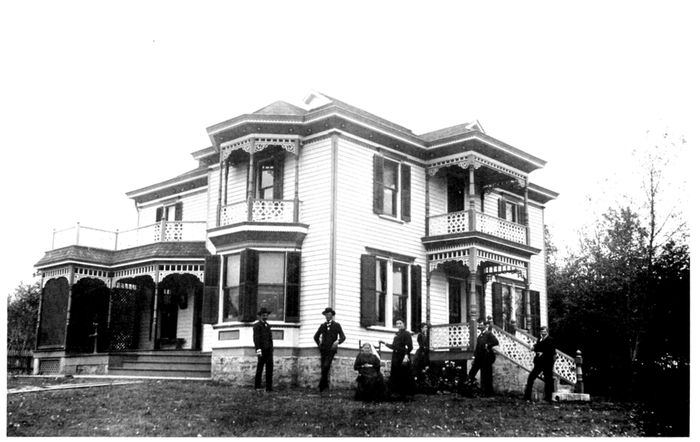
THE SUTTER HOMESTEAD
William A. Sutter, Owner.
841William Sutter was born October 18, 1856, on a farm in Walnut township,
a son of Frederick and Fredericka Sutter, natives of Germany, and pioneer
settlers in the town of old Sumner. (See biography of Fred Sutter for
further details.) William Sutter accompanied his parents to Benton township
in 1880, and assisted his father in the accumulation of his large estate and
cared for his parents until their deaths. After his father’s death he continued
to reside on the old home place and tilled the farm of which he is now the
sole owner.
He was married October 18, 1915, to Miss Dorothy Nickle, of Muscotah,
Atchison county, a daughter of William Nickle, an old resident of Atchison
county. After a honeymoon trip to the Panama-Pacific Exposition and Pacific
coast points extending into old Mexico, covering a period of nearly two
months, Mr. and Mrs. Sutter returned to the home farm, near Effingham.
Mr. Sutter is a Republican in politics, is a member of the Presbyterian
church and is affiliated with the Central Protective Association and the Independent
Order of Odd Fellows. He is truly a product of the pioneer days in
Atchison county, and in his youth knew what real hardships were and assisted
in the struggle to achieve a comfortable competence for the Sutter family in
common, and has had the satisfaction of seeing the family fortunes increase
as the years have passed, and seeing his home county improve with age and
gain in prestige and wealth. He is a genial, popular gentleman, who has a
deep and abiding love for the county which he has helped to develop and is
proud of the fact that he was one of those who assisted in its upbuilding.
James Isham Holmes, of Shannon township, Atchison county, is a pioneer
of eastern Kansas and western Missouri, and for seventy-three years has lived
within a radius of twelve miles from Atchison. He is a native of Indiana
and was born in Putnam county March 22, 1841. He is a son of William and
Nancy (Hartsock) Holmes, the former a native of England, born in 1812,
and the latter a native of Germany. William Holmes, the father, immigrated
from England with his parents when he was a small boy. The family located
in Kentucky, where they remained but a short time when they removed to
842Indiana, and in 1842 they removed to Buchanan county, Missouri, and located
near St. Joseph. The father was a cooper and worked at his trade for a short
time at Rushville, Mo., and in the spring of 1843 he settled one mile south
of Dekalb, where he conducted a cooper shop for eight years. He then bought
a farm three miles north of Dekalb, where he followed farming for twelve
years, or until 1863, when he traded his place for a farm in Doniphan county,
Kansas. Three years later he sold his Doniphan county farm and removed to
Atchison, where he spent the remainder of his life in retirement.
William and Nancy (Hartsock) Holmes were the parents of the following
children: John William, Eliza Ann, Peter, Alfred; James Isham, the
subject of this sketch; John, Francis, Marion, Loma, Ann, Perry, Praeter B.,
Isaac, Susan Ann, Lethia Maria, Joseph, and Henry.
James Isham Holmes was reared amid the pioneer surroundings of the
times and received such education as was available under the conditions, and
when twenty-two years old went to Doniphan county, Kansas, where he worked
in a flouring mill one year. He was then engaged in various vocations, including
farming, cutting cordwood, railroading and lumbering, when he engaged
in breaking prairie in the vicinity of Atchison. He followed that vocation for
some time when he engaged in farming in Atchison county. He sold his farm in
1868 and shortly afterwards bought another place of eighty acres, and bought
more land as the opportunity offered, and now owns a fine farm of 240
acres, where he has resided for the past forty years. He is one of the successful
farmers of Atchison county and has prospered.
Mr. Holmes has been twice married. His first wife was Rose Ann Wood,
to whom he was married in 1861. She died February 9, 1862, leaving one
child, William H., who resides in Atchison. His second marriage took place
September 17, 1863, to Jemima E. Pruitt, a Missouri girl, born in 1844. Three
children were born to this union: Perry, a railroad man, residing in Salt Lake
City, Utah; Nancy Emily, now deceased; Minnie married Mr. Bisel, and is
now deceased. She was the mother of three children, Lawrence, Milburn,
and Othello.
Mr. Holmes has been a student of men and affairs all his life. He has
read extensively during his entire life and is one of the best posted men on
general topics in Atchison county. He is a typical representative of the American
pioneer who courageously conquered the wild and unbroken West and
made of it the great agricultural and commercial empire that it is. He and
his accomplished wife, who has been his helpmate and companion for more
than a half century, are now spending the sunset of their lives in peace and
comfort in their beautiful home which their industry has provided.
843
For thirty-five years Dr. Edwin Taylor Shelly has been a successful
medical practitioner in the city of Atchison. Dr. Shelly was born in Quakertown,
Pa., February 6, 1859, and is a son of William N. and Anna (Taylor)
Shelly, both of whom were natives of Bucks county, Pennsylvania. Rev.
William N. Shelly, the father, was a United Brethren minister, whose ancestors
came originally from Saxony, Germany, in 1765 and settled in Montgomery
county, Pennsylvania. He departed this life in 1893, at the age of
seventy-nine years. Mrs. Anna (Taylor) Shelly died in 1881, at the age of
sixty-four years.
Edwin Taylor Shelly was the only child by the second marriage of Rev.
William N. Shelly. He received his early education in the Quakertown high
school and then taught school for two years. He began the study of medicine
in the medical department of the University of Pennsylvania in 1878,
graduating therefrom in 1881. After practicing his profession for a few
months in his home county Dr. Shelly removed to Eden, Kan., where he practiced
for three years. He then moved to Huron, Kan., where he remained
for two years, previous to locating in Atchison in May, 1886, where he has
since maintained offices.
Dr. Shelly is a member of the Missouri Valley Medical Society, the Atchison
County Medical Society, the Kansas State, and the American Medical
associations, and is a member of the Kansas Academy of Science and the
American Association for the Advancement of Science. He has twice served
as president of the Northeastern Kansas Medical Association. He has endeavored
to keep pace with the progress made in his life profession and has
pursued post-graduate courses in the University of Pennsylvania, the Post-Graduate
School of Chicago, and the Sloan Maternity Hospital of New York
City. Dr. Shelly has been an occasional contributor to the various medical
journals, and articles from his pen have appeared in the Journal of the American
Medical Association, the New York Medical Record, and other medical
publications. He has always devoted himself exclusively to the practice of
his profession. In politics, the Doctor is an independent Democrat, and has
always taken a great deal of interest in civic and economic questions.
Dr. Shelly has been twice married, his first marriage occurring in 1885
with Miss Mary A. Schletzbaum, of Eden, who died in 1897, leaving two sons,
namely: William L., a farmer, residing on rural route No. 1, south of Atchison,
and who is a graduate of the Manhattan Agricultural College; Ralph
A., a graduate of the engineering department of Manhattan College, and now
844employed in the Buick automobile factory at Flint, Mich. His second marriage
was with Miss Lillie E. Allen, of Atchison, in 1899. To this union
have been born two children, Esther, aged thirteen years, and Allen Parker,
seven years old.
Edgar Watson Howe, journalist and author, was born at Treaty, Wabash
county, Indiana, May 3, 1854, a son of Henry and Elizabeth (Irwin)
Howe. In 1857 the Howe family moved to Harrison county, Missouri, where
Edgar was educated in the common schools until twelve years of age, when
he began working in his father’s printing office. Henry Howe, a Methodist
minister, was described as a “fierce abolitionist,” and published a paper at
Bethany, Mo. At the age of fourteen the strict discipline of his erratic father
became too much for the spirit of the boy and he left home. E. W. Howe
is next heard of in Golden, Colo., as editor and publisher of the Weekly Globe,
at the age of eighteen. A year or so afterward he was connected with a
paper at Falls City, Neb., where in 1875 he married Miss Clara L. Frank.
Five children were born to this union, and three are living. In 1877 Mr.
Howe came to Atchison, Kan., where he established the Atchison Globe.
This paper was not long in finding its way to recognition among the newspapers
of Kansas on account of the personality injected into it by its editor,
and for more than thirty years it has been one of the most widely quoted
publications in the whole country. The recent edition of the Encyclopedia
Brittanica refers to it. Mr. Howe has the happy faculty of being personal
in his comments without giving offense. The informal way of dealing with
matters in his paper has always been relished by Kansans and has attracted
favorable comment in the more conventional parts of the country. The magazines,
in reproducing some of his refreshing paragraphs, have referred to
“Ed” Howe as the best country-town newspaper reporter in America. He
has the faculty of seeking the points overlooked by the majority and of
working them up into paragraphs having a combination of sarcasm and good
humor that is irresistible.
Mr. Howe’s first work of fiction was “The Story of a Country Town,”
published in 1882, which has been for more than a quarter of a century among
the standard books of America. It has been classed by such eminent critics
as William Dean Howells as one of the ten best American novels. This
book did not run its course as the average popular novel does; its human interest
845has taken lasting hold on the public. Other works of fiction which Mr.
Howe has since written are: “The Moonlight Boy,” “The Mystery of the
Locks,” “An Ante-mortem Statement,” “The Confession of John Whitlock.”
His “Lay Sermons” contain a great deal of good, sound philosophy of life,
and from the pages of this book may he deducted a very practical code of
ethics. In 1900, at the time Dr. Sheldon edited the Daily Capital in Topeka
for a week in the way he thought Christ would do, Mr. Howe added to the
gayety of Nations by accepting an invitation from the Topeka State Journal
and running it for a week the way he thought the devil would run a newspaper.
In 1906 Mr. Howe made a long trip abroad, which resulted in “Daily
Notes of a Trip Around the World,” in two volumes, which has been praised
as highly as any book of travels in recent years. Two years later he wrote
“The Trip to the West Indies,” as a result of a winter cruise. His latest
book is “Country Town Sayings,” a collection of his paragraphs in the
Atchison Globe.
Mr. Howe’s country home at Atchison is one of the most carefully and
artistically arranged homes in the State. It is a bungalow, overlooking what
is said to be one of the three finest views in Kansas. It was built by its owner
as a place to retire when he became old, as he believes that too many people
stand around in other people’s way. True to his instinct of the unusual he
named it “Potato Hill.” At the age of fifty-six years he retired from active
management of the Globe. It was predicted by those familiar with his tireless
energy as a newspaper man that he would soon be back at his desk in the
Globe office, but such was not the case. After revising the “Story of a Country
Town” for the stage he began the publication of Howe’s Monthly, which,
within a few months became the western rival of the Phillistine, published at
East Aurora, N. Y., and is considered by many to have out-classed Elbert
Hubbard’s magazine. The Edward Howe paragraphs have been syndicated,
and appear in the leading dailies of the country. In an attempt to account
for the popularity of these paragraphs and the other writings of Mr. Howe,
Walt Mason in the American Magazine, says: “There is always, in everything
Ed. Howe writes, the element of the unexpected. It is present in all his
books—one of which ranks with the best in American fiction—and it is in
his briefest paragraphs, and that is why he is inimitable. Others may adopt
his style and mannerisms, but they can’t borrow the strange, original intelligence
that eternally ignores the obvious and seizes upon the bizarre, showing
how much of the bizarre there is in every-day commonplace life.”
846The personality of Mr. Howe as described by those who know him best,
is that of a quiet, courteous gentleman, amiable and kind to all. His patience
in teaching the young reporter and his indulgent ignoring of the mistakes of
his office force, have been frequently remarked upon. It is said that he never
discharged anyone, but always assisted them to make good. To those who
have been associated with him he is a greater man than he is to those who
only know him through the printed page, and the longer and closer the
acquaintance, the more remarkable seems his genius.
William F. Speer showed his good judgment in coming to Kansas.
It was not his fault that he was not born in the great Sunflower State, but he
immediately recognized that the next best thing to being a native born “Jayhawker”
was to spend as many years as possible in the prosperous State, and
although he was only three months old at the time he has never had occasion
to reverse his judgment. In fact, he likes it better every year, and in all the
fifty-five years he has lived in Kansas he has always held to his first preference
for Kansas territory.
William F. Speer was born January 8, 1860, but when spring came his
parents, Joseph and Mary (Fountain) Speer, whose history is written under
the name of Anna D. Speer, a sister, came to Atchison county, Kansas, from
their former home in Madison county, Iowa. The parents settled on the
farm which William Speer now owns and brought him up in the way he
should go, including some schooling at the district school house. His meagre
time in school was only a breathing spell for the heavier duties which awaited
him on his father’s farm, and William was early drafted for service and had
to help along with his eight brothers and sisters. When the father’s estate
was divided he bought the home place of 160 acres, which he has improved a
great deal since that time.
In 1889 Mr. Speer married Cora Spangler, who was born March 6,
1866, in Malden, Ill. She was the daughter of LeRoy and Lucendia (Smith)
Spangler, both natives of Ohio, who came to Brown county, Kansas in 1870,
where they remained until 1876, when they moved to Grasshopper township,
Atchison county. They moved to Edmond, Okla., in 1900. The father
died in 1913, at the age of seventy-four years, and the mother passed away in
1906, at the age of sixty-seven years. Mr. and Mrs. Spangler had six children,
847as follows: Alfred, of Marion county, Kansas; George, of Edmond,
Okla.; Cora, the wife of William Speer; Joseph, deceased; Curtis and Irvin,
of Kansas City, Mo. Mr. and Mrs. Speer have seven children, all of whom
are living at home, with the exception of Ralph, who is manager of the
Muscotah farmers’ elevator. The children living at home are: Lela, LeRoy,
Lucy, Anna Belle, Frank, and Marjorie.
Edmund Bullock, late of Muscotah, Kan., was born in January, 1838, at
Cornwall, England, and departed this life July 27, 1892. He was a son of
Frank Bullock, who with his family immigrated to Canada in 1846, and
crossed the border to become a resident of the United States in 1853, finally
settling in Wisconsin. Edmund was reared to young manhood in Wisconsin,
and married there in 1869. Three years later, in 1872, he and his young
wife came to Kansas, settling in Muscotah, Atchison county. Edmund Bullock
was a skilled tinsmith, and his first work in Muscotah was the opening
of a small shop which served as a place to ply his trade, and also as their
home for some time. He prospered as time went on and added a stock of
stoves and tinware, and later established a larger store and carried hardware
of all kinds in stock. For several years after coming to Muscotah he made
all of the tinware sold from his shop. For the first five years of their residence
in Muscotah the tin shop was divided and half of it served as a residence
for Mr. and Mrs. Bullock. A sister of Mrs. Bullock lived with them
and conducted a millinery store in the living room. Mr. Bullock first worked
in Greenleaf, Kan., when he came west, and Mrs. Bullock stayed with friends
in Frankfort. He heard of Muscotah and decided to locate here.
Mr. Bullock was married in 1869 to Miss Emma Graham, a native of
Wisconsin, and a daughter of Gustavus and Sarah Maria Graham, who were
both born in New York State. For fifteen years previous to her demise Mrs.
Bullock’s mother, Mrs. Sarah Maria Hale, made her home with her daughter,
dying September 29, 1915, at the great age of 100 years and nine months.
Edmund Bullock was a Union veteran, who enlisted in 1862 in the
Twenty-fifth Wisconsin regiment of volunteers and served until the close of
the Civil war, participating in several hard-fought engagements with his regiment.
He was affiliated with the Grand Army of the Republic and the
Ancient Free and Accepted Masons. He was prominent in Masonic circles
848and was well versed in Masonry. Politically, Mr. Bullock was a Republican,
who voted independently on local and county matters. He was reared in the
Episcopalian faith, but was a liberal donator to all denominations who sought
his assistance. He was an honest, straight-forward citizen who was blessed
with a jolly disposition and had a fund of anecdotes which he was continually
retailing to a crowd of interested listeners, especially children who would
gather around him at times when he was not busy and listened enthralled to
his wonder tales. Mr. and Mrs. Bullock lived an ideal married life and were
deeply devoted to each other.
Presley H. Calvert, retired farmer, of Muscotah, Kan., was born November
14, 1835, in Owington, Ky., a son of B. Warren Calvert, a native of old
Virginia, and a direct descendant of Cecil Calvert (Lord Baltimore), who
founded the Maryland colony in America. The mother of Presley H. Calvert
was Lucy J. Hawkins before her marriage with Warren Calvert, and was
born in Frankfort, Ky. In 1837 the Calvert family migrated from Kentucky
to Platte county, Missouri, and were among the earliest pioneer settlers of
that county. Being slaveholders in Kentucky they brought along the family
slaves and improved 160 acres of land in Missouri. Both parents ended their
days on the old home place in Platte county.
Presley H. was reared on the farm in Platte county and was educated in
the Pleasant Ridge College, the same school attended by B. P. Waggener, of
Atchison. He followed farming until the outbreak of the war between the
States and then served three months in the army of General Price, being under
the direct command of Captain Mitchell and in Steen’s division. He
fought at the battle of Lexington, Mo., in behalf of the Confederacy and
received his discharge on account of sick disability at Osceola, St. Clair county,
Missouri. After his marriage in 1867 he farmed for ten years in Platte
county, Missouri, and then came to Kansas, settling on a farm three miles
south of Muscotah in Kapioma township. For the first ten years Mr. Calvert
rented land and then invested in 160 acres of good land three miles north of
Muscotah in Grasshopper township. He improved this farm and resided
thereon until 1895. He then rented his farm and moved to Muscotah. Mr.
Calvert paid twenty dollars per acre for his land and sold it for $5,000 when
he retired from active farm work. He is now making his home with Mr.
and Mrs. Will Warren. Mrs. Warren is his niece.
849Mr. Calvert was married in 1867 to Miss Cora A. Jackson, born and
reared in Platte county, Missouri, a daughter of Wallace Jackson, a native of
Kentucky and an early settler of Missouri. Two children were born to this
union: Edna and Charles, both of whom are deceased. Mrs. Calvert died in
1908, at the age of sixty years. Mr. Calvert has been a life-long Democrat
of the old school. When a young man he formed one of the hardy army of
freighters who crossed the plains to the Far West in charge of the great
overland freight trains before the advent of the railroads. He crossed the
plains on four trips to Salt Lake City and other western points in Colorado.
William Thomas Warren is one of the younger generation of farmers in
Atchison county, and is the owner of 320 acres of land one and one-half miles
east of Muscotah on the White Way highway. He was born December 25,
1876, in Brown county, Kansas, and is a son of Rodney T. (born in 1846,
died March 5, 1914), and Chariet (Speaks) Warren (born in 1846). Both
parents were born and reared in Kentucky and came to Kansas in the spring
of 1876 and settled on a farm in Brown county. Later, in 1905, Rodney T.
Warren bought a farm near Centralia in Nemaha county, and resided thereon
until his demise. Mrs. Warren lives at Hiawatha, Kan.
W. T. Warren was educated in the public schools of his native county and
followed farming until 1903, when he left the farm and was employed in
the retail meat market of Mr. Zimmerman, at Hiawatha, for a period of five
years. He was then employed in the same avocation at Atchison, Falls City,
Neb., and Fairbury, Neb., until October of 1911. He then came to Muscotah
and entered the employ of E. W. Allen, who conducted a grocery and meat
market. He remained with Mr. Allen until 1914, and then he and Mrs.
Warren invested their combined capital in 320 acres of land near Muscotah.
He was married on May 22, 1912, to Miss Ella, a daughter of A. H.
Calvert, grain merchant of Muscotah. (The reader is referred to the biography
of A. H. Calvert, brother of Presley H. Calvert, for further details concerning
Mrs. Warren’s parents.) Mrs. Warren served as the assistant cashier
of the Muscotah State Bank for fifteen years. Mr. Warren is a Republican
in politics and attend the Congregational church, of which Mrs. Warren is
a member.
850
The name of Mangelsdorf is indelibly linked with the story of the commercial
development of northeast Kansas and the Middle West, and the Mangelsdorf
family is one of the most respected and substantial of Atchison, Kan.
The review of the life of William Mangelsdorf, deceased, begins across the
Atlantic in the Fatherland of Germany, where he was born and spent part of
his youth, coming to America with his parents when twelve years of age.
William not only achieved a wonderful success in business and accumulated
wealth, but he assisted in making the family name known and respected
throughout a great extent of territory wherever the output of the great seed
house founded by him and his brother, August, carried its business. He left
behind him a monument for business integrity and upright methods which has
made his name universally respected and honored for years to come.
William Mangelsdorf was born in Armin, Prussia, February 15, 1845, a
son of Christopher and Marie Anna Dorothy Mangelsdorf. Christopher
Mangelsdorf died in Germany in 1849 and his widow married Andrew
Stehwein, who with the family emigrated from their native land in 1849 and
settled on a farm in Gasconade county, Missouri. In 1868 the family removed
to Douglas county, Kansas, where they resided until the mother’s demise,
after which Mr. Stehwein came to Atchison to spend the remainder of his
days with his children. Five children were born to Christopher and Marie
Anna Mangelsdorf: Mrs. Anna Buhman, of Atchison, Kan.; Henry, in New
Mexico; Mrs. Dorothy Beurman, Lakeview, Douglas county, Kansas;
William, with whom this review is directly concerned; and August, residing
in Atchison.
In 1868 William Mangelsdorf left the family home in Gasconade county,
Missouri, and came to Atchison, Kan. His first employment in this city
was as a laborer in various capacities until 1872. During the four years in
which he was earning his living by the hardest kind of labor he was all the
time obsessed with the idea that the mercantile field of the new country
being developed afforded opportunities to become successful for an ambitious
young man. He accordingly, carefully saved his money, and with a small
capital embarked in business for himself. He was first engaged in the retail
grocery business with John Ratterman under the firm style of Ratterman &
Mangelsdorf, and remained a member of the firm until 1875, when he disposed
of his interest in the grocery business and purchased a half interest in
the retail grocery conducted by his brother, August Mangelsdorf, forming
the firm of Mangelsdorf Brothers. It was about this time that the brothers
851tried the experiment of adding a seed department to the grocery in order to
meet a growing demand for farm and garden seeds. The experiment proved
successful and the business grew even beyond the greatest expectations of the
promoters. What was intended as a side line on their part developed into
an extensive business which soon dwarfed the grocery trade; it was not long
until they engaged in the wholesale line; the enterprise grew to be one of
the most important in northeastern Kansas, and was later incorporated as
the Mangelsdorf Brothers Company. An extended mention of its development
is to be found elsewhere in this publication. Not many years after the
partnership of the Mangelsdorf Brothers was formed, William established
another general merchandise store at Ellinwood, Kan., in 1877, and later
another store at Bushton, Kan. The stores were conducted under the name
of the Mangelsdorf Brothers Company, which was incorporated about this
time, and the other partners in the various enterprises were August Mangelsdorf,
of Atchison, H. D. Back, of Atchison, Kan., and C. F. Stehwein, manager
of the Bushton store. William resided in Ellinwood in active management
of the stores until 1895; then he removed with his family to his farm
near there. In 1898 he moved to Bushton, taking the active management of
the store at that place. He also established a banking business at Bushton
which was successful from the start, and his activity in commercial life continued
until 1904, when he removed to Atchison, where he lived in retirement
from active business pursuits until his demise, May 15, 1911.
Mr. Mangelsdorf was married August 6, 1875, to Miss Minnie Halling,
and this marriage was blessed with six children, namely: Clara, residing in
Pueblo, Colo.; William C., who also lives in Pueblo, Colo.; Edward F., a
member of the Mangelsdorf Brothers Company; Minnie, at home; Frank
A., cashier of the German-American State Bank of Atchison; Albert H.,
cashier of the Farmers State Bank, Potter, Kan. Mrs. Mangelsdorf was
born in 1854 in Pennsylvania, and died in Atchison, Kan., in 1904. Her
father was an early settler in Kansas, and first resided in Doniphan county,
where he preëmpted land on Independence creek, later removing to Atchison.
William Mangelsdorf was a member of the Evangelical Lutheran
church, to which denomination he was a liberal contributor. During his life
he was a hard and indefatigable worker, who was ambitious to succeed and
achieve a competence for his children. He was a liberal supporter of local
enterprises, and was regarded as one of the wealthy and substantial citizens
of Kansas, and will long be regarded as one of the leading figures of the
commercial development of Atchison county and central Kansas.
852
Albert H. Mangelsdorf, cashier of the Farmers State Bank of Potter,
Kan., was born February 15, 1890, in Barton county, Kansas. He is a son
of the late William Mangelsdorf, a pioneer settler of Atchison, and one of
the successful merchants of Kansas, extended mention of whom is given elsewhere
in this volume. Mr. Mangelsdorf was educated in the common schools
of Barton county, Kansas, and received his preparatory training at St. Benedict’s
College, Atchison, Kan. He attended the University of Kansas, class
of 1912, pursuing a course in mining engineering. After the completion of
this course he was in the employ of the Newmire Vanadium Company, located
at Newmire, Colo., in the capacity of engineer. Later, he was in the employ
of a mining firm at Weinkleman, Ariz., and later with the Arizona Copper
Company at Morenci, Ariz., after which he served as superintendent of the
main building of the Mangelsdorf Brothers Company at Atchison until his
appointment as cashier of the Farmers State Bank of Potter, Kan., in
December, 1914.
Mr. Mangelsdorf is a Republican in politics and is fraternally affiliated
with the Alpha Tau Omega fraternity, the Knights of Columbus, and is a
member of the Catholic church.
The late Fred Binkley, of Potter, Kan., was born April 8, 1832, in Warrick
county, Indiana, a son of George and Catharine (Chinn) Binkley, both
of whom were born and reared in the State of North Carolina, and were
among the earliest settlers of southwestern Indiana. George Binkley was of
German origin, and Catharine (Chinn) Binkley was of English origin. In
the year 1828 George Binkley with his wife and infant son, James, set out for
Indiana, equipped with one horse, their personal belongings and a camping outfit.
The horse was used to transport their outfits and it was necessary for
George and his wife to walk practically the entire distance from North Carolina
to their destination in Indiana. They arrived in the wilderness of Indiana
without mishap and at once set about making a home in the new country.
A few years later they removed to a farm in Gibson county, Indiana, where
George and Catharine Binkley spent the remainder of their lives. They
reared a family of eleven children, of which Fred was the third child.
853Fred Binkley grew to manhood on the pioneer farm in Indiana and
learned to rough it at a very early age. After his marriage in 1854 to Elizabeth
Dougan, he and his wife lived for one year on a farm in Gibson county,
and then the father of Mrs. Binkley (James Dougan) sold out his holdings
in Indiana and migrated to Atchison county, Kansas. Two years later Fred
and his wife followed and settled on 160 acres of land one and one-half miles
northwest of Potter in Mt. Pleasant township. The land was mostly raw prairie
and it was necessary for him to erect a suitable home which was an humble
one at first, but as the years passed and Mr. and Mrs. Binkley became more
and more prosperous they built a better home and added sixty acres more
land to their holdings.
Fred Binkley was married September 15, 1854, to Elizabeth Dougan, and
eight children have been born to this union: Robert, born in Indiana in 1855,
a farmer living in Mt. Pleasant township; Sarah, wife of S. Watson, of
Leavenworth county, Kansas, was born in 1860; Lewis, born in 1863, and
died in 1899; James, born in 1868, living on a farm near Effingham, Kan.;
George, born in 1870, died in 1910; Dora, born in 1872, wife of Samuel Hall,
of Leavenworth county, Kansas; Lou, born in 1874, at home with her mother;
Kate, born in 1877, wife of Albert Hawley, of Atchison county, Kansas.
The mother of these children was born May 10, 1835, a daughter of James
and Sarah (Healt) Dougan. James Dougan, the father, was born in Kentucky,
a son of Samuel, who was a soldier of the Revolution, and who
received a large grant of Government land for his services. His grant was
located in Dyer county, Tennessee, and consisted of 1,300 acres of wild land,
which was divided among the children of the Revolutionary soldier (James).
Samuel removed with his family to a portion of this land, which was wild
and rough and covered with dense timber. A few years of living in the wilderness
of Tennessee sufficed for them, however, and they left the State and
went to Gibson county, Indiana, to found another home. They traveled horseback
to the new location. Samuel, at that time an old man, became ill on
the trip and was forced to return to Tennessee, dying there in about 1828.
The family later made a permanent settlement in Gibson county, Indiana.
Samuel and Molly Dougan (his wife) reared a family of five children, of
whom James, the father of Mrs. Binkley, was the third child. The mother of
James died in 1845. James Dougan was married in 1831 to Sarah Healt, and
eleven children were born to them, of whom nine were reared to manhood
and womanhood. As early as 1855 James Dougan came to Atchison county
and preëmpted 160 acres of land, built a cabin, and returned to Indiana for
his family, whom he brought to Atchison county, Kansas, in the spring of
8541856. He was comparatively a poor man when he located in Kansas, but
became quite prosperous and well-to-do and became the owner of a half section
of well improved land. James died in 1900, at the age of ninety-two
years. Two brothers of Mrs. Binkley served in the Union Army during the
Civil war. One of them enlisted in the Eighth Kansas cavalry regiment, and
the other in the Thirteenth regiment.
Fred Binkley departed this life August 2, 1910. He was well and favorably
known in Atchison county and his demise marked the passing of one of
the sturdy pioneer settlers of the State. He was a stanch Republican during
his whole life and was a pronounced Free State man in the days when
the struggle was on to make Kansas a Free State. He took an active part in
the stirring scenes before and during the dark days of the Civil war, and like
many others, suffered from the forays of the border ruffians. The Methodist
church, of which he was one of the members and a builder, having been
burned by border ruffians, he never united with any other denomination.
John Drimmel, farmer and stockman, of Shannon township, Atchison
county, was born on the farm where he resides, in 1863, a son of John and
Mary (Karn) Drimmel, natives of Austria. John Drimmel, Sr., was born in
Austria in 1829, and immigrated to America with his wife in 1853. They
were accompanied by the oldest child, Veronica. He settled on a rented farm
of eighty acres north of Atchison in Shannon township, which he cultivated
for three years and then bought eighty acres of land four miles west of the
city. John, Sr., erected a small, rough box house, which was the family home
for the first twelve years, and which was then replaced by a large, handsome
brick residence of ten rooms, which is now the home of the son, John. This
fine home is modern and fitted with a lighting system and a cellar runs
underneath the entire body of the house. It is one of the most attractive
places in Atchison county. Mr. Drimmel added to his acreage as he was able
and accumulated a total of 230 acres of fine land which is now being cultivated
by his son. During 1914 John Drimmel, with whom this review is
concerned, had planted forty-five acres of corn, 100 acres of wheat, and ninety
acres of oats, all of which yielded splendid crops. Mr. Drimmel is renting
eighty acres, in addition to the home farm. The elder Drimmel was a Free
State man and served as company cook in the Union army during the Civil
855war. He reared a family of seven children, as follows: Mrs. Veronica Miller,
living in Doniphan county, Kansas; Antony, of Atchison; Florence, Everest,
Kan.; John, the subject of this review; Arnold, of Kansas City; Frank, living
with his brother, John; L. J., a farmer, living in Shannon township. All
of the children of this pioneer family are well-to-do and in good health, the
oldest of the family being over sixty-one years of age. John Drimmel, the
father, died in 1891. The mother was born in 1829, and died in 1889. They
were a worthy pioneer couple who achieved a comfortable competence and
reared a fine family in the land of their adoption.
John Drimmel owns and manages the old home place of the Drimmel
family in Shannon township, and is one of the representative and well known
farmers of Atchison county. All of his fifty-three years of life have been
spent in Atchison county and he has always lived on the farm which he now
owns. Mr. Drimmel was married in 1893 to Miss Marie Blodig, who died
in the first year of her marriage, leaving one son, Frank, born March 1, 1894,
and studied in St. Benedict’s College. He was again married in 1896 to Miss
Marie Jahl, who has borne him the following children: Anna Marie, born
November 24, 1898; John Albert, born April 28, 1900; Marie Veronica, born
September 6, 1901; Agnes Cecila, born December 23, 1902; Irene Florentine,
born June 11, 1904; Ernest Gabriel, born January 15, 1906; Alfred William,
born March 28, 1908; Reinhold Leapold, born September 20, 1909; Rose
Helena, born January 23, 1911; Maximilian Louis, born August 21, 1912;
Genevieve Frances, born August 14, 1914. The mother of this large family
of eleven children was born in Austria in 1877, a daughter of John and Anna
Jahl. John Jahl, the father of Mrs. Drimmel, was born in Austria in 1852,
and departed this life March 10, 1879. Mrs. Jahl was born July 22, 1855,
and came to America in the year 1894, and has since resided in Atchison
county. Mrs. Jahl resides with her daughter. She and Mr. Jahl were married
in Austria in 1875 and were the parents of three children as follows:
John Jahl, Jr., born February 21, 1876, and died in October, 1877; Mrs.
Marie (Jahl) Drimmel, born March 10, 1877; Frank Jahl, born September
17, 1878, and died in June of 1879.
Mr. and Mrs. Drimmel and their children are all members of St. Benedict’s
Catholic Church and are liberal supporters of this denomination. Mr.
Drimmel is a Democrat in politics, but simply does his duty as a citizen and
has never been a seeker after political office. The Drimmel home is a very
happy one, and the Drimmel family is one of the largest families in Atchison
county or the state of Kansas, and Mr. and Mrs. Drimmel have good and
just right to be proud of the fact, inasmuch as Atchison county is proud of
856them. The children of this fine family are all receiving the benefits of a
good school and college education, and it is the firm intention of the parents
that all of their sons shall be educated in St. Benedict’s College, and the
daughters shall finish their training in Mt. St. Scholastica Academy. John,
Jr., is at present a student in St. Benedict’s College, class of 1917, and Anna
and Marie will enter Mt. Scholastica in the fall of 1916 in order to complete
the course in this excellent young ladies’ school. Mr. and Mrs. Drimmel believe
thoroughly in giving their children every educational advantage within
their means in order to properly fit them for becoming useful men and
women and become a credit to their ambitious parents.
August Mangelsdorf has been a citizen of Atchison for over half a century
and has accomplished during that period two things which entitle him
to recognition and even renown. He established and built up the Mangelsdorf
Brothers Seed Company, one of the largest concerns of its kind in the
West, and now managed by his sons. The other is the rearing of a large
family of fifteen children. If Mr. Mangelsdorf had done no more than to
bring into the world and rear his family of fifteen children he would have
been entitled to more than ordinary mention as one of the sturdy pioneer
citizens of Atchison. He is now living a retired life at his beautiful place,
“Homewood,” in South Atchison, and, while ostensibly retired, works constantly
on his farm within and adjoining the city limits. While nominally the
president of the Mangelsdorf Brothers Seed Company, he spends the greater
portion of his time out of doors working about the grounds and fields of his
estate. Mr. Mangelsdorf, while having lived a busy and even strenuous life
during his fifty years in business in Atchison, has no desire to “rust out,” but
believes that his health can be better conserved by plenty of exercise in the
open air. His rugged appearance and keen interest in life bear testimony
to the wisdom of his plan of living. He is one of the highly respected and
substantial citizens of Atchison and has done his part in the task of making
Atchison preëminent among the cities of the West. The great concern which
bears his name was originated and built up by himself and is a monument
to his enterprise and integrity, and Atchison is proud of him and the outcome
of his life work.
857Mr. Mangelsdorf was born in Armin, Prussia, July 27, 1848. He was
the son of Christopher and Marie Anna Dorothy Mangelsdorf, who lived
in Armin until 1856, when they immigrated to America. The father died in
1849, and the mother married the second time to Andrew Stehwein. The
family first settled on a farm in Gasconade county, Missouri, residing there
until 1868, when they came to Douglas county, Kansas. Here they lived until
the mother died, and then Mr. Stehwein came to Atchison to spend the
remainder of his days with his children. Five children were born to Christopher
Mangelsdorf, namely: Mrs. Anna Buhrman, of Atchison; Henry, in
New Mexico; Mrs. Dorothy Beurman, Lakeview, Douglas county, Kansas;
William, deceased August, with whom this review is directly concerned.
August Mangelsdorf came to Kansas from Missouri in 1865 and located
in Atchison. He worked as a laborer to earn money for his sustenance and
was not ashamed to do the hardest kind of labor. He willingly did anything
necessary to earn an honest dollar. His first real business experience was as
a clerk in the grocery store of John Belz. It was only natural to see him
become the owner of the business in time. Frugality, industry and aptitude,
characteristics of his race, enabled him to become proprietor of the store in
1873. He owned the business until 1893. Two years after taking entire
charge of the grocery he started a small seed business as a side line with
his grocery. This was the foundation of his subsequent fortune, and it was
only a question of years until he branched out in the wholesale line and the
business outgrew the store. The seed business kept on growing and growing:
the sons of its founder became young men; its founder concluded to
retire and he turned over the management to his sons who are following in
the father’s footsteps. For years his brother, William, was associated with
him and they started a general store at Ellinwood, Kan., of which William
had charge. Mr. Mangelsdorf established greenhouses in connection with the
seed business. These extensive greenhouses are located on the Homewood
estate and are in charge of his son, Ernest. In 1912 Mr. Mangelsdorf concluded
to retire from active business and is now enjoying life to the full.
His sixty-seven years of existence have been well and profitably spent and he
can look back over the past years with satisfaction and pleasure over a task
well and faithfully done. It is given to but few men to have reared a large
family of sons and daughters and to have lived to see them shoulder the
responsibilities left by the father and perform the work successfully while he
is yet living to observe, guide, and instruct them.
Mr. Mangelsdorf was first married to Anna Charlotte Brune in 1874.
She died in 1890. To this union were born nine children: Anna died in
8581890; August, manager and vice-president of the seed company; Fred, the
efficient secretary of the concern; Charlotte, cashier of the company; Ernest,
in charge of the greenhouses; Bertha, teacher of domestic science in the high
school at Seneca, Kan.; Caroline, who is studying in Chicago in preparation
for kindergarten work; Marie, deceased; Frank, treasurer of the seed company;
Mrs. Marie Schmeling, of Atchison. In 1892 Mr. Mangelsdorf took
to wife, Mrs. Louise Brune, who has borne him eight children: Albert, a graduate
of the Agricultural College at Manhattan, class of 1916; Carl died in
infancy; Paul and Louise, in high school; Theodore, Dorothy, Harold and
Helen.
Mr. Mangelsdorf is a director of the First National Bank of Atchison.
Politically, he is allied with the Democratic party and has served one term
as city councilman and city treasurer for four years. He is a member of the
Evangelical church and is fraternally allied with the Benevolent and Protective
Order of Elks.
Frank A. Mangelsdorf, cashier of the German-American State Bank of
Atchison, Kan., while the youngest of the bankers of the city, has given evidence
that he possesses the inherent ability and the necessary ambition to successfully
conduct the important financial institution under his management.
The German-American State Bank is the newest of the banking concerns of
Atchison, but it is fast coming to the front as one of the important banks of
this section of Kansas under Mr. Mangelsdorf’s aggressive and capable control.
He is a native son of Kansas and was born and reared in this State,
being a son of William Mangelsdorf, merchant and financier, deceased, who
came from Germany to America when a boy and achieved a notable success
in the land of his adoption. A review of the life of William Mangelsdorf
appears in this volume.
Mr. Mangelsdorf was born August 14, 1888, in Ellinwood, Kan. The
first ten years of his life were spent there and on his father’s farm, whither
his parents had removed from Ellinwood. He received his early education
in a country school, later attending the public schools of Bushton, and completed
the eighth grade at the age of twelve. From 1900 to 1904 he was employed
in his father’s store at Bushton, the family removing to the city of
Atchison in the latter year. He pursued a course in the Atchison Business
859College, and then became cashier of the Mangelsdorf Brothers Company, a
position which he filled until 1910. He then became assistant cashier of the
First National Bank of Atchison, remaining in that position until the organization
of the German-American State Bank in 1912, when he became cashier
of the newly organized banking concern. The success of this bank is a matter
of gratification to its stockholders and patrons.
Mr. Mangelsdorf was married June 22, 1914, to Miss Veva Sawin, a
daughter of William H. Sawin, an undertaker of Atchison. He is independent
in political matters, preferring to cast his vote for the individual
whom he deems best fitted to perform the duties of the office sought rather
than to support a party candidate. He is a member of the Catholic church.
Although young in years, Mr. Mangelsdorf is recognized as one of the rising
young bankers of Atchison and is considered among the city’s best and most
enterprising citizens. The unvarying courtesy and dignity characteristic in
his conduct of the banking business is carried into his daily life, and he enjoys
the respect and esteem of a large number of friends in the city.
Paul Atkin, traveling salesman, of Atchison, Kan., was born September
6, 1866, in Lincolnshire, England. He was the son of William and Rebecca
(Prestwood) Atkin. William Atkin, the father, was born in England about
1841. He was a farmer in his native country, but emigrated from England
to America in 1872. His first place of residence in this country was in Chicago,
where he resided a few years. He then moved to Kansas, settling on
his farm in Doniphan county. After one year’s residence in Kansas he returned
to Chicago and engaged in the transfer business. Again, in about
1880, he returned to Doniphan county, Kansas, and engaged in farming, and
cultivated his land until 1899, at which time he engaged in the hotel and
livery business in Denton, Kansas. He died in a hospital at Leavenworth,
Kan., in 1900. Nine children were born to William and Rebecca Atkin: Mrs.
L. H. Priester, living in California; Paul, with whom this review is directly
concerned; Mrs. Thomas Wrighter, of Denton, Kan.; Mrs. Fred Hickok, of
Haverlock, Neb.; Mrs. Ben Hinchscliff, near Topeka, Kan.; Mrs. Art Hall,
Severance, Kan.; William, farmer, of Doniphan county; Arnold, near Severance,
Kan.; Ethel died at the age of eight years. The mother of these children
was born in England in 1842, and died in Severance, Kan., in 1902.
860Paul Atkin did not leave England until thirteen years of age, when he
crossed the ocean and continent and came to Atchison, Kan., arriving in the
city ten days before his parents, then living in Doniphan county, Kansas,
learned of his arrival. He was nine days on the water and came across the
ocean aboard the “City of Richmond,” one of the fastest ocean-going passenger
ships afloat at that time. Being a boy and alone, he was given all privileges
and made many friends. He never had a day’s illness during the voyage
or crossing the continent to Kansas, but became ill on arriving in Atchison
and was cared for by Mr. Dorethy, at that time depot master of Atchison.
This kind man looked after him until his father was notified of his
arrival. From Atchison he went to Doniphan county and assisted his father
for many years in operating the farm, later operating the farm by himself
for one year. At the age of twenty he began working for himself for twenty
dollars per month for a period of one year. He then went to Ellensburg,
Wash., and learned the plasterer’s trade, remaining in that city two years, after
which he went to Tacoma, Wash., and remained there six months, then going
to Portland, Ore., where he worked at the harness maker’s trade, not long
after returning to Doniphan county, Kansas, where he followed the trade of
plastering for three years. After his marriage he made his home in Atchison,
Kan., and after making a trip to Port Arthur and working at his trade, he
then opened a meat market in Denton, Kan., which he operated for a time
and then sold out. In 1888 he returned to Atchison and entered the employ
of Curtain & Clark Cutlery Company, of St. Joseph, Mo., as traveling salesman.
He traveled for three years, his territory being through Nebraska. He
resigned and accepted a position for another three and a half years with the
Rochester Stamp Company, of Rochester, N. Y. Giving up this work he
engaged in the hardware business with Krings in Atchison. The firm was
known as Krings & Atkin. Later he sold out his interest in the hardware
business and became interested in the United States Street Lighting Company,
manufacturing street lamps in Kansas City until February, 1909, when he
again went on the road as traveling salesman with the Associated Silver Company
of Chicago, his territory embracing Kansas, Nebraska and Colorado.
Mr. Atkin was married in 1894 to Addie M. Herring. Mr. and Mrs.
Atkin have one daughter, Frances Mildred, a graduate of Atchison High
School, and a student in Atchison Business College.
Mrs. Atkin was born in 1871 in Doniphan county, Kansas, a daughter
of Henry H. Herring, a native of Pennsylvania and now residing in Atchison.
Mr. Atkin is independent in political affairs and votes for the individual
861rather than the support of any one political party. He is affiliated with the
Ancient Free and Accepted Masons. His wife and daughter are members of
the Methodist Episcopal church.
Peter Parsons, of Atchison, Kan., is a Kentuckian by birth and has the
distinction of being the pioneer thresher man of northeast Kansas and western
Missouri. He was born in Breathitt county, Kentucky, December 10, 1868,
a son of J. W. Parsons, a descendant of an old Virginia family. Peter Parsons’
maternal grandfather, Hatfield, was a soldier in the Revolution and
fought under General Washington. The Parsons and the Hatfield families
were among the earliest pioneers of the State of Kentucky. When Peter was
four years of age the Parsons family removed to Buchanan county. Missouri,
and there settled on a farm. Peter was reared to young manhood on the
Missouri farm and attended the district schools. When but a boy he developed
an aptitude for machinery and showed a knack of handling farming implements
possessed by few boys of his age. In 1887 he entered the employ of
the A. J. Harwi Hardware Company and worked in the farm machinery
department of the store. Desiring to gain a more intimate knowledge of
threshing machinery, especially, he went to Battle Creek, Mich., where the
machines were manufactured and learned the business of building and assembling
threshing machines from the ground up. This was a good business
venture on his part, as he soon engaged in threshing on his own account and
operated threshing outfits for over nineteen years, and was actively engaged
in northeast Kansas and northwest Missouri in this business successfully. He
operated several machines and crews and had almost a virtual monopoly of
the threshing business in his territory. At the present time Mr. Parsons
operates two threshing outfits which he owns, but for some years has retired
from active labor in the fields. The wide range of his activities naturally
gave him an extensive and favorable acquaintance among the farmers of this
section of the country and he acquired a reputation for thorough workmanship
and square dealing which has never been surpassed by men engaged in
the same industry. He is probably the oldest threshing machine operator at
the present time in eastern Kansas or western Missouri in years of experience,
and understands the mechanical part of the industry better than any other man
862in this neighborhood. Mr. Parsons has a right to be proud of his record in
the agricultural history of Atchison county and Kansas. From 1903 to 1909
Mr. Parsons was a member of the Atchison police force and made a
record in the department for efficiency and faithful performance of his duties
which is remembered. He is a member of the Fraternal Order of Eagles and
is well liked by all who know him. He is broad-minded in his views and
kindly disposed toward his fellow men.
Henry Schiffbauer, pioneer, plainsman, Government scout, and friend of
Buffalo Bill, now lives in comparative quiet on his farm in Kapioma township,
Atchison county, after having seen the wildest and wooliest parts of the
great West in its early days. Under his own eyes, Kansas has changed from
a land of Indians, daubed with bright paint, shouting a war-whoop and
brandishing tomahawks, to a quiet farming community, where peaceable citizens
drive to church every Sunday. He has seen Kansas changed from a
broad prairie, with its countless thousands of buffaloes to a great farming
country, with its productive fields, and the trudging ox has been succeeded
by the tractor and automobile. Henry Schiffbauer, in his seventy-five years,
has seen the making of a nation; he has seen the wild frontier grow into a
civilized community, which ranks among the highest in intelligence and prosperity.
Mr. Schiffbauer was born January 27, 1841, on the River Rhine, in
Prussia, Germany. His parents, Michael and Gertrude (Frentz) Schiffbauer,
had thirteen children. The father followed farming in his native land, and in
1851 immigrated to the United States, settling on General Taylor’s farm, in
Gamwell county, Kentucky. Four years later he moved to Missouri, and in
the same year came to Kansas, where he homesteaded a claim in Jefferson
county, which he farmed until about eight years before his death, which occurred
when he was eighty-nine years old. The mother of Henry Schiffbauer
died in 1854, at the age of fifty-five years. She fell before the terrible
scourge of cholera which swept the United States about that time. The
four children living are: Charles, Cripple Creek, Colo.; Trassie, a nun, at
Leavenworth, Kan.; Frank, Pittsburgh, Pa.; and Henry, the subject of this
sketch. All but Frank were born in Germany, he having been born in Gamwell
county, Kentucky.
863Henry Schiffbauer’s boyhood was one of rough and hard adventure.
He received his education by driving a six-mule team, and his book learning
was scanty. When he was seventeen years old he went to work for Dr. Davis,
at Leavenworth, Kan. In 1857 he was stationed in the quartermaster’s department
at Ft. Leavenworth, Kan., where he was employed eight years. After
Lee’s surrender, in 1865, Henry returned to his home in Jefferson county,
Kansas, and met Buffalo Bill, or as he is known in private life, William Cody,
for the first time. Here was begun a friendship which continued for many
years, and which probably will live until one of the friends passes away. Two
years later, however, the two men were thrown closer together, and their
acquaintance ripened into a close friendship. Henry was guarding and herding
mules when he met Buffalo Bill the second time. The latter was an extra
hand on Major & Russell’s overland freight train. Henry Schiffbauer was
the man who taught Buffalo Bill to shoot from a saddle, it is said, and the
unequalled skill of the great hunter may be laid at the feet of the subject
of this sketch. It may be that if Buffalo Bill had not met Henry Schiffbauer,
his life history might have been different, for undoubtedly it was the stories
which Henry told of his experiences that tempted the young man to
leave his oxen and follow the wilder life of a Government scout. Mr. Schiffbauer
has seen the most sensational life of the West in its most dangerous
days. Just before the outbreak of the Civil war he carried messages for the
Government from Ft. Kearney, Neb., to Ft. Laramie, Colo., and to Salt Lake
City, and Ft. Floyd, Utah. These were times when it was dangerous to be
a Government messenger. The dispatchers of the Government were not held
in such awe in those days, and it was not at all unusual to kill a messenger to
get his papers. But Mr. Schiffbauer was able to take care of himself,
and passed through these uncertain times without harm. He served in the
secret service department for eight months, about the time of the second election
of Abraham Lincoln. It was feared by governmental officials that
attempts on the President’s life were being planned, and General Thayer,
then in command at Ft. Smith, Ark., secured the services of Henry Schiffbauer
in this difficulty. This was a position won because of fearlessness and
coolness, even in the most dangerous situations, and to be one of the protectors
of the President was the honor which repaid him. In 1865 Lee surrendered
and conditions began to settle.
When Mr. Schiffbauer saw that his opportunity to serve his country
had ceased, he located on the farm which he now owns and built a small farm
house, thus settling down to the quiet life of a farmer. He broke his ground
with oxen, and worked in the most primitive manner for a few years, but
864gradually he was rewarded for his labors, and he came to have more of the
comforts and conveniences of a modern farmer, erecting a large stone residence
in 1880. His place is one-fourth mile east of Arrington, Kan. It comprises
189 acres, and here he and his wife, Margaret Glimm, to whom he
was married in 1865, have lived since, rearing a family of eight children. Mrs.
Schiffbauer was born in Germany, March 6, 1848. She is a daughter of John
and Christian Glimm, who came to Kansas in the early days, bringing their
daughter with them. The children of Mr. and Mrs. Schiffbauer are: Christena,
who married Allen Kinkaid, of Washington State; Charles E., Belle
Plains, Sumner county, Kansas; Sarah married L. E. Wagner, of St. Louis,
Mo.; Henry F., Valley Falls, Kan.; Gertrude married John Nevins, Kapioma
township; Robert is farming near La Cygne, Linne county, Kansas; William,
Arrington, Kan.; George, passenger conductor, East St. Louis, Ill. Mr.
Schiffbauer is an independent in politics. He belongs to the Modern Woodmen
of America, and to the Knights and Ladies of Security. He has had a
remarkable career and remembers the incidents of his early life with vividness.
Atchison county has few characters with such an interesting history.
In 1857 while in the quartermaster’s department at Ft. Leavenworth
he was detailed with General Sumner’s expedition against the Cheyenne Indians
in the far West. This trip required six months and was filled with
great hardships for the troops. In April of 1858 he accompanied Gen. Sydney
Johnston’s expedition to Salt Lake City for the purpose of subduing the
Mormons, and was gone for eighteen months. He assisted in building a
camp at Ft. Floyd, or Camp Floyd, as it became known at the time, forty-five
miles south of Salt Lake City. During this trip Mr. Schiffbauer had
his first experience in driving a six-mule team and hauling “adobes.” The
fort was built under the direction of Colonel Crossmore. He returned to
Kansas in the fall of 1859, and went to New Orleans in the Government
secret service, and thence to Baton Rouge, where he remained until after
Lincoln’s election, finally making his way out of the southland with great
difficulty, accompanied with personal danger to himself. For a period of
eight years this plainsman never slept under a roof, excepting twice at Ft.
Bonta, where he was under shelter for the night. On one of his expeditions
to the far West they had fed their last grain to the mules, made camp, and
the next morning the entire camp was under two feet of snow. Mr. Schiffbauer
himself being covered over in a gully where he had lain down, wrapped
in his blankets and buffalo robes. He recalls that on this snowy morning
the wagon-master shouted: “I wonder where that damned Dutchman is?”
865Henry raised himself out of the snow and called out: “Here I am.” The
mules were picketed out two and two together the night before, but that
morning they were put into corrals and were so starved that they tried to
eat each other. The pioneer corps cut down cottonwood trees for fuel,
and the mules ate the branches, which poisoned them, and they died in their
tracks, the ravens eating out their eyes while the beasts were in their death
throes. The expedition lost sixty mules each day, and the drove of 500 animals
was depleted to less than sixty head. They lay in camp for twelve days,
and then moved on the thirteenth day. Henry recalls that the favorite team,
belonging to General Johnston, was drowned through the carelessness of a
teamster in fording the swollen stream.
While Mr. Schiffbauer was at Baton Rouge in Government service, he
was importuned by the rebels to join a company as bugler, but declined, and
with the assistance of a steamboat captain, he managed to get out of the country,
and at New Orleans boarded the steamer, “Henry Von Pool,” and made
his way to St. Louis. From here he went to Ft. Leavenworth and handled
Government dispatches, working between Ft. Leavenworth, Ft. Scott, Ft.
Gibson, Ft. Smith, Little Rock, and hunting forage and wheat for the Government.
During this service he was sent to Valley Falls, with 100 six-mule
teams from Ft. Smith for recuperation on the Hoover farm. Henry
bought all the forage for miles around in order to feed the mules, and had
under him several men for assistants.
In 1880 a young man, who had graduated but a few months previously
from the Philadelphia Dental College came to Atchison, Kan., and finding the
city to his liking located for practice. The year 1915 finds the same man,
now thirty-five years older, or younger, as his friends speak of him, still in the
active practice of his profession, and it is said his practice is a leading one in
this section of the State. Thirty-five years in Atchison have done much for
this man and he has done much for suffering humanity. He is the nestor
of the dental profession in northeastern Kansas, one of the widely known and
influential citizens of the city and has justly earned the esteem of a large
866circle of friends and acquaintances; the esteem which slowly develops only
through honorable living and kind deeds. His name initiates this review.
William Addison McKelvy was born in the city of Pittsburgh, Pa., June
5, 1858. His paternal grandfather, Hugh McKelvy, emigrated from Ireland
about the year 1800. Shortly after reaching America, he located in Pittsburgh
and was one of that city’s pioneer brick manufacturers. Dr. McKelvy’s
father was Col. Samuel McKelvy, born in Pittsburgh, a member of the
firm of Blair & McKelvy, pioneers in the steel industry in that city. He married
when a young man, Anna B. Pride, a daughter of David Pride, who was
also a pioneer resident of Pittsburgh and a native of Scotland. When President
Lincoln issued his first call for volunteers, Samuel McKelvy was among
the first to enlist in his home city. He was commissioned captain of the
Duquesne Greys, Pittsburgh’s crack troop. He served his country with distinction
and was given important assignments and received deserved promotion,
being commissioned lieutenant-colonel and served on the staff of
General Heintzelman and that of Gen. Phil Sheridan. The convalescent camp
of the Union army, situated about seven miles south of the city of Washington,
was under his charge or supervision during his entire term of service.
Following his military service, he returned to Pittsburgh and his steel business.
He was one of the first to build a country residence at Sewickley, now
famous for its beautiful suburban homes owned by the prominent families of
the steel city. The old McKelvy mansion, now owned by the Doctor’s brother,
William Henry Seward McKelvy, is known as the Park Place Hotel, and is
operated by its owner. Colonel McKelvy died in Sewickley in 1889. To
Colonel and Mrs. McKelvy were born nine children of which our subject
is the eighth.
William Addison McKelvy was reared in his native city and acquired
a thorough education in its public schools. He later entered the Philadelphia
Dental College and graduated with the degree of Doctor of Dental Surgery,
a member of the class of 1880. Following his graduation he returned
to Pittsburgh and was engaged in practice for a few months. In November
of that year he came to Kansas and located in the city of Atchison on the
twenty-fifth of the month. His choice of location was partly due to having
in the person of Dr. William F. Ferguson, a well established surgeon of the
city, a friend who assured him that Atchison would prove a most satisfactory
place in which to build up a practice. Dr. Ferguson assisted in getting him
properly started and gave every evidence of a sincere friendship. He had
little difficulty in building up a lucrative practice and has for many years
867past been recognized as one of the leading men in his profession in his section
of the State. He is a member of the Kansas City Dental Society, the Kansas
State, the Missouri State and the National Dental Associations.
Dr. McKelvy has never neglected his civic duties, has favored those
measures and projects which meant a bigger, better city, but has never had
time nor the inclination for public office. He has, from the time he graduated
given his entire time and attention to his profession. He is a member of
Washington Lodge, No. 4, Ancient Free and Accepted Masons, and Atchison
Lodge, No. 647, Benevolent and Protective Order of Elks.
Dr. McKelvy has been twice married. His first wife was Miss Ella M.
Ferguson, a daughter of Dr. Eli Ferguson, a pioneer physician of Atchison.
They were married in November, 1888. Mrs. McKelvy died in 1892. Two
children were born to this union: William Ferguson McKelvy, a hardware
merchant of Marliton, W. Va., and Charles S. McKelvy, employed in the
wholesale hardware house of Blish, Mize & Silliman, of Atchison. On October
2, 1899, he married Miss Eleanor Cain, a daughter of Alfred D. Cain, a pioneer
miller of Atchison and founder of the Cain Milling Company. They are
parents of three children: Alfred D., Addison P., and Mona.
George Robert Hooper, an extensive merchandise broker of Atchison,
Kan., and president of the Babcock-Arensburg Shoe Company, is a native
of Virginia. He was born at Richmond, December 7, 1851, and is a son of
John Hancock and Sarah Rebecca Hooper. The mother died when George
R., of this sketch, was a child, and in 1867 the father removed from Richmond
to Bowling Green, Ky., and later to Paducah, where he died in 1871.
He was a contractor and builder. George R. Hooper was one of a family of
six children and is the only one now living. He was reared in Virginia and
was educated in private schools. He was about twenty years old when his
father died, and had just completed an apprenticeship at the carpenter’s trade.
After the death of his father he returned to Virginia with the remains, and
the following year came to Atchison and entered the retail grocery business
as clerk from 1872 to 1876. He was then a traveling salesman until 1884,
and after that was engaged in the grocery business in Atchison about a year
and one-half, when he engaged in the merchandise brokerage business, which
868he has successfully conducted to the present time. Mr. Hooper was united
in marriage in 1876 to Miss Frances Lucy Howe, a daughter of George W.
Howe. Mrs. Hooper is a daughter of George W. Howe, who was one of the
very early settlers of Atchison county. He conducted a store at the town of
Sumner and was later engaged in freighting across the plains from 1860 to
1865. The Howe family came from Plattsburg, Clinton county, New York,
and Mrs. Hooper’s mother bore the maiden name, Frances Lucy Ellis. To
Mr. and Mrs. Hooper have been born three children, as follows: Edith married
O. M. Babcock, a sketch of whom appears in this volume; Gladys Ella
is a graduate of the Conservatory of Music, Cornell University, and is now a
teacher in the music department of the Iowa State Teachers’ College; and
George Frances Hooper, a graduate of Wentworth Military Academy of Lexington,
Mo., and is a traveling salesman. Mr. Hooper is a Democrat, but has
never aspired to hold political office, although he takes a commendable interest
in public affairs and is public spirited and is ever ready and willing to
aid any movement for the betterment of the community. He is a member of
the Benevolent and Protective Order of Elks and secretary of the lodge. He
is also local secretary for the United Commercial Travelers, of which he is
a member. He also holds membership in the Knights of the Maccabees and
the Independent Order of Foresters.
The residence and buildings of a farm in any locality are generally taken
as evidence of the degree of thrift and enterprise of the owners of the land.
If the house and barns and fences of the agricultural plant are in a “run down at
the heels” condition, it is taken as evidence of the sterility of the soil and lack
of industry, pride and thrift on the part of the proprietor. On the other hand,
if the buildings, fencing, etc., are attractive and well kept, it betokens prosperity
and a desire on the part of the farm proprietor to keep things in first
class condition. The farm home of Rutherford B. Hawk, of the younger
generation of farmers in Atchison county, is one of the most attractive and
handsome in the county, barns and fences, fields, orchard and gardens all
making a pleasing appearance. This farm is located in Benton township,
north of Effingham in sections 8 and 9, and consists of 240 acres of good
land, 160 acres of which lie in section 8, and eighty acres in section 9, range
869618. This is the old home place of Andrew Hawk, father of R. B., and the
present owner has lived on the place since 1883.
Rutherford B. Hawk was born February 28, 1877, on a farm near
Bakersville, Coshocton county, Ohio, a son of Andrew and Lavina (Landes)
Hawk, both of whom were born and reared on pioneer farms in Ohio. The
late Andrew Hawk was born February 4, 1825, and died in 1903. He was
born in Carroll county, Ohio, a son of Leonard and Margaret Hawk, and was
one of a large family of ten children. Leonard was born in Westmoreland
county, Pennsylvania, and his people were pioneers in Ohio. Andrew Hawk
came to Kansas in the eighties to make a visit with his brother, Daniel, in
Atchison county, and liked the country so well that he returned to Ohio and
disposed of his property and in 1883 came again to Atchison county and bought
a section of land, one mile north and west of Effingham, in Benton township.
He developed this large farm and lived on the place until 1903 when he sold
160 acres. Mrs. Hawk, the widow, was the owner of 240 acres of this tract
which she sold to her sons.
Andrew Hawk was twice married, his first marriage taking place in
Coshocton county, Ohio, with Mary Jane Walters, whom he married on May
5, 1848. The following children were born to this union and who are yet
living are as follows: Mrs. Margaret Alice Zinkorn, of Baltic, Ohio; Mrs.
Rachel Emily McFarlan, living on a farm near Monrovia, Atchison county,
Kansas; Mrs. Teletha Ellen Dreher, of Minerva, Ohio. The second marriage
of Andrew Hawk took place May 12, 1864, with Lavina Landes, and
the following children were born to this union: William Sherman, Howard,
Allen, a farmer near Salina, Kan.; Edgar Russell, located on a farm two
miles west of Effingham; Arvilla Florence, wife of Herbert Harris, Horton,
Kan.; Charles Arthur, living near Atchison, Kan; Rutherford B., with whom
this review is directly concerned; John Andrew, a farmer in Benton township;
Clarissa, at home with her mother. The mother of these children was born
April 2, 1844, in Coshocton county, Ohio, a daughter of Valentine and Elizabeth
(Hufford) Landes, the former a native of Germany, and the latter a
native of Switzerland.
Rutherford B. was six years of age when his parents came to Atchison
county to make this county their permanent home. He attended the district
school and studied for one year in the county high school. He has always
resided on the farm where he now lives with the exception of one year spent
in the West. Upon his father’s demise he came into possession of eighty
acres by inheritance and purchase, bought an additional eighty acres, and
eighty acres of land which came to his wife, make the total of 240 acres
870which he owns and cultivates. He was married on March 31, 1909, to Mary
Agnes Mackay, who was born near Effingham, educated in the district
school and completed the course in the Atchison County High School, graduating
therefrom in 1898. She taught school successfully for a period of ten
years, the last two years of which was as principal of the Effingham school.
During the summer of 1908 Mrs. Hawk visited Europe and spent some time
amid the old home scenes of her parents in Scotland and also visited places
of interest in Ireland and England.
Mrs. Mary Hawk was born on a farm near Effingham, a daughter of
George and Jeanette (Macnee) Mackay, both of whom were born and reared
in Scotland. George Mackay was born in Sterlingshire, April 18, 1840.
Jeanette Mackay was born January 21, 1843 in Perthshire, Scotland. This
worthy and industrious couple was married July 27, 1868, and three years later
emigrated from their native heath to America. They first settled on the
prairies of Wisconsin near the city of Janesville, and after a residence of three
years in that locality they removed farther west to Kansas (1874). Mr.
Mackay rented land for a short time and then purchased a tract of prairie land
in Benton township. The land which he bought was unbroken prairie,
unfenced and had never known the mark of the plow. He at once set about
the hard task of developing his prairie farm and in the course of time developed
it into one of the best and most productive agricultural plants in Atchison
county. This farm which Mr. Mackay built up was well known as “Walnut
Hill Farm.” The Mackays prospered as they deserved, and with true Scottish
thrift increased their land holdings to 280 acres.
George Mackay died on his farm May 1, 1907. He was a sturdy and
upright citizen whose honesty was proverbial and he enjoyed the respect and
high esteem of his neighbors. He was a member of the Presbyterian faith
and was a Democrat in politics. He was also a member of the Ancient
Order of United Workmen. Two years after Mr. Mackay’s demise the
widow and children removed to a pleasant home in Effingham.
The children of this estimable couple were: Alexander, and Georgette, at
home with their mother; Mary, wife of Rutherford B. Hawk; Nellie Jeanette,
deceased wife of Frank Sutter.
The subject of this review is a Republican in politics, and while interested
in the success of his party, and a believer in Republican principles of
government, has never sought political preferment. He and his wife are members
of the Presbyterian church, and Mr. Hawk has served as an elder of the
church for the past six years.
871
There is an atmosphere of refinement and well being about the town of
Muscotah, Atchison county, Kansas, that is not always found in the western
towns which the traveler passes through. The handsome residences, with well
kept lawns, shaded by great trees, and the generally attractive appearance of
things in the residence portion of this prosperous community is sure to attract
the eye and cause favorable comment. The people inhabitating this town are
mostly of eastern descent and are nearly all pioneers who many years ago
settled on the prairies in the western part of Atchison county, and by dint
of industry and hard work transformed the wilderness into a smiling and
fertile landscape. Many of them, their work done, have retired to comfortable
homes in Muscotah. Among these is Calvin Bushey and his estimable
wife, who came to Kansas, fought the good fight for a competence and are
now taking life easy in a beautiful and comfortable home in this attractive
Kansas town.
Speaking in a biographical sense, Calvin Bushey, Union veteran and
retired pioneer farmer, was born July 17, 1844, on a Pennsylvania farm in
Adams county, near the historic city of Gettysburg. He comes of good old
Pennsylvania German stock and is a son of Nicholas (born 1797, died 1852),
and Esther (Mickley) Bushey. Nicholas Bushey was born in the Fatherland
and immigrated with his parents to America when a youth. Eight children
were born to Nicholas Bushey and wife, namely: Peter died in 1905, at
the age of eighty-five years; Mrs. Sarah Hartman died in 1910 at the advanced
age of eighty-seven years: George, Union veteran, died at the age of
eighty-four years; Jacob M., a Union veteran, residing at Holmesville, Ohio:
Henry died in 1858; Catharine died in 1881; Calvin, with whom this review
is concerned; John, a resident of Arendtsville, Pa., and James, deceased. The
parents of these children lived and died on the homestead in Pennsylvania.
The grandfather of Mr. Bushey, on his maternal side, was John Jacob Mickley,
who figures in American history as one of the men who helped to haul
the old Liberty Bell from Baltimore, Md., to keep it from being captured and
destroyed by the British invaders and hid the bell under a church for safe
keeping. A son of John Jacob was a soldier in the Revolution. Daniel Mickley,
an uncle of Calvin Bushey, lived to the great age of ninety-nine years, and
two other uncles lived to the age of ninety-four and ninety-five years. Longevity
is a characteristic of the members of this remarkable family. Daniel
Mickley served in the War of 1812 as a sergeant.
872Calvin Bushey was reared to young manhood on his father’s farm. When
President Lincoln called for troops, with which to quell the rebellion of the
southern states, he responded and enlisted in August of 1862, in Company
K, One Hundred and twenty-sixth regiment, Pennsylvania infantry, for a
period of eight months, but served one and one-half years in all. He participated
in the great battles of Second Bull Run, South Mountain, Antietam,
Fredericksburg, Chancellorsville, and Gettysburg. After Mr. Bushey received
his honorable discharge from the service he studied in Hayesville Institute
for one year and was then engaged in mercantile business for two years, and
after his marriage in 1867 came to Kansas to make his fortune. He and his
young wife came directly to Atchison county and bought 160 acres of land
six miles southeast of Muscotah. Not being exactly satisfied with this farm
they sold it three years later and bought a quarter section of land three miles
southeast of Muscotah. This land was all raw prairie at the time of purchase
and it was necessary for Mr. Bushey to place all the improvements on it. He
cultivated this farm until 1903 when he and Mrs. Bushey retired to a home
in Muscotah. He sold the old homestead for a good price and invested in 120
acres of land southwest of Muscotah which is being cultivated by his son.
Mr. Bushey was married in January of 1867 to Miss Eva J. Taylor, who
has borne him the following children: Mrs. Myrtle Belle, wife of J. D. Miller,
garage proprietor and farmer, of Muscotah; John C., farmer and stock buyer,
of Muscotah; Esther, wife of J. N. Roach, a farmer, living near Muscotah;
Chastine Dwight Bushey, a farmer; and two children died in infancy. The
mother of these children was born September 20, 1842, in Defiance, Ohio (at
that time Paulding county, Ohio), a daughter of John and Lucretia (Bell)
Taylor, the former a native of Huntingdon, Pa., and the latter a native of
Nova Scotia. John Taylor was a son of William Taylor, who emigrated
from Ireland to Pennsylvania, whence he came to Ohio and made a permanent
settlement. John Taylor was a prominent man in his section of Ohio and
served as a member of the Ohio legislature in 1860, 1862, 1863, 1864, 1865
and 1866, six years in all. He also served as a justice of the peace and was
probate judge of Ashland county, Ohio, for twelve years. He died in Ashland,
Ohio, in 1881. The Taylor children were as follows: Mrs. Eva Bushey,
William, Arabella, Wilson, Don Fernando, Lavona, and Emma Luverna.
Mrs. Bushey is a well educated lady and taught school in Ohio. It was at
Perrysville, Ohio, that Calvin and Eva Bushey first met. Calvin had
left his home in Pennsylvania, and after studying at the Hayesville Academy
he was employed at Perrysville, Ohio, keeping store, attending the railroad
873office, the express office, and was general all-round railway factotum, as
well as managing a general store. The future Mrs. Bushey came to the store
one day to buy a pair of shoes and Calvin fell a victim to her charms while
attending to her wants. They became friends; the friendship ripened into
love, and marriage ensued, which has been one of the happiest on record.
Mr. and Mrs. Bushey are members of the Congregational church and
contribute to the support of this religious denomination. He is a Republican
in politics and is a member of the local grand army post. This well known
and highly respected couple have a total of twenty-one grandchildren, as follows:
Mrs. Olive Laughlin, Eva, Nannie, Marguerite, Lillie, Josephine, Julia,
children of Mr. and Mrs. J. D. Miller; Helen, a teacher, Ruth, also a teacher,
Calvin Dwight, Mildred, and Dorothy, and Louis, children of John C. Bushey;
Charles Calvin, Mrs. Bertie Yazel, and Gail, children of Mrs. Esther Roach;
Paul Everett, Ralph, Dessa, Essa, and Claude, children of Chastine Dwight
Bushey. They have one great-grandchild, Margaret, daughter of Mrs. Olive
Laughlin.
Forty-six years ago Martin C. Vansell, pioneer settler of Grasshopper
township and one of the best known farmers and live stock breeders of Atchison
county, landed in Muscotah with a cash capital of five dollars. During
the forty-six or more years he has lived in the vicinity of Muscotah he has
risen to become one of the wealthy and substantial landed proprietors of the
county and has reared to maturity a fine family of sons and daughters, educated
them and given them a start in life. What more honors can a man
wish for than these? Could any citizen contribute more to the upbuilding of
his State and county than this pioneer?
Mr. Vansell was born of old southern stock, on a plantation in Union
county, Tennessee, October 24, 1854. He was a son of Dr. Elias Vansell, of
German descent. His mother was before her marriage, Tabitha Willis, born
and reared in Tennessee, and a daughter of Moses Willis, whose farm adjoined
the Vansell homestead on the river bottoms. She was of English
descent. There were seven children in the family of Elias and Tabitha
Vansell, of which M. C. was the youngest. The ancestral home of the Vansells
was a large plantation which stretched for one and one half miles along
the banks of the Clinch river in Tennessee, and before the Civil war the land
874was cultivated by slaves. Dr. Vansell was a physician of fine education and
exceptional talent.
When a boy M. C. Vansell’s education was cut short by the troubles
which beset the neighborhood during the Civil war when all schools in the
State were closed and Tennessee was torn by the marching and ravaging of
contending armies. The fortunes of the Willisses and Vansells suffered an
eclipse for the time being and when fifteen years of age he decided to leave
the old home and try his fortune in a newer land. He set out for Dade
county, Missouri, with a party of men who were en route to the wild country
of southwest Missouri. There was little to induce the boy to remain at home
as his father had died and his mother had re-married. Upon his arrival
in Dade county he was given work as a cow-boy on a big cattle ranch owned
by David Scott and George Igue, brothers-in-law. Young Vansell at that time
was a fair horseman and his work consisted in driving herds of cattle to the
ranch from Indian Territory and Texas. The nearest point of supply to the
ranch was at Sedalia, 100 miles away. His next move was to the State of
Kansas, and this migration came about in this wise: In the year 1856 his
uncle, Martin C. Willis, had gone from Tennessee to Brown county, Kansas,
where he had preëmpted land and become quite wealthy. This uncle heard
that his nephew was working on the cattle ranch in Missouri and sent for him
to come to his home in Brown county. Although quite in love with the wild
free life of the cattle ranch, he heeded his uncle’s request and joined him at
his home. For eighteen months after going to his uncle’s home he attended
school and was then employed by his uncle and others as a farm hand for
some years. On July 17, 1870, he stepped off the train at Muscotah, Kan.,
with a cash capital of five dollars in his pocket. He worked at farm labor
until he was twenty-one years of age and then began operating on his own
account. Mr. Vansell has always been somewhat of a trader. The first deal
which he ever made in his life was the purchase of a horse in Muscotah
which involved an outlay of thirty-five dollars for horse, saddle and bridle.
He later sold this animal for sixty-five dollars, took a note in payment, but,
sad to relate, the note was never paid and he lost the whole amount. When
he became of age he traded a span of mules, of which he had become the owner,
for his first forty acres of land which he had farmed on shares, and with the
money earned had bought the mules. This trade was made with a Kickapoo
Indian. He fenced the forty-acre tract and rented it to a son-in-law of the
Indian who had formerly owned it, and finally traded the land for some colts,
five cows and twenty-five head of hogs. In a short time afterwards he
875bought an eighty-acre tract with borrowed money and during the first summer
broke up seventy acres of his eighty, and in the fall built a home for
himself. The following winter he sowed seventy acres of the tract in wheat
and then sold the land at a good profit in November of that year. The following
February he bought 160 acres of land, comprising the old townsite
of Cayuga in Grasshopper township. Mr. Vansell cultivated this tract for
about two years and then sold it at a profit. In 1882 he bought the quarter
section which is now the Vansell home place. He has added to his possessions
since that time until he is now the owner of 362 acres of land, 320
acres of which is all in one body. It is one of the finest and best improved
farms in Atchison county. When Mr. Vansell settled on this land there were
little or no improvements. He now has a large modern ten-room house, two
large barns, hog and carriage houses, a big double corn-crib and granary, a
horse barn, and a special cattle barn. The Vansell farm also boasts a 250–ton
concrete silo, forty-eight feet in height and sixteen feet in diameter.
From the start of his successful agricultural career Mr. Vansell has handled
pure bred live stock, and he is widely known as a breeder of thoroughbred
Shorthorn cattle, Poland China hogs, and standard black Percheron horses.
In addition to this he has some standard trotting horses which are his pride.
Since the start of his career Mr. Vansell has never bred any but the purest
strains of live stock on his ranch and keeps from forty to sixty head of pure
bred cattle on his place at all times.
Mr. Vansell was united in marriage with Miss Alice Trimble, February
23, 1882, and this union has been blessed with the following children: Lena,
wife of Frank Campbell, of Horton, Kan.; Ralph, at home, manages
the Vansell home farm; Ray, a student for two years in the State Agricultural
College at Manhattan, Kan., and is now operating a cattle ranch in
Montana; George, a graduate of Kansas University, class of 1915, and now
employed as an entomologist by the State of Kentucky, located in Lexington;
Erma, wife of T. C. Whittaker, of Nortonville, Kan., and Willis Blaine, who
died at the age of seventeen years in July, 1904. Mr. Vansell has given each
of his children a good education. His two daughters are graduates of the
Atchison County High School, and his son, Ralph, is a graduate of the Veterinary
College of Kansas City, and Ray studied for two years in the Manhattan
State Agricultural College. Mrs. Alice (Trimble) Vansell, mother of
the foregoing children, was born May 23, 1854, in Fayette county, Ohio, a
daughter of Nathaniel and Jane (Lorimer) Trimble, natives of Ohio and
Pennsylvania, respectively, and who were pioneers of Johnson county, Missouri,
settling there in 1868.
876Mr. Vansell is an independent Republican in his political affiliations, and
refuses to wear a party yoke when his conscience and knowledge lead him
to think independently, and make up his own mind concerning the qualifications
of candidates or the merits of political principles at issue. Aside from
his extensive farming interests he is a stockholder of the Farmers State Bank
of Muscotah. He is a member of the Modern Woodmen and is religiously
connected with the Congregational church. Mr. Vansell is a broad-minded
and well read citizen who keeps abreast of the times and stands high in his
community. In a way he is a philosopher who holds to the correct idea that
some men or too many men never grow up and take the serious view of life
which they should in order to achieve the success which is their right and in
justice to those dependent upon them.
Frank Wilson Bishop, live stock dealer and broker, and leading citizen
of Effingham, Kan., has spent the greater part of his sixty-one years of life
in Atchison county. When a boy he knew what it was to endure the hardships
of the frontier and had little opportunity for schooling until he had
attained the age of sixteen years. He is a descendant of a fine old colonial
family which can trace their ancestry back to the early days of the settlement
of New England. His forebears were Puritans, and he is a direct lineal
descendant of Governor Bishop of Connecticut. A grandfather, Levi Bishop,
was a soldier in the regular United States army and fought in the War of
1812. On the maternal side of his grandfather’s family he is a descendant
of the old Higgins family of New York, which numbers among their progeny
Governor Higgins. The Bishops for many generations have been military
men and in practically every generation the annals of the country show that
members of the family fought in the various wars in which this country has
been engaged.
Mr. Bishop was born December 12, 1854, in Alleghany county, New
York, a son of Lucius Hazen and Betsy Morse (Wilson) Bishop, the former
a native of Windsor, Vt., and the latter having been born in Whiteside, N. Y.
Lucius was the son of Levi Bishop, who served his country in the War of
1812 as a regularly enlisted soldier. The second wife of Lucius Bishop was
a Miss Higgins of the Higgins family of New York. It is worthy of note
877that while the Bishops were soldiers and fighting men who believed in serving
the Nation on the battlefields of its wars, the Higgins family were as a class
opposed to warfare and it is not recorded that any of the members of the
family enlisted in behalf of their country. They were men of letters, teachers,
authors and Statesmen rather than warriors. The father of Levi Bishop was
a soldier in the Revolution, according to tradition. The Bishop family left
the old home in Alleghany county, New York, in April of 1859. Lucius
Bishop having previously made a first trip in 1857 and selected a quarter section
of land just north of Monrovia, Atchison county, Kansas, for his home
site. He returned home and brought his family to Kansas with the intention
of making a permanent home in Atchison county, and thus giving his children
a better opportunity for gaining a livelihood than the older eastern country
afforded. On his previous trip he had made arrangements for the erection of
a home, and an abiding place was already for the family to occupy when they
came here. Frank W. and his mother landed from the Missouri river steamer,
which they boarded at St. Louis and he recalls that the day they landed at
the foot of Commercial street in Atchison was very rainy and disagreeable.
The family had taken the overland train at Belmont, N. Y., and rode by rail
as far as St. Louis and then boarded the “Ben Louis,” which carried them to
Atchison. They breakfasted in town and then made the trip to the claim by
wagon. The outlook and surroundings of the vicinity of the family home
were not encouraging, and it required considerable courage to get ready to
face the struggle for a livelihood in what was then almost a barren wilderness
with few settlers in the neighborhood. Every fall the members of the
family had the ague, which did not entirely disappear for many years. There
was also some trouble with the Indians, and the border warfare added its
quota of troubles to beset this pioneer family. Lucius Bishop served in Company
F, Twelfth regiment of Kansas cavalry, under Capt. A. S. Best in the
battle of Westport, which resulted in repelling General Price and his army of
invasion. The elder Bishop prospered as the years passed, and in old age he
and his faithful helpmeet left the farm and retired to a comfortable home in
Effingham, where they both died. Lucius Bishop was born January 6, 1824,
and died August 9, 1905. Betsy Ann Bishop was born in 1832, and died
March 31, 1907. They were the parents of the following children: Frank
Wilson, with whom this review is intimately concerned: Willis E., who resides
on the home farm near Monrovia; Amelia Ann, wife of C. H. Oliver,
both deceased, who were the parents of three sons and two daughters; Sarah
H., wife of Hugh N. Gillan, of Hill City, Kan. The two daughters were
878twins. A sister, Helen Bishop, accompanied Lucius C. to Kansas. She was
the oldest of the family, dying July 6, 1913, at the advanced age of ninety-two
years. Helen Bishop was born in Randolph, Vt., March 12, 1831, and came
to Kansas in 1858. She began teaching when sixteen years of age, receiving
one dollar per week and boarded around. At the end of nine years she
was receiving two dollars per week. She taught several years in Atchison
county, and conducted a private school at Monrovia. She taught at Monrovia
and Lancaster. She was one of the pioneer advocates of teaching
domestic science in the schools and was far ahead of her time. She advocated
progressive teaching methods in the seventies, which are now in practice.
She was a thinker and was an advocate of purity in living. After the
death of her parents she made her home with Frank W. Bishop.
Frank W. Bishop was reared to young manhood on the pioneer farm,
and had little or no schooling until he attained the age of sixteen years, at
which time he realized the necessity of securing an education and managed
to attend a short term at the State College at Manhattan, Kan. His father
purchased a fine tract of farm land in 1873, consisting of 160 acres which
Frank leased from him for a few years and then purchased. He practically
built up the farm from a barren tract of prairie land to be one of the excellent
producing farms in Atchison county. He erected all buildings on the
place and cultivated the land very successfully until 1908, when he removed
to Effingham to be better care for the extensive live stock business which he
had begun in 1895. Mr. Bishop has one of the most attractive homes in this
beautiful city, which was formerly the Potter property and maintains a
down-town office where he looks after his business affairs. He is not only
a buyer and shipper of live stock but is principally a broker, buying stock in
the city yards in carload lots for his farmer patrons who feed them on their
farms for the market. In this manner in the capacity of broker he does a
very extensive business annually.
Mr. Bishop was married in 1880 to Miss Viola T. Horton, of Atchison
county, whose demise occurred in 1886, leaving three children, as follows:
Ernest L., a farmer, of Atchison county; Carl A., who is first sergeant of
Company I, engineering division, United States regular army, and who
is on duty in the Hawaiian Islands; one child died in infancy. In 1890 Mr.
Bishop was again married to Miss Mary E. Scott, of Tama county, Iowa, a
daughter of Robert A. and Anne (Cannon) Scott, natives of Scotland, the
former born in Kirkcudbrightshire, and the latter born in Wigtonshire. The
Scotts came to America in 1880. Robert was a stonemason and was one of
879the builders of the United States treasury building at Washington. In 1870
the Scotts settled on a farm in Tama county, Iowa, and reared eight children.
Robert A. and Anne were married May 26, 1848. Robert died
November 24, 1911, aged eighty-five years, and Anne Scott died May 18,
1905, aged eighty years.
Mr. Bishop is a Democrat in his political affiliations, and has held
local city offices, doing his duty as a citizen when called upon by his fellow
citizens. Mrs. Bishop is a member of the Presbyterian church, of which Mr.
Bishop is a Supporter.
William Ryan, former chief of police of the city of Atchison and prosperous
farmer and iron moulder of Walnut township, was born in Ottawa,
Ill., in 1874. He is a son of James and Ellen (Charleston) Ryan, the former
a native of Connecticut and the latter having been born and reared partly
in Boston, Mass. James Ryan was a son of Patrick Ryan, a native of Ireland
who, after emigrating from the Emerald Isle, settled in Connecticut and
later became a pioneer of Ottawa, Ill. Patrick Ryan, with his wife and seven
children, moved to Ottawa, Ill., in an early day. Later James and his family
went to Nebraska and in 1874 moved to Kansas. Patrick Ryan, grandfather
of William, was a very prominent citizen of his county in Illinois. He served
as captain of his company of Union soldiers during the Civil war and held
the office of county treasurer for several terms, besides filling other important
county offices. James Ryan, the father, was also a soldier, holding the
position of sergeant in a company forming part of the Fifty-sixth regiment
of Illinois volunteers. He was taken prisoner and confined for a time in
the notorious Andersonville prison. His trade was that of iron smelter and
for thirty years he was employed in the John Seaton foundry in that capacity.
His son, William, also became an expert moulder and is now employed in the
Seaton foundry.
William Ryan, with whom this review is directly concerned, was but an
infant when the family located in Atchison. He attended the old Doniphan
school in the city and also the Washington public school, where he was
a school-mate of Sheffield Ingalls. He learned the trade of iron moulder at
the Seaton foundry and saved his earnings until he was able to purchase a
farm in Walnut township in 1908. He removed to his farm and cultivated
it until 1910 and then returned to Atchison. In 1911 he was appointed chief
880of the Atchison police department. Previous to his appointment to the head
position of the city police force he had served as a member of the city council
and was very active in behalf of a number of public and street improvements
which were badly needed at the time. He was one of the official body
responsible for the completion of the South Atchison sewer and for the building
of a number of paved streets. For his activity in behalf of these public
improvements he was defeated for re-election, but some years later Mr. Ryan
was again elected to office by a handsome majority. Mr. Ryan has a fine
farm of 160 acres in Walnut township which was originally covered with a
heavy growth of timber, much of which has been cleared away in past years.
Upon his retirement from the position of chief of police he returned to his
farm, where he resides while he is employed as iron moulder.
He was married in 1898 to Miss Nellie Cairns, and this union has been
blessed with five children: Blanche, born in 1899; Ruth, born in 1901; Mary
Louise, born in 1903; Hugh, born in 1905; Florence, born in 1910. Mrs.
Ryan is a daughter of Irish parents and was born in Atchison.
In his younger days William Ryan was a noted baseball player. He
played the left field position on the Atchison team in the first game of baseball
ever played in Forest park. The aggregation of players with whom he
was associated were known as the “Corn Carnival Colts.” This team became
known as the fastest amateur team ever banded together in the city of Atchison
and became famous over northeast Kansas for their proficiency in the
national game. The name was given to the team when they succeeded in
defeating the fast “Kansas Blues,” a professional team, at the time of the corn
carnival held in Atchison. Several players from this team broke into the
professional league game and became famous.
James H. Garside, retired, is one of the best known and best liked
pioneer citizens of Atchison. He has resided in this city for the past fifty-one
years and has a large acquaintance throughout the city and county. For
thirty-eight years Mr. Garside was engaged in railroad work and for twenty-seven
years he served as a member of the board of education and was vice-president
of the board which had charge of the erection of the Ingalls High
School building and other school edifices in the city. During the time in
which he served as the local freight agent of the Santa Fe railroad Mr. Garside’s
881position brought him into contact with all classes of men and his fine
courtesy and obliging manner of conducting the company’s business won him
high regard and an enviable reputation.
Mr. Garside was born in Canton, Fulton county, Illinois, January 26,
1848, a son of Joshua and Anna (Cox) Garside. His father was born in
England and immigrated to America in 1836. He became engaged in banking
and was a member of the banking firm of Maple, Stipp & Garside, at
Canton, until his removal to Nebraska City, where he opened a bank for S.
F. Nukols. The family came to Atchison in 1864 and Joshua Garside was
associated with A. S. Parker & Company, forwarding agents, and also agents
for the Star line of steamers plying between St. Joseph and St. Louis. This
firm later became Garside & Son and did an extensive freighting business to
Denver, Salt Lake and Montana points. They shipped a vast amount of grain
by river steamer; a single boat used in their freighting sometimes took on
from 3,000 to 10,000 bushels of grain and lay at the levee two or three days
while loading. This was in the days when the Missouri river was the great
waterway for transporting freight to southern and eastern points. Joshua
Garside and wife reared a family of two sons and seven daughters, of which
James H. was the eldest.
James H. Garside received his education in the public schools of
Nebraska City, Neb., and the high school of Atchison. For several years he
was engaged in the freighting business with his father, as above stated. Prior
to the completion of the Atchison bridge across the Missouri river, Mr. Garside
had charge of the business of transferring the railroad freight cars across
the river and which were carried to the Missouri side, and vice versa, by the
“William Osborne.” When the bridge was completed he was in the employ
of the Hamilton & Flint Transfer Company, engaged in transferring freight
with teams across the river. In 1881 he entered the service of the Santa Fe
Railroad Company as local freight agent and held this position continuously
until his retirement from active service. Before he was engaged by the Santa
Fe Mr. Garside was an agent for the Continental Fast Freight line, the
Commercial Express line and the Star Union line.
Mr. Garside was married in 1872 to Miss Hattie H. Preston, of Canton,
Ill. One son blessed this union, William Preston. Mr. Garside is affiliated
with the Ancient Free and Accepted Masons, and is a member of Washington
Lodge, No. 5, of Washington Commandery, and of the Mystic Shrine.
For twenty-seven years he was a member of the board of education and did
his duty as a very useful citizen in helping forward the advancement of the
882Atchison city schools to first rank in the state of Kansas. He served as vice-president
of this body for several years, and was always found in the forefront
of the movement for better school buildings and the installation of
better educational facilities for the benefit of the youth of Atchison. He is
one of the charter members of the Flambeau Club and also of the Atchison
Gun Club. He is religiously affiliated with the Congregational church and
has been one of the trustees of this body for several years. In the days of
his retirement the same geniality and courtesy which he maintained during
his years of public service marks the demeanor of this grand old citizen of
Atchison.
Willis J. Bailey, vice-president and managing officer of the Exchange
National Bank, Atchison, Kan., since 1907, and governor of the State of
Kansas from 1903 to 1905, was born in Carroll county, Illinois, October 12,
1854. He was educated in the common schools, the Mount Carroll high
school, and graduated at the University of Illinois as a member of the class
of 1879. In 1904 his Alma Mater conferred upon him the degree of Doctor
of Laws. In 1879, soon after completing his college course, he accompanied
his father to Nemaha county, Kansas, where they engaged in farming and
stock raising, and founded the town of Baileyville. Upon reaching his
majority Governor Bailey cast his lot with the Republican party, and since
that time he has been an active and consistent advocate of the principles
espoused by that organization. In 1888 he was elected to represent his county
in the State legislature; was reëlected in 1890; was president of the Republican
State League in 1893; was the Republican candidate for Congress in the
First district in 1896, and in June, 1898, was nominated by the State convention
at Hutchison as the candidate for Congressman at large, defeating Richard
W. Blue. After serving in the Fifty-sixth Congress he retired to his
farm, but in 1902 was nominated by his party for governor. At the election
in November he defeated W. H. Craddock, the Democratic candidate, by a
substantial majority, and began his term as governor in January, 1903. At
the close of his term as governor he removed to Atchison, and since 1907
has been vice-president and manager of the Exchange National Bank of that
city. Shortly after his retirement from the office of governor he was prominently
mentioned as a candidate for United States senator, and in 1908
a large number of Republicans of the State urged his nomination for governor.
883Mr. Bailey has always been interested in behalf of the farmers of the
country, and from 1895 to 1899 he was a member of the Kansas State Board
of Agriculture.
John A. Kramer, a leading and prosperous farmer of Shannon township,
has the double distinction of being a pioneer in the county and having
one of the largest families in the State. In this day of small families it is
gratifying to note that in Atchison county, within a few miles of the city,
resides a man who takes a just pride in the fact that he is rearing thirteen
children to become good citizens of the community. Mr. Kramer is the
owner of one of the oldest farms in the county which has been in the family
for nearly fifty years. It is one of the valuable fruit farms in this section
of the State and is noted for its small fruits and orchard products. A handsome
brick residence built by the father of Mr. Kramer sets well back from
the highway and is surrounded by large trees which have grown to immense
size during the life of Mr. Kramer.
John A. Kramer was born October 13, 1862, on the farm where he now
resides and was the son of Frank and Rosalie Kramer, both of whom were
born, reared and married in Austria, the former having been born in 1820
and the latter in 1827. They emigrated from their native country in about
1852, locating first in Wisconsin, going from that State to Missouri, and in
1857 coming to Atchison county, Kansas. In that year Frank Kramer settled
permanently on the farm now owned by his sons and built up a fine
estate which became noted throughout this section of Kansas. He was one
of the pioneers in the fruit industry in the county, and planted an extensive
vineyard, an orchard of thirty to forty acres, including apples, pears and
plums, and all kinds of small fruits, the cultivation of which has been carried
on by his sons. The Kramer farm now consists of 240 acres of land in
a high state of cultivation and well improved. Frank Kramer died in 1889
and his wife lived to a considerable age, dying in April of 1911. To them
were born three sons and three daughters, namely: Theresa and Anna, sisters
of the Order of St. Benedict, in Mt. St. Scholastica Academy; Mrs.
Mary Zehnter, deceased; Frank, born October 13, 1860, in partnership with
John A. in the management of the farm; John A. with whom this review
is directly concerned; Edward, deceased.
884John A. Kramer was reared on the farm in Atchison county, and upon
the death of his father took up the burden of the family support with his
brother. He is considered to be one of the substantial and successful agriculturists
of the county and has taken a prominent part in the affairs of his
county since attaining his majority. He was married in 1891 to Phillipina
Rambour, born in Bavaria, Germany, a daughter of Michael Rambour. She
came to Atchison when young and here met and married Mr. Kramer. To
this estimable couple have been born thirteen children: Mrs. Hattie Dooley,
of Shannon township, Martha, Rosalie, Anna, Tillie, Phillipina, Josephine,
Deloris, Mary Constance, Alfred, John, Francis and Edward.
Mr. Kramer is a member of St. Benedict’s Catholic Church and is a liberal
supporter of this denomination. He has been a life-long Democrat and
has been an active and influential figure in his party since attaining voting
age. In 1891 he served one term as trustee of Shannon township and was
elected county treasurer in 1893 and again elected to succeed himself in 1895.
This election took place at a period when the county was strongly Republican
and party lines were more strictly drawn than at present—evidence
of the fact that Mr. Kramer had a strong personal following among the
citizens of the county.
The growth and development of any community depends to a considerable
extent upon the management of its financial institutions. The manufacturing
and commercial enterprises of the city of Atchison, as well as the farmers
and stockmen in its trade territory, have enjoyed the benefits of progressive
banking since the first bank was established in the county. It is in connection
with this field of activity that John Belz became most widely and favorably
known in Atchison county. He was for many years a managing executive
of the German Savings Bank of Atchison, which he had helped to organize,
serving as cashier, and later filled the same position with the United States
National Bank of Atchison. He was known to the banking fraternity of
Kansas as an able and discriminating financier, an executive who brought
the administrative policy of the institutions with which he was connected
to the point of highest efficiency. He was of material assistance in the
development of the city of Atchison, an ambitious and tireless worker, a
man of high ideals, and his business integrity and honesty were unquestioned.
885John Belz was a native of Germany, born in Wurtemberg, near the city
of Stuttgart, on August 18, 1833. His father was engaged in the milling
business and was a man of some means. John learned the miller’s trade and
also served his apprenticeship as a journeyman carpenter, and he enjoyed
excellent educational advantages in the schools of his home town and the
city of Stuttgart. The elder Belz died when John was nineteen, in 1852,
leaving a comfortable estate which was dissipated by the administrator through
mismanagement. Thrown on his own resources, and with two younger sisters
dependent upon him, John came to the conclusion that America spelled
opportunity for him. Master of a trade, possessed of an excellent education,
thoroughly versed in the German and French languages, he believed that
wealth and position were to be won in the United States; and his sisters
believed in him. Leaving their native country, they crossed the Atlantic,
landed in New York City, and for a time lived in Lancaster, N. Y., a little
village near the city of Buffalo, where the brother found employment. A
few months later they located in Cedar Falls, Iowa. Here John was employed
as a carpenter, farm hand, and with such other jobs as offered. He attended
school and acquired a comprehensive knowledge of the English tongue.
In 1857 John Belz came to Atchison and during the succeeding twelve
or fifteen months was employed at his trade. He was thrifty and was soon
able to open a small grocery store. His identification with the banking life
of the city began in 1872, when he, George Storch and Robert Forbriger
organized the German Savings Bank. He was elected its first cashier and
filled this position until the institution closed out its business in 1886.
Subsequently he was elected cashier of the United States National Bank, and
remained in this executive office until 1887, when he resigned. He had early
in life acquired the desire, the habit, the love of making money and the habit
of work. He possessed shrewd business judgment, keen insight in business
affairs, profound knowledge of men, and these, coupled with will and energy,
enabled him to gain rank as one of the leaders in the financial and commercial
life of the city. He became directly or indirectly interested in several
commercial enterprises of the city and was closely associated with the late
George Storch, at that time Atchison’s leading man of affairs. Mr. Belz
was a loyal citizen, believed in the commercial future of Atchison, and could
always be depended upon to assist, both with time and money, any enterprise
or measure which meant a greater, better Atchison. During his residence in
the city his various investments in financial and commercial enterprises were
uniformly successful, from which he accumulated a large fortune. Shortly
after his retirement from the United States National Bank he went to
886California, where he invested heavily in lands. This venture proved a failure
and a large part of his fortune was lost. From this time until his death,
which occurred September 11, 1895, while not actively engaged in business,
he occupied himself as a real estate and insurance agent.
Coming to Kansas in 1857, and locating in any of the towns on her
eastern border, meant taking sides with one or the other of the political
parties. It also required courage upon the part of the settler. John Belz
possessed not only courage but convictions, and, although a newcomer to the
United States had, while living in Iowa, given the slavery question much
study which resulted in his aligning himself with the Free State party on
his arrival in Atchison. He became actively identified with political affairs
and was elected a member of the city council, serving several terms. He was
also elected to the office of city clerk and served several years. Had it not
been for his sensitiveness over his inability to overcome a pronounced German
accent in his English which caused him to decline to speak at public meetings,
a most necessary qualification if one desired to attain State-wide prominence
politically, John Belz would have become one of the powers in the
political life of Kansas. He knew men and the motives which actuated them
and possessed keen insight as to the demands of the future upon the legislators.
Mr. Belz became a member of Washington Lodge, No. 5, Ancient Free
and Accepted Masons, on October 17, 1857. He was one of several who
demitted from other lodges and was the oldest Mason among them, having
been initiated at an earlier date than any of the others. He was also a
member of the Independent Order of Odd Fellows. He was reared a
Lutheran and a member of that church in his native town. He never affiliated
with any church after coming to the United States.
Mr. Belz married on November 10, 1859, Miss Sophia Binde. She was
born in Prussia, near Madgeburg. She was left an orphan at the age of six
years and was adopted by her uncle and aunt, Ludwig and Mary Binde, and
with them and their two sons came to the United States in 1857. They
located northwest of the city of Atchison where Mr. Binde engaged in farming.
He broke the raw prairie, fenced his property, underwent the privations
incident to that pioneer period and developed a successful and highly
productive farm. He and his wife were persons of culture, comfortably
situated financially and their children were highly educated and talented
musicians. Among their effects brought from the Fatherland were a Grand
piano and the complete works of the great composers, which included those
by Mozart, Mendelssohn, and Beethoven. Mrs. Belz talks familiarly and
interestingly of these composers and has never lost her interest in things
887musical. The vessel which brought the Binde family to America also carried
the Mangelsdorf family, of which August Mangelsdorf, Atchison’s pioneer
seedsman, was the youngest member. As time went on John Belz came to
Atchison and entered the grocery business. He met Sophia Binde and later
she became his wife. His grocery business required the services of a clerk
and August Mangelsdorf filled that position. The latter has often remarked
that his first employer, John Belz, instilled in him the principles which were
the foundation of his success in the commercial world; that his rugged
honesty, high ideals and close attention to detail in the handling of any
matter remained indelibly imprinted on his mind. Following his precepts
has brought him a golden harvest.
Mr. and Mrs. Belz were the parents of two children, daughters. The
eldest, Emma, born in Atchison, was married in 1892 to Augustin M. Moore,
of Denver, Colo. Mr. Moore died in 1906, leaving an infant son and a
daughter, Helen, the wife of Fred Stein, an electrician, of Atchison. Mr.
Moore was a well known insurance adjuster and was in the employ of the
Shawnee Fire Insurance Company of Topeka. Ida Belz, the younger
daughter, also born in Atchison, is the wife of Thomas N. Gray, treasurer of
the Symns Grocer Company of Atchison.