Introductory—Cypriote Bronze-Age pottery—Classification—Mycenaean
pottery in Cyprus—Graeco-Phoenician fabrics—Shapes and decoration—Hellenic
and later vases—Primitive pottery in Greece—Troy—Thera
and Cyclades—Crete—Recent discoveries—Mycenaean pottery—Classification
and distribution—Centres of fabric—Ethnography and
chronology.
In the preceding chapters we have given a general résumé
of the subject of Greek pottery; we have discussed the sites
on which Greek vases have been found, the methods employed
in their manufacture, the shapes which they assume, and the
uses to which they were put both on earth and in the tombs;
and we have now reached perhaps the most important part of the
subject, at any rate in the eyes of archaeologists, namely, the
history of the rise, development and decadence of painting on
Greek vases.
It has already been noted (in Chapter I.) that this branch
of the study of Greek vases is one that has only been called into
existence in comparatively recent times, and that up to the year
1854 or thereabouts all attempts at dating the vases (chiefly of
course owing to the poverty of material) were purely empirical
and tentative. They were moreover largely combined with
fantastic interpretations of the painted designs.
During the last forty years, and especially during the last
twenty, the steady growth of archaeological study and increased
attention to excavations have enormously increased both the
material at command and the power of utilising it with
scientific method. The extensive finds of pottery in Greece,
Asia Minor, Northern Africa, Italy, and elsewhere, including
more especially products of the earlier periods, have enabled
the students of the subject to trace the sequence of fabrics from
the rude wares of Troy and the Greek Islands up to the graceful
and finished products of the Athenian ateliers, and onward to
the overgrown luxuriousness of the gigantic Apulian wares.
The subjects of the paintings, once of all-absorbing, are now
only of subordinate interest, except so far as they illustrate
certain phases of development, and the chief interest of the
vases is the question of their origin, their maker, or their place
in relation to others.
It will therefore be the object of this and of the succeeding
chapters to trace with all possible detail, as far as space permits,
the history of Greek vase-manufacture and vase-painting in all
their aspects. We have already indicated (p. 31) the limits
within which the subject falls, and the convenient rough division
into four main classes of which it permits (p. 23). This introductory
chapter, therefore, deals with the primitive fabrics,
leading up, through the two following, to the period of black-figured
vases in Chapter IX. The lines of demarcation are,
indeed, difficult if not impossible to draw, but they must not
in any case be taken as rigid ones, being largely conventional,
and only adopted in order to obtain a point of division for
the chapters.
Perhaps the leading feature of the early history of Greek
vases is the gradual coalescence of the numerous local fabrics
first into two or three main streams, and finally into the one
great and all-absorbing current of Athenian art. In the sixth
century this was really brought about more by historical causes
than anything else, as a result of the gradually increasing
supremacy of Athens in art and culture from the time of
the Peisistratidae down to that of Perikles.
One region, and one only, pursues its artistic course without
regard to the contemporaneous tendencies prevailing in the
Greek world, and that is the island of Cyprus. Here again
the causes are largely political, as we shall see; largely also
ethnographical and geographical, from the character of the
inhabitants and the position of the island, a meeting-place and
bone of contention between the great nations of the Eastern
Mediterranean. For this reason we propose to deal first with
the pottery of Cyprus, which has little in common with that
of the rest of Greece, and always retains something of its
primitive character, though it is always as much influenced
from Greece on the one hand as from the East on the other.
It is in Cyprus also that we meet with some of the earliest
remains of pottery yet found on Greek soil.
Cesnola, Cyprus; O.-Richter, Kypros, the Bible, and Homer; Perrot and
Chipiez, Hist. de l’Art, iii. p. 648 ff.; Cyprus Mus. Cat. (Myres and
O.-Richter); B.M. Excavations in Cyprus (Turner Bequest), 1894–6;
Dümmler in Ath. Mitth. xi. (1886), p. 209 ff.; Archaeologia, xlv. p. 127 ff.;
Pottier, Cat. des Vases ant. du Louvre, i. p. 82 ff., and other references there
given.
In order to understand aright the history of Cypriote art, it
is indeed necessary to know something of its ethnography and
political history, and the various influences to which it has been
subjected. But space forbids us to do more than make very brief
allusions to the more important of these features. Speaking
generally, Cyprus may be regarded as a centre wherein have
met all the currents of ancient civilisation, forming an amalgamation
of artistic elements. Thus Cypriote art, though it loses
in originality, gains in interest; and yet though often slavishly
imitative, it has at bottom great individuality, more especially in
its pottery. Hence it will be seen that it is essentially necessary
to consider the pottery of Cyprus as a thing apart.
As regards chronology, except for a certain determinable
sequence of artistic phases, even more caution than in dealing
with Hellenic art is required. The remarkable conservatism
and persistence of types exhibited by Cypriote art has more
than once proved a pitfall, and has given rise to considerable
controversy at one time or another. Dates can only be used
in the vaguest manner.
The pottery of Cyprus falls under three headings, which
for convenience, though not perhaps with the strictest accuracy,
are usually defined as follows:—
1. Bronze Age, from about 2500 B.C. to 800 B.C.
2. Graeco-Phoenician period, from 800 B.C. to 400 B.C., overlapping
with
3. Hellenic period, from 550 B.C. to 200 B.C., representing the
time during which imported Greek vases are found in the
tombs, native pottery gradually dying out except in the form
of plain vessels.
The pottery of the Bronze-Age period again falls into two
distinct periods: (1) Copper Age or pre-Mycenaean period
(2500–1500 B.C.), during which few bronze implements are
found in the tombs, and all the pottery is purely indigenous,
the work of the original inhabitants of the island, without
any admixture of importations. (2) The Mycenaean period
(1500–800 B.C.), during which the local pottery (including
both unpainted and painted vases) is reinforced by large
quantities of imported Mycenaean pottery, together with elaborately
decorated vases of Mycenaean technique, either made
locally or specially made for Cyprus and imported.
The sites on which Bronze-Age remains are found (see
above, p. 66) are chiefly confined to the central and southern
parts of the island, the most important sites being near the
modern towns of Nicosia, Larnaka, and Famagusta. The
discovery in these tombs of such objects as milking-bowls and
querns is an additional proof of the conclusion naturally to
be drawn—that the early inhabitants of Cyprus were a race
of pastoral lowlanders.[820] The tombs (see p. 35) are mostly
pit-tombs of moderate depth, recalling in type the Egyptian
mastaba, and burial is universal.
There is no doubt that the art of pottery was introduced into
Cyprus coincidently with the beginning of the Copper Age,
which may be placed at about the year 2000 B.C. Although
no bronze is found in the earliest tombs, on the other hand
stone implements are absent, and the types of the pottery are
identical with those of the later Bronze Age. It will be seen
that it presents throughout very striking parallels with the
pottery of Hissarlik, which will form the subject of the next
section. The forms are largely similar and the technique is the
same, but the Hissarlik pottery is ruder and of inferior clay.
Stone implements are found at Hissarlik, but no copper, from
which the inference may be drawn that that metal, being
indigenous to Cyprus, supplanted stone there at an earlier date
than in the Troad, whither it had to find its way by means
of commerce. It was no doubt largely due to the existence of
its copper ores that Cyprus so early shows an advance in its
civilisation.
The shapes of the earliest Cypriote pottery are purely indigenous
and very characteristic, but the technique may very
likely have been learned from elsewhere; in regard to which it
should be noted that as it is invariably hand-made, an Egyptian
origin is altogether precluded, owing to the early use of the
wheel for pottery in that country (see pp. 7, 206). For the
most part the forms are characterised by a tendency to fantastic
and unsymmetrical modelling, with a preference for complicated
forms, such as two or three vases joined together. Others again
imitate gourds or vessels of straw and basket-work, such as are
used in Cyprus at the present day. They have no foot or
“base-ring” to stand upon; and another characteristic is the
frequent absence of handles, the place of which is supplied by
small ears, by means of which the vase was hung up or carried
by cords.[821] Sometimes these ears cover the whole outline of the
vase. The plastic principle is always popular in the Bronze-Age
pottery, and manifests itself in more than one direction. From
the first it is exhibited in the tendency, so common in early
art, to combine the vase and the statuette,[822] a tendency which
is even stronger in the pottery of Hissarlik. It also takes
the form of designs in relief covering the surface of, or moulded
to, the vase.
In one point Cyprus is manifestly in advance of the rest of
the ancient world, and that is, in the decoration of the pottery.
Here, in fact, we meet with the first attempts at painted vases,
combined with the employment of a fine bright red or polished
black slip to cover the surface. In the earlier varieties the
designs, when they occur, are confined to simple rectilinear
geometrical patterns incised through the slip before baking;
but these are soon supplemented by the employment, first of a
matt-white pigment, secondly of a brown-black paint obtained
from the native umber. The only other locality in which painted
vases occur at so early a period is the island of Thera (see
below, p. 260).
We pass now to the consideration of the later Bronze-Age
pottery—namely, that which is found in tombs together with
vases of Mycenaean style. In this we see various modifications
of the indigenous art, and witness its eventual transformation
by the introduction of new processes and ideas from various
sources. The main streams of influence are three in number,
coming from the east, south, and west respectively. Of these
the first represents the Asiatic civilisations of Babylonia and
the Hittites, to whom in the first place are due the engraved
cylinders frequently found in these tombs, and at a comparatively
late date such objects as the ivory draught-box from
Enkomi in the British Museum, which affords points of comparison
with the reliefs of Kouyounjik. Egyptian influences
date from the invasion of Cyprus by Thothmes III. (eighteenth
dynasty), about 1450 B.C., as exemplified by the frequent occurrence
of scarabs and porcelain objects. A counter-influence of
Cyprus on Egypt is seen in the presence of exported Cypriote
pottery in tombs at Kahun, Saqqara, and elsewhere.[823] Lastly,
there is the far more extensive influence of the Mycenaean
civilisation, covering several hundred years, and eventually
absorbing the indigenous fabrics until the foundations of a new
phase of decorative art were laid on a combination of the two.
The Mycenaean vases belong to the later styles exclusively
(see below, p. 271), and show a strong preference for certain
forms such as the false-necked amphora and the large richly-decorated
krater peculiar to Cyprus; but these we must discuss
later in fuller detail. Briefly, they represent the first entry of
Greece proper into the Cypriote world.
The ethnological affinities of the early inhabitants of Cyprus
cannot be positively ascertained. In M. Heuzey’s opinion they
were Asiatics, Syrian rather than Phoenician, and he suggests
that the names of Kition (Chittim) and Amathus (Hamath)
imply Hittite and Hamathite colonists. Dümmler regarded
them as closely akin to the race which inhabited the second city
at Hissarlik,[824] an idea to which the similarity of the pottery
might be thought to lend support. At all events in Greek
legend this people was personified by the mythical king
Kinyras, the father of Adonis, who came from the neighbouring
Asiatic coast. The Hellenic, or rather Achaean, invasion is
crystallised into the legends of Teucer’s colonisation of Salamis
after the fall of Troy,[825] of an Arcadian settlement at Kerynia
and elsewhere, and of the founding of Curium by Argives
(? Mycenaeans).[826]
The first attempt to classify the pottery of Cyprus, and to
distinguish between the Bronze-Age wares and what are now
known as the Graeco-Phoenician fabrics, was made by the late
Mr. T. B. Sandwith in 1876.[827] Considering the comparative
poverty of material at his command, and the state of archaeological
knowledge at the time, his brief but illuminating
monograph is a wonderfully accurate and scientific contribution,
and, so far as it goes, his classification can still be
accepted in the main. But the extensive series of excavations
in the island since the British occupation, and the investigation
of such fruitful sites as Salamis, Curium, and Kition,
have resulted in a great advance of our knowledge of the
subject. The elaborate classification made by Messrs. Myres
and Ohnefalsch-Richter of the representative collections of
the Cyprus Museum must for the present be regarded as
final, and of necessity forms the basis of the succeeding
description.
The pottery of the Bronze Age may be classified under
two main headings: Painted and Unpainted Pottery. Of these
the former is practically confined to the later tombs, and we
naturally turn first to the unpainted pottery as taking precedence
in chronology and development.
Almost the commonest, and probably the earliest, variety
is the red polished ware, sometimes plain, but generally
ornamented with incised patterns or reliefs (see Plate XI.,
Nos. 3, 4, 7).[828] The polished surface, which seems to betoken
a great advance in technique, was doubtless produced by
means of a burnisher. In some varieties the surface is black,
a result due to the action of smoke in firing. The commonest
forms are a globular bottle with long neck and handle, a plain
bowl, a cooking-pot on feet, and a two-handled globular
amphora; besides composite and abnormal forms. None of
these vases have any kind of base except the cooking-pots.
The incised patterns, when they occur, are scratched in deeply
before firing, and often filled in with white; the patterns, which
tend to become more and more elaborate, consist of zigzags,
wavy lines, chequers and lozenges, network patterns, and concentric
circles. Ornament in relief is applied in the form of
strips of clay, often worked into the shape of rude figures
of trees, snakes, animals, or simple patterns. Many tombs and
even cemeteries, as at Alambra, Agia Paraskevi, and elsewhere,
contain no other form of pottery; but though these are undoubtedly
earlier than the mixed tombs, the red ware in a
degenerate form continues long afterwards.
There is also a small class of black-slip ware, covered with
a thin dark lustreless slip which flakes off easily. The ornamentation,
which is seldom absent, is generally in the form
of a straight or wavy line with a row of dots alternately on
either side, either incised or in relief. The forms are much the
same as in the red ware, but often seem to suggest metal or
leather prototypes.
An interesting class is formed by the black punctured ware,
in which the clay is black throughout, without a slip, but partly
polished. Most of these vases are small jugs with a narrow
neck, swelling body, and small foot, and they are ornamented
with punctured dots, usually in triangular patches, but sometimes
irregularly distributed. In Cyprus they are mostly found
in the early necropolis at Kalopsida, but they also occur in the
late Mycenaean tombs at Enkomi. The special interest of this
ware is that it is found in Egypt, under such circumstances that
it can fairly be dated; notably at Khata'anah in conjunction
with scarabs and flint chips of the twelfth and thirteenth
dynasties (2500–2000 B.C.). It is also found in the Fayûm,
where Prof. Petrie obtained some good specimens.[829]
Allied to this is the Cypriote bucchero ware, of plain black
clay without slip, ornamented with ribs or flutings. It is only
found in the later tombs, and can be traced through the subsequent
transitional period.[830]
Of the remaining fabrics the most conspicuous is that termed
by Mr. Myres the base-ring ware, which is marked off from
other Bronze-Age types by its flat-ringed base in all cases.
The clay is dark and of fine texture, with thinly-glazed surface.
The ornament is either in relief or painted in matt-white, the
patterns being exclusively of a basket or network type
(Plate XI., figs. 1, 2). The reliefs, when they occur, consist
of scrolls or raised seams curving over the body, obviously in
imitation of the seams of a leather bottle; they sometimes
end in a leaf-ornament,[831] and at other times take the form of
a snake. This fabric is very commonly found in the later
tombs with Mycenaean vases, and hardly earlier. It has been
found in Egypt and at Lachish.[832]
PLATE XI
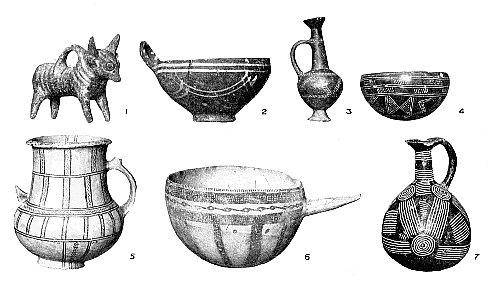
Early Cypriote Pottery (British Museum).
1, 2, “Base-ring” Black Ware; 3, 4, 7, Incised Red and Black Wares; 5, 6, “White-slip” Wares.
Among the rarer varieties of unpainted wares Mr. Myres
includes white base-ring ware (plates and bowls), imitations of
straw-plait or wicker-work, and plain wheel-made wares with
red or black slip, of peculiar form.[833]
Among the Painted Pottery by far the most widely-spread
local fabric is that styled by Mr. Myres the white-slip ware,
which appears in the tombs of the later Bronze Age, and is more
than any other associated with Mycenaean vases. In cemeteries
such as Enkomi, Curium, and Maroni[834] it has been found in
large quantities in almost every tomb, and its range is not
limited to Cyprus. The characteristics of this ware are a black
gritty clay, worked very thin, and a thick white creamy slip
with which it is covered both inside and out; it is exceedingly
brittle, and perfect specimens are comparatively uncommon.
The ornament is laid on in a black pigment, often turning to
red by the action of fire; the most common form is that of
a hemispherical bowl with a flat triangular handle, notched at
the apex. Almost the only other forms are a long-necked flask
or bottle of the lekythos type and a large jug with cylindrical
body (like an olpe) and a flat thumb-piece above the handle.
Mr. Myres[835] points out that the scheme of decoration seems
intended to imitate the binding and seams of a leather bowl;
it usually consists of a band of various patterns (lattice-work,
zigzags, lozenges, or lines of dots) round the rim, from which
similar bands descend vertically, but do not meet at the bottom.
Similarly the handle seems intended to represent two pieces
of flexible wood bound together. In the case of the jugs the
patterns follow a similar principle, giving the effect of a decoration
in panels to the upper part. Specimens of this ware are given
in Plate XI., Nos. 5, 6.
Beyond the confines of Cyprus isolated specimens of this ware
have been found at Athens, Hissarlik, Thera, Lachish in Palestine,
and at Saqqara and Tell-el-Amarna in Egypt, in the last-named
instance along with Mycenaean vases.[836] The resemblance of some
white-slip wares to the Dipylon vases is not a little curious.[837]
But it can hardly be thought that the one influenced the other.
The other local painted wares are by no means so common.
They are, in fact, almost limited to specimens of an unpolished
white ware, with fine cream-coloured clay, on which patterns
such as groups of straight or wavy lines, chevrons, chequers,
and triangles filled with hatched lines are painted with a
pigment varying from dull black to dull red. The commonest
forms are one-handled bowls and small bottles, either globular
or sausage-shaped. The latter are distinguished by often having
long tube-like spouts attached and by the numerous perforated
projections for the attachment of strings, handles being generally
absent at first, but when they are introduced the projections
remain as an ornamental survival. In a few isolated specimens
the surface is covered with a polished slip. Others again are
covered with a black glaze,[838] on which are painted in dull red
groups of short parallel lines, which (as Mr. Myres points out)
seem to have been executed at a single stroke with a cluster
of brushes.
The Mycenaean pottery which has been found on not a few
sites in Cyprus, and of late years in such surprising quantities
at Enkomi and in the neighbourhood of Larnaka and Limassol
(Maroni, Curium, etc.), belongs properly to another section of
this chapter, and would not call for discussion in this connection,
but for the fact that in Cyprus it presents certain features
which seem to be almost exclusively local. At all events it
is advisable to consider how far Mycenaean pottery in Cyprus
differs from that found in Rhodes, Crete, or Mycenae.
Two points claim our attention in the first instance: (1) that
in point of technique the Cypriote finds fall absolutely into line
with those in other parts of the Mycenaean world; (2) that
the range of subjects depicted on the vases found in Cyprus is
wider and in a measure more developed than elsewhere. To
what extent we may be permitted, bearing both facts in mind,
to predicate a local fabric of Mycenaean pottery in Cyprus,
must for the present remain an open question; at the same
time it seems extremely probable that the larger vases, which
it will be necessary to discuss in detail, are, if not of local
manufacture, at all events a fabric made specially for exportation
to Cyprus, as we shall see was the case with a later variety of
black-figured Attic ware.
The peculiarity of the Cypriote-Mycenaean pottery is that
whereas on other sites the decoration is confined to linear
ornaments, and animal or vegetable subjects drawn almost
exclusively from the aquatic world (such as cuttle-fish, shell-fish,
or seaweed), in Cyprus we find represented not only animals,
such as bulls, deer, goats, and dogs, but even human figures,
both male and female, and monsters such as Sphinxes and
Gryphons. Having regard to what M. Pottier[839] calls the law
of the hierarchie des genres, it does not seem impossible that this
may imply a late survival of Mycenaean art in Cyprus, and
although this view has been hitherto strongly contested in
certain quarters, it finds support from other evidence obtained
in recent excavations. The whole chronology of Cypriote
pottery is still in a very unsettled state, and until it can be
definitely shown that the Cypriote Geometrical style began concurrently
with the appearance of Geometrical pottery in Greece,
it is still admissible to urge that Mycenaean art prevailed here
for some time subsequent to its disappearance from the greater
part of the Hellenic world. For this the accepted date is the
end of the tenth century B.C., but it is not necessary to extend
its influence in Cyprus more than two centuries longer, i.e.
beyond the eighth century, at the latest.
If we accept the view generally held that the Mycenaean
civilisation was Achaean, and that after the Dorian invasion
its representatives were driven in an easterly direction and
settled on the coast of Asia Minor; and if again we regard
this as an historical version of the Greek traditions of the
Trojan war and the subsequent migrations of the Achaean
heroes[840]; we may then consider that the stories of Teucer’s
foundation of a new Salamis and of an Argive colonisation of
Curium find their verification in the Mycenaean settlements
recently discovered on those two Cypriote sites. The extent
and richness of the old Salamis at Enkomi at any rate seems to
suggest that it may have flourished as a Mycenaean settlement
for some centuries.
But to return to the pottery. Two forms are eminently
characteristic of the Cypriote varieties. Of these, one—the
“false amphora” (p. 271)—is not peculiar to the island, but is found
wherever Mycenaean pottery has penetrated; though especially
common in Cyprus, it is in fact the most popular of all
Mycenaean shapes. The other is a large krater, found in two
varieties, either a straight-sided deep bowl with wide mouth
and no neck, or a spheroidal vessel on a high stem, with a low
straight neck of less diameter than the body. It is this latter
class which appears to be of local manufacture and presents
such a variety of painted decoration.
Up to the year 1895 only some half-dozen of these kraters
were known, one of which was found by General Cesnola in
the rich necropolis at Agia Paraskevi near Nicosia[841]; another
he alleged to have come from Amathus, but it was no doubt
found at Maroni, not so far distant, where for many years a
Bronze-Age cemetery has been known. In the above-named
year two more came to light at Curium,[842] one of the same type as
General Cesnola’s, with figures driving two-horse chariots; the
other having in addition the unique subject of a series of women,
each figure in a separate panel, represented as waving their
arms or holding flowers.[843] These were speedily followed by
the rich and valuable series from Enkomi now in the British
Museum, since which time other interesting specimens have
been obtained for the Museum in various excavations or have
found their way into the hands of local collectors (see Plate XII.).
PLATE XII
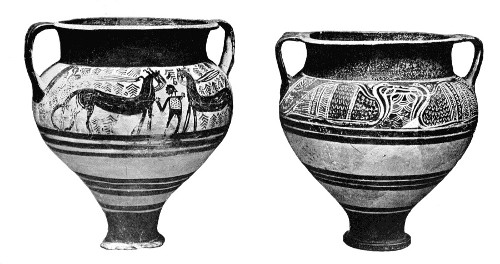
Mycenaean Vases from Cyprus (British Museum).
Native imitations of the Mycenaean vases, which have been
described as “sub-Mycenaean wares,” have been found in considerable
numbers on most of the sites where the genuine
Mycenaean ware exists. They fall technically under the heading
of painted white ware (p. 251),[844] the difference being that
the decoration is in matt colour (varying from black to red)
on an unpolished drab ground. The patterns mostly follow
Mycenaean models, but some are new. They are well represented
on the Mycenaean site at Curium,[845] especially in one
or two tombs of transitional character, and in some cases the
decoration is of a distinctly Geometrical type, illustrating the
development of the succeeding style. In any case it is not
difficult to distinguish them from the genuine Mycenaean fabrics.
In these so-called sub-Mycenaean vases we can trace the
best evidence of the transition from the Bronze Age to the
succeeding or Graeco-Phoenician period. But on the whole
the line of demarcation is clearly defined, as for instance
by the forms and position of the tombs, which become larger
and lie deeper; by the appearance of iron implements and
bronze fibulae; and by the fact that all the native pottery
is now made on the wheel. Relations with continental Greece
are evidenced by the occasional importation of Geometrical
pottery of the Dipylon type (as in the great vase found at
Curium), dating from the ninth and eighth centuries B.C. As
we have already seen, the first Hellenic settlements in Cyprus
seem to have followed on more or less immediately after the
Dorian invasion, in the sites of Salamis, Curium, Kerynia,
Paphos, and others which afterwards became the capitals of
small Hellenic kingdoms.
On the other hand, the Phoenician thalassocracy, which began
about the ninth century B.C., never had much foothold in Cyprus,
less at any rate than was formerly supposed. Politically at
all events the Phoenician influence was comparatively small,
even in their settlements at Kition and Amathus[846]; we read
of expeditions of the kings of Tyre in the tenth and eighth
centuries, the object of which was to force the former town
to pay tribute; but subsequently they were compelled by the
Assyrian domination under Sargon to retreat westwards. In
the seventh century a new power arose in the shape of Egypt,
and in the sixth Cyprus became a tributary of Amasis.[847]
Throughout, however, relations with Greece were maintained,
and we read that in 501 B.C. the Cypriote princes joined the
Ionians in their revolt against Persia, a fact which shows the
strength of the Hellenic element.
Nevertheless the term “Graeco-Phoenician,” which has been
adopted to describe the art of this period, is convenient, and
can hardly be improved upon, if we bear in mind that the
term “Phoenician” really represents the combination of
Egyptian and Assyrian elements of art which filtered through
that race into Cyprus, and in which sometimes the one, sometimes
the other has the predominance. This is seen perhaps
more clearly in the sculpture, metal-work, and terracottas, as
for instance in the incised bronze and silver bowls,[848] than in the
pottery. Painted pottery was never a feature of Oriental art,
and the Phoenician influence in the pottery is confined to
borrowed motives of Oriental character, like foreign words in
a language. Another proof that Cyprus resisted the Phoenician
domination is afforded by the curious fact that though the
Greeks of the mainland adopted the Phoenician alphabet
entirely, in Cyprus, on the other hand—where, above all, we
should have expected to find it—its place is taken by a
syllabary, the forms of which appear to bear some relation
to the Lycian, Carian, and Pamphylian alphabets. That this
syllabary, which is universally employed for inscriptions down
to the fourth century, is of a very high antiquity is shown by
its close affinities with the newly-discovered Cretan script, and
by the fact that single characters of a similar type are often
found engraved on the handles of Mycenaean vases in Cyprus.
Each character represents a syllable, not a letter (except in
the case of vowels), and the dialect is thought to be largely
influenced by Aeolic.
Mycenaean influence, as might be expected, was slow to die
out in Cyprus, and the pottery is no exception. It is seen
not only in the patterns, such as the concentric circles—an
invention of the Cypriote-Mycenaean pottery, which forms a
favourite and almost universal motive at a later date—but in the
subjects and technique. The practice of painting figures in outline,
not in silhouette, as in the birds and beasts of the Enkomi
kraters, the use of dull red and black pigments on an unglazed
light-coloured surface, and many other details are an heritage
from the Bronze Age, extending over many a succeeding
century. With these are combined the influences of the early
Attic pottery,[849] in the panels of Geometrical patterns, and the
later rosette and conventionalised lotos-flower, which, with the
concentric circles, form the stock-in-trade of the “Graeco-Phoenician”
potter. The British Museum collection includes
one or two remarkable isolated specimens which illustrate
this principle. It is for instance instructive to compare the
Sphinxes on a krater from Enkomi[850] with those on a large
amphora lately acquired from the Karpas,[851] or the oinochoe from
General Cesnola’s collection with a chariot-scene (Plate XIII.),[852]
with those from Mycenaean sites similarly decorated. On the
other hand, the extraordinary large vase from Tamassos,[853] with
its crudely and childishly drawn figures, combines a curious
admixture of Greek and Oriental motives, and early as it
must be, is not Mycenaean in conception or technique.
Oriental influence is not, however, altogether wanting in
the pottery. The lotos-flowers and rosettes, of which we have
already spoken, are derived respectively from Egypt and
Assyria, and the conventionalised palm-trees, which also appear,
are of course purely Oriental. So too, again, the typically
Oriental subject of the sacred tree between two animals appears
in various forms. But here again we are met with the surprising
fact that the Oriental element is far stronger in Greece than
in Cyprus, as will be seen later in the account of the early
Hellenic fabrics; and no doubt it is due to this cause that
the Geometric style was not driven out from Cyprus as it was
from Greece, but continued for many centuries.
In attempting a detailed description of the Graeco-Phoenician
pottery, it will be seen that any chronological system is impossible.
The conservative tendency of Cypriote art caused
the same methods of decoration to be employed with extraordinary
persistency during a period of time which saw the
whole development of Hellenic vase-painting from its earliest
beginnings to its decline, and though there is a certain amount
of variety, there is no development properly speaking, and the
latest fabrics are, artistically speaking, on the same level as
the earliest. It might be thought that the evidence of excavations
would compensate for this absence of artistic criteria;
but such is not the case. As a general rule in tombs containing
imported Greek vases, the dates of which can be fixed
within reasonable limits, native pottery is conspicuous by its
absence, as may be seen from the results obtained at Curium.
In any case, in the tombs richest in Hellenic pottery, as at
Poli, the local wares are largely of a definitely late character,
and so far distinct from the Geometrical and Orientalising
fabrics as to form a class by themselves. Another difficulty
which has to be taken into account, is that caused by the
frequency of re-burials in Cypriote tombs. Of this there were
countless instances at Amathus and Poli, so much so that
explorers of the latter site were actually led to believe that
the Geometrical pottery was contemporaneous with remains
of the Hellenistic age with which it was frequently found.[854]
But where trustworthy evidence can be obtained, it entirely
militates against this possibility.
The principal sites[855] on which “Graeco-Phoenician” pottery
has been found are: Amathus, Curium, Dali (Idalion), Kition,
Lapathos, Poli (Marion-Arsinoe), Paphos, Salamis, Soli, and
Tamassos. Other sites are not at present identified, but the
finds were made in the neighbourhood of the modern Achna,
Ormidhia, and other villages, and in the Karpas. Of these
sites the richest are Amathus, Dali, Curium, and Poli; but
in the finest collection of vases of this class, that of General
Cesnola at New York, the alleged sites are not always to be
accepted with certainty.
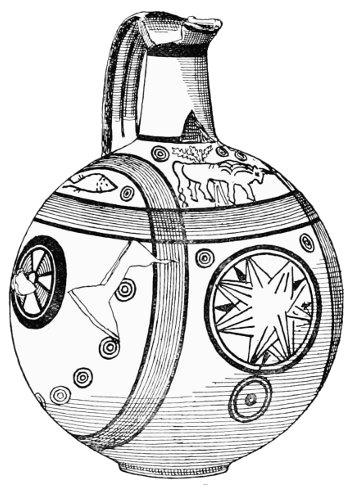
FIG. 75. JUG WITH CONCENTRIC CIRCLES: GRAECO-PHOENICIAN PERIOD (BRITISH MUSEUM).
Graeco-Phoenician pottery is, as has been said, exclusively
wheel-made, and almost always supplied with a “base-ring.”
Reliefs and incised ornaments are never found, but instances of
moulded wares, combining the vase with the statuette, are not
wanting, especially
among the later varieties.
The designs
are usually painted in
a non-lustrous black
pigment, varied with
the use of opaque
purple and white,
corresponding to the
pigments employed
by Hellenic potters.
The ground is either
white, without any
polish or slip—as in
the painted white ware
of the Bronze Age
and sub-Mycenaean
fabrics—or else
covered with a more
or less lustrous red
slip, varying from a
bright orange or deep
red to a dark brown
(the latter usually
with unpolished surface).
Purple is employed only on the white wares, white
only on the red. The typical decoration of the white wares
consists of lotos-patterns, tree-ornaments, and water-fowl.
Generally speaking, these are earlier than the red. On the
lustrous red wares the decoration is usually confined to simple
patterns of concentric circles, vertical and horizontal, maeander
crosses, lozenges and triangles. Fig. 75, from Curium, is a
typical specimen of the more elaborate types, and another is
shown in Plate XIII.
The forms are at first very varied, but gradually crystallise
into some half-dozen main types: dishes, bowls on stems,
lekythi with one or two handles, jugs with globular bodies,
and large amphorae with vertical side-handles. Of these the
jug is by far the commonest. Among the peculiar forms in
the earlier tombs (eighth to sixth centuries) may be mentioned
aski in the form of birds or oxen (the latter a Mycenaean
survival), and a kind of flask with barrel-shaped body, on which
the decoration of concentric circles, etc., does not follow the
usual horizontal system of classical pottery, but is disposed
vertically, in contradiction to all artistic feeling (see Plate XIII.).
The circles are often very fine and close, and were produced
by holding a brush full of paint close to the surface of the
vase as it was turned on the wheel. The drawing of the circles
in different planes, without regard to the lines of the vase, was
easily effected by placing it in different positions. In the period
of Hellenic importations the principal form is the jug with ovoid
body and modelled spout, and flat dishes are also common.
Unpainted pottery is almost as common as painted in the
Graeco-Phoenician period, and calls for a few words of separate
treatment. For the most part it comes under the heading of
Domestic Ware, or earthenware vessels similar to those in
ordinary use at the present day. They are made of plain,
unrefined, usually reddish, clay, without any slip or polish,
and include various forms of jugs, bowls, and plates, as well
as the large wine-amphorae with pointed bases universally
found at all periods. Many lamps and small “cup-and-saucer”
double bowls occur in this category. In the earlier tombs of
the Transitional period, pottery of a black-slip ware, with reeded
body, is frequently found, chiefly in the form of jugs and kraters.
Plain black wares, like the Italian bucchero, are also rarely
found; as are vessels covered with a fine red slip and polished.
In most of the painted pottery of the Graeco-Phoenician
period, especially in its earlier phases, the technical methods
are those which we have already described in speaking not
only of the “sub-Mycenaean” or Transitional fabrics, but also
of the painted white ware of the Bronze-Age tombs. That is
to say, that the decoration is in dull colour on a lustreless
and (usually) unpolished white or drab ground. The colour,
however, is usually not red, as in the earlier stages, but black,
red being used chiefly as an accessory or for picked-out details.
The latter varies from a pale brick-red to deep purple. The
system of decoration is often extremely elaborate, although
the range of subjects is limited. Apart from geometrical or
conventional patterns, such as the stylised palmette, lotos-flower,
stars, or trees, we only find water-fowl, fish, a few quadrupeds
such as bulls or deer,[856] and finally human figures. But
the last are exceedingly rare, and confined to the white wares,
the best example being perhaps the very Oriental design of
two warriors driving in a chariot,[857] or the worshippers rendering
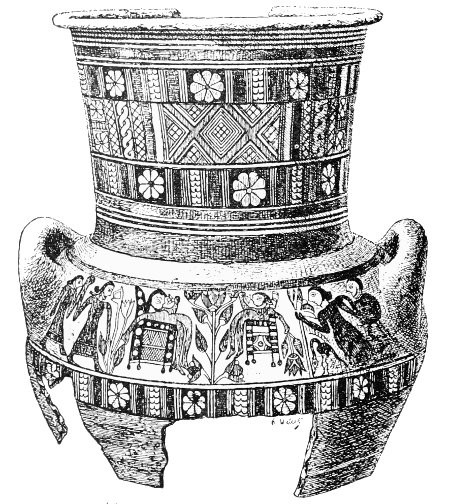
homage to seated deities on the fine vase from Ormidhia
(Fig. 76).[858]
PLATE XIII
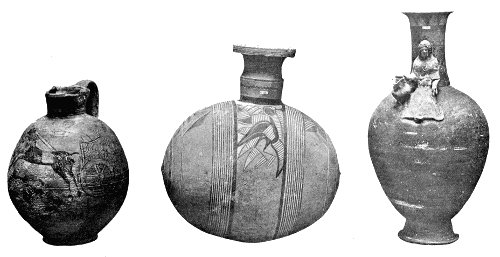
Cypriote Pottery: Graeco-Phoenician Period (British Museum).
The system of geometrical decoration on some of the earlier
vases, especially the large jars, is often extremely elaborate,
covering every available inch of the surface[859]; the patterns
consist of rosettes, panels of lozenge-pattern or chequers,
triangles of hatched lines, dotted circles, etc., all combined in
parallel bands or friezes, much in the same way as on the
Dipylon wares. The disappearance of this elaborate style,
together with human figures and figures of animals, is perhaps
to be accounted for by the importations of Hellenic wares which
began in the sixth century, and relegated the local fabrics to a
subordinate position, just as in Greece the early Geometrical fabrics
were obscured by the Mycenaean pottery (see below, p. 279).
Some interesting specimens, forming a late survival of these
earlier Geometrical wares, were found at Amathus in 1894.[860]
They include one which has a parallel in a vase found at
Phocaea by Prof. Ramsay,[861] and originally thought to be Ionic
in origin; the decoration consists of a head of Hathor the
Egyptian goddess in a panel, with debased geometrical patterns.
There can be no doubt now that the fabric is Cypriote, probably
of the fifth century, and not without traces of Ionic influence.
Another shows a remarkable development in the direction of
naturalism, and the subject is unique in Cypriote pottery: men
banqueting under a palm-tree.
From Baumeister.
FIG. 76. CYPRIOTE VASE FROM ORMIDHIA.
These probably date from the fifth century, the period which
seems to be represented by the later Geometrical red wares with
concentric circles, now slowly dying out under the influence of
Hellenic importations, and exceedingly rare in tombs where
Greek vases are found. At the same time a great transformation
comes over the contents of the tombs, which themselves begin
to increase in size, with a shorter δρόμος, to which a flight of
steps leads down. Other tombs—and this is often the case
where Greek importations are found, as at Curium—are merely
in the form of ramifying passages cut in the earth, without any
structural remains. Sixth century and earlier Greek fabrics,
such as the Geometrical, Corinthian, or Ionian wares, are very
rare; but the imported Dipylon vase found by General Cesnola
at Curium[862] is a notable instance. Black-figured vases when
found are almost invariably of a late and careless type, characteristic
of the last efforts of that style in the fifth century.
There is, however, a remarkable exception in the case of a
small class of jugs, which are in shape an exact imitation of
the globular Cypriote jugs with concentric-circle decoration[863];
the long narrow neck and trefoil mouth, with its incised eyes,
are retained, but the decoration is purely Attic, in the style
of B.F. vases of 520–500 B.C. These are found at Poli and
Amathus, and appear to have been made specially at Athens
for importation to Cyprus. Poli (Marion) was for some reason
a great centre for Athenian imports in general, and has yielded
many fine specimens of Hellenic pottery (see p. 67). Red-figured
vases signed by Chachrylion, Hermaios, etc., have been found
here,[864] and at Curium a fine R.F. krater with the name of
Megakles (καλός)[865]; also some fine white-ground specimens
at Poli.[866]
By the fourth century, if not earlier, the Geometrical and
Hellenic vases are almost entirely replaced by a new class
of wares, which may be termed “Graeco-Cypriote,” in contradistinction
to the Graeco-Phoenician. The same red clay,
covered with a more or less polished red slip, still obtains, but
the painted decoration is confined to olive-wreaths in brown
or plain bands of colour. We also witness the revival of
an old practice, in a partial return to the taste for plastic
decoration on vases. In many of the fourth-century tombs
are found large pitchers, with a spout modelled in the form
of a woman holding a jug, out of which the liquid was
intended to pour (Plate XIII.).[867] These are sometimes richly
decorated in polychrome, red, blue, green, black, pink, and
white; but the colouring is apt to flake off and disappear.
The imported wares of the fourth century are confined to plain
cups and bowls of glazed black ware with stamped patterns,
such as are often found in Greece and Italy. In the Hellenistic
period (300–146 B.C.) painted vases are practically unknown,
though a few rare specimens have turned up at Curium[868];
and it is not long before they are entirely replaced by the
glass vessels and common wine-amphorae of the large and
elaborate Roman tombs.
Troy: Schliemann, Ilios; Dörpfeld, Troja 1893, and Troja und Ilion
(1902), i. p. 243 ff.; Dumont-Pottier, Céramiques, i. p. 3 ff.; Pottier, Louvre
Cat. i. p. 74 ff.
Thera: Fouqué, Santorin; Dumont-Pottier, Céramiques, i. p. 19 ff.;
Perrot, Hist. de l’Art, vi. p. 135 ff.; Furtwaengler and Loeschcke, Myken.
Vasen, p. 18; Pottier, Louvre Cat. i. p. 119 ff.; Hiller von Gaertringen,
Thera, vol. ii. (1903), p. 127 ff.; Ath. Mitth. xxviii. (1903), p. 1 ff.
Melos: Excavations of British School at Phylakopi (J.H.S. Suppl.
Vol. iv. 1904). See also Dümmler in Ath. Mitth. xi. (1886), p. 15 ff.
The earliest remains of pottery on Hellenic soil are to be
sought chiefly in the Cyclades and on the site of ancient Troy.
We have already had occasion to allude to the latter in speaking
of the earliest Cypriote fabrics, and it is therefore fitting that we
should now give it our first attention.
The site of Troy, now known as Hissarlik, was, as is well
known, first explored by Dr. Schliemann in his laudable endeavours
to prove the truth of the early Greek legends of the
Trojan War. Although doubtless there are visible links between
the Homeric poems and the discoveries at Hissarlik, and
although it is not necessary to deny all credence to the historical
truth of the “Bible of the Greeks,” yet it is now generally
recognised that Dr. Schliemann’s pardonable enthusiasm sometimes
led him to hasty conclusions. For instance, Dr. Dörpfeld
in his more recent investigations proved that if any remains
are to be connected with the tale of Troy, it is those of the
sixth, not of the second or burnt city.[869] Nine layers in all have
been traced, of which the five lowest may be termed prehistoric,
the third, fourth, and fifth being mere villages on the ruins
of the first two. In the lowest and earliest of all, which may
be roughly dated 3000–2500 B.C., flint implements were found,
together with rude black pottery: hand-made utensils baked
in the open, with rings for suspension in place of handles.
The second city belongs to the period 2500–2000 B.C., and
it is this which has yielded pottery analogous to the earliest
examples from Cyprus (p. 238). It is of the same rough
hand-polished black ware, with decoration either of a plastic
character or engraved in the clay while wet and filled in with
white paint. Apart from this there are no traces of painted
decoration, or of any slip; but the colour of the surface varies
with the firing. The patterns consist of zigzags, circles, and
other rudimentary geometrical ornaments. A few wheel-made
specimens were found, but the majority are made by hand.
What artistic sense was evinced by these primitive potters was
shown exclusively in the forms, and in the tendency which is
especially conspicuous in primitive times, though it lingered on
through the history of Greek art, and again broke out in the
period of the decadence, to combine the ceramic and the plastic
idea, and to give to the vase the rude resemblance of the human
form.[870] That this was no far-fetched idea is shown by the
universal nomenclature which permits us to speak of the mouth,
neck, shoulder, body, and foot of a vase—a principle which has
been extended by general consent to countless inanimate objects.
Thus we find the Hissarlik potter incising eyes on the upper
part of the vase, or affixing lumps of clay to give a rude suggestion
of ears, nose or breasts, or bands to denote necklaces.
The handles often seem intended for rudimentary arms, and
we are tempted to see in the hat-shaped covers of the vases
the idea of a head-covering. Schliemann even went so far as
to regard them as actual idols, and was led by the superficial
resemblance of some to the form of an owl into identifying
them with figures of the “owl-eyed” (γλαυκῶπις) Pallas Athena
(cf. Fig. 77). But this interpretation has not found favour for
many reasons, and the accidental
combination of forms
is obviously only an artistic
phase. There are also many
similar shapes, such as plain
jars and jugs, and deep funnel-shaped
cups with two graceful
handles.
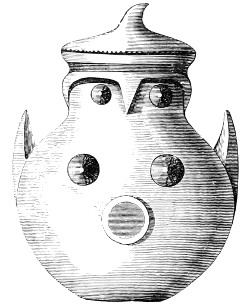
FIG. 77. “OWL-VASE” FROM TROY.
M. Dumont[871] classifies the
fabrics as follows: (1) ordinary
vessels, plates, etc.; (2) large
jars or amphorae; (3) primitive
kraters, deep cups, etc.;
(4) spherical vases with base-ring
[?] and long neck[872];
(5) long two-handled cups;
(6) vases reproducing the
human form; (7) vases in the form of pigs and other animals;
(8) exceptional forms, such as double vases; (9) vases with
incised patterns, on one of which a Sphinx is engraved.
Figs. 78–80 give examples of classes (5), (7), and (8); Fig. 77
a specimen of class (6).[873]
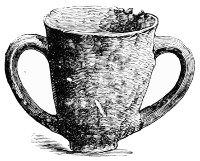
FIG. 78. FUNNEL-VASE FROM TROY.
The Hissarlik pottery may be regarded as a local development,
partly parallel with that of Cyprus,[874] partly derivative
therefrom; of Oriental influence there are no traces, but the
connection with Thera and Cyprus
is indisputable.
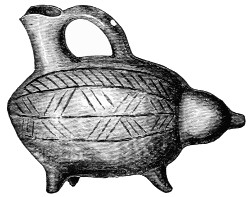
FIG. 79. VASE IN FORM OF PIG, FROM TROY.
Passing over the unimportant
traces of the three succeeding
settlements, we find in the sixth
city a great advance. The plastic
forms disappear, and generally
speaking the shapes become more
classical. Besides plain pottery
with matt-black polished surface
we meet with painted vases with curvilinear and vegetable
patterns. The remains of genuine Mycenaean pottery, the
fortifications and buildings,
with great halls in the style
of Mycenae and Tiryns,
bear out Dr. Dörpfeld’s
contention that this is the
Troy of Homer. Two
points among the pottery
finds of this period are
worth noting; firstly that
they included a fragment
of Cypriote “white-slip”
ware, secondly that Geometrical
patterns mingle with the Mycenaean in the upper layers.
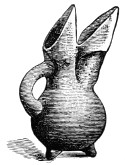
FIG. 80. VASE WITH TWO NECKS (TROY).
The three remaining layers cover respectively
the archaic period, the developed Hellenic and
Hellenistic periods, and the age in which the
city of Ilium was refounded by the Romans.
Dr. Dörpfeld found some interesting local fabrics
dating from the fifth century, examples of which
had previously been obtained by Mr. Calvert
for the British Museum.[875]
Of almost equal antiquity with the remains
at Hissarlik is some of the pottery discovered in the Cyclades,
and especially at Thera. Here, indeed, we meet with the earliest
known examples of Greek painted pottery (Crete excepted), and
that, as we shall see, of a remarkably developed type.
The island of Thera may be described as a sort of prehistoric
Pompeii buried under volcanic deposits, which have completely
transformed the configuration of the island. The results of
preliminary excavations by the French in 1866 showed that
the cataclysm which overwhelmed the island must (on geological
grounds) have taken place about the twentieth century B.C.,
and that the remains of pottery must be anterior to this event.[876]
Herodotos[877] states that Kadmos founded a settlement in the
fourteenth century, and the Minyae again about the twelfth,
and the island must have been uninhabitable for a long time
previously.
The houses and other remains of civilisation discovered
below the volcanic deposits show an advance on Hissarlik
(second city) and the earliest Cypriote culture, and the pottery
is no exception. The vases are wheel-made, fired at a moderate
heat in closed furnaces (sometimes baked in the sun), and
plastic forms are almost wanting.[878] Many are pierced with holes
in the bottom, for what purpose is not known. They were often
found in situ, mixed with stone implements, and with evidence
of having contained grain. The forms are very regular, a
cylindrical shape being specially affected, and they are made of
a badly levigated clay, covered with a greyish slip, on which the
patterns are laid in matt colours—white, black, or red—without
any incised markings.
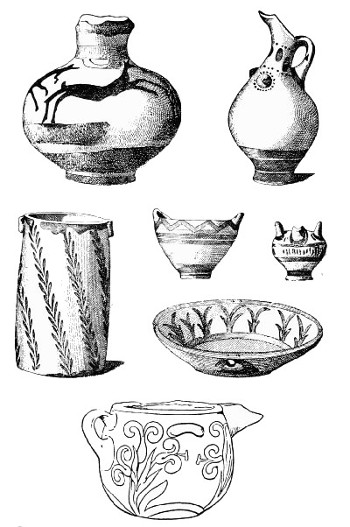
From Baumeister.
FIG. 81. VASES FROM THERA.
M. Dumont distinguishes four varieties of ornament: simple
patterns, such as bands, hatchings, and dots; volutes, wave-patterns,
and intersecting circles; vegetable motives, such as
long narrow leaves or flowers; and animals, including deer,
and ducks or swans. Generally there is a strong predilection
for vegetable motives, and in this naturalistic tendency we may
see the prelude to the Mycenaean period. Among those now
at the French School at Athens, which has the best collection,
are several interesting examples illustrated in Fig. 81.[879] One
is a trefoil-mouthed jug with running quadrupeds in black,
and red bands, on a grey ground; another jug is painted with
birds in black, the details in red and white. A sort of cream-jug
is decorated with water-plant patterns; a cylindrical jar with
oblique wreaths; and a dish with seaweed. A funnel-shaped
vase and a beak-mouthed jug are obvious prototypes of
Mycenaean forms.
The chief differences from the Hissarlik vases are in the forms
and methods of decoration, but resemblances may be noted in
the long narrow necks, and the rings for suspension, as in the
plastic forms when they do occur. That the fabric is a local
one hardly admits of doubt, but it is interesting to note the
occurrence of a bowl of white-slip ware from Cyprus in Thera,[880]
and conversely the appearance of a vase of Thera fabric at
Mycenae.[881] Thus we have evidence of extensive commercial
relations. Some tombs of the Hellenic period seem to have
been dug right down into the volcanic deposit, for they contained
pottery with Geometrical decoration.[882]
The discovery of primitive stone idols in Thera shows that it
belonged to the Cycladic civilisation, which extended from 2500
to 1600 B.C., filling up the gap between Hissarlik and Mycenae.
It has been suggested that these Cycladic peoples were Carians,[883]
subsequently driven to the Asiatic mainland by Minos, who
typifies the rising power of Crete and the Mycenaean world.[884]
This Cycladic civilisation is also exemplified in the earliest
finds from other islands, such as Amorgos, Syra, Paros, and
Antiparos, and in other instances noted early in the century
by the observant traveller Ross.[885] The pottery from these sites
is, however, less advanced than that of Thera, but varies in
character. Painted patterns were found on vases from Amorgos
and Syra, the latter in the form of brown foliage on yellow
ground.
It would not be right to conclude this section without some
notice of the remarkably interesting pottery excavated at
Phylakopi in Melos by the British School in 1896–99, which
is important as forming a connecting link between the Cycladic
wares and the fully-developed Mycenaean style. Space forbids
more than a brief abstract of the results obtained, which have
just been given to the world in an admirable publication.[886]
Mr. C. C. Edgar, to whom the task of studying the pottery was
allotted, distinguishes four main groups:
1. (a) Primitive pottery of the cist-tomb type, corresponding
to that of Hissarlik; (b) more advanced ware of the same
kind.
2. Painted Geometrical wares.
3. Local pottery in Mycenaean style with spiral and naturalistic
designs, falling into two divisions, earlier and later.
4. Imported Mycenaean pottery of the third and fourth styles
(see below, p. 271).
Generally speaking the pottery is of local make, and Phylakopi
seems to have been an important centre in the early Mycenaean
period, having considerable intercourse with Crete. The earliest
wares (class 1) include plain pottery, hand-made, with burnished
brown surface or simple incised patterns; those of class 2 are
painted in lustrous or matt black on a white slip, or in white
on lustrous black or red, with simple patterns; they appear to
be hand-made. The Mycenaean pottery is more or less akin
to that found elsewhere in the Aegean.
Dumont-Pottier, i. p. 64 (finds in 1878 at Knossos); Milchhoefer,
Anfänge der Kunst; Furtwaengler and Loeschcke, Myken. Vasen, p. 22;
Pottier, Louvre Cat. i. p. 173; Mon. Antichi, vi. p. 333 ff.; J.H.S. xxi.
p. 78 ff., xxiii. p. 157 ff.; British School Annual, vi. p. 85 ff., vii. p. 51,
and ix. p. 297 ff.; Proc. Soc. Antiqs. xv. (1894), p. 351 ff.
In turning our attention next to the island of Crete, we are
confronted with a new element in Greek archaeology; namely,
the results of the recent discoveries, which as yet have hardly
become material ripe for use in a general handbook. On
the other hand, their singular importance deserves full recognition.
It must, therefore, be borne in mind that much
in the succeeding section is merely the embodiment of previous
researches, and that the new evidence can only be briefly
summarised.
Allusion has just been made to the thalassocracy of Minos
and its bearing on the history of early Greek civilisations,
and the recent discoveries have done much to show that the
prince who built the great palace at Knossos in the early days
of Mycenaean civilisation, if he is not actually the Minos of
Greek legend, yet represents the rising power which extended
its dominion over the Aegean and drove the Carian people to
the mainland. This supremacy of Crete from the fifteenth
to the eleventh century was artistic as well as political. The
Crete of Minos was, moreover, the point of contact between
the Aegean peoples and the Oriental races; and in the story
of the Minotaur we may perhaps see a reflection of the human
sacrifices offered to the Phoenician Moloch or Melkarth. The
familiar passage in Homer[887] which deals with the ethnography
of Crete speaks of four component elements, which may be
explained as (1) the Eteokretes, or aborigines of the island,
to whom the early civilisation exemplified in their ceramic
and glyptic products is mainly due; (2) the Kydonii or Leleges,
brought by Minos from the islands[888]; (3) the Achaeans or
mainland Greeks of the period of the Trojan War; (4) the
Dorians, whose connection with the island dates from the
eleventh century onwards.
Even before the recent excavations pottery had been found
in Crete which dated from the dawn of the Mycenaean period,
and from the island’s early connection with Egypt was thought
to be contemporaneous with that of Hissarlik and Thera. From
the circumstances of its first appearance in any quantity at
Kamaraes, in the plain of Ida, it has usually been named after
that place. Dr. Orsi discovered two fragments of Hissarlik type
at Phaestos,[889] also a vase of island type, one of Thera type,[890]
and some early Cypriote wares.[891] Large numbers of fragments of
this ware in the Museum at Candia were first noted by Dr. Orsi
and Mr. J. L. Myres about 1894.[892] The extensive discoveries
made by Messrs. Hogarth and Welch for the British School
at Athens in 1899–1900 (see p. 60) have added still further
to our knowledge of the ware; and these, taken in conjunction
with Mr. Arthur Evans’s extensive finds at Knossos
(1899–1902), have enabled a recent writer to draw up a
tentative classification of all the prehistoric pottery of Crete.[893]
In his paper Mr. Mackenzie divides the pottery into three
main classes, which he distinguishes as Neolithic, Early and
Middle Minoan, and Late Minoan. The first-named extends
down to about 3000 B.C.; the second covers the period 3000–2000
B.C.; and the third (including Mycenaean pottery of the
usual types) lasts down to 1500 B.C., about which time the
Cretan supremacy came to an end, and the Mycenaean centre of
gravity was shifted to the mainland of Greece.
(1) Pottery of the Neolithic period is quite exceptional in
Aegean localities; yet the evidence from the excavations is
so unmistakable that there can be no question of its great
antiquity. It consists of common household vessels of grey
clay, hand-made and burnished; at first devoid of decoration,
but subsequently fragments appear with incised patterns filled
in with white. These, it may be noted, may help to date the
analogous wares from Troy and Egypt. The black surface
becomes more and more lustrous, and in some cases a sort of
rippling effect is produced in the soft clay with a blunt instrument[894];
finally an age of decline manifests itself, but at the
same time an advance is made from filling in hollows with
white to painting in colours on the flat surface.
(2) The pottery in this stage is still hand-made; but the clay,
which is of a brick or terracotta colour, is greatly improved, and
shows that a potter’s oven must have been employed. The
most remarkable feature is that, along with the white or polychrome
patterns on dark ground, the origin of which has been
noted, there appear vases with patterns in lustrous dark colour
on buff ground, like the Mycenaean wares. Hitherto it had
been supposed that the latter process was much later than the
other[895]; but the Cretan evidence admits of no doubt as to
their synchronism, even at this early stage of painted pottery
in any form. The pre-Mycenaean character of the Early
Minoan deposits is, for instance, proved by the entire absence
of plain pottery of Mycenaean types. It is then clear that Crete
developed both independently of, and with far greater rapidity
than, the rest of the Aegean at this period. The painted
patterns are usually of a Geometrical character.[896]
The middle deposits of the third millennium, found above the
floors of the first palace, are, like the preceding, both polychrome
and monochrome in their decoration. The former include most
of the types formerly known as Kamaraes ware, the patterns
being mainly but not exclusively Geometrical; the curvilinear
are rather later in date. The commonest shape is one resembling
a tea-cup.[897] In the next stage relief-work is introduced
to enhance the polychrome effect, probably in imitation of
metal. In the latest deposits a great decline is manifest, and
the monochrome vases tend to assert themselves to the exclusion
of the others.
That the period under discussion must have been one of great
length is shown by the depth of the “Minoan” deposits; they
are, moreover, so extensive at Knossos, and so scanty and
isolated are examples from other sites, that it cannot be doubted
that here we have the centre of the fabric. As regards their
date we have good evidence from early Aegean deposits in
Egypt. By means of Professor Petrie’s finds at Kahun in the
Fayûm, which include specimens of the best Minoan ware,[898]
we are able to place the height of the period about 2500 B.C.
PLATE XIV
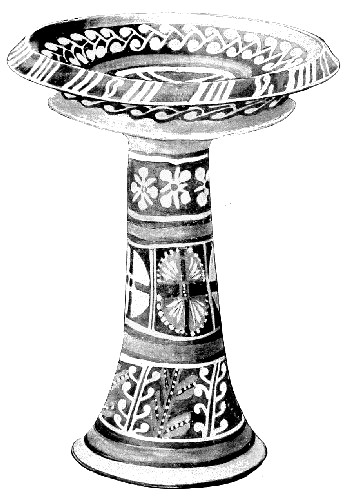
From Brit. School Annual, ix.
Stand for Vase; Kamaraes Ware.
From Palaiokastro, Crete.
The appearance of the so-called Kamaraes ware is unmistakable,
with its bright, almost gay, aspect, and the contrast of
the colours with the lustrous black ground. The pigments
employed are four in number—milky white, yellow ochre, brick-red,
and purple-red. These vases are mostly made on the
wheel, and the buff-coloured clay is fairly well levigated, as is
the slip, on which the pigments are directly laid; its lustre often
almost rivals that of the best Hellenic pottery. Mr. Evans
found some specimens in 1902 of an extremely delicate character,
almost as thin as an egg-shell. The colours are, however,
sometimes dull and powdery, and apt to flake away except when
fired. The forms are of a Cycladic type, the favourite being a
two-handled globular vase with spout, and a pear-shaped one-handled
vase, also with a spout[899] (see also Plate XIV.[900]).
The decoration is, as has been indicated, plastic as well as
pictorial; the relief ornaments are often of an elaborate type,
as may be seen in some of Mr. Hogarth’s finds.[901] Some vases
are merely covered with knobs, or with a sort of honeycombing
in relief[902]; in others toothed or bossed bands are employed,
either simply or combined into complex patterns. In any
case this plastic element is quite a new departure. The pictorial
designs include geometrical and linear patterns, zigzags,
network, concentric circles, spirals, and swastikas; leaves,
rosettes, and other vegetable forms; fishes, and even in one
case a human figure.[903] The chief field of decoration is the
shoulder of the vase.
Although varying in the extent of their naturalism, the patterns
exhibit considerable boldness and power of drawing; they
seem to be drawn chiefly from floral or textile sources, and
are closely parallel to the Thera vases, but more advanced.
Some motives are of Mycenaean character, such as the use of
rows of white dots[904]; on the other hand, the style of the fishes
and human figure is more like that of the Geometrical vases.
Mr. Hogarth notes that metal types of Kamaraes cups appear
in the hands of Kefti tributaries in the paintings of the tomb
of Rekhmara (about 1550 B.C.), and he even found their
Neolithic prototypes at Kephala, near Knossos.[905] He also
traces a connection with the early Aegean pottery of Phylakopi
in Melos. The Kamaraes pottery can be shown not to
have survived the incoming of the new Mycenaean influences,
but the patterns rapidly became conventionalised, and are
replaced by the new motives of the Mycenaean wares. It
may further be noted that fragments of Kamaraes ware have
turned up not only in Egypt, as at Kahun (already mentioned),
but at Tiryns, in the fifth and sixth Acropolis graves at
Mycenae, and at Curium in Cyprus.
(3) The pottery of the “Late Minoan” period from the palace
of Knossos falls into two groups—the “palace” style, and the
ordinary Mycenaean fabrics. The former class of vases has
been found in considerable numbers in the second palace, and
also at Zakro and other sites. The vases are painted in a
lustrous brown-to-black glaze on a buff hand-polished slip, with
fine and elaborate naturalistic designs, including vegetable
patterns, birds, and fishes; others, again, are more architectonic
in character.[906] We also find adaptations of the Kamaraes style,
with bands of white paint laid on the black varnish, the usual
forms being a flat bowl and a small cup with flat handles like
the Vaphio cups.[907]
In their decoration the most highly developed varieties of the
“palace” style show a parallelism with the wall-paintings, the
patterns consisting of rosettes, spirals, and conventional flowers;
in some very naturalistic examples this is strongly marked,
the designs of olive and myrtle wreaths and bulbous plants
showing an almost Japanese fidelity to nature. Others, again,
have marine subjects—seaweed, shells, and rocks. Lastly, there
are the representations of the double axe, which Mr. Evans
has shown to be a religious symbol.[908]
The whole of this pottery belongs to the third or highest
period of Mycenaean pottery, a time when decadence was
actually beginning to set in, concurrent with the end of the
eighteenth dynasty. At this time all over the Aegean area, in
Melos, Egypt, and elsewhere, the styles of pottery were perfectly
uniform, and had clearly been imported from one centre.
In the light of recent discoveries we can no longer doubt that
this centre was Crete, and the previous history of its pottery
and the early development of its technical processes, as well
as its geographical position, point in the same direction. About
the year 1500 B.C. the site appears to have been invaded and
abandoned, with the consequent result that Mycenaean civilisation
now spread all over the Aegean, centring chiefly in Greece,
where it lasted several centuries longer. Of its influence on
Cyprus we have already spoken.
Mycenaean vases had turned up in Crete for some time
previous to 1899 in a sporadic fashion[909]; but these, being for the
most part of the ordinary type, do not call for separate consideration.
There is, however, one class that appears to be
peculiar to the island. It consists of large “false amphorae”
and other vases, made of a rough coarse-grained clay, and
decorated in the “third Mycenaean” style with large cuttle-fish;
at Knossos this was found only outside the palace, and was
probably a coarse household ware. A good specimen has also
been found at Curium in Cyprus.[910]
Furtwaengler and Loeschcke, Mykenische Thongefässe (1879), and
Mykenische Vasen (1886); Dumont-Pottier, i. p. 47 ff.; Perrot, Hist. de l’Art,
vi. p. 893 ff.; Pottier, Louvre Cat. i. p. 181 ff. General reference should
also be made to Schuchhardt, Schliemann’s Excavations (transl. E. Sellers);
Schliemann’s own works; Hall, Oldest Civilisation of Greece; Tsountas and
Manatt, The Mycenaean Age; and other works.
We have already had occasion to deal to some extent with
Mycenaean pottery in connection with Cyprus and Crete, but
it is now necessary to review it as a whole in the light of the
present state of our knowledge of this wonderful civilisation
and its products. To enter here upon the wide and much-debated
questions to which the discoveries of the last thirty
years have given rise is of course beyond our province; but
the pottery of the people to whom the name Mycenaean has
been somewhat loosely given is of so homogeneous a character,
although found in all parts of the Mediterranean, that it may
be treated as a phase of Greek ceramics, independently of
considerations of ethnography and chronology. First found
in any quantity at Ialysos in the island of Rhodes, its exact
position in the history of early art was not then recognised;
but when the marvellous discoveries of Heinrich Schliemann
at Mycenae became known to the world, including large
numbers of similar vases, Sir Charles Newton readily recognised
that the Ialysos vases in the British Museum belonged to the
same class. It was not long before the whole number of vases
of this type, now christened Mycenaean, was collected in a
“Corpus” by two German scholars, with numerous illustrations;
but since that time the excavations of “Mycenaean” sites in
Cyprus and Crete must have doubled or even trebled the material
available.
The pottery at Mycenae was found in four different positions,
implying consecutive chronological stages, ranging roughly from
the fifteenth to the tenth or even ninth century. On these
grounds Furtwaengler and Loeschcke[911] distinguished four main
classes; but it will be seen that these are capable of even more
subdivision. There are, in fact, two main classes, distinguished
by the use of matt and lustrous colour respectively; and of the
first of these two, of the second four, subdivisions are possible.
Class (1) is indeed comparatively rare,[912] and only found at
Thera and in the oldest tombs on the Mycenaean Acropolis;
it represents the transition from the pottery of Troy and Thera
to that of Mycenae. The subdivision is a purely technical
one: (a) vases of pale coarse clay, with patterns in a brown
colour, some hand-made[913]; (b) wheel-made vases of a reddish
and finer clay, the designs in black and pale red, occasionally
white.[914] The decoration generally resembles that of the Thera
vases, and animals occasionally appear.
(2) The vases with lustrous painting may be classified as
follows:
(a) Badly levigated clay; floral motives in matt-white or red-brown
on black ground.[915] A fine example of this class was recently
excavated at Maroni in Cyprus, a large krater with a figure of
a bird outlined in white on either side (Plate XII.).
(b) Similar clay, but coated with a white or yellow slip on which
geometrical or floral patterns are painted in lustrous black.[916]
(c) Fine clay with polished yellow surface; designs in black turning
to red or yellow, with occasional details in white; chiefly
marine plants and animals, but occasionally (especially in
Cyprus) human figures.[917] This class is by far the most
numerous of all, but is not found in Thera. It corresponds
with the period 1400–1000 B.C.
(d) Clay grey or reddish, less brilliant, as is also the black; large
figures of quadrupeds and human figures.[918] The vases are
sometimes painted inside, which is a sign of late date.
The structure of these vases is very varied, and no less than
122 different forms may be distinguished in the illustrations
to the Mykenische Vasen. Most characteristic and popular
is the “false amphora,” as it is generally termed (German,
Bügelkanne), a vase with spheroidal body, of varying size,
with the peculiarity that the ordinary neck and mouth on the
top are closed by a flat handle arching over the vase, and
the only aperture is a spout on one side (see Plate XV. and
Fig. 82). These are very widely distributed, but their decoration
is as a rule very simple; they appear depicted on the
paintings of Egyptian tombs of the eighteenth dynasty, and
this has often been used as an argument for the dating of
Mycenaean vases. But they must have remained in favour for
a considerable period. Other favourite shapes are: a funnel-shaped
vase with handle at the top, doubtless a reminiscence
of a Hissarlik type (p. 258); a tall graceful two-handled goblet
or kylix, almost invariably decorated with cuttle-fish (see
Plate XV.), as the funnel-vases are with murex (purple dye)
shells; a beaked jug (German Schnabelkanne), derived from
Thera; a squat jar or pyxis, with three small handles (cf.
Fig. 82); and a tall pear-shaped vase with three handles on
a high stem, which is perhaps the prototype of the hydria. The
large kraters are, as we have seen, peculiar to Cyprus. Rarer
forms are a sort of mug, and a combination of the false amphora
and pyxis. Mention should also be made of the painted
λάρνακες or ossuaria found in Crete by Mr. J. H. Marshall
(p. 268 above) and by Dr. Orsi.[919]
The technique presents several entirely new features, such
as the use of a slip as a basis for the colours; the polished,
brilliant, and even surface; and above all the lustrous black
varnish, which was the peculiar pride of Greek potters, and
is now a lost art. The comparative monotony of the colouring
is probably due to a purely technical reason, namely, the
difficulty of resisting the action of fire; otherwise such an
artistic people would doubtless have exhibited the same richness
of colouring in their pottery that we find in their frescoes.
The Mycenaean pottery is deservedly held in high estimation
for its picturesque and naturalistic style, which in its reproduction
of animal and vegetable forms often rivals Japanese
art. Although its scope is remarkably wide, yet there is
a strong preference for marine subjects—the cuttle-fish, the
murex shell, the nautilus, and various kinds of seaweed or such
plants as the Vallisneria spiralis (Chapter XVI.). In Fig. 82
two good examples in the British Museum are illustrated—one
from Egypt, the other from Kalymnos.[920] Altogether there
is an originality and poetry of ideas such as never appears
again in Greek art; but that is not a peculiar possession of
the potters, as the metal-work, gem-engraving, and fresco-paintings
testify—above all, such masterpieces as the Vaphio
gold cups, or some of the wall-paintings recently discovered
in Crete.
PLATE XV
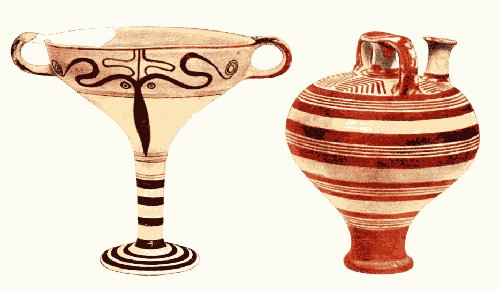
MYCENAEAN POTTERY
(British Museum).
To face page 273.
Religious ideas, on the other hand, are strangely conspicuous
by their absence. Mycenaean mythology is so far almost nonexistent
in the art; and although attempts have at times been
made to detect traces of early cults, as in the figures of men
dressed as animals,[921] or the representations of the double axe,[922]
they have not as yet met with universal acceptance. More
improbable is the curious idea recently mooted,[923] that the subjects
of the vase-paintings indicate an acquaintance with such
theories as those of biological evolution.
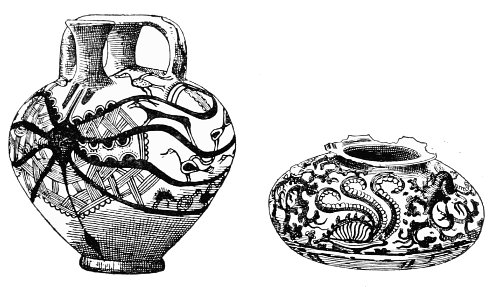
FIG. 82. MYCENAEAN VASES WITH MARINE SUBJECTS (BRIT. MUS.).
Mycenaean pottery has been found on a very large number
of sites throughout the Mediterranean. The most productive
have been Mycenae, Crete, and Cyprus, especially the cemetery
at Enkomi in the latter island. Other Cypriote centres are
Curium, Agia Paraskevi near Nicosia, Maroni, and the
neighbourhood of Dali and Larnaka (see p. 66). In Attica the
Acropolis of Athens and the beehive tombs of Spata and Menidi
have been most fruitful, and finds have been made at Haliki
and elsewhere. In the Peloponnese the chief site is Tiryns, and
many fragments have also been found at Nauplia; in Central
Greece several sites in Boeotia, such as Orchomenos, may be
mentioned. Of the Aegean islands, Rhodes and Melos are
most conspicuous, especially the sites of Ialysos in the former
island, Phylakopi in the latter. In Asia Minor, Mycenaean
remains are rare, except at Troy, but in Egypt there is ample
evidence of a close commercial relation, as in the finds at
Tell-el-Amarna, in the Fayûm, and elsewhere. In the Western
Mediterranean, Syracuse has yielded numerous fragments, and
occasional finds have been made in Italy.[924]
Having reviewed the extent of Mycenaean influence, the
next question we must consider is which, if any, was the centre
whence this pottery was exported. It had been for some time
observed that the early varieties of Thera, and those of Crete
and Cyprus (v. supra), showed strong indications of local origin;
but on the whole the Mycenaean pottery proper is remarkably
uniform and homogeneous. It is perhaps possible to detect
technical differences between the pottery, e.g., of Athens and
Rhodes, but they may be only differences of date rather than
fabric. Furtwaengler and Loeschcke regarded Argolis as the
centre of manufacture, at least for the later lustrous varieties[925];
Pottier, on the other hand, writing before the recent discoveries,
thought that Crete was, after Thera, the original centre, and
Argolis only subsequently, the pottery of Rhodes lying midway
between. In the light of the Cretan discoveries it is now
possible largely to disregard previous theories. We have seen
that Mycenaean pottery found in Crete has a pedigree which
no other region can claim, and that it can only have a local
origin. We have also seen that the Cretan supremacy came
to an end about 1500 B.C., and that, though the pottery may
have continued to be made in the island, it ceased to be an
exclusive centre, and for the remainder of the Mycenaean
Age the art, learned in Crete, spread to other Aegean centres—Mycenae,
Rhodes, and Cyprus.
A far more difficult question to decide is the ethnographical
one, together with the consideration of the relation of the
Mycenaean civilisation to others in which the same decoration
appears (as in the case of the spiral). One point seems to be
abundantly clear, viz. that Mycenaean decoration owes nothing
to Oriental influences. That there was a close relation with
the East has already been indicated, and is much more apparent
in other forms of Mycenaean art; but no student of this art
in general can doubt that it is, as has been pointed out, purely
spontaneous and unique, the art of a people of genuine artistic
genius. Among the art of ancient races it stands alone in
this respect, that of Egypt and Assyria, its only prominent
rivals, being always essentially conventional; and herein lies
its special distinction.
That the Mycenaeans were a maritime people admits of no
doubt. It is shown by the position of their chief centres, by
the evidence of their extensive commercial relations, and, as
far as concerns their pottery, pre-eminently by the subjects which
form the staple decoration. Hence of late years an attempt
has been made to substitute for “Mycenaean” the more
comprehensive term “Aegean,” and there is much to be said
in its favour. As regards the actual ethnographical position
of the race, Quot homines, tot sententiae, may almost be said.
They have been identified with the Achaeans, the Pelasgians,
the Phoenicians, the Carians, and as combinations of Phrygians
with Cretans, of Phoenicians with Greeks of Asia Minor.[926]
But few of these terms have real historical value, and such
identifications do not really advance the solution of the
question.
A more real ground of battle is that afforded by the question
of date, though on this point scholars now show a greater
tendency to fall into line, and a period culminating in the years
1400 to 1100 or 1000 B.C. is now very generally accepted.[927] The
question necessarily turns largely on the evidence afforded by
Crete and Egypt, and so far as this is trustworthy it all points
in the same direction. But it would be beyond the scope of
a work of this kind to do more than briefly summarise the
general results of archaeological criticism.
An interesting study of Mycenaean ornamentation has been
made by Dr. Riegl,[928] who deals generally with the principles
underlying its vegetable motives, and points out that here
we first meet with scrolls or continuous bands of foliage applied
to a decorative purpose. These motives are peculiar to Greek
art, and in Mycenaean design their origin is to be sought.
In this way we may regard it as the immediate forerunner
of Hellenic art, although its development was temporarily
arrested by the Dorian invasion, just as the people who produced
it formed the basis of the Hellenic race. The naturalism
of Mycenaean ornament, which is seen both in continuous and
in isolated patterns, is in marked contrast to the convention
of Egypt, where the same motives may be in use. It is not,
in short, the motive, but its treatment, which shows the independence
of Mycenaean art. There are, again, other patterns,
such as the spiral, which cannot be traced in Oriental art, and
seem to be purely original, at least as far as concerns the Eastern
Mediterranean.
Another recent writer, Dr. S. Wide, has noticed that where
Mycenaean influence was originally strongest, as in Crete and
Rhodes, there its characteristics were most strongly impressed
upon the art of the succeeding period, and he is inclined to
place the centre of the fabric in these islands or on the coast
of the adjoining continent of Asia. At all events the Mycenaean
influence shows itself more in the pottery of the islands than
it does in Attica; and, in Crete and Rhodes in particular, instances
have been found of undoubted survivals of typical Mycenaean
ornaments in later pottery.[929]
Geometrical decoration—Its origin—Distribution of pottery—Shapes and
ornamentation of vases—Subjects—Dipylon vases—Boeotian Geometrical
wares—Chronology—Proto-Attic fabrics—Phaleron ware—Later
Boeotian vases—Melian amphorae—Corinth and its pottery—“Proto-Corinthian”
vases—Vases with imbrications and floral decoration—Incised
lines and ground-ornaments—Introduction of figure-subjects—Chalcidian
vases—“Tyrrhenian Amphorae.”
Perrot, Hist. de l’Art, vii. p. 154 ff.; Ann. dell’ Inst. 1872, p. 138 ff.;
Jahrbuch, 1886, p. 94 ff.; 1899, pp. 26, 78, 188; Ath. Mitth. 1881, p. 106;
1892, p. 285; 1893, p. 73 ff.; 1896, p. 385 ff.; Pottier, Louvre Cat. i.
p. 212 ff. For Boeotian Geometrical pottery, Böhlau in Jahrbuch, 1888,
p. 325 ff.; for early Argive wares, Waldstein, Argive Heraeum, i. p. 49 ff.
The Dorian invasion of Greece, which is generally supposed
to have taken place in the twelfth century—the traditional date
is about 1100 B.C.—was, like the contemporaneous Etruscan
immigration (Chapter XVIII.), only an episode in the general
displacement taking place throughout Europe. In Greece it
caused a dispersion of the Achaean race, chiefly in the direction
of Asia Minor, which, as we have already seen, probably gave
rise to the stories of the Trojan War and subsequent adventures
of the Achaean leaders. In other words, the Mycenaean civilisation
was driven to seek a new home elsewhere, and to lay
the foundations of a new artistic development in the cities of
Aeolis and Ionia. But its disappearance from Greece was not
complete, and Hellenic Greece was from the beginning an
amalgam of the old and new elements, the Achaean (or Ionian)
and the Dorian, in which one or the other had at different
times or in different places the pre-eminence. The Ionian
element represents the civilisation of the Mediterranean,
succeeding to that of the Mycenaean world; the Dorian, the
influence of Central Europe.[930]
It has hitherto been a truism of archaeology that the Dorians
brought with them from Central Europe a new form of art,
of which the chief characteristic is that of rectilinear and geometrical
decoration, forming, it is obvious, a marked contrast to
the curvilinear and naturalistic Mycenaean designs. This new
principle was thought to be most conspicuously illustrated by
the pottery which now replaces the Mycenaean. But certain
recent discoveries have given occasion for some scepticism in
regard to the acceptance of this idea as conveying the whole
truth; and even if they do not radically alter preconceived
ideas, they are at least worthy of consideration.
At Aphidna in Attica a find has been made of very rude
pottery, without glaze or varnish, but with decoration of a Geometrical
character, sometimes painted.[931] Although earlier than any
other pottery in Attica, it need not be pre-Mycenaean in date;
it seems more likely to be a contemporary survival. Early wares
have also been found in the islands, as in Aegina, with Geometrical
ornament in matt-colour; nor must we forget that the Geometrical
principle was known in Cyprus and the Cyclades, as also
at Hissarlik, at a very remote age. From these data Dr. Wide
has ingeniously drawn the conclusion that the Geometrical style
was always indigenous in Greece,[932] pointing out that it was more
likely and more in accordance with historical precedent that the
Dorians, like Rome in later days, accepted the art of the people
they conquered[933] than that they introduced their own and forced
it upon the subjugated race. This theory has the additional
merit of disposing of a difficulty which had always been felt. If
the Geometrical pottery was Dorian, how do we account for its
reaching its height in Attica, which was never at any time Doric,
or influenced by Doric characteristics? But if it can be shown
to be indigenous in Attica, the difficulty disappears.
Again, it is necessary to explain the varying character of
Geometrical pottery in different parts of Greece, as compared
with the homogeneity of the Mycenaean wares. If, as was supposed,
the Geometrical style came full-grown into Greece, why
should this be? Dr. Wide therefore maintains that there were
in Greece concurrently a Bauernstil or domestic art, aboriginal
and industrial, which produced the rude geometrical fabrics,
and a Herrenstil or art de luxe, exotic and ornamental, which
we know as Mycenaean. With the upheaval and dispersion of
the Achaean aristocracy this art practically died out, but the
humbler industry held its ground, and gradually forged its
way to comparative excellence, perhaps learning much from
Mycenaean technique.
The real novelty of the developed Geometrical pottery which
now manifests itself in Greece consists in its evolution as a style,
and the combination of the patterns into an artistic system,
with a continuous progress towards symmetry and rhythm.
Geometrical patterns are indeed the property of all primitive
peoples, and are no less spontaneous and universal in their origin
than the folk-lore stories which we find adopting the same or
similar forms in all parts of the world. In Greece, no doubt,
the cultured traditions of Mycenaean art had in course of time
their due effect, and both in technique and in ornament left
their impress on the inferior fabrics,[934] as we have seen to have
been the case, especially in the Greek islands. It is an influence
which is not confined to the pottery, but made itself felt, for
instance, in architecture. It can hardly be doubted that in
the Lion Gate of Mycenae we find the prototype of the Doric
column; and the parallel with the Geometrical pottery can be
further followed up when we consider that Doric architecture
also became the common property of Continental Greece, and
also realised its highest perfection at Athens.
The Geometrical pottery has been found in great numbers in
Attica and Boeotia, in the islands of Aegina, Melos, Thera,
Rhodes, and Crete,[935] in Argolis and Laconia, in Sicily and
Etruria, and also isolated specimens in Cyprus and the Troad.[936]
That found in Italy and Cyprus is certainly exported from the
mainland. It has been observed that each region has its own
peculiar variety of the style, and this is especially conspicuous
in the examples from Attica and Boeotia.[937] The first writer who
attempted to deal with it scientifically was Conze,[938] but owing to
its clearly-defined characteristics it has always been more or less
correctly treated by the older schools of archaeologists. But
with a more extended outlook over the fabrics of early Hellas,
many problems have arisen in connection with it which have
called for more recent discussion, and the writings of Kroker,
Böhlau, and Wide in particular should be studied.[939]
At Mycenae fragments of Geometrical pottery were found
both on the surface and in the palace, among the débris of
the huts built on its site; while in the island of Salamis there
is a cemetery of distinctly transitional character, containing
false amphorae with linear decoration and combinations of the
spiral with the maeander.[940] It may be noted that a similar
transitional cemetery was found by Mr. Paton at Assarlik in
Caria,[941] and that the “sub-Mycenaean” pottery of Cyprus (p. 246)
has been shown to exhibit the same combination of features.
These facts fall into line with what has already been said as to
the survival of Mycenaean art in these fabrics.
From the fact that large quantities of this ware have been
obtained from the tombs of the Kerameikos near the Dipylon
Gate of Athens, chiefly between 1870 and 1891, it has frequently
been styled Dipylon ware; but it is questionable whether this
title should not be reserved for varieties peculiar to this site.
These Dipylon tombs were in the form of deep quadrangular
trenches, and the bodies had been sometimes inhumed, sometimes
cremated, the bones being placed in vessels of bronze or
clay, containing smaller objects. Above the trenches was a layer
of earth mixed with burnt offerings, on the top of which, outside
the tombs, were placed the large painted vases (representing the
tombstones or stone sepulchral vases of later times) which
now form a prominent part of the collections at Athens and
in the Louvre.[942]
Turning to treat of their general characteristics, we note that
the vases are all wheel-made, of a carefully-prepared red clay
covered with a lustrous and impermeable yellow slip, on which
the designs are painted in the same lustrous black as the
Mycenaean wares. Later, but rarely, white is introduced as
an accessory. As regards the shapes, there is less variety than
in Mycenaean pottery. They include the typical forms of
Dipylon vases, a large wide-mouthed krater on a high stem,
and an amphora with cylindrical neck and side-handles; also
the lebes, the cylindrical jug or olpe, the wide bowl or skyphos,
and the pyxis or covered jar. Open-work stands for vases are
often found in the Cyclades.[943] On the covers of the pyxides
a group of two or three rudely-modelled horses sometimes forms
the handle. In considering the forms generally, it is permissible
to say that the potter of the day was in advance of his Mycenaean
predecessor, although the painter was not.
The decoration follows a development which permits of the
division of Geometrical vases into three periods, in which we
follow Kroker[944]: (1) for a long time it is exclusively limited
to Geometrical patterns, and (2) even when quadrupeds and
birds are introduced they are still only decorative (as in
Boeotia); (3) finally, while the animals take a subsidiary place,
human figures and large compositions spring into prominence.
But this final development is chiefly characteristic of Athens.
Wide distinguishes four varieties of the Dipylon ware: (a)
amphorae, with black varnished bodies and designs only on the
neck; (b) “black Dipylon ware,” mainly varnished, but more
decorated than (a); (c) large vases, with linear decoration or
figures all over in horizontal friezes (the tomb-amphorae);
(d) as the last, but with vertical panels, divided like metopes.
His view is that these represent a continuous development, but
that the style did not last long in Attica. Returning to Kroker’s
classification, it must be borne in mind that the three classes are
not successive in point of time, only in artistic development; the
plain linear decoration survived throughout, and is often found
in tombs contemporaneously with the figure subjects.
The patterns are mainly, though not exclusively, rectilinear,
and sometimes extremely elaborate. The favourite are a large
bold maeander, chevrons, chequers, and arrangements of hatched
lines; also squares, with diagonals and much ground-ornament.
Among the simpler motives are lines of dots, triangles, lozenges,
and various forms of crosses; but concentric and “tangent”
circles occur not infrequently, the latter being clearly derived
from the Mycenaean spiral, and one vegetable motive appears
in the form of a conventionalised leaf, later developed into a
rosette. M. Perrot[945] gives a very instructive diagram of the
typical scheme of ornamentation on the neck and body of a
vase, including most of the principal varieties. It should also
be noted that these patterns occur frequently on the field of
the designs as ground-ornaments, to cover the vacant spaces.
In the arrangement of the patterns an architectural instinct
is clearly at work, the influence of the Doric metope being
especially prominent. They are usually arranged, as the
diagram (Fig. 83) shows, in horizontal bands round the neck
and body, like the bands of painted ornament on the entablature
of a temple. The metopes and triglyphs are represented
by large square patterns of ornament, separated by narrow
vertical strips of simpler motives (cf. Fig. 84). The introduction
of the frieze principle proper is a later development. Generally
speaking, there is an invariable tendency towards symmetry and
refinement in the arrangement. When figure subjects begin to
be introduced, it betokens a great advance in decorative art,
especially over the Cypriote and other varieties of the style.
In the tendency to a horror vacui, the style is inferior to
Mycenaean, as also in the figure-drawing, of which more anon.
The absence of any plant-ornament is most characteristic, as
showing the great change from the Mycenaean spirit; but it
was not long before this element was destined to reappear and
virtually usurp the field of decoration.[946]
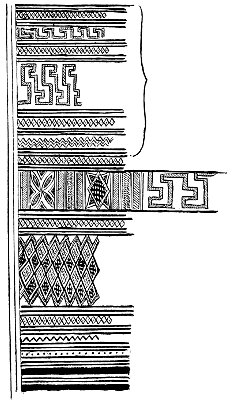
From Perrot’s Hist. de l’Art.
FIG. 83. SCHEME OF ORNAMENTATION ON GEOMETRICAL VASES.
In regard to its ornamentation the Geometrical style may
be said to have attained success. It is not so, however, with
its representations of living form, least of all those of human
beings. But this is only in accordance with the principle which
M. Pottier styles the hierarchie des genres, a principle which is
universal in all early development of Greek art, and to which we
have already referred (p. 245: see also p. 315). Briefly it is this:
first, the predominance of pure ornament and the perfecting of
the same; secondly, the employment of animal forms and the
relegation of ornament to a subsidiary place; thirdly and lastly,
the rise and development of human forms, the other animals
ceasing to form the main theme of decoration, and sinking to
the level of mere decorative adjuncts.
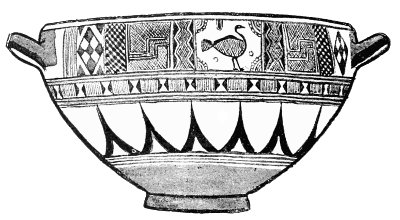
FIG. 84. GEOMETRICAL VASE WITH PANELS (BRIT. MUS.).
Hence we find that figures of animals when first introduced
on Geometrical vases are of a conventional and ill-drawn
character, but show a gradual progress and development.
Human forms again, which now appear for the first time, are
only seen in a very rude and undeveloped stage, from which
there is continuous development throughout the archaic period
till perfection is reached in the fifth century. Their original
extreme conventionality may be the result of a training in
Egyptian canons of art.
The favourite animal motives are the horse, the deer, and
water-fowl. The first also appears in a plastic form, surmounting
the covers of vases and forming a sort of handle. Usually
a single animal is seen in a metope-like panel (cf. Fig. 84),
and the frieze system is seldom found at this period. A curious
conception is that of a lion or wolf devouring a man, whose
legs are seen protruding from its mouth, and this appears to
have been adopted by the Etruscans, on whose archaic bronze-work
and bucchero vases it sometimes occurs.[947] The lions on
the Geometrical vases, it may be noted in passing, are obviously
drawn without knowledge, and borrowed from Asiatic art; the
same conventional type obtains at a later date, as in the Burgon
lebes (below, p. 296).
Human figures are almost confined to the large vases from the
Dipylon cemetery, which are evidently a purely local product;
almost the only exceptions are two from Boeotia (see below,
p. 288), and one from Rhodes in the British Museum (A 439).
The infantile and barbarous style of the figures recalls in a
measure the primitive marble idols from the Cyclades; there
is seldom any actual distinction of sex, the narrow waist,
wide hips, and tapering limbs being apparently common to
both. The figures being painted in plain silhouette, there is
no attempt at rendering features. Where it is intended to
represent a warrior, the body is completely hidden behind a
shield of the Boeotian type
 ,
a ready resource of the artist
for avoiding anatomical difficulties, which was also adopted
later by his seventh-century Corinthian successors, except that
in the latter case the shield is circular.
,
a ready resource of the artist
for avoiding anatomical difficulties, which was also adopted
later by his seventh-century Corinthian successors, except that
in the latter case the shield is circular.
The subjects include battles and naval scenes, dances of
women hand in hand, and funeral processions. From the
combination of ships with funeral scenes, it would seem that
they were sometimes used for carrying the dead. A remarkable
lebes recently acquired by the British Museum[948] is decorated
with a large ship-of-war with two banks of rowers (bireme),
and appears to represent a warrior landing therefrom on shore.[949]
The funeral scenes on the great Dipylon vases are exceedingly
elaborate, and exhibit a corpse drawn on a bier, accompanied
by chariots and bands of mourning women beating their heads.[950]
By a conventional attempt at perspective the figures are often
placed above the central group when they are supposed to be
on its farther side, just as, in the fresco from Tiryns, and an
“Island-gem” of the Mycenaean period, a man leading a bull
is represented over its back.[951]
Two very interesting specimens of Geometrical fabrics are
in the museum at Kopenhagen,[952] late indeed and almost
transitional in character, but still typical. One is a deep
two-handled cup or bowl with long panels on either side, in
two tiers; the upper ones are filled with ornaments and animals,
and in the lower are several subjects—combatants, lyre-players,
a dance of armed men with shield and spear, two lions devouring
a man (see above), and men with jugs and lustral branches
preparing for some religious rite. The other is a jug, with very
little ornamentation except on the background of the designs,
which also include several subjects. On the neck is a man
holding horses; on the shoulder, dogs pursuing a hare; and on
the body, combats on land and sea.
In the range of subjects a general correspondence with epic
poetry is to be noted,[953] as in the funerals and combats; but there
are some important discrepancies, such as the quadriga in
place of the Homeric biga, the types of the ships, and in the
appearance of horsemen, which are of course unknown to
Homer.[954]
The Geometrical vases found in Boeotia form an important
and distinct local variety, which calls for separate treatment.
The existence of this local style was first suspected by Furtwaengler
in 1878 on seeing the first finds made at Thebes,
and it has since been studied with great care and detail by
Böhlau.[955] Among these finds were, in addition to the recognised
local pottery, ordinary (imported) Dipylon vases, and later
Proto-Corinthian and Corinthian wares, as well as bronze fibulae
and terracotta figures, to which subsequent reference must be
made. Similar pottery was also found in large numbers on
the site of the temple of Apollo at Mount Ptoös in 1885–91,
and other examples have turned up at Tanagra. It has been
suggested, though on somewhat slight grounds, that Aulis was
the centre of the local fabric; and, further, it was supposed by
Böhlau, who is supported by Perrot,[956] that the Boeotian wares
represent a primitive phase of the Geometrical pottery, anterior
to the Dipylon, and consequently that Boeotia is the original
home of the style as a whole. But in view of what has been
said above, and generally of the relation of the Boeotian pottery
to the Dipylon, and to the later Proto-Corinthian, it seems
doubtful if this view can be maintained. Moreover, it has been
pointed out by M. Holleaux,[957] in discussing the Ptoös finds,
that the pure Geometrical vases were found at a lower level
than the typical local wares, and were never found either with
them or with the analogous terracotta figures. This certainly
points to the later origin of the Boeotian pottery.
The local clay differs from that of Athens both in nature
and appearance, being less well levigated and of a reddish-yellow
colour, as compared with the warm brown of the Dipylon.
Further, the designs are not laid directly on the clay, as in
the latter, but on a thin creamy-yellow slip, as in Mycenaean
and Ionian pottery. The technique is, generally speaking,
inferior, as is also the black pigment used; the work is rough
and hasty, the drawing careless and inaccurate.
The vases are mostly small, at least compared with those
of the Dipylon, and the favourite shape is the kylix, with or
without a stem. Out of seventy-two examples given by
Böhlau, no less than fifty-five take this form. He traces its
development from a deep bowl with “base-ring,” which seems
to be related to the Cypriote white-slip one-handled bowls; but
the Boeotian type has at first two small finger-pieces in place of
handles, afterwards replaced by a single handle for hanging up.
The majority, however, have no less than four handles, and
that they were still intended for suspension is shown by the
method of decoration which can only be properly seen in this
position (cf. Fig. 85).
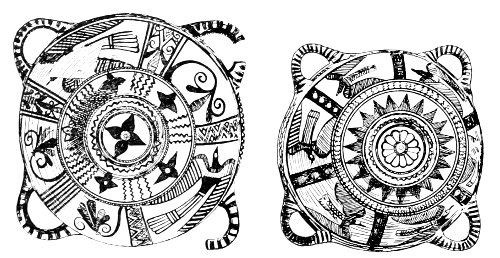
From Jahrbuch.
FIG. 85. BOEOTIAN GEOMETRICAL VASES (BERLIN MUSEUM).
There is a wearisome uniformity in the patterns, and indeed
in the decoration generally. Only two examples are known
from Boeotia with human figures,[958] and the rest belong to the
intermediate class, with its combination of animals and decorative
patterns. On the exterior is usually a broad frieze, divided by
bands of ornament into four or five fields, in which are birds
or palmette patterns; these panels are not necessarily arranged
with reference to the position of the handles. The patterns
comprise rows of vertical zigzags, dotted lozenges, chevrons,
latticed triangles, rosettes, and scrolls, the first-named being
specially characteristic of Boeotia. It is to be noted that the
typical Athenian motives, the maeander and the ornamented
square, do not occur; in fact, these bowls have no analogies
in the Dipylon ware. But it is also interesting to observe the
appearance of a new vegetable element in the form of friezes
of palmettes and lotos-flowers.[959] The importance of this feature
is due to the extensive part it was destined to play in the
ornamentation of Greek vases all through the sixth century.
Some of the palmettes are remarkably advanced, and the whole
pattern is even emancipated from the confinement of the frieze,
and treated freely without regard to space.[960] Böhlau, in his
analysis of the ornament as a whole, notes its independence
of the Athenian vases, though remaining a parallel and closely-related
development.
Individual vases do not call for much comment, but there
is a curious coffer of terracotta from Thebes in Berlin (Fig. 86),[961]
painted with figures in this style. The subjects include the
Asiatic Artemis, a hare-hunt, a woman leading a horse, a horse
tied up, and two serpents erect, confronted. The ground is
filled in with rosettes, crosses, and other ornaments, such as the
so-called swastika.
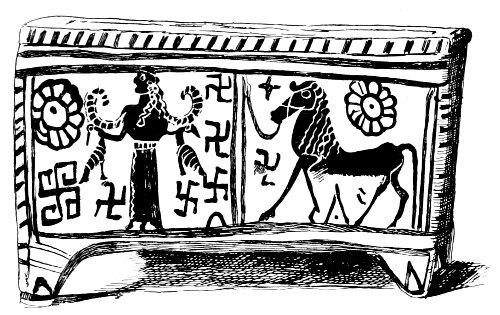
From Jahrbuch.
FIG. 86. COFFER FROM THEBES: BOEOTIAN GEOMETRICAL STYLE
(BERLIN MUSEUM).
While on the subject of the Boeotian vases it is worth while
to call attention to the remarkable parallels presented by two
other classes of objects also found in that region: bronze
fibulae and terracotta statuettes. The former may be regarded
as important chronological evidence, inasmuch as their development
can be clearly traced from their first appearance at the
end of the Mycenaean period (about the tenth century), and
similar types have been found in Rhodes, at Olympia, and elsewhere.
The characteristic of the Boeotian fibulae is the flat
plate which forms the foot (in some cases the central part or
bow), and is generally of a quadrangular form, decorated with
an engraved subject, usually animals or birds of a similar type
to those painted in the panels on the vases. More rarely ships
or human figures are found.[962]
The terracotta figures (p. 123), on the other hand, bear a
different relation to the pottery. They are flat board-like figures
(σανίδες), known to the modern Greek digger as “Pappades,”
the high head-dress which they wear suggesting to him the
well-known hat of the orthodox “Papas” or priest. The flat
surface of the body gives scope for ornamentation representing
embroidered robes,[963] and the patterns employed are just those
which are seen on the vases; and, moreover, the method
of painting is the same, the figures being covered with a buff
slip, the patterns in black with purple details. It should be
remarked that some of these figures are comparatively developed
in style,[964] and that they are practically later imitations of the
decoration of the vases.
In considering the Geometrical vases as a whole, we are struck
with the laudable aspirations of the artist, who, though unable
to execute his new ambitions with complete success, yet shows
in his work the same promise of the future that is latent in all
early Greek art. His best achievement is in the ornamentation.
Oriental influences as yet count for very little, though they are
perhaps to be discerned in the human figures, as already noted;
Kroker also thinks that the nude female figures on the larger
vases are due to Oriental art.[965] In any case they are not to be
traced until late in the period, and first, as might be expected for
geographical reasons, in the fabrics found at Kameiros in Rhodes.
The question of chronology must next be considered. That
the developed Geometrical style succeeds to the Mycenaean, and
forms a link between it and the early Attic attempts at black-figured
ware, of which we shall subsequently treat, is sufficiently
clear. It may also be laid down that the Dipylon ware
represents the last stage of Geometrical decoration, being in
point of fact too far advanced to be regarded as a purely typical
Geometrical ware. Such data as the finding of iron in the
tombs, or the evidence of finds at Troy,[966] also tend to place
the beginning of the style at least as early as the tenth century.
It has also been noted that the figures correspond closely
with the bronzes of Olympia which are dated about the ninth
century, and this, if accepted, necessitates placing the simpler
linear decoration back as far as the tenth. The lower limits of
the style may be roughly fixed by the evidence from the tombs
of Etruria, discussed in Chapter XVIII., at about 700 B.C.
Next, there is the evidence afforded by the ships,[967] which it
should be noted are all of the bireme or διήρης form, with two
banks of oars. The invention of the trireme, as we learn from
Thucydides (i. 13, 5), was due to Ameinokles, about the year
704 B.C. Hence Kroker’s dating of the Dipylon vases about
the year 700 can hardly be accepted. But the eighth century
may be taken as representing the latest period of the Geometrical
pottery, both in Attica and Boeotia. The curious inscription
engraved on a Dipylon vase from Athens is dealt with elsewhere
(Chapter XVII.); undoubtedly the earliest known Attic inscription,
its value as evidence is limited to that of a terminus ante
quem, from the fact that it was probably engraved at a subsequent
time to the manufacture of the vase.
The question of centres of manufacture is one that has
already been the subject of some discussion,[968] the result of which
has been to show that there is no complete homogeneity in
the wares from different sites, and consequently no one central
fabric. The colossal funerary vases, which, it may be remarked
in passing, stand at the head of a long line of funerary fabrics
and show the Athenian fondness for this class of vase,[969] were
not, and could not have been, generally exported, in spite of the
notable exception at Curium. The ordinary wares might have
been made in some one place (probably a Dorian centre, not
Attica or Boeotia); but we have seen that most finds, as in
Rhodes, present local peculiarities.[970] Athens at this period was
not sufficiently advanced to become the centre of large potteries,
and did not become so, as we shall see, before the age of the
Peisistratidae; such vases as were made were strictly confined
to special purposes. It is a curious fact that very little
Geometrical ware was found on the Acropolis.
The Geometrical pottery of Cyprus has already been discussed
in its relation to that of Greece (pp. 249, 253)[971]; but
there is yet another region which passed through a Geometrical
period similar to that of Greece, and that is Etruria (see
Chapter XVIII.). It is, however, better illustrated by the metal
products of the Villanova period, such as the bronze discs and
large cinerary urns, than by the local pottery, which never
reached the same level as in Greece; in the former the same
combinations of elaborate ornament with rude animals and yet
ruder human figures may be witnessed, and it is possible that
importations from Greece may have had a share in influencing
these products. They cover the period from the tenth to the
eighth century B.C.
Following on to the Geometrical vases both in chronological
and artistic sequence is a small class of Athenian vases, which,
more for convenience than with regard to strict accuracy, have
been styled Proto-Attic. The term has this much of truth in it,
that the group may be said to stand at the head of, and in
direct relation to, the long series of painted vases produced
in the Athenian potteries for some two centuries afterwards.
It is only of late years that a sufficient number of these vases
has become known for them to be studied as a separate class,
and even when Böhlau first drew attention to them, in 1887,
only two or three were known. The list up to date is as follows
(the order being roughly chronological):—
| 1. |
Athens 467 |
|
|
|
|
(Couve’s Cat.) |
Amphora |
Kerameikos |
Ath. Mitth. 1892, pl. 10. |
| 2. |
Berlin 56 |
Amphora |
Hymettos |
Jahrbuch, 1887, pl. 5. |
| 3. |
Athens 468 |
Hydria |
Analatos (Phaleron) |
ibid. pls. 3, 4. |
| 4. |
Athens 464 |
Lebes |
Thebes |
ibid. pl. 4. |
| 5. |
Athens 469 |
Amphora |
Pikrodaphni |
Bull. de Corr. Hell. 1893, pls. 2, 3. |
| 6. |
Athens Mus. |
Amphora |
Kynosarges |
J.H.S. xxii. pls. 2–4. |
| 7. |
Athens 650 |
Fragment |
Aegina |
Benndorf, Gr. u. Sic. Vasenb. pl. 54. |
| 8. |
Athens 657 |
Amphora |
Kerameikos |
Ant. Denkm. i. pl. 57. |
| 9. |
Athens 651 |
Amphora |
Peiraeus |
Ἐφ. Ἀρχ. 1897, pl. 5. |
| 10. |
Berlin 1682 |
Lebes |
Aegina |
Arch. Zeit. 1882, pls. 9, 10. |
| 11. |
B.M. A 535 |
Lebes |
Athens |
Rayet and Collignon, p. 43 = Fig. 87. |
We may also add to this list Athens 652–664, a vase from Aegina
(Ath. Mitth. 1897, pl. 8), B.M. A 1531 (Bull. de Corr. Hell. 1898,
p. 285), and another at Athens (ibid. p. 283).
It will be noticed that the majority are of the amphora
form, and that all without exception have been found in or
near Athens, which leaves little room for doubt as to their
origin.
A close connection with the Dipylon vases may be observed
in the first three, not only in shape and technique, but in
decoration. In No. 2, which we may take as typical of the
oldest form of the Attic amphora, a combination of Geometrical
and Mycenaean ornament is to be observed, but the figures
of the warriors are purely Hellenic, like those of the Euphorbos
pinax (p. 335). The shape of No. 3 is typical of the Geometrical
vases, with its long neck and slim body, and it is perhaps
more accurately called a three-handled jug than a hydria,
though at the same time it is clearly the prototype of the
later Attic hydria. The panel on the neck of the vase (also
seen in No. 6) is also a Geometrical feature, and the figures
therein are quite in the Dipylon style. On the other hand,
in the arrangement of the designs in continuous friezes without
vertical divisions we trace the incoming influence of a foreign
style—the Rhodian or Ionian. Other motives again, such as
the birds and the vegetable ornaments, have nothing of the
Geometrical or Ionian about them, and may perhaps be directly
derived from Mycenaean vases. But the typically Geometrical
lozenges, zigzags, etc., still hold their own. In No. 6 Mr. Cecil
Smith notes that the ornamentation covering the field of the
design is partly rectilinear and geometrical, partly floral and
of Mycenaean origin. The spiral pattern which here closes
the design, and is also seen on No. 1, is again an instance of
Mycenaean influence, and is a motive which became exceedingly
popular. In another seventh-century class, the so-called Melian
vases, it is absolutely overdone, but the more restrained Attic
tradition is preserved for many years as an appropriate decoration
for the division of the designs under the handles, especially
in the red-bodied amphorae of the developed B.F. style. This
vase has some other unusual features, such as incised lines,
which are also found on some early Attic fragments from the
Acropolis,[972] but seem to appear equally early at Corinth, so that
it is impossible to say certainly if the process is an Attic
invention. At all events it is not Ionian, as its place is taken
on the east of the Aegean by lines of white paint (e.g. in the
Clazomenae sarcophagi). Curiously enough, in this same vase
(No. 6) may be noted attempts at this very process, here, no
doubt, as on the Ionian vases, due to Mycenaean influence
(see p. 331); but it is unique in early Attic work.[973] The
peculiar treatment of the eye and hair is also worthy of
attention.
To sum up the characteristics of the Proto-Attic vases, it may
be said that they represent the transformation of the Attico-Dorian
element into the Attico-Ionian, just as we shall see
in the next stage a further transformation under new influences
into Attico-Corinthian (p. 324). The Ionian influence brings with
it into Attica not only a revival of Mycenaean elements, but also
traces of Orientalism.[974] The general appearance of the decoration
links it with the Geometrical, but closer examination shows
the admixture of spirals, rosettes, and lotos-flowers with the
lozenges and zigzags, while the Geometrical animal-types are
combined with new ones from Ionia, such as the lion, and the
funeral scenes and combats are supplanted by Centaurs and
winged genii of Assyrian character.[975] Further, there is a distinct
tendency to get rid of the old silhouette and to draw in outline,
a practice typical of Ionia and a direct heritage from Mycenaean
vase-paintings. As in the Rhodian vases, the bodies are rendered
in full colour, the heads in outline; while the practice
of covering the field with ground-ornaments is also a peculiarly
Rhodian characteristic. These latter, however, gradually
disappear, as do the Geometrical conventions in the drawing
of the figures.
The amphora-type develops steadily onwards from the Berlin
Hymettos amphora, which, as has been pointed out, is the oldest
Attic variety. In some of the forms, as in No. 5, there are traces
of a metallic origin, shown by the open-work handles and other
details.[976] Generally speaking, there is a tendency towards the
colossal, and towards emphasising the figure-decoration, not
only by increasing the size of the figures, but by confining the
subject to one side. M. Pottier thinks that this is due to
architectural influences, and suggests a comparison with a
temple-façade. But the local traditions are still strong, and in
spite of the influence of the lively and original Ionic style, the
vases remain “continental” at bottom, the drawing always soberer
and more powerful throughout. In many respects there is, as we
shall see, a close parallelism with the so-called Melian fabrics.
No. 11, the large Burgon lebes in the British Museum (Fig. 87),
is one of the latest representatives of the Proto-Attic class; its
Ionic-looking lions and “Rhodian” wealth of ground-ornaments
seem to suggest Asiatic influences, the presence of which has
been accounted for above. Moreover, the loop-pattern on the
reverse is distinctly Proto-Attic, and finds its parallels on vases
found at Eretria,[977] as well as on others of the class under
consideration.
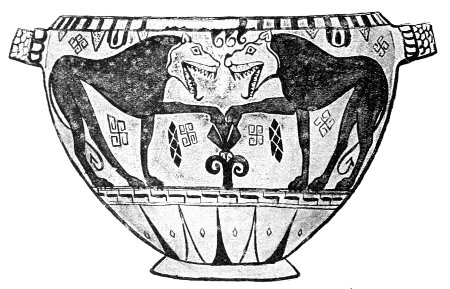
FIG. 87. BURGON LEBES (BRITISH MUSEUM).
Another interesting point in connection with the Proto-Attic
vases is the introduction of mythological subjects, as on No. 6
(Herakles and Antaios), No. 8 (Herakles and the Centaur
Nessos), No. 10 (Perseus and Athena, and a Harpy[978]). The
only parallel to this early appearance of myths on vases is
to be found in the Melian class (see below, p. 301), the Aristonoös
krater (see below) and the Euphorbos pinax (p. 335), which,
however, is of later date. It will be seen that they only occur
in the later group of the Attic vases.
PLATE XVI
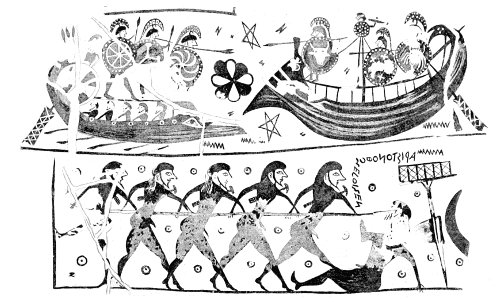
From Wiener Vorl.
The Aristonoös Krater (in the Vatican).
On two of these it is to be noted that inscriptions occur,
identifying the figures (Nos. 8 and 10). These are the oldest
painted inscriptions on Attic vases, but henceforward they
increase in number, at least in the Athenian and Corinthian
fabrics; they are always more characteristic of the mainland
than of Asia Minor.[979] There are two early signed vases which
may possibly represent the work of Athenian artists prior to the
time of the François vase, the cup by Oikopheles at Oxford,[980] and
the famous vase of Aristonophos,[981] Ariston of Kos (ὁ Κῷος),
Aristonothos, or Aristonoös as various scholars interpret the
name.[982] The former, however, is somewhat archaistic in
character, with careless rather than incompetent drawing, and
hardly earlier than the sixth century; and the latter has been
claimed with much probability as Ionian work, on account of
the treatment of certain details, as well as on the ground of
the name Ariston of Kos (if this interpretation be accepted).
The inscription is not conclusive either way, and it may also be
here remarked that the krater has several points of resemblance
with the well-known “Warrior” vase of Mycenae (Fig. 88),[983]
which is probably later in date than the rest of the pottery from
that site, being found outside the Acropolis. The Aristonoös
vase (Plate XVI.) is usually dated in the seventh century, and is
interesting for its subjects as well as for its artistic position. On
one side is a sea-fight, a subject only common on Greek vases in
the Geometrical period, and therefore obviously derived from that
source; on the other, the blinding of Polyphemos by Odysseus,
a subject popular in archaic vase-painting (see Chapter XIV.),
and found in Cyrenaic and other early examples. At first sight
this vase would certainly seem to be of the Proto-Attic class,
showing the transition from Geometrical to developed Attic
style; but the Mycenaean and Ionian elements must not be left
out of consideration. As regards the Warrior vase, M. Pottier
has given good grounds for showing that it also is to be
reckoned as Proto-Attic. But we must not leave out of sight
the view urged by Furtwaengler,[984] that the Aristonoös vase
is of an Argive fabric. When the Heraion finds are published,
they may afford more evidence on this point. Meanwhile, it
may be remarked that the circumstances of the finding of the
Warrior vase may support this view.
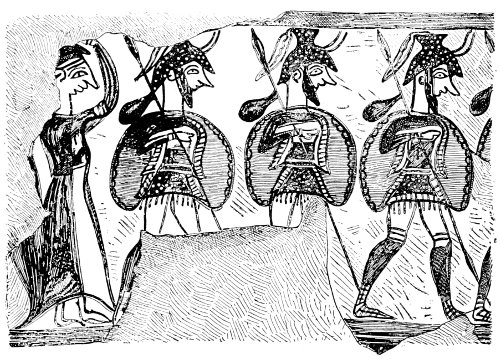
FIG. 88. VASE FROM MYCENAE, WITH WARRIORS.
Closely connected with these early Attic fabrics is a very
interesting series of small vases which, from the place of their
discovery, are usually known as Phaleron ware. They are
nearly all small jugs, and number some fifty, mostly at Athens,
but there is a representative series in the British Museum.
More conspicuously, perhaps, than the Proto-Attic, they illustrate
the growing tendency to combine Geometrical and Oriental
influences. In form and technique they are Geometrical, but
in the ornamentation there is a large admixture of Oriental
elements. It has been said that “the whole character of these
vases seems to reflect an influence of the style of Oriental vases
on painters accustomed to the Dipylon style,”[985] and it is largely
in the arrangement of the decoration that the former is
apparent, as well as in the introduction of new motives and
patterns.[986] See for examples Plate XVII. figs. 2, 4, 5.
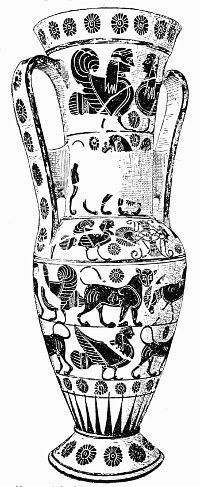
From Ath. Mitth. 1890.
FIG. 89. VASE OF PROTO-ATTIC
TYPE FROM VOURVA.
The usual scheme consists of a panel with figures on the neck,
a band of ornament round the shoulder, and below that parallel
bands of lines or other ornaments, with zigzags or rays round
the foot. A typical example is A 471
in the British Museum, with a cock
on the neck, and below, dogs pursuing
a hare.[987] On a cup of Geometrical
form, with conventionalised plants
and ground-ornaments of Geometrical
character, are two deer fleeing from
a lion, and there is also a pyxis with
chariot-scenes obviously derived from
Mycenaean vases. But most curious
and interesting is a jug with two
bearded heads and a woman with
very small body, apparently playing
flutes.[988] The general effect is quite
unique, but the drawing is rude and
childish to a degree; the middle head
is almost Semitic in type. It would
seem that here again we have a
Mycenaean influence at work, and in
general the appearance and style of
these vases undoubtedly recall the
figured vases from Cyprus.[989]
Another series of vases in close
relation to the Proto-Attic fabrics is
that found at Vourva, near Marathon[990];
they are important as forming a
connecting link with the next development
of Attic vase-painting, the Tyrrhenian amphorae described
at the conclusion of this chapter. They have been studied by
Böhlau,[991] and more recently by Nilsson,[992] and these writers have
shown how they represent the influence of Ionic ideas, derived
through Euboea. On the other hand the friezes of animals,
which are so characteristic of this class, are clearly derived from
Corinthian sources, but are distinguished from those on Corinthian
vases by the absence of accessory colours. Fig. 89[993] may be
taken as a typical example. They appear to be contemporary
with the later Proto-Attic vases, such as the Burgon lebes, on
which also traces of Ionic influence have been noted.
From the Geometrical period onwards the manufacture of
painted vases seems to have been continued intermittently in
Boeotia down to the fourth century. It would be taking too
great a liberty with chronology to deal with all Boeotian fabrics
here, and the later must fall into their place with the contemporary
Attic fabrics. But there is a small class which seems
to take its origin directly or indirectly from the Geometrical
pottery; and as it belongs to a period anterior to the perfected
B.F. style, it may be treated here as analogous in development to
the Proto-Attic vases.
A favourite shape among the Boeotian Geometrical wares was
that of a jug with long cylindrical neck and somewhat flat body,
of a form clearly imitated from metal.[994] This shape, which
is also often found in Proto-Corinthian fabrics (see below,
p. 308), was utilised by a potter named Gamedes, whose
signature is found on a vase from Tanagra in the Louvre,[995]
in the Boeotian alphabet of about 600 B.C. It is decorated with
the figure of a herdsman driving before him a bull and a flock
of sheep, the figures being in black silhouette, with details
indicated by white markings within incised lines. This is quite
a local peculiarity,[996] and seems to be due to a combination
of Corinthian and Ionian influences. Gamedes has also signed
his name on an unpainted aryballos of the typical early
Corinthian globular form (see p. 197) in the British Museum
(Plate XVII. fig. 6), and a similar vase in the Louvre is signed
by Menaidas.[997] Yet another Boeotian potter, Theozotos, has a
signed vase with a similar subject to the Gamedes jug, but
the style is more advanced.[998]
PLATE XVII
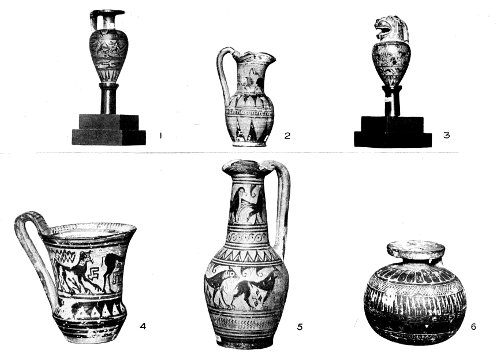
Early Pottery from Greece (British Museum).
1, 3, “Proto-Corinthian”; 2, 4, 5, “Phaleron” Ware; 6, Boeotian, signed by Gamedes.
Another typically Boeotian form found in the same period is
a kantharos,[999] also obviously imitated from metal and decorated
with figures of animals or palmette-and-lotos patterns of a
peculiarly local type. The style of the animals is, like that of
the Gamedes vase, also peculiar and local; but both in decoration
and technique these vases seem to reflect Corinthian
influence.
A small but remarkable class of vases, which seem to stand
almost by themselves, is that known as the Melian amphorae.
Four vases of this type now in the Athens Museum[1000] were found
in Melos many years ago, and were recognised as a separate
class and described as “Melian vases” as long ago as 1862
by Conze.[1001] Since that time a splendid example has been added
to the list, found in the same island in 1893[1002]; and to this must
be added several fragments recognised at different times, including
one from Naukratis in the British Museum.[1003] All the
complete vases are large amphorae, about three feet high, but
of elegant proportions, with two handles branching out low
down on the body. The figures are painted in brown on a
pale yellow ground, and enhanced with dull red and purple
accessories, some of the details also being incised. In two
cases the subjects are mythological, one representing Apollo
with his lyre in a chariot accompanied by Artemis and two
Muses[1004]; another the Asiatic Artemis (see Chapter XII.)[1005];
another, the one found in 1893, has the subjects of Hermes and
Athena, and Herakles carrying off Iole. Deities in chariots are
a typical Melian subject. The figures are of quite original
design, in no way imitative, and the costumes seem to indicate
a period between Homer and the sixth century. They may
be roughly dated about the middle of the seventh.
They exhibit a combination of highly-developed Geometrical
ornament with vegetable motives from the East and Mycenaean
details, such as the spiral, which, as has already been noted
(p. 294), attains almost to a rank growth over the vacant spaces
of the vases. The human forms are conceived with a remarkable
degree of freedom. In general appearance they are not unlike
the large Proto-Attic amphorae, but much richer and freer in
style; they may be also said to approach the finer Naukratite
or Rhodian vases, such as the Euphorbos pinax with its quasi-Homeric
subject and lavish use of ornament.[1006]
The decoration is more advanced than that of the Proto-Attic
class, the palmettes, for instance, being more freely treated.
Riegl[1007] notes that the palmettes and lotos-flowers are derived
from Egypt, but transformed and Hellenised, and that the
spirals are not Geometrical, but are naturalised into plants. The
characteristic arrangement of the ornament in long vertical
stripes he traces from Egypt through Mycenaean art; it
develops later into the plait-band of the Clazomenae sarcophagi
(Plate XXVII.). In brief, the ornament of the Melian vases
forms a direct link between Mycenaean and Hellenic ornament.
An altogether new light has been thrown on this group by a
large series of fragments of painted pottery found in 1898
in the island of Rheneia, which undoubtedly form part of the
contents of graves brought over from Delos in 426–25 B.C., as
recorded by Thucydides (iii. 104). They have been recently
made the subject of careful study by Mr. J. H. Hopkinson,[1008]
who recognised them as belonging to the Melian class, and
identified parts of at least ten distinct vases. The scanty
preservation of fragments of complete vases is, in his opinion,
due to the fact that they had been originally placed outside
the tombs like the Dipylon vases. Like the complete examples,
they are characterised by their fine slip and brilliant polychrome
technique, the system of frieze-decoration with Geometric
ornaments and spirals, the free and spirited drawing, and their
purely plastic forms, showing no signs of imitation of metal.
They also bear out the isolated character of this fabric, in
which all the vases seem to be on the same level of excellence,
without any signs of transition at either end.
PLATE XVIII
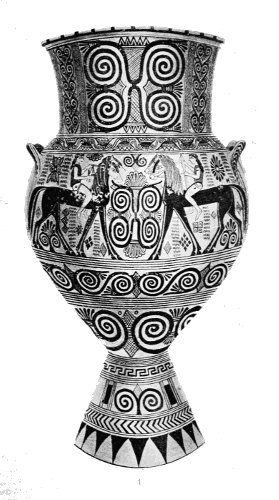
Melian Amphora (Athens Museum).
Mr. Hopkinson draws the conclusion, in which he may prove
to be justified, that this pottery is of Delian manufacture, but if
so, that the clay must have been imported, as the local clay is,
and always has been, too poor in character. At all events,
the Cycladic origin of the fabric can hardly be a matter of
doubt, and it is clear that the intermediate position of these
islands would account for a combination of Geometrical and
Ionian elements, so far as such exists. But the strongly
individualistic character of the vases compels us to seek some
other influence for their real origin, and it seems on the whole
probable that they represent a separate and independent descent
from Mycenaean pottery, starting with the spiral as the basis
of ornamentation. Some evidence of this descent may be traced
in the native pottery of Phylakopi, to which allusion has been
made in the previous chapter (p. 263).[1009]
Wilisch, Altkorinthische Thonindustrie (1892); Pottier, Louvre Cat. ii.
p. 417 ff.; Dumont-Pottier, Céramiques, i. chaps. xi. and xvi.; Rayet
and Collignon, p. 39 ff. For “Proto-Corinthian” pottery see references
given in text.
As a commercial and artistic centre, no one city during the
early archaic period entered into serious rivalry with Corinth,
which was at a very remote date in relations with the East, and
was one of the first of the Greek states to extend the system of
colonisation in the Mediterranean, by the foundation of Corcyra,
Syracuse, and other important outposts. The epoch of this
supremacy and of its commercial prosperity extends from the
eighth to the sixth century B.C., being coincident with the rule
of the great tyrants, Periander, Kypselos, etc. In the course of
the sixth century, when the Athenian tyranny rose to such a
great height under Peisistratos, Corinth, with equal rapidity,
sank to a subordinate position, and her artistic supremacy
passed to the growing power of Athens. Hence it is fitting
that Corinth and its famous potteries should be the subject
of our next section.
Two causes contributed to the importance of Corinth as a
centre of ceramic industry—the excellence of its clay (see p. 205),
and its position as a commercial port at the junction of the
Peloponnese and Central Greece. Pollux[1010] selects Corinthian
clay for commendation, and other writers speak of different
varieties of pottery as Corinthian. Hence it is not surprising
that large quantities of pottery should have been found here, the
local origin of which is established by the inscriptions in the
Corinthian alphabet which are frequently painted upon them;
and not only that, but similar pottery has been found almost all
over the Mediterranean, being more widely distributed than any
other fabric except the Athenian B.F. and R.F. vases. The list
of sites as given by Wilisch is as follows: Athens, Eleusis,
Aegina, Argos, Kleonae, Tiryns, Mycenae, Thebes, and Tanagra
in Greece; Euboea (Karystos), Melos, Corfu, Crete, Rhodes,[1011]
Samos, and Cyprus among the islands; Hissarlik, Smyrna,
Pontus, and the Crimea; Alexandria, Naukratis, and Carthage;
Syracuse and Selinus in Sicily, and Sardinia; and many
places in Italy, such as Bari, Nola, Capua, Cumae, Beneventum,
Cervetri, Vulci, Orvieto, Corneto, and Viterbo. M. Pottier
thinks that this wide distribution is due, not to the merit of
the vases themselves, which are often of poor style, but to
the merchandise which they contained. This might, at any
rate, account for the great preponderance of small oil-flasks,
a form which took the place of the Mycenaean “false amphora.”
The Corinthian vases are not, however, strictly homogeneous,
and, in fact, fall into certain distinct categories. The earliest
class found at Corinth stands quite by itself, and has been
termed “Proto-Corinthian,” though the justice of this title has
been strongly combated by some scholars. On many of the
Sicilian and Italian sites a class of small vases[1012] is found which
differs from the authentic Corinthian examples of the same
forms, and may not impossibly denote local fabrics. If this is so,
they would stand in the same relation to the genuine Corinthian
as the Boeotian Geometrical vases to those of the Dipylon,
forming a sort of supplementary fabric. At all events, such
imitations of a popular ware might reasonably be expected.
M. Pottier maintains that five distinct varieties of clay may
be observed, which partially serve as a basis for classification,
apart from questions of style and ornamentation. They are
as follows: (1) small vases of a greenish-yellow clay found in
Greece, especially at Corinth, but rare in Italy; (2) vases of
cream-coloured clay from Boeotia, and large kraters from
Cervetri; (3) vases of reddish clay from Boeotia, Euboea, and
Etruria; (4) vases of white and grey clay, very numerous in
Italy; (5) vases of yellow clay, chiefly found in Italy. Some
of the “Proto-Corinthian” wares belong to Class (1), but as a
rule they are marked off from the rest by technique as well as
decoration. This first class is without doubt exclusively local,
and represents the κέραμος Κορίνθιος of Pollux; the same clay
is even used at Corinth at the present day. On one of the
Penteskuphia pinakes (see p. 316), the clay of which differs
from the rest, a potter is represented making an aryballos of
“Proto-Corinthian” form[1013]; but the majority belong to the second
class, which is also local, and includes the large kraters of
advanced style with Corinthian inscriptions. In colour and
porosity the clay resembles that of Boeotia. The red clay of
Class (3) suggests a connection with Chalkis, a question which
needs future consideration (see below, p. 321); (4) and (5)
present analogies to the native clays of Italy, and include all
the local imitative fabrics. The older varieties with merely
linear decoration are most largely found at Corinth and Syracuse,
and the later with incised lines and figures of animals or
men are comparatively rare. But as far as the present state
of our knowledge permits, it is certainly possible to claim as
Corinthian, at least in a sense, all the varieties of fabrics which
have been hitherto mentioned, except probably the “Proto-Corinthian.”
In describing these fabrics in detail, it will be found more
convenient to ignore the technical differences, and adopt the
more chronologically accurate system of classification which
follows the development of the decoration. We thus obtain five
distinct classes,[1014] which may be summarised as follows:—
1. “Proto-Corinthian” wares (called by M. Pottier the Corinthian
Geometric style). 750–650 B.C., and later.
2. Corinthian vases with incised scale-patterns or imbrications.
3. Corinthian vases with floral decoration, ground-ornaments, and
figures not incised.
4. Similar vases, but with figures incised.
[Classes 2 to 4 roughly cover the seventh century.]
5. Corinthian vases without ground-ornaments, and with large friezes
of animals or human figures; incised details. 600–550 B.C.
1. Although the priority of the so-called Proto-Corinthian
or Corinthian Geometrical pottery is certain, the term is,
strictly speaking, applied to vases of different dates, which are
only connected by form with the original fabrics.[1015] The distinction
lies in the fact that the earlier vases have linear
decoration without purple accessories or incised lines, both of
which occur in the more developed examples as the result
of the revolution effected by the Corinthian painters.[1016] They
therefore fall into two main classes, of which the earlier includes
the larger vases with purely Geometrical decoration of a simple
type, doubtless reflecting the original local Geometrical pottery,
and sometimes with zones of animals. The figures are merely
in black silhouette. In the later class the vases are small, sometimes
diminutive, but of developed style, with zones of animals
of the later Corinthian type, and with purple accessories and
incised lines. The earlier class date from the eighth to the
seventh century B.C.; the later cannot be older than the sixth.
For the dating of the earlier group some evidence may be
derived from the results of excavations at Syracuse, founded
from Corinth in 735 B.C. In its earliest cemeteries, as also at
Megara Hyblaea, numerous Proto-Corinthian vases of the
earlier class have been found.[1017] In Italy Proto-Corinthian
wares were found in trench-tombs of about 750–650 B.C., and
in the earlier chamber-tombs (see Chapter XVIII.). The older
class disappears by the end of the seventh century, when the
typical Corinthian aryballos (see p. 197) takes its place.
Besides Corinth and Syracuse, Proto-Corinthian vases have
been found in considerable numbers at the Argive Heraion,
at Thebes, and in the island of Aegina, and more rarely at
Tiryns, Athens, Eleusis, Tanagra, Smyrna, and Hissarlik. Out
of thirty in the Berlin Museum, eight certainly came from
Corinth. Taking this into consideration, and also the Corinthian
origin of Syracuse, it is evident that there is, apart from their
style, a strong presumption in favour of their Corinthian origin.[1018]
As long ago, however, as 1877 Helbig cast doubts on this
and proposed to locate them at the rival commercial centre
of Chalkis.[1019] He was followed by Dümmler, Klein, and others,[1020]
but recently Aegina[1021] and Boeotia[1022] have also been suggested,
the latter at least for the earlier class. Yet more recently the
pendulum has swung in another direction, that of Argos,[1023]
chiefly in view of the extensive finds at the Heraion (not yet
published). Two specimens have recently been made known
which bear inscriptions, but neither yields very definite
evidence. One is a signed vase (with the name of Pyrrhos[1024]),
in which the alphabet is mixed, but mainly Chalcidian in
character; in the other[1025] the inscriptions are fragmentary, but
though the letter Σ appears in Argive, not Corinthian, form,
the Λ is not of the peculiar Argive
 type, but
 .
The Pyrrhos
inscription cannot be much later than 700 B.C., and thus
ranks as the earliest known “signature.” Mr. Hoppin,[1026]
arguing from the Heraion finds, regards the Proto-Corinthian
fabrics as a direct offshoot of Mycenaean pottery, not as
forming a link between the Geometrical and the Corinthian.
The term, however, may be preserved, as implying priority in
point of time, and it cannot be said as yet that the Corinthian
theory is absolutely disproved.
.
The Pyrrhos
inscription cannot be much later than 700 B.C., and thus
ranks as the earliest known “signature.” Mr. Hoppin,[1026]
arguing from the Heraion finds, regards the Proto-Corinthian
fabrics as a direct offshoot of Mycenaean pottery, not as
forming a link between the Geometrical and the Corinthian.
The term, however, may be preserved, as implying priority in
point of time, and it cannot be said as yet that the Corinthian
theory is absolutely disproved.
PLATE XIX
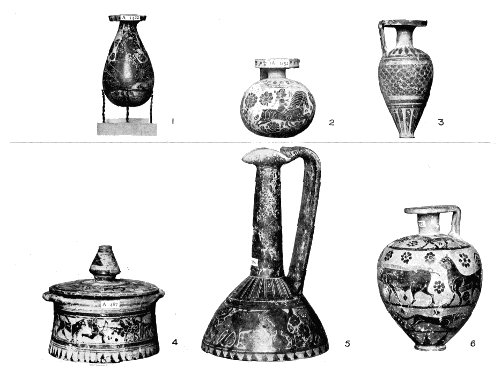
“Proto-Corinthian” and Early Corinthian Vases (British Museum).
1–3, 5, Early Corinthian; 4, 6, “Proto-Corinthian.”
The dominating form is that of the alabastron or lekythos,
a pear-shaped vase with flat round lip and flat handle. The
aryballos form is also known, as are the skyphos, pyxis, and a
small krater. A characteristic shape is the jug with flat base
rising in pyramidal form to a long cylindrical neck, with trefoil
lip and handle.[1027] The earlier group, although of “Corinthian”
technique, usually have only “Geometrical” ornament, such as
water-birds or simple patterns; hence they have been held, for
instance, by M. Pottier, to represent the true type of Corinthian
Geometrical pottery. But it does not seem that the Geometrical
style was ever popular at Corinth, and there are many signs that
the Proto-Corinthian fabrics were to a great extent influenced
directly by Mycenaean wares. The patterns, which are in black
monochrome, are on the smaller vases limited to bands, rows
of dots, or a kind of “tongue”-pattern of stylised leaves. The
Proto-Corinthian vases found in Aegina[1028] form in some respects
a class by themselves, being often of considerable size; they also
include some unusual varieties, such as cups, and even amphorae.[1029]
They usually have Geometrical decoration in the form of zigzags,
maeander, chevrons, triangles, or parallel rays; on the larger
ones are found friezes of animals, such as dogs pursuing deer,
bulls, or water-fowl.
[Examples of this class are: B.M. A 487, 1050 ff. (see Plate XVII.
figs. 4 and 6, XIX. fig. 1); Louvre E 13, 18, 32, 309, 375, 390, 396
(Atlas, pls. 39, 40); Berlin, 316–35; Ann. dell’ Inst. 1877, pls. C, D,
U, V; Ath. Mitth. 1897, pl. 7 (B.M. A 1530, of Aegina type).]
The second class is one of considerable interest. It consists
of a series of miniature vases, of which some twenty in all are
known, of the pear-shaped lekythos form, with minute but
skilfully-executed figures in a very advanced style. At their
head for beauty and delicacy of execution stands the exquisite
little Macmillan lekythos in the British Museum,[1030] a masterpiece
of its kind. There is also a fine specimen in Berlin (No. 336),
others in the Louvre[1031] and the Syracuse Museum (the latter
from the local excavations), and three very fine ones have
recently been acquired by the Boston Museum.[1032] But for size
and richness, if not for beauty, all these are surpassed by a
marvellous vase in the Chigi collection at Florence.[1033] This
is a jug or oinochoë, decorated with no less than four friezes,
two of which are broad, with numerous figures, the two alternate
forming narrow borders to these, with hunting scenes. The
colouring is most remarkable, the figures being painted in black,
yellow ochre, and bright crimson on a cream ground, with a
lavish use of incised lines, and on the upper narrow frieze the
animals are actually painted in pale buff on a black ground.
The upper large frieze represents a combat, with serried ranks of
warriors and horsemen advancing to meet each other, those on
the right all having elaborate emblems on their shields (birds,
ox-heads, Gorgon-heads, etc.). On the lower friezes the figures
fall into groups: a four-horse chariot and a row of boys on
horseback; a Sphinx; hunters slaying a lion; and lastly a
fragmentary group, clearly representing the Judgment of Paris
(see Chapter XIV.). It is the figures of this group which bear the
inscriptions alluded to above. As an instance of the extreme
richness and delicacy of the painting, attention should be called
to the chariot-horses in the lower frieze, which are drawn slightly
in advance of each other, and painted respectively yellow, black,
red, and yellow.
The Macmillan lekythos, in spite of its diminutive size, is
decorated with no less than three friezes of human figures and
animals, as well as other ornaments; the main design represents a
combat of warriors; the next, a race of boys on horseback; the
lowest, dogs pursuing a hare, and a crouching ape. The total
height of the vase is barely 2¾ inches, and yet every detail in these
friezes is marked with surprising care and accuracy, the shield-devices
of the warriors, for instance, being drawn with wonderful
minuteness. The three Boston vases are interesting for
their subjects: on one is Bellerophon slaying the Chimaera;
on the next, a hero attacking a lion with a human head on its
back (a monster no doubt suggested by the Chimaera); the
third has the favourite early subject of Herakles’ combat with
the Centaurs. In all these vases the use of a red colour on
the human figures should be noted, a technical device which
we have already noted in the figures on the Melian amphorae
(see above, p. 301).
It is abundantly clear that such work could not have been
produced in the eighth, or even the seventh, century; the style
is virtually that of the subsequent black-figured vases, and we
are therefore forced to the conclusion that these miniature vases
were made under the more or less direct influence of the later
Corinthian wares proper, at a time when that style was
developing into the black-figured.
With the Proto-Corinthian ware may be linked a series of
vases in the form of animals, human heads, etc., which imitate
Oriental porcelain vases and show an early development of the
plastic art which is remarkable for its advanced style (see
pp. 127, 492). The decoration of these vases is usually of a
simple Geometrical character. They are found in Rhodes and
on many other sites, such as Eretria, Vulci, and Nola.
2. Vases with incised imbrications.—The importance of this
class is betokened by the appearance of the incised line, which
as a matter of pure technique is of course only a revival from
the primitive fabrics, but as an adjunct to figure-decoration in
order to express details is an entirely new feature (see above,
p. 306, and below, p. 313). It was probably derived from
metal-work, in which it had long been familiar, as the Boeotian
Geometrical fibulae and the early Corinthian or Chalcidian
bronze reliefs testify. Although destined largely to revolutionise
design, it was at first used with restraint. In the vases under
consideration it is confined to the imbrications[1034] or scale-patterns
with which the body is largely covered (Plate XIX. fig. 3).
They were produced by means of a compass in which the graving-tool
was fixed, the edge of each scale forming an arc of a circle,
the centre points of which are usually visible. This scale-pattern
is not a new feature in the decoration of vases; it appears in a
painted form on many Mycenaean specimens,[1035] and was also
adopted by the Ionian painters of Daphnae in the Egyptian Delta
(see p. 352). But as a more satisfactory result was obtained by
incising, the Corinthian variety soon became exceedingly popular.
The effect is often enhanced by the use of red colour.[1036] In some
cases this ornament is combined with painted friezes of animals
(as in the Louvre vase E 421). The shapes employed are
various, but a new and conspicuous variety is the large jug or
olpe, with circular lip and large discs attached on either side to
the tops of the handles. Attempts have been made to dissociate
this fabric from Corinth, by attributing it to Rhodes, Ionia,
and Sicily[1037]; but although it is certainly true that large numbers
were found in Rhodes and in Sicily, the claims of neither prevail
over those of Corinth, and the most that can be said with any
certainty is that some are local imitations. It is, moreover, possible
to discover their prototypes in the Proto-Corinthian wares.
3. Vases with floral decoration, but no incised lines (about
700–650 B.C.).—Towards the end of the eighth century may be
observed an influx of Oriental motives, transforming the
Corinthian style, just as at Athens it transformed the local style,
producing the Phaleron ware. Its effect can also be observed in
Etruria (Chapter XVIII.). It is largely due to historical causes,
such as the development of Greek commerce and colonial expansion,
and generally to the fusion of Dorian and Ionian elements.
Hence the prominent characteristic which distinguishes the
new variety from the Proto-Corinthian; namely, the employment
of vegetable ornament, not from direct observation of nature,
but conventionalised. These patterns seem to be largely drawn
from Oriental textile embroideries, and mainly take the form of
rosettes, leaves, and flowers strewn all over the field; according
to some writers, this is the explanation of the phrase spargentes
lineas intus,[1038] used in connection with the Corinthian painters
Aridikes and Telephanes. Ground-ornaments are almost unknown
in Oriental art; but their adoption from the embroideries
would only exemplify the principle, universal in early art, of
imitating in one material the salient features of another. It has
been suggested that these flowers and leaves are intended to
represent the ground on which the animals are walking. If this is
so, the effect is due to a principle already existing in Mycenaean
art—the conventional rendering of perspective by placing objects
whose real position is beyond the principal subjects in the
same vertical plane with them. Another favourite pattern,
either as a ground-ornament or as part of the subordinate
decoration, is a combination of the palmette and lotos-flower,
picked out with purple accessories[1039]; this pattern is purely conventional,
and often assumes colossal dimensions in relation to
the size of the vase. The purple accessories, which now become
very common, may possibly be connected with another traditional
Corinthian invention, that of Ekphantos, who used
a red pigment made from pounded earth (see p. 395).[1040]
As regards shapes, the alabastron and aryballos[1041] are preeminently
popular; the flat-bottomed jug, the pyxis or covered
jar, and the skyphos or kotyle, are also found (see Plate XIX.
figs. 1, 2, 5). There arises now a tendency in the larger vases
to divide the body into zones or friezes, which henceforth
become a characteristic feature. The subjects are strictly
limited to animals such as the lion, or various types of birds;
and friezes of running dogs and other quadrupeds now become
the typical Corinthian motive.
PLATE XX
To face page 312
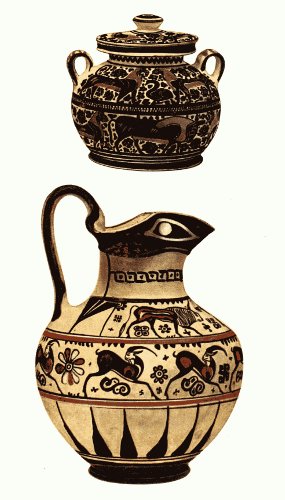
1. COVERED JAR OF CORINTHIAN FABRIC.
2. “RHODIAN” OINOCHOE.
(British Museum).
4. Vases with floral decoration and figures with incised
lines (about 650–600 B.C.).—In this next stage, the date
of which corresponds with the later trench-tombs and older
chamber-tombs of Etruria (see Chapter XVIII.), there is a
marked tendency of the vases to increase in size, and several
new forms are either introduced for the first time or increase
in popularity. Besides the ever-popular aryballos and
alabastron, there are various forms of covered jars, the
cylindrical pyxis, and the so-called lekane, a sort of tureen;
also various drinking-cups, the kotyle, the so-called kothon, and
the kylix, the last a new type. Its prototype is perhaps to
be sought in the shallow four-handled bowls of the Boeotian
Geometrical ware, and it is marked by its bent-over rim and
low foot.[1042]
The decoration loses all restraint, and the prevailing idea
with the artist is the horror vacui which impels him to fill up
every vacant part of the surface, at the expense of utterly conventionalising
his figures and ornaments and distorting their
forms (cf. Plate XIX. figs. 1, 5, and XX. fig. 1). The vases
contrast unfavourably with their Ionian contemporaries, in which,
however profuse the ground-ornaments, the importance of the
figures is never lost sight of, and they never fail to strike the eye.
Incised lines and purple accessories are employed freely, and
even the rosettes are always marked by cross-wise incisions.
Incision as a method of ornamenting vases was of course
always known from the earliest times, but it was not until now
employed within and round painted designs. Hitherto the only
alternatives were plain silhouettes (as in Geometrical vases) or
half-opaque, half-outlined figures (as in Mycenaean and some
early Ionian vases). The former, however, were too conventional,
the latter too elaborate, and the new method of painting plus
engraving reconciled the two, being at once more realistic and
more rapid. It is generally supposed that this method was a
Corinthian invention (compare its use in the imbricated vases,
p. 311), but it is not unknown in early Attic vases, and Böhlau
attributes its origin to an early Ionian tendency to imitate
metal ware.[1043] But this was an anomaly, and the Ionians
never took to the incising method, preferring outline designs
or inner lines of white paint (see p. 331). In any case the
Corinthians were the first to adopt it and popularise it.
The subjects, which now begin to present greater interest,
include all kinds of animals and monsters, arranged in friezes,
and by degrees human figures, and even scenes from mythology,
make their appearance. Some vases have only decorative
ornament, such as a flower of four long, pointed petals, which
is frequently found on the aryballi.[1044] The animals include the
lion, panther, boar, bull, ram, deer, goat, swan, and eagle; the
monsters are Gryphons, Sphinxes, or Sirens, and a sea-deity
of which the upper part is human (both male and female), the
lower is in the form of a sinuous fish-tail, and the figure is
often winged in addition.[1045] It is possible that in these figures
we may see the local sea-deities Palaemon and Ino-Leukothea.
The human figures are either single, ranged in friezes, or in
groups; the favourite types are combats of two warriors and
Bacchanalian dances; hunting scenes; and warriors setting out
in chariots. The mythological scenes include the combat of
Herakles with the Centaurs,[1046] and scenes from the Trojan War,
such as the combat of Ajax and Aeneas, or the episode of
Dolon.[1047]
So far, then, in the three groups of Corinthian fabrics proper,
we are able to trace the working of M. Pottier’s law of the
hiérarchie des genres,[1048] the law which was made by M. Dumont
the basis of his work Les Céramiques de Grèce propre (vol. i.,
dealing with the earlier fabrics). According to this law, the
decoration of vases advances by a logical process from linear
patterns to floral ornament, and then from animals to human,
and finally mythological, figures. Another feature in this group
is that inscriptions now appear for the first time. They became
exceedingly popular at Corinth, and on most of the vases with
figure-subjects they may be found, each person bearing a name,
whether the scene is mythological or not.[1049] The fashion seems
to have received an impetus from the chest of Kypselos, which
was largely a Corinthian work, and often shows close parallel
with the vases (see below). We have a signed vase with figures
in this style by Chares (Louvre E 609), and others by Timonidas
(Athens 620), and Milonidas (a pinax in Louvre).[1050] The abundance
of these inscriptions has done much to increase our knowledge
of the somewhat peculiar Corinthian alphabet (see
Chapter XVII.).
Among the vases of this period one of the most remarkable
is the so-called Dodwell vase in Munich (Fig. 90),[1051]
found at Mertese, near Corinth, about the year 1800, and purchased
by the explorer Dodwell. It is a cylindrical jar or box
(pyxis), with cover, decorated round the sides and on the top.
Round the body are two friezes of animals, with numerous
flowers as ground-ornaments; on the top of the cover is a
frieze representing a boar-hunt, in which eight fancifully-named
personages take more or less active part. Of these Philon lies
dead under the boar’s feet; Thersandros attacks it with a
sword in front, and Pakon discharges an arrow at it from
behind. Behind him Andrytas hurls a spear, and he is followed
by four inactive figures, all draped and unarmed—Dorimachos,
Sakis, Alka ... and Agamemnon. The scene is closed by
a heraldic group of two Sphinxes. It will be observed that
here, as in other contemporary scenes with human figures, the
ground-ornaments are already showing a tendency to die
out; perhaps under the influence of Ionia, where it was soon
discovered that they interfered with the effect of figures in
action. The alphabet of the inscriptions enables us to date
this vase about 650–620 B.C.
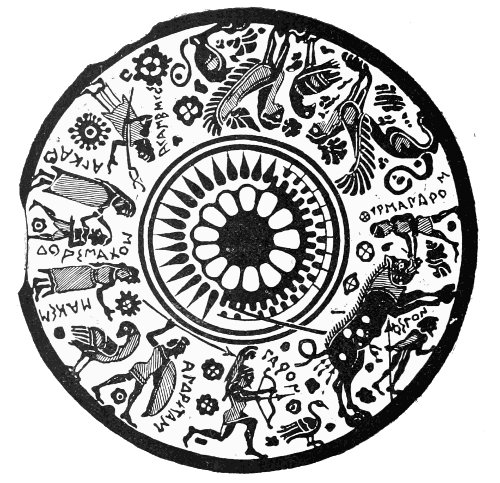
FIG. 90. THE DODWELL PYXIS (COVER).
The pinakes, or votive tablets, from Penteskuphia, of which
mention has been made elsewhere (p. 51), form an important
feature in this group, both from their subjects, their inscriptions,
and the method of painting. They appear to range in date
from 650 to 550 B.C., and fall into three classes in point of
style. The earliest have designs in rude silhouette without
incised lines; in the second only the contours of the figures are
incised; the third are like the vases, with incised lines and
purple details. In a few cases the clay is red, not drab-coloured.
Some are decorated on both sides, but the majority on one
only, and they were clearly intended for hanging up in a temple.
Two of them are signed by artists, Timonidas and Milonidas,[1052]
and there are other interesting inscriptions, besides the ordinary
dedications to Poseidon and Amphitrite (see Chapter XVII.).
The subjects are partly the same as on the vases, but the
majority fall under two heads: (a) Poseidon and Amphitrite,
standing or in a chariot (Fig. 115); (b) genre scenes from
Corinthian industries, such as miners digging out clay, potters
and painters at work, and vessels exporting pottery over the
sea (cf. pp. 207, 216, and Chapter XV. § 5). Of the subjects
common to the vases, Oriental animal-types and horses occur
most frequently; also rosettes and floral ground-ornaments.
PLATE XXI
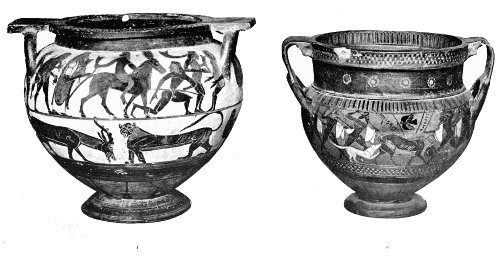
1. Imitation Corinthian Krater, Return of Hephaistos; 2, Corinthian Krater with Boar-hunt (British Museum).
5. The vases of the fifth class (600–550 B.C.) are characterised
by the prevalence of human and mythological subjects, with
large friezes of animals, a general use of incised lines, and an
absence of ground-ornaments. They are mostly of considerable
size, but small vases still continued to be made during
the sixth century, as is seen in the “Proto-Corinthian” lekythi.
The amphora and hydria now first make their appearance; the
later lekythi approach more to the Attic form.[1053] One or two
other typical shapes may also be noticed, such as the column-handled
krater (Plate XXI.) and the trefoil-mouthed jug with a
panel on one side of the vase only; the prototype of the former
we have seen in the krater of Aristonoös. Another important
feature is the general use of a red ground in the place of the
old creamy white; and yet another, the use of white accessories,
especially for the flesh of female figures. It should be noted
that this white is always applied directly on the clay, as in
Ionian fabrics, not as in the Attic, upon the black varnish.
We may bear in mind that it was about this time that the
Athenian Eumaros marem a femina discrevit, according to Pliny;
but his date is uncertain, and the bearing of this invention on
the vase-paintings is not to be accepted without hesitation.
For the faces of male figures purple is often used, and, generally
speaking, the vases tend to present a polychrome appearance.
This again is an Ionian characteristic.
The subjects now take a much wider range, and include
almost every variety known in the earlier part of the sixth
century. Friezes of animals seldom form the main motive of
decoration, but are placed in subordination either on the
shoulder or low down on the body. Some of the older types
still linger, such as the monsters and fish-tailed sea-deities, and
also that of a heraldic group of two animals with a palmette
and lotos pattern between, suggesting the old Assyrian motive
of two animals guarding the sacred tree. Generally, there is a
great advance in composition; but two traditional principles
are still observed—the juxtaposition of figures turned in the
same direction, as in Oriental compositions, and a symmetrical
disposition of the two sides converging to a centre, a “Continental”
principle already seen in the Dipylon vases. The
subjects taken from daily life include combats, banquets, Bacchic
or grotesque dances, hunting-scenes, warriors setting out for
battle, and processions. Some appear now for the first time,
as, for instance, the banquets. Among the mythological scenes,
Herakles and his adventures find most favour; scenes from the
Trojan cycle are far from uncommon; and other myths of more
isolated character are those of Amphiaraos, Perseus, and the
Theban cycle (Tydeus killing Ismene). Many of the mythological
scenes are really only genre scenes with names added;
for instance, the krater in the Louvre with Herakles’ reception
by Eurytos (E 635), is only an ordinary banquet-scene in
composition, but for the inscriptions; and so with many others,
as we have also observed in the preceding class.
It may suffice to describe one vase in detail as typical of
the later Corinthian wares. This is the so-called Amphiaraos
krater in Berlin,[1054] a column-handled krater of considerable
size and very richly decorated. It belongs to a series exceptionally
well represented in the Louvre (E 613–39; all found,
like this, at Cervetri), and illustrating the absolutely latest
development of Corinthian pictorial art. Its special interest
is that it affords a close comparison in several points with
the chest of Kypselos. The subjects are disposed in two
rows all round the vase, of which the upper is the more
important, containing two mythological subjects. These, which
are unequally divided, one occupying more of the circumference
than the other, are the Departure of Amphiaraos and the
Funeral Games for Pelias,[1055] the ἀγὼν ὁ ἐπὶ Πελίᾳ of Pausanias.[1056]
On the lower frieze are seven boys taking part in a horse-race,
seven groups of combatants, and two marching hoplites. It will
be noted that there is no frieze of animals.
The Amphiaraos scene depicts that hero in the act of
ascending his war-chariot, in which the driver Baton stands; he
turns to look at his family behind, consisting of two daughters,
a son, and an infant in the nurse’s arms, and last of all his wife
Eriphyle, who stands in the rear with the pearl necklace, the
price of her treachery. Her children seem to be supplicating
for her. In the background Amphiaraos’ house is indicated by
a Doric building. The correspondence of this scene with the
description of the Kypselos chest[1057] is extraordinary; the latter
might almost be a description of the vase. An interesting
feature of this painting is formed by the animals which are
scattered over the scene: a hare, a hedgehog, an owl and
another bird, a serpent, a scorpion, and a lizard or salamander.[1058]
The funeral games for Pelias adjoined the Amphiaraos scene
on the chest, just as they do here, except that the scene on the
vase is only an excerpt from the contest of the Pentathlon,
which is there complete. We have here only the wrestling (by
Peleus and Hippalkimos), and in place of the other scenes a
chariot-race, with the judges waiting to decide the result; as
on the chest, tripods are standing ready as prizes for the victor.
It must not, of course, be supposed that these scenes are
directly copied from the chest—the discrepancies are too great,
although the parallels are very interesting; but the only object
of such comparisons is to assist us to an idea of the appearance
of these great contemporary works of art.[1059]
One of the chief features of this class is the almost total
disappearance of the ground-ornaments. Sometimes indeed
a frieze of animals with the old profusion of rosettes is
combined on the same vase with a design of figures on a
clear field; but, generally speaking, rosettes are not found
with the figure subjects. Their place is almost supplied by
the inscriptions, which become more and more extensively
employed, even for animals. Accessory colours are used in
a purely conventional fashion, not to reproduce nature, but—probably—to
reproduce metal-work. Thus we may surmise
that white is intended to give the effect of silver (or ivory)
and red that of copper (or gold), just as such substances were
used on the chest of Kypselos in order to give variety and
picturesqueness to the surface. The black then represents the
ground of bronze or wood.
The sixth-century Corinthian vase-paintings have a special
importance at the present day, because they are almost the
only remnant left to us of the artistic products of the city
at that time.[1060] Though not of course to be reckoned as
examples of the higher art, they yet reflect it in some
measure, and help us to reconstruct such works as the chest
of Kypselos, almost every subject on which finds a parallel
in the Corinthian vases. And it is possible that they are
important in another respect. We know from Pliny that
there was a very influential school of painting centred at
Corinth in this century, which is represented by the names
of Kleanthes and Aridikes, Ekphantos, Aregon, and perhaps
also Kimon of Kleonae. Although Professor Robert[1061] has endeavoured
to show that the traditions are untrustworthy, and
places Kimon in the seventh century, Kleanthes later, the
probability is that they may fairly be upheld, and Pliny’s
dates accepted. Allusion has already been made to the inventions
traditionally associated with Aridikes and Ekphantos;
but Kimon belongs to a later development of painting
altogether, and must be reserved for a later chapter. Of
Kleanthes it is only stated that he “invented linear drawing,”
whatever that may mean; Pliny, our informant, was perhaps
hardly aware himself, and is no more definite as to the
period at which he lived. We can only, therefore, assume
that he marks the epoch of some new departure or advance
in contour or outline drawing.[1062]
PLATE XXII
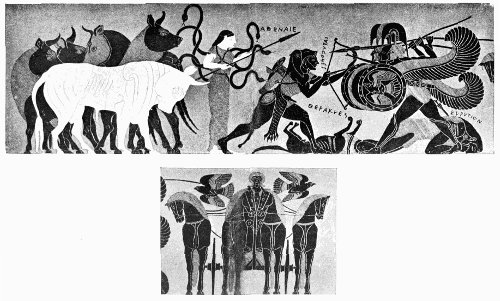
Chalcidian Vase: Herakles and Geryon; Quadriga (Bibliothèque Nationale).
There are a few vases which, on account of various
peculiarities, can only be described as “imitation Corinthian.”
Among these may be mentioned one with an inscription in the
Sicyonian alphabet (Berlin 1147), and a krater in the British
Museum (B 42 on Plate XXI.) with designs on a white ground,
which from the similarity of its style to the Berlin vase may
be linked therewith.[1063] The late F. Dümmler was of opinion that
these two vases were made at Sikyon. There is also the group
of vases from Caere in the Campana collection of the Louvre,
which have usually been regarded as imitations of Corinthian
ware made in Italy; but M. Pottier in his catalogue makes
no distinction between these and the genuine Corinthian
fabrics.
A very puzzling class of vases, about which little is at present
known, is that formed by the so-called Chalcidian group. They
are so named from the fact of their bearing inscriptions which
may undoubtedly be referred to the alphabet of Chalkis in
Eretria; but there is no evidence that they were actually
made there. We know, however, that Chalkis was a great
art-centre and rival of Corinth in the seventh and sixth
centuries, and was especially famous for work in metal. As,
therefore, more than one of these vases bears evident indications,
in the shape of the handles, the ornamentation, and
other details, of an imitation of metallic originals, there may
be some ground for the attribution. Only a dozen or so of
these vases with Chalcidian inscriptions are known, and
several of them are in character almost to be ranked with the
developed B.F. Attic wares; their date cannot therefore be earlier
than the middle of the sixth century, probably about 560–540
B.C. On the other hand, they often present a close
parallel, especially in the ornamental patterns, to the later
Corinthian wares,[1064] whence it seems probable that they form,
like the so-called Tyrrhenian amphorae (see below), a connecting-link
between Corinth and Athens. While as yet it is impossible
to obtain a definite idea of the characteristics of “Chalcidian”
vases, the attempt to classify other uninscribed vases with them
can only be very tentative, although there is more than one
in the British Museum, in the Louvre, and elsewhere, which
presents some feature especially typical of the inscribed
examples.[1065]
The prevailing shape is the amphora, all but one of the
inscribed group coming under this heading, in which the
outline of the body approaches nearer to a pure ellipse than
is usual in this form; the typical ornaments are rows of
oblique zigzags and a peculiar variety of the lotos-pattern.
An occasional rosette in the field preserves a trace of
Corinthian influence. The subjects are mainly mythological,
such as the combat of Herakles and Geryon, battle-scenes
from the Trojan legends, etc.; and two points are worth
noting as apparently characteristic of the group: (1) the
tendency to represent fallen figures in full face, which is very
rare in archaic vase-painting; (2) the type of Geryon, who is
winged, and not, as in the Attic vases, “three men joined
together,” as Pausanias describes the figure on the chest of
Kypselos, but a triple-headed, six-armed monster.
The most typical example of the class is the amphora in
the Hope collection at Deepdene,[1066] with scenes from the
Trojan War. Ajax stands over the body of Achilles, defending
it from the attacks of Glaukos, whom he has wounded,
and of Paris, who has just discharged his bow; behind the
latter advance Aeneas and two other Trojans with spears,
while a fourth falls back wounded. Achilles and the two
wounded men are all shown in full face.[1067] The combat is
watched by a stiff archaic figure of Athena, with serpent-fringed
aegis, and behind her, standing apart, is Diomede,
having his wounded hand bound up by Sthenelos. The
drawing on the whole is accurate, and the style more
vigorous and less conventional than that of the Attic vases.
Two of the group represent Herakles encountering Geryon:
an amphora in the British Museum (B 155) and one in the
Bibliothèque at Paris (202). In the latter the figure of Athena
is almost exactly repeated from the Deepdene vase, and behind
her is a group of cattle. The reverse of this vase represents
a quadriga seen from the front (a typical Chalcidian subject).
Both sides of the vase are illustrated in Plate XXII.
Until the whole series of Chalcidian vases is properly studied
and estimated,[1068] it is difficult to give an adequate account of
this important group; we append, however, a list of those
bearing inscriptions in the alphabet, and a few others for
various reasons associated with them.[1069]
There is a large and important class of vases, not differing
in technique from the Attic B.F. vases proper, yet clearly of
earlier date, and while not exclusively Attic in all their
characteristics, yet sufficiently so to suggest that they are
closely connected therewith. The problem which these vases
have for a long time presented is whether they merely represent
an early stage of the Attic B.F. fabrics, linking them to the
“Proto-Attic,” or whether they owe their origin to foreign, e.g.
Corinthian, sources.
About eighty vases, nearly all amphorae, have been recognised
as presenting the characteristics of this class, and all have
been found in Italy, chiefly at Cervetri and Vulci; hence they
have been known for many years. As long ago as 1830 the
name “Tyrrhenian amphorae” was applied to them by Gerhard,
meaning thereby a sort of cross between Greek vases proper
and those of obviously Italian origin. The name has adhered
to them, and was also used generally to describe the characteristic
form of amphora, with its cylindrical neck and egg-shaped
body[1070]; but it was not long before it began to be realised that
the vases bore inscriptions in the Attic dialect, and, further, that
the subjects on them had much in common with the later
Corinthian fabrics. Thereupon sprang up the idea, fostered by
Loeschcke,[1071] that the vases were made by Athenian potters, but
that they were largely indebted to Corinthian—or, as Loeschcke
called them, Peloponnesian—prototypes.[1072] For the last ten
years or so they have been generally known as “Corintho-Attic,”
but Thiersch, the most recent writer on the subject,[1073] reverts
to the old name of Tyrrhenian, using it of course in a purely
conventional sense. His conclusion is that the class is to be
regarded as “old Attic,” rather than imitative of Corinthian,
and he shows clearly that it must be regarded as a development
of the Vourva vases (p. 299), as will be seen from an
examination of the vase given in Fig. 89, p. 299; but that it is
entirely free from Corinthian influence can hardly be maintained.
We have seen that the Vourva class borrowed from Corinth
the friezes of animals which are also characteristic of this
group, and it is possible that this influence continued to make
itself felt. At all events, this ware belongs to the first half
of the sixth century B.C., and stands in close relation to the
François vase, and others which represent the earliest school of
Attic B.F. artists. Its specially Attic characteristic are, according
to Holwerda, (1) the inscriptions, (2) the clay, (3) the types
of the lotos and other ornaments, (4) the importance given to
one subject, (5) the thin proportions of the figures.[1074]
PLATE XXIII
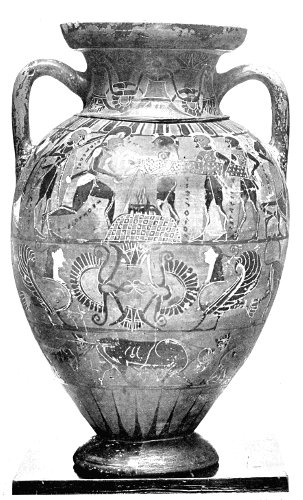
“Tyrrhenian” Amphora: Death of Polyxena (Brit. Mus.).
The vases are for the most part decorated in the same manner,
with an elaborate lotos-and-honeysuckle pattern on either side
of the neck, and several friezes of figures, usually three, covering
the body, of which all but the principal one are composed of
animals or monsters. The principal frieze is always the upper
one, covering the body from the neck to the middle. The
friezes are more numerous on the earlier examples; they become
fewer as Corinthian characteristics give way to Attic. Altogether,
these vases are remarkably homogeneous, both in style,
in shape, and in technique, and it has even been suggested
that the whole series is the work of one man; nor is this an
impossibility.
An interesting feature is formed by the inscriptions,[1075] which
are of frequent occurrence. They tend, however, to degenerate
into meaningless collocations of letters, which some have thought
to represent Corinthian inscriptions misunderstood; but the
alphabet is pure Attic throughout, except for the double forms
on the Berlin amphora (see below), and a Chalcidian
 for Γ
on a vase in the British Museum. The artist is fond of giving
his figures surnames, and thus we find Hermes styled
Κυλλήνιος, “of Kyllene,” Nestor Πύλιος, “of Pylos,” and Ajax
[Ὀ]ιλιάδης, “son of Oileus,” a feature which hardly occurs on
any other class of vases. The meaningless inscriptions are
not easy to account for; certain groups of letters are repeated
over and over again, and it has been suggested by Thiersch
that they are analogous to the friezes of animals, with their
repetitions and combinations. They also seem to serve a
decorative purpose by filling up spaces.
for Γ
on a vase in the British Museum. The artist is fond of giving
his figures surnames, and thus we find Hermes styled
Κυλλήνιος, “of Kyllene,” Nestor Πύλιος, “of Pylos,” and Ajax
[Ὀ]ιλιάδης, “son of Oileus,” a feature which hardly occurs on
any other class of vases. The meaningless inscriptions are
not easy to account for; certain groups of letters are repeated
over and over again, and it has been suggested by Thiersch
that they are analogous to the friezes of animals, with their
repetitions and combinations. They also seem to serve a
decorative purpose by filling up spaces.
The subjects are mainly mythological, with many features
of interest. For several the artist seems to have had a decided
preference, such as the combats of Herakles with Amazons
and with the Centaur Nessos, that of the Lapiths with the
Centaurs, the adventure of Troilos and Polyxena from the
Trojan legends. Bacchic scenes are altogether wanting, but
on many examples a Corinthian type is adopted in their place,
representing grotesque dancing figures in various attitudes.[1076] Of
scenes from daily life, combats of armed warriors and young riders
galloping prevail above all others; the latter are, as on the
Caeretan hydriae (p. 355), little more than decorative. Generally
speaking, it is doubtful if Loeschcke’s idea of types borrowed
from the Peloponnese can be maintained; it is true that
some scenes which occur on the chest of Kypselos may be
found, but the treatment is not quite the same; and some
subjects seem to be rather from an Ionic source. The animals
or monsters which form the subordinate friezes include the
Sphinx and Siren; the lion, panther, goat, and deer; the eagle,
swan, and cock.[1077]
Some of the vases call for more than passing mention,
especially the remarkable Berlin vase (Cat. 1704) with the Birth
of Athena, and the richly decorated specimen recently acquired
by the British Museum, with the Death of Polyxena. The former
seems to be the earliest example of its subject, and in the
number and arrangement of the figures it resembles the fine
early Attic amphora in the British Museum (B 147). Its chief
interest is epigraphical, in the use of the double forms (Corinthian
and Attic) in the same word of the letters E
( )
and Κ (Ϙ).[1078]
Over the figure of Hermes is written Ἑρμῆς εἰμὶ Κϙυέλνιος
(sc. Κυλλήνιος), as already noted above. This vase may be
regarded as having established the “type” for the subject
so long popular on Attic vases, until Pheidias created a new and
more ideal version.[1079] The Museum vase (Plate XXIII.) has a very
remarkable representation of a subject rare in Greek art, with
several unique features.[1080] The body of Polyxena is carried in
a rigid horizontal position by Ajax Iliades (sc. son of Oïleus)
and two others, to the tomb of Achilles, over which Neoptolemos
stands to perform the fatal deed. Phoenix, Diomede, and
Nestor “of Pylos” are spectators of the act.
)
and Κ (Ϙ).[1078]
Over the figure of Hermes is written Ἑρμῆς εἰμὶ Κϙυέλνιος
(sc. Κυλλήνιος), as already noted above. This vase may be
regarded as having established the “type” for the subject
so long popular on Attic vases, until Pheidias created a new and
more ideal version.[1079] The Museum vase (Plate XXIII.) has a very
remarkable representation of a subject rare in Greek art, with
several unique features.[1080] The body of Polyxena is carried in
a rigid horizontal position by Ajax Iliades (sc. son of Oïleus)
and two others, to the tomb of Achilles, over which Neoptolemos
stands to perform the fatal deed. Phoenix, Diomede, and
Nestor “of Pylos” are spectators of the act.
The style of the vases as a whole is coarse and clumsy,
though it often rises to a greater standard of merit; the lines
are often mechanically drawn and lifeless, which may be to
some extent the result of imitation. Details of drapery are
seldom shown, except that the dresses are often richly decorated
with incised patterns, but the folds are never indicated.[1081]
General characteristics—Classification—Mycenaean influence—Rhodian
pottery—“Fikellura” ware—Asia Minor fabrics—Cyrenaic vases—Naukratis
and its pottery—Daphnae ware—Caeretan hydriae—Other
Ionic fabrics—“Pontic” vases—Early painting in Ionia—Clazomenae
sarcophagi.
Having traced the history of vase-painting in Greece Proper
down to the middle of the sixth century B.C., the point at which
a tendency towards unification of style becomes perceptible,
we must now turn our attention to the remains of the art on the
other side of the Aegean, among the representatives of the
Ionian race and in the centres of Ionian influence. To a
certain extent it is difficult to treat the subject at all in a
handbook, as, owing chiefly to want of material, the existence
of an Ionian school of vase-painting has only been realised of
late years, and it is as yet too early to sift proofs from theories,
or to give a succinct and systematised account of the development
and achievements of this school. The most that can be
attempted is to present the reader with a review of the accumulated
materials, and to point out what groups of vases may be
regarded as exhibiting “Ionian” characteristics, or at all events
such as permit of their being connected together.[1082] It must be
borne in mind that some of these fabrics, such, for instance, as
the Rhodian wares, have not actually been found in Ionic
settlements; in other words, the name Ionian is to be applied
to certain styles or schools, in the main associated with that
race, apart from considerations of ethnography.
On one point scholars are in general agreement—namely,
that Ionic art is a direct survival of Mycenaean. This was
recognised as long ago as 1879 by Furtwaengler[1083] and by
Lenormant,[1084] who pointed out that the silver cauldron dedicated
by King Alyattes at Delphi must have been quite Mycenaean
in character, although not earlier than the seventh century.
It was decorated with aquatic animals and plants. There
was in Ionia no disturbing element, such as the Dorian
invasion introduced into Europe, between Mycenaean culture
and the spread of Oriental influences. The Greek cities in
Ionia owe their origin to that upheaval, but their culture was
not affected by it; and their founders brought their Mycenaean
civilisation with them fresh from Greece to their new homes
in Miletos, Ephesos, Phocaea, Chios, and Samos. This was in
the eleventh and tenth centuries B.C., and the Panionion, or
union of Ionian cities, lasted down to the sixth century (when
it was broken up by the Persian invasion), besides stretching
out its feelers over the Mediterranean, to the Egyptian Delta
and elsewhere. The actual centres of pottery-manufacture are
not, however, easy to determine, and much may depend on the
results of future excavations. That there was more than one
is fairly obvious, and it will probably appear that Clazomenae,
Miletos, and perhaps Phocaea, played the most important parts.
As regards the characteristics of the Ionian wares, a rough
division may be made into two classes, corresponding to the
buff-clay and red-clay Corinthian wares respectively. In the
earlier, the vases are always covered with a creamy-white or
drab-coloured slip, on which the figures stand out in lustrous
black paint.[1085] The most typical fabric is that of the Rhodian
wares, found in such large quantities in that island, but not
necessarily made there. In the later group the place of the
white slip is taken by a red coating or glaze similar to that of
the Attic and later Corinthian wares, but somewhat brighter.
The principal subdivisions may be classified as follows
(the arrangement is M. Pottier’s, with one or two small
differences):—
2. Samian and “Fikellura” wares.
[1087]3. Asia Minor fabrics:
4. Vases found in the Crimea.
[1095]6. Clazomenae sarcophagi.
[1097]
II. 1. Cyrenaic wares.
2. Daphnae wares.
3. Caeretan hydriae.
4. So-called “Pontic” vases.
5. Developed B.F. Ionian fabrics from Clazomenae, Kyme, Naukratis, Rhodes, etc.
6. Italo-Ionic vases of the decadence and Etruscan imitations.
[1098]
The subdivision between the earlier and later fabrics is,
roughly speaking, between those with white and red ground,
and between those in which ground-ornaments are used or not.
Generally speaking, all the second class have more in common
with the Attic B.F. vases than with “primitive” fabrics.
Before proceeding to the consideration of these fabrics in
detail, it may be as well to note some of the general characteristics
of Ionian pottery. In the use of incised lines and
accessory pigments we may note two points: firstly, the absence
for some time of any attempt at incised lines, their place being
taken partly by contours drawn in outline on the clay; secondly,
the use of white lines or patches for details. The incised
lines, when they do appear, seem to be derived from Corinth.
We may, perhaps, detect their arrival in the vases with imbrications
(see p. 311), which were imported thence to Rhodes; but
another theory is that they were derived from engraved work
in metal. Practically their place had been, and to some extent
continued to be, taken by the white paint, which, be it noted,
is obviously a Mycenaean survival or revival.[1099] It frequently
occurs on the pottery of Ialysos and Enkomi, in precisely the
same manner as we see it used in Rhodes or on the sarcophagi
of Clazomenae. Sometimes both the incised lines and the
white-paint details are found on the same vase, as is seen in some
of the Rhodian jugs, or on a pinax from Naukratis.[1100] The white
pigments are usually laid directly on the clay, not on the black,
as at Athens. They are used for flesh tints, but not to distinguish
sex (cf. the Caeretan hydriae, p. 355, where men are
painted white, as on the Melian vases they are yellow).
As regards the ornamentation, the persistence of Mycenaean
motives is exceedingly remarkable.[1101] It is seen especially in the
fabrics of Rhodes and Naukratis, with their wealth of ground-ornaments,
and is found not only in the more conventional
motives such as spirals, or scale-pattern, but also in the
vegetable patterns. There is generally in the floral decoration
of the vases a tendency towards the naturalism of Mycenaean
pottery. Animals, when decoratively treated, are usually
arranged in long friezes, contrasting with the Corinthian method
of grouping them heraldically in pairs.[1102] In the human figures
Oriental influence is frequently prominent, as in the hybrid
beings which so often adorn the vases, or in such types as the
“Asiatic Artemis”; or, again, in small details, the conical
caps and shoes with turned-up toes, which recall the figures
on the monuments of Lydia and Phrygia. Oriental costumes
generally are reproduced with great fidelity. As a rule the
proportions are gross and heavy, as compared with the slimness
of figures on Attic vases, wherein a curious contrast may be
observed with the characteristics of Ionian and Continental
architecture and sculpture, in which these features are reversed.
There is, moreover, a conspicuous absence of stiffness in the
Ionian compositions—rather, a remarkable freshness, vigour,
and originality quite in advance of their time. Another point
of contrast with the Attic vases is the absence of any differentiation
of the sexes in the shape of the eye, which is always oval
(cf. p. 408).
In the choice of subjects the same law may be observed to
prevail as in the Corinthian wares—that of the hiérarchie des
genres. Mythological subjects appear first about the middle
of the seventh century, in the Euphorbos pinax. Later we
find actually scenes of a quasi-historical character, as in the
battle-scenes on the Clazomenae sarcophagi and the Cyrenaic
Arkesilaos vase. Throughout there is a remarkable absence of
inscriptions, which are only found at the most on some half-dozen
vases. The height of the Ionian style may be said to
have been reached in the seventh century, lasting up to about
the middle of the sixth; thence there is a rapid downfall, due
mainly to historical causes, and the traces of its influence are
only to be sought in Italian imitations of an inferior kind, and in
some of the Attic black-figured vases, such as those of Amasis
and Nikosthenes.
But the influence that was exercised during all this period by
Ionian art in general on Greece is not easy to estimate; it is
not confined to the pottery, but is found in sculpture and architecture
as well as the minor arts. There are numerous passages
in ancient writers bearing on the activity of early Ionian artists,
such as Theodoros and Rhoikos of Samos, and their works,
which often took the form of offerings of Asiatic princes to the
Greek temples. The Ionic school of sculpture, illustrated by
the early temple at Ephesos, the “Harpy” Monument, and other
notable works, as well as the great Amyclaean throne, which
Bathykles of Magnesia was commissioned to erect, established
the fame of early Greek sculpture in no small degree; and
Ionic architecture, though slower to win its way to favour in
Greece Proper, reached a high degree of excellence at an early
period on the eastern shore of the Aegean. Of painting in
Ionia, apart from the vases, we propose to speak later. In
literature and in civilisation generally Ionia was, up to the
middle of the sixth century, far more advanced than any part
of the Greek mainland.
The distinctive pottery of Rhodes,[1103] which, whether of local
manufacture or not, is found almost exclusively in that island,[1104]
represents the union of Mycenaean elements with a new feature,
that of Oriental influence. Although primarily due to the
dispersion of the Phoenicians by Assyria in the eighth century,
this Orientalising of Ionia is purely artistic and industrial, not
political, and is due to the commercial activity of the Phoenicians.
The pottery represents a sort of transition between Assyrian
and Greek decorative art, the essentially Greek elements in
which are a survival of Mycenaean ornaments and a Mycenaean
faculty of observation of nature, especially in the
animal world. From the East were derived such features as
hybrid monsters (the Sphinx, Siren, etc.), animals such as the
lion, isolated motives like the lotos-flower and the rosette, and
generally a tendency to imitate textile fabrics with long
bands of decoration, in which the ground is strewn with these
rosettes and other ornaments. We have already seen that
these features also made their mark on the Corinthian style,
but they are more especially characteristic of Rhodes. Human
figures are exceedingly rare.
In regard to the shapes a great advance is made towards
the classical types; the parts of the vase are more clearly distinguished,
and the forms are few and consistent. The special
Rhodian shape is the oinochoë, a large jug with trefoil lip and
spherical body, decorated with two or three friezes of animals
(see Plate XX. and p. 177); next in popularity is the circular
plate or pinax. The ornamentation is always in lustrous black
paint on the characteristic white or drab-coloured slip, with a
free use of purple for details. White is little used as an accessory—there
seems to have been a prejudice against its use
when the ground of the vase was also white—but incised lines
occur more freely. On the other hand, the heads of animals
are almost always outlined in black on the clay ground, a
feature derived from Mycenaean pottery, and interior details
are also frequently left in the ground of the clay, as in the
Geometrical style. We have already mentioned instances in
which the two methods are found on the same vase.
The typical Rhodian oinochoae, like the contemporary Corinthian
vases, owe much to the imitation of the textile embroideries
of Assyria, of which we have already spoken under the
other head (p. 312). These had become familiar in Rhodes
through the agency of the Phoenicians, but it is also possible
that the Ionians were themselves proficient in this industry.
The bands of lotos-ornament and friezes of animals also appear
on the porcelain vases found in large numbers at Kameiros (p. 127),
which are sometimes most elaborately ornamented, and are
clearly of Phoenician origin; the seventh century was, in fact,
the time when the Greek world was most dominated by Oriental
influences.
The ornamental patterns on the vases of this class fall under
two heads—the smaller independent ground-ornaments, and the
more elaborated bands of vegetable ornament. The former are
best illustrated by the Euphorbos pinax, presently to be described;
in contrast to the unvarying Corinthian rosette, they show a
considerable variety of treatment, and are partly variations on
the rosette theme, partly geometrical, like the fragments of
maeander, or crosses with hooked arms, which recall in form
the ubiquitous swastika. The band of lotos-flowers and buds
actually occurs at a much earlier date in Boeotia, as we have
seen, but it is at Rhodes that it first assumes the characteristic
Greek form. On the pinakes a development of this motive,
forming a fan-shaped combination of radiating leaves, is usually
employed to fill in the “exergue” below the designs; a similar
ornament is found on the black wares with incised patterns,
and it is the forerunner of the pear-shaped radiations painted
on the small bowls of a more recent date.[1105]
A typically Ionian motive is the plait-band, found at Naukratis
and on the Clazomenae sarcophagi, and introduced from Assyria.
The Mycenaean spiral, so prominent in Attica and Melos, retires
into the background, or loses its geometrical significance, and
becomes a mere vegetable motive, an adjunct to the floral
combinations of bud and flower. The Rhodian vases are, in
fact, the first in which spiral motives were freely used for
calyx-ornaments, as, generally speaking, they were the first in
post-Mycenaean times to raise floral motives from mere ground-ornaments
to independent decoration.[1106]
The series of pinakes yield the most interesting examples
of Rhodian vase-painting; they are usually decorated with a
figure of a ram or other animal on a large scale (Plate XXIV.),
the exergue or lower portion of the field being filled in with
a suitable pattern, such as a sort of fan-pattern of spreading
rays or fronds (see above), or a free variation of the Egyptian
lotos-flower. But one is of surpassing interest and importance,
the famous Euphorbos pinax as it is generally called, which
was found at Kameiros, and is now in the British Museum.
The subject is the combat of Menelaos and Hector over the
body of Euphorbos,[1107] a scene from the Iliad, but not reproduced
in accurate detail, as, indeed, is seldom the case in archaic art.
The figures are drawn partly in outline, with a lavish use
of purple for details, and the whole of the ground is filled
in with various ornaments, rosettes, etc., one at the top of the
scene taking the form of a pair of eyes, with a conventionalised
floral pattern between. Additional interest is given to the
design by the fact that the figures are named, the words being
in the Argive alphabet (see Chapter XVII.).
This inscription does not necessarily affect the question of the
place of fabric of the pinax, as it has been shown that the
Argive alphabet was used in Rhodes in the seventh century[1108];
but it enables us to fix its date about B.C. 650, and the whole
of the Rhodian ware may be regarded as belonging to the
seventh century. It has, indeed, been suggested that the subject
is copied from an Argive metal relief, and this might account
for the unexpected presence of an inscription.
As to the place of fabric of Rhodian ware generally, it has
been more than once suggested that it is to be sought, not
in Rhodes, but in the neighbouring Ionian city of Miletos.[1109]
Dümmler’s theory of an Argive origin, resting as it does
almost exclusively on the Euphorbos inscriptions, is practically
negatived by the absence of any similar pottery in the extensive
finds at the Argive Heraion. Miletos, however, was in close
connection with Rhodes, and in favour of the argument is the
remarkable parallelism of the pottery of Naukratis, which was
undoubtedly in close association with Miletos; it was, in fact,
first colonised by Milesian Greeks, and the Milesian Apollo
was worshipped there. But further evidence is needed before
this view can be regarded as other than a mere hypothesis.
At all events, no convincing argument has as yet been urged
against the pottery being of local manufacture. In date, as
has been said, it covers the seventh century, being thus contemporaneous
with the Melian and earlier Corinthian fabrics.
PLATE XXIV
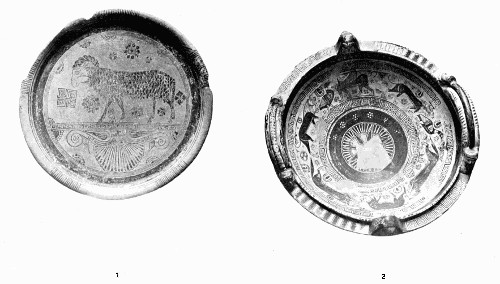
1. Pinax from Rhodes; 2. Bowl from Naukratis (British Museum).
In one of the extensive cemeteries of Kameiros, known as
Fikellura, there were found quantities of a class of pottery
which has since been generally known by that name, but is
probably not a local fabric. It has also been found in large
numbers in the island of Samos,[1110] where Rhodian vases are
comparatively rare, and owing to this more recent evidence the
ware has been regarded as probably of Samian origin. Several
specimens were also found on another Ionian site, that of
Daphnae in the Egyptian Delta, but are quite distinct from
the local fabric of that place. The date of the tombs in
Samos is the second half of the sixth century, and it is noteworthy
that from the ornamentation of these vases all Oriental
influence has disappeared. On the other hand, they seem to
represent the last lingering vestiges of Mycenaean influence.
The majority are in the form of amphorae, but other forms,
such as jugs and lekythi, are known. The technique is that
of the Orientalising vases, with the typical Ionian creamy-white
slip; the black has a tendency to become brown, or
even red, and purple accessories are employed. Incised lines
do not appear, but details are marked by spaces left in the
ground of the clay. The subjects are simple in character and
arrangement, usually one or two animals (or sometimes human
figures) on either side of the body, the spaces being filled in
with palmettes, spirals, or other ornaments. The ornamentation
is strikingly characteristic, especially the network patterns on
the necks of the vases, the scale-patterns, and the bands of
crescents which we also find in use in Lesbos and at Daphnae.[1111]
They form altogether a clearly-distinguished group, but sometimes
show signs of late date, if they are not actually to be
regarded as archaistic. Examples are given in Fig. 91.
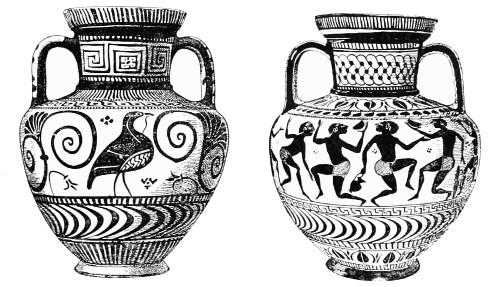
FIG. 91. VASES OF SAMIAN OR “FIKELLURA” STYLE (BRITISH MUSEUM).
The system of decoration is curiously reminiscent of the
Mycenaean vases,[1112] as exemplified in the great prominence
given to the ornament as the main decoration, the scrolls and
palmettes recalling the seaweed and other vegetable patterns
on the former. This prominence of ornament is always an
Ionian characteristic, retained as late as the Caeretan hydriae
(p. 354), with their bold bands of palmettes and lotos-flowers
round the very centre of the body. The scale-patterns, another
Mycenaean legacy, we shall meet with again at Daphnae, where
similarly they cover the most prominent part of the vases.
The most representative series of Fikellura vases is that in
the British Museum, from Rhodes, Naukratis, and Daphnae;
there are also some in the Louvre (A 321–34).[1113]
Dr. Böhlau, in his treatise on Ionian pottery,[1114] discusses as a
class certain vases which, in accordance with his theory, he
terms “Later Milesian.” At all events, they demand attention
from the remarkable way in which they combine Ionian and
Corinthian characteristics, sometimes, as we have seen, on the
same vase. They have been found in Rhodes, Naukratis, and
Italy, but the place of their manufacture is variously assigned
to Corinth, Naukratis, and Miletos.[1115] An oinochoe found in
Rhodes, with the incised lines in one animal-frieze and the
details left in the colour of the clay or shown in black outline
in the other, seems to incline to an Asiatic origin, at least as
regards its shape[1116]; on the other hand, the fine krater in the
Louvre[1117] is of a form more usually associated with Corinth.
The upper half of the latter is Corinthian in style, the lower
Rhodian, and thus there is not much to choose. But on the
evidence adduced by Dr. Böhlau[1118] it would seem to be more
probably of Ionian fabric. It may be that further evidence
will enable us to assign these vases of mixed style to Naukratis,
always a meeting-place of styles or fabrics; but it has not as
yet been definitely ascertained to what extent the earlier fabrics
of that place are local in origin. Meanwhile, the group is one
that fully deserves separate consideration. Dr. Böhlau points
out that it is characterised by the half-palmettes at the handles
of the vases, by the Mycenaean-like spirals, and the inferior
careless ground-ornaments, and generally by its deviations from
the normal Rhodian types.
The black ware with patterns in purple and white and incised
lines which has been mentioned as found in Rhodes is regarded
by Böhlau[1119] as Aeolic. It is, as we shall see, paralleled at
Naukratis by wares which there is good reason for regarding
as of Lesbian origin. The typical form of decoration, the
fan-shaped palmette, also occurs at Daphnae. In any case
there is clearly an attempt at the imitation of metal vases,
the polychrome colouring being intended to reproduce the
effect of bronze inlaid with gold and silver. But before it can
be established as an Aeolic fabric more results must be obtained
by excavation in that part of Asia Minor.
In various places on the mainland of Asia Minor (see
p. 62) vases of early fabric have been found, about which
at present little is known, except that they usually show
some points of comparison with the recognised Ionian fabrics,
and may therefore be regarded as of local manufacture, or at
least from some place on the coast of Asia. An attempt has
indeed been made by Böhlau to recognise in these also an
Aeolic fabric, centring in the neighbourhood of Kyme and
Myrina. An example is to be seen in the remarkable vase
found at Myrina,[1120] with the bust of a man painted in outline,
which resembles in shape the Fikellura vases, and is probably
intermediate between the Rhodian and this fabric. Similar
pottery finds have been made at Larisa, at Pitane, and in
the Troad. At Larisa and Myrina Böhlau notes vases of
the earlier Rhodian style, and at Larisa others which show a
distinct independent derivation from Mycenaean pottery, especially
in the ground-ornaments. On the site of Troy Dr.
Dörpfeld found fragments of pottery of a Rhodian type with
ornaments of pear-shaped leaves, such as occur on late sixth-
century bowls from Kameiros[1121]; also a vase with a female head
resembling that from Myrina, and another of Naucratite character.
There appears to have been a local fabric in the sixth
century—or perhaps even later—of flat bowls with bracket-handles,
on which are painted figures of birds, etc., in coarse
black pigment without any incised lines or accessories; a series
of these is in the British Museum, and others were found by
Dr. Dörpfeld (see above, pp. 61, 259).
In Caria the Ionian style is represented by finds at Stratonikeia
and Mylasa,[1122] with ornamentation of Mycenaean character,
which appears to have reached a similar stage of development
to the earlier Graeco-Phoenician vases from Cyprus; many
analogies may be noted. That the Mycenaean influence was
strong in Caria is also shown by the pottery of transitional
character found by Mr. Paton at Hissarlik.[1123]
At Temir-Gora (Phanagoria) in the Crimea a vase was found
in 1870 with paintings in brown on buff ground, representing
a hare-hunt, panthers, and other animals.[1124] The style has
evident affinities to that of the “Rhodian” vases, and
Phanagoria being a Milesian colony, this is only natural.
But it seems to be a local product, not an importation; the
panther, for instance, is unknown on Rhodian vases proper.
The fabrics of the Ionian school are not confined to Asia
Minor as regards their place of origin. In the Greek colonies
which were founded in Africa in the seventh and sixth
centuries we find evidences of great industrial activity, and in
some cases extensive remains of painted pottery, which exhibit
a close connection with the fabrics more closely associated with
Asia Minor. There is, however, one group of vases which
seems to stand by itself, and which, though it may be ranked
with the Ionian fabrics from its use of the white slip and
from the original naturalistic treatment of the subjects, yet
shows a marked independence both in technique and in
decoration.
The vases grouped under this head have been found chiefly in
Etruria, but more recently several examples have come to light
in the Ionian colony of Naukratis in the Egyptian Delta and in
Samos.[1125] As long ago as 1881 it was proposed by Puchstein to
connect them with the Theraean colony of Kyrene on the north
coast of Africa, on the ground of the subject depicted on the
finest and most remarkable of them—the Arkesilaos cup of the
Cabinet des Médailles at Paris. When, however, the Naucratite
specimens turned up, it was thought that they might after all
be a local fabric of that colony, especially as that place was
known to have had a close connection with Kyrene, whence
about 570 B.C. came the queen of Amasis, who was a great
benefactor to Naukratis. But to urge only one of the opposing
arguments, there seems to have been little or no export of
pottery from Naukratis, although imported specimens have
been found there of almost every early fabric known. It was
reserved for the ingenuity of Dr. Studniczka[1126] to identify a
scene on a fragmentary cup found there with the figure of the
nymph Kyrene, the patron goddess of that city, and thereby
to establish definitely the origin of this class. Curiously enough,
no remains of the early colony of Kyrene have ever been discovered;
but when, if ever, they are brought to light, it may
be confidently hoped that further evidence will be obtained.
The Cyrenaic vases, as they are now generally styled, are
for the most part kylikes of a slender and graceful form,
owing much apparently to metal originals, as indicated by
the use of palmettes at the ends of the handles, and by their
form and ornamentation in general. The designs are painted
in black on a slip varying in tint from deep buff to a pale
cream-colour, with firmly-drawn incised lines and a plentiful
use of purple for details. The drawing is remarkably spirited,
and the subjects mostly marked by naïveté and freshness. The
popularity of mythological scenes is remarkable; we find
representations of Zeus, Atlas and Prometheus, Kadmos, Pelops,
and other heroic figures, besides the remarkable vases which
deal with local legend and history.
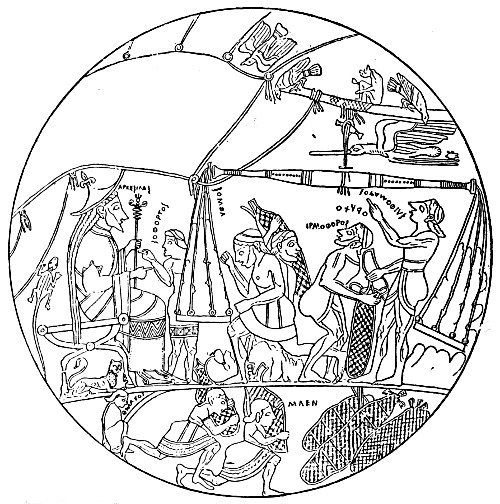
From Baumeister.
FIG. 92. ARKESILAOS OF KYRENE SUPERINTENDING HIS COMMERCE
(FROM A KYLIX IN THE BIBL. NAT.).
The Arkesilaos vase[1127] (Fig. 92) demands something more than
a passing description. It represents the king of Kyrene superintending
the weighing of the silphium-plant, which was a
valuable source of his revenue. Although there were four sovereigns
of that name, the choice is practically limited to one, the
second of the name, who reigned about 580–550 B.C. The
scene takes place on a ship ready to sail, of which the yard-arm
and part of the sails are visible; from the yard hangs a large
balance, inscribed with the word σταθμός, in each pan of which
is a large mass of some substance, which has generally been
interpreted as representing the silphium. But as a matter of
fact it is open to doubt whether it is not really wool, or some
similar article of merchandise. On the left of the scene, on a
folding-chair, sits the king, with flowing locks and large hat,
before whom a man named Sophortos stands, with a gesture
implying that he is making a statement relating to the
transaction. On the right are four men variously occupied,
two carrying bags of the stuff tied at the neck; one of these
is named Σλιφόμαχος,[1128] a word of uncertain meaning, but
apparently having some reference to the silphium. A horizontal
line is drawn below the scene, and in the lower part of
the circle we see perhaps the storing of the merchandise in
the hold, under the superintendence of an official named
Φύλακος (guardian); two men are carrying bags to add to a heap of
three already stored away. In the upper part of the design and
behind Arkesilaos are depicted various birds, a monkey, a lizard,
and a panther, perhaps to give local colouring to the scene.[1129]
The whole is conceived with wonderful naïveté and freshness,
so much so that early writers regarded it as a parody or burlesque
of a serious subject; but this can hardly be the case.
Several other scenes on the Cyrenaic vases merit description,
did space permit; but it must suffice to refer to the list of
subjects already given. The majority of the specimens are in
the Louvre, which possesses no less than ten cups, besides three
larger vases, decorated with animals and ornaments only. There
are also four in the Cabinet des Médailles, of which, besides the
Arkesilaos cup, one representing Polyphemos devouring the companions
of Odysseus and the subsequent blinding (all in one
scene) is of conspicuous interest. The British Museum possesses
two or three cups and several fragments from Naukratis,
including the important one restored by Studniczka as representing
the local nymph holding branches of silphium and
pomegranate, and surrounded by flying daemons, male and
female, or Boreads and Harpies (Fig. 93).
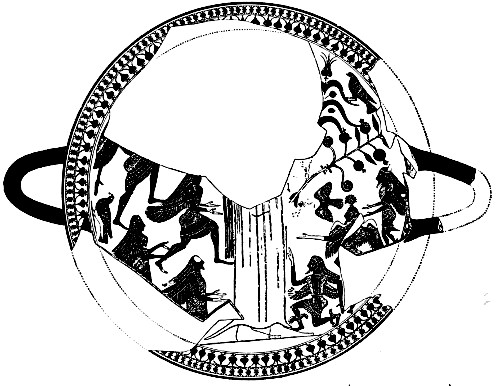
FIG. 93. CYRENAIC CUP WITH FIGURE OF KYRENE (BRITISH MUSEUM).
Of this series the Arkesilaos cup is the only one with inscriptions.
They are without doubt in an alphabet of Peloponnesian,
not Ionian, character, as is shown, for instance, by the
 for Χ in
Σλιφόμαχος. But this may be explained by reference to the
history of the city, which in the seventh and sixth centuries received
a considerable influx of the Dorian element, especially from
Sparta, whose alphabet may have been adopted for general use.
for Χ in
Σλιφόμαχος. But this may be explained by reference to the
history of the city, which in the seventh and sixth centuries received
a considerable influx of the Dorian element, especially from
Sparta, whose alphabet may have been adopted for general use.
The total number of specimens in existence is about forty;
some of which, however, are merely fragmentary examples.[1130]
Allusion has already been made to the extensive finds of
pottery at Naukratis, among the most remarkable of recent
years, which have done much to increase our knowledge of
Ionian industrial art. As has been said, almost every other
early fabric is represented there, from the Melian and Corinthian
wares to those of Rhodes and other Asiatic sites, including
a large series of Athenian vases or fragments down to the
latest times. But with these were present in overwhelming
numbers specimens of an entirely new fabric which could only
be regarded as local in its origin. Of the pottery with figure
subjects three stages can be traced, all characterised by the
Ionian cream-coloured slip, of which the earliest is remarkably
like the Rhodian wares, the next is distinguished by its polychrome
decoration on a white ground, and the third represents
a sort of transition from the quasi-Rhodian style of decoration
to the regular black-figured ware, and is parallel in many
respects to the sister-fabric of Daphnae (see below).
All this pottery was discovered in favissae or rubbish-heaps
attached to the sanctuaries of Apollo, Aphrodite, Hera, and the
Dioskuri, especially the two former. As the vases had been
rejected as useless or crowded out by new ones, they are almost
all broken and fragmentary. But it is interesting to note that
on numbers of the earlier potsherds from the Apollo temple
the words Ἀπόλλωνος ἐμί, “I am Apollo’s,” have been roughly
scratched, as if the priests had wished to mark them as sacred
and preserve them from profane uses, although no longer
required. Even more frequent on all the sites are dedications
to the respective deities, with the formula ὁ δεῖνα ἀνέθηκε τῷ
Ἀπόλλωνι, or τῇ Ἀφροδίτῃ, in the Ionic alphabet (cf. Fig. 16,
p. 139). On palaeographical grounds the inscriptions may be
dated as ranging from about 600 to 520 B.C., but there are
some difficulties with regard to the date of the foundation of
the settlement.
Strabo (xvii. 1, p. 801) assigns the foundation to Greeks of
Miletos, about 620 B.C., but the words of Herodotos (ii. 178)
are to the effect that Amasis (564–526 B.C.), “who was a phil-Hellene
... gave those who arrived in Egypt the city of
Naukratis to inhabit.” If this means that no Greeks had lived
there before his time, we cannot place any of the pottery earlier
than 570; but it does not seem unreasonable to take the words
to mean that the city already existed, and that Amasis merely
recognised the right of Greeks to reside there. Herodotos also
tells us that by permission of Amasis the Milesians independently
founded the temenos of Apollo. From the evidence of the
excavations Messrs. Petrie and Ernest Gardner felt themselves
justified in placing the foundation of the city about the middle
of the seventh century, a date which certainly seems to be
required by the character of the earliest pottery. The disappearance
of the local fabrics and their replacement by Attic
importations would then fall about 520 B.C.
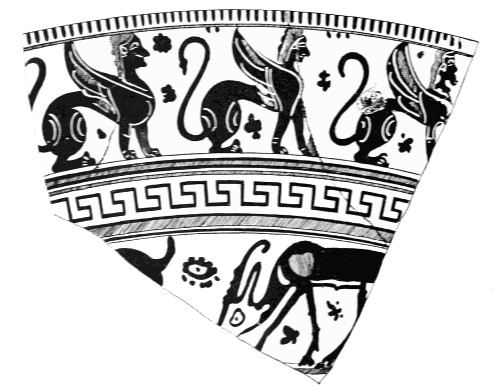
FIG. 94. FRAGMENT FROM NAUKRATIS, ILLUSTRATING “MIXED TECHNIQUE.”
In the earliest class a distinction, as in Rhodes, is to be noted
between figures without incised lines, but with faces in outline,
and figures with incised lines, the two being sometimes combined
on one vase, as in Fig. 94. It has already been shown that the
former must be earlier in origin than the latter. On the other
hand, in the polychrome white ware (see below) the incised lines
again disappear; but the more advanced style of the drawing
and choice of subjects testifies to its being a later variety.
There can, however, be no doubt that the influence of Rhodes
(or whatever was the fabric-centre of “Rhodian” pottery) was
very strong at Naukratis, and if we adopt Böhlau’s theory of
a Milesian origin for the Rhodian wares, this is fully accounted
for by the history of the place. Consequently the two fabrics
are very difficult to distinguish, and, in fact, the difference is
mainly in point of style.
There is, however, a class of wares found at Naukratis which
does not seem to be of local origin. This is the so-called Polledrara
fabric, or black ware resembling that found in Etruria, and especially
in the tomb of that name at Vulci (see Chapter XVIII.).
It has also been found in Rhodes, where black wares are by no
means uncommon, some closely resembling the Italian bucchero
in character. It is hardly likely that this ware is Naucratite in
origin, although the Polledrara tomb contains objects undoubtedly
exported from Egypt. Professor E. A. Gardner[1131] has pointed
out that one of the black-ware vases bears an inscription
showing that it was dedicated by a Mytilenaean, and others
have inscriptions in Aeolic dialect. Hence he deduces the
theory that this black ware was made in Lesbos, and exported
thence both to Rhodes and to Naukratis. He also points out
that it is really distinct from the Italian variety both in style
and technique, as, for instance, in the Italian use of blue.
But there is a class of pottery, unfortunately only represented
by fragments, which appears to be developed partly from the
“Lesbian” ware, partly from the early Naucratite fabric, and
must certainly be of local origin. It has never been found
elsewhere,[1132] and the combination of “Lesbian” and Rhodian
elements also points to this conclusion. The vases, which seem
to have been large bowls, are covered on the inside with a
black varnish, on which patterns of purely decorative character
(palmettes, pear-shaped rays of Rhodian or Aeolic form, etc.)
are painted in white and red. The outside, on the contrary, is
covered with a white slip, the designs being painted, partly in
outline, in various tints, such as flesh-colour, dark brown, purple,
dark red, yellow, and even opaque white. In spite of the
retention of the Rhodian system of outlines and absence of
incised lines, the style is remarkably advanced, and the treatment
of details often most careful and elaborate; moreover, the
subjects are almost exclusively human figures, although the
fragmentary nature of the remains renders the interpretation
in many cases almost impossible. They seem to stand on the
same level as the Daphnae pottery (see below), both in style
and range of subject.[1133]
To return to the vases of “Rhodian” type, a few typical
characteristics may be noted, showing their development. The
earliest specimens are decorated exclusively with animals,
painted in the Rhodian fashion, with heads and other parts
in outline and details only indicated by leaving them in the
colour of the clay. The typical ground-ornaments are the cross
with hooked arms, the spiral, and a pattern of diagonals with
chevrons between.[1134] Later, a preference is shown for large
vases, usually bowls or kraters, sometimes also large plates, with
friezes of animals and Sphinxes on a corresponding scale. The
Rhodian style still obtains, with the addition of purple accessories.
The favourite animals are the lion, bull, boar, and
Cretan goat; a broad plait-band or guilloche as border is of
frequent occurrence; and in addition to the ground-ornaments
already mentioned, various forms of rosettes and borders of
maeander are found. On a large bowl dedicated to Aphrodite
by one Sostratos (Plate XXIV.), besides lions, Sphinxes, and
water-fowl, two dogs are seen attacking a boar; the drawing
is more advanced than in most examples.[1135]
The next stage in which the incised lines begin to appear is
best illustrated by the fine plate with a seated Sphinx,[1136] where
they are combined with outlined contours (in the head), and
details rendered by white laid on the black, as also are the
patterns round the rim. Another large plate (A 986) has a
dance of men and a frieze of animals with incised lines and
purple accessories, but the surrounding patterns (lotos-flowers
and palmettes, tongue-pattern, etc.) are in plain black.
Lastly, there is the stage which forms a transition from the
earlier or “Rhodian” style to the black-figured, in which for
a time the influence of Corinth seems to make itself felt. The
figures are painted in black, which often turns to red through
faulty firing, on a warm buff ground, sometimes with purple
accessories. The favourite shapes are the lebes or deinos with
flat rim, and the column-handled krater so popular at Corinth
in the sixth century, with flat-topped handles, on which human
heads or animals are painted. Corinthian influence is sometimes
also seen in the designs, as in the Sphinxes of B 100; or in other
ways, as in the olpe A 1534, with a ram in a panel on one side
of the handle. Another curious example is the column-handled
krater A 1533, with two friezes of animals, of which the lower is
more Ionic in type. The British Museum collection also contains
numerous fragments (B 102–3) in this local style, together with
a few of other fabrics,[1137] among which an interesting representation
of Odysseus passing the Sirens may be noted; also a series of
chariot-scenes and horsemen, which in style recall the Caeretan
hydriae (see p. 355). The merging of the local style in the
fully-developed black-figure Athenian style is clearly visible
in these fragments, which are interesting from their parallelism,
though not their resemblance, to those of Daphnae.
Among the later Ionic fabrics, of practically fully-developed
black-figure style (i.e. with buff ground, incised lines, and accessory
colours), not the least interesting is the group of vases
and fragments from Daphnae in the Egyptian Delta, now in
the British Museum.[1138] Like the pottery of Naukratis, they
illustrate the relations between Ionia and Africa in the sixth
century, but even in a more marked degree, inasmuch as they
were more directly influenced by local circumstances.
This pottery was discovered by Mr. Flinders Petrie in 1886,
on a site known as Tell Defenneh, representing the Tahpanhes
of the Hebrew prophets and the Daphnae of Herodotos,[1139] from
whom we learn that a fort was found here by Psammetichos I.
at the beginning of the sixth century. As Naukratis guarded
the west of the Delta, so did Daphnae the east, with the highway
to Syria. Herodotos[1140] also speaks of camps garrisoned by Ionian
and Carian troops; and if we might identify these with Daphnae,
we should have a terminus post quem for the pottery, as the camps
were desolated by Amasis about 560 B.C. On the other hand,
the pottery is hardly to be dated so early from its style, and
it is important to notice that it is practically unrepresented
at Naukratis, that meeting-place of all early fabrics.
The chief problem with which we are confronted in regard to
the Daphnae pottery is whether it is a local fabric or imported.
Opinions of scholars are somewhat divided, Dümmler and
Endt declaring for the local fabric,[1141] Zahn for importations
from Clazomenae.[1142] The close connection with the fabrics of
Asia Minor, such as the Caeretan hydriae and the Clazomenae
sarcophagi, cannot be denied, and there are many small details
which are peculiar to Ionic vases; but, on the other hand, there
is much that is peculiar to this group and tells in favour of a local
origin. It is also important to bear in mind that the Daphnae
pottery has little in common with that of Naukratis, in spite of
the relation of both to Ionia.
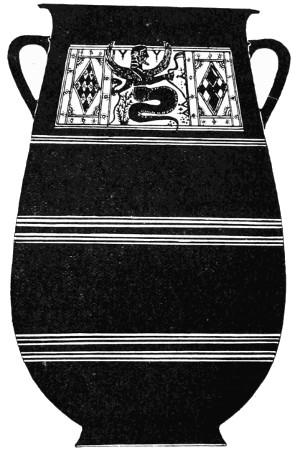
FIG. 95. “EGYPTIAN SITULA,” FROM DAPHNAE
(BRITISH MUSEUM).
It will perhaps be convenient to take the groups of Daphnae
fragments one by one, noting the general characteristics and
individual peculiarities of each. First we have a group of
tall cylindrical vases[1143] (one or two of which are completely
preserved), of an obviously Egyptian form, which has been
called a situla or pail (Fig. 95). The clay is of a drab colour,
brittle, and badly levigated, and covered with a dark brown
varnish laid on a coating of glaze. Owing to chemical causes
this varnish has in almost all cases disappeared, carrying with
it most of the designs, which can only be distinguished by the
incised lines. The figure subjects are confined to panels on
either side of the neck, and usually consist of heraldic groups
of animals or winged monsters. Round the body are patterns
of lotos-flowers and fan-shaped half-rosettes of Rhodian type.
The technique, however, and other points recall the Geometrical
vases, and this is
especially marked in
one case (B.M. B 104 =
Fig. 95), where the
panels are bordered
and filled in with
ornamental patterns
of Geometrical style.[1144]
The whole appearance
of this vase, in which
the varnish is preserved,
is that of the
Geometrical style; the
method may have
been learned through
Rhodes. On the other
hand, some subjects are
of Egyptian type, such
as the hawks (B 1062),
and the pair of combatants
with their nude
bodies and shaven
crowns (B 1061).
Secondly, there is a
group of tall slim
amphorae, of purely
Greek style,[1145] with a characteristic scheme of decoration, consisting
of panels on the neck, usually containing a Sphinx or
Siren, and two friezes round the body, divided by a band of
dots; the neck is always divided from the body by a moulded
ring, below which is a polychrome tongue-pattern in black, white,
and purple alternately. An example is given in Plate XXV.
It is important to note here that the white colouring, of
which lavish use is made, is laid directly on the clay, as in
other Ionic vases; incised lines are only employed for inner
details, not for contours. This group is obviously of later
date than the situlae, and the points of correspondence between
it and the Caeretan hydriae and sarcophagi of Clazomenae (see
below) are very marked. Sometimes the place of the main
design is taken by a panel of scale-pattern,[1146] rendered in colour
only, curiously reminiscent of Mycenaean vases. Two other
points are worth citing here as presenting the same feature:
the two-handled cup with tall stem on B 1152, which is clearly
the Mycenaean type of kylix, and the borders of white dots
laid on the black which sometimes occur on the draperies.
The clay is of a warm yellow colour, well levigated and polished,
and the general appearance of the vases is bright and pleasing.
The lower frieze on the body usually takes the form of a row
of animals, especially of geese feeding; but where the main
design is replaced by a scale-pattern, dancing figures are
usually found.
Thirdly, there is a squat form of amphora, with cylindrical
neck and wide body, which has been distinguished by the name
of stamnos.[1147] Most of the vases of this form found at Daphnae
are of the “Fikellura” type described above (p. 337), and are
obviously importations, whether from Samos or Rhodes; but
others (nearly all fragmentary) are of the same type as the
amphorae. On both shapes a motive is sometimes introduced
which is clearly learned from the Fikellura vases, that of a row
of crescents, which, instead of being merely painted in black,
are treated, like the tongue-pattern, in polychrome.[1148] The only
other shape found is the hydria, of a type differing greatly from
the Caeretan (see below) with its flat shoulder at right angles
to the body; but the same typical wreath of pointed leaves
occurs on both (cf. B 126–27). The list is completed by a
few fragments of imported B.F. vases from Athens.
PLATE XXV
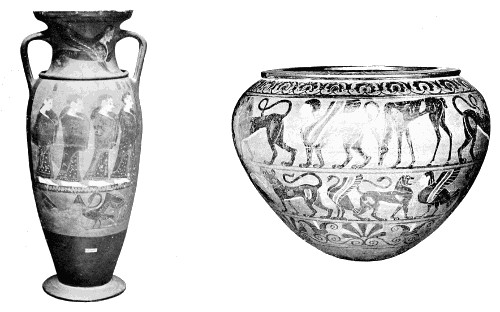
Ionian Vases.
1. Situla from Daphnae (British Museum); 2. Deinos in South Kensington Museum.
The subjects comprise several interesting mythological
themes: Odysseus and Kirke,[1149] the Calydonian boar-hunt,
Boreas and one of his sons, Bellerophon and the Chimaera.
There is a curious series of nude figures on horseback, painted
white throughout, accompanied by warriors and dogs; they
have usually been interpreted as feminine, but are not so
necessarily, as Ionian painters used white indiscriminately for
either sex.[1150] Dionysiac scenes are popular, but monotonous,
and often very coarse; the Satyrs are of the Ionic type, with
horses’ hoofs, and very bestial in appearance; their place is
often taken by grotesque dancers, as on the Corinthian vases.
Among small details the Oriental embroidered saddle-cloths[1151]
should be mentioned, as also the curious hook (φάλος) in front
of the warrior’s helmet on B 11; both are found on the Clazomenae
sarcophagi, and the latter is typical of Ionic art.[1152]
What is in many ways the most remarkable group of Ionian
vases is formed by the Caeretan hydriae, so called because they
have been found almost exclusively at Caere (Cervetri) in
Etruria. They form a very homogeneous group, and their
typical features are unmistakable. Originally they were
thought to be of local, i.e. Etruscan, manufacture, or even
imitations of Corinthian vases. But since the sarcophagi of
Clazomenae and the pottery of Naukratis and Daphnae have
been made known and studied, it has been established beyond
doubt that they stand in close relation to these undoubtedly
Ionian fabrics.[1153] If further proof were wanted, it is to be found
in a class of Etruscan vases which are clearly imitated from
them (see Chapter XVIII.).
They were first collectively discussed in 1888 by Dümmler,
who gave a list of fourteen, assigning them to Phocaea; a more
complete list of twenty has since been drawn up by Endt,
who to some extent endorses Dümmler’s views, but is inclined
to attribute them to Clazomenae, on the opposite side of the
Gulf of Smyrna, thus bringing them into closer relation with
the sarcophagi. Whichever be the correct view, there is no
doubt that they come from this region, and the existence of a
ceramic fabric at Clazomenae, as attested by the sarcophagi
and a few painted fragments of pottery, is in favour of Endt’s
attribution. We have also to set by the side of this the absence
(so far) of any pottery at Phocaea. In any case the place
must have formed part of the Naucratite confederation, and
it was perhaps influenced much by Rhodes.[1154] That the vases
have all been found at Cervetri need excite no surprise, as
there is abundant evidence that certain fabrics were specially
favoured by different places, and apparently made for exclusive
importation.
From the circumstances of discovery of some of them they
may be dated about the middle of the sixth century B.C.; the
style is remarkably advanced, and shows the rapid development
of Ionian art as compared with that of Continental Greece.
As regards the form of the hydria, it is characterised by the
egg-shaped body, the division of neck from shoulder by a
moulded ring, the low flat-ribbed handle at the back, and the
high concave foot. Even more marked is the system of
ornamentation. The main design runs in a broad frieze
round the body, broken at the back by a palmette pattern
under the handle, on either side of which are usually grouped
two similar or opposed figures, distinct from the principal
subject. The rest of the surface is given over to floral patterns,
which assume great prominence on these vases. The normal
arrangement is as follows: inside the mouth a large tongue-pattern
in red, bordered with black; on the neck, palmette-and-lotos
pattern; on the shoulder, ivy-wreaths or other plants,
treated in a naturalistic manner; round the lower part of the
body, a broad band of large palmettes and lotos-flowers
alternating, forming a very effective pattern and enhanced
with white and purple details. An illustration in colours of a
typical specimen is given on Plate XXVI.
PLATE XXVI
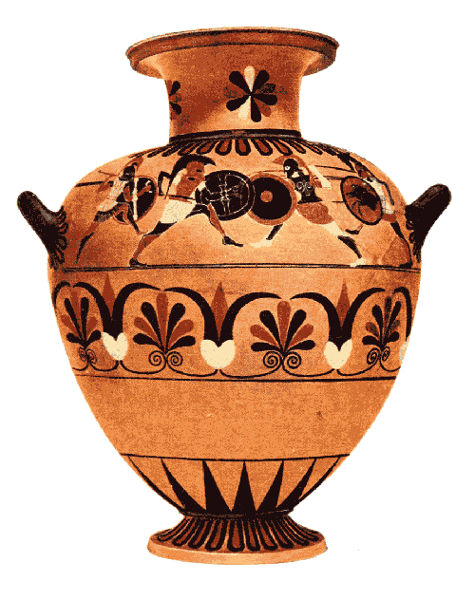
To face page 354.
CAERETAN HYDRIA.
(British Museum.)
The range of subjects is wide and original, both in choice
and method of treatment. We find among mythological scenes
the return of Hephaistos to heaven, the rape of Europa, the
contest of Herakles with Busiris, and the hunt of the Calydonian
boar.[1155] Other subjects, such as combatants or horsemen, are
more in the manner of the Clazomenae sarcophagi. A curious
feature of the group is the entire absence of friezes of animals.
The realistic treatment of the Egyptians on the Busiris vase,
and the introduction of apes and other African animals into
some of the scenes, clearly indicate a relation with that part
of the world, obviously through the medium of one of the
Greek colonies of Egypt. Naukratis, as we have seen, was
largely colonised from Phocaea, and some of the later fragments
from this site[1156] show a parallelism with the hydriae.
Among the smaller details which are typically Ionian may
be mentioned the horse-hoofed type of Seilenos (as at Daphnae);
the four-winged deities and winged boars[1157]; the favourite types
of stag-hunts,[1158] horsemen, and combats, all appearing on the
sarcophagi; the running dogs and the owls on horses’ backs;
the high-peaked cap of women and shoes with turned-up toes.
All these are generally, but not invariably, characteristic of
the Ionian fabrics, as is the peculiar treatment of boys’ hair,
which is tied in a tuft at the back.
In regard to technique the chief point is the extensive use of
accessories, which give a bright and varied appearance to the
vases. And we must also note the general use of white for
flesh, of men as well as of women, the white being laid on the
black varnish in the Attic fashion, and not on the clay, as usual
in Ionia. The clay, too, is not covered with the characteristic
creamy slip, but with a red glaze approaching more nearly to
the “continental” fabrics. Incised lines are used with great
care, and folds of drapery are always indicated; the male eye is
always oval, and undistinguished from the female.
Two groups of fragments from sites in Asia Minor, though
differing in some degree from the Caeretan hydriae, yet obviously
stand in close relation. Of these, one set, forming a large krater
of the Corinthian type, was found at Kyme in Aeolis[1159]; they
appear to be later than the hydriae, i.e. about 500 B.C., but the
style and technique are not dissimilar, except that the white is
here laid on the clay ground and the drawing tends to freedom
and carelessness.[1160] Folds of drapery are not indicated; the
typical Ionic motive of a large bud in the field is found.[1161] They
may be described as a local differentiation from the hydriae,
representing the transition from the sarcophagi[1162] to B.F. fabrics,
or rather, perhaps, forming a link between the Caeretan group
and that next to be discussed. The other set was found at
Clazomenae,[1163] and appears to stand midway between the
Daphnae pottery and the hydriae; it is probably of local origin,
and also exhibits points of comparison with the sarcophagi. The
influence of this fabric has been traced in some Attic B.F. vases
which represent a similar scene—the harnessing of a chariot.[1164]
There are also various groups of vases (mostly amphorae) of
advanced B.F. technique, but thoroughly Ionian characteristics,[1165]
which seem to trace their descent mainly from the Caeretan
hydriae, although the scheme of ornamentation is widely
different. In the majority the most striking feature is the
adoption of the panel-design, the rest of the vase being covered
with black. This is clearly non-Ionic, and probably due to
the growing influence of Attic vase-painting, in which it early
became a marked feature; but it is usually combined with a
distinct neck, on which is a smaller design, and this, on the other
hand, is a non-Attic idea. These vases were all most probably
made in the Clazomenae region; they are, however, rather
to be regarded as forming links between the Ionian fabrics
proper and the Attic B.F. vases, and are the predecessors of a
group of vases of fully-developed B.F. technique which are yet
more Ionic than Attic in feeling and treatment (see below, p. 387).
Among these may be mentioned two groups of kylikes, one
found in Rhodes and richly decorated with figures within and
without, the form suggesting a metallic original.[1166] The other
consists of a series of kylikes decorated on the outside with large
eyes (formerly thought to be of symbolical import), at the head
of which stands the well-known Würzburg cup, with the subject
of Phineus attacked by the Harpies.[1167] This vase bears remains of
inscriptions in the Ionic alphabet; the cup is of a form afterward
introduced at Athens by Exekias, in which the off-set rim
and high foot of the other group are replaced by a wide-spreading
bowl of plain convex section, with a low foot. Once adopted at
Athens, this type remained firmly in favour throughout the R.F.
period.
It has often been remarked that inscribed vases are remarkably
rare among Ionian fabrics; there are not more than six at the
outside, including the Euphorbos pinax, the alphabet of which
we have seen to be Argive.[1168] But there are two vases the
alphabet of which apparently belongs to the island of Keos,
being one of the Ionic or Eastern group, and of these one[1169] may
well be associated with the later Ionic fabrics. The other,
however, is in a style which is usually associated with the
Chalcidian group[1170]; there is the typical feature of the fallen
warrior with face turned to the front. If the two can both be
assumed to have been actually made in Keos, the geographical
position of that island would account for the combination of
these Eastern and Western elements.[1171]
A complete and detailed list of the Caeretan hydriae and of
the allied types may be found in Endt’s book (pp. 1, 21, 29, etc.);
but a brief summary may also be found useful:—
1. Caeretan hydriae: B.M. B 59 (Plate XXVI.); Louvre E 696–702;
Vienna 217–18; Ant. Denkm. ii. 28 (in Berlin); Mus. Greg. ii.
16, 2a; Jahn, Entführung der Europa, pl. 5a; Endt, figs. 1–2,
5–8; four others unpublished. See also generally Dümmler
in Röm. Mitth. 1888, p. 166 ff., and Pottier in Bull. de Corr.
Hell. 1892, p. 253 ff., and Louvre Cat. ii. p. 534.
2. Later Ionic B.F. fabrics, chiefly amphorae, kraters, hydriae, and
deinoi, from the region of the Gulf of Smyrna: Louvre E 736,
E 737, E 739; Vienna 215; Munich 573, 583, 685; Berlin
1674, 1885, 2154; Würzburg, iii. 328 (= Reinach, ii. 97) and
331; Reinach, ii. 156; J.H.S. vi. pp. 181, 185, and Anzeiger,
1893, p. 83 (in Berlin); Louvre E 754–81; Berlin 1676 = Reinach,
ii. 22, 3–5; and the fragments from Kyme and
Clazomenae already discussed. See besides Endt, Pottier in
Bull. de Corr. Hell. 1893, p. 423 ff.; Zahn in Ath. Mitth. 1898,
p. 38 ff.; Karo in J.H.S. xix. p. 146 ff.
3. Kylikes of Attic-Ionic style: (a) Rhodian: B.M. B 379-B 382:
see J.H.S. v. p. 220 ff.; (b) later type, with eyes (see p. 374);
Würzburg, iii. 354 = Furtwaengler and Reichhold, pl. 41
(Phineus cup) and 349; Berlin 1803, 2054, 2056; Munich
428, 468, 630, 553, 711, 1239, 1316, 1027, 1239; and others
given by Böhlau; to which may be added the British Museum
cups with eyes, B 427 ff., and the amphora B.M. B 215.
4. Keos fabric (?): Louvre E 732 = Reinach, i. 162; Gerhard, A.V.
205, 3–4.
There are also numerous vases scattered about our museums
which are of a debased and inferior B.F. type, and on good
grounds have been thought to be of Italian manufacture, whether
Etruscan or South Italian. The former usually display unmistakable
local characteristics, and there is a class so sharply
defined that its Etruscan origin is undoubted, in spite of its
affinities to the Caeretan hydriae. A full description will be
found in the chapter on Etruscan pottery (XVIII.). Others
again have more in common with the class next to be discussed;
and, generally speaking, they may all be found to show Ionian
affinities. But the line is not easy to draw: debased B.F. vases
may have been produced in Ionia, as they undoubtedly were at
Kameiros[1172]; but, on the other hand, the extensive export of
Ionic wares to Cumae, Cervetri, and other places may have
incited the Italian potters, as in the case of the Etruscan class
just mentioned, to unsuccessful attempts at imitation.
There remains yet one class of Ionic vases to be discussed, a
class which can be clearly defined, but for which as yet no
satisfactory name has been found. Like the Caeretan hydriae,
they were first discussed by the late F. Dümmler; but his
grounds for assigning them to the region of Pontus—whence
they have been provisionally styled “Pontic”—have not found
general acceptance.[1173] They were also originally, like the
Caeretan group, thought to be Etruscan, a view which at first
sight might seem justified by their rough execution; but style
and other reasons preclude such a possibility. On the other
hand, it is quite possible that some of them are imitative fabrics
made in Southern Italy. All at present known have been found
in Etruria.
The group is formed by a series of about twenty amphorae
and sixteen oinochoae, to which Endt appends a list of twenty
or so which may either be of this fabric or Italian imitations.
Another example in the Victoria and Albert Museum, South
Kensington, is illustrated on Plate XXV. The list might
doubtless be extended. That they date from the first half
of the sixth century seems indicated by the discovery of
one at Orvieto, together with an early Corinthian cup. Like
so many of the Ionic fabrics, they exhibit a fondness for bright
colouring, with an extensive use of accessory colours. In
some cases Corinthian influence seems to have been at work,
especially in the technique. Incised lines are sparingly and
carelessly employed, and seldom for contours. Among the
subjects mythological scenes are rare, but one of the British
Museum examples (B 57) has a curious subject—the contest
of Herakles and the Lacinian Hera (the Roman Juno Sospita),
assisted respectively by Athena and Poseidon. Winged male
figures are not uncommon, and the typically Corinthian subject
of grotesque figures dancing is occasionally found. But the
specially characteristic feature of the group is formed by the
friezes of animals. Of these there are usually two on each vase,
more rarely one; sometimes they are interspersed with figures
of men, not representing any definite subject, but as an imitation
of stamped metal vases (as on the Bucchero vases of Etruria,
Chapter XVIII.). The animals are so characteristic as in
themselves to mark off this class as distinct; sometimes they
are naturalistic, sometimes conventional, and repetitions in one
frieze are very rare.
The favourite quadruped is a deer; Gryphons of a peculiar
type and Sphinxes are frequently found, and on some specimens
a subordinate frieze of quails.[1174] On the necks of the amphorae
heraldic groups of panthers or other animals confronted are
sometimes seen, varied by palmette and lotos patterns. The
latter form the chief decorative motive; but a combination of
maeanders and stars (see Chapter XVI.) is often found on the
oinochoae, and this, it is interesting to note, also appears on
the Clazomenae sarcophagi. On one of the vases published
by Dümmler there is represented a combat of Greeks and
mounted Barbarians; the latter he identified as Scythians, and
mainly on this ground attributed the group to the northern
coast of Asia Minor. But they are more likely to be from
Phocaea, or Kyme, or one of the neighbouring cities. The
oinochoae appear, from the absence of human figures, to be
earlier than the amphorae, and the number of friezes often
exceeds two; there are also a few minor distinctions.[1175]
It is now time to turn, by way of supplementing our account
of Ionic pottery, to the history of the art of painting in general
among these peoples, so far as it is illustrated by literary records
and by existing monuments other than the vases. That the
latter do afford us considerable information on the subject of
painting in Ionia is amply shown in the foregoing pages;
but there is yet another group of monuments which the
material of which they are made would alone entitle to
inclusion in this work, apart from the valuable illustration
they afford of certain aspects of Ionic pottery.
In the light of modern researches, we are prepared to find in
Ionia a great centre for the art of painting in the archaic
period. That this region inherited the characteristics of
Mycenaean art has already been so abundantly shown that
we need not hesitate to believe that, among other branches
of art, that of fresco-painting was firmly established in the
Asiatic colonies. The art of which Crete, Mycenae, and Tiryns
have furnished such remarkable examples is hardly likely to
have died out. Hence it need excite no surprise when we
read that as early as about 700 B.C. Kandaules, the king of
Lydia, purchased for its weight in gold a picture painted by
Bularchos representing a battle of the Magnetes.[1176] That such
an elaborate subject should have been treated at this early
date, when the vase-painter had not emerged from his earliest
limitations, is, if we may accept Pliny’s account, a most
remarkable proof of advanced art. Saurias of Samos is also
mentioned as an early painter,[1177] who “invented silhouette
drawing,” and Philokles the Egyptian, who “invented linear
drawing,” was probably a Naucratite, and his “inventions”
may be reflected in the outlined paintings on white ground
which have been described above. Lastly, we read that about
515 B.C. Mandrokles of Samos painted a picture which represented
Dareios watching his army crossing the Bosphoros,[1178]
and Kalliphon of Samos, probably a contemporary, painted
scenes from the story of Troy.[1179]
Combining these traditions with what we also know of Ionic
painting from the pottery, we should expect to find that its
characteristic form was that of figures in black silhouette or
outline on a ground covered with white slip; and, further,
that the subjects treated were by no means of an elementary
character, but comprised elaborate battle-scenes or groups of
warriors, and even historical themes. Now, these conditions
are exactly fulfilled in the group of terracotta sarcophagi
excavated during the last twenty years at or in the neighbourhood
of Clazomenae, on the Gulf of Smyrna. It is practically
certain that all have come from this district,[1180] and no attempt
has ever been made to connect them with any other site.
Further, we have already seen that there are reasons for
attributing some of the vase-fabrics to this place, or at least
for connecting them closely with the sarcophagi; and thus
there are good grounds for regarding Clazomenae as one of
the principal centres of Ionian art.
The sarcophagi which have come to light up to the present
number over twenty, inclusive of fragments, but very few are
anything like complete. There are fine specimens at Berlin,
Paris, Vienna, and Constantinople, with paintings round the flat
rims; but all are overshadowed by the magnificent example
recently acquired by the British Museum,[1181] which is absolutely
complete, with a massive gabled cover, and decorated over
almost every inch of its surface with subjects or ornamental
patterns. Its dimensions are: body, 7 ft. 6 in. by 3 ft. 9 in. by
2 ft. 9 in.; cover, 8 ft. by 4 ft. by 2 ft. The only undecorated
portions are the central panels on the sides of the coffin and
the bottom, but in some other parts the designs are largely
worn away. It is made of a coarse brick-like clay of very hard
consistency, which is completely covered, except on the bottom,
with a thick white slip to receive the paintings. The figures
are painted throughout in black silhouette, without any method
of reproducing inner details except by traits réservés, i.e. by
leaving them unpainted on the white ground; but the greater
part has been imperfectly fired, so that the black has become
bright red.
On the long sides of the interior are representations of
funeral games, such as contests with spears and a chariot-race;
the shorter sides have groups of warriors on horseback and
on foot. The chariot-races are also repeated along the flat
rim of the coffin, the exterior and the space above the interior
designs being ornamented with bands of egg-and-dart moulding
and the typical Ionic pattern of maeander interspersed with
stars, which we have already met with in the pottery (p. 360).
The main designs on the cover are in two rows, those on one
side having almost entirely disappeared; on the complete
side the upper band represents an episode from the story of
Dolon, the lower an ordinary scene of combat.[1182] The gable-ends
have groups of Centaurs and horsemen, and along the
lower edges of the cover, underneath, are further scenes from
the Doloneia, groups of Sphinxes and Sirens, and bands
of ornamental pattern (rosettes, maeander, etc.). Of the
many minor details of interest in these paintings this is
not the place to speak; but they have been fully discussed
by Murray (op. cit.), especially peculiarities of armour and
costume.
It is possible that the battle-scenes on this and other sarcophagi
may, as Murray and S. Reinach[1183] have suggested, have
some bearing on the question of the painting by Bularchos
already mentioned. It would, at all events, help to explain
the selling of the painting for its weight in gold, if we may
regard it as painted on terracotta; but it is not safe to say
more than that the sarcophagi confirm the story to the extent
of showing the popularity of such subjects in early Ionian art.
Many of the motives on the British Museum sarcophagus
are found repeated again and again throughout the series,
especially the battle-scenes; groups “heraldically” composed,
such as a warrior between two chariots or horsemen, or pairs of
Sphinxes (Plate XXVII.), or animals confronted, are of constant
occurrence. There are also various minor motives constantly
repeated, such as helmeted heads of warriors (Plate XXVII.),[1184]
pairs of horses, one looking up, the other down (this being
a convenient position for silhouettes), or dogs running under
the horses.
M. Joubin,[1185] considering the group of sarcophagi as a whole,
recognises a triple development in form, technique, and
decoration, enabling him to divide them into three classes.
In regard to technique we observe throughout a remarkable
combination of two methods, the details of figures being
expressed either by outlining or by leaving in the colour of
the clay, as in the earlier Rhodian and Naucratite vases
(see p. 331 ff.), or by lines of white paint laid on the black.
The latter method, which is not unknown on the vases
(see p. 347), was no doubt used in place of incising, which
would have been a difficult matter in the hard clay.[1186]
In the oldest group, then, the usual method is that of
outlining or “reserving” on the clay; the second group may
be regarded as transitional[1187]; and in the third group, which
in style answers to the Caeretan hydriae and later Ionic
fabrics, the use of white for details, and even of purple,
is general. But it is noteworthy that, for the groups of
animals at the bases of the sarcophagi or elsewhere, the old
“Rhodian” method of the earlier examples is retained. This,
it may be remarked, is in accordance with a principle by
which an older technique tends to survive in subordinate
decoration, just as on R.F. vases friezes of animals or ornamental
patterns are frequently painted in the old black-on-red
method.[1188]
PLATE XXVII
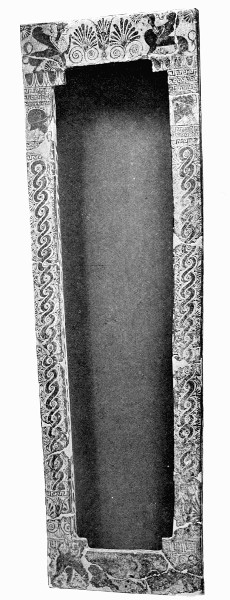
Sarcophagus From Clazomenae (British Museum).
In the decoration the development is in the direction of
scenes with human figures, in preference to friezes of animals
and floral patterns; the compositions advance from single
figures to large groups, and accessory figures are introduced,
like the dogs under the horses. Finally, we have the long
friezes of figures which are so characteristic, for instance, of
the British Museum sarcophagus. Mythological scenes, except
the Doloneia, are conspicuously absent; battles, chariot-races,
and hunting-scenes have the preference, as well as the heraldic
groups of animals.
Nor is the development confined to the main decoration; it
may be traced both in the form of the sarcophagi and in
the subordinate ornamentation.[1189] The older examples approach
more to the human form, with a shouldered opening at the
top indicating the place for the head; but towards the end
of the series the rectangular form predominates—the opening
enlarges, and the upper edge projects over the lower.
The British Museum example and one in Constantinople[1190]
are very elaborate, with mouldings and carefully-considered
architectural proportions. The origin of the form is doubtless
to be traced to the Egyptian mummy-cases, or perhaps to
Chaldaean sarcophagi; but the Cretan cinerary urns (p. 145) are
also on the same plan, and may have formed an intermediary
link.
In point of date the sarcophagi seem to extend over the
greater part of the sixth century. We have seen that some
present the same characteristics of painting as the earlier
Rhodian and Naucratite fabrics; others fall more into line
with the Caeretan hydriae and Ionic B.F. pottery. In any
case the sarcophagi form our best standard for determining
the sequence and relation of the Ionic fabrics, and at the
same time furnish an argument for regarding Clazomenae as
one of the principal centres of Ionic pottery. M. Reinach is
of opinion that none are later than about 540 B.C., at which
time the people of Clazomenae, menaced by the invading power
of Persia, migrated to the neighbouring islands. But one or
two instances of advanced technique seem to point to a
later date.
The list of Clazomenae sarcophagi as at present known is
as follows[1191]:—
|
|
Reinach’s List. |
Joubin’s List. |
|
| 1. |
Brit. Mus. (1895) |
— |
— |
Terracotta Sarcophagi, pls. 1–7. |
| 2. |
Brit. Mus. (1900) |
— |
— |
— |
| 3. |
Brit. Mus. (1902) |
— |
— |
Plate XXVII. of this work. |
| 4. |
Brit. Mus. |
7 |
12 |
Ant. Denkm. i. pl. 46, 4 = J.H.S. iv. pl. 31. |
| 5. |
Brit. Mus. |
8 |
13 |
Ibid. pl. 46, 3 = J.H.S. iv. p. 20, fig. 15. |
| 6. |
Brit. Mus. |
9 |
13 |
Ibid. pl. 46, 5 = J.H.S. iv. p. 19, fig. 14. |
| 7. |
Louvre |
10 |
11 |
Bull. de Corr. Hell., 1890, pl. 6. |
| 8. |
Louvre |
11 |
3 |
Ibid., 1892, p. 240. |
| 9. |
Louvre |
12 |
1 |
Ibid., 1895, pls. 1–2, p. 71. |
| 10. |
Louvre |
13 |
2 |
Ibid., 1895, p. 80. |
| 11. |
Berlin |
1 |
8 |
Ant. Denkm. i. pl. 44. |
| 12. |
Berlin |
2 |
9 |
Ibid. pl. 46, 2. |
| 13. |
Vienna |
15 |
10 |
Ibid. pl. 45. |
| 14. |
Smyrna |
14 |
14 |
Ibid. pl. 46, 1. |
| 15. |
Constantinople |
3 |
7 |
Mon. dell’ Inst. xi. pl. 53 = J.H.S. iv. p. 8 ff. |
| 16. |
Constantinople |
4 |
4, 5 |
Ibid. pl. 54 = J.H.S. iv. p. 2 ff. |
| 17. |
Constantinople |
5 |
— |
Röm. Mitth. 1888, p. 163. |
| 18. |
Constantinople |
6 |
6 |
Revue des Études Gr. 1895, p. 161. |
| 19. |
? |
16 |
— |
J.H.S. iv. p. 15. |
| 20. |
? |
17 |
— |
J.H.S. iv. p. 20. |
| 21–3. |
In the market |
18–20 |
— |
See Revue des Études Gr. i.e. |
To which may be added:—
| 24. |
Brit. Mus., from Kameiros |
— |
— |
Terracotta Sarcophagi, pl. 8. |
We have seen in the course of this chapter the gradual
evolution of Ionic vase-painting, from the time of lingering
Mycenaean influences down to the period when it ceased to
have any existence as a separate style, and having reached the
same point of development as Attic vase-painting, was soon
merged in the latter. It is probable, however, that this was
largely due to political circumstances, which put an end to
Ionic art and industry generally about the close of the sixth
century. The conquest of Ionia by Harpagos in 545 B.C.
was the event which led to this result, and consequently to
the dispersion of Ionic artists, partly into Greece, partly into
Italy. The migration of the Phocaeans in particular caused
an influx of Ionian culture into the semi-barbarous regions
of Italy, and contributed to the production of the imitative
vase-fabrics to which allusion has been made.
M. Pottier, in summing up the rôle played by Ionian Greece
in the history of art, regards it as the principal agent of
transmission of culture between the East and Europe, and
thus the true civiliser of Europe, influencing both Doric Greece
and Etruscan Italy. Thus we may see in Ionia the parent of
modern civilisation.
Definition of “black-figured”—The François vase—Technical and stylistic
details—Shapes—Decorative patterns—Subjects and types—Artists'
signatures—Exekias and Amasis—Minor Artists—Nikosthenes—Andokides—“Affected”
vases—Panathenaic amphorae—Vases from the
Kabeirion—Opaque painting on black ground—Vase-painting and literary
tradition—Early Greek painting and its subsequent development.
The term “black-figured” is generally applied to the Athenian
fabrics of a certain well-defined character and a comparatively
restricted period, but in point of fact is strictly applicable to
several of the classes already discussed, such as the Chalcidian
and the later Corinthian and Ionian wares. It is, indeed, in
some respects inadequate as a definition. We must remember
that it was originally introduced at a time when the Greek vases
in public museums consisted mainly of two classes—the one with
figures painted in black silhouette on red ground, the other with
figures drawn in outline and surrounded with black, so that they
stand out in red. Between these two classes the terms “black-figured”
and “red-figured” offered an obvious and useful
distinction. By way of illustration, it may be advantageous
to make a comparison between the two main varieties of black-figured
Attic amphorae (see pp. 161, 221), as, for instance, they
are grouped on the two sides of the Second Vase Room of the
British Museum, and those with red figures in the Third Room.
In the one class of black-figured amphorae the whole vase stands
out in the natural red colour of the clay, whereas the red-figured
amphorae are covered with black colour, so as to conceal the
whole of the red of the clay except where it is left to fill in the
contours of the figures. In other words, the one class, which we
may term “red-bodied” amphorae, are red all but the figures;
the other class are black all but the figures. There is, however,
an intermediate class, which no doubt suggested the arrangement
of decoration on the red-figured amphorae (see below, p. 411),
and which we may call “black-bodied” amphorae. Here the
whole body of the vase is covered with black colour, except a
framed panel, which is left in the red to receive the black figures.
It is clear, then, that this second class of black-figured amphorae
approaches more nearly in aspect to the red-figured, although it
does not follow that they were necessarily a late or transitional
development.
But in regard to our definition, it is necessary to reckon with
the fact that there are not only vases of an earlier stage of art
which have black figures painted on a (more or less) red ground,
but that there are others in which the figures are painted not on red,
but on a white slip. In particular we may instance the Cyrenaic
vases and some of the Naucratite wares. We thus lose the sense
of an exact contrast between black figures on red ground and red
figures on black; and, moreover, the term acquires almost too wide
a connotation to be of any value for a system of classification.
The term “black-figured” must therefore be used to some extent
conventionally, to denote a certain class of vases made at Athens
during a certain period and with certain characteristics. The
latter may be summarised as follows: (1) black varnish entirely
filling in the contours of the figures; (2) red glaze (or white slip)
employed as background; (3) details indicated by accessory
pigments of white and purple, and incised lines; (4) subjects
almost exclusively human and mythological figures.
The history of vase-painting in the middle of the sixth
century B.C. is largely the history of a gradual centralising of
that art in one place from a number of scattered local fabrics.
This was mainly brought about by one cause—namely, the
extraordinary advance in art and culture at Athens under
the beneficent rule of the tyrant Peisistratos and his successors
(565–510 B.C.). Previous to this time Athenian art was very
limited in its scope, and in the domain of painting had so
far produced nothing except the great Dipylon funeral vases,
their immediate successors (the “Proto-Attic” wares), and the
“Tyrrhenian” vases, which, as we have seen, were largely under
the influence of Corinth. Attic importations into Italy cannot
be traced until the black-figure style is well developed.
The immediate result of this advance was to attract artists
from all parts of Greece—not only from Corinth, whose power
was now on the wane, but also from Ionia, whose artists were
driven to seek refuge elsewhere by the encroaching conquests of
the Persian monarchs. Thus we shall see that certain artists,
like Amasis and Nikosthenes, infused a large amount of Ionic
element into their productions, just as in others we see the
influence, more or less marked, of Corinth. But one marked
characteristic of the Attic sixth-century vases is the entire
disappearance of Oriental influence.
At the head of the new development stands the famous
François vase in Florence (Plate XXVIII.), to which allusion
has been made already (p. 73). Its date can hardly be
later than the middle of the sixth century, probably somewhat
earlier, and the two artists Klitias and Ergotimos, who were
responsible for its production, are among the earliest of whom
we have any record at Athens. The alphabet of the inscriptions
leaves no doubt that it is a purely Athenian work, and the
technique is also purely Attic, as are some of the subjects;
but there are not a few small points which betray the influence
of a Corinthian artist, such as the arrangement in several friezes.
The winged goddesses, Sphinxes, and animals are non-Attic,
but not necessarily Corinthian. It is, however, chiefly interesting
for its wealth of subjects, which are mentioned in another chapter
(Chapter XII.); with these every available space is decorated.
The style has been described as “dry, precise, and careful,” the
artist as “exact and well instructed.” Closely related to this vase
is one in the British Museum representing the Birth of Athena
(B 147). Although the subjects (exclusive of those on the cover)
are only two in number, the minuteness of treatment in detail
and the richness of the composition show that it belongs to the
same school.
PLATE XXVIII
From Furtwaengler and Reichhold.
The François Vase in Florence.
In regard to technique, two points distinguish Athenian vases
at all periods above other fabrics. Firstly, the admirable clay,
traditionally obtained from Cape Kolias in Attica, and mingled
with red ochre (rubrica) in order to produce its ruddy hue; this
clay was eminently suited for taking a glaze, which was of course
an essential preliminary for painting the surface. Next, the black
varnish, with its exquisitely lustrous sheen, which was brought
to a pitch of perfection in the subsequent period, and always
affords such an admirable counterfoil to the red of the clay,
though it has not been altogether popular with the modern
photographer, owing to its reflecting qualities.
As regards the figures, they were seldom left entirely black,
though black is at all times their prevalent aspect. The accessory
whites and purples are used in varying degrees at different
times, and it may be laid down as a general rule that purple is
more affected on the earlier vases, white on the later. A like
principle obtains with the accessories on red-figured vases. In
the later examples, moreover, they are much more sparingly
used, perhaps owing to the influence of the new technique, and
by the end of the sixth century they disappear altogether. The
more careful artists pay greater attention to the use of incised
lines, and prefer to produce effects of richness and delicacy by
elaboration of details and patterns in this manner.
At first there is a tendency to use purple in large masses, and
even for the flesh of men; but it is generally employed for folds
or portions of drapery, and for throwing up different parts of
animals’ figures, or of the decorative patterns, such as palmettes
and lotos-buds. White is employed for the hair of old men, for
rocks and details of buildings, for the long garment worn by
charioteers, and above all for the flesh of women. The latter
we have already seen (p. 317) to be an invention traditionally
attributed to Eumaros, who probably lived about the middle
of this century; but whether it was first introduced at Athens
or Corinth is uncertain.
Throughout the period there is a steady advance in drawing,
but more in the direction of carefulness and refinement than
in accuracy and truthfulness to nature; that is to say, that it
always remains conventional. We shall see later that, even after
the red-figured style came in, a certain archaic stiffness still prevailed
for a time, both in the old and new methods. On the
other hand, there is a degenerate class of black-figured vases,
found chiefly on Greek sites, in which the drawing is free almost
to carelessness, and it is clear that these illustrate the last efforts
of the black-figured method in Greece in the fifth century; but
the vases are all rough and hasty productions, altogether devoid
of merit or interest.
The treatment of drapery may generally be regarded as a
fair indication of date. The chiton is at first straight, with rigid
stripes or casual patches of purple; then patterns are incised or
painted in white; the waist is usually very small, and often bound
tightly with a broad girdle.[1192] By degrees the lines indicating the
folds of the skirt take an oblique direction, as if to indicate
motion, while the himation or mantle—which is adopted in
addition by the women to wear over the chiton—is made to fall
in long formal folds with diagonal edges, known as πτέρυγες.
It is curious that the more advanced style of drapery is usually
found on the red-bodied amphorae, the older types on the black-bodied.
In the hydriae, which preserve the panel form of
decoration throughout, a progress is visible from the most rigid
severity to comparative freedom.
The shapes most frequently employed by Athenian potters
are very limited in number—as, for instance, when compared with
the Corinthian and other earlier fabrics. The really popular
forms are limited to five: the amphora, hydria, kylix, oinochoe,
and lekythos. Besides these we find the krater (usually with
columnar handles), the deinos, the skyphos or kotyle (with its
variant the mastos), the kyathos, the pyxis, and the pinax, and
occasionally also the alabastron; but these are practically all.
Some of these remain constant throughout, but others in their
form and system of decoration present interesting varieties of
development. In all cases there is an evident aim at improving
upon the somewhat inartistic Corinthian forms, in the direction
of grace, lightness, and architectonic symmetry.
The different types of Attic amphora have been described
elsewhere (p. 160), but may be briefly recapitulated here.
(1) The so-called Tyrrhenian amphora, found in the Corintho-Attic
and “affected” varieties, with elliptical body (Plates XXIII., XXIX.).
(2) The panel-amphora, with cylindrical handles.
(3) The panel-amphora, with broad grooved handles (probably a later
development) (Plates XXXI-II.).
(4) The red-bodied amphora, distinguished by its straight neck
sharply marked off from the shoulder (Plate XXIX.).
(5) The Panathenaic amphora, with small mouth and foot and widely
swelling body (Plates XXXIII-IV.).
(6) The prothesis-amphora, a tall, elongated type, used in connection
with funeral ceremonies (see above, p. 159).
(7) The Nikosthenes type (Plate XXX.).
The hydria, oinochoe, and krater almost universally adhere
to the panel form of decoration, but the lekythos is red-bodied.
In none of these is there much change visible, except in the
later hydriae, some of which assume the curvilinear form of
the R.F. “kalpis” (see p. 166). The evolution of the kylix
is, however, of considerable interest, especially in view of its
subsequent importance.
Before the sixth century this form was unknown at Athens,
its nearest equivalent being the skyphos, or deep two-handled
bowl with low base. But in course of time two forms of the
kylix make their appearance, one apparently earlier than the
other, and probably derived from a Corinthian prototype. At
Corinth the kylix took the form of a large shallow bowl,
with bulging outline and flat lip, on a very low foot. This
type was also known in Ionia, as at Samos and Naukratis.
It was usually decorated with friezes, internal or external,
sometimes with a Gorgon’s head in the centre. The Athenians
adopted this form, but raised it on a high stem, proportionately
reducing its diameter (p. 190). At the same time they greatly
reduced the surface available for decoration, either covering the
whole with black varnish, except a narrow red band on the
exterior, or else leaving the whole of the exterior red, but
confining the figures strictly to the upper part. This became a
very favourite fashion, and in course of time a school of painters
arose whose practice was either to paint a row of diminutive
figures (or even a single figure, as Fig. 96) on the upper band
and sign their names below, or else to leave the cup quite plain
except for the signature on one side and a motto on the other,
such as χαῖρε, καὶ πίει εὖ, “Hail, and drink deep!”
These artists are known as the minor or miniature painters,
and among them are found the names of Archikles and
Glaukytes, Eucheiros, Hermogenes, Tleson, and Xenokles.
At first they preferred not to decorate the interior, but then
a small medallion with a figure of an animal or monster, such
as a Sphinx, is introduced. Interior designs, however, were
not at any time popular in this style.
The second type of kylix is purely Ionic in origin (see
above, p. 357). It is distinguished from the others by the
absence of a lip, by its low, thick foot, and by the greater
width and shallowness of the bowl (p. 191). With a very slight
modification it obtains throughout the red-figure period. Its
form is clearly derived from the libation-bowl, or phiale, with
the addition of foot and handles; and it appears first in Ionia
in the large cups ornamented with eyes, the best of which
is the Phineus cup in Würzburg (see p. 357). The Cyrenaic
cup (see p. 341) seems to be half-way between the two types,
having a high stem and a very slight marking off of the lip.
The introduction of this form into Attica was apparently
due to Exekias, who belongs to the middle of the B.F. period,
and has left a very fine specimen, decorated with the Ionic
eyes and a beautiful interior design of Dionysos sailing over
the sea (see p. 381). They are invariably red-bodied externally,
and, in contradistinction to the other form, decorated
all over, inside and out. Some of the larger varieties have
an inner frieze surrounding the medallion[1193]; but in many of
the smaller examples the practice is to paint a Gorgon’s face
in the interior, leaving the rest black. On the exterior, not
only are the Ionic eyes generally to be seen, but also the
whole scene is filled in with a background of interlacing
branches or foliage—a common characteristic of later B.F.
vases, and supposed to be also Ionic in its origin.
From the shapes we pass to the decorative patterns on
Athenian vases, which form a link with the important question
of subjects. As the methods of disposing the main designs
became fixed, so did the scheme of subsidiary decoration, until
it almost became stereotyped. Thus on the neck of an amphora
there is always a pattern of double palmettes and lotos-buds
(see Chapter XVI.), round the foot always rays or pointed leaves
shooting upwards. The former seems to have been a Corinthian,
or perhaps Chalcidian, invention; the latter is Ionic, and is
found as early as the Rhodian vases. On the shoulder of
the red-bodied amphorae is a “tongue”-pattern bordering the
field of design above, and below the field are rows of maeander-pattern
and lotos-buds, sometimes repeated. The characteristic
ornament of this class is, however, the arrangement of palmettes
and lotos-buds under the handles, which is often very delicate
and artistically conceived. A variation is found in the works
of Exekias, who replaces it by an elaborate system of spirals—a
pattern which, as we have seen, descended from Mycenaean
art, by way of the Melian amphorae, to Athens. In the panel-amphorae
the only ornaments besides those of the neck and
foot are those bordering the panels, usually along the top
only, and, in the case of those with large flanged handles,
on that part of the vase also. In the former case a band of
lotos-buds, sometimes alternating with palmettes, is most
commonly found; in the latter, rows of ivy-leaves or rosettes
occur on the sides of the handles, and a palmette at the point
of junction with the vase.[1194]
In the hydriae the ornamentation consists of rays round the
foot, with tongue-pattern on the top of the shoulder and round
the handles; to this are added bands of ornament down the
sides and along the bottom of the panel on the body. For
the sides the favourite pattern is an ivy-wreath; but network
is also used, and, on the inferior varieties, plain dots. Along
the bottom the favourite device is a scroll of palmettes, often
very artistic in character, the place of which is sometimes
taken by a frieze of animals.
The same decorative principles are seen in the other shapes,
but in a more limited degree. The ornament on a kylix is
almost confined to palmettes springing from each side of the
handles; but the interior designs are sometimes surrounded
with tongue-pattern. The panels on the oinochoae are often
bordered with ivy, network, or dots, as on the hydriae; on
the lekythos the ornament is confined to a row of lotos-buds
or palmettes on the shoulder.
Many vases of the B.F. period are decorated solely with
these patterns; but these are usually small and insignificant
specimens, with a band of palmettes or other pattern carelessly
painted, perhaps used for the tomb by those who could not
afford more elaborate specimens. In the tombs of Rhodes
and Cyprus small amphorae and lekythi are often found, the
bodies of which are covered with a plain network pattern in
black on a red or white ground.[1195] Others, again, seem to have
been executed with great care, and there is a beautiful example
from Vulci in the British Museum—a jug with a frieze of
palmettes and scrolls on a white ground (B 632).
To treat of the subjects depicted on Athenian black-figured
vases within a reasonable compass is not only well-nigh impossible,
but unnecessary, since it would practically be to
traverse the ground covered in another part of this work.
There are, however, some general considerations which must
not be passed over. While we bear in mind that they are
as comprehensive in their character as those on any other
class of Greek vases, it may not be amiss to point out in
what respects they vary, for instance, from the red-figured
Athenian vases or from those of the decadence.
The main point of difference is that in B.F. vases the
mythological element on the whole predominates, whereas in
the later periods it is fully counterbalanced, if not outweighed,
by the preponderance of subjects from daily life. The Attic
ephebos has not yet attained to the height of popularity which
he reaches on the red-figure kylikes of Euphronios and Duris,
and the softer side of Greek life, the life of the women’s
quarters, or the sentimental scenes of courting which begin
to prevail towards the end of the fifth century, are the products
of a later development of social conditions. Religion, it is
true, does not maintain on the vases the overwhelming importance
that it does in other branches of art, except in a
few classes relating to certain cults; nor has the cult of the
dead as yet found general expression. To what, then, do we
owe the preference for scenes from heroic legend, and the
myths relating to the gods? It is, perhaps, largely due to the
extreme conventionality of Greek art in the sixth century,
which embodies its conceptions in a series of fixed types, which
the artist repeats again and again from sheer inability to strike
out a new line for himself. But with the general and rapid
advance of artistic conception and technical power at the
beginning of the fifth century, the change at once becomes
apparent,—not, be it noted, with the beginning of the red-figure
style, which for a time preserves most of the characteristics
of its predecessor; but with the ripening of the powers
of a Euphronios and a Brygos, who paved the way for the
greater freedom and variety of conception exhibited in the
highest products of fifth-century vase-painting. At the same
time an ethical change is to be observed, especially in the
position now occupied by two deities who are entirely absent
from the B.F. vases—the god of love (Eros), and the goddess
of victory (Nike). To the popularising of these two conceptions
is mainly due the preponderance of the sentimental
and athletic elements of the subsequent age.
To return to the black-figured vases, we must now devote
a few words to the consideration of the feature to which
allusion has just been made, namely, the conventionalised
types and schemes of composition in which the various myths
and other themes are portrayed. Roughly speaking, they
fall into three classes: (1) subjects represented by one single
and constant type[1196]; (2) subjects represented by two or more
distinct types[1197]; (3) subjects which fall into two or more
episodes, each represented by a different type.[1198]
The question of the origin of these types is a difficult one
to answer. They appear to have sprung, like the fully-armed
Athena from the head of Zeus, in a matured form from the
brain of the Athenian artist. It is, however, possible that
the genius of some school of artists, such as those who conceived
the decoration of the chest of Kypselos or the throne
at Amyklae, may have influenced the vase-painters to a great
extent. We have already seen how closely the scenes on some
later Corinthian vases adhere to the description of Kypselos'
chest. It is also a curious fact that the simpler form of a
type is not necessarily the older. Some early types are of
a quite complicated or elaborate nature; and the only variation
apparent in a particular type is that of the number of bystanders
watching the event. This, again, is due to an accidental cause—namely,
the surface available for the painter, who, perhaps
unconsciously, took the architectural sculptures of a temple
for his model, and where his space resembled that of a
metope (as in the panel-vases) reduced the number of his
figures to a minimum, or where it took the form of a frieze
filled in the space with a convenient number of spectators,
the original “type” being preserved as a constant quantity
in either case.
A question which has always presented great difficulties to
students of vase-paintings is one that to a certain degree arises
at all periods, but more especially in the one under discussion—namely,
the difficulty of deciding whether certain subjects have
a mythological meaning or not. The difficulty is, of course, in
the first instance, due to the type-system. If the artist wished
to depict a marriage procession in daily life, he instinctively
had recourse to a familiar scheme for the purpose—namely, the
“chariot-procession” type consecrated to the marriage of Zeus
and Hera and similar Olympian triumphs. Or, again, scenes
of warriors departing to battle or engaged in the fray would
naturally be copied from such familiar types as that of Hector
parting from his wife and child, or the fight of Achilles and
Memnon over the body of Antilochos. Even inscriptions do
not lend the aid that might be expected, as in some cases they
are wrongly applied, or the names convey no meaning (as on the
Corinthian vases, see pp. 315, 318); and it is probable that in
many cases the intention was just to produce a sort of parable
or idealised picture of events of ordinary life, in order to give
more interest to a theme.[1199]
Much of the interest of Athenian vases is derived from the
inscriptions found upon them. These, which will be more
fully dealt with elsewhere (Chapter XVII.), fall into three main
classes—artists’ signatures, names with καλός, and descriptive
names referring to the designs. On the last-named head no
more need now be said; the second is more appropriately dealt
with in the next chapter[1200]—although not a few καλός-names are
found on B.F. vases; and it only remains therefore to treat of
the artists whose signatures have come down to us.[1201]
We have already met with a few signed vases, among those
of Corinth and Boeotia, of which the earliest go back to the
beginning of the seventh century. Those of undoubtedly Attic
origin fall into three or four main groups, the representative
names in which may here be given.[1202]
(1) Early artists:
Klitias and Ergotimos, Taleides, Sophilos, Oikopheles.
(2) Middle period:
Amasis, Exekias, Kolchos, Nearchos, Timagoras, Tychios.
(3) Minor artists, who painted kylikes almost exclusively:
Archikles, Eucheiros, Glaukytes, Hermogenes, Phrynos, Tleson,
Xenokles, Sakonides.
(4) Later artists, combining B.F. and R.F. methods, or painting in
transitional style:
Andokides, Charinos, Nikosthenes, Pamphaios, Hischylos and
Epiktetos, Pasiades.
Kittos, who painted in black figures a Panathenaic amphora
of the later class (see p. 391), belongs to the middle of the fourth
century.
Most of these artists use the formula ἐποίησε,[1203] implying that
the same man both made and painted the vase; but Exekias in
two cases (see below) says ἔγραψε κἀποίησε. The François vase,
as we have seen, records the names both of painter and artist.
Some of these painters give the name of their father, and thus
we learn that Eucheiros (Class 3) was the son of Ergotimos
(Class 1), Tleson (Class 3) the son of Nearchos (Class 2).
The names Andokides and Nearchos are found among the
dedications on the Athenian Acropolis. We now proceed to
speak of these artists in detail.
In Class 1 Sophilos appears as the maker of a vase of which
fragments were found on the Athenian Acropolis.[1204] In style it
closely resembles the François vase, and its subject also appears
to have been akin—the marriage of Peleus and Thetis—to
judge from the figures of Horae still visible. Taleides, whose
work is of early character, painted an amphora representing
Theseus slaying the Minotaur and two men weighing goods in
a balance.[1205] Ergotimos, besides the François vase, signed a
kylix found in Aegina, and now in Berlin,[1206] with interior and
exterior subjects.
PLATE XXIX
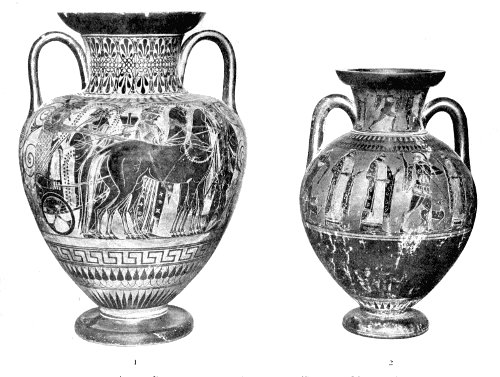
Attic Black-figured Amphorae (British Museum).
1. In Style of Exekias; 2. In “Affected” Style.
In the next group are two very interesting names, those of
Amasis and Exekias, and both demand special attention, the
latter for the excellence of his work, the former as connected
with a special branch of Attic B.F. vases, which must be treated
by themselves. The vases of Exekias include four amphorae,
four cups (see Fig. 96), and two fragments, together with a few
unsigned vases which for various reasons may be attributed
to him.[1207] The finest of his works is an amphora in the Vatican,[1208]
on one side of which are Ajax and Achilles playing draughts,
the one calling out
 “four!” the other
 “three!”[1209]
On the reverse are the Dioskuri, with Tyndareus and Leda.
Besides the signature in iambic form
“three!”[1209]
On the reverse are the Dioskuri, with Tyndareus and Leda.
Besides the signature in iambic form
29

ΕΞΣΕΚΙΑΣ ΕΓΡΑΦΣΕ ΚΑΙ ΠΟΙΕΣΕΜΕ
Ἐξηκίας ἔγραφσε καὶ ’ποιησέ με,
the vase is inscribed with the καλός-name Onetorides. The
others are in the British Museum (B 210), the Louvre (F 53),
and Berlin (1720) respectively, and are all painted with mythological
subjects. A fragment of a deinos[1210] is interesting, as
having, besides the signature, an iambic line in the alphabet of
Sikyon (see Chapter XVII.). Among the four cups, one in
Munich (339) is a masterpiece of its kind. It is of the later
form of B.F. kylix (see p. 374), and represents on the inside
Dionysos in a ship which takes the form of a fish, the mast
and yard overgrown with the vine; on the exterior are large
eyes and groups of warriors. The other three are of the
earlier “Kleinmeister” type, and two are merely signed, without
subject.
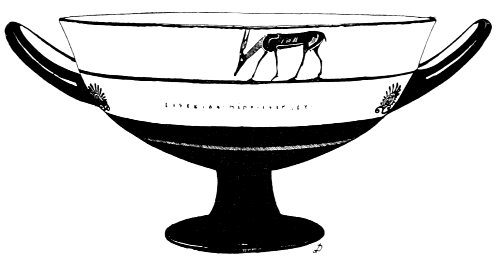
FIG. 96. KYLIX BY EXEKIAS: “MINOR ARTIST” TYPE.
Exekias may be regarded as one of the most typical B.F.
artists. His subjects are mostly from the usual stock-in-trade
of the time, but distinguished above other examples by the care
and accuracy displayed in every detail, especially in the extraordinary
delicacy and minuteness of the incising and the
judicious but sparing use of accessory colour, as also by the
careful naming of the figures in almost all cases. He stands
midway between Klitias of the François vase and the transitional
work of Andokides and Pamphaios, and helps to carry
on the tradition of minuteness and accuracy in detail characteristic
of all these artists.
Amasis is an artist of similar calibre and temperament. His
style is more individual than that of any B.F. artist, and hence
it is possible to attribute to him many vases which he has not
signed. It is marked, like that of Exekias, by accuracy of
drawing and careful and delicate work in details[1211]; but his
subjects are more monotonous and his figures much more rigid
and conventional. There is much in his vases which suggests
a connection with Ionia, especially with the later fabrics discussed
above (p. 356); and this point has been well brought out
by Karo.[1212] We have seven signed vases from his hand, of which
no less than four are jugs of a characteristic form—a form not
unknown in Ionic fabrics,[1213] but usually found among the later
Corinthian wares. It is of the form known as olpe, with the
design in a panel, on the right side of the handle only. An
example of his work is given in Fig. 97.
FIG. 97. PERSEUS SLAYING MEDUSA: FROM AN OLPE BY AMASIS (BRITISH MUSEUM).
It has been thought by more than one writer that he must
have been a foreigner. The name, of course, suggests Egypt,
and his Ionic affinities would further suggest Naukratis or
Daphnae as his home; but he may well have come from Asia
Minor.[1214] His best-known work is the fine amphora in the
Bibliothèque Nationale at Paris (222), with a representation of
Athena and Poseidon, and among the olpae, one in the British
Museum (B 471), with Perseus slaying Medusa (Fig. 97), and
one in the Louvre (F 30), with Herakles’ reception by the
Olympian deities.[1215]
Of the other artists in this group, Nearchos is only represented
by a fragmentary vase from the Athenian Acropolis[1216];
Timagoras was the artist of two fine hydriae in the Louvre
(F 38–9), one representing Herakles wrestling with the fish-bodied
Triton; Tychios has also signed a hydria; Kolchos is
only known from one vase, but that a very fine jug with the
combat of Herakles and Kyknos (Berlin 1732). The design on
the last-named is not, as usual, confined to a panel, but is continued
all round the body.
The list of “Kleinmeister,” or minor artists, is a long one,[1217]
but few individual names are of importance. The most prolific
is Tleson, whose name appears on no fewer than forty cups,
fourteen of which have no design, but only the signature on
either side. Others have a design in the interior only, such
as a Sphinx or Siren; others, again, a figure of an animal—a
cock, hen, or ram—on either side above the signature.
Seventeen are ascribed to Hermogenes, nine with signature
only, and thirteen to Xenokles, of which eight have no design.
But that Xenokles sometimes had larger aims is shown by two
of the cups in the British Museum and the Deepdene collection,
as well as by an oinochoe which he made for the painter
Kleisophos to decorate. The Museum cup (B 425) has on one
side the three cosmic deities Zeus, Poseidon, and Hades; on
the other a subject of four figures which may be interpreted as
the return of Persephone from Hades. The Deepdene cup[1218]
has in the interior the procession of the goddesses to the Judgment
of Paris, and on the exterior Herakles with Kerberos and
Achilles’ pursuit of Troilos. Phrynos, an artist of similar style,
has one cup (B.M. B 424) with the Birth of Athena and the reception
of Herakles in Olympos, the figures being very diminutive,
as are those on the British Museum Xenokles cup. Eucheiros
and Sakonides[1219] show a preference for a female bust painted
in outline on either side of the cup, as does also Hermogenes.[1220]
Archikles and Glaukytes are associated on a fine cup in Munich
(333), which is remarkable for the number of figures each side,
the style being very minute and detailed. On one side is
Theseus slaying the Minotaur, on the other the hunt of the
Calydonian boar, appropriate figures being added each side
to fill in the spaces at the ends of the friezes. There are
seventeen figures in the first scene, and, exclusive of animals,
nine in the latter. A similar cup in the British Museum (B 400),
with continuous frieze, representing a battle (twenty fighters,
three chariots), is signed by Glaukytes alone. Other names are
Anakles, Charitaios, Ergoteles, Epitimos, Myspios, Neandros,
Psoieas, Sokles, Sondros, Thrax, and Tlenpolemos.
PLATE XXX
Vases by Nikosthenes (British Museum).
In the fourth class we are introduced to a very interesting
personality, that of Nikosthenes, the most prolific of all Greek
vase-painters known to us, and of the B.F. artists by far the most
original.[1221] He was, however, a potter rather than a painter, and
on many of his vases the designs are little more than decorative
motives. He favoured vases of metallic form,[1222] such as the phiale
mesomphalos, and invented a peculiar type of amphora, also derived
from a metallic origin, with broad, flat handles and slim
body, with moulded rings dividing the subjects (see Plate XXX.).
Altogether, seventy-eight examples with his signature are
known, of which forty-eight, or nearly two-thirds, are amphorae,
nineteen are cups, four jugs, and one a krater. To these must
be added two cups in mixed B.F. and R.F. technique, one made
for Epiktetos, and three kanthari in the R.F. method, of which
he was probably only the potter. That he had affinities with
the “minor artists” is shown by his making a cup with Anakles,
as also by the style of some of his paintings[1223]; while some of
his cups have only the signature.
The amphorae are all very much alike, with subjects of a
simple character—Sphinxes and Sirens, combats of warriors
or boxers, Satyrs and Maenads dancing, and Herakles with the
Nemean lion, a subject of which he seems to have been especially
fond. The large krater in the British Museum (B 364) is interesting
as an early example of the form with volute handles, and
for the manner of its decoration, with a narrow band of minute
figures on the neck only. In the Louvre there are two elegant jugs
representing the reception of Herakles in Olympos (F 116–17),
the figures being painted on a white slip in the Ionic manner.[1224]
This point is important, because it has been held by many
writers that Nikosthenes was of Ionian origin, and introduced
the white-slip method at Athens. Attempts have even been
made to connect him with Naukratis. The jug figured on
Plate XXX. is similar to those in the Louvre, and is probably
also Nikosthenes’ handiwork.[1225]
Whether this view can be maintained or not, there is no doubt
that towards the end of the sixth century the practice of using
a white slip does appear at Athens for vases with black figures,
and it is quite reasonable to associate its introduction with a
versatile and original artist like Nikosthenes. But the consideration
of this style of painting must be reserved for a later
page (p. 455).
Pamphaios and Epiktetos, with their associates Hischylos,
Pheidippos, and Chelis, must, on the whole, be regarded as
belonging to the R.F. period, the majority of their works being
purely in that style; they will therefore be considered under
a subsequent heading. But the case of the remaining name in
our fourth class, that of Andokides, is somewhat different.
Among the signed examples we have from his hand only one
is purely B.F., three are in mixed style, and two are purely R.F.
It is clear, then, that he represents, better than any other artist,
the intermediate stage between the two styles, more especially
as a whole series of amphorae can be attributed to him in
which the two are combined, sometimes in what has been called
“bilingual” fashion—that is to say, that the design on both sides
of the vase is identical, except for the variation of technique.[1226]
There are, then, six vases signed by Andokides, of which one
is a kylix, the rest amphorae with designs in panels and broad
grooved handles. The B.F. amphora represents a chariot seen
from the front, in very minute, careful style.[1227] One of the
“mixed” amphorae (Louvre F 203) has three Amazons preparing
for battle (B.F.), and women in the bath, one of whom is
swimming, another diving (R.F.) [1228]; the other, a Dionysiac B.F.
scene, and Apollo, Artemis, Leto, and Ares on the R.F. side.
The “mixed” kylix[1229] is a remarkable example of the counterchanging
principle, the two halves of the exterior being exactly
reversed in technique, the dividing-line passing under the
handles.[1230] Of the two R.F. amphorae, one in Berlin represents
the contest for the tripod and a pair of wrestlers; the other, in
the Louvre, a combat and a musical contest.[1231]
PLATE XXXI
Amphora in Style of Andokides (British Museum).
Obv.: Heroes Playing Draughts.
PLATE XXXII
Amphora in Style of Andokides (British Museum).
Rev.: Herakles with Nemean Lion.
The characteristics of Andokides’ work are freedom of composition,
delicacy of drawing,[1232] and wealth of detail; but he is
always bound by conventionalities, and his power of observation
is stronger than his power of correct delineation. Furtwaengler
thinks his combinations of B.F. and R.F. were deliberately
chosen to show the superiority of the latter.[1233] His date may
be placed about 525 B.C., and it is probable that his name
appears on a marble base found on the Acropolis of Athens.
He seems to have learnt his art either from Exekias or Amasis,
probably the latter.
Scholars are generally agreed in attributing to him the series
of “bilingual” amphorae already mentioned, of which the most
notable examples are one in Munich (388) representing Herakles
banqueting, and one in Boston with Herakles and a bull.[1234]
Even more probable is the attribution to his hand of some
half-dozen amphorae of the type which he employed, with
different designs on either side, but B.F. and R.F. respectively.
The most interesting of these is an amphora in the British
Museum (B 193 = Plates XXXI.-II.), with the typical B.F. representation
of warriors playing with pessi on one side, quite in
the manner of Exekias (see above), and on the other Herakles
with the Nemean lion, in which scene the painter has attempted
a new departure. The lion is already subdued, and the hero
carries it in triumph on his shoulder, no doubt with a reminiscence
of the Erymanthian boar types (see Chapter XIV.).[1235]
A curious group of B.F. vases found exclusively in Italy, and
belonging apparently to the middle of the sixth century, is marked
by the extremes to which the mannerisms of the artists Exekias
and Amasis are carried. They are without exception amphorae,
and so similar in style that they must all have been produced
by one workshop, if not one hand. In spite of the excellence
of technique and careful drawing which they exhibit, showing
a really advanced stage of B.F. vase-painting, they are lifeless
and monotonous almost to grotesqueness. Karo, in publishing
the series,[1236] reckons forty-four in all, and points out the various
Ionian peculiarities they present, which mark them either as an
offshoot of the school of Amasis or a parallel development.
Originally known as “Tyrrhenian,” from the form of the
amphora (cf. p. 160), they are now generally spoken of as
“affected amphorae,” in allusion to their peculiar and mannered
style. An example is given on Plate XXIX.
The subjects are all dull repetitions of certain “types,” often
without any apparent meaning, the personages being usually
warriors, horsemen, or ordinary draped figures, young and old.
Women are rarely seen; subjects of a Dionysiac character are
occasionally found, but mythological scenes never, except that
the “type” of the “Birth of Athena” is borrowed, copied, and
divested of all meaning by omitting the figure of the goddess
and depriving the others of their attributes.[1237] In addition to
this, Karo notes six prevailing motives: (1) two men in animated
discourse, occurring about forty times; (2) a warrior arming,
putting on a greave; (3) a warrior conversing with another man,
with spectators; (4) two warriors in combat; (5) a young rider
with second horse (Troilos?); (6) a reception of a guest, sometimes,
but rather doubtfully, identified as Ikarios receiving
Dionysos (see Chapter XIV.).
The complete absence of inscriptions is an Ionic feature as
are the ornamental patterns, such as the tongue-pattern round
the handles; the fondness for winged figures also points in this
direction. The combination of good technique with feeble compositions
points to a late and imitative stage, and is contrary
to the Attic tendency to prefer new ideas and new subjects
to a high standard of technique. Among other characteristic
details we may note the tendency to give the human figures
tapering extremities, common to all archaic art, but here greatly
exaggerated; also the elaborate ornamentation of the draperies
with purple and white flowers or rosettes.
The Panathenaic amphorae, of which some mention has
already been made elsewhere (pp. 48, 132), form one of the most
interesting groups of black-figured vases.[1238] The Panathenaic
games, which were celebrated in the third year of each
Olympiad, were traditionally attributed to Theseus, but at
any rate were reconstituted by Peisistratos about 566 B.C.,
when rhapsodic contests were introduced. To these musical
contests with flute and lyre were added in 456 by Pericles.
The prizes were, as we know from Pindar, painted amphorae
containing olive oil, and there is an interesting inscription[1239]
which gives the number assigned as prizes for each contest.
Thus, for the pentathlon, the first prize was 40 amphorae, the
second 8; for the chariot-race, the first 104, the second 40;
for the foot-race, the first 50 to 60, the second 10 to 12.[1240]
That these vases were greatly valued and buried in tombs
we know from the number found under such circumstances.
About 130 in all are in existence.
PLATE XXXIII
Panathenaic Amphora (British Museum).
Earlier Type (Obv. and Rev.).
The shape of the sixth-century amphora is peculiar, but not
exclusively used for this class[1241]; in height they vary from
twenty-five inches to about eight inches. Towards the end of
the century, and during the fifth, other forms were sometimes
employed, that of the red-bodied amphora and even the
“Nolan” being found. In the fourth century a great change
took place, the height being greatly increased and the body
becoming proportionately slim; the form exactly resembles
that of the contemporary Apulian sepulchral amphorae (Fig. 30,
p. 162), with the addition of a conical cover. After the end
of the fourth century they appear to have been made only of
metal, but that they continued to be made we know both from
literature and monuments, such as the Athenian coins.
The designs are always in panels, the obverse representing
the goddess to whom the games were sacred, in her character
of Athena Promachos; the reverse, the contest in which the
prize was won (see Plates XXXIII.-IV.). Athena is represented
standing to the left, with crested helmet, spear raised aloft in
right hand, and shield on left arm, adorned with an emblematic
device; her drapery is usually much ornamented. Except
in the earliest examples there is a Doric column on either
side of her, surmounted by a cock, as the bird sacred to
Agon, the god of athletic contests; sometimes in place of it
a Sphinx, Siren, panther, or vase. In the fourth century we
sometimes find a figure of Nike or Triptolemos in his car
surmounting the columns. Down the side of the left-hand
column is usually placed the inscription (always preserving
an archaic form):
![ΤΟΝ Α[Θ]ΕΝΕ[Θ]ΕΝ Α[Θ]ΛΟΝ](https://openoldbooks.sgp1.digitaloceanspaces.com/books/history-of-ancient-pottery/images/inscr_390_ton_athenthen_athlon.jpg) ,
τῶν Ἀθηνῆἄθεν
ἄθλων, “(a prize) from the games at Athens.” On the earliest
known, the Burgon amphora (B.M. B 130), the word
,
τῶν Ἀθηνῆἄθεν
ἄθλων, “(a prize) from the games at Athens.” On the earliest
known, the Burgon amphora (B.M. B 130), the word
 is added. In the fourth century the inscription still reads
down the side of the column, but the letters are placed
parallel to it, not at right angles. Further, in this period it
often becomes customary to add on the right-hand side the
name of the archon in whose year of office the games were
held, thus enabling us to date the vase exactly.[1242] Of these,
some ten examples are known, ranging from 367 to 313 B.C.,
the list being as follows:—
is added. In the fourth century the inscription still reads
down the side of the column, but the letters are placed
parallel to it, not at right angles. Further, in this period it
often becomes customary to add on the right-hand side the
name of the archon in whose year of office the games were
held, thus enabling us to date the vase exactly.[1242] Of these,
some ten examples are known, ranging from 367 to 313 B.C.,
the list being as follows:—
| Polyzelos |
367 |
B.C. |
B.M. B 603 |
Found at |
Teucheira, |
|
|
|
|
|
Cyrenaica |
| Themistokles |
347 |
” |
Athens Mus. |
” |
Athens |
| Pythodelos |
336 |
” |
B.M. B 607 and 608 |
” |
Cervetri |
| Nikokrates |
333 |
” |
B.M. B 609 |
” |
Benghazi |
| Niketes |
332 |
” |
B.M. B 610 |
” |
Capua |
| Euthykritos |
328 |
” |
B.M. B 611 |
” |
Teucheira |
| Hegesias |
324 |
” |
Louvre |
” |
Benghazi |
| Kephisodoros |
323 |
” |
Louvre |
” |
Benghazi |
| Archippos |
321 |
” |
Louvre |
” |
Benghazi |
| Theophrastos |
313 |
” |
Louvre |
” |
Benghazi |
The contests represented include the pentathlon, chariot-race,
foot-race, armed foot-race, torch-race, tilting on horseback, the
παγκράτιον, and musical contests (see Chapter XV., § 4).
PLATE XXXIV
Panathenaic Amphora (British Museum).
Later Type (Obv. and Rev.).
The black-figure method is preserved throughout, in spite of
the development in drawing, that of the fourth-century vases
being perfectly free. In the latter there is a lavish use of white
and purple for details, especially on the figure of Athena; and
Nike, when present at the contests, is usually painted white;
but the tendency of later vases to neglect the reverse at the
expense of the obverse in the matter of decoration is strongly
manifested. The figure of Athena becomes greatly elongated,
until her head is actually painted on the neck of the vase,
and in all the vases after 336 B.C. she is turned to the right
instead of the left. Two signatures of artists are found—Sikelos
in the fifth century, Kittos in the fourth. There also
exist some miniature fourth-century examples of these vases,
the purpose of which is not obvious; on the reverse of one
in the British Museum is represented a runner in the
torch-race.[1243]
A peculiar local development of the black-figure style is to be
seen in the vases found on the site of the temple of the Kabeiri,
near Thebes, in Boeotia. From the style of the painting, which
is free and careless, they can hardly be earlier than the fifth
century, and may be later, the old style being preserved, as in
the Panathenaic amphorae, for religious reasons. The site was
excavated in 1887–88, and yielded a large number of vases and
fragments, together with Attic R.F. and plain black glazed
wares. Of the local fabrics the majority are of a Dionysiac
character, or have reference, more or less direct, to the cult
of the Kabeiri; many bear dedicatory inscriptions to the
presiding deities, such as τῷ Καβίρῳ or τῷ παιδὶ καὶ τῷ Καβίρῳ,
etc.
The material is a reddish-yellow clay of good quality, on
which the designs are painted in a pigment varying from
yellow-brown to the deep lustrous black of the best Attic
vases. Occasionally details in white or purple are added;
incised lines are used only for inner markings as a rule. The
shapes are confined almost entirely to one, a large deep bowl
with two small ring-handles, to which are attached projections
for the support of the fingers; it comes nearest to the pella
described by Athenaeus (see p. 186). The decorative motives
are simple—vine-wreaths, ivy-wreaths, myrtle and olive, and
the wave-pattern; sometimes the reverse is only ornamented
with a pattern of this kind.[1244]
FIG. 98. VASE FROM TEMPLE OF KABEIRI: PARODY OF ACHILLES AND CHEIRON
(BRIT. MUS. B 77).
The subjects are interesting from the fact that they are an
early instance (in vase-paintings) of intentional caricatures or
grotesques; this is shown not only in the manner of treating
the themes selected, but in the rude character of the drawing.
Among those drawn from myth and legend may be mentioned
Odysseus with Kirke (two instances) and traversing the sea
on a raft; Peleus bringing the young Achilles to Cheiron
(Fig. 98); Kephalos hunting a fox; and Bellerophon slaying
the Chimaera. A favourite subject is that of Pigmies in combat
with cranes. But the most interesting is one which represents
the deity Kabeiros (answering to Dionysos) with his son (Pais,
i.e. Iacchos) at a banquet, accompanied by three symbolical
figures—Mitos, Pratolaos, and Krateia. Another fragment
shows a train of worshippers approaching the Kabeiros, in
the manner of the Asklepios reliefs.[1245]
The transitional stage from black to red figures is illustrated
by more than one class of vases. Those in which the two
methods are united on one vase have been discussed elsewhere,
in considering the characteristics of the artists who used both.
But there is another class corresponding to neither method,
and yet partaking of the character of both, in which the
figures are painted in opaque red or white pigment laid directly
on the surface of the vase, which is covered throughout with
black varnish (Plate XXXV.). Inasmuch as the method of painting
in colours is more suggestive of the B.F. vases, they are
classed therewith in some collections, as in the British and
Athens Museums; but since their appearance and style link
them more closely with the R.F. period, they are found in
others, as at Berlin, ranged with the latter class. In any
case they form a distinct group, in which the earlier examples
correspond more with the B.F., the later with the R.F., vases.
They are undoubtedly of Athenian origin, but to what extent
they affected the change from black to red figures is doubtful.
The practice of laying colours on the black varnish is, of
course, one that was quite familiar to B.F. artists; the analogous
procedure in the R.F. period was the laying of black pigment on
the red glaze, as was necessarily done for details such as devices
on shields. The transition was therefore easy in the case of a
vase covered with black varnish, to painting the figures only in
the opaque colours upon it, thereby enlarging the scope of the
process. The incised lines in which the figure was necessarily
sketched out before painting (and which frequently occur in
this class) led the way to the process by which the R.F. artist
engraved his design on the red clay before covering the rest
of the vase with varnish. In the case of female figures it is
obvious that this method was already practised, especially in
scenes in which they appeared entirely nude, and the whole figure
was painted white over the black silhouette, the black becoming
the real accessory where it was required for the hair, etc.[1246]
Dr. Six, who has studied this class, gives a list of about
seventy examples,[1247] including one signed by Nikosthenes
(Plate XXXV., fig. 2 = F 114 in the Louvre) which has a
figure of a woman painted in white each side, the style, be
it noted, being purely black-figured. In later specimens the
object seems to have been to imitate the appearance of
the R.F. vases, and to paint the figures in a similar but
opaque red colour instead of white.[1248] Other examples again
have figures only incised on the black, without any addition
of colour.[1249] In some of the earlier ones the use of black
as an accessory[1250] shows that the painter, so to speak,
“thought” in the B.F. style, but used white for black and
vice versa.
Most of the earlier examples have been found in Greece or
Magna Graecia; they are usually of the lekythos form, which
is always rare in Etruria. The later group chiefly consists of
small bowls (phialae) of very negligent style, but some are of
the typical R.F. forms, such as the “Nolan” amphora and the
stamnos. A considerable number of fragments were found on
the Acropolis of Athens, showing that even these late imitative
specimens, in spite of their rude, careless execution, cannot be
placed later than 480 B.C.
One of the most interesting examples is a fragment found
on the Acropolis of Athens,[1251] with an owl within an olive-wreath;
it had been dedicated to Athena by a potter whose
name is now lost. There is also a good series in the British
Museum (B 681–700), including a lekythos with Odysseus carried
under the ram, painted in polychrome.
Before embarking upon the history of the red-figured vases
it may be well to endeavour to see what light the vase-paintings
up to this point throw on the literary traditions
preserved for us, chiefly by Pliny, in regard to early painting.
There is, perhaps, no subject which that writer has treated
with greater vagueness; and we are forced to the conclusion
that he really knew nothing about it, and did not comprehend
the meaning of the earlier writers from whom he
borrowed.[1252] Still, it may fairly be supposed that the names he
mentions are those of real persons, even if his account of their
achievements is vague or imaginary. There are also a few
stray items of information given by Aristotle, Aelian, Strabo,
and Athenagoras.
PLATE XXXV
Vases with Opaque Designs on Black Ground.
1. Brit. Mus.; 2. By Nikosthenes, in Louvre.
Pliny[1253] begins by attributing to Corinth or Sikyon the
discovery of the possibility of producing figures by outlining
shadows, as in the story of Butades (p. 110). The next
stage, he says, was to fill in the outlines with single colours,
or monochrome. He next states that Philokles, an Egyptian,[1254]
and Kleanthes of Corinth “invented linear painting,” and that
they were followed by Aridikes of Corinth and Telephanes
of Sikyon, who, still without using any colours, introduced
inner markings and details,[1255] and inscribed names over their
figures. Ekphantos of Corinth introduced the use of a red
wash, employing a pigment made from pounded pottery
(testa trita),[1256] which may represent the purple so lavishly
employed on Corinthian vases. A later development was
that of monochrome painting—i.e. the use of a single
flat body-colour—introduced by Hygiainon, Deinias, and
Charmadas.
Aristotle, on the other hand, speaks of Eucheiros of Corinth
as the “inventor of painting.” The name reminds us of the
tradition of Demaratos, who took with him from Corinth to
Etruria a craftsman of that name. It is also interesting to
note that the name is borne by an Athenian kylix-painter
(see above, p. 384), the son of Ergotimos, who made the
François vase. Possibly he may have been the grandson of
the Corinthian artist.
Strabo (viii. 343) and Athenaeus (viii. 346 C) mention a picture
by Kleanthes (see above) which represented the Birth
of Athena,[1257] and can hardly have been later than the seventh
century—a period to which such evidence as we have would
allot the series of artists already named.
It must be borne in mind that the names of these early
artists are those of draughtsmen, not of painters. Even in
the time of Polygnotos drawing was the chief aim of all artists—as
the red-figured vases amply testify—and painting, as we
regard the art, only came into existence after the middle of
the fifth century. The development from liniarem, or “outline-drawing,”
to monochrome at first sight presents a difficulty,
as it seems to be opposed to the evolution of vase-painting,
which is from silhouette (as in the Dipylon ware) to outlines
(as in the Ionic vases). But even if it is not always intelligible,
we can still observe a distinct continuity in Pliny’s account.[1258]
After Ekphantos had introduced the filling-in of outlines
with red washes, and Hygiainon and his confrères had continued
painting with a single colour,[1259] a step further was made by
Eumaros of Athens, who distinguished the sexes and “introduced
all kinds of new subjects.” Here we may clearly
discern the introduction of white in the later Corinthian and
early Attic wares for female figures, and the growth of mythological
and genre subjects on the vases of the time.[1260] His
innovations of technique and subject may therefore be fairly
regarded as coincident with the great advance in vase-painting
made at Athens under Peisistratos and reacting upon Corinth.
It is interesting to note that the name of Eumaros occurs on
a marble base found on the Acropolis at Athens; and if this
can be the painter, his date would be fixed about 590–570
B.C.[1261]
In any case one thing is certain—that painting had not
yet developed into anything like a high art. It was still
purely decorative, and the few early paintings of which we
hear, such as those of Bularchos (p. 361) and Kleanthes, were
not beyond the level of the Clazomenae sarcophagi or the
François vase in merit. We probably gain the best idea of
painting which was not merely decorative from the Corinthian
pinakes (p. 316) and the Acropolis warrior-tablet,[1262] especially
as they are painted on the white slip or λεύκωμα, which we
know to have been favoured by early Greek painters.[1263]
The relation of Pliny’s next artist, Kimon of Kleonae, and of
his improvements to the work of the vase-painters, has been much
discussed by writers on the red-figured vases; and they have not
been by any means unanimous in their conclusions, either as to
the nature of his “inventions” or as to the time at which their
influence made itself felt. They are described by Pliny in the
following words: “Cimon of Cleonae improved upon the inventions
of Eumarus. He invented catagrapha—that is, oblique images—and
varied positions of the features, looking back or up or down.
He distinguished limbs from joints, emphasised the veins, and
further reproduced folds and hollows in the drapery.”[1264]
The crux of this passage is of course the word catagrapha,
with Pliny’s Latin equivalent, obliquas imagines. At first sight
it would seem that the Latin rendering of the word connected
it with the rendering of the face in a new way, i.e. in three-quarter
aspect instead of the old profile of the silhouettes.
But this was not introduced into vase-painting until quite a
late period[1265]; it is found, for instance, on the Meidias vase about
440 B.C., and is certainly not earlier than the time of Euphronios,
whereas Kimon appears to have lived about 540–490 B.C.[1266]
Moreover, there seems to be some antithesis between the imagines
and voltus—i.e. varios formare voltus is not an explanation of
the imagines—and, on the whole, it seems more natural to take
the first word as a general term for figures. Obliquas imagines,
then, would obviously imply some kind of perspective, which,
when applied to the human figure, indicates foreshortening.
Now, this advance in drawing is first found in the earlier
work of Euphronios, i.e. about 500–490 B.C., though traces
of it are to be seen in the later work of the Epictetan cycle.
It will be noted in the next chapter that Epiktetos and his
contemporaries are still in the trammels of the old method.
Many of these vases even exhibit traces of a decadent style,
with rough and carelessly drawn figures. As Hartwig has
well pointed out, the real division of style comes, not before
Epiktetos, but between him and Euphronios. The Epictetan
cycle is transitional, and a time of preparation, firstly in the
change of technique, secondly in the evolution of cup-decoration,
thirdly in the discovery of new motives and extending the
scope of subjects. The new birth is seen in the form of
increased naturalism, and is parallel to the development of
sculpture under Pythagoras and Myron, who, like Kimon,
“gave prominence to sinews and veins.” We may therefore sum
up with Studniczka and Hartwig by saying that the reforms
of Kimon, which first manifest themselves in Euphronios and
his contemporaries about 500 B.C., imply a new theoretical
knowledge of linear perspective, which in practice displays
itself in a correct rendering of foreshortening.[1267] In minor
details the same advance is at this time apparent, in the
treatment of the eye, which now begins to be rendered with
some approach to truth, and in the accurate and detailed
rendering of muscles and anatomy, and of folds of drapery.
These are precisely the points in which Pliny regards Kimon
as having so greatly advanced his art, which, as Aelian tells
us, he “helped out of leading-strings.”[1268]
The first painter in polychrome was Panaenos, who also
introduced portraiture, but must still be regarded as a draughtsman
only; and, finally, Polygnotos, by such innovations as
giving expression to faces, and rendering transparent draperies,
gave the first real advance to the art. So far Pliny on the
beginnings of Greek painting; but its further developments,
and more particularly the relation of Polygnotos to the fifth-century
vase-paintings, must be more fully dealt with in a
succeeding section.
Origin of red-figure style—Date of introduction—Καλός-names and historical
personages—Technical characteristics—Draughtsmanship—Shapes—Ornamentation—Subjects
and types—Subdivisions of style—Severe
period and artists—Strong period—Euphronios—Duris, Hieron, and
Brygos—Fine period—Influence of Polygnotos—Later fine period—Boeotian
local fabric.
At first sight the sudden reversal of technical method involved
in the change from black figures on red ground to red figures on
black ground is not easy to explain. That it was a new invention,
not a development from the old style, is obvious, seeing that no
intermediate stage is possible. The theory has been promulgated
by a German writer[1269] that the idea arose from the effect
of the Gorgoneion painted on the inside of many late B.F.
kylikes. Undoubtedly the effect is that of the R.F. style, the
face itself being left red, surrounded by black hair, beyond
which the black is continued over the whole surface of the
interior.[1270] But this theory has not really much to support it;
the Gorgoneion is in the R.F. technique, and did not therefore
suggest it; and the earliest R.F. kylikes usually have B.F.
interiors, not R.F. It is exceedingly doubtful that the kylikes
had anything to do with bringing about the change.
Much more probable is the suggestion that the class of vases
with opaque figures on black ground (p. 393) represents the
transition, if transition it can be called.[1271] We have seen that
some of these correspond more to the B.F. vases, others to the
R.F., and that in many cases their appearance is that of R.F.
vases. It may easily be conceived that it occurred to the
painter that it was more effective to let the red clay of the
background appear through the black wherever he would place
a figure than to paint the red on to the black. But these vases
are few in number; and as the R.F. vases sprang at once into
great popularity, the new invention must have become too
general at the very first to have been adopted from such a
comparatively rare method. There is also a greater tendency
to naturalism in that class than in the earlier R.F. vases. The
fact is that there had been going on throughout the course of early
art a tendency (to which B.F. vase-painting forms an exception)
in favour of drawing figures on a light ground against a dark
background. And even in the B.F. vases this tendency is not
altogether absent, as seen in the attempts at lightening the
figures by making them polychrome, i.e. with purple and white,
and also by the practice of covering the rest of the vase entirely
with black.
Now, we have already seen that Andokides was a painter who
liked to combine the two methods on one vase, and also that he
was one who invariably adopted the completely black variety of
amphora, for B.F. painting as well as R.F. His Louvre vase
with the women swimming is clearly one of the earliest R.F.
examples in existence. It is therefore much more likely that
he represents for us the author of the new method than
Epiktetos or the other artists who painted “mixed” kylikes
or who used both styles. On the other hand, it must not be
forgotten that it was really in the kylikes that the new style
rose into popularity.[1272]
Next to the question of how the new style was brought about
comes that of when it arose, and the length of its duration at
Athens. The chronology of R.F. vases rests on two considerations—the
inscriptions on the vases themselves, and the evidence
of history and excavations. Until within the last twenty years
it had been customary to regard the year 480 B.C. as the line of
demarcation between the two methods, and the earliest date for
R.F. vases. Yet as long ago as 1834 Ludwig Ross, finding a
fragment of R.F. pottery among the debris of the Persian sack
of the Acropolis, acutely deduced therefrom that this style must
necessarily have been in existence before the date of the sack, i.e.
before 480 B.C. His views, however, fell on deaf ears, and it was
not until the scientific exploration of the Acropolis in 1885–89
that his deduction was seen to be justified. The result of these
excavations was to show that among the mass of pottery found
in the pre-Persian stratum a considerable quantity belonged to
a comparatively advanced stage of R.F. painting, including
signatures of artists of the archaic and severe style down to
Euphronios. Some writers have thought that these fragments
may belong to the period between 480 and 460, when the
rebuilding of the site was begun; but so many show traces
of burning that it is far more probable that the earlier date is
correct.[1273] Allowing, then, for the necessary stages of development
up to the time of Euphronios, the beginning of the style
may be placed about 525–520 B.C., the date at which, as we have
seen, Andokides may be placed. Besides his name (see above,
p. 387) that of Euphronios “the potter” was also found on a
base in the Acropolis excavations.[1274] The other limit of date will
be more conveniently discussed in a subsequent connection, and
it may suffice to say here that the gradual pushing back of the
terminus post quem points now to a much earlier terminus ante
quem than was formerly supposed. Reasons will subsequently
appear for placing the termination of the red-figure fabrics at
Athens in the closing years of the Peloponnesian War
(410–400 B.C.).
The evidence afforded by inscriptions is necessarily affected
in some degree by that of excavations, and chiefly important
for the relative dates of the vases. It is not palaeographical, but
is afforded mainly by one class of inscriptions, that of the καλός-names,
so far as they have an historical significance. These
names will be the subject of discussion elsewhere,[1275] and are
only alluded to here for their connection with the question of
chronology. It is a well-known feature of these καλός-names
that many are those of famous historical personages, such
as Alkibiades, Megakles, Miltiades, and Hipparchos.[1276] But, on
the other hand, any attempts to connect the vases with the
historical bearers of the names have met with little success;
there is also the danger of arguing in a circle—e.g. of saying that
because Miltiades’ name appears on a vase, it is therefore to be
dated in his youth, and because the vase belongs to the date
when Miltiades was young, therefore it bears the name of that
individual.
Where the importance of these names really comes in is in
their relation to particular artists or groups of artists. In this
way, as Klein and Hartwig have shown, connecting-links between
the artists can be traced and their chronological sequence assured.
This, taken in conjunction with questions of style and our fixed
dates obtained from other sources, enables us to extract a fair
working chronology from all the data. The subject must, however,
be dealt with in greater detail when considering the work
of individual artists, and only a few general statements can be
laid down here.
Many of the historical καλός-names, such as Hipparchos or
Glaukon, were probably very common at Athens,[1277] and we have
therefore no grounds for attaching importance to their appearance.
But in regard to the great painter Euphronios, whose
date is fairly certain, it is important to note that two different
names are connected with vases in his earlier and later manner
respectively, viz. Leagros[1278] and Glaukon. Euphronios began his
career about 500–490 B.C., and it probably covered some forty
years, from about 495 to 455. Hence we may place the time of
Leagros’ youth about 495–490, that of Glaukon about 465–460,
and it is remarkable that the latter appears as “son of Leagros”
in one or two cases.[1279] Now, we know that there was an Athenian
general Leagros who was στρατηγός in 467, and fell in battle
against the Edones in that year. Also that he had a son,
Glaukon, who commanded at Kerkyra in 433–432. In this case
the historical data fit in so exactly with the evidence of the
vases and of the Acropolis excavations[1280] that we need hardly
hesitate to accept the identity of these two names.
It has been assumed—and the assumption has hardly been
questioned—that the καλός-names are necessarily always those
of youths, i.e. of about seventeen to twenty years of age; this
view is supported both by the general character of the subjects
on the vases where they appear, and by the frequent use of the
analogous formula ὁ παῖς καλός. Dr. Hartwig has laid down
certain conclusions in regard to these names which have met
with general acceptance, and may be briefly restated here by
way of summarising the subject.
(1) All vases with the same καλός-name are limited to a
period of ten years, and consequently all those which are by
one artist belong to a definite circumscribed period of his life.
(2) All vases by different artists, but with the same καλός-name,
are approximately contemporaneous, i.e. within ten years.
(3) The appearance of two or more καλός-names on the same
vase indicates the approximate similarity of age of the persons
named, the greatest possible difference being ten years.
(4) All vases with the same καλός-name, whether by one artist
or more, can always be linked together by their style; the same
name does not appear on a man’s earliest and latest vases.
He further impresses the caution that the identity and position
of the παῖδες καλοί (i.e. whether or no they belonged to the aristocratic
class) is a secondary question compared with that of the
development of painting which they help to elucidate.
The question of fabric is one that hardly needs discussion,
the evidence pointing so unanimously to Athens in all cases.
The apparent exceptions suggested by classes of vases found
almost exclusively on one site, like the “Nolan” amphorae or
the Gela lekythi, can easily be shown to be no real exceptions.
We have already met more than once with instances of
particular fabrics being favoured by particular places; and just
as Ionian vases were imported to Caere or Vulci, and a special
class of Attic B.F. vases made for Cyprus, so we may suppose
that certain Athenian makers had a monopoly of export to
Nola, to Gela, or elsewhere. Otherwise similarity of style,
of technique, of subject, of the alphabet of inscriptions, and
all other details point to a purely homogeneous fabric, and
that this was located in Athens itself is not a matter to be
seriously disputed. To this complete monopoly which Athens
enjoyed in the fifth century only one exception can be traced,
that of Boeotia, where local fabrics continued to be made at
Thebes and Tanagra. Of these one class has already been
discussed (p. 391); the other will be treated of subsequently
(p. 451).
We must next consider briefly the technical characteristics
and the forms of the Attic R.F. vases. As regards the former,
the method pursued during the period under consideration
may be summarised as follows. The artist sketches his design
on the red clay with a fine-pointed tool; he then surrounds
this outline with black varnish, laid on with a pen or brush,[1281]
to the extent of about an eighth of an inch all round, this
being done to prevent the varnish, when laid on over the
rest of the ground, from running over into any part of the design.
Finally, details such as features or folds of drapery are added
with a brush in black lines on the red, this process representing
the incised lines of the old style; and further details are often
expressed either in a thinned black pigment which becomes
brown and is sometimes only perceptible in a strong light, or
by application of white and purple as in the last period. In
the severe style purple is generally used; but at a later stage
this colour was dropped, and finally replaced by white. The
accessory colours were chiefly used for fillets in the hair, liquids,
flowers, and other small details, as well as for inscriptions.
Thus we see that the technical process of the preceding method
is exactly reversed and that the figures now stand out in the
natural colour of the clay against the black ground.
The advantages of the new method were obvious. As long
as the vase-painters continued content with stiff and hieratic
forms and mere silhouettes the black figures were sufficient.
The careful mapping-out of the hair and muscles, the decorations,
and all the details of shadow in painting and of unequal
surface in sculpture could be easily expressed by the new method.
But it is evident that these stiff lines were quite inadequate
to express those softer contours, which melted, as it were, into
one another, and marked the more refined grace and freedom
of the rapidly advancing schools of sculpture and painting.
By the change of colour of the figures to the lucid red or
orange of the background, the artist was enabled to draw lines
of a tone or tint scarcely darker than the clay itself, but still
sufficient to express all the finer anatomical details; while the
more important outlines still continued to be marked with fine
black lines. At first the style is essentially the same, the
forms precise, the eyes in profile, the attitudes rigid, and the
draperies rectilinear. The backgrounds may have been painted
in by an ordinary workman, and some specimens exist in
which it has never been laid on (cf. p. 222). The artists seem
to have worked from slight sketches, and according to their
individual feelings and ideas, and as duplicate designs are
quite unknown, there was clearly no system of copying.
The correspondence of style in the figures on the earlier R.F.
vases to those of B.F. technique shows that the two methods
must have coexisted for a time, and this is further borne out
by the mixed vases of Andokides, Hischylos, and others, and
by the work of artists who employed either style, like
Pamphaios. The latter, for instance, seems to have adhered
to the old style by preference for hydriae and large vases,
but preferred to follow the new fashion in the kylix.
To quote a recent writer: “The new method opened up a
path for the freer exercise of the imagination,” and we can
see in the red-figure vases a gradual development of artistic
conception and power of expression, together with the shaking
off of all restrictions until the perfection of drawing is reached,
and “the red figures stand out against the black, unencumbered
with anything that might distract from harmony of colouring
or purity of outline.”[1282] It is the essential characteristic of the
new style that it is drawing rather than painting, and it stands
out as the final attainment of what the vase-painters had really
been striving after from the days of the Melian and early
Ionic wares—namely, the perfection of linear design. The same
principle is at work in the vases with white ground which
passed through parallel phases of development.
Among minor details of drawing in which an advance is
conspicuous is the treatment of hair, eyes, and drapery. In
the B.F. style the hair was indicated as a black mass, standing
out against the light background; but now that the background
had become black, a separation was necessary. At first this
was done by adhering to the old engraved line method, for
which came to be substituted a narrow unpainted line. Next,
an advance was made in the treatment of the hair itself, with
a view to more accuracy in detail, and the contours are
undulated or separate locks shown on the forehead. Sometimes
a kind of stippling process is adopted, by means of which the
hair is indicated by rows or clusters of raised dots, representing
close curls, such as are seen in Attic sculpture of the late
archaic period.
The general contours of the forms are slender; the foreheads
are low, the noses prominent, the eyes long, the chins
sharp, the legs short and thick, and the folds of the garments
stiff and rectilinear. Women are not distinguished in this
style either by their colour or by the shape of their eyes, in
which respects they are drawn just like the men, but exclusively
by their costume and form. The white hair of old men is
indicated by white markings on the black ground, and curly
hair, as noted, by little raised knobs of black paint (βόστρυχοι).
The figures are generally small, but some of grandiose
proportions occur even in the earlier stages, though more
characteristic of the succeeding “strong” style. The principal
outlines are usually finished with wonderful spirit and truth,
but sometimes, as in the extremities, great carelessness is
visible. The general effect is much enhanced by the fineness
of the clay, which in the earlier R.F. vases is of a bright
orange-red, as also by the brilliancy of the black varnish.
From B.M. Cat. iii.
FIG. 99. DIAGRAM SHOWING DEVELOPMENT IN RENDERING OF EYE.
The development of the form of the eye is most important,
as an aid to chronology (see Fig. 99). In the B.F. period
it was invariably treated in two ways,—that of a man as a
complete circle, in front view, between the lids, of which the
upper is more arched than the lower; that of a woman is
almond-shaped. In the R.F. vases the eye in front view is still
maintained with figures in profile, but the sexes are not distinguished;
the pupil is painted black, and the lids drawn at
first like the B.F. male eye, then almond-shaped. The next
stage is to shift the pupil (which now becomes a ring with
central dot) into the inner corner. Lastly, this corner is
opened out till it assumes the correct profile appearance, and
then, about the middle of the fifth century, the pupil also attains
the correct form. About midway in this development, as
we have already seen, the power is acquired of moving the
position of the pupil to express looking upwards, downwards,
or sideways; the importance of this point as bearing on the
new developments of Kimon of Kleonae we have already
discussed. The eyelashes are not rendered until the correct
profile is attained, except in a few instances, such as the
Berlin cup of Euphronios (2282), where the lids are fringed
with short, vertical strokes.[1283]
In regard to the treatment of drapery, the earlier vases,
such as those of the Epiktetos cycle, retain the B.F. method
of rendering folds only in the skirts of the chiton, these taking
the form of parallel lines. Gradually the folds follow the
motion of the body; and finally, under Euphronios, comes a
marked advance, whereby contrasts of material are indicated.[1284]
He uses fine brown crinkly lines to represent the soft transparent
Athenian fabric which we also see worn by the archaic
female figures of the Acropolis.
Among the many improvements in drawing effected during
the R.F. period, a notable one is that of the introduction of
true perspective and more than conventional landscape. We
know from the shield of the Athena Parthenos that this began
to be understood at Athens by the middle of the fifth century,
as also from the paintings of Polygnotos, and hence we are not
surprised to find it appearing in the vases of the period when
that artist’s influence began to be felt. A fine example is
the krater from Orvieto in the Louvre, with an Argonautic
scene (see p. 442); and even more beautiful is the Blacas
krater in the British Museum, which shows Selene disappearing
over the top of a hill, and the stars setting in the sea (see
Plate LIII.). These two vases also illustrate the introduction
of the new principle of placing figures at different levels which
was elaborated in the Meidias hydria, the vases of Kertch, and
to a still greater degree in those of Southern Italy. All these
details indicate the growing tendency towards a pictorial style,
which in the first instance was due to Polygnotos.
The shapes of the R.F. period are to a great extent the same
as in the last, but most of them are modified to some degree,
and some new ones are introduced. Moreover, the relative
popularity of certain shapes varies, the amphora and hydria of
the B.F. period being now surpassed in favour by the kylix,
the krater and lekythos receiving more attention, and certain
new forms, such as the askos and stamnos, appearing at different
stages.
For the first half of the period, from 520 to 460 B.C., the
kylix is pre-eminent, not only in point of numbers, but for the
attention devoted to its decoration. It is, as we have seen,
doubtful whether it was actually in the kylikes that the new
style came into being, but in any case they form the material
for the study of its earlier phases. The form is that of the
later B.F. varieties (see p. 191), as used by Exekias and the
painters who used the large eyes in its decoration, tracing its
origin probably to an Ionic source.[1285] At first the decoration
is often confined to the interior, or the exterior designs are
little more than conventional, consisting of the eyes and a
simple motive or figure between.[1286] In the strong period there
is usually a connection between the interior and exterior
designs, the whole often forming successive episodes of a
story[1287]; but subsequently the old principle asserts itself, and
the interior subject becomes the important one. Slight variations
of form occur,[1288] as in the cups of Brygos, with their off-set
lip, or the delicate products of Sotades, the handles of which
are shaped like a chicken’s merrythought. In the latest
specimens the stem is often replaced by a flat broad foot, or
the bowl becomes flat and ugly, losing all the beauty of the
earlier graceful curves.
Among other drinking-cups the kotyle, kantharos, and rhyton
are most often found. The former was favoured by Epiktetos
and Hieron, and a kantharos is signed by Epigenes, others by
Nikosthenes and Duris. The kantharos, though a very beautiful
form, is never common in the painted vases, being perhaps
oftener made in metal. Among the kotylae we may mention
here a series painted with an owl and olive-wreath,[1289] which
obviously have some reference to the cult of Athena. They
have been identified, but on slight authority, with the Παναθηναϊκά
mentioned by Athenaeus[1290]; but their real meaning
has not yet found a satisfactory explanation. The rhyton
strictly belongs to the series of plastic vases (see pp. 201, 211),
the lower portion being always modelled in the form of a head,
human or animal, or two conjoined. Some of these are signed
by artists, such as Charinos and Kaliades.[1291]
Of the amphora three main varieties are found. The earlier
type, which reproduces the “black-bodied” or panel-amphora
of the B.F. period, did not long remain in favour, and was
mainly used by Andokides and Euthymides and their associates.
The panel system of decoration is still retained, the
framework being formed of ornamental patterns as in the old
style. Secondly, there is the “Nolan” amphora, which came
in about 500–480 B.C., and was obviously an improvement
on the old “red-bodied” B.F. type. It is a very graceful,
slender form, with long neck, distinguished by the surpassing
excellence of its black varnish, and the impression
of taste and restraint given by its simple decoration of one
or two figures each side (see Plate XXXVI.). The third variety
is the so-called pelike (see p. 163), a not very successful variation
of the amphora, but for some reason very popular in the later
stages. With its flat foot and bulbous body it stands in the
same relation to the amphora as does the so-called aryballos
(see below) to the lekythos.
Two forms that may be connected with the amphora are the
stamnos and the psykter (see pp. 163, 172). The former is
peculiar to the R.F. period in its earlier stages; the first
known example is signed by Pamphaios, a “transitional” artist.
Most of the known specimens attain a high average of excellence.
The psykter or wine-cooler is very rare, but there are
two fine examples signed by Euphronios and Duris.
The hydria in this period at first retains the B.F. form, as seen
in an example of about 500 B.C. signed by Phintias (B.M. E 159),
but the tendency to prefer a curvilinear outline is soon manifested.
The new development is conventionally known as a kalpis.
The shoulder having ceased to be distinct from the body, the
design becomes single, or else is confined to the upper part of
the field.
Of the krater we have at least four varieties, all belonging to
the more developed stages of the period. The earliest example
is the Antaios-krater of Euphronios in the Louvre, about
500 B.C., which is of the form known as vaso a calice (p. 170);
but this and the other varieties never become really common
till the final stages are reached. The bell-krater, or vaso a
campana, is only found in the late fine period, and is then almost
the only kind of large vase made; the volute-handled krater,
which was developed from the old column-handled type, is seen
in some fine specimens. At first the design (as in the B.F.
example by Nikosthenes, B.M. B 364) is confined to the neck.
The treatment of the column-handled type is interesting as a
survival of archaism both in design and arrangement, with the
bordered panels and occasional B.F. friezes of animals.[1292]
Among the smaller vases, the oinochoë and lekythos with
their varieties, the askos and the pyxis, are the most important.
With the exception of the ordinary form of lekythos these
belong chiefly to the later stages, when the preference was for
a sort of miniature style. Very few of these bear artists'
signatures. The oinochoë differs little from the B.F. examples;
the pyxis is practically a revival of an old form favoured in
the Corinthian and other early fabrics. The latter are usually
decorated with domestic or marriage subjects, in reference to their
use by women for toilet purposes (see Plates XLII., XLIII.).
The lekythos was, as we shall see, the form exclusively
employed for the funeral vases, and largely also for others with
polychrome decoration on white ground. Those painted with
red figures belong mainly to the strong period (500–460), and
have been mostly found in Sicily, whither they were imported
by preference, like the amphorae made for Nola; a fine specimen
is given on Plate XXXVI. When this form came to be
adopted for the funeral vases, a new type arose with bulbous
or spherical body, conventionally known as an aryballos. In
the late fine style we have many examples of this form, with
rich polychrome decoration and gilding (Plate XLII.).[1293]
PLATE XXXVI
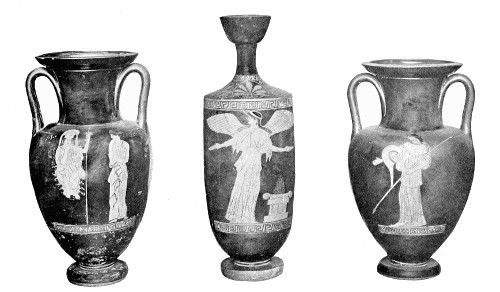
Red-figured “Nolan” Amphorae and Lekythos (British Museum).
The ornamental patterns on R.F. vases do not, generally
speaking, call for so much attention as those of earlier style;
they are on the whole used with great restraint and little
variety, and are more subordinate to the designs than at
any other period of vase-painting. The principal motives are
the palmette, maeander, and egg-pattern; all others are comparatively
rare. It is interesting to note, on the early amphorae
and hydriae, and on the column-handled kraters down to quite
a late date, the survival of the old panel system with its borders
of ornament. Strictly speaking, now that the background was
black throughout, there was no necessity for enclosing the space
on which the figures were depicted; but the conservative
instincts prevailed, especially while the old shapes were retained.[1294]
Gradually, however, as these vases assumed new forms, the
borders were almost unconsciously dropped—first the sides,
then the top, and lastly the lower border, which maintained
its ground longer than the others. The same tendency, from
a formal framework to absolute freedom, is in fact to be
observed in all the vases; and in the later stages we note a
new development, that of an elaborate pattern of palmettes
under the handles, which assumes more and more prominence.
The evolution of the palmette on R.F. vases has been skilfully
traced by Dr. Winter[1295] in reference to the kylikes; but it is no
less interesting in the amphorae and similar forms. In both
cases it arose from the tendency to make the handles terminate
in stylised palmettes, which on the B.F. kylikes of the minor
artists are often a prominent element in the decoration.
Similarly, on the B.F. red-bodied amphorae we have the
symmetrical compositions of palmettes under the handles
radiating from a common centre. These were at first reduced
to a modest single palmette or a pair, but soon spread out
again, preserving at first the symmetrical grouping; subsequently,
with an increasing tendency to naturalism, the
palmettes, enclosed within graceful tendrils, form unsymmetrical
but highly pleasing compositions without any definite centre.[1296]
This development of ornament under the handles—to which
part of the vase it was almost restricted—can be traced during
the first half of the fifth century, till it reaches its height about
the middle. Where a band of ornament was required round the
base of the design, as on the large calyx-kraters, it takes the
form of a row of palmettes enclosed in tendrils, in the style of
modern arabesques; or the palmettes are arranged in pairs, set
obliquely, and each pair divided by a scroll ending in volutes.
Or, again, a row of somewhat squat palmettes, similarly enclosed,
alternates with lotos-flowers in the old style, as on B.M. E 169.[1297]
FIG. 100. PALMETTES UNDER HANDLES (EARLY R.F. PERIOD).
In the kylikes the development of the handle-ornament first
begins with Epiktetos, who (as on E 3 in B.M.) first draws
a free palmette with separated leaves on either side.[1298] As
the tendency to cover the whole of the exterior space with
the design increased, the intervening space under the handle
came to be filled in also, by extending the tendrils of the
palmettes and terminating them with buds (Fig. 100).[1299] Next,
a tendency to symmetrical composition each side is seen, the
palmettes being doubled in number[1300]; or, again, an attempt
is made at uniting the two isolated palmette-systems in one
harmonious whole, and at the same time to fill the intervening
space, by means of interlacing tendrils.[1301] The palmettes are
further increased to three or four each side, and in the arrangement
is seen the tendency to freedom even at the cost of
symmetry already noted, as in Fig. 101.[1302] Thus is reached the
point at which the severe passes into the strong style. In
the latter the palmettes are often omitted altogether,[1303] especially
where the two exterior scenes are connected; or their place
is taken by some figure under the handle, as on vases by
Hieron or Brygos. Where the patterns do occur, they are often
stereotyped, as in the vases of Duris, who on nine examples
with handle-patterns repeats the same device in each case. In
the fine style, after 460 B.C., the symmetrical arrangement
recurs, the usual type consisting of a double palmette between
two large ones, with connecting and enclosing tendrils.
FIG. 101. PALMETTES UNDER HANDLES (LATER STAGE).
Another method of tracing the chronological sequence of the
R.F. cups is by means of the maeander patterns which surround
the interior design and extend below the outside scenes (Fig. 102).[1304]
A parallel development of this pattern may also be traced on
the amphorae and other vases, where it is used as a border below
the figures. In the severe style, as in the cups of Epiktetos,
this pattern has not yet made its appearance, and its place
is taken by a simple line of red; and in the vases of Euphronios,
on which it is first found, a simple maeander is employed. The
first to vary this was Duris, who alternates it with squares,
the centre of which is “voided” in the form of a red cross,
and this practice subsequently became invariable. The square
itself shows a development of form, the cross being first filled
in with a black centre, then made diagonal; next, the black
background is largely diminished, until it disappears, except
for dots between the arms of the black cross; finally, it changes
into the form of a chequered square, black and red, of which
the red squares are sometimes dotted.
The subjects on red-figured vases may not perhaps be so
varied or so full of mythological interest as those on the black-figured,
but yet present many features worthy of attention. At
the very outset we see the tendency towards scenes from real
life in preference to those from mythology; and on the whole
throughout the period the ratio of one class to the other is
exactly the reverse of the preceding period. Nor are the stock
subjects in either class the same. In regard to mythology the
cosmogonic themes of B.F. vases, such as the Gigantomachia and
the Birth of Athena, are replaced by such subjects as Eleusinian
and Attic local cults, the sending forth of Triptolemos or the
birth of Erichthonios. In the heroic cycles Herakles is no
longer the popular favourite, but is supplanted, for reasons presently
to be detailed, by Theseus. The Argonautika frequently
provides subjects for vases of the more developed style, in which
the influence of Polygnotos is felt; and the Odyssey begins
to rival the Iliad as a source of epic themes. The influence of
the stage is as yet hardly felt, though here and there scenes
may be traced to the influence of some Satyric drama.

From B.M. Cat. iii.
FIG. 102. DEVELOPMENT OF MAEANDER-AND-CROSS PATTERN.
In subjects relating to Dionysos and his attendant Satyrs
and Maenads a considerable change is to be noted, in the
direction of a preference for violent action. The Bacchic
revellers of the B.F. vases, even at their highest pitch of excitement,
are generally stiff wooden figures, with mechanical and
restrained pose or action. But the exteriors of many cups of the
best R.F. period, such as those of Hieron or Brygos, are enlivened
by throngs of frenzied Maenads and wild drunken Satyrs, given
up to the most unrestrained and licentious merriment (see
Chapter XIII.).
Turning to the subjects of daily life again, it may be observed
that on the B.F. vases the preference is for battle-scenes,
warriors setting out for battle, or scenes of the chase; even
athletic subjects are in a great minority, except on the
Panathenaic amphorae. In the R.F. period the preference
is for athletic scenes, banquets, and the life of women and
children; we also find frequent illustrations of religious cults,
and scenes of sacrifice and libations. The R.F. vases of the
severe stage in the main follow on the lines of the later B.F.
period, except in the interiors of the kylikes of the Epictetan
cycle. In these we find very few instances of mythological
subjects, unless it be single figures of Satyrs. The main object
of the painter was to fill in the circular space as best he might,
and this space only admitted of a single figure, the rule being
observed that exterior and interior figures should be of similar
proportions. Hence the easiest solution was obviously to choose
a simple figure, such as that of a nude young man, and depict
him in various simple attitudes, running, leaping, carrying a vase
or musical instrument, or otherwise engaged in such a way as to
fill the space with his limbs or the objects he carried (see p. 426).
In the “strong” style we observe a new principle at work, which
may be described in a single phrase as “the glorification of the
Attic ephebos or young athlete.” A new impetus had been
given to athletics at Athens by the Peisistratidae, who encouraged
a more extensive celebration of festivals, and thus we find a
growing fondness for the introduction of scenes from the
palaestra and stadium, often rendered with considerable spirit and
unconventionality, as in a group of boxers quarrelling,[1305] or on
another vase depicting the humorous side of the armed foot-race.[1306]
The introduction of scenes from the story of Theseus, which
now begin to be frequent, especially on the kylikes, is no doubt
due partly to this cause, though partly also to religious and
patriotic reasons. Theseus seems to have been regarded as
the typical Attic ephebos and athlete, and his contests as
analogous to success in the palaestra. Hence the grouping of
scenes from his labours after the manner of groups of athletes
variously engaged. It was formerly thought that the popularity
of the Theseus legends was due to the bringing back of his
bones from Skyros by Kimon, and their solemn burial in the
Theseion, which gave rise to a regular cult of the national hero.
But this took place in 469 B.C., and recent investigations have
shown that many of the Theseus vases must be placed at an
earlier date. He was, however, supposed to have appeared at
the battle of Marathon in aid of the Athenians, and this event
may have been quite sufficient to bring his cult into prominence.
Towards the middle of the fifth century several new types
are introduced—such as the youth as distinguished from the
ephebos, the girl as distinguished from the matured woman,[1307]
and the infant playing with toys. Juvenile games, such as the
top, hoop, and knucklebones, now become generally popular.
The evolution of the types of Eros and Nike virtually dates
from this time[1308]; hitherto Eros (as, for instance, on the kylikes)
has seldom appeared, and Nike is also hardly found before
the “strong” style. Meaningless groups of figures, conversing
or without particular action, are common on the exterior of
cups by Hieron and his contemporaries; and similar groups,
though, in accordance with the spirit of the times, more freely
and pictorially composed, become the recognised method of
decorating the small elegant vases of the late fine style. In
some of these an ancient practice is revived of attempting to
give interest to the scenes by adding mythological names to
the figures. But these are chosen quite at haphazard, sometimes
as vague personifications (see Chapter XII., under Aphrodite),
sometimes in such anomalous collocations as Thetis and
Hippolyte, or Danae, Helen, and Iphigeneia.[1309]
In the treatment of mythological scenes it is curious to
note how, almost from the first, the well-worn conventional
types of the B.F. style are discarded, the painter, with his
new-born capacities for drawing and free composition, instinctively
forming his own idea of his subject, and departing
from the lines on which his predecessors had worked. Some
subjects are almost entirely ignored, such as the chariot
procession (of Herakles or deities), the contests of Herakles
with Triton and the Cretan bull, warriors playing draughts,
and Odysseus and Polyphemos. The labours of Herakles are
largely replaced by those of Theseus. In other cases the
subjects are still popular, but the “type” is no longer preserved,
as in the case of the Judgment of Paris or some of
the labours of Herakles.
But it must not be supposed that the principle of recognised
“types” is altogether absent from the R.F. vases. There are,
in fact, certain motives which occur over and over again, only
with this difference—that they are not always employed with
the same signification. Thus the “pursuing” type, which is
as common as any on R.F. vases, may be either mythological
or ordinary. In the former case Eos pursues Kephalos, or
Menelaos Helen; in the latter a Seilenos pursues a Maenad,
or a warrior or hunter a woman. This type becomes almost
conventional, and the figures can only be identified when
inscribed. Theseus, Ajax, Orestes, Ion, Alkmaion, and
Neoptolemos all pursue women in the same manner. Again,
the B.F. type of Peleus seizing Thetis, sometimes found on
R.F. vases,[1310] is used for that of a Seilenos seizing a Maenad,
even the snakes into which Thetis transforms herself becoming
the ordinary attribute of the Bacchanal.
A different class of subjects, in which the subject remains
the same but the type varies, is also found on R.F. vases.
In such cases the various artists seem to have drawn their
inspiration from the same model; it might be a famous sixth-century
painting or sculptured group, but each has treated it
according to his own individuality. A good instance is the
subject of the sack of Troy, the principal episodes of which
we find depicted by the masters Euphronios and Brygos (Plate
LIV.), and on a hydria of somewhat later date.[1311]
Another characteristic of R.F. vases is the individualising
of barbarian types, a new feature in Greek art. It is possible
that this is largely the effect of the Persian wars, which
rendered the Greeks familiar with barbarian costumes.[1312] In
any case the fashion of wearing Thracian cloaks and other
outlandish garments seems to have been adopted by the
young men of Athens at the beginning of the fifth century,
and many of the cups of that period represent young horsemen
apparelled in this fashion (see Chapter XV.). There was also
in the fifth century a fondness for vases modelled in the form
of heads of negroes or Persians. Such subjects as those relating
to Orpheus, the rape of Oreithyia, Herakles and Busiris, or
combats of Greeks with Amazons or Persians, also illustrate
the popularity of these new ideas.
The only other class of subjects to which reference need
be made is that dealing with religious cults,[1313] such as libations
or sacrifices to deities or terminal figures, particular ceremonies
and festivals, or quasi-religious competitions of an athletic
or musical kind.[1314]
In regard to style, the Attic red-figured vases fall into four
principal groups, which are usually classified as follows (though
each group is sometimes subdivided):—
(1) The archaic or severe period (about 520–500 B.C.), in
which there is little advance in the drawing, which is stiff and
lacks technical freedom. Apart from the new experiments
in technique, it is marked by its wide and novel choice of
subjects, with great attention paid to details. The principal
artists whose signatures are found in this group are: (a) cup-painters—Epiktetos,
Hischylos, Pheidippos, Pamphaios, Chelis,
Chachrylion, Euergides, Epilykos, Hermaios, Sikanos; (b) other
painters—Andokides, Euthymides, Phintias (amphora and
hydria), Hypsis (hydria), Psiax and Hilinos.
(2) The strong style (about 500–460 B.C.), characterised by
a great and sudden advance in drawing and power of expression,
which leads the painter to attempt difficult subjects with
success. The difficulties of front-view or three-quarter drawing,
as opposed to the old profile-figures, are also largely overcome.
In the amphorae and other forms the compositions are restrained
and dignified, being often limited to one or two figures in large
style. The principal artists are: (a) cup-painters—Euphronios,
Oltos, Sosias, Phintias, Peithinos, Duris, Hieron, Brygos, Amasis,
Onesimos; (b) other artists—Euxitheos, Smikros.
(3) The fine style (about 460–440 B.C.) exhibits the culmination
of technique and composition, with great breadth and
largeness of conception in the larger vases, delicacy and refinement
in the smaller. Cup-painting has passed its zenith, and
yields comparatively few artists’ names. In this period the
influence of Polygnotos and the great painters begins to
make itself felt, in a tendency to more pictorial composition;
landscape is indicated, and figures are placed at different levels.
The influence of sculpture may also be traced. The chief artists'
names are: Aeson, Aristophanes and Erginos, Epigenes, Hegias,
Hermonax, Megakles, Polygnotos, Sotades, and Xenotimos;
Meidias and Nikias; Xenophantos.
(4) The late fine style (about 440–400 B.C.) is marked by
a great falling-off in every respect. The extraordinarily rapid
advance, both in artistic conception and in power of execution,
during the preceding fifty years, fostered by the concurrent
advance in sculpture and painting, hastened the vase-painter
to his ruin. With the attainment of perfection in drawing,
dexterity and grace are his sole aim, and in place of vigour
and originality we meet with over-refinement and mannerisms,
and florid pictorial compositions executed in a careless manner.
We now propose to speak in detail of the principal artists
of this period, a study of whose works will be sufficient to
give a clear idea of the achievements of the new style, at all
events down to the middle of the century.[1315] After that time
the signatures become so rare that the later vases are best
treated as a whole.
It is important to note, by way of preliminary, the various
methods of signature which the artists adopt (see also
Chapter XVII.).[1316] The ordinary signatures fall under four headings:
(1) ἐποίησεν; (2) ἔγραψεν; (3) A. ἐποίησεν, B. ἔγραψεν
(4) A. ἐποίησε καὶ ἔγραψεν. In the archaic period ἐποίησεν
covers the work of the potter and painter, except in the case
where the latter is specially mentioned. In the best period we
usually find ἐποίησεν on the kylikes, ἔγραψεν on the amphorae.
Euphronios and Phintias use either (1) or (2). The vase E 12 in
the British Museum has only the inscription, Πάμφαιος ἐποίησεν;
but, as will be seen later, there is good reason for supposing
that the exterior was not painted by him. Different formulae,
it has been suggested, may represent different periods in a
man’s career, as in the case of Euphronios, who was at first
a painter in Chachrylion’s workshop, then worked independently,
and finally adopted Onesimos as a partner (see p. 434).
The use of the imperfect ἐποίει in some cases is characteristic
of the transitional period (see below, p. 430).
In the archaic or severe period the typical name is that
of Epiktetos, who, as we have seen, is thought by some authorities
to have been actually the inventor of the red-figure
style. However this may be, he is the principal representative
of the development of cup-painting during this period—a
development which has been carefully traced by Klein.[1317] We
have no B.F. kylikes signed by him, although there are
four examples of “mixed” cups with B.F. interiors, three of
which were made by Hischylos, the fourth by Nikosthenes,
while Epiktetos was presumably responsible for the whole
of the decoration. He invariably signs with the formula
ἔγραψεν, from which we know that all his signed vases
are actually the work of his brush. Besides those already
mentioned, he painted two cups which bear Pamphaios’ name
as potter, and two more with those of Hischylos and Python
as potters—all R.F. throughout, one of the Pamphaios cups
retaining the old fashion of decoration with eyes on the
exterior. The vase made by Python[1318] is interesting from its
subject—the slaying of Busiris by Herakles.[1319] It belongs to
an advanced stage of his career, when the exterior designs
were assuming more importance and developing from decorative
compositions to regular friezes. Thirteen kylikes and ten
plates with designs like those on the interiors of the cups (Plate
XXXVII.), a kotyle with Pistoxenos’ name as potter, and two
amphorae, make up the total of Epiktetos’ performances.
PLATE XXXVII
Interior of Kylix of Transitional Style; 2, Plate by Epiktetos (British Museum).
Murray thus describes the chief characteristics of Epiktetos'
work[1320]: “No painter is so uniform and at the same time
so peculiar in his manner as Epiktetos. His drawing is
always characterised by precision and fastidiousness. He loves
slim, youthful forms.... He prefers to draw his figures on
a small scale, where his minute touches produce at times a
startling vividness. He appears to have been influenced in
a measure by the older miniature vase-painters [the ‘minor
artists’] ... his manner is singularly precise and fastidious
... but his precision never fails him.... He uses skilfully
faint yellow lines for the inner markings of muscle and bone.”
Hartwig points out that he continues the development of a
refined archaism from Amasis (p. 382). The period of his
activity may be placed between 530 and 500 B.C.
Pamphaios, although the majority of his vases are in the
R.F. technique, really excelled in the old method. We have
from his hand two B.F. hydriae, four B.F. kylikes, two mixed
kylikes, fifteen R.F. kylikes (five with interior designs only),
two amphorae and a stamnos, and he also made two cups for
Epiktetos. He signs consistently ἐποίησεν. In the B.F. hydria
in the British Museum (B 300 = Fig. 120), he, as Murray says,
has indulged to excess his sense of refinement and grace, in
which he was unsurpassed. When he turned to red figures,
the new technique seems to have perplexed him, and he found
himself unable to use his faculty for minute detail. But
though comparatively coarse and decadent, there is a freshness
and vigour in his new conceptions, especially in the Museum
stamnos (E 437) with Herakles and Acheloos, which atones for
other deficiencies.
Most remarkable of all his signed works is the British
Museum kylix (E 12), with its exquisite exterior designs, of
which Murray says, “Surely in the whole realm of Greek
vase-painting there is hardly to be met with a finer conception”
than the figures of the two wind-gods or death-deities
carrying off the body of the dead warrior. Nor are the figures
of Amazons arming on the other side of inferior merit. So
marked, indeed, is the superiority of these designs to Pamphaios'
ordinary work, that most authorities are agreed in attributing
them to another artist belonging to a more advanced school—namely,
Euphronios. We have after all no certain proof
that the painting of the cup is Pamphaios’ handiwork, and we
can only say that, if it is, it betokens a most surprising outbreak
of artistic power.
Of the other artists in this cycle Hischylos appears chiefly
as a potter for other artists; for Sakonides he made a (B.F.)
kylix, for Epiktetos four, and for Pheidippos one. A B.F.
plate, two “mixed” cups, and one R.F. cup bear his name alone.
He always signs with ἐποίησεν, but it is not improbable that
he was responsible for the interior B.F. designs on three of
the cups made for Epiktetos. Pheidippos is only known from
the one cup already mentioned. Euergides made three cups,
Epilykos three,[1321] Hermaios five[1322] (one of which bears a figure
of Hermes, perhaps by way of a sort of canting heraldry), and
Sikanos one plate. The cups by Chelis number five, of which
one has a B.F. interior.
Chachrylion, who stands on the verge of the next period,
calls for more detailed treatment, especially since the exhaustive
discussion of his work by Hartwig.[1323] Sixteen cups signed by
him are known, two having been discovered since Klein made
his list; he also acted as potter for Euphronios on one
occasion. He always signs ἐποίησεν, but we may assume that
this includes the decoration of the vases. With him we enter
upon the period in which the use of “favourite names” by
vase-painters becomes regular, those employed by Chachrylion
being Leagros and Memnon. The former name is also used
by Oltos, Euthymides, and Euphronios, and the names of
Epidromos and Athenodotos belong to this period, if not to
this cycle. A number of vases with the name Memnon have
no signature, and these have usually been attributed en bloc
to Chachrylion. But it has been pointed out by Hartwig that
some of them must belong to an earlier stage, standing in
much closer relation to the B.F. vases. Besides the sixteen
signed vases, Hartwig assigns to him seven with the name of
Epidromos, and two others with that of Leagros in addition,
and another without name. A remarkable number of these
cups have no exterior decoration.
Chachrylion’s work is in character essentially transitional.
Some of his cups[1324] are in the style of the archaic decadence,
before the new influence of Euphronios, but he never freed
himself from the trammels of the severe style. He drops the
Epictetan method of decorating the exterior with large eyes
and animals bounding the scene, and uses large palmettes
under the handles; but his interior scenes are still bordered
with a plain ring, instead of the later maeander. He is never
altogether happy in his exterior designs; hence his preference
for interiors, in which, it may be noted, he is almost the first
to introduce more than one figure.[1325] His figures, like those of
Epiktetos, have slim proportions and small heads, the bodily
forms better rendered than the limbs. He seems to strike a
medium between the vigour of Pamphaios and the refinement
of Epiktetos, combining robustness and grace with a tendency
to largeness of style,[1326] which shows that he is preparing the
way for Euphronios.
In summing up the characteristics of the cups of severe
style, we note that they exhibit throughout a development in
technique and decoration rather than in style and drawing.
The earliest are little removed from the later B.F. kylikes
with interior designs and large eyes on the exterior, many
having in fact B.F. interiors. With the eyes occupying so
much space, it is rare at first to find anything like a composition
on the exterior; but gradually the eyes disappear, the
palmette ornaments (see p. 414) decrease in size, and the figures
extend themselves into friezes, with definite action. We have
scenes of combat with a marked centre, like a sculptured pediment,
group of athletes or revellers, and mythological or heroic
subjects from the stories of Herakles, Theseus, and Troy.
In the interiors the development is somewhat different.
Beginning with a simple design of a simple figure within a
plain circle—at first an enforced necessity, but subsequently
due to choice—the tendency is to fill in the space more and
more as the power of drawing develops, and the painter casts
about for new ideas. Hence, as Klein[1327] says, “Here we have
carrying, lifting, hurrying, running, stooping, dancing, springing
... and all for the sole purpose of obtaining those movements
of the human body which the space of the vase demanded.”
We also note the almost entire absence of mythological scenes
in the interiors; repose or simple action is all that is aimed
at, whereas on the exteriors scenes of activity or even violence
are admitted.
Murray[1328] has pointed out some interesting parallels between
the kylix-interiors and contemporary coins and gems, which
show the vase-painter to have been in full accord with the
spirit of the times. Thus, to take the coins first, the Sphinx
of Chios is repeated on the B.M. vase E 10, the armed warrior
of Aspendos on E 11, the Diskobolos of Kos on E 78, and
the squatting Satyr of Naxos on a vase formerly in the
Bourguignon collection.[1329] Among fifth-century gems we find
such subjects as a youth kneeling and holding a jug, a woman
at a washing-basin, a Satyr with wine-skin, a youth fastening
his sandal, and an archer[1330]—all of which occur on the interior
of R.F. kylikes. The beautiful subject of the body of Memnon
borne by two genii (see above), although an exterior subject,
may also be mentioned here as paralleled in a fine gem.[1331]
In Klein’s valuable monograph on early R.F. cup-painting
there is a useful table[1332] setting forth the development of the
Epictetan cycle of cups, both in subject and arrangement.
His first class includes the purely B.F. cups of Nikosthenes
and Pamphaios, with the Gorgoneion in the interior and large
eyes on the exterior, which form the prelude to the R.F. series.
In the next stage a B.F. subject, such as a warrior, horseman, or
deer, takes the place of the Gorgoneion; the exteriors are R.F.,
but the eyes are retained, allowing only of a single figure each
side. Three of these are painted by Epiktetos, others by
Pamphaios and Chelis. The third stage has only R.F. interiors,
the exterior preserving the same character; instances may be
found among the works of Chelis and Pheidippos. Finally,
there is a long series of nearly eighty cups and plates, many
of the former with interior designs only, in which the eyes are
finally dropped, and the exterior subjects are developed into
regular friezes, being often mythological. These include the
majority of the works of Epiktetos, Pamphaios, and Chachrylion,
the latter of whom marks the transition to the next stage.
Turning now to the works of other artists in this period,
and passing over Andokides, whom we have already discussed
(p. 386), we find that Euthymides is the most conspicuous name
after those of the cup-painters.[1333] Strictly speaking, he does not
belong exclusively to the severe period, at least in point of date,
though his style is comparatively behindhand; as we shall see, he
was partly contemporary with Euphronios. His style is curiously
similar to that of Phintias, as is shown by the fact that the
same unsigned vases have been attributed to both by different
authorities. Five vases bear his signature (in two cases ἔγραφε,
in the others ἔγραφεη), and he gives the additional information
that he was the son of Polios. He uses three καλός-names—
Megakles, Smikythos, and Phayllos, the first-named being
also employed by Phintias. Two of his vases (in Munich; see
Fig. 137) are amphorae, one a hydria, one a psykter, and one
a circular dish or plate like those of Epiktetos.
The similarity of his work to that of Phintias suggests that
they were partners. A vase with the inscription τοὶ τήνδε,
Εὐθυμίδες, “This [vase I dedicate] to thee, Euthymides,” has
been attributed by Hartwig to Phintias, and may be an interesting
instance of the friendship existing between the two
artists. On the other hand, Euthymides seems to have viewed
with apprehension and jealousy the growing success of his junior,
Euphronios. On one of the Munich amphorae he places the
boast—by no means with justification—“Euphronios never made
the like” (ὡς οὐδέποτε Εὐφρόνιος).
The height of his activity may be placed about 500–490 B.C.,
a date which suits the use of the name Megakles. This probably
denotes the grandfather of Alkibiades and uncle of Perikles, who
was ostracised in 487 B.C. The same name, as is well known, occurs
on the warrior-tablet found on the Acropolis[1334], and on the strength
of this Hoppin attributes the tablet to Euthymides.[1335] There is,
however, no proof that such tablets, which belong rather to the
higher branch of painting at that time, were made by vase-painters.
The style of Euthymides and his preference for the amphora
seem to indicate that he was much under the influence of
Andokides. He still clings to the old style in his methods of
decoration, as in the borders of the designs. His individuality,
says Hoppin, is best shown in his draperies, the details of which
are faintly indicated in red, and he shows some skill in foreshortening,
but his heads are too large. He also exhibits a
strong preference for mythological subjects, such as the arming
of Hector, but usually balances these subjects with a genre-scene
from the gymnasium or symposium.
His partner Phintias[1336] is distinguished from him in one
respect—namely, that he painted cups as well as other shapes.
But his cups have nothing in common with his Epictetan cycle,
and seem rather to have been under the influence of Euphronios.
We may therefore regard him as another connecting-link between
the severe and strong periods. Eight vases are actually signed
by him,[1337] though one of these has no subject, being merely
modelled in the form of a head (see below, p. 493); but from
his use of Megakles and Chairias as καλός-names, and other
indications, Hartwig has been enabled to add to the number
no less than twelve cups and eleven other vases[1338].
The cups are mostly small, with interior designs only, and
those single figures; his composition is not a strong point, but
the single figures are good, especially the nude forms; his
draperies are stiff, but effective, and his heads are influenced
by Euphronios, as Hartwig notes.
A pair of painters that may be linked together are Oltos and
Euxitheos, the former the painter, the latter the potter, of a kylix
in Berlin (2264). We also have a magnificent kylix at Corneto,
with the name of Euxitheos as potter, probably painted by
Oltos; on one side of the exterior is an assemblage of the gods,
on the other a Dionysiac scene.[1339] In the British Museum is an
amphora, also made by Euxitheos (E 258; signed on handles),
with a single figure each side (Achilles and Briseis), and a krater
in the Louvre with the καλός-name Leagros seems to be by the
same hand.[1340] Hartwig, who regards Oltos as the painter in each
case, shows his connection on the one side with Andokides and
Euthymides, on the other with Hieron. He displays a preference
for large figures and for Dionysiac subjects.
The one vase of Hypsis, a hydria,[1341] must be of early date; the
shape, ornamentation, and arrangement of the designs are purely
B.F. in character. We have two vases of the alabastron form[1342]—an
unusual one for signatures—made by Hilinos and painted by
Psiax, and a kylix of Epictetan style in Munich signed by the
latter.[1343] The two former are each decorated with two figures in
a simple, severe, yet effective style; the latter has a B.F. interior
(figure of Seilenos), and R.F. exterior with the large eyes, and
a warrior on one side only. In the latter case the signature is
simply
 ,
without a verb; on the Odessa vase the imperfect
tense ἐποίει is used, the casual use of which is a characteristic
of the transitional period.[1344] Mr. Hoppin has given several reasons
for attributing an early date to those two artists (about 520–500),
not the least convincing of which is the use of a B.F. technique
and of the large eyes.
,
without a verb; on the Odessa vase the imperfect
tense ἐποίει is used, the casual use of which is a characteristic
of the transitional period.[1344] Mr. Hoppin has given several reasons
for attributing an early date to those two artists (about 520–500),
not the least convincing of which is the use of a B.F. technique
and of the large eyes.
We now find ourselves at the point where Euphronios forces
his way to the front as the great master in the new school of
painting in which the influence of Kimon of Kleonae can be
traced.[1345] Hartwig compares this new departure of art to the
Italian schools of painting in the fifteenth century, in which
also naturalism and a knowledge of perspective become the
characteristics in which they differ most markedly from their
predecessors. The early work of the school of Euphronios,
which we may place about 500–480 B.C., is best illustrated by
the series of cups with the καλός-name Leagros, which must
belong to this time. This name is found on two of the vases
signed by Euphronios, the Antaios krater in the Louvre and
the Geryon kylix in Munich, of which Chachrylion was the
potter. The fact that it is found also on some B.F. vases[1346] seems
to argue, not for its appearance previous to this date, but rather
for the view that at the beginning of the fifth century there
was still a preference for the old method for certain shapes—the
amphora, hydria, and lekythos. It may also be inferred that
Euphronios had already appeared on the scene while Chachrylion,
Pamphaios, and Oltos were still painting more in the manner of
Epiktetos, and hence we are justified in regarding those artists
as belonging to the severe style, even though they overlap with
the succeeding period.
The labours of Hartwig and other scholars have now made it
possible to associate an extensive series of vases with the school
of Euphronios, but there are only ten in existence which actually
bear his signature.[1347] They are as follows (the order being roughly
chronological):—
(1) Krater in Louvre, G 103: Herakles and Antaios; musical performance.
Pottier, Louvre Atlas, pls. 100, 101.
(2) Psykter in Petersburg, 1670: Banquet of Hetairae.
(3) Kylix in Munich, 337: Herakles and Geryon. Furtwaengler and
Reichhold, pl. 22 = Plate XXXVIII.
(4) Kylix in Louvre, G 104: Theseus’ adventures. Furtwaengler and
Reichhold, pl. 5; J.H.S. xviii. pl. 14.
(5) Kylix in Bibl. Nat., 526: Scene from Doloneia (fragmentary).
Klein, Euphronios,2 p. 137.
(6) Kylix in Brit. Mus., E 44: Herakles and Eurystheus. Furtwaengler
and Reichhold, pl. 23.
(7) Kylix in Perugia: Achilles and Troilos scenes. Hartwig,
pls. 58–9.
(8) Kylix in Berlin, 2281: Sack of Troy (fragmentary).
(9) Kylix in Boston: Banquet scenes. Hartwig, pls. 47–8.
(10) Kylix in Berlin, 2282 (polychrome): Achilles and Diomede.
Hartwig, pls. 51–2.
In the first three instances he signs ἔγραψεν, in the rest
ἔποιησεν.
The Louvre krater shows Euphronios in his early manner,
when, as Murray says, “he was in the mood of drawing
massive limbs and colossal proportions.” The “type” of the
Herakles and Antaios is interesting as a reminiscence of the
B.F. wrestling-scheme adopted for Herakles and the Nemean
lion (see Chapter XIV.). The chief variation is that the figures
are posed in a sort of elongated isosceles triangle, no doubt
with the intention of showing Herakles’ efforts to raise the
giant from the earth to which he so strenuously clings. In
the form of Antaios we already observe the capacity for
rendering a body accurately in different planes which was
one of the chief distinctions of the new school. On the other
hand, the agitated female figures in the background are depicted
in the old quasi-Egyptian attitudes, with bodies in front view
and heads in profile; yet in the treatment of their draperies
there is a great advance.
The Geryon cup (Plate XXXVIII.) is a wonderful combination
of picturesque and effective grouping with elaboration of detail,
and is so far the most naturalistic piece of work that any
vase-painter has produced. Here again the old B.F. “type”
is retained, at least for the Geryon, who appears as the “three
men joined together” of the Kypselos chest,[1348] one of whom falls
backward wounded. But the whole scene is vivid and instinct
with life; even Athena and Iolaos, instead of calmly watching
the contest, join in animated comment thereon, and the former
seems to be hastening forward to join in the fray. Not the
least effective part of the design is formed by the group of
Geryon’s cows on the reverse, which show that Euphronios
was a keen observer of nature and anatomy, and the varied
poses and skilful grouping of the herd are striking instances
of his art in composition.
PLATE XXXVIII
Kylix by Euphronios (in Munich): Herakles Slaying Geryon.
As typical of his later manner (about 480–460 B.C.) we may
take the British Museum kylix and that in the museum at
Perugia. They bear respectively the καλός-names Panaitios
and Lykos, while the contemporary Berlin cup (2282) has
the name of Glaukon. These clearly form a new group,
distinct from the Leagros series, and, if the historical identification
of Glaukon (see p. 404 above, and Chapter XVII.) is
correct, enable us to place them about 470–460 B.C. The
interior group of the British Museum cup shows us two
figures, a woman standing by the side of a man, who is
seated to the front and drawn in a very boldly foreshortened
attitude. Their physiognomy, in particular the large prominent
nose, is especially characteristic of Euphronios’ riper style, and
in the treatment of the drapery we distinguish a great advance
even on his earlier vases. Not only is it executed with perfect
freedom and naturalness, but even different qualities of material
are indicated, e.g. by the use of fine crinkly lines. The Theseus
kylix in the Louvre, which Hartwig regards as the highest
point of the R.F. style, a study in idealism rather than
naturalism, is also conspicuous for its excellence in this
respect.
The Troilos kylix in Perugia, which as far as can be
ascertained is the latest of Euphronios’ works, is interesting,
apart from its artistic treatment, as an instance of the current
tendency to combine interior and exterior scenes in one whole,
representing distinct or successive episodes of a single subject.
On one side of the exterior, Achilles, having emerged from his
ambush, drags the unfortunate boy by his hair to the altar
at which the tragedy is to be consummated; his horses betake
themselves off with flying reins. Meanwhile, on the other
side, Troilos’ Trojan comrades, as on the François vase, hastily
arm themselves in order to come to his rescue. But the interior
scene shows us that their efforts are in vain; the boy, in whose
countenance fear and agony are admirably depicted, is about
to fall a victim to the sword of his relentless foe, who in a
vigorous yet even graceful attitude raises his arm to deal the
death-blow. Of the vase as a whole Murray says, “There is
no mistaking in it the presence of all the best and strongest
qualities of Euphronios, though in a more subdued and more
poetic form. His draperies...are full of refinement and
beauty.”
It remains to say a word on Euphronios in another aspect—as
a painter in polychrome on white ground. The Berlin cup
No. 2282, sadly fragmentary as it is, bears not only the signature
of Euphronios, but the καλός-name Glaukon, to which we
have already referred. The method of painting, to which we
have referred on a subsequent page (p. 457), was one just
at its height in the middle of the fifth century. The two
heads, which are the best-preserved parts of the cup, are
remarkable for their breadth and largeness of style, and for
their idealising tendency, which recalls the coins of a slightly
later period and such works of sculpture as the ephebos-head
from the Athenian Acropolis, to say nothing of the
sculptures of Olympia.
We must not, however, omit to notice here the views of some
recent writers, who are inclined to doubt whether the paintings
on some of these later vases are actually from Euphronios'
hand.[1349] It is certainly noteworthy that he has ceased to sign
ἔγραψε; but to maintain that the ἐποίησε, where no other
painter’s name occurs, does not include the painting of the
vase, is to rest on somewhat negative evidence, and would
also lead to the refusal to recognise Chachrylion and other
noted artists as the painters of their signed vases. If, however,
this view is to be accepted, it would entail the attribution of
the scenes on the Troilos cup to Onesimos, who painted a cup
of similar style in the Louvre,[1350] of which Euphronios was the
potter. Hartwig thinks that the Berlin cup is not by
Euphronios, but would attribute to him a similar fragmentary
cup in the British Museum (D 1). The beautiful Aphrodite
cup in the same collection (D 2) bears the καλός-name of
Glaukon, but in view of what has been said any attempt
to attribute it to Euphronios would be dangerous.[1351]
We now have to deal with a trio of his contemporaries, men
of marked individuality and capacity, who display the same
instincts for naturalism and freedom of style, though no one of
them rises quite to the height of Euphronios’ genius.
Of these Duris has left a total of twenty-three signed vases,
of which no less than twenty-one are kylikes, the other two
being a kantharos and a psykter. He signs almost consistently
ἔγραψε, but ἐποίησεν in addition on the kantharos; he employs
three potters at different times—Python (who worked for
Epiktetos), Kleophrades (who worked for Amasis II.), and
Kalliades. Of καλός-names he uses no less than five, the first
two of which go together in his earlier period—Chairestratos
and Panaitios. The latter name, as we have seen, was used
by Euphronios. On the vases in his later manner the names
of Aristagoras, Hermogenes, and Hippodamas appear. He
seems to have been about ten years the junior of Euphronios,
but to what extent he was influenced by him is uncertain.
Murray traces the influence of the other in his later manner,
when he forsakes his old love of figures in repose for subjects
entailing violent action. Hartwig, on the other hand, attributes
this change to the influence of Brygos; and in any case, it is
certain that he never attained to the vitality and freedom of
Euphronios.
His style is so marked that it is possible—apart from the
evidence of καλός-names—to attribute to him many vases not
actually signed by him, as may be gathered from the study
of his work by Hartwig.[1352] In his earlier vases he shows a
strong preference for scenes from the palaestra, and only two
are mythological. According to Hartwig it is these vases that
show the closest parallelism with Euphronios, both in choice
of subject and in treatment. The later works show a great and
surprising falling off, and are frequently dull and comparatively
careless. They show, in fact, a change from the perfecting of
naturalism to mere mannerism, and this in spite of the change
in subjects from repose to violent action. It is probable that
he fell away from the influence of Euphronios to that of
Hieron and Brygos, lacking entirely, as he did, the genius
of the older artist. On the other hand, his choice of subjects
becomes much more varied, many being heroic or mythological,
and among these scenes from the labours of Theseus take
the place of the older athletic types (cf. p. 418). He is also
fond of banquet-scenes at all times, and found in them scope
for bold foreshortening as applied to figures in repose.[1353]
The best-known vase by Duris is a kylix in Berlin (2285 =
Plate XXXIX.), on the exterior of which are painted scenes from
a school. On one side a boy receives instruction in the lyre,
while another stands before his teacher reading from a roll on
which is inscribed the first line of an epic poem: Μοῖσά μοι ἀμφὶ
Σκάμανδρουν ἐύρρων ἄρχομαι ἀείδειν (see Chapter XVII.). On the
other side, the five figures on which exactly balance those on the
first, we have a lesson on the flute and in drawing or writing;
the seated figure in the middle holds a pen and an open tablet.
The fifth figure in each case is a bearded man, seated on a stool
watching the proceedings. In the field are suspended lyres,
writing-tables, and rolls of manuscript. There is also a
beautiful cup in the Louvre, the interior of which represents
Eos with the body of Memnon; the exterior, Homeric combats.[1354]
Of the three examples of his work in the British Museum, one
is occupied with the labours of Theseus (Frontispiece); another
(E 49) shows his love of slim nude figures, contrasted with careful
and formal drapery. The peculiar shape of the heads should be
noticed; also the treatment of the eye, as a circle with a dot in
the centre. Like Epiktetos, a slave of precision, he in nearly
all these cases avoids violence of action, and seeks after a quiet
gracefulness. His peculiarly fine technical skill appears to have
been much appreciated in his day.[1355]
Hieron has signed twenty-eight vases, all being kylikes except
three, which are kotylae. His invariable formula is ἐποίησεν,
and the signature is generally incised on the handle of the vase.
Hartwig is inclined to attribute one or two cups with this
signature to another master, who had a preference for introducing
bald-headed figures[1356]; and, in regard to others, there is fairly
certain evidence that they were not painted by him. For
instance, a very fine kylix with the carrying off of Helen bears
the name of Makron as painter,[1357] and it is possible that others
are actually painted by that artist, who in any case must have
been a partner of his. His work is regarded by Hartwig as full
of individuality and excellence. Hieron, on the other hand, is
inclined to the repetition of certain types, little individualised.
He seems to have been trained in the school of Oltos rather
than that of Euphronios,[1358] except that he learned from the latter
the use of foreshortening. His only καλός-name is that of
Hippodamas, also used by Duris.
His subjects comprise scenes from myth and legend, musical
and conversational groups, and Dionysiac scenes. He is fond
of decorating his exteriors with rows of men and women of
a somewhat sentimental type, smelling flowers, or in amorous
converse. But he rises to higher flights in the Berlin cup (2290),
with Maenads sacrificing to Dionysos Dendrites, and still more in
the splendid kotyle in the British Museum (E 140 = Plate LI.),
with the gathering of the Eleusinian deities at the sending forth
of Triptolemos (see Chapter XII.).
PLATE XXXIX
1, Kylix by Duris (in Berlin): School Scene.
2, Kylix in Style of Brygos (Corneto): Theseus Deserting Ariadne.
His figures exhibit a strongly marked type of head, large and
simple, perhaps developed from those of Duris. But it is in the
treatment of drapery that he chiefly excels, especially in the
British Museum kotyle and the Berlin cup. Particular mention
should be made of the elaborate garment worn by Demeter on
the former, with its rich figured embroideries (see Chapter XVI.);
and the robes of Persephone, though simpler in decoration, show
an even greater richness of treatment in the delicate lines of the
chiton and the graceful fall of the mantle. On a cup in Berlin
with the Judgment of Paris (Fig. 129) he makes a notable
attempt at landscape, showing Paris seated on a rock, surrounded
by a flock of goats.
Brygos has only left eight cups, but they are on the whole
of a high order of merit. The Acropolis excavations yielded
a fragment of his work, showing that the beginning of his career
must be placed before 480 B.C. But although he retains some
archaisms from his early training, he stands, as Murray has
pointed out, on the threshold of the fine style, and in some of
his compositions there is a distinctly pictorial tendency. His
use of gilding (as on E 65 in B.M.) is also, as with Euphronios
in his polychrome cup, an evidence of advanced work.
He shows in his work more directness and actuality, as compared
with the stateliness and grace of Hieron and Makron,
and the infusion of earnestness and animation into his figures
is a typical characteristic.[1359] He pays more attention to his compositions
than to his single figures, but lacks the rhythm of
Euphronios.
His subjects are very varied, and cover almost all the vase-painters'
ground except the palaestra. Hartwig on this account
connects him with the school of Oltos, Hieron, and Peithinos,
who preferred erotic and Dionysiac to athletic subjects, and
points out that his use of bold foreshortening effects need not
connote the direct influence of Euphronios, inasmuch as
κατάγραφα were by this time the common property of vase-
painters. It is interesting to note that he uses no καλός-name,
and both he and Hieron seem to belong to a time when this
fashion was dying out; by the end of the “strong” period it had
practically disappeared.
To speak of his vases in detail, the British Museum cup has
been praised for the composition and drawing of its exterior
designs and its clever foreshortening. The exterior subject is
interesting as being derived from a Satyric drama. The difference
of scale between the figures of deities and those of the
Satyrs reminds us (though there is of course no question of
influence) of the similar treatment of the east frieze of the
Parthenon. It has been suggested by several writers that the
name Brygos implies a Macedonian origin for this painter, and
on these grounds a kylix in the British Museum (E 68) has been
attributed to him which bears inscriptions in the Macedonian
or some kindred dialect—Pilon for Philon, Pilipos for Philippos
(see Chapter XVII.). This cup is interesting for the introduction
of a new type, that of the young dancing girl.[1360] The beautiful
cup on Plate XXXIX. (fig. 2) has also been referred to him.
Among other interesting subjects are the Triptolemos cup in
Frankfurt, the cup with the Judgment of Paris (which may be
compared with that of Hieron), and the Sack of Troy cup in the
Louvre (Plate LIV.). This latter subject we have already seen
treated as a whole by Euphronios, though previously it had only
appeared in the form of isolated episodes; but the growing
tendency to pictorial treatment of such subjects is well illustrated
by the cup of Brygos and the later Vivenzio hydria in Naples.
Peithinos is a master who has been largely rediscovered by
Hartwig. Only one cup with his signature is known, a fine
example in Berlin (2279) with the Euphronian καλός-name
Athenodotos, and the interior subject of Peleus seizing Thetis,
treated with great decorative effect. Hartwig traces his style
in eight more cups, chiefly with erotic and banqueting subjects,
and points out among the former an early instance of sentimentality
in vase-painting in the figure of a love-sick man.
He characterises his style as “over-ripe archaism,” with a slight
reversion to the mannerisms of Exekias, and great attention to
detail in general. He sees in Peithinos the first instance of the
pictorial tendency of which we have spoken, contrasting him
with Euphronios and other painters who were always in the
first instance draughtsmen.
In the Berlin Museum there is a magnificent cup (2278)[1361]
purporting to be made by Sosias, a name which does not
otherwise occur.[1362] In the absence of indications of the painter,
Hartwig and Furtwaengler are inclined to think that the
decoration may be the work of Peithinos; but this can hardly
amount to more than a matter of individual opinion. It is one
of the most sumptuously decorated cups of this period that we
possess, but the exterior is unfortunately greatly damaged. In
the interior Achilles is represented binding up the wounded
arm of his comrade Patroklos. The expressions of the figures
and the remarkable foreshortening of Patroklos’ right leg are
indications of the admirable skill of the painter, whoever he
may have been. On the exterior is an assemblage of gods and
goddesses to receive Herakles on his entry into Olympos,
including seventeen figures in all, distinguished by inscriptions.
In the later chapters of his great work Hartwig has disentangled
the styles of several masters of this period, though
not in every case is he able to give their names; but some
vases can be grouped together by means of καλός-names or by
special peculiarities, such as the use of a conventional foliage-ornament.
They are, however, for the most part of inferior
merit to those of the painters hitherto discussed. Among the
painters’ names are those of Amasis II., Apollodoros, and
Onesimos; the latter has already been mentioned in connection
with Euphronios.
Generally speaking, the chief characteristic of the cups of this
period is the tendency to treat the interior and exterior as
representing successive episodes of one theme,[1363] as in the Troilos
cup of Euphronios, or at least as having some connection, more
or less definite, as in the Theseus cup of the same master.
Both in exterior and interior designs the development of composition
is very strongly marked, and there is a notable tendency
to enhance the effect of interior scenes by rich decorative
borders. Even in the work of individual painters a great
development is to be observed, showing how rapid the growth
of artistic power was at this time; and thus we are able to
distinguish in Euphronios and Duris an earlier and a later
manner. As Hartwig has said (p. 95), the period of progress
associated with the names of Euphronios and Brygos is characterised
by an individuality and freedom which were partly the
cause and partly the effect of a closer study of nature and an
increased capacity for rendering it.
Among other artists of the time, almost the only conspicuous
name is that of Smikros, the painter of two stamni, in the
British Museum (E 438) and Brussels,[1364] and also most probably
of a “Nolan” amphora in the Louvre (G 107), which is
inscribed
 ,
“This is evidently Smikros’
work.” He signs in both the former cases with ἔγραψεν.
He appears, says M. Gaspar, as a rival of Euphronios and
Duris, but fails in the attempt to equal their achievements in
vividness, originality, and faithful reproduction of the human
figure. The Brussels stamnos is interesting as representing
inscribed persons from ordinary life, just as Phintias (see p. 429)
introduces on a vase figures of the artists Tlenpolemos and
Euthymides. Klein also attributes to him a krater at Arezzo[1365]
with the καλός-name Pheidiades, which occurs on the signed
vases. It is remarkable for the treatment of the subject
(Herakles and the Amazons) in the style of the B.F. vases.
,
“This is evidently Smikros’
work.” He signs in both the former cases with ἔγραψεν.
He appears, says M. Gaspar, as a rival of Euphronios and
Duris, but fails in the attempt to equal their achievements in
vividness, originality, and faithful reproduction of the human
figure. The Brussels stamnos is interesting as representing
inscribed persons from ordinary life, just as Phintias (see p. 429)
introduces on a vase figures of the artists Tlenpolemos and
Euthymides. Klein also attributes to him a krater at Arezzo[1365]
with the καλός-name Pheidiades, which occurs on the signed
vases. It is remarkable for the treatment of the subject
(Herakles and the Amazons) in the style of the B.F. vases.
The next development of R.F. vase-painting, which presents
all the characteristics of the best period of Greek art and of the
highest point to which that art attained, is that called the fine
style. In this the influence of painting first really begins to
manifest itself, especially that of the Polygnotan school, which
covers the years 470–440 B.C. It is shown alike in composition
and in drawing, and to a lesser degree in the colouring; but the
general use of colours and gilding on vases really belongs to the
succeeding stage. As regards the drawing, the figures have lost
the hardness which at first characterised them; the eyes are no
longer represented obliquely, but in profile; the extremities are
finished with greater care, the chin and nose are more rounded,
and have lost the extreme elongation of the earlier schools.
The limbs are fuller and thicker, the faces noble, the hair of the
head and beard treated with greater breadth and mass, just as
subsequently the painter Zeuxis gave more flesh to his figures in
order to make them appear of greater breadth and grandeur, like
Homer, who represented even his women of larger proportions.[1366]
The great charm of these designs is the beauty of the composition,
and the more perfect proportion of the figures. The
head is an oval, three-quarters of which forms the distance from
the chin to the ear; the disproportionate length of limbs has
entirely disappeared, and the countenance assumes a natural
form and expression. The folds of the drapery, too, are freer,
and the attitudes have lost their old rigidity. It is the outgrowth
of the life and freedom of an ideal proportion, united with
careful composition. Before the introduction of the Polygnotan
style of composition, the figures are generally large, and arranged
in groups of two or three on each side, occupying about two-thirds
of the height of the vase; but the pictorial influence is
more in the direction of smaller figures, grouped at different
levels. Figures in full face are now much less uncommon. In
some of the larger vases with figures on both sides, such as the
kraters, the reverse side is not finished with the same care as the
obverse, being intended to stand against a wall, or at least to be
less prominently seen.
The career of Polygnotos extends from 478 B.C. to 447 B.C.,
as far as can be gathered from the various works on which we
know him to have been engaged. In 478 he painted frescoes
for the temple of Athena Areia at Plataea, in 474 he decorated
the Theseion and Anakeion at Athens, in 460 he worked with
Mikon on the Stoa Poikile, and from 458 to 447 he was engaged
on his great paintings of the Ἰλίου Πέρσις and Νέκυια for the
Lesche at Delphi.[1367] As all these paintings are described more
or less in detail by Pausanias, their subjects form a valuable clue
to the investigation of his influence on the vases.
FIG. 103. KRATER OF POLYGNOTAN STYLE IN LOUVRE:
THE SLAYING OF THE NIOBIDS.
At first, indeed, this is limited to single figures or motives[1368];
it is not until about 470 that his method of composition, with its
rough perspective and variety of level, finds its way on to the
vases. The oldest vase on which these new features appear is
the krater from Orvieto in the Louvre,[1369] which has usually been
placed about 470, though at first sight it appears to be later; but
certain small details of an archaic character point the other way.
The main subject is a group of Argonauts, which has been
variously interpreted, but Robert suggests that the scene
represents their preparations for departure, and is thus able to
associate it with a painting by Mikon in the Anakeion, on which
that subject was employed. The various vases which depict the
story of Theseus’ visit to Amphitrite[1370] are referred also by
Robert to an original by Mikon in the Theseion (about 470 B.C.).
The cup of Euphronios (p. 431) and the Girgenti krater represent
a stage of the subject contemporary with that painter; on
the Bologna krater we have a reduced version of his work; and
on the Tricase vase from Ruvo, which belongs to the school of
Hermonax (see below) a simpler form of the myth occurs,
contemporary with the preceding.
The technique and colouring of Polygnotos’ works find their
reflection principally in the polychrome vases (see below, p. 455).
On the red-figured vases of this period we must look for his
influence rather in the arrangement and poses of the figures, the
methods of indicating locality, and the attempts at perspective.
Professor Robert’s ingenious reproductions of his paintings[1371] may
be profitably compared with such vases as the Orvieto krater, the
Blacas krater in the British Museum (E 466 = Plate LIII.), or the
somewhat later hydria of Meidias (see below). The principle
adopted was that of arranging the figures, not in even rows or
in proper perspective, but at different levels, those in the background
being sometimes half hidden by rising ground. It is
a principle which we shall find even more fully developed in the
South Italy vases of the succeeding century; but it was at the
time of its appearance quite sudden and unexpected, contradicting
at first sight the decorative principles of vase-painting.
Polygnotos was also fond of indicating characteristics of his
personages or allusions to their history by means of subtle
touches or actions. Thus Phaedra was represented in a swing,
Eriphyle with her hand on her neck (with reference to the
necklace), Theseus and Peirithoos in sitting postures, and so on.
This is quite in the manner of the fifth-century vase-painter.
Finally, the late F. Dümmler has pointed out that his influence
is possibly to be traced in another manner on certain vases, viz.
in the use of the dialect of Paros and Thasos for the inscriptions
instead of Attic forms.[1372] It should be borne in mind that he was
a native of Thasos, and would naturally have used his native
dialect for the inscriptions over his figures.
The following is a list of vases showing Polygnotan influence:
(1) In types and motives only (470–460 B.C.)[1373]:
B.M. E 170, 450, 469; Berlin 2403 = Reinach, i. 450;
Naples 2421 = Reinach, ii. 278 and 3089 = Millingen-
Reinach, 33; Reinach, i. 184 (two vases), 218, 221;
Jahrbuch, 1886, pl. 10, fig. 2; Millingen-Reinach, 49–50;
Furtwaengler, 50tes Winckelmannsfestprogr. pl. 2[1374];
Louvre A 256 = Jahrbuch, 1887, pl. 11 (Dümmler).
(2) In method of composition (460–440 B.C.)[1375]:
B.M. E 224, E 466, E 492; Berlin 2588 = Reinach,
i. 217 and 2471 = Coll. Sabouroff, i. 55; Naples R.C. 239
= Reinach, i. 482; Jatta 1093, 1095, 1498 = Reinach, i.
175, 119, 111; Petersburg 1792, 1807 = Reinach, i. 1, 7;
Reinach, i. 522, 5 (in Bologna); Ant. Denkm. i. 36 (ibid.);
Reinach, i. 191; and reflecting the style of Polygnotos
or of Mikon: Reinach, i. 226–27 = J.H.S. x. p. 118
(Louvre); Reinach, i. 232 = J.H.S. xviii. p. 277.
To these may perhaps be added:
Naples 2889 = Raoul-Rochette, Mon. Inéd. pls. 13–4;
Athens 1921 = Reinach, i. 511; Berlin 2326 (see
Jahrbuch, 1887, p. 172).
In this stage, as has been noted, artists’ signatures are far more
rare than in either of the two preceding, and cup-painters in
particular are few and far between. The καλός-names, too, have
almost entirely come to an end. Of the cup-painters the only
known names are those of Aeson, Erginos and Aristophanes,
Hegias, Hegesiboulos, Sotades, and Xenotimos, and of these
four (Aeson, Hegesiboulos, Hegias,[1376] and Xenotimos[1377]) are only
represented by single specimens. Two very fine cups, made
by Erginos and painted by Aristophanes, are in the museums
of Berlin and Boston respectively,—the former decorated with
scenes from the Gigantomachia within and without (Fig. 112);
the latter has in the interior Herakles rescuing Deianeira from
Nessos, on the exterior a battle of Centaurs and Lapiths. An
unsigned duplicate of this vase was acquired by the Boston
Museum at the same time.[1378] The vase by Aeson is decorated
with scenes from the labours of Theseus.[1379]
PLATE XL
Cups by Sotades.
1, In Boston; 2, Brit. Mus.: Polyeidos in the Tomb of Glaukos.
Sotades stands apart from his contemporaries as an artist
of much individuality, with a tendency to great refinement
and delicacy in his work. He has left one R.F. kantharos and
some half-dozen vases of the white-ground type, two with
very interesting subjects (see also p. 457); all but the first were
formerly in M. van Branteghem’s collection, and these are
now divided between the British and Boston Museums. He is
remarkable for his extremely delicate cups, with handles in the
form of a chicken’s merrythought, and he also made two phialae
with white interior and moulded exterior painted in rings of red,
white, and black; on the interior of one of these a cicala
(τέττιξ) is ingeniously modelled so as to appear resting there
(Plate XL.). Hegesiboulos, one of whose vases was also in
the Van Branteghem collection,[1380] seems to have been an artist
of similar tendencies.
Of the rest, Epigenes' name appears on a small kantharos in
the Bibliothèque Nationale, and those of Megakles and Maurion
on pyxides. Among the painters who exercised their skill on
larger vases the most noteworthy is Polygnotos, who has left
an amphora and two stamni. The similarity of his name to that
of the great contemporary painter has naturally led to conjectures
as to a possible connection of the two, which has been
discussed by Professor Robert in publishing two of the vases
with his signature.[1381] His conclusion is that they belong to the
period 460–450 B.C., in which the influence of the painter is
beginning to make itself felt, but only in isolated figures and
motives, not, as in a class of which we shall presently speak,
in the composition of scenes. The earliest of the three is the
stamnos in Brussels, with the subject of Kaineus overwhelmed
by the Centaurs[1382]; next comes the stamnos with the combat of
Herakles and the Centaur Dexamenos[1383]; and lastly the British
Museum amphora,[1384] which retains an archaic form, but in its
style and drawing presents no traces of archaism.[1385] In the
reverses of his vases, with their tendency to meaningless and
carelessly drawn figures, we seem to trace the beginnings of
the decadence. Hermonax, who painted four stamni and a
“pelike,” seems to be closely associated in style with Polygnotos.[1386]
Professor Robert would also attribute to a pupil of Polygnotos
three fine R.F. cups of about 445 B.C.—the Kodros cup in
Bologna (Chapter XIV.) and two in Berlin (2537–38), with the
subjects of the birth of Erichthonios, and Aegeus consulting
the oracle of Themis.
Nikias, of whom we have only one example, a bell-shaped
krater in the British Museum (formerly in the Tyszkiewicz
collection),[1387] is evidently, from the form of the vase and the style
of the paintings, an artist of the latest stage of R.F. vase-painting
at Athens. He is, however, remarkable in one respect,
namely the form of his signature,[1388] which gives not only his
parentage but—a unique instance among vase-painters—his
deme:
Νικίας Ἐρμοκλέους Ἀναθλύσιος ἐποίησεν.
The subject of the vase is the torch-race, one often found on late
Athenian kraters, and seldom at an earlier date.
Lastly we have a hydria from the hand of Meidias, in the
British Museum, which originally formed part of the Hamilton
collection (Plate XLI.). Winckelmann estimated it above all
other vases known to him, and regarded it as illustrating the
highest achievement of the Greeks in the way of drawing.
His criticism is hardly even now out of date, in spite of the
enormous number that now challenge comparison with it, as
far as concerns the beauty and richness of the drawing and
of the composition. The artist, says Furtwaengler, “revels in
a sea of beauty and grace; youth and charm are idealised in
his work.” In point of style it belongs to the epoch of the
Peloponnesian War, about 430–420 B.C., but so admirable
is the work that it can hardly be placed so low as the
contemporary vases of “late fine” style, with their patent
evidences of decadence. Meidias may therefore fairly be included
with the foregoing.[1389]
PLATE XLI
Hydria by Meidias (British Museum).
The subjects represented are arranged in two friezes all round
the vase, the upper containing the rape of the Leukippidae
by the Dioskuri—a subject which had been chosen by Polygnotos
for his painting in the Anakeion.[1390] Not only this, but
all the vases with the same subject are doubtless largely
indebted to the painting for their ideas, especially in the system
of composition with figures at different levels.[1391] On the lower
row the front view shows Herakles in the garden of the
Hesperides, and at the back is a group of Athenian tribal
heroes.[1392] All the figures have their names inscribed; these,
together with the artist’s signature, were only first noticed
by Gerhard in 1839. Among the details of treatment are to
be noted the exquisitely fine lines for the folds of drapery,
and the elaborate chequers and other patterns representing
embroidery, the occasional use of gilding, the attempts to
impart expression to faces by means of wrinkles, and the
characteristic rendering of the hair with wavy dark lines of
thinned black on a brown wash.
The last artist of Athenian origin who remains to be
mentioned is Xenophantos, a contemporary of Meidias, whose
name appears on a vase found at Kertch and now in the
Hermitage at Petersburg.[1393] Here he expressly calls himself
an Athenian, and it has therefore been supposed that the
vase was made on the spot, otherwise it would not be obvious
why he should proclaim his nationality (see below, p. 464).
The chief feature of the vase—a lekythos of the “bellied”
type so common at this stage—is the use of figures moulded
in relief and applied to the surface, in conjunction with gilding
and a lavish use of white colour. The subject is the Persian
king hunting.
The vases of the late fine style, into which the “fine”
style merges about the year 430 B.C., may be divided into
two classes,—that of the larger vases, chiefly kraters, in which
the pictorial traditions of the Polygnotan vases are carried on
and developed, and the influence of contemporary art makes
itself felt; and that of the smaller types, such as the pyxis
and the wide-bellied lekythos, in which new features and new
subjects are introduced (cf. Plate XLII.).
The former class is chiefly made up of the vases found in
Southern Italy, in the Crimea, the Cyrenaica, and the Greek
islands, which are apparently of Athenian, not local, fabric; but
they are comparatively rare at Athens and in Greece Proper,
where the smaller vases have been found in considerable
numbers. It may be found convenient to deal first with the
latter, as more typically Athenian, while the larger vases serve
as a connecting-link with the succeeding fabrics dealt with
in the next section.
In these vases linear drawing reaches its limits in respect
of perfect freedom and refinement of detail; but it is at a
severe cost. The artist seems to have lost interest in his
subject when it no longer required an effort to execute it, and
is content to decorate his vase with a few stock figures in
conventional attitudes, uncharacterised by action or attribute.
Frequent faults of design may be observed, such as coarseness
of drawing or negligence in the laying on of the black varnish.
The artist works by routine, and appears to be nonchalant
and bored. Mythological scenes become exceedingly rare, and
are confined to Dionysos or Aphrodite with their attendant
personifications, and the compositions are fanciful or decorative
in character, without any suggestion of particular events or
actions. The all-pervading presence of Eros is another feature
which is new to vase-painting, but henceforward his position
is established. An even greater novelty is the preponderance
PLATE XLII
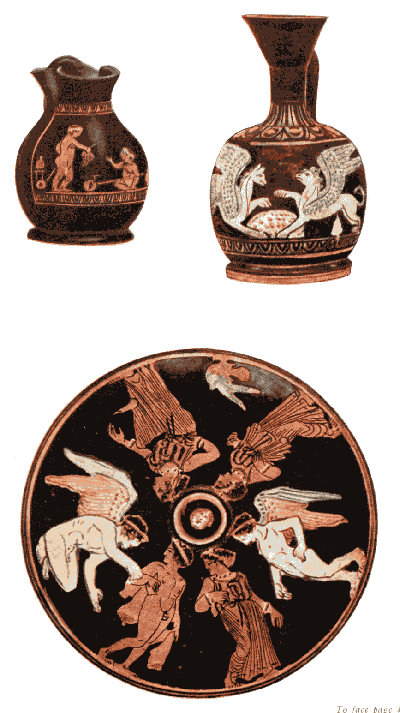
VASE OF “LATE FINE” STYLE.
(British Museum).
of subjects connected with the daily life of women or children—the
toilet, the occupations of every-day life, or nuptial ceremonies;
and a whole series of small jugs, themselves in all
probability toys, depicts the various games in which the
Athenian child delighted—the hoop, the go-cart, and the ball,
or his pet animals (cf. Plate XLII.).
The shapes most popular in this group are, as we have
indicated, the oinochoë, the wide-bellied lekythos, and the
pyxis (Plate XLII.). Milchhoefer, in a most important article,[1394]
regards the lekythi as more instructive than any other group
for illustrating the later developments of R.F. vase-painting.
Beginning with early examples of the fine style,[1395] they extend
to the very end without any gaps, the tradition being further
continued in Apulia. They exhibit a development from simple
to rich compositions, from “strong” style to perfect freedom.
In the latest examples, such as that by Xenophantos, we see
the straining after novelty which marks the decadence, in
the introduction of figures in relief applied to the surface of the
vase, as well as in the increase of polychromy and gilding.
Among the finer vases we may note a hydria at Karlsruhe
(259) with the Judgment of Paris, in which may be traced the
hand of Meidias; the lekythos in the British Museum from
Cyprus (E 696), with Oedipus slaying the Sphinx, in which the
figure of Athena with its white coating is clearly reminiscent of
the gold-and-ivory Parthenos statue; and two pretty lekythi
from Apollonia, in Thrace, with the subject of incense-gathering.
There are also two pyxides in the British Museum (E 773–4),
on which are groups of women, with fancy names added to give
interest to the scene: thus Klytaemnestra, Danae, and Iphigeneia
occur all together, and the Nereids are engaged in the every-day
occupations of the women’s apartments.
From a technical point of view, the principal change is in
the increased use of gilding and polychrome colouring. The
former, employed exceptionally by Euphronios and Brygos,
now becomes the rule, and concurrently the use of white
for flesh-tints, as in the figure of Athena just mentioned, and
of red, green, and blue for draperies, becomes more and more
general. The gilding was applied for small details, such as
wreaths, and for the hair; and the places where it was to be
applied were marked by low relief. It was fixed in the form
of gold-leaf by means of a yellowish gum. Jahn, who some
years ago collected the list of vases with gilding,[1396] reckoned
fifty-one known to him, chiefly from Kertch; and Heydemann
and Collignon[1397] have since added several to the list, chiefly
from collections at Athens. They have been found not only
in Athens and Kertch, but at Corinth, Megara, Hermione,
Thebes, and in Acarnania and Thrace.
In the larger vases of this period the pictorial method of
the preceding phase is, as might have been expected, greatly
developed. Among the vases of undoubted Attic origin we
have, first of all, the Meidias hydria and its companion vase,
the Karlsruhe hydria with the Judgment of Paris[1398]; and,
secondly, the great Gigantomachia vase from Melos in the
Louvre, which contains no less than forty-seven figures.[1399]
Another fine instance is the polychrome Kameiros vase in the
British Museum with the subject of Peleus and Thetis. Robert[1400]
sees in the two latter a possible influence of Parrhasios, who
is known to have paid great attention to drawing, and, in
reference to the Kameiros vase, draws attention to the plastic
silhouette effect of the figures. Parrhasios’ art consisted in
giving this effect by his linear drawing.[1401] The influence of
Zeuxis is less apparent, though from his earlier date it might
more naturally have been expected.[1402]
It is, however, still more instructive to trace in this group
the influence of the Parthenon sculptures, which, where it
can be observed, enables us to date the vases approximately
as at any rate not earlier than 438 B.C. On the other hand,
it must be borne in mind that sculptor and painter may
often have gone back to the same original type. This explains
the appearance of apparently Pheidian motives on vases of
an earlier style—such as riding youths, water-carriers, etc.—or
the similarity of composition on one of the Parthenon
metopes and a vase of undoubtedly earlier date.[1403] But in one
or two instances there can be no doubt of such influence, most
notably in the Athena and Poseidon vase from Kertch (see
below, p. 464). It cannot be without significance here that
the two figures are actually in relief on the vase, and the
parallelism with the pediment (so far as we know the design)
is so close that a copy of it was manifestly the vase-artist’s
intention. Mention has already been made of a figure of the
Parthenos on a vase of this period, and another instance, though
not on a painted vase, may be noted in the polychrome bust
of the goddess in terracotta from Athens, now in the British
Museum.[1404] Some instances of this type on vases may be earlier
than the statue; it was not created by Pheidias.[1405]
It has already been mentioned that there is one exception
to the Athenian monopoly of vase-making in the fifth century,
and this is in the local fabrics of Boeotia. Of the Kabeirion
vases, which, though in the B.F. technique, belong to this
period, we have already spoken. There remains a small
class—only five examples are at present known—which appears
to have been made at Tanagra. All five evidently came
from the same workshop, and in three cases the provenance is
certainly known. Two are in the British Museum (E 813–4),
and three in the Museum at Athens.[1406] With the exception of
E 814 in the British Museum, which is a pyxis, all are small
two-handled cups, with low feet. The designs are outlined
on a background of yellow clay in a black-brown pigment,
the lines being coarsely drawn. Inner details are indicated
by means of thinned-out pigment. That they are of Boeotian
origin is further shown by the ornamentation: the pyxis has
round the sides rows of vertical wavy lines, such as are often
seen on the Boeotian geometrical fabrics (p. 288), and also an
ivy-leaf which recalls the Kabeirion ware. The ornamentation
of the hangings round the chair on Athens 1120 exactly
resembles the patterns indicating the drapery on some of the
early Boeotian terracottas.[1407] The subjects, on the other hand,
seem to suggest Athenian prototypes: in the designs much
archaism is to be observed—such as defects in perspective,
the rendering of the eyelashes, and the drawing of the feet
in profile, but with toes in front. Numerous small details
point to a date late in the fifth century, which, in view of
the conservative tendencies of Boeotia, is not unlikely.
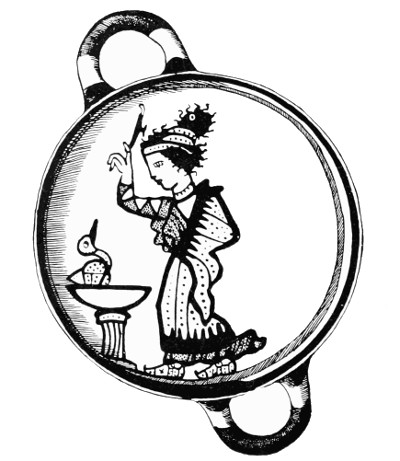
FIG. 104. BOEOTIAN KYLIX (BRITISH MUSEUM): GIRL PLAYING KOTTABOS(?).
The subjects are of some interest, and include two figures
of Herakles, one bearded, the other youthful; a girl playing
kottabos (Fig. 104); and a cultus-image of an enthroned
Chthonian goddess (Demeter or Persephone), holding a torch,
ears of corn, and poppies. These vases have been collected
and fully discussed in an interesting article by Dr. S. Wide.[1408]
Origin and character of white-ground painting—Outline drawing and polychromy—Funeral
lekythi—Subjects and types—Decadence of Greek
vase-painting—Rise of new centres—Kertch, Cyrenaica, and Southern
Italy—Characteristics of the latter fabrics—Shapes—Draughtsmanship—Influence
of Tragedy and Comedy—Subjects—Paestum fabric—Lucanian,
Campanian, and Apulian fabrics—Gnathia vases—Vases
modelled in form of figures—Imitations of metal—Vases with reliefs—“Megarian”
bowls—Bolsena ware and Calene phialae.
The method of painting on a white ground, which was brought
to such perfection in the fifth century, really requires a section
to itself, its development being parallel to, yet different from,
that of the painting in red on black. Its genealogy can be
traced almost throughout the period of Greek vase-painting,
beginning with the Ionian fabrics of Rhodes and Samos, through
the more developed vases of Naukratis and Kyrene, until it was
introduced at Athens in the latter part of the sixth century,
perhaps, as we have seen (p. 385), by Nikosthenes. The method
was not, of course, new then to Continental Greece. It was the
one usually employed for painting votive tablets or pictures on
wood, the surface of the tablet being prepared by covering it
with a thick slip of creamy-white lustrous character, known as
λεύκωμα.[1409] Thus it is used in one of the few examples known
of Attic painting, apart from the vases, the Warrior pinax from
the Acropolis, which may be dated about 500 B.C., and stands
midway between frescoes and white-ground vases (see above,
p. 397). Possibly the idea of the white slip was to get the
effect of painting on marble such as we see in the tombstones
of Lyseas and Aineos.[1410]
This method was adhered to throughout the fifth century by
all the great painters, such as Polygnotos, and hence the importance
to us of the white-ground vases of that time, as reflecting
their methods, and in a miniature form the appearance of their
works. In the fifth century the all-important consideration in
a picture was perfection of design and composition; colouring
was relatively unimportant, and the technical processes exceedingly
simple, three or four colours alone being employed. Cicero[1411]
tells us that Polygnotos, Zeuxis, and Timanthes only used four
colours—black, white, red, and yellow. It is interesting to note
that these are just the four colours we ordinarily find on the
polychrome vases, the flat tints so frequently employed being no
doubt suggested by the mural paintings.
To go back to the earlier Athenian vases with white ground,
we observe that at first the method of painting in silhouette,
in the manner of the ordinary B.F. vases, obtains exclusively.[1412]
About the beginning of the fifth century this method is superseded
by what we may regard as a transitional class, in which
the figures are painted partly in silhouette, partly in outline, the
simple black-on-white design being preserved, with a very occasional
use of purple or yellow.[1413] According to Winter, the origin
of outline drawing of this kind may be found in the partly
outlined female heads which are found on some of the minor
artists’ cups, such as those of Sakonides, Eucheiros, and
Hermogenes.[1414] We need not go as far as he does in explaining
the catagrapha of Kimon (see p. 397) as the replacement of mere
silhouettes by outline drawing, so as to give individuality and
variety to faces; but the vases which he publishes are remarkable
for the highly developed character of the heads depicted
thereon.[1415] One in particular is more like a head by Euphronios
than one of the Epictetan cycle, to which it must belong in
point of date. But it must be remembered that Epiktetos and
his school were still hampered by archaic conventions, while the
painter on a white ground was carving out the way to perfect
freedom.
The shapes employed for the new white-ground technique
are much the same as those used in the previous period—the
kylix, the lekythos, the oinochoë, the pyxis, and the alabastron.[1416]
But of these only one retains its popularity for any length of
time; in fact, after the middle of the fifth century it is the only
one employed at all. This shape is the lekythos, on which,
indeed, alone the whole development of white-ground painting
can be traced from the B.F. types down to the fourth century,
when it finally disappears. Although not exclusively the
sepulchral vase (as may be seen from the appearance of other
vases on tombs in the painted funeral scenes[1417]), yet for some
reason it came to be regarded as the proper shape for such
purposes, and the fashion of making white lekythi exclusively
for the tomb, and decorated as a general rule with funerary
subjects, prevailed for about a hundred and fifty years. We
have elsewhere (pp. 132, 143) noted instances of its use recorded
by Aristophanes.
The introduction of polychromy is a gradual development.
At first, as we have seen, colour is very sparingly employed,
only in the use of a brownish yellow (produced by thinning out
the black) for details or washes, or of a purple or pinkish brown.
Subsequently the outlines are drawn in black or brown, and
filled in with black, brown, or purple washes; the occasional
use of a clear, thick, white pigment, standing out against the
cream background, is also to be noted[1418]; and next a wash of
bright red or vermilion is employed. In the final stages of
polychrome painting, during the fourth century, the range
of colours is greatly extended, and blue or green are employed
PLATE XLIII
VASES WITH POLYCHROME DESIGNS ON WHITE GROUND.
(British Museum).
To face page 456.
in addition to those already named. The outlines are also
painted in the vermilion colour already mentioned, instead of
the black in previous use. Up to the end of the fifth century
the colouring always preserves a character of soberness and
austerity; and such a feature as the use of gilding[1419] is quite
exceptional.
Some of the white-ground kylikes are only partially so; the
exterior is painted in the ordinary R.F. manner, of the “strong”
style, as in the case of the Anesidora cup in the British Museum.
On the other hand, a fine cup at Gotha has a red-figured interior
and polychrome exterior.[1420] In the Munich collection there are
three very beautiful cups of this kind.[1421] The interior subjects are
respectively Europa on the bull, a frenzied Maenad, and Hera.
The cup with the Maenad is attributed by Furtwaengler to the
style of Brygos, and may therefore be dated about 470–460 B.C.
It is rare to find a large vase decorated in this method, but there
is a very fine krater of the calyx type in the Museo Gregoriano
at Rome,[1422] which has been attributed to the middle of the fifth
century (contemporary with Euphronios’ later manner); the
subject is the delivery of the infant Dionysos to the nymphs
of Nysa, and is painted throughout in polychrome on a white
ground. Of late years some very fine pyxides in this style have
been found in Greece,[1423] often decorated with marriage scenes, the
style of the painting being contemporary with Duris and Brygos.
But for beauty and delicacy all are surpassed by some of the
smaller cups, above all the Aphrodite cup from Kameiros in
the British Museum,[1424] in which refinement and grace are combined
with boldness of conception and accuracy of drawing in a marvellous
degree. Or, again, the group of cups and bowls by
Sotades (see above, p. 445),[1425] some with mythological or other
subjects painted in minute and graceful style, others of fantastic
or unusual shape and decoration, form a unique series among
the white-ground vases.[1426]
To sum up in the words of A. S. Murray the characteristics
of these vases[1427]: “There was thus in the white vases an
exceptional opportunity for purity of outline in the drawing,
and it is not without reason that they are regarded as the best
representatives we yet possess of the great age of Greek fresco-painting,
in which also purity and sweep of outline on a white
ground, simplicity of composition, and a limited scale of brilliant
colours, were the chief characteristics.”
It remains now to speak of the funeral lekythi as a distinct
class, their subjects and method of treatment.[1428] Although it was
formerly customary to speak of “vases of Locri” or “vases of
Gela” in speaking of examples found on those sites, it is almost
certain that they are all really of Athenian origin.[1429] Apart from
the fact that the great majority have been found at Athens,
there are no special peculiarities about those from other sites
which would justify any such distinction of fabrics. The same
remarks apply to the numerous examples which have been
found of late years at Eretria in Euboea, and have caused some
recrudescence of the theory of non-Attic origin.[1430] But Eretria
was so near to Athens that importation must have been quite a
simple matter. In regard to the Locri vases, it has been noted by
M. Pottier[1431] that they seem to represent an inferior, though still
Athenian fabric, in which the white is more lustrous and less
flaky than in the better examples, and the outlines are in black
exclusively. Black silhouettes are occasionally found, and the
subjects are not necessarily funerary.
The funerary subjects fall into four classes; they will be
enumerated in Chapter XV., where examples of each class are
given, but may be briefly recapitulated here, in order to note
some artistic considerations.
(1) The Prothesis, or laying-out of the corpse (Plate LV.).
(2) The Depositio, or laying of the body in the tomb: chiefly
in the Thanatos and Hypnos type (see Fig. 123, Chapter XIII.).
(3) The Journey to Hades; Charon in his bark (see Fig. 122,
Chapter XIII.).
(4) The Cult of the Tomb, this being by far the most common
of the four classes (see Plate LV. and Fig. 19, p. 143).
The Prothesis type is an old one, occurring not infrequently
on black-figured vases, especially on the slim “prothesis-amphorae”
which are sometimes found at Athens. M. Pottier
reckons ten examples, to which may be added a fine specimen
now in the British Museum (Plate LV., fig. 1). The Depositio
type is somewhat rare; it is occasionally found in B.F. vases,[1432]
but is usually idealised, the body being carried by winged genii,
to whom the names of Thanatos and Hypnos are usually given.
The type, as has been pointed out elsewhere, is originally
mythological, being derived from that of the burial of Memnon.
Some half-dozen examples are known (see Chapters XIII., XV.).
Of the Charon vases M. Pottier reckons twenty-one, which he
classifies under three heads: (1) Charon on the left in a boat,
which two or three persons enter. (2) Charon on the right
in a boat; persons ready to enter. (3) The deceased is seated
on a stele at which women make offerings; Charon approaches
in his boat.[1433] The conception is essentially a pictorial one,
and it may reasonably be inferred that it is a reflection of
Polygnotos. The same subdued pathos and the same style
of composition are characteristic of his paintings. Pausanias,
in describing his Nekyia in the Lesche at Delphi, says:
“There is water, which seems intended for a river, evidently
the Acheron, and reeds growing therein ... and there is a
boat on the river, and the ferryman at the oar.”[1434]
In the vases representing the Cult of the Tomb (Plate LV.
and Fig. 19), the normal type is that of two or three persons
bringing offerings, wreaths, vases, etc., to a stele[1435] ornamented
with coloured sashes, or engaged in conversation thereat; sometimes
one sits on the steps of the stele. The persons with
offerings are usually feminine; where men occur, they are
either attired as warriors, or stand leaning on a spear or staff,
conversing with the women. The correspondence of some of
these compositions to the “type” of Orestes and Electra
meeting at the tomb of Agamemnon has more than once been
noticed, but it does not seem here to be a case of borrowing
the heroic “type,” as in the Thanatos and Hypnos instance.
Where such scenes can be identified on vases,[1436] they are all
of late date and mostly of South Italian manufacture; and we
may rather suppose that the contrary was the case, and that
the lekythos “type” was idealised and borrowed for the Orestes
scene. Moreover, the popularity of the latter subject is probably
largely due to its treatment by the tragic poets.
Among other details of interest in these scenes may be
noted the appearance of the εἴδωλα or ghosts of the deceased,
represented as tiny hovering winged creatures. M. Pottier has
noted eighteen instances, and the number has since then been
greatly increased.[1437] The invariable youthfulness of the figures—which,
it may be remarked, are always purely impersonal;
and mere types of mourners—is noteworthy as a characteristic
of later fifth-century art, which tended to create ideals of
youth and beauty.[1438] This, of course, is everywhere apparent
in sculpture, as in the Parthenon frieze and the works of
Polykleitos; and reminiscences of Pheidian youthful types
may be suggested by some of the figures on the lekythi.[1439]
In the figures of deities the same change was going on, as
in the case of Hermes, and even the aged and grim figure
of Charon is toned down on the funeral vases to a more
humane conception. It has also been suggested that the
choice of youthful figures is due to the thought that youth
is the period when bereavement produces its simplest and
most natural effects.
The influence of the sepulchral stelae of the fifth and fourth
centuries soon begins to be apparent in the lekythi, especially
in the scenes of tomb-offerings.[1440] Like the vases, the stelae
always varied in merit, some being refined and artistic compositions,
others poor and commonplace. The choice of subjects,
indeed, differs in some degree, the subjects on the stelae relating
chiefly to the previous life of the deceased, those of the vases
to the actual death and burial. But there are many lekythi,
the subjects on which are more like those of the stelae, not
being strictly funerary.[1441] Thus we see the deceased as a warrior
charging with a spear or on horseback, like the Dexileos of
the Kerameikos; the young hunter pursuing a hare; the lady
at her toilet with mirror or jewellery in hand, attended by
her maidens, like the charming Hegeso (Plate XLIII.); or the
warrior parting from his spouse.
Regarding the funeral lekythi in their artistic aspect, we
note, as M. Pottier points out, two main characteristics—restraint
and uniformity of composition. The space for the
decoration being limited to about two-thirds of the whole
circumference, the figures are necessarily few in number,
varying from one to three, but very rarely more. Emotion
and pathos are produced by the simplest means. Murray
instances the prothesis lekythos in the British Museum (Plate
LV. fig. 1) as an example of deep pathos expressed in a simple,
yet strong and rapid manner, and two others (D 70 = Plate
LV. fig. 2, and D 71) as showing almost tragic emotion expressed
only by a few outlines. Uniformity of composition is manifested
in the repetition of types, often copied from familiar
models, yet with an infinite variety of detail (as, for instance,
in the form of the stelae) which does not affect the constancy
of the main idea. In this respect they may be compared with
the terracotta Tanagra figures, of which many are turned out
from the same mould; yet by varying the pose of the head or
position of the arms the artist was able to avoid the absolute
identity of any two figures.
The lekythi can hardly be classified chronologically; we
cannot say to what extent the rougher examples may be
earlier, and vice versa; but even in the poorest examples
skill and lightness of touch are always discernible. The classification
given by M. Pottier,[1442] however, may serve as a general
indication of chronological succession and development. He
collects them under three heads, as follows:
(1) The paste is of a light red colour, the walls thin, and
the white slip unpolished; the main design is first sketched,
then painted, the outlines being usually in red. The ornaments
are palmettes and maeander, in black and red, the subjects
almost exclusively funerary. The slip and colours are delicate,
the style fine, and the polychromy restrained.[1443]
(2) The paste is grey, the walls thicker; the white is
sometimes polished, and the outlines black or brown. The
ornaments are palmettes and maeander, with crosses or stars,
in black only. The subjects are funerary or from daily life,
with figures of deities; the style is still fine, but the polychromy
is more varied.[1444]
(3) The clay is red and light, the white unpolished, the
outlines yellow. The slip is not extended to the shoulder,
on which is a tongue-pattern in black; the maeander is careless.
The subjects are either funerary or from daily life, the style
negligent; the designs are almost entirely monochrome.[1445]
We have now reached the point at which the centre of
ceramic industry is no longer to be found at Athens, but
must be sought in distant colonies in various parts of the
Mediterranean. The extinction of vase-painting as a decorative
art at Athens was brought about as much by political events
as by sheer artistic decadence at the end of the fifth century.
It had until recent years been customary to assume that red-figured
vases continued to be made at Athens through the
greater part of the fourth century; but the evidence of excavations
on many sites has been too decisive for the maintenance
of such a view. That certain classes of ceramic products,
such as the Panathenaic amphorae and the funeral lekythi, still
continued to be made we have already seen; but these are
only exceptions, and due entirely to their religious associations.
The evidence for the revised chronology has been summarised
by Milchhoefer in a paper already referred to,[1446] in which he pointed
out the importance of historical considerations. Even during
the Peloponnesian War the manufacture and export of painted
vases must have been much crippled, and the absence of the
later Athenian wares from the tombs of Etruria clearly shows
that commercial relations between the two countries had
ceased.[1447] Similarly intercourse with Campania largely ceased
after the Samnite invasion of 440 B.C., and relations with
Sicily must have been entirely broken off after the outbreak
of hostilities with Syracuse in 427.
Again, in the city of Rhodes, which was founded in B.C. 408,
no Attic vases have been found, while all those from Kameiros
must be earlier than that date.[1448] In Athens itself no R.F.
vases of any importance have been found in fourth-century
tombs, although some fragments of fine style are reported
from the tomb of Dexileos, which is not earlier in date than
394 B.C.[1449] Hence the conclusion is irresistible that no good
Attic R.F. vases can be assigned to the fourth century, which
is only represented at Athens by the funeral lekythi, the
Panathenaic amphorae, and a few isolated, generally inferior,
R.F. specimens.
The new centres of vase-painting, from about 400 B.C.
onwards, are three in number—the Crimea, the Cyrenaica in
North Africa, and Southern Italy. Among the vases from the
Crimea[1450] are some of the most magnificent that we possess,
which in spite of their florid style and careless technique are
really of considerable merit. They can, however, hardly be
considered to rank more highly than the best of the products
of Southern Italy, which we are now about to consider; in
other words, they belong to a later stage of development
than the “late fine” style of Attic R.F. vases, as represented
by the Rhodian “pelike” with Peleus and Thetis in the British
Museum, and the Gigantomachia vase from Melos in the
Louvre. The fine krater with the contest of Athena and
Poseidon at Petersburg (Plate L.) is clearly a reminiscence
of the Parthenon pediment, and, allowing for the difference
of style, cannot be earlier than the closing years of the fifth
century. Again, there is the vase signed by Xenophantos,[1451]
who, as we have seen, expressly calls himself an Athenian,
and on this ground has been regarded as a resident in
Panticapaeum (Kertch). The reliefs with which this vase is
partly decorated are examples of a tendency which hardly
came into existence before the fourth century; the subject also
is more suggestive of local taste.
It may be an open question whether these vases were imported
from Athens, but at least the vase of Xenophantos
testifies to the existence of a local fabric at Panticapaeum,
and it is not at all unlikely that the general upheaval brought
about by the Peloponnesian War led to a dispersion of
Athenian artists, and thus to the continuance of their art in
other lands, but not in Athens itself. We shall see that this
largely accounts for the origin of the fabrics of Southern Italy.
In any case Panticapaeum was a place of considerable importance
in the fourth century, being the chief place whence
the Athenians obtained their supplies of grain, as we learn from
the orations of Demosthenes, such as the Contra Phormionem.
With the Cyrenaica circumstances were no doubt little
different. But the vases from this site, though similar to those
of the Crimea, are mostly inferior, of small size, and often
of very rough character. Like the former they exhibit a
preference for polychromy and gilding. Similar fabrics are
also found in the Greek islands, such as Karpathos and Telos,
in the Troad, and elsewhere,[1452] but for the most part of a very
inferior character.
In the tombs of Southern Italy many vases are found
representing the same stage of development as those of the
Crimea and Cyrenaica, varying from large kraters with fine if
florid designs, often enhanced by a lavish use of white pigment,
to inferior and almost worthless specimens. Inasmuch
as these vases are not distinguished by any stylising tendencies
such as enable us to classify the other fabrics of
Southern Italy and assign them to particular districts, and on
the other hand bear the same relation to the later R.F. vases
of Athens as do those of the Eastern Mediterranean, it is
evident either that all these fabrics were imported from
Athens or that Athenian artists had been driven to settle in
these respective regions. And since it is exceedingly unlikely
that the exportation of pottery from Athens can have gone
on to any extent in the fourth century, it seems, on the
whole, most probable that the latter is the true version.
We may, then, establish a class of vases intermediate between
the R.F. fabrics proper and the local Italian fabrics, which
represents the manner in which Athenian artists carried on
their traditions under new circumstances, and serves to explain
how the new Italian schools came into being.[1453]
These vases are often characterised by a refinement of
drawing and simplicity of conception which recall the earlier
R.F. period, and in such cases accessory colours, elaborate
draperies, and the filling-in of the field with miscellaneous
objects are studiously avoided. Even the decorative patterns
show considerable restraint. It is probable that some of these
belong to the latter part of the fifth century, even if they are
not actually imported from Athens. But there are others of a
distinctly florid kind, in which we may trace the influence of
Meidias and his school. The compositions are crowded with
figures, often placed at different levels (without indication of
ground-lines), and there is a general tendency to elaborate
decoration, both by means of white pigment and by richly
embroidered draperies. As examples may be cited two fine
kraters in the British Museum, one with a scene from the lesser
Mysteries at Agra (F 68), another with Thetis and the Nereids
bearing the arms of Achilles (F 69). The bell-shaped krater
is by far the most favourite form, although practically a new
one in Greek ceramics; contrary to the usual rule, the reverse
often has a definite subject, in which accessories are used,
although the tendency had begun some time before the end
of the fifth century to neglect the decoration of the reverse in
kraters and other large vases.
In its new home in Southern Italy this branch of Greek
art had lighted on a very favourable soil. The great colonies
such as Tarentum, Capua, Cumae, and Poseidonia, founded
almost in the dawn of Greek history, were not only as completely
Hellenic as Athens and Corinth, but in luxury and
splendour even surpassed them at this period. Hence, art
flourished in such towns far more readily than in the distant
and comparatively barbarous regions of South Russia and
North Africa. In the character of their productions we shall
see the nature and condition of the inhabitants of Southern
Italy reflected. The chief aim is splendour and general effect;
and both the size and colouring of the vases indicate to some
extent the luxury and magnificence in which the people lived.
It must not, however, be supposed that vase-painting was a
new art introduced to this region by Athenians in the earlier
part of the fourth century. In another chapter we shall speak
of the early attempts at imitation of Greek vases on the part
of the semi-barbarian natives of the peninsula, and reminiscences
of these early attempts crop up from time to time
under circumstances of greater development, as will be seen.
Moreover, a constant stream of importations from Athens
(small indeed as compared with that to Etruria, but still steady)
had been finding its way to the Greek colonies of Southern
Italy and Sicily; special fabrics were made for export to Nola,
Gela, and other places; and thus the local artists had all along been
undergoing an unconscious training which enabled them to take
up the industry at the point where the Athenian artists left off.[1454]
The local fabrics of Southern Italy fall into three main
classes, corresponding to the geographical divisions of Apulia,
Lucania, and Campania, which three, with some modifications,
include all that come under discussion in the present section.
Before, however, entering upon the question of the criteria on
which this classification is based, a few general considerations
may be touched upon by way of preface.
The study of South Italy fabrics is to some extent a new
one. At the beginning of the last century, when scarcely any
vases had been found outside Italy, the majority of both public
and private collections consisted of vases of this period. Of
those now exhibited in the Fourth Vase Room of the British
Museum, at least one-fifth are from the collections of Sir
William Hamilton, Charles Towneley, and Richard Payne
Knight; and in such publications as those of D'Hancarville,
Tischbein, Inghirami, and Millin, a great majority of the plates
are devoted to them. Hence their importance was much
over-estimated; but, on the other hand, no attention was paid
to questions of style or provenance, and they were only regarded
as pretty pictures. Subsequently to the discoveries at
Vulci, and the gradual growth of the scientific study of vase-painting,
the later vases suffered greatly from neglect, as
yielding less interest than the early fabrics and the products
of the best Athenian artists, and even at the present day it is
rare to find them made the subject of serious study. The only
writer, in fact, who has attempted in recent years to apply to
them the critical methods of modern archaeology is Signor G.
Patroni of the Naples Museum, who has availed himself of the
opportunities afforded by the extensive series under his care.[1455]
The vases from Southern Italy, which from their style may
be regarded as undoubtedly local non-Attic fabrics, are all
distinguished by certain common features. In all there is
seen a perpetual striving after effect rather than beauty, manifested
in the size and splendid appearance of the earlier
Apulian products, in the largeness of style and bold drawing
of Lucanian artists, especially the school of Paestum, and in
the gaudy colouring of the Campanian vases. The later Apulian
wares are chiefly remarkable for varied and exaggerated shapes.
Common to all vases alike is the fondness for ornamental
patterns, such as the egg-pattern, wave-pattern, maeander,
palmettes, and wreaths of laurel, myrtle, or ivy; though even
these are guided by certain rules, much as on the black-figured
vases. On the large bell-shaped kraters the decoration almost
invariably consists of a laurel-wreath round the lip, maeander
below the designs, and palmette patterns under the handles;
and every shape of vase has its characteristic decoration. The
Campanian vases show the least tendency to formal ornament,
and the Lucanian run to the opposite extreme. The column-handled
kraters are almost alone in retaining the archaic
scheme of decoration in panels with borders of ornament, to
which they adhere throughout the R.F. period; but the panels
are occasionally employed for hydriae or oinochoae. In most
cases, however, the luxuriant palmette patterns under the
handles form an adequate frame for the design with the
maeander band below. A female head frequently occurs as
a decorative motive, especially in the Apulian vases; either
forming the main decoration, or placed under the handles, or
adorning the neck, encircled with foliage. So too the figure
of Eros is employed on the later Apulian vases purely as a
decorative motive.
The shapes of the vases present a very great variety, as
compared with the Athenian fabrics.[1456] The bell-shaped krater
enjoyed a short vogue, and is only found in the earlier examples;
but besides the column-handled type already mentioned, the
calyx-krater (vaso a calice) and the volute-handled (a rotelle)
form occur from time to time. Among the early Apulian vases
a variety of the latter, with medallions (mascherone) in place
of the volutes, frequently occurs; these are often of gigantic
size, decorated with several rows of figures, and nearly all the
finest existing specimens are of this form. It is also the usual
type for the sepulchral vases (see below). The medallions are
ornamented with Gorgons’ masks and other devices, coloured
on a white slip. A peculiar local variety of the krater, with
four handles, is found in Lucania only (see p. 172).
Other vases for holding liquids are the situla, lebes, amphora,
and hydria, forms which are more or less familiar. The
amphora is slender, with more or less elliptical body; in Campania
it is small and squat-shouldered, the body almost
cylindrical, but in Apulia it is usually very tall and elegant
(cf. Plate XLV.). An occasional variant has a cylindrical flat-topped
body, with elaborate handles in the form of scrolls;
the so-called pelike is a more common type, but somewhat
inelegant. The hydria is usually a degenerate version of the
R.F. kalpis, but at Paestum the Attic type still obtains. A
new form is that known as the lekane, a jar for holding
sweetmeats; it has vertical handles and a cover of elaborate
form, often surmounted by a small vase. Of similar type is
the so-called lepaste, a circular covered dish on a high stem.
Among the smaller vases may be mentioned the oinochoë,
of which there are one or two varieties, notably the graceful
prochoos, with its high handle and foot, and the equally
ungraceful epichysis, with its long beak-like mouth and pyxis-shaped
body; both of these are confined to Apulia. The
lekythos retains the bulbous body and low foot of the later
R.F. period; the askos in various forms is fairly common.
Two new varieties are a sort of alabastron without a handle
but with flat base, and a jar with a handle over the mouth.
Of drinking-cups the kantharos and rhyton are popular among
the later Apulian wares; the kotyle is rare, and the kylix has
almost entirely disappeared, its place being taken by a gigantic
circular dish, elaborately decorated inside and out. These
are obviously designed with a view to general effect, and
seem to have been intended for hanging up against a wall.
In regard to the technique the general method is that of
the later R.F. vases; but in the majority all idea of simplicity
and refinement is lost, and the tendency to exaggeration and
showiness is manifested both in drawing and colouring.
Throughout there is a fondness for large masses of white,
and this pigment is used not only for the flesh of women and
of Eros, but for architectural details and other objects, such
as temples, shrines, and lavers. Yellow is largely employed
for details, especially for features or hair, and for picking out
the ornamental patterns; purple, too, is not uncommon. Attempts
at shading are occasionally found.[1457] Accessory colours
are, however, seldom found on the reverses of the vases, which
are always drawn and painted with the greatest carelessness.
The drawing is entirely free, and in fact errs on the other
side, becoming careless and faulty; the forms are soft, and the
male figures often effeminate. An extreme facility of hand
has indeed proved the ruin of the vase-painter. The love of
the far-fetched betrays itself in variety of posture and elaborate
foreshortening; and in the richly embroidered draperies and
studied settings of some scenes the influence of the theatre is
obviously to be traced. Frequent attempts are made at perspective,
especially in buildings of which the insides are shown,
but the attempts are seldom successful. As a rule the artist
is content to indicate figures in the background by placing
them on a higher level, or only showing the upper half of the
figure. On many vases with mythological subjects, especially
those of Apulia, a row of deities is thus represented, as if
seated on the θεολογεῖον of the stage. Landscape is represented
by rocks, stones, and flowers scattered about, trees and buildings;
but in most cases the painter prefers the old system of merely
giving a clue to the scene, representing the palaestra by jumping-weights
or oil-flasks suspended, women’s apartments by sashes,
toilet-boxes, or small windows, and so on.
The pictorial effect of the scenes on many vases naturally
gives rise to the question to what extent the artists were
indebted to the great painters of the fifth and fourth centuries.
In some cases the paintings seem to be more naturally adapted
for large canvases than for the limited surface of a vase; but
more than this, in others the subjects actually lead our thoughts
directly back to the works of great masters of which we have
record. The influence of Polygnotos and his school has indeed
died out, but the emotional tendencies of the fourth-century
painters and their fondness for new and difficult subjects found
a ready echo in the conceptions of the Apulian vase-painters.
It may suffice to quote a few instances from the British Museum
collection. Thus on one vase (F 479) we find a representation
of the infant Herakles strangling the snakes, a theme selected
by the great Zeuxis, and also to be seen in one of the paintings
from the house of the Vettii at Pompeii. Or, again, the famous
sacrifice of Iphigeneia and the death of Hippolytos, subjects
which employed the brushes of Timanthes and Antiphilos
respectively, are depicted in a truly pictorial manner on two
kraters (F 160, F 279). In each case we are able to note a
correspondence with the description of the pictures given
by Pliny; in the last-named, also, with a picture described
by Philostratos. Were more known of ancient pictures, it is
possible that other examples would be readily found; but that
some such influence was exerted can hardly be questioned.
Again, in the later vases with opaque designs on black
grounds (see p. 488), most of which are merely decorated with
wreaths, festoons, or masks, we are at once reminded of the
Pompeian wall-paintings, or rather of their predecessors in
the Hellenistic Age, since the vases must be earlier than most
of the pictures of Pompeii. There is a vase of late date in
the British Museum (F 542) which, with its elaborate treatment
of light and shade effects and its border of arabesques, not
only in its subject (a young shepherd and his dog), but also
in method, suggests a close connection with the Pompeian
frescoes.[1458]
Another influence at work on the vases of the period besides
that of the great painters was that of the stage, in which both
tragedy and comedy play their part. The influence of tragedy
as represented on the Greek stage is seen not only in the choice
of subjects, but in the composition of the scenes and the
costumes of the figures. This is especially the case with the
large Apulian vases with mythological subjects. The architectural
arrangements, with a temple, altar, or statue in the
centre, the embroidered draperies and gorgeous tiaras worn
by the principal personages, and the abundance of dramatic
or even passionate action, can only be due to the influence of
the stage. But it is only to Euripides that we can ascribe
this influence. There appears to have been a great revival
of his plays towards the end of the fourth century, especially
in Magna Graecia, and the extent of the effect of this revival
on the vase-paintings has been discussed by several writers.
The tendency of the age to passion and pathos, seen in the
Pergamene sculptures and other great works of art, as well
as in the paintings of a Parrhasios or a Timanthes, would
naturally find an echo in the subjects treated of by Euripides.
Of the existing dramas, we find scenes drawn more or less
directly from the Hecuba, the Hercules Furens, the Hippolytos,
the two Iphigeneias, the Medeia, and the Phoenissae. Many
others can be traced to the lost dramas, as for instance (to
quote only from examples in the British Museum) the Alkmena,
the Oineus, the Antigone, the Andromeda, the Oinomaos, and
the Lykourgos.[1459]
It has been observed that on many vases of this period on
which mythological subjects are represented, although the
theme is essentially tragic, yet the treatment has a somewhat
grotesque, not to say burlesque effect. A notable instance
is the well-known vase of Assteas in Madrid, with Herakles
destroying his children (Fig. 107). This quasi-comic element,
which appears to be quite unintentional, is often accompanied
by considerable largeness of scale, exemplified in the size of the
figures, the expression of the features, and the drawing
generally. It may be that a certain element of exaggeration
attended the revival of tragedy in Southern Italy,[1460] caused by
unsuccessful attempts to retain the lofty manner and large
style of the old productions. Hence too, perhaps, the fondness
for burlesques of tragedies among the comic writers of the
period, reflected in another class of vases.
In the vases with comic subjects it is not necessary to have
recourse to the Attic Comedy, New, Middle, or Old, to account
for their introduction; an explanation lies nearer at hand. It
is true that the costumes worn by the actors are closely related
to those of the Old Comedy,[1461] and that one or two subjects may
possibly be traced to the Frogs of Aristophanes (see Chapter
XV.). But it is not likely that these plays were ever revived
in Southern Italy, as were those of Euripides. They were
essentially topical, and their political and social satire would
have been lost on a later generation. On the other hand, we
know that a kind of farce, known as the φλύαξ was especially
popular with the people of Tarentum and other towns of
Southern Italy in the fourth century, either dealing with
subjects of daily life or burlesquing mythology and heroic
legends. It was during the performance of one of these in
the theatre at Tarentum that the spectators saw the Roman
fleets entering their harbour in 302 B.C.[1462] The best-known
writer of phlyakes was Rhinthon, whose Amphitruo was the
original of Plautus’ play of that name; a scene from this
may be portrayed in a vase in the Museo Gregoriano at
Rome.[1463] His plays, to judge from the titles, were mainly
burlesques; but all literary remains have perished, and we
can only form an idea of them from the vases.
In many of these scenes the actual stage is represented; in
others we have merely the figure of a comic actor, sometimes
in a grotesque attitude. The figures almost invariably wear
masks and padded stomachs, their dress consisting of a close-fitting
leather garment with sleeves and tight trousers, over
which is a short loose tunic (see Fig. 105); on their feet are
the traditional socci or low shoes of comedy, and there is one
instance of an actor wearing gloves. The subjects of these
vases have been dealt with elsewhere,[1464] and need not be
recapitulated here; the example given in Fig. 105, a burlesque
of Herakles and Auge,[1465] may serve as typical. They have a
peculiar style of their own, and can hardly be classed with any
of the known fabrics, though found all over Southern Italy.
One is signed by the painter Assteas of Paestum, but we
look in vain for evidence of his usual style thereon. They
may all be regarded as belonging to the fourth century.
From Jahrbuch, i.
FIG. 105. BURLESQUE SCENE: HERAKLES AND AUGE.
Turning to the subjects in general on these vases, we note the
systematic supplanting of the old heroic myths by new subjects
of a dramatic and emotional nature. As in the case of the
gods Zeus and Athena are replaced by Apollo, Aphrodite, and
Dionysos, so instead of the labours of Herakles and Theseus
we find themes drawn from the stories of Troy and Thebes, or
the legends of Pelops, Hippolytos, Pentheus, and Lykourgos.
The taking of Troy in particular is a popular subject on the
large vases, as are single episodes, such as Ajax seizing
Kassandra. Among entirely new subjects, introduced from
the tragedies, are those relating to Alkmena, Pelops, Oedipus,
and the later Theban heroes.
Cosmogonic myths such as the Gigantomachia and the Birth
of Athena entirely disappear, as do many of the myths connected
with the gods; on the other hand, such subjects as the
contest of Apollo and Marsyas, the Judgment of Paris, Triptolemos,
or Europa and the bull, retain their popularity. Herakles
is conveyed to Olympos by Nike instead of Athena; but his
labours and combats are seldom represented. The typically
Attic subjects, Theseus, Eos and Kephalos, and the Birth of
Erichthonios, disappear as might have been expected, as does
the wrestling of Peleus and Thetis. Combats of Greeks with
Centaurs and Amazons are favourite subjects, but often little
more than decorative.
Dionysiac scenes are very frequent, but usually in the form of
groups of figures without any particular meaning; Aphrodite,
and even Apollo, similarly occur in the midst of Nymphs and
attendants, without special characterising of the figures. A
peculiar feature of the period is the almost universal presence of
Eros. Whether the scene be mythological, Dionysiac, or from
daily life, he is an almost invariable participant, and on the later
Apulian vases frequently occurs as a single decorative figure.
Scenes from daily life are, if anything, more common than
mythological subjects. Banquet-scenes and revels are very
popular, and the kottabos is sometimes introduced (see Chapter
XV.). A departing warrior is sometimes represented on
Lucanian and Campanian vases (see Fig. 108 and Plate XLIV.),
but chariot and battle scenes are comparatively rare. Among
the Apulian vases occur a large class of subjects formerly
characterised on insufficient grounds as “toilet scenes” of
Aphrodite or Helen. Many no doubt actually represent scenes
from women’s daily life; but the commonest type is that of
a seated woman and a standing youth exchanging presents of
fruit, mirrors, sashes, or toilet-boxes. The presence of Eros
in most cases suggests scenes of courting and the offerings of
lovers; but as a rule they are purely fanciful, like the designs
on Dresden and Sèvres china.
Athletic scenes, in which a race or contest, is going on, are
practically non-existent; but groups of athletes, or rather of
ephebi, usually wrapped in mantles and conversing together,
furnish the stock decoration of the reverse of the kraters and
other double-sided vases, a practice already begun in the
Athenian R.F. vases, and now become invariable.
Two classes of subjects to which allusion has not yet been
made, and which are almost confined to the large Apulian
vases, have an important bearing on the purpose for which
these vases were made—namely, for use at funerals. The first
class includes scenes from the under-world, and in this series
are some of the most magnificent of existing vases (see
Plate LII.). The subjects and the manner of their representation
have been fully discussed elsewhere (Chapter XIII.);
they are treated in the same theatrical style as the mythological
scenes already discussed.
The second class is confined to scenes representing offerings
at the tombs of the departed, which may take two forms.
In the simpler, which is characteristic of Lucania and Campania,
and especially of the hydria form, the tomb is a stele, like those
of the Athenian lekythi, at which the relatives of the deceased
meet to mourn or make offerings (Fig. 20). The “type” is
that of Orestes and Electra at the tomb of Agamemnon,
but only in one or two cases is it possible to suggest this
interpretation. On the Apulian vases, almost exclusively on
the large kraters and amphorae, but sometimes also on the
hydriae, a more elaborate treatment of the subject is employed.
The centre of the scene is occupied by an Ionic distyle building
representing a ἡρῷον or shrine devoted to the worship of an
ancestor or family “hero.” In the entrance of this building
(which is painted white to denote marble) stands or sits the
figure of a young man or a woman holding some attribute—a
cup or piece of armour—or standing by a horse. These
figures are usually painted white throughout like the building,
which seems to imply that a statue or relief is represented
rather than an actual human figure.[1466] On either side of the
shrine figures are represented bringing libations. Sometimes
the actual tomb of the deceased is represented with a plant
growing in it; or, again, a lady is represented at her toilet
with her maid, as in the Athenian sepulchral reliefs (Fig. 106).
Each person is represented with his appropriate costume or
attributes—the warrior with horse or armour, the hunter with
dog, the lady with articles of toilet.
FIG. 106. APULIAN VASE WITH SEPULCHRAL SCENE (BRITISH MUSEUM).
In spite of the absence of “banquet” or “greeting” scenes,
the parallelism with the Attic reliefs is very marked, and the
sepulchral character of these vases is indubitable. It is, further,
natural to suppose that there is some reference to the worship
of a ἥρως or deceased ancestor, such as is known to have been a
universal custom among the Greeks.[1467] Reliefs have been found
at Tarentum with subjects which obviously have this reference.
Apart from these two classes, however, the majority of the vases
of Southern Italy seem to have been made originally for
ornamental purposes, such as the decoration of a house, as is
implied by the distinction in the artistic merit of the two sides.
Artists’ signatures in this period are exceedingly rare; only
three, in fact, are known. Of these one may be briefly dismissed—Lasimos,[1468]
who signed a fine Apulian vase in the
Louvre, with sepulchral and other scenes; his style is hardly
distinctive enough to admit of identifying any others as his work.
But in the other two names, those of Assteas and Python,
we find more interest. Five vases exist with the signature
of Assteas, and one with that of Python, and it is interesting
to note that they both use the form ἔγραψε (see Chapter XVII.).
The list is as follows:
Assteas. (1) Krater from Paestum in Madrid. Reinach, i. 168 =
Baumeister, i. p. 665, fig. 732 = Fig. 107. Herakles
destroying his children.
(2) Krater from Paestum in Naples (3412). Wiener Vorl.
B. 2. Phrixos and Helle.
(3) Krater from S. Agata dei Goti in Naples (3226).
Millingen, Anc. Uned. Mon. i. 27. Kadmos slaying
the dragon.
(4) Krater from S. Agata dei Goti in Berlin (3044). Wiener
Vorl. B. 3, 1. Scene from farce (parody of Prokrustes?).
(5) Lekythos from Paestum in Naples (2873). Millin-Reinach,
i. pl. 3. The garden of the Hesperides.
Python. Krater from S. Agata dei Goti in the British Museum (F 149).
J.H.S. xi. pl. 6. Alkmena on the funeral pyre.
The characteristics of Assteas’ work are very marked, and,
curiously enough, Python’s differs little from it. Both are
essentially pictorial artists, trained in Greek traditions, and
inheriting from Attic painters like Meidias the love of elaborate
and minutely rendered draperies and picturesque grouping
of figures at different levels. In the latter detail we also
seem to see signs of the influence of Polygnotos.
There are many other vases in our museums which present
the same features of style and treatment as these.[1469] Besides
those already mentioned, the fondness for half-figures in the
background, the large heads, pronounced features, and heavy
masses of hair in the figures on these vases connect them
unmistakably with the school represented by the two artists.
It is not the style of Lucania or of Campania, still less that
of Apulia; and yet it is clearly an Italian fabric. Some
previous writers have maintained that Assteas came from
(or was resident at) Tarentum, arguing thus partly on epigraphical
grounds, partly on the ground of his employment of
scenes from the farces,[1470] which, as we have seen, were popular
in that city. But having regard to the fact that three out
of five of Assteas’ vases were found at Paestum, and that he
combines certain characteristics of Lucanian and Campanian
fabrics, we may fairly assume that he (and therefore also Python)
resided in that city, which lay on the border of the two districts.
We are thus enabled to establish a style of Paestum distinct
from the other Italian fabrics—a conclusion at which the
present writer and Signor Patroni arrived independently some
years back. The latter has pointed out that several small
details also point to that city—such as the gaily plumed
helmet worn by Herakles on the Madrid vase, which resembles
those worn by local warriors on paintings found in that city.[1471]
And in the Naples Museum there are several other vases
in the style of Assteas from Paestum.[1472] Signor Patroni dates
Assteas about 350–320 B.C., Python a little later.
From Baumeister.
FIG. 107. VASE BY ASSTEAS IN MADRID: HERAKLES DESTROYING HIS CHILDREN.
The Madrid vase and the Python krater are in their way
masterpieces, and form almost the finest examples we possess
of South Italian vase-painting. Both are extraordinarily rich
in colouring as well as in detail. The former (Fig. 107)
represents, as has been said, Herakles destroying his children
the subject being treated in a manner which to us appears almost
grotesque, not to say comic. But it is probable that this is due
partly to the element of exaggeration which has been ascribed
to the revival of tragedy (see p. 472). The whole conception
is obviously theatrical, with the setting of Herakles and his
child, the principal figures, against a background formed,
after theatrical models, by the front of the palace, through
openings in which appear the horrified faces of Alkmena
and Iolaos, and that of Mania, the goddess of madness.
Herakles has already set fire to a confused pile of household
furniture—tables, chairs, and wool-baskets—and a child clings to
him in agony, while Megara tears her dishevelled hair; but their
pleadings have no effect. In the Python krater the action is less
violent and theatrical, but there is the same gaudiness of colouring
and richness of embroidered costume. Alkmena is seated
on the pyre, to which Amphitryon and Antenor are about to
set light, and raises her hand in supplication to Zeus, whose
bust is seen above. In answer to her prayer the Hyades or
rain-nymphs pour down water from their pitchers to extinguish
the flames. It should be noted that in this painting we have
several successive stages of time combined in one (cf. Vol. II.
p. 10); the pyre is not yet lighted, but the water is already
descending to extinguish it.
We now proceed to describe in detail the characteristics
of the three principal fabrics, beginning with that of Lucania,
as the earliest in character, if not necessarily in point of time.
Lucanian vases stand nearer to the latest Attic fabrics than
do those of the other districts, and do not present the same
local peculiarities; nor do they sink like the others into a
state of decadence and barbarism, but are very conservative
in their style.
We note in them a much greater unity of style than in
the vases of Campania, and everything points to one centre
of fabrication. This is most probably Anzi, where the largest
number have been found. Information as to provenance is
unfortunately often vague, but few other places are given as
sources (see p. 83), almost the only other names being those
of Pisticci and Pomarico. But the number of vases that it is
possible to attribute to Lucania is not large in any case.
The designs are usually somewhat severe and restrained,
and characterised by a certain stiffness of drawing and largeness
of scale. The heads of figures are abnormally large, with
great staring eyes and masses of hair rendered without detail.
The draperies are comparatively free from ornamentation, only
broad black borders and patterns of small dots being admitted.
The clay is of a rich red colour, but accessory colours are
exceedingly rare. Hence they present a great contrast to
the Apulian and Campanian, with their masses of white and
generally gaudy appearance. Another peculiarity is that fillets
in the hair are rendered simply by leaving a narrow band
across the head in the colour of the clay. The figures often
stand in the air without the usual dotted ground-lines, but
sometimes the ground is represented by a heap of loose stones.
A favourite device is that of a half-shield seen in the upper
part of the scene, as a sort of indication of locality or action.[1473]
Fig. 108 gives a typical example of Lucanian vase-painting.
Among the favourite shapes are the bell-shaped krater and
the amphora, also the hydria and column-handled krater. The
hydria is generally employed, as in Campania, for sepulchral
subjects. The vases are mostly of large size, whence a corresponding
largeness of the figures; whereas Campanian vases
are generally small, and make up for the absence of imposing
figures by their colouring. An entirely new shape, peculiar
to this style, is the four-handled krater, to which the name
of nestoris has been somewhat absurdly given[1474]; it is undoubtedly
a local form, being found in the indigenous pottery
of the district.[1475] There are two varieties, one with a high
neck, the other with sloping shoulder and no neck. The
handles are usually ornamented with discs painted with
rosettes, and the designs are in panels surrounded by ornament,
sometimes on the second variety with a lower frieze
of figures. Generally speaking, secondary ornamentation is
largely employed on these vases, especially on the last-named
shape. The palmette patterns under the handles are usually
very luxuriant.
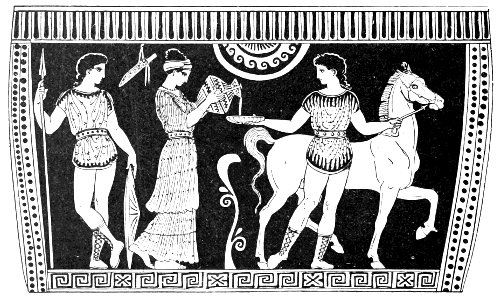
FIG. 108. DEPARTURE OF WARRIOR, FROM A LUCANIAN KRATER (BRITISH MUSEUM).
The vases of Campania present in many ways a striking
contrast to those of Lucania. Their chief characteristic is, as has
been noted, love of picturesque effect and variety of colour, even
to the extent of introducing attempts at shading (see above,
p. 471). The vases are mostly small, and none of the large
kraters or amphorae belong to this class. The favourite shapes
are the hydria, lekythos with bulbous body, and amphora; the
latter is clearly an imitation of the Attic “Nolan” amphorae,
which were so largely imported into the district, but the body
is usually more symmetrical. The clay is usually of a buff or
dull yellow ochre tone, and red and yellow washes are frequently
used, as well as large masses of white; these tints are laid on
very carelessly, and the white is of a kind that is apt to flake
off and disappear. Yellow, purple, and white are largely used
as accessories, and the drawing has a tendency to become very
careless. The lines of the ground are indicated by occasional
strokes of white, or by rocks strewn with flowers. Ornamental
patterns are not so popular as in Lucania; the favourite is the
wave, and the palmettes under the handles are thick and ugly,
with angular leaves. Some decorative motives seem to be derived
directly from nature.
The subjects are often interesting and uncommon, introducing
recondite or unusual myths; many of the vases with comic scenes
appear to belong to this class, and one in the British Museum has
an Oscan inscription. Local peculiarities of costume and armour,
which Signor Patroni calls Osco-Samnite, are often found; for
instance, warriors wear a very short chiton with broad girdle, a
helmet with waving crest and tall side-plumes of Italian type,[1476]
and a remarkable breast-plate formed of three circular plates
of metal arranged in a triangle.[1477] These same peculiarities are
found on the wall-paintings at Paestum, and there are indications
that Virgil was familiar with them.[1478]
Signor Patroni, by dint of an exhaustive study of the Naples
collection, has made a tentative classification of Campanian vases
according to fabric; he distinguishes those of Cumae, Saticula
(Santa Agata dei Goti), and Abella; but those of Capua, Nola,
and Neapolis appear to have no distinctive style. The Cumae
fabric, for studying which the Raccolta Cumana in Naples gives
exceptional facilities, is represented by the long, straight-bodied
amphorae, the hydriae with female heads under the handles, and
kraters on which the design is framed by stylised floral patterns
or heavy palmettes. Among the characteristic patterns are the
wave, large flowers in profile, and ground-ornaments generally,
such as ivy-leaves, branches, and small windows. The strong
tendency to polychromy seems to be the result of using the late
Attic polychrome vases as models. In the colouring a new feature
is the use of a carmine red, which, according to Patroni, is only
found in the Cumae fabrics.[1479] Mythological subjects are rare,[1480]
sepulchral common, and shrines are found on these alone; but
the majority have scenes from daily life,[1481] banquets, return of
warriors, etc. It is on these that the local costumes are usually
found.
The Saticula fabrics are very uniform,[1482] practically all bell-shaped
kraters with red clay; colours are sparingly used, and
then only white; a maeander takes the place of the wave-pattern
as a border; ground-lines are usually indicated. Of subjects
Dionysiac have the preference. The vases of Abella are of late
date, chiefly hydriae of very pale clay with accessory colours;
among the typical patterns are arabesques ending in white
daisies. They sometimes show reminiscences of the Paestum
style.[1483]
PLATE XLIV
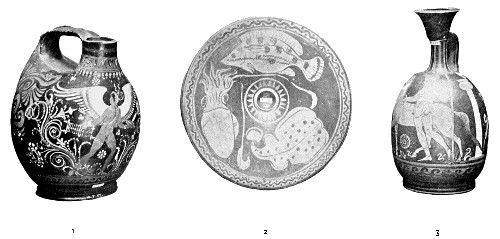
South Italian Vases (British Museum).
1, 2, Apulian Vases; 3, Campanian.
There are a few peculiar fabrics which we may also attribute
to a Campanian origin, including rude imitations of the B.F.
style, chiefly small amphorae with single figures; imitations of
Nolan amphorae, reproducing both their form and their scheme
of decoration[1484]; and bell-shaped kraters imitating the Attic style,
which Signor Patroni has associated with Saticula. The imitations
of Nolan amphorae have a slim body, twisted handles, and
a sharply set-off shoulder forming a right angle with the neck
instead of a graceful curve. As in their prototypes, the subjects
are confined to one or two figures each side. The lustrous black
glaze of the Attic vases is admirably reproduced. There is also
a class of vases with designs painted in opaque red on the black
ground, reproducing the method of the transitional vases described
on p. 393.[1485] They are very rude in character, with roughly incised
details and subjects of a simple kind; the red pigment appears to
have been made from fragments of pounded pottery (testa trita).
There is, however, one remarkable exception—a small phiale in
the British Museum,[1486] dating from the third century, with the
subject of a shepherd-boy with his dog. The design is carefully
painted in opaque red and white in the style of the Pompeian
wall-paintings, and the effect of light and shade produced by
hatched lines is both remarkable and unique. A krater found
at Civita Castellana (Falerii),[1487] the paintings on which are in
Campanian style, is unique in having Latin inscriptions over the
figures, a group consisting of Zeus (... SPATER, Die]spater),
Ganymede, Eros (CVPIDO), and Athena (MENERVA). The
subject is conceived rather in the style of the Etruscan mirrors
than that of the painted vases, and is obviously under local
influence. As Falerii was destroyed in 243 B.C., a terminus ante
quem may be obtained for the date of the vase, as for others
found on this site (see p. 75).
The vases of Apulia are not only more numerous, but of
more merit and greater interest than those of the other two
classes. In them may be observed two or three stages of
development, beginning with a fifth- or early fourth-century
group of Attic type, consisting of large amphorae with two
friezes of figures.[1488] Both in shape and method of decoration
these form the prototype of the large kraters and amphorae
which comprise the second class; they are distinguished from
the latter by severity of treatment and absence of colour. The
second class includes the large vases with mythological and
tragic subjects, the Under-world vases, and those with sepulchral
scenes; they are all richly decorated from head to foot, with
two main rows of figures, smaller subjects on the neck, and
ornamentation over every available space. The theatrical
characteristics of which we have spoken above (p. 472) are best
illustrated by some of this series.
The third class includes some large vases, such as the so-called
pelikae and the large phialae, and the smaller forms, the
oinochoë and its varieties, and kanthari, rhyta, and other kinds
of drinking-cups. Some shapes are peculiar to this class. In
spite of the great variety of shape, there is a remarkable
poverty of conception in the subjects, which show a tendency
to become purely decorative, and are mainly confined to the
vague “courting” scenes or “toilet” scenes, or to single figures
of Eros and Nike. On the smallest vases the commonest
subject is often that of a female head covered with a cap, sometimes
of a relatively colossal size, and this also occurs,
surrounded by foliage, on the necks of the large vases. The
shapes, as in the case of the epichysis (p. 179), often tend to
ugliness and over-refinement.
The conception of Eros on the later Apulian vases is one of
their chief characteristics (cf. Plate XLIV.). An almost invariable
participant in every scene, his form assumes an androgynous
character; his hair is arranged in feminine fashion, and his
person adorned with necklaces, earrings, and other jewellery.
Among other peculiarities we may note the double line of
white or yellow dots for ground-lines; the characterising of
Oriental figures by tiaras and cross-belts; the general treatment
of the hair of women, at first long, thick, and wig-like, but
later gathered up in a cap, from which the ends float out
behind; the thick but effeminate proportions of the men; and
the small heads of the horses.
PLATE XLV
To face page 486.
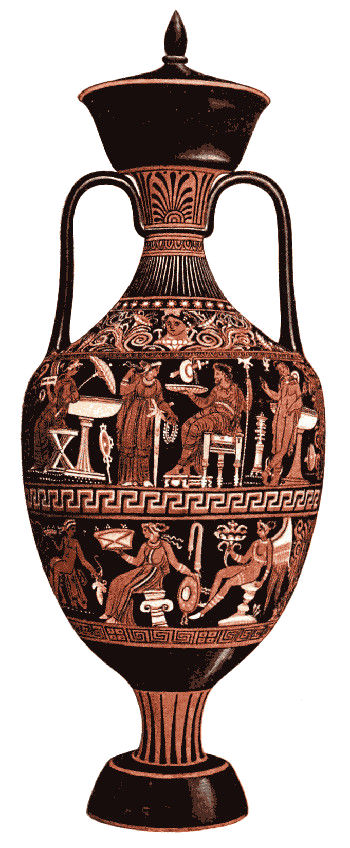
APULIAN AMPHORA.
PERSEPHONE IN HADES.
(British Museum).
There does not seem to be any possibility of distinguishing
different centres of fabric in Apulia. Nor can Tarentum have
been a centre of vase-fabrics, although Lenormant stoutly upheld
its claims, as the chief centre of Greek civilisation in that region.
But Tarentum has been the scene of much excavation, and
results do not point to that conclusion; most of the vases found
there are purely Greek. On the other hand, enormous numbers
have been found at Ruvo, and this was undoubtedly the chief
centre, though without a distinguishing style of its own. Ruvo
was famous for its red clay, and remains of furnaces and potteries
have been found there. Other sites where vases have been found
are Bari, Canosa, and Ceglie. At Canosa there was a preference
for the tall amphora with scroll-handles, the large phiale, and
the prochoös,[1489] and purple accessories were largely used here. It
is also interesting to recall that Canosa seems to have been the
centre for the large ornamental vases of terracotta painted in
tempera (p. 119).
On some of the column-handled kraters[1490] local costumes appear,
probably representing the Peucetians, and having some affinities
with those of Lucania; the principal features are the tall pointed
cap and short striped chiton worn by both sexes. Another
group peculiar to Apulia is formed by the fish-plates[1491]—a
peculiar form of plate, with low stem, a sinking in the centre,
and edge turned over, all being painted with fish of various
kinds (Plate XLIV.). They were no doubt used for eating
fish, the sinking being for the sauce; but they may also
have been hung up as votive offerings in the temple of some
marine deity.
The last efforts of vase-painting on the soil of Magna Graecia
date from the latter half of the third century B.C. By this time
vase-painting had reached a stage of complete decadence, devoid
of style or taste, and rapidly verging on barbarism, as shown
in some specimens, which seem to be the efforts of local
craftsmen to copy the better examples, but with the same want
of success as the Etruscans.[1492]
Another direction which vase-painting took before it finally
disappeared is illustrated by a group of vases mostly found at
Egnazia (Gnathia) in Apulia, which clearly form a final stage
in the evolution of the local fabric just discussed. Originally
known from the place where the majority was found as vasi di
Egnazia or Gnathia vases, they were in the view of Lenormant
more probably made at Tarentum.[1493] But we have seen that
there is slight evidence of local fabric there,[1494] and their connection
with the fabrics of Ruvo and Canosa makes it more likely
that they came from that neighbourhood. It is therefore
probable that the old name is the correct one.
The characteristics of this group are: (1) the black varnish
with which the whole vase is covered; (2) the designs painted in
opaque colours—white, purple, and yellow; (3) the tendency to
imitate vases of metal, as seen in the vertically ribbed bodies
and other details of form. The important rôle played by the
black varnish is interesting, as showing the increasing tendency
to reduce the painter’s labour to a minimum, combined with
a striving after novelty and the rejuvenation of the art. The
practice, no doubt, arose from the discovery of the painter that
it was easier to paint the figures on the black in opaque colour
than to trace them out in the clay and work round them with
the varnish, especially in the case of the elaborate foliage
patterns which played so important a part in Apulian vases.
The subjects are usually confined to the shoulder or neck, at
least of the larger vases; but figures are comparatively rare.
One krater in the British Museum (F 543) which belongs to the
comic series is a notable exception; and there is a pleasing
subject on a skyphos in the Louvre[1495]—a cock and goose confronted,
and greeting one another with the respective salutations,
“Ah, the goose!” “Oh, the cock!” But in the majority of
cases the only designs are female heads, Erotes (Fig. 118), birds,
comic and tragic masks suspended from wreaths, and simple
foliage patterns. The reverse of the two-sided vases is often
undecorated.
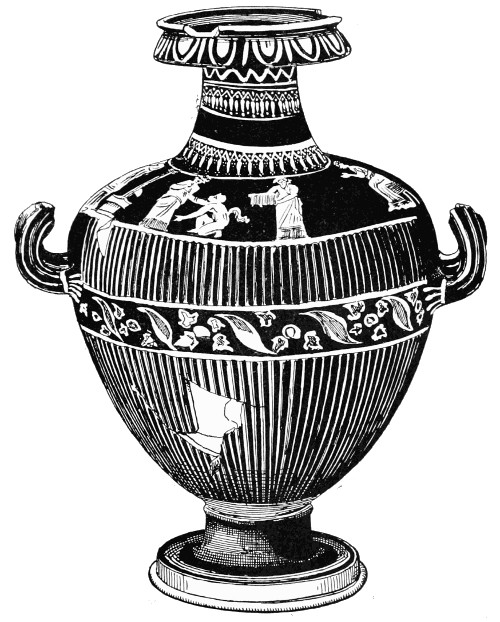
FIG. 109. HYDRIA WITH OPAQUE PAINTING ON BLACK GROUND, FROM CURIUM
(BRITISH MUSEUM).
It is interesting to note that specimens of this ware are
sometimes found on Greek sites, such as Athens, Myrina in
Asia Minor, Melos, and Cyprus. At Curium in the latter
island a fine hydria in this style, with figures on the shoulder
(Fig. 109), was found in 1895.[1496] Whether these were imported
from Italy or made elsewhere is quite uncertain.[1497]
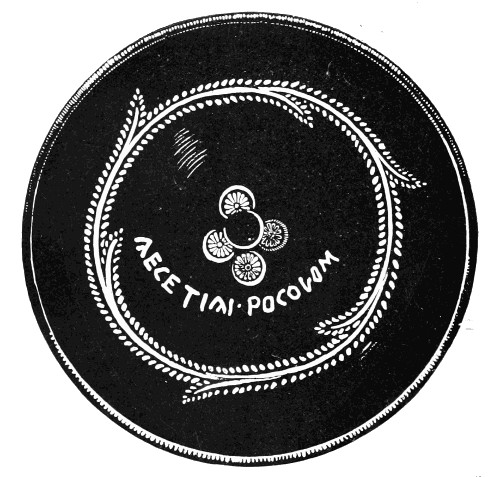
FIG. 110. PHIALE WITH LATIN INSCRIPTION: “THE CUP OF AEQUITIA”
(BRITISH MUSEUM).
Another interesting but much smaller class which belongs to
the latter half of the third century is formed by a group of
vases, mostly small phialae, which are distinguished by bearing
painted Latin inscriptions.[1498] Some also have figures (Eros, a
female head, etc.), which are treated in the same manner as the
Gnatia vases. It is probable that Rome was the place of origin
of this class, in spite of the fact that most of them were found
in Etruria.[1499] But the Latin language at that time was more at
home in Campania than anywhere else outside Rome. The
inscriptions take the form: AECETIAI POCOLOM, Aequitiae
poculum (B.M. F 604 = Fig. 110); IVNONENES POCOLOM,
Junonis poculum; and so on,—Saturn, Mercury, and other
Roman deities being included in the list. Reasons have been
given for dating this series in the First Punic War, 260–240
B.C.
Formerly it was universally supposed that the art of vase-painting
was brought to an end in 186 B.C. by the action of the
Roman Senate when they issued their edict against Bacchanalian
ceremonies, which undoubtedly affected Southern Italy. But
this was only a natural view to be taken by writers who associated
the painted vases with the Eleusinian mysteries and
similar ideas; on other grounds it is hardly tenable. Especially
in regard to the general putting back of the chronology of the
art, it is impossible to suppose that painted vases with mythological
subjects were still made in the second century. The
character of the mid-third-century vases just described is sufficient
to indicate that they represent the last stage to which
Greek painting could ever have reached.
We propose to conclude this sketch of the history of Greek
vase-painting with a few words on a principle which, while
always present in Greek pottery, yet at all times lay in the
background, until the latest stages of the art, when it entered
on a phase of increased popularity. This is the principle of
combining the ceramic with the plastic art—in other words,
the manufacture of vases in the form of human or animal
figures or heads.
It has already been noted, in discussing the primitive pottery
of Troy (p. 257), that the idea of associating the vase form and
the human form is a very old one. At Troy it is of course seen
in its most rudimentary stage, when correct modelling was a
thing quite beyond the potter’s scope, and he could only roughly
indicate features and limbs on the surface of the vase, which
thus always remained a vase, and the figure idea never gained,
as in later times, the predominance. In the Mycenaean period
the advance in modelling was great, but only reached a high
level in Crete. It is only since the discoveries at Knossos that
we have been able to account for the astounding group of
porcelain rhyta from the Enkomi tombs in Cyprus (see Plate X.,
fig. 4),[1500] which at first sight seem to have been made by a
sixth-century artist, so admirable and lifelike are they. Although
the rams’ heads bear the palm, the female heads are, for
the period, a tour de force, so advanced in type that it would
be pardonable to argue—apart from the circumstances of their
discovery—that they must belong to a later stage of art.
Apart from these, however, the principle did not find its
way into Greece before the seventh century B.C., and then
its origin is indubitably Oriental. It is best exemplified by
the discoveries in Rhodes, especially at Kameiros,[1501] where
vases of porcelain and terracotta are found modelled in the
form of helmeted heads or heads of animals (see Plate XLVI.,
fig. 1, and p. 127). The type adopted is that of the aryballos
(p. 197); it was no doubt a comparatively easy matter to model
its spherical body into the form required, applying paint where
necessary to bring out the details as on the vases. In the
Western Mediterranean the alabastron form seems to have been
more popular.[1502] It is often adopted for the Canopic vases of
Etruria (see Chapter XVIII.). Many of these are unpainted,
or rather are covered with a white slip and then painted in
tempera like the ordinary terracotta figures; they are, in fact,
figurines in essence, vases by accident; whereas in the first-named
group the vase idea retains the predominance. But it
is almost impossible to draw the line. A fine early instance of
imitation of metal in early Greek pottery is the British Museum
jug from Aegina (A 457) terminating in the head of a Gryphon.
PLATE XLVI
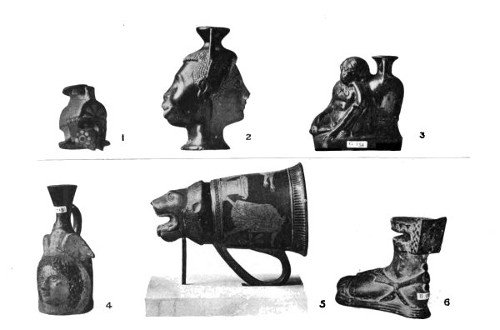
Greek Vases Modelled in Various Forms (British Museum).
1, 6, Sixth Century; 2, 4, 5, Fifth Century; 3, Fourth Century.
During the sixth century painted figurine vases are rare,
though there are not wanting various examples of the class
just described, which belong to this period; but at all events
hardly any examples can be traced to Athenian manufacture
during the age of B.F. vase-painting. Towards the end
of the century, however, the fashion was reintroduced by
the potter Charinos, who belongs to the transitional period
(about 525–500 B.C.). A vase signed by him, which was
found at Corneto, is in the form of a female head surmounted
by a kalathos.[1503] It was made in a mould like the terracotta
figures, but the painted decoration, which is remarkably
elaborate and minute, is entirely B.F. in character. The
patterns on the head-dress include maeander, stars, ivy-leaves,
lozenge and net patterns, and a minute frieze of animals,
painted in black on the clay ground. A similar vase, but
later in date, is in the Berlin Museum[1504]; in this example we
may note the introduction of R.F. ornamentation, in the
palmettes and diapering round the top.
These two stand at the head of a series of similar vases
extending throughout the succeeding periods down to the
end of the age of painted vases. They compare for style
with the heads of the female statues found on the Acropolis,
which belong to the same period. Two other potters, Kaliades
and Prokles, made similar vases.[1505]
The fashion started by Charinos continued throughout the
fifth century, but the plastic conception tended to become
subordinate to the ceramic, and it became more and more
customary to decorate the non-plastic portions in the manner
of the vases. Of this development the most noteworthy
example is the beautiful rhyton in the British Museum in
the form of a Sphinx (E 788), the upper or vase part of which
is ornamented with the subject of Kekrops and Erichthonios.
The body of the Sphinx is covered with a fine white slip,
and the details are picked out with red and gilding. This
vase dates from about the middle of the century. There
also exist many examples of rhyta or kanthari, formed of
a head or two heads back to back, usually a Maenad and a
Seilenos.[1506] Another favourite type is that of a jug in the form
of a negro’s or Aethiopian’s head[1507]; and there are also rhyta
which terminate in the head of a lion, mule, or other animal
finely modelled (Plate XLVI., figs. 2, 5).
Towards the end of the fifth century there is a reversion to
the purely plastic figure-vase, usually in the form of a lekythos
with spherical body, to the front of which the figure is attached
(Plate XLVI., fig. 4). The vase is usually covered with black
glaze, and the figure with a white slip like the terracottas, with
polychrome colouring. Examples of this class are the series
of lekythi representing Aphrodite Anadyomene in a scallop-shell,
of which there are examples at Athens and Petersburg,[1508]
and the fine vase in the British Museum (E 716) with the bust
of Athena Parthenos. A series of smaller lekythi, of which the
British Museum possesses examples (G 2–7), represents Eros on
a dolphin, the young Dionysos in a sort of canopy, Europa on
the bull, a boy with a dog, and other subjects; the technique
is similar to that of the larger specimens, with pink and green
colouring. They form charming little objects, and are often
well executed.[1509]
In Southern Italy many of these types are continued, the most
popular being that of the rhyton ending in an animal’s head
(p. 193), of which many examples have been found in Apulia.
They usually have some simple design painted on the upper
part, such as a figure of Eros. There are also numerous
examples of vases in the form of animals or human figures
(Plate XLVI., fig. 3), some of which are in black glazed ware
with patterns in white like the vases of Egnazia, others being
covered with white slip like the terracottas. With the decay of
painted decoration the plastic element gradually predominates
more and more, until the vase form becomes, so to speak, purely
accidental. Thus in the third century the fabrics of Canosa,
of which we have spoken in a previous chapter (p. 118), entirely
hold the field, and the vases pass out of the sphere of the
history of vase-painting.
In all or nearly all of the vases just described we observe
the same principle at work—namely, the tendency to imitate
metal in terracotta. It is one that is constantly recurring
throughout the whole history of Greek ceramics, with more
or less persistency and prominence. Sometimes, as in the
Melian, Proto-Attic, and other fabrics, the imitation is limited
to the form of the handles, which is, strictly speaking, inappropriate
in terracotta, though frequently found in early bronze
vessels.[1510] It is seldom found in Ionia, but in Western Greece
there are many examples during the seventh and sixth centuries,
as in some of the Proto-Corinthian and early Corinthian wares,[1511]
This is doubtless in a large measure due to the influence of
the great centres of metal-work at that time, Corinth and
Chalkis. We are not, therefore, surprised to find the tendency
exemplified in the pottery fabrics of those two centres, and
at Chalkis, as has already been noted (p. 321), it is especially
conspicuous in the form and minor details of the vases. At
Athens examples are rare, with the exception of the vases
of Nikosthenes, who not only copies complete vases in metal,
as in his peculiarly-shaped amphorae and in a small phiale
mesomphalos in the British Museum,[1512] but is also addicted to
adorning the handles of jugs with female heads in relief, as
on specimens in the Louvre and elsewhere.[1513] After the sixth
century the tendency is far less conspicuous, owing to the high
esteem in which vase-painting was then held, and little is seen
of attempts at imitating metal until the revival of the plastic
element in pottery in the fourth century. An almost unique
exception is the Berlin krater from Corinth (2882), which must
date from the fifth century. It is of black ware, with designs
in relief round the body.[1514]
The tendency also manifests itself in a marked degree in
another direction in early Greek art—namely, in that of ornamenting
vases with reliefs. So much evidence of this has
been yielded by discoveries on Greek soil that it is now
certain that this method of decoration had its origin in Greece,
and not in Etruria, although the close resemblance between
early relief-wares from Rhodes and the large πίθοι of Cervetri
(see p. 153) had led archaeologists in the past to regard Etruria
as its original home. The Etruscans always preferred modelled
vases or relief decoration to painted ware, as their bucchero
fabrics show; but we know that they had no inventive power,
and even in this they have proved to be only imitators.[1515]
Turning to details of the early Greek vases with reliefs, we
may note that there are two varieties: firstly, those in which
the reliefs are made by rolling a cylinder round the vase, the
design being repeated over again; secondly, those in which
the reliefs are made from separate moulds, and attached with
some kind of cement.[1516] In both classes the shape usually
affected is that of a large πίθος (cf. p. 151), of a somewhat
coarse red clay. It is the first variety which so closely
resemble the πίθοι found at Cervetri, and which are now
known to be the prototypes, not imitations, of the Etruscan
examples.[1517]
PLATE XLVII
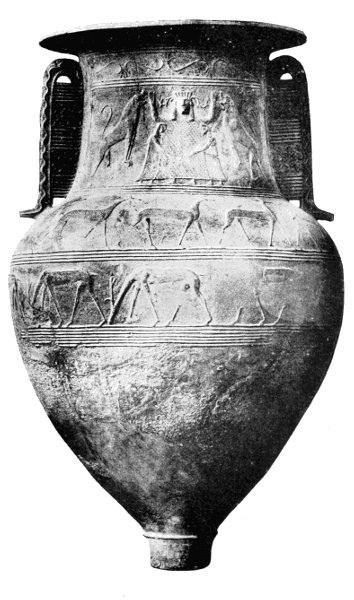
From Ἐφ. Ἀρχ.
Archaic Pithos with Reliefs from Boeotia (Athens Mus.).
In Greece fragments of the first class have been found on
the Acropolis at Athens, the recurring design being a two-horse
chariot which a warrior mounts, with a scorpion in the
field. The similarity in the clay, the shape, and the technique
of the reliefs with the Cervetri vases is remarkable; the subject
is one common on Corinthian vases. Other fragments have
been found at Tanagra, and there is a good example in the
Louvre with a series of figures, representing a dance of women,
all of similar types, yet not from the same stamp, but different
moulds.[1518] The variations of detail in dress and hair show
conclusively that the cylinder process is not employed here,
but that the figures are freely modelled from a single type.
The costume is that typical of the women on early B.F. vases
(cf. p. 372). Some very fine examples of πίθοι with reliefs,
dating from the end of the seventh century, have been published
by De Ridder.[1519] They are all from Boeotia, and are similar to
those made in Rhodes, but with the characteristic ornamental
handles of metallic form. Here again the figures are freely
modelled with variations of detail, and they afford interesting
points of comparison with the painted vases and with the early
bronze reliefs which are variously attributed to Corinth and
Chalkis.[1520] One in Athens (Cat. 462) has the interesting subject
of Artemis Diktynna; another (Cat. 466 = Plate XLVII.),
an accouchement scene. Similar finds have been made in
Kythnos, Tenos, Crete, and Rhodes,[1521] the ornamentation being
for the most part purely geometrical, but sometimes with Centaurs
or human figures.[1522] In none of these examples is there
any peculiarly Etruscan feature; all is purely Hellenic, presenting
close analogies not only with metal-work in relief, but also with
the Oriental art to which the Greek work of that age was so
much indebted, as in the case of the cylinder process.[1523]
A new method of decorating vases, which first makes its
appearance towards the end of the fifth century, is by means
of appliqué reliefs. It is doubtless due to the influence of
sculpture, and perhaps more especially to that of the bronze
reliefs which on vases and mirror-cases were now becoming
popular. The former influence is clearly at work in the great
Kertch vase with the contest of Athena and Poseidon (Plate
L.), where we may see in the two central figures, which
are modelled in relief and applied to the surface of the vase,
an undoubted reminiscence of the western Parthenon pediment.
There are also vases from Athens, Kertch, the Cyrenaica, and
Southern Italy,[1524] in which the figures are either partially or
wholly modelled in relief, like the vase of Xenophantos or
a fine lekythos in the British Museum (G 23) representing the
rape of Kassandra by Ajax. Another fine specimen, found at
Cumae and now at Petersburg, has a group of Eleusinian
deities in relief on the shoulder.[1525] Yet another example,
recently found at Lampsakos, has the Calydonian boar-hunt
as its subject; the figures are in relief on a gilded ground.[1526]
The imitation of metal technique[1527] is even more marked in
the vases of Southern Italy than in those from other parts.
At Capua, Cumae, and Metapontum amphorae, hydriae, and
oinochoae are found, covered with a very brilliant black varnish,
but without any painted decoration; the only ornament is in
the form of gilded wreaths and other simple patterns, or
designs in relief. The British Museum has a fine series from
Capua with garlands of foliage and ornaments in the form of
festoons and pendants, the whole forming, as M. Collignon
says, “a brilliant and luxurious system of decoration which
contrasts with the sober taste of the Attic potters.” Some of
the hydriae are clearly of local fabric, imitations of the
Campanian hydriae of bronze.[1528] The forms are often very
elaborate, with ornamental handles, ribbed bodies, and moulded
stems. An oinochoë has been found with an inscription which
gives the names of leῖa for smooth-surfaced vases, ῥαβδωτά for
those ribbed or fluted. Heavy imitations of the gilt and relief
wares have often been found at Alexandria,[1529] and isolated
specimens occur in Attica, Rhodes, and the Cyrenaica.
The growing fashion of using only vases of chased gold and
silver in preference to painted pottery made itself more and
more felt both in Greece and Italy during the Alexandrine
period. The same tendency which we have already noted, to
reproduce as far as possible the characteristics and appearance
of metal, may be observed in all the pottery of this period.
Not only do the subjects moulded in relief reproduce the
appearance of the chased and repoussé designs, but the shapes
are those of the metal vases, and even in the black glaze there
are attempts to produce a metallic effect. It is clear that the
pottery of this period presents throughout the effect of a
striving after outward show on the part of those who were
unable to afford the more precious metal for their household
utensils, and were forced to be content with imitating it to
the best of their ability in the humbler material.
In Greece this tendency is best illustrated by a series of
vases known as Megarian or Homeric bowls, of hemispherical
form,[1530] without handles. The former name was given to them
by Dumont[1531] and Benndorf,[1532] but with little authority beyond
the fact that several were found at Megara. But they might
on equally good grounds be called Boeotian, others having been
found at Thebes and elsewhere in the neighbourhood. They
have also been found in Kalymnos, Crete, and Cyprus, but
the majority are from Thebes, Tanagra, and Anthedon.
Professor Robert thinks they may be identified with the
vasa Samia so often mentioned by ancient writers (see Chapter
XXII.), and refers to the μαστοί dedicated at Oropos and
Paphos.[1533] All are of red clay, with a thin metallic black glaze
giving a quasi-metallic appearance; the hemispherical form is
only departed from in one or two instances.[1534]
The other name, Homeric, has been applied to them by
Professor Robert with reference to the well-known passage of
Suetonius, which describes Nero as using bowls (scyphi) called
Homeric because they were chased with subjects from Homer’s
poems.[1535] Our clay examples would then be reproductions of
the chased metal vases, used by those who could not afford
originals, and corresponding in some degree to modern plaster
casts. It is true that only five of the examples we possess
have subjects from Homer; but most of the others may be
so called as belonging to the Epic cycle. They thus differ
from most relief-vases of the period, in that the designs are
not purely decorative or repetitions of simple motives, but are,
so to speak, “illustrations of the classics.”
Professor Robert distinguishes two classes: (1) those with
figures made from separate stamps, attached to the vase after
it was made, and often repeated; (2) vases made wholly, figures
and all, in a mould, like the Arretine wares.[1536] In the latter case
they were doubtless made from the same moulds as the metal
vases, and of this we have an undoubted example, not indeed
among the “Megarian” bowls, but in analogous specimens from
Italy. It has already been noted (p. 134) that in the British
Museum there are two examples of a silver bowl with repoussé
designs, representing round the interior four deities in chariots,
which form part of a silver treasure found at Èze in the south
of France; and that in the same collection there is also a clay
bowl (Cat. G 118 = Plate XLVIII., fig. 5) which exactly reproduces
the silver vase in shape, size, and decoration.
Among the subjects we have the rape of Persephone[1537]; the
sacrifice of Iphigeneia; Achilles and Priam[1538]; the flight to the
ships (from the Iliad), the sack of Troy and the sacrifice of
Polyxena; the destruction of the suitors (from the Odyssey).
From the Theban legend we have the stories of Oedipus’s
childhood and the Seven against Thebes[1539]; other vases give
the labours of Herakles or his rape of Auge (Plate XLVIII.,
fig. 2)[1540]; and a jug made by Dionysios has the interesting
subject of Autolykos and Sisyphos.[1541] The British Museum
possesses a very interesting bowl with scenes taken directly
from the Phoenissae of Euripides,[1542] and other comparisons with
that author may be made in the case of the bowls with
Iphigeneia and Polyxena. Sometimes the scenes are inscribed
with verses from the poems or plays illustrated, or with a
prose description of the scene,[1543] or merely with the names of
the figures. The letters in all cases are raised. It is clear
that all these bowls belong to the same period and fabric, and
many small details point to the third century as their date.
We may bear in mind that this was the time of the great
revival of Homeric study at Alexandria.
PLATE XLVIII
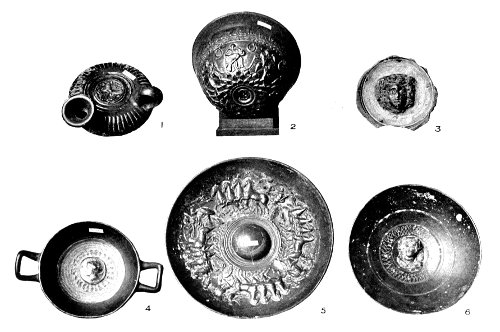
Greek Vases of Hellenistic Period: Black Ware with Reliefs (British Museum).
In Italy the introduction of relief wares became general as
painting was abandoned, but did so gradually, not suddenly.
In the third century both existed side by side. The principle
of a purely mechanical process in pottery, which now first
appears in the manufacture from a mould, was not, strictly
speaking, a new one in Italy, nor yet in Greece. It is first
seen in the early Etruscan and Rhodian vases (see p. 496)
with stamped and rolled-out designs repeated in long friezes.
And we shall see later how for several centuries moulded
vases, in the form of bucchero ware, formed the national
pottery of Etruria. There was always in Etruscan, as also in
Greek pottery,[1544] a tendency towards the imitation of metal,
and this tendency about the fourth century seems to have
spread over the rest of Italy, even to the Iapygian Peninsula.
Thus it is that the vases of Gnatia (p. 488) are largely metallic
in form and treatment, with their ribbed bodies and other details.
To the same cause is mainly due the series of Capua and
Cumae vases which has already been discussed, with its
brilliant varnish and gilding. Signor Gamurrini actually gave
to the Italian black glaze wares the name of “Etrusco-Campanian.”[1545]
After the disappearance of bucchero ware similar
vases came to be made at Cervetri, Chiusi, Corneto, and
Bolsena, the principal art centres of Etruria. At Bolsena in
particular they have been found in considerable numbers;
and as this city (Volsinium novum) was only founded in
264 B.C., a terminus post quem for their date is afforded.
A group of vases found chiefly at the last-named place[1546]
does not appear to have been covered with black varnish,
but with a metallic preparation of gold or silver, which has
now mostly disappeared, and they are left with the plain
glazed clay. Some of these are not without merit. In the
general arrangement of the designs, usually in friezes round
the shoulder, there is obviously a reminiscence of bucchero
ware. The metallic preparation with which they were covered
may have been something of the kind which Athenaeus[1547]
describes in speaking of certain drinking-cups made at
Naukratis, which “were dipped [in some preparation] so as
to appear silver.”
In Italy the manufacture of vases of black ware with reliefs
appears to have centred at Cales in Campania during the
third century.[1548] The principal type is that of a bowl, not of
the hemispherical form, but shallow, with the designs in the
interior, either in the form of a frieze or of a central medallion.
These are usually called Calene phialae, but it is not certain
whether the majority were really made at Cales. At all events,
it is, like “Megarian bowl,” a convenient name for the class.
The British Museum bowl G 118, with the frieze of chariots
(see above), is a good example of the frieze type of design.
The subject, which is treated in a very spirited manner, is
the apotheosis of Herakles, who is conducted by Athena, Ares,
and Artemis to Olympos, accompanied by Victories. There is
also a good specimen in Berlin (Cat. 3882) with Odysseus
and the Sirens. Another with decorative patterns only, bears
the signature of the potter, L. Canoleios of Cales, in Latin
letters.[1549] Examples are also given in Plate XLVIII., figs. 3, 5, 6.
Of the type with central medallions comparatively few complete
examples exist, but the British Museum possesses a series
of fragments on which the medallions have been preserved.[1550]
The subjects are usually those characteristic of the Alexandrine
period: Aphrodite, Adonis, and Erotes; Herakles and Hylas,
and others familiar from Theocritus; or Trojan scenes, such
as Thetis with the arms of Achilles or Paris attacked by
Deiphobos. A unique instance is that of Romulus and Remus
suckled by the wolf (G 125). Two names of potters occur—K.
Atilius and G. Gabinius. The date of these phialae is
probably that of the Second Punic War (about 230–200 B.C.).
The designs, being taken from moulds[1551] and inserted separately,
are frequently repeated. The fashion—obviously another
instance of imitation of metal[1552]—of adorning bowls with central
designs also takes other forms at this period. Simple heads
of deities or Satyrs are found, and there are also instances
of facsimiles of Syracusan coins. Two bowls in the British
Museum (G 121–22) have in the centre copies of a decadrachm
with the head of Persephone (Plate XLVIII., fig. 4: cf. p. 210).[1553]
Analogous to these in character and technique are the series
of small lamp-feeders or gutti, a variation of the askos form,
which are found chiefly in Southern Italy, but also in North
Africa and the Eastern Mediterranean.[1554] In the latter case
they are usually distinguished by having an arched handle
over the back instead of the usual ring-handle at the side,
and the body is flatter. The Italian type has a deep ribbed
body, with a flat circular space on the top containing a design
in relief, made separately and inserted in the vase (Plate
XLVIII., fig. 1). The range of subjects is wide, but the majority
are mythological: heads or masks of a Dionysiac character or
of Medusa form a large proportion of the whole.
Larger vases of black ware with reliefs inserted or attached
are sometimes found, but are not common. The British Museum
possesses two good specimens—a krater (G 29) with panels
inserted bearing mythological designs,[1555] and a large covered
jar (G 28) with the inscription BASSVS in Roman letters,
presumably the potter’s name. The subjects, in two friezes,
represent Erotes and festoons of vine-leaves, and Poseidon and
Victory, five times repeated.
The series of vases which we have been discussing are clearly
paving the way for the new development of pottery which
prevailed throughout the Roman period—that of the ware
formerly known as Samian, but now usually spoken of as
Arretine or (a more comprehensive term) Terra sigillata.
This will of course be more appropriately dealt with in a
subsequent chapter under the heading of Roman Pottery.
In the course of the second century the Roman dominion
spread over most of the Greek lands, and Greek art as an
independent entity almost ceased to exist. It is, however,
not a little remarkable at what a late date some forms of
distinctively Greek pottery lingered on in Hellenic regions,
such as Attica, Egypt, and Southern Russia. The subject
has hitherto received but little attention, and the materials
have hardly been collected with sufficient completeness to
admit of adequate discussion and classification.[1556]
END OF VOL. I.
Printed by Hazell, Watson & Viney, Ld., London and Aylesbury.
Mr. Murray’s Standard Works
Berenson, Bernhard. The Drawings of the Florentine Painters.
Classified, Criticised, and Studied as Documents in the History and Appreciation
of Tuscan Art. With a Copious Catalogue Raisonné, and 180 Facsimile
Illustrations. 2 Vols. Folio. £21 net.
Borgia, Lucretia, The Life of. According to Original Documents
and Correspondence of her Day. By Ferdinand Gregorovius. Translated
by John Leslie Garner. With Illustrations. Large Crown 8vo.
10s. 6d. net.
Brown, Prof. G. Baldwin. The Fine Arts. The Origin, Aims,
and Conditions of Artistic Work as applied to Painting, Sculpture, and
Architecture. New and Enlarged Edition. With Illustrations. Crown 8vo.
6s. net.
—— The Arts in Early England. With Illustrations. 3 Vols.
Royal 8vo. 16s. net. each.
Vol. I. The Life of Saxon England in its Relation to the Arts.
Vol. II. Ecclesiastical Architecture in England from the Conversion
of the Saxons to the Norman Conquest.
Vol. III. The Decorative Arts of the Anglo-Saxon Period.
Brugsch, Professor. Egypt under the Pharaohs. History
derived entirely from the Monuments. Third Edition. Revised by M.
Brodrick. Maps, Plans, and Illustrations. Demy 8vo. 18s.
Burton-Brown, E. Recent Excavations in the Roman Forum,
1898–1905. A Handbook. Illustrations and Plans. Fcap 8vo. 2s. net.
Cartwright, Julia (Mrs. Ady). The Painters of Florence.
From the 13th to the 16th Centuries. Illustrations. Crown 8vo. 6s. net.
Cripps, Wilfrid. Old English Plate: Ecclesiastical, Decorative,
and Domestic: Its Makers and Marks. Eighth Edition. Revised and
Enlarged. With 123 Illustrations and 2,600 Facsimile Plate Marks. 8vo.
21s. net.
⁂ Tables of the Date-Letters and Marks sold separately. 5s.
—— Old French Plate: Its Makers and Marks. With Tables
of Makers’ Marks, in addition to the Plate Marks. 8vo. 10s. 6d.
Crowe, Sir J. A., and Cavalcaselle, G. B. A History of
Painting in Italy, Umbria, Florence, and Siena, from the 2nd to the 16th
Century. A New Edition, with Editorial Notes by Langton Douglas,
with upwards of 200 Illustrations. Large Demy 8vo. 6 Vols. 21s. net
each.
Vol. I. Early Christian Art.
Vol. II. Giotto and the Giottesques.
—— —— Raphael: His Life and Works. Demy 8vo. Vol. I., 15s.
Cust, Lionel. Notes on the Authentic Portraits of Mary
Queen of Scots. Based on the Researches of the late Sir George Scharf,
Director of the National Portrait Gallery—Re-written in the light of new
information. With many Illustrations. Small 4to. £3 3s. net.
Douglas, Langton. Siena, her History and Art. With Maps
and numerous Illustrations. Medium 8vo. 25s. net.
Fanshawe, H. C. Delhi: Past and Present. With Maps and
Illustrations. Demy 8vo. 15s. net.
Fergusson, James. History of Architecture in all Countries
from the Earliest Times. With 1,700 Illustrations. 5 Vols. Medium
8vo. £6 6s.
Vols. I. and II. Ancient and Mediæval. 63s.
Vol. III. Indian and Eastern. 31s. 6d.
Vols. IV. and V. Modern. 31s. 6d.
[Arrangements have been made with Booksellers enabling them to offer
special terms for the above work complete.]
Hodgson, J. E., and Eaton, F. A. The Royal Academy and
its Members. A History from 1768 to 1830. With Portraits. Large
Demy 8vo. 21s. net.
Hogarth, D. G., Edited by. Authority and Archæology, Sacred
and Profane. Essays on the Relation of Monuments to Biblical and
Classical Literature. By Various Writers. Second Edition. Demy 8vo.
16s.
Jameson, Mrs. Lives of the Early Italian Painters—and
the Progress of Painting in Italy—Cimabue to Bassano. With
50 Portraits. Post 8vo. 12s.
Kugler’s Handbook of Painting. The Italian Schools of Painting.
Sixth Edition, revised. By Sir Henry Layard, G.C.B. With nearly
250 Illustrations. 2 Vols. Demy 8vo. 30s.
—— The German, Flemish, and Dutch Schools. Third Edition,
revised. By Sir J. A. Crowe. With 60 Illustrations. 2 Vols. Crown 8vo.
24s.
Layard, Sir A. Henry. Nineveh and its Remains. With Illustrations.
Crown 8vo. 7s. 6d.
—— Nineveh and Babylon. Illustrations. Crown 8vo. 7s. 6d.
—— Early Adventures in Persia, Babylonia, and Susiana.
Portrait, Illustrations, and Maps. 2 Vols. Crown 8vo. 24s. Popular
Edition in 1 Vol. Crown 8vo. 7s. 6d.
—— Autobiography and Letters, from his Childhood until his
Appointment as H.M. Ambassador at Madrid. With an additional Chapter
on his Parliamentary Career by the Right Hon. Sir Arthur Otway.
Edited by the Hon. William Napier Bruce. With Portraits and Illustrations.
2 Vols. Demy 8vo. 25s. net.
Mariette, Auguste. Outlines of Ancient Egyptian History.
Second Edition. Edited, with Notes, by Mary Brodrick. Crown 8vo.
With Map. 5s.
Marillier, H. C. The Liverpool School of Painters. An
Account of the Liverpool Academy, from 1810 to 1867. With Memoirs of
the Leading Artists. With Illustrations. Square Demy 8vo. 10s. 6d. net.
Maudslay, A. P. and A. C. A Glimpse at Guatemala. Some
Notes on the Ancient Monuments of Central America. With Maps, Plans,
74 Photogravures, and other Illustrations. 4to. £4 4s. net.
Morelli, Giovanni. Italian Painters. Critical Studies of their
Works. With an Introductory Notice by Sir Henry Layard, G.C.B.
With numerous Illustrations. Demy 8vo. 2 Vols. 15s. each.
Vol. I. The Borghese and Doria Pamphili Galleries in Rome.
Vol. II. The Galleries of Munich and Dresden.
Murray, A. S. A History of Greek Sculpture from the
Earliest Times. With 130 Illustrations. 2 Vols. Medium 8vo. 36s.
—— Handbook of Greek Archæology. Sculpture, Vases,
Bronzes, Gems, Terra-cottas, Architecture, Mural Paintings, etc. Many
Illustrations. Crown 8vo. 18s.
—— The Sculptures of the Parthenon. With Illustrations of
the whole Remains. Medium 8vo. 21s. net.
Okakura, Kakuzo. The Ideals of the East, with special reference
to the Art of Japan. Crown 8vo. 5s. net.
Phillipps, Evelyn March. The Frescoes in the Sixtine Chapel
in Rome. With 24 Illustrations and a Photogravure Frontispiece. Crown
8vo. 6s. net.
Smith, Sir Wm., Dictionaries:—
Dictionary of the Bible; Comprising its Antiquities, Biography,
Geography, and Natural History. By Various Writers. With Illustrations.
3 Vols. Enlarged and Revised Edition. Medium 8vo. £4 4s.
[Complete sets of the above work may be purchased through any
Bookseller at reduced rates.]
Concise Dictionary of the Bible. Medium 8vo. 21s.
Smaller Dictionary of the Bible. Crown 8vo. 7s. 6d.
Dictionary of Christian Antiquities. The History, Institutions,
and Antiquities of the Christian Church. Edited by Sir W. Smith, D.C.L.,
and Archdeacon Cheetham, D.D. With Illustrations. 2 Vols. Medium
8vo. £3 13s. 6d. each.
Dictionary of Christian Biography, Literature, Sects, and
Doctrines. Edited by Sir Wm. Smith, D.C.L., and Henry Wace, D.D.
4 Vols. Medium 8vo. £6 16s. 6d.
Dictionary of Greek and Roman Antiquities. Including the
Laws, Institutions, Domestic Usages, Painting, Sculpture, Music, the Drama,τύμπανα
etc. Edited by Sir Wm. Smith, William Wayte, M.A., G. E. Marindin,
M.A. Third Revised and Enlarged Edition. With 900 Illustrations,
2 Vols. Medium 8vo. 31s. 6d. each.
Concise Dictionary of Greek and Roman Antiquities.
Edited by F. Warre Cornish, M.A. With over 1,100 Illustrations taken
from the best examples of Ancient Art. Medium 8vo. 21s.
Smaller Dictionary of Greek and Roman Antiquities.
With 200 Woodcuts. Crown 8vo. 7s. 6d.
Dictionary of Greek and Roman Biography and Mythology.
Illustrated by 564 Engravings on Wood. In 3 Vols. Medium 8vo. £4 4s.
Classical Dictionary of Biography, Mythology, and Geography.
Thoroughly Revised Edition. By G. E. Marindin, M.A.
With over 800 Woodcuts. 8vo. 18s.
Smaller Classical Dictionary of Biography, Mythology,
and Geography. With 200 Woodcuts. In great part re-written by G. E.
Marindin, M. A. Crown 8vo. 7s. 6d.
Dictionary of Greek and Roman Geography. Illustrated by
534 Engravings on Wood. 2 Vols. Medium 8vo. 56s.
Complete Latin-English Dictionary. With Tables of the
Roman Calendar, Measures, Weights, Money, and a Dictionary of Proper
Names. Medium 8vo. 16s.
Smaller Latin-English Dictionary. By Sir Wm. Smith and
T. D. Hall, M.A. Square 12mo. 7s. 6d.
Copious and Critical English-Latin Dictionary. By Sir
Wm. Smith, D.C.L., and T. D. Hall, M.A. Medium 8vo. 16s.
Smaller English-Latin Dictionary. By Sir Wm. Smith and
T. D. Hall, M.A. Square 12mo. 7s. 6d.
Van Millingen, A. The Walls of Constantinople. Studies
of the Topography of the Byzantine City and adjacent objects of interest.
Plans and Illustrations. 4to. 21s. net.
Wakeman’s Handbook of Irish Antiquities. Edited by John
Cooke, M.A. With numerous Illustrations. Third Edition. Crown 8vo.
10s. 6d. net.
Ward, John. The Sacred Beetle. Egyptian Scarabs in Art and
History. Illustrated. Demy 8vo. 10s. 6d. net.
—— Greek Coins and their Parent Cities. With 22 Autotype
Plates and upwards of 500 Illustrations. Crown 4to. 25s. net.
—— Our Soudan: Its Pyramids and Its Progress. Dedicated
by request to Lord Kitchener of Khartoum. Crown 4to. 400 Pages,
720 Illustrations. 21s. net. Including Maps and many Portraits.
Watt, Sir George. Indian Art at Delhi, 1903. Being the Official
Catalogue of the Delhi Exhibition, 1902–3. The Illustrative part by Percy
Brown, A.R.C.A., Assistant-Director. Medium 8vo. 12s. net.
Welbeck Catalogue. A Catalogue of Letters and other
Historical Documents in the Library at Welbeck. Compiled by
S. Arthur Strong. With Portraits and numerous Facsimiles of Manuscripts
in the possession of the Duke of Portland. 4to. £2 2s. net.
Wilkinson, Sir J. G. The Manners and Customs of the
Ancient Egyptians. With numerous Illustrations. 3 Vols. Demy 8vo.
£4 4s.
—— Popular Account of the Ancient Egyptians. Abridged
from the above work. With 500 Woodcuts. 2 Vols. Crown 8vo. 12s.
London: JOHN MURRAY, Albemarle Street, W.

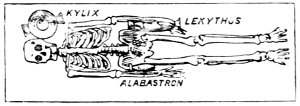
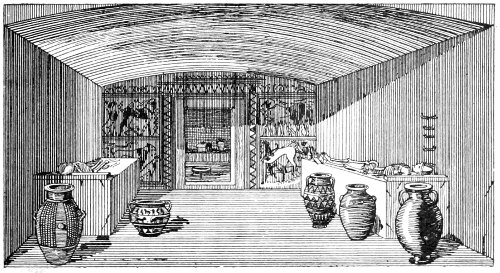
 ,
or “Fame,” who flies from him exclaiming,
,
or “Fame,” who flies from him exclaiming,
 ,
“A long way off, my fine fellow!” This
vase, which never existed except upon paper, deceived the
credulous Inghirami, who too late endeavoured to cancel it
from his work. Other vases, evidently false, have also been
published.
,
“A long way off, my fine fellow!” This
vase, which never existed except upon paper, deceived the
credulous Inghirami, who too late endeavoured to cancel it
from his work. Other vases, evidently false, have also been
published.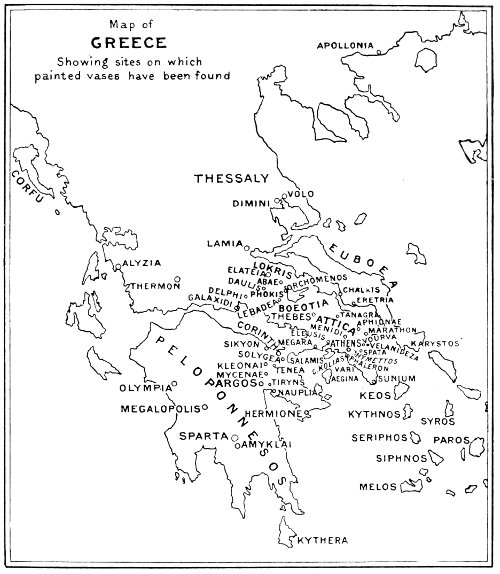



 ,
“I am a prize from the games at Athens”; on the other, a
man driving a biga, or two-horse chariot. The date is usually
considered to be about 560
,
“I am a prize from the games at Athens”; on the other, a
man driving a biga, or two-horse chariot. The date is usually
considered to be about 560 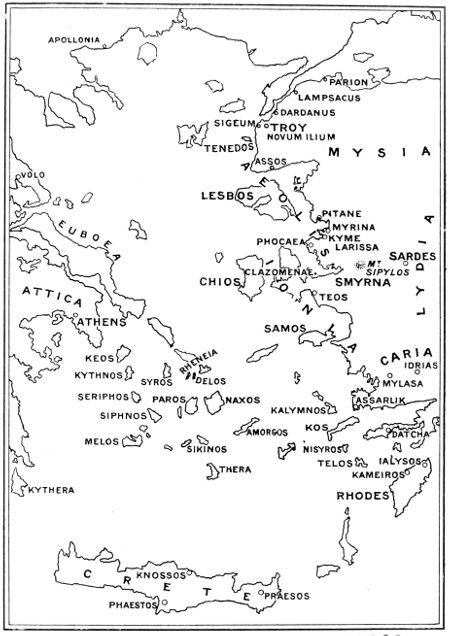
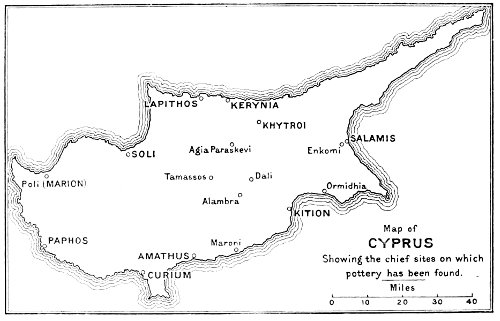
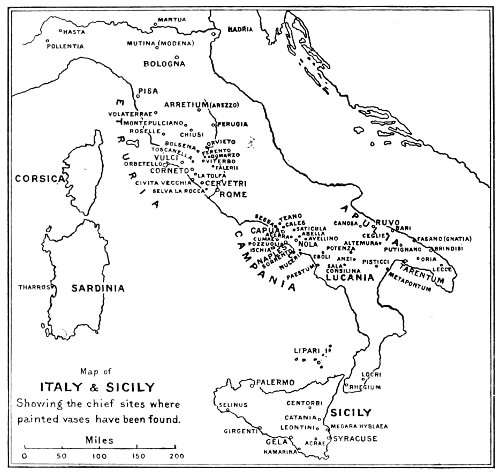
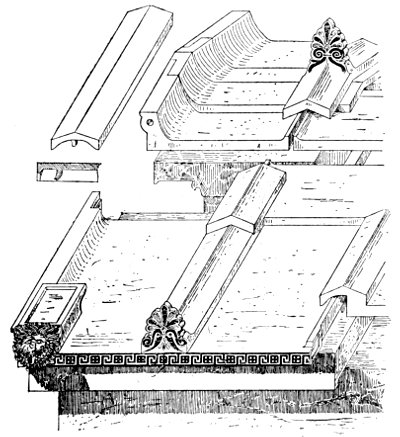
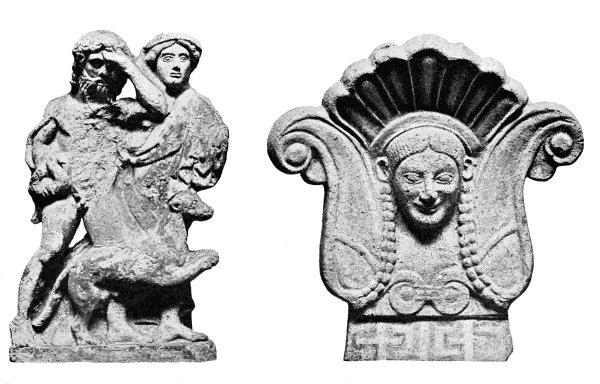
 ,
“Royal,” together with other inscriptions.
,
“Royal,” together with other inscriptions. ,
“of the people of Alyzia” (Fig.
,
“of the people of Alyzia” (Fig. 

![ΑΡΙ[Σ]ΤΟΜΕΔΕΙ](https://openoldbooks.sgp1.digitaloceanspaces.com/books/history-of-ancient-pottery/images/inscr_102_aristomedei.jpg)
 ,
“Hippeus seems handsome to Aristomedes.”
,
“Hippeus seems handsome to Aristomedes.”
 or
or
 ,
as a sort of Government
stamp. Others have magistrates’ names, as
,
as a sort of Government
stamp. Others have magistrates’ names, as
 ,
,
 ,
,
![Ε[Π]Ι](https://openoldbooks.sgp1.digitaloceanspaces.com/books/history-of-ancient-pottery/images/inscr_102_epi.jpg) with the name of the magistrate;
though all are fragmentary, it is possible to restore the full
formula as
with the name of the magistrate;
though all are fragmentary, it is possible to restore the full
formula as 
 ,
“Do not touch,”
,
“Do not touch,” ),
Abaskantos
(
),
Abaskantos
( ),
etc., the former being especially common; all are in Greek
letters. Some again only have a single letter or monogram
engraved underneath. They are often very carefully executed,
with sharply cut details, and the subjects are usually
mythological (see Plate
),
etc., the former being especially common; all are in Greek
letters. Some again only have a single letter or monogram
engraved underneath. They are often very carefully executed,
with sharply cut details, and the subjects are usually
mythological (see Plate 
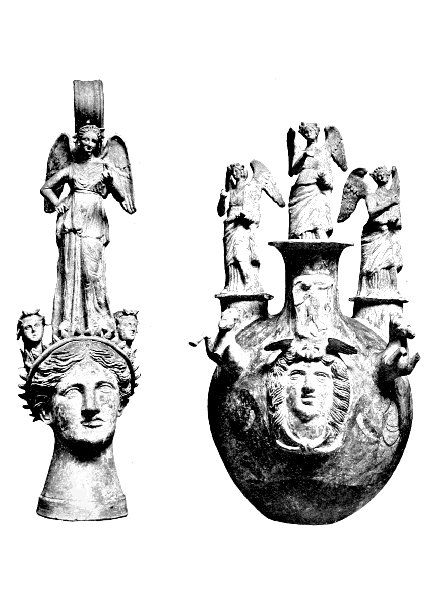
![[Π]Υ[Θ]ΕΩ [Ε]ΜΙ](https://openoldbooks.sgp1.digitaloceanspaces.com/books/history-of-ancient-pottery/images/inscr_127_pthyeo_emi.jpg) ,
“I belong to Pythes.”
,
“I belong to Pythes.”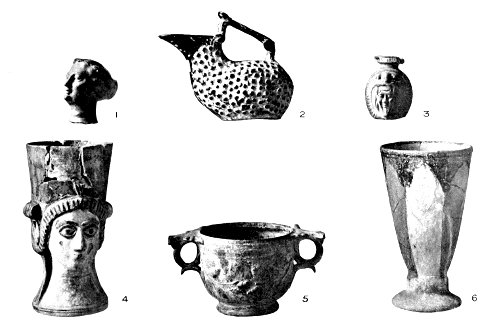
 ,
,
 ,
,
 ,
or “water-pot,”
and enables us to apply the name hydria with certainty to a three-handled
vase, of which many black- and red-figured specimens
exist.
,
or “water-pot,”
and enables us to apply the name hydria with certainty to a three-handled
vase, of which many black- and red-figured specimens
exist.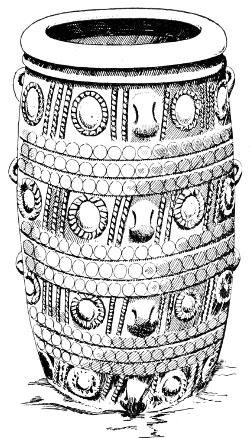
 ,
apparently indicating its price. Similar πίθοι have
been found in Athens, some having fractures joined by leaden
rivets. Large πίθοι with archaic reliefs have been found in
Crete, Rhodes, Sicily, and Etruria (at Cervetri); they are
imitated from metal vases, with designs of Oriental character.
,
apparently indicating its price. Similar πίθοι have
been found in Athens, some having fractures joined by leaden
rivets. Large πίθοι with archaic reliefs have been found in
Crete, Rhodes, Sicily, and Etruria (at Cervetri); they are
imitated from metal vases, with designs of Oriental character.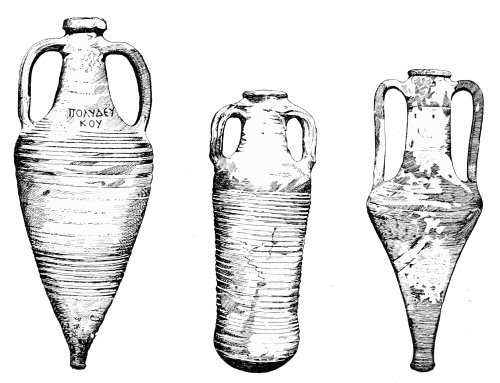
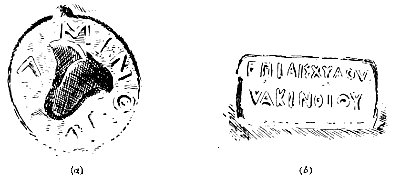
 ,
and the
name of an official. The names are usually in the nominative,
but in one instance at least the genitive is used. The symbols
include an amphora, kneeling archer, cornucopia, dolphin, etc.
(Fig.
,
and the
name of an official. The names are usually in the nominative,
but in one instance at least the genitive is used. The symbols
include an amphora, kneeling archer, cornucopia, dolphin, etc.
(Fig.  ,
which in one instance is
written retrograde.
,
which in one instance is
written retrograde. the upper name being that of the magistrate.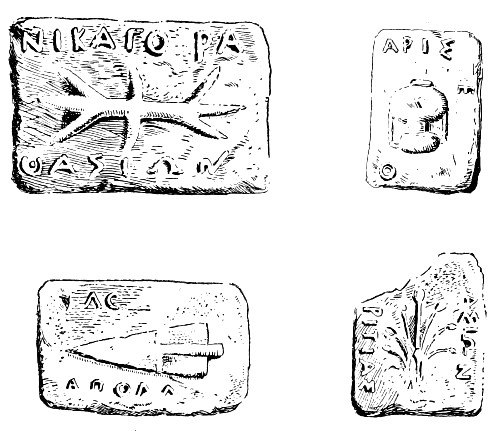
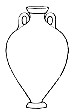
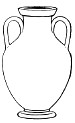
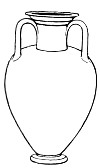
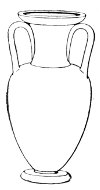
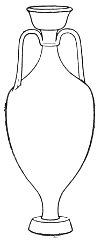
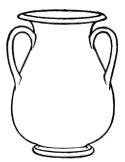
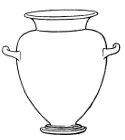
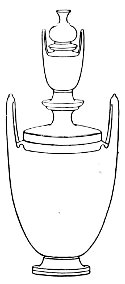
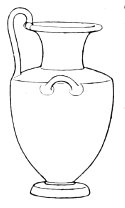
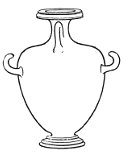
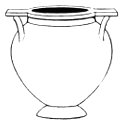
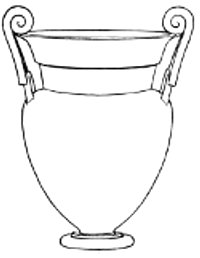
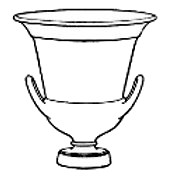
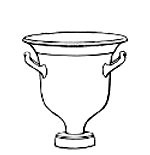
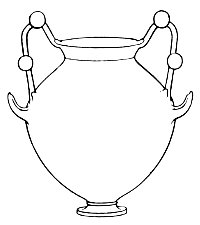
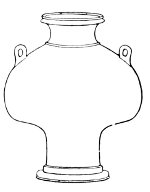
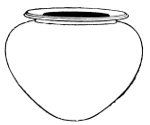
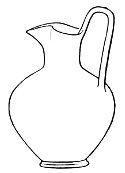
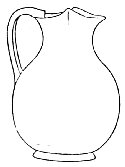
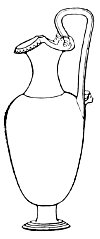
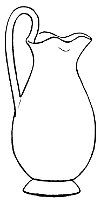
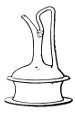
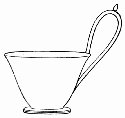
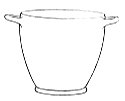
 ,
“Drink, do not lay me down”; but it is not of a form adapted
for drinking. The question must therefore remain undecided.
Ussing thinks that
,
“Drink, do not lay me down”; but it is not of a form adapted
for drinking. The question must therefore remain undecided.
Ussing thinks that 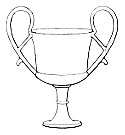
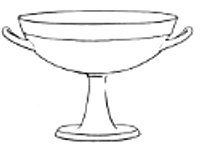
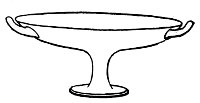
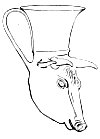
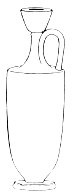
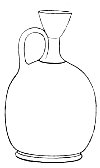
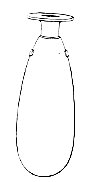
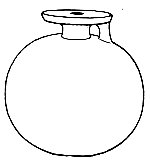
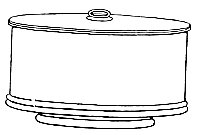
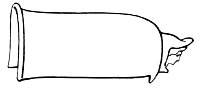
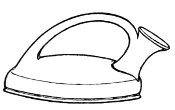
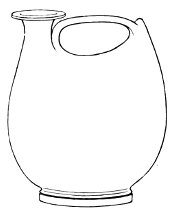
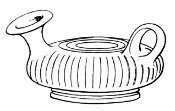
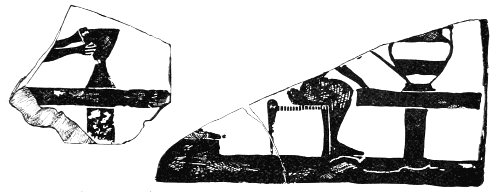
 .
Practical experiments have shown that this can be
obtained with a feather brush or pen, drawing
the lines separately, not concurrently, as
might be done with a metal pen.
.
Practical experiments have shown that this can be
obtained with a feather brush or pen, drawing
the lines separately, not concurrently, as
might be done with a metal pen.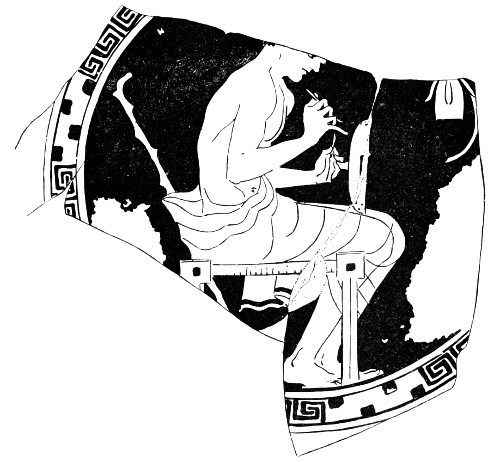
 (
(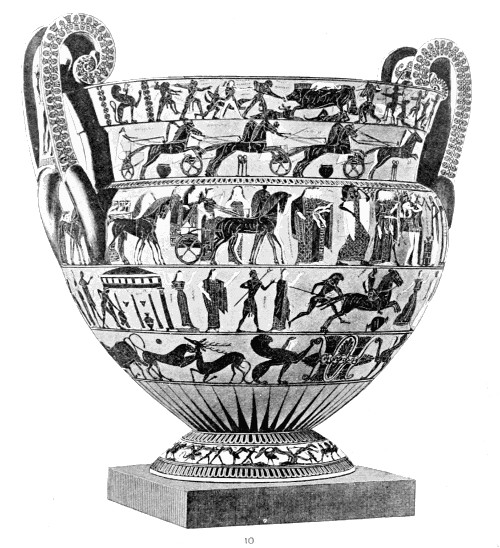
 (Schöne
in Comm. Phil. in hon. Mommseni, p. 653). See also p.
(Schöne
in Comm. Phil. in hon. Mommseni, p. 653). See also p.