In the parish of Orkesta, in Upland, Sweden,
there may be seen the remains of an old tower,
now a mere heap of stones, but once the centre of the
proud manor-seat of Lindholm. It was a noble and
lordly castle, built of red bricks and grey granite,
seated on a high hill between two lakes, and commanding
a wide prospect over mountain, wood, and
water. Here, in the year 1490, was born Gustavus
Vasa, the son of Sir Erik and Lady Cecilia Vasa,
and destined to win future fame as one of the
greatest heroes of Sweden and the liberator of his
native land.
At the age of six the boy was sent to be educated
at the court of Sten Sture, then the administrator
and virtual king of Sweden. Here he was not
spoiled by indulgence, his mode of life and his food
were alike simple and homely, and he grew up with
a cheerful spirit and a strong body, his chief pleasure
being that of hunting among the rocks and forests
with his companions, all of whom grew to love and
admire him.
King Hans, when monarch of Sweden in 1499, on
a visit to Sten Sture noticed the boy playing about
the hall and was much pleased by his fine and glowing
countenance. Patting him on the head, he said:
"You will certainly be a man in your day, if
you live to see it."
He afterwards, thinking of the high descent of
the boy and that he might grow to be a future foe
of Denmark, asked Sten Sture to let him take the
lad to Copenhagen and bring him up in his court.
The wise Lord Sten quickly fathomed the king's
thoughts and answered that the boy was too young
to be taken from his parents. He soon after sent
him to his father, then in command at Aland.
"The young wolf has slipped out of my net,"
said King Hans in later years, when he was told of
the splendid development of the boy as he grew
to manhood.
At the age of twenty-four he left the academy at
Upsala, where he had been educated in the arts and
sciences, and repaired to the court of Sten Sture
the Younger, where he was soon a general favorite,
loved for his amiable character and admired for
his wit and vivacity. At that time the war by which
Christian II. made himself master of Denmark was
going on and young Vasa aided by his courage in
winning victory on more than one hard-fought field.
In 1518, during a negotiation between Sten Sture
and Christian, then in sore straits in his fleet, the
latter agreed to go ashore to confer with the Swedish
leader if six gentlemen were sent on board his fleet
as hostages. This was done, but before the conference
took place a favorable change of wind
changed the treacherous king's intention and he
sailed off for Denmark with his hostages, all of
whom were imprisoned and held to secure the neutrality
of their relatives in Sweden.
Among these captives was young Gustavus Vasa,
who, thus perfidiously taken, was cruelly confined.
Finally, at the request of Herr Erik Baner, a distant
relative of the Vasas, the young man was set free,
Baner binding himself to pay a heavy penalty in
money if he permitted him to escape. Thus it was
that Vasa found a new home at Kallö Castle, in
Jutland, where his deliverer lived, and where he
was well treated and given much freedom.
"I shall not cause you to be strictly guarded nor
put you in confinement," said good old Baner. "You
shall eat at my table and go where you please, if you
faithfully promise not to make your escape or journey
anywhere without letting me know."
To this the young man bound himself verbally
and by writing, and was given liberty by his generous
warder to go where he pleased within six miles of
Kallö. At first he was always accompanied by an
attendant, but as he won the old man's love and confidence
he was suffered to go alone.
But he could not forget the perfidy by which he
had been made prisoner, and in 1519, when King
Christian was preparing a great expedition against
Sweden, the boasts of the young Danish nobles of
what they proposed to do chafed his proud soul.
Day and night his bitterness of spirit grew, and
finally, as the time came for the expedition to set
sail, he could bear it no longer but resolved to
break his parole and escape to his native land.
It was in the summer of 1579 that he set out,
having dressed himself in peasant clothing. Starting
in the early morning and avoiding the open
roads, he made his way by by-paths, and at noon of
the following day reached the town of Flensburg,
where he fortunately met some Saxon traders driving
a herd of cattle from Jutland to Germany. He
joined these, and on September 30 reached the free
town of Lübeck. Here the authorities gave him
permission to remain, with a warrant for his personal
safety while in the town.
Meanwhile Sir Erik Baner had been wrathfully
seeking him, and appeared in Lübeck shortly after
he reached there, complaining of his ingratitude for
the good treatment given him, and threatening
the senate of Lübeck with Christian's enmity if
they should protect one of his foes.
Gustavus boldly answered that he was no lawful
prisoner, but a man seized by breaking a solemn
compact, and therefore that he had the right to
set himself free. As for the six thousand riks-thalers,
which Sir Erik had bound himself to pay,
he would return them with interest and gratitude
when he got home.
"I trust to this," he concluded, "that I am in a
free town, on whose word, when once given, I
should be able to depend."
This appeal won his case with the senate, and
Sir Erik was obliged to return without his ward.
But to make his way to Sweden, then torn and
distracted by war, and the seas held by hostile
craft, was no easy matter and he was forced to
remain eight months in Lübeck while his country
was being rapidly subdued by its invaders. They
were not idle months, for Gustavus learned much
while there of political and industrial economy
and the commerce and institutions of the Hanseatic
League and its free towns, knowledge which became
of much service to him in later years. In the end
he succeeded in making his way to Sweden in a
small trading vessel, and on the 31st of May, 1520,
landed secretly on its shores, with nothing but his
sword and his courage to sustain him against an
enemy who had, step by step, subjugated nearly the
whole land.
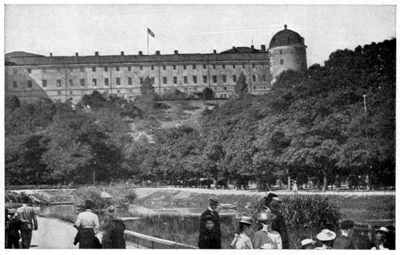
From stereograph, copyright by Underwood and Underwood, N. Y.
THE FAMOUS XVI. CENTURY CASTLE AT UPSALA, SWEDEN.
Of the cities, only Stockholm and Calmar remained
in the hands of the Swedes, and the latter,
in which he had landed, seemed full of cowards and
traitors. The place was not safe for a declared
patriot, and he left it, making his way up the
country. Here he learned with indignation how
envy, avarice, and private feuds had induced many
Swedes to betray one another to the enemy, and his
efforts to exhort the people to unity and resistance
proved vain. Most of them were weary of the war,
and Christian had won over many of the peasants.
"He is a gracious master to us," they said, "and
as long as we obey the king neither salt nor herring
will fail us."
When Gustavus sought to win them over to
more patriotic views they became angry and threatening,
and in the end they assailed him with arrows
and lances, so that he was obliged to make his
escape. His position, indeed, became so critical
that he was forced to disguise himself and proceed
through forests and unsettled lands. Finally he
reached the manor-house in which resided his sister
Margaret and her husband, Sir Joachim Brahe.
They received him with the highest demonstrations
of joy, as they had feared that they would
never set eyes on him again; but their delight in
his presence was turned into consternation when
they learned that he was there with the purpose of
seeking to foment an insurrection against Christian,
who had then made himself complete master
of Sweden and was on the point of being crowned
king.
Joachim Brahe and his wife were at that time
preparing to attend Christian's coronation at Stockholm,
and were deeply disturbed by what seemed
to them the mad purpose of the young patriot.
Joachim offered to do his utmost to reconcile Gustavus
to the king, and Margaret threw herself in
tears and distress on his neck, beseeching him to
desist from an undertaking which she felt sure
would bring death to him and ruin to his whole
family.
But Gustavus was not to be persuaded, and on the
other hand he warned Joachim against trusting
himself in Christian's hands, speaking of him as a
base wretch whom no one could trust. Joachim
proved equally hard to move, and the three soon
parted, Joachim and his wife for Stockholm—where
death awaited him at the hands of the traitor
king—and Gustavus for a place of concealment
where he could foment his plans. During this
interval he met the old archbishop, Jacob Ulfsson,
who earnestly advised him to go to Stockholm and
warmly promised to plead his cause with the king.
But the fugitive knew Christian far better than
the aged churchman and had no idea of putting
his head within the wolfs jaws. Little did the
good archbishop dream of the terrible tragedy that
was even then taking place in Stockholm.
The news of it came to Gustavus in this way.
One day while out hunting in the vicinity of his
hiding-place, he unexpectedly met the faithful old
steward of his brother-in-law Joachim, who was so
choked with grief on seeing him that he found it
impossible to speak and could answer the young
lord's question only with tears and gestures.
Finally he succeeded in telling the fearful tale of
that bloody day at Stockholm, the death under the
executioner's sword of the father and brother-in-law
of the horror-stricken listener, the imprisonment
of his mother and sisters, and the fact that
he would soon become a hunted fugitive, a high
price having been set upon his head.
Who can describe the bitter grief of the son and
brother at these terrible tidings, the hot wrath of
the patriot, the indignation of a true and honest
heart! On that fatal day the young fugitive had
lost all he loved and cherished and was made a
hunted, homeless, and almost penniless outlaw.
But his courage did not fail him, he could foresee
the indignation of the people at the dastardly act,
and he determined to venture liberty and life
against the ruthless tyrant.
A series of striking adventures awaited him,
which it needed his utmost resolution to endure.
He was then concealed at Räfsnäs, one of his paternal
estates, but felt it necessary at once to seek
a safer refuge, and collecting what gold and silver
he could, he set out with a single servant for
Dalarna. They had not gone far before they
reached the ferry at Kolsund, which he crossed,
leaving his man to follow. But the fellow, who
had no faith in his master's project, took the opportunity
to mount his horse and flee, taking with
him the gold and jewels which had been entrusted
to his care.
Seeing the act of treachery, Gustavus in all haste
recrossed the ferry, and pursued the runaway so
hotly that he leaped from his horse in alarm and
hid himself in the woods. Recovering the horse
and its valuable burden, the fugitive pursued his
course, paying no further heed to the treacherous
servant.
It was late in November when Gustavus reached
Dalarna. He was now completely disguised, having
exchanged his ordinary dress for that of a peasant,
cutting his hair round, wearing the round hat and
short baize jacket of the countrymen, and carrying
an axe on his shoulder in the fashion of peasant-lads
seeking work. No one would have dreamed of
his being the sole heir of the great house of the
Vasas.
His first service was with a rich miner named
Anders Persson, in whose barn he threshed grain
for several days. But his fellow threshers soon
saw that he was not accustomed to the work and
his general manner did not seem that of a common
farm-hand, while one of the women caught the
glimpse of a silk collar under his coarse jacket.
These suspicious circumstances were told to the
miner, who sent for Gustavus and quickly recognized
him, for he had often seen him in former
days at Upsala.
Anders received him hospitably, but when he
heard from him of the Stockholm massacre and
his aid was requested in the liberation of the country,
he grew alarmed. Fearing to entertain so
dangerous a guest, he advised him to go farther
north and to change his place of abode frequently.
Accepting this advice, Gustavus set out for
Ornäs, but on his way, while crossing a newly
frozen stream, the thin ice broke under him and
he was plunged into the chilling water. Light
and active, he soon got out again, drying his
clothes and passing the night at the house of the
ferryman.
Reaching Ornäs the next day, he went to the
house of a former friend, but who now, unknown
to him, had become connected by marriage with
the Danes and was devoted to the interests of the
new king. It was a critical situation for the friendless
fugitive. His treacherous host craftily welcomed
him and pretended to approve his purpose,
in which he offered to assist him and to seek
adherents to his cause among his neighbors.
The guest was conducted to a garret at the top
of the house and here, weary from his wanderings
and gratified at having found a sympathizing
friend, he lay confidingly down and was soon lost
in slumber. Meanwhile Arendt, the treacherous
host, sought a neighbor, Mans Nilsson, whom he
told of the rich prize he had found and asked his
aid in capturing him and gaining the high reward
offered for him by the king. He was mistaken
in his man. Mans hated treachery. But Arendt
found others who were less scrupulous and in the
early morning returned to his home heading twenty
men, collected to aid him in the capture of his
unsuspecting guest. To his utter surprise and
dismay, on entering the garret to which Gustavus
had been led he was nowhere to be found. He
had unaccountably disappeared, and search as they
could no trace of the fugitive was forthcoming.
There was a woman concerned in this strange
escape, which had happened thus. Barbara,
Arendt's wife, though Danish in her sympathies,
had a warm, romantic interest in Gustavus Vasa,
and when she saw her husband, on his return from
his visit to Mans Nilsson, drive past the house and
in the direction of the house of the Danish steward,
she suspected him of treachery and determined to
save their too-confiding guest.
Ordering Jacob, one of her men, to harness a
sledge with all haste and secrecy and keep it in
waiting behind the building, she sought the garret,
woke Gustavus, and told him of his peril and of
her desire to save him. Not venturing to bring
him down into the house, she opened the window,
and though it was eighteen feet from the ground,
she aided him in his descent with a long towel,
such as were then in common use. Gustavus then
sprang into the sledge and was driven briskly off.
Arendt, when he learned of how his expected
victim had fled, was furiously angry with his wife,
and, as we are told, never forgave her and refused
ever to set eyes on her again.
This was the most extreme danger that the
fugitive patriot ever passed through, and at that
interval his hope of freeing his country from the
yoke of the foreigner seemed the sheerest madness.
But other perils lay before him and only vigilance
and good fortune saved him more than once from
death or capture. Surrounded by foes and with
scarce a friend who dared aid him in the whole
district, his final escape seemed impossible.
The friendly Barbara had advised him to seek
Herr Jon, the priest of Svärdsjö, and his driver
took the road over the frozen Lake Runn, they
ascending its banks in the smoke coming down
from the Fahun copper mines, and about sunrise
reaching a village on the northeast end of the lake.
Jacob was unacquainted with the country beyond
this point and Gustavus went to a house to inquire
the way. As he was on the point of entering he
saw within a miner, Nils Haussen, whom he knew
to be a Danish partisan and who would have recognized
him at sight. Quickly and without being
seen, he turned behind the door and went towards
another village beyond. Here he met a friendly
smelter who agreed to guide him on the way.
When they parted Gustavus gave him a silver
dagger, saying gratefully:
"If God helps me, seek me, and I will richly
repay you for your aid."
As night came on he sought quarters in a road-side
cottage, and as he sat before the fire in the
evening the good-wife said to him:
"Young man, make me some pudding skewers,
since you have nothing else to do."
Gustavus laughingly replied that he would be
glad to do so if he only knew how. This adventure
has an interesting resemblance to that of King
Alfred, when, hidden from the Danes in the swine-herd's
hut, he let the good woman's cakes burn on
the fire.
Reaching the parsonage of Herr Jon on the
following day, he first went to the barn and helped
the laborers to thresh, at the same time asking
them what side their master took. Learning that
he was no friend of the Danes, he made himself
known to him and was graciously received, staying
with him for three days.
But this place soon became unsafe. One day
Herr Jon's housekeeper entered a room where Gustavus
was washing, the priest standing by, towel
in hand.
"Why are you holding the towel for this common
fellow?" she asked.
"That is none of your affairs," said the priest.
But fearing that the woman would talk, he
thought it best for his guest to seek a safer retreat,
and sent him to Swen Elfsson, gamekeeper for
the crown, who lived not far away.
Meanwhile the Danish steward, who had been
told by the treacherous Arendt of the character of
his guest, had his agents out in search of the fugitive
and some of them entered the cottage of the
gamekeeper. At that moment the good-wife was
about putting her bread in the fire, and Gustavus
was standing by the hearth in his peasant's dress,
warming himself. The men who entered inquired
for the fugitive, but before answering the woman
raised her bread shovel and struck Gustavus hastily
on the back, exclaiming:
"What are you doing here gaping at strangers?
Have you never seen a man before? Pack yourself
off to the barn and go on with your threshing."
Never dreaming that the man who had been
so angrily treated by a peasant's wife could be the
young lord they sought, the steward's messengers
left the house to continue their search elsewhere.
But the incident warned the gamekeeper that
his guest was not safe anywhere in that vicinity,
and to get him away unobserved he hid him in a
large load of hay and drove off towards the forest.
On the way some of the Danish scouts were met,
and these, having some suspicion of Swen, began
poking their lances through the hay. One of these
wounded Gustavus in the leg, but he lay silent and
motionless and the scouts soon went their way.
But the cut on the concealed man's leg bled so
freely that blood soon began to run from the cart
and tinge the snow. Seeing this, Swen, fearing
that the trail of blood might betray him, opened
his knife and thrust it into the leg of his horse, so
that if any one should perceive the blood stains
he could assign this as their cause.
He finally delivered his charge to the care of
some loyal gamekeepers on the edge of the forest;
but these, not considering their houses safe as
hiding-places, took him into the forest, where he
lay hidden for three days under a great fallen fir
tree, they bringing him food and drink. Finding
even this place insecure, he went deeper into the
woods and sought shelter under a lofty fir tree which
stood on a hill in the midst of a marsh. The place
has ever since been called "The King's Height."
Finally the effort of the Danish agents to find him
relaxed and his faithful friends conducted him
through the vast forests to Rättwik's Church, at
the eastern end of the great Lake Silja.
His perils were yet by no means at an end. He
spoke of his purpose at this place to an assembly
of the peasants and was pleased to find that they
listened to him with willing ears. Having thus
sown his first seed in favorable soil, he proceeded
to Mora on the northern end of the lake, where
the priest received him in a friendly manner. But
he was being sought by the Danes in that district
and the priest did not dare to hide him in his
own house, but committed him to the care of a
peasant named Tomte Mattes. As the search was
becoming active he was concealed in a vaulted
cellar, reached by a trap-door in the floor.
He had not been long there when the Danish
scouts, who were searching the whole district,
reached the peasant's house, where they found his
wife in the midst of her brewing of Christmas ale.
As they entered, the shrewd woman turned a great
tub over the trap-door, so that they did not perceive
it, and thus for the third time the future king of
Sweden owed his liberty and life to a woman's wit.
Shortly after that, at one of the Christmas festivals,
as the men of Mora were leaving the church,
Gustavus called them to him where he stood on a
low mound beside the churchyard and addressed
them in earnest tones, while they gazed with deep
sympathy on the manly form of the young noble
of whose sufferings and those of his family they
were well aware.
He spoke of the risk to his life that he ran in
venturing to speak to them at all, but said that
his unhappy country was dearer to him than life.
He pointed out the persecution which Sweden had
formerly endured from Danish kings, and of how
they had robbed the country of its wealth.
"The same times and the same misfortunes have
now returned," he said. "Our land swims, so to
say, in our own blood. Many hundred Swedish
men have been made to suffer a disgraceful and
unmerited death. Our bishops and senators have
been cruelly murdered. I myself have lost father
and brother-in-law," he continued, his eyes streaming
with tears, "and the blood of all these martyrs
cries for redress and retribution on the tyrant."
The men of Dalarna, he said, had long been
noted for their courage when their land was in
danger. They were renowned for this in history,
and all Sweden looked upon them as the firmest
defenders of its liberties.
"I will willingly join with you for our land's
deliverance," he concluded, "and spare neither
my blood nor my sword, for these are all the tyrant
has left me to use in your cause."
Many of the Dalmen heard him with cries of vengeance,
but the most of them stood in doubt. They
did not know Gustavus personally and had heard
that Christian was cruel only to the great, but was
kind and generous to the peasantry. They could
not yet make up their minds what to do, and begged
him to seek safer quarters for himself, since he
was being everywhere diligently sought by his
pursuers.
In fact, his peril continued extreme and for
some days he was forced to lie hidden under
Morkarlely Bridge, near Mora Church, though it
was in the dead of a Swedish winter. He was able
at length to resume his journey, but it was with
an almost despairing heart, for he could see no hope
either for himself or for his country. His led way
over mountains and through desolate valleys, his
nights being spent in wayside sheds which had
been built for the shelter of travellers. On he
went, through forests filled with snow and along
the side of mountain torrents, and finally came
within view of the lofty mountains beyond which
lay the sister kingdom of Norway.
Never had patriot more reason to be disheartened
than the unhappy and hunted fugitive, never
had the hope of liberating an oppressed country
seemed darker, and the fugitive would have been
justified in abandoning his native land and seeking
a refuge in the bleak hills of Norway. Yet the
adage has often held good that it is the darkest
hour before the dawn of day, and so it was to prove
in his case. While he waited in that desolate
quarter to which he had been driven, events were
shaping themselves in his favor and the first rising
took place against the Danes.
The stirring speech of the young noble at Mora
Church had not been made in vain. Many of those
who heard it had been strongly taken by his manliness
and his powerful language, and, strangely,
the most deeply impressed of all was Rasmas Jute,
a Dane who had served the Stures and was now
settled in Dalarna.
Hearing that a Danish steward had come to that
quarter to seek the fugitive and was now at the
house of the sergeant of Mora parish, he armed
himself and his servants and fell on the steward
unawares, the first to take arms for Gustavus being
thus a man of Danish birth. Soon afterwards a
troop of Danish horsemen, a full hundred in number,
was seen marching over the frozen surface of
Lake Silja. So numerous a body of soldiers was
unusual in those parts, and suspecting that they
were in search of Gustavus, and might do something
to their own injury, the peasants began ringing
the church bells, the usual summons to arms.
The wind carried the sound far to the northward,
and on hearing the warning peal the peasantry
seized their arms and bodies of them were soon
visible hasting down the hills towards Mora. The
Danish troopers, on seeing this multitude of armed
men, shut themselves in the priest's house. Here
they were attacked by the furious Dalmen, who
broke open the doors and rushed in. The terrified
Danes now fled to the church and took refuge in
its steeple, whither they were quickly followed.
Only by dejected appeals and a promise not to
injure Gustavus Vasa did they succeed in escaping
from the tower, and the Dalmen, thinking that
some of them might remain concealed in the narrow
spire, shot their arrows at it from every side.
For more than a hundred years after some of these
arrows remained sticking in the old wooden spire.
Dalarna being looked upon as a centre of Swedish
patriotism, a number of the persecuted noblemen
took refuge there, and those confirmed all that
Gustavus had told the people. And when Lars
Olssen, an old warrior well known to them, arrived
and told them of the gallows which Christian had
erected, of the new taxes he had laid on the peasantry,
and of the report that he had threatened
to cut a hand and a foot off each peasant, with
other tales true and false, they were deeply stirred.
When Lars learned that Gustavus had been there
and what had passed, he reproached them for their
folly in not supporting him.
"Good men," he said, "I know that gentleman
well, and tell you that if yourselves and all the
people of the country are not to be oppressed and
even exterminated Gustavus Vasa is the only one
who has sense and knowledge enough to lead us and
lay hand to so great a work."
While they were talking another fugitive came
from the forest, who confirmed all that Lars had
said and gave them a full account of the blood-bath
at Stockholm and of how the body of Sten Sture,
their beloved leader, had been torn from the grave
and dishonored.
These stories filled their hearers with horror,
terror, and fury; war and bloody retribution was
their only cry; their hearts were filled with remorse
that they had let Gustavus, their country's chief
hope, depart unaided. Two of them, the fleetest
snow-skaters of the region, were chosen to follow
him and bring him back, and off they went through
the forests, following his track, and at length finding
him at Sälen, the last village in that section,
and immediately at the foot of the lofty Norwegian
mountains. A few words sufficed to tell him of the
great change of feeling that had taken place, and
with heart-felt joy Gustavus accompanied them
back, to begin at length the great work of freeing
his native land.


