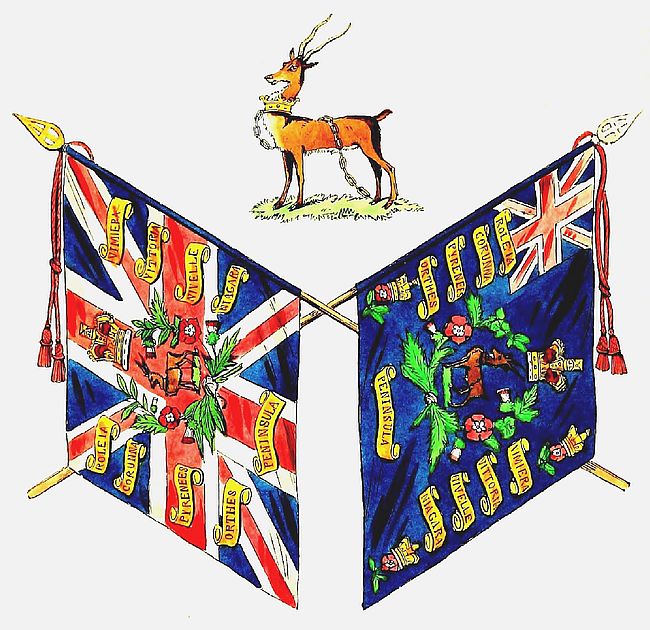
OF THE
SIXTH REGIMENT OF FOOT.
The spirit of enterprise, intrepidity, firmness, endurance,
physical strength, and innate love of fame exhibited by
the British troops, have not only contributed to elevate
this Kingdom to its present exalted station among the
nations of Europe, but in the numerous wars which have
taken place in Christendom, other States have evinced
strong desires to obtain British aid. In the Dutch war
of independence, from 1572 to 1648, British valour was
eminently displayed in procuring the advantages of civil
and religious liberty for the inhabitants of the United
Provinces: British courage gave important aid to
Henry IV. of France in his struggles for the throne:
in the splendid achievements of the great Gustavus
Adolphus of Sweden, the British had an important
share: many of the conquests of Louis XIV., surnamed
"The Great," were achieved by the aid of British
troops; and the regiment which forms the subject
of this memoir is one of the English corps raised for
the service of a foreign state under the following circumstances.
1673
The only remaining corps[6] of the numerous bands
of English lancers, cuirassiers, carabineers, archers, musketeers,
harquebusiers, pikemen, and battle-axemen, who
fought in the Dutch war of independence from 1572 to
1648, was recalled from Holland on the breaking out of
hostilities between the English and Dutch in 1665:
during the negociations for the peace of London in the
winter of 1673-4, the States General pressed King
Charles II. to recall his troops from the service of
France[7], and solicited permission again to employ in
their army a British division. The king refused to recall
his regiments from France; but his majesty engaged
not to permit any additional British corps to be levied
for the service of Louis XIV., and to prevent the others
being recruited: at the same time permission was given
to the States to raise for their service a body of troops
in England and Scotland, to be commanded by the
colonel of the old Holland Regiment, Sir Walter
Vane, who was promoted to the rank of major-general
in the Dutch army, and appointed colonel of one of the
regiments to be raised for this service, now the Sixth
Regiment of Foot, his commission bearing date the
12th of December, 1673.
1674
The interests of the United Provinces and those of the
reformed religion being intimately connected, their cause
was popular in England; and when the king disbanded
a great part of his army on the settlement of the peace
in 1674, many officers and men voluntarily entered the
Dutch service, particularly from the old Holland
Regiment, which was reduced on that occasion from
eighteen to ten companies. Among the most zealous in
this service were Captains Sir Henry Bellasis, Thomas
Monk, John Morgan, Philip Savage, Roger M'Eligott,
Alexander Cannon, and four others, who arrived at the
Briel during the summer of 1674 with a number of men,
who were formed into ten companies. The Prince of
Orange had in the meantime taken the field with the
army, and Sir Walter Vane proceeding to the camp to
complete some arrangements with his Highness, served as
a volunteer at the battle of Seneffe on the 1st of August,
1674 (O. S.), and was killed.
Sir William Ballandyne was next appointed to command
the British division, and the ten companies
marched from the Briel to Bois-le-duc; from whence
they were suddenly called to join the army and
take part in the siege of Grave. They were commanded,
while on this service, by Captain Hugh Mackay
(afterwards lieutenant-general and commandant of
the Scots brigade), who had transferred his services a
few weeks previously from the French to the Dutch
army; and was appointed major-commandant of the ten
companies pro tempore. On the second day after their
arrival before Grave, the ten companies were on duty in
the trenches; and such was the fervour and eagerness
of some of the officers and soldiers to signalize themselves,
that Captain Savage and a few men stormed the counterscarp
in the night without orders: they evinced great
bravery, and gained some advantage, but were eventually
repulsed, and Captain Savage was put in arrest, and
reprimanded for his over-heated valour.
After the surrender of Grave on the 28th of October,
the ten companies returned to Bois-le-duc, where four
British regiments were formed during the winter;—two
English, commanded by Colonels Lillingston and Disney;—one
Scots, commanded by Colonel Graham;—and
one Irish, of which the Viscount of Clare was colonel.
Two old Scots regiments in the Dutch service were
purged of foreigners and added to the above four: the
six regiments formed as fine a body of troops as any in
Europe, and they soon had opportunities of proving that
they possessed the same heroic spirit and contempt of
danger as their predecessors in the war of independence,
and as the valiant English and Scots who so highly distinguished
themselves under the great Gustavus Adolphus.
Such was the origin of the Sixth Regiment of
Foot. Its commanding officer was Colonel Luke Lillingston,
whose appointment was dated in August,
1674.
1675
The campaign of 1675 was passed in marching, manœuvring,
and watching the operations of the enemy.
During the winter the regiment was in garrison in Holland,
and the colonelcy was conferred on Lieut.-Colonel
Thomas Ashley; the command of the second English
regiment was conferred on Colonel Ralph Widdrington;
and the Irish regiment having previously been given to
Colonel John Fenwick, it lost its designation of Irish,
and the three were accounted English regiments.
1676
In the summer of 1676 the regiment marched to Bois-le-duc,
where, in the early part of July it was suddenly
aroused about midnight by the drums beating to
arms; and assembling on its parade ground, it immediately
proceeded towards the province of Limburg.
After several days' march it arrived in the vicinity of
Maestricht, and, the Prince of Orange having joined the
army, the siege of this celebrated city was commenced.
The three English regiments were commanded by
Brigadier-General John Fenwick. Being proud of their
national character, and jealous of their fame, they obtained
permission to act separately, and to have a particular
point of attack allotted them; "and they made
it appear, by their fierce attacks, that they deserved
this distinction[8]." They signalized themselves by
the spirit with which they beat back the sallies of the
garrison; and on the 30th of July they furnished two
hundred men, in equal proportions from each regiment,
to storm the Dauphin Bastion. A lodgment was effected;
but the troops afterwards lost their ground, and they
had one hundred and fifty men killed and wounded out
of the two hundred. Colonel Widdrington was killed,
and the command of his regiment was given to Lieut.-Colonel
Dolman. The brigade was again on duty in
the trenches on the 2nd of August, when Brigadier-General
Fenwick was wounded.
At three o'clock on the morning of the 4th of August,
a storming party of one hundred and eighty-three officers
and men, with a support of sixty men, furnished
in equal proportions from each of the three regiments,
paraded at the head of the brigade; a similar detachment
of the blue Dutch foot-guards was also in readiness,
and at five this little band rushed forward in the
face of a storm of fire, and made a second attack
on the Dauphin Bastion with signal gallantry. The
English, being emulous of fame, gained the lead of the
Dutch, and throwing forward a shower of hand-grenades,
assaulted the breach sword in hand, and effected
a lodgment. Suddenly the ground under the soldiers'
feet was agitated, a tremendous explosion blew a number
of men into the air, and the bursting of the mine being
succeeded by a fierce attack of the enemy, the storming
party was driven back. Instantly rallying, and being
exasperated by this repulse, the English and Dutch returned
to the charge breathing vengeance and slaughter,
by a powerful effort drove back their antagonists,
and re-established themselves on the bastion, but with
the loss of more than half their numbers killed and
wounded. English valour shone conspicuously on this
occasion, and the Dutch authorities acknowledged the
superior gallantry of the brigade. In the Hague Gazette
it was stated "the English gained very great
honour;" and in the Brussels Gazette it was stated,
"the Prince of Orange having resolved to retake the
Dauphin Bastion, appointed two hundred English,
and as many of his guards, to make the attack, which
they did with great courage and resolution, and with
very great honour to the English, who first entered
the breach." Sir William Temple, Harris, Boyer,
Carleton, Bernardi, and other authors, bore ample testimony
to the native valour of the English soldiers. A
Scots regiment, commanded by Sir Alexander Colyear,
also distinguished itself at this siege.
A desperate sally was made from the town, on the
morning of the 6th of August, by three hundred Swiss
infantry, who, owing to the neglect of a sentry, surprised
and made prisoners the English guard on the bastion;
but a reinforcement coming forward, the Swiss were
overpowered and destroyed, except about twenty men,
who escaped into the town. The Prince of Orange complimented
the English on their bravery: and being desirous
of conferring on merit a special mark of his approbation,
and of inciting other corps to emulate the English
brigade, he made each of the three regiments a present
of a fat ox and six sheep, which, however, occasioned
some murmuring among the Dutch.
A strong horn-work was afterwards captured by the
Dutch, and preparations were made for a general storm
of the main breach; but Marshal de Schomberg advancing
at the head of a powerful French army to relieve the
town, the siege was raised, and the three English regiments,
having sustained a severe loss, were sent into
quarters in Holland.
1677
The French monarch commenced the campaign of
1677 with great vigour; and the advantage derived
from an army being under the sole direction of, and conducted
by immediate orders from one head, over a confederate
force, which meets with delays and obstructions
from different interests, councils, negligences, and tempers,
was very conspicuous,—the feeble preparations of
the Dutch, and the apathy of the Spaniards, having left
the Prince of Orange without a force capable of contending
with the immense army of the enemy. Colonel
Ashley's regiment, after replacing its losses with recruits
from England, quitted Holland, and advanced with the
remainder of the brigade to West Flanders. It formed
part of the army, under the Prince of Orange, employed
in the attempt to relieve the town of St. Omer; and was
engaged on the 11th of April at the battle of Mont-Cassel,
which was fought under great disadvantages in
numbers and the nature of the ground. Two newly-raised
regiments of Dutch marines, posted between the
Prince's foot-guards and the English brigade, gave way
at the first onset, and, confusion ensuing, the Prince retreated
with the loss of his baggage and artillery.
1678
At the close of the campaign, the ministers of the confederate
states pressed King Charles II. to recall his
troops from the service of France, attributing many of
the French monarch's successes to the bravery of the
British regiments; and in 1678 the king acceded. At
the same time the gallant Earl of Ossory, eldest son of
the Duke of Ormond, was appointed to the command of
the British brigade; and Sir Henry Bellasis succeeded
Colonel Ashley in the command of the regiment which
is now the Sixth Foot. Ten thousand English troops
were also embarked for Flanders, to take part in the
war.
During the early part of the campaign of 1678, the
British brigade, under the Earl of Ossory, was employed
on detached services in Brabant and Flanders; and on
the morning of Sunday, the 14th of August, it moved
from its camp near the little river Senne, to attack the
French army, commanded by Marshal Luxemburg,
before Mons.
The French commander imagined himself safe in inaccessible
entrenchments; but he was surprised by a party
of Dutch dragoons while at dinner in the Abbey of
St. Denis, near the village of that name, and his army
was unexpectedly attacked, with great fury, about
three o'clock in the afternoon. The Dutch, under
Count Waldeck, assaulted and carried the abbey; the
Spaniards, commanded by the Duke of Villa Hermosa,
advanced by the village of Castehau; and the Dutch
foot-guards, with the Earl of Ossory's brigade, prolonged
the attack on the heights of Castehau, where the action
was maintained with particular obstinacy. The Earl of
Ossory drew his sword, and, pointing to the dark masses
of the enemy, whose polished arms gleamed on the distant
heights, led his British bands to the attack with
signal intrepidity: his gallant mien and lofty bearing infused
a noble ardour into the breasts of his officers and
men, who urged, with resolute tread, their way through
every difficulty to encounter their adversaries. The
grenadiers of Bellasis's regiment (now Sixth Foot)
headed by Major William Babington, led the attack on
a body of French troops, posted in a hop-garden, with a
spirit and resolution which were imitated by the musketeers
and pikemen, and a vehement struggle ensued
among the trees and umbrageous foliage which adorned
the scene of conflict. Sir Henry Bellasis and Lieutenant-Colonel
Monk were wounded, Major Babington was also
wounded and taken prisoner, and the contest was fierce
and sanguinary; but British valour prevailed, and the
French were driven from among the hop-poles with great
slaughter. Another stand was made by the enemy beyond
the enclosure, and the storm of battle was renewed
with additional fury. The Scots, under Major-General
Kirkpatrick, Sir Alexander Colyear, and Colonel Mackay,
vied with the English in their gallant efforts, and the
Prince of Orange and Duke of Monmouth arriving at
that part of the field, witnessed their heroic behaviour.
Attack succeeded attack, and as the shades of evening
gathered over the scene of conflict, the blaze of musketry
and showers of hand-grenades indicated the fury of the
opposing ranks of war. At length darkness put an end
to the fight; and the French forsook their entrenchments
and retreated. The excellent conduct of the British
troops was appreciated by the Prince of Orange and the
States-General; and in the narratives of the battle, published
at the time, they received their meed of praise:
in one account it was stated,—"the Earl of Ossory and
his troops performed wonders;" in another,—"the
English and Scots regiments did things to the admiration
of those that beheld them;" and in a third,—"they
behaved themselves with that courage and bravery which
are so natural to them." The regiment which forms the
subject of this memoir lost many non-commissioned
officers and private soldiers, and had the following officers
killed and wounded:—Captains Richardson and Vanderstraet,
Lieutenants Price, Paul, and Lepingault, and
Ensign Drury, killed: Colonel Sir Henry Bellasis, Lieutenant-Colonel
Monk, Captain Penford, Lieutenant Lunnemon,
and Ensign Nelson, wounded. Major Babington
was wounded and taken prisoner: he was, in the first
instance, included in the list of the slain[9].
Preliminary articles for a treaty of peace had, in the
mean time, been agreed upon at Nimeguen; and the aspect
of affairs was suddenly changed, the spot of ground
where fury and bloodshed raged a few hours before was
transformed, by the news of peace, to a scene of hilarity
and jocund mirth, which was only alloyed by the remembrance
of the loss of so many companions in arms, whose
blood had stained the grassy fields.
1679
When the States-General reduced the strength of their
army to a peace establishment, the estimation in which
the British troops were held occasioned their being retained
in the service of the United Provinces; and in a
treaty on this subject, the States agreed to send the six
regiments to England, when the King should require
their services.
1680
During the five years succeeding the treaty of Nimeguen,
Sir Henry Bellasis's regiment was employed in
garrison duty. In 1680, its Lieutenant-Colonel, Thomas
Monk, was promoted to the colonelcy of the regiment,
which is now the fifth foot, in succession to Colonel
Wisely, who was drowned on his passage to England;
and Major William Babington was appointed to the
lieutenant-colonelcy.
1684
In 1684, when the French aggressions in the duchy
of Luxemburg occasioned some alarm in the Netherlands,
the regiment marched to the vicinity of Brussels,
where a body of troops was encamped a short time, and
subsequently near Malines: no war taking place, the
camp was broken up in November, and the regiment
was again employed in garrison duty.
1685
In the summer of 1685, events transpired which occasioned
the removal of the regiment from the Netherlands
to England: the Earl of Argyle, and a number of other
political exiles, who were zealous advocates for civil
liberty and the reformed religion, proceeded in May
from the Netherlands to Scotland, where they attempted
to organize a rebellion against the government of King
James II., who was a professed papist. His Majesty, in
a letter to the Prince of Orange, dated Whitehall, the
22nd of May, stated;—"I make no doubt, by God's
help, that the rebels will soon be mastered, yet there is
no harm in providing for the worst; and, therefore, I
have charged Mr. Skelton to propose to you the lending
me the three Scots regiments that are in your service,
to be sent over to Scotland; and if this is a thing
you can do, the sooner it is done the more reason I shall
have to take it very kindly of you[10]." The States acceded
to this request: but before the Scots regiments
embarked, the Duke of Monmouth had landed at Lyme,
in Dorsetshire, and having erected his standard in the
market-place, summoned the people to join him in an
appeal to arms against the government: the destination
of the three regiments was then changed to England.
At the same time the King made the following application
to the Prince of Orange, in a letter dated Whitehall,
the 17th of June, 1685.
"When I wrote to you yesterday, I thought the
militia would have kept the Duke of Monmouth shut
up in Lyme; but by the fault of those of Devonshire,
or Somersetshire, he has opened his way towards Taunton,
which is a very factious town, and where he may
increase his numbers; and though, with those troops I
have raised, and am raising, I make no doubt of mastering
him in some small time, yet, to make all sure,
I desire you to lend me the three English regiments
that are in your service, and they may be sent over
with all speed[11]." Some of the towns of Holland were,
however, so jealous of King James's predilection to papacy,
and viewing the Duke of Monmouth in the light
of a champion for the reformed religion, their secret
wishes for his grace's success were so strong, that the
Prince of Orange found some difficulty in obtaining the
consent of the States for the regiments to proceed to
England[12]; and when their consent had been procured,
a new obstacle arose. The officers and soldiers of Sir
Henry Bellasis's regiment (now Sixth Foot) were so
devoted to the protestant interest, and so averse to becoming
instruments by which the ascendency of popish
principles should be established, that they objected to
proceed to England[13]. Their scruples were, however,
overcome, and the King expressed the gratification which
he experienced on hearing they were ready for embarkation,
in a letter to the Prince of Orange, in the following
terms. "I received on Wednesday yours of the 6th, by
which I see the English regiments were to be embarked
by the beginning of this week, and must again thank
you for them, and if they be but as good as the Scots
regiments, which I saw this morning, I shall be doubly
pleased; for, as to these I have seen, there cannot be,
I am sure, better men than they are, and they do truly
look like old regiments; and one cannot be better
pleased with them than I am, and must again thank you
for them[14]." His Majesty, however, declined the
Prince of Orange's proposal to accompany the brigade to
England, fearing that His Highness might acquire too
much influence in this country.
The three English regiments arrived in the early part
of July; and the rebel army having been overthrown at
Sedgemoor on the 6th of that month, they were not required
to draw their swords in the contest; but the presence
of this celebrated body of men, at this critical
juncture, could not fail to strengthen the interest of the
court and overawe the disaffected. The brigade was encamped
at Blackheath, and subsequently on Hounslow-heath,
where the King reviewed it, and expressed his
approbation of its warlike appearance, discipline, and
good conduct; but the known staunch protestant principles
of many of the officers and men gave his Majesty
some concern. The three regiments (two of them now
the Fifth and Sixth foot) obtained rank in the English
army from the date of their arrival in England, and
took precedence of the regiments raised by King James
during the rebellion, in consequence of the latter not
being completely organized when the brigade arrived.
The rank of Sir Henry Bellasis's regiment (now Sixth
Foot) was afterwards disputed in consequence of the
refusal, in the first instance, to proceed to England[15];
but a board of general officers decided this question in
its favour in 1694.
The rebellion having been suppressed, the English
brigade returned to the Netherlands in August[16]; and
the Scots a short time afterwards. The King was desirous
of procuring the appointment of the Earl of
Pembroke to the command of the six regiments, which
was acceded to; but soon afterwards his Majesty pressed
the Prince of Orange and States of the United Provinces
to confer this important trust on the Earl of
Carlingford, who was objected to (as the Earl of Dunbarton
had been in the time of Charles II.), in consequence
of his being a papist: his Majesty was particularly
urgent on the subject; but the States did not acquiesce.
1686
1687
Soon afterwards events transpired which occasioned
Sir Henry Bellasis to be removed from his regiment,
which was commanded, ad interim, by the Lieut.-Colonel,
William Babington. Although this officer was
not appointed to the colonelcy, it was usually styled
Babington's regiment. The prevalence of French
councils at the British court, and the advances made by
the king towards the establishment of papacy and arbitrary
government, occasioned the nation to look to the
Prince of Orange as the only source from whence deliverance
could be expected, and on the 27th of May,
1687, Sir Henry Bellasis wrote to the Prince as follows:
"I have presumed by this worthy bearer to give your
Highness the assurance of my devotion to your service
in particular. The testimony I have given to the
world of my loyalty and sufferings for the crown,
obliges me in duty to pay the same to those who are
so nearly related to it as the Princess Royal and your
Highness. Though my hand be weak to express it,
or enlarge myself upon the subject, my heart shall
supply that defect, in the profession I make[17]."
1688
The King felt some distrust at so efficient a body of
British troops being in the service of a protestant republic
at the time when he was meditating the subversion
of the protestant religion and established laws of the
kingdom: he was desirous of recalling them from Holland,
and of transferring so many of them as would
return, particularly the officers and men who were of
the Roman Catholic religion, to the service of France.
Louis XIV. had experienced the inconvenience of having
the regiments in his service suddenly recalled, as
the English and Scots corps were in 1678, and he declined
the offer; but as the re-uniting of England in
the communion of the church of Rome would further
his projects of personal aggrandisement, he proposed to
maintain a body of two thousand men in England, to
be principally of the Roman Catholic church. This
subject being arranged, King James wrote to the Prince
of Orange on the 17th of January, 1688, as follows:
"I have charged my envoy, Mons. d'Abbeville, who
will give you this letter, to give you an account that
I think it for my service to call home the six regiments
of my subjects that are under your command
in the States' service; and have written to the States
to the same purpose, and hope you will do your part
to further their being embarked as soon as may be.
What else I have to say on this subject I refer to my
envoy; which is all I shall say now, but that you shall
find me as kind to you as you can desire[18]."
The States well knowing the value of these favourite
corps, and anticipating the speedy arrival of a period
when they would have urgent occasion for the services
of every regiment, refused to comply with the King's
demand, alleging they were not bound by the treaty
with the Earl of Ossory to send the six regiments to
England, unless the King was engaged in a foreign war,
or an insurrection at home, which was not the case.
His Majesty was, however, determined, if possible, to
deprive the States of the services of this select body of
men; and, after some further correspondence on the
subject, the following proclamation appeared in the London
Gazette:—
"James R.
"Whereas we think it for our service to call home
all our natural-born subjects who are now in the service
of the States General of the United Provinces of the
Netherlands, being either mariners and seafaring men,
or officers and soldiers serving at land, We do, therefore,
by this Our royal proclamation, by and with the
advice of Our privy council, streightly charge, require,
and command all and singular masters of ships, pilots,
mariners, seamen, shipwrights, and other seafaring
men whatsoever, and wheresoever, and also all commanders,
officers, and soldiers serving at land, being
our natural-born subjects, who have betaken themselves
unto, and now are in the pay or service of, the
States General of the United Provinces of the Netherlands,
or in the pay or service of any of their subjects,—That
upon their known and bounden duty and
allegiance, they, and every of them, do quit the said
respective services by sea or land, and return home to
their native countries, within the times hereby prescribed,—that
is to say, that all officers and commanders
at land, whatsoever, who are now in the
service of the said States General, in any place or part
of the Netherlands or Low Countries, do quit the
said service and return home within the space of two
calendar months from the date hereof, and all other
persons hereinbefore mentioned, wherever they are
or shall be hereafter, in as short a time, and with as
much speed, as they shall be able, wherein We do and
will expect all due obedience and conformity. And
we do hereby further publish and declare, that all and
every the offenders to the contrary shall not only
incur our high displeasure, but be rigorously proceeded
against for such their offence, by all ways and
means, according to the utmost severities of the law.—And
we do hereby also authorize and command all
and every Our captains, masters, and other officers
serving and employed in any of our ships or vessels at
sea, or elsewhere, and all and every other Our subjects
whom it may concern, to seize, take, and bring away
all such officers, mariners, and soldiers, and other
persons aforesaid, as shall be found to be employed,
or continue in the service aforesaid, in contempt of,
and contrary to, the true intent and meaning of this
Our proclamation.
"Given at Our Court at Whitehall, 14th March,
"1687-8, in the fourth year of Our reign."
Notwithstanding this proclamation, the States continued
stedfast in their determination not to send
the six regiments home; but as some of the officers
were members of the Roman Catholic church, and it
being probable a rupture on the subject of religion
would shortly take place, they gave permission for as
many of the officers to return to England as chose.
About forty availed themselves of this opportunity and
quitted the Dutch service. The King sent a frigate to
bring them home. A few soldiers also withdrew from
Holland, and three regiments[19] were formed, of nearly
all papists, and taken into the pay of the King of France,
but they remained in England. The six British regiments
in the Dutch service were thus purged of Roman
Catholics, the vacancies were filled with men of staunch
protestant principles, and this distinguished body of men
was considered stedfastly devoted to the protestant interest.
The Prince of Orange having been induced to proceed
to England with a powerful armament for the purpose
of rescuing the kingdom from the power of papacy, the
six regiments were selected to form part of the expedition,
and they were considered the most formidable
and efficient portion of his army. They mustered about
four thousand officers and men, were commanded by
Major-General Hugh Mackay, and sailed under a red
flag. A declaration was published, setting forth the
reasons which induced the Prince of Orange to engage
in this undertaking; and Captain Langham of Babington's
regiment[20] (now Sixth Foot), arriving privately
in England, was seized and imprisoned, and a number
of the declarations were found in his portmanteau, which
were shown to the King. When the expressions importing
that the Prince of Orange was "most earnestly
invited to come to England by divers of the lords,
both temporal and spiritual, and by many gentlemen
and others," were read, the King expressed great
indignation, and sent for such noblemen and bishops as
were in London, but none of them would acknowledge
that they had given such an invitation.
1689
The Dutch armament passed Dover and proceeded
westward, while the English fleet, under the Earl of
Dartmouth, lay wind-bound at the mouth of the Thames;
but a tender, on board of which were four companies of
the regiment which forms the subject of this memoir,
commanded by Major Ventris Columbine, was separated
from the remainder of the Dutch fleet by a gale of wind,
and captured by Captain Aylmer in His Majesty's ship
the Swallow. The four companies were landed in Devonshire;
they were treated as prisoners, and measures
were adopted to constrain them to enter King James's
service. Meanwhile the other eight companies of the
regiment continued their course, and landed on the 5th
of November with the remainder of the Prince's army
on the Devonshire coast, from whence they advanced to
Exeter. The result may be told in a few words. The
English army refused to fight against the best interests
of the country. King James and his family fled to
France, and the Prince and Princess of Orange were
elevated to the throne. Thus the Sixth Regiment had
the honour of taking a conspicuous part in the enterprise
by which the established religion and laws of Great
Britain were preserved.
After his accession to the throne King William detained
this regiment in the south of England, and kept
it upon the Dutch establishment: consequently, in the
lists of the army given by Story and other historians of
this period, it is designated a Dutch regiment. Major
Columbine, and the other officers and men who were
captured by the Swallow, were restored with honour.
In May, 1689, the regiment was quartered in London;
in August it was encamped on Hounslow heath;
it afterwards returned to London and was quartered in
the Tower Hamlets.
Sir Henry Bellasis having been appointed to succeed
the Duke of Norfolk in the colonelcy of a newly-raised
regiment (now twenty-second foot), the colonelcy of
the Sixth was conferred on the lieutenant-colonel, William
Babington, by commission dated the 28th of
September, 1689; and Major Columbine was appointed
lieutenant-colonel.
1690
Although England was delivered from the power of
papacy and despotism, a great part of Ireland was subject
to King James and his adherents, whose cruel proceedings
towards the protestants awakened the sympathies
of the English nation, and King William resolved
to proceed to the rescue of the unoffending sufferers.
Colonel Babington's regiment was one of the corps
selected to proceed to Ireland: it embarked at Highlake
on the 12th of April, 1690, and immediately on landing
marched to the siege of Charlemont—a strong castle
situate on the angle formed by the confluence of the
river Canlin with the Blackwater, on the eastern side
of the county of Armagh, and erected in 1602 by Lord
Mountjoy, as a curb on the Earl of Tyrone, whose chief
mansion-house, with a strong fort, was at Dungannon,
about five miles north-west of it. Under the shelter of
this fort a town was built, which in 1689 was a corporation,
sending members to parliament. It contained a
good garrison under Teague O'Regan, an old soldier
and a great humorist, who made a resolute defence.
The garrison being in want of provision, King James
sent a small supply, accompanied by a detachment of
five hundred men under Colonel M'Mahon, who was
permitted to enter the castle, but not to return. On
the third night they attempted to force their way through
the besieging force, but were repulsed with the loss of
an officer and eight men; a second attempt made on the
following day was also unsuccessful; and during the
succeeding night they made another attempt, and were
driven back with the loss of sixteen men. O'Regan was
so incensed at their ill success, that he fastened the gates
upon them, and refused to admit them into the castle;
and they were forced to make huts in the dry ditch
within the palisadoes and on the counterscarp. The
place being closely invested, the garrison was forced to
surrender in the middle of May for want of provision;
and four companies of the Sixth, commanded by the
major, took possession of the castle, where they found
seventeen pieces of cannon and a large mortar, also a
good supply of ammunition: but the fortress was found
in so filthy a condition, that the officers and men were
forced to encamp until it was thoroughly cleansed.
In the early part of June the regiment pitched its
tents on the undulating grounds near Armagh; and the
regiments of Lloyd, Cutts, Hastings, and Fowkes, eleven
regiments of Danish horse and foot, and a brigade of
Dutch cavalry, afterwards joined the camp.
King William arrived in Ireland, and, advancing to
the banks of the Boyne, forced the passage of that river
on the 1st of July, and overthrew the army of King
James in a general engagement, in which the Sixth foot
had the honour to take part. The regiment was in Sir
Henry Bellasis's brigade, and shared in the glory of this
memorable victory. The number of killed and wounded
has not been ascertained; but, as the regiment only mustered
four hundred and eighteen men at the general
review at Finglass on the 7th and 8th of July, its loss
may be supposed to have been great.
After delivering Dublin from the power of the papists,
the regiment was detached against Athlone with
the division commanded by Lieut.-General Douglas,
who was a brave but rough soldier of fortune, and had
served under King William in the Netherlands. On
arriving before Athlone, a drummer was sent to summon
the garrison to surrender. The governor, Colonel Richard
Grace, of Moyelly castle, fired a pistol at the messenger,
and said, "These are my terms; these only will I give
or receive; and, after my provisions shall be consumed,
I will defend Athlone until I eat my boots." The siege
was afterwards commenced; and a battery opened its fire
against the works: but the train of artillery proved too
weak to make a practicable breach; and, ammunition
becoming scarce, Lieut.-General Douglas raised the
siege and retired. He did not preserve strict discipline
in the division committed to his charge, which was accused
of many outrages on the peasantry. On arriving
at Ballymore, in the county of Westmeath, Babington's
(now Sixth) regiment was removed from Lieut.-General
Douglas's command, and ordered to proceed to Dublin
to replace the regiments of Trelawny (now fourth) and
Hastings (now thirteenth), which were ordered to embark
for England.
The regiment remained a short time in garrison at
Dublin, from whence it was detached to occupy a line
of posts along the frontiers; and in November Lieut.-Colonel
Columbine, advancing from Roscrea, made an
incursion into the enemy's quarters near the Shannon,
and in the neighbourhood of Nenagh, where he destroyed
a quantity of corn and captured two castles.
1691
In April, 1691, Colonel Babington was succeeded in
the colonelcy of the regiment by George Prince of
Hesse d'Armstadt—an officer of distinguished merit,
who was appointed to serve on the staff of the army in
Ireland, with the rank of brigadier-general.
The regiment took the field with the army in May.
The first service of importance was the siege of Ballymore,
which fortress surrendered in the middle of June.
The troops subsequently advanced against Athlone, a
large and well-fortified town, divided into two unequal
portions, or towns, by the river Shannon. Here the
regiment was formed in brigade with Lloyd's (now
fifth), Cutts', Nassau's, and three Danish battalions,
commanded by Major-General the Count of Nassau
and Brigadier-General the Prince of Hesse d'Armstadt.
It furnished a detachment to attack by storm that part
of Athlone which stood on the side of the river next to
the army, called the English Town, which was captured
in gallant style on the 20th of June. Its grenadier company,
and a detachment of pikemen and musketeers,
also formed part of the storming party selected to attack
the opposite side of the town on the 30th of June. The
tolling of the church-bell at six minutes after six o'clock
in the evening gave the signal for the attack, when the
forlorn hope, consisting of three officers and sixty grenadiers
in armour, sprang out of the trenches and plunged
into the river, which was waist deep, and rendered difficult
by large stones. Three thousand men, under
Major-General Mackay, seconded their efforts with
signal intrepidity; and the soldiers, scrambling up the
breach in the face of a heavy fire, one helping another
up, soon overpowered all opposition, and in less than
half an hour were masters of the town. This gallant
exploit was performed with the loss of twelve men killed,
and five officers and thirty men wounded: among the
latter was the colonel of this regiment—the Prince of
Hesse d'Armstadt, and Lieut.-Colonel Columbine. The
regiment remained at Athlone while the works were
being put in repair; and, during a severe thunder-storm
on the 9th of July, it had two men killed and three
dangerously injured by lightning[21].
The Irish army, commanded by General St. Ruth,
retired and took up a position near Aghrim, where it
was attacked on the 12th of July, and the regiment had
another opportunity of signalizing itself in action. The
Prince of Hesse d'Armstadt headed his own corps, and
his characteristic intrepidity was so conspicuous on this
occasion, that he has been accused of rashness. He was
again wounded; but had the gratification of witnessing
the heroism of his men, who emulated his example, and
the overthrow of the Irish army, before he quitted the
field. Night having put an end to the pursuit, the
regiment halted on the scene of conflict: its loss was
ten men killed, and six officers and forty-five men
wounded.
General St. Ruth having been killed in action, the
main body of the Irish army fled in terror and dismay
towards Limerick, and King William's forces followed.
On arriving at Galway the garrison was summoned, and
refused to surrender; but the river having been passed
in boats, and a fort captured by storm, the governor
capitulated on the 21st of July. The next service in
which the regiment was engaged was the second siege
of Limerick: it was one of the corps which appeared
before the town on the 15th of August, and on the 25th
it was detached with the regiments of Tiffin (twenty-seventh
foot) and St. John, seven hundred horse and dragoons,
and five pieces of cannon, under its colonel, the
Prince of Hesse d'Armstadt, against Castleconnell, a
strong fortress on the river Shannon, four miles north of
Limerick, which surrendered after a siege of two days.
The siege of Limerick was afterwards prosecuted with
vigour, and it was delivered up in the beginning of October.
This event terminated the war in Ireland. The
regiment marched from Limerick to Dublin, where it
embarked for England on the 20th of December, and
after its arrival commenced recruiting its numbers.
1692
After reposing a short time in comfortable quarters
in England, the regiment received orders to embark for
the Netherlands, to take part in the war with France;
and it served the campaign of 1692 with the army commanded
by King William in person, by whom it was
reviewed at the camp at Genappe on the 29th of June,
in presence of the Elector of Bavaria and other distinguished
persons. It was engaged in the manœuvres of
the main army, and formed part of the division which
attacked the French forces under Marshal Luxemburg,
in their position near Steenkirk, on the 24th of July.
It was one of the corps which supported the leading
column under the Duke of Wirtemberg, and, having
traversed some difficult grounds, formed with the cavalry
of the left wing on the verge of a large wood. A narrow
valley appeared in front, beyond which were several
thick hedges, and the glittering arms and waving colours
of the French infantry were seen through the thick
foliage. After a sharp cannonade, the second battalion
of the first foot guards, the first battalion of the Royals,
the regiments of Fitzpatrick and O'Ffarrel, and two battalions
of Danes, commenced the attack: they were supported
by the regiments of Hesse d'Armstadt (Sixth),
Cutts, Mackay, Leven's (twenty-fifth foot), Angus
(twenty-sixth foot), Graham, and Lawder. These corps
behaved with an intrepidity and valour which redounded
to their honour: they drove the enemy from
hedge to hedge, and gained considerable advantage.
They were, however, not promptly sustained by the main
body of the army under Count Solms, who neglected the
King's orders, and occasioned the loss of the battle.
Harris, in his History of the Life of King William, states,
"The King, enraged at the disappointment of the vanguard,
expressed his concern by often repeating, 'Oh!
my poor English, how they are abandoned!' nor would
he admit Count Solms to his presence for many months
after."
The Sixth nobly sustained their reputation, and
fought manfully, resisting the superior numbers of the
enemy with signal firmness: their commanding officer,
Lieut.-Colonel Foxon, fell mortally wounded: the
French legions—dragoons, musketeers, pikemen, and
grenadiers—crowded round this devoted corps in great
numbers, and it sustained considerable loss. The King
ordered a retreat, and the regiment withdrew from the
field a mere skeleton. Its loss in killed and wounded
was so great, that on the 8th of August it was ordered
into quarters at Malines, and in September it embarked
for England. After landing at Gravesend, a number
of officers and serjeants were sent to various parts of
England to procure recruits.
1693
1694
During the winter of 1693 the regiment again embarked
for the Netherlands. It was employed in garrison
duty in Flanders; and its colonel, the Prince of
Hesse d'Armstadt, being a Roman catholic, transferred
his services to the crown of Spain. He was succeeded,
in February, 1694, by Henry Marquis de Rada, son of
the Marquis de Montpouillan. During the winter of
this year the regiment was in garrison at Bruges.
1695
On taking the field in May, 1695, the regiment left
its colonel, the Marquis de Rada, dangerously ill of a
fever in Bruges. It was encamped a short time on the
canal between Ghent and Bruges, under the orders of
Lieut.-General Sir Henry Bellasis; and subsequently
with the main army, commanded by King William in
person, near Arseele, where it was formed in brigade
with a battalion of the Royals, and the regiments of Seymour,
Granville, Saunderson, and Colyear, commanded
by Brigadier-General Sir David Colyear. The King
was at the head of one hundred and twenty thousand
men, and the French generals headed upwards of a
hundred thousand men. These two powerful armies
confronted each other; and his Majesty, having by skilful
movements drawn the enemy to the Flanders side
of their line of entrenchments, invested Namur. This
fortress was accounted one of the strongest and most
important in the Netherlands, both by its situation and
fortifications: it commanded two great rivers, the
Sambre and the Maese; and its castle, which stood on
a hill in an angle formed by the confluence of these
rivers, was deemed almost impregnable. Such stupendous
fortifications, defended by a numerous garrison,
supplied with every thing requisite for a protracted defence,
and commanded by a governor who was esteemed
by his king, and beloved by the soldiers, seemed to defy
the most powerful and best-appointed army that could
be brought against it; and, when the veteran Marshal
Boufflers had thrown himself with a large reinforcement
into the town, this mass of fortifications was looked upon as
a rock on which the grand confederacy of the allies would
split. These difficulties stimulated the British monarch
to greater exertions; and the Sixth, after remaining a
short time with the covering army commanded by Charles
Henry of Lorraine, Prince of Vaudemont, was ordered
to join the forces employed in the siege, and to take part
in the attack of this vast fortress. While on the march
the Marquis de Rada died at Bruges, and King William
conferred the colonelcy on an officer who had formerly
served with distinction in the regiment, Ventris Columbine,
from captain and lieutenant-colonel in the foot
guards. This officer was highly esteemed in the corps,
and, assuming the command of it before Namur, he had
additional opportunities of signalizing himself.
The regiment was on duty in the trenches on the 6th,
10th, and 13th of July; and on the 17th it lost a number
of men while engaged in storming the counterscarp:
it had also Captain Young killed, and Lieut. Dorrington
and Ensign Drobas wounded. On the 19th it was again
on duty in the trenches, and lost several men; and during
the night of the 23rd it was engaged in extending
the lodgment to the right. A practicable breach having
been made, the enemy surrendered the town on the following
day, and retired to the castle, resolving to make
a desperate defence. This was one of the regiments
engaged in the siege of the castle, and was encamped at
a place called Maison Blanche; but, having sustained
considerable loss, it was relieved on the 11th of August,
and joined the covering army under the Prince of Vaudemont,
who had recently quitted his position at Waterloo,
and was encamped within seven miles of Namur.
A detachment from the grenadier company was engaged
in storming the breaches of the Terra Nova and Cohorne
on the 20th of August, under Lord Cutts. This proved
a most severe service; a lodgment was made along the
covered way and entrenchments, but with the loss of
above a thousand English, besides Bavarians, Prussians,
and Dutch. The grenadier company of this regiment
lost several men, and had Captain Cummins killed, and
Lieutenant Twinhoe wounded.
The fire against the castle was continued, and preparations
made for another assault, when the garrison beat
a parley, and agreed to surrender. Thus the capture of
this important fortress, which was accounted the bulwark
of Brabant, was achieved, and the reputation of the British
monarch and his troops exalted. After the works
were repaired, Colonel Columbine marched with his
regiment into quarters at Bruges, where he expected to
pass the winter; but circumstances occurred which
occasioned his return to England.
1696
The French monarch, finding his ambitious projects
frustrated, attempted to excite a rebellion in England
in favour of King James, who was residing at the French
court, and prepared an armament to second the malcontents.
At the same time a plot was formed to assassinate
King William when on his return from hunting.
On the discovery of these designs, this, with a number
of other regiments, was ordered home. The Sixth
embarked at Ostend in the early part of March, 1696,
landed at Gravesend in the middle of that month, and
went into quarters. The plot was discovered, the designs
of the enemy were frustrated, and the King proceeded
to the Netherlands to take the command of the
army.
In June, 1696, the regiment was on duty at Windsor;
and in July it was encamped in Windsor forest.
1697
1698
1699
1700
1701
After passing twelve months in England, the regiment
received orders to return to the Netherlands: it
landed at Williamstadt in the beginning of July, 1697,
and joined the confederate army before Brussels, where
it was reviewed by his Majesty: it remained before
Brussels until hostilities were terminated by the treaty
of Ryswick, when it was ordered to return to England.
It landed at Gravesend in November, 1697, and marched
to Huntingdon. It subsequently proceeded to Ireland,
where it arrived in August, 1698, and remained until,
another war breaking out in Europe, its services were
again required abroad in the defence of the crown and
kingdom against the projects of the court of France.
1702
The hope of continued tranquillity, with the prospect
that this country would be enabled to develop its resources
and make rapid advances in arts, manufactures,
and commerce, under the auspices and benign influence
of peace at home and abroad, soon passed away: a
Bourbon prince ascended the Spanish throne, when preparations
for war were made, and Colonel Columbine
received orders to recruit his regiment to seven hundred
rank and file. The decease of King William, and the
accession of Queen Anne, on the 8th March, 1702, produced
no alteration in the foreign policy of the British
court; and in a few weeks after Her Majesty's accession
the regiment proceeded to the Isle of Wight, where it
pitched its tents preparatory to some expedition, the destination
of which was kept secret. In the early part of
June it was reviewed, with nine other battalions of infantry,
and two hundred dragoons, by Prince George of
Denmark, generalissimo of her Majesty's land and sea
forces, and was complimented on its appearance and discipline.
The Duke of Ormond assumed the command
of the expedition, and the regiment embarked on board
the St. George, Jacob, and Gosport transports[22], and
put to sea. Arriving off the coast of Andalusia, in Spain,
the troops ascertained they were destined to make an
attempt on the strong fortress of Cadiz: a landing was
effected in the middle of August, during a high wind,
and about thirty boats, crowded with soldiers, were overturned
by the surge. The town of Rota, on the north side
of Cadiz bay, the town of Port St. Mary's, at the mouth of
the river Guadalete, and Fort St. Catherine, were captured.
The wealthy and flourishing town of Port St. Mary's
was found deserted by the inhabitants; positive orders
had been given against plundering; but the officers neglecting
to enforce strict obedience occasioned the most
unfortunate results. The hungry and thirsty soldiers
forced open the houses in search of refreshment; finding
abundance of excellent wine, they drank freely, and,
under its influence, commenced plundering the town. An
immense quantity of valuable merchandize and other
property was removed on board the fleet, and some of
the officers were guilty of securing for themselves many
costly articles: thus, such of the inhabitants as were
previously disposed to favour the allies became hostile,
and the public cause suffered by the want of strict discipline.
Cadiz was found better prepared for resistance
than had been expected, and the expedition proved of
insufficient strength for the capture of this fortress. The
troops were re-embarked, and they subsequently proceeded
to Vigo, where a valuable Spanish fleet had arrived
from the West Indies, in charge of a French
convoy. The grenadiers and eight battalions of infantry
landed on the south side of the river, seven miles from
the town: this regiment formed part of the first brigade,
which landed under the Duke of Ormond and Brigadier-General
Hamilton; a strong fort and a battery were
carried by storm, the fleet forced an entrance, and the
French and Spanish shipping were all taken and destroyed.
Many Spanish seamen escaped on shore and
took with them much valuable property: a soldier of
Captain Brown's company of this regiment captured a
Spanish mariner who was carrying off an immense silver
dish of curious workmanship, which was delivered up to
the proper authorities[23].
The expedition returned to England, where the regiment
arrived in the early part of November, and was
stationed at Canterbury; it received £561. 10s. prize-money.
Queen Anne went in triumphal cavalcade to St.
Paul's cathedral to return thanks for this success; and the
troops received the thanks of parliament for their conduct.
1703
In a few weeks after its return from Vigo the regiment
was ordered to hold itself in readiness to proceed to
the West Indies; and in January, 1703, it marched to
Portsmouth, where it embarked on board the fleet under
Vice-Admiral Graydon. The object of the expedition
was the capture of Placentia and Newfoundland; but
the enemy's force was found too strong, and, after remaining
a short time in the West Indies, the regiment
returned to England. It landed in October following
at Portsmouth, from whence it was removed into
quarters at Southampton and other towns in that
neighbourhood.
On the decease of Colonel Ventris Columbine, Her
Majesty conferred the colonelcy on the lieutenant-colonel,
James Rivers, by commission dated the 2nd of November,
1703: at the same time Major William Southwell
was appointed lieutenant-colonel.
1704
The quarters were extended to Worcester in April,
1704, and a detachment was sent to the Isle of Wight:
in August following the regiment proceeded to Plymouth,
where it passed the succeeding winter.
1705
Meanwhile the war was raging in the Netherlands,
Germany, Italy, and other parts of the continent, and an
attempt was being made to place Archduke Charles of
Austria on the throne of Spain by force of arms. Gibraltar
had been captured by the combined English and
Dutch fleets, and in connexion with these events the regiment
was embarked at Plymouth in May, 1705, under
the Earl of Peterborough, to take part in the war. The
design of this expedition was either to aid the Duke of
Savoy in driving the French out of Italy, to make an
attempt on Naples and Sicily, or to further the progress
of the Archduke in Spain. The fleet arrived at the
capital of Portugal in June, and additional forces were
embarked: at the same time Archduke Charles went on
board the fleet to share in the toils and dangers of the
enterprise. From Lisbon the expedition proceeded to
Gibraltar, where it was joined by the former colonel of
the Sixth—the Prince of Hesse d'Armstadt, and a reinforcement
from the garrison.
From Gibraltar the fleet proceeded to the bay of Altea,
in Valencia; and while at this small port the officers and
soldiers had opportunities of observing the attachment of
the inhabitants of that part of Spain to the house of
Austria. A thousand Catalonians and Valentians, who
had thrown off their allegiance to the house of Bourbon,
and had acknowledged Archduke Charles as the sovereign
of Spain, seized on the town of Denia, while others
made demonstrations of giving effectual aid to the expedition;
and such a spirit of enterprise was evinced by
King Charles, the Earl of Peterborough, the Prince of
Hesse d'Armstadt, and others, that every officer and man
caught the ardent zeal of the superior officers, and resolved
to do something great and noble. Under these
feelings the famous city of Barcelona, the capital of
Catalonia, and one of the most ancient towns in Spain,
was selected to be the scene of the first attempt. Its
situation, on a plain near the sea,—with a mole capable
of containing only galleys and small ships,—defended by
ten bastions, several old towers and other works,—with
a strong castle and citadel, called Montjuich, on a hill
on the west side and commanding the town; the garrison
consisting of between five and six thousand men, under
the viceroy of Catalonia, Don Francis de Velasco;—and
the besieging army being unable to bring more than seven
thousand men into the lines; these circumstances, with
the fact, that, in 1697, this fortress resisted a French
army of thirty thousand men eight weeks with open
trenches, and cost the French monarch twelve thousand
men, gave an interesting and romantic character to this
enterprise, in which the Sixth gained much honour, and
which produced a great sensation throughout Europe.
The troops landed near the river Bassoz, about three
miles east of Barcelona, on the 23rd and 24th of August.
On the 28th King Charles came on shore, when the inhabitants
of the neighbouring towns and villages flocked
to the camp with demonstrations of joy, and many took
arms to act as guerilla bands and miquelets; but the
progress of the siege was delayed by opposite opinions
and views among the superior officers. "Such were the
unhappy circumstances of the Earl of Peterborough in
the camp before Barcelona: impossibilities proposed;
no expedients to be accepted; a court reproaching;
councils of war rejecting; and the Dutch general refusing
the assistance of the troops under his command."[24]
Yet all these difficulties were overcome; and
an attack by storm on the detached fortress of Montjuich
was resolved upon, in which the grenadiers of the
Sixth, headed by their Lieutenant-Colonel, William
Southwell, had the honour to take the lead. The
storming party of four hundred grenadiers, with a support
of six hundred musketeers, commanded by the Earl
of Peterborough and the Prince of Hesse d'Armstadt,
commenced their march about ten o'clock on the night
of Sunday the 13th of September, round the mountains,
and were followed by another detachment and a party of
dragoons. After traversing many miles of rugged mountain
scenery by difficult tracts, the storming party appeared
before the fortress, and received a discharge of
small arms and artillery from the garrison. The Prince
of Hesse d'Armstadt and Lord Charlemont directed
Lieut.-Colonel Southwell of the Sixth to commence
the attack; and instantly springing forward at the head
of the grenadiers, this gallant officer led the storming
party to the assault with signal intrepidity and resolution.
The native energy and contempt of danger of the British
soldier was eminently displayed: Southwell and his
grenadiers climbed the steep rock in the face of a storm
of fire from the garrison,—entered the covered way and
the ditch, sword in hand,—ascended to the top of a curtain
which was not quite finished, one soldier helping
another up, and, notwithstanding the vigorous resistance
of the enemy, gained the bulwark of a new fortification.
Here some sharp fighting took place: thrice Lieut.-Colonel
Southwell was surrounded, but he overthrew his
adversaries with matchless valour, and the enemy was
driven from that post into the castle. The men, at the other
points of attack, had also proved successful,—a considerable
portion of the outworks were carried,—a temporary
breastwork and entrenchment were speedily constructed,—and
three pieces of cannon, which had been captured,
were made use of to defend it. The Prince of Hesse
d'Armstadt afterwards advanced with a body of men
along the curtain which led to the ditch of the inward
fort, and fell mortally wounded; two hundred and fifty
of the men were made prisoners by the enemy; at the
same time a large reinforcement was seen advancing from
the town to aid the garrison in the castle, and the soldiers
received orders to retire from some of the inferior officers.
The Earl of Peterborough rushed to the spot, countermanded
the order, seized the half-pike out of Lord Charlemont's
hands, and rallied and led back the soldiers to
the posts they had so nobly won: the Spaniards who
were advancing from the town turned back, and the out-works
of the fortress of Montjuich were thus gained. Batteries
were constructed, and the inner works were assailed
with cannon-balls, bombs, and grenades. On the 17th of
September, Lieut.-Colonel Southwell of the Sixth,
being on duty in the trenches with his regiment, observed
that the bombs, thrown by a Dutch bombardier from a
small mortar, fell to the left of the fort, and concluding
there was a magazine in the place, he traversed the mortar
a little to the right, himself, and fired it; and the bomb
falling into a little chapel where the garrison had stored
a great quantity of powder, it blew up, and the governor,
a Neapolitan named Don Charlete Caracholi, with a number
of other officers and men, were buried in the ruins.
The intrepid Southwell called a few soldiers forward,
and, advancing sword in hand to take advantage of the
confusion, was met by the surviving officers and men of
the garrison, who laid down their arms and surrendered
the fortress; Lieut.-Colonel Southwell took possession
of the works; and King Charles hastened to the spot and
embraced the lieut.-colonel in a transport of joy. Thus
the strong castle and citadel of Montjuich was captured;
and Lieut.-Colonel Southwell of the Sixth was rewarded
with the appointment of governor.[25]
The capture of Montjuich facilitated the siege of the
city of Barcelona, which was persecuted with vigour: the
miquelets and armed Catalonians blocked up the avenues
of the town, and the soldiers were incessant in their
exertions. "The admirals forgot their element, and acted
as general officers at land; they came every day from
their ships with a body of men formed into companies,
and commanded by captains and lieutenants of their
own."[26] Cannon and mortars were dragged up steep
precipices by men; and a practicable breach having been
made, a body of soldiers prepared to attack the city by
storm; but the effusion of blood, which would have attended
this enterprize, was spared by the surrender of the
garrison. A number of miquelets entered the city
through the breach with the design of plundering the partisans
of the Bourbon dynasty. The governor being very
unpopular, and suspected of a design to remove many of
the prisoners, was surrounded by an enraged mob: but
the Earl of Peterborough entered the town on the 14th
of October with a troop of dragoons and the grenadiers
of the army, put a stop to the plundering of the miquelets,
and prevented the slaughter of the governor and his garrison;
at the same time such excellent order and discipline
were preserved among the English soldiers, that their
conduct has been lauded by historians. The capture of
Barcelona gave additional reputation to the arms of the
allies, and this splendid achievement was the theme of
conversation and a subject of astonishment throughout
Europe. It was accompanied by the submission of nearly
all Catalonia, the largest and richest province of Spain;
and, as Boyer, the historian of these wars, observes,
"all the generals, admirals, officers, private soldiers, and
seamen, engaged in this memorable expedition, deserved
each their share of the honour."
King Charles commenced forming a Spanish army for
his service: he soon had five hundred dragoons for a
guard, and six regiments of foot. He was joined by Colonel
Nebot, who forsook the service of King Philip with a
regiment of horse; and in a short time the province of
Valencia submitted to the Austrian prince.
1706
The regiment continued under the immediate directions
of the Earl of Peterborough, with whose achievements its
services are connected; and his raising the siege of St.
Mattheo, the capture of Morviedro, his exploits in Valencia,
and the relief of the capital of that province—successes
gained with a small body of soldiers over a numerous
army—carry with them the appearance of fiction and
romance more than of sober truth; but being supported
by abundance of collateral and direct evidence, the truth
of these achievements cannot be doubted. Unfortunately,
no documents have been met with to prove what particular
corps his lordship left in garrison, and what corps he
took with him in his daring enterprise in Valencia; the
part taken by the first royal and eighth dragoons, the
thirteenth, thirtieth, and thirty-fourth foot, and a few
other corps, can be clearly made out from history; but
whether the Sixth remained in garrison in Catalonia, or
was employed in the enterprise in Valencia, has not been
ascertained.
While employed in this part of Spain, the colonel of
the regiment, James Rivers, died, and Lieut.-Colonel
William Southwell, having been sent to England
with despatches, was promoted by Queen Anne to the
colonelcy: he kissed her Majesty's hand on the appointment
on the 14th of March, 1706, and hastened back to
Spain to join his regiment.
King Charles and his counsellors, instead of exerting
themselves to provide for the security of the towns which
had come into their possession, and collecting the means
for future conquests, spent their time and money in balls
and public diversions. The breaches in Barcelona and
the detached fortress of Montjuich were left unrepaired,
and the garrison unprovided for a siege. Meanwhile
King Philip was obtaining reinforcements from the frontiers
of Portugal, from Italy, Provence, Flanders, and
the Rhine, and he soon appeared at the head of above
twenty thousand men to re-capture the provinces he had
lost. A powerful French and Spanish force approached
Barcelona by land; a French fleet appeared before the
town; and, the garrison being weak in numbers, regiments
were hurried from other places, one English regiment travelling
one hundred and twenty miles on mules, in two
days, to take part in the defence of Barcelona. The
siege was commenced in the beginning of April, 1706,
when the soldiers repaired the breaches, and a desperate
and resolute defence was made.
The Earl of Peterborough hastened from Valencia
with a body of select troops, but found the town so
closely beset that he was unable to force his way into it,
when he took to the mountains, and harassed the enemy
with skirmishes and night-alarms. The Sixth was one
of the corps which had the honour of sharing in the defence
of this important city, and British valour was conspicuously
displayed. When the garrison was nearly
exhausted, its numbers decreased from deaths, wounds,
sickness, and other causes, to about a thousand effective
men, and a practical breach was ready for the enemy to
attack the place by storm, the English and Dutch fleet
arrived with five regiments of foot, the French fleet hurried
from before the town, and the reinforcements were
landed. Barcelona being thus relieved, the enemy,
having lost five thousand men before the town, made a
precipitate retreat on the 12th of May, leaving two hundred
brass cannon, thirty mortars, and vast quantities of
ammunition and provision behind them, together with the
sick and wounded of their army, whom Marshal de Tessé
recommended to the humanity of the British commander.
During the siege, the roads by which the enemy could
return into the heart of Spain had been broken up, and
other obstructions raised among the mountains and defiles,
and the line of retreat so crowded with armed peasantry,
that the French army was forced to return to
France, and re-enter Spain by the passes of the Pyrenean
mountains. Thus Barcelona was preserved by British
skill, valour and perseverance; that part of Spain was
delivered from the presence of the enemy; and the
forces were at liberty to engage in new enterprises.
An immediate advance upon Madrid was resolved
upon, and the Marquis das Minas and Earl of Galway,
who commanded a British, Portuguese, and Dutch force
on the frontiers of Portugal, were requested to penetrate
boldly to the capital of Spain. To engage in this enterprise
the Sixth embarked from Barcelona, and proceeded
by sea to Valencia, where King Charles was expected to
arrive with the cavalry by land. While in Valencia the
regiment furnished a detachment of non-commissioned
officers and soldiers, which, with similar detachments
from other regiments of foot, were formed into a regiment
of dragoons, called the Earl of Peterborough's
regiment.
From Valencia the regiment was detached, under the
orders of Major-General Wyndham, to besiege Requena
and Cuenza, which places lay on the line of march from
Valencia to Madrid, and were both captured after a short
resistance. Meanwhile the army from Portugal had
penetrated to Madrid, and was anxiously awaiting the
arrival of King Charles, who, following the pernicious
advice of his Italian counsellors, delayed his journey, and
eventually proceeded by way of Arragon. This gave
time for the French and Spanish troops under King
Philip to re-enter Spain; and, uniting with the forces
under the Duke of Berwick, the enemy had a great
superiority of numbers. The allies were forced to retire
from their forward position; and on the 13th of September,
the Sixth and other corps under Major-General
Wyndham joined the army at Veles. The troops continued
their route towards the frontiers of Valencia and
Murcia, where they remained during the winter.
1707
The Sixth now formed part of the allied army, which
was composed of English, Spaniards, Portuguese, and
Dutch, commanded by the Marquis das Minas and the
Earl of Galway, and took the field for offensive operations
in the early part of April, 1707. After destroying
several of the enemy's magazines, the siege of the castle
of Villena was undertaken; and while this was in progress,
a French and Spanish force, of very superior
numbers, commanded by the Duke of Berwick, advanced
to the plains of Almanza. As the enemy expected the
arrival of reinforcements under the Duke of Orleans, the
allied generals, though much inferior in numbers to their
opponent, resolved to attack him without delay[27].
Advancing in four columns, on the 25th of April, over
many miles of rugged ground, and exposed to a burning
sun, the army entered a large plain, and about half-past
two in the afternoon the advanced-guard arrived in front
of the enemy's camp: at three, the soldiers, though faint,
and their bodily strength exhausted with the march, advanced
boldly to the attack.
The Sixth were formed in brigade with the seventeenth,
thirty-third, and Lord Montjoy's regiments,
under Major-General Wade, and were posted between
two brigades of cavalry, in the left wing of the front line.
The Earl of Galway commenced the action by leading
the left brigade through a hollow way to attack the
enemy's right: the British dragoons, after gaining some
advantage, and ascending a height on which a battery
was placed, were overpowered by superior numbers and
forced to retire. The Sixth and thirty-third advanced
to support the dragoons, and opening a sharp fire on the
flank of the French horse and Spanish life-guards, put
them in disorder; at the same time the English dragoons
rallied and returned to the charge, and the enemy was
driven back with great slaughter. The French and
Spanish horsemen returned to the charge; but were
again driven back by the fire of the Sixth and thirty-third
regiments. Meanwhile the battle was extending
along the line; the ground was contested with varied
success; but the British and Dutch battalions, in the
centre, obliged the enemy to give way. A few French
squadrons advanced to charge the cavalry on the right;
the Portuguese squadrons faced about and fled from the
field without waiting to be attacked; and several battalions
of Portuguese infantry followed the example.
Nine battalions of French and Spanish infantry advanced
to that part of the field where the Sixth and
thirty-third were engaged; the two regiments confronted
the overwhelming numbers of the enemy nobly,
and being joined by the ninth, seventeenth, and Lord
Montjoy's regiments, disputed the ground with sanguinary
obstinacy; but while the contest was still raging, a
body of fresh French and Spanish cavalry overpowered
and drove back the allied squadrons on the left. The
five regiments (Sixth, ninth, seventeenth, thirty-third,
and Lord Montjoy's) were thus left unsupported: they
were attacked by nine battalions of the enemy, and, while
bravely contending with the seven battalions which assailed
them in front, they were charged in flank by the
other two, broken, and driven from the field with great
loss: a few only of the officers and men of the Sixth
escaped being killed or taken prisoners. The two French
battalions which attacked them in flank, pursuing with
eagerness, were cut to pieces by Harvey's horse, now
second dragoon guards, who were in turn overpowered
by the superior numbers of the enemy.
The fight still raged in the centre; but the flanks being
defeated, the enemy surrounded the centre and made a
great slaughter. Major-General Shrimpton, Brigadier-General
Macartney, Colonels Britton and Hill, and
several other officers, collected the broken remains of the
English regiments, which fought in the centre, into a
body, and united them with some of the Dutch and Portuguese,
who had been rallied by Count de Dhona and
Don Juan Emanuel, and formed a body of nearly four
thousand men, who retreated two leagues; but were pursued
by the enemy, whom they repeatedly repulsed.
Arriving at the woody hills of Caudete, the men were so
exhausted with fatigue that they were unable to proceed;
they passed the night in the wood, where they were surrounded
by the enemy; and on the following morning,
being without ammunition, ignorant of the country, destitute
of provisions, and without the hope of a supply,
they surrendered prisoners of war. Such was the result
of this unfortunate battle, where the faint and wearied
soldiers were hurried forward to fight superior numbers
of fresh troops, commanded by a renowned general: but,
notwithstanding these disadvantages, the author of the
Annals of Queen Anne observes:—"Had the Portuguese
bravely seconded the English and Dutch, who, with
unparalleled resolution and undauntedness broke the
enemy's centre, it is the opinion of many that victory
would have inclined to the confederate side; or, at
least, that the latter might have made an honourable
retreat, and, considering the vast disproportion of the
forces, have gained the glory of the day."
The loss of the Sixth was very great: Lieutenant-Colonel
M'Neal, Captains Columbine, Drake, Campbell,
and Justiene, Lieutenants Harvey and Emmery, and Ensigns
Sarracen and Watts were killed; Captains Bennett
and Hussey were taken prisoners; and Lieutenants Beauford,
Columbine, Babington, Magee, M'Neal, and Campbell,
Ensigns Beckwith, Morgan, and Reynolds, Quarter-Master
Begham, Surgeon Dilpach, and Surgeon's-Mate
Macdonald, were wounded and taken prisoners.
The few officers and men of the regiment who escaped
from the field of battle proceeded to Alcira, a strong
town on the river Xucar, where they joined the cavalry
with which the Earl of Galway had made good his retreat;
and the approach to the town being by almost
inaccessible mountains, they halted a few days to re-organise
the army. On the advance of the French and
Spanish forces commanded by the Duke of Orleans, the
Earl of Galway placed a garrison in Alcira, and removed
to Tortosa, and the Sixth were among the troops which
encamped on the banks of the river Ebro, about two
miles above the city. Meanwhile many of the men who
had been taken prisoners, escaped and returned to their
regiments; detachments were called in, and the troops
took up a position beyond the Ebro. On the 22nd of
May the French light cavalry appeared on the hills;
on the following day their army encamped against the
town, and the Sixth were engaged in the defence of a
small village and tête de pont to the bridge of boats,
which last post was held for several days. The enemy
having passed the Ebro, the regiment was removed to
Tarragona, and subsequently to Las Borgues.
The Duke of Orleans having besieged Lerida, some
arrangements were made to attempt to relieve the garrison,
and the army encamped within a few miles of the
town; but a sufficient number of troops could not be
assembled to enable the Earl of Galway to attack the
besieging army with any hope of success. After the
surrender of the castle, the regiment marched back to
Tarragona for winter quarters, and its ranks were completed
by drafts from the second foot and other regiments
which were ordered to return to England to
recruit.
1708
During the winter the Earl of Galway proceeded to
Portugal, where he remained in a diplomatic capacity.
The British troops in Spain were commanded by Major-General
Carpenter, and in the spring of 1708 by Major-General
Stanhope—afterwards Earl Stanhope: the
united English, Germans, Spaniards, Portuguese, and
Dutch, comprising the army of King Charles in Spain,
were commanded by Marshal Count Guido de Staremberg,
an officer who had commanded the imperial troops
in Hungary.
After quitting their quarters the Sixth were encamped
on the river Francoli, between Monblanco and
Tarragona, to defend a defile leading to the plain near
the town: they brought about eight hundred officers
and men into the field, and their weather-beaten, hardy,
and warlike appearance excited admiration. In a letter
from the army, dated 23rd of April, 1708, and published
at the time, it was stated:—"We cannot yet give any
certain account of the number of our forces, but those
we have are the finest in the world: such are the regiments
of Southwell (Sixth) commanded by Lieut.-Colonel
Hunt; that of Blood (seventeenth), commanded
by Lieut.-Colonel Bourguet; and that of
Mordaunt (twenty-eighth), commanded by Colonel
Dalziel[28]."
The regiment was subsequently stationed with the
army at Constantino, from whence it proceeded to Cervera;
and while in the field, its colonel, William
Southwell, was succeeded by Colonel Thomas Harrison,
who was performing the duty of adjutant-general
to the British troops in Catalonia.
Tortosa and Denia were besieged and taken by the
enemy; the allies captured the fertile island of Sardinia
in the Mediterranean; and the Sixth were withdrawn
from the army in Catalonia to engage in an expedition,
under Major-General Stanhope, against Minorca, the
second of the Balearic islands, situate in the Mediterranean,
near the coast of Spain. This island had fallen
successively under the Carthaginians, Romans, Vandals,
Moors, Arragonese, and Castilians; and the object of
the expedition was to rescue it from King Philip, and
place it under the dominion of King Charles.
The regiment marched from the camp to Barcelona,
where it embarked on board the fleet. The land forces
consisted of the Sixth, and a few dismounted English
dragoons, making 750 private men; 760 English marines,
750 Portuguese, 700 Neapolitans, 300 Spaniards,
and a train of English artillery, commanded by Major-General
Stanhope and Brigadier-General Wade.
A landing was effected on the island in the middle of
September: Cuidadella, the capital, and fort Fornellia,
were captured with little opposition, and the inhabitants
declared in favour of King Charles; but a thousand
French and Spaniards garrisoned Port Mahon, situated
on a rocky promontory, very difficult of access on
the land side, and defended by Fort St. Philip, erected
at the entrance of the harbour, which has been stated to
be one of the finest in the world. After dragging the
artillery along rocky and difficult roads, the siege of
Fort St. Philip was commenced; the artillery destroyed
two small towers, and made a practicable breach in the
outer wall, which was built a quarter of a mile from Fort
St. Philip, and, extending from sea to sea, covered the
approach to the citadel. Major-General Stanhope intended
that the breach should be stormed on the following
day; but the grenadiers of the Sixth, and another
corps, being on duty near the spot, rushed forward with
such ardour and intrepidity, that the garrison was terrified
and dismayed. Ascending the breach sword in
hand, they overpowered all opposition, captured a redoubt,
and, being supported by a detachment under
Brigadier-General Wade, effected a lodgment at the foot
of the glacis. A battery was constructed immediately,
and the garrison was so confused and alarmed at the fury
and resolution of their assailants, that they capitulated
on the following day (29th of September); but when,
on marching out, they saw the small body of men to
whom they had surrendered, they were ashamed of having
given up so strong a fortress. Thus this valuable
island was captured with the loss of about forty men;
and the Sixth foot and other troops were honoured with
the thanks and approbation of King Charles, and of her
Majesty Queen Anne.
Minorca was garrisoned by English troops, and the
Sixth was one of the corps selected to take charge of
this important conquest.
1709
In the following year Lieut.-General Stanhope having
formed a design against Cadiz, embarked two regiments
of foot from Minorca, and sailed for Gibraltar, where
he expected to be joined by eight battalions of foot and
a regiment of dragoons from England; but these troops
were so long delayed by contrary winds, that the enterprise
was abandoned. The Sixth proceeded to Barcelona,
where they landed, and reposed in quarters in
Catalonia until the following spring.
1710
When the army took the field in the summer of 1710,
the Sixth proceeded to the camp at Balaguer, where
they were reviewed by King Charles on the 10th of June.
The two claimants to the throne of Spain headed their
respective armies, and King Philip had the advantage
in point of numbers; but after reconnoitring his adversaries'
fortified camp at Balaguer he retired. King
Charles moved forward, and on the 27th of July a cavalry
action was fought on the grounds near Almanara,
when upwards of forty squadrons of the enemy's best
cavalry, and a brigade of infantry, were overthrown with
great slaughter. Harvey's horse (now second dragoon
guards), the royal dragoons, and several other corps,
gained great honour. The Sixth foot hastened to the
scene of conflict; but the enemy was routed before the
infantry had an opportunity to deploy their ranks.
Several corps, however, joined in the pursuit, and made
great slaughter.
This victory gave the allies an ascendancy over their
opponents. King Philip called in his detachments and
retired, and was followed by the forces under King
Charles. In this advance the troops underwent great
fatigue and privation with patient resolution and perseverance
which redounded to their honour. At the town
of Candasmas the soldiers suffered from the scarcity of
water and wine. "We were glad to march out of this
place" (observes an officer who was present) "on the
next morning; but found ourselves in as great distress
from the want of water as the day before, till we came
to Bacarolos, where we encamped, the enemy still retiring
before us. At break of day our army marched
on in four columns, in expectation of overtaking the
enemy, but we were disappointed, and had to encounter,
on our march to Usera on the Ebro, violent thirst
and heat, without a drop of water; and to incommode
us more, the enemy had set fire to a very long heath
we had to pass over. It cannot be conceived what we
suffered upon such a march, smothered all the day
with clouds of ashes, especially the foot[29]." At night
the men reached the banks of the Ebro, and quenched
their thirst at the stream. Continuing the march, on
the 19th of August they discovered the united French
and Spanish forces in order of battle in front of the city
of Saragossa, and preparations were made to attack the
enemy on the following day. Several men, who were so
pressed with hunger and thirst as to venture to gather
grapes in a vineyard situated between the two armies,
were shot by the enemy's out-posts.
The enemy's lines extended from the banks of the
Ebro to the brow of a steep hill on their right; and the
Sixth, being formed in Major-General Wade's brigade,
were destined to attack the enemy's right.
The sun had scarcely risen on the morning of the
memorable 20th of August, 1710, when the guns of both
armies opened a tremendous fire, and the deep tones of
the artillery reverberated in the mountains and valleys.
The allied army stood prepared for action, and King
Charles rode along the ranks to stimulate the officers and
men to deeds of heroism. The Sixth and other war-worn
veterans in Wade's brigade excited his Majesty's
attention: fatigue and privation had not quenched the
native valour which glowed in their breasts and beamed
in their sun-burnt countenances, and the King complimented
the brigade as he passed. About mid-day,
Lieut.-General Stanhope, whose conduct on this occasion
excited applause[30], led forward a brigade of cavalry, and
commenced the action by a gallant charge on the squadrons
on the enemy's right; but the opposing horsemen
having a great superiority of numbers, gained some advantage.
Six squadrons of Portuguese dragoons in
English pay, and clothed in scarlet uniforms, fled from
the field; the French and Spanish troopers pursued with
eagerness, and imagining they had routed the British
cavalry, they concluded that victory was certain; but
the British, Dutch, and Palatine foot, opposed to the
enemy's right wing, were brought forward, and they
soon gave a decisive turn to the fortune of the day.
Advancing steadily up the rising ground, the Sixth,
and three other battalions under Major-General Wade,
gained the crest of the enemy's position, and while the
dragoons fought with deadly fury in the vale below,
the four regiments raised a British shout, and rushing
upon a brigade of the enemy's foot, broke its ranks with
a fearful crash. A few battalions made a resolute resistance,
but were overpowered and nearly annihilated.
While the Sixth were fighting on the high grounds on
the left, the battle became general along the line; and
eventually, King Charles gained a most decisive victory.
The wreck of the opposing army fled from the field,
leaving twenty-two pieces of cannon, a number of standards
and colours, all their baggage, and King Philip's
equipage and plate in possession of the victorious allied
army. The behaviour of the British troops was applauded:
they exhibited thirty standards and colours
which they had captured from the enemy, as trophies of
their valour; and were thanked by King Charles for
the eminent service they had rendered to his cause.
Colonel Thomas Harrison of the Sixth was sent to
England with the news of this victory to Queen Anne[31].
King Philip fled in consternation and dismay, and
the allied army advanced in triumph to the capital. A
crisis had arrived, and the destiny of Spain appeared to
depend on the speedy advance to Madrid of a body of
British and Portuguese troops which were manœuvring
on the frontiers of Portugal; but the Portuguese generals
disappointed the hopes of the allies, and sent their
troops into quarters. Meanwhile King Charles occupied
Madrid with a small army; the enemy called to his aid
additional troops; new armies and new generals appeared
in Spain, and the forces of King Philip were soon so
superior in numbers to the allies, that the latter were
forced to retire from the capital towards Catalonia. King
Charles consulted his own safety and proceeded to Barcelona,
accompanied by a detachment of the royal dragoons.
The army was pressed by the enemy in its
retiring movements; the country people withheld supplies
of provisions and forage, and availed themselves of
every opportunity to attack small parties and to plunder
the baggage. Thus harassed on every side—worn out
with the fatigues of a long campaign—in a country hostile
to their cause—exposed to inclement weather, and
without tents—the condition of the soldiers may be more
easily conceived than expressed. On the 6th of December,
the Sixth and several other corps, forming the rear
column on the left, under Lieut.-General Stanhope,
arrived at the village of Brihuega, consisting of about
a thousand houses, and situate on the side of a hill near
the river. Here the troops halted on the following day,
and at the moment when the officers and men were expecting
orders to march, the village was surrounded by
the French and Spanish forces under the Duke of Vendosme.
The English, finding their retreat thus cut off,
prepared for a vigorous defence; but unfortunately they
had no artillery, and very little ammunition, and the
ruinous old wall which surrounded the village was but a
feeble bulwark to oppose to a powerful train of artillery.
The enemy forced one of the gates with their cannon,
made a practicable breach in the wall, and attacked the
place by storm. But British courage did not quail
before the host of foes by which the village was surrounded;
and the enemy was driven back with great
slaughter. A second attack was made: eight hundred
French infantry gained access to the village, and a sharp
conflict was maintained in the houses and streets; and
when the English had expended all their ammunition,
they hurled bricks, stones, and other missiles from the
tops of the houses upon their opponents. But being
pent up in a small village by a numerous army, and
without ammunition, they were forced to surrender
prisoners of war. Such was the fate of two thousand
brave men, whose achievements are immortalized in
history; and the veterans of the Sixth, who had so
often signalized themselves, were consigned to surveillance
and to prison: but their honour was preserved
untarnished.
1711
1712
1713
1714
Lieut.-Colonel John Ramsay and about three hundred
officers and men of the regiment were thus made prisoners
at the little walled town of Brihuega, in the mountains
of Castile; but the officers and men on command
and on detachment in the towns through which the army
advanced escaped this disaster. The enemy used every
means to induce the English, German, and Palatine
soldiers, taken prisoners, to enlist into their service, and
withheld provision from such as refused: this, however,
proved advantageous to the allies; the soldiers availed
themselves of every opportunity to desert the enemy's
service, and returned in parties of thirty and forty to
their own army.[32] Recruits also arrived from England;
the officers and men who remained in captivity were exchanged,
and several of the corps were re-organized; but
the Sixth do not appear to have been engaged in any
important service in the years 1711 and 1712. On the
decease of the Emperor of Germany, King Charles was
elevated to the imperial throne; one of the competitors
for the crown of Spain was thus removed; a cessation of
hostilities took place between the English and French in
the campaign of 1712, which was followed by a treaty
of peace, called the peace of Utrecht; and the Sixth
proceeded to Ireland.
1715
1716
After the decease of Queen Anne, and the accession of
King George I., several alterations were made in the
army, and Colonel Harrison was succeeded in the command
of the Sixth by Colonel Robert Dormer, from
the lieut.-colonelcy of the first troop (now first regiment)
of life-guards, by commission dated the 7th of March,
1716.
1717
1718
1719
During the rebellion of the Earl of Mar, and the alarm
occasioned by the proceedings of the courts of Spain and
Sweden in favour of the Pretender, the Sixth remained
in Ireland; but when the rash and unjust proceedings of
the Spanish minister, Cardinal Alberoni, involved Great
Britain and France in a war with Spain, the regiment
was selected to form part of an expedition against the
coast of Spain. The capture of Sardinia and the invasion
of Sicily by the Spaniards was followed by a naval
war in the Mediterranean; and the British government
projected the capture of Corunna in Biscay, and of Peru
in South America. The attack on Corunna was first
determined on; and the Sixth formed part of a land-force
of four thousand men, placed under the orders of
General Viscount Cobham for this service. The troops
embarked in the beginning of September, 1719; but, on
arriving off the coast of Gallicia, circumstances occurred
which occasioned the attack on Corunna to be laid aside,
and an attempt on Vigo determined on. The fleet entered
the harbour of Vigo on the 29th of September, and
seized on seven ships, three of which were fitting up as
privateers; on the following day the grenadiers landed
on the south side of the river, three miles above the town;
a sharp fire of musketry was opened upon them from the
mountains, but at too great a distance to produce effect,
and the battalion companies having gained the shore, the
troops passed the night under arms. On the 1st of October
the army approached the town, and encamped with
its left to the sea near the village of Boas, and its right
extending towards the mountains; abundance of wine
being found in the houses, which were left without inhabitants,
the soldiers drank freely, and it was found necessary
to enforce strict discipline to prevent irregularities.
The town of Vigo, and fort St. Sebastian, were abandoned
by the enemy and taken possession of by Brigadier-General
Honeywood, with eight hundred men. A
thousand Spaniards retired to the citadel, and held out;
but after a heavy battery had opened its fire, and the
garrison had lost nearly three hundred men, the lieut.-governor
surrendered. Two thousand barrels of powder,
eight thousand muskets, and fifteen fine brass guns,
which had been prepared for the invasion of Britain in
favour of the Pretender, were found in the castle: the
troops in garrison were also part of the force which had
been selected to serve in the expedition under the Duke
of Ormond. While the siege of the castle of Vigo was
in progress, five hundred men were detached against
Rondondella, and they captured and burnt the town.
A thousand men embarked under Major-General
Wade, on the 12th of October, and, proceeding to the
upper end of Vigo bay, landed and marched thirty miles
to Pont-a-Vedra; thirteen companies of Spaniards in
garrison fled in a panic; the country was thrown into
confusion, and the principal inhabitants hurried from their
homes. The town of Pont-a-Vedra, the arsenal, barracks
for two thousand men, thirteen pieces of brass, and eighty-six
of iron ordnance, five thousand small arms, three
hundred barrels of powder, and abundance of other stores,
were captured. The arsenal, barracks, and Fort Marine,
four miles from Pont-a-Vedra, with the iron ordnance,
were destroyed; the more valuable stores were removed
on board the transports, and the detachment returned to
Vigo.
The king of Spain, being oppressed on every side, his
sources exhausted, and his projects defeated, dismissed
his turbulent minister and made pacific overtures. A
treaty of peace was concluded before the projected expedition
against Peru was undertaken, and the Sixth were
again stationed in Ireland.
1720
1738
On the 9th of April, 1720, Colonel Robert Dormer
was succeeded in the command of the regiment by his
brother, Colonel James Dormer, from the fourteenth
dragoons, who was promoted in February, 1738, to the
first troop of horse grenadier guards: the colonelcy appears
to have remained vacant until November following,
when it was conferred on Lieut.-Colonel John Guise.
1739
1740
The regiment was withdrawn from Ireland in the
autumn of 1739, and, after its arrival in England, another
war between Great Britain and Spain having become
inevitable, its establishment was augmented, and it was
ordered to hold itself in readiness to proceed on foreign
service.
A formidable armament was prepared for the attack of
the Spanish colonies in the West Indies, and the land
forces were placed under the orders of General Lord
Cathcart, a nobleman of approved courage and experience
in war. The troops having embarked in October,
1740, sailed under the convoy of a naval force commanded
by Sir Chaloner Ogle; and the colonel of the Sixth,
John Guise, was appointed to serve as brigadier-general
in the expedition. This regiment did not form part of
the first embarkation, but it was subsequently ordered to
proceed to the West Indies to reinforce the troops employed
in this enterprise.
A tempest dispersed the fleet, consisting of about one
hundred and seventy sail, in the bay of Biscay; but the
greater part of the vessels were re-collected and proceeded
on the voyage. Arriving at the neutral island of Dominica,
to provide wood and water, the troops sustained the
loss of their gallant leader, Lord Cathcart, who died of
dysentery; and the command devolved on Brigadier-General
Thomas Wentworth.
1741
On arriving at Jamaica in January, 1741, the expedition
was joined by Vice-Admiral Vernon; but the season
of the year for active service in the West Indies was fast
passing away, and several circumstances concurred to
create further delay. At length an attempt on Carthagena,
the capital of an extensive and wealthy province in
the country of Terra Firma in South America, was resolved
upon; and, although this place was found strongly
fortified, and the garrison reinforced by the crews of a
squadron of large ships, commanded by Don Blas de
Leso; yet, the fleet having silenced several small forts,
eight regiments landed on the 10th of March, on the
island of Tierra Bomba, near the mouth of the harbour,
and commenced the siege of the principal fort, or castle,
called Bocca-chica. On the evening of the 25th of
March the grenadiers mounted the breach to storm the
fortress, when the Spanish garrison fled, and the place
was captured without loss.
Two channels having been made through the sunk
vessels with which the Spaniards had blocked up the
entrance of the harbour, the troops and artillery were re-embarked,
and commenced landing, on the 5th of April,
near the city. The country round Carthagena was found
covered with trees and herbage of the most luxuriant
growth, and the interwoven branches formed a shelter
impenetrable both to heat and light; as the troops, led
by Brigadier-General Blakeney, advanced along a narrow
defile, several men were wounded by shots from the
tracts and openings into the wood; and, on diverging
from the defile, six hundred Spaniards were seen advantageously
posted to dispute the passage: but they were
speedily driven from their ground, and the British bivouacked
within a mile of the castle of St. Lazar, which
commanded the town. The men passed three nights in
the open air, for want of tents and tools, which could not
be landed sooner, and the health of the soldiers was
in consequence seriously injured.
As the men were fast diminishing in numbers from
hard duty and the effects of climate, Brigadier-General
Wentworth resolved to attack St. Lazar by escalade;
to which dangerous experiment he was urged by Vice-Admiral
Vernon, who accused him of want of resolution.
Twelve hundred men, commanded by Brigadier-General
Guise, stormed the enemy's intrenchments under the walls
of the fort, and though assailed by a heavy fire of musketry,
the grenadiers, led by Colonel Grant, rushed forward
with astonishing bravery, and leaping into the lines
among the thickest of their adversaries, carried the works
in gallant style. The Spaniards fled over a drawbridge
into the fort; the British pursued under a heavy fire,
and called for the ladders to storm the works; but so
hot was the fire, that the Americans who carried the ladders
threw them down and fled back to the camp. Meanwhile
the soldiers were exposed to a most destructive fire,
and were unable to cover themselves: at length three ladders
were brought forward, and a serjeant and ten grenadiers
mounted the walls, but were instantly cut to
pieces, excepting the serjeant, who saved himself by leaping
down again. Several of the ladders were found too
short; it was ascertained that, owing to a guide having
been killed, the attack was made on the strongest part of
the works; Colonel Grant fell mortally wounded; and
after sustaining a most destructive fire for several hours
with intrepidity and perseverance, the troops were ordered
to retreat, having lost six hundred men in killed
and wounded.
This repulse was followed by the violent periodical
rains, the country was deluged with water, and the change
of atmosphere (which is always attended with epidemical
distempers and the climate becomes extremely unhealthy)
produced the most fatal effects. The soldiers were so
drenched with rain, and their health so seriously impaired,
that they re-embarked, and all hope of further
success immediately vanished. The admiral was blamed
for not stationing four or five of his large ships within
pistol-shot of the town, when the troops advanced to attack
fort St. Lazar; and if this had been done (Smollett
observes), "in all probability the town would have surrendered."
After re-embarking, the distempers peculiar to the
climate produced great havoc among the soldiers. Smollett
states,—"Nothing was heard but complaints and
execrations: the groans of the dying, and the service
for the dead: nothing was seen but objects of woe and
images of dejection." Such are the sufferings often endured
by the British soldier in the various countries to
which he is called upon to proceed, and are generally
borne with exemplary fortitude.
The forts and castles of the harbour of Carthagena
having been demolished, the fleet sailed to Jamaica; and
subsequently to the south-east part of the island of Cuba,
where the soldiers landed, and a camp was formed twenty
miles up one of the large rivers of this island. At this
camp the Sixth were stationed some time, and it was in
contemplation to form a British settlement on this part
of Cuba; the country was reconnoitred, detachments
were sent out, and the Spanish villages were found deserted.
For a short time a plentiful supply of fresh
provisions was procured; but the men were afterwards
rationed with salt and damaged meat and biscuit, and
their numbers were so reduced by sickness, that in November
they were put on board again, and re-conveyed
to Jamaica.
1742
1745
The Sixth, having suffered severely from the effects
of climate, returned to England in December, 1742,
and commenced recruiting their numbers. They subsequently
proceeded to Scotland, where they were stationed
in the summer of 1745, when Charles-Edward,
eldest son of the Pretender, raised his standard in the
Highlands, and asserted his father's pretensions to the
throne.
The head-quarters of the Sixth were at Aberdeen;
two companies were at Inverness, which has been termed
the capital of the Highlands, being the only town of importance
north of Aberdeen; three companies were at
Fort Augustus, situated on a plain at the head of Loch
Ness, between the rivers Tarff and Oich, and built at the
spot where they discharge themselves into the lake; a
strong party, commanded by Captain Millar, occupied
Fort William, which was built in the reign of King William
III., in a plain on a navigable arm of the sea, called
Loch Eil, near the influx of the Lochy and Nevis, in the
county of Inverness; a serjeant's party occupied a redoubt
at Ruthven; and a working party was employed
on the newly-constructed roads in the Highlands. While
in these quarters information was received of the arrival
of the Pretender's eldest son with a few Scottish and
Irish adventurers on the coast of Lochabar, and of their
being joined by a number of Highlanders, under their
respective chiefs. The news of this bold and hazardous
undertaking was at first disbelieved, but Captain Sweetman
of the regiment, walking out from Fort Augustus
to gain information, entered an inn in the Highlands,
where he was surrounded by eight rebels and conveyed a
prisoner to the young Pretender's camp. There he was
civilly treated, and suffered to go away on his parole;
one of the Pretender's manifestos was given him, with a
passport directed to all sheriffs, sheriff-deputies, and constables
in Scotland, and signed Charles Pr. Custos Reg.
After his release Captain Sweetman proceeded by post to
London, where he was examined by the Privy Council,
and the tidings of the rebellion were no longer doubted.
The working parties of the Sixth and other corps were
then ordered to rejoin their regiments.
The young adventurer having assembled about fifteen
hundred men, encamped in the neighbourhood of Fort
William: two newly-raised companies, of the regiments
of St. Clair and Murray, proceeding to Fort William,
were attacked by a body of mountaineers, and after a resolute
resistance, the soldiers, having expended all their
ammunition, were forced to surrender. Lieutenant-General
Sir John Cope, the commander-in-chief in Scotland,
assembled the disposable force under his orders at
Stirling, and advanced towards the road leading through
the Highlands to Inverlochy, taking with him a thousand
arms, in the expectation of being joined at Crieff by a
body of well-affected Highlanders. A detachment of the
Sixth accompanied Sir John Cope in this advance
through a wild country, where the soldiers were obliged
to take their provision with them, and being disappointed
of the Highlanders, the spare arms were sent back for
want of carriage. On arriving at Dalwhinnie,—the place
where the Fort Augustus and Inverness roads meet, information
was received that the rebels were in force in a
position in the winding of the road up the mountain, of
such difficult approach and natural strength, that it was
thought impossible to force it, and the soldiers, having
only two days' provision with them, retired by Ruthven
to Inverness.
A veteran serjeant of the regiment, named Molloy,
and twelve men were left in charge of the little fort at
Ruthven, which they defended against the rebel host
with such distinguished bravery, that the following letter
from this brave man to Sir John Cope deserves a place
in this memoir.
"Ruthven Redoubt, 30th August, 1745.
"Hon. General,
"This goes to acquaint you, that yesterday there
appeared in the little town of Ruthven about three
hundred of the enemy, and sent proposals to me to surrender
this redoubt upon condition that I should have
liberty to carry off bag and baggage. My answer was,
'I was too old a soldier to surrender a garrison of
such strength without bloody noses.' They threatened
hanging me and my men for refusal. I told them I
would take my chance. This morning they attacked
me about twelve o'clock (by my information) with
about a hundred and fifty men: they attacked fore-gate
and sally-port; and attempted to set sally-port on
fire with some old barrels and other combustibles, which
took place immediately, but the attempter lost his life
by it. They drew off about half an hour after three.
About two hours after they sent word to me that two
of their chiefs wanted to talk to me; I admitted and
spoke to them from the parapet: they offered conditions;
I refused; they desired liberty to carry off
their dead men; I granted. There are two men since
dead of their wounds in the town, and three more they
took with them, as I am informed. They went off
westward about eight o'clock this morning; they did
the like march yesterday in the afternoon, but came
back at night-fall. They took all the provisions the
poor inhabitants had in the town, and Mrs. M'Pherson,
the barrack-wife, and a merchant of the town, who
spoke to me this moment, and who advised me to write
to your honour, and told me there were above three
thousand men, all lodged in the corn-fields west of the
town, last night, and their grand camp is at Dalwhinnie.
They have Cluny M'Pherson with them prisoner,
as I have it by the same information. I lost one man,
shot through the head by foolishly holding his head
too high over the parapet. I expect another visit
this night, I am informed, with their pateraroes; but
I shall give them the warmest reception my weak party
can afford. I shall hold out as long as possible. I
conclude, honourable general, with great respect,
"Your most humble servant,
"J. Molloy, Serjt. 6th.[33]"
From Inverness Lieut.-General Sir John Cope marched
to Aberdeen, where he embarked the troops in transports,
in order to proceed by sea to Leith, to oppose the
progress of the rebels southwards; and two companies of
the Sixth, commanded by Captains Pointz and Holwell,
were employed in this service. Arriving at Dunbar, on
the 16th of September, they landed on the south side of
the Firth, and, to their great mortification and disappointment,
learnt that the rebel highlanders and their
adventurous chief had gained possession of Edinburgh,
towards which city Sir John Cope commenced his march
on the 19th of September.
Information having been received of the approach of a
rebel force of very superior numbers, the King's troops
took up a position a short distance to the east of the village
of Preston-pans, near the sea, and seven miles from
Edinburgh. Several changes of ground were made as
the rebels menaced various parts of the line; but the
attack was delayed, and the soldiers passed the night
under arms: the two companies of the Sixth, and eight
companies of Lascelles' (forty-seventh) regiment, formed
one battalion, and were posted in the right centre of the
front line[34].
About three o'clock on the morning of the 21st of
September, large bodies of rebel Highlanders were seen
in motion, and before day-break a chosen band of these
hardy mountaineers was discovered through the thick
atmosphere, moving like a dusky phantom swiftly along
the undulating grounds to attack the right. As they
drew near they raised a dismal yell, fired a volley, threw
down their muskets, and rushed sword in hand upon the
troops which guarded the artillery. The sudden advance
of the Highlanders in the dark, their superior numbers,
and peculiar mode of fighting, struck with dismay the two
hundred soldiers appointed to guard the artillery on the
right, who saw themselves assaulted by more than three
times their own numbers, and as they caught the gleam of
steel flashing in their faces, they gave way and fled. The
two hundred and fifty dragoons on the right, seeing the
artillery lost, became disheartened; they advanced to
charge a large mass of Highlanders; but observing the disparity
of numbers, they were seized with a panic and galloped
out of the field. Their conduct damped the courage
of the infantry, and the panic spread from rank to rank;
but several companies made resistance, and feats of valour
were nobly displayed by individuals and small parties;
all semblance of order was, however, soon lost, and a
confused rout ensued. The two companies[35] of the Sixth
were among the troops who resisted the Highlanders;
Captain Hollwell was killed; Captain Pointz was surrounded,
dangerously wounded, and taken prisoner;
Lieutenants Cumming and Paton, and Ensigns Wakeman
and Irwine, were also made prisoners; and the two
companies had nearly every man either killed, wounded,
or taken prisoner: such were the disastrous results of
this battle, that of the King's forces, not more than one-half
escaped from the field. The prisoners were removed
to Edinburgh, and afterwards to the Highlands.
1746
With the advance of the rebels into Derbyshire, their
precipitate retreat back to Scotland, and the battle of
Falkirk, the services of the Sixth are not immediately
connected; but in the early part of 1746, after the Duke
of Cumberland had forced the young Pretender to raise
the siege of Stirling castle, and to retreat to the Highlands,
the three companies of the regiment stationed in
Fort Augustus were besieged by the rebel army. As
the young Pretender had obtained a train of artillery,
and the services of a few French officers and engineers,
the reduction of the fort was not a difficult operation,
and the three companies were made prisoners: the works
were afterwards blown up and abandoned by the enemy.
1747
A lieutenant and about fifty men of the regiment had,
in the mean time, assembled at Edinburgh: some of these
men had escaped from captivity, others were the remains
of the two companies which had fought at Preston-pans,
and they were directed to proceed, by forced marches, to
Inverlochy, and throw themselves into Fort William:
a drummer and three men of the regiment, who were
made prisoners at Fort Augustus, also escaped from custody
and took refuge in Fort William. In March, 1746,
the enemy besieged the fort, and the garrison made a
most resolute defence. By a well-directed fire from the
works, by sallies and other devices, with the co-operation
of a small naval force, the enemy was forced to raise the
siege and retire. This success was followed by the overthrow
of the rebel army at Culloden, which extinguished
the hopes of the Pretender, and the insurrection was thus
finally suppressed. The officers and men of the Sixth
were liberated from captivity, the companies in garrison
were relieved, and the regiment proceeded to England to
recruit its numbers, where it remained for six years.
1751
In the warrant of King George II., bearing date the
1st of July, 1751, for regulating the uniform, colours,
and distinctions of regiments, the facing of the Sixth
was directed to be of DEEP YELLOW. "The first colour
to be the great Union; and the second to be of deep
yellow, with the union in the upper canton; in the
centre of the colours the Antelope, being the ancient
badge of the regiment, and in the three corners of the
second colour the rose and crown. The front of the
grenadier caps to be of deep yellow, with the antelope,
as in the colours; the little flap to be red, with the
white horse, and motto, Nec aspera terrent, over it;
the back part of the cap to be red, and the turn-up
deep yellow. The same badge of the antelope to be
painted on the drums and bells of arms, with the rank
of the regiment underneath."
1753
1755
1756
The Sixth were employed on home duty until the
winter of 1753, when they embarked for Gibraltar to
relieve the thirty-second regiment; and they were employed
on garrison duty at that important fortress during
the whole of the Seven years' war. Hostilities
commenced in America in 1755, and in 1756 a French
armament, commanded by Marshal Duke of Richelieu,
invaded the island of Minorca, in the capture of which
the Sixth took so distinguished a part in 1708; and a
detachment of the regiment was held in readiness to
proceed to Port Mahon to reinforce the garrison. This
service was, however, delayed; and Lieut.-General
Fowke, who commanded the forces at Gibraltar, was
dismissed the service for neglecting to strengthen the
troops in Minorca by a battalion from his garrison.
1763
After the peace of Fontainebleau the Sixth were relieved
from duty at Gibraltar, and returned to England,
where they arrived in the summer of 1763. Two years
afterwards they proceeded to Scotland.
1765
On the 14th of June, 1765, the colonelcy was conferred
by King George III. on Major-General William
Rufane, from the half-pay of the seventy-sixth foot (a
corps raised in 1756, and disbanded after the peace in
1763), in succession to General Guise, deceased.
1769
1772
The regiment left Scotland in 1769, and was stationed
in England during the three succeeding years: in October,
1772, it embarked for the West Indies, to assist in
reducing to submission to the British government the
refractory Charibbees in St. Vincent. This island was
ceded to Great Britain by the treaty of 1763, and was
found to contain two tribes of natives, called the red and
black Charibbees; the former being the aborigines, and
the latter having sprung from a cargo of African slaves
who escaped from a vessel which was wrecked on the
island. The Charibbees were found devoted to the
French interest, and were dangerous and troublesome
neighbours to the English planters. A resolution was
taken to restrain their ambulations to a smaller range in
the island, and to enforce obedience to several necessary
regulations: and if this was found impracticable, to
remove them to some other island, or to the continent
of Africa. The Charibbees were, however, of a resolute
spirit: they possessed many thickly-wooded fastnesses,
and they resisted the attempt to restrict the
indulgence of their roving propensities and mode of life
so powerfully, that it was found necessary to augment
the military force on the island.
1773
Soon after arriving at St. Vincent the Sixth lost
their colonel, Lieut.-General Rufane, who died on the
14th of February, 1773, and was succeeded by Lieut.-General
John Gore from the sixty-first regiment: this
officer died in November following, when his Majesty
conferred the colonelcy of the Sixth on Lieut.-General
Sir William Boothby, Baronet, from the fiftieth foot.
1774
The regiment was employed in operations against the
Charibbees of St. Vincent; several skirmishes occurred
among the thickly-wooded parts of the country, and a
few men were killed and wounded in the bush-fighting
which took place daily. At length the natives were
reduced to submission, and an agreement was concluded
with their chiefs in February, 1774, by which further
hostilities were prevented.
Having reduced the two refractory tribes to submission,
the Sixth and forty-eighth regiments were stationed
at the Charibbee islands until after the breaking
out of the war of independence in North America.
1775
1776
1777
Hostilities commenced in 1775, when the establishment
of the Sixth was augmented from ten companies
of thirty-eight private men each, to twelve companies of
fifty-six private men each. In the following year they
were withdrawn from the West Indies, and joined the
army commanded by Lieut.-General Sir William Howe
at New York. The health of the soldiers had, however,
been impaired by their residence in a tropical climate,
and after transferring a few men to other corps, they
returned to England, where they arrived in March,
1777.
1778
1779
1780
During the summer of 1778, the regiment was encamped,
with the twenty-fifth, sixty-ninth, seventy-ninth,
and ten militia corps, at Warley, under the orders of
Lieut.-General Pierson. In the following year the regiment
was encamped at Coxheath, with the fourteenth,
fiftieth, sixty-fifth, sixty-ninth, and sixteen corps of
militia; and in 1780 it was encamped at Rye, under
Major-General Sloper.
1782
In 1782 county titles were given to regiments, in order
to facilitate the procuring of recruits; and the Sixth
were designated the First Warwickshire regiment:
at the same time the officers were directed to cultivate
a connection with that division of the county, so as to
create a mutual attachment between the inhabitants of
Warwickshire and the regiment.
1783
The Sixth had previously proceeded to the islands of
Jersey and Guernsey, from whence they were removed to
Ireland in the autumn of 1783.
1786
On the 5th of May, 1786, the regiment embarked
from Ireland for North America, to relieve the seventeenth
at Nova Scotia, and was stationed in that island
for several years.
1787
1792
General Sir William Boothby, Baronet, died at Bath
on the 15th of April, 1787, and was succeeded in the
colonelcy of the Sixth by Lieut.-General Lancelot
Baugh, from the fifty-eighth regiment; after whose
decease in 1792, Sir Ralph Abercromby was appointed
colonel of the Sixth, from the sixty-ninth regiment.
1793
While the regiment was stationed in Nova Scotia a
revolution took place in France, and in 1793 the King
and Queen were beheaded. The dangerous doctrines of
liberty and equality extended to the French West India
islands, and the Sixth were withdrawn from Nova Scotia
and employed in delivering these valuable possessions
from the power of the republican government.
1794
The forces engaged in this enterprise rendezvoused at
Barbadoes in January, 1794, under the orders of General
Sir Charles Grey, K.B. (afterwards Earl Grey), and the
battalion companies of the Sixth constituted part of the
third brigade, the flank companies being formed in grenadier
and light infantry battalions. A landing was
effected at three different points on the island of Martinico
in the early part of February, and after some
sharp fighting, in which the Sixth had about half a dozen
men killed and wounded, this valuable possession was
delivered from the power of republicanism. Sir Charles
Grey observed in his public despatch:—"The spirit,
unanimity, and perseverance of the navy and army
never were more conspicuous; nor has more cordial
co-operation ever been manifested between his Majesty's
naval and land forces. In a word, the general,
and field-officers, and the commanding officers of
corps, have set such an example of zeal, activity,
and animation in this service, which has been so laudably
imitated by all the officers and soldiers of this
little army, that they merit the greatest praise."
From Martinico the grenadiers under Prince Edward
(afterwards Duke of Kent), the light infantry under
Major-General Thomas Dundas, with the Sixth, ninth,
and forty-third regiments, commanded by Colonel Sir
Charles Gordon, re-embarked on the 30th of March, and
arriving at St. Lucia on the 1st of April, completed the
conquest of that fine island in three days. A detachment
of the regiment was next employed in the reduction of the
island of Guadaloupe: a determined resistance was made
by the enemy, but the island was captured before the end
of April, and Sir Charles Grey declared in his public despatch,
that he "could not find words to convey an adequate
idea, or to express the high sense he entertained,
of the extraordinary merit evinced by the officers and
soldiers in this service."
Although the extension of revolutionary power in
Europe engaged the attention of the regicide government
of France, yet the loss of these valuable colonial possessions
was not regarded with indifference, and an expedition
was fitted out at Brest for the recovery of the
conquered islands. In June a body of French troops
arrived at Guadaloupe, and the doctrines of liberty and
equality were so successfully disseminated among the
mulattoes and blacks, that they quickly flocked to the
republican standard. The posts occupied by the British
were attacked, and in October the whole island, except
Fort Matilda, was re-captured by the French. This
fort was defended by the troops under Major-General
Prescott until December, when it was evacuated. The
Sixth had several men killed and wounded in the defence
of Guadaloupe, and had also Lieutenant Ekins
wounded.
1795
The regiment having sustained considerable loss from
the effects of climate, transferred its service-men to the
ninth foot, and embarked for England, where it arrived
in July, 1795, and landed at Portsmouth, from whence it
proceeded into Warwickshire to recruit. In this service
it was not, however, very successful, in consequence of
having transferred a number of Warwickshire men to the
ninth regiment in the West Indies.
The regiment marched to Southampton in September,
for the purpose of embarking for Gibraltar; but the
order was subsequently countermanded, and it returned
to Warwickshire to re-commence recruiting.
In November of the same year Sir Ralph Abercromby
was removed to the seventh dragoon guards, and the
colonelcy of the Sixth was conferred on Prince William
Frederick, afterwards Duke of Gloucester.
1796
Ireland being, at this period, in a state bordering on
rebellion, the Sixth, commanded by Lieut.-Colonel Colin
Campbell, were ordered to proceed to that country.
They embarked at Bristol in February, 1796, landed at
Waterford, and in May proceeded to Kilkenny. The
French directory cherished a decided antipathy to the
British government, and sent a body of troops to Ireland
to aid the malcontents in an appeal to arms. In December,
when the French armament appeared in Bantry
Bay, the Sixth marched to oppose the enemy, who returned
to France without effecting a landing.
1797
1798
The regiment returned to Kilkenny in January, 1797,
from whence it marched in April to Loughlinstown, near
Dublin, where a considerable force was assembled in huts:
it was subsequently encamped in Phœnix Park, Dublin,
and being very weak in numbers, it was united to the
first light infantry battalion in October it returned to
its huts at Loughlinstown; and in the early part of
1798, marched to Nenagh, and subsequently to Galway.
The long-suppressed rebellion broke out in May, 1798,
and Ireland became the scene of conflagration, rapine,
and bloodshed, the conduct of the insurgents being of
the most cruel and inhuman character. The Sixth, and
light battalion attached to them, commanded by Lieut.-Colonel
Colin Campbell, were employed in suppressing
this unnatural warfare. Scarcely was this accomplished,
when the French directory endeavoured to revive the
contest by sending General Humbert with about a thousand
men to Ireland; and Major Macbean, with eighty
men of the Sixth (who were not attached to the light
battalion) formed part of the force sent against the
French. In the action at Castlebar, on the 27th of
August, the eighty men of the Sixth were the last that
quitted their ground; their commanding officer, Major
Macbean, was taken prisoner by the French and very
cruelly treated; but he escaped a few days afterwards
and joined the regiment at Tuam. The French having
been surrounded and made prisoners, the rebellion was
finally suppressed, and the regiment passed the winter at
Moate and Athlone, under the command of Lieut.-Colonel
Bowes.
1799
Tranquillity having been restored in Ireland, the regiment
embarked at Cork in June, 1799, for Canada,
and landed on the 14th of October at Quebec, where its
ranks were completed by a draft from the third battalion
of the sixtieth regiment.
1803
The Sixth remained at Quebec until 1803, when they
proceeded, under the command of Lieut.-Colonel Bowes,
up the country to Montreal, Kingston, and St. John's.
1804
1806
In 1804 a second battalion was added to the regiment,
and was embodied at Liverpool, under the superintendence
of the colonel, His Royal Highness the Duke of
Gloucester. It was formed of men raised in the county
of Lancaster for limited service, under the additional
force act, passed on the 29th of June, 1804; and was
placed on the establishment of the army from the 25th
of December, 1804. In the same year the first battalion
returned to Quebec, from whence it embarked, in 1806,
for England: it landed at Portsmouth on the 7th of
September, and marched to Deal barracks, where it was
joined by the second battalion.
His Royal Highness the Duke of Gloucester was removed
in May, 1806, to the third foot-guards; and the
colonelcy of the Sixth was conferred on Major-General
Sir George Nugent, Baronet, from the sixty-second
regiment.
1807
The first battalion having been completed to the war-establishment
by drafts from the second, marched, in
October, to Dover Castle; and in January, 1807, returned
to Deal. In April following it embarked for
Gibraltar, where it arrived on the 2nd of June, in a very
complete and efficient state, and it passed the succeeding
twelve months at that important fortress.
1808
While the Sixth were in garrison at Gibraltar, the tyrannical
proceedings of Bonaparte in Portugal and Spain,
and the resistance which he met with in those countries,
induced the British Government to aid the patriots
in their endeavours to shake off the French yoke; and in
June, 1808, this regiment, mustering upwards of eleven
hundred men, was placed under the orders of Major-General
Brent Spencer, with the view of being employed in
this service. For some time, however, the point at which
a landing should take place was not decided, and the
troops appeared first off Ceuta, then proceeded to Cadiz,
subsequently to Lisbon, and back to Cadiz. At length
circumstances occurred which induced Major-General
Spencer once more to proceed to the vicinity of Lisbon,
where he learnt that Lieut.-General Sir Arthur Wellesley
had arrived, with eight thousand men from Ireland,
in the Mondego river, and immediately proceeded thither
to join him.
Having landed on the shores of Portugal, the Sixth
were formed in brigade with the thirty-second regiment,
under Brigadier-General Bowes; the advanced guard
quitted the banks of the Mondego river, on the 9th of
August, and on the 17th attacked the French under General
Laborde in their position at Roleia.
On the morning of this day, which is memorable for
being the first of a series of victories gained by the British
troops in the Peninsula, the Sixth issued from
Obidos, a town with a Moorish castle, built on a gentle
eminence in the middle of a valley, and, directing their
march to the left, gained the ridge of heights on the
enemy's right. They formed part of the left column of
attack under Major-General Ferguson, destined to turn
all the enemy's posts on the left of the valley, and the
right of his post at Roleia; also to oppose the efforts of
a body of French troops under General Loison, should
they arrive from Rio Major during the action. The
heights were cleared, the column descended from the
higher grounds in the rear of the centre, and joining Brigadier-General
Fane's brigade, were directed through
the mountains to outflank the French right. Meanwhile
the troops which attacked the enemy's centre were
triumphant; the Sixth and other corps in the left column
turned his right flank, and he fell back fighting to the
Quinta de Bugaliera, and soon after four o'clock the
action had ceased. The Sixth were not seriously engaged:
their only loss was Captain John Currey and two
men wounded, and one man missing; but their gallant
bearing, and eagerness to engage their adversaries were
conspicuous, and they were rewarded with the honour of
bearing the word "Roleia" inscribed on their colours.
On the 19th of August the Sixth marched into position
at Vimiera, a village near the sea-coast, and situate
in a valley through which runs the little river Maceira;
and the regiment was one of the corps posted on a large
mountain which commenced at the coast. At seven
o'clock on the morning of the 21st of August a cloud of
dust was observed beyond the nearest hills, and soon
afterwards the French army, commanded by Marshal
Junot, was seen advancing in order of battle.
The Sixth, and several other corps, were directed to
cross the valley behind the village, and to take post on
another height, which overtopped the hill in front of the
village; and, before the regiment reached the summit,
the battle had commenced. A sternly contested action
among rugged rocks and broken grounds ended in an
entire defeat of the French army; and the Sixth were rewarded
with the honour of bearing the word "Vimiera"
inscribed on their colours.
These successes were followed by the convention of
Cintra, and the British soldiers saw their gallant efforts
succeeded by the deliverance of Portugal from the power
of the enemy. On the departure of the French, the
Sixth marched up the country to the strong fortress of
Almeida, situate on the river Coa, in the province of
Beira, where they remained in garrison four months.
1809
In the mean time reports were circulated of the
insurrection against the French, and it was affirmed
that enthusiastic multitudes of Spaniards were pressing
forward from every quarter to complete the destruction
of the legions of Napoleon, which were stated to
be baffled, dispirited, and on the eve of quitting Spain.
Although the accounts given by the Spaniards of their
own strength and power were absurdly exaggerated, yet
the British government, placing some confidence in the
immense numbers of the patriots, and in the goodness of
their cause, sent Lieut.-General Sir John Moore with
an army into Spain to aid them in their laudable exertions
to effect their emancipation; and the Sixth were
withdrawn from Almeida to take part in this hazardous
enterprise. After passing the frontiers of Portugal and
pushing forward boldly into Spain, the British troops met
with disappointment and disaster. Bonaparte had passed
the Pyrenees with a powerful army, and rushing like a
tempest upon the undisciplined multitudes of patriots, he
quickly broke, destroyed, and dispersed them; then bending
his course to Madrid, entered the capital in triumph.
Little remained to be done to complete the conquest of
Spain, but the destruction of the army of Britons, who, by
long and toilsome marches through a difficult country, had
ventured to menace his lines, and were the only troops in
Spain capable of resisting his veteran legions. Quitting
Madrid, he advanced with an immense army capable of
enveloping and of swallowing up the handful of British
troops; but Sir John Moore, with his characteristic
energy and skill, withdrew towards the coast, and escaped
the toils of his adversary. The Sixth were nearly eight
hundred strong; they were commanded by Major Gordon,
and were brigaded with the ninth, twenty-third, and
forty-third regiments, under Major-General Beresford:
they suffered most severely in the long and harassing retreat
over mountains and rivers, through narrow defiles,
and along roads covered with snow; but on arriving at
Corunna, the men obtained shelter in the neighbouring
villages and recruited their wasted strength. While the
troops were waiting the arrival of transports, the French
army approached, and, on the 16th of January, 1809,
was fought the hard-contested battle of Corunna, in
which British valour and endurance were conspicuously
displayed, and this disastrous expedition was terminated
by a glorious victory, which reflected lustre on the British
arms; but the officers and soldiers had to lament the
loss of their gallant leader, Lieut.-General Sir John
Moore, who was mortally wounded during the heat of the
action.
After this victory the troops embarked for England: the
Sixth were one of the last corps which went on board
the transports, having lined the walls of Corunna during
the embarkation; and, on arriving in England, it was
ascertained that they had lost about four hundred men in
this arduous enterprise, in which they earned the honorary
distinction of bearing the word "Corunna" inscribed on
their colours.
The regiment remained in England until the middle
of July, when the first battalion, having been completed
to its establishment by drafts from the second, embarked
with the expedition against Holland commanded by
Lieut.-General the Earl of Chatham. In the siege and
capture of Flushing and the reduction of the island of
Walcheren, the regiment had only Ensign Addison and
a few men wounded; but when the Walcheren fever
broke out among the troops, its ranks were thinned by
the ravages of that pestilential disease. The object of
the expedition having been frustrated by delays, the
island was evacuated; and in December the Sixth returned
to England so reduced in numbers, and the sick
men so numerous, as to be unable to furnish the usual
reliefs of the ordinary regimental guard.
1810
1811
1812
In August, 1810, the first battalion embarked at Dover,
for Ireland, and was stationed at Cork and Kinsale
until October, 1812, when it embarked for the Peninsula.
Previous to going on board the transports it was inspected
by Lieut.-General Sir John Hope, the Commander
of the Forces in Ireland, who was pleased to express
himself much gratified at witnessing the high state
of discipline, and the general appearance and efficiency
of the corps.
The Sixth, commanded by Lieut.-Colonel Archibald
Campbell, arrived at Corunna on the 28th of October;
but as the allied army, commanded by Field-Marshal
the Marquis of Wellington, had evacuated Madrid, and
was retiring from Burgos upon Salamanca, the transports
again put to sea, and proceeded to Lisbon, where the
regiment landed on the 15th of November, on which
day it was joined by four hundred men from the second
battalion at Jersey.
1813
After halting a short period at the capital of Portugal,
the regiment marched up the country to join the allied
army; and taking the field in May, 1813, had the honour
of serving in one of the most brilliant campaigns on record,
in which the legions of Buonaparte were overthrown
in a pitched battle, the barrier of the Pyrenees was
forced, and the victorious British soldiers trod the soil
of France in triumph. The Sixth, with a provisional
battalion (formed of the second battalions of the Twenty-fourth
and Fifty-eighth regiments), and the light infantry
of the Brunswick Oels, composed the brigade of Major-General
Edward Barnes, in the seventh division commanded
by Lieut.-General the Earl of Dalhousie.
The Marquis of Wellington appeared at the head of
a magnificent and well-appointed army, and, after passing
the frontiers of Portugal, the tide of war, directed by
the comprehensive mind of so able a commander, flowed
onwards with majestic violence: formidable positions
were turned; the rivers Esla, Tormes, Carion, Pisuerga,
Arlanzan, and Ebro, were crossed in succession; and the
obstructions of rocks, mountains, and deep ravines were
overcome with a facility which bespoke the ability of the
commander and the excellent quality of the troops serving
under his directions. As the allied army advanced,
the enemy fell back in tumult and disorder, evacuating
strong posts without firing a shot, destroying defensive
works, and calling in detachments with precipitation,
until his forces were concentrated in the valley of Vittoria,
where he prepared to make a resolute stand.
On the morning of the memorable 21st of June, 1813,
the Sixth moved from their camp on the river Bayas,
and traversed the mountains in the direction of Vittoria,
to engage in the attack of the enemy's formidable position;
but so rugged was the country, and the tracts
along the hills so difficult, that the battle was raging
with great violence when the division, led by the Earl of
Dalhousie, arrived at their appointed station. They were,
however, in time to take part in forcing the passage of
the Zadora; and the seventh division, with one brigade
of the third, having passed the river, formed the left of
the British line, and were engaged with the French
right in front of the villages of Margarita and Hermandad.
Finally a complete and most decisive victory was
gained. The conduct of the Earl of Dalhousie and his
division was commended in the public despatch; the
commanding officer of the Sixth, Lieut.-Colonel Archibald
Campbell, was presented with a gold medal, and the
gallantry of the regiment was rewarded with the honour
of bearing the word "Vittoria" inscribed on its colours.
The Sixth moved forward in pursuit of the wreck of
the French army in the direction of Pampeluna; but
were subsequently detached against a division of the
enemy under General Clausel, who was not at the battle,
and had taken post at Logroño, from whence he made a
precipitate retreat to Saragossa, and effected his escape
by the pass of Jaca.
After returning from this enterprise the regiment
penetrated the Pyrenean mountains; and the light and
seventh divisions occupied the heights of Santa Barbara,
the town of Vera, and the Puerto de Echalar, and communicated
with the troops in the valley of Bastan. The
French army, having been re-organised under Marshal
Soult, attacked the British posts on the 25th of July.
The Sixth, with the remainder of their brigade, moved
forward to support two brigades of the second division
which had been forced from their ground at the head of
the valley of Bastan, and the enemy was driven back
with loss. But the brigades in Roncesvalles having been
obliged to retire, the troops in the valley of Bastan also
fell back to a very strong post in the mountains behind
Irueta. The regiment lost several men on this occasion,
and had Major Gomm and Ensign Radcliff wounded.
Its conduct, with that of the other corps engaged, was
commended by the Marquis of Wellington, who observed
in his despatch:—"Notwithstanding the enemy's superiority
of numbers, they acquired but little advantage
over these brave troops during the seven hours they
were engaged. All the regiments charged with the
bayonet."
From Irueta the Sixth retired with their division to
the Lizasso, and on the 29th of July took post in the
mountains near Marcolain, to connect the operations of
the main body of the army with Lieut.-General Sir
Rowland Hill's corps. Some sharp fighting took place
in the mountains on the following day. The Sixth
were engaged in carrying the height which separated the
enemy's right flank, and had Lieutenant Sandys and
several men wounded.
When Marshal Soult found himself frustrated in his
attempt to relieve Pampeluna, and retired with the main
body of his army, leaving a strong corps in an excellent
position in the pass of Donna Maria, the Sixth moved
forward in pursuit, and, with the remainder of the seventh
division and Sir Rowland Hill's corps, ascended
the two flanks of the mountain on the 31st of July, and
dislodged the enemy in gallant style.
The army continued to press on the rear of the French,
and the fourth and seventh divisions proceeded by the
valley of the Bidassoa towards the frontiers of France.
The Sixth, with the remainder of the Earl of Dalhousie's
division, marched on the morning of the 2nd of
August a distance of ten miles over mountains and
ridges, along paths frequented only by shepherds and
wild goats, from Sumbilla towards the Puerto de Echalar,
where two French divisions were found in a formidable
position on the height, with nearly the whole of
their army posted behind the Puerto. The division was
in advance, and the enemy appeared in force. But military
ardour, with confidence in the prowess of the officers
and men, occasioned the prudential caution of waiting
the arrival of additional troops to be disregarded,
and Major-General Barnes formed his brigade for the
attack. The Sixth composed more than half the brigade:
having received drafts regularly from the second
battalion on home service, they appeared a fine and
gallant body of men, all eager to engage their opponents.
The provisional battalion and Brunswickers forming the
remainder of the brigade, though inferior in numbers,
were animated with the same spirit as the Sixth, and
the gallant Major-General Barnes led the three battalions
up a ridge which it appeared almost madness to
have attacked. The officers and men, ascending the
heights with cheerful alacrity, confronted, with firm and
steady ranks, their numerous opponents, and advanced
to the charge with that determined resolution for which
Britons have been celebrated, and which occasioned a
distinguished officer to say, "Barnes set at the French
as if every man had been a bull-dog, and himself the
best bred of all." It was a moment of trial: the
innate bravery of the officers and men was put to the
test; but by a powerful effort, in which the national
character was eminently displayed, they forced the two
divisions of the enemy from these formidable heights, and
were pursuing their victorious career, when orders were
received to halt. The Marquis of Wellington witnessed
this brilliant achievement with feelings of exultation, and
expressed his admiration in terms which occasioned the
following order to be issued immediately.
"Heights above Echalar, half-past three o'clock,
2nd August, 1813.
"Division Order.—The Lieutenant-general has just
been desired by Lord Wellington to say to the brigade
under Major-General Barnes' command, that 'Their
attack on the enemy is the most gallant, and the finest
thing he ever witnessed.' These were the words of
the Commander of the forces, and Lord Dalhousie feels
the highest satisfaction in communicating them to
Major-General Barnes, the officers, and men."
In his public despatch, the Marquis of Wellington
observed:—"Major-General Barnes's brigade was formed
for the attack, and advanced before the fourth and
light divisions could co-operate, with a regularity and
gallantry which I have seldom seen equalled, and actually
drove the two divisions of the enemy, notwithstanding
the resistance opposed to them, from those
formidable heights. It is impossible that I can extol
too highly the conduct of Major-General Barnes and
these brave troops, which was the admiration of all who
were witnesses of it."[36]
On this memorable occasion, of which every officer
and soldier of the Sixth may be justly proud, the regiment
had Captain William Brownlow, two serjeants, and
thirteen rank and file killed; Major Guy Campbell,
Lieutenants Everest, Tarleton, and Addison, four serjeants,
and one hundred and thirty-six rank and file
wounded. Majors Guy Campbell, Hugh Maurice Scott,
and Henry Gomm were promoted to the rank of lieutenant-colonel,
and the regiment was rewarded with the
honour of bearing the word "Pyrenees" inscribed on
its colours.
The Sixth were stationed several weeks in the lofty
Pyrenean mountains: the corps at Roncesvalles and
Maya stood in a most commanding situation, and the
Marquis of Wellington resolved to place his left in an
equally menacing position, by dispossessing the enemy of
some strong ground on the right of the Bidassoa, the
key of which was a steep mountain, called La Rhune.
The attack was commenced on the 7th of October, and
completely succeeded. A detachment of the Sixth, sent
forward through the Puerto de Echalar, was partially
engaged, and had Captain Shawe and one man killed;
Captain Rogers, one serjeant, and five rank and file
wounded.
In the attack of the enemy's position on the Nivelle,
on the 10th of November, the Sixth were in the column
under Marshal Sir William Beresford, which carried the
redoubts on the left of the enemy's centre; advanced on
the left of the river upon St. Pé; crossed the stream at
that place, and drove a body of French from the heights
beyond the village: in which service the regiment had
one man killed and six wounded; and its gallant bearing
was rewarded with the privilege of displaying the word
"Nivelle" on its colours.
In the passage of the Nive, and the actions of the 9th,
10th, 11th, 12th, and 13th of December, the regiment
co-operated, but was not brought into contact with the
enemy; and the army afterwards went into quarters until
the severity of the weather was abated.
1814
Operations were, however, recommenced in February,
1814, and the regiment formed part of the corps under
Sir William Beresford, who attacked, on the 22nd of
that month, the fortified posts at Hastingues and Oyergave,
and obliged the enemy to retire within the tête de pont
at Peyrehorade.
The enemy being in position at Orthes, the Sixth,
and other corps under Sir William Beresford, crossed
the Gave de Pau on the morning of the 26th of February,
and moved along the high road from Peyrehorade towards
Orthes. On the following day they advanced to attack
the enemy's right, on the heights on the high road to
Dax, and at the village of St. Boes. The village was
carried by the fourth division; and the Sixth advanced
in column to turn the head of a ravine between themselves
and the enemy; but on emerging from the village
they were ordered to form line. Colonel Ross's brigade
of horse artillery came up at full speed and unlimbered
in the rear of the regiment, when sections were thrown
back to permit the fire of the artillery to pass through
the line. The ground was, however, so low that the
troops could not deploy to attack the heights. The
Sixth moved forward, and in the after descent of the
back of the ravine the French fire told heavily on the
regiment. Several officers and many men fell; Lieut.-Colonel
Gardiner, of the Sixth[37], who commanded the
brigade on this occasion, had his horse killed under him
while leading the regiment forward, and as a serjeant and
a private were extricating him from under the animal, the
private was shot through the chest and died instantly,
and the serjeant's hands were both pierced by musket-balls:
one of the colour-staves was also damaged by a
ball. At this moment the Marquis of Wellington came
galloping past the regiment, and cried, "Sixth, incline
to your right;" which was obeyed; but the ground was
so rugged, and the enemy's fire so heavy, that some confusion
took place: the road was, however, boldly gained;
and from a ditch and earthen bank the regiment opened
a destructive fire on the enemy, who were in line on each
flank, and, some kneeling and others lying on the ground,
kept up a heavy cross fire. Meanwhile the left of the
height on which the enemy's right stood had been carried;
Sir Rowland Hill had also forced the passage of the
Gave above Orthes; and the troops opposed to the
Sixth eventually gave way, when the regiment moved
forward in pursuit.
The regiment lost, on this occasion, Lieutenants Patullo
and Scott, five serjeants, and nineteen rank and file
killed; Captains Rogers, Thompson, Smith, and Fitzgerald,
Lieutenants Jones, Craufurd, and Gilder, with
Ensigns St. Clair and Blood, sixteen serjeants, one drummer,
and a hundred and four rank and file wounded.
Colonel Gardiner, who commanded the brigade, and
Lieut.-Colonel Scott, who commanded the regiment,
were presented with gold medals; and the word "Orthes"
was inscribed on the regimental colours as a testimony
of its gallantry.
On the 8th of March the regiment was detached, with
other forces under Sir William Beresford, towards Bourdeaux:
the French troops in garrison withdrew to the
right of the Garonne, and on the 12th of that month, as
the British approached the town, they were met by the
civil authorities and population of the place, and were
received into the city with acclamations; the magistrates
and city-guards removing the tri-coloured and displaying
the white cockade.
The Sixth were subsequently employed against the
French troops on the Garonne and Dordogne; and on the
5th of April two companies attacked the rear of a column
of the enemy and took many prisoners. The regiment
was afterwards employed in investing the fort of Blaye,
which commanded the navigation of the Garonne; in
which service it was engaged when Buonaparte abdicated
the throne of France, and the Bourbon dynasty was restored,
which gave peace to Europe.
The distinguished part which the Sixth had taken in
the splendid achievements by which the kingdoms of
Portugal, Spain, and France had been delivered from
the despotic rule of Buonaparte was rewarded with the
honour of bearing the word "Peninsula" on their
colours. Soon after the termination of the contest in
Europe they were destined to transfer their services
across the Atlantic, to take part in the war between
Britain and the United States of America, which commenced
in 1812, in consequence of the resistance of the
Americans to the British orders in council respecting the
trade of neutral nations, and to the impressing of British
seamen on board of American ships. The regiment
embarked from Bourdeaux on the 5th of May, arrived in
Canada in the beginning of July, and proceeded to Montreal,
from whence it was removed to the Niagara frontier
to reinforce the division commanded by Lieut.-General
Gordon Drummond, who was engaged in the
siege of Fort Erie. Having joined this division of the
army, the Sixth formed part of the reserve brigade;
and on the 6th of September the eighth company,
commanded by Captain Pattison, cut off a strong piquet
of Americans close under the walls of the fort, in
a manner very creditable to the discipline, spirit, and
enterprise of the officers and men. On the 17th of the
same month the regiment was engaged in repelling a
very bold sortie made by a numerous body of Americans,
with the view of carrying by assault, and afterwards
destroying, the British works and batteries; on which
occasion the following order was issued:—
"Camp before Fort Erie,
18th September, 1814.
"District General Order.—Lieut.-General Drummond,
having received the report of the general officer
in the immediate direction of the troops engaged yesterday,
begs to offer his best acknowledgments for
their very gallant conduct in repulsing the attack
made by the enemy on our batteries with his whole
force, represented as consisting of not less than five
thousand men, including the militia.
"The brilliant style in which the battery No. 2 was
recovered, and the enemy driven beyond our entrenchments
by seven companies of the Eighty-second, under
the command of Major Proctor, and three companies
of the Sixth regiment, detached under Major Taylor,
excited Lieut.-General Drummond's admiration, and
entitle those troops to his particular thanks."
Thus the Sixth were triumphant in the interior of
France and on the frontiers of Canada in the same year,
and their gallantry on the last occasion procured for
them the royal permission to bear the word "Niagara"
inscribed on their colours. This honour was, however,
purchased with the loss of many lives: Captain Pattison
was numbered among the slain; Captain Smith and
Lieutenant Andrews were wounded, and the last-mentioned
officer died of his wounds.
A treaty of peace having been concluded with the
Americans, hostilities ceased, and the Sixth reposed a
short period in quarters.
1815
In the summer of 1815, the return of Buonaparte to
France having rekindled the flame of war in Europe,
the Sixth were directed to embark from America, in
order to engage once more in actual warfare. They left
Canada in the beginning of July, landed at Ostend on
the 10th of August, and proceeded to Ghent, from
whence they continued their march to Paris, and joined
the army commanded by Field-Marshal His Grace the
Duke of Wellington, encamped near that city. The
Sixth, sixteenth, fifty-eighth, and eighty-second regiments
formed the fifteenth brigade, and were posted in
the seventh division, commanded by Major-General
Thomas Brisbane.
When the definitive treaties between France and the
allied powers were settled, the Sixth were selected to
form part of the army of occupation in France, and
constituted, with the twenty-ninth and seventy-first
regiments, the sixth brigade of infantry, under Major-General
Sir Thomas Bradford, in the second division,
commanded by Lieut.-General Sir Henry Clinton. The
Sixth were quartered at Versailles, from whence they
marched, in December, to Ecouen, a village on the road
from Paris to Luzarches.
On the 24th of December, 1815, the second battalion
was disbanded at Winchester.
1816
The Sixth remained in the neighbourhood of
Ecouen until the 23rd of January, 1816, when they
marched for St. Pol in the Pas de Calais, and in February
three companies occupied Lillers, and seven the
adjacent villages.
In August, 1816, the regiment proceeded to the
vicinity of St. Omer, and encamped, with the remainder
of the second division of the British contingent of the
army of occupation, on Helfant Heath. In October it
proceeded to the plains of Denain, near Valenciennes,
where the British contingent was reviewed by Field-Marshal
His Grace the Duke of Wellington on the 22nd
of that month. After the review the regiment returned
to its former cantonments at Lillers and the neighbouring
villages.
1817
1818
The Sixth were again encamped on Helfant Heath
in July, 1817; in September they pitched their tents
on the glacis of Valenciennes, near the Quesnoy gate;
and on the 6th of that month were reviewed, with the
remainder of the British infantry, by the King of Prussia.
They removed in October to the plains of Denain,
where the British contingent was reviewed by the Duke
of Wellington on the 15th of October; on the 20th the
Sixth returned to their former quarters at Lillers, &c.
In these quarters they remained until June, 1818, when
they once more pitched their tents on Helfant Heath,
where they were reviewed by Lieut.-General Lord Hill
on the 24th of June, and by the Duke of Wellington on
the 31st of July. In August they again pitched their
tents on the glacis at Valenciennes. On the 10th of
September the British, Saxon, Danish, and Hanoverian
armies, commanded by the Duke of Wellington, were
reviewed by His Royal Highness the Duke of Kent;
and on the 23rd of October, the same troops, and also
the Russian contingent, were reviewed by the Emperor
of Russia, King of Prussia, &c. After the review, the
army of occupation was withdrawn from France. The
Sixth embarked at Calais on the 29th of October, landed
on the morning of the 30th at Dover, and marched to
Romford in Essex, where the establishment was reduced
to ten companies, of thirty-nine officers, thirty-five serjeants,
thirty corporals, twenty-two drummers, and six
hundred and twenty private men.
1819
1820
From Romford the Sixth marched in November to
Sunderland and Carlisle, and in June, 1819, to Edinburgh
Castle, with one company detached to Stirling,
another to Aberdeen, and in the autumn a company was
detached to Berwick. In consequence of the disturbed
state of the northern counties of England, seven companies
were ordered into Yorkshire—four companies
proceeding to Leeds, and three to Halifax: the company
left at Berwick arrived at Halifax, and the two companies
left at Edinburgh at Leeds, in January, 1820.
At an inspection on the 27th of April following, Lieut.-General
Sir John Byng expressed his approbation of the
appearance, discipline, and interior economy of the regiment;
and also at the inspection on the 22nd of May,
1821.
1821
The Sixth remained at Leeds and Halifax until June,
1821, when they proceeded to Hull, and embarked for
the island of St. Helena. Two companies had sailed for
their destination when information arrived of the death
of Napoleon Buonaparte in exile at St. Helena. The
remainder of the regiment then proceeded to the Downs,
where its destination was changed to the Cape of Good
Hope, and after a tedious voyage arrived on the 3rd of
November at Table Bay, where it was joined by the two
companies from St. Helena. Having landed, the regiment
was inspected by Lieut.-General Sir Rufane Donkin,
K.C.B., at Cape Town, and was commended for
its appearance, conduct, and efficient state—its effectives
being only one man less than on its embarkation from
England. After remaining a few days on shore, five
companies, under Brevet-Major Rogers, re-embarked
and sailed to Algoa Bay, from whence they proceeded to
Graham's Town, and marched from thence to several
posts and forts along the frontier line. The establishment
had, in the mean time, been reduced to eight companies
of thirty-three officers and six hundred and
eighteen non-commissioned officers and private soldiers.
1822
In January, 1822, the head-quarters, under Brevet
Lieut.-Colonel Scott, embarked from Cape Town, and
arrived at Graham's Town towards the end of the same
month; at the same time Lieut.-Colonel Scott took the
command of the troops on the frontier line of Caffreland.
The regiment was stationed along the frontiers, and was
much employed in patrolling and other duties to prevent
the aggressions of the natives. When not thus occupied,
the men were engaged as labourers and artificers at the
government works.
1823
In October, 1823, the flank companies proceeded to
Cape Town, and were followed by the head-quarters in
November. Colonel Mark Napier, having arrived at the
Cape, assumed the command of the regiment; Lieut.-Colonel
Scott was nominated commandant at Simonstown,
and the command of the six companies left on the
frontiers of Caffreland devolved on Captain Cox.
1824
1825
In August and September, 1824, four companies
were withdrawn from the frontiers and joined the
head-quarters: in January, 1825, the regiment was inspected
at Cape Town by Lieut.-General Lord Charles
Henry Somerset, who was pleased to express himself
much gratified at witnessing its good appearance after
being so long detached, and the men employed in working
parties.
The regiment had in the mean time been placed on
the India establishment; and the usual augmentation of
officers arrived at the Cape of Good Hope in March,
1825. On the 22nd of March it embarked at Table
Bay on board the Windsor and Vansittart, Indiamen,
and landed on the 31st of May at Bombay. It occupied
the barracks at Fort George, and, Colonel Napier
having been appointed commandant of the fort and garrison,
it was commanded by Lieut.-Colonel Scott. It
was inspected on the 9th of June by Major-General
Samuel Wilson, of the Hon. East India Company's service,
who expressed himself much pleased with the steady
and veteran appearance of the men, and particularly
commended its interior economy.
In June, 1825, the establishment was augmented to
a thousand and eight rank and file. During that and
the following months the regiment suffered severely from
the cholera morbus, which carried off many of the finest
and strongest men: the mortality was particularly great
among the women and children.
At the close of the rainy season, in September, the regiment
was suddenly ordered from Bombay to form part
of a field-force assembling at Cutch, with a view to the
invasion of Scinde, between the umeers of which country
and the Bombay government serious differences had
arisen, in consequence of the incursions of a tribe of
Mayanas on the Cutch frontier. The regiment embarked
from Bombay on the 21st of September, four hundred
and sixty-eight strong, landed at Mandavie, in the gulf
of Cutch, between the 10th and 15th of October, and
marched towards Bhooj, the capital, beyond which city
it pitched its tents, on the 2nd of November, near the village
of Juruck, where eight thousand men were assembled
under the command of Colonel Mark Napier of the
Sixth. It was formed in brigade with the Twenty-first
regiment of Sipahees and the flank companies of the
second Bombay European regiment, under the orders of
Lieut.-Colonel Scott of the Sixth; and the command of
the regiment devolved on Major Algeo.
On the 3rd of December the troops moved from Juruck
to the neighbourhood of Raddiapoor, and, Colonel
Napier being obliged to leave the army from indisposition,
the command devolved on Lieut.-Colonel Scott of
the Sixth. While at this camp six officers and seventy-seven
fine recruits, from Yorkshire and Lancashire,
joined the regiment.
1826
In January, 1826, the army removed to Madapoor;
in February it encamped near the fort and city of Bhooj;
and, in March, the umeers of Scinde having yielded to
the demands of the Bombay government, the regiments
were ordered back to their different stations. The Sixth
embarked from Mandavie on the 20th and 21st of March,
in pattimars (small craft with open decks); arrived at
the presidency on the 26th and 30th of that month, and
occupied the barracks on the little island of Colaba. Its
loss from sickness, during the first six months after its
arrival in India, was one officer and sixty-nine men, and
forty-one invalided.
Brevet-Major Thompson, Lieutenant Gordon, and
one hundred and forty-six recruits, joined from England
in the beginning of May; and, at the inspection on the
18th of that month, Major-General Wilson commended
the appearance and orderly conduct of the regiment in
quarters, which he repeated at the inspection on the 14th
of December. During the year 1826 the regiment lost
four officers and fifty men.
1827
Lieut.-Colonel Scott, commandant of the fort and garrison
of Bombay, inspected the regiment on the 3rd of
May, 1827, and expressed his satisfaction at its appearance
and condition. On the 8th of that month six officers
and one hundred and eighty men joined from England.
The decease of Lieut.-Colonel Scott occurred in October
following, and Major Algeo of the Sixth assumed the
command of the fort and garrison of Bombay, until the
arrival of Colonel Henry Sullivan in November, when
Major Algeo resumed the command of the regiment.
Colonel Sullivan inspected the regiment on the 15th of
December, and every department met with his approval.
During the year 1827 the regiment lost two officers and
forty men; and invalided twenty-three men.
1828
Seven officers and two hundred and eleven men joined
from England in May, 1828. During the heavy rains
many men were carried off by the cholera morbus; in
the month of July alone the Sixth lost fifty-eight men
from this disease. This was a year of general sickness
all over India; but at no station did any regiment suffer
so much as the Sixth on Colaba island; their loss being
two officers and one hundred and twenty one men, and
they sent sixty-two invalids to England.
1829
The very sickly state of the regiment, from its having
been stationed during four monsoons at Bombay, occasioned
it to be removed to the more healthy station of
Poona in the Deccan: it embarked from Colaba on the
6th of February, 1829, landed at Panwell on the opposite
coast in the evening, and marched for Poona, where
it arrived on the 17th, and was stationed in the lines then
recently occupied by the twentieth regiment. The health
of the men began to improve rapidly, and in a few months
the Sixth were one of the most healthy and efficient
corps in India. In May one hundred and thirty-five volunteers
from the forty-seventh regiment joined the Sixth
in camp at Poona; and at the inspection, on the 10th of
June, Major-General Sir Lionel Smith, K.C.B., expressed
himself much gratified with the appearance and
efficiency of the corps. The loss from disease during
this year was thirty-two men.
1830
The condition of the regiment was also much commended
by Sir Lionel Smith at the inspections in January
and June, 1830. In July the flank companies
were ordered to be completed to one hundred rank and
file each, under the command of Captain Murphy, with
the second or Queen's royal, and flank companies of the
eleventh and thirteenth native infantry, the whole to be
commanded by Colonel Willshire, to march against
Ukkulcote; but this fort having surrendered to the troops
under the President of Sattara (Lieut.-Colonel A. Robertson,
the Resident at the court), the march was countermanded.
In December the strength of the regiment
was increased by the arrival at the camp at Poona of
fourteen volunteers from the first, or the royals, and
ninety-two from the eighty-ninth regiment. Its loss
from disease this year was three officers and twenty-four
men.
1831
At the inspections in January and June, 1831, Colonel
Henry Sullivan, commanding the Poona division, expressed
his unqualified approbation of the condition of
the regiment. This year it was particularly healthy, its
loss being only one officer and eight men; and when
inspected in November, by Major-General Sir James
Stevenson Barns, K.C.B., commanding the forces in the
Bombay presidency, its appearance, discipline, efficiency,
and general good conduct in quarters, were commended.
1832
The regiment remained at Poona during the year
1832, and on the 24th of May, 1832, His Majesty King
William IV. was graciously pleased to confer upon it the
title of Sixth, or Royal First Warwickshire Regiment
of Foot[38]; at which time its facings were changed
from yellow to blue.
1833
1834
1835
1836
1837
1838
In January, 1833, the regiment was at Panwell, in
February it was encamped near Dungah, and in March
at Deesa, where it remained during that and the two succeeding
years, when it proceeded to Colaba. It was
stationed at Colaba during the years 1836 and 1837[39];
and in the beginning of 1838 returned to cantonments at
Poona, where it has remained until the end of the year;
which brings this record to a conclusion.
The formation of the Sixth, or Royal First Warwickshire
Regiment, in 1674, to support the cause of
civil and religious liberty in Holland against the power of
the ambitious Louis XIV. of France, gives an interesting
character to its origin, and also to its early services in
support of the Protestant interests. At the Revolution,
in 1688, it had the honour to compose part of the army
which appeared in England to rescue the country from
the dangers by which it was menaced. It aided in delivering
Ireland from the power of papacy, and afterwards
fought under King William III. in the Netherlands. In
the war of the Spanish succession it performed much sharp
fighting and arduous duty in Spain. Its services at home,
and in the West Indies, have been of an important character.
It had the honour to gain laurels under Lieut.-General
Sir John Moore, and also under the Duke of
Wellington, in Portugal, Spain, and France, and acquired
distinction on the distant shores of Lake Erie in
North America. During the last eighteen years it has
been employed in protecting the British colonial possessions
in Africa and Asia, a service from which important
commercial advantages are derived by the country.
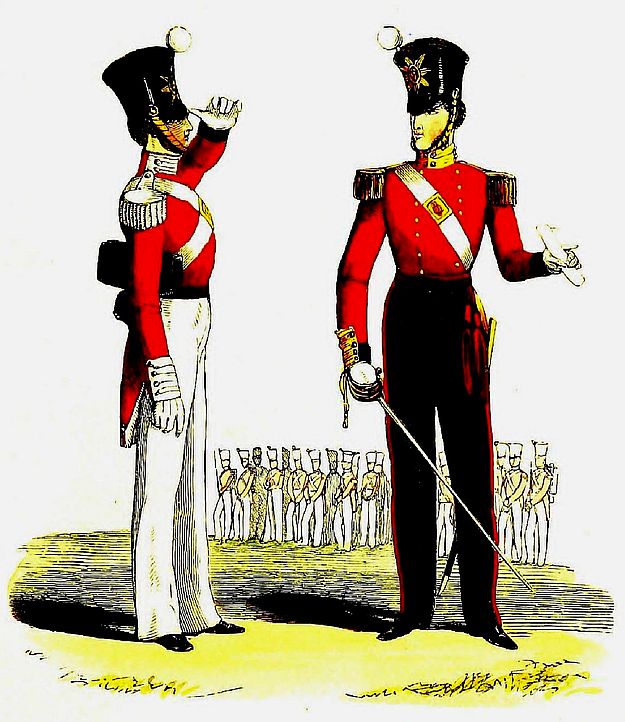
SIXTH (THE ROYAL FIRST WARWICKSHIRE) REGIMENT OF FOOT, M DCCC XXXIX.