OF
THE TWENTY-FIRST REGIMENT OF FOOT,
OR
THE ROYAL NORTH BRITISH FUSILIERS.
1678
The Royal North British Regiment of Fusiliers
derives its origin from the commotions in Scotland,
during the reign of King Charles II., who attempted
to establish Episcopacy in that country; but was opposed
by the Presbyterians, who wished to adhere to their
religious institutions, and prosecutions being used in
Scotland by the Government, to enforce obedience,
collisions occurred between the inhabitants and the
military, which were sometimes attended with loss of
life. Several Highland clans were called out, in 1678,
and quartered upon the Presbyterians, and in the
autumn of the same year a regiment of foot was added
to the military establishment of Scotland, of which
Charles, Earl of Mar, was appointed Colonel, by commission
dated the 23rd of September, 1678: this corps,
having been retained in the service, now bears the
title of the TWENTY-FIRST Regiment of Foot, or the
ROYAL NORTH BRITISH FUSILIERS.
Regiments of infantry, at this period, were generally
armed with pikes and muskets; but the practice was introduced
of arming every man, of a few select corps, with
a fusil, or a light musket, and these regiments were
called FUSILIERS. The Earl of Mar's regiment was
one of the first corps which obtained this distinction.
1679
1680
In the following year, Archbishop Sharp, who had
become particularly obnoxious to the non-conformists,
was murdered. This event was followed by severities
against the Presbyterians, and a meeting for public
worship, at Loudon-hill, having been attacked by a
body of horse and dragoons, under Captain Robert
Graham, of Claverhouse, afterwards Viscount Dundee,
the countrymen, being numerous, and provided with
arms, gained some advantage over the military. The
persons, who had thus committed themselves, resolved
to keep together in arms, and to seek by their valour,
that redress to which they considered themselves
entitled. They were soon augmented in numbers, and
taking post behind the river Clyde, they barricaded
Bothwell Bridge. The Earl of Mar's regiment was
called upon to take the field against the insurgents, and
it formed part of the army, commanded by James, Duke
of Monmouth, which attacked the rebels on the 22nd
of June, and gained a decisive victory. The rebels made
a feeble resistance on this occasion; twelve hundred foot
laid down their arms without striking a blow, and the
other divisions of their army fled in dismay; about four
hundred were killed by the King's troops in the pursuit,
and the rebellion was suppressed. Several parties, however,
kept together in arms for some time, and gave the
military much trouble in that and the following year.
1685
In the early part of 1685, King Charles II. died, and
was succeeded by his brother, King James the Second
of England, and Seventh of Scotland. The King being
a Roman Catholic, some disaffected persons supposed
the people would not submit to his government; and
the Earl of Argyle and the Duke of Monmouth, who
were both in exile on the Continent, for their political
conduct, agreed to raise the standard of rebellion,—the
former in Scotland, and the latter in England. The
Earl of Argyle landed in Argyleshire in May, and
assembled a body of men; when the Earl of Mar's
regiment was again called into the field. The King's
troops were commanded by the Earl of Dumbarton;
and on the night of the 19th of June, the two armies
encamped in sight of each other. The rebels attempted
to avoid an engagement, by a night march; but they
were led into a bog in the dark; alarm and disorder
followed; and the insurgents, proceeding some in one
direction and some in another, left the Earl of Argyle
without an army; he was captured and executed.
The Duke of Monmouth met with a similar fate, and the
rebellion in England was suppressed without the Earl
of Mar's regiment being required to pass the border.
1686
The Earl of Mar was succeeded in the colonelcy of
the regiment, in 1686, by Colonel Thomas Buchan,
from a regiment of horse.
1688
When the attempts made by King James to establish
papacy and arbitrary government had alarmed his
subjects, and the Prince of Orange was preparing an
armament for the invasion of England, the regiment was
one of the corps which marched from Scotland to support
the authority of the King; and in the early part of
November, 1688, it arrived in the vicinity of London,
when it was ordered to occupy quarters in Spitalfields
and the Tower Hamlets. The Prince of Orange landed
on the 5th of November; King James discovered that
he had alienated the affections of his subjects, both
civil and military, and he fled to France. Colonel
Buchan's regiment was ordered, by the Prince of
Orange, to occupy quarters at Witney, in Oxfordshire.
1689
The Prince and Princess of Orange were elevated to the
Throne by the titles of King William and Queen Mary;
and Colonel Buchan having adhered to the interests
of King James, King William conferred the colonelcy
of the regiment on Colonel Francis Fergus O'Farrell, by
commission dated the 1st of March, 1689.
From Oxfordshire, the regiment marched to
Gravesend, where it embarked for Holland, and
joining the Dutch army commanded by Prince
Waldeck, served the campaign of that year with the
division under the Earl (afterwards Duke) of
Marlborough. The regiment took part in a sharp
action with the French troops, commanded by Marshal
d'Humières, at Walcourt, in the province of Namur,
on the 25th of August, on which occasion the French
were repulsed in their attacks on the allied army, with
considerable loss.
1690
The regiment passed the winter in Flanders, and in
the summer of 1690 again took the field; it was on its
march for Brussels on the 21st of June, in order to join
the allied army; but Prince Waldeck engaged the
French at Fleurus, without waiting for the arrival of the
British troops, and was defeated. This disaster occasioned
the services of the army to be limited to defensive
operations during the remainder of the campaign.
1691
In March, 1691, the regiment was encamped at
Halle, in South Brabant, and formed in brigade with
the second battalion of the Royals; the French besieged
Mons, and the allies were too few in numbers to prevent
the capture of the place by the enemy. After the
surrender of Mons, the regiment was placed in quarters
until May, when it encamped near Brussels, and was
formed in brigade with the Royals, and the Scots
regiments of Mackay, Ramsay, and Angus, under the
orders of Brigadier-General Ramsay.
In a list of the army in Flanders, printed in July,
1691, the regiment is styled "O'Farrell's fusiliers;"
and its uniform is stated to be red, faced and lined with
the same colour.
At the termination of the campaign, the regiment was
again placed in winter-quarters.
1692
A numerous French army appeared in the Netherlands
in the spring of 1692, and besieged Namur;
when O'Farrell's fusiliers were called from their
quarters, and advanced with the army, commanded by
King William III., to the relief of the place; but the
march having been delayed by heavy rains, the garrison
surrendered on the 20th of June. A few days afterwards,
a detachment of the regiment was employed in
an attempt to surprise Mons; but the garrison was
found prepared. On this occasion, Colonel Sir Robert
Douglas and Colonel O'Farrell, having proceeded a
short distance to consult with the Prince of Wirtemberg,
who commanded the party, mistook their way in the
dark, and were made prisoners by a detachment of
French cavalry: they were released on paying the
regulated ransom.
O'Farrell's fusiliers formed part of the advance-guard
at the battle of Steenkirk on the 3rd of August;
and were severely engaged with the superior numbers
of the enemy under the Duke of Luxembourg. The
regiment distinguished itself on this occasion, and sustained
the loss of many brave officers and soldiers.
D'Auvergne states, in his history of this campaign,—"Our
van-guard behaved in this engagement to such
wonder and admiration, that though they received the
charge of several battalions of the enemy, one after
another, yet they made them retreat almost to their
camp." The corps in advance were not supported in
time to enable them to persevere in their career of
victory; and King William commanded the army to
retreat.
The regiment had Major Keith, Captains White,
Cygnoe, Mackenzie, and Sharp, Lieutenants Charles
King and Edward Griffith killed; and Lieutenant Newton
wounded. The regiment was not engaged in any
service of importance during the remainder of the
campaign, and it passed the winter at Ghent.
1693
Again taking the field in the summer of 1693, the
NORTH BRITISH FUSILIERS were formed in brigade with the
regiments of Leven (twenty-fifth), Monro (twenty-sixth),
Mackay, and Lander (afterwards disbanded), under
the command of Brigadier-General Ramsay, and, after
taking part in several manœuvres, were engaged at the
battle of Landen on the 29th of July. At sunrise on
the morning of that day, a French force of very superior
numbers, commanded by the Duke of Luxembourg,
appeared before the position occupied by the confederate
army under King William III., when the NORTH
BRITISH FUSILIERS, and other regiments of their brigade,
were ordered to occupy some hedges and narrow roads,
beyond the village of Laer, on the right of the line.
This village, and the ground occupied by General
Ramsay's brigade, being attacked by a numerous body
of the enemy, the NORTH BRITISH FUSILIERS were engaged
in a sharp musketry battle in the fields and open
grounds. At length the Third foot, and other corps in
the village of Laer, were forced to retire; but they
rallied, and, being joined by Brigadier-General Ramsay's
brigade, the whole charged, and by a gallant effort recaptured
the village; the NORTH BRITISH FUSILIERS distinguished
themselves on the occasion. The French afterwards
carried the village of Neer-Winden, and forced the
position; the regiments at Laer then became separated
from the main body of the confederate army; they
gallantly defended their post some time, and eventually
retired, fighting, to the Gheet, forded that river, and
joined several corps which had crossed the bridge of
Neer-Hespen. The army was retreating, and the NORTH
BRITISH FUSILIERS accompanied King William to the
vicinity of Tirlemont. The regiment had Captains
Campbell and Strayton, Lieutenants Douglas and Dunbar,
and Adjutant Walle wounded; Captain Paterson
taken prisoner; also a number of soldiers killed,
wounded, and prisoners.
At the end of the campaign, the regiment was placed
in garrison at Bruges.
1694
During the summer of 1694, the regiment performed
many long marches in Brabant and Flanders; but was
not engaged with the enemy, and in the autumn it
marched to Deinse.
This year the King commanded a board of General
Officers to assemble and decide upon the rank of the
several corps of the army. This board gave precedence
to the English regiments, and gave the Scots and Irish
regiments rank in the English army from the date of
their first arrival in England, or from the date when
they were first placed on the English establishment.
The NORTH BRITISH FUSILIERS, not having entered
England until the Revolution in 1688, received rank as
TWENTY-FIRST regiment. Numerical titles were not
generally used until the reign of King George II.
1695
When the army took the field to serve the campaign
of 1695, the TWENTY-FIRST were left in garrison at
Deinse, where some stores of provision were formed.
King William undertook the siege of Namur, and the
regiment was directed to join the covering army under
the Prince of Vaudemont; but it subsequently returned
to Deinse, of which place its colonel, Brigadier-General
O'Farrell, was commandant.
The French commander, Marshal Villeroy, detached
a strong body of troops, under the Marquis of Feuqueres,
to reduce the town of Deinse where the NORTH BRITISH
FUSILIERS were stationed. This town was situate on the
river Lys; it was only slightly fortified, and in many
places there was only an entrenchment and some palisades
as defensive works; eight pieces of cannon were
the only ordnance in the town. Under these circumstances
Brigadier-General O'Farrell considered it impossible
to make a successful defence of the place, and
he surrendered on the 21st of July without having
fired a shot. The FUSILIERS became prisoners of war
on this occasion.
Brigadier-General O'Farrell was afterwards tried
by a general court-martial, and cashiered: and King
William conferred the colonelcy of the regiment on
Colonel Robert Mackay, from a Scots corps, which was
afterwards disbanded.
After the surrender of Namur, the regiment rejoined
the allied army, and was again stationed at Bruges.
1696
From Bruges the regiment proceeded to the camp at
Marykirk, and it served the campaign of 1696 with the
army of Brabant: in the autumn it went into village
cantonments.
1697
In December, Colonel Robert Mackay died; and on
the 1st of January, 1697, King William conferred the
colonelcy of the regiment on Lieut.-Colonel Archibald
Row, from the Sixteenth foot.
Quitting its village quarters on the 13th of March,
1697, the regiment entered upon the operations of
another campaign. While the troops were in the field,
negotiations for a general peace commenced at Ryswick,
and the treaty was signed in September. Thus the
British monarch witnessed his efforts for the liberties of
Europe, and for the preservation of the balance of power
in Christendom, attended with success.
The regiment returned to Scotland during the winter,
and was stationed there during the remainder of King
William's reign.
1702
Queen Anne succeeded to the throne on the 8th of
March, 1702; and the French monarch, having violated
the conditions of existing treaties, by procuring the
accession of his grandson, Philip, Duke of Anjou, to the
throne of Spain, war was declared against France soon
afterwards. At the commencement of hostilities the
NORTH BRITISH FUSILIERS were selected to proceed on
foreign service, and they embarked from Scotland for
Holland, to serve with the allied army commanded by
the Earl of Marlborough. The regiment did not join
the army immediately on its arrival in Holland, but was
stationed some time at Breda, and in September it
marched towards Flanders.
1703
Quitting its winter-quarters in April, 1703, the regiment
marched towards Maestricht, where the allied
army was assembled, and the second battalion of the
Royals, with the Tenth, Sixteenth, TWENTY-FIRST, and
Twenty-Sixth regiments, were formed in brigade, under
Brigadier-General the Earl of Derby.
The regiment took part in the operations of the
campaign, and its services were connected with the
reduction of Huy, a strong fortress on the Maese, above
the city of Liege, which was besieged and captured in
ten days. The regiment was afterwards detached from
the main army, to take part in the capture of Limburg,
a city of the Spanish Netherlands, situate on a pleasant
eminence near the banks of the Wesdet. The siege of
this place was commenced on the 10th of September, and
the NORTH BRITISH FUSILIERS were employed in carrying
on the approaches, and in making the attacks; and
in seventeen days the garrison surrendered at discretion.
1704
In October the regiment marched back to Holland,
where it was stationed during the winter.
From Holland the regiment marched, in the months
of May and June, 1704, to the interior of Germany, to
arrest the progress of the French and Bavarians, who
had gained considerable advantage over the Imperialists.
A junction was formed with the Germans under the
Margrave of Baden; and on the 2nd of July the NORTH
BRITISH FUSILIERS took part in the attack of the enemy's
position on the lofty heights of Schellenberg on the north
bank of the Danube; when the entrenchments were
carried, and the French and Bavarians, commanded by
the Count d'Arco, were driven from their post with
severe loss.
The regiment had a few private soldiers killed and
wounded; also Captain Kygoe, Lieutenants Johnston
and John Campbell, wounded.
After this victory the regiment penetrated the Electorate
of Bavaria to the vicinity of the enemy's fortified camp
at Augsburg, which was found too strong to be attacked
with any prospect of success, and the army retired a
few stages to undertake the siege of Ingoldstadt. At
the same time a numerous reinforcement of French
troops arrived at the theatre of war.
These events were followed by the battle of Blenheim,
on the 13th of August, when the French and Bavarians,
commanded by Marshal Tallard and the Elector of
Bavaria, were overpowered by the allies under the Duke
of Marlborough and Prince Eugene of Savoy, and a
victory was gained which reflected lustre on the British
arms. The NORTH BRITISH FUSILIERS were selected to
lead the attack against the French troops in the village
of Blenheim, and their colonel, Brigadier-General Row,
placed himself at the head of his regiment, which was
followed by four other corps. In the Annals of Queen
Anne it is stated—"The five English battalions, led on
by Brigadier-General Row, who charged on foot at the
head of his own regiment with unparalleled intrepidity,
assaulted the village of Blenheim, advancing to the
very muzzles of the enemy's muskets, and some of the
officers exchanged thrusts of swords through the
palisades;"—but the avenues of the village were found
strongly fortified, and defended by a force of superior
numbers. Brigadier-General Row led the NORTH BRITISH
FUSILIERS up to the palisades before he gave the word
"fire," and the next moment he fell mortally wounded;
Lieut.-Colonel Dalyel and Major Campbell, being both
on the spot, stepped forward to raise their colonel, and
were both instantly pierced by musket-balls; the soldiers,
exasperated at seeing the three field officers of the regiment
fall, made a gallant effort to force their way into
the village, but this was found impossible, and the regiment
was ordered to retire. The moment the soldiers
faced about, thirteen squadrons of French cavalry galloped
forward to charge them, and one of the colours
of the regiment was captured by the enemy; but the
French horsemen were repulsed by the fire of a brigade
of Hessians, and the colour was recovered.
Another attempt to capture the village of Blenheim
having failed, the firing was continued against this post,
and the army advanced against the enemy's line, which
was driven from the field with great slaughter, and
the loss of its cannon, and of many officers and soldiers
made prisoners, among whom was the French commander,
Marshal Tallard. Additional forces were then
brought against the French troops in Blenheim, and
they surrendered prisoners of war. The Germans, who
attacked the enemy's right, were also victorious; and
the gallant achievements of the allied army raised on
the banks of the Danube a trophy which time cannot
destroy.
The regiment had Lieut.-Colonel Dalyel, Captain
Stratton, jun., Captain Stratton, senior, Lieutenants
Vandergracht, Hill, Campbell, and Travallion killed;
Brigadier-General Row and Major Campbell died of
their wounds; Captains Craufurd and Fairlee, Lieutenants
Dunbar, J. Douglas, Elliott, Ogilvy, Maxwell,
Stuart, Primrose, and Gordon wounded.
The number of the enemy captured on this occasion
was so great, that the NORTH BRITISH FUSILIERS, and four
other corps, were sent to Holland in charge of prisoners.
These corps marched in charge of the captured French
and Bavarians to Mentz, where they embarked in boats
and sailed to Holland, under the orders of Brigadier-General
Fergusson; and having delivered them into the
charge of other regiments, went into quarters.
1705
The colonelcy of the regiment was conferred on John,
Viscount Mordaunt, who had distinguished himself at
the head of the foot guards which commenced the attack
on the heights of Schellenberg. A number of
recruits from Scotland having replaced the losses of the
preceding campaign, the regiment appeared complete
and in good order when it took the field to serve the
campaign of 1705. It was employed in the expedition
up the Moselle: and returning to the Netherlands, was
afterwards engaged at the forcing of the French lines at
Helixem and Neer Hespen, on the morning of the 18th
of July, when the superior tactics of the British Commander,
and the gallantry of his troops, were very
conspicuous.
1706
The regiment had also the honor to take part in
gaining another splendid victory over the combined
French, Spanish, and Bavarian forces, at Ramilies, on
Whit-Sunday, the 23rd of May, 1706. During the
early part of the action the NORTH BRITISH FUSILIERS,
the Third foot, and three regiments of cavalry, were
stationed on the heights of Foulz, where they had a view
of the field of battle. An important crisis in the battle
arriving, these corps descended from the heights,—the
FUSILIERS and Third Foot forced their way through a
morass, crossed the Little Gheet, ascended the acclivity
between that river and the Jauche, and charging the
enemy's left flank, forced three French regiments into
some low grounds, where the greater part of them
were either killed or taken prisoners. The allies were
successful at every part of the field, and the legions of
the enemy were overpowered, and pursued from the
plains of Ramilies with great slaughter until the following
morning, by which time nearly all the enemy's
cannon, with many standards, colours, and kettle-drums,
had been captured.
This victory augmented the reputation of the British
arms; and was followed by very important results.
Spanish Brabant, and many of the principal towns of
Flanders, were rescued from the power of the enemy.
The services of the regiment are connected with the
capture of Ostend, Menin, and Aeth; and it passed the
winter in garrison in Flanders.
In June of this year Viscount Mordaunt exchanged
with Colonel Sampson de Lalo, a French gentleman of
the Protestant religion, who had been forced to quit his
native country by the Edict of Nantes; Colonel de Lalo
had served as Lieut.-Colonel and Colonel of the Twenty-eighth
regiment several years, and had the reputation of
being an excellent officer.
1707
During the campaign of 1707, the services of the
regiment were limited to marches and occupying positions;
and it passed the winter in West Flanders.
The Union of Scotland and England took place this
year, which occasioned St. George's cross to be added
to the colours of the Scots regiments, and St. Andrew's
cross to the colours of the English regiments. The
corps, previously designated Scots regiments, took the
title of North British regiments.
1708
In May, 1708, the regiment again took the field, and
on the 11th of July it had an opportunity of acquiring
fresh laurels at the battle of Oudenarde, which was
fought in the broken grounds near the river Scheldt.
On this occasion the regiment was engaged in a severe
musketry action, and it succeeded in driving the French
corps opposed to it from field to field, until the darkness
of the night put an end to the conflict. Before the following
morning the wreck of the French army had retreated
in disorder towards Ghent.
After this victory, the siege of Lisle, the capital of
French Flanders, was resolved upon. This fortress was
deemed almost impregnable; it was garrisoned by
fifteen thousand men, commanded by Marshal Boufflers,
who resolved upon making a desperate defence. The
NORTH BRITISH FUSILIERS were selected to take part
in the attack of this important fortress, under the orders
of Prince Eugene of Savoy; the covering army was
commanded by the Duke of Marlborough. The
regiment had several men killed and wounded in
carrying on the approaches, and at the attack of the
counterscarp it had thirteen men killed; three officers,
four serjeants, and sixty-six rank and file wounded.
The progress of this siege was a subject of peculiar
interest throughout Europe; and the besieging army
witnessed its extraordinary efforts for the capture of the
place, attended by complete success, on the 9th of
December, when the citadel surrendered.
1709
Having reposed a few months in quarters, and received
a body of fine recruits from Scotland, the regiment joined
the army, and was employed in covering the siege of
Tournay, in July and August, 1709. The citadel of Tournay
surrendered in the beginning of September, and the
army afterwards marched in the direction of Mons.
A numerous French army, commanded by Marshals
Villars and Boufflers, took up a position at Malplaquet,
and strengthened the post by entrenchments and other
works of art. The Duke of Marlborough and Prince
Eugene had confidence in the valour and perseverance
of the troops under their orders, and they attacked the
enemy's formidable position on the 11th of September,
on which occasion the heroic valour of the troops was
conspicuous; the enemy's entrenchments and abatis-de-bois
were stormed with distinguished gallantry, the determined
resistance of the French was overcome, and another
trophy was acquired; but with the loss of many brave officers
and soldiers, including the Colonel of the NORTH
BRITISH FUSILIERS, Brigadier-General de Lalo, who
was killed at the head of a brigade, and his fall was much
regretted.
In addition to the loss of its Colonel, the regiment
had also Captains Monroe, Wemys, and Farley killed;
Captains Montressor and Lowther wounded.
After the death of Brigadier-General de Lalo,
Viscount Mordaunt was re-appointed on the 4th of
September to the colonelcy of the NORTH BRITISH FUSILIERS,
from the Twenty-eighth regiment.
The regiment was afterwards employed in covering
the siege of Mons, which was terminated by the surrender
of the garrison on the 20th of October; when
the regiment marched into quarters.
1710
On the 14th of April, 1710, the regiment marched
out of its winter-quarters towards the frontiers of
France, and was engaged in the movements by which
the French lines were passed at Pont-à-Vendin: it was
afterwards selected to take part in the siege of Douay,
where it performed much severe service. It was
employed in carrying on the approaches, in storming
the outworks, and other duties connected with the
siege, and sustained considerable loss in killed and
wounded. The garrison beat a parley on the 25th of
June, and afterwards surrendered the fortress.
After the capture of Douay, the regiment was employed
in covering the siege of Bethune, which place was surrendered
in August. The regiment was also with the
covering army during the sieges of St. Venant and Aire;
the former place surrendered on the 30th of September,
and the latter on the 9th of November.
Viscount Mordaunt died this year, and was succeeded
in the colonelcy by Major-General Meredith, from the
Thirty-seventh regiment. This officer was succeeded,
in December, by Major-General the Earl of Orrery,
from a newly-raised regiment, which was afterwards
disbanded.
1711
After passing the winter in quarters at Dendermond,
the regiment joined the army in May, 1711, and it took
part in the movements by which the boasted impregnable
French lines were passed at Arleux on the 5th of
August. The regiment was afterwards employed in the
siege of Bouchain, in which service obstacles of the
greatest magnitude had to be overcome, and the abilities
of the commanders, with the valour of the troops, were
put to a severe test. These qualities were found in the
besieging army; on more than one occasion the soldiers
fought up to their middle in water, and by a gallant
perseverance, which reflected honor on all the corps
engaged in the siege, every difficulty was overcome;
and the garrison surrendered on the 13th of September.
1712
The regiment joined the army commanded by the Duke
of Ormond, in the campaign of 1712, and advanced to
the frontiers of Picardy; but a suspension of hostilities
was soon afterwards proclaimed, preparatory to a general
peace, when the British army marched to Ghent, and
afterwards went into quarters.
1713
A treaty of peace was concluded at Utrecht, and the
soldiers of the NORTH BRITISH FUSILIERS could look
back with exultation at the career of victory and honor
which had attended their corps during these memorable
campaigns. At this period the regiment is designated
by historians, and in official documents, by the title of
the ROYAL NORTH BRITISH FUSILIERS; but the date
when this honorary distinction of "ROYAL" was conferred
upon it, has not been ascertained.
1714
The ROYAL NORTH BRITISH FUSILIERS were stationed
in Flanders until the decease of Queen Anne, on the 1st
of August, 1714, and the accession of King George I.,
when they were ordered to embark for England. They
landed at Gravesend on the 23rd of August, and were
afterwards directed to march to Scotland.
1715
In 1715 the Earl of Mar[6] erected the standard of
rebellion in Scotland, and summoned the Highland clans
to aid him in establishing the Pretender on the throne.
The ROYAL NORTH BRITISH FUSILIERS were encamped at
Stirling, under the command of the Duke of Argyle, and
advanced with the Royal army to Dumblain, to defeat the
attempts of the enemy to march southward. On the
morning of the 13th of November the two armies confronted
each other on Sheriff-muir. On the approach of
the clans, it was found necessary for the Royal forces to
change position, and this movement was executed at a
critical time with steadiness; but several corps were
suddenly attacked by the clans while in the act of forming,
and suffered severely. The left wing of the rebel
army was overpowered, and driven from the field with
great slaughter; and the left wing of the Royal army was
also forced to retire; thus each commander had one wing
victorious, and one wing defeated: the rebels were prevented
marching southward, and retired; and the
King's troops returned to their camp at Stirling.
The regiment had one captain, two lieutenants, three
serjeants, and eighty-five rank and file killed; one
captain, one serjeant, and twenty-four rank and file
wounded.
1716
Reinforcements having arrived, the King's troops
advanced, in January, 1716, to attack the insurgents,
who made a precipitate retreat. The Pretender, and
several leaders in the rebellion, escaped to the Continent,
and the clans separated. The rebellion was thus suppressed.
In July of this year the Earl of Orrery was succeeded
in the colonelcy of the regiment by Colonel George
Macartney, whose regiment of foot had been disbanded
at the peace of Utrecht.
1727
The regiment was employed on home service many
years; and in 1727 it was held in readiness to embark
for Holland, to aid the Dutch in their approaching war
with the Emperor of Germany; but the presence of
British troops was not required.
In the same year Colonel Macartney was removed to
the Seventh horse, now Sixth Dragoon Guards, and the
colonelcy of the ROYAL NORTH BRITISH FUSILIERS was
conferred on Brigadier-General Sir James Wood, from
the Dutch service.
1728
1729
The order for embarking for Holland having been countermanded,
the regiment afterwards proceeded to Ireland,
and was placed upon the establishment of that country.
1738
Major-General Sir James Wood died in 1738, and
King George II. nominated Colonel John Campbell,
afterwards Duke of Argyle, to the colonelcy of the
ROYAL NORTH BRITISH FUSILIERS, from the Thirty-ninth
regiment.
1739
1740
1741
War having been declared against Spain, in the
autumn of 1739, the regiment was withdrawn from
Ireland, and landing at Liverpool, was stationed in
South Britain during the year 1740; in the summer of
1741 it was encamped on Lexden Heath, where seven
regiments of cavalry and seven of infantry were assembled,
and held in readiness for foreign service.
1742
In the summer of 1742 King George II. sent sixteen
thousand men to Flanders, to support the interest of the
House of Austria against the aggressions of France and
Bavaria: the ROYAL NORTH BRITISH FUSILIERS formed
part of this force, and were stationed some time at Ghent.
1743
Early in 1743 the regiment commenced its march for
Germany, and after taking part in several movements in
the field, had the honor to distinguish itself, under the
eye of its Sovereign, at the battle of Dettingen, on the
27th of June, when the French troops, under Marshal
Noailles, were driven from the field of battle with great
slaughter, and the loss of a number of standards and
colours.
The ROYAL NORTH BRITISH FUSILIERS had Lieutenant
Yonge, one serjeant, and thirty-five rank and file killed;
Lieutenant Levingstone, one serjeant, two drummers,
and fifty-three rank and file wounded.
The regiment was afterwards encamped near Hanau;
in August it crossed the Rhine, and was employed in
West Germany; but in the autumn it returned to
Flanders.
1744
During the campaign of 1744 the regiment served
with the army under Field-Marshal Wade; it was encamped
between Asche and Alost, afterwards on the
banks of the Scheldt, and subsequently penetrated the
French territory to the vicinity of Lisle; but returned to
Ghent for winter-quarters.
1745
Quitting its cantonments in April, 1745, the regiment
marched, with the army commanded by His Royal
Highness the Duke of Cumberland, to the relief of
Tournay, which fortress was besieged by a numerous
French army, which took up a position near the village
of Fontenoy. The enemy had a great superiority of
numbers; but the Duke of Cumberland, trusting to the
innate bravery of his troops, resolved to hazard a general
engagement on the 11th of May, when the ROYAL NORTH
BRITISH FUSILIERS had their valour and endurance put
to a severe test, and they proved themselves not unworthy
successors of the gallant officers and soldiers who
triumphed at Blenheim and Ramilies under the great
Duke of Marlborough.
Soon after nine o'clock the British infantry advanced
in the face of a heavy fire of grape and musketry, and
by a gallant charge broke through the French lines; but
the Dutch failed to carry the village of Fontenoy, and
a brigade under Brigadier-General Ingoldsby did not
capture the battery it was appointed to attack; the troops,
which had forced the enemy's centre, were thus exposed
to so severe a cross fire, that they were ordered to retire.
A second attack was made; British valour and
intrepidity were again triumphant; but the failure of
the Dutch a second time, produced disastrous results,
and the British regiments, which had carried the enemy's
entrenchments, and forced the centre, were nearly
annihilated by a destructive cross fire. The ROYAL NORTH
BRITISH FUSILIERS suffered severely on this occasion.
The Duke of Cumberland afterwards ordered a retreat,
and the army withdrew from the field of battle to Aeth.
Lieutenants Campbell, Houston, and Serjeant, of the
regiment, were killed; Major Colville, Captains Latan,
Olivant, and Knatchbull, Lieutenants Maxwell, Colville,
Ballenden, Macgaken, and Townsend, wounded; Captain
Sandilands, Lieutenant Stuart, and Quarter-Master
Stewart prisoners; eleven serjeants and two hundred and
fifty-nine rank and file killed, wounded, and prisoners.
The severe loss which the regiment had experienced
occasioned it to be placed in garrison at Ostend. This
place was besieged by a numerous French force; and
the garrison defended their post some time; but the
works were not in repair, the stores were defective, and
the garrison not sufficiently numerous: under these circumstances
the governor surrendered, on condition that
the garrison should join the allied army.
While the regiment was in Flanders, Charles Edward,
eldest son of the Pretender, arrived in Scotland, and
being joined by a number of Highland clans, he made
a desperate attempt to overturn the existing government,
and establish his father's authority in the kingdom.
The ROYAL NORTH BRITISH FUSILIERS were ordered to
return to England; they arrived in the river Thames on
the 4th of November, and after landing, marched northward:
the efficiency of the regiment was increased by a
body of fine recruits enlisted in Scotland.
1746
The regiment arrived at Edinburgh in January, 1746,
and advanced with the army commanded by the Duke
of Cumberland, towards Stirling, when the young Pretender
raised the siege of Stirling castle and made a
precipitate retreat. The pursuit was retarded by severe
weather; but the army continued its advance when the
season permitted, and on the 16th of April encountered
the clans on Culloden moor. The regiment was in the
front line on this occasion, and took part in repulsing
the attacks of the Highlanders, and in driving them from
the field of battle with great slaughter. This victory
proved decisive, and the rebellion was suppressed.
The loss of the regiment was limited to seven private
soldiers killed and wounded. It was encamped a short
time at Inverness, and afterwards removed to Glasgow.
1747
From Scotland, the regiment was again removed to
the theatre of the war in the Netherlands, where it
arrived in time to take part in the operations of the
campaign of 1747; and it was engaged at the battle of
Val, on the 2nd of July. On this occasion the allied
army was very inferior in numbers to the enemy, and
although the gallantry of the British infantry was very
conspicuous throughout the action, the Duke of Cumberland
was obliged to order a retreat to Maestricht.
Eight rank and file of the ROYAL NORTH BRITISH
FUSILIERS were killed; one serjeant and fifteen rank and
file were wounded; and five men missing.
1748
The regiment was again in the field in the summer of
1748. Hostilities were this year terminated by the
treaty of Aix-la-Chapelle, and during the winter the
regiment returned to England.[7]
1751
In the Royal Warrant, issued on the 1st of July, 1751,
for ensuring uniformity in the clothing, standards, and
colours of the army, the following directions are given
for the TWENTY-FIRST REGIMENT, OR THE ROYAL NORTH
BRITISH FUSILIERS:—
"In the centre of their colours, the THISTLE within
the CIRCLE OF ST. ANDREW, and the CROWN over it; and
in the three corners of the second colour, the KING'S
CIPHER AND CROWN.
"On the grenadier caps, the THISTLE as on the
colours; the WHITE HORSE, and motto over it, Nec
aspera terrent, on the flap. On the drums and bells
of arms, the THISTLE and CROWN to be painted, as on
the colours, with the rank of the regiment underneath."
During the period the regiment was stationed in
England, where it remained until 1751, it received
the commendations of His Royal Highness the Duke of
Cumberland, on account of its good conduct in quarters,
and of its former gallantry in the field.
The TWENTY-FIRST regiment embarked for Gibraltar
towards the end of the year 1751, in order to relieve the
Eighth, or King's Regiment.
1752
Lieut.-General Campbell was removed to the Scots
Greys, and King George II. nominated Colonel the
Earl of Panmure, from the Twenty-fifth regiment, to the
colonelcy of the ROYAL NORTH BRITISH FUSILIERS, by
commission dated the 29th of April, 1752.
1760
The regiment remained at Gibraltar until 1760, when
it was relieved from duty at that fortress, and returned
to England.
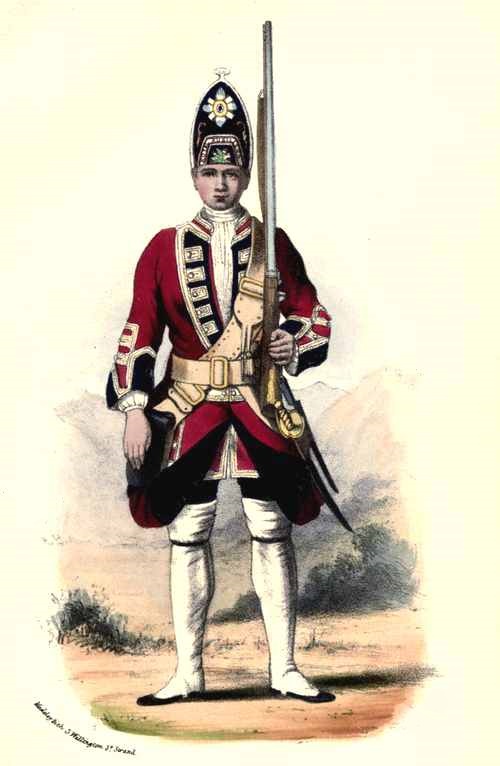
Madeley lith 3 Wellington St. Strand.
XXI.
THE ROYAL NORTH BRITISH FUSILIERS.
1742
For Cannon's Military Records.
1761
In the meantime another war had commenced between
Great Britain and France, and in 1761 the ROYAL NORTH
BRITISH FUSILIERS, mustering eight hundred men,
under the command of Lieut.-Colonel Edward Maxwell,
sailed with the expedition under Major-General
Hodgson, for the attack of the French island in the Bay
of Biscay, called Belle-Isle. The fleet appeared before
the island on the 7th of April; but the coast was found
like a vast fortress,—the little which nature had left
undone by rocks and crags, having been supplied by
art. A landing was, however, effected on the following
day; the TWENTY-FIRST was one of the regiments which
leaped on shore, and stormed the works of Port Andro,
under a heavy fire of cannon and musketry; the works
were found too steep to be ascended, and although the
officers and soldiers made a gallant effort, one attempting
to lift another up, it was found impossible to succeed,
and they were ordered to return on board of the fleet.
The regiment had three serjeants, one drummer, and
eight rank and file killed; eight rank and file wounded;
Lieutenants Innis and Ramage, and thirty-five rank and
file, prisoners;—many of the officers and soldiers taken
prisoners were severely wounded, and were unable to
return on board of the fleet when the order was given
to retire.
A landing was effected on the 22nd of April at a
rugged spot near Point Lomaria, where the difficult
ascent had occasioned the enemy to be less attentive to
that part of the coast; and the troops, under Brigadier-General
Lambert, having landed, gained the summit of
the rock, and repulsed the attempts of the enemy to
dislodge them,—capturing three brass field-pieces.
The cannon was afterwards landed from the ships, and
dragged up the rocks; the lines which covered the town
of Palais were captured, and the siege of the citadel
commenced. The ROYAL NORTH BRITISH FUSILIERS
took part in the siege of the Citadel of Belle-Isle, which
was prosecuted with so much vigour, that the governor,
the Chevalier de St. Croix, was forced to surrender on the
7th of June. The capture of the island was thus effected,
with the loss of about eighteen hundred men killed and
wounded.
1762
1763
1764
After the surrender of the Castle of Belle-Isle, the
regiment returned to England, where it was stationed
in 1762; and in 1763 and 1764 it occupied quarters
in Scotland.
1765
1770
On the 6th of May, 1765, the regiment embarked
for America, and was quartered five years in West
Florida; in 1770, it was removed to Canada, and was
stationed some time at Quebec.
In November, 1770, Lieut.-General the Earl of
Panmure was removed to the Scots Greys, and was
succeeded in the colonelcy of the ROYAL NORTH BRITISH
FUSILIERS by Major-General the Honorable Alexander
Mackay, from the Sixty-fifth regiment.
1772
1773
1774
Having been relieved from duty at Quebec, in 1772,
the regiment embarked for England, where it was
stationed in 1773 and the two following years.
1775
The American war commenced in 1775, and during
the winter of that year Quebec was besieged by an
American force.
1776
In the spring of 1776, the regiment embarked for
the relief of Quebec; on the arrival of the British
reinforcement to the garrison, the Americans raised the
siege, and made a precipitate retreat; they were pursued
up the country, and driven from all the posts which they
occupied in that province. After these services were
performed, the ROYAL NORTH BRITISH FUSILIERS were
quartered at St. John's, where they were stationed during
the winter.
1777
The regiment was called into active operations in the
spring of 1777, with the armament commanded by
Lieut.-General Burgoyne; it embarked in boats on
Lake Champlain, and sailed to Crown Point, where the
troops halted three days, and afterwards proceeded
against Ticonderago; but the Americans quitted the
fort without hazarding the events of a siege. The
regiment returned on board of the flotilla, and sailing
along the lake, arrived, about three o'clock on the
afternoon of the 6th of July, within three miles of
Skenesborough, where the Americans had a stockaded
fort. The Ninth, Twentieth, and TWENTY-FIRST
regiments leaped on shore, and ascended the mountains,
to get behind the fort and cut off the retreat of the
garrison; but the Americans made a precipitate retreat,
and escaped with the loss of a few men made prisoners.
On the 8th of July, the regiment was detached towards
Fort Anne, to support the Ninth, who were attacked by
an American force of very superior numbers. The
enemy was repulsed, and retreated towards Fort
Edward.
To follow up these advantages proved a difficult
undertaking; trees and other obstacles had to be
removed; creeks and marshes had to be crossed; forty
bridges had to be constructed; but by great exertion
these difficulties were overcome, and on the 30th of
July, the army arrived at the bank of the Hudson's
River, which was crossed by a bridge of boats on the
13th and 14th of September, and on the 19th the army
advanced against the Americans, in position on an island
called Still-Water, when a severe action was fought.
Lieut.-General Burgoyne stated in his public despatch,—"About
three o'clock, the action began by a very
vigorous attack on the British line, and was continued
with great obstinacy until after sunset; the enemy
being constantly supplied with fresh troops. The
stress lay upon the Twentieth, TWENTY-FIRST, and
Sixty-second regiments, most parts of which were
engaged nearly four hours without intermission....
Just as night closed, the enemy gave ground on all
sides, and left us completely masters of the field of
battle."
Several other actions occurred, and the regiment
sustained considerable loss in killed and wounded;
among the former were Lieutenants Currie, Mackenzie,
Robertson, and Turnbull; and among the latter Captain
Ramsay, and Lieutenant Richardson.
The circumstances under which the troops commanded
by Lieut.-General Burgoyne eventually became placed,
assumed a desperate character; their numbers were reduced
to about three thousand five hundred men able
to bear arms; they were environed by sixteen thousand
Americans; their retreat cut off, and they were short of
provisions. Under these accumulated difficulties, they
agreed to lay down their arms on condition of being sent
to England, and of not serving again in North America
during the war. These conditions were, however,
violated by the American Congress, and the troops were
detained some time in the provinces.
1781
The TWENTY-FIRST regiment having been liberated
returned to Europe, and in 1781 it was stationed in
Scotland, recruiting its numbers.
1782
At the termination of the American war, in 1782, the
regiment was placed on the peace establishment; and in
1783 it proceeded to Ireland.
1789
The regiment remained in Ireland until the spring of
1789, when it embarked from Cork for Nova Scotia,
and landing at Halifax, was stationed in the British
provinces in North America nearly four years.
Lieut.-General the Honorable Alexander Mackay
died in 1789, and the colonelcy of the ROYAL NORTH
BRITISH FUSILIERS was conferred on General the
Honorable James Murray, from the Thirteenth regiment.
1793
While the regiment was in North America a revolution
took place in France, and republican principles
were extended to the French West India islands, where
the inhabitants of colour rose in arms against the European
settlers, many of whom sought protection from
Great Britain. Under these circumstances the ROYAL
NORTH BRITISH FUSILIERS were removed to the West
Indies in the spring of 1793.
The French royalists of Martinique sent pressing applications
for assistance, and Major-General Bruce, commanding
the British troops in the West Indies, was
induced to proceed with a small force to their aid. The
TWENTY-FIRST were employed on this service; they
landed at Caise de Navire on the 14th of June; the other
corps landed on the 16th, and eleven hundred British,
and eight hundred French loyalists, advanced to attack
the town of St. Pierre: but the Royalists were undisciplined;
they got into confusion, fired by mistake on one
another, and so completely disconcerted the plan of
attack, that the English General, not having a force
sufficiently numerous for the purpose without them,
ordered the British troops to return on board of the
fleet.
1794
General Sir Charles (afterwards Earl) Grey assembled
a body of troops at Barbadoes, in January, 1794, for
the attack of the French islands, and the flank companies
of the TWENTY-FIRST were employed on this service.
A landing was effected on the island of Martinique in
the early part of February, and after some sharp fighting,
in which the regiment had several men killed and
wounded, this valuable possession was delivered from
the power of the republicans.
From Martinique the grenadiers, under Prince Edward
(afterwards Duke of Kent), the light infantry, under
Major-General Dundas, and three other corps, embarked
on the 30th of March for St. Lucia, where they arrived
on the 1st of April, and the conquest of that fine island
was completed in three days.
The flank companies of the TWENTY-FIRST were afterwards
employed in the reduction of the island of
Guadaloupe. A determined resistance was made by the
enemy; but the island was captured before the end of
April. The regiment had several men killed and
wounded; Captain Macdonald was also wounded on the
12th of April.
After the reduction of Guadaloupe, the flank companies
of the regiment were removed to Antigua.
The loss of so many valuable colonial possessions was
not regarded with indifference by the republican government
of France, and in June a French armament
arrived at Guadaloupe for the recovery of that island.
The negroes and other men of colour flocked to the
standard of republicanism; they were instantly armed
and clad in uniforms; the doctrines of liberty and equality
were disseminated among this motley crowd, which led to
a frightful catalogue of crime and bloodshed. The flank
companies of the TWENTY-FIRST were called from
Antigua to aid in the defence of Guadaloupe; they
arrived on the 10th of June in the Winchelsea ship of
war, landed on the 19th, at Ance Canot, and were engaged
in several arduous services, in which Lieutenants
Harry Foley Price, Samuel Knollis, and J. S. Colepeper
were wounded; also several private soldiers killed and
wounded: but the British troops were not sufficiently
numerous to contend with the republican forces.
Lieut.-Colonel Colin Graham of the TWENTY-FIRST
was appointed to the command of the troops in Basse
Terre, and he defended Beville camp until the 6th of
October, when he was forced to surrender, his force
having become reduced to one hundred and twenty-five
rank and file fit for duty.
Three companies of the ROYAL NORTH BRITISH
FUSILIERS were engaged in the defence of Fort Matilda,
under Lieut.-General Prescott, and the garrison made a
resolute resistance, until the place became so much injured
by the enemy's fire that it was not tenable, when
it was evacuated during the night of the 10th of December.
One company of the TWENTY-FIRST occupied the
rampart,—the light company, under Lieutenant William
Paterson, was stationed on the right of the breach, and
the third company, under Captain Mackay, was posted
along the Gallion river; they thus covered the embarkation
of the garrison and stores, and afterwards
retired on board of the fleet. The three companies
were reduced by casualties to one captain, three lieutenants,
six serjeants, and ninety-two rank and file.
Lieut.-General Prescott stated in his despatch,—"During
the whole progress of this long and painful siege, the
officers and men under my command have conducted
themselves in such a manner as to deserve my warmest
praise; bearing their hardships with the utmost
patience, and performing their duty with alacrity."
General the Honorable James Murray died in this
year, and King George III. nominated Major-General
James Hamilton from the Fifteenth regiment, to the
colonelcy of the TWENTY-FIRST FUSILIERS.
1795
1796
In addition to the casualties in action, the regiment
also sustained, during its services in the West Indies,
severe loss from the yellow fever, and in 1796 it returned
to England much reduced in numbers; it landed at
Portsmouth, and proceeded from thence to Scotland,
where it commenced active measures for completing its
ranks with recruits.
1800
1801
1802
The regiment occupied various stations in Scotland
until June, 1800, when it embarked from Portpatrick
for Ireland, where its numbers were increased to eight
hundred rank and file by volunteers from the Scots
fencible regiments then in that country.
In October of the same year, the regiment marched to
Enniskillen, where it was quartered nearly two years,
during which time its numbers were increased to a
thousand men by recruits. The good conduct of the
regiment, during its stay at this place, occasioned it to
stand very high in the estimation of the inhabitants;
and on its removal, in 1802, a hundred gentlemen and
respectable persons sent a memorial to the Commander-in-chief,
requesting that it might be again quartered at
Enniskillen, and offered to defray the expense of removal.
On the 15th of July, 1802, the regiment arrived at
Londonderry, where its establishment was reduced in
consequence of the peace of Amiens having been concluded
with France.
1803
From Londonderry the regiment was removed to
Dublin, in February, 1803; its establishment was again
augmented in the summer of this year after the renewal
of hostilities with France.
An alarming insurrectionary spirit was manifested at
Dublin in the summer of this year; and on the evening
of the 23rd of July an immense number of persons
assembled with fire-arms and pikes, dragged the Lord
Chief-Justice, Viscount Kilwarden, out of his carriage,
and murdered him; also wounded his nephew, the Rev.
Richard Wolfe, and committed numerous other acts of
outrage and violence. At this period the regiment was
quartered in Cork Street, Thomas Street, and Coombe
Barracks, and it quickly assembled to suppress the riots.
Lieut.-Colonel Brown was murdered by the insurgents
as he was proceeding from his quarters to head the regiment.
The command devolved on Major Robertson,
under whose orders the regiment was actively employed
in restoring tranquillity, in which service it had twelve
men killed and wounded. The regiment received the
thanks and approbation of the Commander-in-chief in
Ireland, Lieut.-General the Honorable H. E. Fox, for
its conduct on this occasion. Also the thanks of the
city of Dublin. Lieutenant Douglas, who commanded
the light company, and Adjutant Brady, particularly
distinguished themselves, and were each presented with
a piece of plate by the city of Dublin, accompanied with
the expression of the gratitude and admiration of the
citizens, for their gallant exertions.
On the decease of General Hamilton, in this year, he
was succeeded in the colonelcy by General the Honorable
William Gordon, from the Seventy-first regiment.
1804
Leaving Dublin in July, 1804, the regiment proceeded
to Loughrea.
Napoleon Bonaparte, whom the French had elevated
to the dignity of Emperor, having made preparations
for the invasion of England, his menace was met by a
meritorious display of loyalty and patriotism by the
British people, who armed to repel the threatened invasion.
Among the precautionary measures adopted at
this period, an "Additional Force Act" received the
Royal Assent in July, 1804. The men raised for limited
service, under the provisions of this Act, in the counties
of Ayr and Renfrew, were added to the ROYAL NORTH
BRITISH FUSILIERS, and were formed into a second battalion,
which was embodied at Ayr, and placed on the establishment
of the army on the 25th of December, 1804.
1805
On the 30th of April, 1805, the first battalion embarked
from Monkstown for England; it landed at
Portsmouth, and was subsequently encamped at Weymouth,
where several corps were assembled, and were
repeatedly reviewed by the King, and other members of
the Royal Family, who expressed their high approbation
of the ROYAL NORTH BRITISH FUSILIERS on every occasion
on which the corps appeared before them. In the
autumn the battalion marched to Lewes.
1806
From Lewes the first battalion marched to London,
in January, 1806, to attend the funeral of Vice Admiral
Lord Viscount Nelson, who was killed at the
battle of Trafalgar, where the British navy gained a
decisive victory over the combined fleets of France and
Spain. The remains of this highly distinguished naval
commander were honored with a public funeral, which
was conducted with great state. The interment took
place on the 9th of January, in St. Paul's Cathedral: the
ROYAL NORTH BRITISH FUSILIERS afterwards marched to
Colchester.
At this period the French arms were triumphant in
Germany; and the Court of Naples having displeased
the Emperor Napoleon, the Neapolitan territory was
seized by the armies of France, and Joseph Bonaparte
was proclaimed King of Naples. The British preserved
the island of Sicily in the interest of the dethroned
family: and in April the first battalion of the TWENTY-FIRST
embarked from Tilbury for Sicily, and landed at
Messina on the 26th of July.
On the 15th of August the second battalion embarked
from Portpatrick for Ireland, where it was stationed
during the following five years.
1807
The Court of the Grand Seignior having become
involved in hostilities with Great Britain, the first battalion
embarked from Sicily on the 17th of May, 1807, and
joined the expedition to Egypt under Major-General
Alexander Mackenzie Fraser. The battalion landed
at Alexandria, and marched to the camp at Aboukir.
Peace having been concluded with the Turks, the battalion
returned to Sicily, where it arrived in October.
1808
The first battalion occupied quarters in Sicily during
the year 1808.
1809
In June, 1809, Lieut.-General Sir John Stuart, commanding
in chief in the Mediterranean, resolved to
menace the capital and kingdom of Naples, as a diversion
in favour of the Austrians, who were contending
against numerous difficulties in their war with France.
The flank companies of the TWENTY-FIRST were employed
on this service; and after menacing a considerable
extent of coast, which produced much alarm, the romantic
and fruitful island of Ischia, celebrated for the beauty
of its scenery, and situate in the Bay of Naples, about
six miles from the coast, was attacked. A landing was
effected in the face of a formidable line of batteries, from
which the enemy was speedily driven; Lieut. Cameron
of the TWENTY-FIRST, who was attached to the British
flotilla, attacked the enemy's gun-boats with great gallantry,
and captured twenty-four of their number; but
was mortally wounded at the moment of victory. The
siege of the castle was undertaken, and in a few days
the garrison was forced to surrender. The island of
Procida surrendered on being summoned. Two valuable
islands were thus rescued from the power of
General Murat, whom the Emperor Napoleon had
nominated King of Naples, in succession to Joseph
Bonaparte, upon whom the Emperor had conferred the
crown of Spain; and one thousand five hundred regular
troops, with one hundred pieces of ordnance, were
captured.
An attempt was, at this period, made to reduce the
castle of Scylla; but the large force, which the enemy
possessed in Calabria, rendered this impracticable. The
battalion companies of the regiment were employed in
this service, and had Captain Hunter killed, eight rank
and file killed and wounded.
A detachment of the regiment was sent, at the request
of the inhabitants, to the town of Valmi, for the protection
of the place; but was intercepted by the enemy,
and Captains Mackay and Conran, Lieutenants M'Nab
and Mackay, four serjeants, two drummers, and seventy-six
rank and file, were made prisoners.
1810
In the summer of 1810, General Murat assembled
upwards of one hundred heavy gun-boats, a number of
others more lightly armed, and about four hundred
transport-boats, and brought thirty thousand troops to
the coast of Calabria for the purpose of invading Sicily.
The ROYAL NORTH BRITISH FUSILIERS were employed
on the coast watching the approach of the enemy, and
were at the alarm-post, under arms, every morning, two
hours before daylight, for several months. During a
dark night between the 17th and 18th of September,
four thousand men, under General Cavaignac, made good
their passage, and commenced landing about seven miles
to the southward of Messina. The alarm being given,
the TWENTY-FIRST regiment, commanded by Lieut.-Colonel
Adam (now General the Right Honorable Sir
Frederick Adam, G.C.B., Colonel of the TWENTY-FIRST
ROYAL NORTH BRITISH FUSILIERS), hurried to the spot,
accompanied by two field-pieces which were attached to
the regiment, and prevented several of the boats from
reaching the shore: as the boats were retiring, a few of
them were sunk by the fire of the field-pieces. The
regiment next turned towards that portion of the enemy
which had landed, and had taken post on two hills.
The flankers were thrown out, and a fire of musketry
was kept up until daylight, when the enemy, being cut
off from the boats and surrounded, surrendered prisoners
of war, delivering up one stand of colours. The prisoners,
amounting to about one thousand officers and soldiers,
were marched to Messina. This repulse, with the destruction
of many of the enemy's gun-boats, by the
British and Sicilian flotillas, disconcerted the plans of
Murat, and no further attempts were made against Sicily.
1811
In September, 1811, the second battalion embarked
from Belfast for Scotland; and in this year it sent a
strong detachment, with a number of volunteers from
the militia, to Sicily, which increased the strength of
the first battalion to twelve hundred rank and file.
1812
Meanwhile the British army, commanded by Lord
Wellington, now Field-Marshal the Duke of Wellington,
was fighting the battle of Spanish and Portuguese
independence in the Peninsula; and in November, 1812,
the grenadier company of the TWENTY-FIRST FUSILIERS
proceeded, with the grenadier battalion, to the eastern
coast of Spain, to take part in the war. It arrived at
Alicant, on the 2nd of December; but circumstances
occurred soon afterwards, which occasioned its return
to Sicily, where it arrived in the spring of 1813.
1813
Two companies proceeded, in 1813, to the island of
Ponza; and in the same year, a strong detachment,
commanded by Captain Renny, joined from the second
battalion.
1814
The brilliant success of the British troops in the
Peninsula, and of the armies of the Allied Sovereigns
on the Continent of Europe, was followed by the embarkation
of a body of troops for Italy, under Lieut.-General
Lord William Bentinck and Major-General H.
T. Montresor. The TWENTY-FIRST regiment embarked
for this service, in February, 1814, under Major Whitaker
(Colonel Paterson commanding a brigade), and landed at
Leghorn on the 13th of March; on the 23rd it marched
to Pisa, and on the 25th to Lucca. In April, the battalion
advanced upon Genoa; on the 12th of that month, the
enemy was driven from Mount Facia and Nervi, and the
British took post at Sturla. On the 17th of April, at
daybreak, the French position in front of Genoa was
attacked, the enemy was driven from the strong position
he occupied, and afterwards evacuated the town, which
was taken possession of on the 19th of April, by the
TWENTY-FIRST, and other corps. The regiment had
Lieutenant Sabine wounded; one serjeant and fourteen
rank and file killed and wounded.
In the meantime the second battalion had been
withdrawn from Scotland, to take part in the war on
the Continent; it embarked from Fort George, on the
30th of December, 1813, landed in Holland on the
10th of January, 1814, and was employed in the attack
of Bergen-op-Zoom, on the night of the 8th of March.
One portion of the battalion formed part of the third
column, under the command of Lieut.-Colonel Robert
Henry, of the TWENTY-FIRST, who was directed to draw
the enemy's attention by an attack near Steenbergen
gate; the flank companies were attached to the fourth
column, under Brigadier-General Gore. Some severe
fighting took place, and advantages were gained in the
first instance; but the attack failed, and a number of
officers and men, who had penetrated the works, were
forced to surrender prisoners of war. The battalion
had a number of men killed and wounded on this
occasion; Lieutenant John Bulteel died of his wounds;
Lieut.-Colonel Henry, Captains Durrah and Donald
Mackenzie, Lieutenants the Honorable F. Morris,
H. Pigou, D. Moody, D. Rankin, and Sir William
Crosby, were wounded. Hostilities were soon afterwards
terminated; Napoleon Bonaparte abdicated the
throne of France; and in September the second battalion
embarked from Ostend for England; it landed at Deal,
and in October embarked from Gravesend for Scotland,
where it arrived in the beginning of November, and
landed at Leith.
The war in Europe having terminated, the first battalion
of the ROYAL NORTH BRITISH FUSILIERS was selected
to proceed to America, in consequence of Great Britain
having become involved in war with the United States;
it embarked from Genoa on the 12th of May, and
arrived at Gibraltar on the 7th of June; and on the
11th, sailed with the Twenty-ninth and Sixty-second
regiments, for the West Indies, where it joined the
corps under Major-General Robert Ross. The fleet,
with the troops on board, sailed from Bermuda on the
3rd of August, and proceeded to the Bay of Chesapeake,
when the American flotilla fled for refuge up the
Patuxent river. To ensure the capture or destruction
of this flotilla, the troops landed at the village of St.
Benedict, from whence they advanced to the delightful
village of Upper Marlborough, when the Americans
destroyed their flotilla to prevent its falling into the
hands of the British. The object of the expedition had
thus been accomplished; but the army had advanced
within sixteen miles of Washington, and the enemy's
force was ascertained to be such as would authorise an
attempt to carry the capital. The troops accordingly
advanced on the 23rd of August; routed some detachments
on the road, and encountering the American
army under General Winder, at the village of Bladensburg,
gained a decisive victory over a force more than
twice their own numbers, and occupying a position
deliberately chosen. The light company of the regiment
distinguished itself on this occasion; it had two
men killed; Captain Robert Rennie, Lieutenant James
Grace, and eleven rank and file wounded.
Advancing from the field of battle, the regiment
moved towards Washington, and was the first corps
which entered that city; it was fired upon by the
Americans, and had sixty-eight men killed and wounded;
but all resistance was soon overcome: the arsenal, docks,
and other public property were set on fire, and the
conflagration of burning buildings illuminated the sky
during the night, while the exploding magazines shook
the city, and threw down houses in their vicinity.
Having completed this service, the British troops
marched back to St. Benedict, and re-embarked on board
of the fleet.
Early on the morning of the 12th of September, the
troops landed at North Point, and advancing towards
Baltimore, a division of Americans fled from an entrenched
position which they were preparing across a
neck of land. Continuing to advance, the troops
entered a closely wooded country, where they encountered
a party of Americans, and Major-General
Robert Ross, mixing among the skirmishers, was mortally
wounded,[8] when the command of the army devolved
on Colonel Brooke.
Six thousand Americans, with six pieces of artillery
and a corps of cavalry, were discovered in position in
Godly wood. The light brigade extended and drove in
the American skirmishers; the Forty-fourth, a party of
Marines, and a body of seamen from the fleet, formed
line behind the light infantry; the TWENTY-FIRST,
commanded by Major Whitaker, (Colonel Paterson
commanding a brigade,) and the second battalion of
Marines, formed column in reserve, and the Fourth
regiment made a flank movement to turn the enemy's
left. The signal was given, the British troops rushed
to the attack, and in fifteen minutes the American army
was driven from the field with severe loss.
The regiment had Lieutenant James Gracie and
fifteen rank and file killed; Major Robert Kenny,
Lieutenant John Leavock, two serjeants, and seventy-seven
rank and file wounded.
Colonel Paterson was commended in the public despatch,
for the steady manner in which he brought the
brigade into action.
At two o'clock on the following morning the march was
resumed, and in the evening the troops arrived at the
foot of the range of hills in front of Baltimore, where
fifteen thousand Americans occupied a chain of palisaded
redoubts, connected by breastworks, and defended by a
numerous artillery. Trusting to the innate valour of his
little army, which did not amount to one-third of the
numbers of the enemy, Colonel Brooke made preparations
for storming the hills after dark; but having received
intimation from the fleet, that the entrance of the harbour
was closed up by vessels sunk for that purpose,
and that a naval co-operation against the town and camp
was impracticable, the enterprise was abandoned. The
troops retreated three miles on the following day, and
then halted to see if the Americans would venture to
descend from the hills; but, though so superior in
numbers, they had no disposition to quit their works;
and the British returned on board the fleet.
The season for active operations having passed, the
fleet quitted the American coast, and the TWENTY-FIRST
proceeded to Jamaica, where they were joined by a strong
detachment from the second battalion, commanded by
Major Alexander James Ross.
An attempt on New Orleans was afterwards resolved
upon. The fleet again put to sea, and on the 10th of December
anchored off the coast of Louisiana, opposite the
Chandeleur Islands, from whence the troops were removed
in boats to Pine Island, in Lake Borgne, where
they were stationed, exposed to heavy rain by day and
frosts by night, until the 22nd of December, when the
first division proceeded in open boats to a desert spot
about eight miles from New Orleans, where the regiments
landed, and marched to a field on the banks of the Mississippi.
The TWENTY-FIRST followed, and arrived in
time to take part in repulsing a night attack of a very
superior force of Americans, when the regiment had
Captain William Conran and two rank and file killed;
one serjeant, two drummers, and eight rank and file
wounded; two men missing.
The army afterwards moved forward, but encountered
many local difficulties. The Americans assembled a
numerous force, in extensive fortified lines and batteries,
with armed vessels on the river: the advance was checked,
and some loss sustained. The ROYAL NORTH BRITISH
FUSILIERS had Lieutenant John Leavock wounded;
also several men killed and wounded.
1815
Arrangements were made for attacking the enemy's
fortified lines on the 8th of January, 1815, and the
TWENTY-FIRST were appointed to take part in this
service: several circumstances occurred to delay the
attack, which was made under numerous disadvantages.
The troops, however, rushed forward with great gallantry,
and a detachment of the Fourth, TWENTY-FIRST,
and Ninety-fifth (now Rifle-Brigade), captured a battery;
but the troops were exposed to a dreadful fire, which
brought them down by hundreds. Major-General the
Honorable Sir Edward Pakenham was killed; Major-Generals
Gibbs and Keane were dangerously wounded;
and success being found impracticable, the surviving
officers and men withdrew from the unequal contest.
Many officers and soldiers, who had been foremost in the
attack, were made prisoners.
Major J. A. Whitaker, Captain Robert Renny (Lieut.-Colonel),
Lieutenant Donald McDonald, two serjeants,
and sixty-five rank and file of the TWENTY-FIRST, were
killed; Colonel William Paterson, Major Alexander
James Ross, Lieutenants John Waters and Alexander
Geddes, six serjeants, and one hundred and forty-four
rank and file wounded; Lieutenants James Brady,
Ralph Carr, and Peter Quin wounded and taken
prisoners; Major James McHaffie, Captain Archibald
Kidd, Lieutenants James Stewart, Alexander Armstrong,
John Leavock, and J. S. M. Fonblanque, eight
serjeants, two drummers, and two hundred and seventeen
rank and file, prisoners: total loss, 451 officers and
soldiers.
The capture of New Orleans appearing to be impracticable,
the troops returned on board of the fleet.
Fort Bowyer was afterwards captured, but hostilities
were terminated by a treaty of peace, and the regiment
returned to the West Indies, from whence Major Pringle
sailed for England, on leave of absence, and the command
devolved on Major Quin.
After a short stay at Bermuda, the regiment sailed for
Europe; it arrived at Portsmouth in May, and afterwards
sailed to Cork, where it landed in June.
In the spring of this year Bonaparte had returned to
France and gained temporary possession of that kingdom:
but his numerous veteran legions were overpowered by
British valour at Waterloo on the 18th of June. The
British army had, however, sustained severe loss, and
the first battalion was selected to proceed to the Continent.
It embarked from Monkstown on the 5th of
July, landed at Ostend on the 17th, and proceeding up
the country under Lieut.-Colonel Maxwell, joined the
army, commanded by Field-Marshal the Duke of Wellington,
at Paris.
1816
Having been appointed to remain on the Continent,
and to form part of the Army of Occupation in France, the
regiment marched to Compiègne, and occupied several
villages in the neighbourhood of that place, where it was
joined, on the 9th of January, 1816, by a detachment
from the second battalion.
On the 13th of January, 1816, the second battalion
was disbanded at Stirling; transferring the men fit for
duty to the first battalion.
Towards the end of January, the regiment was removed
to Valenciennes, and in October was reviewed,
with the Army of Occupation, by Field-Marshal the
Duke of Wellington.
On the death of General the Honorable William
Gordon, Lieut.-General James Lord Forbes was appointed
Colonel of the regiment, from the Fifty-fourth
foot, by commission dated the 1st of June, 1816.
1817
A considerable reduction being made in the British
contingent of the Army of Occupation, the regiment proceeded
to Calais, where it embarked for England, and
landed at Harwich on the 2nd of April, 1817.
1818
In May, 1818, the regiment marched to Portsmouth.
In June, the officers were authorised to wear a long
coat, of a pattern approved of by His Royal Highness
the Duke of York.
1819
The regiment embarked from Portsmouth, in March,
1819, for the West Indies, when Lieut.-Colonel Nooth,
C.B., received the following communication from Major-General
Lord Howard of Effingham, then commanding
at Portsmouth, and Lieutenant-Governor of that fortress:
"I am not in the habit of giving out orders of thanks to
regiments on quitting my district, because these things
are apt to degenerate so much into words of course,
that they lose any value they might otherwise possess;
my orders likewise to corps on their half-yearly inspections
enable me to convey to them my opinion on their
state of discipline, &c.; but I cannot, however, allow
the TWENTY-FIRST regiment, under your command, to
embark without expressing the sense I have of the
good conduct of the regiment since it has been under
my orders, and that its interior discipline, mode of
doing duty, and external appearance, have been such as
to merit my perfect approbation, and amply testify the
strict attention paid by you to those under your command,—that
you are properly supported by the officers
and non-commissioned officers, in their respective
stations, in carrying into effect the regulations of the
service." His Lordship was also pleased to express
his admiration of the conduct of the corps on the day
of embarkation, adding,—"The regiment is more like
one parading for inspection or review, than for embarkation
for the West Indies."
The regiment landed at Barbadoes in April, without
a single casualty, and was inspected by Lieut.-General
Lord Combermere, who requested Major Meyrick to
return the officers his lordship's thanks, for the very
great attention they must have paid to those under their
orders, to have brought them to the very high state of
discipline in which his lordship found them.
1820
1821
In September, 1820, a detachment of one hundred
rank and file proceeded to Tobago, where it remained
until January, 1821, during which period it lost four
officers and thirty-seven men by an epidemic disease.
The regiment left Barbadoes in March, 1821, when
seven companies proceeded to Demerara, under Major
Leahy, and three to Berbice, under Major Champion.
Previous to its quitting Barbadoes, Major-General Mainwaring
expressed in orders, "the high sense he entertained
of the zeal and ability of Major Leahy, of the
steady conduct of the officers and non-commissioned
officers, and of the good and orderly behaviour of
the men."
In August, the regiment sustained a severe loss in the
death of Lieut.-Colonel John M. Nooth, C.B.: he was
succeeded in the command by Lieut.-Colonel John
Thomas Leahy.
1823
Insurrectionary movements having been made by the
negroes in the district of Mahaica, in the island of Demerara,
in August, 1823, the TWENTY-FIRST FUSILIERS,
under Lieut.-Colonel Leahy, were employed in reducing
the revolted slaves to obedience, in which they succeeded.
For their excellent conduct on this occasion,
the TWENTY-FIRST received the thanks of Lieut.-General
Sir Henry Ward, K.C.B., commanding in the Windward
and Leeward Islands; of the Court of Policy of the
Colony; of His Royal Highness the Duke of York,
the Commander-in-chief; and of His Majesty King
George IV.
1824
From Demerara the head-quarters were removed to
St. Vincent, in January, 1824, and received the thanks
of Major-General Murray, previous to embarking. At
the same time the Court of Policy voted, as a special
and permanent mark of the high estimation in which the
inhabitants of the Colony held the services of Lieut.-Colonel
Leahy, the officers and soldiers, "FIVE HUNDRED
GUINEAS TO BE LAID OUT IN THE PURCHASE OF PLATE
FOR THE REGIMENTAL MESS," and TWO HUNDRED GUINEAS
FOR THE PURCHASE OF A SWORD FOR LIEUT.-COLONEL
LEAHY; also FIFTY GUINEAS FOR THE PURCHASE OF A
SWORD FOR LIEUTENANT BRADY, who commanded a
detachment at Mahaica, and whose cool, steady, and
intrepid conduct, aided by the courage and discipline
of his men, gave an early and effectual check to the
progress of revolt in that quarter.
In May, two companies were removed to Grenada.
1827
In December, 1826, and January, 1827, the regiment
embarked from St. Vincent and Grenada, for England,
after eight years' service in the West Indies, during
which period it had lost, by disease, fourteen officers
and four hundred men. Previous to quitting those
colonies, it received the expression of the approbation
and thanks of Admiral Sir Charles Brisbane, G.C.B.,
Governor of St. Vincent; of the Council of that island;
and of the Commander of the forces in the Windward
and Leeward Islands. It landed at Cowes, in the Isle
of Wight, in January, February, and March, and was
removed to Windsor, where it had the honor of doing
duty during His Majesty's residence at that place.
1828
From Windsor the regiment was removed to Winchester,
in the spring of 1828, and afterwards to Portsmouth;
it was subsequently stationed at Bath, and in
October embarked from Bristol for Ireland: it landed
at Waterford, from whence it proceeded to Fermoy.
1829
1830
The regiment was removed to Mullingar, in June,
1829; and in May, 1830, the head-quarters proceeded
to Kilkenny, with parties at Carlow, Athy, Maryborough,
and Wexford.
1831
1832
In September, 1831, the regiment marched for Dublin,
where it embarked for England in October, and landing
at Liverpool, afterwards proceeded to Weedon. In
1832 it was removed to Chatham.
1833
During the years 1832 and 1833, the regiment embarked,
by detachments, in charge of convicts, for New
South Wales, and it was stationed in Australia and
Van Diemen's Land until the year 1839.
1839
Five companies and head-quarters embarked from
Hobart Town, in February, 1839, for the East Indies,
and arriving at Calcutta in May, afterwards proceeded
to Chinsurah. They were followed by two companies
from Hobart Town in March, 1840; and two from the
Swan River settlement in July.
1840
In April, 1840, the head-quarters were removed to
Calcutta; and in August, the regiment embarked for
Dinapore, where it arrived in September.
1841
The regiment was stationed at Dinapore during the
year 1841.
1842
1843
Leaving Dinapore in November, 1842, the regiment
commenced its march for Agra: but on arriving at
Mirzapoor, its destination was changed to Kamptee, at
which place it arrived on the 6th of February, 1843.
1844
During the year 1844, the regiment remained at
Kamptee.
1845
The regiment commenced its march from Kamptee
en route to the north-western provinces of Bengal on the
6th of December, 1845, and arrived at Jubbulpore on
the 30th of that month.
1846
The regiment resumed its march on the 1st of
January, 1846, and arrived at Agra on the 7th of
February, where it was stationed during the remainder
of the year.
1847
Leaving Agra on the 15th of January, 1847, the
regiment arrived at Cawnpore on the 1st of February.
From Cawnpore the regiment proceeded, in November,
to Calcutta, at which place it arrived on the 30th of
December.
Orders were at this period given for the return to
England of the TWENTY-FIRST, ROYAL NORTH BRITISH
FUSILIERS, and three hundred and ninety-three soldiers
transferred their services to other regiments remaining
in India.
In January, 1848, the regiment, under the command
of Lieutenant-Colonel John Thomas Hill, embarked at
Calcutta, and arrived at Gravesend on the 11th of May.
The regiment was, in the first instance, stationed at
Canterbury, from which city it proceeded to Edinburgh
in July, 1848.
On the 1st of June, 1849, the period to which this
Record has been continued, the regiment continued to
be stationed at Edinburgh Castle, under the command of
Lieutenant-Colonel Thomas Gore Browne.
1849.