OF
THE TWELFTH, OR THE EAST SUFFOLK
REGIMENT OF FOOT.
1685
After the Restoration in 1660, when King Charles II.
had disbanded the army of the commonwealth, a number
of non-regimented companies of foot were embodied for
garrisoning the fortified towns, and one company was
constantly stationed at Windsor, to furnish a guard at
the castle. This company sent a detachment to Virginia
in 1676. It was commanded by Henry Duke of
Norfolk, Governor and Constable of Windsor Castle,
and was united to several companies raised in the
summer of 1685, and constituted a regiment, of which
the Duke of Norfolk was appointed Colonel, by
commission dated the 20th of June, 1685. This regiment
having been retained in the service to the present
time, now bears the title of the Twelfth, or the East
Suffolk, regiment of foot.
The formation of this regiment was occasioned by
the rebellion of James Duke of Monmouth, who
assembled an army in the west of England to support
his pretensions to the throne; and King James II.
found it necessary to make a considerable augmentation
to the regular army. The companies, of which the
regiment was composed, were raised in Norfolk, Suffolk,
and the adjoining counties, by Henry Duke of Norfolk,
Captains Henry Wharton, Charles Macartney, Dominick
Trant, Jasper Patson, Charles Howard, Francis
Blathwayt, Sir Alphonso de Mottetts, and George
Trapp: the general rendezvous of the regiment was
at Norwich, and as the several companies were formed,
they were quartered at Norwich, Yarmouth, and Lynn.
1686
The formation of the regiment was not completed
when the rebel army was defeated at Sedgemoor, and
the Duke of Monmouth was captured soon afterwards,
and beheaded; but King James resolved to retain the
newly raised corps in his service, and the Duke of
Norfolk's regiment was ordered to march to London.
It was quartered a few days, in the beginning of
August, in the Tower Hamlets, and afterwards encamped
on Hounslow-heath, where it was reviewed by
the King. In the beginning of September the regiment
marched into garrison at Portsmouth.
On the 1st January, 1686, the establishment was
fixed at the numbers and rates of pay as shown in
the next page.
Leaving Portsmouth in May, 1686, the regiment proceeded
to Hounslow, and pitched its tents on the heath,
where a numerous army was assembled; and while at
this camp the colonelcy was conferred on Edward
Earl of Lichfield, by commission dated the 14th
of June, 1686.
At the camp on Hounslow-heath, the Earl of Lichfield's
regiment was stationed in the centre of the line
of infantry; it was distinguished by its white colours
bearing the red cross of St. George; the soldiers wore
broad-brimmed hats, with the brim turned up on one
side, and ornamented with white ribands; scarlet coats
lined with white; blue breeches, blue stockings, and
high shoes with square toes; and the pikemen, of
whom there were twelve in each company, wore white
sashes round their waists.
|
| The Duke of Norfolk's Regiment of Foot. | Pay per Day. |
| |
|
| Staff. | £. | s. | d. |
| The Colonel, as Colonel | 0 | 12 | 0 |
| Lieut.-Colonel, as Lieut.-Colonel | 0 | 7 | 0 |
| Major, as Major | 0 | 5 | 0 |
| Chaplain | 0 | 6 | 8 |
| Chirurgeon 4s. and 1 Mate 2s. 6d. | 0 | 6 | 6 |
| Adjutant | 0 | 4 | 0 |
| Quarter-Master and Marshal | 0 | 4 | 0 |
| |
| Total Staff | 2 | 5 | 2 |
| |
| |
| The Colonel's Company. | |
| The Colonel, as Captain | 0 | 8 | 0 |
| Lieutenant | 0 | 4 | 0 |
| Ensign | 0 | 3 | 0 |
| Two Sergeants, 1s. 6d. each | 0 | 3 | 0 |
| Three Corporals, 1s. each | 0 | 3 | 0 |
| One Drummer | 0 | 1 | 0 |
| Fifty Soldiers, 8d. each | 1 | 13 | 4 |
| |
| Total for one Company | 2 | 15 | 4 |
| |
| Nine Companies more at the same rate | 24 | 18 | 0 |
| |
| Total | 29 | 18 | 6 |
| Per Annum £10,922 12s. 6d. | |
| |
| |
After passing in review before the King several
times, and receiving the expressions of His Majesty's
approbation, the regiment struck its tents on the 10th
of August, when two companies proceeded to Windsor,
three to Tilbury-fort, and the remainder to Jersey and
Guernsey.
1687
A grenadier company was added to the regiment
when it pitched its tents on Hounslow-heath in the
summer of 1687, at which period the following officers
were holding commissions, viz.:—
| Captains. | Lieutenants. | | Ensigns. |
| ——— | ——— | | ——— |
| Edward Earl of Lichfield (col). | Charles Potts. | | James Carlisle. |
| Thomas Salisbury (lieut.-col). | Charles Houston. | | Henry Bows. |
| George Trapp (major). | Edward Rupert. | | John Beverly. |
| Dominick Trant. | Robert Doughty. | | Ferdinand Paris. |
| Charles Macartney. | John Cuthbert. | | Valentine Saunders. |
| Sir A. de Mottetts. | William Fisher. | | Isaac Foxley. |
| Francis Blathwayt. | Alexander Waugh. | | Daniel Mahony. |
| Henry Wharton. | Robert Stourson. | | Richard Waldegrave. |
| John Berners. | James Seppens. | | William Timperly. |
| Thomas Dowcett. | John Broder. | | Miles Bourk. |
| Thomas Lord Jermyn. | George Raleigh. | } | Grenadier company. |
| Elric Le Mountay. | } |
|
|
| William Denny, Chaplain. | John Blakes, Adjutant. |
| John Ross, Chirurgeon. | James Healy, Quarter-Master. |
1688
The frequent assembling of a numerous army, admired
for its perfect equipment, discipline, and formidable
appearance, on Hounslow-heath, was calculated to impress
the English nation with a sense of the King's
power, and to facilitate the overthrow of the religion
and laws of the kingdom, which His Majesty had determined
to accomplish. His Majesty resolved to make a
trial of the disposition of his soldiers, to gain them
over to the support of his measures; thinking, if one
regiment could be induced to give a promise of implicit
obedience, its example would be followed by the other
corps. Accordingly in the summer of 1688, soon after
the Earl of Lichfield's regiment had pitched its tents
on the heath, it was formed on parade in presence of
His Majesty; a short speech was made to the officers
and soldiers to induce them to give an unreserved
pledge, and the major was directed to call upon all who
would not support the repeal of the test and penal
laws, to lay down their muskets; when the King was
surprised and disappointed at seeing the whole ground
their arms, excepting two officers and a very few
soldiers, who were Roman Catholics. After some pause
His Majesty commanded them to take up their arms,
telling them that for the future he would not do them
the honour of asking their opinions.
The conduct of the King occasioned the nobility and
gentry to solicit the Prince of Orange to come to
England with a Dutch army, and when the crisis arrived,
His Majesty discovered that his soldiers had as much
aversion to papacy and an arbitrary government, as his
other subjects.
Soon after the Prince of Orange had landed, the
Earl of Lichfield was removed to the first foot guards,
and was succeeded in the colonelcy by Robert Lord
Hunsdon, whose commission was dated the 30th of
November, 1688.
After the flight of King James to France, Lord
Hunsdon refused to take the required oath to the
Prince of Orange, and His Highness conferred the
colonelcy of the regiment on Henry Wharton, a gallant
officer and a zealous protestant, who raised one of the
companies of the regiment at its formation, and possessed
the confidence and affection of the officers and
soldiers: at the same time Captain Richard Brewer,
from the fourteenth regiment of foot, was promoted to
the lieut-colonelcy.
1689
In the beginning of 1689 the regiment was stationed
in Oxfordshire: it afterwards proceeded to Hull, where
it was inspected, on the 28th of May, by the commissioners
for remodelling the army.
The elevation of the Prince and Princess of Orange
to the throne, under the title of King William and
Queen Mary, was resisted in Ireland; and King James
arrived in that country, with a body of troops, from
France. King William sent an army thither, under
Marshal Duke Schomberg, to rescue that part of his
dominions from the power of the Roman Catholics, and
the Twelfth regiment, commanded by Colonel Henry
Wharton, was selected to take part in this service.
Embarking from England in the early part of August,
the regiment arrived in Ireland in the middle of that
month; it landed near Bangor, in the county of Down,
without opposition, and encamped on the beach. The
fortress of Carrickfergus was garrisoned by King
James's troops, who were summoned, but refused to
surrender; and the first service performed by the regiment,
in the field, was the siege of that place.
A practicable breach having been made in the works,
the regiment was under arms at six o'clock on the
morning of the 27th of August, to take part in storming
the town. The soldiers had arrived at the trenches,
and Colonel Wharton stood with a pike in his hand
ready to give the signal for the attack, when the Irish
displayed a white flag on the walls, and agreed to surrender.
Story states, in his History of the Wars in
Ireland, 'Colonel Wharton lay before the breach with
his regiment, and was ready to enter, when the Duke
sent to command his men to forbear, which, with some
difficulty, they were induced to do, for they had a great
mind to enter by force.'
After the surrender of Carrickfergus, the regiment
advanced with the army to Dundalk, and the Duke
Schomberg, believing King James's forces were more
than double his own in numbers, formed an entrenched
camp. The situation of this camp was particularly
unfavourable; the ground was low, and the weather
proving wet, the infantry regiments lost many men
from disease. The Twelfth sustained a very serious
loss in non-commissioned officers and soldiers; and
on the morning of the 28th of October their commanding
officer, the gallant Colonel Henry Wharton,
died. This officer is represented by historians as possessing
a noble disposition, refined understanding, and
lofty sentiments of honour, which, added to a tall graceful
person, and a gallant bearing, occasioned him to be
admired and beloved by the officers and soldiers of his
regiment. Story states,—'Colonel Wharton was a
brisk, bold man, and had a regiment that would have
followed him anywhere, for the officers and soldiers
loved him, and this made him ready to push on upon
all occasions.... He was of a comely handsome
person, gifted with a rare understanding.' Colonel
Sir Thomas Gower died on the preceding day, and the
remains of these two officers were interred, on the
30th of October, in a vault in Dundalk church, their
regiments attending and firing three volleys.
King William promoted the lieutenant-colonel of the
regiment, Richard Brewer, to the colonelcy, by commission
dated the 1st of November, 1689.
On the 7th of November the regiment struck its tents
and marched towards Armagh; and it was employed on
various services during the winter.
1690
In February, 1690, the regiment was stationed at
Belturbet, with the Inniskilling horse and dragoons
(now sixth), and the Queen Dowager's foot (now
second); and information having been received that
the enemy was assembling a body of troops at Cavan,
Colonel Wolseley left Belturbet on the night of the 10th
of February, with three hundred horse and dragoons,
and seven hundred foot of the second and Twelfth
regiments, to surprise the enemy in his quarters.
Encountering difficulties on the march, the day had
dawned before the Colonel came in sight of Cavan,
when he was surprised at discovering four thousand
Irish soldiers, commanded by the Duke of Berwick,
formed on a rising ground to oppose him. The Colonel
had only one thousand tired soldiers[6] to attack four
thousand fresh opponents with, but trusting to the valour
of his men, he sent the cavalry forward to commence
the action. The enemy's cavalry drove back the Inniskilling
dragoons; but a volley from the English musketeers,
brought down ten Irish horsemen, and the
survivors fell back. Wolseley's infantry formed line
and advanced: arriving within pistol-shot of their
opponents, they opened a sharp fire with good effect,
and after a few volleys, drew their swords to charge,
but on the smoke clearing, they discovered that their
opponents had fled. Pursuing the fugitives, they entered
the town, and finding stores of necessaries and
provisions, they halted to possess themselves of the
booty; when the Irish rallied and resumed the fight,
but were repulsed by the reserve. After the action
the troops returned to Belturbet.
A numerous body of recruits from England replaced
the losses of the regiment, and in June it brought five
hundred musketeers, one hundred and sixty pikemen,
and sixty grenadiers into the field, to serve under
King William III., who commanded the army in Ireland
in person.
The Twelfth regiment, commanded by Colonel
Brewer, had the honour of taking part at the forcing of
the passage of the Boyne on the 1st of July: it formed
part of the main body under King William III., and
after fording the river, engaged King James's army,
and contributed to the gaining of a decisive victory.
After the loss of this battle, King James fled to France;
but the Irish Roman Catholics, aided by the French
troops, adhered to his interest.
From the field of battle the regiment accompanied
King William to Dublin; it afterwards proceeded to
Limerick, but on arriving at Carrick-on-Suir, it was
detached, under Major General Kirke, to besiege
Waterford: the garrison of this place surrendered
without waiting for an attack.
King William afterwards besieged Limerick; but
King James's soldiers made a more resolute defence
than appears to have been expected, and His Majesty
was induced to raise the siege, and send the troops into
quarters.
The Twelfth regiment was employed in various
services during the winter, and detached parties of the
corps had several rencounters with the bands of armed
peasantry called Rapparees. Towards the end of
December, the regiment was in motion against the
enemy, and on the 31st of that month it approached
the town of Lanesborough, when it encountered some
opposition from a body of Irish troops formed up to
oppose its advance. Colonel Brewer led the regiment
forward with great gallantry; some sharp fighting
ensued, and the enemy was driven from the trenches
cut across the road, through the town, and across the
river. The Twelfth were unable to follow their
opponents for want of boats or other means to cross the
stream.
1691
From Lanesborough the regiment marched to Mullingar,
of which place its commanding officer, Colonel
Brewer, was appointed governor. The quarters of
the regiment were infested with parties of armed
Roman Catholic peasantry, called rapparees, and on
the 28th of April, Colonel Brewer advanced with six
hundred men of the Twelfth and eighteenth regiments,
and twenty dragoons, towards the castle of
Donore, beyond which place two thousand rapparees
had taken post and occupied a number of huts. At
daybreak the following morning the soldiers arrived at
the quarters of the rapparees, who formed for battle
on the hills; but when the musketeers of the Twelfth
and eighteenth advanced to commence the action, the
enemy fled; the soldiers pursued some distance, and
killed fifty of the fugitives.
Parties of rapparees continued to hover round Mullingar,
and on the 2nd of May, they intercepted a
serjeant and four soldiers of the Twelfth regiment
between that place and Kinnegad; they put the
serjeant and three of the soldiers to death, and put out
the eyes of the fourth soldier. Three of the perpetrators
of this cruelty were captured; two of them
were hanged on the spot, and the third, to save his
life, guided Captain Poynes and a hundred soldiers of
the regiment, to one of the lurking-places of the rapparees,
where the men of the Twelfth fell suddenly
upon a large company of these marauders, killed forty,
dispersed the remainder, and recovered a quantity of
property, which had been taken from the Protestants.
Towards the end of May, one division of the army
encamped at Mullingar, where General De Ginkell
arrived and assumed the command.
From Mullingar the army advanced to the fort of
Ballymore, which was besieged, and surrendered on
the 8th of June.
After repairing the breaches of Ballymore, and
putting the place in a state of defence, the army advanced
to Athlone, and on the 20th of June, the regiment
was ordered to support the storming party at
the attack of the Westmeath side of the town. Major-General
Mackay commanded the troops employed on
this service, and after making the necessary arrangements
for the attack, took his post on the battery to
see the issue, when he observed that the advanced
party had missed its way and halted. He instantly
hastened to the Twelfth regiment, and taking the
first captain he came to by the hand, pointed the way
to the breach. The regiment immediately rushed forward,
stormed the breach in gallant style, and overcoming
the resistance of the Irish, drove them across
the bridge to the Connaught side of the town.
Several batteries were raised against the works on
the Connaught side of the river, and the grenadier
company of the Twelfth was engaged in forcing the
passage of the Shannon, and in capturing the town by
storm, on the 30th of June, which was a most desperate
service, and was performed with distinguished valour
and intrepidity.
The Irish army, commanded by a French officer of
talent and reputation, General St. Ruth, took up a
position near Aghrim, where it was attacked on the
12th of July. During the action, Major-General
Mackay ordered the Twelfth, and three other regiments,
to pass a difficult bog, ford a rivulet, and drive
the Irish from behind the hedges of the nearest enclosures.
The soldiers waded through the bog and
rivulet, which was waist deep, and drove the Irish out
of the first enclosures in gallant style. They afterwards
pressed forward with too much ardour, before
the troops designed to support them had arrived, and
becoming insulated, they were attacked in front and on
both flanks by very superior numbers, and driven
back to the edge of the bog. The Irish followed, shouting
and plying them with musketry; but a support
arriving under Major-General Talmash, the four
regiments faced about, repulsed their pursuers, and by
a spirited effort recovered their lost ground; the
cavalry passed the bog near the castle of Aghrim, and
by a determined charge completed the overthrow of the
Irish army: the French general, St. Ruth, was killed
towards the close of the action by a cannon-ball.
The Twelfth regiment had one major, one captain,
one ensign, and a number of private soldiers killed,
one lieutenant, and seven rank and file wounded.
The regiment afterwards marched with the army to
Galway, and formed part of the force employed in the
siege of that place, which surrendered on the 21st, and
was delivered up on the 26th of July. Major-General
Bellasis was appointed governor of Galway, and the
Twelfth, twenty-second, and twenty-third regiments
were selected to form the garrison of that fortress.
During the remainder of the campaign, the Twelfth
regiment was stationed at Galway; and in the autumn,
the war in Ireland was terminated by the surrender of
Limerick, which delivered that country from the power
of King James the Second.
The conquest of Ireland enabled King William to
withdraw several regiments from thence to strengthen
the allied army in the Netherlands, assembled to oppose
the progress of the French conquests in that
country. The Twelfth regiment marched from Galway
on the 23rd of November, embarked at Kinsale
towards the end of that month, and sailed to Plymouth,
where it landed in the beginning of December.
1692
During the summer of 1692, the regiment was
selected to form part of an expedition against the coast
of France, under the command of the Duke of Leinster:
it embarked at Southampton, and the expedition
menaced the French coast at several places, occasioning
much alarm; but the French had assembled so great
a number of regiments to oppose the descent, that a
council of war decided against landing. The troops
afterwards sailed to Ostend, where they landed, and
being joined by a detachment from the confederate
army under King William III., they took possession of
the towns of Furnes and Dixmude, which they fortified,
to be occupied as frontier posts during the winter.
After these places were put in a state of defence, the
regiment returned to England.
1693
During the year 1693, the regiment remained in
Great Britain; but the loss of the battle of Landen,
by King William, rendered it necessary for the confederate
army in Flanders to be augmented, and
Colonel Brewer's was one of the regiments selected to
proceed on service.
1694
The regiment embarked for Flanders in the spring
of 1694; it was stationed at Malines a short time, and
afterwards formed part of the escort which accompanied
the train of artillery to the army at Tirlemont,
where it arrived on the 6th of June; on the 10th the
regiment was reviewed by the King, who expressed
his approbation of its appearance and discipline. It
was formed in brigade with a battalion of the Royal,
the third, fourth, seventh, and nineteenth regiments,
under Brigadier-General Erle, and was engaged in
the toilsome operations of the campaign, which was
passed in manœuvring, without a general engagement.
The regiment formed part of the covering
army during the siege of Huy, and after the capture
of this fortress it was stationed at Bruges.
1695
The progress of the French conquests had been
arrested, and in 1694 the current of success flowed
in favour of the Confederates. In 1695, King William
resolved to undertake the siege of Namur. As a
preparative measure, the Twelfth, and several other
regiments, marched to Dixmude, in May; in June an
attack was made on the fort of Kenoque,—a strong
post situate at the junction of the Loo and Dixmude
canals, to draw the French forces to that part of their
line of fortifications. The Twelfth were engaged in
this attack; and they were formed in brigade with the
fourteenth, fifteenth, and seventeenth regiments, under
Colonel Leslie; they had several men killed and
wounded. The French troops having taken post
behind their lines, leaving Namur exposed, the King
seized the favourable moment and invested the town.
The attack on fort Kenoque was then discontinued,
and the Twelfth marched into garrison at Dixmude,
where three British and five Dutch regiments of foot,
and the Queen's (now third) dragoons, were stationed
under a Dutch officer,—Major-General Ellemberg.
A powerful French army, commanded by Marshal
Villeroy, approached the town of Dixmude, and on
the 15th of July the place was invested by a strong
division under General de Montal. The trenches
were opened on the same night, and on the following
day a battery of eight guns and three mortars commenced
a heavy fire. The works beginning to crumble
under fire, Major-General Ellemberg called a council
of war of the commanding officers of regiments, and
suggested the necessity of surrendering, using, at the
same time, various arguments to induce the other
officers to agree to his proposal. Colonel Brewer, of
the Twelfth foot, remonstrated against this measure,
and recommended a resolute defence of the town to
the last extremity; but a majority in the council of
war voted for surrendering. The garrison expected
to march out with the honors of war; but the French
King sent orders to make the whole prisoners of war.
The soldiers in garrison were anxious to be permitted
to defend the town; many of them broke their arms
sooner than deliver them up to the French, and several
stands of regimental colours were destroyed by the
men, that they might not become trophies in the
hands of the enemy. The regiments in garrison were
all made prisoners of war, and were marched into the
territory subject to France, Louis XIV. refusing to
deliver them up on the conditions of the cartel previously
agreed upon.
In the mean time King William was carrying on
the siege of Namur, and when the citadel was surrendered,
he permitted the garrison to march out
with the honors of war, but ordered Marshal Boufflers
to be arrested, and detained, until the regiments made
prisoners by the French at Dixmude, and detained
contrary to the cartel, were delivered up.
This produced the desired effect—the Twelfth, and
other corps in prison, were liberated, and rejoined the
army, and the necessary arms, equipments, and clothing,
were procured as speedily as possible, to enable
the regiment to resume its duties; it was afterwards
placed in garrison at Malines.
A general court-martial assembled for the trial of
the officers who delivered up Dixmude and its garrison
to the enemy; Major-General Ellemberg was
sentenced to be beheaded, and executed at Ghent on
the 20th of November; Colonels Graham, Leslie, and
the Dutch Colonel Aüer were cashiered; Colonel
Brewer of the Twelfth foot, and the other commanding
officers, who remonstrated against the surrender
of the town, were acquitted.
1696
The French monarch made preparations for the
invasion of England in favour of King James, and in
the spring of 1696, several regiments were withdrawn
from Flanders, when the Twelfth marched from
Malines to Ostend and Bruges; but the enemy did
not venture to put to sea, and the regiment was not
required to embark for England.
On the 28th of May, the regiment joined the troops
encamped between Ghent and Bruges; it was formed
in brigade with the first battalion of the royals, the
fifteenth, and Collingwood's (afterwards disbanded)
regiments, under Brigadier-General the Earl of Orkney,
and served the campaign of this year with the army
of Flanders, under the Prince of Vaudemont. The
troops of that army were encamped behind the Bruges
canal, nearly all the summer, to cover Ghent, Bruges,
and the maritime towns of Flanders: in the autumn
the regiment was ordered to occupy quarters in the
town of Bruges.
1697
In the spring of 1697, the English regiments were
ordered to proceed to Brabant, to join the army commanded
by King William in person; the Twelfth
foot were, however, detained in Flanders until the
Brandenburg troops arrived, when they marched to
Brabant, and served under the King during the
remainder of the campaign. They were formed in
brigade with a battalion of the first royals, and the
fifth, Collier's and Lauder's (afterwards disbanded)
regiments, commanded by the Earl of Orkney.
The regiment was encamped before Brussels, when
the war was terminated by the treaty of Ryswick, and
King William saw his efforts, to prevent the aggrandizement
of France by conquest, attended with complete
success. During the winter the regiment returned
to England.
1698
1699
Considerable reductions were made in the establishment
of the army in 1698 and 1699, and the Twelfth
were ordered to proceed to Ireland.
1700
1701
While the regiment was stationed in Ireland, the
death of Charles II., King of Spain, occurred, and he
was succeeded by Philip, Duke of Anjou, grandson of
Louis XIV., in violation of existing treaties, which
rekindled the war in Europe.
1702
Various circumstances occurred to induce Great
Britain to take part in the contest, and Queen Anne
declared war against France and Spain, in May, 1702.
The establishment of the Twelfth regiment was augmented,
and it was held in readiness to proceed on
foreign service; but it was detained in Ireland several
months, during which period Colonel Brewer was succeeded
in the colonelcy by Lieut.-Colonel Livesay, by
commission, dated the 28th of September 1702.
As soon as hostilities were commenced, Vice-Admiral
Benbow, commanding the British naval force in the
West Indies, began an active warfare against the
commerce of the enemy, with some success. Soon
afterwards the Twelfth regiment was ordered to form
part of a powerful armament, designed to be sent to
the West Indies, under Charles Earl of Peterborough
who was promoted to the local rank of General, and a
Dutch naval and land force arrived at Spithead, to
accompany the British fleet; but this joint expedition
was laid aside.
1703
The Twelfth regiment embarked for the West
Indies during the winter. In the early part of March,
1703, an unsuccessful attack was made on the island of
Guadaloupe, by the troops under Colonel Codrington;
two regiments landed and gained some advantages,
but the expedition was not of sufficient strength to
capture the island.
1704
Additional regiments were afterwards sent to the
West Indies:[7] but nothing of importance took place,
and the Twelfth were sent to the island of Jamaica,
where they were stationed during the year 1704.
1705
The regiment sustained very serious losses from the
effects of the climate, and, in 1705, it transferred the
non-commissioned officers and soldiers fit for service, to
the twenty-second foot, and the officers and a few of
the serjeants returned to England to recruit.
1706
1707
1708
During the years 1706 and 1707, the regiment was
employed in recruiting, training, and disciplining its
ranks, and having attained a state of efficiency, it was
reported fit for service, and in the spring of 1708, it
was held in readiness to serve on board the fleet as
marines.
During the summer, the regiment was encamped in
the Isle of Wight, where it was reviewed, on the 19th
of July, by Major-General Erle, and afterwards embarked
on an expedition against the coast of France,
the fleet being under the orders of Admiral Sir George
Byng, and the land forces under Major-General Erle.[8]
The fleet sailed from Spithead on the 27th of July, and
menaced the coast of Picardy with a descent, creating
considerable alarm and consternation; a landing was
afterwards effected a few miles from Boulogne, but
nothing of importance was accomplished.
In the mean time, the allied army, commanded by
the great Duke of Marlborough and Prince Eugene of
Savoy, was carrying on the siege of the celebrated city
of Lisle, the capital of French Flanders, which was
defended by fifteen thousand men, under Marshal
Boufflers. The French and Spaniards, thinking to
prevent the allied army receiving supplies from the
coast, detached a body of troops, under General Count
de la Motte, towards Ostend; and the troops employed
in alarming the French coast, were suddenly ordered
to proceed to that port, where they arrived on the 21st
of September. The Twelfth, and other regiments of
the expedition, having landed at Ostend, the French
general retired; first cutting the dykes, to lay the
country between Ostend and Nieuport under water, and
to prevent the troops, under Major-General Erle, communicating
with the grand army under the Duke of
Marlborough. A strong detachment from the Twelfth,
and two other regiments, seized on Leffinghen, constructed
some works, and established a post at that
village.
At this period, the army before Lisle was deficient
in ammunition for carrying on the siege, and the Duke
of Marlborough, having heard of the arrival of the
troops at Ostend, and of their having established a
post at Leffinghen, sent seven hundred waggons thither,
under a strong guard, for supplies. The soldiers of
the Twelfth, and other corps at Ostend, were employed
in draining the inundations; they built a bridge
over the canal of Leffinghen, opened a communication
with the grand army, and assisted in loading the seven
hundred waggons with ammunition and other necessaries.
The waggons left Ostend on the 27th of September;
the troops employed to guard the convoy, under Major-General
Webb, were attacked on the following day in
the wood of Wynendale, by twenty-two thousand
French and Spaniards, under Count de la Motte, who
was repulsed, and the convoy arrived in safety at the
head-quarters of the army. Major-General Webb
received the thanks of Parliament for his conduct on
this occasion.
The Duke of Vendôme was so chagrined at this
success, that he advanced with a numerous army to
Oudenburg, posted his men along the canal between
Plassendael and Nieuport, and caused the dykes to be
cut in several places, in order to let in the sea, and lay a
great extent of country under water. The Twelfth,
and other corps under Major-General Erle, were encamped
on the high grounds of Raversein, and watched
the enemy's movements; at length, the Duke of Marlborough
put the covering army in motion, to attack the
enemy, when the Duke of Vendôme made a precipitate
retreat. The Twelfth were afterwards employed
in conveying another supply of ammunition and other
necessaries, for the besieging army, across the inundations
in boats, which enabled the generals of the allied
army to continue the siege of Lisle, and insured the
reduction of that fortress. The Duke of Vendôme
sent a body of troops to besiege Leffinghen, which was
captured after a short resistance; the enemy also
menaced the camp at Raversein, when the Twelfth,
and other regiments under Major-General Erle, retired
into the outworks of Ostend. The supplies furnished
to the army, however, proved sufficient, and the citadel
of Lisle surrendered on the 9th of December.
1709
The service, for which the regiment was sent to
Flanders having been accomplished, it returned to
England in the early part of 1709, and was stationed
in garrison at Portsmouth.
1710
On the 4th of July, 1710, the regiments of Livesay
(Twelfth), and of Montandre, Lord Mark Kerr, and
Windsor (afterwards disbanded), were reviewed at
Portsmouth by Lieut.-General Erle.
1711
The regiment was detained on home service in 1711.
1712
Colonel Livesay was succeeded in the colonelcy of
the regiment by Lieut.-Col. Richard Phillips, whose
commission was dated the 16th of March, 1712.
Being in an efficient state, the regiment was embarked
for Spain, to reinforce the allied army in that country.
In the summer of 1712, preliminary articles for a treaty
of peace were agreed upon, which was followed by a
cessation of hostilities, and the Twelfth regiment
proceeded to the island of Minorca, which had been
captured by a body of troops under Major-General
Stanhope in 1708.
1713
Minorca was ceded to Great Britain by the treaty of
Utrecht in 1713, and the Twelfth regiment was one
of the corps selected to form part of the garrison of that
island.
1717
Colonel Phillips was appointed to the command of
the fortieth foot, on the formation of that regiment from
non-regimented companies in America, and was succeeded
in the colonelcy of the Twelfth by Colonel
Thomas Stanwix, from the thirtieth foot, whose commission
was dated the 25th of August, 1717.
1719
Having been relieved from duty at Minorca, in 1719,
the regiment returned to England, where it arrived in
October of that year.
1722
In the summer of 1722, the regiment was encamped
on Salisbury Plain, and it was reviewed on the 30th of
August by King George I., and His Royal Highness
the Prince of Wales, afterwards King George II.
1725
On the 14th of March, 1725, Brigadier-General
Thomas Stanwix died, and King George I. conferred
the colonelcy of the regiment on Major-General Thomas
Whetham, from the twenty-seventh foot.
1739
The regiment was employed on home service for
several years; and on the breaking out of the war with
Spain, in 1739, its establishment was augmented to nine
hundred officers and soldiers.
1740
In the summer of 1740, the regiment pitched its tents
near Newbury, where an encampment was formed of
two regiments of horse, three of dragoons, and four of
infantry, under Lieut.-General Wade. It afterwards
served on board the fleet as marines.
In the autumn of this year, Charles VI., Emperor of
Germany, died, and the succession of his daughter
Maria Theresa, as Queen of Hungary and Bohemia, was
disputed by the Elector of Bavaria, who was aided by a
French army.
1741
King George II. resolved to support the house of
Austria, and the Twelfth was one of the regiments
selected to proceed on foreign service. It was encamped,
in the summer of 1741, on Lexden Heath, and was held
in readiness to embark; in the autumn it went into
cantonments.
General Whetham died on the 28th of April; and
the colonelcy remained vacant until August, when His
Majesty conferred that appointment on the lieut.-colonel
of the regiment, Scipio Duroure, who had performed the
duties of commanding officer with reputation during the
preceding seven years.
1742
During the summer of 1742, King George II. sent an
army to Flanders under Field-Marshal the Earl of
Stair, to support the house of Austria, and the Twelfth
foot embarked on this service under Colonel Duroure.
1743
The regiment passed several months in Flanders, and
in February 1743 it commenced its march for Germany.
It was encamped a short period near the forest
d'Armstadt, and afterwards at Aschaffenburg, where
the King and His Royal Highness the Duke of Cumberland
joined the army.
On the 27th of June, as the forces commanded by
His Majesty were marching along the bank of the river
Maine, the French under Marshal Noailles crossed the
stream and took post near Dettingen, to intercept the
march. The allied army formed for battle and a
severe engagement took place, in which the Twelfth
had an opportunity of distinguishing themselves under
the eye of their Sovereign. On one occasion they repulsed
a charge of the French cavalry, and afterwards
engaged the enemy's infantry with signal intrepidity
and determination. The opposing army was forced to
give way before the steady valour of the infantry of the
allied army, and the charges of the British cavalry
completed the overthrow of the French host, which was
driven across the river Maine with severe loss.
The Twelfth regiment had Captain Phillips,
Lieutenant Monro, and twenty-seven rank and file
killed; Captain Campbell, Lieutenant Williams, Ensign
Townshend, three serjeants, two drummers, and sixty
rank and file wounded, on this occasion.
After passing the night on the field of battle, the
regiment marched to Hanau; it was encamped several
weeks on the banks of the Kinzig, and in August
marched towards the Rhine. It crossed that river
above Mentz, and was employed in various services
until October, when the army marched in divisions back
to Flanders. The Twelfth formed part of the fifth
division, under Major-General the Earl of Rothes, and
arrived on the 22nd of November, at Brussels, from
whence they proceeded to Ostend for winter quarters.
1744
The Twelfth regiment served the campaign of 1744
under Field-Marshal Wade: it was encamped some
time on the banks of the Scheldt, and took part in
several operations, but no general engagement occurred:
in the autumn it was again stationed in Flanders.
1745
In the spring of 1745, a very powerful French army
appeared in the Austrian provinces of the Netherlands,
and commenced the siege of Tournay. His Royal
Highness the Duke of Cumberland assumed the command
of the allied army, and advanced to the relief of
the besieged fortress; and the Twelfth regiment of
foot was withdrawn from garrison to take part in the
enterprise. The French army took up a position at
the village of Fontenoy; and the allies, though much
inferior to the enemy in numbers, resolved to hazard a
general engagement.
At two o'clock on the morning of the 11th of May,
the allied army advanced to attack the formidable
position occupied by the enemy, and the Twelfth regiment,
commanded by Colonel Duroure, was detached
with several other corps, under Brigadier-General
Ingoldsby, to attack a large fort, mounted with cannon,
in the wood of Barri. Against this post the regiment
advanced, but the fort was found too formidable to be
attacked without artillery, and some delay occurred.
Brigadier-General Ingoldsby did not clearly understand
his orders, and the regiment was detained a long time
in a state of inactivity exposed to a heavy cannonade;
during which time the British infantry had forced the
enemy's centre, but were obliged to retire in consequence
of the Dutch having failed on Fontenoy, and
Brigadier-General Ingoldsby having lost the opportunity
of attacking the batteries in the wood of Barri.
A second attack was, however, determined on, in the
hope that the Dutch would make a more determined
effort, and the Twelfth were brought into action;
Brigadier-General Ingoldsby was wounded at the head
of the regiment, and removed to the rear. Impatient
of the state of inactivity in which they had been detained,
the soldiers of the Twelfth rushed into action
with distinguished ardour, and were conspicuous for
their gallant bearing throughout the remainder of the
contest. They were exposed to a heavy fire, and had
to contend against very superior numbers. Their commanding
officer, Colonel Duroure, fell mortally wounded;
Lieut.-Colonel Whitmore was killed; Major Cosseley
was wounded, and the command devolved on Captain
Rainsford, who was also wounded: but the regiment
preserved its firm array, and when more than half the
non-commissioned officers and soldiers had fallen, the
survivors continued the fight, advancing over the killed
and wounded of both armies. The Dutch, however,
failed a second time; the British who had penetrated
the enemy's line became insulated, and constantly exposed
to the attack of fresh troops, and a retreat was
ordered; the army withdrawing from the field of battle
to Aeth.
The conduct of the Twelfth regiment was commended
in the Duke of Cumberland's public despatch;
its loss was greater than any other corps in the army,
and amounted to three hundred and twenty-one officers
and soldiers: viz., Lieut.-Colonel Whitmore, Captain
Campbell, Lieutenants Bockland and Lane, Ensigns
Cannon and Clifton, five serjeants, and one hundred and
forty-eight rank and file killed; Colonel Duroure,
Major Cosseley, Captains Rainsford and Robinson,
Lieutenants Murray, Townshend, Millington, and Delgaire,
Ensigns Dagers and Pearce, seven serjeants, and
one hundred and forty-two private soldiers wounded;
Captain de Cosne, Captain-Lieut. Goulston, and Lieut.
Salt, missing.
Colonel Duroure died of his wounds, and was
succeeded by Brigadier-General Henry Skelton, from
the thirty-second regiment of foot. Major Cosseley
recovered of his wounds, and was promoted to the lieut.-colonelcy,
and Captain Rainsford was appointed Major.
The regiment was encamped with the army on the
plain of Lessines, and afterwards near Brussels; and
the French, by their superior numbers, were enabled to
capture several fortified towns.
In the meantime a rebellion had broken out in Scotland,
headed by Charles Edward, eldest son of the
Pretender. This adventurer, being guided by desperate
and designing men,—urged on by the wily politics
of France,—personally sanguine in his disposition, and
disposed to listen to every representation that flattered
his views, embarked on his expedition in a style little
adequate to the extent of his designs, which were to
dethrone the reigning monarch, and to overturn the
constitution of a brave and free people. Arriving in
Scotland, he was joined by several of the Highland
clans, and the King's troops being in Flanders, success
attended his efforts for a short period.
The Twelfth regiment was one of the corps ordered
to return to England on this occasion: it arrived at
Gravesend on the 4th of November, afterwards formed
part of the army assembled under the Duke of Cumberland,
when the clans penetrated England as far as
Derby.
Being little accustomed to hear the sound of war at
their own gates, the British were at first alarmed at
the novelty; but soon recovering, they evinced loyalty
and union in sustaining the fixed rights of their
sovereign, and in defending their own liberties.
Addresses, backed by associations, were daily made to
the King; the army arrived from Flanders, and the
Pretender made a precipitate retreat back to Scotland.
The Twelfth regiment pursued the Highlanders as
far as Carlisle, and was before that town when the
rebel garrison surrendered.
1746
In the early part of 1746 the regiment was withdrawn
from the north of England; but after the loss
of the battle of Falkirk by the troops under Lieut.-General
Hawley, it was ordered to proceed to Scotland.
Various circumstances occurred to prevent its proceeding
thither immediately; but it embarked from Plymouth
towards the end of March, and sailed for Scotland
in the early part of April.
Before the regiment joined the army under the Duke
of Cumberland, the battle of Culloden had decided
the fate of the young Pretender, who was transformed,
by the events of that day, from an imaginary monarch
to an humble fugitive, and after concealing himself
some time in the Highlands and Hebrides, he escaped
to the continent. The regiment was stationed several
months at Perth.
1747
During the summer of 1747 the Twelfth were
encamped in a rugged valley, surrounded by gloomy
precipices, near Fort Augustus, in the Highlands
of Scotland; in the autumn the regiment was withdrawn
from North Britain and stationed in England.
1748
In the meantime, the war on the Continent had
been continued, and in the beginning of the year 1748,
the regiment embarked at Shields for Holland, to join
the allied army in that country.
In the spring, the regiment took the field, and was
engaged in several services: hostilities were afterwards
terminated by a treaty of peace concluded at Aix-la-Chapelle,
and during the winter the Twelfth foot
returned to England.
1749
Immediately after its arrival from Holland, the
regiment embarked for the island of Minorca, where it
was stationed three years.
1751
On the 1st of July, 1751, a royal warrant was issued
regulating the standards, colours, and clothing of the
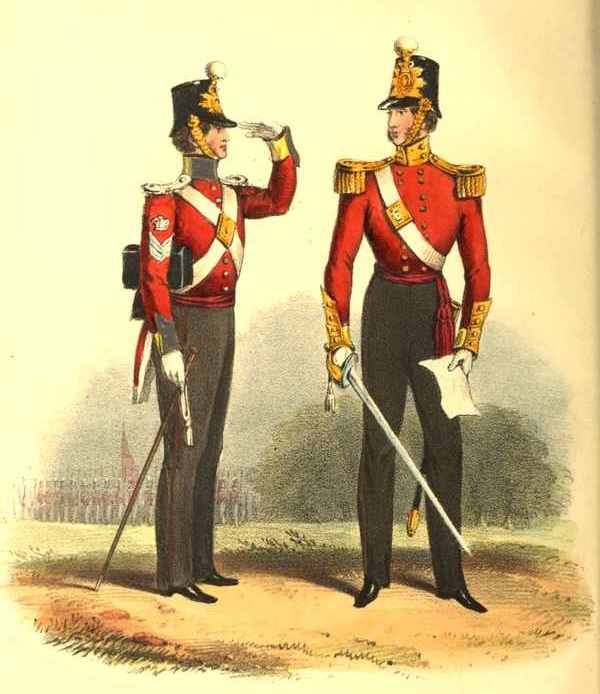
several regiments. At this period the costume of the
Twelfth foot was—cocked hats, bound with white
lace, scarlet coats faced and lined with yellow, and ornamented
with white lace; scarlet waistcoats and breeches,
and white gaiters. The first, or Kings colour, was
the great union; the second, or regimental colour, was
of yellow silk, in the centre XII. in gold characters,
within a wreath of roses and thistles on the same stalk,
and the union in the upper canton.
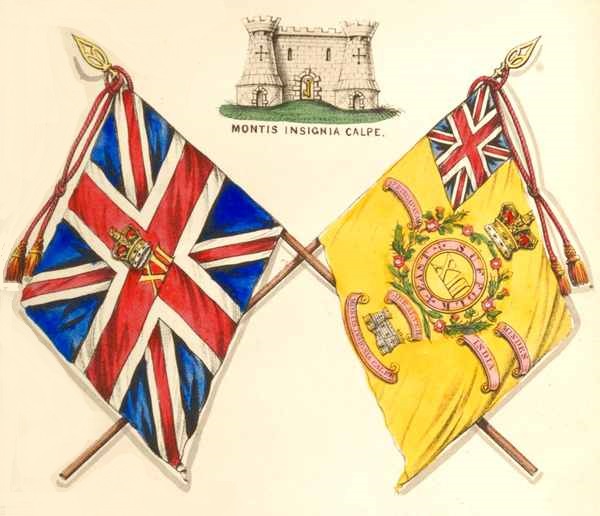
MONTIS INSIGNIA CALPE.
TWELFTH
REGIMENT OF FOOT.
1752
Towards the end of the year 1751 the Twelfth
were relieved from duty at Minorca by the fifty-first
regiment, and returned to England, where they arrived
in the beginning of 1752.
1755
1756
1757
The progress of colonization in North America involved
Great Britain in disputes with the French
government respecting the country near the river
Ohio, which occasioned the commencement of the Seven
Years' War, in 1756. The establishment of the
Twelfth regiment was augmented on this occasion;
and in 1757 it consisted of two battalions.
General Skelton died on the 9th of April, 1757, and
King George II. conferred the colonelcy of the
Twelfth foot on Major-General Robert Napier, from
the fifty-first regiment.
1758
In 1758 the second battalion of the Twelfth foot
was constituted the sixty-fifth regiment, under the
command of Colonel Armiger, from captain and lieut.-colonel
of the first foot guards.[9]
Meanwhile the war, which commenced in America,
had extended to Hanover, and the electorate was overrun
by the armies of France. A body of Hanoverian,
Hessian, and Brunswick troops, commanded by Prince
Ferdinand of Brunswick, opposed the forces of the
enemy, and in the summer of 1758, the Twelfth
regiment, after encamping a short time in the Isle of
Wight, was ordered to proceed to Germany to join the
allied army. The regiment arrived at Embden on the
1st of August, landed a few miles above the town on
the 3rd, and on the 5th commenced its march to join the
army, which it accomplished in twelve days, and was reviewed
on the 20th of that month by Prince Ferdinand.
During the remainder of the campaign, the regiment
was actively employed, and performed many
fatiguing services. Towards the end of November it
marched into quarters in Munster, a city situate in a
fruitful and agreeable country on the river Aa.
1759
Operations were commenced early in the spring of
1759, and the allies gained some advantage; but when
the French forces were assembled, they possessed so
great a superiority in numbers, that Prince Ferdinand
was obliged to fall back as the enemy advanced. A
series of retrograde movements brought the allied
army to the vicinity of Minden, situate on the bank of
the river Weser, in Westphalia.
The French army, commanded by Marshal de Contades,
took possession of Minden, and occupied a strong
position near that city.
Prince Ferdinand of Brunswick manœuvred: he detached
one body of troops under his nephew, the
Hereditary Prince of Brunswick, and appeared to
leave another exposed to the attack of the whole of
the opposing army. The destruction of this corps was
resolved upon by the French commander, and he put
his army in motion for that purpose, during the night
between the 31st of July and the 1st of August. While
the French were on the march, Prince Ferdinand advanced
with the allied army, and early on the morning
of the 1st of August, as the leading column of the
enemy attained the summit of an eminence, it was surprised
at discovering, instead of a few weak corps, the
allied army formed in order of battle. Thus the
French marshal suddenly found himself committed, and
under the necessity of fighting upon unfavourable
ground. After some delay he formed line, and the
battle commenced.
The Twelfth, commanded by Lieut.-Colonel William
Robinson, with the twenty-third and thirty-seventh
British regiments, followed by the twentieth,
twenty-fifth, and fifty-first, under Major-General
Waldegrave and Major-General Kingsley, flanked by
two battalions of Hanoverian foot guards, and the Hanoverian
regiment of Hardenberg, and supported by
three regiments of Hanoverians and a battalion of
Hessian foot guards, advanced to attack the left wing
of the French army, where Marshal de Contades had
posted the élite of his cavalry, the carabineers and
gendarmes. The Twelfth, twenty-third, and thirty-seventh,
led the attack with signal intrepidity: as they
moved forward in firm array, the enemy's artillery
opened a tremendous fire, which rent chasms in the
ranks, and the French carabineers advanced to charge
them; but a rolling volley from the three British regiments
smote the hostile squadrons, when many men
fell, and the survivors reined up their horses, wheeled
about, and galloped to the rear; their artillery recommencing
its fire as the repulsed squadrons withdrew.
The Hanoverian brigade came up on the left
of the Twelfth, twenty-third, and thirty-seventh,
and the other three British regiments on the right.
Soon, another line of French cavaliers, gay in splendid
uniforms, and formidable in numbers, came forward,
the soldiers shouting and waving their swords; but
they were struck in mid-onset by a tempest of bullets
from the British regiments, broken, and driven back
with severe loss. Still pressing forward with a conquering
violence, the three brigades became exposed
to the fire of the enemy's infantry on their flanks; but
nothing could stop them: encouraged by success, and
confident in their own prowess, they followed up their
advantage, routed the whole of the French cavalry, and
drove it from the field.[10] Two brigades of French
infantry endeavoured to stem the torrent of battle; but
they were quickly broken and dispersed.[11] A body of
Saxon troops made a show of coming down upon the
conquering British regiments, but they were soon put
to flight, and the triumphant English continued their
splendid career, overpowering all opposition.
The action commenced between six and seven o'clock
in the morning; about nine the enemy began to give
way; a general confusion followed; and at ten o'clock
the whole French army fled in disorder, with the loss of
forty-three pieces of cannon, ten stand of colours, and
seven standards.
The Twelfth regiment had Lieutenants William
Falkingham, Henry Probyn, and George Townsend,
four serjeants, one drummer, and seventy-seven rank
and file killed; Lieut.-Colonel William Robinson,
Captains Mathias Murray, William Cloudesley, and
Peter Campbell, Captain-Lieutenant Peter Dunbar;
Lieutenants Thomas Fletcher, William Barlow,
Thomas Lawless, Edward Freeman, John Campbell,
and George Rose; Ensigns John Forbes, David
Parkill, and John Kay, eleven serjeants, four drummers,
and one hundred and seventy-five rank and file
wounded; Captains Peter Chalbert, and Robert Ackland,
and eleven rank and file missing.
The Twelfth regiment was thanked in orders, in
common with the other British regiments, on the following
day; and its distinguished conduct on this occasion
was afterwards honoured with the King's authority to
bear the word "Minden" on its colours and appointments
in commemoration of its gallantry.[12]
Minden was taken possession of on the following
day, and the French army was forced to make a precipitate
retreat to a distance of about two hundred
miles. The allies followed the retiring enemy with
great energy, ascending precipices, passing morasses,
overcoming numerous difficulties, and pressing upon
and attacking the retreating army, with so much resolution,
that several French corps were nearly annihilated,
and many prisoners, with a great quantity of
baggage, were captured. The Twelfth foot shared in
the hazards, toils and conflicts of this brilliant success,
and when the weather became too severe for the troops
to remain in the field, the regiment went into cantonments
in the bishopric of Osnaburg in Westphalia.
1760
The regiment left its quarters on the 5th of May,
1760, to take the field, and on the 12th of that month
it arrived in the vicinity of Paderborn; it was joined
by a numerous body of recruits from England, to replace
the losses of the preceding campaign.
A hundred thousand French troops took the field
under the Duke of Broglio, with a separate corps under
the Count de St. Germain, and so far outnumbered the
allied army, that the latter was obliged to act on the
defensive. The Twelfth took part in numerous
operations. Towards the end of May they were encamped
on the heights near Fritzlar; in July they proceeded
to the vicinity of Saxenhausen, from whence
they retreated towards Cassel, and encamped near Kalle.
Upwards of thirty thousand French troops crossed
the river Dymel, and took post near Warbourg, to
cut off the communication of the allies with Westphalia,
when Prince Ferdinand of Brunswick quitted
the camp at Kalle, and crossed the river to attack
this portion of the French army. The battle commenced
on the morning of the 31st of July, at which
time the Twelfth, and other British infantry
corps, were several miles from the scene of conflict.
The soldiers hurried forward to share in the action
with extraordinary zeal: it was a hot summer's day;
they had a rugged country to traverse, morasses to
pass, and numerous difficulties to overcome, and they
exerted themselves with so much energy, that several
men dropped on the road;[13] but before they arrived at
Warbourg, the French troops had retreated across the
river.
During the remainder of the campaign, the regiment
was employed upon the Dymel; and the allied
army, by secret and expeditious movements, by daring
and rapid advances, and by sudden and unexpected
attacks, kept the enemy in constant alarm. In the
winter, the regiment went into quarters in the bishopric
of Paderborn.
1761
The enemy having amassed immense magazines in
the country of Hesse, and on the Lower Rhine, the
allied army made a sudden advance into the enemy's
cantonments, in February, 1761, captured several
strong towns, and seized on numerous stores of provision.
The Twelfth shared in this enterprise,
advancing through a deep snow, and taking part
in several important captures: when this service was
performed, they retired to their former quarters.
In June, 1761, the regiment again took the field,
and was employed in several operations; it was formed
in brigade with the fifth, twenty-fourth, and thirty-seventh
regiments, under the command of Brigadier-General
Sandford, and was posted in the Marquis of
Granby's division. After several harassing marches,
the regiment was stationed in front of the village of
Kirch Denkern, and near to Vellinghausen, in the
bishopric of Paderborn. The French, commanded by
Marshals Soubise and the Duke of Broglio, attacked
this post on the 15th of July; but the ground was
maintained with firmness and resolution by the British
infantry, and the enemy was repulsed with loss. The
fire of the skirmishers was continued during the night,
and on the following day the attack was repeated
with fresh troops, when the Twelfth evinced great
gallantry in the defence of the position. After five
hours' sharp fighting, some disorder appeared in the
enemy's ranks, when the brigade charged and routed
the opposing battalions with great slaughter. The
loss of the regiment, on this occasion, was limited to
three private soldiers killed, and nine wounded.
The Twelfth were stationed near Kirch Denkern
until the 27th of July: they were subsequently
employed in manœuvring and skirmishing in various
parts of the bishopric of Paderborn and on the
river Weser, and in September they were employed in
the country of Hesse. They were engaged in several
skirmishes in the electorate of Hanover in the early
part of November; and were subsequently quartered
for several months in the bishopric of Osnaburg.
1762
The regiment left its cantonments in Osnaburg in
the spring of 1762, and was formed in brigade with
the same regiments as in the preceding year. It was
engaged, on the 24th of June, in the surprise of the
French army encamped at Groebenstein: on the morning
of that day it was in motion at an early hour,
crossed the river Dymel at Liebenau at four o'clock,
and advancing several miles through a woody country,
arrived in front of the enemy's camp. The French
were surprised and confounded; they abandoned their
camp, leaving their tents standing, and retreated
towards Cassel; one division, under General Stainville,
throwing itself into the woods of Wilhelmsthal, to
cover the movement. This division was attacked,
and nearly annihilated; and after the loss of many men
killed and wounded, the remainder surrendered to the
fifth foot, which was the leading regiment of the brigade
to which the Twelfth belonged.
After the action, the regiment encamped on the
heights of Wilhelmsthal; it was subsequently employed
in various operations; and on the 23rd of July
its grenadier company took part in driving the Saxons,
under Prince Xavier, from their post at Lutterberg,
and in the capture of thirteen pieces of cannon.
On the 24th of July a hundred men of the Twelfth
foot were engaged in dislodging a detachment of the
enemy from the heights of Homburg. The regiment was
afterwards employed in operations on the rivers Ohm
and Lahn, and in covering the siege of Cassel, which
fortress surrendered in the beginning of November.
A suspension of hostilities took place soon after the
surrender of Cassel, which was followed by a treaty
of peace, concluded at Fontainbleau: the regiment
was quartered in the bishopric of Munster about ten
weeks.
1763
In the beginning of 1763, the thanks of Parliament
were communicated to the army for its conduct during
the war. In February, the regiment marched through
Holland to Williamstadt, where it embarked for England:
its effective strength, according to the embarkation
return, was twenty-seven officers, six hundred
and eighty-nine non-commissioned officers and soldiers.
1764
1765
1766
On arriving in England, from Germany, the Twelfth
were ordered to proceed to Scotland, where they were
stationed during the following three years.
Lieut.-General Napier died in November, 1766,
when King George III. conferred the command of the
regiment on Colonel Henry Clinton, from captain and
lieut.-colonel in the first foot guards.
1767
1769
In 1767, the Twelfth were stationed in England;
and in 1769, they proceeded to Gibraltar, to relieve
the twentieth regiment on garrison duty at that
fortress.
1775
1778
1779
The American war commenced in 1775, and the
colonel of the regiment, Lieut.-General Sir Henry
Clinton, distinguished himself in that country: in
December, 1778, he was appointed colonel of the
eighty-fourth regiment, or Royal Highland emigrants,
then first embodied for service in North America, and
afterwards disbanded. The Colonelcy of the Twelfth
foot remained vacant until the 21st of April, 1779,
when it was conferred on Colonel William Picton,
from the seventy-fifth regiment; a newly-raised corps,
which was disbanded at the peace in 1782-3.
The Twelfth regiment remained at Gibraltar.
The possession of this fortress by the English, with a
British garrison on the top of the rocky promontory
overlooking the provinces of Spain, had been regarded
by the Spaniards with great jealousy: every attempt
to retake it had failed. Great Britain attached much
importance to the possession of it; but the contest
between the revolted provinces in North America and
England appeared to present to the Spanish monarch
a favourable opportunity for regaining possession of
this valuable fortress. When the French monarch
acknowledged the independence of the United States,
and commenced hostilities against Britain, the time
appeared particularly favourable for another effort
to recapture Gibraltar, and in the summer of 1779,
that fortress was beset, by sea and land, by the Spanish
fleets and armies.
The garrison consisted of the Twelfth, thirty-ninth,
fifty-sixth, fifty-eighth, and (late) seventy-second
British, with the Hanoverian regiments of Hardenberg,
Reden, and De la Motte, and a proportion of artillery
and engineers. The Twelfth mustered twenty-nine
officers, twenty-nine serjeants, twenty-two drummers,
and five hundred and nineteen rank and file, under
the command of Lieut.-Colonel Trigge: the garrison
mustered five thousand three hundred and eighty-two
men, under the orders of General Eliott, afterwards
Lord Heathfield.[14]
Being blockaded by sea and besieged by land, the
troops at Gibraltar became cut off from communication
with all countries, and the garrison was like a little
world within itself. The arrangements for the defence
were devised with judgment, and executed with skill.
The soldiers conformed to the strict rules which their
circumstances rendered necessary, and severe exercise
and short diet became habitual to them; at the
same time the extensive preparations of the enemy,
the great importance of the fortress, and the determined
character of General Eliott and his garrison,
occasioned this siege to become a subject of universal
interest, and the eyes of all Europe were directed
towards Gibraltar, watching the result of the contest.
As the enemy's works progressed, the pavement of
the streets was taken up, the towers of conspicuous
buildings were pulled down, the guard-houses unroofed,
the stone sentry-boxes removed, traverses raised,
a covered way begun, and every measure adopted to
prevent the bombardment of the place being attended
with serious results.
1780
Early in 1780 provisions became short, and the
soldiers cheerfully submitted to privation; but soon
afterwards the garrison was relieved by a fleet from
England: the wants of the troops were, however, not
supplied in many important articles.
1781
The Spaniards renewed the blockade by sea, and
sent nine fire-ships into the harbour, but failed in the
attempt to destroy the shipping. Provisions soon became
deficient again; vegetables were cultivated on
the rock with some success; a precarious supply of
several articles was obtained from the Moors, and in
April, 1781, the garrison was again relieved.
The siege was continued, and a severe bombardment
reduced a great part of the town to a heap of ruins.
General Eliott deliberately watched the progress of
the enemy, and kept his garrison close within the fortress,
until a favourable opportunity presented itself
for a sally, when the following 'Evening garrison order'
was issued, dated November 26, 1781: 'Countersign,
Steady.—All the grenadiers and light infantry in
the garrison, and all the men of the Twelfth and
Hardenberg's regiments, with the officers and non-commissioned
officers on duty, to be immediately relieved
and join their regiments, to form a detachment,
consisting of the Twelfth and Hardenberg's
regiments complete; the grenadiers and light infantry
of all the other regiments; one captain, three lieutenants,
ten non-commissioned officers and a hundred
artillery; three engineers, seven officers, ten non-commissioned
officers, overseers, with a hundred and sixty
workmen from the line, and forty workmen from the
artificer corps; each man to have thirty-six rounds of
ammunition, with a good flint in his piece, and another
in his pocket; the whole to be commanded by Brigadier-General
Ross, and to assemble on the red sands,
at twelve o'clock this night, to make a sortie upon
the enemy's batteries. The thirty-ninth and fifty-eighth
regiments to parade at the same hour, on the
grand parade, under the command of Brigadier-General
Picton, to sustain the sortie if necessary.'
The Twelfth appeared on parade at the appointed
hour, and mustered twenty-six officers, twenty-eight
serjeants, two drummers, and four hundred and thirty
rank and file, ready to engage in this enterprise. It
was the hour of midnight; the moon shone brightly, and
all was still in the enemy's camp. The soldiers waited
two hours, when the moon set, darkness overspread the
sky, and they issued silently from the fortress. The
Spanish regiments were asleep in the camp; their
guards at the batteries were also reposing, when suddenly
the sound of a trampling multitude was heard
approaching them; their sentries called, and receiving
no answer, fired their muskets and hurried to the guards.
They were followed by the British at a running pace;
the guards were surprised, the batteries captured, and
two Spanish officers, with sixteen soldiers, were made
prisoners; the Spanish guards were astounded by the
suddenness of the onset in the dark; they hurried to
their lines, communicating a panic to the troops in their
rear. The British instantly commenced the work of
destruction. 'The batteries (constructed of wood upon
the sands) were soon in a state for the fire-faggots to
operate, and the flame spread with astonishing rapidity
into every part. The column of fire and smoke which
rolled from the works, beautifully illuminated the
troops and neighbouring objects, forming altogether a
coup-d'œil not possible to be described.'[15]
In one hour the object of the sortie was fully effected;
the Spaniards, being dismayed, did not venture to interrupt
the work; and trains being laid to the enemy's
magazines, the Twelfth, and other troops which had
made the sally, retired; as they entered the fortress,
tremendous explosions shook the ground like the shocks
of an earthquake, accompanied by rising volumes of
smoke, flame, and burning timber, which proclaimed
the destruction of the enemy's immense stores of gunpowder.
Thus was completed, with success beyond the expectations
of every one, an enterprise of the greatest magnitude;
and General Eliott declared in orders, 'the
bravery and conduct of the whole detachment, officers,
soldiers, and sailors, on this glorious occasion, surpassed
his utmost expectation.' The loss of the
Twelfth regiment was limited to Lieutenant Tweedie
and four private soldiers wounded: the total loss of
the garrison was four soldiers killed, one officer and
twenty-four soldiers wounded, one man missing.[16]
For several days the Spaniards appeared confounded
at their disgrace; the smoke of the burning
batteries continued to rise, and no attempt was made
to extinguish the flames; but several executions took
place in their camp, probably of persons who fled so
precipitately from the batteries. In the beginning of
December they began to arouse themselves, and a thousand
workmen commenced labouring to restore the batteries,
in which they were retarded by the fire of the
garrison.
The Spaniards, by their heavy fire on the fortress,
had already spoiled three sets of guns; but the court
of Madrid appeared bent on capturing Gibraltar. An
immense quantity of ordnance of larger calibre was
provided, numerous batteries were prepared, and the
Duke of Crillon assumed the command of the besieging
army. He was assisted by a celebrated French engineer,
Monsieur d'Arcon, and by Admiral Moreno, and
a French army arrived to take part in the siege. At
the same time stupendous preparations were made on
a new principle, and floating batteries were constructed
with great art and labour, and were accounted the most
perfect contrivance of the kind ever seen.
1782
A crisis was evidently approaching, and in the spring
and summer of 1782, the garrison of Gibraltar made
preparations with cool determination for the hour of
trial: the officers and soldiers appeared to be impressed
with their peculiar situation; an important fortress was
confided to their protection; they had defended it
against the efforts of the Spanish army and navy upwards
of two years; and the eyes of all Europe were
directed towards them. The damaged works were
carefully repaired, new ones were constructed, extensive
subterraneous works were prepared, and forges for
heating red-hot shot were got ready; every serjeant,
drummer, musician, and officer's servant, as well as the
corporals and private soldiers, used a shovel, pickaxe,
or musket, according as their services were required.
The effect of the red-hot shot was proved on some of
the enemy's wooden batteries on the sands, which were
speedily destroyed.
The Duke of Crillon anticipated the most signal
success from the extensive preparations he was making;
his camp was visited by princes of the royal blood of
France, by Spanish nobility, and other dignified characters
of Europe, who came to be spectators of the
fall of the fortress under the heavy fire of artillery
which was about to be opened upon it. The new batteries
on shore were unmasked, and fired a volley of
sixty shells, which was followed by the thunder of one
hundred and seventy guns of large calibre. Thus was
Gibraltar assailed by a storm of iron, which threatened
to reduce the fortress to a heap of ruins, and this was
only a prelude to the tremendous fire which was afterwards
opened upon the garrison.
On the 13th of September, the ten battering ships
took their station before the fortress, in the presence of
the combined fleets of France and Spain: the enemy's
camp and neighbouring hills were crowded with spectators
from various parts of Europe, to witness the effect
of these stupendous vessels, and such a storm of war
was opened upon the garrison, as was probably never
heard before since the invention of cannon. The batteries
of the fortress answered this tremendous fire with
vigour, and the deafening thunder of four hundred
pieces of heavy artillery was heard for many miles.
For some hours the attack and defence were so equally
well supported, as scarcely to admit any appearance
of superiority in the cannonade on either side. The
wonderful construction of the battering ships seemed
to bid defiance to the heaviest ordnance; shells rebounded
from their tops, and a thirty-two pound shot
scarcely seemed to make any impression on them. The
effect of the red-hot shot was doubted; sometimes
smoke came from the ships, but the fire-engines within
soon occasioned it to cease, and the result was uncertain;
the fire was, however, persevered in, and incessant
showers of red-hot bullets, shells, and carcases flew
through the air. In the afternoon the effects of the red-hot
shot became apparent, and volumes of smoke
issued from the flag-ship; the Admiral's second ship
was perceived to be in the same condition, and confusion
prevailed. The Spaniards expected that the
firing of red-hot bullets could not be persevered in
beyond a few rounds; but the fire was continued with
the same precision and vivacity as cold shot. The
effects of the hot balls occasioned the enemy's cannonade
to abate, and about eight o'clock it almost totally
ceased. The battering ships made signals to inform the
combined fleets of their extreme danger and distress,
and several boats were sent to their aid. At this
period the fire of the garrison produced great carnage,
and the most pitiable cries and groans were heard, as
the incessant showers of shot and shells were poured
into the floating batteries. Soon after midnight one
ship was in flames, and by two o'clock she appeared one
sheet of fire from head to stern; a second was soon in
the same state; the flames enabled the British artillery
to point their guns with precision, and soon after three
o'clock six more ships exhibited the effects of the red-hot
shot. The burning ships exhibited one of the
grandest spectacles of destruction ever beheld; and
amidst this dreadful scene of conflagration, the British
seamen in boats were seen endeavouring to rescue the
Spaniards from the blazing ships. They preserved
between three and four hundred; and while they were
thus engaged, one of the ships blew up with a dreadful
explosion; four others met the same fate before seven
o'clock, and another shortly afterwards, and the remainder
burnt to the water's edge, their magazines
having been inundated; not one could be preserved as
a trophy.
Thus did the mighty efforts of France and Spain end
in defeat and destruction, and the gallant efforts of the
brave soldiers who defended Gibraltar elicited the admiration
of the nations in Europe. In England the
most enthusiastic applause was universal; illuminations
and other modes of testifying the joy of the people
followed the receipt of the news of the destruction of
the boasted invincible battering ships, and every family
which could boast a defender of Gibraltar belonging to
it, was proud of the honour. The loss of the garrison,
on the 13th and 14th of September, was limited to one
officer, two serjeants, and thirteen private soldiers
killed; five officers and sixty-three rank and file wounded;
that of the enemy exceeded two thousand officers
and soldiers.
Although the enemy gave up all hopes of reducing
Gibraltar by force of arms, yet some expectation was
entertained, that, if the blockade were continued, the
garrison might be forced to surrender from the want of
provisions; the combined fleet therefore remained in
the bay, the besieging army continued in the lines, and
about a thousand shots were fired every day from the
Spanish batteries. The garrison was encouraged to
continue resolute in the defence of the fortress by
assurances of their Sovereign's favour and high approbation.
The principal Secretary of State, writing to
General Eliott, stated,—'I am honored with His
Majesty's commands to assure you, in the strongest
terms, that no encouragement shall be wanting to the
brave officers and soldiers under your command; his
royal approbation of the past will, no doubt, be a
powerful incentive to future exertions, and I have the
King's authority to assure you, that every distinguished
act of emulation and gallantry, which shall be
performed in the course of the siege, by any, even of
the lowest rank, will meet with ample reward from
his gracious protection and favour.'
1783
In October, the combined fleet was much damaged
by a storm; and soon afterwards a British naval force
arrived, and the garrison was again relieved; when
two regiments, the twenty-fifth and fifty-ninth, landed
to take part in the defence of the fortress.
After the garrison was thus relieved and reinforced
a third time, the Court of Madrid gave up all hopes
of gaining possession of Gibraltar either by force or
stratagem: negociations ensued, and in February, 1783,
the Spanish army decamped; the preliminary articles
for a treaty of peace having been signed in the preceding
month. Thus ended the siege of "Gibraltar,"
which is celebrated in the military annals of the
eighteenth century, and the successful defence of that
fortress, ranks among the noblest efforts of the British
arms: it exceeded in duration the famous siege of
Ostend, in the beginning of the seventeenth century.[17]
The Twelfth regiment of foot was rewarded, with
the other corps which took part in this long and arduous
service, with the thanks of its Sovereign, and of
the Houses of Parliament, and with the honour of bearing
on its colours the word 'Gibraltar,' with the
'Castle and Key,' and the motto 'Montis Insignia Calpé,'
in commemoration of its services during the siege.[18]
The loss of the regiment during the siege of Gibraltar
was—
| | | | |
| Officers. | Serjeants. | Drummers. | Rank and
File. |
| | | | |
| Killed | 1 | 3 | 1 | 13 |
| Died of Wounds | .. | .. | .. | 10 |
| Disabled by Wounds | 1 | .. | .. | 10 |
| Wounded, that recovered | 2 | 4 | 7 | 89 |
| Died of Diseases | .. | 3 | .. | 32 |
| | | | | |
| | | | | |
| Total | 4 | 10 | 8 | 154 |
| | | | | |
During the period the Twelfth were engaged in
the glorious defence of Gibraltar, county-titles were
given to the several regiments of infantry, and the
communication with England having become free, the
Twelfth received directions to assume the title of
the 'East Suffolk Regiment,' and to cultivate a
connection with that part of the country, in order to
facilitate the recruiting of the regiment.
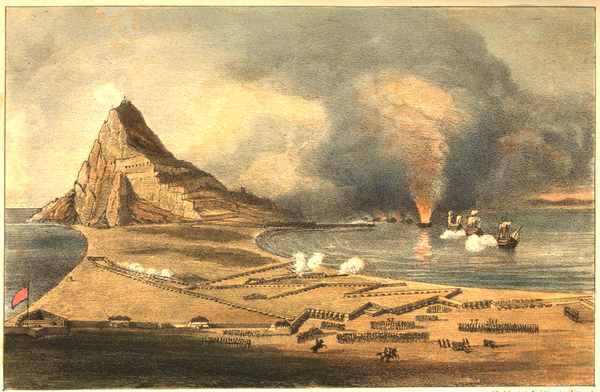
J. M. Jopling delt.
Madeley Lith. 3 Wellington St Strand.
TWELFTH REGIMENT OF FOOT.
VIEW OF THE NORTH PART OF GIBRALTAR, AND OF THE ATTACK
BY LAND AND SEA SEPTR 13TH & 14TH 1782
For Cannons Military Records
In November, the Twelfth were relieved from
duty at the fortress of Gibraltar, which they had so
gallantly defended, and returned to England; they
landed at Portsmouth, from whence they proceeded to
Hilsea barracks, and in December, they marched to
Windsor.
1784
King George III. was highly gratified at having a
corps, which had distinguished itself during the memorable
siege of Gibraltar, employed near his person,
and on the 1st and 8th of June, 1784, His Majesty
reviewed the Twelfth regiment in Windsor Park, in
the presence of the Royal Family, and many distinguished
personages, and expressed, in very gracious
terms, his high approbation of its appearance and
discipline, and of its conduct during the siege of
Gibraltar.
The regiment remained at Windsor on the King's
duty until November, when it proceeded to Chatham.
1785
1786
1787
1788
During the years 1785, 1786, and 1787, the regiment
was stationed successively at Newcastle, Tynemouth,
Sunderland, Musselburgh, Ayr, Edinburgh, and Plymouth;
on the 10th of January, 1788, it was reviewed
by His Royal Highness the Prince of Wales, afterwards
King George IV., who was then in the seventeenth year
of his age, and his person and accomplishments excited
the admiration of all who beheld him. In a few days
after the review, the regiment proceeded to the islands
of Jersey and Guernsey.
1790
The Twelfth were relieved from duty at Jersey
and Guernsey in March, 1790, and sailed to Portsmouth.
Two months afterwards, orders were received
for the regiment to serve on board the fleet as
marines, and in the middle of June it embarked on
board of His Majesty's ships 'Barfleur,' 'Carnatic,'
'Bellona,' 'Impregnable,' 'Magnificent,' and 'Edgar';
at the same time the staff officers, musicians, and
a few soldiers who were not employed on this service,
proceeded to Hilsea barracks.
After six months' service as marines the companies
landed and joined the head-quarters at Hilsea barracks;
towards the end of December the whole embarked for
Ireland.
1791
1792
1793
The regiment landed near Cork on the 5th of January,
1791, and marched to Kinsale; in the summer of
1792, it proceeded to Dublin, from whence it was
removed in March, 1793, to Drogheda.
In the meantime a revolution had taken place in
France; men of violent republican principles had
seized on the reins of government, beheaded their
Sovereign, and involved Europe in another war. The
pernicious doctrines of liberty and equality had been
disseminated in the French West India Islands, and
the European planters had solicited the protection of
the British arms against the fury of the mulattoes and
negroes. War was commenced to arrest the tyrannical
proceedings of aggression pursued by the French
republic;—a British army was sent to Flanders under
His Royal Highness the Duke of York; additional
forces were sent to the West Indies, and in November
the flank companies of the Twelfth foot, commanded
by Captains Tweedie and Perryn, Lieutenants Mathews,
Leister, Leister junior, and O'Brien, embarked for
the West Indies.
1794
The deliverance of the French West India Islands
from republican domination, was undertaken in January,
1794; the flank companies of the Twelfth
joined the expedition under General Sir Charles Grey,
K. B. (afterwards Earl Grey), at Barbadoes, and
were engaged in the attack of Martinico. A landing
was effected at three different points in the early part
of February, and after some sharp fighting, in which the
companies of the Twelfth signalized themselves,
particularly the grenadier company, forming part of
the brigade commanded by Prince Edward (afterwards
Duke of Kent), which captured Fort Royal by escalade
on the 17th of March, and carried Morne Tartisson
by storm, the island was captured. In his
despatch, Sir Charles Grey stated,—'All the officers
and soldiers of this little army merit the greatest
praise.' The loss of the Twelfth foot was limited
to a few private soldiers killed and wounded.
From Martinico the flank companies of the Twelfth
sailed with the expedition against St. Lucia, where the
troops arrived on the 1st of April, and the companies of
the Twelfth took part in the reduction of that island,
which was accomplished in three days without loss.
The flank companies were afterwards engaged in
the capture of Guadaloupe and its dependencies, in
which service they lost several men. The rapid success
with which the British empire was thus extended, by
the addition of three valuable islands and their dependencies,
excited great admiration; and Sir Charles
Grey stated in his despatch, that he 'could not find
words to convey an adequate idea, or to express the
high sense he entertained, of the extraordinary merit
evinced by the officers and soldiers in this service.'
While the flank companies were engaged in the
capture of the French West India Islands, the regiment
was withdrawn from Ireland to reinforce the troops
under the Duke of York in Flanders; it embarked
from Drogheda on the 7th of March, landed at Parkgate
on the 14th, re-embarked at Greenwich on the
1st of May, and landed at Ostend on the 6th of that
month.
On arriving at the seat of war, the regiment was
ordered to join the corps under the Austrian General
Count Clerfait, who commanded the troops in West
Flanders, and it was attached to the division under
Major-General Hammerstein, together with the thirty-eighth
and fifty-fifth regiments, and the eighth light
dragoons.
The Twelfth regiment, commanded by Major
Frederick Bowes, consisting of eight hundred and
fifteen rank and file, took part in numerous operations,
and was engaged in the general attack on the French
positions on the 17th and 18th of May. On the latter
day, the Twelfth were engaged in driving the enemy
from Werwick, and in forcing the passage of the river
Lys, on which occasion they highly distinguished themselves;
but the operations on the above two days were
not successful, from the want of a more perfect combination
in the movements of the several divisions, and
from the superior numbers of the enemy.
In division orders, dated Camp near Tournay, 20th
May, 1794, Major-General Whyte stated 'he had
great pleasure in informing the British troops, that
General Count Clerfait has highly approved of their
spirited conduct in the field, and great exertions in
going through such excessive fatigues, as they necessarily
have had since their first movement from
Ostend. Major-General Whyte laments the loss sustained
by the eighth light dragoons, whose spirited
and distinguished gallantry, led on by Lieut.-Colonel
Hart, has gained them the highest honour; and he
desires his thanks may be accepted by the commanding
officers, and all the officers and men of the thirty-eighth
and fifty-fifth regiments; and also by Major
Bowes and the officers and men of the Twelfth regiment,
whose conduct has been highly approved of by
Major-General Hammerstein, under whose immediate
command they served. To Lieut.-Colonel Hart,
who led on the squadron of the eighth light dragoons
to the attack at Rousbeck, his best and distinguished
thanks are due; and also to Lieut.-Colonel
M'Donald, who led on the fifty-fifth regiment to
support the attack on the front. He is perfectly convinced
the same praise would have been due to Lieut.-Colonel
Pitcairn of the thirty-eighth, had they been
called into action.'
The Twelfth foot continued to serve under General
Count Clerfait, and when the French besieged Ypres,
with thirty thousand men, with a covering army of
twenty-five thousand, the regiment was engaged in
the attempt to relieve that fortress. The Austrian
advance-guard was repulsed at Olglede on the 7th of
June; but the French were defeated in their attempt
on Rouselaer. Still entertaining hopes of being able
to raise the siege, Count Clerfait attacked the French
again on the 13th of June, at Hoogledge, and Major-General
Hammerstein engaged a body of the enemy, of
very superior numbers, at Kootmarke, and was repulsed.
He afterwards retreated to Bruges, detaching
the eighth light dragoons, and thirty-eighth
and fifty-fifth foot to Ostend.
The very superior numbers of the enemy gave them
so great an advantage, that the allied army was forced
to commence retrograde movements. The Twelfth
foot remained with Major-General Hammerstein's division
until the 9th of July, when the following paragraph
appeared in the division orders issued at the
camp at Contiche,—'As the Twelfth British regiment
is going to leave Major-General Hammerstein's
brigade, he takes this opportunity to assure the regiment
of his best acknowledgments for the good and
gallant behaviour it has shown during the time the
general has had the honour to command it; he likewise
thanks it for the readiness and good will with
which it has borne so many and great fatigues.'
On its removal from Major-General Hammerstein's
command, the regiment was formed in brigade with
the thirty-third, forty-second, and forty-fourth foot,
under Major-General Balfour. In August it was in
position near Breda, and in the beginning of September
retired to the vicinity of Bois-le-duc.
In the middle of September the enemy advanced in
great force, and attacked all the British posts on the
right; the outpost at Boxtel, being most advanced,
was forced, and the troops of Hesse D'Armstadt, who
occupied it, sustained a severe loss. The post, occupied
by a detachment of the Twelfth regiment, was environed
and assailed by very superior numbers; it was
defended with great gallantry for a short time, but the
soldiers were unable to withstand so overwhelming a
force as that by which they were assailed. The regiment
had a few soldiers killed and wounded, and Lieutenant
Eustace, three serjeants, one drummer, and
forty-four rank and file taken prisoners. The British
troops afterwards retired beyond the river Maese.
In the meantime, the flank companies had been engaged
in the defence of the island of Guadaloupe, where
about two thousand French troops had arrived from
Europe, and being joined by a multitude of mulattoes
and blacks, among whom the doctrines of liberty and
equality were disseminated, they gained possession of
part of the island, and frightful outrages were perpetrated.
The companies of the Twelfth were engaged
in an attempt to regain possession of Grand-Terre;
but the troops employed in this service were not sufficiently
numerous. The Twelfth had Lieutenant
John Leister and several soldiers killed, and others
wounded.
The companies of the Twelfth were employed in
the defence of Guadaloupe under great disadvantages,
and they were nearly annihilated. The island was
given up in October, and the few remaining officers
and soldiers proceeded to St. Domingo.
Meanwhile the Twelfth regiment, serving under
the Duke of York, in Holland, was exposed to much
suffering and privation. The Dutch, having imbibed
the revolutionary doctrines of equality, beheld the advance
of the French without alarm, and surrendered
their fortresses without much resistance. The British
troops had no chance of ultimate success, yet they held
their positions with firmness, and they did not fail to
impress the enemy with a just idea of British valour.
The Twelfth were in position near Nimeguen in
September, and afterwards attempted to defend the
passage of the Waal.
1795
During the winter the river Waal became frozen, so
as to admit the immense masses of the enemy to pass
on the ice, and the British were obliged to retreat
through Holland to Germany. The sufferings of the
soldiers during this retrograde movement were very
great; long marches, exposed to snow-storms and
tempests, along roads choked with ice and snow, and a
deficiency of provisions, put to a severe test the
strength of the officers and soldiers. In March, 1795,
they arrived at Bremen, where the hardships they had
endured were ended. The Twelfth regiment lost so
many men during the campaign and retreat through
Holland, that its numbers were reduced from eight
hundred and fifteen to four hundred and twenty-five
rank and file.
The regiment embarked from Bremenlee on the
11th of April, landed at Gosport on the 12th of May,
and marched from thence to Portchester, where it was
joined by Lieutenant O'Brien, one serjeant, and one
private soldier from the West Indies; being the only
surviving individuals of the two fine flank companies
which proceeded to the West Indies in 1793.
Every effort was made to recruit the regiment
as speedily as possible, and on the 2nd of July, it
was reviewed by His Royal Highness the Duke
of York, who expressed his approbation of its appearance.
On the 19th of October, the regiment embarked from
Southampton, and sailed to Spithead, where it remained
a few days, and afterwards put to sea. On the
5th of October, it landed on the Isle de Dieu, in conjunction
with a small force under Major-General
Needham, and a body of French emigrants, accompanied
by the Count D'Artois, brother of the King
of France. No circumstances occurred to favour
any further attempts connected with this enterprise,
and in December the regiment left the island; it was
exposed to several violent storms at sea, but arrived
safely at Southampton in ten days, and marched from
thence to Iron-hill barracks.
1796
The regiment was stationed in the neighbourhood
of Southampton, and in the Isle of Wight, until the
8th of June, 1796, when it embarked in the 'Rockingham,'
'Hawksbury,' 'Airly castle,' and 'Melville castle'
Indiamen, under the command of Lieut.-Colonel
Henry Harvey Aston, in order to transfer its
services to the East Indies. The regiment sailed from
St. Helens on the 27th of June, and on the 19th of
September anchored in Table Bay, Cape of Good
Hope; that colony having been captured from the
Dutch a short time previously. The regiment remained
on board, but small parties landed daily for the
benefit of their health. While the Indiamen were in
Table Bay, a dreadful hurricane threatened the destruction
of every ship, and they all sustained some
injury, several losing their anchors. Serious apprehensions
were entertained for the safety of the regiment;
but providentially it did not sustain any loss, and it
sailed from the Cape of Good Hope on the 10th of November.
1797
On the 10th of January, 1797, the Indiamen anchored
in Madras roads; the regiment landed on the
following day at Fort St George, and mustered eight
hundred and seventy rank and file, whose appearance
excited admiration.
The regiment was employed on garrison duty at
Fort St. George until the middle of August, when it
embarked for Manilla, the capital of the Spanish settlements
in the Philippine Islands, situate on the
banks of a bay, at the mouth of the river Pasig, in
the island of Luconan. On the 23rd of August six
companies proceeded on the voyage; the other four
companies were embarked on board of men-of-war, and
were about to follow, when orders were received for
their disembarking, in consequence of intelligence from
the Mysore country, indicating a projected irruption
into the British territory by the celebrated Tippoo Saib.
The six companies continued the voyage, and arrived
in September at the Prince of Wales's Island, called
also Penang, or Betel Nut Island, situated off the west
coast of the Malay peninsula, from which it is separated
by a narrow strait. At this place a large fleet
was assembled, with a numerous body of troops, from
the Presidencies of Bengal, Madras, and Bombay, for
the expedition against Luconan and the other Philippine
islands; the Prince of Wales's Island having
been selected for the rendezvous of the forces to be
employed in this enterprise. The prospect of the
services of the troops being speedily required in more
important military operations on the continent of India,
occasioned orders to be issued for their immediate return.
Towards the end of September, the 'Express'
sloop arrived with despatches from Madras, and in a
few days afterwards the six companies of the Twelfth
sailed from the Prince of Wales's Island. They encountered
contrary winds, and it being found impossible
for the transports to contend against the north-west
monsoon, the Twelfth returned to the island in October.
They again sailed for Madras on the 15th of
November, and landed at Fort George on the 12th of
December; during their absence the other four companies
of the regiment had exchanged a few shots with
a French squadron, which had appeared in Madras-roads,
and succeeded in driving an Indiaman on shore
under the works of the fort.
1798
Among the various schemes of aggrandizement entertained
by the republican government of France, was
the wild and extravagant idea of being able to gain
possession of the British territory in the East Indies.
To strike an effectual blow at the naval, commercial,
and colonial greatness of the British nation, was an
object of primary consideration with the French directory,
and to excite the jealousy of the native princes of
India, and induce them to take up arms against the
English, was one of the means used to accomplish this
object. In the ruler of the fruitful province of Mysore,
the celebrated Tippoo Sultan, the French found a chieftain
eager to seize on the first opportunity for being
revenged on the British, who had punished his former
aggressions by depriving him of a considerable portion
of territory, and inflicting a fine equal to three and a half
millions sterling. This chief entered zealously into the
design to drive the English out of India, and endeavoured
to induce other princes to join in the enterprise.
After the discovery of the designs of the enemy, hostilities
were delayed some time, and the Twelfth regiment
marched for Tanjore, the capital of a well-cultivated
province in the Carnatic, where it arrived on the
1st of March, 1798.
The regiment was reviewed at Tanjore, by Major-General
Floyd, who expressed in orders to Colonel
Aston, the officers, and soldiers, 'the satisfaction he
received on inspecting the eight companies of the
Twelfth regiment of infantry at the station;' and
added—'In the masterly hands of their commanding
officer, there is every reason to expect that His
Majesty's Twelfth regiment of infantry will, whenever
called upon, be ready and disposed to renew in
the east the glories of Minden and Gibraltar.'
Preparatory to the grand enterprise of driving the
English out of India, General Bonaparte was sent with
a French army to Egypt; many French officers and
men were introduced into the army of Tippoo Sultan,
and other measures were adopted calculated to forward
the design. Under these circumstances the Governor-General
of India, Lord Mornington, deemed it necessary
to assemble a body of troops on the coast of Coromandel,
and to engage the Nizam of the Deccan to furnish an
auxiliary force. The Twelfth regiment marched from
the fortress of Tanjore, on the 22nd of July, to join the
army assembling under the orders of Lieut.-General
Harris.
1799
On the 1st of January, 1799, the regiment joined
the camp of the army advancing towards Mysore, and
negociations having failed, the troops penetrated the
territory of Tippoo Sultan in the beginning of March.
The Twelfth, seventy-fourth, and Scots brigade,
formed the first brigade of infantry under Major-General
Baird.
During the night of the 7th of March, the regiment
was employed, under Major-General Baird, in an
attempt to surprise the camp of a body of the enemy's
cavalry, but the Mysoreans obtained information of the
design and made a precipitate retreat.
On the following day, the light company of the
Twelfth, commanded by Captain Woodhall, took possession
of Neldroog without opposition.
The British advanced direct upon the capital of the
Mysore country, Seringapatam,[19] and Tippoo endeavoured
to harass the march by skirmishes, and impede the progress
of the troops by burning villages and laying waste
the country. The regiment having entered upon active
warfare, the Commanding Officer issued the following
order:—'As the Twelfth regiment, from having the
honour to be the eldest King's regiment with the
army, is more liable to be called on for immediate
service than other corps, the Commanding Officer
expects the Officers, Non-Commissioned Officers, and
Private Men, will be ready, night or day, to turn out
at the shortest notice, and to parade under arms
without noise or confusion. On all sudden alarms
the light infantry is instantly to accoutre without
waiting for orders, and to be in readiness to march
whenever their services may be required.'
On the 27th of March, as the Lascars were pitching
the tents of the army on a fine plain beyond the fort of
Malleville, they were suddenly assailed by a heavy
cannonade from an eminence in front; at the same time
the advance-piquet, under Captain McPherson of
the Twelfth regiment, was attacked by a force
of very superior numbers, but repulsed its assailants
with distinguished bravery. The army arriving on the
plain, advanced in close column of regiments towards
the eminence, upon which large bodies of Mysorean
cavalry and infantry were formed, who withdrew their
heavy guns, but annoyed the advancing columns with
rockets.
As the British columns approached the height,
they formed line, and ascended to the summit, which
was abandoned by the enemy, but a short distance
beyond the eminence appeared the army of Mysore in
order of battle. As the Twelfth moved forward, a
large body of Mysorean cavalry formed in the shape of
a wedge, having an elephant with a howdah on his back
in front, appeared advancing to charge the regiment,
and the British line halted to receive the attack. Immediately
afterwards two other very large bodies of
the enemy were discovered in two topes, or woods,
preparing to support the first charge. Lieut.-General
Harris, seeing the danger which menaced the regiment,
placed himself in its rear, frequently repeating the
words, 'Steady, Twelfth!' 'Steady, old Twelfth!' and
when the wedge approached within a hundred yards of
the line, the Mysoreans discharged their carbines and
pistols, but without doing execution. The Twelfth remained
steady, with their muskets at the recover, until
the enemy arrived within about thirty yards, when a
well-directed volley, followed by a rapid file firing,
carried destruction into the enemy's ranks; a rampart
of killed and wounded men and horses lying along the
front of the regiment. The rear of the wedge was embarrassed
by the killed and wounded in front, and could
not continue their charge. The elephant was severely
wounded, his conductor killed, the chiefs on his back
had fallen, and he turned round and directed all his
fury upon the Mysoreans, overturning everything in
his retrograde movement, and producing great havoc
with a prodigious chain, which he swayed. A few
Mysorean horsemen broke through the regiment, but
they were instantly shot in its rear, and the British
artillery arriving, and opening its fire, the enemy's
cavalry fell back; at the same time the British line
advanced, and decided the fate of the day at that part
of the field; a distant cannonade, however, indicated
that the battle was raging elsewhere.
The left of the right wing was opposed to Tippoo's
infantry, and gained a complete victory; between
seven and eight thousand Mysoreans being put hors de
combat: the loss of the British did not amount to so
many hundreds.
In general orders issued on the same evening, it was
stated, 'The Commander-in-Chief congratulates the
army on the happy result of this day's action, during
which he had various opportunities of witnessing its
gallantry, coolness, and attention to orders:' and in
brigade orders, 'Major-General Baird, with the
most heartfelt satisfaction, congratulates the brigade
on the victory obtained this day over the enemy; it
is sufficient for him to say, that the valour of the corps
fully answered his expectation.'
On the following morning, the army continued its
advance upon the capital of Mysore, and the enemy
used various stratagems to retard the movement until
the approach of the rainy season should render the
siege of Seringapatam impracticable. The water was
found impregnated with poison; many men were taken
seriously ill, and several horses fell down dead while
in the act of drinking; the smoking ruins of villages,
and other scenes of devastation presented themselves;
at the same time large bodies of hostile cavalry hovered
round the army, and the camp was often annoyed by
rockets; but the British forces moved steadily forward,
and on the 3rd of April they arrived within four miles
of Seringapatam,—a city and fortress, which had attained
considerable strength and splendour under Hyder Ali
and his son Tippoo Sultan: it is situate at the upper
end of an island, four miles long, and a mile and a half
broad, in the river Cavery.
About six o'clock on the evening of the 3rd of April,
the Twelfth regiment, with the flank companies of the
seventy-fourth and Scots brigade, assembled under
Major-General Baird, to beat up the enemy's cavalry
encampments: they were out all night without effecting
the surprise of any of the enemy's detachments; but
about three o'clock on the following morning they came
suddenly upon a numerous body of Mysorean cavalry,
when they rushed forward and bayoneted nearly every
man before the Mysoreans could mount their horses,
which were led into the British camp at six o'clock, at
the moment the army was about to commence its march.
On the 4th of April, the army arrived in sight of
Seringapatam; the soldiers had skirmished with the
enemy's cavalry and rocket men, during the march, and
in the evening a general order was issued, in which it
was stated,—'The Commander-in-Chief takes this
opportunity of noticing the high sense he has of the
general exertion of the troops throughout the long
and tedious march, with the largest encampment ever
known to move with any army in India; and in congratulating
them on a sight of Seringapatam, he has
every confidence that a continuance of the same
exertions will very shortly put an end to their
labours, and place the British colours on its walls!'
The army took up a new position on the 5th of
April, and in the evening the Twelfth regiment was
ordered to advance, supported by two battalions of
Sepoys, and take possession of a nullah, or bed of a
river or aqueduct, about a mile and a half in front of
the camp. The night was very dark, but the regiment
had scarcely cleared the outposts, when the air was
illuminated by hundreds of fire-balls thrown up by the
enemy, who thus detected the advance of the British
troops, and immediately commenced a heavy fire of
musketry and rockets, under which the Twelfth
continued to advance in open column of companies.
Suddenly, regular platoon firing was heard in front,
and showers of bullets assailed the regiment on both
flanks and in front, when it formed line. The trampling
sound of approaching troops occasioned the regiment
to prepare to charge with the bayonet, which was
about to be executed, when it was discovered that the
approaching troops were one of the battalions of
Sepoys which had been ordered to support the Twelfth.
This battalion had lost its road, moved to the front,
and become exposed to the attack of very superior
numbers of the enemy, whom it had engaged upwards
of an hour, which accounted for the platoon firing
heard in front; it was retreating, bringing off its
killed and wounded, under Major Colin Campbell, and
being pursued, formed in the rear of the Twelfth
regiment. When the pursuing Mysoreans discovered,
by their fire-balls, the line of Europeans before them,
they fell back to a greater distance, but without any
relaxation in their fire, and so many spent balls struck
the officers and soldiers of the Twelfth, that they
were ordered to sit down to await the approach of day
for the completion of the enterprise; the nullah was
at some distance, and it could only be approached by
a road of difficult access. The regiment did not fire a
shot, but large quantities of ammunition were sent
from the camp; the incessant firing having given rise
to the expectation that the soldiers must have expended
their cartridges.
About two o'clock on the following morning the
enemy's firing ceased, and at four the Twelfth advanced.
When the morning light appeared, the regiment
found itself in the rear of a long mud wall and fragments
of a ruined village, three hundred yards from the
nullah, which was occupied by thousands of Mysoreans
and French, with large masses of infantry on both
flanks. Under these circumstances, the regiment
halted, and the pioneers threw up an embankment on
both flanks, to preserve it from enfilade. This work
was scarcely completed, when day-light enabled the
Mysoreans to discover the position and insignificant
numbers of the regiment, compared with their host,
and they endeavoured to destroy it by a storm of
bullets, but the soldiers were sheltered by the mud
walls, and very few cannon-balls from the fort took
effect, on account of the distance. Lieut.-General
Harris, observing the unequal contest, ordered the
artillery to fire on the enemy's ranks, the balls passing
over the heads of the Twelfth, and the British line
advanced. The commanding officer of the detachment,
Lieut.-Colonel Shaw, saw the line moving steadily
forward to his support, and having entire confidence in
the valour of the Twelfth, he resolved to attack the
opposing legions with the bayonet; he cautioned the
soldiers to prepare, and giving the word 'Charge,
Twelfth,' they sprang from behind the mud wall,
raised a loud shout, and rushed forward towards the
nullah. The Mysoreans were confounded by the
suddenness of the attack; they saw the sparkling
steel bayonets of the Twelfth approach, and abandoned
their post in a panic. As the Twelfth rushed
forward, several lines of Mysoreans fired volleys at
them, but the balls struck the sand many yards from
the regiment, and in five minutes the nullah was captured.
The enemy rallied behind a high bank, and
made a show of a design to retake the post, but the
Twelfth and Sepoys ascended the bank, and kept
up a well-directed file firing, which occasioned the
Mysoreans to retreat: a party of French were also
driven from a post on the left of the regiment. The
nullah being thus carried, the artillery of Seringapatam
opened a heavy fire, which obliged the soldiers
to take shelter in the bed of the river. The post thus
captured, was designated 'Shaw's Post,' in honour of
the commanding officer of the detachment, Lieut.-Colonel
Shaw of the seventy-fourth foot.
When the Twelfth rushed forward to storm the
post, the army suspended its advance, awaiting the
result, and a brigade afterwards drove a body of the
enemy from a wood on the right of Shaw's Post. A
breast-work was subsequently made to cover the
troops from the guns of Seringapatam, and the Twelfth
had the honour to break ground before that important
fortress. About seven o'clock in the evening, the
regiment was relieved by the seventy-fourth foot: its
loss was Lieutenants George Nixon and T. Falla,
and ten rank and file killed; Captain Whitler, Lieutenants
R. Nixon, Percival, King, and Neville, and a
considerable number of non-commissioned officers and
soldiers, wounded.
The siege of Seringapatam was prosecuted with
vigour; and in the early part of May, a practicable
breach was ready, when the Twelfth were selected to
take part in storming this important fortress. For
this service, the flank companies of the European corps
left in the camp, the Twelfth, thirty-third, seventy-third,
and seventy-fourth regiments, three corps of
grenadier Sepoys, two hundred of the Nizam's troops,
a hundred of the artillery, and the corps of pioneers,
the whole under the orders of Major-General Baird,
took post in the trenches, to make the attack during
the heat of the day on the 4th of May, when the Mysoreans
were likely to be surprised. At one o'clock
the signal was given, when the forlorn hope sprang
forward; six flank companies, and the Twelfth regiment,
also issued from the trenches at a running pace,
and were followed by the remainder of the storming
party; they passed the rocky bed of the Cavery river
under a heavy fire, crossed the glacis and ditch, ascended
the breaches in the fausse braye and rampart in
gallant style, and overcame all resistance, with a resolution
and valour which proved the innate bravery of
the officers and soldiers. The Mysoreans were unable
to withstand the prowess of the British troops, and they
were overpowered at all points.
During the heat of the conflict, Captain Woodhall
was detached with the light company of the Twelfth,
and a few men of the battalion companies, to reinforce
the troops fighting upon the inner rampart; this
party proceeded by a narrow path, passed a deep ditch
to the inward wall, and flanked and took in reverse
the enemy's traverses, which were defended by the
Sultan in person, who was forced to retire. As Tippoo
and his suite were passing the small gate on the
northern face, into the body of the town, the light infantry
of the Twelfth arrived at the inner side of the
gate, and fired upon him and his followers with such
effect, that the gateway was choked with killed and
wounded, and the body of the Sultan was afterwards
found among the slain. After the firing had ceased
at all other points, resistance continued to be made at
the palace; but upon assurance of safety to the sons
of Tippoo, the enemy surrendered, and the capture of
this important city and fortress was achieved.
The regiment had seventeen men killed, and forty-nine
wounded during the siege, and Lieutenant Shawe
was shot through the leg in the assault; the following
officers died during the siege from extraordinary
fatigue and the effects of the climate; Major Allen,
Captain Buckeridge, Lieutenants Percival and Gahan,
and Assistant Surgeon Bacot.
On the following day it was stated in orders:—'The
Commander-in-Chief congratulates the gallant army
he has the honor to command on the conquest of yesterday;
the effects arising from the attainment of
such an acquisition as far exceed the present limits
of detail, as the unremitting zeal, labour, and unparalleled
valour of the troops surpass the power of
praise for services so incalculable in their consequences:
he must consider the troops well entitled
to the gratitude of their country.'
The Governor-General stated in a letter to Lieut.-General
Harris, 'With the warmest sensation of admiration,
affection, and attachment, I offer my cordial
thanks, and zealous congratulations to you and all the
officers and privates composing the gallant army,
which has achieved this glorious and decisive victory,
with a degree of energy, rapidity, and of skill, unparalleled
in this quarter of the globe, and seldom
equalled in any part of the world.'
In general orders by Government, it was stated—'The
Right Honorable the Governor-General in
Council, having this day received from the Commander-in-Chief
of the allied army in the field, the
official detail of the glorious and decisive victory
obtained at Seringapatam, on the 4th May, offers his
cordial thanks and sincere congratulations to the Commander-in-Chief
and all the officers and men composing
the gallant army which achieved the capture of the
capital of Mysore on that memorable day.
'His Lordship views with admiration, the consummate
judgment with which the assault was planned,
the unequalled rapidity, animation, and skill, with
which it was executed, and the humanity which distinguished
its success.
'Under the favour of Providence and the justice of
our cause, the established character of the army had
inspired an early confidence that the war, in which
we were engaged, would be brought to a speedy,
prosperous, and honorable issue; but the events of
the 4th of May, while they even surpassed the sanguine
expectation of the Governor-General in Council,
have raised the reputation of the British arms in
India to a degree of splendour and glory, unrivalled
in the military history of this quarter of the globe,
and seldom approached in any part of the world.
'The lustre of the victory can be equalled only by
the substantial advantages which it promises to establish,
by restoring the peace and safety of the
British possessions in India, and a durable foundation
of genuine security.
'The Governor-General in Council reflects with pride,
satisfaction, and gratitude, that in this arduous crisis,
the spirit and exertions of our Indian army have kept
pace with those of our countrymen at home; and that
in India, as in Europe, Great Britain has found in the
malevolent designs of her enemies, an increasing
source of her own prosperity, fame, and power.'
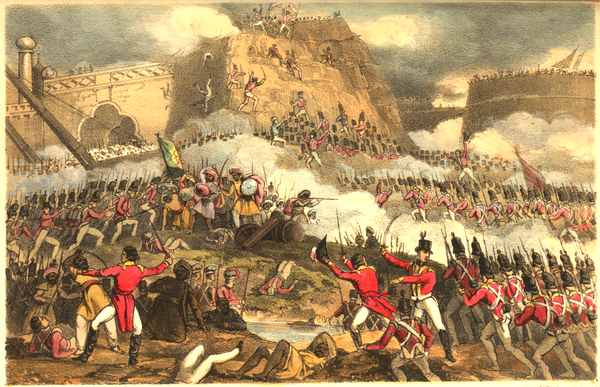
Heath del.
Madeley Lith. 3 Wellington St Strand.
TWELFTH REGIMENT OF FOOT.
STORMING OF SERINGAPATAM MAY 4TH 1799.
For Cannons Military Records.
The territory subject to the late Tippoo Sultan was
divided: to Great Britain was allotted the capital and
several extensive districts; another portion was given
to the Nizam; and a third to the Mahratta power; the
remainder continued to form an independent state
under a descendant of the ancient rulers of Mysore.
Thus was the hostile combination against England
confounded, British territory extended, and its power
and revenue increased. The Twelfth regiment was
afterwards rewarded with the royal authority to
bear the word Seringapatam on its colours, to commemorate
its gallant conduct during this war, and the
officers received medals from the East India Company.[20]
The regiment captured eight stand of colours from the
troops of Tippoo Sultan at the storming of the capital.
After encamping a short time near Seringapatam,
and afterwards near Yarriagoranelly, the regiment
marched into garrison at the captured fortress; but
while it was stationed there, a partisan, named Dhoondia,
excited the Mysoreans to take arms in opposition
to the allied powers, which occasioned orders to be
issued for the Twelfth foot again to take the field.
This partisan assembled an irregular force, and gained
possession of several fortified places. When a small
body of troops was sent against him, he fled, and was
pursued to the frontiers of the Mysore country.
1800
The regiment was afterwards encamped near Seringapatam,
where it was joined in December, 1800,
by the seventy-seventh foot, some battalions of Sepoys,
and a proportion of native cavalry, forming a small
army under Colonel Pater, for the purpose of reducing
the warlike tribes of the Wynaad country,—a mountainous
district overrun with woods, and comprising
about twelve hundred square miles, situate in the province
of Malabar.
1801
Leaving the vicinity of Seringapatam on the 26th
of December, five companies of the regiment arrived
at Manantoddy on the 9th of January, 1801, and
were employed until the 23rd of that month, in stockading
the small hill fort, and in making arrangements for
entering the woody districts of the Wynaad country.
From Manantoddy the Twelfth proceeded to
Peria Colgum, where they constructed a redoubt:
they afterwards marched to Lackerry Cottah, at which
village another redoubt was constructed.
The little army under Colonel Pater traversed the
country in almost every practicable direction, ascending
hills, cutting roads through almost impenetrable
jungle of bamboos, skirmishing with the warlike inhabitants,
and forcing them to submit, in which service
the Twelfth had several men killed and wounded:
the climate, and extraordinary fatigue undergone by
the troops, also occasioned the loss of many lives from
disease. The Wynaad country having been forced to
submit, and the hostile rajah taken prisoner, the companies
of the Twelfth regiment employed in this
service returned to Seringapatam.
The regiment quitted Seringapatam in the middle
of October, 1801, and proceeded to Trichinopoly, a
celebrated city and fortress, situate on a hill, or rock,
three hundred and fifty feet high, on the south bank
of the river Cavery, opposite the island of Seringam,
famous for its magnificent Hindoo temples.
1802
At Trichinopoly the regiment was joined in January,
1802, by the remains of two companies, which had embarked
on board of His Majesty's ships, at Madras, for
Batavia. These companies had suffered severely from
the climate of the island of Java; and of the five officers
and one hundred and twenty-five men who embarked
at Madras, only three officers and sixty-three soldiers
returned; Lieutenants Gordon and Neville and sixty-two
men died of fevers, and other diseases.
1803
1804
Three companies had been stationed under Major
John Picton, at Vellore, in the Carnatic, the residence
of the family of the late Tippoo Sultan, consisting of his
brother, twelve sons, eight daughters, and an immense
number of women; and these companies were afterwards
employed against the insurgent sect called the
Polygans, in which several non-commissioned officers
and soldiers were killed and wounded; Lieutenant
William Firth was also wounded, and Lieutenant
Parker died of the jungle fever. After the performance
of this service, the three companies joined the
regiment at Trichinopoly, where the Twelfth were
stationed during the years 1803 and 1804.
1805
1806
In August, 1805, the regiment marched to Seringapatam,
where a very fatal fever broke out in 1806,
when the Twelfth removed to an encampment at
some distance from the fortress; but they lost many
officers and soldiers in that and the following year.
1807
In April, 1807, more than half the surviving officers
and men were suffering from disease, when an order
arrived for the remainder to march to the coast of
Malabar, and occupy quarters at the port of Cannanore,
where the regiment was stationed upwards of eighteen
months.
1808
At Cannanore the health of the men was restored, and
when inspected in 1808, by Colonel Cuppage, a district
order was published, in which the colonel expressed
'his thanks to Captain Eustace and the officers and
men of His Majesty's Twelfth regiment, for their
handsome appearance at the review. The dress,
steadiness, and general appearance of the men, marked
the great attention paid to their discipline, and their
uniform good conduct and friendly disposition towards
the natives reflect every credit on the corps.'
While the Twelfth foot were at Cannanore, some
disputes, of a tedious and complicated character, occurred
between the British and the Rajah of Travancore,
a province situate at the south-west extremity of Hindoostan.
In 1795, a treaty of alliance was concluded
between the British and the Rajah, who agreed to subsidize
three battalions of Sepoys for the defence of his
dominions; when the disputes with the Rajah came to
a crisis, these battalions were at the port of Coulan (or
Quilon), and they were threatened with destruction by
the natives, together with every person in the British
interest. While the execution of these menaces was
delayed, the Twelfth regiment embarked, towards
the end of December, 1808, in potamars (small undecked
vessels), to proceed along the coast a distance
of three hundred miles to Coulan, in the Travancore
country. Four of these boats, having three companies
and a half on board, arrived at their destination in a
few days, and were immediately landed, to the great
joy of the Sepoys. A severe gale of wind dispersed
the boats containing the other companies of the regiment,
and several of them were wrecked on the coast
of Cochin, a small province on the north of Travancore,
but by great exertions the soldiers were saved;
others gained the port of Cochin, where they remained
until the storm was over. One potamar, containing
Serjeant-Major Tilsey and thirty-three rank and file,
was driven on the coast of Travancore, near Alleppi,
when the natives sent off several small canoes. The
soldiers, believing they had arrived at the friendly port
of Coulan, went on board the canoes two or three at a
time, but on landing they were overpowered by the
natives, their wrists broken with an iron bar, their
hands tied behind them, and they were cast into a
dungeon, where they remained several days without
food. They were afterwards conducted, when scarcely
able to walk, to a high ground near the sea, and precipitated
into a watery grave. The serjeant-major
was reserved to the last, and as he witnessed his companions
in arms successively hurled headlong into the
deep, he struggled to release himself, and tore pieces
of flesh from his shoulders with his teeth, exclaiming
'Let me die like a soldier!' but the barbarians derided
him, and eventually put an end to his torments in the
same manner as the others. A negro youth, who accompanied
this portion of the regiment as cook, witnessed
this tragic scene, and was menaced with the
same fate, but was spared, and he afterwards made
known the fate of the party. Another potamar, having
nearly a company on board, under Lieutenant George
Blanchard Gray and Adjutant Hayes, approached the
coast a few miles from Coulan, and were, in consequence
of the shattered state of the vessel, deciding on the propriety
of landing, when a volley of musketry from the
shore announced the hostile intentions of the natives.
The vessel was bound together with some large tents,
to prevent its splitting, and it arrived safely at Cochin,
but went to pieces in the harbour. All the potamars
being damaged, other vessels were procured to continue
the voyage.
The officers and men of the regiment, who arrived at
Coulan on the 29th of December, joined the Sepoys encamped
near the town. On the evening of the same
day, the Travancoreans attacked the piquet under
Captain Clapham of the Sepoys; the fire of musketry
and artillery indicating a sharp conflict, Lieut.-Colonel
Chalmers, commanding the troops at that station, detached
Ensign James Keappock, and forty men of the
Twelfth, to support the Sepoys, and the enemy was
forced to retire, leaving about eighty men dead on the
scene of conflict.
The Travancoreans were excited to rage and fury
against the British, who had thus gained a footing in
the heart of their country; they assembled in immense
multitudes before the camp, kept up an incessant fire
on the piquets, and heavy columns menaced the encampment;
the soldiers were thus kept constantly
ready for action, and they lay on their arms night and
day.
1809
On the 8th of January, 1809, the remainder of the
regiment arrived at Coulan, excepting one company,
commanded by Lieutenant Thomas Thompson, left with
six hundred Sepoys and several guns for the defence
of Cochin. The men of the Twelfth, with the Sepoys
and guns which had arrived, were landed as expeditiously
as possible; but the force was obliged to remain
encamped on a sandy plain near the sea, enclosed by
an almost impenetrable forest of cocoa-nut trees, from
the want of means for carrying on active operations.
The Resident prohibited the felling of the trees to
conciliate the natives; but this produced no advantage,
and the wood afforded shelter to the Travancorean
marksmen, who annoyed the camp with their fire, keeping
the troops in a constant state of alarm; the outposts
were also frequently attacked by parties of the enemy.
Before daylight, on the 15th of January, a tumultuous
noise in the wood proclaimed the approach of an
immense number of men, and at break of day the
Travancoreans commenced an attack along the whole
front of the British line, at the same time heavy
columns were seen among the trees threatening both
flanks. Thinking the attack was a surprise, the enemy
fired his artillery at the tents; but when sufficient light
enabled the Travancoreans to see the British ranks,
they immediately directed their guns on the Twelfth
regiment, as if desirous of annihilating the Europeans
first. Thus perilously exposed to the enemy's numerous
artillery, the British instantly advanced the right
wing of the Twelfth and two battalions of Sepoys
against the enemy's left, and the left wing of the
Twelfth, with one battalion of Sepoys, against the
right of the enemy's line. The whole force was instantly
brought into close action; but the British had
only five small field-pieces to answer the fire of the forty
guns brought into action by the enemy: the British
musketry was, however, well directed, and the incessant
peals which echoed in the woods announced a vigorous
contest, which was continued for several hours, during
which clouds of barbed arrows, from the enemy's local
troops, inflicted painful wounds on the British soldiers.
About mid-day, the Twelfth were ordered to charge
with bayonets, and capture the enemy's artillery; they
rushed forward with distinguished bravery, the soldiers
shouting "Remember our murdered comrades at
Alleppi!" as they precipitated themselves upon their
opponents. The Travancoreans made a resolute defence,
many of them being bayoneted at their guns; and a
discharge of grape-shot, from one field-piece, killed
eleven grenadiers of the Twelfth regiment. During
this contest many distinguished acts of gallantry were
displayed by the officers and men, and Ensign Keappock,
being attacked by two opponents, slew them. Finally
both wings of the regiment were triumphant; heaps of
Travancoreans fell beneath the bayonets of the
Twelfth, who captured eighteen brass field-pieces.
The loss of these guns intimidated the enemy, who
retired about three o'clock in the afternoon, leaving
five thousand killed and wounded on the field of battle.
The British were unable to follow up the advantage,
from the want of stores, which prevented their quitting
the coast.
The enemy appears to have been very confident of
success on this occasion, and to have been intent on the
annihilation of the Europeans; several Travancoreans of
their Carnatic brigade were taken prisoners, and ropes
being found in their possession, they were questioned
on the subject, when they confessed that the cords were
brought for the purpose of hanging the British soldiers,
and that the British officers were to have been trampled
to death by elephants.
The regiment had fifty men killed and wounded; no
officers were killed, but the following were wounded—Captain
Richard Bayley, Lieutenant M. J. Molloy, and
Surgeon Robert Erskine.
On the succeeding day, the following statement was
published in orders,—'It is with the greatest satisfaction
that Lieut.-Colonel Chalmers congratulates the
troops he has the honour to command, on the glorious
success obtained yesterday, against the attack of an
enemy whose force did not amount to less than thirty
thousand men. He begs leave to offer his most particular
thanks to Lieut.-Colonel Picton, who commanded
the right wing of this little force, with a wing of the
Twelfth regiment, and to the officers, non-commissioned
officers, and privates, whose gallantry and high
discipline have, on all occasions, appeared conspicuous.
Lieut.-Colonel Chalmers has to offer his thanks to
Major Hamilton, who commanded on the left, with a
wing of His Majesty's Twelfth regiment, and to the
officers, non-commissioned officers, and privates, whose
gallant conduct needs no further comment, than that
they belonged to His Majesty's Twelfth.' The Political
Resident, Colonel C. Macauly, stated in a letter to
Lieut.-Colonel Chalmers, 'I have received the details
of the victory over the united force of the Divan—an
achievement that reflects signal honour on the discipline
and animated valour of the troops under your
command, and sheds fresh lustre on the British
arms.'
A numerous army of opponents continued to hover
near the British force at Coulan, and it was deemed
advisable to cut down many of the trees, to throw up
a breast-work in front of the encampment, and to construct
a redoubt, which was armed with the guns taken
from the enemy.
In the mean time, the company of the Twelfth under
Lieutenant Thompson, with the battalion of Sepoys,
commanded by Major Hewett, left for the defence of
the port of Cochin, had been attacked by the troops of
the Rajah of the province of Cochin. During the
action, the Sepoys gave way, and the company of the
Twelfth had to maintain a desperate struggle with
very superior numbers. The enemy was repulsed, and
the inhabitants of Cochin were preserved from a general
massacre, with which they had been menaced for being
favourable to the British interests; they openly attributed
their preservation to the distinguished heroism
of the company of the Twelfth, which had half its non-commissioned
officers and private soldiers killed and
wounded; Lieutenant Thompson was severely wounded,
and died a short time afterwards.
The Twelfth regiment and Sepoys continued to
resist the armed population of Travancore and the
numerous forces of the Rajah; but being constantly
harassed by the approach of bodies of the enemy, the
physical powers of the soldiers became diminished, and
their numbers decreased by disease; but the innate
valour of the troops remained unabated. Before daylight
on the 31st of January, the Travancoreans made
another effort to surprise the camp; but a rocket announced
their approach, and the British were under
arms, as they usually were, at three o'clock in the
morning: many of the cocoa-nut trees had been cut
down to enlarge the plain, and as the enemy's heavy
columns emerged from the wood, a sharp cannonade
was opened upon them; but they formed line under
fire and advanced, when the guns of the redoubt rent
chasms in their ranks. Undismayed by the storm of
grape and bullets which smote their ranks, the Travancoreans
pressed forward, and endeavoured to establish
several guns on a rising ground; but the artillery of
the redoubt dismounted their ordnance. After keeping
up an irregular fire of musketry for some time,
they withdrew from the front, and concentrating on the
right, renewed the attack with greater vigour, when the
left wing of the Twelfth regiment was detached under
Captain William Henry Forssteen, to aid the Sepoys on
that flank. On the arrival of the Twelfth on the right,
a charge with bayonets was executed with great vigour
and the Travancoreans fled from the field, leaving
one brass six-pounder behind them; several other guns
were preserved by the swiftness of the elephants.
On the following day, the troops were thanked in
orders 'for the steady and cool manner in which they
met and repulsed the attack of the enemy.'
After this defeat, in which they lost an immense
number of men, the Travancoreans did not hazard
another general attack; but they frequently endeavoured
to surprise the piquets in the night, in which
they were always defeated. On the 13th of February,
the nineteenth regiment arrived from Columbo; and
the troops were only prevented advancing up the country
from the want of stores and the means of conveyance.
A small supply having arrived, they advanced in two
columns, the first composed of the Twelfth and a
battalion of Sepoys, commanded by Lieut.-Colonel
Picton; and the second, of the nineteenth and a
battalion of Sepoys, under Lieut.-Colonel Stewart,
and by a combined attack they captured the enemy's
stockade and extensive breast-works, in gallant style,
on the 21st of February.
In the meantime another British force had penetrated
the Travancore country under Colonel St.
Leger, and this army arrived at Travandapatam, the
capital, without meeting with serious opposition. The
refractory Rajah made overtures for peace, and the
Twelfth regiment returned to Coulan, detaching the
flank companies to the capital.
The regiment commenced its march for Seringapatam,
on the 23rd of May; but was forced to halt
several days in consequence of the heavy rains of the
Malabar monsoon, which rendered the rivers impassable,
swept away part of the regimental baggage, and
drowned several men in the rapid currents which
rushed along the low grounds. On the 24th of July
the regiment arrived at Trichinopoly.
1810
In Europe, the war with France was being prosecuted
with vigour, and in the month of March, 1810,
the flank companies of the regiment were completed to
one hundred rank and file each, and marched under
Captain Forssteen, for Madras, to take part in an expedition
against the French island of Bourbon, situate
in the Indian ocean, about four hundred miles east of
Madagascar. In June the expedition arrived at Rodriguez,
and in July came in sight of the island of
Bourbon, when the surf was so high as to render a
landing dangerous; an attempt was, however, made;
the light infantry of the Twelfth in a small schooner,
and about three hundred men of the thirty-third and
sixty-ninth regiments in boats, approached the shore
and effected a landing with the loss of a few men
drowned; but the schooner and boats were dashed to
pieces, the soldiers' ammunition damaged, and many of
their arms lost. As no more men could be landed,
Lieutenant Foulkstone of the sixty-ninth regiment
volunteered to swim through the surf and convey
orders to Lieut.-Colonel Macleod, to take possession of
St. Marie. This order was instantly obeyed, and the
light infantry of the Twelfth distinguished themselves
in storming the batteries, in which service they had
two private soldiers killed; Lieutenants John Spinks,
and John B. Whannell, with five rank and file wounded.
The grenadier company of the Twelfth, and other
corps afterwards landed at Grand Chaloupe, and by
their spirited conduct, particularly the gallant behaviour
of the eighty-sixth regiment, the reduction of the
island was speedily accomplished.
While the flank companies were engaged in this
service, the regiment was stationed at Wallajahbad,
from whence it marched, in August, to St. Thomas's
Mount, and in September to Madras, where it embarked
on board the "Russell," of seventy-four guns, and the
"Cornwallis," "Hesper," "Cornelia," "Bucephalus,"
and "Clorinde" frigates, to take part in the expedition
against the Mauritius, or Isle of France, another island
in the Indian sea, belonging to France; the grenadiers
and light infantry of the regiment also embarked from
St. Paul's in the island of Bourbon, to share in the
enterprise. On the 28th of November the armament
approached the Isle of France, and the troops effected
a landing in the bay of Mapon, when one brigade was
ordered into a large wood, through which it was
necessary to pass. The light company of the Twelfth
under Captain Forssteen, preceded by a section under
Lieutenant Ashe, penetrated among the trees, and
skirmished with a French piquet, in which service two
men were killed, and Lieutenant Ashe and three private
soldiers wounded. After a march of nine miles,
the light infantry of the Twelfth halted on some low
ground surrounded by jungle. The weather was very
hot, water could not be procured, and the sufferings of
the soldiers, in consequence, were very severe; but on
the following day some alleviation of suffering was
obtained by sucking the dew from the herbage, and
advancing to the powder mills, within five miles of
Port Louis, the capital, clear streams of water were
discovered. While halting at this place, the piquets
were attacked by the enemy, when the rifle company of
the Twelfth, and the light infantry of the fifty-ninth,
dashed forward, and drove back the French skirmishers,
wounding General de Caen.
On the following morning the army advanced, the
grenadiers of the Twelfth being in front, and the light
infantry on the flanks, under Captains Firth and Forssteen,
Lieutenant Keappock commanding the leading
section of grenadiers. While advancing along a narrow
road, through a country covered with underwood, the
army was suddenly assailed with grape shot, from an
eminence; but a charge with bayonets forced the
French to withdraw. Arriving at some open grounds,
the British formed line, when the French abandoned
their guns and retreated towards the town, leaving
a body of troops on a mountain on the British left.
The Twelfth were ordered to storm the height, and
they raised a loud shout, and soon gained the summit,
when the French fled, leaving a gun behind them.
The officers and soldiers of the regiment evinced
great heroism in these services; Lieutenant Keappock
was wounded in the side, but continued at his post
until a shot in the head forced him to retire; his
honourable, though dangerous post, was taken by Lieutenant
Jenkins, who received a severe contusion on the
breast by a ball, but continued at the head of the
leading section.
In this short but brilliant and decisive service, the
regiment had Major Jeremiah O'Keefe, one drummer,
and sixteen rank and file killed; Lieutenants Keappock
and Ashe, three serjeants, and twenty-eight rank
and file wounded; five men missing.
The French Governor, General de Caen, seeing no
prospect of being able to make effectual resistance,
surrendered the island. This enterprise was thus
successfully accomplished, and the conduct of the
Twelfth regiment was commended in orders, also in
the public despatch of Major-General Abercromby.
After the surrender of the Isle of France, the flank
companies proceeded to Port Louis, and the battalion
companies descended the Long Mountain, and embarked
from Tortue bay, in the "Psyche" frigate, for
Grand Port, where they were joined by the flank companies,
after being separated eleven months.
1811
General Picton died on the 14th of October, 1811, in
his eighty-fourth year, and was succeeded in the
Colonelcy of the Twelfth foot, by Lieut.-General Sir
Charles Hastings, Baronet, from the seventy-seventh
regiment of foot.
The regiment was stationed in the Isle of France
during the years 1811 and 1812.
1812
In the meantime the war with France was approaching
to a crisis; Napoleon Bonaparte had attained
the summit of power, and the efforts of Great Britain
were commensurate with the importance of the contest;
the army was augmented, and in the autumn of 1811
a second battalion was added to the Twelfth regiment
of four hundred and fifty-one officers and soldiers, into
which the recruiting companies of the regiment were
incorporated.
In the autumn of 1812, the second battalion proceeded
to Ireland.
1813
In April, 1813, the first battalion embarked from
Port Louis, for the island of Bourbon, where it was
stationed nearly two years.
1814
1815
During this period the tyrannical power of Bonaparte
had been overthrown, and the Bourbon dynasty restored
to the throne of France. On the re-establishment of
peace in Europe, the island of Bourbon was restored to
the French monarchy, and in consequence of this
arrangement the regiment embarked from St. Denis
on the 3rd of April, 1815; the French soldiers, who
arrived from Europe to take possession of the island,
landing as the British went on board the ships prepared
to receive them.
The Mauritius, or Isle of France, was retained by
the British government, and the Twelfth foot having
been selected to form part of the garrison of that valuable
island, immediately proceeded thither.
Soon afterwards, Bonaparte quitted the island of
Elba, in violation of his engagements, and regained the
throne of France, when the powers of Europe took
arms against the usurper, and his veteran legions were
overpowered in the field of Waterloo by the allied
army under Field Marshal His Grace the Duke of
Wellington, on the 18th of June, 1815. To replace
the losses of the British army at Waterloo, additional
forces were sent to the continent, and the second battalion
of the Twelfth regiment, which had returned
to England a few months previously from Ireland,
embarked for Flanders on the 27th of June, under
the command of Colonel Julius Stirke; it landed at
Ostend and advanced to Paris, where the campaign
was terminated by the restoration of the Bourbon
dynasty to the throne of France. Peace being again
established in Europe, the battalion returned to
England in December.
In June, 1815, the rifle company of the first battalion
proceeded to Bengal, and formed part of a field
brigade assembled for service; it, however, returned
to the Mauritius in November.
1816
In January, 1816, the second battalion again proceeded
to Ireland.
1817
The first battalion continued to form part of the
garrison of the Mauritius during the year 1816, and
the first six months of 1817; on the 1st of July of
the latter year, a serious fire broke out at Port Louis,
when the exertions of the garrison to extinguish the
flames, called forth the admiration and thanks of the
inhabitants, which were communicated to the troops by
the governor.
Transports having arrived to convey the regiment
to Europe, a general order was published, in which it
was stated, 'Major-General Sir Edward Butler, in
taking leave of the Twelfth regiment, feels himself
highly gratified in stating, that its conduct, during its
services in this island, has, in every particular, been
such as to meet with his highest approbation, and he
begs to assure Lieut.-Colonel Forssteen, the officers,
non-commissioned officers, and men of the Twelfth
regiment, that they carry with them his warmest
wishes for their prosperity and welfare.'
The regiment sailed from Port Louis on the 25th of
July, arrived at Portsmouth on the 10th of November,
and afterwards proceeded to Cork, where it landed on
the 26th of December, after an absence from Europe
of nearly twenty-two years.
A representation of the distinguished services of the
regiment in the Travancore country, and other parts
of India, with its gallantry at the capture of the islands
of Bourbon and Mauritius, procured for it the royal
authority to bear the word "India" on its colours.
1818
From Cork the regiment marched to Athlone,
where it arrived on the 9th of January, 1818; and
joined the second battalion, which was stationed at that
place.
1820
On the 16th of January the second battalion was
disbanded at Athlone, transferring six hundred and
sixty men to the first battalion. The regiment performed
duty in the counties of Cork, Limerick, and
Clare, until June, 1820, when it marched to Dublin.
In the autumn of the same year, the regiment embarked
for England; it landed at Liverpool, and was
afterwards stationed at Manchester and Macclesfield.
1821
On the regiment quitting these quarters, in February,
1821, Major-General Sir James Lyon stated, in
a letter to Lieut.-Colonel Forssteen, 'Although the
Twelfth foot have been stationed but a short time
in this place, I cannot refrain from expressing to you,
that no military change could have given me more
concern than their departure. I have had every
opportunity of observing their uniform good conduct
and strict attention to every branch of discipline, and
nothing but satisfaction has ever been manifested to
me by the civil authorities, and the inhabitants in
general, on the very exemplary behaviour of the men.
I beg of you to make known to the corps, the value I
attach to the honor of having had a regiment of such
high character placed under my orders, and that I
must ever take an interest in its welfare and success.'
From Lancashire, the regiment marched to Portsmouth,
where it embarked for Jersey and Guernsey.
1822
1823
While stationed at these islands, the appearance of
the regiment, the conduct of the men, and the excellent
system of interior economy which existed in the
corps, elicited the commendations of Major-General
Sir Colin Halkett, at the inspections in October, 1821,
May and October, 1822; and when the Twelfth were
about to return to England, in May, 1823, the Major-General
repeated his expressions of approbation, with
his warm interest in the welfare of the corps. The
conduct of the four companies at Guernsey, under
Major Bayley, was also specially commended by the
Lieut.-Governor, Colonel Sir John Colborne.
On arriving in England, the regiment was stationed
at Chatham and Sheerness until October, when it proceeded
to Fort Cumberland.
On the decease of General Sir Charles Hastings,
Baronet, the Colonelcy was conferred on Lieut.-General
the Honorable Robert Meade, from the ninetieth
regiment, by commission dated the 9th of October, 1823.
The regiment having received orders to transfer its
services to Gibraltar, the scene of its former triumphs,
it embarked on board of His Majesty's Ships "Ganges"
and "Superb," on the 8th of November, and arrived
at that celebrated fortress on the 25th of the same month.
1825
In 1825, the establishment of the regiment was
augmented from eight to ten companies, six to be considered
service companies and remain at Gibraltar, and
four depôt companies to be stationed in the United
Kingdom; in consequence of this arrangement the
officers and non-commissioned officers of two companies
were sent to England.
1827
A new pair of Colours having been provided for the
regiment, and bearing the following honorary distinctions,
the words "Minden," "Gibraltar" with the
Castle and Key and the motto 'Montis Insignia Calpé,'
"Seringapatam" and "India," they were presented to
the corps, on the 28th of June, 1827, by General Sir
George Don, who addressed the commanding officer
(Major-Turberville), the officers, and soldiers, to the
following effect:—
'It appears by the record of the Twelfth Regiment,
to which I have the honor of presenting these colours,
that among the many valiant deeds of the corps, it
achieved distinguished glory at the battle of Minden.
In 1797 I attended the renowned Duke of Brunswick
on the spot where this battle was fought; after His
Serene Highness had shown me the position occupied
by the British, he said, It was here the conflict was most
obstinate and it was here that the British Infantry gained
immortal glory. This Rock, and Seringapatam, were
afterwards among the scenes where the Twelfth
Regiment distinguished itself, and which are immortalized
in the history of our country. Being myself a
soldier of fifty-seven years' standing, I am alive to every
instance of meritorious conduct in my brother soldiers,
and it is extremely gratifying to me to reflect, that the
Twelfth Regiment, which so early established its
fame, has continued to augment it on every occasion;
and I am confident that whenever these Colours shall
be displayed before an enemy, the regiment will, by
its valiant conduct, add to the number of glorious
records with which they are graced.'
1828
In 1828 the garrison of Gibraltar was afflicted with
a severe epidemic fever, which occasioned the death of
upwards of five hundred soldiers; the inhabitants
suffered much more severely than the troops. During
the prevalence of the disease, the Twelfth were
encamped for four months on the neutral ground,
where they were reviewed on the 27th of December,
by the Lieut.-Governor Sir George Don, who expressed
to Lieut.-Colonel Bayley, his entire approbation of the
appearance of the corps, of its discipline, and interior
economy. Eight officers, and two hundred and eighteen
non-commissioned officers and soldiers, had been afflicted
with the fever, of which number, two officers
(Lieutenant Forssteen and Ensign Werge) and fifty-three
soldiers had died.
1834
The regiment remained at Gibraltar until the
spring of 1834, when it embarked for England, and
landed at Portsmouth, from whence it marched to
Winchester, and during the winter into Lancashire.
1835
1836
In November 1835, the regiment embarked at
Liverpool for Ireland; it landed at Dublin, and was
quartered in that city until October 1836, when it
proceeded to Athlone.
1837
The regiment was again divided into six service
and four depôt companies in the summer of 1837; and
in August, the service companies embarked at Cork
for the Mauritius, where they arrived in December,
and landed at Port Louis.
1838
During the year 1838 the depôt companies were
stationed at Kinsale and Tralee.
1839
On the augmentation of the army in August, 1839,
the establishment of the Twelfth was increased to
forty-seven serjeants, fourteen drummers, and eight
hundred rank and file.
1840
1841
In May, 1839, the depôt companies embarked at
Cork for Wales, and continued to be stationed at
Newtown, Builth, and Brecon, until May, 1840, when
they proceeded to Scotland and occupied the barracks
at Paisley until May, 1841, when they returned to
South Britain and were stationed at Sunderland.
1842
In April, 1842, the Twelfth Regiment having
been augmented to an establishment of one lieut.-colonel,
twelve captains, fourteen lieutenants, ten ensigns,
six staff officers, sixty-seven serjeants, twenty-five
drummers, and twelve hundred rank and file, was
ordered to be separated into two battalions; the six
service companies abroad being termed the First
battalion, and the depôt, augmented to six companies,
being styled the Reserve battalion.
1843
The depôt was consequently removed from Sunderland
to Weedon in May, 1842, and receiving 255
volunteers from other corps, was there organised for
foreign service. The reserve battalion embarked
from Portsmouth in the "Java" transport for the Mauritius
in November, 1842, under the command of Major
Sir Robert Douglas, Bart., but was disembarked at
the Cape of Good Hope, and remained there until
May, 1843, when it proceeded to its original destination.
1847
On the 2nd of November, 1847, Her Majesty's Troopship
"Resistance" arrived with the first battalion of the
Fifth Fusiliers for the purpose of relieving the first
battalion of the Twelfth Regiment, which embarked
from the Mauritius on the 16th of December, under
the command of Lieutenant-Colonel Patton.
1848
The first battalion arrived at Spithead on the
1st of March, 1848, and disembarked on the 3rd of
March at Portsmouth, where it was joined by the
depôt company from the Isle of Wight. The reserve
battalion, after being completed by the transfer of
effective men from the first battalion, continued at the
Mauritius.