HISTORICAL RECORD
OF
THE THIRTY-NINTH,
OR THE
DORSETSHIRE REGIMENT OF FOOT.
1700.
1701.
The long-expected decease of King Charles II. of
Spain occurred on the 1st of November 1700, and the
circumstance of his bequeathing his crown to Philip,
Duke of Anjou, second son of the Dauphin of France,
involved the several Powers of Europe in a lengthened
contest, which has been designated the “War of the
Spanish Succession.” England would, probably, have
abstained from becoming a principal in the war, had not
Louis XIV., upon the death of James II. at St. Germains,
on the 16th of September 1701, proclaimed that
monarch’s son, known as the Pretender, as King of
England, Scotland, and Ireland, which so aroused the
feelings of the English people as to lead the nation to
support with ardour Charles, Archduke of Austria, the
second son of Leopold, Emperor of Germany, in his
efforts to obtain the throne of Spain, particularly as it
was considered that the anticipated union of the crowns
of France and Spain would be inimical to the “balance
of power” in Europe.
1702.
Active preparations for war commenced, and the
Thirty-ninth was one of the regiments raised at this
period, and has been since retained on the establishment
of the army.[6] The regiment was raised in Ireland by
Colonel Richard Coote, under the authority of a royal
warrant dated the 13th of February 1702, and continued
to be stationed in that country for the five
following years.
The sudden decease of King William III. on the
8th of March 1702, did not retard the breaking out of
hostilities, for his views were carried into effect by his
successor Queen Anne, who declared war against France
and Spain on the 4th of May following, and the Earl
of Marlborough was appointed to command the forces
in Flanders, with the rank of Captain-General.
1703.
Colonel Nicholas Sankey was appointed to the colonelcy
of the regiment on the 17th of March 1703, in
succession to Colonel Richard Coote, deceased.
1704.
Gibraltar, a name which, in subsequent years, is so
gloriously connected with the Thirty-ninth regiment,[7]
was taken in July 1704 by the British and
Dutch marines, aided by the seamen, under Major-General
the Prince of Hesse Darmstadt, and Admiral
Sir George Rooke. In October following, the French
and Spaniards endeavoured to retake the fortress, but
after a siege of some months they desisted from the
attempt in March 1705.
1705.
1706.
While the army under the Duke of Marlborough was
pursuing a victorious career in Flanders and Germany,
the troops which had been employed in Portugal
and Spain had likewise gained important successes. In
October 1705, the allied troops under the Earl of Peterborough
captured Barcelona, and that celebrated city
was successfully defended by them in April and May
of the following year. Madrid was taken possession
of by the Earl of Galway in June 1706, and the fortunes
of Charles III. appeared in the ascendant; but
the delay of that prince to avail himself of these advantages,
by marching at once to the capital of Spain,
enabled Philip V. to collect an army superior in numbers
to the Allies, and Madrid was again occupied by
the enemy in August of the same year.
1707.
On the 25th of April 1707, the allied forces under
the Earl of Galway were defeated by the Duke of
Berwick at Almanza[8], which materially changed the
aspect of affairs in Spain.
Additional troops were shortly afterwards selected
for embarkation for Portugal, and the Thirty-ninth
was one of the regiments directed to proceed to that
country.
Accordingly the Fifth, Twentieth, Thirty-ninth,
and a newly raised regiment commanded by Colonel
Stanwix (since disbanded), having been selected for this
service, sailed from Cork on the 22nd of May 1707,
and landed at Lisbon on the 8th of June. This seasonable
reinforcement arriving soon after the defeat of the
allied army at Almanza, in the south-east of Spain, and
at the moment when the enemy, having captured Serpa
and Moura in the Alemtejo, had seized on the bridge
of Olivenza in Portuguese Estremadura, and menaced
that important place with a siege, its presence revived
the drooping spirits of the Portuguese.
These four regiments being the only British troops
in that part of the country, were disembarked with
every possible expedition, and marched to the frontiers
under the command of the Marquis de Montandre,
when the enemy immediately ceased to act on the
offensive, and retired. The four regiments having
halted at Estremos, a strong town of the Alemtejo, situated
in an agreeable tract on the Tarra, remained in
this pleasant quarter during the summer heats, and
afterwards encamped in the fruitful valley of the Caya,
near Elvas, having detached parties on the flanks to
prevent the enemy making incursions into Portugal, in
which service the regiments were engaged until November,
when they went into quarters in the frontier
towns of Portugal.
1708.
In the spring of 1708 the regiment again took the
field, and was encamped at Fuente de Sapatores, between
Elvas and Campo Mayor. The British division
was soon afterwards increased to six regiments, by the
arrival of the Thirteenth foot, and a newly raised regiment
(Paston’s) from England. The little army in the
Alemtejo was commanded by the Marquis de Fronteira,
but the characteristic inactivity of the Portuguese occasioned
the services of the Thirty-ninth to be limited
to defensive operations. The regiment was encamped
in the autumn at Campo Mayor, and afterwards went
into cantonments.
1709.
The regiment moved from its quarters in the spring
of 1709, and became engaged in active operations. It
was first encamped near Estremos, and proceeded from
thence to Elvas on the 23rd of April 1709; the regiment
was subsequently encamped with the army on
the banks of the Caya, where the Earl of Galway, who
had been removed from the army in Catalonia, appeared
at the head of the British division.
On the 7th of May, the French and Spaniards, commanded
by the Marquis de Bay, marched in the direction
of Campo Mayor; when the Portuguese generals,
contrary to the Earl of Galway’s advice, resolved to
pass the Caya, and attack the enemy. The Portuguese
cavalry and artillery took the lead, and having passed
the river and gained the opposite heights, opened a
sharp cannonade; but upon the advance of their adversaries
to charge, the squadrons faced about and galloped
from the field, leaving their cannon behind. The
British division, arriving at the moment, repulsed the
enemy; the leading brigade, consisting of the Thirteenth,
Stanwix’s and Galway’s regiments, commanded
by Brigadier-General Thomas Pearce, charging furiously,
recaptured the Portuguese guns; but the three
regiments, pressing forward too far, were surrounded
and made prisoners, and with them Major-General
Sankey, the Colonel of the Thirty-ninth; and the
Earl of Barrymore, together with Brigadier-General
Thomas Pearce, fell into the hands of the enemy.
At the same time the Fifth, Twentieth, Thirty-ninth,
and Lord Paston’s regiments, though deserted
by the whole of the cavalry, made a determined stand,
bearing the brunt of the enemy’s reiterated attacks with
admirable firmness, until the Portuguese infantry had
retired; then moving to the rear in firm array, while
the balls flew thickly on every side, and the Earl of
Galway’s horse was shot under him, the enemy advanced
in full career, threatening the destruction of this
little band; yet, with ranks unbroken and steady tread,
these undaunted English calmly retraced their steps,
exhibiting one of the noblest spectacles of war, and
occasionally punishing the temerity of their pursuers
with a cool and deliberate resolution, which laid a
thousand Spaniards dead upon the field, and impressed
the enemy, and likewise the Portuguese, with a sense
of British courage and magnanimity. Thus they
effected their retreat, with the loss of only one hundred
and fifty men killed and wounded, and passed that
night at Arronches.
The Thirty-ninth acquired great honour by its
gallantry on this occasion. The regiment was afterwards
encamped at Elvas, was subsequently in position
on the banks of the Guadiana, and again passed the
winter in cantonments in the Alemtejo.
1710.
The casualties of the preceding campaign having
been replaced by recruits from England, the regiment
again took the field in the spring of 1710, and was
employed in the Alemtejo; but the army was weak and
unequal to any important undertaking, and the French
having obtained some success in the province of Tras
os Montes, occasioned a detachment to be sent thither.
In the autumn the army advanced across the Guadiana,
and on the 4th of October arrived at the rich plains of
Xeres de los Cabaleros, on the river Ardilla, in Spanish
Estremadura. It was determined to attack this place
by storm on the following day, and the Fifth, Twentieth,
and Thirty-ninth regiments, having been
selected to perform this service under the command of
Brigadier-General Stanwix, advanced at four in the
afternoon to attack the works near St. Catherine’s gate
by escalade. A few minutes after the regiments had
commenced the assault, the Governor sent proposals to
surrender, which were agreed to, and the garrison, consisting
of seven hundred men, became prisoners of war.
The army afterwards retired to Portugal by the mountains
of Orlor, and went into quarters.
During this summer, the army on the other side of
Spain gained two victories—one at Almanara, and the
other at Saragossa,—and afterwards advanced to
Madrid, when the most pressing instances were made
by King Charles III. and General Stanhope to induce
the army of Portugal to advance upon the Spanish
capital; but the Portuguese generals were unwilling to
engage in so great an undertaking.
1711.
The Thirty-ninth, during the campaign of 1711,
formed part of the army which assembled at Olivenza
in May, and having passed the Guadiana by a pontoon
bridge at Jerumenha, advanced against the enemy, who
took refuge under the cannon of Badajoz. The regiment
was afterwards engaged in the capture of
several small towns, and in levying contributions in
Spanish Estremadura; but the summer passed without
any occurrence of importance, excepting a discovery
made by the Earl of Portmore, who commanded the
British troops in Portugal, of a clandestine treaty in
progress between the crown of Portugal and the enemy,
in which the former had agreed to separate from the
Allies; to give an excuse for this, a mock battle was to
have been fought, in which the British troops were
to have been sacrificed. This treaty was broken off,
but the British Government soon afterwards entered
into negotiations with France.
The claimant of the Spanish throne, Charles III.,
was in October 1711 elected Emperor of Germany
by the title of Charles VI., his brother Joseph having
died at Vienna in the preceding April. This circumstance
materially affected the war, and inclined Great
Britain to agree to peace, for the consolidation of Spain
with the empire of Germany would have perilled the
balance of power in Europe as much as the anticipated
union of the crowns of France and Spain. The course
of events had also shown, that a French, and not an
Austrian prince, was the choice of the Spanish nation.
1712.
The regiment remained in Portugal, and during the
summer of 1712 was encamped on the pleasant plains
of the Tarra. In the autumn a suspension of hostilities
was proclaimed at the camp by Major-General Pearce,
and the regiment went into cantonments.
1713.
On the 11th of April 1713, the Treaty of Utrecht
was signed, and by its provisions the fortress of Gibraltar
and the island of Minorca, which had been taken
by the English during the war, were ceded to Great
Britain. The Thirty-ninth proceeded in the first
instance to Gibraltar; but in the course of the year
1713, the regiment was selected to form part of the
garrison at Minorca.[9]
1719.
Upon the decease of Lieut.-General Nicholas Sankey,
in March 1719, His Majesty King George I. appointed,
on the 11th of that month, Brigadier-General Thomas
Ferrers to be Colonel of the Thirty-ninth regiment.
The Thirty-ninth regiment remained at Minorca
until the year 1719, when it embarked for Ireland, in
which country it was stationed for some years.
1722.
Colonel William Newton was appointed by King
George I. to the colonelcy of the Thirty-ninth
regiment on the 28th of September 1722, in succession
to Brigadier-General Thomas Ferrers, removed to the
Seventeenth regiment of foot.
1726.
Spain had relinquished its claim on Gibraltar with
reluctance; and that country having resolved to engage
in war with Great Britain, a large army, under the
command of the Count de las Torres, was assembled in
Andalusia towards the end of 1726, in order to commence
hostilities with the siege of this important fortress,
for which purpose the Spaniards had made very
extensive preparations.
The British Government resolved to send certain
regiments to reinforce the garrison of Gibraltar, and six
men-of-war were also fitted out at Portsmouth with all
possible expedition. Admiral Sir Charles Wager was
appointed to command the fleet, on board of which
three regiments of infantry, Anstruther’s, Disney’s, and
Newton’s (Twenty-sixth, Twenty-ninth, and Thirty-ninth
regiments), were embarked. On the 24th of
December 1726, Sir Charles Wager arrived at Portsmouth,
and shortly afterwards sailed for Gibraltar, but
was detained for some time at Spithead by the southerly
winds. Two other regiments of infantry, Middleton’s
and Hayes’s (Twenty-fifth and Thirty-fourth), were
ordered to embark at Cork, for the purpose of joining
Sir Charles Wager, and of reinforcing the garrison of
Gibraltar.
1727.
Admiral Sir Charles Wager arrived in the Bay of
Gibraltar on the 2nd of February 1727, after a voyage
of fourteen days from Portsmouth. In the previous
month the Spanish troops, under General Count de
las Torres, had encamped before the fortress, and the
bringing up of cannon and mortars occupied several
weeks. In February they commenced constructing
batteries before any declaration of war had been made,
and persisted in the work, notwithstanding the remonstrances
of the Lieut.-Governor, Colonel Jasper
Clayton.
The garrison opened its fire upon the besiegers towards
the end of February, and the reverberation of the
thunder of the cannon and mortars among the mountains
of Andalusia, proclaimed the strenuous efforts of
the enemy, and the gallant defence made by the garrison.
The tremendous fire of the Spaniards produced
little effect beyond the bursting of many of their own
cannon, and rendering others useless. The siege was
continued until thousands of the enemy had perished,
while very little loss was sustained by the garrison.[10]
In the early part of June the fire slackened; and shortly
afterwards hostilities ceased, in consequence of preliminary
articles for a treaty of peace having been
agreed upon. Thus the fortress of Gibraltar was a
second time preserved, and continued to form one of
the trophies of British prowess.
1729.
Peace having been concluded between Great Britain,
France, and Spain, in November 1729, the regiment
was ordered to proceed from Gibraltar to Jamaica,
and it embarked for that island in the course of the
year following.
1730.
Colonel John Cope was appointed to the colonelcy
of the Thirty-ninth regiment on the 10th of November
1730, in succession to Brigadier-General William
Newton, deceased.
1732.
In the year 1732 the regiment returned from Jamaica
to Ireland.
Colonel Thomas Wentworth was appointed to the
colonelcy of the Thirty-ninth regiment on the 15th
of December 1732, in succession to Colonel John Cope,
removed to the Fifth fusiliers.
The regiment continued to be stationed in Ireland
during 1733 and ten following years.
1737.
Colonel John Campbell, afterwards Duke of Argyle,
was appointed to the colonelcy of the Thirty-ninth
regiment on the 27th of June 1737, in succession to
Colonel Thomas Wentworth, who was removed to the
Twenty-fourth regiment.
1738.
Upon Colonel Campbell being removed to the
Twenty-first Royal North British Fusiliers on the 1st
of November 1738, King George II. appointed Colonel
Richard Onslow to the colonelcy of the Thirty-ninth
regiment from that date.
1739.
Colonel Onslow was removed to the Eighth regiment
of foot on the 6th of June 1739, and the colonelcy
of the Thirty-ninth was conferred, from the same
date, on Lieut.-Colonel Robert Dalway.
While the regiment was stationed in Ireland, war was
proclaimed on the 23rd of October 1739, by Great
Britain against Spain, in consequence of the Spanish
depredations in the West Indies.
1740.
Lieut.-Colonel Samuel Walter Whitshed was promoted
from the Eighth dragoons to the colonelcy of the
Thirty-ninth regiment on the 28th of December
1740, in succession to Colonel Dalway, removed to the
Thirteenth dragoons.
While the war was being carried on between Great
Britain and Spain, the decease of Charles VI. Emperor
of Germany, on the 20th of October 1740, and the support
given by France to Charles Albert, Elector of
Bavaria, in opposition to the claims of the Archduchess
Maria Theresa, the eldest daughter of the late Emperor,
to her father’s hereditary territories, occasioned the contest
that is designated the “War of the Austrian Succession.”
1742.
The Elector of Bavaria was chosen Emperor of Germany
at Frankfort on the Maine, and crowned as
Charles VII. on the 11th of February 1742; and in the
summer of that year the King of England sent an army
of sixteen thousand men, under Field-Marshal the Earl
of Stair, to Flanders, in order to support the Queen of
Hungary, Maria Theresa.
1743.
Colonel Edward Richbell was appointed to the
colonelcy of the Thirty-ninth regiment on the 14th
of June 1743, in succession to Colonel Samuel Walter
Whitshed, who was removed to the Twelfth dragoons.
The battle of Dettingen was fought on the 27th of
June 1743, and is remarkable as the last action in which
a British monarch was present; but King George II. at
this period did not act as a principal in the war, his
troops having been furnished as allies to the Austrians.
1744.
On the 9th of March 1744, the Thirty-ninth regiment
proceeded from Ireland to Great Britain, and was
employed on board the fleet, as Marines, for two years.
War was at last declared by France against Great
Britain on the 20th of March 1744, and a counter-declaration
was made by the latter country on the 29th
of the same month; thus these two powers, from
auxiliaries, now became principals in the contest.
1745.
In January 1745, the Emperor Charles VII. died at
Munich, and Francis, Grand Duke of Tuscany, consort
of Maria Theresa, became a candidate for the imperial
crown; this circumstance changed the aspect of affairs
in Germany, and led to the re-establishment of the
House of Austria in the imperial dignity.
In July Prince Charles Edward, eldest son of the
Pretender, arrived in Scotland, and being joined by
several clans, obtained some advantages; but after advancing
as far as Derby, he retreated towards the north
in December following.
1746.
The hopes of the Pretender were annihilated by the
battle of Culloden on the 16th of April 1746, and part
of the military force of the kingdom becoming available
for other services, an expedition proceeded against the
coast of Brittany. Sixteen sail of the line under Admiral
Lestock, and eight frigates, conveying five thousand
troops (of which the Thirty-ninth formed part),
exclusive of Marines, under Lieut.-General St. Clair,
sailed from Plymouth on the 14th of September, in
order to make an attack on Port L’Orient, the principal
station for the French East India Company’s
shipping and stores.
The troops landed in Quimperlay Bay on the morning
of the 20th of September, and marched on the
following day in two columns against Plymeur, which
surrendered, and on the following day advanced to
within a mile of Port L’Orient. Some affairs took
place between the 21st and 26th of September, and the
town was cannonaded; but the enemy having assembled
a formidable force, it was determined to withdraw
the troops, and they were accordingly re-embarked.
The British troops landed on the peninsula of Quiberon
on the 4th of October, and captured a fort mounting
eighteen guns; and after destroying all the forts
and guns, together with those on the islands of Houat
and Hedic, the force was re-embarked, sailed for
England, and arrived at Spithead on the 26th of October.
1747.
During the years 1747 and 1748, the regiment again
served as Marines on board the fleet.
1748.
On the 7th of October 1748, the Treaty of Aix-la-Chapelle
was signed, which terminated the war, and
the regiment was again stationed in Ireland, where it
remained upwards of five years.
1751.
In the royal warrant, dated the 1st of July 1751, for
establishing and maintaining uniformity in the clothing,
standards, and colours of the army, and regulating the
number and rank of regiments, the facings of the Thirty-ninth
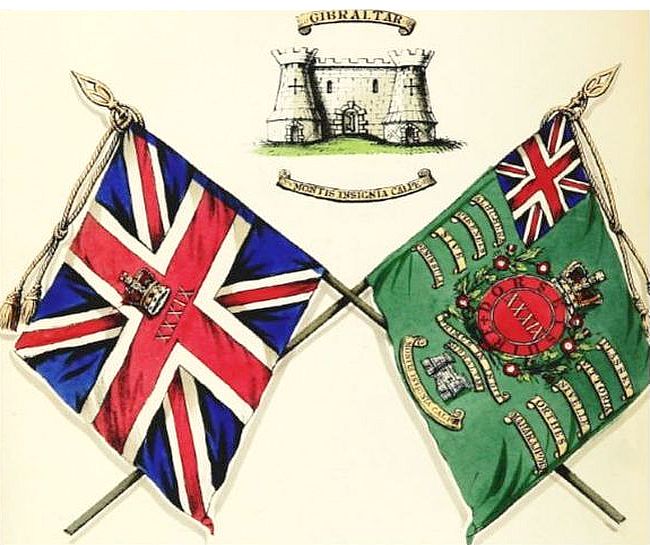
regiment were directed to be green. The first,
or King’s colour, was the Great Union; the second, or
regimental colour, was of green silk, with the Union in
the upper canton; in the centre of the colour the
number of the rank of the regiment, in gold Roman
characters, within a wreath of roses and thistles on the
same stalk.
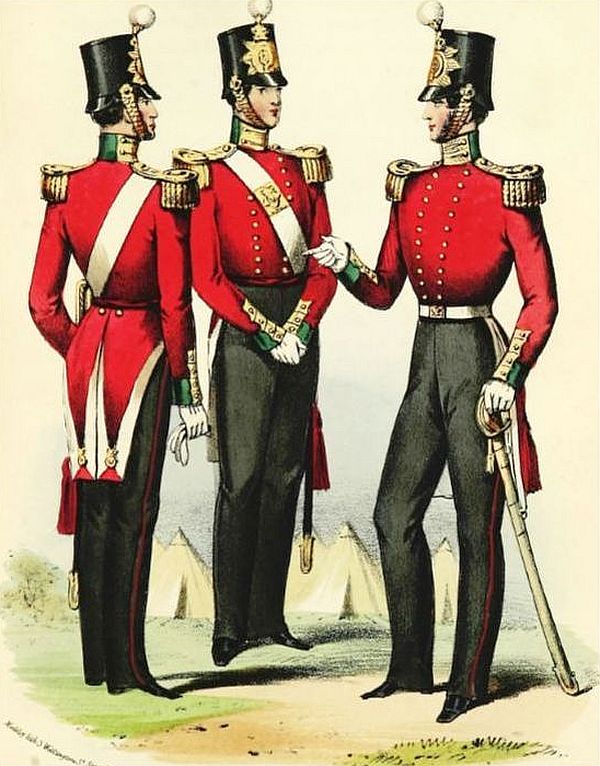
At this period the uniform of the regiment was cocked
hats bound with white lace; scarlet coats faced and
turned up with green, and ornamented with white lace;
scarlet waistcoats and breeches; white gaiters, white
cravats, and buff belts.
1752.
Colonel John Adlercron was appointed to the colonelcy
of the Thirty-ninth regiment on the 14th of March
1752, in succession to Brigadier-General Edward Richbell,
removed to the Seventeenth foot.
1754.
In the beginning of 1754, the Thirty-ninth proceeded
from Ireland to the East Indies, being the first
King’s regiment employed in that country.
1756.
The regiment remained at Madras until 1756, when
events transpired which occasioned a portion of the
Thirty-ninth to be embarked for Bengal. Upon the
decease of Allaverdy Khan, in April 1756, Surajah
Dowlah was proclaimed Soubah, or Nabob of Bengal.
During nearly half a century the British at Calcutta
had pursued a profitable commerce in peace; but the
new ruler soon evinced his hostility to them, and taking
the field shortly afterwards, with a numerous army,
invested Calcutta, which was captured by him on the
20th of June. Then followed that awful sacrifice of
life in the “Black Hole,” a dungeon at Calcutta only
eighteen feet square, into which one hundred and forty-six
of the prisoners were thrust, and on the following
morning only twenty-three survived,—their unfortunate
companions having perished from suffocation.
Dark was the cloud which hung over the affairs of
the East India Company at this period; self-preservation
made it imperative to adopt measures of retaliation, and
it was a proud epoch in the career of the Thirty-ninth
when a portion of the regiment was selected for service
in Bengal, where the subsequent successes, obtained
under Lieut.-Colonel Clive, dispersed the prevailing
gloom, and paved the way for British ascendancy in
India.
The intelligence of these events reached Madras in
August 1756, and it was determined to send a force to
Bengal, of which Colonel Adlercron, of the Thirty-ninth,
claimed the command, but Lieut.-Colonel Robert
(afterwards Lord) Clive, was eventually appointed to
command the troops. The armament consisted of
nine hundred Europeans and fifteen hundred Sepoys:
two hundred and fifty of the Europeans belonged to
the Thirty-ninth regiment, and the remainder were
the best men of the Company’s troops. The naval
squadron comprised the Kent of 64 guns, Cumberland
of 70, Tiger of 60, Salisbury of 50, Bridgewater of 20,
and a fire-ship; to which were added, as transports,
three of the Company’s ships, and two smaller vessels.
The fleet under Rear-Admirals Watson and Pocock
having the troops on board, sailed from Madras on the
16th of October 1756, and anchored in the river
Hoogly, off Fulta, twenty miles from Calcutta, on the
15th of December, with the exception of the Cumberland,
in which Admiral Pocock had hoisted his flag,
which grounded on the sandheads off Saugur, but afterwards
bore up to Vizagapatam. The fleet left Fulta
on the 27th of December, and anchored in the afternoon
of the day following at Mayapore, a town ten miles
below the fort of Budge-Budge.
It was determined to attack this fort on the following
day, and it was resolved to lay an ambuscade in order
to intercept the retreat of the garrison towards Calcutta.
All the men of the Thirty-ninth who had arrived,
being one hundred and twenty, remained on board the
ships of war; but five hundred Europeans, with the
Sepoys, and two field-pieces, landed, and marched from
Mayapore, at sunset, under the command of Lieut.-Colonel
Clive. Monickchund, the Governor of Calcutta,
attempted to make a stand near the fort of
Budge-Budge, but was defeated, and forced to return to
Calcutta.
Meanwhile the Kent, having outsailed the other
ships, anchored before Budge-Budge, and alone silenced
the cannon of that fort, which was abandoned by the
garrison during the night of the 30th of December.
1757.
The fleet left Budge-Budge on the 31st of December,
and anchored, on the 1st of January 1757, between the
forts of Tanna and Aligur, which were abandoned by
the enemy without firing a shot. On the following
morning Lieut.-Colonel Clive, with the greater portion
of the Europeans and Sepoys, landed, and advanced
towards Calcutta. At nine o’clock the Kent and Tiger
anchored before the British fort, which, after a brisk
cannonade, was deserted by the enemy, and also the
town shortly afterwards, when a detachment from the
ships under Captain Eyre Coote, of the Thirty-ninth,
(afterwards Lieut.-General Sir Eyre Coote, K.B.),
hoisted the British colours in the fort, as the troops
under Lieut.-Colonel Clive had not then arrived.
Hoogly, a town about twenty-three miles above Calcutta,
was the next object of attack: one hundred and
seventy of the Thirty-ninth regiment, with two
hundred Sepoys, were embarked on this service on the
4th of January, sailed on the following day, and arrived
before the place on the 10th of that month, the delay
having been caused by one of the vessels having struck
on a sandbank. The fort was garrisoned by two
thousand men; three thousand more had been sent
from Moorshedabad to guard the town, but these retreated
upon the landing of the British troops, remaining,
however, within a few miles distance. The
fort was battered until night, and although the breach
was scarcely practicable, it was resolved to storm it
before dawn. At the main gate a false attack was
made, while Captain Coote, of the Thirty-ninth,
with the other division, accompanied by some sailors,
mounted the breach undiscovered by the garrison, who
no sooner saw their assailants on the ramparts, than
they quitted their posts and fled. Three Europeans
and ten Sepoys were killed in the attack. The booty
taken in the expedition against Hoogly was estimated
at 15,000l. sterling.
On the 12th of January Captain Coote, with fifty of
the Thirty-ninth regiment, and twice that number
of Sepoys, marched to Bandell, a large village three
miles off, where they destroyed several granaries of
rice, but on their return were surrounded by the fugitive
garrison and the troops sent from Moorshedabad,
from whom they disengaged themselves without loss.
On the 19th of January the portion of the Thirty-ninth
employed on this service, with the smaller
vessels, returned to Calcutta.
While this expedition was in progress, the news of
the war, which had been declared between Great
Britain and France in May of the previous year, was
received in India. The Nabob, Surajee Dowlah, exasperated
by the attack of Hoogly, commenced his march
towards Calcutta, and the British made every preparation
to oppose his approach. On the 30th of January
the Nabob’s forces commenced their passage of
the river about ten miles above Hoogly, and arrived
before Calcutta on the 3rd of February. In the afternoon
of that day, a numerous body of the enemy
commenced entrenching themselves in a large garden,
within a mile and a half of the British camp. Upon
this Lieut.-Colonel Clive immediately advanced with
the greater portion of his troops, and six field-pieces.
The attack of so numerous a force appeared extremely
hazardous, and Lieut.-Colonel Clive restrained the action
to a cannonade, which continued only for an hour,
in order that the troops might be enabled to regain the
camp before dark. Negotiations for peace had been
proposed by Lieut.-Colonel Clive, and failed; it was
therefore determined to attack the Nabob’s camp in
the morning. At midnight five hundred and sixty-nine
sailors, armed with firelocks, were landed from the ships
of war: the Europeans amounted to six hundred and
fifty, the artillerymen to one hundred, and the Sepoys
to eight hundred. Shortly before dawn on the 5th of
February, the British line came upon the advance-guards
of the enemy, who fled after discharging their
matchlocks and some rockets: one of the latter struck
the cartouch-box of a Sepoy, set fire to the charges,
which exploded, and communicated the mischief to
several others: the dread of catching this fire threw the
division into confusion, but fortunately none of the
enemy were at hand to take advantage of this accidental
circumstance, and Captain Coote, of the Thirty-ninth,
who marched at the head of the grenadiers, in
the rear of the Sepoys, rallied them, and restored the
line of march. A desperate contest ensued, during
which Ensign Martin Yorke, of the Thirty-ninth,
with a platoon of the regiment, rescued one of the field-pieces
which was on the point of being captured by the
enemy. The British sustained a loss in killed of twenty-seven
Europeans, twelve seamen, and eighteen Sepoys:
seventy Europeans, twelve seamen, and thirty-five
Sepoys were wounded. The Nabob lost twenty-two
officers of distinction, six hundred men, four elephants,
five hundred horses, some camels, and several bullocks.
A treaty of peace was concluded between the Nabob
and the East India Company on the 9th of February,
and hostilities terminated.
It was, however, perceived that the Nabob was only
temporising, and it was ascertained that he had sent a
present of one hundred thousand rupees to the government
of Chandernagore, then in possession of the
French; and that Nuncomar, the governor of Hoogly,
had received instructions to assist the French in case
they should be attacked by the British.
Lieut.-Colonel Clive then resolved upon placing Meer
Jaffier, one of the distinguished chieftains in Bengal, on
the musnud, or government-seat, and of deposing the
Nabob Surajee Dowlah, the former having engaged, in
the event of his being elevated to the viceroyship, to
aid in expelling the French from Bengal. Accordingly,
Chandernagore, on the Hoogly, sixteen miles above
Calcutta, was invested by Lieut.-Colonel Clive on the
14th of March, and, after a gallant defence, the place
surrendered on the 24th of that month. A part of the
garrison escaped, and joined the Nabob’s army.
Lieut.-Colonel Clive marched into Chandernagore
with the King’s troops, on the following day. Admiral
Watson, in his despatch of the 31st of March, 1757,
stated that “all the officers and men behaved with great
spirit and resolution on this occasion; as did also the
Land Forces, who kept up a good and constant fire
the whole time from two batteries and two guns
which they had raised very near the fort.”
Meer Jaffier having signed the treaty with Admiral
Watson, Lieut.-Colonel Clive, and the other counsellors,
it was determined to commence operations. On the
12th of June, the troops which were at Calcutta, with
one hundred and fifty seamen from the squadron, proceeded
to join the army quartered at Chandernagore.
The necessary preparations having been made, the army
marched from Chandernagore on the following day,
leaving a hundred seamen to garrison the fort, so that
every soldier might serve in the field.
The British army arrived and halted on the 16th
of June at Patlee, a town on the western shore of the
Cossimbuzar river. Twelve miles above Patlee was
situated the Fort of Cutwah, which commanded the
passage of the river. Captain Coote was detached on
the 17th against Cutwah, which was taken two days
afterwards.
The main body of the army arrived at Cutwah in
the evening, and encamped on the plain. The rainy
season commenced on the following day with such
violence that the troops were compelled to strike their
tents, and shelter themselves in the houses of the town.
The co-operation of Meer Jaffier appearing doubtful
at this period, made Lieut.-Colonel Clive hesitate as to
crossing into the island of Cossimbuzar, and at all risks
attack the Nabob Surajee Dowlah. A council of war
consisting of sixteen officers was summoned; and contrary
to the usual practice of taking the voice of the
youngest officer first, and ascending from this to that
of the president, Lieut.-Colonel Clive at once declared
for remaining at Cutwah, and to continue there during
the rainy season. Eight other officers were of the same
opinion, and only seven voted for immediate action.
Captain Eyre Coote, of the Thirty-ninth, was one
of the latter, and argued, “that the soldiers were at
present confident of success, and that a stop so near
the enemy would naturally quell this ardour, which
it would be difficult to restore; that the arrival of
the French troops with Mr. Law would add strength
to the Nabob’s force and vigour to his councils; that
they would surround the English army, and cut off
its communication with Calcutta, when distresses,
not yet foreseen, might ruin it as effectually as the
loss of a battle. He therefore advised that they
should either advance and at once decide the contest,
or immediately return to Calcutta.”
Lieut.-Colonel Clive’s anxieties were not alleviated
by the sanction of the majority. He retired into the
adjoining grove, and remained for nearly an hour in
deep meditation; the result was that he determined to
act on the opinion of Captain Coote and the minority,
by giving orders for the passage of the river of
Cossimbuzar, a branch of the Ganges.
At sunrise on the 22nd of June, the British troops
commenced to pass the river, and all were landed
on the opposite shore by four in the afternoon. After
a march of fifteen miles they arrived at one o’clock
on the following morning at Plassey, and immediately
occupied the adjoining grove. The guards being stationed,
the remainder of the wearied soldiers were
allowed a short interval of repose, which was broke
at daybreak, when the Nabob’s hosts issued from their
entrenched camp, amounting to about fifteen thousand
cavalry, thirty-five thousand infantry, and upwards of
forty pieces of cannon.[11] This was a fearful disparity of
numbers when contrasted with the small army under
Lieut.-Colonel Clive, which consisted of two thousand
one hundred Sepoys, one hundred Topasses[12], one hundred
Malabar Portuguese, six hundred and fifty European
infantry, and one hundred and fifty artillerymen,
including fifty seamen, together with eight six-pounders
and one howitzer.
The Nabob commenced the attack by six o’clock,
and his numerous artillery kept up a heavy cannonade
for some hours, which was warmly responded to by
the British. Lieut.-Colonel Clive sheltered his troops
in the adjacent grove; and they were ordered to sit
down, while the field-pieces alone answered the enemy’s
cannon from behind the bank. At eleven o’clock
Lieut.-Colonel Clive consulted his officers at the drumhead,
when it was resolved to maintain the cannonade
during the day, and at midnight to attack the enemy.
At noon a heavy shower of rain covered the plain, and
damaged the enemy’s powder to such on extent that
his fire slackened, but the British ammunition remained
serviceable.
A crisis had arrived, and Lieut.-Colonel Clive, no
longer acting on the defensive, became the assailant.
Seizing the opportunity, he advanced, and obtained
possession of a tank, and two other posts of consequence,
which the enemy vainly attempted to recover.
A successful attack was then made upon the eminence
and angle of the Nabob’s camp, defended by forty
French soldiers (the men who had escaped from the
garrison of Chandernagore), and their two pieces of
cannon were captured. This was followed by a general
rout, and the discomfited enemy was pursued for six
miles: upwards of forty pieces of cannon, abandoned
by the fugitives, fell into the hands of the victors.
In this astonishing victory, which laid the foundation
of the British dominion in Bengal, five hundred of the
enemy were killed, while the army under Lieut.-Colonel
Clive sustained a loss of only twenty-two killed
and fifty wounded.
It appears from a manuscript journal kept by Captain
Eyre Coote, now in the library of the Honourable East
India Company, that the following officers of the
Thirty-ninth were present in the battle of Plassey:
namely, Captains Archibald Grant, and Eyre Coote;
Lieutenant John Corneille; and Ensigns Joseph
Adnett, and Martin Yorke.
The motto “Primus in Indis,” and the word “Plassey,”
borne by royal authority on the regimental colour and
appointments of the Thirty-ninth, are proud memorials
of its having been the first King’s regiment
which served in India, and of the gallantry displayed
in this battle.[13]
Lieut.-Colonel Clive, accompanied by a guard of two
hundred Europeans, and three hundred Sepoys, entered
the city of Moorshedabad on the 29th of June, and
saluted Meer Jaffier as Nabob, who received the usual
homage from the people as Soubah of Bengal, Bahar,
and Orissa. Surajee was subsequently taken prisoner,
and fell a victim to the dagger of the son of Meer
Jaffier.
Mr. Law, who was the French chief at Cossimbuzar,
had collected nearly two hundred French European
troops, and was proceeding to the assistance of the late
Nabob;—when within a few hours’ march of him, he
was taken prisoner, and Mr. Law, receiving that
intelligence, advanced no further. Lieut.-Colonel Clive
thereupon detached a party in pursuit under the command
of Captain Coote, of the Thirty-ninth regiment,
consisting of two hundred Europeans and
five hundred Sepoys, who were to be joined by two
thousand of Meer Jaffier’s cavalry. After long and
harassing marches, in which the troops suffered much
fatigue, Captain Coote received orders to return, and
arrived at Moorshedabad in September, when his detachment
was subsequently stationed in the factory
at Cossimbuzar. The rest of the troops, which had
served at Plassey, proceeded to Chandernagore, that
station being considered more healthy than Calcutta.
While the portion of the Thirty-ninth had been
thus engaged in Bengal, the remainder of the regiment
left at Madras had not been unemployed. An expedition
having been determined upon against Nelloure,
Major Francis Forde, of the Thirty-ninth, was selected
to command the force selected for that service,
which consisted of one hundred Europeans, fifty-six
Caffres, and three hundred Sepoys. He effected a
junction with the army of the Nabob of Arcot, or of the
Carnatic, at Serapely on the 25th of April 1757. Two
days afterwards the troops encamped before Nelloure.
A practicable breach having been made, at sunrise on
the 5th of May the assault was commenced;
but in consequence of the Sepoys being seized with a panic, the attack
was not successful. The troops subsequently returned
towards Serapely, where Major Forde received
express orders to return to Madras, in order to prevent
the designs of the French on Trichinopoly.
In consequence of the danger to which Trichinopoly
was exposed, Colonel Adlercron marched from Madras
on the 26th of May with three hundred Europeans,
being the whole of the Thirty-ninth at that station,
together with five hundred Sepoys, thirty of the King’s
artillery, and four field-pieces. Intelligence having
been received of the relief of Trichinopoly by Captain
Caillaud, who had been selected to command the expedition
against Madura[14], Colonel Adlercron was directed
to invest the fortress of Wandewash, and accordingly
marched towards that place on the 5th of June. On
the following day he entered the town; but before the
heavy cannon could arrive, the greater part of the
French army from Trichinopoly reached Pondicherry,
and marched to the relief of Wandewash, upon which
Colonel Adlercron withdrew from the town, and encamped
a few miles off. Several marches and countermarches
were afterwards made, but no general engagement
took place, and it being seen that nothing but the
certainty of advantage would bring the enemy from his
entrenched camp to action, the troops marched for Conjeveram
on the 26th of July, at which place they arrived
on the 28th of that month, where five hundred
Europeans and fifteen hundred Sepoys remained in cantonments
under the command of Major Francis Forde, of
the Thirty-ninth, and the rest of the troops returned
to the garrisons and stations from whence they had been
drawn.
Shortly afterwards orders were received from England
recalling the Thirty-ninth regiment, when
most of the men, and certain of the officers, entered the
East India Company’s service.
1758.
The regiment remained in India until the end of the
year 1758, when it returned to Ireland, on the western
coast of which it was wrecked.
1759.
After remaining in Ireland some time, and being recruited
to its establishment, the regiment was greatly
reduced by a large detachment sent to Germany to join
the British troops serving under Prince Ferdinand of
Brunswick. No record has been preserved by the
regiment of the services of this detachment, and the
research made to supply the deficiency has not been attended
with success.
1763.
The Seven Years’ War, which had commenced in
1756, while the regiment was serving in India, was terminated
by the peace concluded at Paris in February
1763.
1766.
Colonel Robert Boyd was appointed from the First
foot guards to the colonelcy of the Thirty-ninth regiment
on the 6th of August 1766, in succession to Lieut.-General
Adlercron, deceased.
1767.
During the years 1766, 1767, and 1768, the regiment
continued to be stationed in Ireland.
1769.
In the year 1769 the Thirty-ninth again proceeded
to Gibraltar; and while serving in that garrison, events
transpired which enabled the regiment to acquire additional
honor.
1779.
The possession of this fortress by the English had
been regarded by the Spaniards with great jealousy, but
every effort for its recovery had signally failed. The
contest between the colonists in North America and
Great Britain, seemed to offer the Spanish monarch a
favourable opportunity for regaining possession of Gibraltar.
The French monarch, in the previous year, had
concluded a treaty of defensive alliance with the American
colonies, which involved Great Britain in a war
with France. The Court of Versailles subsequently
engaged that of Madrid to take a part in the contest,
and on the 16th of June 1779 the Spanish ambassador
presented a manifesto at St. James’s, equivalent to a
declaration of war, and immediately departed from London;
and shortly afterwards the siege of Gibraltar was
commenced by the Spaniards, the anticipated reduction
of that important fortress being one of the principal
objects which induced Spain to become a party in the
contest.
Gibraltar was accordingly beset, by sea and land, by
the Spanish fleets and armies. The following return
shows the strength of the garrison at the commencement
of the blockade on the 21st of June 1779:—
| British. |
Officers. |
Men. |
| Royal Artillery |
25 |
460 |
| Royal Engineers |
8 |
114[15] |
| 12th foot |
29 |
570 |
| 39th ” |
29 |
557 |
| 56th ” |
27 |
560 |
| 58th ” |
28 |
577 |
| 72nd ” (Royal Manchester Volunteers), disbanded in 1783 |
33 |
1013 |
|
—— |
—— |
4030 |
| Hanoverian. |
| Hardenberg’s regiment |
29 |
423 |
| Reden’s ” |
27 |
417 |
| De La Motte’s ” |
33 |
423 |
|
—— |
—— |
1352 |
| Total |
|
|
—— |
5382 |
|
The Thirty-ninth regiment was commanded by
Brevet Lieut.-Colonel William Kellett, major of the
corps, and the garrison, mustering five thousand three
hundred and eighty-two men, was under the orders of General
the Right Hon. George Augustus Eliott, afterwards
Lord Heathfield. Being thus blockaded by sea and besieged
by land, the troops at Gibraltar became cut off
from communication with other countries, and the garrison
appeared a little world within itself.[16] The arrangements
for the defence were devised with judgment, and
executed with skill. The soldiers cheerfully conformed
to the strict rules which their circumstances rendered
necessary, and severe exercise and short diet became
habitual to them; at the same time the great importance
of the place, and the determined character of
General Eliott and his garrison, occasioned this siege to
be regarded with universal interest by the several nations
of Europe.
The following officers of the Thirty-ninth regiment
were appointed to the staff at Gibraltar: Captain
James Horsburgh, from town-major, to be adjutant-general;
Captain William Wilson and Lieutenant
Richard Henry Buckeridge, to be aides-de-camp to
Lieut.-General Robert Boyd, Colonel of the Thirty-ninth,
and Lieut.-Governor of Gibraltar.
On the 20th of August the marksmen of the garrison
were embodied into a company of two non-commissioned
officers and sixty-four men, and the command was given
to Lieutenant Charles Burleigh of the Thirty-ninth
regiment.
As the enemy’s works progressed, the pavement of
the streets was taken up, the towers of conspicuous
buildings were pulled down, the guard-houses unroofed,
the stone sentry-boxes removed, traverses raised, a
covered way commenced, and every measure adopted to
lessen the effects of a bombardment.
In Colonel Drinkwater’s Work on the siege of Gibraltar,
from which the particulars relating to the
Thirty-ninth, in connection with that event, have
been chiefly collected, is given the following account of
an experiment recommended by Captain John Mercier
of the regiment; “namely, to fire out of guns 5½ inch
shells, with short fuses, which were tried on the 25th
of September, and found to answer extremely well.
These small shells, according to Captain Mercier’s
method, were thrown with such precision, and the
fuses cut by calculation with such exactness, that the
shell often burst over their heads, and wounded them
before they could get under cover. This mode of
annoyance was eligible on several other accounts:
less powder was used, and the enemy were more seriously
molested. The former was an advantage of
no small consequence, since it enabled the Governor
to reserve, at this period, what might be probably
expended to the greater benefit of the service on a
future occasion. It will also account for the extraordinary
number of shells which were discharged from
the garrison.”
1780.
Early in 1780 provisions became short, and the soldiers
willingly submitted to privation; but soon afterwards
the garrison was relieved by a fleet from England:
the wants of the troops were, however, not supplied in
many important articles.
1781.
The Spaniards renewed the blockade by sea, and
sent nine fire-ships into the harbour, but failed in their
attempt to destroy the shipping. Provisions again became
deficient: vegetables were cultivated on the rock
with partial success: a precarious supply of several
articles was obtained from the Moors, and in April 1781
the garrison was again relieved.
The siege was continued, and a severe bombardment
reduced a great portion of the town to a heap of ruins.
The efforts of the enemy were deliberately watched
by the Governor, General Eliott, who kept his garrison
close within the fortress until a favourable opportunity
occurred for a sally, and on the evening of the 26th of
November the following garrison order was issued:—
“Countersign, Steady.—All the grenadiers and
light infantry in the garrison, and all the men of the
Twelfth and Hardenberg’s regiments, with the officers
and non-commissioned officers on duty, to be immediately
relieved and join their regiments; to form a
detachment, consisting of the Twelfth and Hardenberg’s
regiments complete; the grenadiers and light
infantry of all the other regiments[17]; one captain,
three lieutenants, ten non-commissioned officers, and
a hundred artillery; three engineers, seven officers,
ten non-commissioned officers, overseers, with a
hundred and sixty workmen from the line, and forty
workmen from the artificer corps; each man to have
thirty-six rounds of ammunition, with a good flint in
his piece, and another in his pocket; the whole to be
commanded by Brigadier-General Ross, and to assemble
on the red sands, at twelve o’clock this night,
to make a sortie upon the enemy’s batteries. The
Thirty-ninth and Fifty-eighth regiments to parade
at the same hour, on the Grand Parade, under the
command of Brigadier-General Picton, to sustain the
sortie, if necessary.”
At midnight the soldiers assembled for this enterprise;
the moon at first shining brightly on the sands, but
between two and three o’clock darkness overspread the
place, and the troops silently issued from the fortress.
They were challenged and fired upon by the enemy’s
sentries, but the British soldiers rushed forward, overpowered
the Spanish guards, and captured the batteries
in gallant style: the defenders of the works fled in
dismay, and communicated the panic to the troops in
their rear. The wooden batteries were soon prepared
for ignition; the flames spread with astonishing rapidity,
and a column of fire and smoke arose from the
works, illuminating the surrounding objects and casting
a lurid glare upon this unparalleled scene, of which
words fail to give an adequate description. In an hour
the object of the sortie was effected: the Spaniards,
being dismayed, did not venture to interrupt the work;
trains were laid to the enemy’s magazines, and the
soldiers withdrew. As they entered the fortress, tremendous
explosions shook the ground, and rising columns
of smoke, flame, and burning timber, proclaimed
the destruction of the enemy’s immense stores of gunpowder
to be completed. General Eliott declared in
orders:—“The bearing and conduct of the whole
detachment—officers, seamen, and soldiers—on this
glorious occasion, surpass my utmost acknowledgments.”
For some days the Spaniards appeared confounded at
their disgrace: the smoke of the burning batteries continued
to rise, and no attempt was made to extinguish
the flames; but several executions took place in their
camp, probably of persons who fled so precipitately
from the batteries. In the beginning of December they
began to arouse themselves, and a thousand workmen
commenced labouring to restore the batteries, in which
they were retarded by the fire of the garrison. The
gallant defenders of the fortress were equally indefatigable:
every serjeant, drummer, musician, officer’s
servant, and private soldier was required to use the
musket, shovel, and pickaxe, as his services became
necessary.
The Spaniards, by their heavy fire on the fortress,
had already spoiled three sets of guns; but the Court
of Madrid appeared determined to obtain possession of
Gibraltar. An immense collection of ordnance of larger
calibre was provided, several batteries were prepared,
and the Duke of Crillon assumed the command of the
besieging army. He was assisted by a celebrated
French engineer, Monsieur d’Arcon, and by Admiral
Moreno: a French army likewise arrived to take part
in the siege. At the same time stupendous preparations
were made on a new principle, and floating batteries
were constructed with great art and labour, which were
reckoned the most perfect contrivance of the kind ever
seen.
1782.
A crisis was evidently approaching, and in the spring
and summer of 1782, the garrison of Gibraltar made
preparations with calm determination for the hour of
trial: both officers and men were fully impressed with
the importance of the fortress confided to their care,
and their successful resistance against the efforts of the
Spanish army and navy for upwards of two years, inspired
them, if possible, to greater exertions. All the
damaged works were carefully repaired, new ones were
constructed, vast subterraneous works were made, and
forges for heating red-hot shot were prepared.[18] The
effect of the red-hot shot was proved on some of the
enemy’s wooden batteries on the sands, which were
speedily destroyed.
Princes of the royal blood of France, the Spanish
nobility, and other celebrated characters of Europe,
visited the camp of the Duke of Crillon, who naturally
anticipated the most signal success from his extensive
preparations. The new batteries on shore were unmasked,
and fired a volley of sixty shells, which was
succeeded by the thunder of one hundred and seventy
guns of large calibre. Gibraltar was thus assailed by a
storm of iron, which threatened to reduce the place to
a heap of ruins; and this was only a prelude to the
tremendous fire which was afterwards opened upon the
garrison.
The ten battering ships took their station before the
fortress on the 13th of September, in the presence of
the combined fleets of France and Spain: the enemy’s
camp and the neighbouring hills were crowded with spectators
from various parts of Europe to witness the effect
of these stupendous vessels; and such a storm of war
was opened upon the place, as had probably never been
equalled since the invention of cannon. The batteries of
the fortress answered this tremendous fire with vigour,
and the deafening thunder of four hundred pieces of
heavy artillery was heard for several miles. For some
hours the attack and defence were so equally well supported,
as scarcely to admit any appearance of superiority
in the cannonade on either side. The wonderful
construction of the battering ships appeared to bid
defiance to the heaviest ordnance: shells rebounded
from their tops, and a thirty-two pound shot scarcely
seemed to make any impression on them. The effect of
the red-hot shot was doubted; sometimes smoke came
from the ships, but the fire-engines within soon occasioned
it to cease, and the result was uncertain: the
fire was, however, persevered in, and incessant showers
of red-hot bullets, shells, and carcases flew through the
air. In the afternoon the red-hot shot had performed
its work, and volumes of smoke issued from the flagship:
the admiral’s second ship was soon perceived to
be in the same condition, and confusion prevailed. The
Spaniards expected that the firing of red-hot bullets
could not be persevered in beyond a few rounds; but
the fire was continued with the same precision and
vivacity as cold shot; this occasioned the enemy’s cannonade
to abate, and about eight o’clock it almost
totally ceased. The battering ships made signals to
inform the combined fleets of their extreme danger and
distress, when several boats were sent to their assistance.
At this period the fire of the garrison produced great
carnage, and the most pitiable cries and groans were
heard, as the incessant showers of shot and shells were
poured into the floating batteries. Soon after midnight
one ship was in flames, and by two o’clock it
appeared one sheet of fire from head to stern; a second
was soon in the same condition, and the light of the
conflagration enabled the British artillery to point their
guns with precision, when soon after three o’clock
six more ships exhibited the effects of the red-hot shot.
The burning ships exhibited one of the grandest
spectacles of destruction ever beheld; and amidst this
exciting scene the British seamen pushed off in boats
to rescue the Spaniards from the blazing vessels. They
preserved between three and four hundred, and while
they were thus engaged, one of the ships blew up
with a dreadful explosion; four others met the same
fate before seven o’clock, and another shortly afterwards,
and the remainder burnt to the water’s edge,
their magazines having been inundated. Not one
could be preserved as a trophy.
During the hottest period of “the enemy’s cannonade
(Colonel Drinkwater relates), the Governor was present
on the King’s bastion, whilst Lieut.-General
Boyd took his station upon the South bastion,
animating the garrison by their presence, and encouraging
them to emulation. The exertions and
activity of the brave artillery in this well fought
contest deserve the highest commendations. To their
skill, perseverance, and courage, with the zealous
assistance of the line (particularly the corps in town,
the Thirty-ninth, and the late Seventy-second
regiment), was Gibraltar indebted for its safety against
the combined powers, by sea and land, of France and
Spain.”
The Colonel also adds the following singular circumstance.
When Lieut.-General Boyd laid the
foundation stone of the King’s bastion in 1773, upon
fixing the stone in its place, he remarked that “this
is the first stone of a work which I name the ‘King’s
Bastion;’ may it be as gallantly defended, as I know
it will be ably executed; and may I live to see it
resist the united efforts of France and Spain!” This
wish was fully accomplished.
In this manner the mighty efforts of France and
Spain ended in defeat and destruction, while the conduct
of the garrison of Gibraltar elicited the admiration
of the nations of Europe. In England the most
enthusiastic applause was universal; illuminations and
other modes of testifying the joy of the people followed
the receipt of the news of the destruction of the supposed
invincible battering ships, and every family
which could boast a defender of Gibraltar belonging to
it, was proud of the honor. The loss of the garrison
on the 13th and 14th of September, was limited to one
officer, two serjeants, and thirteen private soldiers
killed; five officers and sixty-three rank and file
wounded: that of the enemy exceeded two thousand
officers and soldiers.
Although the enemy gave up all hopes of reducing
Gibraltar by force of arms, yet some expectation was
entertained, that, if the blockade was continued, the
garrison might be forced to surrender from the want of
provisions; the combined fleet therefore remained in
the bay, the besieging army continued in the lines, and
about a thousand shots were fired every day from the
Spanish batteries. The garrison was encouraged to
continue resolute in the defence of the fortress by
assurances of their Sovereign’s favour and high approbation.
The principal Secretary of State, writing to
General Eliott, stated,—“I am honored with His
Majesty’s commands to assure you, in the strongest
terms, that no encouragement shall be wanting to the
brave officers and soldiers under your command. His
royal approbation of the past will no doubt be a
powerful incentive to future exertions; and I have
the King’s authority to assure you, that every distinguished
act of emulation and gallantry, which shall
be performed in the course of the siege by any, even
of the lowest rank, will meet with ample reward from
his gracious protection and favour.”
In October the combined fleet was much damaged
by a storm, and soon afterwards a British naval force
arrived, and the garrison was again relieved, when two
regiments, the Twenty-fifth and Fifty-ninth, landed to
take part in the defence of the fortress.
1783.
After the garrison was thus relieved and reinforced a
third time, the Court of Madrid relinquished the idea
of recovering Gibraltar either by force or stratagem;
negotiations ensued, and in February 1783 the Spanish
army withdrew, the preliminary articles for a treaty
of peace having been signed in the preceding month.
Thus terminated the siege of Gibraltar, which is
celebrated in the military annals of the eighteenth
century; and the successful defence of that fortress
ranks amongst the noblest efforts of the British arms:
it exceeded in duration the famous siege of Ostend
in the beginning of the seventeenth century; and it
is a proud circumstance in the services of the Thirty-ninth,
that the regiment had twice shared in the defence
of Gibraltar, having (as stated at page 9) been
present when the place was besieged by the Spaniards
in the year 1727.
The Thirty-ninth regiment was rewarded, with
the other corps which took part in this long and
arduous service, with the thanks of the Sovereign, and
of the Houses of Parliament, and with the honor of
bearing on the regimental colour and appointments the
word “Gibraltar,” with the “Castle and Key,” and
the motto “Montis Insignia Calpé,” in commemoration
of its services during the siege.[19]
The loss of the regiment during the siege was—
|
|
Officers. |
Serjeants. |
Drummers. |
Rank and File. |
|
|
|
|
|
| Killed |
1 |
3 |
1 |
16 |
| Died of wounds |
1 |
1 |
- |
6 |
| Disabled by wounds |
- |
- |
- |
10 |
| Wounded, that recovered |
3 |
5 |
1 |
44 |
| Died of diseases |
- |
1 |
- |
37 |
|
|
|
|
|
| Total |
5 |
10 |
2 |
113 |
|
During the period the Thirty-ninth were engaged
in the defence of Gibraltar, county titles were given to
the several regiments of infantry; and the communication
with England having become free, the Thirty-ninth
received directions to assume, in addition to
the numerical title, the designation of “The East
Middlesex” regiment, in order that a connexion between
the corps and that part of the county should be
cultivated, which might be useful in promoting the
success of the recruiting service. The letter conveying
His Majesty’s pleasure that county titles should be
conferred on the infantry, was dated the 31st of August
1782.
In November 1783 the Thirty-ninth regiment
quitted Gibraltar, and on its arrival in England was
for some time stationed in South Britain.
1789.
The regiment proceeded from Great Britain to Ireland
in May 1789.
1790
to
1792.
During the years 1790, 1791, and 1792, the regiment
continued to be stationed in Ireland.
1793.
While the regiment was stationed in Ireland, the
National Convention of France declared war against
Great Britain and Holland. This occurred on the 1st
of February 1793, and in September following, the
Thirty-ninth regiment, under the command of Lieut.-Colonel
Stephen Fremantle, embarked from Ireland for
Barbadoes, in order to take part in an attack on the
French West India Islands.
1794.
An armament was assembled at Barbadoes in the
beginning of 1794, under Lieut.-General Sir Charles,
afterwards Earl Grey, K.B., and Vice-Admiral Sir
John Jervis, K.B., for the capture of Martinique, and
the Thirty-ninth had the honor to share in this enterprise.
This island had been captured by the British
in 1762, but was restored to France at the Peace of
Fontainebleau of the following year. The expedition
sailed from Carlisle Bay, Barbadoes, early in February,
and landing at three different points on the island of
Martinique, on the 5th, 6th, and 8th of that month,
drove the enemy from several strong posts. Fort Royal
and Fort Bourbon were afterwards besieged; the
former was captured on the 20th of March, and the
latter surrendered two days afterwards. The loss of
the regiment on this service was limited to a few
soldiers killed and wounded.
While the brigade of grenadiers under the command
of His Royal Highness Prince Edward, afterwards
Duke of Kent, the brigade of Light Infantry under
Major-General Dundas, and the Sixth, Ninth, and
Forty-third regiments under Colonel Sir Charles
Gordon, proceeded to St. Lucia, which island was
captured on the 4th of April, the Thirty-ninth
remained to garrison Martinique.
An expedition subsequently proceeded from Martinique
against Guadeloupe: a determined resistance
was experienced at this place, but the island was captured
by the 20th of April. Sir Charles Grey stated
in his public despatch, that he “could not find words to
convey an adequate idea, or to express the high sense
he entertained of the extraordinary merit evinced by
the officers and soldiers in this service.”
France did not view with indifference the loss of
these valuable possessions, and in June a French armament
arrived at Guadeloupe for the recovery of that
island. In the night attack on the French camp at
Point Gabbare on the 13th of June 1794, the Thirty-ninth
regiment, under the command of Major Henry
Magan[20], greatly distinguished itself, and was thanked
in general orders by Sir Charles Grey. In this severe
conflict the enemy precipitated themselves into the sea
in order to swim across the harbour to Point-à-Pitre;
but few succeeded in the desperate attempt, many being
drowned, and more shot by the British infantry, who
followed them closely in their flight. One hundred and
seventy-nine of the enemy were left dead on the field,
while the loss of the British was limited to seven men
killed and twelve wounded. The enemy’s camp, colours,
baggage, and ammunition, with one piece of artillery,
fell into the hands of the victors.
Major-General Nisbett Balfour was appointed colonel
of the Thirty-ninth regiment on the 2nd of July
1794, in succession to General Sir Robert Boyd, K.B.,
deceased.
During the remainder of the operations the Thirty-ninth
regiment remained at Berville. Several skirmishes
took place at various poets, but the troops suffered
so severely from the climate at Guadeloupe, and
the arduous duties they had to perform, that on the 1st
of September only three hundred and eighty-nine soldiers
could be mustered fit for duty.[21]
Lieut.-Colonel Colin Graham, of the Twenty-first
Royal North British Fusiliers, was appointed to the
command of the troops in Basse Terre; and he defended
Berville camp with the utmost gallantry, until the 6th
of October, when he was forced to surrender, his force
having become reduced by excessive exertion, and the
unhealthiness of the climate, to one hundred and twenty-five
rank and file fit for duty.
By the articles of capitulation the British troops were
to march out with the honors of war, and it was agreed
to send the garrison to England on board French ships,
as soon as transports were ready. The latter part of
the agreement was not, however, complied with, as they
remained prisoners for more than a year afterwards,
during which time many of them died. The garrison
consisted of the flank companies of the Seventeenth,
Thirty-first, and Thirty-fourth regiments; the Thirty-ninth,
Forty-third, Fifty-sixth (three companies), and
Sixty-fifth regiments. Their loss in the different actions
between the 27th of September and the 6th of October
amounted to two officers killed and five wounded;
twenty-five non-commissioned officers and privates killed,
and fifty-one wounded.
The whole island of Guadeloupe, with the exception
of Fort Matilda, had been recaptured by the French
under General Victor Hughes: this fort was defended
by the troops under Lieut.-General Prescott until the
10th of December, when it was evacuated by the
British.
During this campaign the Thirty-ninth regiment
lost several officers, who died of fever or other disorders,
amongst whom was Lieut.-Colonel Stephen Fremantle.
Captain George Bell and some few officers escaped with
the colours of the regiment, and arrived in open boats
at the Islands of the Saints; in the beginning of the
forthcoming year, they proceeded to Ireland.
1795.
The regiment, having speedily recruited its ranks by
large drafts from the One hundred and fourth and other
corps, was again destined to proceed to the West Indies,
and it embarked for Barbadoes towards the end of the
year 1795.
1796.
Great Britain now began to see her former allies converted
into enemies; and Holland, having become united
to France in the early part of the previous year, was
styled the Batavian Republic. In April 1796, a secret
service having been ordered by Lieut.-General Sir
Ralph Abercromby, then Commander-in-chief in the
West Indies, the Thirty-ninth, and the late Ninety-third
and Ninety-ninth regiments, with a detachment
of the Royal Artillery, were embarked at Barbadoes on
this expedition, which proved to be against the Dutch
colonies of Demerara, Essequibo, and Berbice. The
troops were under the orders of Major-General John
Whyte, and the Thirty-ninth regiment was commanded
by Lieut.-Colonel Thomas Hislop. The force
sailed for its destination on the 15th of April, and
arrived on the coast of Demerara on the 21st of that
month: on the following day the Governor and Council
were summoned to surrender the colony to His Britannic
Majesty, and the capitulation was signed on the
23rd of April. The British troops accordingly occupied
the fort and colony, and Lieut.-Colonel Hislop was left
as Commandant of Demerara and Essequibo; but
Major-General Whyte proceeded to take possession of
the neighbouring colony of Berbice, which accepted the
terms offered to Demerara.[22]
The Thirty-ninth remained at Demerara, upon
the capitulation of that colony, and, in September, it
received six hundred and ninety-one men, from the
Ninety-third and Ninety-ninth having been directed to
be drafted into the regiment. This raised the regiment
to fifty-two serjeants, twenty-two drummers, and one
thousand and ninety-three rank and file.
1797
to
1799.
During the years 1797, 1798, and 1799, the Thirty-ninth
regiment continued to be stationed at Demerara.
On the 1st of November 1799, the regiment had been
reduced by deaths to twenty-five serjeants, ten drummers,
and four hundred and sixty-eight rank and file.
1800.
In October 1800 the regiment proceeded from Demerara
to Surinam.
1801.
The regiment remained at Surinam during the year
1801.
1802.
On the 27th of March 1802, a definitive treaty of
peace was signed at Amiens between the French Republic,
Spain, and the Batavian Republic, on the one
part, and Great Britain on the other. The principal
features of the treaty were, that Great Britain restored
all her conquests during the war, excepting Trinidad
and Ceylon, which were ceded to her, the former by
Spain, and the latter by the Batavian Republic. Portugal
was maintained in its integrity, excepting that
some of its possessions in Guiana were ceded to France.
The territories of the Ottoman Porte were likewise
maintained in their integrity. The Ionian Republic
was recognised, and Malta was to be restored to the
Knights of St. John of Jerusalem. The French agreed
to evacuate the Neapolitan and Roman States, and
Great Britain all the ports that she held in the Adriatic
and the Mediterranean.
Surinam was evacuated in December 1802, and the
Thirty-ninth regiment embarked for Barbadoes, and
proceeded thence to Antigua.
1803.
In the beginning of March 1803, the Thirty-ninth
embarked for England; and the regiment, consisting of
thirty-three serjeants, nineteen drummers, and three
hundred and fifteen rank and file, under the command
of Lieut.-Colonel George Bell, arrived at Spithead on
board the “Thalia” transport, on the 22nd of April.
During its service on the different stations in South
America, upwards of two thousand men had fallen victims
to the climate.
The Peace of Amiens was of short duration, and on
the 18th of May 1803 war was declared against France.
Preparations were accordingly made by the British
Government to meet the emergency, and the “Army of
Reserve Act” was passed in July following, for raising
men for home service by ballot, by which a second
battalion was added to the Thirty-ninth regiment.[23]
The second battalion was placed on the establishment
from the 9th of July 1803, and was composed of men
raised in Cheshire, Shropshire, Warwickshire, and Worcestershire.
The chief part of the men immediately
afterwards volunteered for general service, whereby the
first battalion of the regiment became available for
foreign service.
At this period, Napoleon Bonaparte, the Chief Consul
of France, was making preparations for the invasion of
England, for which purpose he collected an immense
flotilla at Boulogne. The threat of invasion aroused the
patriotism of the British people, and the most strenuous
measures were adopted to defeat this design; volunteer
and yeomanry corps were formed in every part of the
kingdom, and all parties united in one grand effort for
the preservation of their native land.
1804.
In May 1804 Napoleon was invested with the dignity
of Emperor of the French, and on the 26th of May
of the following year he was crowned at Milan as King
of Italy.
2nd Batt.
Further measures of defence were adopted by Great
Britain, and the “Additional Force Act” was passed on
the 29th of June 1804.[24] Under the provisions of this
act, the second battalion was augmented with men
raised in the county of Shropshire, and its establishment
was subsequently fixed at the same strength as the
first battalion, namely, forty-four serjeants, twenty-two
drummers, and eight hundred rank and file. The
second battalion, which, since its formation, had been
quartered at Battle, in Sussex, embarked at Plymouth
on the 27th of November 1804 for Guernsey, under
the command of Lieut.-Colonel George Wilson.
1st Batt.
In the year 1804, during the threatened invasion, the
first battalion was stationed on the coast of Sussex.
The first battalion, under the command of Lieut.-Colonel
the Honorable Robert William O’Callaghan,
which was selected to proceed with the expedition under
Lieut.-General Sir James Craig to the Mediterranean,
embarked at Portsmouth on the 26th of March 1805,
and arrived at Malta on the 22nd of July following,
where it formed part of the garrison.
In the autumn of 1805, Napoleon led his army into
Germany to crush the confederacy forming against his
interests. From the commencement of the war with
England, Naples was occupied by French troops; but at
this period a treaty of neutrality was concluded between
France and Naples, the French troops were withdrawn,
and the King of Naples was bound not to admit the
fleets or armies of any power engaged in hostilities with
France into his ports or territories. While the war in
Germany was undecided, the flank companies of the
first battalion of the Thirty-ninth regiment were, in
November 1805, detached to Naples, and landed at
that city on the 22nd of that month. A Russian armament
also arrived at Naples.
The Emperor Napoleon being triumphant in Germany,
seized the moment of victory to denounce vengeance
against the King of Naples for permitting a
British and Russian armament to enter his ports and
land on his shores; and on the morning after signing
the Treaty of Presburg, Napoleon issued a proclamation
declaring that “the Neapolitan dynasty had ceased to
reign.” This was followed by the march of a numerous
French army, under Joseph Bonaparte, to take possession
of Naples: the Russians withdrew; and the British,
under Lieut.-General Sir James Craig, were too few in
numbers to think of defending that kingdom against the
numerous forces sent to that devoted country.
1806. 1st Batt.
The flank companies of the first battalion embarked
from Naples in January 1806, and proceeded to Sicily,
to which island the King and Queen of Naples had resorted,
and which was preserved in their interest by the
British. The Neapolitans abandoned their royal family
to its fate, and submitted to the dictates of Napoleon,
who issued a decree conferring the crown of Naples on
his brother Joseph. The city of Naples was illuminated,
and the nobles were eager to show their attachment to
their new sovereign. Insurrections occurred in several
places; but the French arms were successful, and the
provinces became tranquil.
The flank companies returned to Malta in February
1806.[25]
2nd Batt.
The second battalion remained at Guernsey until the
26th of February 1806, when it proceeded to Ireland,
and arrived at Cork on the 15th of March. Having
been a short time stationed in the county of Cork, it
proceeded to Dublin, and, after performing garrison
duty for some months, received orders to transfer all its
limited service men to a garrison battalion, and all its
disposable men to the first battalion at Malta.
1807.
Being thus reduced to a skeleton, the officers and
non-commissioned officers proceeded to England in
January 1807, for the purpose of recruiting the ranks
of the second battalion, and arrived at Liverpool on the
30th of that month. Having distributed recruiting
parties to various stations, the head-quarters marched
to Edmonton and Enfield, near London.
On the 29th of October 1807, His Majesty King
George III. was pleased to direct that the county title
of the Thirty-ninth regiment should be changed from
East Middlesex to Dorsetshire.
1808. 1st Batt.
The flank companies of the first battalion proceeded
from Malta to Sicily in May 1808.
2nd Batt.
The recruiting continued from the militia and in the
ordinary mode with such success that the second battalion
was soon increased to five hundred strong; and
after being some time stationed at Berry-Head, embarked
from thence for Guernsey, where it arrived on
the 24th of May 1808. Subsequently, a general
volunteering from the militia took place, when the
battalion was augmented to about seven hundred rank
and file, and being organised in the course of a short
period, Lieut.-General Sir John Doyle, Bart., then
Lieut.-Governor of Guernsey, was so pleased with the
general appearance of the corps as to express his entire
satisfaction with it, and to report the battalion fit for
immediate foreign service.
1809. 1st Batt.
In June 1809, Lieut.-General Sir John Stuart, commanding
in chief in the Mediterranean, resolved to
menace the capital and kingdom of Naples, as a diversion
in favour of the Austrians, who were contending
against numerous difficulties in their war with France.
The flank companies of the first battalion were employed
on this service; and after menacing a considerable extent
of coast, which produced much alarm, the romantic
and fruitful island of Ischia, celebrated for the beauty
of its scenery, and situated in the Bay of Naples, about
six miles from the coast, was attacked. A landing was
effected in the face of a formidable line of batteries,
from which the enemy was speedily driven. The siege
of the castle was undertaken, and in a few days the
garrison was forced to surrender. The island of Procida
surrendered on being summoned. Two valuable islands
were thus rescued from the power of the Grand Duke
of Berg, General Murat, upon whom the Emperor
Napoleon had, in the preceding year, conferred the
sovereignty of Naples, in succession to Joseph Bonaparte,
who had been nominated by his brother to be
King of Spain; and one thousand five hundred regular
troops, with one hundred pieces of ordnance, were captured.
An attempt was, at this period, made to reduce
the castle of Scylla; but the large force which
the enemy possessed in Calabria, rendered this impracticable.
2nd Batt.
The assumption of the sovereignty of Spain by Joseph
Bonaparte, although the strongest places and most commanding
positions in the Peninsula were occupied by
French troops, had excited the indignation of the
Spanish people, who solicited, and readily obtained, the
aid of Great Britain; and the latter power had, in
April 1809, sent Lieut.-General Sir Arthur Wellesley
with reinforcements to Portugal, to save that country
from invasion, and also to assist the Spaniards in their
struggle for independence.
The second battalion was selected to proceed to join
the army in the Peninsula under the command of
Lieut.-General the Honorable Sir Arthur Wellesley:
it embarked on the 22nd of June 1809 for the Tagus,
and arrived at Lisbon on the 2nd of July. The battalion
shortly afterwards proceeded with a division, consisting
of reinforcements, under the command of Brigadier-General
Catlin Crawfurd, who endeavoured, by
a forced march, to arrive in time for the battle of Talavera,
which was fought on the 27th and 28th of July,
and for which victory Lieut.-General the Honorable
Sir Arthur Wellesley was raised to the peerage by the
title of Viscount Wellington. When the second battalion
arrived at Sarza la Mayor, a despatch was received
from Sir Arthur Wellesley, ordering the brigade
and detachments to halt and bivouac at Niza until his
arrival with the head-quarters at Badajoz, after which
the battalion was stationed at the village of Torre
Mayor: here it suffered severely from sickness, which
at that season of the year is prevalent in Estremadura,
and particularly on the banks of the Guadiana. On
the 3rd of September the head-quarters arrived at Badajoz,
and the army was distributed about Elvas,
Campo Mayor, and other places adjacent; but when
Viscount Wellington broke up from the Guadiana in
the month of December, and crossed the Tagus, he left
Major-General Rowland Hill (afterwards Viscount Hill),
with a force of 10,000 men, British and Portuguese, at
Abrantes: among the former was the second battalion
of the Thirty-ninth regiment.
1810. 1st Batt.
In the summer of 1810, Joachim Murat, King of
Naples, assembled upwards of a hundred heavy gunboats,
a number of others more lightly armed, and
about four hundred transport boats, and brought thirty
thousand troops to the coast of Calabria for the purpose
of invading Sicily. The battalion companies, under the
command of Brevet-Lieut.-Colonel Cavendish Sturt,
accordingly proceeded from Malta, in June 1810, to
Sicily, where they were employed in the defence of the
island against the threatened invasion.
2nd Batt.
The second battalion accompanied the force under
Major-General Rowland Hill in all its movements in
Portugal and on the frontiers of Spain, and in August
1810 was one of the corps of the second division, when it
formed, by forced marches, the memorable junction with
Viscount Wellington on the heights of Busaco. Lieut.-Colonel
George Wilson being appointed to the charge of
a brigade, Major Patrick Lindesay, afterwards Major-General
Sir Patrick Lindesay[26], commanded the battalion,
which formed part of the right of the army in
the battle at Busaco, on the 27th of September, but
the battalion was not engaged in the action. When
General Regnier attacked the position held by the third
and fifth divisions, Major-General Hill withdrew towards
his left to support them: it was unnecessary, however,
these divisions having repulsed the enemy, and he
therefore continued in his original position.
After the battle of Busaco, the second battalion accompanied
the army in its retrograde movement to the
Lines of Torres Vedras, where it remained until orders
were given to advance in pursuit of the French troops
towards Santarem, when it crossed the Tagus with the
corps under Major-General Hill, and occupied cantonments
at Almeirem, immediately opposite the head-quarters
of the enemy.
1811. 2nd Batt.
In consequence of the French army retreating from
Portugal into Spain, the second battalion of the Thirty-ninth
regiment accompanied the second division in its
movements towards the frontiers, and was present at
the expulsion of the enemy from the fortress of Campo
Mayor on the 25th of March 1811; subsequently the
battalion crossed the Guadiana at Jerumenha, and was
present with the second division in a variety of skirmishes
at Los Santos and Zafra, as well as at the
investment of Badajoz on the 2nd of May, where the
battalion was actively employed in making approaches
and constructing batteries against that fortress until the
14th of May, when it marched with the corps under
Marshal Sir William Carr (now Viscount) Beresford
to Albuhera, where the battalion arrived on the evening
of the 15th of that month, and was attacked on the
following day by the French army under Marshal
Soult.
In the battle of Albuhera, fought on the 16th of
May, the second battalion of the Thirty-ninth regiment,
although only four hundred strong, bore a
distinguished part. The brigade to which it belonged,
having been brought up at a critical moment, materially
assisted in deciding the fate of the day, preventing
by its fire the deployment of a heavy column of
the enemy’s reserve, which was ultimately obliged to
give way with considerable loss, and retreated in confusion
across the river Albuhera.
On this occasion the second battalion had Lieutenant
George Beard and fourteen rank and file killed; Captain
James Brine, Lieutenants John William Pollard, Francis
H. Hart, Ensign Charles Cox, four serjeants, and
seventy-three rank and file wounded.
For this action Major Patrick Lindesay, being in
command of the battalion, obtained the brevet rank of
Lieut.-Colonel, and was presented with a medal. Captain
Charles Carthew, who commanded the light company,
was publicly thanked by Major-General the Honorable
William Stewart, commanding the division, for the
gallant conduct of himself, the officers, and company, in
their skirmishing with the enemy.
The royal authority was afterwards given for the
Thirty-ninth to bear the word “Albuhera” on
the regimental colour and appointments, to commemorate
the distinguished conduct of the second battalion
on that occasion.
The French army having retreated on the road to
Seville, the battalion moved forward with the corps,
and on the march made many prisoners, the hospitals
and wounded having, in many instances, fallen into the
hands of the British. The enemy having been completely
driven over the Sierra Morena, the battalion
retired with the division, and was cantoned on the
frontiers until the 22nd of October, when it marched
with the troops under Lieut.-General Rowland Hill,
and on the 28th of that month arrived close to the
village of Arroyo dos Molinos, where a division of the
French army was surprised, and about fourteen hundred
prisoners, with all its artillery and baggage, were taken.
Several officers of rank and consideration, including
General Brun and Colonel the Prince d’Aremberg, were
amongst the prisoners. The light companies of the
brigade, acting in battalion, were under the command
of Major Roger Parke of the Thirty-ninth regiment.
General Girard, who commanded the French division,
escaped, with about five hundred men, by ascending
the Sierra de Montanches, when the second battalion
of the Thirty-ninth was ordered to pursue them;
but the French throwing away their knapsacks, and
in many instances their appointments, they marched
with such rapidity, that the battalion could only come
up with the rear-guard, which occasionally occupied
most favorable positions to cover their retreat. After
some skirmishing the French descended into the plain:
the battalion being excessively fatigued by a continued
and harassing march, from two o’clock in the morning
until six in the evening, Brevet-Lieut.-Colonel Patrick
Lindesay, then in command, finding further pursuit
unavailing, tried the success of a “ruse de guerre,” by
riding up to the enemy with a flag of truce, and proposing
to General Girard to surrender, as no doubt he
would be intercepted by the British cavalry on the
plain, and that a Spanish corps under General Morillo
was at hand. A captain and twenty men left the
column, and surrendered to the battalion, then rapidly
advancing in pursuit. The French general, mortified
by the surprise and loss of his division, declared he
would rather die than surrender. Unfortunately only
one troop of cavalry arrived, and Morillo’s force was
unable to come up, so that General Girard, and the
remainder of his division, escaped by the bridge of
Medellin.
In this affair the second battalion had Captain Hardress
Saunderson, one serjeant, and nine rank and file
wounded.
On the following morning the second battalion rejoined
the division at Arroyo dos Molinos, and returned
to Albuquerque.
1st Batt.
Meanwhile the first battalion, under the command
of Lieut.-Colonel the Honorable Robert William
O’Callaghan, had embarked from Sicily on the 20th
of August 1811, to join the army in the Peninsula, and
arrived at Lisbon in October following. The battalion
moved towards the frontiers of Portugal, and on its
arrival at Crato was joined by the second battalion on
the 24th of December 1811, commanded by Brevet-Lieut.-Colonel
Patrick Lindesay.
2nd Batt.
On the 25th of December 1811, the second battalion
transferred all its effective men to the first battalion,
after which the skeleton marched to Lisbon, where it
embarked for England on the 27th of January following.
1st Batt.
The first battalion, thus completed to twelve hundred
rank and file, proceeded on the 26th of December to join
the second division of the army under Lieut.-General
Rowland Hill.
1812. 2nd Batt.
The portion of the second battalion, which had proceeded
to England, disembarked at Weymouth on the
2nd of March 1812.
1st Batt.
In March Badajoz was invested for the third time,
and the first battalion formed part of the covering army
under Lieut.-General Sir Rowland Hill[27] at the successful
siege of this important fortress, which was taken by
the British on the night of the 6th of April. The
battalion afterwards continued with the division in all
its various movements from the frontiers of Portugal to
the Spanish capital. The victory gained at Salamanca
on the 22nd of July by the army under the immediate
command of the Earl of Wellington, for which he was
raised to the title of Marquis, was followed by the surrender
of Madrid to the allies, who entered that city on
the 12th of August, and were joyfully received by the
inhabitants. The situation of the British commander
at Madrid was critical; and it being deemed impracticable
to remain there, the Marquis of Wellington on
the 1st of September departed from that city, and advanced
to Burgos; but the siege of the castle at that
place was not successful, and a retrograde movement
was made in order to unite with the troops under Lieut.-General
Sir Rowland Hill, information having been
received that Marshal Soult and King Joseph, with
their combined forces, were advancing from Valencia,
and that their advanced guard was in the neighbourhood
of Ocanna, and moving on Madrid. Lieut.-General
Hill, at the approach of Marshal Soult, abandoned
that city, and retired slowly towards Salamanca.
On the retreat from Madrid to the Tormes, the first
battalion formed part of the rear-guard of the army;
here the battalion rejoined the second division, and
continued the march by Salamanca until its arrival at
Coria on the 1st of December 1812, where it remained
for the winter.
2nd Batt.
The second battalion, upon its arrival in England
in February 1812, was stationed at Weymouth until
October following, when it proceeded to Exeter, but
returned to Weymouth in December.
1813. 1st Batt.
Shortly after the arrival of the first battalion at
Coria, the Thirty-ninth sustained the loss of a most
gallant and distinguished officer in Colonel George
Wilson, who died on the 6th of January 1813. This
officer had served in the regiment upwards of twenty-nine
years, and was at the period of his decease aide-de-camp
to His Majesty King George III., lieut.-colonel
of the second battalion, colonel on the staff of the army,
and commanding the brigade to which the first battalion
was attached.[28]
On the 15th of May the first battalion, still belonging
to the second division, moved forward without interruption
until its arrival at Vittoria on the 21st of June:
it bore a considerable share in the battle on that day,
in taking, defending, and maintaining the village of
Subijana de Alava, a post in front of the left of the
French line, which they considered of such importance
as to induce them to make several vigorous attacks to
repossess themselves of it, but which proved unavailing.
In this glorious action the battalion lost, in killed and
wounded, above one-third of its number. Captains
Charles Carthew, Robert Walton, and William Hicks,
were wounded. Captain Hicks died of his wounds on
the 3rd of July; Lieutenant the Honorable Michael
De Courcy Meade died of his wounds on the 9th of
July. Lieutenants Francis C. Crotty, Coyne Reynolds,
Thomas Baynes, and Alexander G. Speirs, were
wounded.
Two serjeants and thirty-two rank and file were
killed; six serjeants and one hundred and ninety-four
rank and file were wounded.
The French, being driven from all their defences,
retreated with such precipitation towards Pampeluna
as to abandon all their baggage, artillery, ammunition,
military chests, and the court equipage of King Joseph,
whose carriage being seized, he had barely time to
escape on horseback. The defeat was the most complete
that the French had experienced in Spain.
The baton of Marshal Jourdan was taken by the
Eighty-seventh regiment, and the Prince Regent, in
the name and behalf of His Majesty, appointed the
Marquis of Wellington a Field-Marshal. In a most
flattering letter, the Prince Regent thus conferred the
honor:—“You have sent me among the trophies of
our unrivalled fame, the staff of a French Marshal,
and I send you in return that of England.”
To commemorate this victory the Thirty-ninth subsequently
received the royal authority to bear the word
“Vittoria” on the regimental colour and appointments.
A medal was granted to Colonel the Honorable
Robert William O’Callaghan, of the Thirty-ninth
regiment, in temporary command of the brigade,
who was specially noticed in the Marquis of Wellington’s
despatch, “as having maintained the village of
Subijana de Alava against all the efforts of the enemy
to gain possession of it;” and also to Brevet-Lieut.-Colonel
Charles Bruce, in immediate command of the
first battalion.
From Vittoria the first battalion moved forward
with the army on the evening of the same day towards
the Pyrenees. Some affairs of little importance occurred,
and on the 7th of July the French occupied a position
across the valley of Bastan; the second battalion of
the Thirty-fourth and the first battalion of the Thirty-ninth
regiments were moved through the mountains
to turn their right; towards evening they fell in
with a piquet of the enemy near the extremity of the
valley, which was driven in, and found to be supported
by a great portion of the French army, which kept
up a heavy fire until night. From a thick fog, and
the nature of the ground, the enemy did not perceive
the comparatively small force opposed to him, nor did
the battalion suffer much for the same reason. On
the morning of the 8th the enemy retired within the
French territory. Four days afterwards Marshal Soult,
who had been sent to the seat of war by Napoleon,
with the rank of “Lieutenant of the Emperor,” assumed
the command of the army of Spain, when all his
energies were directed to retrieve its disasters, and to
drive the British across the Ebro.
Nothing particular occurred until the 25th of July,
when Count D’Erlon attacked the pass of Maya with
an overwhelming force. This pass was occupied by
the piquets of the brigade, to whose support the battalion,
with the brigade, moved forward; but on their
arrival found the pass in possession of the enemy:
this circumstance, and his great superiority of numbers,
obliged the troops to retire, which they did in good
order, but with great loss.
In the subsequent action near Pampeluna the battalion
occupied some strong ground on the left of the
British line, and was but little engaged. It again
moved forward on the retreat of the enemy, and on
the 31st of July, two attempts having failed to carry
the heights of Donna Maria, the Thirty-ninth,
being selected for a third, happily succeeded. The
enemy after this made no further stand, but retreated
beyond the Pyrenees.
In the operations of the army from the 25th to the
31st of July, the loss of the Thirty-ninth was as
follows:—
Lieutenants John Lord, and Trevor Williams, killed
in action on the 25th of July. Lieutenant Connell
Scanlan was wounded and taken prisoner, and died of
his wounds. Captain Joseph A. Jones, Lieutenants
Francis H. Hart, Charles Cox, and Purefoy Poe,
Ensigns William Allan Courtenay and Robert Rhodes
were wounded on the 25th of July. Lieutenant William
Johnston Hughes was taken prisoner.
Six serjeants and twenty-three rank and file were
killed; five serjeants and one hundred and four rank
and file were wounded; two serjeants, one drummer,
and nineteen rank and file were missing.
For the several actions in the Pyrenees from the 25th
to the 31st of July, His Royal Highness the Prince
Regent, in the name and behalf of His Majesty, was
graciously pleased to grant medals to Colonel the
Honorable Robert William O’Callaghan, commanding
the brigade, Brevet-Lieut.-Colonel Charles Bruce,
commanding the battalion; and to Captain Duncan
Campbell, of the Thirty-ninth, in command of the
light companies of the brigade.
The Thirty-ninth also received the royal authority
to bear the word “Pyrenees” on the regimental
colour and appointments, to commemorate the services
of the first battalion in these actions.
The enemy having been driven over the Pyrenees,
the British remained in possession of the several passes,
the Thirty-ninth occupying those of Maya, Roncesvalles,
and Alduides, alternately, until the 9th of
November, when the battalion entered France by the
pass of Maya without opposition, except driving in the
enemy’s advance-posts, until its arrival at the river
Nivelle, the passage of which was contested by the
French army. The battalion, however, succeeded in
crossing with trifling loss on the 10th of November,
and the enemy was afterwards driven from all his
strong and fortified positions on the heights of Sarre,
where the Thirty-ninth remained for the night. In
commemoration of this service the Thirty-ninth
subsequently received the royal authority to bear the
word “Nivelle” on the regimental colour and appointments.
Captain George D’Arcy, of the Thirty-ninth,
was promoted to the brevet rank of Major on the
22nd of November 1813.
The battalion subsequently moved forward to the
Nive, the left bank of which it occupied until the 9th
of December, when the army crossed that river,—the
Thirty-ninth by a ford at Laressor, under great
difficulties, as well from the depth of the river as
the opposition made by the enemy. The passage
having been effected, the enemy retired to the heights
of St. Pierre, near Bayonne.
In crossing the Nive the battalion had one man
killed, and twelve rank and file wounded.
On the morning of the 10th of December the division
took possession of the high ground in the neighbourhood
of Bayonne, the Thirty-ninth occupying
Ville Franche on the left of the line, and on the right
bank of the Nive. Early on the morning of the 13th
of December, Marshal Soult made a most desperate
attack on the second division with all his force; but
the battalion being on the extreme left of the position
was not materially engaged, having only one serjeant
killed, and Ensign John Burns and thirteen
rank and file wounded. The enemy, being defeated
in his attack, retired to Bayonne that night; the division
still retained its position and continued therein
until the 13th of February, the Thirty-ninth occupying
the village of Petite Moguerre.
For the services connected with the passage of the
river Nive, the Thirty-ninth subsequently received
the royal authority to bear the word “Nive” on the
regimental colour and appointments. Medals were
also granted to Colonel the Honorable Robert William
O’Callaghan, commanding the battalion, and to Brevet-Lieut.-Colonel
Charles Bruce, commanding the light
companies of the brigade.
2nd Batt.
During the year 1813 the second battalion continued
to be stationed at Weymouth; and having completed its
ranks from the militia, and by means of recruiting
parties, it sent several large drafts to the first battalion
in the Peninsula.
1814. 1st Batt.
On the 13th of February 1814, the division moved
forward, and on the evening of the 15th of that month
fell in with the enemy posted on some strong heights
near the town of Garris; after halting a few minutes
to observe him, an order was received from the Marquis
of Wellington “to take the hill before dark,” when the
first battalions of the Twenty-eighth and Thirty-ninth
regiments, composing Major-General William Henry
Pringle’s brigade, were instantly put in motion, and
after crossing a deep ravine, steadily and briskly ascended
the hill in contiguous close columns. The
Twenty-eighth meeting with some little delay in the
ascent, Major-General Pringle left them, and put himself
at the head of the Thirty-ninth, who gained the
summit under the continued fire of the enemy without
returning a single shot. The French retired from the
brow of the hill, and the battalion, wheeling to the right,
continued to drive them along the ridge until it reached
a spot where their principal force appeared to be concentrated:
here they made an obstinate resistance. The
other brigades of the division not being so soon in motion,
and having a greater distance to proceed to their
points of attack, did not gain the heights for some time,
and the Twenty-eighth having proceeded in a different
direction, the Thirty-ninth had to sustain, in this
place, the whole efforts of the enemy for about twenty
minutes. During this time the French made three attempts
to drive the battalion from the position it had
gained, and repeated instances occurred of personal conflict,
and bayonets crossing: the battalion, however,
maintained its ground, and charging in its turn, the
enemy was eventually forced to retire in confusion with
the loss of several prisoners.
On the following morning Lieut.-General the Honorable
Sir William Stewart, K.B., who commanded
the division, assembled the officers in front
of the battalion, and expressed to them his high satisfaction
at the gallant conduct of the corps on the
preceding evening; and at the same time offered to recommend
to the notice of the Marquis of Wellington
any officer or non-commissioned officer that Colonel the
Honorable Robert William O’Callaghan might point
out: upon which Captain Duncan Campbell was recommended
for the brevet rank of Major, which he obtained
on the 3rd of the following month.
The battalion had also the proud satisfaction of being
mentioned by the Marquis of Wellington, who was an
eye-witness of its conduct, as having particularly distinguished
itself on this occasion. In his Lordship’s despatch
of the 20th of February, it was stated, “Much
of the day had elapsed before the attack could be
commenced, and the action lasted till after dark, the
enemy having made repeated attempts to regain the
position, particularly in two attacks, which were most
gallantly received and repulsed by the Thirty-ninth
regiment under the command of the Honorable Colonel
O’Callaghan, in Major-General Pringle’s brigade.
The Major-General and Lieut.-Colonel Bruce, of the
Thirty-ninth, were unfortunately wounded. We
took ten officers and about two hundred prisoners.”
In addition to Brevet-Lieut.-Colonel Charles Bruce,
who was severely wounded, the battalion had two
serjeants and eleven rank and file killed; one serjeant
and twenty-eight rank and file were wounded.
The battalion moved forward without interruption
until its arrival in the neighbourhood of Orthes on the
25th, and was present at the battle there of the 27th of
February; but the division being employed in turning
the enemy’s left, the Thirty-ninth did not suffer any
loss. Brevet-Major George D’Arcy, who commanded
the battalion on that day, was presented with a medal
for the battle of Orthes.
The royal authority was subsequently granted for
the Thirty-ninth to bear the word “Orthes” on the
regimental colour and appointments.
The battalion moved forward on the road to Toulouse,
and on the 18th of March fell in with the rear-guard of
the enemy, near the village of Castillon, which was
driven in. On this occasion Lieutenant Charles Cox
was wounded.
The Thirty-ninth having arrived in the neighbourhood
of Toulouse, nothing particular occurred until the
battle of Toulouse on the 10th of April, when the operations
of the division being confined to the left bank of
the Garonne, the battalion was only occupied in driving
in the enemy’s outposts, and taking some field-works
which had been thrown up to defend the entrance to the
town. In accomplishing this, Captain Samuel Thorpe,
one serjeant, and a few men were wounded.
During the night of the 11th of April the French
troops evacuated Toulouse, and a white flag was hoisted.
On the following day the Marquis of Wellington entered
the city amidst the acclamations of the inhabitants. In
the course of the afternoon of the 12th of April intelligence
was received of the abdication of Napoleon; and
had not the express been delayed on the journey by the
French police, the sacrifice of many valuable lives would
have been prevented.
A disbelief in the truth of this intelligence occasioned
much unnecessary bloodshed at Bayonne, the garrison
of which made a desperate sortie on the 14th of April,
when Lieut.-General Sir John Hope (afterwards Earl of
Hopetoun) was taken prisoner, Major-General Andrew
Hay was killed, and Major-General Stopford was
wounded. This was the last action of the Peninsular war.
A treaty of peace was established between Great
Britain and France; Louis XVIII. was restored to the
throne of France, and Napoleon Bonaparte was permitted
to reside at Elba, the sovereignty of that island
having been conceded to him by the Allied Powers.
In addition to the other distinctions acquired during
the war in Spain, Portugal, and the south of France,
the Thirty-ninth received the royal authority to bear
the word “Peninsula” on the regimental colour and
appointments.
Shortly after the termination of the war in Europe,
the first battalion of the Thirty-ninth was ordered to
proceed to North America in consequence of the hostilities
between Great Britain and the United States.
The battalion accordingly marched to Bourdeaux under
the command of Brevet-Lieut.-Colonel Charles Bruce,
and embarked for Canada on the 8th of June.
While the battalion was on its voyage to North
America, the Duke of Wellington, prior to the breaking
up of the Peninsular army, issued the following General
Order:—
“Bourdeaux, 14th June 1814.
“General Order.
“The Commander of the Forces, being upon the
point of returning to England, again takes this opportunity
of congratulating the army upon the recent
events which have restored peace to their country and
to the world.
“The share which the British army have had in
producing those events, and the high character with
which the army will quit this country, must be equally
satisfactory to every individual belonging to it, as they
are to the Commander of the Forces, and he trusts
that the troops will continue the same good conduct
to the last.
“The Commander of the Forces once more requests
the army to accept his thanks.
“Although circumstances may alter the relations in
which he has stood towards them for some years so
much to his satisfaction, he assures them he will never
cease to feel the warmest interest in their welfare and
honor, and that he will be at all times happy to be of
any service to those to whose conduct, discipline, and
gallantry their country is so much indebted.”
The first battalion of the Thirty-ninth regiment
arrived at Quebec on the 5th of August, and marched
from thence to Chambly.
After the arrival of the reinforcements from Europe,
the Governor-General of Canada, Lieut.-General Sir
George Prevost, Bart., assembled all the disposable
forces in the lower province for an attack upon the state
of New York. On the 2nd of September the first battalion
of the Thirty-ninth, with the other corps employed
on this service, proceeded towards the United
States to co-operate with the naval force on Lake
Champlain. As the troops approached the line of separation,
the Americans abandoned their entrenched camp
on the river Chazy, and this post was occupied by the
British on the 3rd of September.
The first battalion remained at Chazy to keep up the
communication, having sent forward the light company
to Plattsburg, a fortified place on Lake Champlain;
two officers and sixty men of the Thirty-ninth were
detached on board the fleet to act as marines. The
attack was made on the morning of the 11th of September;
but the defeat of the British naval force on the lake
rendered it necessary to abandon the enterprise, as the
most complete success on shore would have proved unavailing
after the loss of the shipping. The troops
accordingly retired to Lower Canada.
1815. 1st Batt.
After the failure of these operations the first battalion
returned to Chambly, where it remained until the 27th
of May 1815, and then proceeded to embark at Quebec
under the command of Brevet-Lieut.-Colonel Patrick
Lindesay, its services being again required in Europe
in consequence of the return of Napoleon Bonaparte to
France, who resumed his former title of Emperor of the
French, but which assumption the Allied Powers refused
to recognise.
The first battalion sailed from the river St. Lawrence
on the 12th of June, and arrived at Portsmouth on the
15th of July. Meanwhile the destiny of France had
been decided on the field of Waterloo, and Louis XVIII.
had been again restored to the throne. The battalion
proceeded on the 18th of July for Ostend, disembarked
on the 21st, and immediately marched to join the British
army at Paris. On the 26th of August it was reinforced
by a strong detachment from the second battalion under
Lieut.-Colonel Cavendish Sturt, who assumed the command.
2nd Batt.
In April 1815 the second battalion was removed from
Weymouth to Winchester Barracks, and, after having
transferred all the effective men to the first battalion,
was disbanded at the latter place on the 24th of December
following.
The regiment remained near Paris until the Army
of Occupation was formed, and on the 27th of December
1815 marched to take up the cantonments appointed for
it in the Pas-de-Calais, between the towns of Arras and
St. Pol, moving annually to the camps of St. Omer and
Valenciennes until the breaking up of the Army of
Occupation in 1818.
1818.
On the 30th of October 1818, the regiment embarked
at Calais, disembarked at Dover on the 31st, and marched
to Portsmouth, where it arrived on the 11th of November.
The Thirty-ninth regiment embarked for Ireland
on the 17th of December following, arrived at Cork
on the 24th, and disembarked on the 26th of that month.
1819.
The regiment proceeded on its route for Castlebar in
the county of Mayo, where it arrived on the 7th of
January 1819.
1820.
The Thirty-ninth marched from Castlebar to
Dublin in August 1820, and arrived at its destination
on the 17th of that month.
1821.
In March 1821, the regiment was removed from
Dublin to Cork.
On the 24th of August 1821, the establishment of
the regiment was reduced from ten to eight companies,
of three serjeants and seventy-two rank and file each;
and on the 26th of November it marched from Cork to
Tralee.
1822.
In January 1822, some detachments of the regiment
were employed in suppressing a partial insurrection
of the Whiteboys. Brevet-Major George D’Arcy was
attacked at Millstreet, in the county of Cork, and beat
off considerable bodies of the insurgents. Brevet-Major
Charles Carthew was also engaged with a large
body of them near Bantry, when one private of the
regiment was killed.
1823.
The regiment marched, on the 1st of October 1823,
from Tralee to Limerick.
Lieut.-General Sir George Airey, K.C.H., was
appointed colonel of the Thirty-ninth regiment on
the 28th of October 1823, in succession to General
Nisbett Balfour, deceased.
1824.
On the 12th of August 1824, Brevet Lieut.-Colonel
Patrick Lindesay, C.B., was appointed Lieut.-Colonel of
the Thirty-ninth regiment, in consequence of the
retirement of Colonel Cavendish Sturt; Brevet-Major
Donald McPherson succeeded to the vacant majority.
The regiment marched to Buttevant, in the county
of Cork, in the beginning of October 1824, and in this
place was at length brought together, having been continually
broken into small detachments during the whole
of its service in Ireland, with the exception of a few
months while stationed in Dublin.
1825.
On the 25th of March 1825, the regiment, in common
with the rest of the infantry, received an augmentation
of two companies, raising its establishment to
forty-two serjeants, fourteen drummers, and seven hundred
and forty rank and file. These companies were
given to the two senior subalterns, Lieutenants Simon
Newport and Francis Henry Hart, whose commissions
as captains were dated 7th and 8th of April 1825. At
this period it was directed that each battalion of infantry
in the United Kingdom, as well as those on foreign
stations (the East Indies excepted), should consist of
six service companies of eighty-six rank and file each,
and four dépôt companies of fifty-six rank and file each,
making seven hundred and forty in all. The dépôts of
such regiments as were serving at home, continued united
with their respective corps.
An order was received on the 10th of July 1825, intimating
that the regiment was destined to proceed to
New South Wales, and ultimately to India. On the
19th of July, it marched to Cork to be embarked for
Chatham, from whence it was ordered to proceed to
New South Wales, as guards over convicts. The first
division left Cork on the 19th, and the head-quarters on
the 30th of September.
A detachment, consisting of one captain, one subaltern,
one serjeant, and twenty rank and file, embarked in the
“Woodman” convict ship on the 4th of November
1825, and proceeded to Van Diemen’s Land and Sydney.
The last division of the regiment arrived at Chatham
from Cork, on the 25th of November 1825.
1826.
Several detachments of the regiment proceeded to
New South Wales during the year 1826.
In the latter part of 1826, Captain Joseph Wakefield
proceeded to assist in establishing a settlement at
King George’s Sound on the southern coast of New
Holland; and in the beginning of the following year,
Captain Henry Smyth was despatched to effect a similar
purpose on the northern coast, and succeeded in forming
a settlement named Fort Wellington, in Raffles’ Bay.
1827.
The head-quarters under the command of Colonel
Lindesay, were embarked for New South Wales in the
ship “Cambridge” on the 26th of April 1827, and
arrived at their destination on the 17th of September
following.
From the 4th of November 1825, to the 5th of May
1827, the whole of the men of the service companies,
together with two officers and fifty-nine men drawn
from the dépôt, were embarked for New South Wales.
1828.
In consequence of the breaking-up of the reserve or
dépôt companies of the regiment in the beginning of
1828, the officers and men composing those companies
proceeded by detachments to the head-quarters in New
South Wales, leaving a dépôt company in England, on
the 24th of August 1830, of two captains, two lieutenants,
one ensign, five serjeants, six corporals, four
drummers, and thirteen privates. The first detachment
embarked for New South Wales on the 1st of February
1828, and the last sailed on the 30th of August
1830.
During the period the regiment was employed in
New South Wales, detachments were stationed at Van
Diemen’s Land, at King George’s Sound, and on the
northern coast, which were distant six hundred, fifteen
hundred, and two thousand miles from the head-quarters.
1829.
1830.
The attention of Lieut.-General Ralph Darling,
governor of the colony, having for some time been
drawn to the importance and advantages which would
result from a greater knowledge of the interior of the
country, yielded to the entreaties of Captain Charles
Sturt of the Thirty-ninth, and permitted him to
proceed for the purpose of prosecuting the discoveries
already commenced by other travellers. This officer
departed from Sydney on his first expedition, on the 6th
of November 1828, proceeding in a westerly direction,
and remained absent until the 2nd of April 1829, when
he rejoined the regiment, having performed the task allotted
to him in a manner highly satisfactory to the
government; so much so, that having again most particularly
requested permission to proceed once more for
the purpose of exploring the country in another direction,
his request was readily acceded to by the governor, and
he accordingly departed from Sydney on the 3rd of November
1829. Proceeding southerly, he had the good
fortune to make the coast at Spencer’s Gulf, having
traced a large and important river through a vast tract
of country, until it discharged its waters into the ocean,
on the point of which he emerged. Captain Sturt returned
from this expedition on the 26th of May 1830,
and was subsequently detached to Norfolk Island; but
his health having received a severe shock from the
fatigue incident to his labours, he received permission
to return to England in 1832.
Serious disturbances having arisen amongst the
convicts in the Bathurst district in August 1830, large
detachments of the regiment were ordered to proceed
thither, where Major Donald McPherson was stationed
in command, and Captain Horatio Walpole was directed
to pursue a body of those deluded men, who had fled
from their employment, and furnishing themselves by
plunder with arms and horses, bade defiance to all law
and authority. He succeeded in ascertaining the direction
which they had taken, and following them for
several days over a large tract of country, finally succeeded
in capturing the whole gang without any loss on
the part of his detachment.
In the month of October of the same year, Lieut.-General
Ralph Darling addressed a letter to Colonel
Lindesay, to ascertain if the immediate services of Captain
John Douglas Forbes could be dispensed with by
the regiment, as it was his wish to place him in command
of the mounted police; to which a reply was sent
by Colonel Lindesay, stating his consent to Captain
Forbes being withdrawn from his regimental duties;
“for that, although he could ill be spared, yet he did
not wish to deprive the colonial government of the
services of an officer who, he had every reason to believe,
would prove both valuable and efficient.” The
result fully realized his anticipations; and on the 16th of
October, Captain Forbes was by a general order placed
in command of this corps; a body of men drawn in equal
numbers from the regiments in garrison, and mounted
by government, for the more effectually assisting of the
civil power, by dispersing them over the various settled
parts of the colony. They had, at the time of Captain
Forbes’s appointment, no recognized commanding-officer,
but were nominally under the superintendence of the
Major of Brigade, whose various avocations rarely allowed
him to examine into their interior economy; consequently,
their discipline had become relaxed, and their
duties were but too often performed with carelessness.
Soon after Captain Forbes assumed the command, a
manifest change took place; the mounted police rapidly
became an efficient and highly disciplined body of men,
and their utility and zeal in the discharge of their duty
were universally acknowledged.
1831.
New colours were presented to the Thirty-ninth
by Lieut.-General Ralph Darling, in the Barrack
Square of Sydney, on the 16th of May 1831, being the
anniversary of the battle of Albuhera, in which engagement
the second battalion of the regiment had twenty
years before distinguished itself. On this occasion the
following speech was delivered by the Lieut.-General,
the ceremony of consecration having been first performed
by the Venerable Archdeacon Broughton:—
“Thirty-ninth! It is highly gratifying to me to
present you, on the part of your Colonel, with these
colours, henceforth the proud record of your general
and distinguished services.
“It is unnecessary for me, Thirty-ninth, to emblazon
your achievements; your friends will ever
remember, and your enemies can never forget, that
during the Peninsular War, which in its results was
as glorious to the British Arms as it was important
to the general interests of Europe, you, led on by your
present gallant Commander, fought at Albuhera, of
which battle this is the twentieth anniversary; that
you were also engaged with, and defeated, the enemy
at Vittoria, at the Pyrenees, the Nivelle, the Nive, and
at Orthes. You have indeed, Thirty-ninth, nobly
redeemed the pledge which your predecessors in arms
first gave at the battle of Almanza[29], now one hundred
and twenty-four years ago, which was as admirably
seconded in the glorious field of Plassey, as it was successfully
followed up at the memorable defence of
Gibraltar!
“Soldiers! It is not necessary to the fame of your
corps, that you should augment the honors which it
has so gallantly acquired; but I am sure, whenever
your King and country shall require your services,
you will add fresh laurels to the noble wreath which
now so proudly adorns your banners.
“Gentlemen! In addressing you more particularly
to whom this sacred trust, the immediate charge of
these colours is especially confided, I need only point
out, that they will be the objects to which the eyes
of your corps will be directed. You will protect them
with your lives; and may the Almighty, who alone
can shield you in the day of battle, guide and preserve
you in the faithful discharge of this sacred
duty!”
Colonel Lindesay having made a suitable reply to
the foregoing address, the ceremony was concluded in
the usual manner.
The festivity consequent on the presentation of colours
was damped by the melancholy intelligence of the
death of Captain Collett Barker, who was barbarously
murdered on the 30th of April 1831, by the native
tribes on the southern coast of New Holland, near the
spot at which Captain Sturt had made the coast on his
second expedition. Captain Barker had served in the
Thirty-ninth regiment for a period of twenty-five
years, and was highly esteemed. At the time of his
death he was returning from King George’s Sound,
where he had been for some time commandant, but
which settlement he had been ordered to deliver over to
the government of Western Australia, and had landed
for scientific purposes near the spot where he was murdered.
Captain Barker had also for a considerable
period been commandant at the settlement of Fort
Wellington, in Raffles’ Bay, on the northern coast of
New Holland, where his services were highly estimated
by the Colonial Government.
On the 30th of May 1831, a general order was
issued, acquainting the regiment that it was destined to
proceed to India, upon the arrival of the Fourth foot in
New South Wales.
Lieut.-General Darling embarked for England on
the 22nd of October 1831, leaving the administration of
the government of the colony in the hands of Colonel
Lindesay, who continued to act as governor until the
arrival of Major-General Richard Bourke, C.B., on the
2nd of December. During this period the command of
the regiment devolved upon Major McPherson, who
was withdrawn from the Bathurst district for that
purpose.
1832.
On the 5th of July 1832, a general order was issued,
directing the head-quarters of the regiment to embark
for Madras; upon which occasion an address was unanimously
voted by the civil officers of the colony to
Colonel Lindesay on his departure, as a mark of sincere
esteem and respect; and he, together with the officers of
the Thirty-ninth, received an invitation to a dinner,
immediately after which the address, most numerously
signed, and highly complimentary to the Colonel and to
the regiment, was read by Chief-Justice Forbes. Colonel
Lindesay, in reply, expressed his thanks for the
honor conferred upon him and upon the Thirty-ninth
regiment.
Six companies of the regiment embarked at Sydney
on the 21st of July 1832, in three divisions, and disembarked
at Madras on the 22nd of September, 10th
and 14th of October. The remaining four companies
embarked at Sydney on the 3rd of December, and
arrived at Madras on the 21st of February of the following
year.
The regiment was for a short period stationed at
Poonamallee, about thirteen miles from Madras.
1833.
After receiving several contradictory orders as to its
final destination, the regiment marched on the 22nd of
January 1833, for Bangalore in the Mysore territory,
where it arrived on the 14th of February. On the
following day, Colonel Lindesay assumed the command
of the cantonment of Bangalore, and that of the regiment
devolved on Lieut.-Colonel McPherson. A
week afterwards the remainder of the corps, with the
exception of forty men left behind, had disembarked at
Madras from New South Wales, under the command of
Major Thomas Poole, and joined the head-quarters
on the 15th of April; the strength of the corps had
also been increased by one hundred and fifteen volunteers
received from the Forty-sixth regiment.
Lieutenant Charles Cox, who had been detached under
the command of Captain Wakefield, to take charge
of these volunteers, died of cholera while on the route
to Hyderabad.
Lieut.-General the Honorable Sir Robert William
O’Callaghan, K.C.B., was removed from the colonelcy
of the Ninety-seventh to that of the Thirty-ninth
regiment, on the 4th of March 1833, in consequence of
the decease of Lieut.-General Sir George Airey, K.C.H.
Cholera broke out among the European troops at
Bangalore about the 22nd of March 1833; and in the
course of fire weeks the regiment lost Captain Thomas
Meyrick, four serjeants, forty-two rank and file, two
women, and eleven children. Captain Meyrick had
served twenty-two years in the Thirty-ninth, fourteen
of which he had been adjutant of the regiment.
In consequence of Lieut.-Colonel McPherson proceeding
to England on the 15th of December 1833, on
two years’ leave of absence, Major Poole became the
commanding officer of the regiment.
1834.
Early in 1834, the regiment was called upon to take
part in active field operations against the Rajah of
Coorg. This prince, a dependent ally of the British,
had for some time excited the attention of the government
by a series of cruelties and oppression towards
his subjects, and had made open preparations to resist
its authority. Confiding in the natural difficulties of
his country, he presumed to defy the arm of British
power, and encouraged proclaimed rebels to take refuge
in his jungles and mountains; he finally reached the
climax of misconduct, by the outrageous act of arresting
an accredited envoy from the government, who
had been sent to endeavour to re-establish amicable
relations.
A field force, consisting of upwards of seven thousand
men, was formed and divided into four columns; the
command of the whole was assigned to Colonel Patrick
Lindesay, C.B., who received the temporary rank of
Brigadier, and Captain John Douglas Forbes, of the
Thirty-ninth, was appointed deputy assistant adjutant-general
of the force.
The regiment was directed to furnish four hundred
rank and file to form the European force of the Eastern
Column; and on the 17th of March, the following detail,
under the command of Major Thomas Poole,
marched from Bangalore in light service order:—
| Field Offr. |
Captns. |
Subs. |
Staff. |
Serjts. |
Drms. |
Rk. & File |
| 1 |
6 |
12 |
1 |
25 |
6 |
400 |
The column rendezvoused at Periapatam, within a
few miles of the hostile country, where final arrangements
were made for the attack.
It having been decided that the column should move
on two points, it was divided into two divisions, and
a part of the regiment attached to each. On the 1st
of April, the head-quarters, consisting of four companies,
with the part of the column under the personal
direction of the Brigadier, marched for Bedalapoor;
and Major Poole was nominated to the command of
the Infantry Brigade, while Captain Horatio Walpole
succeeded to the charge of that portion of the regiment.
Captain Smyth, with the other three companies of the
regiment, remained with the division under Lieut.-Colonel
Stewart, of the East India Company’s service.
On the 2nd of April, the Cavery was crossed, and
the Coorg country entered by both divisions; the
opposition made by the enemy was trifling, and the
casualties in the regiment were very few. Captain
Smyth and one serjeant were wounded.
On the following day the troops advanced, and
succeeded in carrying all the barriers and positions
opposed to them; one private was wounded at the
stockade, near Harringharry.
The difficulties of the country, both natural and
artificial, became excessive, and demanded, as they
received, the very utmost exertions of the troops to
bring forward the artillery. In one day’s march of
continued labour, for upwards of fourteen hours, a
distance was gained of only five miles.
On the evening of the 4th, a flag of truce arrived
from the rajah, proposing that the troops should halt
until he could conclude a negotiation, into which he
proposed entering. The Brigadier received the flag,
and consented to a truce so far as regarded actual
hostilities, provided the enemy refrained from them;
but he signified his determination to advance until the
rajah surrendered himself an unconditional prisoner.
No further opposition was experienced, and the increasing
strength of the stockades and positions, rendered
it evident that, if adequately defended, they
could only have been carried at an enormous sacrifice.
The head-quarter division reached Mercara, the
capital, on the 6th; and the British ensign displayed on
the walls of its fort, speedily announced the addition
which the force had made to British power. The rajah,
who had retreated to a country palace, surrendered his
person on the 10th of April, and the war was considered
at an end.
The conduct of the regiment had throughout this
short campaign met with the unqualified praise and approval
of the Brigadier, who concluded one of his despatches
by saying:—
“It remains, therefore, for me only to bring to the notice
of His Excellency the excellent conduct of that part
of the Eastern Column which has been acting under my
orders. To Major Poole of His Majesty’s Thirty-ninth
regiment, whom I placed in immediate command
of the Infantry Brigade, I have been indebted for the
most zealous and able assistance; and I do but justice
in reporting that the officers and soldiers, of every
rank and degree, have under all circumstances, and in
all respects, merited my most perfect approbation.”
The following is an extract from the despatch of
Lieut.-Colonel Stewart, commanding the second division
of the Eastern Column:—
“The detachment of His Majesty’s Thirty-ninth
regiment surmounted all difficulties with the characteristic
behaviour of British soldiers.”
On the 11th of April, the three companies with Captain
Smyth, who had been latterly employed in opening
the communications, rejoined, and the regiment remained
in camp at Mercara until the 11th of May, when, in
consequence of an order for the reduction of the force,
it marched for Bangalore, and arrived there on the 28th
of May.
The casualties by war have already been shown to be
trifling; those by sickness, notwithstanding the fatigue
and exposure, were also singularly few. The regiment
returned to Bangalore but six men weaker than it left
that place.
Upon the Forty-eighth regiment being ordered to
embark for England, thirty men of that corps volunteered
to the Thirty-ninth, and joined the head-quarters
on the 14th of November.
1835.
Early in the year 1835, the following general order
was received at the regiment, marking His Majesty’s
extreme approbation of the conduct of Brigadier-General
Lindesay, C.B., whilst commanding the force employed
in the expedition against the Rajah of Coorg.
“Head-Quarters,
Madras, 17th April 1835.
“General Order.
“His Excellency Lieut.-General The Honorable
Sir Robert William O’Callaghan, commanding His
Majesty’s Forces in India, has much satisfaction in
publishing the following extract of a letter from the
Right Honorable the General Commanding-in-chief,
expressive of His Majesty’s approval of the conduct
of Brigadier-General Lindesay, and the troops employed
under his orders, during the late operations in
Coorg, and of His Majesty having been graciously
pleased in consequence to nominate that officer to be a
Knight Commander of the Royal Hanoverian Guelphic
Order.”
Extract of a letter from General the Right Honorable
Lord Hill, Commanding-in-chief, dated Horse
Guards, 22nd October, 1834, to the Right Honorable
Lord William Bentinck, G.C.B., Commander-in-chief
in India.[30]
“I have had the honor to receive your Lordship’s
letter on the 22nd of May, transmitting a copy of your
General Order, on the termination of the war against
the Rajah of Coorg; and I beg leave to offer to your
Lordship my best congratulations on the success of
that operation.
“Having felt it my duty to lay your communication
before the King, and to solicit His Majesty’s attention
to the terms in which you speak of the conduct of
Colonel Lindesay, of His Majesty’s Thirty-ninth
Regiment, to whom you confided the command of the
Field Force, I have the honor to acquaint you, that
the King has remarked with much satisfaction, that
the ability and judgment of Colonel Lindesay in the
performance of his important service, have been eminently
conspicuous; and in testimony of His Royal
approbation His Majesty has been pleased to nominate
him a Knight Commander of the Royal Guelphic
Order, the decoration of which will be duly transmitted
to him by the Hanoverian minister at this court.
“By order of His Excellency Lieut.-General the Hon.
Sir Robert William O’Callaghan,
Commanding His Majesty’s Forces in India.
(Signed) “R. Torrens,
“Colonel, Adjutant-General H. M.’s Forces in India.”
Colonel Lindesay had, previously to the receipt of
this communication, been removed from the command
of the cantonment of Bangalore, and appointed on the
3rd of January to that of the southern division of the
Madras army, with the temporary rank of Brigadier-General.
He accordingly proceeded to Trichinopoly,
the head-quarters of that division. From this place he
made application that the Thirty-ninth might be
permitted to resume the following distinctions, which
had been borne on the regimental colour and appointments
for many years, but which had been discontinued
about the year 1807, namely the motto “Primus
in Indis,” and the word “Plassey;” also the device
of the “Castle and Key,” in addition to the word
Gibraltar and the motto “Montis Insignia Calpé.”
His Majesty King William the Fourth was graciously
pleased to approve of these distinctions being resumed
by the Thirty-ninth, and the result was
communicated by the Adjutant-General on the 24th
of November 1835, to Lieut.-Colonel Sir Robert
William O’Callaghan, Colonel of the regiment.
On the 14th of December 1835, the regiment was
reviewed at Bangalore by Major-General Hawker,
commanding the Mysore division of the army, who
after a minute inspection expressed to Major Poole
his perfect approbation of its appearance, movements,
and discipline.
1836.
In February 1836, Colonel Lindesay embarked for
Europe, having been relieved in the command of the
southern division of the Madras army by Major-General
Sir John Forster Fitzgerald, K.C.B., in the
preceding October.
Colonel Lindesay, on his departure, was presented
by the officers with a gold snuff-box, value nine hundred
rupees, bearing the distinctions of the regiment,
in which he had served for upwards of forty years.
1837.
A gold snuff-box, value five hundred rupees, was also
presented, in January 1837, to Arthur Hamilton, Esq.,
surgeon of the regiment, on his return to Europe.
A detachment, consisting of two captains, seven subalterns,
nine serjeants, four drummers, and two hundred
rank and file, marched from Bangalore on the
10th of April 1837, under the command of Captain
Walpole, to assist in quelling an insurrection which had
taken place in Canara and Malabar.
Directions were given to Captain Walpole to proceed
with all expedition to the French Rocks, there
to place himself under the orders of Lieut.-Colonel
William Williamson, commanding the force moving
towards Bisley Ghaut. On arriving at the former place,
Captain Walpole received instructions to continue his
march in the direction of Mercara; and came up with
Colonel Williamson’s force, consisting of a brigade
of horse artillery, one squadron of native cavalry,
and the Twenty-seventh Native Infantry, five miles
to the west of Seringapatam, after a march of twenty-five
miles. This force then marched to Frazerpet, and
from thence (its movement to Mercara having been
countermanded) along the Cavery river to Bisley,
where it arrived on the 23rd of April, after thirteen
days of very harassing marching from Bangalore, upon
an average of nineteen miles a day, and with only
one halting-day.
The Pass of the Bisley Ghaut was cleared after
some slight resistance offered by the insurgents at
the barriers which they had erected, and the force
descended upon the Canara country and encamped at
Cuddal, until tranquillity was restored.
Captain Walpole’s detachment was then ordered back
to Bangalore, where it arrived on the 20th of May
without any casualties, and only sixteen sick, although
the men had been exposed in small tents in the jungle
to the heat of the sun, and had performed a succession
of forced marches, besides the laborious duty of assisting
in drawing the artillery guns up the difficult ascent of
the Ghaut. Lieut.-Colonel Williamson, of the East
India Company’s army, who commanded the force, was
in the following year nominated a Companion of the
Order of the Bath.
1838.
On the 6th of January 1838, the regiment received a
very handsome piece of plate from their late Lieut.-Colonel,
Major-General Sir Patrick Lindesay, C.B. and
K.C.H.
The right wing marched to Bellary on the 20th of
October 1838, to replace the Forty-first regiment, and
was followed by the left wing and head-quarters on the
16th of January 1839.
1839.
Upon the head-quarters leaving Bangalore, the following
order was issued by Major-General Sir Hugh
Gough K.C.B. (now Viscount Gough), then commanding
the Mysore division of the army:—
“Division Orders.
“Bangalore, 15th January 1839.
“Major-General Sir Hugh Gough on parting with
Her Majesty’s Thirty-ninth Regiment feels great
satisfaction in being able to record his unqualified approbation
of the soldier-like, creditable, and uniformly
correct conduct of the corps during the sixteen
months it has been under his immediate command at
the head-quarters of the Mysore division; and he requests
Lieut.-Colonel Poole will, himself, accept the
Major-General’s best thanks for his judicious arrangements
and unceasing attention to the various duties
attendant on his situation as commanding-officer, and
that he will also convey to the officers, non-commissioned
officers, and privates of Her Majesty’s Thirty-ninth
regiment his best thanks and good wishes,
with the assurance that the Major-General will consider
it a most gratifying event again to have this
distinguished corps under his orders, the more particularly
should his services be required in the field.
“The Major-General cannot avoid at the present
moment noticing the circumstance so confirmatory
of the good feeling and high state of discipline of Her
Majesty’s Thirty-ninth regiment; namely, that for
the six years it has been quartered at Bangalore, not
one solitary instance of complaint has been preferred
against an officer, or a soldier, by an inhabitant for
insult or injury of any kind.
“By Order,
(Signed) “G. C. Whitelock,
“Deputy Assistant Adjutant-General,
“Mysore Division of the Army.”
The head-quarters arrived at Bellary on the 5th of
February, and the regiment was stationed there at the
end of March when the cholera broke out in the regiment,
and raged for some time with considerable violence.
One of the last victims to the disease was the
Senior Lieut.-Colonel Thomas Poole, who died on the
23rd of April, and was succeeded in the command of
the regiment by Lieut.-Colonel Joseph Wakefield.
Lieut.-Colonel Poole entered the service on the 4th of
September 1803, as Ensign in the Twenty-second regiment,
and was promoted to the rank of Lieutenant on
the 20th of June 1805, and served for some time as Adjutant;
he was appointed Captain in the same regiment
on the 26th of December 1811, and was advanced to
the rank of Major on the 14th of February 1828; he
exchanged from the Twenty-second to the Thirty-ninth
regiment on the 21st of February 1828, and
was promoted Lieut.-Colonel in the latter corps on the
10th of January 1837. Major Thomas Wright was
promoted to the vacant Lieut.-Colonelcy on the 24th of
April 1839.
On the 30th of August 1839, the regiment left
Bellary for field service under Major-General Wilson,
C.B. The intended destination of the force was at
that time unknown to the Major-General himself.
The troops reached Adoni, which had formerly been a
favourite stronghold of one of the minor branches of the
Mogul dynasty, and the ruins of which attest its former
strength and magnificence, on the 3rd of September.
The regiment was halted there until the 21st, during
the greater part of which time it rained heavily, but
the men were very healthy. On the 27th it reached
Coodamoor, where the whole force was assembled, consisting,
in addition to the Thirty-ninth, of two
squadrons of the Thirteenth light dragoons, the
Seventh regiment of Native cavalry, the Third, Sixteenth,
Thirty-fourth, Thirty-ninth, and Fifty-first
regiments of Native infantry. The head-quarters of
the Sappers and Miners, a troop of horse and two
companies of foot artillery, with four eighteen-pounders,
four twelve-pounders, several mortars, howitzers, and a
large and well equipped park. A formidable resistance
was, therefore, expected by the Government;
and subsequent inquiries proved that the intended
antagonist was supplied with most numerous and well
constructed implements of destruction, and that a part
of his force consisted of brave and determined soldiers.
At Coodamoor the regiment remained halted for
many days; and on the 1st of October the cholera unfortunately
broke out, and lasted with considerable
violence for about ten days, during which time Lieut.
Samuel Philips, Assistant Surgeon Robert Martin
Davis, M.D., of the Thirty-ninth regiment (a most
valuable and excellent medical officer), and six men
died therefrom.
On the 3rd of October, an order was received from
the Commissioners for the affairs of Kurnool to detach a
portion of the force in advance; two companies of the
Thirty-ninth, under the command of Captain Henry
Clarence Scarman (who died of cholera in the Fort of
Kurnool on the 12th of the same month), with a detachment
of the artillery, and the Fifty-first Native
infantry, marched on the 4th of October. This force
was led into the Fort of Kurnool by the Nuwaub’s head
minister, Numder Cawn, who subsequently was proved
to have been a traitor to both parties. The Nuwaub
and his party vacated the fort by an opposite gate.
This apparent surrender turned out to be a ruse de
guerre, as the Nuwaub, it is believed, fully expected to
re-occupy the fort; for there were no visible symptoms
of preparations, all munitions of war being buried
or built up, and the whole wore a peaceful aspect;
subsequent discoveries proved that peace was not his
object, but that he contemplated lulling the Company
into security, until he was prepared for active operations.
On the 9th of October, the Commissioners
applied for a reinforcement; and two companies of the
Thirty-ninth, the whole of the Thirty-fourth Native
infantry, with a detachment of cavalry and artillery,
were despatched under the orders of Lieut.-Colonel
Thomas Edward Wright. These two companies were
encamped outside the Fort of Kurnool for some days;
but on the morning of the 18th, Lieut.-Colonel Wright
was privately informed that his two companies would
be required to assist in endeavouring to force the
Nuwaub to surrender, and to make his followers, principally
composed of Arabs, Rohillahs, and Patans, lay
down their arms. It is well known that Arabs particularly
have a great objection to do this, and will rather
fight under very adverse circumstances than comply;
resistance was, therefore, expected. Negotiations were
soon seen to be unavailing, as some of the Rohillah
chiefs (a brave people, whose sole and only occupation
is mercenary fighting) accused their opponents of
cowardice.
A fire of artillery and musketry of twenty minutes’
duration was opened upon, and returned by the Nuwaub’s
party, when an order was given to the Thirty-ninth
to charge, which they did, and after a well contested
struggle obtained possession of the person of the
Nuwaub, and made prisoners a great number of his
followers. Several escaped, and were pursued by a
party of the Thirteenth light dragoons, which guarded
the ford of the river; about three hundred are supposed
to have fallen on the side of the enemy. The
two companies of the Thirty-ninth were about
eighty strong in rank and file. Lieut. Thomas White,
one colour-serjeant, and one private were killed; and
Lieut.-Colonel Wright was most dangerously wounded.
Four privates were dangerously wounded, two of whom
died, and one had his arm amputated; five privates
were slightly wounded.
The conduct of Lieut.-Colonel Wright, and that of
the officers and men of his detachment, was highly
commended in the public despatch on the occasion.
Captain William Wood, Lieut. Edward Croker, and
Ensign Owen Wynne Gray, were the officers present,
together with Lieut. Thomas White, who was killed.
In the despatch of Lieut.-Colonel Dyce, commanding
the detachment of the Kurnool field force, giving an
account of the affair at Zorapore, near Kurnool, on the
18th of October, it was stated “that the conduct of the
detachment of the Thirty-ninth was such as always
characterises British soldiers;” and he added,
“I beg particularly to bring to the notice of superior
authority the conspicuously gallant conduct of Lieut.-Colonel
Wright, of Her Majesty’s Thirty-ninth
regiment, who has been dangerously wounded.”
The loss of the enemy was severe; several chiefs
were among the slain, and a number of elephants,
horses, and treasure were captured.
The Governor of Madras in Council stated in general
orders, dated Fort George, 25th October 1839, in
publishing Lieut.-Colonel Dyce’s despatch, that “while
he laments the humane efforts of that officer to prevent
bloodshed have been defeated by the infatuation
of the Nuwaub of Kurnool’s followers, he
cannot refrain from expressing the high sense he entertains
of the gallantry and soldier-like conduct displayed
by Lieut.-Colonel Dyce, and the officers and
men of the detachment in the attack upon the durgah
at Zorapore.”
The regiment returned to Bellary on the 8th of
November 1839, leaving two companies to garrison
the Fort at Kurnool. Shortly afterwards intimation
was received that it was to march for Kamptee, and
accordingly on the 24th of December the regiment
quitted Bellary.
1840.
The two companies which had been left at Kurnool,
rejoined the head-quarters at Nagumpilly, near
Secunderabad, on the 12th of January 1840, and the
regiment arrived at Kamptee by the route of Secunderabad
and Hingolee, a distance of six hundred and
forty miles, without a single casualty. Previously
to quitting Bellary the regiment received from Major-General
Francis W. Wilson, C.B., in orders, the expression
of his entire approbation of its “excellent
discipline, efficiency, and exemplary behaviour both in
garrison and the field.”
Lieut.-Colonel Wakefield died of fever on the 17th
of May 1840, and Lieut.-Colonel Wright assumed the
command of the regiment. Major Horatio Walpole
was promoted to the vacant Lieut.-Colonelcy.
Lieut.-General Sir Frederick Philipse Robinson,
G.C.B., was removed from the colonelcy of the Fifty-ninth
to that of the Thirty-ninth regiment on the
15th of June 1840, in succession to Lieut.-General the
Honorable Sir Robert William O’Callaghan, G.C.B.,
deceased.
1841.
From the unsettled state of India, rumours were constantly
stirring that the regiment would be ordered
to march in the direction of Bombay; it remained
quiet, however, until November 1841, when two companies
were ordered at a few hours’ notice to join a
small force under Lieut.-Colonel Dowker, of the
Madras army, for the purpose of pursuing and chastising
a pretender to the name and person of Appa Sahib,
who had been deposed from the Nagpore throne in
1818, and had made his escape from the escort of
British troops, and, although frequently heard of, had
never been seen by the British authorities.
These two companies did not fall in with the rebels,
and their return to Kamptee was hastened by an order
for the regiment to march to Cawnpore, in the Bengal
presidency, with the least possible delay. On the 27th
of December 1841, the regiment left Kamptee, and on
approaching Jubbulpore received orders to change its
route to Agra, which it accordingly did, and reached its
destination, viâ Sangor,
Jhansi, and Gwalior, a distance
of five hundred and twenty miles, on the 1st
of March 1842, with only two casualties.
1842.
1843.
On the 8th of October 1842, the regiment marched,
viâ Muttra, Delhi, and
Kurnaul, to join the army of
reserve assembled at Ferozepore, on the return of the
troops from Affghanistan, where it remained until the
army was dissolved in January 1843, when it marched
to Delhi, and formed part of the Governor-General’s
escort there, returning to Agra by way of Allyghur,
on the 4th of March following.
On the morning of the 23rd of March 1843, at
six o’clock, Lord Ellenborough, the Governor-General of
India, presented new colours to the regiment.
The corps received his Lordship with a general salute,
after which the ranks were closed. It then formed
three sides of a square, and the new colours were
deposited in front, where they were consecrated with a
prayer every way suited to the solemnity of the occasion,
by the Rev. Mr. Rice, Chaplain at Agra. His
Lordship then affably desired that sufficient space might
be afforded for his voice to be heard by all the regiment,
and spoke as follows:—
“Lieut.-Colonel Wright, officers, non-commissioned
officers, and privates of Her Majesty’s Thirty-ninth
regiment, I present to you new colours,
consecrated with all the solemn ceremonies of religion,
to be borne, as your colours always have been,
with honor before the enemy.
“These colours have already inscribed on them the
names of many victories, wherein those who have
preceded you in the Thirty-ninth, and some
amongst yourselves, have borne part.
“There is yet space for more inscriptions to commemorate
other victories; and be assured that, if the
necessity for action should occur, I shall afford you
the opportunity of acquiring distinctions similar to
those which have been obtained by your predecessors,
with the conviction that you will display courage
like that which distinguished them upon the field
of battle, that these colours will never retreat before
the enemy, but that every one of you would give
his life to bear them on to victory.
“In England and in the colonies, and in other
parts of the world, Her Majesty’s Thirty-ninth
regiment may stand in the same line with other
regiments which have gained glory in the field. In
India you are the first. Your predecessors laid, at
Plassey, the foundation of the glorious empire you
now behold; an empire won by arms, and by arms
alone to be preserved.
“Other inscriptions on your colours commemorate
victories in which your predecessors participated in
Spain, under the immediate eye and direction of the
greatest of generals, of him who now again in the
command of the army in England, watches over the
interest and honor of those he so often led to victory.
Loyalty to our Sovereign is the first duty of us all.
It has at all times been the virtue of the British
soldier; but how much is there to animate our
loyalty, to give the character of enthusiasm to our
feelings for our Sovereign, when the Queen evinces,
as Her Majesty always has done, the deepest personal
interest, the warmest zeal and regard for the honor
of the army!
“Eleven regiments of Her Majesty’s army have, in
this last year, obtained from Her Majesty’s gracious
favour, for their services in Affghanistan and China,
medals commemorative of those services, to be for
ever worn upon their breasts.
“I know that whenever your services may be required
in the field, you will follow these colours,
not with any thought of pecuniary advantage to be
gained by success, but with the one absorbing
thought, that, through the success you may obtain
by your courage, you may return to your families, to
your friends, and to your country, bearing upon your
breasts the decorations which evince your Queen’s
approval of your devotion to Her Majesty, and of
your duty well performed before the enemy.
“My fortune has given to me, and I regret it, a
career different from yours. I have been, and must
remain, employed in civil duties; but I tell you, as
I have already told some of your comrades, the first
of all professions is that of a soldier, and the first
of all rewards is military honor!!!
“I now deliver to you these colours, in the conviction
that they will ever be borne before you with
honor, and that there is not a man amongst you
who would not give his life to preserve them.”
Lieut.-Colonel Wright replied to his Lordship to the
following effect:—
“That both himself and the officers and soldiers
of the regiment were deeply sensible of the honor
his Lordship had conferred upon them; that he was
unable to enlarge on the topics usually advanced on
such occasions, as his Lordship’s speech had both
anticipated and exhausted his resources; but that his
Lordship might rely upon it, every member of the
corps would endeavour to maintain the honor of their
colours, and the renown of Her Majesty’s arms,
unsullied.”
The regiment then reformed line and the audience
retired. The colours were trooped in the usual form;
and on arriving at the right of the line were brought
up by the grenadiers (the band playing their march)
along the front of the line, opposite to the old colours,
where they were exchanged; the senior ensigns
falling in with the new colours in the centre of the
line, whilst the old colours fell in respectively on the
flanks of the grenadier company, which were faced
outwards by sub-divisions, and conveyed (music playing)
round the flanks of the regiments to the rear of
the centre, when they were sent away. The grenadiers
then resumed their post in line, and the regiment
then marched past in slow and quick time, reformed
line, and presented arms.
A ball and supper were given by the officers to
commemorate the event, to which every member of
society in and around Agra was invited. These festivities
were attended by his Lordship, and were subsequently
followed by others on succeeding evenings,
in which the serjeants, corporals, and privates of the
regiment participated.
In the month of August 1843, cholera appeared
with great virulence. Brevet Lieut.-Colonel Donald
Urquhart, Surgeon Robert Stark, M.D., two serjeants,
two corporals, forty-eight privates, women,
and children, died of this disease in the course of a
month, after a few hours’ seizure. The hospital was
crowded with patients. All the officers, Lieut.-Colonel
Wright with about five others excepted, were attacked
with cholera symptoms. Captain Charles T. Van
Straubenzee of the Thirty-ninth regiment, was
promoted to the rank of Major on the 27th of August,
in succession to Brevet Lieut.-Colonel Urquhart.
The regiment was encamped at Rambaugh, near
Agra, for ten days, in consequence, until the disease
disappeared.
The Thirty-ninth regiment formed part of the
fifth brigade of the “Army of Exercise,” assembled at
Agra on the 25th of November 1843. This force had
been assembled in consequence of affairs in the state
of Gwalior, which had for some time required the
attention of the Indian Government, although it was
not anticipated that actual hostilities would take place.
The events which led to the collision between the
Anglo-Indian troops and those of the once powerful
Mahratta kingdom, are as follow:—Upon the decease
of Maharajah Jhunkojee Rao Scindia, the British
Government promptly acknowledged as his successor
the Maharajah Jyajee Rao Scindia, who was nearest
in blood to the late sovereign of Gwalior, and whose
adoption by the Maharanee, his Highness’s widow, was
approved by the chiefs. During the minority of the
Maharajah, the office of regent was to be held by
Mama Sahib. In a short period the regent was
compelled by force to quit the Gwalior state, and the
Dada Khasgee Walla succeeded to the confidence of
the Maharanee without possessing generally that of
the chiefs, and by his influence various acts were
committed insulting and injurious to the British Government.
The delivery of the Dada being peremptorily
insisted upon as a necessary preliminary to the re-establishment
of the customary relations with the
Gwalior state, the Maharanee at length complied with
the request. The Governor-General, in order to give
friendly support to the youthful Maharajah, directed
the immediate advance of forces sufficient for the purpose.
The Anglo-Indian troops entered the dominions
of Scindia, and a strong government having been
established at Gwalior, they received orders to withdraw;
but were not destined to return to their own
territory without a severe conflict. They had quitted
Agra in the early part of December, immediately after
the arrival there of the Governor-General of India, The
Right Honorable Lord Ellenborough. His Lordship
accompanied the troops, and on the 23rd of December
they crossed the Chumbul river, and halted at Hingona,
about twenty miles from Gwalior, where the army
rested for five days.
During this interval the Mahratta vakeels, or agents
for the Gwalior durbar, had an interview with the
Governor-General, and the negotiations appeared proceeding
to an amicable issue. The design of the enemy
was, however, merely to gain time to concentrate his
forces, and this at last became so evident that his
Lordship determined upon active measures of hostility.
While the main body of the army, of which the
Thirty-ninth formed part, moved on from Agra
under General Sir Hugh (now Viscount) Gough, Bart.,
G.C.B., Commander-in-Chief in India, another division
under Major-General John Grey, C.B., advanced on
Gwalior from Bundlekund.
The Thirty-ninth, with the main division, crossed
the Koharee river early in the morning of the 29th
of December, and found the Mahratta forces drawn up
in front of the village of Maharajpore, in a very strong
position, which they had occupied during the previous
night, and which they had carefully entrenched. The
British were about fourteen thousand strong, with forty
pieces of artillery, while the enemy mustered eighteen
thousand men, including three thousand cavalry with
a hundred guns. Notwithstanding the extreme difficulty
of the country, intersected by deep and almost
impassable ravines, the whole of the Anglo-Indian
troops were in their appointed positions by eight o’clock
in the morning of the 29th of December. The action
commenced by the advance of Major-General Littler’s
column, which was exactly in front of Maharajpore;
and although the Mahratta troops fought with desperate
bravery, nothing could withstand the rush of British
soldiers. The part taken by the Thirty-ninth in
the victory which ensued, is shown in the accompanying
extracts from the despatch of General Sir Hugh Gough,
Bart., G.C.B. “Her Majesty’s Thirty-ninth foot,
with their accustomed dash, ably supported by the
Fifty-sixth Native infantry, drove the enemy from
their guns into the village, bayonetting the gunners
at their posts. Here a most sanguinary conflict
ensued; the Mahratta troops, after discharging their
matchlocks, fought sword in hand with the most
determined courage.
“Major-General Littler, with Brigadier Wright’s
brigade, after dispersing the right of the enemy’s
position at Maharajpore, steadily advanced to fulfil
his instructions of attacking the main position at
Chonda in front, supported most ably by Captain
Grant’s troop of horse artillery, and the First regiment
of light cavalry. This column had to advance under
a very severe fire over very difficult ground; but
when within a short distance, again the rush of
the Thirty-ninth regiment, us before, under Major
Bray, gallantly supported by the Fifty-sixth regiment
of Native infantry under Major Dick, carried
every thing before them, and thus gained the entrenched
main position of Chonda. In this charge
the Thirty-ninth regiment lost the services of its
brave commanding-officer, Major Bray, who was
desperately wounded by the blowing up of one of
the enemy’s tumbrils in the midst of the corps, and
were ably brought out of action by Major Straubenzee.
This gallant corps on this occasion captured
two regimental standards.
“A small work of four guns on the left of this
position was long and obstinately defended, but subsequently
carried, and the guns captured by the
grenadiers of the Thirty-ninth, under Captain
Campbell, admirably supported by a wing of the
Fifty-sixth Native infantry under Major Phillips.”
Major-General Grey, who had been directed to push
on with the left wing as rapidly as practicable to
Punniar, twelve miles south-west of Gwalior, gained
also a complete victory on the same day as the battle
of Maharajpore was fought, namely, 29th of December.
The Mahratta army were thus placed between two
corps capable of supporting each other, should it remain
in the vicinity of its capital; or of subdividing that
army to repel, or attack, these two columns; the latter
alternative was adopted by the enemy, and the consequence
was most decisive and honorable to the British
arms, and the mutinous troops which had overawed
and controlled the government of His Highness the
Maharajah Jyajee Rao Scindia, were signally defeated.
These victories were not gained without severe loss,
owing to the enemy’s force considerably outnumbering
the British, particularly in artillery, and to the commanding
position of his guns, which were well served and determinedly
defended both by the gunners and infantry;
the peculiar difficulties of the country gave also additional
advantages to the gallantry of the Mahratta troops,
whose loss was exceedingly great;—in the battle of
Maharajpore fifty-six guns were captured, together with
the whole of the enemy’s ammunition waggons.
The Thirty-ninth had Ensign Theodore David
Bray, two serjeants, one drummer, and twenty-six
rank and file killed. The following officers were
wounded:—Major Edward William Bray (severely),
Captains Robert Newport Tinley (severely), and Charles
Campbell; Lieutenant and Adjutant William Munro
(severely); Lieutenants James S. Atkinson (severely),
Humphrey Gray (very severely), Robert Hamilton
Currie, and Hugh George Colvill (very severely);
Ensigns Simon George Newport, and Thomas Scarman
(severely); seventeen serjeants, and one hundred and
fifty-seven rank and file were wounded.
Lieut.-Colonel Thomas Wright, of the Thirty-ninth,
who served os a Brigadier-General, and commanded
the brigade of which his regiment formed part,
was particularly noticed in the official despatch. Major
Bray, who commanded the regiment, Major Charles T.
Van Straubenzee,
Captain Marmaduke George Nixon (Major of Brigade),
Captain Charles Campbell, and Lieutenant
Edward Croker, Assistant Quartermaster General,
fifth brigade of infantry, were all honorably mentioned.
Lieut.-Colonel Wright and Major Bray were subsequently
nominated Companions of the Order of the
Bath: the latter officer with Major Straubenzee, received
the brevet rank of Lieut.-Colonel; Captains
Nixon and Campbell were promoted to the rank of
Major in the army.
The Thirty-ninth also received the Royal authority
to bear the word Maharajpore on the regimental
colour and appointments, in commemoration of this
victory.
The Governor-General in his proclamation thus
alluded to the Thirty-ninth regiment:—
“The Governor-General’s especial thanks are due
to Her Majesty’s Thirty-ninth and Fortieth regiments,
to the Second and Sixteenth regiments of
Native Grenadiers, and to the Fifty-sixth Native Infantry,
which took with the bayonet the batteries in
front of Maharajpore.
“Her Majesty’s Thirty-ninth regiment had the
peculiar fortune of adding to the honor of having
won at Plassey the first great battle which laid the
foundation of the British empire in India, the further
honor of thus nobly contributing to this, as it may be
hoped, the last and crowning victory by which that
empire has been secured.
“Her Majesty’s Fortieth regiment, and the Second
and the Sixteenth regiments of Native Grenadiers,
again serving together, again displayed their pre-eminent
qualities as soldiers, and well supported the
character of the ever victorious army of Candahar.
“The Government of India will, as a mark of its
grateful sense of their distinguished merit, present to
every general and other officer, and to every soldier
engaged in the battles of Maharajpore and Punniar,
an Indian Star of bronze, made out of the guns
taken in these battles; and all officers and soldiers in
the service of the Government of India will be permitted
to wear the Star with their uniforms.
“A triumphal monument commemorative of the
campaign of Gwalior will be erected at Calcutta, and
inscribed with the names of all who fell in the two
battles.”
Major Thomas Ryan, of Her Majesty’s Fiftieth regiment,
was attached to the Thirty-ninth, and distinguished
himself by his cool and gallant conduct at
the battle of Maharajpore. Major Ryan and Lieut.-Colonel
Wright had their horses shot under them.
1844.
The “Army of Gwalior” was broken up on the 28th
of January 1844. The Thirty-ninth remained at
Gwalior from the 29th of January until the 4th of
March, when the right brigade, with the regiment,
commanded by Lieut.-Colonel Wright, returned to
Agra, where it arrived on the 10th of that month.
In addition to the star manufactured from the
ordnance captured at Maharajpore, a donation of six
months’ batta was granted by the Governor-General in
Council to the army employed during the campaign in
Gwalior.
The regiment remained at Agra until the 20th of
October, when it marched for Dinapore, and arrived at
that station on the 13th of December following.
1845.
On the embarkation of the Thirteenth light infantry
at Kurrachee for England, two hundred of the men
volunteered to the Thirty-ninth regiment. These
formed a portion of Major-General Sir Charles Napier’s
force in his expedition against the mountain desert robbers
of Beloochistan in the spring of 1845.
In storming the nearly inaccessible heights of Truckee
a serjeant’s party of fifteen men pre-eminently distinguished
themselves by their undaunted gallantry, in
forcing their way, after a lengthened and sanguinary
struggle, to the summit of a hill, which was defended
by about a hundred and eighty of the enemy.
This exploit called forth the following letters from
His Excellency Sir Charles Napier, and His Grace the
Duke of Wellington.
“Sukkur, 30th March, 1845.
“Sir,
“It will gratify you, and be just to some brave
men, who volunteered from the Thirteenth for your
regiment, to send to you a copy of my letter to the
Commander-in-Chief, relative to a gallant action performed
by them on the 8th instant.
“The whole of the volunteers for your regiment
have behaved admirably during the five months they
have been serving under my own immediate observation;
they have shown themselves worthy of the regiment
they have left, and of that which is under your
command. I have, &c.,
(Signed) “C. J. Napier, Major-General,
“Governor of Scinde.
“Officer commanding H. M. 39th regiment.”
“Camp Sukkur, 25th March 1845.
“Sir,
“It is with regret I have to say that, misled by
the report of Captain Beatson, I stated that the six
soldiers, who, on the 8th instant, fell on the heights of
Truckee, were killed in consequence of their own
imprudence. This was incorrect and unjust. They
acted in obedience to their orders, and died in the
fulness of glory, worthy of the brightest names in
our military annals. The enclosed return, received
from the orderly room, is more eloquent than any
thing I can say. I am convinced that one who has
so often witnessed the gallantry of soldiers, will not
read unmoved this proud but distressing record of
heroism and death.
“The survivors of those who reached the top, merit
the honor to have their names laid before His Grace
the Duke of Wellington, and it would be very grateful
to their feelings if your Excellency would do this.
They are men of excellent character; most of them
had two, and some three medals. The bold Sepoy
of the camel corps is highly praised by them for
his courageous conduct.
“Hoping that some mark of approbation may be
bestowed on these admirable soldiers, I have, &c.
(Signed) “C. J. Napier, Major-General,
“Governor of Scinde.”
“His Excellency,
“General Sir Hugh Gough, Bart., G.C.B.,
“Commander-in-Chief in India.
“&c. &c. &c.”
Nominal roll of the serjeant’s party of a detachment
of Her Majesty’s Thirty-ninth, volunteers, which
stormed the hill at Truckee on the 8th of March
1845:—
| Rank. |
Names. |
Remarks. |
|
|
|
| Serjeant |
John Power |
Reached the summit of the hill, and was slightly wounded. |
| Corporal |
Thomas Waters |
Did not quite reach the summit of the hill.—Three medals. |
| ” |
John Kenny |
Did not quite reach the summit of the hill.—Three medals. |
| Private |
John Action |
Reached the top, killed three of the enemy, and was then killed himself.—Two medals. |
| ” |
Robert Adair |
Reached the top, killed two of the enemy, and was then killed himself.—Two medals. |
| ” |
Hugh Dunlap |
Reached the top, killed two of the enemy, and was then killed himself. |
| ” |
Patrick Fullon |
Reached the summit of the hill, and was killed.—Two medals. |
| ” |
Samuel Lowrie |
Reached the top, killed the Commander of the enemy and another man, and was then killed himself.—Two medals. |
| ” |
William Lovelace |
Reached the top, and was killed. |
| ” |
Anthony Burke |
Reached the top, killed three of the enemy (shot one, bayonetted another), broke his musket on the head of the third.—Two medals. |
| ” |
John Malony |
Reached the top, bayonetted two of the enemy, saved Burke and Rohan’s lives, and was severely wounded.—Three medals. |
| ” |
Bartholomew Rohan |
Reached the top, bayonetted one of the enemy, and was very severely wounded.—Two medals. |
| ” |
George Campbell |
Reached the top, and killed two of the enemy. |
| ” |
Phillip Fay |
Did not quite reach the summit.—Two medals. |
| ” |
Mark Davis |
Did not quite reach the summit.—Two medals. |
| ” |
Charles Hawthorn |
Did not quite reach the summit.—Two medals. |
| Camel Corps |
Ruinzan Aheer |
Did not quite reach the summit. |
“Horse Guards,
“12th June 1845.
“Sir,
“I have had the honor to receive your letter on
the 15th of April, with a letter and its accompanying
return from Major-General Sir Charles Napier, setting
forth the conspicuous gallantry of a party of
Volunteers from the Thirteenth Light Infantry to the
Thirty-ninth regiment, in storming the almost inaccessible
hill position of Truckee, occupied by a
strong force of the Mountain Desert Robbers; and
having laid these papers before the Commander-in-Chief,
I am instructed to request that you will cause
the expression of his highest approbation to be conveyed
to such of these brave men as have survived
the attack; and that you will further be pleased to
recommend them specially to the notice and protection
of the commanding officer of the Thirty-ninth
regiment, and ascertain and report for His Grace’s
information whether the Serjeant is qualified to hold
a commission in Her Majesty’s service.
“The Duke of Wellington deeply laments the loss
of those who fell on this memorable occasion.
“I have, &c.
(Signed) “Fitzroy Somerset.
“General Sir Hugh Gough, Bart., G.C.B.,
“Commander-in-Chief in India.
“&c. &c. &c.”
In the month of October 1845, four companies, under
the command of Captain Wood, were detached to
garrison Fort William.
1846.
In the beginning of 1846, in consequence of the
great demand for fighting men on the north-west frontier,
the regiment was directed to volunteer to the
extent of five hundred men: the detached wing rejoined
the head-quarters at Dinapore in March. In
October 1846, the Thirty-ninth again volunteered,
preparatory to embarkation for England, when two
hundred and seventeen men were transferred to other
corps.
On the 30th of December following the remainder of
the corps, consisting of about three hundred men,
embarked in boats for Calcutta.
1847.
The regiment arrived at Calcutta on the 27th of
January 1847; and on the 7th of February, the head-quarters,
under the command of Lieut.-Colonel Wright,
consisting of seven officers, seven serjeants, five corporals,
six drummers, and one hundred and eleven
privates, embarked in the “Tudor,” and landed at
Gravesend on the 9th of June following, losing one
serjeant, one corporal, and three privates, during the
passage.
The remainder of the regiment, consisting of ten
serjeants, nine corporals, eight drummers, and one
hundred and forty-five privates, with six officers, under
the command of Captain Wilbraham, embarked in the
“Pekin” on the 23rd of February, and arrived in
England on the 13th of July 1847, losing only one
man during the voyage.
On the departure of the Thirty-ninth, with other
corps, from India, the Right Honorable Lord Gough,
Commander-in-Chief in that country, issued the following
complimentary orders:—
“Head-Quarters,
“Camp Seharunpore,
“9th February 1847.
“GENERAL ORDER.
“The Right Honorable the Commander-in-Chief
in India avails himself of the opportunity which the
approaching departure from India of those distinguished
regiments, the Ninth, Thirty-ninth, and
Sixty-second foot affords, of recording the high sense
he entertains of their respective merits, and the admiration
with which he has witnessed their uniform
good conduct in quarters, and their gallantry in the
field.
“Each regiment bears on its colours the names of
many hard-fought battles in the “Peninsula,” and
each regiment will carry home the record of victories
achieved in the wars of this country, nobly gained by
their indomitable bravery under his Lordship’s immediate
command.
“The Ninth regiment has completed a service abroad
of upwards of fourteen years. In 1842 it formed part
of the force under Major-General Sir George Pollock
in the second campaign of ‘Affghanistan,’ and subsequently
had the good fortune to partake in the memorable
battles of the Sutlej. The despatches of the former
period have testified to its gallantry, its noble bearing,
and high spirit under extreme sickness and privation;
and upon the latter, Lord Gough has recently
in orders and by his despatches, expressed his sense
of its valuable services.
“The Thirty-ninth regiment, ‘Primus in Indis,’
having obtained imperishable renown in the earlier
wars in India, bearing upon its colours the record
of its gallantry at ‘Plassey,’ quitted this country in
1758; and after a lapse of seventy-four years, during
which it reaped a rich harvest of glory in the ‘Peninsula,’
again returned to India, and has again profited
by the opportunities, which a long service in this
country has afforded, of adding fresh lustre to its
fame. The victory of ‘Maharajpore’ is already recorded
on its colours, and nobly did it earn that
badge. The distinguished conduct of the Thirty-ninth
regiment on the 29th of December 1843,
could not be surpassed for bravery and determination.
“The Sixty-second regiment gallantly aided in the
defence of Ferozepore, when that station was invested
by an overwhelming force; and when called
into action in the late brilliant campaign, it evinced
that indomitable bravery and obedience to orders,
for which the British army is justly renowned.
“Lord Gough feels happy in having it in his power
to state, that the conduct of these regiments throughout
their Indian service has always been such as to
merit his warmest commendation. He feels a pride
in recording all that he has said in praise of these
gallant corps; and in parting with them, begs to
assure them that he will always feel a lively interest
in their welfare.
“By order of the Right Honorable the Commander-in-Chief.
(Signed) “C. R. Cureton, Colonel,
“Adjutant-General H. M. Forces in India.”
The Thirty-ninth regiment, on arrival in England,
was stationed at Canterbury, and on the 13th, 14th,
and 15th of December 1847, proceeded to Gosport by
railway.
1848.
On the 15th of March, 1848, the regiment moved
over to Portsmouth, and at the end of the same
month proceeded to the northern and midland districts,
the head-quarters and three companies occupying the
citadel at Hull, with detachments at Leeds, Bradford,
Sheffield, and Halifax.
The regiment proceeded by railway on the 22nd and
23rd of June to Preston, in Lancashire.
1849.
During the year 1849 the regiment remained at
Preston.
1850.
On the 25th, 26th, and 27th of April, 1850, the
regiment proceeded from Preston, in three divisions, by
railway to Fleetwood, and embarked for Belfast.
Previous to the departure of the Thirty-ninth from
Preston for Ireland, the mayor of that borough forwarded
a complimentary resolution to Lieut.-Colonel
Wright from the magistrates, relative to the excellent
conduct of the regiment while stationed in the neighbourhood
of Preston.
The regiment was stationed at Belfast from the 28th
of April to the 16th of November 1850, when it proceeded
to Newry.
1851.
On the 17th of July 1851 the regiment proceeded
from Newry to Dublin, and was quartered in the Linen
Hall barracks.
1852.
Lieut.-General George Burrell, C.B., was appointed
Colonel of the Thirty-ninth regiment on the 11th of
February 1852, in succession to General Sir Frederick
Philipse Robinson, G.C.B., deceased.
In February and March nine companies were removed
to Richmond barracks, Dublin; in consequence
of the want of accommodation at the head-quarters,
a portion of the regiment proceeded to Island Bridge
barracks.
On the 15th of July five companies of the regiment,
under the command of Major William Munro, proceeded
from Dublin to Cork, there to be stationed
during the elections. A company of the regiment,
under Major Robert Newport Tinley, detached at
Drogheda, proceeded on the 21st of July to Balbriggan,
in aid of the civil authorities during the elections in
that town, and subsequently joined the head-quarters
at Dublin.
Towards the end of July the head-quarters received
orders to move from Dublin to Clonmel, and proceeded
to that station by railway on the 5th of August, where
they arrived on the same day.
The five companies on election duty at Cork were
detached, on the removal of the head-quarters from
Dublin to Clonmel, to the following stations: two
companies to Carrick-on-Suir, one to Clogheen, one to
Dungarvon, and one to Cappoquin; the latter returned
to head-quarters on the 23rd of September.
1853.
Major-General Richard Lluellyn, C.B., was appointed
Colonel of the Thirty-ninth regiment on
the 17th of January 1853, in succession to Lieut.-General
George Burrell, C.B., deceased.
The regiment proceeded from Clonmel to Cork in
February 1853, where it was stationed on the 30th of
June, the date to which this Record has been brought.
Note.—The compiler of the Regimental Records feels it his duty to
acknowledge the assistance which he has received in the compilation of
the History of the Thirty-ninth and certain other regiments, from Mr.
Thomas Carter, of the Adjutant-General’s Office, who, by much labour
and research, has endeavoured to supply the deficiencies in the manuscript
narratives transmitted by regiments, particularly in the details of their
earlier services.
1853.