OF
THE THIRTY-FIRST, OR THE HUNTINGDONSHIRE,
REGIMENT OF FOOT.
1701
In the commencement of the eighteenth century,
the British Monarch, King William III., found that
the conditions of the Treaty of Ryswick, concluded in
1697, were violated by the King of France, Louis
XIV., who, on the decease of Charles II. of Spain on
the 1st of November, 1700, pursued with unremitting
assiduity his ambitious project of ultimately uniting
the crowns of France and Spain, by procuring the
accession of his grandson, Philip, Duke of Anjou, to
the vacant throne; thus excluding the claims of the
House of Austria, and disregarding the existing treaties
between the principal nations of Europe. The
seizure of the Spanish Netherlands by the troops of
France,—the detention of the Dutch garrisons in
the barrier towns,—the declaration of Louis XIV.
in favour of the family of James II., and other acts of
hostility, justified the British Government in making
preparations for war.
King William had determined on active measures,
by sea and land, against the powers of France and
Spain, and had accordingly directed augmentations to
be made in the navy and army. A division of the
army had been appointed, under the command of
Brigadier-General Ingoldsby, (twenty-third regiment,)
to embark for Flanders, and another portion of the
army was selected to embark for the coast of Spain,
under the orders of the Duke of Ormond.
1702
The death of King William III. took place on the
8th of March, 1702. His policy was adopted by his successor
Queen Anne, who entered into treaties of alliance
with the Emperor of Germany,—the States-General of
the United Provinces,—and other Princes and Potentates,
for preserving the liberty and balance of power
in Europe, and for defeating the ambitious views of
France.
The measures for increasing the efficiency of the
fleet had occasioned the suggestion of raising Corps of
Marines, capable of acting on land as well as at sea.
Several regiments of the regular army were appointed
to serve as Marines, and six additional regiments
were especially raised for that service.[6]
On the 14th of March, 1702, a Royal Warrant was
issued, authorising Colonel George Villiers to
raise a Regiment of Marines, which was to consist of
twelve companies, of two serjeants, three corporals,
two drummers, and fifty-nine private soldiers each,
with an additional serjeant to the grenadier company.
The rendezvous of the regiment was appointed to be
at Taunton and Bridgewater.
For the raising of this regiment the following officers
received commissions, those of the field officers being
antedated to the 12th of February, 1702:—
| Captains |
George Villiers (Colonel). |
|
Alexander Lutterell (Lt.-Colonel). |
|
Thomas Carew (Major). |
|
Francis Blinman. |
|
George Blakeney. |
| Captain-Lieutenant |
John Deveroux. |
| First Lieutenants |
Saloman Balmier. |
|
Roger Flower. |
| Second Lieutenant |
William Bisset. |
| Chirurgeon |
James Church. |
| Chirurgeon’s mate |
William Church. |
The declaration of hostilities against France and
Spain was issued on the 4th of May, 1702: thus began,
“fruitful in great actions and important results,” The
War of the Spanish Succession.
Additional forces were sent to Flanders, and the
Earl of Marlborough was appointed to command the
confederate troops with the rank of Captain-General.
The expedition, which had been planned by King
William against Spain, was carried out by the Ministers
of Queen Anne. It was arranged, accordingly,
that a combined fleet of English and Dutch ships,
consisting of fifty sail of the line, besides frigates,
under Admiral Sir George Rooke, and a land force
amounting to nearly fourteen thousand men, under
the command of the Duke of Ormond, should proceed
to the coast of Spain. The following corps were
employed on this service, namely:—
|
|
|
Officers
and Men. |
|
| Lloyd’s Dragoons, now 3rd Light Dragoons (detachment.) |
275 |
| Foot Guards, the Grenadier and Coldstream |
755 |
| Sir H. Bellasis’s |
now 2nd |
Foot |
834 |
| Churchill’s |
3rd |
” |
834 |
| Seymour’s |
4th |
” |
834 |
| Columbine’s |
6th |
” |
724 |
| O’Hara’s, 3 companies |
7th |
Royal Fusiliers |
313 |
| Erle’s |
19th |
Foot |
724 |
| Gustavus Hamilton’s |
20th |
” |
724 |
| Villiers’s Marines, 5 Companies. |
31st |
” |
520 |
| Fox’s Marines |
32nd |
” |
834 |
| Donegal’s |
35th |
” |
724 |
| Charlemont’s |
36th |
” |
724 |
| Shannon’s Marines |
|
|
834 |
|
|
|
—— |
|
|
|
9653 |
Dutch Regiments commanded by Major-General Baron
Sparre and Brigadier Pallandt |
} 3924 |
|
|
|
——— |
|
|
|
13,577 |
Colonel Villiers’s Corps of Marines, now the THIRTY-FIRST
regiment, soon after its formation was thus
called upon to supply five Companies for embarkation
for active service on board the fleet destined
against Spain: these Companies embarked in the
latter part of May from Plymouth, and proceeded to
join the fleet at Portsmouth, from whence the expedition
sailed to Cadiz in the month of July, 1702.
The armament appeared off Cadiz on the 12th of
August, and the Duke summoned the place; but his
terms being refused, he landed on the 15th at the Bay
of Bulls, between Rota and Fort St. Catherine, under
great disadvantages and a well conducted opposition:
he marched upon Rota, where the horses and stores
were disembarked, and in two days afterwards he advanced
to the town of St. Mary. Rota was retaken
by a coup-de-main, and the British garrison of 300
men was captured. The attempt on Cadiz failed; the
troops were re-embarked, and sailed from Cadiz on the
30th of September.
In alluding to this expedition, Bishop Burnet remarks,—“It
is certain our Court had false accounts of
the state the place was in, both with relation to the
garrison, and to the fortifications; the garrison was
much stronger, and the fortifications were in a better
state, than was represented.”
Conspicuous as the bravery of the troops had been in
the expedition against Cadiz, still the failure of the
attempt naturally caused painful feelings to arise
among the British soldiers, who were disappointed of
reaping the well-earned fame of a successful enterprise,
when victory appeared almost within their grasp. The
receipt of information of the arrival of a Spanish fleet
from the West Indies, under a French convoy, at the
harbour of Vigo, speedily dissipated these feelings, and
gave renewed hopes to the troops. The allied fleet
immediately bent its course thither, and arrived before
Vigo on the 22nd of October, 1702. The French admiral
Count de Chateaurenaud had placed his shipping and
the galleons within a narrow passage, the entrance
to which was defended by a castle on one side, and
by platforms mounted with cannon on both sides of
the inlet; a strong boom was thrown across the harbour.
To facilitate the attack on this formidable barrier,
the Duke of Ormond landed a portion of his army six
miles from Vigo on the 23rd of October, and took, by
assault, a battery of forty pieces of cannon, situated at
the entrance of the bay. A British flag, hoisted on this
fort, was the signal for a general attack. The fleet in full
sail approached, broke the boom at the first shock, and
became closely engaged with the enemy’s ships, while
the British troops that had landed, stormed and captured
the batteries. After a vigorous defence, the French
and Spaniards, finding they could not escape, set fire to
some of their vessels, and cast their cargoes into the sea;
but the British exerted themselves nobly in extinguishing
the flames, and succeeded in saving six galleons
and seven ships of war. Two thousand of the enemy
are stated to have perished, and the Spaniards sustained
a loss in goods and treasure exceeding eight
million dollars, more than one-half of which fell to the
captors, whose loss in this victory was inconsiderable.
Queen Anne, attended by the Lords and Commons,
went in state to St. Paul’s Cathedral to return thanks
for this success, and each of the regiments of infantry
received 561l. 10s. prize-money.
Villiers’s Marines (THIRTY-FIRST regiment) did not
land at Vigo, but served on board the fleet in this gallant
enterprise.
The troops under the Duke of Ormond subsequently
returned to England, and on their arrival in November,
1702, were stationed as follows, namely:—
| Lloyd’s 3rd Dragoons (detachment) |
Portsmouth. |
| Foot Guards, 1st and Coldstream |
Gravesend and Chatham. |
| Sir H. Bellasis’s |
2nd Foot |
Portsmouth. |
| Churchill’s |
3rd ” |
Chatham. |
| Seymour’s |
4th ” |
Plymouth. |
| Columbine’s |
6th ” |
Portsmouth. |
| Royal Fusiliers |
7th ” |
Tilbury. |
| Villiers’s (Marines) Thirty-first |
Plymouth. |
| Fox’s Marines |
32nd Foot |
Plymouth. |
| Viscount Shannon’s Marines |
Chatham. |
1703
On the 6th of January, 1703, seven companies of the
regiment were stationed at Plymouth, and on the 27th
of that month four companies were ordered for embarkation
on board of the ships Suffolk and Grafton,
which proceeded on service to the coast of Spain, to
join the fleet under Admiral Sir George Rooke, and continued
in that quarter, and in the Mediterranean, during
that year.
In December, 1703, Colonel Villiers, who was in
command of the Regiment on board of the fleet, was
drowned. He was succeeded in the Colonelcy of the
Regiment by Lieut.-Colonel Alexander Lutterell, on
the 6th of December of that year.
1704
The THIRTY-FIRST regiment, being at this time a
Marine Corps, continued to serve on board the fleet in
the Mediterranean, and in February, 1704, proceeded,
under Admiral Sir George Rooke, to Lisbon, from
whence it proceeded to Barcelona, where the troops were
landed under the command of Major-General the
Prince of Hesse-Darmstadt, on the 19th of May; but
the force, being inadequate for the purpose intended,
was re-embarked on the day following.
The fleet next proceeded to attack the fortress of
Gibraltar, and the Prince of Hesse effected a landing
on the afternoon of the 21st of July, 1704, with eighteen
hundred British and Dutch Marines: after a
bombardment of three days, the governor was forced
to capitulate, and the Prince of Hesse took possession
of the garrison on the evening of Sunday, the 24th of
July, 1704. The attack of the seamen and marines is
recorded in history to have been one of the boldest and
most difficult ever performed. The fortress of Gibraltar
was thus taken, and was besieged by the Spaniards
and French in October following, for seven months,
during which period it was successfully defended by
the navy and marines, and has since remained, as a
monument of British valour, in possession of the
Crown of Great Britain.
After selecting a sufficient force to garrison Gibraltar,
the Marine Corps were distributed in the several ships
of war which were then collected in the Tagus, in order
to co-operate with the land forces on the coast of Spain.
1705
Towards the end of May, 1705, the British fleet having
about five thousand troops on board, with General
the Earl of Peterborough, proceeded to Lisbon; King
Charles embarked on board of the Ranelagh on the
23rd of July, and the Dutch fleet having joined in the
Tagus, proceeded from thence, and anchored before
Barcelona on the 22nd of August.
The Earl of Peterborough commenced operations
against Barcelona by an attack on the strong fortress
of Montjuich, which was taken by storm on the 17th
of September. In this attack the Prince of Hesse
Darmstadt was wounded by a musket-ball which occasioned
his death. The city of Barcelona was invested,
and after considerable efforts on the part of the besiegers
and the besieged, the garrison surrendered on
the 6th of October, 1705.
The capture of Barcelona obtained for the allied
forces the applause of the nations of Europe, and in
a great degree promoted the cause of King Charles
in his efforts to succeed to the Crown of Spain.
1706
The decease of Colonel Lutterell having taken place,
he was succeeded by Lieut.-Colonel Josiah Churchill,
on the 1st of February, 1706.
The neglect of King Charles III. and his counsellors
to secure the advantages obtained by the conquests
before stated, and the persevering efforts made in
favour of King Philip V. by the French, and by those
persons in other countries who supported his cause,
occasioned great difficulties, as well as serious losses to
the allied forces.
A powerful French and Spanish force by land, aided
by a fleet, attempted the recapture of Barcelona, which
was besieged in the beginning of April, 1706; but
when the enemy had made preparations to attack the
place by storm, the English and Dutch fleet arrived
with reinforcements for the garrison;—the French relaxed
in their efforts, and the siege was raised on the
11th of May.
The city of Barcelona was thus relieved, and the
allied fleet, with the troops on board, proceeded to the
coast of Valencia; after capturing Carthagena, and
placing six hundred Marines for its defence, the expedition
proceeded to an attack upon Alicant, which,
after a gallant resistance and severe loss, surrendered
on the 25th of August, 1706.
The fleet then proceeded to Iviça and Majorca, which
surrendered to King Charles III., and detachments of
Marines were placed as garrisons in those islands.
1707
The defeat of the allied forces under the Earl of
Galway by the Duke of Berwick at Almanza, on the
25th of April, 1707, cast a gloom over the prospects of
King Charles in Spain; and in June following, measures
were adopted for co-operating with the Duke of Savoy
and the Prince Eugene, in an attack upon Toulon.
The fleet proceeded for the coast of Italy, and anchored
between Nice and Antibes, when a conference
took place with the commanders-in-chief of the sea and
land forces, and it was decided that a joint attack
should be made upon a portion of the enemy’s army
which was entrenched upon the river Var; the enemy
having evacuated his positions, they were immediately
occupied by several hundred British seamen and marines;
the passage was thus secured for the Duke of
Savoy to prosecute his designs, and ships were stationed
along different parts of the sea-coast: every aid was
afforded by the fleet; but the enemy, having been reinforced,
made a successful sally, and the allied forces
sustained considerable loss; the siege was consequently
raised on the 10th of August following.
1708
In consequence of King Charles having desired that
Sardinia should be reduced, with a view to a passage
being opened for his troops into Naples to attack Sicily,
and also to secure the means of supplying provisions
for his armies, it was decided that a body of marines
should be withdrawn from Catalonia to assist in this
enterprise. On the 12th of August, 1708, the armament
designed for this service arrived before Cagliari,
the capital of Sardinia, and after receiving a hesitating
reply to the summons to surrender, the bombardment
commenced on that evening, and continued until the
following morning, when, at the break of day, Major-General
Wills (Thirtieth regiment), at the head of the
Marines, with one Spanish regiment, landed, and the
place surrendered.
It was next decided that an attempt should be made
upon the island of Minorca. The fleet accordingly
set sail, and arrived before Port Mahon on the 28th of
August, 1708.
At this period the six marine regiments had been
much reduced in numbers by the arduous services on
which they had been employed from the commencement
of the war, so that it became necessary to draft
the men of two of these corps into the other four regiments,
in order to render this force effective for the
service for which it was now destined, and which, there
was reason to expect, would be difficult, and would
require the most energetic measures towards effecting
the conquest of the island. For this purpose all the
Marines fit for service, were drawn from the ships
about to return home, and were incorporated in the
four regiments which were employed in the reduction
of this island. The two regiments (Holl’s and Shannon’s)
returned to England in order to recruit their
numbers.
The fleet proceeded to commence operations, and the
first attack was against Fort Fornelle, which was cannonaded,
and surrendered after a contest of four hours;
a detachment proceeded to Citadella, the capital, which
surrendered; batteries, which had been erected, were
opened on the works defending the town of Port Mahon,
on the 17th of September, when, after a short but brisk
fire, a lodgment was effected under the walls of St.
Philip’s Castle, and on the following day the place surrendered.
The valuable and important Island of Minorca was
thus reduced to submission to the British Crown by
the gallantry of the Navy, and about two thousand four
hundred Marines; the island, which was ceded to
Great Britain at the Treaty of Utrecht, in 1713, continued
in the British possession until the year 1756,
when it was recaptured by a combined Spanish and
French force under the command of Marshal the Duke
de Richelieu.[7]
1709
In the early part of the year 1709, an armament was
prepared for the purpose of attacking Port Royal in
the province of Nova Scotia, which was then in possession
of the French; the expedition was entrusted
to Colonel Nicholson of the Marines, and to Captain
Martin of the Navy. The squadron proceeded to
Boston, where it was reinforced by some ships, and by
provincial auxiliary troops: a council of war was held,
and arrangements were made for disembarking the
troops, which took place on the 24th of September.
The fortress surrendered on the 1st of October, and the
Marines took possession. The fortress was named
Anna-polis Royal, in honor of Queen Anne, in whose
reign the conquest was effected.
The affairs of Spain at this time had materially
changed, and the prospects of King Charles III. in
obtaining the monarchy had become very doubtful.
The town of Alicant, after sustaining a powerful siege
by the forces of Spain and France, was compelled to
surrender in April; the fleet under Admiral Sir
George Byng, and the troops on board under Lieut.-General
Stanhope, which were destined for its relief,
were prevented, by heavy gales and severe weather,
from communicating with the town, and affording
the desired assistance. The garrison consisted of
Colonel Sir Charles Hotham’s and Colonel Frederick
Sybourg’s regiments (afterwards disbanded), together
with a large body of Marines, who evinced the most
heroic perseverance in maintaining the place. On the
6th of April, 1709, the enemy sprung a mine, which
split the rock on which the Castle of Alicant was situated,
when Colonel Sybourg and several other officers were
swallowed up in the opening, which immediately closed.
Although they had been permitted to see the mine,
they refused to capitulate; the garrison afterwards
continued to defend the castle, until Lieut.-General
Stanhope, being unable to communicate with the town,
proposed terms of surrender, which being acceded
to, the gallant survivors of the siege were conveyed on
board the fleet, and were removed to Minorca, and
afterwards to Barcelona.
1710
In March, 1710, Admiral Sir John Norris, who had
arrived at Port Mahon as commander-in-chief of the
Naval forces, proceeded to Barcelona, in the month of
June, in order to concert with King Charles III. the
plan of future operations. It was determined that an
expedition should proceed against the Isle of Cette in
the province of Languedoc. His troops, including the
Marines, landed on the 13th of July, and after a feeble
resistance the fort surrendered: the regiment of Stanhope
and three hundred Marines advanced against
Agde, and the town surrendered. The Isle of Cette was
shortly afterwards recaptured by the French, but the
British troops had been previously re-embarked.
1711
Colonel Churchill having received Her Majesty’s
permission to sell his commission, Lieut.-Colonel Sir
Harry Goring, Bart., was promoted to the Colonelcy
of the Thirty-first Regiment by purchase, on the 1st
of March, 1711.
The decease of Joseph I., Emperor of Germany,
took place on the 17th of April, 1711, and King
Charles III. of Spain was elected Emperor of Germany,
by the title of Charles VI., on the 12th of October
of that year: this circumstance rendered unnecessary
any further attempts in the cause of King Charles
on the part of the British Government. His Majesty
embarked at Barcelona on board of the fleet, and proceeded
to assume the duties of the Imperial throne.
1712
1713
In the year 1712 negotiations were entered into between
Great Britain and France, and a Treaty of
Peace was concluded at Utrecht, on the 11th of April,
1713. By this treaty it was settled, that Great Britain
should retain possession of Gibraltar, Minorca, and
Nova Scotia, which had been conquered during the
war, and in acquiring which the Marine Corps had
greatly contributed.
From the period of the formation of the THIRTY-FIRST
regiment, in the year 1702, as a Corps of Marines,
to the termination of the war by the Treaty of Utrecht
in 1713, the regiment was employed, by detachments,
on board the fleet, and was engaged on various services
at sea, as well as on land, according to the conditions on
which it was raised.[8]
Among the reductions which were directed to take
place in the establishment of the army consequent on
the Peace of Utrecht, the Marine Corps were included in
the list of regiments to be discontinued.
1714
The decease of Queen Anne took place on the 1st of
August, 1714, and King George I., who was then at
Hanover, was immediately proclaimed as the Sovereign
of Great Britain and Ireland. The partisans of the
Pretender, James Francis Edward Stuart, son of the
late King, James II., renewed their exertions in his behalf;
and Jacobite principles had become so prevalent
in certain parts of the kingdom, that it was necessary
that the army, which had been considerably reduced
after the Peace of Utrecht, should be again augmented.
Six additional regiments of cavalry (from the ninth
to the fourteenth dragoons) were raised. The establishments
of the regiments of infantry were increased, and,
in consideration of the services of the Marine Corps
during the late war, Wills’s, now thirtieth,—Goring’s,
now thirty-first,—and Borr’s, now thirty-second, which
had been ordered to be disbanded, were retained on the
establishment, and were incorporated with the regiments
of infantry of the line, and authorised to take rank according
to the dates of their original formation in 1702.
1715
The adherents of the Stuart dynasty continued to be
numerous, particularly in Scotland, where active preparations
were made for the elevation of the “Pretender”
to the throne; and the Chevalier de St. George[9] (so
styled in France) repeated the attempt which he had
made in 1708, and effected a landing in Scotland
in December, 1715, where a rebellion had broken out
in September; the Earl of Mar had assembled his
vassals, erected the standard of the Pretender in the
Highlands, and had been joined by several clans, to the
number of ten thousand men. King George I. was
supported by his Parliament in adopting energetic
measures for opposing the designs of the Jacobites,
and for maintaining the Protestant Succession.
To oppose the rebellious forces, the Duke of Argyle
was appointed to the command of the army in Scotland.
After several movements and skirmishing, the rebel
army, commanded by the Earl of Mar, advanced, in the
early part of November, towards the Firth; and the
Duke of Argyle quitted the camp at Stirling, and proceeded
to the vicinity of Dumblaine. On the morning
of Sunday, the 13th of November, the hostile armies
confronted each other on Sheriffmuir. After half-an-hour’s
sharp fighting the left wing of the rebel army
gave way, and the King’s troops captured several
standards and colours; but while this portion of the
rebel army was being pursued, the rebels had defeated
the left wing of the royal army. Thus each commander
had a wing triumphant and a wing defeated: both
armies returned to their former ground, but the action
was not renewed. The rebels were, however, defeated
in their design of crossing the Firth, and they retired,
during the night, towards Perth. The royal army
returned to Stirling on the following day. The rebels
who had assembled in England under the Earl of
Derwentwater and Mr. Forster, were also compelled to
surrender at Preston, in Lancashire, to General Carpenter,
on the same day as the battle of Sheriffmuir
was fought.
Towards the end of December the “Pretender”
arrived in Scotland, but his presence did not animate
the Scots sufficiently to induce them to renew the contest
in his behalf; they considered him unfit to be
the leader of a great military enterprise, although the
Chevalier is recorded in history to have greatly distinguished
himself in the battle of Malplaquet in 1709,
“when he charged twelve times with the household
troops of the King of France, and, in the last charge,
was wounded in the arm by a sword.” The Chevalier
had the credit of possessing plenty of animal courage,
when led by others, but no moral fortitude when left to
himself, and dependent upon his own resources.[10]
1716
In the latter part of the year 1715 the royal army
had been joined by considerable reinforcements, and in
January, 1716, the Duke of Argyle advanced towards
Perth.
The Pretender and the Earl of Mar, being unable
to oppose effectual resistance, and seeing no prospect of
establishing a footing in Scotland, withdrew from their
army privately, and escaped to France, after which the
Highlanders dispersed.
The rebellion in Scotland at this period thus terminated.
The THIRTY-FIRST regiment proceeded to Ireland,
and continued to form a part of the force in that
portion of the United Kingdom until the year 1739.
On the retirement of Colonel Sir Harry Goring, on
the 8th of September, 1716, Lord John Kerr was
appointed to the Colonelcy of the regiment.
The remainder of the reign of King George I. did
not produce any events to give occasion for the active
services of the army, and the movements of regiments
from one station to another seldom took place.
1727
His Majesty’s decease occurred on the 11th of June,
1727, and his son, King George II., succeeded to the
throne.
1728
Major-General Lord John Kerr died on the 1st of
August, 1728, and on the 13th of that month, Colonel
the Honorable Charles Cathcart, from the Ninth foot,
was appointed to the Colonelcy of the THIRTY-FIRST
regiment.
1731
Colonel William Hargrave was promoted on the 1st of
January, 1731, from the Seventh Royal Fusiliers to
the Colonelcy of the THIRTY-FIRST regiment, in succession
to Colonel the Honorable Charles Cathcart, who
was removed to the Eighth dragoons.
1737
On the 27th of January, 1737, Colonel William Handasyd
was promoted from the Fifteenth foot to the
Colonelcy of the THIRTY-FIRST regiment, in succession
to Colonel William Hargrave, who was removed to the
Ninth foot.
1739
In the year 1739 the THIRTY-FIRST regiment was
removed from Ireland to Great Britain.
1740
In the two previous years the British merchants had
made great complaints against the Spanish depredations
in America, and on the 23rd of October, 1739, war was
proclaimed against Spain by Great Britain; and the
events which occurred in Germany in the following year
occasioned the contest that is designated the “War of
the Austrian Succession,” in which most of the European
powers became engaged, and which disturbed the long
interval of comparative peace that had succeeded the
Treaty of Utrecht.[11]
These events were occasioned by the decease of Charles
VI., Emperor of Germany, on the 20th of October,
1740. The Emperor was the last Prince of the House
of Austria, and he was succeeded in his hereditary dominions
by his eldest daughter, the Archduchess Maria
Theresa, who married, in 1736, the Duke Francis
Stephen, of Lorraine. The Duke, in the following year,
became Grand-Duke of Tuscany. Immediately on her
father’s decease, Maria Theresa was proclaimed Queen of
Hungary and Bohemia, Princess of Transylvania, Archduchess
of Austria, and universal successor to all the
dominions of the House of Austria, pursuant to the
“Pragmatic Sanction;”[12] and she declared her husband
co-regent in the government of her dominions.
Although the possessions of Austria were guaranteed
to the Archduchess Maria Theresa by the German Edict
known in history as the “Pragmatic Sanction,” to which
nearly all the powers of Europe had been parties, yet the
succession of the Archduchess to her father’s Austrian
hereditary territories was disputed by several claimants;
and among others by Charles Albert, Elector of Bavaria,
who was afterwards elected Emperor of Germany. The
King of Prussia also revived a dormant claim to Silesia,
which he invaded in November; the Prussian monarch
offered Maria Theresa sufficient money to resist all her
enemies, on condition of ceding Silesia to him, but the
proposition was indignantly rejected.
1741
The King of France supported the Elector of Bavaria,
while King George II. supported the Archduchess Maria
Theresa; and in April, 1741, the British Parliament
voted a subsidy of 300,000l. to the Queen of Hungary
and Bohemia. His Majesty also informed the Parliament,
that the Queen of Hungary had demanded the
twelve thousand troops he had stipulated to furnish; and
accordingly he had requested the King of Denmark and
the King of Sweden to hold in readiness their quotas of
six thousand men each, for the maintenance of which they
had received subsidies from England. King George II.
was drawn into the war from the apprehension of losing
Hanover, but at this period His Majesty abstained from
being a principal in the contest, by agreeing with the
French sovereign, Louis XV., to give his vote, as Elector
of Hanover, to the Elector of Bavaria for the dignity of
Emperor of Germany, and thereby to preserve the
neutrality of his Hanoverian territories.
During 1741 and the previous year the regiment was
encamped at Windsor, and on Lexden Heath, near
Colchester, as part of the force ordered to be prepared
for the assistance of Maria Theresa, but no embarkation
for continental service took place during the year 1741.
1742
The Elector of Bavaria was chosen Emperor of Germany
at Frankfort on the Maine, and crowned, as Charles
VII., on the 11th of February, 1742: he was, however, a
most unhappy prince; his electoral dominions were overrun
by the Austrians, the French were driven out of
Bohemia, and the King of Prussia, under the mediation
of King George II., concluded a peace at Breslau with
the Queen of Hungary.
The King of England resolving to take a more active
part in the war, an army of sixteen thousand men, under
Field-Marshal the Earl of Stair, was ordered to be embarked
for the Netherlands in the summer of 1742, in
order to support the Queen of Hungary.
On the 17th of May the THIRTY-FIRST regiment
embarked at Deptford for Flanders, having been previously
reviewed on Kew-green by King George II. and
the Duke of Cumberland, with the other regiments
destined for the above service.[13] No action took place
during the year, the troops being suddenly marched into
winter-quarters, after every preparation had been made
for active operations.
1743
In the commencement of the year 1743 the British
and Hanoverian troops were assembled in the Low
Countries, commanded by Field-Marshal the Earl of
Stair, as allies to the Austrians, under the command of
Marshal Neuperg and the Duke d’Aremberg, and advanced
towards Germany, in order to secure the navigation
of the Upper Maine. The French Marshal,
Noailles, had anticipated the British general, and was
already on the opposite shore of this river, and in possession
of its principal posts when the Allies arrived at
Aschaffenberg. Here the Allied army remained until
June, on the 19th of which month King George II.,
attended by the Duke of Cumberland, arrived at the camp.
The two armies were encamped on the plains near the
banks of the Maine, opposite to, and in sight of, each
other; with a ridge of hills, covered with woods on the
north of each, the Allies being on the north and the
French on the south side of the river. The Confederate
army amounted to nearly forty thousand men, in high
spirits, though nearly destitute of provisions. A retrograde
movement being resolved on for the purpose of
obtaining supplies, as well as to effect a junction with a
corps of twelve thousand Hessians and Hanoverians, in
some danger of being cut off at Hanau, His Majesty,
on the evening of the 26th of June, gave orders that
the army should hold itself in readiness to march on
the following morning; accordingly the Confederate
army marched towards Dettingen before daylight on
the morning of the 27th of June. The army was
weakened for want of provisions, the soldiers having
been on half-rations for some time, and the horses were
without forage.
Marshal Noailles immediately ordered a large force of
cavalry and infantry, composed of the household troops
and of the Royal Guards, to the village of Dettingen, by
which the British had to pass. The THIRTY-FIRST regiment,
under the command of Lieut.-Colonel Montague,
was in advance towards Dettingen, when the French
made the above movement, and gave the first intelligence
of it to His Majesty.
Aschaffenberg was occupied by the French the moment
it was evacuated by the Allies. The Confederate
army had to march through a narrow way between a
mountain and the Maine, the cannon on the opposite side
of the river commanding its flank. Dettingen, in front,
was occupied in force by the French, and also Aschaffenberg
in the rear. In this situation the destruction of the
Allies seemed inevitable; but Marshal Noailles having
repassed the river, the Duke de Grammont, who succeeded
to the command, advanced to the attack through
the defile, thus relinquishing all the advantages of his
position. The British troops, animated by the presence
of their Sovereign, on the 27th of June, received the impetuous
attack of the French with such steadiness and
intrepidity, that the latter were forced to retire, and recross
the Maine with the greatest precipitation and the
loss of five thousand men.
The Twentieth and THIRTY-FIRST regiments were in
reserve in a wood on the British right, and towards the
afternoon they were led into action by his Majesty in
person, who evinced the same martial qualities for which
he was distinguished at the battle of Oudenarde, on the
11th of July, 1708, when Hereditary Prince of Brunswick
Lunenburg.
The regiment sustained but trifling loss at the battle of
Dettingen, in consequence of its having been in reserve
during the early part of the action.[14]
Although the victory was highly honorable to those
by whom it was gained, yet it was productive of no decisive
results.[15] The allied army continued its march to
Hanau; it subsequently crossed the Rhine, and was employed
in West Germany, but returned to Flanders for
winter-quarters.
1744
On the 20th of March, 1744, France declared war
against England, and on the 29th of that month a counter-declaration
was made by Great Britain, in which the
French monarch was accused of violating the “Pragmatic
Sanction,” and of assisting the son of the Pretender
in his designs on the British throne.
The regiment served the campaign of 1744 with the
army commanded by Field-Marshal Wade; it was encamped
some time on the banks of the Scheldt, and afterwards
penetrated the French territory to the vicinity of
Lisle, but no general engagement occurred.
1745
In January, 1745, the Emperor Charles VII. died at
Munich, and Francis, Grand-Duke of Tuscany, consort
of Maria Theresa, became a candidate for the Imperial
crown; this event changed the aspect of affairs in Germany,
and led to the re-establishment of the House of
Austria in the Imperial dignity.
Colonel Lord Henry Beauclerk was appointed, on the
22nd of April, 1745, from the forty-eighth to the
Colonelcy of the THIRTY-FIRST regiment, in succession to
Colonel W. Handasyd, deceased.
His Royal Highness the Duke of Cumberland was
appointed to the command of the Confederate army,
and on the French investing Tournay, which towards the
end of April was besieged by an immense force, under
Marshal Count de Saxe, His Royal Highness determined
to raise the siege, which resulted in the battle of
Fontenoy.
On the morning of the 11th of May, the formidable
position at Fontenoy, occupied by the superior numbers of
the enemy, was attacked, when the British infantry evinced
that heroism for which that arme of the service has ever
been conspicuous, and forced the enemy’s position; but
being exposed to a destructive cross-fire, in consequence
of the Dutch having failed in their attack on the village
of Fontenoy, and Brigadier-General Ingoldsby not
having captured a battery in the wood of Barry, the
British regiments, which had forced the French position,
were ordered to retire. The attack was repeated, with the
same results: British valour was conspicuous, but the
failure of the Dutch rendered a retreat necessary, and
the Allied army withdrew to Aeth.[16]
In the London Gazette it was stated that,
“The Highland regiment (42nd), the regiment late
Handasyd’s (THIRTY-FIRST), Duroure’s (12th), and
many others also distinguished themselves. The honor
gained by the Infantry was in a great measure owing to
the conduct and bravery of Lieut.-General Ligonier.”
It was the practice at this period in all the armies of Europe
to form battalions of Grenadiers of the different regiments
composing the force in the field; it was their
privilege to lead upon all arduous occasions, when they
were ever conspicuous, and suffered the most. The
grenadier company of the THIRTY-FIRST regiment
brought only eleven men out of the field of Fontenoy, of
the seventy-five that it took into action, and its captain
and subalterns were killed.
The THIRTY-FIRST regiment had Lieut.-Colonel Montague,
Captains Baird and Pollock, Lieutenant Dalway,
four serjeants, and one hundred and twenty-five rank and
file killed; Lieutenants Stafford and Porter, Ensigns
Worsley, Bromley, and Freeman, six serjeants, and one
hundred and thirty rank and file, wounded.
Tournay made a gallant defence until the 21st of June,
when it surrendered to Marshal Saxe.
After the battle of Fontenoy the Allied army encamped
at Lessines and Grammont, when a demonstration being
made by the French to attack the Confederates, it was
concentrated at the latter place, in order to receive them.
After exchanging a few cannon-shots, the enemy withdrew,
showing a disposition to surround the Allies, which
determined the Duke of Cumberland to fall back on
Brussels.
The Confederate generals suspected that the French
would make an attempt upon Ghent, and therefore despatched
Lieut.-General Baron de Molck to Ghent to
reinforce the garrison of that fortress. The troops appointed
for this service were Sir Robert Rich’s (fourth)
dragoons, three squadrons of Slipperbach’s dragoons, and
two squadrons of the regiments of Ligne and Styrum,
and seven hundred hussars; with a battalion of the Royal
regiment of foot, and Bligh’s and Handasyd’s regiments
(Twentieth and THIRTY-FIRST foot); in all about four
thousand men.
The Baron de Molck led his column along the cause-way
of Alost, until he reached the Priory of Melle (Pas
du Mésle), when it was suddenly assailed by a volley from
two batteries near the priory, and the next moment from
ten to fifteen thousand French sprang from their concealment
among the trees and surrounded the detachment.
The Baron de Molck attacked them with such resolution,
that he forced a passage, and arrived safely in Ghent with
the fourth dragoons, the Royals, and the hussars. Brigadier
Bligh, finding it impossible to follow the Lieut.-General,
drew off to the right with his own regiment (the
20th), the THIRTY-FIRST, and the Austrian and Dutch dragoons,
forced a passage through the enemy, gained an
adjacent wood, and retired thence to Dendermond, twelve
miles east of Ghent. The loss of the Allies amounted to
about six hundred men. This action, which was fought
on the 9th of July, is called by the French the combat of
La Mésle. In the account of this affair published at the
time, it was stated that “our troops behaved with incredible
bravery, and have acquired immortal honor.” Ghent
was shortly afterwards taken by the French.
The allied army remained entrenched between Antwerp
and Brussels until the French Marshal had reduced the
chief fortified places in Austrian Flanders.[17]
On the 2nd of September the Grand-Duke of Tuscany
was elected Emperor of Germany, by the title of Francis I.
At this period the rebellion in Scotland began to assume
a formidable aspect. Prince Charles Edward, eldest son
of the Pretender, who had arrived in the Highlands
towards the end of July, had been joined by several clans,
and on the 16th of September proclaimed his father King
of Great Britain, at Edinburgh. The success gained
over the Royal army, under Lieutenant-General Sir John
Cope, at Preston-Pans, on the 21st of September, caused
numerous adherents to flock to the Prince’s standard.
Several regiments were in consequence recalled from
the Continent, and the THIRTY-FIRST, with other corps,
arrived in the river Thames on the 25th of October.[18]
The THIRTY-FIRST regiment, which had been much
reduced by its casualties during the campaigns in Flanders,
did not proceed to Scotland, but remained in the vicinity
of London. The young Pretender marched as far as
Derby, from whence he commenced his retreat to the north
on the 6th of December, as he found but few partisans in
England to join him in his expedition.
1746
On the 16th of April, 1746, a decisive blow was given
to the hopes of the Pretender by the defeat of the rebels
at Culloden. Prince Charles, after enduring many hardships,
escaped to France.
1747
Several regiments were now ordered to return to Flanders,
but the THIRTY-FIRST remained in Great Britain.
On the 2nd of July, 1747, the Duke of Cumberland
engaged the French at Laffeld, or Val, where the Allies
suffered severely from the misconduct of the Dutch troops.
1748
In the summer of 1748 the Allies again took the field,
but hostilities were at length terminated by the treaty of
Aix-la-Chapelle, which was signed on the 7th of October,
1748. By it all the great treaties, from that of Westphalia
in 1648, which first recognised the principle of a
balance of power in Europe, to that of Vienna in 1738
were renewed and confirmed. Prussia retained Silesia,
and the Empress-Queen, Maria Theresa, was guaranteed
in the possession of her hereditary dominions, according to
the Pragmatic Sanction. France surrendered her conquests
in Flanders, and England those in the East and
West Indies; all therefore Great Britain gained by the
war was the glory of having supported the German sovereignty
of Maria Theresa, and of having adhered to
former treaties.
1749
Colonel Henry Holmes was appointed by King
George II. to the Colonelcy of the THIRTY-FIRST regiment
on the 8th of May, 1749, in succession to Colonel
Lord Henry Beauclerk, who retired from the service.
In the year 1749 the THIRTY-FIRST regiment was
embarked for Minorca, where it remained for the three
following years.
1751
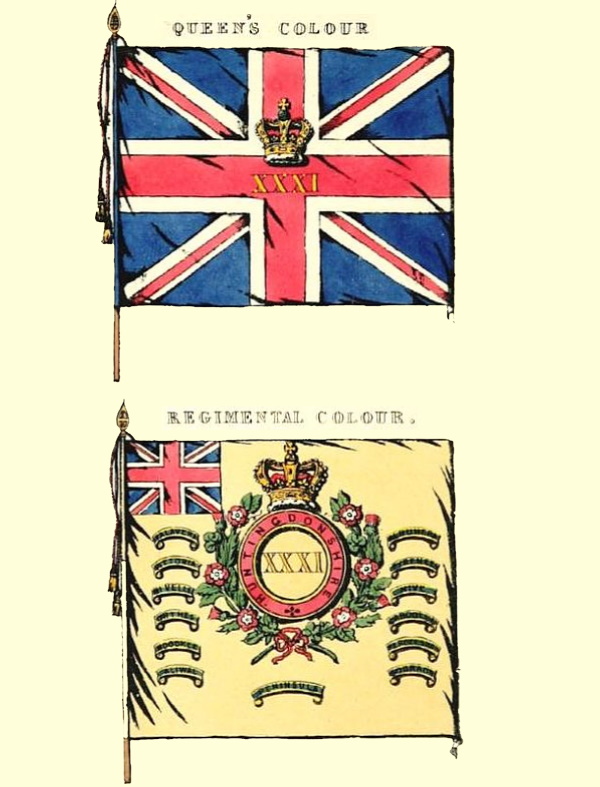
In the Royal Warrant, dated the 1st of July, 1751, for
ensuring uniformity in the clothing, standards, and colours
of the army, and regulating the number and rank of
regiments, the facings of the THIRTY-FIRST regiment were
directed to be Buff. The first, or King’s colour, was the
Great Union; the second, or Regimental colour, was of
Buff silk, with the Union in the upper canton; in the
centre of the colour the number of the rank of the regiment,
in gold Roman characters, within a wreath of roses
and thistles on the same stalk.
1752
In 1752 the regiment returned to England from
Minorca.
1753
1754
During the years 1753 and 1754 the THIRTY-FIRST
regiment was stationed in England.
1755
In the year 1755 the regiment proceeded to Scotland,
in which country it remained for seven years.
1756
While the regiment was stationed in North Britain,
the Peace of Aix-la-Chapelle was interrupted by the
aggressions of the French on the British territory in
North America, and early in 1756 the King of France
prepared a powerful armament for the capture of the
island of Minorca. In consequence of this attack on
Minorca, hostilities became inevitable on the part of
Great Britain, and on the 18th of May war was declared
against France.
The garrison of Minorca, consisting of the 4th, 23rd,
24th, and 34th regiments, after making a noble and
vigorous defence, which called forth the unqualified admiration
of their opponents, was forced to surrender on
the 29th of June.
At this period the army and navy were increased, and
among other augmentations, fifteen of the regiments of
infantry were authorised to raise second battalions from
the 25th of August, 1756.
1758
In 1758 these additional battalions were formed into
distinct corps, and numbered from the sixty-first to the
seventy-fifth regiment. By this arrangement, the second
battalion of the THIRTY-FIRST regiment was constituted
the present Seventieth regiment.[19]
1759
The THIRTY-FIRST regiment, having been selected to
remain in the United Kingdom, was precluded from
taking a part in The Seven Years’ War, the most memorable
occurrences of which were, the battle of Plassey, gained
in India by Colonel Clive, on the 23rd of June, 1757,
which laid the foundation of the British dominion in
India; in Germany, the battle of Minden, which was
fought on the 1st of August, 1759; in North America,
the capture of Cape Breton, in July, 1758; and the capture
of Quebec, in September, 1759, which cost the life
of the gallant General Wolfe, but which led to the conquest
of Canada in the following year, when Montreal,
with the whole of that country, surrendered to General
Amherst, in September, 1760.
1760
In Germany several hard-fought but indecisive actions
occurred: the battle of Warbourg, on the 31st of July,
1760; the action near the Convent of Campen, on the
16th of October following; and the battle of Kirch
Denkern, or Fellinghausen, on the 15th and 16th of July,
1761. In the following year actions were fought at
Wilhelmstahl and at Amonebourg; the former on the
24th of June, and the latter on the 21st of September.
1762
On the 4th of January, 1762, war was declared against
Spain; and Martinique, Grenada, St. Vincent, and other
West India islands surrendered to English valour. The
important city of Havannah, in Cuba, also capitulated to
the British arms.
These successes were followed by a Treaty of Peace, the
preliminary articles of which were signed at Fontainebleau,
by the Duke of Bedford, on the 3rd of November, 1762.
In June, 1762, the THIRTY-FIRST regiment proceeded
from Scotland to England, where it was stationed during
the two following years.
On the 20th of August, 1762, Colonel James Adolphus
Oughton, from the fifty-fifth regiment, was appointed by
His Majesty King George III. to the Colonelcy of the
THIRTY-FIRST regiment, in succession to Lieutenant-General
Henry Holmes, deceased.
1763
The treaty of Fontainebleau was concluded at Paris on
the 10th of February, the ratifications were exchanged on
the 10th of March, and peace was proclaimed in London
on the 22nd of that month.
By this treaty, the whole of Canada, part of Louisiana,
together with Cape Breton, and the other islands in the
Gulf of St. Lawrence, were ceded to Great Britain. In
the West Indies, the islands of Tobago, Dominica, St.
Vincent, and Grenada were retained by Great Britain;
but Martinique, Guadaloupe, Marigalante, and St. Lucia
were restored to France. In the East Indies, the French
obtained the restitution of their settlements, but agreed
not to erect any fortifications in Bengal. Minorca was
restored to England in exchange for Belle-Isle, which had
been captured by the British in 1761, and it was stipulated
that the fortifications of Dunkirk should be demolished.
Spain ceded East and West Florida to Great Britain, in
return for the restitution of the Havannah, Manilla, and
all the places which Spain had lost since the commencement
of the war.
1765
In this year the THIRTY-FIRST regiment was embarked
for Pensacola, the capital of West Florida, which country
had been ceded to Great Britain by Spain at the peace of
Fontainebleau; on the passage out, the transport having
the regiment on board put into Blue-field Bay, Jamaica,
at the time the yellow fever was raging with great violence
in that island; the THIRTY-FIRST took the infection, and
unfortunately carried it to Pensacola, where the soldiers
continued to suffer most severely; so great was the mortality,
and so rapid the disease in its course, that the regiment
could not supply men to carry their comrades to
the grave. The men who attended the funerals of their
brother soldiers in the morning, while the regiment was
strong enough to preserve some ceremony, were, in
many instances, consigned to the tomb in the evening.
It appears by the newspapers of the period, in which
allusion is made to the mortality, that at one period of its
illness the regiment could muster only a corporal and six
men for duty.
1772
The regiment remained in the Floridas, garrisoning
alternately St. Augustine and Pensacola, the capitals of
East and West Florida, until the autumn of 1772, when
it was embarked for St. Vincent, to take part in reducing
to submission the refractory Caribs in that island.
The island of St. Vincent was captured from the
French, in 1762, and was ceded to Great Britain at the
peace concluded in the following year; it contained two
tribes of natives, called the red and black Caribs, the former
being the aborigines, and the latter having sprung from a
cargo of African slaves, who escaped from a vessel which
was wrecked on the island. The Caribs were devoted to
the French interest; they were dangerous and troublesome
neighbours to the English planters, and it was
found necessary to restrain their conduct, and enforce
obedience to a few salutary regulations. They were,
however, of a resolute spirit, possessed many thickly
wooded fastnesses, and resisted all attempts to restrain
their roving propensities and mode of life with such determination,
that it became necessary to augment the military
force on the island. Although they were contemptible
opponents in skill, yet the nature of the climate,
and the natural difficulties of the country, being thickly
wooded where they inhabited, rendered the service extremely
tedious and arduous.
1773
On the 14th of January, 1773, the THIRTY-FIRST regiment
fell into an ambuscade, and sustained some loss;
the commanding officer, Lieutenant-Colonel Ralph
Walsh, was among the killed.
1774
After the troops had been in the woods for some
months, they at length succeeded, in February, 1774,
in bringing the Caribs to terms, who agreed to
acknowledge the sovereignty of Great Britain, but
were permitted to preserve their own laws and customs.
Thus terminated the Carib war. The THIRTY-FIRST
regiment returned to England, and was subsequently
stationed in North Britain.
1775
At this period the unfortunate misunderstanding
between Great Britain and her American colonies, on
the subject of taxation, produced open hostilities. On
the 19th of April the first collision occurred at Lexington,
and on the 17th of June following the battle of
Bunker’s Hill was fought. During the winter Quebec
was besieged by an American Army: this fortress was
gallantly defended by the troops under Lieut.-General
Guy Carleton, and reinforcements were ordered to
proceed from England to Canada.
1776
The THIRTY-FIRST regiment proceeded from Glasgow
to Cork, whence it embarked for Canada in April, as
part of the army under Major-General Burgoyne.
The transports arrived at Quebec on the 28th of May,
shortly after the defeat of the Americans by a sortie
of the garrison. Lieut.-General Carleton had pursued
the enemy up the river St. Lawrence, and Major-General
Burgoyne’s force remained only one night at
anchor below Quebec, where orders had been left for
him to follow. He joined at Trois Rivières; part of
the army disembarked and immediately occupied the
villages adjacent to their post on the road to Montreal.
On the 8th of June the Americans attempted to surprise
the post of Trois Rivières, having passed the
river from Sorel with two thousand men.
Brigadier-General Fraser, who commanded at the
post of Trois Rivières, gave the foe a ready reception,
with such men as he could collect, and, being soon supported
from the cantonments and the transports, put
the Americans to the rout. The troops pursued the
fugitives along the shore, while the shipping sailed up
the river and intercepted their flight. Major-General
Thompson, the American General, with many officers,
and two hundred men, were taken prisoners.
On the 14th of June the flotillas and the force on
shore reached Sorel, which the colonists had evacuated
a few hours before; Major-General Burgoyne continued
the pursuit as far as St. John’s, where the
troops from the transports under Major-General
Phillips joined him, and soon afterwards an additional
reinforcement under Brigadier-General Fraser.
All hope of accommodation now failed; on the 4th of
July the American Congress issued their Declaration of
Independence, and abjured their allegiance to the
Crown of Great Britain. By this Declaration the
name of colonies was abolished, and the thirteen provinces,
namely, New Hampshire, Massachusetts, Rhode Island,
Connecticut, New York, New Jersey, Pennsylvania,
Delaware, Maryland, Virginia, North Carolina, South
Carolina, and Georgia, were constituted the United
States of America.
The whole of Major-General Burgoyne’s army was
assembled by the end of July at St. John’s, where it
remained encamped during the naval operations on
Lake Champlain. After the defeat of the American
fleet, on the 11th of October, the weather becoming too
severe for further operations in the field, the troops returned
to Canada. The posts occupied by the THIRTY-FIRST
regiment during the winter were Sorel, St.
Charles, St. Denis, St. Anthony, and St. Ours.
1777
Major-General Burgoyne, who had proceeded to
England to submit to the Government a plan for the
ensuing campaign, arrived in Canada in May, 1777,
empowered to carry it out. An army, composed of
British, Dutch, and Colonial Corps, with the flank
companies of the regiments left to garrison Quebec
(among which was the THIRTY-FIRST regiment),
amounting to nearly eight thousand men, was equipped
and in the field by the 1st of July.
The flank companies of the THIRTY-FIRST, commanded
by Captains Cotton and Simpson, formed, with the
other flank companies and the twenty-fourth regiment,
the advance of the army under Brigadier-General
Fraser. Ticonderago was first attacked, and
the Provincials were forced to evacuate that post.
Major-General Burgoyne’s plan was to penetrate
the United States from Lake Champlain to the river
Hudson, and advance upon Albany, with the view of
reducing that country to submission. While Major-General
Burgoyne moved towards the lake by Skenesborough,
a short distance inland from South Bay, where
an action occurred on the 6th of July, Brigadier-General
Fraser, with the advance, followed the Provincial
troops towards Castleton, and on the following day
commenced an action by detaching his light companies
to occupy a height commanding their flank. The
American General observing this movement detached
a force to prevent the British obtaining possession of
this post. A sharp action ensued, and the Americans
retreated with much loss to Huberton, where, meeting
with a reinforcement, they made a stand in good order.
Brigadier-General Fraser attacked them with great
vigour, but not having half their number, made no
impression upon them, until Major-General Reidesel,
commanding the Dutch, arrived, when their flank being
turned, the Americans retreated, leaving two hundred
dead on the field, among whom was Colonel Francis,
their commander.
The flank companies were hotly engaged in this
affair. Brigadier-General Fraser had but 850 men in
the beginning of the day, while the enemy amounted
to 2000.
When Major-General Burgoyne joined, he pursued
the Americans to Fort Anne and Fort Edward, notwithstanding
the natural difficulties of the road, which
the enemy increased by every possible means that
could be devised. The Americans retreated from Fort
Edward to Saratoga, and abandoning Fort George,
left the navigation of Lake George open to Major-General
Burgoyne.
General Arnold was now appointed to command the
Americans in the British front, and, forming at Saratoga,
fell back to Stillwater. Major-General Burgoyne
remained at Fort Edward in great want of provisions
and of means to advance; a detachment sent to procure
supplies was completely cut off at Bennington, while
Lieut.-Colonel St. Leger was compelled to raise the
siege of Fort Stanwix, leaving behind his equipage
and baggage.
The Americans, greatly elated by these circumstances,
had assembled a large body under Major-General
Gates at Stillwater. Small parties having
been detached to Lieut.-General Burgoyne’s[20] rear,
were in some measure successful, and his communication
being thus threatened, notwithstanding his difficulties,
arising from want of resources, he resolved to
advance, and at all hazards to attempt a junction with
the troops under Lieut.-General Sir Henry Clinton,
taking with him thirty days’ provisions. Lieut.-General
Burgoyne crossed the river Hudson on the 13th and
14th of September by a bridge of rafts, which had once
been swept away, and on the 18th arrived at Stillwater,
before the enemy’s position, which he attacked at two
o’clock in the afternoon of the 19th of September, when
a severe and indecisive action ensued. Both parties
held their respective positions, and entrenched themselves
within them. The British General, confined
between two rivers by a stronger force than his own,
continued within his lines and redoubts until the 7th
of October, and when nearly destitute of provisions,
determined to make another effort to extricate his
troops; 1500 British, with twelve pieces of artillery,
commanded by Lieut.-General Burgoyne in person,
moved in advance towards the American position, and
formed his right wing, while a body of light companies
and Indians were placed under cover to act upon the
enemy’s rear when he should be sufficiently advanced.
General Gates, observing this separation of wings, instantly
attacked the left wing with a view to cut off
all chance of a junction; the British grenadiers were
in this wing, and behaved with great gallantry.
General Arnold attacked the British right, and Brigadier-General
Fraser threw the light companies into a
second line, in rear of the right wing, to cover its
retreat upon the left. While this movement was
taking place, the left of the right wing doubled to the
rear. Brigadier-General Fraser led the light infantry
to its support, but was mortally wounded; not, however,
before his brave troops gave the right wing time
to recover, and secured Lieut.-General Burgoyne’s
retreat to his camp. The Americans pushed on, and
obtained an entrance into the British lines: night put
an end to the action.
During the night Lieut.-General Burgoyne removed
his position to higher ground in his rear. General
Gates distributed his corps to surround the British,
and Lieut.-General Burgoyne once more tried a new
position, retiring on Saratoga, and abandoning his
baggage and provisions, as well as his hospital with
300 sick. He reached Saratoga safely, the Americans
having been delayed in their pursuit by bad weather:
a detachment, sent to observe the British, succeeded
in reaching the place, but withdrew on the appearance
of Lieut.-General Burgoyne’s force. Sending a detachment
with workmen to examine and repair the roads,
Lieut.-General Burgoyne resolved to continue his
retreat to Fort George. The detachment, which was
of regular troops, had scarcely marched, when the
Americans appeared in force; it was instantly recalled,
and the hope of rendering the roads passable for artillery
was abandoned. The British patrols reported
that every avenue of escape was in possession of the
enemy; the men were worn down with fatigue and
hunger, having been for some time on a reduced allowance,
and but three days’ provisions remained. Under
these circumstances Lieut.-General Burgoyne was constrained
to treat with Major-General Gates, and obtaining
honorable terms, capitulated on the 17th of
October. The troops, of which the grenadier and light
companies of the THIRTY-FIRST formed part, laid down
their arms on condition of being sent to England; and
they engaged not to serve again in North America
during the war.
The American government violated the conditions
of the convention, and detained the troops until the
year 1781.
1778
1779
In 1778 the French monarch sent a numerous fleet
under the Count D’Estaing, having on board a large
body of troops, to the assistance of the Americans; in
1779 the court of Spain commenced hostilities against
Great Britain, and this example was followed by the
Dutch.
1780
Major-General Thomas Clarke, from the Coldstream
Guards, was appointed, on the 3rd of May, 1780, to
the Colonelcy of the THIRTY-FIRST regiment, in succession
to Lieut.-General Sir James Adolphus Oughton,
K.B., deceased.
1781
The battalion companies of the regiment had remained
in Canada, where they eventually were joined
by the flank companies. On the 12th of March, 1781,
the light company was detached to Lake Champlain,
with a view of reconnoitring the neighbourhood, and
effecting the destruction of the military stores left at
Ticonderago by Lieut.-General Burgoyne. The object
was partly accomplished, and Captain Andrew Ross,
who commanded the company, gained great credit for
the skill and conduct he displayed in this difficult
enterprise. The party consisted, in addition to the
light company of the THIRTY-FIRST, of men selected
from the different Provincial corps, with a few Indians.
It was in the spring of the year, when the ice was
breaking up, and the operations were attended with
difficulties and great privations. The men suffered so
severely from fatigue, that the Provincials and Indians
dropped off by degrees, and the party was reduced, on
its return, to the light company only.
During July the THIRTY-FIRST regiment was encamped
on the Plain of Abraham, memorable as the
scene of the British victory over the French under the
Marquis de Montcalm, on the 13th September, 1759,
by which Quebec was gained to England, and in which
battle the celebrated Major-General Wolfe lost his life.
1782
In October, 1781, the British army under Lieut.-General
the Earl Cornwallis, after a gallant defence
against the combined French and American forces,
was compelled to surrender to General Washington at
York-Town. The enormous expense of carrying on
the war with America, so distant from the seat of
preparation and power, with the other evils attending
this memorable and ever-to-be regretted contest, were
so apparent, that the desire for peace became general,
and King George III. at length conceded the Independence
of the United States. The Preliminary
Articles of Peace were signed at Paris on the 30th of
November, 1782, by the Commissioners of the King of
Great Britain and by those of the American Congress,
and the Treaty was concluded in the ensuing February.
While the THIRTY-FIRST was stationed in Canada,
a letter, dated the 31st of August, 1782, conveyed to
the regiment His Majesty’s pleasure that County-titles
should be given to the regiments of infantry, and the
THIRTY-FIRST was directed to assume the name of the
Huntingdonshire regiment, in order that a connexion
between the corps and that county should be cultivated,
which might be useful in furthering the success of the
recruiting service.
1783
The preliminaries of the treaties between England,
France, and Spain, were signed at Versailles on the
20th of January, 1783. St. Lucia was restored to
France, also the settlements on the river Senegal, and
the city of Pondicherry in the East Indies. France
relinquished all her West India conquests, with the
exception of Tobago; Spain retained Minorca (which
she had captured in the previous year) and West
Florida; East Florida was ceded in exchange for the
restitution of the Bahamas to Great Britain.
On the 2nd of September, 1783, were signed the
Preliminary Articles of Peace with Holland, the peace
with that country having been postponed in consequence
of the Dutch claiming an indemnification for the
expenses of the war, and the restoration of Trincomalee,
in Ceylon, which had been captured from the Dutch by
the English, in January, 1782, and retaken by the
French in August following. The place was, however,
restored to Holland.
1787
After eleven years’ service in North America, the
THIRTY-FIRST regiment embarked, on the 4th of October,
1787, at Quebec, and on the 7th of November
landed at Portsmouth.
During the two following years the regiment remained
in Great Britain.
1789
In the year 1789 was effected the French Revolution;
the Bastile was stormed by the Parisians on the 14th of
July, and the Governor put to death. The National
Assembly passed several decrees abolishing all the relies
of the feudal system. On the 20th of August a declaration
of rights was agreed on to serve as the basis of the
French constitution. A national force was embodied,
and no vestige of the old government remained, except
a King without power, and a Court without splendour.
In the summer of 1789 two British vessels were
seized by the commander of a Spanish frigate at
Nootka Sound, on the western coast of North America,
where a settlement had recently been established for
carrying on the fur-trade with the natives. The settlement
was taken possession of by Spain, and the British
crews were made prisoners. The Government, on
receiving this intelligence, called upon the Court of
Madrid to make satisfaction for these injuries, and
great preparations were made for war by both countries.
1790
Accordingly in July, 1790, the THIRTY-FIRST regiment
embarked at Spithead on board the fleet to
perform its original service of Marines, in the event of
a war with Spain, which appeared probable. The
negotiations were protracted to a considerable length of
time, but on the 28th of October a convention was
entered into, by which Spain agreed to make reparation
for the injuries sustained, and to restore Nootka.
1791
In July, 1791, the THIRTY-FIRST regiment was sent
hastily to Birmingham, to aid in the suppression of
very serious disturbances, which broke out there in
consequence of the celebration of the anniversary of the
French Revolution, on the 14th of July, 1791, by a
party of the “Friends of Freedom,” at a tavern. The
populace destroyed the house and chapel of Dr. Priestley,
the eminent philosopher, and burned many of the
dwellings of those suspected to be friendly to the
French cause. The troops employed were praised for
their regularity and forbearance on this occasion.
When order had been restored in Birmingham, an
outbreak among the miners at Whitehaven called for
the assistance of the military, and the regiment was
again employed in the delicate as well as unpleasant
duty of aiding the civil power in the suppression of
riot.
1792
Major-General James Stuart was appointed from the
half-pay of the Ninetieth regiment to the Colonelcy
of the THIRTY-FIRST regiment on the 8th of February,
1792, in succession to Lieutenant-General Thomas
Clarke, removed to the Thirtieth regiment.
On the 17th of April, 1792, the THIRTY-FIRST regiment
embarked at Port Patrick for Ireland.
1793
Colonel Henry Lord Mulgrave, from the Grenadier
Guards, was appointed Colonel of the THIRTY-FIRST
regiment on the 8th of February, 1793, in succession
to Major-General James Stuart, deceased. His Lordship
subsequently assumed the command of the
regiment at Waterford, as its Colonel; and, after
inspecting the corps in the field, entertained the officers
at dinner.
Meanwhile, Louis XVI. had been decapitated, and
the progress of democracy menaced Europe with universal
anarchy. On the 1st of February the National
Convention of France declared war against Great
Britain and Holland, and the British Government
prepared for hostilities. A large army was sent, under
the command of the Duke of York, to join the Austrian
and Prussian allies. Several engagements occurred,
and the French gained possession of the
Austrian Netherlands. Holland opened her principal
towns to the enemy, and they were garrisoned by
French troops.
In September, 1793, the flank companies of the
THIRTY-FIRST regiment embarked for Barbadoes, for
the purpose of taking part in the capture of the French
West India Islands.
1794
In the beginning of 1794 an armament was assembled
at Barbadoes, of which the flank companies of the
THIRTY-FIRST formed part, and early in February the
expedition, under Admiral Sir John Jervis and General
Sir Charles (afterwards Earl) Grey, sailed for Martinique.
After some sharp fighting the island was taken
possession of by General Sir Charles Grey, on the 22nd
of March.[21]
From Martinique the grenadiers, under Prince Edward
(afterwards Duke of Kent), the light infantry,
under Major-General Dundas, and three other regiments,
embarked on the 30th of March for St. Lucia,
where they arrived on the 1st of April, and the conquest
of that island was effected in three days; His
Royal Highness Prince Edward, with his brigade of
grenadiers, and Major-General Dundas, with his brigade
of light infantry, taking possession of St. Lucia on the
4th of April. The flank companies of the THIRTY-FIRST
regiment were afterwards employed in the reduction
of the island of Guadaloupe. A determined
resistance was made by the enemy; but the island was
captured by the 20th of April.
France did not view with indifference the loss of
these valuable possessions, and in June a French armament
arrived at Guadaloupe for the recovery of that
island. The light company, under Brevet Lieut.-Colonel
Andrew Ross, highly distinguished itself on the
night of the 13th of June, in attacking the enemy near
Point-à-Petre. General Sir Charles Grey stated in his
despatch:—
“Brevet Major Ross,[22] of the THIRTY-FIRST regiment,
who was with the light infantry, behaved with great
gallantry and good conduct on this occasion, as he has
done on every other.”
The light company also participated in a night attack
on Fort Fleur d’Epée between the 25th and 26th of
June; on the day following, Brigadier-General Symes,
with the grenadiers and light infantry, attacked the
enemy, who was driven to Morne Mascot, where he again
made resistance, but being charged with the bayonet,
he fled into Fort Fleur d’Epée.
Lieut.-Colonel Ross, of the THIRTY-FIRST, commanded
the second battalion of light infantry on these occasions.
Lieut.-Colonel Colin Graham, of the twenty-first
Royal North British Fusiliers, was appointed to the
command of the troops in Basse Terre, and he
defended Berville camp with the utmost gallantry until
the 6th of October, when he was forced to surrender,—his
force having become reduced by excessive exertion,
and the unhealthiness of the climate, to one hundred
and twenty-five rank and file fit for duty.
The troops at Guadaloupe suffered severely from the
climate, and the arduous duties they had to perform,
and could only muster 389 soldiers fit for duty on the
1st of September.[23]
By the articles of capitulation the British troops
were to march out with the honors of war, and it was
agreed to send the garrison to England on board
French ships, as soon as transports were ready. The
latter part of the agreement was not, however, complied
with, as they remained prisoners for more than
a year afterwards, during which time many of them
died. The garrison consisted of the flank companies of
the 17th, 31st, and 34th regiments; the 39th, 43rd,
56th (three companies), and 65th regiments. Their
loss in the different actions between the 27th of September
and the 6th of October amounted to two
officers killed and five wounded; twenty-five non-commissioned
officers and privates killed, and fifty-one
wounded.
During the year 1794 Lieutenants Davies, Mackenzie,
and Williams, of the THIRTY-FIRST regiment, died of
fever contracted in the West Indies.
The whole island of Guadaloupe, with the exception
of Fort Matilda, had been recaptured by the French:
this fort was defended by the troops under Lieut.-General
Prescott until the 10th of December, when
it was evacuated by the British.
On the 12th of July, 1794, the THIRTY-FIRST
regiment embarked at Wexford for England, disembarked
at Bristol, and marched thence to Southampton.
The regiment, on the 25th of July, 1794, was
augmented to ten battalion and two flank companies;
and on the 17th of August following embarked for
Holland, where it was stationed at Middleburg and
Flushing, in the island of Walcheren, but was not
employed on any particular duty.
1795
In this year the regiment returned to England, and
landed at Plymouth on the 27th of February, 1795.
A camp was formed in the month of August, at
Nursling, near Southampton, which the THIRTY-FIRST
regiment joined on the 25th of that month, and received
a reinforcement to its strength in drafts from
the 43rd, 88th, 92nd, and 94th regiments, which raised
its establishment to 1000 rank and file, with a second
lieutenant-colonel, a major, and one additional lieutenant
to each company, besides two recruiting
companies.
On the 25th of October, 1795, the THIRTY-FIRST
regiment embarked for the West Indies, as part of the
armament which had been prepared for the deliverance
of the French West India Islands from the power of
republicanism, and to reduce to obedience the insurgents
of St. Vincent and Grenada. The expedition,
commanded by Lieut.-General Sir Ralph Abercromby,
sailed with the immense fleet, under the
convoy of a squadron of the Royal Navy, commanded
by Rear-Admiral Sir Hugh Christian. The troops
amounted to about 25,000 men, in the highest state of
equipment; and the armament on quitting the British
shores presented a magnificent spectacle, calculated to
impress the mind with a just idea of the power of
England; but it unfortunately happened that the
voyage had been delayed until a very late period of the
year; three attempts were made to get under weigh,
and each was prevented by the violence of the weather:
many ships were driven from their anchors and
stranded.
Three hundred sail got under weigh on the 11th of
November, when an accident to the Admiral rendered
the attempt of no avail. On the 15th another endeavour
was overcome by the tempestuous weather.
At length the fleet sailed, but it had scarcely got clear
of the Isle of Wight, when another severe storm obliged
the vessels that had ridden through it with safety to
return to Portsmouth.
With great difficulty and exertion Admiral Christian
collected the remainder of his convoy, and again sailed
on the 9th of December, but four days afterwards a
storm destroyed many of the transports, and so scattered
the fleet as to render a re-union impossible.
1796
Lieut.-General Sir Ralph Abercromby sailed in
the “Arethusa” frigate, with such vessels as could be
collected, and on the 14th of March, 1796, arrived at
Barbadoes.
The THIRTY-FIRST regiment, having weathered the
storm, which had dispersed the fleet in the Channel,
proceeded on the voyage, but was unable to make good
the passage, and on the 5th of February, 1796, after
being six weeks at sea struggling against the violent
tempests, the regiment was landed at Gosport, whence
it marched to Poole, in Dorsetshire; the regiment was
not long inactive, as on the 19th of March it was
again on board ship at Southampton, and proceeded
to its original destination.
On the 1st of May the THIRTY-FIRST arrived off
the island of St. Lucia, on which Lieut.-General Sir
Ralph Abercromby had already effected a landing.
The regiment disembarked immediately, under the
command of Lieut.-Colonel Hay, and was cantoned
near the point of disembarkation at Choc Bay. The
fortress of Morne Fortunée was invested by Lieut.-General
Sir Ralph Abercromby; Morne Chabot, another
strong position, having been carried with great gallantry
by Brigadier-General (afterwards Sir John)
Moore.
The batteries against Morne Fortunée were opened
on the 14th of May, and on the night of the 17th the
strong outpost of La Vigie was assaulted. The THIRTY-FIRST
regiment marched from its position, near Choc
Bay, at sunset, for the purpose of a night-attack upon
this post, which was remarkably strong. It formed a
peninsula, accessible only by a narrow isthmus, and
commanded the entrance on one side of the Carenage
harbour. The post was defended by two batteries;
the first placed midway upon the acclivity, and the
second on the summit of the height. The approaches
to both were by a circuitous path, and the guide who
accompanied the regiment was mortally wounded by
the first fire from the enemy’s piquet stationed on the
isthmus. The regiment, being ignorant of the country,
missed the proper direction. Lieut.-Colonel Hay
ordered it to ascend the hill en force, which was done,
although attended with great difficulty from the precipitous
nature of the ground. The first battery was
gallantly carried by storm, and the enemy retired to
the higher one. The regiment was unfortunately
separated in the ascent, and was unable to make a
concentrated and effectual attack upon the works that
crowned the height, which it nevertheless, in spite of all
obstacles, bravely attempted, but the enemy’s grape-shot
took such effect that the regiment was obliged to
withdraw, after a severe struggle.
The THIRTY-FIRST had Captains Johnson and Walker,
four serjeants, and eighty rank and file killed; Lieut.-Colonels
Hay and Arbuthnot, Captains Murray and
Sorrell, Lieutenants Sullivan and Hawkshaw, four
serjeants, and one hundred and twenty-one rank and
file wounded.
On the 25th of May the island of St. Lucia capitulated,
and the THIRTY-FIRST, forty-fourth, forty-eighth,
and fifty-fifth regiments, under Brigadier-General
Moore, were selected to occupy the place.
The possession of the island was not a quiet one; small
bodies of French, who had deserted from the different
fortresses at their capitulation, withdrew into the
interior, and joined the runaway slaves and Caribs;
taking advantage of the impenetrable nature of the
country, they formed themselves into bands for the
purpose of molesting the British, and plundering the
planters and other residents of the island. Brigadier-General
Moore took the field, and penetrated with his
force into the wildest quarters of the mountains, in
order to eradicate these predatory bands.
The THIRTY-FIRST was employed on this harassing
duty, and suffered much from fatigue, privation, and
continual exposure; on the service being concluded,
the regiment went into quarters at Vieux Fort, and
other posts, when it became so unhealthy that the
authorities were compelled to remove the corps from
the island. The deaths among the men were for a
time sixteen each day; on the embarkation of the regiment,
on the 22nd of December, for Barbadoes, it had
scarcely a soldier fit for duty; and on its disembarkation
there, six days afterwards, it became necessary
to send the entire regiment into hospital, which was
the second time the THIRTY-FIRST had been rendered
unserviceable from sickness, the corps having suffered
in a similar manner while stationed in Florida in the
year 1765.
During the year 1796 the regiment had lost seventeen
officers, and eight hundred and seventy men,
including those who fell in the attack of La Vigie, in
St. Lucia.
In the previous year Prussia had concluded a peace
with the French republic, and, in consequence of the
United Provinces of Holland having leagued with
France, England had taken possession of the Cape of
Good Hope; in February, 1796, the island of Ceylon
was also captured from the Dutch by Great Britain.
The former allies of England now became converted
into enemies. War was declared by Holland, which
had been constituted the Batavian republic, against
Great Britain in May, and Spain followed the example
in October. In the same month
Lord Malmesbury was sent to Paris to negotiate a peace on the part of the
British Government, but the French insisted upon
retaining, as integral parts of the republic, the conquests
lately made: these terms could not be acceded to consistently
with the general interests of Europe, and
the negotiation was discontinued.
1797
On the 14th of February, 1797, the combined fleets of
France and Spain were defeated off Cape St. Vincent,
by Admiral Sir John Jervis, afterwards created Earl
St. Vincent, on account of this glorious victory, for
which the honor of knighthood was also conferred on
Commodore (afterwards Admiral Viscount) Nelson. On
the 18th of February the Spanish island of Trinidad
surrendered to a British force under Lieut.-General
Sir Ralph Abercromby.
In April, 1797, Austria signed the preliminaries of
peace with the French Republic, and, in July, Lord
Malmesbury was sent a second time to negotiate a treaty,
but the demands of the French Directory rendered the
attempt abortive.
In the year 1797 the THIRTY-FIRST regiment, greatly
reduced in numbers, embarked for England and landed
at Gravesend in July; it mustered only eighty-five men,
including serjeants, drummers, and rank and file.
Shortly after disembarkation the regiment marched to
Doncaster, and remained at stations between that place,
Hull, and York, for the two following years.
In this year alarming mutinies occurred on board the
fleet at Spithead and the Nore, but the British seamen
nobly redeemed their character on the 11th of October,
1797, in the victory gained by Admiral Duncan (who
was in consequence created Viscount Duncan), over the
Dutch fleet, off Camperdown, which was proceeding
to join that of the French at Brest.
On the 17th of October the definitive treaty of
peace between Austria and the French republic was
signed at Campo Formio, so that Great Britain was
left to continue the contest single-handed with France
and her allies.
1798
The threat of invasion, renewed by France, called
forth the patriotic feelings of the British nation; the
militia force was increased, and volunteer corps were
formed in every part of the kingdom.
Napoleon Bonaparte, against whose legions in the
Peninsula, in subsequent years, the THIRTY-FIRST regiment
acquired great renown, was now rising step by
step to that Imperial sway which he afterwards attained.
The French Directory, jealous of his ambition,
sent him on the expedition to Egypt, with the view of
acting from that country against the British empire in
India. Napoleon took Alexandria by storm, and soon
established himself at Cairo. The Sublime Porte, incensed
by the invasion of Egypt, declared war against
France, and formed an alliance with Russia. The fleet,
which had conveyed the expedition to Egypt, was
almost destroyed by Admiral Nelson in Aboukir Bay
on the 1st of August. So large a portion of the French
army being thus secluded in a distant land, gave fresh
impulse to the Allies, and in November the island of
Minorca surrendered to the British arms. In December
the co-operation of Russia against France was
secured by Great Britain.
1799
At this period of the war the soldiers of the English
militia regiments were permitted to extend their
services to the regular army;—the THIRTY-FIRST regiment
received eight hundred and fifty-three volunteers
from the militia.
In March, 1799, war was declared by the French
Directory against Austria, and the combined Austrian
and Russian armies were so successful as to recover
the greater portion of Italy.
In August, 1799, a corresponding attempt was made
by Great Britain to recover Holland from the dominion
of France, and a numerous army was selected to proceed
to that country, under His Royal Highness the
Duke of York. Previously to the arrival of the Duke
of York, the army was commanded by Lieut.-General
Sir Ralph Abercromby, K.B., with the local rank of
General.
The THIRTY-FIRST regiment marched to Deal, embarked
for Holland on the 8th of September, and
arrived at the Helder on the 15th of the same month.
The THIRTY-FIRST and other regiments were embarked
after the departure of General Sir Ralph Abercromby,
in order to reinforce his army. The Duke of York,
having preceded these additional troops by two days, was
already in command of the army, which was intrenched
in the advance of the Helder on the Zuype, in which
lines Sir Ralph Abercromby had, on the 10th of September,
near the village of Crabbendam, repulsed the
attack of the French and Dutch under General Brune.
Immediately on landing, the THIRTY-FIRST marched
to the lines, and joined Major-General the Earl of
Chatham’s brigade, in the division of General Sir
Ralph Abercromby, on the 15th of September.
The Duke of York, having been reinforced by the
expected arrival of a corps of twelve thousand Russians,
under Lieut.-General Hermann, resolved on attacking
the French position in advance of Alkmaar, reaching
from Zuyder-Zee on the right, to Camperdown on the
left, and embracing the town of Bergen.
The attack was made on the 19th of September, in
four columns: the right, formed entirely of Russians,
under Lieut.-General Hermann, moved on Bergen;
the centre divisions, under Lieut.-General Dundas
and Lieut.-General Sir James Pulteney, forced the
village and post of Oude Carspel, on the road to
Alkmaar; while the left column, in which was the
THIRTY-FIRST regiment, under General Sir Ralph
Abercromby, advanced to the capture of Hoorne.
The point of attack selected for Sir Ralph Abercromby’s
division being at a considerable distance
beyond the extent of the line, the THIRTY-FIRST,
and other regiments, marched at eight o’clock on
the night of the 18th of September, and the movement
was performed with such skill and secrecy, that
Hoorne was surprised and carried on the following
morning without loss, which placed the French position
in considerable peril. The Russians having failed in
holding Bergen, after having entered it in gallant
style, rendered it impossible for the centre division to
continue in possession of the posts it had acquired.
The British troops were therefore withdrawn to their
former lines upon the Zuype, to which the Russians
had retreated. Hoorne was evacuated, and the THIRTY-FIRST,
with the other regiments of Sir Ralph Abercromby’s
division, returned on the night of the 19th of
September to the ground they had quitted on the
former evening.
From the 20th of September until the 1st of
October, both armies remained within their intrenchments,
strengthening their lines of defence; the French
had received reinforcements, and had inundated a
large tract of country on their right by cutting the
sluices, thus contracting the ground of operations to
six or seven miles.
The Duke of York, on the 2nd of October, made
another attack on the French position between Bergen
and Egmont-op-Zee. The combined attacks were made
in four columns; the division under General Sir
Ralph Abercromby, being on the right, marched
along the beach. The left of the French army was
posted and concentrated about Bergen, a large village
surrounded by extensive woods, through which passed
the great road leading to Haarlem; between which
and the sea was an extensive region of high sand-hills
impassable for artillery. Behind the sand-hills, and to
the enemy’s right, through the whole extent of North
Holland, lies a wet and low country, intersected with
dykes, canals, and ditches. The French centre was
supported by the town of Alkmaar. The battle soon
became serious in front of Bergen, upon which Lieut.-General
Dundas had been ordered to proceed.
Meanwhile Sir Ralph Abercromby had passed
Bergen in order to turn the position of the French at
Alkmaar, and overcame every opposition until he
reached Egmont-op-Zee, which post was occupied in
great numbers, and gallantly defended. Sir Ralph
Abercromby, however, here overthrew a corps of the
French army, and wheeling his division to the left,
turned the enemy’s position at Bergen, upon which
General Brune, the commander-in-chief of the French
and Batavian army, fell back, taking up an equally
strong position at a short distance to the rear.
The THIRTY-FIRST regiment had an opportunity of
distinguishing itself particularly throughout this
arduous contest, which lasted from six in the morning
until the same hour in the evening. In the attack of
Bergen, the regiment took two pieces of artillery from
the enemy; the corps on the right frequently charged
with the bayonet, and lost a great number of men.
The THIRTY-FIRST regiment had one serjeant and
twenty-seven rank and file killed; Captain Smith,
Ensign King, and fifty-five rank and file wounded.
During the night of the 2nd of October, Bergen
and Egmont-op-Zee were evacuated by the enemy.
The army remained during the night on the ground
it held at the close of the battle, and on the 3rd of
October Alkmaar was occupied by detachments of
British troops. On the 6th of October, the advanced
posts in front of Alkmaar, Egmont-op-Hooff, and
Egmont-op-Zee, were pushed forward, preparatory to
a general forward movement. At first little opposition
was shown, and the British took possession of some
villages, and of a position on the sand-hills near Wyck-op-Zee;
but the column of Russian troops, under the
command of Major-General D’Essen, in endeavouring
to gain a height in front of their intended advanced
post at Baccum, was vigorously opposed, and afterwards
attacked by a strong body of the enemy.
This movement obliged General Sir Ralph Abercromby
to move up in support with the reserve of
his corps; the French advanced their whole force;
the action became general along the whole line from
Limmen to the sea, and was maintained with great
obstinacy on both sides until night, when the enemy
retired, leaving the British masters of the field of battle.
The THIRTY-FIRST regiment, on the 6th of October,
had Lieutenant Forster, one serjeant, and thirty-five
rank and file killed; Captain Pickering, Lieutenants
Mullins, Walker, Ball, Ensigns Williams and
Johnson, three serjeants, and eighty-four rank and file
wounded.
In the meantime the French army had been reinforced;
the state of the weather, the ruined condition
of the roads, the total want of the necessary supplies,
offered great obstacles; besides which, the efforts
which had been made for the liberation of Holland
were not seconded by the Dutch people, so that it was
determined to withdraw the British army. A convention
was ultimately concluded with General Brune at
Alkmaar, on the 18th of October.
On the 16th of November the THIRTY-FIRST regiment
embarked at the Texel, and landed at Deal three days
afterwards, when it marched immediately to Canterbury,
where the effects of the Dutch campaign began
to be perceptible. Before the army left Holland
dysentery had broken out among the men, arising from
their exposure to the damp and fogs natural to the
country. The THIRTY-FIRST lost a great number of
men, from this cause, while stationed at Canterbury.
1800
On the 15th of May, 1800, the THIRTY-FIRST regiment
embarked at Dover for Ireland, landed at Cove
on the 6th of June, and marched directly to Cork, where
a force was collecting for a secret service, to which it
was added. On the 27th of June the embarkation
took place, and on the 8th of July the armament
reached the Bay of Quiberon; the twenty-third, THIRTY-FIRST,
fifty-second, and sixty-third regiments landed on
the Isle de Houat, where they remained encamped,
under the command of Brigadier-General the Honorable
Thomas Maitland, until the 19th of August,
when they again embarked and joined the expedition
under Lieut.-General Sir James Pulteney, destined
for the coast of Spain. A landing was effected at
Ferrol on the 25th of August; the troops advanced to
the heights which overlook the town, and the THIRTY-FIRST
had some skirmishing with the enemy’s piquets.
After viewing the town and its defences, Sir James
Pulteney abandoned the idea of attacking the place;
the troops were re-embarked on the following morning,
and the fleet sailed for Vigo, where it arrived on the
27th of August. Here General Sir Ralph Abercromby
joined with other troops, and assumed the
command of the whole force. After remaining in Vigo
Bay for some time, the fleet sailed for Cadiz, where it
arrived on the 3rd of October. Sir Ralph Abercromby
summoned the Governor to surrender, but an epidemic
fever was raging in the city, and the fleet quitted the
coast for fear of infection, and proceeded to Gibraltar.
At this period General Sir Ralph Abercromby
received orders from the British Government to
proceed to Egypt; but the three battalions of the
ninth foot, the second battalion of the twenty-seventh,
the THIRTY-FIRST, and two battalions of the fifty-second
regiment, being composed principally of volunteers from
the militia, whose conditions of enlistment limited their
services to time and place, were not available for the
expedition to Egypt: they were accordingly ordered to
proceed to Lisbon, where they arrived on the 27th of
November, having suffered much from confinement on
board ship, and the use of salt provisions.
1801
On the 27th of January, 1801, the THIRTY-FIRST was
again at sea, and on the 14th of February disembarked
at Minorca, which had surrendered to Great Britain in
November, 1798; this island was restored to Spain at
the Peace of 1802.
1802
The successes of the British arms in Egypt, by which
the French were expelled from that country, were
followed by a Treaty of Peace, which was signed on the
27th of March, 1802, at Amiens, between the French
Republic, Spain, and the Batavian Republic, on the
one part, and Great Britain on the other. The principal
features of the treaty were, that Great Britain restored
all her conquests during the war, excepting Trinidad
and Ceylon, which were ceded to her, the former by
Spain, and the latter by the Batavian Republic.
Portugal was maintained in its integrity, excepting
that some of its possessions in Guiana were ceded to
France. The territories of the Ottoman Porte were
likewise maintained in their integrity. The Ionian
Republic was recognised, and Malta was to be restored
to the Knights of St. John of Jerusalem. The French
agreed to evacuate the Neapolitan and Roman states,
and Great Britain all the ports that she held in the
Adriatic and the Mediterranean.
In May, 1802, the THIRTY-FIRST regiment sailed from
Minorca for England, and early in June landed at
Portsmouth, on the 19th of which month it was reduced
to the Peace Establishment.
1803
In the year 1803 the regiment was removed to
Jersey.[24]
Napoleon Bonaparte was now approaching the zenith
of his power: the unsettled state of affairs in France
had induced him to quit his army in Egypt, and on
his return the Directory was abolished, Bonaparte
being appointed First Consul of the French Republic.
This occurred in 1799, and in the following year
Europe was astounded by his daring passage of the
Alps, followed by the victory of Marengo, which caused
Austria to sue for peace.
The French being driven from Egypt in 1801 by
the gallant Abercromby and his brave troops, in which
the THIRTY-FIRST regiment would probably have shared,
had it not been for the circumstances stated at page 61,
the Peace of Amiens was concluded; it, however, gave
but a slight interval of tranquillity to Europe. The
military spirit of the French nation had been aroused
by the genius of Napoleon, who endeavoured to realize
his schemes for the aggrandizement of France;—and
England appeared as a barrier to his designs.
In May, 1803, the war was renewed; Hanover was
overrun by the French, and severed for a time from
the British Crown. An immense flotilla was also
assembled at Boulogne for the invasion of England.
The threat of invasion aroused the patriotism of the
British people, and the most strenuous measures were
pursued to defeat the French ruler’s designs; the
“Army of Reserve Act” was passed in June, 1803, for
raising men for home service by ballot; numerous
volunteer and yeomanry corps were formed in every
part of the kingdom; and all party differences merged
into one universal effort for the preservation of Great
Britain.
1804
On the 18th of May, 1804, Napoleon was invested
with the dignity of Emperor of the French, and on the
26th of May of the following year he was crowned
King of Italy at Milan.
Further measures of defence were adopted by Great
Britain, and the “Additional Force Act” was passed on
the 14th of July, 1804, by which a second battalion was
added to the THIRTY-FIRST regiment, to be formed of
men raised in the county of Chester, for limited service.
The regiment embarked at Jersey for England on
the 9th of November, and on the 27th of that month
arrived at Portsmouth, whence it marched to Winchester,
and received a further number of volunteers
from the Militia.
On the 12th of December the Court of Spain issued
a declaration of war against England, in consequence
of the capture of some frigates off Cadiz, which had
been intercepted while on their way to France with
cargoes of treasure,—Spain having agreed to furnish a
powerful aid to Napoleon.
1805
By July, 1805, the second battalion was fully embodied,
and in October proceeded from Chester to
Winchester, where the first battalion was stationed.
While the French were pursuing their victorious
career in Germany, they experienced dreadful reverses
from the navy of Great Britain. On the 21st of
October the combined fleets of France and Spain were
completely defeated off Cape Trafalgar. The victory
was, however, clouded by the death of Admiral
Viscount Nelson, to whose memory the highest honors
were paid by a grateful and admiring nation.
1806
On the 9th of January, 1806, the THIRTY-FIRST regiment
was present at the funeral of Admiral Viscount
Nelson, and formed part of the line between which the
procession passed on its way to St. Paul’s Cathedral,
in which the Admiral’s remains were interred, and
where a monument was erected by order of Parliament.
In November of the preceding year a squadron of
English and Russian vessels landed some troops at
Naples without any opposition from the Neapolitan
Court. The French Emperor, on receiving intelligence
of this transaction, issued a proclamation that
“the Neapolitan dynasty had ceased to reign,” and an
army, under his brother, Joseph Bonaparte, assisted
by Marshal Massena, marched for Naples. On the
15th of February the French entered that capital, and
soon obtained possession of the whole kingdom, excepting
Gaeta; Ferdinand IV. and his Court having previously
retired to Sicily. A decree was shortly issued by
Napoleon, conferring the crown of Naples on his brother
Joseph, who was proclaimed King on the 30th of May.
England being desirous of preserving Sicily from
the dominion of France, troops were embarked for that
island;—on the 26th of April the first battalion of the
THIRTY-FIRST regiment embarked at Tilbury-fort, and
landed at Messina on the 26th of July.
Previously to the arrival of the THIRTY-FIRST
regiment, the French had assembled a force in Calabria
for the invasion of Sicily, and Major-General
Stuart, commanding the British troops in that island,
formed the design of cutting off the French division
under General Regnier; the result was the battle of
Maida, where a victory was gained by the British troops
on the 4th of July. Major-General Stuart being
sensible that he could not, with his small force,
maintain himself in Calabria, recrossed the straits of
Messina and returned to Sicily. For this victory
Major-General John Stuart received the dignity of
Knight of the Bath, the thanks of Parliament, and was
created Count of Maida by the King of the Two Sicilies.
1807
Admiral Sir John Duckworth having failed in his
coercive mission to detach Turkey from the interests of
France, Great Britain determined to seize upon Egypt,
as a check to any fresh demonstration by the French
against the British possessions in the East Indies.
An armament accordingly sailed from Melazzo, on
the coast of Sicily, in February, 1807, under the
command of Major-General Alexander Mackenzie
Fraser, Colonel of the seventy-eighth regiment, and
landed at Aboukir on the 18th of March. On the 21st
of March, Alexandria was occupied by the British
troops, and it is a singular coincidence that it was the
anniversary of the battle fought near there in the year
1801, when the gallant General Sir Ralph Abercromby
received the wound which terminated his honorable
career.
On the 27th of March a force of fifteen hundred
men, of which the THIRTY-FIRST regiment formed part,
was detached under the command of Major-General
Wauchope to Rosetta. The troops arrived before the
city on the 31st of March, and not having been impeded
in their progress to the environs, entered the
place. The THIRTY-FIRST regiment marched into Rosetta,
while the grenadier battalion occupied a high
sandy mound without the city.
Rosetta is situated upon a slight eminence, commanding
a view of the river Nile and the fertile lands
of the Delta; the streets are somewhat wider than the
generality of Egyptian towns, and planted here and
there with trees. The houses are high, the lower half
of each being a dead wall, with a small door, leading
into a narrow passage, well secured with bolts and bars
of iron. The chambers are above, with trelliced windows
projecting over the streets. The Turks had garrisoned
their houses, and remaining quiet, allowed the British
to continue their march until some way into the town,
when through the loop-holes they had constructed on
purpose, and their trelliced windows, a destructive and
unexpected fire was opened upon the column. The
troops, although placed in a most trying and perilous
situation, behaved extremely well, and after having
suffered very materially in killed and wounded, retired
to Aboukir, from whence they returned to Alexandria.
Major-General Wauchope, who commanded the
force, was killed; the THIRTY-FIRST regiment had
Captain John Robertson, three serjeants, three drummers,
and sixty-nine rank and file killed; Captain
Patrick Dowdall, Lieutenants Edward Knox, Peter
Fearon, John Thornton, —— Sladden, and Francis Ryan,
Ensign Richard Kirby, seven serjeants, one drummer,
and one hundred and twenty-nine rank and file wounded.
Lieutenant Sladden subsequently died of his wounds.
Brigadier-General the Honorable Robert Meade
(Lieutenant-Colonel of the THIRTY-FIRST), the second
in command, was also severely wounded.
Major-General Fraser finding that a famine would
be the consequence of the British remaining at Alexandria,
without the occupation of Rosetta, detached
another body of troops, amounting to two thousand
five hundred men, under Brigadier-General the Honorable
William Stewart, to reduce the place. The force
consisted of a detachment of Royal Artillery, a detachment
of the twentieth light dragoons, light infantry
battalion, first battalion of the thirty-fifth regiment,
second battalion of the seventy-eighth regiment, the
Baron De Roll’s regiment, and a detachment of seamen.
A large Turkish force coming down the Nile from
Cairo, the troops were compelled to retire, fighting all
the way to Alexandria.
A formidable force now approached Alexandria, and
Major-General Fraser sent a flag of truce offering to
evacuate Egypt, on condition that the British prisoners
should be liberated. The proposal was readily accepted,
and on the 19th of September the British troops
embarked for Sicily, where they arrived on the 16th of
October.
1808
The first battalion of the THIRTY-FIRST regiment
embarked from Sicily for Malta, on the 17th of September,
1808, where it remained until August, 1810,
when it returned to Sicily.
1810
1811
On the 17th of August, 1810, the first battalion
landed at Messina, and remained in garrison in the
citadel until April, 1811, when Lieut.-General Lord
William Bentinck, being about to proceed to the eastern
coast of Spain, sent it to Malta, in order that a stronger
corps might be drawn from that island, the thirty-first
having been reduced considerably in numbers
while stationed in the Mediterranean. The battalion
landed at Malta on the 18th of April, but the force left
in Sicily being found insufficient, four companies were
immediately recalled, and on the 22nd of April re-embarked
for Messina; a few months afterwards the
head-quarters were ordered back to Sicily, and on the
28th of August joined the detached companies, when
the battalion was once more united in Sicily.
1812
About this period the British authorities in Sicily
detected the traces of a conspiracy set on foot the year
before by the Queen of Naples, who, it is said, had
proposed a scheme to Napoleon for massacring the
English. A new constitution was established in Sicily,
upon the model of that of Great Britain, under the
auspices of Lieut.-General Lord William Bentinck,
who had been appointed Captain-General of the
Island, and the Queen was sent into retirement.
In November, 1812, the grenadier company of the
THIRTY-FIRST regiment embarked from Sicily for the
east coast of Spain, under Lieut.-General Frederick
Maitland, and landed at Alicant on the 2nd of
December. In April, 1813, it returned to Sicily, where
it arrived in May.
1813
The first battalion of the THIRTY-FIRST regiment
remained in garrison in the citadel of Messina until
towards the end of 1813, when, in consequence of disturbances
at Palermo, the capital of Sicily, which
threatened to spread, the troops were detached to
various central positions. The THIRTY-FIRST, by a
detour, marched upon Castro Giovanni, and remained
there until January, 1814, when the battalion returned
to Messina.
1814
On the 28th of March, 1814, the battalion embarked
at Melazzo, as part of an expedition destined for the
shores of Italy, under Lieut.-General Lord William
Bentinck. In the beginning of April the first division
of the army arrived off the coast above and below the
city of Genoa, and threatened a descent upon Voltri,
rather to engage the attention of the enemy, however,
in that quarter, than for any other purpose.
On the 5th of April the second division of the Anglo-Sicilian
army disembarked at Leghorn, and marched
directly upon Sestri. The French reinforced that
place to protect the coast batteries, and prevent the
British communicating with the people of the
mountains, who were ready to rise against the French.
The two British divisions had united, and attacked the
enemy, on the 8th of April, at Sestri; the battle
lasted throughout the day, and in the night the French
General Ronger St. Victor retired towards Recco,
taking up his position in rear of Rafallo, where he left
his advanced guard; a third British division, in which
was the first battalion of the THIRTY-FIRST, hovered
about the coast, and made some attempts to land fresh
troops, but was prevented by the enemy’s detachments
at Recco.
On the 9th and 10th of April the squadron cannonaded
Recco, but was obliged to stand out again;
in the night of the 10th General Pègot, who had
arrived to relieve General Ronger St. Victor, retired,
and occupied, on the 11th of April, a position at Mount
Fascia. The English squadron and transports had all
arrived before Genoa, and a detachment from the
divisions on shore had been able to communicate with
the native levies at Fontana Buona. On the 12th of
April the position of Mount Fascia was attacked, and,
after a hard day’s contest, General Pègot fell back in
the night, and took up another strong position at La
Sturla, on the heights of Albaro, his right on the sea
being covered by a battery of four pieces of artillery,
and his left resting on Fort Richelieu. The remainder
of the British army disembarked at Nervi, and
immediately attacked the enemy on the heights of
Albaro, on the 13th of April.
The THIRTY-FIRST, under the command of Colonel
Bruce, belonged to this division, and, with the 8th
battalion of the Line of the King’s German Legion,
dashed in among the enemy the instant of their debarkation,
notwithstanding the intersected and difficult nature
of the ground, which assisted so materially the
obstinate defence of the French. Meanwhile the light
company of the THIRTY-FIRST, under Captain Nunn,
had carried the battery which covered the enemy’s
right, with conspicuous bravery, and dismounted the
four guns upon it under a galling fire of musketry and
artillery from another battery near that captured.
The THIRTY-FIRST had Captains Stewart and Cruice,
three serjeants, one drummer, and thirty-six rank and
file wounded; one serjeant and thirteen rank and file
killed.
The following extract from Division Orders, dated La
Sturla, 14th of April, 1814, bears testimony to the
conduct of the corps:—
“The conduct of the troops in the long contested
action of yesterday, at La Sturla, was most honorable
to them, and Major-General Montresor feels the
greatest satisfaction in doing justice to their merits,
by publicly declaring his high sense of their persevering
gallantry in surmounting the numberless
obstacles which the broken and intersected nature of
the country presented, in every step, to their advance,
whilst it afforded the best shelter to the enemy, who,
well accustomed to his ground, defended it with the
greatest obstinacy.
“However justly entitled the whole may be to individual
distinction, it nevertheless would be unjust
not to notice, in particular, the ardour and spirited
skill in which the Royal Flotilla, and the detachments
of the third Italian Levy, and of the second and
third extra regiments, and Royal Marines, began
the attack, and the very gallant manner in which
the THIRTY-FIRST regiment, and the 8th King’s
German Legion, dashed in amongst the enemy after
their debarkation, and the conspicuous bravery of the
light company of the THIRTY-FIRST regiment, in
carrying the battery on the left.”
During the 14th and 15th of April the attacks upon
the heights of Albaro were repeated, and on the 17th,
while disaffection among the people was rapidly
spreading in Genoa, the posts of St. Francisco and St.
Martin d’Albaro were carried, and the French retired
behind the Bizagno.
By the 18th of April the disaffection in Genoa had
reached a crisis, and upon the following day the advance
upon the city took place. The THIRTY-FIRST drove
the enemy from a strong battery of ten brass guns and
two 13½ inch brass mortars, without sustaining any loss.
During the night of the 19th of April a convention
was signed; on the morning of the 21st, the enemy
marched out of the city and evacuated all his posts.
On the 22nd the head-quarters of the THIRTY-FIRST
were within the city of Genoa, when the Commander-in-Chief,
Lieut.-General Lord William Bentinck, issued
the order from which the following extract is taken:—
“Head-Quarters, Genoa, 24th April, 1814.
“The Commander of the Forces has much satisfaction
in witnessing the zeal and gallantry evinced
by the whole of the troops under his orders in the
late operations, which have led to the possession of
this important fortress; and he has not failed to
represent their conduct in the most favourable terms
to His Majesty’s government.
“Major-General Montresor has particularly reported
to him the great assistance he received from Brigadier-General
Roth, Colonel Bruce, and Lieut.-Colonel
Travers.
“The Commander of the Forces himself observed
the very gallant and successful attack made by the
third Italian regiment, under the orders of Lieut.-Colonel
Ciravignac, and favourable reports have
been made to him of the conduct of the light company
of the twenty-first regiment, commanded by
Captain Renny, the light company of the THIRTY-FIRST,
under Captain Nunn, and the light company
of the second Estero regiment, under Captain-Lieutenant
Fulghier.”
On the 27th of April the first battalion of the
THIRTY-FIRST sailed with a force for the island of
Corsica; when the troops arrived opposite Ajaccio,
that place capitulated. The THIRTY-FIRST regiment
then sailed for Bastia (the birth-place of Napoleon),
and landing there on the 11th of May, remained until
the 24th of June following, when it embarked for
Sicily, and again went into garrison in the citadel of
Messina, on the 18th of July, 1814.
In the meantime the brilliant successes gained over
the French in the Peninsula and South of France, by
the troops under the Duke of Wellington, in which the
second battalion of the THIRTY-FIRST regiment bore a
prominent part, led to a treaty of peace with France;
Napoleon retired to Elba, which island was ceded to
him in full sovereignty for life, with a pension payable
from the revenues of France; and on the 3rd of May,
1814, Louis XVIII. entered Paris, and ascended the
throne of his ancestors.
On the 24th of October, 1814, the second battalion
of the THIRTY-FIRST regiment was disbanded at Portsmouth,
and the officers and men fit for service were
transferred to the first battalion, with which they were
incorporated on the 6th of May, 1815, at Messina.
In commemoration of the services of the second battalion
during the Peninsular War, the THIRTY-FIRST
regiment has received the Royal Authority to bear on
the Regimental Colour and Appointments, the words
“Talavera,” “Albuhera,” “Vittoria,” “Pyrenees,”
“Nivelle,” “Nive,” “Orthes,” and “Peninsula.”
1815
Although the first and second battalions of the
THIRTY-FIRST regiment were employed in different
countries, yet they were engaged in the promotion of
the same interests, namely, the restoration of the
exiled families of the House of Bourbon to the thrones
of their ancestors; the achievements of the second
battalion were in the most distinguished arena, but
the first battalion, although it was stationed among
the pastoral beauties of Sicily, and the luxurious
towns of Italy, maintained its discipline and character,
besides adding honors to those formerly acquired on
the field of battle, whenever, as on the heights of
Albaro, an opportunity had offered.
The peace of Europe was again to be disturbed.
The French army retained a chivalrous veneration for
Napoleon, who returned from Elba, landed at Cannes,
in Provence, on the 1st of March, 1815, and was
joined by his former troops. Louis XVIII. withdrew
from Paris to Ghent, and Napoleon assumed his
former dignity of Emperor of the French.
Marshal Murat, the brother-in-law of Napoleon, by
whom in 1808 he had been made King of Naples,
upon Joseph Bonaparte being constituted King of
Spain, had, in January, 1814, signed a treaty with
England, and engaged to co-operate with the allies
against France. Napoleon’s triumphal return to
France caused Murat to espouse his cause, and he at
once commenced hostilities against Austria, issuing a
proclamation asserting the independence of Italy.
Naples was thereupon invested by the Austrians,
while an English squadron entered the port and acted
in co-operation.
The allied powers, however, refused to acknowledge
the sovereignty of Napoleon, and determined on his
dethronement.
These events caused the THIRTY-FIRST regiment to
be embarked at Melazzo for Naples, where it arrived
on the 25th of May. The city had capitulated to the
British fleet, under Admiral Lord Exmouth, and the
troops landed to hold possession until the restoration
of order in the kingdom, and Ferdinand IV. should
be reinstated on the throne of the Two Sicilies.
After an exile of nine years, this sovereign entered
his capital on the 17th of June; on the following day
the hopes of Bonaparte were crushed by his defeat on
the memorable field of Waterloo, which victory
triumphantly closed the campaign; and on the 8th of
July Louis XVIII. re-entered Paris, and the Bourbon
government was restored.
In the beginning of July the THIRTY-FIRST had
sailed from the Bay of Naples for Genoa, and remained
there to support the arrangements for restoring
the Sardinian dominions to their original state.
Bonaparte was subsequently compelled to surrender
himself a prisoner on the 15th of July to Captain
Maitland, commanding the “Bellerophon” ship of
war, and the island of St. Helena was afterwards
appointed for his residence. Murat’s career was
equally brief; he was driven from Italy, and withdrew
to Corsica, from which island he made a rash descent
on the coast of Calabria. After a sharp action he
and his followers were taken prisoners. Murat was
tried by a military commission, and shot on the 15th
of October.
1816
1818
In February, 1816, the THIRTY-FIRST regiment
embarked for Malta, and remained in that island
until June, 1818, when it proceeded to England, and
landed at Deal on the 22nd of July.
On the return of the regiment to England it was
stationed at Dover Castle, Colchester, Chatham, and
Sheerness.
1819
In August, 1819, in consequence of disturbances in
the manufacturing districts, three companies of the
THIRTY-FIRST regiment proceeded to Manchester, three
to Macclesfield, and three to Stockport. On the 10th
of the same month the regiment was employed in
Manchester.
An assemblage of people, estimated at forty to sixty
thousand, took place on the 16th of August, in an open
space in the town of Manchester, named St. Peter’s
Field, for the purpose of petitioning Parliament. Such
meetings having been forbidden by proclamation some
weeks previously, the military were employed by the
civil authorities in dispersing the crowd of persons who
had entered the town, with banners, some of which
were of a menacing nature.
The troops of the garrison, the fifteenth hussars, the
THIRTY-FIRST and eighty-eighth regiments, with the
Chester and Manchester yeomanry cavalry, were ordered
to be assembled in the vicinity, under the senior officer,
Lieut.-Colonel L’Estrange, of the THIRTY-FIRST regiment.
The yeomanry were engaged during part of the
day in dispersing the multitude, many of whom received
injuries, and eight or ten were killed. The regular
troops behaved with their usual coolness and discipline,
in the delicate and important duty they had to perform.
The thanks of the Prince Regent, and of the Magistrates,
were communicated to the troops in the following
letters:—
“Whitehall, 21st August, 1819.
“Sir
“I lost no time in laying before the Prince Regent
your letter to me of the 17th August, together
with the enclosure to yourself from Lieut.-Colonel
L’Estrange, and I have great satisfaction in obeying
the commands of His Royal Highness, by requesting
that you will express to Lieut.-Colonel L’Estrange,
and to the officers, non-commissioned officers, and
privates, that served under his command at Manchester
on the 16th of August, His Royal Highness’s high
approbation of the exemplary manner in which they
assisted and supported the civil authorities of the
County Palatine of Lancaster on that day.
“I have, &c.
(Signed) “Sidmouth.”
“New Bailey Court-House, August 17th, 1819.
“The Magistrates of the two counties of Lancaster
and Chester, assembled at Manchester, request Lieut.-Colonel
L’Estrange will accept for himself, and convey
to the officers, non-commissioned officers, and privates
under his command, their best and sincerest thanks,
for the energy, tempered by the greatest humanity,
displayed in their conduct yesterday, a conduct peculiarly
characteristic of the British soldier.
(Signed) “Wm. Hutton, Chairman.”
1820
The disturbances among the manufacturing classes
having subsided, the THIRTY-FIRST regiment left
Manchester on the 2nd of June, 1820. The troops had
been much harassed throughout the winter, in consequence
of the ill spirit which prevailed among the
people of the surrounding districts, and on the removal
of the regiment the municipal authorities of Manchester
and Salford addressed a letter to Lieut.-Colonel
L’Estrange, expressing their regret at its departure,
and their esteem for its conduct during the eventful
period the corps was stationed in those towns.
On the 10th of June, 1820, the regiment arrived at
Sunderland.
1821
In February, 1821, the regiment marched from
Sunderland to Port Patrick, in Scotland, whence, on
the 7th of March, it embarked for Donaghadee, and on
the following morning proceeded to Belfast. While
quartered in this town, the establishment was reduced
from ten companies of sixty-five rank and file, to eight
companies of seventy-two rank and file each.
During the period the head-quarters remained at
Belfast, detachments of the regiment were stationed in
Coleraine, Downpatrick, and Carrickfergus, where they
were employed on the revenue and other duties generally
required from the army in Ireland.
1822
In April, 1822, the regiment was removed from
Belfast and its neighbourhood, occupying fresh quarters
at Armagh, Newry, and Dundalk.
1823
1824
The regiment, in October 1823, marched from Armagh
to Naas, and in January, 1824, proceeded to Dublin,
where it occupied Richmond barracks.
In the year 1824 the regiment received orders to
prepare for foreign service:—the island of Ceylon was,
in the first instance, selected as its destination, but it
was eventually changed to Bengal. On the 20th of
July the left wing of the THIRTY-FIRST regiment
marched to Kingstown, and embarked on board of
transports for Portsmouth, where it arrived on the
26th of July; the right wing, following soon afterwards,
joined on the 2nd of August, and the regiment went
into barracks at Gosport.
1825
On the 12th of January, 1825, the regiment marched
from Gosport for Chatham, where it arrived on the
20th of that month. On the 7th of February the
regiment marched to Gravesend to embark for Calcutta:
the right wing on board the Honorable East India
Company’s ship “Kent,” under the command of Lieut.-Colonel
Fearon; the left wing on board the “Scaleby
Castle,” under Major Tovey. The two ships parted
company off Portsmouth at the end of February, and
the “Scaleby Castle,” after making a favourable voyage,
arrived at Sangor, in the mouth of the Hoogley,
on the 7th of June.
The men had been remarkably healthy during the
long confinement on board ship; two only had died
during the passage, and only eight were on the sick
list when the vessel came to anchor. The men were
transferred, after a few days’ delay at
Sangor Point, to sloops, a particularly uncomfortable and clumsy description
of vessel, then used to transport troops up
the River Hoogley from the sand-heads, and on the
21st of June they arrived opposite Fort William,
where boats had been prepared to receive them, for
they were not yet destined to land. It was the 26th,
however, before the left wing was able to sail again;
it was therefore five days, during the most trying
season of the year, confined in small thatched boats,
which were moored to the river’s bank: it nevertheless
reached Berhampore on the 2nd of July, with the loss
of only one man.
Berhampore, on the Bhagaritty river, is the cantonment
of the city of Moorshedabad, and in 1825
was the depôt of the regiments on the Bengal establishment,
then on service in Burmah. The companies
of the left wing of the corps took possession of the
barracks, and remained in them till the 22nd of
September.