1685
James the Second ascended the throne of
England on the 6th of February, 1685, and four
months only had elapsed, when his nephew,
James Duke of Monmouth, erected the standard
of rebellion on the western coast, and, having
been joined by upwards of three thousand men,
proclaimed himself king. To oppose Monmouth
and his rash adherents, the King obtained from
Parliament a grant of four hundred thousand
pounds, and augmented the strength of his army.
Among the loyal yeomen and artisans who
arrayed themselves under the banners of their
sovereign, a number of young men from Berkshire,
Middlesex, Herts, and Essex, were formed
into five independent troops of Dragoons under
Captains Richard Leveson, John Williams,
Thomas Hussey, Edward Lea, and Francis
Russel. These five troops, with an old independent
troop of Dragoons, commanded by
Colonel Strather, were attached to the Royal
Dragoons under John Lord Churchill, (afterwards
the great Duke of Marlborough,) whose
regiment was thus augmented to nine hundred
men, and from these additional troops the corps
which now bears the distinguished title of the
"Third, or King's Own Regiment of Light
Dragoons," derives its origin.
Captain Russel's troop rendezvoused at Chelsea
and Knightsbridge, and having been speedily
mounted and equipped, it was attached to the
three Scots regiments of foot which had arrived
from Holland, and ordered to join the army; but
the insurgent bands having been overthrown at
Sedgemoor on the 6th of July, it halted at Bagshot;
and proceeding to London on the 13th, was
present at the execution of the Duke of Monmouth
on the 15th of that month.
Although the insurrection was thus speedily
suppressed, and the executions which followed
were sufficiently numerous to intimidate the disaffected,
and prevent a second appeal to arms of
a similar character, yet the King resolved to
retain a considerable number of the newly-raised
forces in his service. On the 17th of July several
troops of Dragoons were formed into a regiment,
(now the fourth light dragoons,) under the command
of Colonel John Berkeley; and in the
beginning of August, four of the additional troops
attached to the royal dragoons, with one troop
from Berkeley's regiment, were incorporated;
at the same time another troop was ordered to be
raised, and the six were constituted a regiment
of which His Grace the Duke of Somerset
was appointed Colonel, and Alexander Cannon,
from a regiment of foot in the Dutch service,
Lieutenant-Colonel, by commission dated the
2nd of August, 1685. The regiment thus formed
is the subject of this memoir; its Colonel being
Lord-Lieutenant of Somersetshire, had commanded
the militia of that county during the
rebellion, and his regiment was honoured with
the title of the "Queen Consort's Regiment
of Dragoons;" and being composed of troops
raised previously to those of Berkeley's regiment,
it obtained precedence of the last-mentioned
corps[10].
1686
The establishment was fixed by warrant under
the sign manual, bearing date the 1st of January,
1686, from which the following is an extract.
THE QUEEN CONSORT'S REGIMENT OF DRAGOONS.
| Staff-Officers. |
Per Diem. |
|
£. |
s. |
d. |
| Colonel, as Colonel, xiis, iij horses iijs |
0 |
15 |
0 |
| Lieutenant-Colonel, as Lieut.-Colonel, vijs, and ij horses ijs |
0 |
9 |
0 |
| Major (who has no troop) |
1 |
0 |
0 |
| Chaplaine |
0 |
6 |
8 |
| Chirurgeon ivs and j horse to carry his chest, ijs |
0 |
6 |
0 |
| Adjutant ivs, and for his horse js |
0 |
5 |
0 |
| Quarter-Master and Marshal in one person ivs, his horse js |
0 |
5 |
0 |
| Gunsmith ivs and his servant is |
0 |
5 |
0 |
|
3 |
6 |
8 |
| The Colonel's Troop. |
|
|
|
| The Colonel, as Captaine, viiis, and iij horses iijs |
0 |
11 |
0 |
| Lieutenant ivs, and ij horses ijs |
0 |
6 |
0 |
| Cornett iijs, and ij horses ijs |
0 |
5 |
0 |
| Quarter-Master, for himself and horse |
0 |
4 |
0 |
| Two Serjeants, each js vid, and ijs for horses |
0 |
5 |
0 |
| Three Corporals, each js, and iijs for horses |
0 |
6 |
0 |
| Two Drummers, each js, and ijs for horses |
0 |
4 |
0 |
| Two Hautboys, each is, and ijs for horses |
0 |
4 |
0 |
| Fifty Soldiers, each at is vid for man and horse |
3 |
15 |
0 |
|
6 |
0 |
0 |
| Five Troops more, at the same rate |
30 |
0 |
0 |
| Total per Diem |
39 |
6 |
8 |
| Per Annum £14,356. 13s. 4d. |
|
|
|
NAMES of the OFFICERS of HER MAJESTY THE QUEEN CONSORT'S
REGIMENT OF DRAGOONS.
| Captains. |
Lieutenants. |
Cornets. |
| Charles, Duke of Somerset, (Colonel) |
Thomas Pownell |
Thos. Brewerton |
| Alexr. Cannon, (Lieut.-Col.) |
Edward Sandys |
John Webb |
| Gustavus Philpot, (Major) |
had no troop |
|
| Richard Leveson |
Willm. Stanniford |
Francis De la Rue |
| John Williams |
George Clifford |
Richard Folliott |
| Thomas Hussey |
William Hussey |
Peter Sutherland |
| Oliver St. George |
Francis Tankard |
Rupert Napier |
| Henry Packhurst |
Chaplain. |
| James Barry |
Adjutant. |
| Noe L'Evesque |
Chirurgeon. |
1687
During the summer the regiment was encamped
on Hounslow Heath, where it was reviewed
by the King; it was also encamped on the same
ground in the summer of 1687; and took part
in several mock-engagements, which were exhibited
by an army of upwards of ten thousand men,
in presence of their Majesties, and a numerous
concourse of people.
1688
The King, having openly declared himself a
Roman Catholic, resolved to give public audience
to a nuncio from the Pope, Ferdinand d'Adda,
who had been consecrated Archbishop of Amasia
in the King's Chapel at St. James's, and the
Duke of Somerset, who was Lord of the Bedchamber
in waiting, was directed to attend the
legate into His Majesty's presence. This command
his Grace refused to obey, with a laudable
firmness which astonished the King, alleging
the laws of England made such attendance
treason; he was consequently deprived of his
regiment and of his post at court. The King conferred
the Colonelcy on the Lieutenant-Colonel,
Alexander Cannon, under whom it was again
encamped on Hounslow Heath.
While pursuing a course of tyrannical and ill-advised
measures against the laws and religion
of the country, the King learnt with astonishment
and indignation, that the Prince of Orange was
embarking an army for England to aid the
noblemen and gentlemen who were opposed to
papacy and arbitrary government; the Queen's
Dragoons, with several other corps, were ordered
to Ipswich, under the command of Major-General
Sir John Lanier, to endeavour to preserve Landguard
fort, and to oppose the Prince if he should
attempt to land there. His Highness, however,
landed at Torbay on the 5th of November, 1688,
when the regiment was ordered to Salisbury, and
from thence to Warminster, where the advance-post
of the King's army was established.
While the regiment was stationed at Warminster,
the Lieutenant-Colonel, Richard Leveson,
Captain St. George, with several other officers
and a number of men, being stanch Protestants
and zealous advocates for their religion, and for
the welfare of their country, quitted their post
and joined the Prince of Orange. The remainder
of the regiment continued with King James'
army and retreated towards London. His Majesty
having quitted England and retired to France,
the regiment was re-united at Dunstable, and
the Prince of Orange conferred the colonelcy on
Lieutenant-Colonel Leveson, in succession to
Colonel Cannon, who adhered to the interest,
and followed the fortunes of King James.
1689
On the accession of King William III. and
Queen Mary, the Regiment did not lose its title
of "The Queen's," but that designation was not
used, and numerical titles not having been then
introduced, it was usually styled Leveson's
regiment; it was, however, again called "The
Queen's," after its return from Ireland in 1692.
Under its new sovereign the regiment was
quickly employed in active service. King James
proceeded from France to Ireland, and finding an
army, levied by Earl Tyrconnel, ready to support
the Roman Catholic interest, he soon reduced
the greater part of that country to submission to
his authority. King William sent the veteran
Duke Schomberg with an army to Ireland, to
rescue that country from the power of papacy;
and Leveson's dragoons embarked at Highlake
on the 21st of August, for the same destination.
Having landed near Carrickfergus, they joined
Duke Schomberg's camp a mile beyond Belfast,
on the 30th of August, and were reviewed on
the following day.
The army quitted Belfast on the 2nd of September,
and advancing towards Newry on the
3rd, found the town in flames, and the enemy
fled; Leveson's troopers and some Inniskilling
horse, rode forward in pursuit, but were unable
to overtake the rear of the fugitive army.
A camp was afterwards formed at Dundalk,
and, on the 13th of September, as a party of the
regiment was cutting forage in the fields, a detachment
of the enemy appeared; the dragoons
instantly threw down their forage and advanced
to meet their opponents, who, though superior in
numbers, faced about and retired. On the 21st
of September the enemy appeared in force, displaying
their royal standard, but retired without
venturing to attack the camp; when a party of
Leveson's Dragoons galloped forward in pursuit,
and overtaking the enemy's rear, killed five
men. On the 17th of October, as a detachment
of the regiment and some Inniskilling horse,
were reconnoitring, they advanced with great
audacity to the immediate vicinity of King
James' camp, and a party of Irish horse gained a
pass in their rear to cut off their retreat; but the
gallant dragoons, by a determined charge forced
their way through the defile, killed four opponents,
and brought off six prisoners.
These instances of bravery gave Duke Schomberg
a high opinion of the regiment, and about
midnight on the 27th of October, he sent out
two hundred of Leveson's troopers with some
Inniskilling horse and French protestants, who
dashed across the country to the neighbourhood
of Ardee, routed the enemy's out-guards, and
captured a drove of oxen and some horses, with
which they returned in triumph to the camp at
Dundalk.
In November the army went into winter quarters
in the north of Ireland, and a party of
Leveson's troopers was stationed at a frontier
post at Tandrogee. On the 26th of November,
sixty men of the regiment accompanied Colonel
Cambron, while making a reconnoisance of the
enemy's post at Charlemont; when they discovered
a party from the garrison posted in the hedges
near the place. The Dragoons, with their characteristic
intrepidity, dismounted, drove the
enemy from the hedges in gallant style, killed
seven men upon the spot, and captured two Irish
musketeers, twenty horses, and a number of cattle,
with the loss of one man who was killed by a
shot from the town, and eight men, whose ardour
led them too forward in the pursuit, and who
were surrounded and made prisoners.
1690
In February, one squadron of the regiment
formed part of a reconnoitring party under Major-General
Sir John Lanier; and on arriving in
the vicinity of Dundalk, Leveson's dragoons dismounted,—stormed
Bedloe's Castle,—killed ten
of the garrison,—took the remainder prisoners,—and
burnt the building. The same party captured
about fifteen hundred head of cattle, and
afterwards returned to Newry,—having lost one
lieutenant, three dragoons, and four horses, killed,
in this expedition.
Although no general engagement had occurred,
Leveson's dragoons, by their spirited conduct
on all occasions, had become celebrated in the
army; Colonel Leveson was foremost on every
occasion of danger, the men were proud of their
commander, and the character of the corps was
already established, when King William III. arrived
in Ireland to command the Army in person.
His Majesty landed at Carrickfergus on the 14th
of June, and proceeded from thence to Belfast,
where he was met by the principal officers of the
army. Leveson's troopers were, at this time, at
Newry, with a division of the army commanded
by Major-General Kirke; and on Sunday, the
22nd of June, a squadron of the regiment, under
the orders of Captain Crow, and a company of
Kirke's (now second) foot, commanded by Captain
Farlow, were ordered forward to reconnoitre
the enemy's camp at Dundalk.
1690
This party was on the march at an early hour,
and having advanced through a pass, to the
grounds where the enemy had erected a fort
in the preceding campaign, but had afterwards
abandoned it, they were suddenly saluted by a
volley from some infantry who had concealed
themselves in the fort; at the same time five
hundred of the enemy's horse were seen through
the misty dawn advancing to charge them.
Never were men in greater danger than that
to which this little band was exposed; Leveson's
troopers, being in advance, stood their ground
boldly, but were driven back by the superior
numbers of their antagonists. The enemy's horsemen
being checked by the fire of Farlow's musketeers,
the dragoons returned to the charge and
used their broad swords with good effect; the
pikemen joined in the charge and the Irish were
driven back; but not knowing the numbers of
their opponents, the dragoons and pikemen retired
through the pass in good order. The loss
on this occasion was twenty-two men killed and
several wounded, and Captain Farlow, who commanded
the foot, was taken prisoner. The enemy's
loss was greater, and their Commanding
Officer was killed by one of Leveson's troopers.
Another party of the regiment was sent forward
on the following morning, and ascertained that
the enemy had left the camp at Dundalk, and
were retreating towards Ardee.
King William advanced through Dundalk to
Ardee, which town he entered as the enemy's
rear-guard abandoned the place. On the 30th of
June he arrived at the river Boyne, and Captain
Pownell, of Leveson's dragoons, was sent with a
squadron to take post near Slane-bridge. King
James' army was strongly posted on the opposite
bank of the river, with his right near Drogheda
and his left extending towards the village of Slane.
On the 1st of July the river was crossed at
three places, and a general engagement was
fought. After a severe struggle the enemy retreated
to the village of Donore, where they
made such a determined stand that the Dutch
and Danish horse, though headed by the King in
person, gave way; when a squadron of Leveson's
dragoons, commanded by Captain Brewerton,
and a party of Sir Albert Cunningham's
dragoons (the sixth Inniskilling) dismounted,
and, lining the hedges, and an old house, 'did
such execution upon the pursuers as soon checked
their ardour.' At the same time Colonel
Leveson, with the remainder of his regiment,
galloped forward, and, with admirable bravery,
interposed between the enemy's horse, and the
village of Duleck. King William's horse having
rallied and returned to the charge, the enemy
retreated, when they were attacked in the rear by
Colonel Leveson with his dragoons, who made
great slaughter. The Irish abandoned the field
with precipitation; but their French and Swiss
auxiliaries retreated in good order.
King James returned to France, yet the war
was continued in Ireland. On the 22nd of July,
Leveson's dragoons proceeded, with other forces,
to Waterford, and invested the town. The
garrison surrendered on the 25th, and was conducted
to Youghal by a troop of the regiment
under Captain Pownell. Having delivered up
his charge, the captain, representing to the governor
the ruin he would bring upon himself if
he held out, induced him to deliver up the place;
and it was taken possession of the same night by
the dragoons, who found fourteen pieces of cannon,
350 barrels of oats, and some provisions, in
the town. This troop remained in garrison at
Youghal, with a company of foot; and the commanding
officer, having heard that bands of
armed Roman Catholic peasantry, called Rapparees,
were committing ravages on the Protestants,
marched out with thirty-six dragoons and fifty
foot. The dragoons were in advance, and when
they arrived near Castle Martir, they encountered
three hundred rapparees. Notwithstanding the
disparity of numbers, the gallant dragoons dashed
forward sword in hand,—broke in upon the enemy,—sabred
sixty upon the spot, and took seventeen
prisoners. The foot having come up, the
castle was summoned, and the troops in the garrison
delivered it up on condition of being allowed
to march unmolested to Cork, without horses
and arms. The captain gave the arms to the
Protestant inhabitants, and took the horses with
him to Youghal.
At this time the remainder of the regiment was
engaged in the siege of Limerick, which failed,
owing to the loss of the battering train. From
Limerick the five troops marched with other corps
towards Birr, to relieve the castle, which was
besieged by the enemy; and, after performing
this service, encamped beyond the town.
On the 16th of September one troop of the
regiment attacked an immense number of rapparees
who were proceeding from Cork to Lismore,
and having routed them and killed forty, took
three prisoners. Two days afterwards, as Lieutenant
Kelly of the regiment was out with a
small party reconnoitring, he was surrounded
and taken prisoner.
1691
The regiment passed a part of the winter at
Clonmel, and in February 1691, it was employed
on an expedition to Streamstown, when the advanced
guard highly distinguished itself; and
shortly afterwards its colonel, the gallant Leveson,
was promoted to the rank of brigadier-general.
In May it was encamped at Mullingar.
The Irish being strengthened from France,
and the English from Scotland, both armies took
the field in the beginning of June, when General
De Ginkell, who was left in command by King
William, advanced through Mullingar,—captured
Ballymore, and besieged Athlone, which
was gallantly stormed and taken on the 30th of
June. The town having been put in a posture
of defence, the army advanced to Ballinasloe,
and on Sunday, the 12th of July, advanced in
four columns against the Irish, who were strongly
posted near the village of Aghrim; their right
flank and centre being covered by a morass, and
the remainder of their front by enclosures, terminating
at the castle of Aghrim, on which their
left rested. Leveson's troopers were formed in
brigade with the royal Irish dragoons commanded
by Brigadier-General Villiers, and posted on the
right of the line. The action was well contested
on both sides. At length the Blues, Langston's,
and Byerley's horse, a squadron of Ruvigny's
French Protestants, and Leveson's dragoons,
forced the pass at the castle of Aghrim, and, by
a gallant charge, decided the fate of the day.
Leveson's gallant troopers rushed forward with
their wonted bravery, and overthrew all opposition.
In opposing this attack in person, the enemy's
general, St. Ruth, was killed by a cannon
ball, and the Irish giving way, were pursued
with great slaughter by the cavalry towards
Loughrea. The regiment was thanked by the
Commander-in-Chief for its excellent conduct.
It lost in this action seven men killed, and five
wounded.
Leveson's dragoons were afterwards employed
in the siege of Galway. On the 2nd of August
they were detached, with twenty-four men from
each regiment of Horse, under the command of
Brigadier-General Leveson, to scour the country
and drive in the enemy's parties; and they arrived
on the 4th, in the vicinity of Nenagh,
where five hundred of the enemy, under Brigadier-General
Carrol (commonly called Tall Anthony)
were in garrison in an old castle, on the
domain of the Duke of Ormond. Part of the
garrison occupied a pass half a mile in front of
the castle; but was driven from that post by the
dragoons. The garrison made a precipitate retreat
towards Limerick, but were overtaken at
Cariganlis, and routed with the loss of several
men, their baggage, and four hundred head of
cattle.
The siege of Limerick commenced on the 25th
of August, and the regiment was before the town
until the 31st, when it was detached with a party
of horse under Brigadier-General Leveson, and
Major Wood of the eighth horse (now sixth dragoon
guards) to reduce the small garrisons in the
county of Kerry, where the whole country was
found in arms, and Lords Merrion's and Bretta's
regiments of Irish horse there to assist the rapparees.
Leveson and Wood[11] were both daring
aspirants for military fame, and had become
celebrated for their zeal and valour, and for their
abilities on detached services.—Having ascertained
where the two Irish regiments were encamped,
they marched all the night of the 1st
of September; and about one on the following
morning, rushed suddenly upon them with the
horse and dragoons. The enemy, surprised and
confounded, fled in every direction, pursued by
the victorious dragoons, who sabred many men
and captured a drove of oxen. A reinforcement
of three hundred horse and dragoons and six
pieces of cannon was afterwards sent to Brigadier-General
Leveson, and he reduced several garrisons
between Cork and Limerick, and sent numbers
of oxen and sheep to the army. On the
22nd of September this gallant officer, with only
two hundred and fifty horse and dragoons, attacked
and dispersed two regiments of Irish dragoons
and a body of rapparees nearly three thousand
strong; when he again captured some cattle
and sheep. It appears that the principal part of
the provisions for the army encamped before
Limerick was supplied by the activity of Leveson's
corps, which continued to act as an independent
force until the surrender of that city on
the 3rd of October. In King James's declaration
from St. Germains, Brigadier-General Leveson
was especially exempted from the general amnesty.
1692
1693
With the fall of Limerick ended the war in
Ireland[12]; and the regiment having embarked for
England, landed at Barnstaple on the 18th of
March, 1692. Its establishment was six troops,
360 men, and its expense 15,999l. 3s. 4d. per
annum. During this and the following year
it was stationed in the south and western counties
of England.
1694
On the 19th of January, 1694, Brigadier-General
Leveson was removed to the third horse, now
second dragoon guards; and the colonelcy of the
Queen's dragoons was conferred upon Thomas,
Lord Fairfax, from lieut.-colonel of the second
troop (now second regiment) of life guards.
At this period King William was engaged in
a war with France, and the third horse and
Queen's dragoons having been reviewed by His
Majesty in Hyde Park, on the 26th of March
embarked for foreign service. The Queen's dragoons
landed at Williamstadt, in North Brabant,
on the 16th of April 1694, joined the army encamped
at Tirlemont on the 21st of June, and
was again reviewed by His Majesty on the following
day. Its excellent conduct in Ireland
appears to have raised the regiment high in the
King's estimation, and it was ordered to encamp
beyond the defiles of the village of Roosebeck, to
cover His Majesty's quarters[13].
The regiment served the campaign of this year
in brigade with the royals and royal Scots dragoons,
and was employed in manœuvring and
skirmishing in the valleys of Brabant and in the
verdant plains of Flanders. No general engagement
occurred, and in October it went into quarters
at Ghent.
1695
In February, 1695, Lord Fairfax having retired,
King William conferred the colonelcy on Colonel
William Lloyd: at the same time the establishment
was augmented to eight troops of thirty-eight
officers, seventy-two non-commissioned officers,
and four hundred and eighty privates, the annual
expense being increased to 20,652l. 18s. 4d.
Having passed the winter in barracks at Ghent
and received a remount from England, the Queen's
dragoons marched, in April 1695, to Dixmude in
West Flanders, and encamped on the plains of the
Yperlee. A small detached corps was assembled
at this place under Major-General Ellemberg, and
in June an attack was made on the forts at
Kenoque, to draw the French troops that way, and
to facilitate the siege of Namur, which was undertaken
immediately afterwards.
The Queen's dragoons, with eight battalions of
infantry, returned to Dixmude, and the remainder
of the division marched to the main army before
Namur.
While the army was besieging Namur, a French
force, commanded by General de Montal, invested
Dixmude (15th July), and carried on the approaches
with great expedition. The governor,
Major-General Ellemberg, called a council of war,
and suggested the expediency of surrendering.
This was opposed by Major Beaumont, who commanded
the Queen's dragoons[14], and some other
officers, but it was agreed to by the majority, and
the garrison was delivered up prisoners of war.
Thus, the gallant dragoons, after displaying the
greatest valour in former campaigns, were tamely
consigned into the hands of the enemy, by a timid,
or treacherous, foreign general officer. The soldiers
were enraged at not being permitted to
defend the place; many of the men broke their
arms before they delivered them up, and one
British regiment tore its colours to pieces.
An agreement had previously been made by
the contending powers, that all prisoners should
be given up on certain conditions. These conditions
were complied with, and the return of the
regiments which had surrendered, was demanded;
but the French court refused to give them up.
At length the citadel of Namur capitulated, and
the French garrison was permitted to march out
without being made prisoners, but as they passed
through the allied army, their commander, Marshal
Boufflers, was arrested and detained until the
conditions of the agreement were complied with.
The detention of the marshal produced the release
of the regiments; the Queen's dragoons returned
to the army, and were ordered into barracks at
Ghent. At the same time a general court-martial
assembled for the trial of the officers who had
delivered the regiments into the power of the
enemy. The governor of Dixmude, Major-General
Ellemberg, was sentenced to be beheaded, and was
executed at Ghent on the 20th of November.
Colonels Graham, O'Farrell, Lesly, and Aver,
were cashiered; two others were suspended, and
the remainder acquitted. After the army left
the field, the Queen's dragoons were quartered in
villages near the canal of Sluys.
1696
The regiment again took the field in May 1696,
and was reviewed by King William on the 29th
of that month, when it appeared complete in
numbers, and in excellent condition. During the
summer it formed part of a detached corps commanded
by Major-General Fagel, and encamped
near Nieuport. The enemy made demonstrations
of an attack on this part of the country, when
entrenchments were thrown up, the sluices were
opened, and the grounds in front of the French
army were laid under water. A few skirmishes
were, however, all that occurred; and in the early
part of October the Queen's dragoons marched
into quarters on the frontiers of Dutch Flanders.
1697
1698
After leaving its village cantonments in the
early part of April 1697, the regiment was encamped
at Bois-Seigneur-Isaac; it was afterwards
employed in operations in Brabant, and on
the 27th of May it formed part of a detachment
of seven squadrons, commanded by Major-General
de Bay, sent from the camp at Promelles
towards Binche and Herlaymonte-Capelle. When
on the march, the advance-guard, consisting of a
squadron of the Queen's, commanded by Colonel
Lloyd, encountered a squadron of French carabineers,
whom the dragoons overthrew and put to
flight, killing and wounding many men, and
taking an officer and seventeen soldiers prisoners.
The regiment was subsequently employed in
covering Brussels, until the treaty of Ryswick
restored peace to Europe; when it left the Netherlands
and returned to England. In the
following year the establishment was reduced to
six troops—286 private men.
1702
The regiment remained in England until the
summer of 1702, when, war having been declared
against France and Spain, an expedition, commanded
by the Duke of Ormond, was sent against
Cadiz, and a detachment of the Queen's dragoons,
consisting of three field-officers, three captains,
four lieutenants, five cornets, three staff-officers,
five quarter-masters, five serjeants, fourteen corporals,
eight drummers, and one hundred and
eighty-six private men[15], was embarked for this
service. A landing was effected on the coast of
Spain, near Cadiz, on the 15th of August; on the
following day Rota, a town on the north side of
the bay seven miles from Cadiz, was taken, and on
the 21st, Port St. Mary's, situate at the mouth of
the river Guadalete, was captured. The Queen's
dragoons, being the only cavalry with the expedition,
were almost constantly employed on piquet
and outpost duty. On the 25th of August the
army encamped at Santa Victoria, and in the
early part of September the attack of the Matagorda
was commenced. 'On the 5th of September
a squadron of Spanish horse made bold
to attack a small party of the Queen's dragoons,
who behaved themselves so gallantly, that they
put the enemy to flight, having wounded and
taken an officer and two men with their horses,
and on our side we had a cornet and a private
man killed, and a lieutenant taken, whom the
Spaniards, against all the laws of nations and
arms, most barbarously cut in pieces[16].'
Cadiz was found better prepared for a siege
than had been expected, and the troops were re-embarked.
A successful attack was afterwards
made on the fort of Vigo in Galicia, and a rich
fleet was captured in the harbour, for which the
Queen's dragoons received 187l. 3s. 4d. prize
money[17].
1703
On the 31st of December, 1703, Brigadier-General
(afterwards Lord) Carpenter, was appointed
to the colonelcy of the Queen's Dragoons,
by purchase[18], in succession to Major-General
Lloyd.
1706
The regiment remained on home service until
1706, when another detachment of about two
hundred and forty officers and men embarked on
board the fleet of Sir Cloudesley Shovel; forming
part of a force of 10,000 men commanded by the
Earl Rivers, and designed to invade the coast of
France, on a plan suggested by the Marquis De
Guiscard. The descent was, however, rendered
impracticable by contrary winds, and the troops
were ordered to Lisbon. In the meantime the
English forces in Spain had retired from Madrid
to Valencia and Catalonia, and the troops under
the Earl Rivers were directed to proceed thither.
1707
The Queen's dragoons, and other forces, were
accordingly re-embarked; they left Portugal in
the early part of January, 1707, and, having landed
at Alicant in Valencia on the 11th of February,
commenced their march to join the forces under
the Earl of Galway,—the united camp being
formed at Caudete, on the 30th of March. The
army soon afterwards destroyed several of the
enemy's magazines, and besieged Villena in
Murcia. Meanwhile the French and Spanish
forces, commanded by the Duke of Berwick, advanced
to the plains of Almanza, where the allies
resolved to attack them on the 25th of April.
After a march of fifteen miles through a rugged
and mountainous country, the wearied British and
Portuguese troops entered an open plain between
Caudete and Almanza, where the enemy, superior
in numbers and artillery, was formed in order
of battle. After a short halt the attack was commenced,
and the detachments of the Queen's and
Essex's (now the fourth) dragoons particularly
distinguished themselves; being ordered to charge
a battery of guns, so placed on the brow of a hill,
that the artillery mules, though concealed from
sight, remained close to the guns and could be
instantly attached to them. The charge was
made with determined gallantry, but the guns
being quickly withdrawn, ten squadrons of select
Spanish cavalry charged the British dragoons,
amounting only to about two hundred and
ninety men, killing Lieutenant-Colonel Lawrence
of the Queen's, who led the attack, also Captain
Smith and Cornet Petty of the same corps, and
nearly annihilating the two squadrons. The
greater part of the Portuguese cavalry fled from
the field in a panic, when the British infantry
were nearly surrounded, but the cavalry, by a
desperate charge, in which three generals (Brigadier-General
Carpenter of the Queen's being one)
and thirty-four officers fought in the front ranks,
succeeded in breaking through the enemy. The
Earl of Galway was wounded, and in danger of
being taken prisoner; but the spirited conduct of
the dragoons enabled him to effect his escape[19];
and he retreated with the remains of the English
and Dutch cavalry to Alceira, where he received
information that the greater part of the infantry,
after retreating to the hills of Caudete, had been
surrounded and compelled to surrender prisoners
of war.
After this disaster, the few troops which remained
were employed in defensive operations
for the preservation of Catalonia. The Queen's
dragoons were stationed a short time at Manresa
on the river Cardener, to refresh their horses; and
after the fall of Lerida, the army went into winter
quarters. The Earl of Galway embarked for
Lisbon, and Brigadier-General Carpenter remained
in command of the troops in Catalonia.
1708
The Queen's dragoons had suffered so severely
at the battle of Almanza, that the officers were
sent to England in March 1708, and the regiment
was ordered to be recruited to sixty men per troop.
The recruiting was carried on with rapidity, and
the difference in the state of the regiment may be
seen from two different returns in one year; in the
first its numbers are 150, and in the second 303.
1709
1710
1711
1712
1713
In 1709 the regiment mustered 443 men, and
it continued at the same number during the two
following years; but in October 1712 a reduction
of ten men per troop took place. In 1713 it was
quartered in North Britain, and mustered 339 men.
1714
After the accession of King George I. in 1714
there being no Queen Consort on the throne, the
regiment was honoured with the distinguished title
of The King's Own Regiment of Dragoons.
1715
In the summer of 1715 the regiment marched
to Glasgow, in consequence of disturbances in
that neighbourhood; and on the 8th of September
it joined the camp at Stirling under Major-General
Whetham, which was formed to oppose
the Earl of Mar, who had raised the standard of
rebellion, and proclaimed the Pretender at Aberdeen,
Dundee, and Perth. The Duke of Argyle
afterwards reviewed the troops at Stirling, as
Commander-in-Chief in Scotland.
On the 10th of November His Grace, having
intelligence of the design of the rebels to endeavour
to pass the Forth and to penetrate towards
England, resolved to prevent them, and immediately
gave orders to his troops to hold themselves
in readiness. An order of battle was issued,
in which this regiment and Kerr's dragoons (the
seventh) formed the extreme left; and according
to that order, the army marched from Stirling on
the 12th, and encamped on a rising ground to the
east of Dumblain, between the town and Sheriffmuir.
On the 13th the battle of Sheriffmuir
was fought, when each party had one wing defeated
and one victorious. The King's Own
dragoons were in the left wing; about six hundred
highlanders surprised the infantry of that wing,
in the act of forming, and put it into confusion;
but upon the dragoons charging and defeating
the rebel cavalry opposed to them, capturing their
standard, the rebel infantry pursued their advantage
no further, and Captain Armstrong, who
was sent with orders from the Duke of Argyle,
being killed, the infantry retired in good order.
Both sides claimed the victory; but all the advantage
remained with the Duke of Argyle, who
captured the royal standard of the rebels, called
"The Restoration," also six pieces of cannon,
four waggons, and a number of prisoners. On
the following day the army returned to Stirling,
and awaited the arrival of reinforcements from
England.
1716
On the 9th of January, 1716, the Duke called
a council of war at Stirling, where an order of battle
was issued, in which Carpenter's dragoons were
again placed on the left of the front line. Owing
to the roads being rendered impassable by the
snow, no advance was made till Tuesday the 29th,
when the whole army advanced to Dumblain, and
thence, on the 30th, to Tullibardine. At one in
the morning of the 1st of February, the Duke with
his cavalry entered Perth, where he was joined in
the evening by his infantry; the next day he
advanced to Errol, and on the 5th, with all his
cavalry, moved towards Brechin; General Cadogan
leading the infantry to Aberbrothock. On
the 8th Aberdeen was occupied, and it being
ascertained that the Pretender had retired to
France, and that the rebel force had totally dispersed,
the army went into winter quarters, and
the King's Own dragoons were stationed at
Elgin.
1717
1718
1719
1720
1721
1722
From this time the King's Own do not appear
to have been engaged in any service of importance
for a period of more than twenty years. They were
usually stationed in the southern and western
counties of England; but occasionally occupied
quarters, for short periods, in Scotland. In 1718
the establishment was reduced ten men per troop;
in the following year the numbers were only 186;
an addition of 21 men was made in 1720, and
during that and the two succeeding years the
regiment mustered 207 men.
1723
1724
1725
1726
1727
1729
In 1723 the establishment was augmented to
333 men, at which number it remained, with an
alteration only of six men, until 1727, when the
regiment was ordered to hold itself in readiness
to embark for Holland, as part of the complement
of 10,000 men which England had engaged to
furnish the States; at the same time its establishment
was augmented to 552 men. No embarkation,
however, took place; and in 1729, the
numbers of the regiment were reduced to 309.
1732
After the decease of General Lord Carpenter
in 1732, King George II. conferred the colonelcy
on Major-General Philip Honeywood, from the
eleventh dragoons.
1738
1739
An augmentation was made to the establishment
in 1738; in 1739, the breaking out of a
war with Spain occasioned general orders for
recruiting to be issued:—the establishment of
the King's Own dragoons was raised to 435 men,
and in the summer they were encamped on Hounslow
Heath, where they were several times reviewed
by the Duke of Cumberland.
1740
1741
During the summer of 1740, the King's Own
were encamped in Windsor Forest; and in 1741,
they were ordered, with several other regiments
and a train of artillery, amounting nearly to
10,000 men, to prepare for embarkation for
foreign service. This force encamped in July, on
ground cleared for the purpose, on Lexdon heath,
near Colchester: no embarkation, however, took
place, and after a few weeks, the troops went
into quarters in the various towns in the neighbourhood.
1742
In the meantime war was raging on the continent;
the King of France and the Elector of
Bavaria had united to deprive the Archduchess
Maria Theresa of her hereditary dominions; and in
1742, His Britannic Majesty sent sixteen thousand
British troops to Flanders to make a diversion in
favour of the Austrians. The King's Own Regiment
of dragoons was one of the corps selected for
this service, and having been reviewed on Blackheath
by King George II., accompanied by the
Duke of Cumberland, it embarked shortly afterwards
at Woolwich and Deptford; their colonel,
Lieutenant-General Honeywood, taking the command
of the expedition until the arrival of Field
Marshal the Earl of Stair.
After landing at Ostend the King's Own dragoons
advanced a few leagues up the country, but
all active operations were prevented by the tardiness
of the Dutch.
1743
Early in 1743, the British troops moved from
their cantonments towards the Rhine; the King's
Own, and four companies of the foot guards,
forming the advance-guard of the army, were at
St. Trond, in the province of Limburg, on the 9th
of February, and on the 11th resumed their march
for Germany. In May, the regiment, with the
Inniskilling dragoons, and four battalions of the
foot guards, formed a detached camp a little below
the town of Hochst, in the duchy of Nassau on
the Maine, and was afterwards encamped at Aschaffenburg
in Franconia, a town situate on a hill
on the side of Maine. In the meantime Lieut.-General
Honeywood had been removed to the
first dragoon guards, and the colonelcy of the
King's Own conferred on Brigadier-General
Humphrey Bland, from the thirteenth dragoons.
His Majesty King George II. having left
England towards the end of May, landed at Helvoetsluys
on the 2nd of June, and joined the army
on the 9th; when he found his forces under considerable
embarrassment, from the French commander
having succeeded in gaining possession of
several important posts on the Maine, by which
means he cut off the supplies of provisions and
forage.
Under these circumstances His Majesty resolved
to march to Hanau, where a reinforcement of
12,000 Hessians and Hanoverians had arrived;
and at daybreak on the 16th of June, the troops
commenced the march along the banks of the
Maine: but scarcely had they proceeded three
leagues when it was ascertained that the enemy
had crossed the river, and was drawn up near
Dettingen to dispute the march of the army.
The allies were immediately formed for action,
with their left on the river, and their right extending
to a wood, in which the baggage was placed.
Shortly afterwards the action commenced, when
Lieut.-General Clayton, who commanded the left
wing of infantry, requested some squadrons to
cover his flank, and the King's Own dragoons were
ordered to this important post, where they suffered
severely, being exposed three hours to the fire of
the French batteries, as well from their front, as
from the other side of the river, which commanded
their flank and rear. At length the regiment was
led forward, and encountering nine squadrons of
household cavalry, the élite of the French army,
charged these celebrated horsemen with a degree
of gallantry truly astonishing. British valour was
most conspicuously displayed; though over-matched
with numbers, and nearly surrounded by
enemies, the King's Own dragoons were seen
nobly contending for victory, and mingled in close
fight with their antagonists, the swift motion of
their glittering sabres showed with what vehemence
the gallant troopers fought for the honour of
their King and country. They cut through their
renowned opponents three times; distinguishing
themselves in the most signal manner under the
eye of their Sovereign, and contributing materially
to the victory gained on that occasion. Their
loss was however great. Of the three cornets who
bore the standards, two were wounded, and the
third, Mr. Child, the brother of Lord Castlemaine,
had two horses killed under him. The standards
were totally destroyed by shot and sabre-cuts, and
one of them was only preserved from capture by
the heroism of a private in the regiment, named
Thomas Brown, a native of Kirkleatham, in Yorkshire.
This gallant soldier, on the cornet's receiving
a wound in the wrist, and dropping the
standard, attempted to dismount in order to recover
it, but in so doing lost two fingers of his
bridle-hand by a sabre cut, and his horse ran away
with him to the rear of the French lines. Whilst
endeavouring to regain his regiment he perceived
the standard, which the French had succeeded in
capturing by overwhelming numbers, in the custody
of a gendarme, who was conveying it to
the rear. This man he attacked and killed, caught
the standard as it fell, and fixing it between his
leg and the saddle, succeeded in cutting his way
back through the ranks of the enemy: but received,
in so doing, seven wounds in his head, face,
and body, and three balls passed through his hat.[20]
A letter, in the Gazette of July 16th, states, 'that
in this action Ligonier's horse, (the seventh dragoon
guards,) and the Third dragoons suffered
most, and gained great reputation.' The loss of
the Third was Lieutenant Baily, one serjeant, two
drummers, thirty-eight private men, and one
hundred and forty-one horses, killed; Major Honeywood[21],
Captain Brown, Lieutenant Robinson,
Cornets Dawson, Monteith and O'Carrol, with
three quarter-masters, six serjeants, five drummers,
eighty-six private men, and fifty horses wounded[22].
The victory was most decisive; the French were
completely defeated in their attempt, and were
compelled to recross the Maine with precipitation,
with the loss of many standards, colours, and four
pair of kettle-drums.
The King's Own dragoons passed the night
near the field of battle, surrounded by their
ensanguined trophies, and, having marched to
Hanau on the following day, were encamped, for
some time, on the banks of the little river Kinzig,
from whence they advanced with the army,
in the early part of August, for the Rhine; and,
having crossed that river above Mentz, were employed
in operations in West Germany, where
the army was joined by the Dutch auxiliaries.
The enemy's entrenchments at Germersheim, in
the Bavarian circle of the Rhine, were afterwards
destroyed, but no general engagement occurred;
and in the middle of October the army repassed
the Rhine, and marched back to the Netherlands
in eight divisions[23]. The royals, greys,
and King's Own dragoons, with the Scots highlanders,
forming the first division, proceeded
through the duchy of Nassau, the provinces of
Limburg, Liege, and South Brabant, to Brussels,
where they arrived on the 16th of November,
and on the following day continued their march
for West Flanders, to pass the winter in quarters
at Ghent.
1744
Notwithstanding its severe loss the regiment
remained in Belgium, and being joined by a
number of recruits, in the spring of 1744, it took
the field, and in June it formed part of the army
encamped on the banks of the Scheldt, near
Oudenarde, in East Flanders. During the summer
it was employed in operations in the province
of Hainault, and in levying contributions in
the French territory towards Lisle. In October
it marched into quarters at Ghent: and by
the Muster Rolls for this year we find its numbers
were 538.
1745
After leaving their winter quarters about the
middle of April, 1745, the King's Own were
encamped a short time near Brussels, where they
were reviewed by his Royal Highness the Duke
of Cumberland. They were afterwards assembled
with the army at Soignies. The French
having assembled a numerous army and besieged
Tournay, the Duke of Cumberland resolved to
attempt the relief of that fortress; the army,
accordingly, advanced, and on the 28th of April
took post at Leuse. On the following day a
squadron of the King's Own was employed,
with other troops, in driving back the enemy's
advanced-posts, and on the 30th the battle of
Fontenoy took place; when the gallant efforts
and brilliant success of the British were rendered
unavailing by the failure of the Dutch. After
an action of several hours the King's Own dragoons
were ordered forward, and they charged
the enemy with their accustomed gallantry; but
under such disadvantageous circumstances that
their manly efforts only retarded the fate of the
day. The Duke of Cumberland ordered a retreat,
and the army marched to the vicinity
of Aeth. The enemy had great advantage in
numbers, in artillery, and in the favourable
ground they occupied; the loss was nearly equal
on both sides, and the Allies lost no honour,
though compelled to retire. The King's Own
had nine private men, and twenty-eight horses,
killed; Captain Wade, Quarter-Master Corbidge,
fourteen private men, and thirty-four
horses wounded;—and Cornet Bland, two non-commissioned-officers,
fifteen men, and twenty-three
horses missing.
The regiment was afterwards encamped on the
banks of the Dender, near Lessines; from whence
it proceeded with the army on the 30th of June,
to Grammont in West Flanders, and was subsequently
encamped before Brussels.
In the mean time Charles-Edward, eldest son
of the Pretender, had arrived in Scotland, and,
being joined by several of the highland clans, he
asserted his father's pretensions to the throne.
There being few troops in Scotland at this time,
the rebellion soon made alarming progress; when
orders were given for the return of several regiments
from the continent, and the King's Own
were among the first troops ordered home.
Having embarked at Williamstadt, the regiment,
after a boisterous passage, arrived in the
River Thames on the 25th of October, and
immediately landed and proceeded towards the
north. On the 10th of November it joined the
army of Lieutenant-General Sir John Ligonier,
then assembling near Lichfield. On the advance
of the rebels towards Derby, the regiment formed
part of the army commanded by his Royal Highness
the Duke of Cumberland; and when the
highlanders retreated towards Scotland, it was
sent in pursuit. It left Lichfield on this service
on the 9th of November; on the 11th, it was at
Macclesfield; on the 13th at Wigan, and on the
evening of the 19th—after ten hours' march—it
arrived on Clifton Moor, three miles from
Penrith; at the same time the rear-guard of the
rebel army, consisting of two battalions of highlanders
and some hussars, occupied the village,
and lined the hedges on both sides of the road.
The sun had set; the shades of evening were
gathering over the little village of Clifton, and
distant objects were scarcely discernible, when
the King's Own, and a few detachments from
other corps, forming the advance-guard of the
royal army, having dismounted, proceeded in
compact order to attack the rebels. As the
troops approached the enclosures, the highlanders
opened a sharp fire, which re-echoed along the
vale, and was soon answered by volleys of musketry
from the dragoons. After several rounds,
the King's Own were ordered to retire a few
paces; when the highlanders, mistaking this for
a flight, raised a loud shout and rushed forward
with sword and pistol; but they were well received
by the dragoons with their broad-swords,
and a fierce combat ensued, hand to hand, both
sides displaying great bravery. Some of the
highlanders broke their swords on the steel caps
of the dragoons, when they drew their daggers,
and continued the fight with great obstinacy.
Eventually, however, the dragoons proved victorious,
and the rebels made a precipitate retreat to
Penrith. The loss of the King's forces on this
occasion was twelve men killed and twenty-five
wounded, amongst whom were four officers of
the King's Own, viz., Lieutenant-Colonel Honeywood[24],
Captain East, and Cornets Owen and
Hamilton. The rebels had about twenty killed,
and Captain Hamilton of the hussars with about
seventy men taken prisoners[25].
The King's Own afterwards marched in pursuit
of the rebels to Carlisle, and were stationed
near the town during the siege, which was terminated
by the surrender of the place on the 30th
of December.
1746
1747
1748
The regiment continued to advance into Scotland,
and is mentioned in the list of the Duke of
Cumberland's army in the spring of 1746. On
the 14th of February it was detached to Dundee,
and after the suppression of the rebellion, returned
to England, where it was employed in guarding
the rebel prisoners at York. The establishment
continued the same in this year, as it did in the
following, but after the peace of Aix-la-Chapelle,
in 1748, the numbers were reduced to 285, the
regiment being then quartered at Bury St.
Edmunds.
1751
A regulation was issued on the 1st July, 1751,
relative to the clothing and standards of the
several regiments; from which the following
particulars have been extracted relative to the
King's Own dragoons.
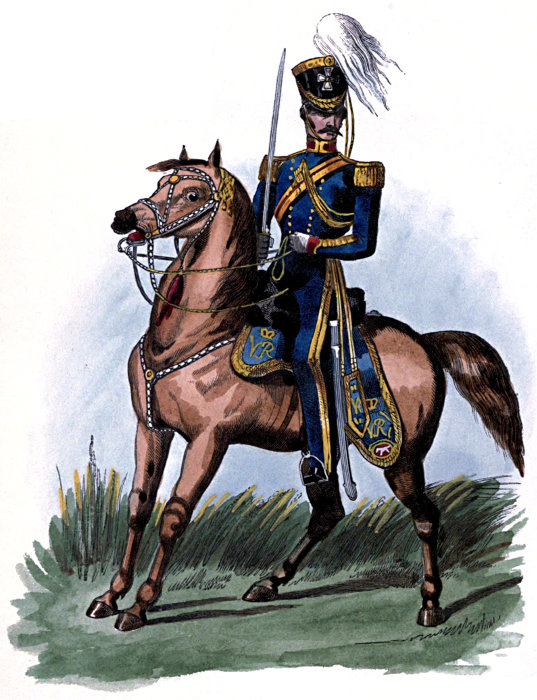
Coats—scarlet; double breasted; without lapels;
lined with light blue; slit sleeves turned
up with light blue; the button-holes worked with
narrow yellow lace; the buttons of yellow metal,
set on three and three; a long slash pocket in
each skirt, and a yellow worsted aiguillette on the
right shoulder.
Waistcoats and Breeches—light blue.
Hats—bound with gold lace, and ornamented
with a yellow metal loop, and a black cockade.
Boots—of jacked leather.
Cloaks—of scarlet cloth, with a light blue
collar, and lined with light blue shalloon; the
buttons set on three and three upon yellow frogs
or loops, with a light blue stripe down the
centre.
Horse Furniture—of light blue cloth; the
holster-caps and housings having a border of
royal lace, with a red stripe down the centre; the
white horse within the garter, embroidered on
each corner of the housing; and on the holster-caps,
the King's cipher and crown, with III.D
underneath.
Officers—distinguished by gold lace; their
coats and waistcoats bound with gold embroidery;
the button-holes worked with gold; and a crimson
silk sash worn across the left shoulder.
Quarter-Masters—to wear a crimson sash
round the waist.
Serjeants—to have narrow gold lace on the
cuffs, pockets and shoulder-straps; gold shoulder-knots
or aiguillettes, and yellow and light blue
worsted sashes tied round the waist.
Drummers and Hautboys—clothed in scarlet
coats lined with light blue, and ornamented with
royal lace with a blue stripe down the centre;
their waistcoats and breeches of blue cloth.
Guidons—The first or King's guidon to be of
crimson silk, embroidered and fringed with gold
and silver; in the centre the rose and thistle conjoined,
and crown over them, with the motto Dieu
et mon Droit underneath: the white horse in a
compartment in the first and fourth corners, and
III.D in gold characters on a light blue ground
in a compartment in the second and third corners.
The second and third guidons to be of light blue
silk, in the centre the white horse within the
garter on a crimson ground, and motto Nec aspera
terrent: the white horse on a scarlet ground in
the first and fourth compartments, and III.D
within a wreath of roses and thistles upon a scarlet
ground in the second and third compartments.
1752
In 1752 Lieut.-General Bland was removed to
the King's dragoon guards, and His Majesty conferred
the colonelcy of His Own Dragoons on
James Lord Tyrawley from the fourteenth dragoons.
1753
1754
In 1753 the King's Own lay at Colchester,
and in 1754 at Croydon. In December of this
year it was broken up into half troops, and employed
on coast duty: being scattered along the
sea coast, from Shoreham to the Isle of Wight.
1755
In April, 1755, Lord Tyrawley was removed to
the second foot guards, and King George II. conferred
the colonelcy of His Own Dragoons on
George, Earl of Albemarle, from the twentieth
foot.
1756
In June, of the same year, the whole regiment
assembled at Lewes, where it remained till July,
1756. At this time the King's Own, in common
with the other regiments of dragoons, received the
addition, novel to the British service, of a light
troop. In July it marched to Reading, and in
December of the same year, to Northampton.
1757
1758
The regiment marched to Henley, Amersham,
and High Wycombe in June, 1757; and war
having been declared against France in May,
1758, the light troop, then commanded by Captain
St. Leger, was ordered into camp on South Sea
Common, for the purpose of forming, with the
light troops of eight other regiments, part of the
force intended for a descent on the coast of France,
the whole forming a brigade, under Colonel Eliott,
afterwards Lord Heathfield. The troops embarked
May 19th, sailed June the 1st, and arrived on the
French coast so as to land in Cancalle Bay on the
5th. On the 7th the army moved on St. Maloes,
the light troops forming the advance guard, and
encamping about a mile from the town.
As soon as night fell, the piquets and light
dragoons were detached against the harbour and
the suburbs of St. Servan, being ordered, if possible,
to destroy the stores. This object they
effected with equal judgment and determination,
setting fire to the storehouses and vessels in the
harbour, together with the magazines of tar, pitch,
rope, &c., so completely performing their work,
as totally to ruin the whole of the marine stores,
and to destroy one man-of-war of 50 guns, one of
36, and all the privateers, some of 30 guns each;
the vessels destroyed amounting to upwards of 100
sail, and the fire continuing to rage all night.
The light dragoons afterwards advanced to the
town of Dol, where, in several slight affairs, they
showed great zeal and activity. On the 11th,
they re-embarked, and the fleet sailed on the 16th,
remaining, however, some time longer on the
coast of France, and watching another opportunity
to land. This being rendered impracticable
by the weather, the fleet returned, and
arrived at Spithead on the first of July. The
light troops remained at Portsmouth for some
time, and many experiments were made with
boats of different constructions, in order to ascertain
the practicability of landing men and horses
in rough weather.
1759
In August the brigade of light dragoons proceeded
on a second expedition, and a landing
having been effected in the Bay des Marées,
Cherbourg was taken, and the fortifications, and
vessels in the harbour were destroyed. A descent
was afterwards effected in the Bay of St. Lunar,
and an incursion made into the adjacent country;
but on re-embarking, the rear guard was attacked,
and it sustained some loss. In December, the
light troops landed and went into quarters, the
light troop of the King's Own being quartered at
Maidenhead. So completely had these troops
answered the expectations entertained of them,
that, in the next year, the first English regiment of
light dragoons (the present fifteenth hussars) was
raised under Brigadier-General Eliott; and in June,
1759, each light troop received an augmentation
of one lieutenant, one serjeant, and twenty-nine
privates. On the 7th of November, the King's
Own marched to Hounslow and Brentford, relieving
the royals, who proceeded to Essex.
1760
1761
1762
On the 21st of June, 1760[26], the regiment received
orders to prepare for embarkation for
Germany, to join the army of Prince Ferdinand.
These orders were, however, countermanded, and
in 1761 and 1762 the regiment was successively
quartered at Romford, Colchester, Uxbridge, and
Chelmsford.
1763
Peace having been restored by the treaty of
Fontainbleau; in April, 1763, the light troop was
disbanded at Putney; but a few men of each
troop were afterwards equipped as light dragoons.
1764
In June the King's Own lay at York, and remained
there till the spring of 1764, when they
marched to Scotland, and occupied Dalkeith,
Leith, Haddington, Musselburgh, and Linlithgow;
and orders were received for remounting
with long-tailed horses.[27]
1765
1766
In 1765, the regiment lay at Coventry and
Warwick, and in the next year passed the summer
at Reading, where it was reviewed on the 10th of
May, afterwards taking up winter quarters at
Dorchester, Blandford, and Sherbourne. At the
same time the drummers on the establishment
were ordered to be replaced by trumpeters.
1767
1768
The King's Own were employed on coast duty
in 1767 and 1768; in the first year in Kent and
Sussex, head quarters at Lewes; and the second
in Suffolk and Essex, head quarters at Ipswich.
1769
1770
Five troops lay at York and one at Hull in 1769,
and in the next year the regiment marched to
Scotland, head quarters, with three troops, being
stationed at Hamilton, and detachments at Linlithgow,
Irvine, and Kilmarnock.
1771
1772
In the year 1771, the King's Own lay at
Preston, Blackburn, Wigan, and Warrington; and
in 1772 at Worcester, Pershore, and Bromsgrove.
In October of this year the colonelcy was conferred
on the Honourable Charles Fitzroy (afterwards
Lord Southampton)[28], from the fourteenth
dragoons, in succession to the Earl of Albemarle,
deceased.
1773
1774
1775
1776
In June, 1773, we find the regiment employed
in aid of the revenue service on the coast of Kent,
with its head-quarters at Canterbury. The year
1774 was spent at Northampton, and in April,
1775, the regiment was again marched to Scotland,
being at East Retford in August, and in the
autumn taking up quarters at Haddington, Dalkeith,
and Musselburgh. In December of the same
year, one troop was detached as far as Wakefield,
and in the spring of 1776, the whole regiment
followed to the south, and was quartered at
Coventry, Lichfield, and Birmingham.
1777
1778
In 1777, the King's Own were reviewed at
Newbury, and thence took up winter quarters at
Blandford, Dorchester and Sherbourne. Early
in 1778 they were ordered to Salisbury, there to
be reviewed, and thence proceeded to Suffolk, and
were encamped on Culford Heath, under the
command of Lieutenant-General Warde, finally
going into winter quarters in Sussex, and being
employed there on coast duty during the remainder
of the year. The regiment had, for many years,
been in possession of a pair of Kettle Drums, in
consequence of having taken them from the enemy,
and on the 25th of December, 1778, an additional
man and horse was placed upon the establishment,
which gave the regiment its complement of Trumpeters
besides the kettle drummer; being granted
by His Majesty in compliance with a memorial
from the Colonel[29].
1779
In the spring of 1779, the men of the regiment
equipped as light dragoons, were incorporated,
with detachments from other corps, into a regiment,
which was numbered the twenty-first light
dragoons.
1780
In consequence of the alarming riots in London
in 1780, the regiment was ordered thither, and
was quartered about Islington, furnishing the
piquets in Portman Square during the trial of
Lord George Gordon, and having a party stationed
in Apsley House, then the property of Lord
Chancellor Bathurst.
1781
1782
1783
In 1781, having been reviewed by His Majesty
in Hyde Park, the King's Own marched into
Suffolk; and in 1782, were quartered at Derby,
Leicester, and Nottingham, thence proceeding to
Manchester in the autumn. In 1783, after the
spring review they marched to Newcastle-on-Tyne
and Durham, assembled at the latter place
for inspection in September, and then returned
to their old quarters for the winter.
1784
1785
1786
The King's Own, for the third time in fourteen
years, entered Scotland in 1784, and took up
their old quarters at Dalkeith, Leith, and Haddington.
Here they were inspected by Major-General
Mackay, and soon after detached a
troop to Dumfries. In July, 1785, the six troops
were at Manchester, and thence, in 1786, proceeded
to Worcester, then a general place of
inspection for cavalry. At this station they were
inspected by Major-General Philipson, and, after
a stay of about six weeks, went into winter quarters
at Hereford, Ludlow, and Leominster.
1787
1788
In May, 1787, the regiment assembled at Hereford
to be reviewed by Major-General Douglas. It
was ordered, on the rumour of a Russian armament,
to hold itself in readiness to join any force
that might be assembled; but, nothing taking
place, it went into winter quarters at Dorchester,
Blandford, and Poole. In 1788, it moved to
Salisbury, was there reviewed, and then quartered
at Winchester.
1789
1790
Early in 1789, the regiment marched to Reading.
It was there reviewed by His Majesty,
George III., on Ashford Common, and marched
to Ipswich, where it remained until 1790, and,
being then reviewed at Stamford, took up winter
quarters at York and Lincoln.
1791
1792
At York all the troops assembled for inspection
in the spring of 1791, and, for the fourth time
marched to Scotland and were for two years
quartered at Dumfries, being in that period
twice inspected by Major-General Leslie.
1793
1794
In the spring of 1793, the King's Own received
an order to augment three troops, and,
after a short halt at Manchester, proceeded to
Birmingham. From this place, four troops, under
the command of Lieutenant-Colonel Waller, were
detached back to Scotland, in consequence of
serious riots in that part of the kingdom. In 1794
the regiment was ordered to furnish one hundred
men, towards forming a regiment of cavalry for
service in the West Indies; the newly-formed
regiment was numbered the twenty-sixth light
dragoons, and afterwards, on a reduction of regiments
taking place, the twenty-third. In the
same year a squadron from the troops in England,
and one troop from those in Scotland, were ordered
to embark to join the troops on the continent.
The troop in Scotland marched a day or two,
and was then recalled in consequence of the disturbed
state of the country; and the squadron
embarked at Blackwall, and was actually at sea,
when it was recalled by a king's cutter, landed,
and sent to Watford.
1795
1796
In 1795, the troops returned from Scotland,
having had most harassing duty for two winters;
and in the spring of 1796, the whole regiment assembled
at Salisbury under Lord Cathcart, thence
proceeding to the camp at Weymouth, and finally
taking up winter quarters in Exeter.
1797
The colonelcy of the King's Own Dragoons
was conferred in March 1797 on Major-General
Francis Lascelles from the eighth dragoons, in
succession to Lord Southampton, deceased.
During the summer, the King's Own were
again encamped at Weymouth; and on the breaking
up of the camp, marched to Northampton,
where the ninth troop was reduced.
1798
In May, 1798, the regiment marched to Nottingham,
where an entire change took place in
the arms and clothing; the long skirt was
abolished, and instead of the musket and brace
of large pistols before used, the men received
the carbine and single pistol.
1799
On the 10th of June, 1799, the regiment
marched to form part of the cavalry camp on
Swinley Downs, near Windsor, at which place
it received orders to join the armament under
Lieut.-General Sir Ralph Abercromby, then about
to proceed to the Helder. These orders, however,
were countermanded; and, at the breaking up
of the camp, the regiment marched to Reading.
During the time of encampment, Lt.-Colonel
Callow[30] being appointed deputy governor of
Quebec, was succeeded by Lt.-Colonel Waller, and
on the 4th of September, General Sir Charles
Grey from the eighth dragoons succeeded General
Lascelles as colonel. At this period the tails of
the horses were again shortened, having been
worn of the natural length since 1764.
1800
1801
In February, 1800, the King's Own marched
to Trowbridge, but only remained there a few
weeks, and then proceeded to Chester to be
reviewed. At this place an augmentation of two
troops took place, making a total of ten; and
on the 22nd of September, the whole regiment
marched to Lancashire, thence to Carlisle, and,
in December, to Scotland, the head-quarters
being established at Hamilton; three troops, under
the command of Major Wade, being detached to
Carlisle and Penrith. At Hamilton, the regiment
was reviewed by Major-Generals Erskine
and Vyse, and the present system of casting
horses annually first introduced; and as it was
considered the peculiar privilege of the regiment
to have black horses exclusively, those that had
the slightest shade of brown, were sent to the
fourth dragoon guards, none but black horses
being retained, with the exception of one white
for the kettle-drums.
1802
1803
1804
After the peace of Amiens in 1802, two troops
were reduced; the number of men in the others
being also reduced from 100 to 64; and, on the
11th of August, the King's Own embarked at
Port-Patrick for Ireland, proceeded to Dundalk,
and in the spring of 1803 marched to Belturbet.
Here they were reviewed by Major-General Sir
James Afleck, and were actively employed in
patrolling the country during the excitement
caused by the disturbances in Dublin, to which
place they proceeded in March, 1804, and were
quartered in the royal barracks.[31]
1805
1806
On the 5th of April, 1805, the first division,
immediately followed by the others, embarked
for Liverpool, and marched to Nottingham, where
the regiment remained for two years; the second
year's halt being at the express request of the
magistrates of Nottingham and Louth. The war
having been resumed, two additional troops were
added to the establishment.
1807
The regiment marched to Chichester in May
1807, and being there reviewed by Major-General
Hugonin, proceeded to Brighton, and was encamped
on the hills above the present barracks,
for the purpose of being reviewed, in conjunction
with the first dragoon guards, by His Royal
Highness the Duke of York. On the breaking
up of the camp, the Third marched to Chichester,
but were shortly ordered to Canterbury, where a
brigade was formed, consisting of the second
dragoon guards, and third and fourth dragoons.
1809
In January, 1809, the regiment received orders
to embark at Portsmouth, for the purpose of
joining the army in Spain, under Lieut.-General
Sir John Moore, and had advanced some days'
march, when it was recalled, on the arrival of the
news of the retreat of the British troops to Corunna.
On the 20th of July, the regiment received
orders to march to Ramsgate, and was immediately
embarked for Holland under the command
of Lieut.-Colonel Mundy, forming part of
an expedition designed to effect the destruction of
the French shipping and arsenal on the Scheldt.
After remaining in the Downs for six days, the
fleet sailed, and arrived off Walcheren on the 29th,
remaining there upwards of a fortnight; and
after the capture of Flushing, proceeded up the
Scheldt as far as Fort-Batz. The enemy's shipping
had, in the meantime, been removed higher
up the river, and an immense force assembled to
oppose the British armament; at the same time
an epidemic disease broke out among the English
soldiers. The fleet consequently retired down the
river, and sailed for England; the King's Own
disembarked at Ramsgate in September following,
and proceeded to occupy Canterbury, as before the
expedition.
1810
In April, 1810, in consequence of the riots in
London, occasioned by the House of Commons
having ordered Sir Francis Burdett to be lodged
in custody in the Tower, the regiment was hastily
ordered thither, marching all night, and arriving
in Southwark at 7 A. M. The men were billeted
on the south side of the Thames; an hotel near
Westminster Bridge being the head quarters, and
the Obelisk the alarm post. After the suppression
of the riots, the regiment was ordered to Guildford,
where it was reviewed by his Royal Highness the
Duke of Cambridge, who was pleased to express
his entire approbation of its appearance and discipline.
On the release of Sir Francis Burdett
from the Tower, the regiment was again sent to
London, but remained there a few nights only,
and then returned to Guildford.
1811
Napoleon Bonaparte, Emperor of France,
having conquered Portugal, had placed his
brother Joseph on the throne of Spain, supported
by a French army. The efforts of the Spaniards
and Portuguese to regain their liberty, which
commenced in 1808, were continued to be aided
by the British government, and a force, amounting
at this time to nearly sixty thousand men, had
been assembled in Portugal under the command
of Lieutenant-General the Viscount Wellington.
In June, 1811, the King's Own Dragoons,
having been reviewed on Wimbledon Common
by His Royal Highness the Prince Regent, were,
on their return to Guildford, completed to the field
establishment by a draft of a hundred horses[32] from
the second dragoon guards, and ordered forthwith
to proceed to the Peninsula. On the 25th and 27th
of July the regiment embarked at Portsmouth,
landed in the following month at Lisbon, under
the command of Lieut.-Colonel Mundy, and
having met with favourable weather during the
voyage, the Lieutenant-Colonel commanding was
enabled to cause particular attention to be paid to
the horses in regard to cleanliness, exercise, &c.
The mode adopted for this purpose was as follows:
three or four horses were backed into the hold,
where they were walked round for a quarter of
an hour; their feet washed, and hand-rubbed;
and they were shod, if necessary; by these means
their state of health and efficiency, on their disembarkation
at Lisbon, were such, that upon
landing they were capable of undertaking immediate
service.
The regiment was reviewed at Belem by Major-General
Le Marchant, and mustered as follows:—1
Lieutenant-Colonel, 1 Major, 6 Captains,
9 Lieutenants, 1 Cornet, 1 Surgeon, 1 Assistant
Surgeon, 5 Troop Quarter-Masters, 1 Regimental
Serjeant-Major, 1 Paymaster Serjeant, 1 Troop
Serjeant-Major, 24 Serjeants, 24 Corporals, 6
Trumpeters, 6 Farriers, 480 Privates, and 518
Troop Horses.
The King's Own left Belem on the 19th of
September, under the command of Major Clowes,
(the Lieutenant Colonel having been compelled
by sickness to remain at Lisbon,) and marching
through Villa Franca and Santarem, arrived at
Abrantes in Portuguese Estremadura on the 27th.
Here they remained until the 15th October, and
then advanced through Niza and Villa Velha to
Castello Branco in the province of Beira, where
they were reviewed on the 7th of December, by
Lieutenant-General Sir Stapleton Cotton, who expressed
his satisfaction at the very effective state
of the men and horses.
1812
In consequence of the extreme difficulty of procuring
forage, the centre squadron moved, on the
21st of December, to Idanha a Nova on the frontiers
of Spain, and in these quarters the regiment remained
till the beginning of 1812, when it was
ordered to the front to form part of the army
covering the siege of Ciudad Rodrigo, being quartered
at Aldea de Ponte and Fundao, and experiencing
great inconvenience from the scarcity of
forage.
In February, Lord Wellington having resolved
on the siege of Badajoz, the capital of Spanish
Estremadura, the King's Own marched south
with their brigade (the fifth dragoon guards, and
fourth dragoons,) and arrived at Borba in the
Alemtejo on the 5th of March. On the 16th, a
pontoon bridge was thrown over the Guadiana, and
Badajoz was invested; the day previous to which
the brigade moved from Borba, and crossing the
bridge, formed the advance guard of the covering
army, which continued to advance till it arrived
at the foot of an extensive chain of mountains
called the Sierra Morena. On the 26th, the King's
Own marched at sunset from Medina to Campo,
and at midnight joined a force under Lieut.-General
Sir Thomas Graham, destined to surprise
three battalions of French infantry and two regiments
of cavalry lying in Llerena. Owing to a
mistake on the part of the Chasseurs Britanniques
(who formed the advance of the infantry column),
the projected surprise failed, and the French retired
into the mountains during the night, and
took post at Azuaga, a town nine miles to the south
of Llerena. On the 29th of March, after a sharp
affair, the French were driven from Azuaga, and
the head quarters of the Brigade were established
there. The authorities of this town gave a superb
entertainment to Sir Stapleton Cotton.
On the night of the 31st of March, a man deserted,
who, it is supposed, gave information of
the situation and strength of the British outpost;
and on the 1st of April, a strong French force was
detached to cut off the piquets at La Granja. A
patrol, commanded by Cornet Ratcliffe of the
Third, having met with the enemy's advance
guard, was driven in, and the two British squadrons
were attacked by seven squadrons of French
cavalry, supported by infantry. After a severe
struggle, the enemy, perceiving their surprise
had failed, retired, and the piquets resumed their
station.[33] In this affair the King's Own lost thirteen
men and twelve horses.
On the 2nd of April, Marshal Soult's army
having advanced from Seville, with a view to raise
the siege of Badajoz, the covering army began to
retire before the superior numbers of the French.
This retreat was continued through Usagre, Villa
Franca, and Almandralejo, upon Albuhera, where,
being supported by the besieging force, the army
went into position on the 9th, and preparations
were made for a general action. Soult, however,
having heard of the fall of Badajoz, commenced a
retrograde movement towards the frontiers of
Andalusia on the 10th; on which day Major
General Le Marchant's brigade, (the fifth dragoon
guards, Third and fourth dragoons) forming the
advance of the British, proceeded to Los Santos,
and again in the night to Bienvenida, with the
view of gaining the flank of the cavalry of a
French corps (General Drouet's) encamped between
Usagre and Villa Garcia; but the enemy retreated.
The Brigade, however, defiled under cover of
some heights, and by a flank movement came up
with the French on the 11th in front of Llerena,
charging and driving them into that town with
the loss of one hundred and fifty prisoners, including
several officers.
Intelligence was received of the advance of Marshal
Marmont, on the north of Portugal. This
general, leaving Ciudad Rodrigo and Almeida, on
his rear, had pushed on as far as Castello Branco,
thus threatening to destroy the communications of
the British, by cutting the bridge of boats at
Villa Velha. It therefore became necessary to
reinforce the few troops left on that frontier, and
Major General Le Marchant's brigade was one of
those ordered for this service. It marched through
Elvas, Estremos, Crato, Niza, and Villa Velha to
Castello Branco, and finally took up its quarters at
Val-de-rosa; but Marmont having retired into
Spain on the approach of the British, the brigade
returned to the Alemtejo, and was, on the 12th of
April, stationed at Cabeca de Vide, Crato, and
Fronteira, the King's Own being at the former
place. On the 29th they received a sudden order
to join a brigade of light cavalry, for the purpose
of covering Lieut.-General Hill in his attack
upon the tête-de-pont and bridge of boats at
Almaraz, which brilliant exploit having been
effected, the regiment returned to Cabeca de Vide
on the 27th of May.
On the 1st of June the whole army, with the
exception of Lieut.-General Hill's corps, moved
to the north. On the 11th, Major-General Le
Marchant's brigade arrived at Ciudad Rodrigo,
and on the 12th was reviewed by Lord Wellington.
On the 13th, the brigade moved forward
and continued to advance till the 16th, when it
found the enemy posted near Salamanca, and a
skirmish took place which lasted till night-fall.
On the 17th, the brigade crossed the Tormes, and
was quartered near the village of Cabrerizos, and
on the advance of the French, on the 20th, the
whole army went into position on the heights
of St. Christoval, with its right on the Tormes,
and its left near Villares de la Reyna. On this
day the brigade, being in front, sustained a cannonade
of about an hour, and the King's Own
lost twenty horses: the regiment afterwards took
post on the summit of the mountain.
On the night of the 23rd the French army
retired, and was followed at daybreak by the
first and seventh divisions, and Le Marchant's
brigade of cavalry, which crossed the river by the
fords of Santa Marta; when Marshal Marmont,
after a short delay, returned to his former position,
and manœuvred for some days on the Tormes,
but after the reduction of the forts at Salamanca,
which took place on the 27th, he crossed the
Douro at Tordesillas, closely followed by Lord
Wellington, who, however, did not cross the river,
but took up a position between Pollos and La
Seca; Major-General Le Marchant's brigade being
stationed at Pollos and Naval del Rey to watch
the ford.
Marshal Marmont being strengthened by a
division from the Asturias, pushed a column
across the river on the 16th of July, in consequence
of which the troops in Pollos fell back
upon Fuente la Pena. On the 18th, it was
understood that the enemy's army had passed
the Douro at Tordesillas, by which manœuvre
the safety of two divisions, and a brigade of
cavalry, on the Trebancos, was much endangered,
and Major-General Le Marchant's, with two other
brigades of cavalry, were quickly moved up to
cover their retreat, which was effected with trifling
loss. The brigade had entered its bivouac
near Canizal, when an order was received for a
squadron of the King's Own to proceed to the
support of two guns, intended to be placed on
the hill above Castrillos. This order was soon
increased to the whole regiment, which, on its
march, discovered that the enemy was advancing
in force, and pressing Major-General Alten's
brigade very closely. Major Clowes immediately
solicited, and received permission to go to
their support, and the regiment accordingly advanced,
and though checked by the fire of some
French infantry, assisted in driving back the
enemy's cavalry; the French infantry continuing
to advance were repulsed by Lieut.-General
Cole's division, and pursued with great loss. In
this affair the regiment sustained the following
loss; one serjeant-major, six privates, and four
horses killed; lieutenant Branfell, and two privates
wounded.[34]
On the 19th, the Brigade retired to the table
land above the villages of Vallesa and El Olmo,
and on the 20th, the hostile armies manœuvred
within cannon shot of each other, the French
moving to their left, and the British to their
right. On the 21st the British went into their
old position on the heights of St. Christoval,
and the French crossed the Tormes at the fords
of Alba and Huerta, marching to their left. To
oppose this manœuvre, the British crossed the
river at Salamanca. In the course of this day's
manœuvres, Major-General Le Marchant's brigade
crossed the river at the ford of Santa Marta
three times, and took up its bivouac on the south
bank opposite the town. In the course of this
night so dreadful a thunder-storm burst upon
the British lines, that the horses broke loose;
many were lost by running into the French lines,
and the remainder could not be secured till daybreak.
The King's Own had to send to the rear
an officer and sixteen men, severely injured by
the horses, which were all linked together, running
over them.
The morning of the 22nd of July, found the
hostile armies opposed to each other. The British
line was formed with its left on the Tormes,
and its right on the rocky hills called the
Arapiles; Major-General Le Marchant's brigade,
quitting its bivouac ground, formed line in the
centre of the position, to check the advance of
the enemy's cavalry. The French marshal manœuvred
to gain the road to Ciudad Rodrigo;
his dragoons, after some skirmishing, were compelled
to retire, and the King's Own again took
ground to their right, passing the village of
Arapiles, and forming in support of the fourth
and fifth divisions. Lord Wellington, taking
advantage of an injudicious movement made by
his opponent, ordered his divisions forward, and
the battle commenced. The French, attacked
while making a complicated evolution, were instantly
broken. A favourable opportunity for a
charge of the British heavy cavalry occurring,
the fifth dragoon guards, King's Own, and fourth
dragoons, advanced, and a most animated scene
presented itself. The din of conflict was heard on
every side; clouds of dust and rising columns of
smoke darkened the air, and enveloped the British
squadrons as they rushed to battle. In front,
the glittering bayonets and waving plumes of the
French infantry were dimly seen through the
thickened atmosphere; against these formidable
ranks, the English horsemen dashed with terrific
violence, the weight and fury of their charge
broke the opposing lines, and in an instant the
French musketeers were overthrown and trampled
down with a terrible clamour and disturbance.
'Bewildered and blinded, they cast away their
arms and ran through the openings of the British
squadrons, stooping and demanding quarter,
while the dragoons, big men, and on big horses,
rode onward, smiting with their long glittering
swords in uncontrollable power, and the third
division followed at speed, shouting as the French
masses fell in succession before this dreadful
charge.'
'Nor were these valiant swordsmen yet exhausted.
Their own general, Le Marchant,
and many officers had fallen, but Cotton and
all his staff were at their head, and with ranks
confused, and blended together in one mass,
still galloping forward they sustained from a
fresh column an irregular stream of fire which
emptied a hundred saddles; yet with fine courage,
and downright force, the survivors broke
through this the third and strongest body of men
that had encountered them, and Lord Edward Somerset,
continuing his course at the head of one
squadron, with a happy perseverance, captured
five guns. The French left was entirely broken,
more than two thousand prisoners were taken,
the French light horsemen abandoned that part
of the field, and Thomiere's division no longer
existed as a military body. Anson's cavalry,
which had passed quite over the hill, and had
suffered little in the charge, was now joined by
D'Urban's troopers, and took the place of Le
Marchant's exhausted men; the heavy German
dragoons followed in reserve, and with the third
and fifth divisions and the guns formed one
formidable line two miles in advance of where
Pakenham first attacked, and that impetuous
officer, with unmitigated strength, still pressed
forward, spreading terror and disorder on the
enemy's left[35].'
In this attack Major-General Le Marchant
received a ball through the body, which terminated
the career of that brave and talented officer.
Lieutenant Selby, of the King's Own, was likewise
killed by a musket-shot through the left
breast.[36] The result of this day was the entire
overthrow of the French, 7,000 prisoners, eleven
guns and two eagles remaining in the hands of
the victors. The King's Own earned, on this
occasion, the royal permission to bear the word
'Salamanca,' on their guidons. They sustained
the following loss: Killed,—Lieutenant Selby,
one serjeant, nine privates, and two officers'
horses, and 13 troop horses. Wounded,—one
serjeant, eight privates, and fifteen horses.
After the action the French retreated upon
Alba, where they crossed the Tormes, and thence
through Arevalo, upon Valladolid, sustaining in
their march a severe loss from the German cavalry,
which, having been uninjured in the battle,
was despatched in pursuit of, and overtook their
rear-guard three leagues beyond Alba, defeating
it, and taking nine hundred prisoners.
The British army advanced on the route of
the French, and entered Valladolid on the 30th
of July; on the following day Cuellar was occupied,
and on the 6th of August, the army moved
on Segovia, crossed the Guadarama mountains
on the 10th, and entered Madrid on the 12th;
the brigade, now commanded by Colonel Ponsonby,
forming the personal escort of Lord Wellington.
After halting seven days at Madrid, the brigade
moved to St. Ildefonso, where it was cantoned
for a few days. Intelligence was received
that the army of General Clausel, who had succeeded
Marmont, was advancing on Valladolid,
and the British in consequence assembled at
Olivares and its vicinity. An immediate attack
was intended; but the artillery of the fifth division
not arriving in time, the enemy retired on the 7th
of September, having destroyed the bridge at
Valladolid. They continued retreating rapidly
till the 17th, when the immediate vicinity of
Burgos induced Clausel to make a stand, and
Colonel Ponsonby's brigade was ordered to the
front; but, before the army could be formed for
attack, the enemy again retired to Breviesca,
leaving a strong garrison in the castle of Burgos.
The castle was invested, and the covering army
took up a position on the heights of Quintana
Palla, the King's Own being at Villa Yerna.
On the 19th of October, the French General
Souham, who now commanded in the place of
Clausel, being greatly reinforced, resolved to attempt
the relief of Burgos. About four P. M. the
French attacked and carried the village of Quintanapalla,
but were repulsed in every attempt to
penetrate farther, and abandoned the village on
the approach of a force destined to retake it, consisting
of the left wing of infantry, and Ponsonby's
brigade of cavalry.
It being ascertained that Marshal Soult and
Joseph Bonaparte were moving on the Tagus,
and that Sir Rowland Hill, menaced by such
powerful forces, could not maintain his position
on that river, at the same time his retreat would
leave the army before Burgos, already in a critical
situation, quite insulated, the Marquis of Wellington
resolved to retire so far as was necessary to
form a junction with Sir Rowland Hill; and at
dusk on the 21st, the army withdrew with such
celerity and silence that the French were not
aware of the retreat till the British had reached
Hormillas, and did not show in any force till the
evening of the 22nd of October. On the next
morning the retrograde movement was continued
in two columns, Ponsonby's brigade covering the
column from Hormillas, and being threatened
during the day by an immense body of cavalry.
Such was the steadiness of the troops, that the
overwhelming, force of the French could make
no impression and the column went into bivouac
for the night on the hills above Cordovilla, with
little or no loss.
An hour before daylight on the 24th, the
column, covered by Ponsonby's brigade, filed
over the bridge of Cordovilla, and in the course
of the day, the army crossed the Carrion, the
head-quarters being established at Duenas. Early
on the morning of the 25th, two squadrons of the
fifth dragoon guards and Third dragoons were
sent to the bridges of Palencia, to cover the party
employed in mining them for destruction, but
the French, advancing in force, gained possession
of the bridges in an unbroken state. At this
place the King's Own lost a man and horse by
a round shot, and the party returned in the evening
to Duenas; the army having in the meantime
destroyed the bridges at that place, and at Villa
Muriel, and the enemy having been defeated in
an attempt to cross by the fords.
1813
The army retired four leagues on the 26th of
October, and crossed the Pisuerga at Cabezon, in
which town, and its vicinity, it remained till the
29th, when it retired early, and crossed the Douro
at Tudela and Puente del Douro, the bridges at
which places were blown up, as were those at
Toro and Zamora; but the French having possessed
themselves of the bridge at Tordesillas, the British
on the following morning took up a position in
front of it. In this position they remained till
the 6th of November, when, the enemy having
repaired the bridge of Toro, it became necessary
to retire to Torrecilla de la Orden, and thence, on
the 7th and 8th, to Salamanca. On the 14th,
the French crossed the Tormes, and the British
recommenced their retreat on the following
morning, and entered Ciudad Rodrigo on the
18th; they afterwards went into winter quarters
on the frontiers of Portugal, the enemy not advancing
beyond the Yeltes. On the 20th, Ponsonby's
brigade was at Albergaria, where it halted
eight days, after which the King's Own proceeded
by the route of Guarda, Celerico, and Penhancos,
to Saixho. Here the regiment was quartered
until the 28th of December, then at Arganil till
February 11th, 1813, and afterwards at Soure,
near the mouth of the Mondego, until the 19th
of April.
On the above day the King's Own moved
towards the north of Portugal, and rejoined the
brigade at Braganza, on the 21st of May. On the
24th the brigade was at Tabara, and on the 26th
it crossed the Esla at Pozuela. The enemy made
no resistance at the passage of the river, and was
compelled to abandon the line of the Douro, by
Lord Wellington's advance along their rear. The
column to which Ponsonby's brigade was attached,
was directed on Valencia, and passing through
that town, advanced on Burgos. On the 12th of
June, the brigade overtook the enemy's rear-guard
on the heights of Estepar, when the King's Own
were detached to cut off part of the enemy's force,
in which the regiment completely succeeded,
making its way to the high road from Madrid,
throwing the enemy into confusion on Burgos;
a squadron of the fourteenth, with a detachment
of the King's Own, charging the enemy's
rear, captured a gun: the regiment had captain
Sitwell and one private wounded, and five horses
killed and three wounded.
During the night of the 12th, the French blew
up the castle of Burgos and retired behind the
Ebro, which river the brigade, after marching
through a wild and difficult region of deep narrow
valleys and rugged defiles, crossed at Puente de
Arenas on the 15th. Both armies were concentrated,
the British on the river Bayas, and the
French on the undulating grounds in the valley
of Vittoria, where, on the 21st of June, they were
attacked by the allied army. The result of this
attack was a most decisive victory, the French only
carrying from the field two guns; the whole of
their immense equipment fell into the hands
of the British. Owing to the nature of the field
of battle the cavalry could scarcely act,[37] and that
arme was principally employed in supporting the
infantry, and in the pursuit, which was continued
until the enemy had passed Pampeluna. The
gallant bearing of the King's Own was rewarded
in 1821, with the royal permission to bear the
word "Vittoria" on their guidons.
At this period, General Clausel with fifteen
thousand men was at Logroño, and of course, was
not engaged in the battle; nor was he aware that
an engagement had taken place, till he arrived
near Vittoria, and found the town in the possession
of the British: he then returned to
Logroño, and marched upon Tudela, hoping to
reach Pampeluna before the British. On the 27th
his scheme was discovered, and the Marquis of
Wellington detached the cavalry with two divisions
of infantry to intercept him. This detached force
arrived on the same night at Tafalla and Olieta,
and on the next morning advanced upon Tudela,
when it was discovered that Clausel, upon receiving
intelligence of the force sent against him,
had retreated to Saragossa, whence he returned
to France by the pass of Jaca, his artillery falling
into the hands of the Spanish troops.
On the 30th of June the infantry returned to
Pampeluna, and Major-General Ponsonby's brigade
remained at Tafalla for eleven days, when
forage becoming scarce, it moved to Laraga, and
halted there a fortnight.
The cavalry received an order to move to the
north on the 27th of July, in consequence of the
troops having been forced from the passes of
Roncesvalles and Maya in the Pyrenees. The
army took up a position at Huarte and Villarba,
and the town of Pampeluna was illuminated at
the prospect of relief. On the 28th, Soult attacked
the British position, but was repulsed with
loss; Count D'Erlon's division was compelled to
fall back upon Maya, and the British recovered
their lost ground. On the 8th of August, the
King's Own fell back upon Allo and Dicastello,
and on the 27th of December, removed for the
convenience of forage to the neighbourhood of
Vittoria, occupying the villages of Alegria,
Aranjuez, and Troconiz, and remained there until
the 24th of February following.
1814
An advance took place, Ponsonby's brigade
marched through the Pyrenean mountains by
Salinas Bergara, Villa Franca and Tolosa, to St.
Jean de Luz in France, halted there two days, and
then advanced through Bidart to the Adour,
crossing the river on a bridge of boats, and continued
to follow the route of the French, who
were retreating on Bayonne. The advance was
continued through Peyrehorade to Castlenau,
and on the 19th of March, 1814, Marshal Soult
was discovered in position, with his left at Tarbes,
and his right at Rabastens. This right flank was
ordered to be turned by a division of infantry,
and Ponsonby's brigade of cavalry, and being
thus threatened, Soult retired through a strong
country by St. Gaudens, upon Toulouse. The
British, being obliged to wait for stores, did
not advance rapidly, and on the 25th, the King's
Own lay at Fontenelle. On the next day the
regiment advanced to La Mosquiere, and there
came up with a regiment of French Chasseurs
à cheval, which it charged and drove beyond
Cuneva, taking several prisoners and horses, and
seizing a large quantity of bread prepared by the
French for their own use. Lieut. Burns' horse
was killed, Lieut. Jebb's wounded, and two troop
horses killed, but the regiment sustained no further
loss.
The army arrived before Toulouse on the 27th
of March, and on the 31st, a pontoon bridge being
laid at St. Roques, the brigade crossed the
Garonne, and seized the bridge on the Arriege,
at Cintagabelle. The roads were found so bad
in this direction that no further attempt was
made, and the troops being recalled, the pontoon
bridge was removed to Grenade, a town below
Bayonne, and there laid down on the 4th of
April. On this day Ponsonby's, with two other
brigades of cavalry, and three divisions of infantry,
crossed the river, the brigade being quartered
at Grissolles, and having a strong piquet on the
road to Montauban. In the course of the night
the river rose so considerably, that the bridge
was obliged to be removed, and the communication
was cut off; Soult, however, made no attack,
but employed himself in strengthening his
position, which covered Toulouse.
On the 8th of April the current subsided, and
the pontoons were again laid down. On the
9th the troops were passing the river, and on
Easter Sunday (the 10th), Soult was attacked
in his position. In this attack the brigade, then
commanded by Colonel Lord Charles Manners,
was at different periods employed in supporting
the Spanish forces, the hussar brigade, and General
Clinton's division. It was not a cavalry action,
and the only casualties were—Captain Burn, one
trumpeter, four privates, wounded: two horses
killed. The enemy abandoned his entrenchments
before dusk, and took post behind the canal.
The King's Own were rewarded for their conduct
on this occasion with the royal permission,
dated 20th September, 1821, to bear the word
"Toulouse" on their guidons.
Marshal Soult retired down the canal on the
12th towards Carcasonne, and on the 13th, hostilities
were terminated by the arrival of the news
of the abdication of Napoleon, and of the accession
of Louis XVIII. to the throne of France; Marshals
Soult and Suchet, after a short delay, gave
their assent to the new order of affairs, and a line
of demarcation between the armies was agreed
upon. The King's Own went into quarters at
Lanta and Caraman, and remained there until
the end of May.
On the 10th of June, the brigade, having embarked
its dismounted men at Bourdeaux, commenced
its march to the north by the following
route:—
- June 1, Toulouse,
- " 2, Grissoles,
- " 3, Montauban,
- " 4, Caussade,
- " 5, Cahors,
- " 7, Frechisse,
- " 8, Souillac,
- " 9, Brives,
- " 11, Uzorches,
- " 12, Pierre Buffiere,
- " 13, Limoges,
- " 15, Bessines,
- " 16, St. Burnot,
- " 17, Argenton,
- " 18, Chateauroux,
- " 20, Vatan,
- " 21, Vierzon,
- " 22, Salbris,
- " 23, Lafecte,
- " 24, Orleans,
- " 26, Artenay,
- " 27, Angerville,
- " 28, Etampes,
- " 30, St. Aumal,
- July 1, Montfort,
- " 2, Mantes,
- " 4, Gisors,
- " 5, Gournay,
- " 6, Neufchatel,
- " 7, Blangy,
- " 8, Abbeville,
- " 10, Rue,
- " 11, Montreuil,
- " 12, Boulogne.
At Boulogne Major-General Sir Henry Fane
inspected the three regiments, and expressed his
satisfaction at the efficiency of the brigade after
so long a march. He congratulated the commanding
officers on the excellent condition of their
horses, and selected a number, of which the
King's Own furnished fifteen, to be given up to
the French government for the purpose of mounting
the royal guard. On the 19th of July, the
brigade, having received the highest praise from
Major-General the Hon. W. Ponsonby,[38] embarked
at Boulogne and arrived at Dover on the
following day, the King's Own having been
absent three years, from the time of their embarkation
on the 25th of the same month, 1811.
From Dover the King's Own marched through
Maidstone to Brentford, and, on the 28th of July,
were reviewed on Hounslow Heath by His Royal
Highness the Commander-in-Chief, immediately
afterwards commencing their march to Northampton
and joining the depôt (which had
marched thither from Canterbury) on the 3rd of
August. On the 13th two troops were reduced,
and on the 16th, the regiment marched for Newcastle-on-Tyne,
arriving there on the 1st of September;
two troops were detached to Carlisle,
and one to Durham.
On the 26th of September, the head-quarters
marched into York barracks,[39] troops being left
at Newcastle, Morpeth, Carlisle, and Workington.
In these quarters the Regiment was reviewed by
Lieutenant-General Wynyard in the summer of
1815, and afterwards marched for St. Albans.
1815
In the meantime Napoleon Bonaparte had returned
to France; a British army had assembled in
Belgium under the command of the Duke of Wellington;
the battle of Waterloo had been won, and
the King's Own were ordered to form ten troops,
four of which marched to Coventry, and the remaining
six, consisting of thirty-two officers, thirty-four
serjeants, six trumpeters, three hundred and
seventy-one rank and file, and three hundred and
eighty-two horses, proceeded to Dover and Ramsgate,
where they immediately embarked for
Ostend to reinforce the British army in France.
The King's Own disembarked at Ostend on
the 24th of July, and moving up the country into
France, were, on their arrival in the vicinity of
Paris, placed in cantonments at Chaton, near
Malmaison. On the 2nd of September, the Emperor
of Russia reviewed the first and eighth brigades
of cavalry, consisting of the first and second
life guards, royal horse guards, first, second, and
third dragoon guards, and Third dragoons. On
the 22nd of the same month, the allied army was
reviewed by the Duke of Wellington on the plain
of St. Denis, and on the 11th of October, the whole
of the British, Hanoverian, Danish, and Saxon
contingents, were reviewed between Paris and St.
Denis, by the Duke of Wellington, the Emperor
of Russia, and the King of Prussia; after the
review the King's Own marched to Nantes, where
they remained several months.
1816
On the 25th of January, 1816, the King's Own
forming part of the Army of Occupation left in
France after the restoration of Louis XVIII. left
Nantes, and after successively making short halts
at Bonnieres, Ligny, and Bailleul, took up quarters
at Steenvoorde, on the 1st of June. Here the
regiment remained till the 1st of August, and
then marched to Theronenne, where it was twice
reviewed; on the 12th of October by the Duke
of Wellington, and on the 22nd by His Royal
Highness the Duke of Kent, and the Duke of
Wellington. At this last review the whole of the
British army was assembled on the plains of
Denain. After the review the regiment marched
to Audricq, and remained there all the following
year; occasionally, however, moving to different
towns, as Bouberg, Louches, and the vicinity of
St. Omer, for the purpose of reviews and inspections,
or to make room for troops marching to the
coast for embarkation.
1818
In the year 1818 the reviews went on in the
same way and on the same ground, until October
18th, on which day the King's Own, being
ordered to return to England, embarked at Calais
for Dover, landed there on the following day, and
marched to Canterbury. On the 24th, a considerable
reduction took place in the regiment, two
troops being disbanded, and the remaining eight
ordered to consist of one serjeant-major, two
serjeants, three corporals, one trumpeter, one farrier,
forty-two privates, and thirty-four horses each.
In October, 1818, His Royal Highness the
Prince Regent, in the name and on the behalf of
His Majesty, was pleased to direct, that the Third
and Fourth Regiments of Dragoons should be
mounted, clothed, and equipped as Light Dragoon
Regiments; the alteration of title, &c., to
take effect from the 25th December, 1818.
1819
On the 26th October, two squadrons, under the
command of Major Davenport, marched to Salt
Hill, to attend the funeral of Her Majesty Queen
Charlotte, and on the 7th of December, the remaining
troops marched for Bristol, on their route
to Ireland, disembarked at Waterford, and detaching
one squadron to Tullamore, marched into
Newbridge barracks on the 7th of February, 1819.
In these stations the regiment was reviewed by
Lieutenant-General Sir Edward Paget, who was
pleased to express his approbation of its appearance
and discipline.
1820
In January, 1820, in consequence of the disturbed
state of the province of Connaught, two
squadrons of the regiment were hastily ordered
to march thither; one troop was quartered at
Ballinasloe, one at Tuam, and the other two at
Ballinrobe. In March, Generals Sir Edward
Paget and Sir John Elley arrived with all the
disposable force, and from their exertions the
country assumed some appearance of tranquillity.
The King's Own returned to Newbridge, and
was there, on the 22nd of May, inspected by Major-General
Sir Colquhoun Grant, who was pleased to
give them the highest praise.
On the 18th of June, the King's Own marched
to Dublin, and on the next day was reviewed, for
the first time, as a "Light Regiment;" other
reviews took place on the 21st and 30th, before
Lieut.-General Sir David Baird, and the regiment
returned to Newbridge.
On the 16th of August, the King's Own
marched into Dublin, relieving the royal dragoons,
who sailed for England, and in October, the regiment
was inspected by Major-General Sir Colquhoun
Grant, who issued the following order:—
'October 14th, 1820.
'The half-yearly inspection of the King's Own
Light Dragoons affords Major-General Sir C.
Grant an opportunity of again expressing his approbation
of that corps. The interior arrangements,
field movements, attention of the officers,
and steadiness of the men, all enable him to
make the most satisfactory report to the Commander
of the Forces.'
1821
The regiment remained in Dublin during the
winter, and in January, 1821, the colonelcy was
conferred on Lieut.-General Stapleton Cotton,
Viscount Combermere, K.C.B., G.C.H., in succession
to General Cartwright, who was removed to
the first dragoon guards.
On the 17th of August the regiment had the
honour of forming the personal escort of His
Majesty King George the Fourth, on his public
entry into Dublin. On the 18th, His Majesty
reviewed the garrison, then consisting of the
Third and sixth dragoons, seventh hussars, twelfth
and nineteenth lancers, of the twenty-third, thirty-third,
forty-third, fifty-second, and seventy-eighth
regiments of infantry. The King remained in
Dublin until the 2nd of September, on which day,
having been escorted to Powerscourt by a detachment
of His Own regiment of dragoons, His
Majesty embarked at Dunleary, the remainder
of the regiment forming a guard of honour at the
harbour.
On the 4th and 5th of September, the King's
Own marched out of Dublin, and took up quarters
in the counties of Waterford and Wexford, at
Cahir, New Ross, and Fethard.[40] Here, however,
they remained only a short time, being ordered to
Newcastle and Limerick, in consequence of the
disturbances which agitated that part of Ireland,
particularly the county of Limerick.
1822
In these quarters the regiment was inspected on
the 22nd of October, by Major General Sir John
Elley, and in January, 1822, the head-quarters
marched to Limerick, troops and detachments
being stationed at nine different places in the
south of Ireland. The regiment was, in June,
again inspected by Sir John Elley, and being
ordered to embark for England, had the honour of
receiving an order from Major-General Sir John
Lambert, commanding the district, in which the
major-general was pleased to state that 'he could
not allow the regiment to leave the district without
expressing his entire satisfaction at the manner
in which most harassing duties had been performed
by the head-quarters and detachments in
the disturbed part of the country.'
1823
On the 19th and 22nd of June, the regiment
embarked at Waterford, and landing at Bristol,
proceeded to Brighton, and on the 28th of October,
having marched to Chichester, was reviewed by
Major-General Lord Edward Somerset, one troop
being detached to Hastings. On the 7th of November,
the regiment marched to Romford, where
it remained till June, 1828, and hence proceeded
to Hampton Court and its vicinity. Here, on
the 15th of July, a grand cavalry review took
place. The brigades were a cuirassier brigade,
first and second life guards, and royal horse
guards, commanded by Colonel Sir Robert Hill;
a light brigade, King's Own light dragoons,
seventh and fifteenth hussars, commanded by
Colonel Lord Charles Manners; and a brigade
of horse artillery, commanded by Colonel Sir
Augustus Frazer. These troops, being commanded
by Major-General Lord E. Somerset,
were reviewed by His Royal Highness the Duke
of York, Commander-in-Chief, and on the 22nd,
an order was issued highly flattering to the whole
of the regiments present.
1824
The King's Own remained at Hounslow for
some months, in the course of which, on leaving
the station of Hampton Court, the troops received
a most honourable testimonial of their character
and conduct from His Royal Highness the Duke
of Clarence.[41]
On the 7th of July, 1824, the same brigades
under the same officers, were again reviewed by
His Royal Highness the Commander-in-Chief,
and on the 12th the head-quarters of the King's
Own marched for Coventry, troops being detached
to Birmingham, Hinckley, and Abergavenny.
1825
In May, 1825, the regiment having been inspected
by Major-General Lord Edward Somerset,
the head-quarters moved to Newcastle-on-Tyne, a
squadron being detached to Carlisle. On the
22nd of July, a party was detached to Sunderland,
in consequence of the riots there, in which the
associated keelmen had gained such power as to
prevent any vessels putting to sea. On the 3rd
of August, these disturbances grew to such a
height that it became necessary for the military,
under the direction of the magistrates, to make use
of their arms, when seven lives were unfortunately
lost; but of so good effect was this salutary severity,
that from that time order was restored, and the
troops returned to Newcastle, receiving from
Major-General Harris, commanding the district,
from the Horse-guards, and from the magistrates
and inhabitants of Sunderland, the highest praise
for their coolness and forbearance, under very
trying circumstances.[42]
On the 27th of May, 1825, Colonel Lord Charles
S. Manners was promoted to the rank of Major-General,
and was succeeded in the Lieutenant-colonelcy
of the Third, King's Own, Light Dragoons
by Colonel Lord Robert Manners, from the
half-pay of the Tenth Royal Hussars.
1826
1827
On the 3rd of March, 1826, the King's Own
commenced their march for Portpatrick, embarked
there for Ireland, and took up their quarters
at Dundalk, Belturbet, and Longford, the
squadron from which latter place afterwards
marched to Belfast. On the 23rd of September,
the regiment assembled at Dundalk, and was
there inspected by Major-General Sir Colquhoun
Grant, the detached squadrons immediately returning
to their former quarters, and the whole
marching into Dublin, in June 1827, and occupying
Portobello barracks. The regiment remained
at Dublin nine months, and then marched
into Connaught, receiving the highest praise from
Lieutenant-General Sir George Murray. It was
then quartered as follows: one troop and head-quarters
at Ballinrobe, two troops at Athlone, two
troops at Gort, and one at Loughrea.
1828
1829
The five detached troops received orders on
the 30th of June to proceed to Ennis, to assist in
preserving the peace during the Clare election.
Two troops were quartered in a ruined distillery,
two in the yards of the infirmary, and one at
Clare Castle, where Major-General Sir Charles
Doyle, who had arrived from Limerick, established
his head-quarters. The troops remained at Ennis
ten days, and then returned to their former stations,
the regiment being stationed in Connaught
for fifteen months, and receiving on three several
occasions the highest character from Major-General
Taylor, and Major-General Sir Thomas Arbuthnot,
K.C.B., the inspecting general officers; the
latter of whom was pleased to express 'his regret
at losing from his district a regiment which had
done itself such credit by its excellent conduct,
while under his command.' This order is dated
30th April, 1829; and in the beginning of the next
month, the regiment embarked at Dublin for England,
being ordered to proceed to Exeter; but on
landing at Liverpool, it was detained in the north,
in consequence of some disturbances there, and
ordered to march on the evening of debarkation
to Prescot, one squadron being directed upon Manchester,
and troops to Bury, Bolton, Blackburn,
and Haslingden. On the 15th of June, the head-quarters
moved to Sheffield, the troops from
Bolton occupying Rochdale; and on the 5th of
July, in consequence of riots in the town of
Barnsley, a troop was sent thither, and remained
there till the following spring.
In September General Viscount Combermere
was removed to the first life guards; and the
colonelcy of the King's Own was conferred on Lieut.-General
Lord George Thomas Beresford, G.C.H.
In the course of this year a squadron was detached
to Doncaster, in consequence of riots at
the races there; and the regiment was inspected
by Major-General Sir H. Vivian, when Colonel
Lord Robert Manners received the directions
of the Major-General to express his approbation of
the state of the regiment, and in addition to the
flattering terms in which the General expressed
his opinion of the officers and men on the parade,
he directed the commanding officer to issue an
order, entirely approving of all he had seen,
which order he desired might not only be entered
in the regimental order book, but likewise inserted
in the regimental records.
1830
On the 6th of April, 1830, the King's Own
marched into York, detaching one troop to Newcastle-on-Tyne:
and on the 21st of May, they
were reviewed by Major-General Sir H. Bouverie,
commanding the northern district.[43] On the 25th
of November, the regiment left York en route to
Nottingham, being ordered there to replace troops
employed in quelling disturbances in the south of
England. On the 6th of December, one troop
was detached to Loughborough, in consequence
of riots there, and returned on the 17th, receiving
a vote of thanks from the magistrates of Leicestershire
for their readiness and promptitude. On
the 22nd, the regiment was ordered to complete
its establishment to the full numbers, and accordingly
detached parties to Loughborough and
Derby; and on the 29th, the first division, immediately
followed by the others, left Nottingham
and returned to York. At York an increase in
the number of horses took place, the number per
troop being fixed at forty-five.
1831
In consequence of a sudden order received on
the night of the 2nd of March, 1831, for the
regiment to march on the following morning,
one squadron moved to Leeds, and the second to
Burnley; but on the 4th of April, the latter
squadron returned to Leeds to succeed the first,
which had marched to Newcastle. On the 25th
of the same month, a troop marched to Chester-le-Street,
near Durham; and on the 5th and 6th
of May, the remaining part of the regiment left
Leeds for Newcastle. In this quarter the regiment
was employed in the suppression of riots among
the colliers, and was inspected by Major-General
Dalbiac.
1832
On the 23rd of September, the King's Own
marched in three divisions to Edinburgh, where
they remained for eight months; and in April,
1832, proceeded to Glasgow and Hamilton.
1833
1834
1835
Returning to England in the spring of 1833, the
regiment was stationed at Ipswich and Norwich;
in the summer of 1834 it was removed to Hounslow
and took the King's duty; and in the summer
of 1835 it embarked for Ireland, and occupied
quarters at Cork, Ballincollig, and Limerick.
1836
1837
In June, 1836, the King's Own were stationed
at Cahir and Clonmel; and returning to England
in the spring of 1837, they proceeded to Canterbury.
On the 19th May, 1837, Colonel Joseph
Thackwell, late of the 15th Hussars, exchanged
from the half-pay with Lieutenant Colonel Stisted.
The regiment, having been selected to proceed
to the East Indies, embarked in July, 1837, for
Bengal, and landed at Calcutta on the 13th of
November following, under the command of
Colonel Thackwell.
1838
The regiment was encamped in January, 1838,
at Calcutta; in February at Burkee; in March
at Kusseah; in April at Cawnpore, where it continued
until the end of the year.[44]
1839
In February, 1839, the regiment was encamped
at Chibbermold; in March at Meerut, at which
station it remained until December, when it returned
to Cawnpore.
The decease of Lieutenant-General Lord George
Thomas Beresford, G.C.H., having taken place on
the 26th October, 1839, Her Majesty was pleased
to confer the colonelcy of the Third, or King's
Own Light Dragoons, on Lieutenant General
Lord Charles Somerset Manners, K.C.B., on the
8th November, 1839: Lord Charles Manners had
commanded the regiment as Lieutenant-Colonel
from 1812 to 1825, when he was promoted to
the rank of Major-General.
On the 13th December, 1839, Lieut.-Colonel
Michael White was promoted by purchase in
succession to Lieut.-Colonel G. G. Tuite.
1840
1842
The regiment remained at Cawnpore until
October, 1840, when it proceeded to Kurnaul. It
marched from thence on 28th January, 1842, en
route for Ferozepore, having been selected to
form part of the force which had been ordered to
proceed under Major-General Pollock to relieve
the troops under Colonel Sir Robert Sale, who
had gallantly defended Jellalabad; and also for
the purpose of inflicting retribution upon the
Affghans, whose treachery had caused the loss of
so many brave officers and soldiers.
The Third Light Dragoons continued their
advance on Peshawur, and a squadron of the
regiment, under Lieutenant Unett, protected the
column of attack under the command of Lieutenant-Colonel
Taylor, of Her Majesty's Ninth
Regiment of Foot, which captured the heights on
the right entrance to the Khyber Pass, on the
5th April, 1842. Major-General Pollock, in his
despatch announcing the successful advance of
the troops into the Khyber Pass, states: 'there
were some of the enemy's horse in the vicinity
of Ali Musjid, but I regret they did not wait for
Brigadier White (Lieutenant-Colonel of the
King's Own) and his brigade to make an
example of them.'
The regiment arrived at Jellalabad in April,
1842, where it remained until the 14th August
following, when it proceeded to Futteabad, detaching
one squadron to Mammoo Khail on the
23rd of that month. The Third Light Dragoons
left Futteabad on the 2nd September, and
on arriving at Jugdulluck, the summits of the hills,
which command the road through the pass, were
perceived to be occupied by a considerable number
of the enemy, who were assembled in bodies under
different chieftains, each having a distinguishing
standard; their position was one of singular
strength and difficulty of approach. The heights
occupied by the Ghilzies formed an amphitheatre,
inclining towards the left of the road, on
which the troops were halted, while the guns
opened; and the enemy were thus enabled, on this
point, to fire into the column, a deep ravine preventing
the troops coming in contact with them.
The British troops, however, on attacking one
of their hill-forts, gave an animated and enthusiastic
cheer, which so dismayed the enemy, that
they fled down the heights without waiting the
collision, and were thus enabled to escape chastisement
by the nature of the ground, which was
so well calculated to favour their retreat. At
this moment, Major Lockwood with the Third,
King's Own Light Dragoons, galloped up, and
nearly succeeded in overtaking the enemy's cavalry,
who effected their safety by flight.[45]
The loss of the regiment at the storming of the
heights of Jugdulluck on the 8th of September,
1842, was limited to two men wounded.
Major-General Pollock, in his despatch, speaks
of the conduct of the troops employed in the following
terms:—
'It gratifies me to be enabled to state, that we
have thus signally defeated, with one division of
the troops, the most powerful tribes, and the
most inveterate of our enemies, the original and
principal actors in those disturbances which
entailed such disasters on our troops last winter.'
The regiment was also engaged with the enemy
in the Tezeen valley, which is completely encircled
by lofty hills; the pass of Tezeen affords great
advantages to an enemy occupying the heights,
and Mahomed Akbar-Khan neglected nothing to
render its natural difficulties as formidable as
possible; accordingly on the morning of the 13th
September, the Affghans appeared in great force
on every height which had not been occupied by
the British army. Two squadrons of the Third
Light Dragoons, a party of the first light cavalry,
and of the third irregular cavalry, with two guns,
were left to guard the mouth of the Tezeen pass.
The enemy's horse appeared in the valley with
the intention of falling upon the baggage; but
the Light Dragoons and native cavalry made a
most brilliant charge, and completely routed the
whole body of the enemy's force, cutting down
a great number of them. The fight continued
during the greater part of the day, the Affghans
appearing resolved to prevent our ascending the
Huft Kotul; one spirit, however, pervaded all,
and the determination to conquer overcame the
obstinate resistance of the foe, who were at length
forced from their numerous and strong positions,
and the British troops mounted the Huft Kotul,
giving three cheers on reaching the summit.
Here Lieutenant Cunningham, with a party of
sappers, pressed the enemy so hard, that they
left in their precipitation a twenty-four pounder
howitzer and limber, carrying off the draught
bullocks. Information being received that another
gun had been seen, a squadron of cavalry under
Captain Tritton, of the Third Light Dragoons,
and two horse artillery guns, under Major Delafosse,
were detached in pursuit; the gun (a twelve-pounder
howitzer) and bullocks sufficient for the
two guns, were soon captured. The Light Dragoons
again got among the enemy, and succeeded
in destroying many of them. Captain Broadfoot,
with the sappers, advanced, and with the dragoons
happened to fall in with another party of Affghans,
of whom upwards of twenty were killed. It was
ascertained, that the enemy numbered sixteen
thousand, a considerable portion being cavalry;
and that Mahomed Akbar-Khan, with several
other powerful chiefs, was present[46].
The British thus gained a complete victory,
and the enemy must have suffered severely,
several hundreds of them having been killed, and
their guns, and three standards, captured from
them. A detachment of the Third Light Dragoons
formed part of the rear-guard of the army
under the command of Lieut.-Colonel Richmond,
of the 33rd Native Infantry, and it being resolved
to anticipate the evident intention of the Affghans,
by attacking them in the valley of Tezeen, on the
13th September, the guns were moved forward
within range of the enemy, supported by the
front squadron of the Third Light Dragoons
under Captain Unett, with other corps, in order
to charge the foe if the ground proved favourable,
and an opportunity offered; this soon occurred,
the guns having made good impression, and the
other squadron of cavalry, under Major Lockwood,
was hurried forward as a support, thus ensuring
the success achieved by the spirited and gallant
charge of their comrades in front, which completely
dispersed the enemy, who left about fifty
men on the field.[47]
Major-General Pollock, in his despatch of the
action at Tezeen, expresses his satisfaction with
the exertions of Lt.-Colonel White of the Third
Light Dragoons, commanding the cavalry brigade,
and also of Major Lockwood, who commanded
the regiment. The Third Light Dragoons
sustained but trifling loss in the Tezeen
valley, and on the Huft Kotul, on the 12th and
13th September, having only one serjeant and
four rank and file wounded; two horses killed,
and eleven wounded.
After these successes, the army moved on without
opposition, and arrived at Cabool on the 15th
September, where they encamped on the race
course. The Third Light Dragoons, under
Major Lockwood, proceeded with other corps to
plant the British colours in the Bala Hissar, on
the spot most conspicuous from the city. On the
colours being hoisted, the band of Her Majesty's
Ninth Regiment of Foot struck up 'God save the
Queen,' and a royal salute was fired from the guns
of the horse artillery, the whole of the troops
present giving three cheers. The colours in the
Bala Hissar were hoisted daily as long as the army
remained at Cabool.
The head-quarters and two squadrons of the
regiment, under Major Lockwood, formed part
of the force which was detached under Major-General
McCaskill (Lieutenant-Colonel of the
Ninth Foot), for the purpose of dispersing the
enemy collected in the vicinity of Charekar, and
took part in the operations against the strong
and populous town of Istalif, which was considered
by the Affghans as totally inaccessible, but which
was captured on the 29th September 1842; the
numerous levies collected for its defence were
totally defeated, and property of every description
(much of it plundered from the army in 1841)
was recovered; two brass field-pieces were captured,
one of which was seized with such promptitude,
that its captor, Lieutenant Elmhirst, of Her
Majesty's Ninth Foot, turned its fire upon the
fugitives with some effect[48].
Among the gratifying results of these successes
was the release of several ladies and officers who
had been detained prisoners by Akbar-Khan.
The regiment, having been present during the
whole of the operations west of the Indus, leading
to the occupation of Cabool, has received the
Royal permission to bear on its appointments the
word 'Cabool 1842.'
1843
1844
The regiment left Cabool on the 12th October,
1842, and arrived at Ferozepore on the 18th
December, from whence it marched to Kurnaul,
where it arrived on the 27th January 1843; it
remained at Kurnaul until November, when it
marched for Umballa, and continued at that station
during the year 1844, and until the end of the
following year.
1845
On the 11th December, 1845, the regiment, consisting
of 518 men, under the command of Lieut.-Colonel
Michael White, marched from cantonments
at Umballa, and formed a part of the leading
division of the Army of the Sutlej, hastily assembled,
under the personal command of General
Sir Hugh Gough, G.C.B., Commander-in-Chief
in India, for the purpose of repelling an invasion
by the Sikhs.[49]
On arriving at the village of Moodkee, a distance
of one hundred and fifty miles, on the 18th
December, the army had just taken up its encampments,
when intelligence was received, that
the enemy's forces, consisting of twenty thousand
cavalry, and about the same number of infantry
and artillery, were close at hand, and intended to
surprise the British camps. The cavalry were immediately
turned out, and advanced to cover the
formation of the infantry, and the distinguished
part which the Third, or King's Own Regiment of
Light Dragoons, took in the sanguinary and
memorable battle of the evening of that day may
be best judged from the words of His Excellency
the Commander-in-Chief in his despatch of the
19th December 1845:—'I directed the cavalry,
under Brigadiers White and Gough (of the
King's Own), to make a flank movement on
the enemy's left, with a view of threatening and
turning that flank, if possible.
'With praiseworthy gallantry, the Third
Light Dragoons, and the second brigade of
cavalry, consisting of the body-guard and Fifth
Light cavalry, with a portion of the Fourth
Lancers, turned the left of the Sikh army, and
sweeping along the whole rear of its infantry and
guns, silenced for a time the latter, and put their
numerous cavalry to flight.'
In this action the regiment suffered severely,
owing to the nature of the ground, and the immense
body of cavalry opposed to it. The loss,
out of four hundred and ninety-four men, on this
occasion, was as follows:—killed, 3 officers, 58
men; 5 officers' chargers, and 100 troop horses;
wounded, 3 officers, 34 men; 2 officers' chargers,
and 21 troop horses.
Brevet Major W. R. Herries, Captain G. Newton,
and Cornet E. Worley, were killed.
Lieutenant S. Fisher (Acting Major of Brigade),
E. G. Swinton, and E. B. Cureton, were severely
wounded.
On the 21st December, the army again advanced;
the Third Light Dragoons had about
four hundred men; and came up with the enemy,
said to consist of 70,000 men, who were strongly
posted in and around the village of "Ferozeshah"
their camp intrenched, and defended by a numerous
and powerful artillery.
At about four o'clock in the afternoon the
action became general. The Third Light Dragoons
were ordered to attack the enemy's position at a
point defended by some of the heaviest batteries,
most of the guns being of battering calibre: as
the regiment advanced, it was assailed with round
shot and shell from several batteries. On arriving
within about two hundred and fifty yards
of the guns, the regiment moved on at top speed,
under a most destructive fire of grape and musketry,
whilst their infantry held the trenches at
the point of the bayonet. Nothing dismayed,
but determined on victory, the regiment pressed
forward, and never for a moment was checked in its
career until it finally entered the enemy's camp, and
captured the whole of the batteries opposed to it;
many of the Sikh artillerymen remaining to be cut
down at their guns. Night having fallen, while
the conflict was everywhere raging, and several
mines having been sprung, together with the exploding
of their field magazines, by which several
men and horses were destroyed, the regiment was
withdrawn a short distance from the burning camp,
where it bivouacked for the night.
The enemy having held a portion of his position,
and being strongly reinforced in the night, the
battle was renewed the next morning, and the
Third Light Dragoons at daybreak joined the
remainder of the cavalry, and participated in the
action of the 22nd of December, when about
three o'clock, P. M., the Third Light Dragoons
were again ordered to charge the enemy, which he
did not wait to receive, and he was finally driven
from the field, and the army bivouacked on the
ground they had won. The men and horses of
the Third Light Dragoons were upwards of forty
hours without food or water, nearly the whole of
the time exposed to, and in conflict with, a powerful
enemy; the days were hot and the nights
intensely cold.
In this great battle the regiment lost as follows:—killed,
2 officers and 53 men; wounded,
7 officers and 86 men; total, 9 officers and 139
men: killed, 9 officers' chargers and 98 troop
horses: wounded, 60 troop horses; total killed and
wounded, 9 officers' chargers and 158 troop horses.
The officers killed, were Captain J. E. Codd and
Cornet H. Ellis; wounded, Colonel M. White,
slightly: Major C. W. M. Balders, slightly:
Lieutenants, H. C. Morgan, severely; J. G. A.
Beeston, slightly: Cornets, W. H. Orme, severely;
J. D. White and J. Rathwell, slightly.
The Commander-in-Chief, in his despatch of
the 22nd December, 1845, observes as follows:
'Although I brought up Major-General Sir Harry
Smith's division, and he captured and long retained
another point of the position, and Her
Majesty's Third Light Dragoons charged and
took some of the most formidable batteries, yet
the enemy remained in possession of a considerable
portion of the great quadrangle, whilst
our troops, intermingled with theirs, kept possession
of the remainder, and finally bivouacked
upon it, exhausted by their gallant efforts, greatly
reduced in numbers, and suffering extremely
from thirst, yet animated by an indomitable
spirit. In this state of things, the long night
wore away!'
The Right Honourable the Governor-General,
(Lord Hardinge), who personally witnessed the
prowess of the regiment on the battle-field, makes
honorable mention thereof in his Orders, dated
30th December, 1845.
'The Governor-General offers his thanks more
especially to Her Majesty's Third Light Dragoons,
who, on all these occasions, sought opportunities
of useful conflict with the enemy,
and fought with that superiority over their opponents
which skill and discipline impart to brave
and determined men.'
The regiment was detached from the army at
Sultan-Khan-Wallah, and sent to Ferozepore,
where it arrived on the 31st December 1845.
1846
It remained at Ferozepore until the 18th January,
1846, and again proceeded to, and joined,
the head quarters of the army at Jelliwallah, on
the 20th of January.
The glorious action at Aliwal took place on the
28th of January, 'when the enemy's camp was
carried by storm; the whole of his cannon and
munitions of war were captured, and his army
driven headlong across the Sutlej; even on the
right bank of which he found no refuge from
the fire of our artillery.'
The Third Light Dragoons were assembled on
parade on the morning of the 29th of January to
celebrate the victory of Aliwal, when the Right
Honourable the Governor-General, in the presence
of the whole army, was pleased to make
use of the following words, most gratifying to
the feelings of every soldier:—'Colonel White,
your regiment is an honour to the British army;
and I wish you to make known these my sentiments,
as head of this Government, to your
officers and men.'
On the 10th of February, 1846, the regiment
had the proud satisfaction of sharing and taking
a conspicuous part in that glorious and mighty
combat, the Battle of Sobraon, when the Sikhs
were driven from their stronghold, and precipitated
in masses into the Sutlej, and those proud
invaders were expelled the soil of British India.
The Right Honourable the Governor-General,
in his Order of Thanks to the Army, was pleased
to pass the following high encomium on the conduct
of the regiment in this fight:—
'Her Majesty's Third Light Dragoons, as usual,
were in the foremost ranks, and distinguished
themselves under their commanding officer,
Lieut.-Colonel White.'
His Excellency the Commander-in-Chief, in
his despatch, dated 13th February, 1846, thus
expresses his unqualified approbation of the conduct
of the regiment on this occasion:—'The
Sikhs, even when at particular points their intrenchments
were mastered by the bayonet, strove
to regain them by the fiercest conflict sword in
hand; nor was it until the cavalry of the left,
under the command of Major-General Sir Joseph Thackwell,[50]
had moved forward and ridden
through the openings in the intrenchments
made by our Sappers, in single files, and reformed
as they passed them, and the Third
Light Dragoons, whom no obstacle usually held
formidable by horse, appears to check, had on
this day, as at Ferozeshah, galloped over, and
cut down the obstinate defenders of batteries
and field-works, and until the full weight of
three divisions of infantry with every field artillery
gun which could be sent to their aid, had
been cast into the scale, that victory finally declared
for the British.[51]
'The fire of the Sikhs first slackened, and
then nearly ceased; and the victors then pressing
them on every side, precipitated them in masses
over their bridge, and into the Sutlej, which a
sudden rise of seven inches had rendered hardly
fordable. In their efforts to reach the right
bank through the deepened water, they suffered
from our horse-artillery a terrible carnage:
hundreds fell under this cannonade; hundreds
upon hundreds were drowned in attempting the
perilous passage. Their awful slaughter, confusion,
and dismay, were such as would have
excited compassion in the hearts of their generous
conquerors, if the Khalsa troops had not, in the
earlier part of the action, sullied their gallantry
by slaughtering and barbarously mangling every
wounded soldier, whom, in the vicissitudes of
attack, the fortune of war left at their mercy.
'I must pause in this narrative to notice, especially,
the determined hardihood and bravery
with which our two battalions of Ghoorkhas,
the Sirmoor and Nusseeree, met the Sikhs,
wherever they were opposed to them: soldiers,
of small stature but indomitable spirit, they
vied in ardent courage in the charge with the
grenadiers of our own nation; and armed with
the short weapon of their mountains, were a
terror to the Sikhs throughout this great
combat.
'Sixty-seven pieces of cannon, upwards of two
hundred camel-swivels (zumbooruks), numerous
standards, and vast munitions of war, captured
by our troops, are the pledges and
trophies of our victory.
'The battle was over by eleven in the morning;
and in the forenoon I caused our engineers
to burn a part, and to sink a part, of the vaunted
bridge of the Khalsa army, across which they
had boastfully come once more to defy us, and to
threaten India with ruin and devastation.
'The consequences of this great action have
yet to be fully developed. It has at least, in
God's providence, once more expelled the Sikhs
from our territory, and planted our standards
on the soil of the Punjaub. After occupying
their entrenched position for nearly a month, the
Khalsa army had perhaps mistaken the caution,
which had induced us to wait for the necessary
materiel, for timidity: but they must now deeply
feel, that the blow, which has fallen on them
from the British arm, has only been the heavier
for being long delayed.'
The following are the losses sustained by the
Third Light Dragoons in the action of Sobraon:
killed, 5 men, 1 troop horse; wounded, 4 officers
and 22 men, 2 officers' chargers and 13 troop
horses.
The officers wounded were, Lieutenant-Colonel
J. B. Gough (Acting Quarter-Master General),
very severely; Lieutenant J. B. Hawkes, slightly;
Cornet Kauntze, severely; and Quarter-Master
A. Crabtree, slightly.
The Third Light Dragoons crossed the Sutlej
on the 13th February, 1846, and marched on
Lahore, where the British army arrived on the
20th, and encamped on that soil held sacred by
the Khalsa troops, the 'Plains of Myan Meer,'
where it remained until the 24th March. The
object for which the army was assembled having
been attained, the Third Light Dragoons returned
to their former quarters at Umballa on the 7th
April, having, in less than four months, marched
upwards of six hundred miles, and taken a conspicuous
part in three of the greatest actions
recorded in the annals of British India.
On the 22nd of February, 1846, the Right
Honourable the Governor-General made the following
announcement in General Orders:—
'The British Army has this day occupied the
gateway of the Citadel of Lahore, the Badshahee
Mosque, and the Huzzooree Bagh.
'The Army of the Sutlej has now brought its
operations in the field to a close, by the dispersion
of the Sikh army, and the military occupation
of Lahore, preceded by a series of the most
triumphant successes ever recorded in the military
history of India.
'The British government, trusting to the faith
of treaties, and to the long subsisting friendship
between the two states, had limited military
preparations to the defence of its own frontier.
Compelled suddenly to assume the offensive,
by the unprovoked invasion of its territories,
the British Army, under the command of its
distinguished leader, has, in sixty days, defeated
the Sikh forces in four general actions; has captured
two hundred and twenty pieces of field artillery;
and is now at the Capital dictating to the
Lahore Durbar the terms of a treaty, the conditions
of which will tend to secure the British
Provinces from the repetition of a similar outrage.'
On the 4th March, 1846, the Governor-General
made the following further announcement:—
'Early on the morning of the 22nd February,
a brigade of British troops took formal possession
of the Citadel of Lahore, the Badshahee Musjed,
and the Huzzooree Bagh.
'I considered the occupation of Lahore, and the
close of active operations in the field, a proper
opportunity for marking, by substantial reward,
the gratitude of the British Government to its
faithful and brave army, which had fought so
gloriously, and so successfully; and I was glad
at being able thus to bring into prominent contrast,
the just reward of discipline and obedience,
with the certain penalty of insubordination and
violence, as exemplified in the fate of the two
armies, which had been so long the objects of
mutual observation; the one, victorious in the
field, and honoured and bountifully rewarded
by its Government; the other, in spite of its
exceeding numbers and advantageous positions,
vanquished in every battle, abandoned by a
government it had coerced, and, with its shattered
remains, left, but for the intercession of
its conquerors, to disperse with no provision of
any kind, and to seek a precarious subsistence by
rapine and crime.'
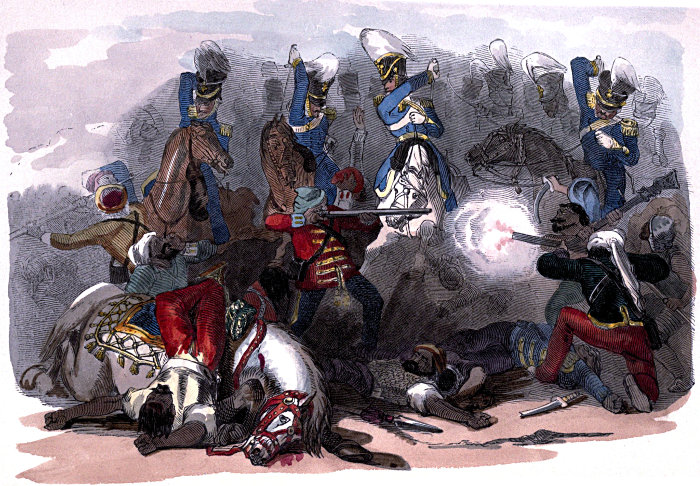
3rd Light Dragoons in India.
[To face page 106.
The following Regular Regiments formed part
of the Anglo-Indian Army engaged in the Punjaub
in 1845 and 1846:—
|
Actions at which each Regiment was engaged. |
Total. |
Moodkee,
18th Dec.
1845. |
Ferozeshah,
21st & 22nd
Dec. 1845. |
Aliwal,
28th Jan.
1846. |
Sobraon,
10th Feb.
1846. |
| 3rd Light Dragoons |
1 |
1 |
.. |
1 |
3 |
| 9th Lancers |
.. |
.. |
.. |
1 |
1 |
| 16th " |
.. |
.. |
1 |
1 |
2 |
| 9th Foot |
1 |
1 |
.. |
1 |
3 |
| 10th " |
.. |
.. |
.. |
1 |
1 |
| 29th " |
.. |
1 |
.. |
1 |
2 |
| 31st " |
1 |
1 |
1 |
1 |
4 |
| 50th " |
1 |
1 |
1 |
1 |
4 |
| 53rd " |
.. |
.. |
1 |
1 |
2 |
| 62nd " |
.. |
1 |
.. |
1 |
2 |
| 80th " |
1 |
1 |
.. |
1 |
3 |
The King's Own Regiment of Light Dragoons,
from the period of its formation in 1685,
to the present time, has performed upwards of
one hundred and sixty years' faithful and meritorious
service in the reign of nine successive
monarchs. It was employed in the several wars
on the continent of Europe during the reigns of
King William III.,—of Queen Anne,—and of
King George II. It was again employed in Portugal,
Spain, and France, from 1811 to 1818. It
has been since engaged in most arduous duties
in Affghanistan, and on the banks of the Sutlej,
where it has acquired additional honours by its
bravery; it continues to be employed in guarding
the possessions of the British Crown in the distant
clime of India.
Whether confronting a foreign enemy in the
field, or performing duties of a painful character
at home, its conduct has, on all occasions, been
such as to procure the acknowledgments of the
Civil Authorities by whom its assistance was
required;—the commendations of the General
Officers under whose immediate command it has
served;—the thanks of Parliament; and the approbation
of its Sovereign.
The compiler of the Records of the Army feels it his duty
to acknowledge, that his labours have been greatly assisted by a
memoir of the services of the Third, or the King's Own, Light
Dragoons, which was printed, in 1833, by Lieutenant Colonel
Charles Stisted, then lieutenant-colonel of the regiment. King
William IV. expressed himself much satisfied with the manner
in which the Colonel had executed a task, to which His
Majesty attached great importance, and gave him credit for
the zeal and industry with which he had undertaken and prosecuted
it; a notification to the above effect was made to
Lieutenant-Colonel Stisted by Lieutenant-General Sir Herbert
Taylor, G.C.H. Lieutenant Colonel Stisted entered the
Army in May, 1794, as an ensign in the 39th Regiment.—He
was appointed to a lieutenancy in the 13th Light Dragoons
in January, 1803, and was promoted to be captain of a troop
in February, 1804: he exchanged to the Third Light Dragoons
on the 7th of February, 1811; and was promoted to a majority
on the 14th of October, 1819, and to the Lieutenant-Colonelcy
of the Regiment on the 22nd of July, 1830: he
continued in command of the Regiment until the 19th of
May, 1837, when he exchanged to the half-pay: he was reappointed
to the full pay in September, 1841, and retired
from the service by the sale of his commission; he died at
Torquay on the 24th of July, 1842.
SUCCESSION OF COLONELS OF THE THIRD, OR THE KING'S OWN REGIMENT OF LIGHT DRAGOONS. — Charles, Duke of Somerset , K.G. Appointed 2nd August, 1685. — Alexander Cannon. Appointed 2nd August, 1687. — Richard Leveson. Appointed 31st December, 1688. — Thomas, Lord Fairfax. Appointed 30th January, 1694. — William Lloyd. Appointed 21st February, 1695. — George Carpenter. Appointed 31st December, 1703. — Philip Honeywood. Appointed 29th May, 1732. — Humphrey Bland. Appointed 18th April, 1743. — James, Lord Tyrawley. Appointed 8th July, 1752. — George, Earl of Albemarle. Appointed 8th April, 1755. — Charles, Lord Southampton. Appointed 20th October, 1772. — Francis Lascelles. Appointed 23rd March, 1797. — Sir Charles Grey , K.B. Appointed 4th September, 1799. — William Cartwright. Appointed 28th November, 1807. — Stapleton Cotton, Viscount Combermere , G.C.B., and G.C.H. Appointed 25th January, 1821. — Lord George Thomas Beresford , G.C.H. Appointed 16th September, 1829. — Lord Charles Somerset Manners , K.C.B. Appointed 8th November, 1839.
This nobleman succeeded to the title of Duke of Somerset
on the decease of his brother, who was murdered at Lerice, in
Italy, on the 20th of April, 1678. He was elected a Knight
of the Garter in April, 1684, and was one of the privy councillors
who signed the proclamation of the accession of King
James II., on the 6th of February following. Being Lord-Lieutenant
of Somersetshire at the time of the rebellion of
the Duke of Monmouth, he called out the militia of the
county, and was rewarded for his fidelity to the Crown with
the colonelcy of the Queen Consort's Regiment of Dragoons,
and the appointment of lord of the bed-chamber to His
Majesty; but was removed from his regiment and court appointment
for refusing to attend a nuncio from Pope Innocent
XI. into the King's presence. At the Revolution in 1688,
his grace joined the Prince of Orange, afterwards William III.,
during part of whose reign he presided at the council,
and was one of the lords of the regency when His Majesty
made his last visit to the Continent. The Duke of Somerset
was also a privy councillor, and master of the horse during part
of the reign of Queen Anne; and, after Her Majesty's demise,
he was one of the guardians of the realm until the arrival of
George I. from Hanover. He died on the 2nd of Dec., 1748,
and was buried in Salisbury Cathedral: a fine marble monument
of his grace was afterwards placed in the senate-house
of the University of Cambridge.
Alexander Cannon entered the service of the United Provinces
of the Netherlands, and held a commission in one of
the English regiments in Holland, with which he served under
the Prince of Orange (afterwards King William III.), and
was promoted to the colonelcy of the corps. Having arrived
in England with his regiment in the summer of 1685, to assist
in suppressing the rebellion of the Duke of Monmouth, he
quitted the Dutch service, and was appointed, by King
James II., Lieutenant-Colonel of the Queen's Dragoons.
He was a stanch adherent to the Court, and was rewarded
with the colonelcy of the regiment in 1687; but refusing to
take the oath to the Prince of Orange, at the Revolution in
1688, he was removed from his command.
Colonel Cannon proceeded to Ireland in 1689, where he
was promoted by King James to the rank of brigadier-general;
he was sent with a small body of men to Scotland, to
assist the highlanders in their opposition to the government
of King William III. He was second in command at
the Battle of Killicrankie, and after the fall of Viscount
Dundee, he commanded the Highlanders and Irish. He was
reinforced by another body of troops from Ireland under Brigadier-General
Buchan, and remained in Scotland two years;
but being harassed by the King's forces, and defeated in
several skirmishes, the highlanders tendered their submission
to King William, and their commanders followed King
James to France.
In the reign of King Charles II. Richard Leveson served
as a volunteer against the Moors at Tangier, in Africa; and
on the breaking out of the rebellion of the Duke of Monmouth
in June, 1685, he raised a troop of dragoons in the county of
Middlesex, which troop was eventually incorporated in the
Queen's regiment, now Third, or King's Own. In the
summer of 1687, he was promoted to the lieutenant-colonelcy,
and having joined the standard of the Prince of Orange, in
November, 1688, he was advanced, on the 31st of December
following, to the colonelcy of the regiment. He served at
the head of the Queen's Dragoons in Ireland; evinced great
personal bravery at the Battle of the Boyne, and on other
occasions, as detailed in the record of the Third Light Dragoons;
and acquired celebrity for his ability, activity, and
gallantry on detached services. After the decease of Brigadier-General
Villiers, King William rewarded the brave Leveson
with the command of a corps of cuirassiers, now second dragoon
guards. He served under His Majesty in the Netherlands,
and was promoted to the rank of major-general on the 11th
of January, 1696. His decease occurred on the 3rd of
March, 1699.
Lord Fairfax having joined the Prince of Orange at the
Revolution in 1688, was appointed lieutenant and lieutenant-colonel
in the third troop of life guards, which gave him the
privilege of taking the court duty of silver stick; he afterwards
exchanged to the second troop (now second regiment)
of life guards, from which he was promoted to the colonelcy
of the Queen's dragoons. He retired in the following year,
and was promoted to the rank of brigadier-general in 1702.
He died in January, 1710.
This Officer served with distinction under King William
III. in Ireland and the Netherlands, and was promoted
to the colonelcy of the Queen's Dragoons by purchase, in
1695. He served with his regiment in Flanders until the
peace of Ryswick; was promoted to the rank of brigadier-general
in the spring of 1702; and, commanding a brigade of
infantry under the Duke of Ormond, in the expedition to
Spain, was engaged in the storming of the forts of Vigo.
He was subsequently advanced to the rank of major-general;
but obtained permission to dispose of the colonelcy of his
regiment in 1703, to Colonel Carpenter.
George Carpenter was born in February, 1657, and when
fourteen years of age he was page to the Duke of Montague
in his grace's embassy to France. In 1672, he entered the
army as a private gentleman in the Duke of York's troop of
life guards, which corps was, at that period, as a school where
young gentlemen were qualified for commissions. In 1685
he was appointed troop quarter-master in a newly-raised corps
of cuirassiers, now second dragoon guards; in which regiment
he rose to the rank of cornet in 1687, and afterwards to that
of lieutenant, captain, and lieutenant-colonel. He served
with his regiment in Ireland, and in Flanders and Brabant,
and was promoted to the rank of colonel in the army in 1702.
In the following year he purchased the colonelcy of the
Queen's Dragoons and was promoted to the rank of brigadier-general
on the 25th of December, 1705. He proceeded to
Spain in 1706, and serving with the allied army, signalized
himself at the unfortunate battle of Almanza in 1707, where
he repeatedly charged at the head of the British cavalry, and,
commanding one of the last squadrons which left the field,
saved the Earl of Galway, many wounded men, and much of
the baggage from falling into the hands of the enemy. He
continued with the army in Spain, acquiring additional honour
by his excellent conduct on all occasions, was promoted to
the rank of major-general in September, 1708, and to that of
lieutenant-general in January, 1710. In the brilliant cavalry
action on the plains of Almanara, on the 27th of July, 1710,
he highly distinguished himself, and was wounded: his spirited
conduct on this occasion, procured him the thanks of
King Charles III. of Spain, afterwards Emperor of the
Romans, who was with the army. He acquired fresh laurels
at Saragossa and wrote an interesting account of that battle,
which was published at the time. After advancing to Madrid,
the army retreated to Valencia and Catalonia, and Lieutenant-General
Carpenter was with the division under General Stanhope,
which halted at the little walled town of Brihuega, in
the mountains of Castile, and was there surrounded and made
prisoners by the French army. On this occasion he was
wounded by a musket-ball, which, having broken part of his
jaw, lodged itself under the root of his tongue, where it remained
several months before it could be extracted, during
which time his life was in danger, and he suffered great pain.
In the spring of 1715, he was appointed envoy extraordinary
and plenipotentiary to the court of Vienna. During the
rebellion of the Earl of Mar, he commanded a detached corps,
prevented the insurgents obtaining possession of Newcastle-on-Tyne,
and afterwards, joining Major-General Wills, took
a division of the rebel army prisoners, at Preston, in Lancashire.
He was rewarded with the appointment of governor
of Minorca and Port Mahon, and commander of the forces in
Scotland; and in May, 1719, he was advanced to the peerage
of Ireland by the title of Baron Carpenter of Killaghy in
the county of Kilkenny.
Lord Carpenter was many years a member of Parliament,
first for Whitchurch in Hampshire, and afterwards for
the city of Westminster. He published a highly useful work
entitled 'A Dissertation on the Manœuvres of Cavalry.'
After serving the Crown a period of nearly sixty years, in
the reign of six successive sovereigns, he died, on the 10th of
February, 1732, in the seventy-fifth year of his age, and was
buried at Ouselburg in Hampshire, where a monument was
erected to his memory. He was ancestor of the Earls of
Tyrconnel.
Philip Honeywood entered the army in 1694, and served
under King William III.; he subsequently served Her Majesty
Queen Anne, and became an efficient officer under the
celebrated John, Duke of Marlborough. Having attained
the rank of lieutenant-colonel in the thirty-third foot,
on the 27th of May, 1709, he was promoted to the colonelcy
of the 92nd regiment, which was disbanded in 1712. In
1715 he was commissioned to raise, form, and discipline a
regiment of dragoons, (now the eleventh light dragoons),
which he executed with ability, and was afterwards instrumental
in the suppression of the rebellion of the Earl of Mar.
In 1719 he commanded a brigade under Lord Cobham at the
capture of Vigo and Rondondella in Spain. On the 29th of
May, 1732, he was removed to the command of the Third
dragoons, which he retained until promoted to the King's
Own regiment of horse in 1743. In 1742 a British force
was sent to Flanders, under General Honeywood, who held
the chief command of the troops, until the arrival of the Earl
of Stair. At the battle of Dettingen one division of the army
was commanded by this distinguished officer, and he led the
royal horse guards and the King's horse to the charge with
great gallantry. He served in the subsequent campaigns on
the continent with distinction, and with the approbation of
his sovereign, by whom he was advanced to the dignity of a
Knight of the honourable order of the Bath. He died in
1752, and was interred with military honours at Portsmouth,
of which place he was governor at the time of his decease.
Humphrey Bland served several campaigns on the continent
under the celebrated John, Duke of Marlborough. He
afterwards served as lieut.-colonel in Spain, and in 1710 was
wounded at the battle of Almanara. In 1715 he was appointed
lieut.-colonel to the eleventh dragoons, and was afterwards
lieut.-colonel of the second horse, now first dragoon
guards. In 1737 he was promoted to the colonelcy of the
thirty-sixth foot, from which he was removed in 1741, to the
thirteenth dragoons, and two years afterwards to the King's
Own dragoons. He had his horse shot under him at Dettingen;
displayed great gallantry at Fontenoy, and highly
distinguished himself at the battle of Culloden. In 1752 he
was removed to the first dragoon guards; and died in the
following year.
The Hon. James O'Hara was appointed lieutenant in the
royal regiment of fusiliers, commanded by his father, on the
15th of March, 1703, and in 1706 he proceeded with his regiment
to the relief of Barcelona. In the following year he
was aide-de-camp to the Earl of Galway, whose life he is reported
to have saved at the unfortunate battle of Almanza, by
interposing between his lordship and a dragoon, whom he
shot with his pistol, but was, himself, wounded by the dragoon.
He served several years at Minorca, and in 1713
obtained the colonelcy of the royal fusiliers, in succession to
his father, at whose decease, in 1733, he succeeded to the
dignity of Baron Tyrawley. The rank of brigadier-general
was conferred on his lordship on the 23rd of November,
1735; that of major-general on the 2nd of July, 1739;
and in August, of the latter year, he was removed from the
royal fusiliers to the fifth horse, now fourth dragoon guards.
In March, 1743, he was promoted to the rank of lieutenant-general,
and in the following month obtained the colonelcy
of the second troop of horse grenadier guards, from which
he was removed in 1745 to the third troop of life guards,
which gave him the privilege of taking the court duty of gold
stick. In 1746, when King George II. had resolved to disband
the third and fourth troops of life guards, his lordship
was removed to the tenth foot: he was again removed, in 1749,
to the fourteenth dragoons; in 1752, to the Third or King's
Own regiment of dragoons; and in 1755, to the second, or
Coldstream regiment of foot guards. He was appointed governor
of Portsmouth on the 1st of May, 1759, and was promoted
to the rank of general on the 7th of March, 1761. He
held the appointment of governor of Minorca for several
years; was employed as envoy and ambassador to the courts
of Portugal and Russia; and died at Twickenham on the
13th of July, 1773.
Viscount Bury commenced his military service as ensign
in the second foot guards in 1738; in 1741 he was captain-lieutenant
in the royal dragoons; in 1743 he held the same
rank in his former regiment; and on the 27th of May, 1745,
he obtained the commission of captain and lieut.-colonel in
the same corps. He was aide-de-camp to the Duke of Cumberland
at the battle of Fontenoy; also attended His Royal
Highness at the battle of Culloden,—was sent with the news
of that victory to London, and was immediately afterwards
appointed aide-de-camp to the King with the rank of colonel.
The colonelcy of the twentieth foot was conferred on his lordship
on the 1st of November, 1749. In 1754 he succeeded to
the title of Earl of Albemarle; and obtained the colonelcy
of the King's Own dragoons in the succeeding year. The
rank of major-general was conferred on his lordship in 1756,
and that of lieut.-general in 1759. In 1761 he was a member
of the privy council and governor of the island of Jersey; and
in 1762, he commanded the land forces employed in the reduction
of the Havannah; in the performance of which service
he acquired great reputation, and his conduct called forth the
approbation of his sovereign and of the British nation. He was
elected a Knight of the Garter in 1766; and died in 1772.
Lord Charles Fitzroy, brother of Augustus-Henry, Duke
of Grafton, choosing a military life, obtained the commission
of ensign in the first foot guards on the 16th of March, 1752.
In 1756 he was promoted to the rank of lieutenant, and in
1758 obtained the command of a company with the rank of
lieut.-colonel. In 1762 he was promoted to the colonelcy of
the 119th, or Prince's Own, regiment of foot, which was disbanded
after the peace of Fontainbleau. The colonelcy of
the fourteenth dragoons was conferred on his lordship on the
11th of September, 1765, and in 1772 he was promoted to the
rank of major-general and removed to the King's Own dragoons.
He was further promoted to the rank of lieut.-general
in 1777; advanced to the peerage by the title of Lord
Southampton in 1780; and promoted to the rank of general
in 1793. He died on the 21st of March, 1797.
This Officer was appointed on the 13th of December, 1761,
captain in the seventeenth light dragoons, then commanded by
captain-commandant Lord Aberdour. In June, 1764, he was
appointed major of the eighth dragoons, and in May, 1768,
obtained the lieut.-colonelcy of the regiment, from which he
was removed on the 8th of May, 1780, to the lieut.-colonelcy
of the King's Own dragoons. He was appointed major-general
in 1782; colonel of the eighth dragoons in 1789;
and lieut.-general on the 12th of October, 1793. After the
decease of Lord Southampton the colonelcy of the King's
Own dragoons was conferred on Lieut.-General Lascelles, who
was also groom of the bed-chamber to King George III.; and
was advanced to the rank of general in 1798. He was highly
respected by the officers of the regiment, and was distinguished
for easy dignity, manliness, and good sense. He died in
1799.
Charles Grey, fourth son of Sir Henry Grey, Baronet,
entered the army in the reign of King George II., and was
promoted to the command of a company in the twentieth foot
on the 31st of May, 1755. In 1758 his regiment proceeded
to Germany, and he was appointed aide-de-camp to the Duke
of Brunswick, in which capacity he served in 1759 at the
glorious battle of Minden, where he was wounded. In 1761,
he was appointed lieut.-colonel commandant of the ninety-eighth
regiment, which was then newly-raised, and was disbanded
after the peace of Fontainbleau, when he was placed
on half-pay. In 1772 he was promoted to the rank of colonel,
and appointed aide-de-camp to King George III., who conferred
on him the colonelcy of the twenty-eighth foot in March,
1777, and promoted him to the rank of major-general in
August following. In 1782 he obtained the dignity of a
knight of the Bath; was promoted to the rank of lieut.-general,
and appointed commander-in-chief in America; but the war
was terminated before he had an opportunity of proceeding
thither. In 1787 he was removed to the eighth dragoons;
and in 1789 he obtained the colonelcy of the seventh or Princess
Royal's dragoon guards.
In 1793 Sir Charles Grey was appointed to the command
of an expedition to the West Indies; but while the armament
was preparing the Duke of York raised the siege of Dunkirk,
and the French menaced Ostend and Nieuport. The troops
sailed for Flanders, and by his timely arrival Sir Charles Grey
preserved the two fortresses from the power of the enemy. He
subsequently proceeded to the West Indies, and the islands of
Martinico, St. Lucia, and Guadaloupe were captured: and his
services were recompensed with the government of Dumbarton,
and the colonelcy of the twentieth, or Jamaica, regiment of
light dragoons, by commission dated the 4th of November,
1795. After his return to England he was promoted to the
rank of general, sworn of the privy-council, reappointed
colonel of the eighth dragoons, and placed in command of the
troops stationed in the southern district, to repel the projected
French invasion. In 1799 he was appointed colonel of the
Third, or King's Own dragoons. At length, being worn
out with age and active service, he retired to his country seat
to pass the remainder of his days in the bosom of his family.
His services were not forgotten by his sovereign, who created
him Baron Grey de Howick in 1801; and advanced him, in
1806, to the dignity of Viscount Howick and Earl Grey: he
held also the government of the island of Guernsey. His
decease occurred on the 14th of November, 1807, at his seat
called Fallowden, near Alnwick, in Northumberland.
This Officer was appointed cornet in the tenth dragoons on
the 22nd of February, 1769, lieutenant in 1775, captain-lieutenant
in the Third dragoons in 1778, and exchanged in
1779 to the tenth dragoons, of which corps he was appointed
major in 1786, and lieut.-colonel in 1793. The high condition
of the tenth was a proof of his care and attention to all
the duties of commanding officer; and in 1796 he was appointed
colonel in the army, and aide-de-camp to King George
III. Having been promoted to the rank of major-general in
April, 1802, he was employed on the staff of South Britain
during the succeeding six years, first in the inspection of
cavalry regiments in the western district, afterwards in the
command of the cavalry on the coast of Kent, in the command
of the cavalry in the home district, and subsequently in the
command of a brigade of cavalry in Kent, designed for foreign
service. In 1804 he was promoted from the lieut.-colonelcy
of the tenth, to the colonelcy of the twenty-third dragoons, and
in 1807 he obtained the colonelcy of the King's Own dragoons.
He was advanced to the rank of lieut.-general in 1808,
to that of general in 1819, and in 1821 he was removed to
the colonelcy of the King's dragoon guards. He was a member
of the consolidated board of general officers: his decease occurred
in February, 1827.
Stapleton Cotton entered the army in 1790 as second
lieutenant in the royal Welsh fusiliers. His services, in command
of a troop of the sixth dragoon guards under the Duke
of York in Flanders, under General Harris in the East Indies,
at the Cape of Good Hope, under the Duke of Wellington in
command of a brigade of cavalry at Talavera, in command of
the British cavalry at Fuentes d'Onor, Salamanca, Orthes,
Toulouse, &c. &c. &c., were rewarded with the dignity of
Viscount Combermere, grand cross of the military order
of the Bath, and grand cross of the royal Hanoverian Guelphic
order. He was appointed to the colonelcy of the twentieth
dragoons in 1813, to that of the King's Own dragoons in 1821,
and was removed in 1829, to the first regiment of life guards,
of which corps he has retained the command to the present
time.
Lord George Beresford entered the service as cornet of
the 14th light dragoons in April, 1794; he was shortly afterwards
promoted, and, after serving in the grades of lieutenant
and captain in the infantry, he obtained, in December, 1800, a
majority in the 6th dragoon guards. In the following three
years he was employed with that regiment in Ireland, and in
attending Parliament as a member of the House of Commons
for the county of Waterford, of which he was Custos
Rotulorum. He was promoted to the rank of lieut.-colonel
in Dillon's regiment in 1803, and when a second battalion was
added to the 71st regiment, under the Additional Force Act,
in the year 1804, Lieutenant-Colonel Lord George Beresford
was selected for the command of it. In July, 1807, Lord
George Beresford reverted to the cavalry branch of the service,
and was appointed to the command of the 2nd, or Queen's
Dragoon Guards, which he retained until his promotion to
the rank of major-general on the 4th June, 1814. On the 16th
September, 1829, his Lordship was appointed to the colonelcy
of the Third, King's Own, Light Dragoons, and attained the
rank of lieut.-general in the army on the 22nd July, 1830. His
Lordship was brother to the late, and uncle to the present,
Marquess of Waterford, and he died at the Palace at Armagh,
the residence of his elder brother, the Lord Primate of Ireland,
on the 26th October, 1839.
APPENDIX TO THE HISTORICAL RECORD OF THE THIRD, OR THE KING'S OWN, REGIMENT OF LIGHT DRAGOONS. — Copy of a Despatch of Brigadier M. White, C.B., Commanding the Cavalry Division on the 18th December, 1845, to the Adjutant-General of the Army in India. — Copy of a Despatch from Brigadier M. White, C.B., Commanding the Cavalry Division, to the Adjutant-General of the Army in India. — Extracts from Minutes of Proceedings of the House of Lords.—2nd March, 1846. — Extracts from Minutes of Proceedings of the House of Lords.—2nd April, 1846. — Extracts from the Votes and Proceedings of the House of Commons.—2nd March, 1846. — MILITARY OPERATIONS ON THE SUTLEJ. — Extracts from the Votes and Proceedings of the House of Commons.—2nd April, 1846. — BATTLE OF ALIWAL. — BATTLE OF SOBRAON.
The following is a list of the Officers of the Third, or
the King's Own, Light Dragoons, showing those who were
engaged in the campaign on the Sutlej in the years 1845
and 1846.
Copies of Brigadier White's Reports, dated 19th and 25th
December, 1845, are annexed, respecting the conduct of the
Officers and Men at the memorable battles of Moodkee and
Ferozeshah.
These testimonials are equally honourable to the Officers and
Men, and to their Commander, Brigadier-General White, by
whose talents, bravery and example, the excellent qualities of
the regiment were drawn forth, which are attested in the
strongest terms of commendation, by the Governor-General
and by the Commander-in-Chief, in India, as detailed in the
Historical Record of the services of the Regiment.
To these reports are added copies of the Votes of Thanks of
the House of Lords, and of the House of Commons; Marks of
Honour, which are conferred only for great and glorious
actions, and for special public services.
Names and Distribution of the Officers of the Third,
"King's Own" Light Dragoons, during the campaign on the Sutlej, in
1845 and 1846.
| Rank. |
Names. |
Remarks. |
| Lieut.-Colonel |
Colonel Sir Joseph Thackwell, K.C.B. and K.H. |
Commanding the Cawnpore Station as Major-General; was present
at Sobraon, where he commanded the Cavalry Division. |
| " |
Col. Michael White |
Brigadier commanding the Cavalry Division at Moodkee and 1st
Cavalry Brigade at Ferozeshah, where he was wounded. Promoted
Aide-de-Camp to the Queen, with the rank of Colonel, on the 3rd
April, 1846. |
| Major |
Lieut.-Colonel G. H. Lockwood |
Absent on leave. Promoted on 9th November, 1846. Rejoined on
13th January, 1847. |
| " |
Lieut.-Col. C. W. M. Balders |
Commanded the regiment at Moodkee and Ferozeshah until
wounded on the evening of 21st December. |
| Captain |
J. Tritton |
Assistant Adjutant-General of the Cavalry Division. Promoted
in 10th Royal Hussars on 3rd April, 1846. |
| " |
J. W. Yerbury |
Absent on leave. Promoted on 9th November, 1846. Rejoined 5th
April, 1847. |
| " |
J. R. B. Hale |
Commanded the regiment on the night of the 21st December,
and during the action of the 22nd, vice Major Balders;
wounded. Promoted to the rank of Major on the 3rd April,
1846. |
| " |
Lieut.-Colonel J. B. Gough. |
Commanding 2nd Cavalry Brigade; severely wounded at
Sobraon. |
| " |
W. Unett |
In charge of Depôt Troop at Maidstone. Rejoined the regiment
4th June, 1846. |
| " |
Major W. R. Herries |
Aide-de-Camp to the Governor-General. Killed at Moodkee. |
| " |
J. E. Dyer |
Absent on leave. Exchanged to the 68th Regiment, on 3rd
April, 1846. |
| " |
G. Forbes |
In charge of Detachments en route. Joined the
regiment in January, 1846, and was present at Sobraon. |
| " |
W. E. F. Barnes |
Present with the regiment. |
| Lieutenant |
J. E. Codd |
Promoted Captain on 19th December, 1845, vice
Herries. Killed in action at Ferozeshah. |
| " |
S. Fisher |
Major of Brigade of 1st Cavalry Brigade; severely wounded
at Moodkee. Promoted Captain on 22nd December, vice
Codd. |
| " |
W. H. Hadfield |
In charge of Depôt Service Troops at Umballa. Promoted 3rd
April, 1846. |
| " |
G. Newton |
Killed in action at Moodkee. |
| " |
J. Martin |
At Cavalry Depôt, Maidstone. Promoted on 9th November,
1846. |
| " |
E. G. Swinton |
Severely wounded at Moodkee. |
| " |
J. D. Codwell |
Present with the regiment. |
| " |
J. Sullivan, Adjutant |
Appointed Officiating Major of Brigade of 1st Cavalry Brigade
on 19th December, vice Fisher; wounded. |
| " |
H. Wood |
On leave of absence. Rejoined the regiment on 28th June,
1846. |
| " |
E. Roche |
Aide-de-Camp to Major-General Sir J. Thackwell; afterwards
Acting Assistant Quarter-Master-General. Present at Sobraon. |
| " |
G. Cookes |
Appointed Acting Adjutant to the regiment, on 19th December,
vice Sullivan, Acting Brigade Major. |
| " |
C. Bowles |
On duty with Invalids. Joined the regiment in January, 1846,
and was present at Sobraon. Exchanged to 7th Hussars on 27th
August, 1846. |
| " |
J. H. Travers |
At Cavalry Depôt, Maidstone. Rejoined the regiment on 1st
July, 1846. |
| " |
R. Casement |
On leave of absence. Rejoined the regiment on the 17th
September, 1846. |
| " |
E. B. Cureton |
Severely wounded at Moodkee. |
| " |
J. B. Hawkes |
Present;—wounded at Sobraon. |
| " |
T. Penton |
Present. |
| " |
H. C. Morgan |
Severely wounded at Ferozeshah. |
| " |
F. G. Archer Burton |
Present with the regiment; received a contusion at
Ferozeshah. |
| Cornet |
E. Worley |
Killed at Moodkee. |
| " |
H. Ellis |
Killed at Forezeshah. |
| " |
H. W. White |
Present. Wounded at Sobraon. Promoted on 19th December, 1845,
vice Lieut. Codd. |
| " |
J. D. White |
Present. Received a contusion at Ferozeshah. Promoted
on 19th December, 1845, vice Lieut. Newton. |
| " |
George Wyndham Knight Bruce |
Exchanged to 16th Lancers, with Cornet Hodgson, on 31st October, and continued on service with the 3rd Light Dragoons. Killed at Ferozeshah on the 21st December, 1845. |
| " |
J. Rathwell, Riding-Master |
Present. Received a contusion at Ferozeshah. Promoted on 22nd
December, 1845, vice Lieut. Fisher. |
| " |
W. H. Orme |
Severely wounded at Ferozeshah. Promoted on 3rd April,
1846. |
| " |
C. R. Colt |
En route with Detachment; joined the regiment
in February, 1846, and was present at Sobraon. Promoted on 9th
November, 1846. |
| " |
R. Hodgson |
Exchanged from the 16th Lancers on 31st October, 1845, with
Cornet Bruce. Joined the 3rd Light Dragoons in January, 1846, and
was present at Sobraon. |
| " |
G. E. F. Kauntze |
Present. Severely wounded at Sobraon. |
| Paymaster |
E. Cormick |
Present with the Regiment. |
| Adjutant |
Lieut. J. Sullivan |
Present. |
| Quartermaster |
A. Crabtree |
Present. Wounded at Sobraon. |
| Surgeon |
J. Henderson (M.D.) |
On duty with Invalids. |
| Assis. Surgeon |
H. Franklin |
Present. |
| " " |
F. Laing (M.D.) |
Present. |
| Vet. Surgeon |
G. Edlin |
Present. |
It is worthy of being recorded, that many of the Non-Commissioned
Officers and Men, who were wounded in the different
engagements, concealed the fact, that they might have an
opportunity of sharing in any further Actions in which the
regiment might be engaged. Amongst others, Troop Serjeant-major
Walter Eldridge, who received a bayonet wound
through the calf of his leg, in charging over the enemy's
entrenched infantry on the evening of the 21st December,
never reported the circumstance, until from lameness, caused
by inflammation of the leg, the brave fellow could no longer
conceal it. He was immediately conveyed to the Hospital,
where he died in a few days afterwards.
Camp, Moodkee, 19th December, 1845.
Sir,
In forwarding the accompanying return of the casualties which
occurred in the Cavalry Division under my command in the
Action of yesterday, I have the honour to state, for the information
of His Excellency the Commander-in-Chief, that the
whole of the regiments engaged performed their duty to my
entire satisfaction; but, consequent on the nature of the ground
and the numerous bodies of both Cavalry and Infantry that
were opposed to them, I regret to say the loss has been very
heavy, more particularly in Her Majesty's 3rd Light Dragoons,
who bore the brunt of the Action.
I further beg to bring to the notice of His Excellency, that
Captain Tritton of Her Majesty's 3rd Light Dragoons, my
Assistant Adjutant-General, captured one of the enemy's
Standards with his own hands, which he has delivered over to
me as Commanding the Cavalry Division.
It has also been reported to me by Lieutenant and Adjutant
Sullivan of Her Majesty's 3rd Light Dragoons, that Serjeant
Hinds, and a party of six or seven men of the regiment,
succeeded in capturing two of the enemy's Guns, after cutting
down the whole of the armed party who were with them.
The Guns were marked by order of Lieutenant Sullivan, who
can identify them.
I have in conclusion to add, that the undermentioned
Officers afforded me every assistance, and conducted themselves
throughout the Action to my entire satisfaction, and I beg to
bring them to His Excellency's favourable notice:—
- Brigadier Gough, C.B., Her Majesty's 3rd Light Dragoons.
- Brigadier Mactier, 4th Native Cavalry (Lancers).
- Major Balders, Commanding 3rd Light Dragoons.
- Captain Dawkins, Commanding Governor-General's Body-Guard.
- Major Alexander, Commanding 5th Light Cavalry.
- Captain Nash, Commanding 4th Light Cavalry.
- Captain Christie, Commanding 4th Irregular Cavalry.
- Captain Tritton, Assistant Adjutant-General of Cavalry.
- Captain Quin, Deputy Quarter Master-General of Cavalry.
- Lieutenant Fisher, Brigade-Major.
- Captain Harrington, Brigade Major.
- Captain Wyld, Brigade Major.
I trust I may also be permitted to name Lieutenant and
Adjutant Sullivan, Her Majesty's 3rd Light Dragoons, who
rendered me most essential service, independent of his regimental
duties, throughout the action.
I have, &c.,
M. White,
Lieut.-Col. 3rd Light Dragoons,
Brigadier Commanding Cavalry Division,
Army of the Sutlej.
Camp, Ferozeshah, 25th December, 1845.
Sir,
In compliance with instructions contained in the General
Order by His Excellency the Commander-in-Chief of yesterday's
date, I have the honour to report on the operations of
the Cavalry Division under my command during the Actions
of the 21st and 22nd instant, as far as came under my personal
observation, and have the gratification to state, for His
Excellency's information, that every Individual of Her
Majesty's 3rd Light Dragoons, both Officers and Men, performed
their duty with the highest credit to themselves and
their country. This I had an opportunity of witnessing, having
charged at the head of the regiment myself through a battery
of the enemy's guns which met us with a most galling fire
of grape, and over their infantry entrenched in front of their
camp. This charge was a most gallant and successful one,
as we succeeded in completely driving the enemy from their
guns, though, I regret to say, our loss on this occasion has
been very severe, both in Officers and Men, as will be seen by
the Casualty Return of the Corps.
I beg to bring to his Excellency's favourable notice the
merits of the following Officers who gallantly led the regiment
into action:—Major Balders, Commanding; Captain
Tritton, Assistant Adjutant-General; Lieutenant Sullivan,
Officiating Major of Brigade; Captain Havelock, and Brigade
Major Wyld of the 4th Lancers; the two latter Officers
were at the time acting under my orders, and charged with the
regiment.
I beg to add, that Major Balders having been wounded in
the charge, the command devolved on Captain Hale, who
brought the regiment out of Action.
During the 22nd, the brigade immediately under my command
was engaged manœuvring during the whole of the day,
sometimes for the protection of our own Artillery, and at others,
with a view of cutting off the enemy's retreat, and capturing
their few remaining guns; in the latter we were not successful,
as, with the exception of about a squadron of Her Majesty's
3rd Light Dragoons and the 4th Regiment of Lancers, the
whole of the Cavalry had been withdrawn off the field. On this
day our loss was comparatively small, having lost a few Non-Commissioned
Officers and Men, and having two Officers'
chargers killed by round shot, one of which was Lieutenant
Sullivan's, my officiating Major of Brigade, being the third
horse shot under him during the Actions of the 18th, 21st, and
22nd December.
I have, &c.,
M. White,
Lieut.-Col. 3rd Light Dragoons,
Brigadier Commanding Cavalry Division,
Army of the Sutlej.
"Order of the day read, Moved to resolve,—That the
Thanks of this House be given to the Right Honourable Lieutenant-General
Sir Henry Hardinge, Governor-General of
India, Knight Grand Cross of the Order of the Bath, for the
energy and ability with which he directed the military means
at his disposal, to the repelling of the unprovoked invasion
by the Sikh Army, of the dominions of the British Government,
and of the Protected States upon the left bank of the
Sutlej; and also for the firmness and gallantry with which he
directed the operations of that portion of the Army under his
immediate command, in the afternoon and night of December
21st, 1845, and on the morning of the 22nd, upon which occasion
the enemy's defences were carried by storm, the greater
part of their Artillery captured, and their subsequent attempts
to regain what they had lost repeatedly defeated.
"On question, Resolved in the Affirmative, Nemine dissentiente."
"Then it was moved to resolve,—That the Thanks of this
House be given to General Sir Hugh Gough, Baronet, Knight
Grand Cross of the Order of the Bath, Commander-in-Chief
of the Forces in the East Indies, for the distinguished valour
with which he directed and led the several attacks upon the
enemy, and for the eminent services rendered by him in the
Battles of the 18th, 21st, and 22nd of December, 1845; displaying,
as he did, in conjunction with the Governor-General, a
brilliant example to the Troops of perseverance and courage
in critical circumstances, and of irresistible ardour in the
several attacks made upon the enemy.
"On question, Resolved in the Affirmative, Nemine dissentiente."
"Then it was moved to resolve,—That the Thanks of this
House be given to Major-General Sir Henry George Smith,
Knight Commander of the Order of the Bath, to Major-General
Walter Raleigh Gilbert, and to Major-General Sir John
Hunter Littler, Knight Commander of the Order of the Bath,
and to the several Officers, European and Native, under their
command, for the eminent services rendered by them in the
recent arduous and successful operations.
"On Question, Resolved in the Affirmative, Nemine dissentiente."
"Then it was moved to resolve,—That the Thanks of this
House be given to the Non-Commissioned Officers and Private
Soldiers, European and Native, for the perseverance and fortitude
maintained by them at Moodkee, on the 18th December,
1845, and for the daring valour with which they forced the
enemy's entrenchments at Ferozeshah on the 21st and 22nd of
December, captured most of his guns, and finally compelled
the Sikh Army, of greatly superior numbers, to retire within
their own frontier; and that this Resolution be signified to
them by the Commanders of the several Corps.
"On question, Resolved in the Affirmative, Nemine dissentiente."
"Then it was moved,—That the said Resolutions be transmitted
by the Lord Chancellor to the Governor-General of
India, and that he be requested to communicate the same to
the several Officers referred to therein.
"On question, Resolved in the Affirmative."
"Order of the Day read, moved to resolve,—That the
Thanks of this House be given to Major-General Sir Henry
George Smith, Knight Commander of the Most Honourable
Military Order of the Bath, for his skilful and meritorious
conduct, when in command of the British Troops employed
against a large portion of the Sikh Army, of greatly superior
numbers; and for the signal valour and judgment displayed
by him in the battle of the 28th of January, 1846, when the
enemy's force was totally defeated, and a new lustre added to
the reputation of the British Arms.
"On question, Resolved in the Affirmative, Nemine dissentiente."
"Then it was moved to resolve,—That the Thanks of this
House be given to the several Officers, European and Native,
under the command of Sir Henry Smith, for the distinguished
services rendered by them at the battle of Aliwal.
"On question, Resolved in the Affirmative, Nemine dissentiente."
"Then it was moved to resolve,—That this House doth
highly approve of and commend the intrepidity and exemplary
discipline displayed by the Non-Commissioned Officers and
Private Soldiers, European and Native, on the 28th of January
1846, in their attack on the enemy's position, by which the
Sikhs were completely routed and driven in confusion across
the Sutlej, with the loss of all their Artillery and Military
Equipment; and that the same be signified to them by the
Commanders of the several Corps, who are desired to thank
them for their gallant behaviour.
"On question, Resolved in the Affirmative, Nemine dissentiente."
"Then it was moved to resolve,—That in requesting the
Governor-General of India to communicate these Resolutions
to the several Officers referred to therein, this House desires
to acknowledge the zeal and judgment evinced by the Right
Honourable Lieut.-General Sir Henry Hardinge, Knight
Grand Cross of the Order of the Bath, Governor-General of
India, and also by General Sir Hugh Gough, Baronet, Knight
Grand Cross of the Order of the Bath, Commander-in-Chief
of the Forces in India, in supplying Major-General Sir Henry
Smith with such reinforcements and military means as enabled
him, under Divine Providence, to overcome all the obstacles
thrown in his way by a brave and determined enemy.
"On question, Resolved in the Affirmative, Nemine dissentiente."
"Then it was moved to resolve,—That the Thanks of this
House be given to the Right Honourable Lieut.-General Sir
Henry Hardinge, Knight Grand Cross of the Most Honourable
Military Order of the Bath, Governor-General of India, for
the judgment, energy, and ability with which the resources
of the British Empire in India have been applied in repelling
the unjust and unprovoked invasion of the British Territory
by the Sikh Nation; and for the valour and indefatigable
exertions which he displayed on the 10th of February, 1846,
at the battle of Sobraon, when, by the blessing of Almighty
God, which we desire most humbly to acknowledge, this
hostile and treacherous invasion was successfully defeated.
"On question, Resolved in the Affirmative, Nemine dissentiente."
"Then it was moved to resolve,—That the thanks of this
House be given to General Sir Hugh Gough, Baronet, Knight
Grand Cross of the Most Honourable Military Order of the
Bath, Commander-in-Chief of the Forces in India, for the signal
ability and valour with which, upon the 10th of February,
1846, he directed and led the attack, when the enemy's entrenchments
were stormed, their Artillery captured, their Army
defeated and scattered, and the Punjaub laid open to the
advance of our victorious troops.
"On question, Resolved in the Affirmative, Nemine dissentiente."
"Then it was moved to resolve,—That the Thanks of this
House be given to Major-General Sir Henry George Smith,
Knight Commander of the Most Honourable Military Order
of the Bath; Major-General Walter Raleigh Gilbert; and
Major-General Sir Joseph Thackwell, Knight Commander of
the Most Honourable Military Order of the Bath; and to the
other Officers, European and Native, for the distinguished services
rendered by them in the eminently successful operations
at the Battle of Sobraon.
"On question, Resolved in the Affirmative, Nemine dissentiente."
"Then it was moved to resolve,—That this House doth
highly approve of and commend the invincible intrepidity,
perseverance, and steady discipline displayed by the Non-Commissioned
Officers and Private Soldiers, European and
Native, on the 10th of February, 1846, by which the glory
of the British Arms has been successfully maintained against
a determined and greatly superior force: and that the same
be signified to them by the Commanders of the several Corps,
who are desired to thank them for their gallant behaviour.
"On question, Resolved in the Affirmative."
"Then it was moved,—That the said Resolutions be transmitted
by the Lord Chancellor to the Governor-General of
India, and that he be requested to communicate the same to
the several Officers referred to therein.
"On question, Resolved in the Affirmative."
"Resolved, Nemine contradicente,—That the Thanks of
this House be given to the Right Honourable Lieutenant-General
Sir Henry Hardinge, Governor-General of India,
Knight Grand Cross of the Order of the Bath, for the energy
and ability with which he directed the military means at his
disposal, to the repelling of the unprovoked invasion by the
Sikh Army of the dominions of the British Government, and
of the Protected States upon the left bank of the Sutlej; and
also for the firmness and gallantry with which he directed the
operations of that portion of the army under his immediate
command, in the afternoon and night of 21st December, 1845,
and on the morning of the 22nd, upon which occasion the
enemy's defences were carried by storm, the greater part of
their artillery captured, and their subsequent attempts to
regain what they had lost, repeatedly defeated."
"Resolved, Nemine contradicente,—That the Thanks of
this House be given to General Sir Hugh Gough, Baronet,
Knight Grand Cross of the Order of the Bath, Commander-in-Chief
of the Forces in the East Indies, for the distinguished
valour with which he directed and led the several attacks
upon the enemy, and for the eminent services rendered by
him in the battles of the 18th, 21st, and 22nd of December,
1845, displaying, as he did, in conjunction with the Governor-General,
a brilliant example to the Troops of perseverance
and courage in critical circumstances, and of irresistible
ardour in the several attacks made upon the enemy."
"Resolved, Nemine contradicente,—That the Thanks of
this House be given to Major-General Sir Henry George
Smith, Knight Commander of the Order of the Bath, to
Major-General Walter Raleigh Gilbert, and to Major-General
Sir John Hunter Littler, Knight Commander of the Order of
the Bath, and to the several Officers, European and Native,
under their command, for the eminent services rendered by
them in the recent arduous and successful operations."
"Resolved, Nemine contradicente,—That the Thanks of
this House be given to the Non-Commissioned Officers and
Private Soldiers, European and Native, for the perseverance
and fortitude maintained by them at Moodkee, on the 18th of
December, 1845, and for the daring valour with which they
forced the enemy's entrenchments at Ferozeshah on the 21st
and 22nd of December, captured most of his guns, and finally
compelled the Sikh Army, of greatly superior numbers, to
retire within their own frontier."
"Resolved, Nemine contradicente,—That this Resolution be
signified to them by the Commanders of the several Corps."
"Ordered,—That the said Resolutions be transmitted by
Mr. Speaker to the Governor-General of India, and that he
be requested to communicate the same to the several Officers
referred to therein."
"Resolved, Nemine contradicente,—That the Thanks of
this House be given to Major-General Sir Henry George
Smith, Knight Commander of the Most Honourable Military
Order of the Bath, for his skilful and meritorious conduct
when in command of the British Troops employed against a
large portion of the Sikh Army, of greatly superior numbers;
and for the signal valour and judgment displayed by him in
the battle of Aliwal, on the 28th of January, 1846, when the
enemy's force was totally defeated, and new lustre added to
the reputation of the British Arms."
"Resolved, Nemine contradicente,—That the Thanks of
this House be given to the several Officers, European and
Native, under the command of Sir Henry Smith, for the distinguished
services rendered by them at the battle of Aliwal."
"Resolved, Nemine contradicente,—That this House doth
highly approve of, and commend, the intrepidity and exemplary
discipline displayed by the Non-commissioned Officers
and Private Soldiers, European and Native, in the battle of
Aliwal, on the 28th of January, 1846, in their attack on the
enemy's position, by which the Sikhs were completely routed,
and driven in confusion across the Sutlej; with the loss of all
their Artillery, and Military Equipment; and that the same
be signified to them by the Commanders of the several Corps,
who are desired to thank them for their gallant behaviour."
"Resolved, Nemine contradicente,—That, in requesting
the Governor-General of India to communicate these Resolutions
to the several Officers referred to therein, this House
desires to acknowledge the zeal and judgment evinced by the
Right Honourable Lieutenant-General Sir Henry Hardinge
Knight Grand Cross of the Most Honourable Military Order
of the Bath, Governor-General of India; and also by General
Sir Hugh Gough, Baronet, Knight Grand Cross of the Most
Honourable Military Order of the Bath, Commander-in-Chief
of the Forces in India, in supplying Major-General Sir Henry
Smith with such reinforcements and military means as
enabled him, under Divine Providence, to overcome all the
obstacles thrown in his way by a brave and determined
enemy."
"Ordered,—That the said Resolutions be transmitted by
Mr. Speaker to the Governor-General of India, and that he
be requested to communicate the same to the several Officers
referred to therein."—(Sir Robert Peel.)
"Resolved, Nemine contradicente,—That the Thanks of
this House be given to the Right Honourable Lieutenant-General
Sir Henry Hardinge, Knight Grand Cross of the
Most Honourable Military Order of the Bath, Governor-General
of India, for the judgment, energy, and ability, with
which the resources of the British Empire in India have been
applied, in repelling the unjust and unprovoked invasion of
the British Territory by the Sikh Nation; and for the valour
and indefatigable exertions which he displayed on the 10th of
February, 1846, at the battle of Sobraon, when, by the blessing
of Almighty God, which we desire most humbly to acknowledge,
this hostile and treacherous invasion was successfully
defeated."
"Resolved, Nemine contradicente,—That the Thanks of
this House be given to General Sir Hugh Gough, Baronet,
Knight Grand Cross of the Most Honourable Military Order of
the Bath, Commander-in-Chief of the Forces in India, for the
signal ability and valour with which, in the battle of Sobraon,
upon the 10th of February, 1846, he directed and led the
attack, when the enemy's entrenchments were stormed, their
artillery captured, their army defeated and scattered, and the
Punjaub laid open to the advance of our victorious Troops."
"Resolved, Nemine contradicente,—That the Thanks of
this House be given to Major-General Sir Henry George
Smith, Knight Commander of the Most Honourable Military
Order of the Bath, Major-General Walter Raleigh Gilbert,
and Major-General Sir Joseph Thackwell, Knight Commander
of the Most Honourable Military Order of the Bath;
and to the other Officers, European and Native, for the distinguished
services rendered by them in the eminently successful
operations at the battle of Sobraon."
"Resolved, Nemine contradicente,—That this House doth
highly approve of, and commend, the invincible intrepidity,
perseverance, and steady discipline displayed by the Non-Commissioned
Officers and Private Soldiers, European and
Native, in the battle of Sobraon, on the 10th of February,
1846, by which the glory of the British Arms has been successfully
maintained against a determined and greatly superior
force; and that the same be signified to them by the Commanders
of the several Corps, who are desired to thank them
for their gallant behaviour."
"Ordered,—That the said Resolutions be transmitted by
Mr. Speaker to the Governor-General of India, and that he
be requested to communicate the same to the several Officers
referred to therein."—(Sir Robert Peel.)
London:—Printed by W. Clowes & Sons, Stamford Street,
For Her Majesty's Stationery Office.