CONTAINING
AN ACCOUNT OF THE FORMATION OF THE REGIMENT
IN 1688,
AND OF ITS SUBSEQUENT SERVICES
TO 1848.
COMPILED BY
RICHARD CANNON, Esq.,
ADJUTANT-GENERAL'S OFFICE, HORSE GUARDS.
LONDON:
PARKER, FURNIVALL, & PARKER,
30, CHARING-CROSS.
MDCCCXLVIII.
LONDON. PRINTED BY W. CLOWES AND SONS, STAMFORD STREET,
FOR HER MAJESTY'S STATIONERY OFFICE.
THE SEVENTEENTH,
OR
THE LEICESTERSHIRE REGIMENT OF FOOT,
BEARS ON THE REGIMENTAL COLOUR
"THE ROYAL TIGER;"
WITH THE WORD
"HINDOOSTAN,"
AS A LASTING TESTIMONY OF THE EXEMPLARY CONDUCT OF THE REGIMENT
DURING ITS SERVICE IN INDIA FROM
1804 TO 1823;
AND THE WORDS
"AFFGHANISTAN," "GHUZNEE," AND "KHELAT,"
IN COMMEMORATION OF ITS DISTINGUISHED CONDUCT IN AFFGHANISTAN,
THE STORMING OF GHUZNEE, AND THE CAPTURE OF KHELAT,
IN THE YEAR 1839.
SEVENTEENTH REGIMENT OF FOOT.
OF THE
HISTORICAL RECORD.
| Year | | Page |
| Introduction |
| 1688 | Formation of the Regiment in the vicinity of London | 1 |
| —— | Solomon Richards appointed to be Colonel | 2 |
| —— | Reported fit for duty, and marched to Windsor, Slough, Datchet, Staines, and Egham | – |
| —— | Furnished a Guard at Windsor Castle, to His Majesty King James II. | – |
| —— | Revolution took place in Great Britain | – |
| —— | King James II. proceeded to France | – |
| 1689 | King William III. and Queen Mary elevated to the Throne | – |
| —— | Regiment adhered to the Protestant interest | – |
| —— | Embarked for Ireland with Ninth Foot to aid in the defence of Londonderry | 3 |
| —— | Returned to England, having failed to land at Londonderry | – |
| —— | Colonel Richards deprived of his commission by King William III. | – |
| —— | Sir George St. George appointed Colonel | – |
| 1693 | Embarked for Flanders | 4 |
| 1694 |
Quartered for the winter at Ostend | 4 |
| 1695 | Marched to Dixmude | – |
| —— | Colonel Courthorpe exchanged with Colonel Sir George St. George | – |
| —— | Engaged at the Fortress of Kenoque | – |
| —— | Joined in the Siege of Namur | 5 |
| —— | Engaged at the storming of St. Denis | – |
| —— | Colonel Courthorpe killed | 6 |
| —— | Lieut.-Colonel Sir Matthew Bridges promoted to the Colonelcy | – |
| —— | Surrender of the Castle of Namur | – |
| —— | Quartered for the winter in Bruges | – |
| 1696 | Encamped near Ghent | – |
| —— | Served the Campaign under the Prince of Vaudemont | 7 |
| 1697 | Engaged in operations in Brabant | – |
| —— | Termination of Hostilities by the Treaty of Ryswick | – |
| —— | Returned to England | – |
| —— | Embarked for Ireland | – |
| 1701 | Preparations for War recommenced | – |
| —— | Re-embarked from Cork for Holland | – |
| —— | Reviewed by King William III. on Breda-heath | – |
| 1702 | Proceeded to Rosendael | – |
| —— | Encamped at Cranenburg | – |
| —— | Siege and Capture of Kayserswerth | 8 |
| —— | ———————— of Venloo | – |
| —— | ———————— of Ruremonde | – |
| —— | ———————— of Liege | – |
| 1703 | ———————— of Huy | 9 |
| —— | ———————— of Limburg | – |
| —— | Lieut.-Colonel Blood promoted to the Colonelcy, vice Sir M. Bridges | – |
| —— | Embarked from Holland | 10 |
| 1704 |
Proceeded to Portugal | 10 |
| 1705 | Siege and Capture of Valencia de Alcantara | 11 |
| —— | ———————— of Albuquerque | — |
| —— | Siege of Badajoz | — |
| 1706 | Siege and Capture of Alcantara | — |
| —— | Advanced to Placencia | — |
| —— | Siege and Capture of Ciudad Rodrigo | 12 |
| —— | Marched to Madrid | — |
| —— | Retreated to Valencia | — |
| 1707 | Battle of Almanza | — |
| —— | Lieut.-Colonel Wightman promoted to the Colonelcy, in succession to General Blood, deceased | 14 |
| 1708 | Engaged in operations in Catalonia | 15 |
| 1709 | Returned to England | — |
| 1710 | Stationed in Scotland | — |
| 1714 | Proceeded to Ireland | — |
| 1715 | Removed to Scotland | — |
| —— | Engaged at Sheriff-Muir | — |
| 1722 | Promotion of Lieut.-Colonel Thomas Ferrers to the Colonelcy, in succession to General Wightman, deceased | 16 |
| —— | Appointment of Colonel James Tyrell, vice Colonel Ferrers, deceased | — |
| 1726 | Embarked for Minorca | — |
| 1742 | Colonel John Wynyard from the Marines (4th Regiment) appointed Colonel, in succession to General Tyrell, deceased | — |
| 1748 | Peace concluded at Aix la Chapelle | 17 |
| —— | Embarked for Ireland | — |
| 1751 | Royal Warrant issued on 1st July for regulating clothing, colours, &c. | — |
| 1752 | Colonel Edward Richbell appointed to the Colonelcy, in succession to General Wynyard, deceased | — |
| 1757 |
Colonel John Forbes appointed Colonel, in succession to General Richbell, deceased | 17 |
| —— | Embarked for Nova Scotia | — |
| 1758 | Proceeded on an expedition against Cape Breton | — |
| —— | Siege of Louisburg, and capture of the island of Cape Breton | 18 |
| —— | Joined the troops at Lake George | — |
| 1759 | Siege of Ticonderago | 19 |
| —— | Proceeded to Crown Point | — |
| —— | Hon. Robert Monckton appointed Colonel, vice Forbes, deceased | — |
| 1760 | Embarked from Crown Point, and formed part of the army which advanced to Montreal, and effected the conquest of the whole of Canada | — |
| 1761 | Proceeded to New York | 20 |
| —— | Encamped at Staten Island | — |
| 1762 | Embarked for the West Indies | — |
| —— | Capture of Martinique | — |
| —— | ——— of Grenada | 21 |
| —— | ——— of St. Lucia | — |
| —— | ——— of St. Vincent | — |
| —— | Formed part of the expedition against the Havannah | — |
| —— | Siege and Capture of Moro Fort, with nine ships of war, &c. | — |
| 1763 | Treaty of Peace concluded | 22 |
| —— | Havannah restored to Spain in exchange for Florida | — |
| —— | Re-embarked for North America | — |
| 1767 | Returned to England | — |
| 1771 | Embarked for Ireland | — |
| 1775 | Embarked for North America | — |
| 1776 | Arrived at Boston, and proceeded to Nova Scotia | 23 |
| —— | Embarked for New York, and landed at Staten Island | — |
| 1776 |
Proceeded to Long Island | 23 |
| —— | Engaged with the American army at Brooklyn | 24 |
| —— | Capture of New York | — |
| —— | Engaged at White Plains | — |
| —— | Reduction of Fort Washington | — |
| 1777 | Engagement with the American army at Trenton | 25 |
| —— | Proceeded on an Expedition to Pennsylvania | 26 |
| —— | Attacked the American position at Brandywine | — |
| —— | Advanced, and took possession of Philadelphia | — |
| —— | Took a position at Germantown | — |
| 1778 | Marched with the army from Philadelphia through the Jerseys, on its return to New York | 27 |
| 1779 | Placed in garrison at Stoney Point | — |
| —— | Attacked and made prisoners of war | — |
| —— | Exchanged and united with detachments of Provincial troops and employed on various services in Virginia | 28 |
| 1781 | Attacked the Americans at Guildford Court House | — |
| —— | Defended York Town, where they became prisoners of war | — |
| 1782 | Major-General George Morrison appointed Colonel, vice Monckton, deceased | — |
| —— | Authorized to assume the County Title of Leicestershire Regiment | — |
| 1783 | Removed from New York to Nova Scotia and Newfoundland | 28 |
| 1786 | Embarked for England | — |
| 1792 | Major-General George Garth appointed Colonel, vice Morrison, removed to the Fourth Foot | — |
| 1793 | Embarked for Ireland | — |
| 1796 | Embarked for St. Domingo | — |
| 1798 | Re-embarked for England | 30 |
| 1799 | A Second Battalion added to the Establishment of the Regiment by volunteers from the Militia | — |
| 1799 |
The two Battalions embarked for Holland under Lieut.-General Sir Ralph Abercromby | 30 |
| —— | Engaged in action with the Enemy on 19th September | — |
| —— | Again engaged at Bergen on 2nd October | 31 |
| —— | Returned to England | — |
| 1800 | Embarked for Minorca | — |
| 1802 | Embarked for Ireland | — |
| —— | Second Battalion reduced | — |
| 1803 | Hostilities with France resumed | — |
| —— | Ordered suddenly from Limerick to Dublin, on account of serious riots | — |
| 1804 | Embarked from Ireland for the Isle of Wight | — |
| —— | Proceeded to the East Indies | — |
| 1806 | Proceeded to Bundelkund | 32 |
| 1807 | Captured the Fort of Chumar by storm | — |
| —— | Attack on the Fort of Comona | 33 |
| —— | Employed in pursuit of the hostile tribes | — |
| 1808 | Joined the force under Major-General St. Leger | — |
| —— | Proceeded to the Sutlej | — |
| 1814 | War with Nepaul | 34 |
| —— | Attack on Jutgurgh | — |
| 1816 | Flank Companies joined a flank Battalion forming at Allahabad | 35 |
| 1817 | Battalion Companies ordered to Nagpore | — |
| —— | Action at Jubblepore | 36 |
| 1819 | Lieut.-General Sir Josiah Champagné, G.C.H., appointed Colonel, vice Garth, deceased | — |
| 1823 | Embarked for England | 37 |
| —— | Landed at Gravesend and marched to Chatham | — |
| —— | Reviewed at Southsea Common by H. R. H. the Duke of Clarence | 38 |
| 1825 | Permitted to bear the figure of the Royal Tiger, with the word Hindoostan superscribed | — |
| —— | Proceeded to Scotland | — |
| 1826 |
Returned to England | 39 |
| —— | Embarked for Ireland | — |
| 1829 | Returned to England | — |
| 1830 | Embarked by detachments for New South Wales | — |
| 1836 | Proceeded to Bombay | — |
| 1837 | Encamped at Poona | — |
| 1838 | War with Affghanistan | — |
| —— | Proceeded to Tatta in Lower Scinde | — |
| 1839 | Marched into Scinde | 40 |
| —— | Captured Hyderabad | — |
| —— | Marched into Affghanistan | — |
| —— | Fortress of Ghuznee captured by storm | 41 |
| —— | Expedition against the Khan of Khelat | — |
| —— | Khelat captured | — |
| —— | Medal presented for storming Ghuznee | 42 |
| —— | Permitted to bear on its colours and appointments the words "Affghanistan," "Ghuznee," and "Khelat" | — |
| 1840 | Returned to British India | 43 |
| —— | General Sir F. A. Wetherall, G.C.H., appointed Colonel, vice Champagné, deceased | — |
| 1841 | Proceeded to Aden, in Arabia Felix | — |
| 1843 | Lieut.-General Sir Peregrine Maitland, K.C.B., appointed Colonel, vice Wetherall, deceased | 44 |
| 1845 | Returned to Bombay | 45 |
| 1847 | Embarked for England | — |
| —— | Arrived at Gravesend and marched to Canterbury | — |
| 1848 | Proceeded to London in consequence of Chartist riots | 46 |
| —— | The Conclusion | — |
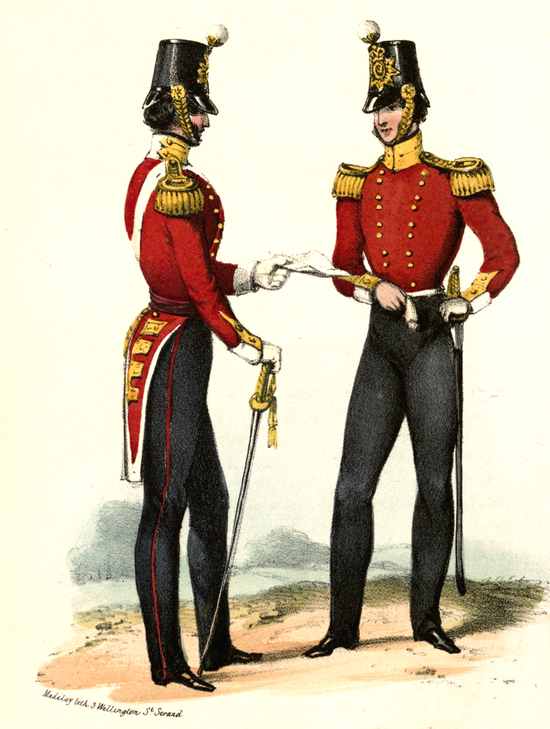
| Costume of the Regiment | to face | 1 |
| Colours of the Regiment | " | 46 |
OF THE
SEVENTEENTH REGIMENT OF FOOT.
| Year | | Page |
| 1688 | Solomon Richards | 47 |
| 1689 | Sir George St. George | — |
| 1695 | James Courthorpe | 48 |
| —— | Sir Matthew Bridges | — |
| 1703 | Holcroft Blood | — |
| 1707 | James Wightman | 49 |
| 1722 | Thomas Ferrers | 50 |
| 1722 | James Tyrrell | — |
| 1742 | John Wynyard | 51 |
| 1752 | Edward Richbell | — |
| 1757 | John Forbes | — |
| 1759 | The Honourable Robert Monckton | 52 |
| 1782 | George Morrison | — |
| 1792 | George Garth | 53 |
| 1819 | Sir Josiah Champagné, G.C.H. | — |
| 1840 | Sir Frederick Augustus Wetherall, G.C.H. | 55 |
| 1843 | Sir Peregrine Maitland, K.C.B. | 56 |
HORSE-GUARDS,
1st January, 1836.
His Majesty has been pleased to command that,
with the view of doing the fullest justice to Regiments,
as well as to Individuals who have distinguished
themselves by their Bravery in Action
with the Enemy, an Account of the Services of
every Regiment in the British Army shall be published
under the superintendence and direction of
the Adjutant-General; and that this Account shall
contain the following particulars, viz.:—
—— The Period and Circumstances of the Original
Formation of the Regiment; The Stations at which it
has been from time to time employed; The Battles,
Sieges, and other Military Operations in which it has
been engaged, particularly specifying any Achievement
it may have performed, and the Colours,
Trophies, &c., it may have captured from the
Enemy.
—— The Names of the Officers, and the number of
Non-Commissioned Officers and Privates Killed or
Wounded by the Enemy, specifying the place and
Date of the Action.
—— The Names of those Officers who, in consideration
of their Gallant Services and Meritorious
Conduct in Engagements with the Enemy, have
been distinguished with Titles, Medals, or other
Marks of His Majesty's gracious favour.
—— The Names of all such Officers, Non-Commissioned
Officers, and Privates, as may have
specially signalized themselves in Action.
And,
—— The Badges and Devices which the Regiment
may have been permitted to bear, and the
Causes on account of which such Badges or Devices,
or any other Marks of Distinction, have been
granted.
By Command of the Right Honorable
GENERAL LORD HILL,
Commanding-in-Chief.
John Macdonald,
Adjutant-General.
The character and credit of the British Army must
chiefly depend upon the zeal and ardour by which
all who enter into its service are animated, and
consequently it is of the highest importance that any
measure calculated to excite the spirit of emulation,
by which alone great and gallant actions are achieved,
should be adopted.
Nothing can more fully tend to the accomplishment
of this desirable object than a full display of the noble
deeds with which the Military History of our country
abounds. To hold forth these bright examples to
the imitation of the youthful soldier, and thus to
incite him to emulate the meritorious conduct of those
who have preceded him in their honorable career,
are among the motives that have given rise to the
present publication.
The operations of the British Troops are, indeed,
announced in the "London Gazette," from whence
they are transferred into the public prints: the
achievements of our armies are thus made known at
the time of their occurrence, and receive the tribute
of praise and admiration to which they are entitled.
On extraordinary occasions, the Houses of Parliament
have been in the habit of conferring on the Commanders,
and the Officers and Troops acting under
their orders, expressions of approbation and of thanks
for their skill and bravery; and these testimonials,
confirmed by the high honour of their Sovereign's
approbation, constitute the reward which the soldier
most highly prizes.
It has not, however, until late years, been the practice
(which appears to have long prevailed in some of
the Continental armies) for British Regiments to keep
regular records of their services and achievements.
Hence some difficulty has been experienced in obtaining,
particularly from the old Regiments, an authentic
account of their origin and subsequent services.
This defect will now be remedied, in consequence
of His Majesty having been pleased to command
that every Regiment shall, in future, keep a full and
ample record of its services at home and abroad.
From the materials thus collected, the country
will henceforth derive information as to the difficulties
and privations which chequer the career of those who
embrace the military profession. In Great Britain,
where so large a number of persons are devoted to
the active concerns of agriculture, manufactures,
and commerce, and where these pursuits have, for so
long a period, being undisturbed by the presence of
war, which few other countries have escaped, comparatively
little is known of the vicissitudes of active
service and of the casualties of climate, to which,
even during peace, the British Troops are exposed in
every part of the globe, with little or no interval of
repose.
In their tranquil enjoyment of the blessings which
the country derives from the industry and the enterprise
of the agriculturist and the trader, its happy
inhabitants may be supposed not often to reflect on
the perilous duties of the soldier and the sailor,—on
their sufferings,—and on the sacrifice of valuable life,
by which so many national benefits are obtained and
preserved.
The conduct of the British Troops, their valour,
and endurance, have shone conspicuously under great
and trying difficulties; and their character has been
established in Continental warfare by the irresistible
spirit with which they have effected debarkations in
spite of the most formidable opposition, and by the
gallantry and steadiness with which they have maintained
their advantages against superior numbers.
In the official Reports made by the respective Commanders,
ample justice has generally been done to
the gallant exertions of the Corps employed; but
the details of their services and of acts of individual
bravery can only be fully given in the Annals of the
various Regiments.
These Records are now preparing for publication,
under his Majesty's special authority, by Mr.
Richard Cannon, Principal Clerk of the Adjutant
General's Office; and while the perusal of them cannot
fail to be useful and interesting to military men
of every rank, it is considered that they will also
afford entertainment and information to the general
reader, particularly to those who may have served in
the Army, or who have relatives in the Service.
There exists in the breasts of most of those who
have served, or are serving, in the Army, an Esprit
de Corps—an attachment to everything belonging
to their Regiment; to such persons a narrative of
the services of their own Corps cannot fail to prove
interesting. Authentic accounts of the actions of
the great, the valiant, the loyal, have always been
of paramount interest with a brave and civilized
people. Great Britain has produced a race of heroes
who, in moments of danger and terror, have stood
"firm as the rocks of their native shore:" and when
half the world has been arrayed against them, they
have fought the battles of their Country with unshaken
fortitude. It is presumed that a record of
achievements in war,—victories so complete and surprising,
gained by our countrymen, our brothers,
our fellow citizens in arms,—a record which revives
the memory of the brave, and brings their gallant
deeds before us,—will certainly prove acceptable to
the public.
Biographical Memoirs of the Colonels and other
distinguished Officers will be introduced in the
Records of their respective Regiments, and the
Honorary Distinctions which have, from time to
time, been conferred upon each Regiment, as testifying
the value and importance of its services, will be
faithfully set forth.
As a convenient mode of Publication, the Record
of each Regiment will be printed in a distinct number,
so that when the whole shall be completed, the
Parts may be bound up in numerical succession.
The natives of Britain have, at all periods, been
celebrated for innate courage and unshaken firmness,
and the national superiority of the British troops
over those of other countries has been evinced in
the midst of the most imminent perils. History contains
so many proofs of extraordinary acts of bravery,
that no doubts can be raised upon the facts which
are recorded. It must therefore be admitted, that
the distinguishing feature of the British soldier is
Intrepidity. This quality was evinced by the
inhabitants of England when their country was
invaded by Julius Cæsar with a Roman army, on
which occasion the undaunted Britons rushed into
the sea to attack the Roman soldiers as they descended
from their ships; and, although their discipline
and arms were inferior to those of their
adversaries, yet their fierce and dauntless bearing
intimidated the flower of the Roman troops, including
Cæsar's favourite tenth legion. Their arms
consisted of spears, short swords, and other weapons
of rude construction. They had chariots, to the
axles of which were fastened sharp pieces of iron
resembling scythe-blades, and infantry in long
chariots resembling waggons, who alighted and
fought on foot, and for change of ground, pursuit
or retreat, sprang into the chariot and drove off
with the speed of cavalry. These inventions were,
however, unavailing against Cæsar's legions: in
the course of time a military system, with discipline
and subordination, was introduced, and
British courage, being thus regulated, was exerted
to the greatest advantage; a full development of
the national character followed, and it shone forth
in all its native brilliancy.
The military force of the Anglo-Saxons consisted
principally of infantry: Thanes, and other men of
property, however, fought on horseback. The
infantry were of two classes, heavy and light.
The former carried large shields armed with spikes,
long broad swords and spears; and the latter were
armed with swords or spears only. They had also
men armed with clubs, others with battle-axes and
javelins.
The feudal troops established by William the
Conqueror consisted (as already stated in the Introduction
to the Cavalry) almost entirely of horse;
but when the warlike barons and knights, with their
trains of tenants and vassals, took the field, a proportion
of men appeared on foot, and, although
these were of inferior degree, they proved stout-hearted
Britons of stanch fidelity. When stipendiary
troops were employed, infantry always constituted
a considerable portion of the military force;
and this arme has since acquired, in every quarter
of the globe, a celebrity never exceeded by the
armies of any nation at any period.
The weapons carried by the infantry, during the
several reigns succeeding the Conquest, were bows
and arrows, half-pikes, lances, halberds, various
kinds of battle-axes, swords, and daggers. Armour
was worn on the head and body, and in course of
time the practice became general for military men
to be so completely cased in steel, that it was
almost impossible to slay them.
The introduction of the use of gunpowder in the
destructive purposes of war, in the early part of the
fourteenth century, produced a change in the arms
and equipment of the infantry-soldier. Bows and
arrows gave place to various kinds of fire-arms, but
British archers continued formidable adversaries;
and, owing to the inconvenient construction and imperfect
bore of the fire-arms when first introduced,
a body of men, well trained in the use of the bow
from their youth, was considered a valuable acquisition
to every army, even as late as the sixteenth
century.
During a great part of the reign of Queen Elizabeth
each company of infantry usually consisted of
men armed five different ways; in every hundred
men forty were "men-at-arms," and sixty "shot;"
the "men-at-arms" were ten halberdiers, or battle-axe
men, and thirty pikemen; and the "shot" were
twenty archers, twenty musketeers, and twenty
harquebusiers, and each man carried, besides his
principal weapon, a sword and dagger.
Companies of infantry varied at this period in
numbers from 150 to 300 men; each company had
a colour or ensign, and the mode of formation recommended
by an English military writer (Sir John
Smithe) in 1590 was:—the colour in the centre of
the company guarded by the halberdiers; the pikemen
in equal proportions, on each flank of the
halberdiers: half the musketeers on each flank of
the pikes; half the archers on each flank of the musketeers,
and the harquebusiers (whose arms were
much lighter than the muskets then in use) in equal
proportions on each flank of the company for skirmishing.[1]
It was customary to unite a number of companies
into one body, called a Regiment, which
frequently amounted to three thousand men: but
each company continued to carry a colour. Numerous
improvements were eventually introduced in the
construction of fire-arms, and, it having been found
impossible to make armour proof against the muskets
then in use (which carried a very heavy ball) without
its being too weighty for the soldier, armour was
gradually laid aside by the infantry in the seventeenth
century: bows and arrows also fell into disuse,
and the infantry were reduced to two classes,
viz.: musketeers, armed with matchlock muskets,
swords, and daggers; and pikemen, armed with pikes
from fourteen to eighteen feet long, and swords.
In the early part of the seventeenth century
Gustavus Adolphus, King of Sweden, reduced the
strength of regiments to 1000 men. He caused the
gunpowder, which had heretofore been carried in
flasks, or in small wooden bandoliers, each containing
a charge, to be made up into cartridges, and
carried in pouches; and he formed each regiment
into two wings of musketeers, and a centre division
of pikemen. He also adopted the practice of forming
four regiments into a brigade; and the number
of colours was afterwards reduced to three in each
regiment. He formed his columns so compactly that
his infantry could resist the charge of the celebrated
Polish horsemen and Austrian cuirassiers; and his
armies became the admiration of other nations. His
mode of formation was copied by the English,
French, and other European states; but so great
was the prejudice in favour of ancient customs, that
all his improvements were not adopted until near a
century afterwards.
In 1664 King Charles II. raised a corps for sea-service,
styled the Admiral's regiment. In 1678
each company of 100 men usually consisted of 30
pikemen, 60 musketeers, and 10 men armed with
light firelocks. In this year the King added a company
of men armed with hand-grenades to each of
the old British regiments, which was designated the
"grenadier company." Daggers were so contrived
as to fit in the muzzles of the muskets, and bayonets
similar to those at present in use were adopted about
twenty years afterwards.
An Ordnance regiment was raised in 1685, by
order of King James II., to guard the artillery, and
was designated the Royal Fusiliers (now 7th Foot).
This corps, and the companies of grenadiers, did
not carry pikes.
King William III. incorporated the Admiral's
regiment in the second Foot Guards, and raised
two Marine regiments for sea-service. During the
war in this reign, each company of infantry (excepting
the fusiliers and grenadiers) consisted of 14
pikemen and 46 musketeers; the captains carried
pikes; lieutenants, partisans; ensigns, half-pikes;
and serjeants, halberds. After the peace in 1697 the
Marine regiments were disbanded, but were again
formed on the breaking out of the war in 1702.[2]
During the reign of Queen Anne the pikes were
laid aside, and every infantry soldier was armed
with a musket, bayonet, and sword; the grenadiers
ceased, about the same period, to carry hand grenades;
and the regiments were directed to lay aside
their third colour: the corps of Royal Artillery was
first added to the Army in this reign.
About the year 1745, the men of the battalion
companies of infantry ceased to carry swords; during
the reign of George II. light companies were added
to infantry regiments; and in 1764 a Board of
General Officers recommended that the grenadiers
should lay aside their swords, as that weapon had
never been used during the Seven Years' War. Since
that period the arms of the infantry soldier have been
limited to the musket and bayonet.
The arms and equipment of the British Troops have
seldom differed materially, since the Conquest, from
those of other European states; and in some respects
the arming has, at certain periods, been allowed to
be inferior to that of the nations with whom they
have had to contend; yet, under this disadvantage,
the bravery and superiority of the British infantry
have been evinced on very many and most trying
occasions, and splendid victories have been gained
over very superior numbers.
Great Britain has produced a race of lion-like
champions who have dared to confront a host of
foes, and have proved themselves valiant with any
arms. At Crecy King Edward III., at the head of
about 30,000 men, defeated, on the 26th of August,
1346, Philip King of France, whose army is said to
have amounted to 100,000 men; here British valour
encountered veterans of renown:—the King of Bohemia,
the King of Majorca, and many princes and
nobles were slain, and the French army was routed
and cut to pieces. Ten years afterwards, Edward
Prince of Wales, who was designated the Black
Prince, defeated, at Poictiers, with 14,000 men,
a French army of 60,000 horse, besides infantry,
and took John I., King of France, and his son
Philip, prisoners. On the 25th of October, 1415,
King Henry V., with an army of about 13,000
men, although greatly exhausted by marches, privations,
and sickness, defeated, at Agincourt, the
Constable of France, at the head of the flower of
the French nobility and an army said to amount to
60,000 men, and gained a complete victory.
During the seventy years' war between the United
Provinces of the Netherlands and the Spanish monarchy,
which commenced in 1578 and terminated
in 1648, the British infantry in the service of the
States-General were celebrated for their unconquerable
spirit and firmness;[3] and in the thirty
years' war between the Protestant Princes and the
Emperor of Germany, the British Troops in the service
of Sweden and other states were celebrated for
deeds of heroism.[4] In the wars of Queen Anne,
the fame of the British army under the great
Marlborough was spread throughout the world;
and if we glance at the achievements performed
within the memory of persons now living, there is
abundant proof that the Britons of the present age
are not inferior to their ancestors in the qualities
which constitute good soldiers. Witness the deeds
of the brave men, of whom there are many now
surviving, who fought in Egypt in 1801, under the
brave Abercromby, and compelled the French army,
which had been vainly styled Invincible, to evacuate
that country; also the services of the gallant
Troops during the arduous campaigns in the Peninsula,
under the immortal Wellington; and the
determined stand made by the British Army at
Waterloo, where Napoleon Bonaparte, who had
long been the inveterate enemy of Great Britain,
and had sought and planned her destruction by
every means he could devise, was compelled to
leave his vanquished legions to their fate, and to
place himself at the disposal of the British Government.
These achievements, with others of recent
dates in the distant climes of India, prove that the
same valour and constancy which glowed in the
breasts of the heroes of Crecy, Poictiers, Agincourt,
Blenheim, and Ramilies, continue to animate the
Britons of the nineteenth century.
The British Soldier is distinguished for a robust
and muscular frame,—intrepidity which no danger
can appal,—unconquerable spirit and resolution,—patience
in fatigue and privation, and cheerful obedience
to his superiors. These qualities,—united with
an excellent system of order and discipline to regulate
and give a skilful direction to the energies and
adventurous spirit of the hero, and a wise selection
of officers of superior talent to command, whose
presence inspires confidence,—have been the leading
causes of the splendid victories gained by the British
arms.[5] The fame of the deeds of the past and
present generations in the various battle-fields where
the robust sons of Albion have fought and conquered,
surrounds the British arms with a halo of glory;
these achievements will live in the page of history to
the end of time.
The records of the several regiments will be found
to contain a detail of facts of an interesting character,
connected with the hardships, sufferings, and gallant
exploits of British soldiers in the various parts of the
world, where the calls of their Country and the commands
of their Sovereign have required them to
proceed in the execution of their duty, whether in
active continental operations, or in maintaining colonial
territories in distant and unfavourable climes.
The superiority of the British infantry has been
pre-eminently set forth in the wars of six centuries,
and admitted by the greatest commanders which
Europe has produced. The formations and movements
of this arme, as at present practised, while
they are adapted to every species of warfare, and to
all probable situations and circumstances of service,
are well suited to show forth the brilliancy of military
tactics calculated upon mathematical and scientific
principles. Although the movements and evolutions
have been copied from the continental armies, yet
various improvements have from time to time been
introduced, to ensure that simplicity and celerity by
which the superiority of the national military character
is maintained. The rank and influence which
Great Britain has attained among the nations of the
world have in a great measure been purchased by
the valour of the Army, and to persons who have the
welfare of their country at heart the records of the
several regiments cannot fail to prove interesting.
SEVENTEENTH REGIMENT OF FOOT.
FOR CANNON'S MILITARY RECORDS
OF
THE SEVENTEENTH,
OR THE
LEICESTERSHIRE REGIMENT OF FOOT.
1688
In the autumn of 1688, when the adoption of pernicious
counsels by the Court had given rise to the
preparation of an armament in Holland to support
the British people in the preservation of their religion
and laws, and King James II. began to entertain
apprehension for the permanence of his government,
His Majesty issued commissions for adding to his
regular army five regiments of cavalry and seven of
infantry, including two corps formed of men who had
quitted the Dutch service; and of these twelve regiments,
the sixteenth and SEVENTEENTH regiments of
foot in the British line are the only remaining corps.[6]
The SEVENTEENTH regiment was raised in London and
its immediate vicinity, and the colonelcy was conferred
on Solomon Richards, by commission dated the 27th of
September, 1688.
Great success attended the efforts made to procure
men for completing the ranks of the regiment, and in
three weeks after the letter of service for its formation
was issued, it was embodied, armed, and clothed. It
was composed to a great extent of men who had
entered the army at the augmentation in 1685, and had
been discharged after the suppression of the Duke of
Monmouth's rebellion. The regiment was speedily
reported fit for duty, and on the 23rd of October
orders were received for four companies to march to
Colnbrook and Longford, four to Staines and Egham,
and five to Windsor, Datchet, and Slough; at the
same time two companies were directed to mount guard
at the Castle at Windsor: thus were the first duties
of the regiment those of a guard to the Royal person.
On the 29th of October the quarters were changed to
Maidenhead, Datchet, and Windsor; and on the 6th
of November, when the Prince of Orange had landed
in Devonshire, the regiment received orders to march
to Greenwich and Deptford, to be in readiness to
protect the establishments in the vicinity of those
places, and to aid, if required, in the preservation of
the peace of the Metropolis.
1689
The events which followed in rapid succession occasioned
the flight of King James to France, and the
services of the regiment were transferred to the Prince
and Princess of Orange, who were elevated to the
throne by the title of King William and Queen Mary,
in February, 1689.
In Ireland, the army adhered to the interest of
King James; but the Protestants of Inniskilling and
Londonderry embraced the principles of the Revolution,
and wrote to King William for assistance to enable
them to preserve those places in his interest. The
ninth and SEVENTEENTH regiments were directed to
proceed to Ireland, to support the people of Londonderry;
and the two corps sailed from Liverpool on the
3rd of April. Contrary winds forced the transports
to anchor at Highlake; but they again put to sea on
the 10th of that month, and on the 15th arrived in the
vicinity of Londonderry. The governor, Colonel
Lundy, had resolved to surrender the place to King
James, who had arrived in Ireland with a body of
troops from France, and this officer called a council of
war, to which he stated, that there was not provision
in the town for the garrison for more than ten days,
and that it would be impossible to resist the army
which was advancing against it, and a resolution was
passed against the two regiments landing. The two
colonels had received orders to obey the governor, and
they accordingly returned with their regiments to
England. It afterwards appeared that the governor's
statements were not true; the town was defended, and
King William, considering that the two colonels
(Cunningham and Richards) had not sufficiently investigated
the state of the fortress, and of its stores,
deprived them of their commissions.
The colonelcy of the SEVENTEENTH regiment was conferred
on Sir George St. George, by commission dated
the 1st of May, 1689.
1690
1691
1692
1693
The regiment was employed on home service during
the years 1690, 1691, and 1692. In 1693, the confederate
army in the Netherlands, commanded by
King William III., sustained severe loss at the battle
of Landen, on the 29th of July; and after His Majesty's
return to England, at the end of the campaign,
the SEVENTEENTH regiment received orders to hold
itself in readiness for foreign service. It embarked
for Flanders, and was stationed in garrison at Ostend
until the spring of 1694.
1694
During the campaign of this year, the regiment
served in the brigade commanded by Brigadier-General
Stewart; and it took part in the operations
of the army commanded by the British monarch,—performing
many long and toilsome marches in Flanders
and Brabant; but it had no opportunity of distinguishing
itself in action, and in the autumn it returned
to the port of Ostend, where it passed the winter.
1695
In May, 1695, the regiment marched to Dixmude,
where a body of troops was assembled under the Duke
of Wirtemberg for the purpose of making a diversion
in favour of the main army.
At this period Colonel Sir George St. George
obtained His Majesty's permission to exchange with
Colonel James Courthorpe, to a newly-raised regiment,
which was afterwards disbanded.
The troops under the Duke of Wirtemberg encamped
before the Kenoque, a fortress at the junction
of the Loo and Dixmude canals, where the French
had a garrison. The SEVENTEENTH regiment, commanded
by Colonel Courthorpe, took part in the
capture of several outposts belonging to the fort, and
its grenadier company was engaged on the 9th of
June in driving the French from the entrenchments
and houses near the Loo Canal, and had several men
killed and wounded.
While the regiment was before the Kenoque, King
William invested the strong fortress of Namur, and
the SEVENTEENTH and several other corps marched
to join the covering army, under Charles Henry of
Lorraine, Prince of Vaudemont. Against this army
Marshal Villeroy advanced with a French force of
about seventy thousand men; and the Prince, not
having above thirty-six thousand men under his orders,
withdrew to the vicinity of Ghent.
The regiment was subsequently employed in operations
to protect the maritime and other towns of
Flanders, and to cover the troops carrying on the
siege of Namur; and after the surrender of the town
it was selected to relieve one of the corps which had
suffered severely in the siege, and to take part in the
operations against the castle. The regiment arrived
at Namur on the 11th of August, and took its turn of
duty in the trenches, and in all services connected with
this great undertaking; it had several men killed and
wounded, and on the 16th of August Captain Hart
was killed in the trenches.
When Marshal Villeroy approached at the head of
a numerous army to raise the siege, the SEVENTEENTH
regiment was in position at the post of St. Denis,
where it was expected that the most vigorous exertions
of the enemy would be made. The French not
hazarding an engagement, the regiment was selected
to take part in storming the outworks of the castle on
the 30th of August. About midday the signal for the
assault was given, when the grenadiers rushed forward,
under a heavy fire from the castle, to storm the breach
of the Terra Nova, and were followed by the SEVENTEENTH
regiment with drums beating and colours
flying,[7] and a gallant effort was made; but the three
regiments ordered to support the assault did not move
forward in time, and the assailants were overpowered
by superior numbers. The SEVENTEENTH advanced in
gallant style; but they were assailed by a storm of
bullets which nearly annihilated the regiment; Colonel
Courthorpe was killed, Lieut.-Colonel Sir Matthew
Bridges was severely wounded; and two hundred and
fifty officers and soldiers were put hors de combat in a
few minutes, when the survivors received orders to
withdraw from the unequal contest. Some partial
advantages were gained, but the loss was very severe.
The SEVENTEENTH had Colonel Courthorpe, Captain
Coote, Lieutenant Evans, and one hundred and one
serjeants and rank and file killed; Lieut.-Colonel Sir
Matthew Bridges, Captains Wolfe and Du Bourgnay,
Lieutenants Disbordes and Ashe, Ensigns Foncebrand,
Eyres, and Dennis, and one hundred and forty-nine
soldiers wounded.
King William was pleased to confer the colonelcy
of the regiment on the Lieut.-Colonel, Sir Matthew
Bridges, who had evinced great gallantry on this
occasion.
Preparations were made for a second assault of the
works, which was prevented by the surrender of the
garrison. The SEVENTEENTH remained a short time near
the captured fortress, and afterwards marched to the
opulent city of Bruges, where they passed the winter.
1696
Early in the spring of 1696, the regiment was joined
by a numerous body of recruits from England, and on
the 12th of May it marched from Bruges to Marykirk,
and it was afterwards encamped along the canal towards
Ghent. It was formed in brigade with the third,
fifth, and eighteenth regiments, under Brigadier-General
Selwyn, and served the campaign with the
army of Flanders under the Prince of Vaudemont; but
no general engagement occurred, and in the autumn
the regiment marched into quarters at Bruges.
1697
On the 13th of March, 1697, the regiment quitted its
quarters at Bruges, and was afterwards stationed a few
weeks in villages between Brussels, Vilvorde, and
Malines; it was subsequently formed in brigade with a
battalion of the royals, the fifth, and two regiments in
the Dutch service, under Brigadier-General the Earl
of Orkney, and it took part in the operations of the
army of Brabant, under King William, until hostilities
were terminated by the treaty of Ryswick, and the
British monarch saw his efforts to preserve the liberties
and balance of power in Europe attended with
complete success.
1699
During the winter the regiment returned to England,
and it was shortly afterwards removed to Ireland,
where it was stationed during the years 1699 and 1700.
1700
1701
The decease of Charles II., King of Spain, on the 1st
of November, 1700, was followed by the elevation of
the Duke of Anjou, grandson of Louis XIV., to the
throne of that kingdom, in violation of existing treaties;
and war being resolved upon, the SEVENTEENTH regiment
embarked from Cork on the 15th of June, 1701,
and sailed for Holland, where it was placed in garrison
at Gorcum. In September it was reviewed by King
William III. on Breda-heath.
1702
On the 10th of March, 1702, the regiment quitted its
quarters, and proceeded to Rosendael, where the
officers and soldiers received information of the death
of King William III., and of the accession of Queen
Anne. They afterwards marched across the country
to the Duchy of Cleves, and encamped with the army,
under the Earl of Athlone, at Cranenburg, during the
siege of Kayserswerth by the Germans. During the night
of the 10th of June the army quitted Cranenburg, to
preserve its communication with Nimeguen, in front of
which fortress the regiment skirmished with the French
on the following morning.
The Earl of Marlborough assembled the army, composed
of the troops of several nations, and advanced
against the French, who withdrew to avoid a general
engagement; and the regiment was afterwards selected
to take part in the siege of Venloo, a town in the province
of Limburg, on the east side of the river Maese, with a
detached fortress beyond the river, against which the
British troops carried on their attacks. The SEVENTEENTH
took their turn of duty in the trenches, and their grenadier
company was engaged in storming the counter-scarp
of Fort St. Michael on the 18th of September,
when the soldiers followed up their first advantage with
astonishing intrepidity, and captured the fort.
On this occasion, Lieut.-Colonel Holcroft Blood of
the regiment, who was performing the duty of principal
engineer, highly distinguished himself.
In a few days after the capture of Fort St. Michael,
the besieging army formed to fire a feu-de-joie for the
taking of Landau by the Germans, when the people
and garrison of Venloo, supposing a general attack was
about to be made on the town, induced the governor
to surrender.
The SEVENTEENTH were afterwards employed in the
siege of Ruremonde, which fortress was invested towards
the end of September, and was forced to surrender
before the middle of October.
Rejoining the main army after the surrender of Ruremonde,
the regiment advanced to the city of Liege,
and its grenadier company was engaged in the siege of
the citadel, which was captured by storm on the 23rd of
October. After these conquests the regiment marched
back to Holland.
1703
Towards the end of April, 1703, the regiment marched
in the direction of Maestricht, and it was in position
near that city when the French army under Marshal
Villeroy and Marshal Boufflers approached, and some
cannonading occurred, but the enemy did not hazard
a general engagement.
The Duke of Marlborough assembled the army, and
the SEVENTEENTH took part in the movements which
occasioned the French commanders to make a sudden
retreat from their position at Tongres, and to take post
behind their fortified lines; where the English general
was desirous of attacking them, but he was prevented
by the Dutch generals and field-deputies. The services
of the SEVENTEENTH regiment were afterwards connected
with the siege of Huy, a strong fortress on the
river Maese, above the city of Liege, which was captured
in ten days. Another proposal to attack the
French lines having been objected to by the Dutch,
the regiment was employed in covering the siege of
Limburg, a city of the Spanish Netherlands situate on
a pleasant eminence among the woods near the banks
of the river Weze. The siege of this place commenced
on the 10th of September, and on the 28th the
garrison surrendered.
On the 26th of August Lieut.-Colonel Blood was
promoted to the colonelcy of the regiment, in succession
to Colonel Sir Matthew Bridges.
During the summer of this year, Archduke Charles of
Austria was acknowledged as King of Spain, by England,
Holland, and several other states of Europe;
and the SEVENTEENTH regiment was one of the
corps selected to proceed with him to Portugal, to endeavour
to place him on the throne of Spain by force
of arms.
1704
The regiment embarked from Holland in October,
and sailed to Portsmouth, where it was detained by
contrary winds; it put to sea in January, 1704, but,
encountering a severe storm, was driven back to port,
and several ships of the fleet were much damaged.
The voyage was afterwards resumed, the regiment
arrived at Lisbon in the early part of March, and
landed on the 15th of that month. The King of
Portugal being afraid to intrust the protection of his
frontier towns to his own troops, the British regiments
were placed in garrison.
Tardiness in the preparations for opening the campaign
was manifested by the Portuguese authorities,
and the Duke of Berwick attacked the frontiers of
Portugal with the combined French and Spanish armies
before the allies were prepared to take the field.
The SEVENTEENTH were called from garrison to take
part in attempting to arrest the progress of the enemy;
they were employed in the Alemtejo, and in July they
were encamped near Estremos,—a town situate in an
agreeable tract on the Tarra; towards the end of July,
they marched into cantonments in the town.
In the autumn the allied army was enabled to act on
the offensive, and the SEVENTEENTH was one of the
regiments which penetrated Spain, to the vicinity of
Ciudad Rodrigo; but the enemy was found so advantageously
posted, beyond the Agueda, that the Portuguese
generals objected to attempt the passage of the
river, and the army returned to Portugal, where the
regiment passed the winter.
1705
The regiment again proceeded to Estremos, in the
Alemtejo, in April, 1705, and it was afterwards engaged
in the siege of Valencia de Alcantara, which place was
captured by storm on the 8th of May. The SEVENTEENTH
was also employed at the siege and capture
of Albuquerque; and when the summer heats became
too great for the troops to remain in the field, the
regiment went into quarters at the ancient town of
Moura, near the banks of the Guadiana river.
In the autumn the army crossed the Guadiana, and
the SEVENTEENTH regiment was engaged in the siege
of Badajoz, the capital of Spanish Estremadura; but
the army not being sufficiently numerous to invest the
place, the garrison was relieved on the 14th of October,
and the siege was afterwards raised. At this siege the
British general, the Earl of Galway, lost his hand by
a cannon-ball.
1706
After passing the winter in cantonments on the
confines of Portugal, the regiment again took the field
in March, 1706, and in April it was employed in the
siege of Alcantara, a fortified town situate on a rock
near the river Tagus, in Spanish Estremadura. On
the 10th of April the SEVENTEENTH and thirty-third
regiments attacked the convent of St. Francis, situate
near the town, and captured this post with great
gallantry: the two regiments had fifty officers and men
killed and wounded, Colonel Wade (afterwards Field-marshal)
and Lieut.-Colonel de Harcourt being among
the wounded. The garrison surrendered on the 14th
of April.
From Alcantara the army advanced to the vicinity
of Placencia, and afterwards drove the enemy from his
position on the banks of the Tietar,—sending forward
a detachment to destroy the bridge of Almaraz; but,
subsequently changing its route, proceeded to the province
of Leon, and the SEVENTEENTH regiment was
employed in the siege of Ciudad Rodrigo, which fortress
surrendered on the 26th of May.
On the 3rd of June the army commenced its march
from Ciudad Rodrigo for the capital of Spain, proceeding
by Salamanca, through the Guadarrama
Mountains; and, arriving at Madrid on the 24th and
27th of June, encamped in the vicinity of that city, where
Archduke Charles of Austria was proclaimed King of
Spain with the usual solemnities. This tide of success
was changed by the delay of King Charles to come to
Madrid from Barcelona, which fortress had been captured
by the Earl of Peterborough in the preceding year.
This delay occasioned his friends to be discouraged; the
partisans of King Philip took up arms; and, numerous
bodies of French and Spanish troops joining the army
under the Duke of Berwick, the allied army retreated
from Madrid to the province of Valencia, where the
SEVENTEENTH regiment was stationed during the
winter.
1707
Early in April, 1707, the regiment joined the allied
army under the Marquis das Minas and the Earl of
Galway, and, after taking part in several operations,
advanced, on the 25th of April, to attack the French
and Spanish troops under the Duke of Berwick at
Almanza. Fatigued by a long and difficult march, and
exposed to a burning sun, the soldiers arrived in presence
of their opponents, and prepared for battle.
The sixth, SEVENTEENTH, thirty-third, and Lord
Montjoy's regiments, were formed in brigade under
Major-General Wade, and were posted on the flanks
of a brigade of cavalry in the front line of the left wing.
The battle was commenced by the British dragoons,
who evinced great bravery, but many squadrons of
Portuguese cavalry quitted the field in a panic. Major-General
Wade's brigade was engaged with nine battalions
of French and Spanish infantry, when it was joined
by the ninth foot; the five British regiments disputed
the ground with sanguinary obstinacy; but while the
contest was raging, a body of fresh French and Spanish
cavalry drove back the allied squadrons on the left.
The sixth, ninth, SEVENTEENTH, thirty-third, and
Lord Montjoy's regiments, were bravely contending
with seven French and Spanish corps in their front,
when they were attacked on the flank by two other of
the enemy's battalions, broken, and driven from the
field with great loss. The two battalions which attacked
them in flank were cut to pieces by Harvey's
horse, now second dragoon guards, who were in turn
overpowered by the superior numbers of the enemy.
The fight still raged in the centre; but the flanks
being defeated, the enemy surrounded the centre and
made great slaughter. The remains of the English
regiments were collected into a body, and were united
to some Dutch and Portuguese troops; the whole
retreating to the woody hills of Caudete. The men were
so exhausted with fatigue that they were unable to
proceed, and they passed the night in the wood without
food. On the following morning they were surrounded
by the enemy; and being without ammunition, ignorant
of the country, and destitute of provisions, they surrendered
prisoners of war. Such were the results of a
battle in which wearied and faint soldiers were hurried
forward to fight superior numbers of fresh troops, commanded
by a skilful general!
The SEVENTEENTH Regiment had Lieut.-Colonel
Woollett, Lieut.-Colonel Withers, and Major Leech,
killed; Captains Fitzgerald and Foncebrand, Lieutenants
Rivesson, Ingram, and Blood, Ensigns Deaven,
Callon, and Bruce, wounded and taken prisoners; Captains
Dudley Cosby and Loftus Cosby, Lieutenants
Martin, Brown, Brooks, and Tyrell, and Ensign Bland,
prisoners.
The officers and soldiers of the regiment, who escaped
from the field, joined the cavalry under the Earl of
Galway, at Alcira, on the river Xucar; and the approach
to the town being by almost inaccessible mountains,
his lordship halted there a few days to reorganize
the army. The SEVENTEENTH regiment, commanded
by Lieut.-Colonel Wightman, was encamped some time
on the banks of the Ebro above Tortosa, and was afterwards
employed in operations for the protection of the
province of Catalonia: it was joined by men from command
and sick absent, also by several who escaped
from prisoners of war, and it mustered two hundred and
sixty-six officers and soldiers.
Major-General Blood died on the 19th of August,
1707, and Queen Anne conferred the colonelcy of the
regiment on the Lieut.-Colonel, James Wightman, who
had been promoted to the rank of brigadier-general a
short time previously.
1708
During the period the regiment was in winter-quarters,
it received drafts from several corps which
were ordered to return to England to recruit: and in the
spring of 1708, when it took the field, its appearance
was admired. In a letter from the army, published at
the time, it was stated: "We cannot yet give any
certain account of the number of our forces, but those
we have are the finest in the world: such are the
regiments of Southwell (sixth), commanded by
Lieut.-Colonel Hunt; that of Blood (SEVENTEENTH),
commanded by Lieut.-Colonel Bourguet; and that of
Mordaunt (twenty-eighth), commanded by Colonel
Dalziel."[8]
The regiment was encamped some time on the river
Francoli, between Monblanco and Tarragona, and
afterwards at Constantino; and it took part in the
operations of the army commanded by Marshal Count
Guido de Staremberg, for the defence of Catalonia.
1709
After serving the campaign in Catalonia, the regiment
received orders to transfer its men fit for duty to
other corps, and return to England, where it arrived
in 1709, and commenced recruiting its numbers.
1710
In 1710 the regiment was stationed in Scotland; the
head-quarters were at Leith, and four companies were
detached to Musselburgh.
1714
The regiment remained in Great Britain until the
Treaty of Utrecht was signed, when it was placed
on the peace establishment and sent to Ireland, where
it was stationed in 1714.
1715
On the breaking out of the rebellion of the Earl of
Mar, in favour of the Pretender, in the autumn of
1715, the regiment was withdrawn from Ireland, and
it joined the troops encamped at Stirling under the
Duke of Argyle, and the colonel of the SEVENTEENTH
regiment, Major-General Wightman.
When the rebel army advanced with the view of
penetrating southwards, the King's troops quitted the
camp at Stirling and proceeded to the vicinity of
Dumblain, and on the 13th of November an engagement
took place on Sheriff Muir, when both armies had
one wing victorious and one wing defeated, and both
commanders claimed the victory; but the rebels were
prevented marching southwards, and they did not
hazard another engagement, which proved the advantage
gained over them. The SEVENTEENTH regiment had
seven men killed and five wounded on this occasion.
1716
Additional forces having joined the Royal army, the
Duke of Argyle advanced, in January, 1716, over ice
and through snow, towards Perth, when the Pretender
retreated, and soon afterwards fled, with the leaders of
the rebellion, to France. The SEVENTEENTH regiment
pursued the insurgents some distance, and was afterwards
stationed at Perth.
From this date the regiment was stationed in Great
Britain during a period of ten years.
1722
On the 28th of September, 1722, Major-General
Wightman died, and King George II. conferred the
colonelcy of the regiment on Brigadier-General
Thomas Ferrers, from the thirty-ninth regiment; and
this officer dying three weeks afterwards, he was succeeded
by Colonel James Tyrell, who had commanded
one of the regiments of dragoons disbanded in 1718.
1726
In 1726 the regiment proceeded to Minorca, the
second of the Balearic Islands, situate in the Mediterranean,
near the coast of Spain: this island was captured
by the British in 1708, and was ceded to Great
Britain at the peace in 1713.
1727
In this island, which is diversified with hill and
valley, and in some parts rich in vegetation and abounding
with the necessaries and many of the luxuries of
life, the regiment was stationed twenty-five years. In
1727 it sent a detachment to Gibraltar, to assist in the
defence of that fortress against the Spaniards. When the
siege was raised, the detachment returned to Minorca.
1742
On the 1st of August, 1742, Lieut.-General Tyrell
died; the colonelcy remained vacant three weeks, and
was then conferred on Colonel John Wynyard, from
the fourth marines, who had previously held the commission
of lieut.-colonel in the SEVENTEENTH regiment
upwards of twenty years, and performed the duties
of commanding officer with good reputation.
1748
At the termination of the war of the Austrian succession
in 1748, the regiment was relieved from duty
at the island of Minorca, and proceeded to Ireland,
where it was stationed during the following six years.
1751
On the 1st of July, 1751, a Royal Warrant was issued,
regulating the clothing, standards, and colours of the
several regiments of the British army; in which the
uniform of the SEVENTEENTH regiment was directed to
be scarlet, faced and lined with greyish white. The
first, or king's colour, to be the great union; the second,
or regimental colour, to be the red cross of St. George
in a white field, with the union in the upper canton;
in the centre of each colour the number of the rank of
the regiment, in gold Roman characters, within a
wreath of roses and thistles on the same stalk.
1752
1757
Lieut.-General Wynyard died in 1752, and King
George II. nominated Brigadier-General Edward
Richbell to the colonelcy of the regiment. This officer
died on the 24th of February, 1757, and was succeeded
by Colonel John Forbes, from the lieut.-colonelcy of
the Scots Greys.
In the mean time another war had commenced with
France, and in May of this year the regiment embarked
from Cork, and sailed to Halifax, in Nova
Scotia, where it arrived in the early part of July, in
order to take part in an attack on the French possessions
in Canada: but the expedition was deferred until
the following year, and the regiment remained in
Nova Scotia during the winter.
1758
The regiment sailed from Halifax in May, 1758, with
the expedition against Cape Breton, in the Gulf of St.
Lawrence, under Lieut.-General (afterwards Lord)
Amherst. The regiment mustered thirty-one officers,
and nine hundred and sixty-seven non-commissioned
officers and soldiers, commanded by Lieut.-Colonel
Arthur Morris; and on the 8th of June it was in boats,
with the division under Brigadier-General Wightman,
proceeding towards White Point, to alarm the French
at that quarter, while the troops under Brigadier-General
James Wolfe effected a landing, which was
accomplished in gallant style. The SEVENTEENTH were
afterwards engaged in the siege of Louisburg, the capital
of the island, which was captured on the 26th of
July; and with the capital the whole island was also surrendered.
On this occasion the regiment had Captain
William Earl of Dundonald killed; Captain Paul
Rycant and Lieutenant Francis Tew wounded; also
several men killed and wounded.
During the period the regiment was at Cape Breton,
a body of troops under Major-General Abercromby
was repulsed at Fort Ticonderago, on the west shore
of Lake Champlain; and on the 30th of August the
SEVENTEENTH and several other corps embarked from
Louisburg, and, sailing to Boston, marched through
the woods to Lake George, where they joined the troops
under Major-General Abercromby.
1759
In the beginning of June, 1759, the regiment joined
the troops assembling on the east bank of Hudson's
River, about fifty miles from Albany, and afterwards
marched to Lake George, where a fort was erected,
and boats were procured to convey the troops along
the lake, which occupied a month. On the 21st of
July the regiments embarked in boats, and, using blankets
for sails, arrived at the Second Narrows on the
following morning. Advancing towards Ticonderago,
they drove a body of French regulars and native Indians
from a strong post two miles from the fort, and
evinced such steady resolution, that the French commander
quitted his fortified lines and embarked for
Crown Point, leaving a garrison at Ticonderago.
The siege of this place was commenced; and on the
25th of July the garrison blew up the fort and sailed
to Crown Point, which place the French commander
also abandoned, and retired down the lake to Isle aux
Noix. The SEVENTEENTH proceeded to Crown Point,
where a new fort was erected, and a small naval force
prepared for navigating the lake. In October the
troops embarked, and sailed down the lake in four
divisions; but encountering high northerly winds, and a
frost having set in, they returned, and went into
winter-quarters.
Brigadier-General Forbes died in the spring of this
year, and the colonelcy of the regiment was conferred
on Brigadier-General the Honorable Robert Monckton,
from colonel-commandant of the second battalion
of the sixtieth regiment.
1760
The French possessions in Canada were invaded by
the British troops in 1760, at three different points;
the whole advancing upon Montreal: the first division
from Lake Ontario, the second from Lake Champlain,
and the third from Quebec (which was captured in
1759) up the River St. Lawrence. The SEVENTEENTH
regiment formed part of the second division, under
Colonel Haviland, which embarked from Crown Point
on the 11th of August, and, sailing towards Isle aux
Noix, landed on the left bank of the river Richelieu,
and captured a fort near the river: two other forts
were abandoned by the enemy, and the British took
possession of Isle aux Noix. The regiment afterwards
advanced upon Montreal; and the French governor,
being unable to withstand the forces opposed to him,
surrendered: thus was the conquest of Canada accomplished
with little loss.
1761
From Montreal the regiment traversed the country
to New York, during the summer of 1761, and in
August encamped on Staten Island. Towards the
end of October it embarked for the West Indies, and
arrived at Carlisle Bay, Barbadoes, on the 24th of
December.
1762
An armament was assembled at Barbadoes, for the
attack of the French West India Islands, and the land
forces were placed under the orders of Major-General
the Honorable Robert Monckton, colonel of the SEVENTEENTH;
this regiment being one of the corps selected
to take part in the enterprise. The armament sailed
from Carlisle Bay, on the 5th of January, 1762, and
proceeded against the island of Martinique, which was
colonised by the French about the year 1635. After
menacing the coast at several points, a landing was
effected in the middle of January, in Cas des Navières
Bay, and the SEVENTEENTH were actively engaged in
the operations for the reduction of the island. Many
difficulties were encountered, from the rugged surface
of the country, and from the formidable heights occupied
by the enemy; but these were overcome by
British skill, discipline, and valour; the heights of
Morné Tortenson were carried on the 24th of January,
and of Morné Garnier on the 27th; Fort Royal surrendered
early in February, and these successes were
followed by the submission of the island to the British
Crown. Major-General the Honorable Robert Monckton
commended the conduct of the troops in his despatch,
and added,—"The difficulties they had to encounter
in the attack of an enemy possessed of every advantage
of art and nature were great; and their
perseverance in surmounting these obstacles furnishes
a noble example of British spirit."
The capture of Martinique was followed by the
submission of Grenada, St. Lucia, and St. Vincent.
The loss of the SEVENTEENTH at Martinique was
limited to a few private soldiers killed and wounded.
War had, in the mean time, been declared against
Spain, and the SEVENTEENTH, commanded by Lieut.-Colonel
Campbell, and mustering five hundred and
thirty-five rank and file, joined the armament under
General the Earl of Albemarle, for the purpose of
proceeding against the wealthy Spanish settlement of
the Havannah, in the island of Cuba. The regiment
formed part of the brigade commanded by Brigadier-General
Grant; and, accompanying the expedition
through the Straits of Bahama, arrived within six
leagues of Havannah on the 6th of June: a landing
was effected on the following day, and on the 9th the
troops took up a position between Coximar and the
Moro fort. The regiment took part in the services
connected with the siege and capture of Moro fort,
which was the key position of the extensive works which
covered the town. The difficulties encountered in
carrying on operations were particularly great, and the
artillery had to be dragged several miles over a rocky
country, and under a burning sun; but every obstacle
was overcome by the unanimity which existed between
the land and sea forces. The Moro fort was captured
by storm on the 30th of July; and on the 11th of
August, a series of batteries opened so well-directed a
fire on the defences of the town, that the guns of the
garrison were soon silenced, and flags of truce were
hung out. The capitulation was signed two days
afterwards, and the British troops took possession of
this valuable settlement, with nine ships of war in the
harbour, and two upon the stocks; three ships of war
were also found sunk at the entrance of the harbour.
1763
1766
A treaty of peace was soon afterwards concluded,
when the Havannah was restored to Spain in exchange
for Florida. The SEVENTEENTH regiment returned to
North America, where it was stationed during the
years 1763, 1764, 1765, and 1766.
1767
In the summer of 1767 the regiment was relieved
from duty in America, and returned to England,
where it arrived in September.
1768
The regiment remained in England during the years
1768, 1769, and 1770.
1771
1774
Embarking from Liverpool in the spring of 1771, the
regiment proceeded to Ireland, where it was stationed
during the three following years.
1775
Serious disputes had, in the mean time, arisen
between the British colonists in North America and
the government, and the colonists evinced a daring
spirit of resistance, in their opposition to the measures
for raising a revenue in their country, which, in April
1775, was followed by open hostility, some provincial
militia firing on a detachment of the king's troops, on
its march from Boston to Concord, to take possession
of a quantity of military stores at the latter place.
This was followed by the assembling of multitudes of
armed men near Boston; and when the news of these
occurrences arrived in England, several regiments were
ordered to embark for America. The SEVENTEENTH
regiment was afterwards directed to hold itself in
readiness for service abroad, and on the 23rd of September
it embarked from Ireland for North America.
1776
The regiment was detained some time by contrary
winds; but it landed at Boston on the 1st of January,
1776. At this period the British troops at Boston
were blocked up on the land side by a numerous army
of provincials; much inconvenience was experienced in
procuring provisions; and as this town did not appear
to be a place calculated to become the base of extensive
military operations for the reduction of the revolted
provinces, Lieut.-General Sir William Howe resolved
to vacate Boston, and proceed with the army to Nova
Scotia; this resolution was carried into effect in the
middle of March, when the SEVENTEENTH sailed with
the army to Halifax.
Reinforcements being expected from England, the
army sailed from Halifax in June, and, proceeding to
the vicinity of New York, landed, on the 3rd of July,
on Staten Island, where the SEVENTEENTH, commanded
by Lieut.-Colonel Mawhood, were formed in brigade
with the fortieth, forty-sixth, and fifty-fifth regiments
under Major-General James Grant.
On the 22nd of August a landing was effected on
Long Island, and on the evening of the 26th the army
was put in motion to pass a range of woody heights
which intersect the island, and attack the American
army in position beyond the hills. The SEVENTEENTH
regiment formed part of the column under Major-General
Grant, which was directed to advance along
the coast, with ten pieces of cannon, to draw the enemy's
attention to that quarter. Moving forward at the
appointed hour, this column fell in with the advanced
parties of the Americans about midnight, and, at
daybreak on the following morning, encountered a
large force, formed in an advantageous position defended
by artillery. Skirmishing and cannonading
ensued, and was continued, until the Americans discovered,
by the firing at Brooklyn, that the left of their
army had been turned and forced, when they retreated
in great confusion through a morass. They were met
and attacked by the second battalion of grenadiers,
which was soon reinforced by the seventy-first regiment
(Highlanders); and were also assailed on the left by
Major-General Grant's corps, and sustained severe
loss; many of the Americans being killed, and others
drowned or suffocated in the morass. The American
army was driven from its positions with severe loss,
and made a precipitate retreat to the fortified lines at
Brooklyn.
The regiment had Captain Sir Alexander Murray
and two rank and file killed; Lieutenant Marcus A.
Morgan, one serjeant, and nineteen rank and file
wounded.
The Americans having quitted their fortified lines
at Brooklyn and passed the river to New York, the
conquest of Long Island by the British troops was
completed; and the SEVENTEENTH regiment shared in
the operations by which the capture of New York was
accomplished; also in the movements by which the
Americans were driven from White Plains; and in the
reduction of Fort Washington. Afterwards proceeding
to the Jerseys, the regiment was stationed at Brunswick,
and subsequently at Princetown.
During the winter, General Washington suddenly
passed the Delaware river, and surprised and made
prisoners a corps of Hessians at Trenton, and afterwards
made a precipitate retreat. Being reinforced,
he again passed the river, and took up a position at
Trenton. Major-General the Earl Cornwallis advanced
with a division of British troops, and, after
reconnoitring the American position, sent orders for
the SEVENTEENTH, fortieth, and fifty-fifth regiments to
join him from Princetown.
1777
Early on the morning of the 4th of January, 1777,
the three regiments commenced their march. The
SEVENTEENTH regiment, commanded by Lieut.-Colonel
Charles Mawhood, being in advance, encountered the
van of the American army, General Washington having
suddenly quitted Trenton with his whole force to surprise
the three regiments. The morning being foggy, Lieut.-Colonel
Mawhood could not discern the numbers of the
force he had met; but supposing it to be only a detachment,
he instantly attacked his opponents, and
the SEVENTEENTH speedily drove back a force of very
superior numbers with great gallantry. The regiment
was soon environed in front and on both flanks by a
numerous force; and Lieut.-Colonel Mawhood, discovering
that he was engaged with the American army,
resolved to make a desperate effort to extricate himself:
having confidence in the valour and resolution of the
regiment, he directed a charge with bayonets to the
front, to break through the American army. Undismayed
by the multitudes of opponents which environed
them, the SEVENTEENTH rushed upon the ranks of the
enemy, broke through all opposition, and continued
their march to Maidenhead. Their conduct excited
great admiration; and the Americans acknowledged
the superior gallantry of the regiment. A serious loss
was, however, sustained; thirteen officers and soldiers
being killed, fifty-three wounded, and thirty-five
missing: among the former was Captain the Honorable
William Lesley, son of the Earl of Leven, an
officer of great promise, whose death was much regretted.
"The bravery and abilities of Colonel Mawhood, on
this occasion, deservedly gained him the highest
applause;"[9] and the resolute attack of the SEVENTEENTH
so occupied the American army, that the
fortieth and fifty-fifth regiments effected their retreat
with much less loss than could have been expected.
The American army had many men killed and wounded
on this occasion; among the killed was an officer of
reputation, Brigadier-General Mercer, from Virginia.
When the army took the field, the regiment was
employed in operations in the Jerseys to bring the
American army to a general engagement; but General
Washington kept close in his strong position in the
mountains; and the British undertook an expedition to
Pennsylvania: the SEVENTEENTH were employed in
this enterprise, and were formed in brigade with the
fifteenth, forty-second, and forty-fourth regiments,
under Major-General (afterwards Earl) Grey.
A landing was effected on the northern shore of Elk
River on the 25th of August; and the army of the
revolted provinces took up a position at Brandywine
to oppose the advance; an attack was made on the
position on the 11th of September, when the Americans
were driven from their ground with loss. On this
occasion the SEVENTEENTH formed part of the column
under Major-General Earl Cornwallis.
Advancing upon Philadelphia, the British troops
took possession of that city, and the army took up a
position at Germantown. The Americans attempted
to surprise the British troops early on the morning of
the 4th of October, and they gained some advantage
at the first, but were speedily repulsed with severe
loss. On this occasion several companies of the fortieth
regiment, commanded by Lieut.-Colonel Musgrave,
threw themselves into a building, where they were
attacked by an American brigade; when Major-General
Grey brought forward the SEVENTEENTH and
another British regiment, and drove back the enemy
with great gallantry.
Ensign Nathaniel Philips and four rank and file of
the regiment were killed on this occasion; and three
serjeants and twenty-one rank and file were wounded.
1778
The regiment passed the winter in quarters in
Philadelphia, and in the spring of 1778 it furnished
several detachments, which ranged the country in
various directions to open communications for obtaining
provisions. The regiment also took part in the fatigues
and difficulties of the march of the army from Philadelphia,
through the Jerseys, in order to its return to New
York; and its flank companies were engaged in repulsing
the attack of the enemy on the rear of the column,
at Freehold, in New Jersey, on the 28th of June, on
which occasion Captain William Brereton, commanding
the grenadier company, was wounded.
1779
The regiment was stationed at New York, and
other posts in the vicinity of that city; and when
Stoney Point, a fortified post on the river Hudson, had
been captured by the British troops, the SEVENTEENTH,
commanded by Lieut.-Colonel Henry Johnson, were
placed in garrison at that fort. On the night of the
15th of July, 1779, this post was suddenly beset by
nearly four thousand Americans under General Wayne,
who assaulted the works. The SEVENTEENTH made
a gallant resistance, but were overpowered by
superior numbers: Captain Tew, an officer of distinguished
gallantry, and a number of soldiers were
killed, and the survivors were made prisoners of war.
1780
1781
The regiment remained some time in custody, and,
being afterwards exchanged, the men fit for duty were
formed into a small battalion, and, being united with a
number of detachments of provincial troops, they were
placed under the orders of Colonel Watson, of the foot-guards.
They sailed from New York in October,
1780, with a detachment under Major-General the
Honorable Alexander Leslie, and landed in Virginia.
They were employed in various services there, and
early in 1781 they were directed to join the army
under Earl Cornwallis. This army attacked the
Americans at Guildford Court House on the 15th of
March, and gained a victory. After performing much
harassing service the troops under Earl Cornwallis
took possession of York Town and Gloucester, where
they were invested by the combined French and
American forces in September. They defended York
Town until the works were destroyed by the enemy's
batteries, and, when no possibility remained of being
able to resist successfully, they surrendered, and the
SEVENTEENTH again became prisoners of war, but
did not remain long in custody before they were exchanged.
1782
In 1782 the regiment was stationed in Virginia.
On the death of Lieut.-General the Honorable
Robert Monckton, King George III. conferred the
colonelcy of the regiment on Major-General George
Morrison, from the seventy-fifth regiment (afterwards
disbanded), by commission dated the 29th of May,
1782.
In August of this year orders were issued for the
regiment to assume the title of the Seventeenth, or
the Leicestershire Regiment, and to cultivate a connection
with that county, which might, at all times, be
useful towards recruiting.
1783
In the early part of 1783 the regiment was stationed
at New York. Peace having been concluded with the
Americans, the regiment was removed to Nova Scotia
and Newfoundland, where it was stationed during the
years 1784 and 1785.
1786
Having been relieved from duty in North America,
the regiment embarked for England, where it arrived
in August, 1786.
1789
In the year in which the regiment returned to
England, a company of merchants, residing in the
East Indies, formed a settlement at Nootka Sound,—a
bay of the North Pacific Ocean, on the west coast of
North America,—with the view of obtaining furs. This
settlement was seized by the Spaniards in 1789, and
two ships were detained. To chastise this violation of
British enterprise and liberty, a fleet was fitted out,
and the SEVENTEENTH were embarked to serve as
marines, but the subject was settled without hostilities
taking place.
1792
Lieut.-General Morrison was removed to the fourth
foot in 1792, and was succeeded in the colonelcy of
the SEVENTEENTH regiment by Major-General George
Garth, from lieut.-colonel in the first foot-guards.
1793
1796
1798
The regiment was employed on home service during
the early part of the war of the French Revolution, and
was stationed in Ireland, from whence it embarked on
the 25th of February, 1796, for the island of St. Domingo,
where a contest was being carried on between
the British troops and the republican forces on that
island. The climate of St. Domingo proved particularly
injurious to the health of the British troops, and
the SEVENTEENTH regiment lost Lieut.-Colonel Hooke,
and several other officers and a number of men, by
disease; also a few men in skirmishes with the republican
troops. The island was eventually evacuated,
and the surviving officers and men embarked for
England in 1798, and landed at Deptford in January,
1799.
1799
In this year the soldiers of the militia corps were
permitted to volunteer their services into regiments of
the regular army, when fifteen hundred men volunteered
to the SEVENTEENTH regiment, which was augmented
to two battalions, the second battalion being
placed on the establishment of the army in the beginning
of August, under the orders of colonel-commandant
Major-General Eyre Coote; four lieut.-colonels
and four majors being placed on the establishment.
A favourable opportunity appearing to present itself
for rescuing Holland from the power of France,
Great Britain and Russia sent a body of troops to that
country, under the command of his Royal Highness the
Duke of York; and the two battalions of the SEVENTEENTH
formed part of the leading division of the
British force under Lieut.-General Sir Ralph Abercromby,
which effected a landing on the Dutch coast,
near the Helder, on the 27th of August, and defeated
a body of French and Dutch troops.
The SEVENTEENTH were engaged in repulsing an
attack of the enemy on the 10th of September, when
the first battalion had two rank and file killed, and
the second two killed and eighteen wounded.
At the attack of the enemy's positions on the 19th
of September, the regiment distinguished itself; but
the inconsiderate valour of the Russians occasioned a
failure. The first battalion had six rank and file killed;
Major William Grey, Major Peter Cockbourne, Captains
M. J. Grace and William Knight, Lieutenant
Charles Wilson, Ensign J. Thompson, two serjeants,
and thirty-four rank and file wounded; Lieutenant
Wickham and three rank and file missing: the second
battalion had two men killed; Major Robert Wood,
Lieutenant William Saunders, and nineteen rank and
file wounded.
In the action at Bergen on the 2nd of October, the
regiment was again engaged, and had two rank and file
killed; Lieutenants William Wynne and Joshua Morrison,
and five men wounded. The Dutch people not
seconding these gallant efforts for their deliverance,
the army returned to England.
1800
1802
The regiment embarked from England in May, 1800,
and proceeded to Minorca to join the armament assembled
to co-operate with the Austrians in Italy; and
when this enterprise was abandoned, the regiment
remained at Minorca, where it was stationed until the
peace of Amiens in 1802, when it embarked for Ireland,
and, landing at Cork in August, was reduced to one
battalion.
1803
Hostilities were resumed in 1803; in July of
that year the regiment was suddenly ordered from
Limerick to Dublin, where a serious riot had taken
place on the 23rd of July, when Lord Chief Justice
Kilwarden, and his nephew the Rev. Richard Wolfe,
were attacked in his carriage and murdered by the
rioters.
1804
Embarking from Ireland in April, 1804, the regiment
proceeded to the Isle of Wight; in July it sailed
for the East Indies, and arrived at Fort William in
December; having lost Ensign Strickland by disease
on the voyage.
1805
In June and July, 1805, the health of the officers and
soldiers suffered severely from the effects of the climate.
The casualties were replaced by a strong detachment
from England, and the effective strength was augmented
to twelve hundred and sixty officers and soldiers.
In September the whole embarked in boats for the
upper provinces; the head-quarters and three companies
landed and encamped a short period at Allahabad;
the other companies proceeded to Cawnpore,
where they were joined by the head-quarters.
1806
Two companies were detached, in October, 1806, with
some artillery, under Captain Nicoll, to reduce a fort
on the right bank of the Jumna; but it was evacuated
by the insurgents on the approach of the detachment,
and the two companies returned to their cantonments.
1807
On the 20th of December two companies of the regiment
marched under Captain Hawkins for the purpose
of reducing several forts in the mountainous district
of Bundelkund, which was resigned to the British by
the Mahrattas in 1804; but several chiefs proved
refractory. Little resistance was made excepting at
Chumar, which place was captured by storm in January,
1807, on which occasion Lieutenant Peter McGregor
was killed gallantly fighting in the breach. Lieutenant
Despard also distinguished himself; he received
a contusion in ascending the breach.
In an official communication on this subject, it was
stated: "In justice to the merits of two companies
of His Majesty's SEVENTEENTH regiment, forming
part of the army immediately employed in Coonch,
Major-General Dowdesdell, divesting his mind of
every ground or intention of partiality, cannot forego
the expression of the sincere pleasure he has received
from numerous concurrent testimonies of their
excellent behaviour, which is generally allowed to
have been conspicuous in the affair at Chumar, and
uniformly to redound to the credit and highly appreciated
character of His Majesty's SEVENTEENTH
regiment."
The two companies returned to Cawnpore, where the
regiment remained until September, when it commenced
its march for Muttra.
In October five companies took the field under
Lieut.-Colonel Hardyman, for the purpose of attacking
the fort of Comona, and on the 19th of November
the breach was stormed with great gallantry; but it was
found impracticable, and the troops were forced to
retire. The enemy was, however, so fully impressed
with a sense of British valour and perseverance, that
he fled from the fort during the night. Captains
Radcliff and Kirk, Lieutenants Harvey and Harrison,
three serjeants, and forty-four rank and file of the
SEVENTEENTH were killed in the act of making a gallant
effort to ascend the breach; at the same time
Lieutenants Wilson, Campbell, and Dadingstone, two
serjeants, ninety-three rank and file were wounded.
Pay-serjeant Suttle distinguished himself, and was
killed at the top of the breach. The conduct of the
troops on this occasion was highly commended in General
Orders by the Governor-General in Council: Lieut.-Colonel
Hardyman of the regiment was particularly
noticed.
The other companies of the SEVENTEENTH were afterwards
withdrawn from Muttra, and the regiment was
employed some time in pursuit of the hostile tribes,
which made a short resistance at the fort of Gonoivie,
and afterwards fled. The regiment then returned to
Muttra.
1808
1809
In November, 1808, the regiment joined the force
under Major-General St. Leger advancing against the
Sikhs, and proceeded as far as the river Sutlej
without meeting with serious opposition. The dispute
being settled by negotiation, no action of importance
took place, and in the beginning of May, 1809, the
regiment returned to Muttra, where its efficiency was
increased by a large detachment from England. In
November the regiment marched for Meerut, Muttra
being discontinued as a station for European troops.
1810
1811
The regiment remained at Meerut during the years
1810 and 1811. On the 4th of June of this year
Colonel R. Stovin was promoted to the rank of major-general,
and was succeeded in the command by Colonel
Frederick Hardyman, the second lieut.-colonel.
1812
1813
From Meerut the regiment marched in November,
1812, for Ghazeepore, where nine companies arrived
in January, 1813. Two companies were stationed at
Chumar fourteen months, and afterwards joined the
regiment. In April, 1813, four companies marched
under Captain Despard, to Secrole and Mirzapore,
for the purpose of watching and intercepting the bands
of marauders called Pindarees, who infested the British
territory: these companies rejoined the regiment in
June.
1814
The depredations of the Nepaulese having brought
on a war with that kingdom, the regiment was called
from its quarters at Ghazeepore, to join the army
invading that mountainous country. It commenced its
march on the 31st of October, and, joining the division
under Major-General John Sulivan Wood, was engaged
in the unsuccessful attack on Jutgurgh. The
Major-General stated in his despatch—"His Majesty's
SEVENTEENTH regiment of foot led the column, headed
by its gallant commander, Colonel Hardyman, and
supported by the grenadiers of the second battalion
of the seventeenth and fourteenth regiments of
Native infantry, and advanced upon the works; while
the grenadiers and one battalion company of His
Majesty's SEVENTEENTH succeeded in gaining the hill
on the right of the redoubt. This party was led by
a brave and cool officer, Captain William Croker,
who drove the enemy up the hill, killing a chief,
Sooraj Tappah: still the fire from the enemy, concealed
by the trees, was kept up with great obstinacy,
and the hill which rose immediately behind the
works was filled with troops, rendering the post, if
it had been carried, wholly untenable. I therefore
determined to stop the fruitless waste of lives, by
sounding the retreat." The regiment lost several
men on this occasion, and had Lieutenants Matthew
Pickering and Arthur Poyntz wounded.
Afterwards joining the army under Major-General
George Wood, the regiment took part in several operations,
and subsequently returned to its cantonments.
The rulers of Nepaul were brought to submission.
1815
The regiment was stationed at Ghazeepore during
the year 1815.
1816
In 1816 a combination of Native princes against the
British authority called part of the regiment into the
field; in July of that year the flank companies
under Captain Croker proceeded to join a flank battalion
forming at Allahabad, to unite with the army
proceeding against Scindia, under the Marquis of
Hastings.
1817
The battalion companies of the regiment, under
Lieut.-Colonel Nicoll, formed, in October, 1817, part
of the brigade under Brigadier-General Hardyman,
which was ordered to proceed by forced marches towards
Nagpore, where a body of British troops was surrounded.
On the march a considerable portion of the
enemy's troops were discovered in order of battle in front
of Jubblepore, with their right to the hills. The enemy's
guns were captured by a charge of the eighth Native
cavalry, and the Arab infantry were attacked, overpowered,
and driven from their ground with severe
loss, by the SEVENTEENTH regiment. The two corps
were thanked in General Orders for their distinguished
conduct on this occasion. The SEVENTEENTH lost a few
men, and had Lieutenants Maw and Nicholson wounded.
The enemy evacuated the fortified town of Jubblepore,
leaving a quantity of stores; and the regiment
continued its march towards Nagpore. Being obliged to
halt two or three days at Lucknadoon, for the elephants
to come up with provision, information was received
of the overthrow of the Nagpore Rajah's forces, and of
the termination of his resistance: the regiment then
returned to its cantonments at Ghazeepore: it received
prize-money for the capture of Nagpore.
1818
The regiment remained at Ghazeepore until December,
1818, when it proceeded by water to Fort
William, where it arrived on the 24th of January
following.
1819
General Garth died, after commanding the regiment
twenty-six years, and was succeeded by Lieut.-General
Sir Josiah Champagné, G.C.H., from the forty-first
regiment.
In August, Colonel Hardyman was promoted to the
rank of Major-General; he was universally esteemed
as an officer and a gentleman, and the officers of the
regiment resolved to present him with a sword, value
one hundred pounds, as a token of their respect; but
proceeding to Meerut, to assume the command, he died
suddenly of one of the diseases prevalent in that climate,
before he received the sword. He was succeeded by
Lieut.-Colonel Wilbraham Tollemache Edwards, who,
on arriving, assumed the command; Colonel Sir Thomas
McMahon, the senior lieut.-colonel, being adjutant-general
of His Majesty's forces in India.
1820
On the 21st of December, 1820, the regiment marched
for Burhampore; having lost, during the two years it
was at Calcutta, eight officers and one hundred and
thirty-one soldiers, the cholera being prevalent during
that period.
1821
1822
Arriving at Burhampore on the 8th of January,
1821, the regiment remained at that station until
August, 1822, when it proceeded by water to Calcutta,
in order to its embarkation for Europe. In November,
Colonel Edwards exchanged with Lieut.-Colonel Archibald
Maclean of the fourteenth foot.
1823
Four hundred and twelve men volunteered to remain
in India: and on the 20th of January, 1823, the
regiment embarked at Fort William: on which occasion
General Sir E. Paget, Commander-in-Chief in
India, issued a General Order, in which he stated,—"The
Commander-in-Chief feels it to be a just tribute
to this old and distinguished corps to express the
high character it has always preserved in Europe, and
which his Excellency is happy to find has been
maintained during a long service of eighteen years
in India.
"A copy of this Order will be submitted to the
gracious notice of his Royal Highness the Duke of
York, and the Commander-in-Chief takes this opportunity
of wishing the regiment a prosperous
voyage, and that it may long enjoy its justly-earned
reputation."
The regiment landed at Gravesend on the 27th of
May, after an absence of nineteen years from Europe,
and bringing back four officers and sixty-six non-commissioned
officers and soldiers of those who embarked
with it in 1804: it lost in India one thousand
and twenty-one men by disease and killed in action;
and four hundred and twelve were invalided.
The regiment marched to Chatham, and subsequently
to Gosport, where it was joined by the depôt. On the
24th of October it was reviewed on Southsea Common
with the other troops at Portsmouth, Gosport, &c., by
his Royal Highness the Duke of Clarence, afterwards
King William IV.; and in November marched to
Hull, detaching one company to Carlisle and one to
Tynemouth.
1824
In 1824 the regiment commenced practising the new
system of drill and field movements, as established
in the army at this period, agreeably to the improvements
introduced by Major-General Sir Henry Torrens,
K.C.B., Adjutant-General of the Forces.
1825
On the 25th of June, 1825, His Majesty King
George IV. was graciously pleased to approve of the
regiment "bearing on its colours and appointments
the figure of the 'Royal Tiger,' with the word
'Hindoostan' superscribed, as a lasting testimony of
the exemplary conduct of the corps during the period
of its service in India, from 1804 to 1823."
From Hull the head-quarters were removed to Scotland
in the summer of this year, and the regiment was
stationed at Edinburgh during the winter, with detachments
at out-stations. In the beginning of the following
year it unanimously subscribed one day's pay of all
ranks towards the relief of the distressed operatives
of Paisley, where six companies were stationed a
short time.
1826
1827
In the summer of 1826 the regiment marched to
Greenock, where it embarked for Liverpool; it was
stationed three months in Lancashire, the head-quarters
being at Bolton, and in October embarked
at Liverpool for Ireland; it landed at Dublin, from
whence it marched to Mullingar; where the head-quarters
were stationed until April, 1827, when they
were removed to Galway.
1829
The regiment remained in Ireland until May, 1829,
when it embarked at Dublin for Liverpool, and was
quartered in South Britain twelve months.
1830
In 1830 the regiment commenced embarking by
detachments for New South Wales.
1836
1837
After occupying various stations in New South Wales
several years, the regiment received orders to transfer
its services to India; and it embarked for Bombay in
March, 1836; after landing it proceeded to Poona;
near which place it was encamped during the year 1837.
1838
The regiment remained at the camp near Poona
until November, 1838; during which period events had
transpired on the frontiers of Affghanistan, which,
connected with the political measures of the chiefs
who had assumed the dominion of that country, induced
the British government to undertake the restoration of
the former sovereign, Shah Shooja-ool-Moolk, to the
throne of that kingdom, as a precautionary measure
to protect the frontiers of the British dominions in the
East against aggression. To take part in this enterprise,
the regiment quitted the camp near Poona, and
embarked for the mouth of the Indus: it landed in
December and proceeded to the ancient town of Tatta,
situate in Lower Scinde, upon a rising ground four miles
west of the river.
1839
To ensure the course of the Indus, the Bombay
division of the army assembling for the invasion of
Affghanistan commenced its march from the mouth of
that river, through the country occupied by the confederation
of the Ameers of Scinde, who refused permission
for the British troops to pass in peace through
their territory, and a passage had to be effected by
forcible means. Hyderabad, the capital, was captured;
Kurrachee, the richest city of Scinde, was taken possession
of; and the Ameers were brought to submission
in the early part of February, 1839. The army then
continued its march; passed the great river Indus
on a bridge of boats near the fortress of Bukkur;
traversed an arid country to Usted, and afterwards
marched through the desert plains of Beloochistan to
Dadur, occasionally suffering inconvenience from the
want of water, and sustaining loss from the hordes of
predatory natives.
From Dadur the troops marched through the Bolan
Pass, with gloomy crags rising perpendicularly in awful
grandeur on each side, to Dusht-i-be-doulut, or the
Unhappy Desert, having some camp-followers murdered
and baggage plundered, in these wild regions,
by the Beloochees. Afterwards continuing the march
over difficult mountains and sterile plains, suffering
from a deficiency of forage and provision, the army
entered Affghanistan, when the Barukzye chiefs fled,
and the British troops took possession of Candahar, the
capital of Western Affghanistan.
The SEVENTEENTH regiment encamped in the grassy
meadows of Candahar nearly two months, and afterwards
marched along a valley of dismal sterility to the
Turnuck River; then, advancing up the right bank,
entered the country of the Ghilzees, and arrived
before Ghuznee, a fortress of great strength, garrisoned
by three thousand Affghans under Prince Mahomed
Hyder Khan, well provided with stores, and every
gate, excepting one, blocked up with masonry.
Before daylight on the morning of the 23rd of July,
one of the principal gates was destroyed by an explosion
of gunpowder; and the British troops rushed in
at the opening and captured the strong fortress of
Ghuznee by storm. The SEVENTEENTH regiment, commanded
by Lieut.-Colonel Croker, had the honour to
take a conspicuous share in the capture of this fortress:
it led the assault of the citadel, which was captured with
little loss, and at five o'clock in the morning its colours
were waving triumphantly on the fortress. The loss
of the regiment was limited to one private killed and
six men wounded. A standard was captured by the
SEVENTEENTH, but was afterwards lost by the wreck of a
transport in which a part of the regiment was embarked.
From Ghuznee the British army advanced upon
Cabool, the capital of Eastern Affghanistan; the army
of Dost Mahomed Khan refused to fight in his cause,
and the British, proceeding by triumphant marches to
the capital, restored Shah Shooja-ool-Moolk to the
capital of his dominions in the early part of August.
On the 18th of September the Bombay portion of
the "Army of the Indus" left Cabool en route for India.
The column reached Ghuznee by the same road it had
advanced, and from thence proceeded to Quetta, where
it arrived on the 31st of October.
The SEVENTEENTH regiment was afterwards detached,
under Major-General Sir Thomas Willshire,
against the Khan of Khelat, to reduce this treacherous
chief to submission. On the morning of the 13th of
November, after a previous march, some fighting, and
the assault of the heights commanding the approach to
Khelat, on which the enemy had six guns in position, the
gate of this strong fortress was blown open, and the
second and SEVENTEENTH British and thirty-first Bengal
regiments charged into the town in the face of two
thousand Beloochees, the élite of the nation, who disputed
every foot of ground to the walls of the inner
citadel. British valour was, however, triumphant, and
the capture of the last stronghold of Beloochistan was
accomplished. In this desperate defence the Khan
and many of his chiefs were slain. Here also, as at
Ghuznee, a standard was taken by the regiment.
The regiment had six rank and file killed; Captain
L. C. Bourchier, three serjeants, and twenty-nine rank
and file wounded.
Lieut.-Colonel Croker caused the names of Colour-Serjeants
J. Dunn and Mills to be entered in the
records of the regiment, on account of their bravery at
Khelat.
The Chiefs, who had joined in hostile designs against
the British interest, having been removed, and a
friendly monarch placed on the throne of Affghanistan,
a medal was given by the Government of India to the
officers and soldiers present at the storming of Ghuznee,
which the Queen authorized them to accept and wear.
Her Majesty Queen Victoria was graciously pleased to
approve of the regiment bearing on its colours the words
"Affghanistan," "Ghuznee," and "Khelat," to
commemorate its distinguished conduct in enduring the
toils and privations of the campaign in Affghanistan
with patient fortitude; its gallantry at the storming of
Ghuznee on the 23rd of July; and its heroic conduct
at the taking of Khelat on the 13th of November,
1839. Lieut.-Colonel Croker and Major Pennycuick
were nominated Companions of the Order of the Bath;
and the latter obtained the brevet rank of Lieutenant-Colonel.
Lieut.-Colonel Croker, Brevet Lieut.-Colonel Pennycuick,
and Major Deshon were nominated members of
the order of the "Dooranée Empire," newly instituted
by Shah Shooja, on being restored to the throne of
Affghanistan. Major Deshon received the brevet rank
of Lieut.-Colonel, and Captain Darley that of Major.
Soon after the capture of Khelat, the regiment continued
its journey back to the British territory in
India, and arrived in Scinde in December.
1840
On the 6th of February, 1840, the regiment embarked
in boats on the great river Indus, and sailed to
Tatta, where it arrived on the 13th; eight days afterwards
it marched for Kurrachee; and on the 16th of
March four companies, and the head-quarters, embarked
on board the Hannah transport, and were
wrecked on a sand-bank off the mouth of the Indus on
the following day. They re-embarked on board the
Bernice steamer on the 26th of March, and arrived at
Bombay on the 29th of that month.
General Sir Josiah Champagné, G.C.H., died in the
beginning of this year; and was succeeded in the
colonelcy of the regiment by General Sir Frederick
Augustus Wetherall, G.C.H., from the sixty-second
regiment.
The regiment embarked from Bombay in April, for
Panwell, from whence it proceeded to Poona, leaving
a detail on duty at Bombay.
1841
On the 2nd of June, 1841, the regiment left Poona,
and arrived at Bombay in ten days. On the 22nd of
September the head-quarters and four companies embarked
from Bombay for Arabia Felix, and on the
2nd of October arrived at Aden, the capital of a
pleasant and fertile district near the mouth of the Red
Sea, where a detachment of the regiment arrived from
Bombay in October, and another in November.
On the evening of the 5th of October, 1841, a detachment,
amounting to about six hundred men, selected
from the troops at Aden, proceeded, under the command
of Lieut.-Colonel Pennycuick, to attack an Arab force,
which had caused much inconvenience by preventing
supplies being received from the country. After a
severe skirmish of two hours' duration, in the hottest
part of the following day, the troops destroyed the
Arab post of Sheik Othman, and returned to Aden on
the evening of the 6th, having traversed upwards of
forty miles of ground in about twenty-two hours.
1842
The head-quarters of the regiment remained at
Aden, in Arabia Felix, during the year 1842. In
February a detachment proceeded from Bombay to
Poona, and in November a detachment marched from
Poona to Ahmednuggur: in December four officers and
thirty-four rank and file arrived at Aden from Poona.
1843
On the 18th of December, 1842, the venerable
General Sir Frederick Augustus Wetherall, G.C.H.,
after a service of sixty-seven years, and attaining the
age of eighty-eight years, died, and Her Majesty
Queen Victoria was pleased to confer the colonelcy of
the regiment on Lieut.-General Sir Peregrine Maitland,
K.C.B., from the seventy-sixth regiment, on the 2nd
of January, 1843.
1844
During the years 1843 and 1844 the regiment remained
at Aden. In July and August, 1844, the detached
wing at Ahmednuggur was affected with cholera.
In the course of fifteen days one hundred and eight
cases occurred; the deaths during the period amounted
to thirty-two. Amongst them was Brevet Lieut.-Colonel
Deshon, an officer of the highest talents and
character.
During the latter part of the year 1844, and beginning
of 1845, a company of the regiment was employed
on field service in the southern Mahratta country,
where, at the assault of the fort of Munscentosh,
four privates were killed; Lieutenant Gardiner, who
commanded the company, and one serjeant and five
rank and file, were wounded.
1845
The head-quarters of the regiment embarked at
Aden on the 13th of March, 1845, and arrived at
Bombay on the 7th of April. The left wing marched
from Ahmednuggur on the 11th of December, and
joined the head-quarters at Bombay on the 26th of
the same month.
1846
In the beginning of January, 1846, the regiment,
having been selected for field service, embarked at
Bombay for Scinde, and on the 11th of January marched
from Kurrachee, en route to Bhawulpore; it arrived at
Sukkur on the 3rd of February, and on the 16th of
that month proceeded on its march towards the Punjaub;
but accounts being received of the termination of
the war in that country, the troops advanced no further
than Bhawulpore, on the Sutlej, where the regiment
remained until the 12th of March, when it returned to
Sukkur, from whence it embarked for Kurrachee on
the 9th of August, 1846.
1847
The regiment embarked at Bombay on the 13th of
March, 1847, under the command of Lieutenant-Colonel
Pennycuick, K.H., in the freight-ships Ann and John
Brewer, and arrived at Gravesend on the 6th of
August, from whence it marched to Canterbury. In
November the regiment was removed to Dover.
1848
Apprehensions were entertained that the public
peace would be disturbed by the several meetings of
Chartists in the vicinity of the Metropolis on Monday,
the 10th of April, 1848; and as they appeared determined
to unite on Kennington Common, in order to
proceed from thence in procession to the House of Commons
with their petition, the Government took the
usual precautionary measures to prevent tumultuous
assemblages of the people. Accordingly the regiment
was ordered to proceed from Dover to London on the
8th of April, but happily the meetings dispersed more
quietly than was anticipated, and the regiment marched
to Portsmouth on the 13th of that month, in which
garrison it remained until the 26th of July, when it
proceeded to Chatham, where the regiment is doing
duty at the period of the termination of this record, on
the 1st of November, 1848.
1848.
SEVENTEENTH REGIMENT OF FOOT.
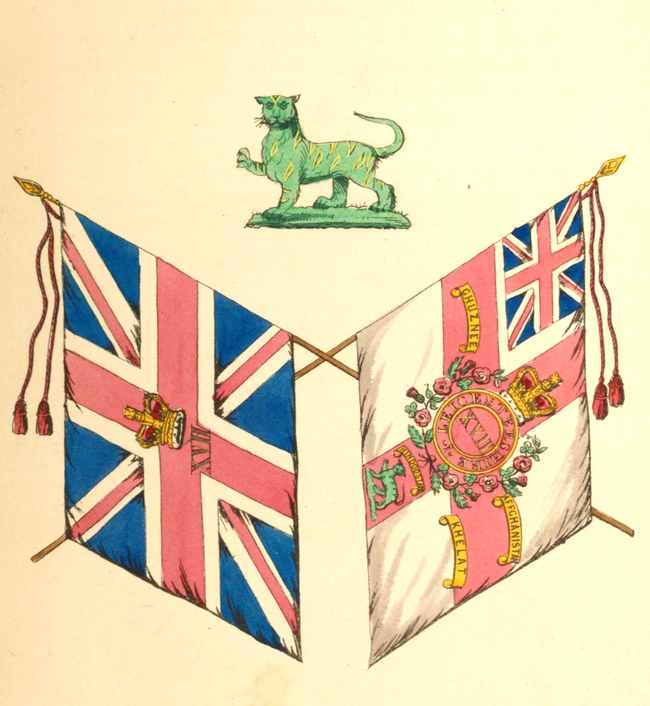
FOR CANNON'S MILITARY RECORDS
Madeley lith. 3 Wellington St. Strand
OF
THE SEVENTEENTH
OR THE
LEICESTERSHIRE REGIMENT OF FOOT.
Solomon Richards.
Appointed 27th September, 1688.
Solomon Richards served on the Continent in the reign of
King Charles II., and in the autumn of 1688 he was nominated
by King James II. to raise a corps of pikemen and musketeers,
now the SEVENTEENTH regiment of foot, of which he
was appointed Colonel on the 27th of September, 1688. At
the Revolution he transferred his services to the Prince of
Orange, afterwards King William III., who sent him, with
his regiment, to the relief of Londonderry. He returned to
England, at the suggestion of the governor of Londonderry,
who stated the place could not be defended against the army
advancing to attack it, and King William, disapproving of
his conduct, deprived him of his commission. He was not
afterwards employed in the army.
Sir George St. George.
Appointed 1st May, 1689.
No record of the services of this officer, previous to his appointment
to the colonelcy of the SEVENTEENTH regiment on
the 1st of May, 1689, has been met with. He served the
campaign of 1694 in Flanders; and in 1695 he exchanged to
a newly-raised regiment, which was disbanded in 1798.
James Courthorpe.
Appointed 1st May, 1695.
James Courthorpe entered the army in the time of King
Charles II., and afterwards commanded a company of foot.
He was appointed Colonel of one of the regiments raised for
the reduction of Ireland in 1689; and in 1695 he exchanged
to the SEVENTEENTH foot. He served in the Netherlands
under King William III., and was killed at the head of his
regiment when storming the breach of Terra Nova at the
Castle of Namur, on the 30th of August, 1695.
Sir Matthew Bridges.
Appointed 1st September, 1695.
After a progressive service in the subordinate commissions,
this officer was appointed Lieut.-Colonel in the SEVENTEENTH
regiment; he distinguished himself at the storming of the
breach of Terra Nova at the Castle of Namur, on the 30th of
August, 1695, when he was wounded. King William III.
conferred the colonelcy of the regiment upon him, and he
served under His Majesty until the treaty of Ryswick in 1697;
and subsequently commanded his regiment in Ireland. The
date of his decease has not been ascertained.
Holcroft Blood.
Appointed 26th August, 1703.
This officer was the son of the celebrated Colonel Thomas
Blood, who made a desperate effort to carry off the crown
from the Tower of London in the reign of King Charles II.,
for which the Colonel was afterwards pardoned, in consequence
of his previous services in the Royal cause. Holcroft Blood
served on board the fleet, in the war with Holland, in 1672
and 1673; and he subsequently entered the French army as
cadet in the guards of Louis XIV., where he made great
proficiency in the study of fortifications. At the Revolution
in 1688 he returned to England, and was appointed to a commission
in Colonel Seymour's regiment, in which corps he
rose to the rank of major. He served in Ireland, where he
was employed as an engineer, and evinced ability at the sieges
of Athlone and Limerick: he also distinguished himself at the
siege of Namur in the Netherlands, in 1695; and was promoted
to the lieut.-colonelcy of the SEVENTEENTH regiment. He
accompanied the SEVENTEENTH to Holland in 1701, and in
1702 he served as a principal engineer at the sieges of Venloo
and Ruremonde, where he displayed great ability. He particularly
distinguished himself at the storming of Fort St.
Michael, at Venloo, where "he showed the part of a brave
officer, charging with the men sword in hand, and killing
an officer of the enemy's grenadiers, who made a vigorous
opposition with his party."[10] The talents and bravery of
Colonel Blood procured him the favour of the great Duke of
Marlborough, who obtained for him the colonelcy of the
SEVENTEENTH regiment and the command of the British
artillery on foreign service on the Continent, with the rank of
brigadier-general. At the memorable battle of Blenheim in
1704, Brigadier-General Blood highly distinguished himself;
and, by bringing nine field-pieces into action at a critical
moment, greatly contributed to the gaining of that splendid
victory: by a General Order issued in the evening of that day,
all the trophies captured were placed under his care. Towards
the close of the campaign he accompanied the Duke of Marlborough
to the Moselle, and was engaged in the capture of
several places in that quarter. He continued in the command
of the British artillery on the Continent, and his services were
associated with the forcing of the French lines at Helixem
and Neer Hespen in 1705, and the splendid victory at Ramilies
in 1706. On the 1st of January, 1707, he was promoted
to the rank of Major-general. He died at Brussels on the
20th of August, 1707.
James Wightman.
Appointed 20th August, 1707.
James Wightman was many years an officer in the
SEVENTEENTH regiment, with which corps he served in the
Netherlands under King William III. He accompanied the
regiment to Holland in 1701, and served the campaigns of
1702 and 1703 under John Duke of Marlborough. He was
promoted to the lieut.-colonelcy of the regiment in 1702,
and to the rank of colonel in the army in August 1703. He
served in Portugal and Spain under the Earl of Galway; was
nominated Brigadier-general on the 1st of January 1707, and
to the colonelcy of the SEVENTEENTH regiment in August
following: in 1710 he was promoted to the rank of Major-general.
He served in Scotland under the Duke of Argyle
during the rebellion of the Earl of Mar, and commanded a
division of infantry at the battle of Dumblain: he wrote an
account of the battle, which was published at the time. In
1719 he commanded the King's troops at the battle of
Glenshill, when he forced the Highlanders to disperse, and the
Spanish troops to surrender prisoners of war. His services
were rewarded with the government of Kinsale. He died
suddenly at Bath, of a fit of apoplexy, in September, 1722.
Thomas Ferrers.
Appointed 28th September, 1722.
This officer served under the celebrated John Duke of Marlborough,
and was promoted to Captain and Lieut.-colonel in the
foot-guards; in May, 1705, he was advanced to the rank of
Colonel, and in 1710 to that of Brigadier-general. Being
conspicuous for loyalty at a period when Jacobin principles
were prevalent in the kingdom, he was commissioned to raise
a regiment of dragoons, which was disbanded in 1718; and in
the following year he was appointed Colonel of the thirty-ninth
foot, from which he was removed, in September, 1722,
to the SEVENTEENTH regiment. He died about three weeks
afterwards.
James Tyrrell.
Appointed 7th November, 1722.
James Tyrrell was appointed Ensign in a regiment of foot
on the 6th of February, 1694, and he served under King
William III. in the Netherlands. He distinguished himself
in the wars of Queen Anne; and was promoted to the
colonelcy of a newly-raised regiment of foot in April, 1709.
At the peace of Utrecht his regiment was disbanded; and in
1715 he raised a regiment of dragoons for the service of King
George I., which was disbanded in November, 1718: in 1722
His Majesty gave him the colonelcy of the SEVENTEENTH
regiment. He was promoted to the rank of Brigadier-general
in 1727; to that of Major-general in 1735; and Lieut.-general
in 1739. He died in August, 1742.
John Wynyard.
Appointed 31st August, 1742.
John Wynyard was many years an officer of the SEVENTEENTH
regiment of foot, with which corps he served in the
Peninsula in the war of the Spanish succession, and in
Scotland during the Earl of Mar's rebellion. On the 10th
of July, 1718, he was promoted to the lieut.-colonelcy of the
regiment; and his zealous attention to all the duties of his
situation was rewarded, in November, 1739, with the
colonelcy of the fourth regiment of marines, which was then
newly raised, from which he was removed, in 1742, to the
SEVENTEENTH regiment, which corps he had commanded many
years with reputation. He died in 1752.
Edward Richbell.
Appointed 14th March, 1752.
This officer entered the army in the reign of Queen Anne, and
served with reputation under the celebrated John Duke of
Marlborough. He evinced a constant attention to the duties
of his profession, and was promoted, on the 18th of May
1722, to the lieut.-colonelcy of the thirty-seventh regiment.
He distinguished himself in the war of the Austrian succession,
and was promoted to the colonelcy of the thirty-ninth
regiment on the 14th of June, 1743. In 1746 he commanded
a brigade under Lieut.-general St. Clair, in the expedition
against Port L'Orient; and in 1752 he was removed to the
SEVENTEENTH regiment. He died in 1757.
John Forbes.
Appointed 25th February, 1757.
John Forbes obtained a commission in the army on the 10th
of April, 1710; after a progressive service in the subordinate
commissions, and distinguishing himself in the war of the
Austrian succession, he was promoted to the lieut.-colonelcy
of the Scots Greys on the 29th of November, 1750: in 1757
he was advanced to the colonelcy of the SEVENTEENTH regiment.
He was nominated Adjutant-general to the expedition
against Louisburg in 1757; and afterwards appointed Commander-in-chief
of the troops in the southern provinces of
North America, with the rank of Brigadier-general. He died
on the 11th of April, 1759.
The Honorable Robert Monckton.
Appointed 24th October, 1759.
The Honorable Robert Monckton, son of John, first
Viscount Galway, served in the army in the war of the Austrian
succession; and in February, 1751, he was promoted to
the lieut.-colonelcy of the forty-seventh regiment: in 1757 he
was nominated Colonel-commandant of the second battalion
of the sixtieth regiment. He commanded a brigade, under
Major-general James Wolfe, in the expedition against Quebec,
and evinced great gallantry and ability on several occasions;
he was shot through the lungs at the battle on the heights of
Abraham, on the 13th of September; but recovered of his
wound, and was nominated Lieut.-governor of Annapolis
Royal, and Colonel of the SEVENTEENTH regiment. In 1761
he was appointed Governor and Commander-in-chief of the
province of New York; and promoted to the rank of Major-general.
Soon afterwards he was selected to command the
land-forces of an expedition against the French island of
Martinique, which he captured, after overcoming numerous
difficulties, early in 1762. He was nominated Governor of
Berwick and Holy Island, and afterwards of Portsmouth,
which place he represented in Parliament several years. He
was promoted to the rank of Lieut.-general in 1770. His decease
occurred on the 21st of May, 1782.
George Morrison.
Appointed 29th May, 1782.
This officer served many years on the staff of the army; he
was advanced to the rank of Lieut.-colonel in 1761, at which
period he held the appointment of Deputy-quartermaster-general;
and in 1763 he was placed at the head of that department.
He was promoted to the rank of Colonel in 1772,
and to that of Major-general in 1777; in 1779 he was
appointed Colonel of the seventy-fifth regiment (afterwards disbanded),
from which he was removed, in 1782, to the SEVENTEENTH,
and also promoted to the rank of Lieut.-general. He
was appointed to the fourth regiment of foot in 1792; and
promoted to the rank of General in 1796. He died in 1799.
George Garth.
Appointed 8th August, 1792.
This officer served thirty-seven years in the first regiment of
foot-guards, in which corps he was appointed Ensign and
Lieutenant at the commencement of hostilities with France in
1755. In 1758 he obtained the rank of Lieutenant and
Captain, and he afterwards served in Germany under Prince
Ferdinand of Brunswick: on the 6th of February, 1772, he
was promoted to the rank of Captain and Lieut.-colonel. When
the American war commenced, his services were extended to
that country, where the foot-guards had opportunities of distinguishing
themselves. He was promoted to the rank of
Colonel in 1779; was nominated Major in his regiment in
March, 1782, and advanced to the rank of Major-general in
November following: in 1789 he was appointed Lieut.-colonel
in his regiment. King George III. was pleased to confer on
Major-general Garth the colonelcy of the SEVENTEENTH
regiment in 1792; also to promote him to the rank of Lieut.-general
in 1796, and to that of General in 1801. General
Garth was subsequently appointed Lieut.-governor of Placentia.
He died in 1819.
Josiah Champagné, G.C.H.
Appointed 14th June, 1819.
On the 28th of January, 1775, Josiah Champagné was
appointed Ensign in the thirty-first foot, and embarking with
his regiment, in March, 1776, for the relief of Quebec, then
besieged by the Americans, he arrived in Canada in May, and
took part in the operations by which the troops of the United
States were forced to quit the British provinces. He remained
on active service in Canada during the remainder of the
American war, was promoted to a lieutenancy in his regiment
in July, 1777, and, returning to England at the peace in
1782, was nominated captain in the ninety-ninth foot (afterwards
disbanded) in 1783, and removed to the third foot in
March, 1784. He joined the Buffs at Jamaica in May of the
same year; and in 1789, when the Nootka Sound question
threatened to involve Great Britain and Spain in war, he
embarked with a detachment of his regiment on board the
fleet: he returned to England soon afterwards. He again
embarked for the West Indies, with his regiment, in 1793—the
Buffs forming part of the expedition under Lieut.-general
Sir Charles Grey; but their destination was afterwards
changed to Ostend; and they subsequently joined the armament
under Major-general the Earl of Moira, prepared to
aid the French loyalists. In the same year Captain Champagné
was promoted to the majority of the eightieth foot, and
afterwards to a lieut.-colonelcy in the same corps. In 1794
he again proceeded to the Continent, and, after serving in the
retreat through Holland, returned to England. He embarked
for the coast of France in 1795, and served with the expedition
under Major-general Doyle which took possession of Isle de
Dieu. In 1796 he proceeded with his regiment to the Cape
of Good Hope, and towards the close of the same year sailed
to the East Indies. He was promoted to the rank of Colonel
in 1797; and in 1800 he was nominated to command an expedition
against Batavia, with the rank of Brigadier-general,
but this enterprise was countermanded; and he was afterwards
named second in command of the army which proceeded from
India to Egypt in 1801. He returned to England in 1803;
and in September of that year he was promoted to the rank
of Major-general. On the 22nd of February, 1810, he was
rewarded with the colonelcy of the forty-first foot; and in
July following promoted to the rank of Lieut.-general. In
1819 he was removed to the SEVENTEENTH regiment. He
was honored with the dignity of Knight Grand Cross of the
Royal Hanoverian Guelphic Order; and was advanced to the
rank of General in 1821. He died on the 31st of January,
1840.
Sir Frederick Augustus Wetherall, G.C.H.
Appointed 17th February, 1840.
This officer entered the service in August, 1775, as Ensign
in the SEVENTEENTH foot. He embarked at Cork with
the regiment in September following for Boston, North America,
where he remained during the siege, and accompanied
his corps at the evacuation to Halifax in March, 1776. In
June following he proceeded with the army under the command
of Sir William Howe to Staten Island, preparatory to
the attack of New York. In August, 1776, he received a
lieutenancy; in which rank he served five years, and was constantly
employed in North America and Europe. He was
present at the battles of Brooklyn, Whiteplains, Fort Washington,
Princetown, Brandywine, Germantown, and Monmouth,
exclusive of several affairs of posts, in North America.
He was embarked and did duty as a Captain of marines on
board His Majesty's ship Alfred, and was in the battles of
Cape Finisterre and St. Vincent, under Sir George Rodney,
previous to the relief of Gibraltar. On 17th May, 1781, he
raised an independent company, which was embodied in the
hundred and fourth regiment, and was employed on the island
of Guernsey. On 16th April, 1783, he exchanged into the
eleventh regiment, and proceeded to Gibraltar, where he did
duty six years. In 1790 he attended the Duke of Kent to
Quebec, and accompanied his Royal Highness as aide-de-camp
to the West Indies in 1794; he was at the taking of Martinique,
where he received two wounds. On 1st March, 1794, he
was appointed Major in the eleventh foot, and employed as
Deputy-adjutant-general to the forces in Nova Scotia, under
the command of the Duke of Kent, to which situation he
was appointed on 23rd August, 1794. On 20th May,
1795 he was appointed Lieut.-colonel in Keppel's regiment,
and employed at St. Domingo under the command of Lieut.-general
Sir Adam Williamson and Major-general Forbes;
he was intrusted by the latter officer with despatches for Sir
Ralph Abercromby at Barbadoes, and on the passage was
taken by a French frigate, and wounded in action; he remained
at Guadaloupe a prisoner of war upwards of nine
months, and when exchanged was appointed Adjutant-general
to the forces under the command of the Duke of Kent in
North America. On 3rd August, 1796, he was removed
to the lieut.-colonelcy of the eighty-second regiment, and
on 29th April, 1802, received the brevet of Colonel. He
afterwards raised the Nova Scotia fencible regiment in North
America, of which he was appointed colonel on 9th July,
1803, and Adjutant-general and Brigadier to the forces on the
Caribbee Island station in May, 1806. On the 25th of October
following he was removed to the Cape of Good Hope, when
he served as Brigadier to the forces in that colony until 1809;
he obtained the rank of Major-general on 25th October of
that year, and was appointed to the Staff in India. On his
passage from the Cape to India he was again taken prisoner
in the Company's ship Wyndham, after a severe action, by a
French squadron, in the Mozambique Channel, and carried to
the Isle of France, when, after being confined two months,
he was exchanged, and sailed for Calcutta. He served there
as second in command, under Sir Samuel Auchmuty, on the
expedition against Java, which terminated in its conquest.
For his services on that occasion he had the honour to receive
a medal, and the thanks of both Houses of Parliament. His
next appointment was to the command in Mysore and its dependencies,
which he held until June, 1815, when he returned
to England. He received the rank of Lieut.-general on
4th June, 1814. On 10th January, 1837, he was advanced
to the rank of General, and His Majesty King William IV.
conferred upon him the colonelcy of the sixty-second regiment.
On 17th February, 1840, the Queen bestowed upon him
the colonelcy of the SEVENTEENTH regiment, in which he
commenced his military career. He died at Ealing, in Middlesex,
on the 18th of December, 1842, having attained the
advanced age of eighty-eight years.
General Sir Peregrine Maitland, K.C.B.
Appointed from the seventy-sixth regiment,
on 2nd January, 1843.
London: Printed by William Clowes and Sons, Stamford Street,
For Her Majesty's Stationery Office.
TRANSCRIBER'S NOTE
Obvious typographical errors and punctuation errors have been
corrected after careful comparison with other occurrences within the
text and consultation of external sources.
The page numbering of the original text has
been retained. The early pages have numbering xxv-xxxii then i-xix.
Except for those changes noted below, all misspellings in the text,
and inconsistent or archaic usage, have been retained.
Pg xxxi, in the list of 'PLATES' the order of the plates has been
reversed, so that 'Costume of the Regiment' comes first.
Pg xvii, 'Witenss the deeds' replaced by 'Witness the deeds'.
Five occurrences of 'Lieut-Colonel' have been replaced for
consistency by 'Lieut.-Colonel' (missing period inserted).