OF THE
FIFTH,
OR
PRINCESS CHARLOTTE OF WALES'S REGIMENT
OF
DRAGOON GUARDS.
1685
In the early periods of the history of this country
a standing army was unknown; but as the kingdom
increased in arts, sciences, and manufactures,
and as national institutions, established upon sound
principles, assumed an important character, a regularly
organized military force was found necessary to
protect the interests of society, and to guard colonial
possessions; and when the other nations of Europe
have from time to time augmented their standing
armies, it has been found necessary to make similar
additions to the regular force of Great Britain.
After the Restoration in 1660, the army of the Commonwealth
was disbanded, and a body of household
troops, with a few garrison companies, were considered
sufficient; but the acquisition of additional
possessions, the ambitious designs of foreign potentates,
and internal commotions in the kingdom,
have occasioned numerous additions to be made to
the regular army. It was one of the last mentioned
causes, which, in the year 1685, gave rise to the
formation of the corps which is the subject of this
memoir, and which now bears the title of the
Fifth, or Princess Charlotte of Wales's
Regiment of Dragoon Guards.
A difference in religious views and opinions has
often occasioned long and sanguinary wars; and the
accession of a Roman Catholic Prince (James II.)
to the throne of Great Britain, was an event so
little congenial to the feelings of a Protestant
people, that James Duke of Monmouth (natural
son of King Charles II.) was induced, by the persuasions
of men who were disaffected to the existing
government, to make a daring attempt to
dethrone his uncle, and to gain the sovereignty of
the kingdom.
This event occurring at a time when the first
feelings of alarm at the appearance of a Papist on
the throne had subsided, and before the King had
made any serious attack on the constitution or
established religion, the people were not prepared
to throw off their allegiance to their sovereign;
consequently, while a few thousands of disaffected
persons joined the standard of rebellion, much
greater numbers arrayed themselves under the
banners of royalty. Many noblemen and gentlemen
exerted themselves in raising forces for the
King; and it is stated in the public records, that a
number of the respectable yeomen and others who
volunteered their services in the royal cause, were
incorporated into a troop of horse by Charles Earl
of Shrewsbury, at Litchfield; another troop of
horse was raised by Francis Lord Brudenel, at
Kingston upon Thames; a third by Sir Thomas
Grosvenor, at Chester; a fourth by Roger Pope,
Esq., in the vicinity of Bridgnorth; a fifth by Mr.
Francis Spalding, at Bristol; and a sixth by the
Honourable John D'Arcy, (guidon of the second
troop, now second regiment of Life Guards,) in
London. These formed part of an extensive body
of troops raised in a few weeks; but the rebellion
was suppressed by the old corps which the King
had in his service, without the aid of the new levies.
His Majesty, however, looking forward to the
commotions which would probably follow the execution
of the attacks he was urged by his jesuitical
councillors to make on the established religion and
laws, resolved to retain a considerable portion of
the newly-raised forces in his service; and these
six troops of horse were, on the 29th of July,
1685, constituted a regiment of Cuirassiers, of
which the Earl of Shrewsbury was appointed
Colonel, the Honourable John D'Arcy Lieutenant-Colonel,
and John Skelton, Esq., Major. This
regiment ranked at that period as Seventh
Horse; and is now the Fifth Dragoon Guards.
The uniform and equipment of this corps, like
that of the other regiments of horse, were hats,
long scarlet coats, jacked-leather boots, cuirasses,
iron head pieces, swords, pair of pistols, and short
carbines. Each corps had a distinguishing colour,
then called its regimental livery, and now styled
its facing, and the distinguishing colour of
Shrewsbury's Cuirassiers was buff; the men
had their coats lined with buff shalloon, and their
waistcoats, breeches, ribands in their hats, and
horse furniture, were of the same colour.
Soon after its formation the regiment marched
into quarters near Hounslow, and experienced
officers were appointed to teach the men the established
military exercises; they formed two squadrons,
three troops in a squadron; but each troop
had a standard of buff-silk damask; and these loyal
cavaliers, being mounted on strong horses, had not
only a warlike appearance, but they were well
calculated for a charge in line where weight and
physical power were necessary. The Cuirassiers
had succeeded the ancient Lancers (or Launces),
formerly the highest class of military force in
Europe, and celebrated for valour, prowess, and
feats of chivalry. The Lancers were armed cap à
pié, but the lance having, to a great extent, been
laid aside before the middle of the seventeenth
century, helmets, and armour on the limbs, were
also discontinued soon afterwards. The regiments
of Horse, having succeeded the ancient Lancers,
were held in high estimation; and in the succeeding
reigns they acquired great celebrity.
After having been twice reviewed by King
James II. on Hounslow Heath, the regiment
marched into quarters in Warwickshire, where it
passed several months.
The King, having acquired some practical
knowledge of military service in the civil war in
France, and in the Netherlands, under Marshals
Turenne and the Prince of Condé, established
several useful regulations for the preservation of
order and discipline in his army; two experienced
officers, Sir John Lanier and Sir John Fenwick,
were appointed Inspecting Generals of Cavalry;
and the first half-yearly inspection of this regiment
was made by Brigadier-General Sir John Fenwick,
of the Life Guards, in its quarters in Warwickshire.
1686
While in these quarters, its establishment was
fixed, by a royal warrant dated the 1st of January,
1686, at the following numbers:—
| |
| THE EARL OF SHREWSBURY'S REGIMENT OF HORSE. |
| |
| Field and Staff-Officers. | Per Diem. |
| | |
| £. | s. | d. |
| The Colonel, as Colonel | 0 | 12 | 0 |
| Lieutenant-Colonel, as Lieut.-Colonel | 0 | 8 | 0 |
| The Major (who has no troop), for himself, horses, and servants. | } | 1 | 0 | 0 |
| Adjutant | 0 | 5 | 0 |
| Chaplaine | 0 | 6 | 8 |
| Chirurgeon iv^s per day, and j horse to carry his chest, ij^s per day | } | 0 | 6 | 0 |
| A Kettle-Drummer to the Colonel's troop. | 0 | 3 | 0 |
| | | | |
| 3 | 0 | 8 |
| | | |
| The Colonel's Troop. | | | |
| The Colonel, as Captaine, x^s per day, and ij horses each at ij^s per day | } | 0 | 14 | 0 |
| Lievtenant vi^s, and ij horses, each at ij^s | 0 | 10 | 0 |
| Cornett v^s, and ij horses, each at ij^s | 0 | 9 | 0 |
| Quarter-Master iv^s, and i horse, at ij^s | 0 | 6 | 0 |
| Three Corporals, each at iij^s per day | 0 | 9 | 0 |
| Two Trumpeters, each at ij^s viii^d | 0 | 5 | 4 |
| Forty Private Soldiers, each at ij^s vi^d per day. | 5 | 0 | 0 |
| | | | |
| 7 | 13 | 4 |
| Five Troops more, of the same numbers, and at the same rates of pay as the Colonel's troop | } | 38 | 6 | 8 |
| | | |
| Total for this Regiment per Diem | 49 | 0 | 8 |
| | | |
| Per Annum £17,897. 3s. 4d. | | | |
| | | | |
The following officers were at this period holding
commissions in the regiment:—
| | | | |
| Troop. | Captains. | Lieutenants. | Cornets. |
| | | | |
| 1st. | Earl of Shrewsbury (Col.) | John Grosvenor | George Kellum. |
| 2d. | John Coy, (Lieut.-Col.) | James Bringfield | Hon. W. Brudenel. |
| 3d. | Sir Thomas Grosvenor | Henry Grosvenor | James Williamson. |
| 4th. | Roger Pope | Thomas Griffiths | Guy Forster. |
| 5th. | Francis Spalding | Thomas Doughty | William Rowley. |
| 6th. | Charles Orme | Thomas Manning | Ralph Pope. |
| | | | |
|
| John Skelton | Major. |
| Samuel Bowles | Chaplain. |
| James Arden | Surgeon. |
| George Briscoe | Adjutant. |
| |
The Earl of Shrewsbury's Cuirassiers
were withdrawn from their country quarters in the
summer of this year, and were encamped with
other forces on Hounslow Heath; where they were
practised in military evolutions, under the direction
of Lieutenant-Generals the Earls of Craven,
Feversham, and Dumbarton; and were several
times reviewed by King James II.: in August
they struck their tents and marched to Buckingham
and Wendover.
1687
The King, being surrounded by Roman Catholic
priests, soon gave indication of his designs against
the reformed religion; the Earl of Shrewsbury,
who was a stanch Protestant, resigned his commission,
and afterwards proceeded to Holland and
joined the Prince of Orange, to whom the nation
began to look for deliverance from popish tyranny.
His Majesty appointed, in January, 1687, Marmaduke
Lord Langdale, to the Colonelcy of the
regiment, who was succeeded in the following
month by the Honourable Richard Hamilton,
a Roman Catholic officer, from the Colonelcy of a
regiment of dragoons in Ireland.
1688
From this period until that great national event,
the Revolution in 1688, few circumstances occurred,
in which Hamilton's regiment was particularly
concerned, worthy of being recorded in this
memoir. It was encamped on Hounslow Heath in
the summer of 1687, and also in that of 1688;
and its Colonel being a Papist, the attempt made
by the King to introduce officers and soldiers of
that religion into the army, would, doubtless,
meet with no obstruction in this corps. The majority
of the officers and men were, however,
firmly attached to the Protestant cause.
The King had raised and equipped a fine army
for the purpose of making it subservient to his
insidious designs; but the troops proved faithful
to the interests of their country and religion, and
an association of officers was secretly formed at the
camp on Hounslow Heath, in favour of the Prince
of Orange, who was preparing an army to invade
England and to rescue the kingdom from the
power of the Papists.
Information having been received of the designs
of the Prince of Orange, Hamilton's Cuirassiers
were ordered to Ipswich, where the Earl of
Arran's regiment (now Fourth Dragoon Guards),
and the Queen's (now Third) Dragoons, commanded
by Colonel Alexander Cannon, were
assembled under the orders of Major-General Sir
John Lanier, to preserve Landguard Fort, and to
prevent the Prince landing there; and two regiments
of horse and one of dragoons were stationed
at Colchester to support this force, if necessary.
Sir John Lanier is stated by King James,
in his memoirs, to have been one of the associated
officers, and to have resolved to seize on the Earl
of Arran, and Colonels Hamilton and Cannon,
and to have joined the Prince with the three regiments;
but this arrangement, in which King
James states, in his memoirs, most of the officers
had agreed to co-operate, was rendered void by his
Highness landing at Torbay.
Hamilton's Cuirassiers were afterwards ordered
to march to the metropolis, and from thence to
Salisbury; but a general defection appearing in
the army, the King fled to France; the Prince of
Orange ordered the regiment to march to Fenny
Stratford, and its Colonel, the Honourable Richard
Hamilton, was confined in the Tower of London,
for holding a commission for which he was disqualified
by law, he being a Papist.
On the 31st of December, 1688, the Prince of
Orange conferred the Colonelcy of the regiment
on the Lieutenant-Colonel, John Coy; and during
the eight succeeding years it bore the title of
Coy's Horse, or Cuirassiers.
All the Papists having been dismissed, the
regiment received a draft of one hundred men and
horses from the Marquis of Miremont's regiment
of horse,—a corps which had been recently raised,
and was now disbanded.
1689
These events were followed by the accession of
William and Mary, the Prince and Princess of
Orange, to the throne; and the first duty in which
the regiment was called upon to engage under the
new dynasty, was the patrolling of the public roads
to prevent highway robberies, which, owing to the
commotions recently experienced in society, had
become very frequent. It also furnished a detachment
to protect the King's herd of deer in the
Forest of Dean against the depredations of organized
bands of deer-stealers.
From these duties Coy's Horse were soon relieved
to engage in military operations in Ireland,
which country had become the theatre of intestine
war. The Papists were in arms in favour of King
James, who had arrived in Ireland with a body of
troops from France; and, following that system
of cruelty which has invariably been practised
when religion has been the subject of contention,
the hapless Protestants, being the weaker party,
had been made to feel the full weight of Catholic
vengeance. Many of the Protestants, particularly
in Inniskilling and Londonderry, had taken arms.
King William sent a body of troops under Duke
Schomberg to their aid, and Coy's Horse embarked
at Highlake, in Cheshire, in the middle of
August, 1689, for the same service.
After landing at Belfast, the regiment was employed
in covering the siege of Carrickfergus,
and had its post in the lines before the town. This
place having surrendered on the 28th of August,
a detachment of the regiment, commanded by
Captain Sir William Russel, escorted the garrison,
consisting of two regiments of foot, "all
stout fellows, but ill clothed," the first stage from
the town; and such cruelties had been practised by
the Papists, that, according to Story, who was an
eye-witness, the troopers experienced some difficulty
in preserving the Catholic soldiers from
being torn to pieces by the country people, who
were stimulated to revenge by the remembrance of
past injuries.
The regiment afterwards advanced with the
army towards Newry, where a party of the enemy
was assembled, who, on the approach of the
English, set fire to the town, and retreated over
the mountains to Dundalk. The English passed
the mountains on the following day, when the
enemy quitted Dundalk and retired to Atherdee,
where the main body of King James's army was
assembled.
Marshal Duke Schomberg, finding Dundalk to
be a strong situation, with a convenient harbour
for obtaining supplies from England, and knowing
that the enemy's army was more than double his
own in numbers, formed an intrenched camp,
where he resolved to continue during the remainder
of the campaign; but the ground where the troops
were encamped being low, and the weather proving
wet, this injudicious choice of situation proved
so fatal to his army, that the infantry corps lost
half their men from disease. Coy's Horse remained
at Dundalk upwards of a month, and
afterwards proceeded to Carlingford for the convenience
of forage. During the winter, detached
parties had frequent encounters with the bands
of armed Papists who prowled the country, committing
every description of outrage; and an out-guard
of the regiment, posted in the pass of
Newry, was sharply engaged with a party of the
enemy, who attempted to force the pass, but were
repulsed with loss, the gallant English Cuirassiers
proving more than a match for their antagonists.
1690
In June, 1690, King William arrived in Ireland
to command the army in person, and the
regiment was now called upon to serve under the
eye of its sovereign. This circumstance is said to
have given rise to a laudable feeling of emulation
in all ranks of the army, and the troopers longed
for an opportunity to distinguish themselves in
presence of their King. The desired opportunity
soon occurred; the King, advancing up to the
banks of the Boyne, found the enemy in position
on the opposite side of the river, and the troops
prepared for battle. This regiment was with
His Majesty on the evening preceding the battle,
while reconnoitring the enemy's position, and was
exposed to a cannonade, on which occasion the
King was wounded in the shoulder, and the regiment
had three men and nine horses killed.
Early on the 1st of July, as the rays of morning-light
shed their lustre on the camp, the English
and Dutch troops appeared in motion, every man
displaying a green branch in his hat; and soon
the columns were seen advancing towards the
Boyne, their glittering arms, waving plumes, and
floating banners, exhibiting all the pomp of war:
the French and Irish stood to their arms and prepared
to defend their post. Coy's Horse, forming
part of the cavalry of the right wing, were in the
column which forded the river near Slane Bridge;
some opposition was made by a regiment of Irish
dragoons, which was attacked, and its commanding
officer and about 70 men killed. After passing
the river, the troops advanced through large
corn-fields, crossed several deep ditches, and overcoming
every obstacle with an ardour which bespoke
the valour and confidence which glowed in
every breast, the enemy's left wing was dismayed
and retreated towards Duleck. Coy's Horse were
amongst the squadrons which galloped forward
in pursuit, and charging the Irish foot, cut them
down with a great slaughter. While these events
were transpiring on the right, King William
passed the river with the main body of his forces:
the enemy was overpowered at every point, and
His Majesty stood triumphant on the field of
battle. King James fled to Dublin, and afterwards
to France, and was followed by the French
troops; but the Irish Papists resolved to maintain
his cause to the last extremity.
Coy's Horse advanced with King William to
Dublin, and were afterwards with the army before
Limerick, during the unsuccessful siege of that
place, when His Majesty returned to England,
the regiment went into quarters near Cork.
1691
In the depth of the winter an incursion into the
enemy's cantonments was resolved upon; and the
regiment having joined the forces selected for that
service, advanced, on the 31st of December, into
the county of Kerry. On arriving near Brewsterfield,
the van-guard, consisting of a troop of this
regiment and one of Eppinger's Dragoons, encountered
a party of 160 of the enemy's cavalry.
Coy's Horse and the dragoons instantly drew
their swords, and advanced to charge their opponents,
who fled in a panic. Continuing its route,
the detachment took a number of prisoners, also
drove seven troops of Irish horse and twenty-one of
dragoons from Tralee, and afterwards returned to
its quarters.
When the army took the field in the summer
of 1691, Coy's Horse were left in dispersed quarters
in the county of Cork to overawe the disaffected,
and to check the depredations of the
bands of Papists, whose proceedings were very
injurious to the Protestants; the regiment was,
consequently, not at the battle of Aghrim, but it
afterwards joined the army near Limerick, and
was employed in the siege of that place.
On the 16th of September, a squadron of the
regiment, with a strong party of dragoons and
infantry, crossed the Shannon by a pontoon bridge
before break of day, surprised and defeated a body
of the enemy, and captured a standard; also surprised
the troops in the camp near the town, and
forced them to make a precipitate flight to the
mountains. On the 24th of the same month, a
cessation of hostilities took place, which ended in
a treaty, and the authority of King James was extinguished
in Ireland.
1692
1693
The regiment, having thus performed its part
in reducing Ireland to submission to the authority
of King William, embarked at Belfast in
the beginning of 1692, and after its arrival
in England it was quartered at Huntingdon,
Chester, and St. Ives; from whence it proceeded
to the vicinity of London, and, for a short time,
assisted the Life Guards in performing the escort
duty for the royal family. It was, however,
allowed but a short period of home service before
it was called upon to take the field against a
foreign enemy.
King William was engaged in a war to restrain
the ambitious designs of Louis XIV. of France,
who sought to become the dictator of Europe and
the destroyer of the reformed religion. After the
severe loss sustained by the confederates at the
battle of Landen, in 1693, the British monarch
gave orders for Colonel Coy to proceed with his
regiment of horse to the Netherlands, and to join
the army in that country.
1694
On its arrival in Flanders, the regiment was
placed in quarters at Ghent; from whence it
marched to Tirlemont, and, joining the army commanded
by King William in person, took part in
the operations of the long and toilsome campaign of
1694, but was not engaged in any action of importance.
1695
In the following year the regiment formed part
of the covering army during the siege of the strong
and important fortress of Namur, which was
superintended by King William in person. Two
magnificent armies confronted each other, and
manœuvred, the one to prevent, and the other to
ensure, the capture of this strong fortress; and it
was eventually taken by the forces commanded by
His Britannic Majesty. About a month after the
surrender of the castle of Namur, the regiment
marched into quarters at Ghent.
1696
King William reviewed the regiment near
Ghent, in May, 1696, and expressed his approbation
of its appearance. During this summer it
formed part of the army of Flanders, under the
orders of the veteran Prince of Vaudemont, and
was encamped for several months on the canal between
Ghent and Bruges, and its services were
limited to defensive measures for the preservation
of these two places, and the maritime towns of
Flanders from the attacks of the enemy. On the
4th of October, the regiment returned to its former
station at Ghent.
1697
From Ghent the regiment marched in May,
1697, to join the army of Brabant, and was encamped
a short time at St. Quintin Linneck. The
French besieged the town of Aeth; and a body of
troops was sent out, under Brigadier-General
Lumley, to make a reconnoissance towards Enghien,
with the view of attacking the French army
and raising the siege. A detachment of Coy's Horse,
commanded by Sir William Russel,
formed the advance-guard on this occasion; and
when on the march, he encountered a party
of French hussars, carabiniers, and dragoons.
Upon notice of the approach of the enemy, the
main body of the British force concealed itself in
the wood, and formed an ambush; and the advance-guard
retiring, the French advanced boldly
forward, and were nearly every man killed or
taken prisoner.
The design of relieving Aeth was afterwards
laid aside; King William retired, and subsequently
took up a position before Brussels.
Colonel John Coy having obtained His Majesty's
permission to dispose of the Colonelcy of the regiment
to Charles Earl of Arran,[7] brother of
the Duke of Ormond, his lordship was appointed
to the regiment on the 1st of July, 1697; and
during the succeeding five years it was styled
Arran's Horse.
King William, after waging war for the
good of Europe a period of nine years, had the
satisfaction of seeing his endeavours succeeded by
a treaty of peace, which was signed at Ryswick in
September of this year.
1698
Shortly after this event, Arran's Horse were
ordered to return to England, where they arrived
in January, 1698, and were quartered at Coventry,
Daventry, and Towcester.
1699
1700
The army in England having been reduced by
the House of Commons to the low establishment
of seven thousand men, King William was under
the necessity of disbanding several corps, and of
sending others to Ireland. This regiment was
one of the corps selected to proceed to Ireland,
where it arrived in the summer of 1700, and its
numbers were reduced to thirty-six private men
per troop.
1701
The repose granted to Europe by the treaty of
Ryswick was, however, of short duration. Louis
XIV. of France, procured the accession of his
grandson, the Duke of Anjou, to the throne of
Spain; this virtual union of two powerful states,
rekindled the flame of war; and the Earl of
Arran's regiment was one of the cavalry corps
ordered to be augmented to fifty-seven private men
per troop, and held in readiness to proceed on
foreign service; but so great was the difficulty
experienced in raising an army of sufficient numbers
to meet the exigence of the nation on this
sudden emergency, that only three troops of the
regiment could, in the first instance, be spared
from Ireland.
1702
These three troops landed at Highlake, in
Cheshire, in the beginning of March, 1702, and
marching to London, embarked in transports on
the river Thames in the beginning of April, and
sailed for Holland.
The decease of King William, who might justly
be styled the protector of the reformed religion,
and the accession of Queen Anne, produced no
alteration in the foreign policy of the British court.
The war was prosecuted with vigour, and the
three troops of Arran's Horse, forming one squadron,
were attached to Brigadier-General Wood's
regiment (now Third Dragoon Guards), and
served the campaign of this year under the Earl
of Marlborough. The British horse, had, however
no opportunity of signalizing themselves in
action this year; their services being limited to
out-post duty, and covering the sieges of Venloo,
Ruremonde, Stevenswaert, and the famous city of
Liege, which fortresses were captured by the British
commander.
1703
The Earl of Arran having been promoted to the
Colonelcy of the third troop of Life Guards, Queen
Anne conferred the command of the regiment on
Brigadier-General Cadogan (afterwards Earl
Cadogan), from the Sixth, or Inniskilling Dragoons,
by commission, dated the 2d of March,
1703.
The three troops of the regiment on foreign service,
now bearing the title of Cadogan's Horse,
continued to serve throughout the campaign of this
year with Brigadier-General Wood's regiment.
In a slight skirmish near Haneff, in the beginning
of June, a small detachment evinced the martial
spirit and valour of British troopers; and in the
various movements of the army before the enemy,
the national character was fully sustained. The
French commanders avoided an engagement, and
after covering the sieges of Huy and Limburg,
Cadogan's Horse went into quarters for the
winter in Holland.
1704
In the beginning of the following year the other
three troops of the regiment were withdrawn from
Ireland, and after occupying quarters a short time
at Northampton, embarked (4th April, 1704) for
Holland.
The six troops were thus united in time for the
whole regiment to take part in the glorious exploits
of the campaign of 1704, in which that noble
ardour and chivalric spirit which has raised Britain
to its present exalted station among the nations
of Europe, were displayed by the army under the
Duke of Marlborough in a signal manner. Confidence
in the commander has always given additional
life and vigour to innate valour, and the
troops having already proved the military virtues
of their leader, the great Marlborough was enabled
to march his forces from the ocean to the Danube,
and to gain new honours in the heart of
Germany.
This enterprise was undertaken in consequence
of the armies of France and Bavaria having united
against the Emperor of Germany, and the British
general advanced to the aid of the house of Austria,
which was thus menaced by a force which it was
unable to withstand. Quitting the territory of the
Dutch republic the army crossed the Rhine, and
traversed the various states of Germany with a
degree of order and regularity which bespoke a
high state of discipline, united with excellent
arrangements, while the nations of Europe gazed
with astonishment at the undertaking.
Having arrived at the theatre of war and joined
the Imperial army, the first action of importance
was the attack of a body of French and Bavarians
commanded by the Count d'Arco, at their entrenched
camp on the lofty heights of Schellenberg,
on the 2d of July. On this occasion the cavalry
supported the attacks of the infantry, and when the
enemy was forced from the entrenchments, the
brilliant charge of the English horse, and Royal
Scots Dragoons (the Greys) completed the overthrow;
the hostile army lost its colours, cannon,
and baggage, and numbers of French and Bavarians
fell beneath the conquering sabres of the
British horsemen, who chased their adversaries to
the banks of the Danube, and captured many prisoners.
Cadogan's Horse were commanded on
this occasion by Lieutenant-Colonel George Kellum,
and had Major Napier,[8] Lieutenant Tettefall,
and several private men wounded; and sustained
a serious loss in troop horses, from having been
exposed to a heavy cannonade: their Colonel,
Brigadier-General Cadogan, was also wounded.
This action was the precursor of a greater overthrow
to the forces of the enemy, who made efforts
to retrieve his affairs; new armies and new generals
appeared; but these only served to augment
the splendour of victory, and to enhance the value
of the conquerors in the estimation of the world.
The action was fought in the valley of the Danube,
near the village of Blenheim, on the 13th of
August, and the English horsemen, who during
the two preceding campaigns had panted for an
opportunity to signalize themselves, had a fair field
in which to display their valour and prowess, and
they gave undeniable proofs of their good qualities.
The Gallo-Bavarian army was destroyed; its
commander, Marshal Tallard, and many entire
battalions and squadrons were made prisoners of
war; and the field of battle was literally covered
with trophies.
The victory was most complete and decisive,
and it was not gained over new levies; but over
an army of veterans fully instructed in the art of
war,—select troops flushed with former successes,
and commanded by generals of great bravery and
experience.[9] This regiment had only one officer
(Lieutenant Groubere) killed; its loss in non-commissioned
officers and private men has not
been recorded.
The regiment took part in the subsequent operations
of the main army; and after covering the
siege of Laudan, it marched back to Holland for
winter quarters.
1705
In the following summer the regiment marched
with the army through the Duchy of Juliers, and
crossed the Moselle and the Saar, in order to carry
on the war in Alsace; but the Duke of Marlborough,
being disappointed of the promised co-operation
of the Imperialists, marched back to the
Netherlands.
The French had, with much labour and art,
constructed a line of fortifications of many miles
extent to cover their recently acquired territory in
the Spanish Netherlands, and Cadogan's Horse
having been selected to form part of the division
to be employed in forcing these lines, had an opportunity
of distinguishing themselves, and their
valour shone forth with as bright a lustre as in any
of the heroes in the ancient days of chivalry. The
British commander, having by skilful movements
succeeded in drawing the main body of the French
army from the point selected for the attack, forced
the lines at Helixem and Neer-Hespen at day-break
on the morning of the 18th of July, and the
pioneers levelled a space for the cavalry to pass
over; but scarcely had the British horse passed
the barriers, when the Marquis d'Allegre appeared
with fifty squadrons of cavalry and twenty battalions
of infantry to drive back the British forces.
The sun had risen, and the French army was in
full march to oppose this sudden attack on their
lines; hence every moment was of importance, and
a sharp fire of musketry having forced the enemy
from a hollow way, the Duke of Marlborough
ordered forward his heavy cavalry to charge the
hostile horsemen. The two squadrons of this
regiment led the attack with their characteristic
gallantry, and were opposed to adversaries of
valour and renown,—the famous Bavarian Horse
Grenadier Guards. Against these celebrated antagonists
Cadogan's Horse advanced; the weight
and power of their compact line were irresistible,
and the Bavarians were broken at the first shock;
but they soon rallied, and renewing the conflict
with increasing ardour, gained a temporary advantage.
At this critical juncture the Duke of
Marlborough was separated from his troops and
in imminent danger, when Cadogan's Horse,
exasperated at the momentary repulse, and still
more so at the peril of their renowned chief,
returned to the charge; the grand spectacle of
two spirited corps of heavy cavalry rushing upon
each other with reckless fury, was soon followed
by the clash of swords and shouts of the combatants
as they fought hand to hand with sanguinary
fury; but British prowess and British
valour soon proved triumphant, and the Bavarians
were overpowered and fled before the conquering
sabres of Cadogan's troopers, who chased their
adversaries from the field, took many prisoners,
and captured four standards. In their flight the
hostile horsemen rode over two battalions of their
own foot, and these battalions were severely
handled by the British horse. Finally, the enemy
was routed; the Marquis d'Allegre, and many
officers and men were made prisoners, and this
gallant enterprise was attended with complete
success.
On this occasion the regiment, which forms the
subject of this memoir, gained great honour; the
Duke of Marlborough observed in one of his
letters,—"Never men fought better!" and in his
public despatch he states, "They acquitted themselves
with a bravery surpassing all that could
have been hoped of them." The author of the
Annals of Queen Anne observed:—"All the
troops of the confederates behaved themselves
with great bravery and resolution; but among
the Horse the regiment of Brigadier Cadogan
distinguished themselves, having had the honour
to charge first, which they did with that success,
that they defeated four squadrons of Bavarian
Guards, drove them through two battalions of
their own foot, and took four standards; and
this with the loss only of Lieutenant Austin and
some few men killed."
The following description of the standards captured
on this occasion is copied from the London
Gazette.
"Nine standards of blue satin, richly embroidered
with the Bavarian arms; six belonging to
the Elector's own troops, and three to those of
Cologne, having the following devices and mottoes."
1st. A laurel; motto, Aut Coronari aut rumpi.
2d. An olive-tree on a rock; motto, Per Ardua
Laurus.
3d. A pillar reaching to the clouds; motto,
Tantum Umbra movetur.
4th. A bear rampant; motto, Ex Vulnere Crudelior.
5th. A dove with a laurel branch; motto, Uni
servo fidem.
6th. A chaos; motto, Obstantia firmant.
7th. A helmet with a feather on a pedestal;
motto, Ex duris Gloria.
8th. An olive-tree shading serpents; motto,
Nocet Umbra nocenti.
9th. A standard of the Elector's guards with
the colour torn to pieces.
Four of these standards were taken by Cadogan's Horse;
the corps which captured the other
five standards are not specified.
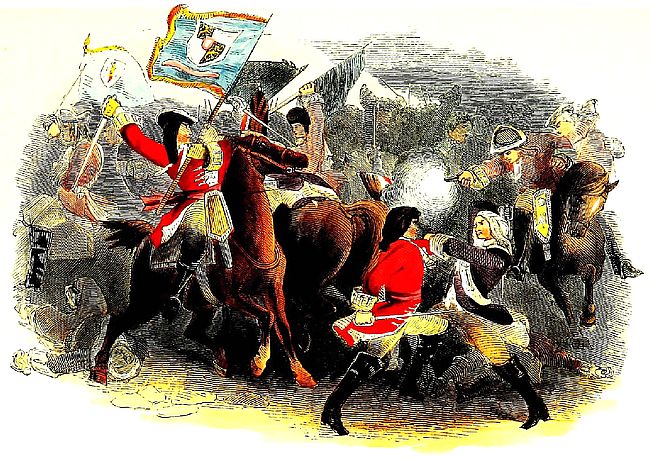
Brigadier-General Cadogan's Horse forcing the French Lines, 18th July, 1705:—
NOW FIFTH (THE PRINCESS CHARLOTTE OF WALES'S) REGIMENT OF DRAGOON GUARDS.
1706
After this victory the regiment was employed in
several manœuvres; but it was not engaged in any
action of importance until the battle of Ramilies,
fought on Whit-Sunday, the 23d of May,
1706, when the French, Bavarians, and Spaniards,
commanded by Marshal Villeroy and the
Elector of Bavaria, sustained another decisive
overthrow, and Cadogan's Horse acquired new
laurels in the contest. On this occasion the
English cavalry were kept in reserve near the
heights of Foulz until towards the close of the
action, when they were brought forward, and the
weight and fury of the charge of these heavy horsemen
were irresistible; the enemy's squadrons and
battalions were broken; and the British troopers,—strong
men on powerful horses,—smote their
antagonists to the ground with a dreadful slaughter.
The victorious squadrons pursued their adversaries
throughout the night, capturing officers and soldiers,
colours, standards, and cannon; and thus, in
a few hours, the French monarch's fine and
well-appointed army was nearly annihilated, and
its commanders escaped from the field with difficulty.
This glorious victory was followed by the submission
of a great part of Spanish Brabant and
Flanders to the house of Austria; and in a few
days after the battle, this regiment was selected
to form part of a detachment commanded by its
Colonel, Brigadier-General Cadogan, sent from
the main army, to summon Antwerp, which
place was surrendered on the 7th of June.
The regiment was subsequently employed in the
blockade of Dendermond, and continued before
that town until its surrender on the 5th of September.
1707
During the campaigns from 1702 to 1706 the
British regiments of horse had not worn cuirasses.
In the preceding century armour had, as already
stated, fallen, to a great extent, into disuse; several
English regiments of heavy cavalry delivered their
cuirasses into the Tower of London in November,
1688; but subsequently had them returned: they
were, however, again placed in store after the
peace of Ryswick. The French and other continental
nations had continued the use of defensive
armour, and it having been observed that the
English heavy cavalry, though they proved victorious,
frequently sustained a very serious loss in
killed, they were, in order to place them on an
equality with their antagonists, again supplied
with cuirasses in the spring of 1707.
In the summer of this year, when the regiment
took the field, it again appeared as a corps of
Cuirassiers: the campaign was passed in manœuvring;
and the French acting on the defensive,
a few skirmishes between detached parties
was all the fighting which took place.
1708
The following campaign was, however, distinguished
by more important events. The enemy
assembled an immense army, and advancing from
behind their lines, gained possession of Ghent and
Bruges (which places had been wrested from them
in 1706), and advanced to Oudenarde, with the
design of besieging that town. The Duke of
Marlborough sent Major-General Cadogan forward
with three brigades of infantry and eight
squadrons of Hanoverian cavalry, and following
with the main army, this movement brought on a
general engagement, which was fought in the
ground near the banks of the Scheldt on the 11th
of July. The reputation already acquired by the
British regiments of horse, occasioned them to be
accounted a choice body of troops; and they were
kept in reserve ready to advance at the moment
when a powerful charge of heavy cavalry was
likely to prove decisive. For a short time they
were formed in column behind the right wing;
and advancing from thence, supported the attacks
of the infantry; but the enemy was overpowered,
and darkness put an end to the conflict before this
compact body of Cuirassiers was called upon to
charge.
After this victory, the Duke of Marlborough
was joined by a body of Germans, under the orders
of Prince Eugene of Savoy, and, to the astonishment
of all Europe, these two commanders resolved
to besiege the important fortress of Lisle.
Cadogan's Cuirassiers formed part of the covering
army, and the attempts of the enemy to raise
the siege were all frustrated.
Six hundred waggons, laden with necessaries
for the army, were advancing from Ostend towards
Lisle, under an escort commanded by Major-General
Webb; and the enemy having detached
twenty-two thousand men to intercept this convoy,
the Duke of Marlborough sent Major-General
Cadogan with a body of horse to reinforce the
guard, and this regiment formed part of the force
sent forward. The enemy attacked the convoy in
the wood of Wynendale, and Major-General
Webb made a most skilful and gallant defence.
As this regiment approached the wood, the noise
of combat was heard; the squadrons galloped forward,
and the moment they arrived at the scene of
conflict, the French desisted, and made a precipitate
retreat; and the waggons were brought in
safety to the camp. The fate of Lisle depended,
in a great measure, on the safe arrival of this convoy;
and Major-General Webb was rewarded
with the thanks of Parliament and the approbation
of Queen Anne for his conduct.
The siege of Lisle was continued, and the
enemy being unable to relieve the place, resolved
to make an attack upon Brussels. The covering
army, of which Cadogan's Cuirassiers formed
part, was put in motion; and having forced the
passage of the Scheldt, the Elector of Bavaria
raised the siege of Brussels and retreated. The
citadel of Lisle surrendered on the 9th of December,
and Ghent and Bruges were also recaptured
before the army entered into winter quarters.
1709
In the summer of 1709, when the siege of the
strong fortress of Tournay was resolved upon, this
was one of the regiments which first invested the
town on the 27th of June, 1709. After the capture
of this place, the army advanced towards
Mons, the capital of the province of Hainault,
with the design of capturing that important city.
The French army, commanded by Marshals
Villiers and Boufflers, manœuvred to prevent the
loss of Mons, and this brought on the sanguinary
battle of Malplaquet, where the British regiments
of horse encountered enemies who fought with
greater spirit and obstinacy than on any former
occasion during this war. This battle was fought
on the 11th of September, 1709. The enemy
had an advantageous position, covered by thick
woods, protected by barriers of trees cut down
and laid across each other, with a treble entrenchment,
batteries, and pallisades; and within these
formidable works were collected the choicest troops
of France under commanders of renown. This
post was attacked with a bravery which overcame
all opposition; the woods were pierced, the obstacles
were overcome, and the fortifications were
trampled down. The position having been forced,
the Duke of Marlborough led the British Cuirassiers
and Prussian cavalry against the French
gens d'armes, who were routed and chased from
the ground; but scarcely were these squadrons
overcome, when the British and Prussian horse
encountered a compact line of French cavalry of
the royal household, and were driven back in
some disorder. The British horse soon rallied,
and returning to the charge, overcame their celebrated
adversaries, and the French squadrons were
driven from the field. The allies were victorious,
but they sustained a severe loss in killed and
wounded.
Cadogan's Horse were afterwards employed in
covering the siege of Mons, which was terminated
by the surrender of the place on the 20th of
October.
1710
During the campaign of 1710, the regiment
was employed in covering the sieges of Douay,
Bethune, Aire, and St. Venant, and in protecting
convoys of military stores to the besieging troops.
1711
In the summer of 1711, the imperialists, under
Prince Eugene, having returned to Germany, the
Duke of Marlborough confronted the French
army with the forces under his orders. The
French had constructed very extensive and strong
lines of fortifications to cover their frontiers, and
within these lines they had collected a numerous
army. The Duke, by a skilful device, induced
them to destroy their fort at Arleux; and then,
by menacing their lines between the head of the
Sanzet and Hesdin, caused them to withdraw
part of their garrisons from Arras and Cambray,
with the troops which guarded the lines in the
direction of Arleux. In the mean time his grace
was continually sending detachments towards
Douay, where a considerable body of troops was
assembled without attracting notice, and amongst
these forces were the two squadrons of Cadogan's
Cuirassiers. Having reconnoitred the lines on
the 4th of August, the Duke gave orders for the
troops to prepare for the attack on the following
morning, and the French army prepared to receive
him with eclat; but at the dead of the night,
Lieutenant-General Cadogan, having advanced
with great secrecy with the troops from Douay,
passed the lines at the causeway of Arleux, which
the French commander, in his anxiety to collect
all the troops he could to resist the menaced
attack, had left unguarded; and the main army
struck its tents in the night, and marched in the
same direction. When Marshal Villiers heard
that his lines were passed, he was astounded. He
took with him the household cavalry, and, ordering
his army to follow as quickly as possible, rode
with all speed, until he came within the English
out-guards, and his feelings were so excited, that
he was nearly surrounded by a troop of Cadogan's
Horse before he was conscious of danger;
he had proceeded with such rapidity that the
whole of his escort, except a hundred of the best
mounted dragoons, was left behind; he ordered
these dragoons to throw themselves into the old
castle of Oisy, which was at hand, and himself
and two officers of his staff escaped; but the
dragoons were surrounded and made prisoners.
Having thus passed these extensive lines, which
the French commander had vauntingly called
Marlborough's ne plus ultra, his grace besieged
the strong and important fortress of Bouchain,
situate on the Scheldt, in the taking of which
place, difficulties of great magnitude had to be
overcome. Marshal Villiers, by a secret march,
during the night of the 9th of August, gained
possession of the heights of Wavrechin, in order
to preserve the line of communication which runs
from thence, through a morass between the
Scheldt and the Senset, to the town of Bouchain,
that he might be enabled to relieve the garrison
from time to time. The Duke of Marlborough,
observing the enemy at work, throwing up entrenchments
on the hill, ordered Lieutenant-Generals
Cadogan and Fagel to march with a
body of troops, of which Cadogan's Horse formed
part, to dislodge the French. As the British
grenadiers advanced to the attack, his grace rode
forwards to reconnoitre the works on the hill; and
observing that the entrenchment was a perfect
bulwark, strong and lofty, and crouded with men
and cannon, he gave orders for the troops to retire.
On the following day Marshal Villiers issued
from the works with a hundred hussars, to observe
the progress of his opponent, and encountered
Lieutenant-General Cadogan, who was reconnoitering
with a squadron of horse. A skirmish
ensued, and four squadrons of French carabineers
advanced to aid the marshal. Cadogan, being
thus out-numbered, made a precipitate retreat,
which occasioned the enemy to pursue with great
eagerness. Meanwhile, Cadogan's Horse and
two other squadrons, advanced from the camp, and
formed up beyond the summit of a rising ground,
where they were out of the enemy's sight; and
the moment the French carabineers appeared on
the top of the hill, they were charged by Cadogan's
squadrons with such resolution, that they
were immediately broken. Marshal Villiers was
in danger of being surrounded and taken prisoner,
but a French brigadier-general interposed,
with singular bravery, and rescued the marshal.
The gallant brigadier was severely wounded and
taken prisoner, and most of his men cut down by
the British Cuirassiers; and Marshal Villiers
galloped back with his shattered squadrons with
greater haste than he had advanced.
Fortifications were afterwards constructed, with
a causeway through the inundations, and the
communication between the town of Bouchain
and the troops on the heights of Wavrechin was
cut off. The siege was prosecuted with zeal and
energy, and Marshal Villiers and a numerous
French army were spectators of the capture of this
important fortress. After the works were repaired
and the place put in a state of defence, the troops
were placed in winter quarters.
The splendid successes of the army commanded
by the Duke of Marlborough, who never fought a
battle which he did not win, nor besieged a town
which he did not capture, had effected a complete
revolution in the affairs of Europe, and the King
of France saw his generals over-matched,—his
armies beaten and dispirited,—his possessions
wrested from him,—the barriers of his kingdom
trampled down,—his fortresses captured, and a
powerful army, with an invincible leader, ready to
carry all the horrors of war into the heart of France:
with his designs thus frustrated, and his kingdom
thus menaced, the ambitious Louis XIV., who
had thought to have dictated laws to christendom,
became a negociator for peace.
1712
In the summer of 1712, while the conditions
of the treaty were under consideration, the regiment
again took the field, and, advancing to the
frontiers of France, formed part of the army under
the orders of the Duke of Ormond, and encamped at
Cateau-Cambresis during the siege of Quesnoy.
A suspension of hostilities was soon afterwards
published between the British and French, and
the army retired from Cateau-Cambresis to Ghent,
where the English Cuirassiers and several other
corps were encamped for a short time, and afterwards
were placed in quarters.
Political events connected with the amity which
had been induced between the British and French
courts, in consequence of a change of measures;
the conditions of the treaty of peace then under
consideration; and the disagreement between the
Duke of Marlborough and Queen Anne; occasioned
Lieutenant-General Cadogan, who was a stanch
Protestant and a warm advocate for the succession of
the house of Hanover, to be called upon to dispose
of his commission; and he was succeeded in the
Colonelcy of this regiment by Lieutenant-General
George Kellum, who had been many years the
Lieutenant-Colonel of the regiment, and whose commission
as Colonel was dated 22nd of December,
1712.
1713
1714
The regiment, now styled Kellum's Horse,
was placed upon the Irish establishment in June,
1713; but it remained in comfortable quarters in
Flanders until the early part of the year 1714,
when it embarked for Ireland. The treaty of
peace having been concluded, the troopers of this
regiment could look back with triumph and exultation
at their brilliant career during the late eventful
and important war; and although there were
circumstances connected with the conduct of their
government calculated to produce painful feelings,
yet, conscious of their own merit and justly acquired
fame, the officers and soldiers could rejoice
that, by their well-directed exertions, they had
humbled the enemies of their country, the British
troops had become celebrated for valour and intrepidity
throughout Europe, and that the turmoil
and horrors of war were succeeded by the blessings
and enjoyments of peace.
1715
1716
After its arrival in Ireland, the regiment was
stationed for a short time at Dublin; and having
been thus removed from the scenes of conflict
and bloodshed in which it had for several years
been engaged, to the more pacific and easy
duties of home service, the Cuirasses were
again returned into store. Ireland was not, however,
in a state of internal tranquillity; the decease
of Queen Anne and the accession of King George
I. were followed by great exertions on the part of
the friends of the house of Stuart, who were
numerous in Ireland; and when the rebellion
broke out in Scotland in 1715, and extended itself
to England, this event gave buoyancy to the expectations
of the malcontents in Ireland. The
troops in Ireland were kept in a state of constant
readiness for active service; several corps embarked
for England, and the fidelity of the ARMY
preserved the kingdom from anarchy and papal
domination; by the exertions of the troops the rebellion
was suppressed, and the country restored to
tranquillity.
1717
In the spring of 1717, Lieutenant-General
George Kellum retired from the service, and
King George I. was graciously pleased to confer
the Colonelcy on the Lieutenant-Colonel, Robert
Napier, who was celebrated for his conduct at
the head of the regiment in several actions in the
Netherlands, and was wounded in the action at
Schellenberg.
About this period, the distinguishing colour, or
facing of the regiment, was changed from buff to
green, and it has continued of this colour to the
present time (1838); its lace was also changed
from silver to gold. The men having green
waistcoats, breeches, and horse furniture, the
regiment was emphatically styled the Green
Horse, and this appellation has been continued to
the present time.
1718
1740
The regiment remained in Ireland performing
a successive routine of court and country duties, at
the establishment of twenty-five private men per
troop, until 1740, when an augmentation of ten
men per troop was made to its numbers.
After the decease of Lieutenant-General Robert
Napier, King George II. conferred the Colonelcy
of the regiment on Major-General Clement Neville,
from the Eighth Dragoons, his commission
bearing date the 6th of May, 1740.
1741
1742
1743
1744
Another war having broken out on the continent,
the establishment of the regiment received a
further addition of ten men per troop in 1741. In
the following year a British army was sent to
Flanders under Field-Marshal the Earl of Stair;
but the necessity for retaining a considerable body
of troops in Ireland, occasioned this regiment to
remain in that country. It, however, sent a detachment
of sixty men and horses to Flanders in
the beginning of 1743, to complete the three regiments
of horse on foreign service, and another
detachment was sent in 1744.
1745
Lieutenant-General Neville died on the 5th of
August, 1744, and was succeeded in the Colonelcy
of the regiment by Richard Viscount Cobham,
who, when Sir Richard Temple, highly distinguished
himself in the wars of Queen Anne. He
was removed in 1745 to the Tenth Dragoons,
when His Majesty conferred the command of this
regiment on Major-General Thomas Wentworth,
from the Twenty-fourth Foot.
1746
When this regiment was first raised, it ranked
as Seventh Horse; in 1690, the Fifth regiment
of Horse was disbanded in Ireland, and the
Sixth Horse became Fifth, and this regiment
obtained rank as Sixth Horse, which rank it
held until December, 1746, when the First Horse,—the
royal regiment of Horse Guards,—ceased to
bear a number: the Second, Third, and Fourth
Horse were then constituted the First, Second, and
Third Dragoon Guards; and this regiment was
styled the Second Irish Horse, and sometimes
called the Green Horse from the colour of its
facings.
1747
In 1747, Major-General Thomas Wentworth
died at Turin, where he was employed in a diplomatic
capacity, and was succeeded in the Colonelcy
of the Second Irish Horse, by Major-General
Thomas Bligh, from the Twelfth Dragoons.
1748
1749
On the conclusion of a treaty of peace at Aix-la-Chapelle,
a considerable diminution was made
in the strength of the regular army, and in 1749
the establishment of the Second Irish Horse
was reduced to twenty-one private men per
troop.
1751
From the period of the formation of the regiment,
several alterations had, from time to time,
been made in the uniform and standards. The
practice of having a standard to each troop had
been discontinued, and one to each squadron was
substituted. In 1742, King George II. caused a
series of coloured engravings, representing the
uniform of the several regiments of the army to be
executed; and, as a few alterations had subsequently
been made, a warrant was issued on the
1st of July, 1751, regulating the standards,
colours, and clothing of the several regiments,
from which the following particulars have been
extracted relative to the Second Irish Horse:—
Coats.—Scarlet, the facings and lapels of full
green; the button-holes worked with yellow, the
buttons set on two and two; and a long slash
pocket in each skirt.
Waistcoats } full green.
Breeches }
Hats.—Three-cornered cocked-hats, bound
with yellow lace, and ornamented with a brass
loop and a black cockade.
Boots.—Made of jacked leather.
Trumpeters.—Clothed in full green coats,
faced and lapelled with red, and ornamented with
white lace, having a red stripe down the middle:
their waistcoats and breeches of red cloth.
Horse Furniture of full green; the holster
caps and housings having a border of broad white
lace with a red worm down the centre, and
II
H
embroidered on a red ground, within a wreath of
roses and thistles on each corner of the housings;
and on the holster caps, the King's cypher and
crown, with
II
H
underneath.
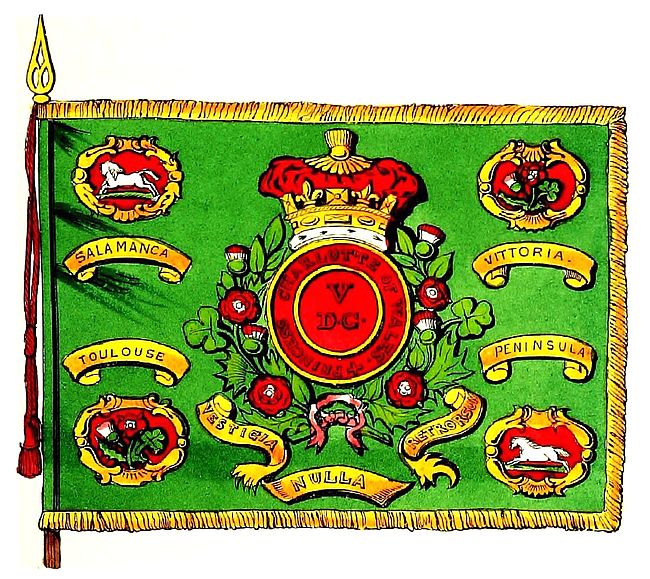
Standards.—The first, or King's standard, to
be of crimson damask, embroidered and fringed
with gold; the rose and thistle conjoined, and
crown over them in the centre; and underneath,
His Majesty's motto, Dieu et mon droit: the
white horse in a compartment in the first and
fourth corners, and
II
H
in gold characters, on a full
green ground, in a compartment in the second
and third corners. The second and third standards
to be of full green damask, embroidered and
fringed with gold; the rank of the regiment in
gold Roman characters on a crimson ground,
within a wreath of roses and thistles on the same
stalk, and the motto, Vestigia nulla retrorsum,
underneath: the white horse on a red ground in
the first and fourth compartments, and the rose
and thistle conjoined upon a red ground in the
second and third compartments.
Officers to be distinguished by narrow gold
lace or embroidery to the binding and button-holes
of their coats; sword knots of crimson and gold
in stripes; and crimson silk sashes worn over the
left shoulder.
1758
1759
1760
On the 23d of October, 1758, Lieutenant-General
Bligh was succeeded in the Colonelcy of
the regiment by Major-General the Honourable
John Waldegrave (afterwards Earl Waldegrave),
who was removed to the Second Dragoon Guards
in the following year. The Colonelcy appears to
have remained vacant from September, 1759, to
November, 1760, when it was conferred by King
George III. on Major-General the Honourable
John Fitz-William from the Second, or Queen's
Royal Regiment of Foot.
1762
Another war having commenced in 1756, between
Great Britain and France, a British army
was sent to Germany in 1758; the establishment
of this regiment was augmented to forty-nine
private men per troop; and in 1762 the
order prohibiting the regiment recruiting in Ireland
was rescinded.
1763
The success of the British arms in Canada, the
West Indies, and Germany, was followed by a
treaty of peace, and after the return of the cavalry
regiments from Germany, in the beginning of
1763, the establishment of the Second Irish
Horse was again reduced to twenty-one private
men per troop.
1776
1783
At this low establishment the regiment continued
until the breaking out of the unfortunate
contest between Great Britain and her North
American colonies, when an augmentation of ten
private men per troop was made to its numbers.
No further alteration appears to have been made
until the conclusion of the war, when, the independence
of the United States having been acknowledged,
its establishment was reduced to its
former numbers.
1788
At this establishment it continued until the
spring of 1788; when King George III., having
resolved to form the two troops of Life
Guards and two troops of Horse Grenadier
Guards into two regiments of Life Guards on a
similar establishment to that of the old regiments
of horse, and to reduce the four regiments of
horse on the Irish establishment to the pay of
dragoons, with the title of Dragoon Guards,
His Majesty's pleasure was communicated to the
regiments in Ireland, in a General Order dated
the 14th of February, 1788; and the Second
Irish Horse was thus constituted the Fifth
Dragoon Guards. In consequence of the regiment
being placed upon a decreased rate of pay,
compensation was given to the officers; to the
colonel 150l. per year; to the lieutenant-colonel a
gratuity of 575l.; to the major 525l.; captains,
each, 475l.; captain-lieutenant and lieutenants,
each, 350l.; and the cornets, each, 250l. Every
private man had the option of his discharge, or a
bounty of two guineas if he continued to serve.
Several alterations were made in the uniform of
the regiment. The officers were directed to wear
an epaulette on each shoulder. The flask-string
was removed from the pouch belt, and the width
of the belts reduced from four inches and a half to
three inches; and the equipment was assimilated,
in every particular, to that of the regiments of
dragoons.
The establishment was fixed at one colonel and
captain, one lieutenant-colonel and captain, one
major and captain, three captains, six lieutenants,
six cornets, one chaplain, one adjutant, one surgeon,
six troop quarter-masters, six serjeants,
twelve corporals, six trumpeters, one hundred and
fourteen private men, and six dismounted men.
The several alterations having been completed, the
change of establishment took place on the 1st of
April, 1788, and from this date the regiment has
borne the title of Fifth Dragoon Guards; but
the appellation of Green Horse has never been
entirely discontinued.
1789
1790
In the following year, the regiment lost its
colonel, General the Honourable John Fitz-William,
who was succeeded on the 27th of
August, 1789, by Lieutenant-General John
Douglas, from the Fourteenth Foot. Lieutenant-General
Douglas died on the 10th of November,
1790, and was succeeded by Major-General
Thomas Bland, from the Lieutenant-Colonelcy of
the Seventh Dragoons.
1793
After passing a period of nearly eighty years in
Ireland, the regiment, having previously had a
considerable augmentation made to its numbers,
was ordered to hold itself in readiness for foreign
service. This event was occasioned by the revolution
which had taken place in France, where a
party of republicans had seized the reins of government,
had imprisoned the royal family, and
had brought their sovereign to the scaffold; a proceeding
which disorganized the state of society in
one of the most civilized parts of the world,—gave
rise to the formation of a new dynasty,—removed
the basis on which the sovereign power
was established,—and involved the great European
states in a succession of destructive wars for a
period of more than twenty years. Great Britain
joined the confederacy against the regicide government
of France, and sent, in the spring of 1793,
a body of troops to the Netherlands, under the
command of His Royal Highness the Duke of
York. At the close of the summer, reinforcements
were sent to Flanders, and on the 18th and 19th
of September, the Fifth Dragoon Guards embarked
at Dublin for the same destination.
1794
After occupying winter quarters in Flanders,
the regiment took the field under the orders of
Lieutenant-Colonel the Honourable R. Taylor,
and entered on a scene of action in a part of
Europe where it had, nearly a century before, acquired
numerous honours under the great Marlborough,
and its conduct did not derogate from
its ancient reputation. It was first employed in the
attack of the enemy's post at Prêmont, on the
17th of April, 1794, but was not called upon to
charge; and it subsequently formed part of the
covering army during the siege of Landrécies.
While this siege was in progress, the British
troops, under the Duke of York, were encamped
at Cateau. On the morning of the 26th of April,
which was gloomy and dark, and a thick mist
covered the face of nature, the advance of an hostile
force was heard, but its movements could not
be discerned. At length, the rays of the sun revealed
the movements of a French force of thirty
thousand men, under Lieutenant-General Chapuy;
and a body of cavalry, of which the Fifth Dragoon
Guards formed part, was detached, under
Lieutenant-General Otto, against the enemy's left
flank, while a sharp attack was made on the
enemy's front. This movement was conducted
with great caution, the enemy's flank was turned,
the trumpets sounded a charge, and the British
horsemen rushed with irresistible fury upon the
ranks of the hostile legions. The French were
overthrown and defeated; their commander, Lieutenant-General
Chapuy, a number of officers and
men, and thirty-five pieces of cannon were captured,
and their flying divisions were pursued
with immense slaughter to the gates of Cambray.
The Duke of York passed the highest commendations
on the Fifth Dragoon Guards and other
troops detached against the enemy's left flank, and
declared they had "all acquired immortal honour
to themselves." His Royal Highness further
stated, "the conduct of the British cavalry was
beyond all praise." The loss of the regiment on
this occasion was nine men and twenty-three horses
killed; one officer, one quarter-master, eight men
and nine horses, wounded; four men and twenty-three
horses missing.
After the surrender of Landrécies, the British
forces took up a position in front of Tournay,
where they repulsed an attack of the enemy on the
10th of May. During the action, a favourable
opportunity presented itself for attacking the
enemy's right flank; Lieutenant-General Harcourt
was detached with sixteen squadrons of
British and two of Austrian cavalry, and attacked
the enemy with so much resolution and intrepidity,
that they immediately began their retreat, in the
course of which they were soon broken, and they
sustained great loss, including thirteen pieces of
cannon, and above four hundred officers and men
taken prisoners.
A combined attack was made on the French
positions on the 17th of May, but failed from some
of the columns not arriving in time at the posts
allotted to them.
On the 22nd of May, the French attacked the
British position in front of Tournay with an immense
force. The Fifth Dragoon Guards
were formed up ready for action on their camp
ground all the day; but the French did not
attack that part of the line; and they were repulsed
in their attempts in the other parts of the
field.
At length, the defeat of the Austrians having
rendered the position occupied by the British in
front of Tournay no longer tenable, the troops
were withdrawn, and the campaign degenerated
into a series of retreats, which were ably conducted
under numerous difficulties.
1795
During this short but eventful campaign the
British troops had maintained their ancient reputation;
but the army was not of sufficient numbers
to cope with the enormous masses of the enemy,
which darkened the land like a gloomy tempest.
In the retreat through Holland, and in the distresses
and privations of the winter campaign
amidst snow and ice, the Fifth Dragoon Guards
took part, and in the early part of 1795 they
arrived in Germany.
The regiment remained in Germany during the
following summer, and encamped in one of the
plains of the Duchy of Bremen, under the orders
of Major-General Sir David Dundas; and in November
it embarked for England.
1796
In October, 1796, the regiment proceeded to
Ireland, which country was in a state bordering on
open rebellion. The malcontents had entered into
arrangements with the republican government of
France, and a French armament was prepared,
under the orders of General Hoche, to assist the
Irish Roman Catholics in effecting their separation
from England, and in forming themselves into a
republic. On the 24th of December the French
fleet appeared in Bantry Bay; and the Fifth
Dragoon Guards were despatched by forced
marches to oppose the landing of the enemy. The
French fleet was, however, partly dispersed by a
storm, and the remainder returned to France without
attempting to land.
1797
In 1797 the regiment was encamped, with
several other corps, on the Curragh of Kildare,
and was there reviewed by Lieutenant-General
Sir David Dundas, who expressed, in orders, his
approbation of its discipline and appearance. Its
establishment at this period was seven hundred
officers and men.
1798
The disaffection which had so long prevailed
among the Roman Catholics in Ireland, had continued
to acquire additional rancour and vehemence,
and the passions of the misguided peasantry
having been wrought, by wicked demagogues, into
fury and madness, they neglected the affairs of civil
life, provided themselves with arms, and broke out
into open rebellion in the summer of 1798. The
Fifth Dragoon Guards were on Dublin duty at
the time, and were so distinguished for loyalty and
steady conduct that the Lord-Lieutenant committed
to the regiment the military charge of the capital.
One squadron under the command of Brevet
Lieutenant-Colonel Sherlock was detached from
Dublin into the counties of Wicklow and Wexford,
and was engaged in the action at Arklow on the 9th
of June, when thirty thousand insurgents, headed
by their priests in clerical vestments, attacked the
town with great fury, but were repulsed with the
loss of an immense number of men. From the
circumstance of there being no force of any consequence
to prevent the rebels marching upon the
capital, this was an action of the greatest importance,
and was most obstinately contested.
The same squadron was afterwards instrumental
in relieving the loyalists in the town of Ballycarnen,
where they were besieged by the rebels,
and had only a small party of militia to assist in the
defence of the place. The cavalry advanced with
great bravery, and was assailed by a sharp fire
from behind the fences, and a barrier of carts and
other vehicles formed across the road, which it was
found impossible to force by cavalry alone, and the
troops retired until a body of infantry arrived;
when the whole advanced,—routed the rebels, and
pursued them with great slaughter.
Lieutenant-Colonel Sherlock was afterwards
engaged with the squadron of the Fifth Dragoon
Guards under his orders, at Gorey, and charged
the rebels several times with success.
The same squadron was also engaged in the
action at Vinegar Hill,—the stronghold of the
rebels, where the most inhuman tragedies had been
committed on hundreds of Protestants. This post
was attacked on the 21st of June, and the insurgents
were routed with great slaughter and many
prisoners were captured. The squadron of the
Fifth Dragoon Guards charged and pursued
the rebels, and took many prisoners. It afterwards
overtook an insurgent corps near a place called
White Hills, where, after a sharp contest, the
rebels were routed, and they fled in all directions.
While these events were transpiring, another
detachment of the regiment was employed in the
county of Kildare, and had several skirmishes with
bands of insurgents.
A patrole of the regiment, commanded by Captain
Pack, proceeding towards Prosperous, encountered
one hundred rebels well mounted and equipped;
the Dragoon Guards instantly charged with signal
valour and intrepidity, routed their adversaries at
the first shock, killed twenty on the spot, and captured
eight horses.
When the rebellion was nearly suppressed, the
French endeavoured to revive the contest by sending
General Humbert with about a thousand men,
who landed at Killala on the 22d of August. The
Fifth Dragoon Guards marched from Dublin
to oppose the combined rebel and French forces,
and were attached to the column under the Marquis
of Cornwallis's command. The action at
Ballinamuck on the 8th of September followed;
the French surrendered themselves prisoners of war,
and the insurgents were dispersed. After the
action, the Marquis of Cornwallis selected a squadron
of the Fifth Dragoon Guards, commanded
by Captain (afterwards Sir William) Ponsonby, to
escort him on his return to Dublin.
1799
The rebellion in Ireland having been suppressed,
the Fifth Dragoon Guards were embarked in
1799, in order to join the expedition to Holland,
commanded by His Royal Highness the Duke of
York; but the order for their proceeding on this
service was countermanded, and after disembarking
at Liverpool, they marched into quarters in Herefordshire
and Gloucestershire.
1802
1803
After the conclusion of the Treaty of Amiens, a
reduction of two troops was made in the establishment;
but on the breaking out of the war in 1803,
the army was again augmented, and an addition of
two troops was again made to the strength of the
regiment.
1804
In the following year King George III. was
pleased to confer upon the regiment the distinguished
title of The Princess Charlotte of
Wales's Regiment of Dragoon Guards, in
honour of Her Royal Highness the Princess
Charlotte Carolina Augusta, daughter of George
William Frederick Prince of Wales (afterwards
George IV.), by Carolina Amelia Elizabeth,
second daughter of the Duke of Brunswick Wolfenbuttel.
The Princess Charlotte of Wales exhibited
in her early life a most amiable disposition with
excellent traits of character, and, being considered
as the future sovereign of Great Britain, the
nation saw in her qualities calculated to adorn the
throne, and to make a great and civilized people
happy; hence, the conferring of Her Royal Highness's
title on the regiment, was considered a
special mark of His Majesty's favour and approbation.
1805
1808
The regiment proceeded to Ireland in 1805, and
remained in that country until the summer of
1808, when it returned to England.
1811
On the 8th of July, 1811, His Royal Highness
the Prince of Wales, who was Regent of the
United Kingdom during the indisposition of King
George III., reviewed the regiment on Wimbledon
common, on which occasion it was commanded by
its Colonel, the veteran General Thomas Bland,
and the Prince Regent was graciously pleased to
express his approbation of its appearance, and of
the rapidity and brilliant execution of its movements;
and as the regiment was about to proceed
on foreign service, the most lively anticipations of
its achievements at the theatre of war were produced.
It was not, at this period, mounted on
horses of so heavy a description as formerly; but,
while it bore the title of a heavy cavalry regiment,
and retained sufficient weight for a powerful charge
in line, it had acquired a lightness which rendered
it available for every description of service. The
heavy cavalry corps which formerly constituted
so important a portion of the armies of England,
had been improved in efficiency and usefulness by
mounting them on horses of a lighter description.
The occasion of the Fifth Dragoon Guards
proceeding abroad at this period, was the attempt
made by that tyrannical power which had risen out
of the French revolution, of which Napoleon Bonaparte
had become the head, to subjugate the
kingdoms of Spain and Portugal: the inhabitants
of those countries were in arms against the usurper;
a British force commanded by Lord Wellington
had been sent to their aid; and this regiment was
one of the corps selected to reinforce the army
under his lordship's command.
Six troops of this regiment, amounting to five
hundred and forty-four officers and men, commanded
by Lieutenant-Colonel the Honourable
William Ponsonby, embarked at Portsmouth on
the 12th of August, and having landed at Lisbon
on the 4th of September, occupied quarters at
Belem about six weeks, and afterwards advanced
up the country. When the army went into quarters
for the winter, the Fifth Dragoon Guards
were stationed at Thomar.
1812
The army resumed operations in the beginning
of January, 1812, with the siege and capture of
Ciudad Rodrigo: and in March the Fifth Dragoon
Guards proceeded into the south of Spain
to watch the movements of Marshal Soult, and to
cover the siege of Badajoz. The regiment arrived,
with the remainder of its brigade (the Third and
Fourth Dragoons), at Borba, in the Alentejo, on
the 5th of March, crossed the Guadiana on the
15th, and formed the van of the covering army
until it arrived at the foot of an extensive chain of
mountains called the Sierra Morena. On the advance
of Marshal Soult, the covering army retired
upon Albuhera. The fortress of Badajoz was
captured by storm on the 6th of April; and in a
few days afterwards the regiment had an opportunity
of distinguishing itself in action with the
enemy. A large body of cavalry advanced upon
Llerena; the Fifth Dragoon Guards marched
on the 10th of April to Los Santos, and continued
their route during the night to Bienvenida,—proceeding
a distance of sixty miles without halting,
and the last four miles at a brisk pace, through a
country abounding with obstructions; then forming
with celerity, advanced through a grove of olive-trees,
beyond which a body of French cavalry, of
more than thrice the numbers of the regiment,
was formed up. The sight of so numerous an
enemy did not intimidate the Fifth Dragoon
Guards; but acted as a spur to their energies,
and excited them to exertions which evinced their
native valour and intrepidity, and occasioned them
to rival the deeds of their predecessors in the field
of glory. The fatigues of the previous march
were forgotten, and the gallant troopers charged
with such spirit and resolution, that the French
squadrons were broken, and being also attacked
by the light brigade, they retired in disorder
under cover of their infantry and artillery, leaving
behind about one hundred killed and wounded,
and one lieutenant-colonel, two captains, one
lieutenant, and one hundred and forty men prisoners,
also nearly one hundred horses. Actions
in which the numbers engaged are not very great,
do not produce, in their bearing on the affairs of
nations, very important results, hence they are
often overlooked, or but slightly noticed, by general
historians; yet on these occasions individual corps
often distinguish themselves in an eminent degree;
and the excellent conduct of the British cavalry at
Llerena, elicited the following orders:—
"Lafra, 12th April, 1812.
"Cavalry Orders.
"Lieutenant-General Sir Stapleton Cotton
begs Major-General Le Marchant and the Honourable
Lieutenant-Colonel Ponsonby will
accept his best thanks, for the gallant and judicious
manner in which they commanded their
brigades yesterday, and he requests they will
make known to the officers commanding regiments,
the lieutenant-general's high approbation
of their conduct, as well as of the zeal and attention
displayed by all ranks. The order which
was preserved by the troops in pursuing the
enemy, and the quickness with which they
formed after every attack, does infinite credit to
the commanding officers, and is a convincing
proof of the good discipline of the several regiments.
"The Lieutenant-General was very much satisfied
with the conduct of the Third and Fourth
Dragoons, in supporting the Fifth Dragoon
Guards and Major-General Anson's brigade.
"To Lieutenant-Colonel Elley, Sir Stapleton's
warmest thanks are due, for the great assistance
he derived from the zeal and activity displayed
by that officer; and the Lieutenant-General begs
that Captain White and Captain Baron Deckan
will accept his acknowledgments for the assistance
they afforded him yesterday. Sir Stapleton
Cotton has only to assure the cavalry that their
gallant and regular conduct yesterday has made
him, if possible, more proud than ever of the high
command entrusted to him.
"Stapleton Cotton,
"Lieutenant-General."
"Olivenza, 15th April, 1812.
"Brigade Orders.
"Major-General Le Marchant has great satisfaction
in conveying to his brigade the approbation
and thanks of Lieutenant-General Sir
Stapleton Cotton commanding the cavalry, for
their gallant conduct near Llerena on the 11th
instant.
"Whilst the Major-General is perfectly satisfied
with the zeal shown by every individual of the
brigade in the execution of his duty on that
occasion, he considers that the charge made by
the Fifth Dragoon Guards deserves his particular
admiration and approval, and he requests
that Major Prescott and the officers of that
corps will accept his best thanks, as well for their
services as for the credit which their gallant
conduct reflects on the command which he has
the honour to hold.
"T. Hutchins,
"Brigade-Major."
These orders were forwarded to the depôt of the
regiment in England, to be inserted in the records,
accompanied by a letter, of which the following is
an extract:—
"Crato, Portugal, 7th May, 1812.
"Sir,—I have great pleasure in communicating
to you, by direction of Colonel Ponsonby, the
cavalry and brigade orders issued on a late occasion,
when the Fifth Dragoon Guards attacked
a very superior enemy, and forced him to retire
with the loss of about one hundred killed and
wounded, besides one lieutenant-colonel, two
captains, one lieutenant, and one hundred and
forty men taken prisoners, with near one hundred
horses. This affair presents a pledge of
the future good conduct of the regiment whenever
an opportunity again appears of meeting the
enemy, and must be peculiarly gratifying to
you and to the remainder of the corps at the
depôt in England, to hear from such undoubted
authority, that the regiment still continues to
support that high character which it gained on
many former glorious occasions, and in our
estimation this last is not the least:—the regiment
having, previous to the attack on three
times its numbers of the enemy's best cavalry,
made a forced march of upwards of sixty miles
without halting,—four of the last of which was
at a very brisk pace, through a difficult country,
over rocks, ravines, and stone walls; then forming
with unexampled celerity, and charging with
equal and regular rapidity through a grove of
olive-trees until it came in contact with the
enemy, who retired in great disorder under the
cover of his infantry and guns. Our loss in this
brilliant affair was comparatively trifling, as
will be seen by the subjoined statement of the
names of the brave men who fell.
"W. Jackson,
"Adjutant."
Thus the Dragoon Guards of the nineteenth
century are found rivalling the celebrated heavy
Horse of the preceding ages. The regiment lost,
on this occasion, one corporal and fourteen private
men killed; Major Prescot, Lieutenant Walker,
three serjeants, one corporal, and twenty-one private
men wounded.
A detachment of the Fifth Dragoon Guards
escorted the prisoners captured on this occasion to
the fortress of Elvas in Portugal. The regiment
afterwards marched to Crato.
Advancing from Crato into Spain, the Fifth
Dragoon Guards took part in the movements
by which the French were driven from Salamanca,
and the forts at that city were besieged and captured.
After the capture of the forts, the regiment
advanced upon Toro, but was subsequently ordered
to retire to Alaejos to support a body of troops,
under Lieutenant-General Sir Stapleton Cotton,
posted on the Trabancos; and several retrograde
movements followed, which were succeeded by the
battle of Salamanca. During the night before
this eventful day, while the regiment was dismounted,
a violent storm occurred. The thunder
rolled with tremendous violence over the heads of
the men and horses; the lightning played in sheets
of fire and shed its blazing gleams upon the polished
arms; and the rain fell in torrents. One
flash fell among the Fifth Dragoon Guards;
the terrified horses breaking loose galloped wildly
about in the dark, and every additional clap of
thunder and blaze of lightning augmented the confusion.
Twenty men of the regiment were trampled
down and disabled, and several horses escaped
into the French lines.
On the morning of the memorable 22d of July,
the Fifth Dragoon Guards, commanded by
Colonel the Honourable William Ponsonby, moved
from their bivouac and formed in the rear of the
centre of the position occupied by the allied army.
While the French commander was manœuvring,
Lord Wellington took advantage of an injudicious
movement, and ordered his divisions forward to
attack their adversaries, when the Fifth Dragoon
Guards took ground to their right, passed the
village of Arapiles, and advancing in support of
the third and fifth divisions, were exposed to a
heavy cannonade. The French army, being attacked
at the moment it was making a complicated
evolution, was unable to withstand the British
forces; in a short time, a favourable opportunity
for a charge of the heavy cavalry occurred, and
the Fifth Dragoon Guards, and Third and
Fourth Dragoons, were ordered to attack.[10] The
bugles sounded; the brigade moved forward, increasing
its pace, with Major-General Le Marchant
at its head, and a most animated scene presented
itself. The din of battle was heard on
every side; clouds of dust and rising columns of
smoke darkened the air, and enveloped the foaming
squadrons as they dashed forward and shook the
ground with their trampling hoofs. In front, the
glittering bayonets and waving colours of French
infantry were dimly seen through the thickened
atmosphere; these formidable ranks of war were,
in an instant, broken and overthrown by the
terrific charge of this brigade; the resolute
troopers, mingling with their discomfited antagonists,
cut them down with a dreadful carnage,
while the British infantry raised shouts of triumph
and applause at the success of the cavalry, and
numbers of the enemy laid down their arms, and
surrendered prisoners of war. Major-General Le
Marchant was shot through the body, which terminated
the career of that gallant and talented
officer; the command of the brigade devolved
on the brave Colonel the Honourable William
Ponsonby of the Fifth Dragoon Guards,
and the officers and men of the regiment,
emulating the heroic fire and energy of their
favourite leader, performed deeds of valour
worthy the high character of their corps. Having
subdued one body of infantry, they continued
their career through a wood in their front
without waiting to re-form their ranks; another
formidable mass of fresh adversaries presented itself;
the undaunted heavy horsemen, conscious of
their power, flushed with success, stimulated to
new energies by seeing Lieutenant-General Sir
Stapleton Cotton and his staff at their head,
rushed forward with reckless fury; though assailed
by a volley of musketry, which proved fatal to
many, the survivors passed through the curling
smoke, scarcely seeming to touch the ground, and
the next moment the French column was broken
with a dreadful crash. That mass of infantry, a
moment before so menacing and conspicuous, was
become a confused rabble, while the victorious
troopers, exulting in uncontrollable might, trampled
down and plunged their horses through the
enemy's ranks, sabring their dismayed adversaries,
and producing havoc and confusion on every
hand.[11] Five guns and more than two thousand prisoners
were captured, and a division of French infantry
was destroyed; two guns were seized by
the Fifth Dragoon Guards, and sent to the
rear immediately after they broke through the
enemy's ranks. Such were the splendid results
of this gallant and dreadful charge, in which the
weight, prowess, and daring impetuosity of the
Fifth Dragoon Guards, and Third and Fourth
Dragoons, seconded by the light brigade, proved
irresistible, and contributed materially in deciding
the fortune of a battle in which the French army
sustained a decisive overthrow, and eleven guns
and two eagles remained in possession of the conquerors.
The British commander stated in his
public despatch,—"The cavalry, under Sir Stapleton
Cotton, made a most gallant and successful
charge upon a body of French infantry,
which they overthrew and cut to pieces:" Colonel
the Honourable William Ponsonby was presented
with a gold medal for his conduct as commanding
officer; and the regiment was afterwards
rewarded with the honour of bearing the word
Salamanca on its standards and appointments.
Its loss was Captain Osborne, two serjeants, one
corporal, and twelve private men killed; Lieutenant
Christie, one serjeant, one corporal, and
fourteen private men wounded.
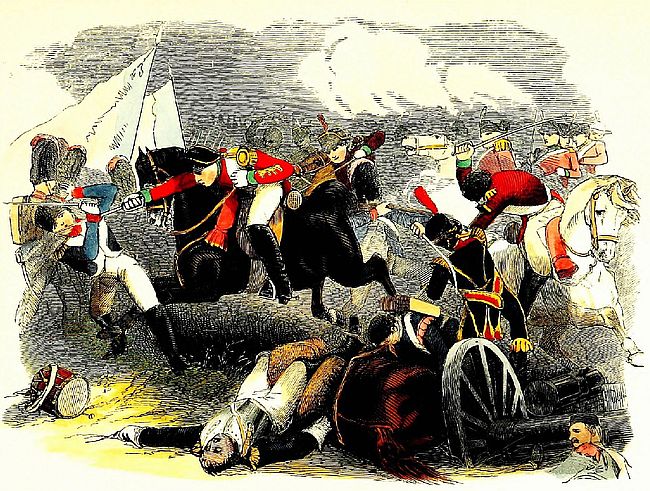
FIFTH (THE PRINCESS CHARLOTTE OF WALES'S) REGIMENT OF DRAGOON GUARDS,
At the Battle of Salamanca, 22nd July, 1812.
[To face page 60.
The left squadron of the Fifth Dragoon
Guards was attached to Major-General Bock's
brigade of heavy German cavalry, and sent in
pursuit of the wreck of the French army, which
retreated by Alba upon Valladolid; the French
rear-guard was overtaken about three leagues beyond
Alba de Tormes, a sharp engagement
ensued, and about nine hundred prisoners were
captured.
Colonel the Honourable William Ponsonby, of
the Fifth Dragoon Guards, having been appointed
to the staff of the army, and to the command of
the heavy cavalry brigade, issued the following
order on the subject:—
"Camp near Flores de Avila,
25th July, 1812.
"Regimental Orders,
"His Excellency, the commander of the forces,
having been pleased to appoint Colonel Ponsonby
to the staff of this army, and to the distinguished
honour of commanding this brigade,
Major Prescott will be pleased to take upon
himself the command of the regiment.
"The Fifth Dragoon Guards well know
how highly Colonel Ponsonby has always
prized the honour of commanding them; and if
the pride he has long felt in the command of
a regiment deservedly of such high character
admitted of augmentation, its most gallant and
glorious achievements in the field, as well as its
soldier-like conduct in quarters, since its arrival
in this country, could not fail to enhance it.
He assures the officers and men of the regiment,
that it is now with considerable regret he takes
his leave of them as their regimental commanding
officer, although in the course of professional
promotion; and he requests Major Prescott,
the officers, non-commissioned officers, and the
whole of the regiment, will accept his warm and
sincere thanks for the past, as well as his heartfelt
and anxious good wishes for the future.
May the Fifth Dragoon Guards long continue
to be ranked as second to none in His Majesty's
service."
The regiment accompanied the army in the
subsequent movements, and in the advance upon
the capital of Spain; and it formed part of the
personal escort of the Marquis of Wellington
when he entered Madrid on the 12th of August;
it was formed up at the Segovia-gate, when his
lordship received the keys from the municipality.
The Fifth Dragoon Guards entered the city
amidst the acclamations of the inhabitants, and
occupied quarters there until the 18th of August.
Leaving the metropolis of Spain to engage in
operations against the French army, the regiment
proceeded to St. Ildefonso, remained there a few
days, and afterwards proceeded to the vicinity of
Burgos, where the enemy was found in position
on the 17th of September. The Fifth Dragoon
Guards, and Third and Fourth Dragoons, were
ordered to the front, and dispositions were made
for the attack; but the French commander withdrew
his forces, leaving a strong garrison in the
castle of Burgos. This fortress was besieged,
and the regiment, forming part of the covering
army, was stationed at Villamar, the head quarters
of the cavalry. On the 19th of October, the
enemy attempted to relieve the besieged, and
attacked and carried the village of Quintanapalla;
the left wing of infantry and Fifth Dragoon
Guards, and Third and Fourth Dragoons, advanced
to retake the village, but on the approach
of this force the French retreated.
At length, the movements of the superior numbers
of the enemy, rendered it necessary for the
main army to unite with the forces under Lieutenant-General
Sir Rowland Hill, and a retreat was
resolved upon. Withdrawing from Burgos with
great secrecy on the night of the 21st of October,
the army commenced its celebrated retreat to the
frontiers of Portugal, which was performed under
peculiar difficulties, and in presence of an immense
superiority of numbers, with the same signal
ability which distinguished all the operations of
the British commander, who evinced, on many
occasions during this war, the sublimity of military
talent.
On the 23rd of October, the army continued its
retreat in two columns; the Fifth Dragoon
Guards, and Third and Fourth Dragoons, covering
the retreat of the column from Hormillos; the
enemy menaced the rear with an immense force of
cavalry, but was unable to make a serious impression,
and the British troops bivouacked that night
on the hills above Cordovilla. Resuming the
march an hour before daylight on the following
morning, the column passed the bridge of Cordovilla
and crossed the Carrion, covered by Colonel
Ponsonby's brigade, and the head quarters were
established at Duenas, from whence two squadrons
of the Fifth Dragoon Guards and Third Dragoons
were detached, to cover the working parties
employed in mining the bridges of Palencia for
destruction; but the French advancing in great
force gained possession of the bridges in an unbroken
state. On the 26th the army resumed its
retrograde movement, crossed the Pisuerga at
Cabeçon, and occupied that town and its vicinity
until the 29th, when it again retired, and, having
crossed the Douro, occupied a position beyond that
river several days. On the 6th of November the
army retreated on Salamanca; on the 15th it resumed
its march, and having crossed the Agueda,
proceeded into quarters in Portugal. The Fifth
Dragoon Guards halted eight days at Gallegos,
in the province of Biera, and afterwards proceeded
to Ervidal, where they remained until the 28th of
December, and subsequently marched to Goes.
Thus ended this eventful campaign, in which the
allied army, after capturing the two important
fortresses of Ciudad Rodrigo and Badajoz, gaining
the glorious victory of Salamanca, and penetrating
to the metropolis of Spain, was forced, by the
superior number of the enemy's concentrated
forces, to return to its former posts. The gigantic
power to which the French revolution had given
birth was, however, on the eve of being broken;
Bonaparte, the tyrant of Europe, had resolved on
the fatal expedition to Russia, where he lost a
powerful army in the snow, and the victory at
Salamanca was the precursor of greater triumphs
over the disturbers of christendom. The immense
distance marched by the Fifth Dragoon Guards
during the year 1812, with the scarcity of forage
and constant exposure to every description of
weather, occasioned the loss of many horses; it
has been computed that the regiment marched
about two thousand miles within twelve
months.
1813
The regiment was again in motion in February,
1813, and having taken post at Viride, in the
valley of the Mondego, occupied that station until
the middle of April, when it proceeded to Guimarers,
and halted there seventeen days.
In May the army commenced operations with
a prospect of more splendid results than on any
former occasion; and Colonel Ponsonby's brigade,
which still consisted of the Fifth Dragoon
Guards, and Third and Fourth Dragoons, traversed
the wild and mountainous country of Trasos-Montes,
and crossed the Esla on the 26th of
May. The enemy, no longer possessing that
superiority of numbers by which he had formerly
gained so many advantages, abandoned the line of
the Douro; Ponsonby's brigade directed its march
on Valencia, passed that town, and advanced on
Burgos. On the 12th of June, the brigade overtook
the enemy's rear-guard on the heights of
Estepar, when the Third Dragoons were detached
to cut off part of the enemy's force, in which they
succeeded, and Captain Miles, of the Fourteenth
Dragoons, charging, took some prisoners and one
gun. During the succeeding night, the French
blew up the castle of Burgos, and retired behind
the Ebro. Colonel Ponsonby's brigade moved to
the left, and after traversing a romantic tract of
country, over mountains and rugged precipices,
crossed the Ebro on the 15th of June, and advanced
on Vittoria, where the enemy concentrated
his forces and took up a defensive position.
At day-break, on the morning of the 21st of June,
the allied army advanced against the enemy, and the
Fifth Dragoon Guards supported the columns
of attack. The British infantry dislodged their
adversaries from the several eminences and strong
posts at the point of the bayonet, and being supported
and sustained by the cavalry, forced the
enemy, after a dreadful slaughter had taken place,
to retreat with the loss of his guns, ammunition,
and baggage. The cavalry, having been prevented
by the nature of the ground from charging during
the early part of the day, was enabled to dash forward
towards the close of the action, and to complete
the rout and discomfiture of the French
army. The Fifth Dragoon Guards had only
one man wounded on this occasion. Their gallant
bearing throughout the day, procured them the
honour of displaying the word Vittoria on their
standards and appointments, and their commanding
officer, Lieutenant-Colonel Prescott, was rewarded
with a gold medal. The brigade continued
the pursuit of the enemy on the following day, and
on the 27th of June was detached, to endeavour to
intercept the retreat of a division of the French
army, under General Clausel; but this body of
troops escaped to France by the pass of Jaca.
The Fifth Dragoon Guards had advanced to
Tafalla, where they remained fourteen days, when,
forage becoming scarce, they proceeded to Miranda.
In the mean time, the infantry having
blockaded Pampeluna, penetrated the Pyrenean
mountains. Marshal Soult advanced to relieve
Pampeluna, when these celebrated mountains became
the scene of several fierce and deadly contests
between the English and French infantry, and
the cavalry were ordered forward in support. The
Fifth Dragoon Guards left Mirando on the
26th of July, and were formed up at the foot of
the Pyrenees during the actions in the mountains
towards the end of the month, when the French
were defeated and forced to retire with great loss.
The heavy cavalry not being required in the
mountain operations of the army, the Fifth
Dragoon Guards marched to Estella, a city of
Navarre, where they arrived on the 11th of
August, and remained until the 27th of December,
when, forage becoming scarce, they proceeded
to the plains of Vittoria, and occupied Guérena
and adjacent villages.
1814
Towards the end of February, 1814, the Fifth
Dragoon Guards again advanced. After passing
through the Pyrenean mountains, they entered
France, and followed the route of the French
troops retreating on Bayonne. On the 19th of
March, the army, under Marshal Soult, was discovered
in position near Tarbes, when a division
of infantry and Major-General Ponsonby's brigade
of cavalry were ordered to turn the enemy's right
flank at Rabastens, but the French, being thus
threatened, retired. Following the rear of the
French army, the brigade crossed the Garonne, on
a pontoon bridge, at St. Roques, on the 31st of
March, and seized the bridge on the Arriege, at
Cintagabelle; but the roads were found so bad in
this direction, that the troops were recalled, and
the pontoon bridge being removed to Grenade, the
brigade passed the river on the 4th of April, took
post at Grissolles, and placed a strong picquet on
the road to Montauban.
In the mean time, the French army had taken
up a strong position to cover Toulouse, where they
were attacked by the allied army on the 10th of
April. The infantry attacked the enemy's entrenchments
with their usual intrepidity. The
cavalry brigade, consisting of the Fifth Dragoon
Guards, and Third and Fourth Dragoons, was
commanded on this occasion by Lieutenant-Colonel
Lord Charles Manners; it was employed in supporting
the Spanish forces, and, by its firm countenance,
it enabled them, after having been thrown
into some confusion, to rally and re-form their
broken ranks. It also saved the Portuguese guns
from being captured by the French, and subsequently
supported Lieutenant-General Clinton's
division: at length, the enemy was driven from his
works, and forced to take shelter in the town.
The Fifth Dragoon Guards had one corporal
killed and Cornet Lucas wounded; and their services
on this occasion were rewarded with the
honour of bearing the word Toulouse on their
standards and appointments.
Shortly after this victory hostilities were terminated,
by the removal of Buonaparte from the
throne of France, and the restoration of the Bourbon
dynasty. Thus ended the toils and conflicts
of this destructive war, and the Fifth Dragoon
Guards, after traversing kingdoms, enduring privations,
and gaining victories, had the gratification
of witnessing the restoration of peace. The
French forces, after fighting to add province to
province, and kingdom to kingdom, to found new
empires upon the ruins of conquered states, to subject
mankind to the tyranny of a lawless despot,
saw their hopes blasted, their conquests wrested
from them, their country invaded and subject to
the power of foreigners; but the British army,
which fought under the immortal Wellington for the
good of Europe,—for the welfare of other nations,
preserved its own country from the horrors of
war, and had the glory of conquering to establish
the peace of Christendom.
The Fifth Dragoon Guards remained in
cantonments until the 1st of June, when, having
sent their dismounted men and heavy baggage to
Bourdeaux, they commenced their march for Boulogne.[12]
This long march, from one extremity of
France to another, was performed in the short
period of six weeks; and, previous to embarking,
Major-General Ponsonby expressed to the three
regiments in brigade orders, "the high sense he
entertained of their uniformly excellent conduct
both in quarters and in the field:" adding, "It
is a gratifying circumstance that, during the
whole period of service, they have, in no instance,
individually or collectively, incurred animadversion
in general orders; that no individual of the
brigade has been brought before a general court
martial; and that not one instance has occurred
(to the major-general's knowledge) of interior
disagreement in the brigade. With equal truth
the major-general can assert, that upon every
occasion which has presented itself of acting
against the enemy, whether regimentally or in
brigade, they have nobly sustained the superiority
of the British cavalry, and fully justified the high
opinion so repeatedly expressed with regard to
them by his Grace the Duke of Wellington.
The three regiments will ever have to congratulate
themselves on its having fallen to their lot to
be the brigade employed in that glorious and
effectual charge, which contributed in so eminent
a degree to decide the fate of the day at Salamanca,
and to secure the signal and complete
defeat of the French army. It only remains for
the major-general to declare his satisfaction at
the exemplary conduct of the brigade during
the march through France; and he concludes
by requesting that Lieutenant-Colonel Lord
Charles Manners, Lieutenant-Colonel Prescott,
and Major Hugonin, will themselves accept,
and have the goodness to communicate to the
regiments under their respective commands, his
best and warmest thanks for their zealous and
steady services during the time he has had the
honour of commanding the brigade, together
with his earnest and sincere good wishes for
their future welfare. He also requests Brigade-Major
Hill will accept his best thanks for the
zeal and assiduous attention with which he has
discharged the duties of his situation."
The Fifth Dragoon Guards embarked at
Boulogne on the 17th and 18th of July, landed at
Dover on the 19th and 20th, and marched from
thence to Woodbridge barracks, where the depôt
and heavy baggage joined from Canterbury, and a
reduction of two troops was made in the establishment.
In October the regiment marched to
Ipswich and adjacents.
1815
In April, 1815, "His Royal Highness the
Prince Regent was pleased, in the name and on
the behalf of His Majesty, to approve of the
Fifth, or Princess Charlotte of Wales's
Regiment of Dragoon Guards, being permitted
to bear on its standards and appointments
(in addition to any other badges or devices
which may have been heretofore granted to the
regiment), the word 'Peninsula,' in commemoration
of its services during the late war in Portugal,
Spain, and France, under the command
of Field-Marshal the Duke of Wellington."
On the 8th of April, the regiment marched to
Nottingham, Coventry, Northampton, and Leicester;
and the return of Napoleon Buonaparte to
France, in breach of the treaty of 1814, having
occasioned a declaration of war, six troops were
ordered to be held in readiness for foreign service;
but, to the great regret of the officers and men,
who panted for another opportunity of signalizing
themselves under the Duke of Wellington, the
order was subsequently countermanded in consequence
of the number of young and untrained
horses in the regiment.
In June, the officers and men of the Fifth
Dragoon Guards received the painful intelligence
of the fall of Major-General Sir William
Ponsonby, G.C.B., at the battle of Waterloo.[13]
In July, the regiment marched to York, Sheffield,
Leeds, Huddersfield, and Newcastle-upon-Tyne:
in September, the several troops proceeded
to Newcastle, in consequence of the riotous conduct
of the seamen in the ports of that neighbourhood.
1816
In January, 1816, the regiment occupied Newcastle,
York, Carlisle, Penrith, and Whitehaven;
during the summer, it proceeded to Ireland, and,
arriving at Dublin towards the end of August,
remained on duty in that garrison six months.
General Bland died at Isleworth on the 14th of
October, 1816; and on the 18th of that month,
His Royal Highness Prince Leopold of Saxe-Coburg
of Saalfield, K.G., G.C.B., G.C.H., was
appointed Colonel of the Fifth, or Princess
Charlotte of Wales's Regiment of Dragoon
Guards.
1817
The regiment left Ireland in February, 1817,
and proceeded to Scotland, where it remained
until the autumn; and, on its arrival in England,
it occupied Ipswich, Norwich, &c.
The Princess Charlotte of Wales died on
the 6th of November of this year, but the title of
the regiment is continued, in honour of the memory
of that amiable Princess.
1818
1819
1820
In July, 1818, the regiment proceeded to
York, where the establishment was reduced to fifty
men and thirty-four horses per troop; in the summer
of 1819, it marched to Birmingham, Coventry,
and Wolverhampton; in April, 1820, to Manchester,[14]
Oldham, and Ashton; and in August of the
same year, to York, Leeds, and Huddersfield.
On the 3rd of September a communication was
received from Major-General Sir John Byng commanding
the northern district, enclosing a letter
from the Military Secretary, wherein it was stated
that "His Royal Highness the commander-in-chief
approved highly of the general good conduct,
loyalty, and steadiness of the regiment, of which
favourable report was made to His Royal Highness
from all quarters."
1821
In April, 1821, the Fifth Dragoon Guards
marched to Scotland, and occupied Hamilton,
Glasgow, and Paisley: in August the regiment
proceeded to Ireland, and was quartered at Belfast,
Belturbet, Sligo, Enniskillen, and Dundalk; at
the same time a reduction of two troops was made
in the establishment, leaving the numbers six
troops, of three officers, fifty-five men, and forty-two
troop-horses each.
1822
1823
1824
The regiment marched to Porto Bello barracks,
Dublin, in July, 1822; from thence to Ballinrobe,
Gort, Loughrea, Athlone, Roscommon, and Dunmore,
in May, 1823: and in July, 1824, to Dundalk
and Belturbet.
1825
The regiment left Ireland in April, 1825, and
proceeding to Scotland, was stationed at Glasgow
and Hamilton.
1826
Leaving Scotland in the spring of 1826, the
regiment proceeded to York and Newcastle-upon-Tyne,
with a detachment on revenue duty at
Beverley. In April the regiment was ordered
into the manufacturing districts of Yorkshire, in
consequence of some disturbance amongst the
operatives, but returned to York in June.
1827
In February, 1827, the regiment proceeded to
Leeds, Rochdale, and Sheffield.
1828
1829
In May, 1828, the regiment marched to Dorchester,
Weymouth, Troubridge, and Christ
Church, with detached parties on coast duty, and
in the following summer it proceeded to Canterbury.
1830
Leaving Canterbury in April, 1830, the regiment
marched to Coventry and Birmingham. In
July of the same year His Majesty, King William
IV., was pleased to command that the Fifth
Dragoon Guards should proceed to Windsor,
to undertake the duties usually performed by the
household cavalry; and, shortly after their arrival
there, they were inspected by Field Marshal
Prince Leopold of Saxe-Coburg, when his Royal
Highness expressed himself much gratified with
the excellent appearance and discipline of his corps.
On the 14th of August the Fifth Dragoon
Guards, commanded by Prince Leopold in person,
were reviewed in the barrack square at Windsor,
by his Majesty King William IV., accompanied
by the Queen and other members of the royal
family. His Majesty having made a minute inspection
of the regiment, was pleased to express
his high approbation of its martial appearance and
efficiency: and the officers were then severally presented
to the King, by Prince Leopold. After the
review their Majesties, with the other members of
the royal family and distinguished personages present,
partook of a déjeuné prepared by order of
Prince Leopold, under tents on the green, and in
the officers' mess-room.
His Majesty, accompanied by Lord Hill (the
general commanding-in-chief) inspected the Fifth
Dragoon Guards in the great quadrangle at
Windsor Castle, on the 29th of August, and again
expressed his royal approbation of their appearance
and discipline.
In October of the same year the regiment
marched to Maidstone and adjacent places. In the
following month the head quarters proceeded to
Tunbridge Wells, and, in consequence of the
riotous conduct of the agricultural labourers in
Sussex, the remainder of the corps was dispersed
in various parts of that county. In December the
head quarters proceeded to Brighton, and occupied
the cavalry barrack at that town during His
Majesty's residence at the Royal Pavilion.
1831
Prince Leopold of Saxe-Coburg having been
elected king of the Belgians, resigned the commission
of Colonel of the Fifth Dragoon Guards,
and King William IV. was graciously pleased to
confer that appointment on Lieutenant-General
Sir John Slade, Bart. G.C.H., by commission,
dated 20th July, 1831.
1834
The regiment embarked at Bristol on the 17th
April, 1831, and landed at Dublin on the following
day. It continued on duty at various stations
in Ireland until April, 1834, when it again returned
to England, disembarked at Liverpool on the 22d
of that month, and was stationed for one year at
Manchester.
1835
1836
1837
1838
In May, 1835, the regiment proceeded to Scotland,
from whence it returned in the following year,
and was stationed at Leeds; in April, 1837,
its head-quarters were established at Birmingham;
and in May, 1838, at York.
The foregoing pages contain an account of the
services of the Fifth Dragoon Guards to the
termination of the year 1838, and its record bears
ample testimony to the zeal and bravery which
have been evinced by this distinguished corps on
occasions when it has had an opportunity to attest
its valour in presence of a foreign enemy.
Its noble and gallant conduct, as a regiment of
Horse, at the battle of the Boyne in 1690;—at
the heights of Schellenberg;—also at the memorable
battle of Blenheim, where the French and
Bavarian armies were nearly destroyed, and their
commander, standards, and colours were captured,
in 1704;—its heroic achievements in 1705 at the
forcing of the French lines at Helixem and Neer-Hespen,
where it captured the standards of the
Bavarian horse-guards;—the glorious part it took
in annihilating one of the finest and best appointed
armies France ever brought into the field,
at Ramilies in 1706;—its intrepid bearing, as a
corps of Cuirassiers, in 1708 in the field at
Oudenarde, and in the action at Wynendale;—the
valour it displayed in close combat with the
French household troops at the sanguinary battle
of Malplaquet in 1709;—the ardour it evinced
in the movements and skirmishes which led to the
capture of the fortress of Bouchain in 1711;—its
gallantry as a corps of Dragoon Guards in
1794 at the battle of Cateau, where the French
commander, many officers and men, and thirty-five
pieces of cannon were captured;—its brilliant
charge at Llerena;—its victorious career on the
plains of Salamanca in 1812;—its spirited conduct
at Vittoria in 1813;—and at Toulouse in
1814;—the eminent qualities it displayed on these
and other occasions, as set forth in the public despatches
and national records, afford most honourable
proof that the Fifth Regiment of Dragoon
Guards has never lost sight of the ancient motto
on its standards Vestigia nulla retrorsum.
The conduct of the regiment on home, as well as
on foreign service, has, on all occasions, been such
as to evince its usefulness, efficiency, and constant
readiness to support the honour and dignity of the
crown, and the prosperity of the country; thus
holding forth a bright example to stimulate to good
conduct the soldiers of the present and future
ages, under all the circumstances of service in
which the calls of their sovereign and country
may occasion them to be placed.