OF
THE TENTH,
OR
THE NORTH LINCOLNSHIRE
REGIMENT OF FOOT.
1661
to
1684
After the Restoration, when King Charles II. had
disbanded the army of the commonwealth, a small
military force was embodied under the title of "guards
and garrisons;" one of the independent companies of
infantry incorporated for garrison duty was commanded
by that distinguished nobleman, John, Earl of Bath,
who had evinced fidelity and attachment to the royal
cause in the rebellion in the reign of King Charles I.,
and during the usurpations of Cromwell; this company
was stationed in the fortress of Plymouth, of which the
Earl of Bath was governor, and it was the nucleus
of the regiment which forms the subject of this memoir.
1685
In June, 1685, when James, Duke of Monmouth,
had landed in the West of England, with a band of
armed followers from the Netherlands, and erected the
standard of rebellion, commissions were issued, by King
James II., for raising eleven companies of foot, of one
hundred private soldiers each, which companies were
united to the Plymouth independent garrison company,
and constituted a regiment, of which the Earl of Bath
was appointed colonel, by commission dated the 20th
of June, 1685, and the corps thus formed now bears the
title of "The Tenth Regiment of Foot."
These eleven companies were raised in Derbyshire
and Nottinghamshire; the town of Derby being the
general rendezvous of the corps; and they were raised
under the authority of royal warrants, bearing date the
20th of June, by the following gentlemen, who evinced
their loyalty by coming forward to the support of the
crown at that important crisis:—viz., Colonel, John,
Earl of Bath; Lieut.-Colonel, Sir Nicholas Stannings;
Major, Sir Charles Carney; Captains,
Michael Bourk, Charles Powell, Sir Thomas
Windham, Edward Scott, Bernard Strode, John
Sydenham, Francis Vivian, and Sydney Godolphin.
After the suppression of this rebellion, many newly
raised corps were disbanded, and the Earl of
Bath's regiment was reduced to ten companies of fifty
private soldiers each.
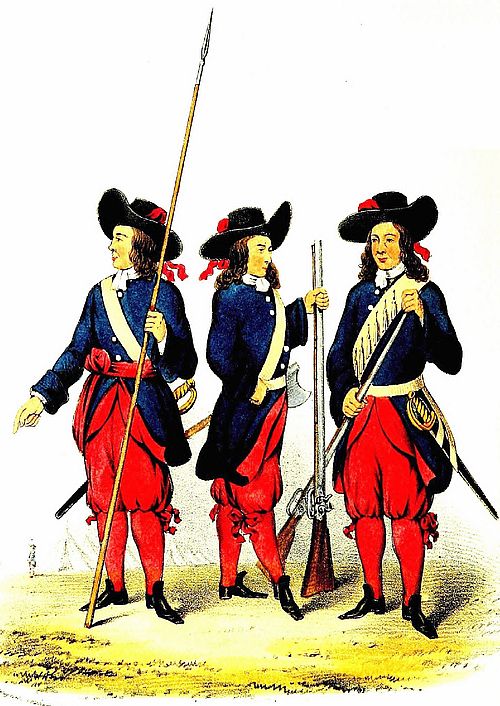
The regiment was armed with muskets and pikes;
the uniform was blue, coats lined with red, red waistcoats,
breeches, and stockings; round hats with broad
brims, the brim turned up on one side and ornamented
with red ribands; the pikemen wore red worsted sashes.
This was the only infantry regiment clothed in blue
coats; the other corps wore red coats; red had been
generally worn by the English soldiers from the time
of Queen Elizabeth; but several of Cromwell's regiments
were clothed in blue, and King Charles II. clothed the
royal regiment of horse guards in blue, and a regiment
of marines, raised in his reign, in yellow. A few years
after the revolution in 1688, the Tenth were clothed
in red.
In August, 1685, the Earl of Bath's regiment
marched from Derby to Hounslow, and encamped upon
the heath, where it was reviewed by the King, and
afterwards marched to Plymouth, to relieve the Queen
Dowager's regiment, now second foot.
1686
The following statement of the numbers and rates of
pay is copied from the establishment of the army, under
the sign manual, dated the 1st of January, 1686.
| | | | |
| The Earl of Bath's Regiment. | Pay per day. |
| | | | |
| | | | |
| Staff. | £. | s. | d. |
| 1 | Colonel, as Colonel | 0 | 12 | 0 |
| 1 | Lieut.-Colonel, as Lieut.-Colonel | 0 | 7 | 0 |
| 1 | Major, as Major | 0 | 5 | 0 |
| 1 | Chaplain | 0 | 6 | 8 |
| 1 | Chirurgeon, ivs. 1 Mate, iis. vid. | 0 | 6 | 6 |
| 1 | Adjutant | 0 | 4 | 0 |
| 1 | Quarter-Master and Marshal | 0 | 4 | 0 |
| | | | |
| Total for Staff | 2 | 5 | 2 |
| | | | |
| The Colonel's Company. | | | |
| The Colonel, as Captain | 0 | 8 | 0 |
| 1 | Lieutenant | 0 | 4 | 0 |
| 1 | Ensign | 0 | 3 | 0 |
| 2 | Serjeants, xviiid. each | 0 | 3 | 0 |
| 3 | Corporals, is. each | 0 | 3 | 0 |
| 1 | Drummer | 0 | 1 | 0 |
| 50 | Private Soldiers, at viiid. each | 1 | 13 | 4 |
| Total for one Company | 2 | 15 | 4 |
| Nine Companies more | 24 | 18 | 0 |
| Total | 29 | 18 | 6 |
| Per Annum, £10,922 12s. 6d. | | | |
| | | | |
Leaving Plymouth in March, 1686, the regiment
occupied quarters at Guildford and Godalming until the
24th of May, when it pitched its tents on Hounslow-heath,
where a numerous body of troops was assembled
for exercise and review. At this camp the regiment
had an independent company of grenadiers attached to
it, and after the reviews it marched into garrison at
Portsmouth.
1687
In 1687, the following officers were holding commissions
in the regiment:—
| Captains. | Lieutenants. | Ensigns. |
|
| Earl of Bath, (col.) | Maurice Roch. | James Mohun. |
| Sir Cha. Carney, (lt.-col.) | John Prideaux. | Richd. Nagle. |
| Sir Bev. Granville, (major) | D. Bradshaw. | Jas. Granville. |
| Sir Thomas Windham. | Cha. Harbine. | Jacob Breams. |
| Edward Scott. | Richard Scott. | James Steukly. |
| Sydney Godolphin. | Wm. Morgan. | Jno. Granville. |
| John, Lord Arundel. | Thos. Trevanion. | Edw. Chard. |
| Bernard Strode. | Thos. Lamb. | Thos. Cary. |
| Ranald Graham. | John Long. | Hercules Low. |
| John Sydenham. | Hy. Hook. | John Jacob. |
| John Granville. | { | Roger Elliott | } | Grenadier Co. |
| { | Roger Evans | } |
| Chaplain, Thos. Nixon. | Adjutant, R. Elliott. |
| Chirurgeon, James Yong. | Quarter-Master, Jno. Freeman. |
The regiment left Portsmouth, in April, 1687, for
Winchester and Taunton; in June, it once more
pitched its tents on Hounslow-heath, and in August
marched into quarters in London. It did not remain
long in the metropolis: and after several changes of
quarters it was placed in garrison at Plymouth.
1688
When King James II., who was a zealous Roman
Catholic, pursued the interests of papacy so far as to
occasion much alarm among his Protestant subjects, the
Earl of Bath stood aloof from the measures of the
Court, and he was one of the noblemen who communicated
privately with the Prince of Orange, to whom
the nation looked for aid to oppose the arbitrary proceedings
of the King. In November, 1688, when the
Prince of Orange arrived with a Dutch armament, the
Tenth and Thirteenth regiments were in garrison at
Plymouth,—the Tenth occupying the citadel, and the
two colonels were with their regiments. The Earl of
Bath was in the interest of the Prince of Orange; but
the Earl of Huntingdon adhered to King James: the
lieut.-colonel of the Tenth, Sir Charles Carney, was a
steadfast supporter of the Court, and the lieut.-colonel of
the Thirteenth, Ferdinando Hastings, was a warm advocate
for the Prince of Orange; thus the interest of the
superior officers of the two regiments was equally
divided. It appeared doubtful, for some time, to which
party the garrison of Plymouth would devote itself; but
eventually, the Earl of Bath, being the senior officer and
governor of the fortress, ordered the Earl of Huntingdon
to be arrested: he also ordered four Roman Catholic
officers of the Thirteenth,—viz., Captain Owen Macarty,
Lieutenants William Rhodesby, Talbot Lascelles, and
Ensign Ambrose Jones, to be arrested; he then declared
for the Prince of Orange, and induced the two regiments
to engage in the same interest. The garrison having
been settled in the name of the Prince of Orange, the
Earl of Huntingdon and the Roman Catholic officers of
his regiment were released.
The news of the loss of Plymouth, and of the two
regiments having declared for the Prince of Orange,
together with similar events taking place in other parts
of the kingdom, proved to King James that his soldiers
would not fight against the Protestant religion and the
laws of the realm. His Majesty deprived the Earl of
Bath of his commissions, and appointed Lieut.-Colonel
Sir Charles Carney to the colonelcy of the Tenth foot
by commission dated the 8th of December. The regiment
had, however, engaged in the interest of the Prince
of Orange, and this change in the colonel produced no
alteration in the sentiments of the regiment. King
James fled to France, and on the 31st of December the
Prince restored the Earl of Bath to the colonelcy.
1689
The accession of the Prince and Princess of Orange
to the throne was followed by a civil war in Scotland
and Ireland; but the Tenth were intrusted with the
charge of the citadel of Plymouth, and they were not
employed in the field in 1689 or 1690; they, however,
detached six companies to the islands of Jersey and
Guernsey.
1690
1691
In 1690, the powerful efforts of the French monarch
to reduce the Spanish provinces in the Netherlands
under his dominion, occasioned the regiment to be called
into active service. Embarking from Jersey, Guernsey,
and Plymouth, the Tenth foot, commanded by Lieut.-Colonel
Sir Beville Granville, nephew of the Earl of
Bath, sailed to Ostend, and landing at that port marched
up the country, and joined the army commanded by
King William III. The regiment enjoyed the confidence
of the King to a great extent, and on joining the
army, it was ordered to pitch its tents near His Majesty's
quarters at Anderlecht. It was formed in brigade
with the seventh, sixteenth, and Fitzpatrick's (afterwards
disbanded), under Brigadier-General Churchill,
and after taking part in several movements, went into
winter-quarters.
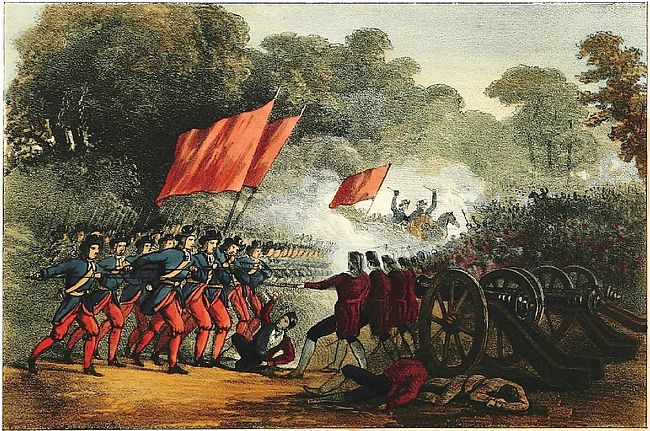
J. M. Jopling delt.
Madeley lith. 3 Wellington St. Strand.
TENTH REGIMENT OF FOOT.
AT THE BATTLE OF STEENKIRK, 3RD AUGT. 1692.
For Cannon's Military Records.
1692
Quitting its cantonments among the Flemish peasantry,
in May, 1692, the regiment again took the field,
and was employed in several operations. In the beginning
of August it was encamped at Halle, and, early
on the morning of the 3rd of that month, it advanced at
the head of the main body of the confederate army to
attack the French in position at Steenkirk. After passing
through some narrow defiles among trees, the Third and
Tenth foot halted at the extremity of a wood, at the
moment when the brigades forming the van of the army
were severely engaged with very superior numbers. A
short distance in front of the Tenth, and near the skirt
of the wood a little to the left, a regiment of Lunenburgers,
commanded by the Baron of Pibrack, was contending
with two French battalions, and was nearly overpowered;
it was falling back, fighting, and in some disorder; the
French were gaining ground; and its colonel, the Baron
of Pibrack, lay dangerously wounded a few yards in
front of the muzzles of the enemy's muskets. Prince
Casimir of Nassau galloped up to the Tenth, and requested
them to advance to the aid of the Lunenburgers;
when the regiment formed line, the pikemen in the
centre, and the musketeers and grenadiers on each flank,
and Lieut.-Colonel Sir Beville Granville led it forward
with great gallantry. At that moment the Lunenburgers
were overpowered, and the French were hurrying forward
with shouts, and a heavy fire of musketry, when
suddenly the Tenth, conspicuous by their blue coats,
scarlet breeches and stockings, and three stand of scarlet
colours floating in the breeze, were seen issuing from
among the trees in firm array. So noble a line of combatants,
separating itself from the broken sections of the
retreating Lunenburgers, startled the enemy; the French
artillery thundered against its flanks,—their musketry
smote it in front,—yet the regiment bore sternly forward
to close on its numerous enemies, when the French fell
back. Two serjeants of the Tenth sprang forward and
rescued the Baron of Pibrack, bearing him from among
his enemies to the rear, and the regiment pressed forward,
without firing a shot, until it gained a hollow way beyond
the skirts of the wood, where it halted, and the
musketeers, taking sure aim over the bank, soon cleared
the ground in their front of opponents. Numerous
narrow defiles and other obstructions prevented the
main body of the British infantry from arriving in time
to support the brigades in advance; King William
ordered a retreat, and Prince Casimir of Nassau arrived
with orders for the Tenth to withdraw from their post.
The Prince highly commended the conduct of the
regiment on that, the first occasion of its being engaged,
and its bearing proved a presage of future renown.
The regiment had a number of private soldiers killed
and wounded; also Captain Elliott, Lieutenants Thomas
Granville and John Granville, wounded.
Towards the end of August, the Tenth were detached
from the main army, and having joined a number of
troops which had arrived from England under Lieut.-General
the Duke of Leinster, they were employed in
seizing and fortifying the towns of Furnes and Dixmude.
On the 22nd of September, as working parties of the
seventh and Tenth foot were enlarging the ditch of a
bastion, they found a quantity of hidden treasure, consisting
of old French coins, amounting to nearly five
hundred pounds sterling, supposed (according to D'Auvergne's
history of the campaign of 1692) to have been
concealed there during the civil war in Flanders towards
the close of the preceding century.
In the middle of October, the regiment marched to
Damme, a little strong town, situated between Bruges
and Sluys, where it passed the winter.
1693
The Tenth regiment of foot appears in the list of
troops under King William III., at Parck camp near
Louvain, in June, 1693, and they were ordered to pitch
their tents in the fields adjoining the defiles of Berbeck,
to guard that avenue to the camp. While the army
was at this place, several skirmishes occurred; but the
only loss sustained by the Tenth was on the 25th of
June, when an outpost of a serjeant's party, covering a
number of horses at grass, was attacked, and three men
were severely wounded.
On the 1st of July, the regiment was detached from
the main army, with other forces under the Duke of
Wirtemberg, to attack the enemy's fortified lines between
the rivers Scheldt and Lys. After a march of
eight days, the troops arrived in front of the lines near
D'Otignies, and on the following day the works were
attacked at three points. The grenadiers formed the
van of each attack; the right column was composed
of Danes; the Argyle highlanders headed the centre
column, and the Tenth foot took the lead of the column
on the left. When the signal for the assault was given,
the Tenth raised a loud shout and ran forward. The
pikemen arrived at the little river Espiers, which ran in
front of the lines, and cast a number of fascines into the
water, but the stream carried them away. The grenadiers
of the Tenth and other regiments, being anxious
to signalize themselves, dashed into the current, at the
same time the musketeers advanced to the bank and
fired upon their opponents on the works. The river was
so deep that many of the soldiers were up to the chin in
water; but they gained the shore without serious loss,—sprang
forward with astonishing rapidity,—forded
the ditch,—pulled down the palisadoes,—and ascended
the lines, sword in hand; the officers and grenadiers of
the Tenth being the first that entered the works. As
the soldiers climbed the entrenchments, shouting and
flourishing their swords, the French fled, and the lines
were carried with little loss. D'Auvergne states that
the grenadiers of the Earl of Bath's regiment (Tenth)
found a cask of brandy in one of the abandoned redoubts,
which proved very welcome, as the soldiers had been
exposed to a heavy rain for several days.
After forcing the lines, contributions were levied on
the territory subject to France, as far as Lisle: and the
Duke of Wirtemberg was so well pleased with the
conduct of the Tenth, that he made a donation of a
ducat to each man, and the same to the men of the
other regiments engaged in forcing the lines.
While the Tenth were levying contributions, the
main army under King William was defeated at
Landen; after this disaster the regiment was ordered
to join the army, but it was not engaged in any service
of importance, and in October it marched into winter-quarters
at Bruges.
On the 29th of October, the Earl of Bath was succeeded
in the colonelcy by his nephew, Lieut.-Colonel
Sir Beville Granville.
1694
Leaving Bruges in May, 1694, the regiment pitched
its tents near Ghent. It served the campaign of that
year in Brigadier-General Stewart's brigade, in the
division commanded by Major-General Sir Henry
Bellasis; and after taking part in several operations, and
performing many long and toilsome marches, it proceeded
into quarters at the pleasant town of Malines.
1695
Early in the spring of 1695, the French commenced
some new works between the Lys and the Scheldt, when
five hundred men of the Tenth were withdrawn from
Malines in the expectation of taking part in an attempt
to interrupt the enemy's proceedings; but this enterprise
was laid aside, and the regiment encamped at
Marykirk until the army took the field, when it was
joined by the men left in quarters.
The Tenth were subsequently detached to Dixmude,
in West Flanders; and they were one of the corps
which pitched their tents before the Kenoque, a fortress
at the junction of the Loo and Dixmude canals, where
the French had a garrison.
On the 9th of June, the grenadiers of the Tenth were
engaged in driving the French from the entrenchments
and houses near the Loo canal. A redoubt was afterwards
taken, and a lodgment effected on the works at
the bridge; in which service the regiment had several
men killed and wounded.
This enterprise was only designed as a diversion to
favour the operations of the main army, and when King
William had besieged the strong fortress of Namur, the
regiment traversed the country to the banks of the Lys,
and joined the covering army under the Prince of
Vaudemont.
When Marshal Villeroy advanced, with a force of
very superior numbers, to attack the covering army, the
Prince of Vaudemont retreated to Ghent, and during
this retrograde movement, the commanding officer of
the Tenth, Lieut.-Colonel Sydney Godolphin, and a
serjeant and twelve men, resting at a house on the road
too long, were made prisoners.
The regiment was subsequently employed in several
movements to protect the maritime and other towns of
Flanders, and to cover the army carrying on the siege
of Namur. In August it was encamped between Genappe
and Waterloo, and after the surrender of the
castle of Namur, it marched into quarters in the villages
between Nieuport and Ostend.
1696
In the spring of 1696, Louis XIV. endeavoured to
weaken the power of the confederate army in Flanders,
by causing England to become the seat of civil war.
The partisans of King James were excited to rise in
arms; a plot was formed for the assassination of King
William, and a French army approached the coast to
embark with King James for England. The Tenth
foot was one of the corps selected to return to England
on this occasion, and the regiment, having embarked at
Ostend, arrived at Gravesend in March. In the meantime
the conspirators had been discovered; a British
fleet was sent to blockade the French ports, and the
designs of Louis XIV. were frustrated.
Several corps returned to Flanders; but the Tenth
were selected to remain on home service.
The regiment landed at Gravesend, occupied quarters
a short period in London, and afterwards marched into
extensive cantonments in the counties of Suffolk and
Essex.
1697
In May, 1697, the regiment was ordered to embark
for the Netherlands, and it joined the army at the camp
in front of Brussels in July; but in a few weeks afterwards
the treaty of Ryswick gave peace to Europe.
During the winter, the regiment returned to England;
it landed at Gravesend and Tilbury in December, and
marched into quarters in Essex.
1698
1699
1700
Considerable reductions were made in the strength
of the army, after the peace of Ryswick, and the Tenth
regiment was one of the corps selected to proceed to
Ireland; it embarked at Highlake in July, 1698, and
was stationed in Ireland during the following two
years.
1701
Pursuing his schemes for the aggrandizement of his
family with unceasing assiduity, the King of France
procured the accession of his grandson, Philip, Duke of
Anjou, to the throne of Spain, and this open violation
of existing treaties involved Europe in another war.
Among the corps first ordered to proceed on foreign
service to aid the continental powers in arresting the
progress of French usurpations, was the Tenth regiment
of foot. It embarked at Cork on the 15th of June,
1701, sailed to Holland, and was placed in one of the
frontier garrisons of that country. In September it
was encamped on Breda-heath, where it was reviewed,
with the remainder of the British troops in Holland,
by King William III., and afterwards returned to its
former station in garrison.
1702
In the spring of 1702, the regiment took the field to
serve as auxiliaries to the army of the Emperor of Germany,
England not having declared war against France;
and at the camp at Rosendael, news was received of the
death of King William III. and of the accession of
Queen Anne on the 8th of March. From Rosendael
the Tenth marched to the Duchy of Cleves, and
encamped at Cranenburg on the Lower Rhine, forming
part of the covering army during the siege of Kayserswerth.
In June a French force of superior numbers
marched through the forest of Cleves and plains of
Goch to cut off the allied army from Grave and Nimeguen;
in consequence of this movement the British,
Dutch, and Germans at Cranenburg, struck their tents
a little before sunset on the 10th of June, and, by a
forced march, arrived within a few miles of Nimeguen,
about eight o'clock on the following morning, at which
time the French columns appeared on both flanks and
in the rear. Some sharp fighting occurred; the British
corps forming the rear-guard evinced signal gallantry,
and the Tenth regiment distinguished itself: the
enemy was held in check until the army effected its
retreat under the works of Nimeguen.
England declared war against France: additional
troops arrived in Holland, and the Earl of Marlborough
assumed the command. The Tenth were
engaged in the movements by which the French were
driven from their menacing position near the confines
of Holland. The regiment also formed part of the
covering army during the siege of Venloo,—a fortress
on the east side of the river Maese, which surrendered
on the 25th of September. The regiment was next
engaged in covering the sieges of Ruremonde and
Stevenswart, both of which places were captured in the
early part of October. The army afterwards advanced
to the city of Liege, which immediately opened its gates,
but the citadel, and a detached fortress called the
Chartreuse, held out. The Tenth regiment was employed
in the siege of the citadel, and the grenadier
company behaved with great gallantry at the capture
of that fortress by storm on the 23rd of October. The
citadel being carried by assault, the garrison was nearly
annihilated; the garrison of the Chartreuse were eye-witnesses
of this event, and surrendered immediately
afterwards, from apprehension of a similar fate.
The city of Liege being rescued from the power of
the enemy, the regiment marched back to Holland, and
passed the winter in garrison at Breda.
1703
Sir Beville Granville having been appointed governor
of Barbadoes, the colonelcy of the Tenth foot was conferred
on William, Lord North and Grey, by commission
dated the 15th of January, 1703.
Colonel Lord North and Grey proved a very gallant
aspirant for military fame; serving at the head of his
regiment, and distinguishing himself on numerous occasions.
The Tenth left their winter-quarters towards
the end of April, 1703; on the 6th of May, they arrived
at Maeswyck, where they halted on the following day;
but, information having been received of the approach
of a powerful French army to cut off the detachments
of the confederate forces, the regiment struck its tents
at sunset, with several other corps, and, by a forced
march, arrived at the city of Maestricht about noon on
the following day. When the French army approached
that city, the regiment was in position, being one of the
corps stationed at Lonakin; some skirmishing and
cannonading occurred, and the French withdrew without
venturing a general engagement.
When the Duke of Marlborough advanced against
the French at Tongres, the Tenth were formed in
brigade with the second battalion of the royals, and the
sixteenth, twenty-first, and twenty-sixth regiments,
under Brigadier-General the Earl of Derby. The
enemy took refuge behind an extensive line of works,
and the English General besieged the strong fortress of
Huy, situate on the Maese above Liege. The Tenth
foot were employed at the siege; and, on the 18th of
August, when the enemy had vacated that portion of
the town which lay beyond the river, Colonel Lord
North and Grey took possession of it with the Tenth:
another corps was afterwards placed under his lordship's
command, and the regiment held this post during the
remainder of the siege.
Huy having been captured, the siege of the city of
Limburg was next undertaken, and this fortress was
surrendered before the end of September. Thus
Spanish Guelderland was wrested from the power of
France, and in October the regiment marched back to
Holland, where it passed the winter.
1704
While the Duke of Marlborough was capturing fortress
after fortress in the Netherlands, the French and
Bavarians had great success in Germany; their united
efforts threatened to overturn the imperial throne, and,
in 1704, the British commander led his army from
Holland to the Danube, to the succour of the Emperor
Leopold. The Tenth foot, commanded by Colonel
Lord North and Grey, had the honour of being employed
in this splendid enterprise, which elevated the reputation
of the British arms, and immortalized the name of
Marlborough for the conception of the movement, and
the secrecy and rapidity with which it was executed.
To engage in this undertaking, the regiment left its
winter-quarters early in May, 1704, and directing its
march to the Rhine, proceeded along the banks of that
river to Coblentz, where it passed the Rhine and the
Moselle on the 25th and 26th of that month. From
Coblentz the army marched towards the Maine, and
traversing the several states of Germany, arrived at the
seat of war to co-operate with the forces of the empire.
On the 2nd of July, after a long march through a
difficult country, the British approached the fortified
post of Schellenberg, a commanding height on the left
bank of the Danube, where a body of French and
Bavarians were stationed under the Count d'Arco, and
about six in the evening, a detachment from each
British regiment, with the foot guards, royals, and
twenty-third, under Brigadier-General Fergusson, and
a Dutch force under General Goor, advanced to attack
the entrenchments. A very spirited resistance was
made by the enemy, and, eventually, the Tenth
were led up the contested height to join in the attack.
Firmly and steadily the soldiers of the Tenth moved
up the steep ascent, which was strewed with killed and
wounded; arriving within range of the enemy's fire, an
iron tempest smote the ranks, and the firm order of the
regiment was shaken: a short pause ensued. At that
moment the British cavalry approached to support the
infantry, and the Germans under the Margrave of Baden
arrived to prolong the attack and assail the enemy in
the rear. Encouraged by these circumstances, the
British and Dutch infantry raised a loud shout, and,
breaking with terrific violence into the entrenchments,
overpowered all resistance. The Duke of Marlborough
led the British cavalry forward, and completed the overthrow
of the enemy.
The Tenth had Captain Crow and fifteen rank and
file killed; three serjeants, and thirty-six rank and file
wounded.
Crossing the Danube, and advancing into Bavaria,
the regiment was engaged in various operations; it
proceeded to the vicinity of the enemy's fortified camp
at Augsburg, and afterwards returned to the Danube at
Donawerth: in the meantime a numerous body of
French troops had traversed the Black Forest and joined
the enemy.
About ten o'clock on the night of the 11th of August,
the army under the Duke of Marlborough joined the
imperialists commanded by Prince Eugene of Savoy, at
the village of Munster, near the bank of the Danube.
On the following day the regiment was ordered forward
to support the piquets, which were attacked by the
enemy's hussars.
At daybreak, on the morning of the memorable 13th
of August, the regiment was under arms, to engage in
a battle which appeared to involve the fate of the
Christian world: it formed, on this occasion, part of the
brigade under Brigadier-General Row.
Advancing from the camp-ground, the soldiers arrived
in front of the enemy's position, and the Tenth,
commanded by their gallant young colonel, Lord North
and Grey, were destined to attack the village of Blenheim,
where the enemy had posted a numerous body of
troops, thrown up entrenchments, and constructed palisades.
Against this village, Brigadier-General Row's
brigade advanced with great gallantry: the Tenth and
Royal Scots Fusiliers led the attack, and were distinguished
for their intrepid bearing; but all efforts to
force the village against an enemy of so very superior
numbers, and advantageously posted, proved ineffectual.
As the brigade withdrew, it was charged by some
French cavalry, who were repulsed by the fire of a
Hessian brigade. Brigadier-General Fergusson led a
brigade against the other side of the village; but without
success. A sharp fire was afterwards kept up at
this point, and the army deployed to engage the main
body of the French and Bavarians. In the conflict
which followed, British valour was conspicuous, and
after a contest of several hours' duration, the French
and Bavarian armies were overthrown and nearly annihilated;
Marshal Tallard, and many officers and soldiers
being made prisoners.
When the main body of their army was overthrown,
the French troops in Blenheim were insulated; thrice
they attempted to escape, but they were forced back.
They took shelter behind the houses and enclosures;
but they were soon surrounded, and twelve squadrons of
cavalry, with twenty-four battalions of infantry, surrendered
prisoners of war. Thus ended the mighty struggle
of this eventful day, so glorious to the British arms!
The honours acquired by the regiment had been
attended with the loss of many valuable lives. Captains
Dawes, Sir John Sands, Cavendish, and Burton; Lieutenants
Frazer and Wycks; Ensigns Breams and
Dawson, were killed: Colonel Lord North and Grey lost
his right hand; Major Granville; Captains Cunningham
and Spotswood; Lieutenants Bulwer, Boylblanc, and
Hornby; Ensigns Crow and Rossington, were wounded.
The number of non-commissioned officers and private
soldiers of the regiment, killed and wounded, has not
been ascertained.
After passing the night on the field of battle, surrounded
with the ensanguined trophies of victory, the
Tenth were selected to guard the prisoners from Germany
to Holland, in which service five British battalions
were employed. The prisoners were marched to Mentz,
where they were put on board of small vessels, and
sailed to Holland. The regiment arrived at the Hague
in October, and, having delivered up the prisoners, it
was placed in garrison for the winter: its services are
not, therefore, connected with the operations of the
army in Germany after the victory at Blenheim.
1705
A numerous body of fine recruits arrived from
England, in the spring of 1705, to replace the losses of
the preceding campaign, and in May, 1705, when the
regiment took the field, its appearance was admired. It
was reviewed by the Duke of Marlborough, at the camp
on the left bank of the Maese, and afterwards marched to
Juliers. From Juliers the regiment marched through
a mountainous country to the valley of the Moselle, and
pitched its tents near the ancient city of Treves. The
army being united, it passed the rivers Moselle and
Saar on the 3rd of June, traversed the difficult defile of
Tavernen, and encamped within seven miles of Syrk.
At this place the army halted, waiting for the imperialists,
whose tardy movements and inefficient state
disappointed the expectations of the English commander,
and rendered it necessary for him to hurry back to the
Netherlands to arrest the progress of the French on
the Maese.
In the forced march from Syrk to the Maese, the
regiment lost many men from fatigue; and soon after
its arrival, it was selected to take part in storming the
enemy's fortified lines, which were protected by a
numerous army. To render this great undertaking as
certain as possible, these formidable barriers were
menaced on the south of the Mehaigne, and the French
troops being drawn in that direction, the point selected
for the attack was thus weakened. On the evening of
the 17th of July, the corps selected to commence the
attack marched in the direction of Helixem and Neer-Hespen,
the Tenth forming part of the leading
brigade of infantry; and they were followed by the
remainder of the army. About four o'clock on the
following morning, they approached the lines and surprised
the enemy's guards. Inspired with emulation,
the soldiers soon cleared the villages of Neer-Winden
and Neer-Hespen, seized the village and bridge of
Helixem, and carried the castle of Wange with little
loss; the enemy being surprised and confounded by the
suddenness of the attack. Encouraged by this success,
and stimulated by the noble example of several officers,
the troops rushed through the enclosures and marshy
grounds, forded the river Gheet, and crowded across
the fortifications; the French retreating in a panic.
Thus the lines were forced, and the soldiers of the
Tenth stood triumphant on the captured works, where
the cross of St. George, floating in the air, served as a
beacon to impart a knowledge of this splendid success
to the main body of the army, still at some distance. A
numerous body of the enemy's cavalry and infantry
hurried to the spot to drive back the troops which had
passed the lines, when some sharp fighting occurred,
which ended in the overthrow of the enemy, who made
a precipitate retreat behind the river Dyle. This
daring enterprise was thus achieved; and the talents of
the Duke of Marlborough, with the intrepidity and
valour of the British soldiers, were admired by all
nations. The English commander stated in his despatch,
that the troops acquitted themselves with a bravery surpassing
all that could have been hoped of them.
The Tenth shared in the operations of the main
army during the remainder of the campaign, but had
no opportunity of distinguishing themselves in action:
they passed the winter in garrison in Holland.
1706
Each successive victory had inspired the troops with
additional confidence in their commander, and in their
own prowess: to besiege a town, or fight a battle, and
not conquer, when the Duke of Marlborough commanded,
appeared impossible. With a bold assurance
that fresh triumphs awaited them, the soldiers took the
field in May, 1706, and the Tenth foot joined the
camp near Tongres on the 19th of that month. On the
23rd of May, as the army was advancing in eight
columns, information was received that the French,
Spaniards, and Bavarians, commanded by Marshal Villeroy
and the Elector of Bavaria, were taking up a
position at Mont St. André, with their centre at the
village of Ramilies, and the allies prepared for battle.
Diverging into the open plain, the allied army formed
line and advanced against the enemy. The Tenth foot,
being on the right of the line, proceeded, with a number
of other corps, in the direction of the village of Autreglise,
and made a demonstration of attacking the enemy's left.
The French weakened their centre to support their left,
and the British commander instantly seized the opportunity
and attacked the weakened point. The Tenth
foot were among the corps which, occupying some high
ground on the right, were not engaged during the early
part of the battle; but they had a full view of the conflict
on the plain. At length a crisis arrived: the brigades
on the right were ordered into action, when the
Tenth evinced that intrepidity and firmness for which
the regiment had been distinguished on former occasions,
and another decisive victory exalted the fame of the
British arms. The broken remains of the French,
Spanish, and Bavarian legions were pursued for many
miles, and an immense number of prisoners, cannon,
standards, and colours was captured.
The effect of this surprising victory was the immediate
surrender of Brussels, Ghent, and the principal towns
of Brabant, and the intelligence of these events produced
such an electric sensation throughout England, that the
gallant exploits of the heroes of Ramilies became a
general theme of conversation, and the subject of
numerous addresses to the throne. Rewards were conferred
on officers who had distinguished themselves, and
the commanding officer of the Tenth, the gallant Lord
North and Grey, was promoted to the rank of brigadier-general,
and placed at the head of three battalions of
infantry.
Several towns in Flanders held out; and in June the
Tenth marched to Arseele, and afterwards to Rouselaer,
and formed part of the covering army during the siege
of Ostend, which fortress was delivered up on the 8th
of July.
After the surrender of Ostend, the regiment was
selected to take part in the siege of Menin, a strong
town pleasantly situated on the little river Lys. This
fortress was accounted the key to the French conquests
in the Netherlands, and one of the masterpieces of the
celebrated Vauban: the siege therefore excited an
unusual degree of interest. The town was invested on
the 23rd of July; and the conduct of the Tenth during
the progress of the siege, corresponded with the high
character of the regiment. Considerable loss was sustained
in carrying on the attacks, but the soldiers had the
gratification of witnessing this place added to the numerous
conquests made during this memorable campaign.
Dendermond and Aeth were afterwards captured;
and in November the regiment took up its winter-quarters
at Ghent.
1707
During the campaign of 1707, the regiment formed
part of the brigade commanded by its colonel, Brigadier-General
Lord North and Grey, and it was some time
encamped near the village of Waterloo. The English
commander was unable, this year, to bring his cautious
opponents to a general engagement. In October, the
regiment returned to Ghent.
1708
While the regiment was reposing in quarters at this
city, the king of France fitted out a fleet, and embarked
troops at Dunkirk, for the invasion of Great Britain,
with a view of placing the Pretender on the throne.
To repel the invaders, the Tenth regiment embarked
for England in the middle of March, 1708, and arrived
at Tynemouth on the 21st; but the French squadron,
with the Pretender on board, was chased from the
British coast by the English fleet, and the Tenth were
ordered to Flanders: they landed at Ostend, and proceeded
in boats to Ghent, where they arrived towards
the end of April.
In May the regiment quitted Ghent, and was engaged
in the operations of the main army; and soon afterwards
the French, by treachery and stratagem, obtained possession
of the two towns of Ghent and Bruges. They
also invested Oudenarde, and this circumstance led to a
general engagement, in which the Tenth gained new
honours.
Passing the Scheldt on pontoon bridges near Oudenarde,
on the 11th of July, the allied army encountered
the legions of the enemy, commanded by his Royal
Highness the Duke of Burgundy and the Duke of
Vendome, in the fields beyond the river, and the battle
immediately commenced. The Tenth, commanded by
Lieut.-Colonel Grove, passed the Scheldt by the bridge
between Oudenarde and the abbey of Eename, and ascended
the heights of Bevere. At this place they halted
a short time, then descended into the plain, and engaged
the French battalions in the grounds beyond the rivulet,
near the village of Eyne. About five o'clock in the afternoon
the regiment opened its fire, and it continued to
gain ground upon its opponents, until the shades of evening
gathered over the field of battle. The wings of the
allied army gained upon the enemy, and the circling blaze
of musketry enveloped the French troops, whose destruction
appeared inevitable, but the darkness of the night
soon rendered it impossible to distinguish friends from
foes, and the Duke of Marlborough ordered his soldiers
to cease firing, and to halt. The darkness favoured the
escape of the enemy, and the wreck of the French army
retreated in disorder towards Ghent.
This victory prepared the way for an undertaking of
great magnitude,—viz., the siege of Lisle, the capital of
French Flanders,—a fortress deemed almost impregnable,
and garrisoned by fifteen thousand men, commanded
by the veteran Marshal Boufflers. This enterprise
put the abilities of the generals, and the courage and
endurance of the troops, to a severe trial. The Tenth
formed part of the covering army under the Duke of
Marlborough, while the siege was carried on by the
brigades under Prince Eugene of Savoy. The services
of the Tenth were of a varied character,—escorting supplies,—furnishing
out-posts,—confronting the French
army which advanced to raise the siege; and eventually
the grenadier company joined the besieging army, and
took part in the attacks on the town.
When the Elector of Bavaria besieged Brussels, the
Tenth formed part of the force which advanced to
raise the siege. The enemy's strong positions on the
Scheldt were forced on the 27th of November; and
the Elector made a precipitate retreat from before
Brussels.
The citadel of Lisle surrendered on the 9th of December,
and, notwithstanding the lateness of the season, the
soldiers of the Tenth were called upon to engage in
another enterprise. They appeared before Ghent,—drove
back the enemy's out-guards, and took part in
opening the trenches between the Scheldt and the Lys,
on the night of the 24th of December, on which occasion
their colonel, Lord North and Grey, evinced signal gallantry,
and he was rewarded, a few days afterwards,
with the rank of major-general. On the 26th of December,
ten companies of French grenadiers issued from the
town to attack the besieging troops, and they put the
first regiment they came in contact with in some confusion.
The Tenth were immediately led to the spot, and
they engaged the French grenadiers with spirit. The
commanding officer of the regiment, Lieutenant-Colonel
Grove, was made prisoner, and Brigadier-General
Evans, who commanded the troops at that point, was
also captured; but the enemy was soon driven back
into the town. On the 2nd of January, 1709, the
governor surrendered; and the Tenth took up their
quarters for the winter in the captured town.
1709
From Ghent, the regiment marched, in the spring of
1709, to the plain of Lisle; and was afterwards encamped
on the Upper Dyle. After menacing the enemy's
lines, and causing Marshal Villars to draw all the
troops out of the fortified towns, which could possibly
be spared, to strengthen his army in the field, the allies
suddenly invested Tournay. During the siege of the
town the Tenth regiment formed part of the covering
army, but when the citadel was attacked, this, with
several other regiments, left the covering army, and
marched to Tournay to take part in the siege.
The citadel of Tournay was situated on some high
ground, with a gentle ascent from the town, and the
siege proved a service of the most difficult character.
The peculiarities arose not so much from the strength
of the fortifications, as from the multiplicity of the subterraneous
works, which were more numerous than
those aboveground. The approaches were carried on
by sinking pits several fathoms deep, and working from
thence underground, until the troops arrived at the
casements and mines. The soldiers engaged in these
services frequently encountered parties of the enemy,
and numerous combats occurred in these gloomy labyrinths.
On some occasions the men at work underground
were inundated with water; on another occasion three
hundred men were suffocated with smoke, and a hundred
men were buried by the explosion of a mine. A
detachment of the eighteenth foot was blown into the
air, and their limbs scattered to a distance; and a battalion
of Germans was destroyed by another mine; the
Tenth foot also lost a number of men in the mines. At
length it became difficult to induce the soldiers to enter
these dark caverns, and engage in so appalling a service;
they were, however, persuaded to persevere, and the
citadel surrendered in the beginning of September.
After the capture of Tournay, the allied army traversed
the country with a view of besieging the city
of Mons, the capital of the province of Hainault; but
when on the march, the allies found the French army,
under Marshals Villars and Boufflers, in position near
Malplaquet, and resolved to hazard an engagement.
At three o'clock on the morning of the 11th of September,
the Tenth were on parade in the meadow
where they had passed the night, and the chaplain performed
divine service. A thick mist concealed the
opposing armies from each other, but the din of hostile
preparation was heard, and the soldiers, having confidence
in their leaders, were anxious to acquire new
laurels under their favourite chiefs. They waited till
the sun broke forth, and then the battle commenced.
Entrenchments, abatis de bois, and other defensive
works, covered the front and flanks of the French, and
the storming of these formidable works occasioned a
greater loss of life, than occurred at the battles of Blenheim,
Ramilies, and Oudenarde put together.
The Tenth were formed in brigade, on this occasion,
with the foot guards, royals, and thirty-seventh, and
were in the column commanded by General Count
Lottum. To this column was allotted the task of
storming the enemy's entrenchments in the wood of
Taisniere, which proved a difficult service. The foot
guards led the attack, and behaved with great gallantry,
but they encountered such formidable opposition that
they were repulsed. The royals seconded the foot
guards, and the buffs, being at the head of the next
brigade, prolonged the attack to the left. The Tenth
penetrated between the royals and the buffs, and the
whole rushing forward with determined resolution,
forced the entrenchments, when the French fell back
fighting, but halted and renewed the contest in the
wood. The Tenth, and other corps at this point, penetrated
among the trees, and a sharp fire of musketry
was kept up. The foliage was thick, every tree was
disputed, and the wood re-echoed the din of battle. In
the meantime a severe contest was taking place at other
parts of the field, and obstacles deemed insurmountable
were overcome; but the carnage was dreadful. The
enemy's centre was forced; the cavalry of the allied
army triumphed over the French horsemen, and the
Tenth, and other British regiments in the woods of
Taisniere, gained ground on their opponents. Eventually
the French legions were driven from the field,
with the loss of many prisoners, colours, standards, and
cannon. When the soldiers of the allied army gazed
at the formidable entrenchments, and other difficulties
they had overcome, they were astonished at their own
success.
On this occasion the regiment did not sustain a very
severe loss in killed and wounded: the only officers
mentioned in the list are Lieutenants Fellowes and
Elstead wounded.
After the victory of Malplaquet, the siege of Mons
was undertaken, and the Tenth formed part of the
covering army: the garrison surrendered on the 20th
of October, and shortly afterwards the regiment marched
into winter-quarters at Ghent.
1710
Leaving its winter-quarters in the middle of April,
1710, the regiment directed its march to the vicinity of
Tournay, where the allied army assembled. The capture
of the small post of Mortagne proved a prelude to
another campaign in which several fortresses were
wrested from the French monarch. By a forced march
the enemy's lines were passed at Pont-à-Vendin, and
the siege of Douay, a considerable fortress in the second
line of defence which covered the frontiers of Artois,
was undertaken. Douay is a town of antiquity, having
been a place of note in the time of the first
Counts of Flanders; the river Scarpe running through
the town, the river Haine being near it, the works
being also strong, numerous, and well garrisoned, the
siege of this place was an important undertaking. The
Tenth foot, commanded by Lieut.-Colonel Henry
Grove, had their post in the lines of circumvallation,
but did not take part in the attacks upon the works.
When the French army, under Marshal Villars, advanced
to raise the siege, the regiment was in position
to oppose the enemy, and it had several men killed and
wounded by a heavy cannonade which occurred on that
occasion. Marshal Villars did not hazard an engagement,
and the governor of Douay, after a very gallant
defence, surrendered on the 27th of June.
After this conquest the English general resolved to
attack Bethune, a strong town formerly belonging to
the Counts of Flanders; but having been taken by
Gaston, Duke of Orleans, it was annexed to the French
monarchy at the peace of the Pyrenees in 1659.
During the siege of Bethune, the Tenth had their
post in the covering army encamped at Villars-Brulin,
where the regiment was stationed until the garrison
surrendered on the 29th of August.
The next undertaking in which the army was engaged
was the siege of Aire and St. Venant, which towns were
so situated as to admit of a simultaneous investment,
and as the capture of these fortresses would secure the
navigation of the Lys, and open a water communication
with Tournay, Lisle, and Ghent, the skill of the
generals and the valour of the troops were called forth
to insure their reduction. The Tenth were among
the corps engaged in the siege of Aire, and as the
governor of that place made a very vigorous defence, a
severe loss was sustained in killed and wounded. The
regiment was several times warmly engaged in carrying
on the attacks and storming the out-works; on which
occasions its gallant bearing called forth the commendations
of the Prince of Anhalt, who commanded the
troops employed in the siege. On the 9th of November,
the garrison surrendered; but the possession of Aire
was purchased at a serious loss of brave soldiers.
Thus, fortress after fortress fell before the superior
skill of the commanders and the prowess of the troops
composing the allied army. After the surrender of Aire,
the Tenth marched to Courtray, a town of Hainault,
situate on the river Lys, and defended by towers and a
strong castle erected by Philip, Duke of Burgundy, in
1385: at this place the regiment passed the winter, and
its losses were replaced by recruits from England.
1711
Towards the end of April, 1711, the regiment was
again in the field; it was reviewed at the camp at
Warde by the Duke of Marlborough, on the 8th of
June, and commended for its appearance and discipline:
it afterwards encamped on the plains of Lens. A new
line of formidable entrenchments, defended by a powerful
French army under the command of Marshal Villars,
appeared as a barrier to arrest the victorious
career of the allied army; but the British General, by
menacing the enemy's left, and making ostentatious preparations
for storming the works at that point, occasioned
the French troops to be drawn to that quarter; in the
meantime he had privately assembled a number of corps
at Douay, and by a forced march these formidable
works were passed at the unguarded post of Arleux.
The Tenth regiment of foot had the honor to take part
in forcing these lines, on which occasion the British
General developed that sublimity of military talent
which has justly stamped this campaign as peculiarly
scientific and glorious. The regiment was afterwards
engaged in the siege of Bouchain, a well-fortified town,
situate on both sides of the river Scheldt: and in carrying
on the attacks, and performing its turn of duty in
the trenches, the regiment had several men killed and
wounded. The garrison surrendered in September,
and after the damaged works were repaired, the Tenth
went into winter-quarters.
1712
The French monarch saw his generals overmatched,
his soldiers beaten and dispirited, the barriers of his
kingdom trampled down, and the great Duke of Marlborough
ready to lead his victorious legions into the
heart of France. Under these circumstances the ambitious
Louis XIV. solicited peace. Negociations commenced
before the Tenth foot took the field in April,
1712: the British troops were, however, assembled
near Tournay, and the Duke of Ormond assumed the
command in succession to the Duke of Marlborough.
According to the returns of this period, the regiment
brought six hundred and twenty-three rank and file
into the field.
From Tournay the regiment advanced to the vicinity
of Bouchain; it subsequently formed part of the covering
army, encamped at Cateau-Cambresis, during the siege
of Quesnoy, which fortress surrendered on the 4th of
July. Soon afterwards a suspension of arms was proclaimed
between the British and French, preparatory to
a treaty of peace, and the Duke of Ormond withdrew,
with the troops under his orders, to Ghent, from whence
several corps were detached to Dunkirk, to take possession
of that fortress.
1713
1714
The Tenth regiment of foot was subsequently
quartered at Ghent; it remained in Flanders while
the negociations were being carried on at Utrecht, and,
in April, 1714, it was in garrison at the strong maritime
town of Nieuport.
While the regiment was in garrison at Nieuport,
Queen Anne died (1st August), and was succeeded by
King George I.; several corps were ordered home on
this occasion, but the Tenth were selected to garrison
one of the fortresses in Flanders during the negociations
for the barrier treaty.
1715
In the summer of 1715, the adherents of the Stuart
dynasty, who were numerous, particularly in Scotland,
made active preparations for the elevation of the Pretender
to the throne, and Lieut.-General Lord North
and Grey, being known to entertain sentiments favourable
to the Stuart family, was removed from the colonelcy
of the Tenth foot, which was conferred on the Lieut.-Colonel,
Brigadier-General Henry Grove (who had
often signalized himself at the head of the regiment),
by commission dated the 23rd of June, 1715.
King George I., supported by his parliament, adopted
very energetic measures to oppose the designs of the
Jacobites, and His Majesty, having great confidence in
the zeal of Brigadier-General Grove, and in the attachment
of the Tenth foot to the Protestant succession,
gave directions for the regiment to return to England:
it landed at the Tower-stairs, London, about the middle
of August, and afterwards marched to Colchester.
The rebellion broke out in Scotland in September,
and the Earl of Mar headed the insurgent bands; but
it was found necessary to detain a number of corps in
England, to overawe the disaffected; and the Tenth
were ordered to march, in the beginning of October, to
Hammersmith, Kensington, and Chelsea, to be near the
court. After the victories gained by the King's troops
at Dumblain and Preston, the regiment marched to
Lichfield and Newcastle, in Staffordshire, where it
remained during the winter and the following spring.
1716
1717
In the summer of 1716, the regiment was stationed
in Warwickshire, and in 1717, in Lancashire.
1722
The regiment continued to occupy various quarters
in England, until the summer of 1722, when it was
encamped on Salisbury Plain, where it was reviewed
with a number of other corps, on the 30th of August,
by King George I. and his royal highness the Prince
of Wales. After the review, the regiment proceeded
to Wolverhampton and Birmingham.
1723
1724
During the summer of 1723, the regiment marched
to Scotland, from whence it returned in 1724, and was
stationed at Nottingham.
1727
On the prospect of hostilities taking place on the
Continent, in the spring of 1727, between the Emperor
of Germany and the Dutch, the regiment was held in
readiness to proceed on foreign service; at the same
time its colonel was promoted to the rank of major-general,
but no embarkation took place.
On the 11th June, 1727, King George I. died, and
King George II. was proclaimed Sovereign of Great
Britain and Ireland on the following day.
1730
In June, 1730, the regiment marched to Portsmouth,
where it embarked for Gibraltar, and formed part of the
garrison of that important fortress during the following
nineteen years.
1736
1737
1746
The decease of Lieut.-General Grove occurred on
the 20th of November, 1736, and the colonelcy of the
regiment remained vacant until June of the following
year, when it was conferred on Major-General Francis
Columbine, who commanded the regiment nine years,
and was succeeded in December, 1746, by Lieut.-General
James Lord Tyrawley, from the third troop of
life guards, which King George II. had resolved to
reduce, in order to diminish the public expenditure.
1749
On the conclusion of the peace of Aix-la-Chapelle, in
1749, the regiment was relieved from garrison duty at
Gibraltar, and proceeded to Ireland.
General Lord Tyrawley was removed to the fourteenth
dragoons, in July, 1749; and in August King George II.
conferred the colonelcy of the Tenth foot on Colonel
Edward Pole, from the lieut.-colonelcy of the twelfth
dragoons.
1751
A royal warrant was issued on the 1st of July, 1751,
in which the King's or first colour of the regiment was
directed to be the great Union: the second colour to
be of bright yellow silk, with the Union in the upper
canton, and in the centre of the colour the rank of the
regiment, in gold Roman characters, within a wreath of
roses and thistles on the same stalk.
The costume of the regiment at this period was,—Three-cornered
cocked hats bound with white lace;
scarlet coats faced and turned up with bright yellow,
and ornamented with white lace; scarlet waistcoats and
breeches; white linen gaiters reaching above the knee;
white cravats; buff belts.
1757
1759
1762
Colonel Pole was promoted to the rank of major-general
in 1757, and to that of lieut.-general in 1759.
He commanded the regiment thirteen years, and died in
the winter of 1762; when King George III. conferred
the colonelcy on Major-General Edward Sandford, from
the twenty-sixth regiment, by commission dated the
4th of January, 1763.
1763
1767
1768
The regiment was stationed in Ireland during the
whole of the seven years' war, but when the disputes
between Great Britain and her North American colonies
began to assume a serious aspect, the Tenth was one of
the first corps ordered to proceed across the Atlantic.
The regiment embarked from Ireland in the spring of
1767, and after a short stay in Nova Scotia, it was
ordered to Boston, where, in 1768, the conduct of the
populace assumed so violent a character as to render
the presence of a military force necessary.
1769
The policy pursued by the British government towards
the North American provinces alienated the affections
of the people from the mother-country, and the idea of
these extensive colonies becoming a great and independent
empire, having gained possession of many minds,
the Americans became impatient of their condition. The
events of each succeeding year appeared to mature the
revolutionary designs of the colonists, and the determination
to assert their independence became prevalent.
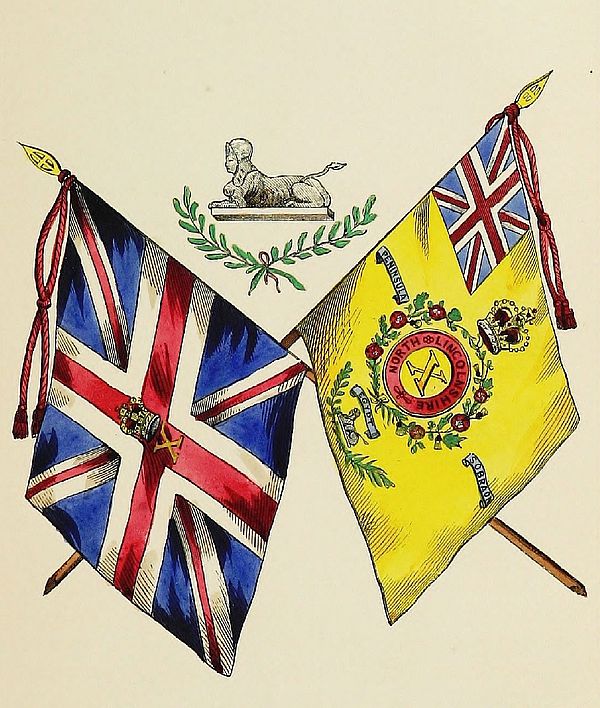
COLOURS OF THE TENTH REGIMENT OF FOOT.
1775
In the spring of 1775, General Gage, who commanded
the British troops at Boston, ascertained that the Americans
were collecting military stores at Concord, about
eighteen miles from Boston, and the flank companies of
the Tenth, and of several other corps, embarked in
boats, at ten o'clock on the night of the 18th of April,
under Lieutenant-Colonel Francis Smith of the Tenth,
for the purpose of destroying the stores. Proceeding to
the entrance of the Cambridge-river, the troops landed
at Phipps's farm, and advanced upon Concord, while the
Americans, by the ringing of bells and the firing of guns,
spread an alarm over the country. About four o'clock
on the morning of the 19th of April, the light company
of the Tenth, being in advance, approached the village
of Lexington, where a body of American militia was
forming; they were called upon to lay down their arms,
but instead of obeying the order, they attempted to take
shelter behind a stone wall, and several of them fired at
the King's troops, wounding a soldier of the Tenth,
which was the first blood shed in this unhappy contest.
The light infantry responded to this act of hostility with
an irregular volley, which killed and wounded several
Americans, and dispersed the remainder: the commencement
of the American war thus took place.
After this rencounter, the flank companies continued
their route to Concord, and Captain Parsons of the
Tenth was detached with several companies to secure
the bridge beyond the town, while the remainder of the
detachment searched for and destroyed the military
stores. The light companies of the fourth and Tenth
regiments were posted on some heights near the bridge;
crowds of armed men assembled on the high grounds
near the town, and a party of Americans fired upon the
soldiers at the bridge, killing three men and wounding
several others, when the fire was returned, and the
detached companies joined the main body in the town.
The military stores having been destroyed, the troops
commenced their march back to Boston, when the country
was found swarming with armed men, who commenced
a sharp fire from behind walls, fences, trees, &c., and
skirmish succeeded skirmish until the soldiers were exhausted,
and had expended nearly all their ammunition.
Arriving at Lexington, they were met by a brigade of
infantry and two guns, under Colonel Earl Percy, who
formed his men into a square, with the exhausted flank
companies in the centre, and, after a short halt, continued
the retreat to Charlestown, from whence he crossed the
river by the ferry to Boston, having lost several men
from the incessant fire which the Americans kept up
from behind walls, trees, and other coverts on both sides
of the road.
The regiment had two men killed; Lieut.-Colonel
Francis Smith, Captain Lawrence Parsons, Lieutenant
Waldron Kelly, Ensign Jeremiah Lester, and thirteen
rank and file wounded.
Hostilities having thus commenced, the whole province
of Massachusetts-bay was speedily in arms, and an immense
number of men invested Boston, where the King's
troops were stationed on the land side. The Americans
commenced constructing works on Bunkers-hill, a high
ground beyond the river, from which it was determined
to dislodge them, and the flank companies of the Tenth
formed part of the force selected for this service.
Embarking from Boston in boats, about noon on the
17th of June, the soldiers crossed the river, and landed
on the opposite shore. The ships of war opened their
fire upon the enemy's works, and the troops ascended the
steep hill, which was covered with grass reaching to the
knees, and intersected with walls and fences of various
enclosures, and advanced to storm the works in the face
of a well-directed fire. The difficulty of the ascent, the
heat of the weather, and the enemy's superior numbers
and incessant fire, combined to render this enterprise
particularly arduous; twice the King's troops appeared
to stagger; but recovering, they rushed forward with
renewed ardour, and drove the Americans out of the
works at the point of the bayonet; thus proving their
superior bravery and discipline, by gaining a complete
victory over an enemy three times as numerous as themselves
and protected by entrenchments.
The flank companies of the Tenth were among the
troops which distinguished themselves, and every officer
was wounded. Their loss was two serjeants and five
rank and file killed; Captains Parsons, Fitzgerald, Lieutenants
Pittigrew, Verner, Hamilton, Kelly, one drummer,
and thirty-nine rank and file wounded.
The valour of the British soldiers in North America
excited the admiration of their sovereign and country;
yet, the circumstances in which they were placed
rendered it impossible for their prowess to be exercised
with the prospect of ultimate success. The great superiority
of the numbers of the enemy more than counter-balanced
the advantages of superior skill and discipline,
and the troops in Boston remained in a state of blockade;
live cattle, vegetables, and even fuel, were sent for
their use from England; many of the vessels were, however,
wrecked, and others captured by the Americans,
and great distress, sickness, and loss of life occurred.
1776
No advantage being likely to result from the possession
of Boston under the circumstances in which the
troops were placed, it was evacuated in the middle of
March, 1776, and the Tenth were moved to Nova
Scotia. They were stationed at Halifax until June,
when they sailed with the expedition to Staten Island,
to take part in an extensive plan of operations.
The regiment landed on Staten Island in the early
part of July; reinforcements arrived from England,
also a body of Hessians, and the Tenth, thirty-seventh,
thirty-eighth, and fifty-second regiments, formed the
third brigade of the army, under Major-General Jones,
in the division commanded by Lieut.-General Earl
Percy.
On the 22nd of August, a descent was made on the
south-west end of Long Island, and on the night of the
26th, the Tenth advanced, in support of the leading
division, to seize on a pass in the mountains. This pass
was occupied without opposition; the troops crossed the
hills, and directed their march towards the enemy's lines
at Brooklyn. Arriving at Bedford, an attack was commenced
on the American battalions which were quitting
the woody heights to return to their lines, and the enthusiastic
ardour of the royal forces overcame all opposition.
Encouraged by their success, and inspired with
lively anticipations of victory, the soldiers urged their
way towards the lines to storm the works; but they were
ordered to desist, to spare the unnecessary effusion of
blood which an attack by storm would have occasioned.
The conduct of the British troops on this occasion
was highly commended in General Sir William Howe's
despatch.
The Americans abandoned their lines, and retreated
across the East River to New York. The Tenth
having thus had the honour of taking part in the reduction
of Long Island, crossed the river to New York
Island, and were engaged in the movements by which
the American army was driven from the city of New
York.
In the second week of October, the regiment again
embarked in boats, and proceeded up the river to the
vicinity of West Chester, where it went ashore; but
afterwards re-embarked and sailed to Pell's Point, where
a sharp skirmish occurred. The regiment was also engaged
in the movements by which the passage of the
Brunx river was effected, and the American army
forced to abandon its fortified lines on White Plains.
In the action on the 28th of October, the Tenth lost
two men.
From White Plains the army withdrew to engage in
the siege of Forts Washington and Lee, which obstructed
the navigation of the North River. Fort Washington
was invested, and on the 16th of November, the Tenth
were engaged, under Lieut.-General Earl Percy, in
assaulting the right flank of the enemy's entrenchments;
they took part in carrying an advanced work, and afterwards
passed the lines, which were carried in a most
gallant manner, and upwards of two thousand provincials
surrendered prisoners of war. The loss of the
regiment was limited to Captain Mackintosh and three
rank and file killed; five rank and file wounded.
In the early part of December, the regiment was detached,
with other troops, under Lieut.-Generals Clinton
and Earl Percy, against Rhode Island, which was
the principal station of the enemy's naval force, and
from whence the Americans sent out privateers which
interrupted the British commerce. The regiment
sailed on this enterprise in the early part of December;
a landing was effected on the morning of the 9th of
that month, and the island was speedily reduced to
submission to the British government.
1777
After passing several months on Rhode Island, the
Tenth embarked for New Jersey, and formed part of
the army which took the field, under General Sir
William Howe, in the early part of June, 1777.
General Washington kept the American army in the
mountain fastnesses, where he could not be attacked,
except under great disadvantages, and the English general
resolved on an expedition against Philadelphia.
Embarking on board the fleet, the regiment sailed
for Chesapeak-bay, and from thence up the Elk River,
to Elk Ferry, where it landed about the end of August:
the fifth, Tenth, twenty-seventh, fortieth, and fifty-fifth
regiments, formed the second brigade under Major-General
Grant.
The American army took up a position at Brandywine
Creek, to oppose the advance of the British on
Philadelphia, and on the 11th of September the enemy's
posts were attacked; the Tenth forming part of the
force selected to attack the American troops posted at
Chad's Ford. After a sharp cannonade, the troops
rushed through the stream with fixed bayonets, the
fourth foot taking the lead, and, overpowering all resistance,
captured three brass field-pieces and a howitzer.
The Americans were routed at all points, and they
made a precipitate retreat. The Tenth had two rank
and file killed, and six wounded, on this occasion.
The regiment passed the night on the field of battle,
and marched on the following day to Concord; on the
13th of September it arrived at Ashtown, and on the
25th the troops pitched their tents at Germantown,
about six miles from Philadelphia, which city was
taken possession of by the grenadiers.
On the 29th of September, the Tenth and forty-second
regiments were detached from the camp at Germantown,
under the orders of Lieut.-Colonel Stirling,
of the forty-second, to attack a strong redoubt erected
by the Americans on the Jersey shore, at a place called
Billing's-point, to prevent the removal of a sunken
barrier across the river Delaware. The two regiments
crossed the river from Chester on the 1st of October,
and on approaching the redoubt, three hundred Americans
in garrison fled; having first set fire to their
barracks and spiked their cannon. The Tenth and
forty-second pursued the Americans about two miles,
but were unable to overtake them.
Billing's-point redoubt being thus captured, the obstructions
to the navigation of the Delaware at that point
were removed, and the Tenth and forty-second crossed
the river to Chester, where they were joined by the
twenty-third, and the three regiments escorted a large
convoy of provisions to the camp at Germantown.
The British general having sent off several detachments,
the Americans resolved to hazard another battle,
and they attacked the position at Germantown at daybreak
on the morning of the 4th of October; but were
repulsed. The light company of the Tenth signalized
itself on this occasion and had several men killed and
wounded: the battalion companies of the regiment had
their post on the right of the village, but they were not
engaged.
In the middle of October, the army removed to the
immediate vicinity of Philadelphia, and two forts on
the river were reduced. In the early part of December,
the British advanced towards the enemy's fortified
camp at Whitemarsh; the Tenth took part in several
movements and skirmishes, designed to bring on a
general engagement, but the Americans kept close
behind their entrenchments and abatis-de-bois, and the
British returned to Philadelphia.
1778
The Tenth regiment passed the winter in comfortable
quarters in the city of Philadelphia; but before
the season for opening the campaign of 1778 arrived,
the King of France concluded a treaty with, and agreed
to aid, the Americans, which so completely changed
the nature of the war, that it was deemed necessary to
concentrate the army at New York.
Philadelphia was evacuated in the middle of June,
and the Tenth took part in the difficult service of retreating
through a wild and woody country, intersected
by rivulets, the bridges over which had been destroyed.
On the 28th of June, the regiment was in advance
under Lieut.-General Knyphausen, and as the last division
of the army descended from the heights above
Freehold, in New Jersey, the American troops appeared
in the rear and on both flanks, and some sharp fighting
took place, which terminated in the repulse of the
enemy. The grenadier company of the Tenth had an
opportunity of distinguishing itself on this occasion; it
had Major Gardiner wounded, and several private
soldiers killed and wounded.
Having repulsed the enemy, the army continued its
march, crossed the channel to Sandy Hook, and embarked
from thence for New York.
The Tenth had lost many men, during the period
they had been in America, from fatigue, privation, disease,
and other casualties, besides those killed and disabled
in action with the enemy, and soon after the
regiment arrived at New York, it was selected to return
to England. The men fit for service, who volunteered
to remain in the country, were transferred to other corps,
and the remainder embarked from New York towards
the end of October; they arrived in England in December,
and immediately commenced recruiting their
numbers.
1781
After the decease of Lieut.-General Sandford, King
George III. conferred the colonelcy of the regiment on
Major-General Sir R. Murray Keith, K.B., from the
late eighty-seventh foot (which was disbanded at the
peace in 1763), by commission dated the 10th of
October, 1781.
1783
1784
1785
The American War having ceased in 1783, reductions
took place in the military establishments, and the numbers
of the Tenth Regiment were consequently diminished;
in the autumn of 1783 the regiment embarked
for Ireland, and it was stationed in that part of the
United Kingdom during the years 1784 and 1785.
1786
On the 2nd of March, 1786, the regiment embarked
from Ireland for Jamaica, to relieve the first battalion
of the sixtieth foot, which was ordered to proceed to
Nova Scotia.
1793
1794
1795
The regiment was stationed at Jamaica when the
French Revolution occurred, which involved Europe in
war and occasioned the West India islands to become
the theatre of anarchy and devastation; the mulattoes
and blacks imbibing the doctrine of equality, breaking
the ties of subordination, and committing every description
of crime. Active measures were adopted to rescue
the French West India islands from republican domination;
but the Tenth had sustained so serious a
loss of men from disease during the nine years they
had been at Jamaica, that they were ordered home to
recruit: they arrived in England in August, 1795, and
were stationed at Lincoln, from whence recruiting
parties were sent out.
After the decease of Lieut.-General Sir R. Murray
Keith, Major-General the Honorable Henry Edward
Fox, was appointed colonel of the Tenth foot, from
the 131st regiment, by commission dated the 23rd of
June, 1795.
1796
The establishment was completed by drafts from
other corps, and, in three months from the date of its
arrival from Jamaica, the regiment was ordered to furnish
seven companies to take part in completing the
deliverance of the French West India Islands from the
power of the republicans. The force designed for this
service, under Major-General Sir Ralph Abercromby,
sailed from Spithead in December, and the departure
of the fleet, accompanied by a division of the royal navy
under Admiral Christian, presented a most splendid
spectacle; but this armament was overtaken by a storm,
the fleet was dispersed, many vessels were wrecked, and
others returned to Spithead. The ship containing the
grenadier company of the Tenth, and several other
corps, withstood the storm; but it had not been long at
sea before the yellow fever broke out on board, when it
returned to England, and the soldiers went into hospital
at Plymouth, from whence the grenadiers of the Tenth
marched to Chatham, where the regiment was assembled
in 1796.
1797
From Chatham the regiment embarked on an expedition
to the Continent, but was ordered to land at
Lymington, from whence it proceeded to the Isle of
Wight, and was stationed on that island and at Portsmouth
until the winter of 1798.
1798
The Tenth, having been appointed to transfer their
services from Europe to the British possessions in Hindoostan,
embarked from Portsmouth during the winter,
and arriving in the south of India, landed at the celebrated
city and fortress of Madras, the capital of the
British possessions in that quarter of the globe, on the
13th of April, 1799.
1799
At Madras the regiment remained nearly four months,
and on the 6th of August, it embarked for the rich and
extensive province of Bengal, where it arrived on the
26th of the same month.
1800
For fifteen months the Tenth were stationed in the
Presidency of Bengal, in a country abounding in all
that is essential to the comfort and even the luxury of
man, under the command of Lieut.-Colonel Richard
Quarrell, and in November, 1800, they were sent down
the river Ganges to be embarked for Egypt, which
country was overrun by an army of French veterans,
vauntingly designated the "Army of the East," and
commanded by the celebrated General Buonaparte.
1801
To effect the expulsion of the French "Army of the
East" from Egypt, a British force sailed from Europe
under General Sir Ralph Abercromby, and about six
thousand men from India and the Cape of Good Hope,
under Major-General Baird, were appointed to co-operate.
To engage in this service, the Tenth sailed from
Kidgaree on the 5th of December, joined the expedition,
under Major-General Baird, at Bombay, and sailed from
thence for the Red Sea. The original design was to
proceed to the port of Suez, at the head of the Red Sea,
on the borders of Arabia; but the monsoon had commenced
before the fleet entered the Red Sea in April,
1801, and Major-General Baird resolved to land at
Cosseir, and brave the difficulties of the desert, in the
hope of affording important aid to the troops which had
landed in Egypt from Europe.
Eight companies of the Tenth arrived at Cosseir on
the 15th of June, and the remainder of the regiment,
having been separated by the monsoon gales, was some
days later.[6] On landing, the country presented a frightfully
desolate prospect, but the soldiers commenced
their march through the desert with cheerful alacrity;[7]
although suffering from excessive heat and dysentery,
occasioned by bad water.
The march was made during the night. A little way
from Cosseir the soldiers entered a ravine, which appeared
to be the old bed of a river, along which they
travelled three days, when it terminated at Moilah.
From Moilah the desert had a hard gravelly soil, generally,
until the troops arrived at Baromba, where the
first habitable spot was met with after leaving Cosseir;
not a single hut having previously been seen. The troops
suffered greatly from thirst and oppressive heat, with
an almost irresistible inclination to sleep; some soldiers
straggling from the line of march, that they might lie
down and sleep, lost their lives. The little town of
Baromba lay on the borders of the desert, and the Arabs
offered milk, eggs, and poultry for sale, in great abundance,
and very cheap.
On arriving at Kenna, the regiment was ordered to
proceed to Girgee, a large town of Upper Egypt, situate
about a quarter of a mile from the river Nile. The
regimental baggage was sent to Suez, but the "Cavera"
transport foundered at sea, and all the baggage, books,
&c. of the Tenth were lost.
In the meantime, the British army from Europe had
triumphed over the French before Alexandria, where
General Sir Ralph Abercromby was mortally wounded;
the French troops at Cairo had also surrendered, and
the siege of Alexandria was the next undertaking. The
Tenth embarked from Girgee in dgerms, and proceeded
down the Nile to the Island of Rhoda, where they encamped.
On the 2nd of August they again embarked,
and proceeded to Rosetta, a town celebrated for the
beauty of its environs; beyond the Nile lay the richest
parts of the Delta, the garden of Egypt. From Rosetta
the regiment proceeded to El-Hamed, and joined the
forces encamped at that place.
Alexandria surrendered in the beginning of September,
and Egypt was thus delivered; the French "Army of
the East" being forced to evacuate a country from whence
Buonaparte had vainly imagined he should extend his
conquests throughout Asia.
Lieut.-General (afterwards Lord) Hutchinson stated
in his despatch:—"This arduous and important service
has at length been brought to a conclusion. The exertions
of individuals have been splendid and meritorious.
The conduct of the troops of every description
has been exemplary in the highest degree; there has
been much to applaud, and nothing to reprehend;
their ardour and regularity in camp having been as
conspicuous as their courage in the field."
In this service, although the Tenth had not been
brought into contact with the enemy, their conduct had
been exemplary, and they had sustained a loss of thirty
men from the climate, and other casualties incident to
the service in which they were employed. They received,
in common with the other regiments, the expression
of the high approbation of their Sovereign, the
thanks of Parliament, and the royal authority to bear on
their colours the "Sphynx," with the word "Egypt," to
commemorate this splendid event. The officers were
also rewarded with gold medals, presented to them by
the Grand Seignior, in commemoration of the important
service rendered to the Ottoman empire.
The Tenth were selected to remain a short period in
Egypt; they marched from El-Hamed on the 4th of
December, arrived at Alexandria on the 5th, and encamped
under the walls until the 18th, when they were
removed into Fort Triangular.
1802
In the city of Alexandria, formerly celebrated as the
seat of learning and commerce, the regiment was stationed
for several months. On the 29th of April, 1802, an explosion
took place in the fort which the Tenth occupied,
by which they had four men killed and ten wounded;
also two Indian followers killed and ten wounded.
The regiment was afterwards encamped near Alexandria;
it was struck off the Indian establishment, and
commenced receiving pay on the British on the 1st of
May.
1803
While the Tenth were encamped near Alexandria,
the plague broke out among the natives. The army
suddenly embarked on the 5th of March, 1803, leaving
its camp equipage standing, and on the 7th the regiment
sailed out of the Western Harbour.
Arriving at Malta on the 27th of April, the regiment
performed a quarantine of forty-two days, and afterwards
sailed to Gibraltar, where it arrived on the 20th of June.
1804
A treaty of peace was concluded with the French republic
while the Tenth were in Egypt; but hostilities
had recommenced before the regiment arrived at Gibraltar,
and in 1804 a second battalion was added to the
establishment. The head-quarters of the second battalion
were fixed at Maldon in Essex; it was formed of men
raised in Essex, for limited service, under the Additional
Force Act, passed 20th July, 1804, and was placed upon
the establishment from the 25th of December, 1804.
1805
1806
The first battalion was stationed at Gibraltar during
the years 1804, 1805, and 1806.
In the meantime numerous changes occurred among
the states of Europe, and the great success which at this
period attended the French arms, enabled Napoleon
Buonaparte, who, in 1804, had been invested with the
title of Emperor of the French, King of Italy, &c., to
assume the position of a dictator: his conduct towards
the royal family of Naples occasioned the history of that
court to become connected with the services of the
Tenth regiment of foot.
When war recommenced between Great Britain and
France in 1803, Buonaparte occupied a portion of the
Neapolitan territory with his troops. In 1805 a treaty
of neutrality was concluded between the French Emperor
and the King of Naples, by which the former engaged to
withdraw his troops from the Neapolitan territory, and
the latter was bound not to admit the fleets or armies of
any of the states at war with France into his ports or
territory. The conditions of this treaty were, however,
violated by Ferdinand IV., who admitted an English
and Russian armament into the Bay of Naples in November,
1805, and a body of British and Russian troops
was landed at that city.
The conduct of the King of Naples excited the indignation
of the French Emperor, who concluded that this
little kingdom was united with his enemies, and on the
morning after the signatures were affixed to the treaty
of Presburg, Napoleon issued a proclamation declaring
that "the Neapolitan dynasty had ceased to reign," and
denouncing vengeance against the family he had thus
resolved to dethrone, in terms which left no hope of
accommodation. The Russians withdrew from Naples,
leaving the court to its fate. The British, under General
Sir James Craig, were too few in number to defend the
Neapolitan state, but they took possession of the island
of Sicily, which they preserved in the interest of King
Ferdinand IV.
The armies of France, under Joseph Buonaparte,
invaded the kingdom of Naples in the early part of 1806;
the King and Queen fled to Sicily, which the British
preserved as an asylum for their Majesties; they were
accompanied and followed by part of the Neapolitan
army, also by a number of persons connected with the
court, and they took up their residence at the city of
Palermo, situate in a bay on the northern coast of the
island, where they received pecuniary aid from England.
When their country was invaded, the Neapolitans
exhibited neither public spirit nor the love of freedom,
but abandoned their sovereign to his fate, and submitted
to the invaders. Persons of all ranks attached themselves
to the French interest, and Napoleon issued a decree
conferring the crown of Naples on his brother
Joseph and his legitimate heirs male, without prejudice
to the eventual claim of the throne of France, but with
the proviso that the crown of France and that of Naples
should never be united on the same head. The city of
Naples was illuminated, and the nobles were eager to
manifest their attachment to their new king. Insurrections
occurred in several places, but the French arms
were successful, and the provinces became tranquil
under the Buonaparte dynasty.
It was important to England that Sicily should not fall
under the dominion of France, and when the enemy
made preparations for the invasion of the island, they
were met in Calabria; the battle of Maida, on the 4th of
July, 1806, proved the superiority of the British troops,
and the provinces of Upper and Lower Calabria were
restored to their legal sovereign.
1807
The services of the Tenth regiment of foot became
connected with the interests of the exiled royal family of
Naples in the autumn of 1807, when the regiment embarked
from Gibraltar, and arrived on the 28th of September
at Messina, a city on the north-east side of the
island of Sicily. The Tenth did not land at Messina, but
were ordered round to Augusta, where they disembarked
on the 2nd of October, and occupied quarters in the
citadel.
1808
On the 5th of April, 1808, Major J. Otto Beyer, five
lieutenants, one ensign, six serjeants, and three hundred
and sixty-two rank and file joined from England.
About this period the two flank companies were
ordered to be completed to one hundred rank and file
each, and to join the flank battalion formed on the
island.
In June four companies were sent to reinforce the
garrison of Syracuse, a fortified town situated on the
south-east of the island, and celebrated in ancient times
for its great population. These companies returned in
August; but were again detached on the same services
in October.
1809
On the 20th of March, 1809, the head-quarters
marched from Augusta, and the detachment from Syracuse,
for Catania. At this celebrated city, which is
beautifully situated in the Val di Demona, on the east
coast of the island, and on the borders of Val di Nota,
the regiment remained ten days, and afterwards marched
to the port of Melazzo, and joined the army encamped
on the plains of that town. Meanwhile Joseph Buonaparte
had been removed to the throne of Spain, and the
French Emperor had placed Marshal Murat, his brother-in-law,
on the throne of Naples.
In the beginning of June, General Sir John Stuart,
Count of Maida, commanding the British troops in Sicily,
embarked fifteen thousand men for the south of Italy,
and for the capture of Naples, as a diversion in favour
of the Austrians, who were once more at war with
France. The Tenth regiment embarked on this enterprise,
leaving two companies in garrison at Melazzo.
The first attack made by the main body of the expedition
was on Ischia, a small island in the gulf of Naples,
situate about six miles from the coast. The batteries
for the defence of the shores of the island being turned
by the British troops, were successively deserted by the
enemy, and after a short resistance, the garrison of Ischia
surrendered. The garrison of Procida, another island
on the same coast, was also forced to surrender; and
forty gun-boats were captured.
An attack was likewise made on the castle of Scylla,
situate in a promontory in the straits of Messina, which
separate Sicily from the Neapolitan territory. The
Tenth regiment was selected to take part in this enterprise:
having landed on the coast, it crossed the heights
of Jovanni on the 14th of June, and proceeding through
the mountains to the heights of Mela, immediately above
the castle, bivouacked on the high grounds; at the same
time the works were commenced for the attack. On the
29th of June a strong reinforcement of the enemy
appeared, and the British troops were concentrated; but
the French had so great an excess of numbers, that it
was deemed necessary to withdraw. The stores were
destroyed, the retreat effected, and the Tenth regiment
was conveyed across the straits to the Messina side;
having only sustained a loss of two men.
The diversion so far succeeded as to prevent Murat
taking part in the war with Austria, and the troops
returned to Sicily: the Tenth were stationed in the
citadel of Messina until the 8th of July, when they were
encamped along the coast near the Faro.
1810
During the summer of this year an expedition sailed
from England against the coast of Holland, and Flushing,
on the island of Walcheren, was captured. The second
battalion of the Tenth embarked from Portsmouth on
the 9th of November, and landed on the island of
Walcheren on the 22nd of that month; but the climate
proved very injurious to the health of the British
soldiers, and the island was evacuated. The second
battalion of the Tenth embarked from Flushing on the
10th of December, and on arriving in England it was
ordered to Jersey, where it landed on the 17th of January,
1810.
From Jersey the second battalion embarked on the
10th of April, 1810, for Gibraltar, and arrived at that
important fortress in eighteen days. The battalion
remained at Gibraltar three months, then embarked
for the island of Malta, and landed there on the 12th of
August.
The first battalion remained on the coast of Sicily
until November, when it marched into the citadel of
Messina.
1811
After the decease of General the Honorable Henry
Edward Fox, who held the command of the regiment
sixteen years, the colonelcy was conferred on Major-General
the Honorable Thomas Maitland, from the fourth
West India regiment, by commission dated the 19th of
July, 1811.
On the 22nd of August the second battalion embarked
from Malta for the island of Sicily, and landed at
Messina on the 27th of that month.
1812
In the meantime, the efforts made by Great Britain
to enable the Spaniards and Portuguese to deliver themselves
from the power of Napoleon, began to assume
a favourable prospect, and sanguine hopes of final success
were anticipated. To aid the cause of Spanish
independence, a small army was sent from Sicily to the
eastern coast of Spain, and the first battalion of the
Tenth was destined to take part in this service. The
battalion left Messina in January, 1812, embarked at
Melazzo, for Palermo, and was in quarters in that part
of Sicily until June, when it joined the expedition
which sailed for Spain.
Approaching the coast of Spain towards the end of
July, the armament appeared off Palamos, in Catalonia,
but the town was too strong to be attached by so small
a force, and the fleet sailed for Alicant, in Murcia,
where it arrived at a critical moment, the Spanish troops
in that quarter having been defeated by the French.
The Anglo-Sicilian troops landed and advanced a few
stages to Elda, but afterwards withdrew; the Tenth
marching to Palermo, where they passed the winter, the
soldiers being much disappointed at the state of inactivity
in which they were detained.
In November, the grenadier company of the second
battalion embarked from Sicily, and joined the army on
the eastern coast of Spain.
1813
On the 16th of February, 1813, the second battalion
embarked from Sicily, against the island of Ponzo, on
the coast of Naples, which capitulated on the 26th of
that month, when the battalion returned to Sicily.
In the spring of this year, the distresses of the Spanish
troops near Alicant, which could only be relieved by
enlarging their cantonments, induced the British commander,
Lieut.-General Sir John Murray, to make a
forward movement. The Tenth formed part of the
fourth column, which advanced by Xixona upon Alcoy;
some fighting occurred, and the cantonments were enlarged.
On the 18th of March, the regiment crossed
the mountains to Ibithe, and on the 20th went into
cantonments at Castalla.
The French army under Marshal Suchet advanced in
the early part of April, and attacked the outposts on
the 12th, when Lieutenant Thompson of the Tenth
regiment, deputy-assistant quartermaster-general, was
killed by a cannon-shot. The Anglo-Sicilian army took
up a position three miles from the pass of Biar; the
Tenth having left their cantonments at Castalla, took
post in the line.
On the 13th of April, the enemy cleared the pass of
Biar, and the battle of Castalla was fought, when the
French were repulsed and driven back through the
pass: the Tenth did not sustain any loss on this
occasion; on the day after the battle they marched to
Alcoy, and, on the 19th of April, to Castalla.
About this period, the grenadier companies of the first
and second battalions returned to Sicily.
The siege of Tarragona, a seaport of Catalonia, situate
on a hill near the mouth of the river Francoli, having
been resolved upon, the Tenth left Castalla on the 29th
of May, embarked at Alicant on the 31st, and landed on
the 3rd of June in the vicinity of Tarragona. Marshal
Suchet advancing with an army of superior numbers,
the siege was raised, and the troops were re-embarked,
on the 8th of June, on which day the regiment had a
man killed by a cannon-ball. On the following day the
regiment landed at Balaguer, and remained a short time
in Catalonia; it afterwards sailed for Alicant. During
the voyage a violent tempest drove fourteen sail of
transports on the sands off the mouth of the Ebro, and
the "Alfred" transport, having two companies of the
Tenth on board, was wrecked. After landing at Alicant,
the regiment went into cantonments at Palermo.
Lieutenant-General Lord William Bentinck assumed
the command of the army in the east of Spain, in succession
to Lieutenant-General Sir John Murray, on the
18th June, 1813. The following General Order was issued
by His Lordship, dated Alicant, 25th June, 1813:—
"The Commander of the Forces sees with the utmost
gratification the military spirit, and the determination
to conquer, which pervades the whole army. We are
engaged in a glorious cause,—the cause of universal
liberty! It is the cause of us all; of those who are
free, and those who are not. To-day the contest is
fought in Spain and Germany, to-morrow it will be
in Italy. Brave Italians, once so great, once masters of
the world, but now, though brave and enlightened as
ever, the unwilling slaves of a French tyrant, it is for
the interest of the whole, that the efforts should be
made where the enemy is the weakest. Success in
Spain is success in Germany, in England, and in
Italy! We form a great brotherhood; we must emulate
each other in affection, union, and courage, and
Providence, in whose hands is victory, will bless our
cause!"
Lieutenant-General Lord William Bentinck continued
in command of this division of the army until the 23rd
September, 1813, when his Lordship issued the following
General Order, dated Tarragona, 23rd September, 1813:—
"The Commander of the Forces deeply laments that
he is compelled to leave the army. It is a pleasing
part of his duty to express his perfect satisfaction with
the subordination and perseverance displayed by the
troops upon all occasions.
"He only regrets that the part assigned to this army
in the plan of the campaign has not permitted the
troops to partake in those brilliant triumphs, which
would have been the just recompense of their valour
and discipline."
Lieutenant-General William Clinton succeeded Lord
William Bentinck in the command of this division of
the army on the 23rd September, 1813.
The battle of Vittoria, on the 21st June, gained by the
army under the Marquis of Wellington, changed the
aspect of affairs in Spain, and the French troops in Murcia
made some retrograde movements. The Anglo-Sicilian
army advanced; the Tenth left their cantonments on
the 5th of July, and, advancing into Catalonia, they once
more appeared before the fortress of Tarragona, which
was again invested. While before Tarragona, Assistant-Surgeon
Rolston lost a leg, and a private soldier lost both
feet from cannon-shot. The opposing armies in Catalonia
made several movements, and the regiment withdrew
from before Tarragona and proceeded to Balaguer.
On the 22nd of August, five hundred men of the
Tenth were sent into the interior to cut wood for the
use of the army; during their absence a fire was accidentally
kindled to the windward of the bivouac ground,
and communicating rapidly to the dry grass and shrubs,
the ground occupied by the Tenth regiment was soon
enveloped in flame. The exertions of the few men of
the regiment left in the lines were impeded by the explosions
of the cartridges, and few of the arms and appointments
of the corps were saved: four hundred stand
of arms, and about the same number of sets of accoutrements,
knapsacks, and suits of clothing were destroyed.
By this accident the regiment was rendered unfit for the
field; it embarked for Salo, and on arriving there, all
the tailors and other mechanics were employed to refit it.
Arms were also procured, and it was so speedily re-equipped,
that it returned to the seat of war in the beginning
of September: having landed at Villa Nova on the 5th
of that month, it went into cantonments at Villa Franca.
On the evening of the 12th of September, the advanced
corps of the Anglo-Sicilian army posted at Ordal
were attached and overpowered by the superior numbers
of the enemy. The Tenth were suddenly ordered
out at two o'clock on the following morning, and they
formed across the road, covering the retreat of the
broken remains of the corps in advance. At daybreak
the French cavalry appeared, advancing rapidly and in
great force, when the regiment commenced retiring,
and skirmishing with the enemy during the retrograde
movement; the army falling back towards Tarragona.
In the evening the regiment took post on a height near
Vendrills, where it halted several hours, and afterwards
continued its retreat to the vicinity of Tarragona.
On the 24th of September, the regiment marched
into quarters at Valls, and in October it was removed
to Vendrills.
The brilliant success of the allied army under the
Marquis of Wellington, and the disasters of Napoleon
in Germany, had a great effect upon the war in Catalonia,
and the troops under Marshal Suchet withdrew from
several posts. The Tenth marched, in February, 1814,
to the vicinity of Barcelona, and formed part of the
force employed in the blockade of that fortress.
1814
Hostilities were terminated in April by a treaty of
peace; Buonaparte was removed from the throne of
France, and the Bourbon family restored.[8] The Tenth
withdrew from before Barcelona, marched to Tarragona,
and embarked at that port on the 25th of April; on
the 19th of May they landed at the beautiful city of
Palermo, situate in a bay on the northern coast of Sicily,
where they went into barracks.
In March, 1814, the second battalion embarked from
Sicily, and landed on the island of Malta on the 24th
of that month.
1815
The return of Napoleon Buonaparte to France from
Elba, and the declaration of war against the usurper by
the allied sovereigns, in the spring of 1815, occasioned
the Tenth to be removed from Sicily. They proceeded,
in the first instance, by sea, from Palermo to Melazzo,
and were stationed in the castle; at the same time the
grenadier and light companies joined the flank battalion
formed at Melazzo. The battalion companies afterwards
sailed for Naples, where they landed on the 25th of
May; three days after landing they went on board of
two Neapolitan line of battle ships, "Geochinria" and
"Carpi," and proceeded to Malta, where they landed on
the 9th of June, and occupied Fort St. Elmo barracks.
The battle of Waterloo was succeeded by the flight
of Buonaparte from France, and his surrender to the
captain of a British man-of-war. Three hundred men
of the Tenth, commanded by Lieut.-Colonel J. O.
Beyer were detached to Fort Emanoel, in charge of
the Duke of Rovigo, Lieut.-General L'Allemand, and
six other French officers who had belonged to the suite
of Buonaparte: these officers had been sent to Malta as
state prisoners.
1816
Peace being restored, the army was reduced; the two
battalions of the Tenth regiment, at Malta, were incorporated,
and the invalids and limited-service men were
sent to England; this took place in January, 1816.
The good conduct of the regiment during the period
it was employed on the eastern coast of Spain, in 1812,
1813, and 1814, was rewarded with the royal authority
to bear the word "Peninsula" on its colours.
1817
In August, 1816, the regiment commenced embarking
by detachments from Malta, for Corfu, where it was
stationed until the end of August, 1817, when the head-quarters
and five companies, under Colonel Travers,
embarked for the islands of Cephalonia and Zante.
1818
On the 21st of March, 1818, five companies embarked
from Corfu, under the orders of Major Trickey, for Malta,
and occupied the barracks in the Cottonera district.
1819
In March, 1819, the head-quarters embarked from
Cephalonia, and the detachment from Zante, for Malta,
where the regiment was assembled, and occupied the
lower St. Elmo barracks at Valetta, under the command
of Lieut.-Colonel Mathew Stewart, who was appointed
from half-pay in succession to Colonel Travers,
nominated an Inspecting Field-officer of Militia in the
Ionian Islands.
1820
During the year 1820, the regiment occupied the
barracks in the Cottonera district, with detachments
at Floriana, forts Manvel and Tigni, and the island of
Giza.
1821
From Malta, the regiment embarked, in April, 1821,
for England, and landing at Portsmouth in June, was
stationed at that fortress three months; it afterwards
sailed to Plymouth, and occupied the citadel and Stonehouse
barracks.
1822
In April, 1822, the regiment embarked from Plymouth
for Deptford, and after several changes of quarters it
was stationed at Chatham and Sheerness.
1823
On the 28th of May, 1823, the regiment embarked
at Chatham, for Ireland; after landing at Cork, it
proceeded to Fermoy, and in October it was removed
to Rathkeale, with detachments at twelve other
stations.
1824
On the decease of Lieut.-General the Honorable Sir
Thomas Maitland, G.C.B. and G.C.H., King George IV.
conferred the colonelcy of the Tenth on Major-General
Sir John Lambert, K.C.B. by commission dated the 18th
of January, 1824. On the 8th January, 1824, Colonel
Sir Robert Travers, was reappointed, in succession to
Lieut.-Colonel Stewart, who retired from the service.
1825
In April, the regiment was removed to Fermoy, and
Lieut.-Colonel James Payler was appointed on the
2nd June, 1825, from the half-pay, unattached, in succession
to Sir Robert Travers, promoted to the rank of
Major-General. Lieut.-Colonel Payler assumed the
command in June, 1825, and in September following
the head-quarters were removed to Templemore.
1826
From Templemore, the regiment was removed, in
February, 1826, to Castlebar, where a pair of new
colours, bearing a "Sphinx," with the words "Egypt,"
and "Peninsula," was presented to it by Lieut.-Colonel
Payler, the commanding officer, on the 19th of May.
After several changes of quarters, in the autumn of
this year the regiment was formed into six service and
four depôt companies, at Buttevant, from whence the
service companies marched to Cork, where they embarked,
in December, for Portugal, the government of
which country had solicited British aid, in consequence
of an apprehended insurrection, and an invasion from
Spain, which threatened to oppose the introduction of a
constitution conferring more liberty on the Portuguese
people than they had previously possessed.
1827
The service companies, under Lieut.-Colonel Payler,
landed at Lisbon, in January, 1827; they formed part
of the first brigade under Major-General Sir Edward
Blakeney, and advanced up the country to Coimbra. The
apprehension of invasion and insurrection ceasing to
exist, the regiment left Coimbra, and occupied the palace
and convent at Mafra, during the winter.
1828
In March, 1828, the service companies embarked
from Lisbon, for Corfu, where they landed on the 31st
of that month, and were stationed at Port Raymond
barracks. In December a detachment joined from the
depôt in Ireland.
1829
During the summer of 1829, the regiment was removed
from Corfu to Zante, with detachments at the
islands of Cerigo and Paxo.
1830
1831
1832
The head-quarters remained at Zante during the
years 1830 and 1831; in May, 1832, they were removed
to Corfu, and in July to Vido; but returned to Corfu
in December.
1833
Lieut.-Colonel John Henry Belli was appointed on
the 17th May, 1833, in exchange with Lieut.-Colonel
Payler; and Lieut.-Colonel William Gardner Freer
was promoted by purchase on 24th May, in succession
to Lieut.-Colonel Belli, who retired.
1836
Lieut.-Colonel W. G. Freer died at Corfu on the 2nd
August, 1836, where he was in command of the regiment:
he was succeeded by Brevet Lieut.-Colonel
William Cochrane.[9]
1837
Lieut.-Colonel W. Cochrane was appointed Assistant
Adjutant-General at head-quarters on the 16th June,
1837, and was succeeded by Lieut.-Colonel Holman
Custance from the half-pay.
1838
The head-quarters continued to be stationed at Corfu
and Vido alternately, until November, 1837, when the
service companies of the Tenth were relieved from duty
in the Ionian Islands, and embarked for Ireland, where
they arrived in December, 1837, and January, 1838,
and landed at Cork.
1839
The regiment was stationed in Ireland until May,
1839, when it embarked at Dublin for England; it
landed at Liverpool, and was afterwards quartered in
Lancashire.
1840
During the year 1840 the regiment was stationed at
Burnley and Manchester.
1841
The regiment proceeded to Newcastle-on-Tyne on
the 25th June, 1841, and marched from thence to Scotland;
it arrived at Edinburgh on the 21st, 24th, and
27th July, and proceeded to Glasgow on the 9th August
following.
1842
On the 29th March, 1842, Colonel James Considine
was appointed from the half-pay unattached, in succession
to Colonel Custance, who was nominated to
the command of the Depôt Battalion in the Isle of
Wight.
In March, 1842, the regiment left Glasgow, and
proceeded in divisions to Winchester. On the 1st April,
it was augmented to the India establishment, preparatory
to its embarkation for Bengal. It proceeded to Gravesend,
and embarked in freight ships for Calcutta in April and
May, 1842, under the command of Colonel Considine,
K.H. The regiment disembarked at Calcutta in
August and September of that year.
Lieut.-Colonel Gervas Power was promoted on the
8th April, 1842, on the augmentation of the regiment:
he died at Calcutta on the 30th December following;
and was succeeded by Lieut.-Colonel John Luard, who
was promoted from the twenty-first Royal North British
Fusiliers on the 31st December.
1843
1844
The regiment remained at Fort William, Calcutta,
until the 15th November, 1844, when it marched for
Meerut under the command of Major Franks.
1845
The head-quarters arrived at Meerut on the 22nd
February, 1845.
Lieut.-Colonel Luard exchanged to the half-pay on
the 28th March, with Colonel Sir George Couper, Bart.,
who retired from the service, and Lieut.-Colonel Thomas
H. Franks was promoted by purchase, on the 28th
March, 1845. Colonel James Considine died at Meerut
on the 4th September, from an attack of cholera, and
was succeeded by Lieut.-Colonel C. L. Strickland on
the 5th September.
1846
The regiment marched from Meerut, under the command
of Lieut.-Colonel Franks, on the 16th December,
1845, and joined the Army of the Sutlej on the 8th
January, 1846, both officers and men animated with the
laudable desire to share the dangers, and to reap some of
the laurels already acquired by the army in this brief
but exciting campaign.
A month, however, passed without the main army
being employed in any occurrence of note, the Governor-General
and Commander-in-Chief taking advantage of
the interval to collect the munitions of war; while on
the other hand, the Sikhs, having been strengthened by
reinforcements, continued to hold strong positions on
the banks of the Sutlej; and notwithstanding their
defeat in the battles of Moodkee and Ferozeshah on the
18th, 21st, and 22nd December, 1845, they subsequently
formed a strongly entrenched camp at Sobraon. Although
the intelligence of the victory of Aliwal on the 28th
January, 1846, and the sight of the numerous bodies
which floated from the vicinity of that battle-field to the
bridge of boats at Sobraon, apparently disheartened
the enemy, and caused many of them to return to their
homes, yet in a few days they appeared as confident as
ever of being able in their entrenched position to defy
the Anglo-Indian army, and to prevent the passage of
the Sutlej.
The heavy ordnance having arrived on the 8th February,
the day on which the forces under Major-General
Sir Henry Smith, who had been detached to Loodiana,
and had obtained a signal victory over the enemy at
Aliwal, rejoined the main body of the army, it was determined
on coming at once to a battle with the Sikhs,
to storm their entrenchments, and finally to drive them
out of Hindoostan. This was an undertaking of some
magnitude. From observations made during the time
the head-quarters of the army were stationed at the
village of Nihalkee, it was ascertained that the position
at Sobraon was covered with formidable entrenchments,
and defended by thirty thousand of the élite of the Khalsa
troops; besides being united by a good bridge to a reserve
on the opposite bank of the river, on which was
stationed a considerable camp, with artillery, which
commanded and flanked the enemy's field-works on the
British side of the Sutlej.
About daybreak on the 10th February, the mortars,
battering guns, and field-artillery were disposed on the
alluvial land, embracing within its fire the enemy's works.
As soon as the sun's rays cleared the heavy mist which
hung over the plain, the cannonade commenced, but
notwithstanding the admirable manner in which the guns
were served, it would have been visionary to expect that
they could, within any limited time, silence the fire of
seventy pieces of artillery behind well-constructed batteries,
or dislodge troops so strongly entrenched. It
soon became evident to the Commander-in-Chief, General
Sir Hugh Gough, that musketry and the bayonet
must ultimately decide the contest.
Accordingly the seventh brigade, in which was the
Tenth foot, reinforced by the fifty-third regiment, and
led by Brigadier Stacy, was ordered to head the attack,
to turn the enemy's right, to encounter his fire before
his numbers were thinned, or spirit broken, and (to use
the soldier-like expression of the Commander-in-Chief
General Sir Hugh Gough) "to take off the rough edge of
the Sikhs in the fight." An opportunity was now afforded
for the Tenth to distinguish itself, and the regiment
nobly availed itself of this opportunity. At nine o'clock
the brigade moved on to the attack over the sandy flat
in admirable order, halting to correct, when necessary,
any imperfections in its line. For some moments,
notwithstanding the regularity and coolness of the
assault, so hot was the fire of the Khalsa troops, that it
seemed almost impracticable to gain the entrenchments.
A brief halt ensued, the brigade again advanced, and
persevering gallantry triumphed. The Tenth foot,
under Lieutenant-Colonel Franks, now for the first
time brought into serious contact with the enemy, greatly
distinguished itself. With cool and steady courage,
the regiment marched on with the precision of a field-day,
and never fired a shot until within the works of the
enemy[10]—a forbearance much to be commended, and
worthy of constant imitation, to which the success of the
first effort, and the small loss sustained by the regiment,
may be attributed.[11]
Other brigades, at the moment of this successful onset,
were ordered forward in support. The thunder of upwards
of one hundred pieces of ordnance reverberated
through the valley of the Sutlej, and it was soon perceived,
that the weight of the whole force within the
enemy's camp was likely to be thrown upon the two
brigades (sixth and seventh) that had passed the
trenches.[12] The Sikhs fought with the energy of desperation,
and, even when some of their entrenchments were
mastered with the bayonet, endeavoured to recover with
the sword the positions they had lost. It was not until
the weight of all three divisions of infantry, in addition
to several regiments of cavalry, with the fire of every
piece of field-artillery that could be sent to their aid,
had been felt, that the enemy gave way. The Sikh
regiments retreated at first in tolerable order, but the
incessant volleys of the British soon caused them to
take to a rapid and discomfited flight. Masses of them
precipitated themselves on to their bridge, which being
broken by the fire of the British, was incapable to sustain
the multitude pressing forward, and the sudden
rise of the Sutlej rendered the ford almost impassable,
adding another obstacle to the escape of the enemy. A
dreadful carnage ensued. The stream was red with the
bodies of men and horses, the bridge in many places
had given way, and it is considered, that, at least a
third of the Sikh army perished in this battle; sixty-seven
of their guns fell into the hands of the victors,
together with two hundred small camel-swivels (zumboo-rucks),
numerous standards, and vast munitions of war.
In this manner ended the Battle of Sobraon; at six
in the morning it commenced; at nine it became a hand-to-hand
conflict; and by eleven the victory was gained.
The Tenth regiment had Lieutenant Walter Yonge
Beale, one serjeant, and twenty-eight rank and file killed.
Lieutenants Henry R. Evans and Charles J. Lindam,
two serjeants, and ninety-eight rank and file wounded.
Her Majesty has been graciously pleased to authorise
the Tenth regiment to bear on its colours and appointments
the word Sobraon, in commemoration of its gallantry
in that battle; and Lieutenant-Colonel Thomas
Harte Franks was nominated a Companion of the Most
Honourable Military Order of the Bath.
The regiment left Nihalkee on the 11th February,
crossed the Sutlej on the 13th, and on the 20th of the
same month arrived before Lahore, where it was present
at the occupation of that city, and at the signing
of the treaty, which, while it convinced the world of
the moderation and justice of the paramount power of
India, is calculated to add to the stability of the Anglo-Indian
empire, and also to provide for the future
tranquillity of the Punjaub, by maintaining a Sikh
government at Lahore, capable of controlling its army,
protecting its subjects, and securing the British frontier
against similar acts of aggression.
On the 23rd of March, 1846, the regiment marched
from Lahore, recrossed the Sutlej on the 26th of that
month, and arrived at Meerut on the 15th of April
following. It marched again from Meerut, en route to
Ferozepore, on the 27th of October, 1846, and arrived
in cantonments on the 20th of November, where it
remained encamped until the 28th of December, when
it again proceeded to Lahore, under the charge of Lieutenant-Colonel
Strickland, with a body of troops under
the command of Lieutenant-Colonel Franks, and occupied
quarters in the garrison of that city on the 2nd of
January, 1847.
1847
The Tenth regiment continued in the occupation
of Lahore, as a part of the garrison of that city, to the
end of the year 1847, at which period this record is
concluded.
Notes to Pages 45 and 59.
Page 45.—In 1783, the regular regiments of infantry were authorised
to assume "County Titles," in order to promote the recruiting service, and
the Tenth was directed to bear the title of North Lincolnshire Regiment
in addition to the numerical title.
Page 59.—Lieutenant-General Lord William Bentinck returned to Sicily
in October, 1813, and in February, 1814, he proceeded with a body of
English and Sicilian troops, amounting to 6,500 men, from that island
to Leghorn, from whence he published a Proclamation, inviting the
Italians to shake off the French yoke: he subsequently landed his combined
troops, and after a few slight actions made himself master of
Genoa, on the 18th April, 1814. On the termination of the War in 1814
His Lordship retired for some time to Rome.
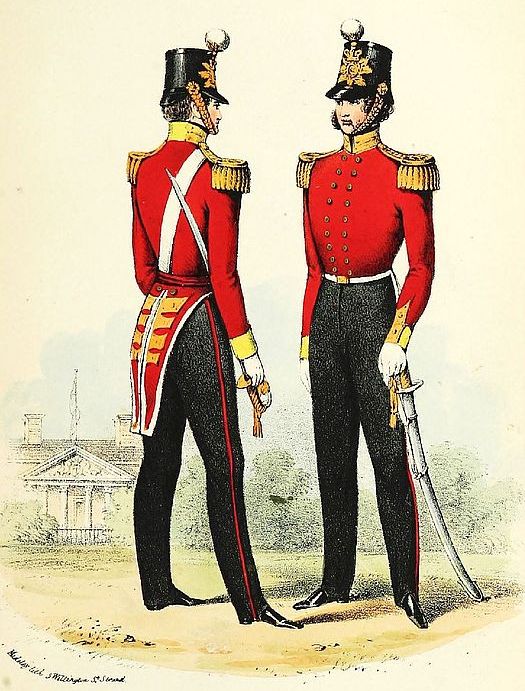
Madeley lith. 3 Wellington St. Strand.
TENTH FOOT.
1848.
For Cannon's Military Records.