OF
THE SIXTY-SEVENTH,
OR
THE SOUTH HAMPSHIRE REGIMENT OF FOOT.
1756
The French Government having failed to fulfil the conditions
stipulated in the Treaty of Aix-la-Chapelle,
and having committed certain encroachments on the British
Territories in North America, and other acts of aggression,
King George II. again prepared for war, which was
proclaimed against France on the 18th of May, 1758.
The Army and Navy were consequently increased, and,
among other augmentations, fifteen of the regiments of
infantry were authorised to raise second battalions from
the 25th of August, 1756.[6]
1758
In 1758, these additional battalions were formed into
distinct corps, and numbered from the sixty-first to
the seventh-fifth regiments. By this arrangement the
second battalion of the Twentieth regiment was constituted
the SIXTY-SEVENTH regiment, and His Majesty
was pleased to confer the colonelcy on Colonel James
Wolfe, on the 21st of April of that year, from the Twentieth
(Kingsley's) regiment in which he had served from
1749, and which had acquired, under his command, a high
character for its exactness of discipline and other useful
qualities.
The SIXTY-SEVENTH, being thus formed from the
Twentieth regiment, assumed the pale yellow facing as
worn by the Twentieth, which it has since retained.
The following officers were appointed to commissions
in the SIXTY-SEVENTH regiment, on its formation from the
21st of April, 1758.
| Colonel, | James Wolfe | from 20th Regt. |
| Lieut.-Colonel, | Robert Robinson | from 20th Regt. |
| Major, | Thomas Bowyer | from 14th Foot. |
Captains.
| Chas. Veaitch, from | 20th Regt. | Thos. Osborne, | from | 20th Regt. |
| Edw. Goodenough, | ditto | John Baldwin, | from | 51st Regt. |
| William Delaune, | ditto | Geo. Sherwin, | from | 20th Regt. |
| James Dunne, | ditto |
Lieutenants.
| James Nesbitt, from | 20th Regt. | George Smith, | from | 20th Regt. |
| William Dughe, | ditto | William Yorke, | ditto |
| William Edwards, | ditto | Philip Hales, | ditto |
| Francis Raper, | ditto | Henry Nesbit, | ditto |
| Freeheville Dykes, | ditto | Thos. Wilkinson, | ditto |
| Marmaduke Green, | ditto | Alexander Rose, | ditto |
| John Gardner, | ditto | John Matson, | ditto |
| John Cane, | ditto | Despard Croasdale, | ditto |
| Richard Faulkner, | ditto |
Ensigns.
| Wm. Massey, from | 20th Regt. | George Sladdan. | |
| Thomas Barker, | ditto | Robert Griffiths. | |
| Joseph Collings, | ditto | Thomas Lowe. | |
| Royston Barton, | ditto |
| Quarter-Master, | James Kirkman. |
| Chaplain, | George Carleton. |
| Surgeon, | Joseph Harris, from 20th Regiment. |
| Adjutant, | James England,ditto |
1759
After its formation as a distinct regiment, the SIXTY-SEVENTH
remained at various stations in England during
the years 1759 and 1760. Its Colonel, James Wolfe, had
been appointed, in January, 1758, Brigadier-General in
North America, and afterwards distinguished himself in
the operations preceding the capture of Cape Breton,
which surrendered on the 26th of July, 1758, and again
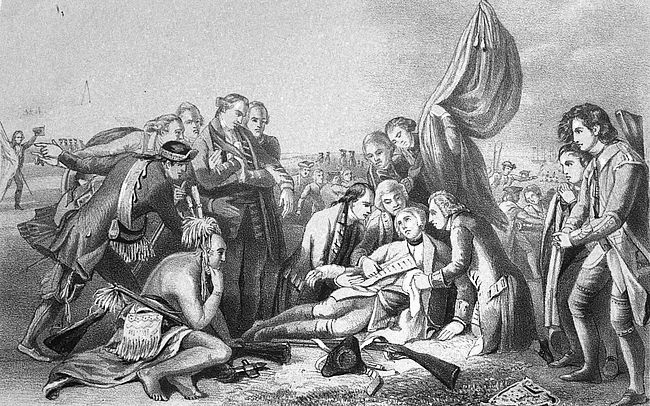
in the expedition against Quebec, when he died of the
wounds received at the battle on the heights of Abraham,
above Quebec, on the 13th of September, 1759.
On the 24th of October, 1759, His Majesty was pleased
to confer the colonelcy of the SIXTY-SEVENTH regiment
on Lieut.-Colonel Lord Frederick Cavendish, from the
First Foot Guards, in succession to Major-General James
Wolfe, deceased.
The decease of King George II. occurred on the 25th
of October, 1760, and on the day following His Majesty
George III., grandson of the late Sovereign, was proclaimed
King of Great Britain and Ireland.
1760
On the 30th of October, 1760, His Majesty King
George III. was pleased to remove Colonel Lord Frederick
Cavendish to the Thirty-fourth regiment, and to appoint
Major-General Sir Henry Erskine, Bart., to succeed
him as Colonel of the SIXTY-SEVENTH regiment.
1761
In the spring of 1761 the SIXTY-SEVENTH regiment
formed part of the force selected to proceed, under the
command of Major-General Studholme Hodgson, against
Belle-Isle, a French island in the Bay of Biscay, off the
coast of Brittany. Major-General Hodgson had the
undermentioned officers and regiments placed under his
orders, which amounted to nearly nine thousand men:—
Major-General John Craufurd; Brigadier-Generals
William Rufane, Hamilton Lambert (afterwards Colonel
of the SIXTY-SEVENTH), Guy Carleton, Honorable William
Howe, Robert Douglas, and Philip Jennings; Deputy-Adjutant-General
Lieutenant-Colonel Sir Thomas Spencer
Wilson, Bart.; Deputy-Quartermaster-General Lieutenant-Colonel
Lewis Thomas.
| Regiments. | Commanding Officers. | Men. |
| 16th Light Dragoons | Lieut.-Col. | Burgoyne | 200 |
| 9th Foot | " | R. Phillips | 800 |
| 19th ditto | " | R. Douglas | 800 |
| 21st ditto | " | Edw. Maxwell | 800 |
| 30th ditto | " | John Jennings | 800 |
| 67th ditto | " | Thomas Shirley | 800 |
| 69th ditto | " | Christopher Teesdale | 800 |
| 76th ditto[7] | " | D. Erskine | 1300 |
| 85th ditto, 1st Batt.[7] | " | Viscount Pulteney | 700 |
| 90th ditto[7] | " | Hugh Morgan | 500 |
| 97th ditto[7] Lieut.-Col. | Commandant | J. Stuart | 600 |
| 98th ditto[7] | " | Major Purcell | 600 |
| | | —— |
| | | 8,700 |
| | | —— |
The expedition appeared before Belle-Isle on the 7th of
April, and a landing was attempted on the following day;
but the whole island appeared like one vast fortress;—the
little which nature had left undone by rocks and crags,
having been supplied by art; so that when the grenadiers
gained the shore, the enemy was discovered so strongly
fortified, that no efforts of the few men which could be
landed at once, were of any avail. A boat of Erskine's
grenadiers (SIXTY-SEVENTH), commanded by Captain
Thomas Osborne, landed at a point, and drew up undiscovered.
His situation flanked the enemy, but no
other boat followed. The French immediately came out,
and Captain Osborne advanced to meet them. Twice
brought to the ground by a shot, he pressed on, and
approached so close to the enemy, that he exchanged
thrusts with the French officer in command. The English
fired, and then charged with the bayonet. The commanders
on both sides were killed, when the English,
being without leaders, were unable to maintain their
position.—Attempts to secure a landing on other points
of the island being also unsuccessful, orders were given to
desist from the attempt, and the men returned to the
boats, and proceeded back to their several ships. Many
of the boats were destroyed or damaged in this attempt,
and about five hundred men were lost in killed, wounded,
and missing.
Commodore Keppel stated in his letter, of the 13th of
April, 1761, to the Right Honorable Mr. Secretary Pitt,
afterwards created the Earl of Chatham, that
"One of the flat boats landed sixty of Erskine's
grenadiers (SIXTY-SEVENTH regiment), who got up a
very difficult place to the top of the hills, where they
formed with great skill, but were so immediately
routed by a much more numerous body of the enemy,
that all attempts to succour them were ineffectual, any
further than the boats bringing from the rocks about
twenty of them." On the 8th of April, 1761, the
SIXTY-SEVENTH had Captain Thomas Osborne and Lieutenant
John Gardner killed. Lieutenants Marmaduke
Green and William Herdsman were taken prisoners.
The other casualties were, two serjeants, one drummer, and
six rank and file killed; and sixteen rank and file wounded.
Major-General Hodgson subsequently received the following
reinforcements:—
| Regiments. | Commanding Officers. | Men. |
| 3rd Foot. | Major J. Biddulph | 800 |
| 36th ditto. | Lieut.-Col. W. Preston | 800 |
| 75th ditto[8] | " C. Parry | 800 |
| 85th ditto, 2nd Batt.[8] | Major Sir Hugh Williams | 600 |
| | —— |
| | 3000 |
| | —— |
and another attempt to effect a landing was resolved upon.
Brigadier-General Hamilton Lambert, on the 22nd of
April, 1761, effected a landing on the rocks near Point
Lomaria, where the difficulty of ascending the precipice
had made the enemy least attentive to that part. Beauclerk's
grenadiers (Nineteenth foot), with Captain Patterson
of that regiment, gained the summit before the
enemy saw what was intended, who immediately marched
a body of three hundred men to attack them; the grenadiers,
however, maintained their ground till the remainder
of Brigadier Lambert's troops arrived. The
success, thus gained, was promptly followed up; the
French were eventually repulsed, and three brass field-pieces,
with a few prisoners, were captured.
The cannon was afterwards landed from the ships and
dragged up the rocks; the lines which covered the
town of Palais were carried by assault, and the siege of
the citadel was prosecuted with vigour. The garrison
under their Governor, the Chevalier de St. Croix, made
a gallant defence, but on the 7th of June were forced
to surrender, and were permitted to march through the
breach with the honours of war in consideration of their
bravery. The capture of the island was thus achieved,
with the loss of about eighteen hundred men killed
and wounded.[9]
On the 29th of May, 1761, Major-General Sir Henry
Erskine was removed to the Twenty-fifth regiment, and
King George III. was pleased to promote Lieut.-Colonel
Hamilton Lambert, from the Thirty-first regiment, to the
SIXTY-SEVENTH regiment, as a reward for his gallantry at
the capture of Belle-Isle.
1762
While success attended the arms of Great Britain, in
various parts of the world, the Sovereigns of France and
Spain were negotiating a compact, which gave a new
turn to the nature of the war; and the two crowns
attempted to coerce Portugal to unite in their designs
against Great Britain. Portugal at this period was
particularly weak; the capital, Lisbon, had been
destroyed by an earthquake five years previously, when
nearly thirty thousand inhabitants had been buried in its
ruins. This disaster had been followed by a conspiracy
against the life of the King, while the country was shaken
by internal commotions; at the same time the military
force of the kingdom was weak in numbers, scantily
furnished with arms, and without experienced officers.
Notwithstanding these adverse circumstances, the King of
Portugal resolved to adhere to his ancient alliance with
Great Britain; and in consequence of this decision,
France and Spain declared war against him. A powerful
Spanish army assembled on the frontiers, and threatened
to crush the Portuguese, when a military force, with
artillery, arms, stores, provisions, and money, was
furnished by Great Britain to assist its faithful ally; and
the SIXTY-SEVENTH, which had returned with the
expedition from the coast of France, was one of the
regiments selected for service in Portugal.
The regiment proceeded to Portugal, and continued in
that country until the termination of hostilities by the
treaty of Fontainebleau, the preliminary articles of which
were signed by the Duke of Bedford at Fontainebleau, on
the 3rd of November, 1762.
1763
Peace was proclaimed in London on the 22nd of March,
1763, and by its provisions it was settled that the Island
of Minorca, which had been captured by the French in
April, 1756, should be restored to Great Britain. The
SIXTY-SEVENTH and the Third foot from Portugal,
the Eleventh, Thirty-third, and Thirty-seventh regiments
from Germany, and the Fifty-seventh from Gibraltar,
were embarked in order to form the garrison of
Minorca.[10]
1768
1771
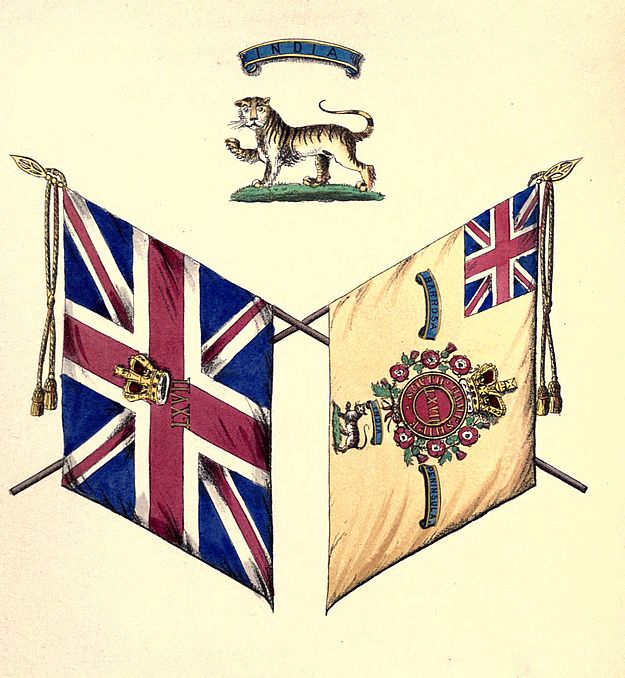
In the Royal Warrant of King George III. dated 19th of
December, 1768, containing regulations for the colours,
clothing, &c. of the regiments of foot, it was directed that the
regimental colour of the SIXTY-SEVENTH regiment should
be pale yellow, being similar to the colours of the Twentieth
regiment, from which it was formed. The SIXTY-SEVENTH
remained on duty at Minorca until July, 1771, when the
Third, Eleventh, and SIXTY-SEVENTH regiments embarked
for England, on being relieved by the Royals (second
battalion), the Fifty-first and Sixty-first regiments.
1773
In the year 1773 the regiment proceeded to Scotland,
where it remained until the year 1775.
1774
On the decease of Lieut.-General Hamilton Lambert
in 1774, His Majesty was pleased to promote Lieut.-Colonel
Edward Maxwell Brown, from the Twenty-first,
Royal North British Fusiliers, to the colonelcy of the
SIXTY-SEVENTH regiment, on the 11th of March, 1774.
1775
The regiment embarked for Ireland in 1775, to replace
the Forty-second, Royal Highland regiment, and continued
on duty in that country until the year 1785.
1782
On the 31st of August, 1782, His Majesty directed that
the regiment should be designated the SIXTY-SEVENTH,
or the South Hampshire regiment, with a view that a
connexion might be cultivated between the corps and that
county, in order to promote the success of the recruiting
service.
1785
Early in the year 1785 the regiment embarked from
Ireland for the West Indies, to relieve the Fifty-fifth
regiment.
The regiment proceeded from Barbadoes to Antigua
in the autumn of 1785.
1788
During the years 1788, 1789, 1790, 1791, and 1792,
the regiment was stationed at Grenada.
1793
In the year 1793 the regiment was stationed at
Barbadoes, and in July, 1794, returned to Great Britain:
the regiment subsequently proceeded to Ireland.
1796
On the 25th of February, 1796, the SIXTY-SEVENTH
regiment embarked from Ireland for the island of St.
Domingo. An expedition had proceeded to St. Domingo
in 1794, in order to aid the planters against the persecution
of the negro inhabitants, who had imbibed the doctrines
of liberty and equality, propagated at that period. The
distracted state of France afforded the inhabitants no
prospect of relief, and they were therefore desirous of
placing themselves under the protection of Great Britain.
Much resistance was experienced from the negroes, and
the English took possession of Port-au-Prince, the capital
of St. Domingo, now the republic of Hayti; but no
effectual steps could be taken for the reduction of the
island, as the yellow fever destroyed the Europeans with
frightful rapidity on their arrival on its fatal coast: the
British evacuated the place in 1798.
1798
Towards the end of the year 1798 the regiment proceeded
from St. Domingo to Jamaica, after having
suffered severely by disease at the former island.
1801
On the 21st of October, 1801, the regiment embarked at
Jamaica for England, greatly reduced in numbers from
the effects of the climate of the West Indies.
1802
During the year 1802, the regiment was stationed in
South Britain.
1803
On the 25th February, 1803, His Majesty was pleased
to appoint Lieut.-General Francis D'Oyly, from Colonel
Commandant of the Fifteenth foot, to the colonelcy of the
SIXTY-SEVENTH regiment, on the decease of General
Edward Maxwell Brown; and on the 9th of March following
General Peter Craig was appointed Colonel of the
regiment, in succession to Lieut.-General D'Oyly, whose
decease occurred on the 4th of March, 1803.
In consequence of the renewal of war with France,
and the extensive preparations made in the ports of that
country, particularly at Dunkirk and Boulogne, for
carrying into effect the threatened invasion of Great
Britain, the most active measures were adopted by the
British Government to frustrate the designs of the French
ruler. An Act of Parliament was passed in 1803 for
raising men for limited service in Great Britain and
Ireland, which was termed the Army of Reserve Act, and
the men so raised were formed into additional and distinct
battalions.
The SIXTY-SEVENTH regiment, which had embarked
for Ireland in the beginning of 1803, was authorised to
receive men raised in Ireland under the Army of Reserve
Act, and a Second Battalion was added to the establishment
on the 9th of July, 1803.
On the 13th of October the first battalion embarked
at Dundalk for Guernsey, where it arrived on the 25th
of November following.
1804
About the middle of November, 1804, the regiment
was removed from the island of Guernsey to Portsmouth,
where it arrived on the 30th of November.
1805
On the 25th of March, 1805, the regiment was augmented
to an establishment of 64 serjeants, 22 drummers,
and 1200 rank and file.
From Portsmouth the first battalion embarked on the
22nd of April, 1805, for the East Indies, and arrived in
the Presidency of Bengal on the 15th of September of
the same year.
1807
In December, 1807, the SIXTY-SEVENTH proceeded
from Fort William to Dinapore, at which station the
regiment arrived in March following.
1810
The regiment marched for Benares, in January, 1810,
and from thence to Ghazeepore.
1811
In January, 1811, the regiment again proceeded to
Benares, and returned to Ghazeepore in the month of
February of that year.
Lieut.-General Sir William Keppel, G.C.B., Colonel
Commandant of the Sixtieth, was appointed by His Majesty
Colonel of the SIXTY-SEVENTH regiment, on the 7th
of February, 1811, on the decease of General Peter Craig.
1813
The regiment proceeded from Ghazeepore to Cawnpore
in January, 1813.
1815
On the 10th of October, 1815, the regiment marched
from Cawnpore to Meerut, where it arrived on the 7th
of November.
1817
The first battalion of the SIXTY-SEVENTH regiment
marched from Meerut on the 15th of October, 1817, on
field service, and joined the army of reserve under the
command of Major-General Sir David Ochterlony. On
the 27th of November, the first battalion marched from
Rewarree, with the reserve of the grand army, to Jeypoor,
a city which derives its name from its founder Sevai Jye
Singh, a celebrated Hindoo warrior and statesman.
1818
The battalion marched from Dungurter to Oojein in
the middle of February, where it joined the Bombay
division of the army, under Major-General Sir William
Grant Keir, on the 7th of March. It proceeded from
Oojein for Baroda on the 13th of March; and on the
9th of April following, marched from Baroda to Tankaira,
being the first regiment of His Majesty's army that crossed
the Peninsula of India. It embarked for Bombay, where
the battalion arrived on the 23rd of April.
On the 30th of April, 1818, six companies embarked
from Bombay for the southern Concan,[11] and were
present at the siege and surrender of the strong fortress of
Ryghur on the 10th of May following. This important
stronghold is situated upon the Ghauts which bound the
eastern frontier of the Concan, in a line between Poonah
and Bancoote, and was one of the fortresses which the
Peishwah, Bajee Rao, had surrendered on the 8th of May,
1817, as a pledge of his sincerity. Notwithstanding
the stupendous height and extensive area on the top
of the fortress, shells were thrown into every part of it,
and the palace set on fire, which greatly tended to
determine the enemy to surrender. The garrison held
out a flag for terms, and after three days of communication
and treaty, Lieut.-Colonel David Prother, C.B., of the
Ninth Native Infantry, was induced to allow the garrison
honorable terms, permitting them to march out with their
arms and private property, on the 10th of May. The wife
of His Highness the late Peishwah was found in the fort
on taking possession, and public property, in specie, to
the amount of five lacs.
Lieut.-Colonel Prother stated in Brigade Orders on
the 12th of May—
"The surrender of the fortress of Ryghur having closed
the operations, the Commanding Officer has peculiar
pleasure in offering a public acknowledgment to the
merits of those by whom this event has been so much
accelerated....
"Although Major Benjafield and the detachment of
His Majesty's SIXTY-SEVENTH regiment, did not arrive
until nearly the end of the siege, yet the share taken by
them fully deserves the Commanding Officer's thanks."
The six companies of the SIXTY-SEVENTH regiment
returned to head-quarters on the 26th of May.
On the 11th of May, four companies embarked from
Bombay for Surat, and were present on the 8th, 18th,
21st, and 28th of June, when possession was taken of the
towns and forts of Nunderbar, Cokermundaye, Toulodah,
and Kopriel.
In the middle of September the first battalion embarked
in three divisions for the Deccan, and arrived at
Seroor on the 5th of October following; on the 30th
of October the regiment marched from Seroor, and
arrived at Mallygaum, the head-quarters of the troops in
Candeish, on the 11th of November. Colonel Huskinson,[12]
of the SIXTY-SEVENTH, being the senior officer, assumed
the command of the troops.
His Royal Highness the Prince Regent, in the name
and on the behalf of His Majesty, was pleased, on the
24th of October, 1818, to appoint Lieut.-Colonel John
Frederick Ewart, of the SIXTY-SEVENTH regiment, to
which he had exchanged from half-pay of the Fifth West
India regiment, on the 5th of February, 1818, a Companion
of the most Honorable Military Order of the Bath.
The force commanded by Colonel S. Huskinson, of
which the SIXTY-SEVENTH formed part, marched on the
25th of November for the attack of the towns and forts of
Amulneir and Behauderpore, which surrendered at discretion
on the 30th of November and the 1st of December, and
of which possession was taken, the first place by the flank
companies of the regiment, and the latter by the auxiliary
horse under Captain Swanton.
Colonel Huskinson, commanding the troops at Candeish,
in his despatch to the Resident, the Honorable Mountstuart
Elphinstone, dated Camp before Amulneir, 30th
of November, 1818, stated,—
"It gives me the greatest satisfaction to have to
announce to you, for the information of the Most Noble
the Governor-General in India, that the fort of Amulneir
surrendered unconditionally to the force I have the
honor to command, about noon this day, where, as soon
after as possible, Brevet Major Owen, of His Majesty's
SIXTY-SEVENTH regiment, by my orders, occupied the
whole of the gates and fort with part of the flank
companies of that regiment. This service, I am happy
to say, was effected without firing a shot. May I
request your orders respecting the disposal of Ally
Jemadar and his followers, who are now prisoners in
camp."
Here the four companies, which left head-quarters in
May, rejoined the regiment.
Leaving Amulneir on the 4th of December, the SIXTY-SEVENTH
proceeded to Malligaum, where the battalion
arrived on the 14th of that month.
1819
The SIXTY-SEVENTH marched for Amulneir, with the
force under the command of Colonel Huskinson, on the
25th of February, 1819. On the 3rd of March eight
companies of the regiment, under Brevet Lieut.-Colonel
Maxwell,[13] proceeded to Asseerghur, and joined the force
under Brigadier-General Doveton, before the fortress of
Asseerghur,[14] which, on account of its strength, has been
designated the "Gibraltar of the East."
The fortress of Asseerghur, which had been held by
one of Scindiah's refractory chiefs, is situated on a detached
hill between the rivers Nerbudda and Tapty: it consists
of an upper and lower fort; the upper one is of an
irregular form, about 1100 yards from east to west, and
about 600 from north to south; it crowns the top of the
hill, which is about 750 feet in height; a perpendicular
precipice from 80 to 120 feet, surmounted with a low
wall full of loopholes, surrounds it, with the exception of
one place, which is strongly fortified. Below are two
lines of works, the outer one forming the lower fort,
which rises directly above the Pettah,[15] and the entrance
to which is protected by strong gateways and flanking
works. Immense labour and great skill had been employed
to render this naturally strong post almost impregnable;
and at the siege of which the SIXTY-SEVENTH
regiment was present.
The Hyderabad division was encamped at Neembolah,
about seven miles from Asseerghur, and negotiations
having failed, about twelve o'clock on the night of the
17th of March five companies of the Royal Scots (First
regiment of foot) with the flank companies of the Thirtieth,
SIXTY-SEVENTH, and Madras European regiment, five
companies of native infantry, and a detachment of sappers
and miners, the whole commanded by Lieutenant-Colonel
Fraser, of the Royal Scots, and a reserve commanded by
Major Dalrymple, of the Thirtieth, assembled at the camp
for the attack of the pettah of Asseer; another party was
also directed to co-operate in this service from Brigadier-General
Sir John Malcolm's division.
The column commenced its march between one and
two o'clock, advancing up the bed of a deep nullah, or
small river, nearly dry at the time; the assaulting party
arrived unobserved within five hundred yards of the pettah,
then rushed upon the gate with the greatest ardour
and steadiness, the Royal Scots leading the way. The
enemy was surprised, and, after discharging a few rounds
of grape, retired. The head of the attacking column forced
the gate, and proceeding up the main street, encountered
an advanced piquet of the enemy, which retired to the
lower fort, firing occasionally at the head of the column.
Major Charles MacLeod, of the East India Company's
service, Deputy-Quartermaster-General, acted as guide
on the occasion; by his direction the leading files of the
Royal Scots pursued the enemy close under the walls of
the fortress, from whence an incessant fire of artillery and
matchlocks was kept up; a few ill-directed rockets were
also discharged.
The leading sections of the Royal Scots, which had
pursued the enemy up the hill, were joined by one or two
files of the Thirtieth and SIXTY-SEVENTH regiments, the
whole amounting to about 25 or 30 men. As soon as
the enemy saw the small force before which he had
so precipitately fled, he immediately rallied, and came
shouting down the hill with augmented numbers to attack
this small party, but was repulsed by a spirited charge
with the bayonet, which, with a few rounds of musketry,
obliged him to retreat within the works, some of which
were within about fifty yards of this handful of men, leaving
the Chief, who was shot in the melée, and several men on
the field.
The pettah of Asseerghur was thus captured on the
morning of the 18th of March, with trifling loss; but on
the evening of the following day a desperate sally was
made by a part of the garrison on the advanced post of
the troops in the pettah, on which occasion Lieutenant-Colonel
Fraser, of the Royal Scots, was unfortunately
killed, while gallantly rallying the party under his command,
and keeping the advance in their position. The
enemy was, however, immediately driven back, and compelled
to retire into the fort.
During the progress of constructing new batteries on
elevated and commanding situations, the dragging of
ordnance into many of them was performed by the
European soldiers, who literally worked like horses; during
the whole of the time they were annoyed by a constant fire
of matchlocks from the walls of the upper fort (the lower
fort had been taken possession of on the 30th of March,
by part of Brigadier-General Sir John Malcolm's division),
but which was too distant to prevent the execution
of this Herculean labour, which was performed with that
ardour and cheerfulness so characteristic of British
soldiers, when necessity demands from them any extraordinary
exertions.
On the 31st of March, part of the Bengal army, consisting
of 2200 native troops, with 22 pieces of heavy
ordnance, commanded by Brigadier-General Watson,
joined the besieging force; and these guns were soon
placed in battery, and opened on the fort. The storm of
war now raged furiously round Asseerghur, and a breach
was soon effected in the outer wall at the only assailable
part of the fort; at the same time two batteries were
directed against the inner wall. This unremitting fire
was continued until the 6th of April, when the garrison
forced the Killedar to sue for terms, namely, "liberty
to preserve their arms, and to depart with their personal
property."
These conditions were refused, and hostilities recommenced;
the Killedar, however, accepted the terms
offered on the 8th, and agreed to surrender the fort on
the morning of the 9th, when the firing ceased; but as he
stated that he could not answer for the garrison, the
control of which he had lost, preparations were made for
renewing operations in case of refusal.
The garrison surrendered unconditionally on the 9th of
April, and five hundred men of the SIXTY-SEVENTH,
under the command of Major Benjafield, with the 7th
Madras light cavalry, and the second battalion of the 13th
Madras native infantry, took possession of the fortress, on
the garrison marching out and laying down their arms on
the public parade.
The following was the return of ordnance, &c. taken
in the fortress of Asseerghur by the troops under the
command of Brigadier-General Doveton. Brass and
iron ordnance, 128; about 36,000 stone and iron shot, of
different sizes; two hundredweight of gunpowder; 2000
wall-pieces, of different sizes; and about four hundredweight
of grape-shot.
During the siege the SIXTY-SEVENTH had Lieutenants
J. Adair and John Hannah severely wounded; Lieutenant
Adair[16] was twice severely wounded by matchlock
balls in the left arm and right side, on the 19th of March,
in repulsing the sortie of the garrison of Asseerghur:—one
serjeant, one drummer, and eleven rank and file
were wounded.
Major Owen, who commanded the flank companies of
His Majesty's SIXTY-SEVENTH regiment, was particularly
mentioned in Orders by Brigadier-General Doveton, who
also reported that "the fall of Asseer leaves to the
Brigadier-General only the pleasing task of recording his
sense of the merits and exertions of the officers and troops,
and of bringing them to the notice of superior authority,
where they can alone be fully and properly appreciated.
"To the means placed at the Brigadier-General's
disposal, by the rapid advance of the division under the
personal command of Brigadier-General Sir John
Malcolm, K.C.B., as well as of the troops from the
Nerbudda field force and from Saugur, under the
personal command of Brigadier-General Watson, C.B.,
to the science and skill of the engineer and artillery
branches, and finally to the distinguished gallantry and
persevering exertions of the whole of the officers and
troops whom the Brigadier-General has the honor to
command, are principally to be attributed the fall of so
stupendous a fortress in eleven days from the opening
of the trenches....
"He requests also that Lieutenant-Colonels MacDowell,
Dewar, Ewart (Lieut.-Colonel of the SIXTY-SEVENTH
regiment), Greenstreet, and Pollock, commanding
brigades of infantry, will be fully persuaded
of the high estimation in which he holds the eminent
services rendered by them, as well as by the officers
and men of their several brigades"....
Brigadier-General Sir John Malcolm also reported:—
"I have to state my sense of the zeal and activity of
my Aide-de-Camp, Ensign G. Pasley, of His Majesty's
Fourteenth foot, and extra Aide-de-Camp Lieutenant
J. Pasley, of His Majesty's SIXTY-SEVENTH foot."
On the 12th of April, the SIXTY-SEVENTH marched from
Asseerghur, and arrived at Mallygaum on the 26th of the
same month.
The decease of Major Nathaniel Benjafield, of the
SIXTY-SEVENTH regiment, occurred on the 2nd of June,
1819.
1820
The regiment proceeded on the 6th of December, 1820,
from Mallygaum, in Candeish, and arrived at Sholapore,
in the Deccan, on the 29th of that month.
1823
Colonel Samuel Huskinson, the Lieut.-Colonel of the
SIXTY-SEVENTH regiment, was promoted on the 19th of
July, 1821, to the rank of Major-General, and on the 10th
of January, 1837, was advanced to the rank of Lieutenant-General.
Marching from Sholapore on the 23rd of April, the
regiment arrived at Poonah on the 10th of May, 1823.
1826
On the 2nd of January, 1826, the first battalion of the
SIXTY-SEVENTH regiment embarked in three divisions at
Bombay for Calcutta, and arrived there on the 2nd of
March following. On the 13th of March the battalion
proceeded to Rangoon, and arrived opposite the town on
the 27th of the same month. The battalion returned to
Calcutta on 5th of April following.
Major S. B. Taylor, Captain W. Webster, and Lieutenant
J. Hassall, of the SIXTY-SEVENTH regiment, died at
Fort William during April and May of this year.
The SIXTY-SEVENTH embarked for England in the ships
Zenobia, Caroline, and Catherine Stewart Forbes, under
the command of Major Poyntz on the 9th of June, 1826.
The head-quarters and second division arrived at
Gravesend on the 28th of November following, after an
absence of twenty-one years in India; the remainder of
the regiment arrived at Gravesend on the 16th of April,
1827.
On the 20th of December, 1826, the SIXTY-SEVENTH
regiment was authorised by His Majesty King George
IV. to bear on its colours and appointments, in addition
to any other badges or devices heretofore granted, the
figure of the Royal Tiger, with the word "India" superscribed,
in commemoration of its services in that part
of the world from the year 1805 to 1826.
The regiment marched from Chatham to Windsor in
December, 1826.
In March, 1827, the regiment proceeded from Windsor
to Weedon, and in October the head-quarters were
stationed at Bolton, in Lancashire.
1828
Towards the end of July, 1828, the regiment proceeded
to Manchester, and in October it marched to
Liverpool.
His Majesty King George the Fourth was pleased to
appoint Major-General John Macdonald, C.B. (Deputy
Adjutant-General to the Forces) to the colonelcy of the
SIXTY-SEVENTH regiment, on the 25th of August, 1828, in
succession to General Sir William Keppel, removed to
the Second or Queen's Royal regiment of foot.
1829
The regiment marched from Liverpool to Stockport in
January, 1829, and in May following proceeded to Chester.
Major the Honorable H. R. Molyneux was promoted
to the rank of Lieut.-Colonel in the SIXTY-SEVENTH
regiment, on the 9th of April, 1829, Lieut.-Colonel
Nathaniel Burslem having retired from the service.
1830
On the 18th of May, 1830, the regiment proceeded
from Chester to Liverpool, and embarked for Dublin,
from whence it proceeded to Mullingar.
On the 23rd of December, 1830, the regiment proceeded
from Mullingar to Newry, under the command of Lieutenant-Colonel
the Honorable Henry R. Molyneux.
1832
On the 14th of January, 1832, the SIXTY-SEVENTH,
under the command of Lieutenant-Colonel the Honorable
H. R. Molyneux, embarked at Dublin in the Stentor and
Prince Regent transports for Gibraltar, and the service
companies arrived at that fortress on the 25th of February.
The depôt companies of the regiment remained in Ireland.
1833
The service companies embarked in His Majesty's
ship Revenge, from Gibraltar, on the 28th of February,
1833, for the West Indies, and arrived at Barbadoes on
the 29th of March.
1834
1836
In May, 1834, the service companies proceeded to St.
Christopher's; and in May, 1836, were removed to
Demerara.
The depôt companies were removed from Cork to
Sheerness, in August, 1836, and in September, 1839,
proceeded from Gosport to Cork.
1837
The service companies remained at Demerara during
the year 1837.
1838
In January, 1838, the service companies proceeded to
Berbice, but returned to Demerara in June following.
1839
The service companies proceeded from Demerara to
Barbadoes, in June, 1839.
1840
On the 21st of April, the service companies, consisting
of 30 serjeants, 8 drummers, and 449 rank and file,
embarked, under the command of Brevet Major T. C.
Harpour, from Barbadoes for North America, in Her
Majesty's ships Sapphire and Athol. The regiment
disembarked at Chambly, in Canada, on the 21st of May.
During the year 1840 the depôt companies were
stationed at Buttevant and Galway.
1841
The service companies proceeded from Chambly to
Drummondville, in May, 1841.
In June, 1841, the depôt companies were removed
from Galway to Templemore.
1842
The head-quarters, under the command of Major E.
B. Brooke, marched from Drummondville on the 19th
of May, and arrived at St. Helen's, Montreal, on the 25th
of May, 1842. On the 3rd of November, 1842, the
service companies embarked in the Pestonjee Bomonjee
transport at Quebec, and disembarked at Plymouth on
the 15th of December following.
The depôt companies joined the regiment on the 15th
of December, 1842, having been removed from Ireland
to Plymouth in October.
1843
In May, 1843, the regiment proceeded from Plymouth
to Weedon, and in July marched to Manchester.
1844
Lieutenant-General John Clitherow was appointed by
Her Majesty to be Colonel of the SIXTY-SEVENTH regiment,
on the 15th of January, 1844, upon Lieutenant-General
Sir John Macdonald, G.C.B. (Adjutant-General
to the Forces), being removed to the Forty-second, Royal
Highland, regiment.
In December, 1844, the regiment was removed from
Manchester to Dublin.
1845
During the year 1845 the regiment continued to be
stationed at Dublin.
1846
In January, 1846, the regiment marched to Limerick,
and in May proceeded to Cork.
At this period the regiment was augmented to twelve
companies, consisting of 67 serjeants, 25 drummers, and
1200 rank and file, and was subsequently organised into
two battalions, preparatory to embarking on foreign service.
On the 9th of November, 1846, Colonel Thomas Bunbury,
K.H., commanding the SIXTY-SEVENTH regiment,
was promoted to the rank of Major-General, and Major
Edward Basil Brooke was promoted to the lieutenant-colonelcy,
vacant by the promotion of Major-General
Bunbury.[17]
1847
During the year 1847 the SIXTY-SEVENTH continued
at Cork.
1848
The first battalion embarked at Cork, under the
command of Lieut.-Colonel Edward Basil Brooke, in the
Herefordshire freight-ship, on the 8th of January, 1848,
and arrived at Gibraltar on the 19th of that month.
On the 20th of January, 1848, the reserve battalion
of the SIXTY-SEVENTH regiment, under the command of
Lieut.-Colonel William Nesbitt Orange, embarked at
Cork, in the Bombay freight-ship, and arrived at Gibraltar
on the 8th of February following.
General Sir Robert Wilson, then Governor of Gibraltar,
in his report, dated the 18th of May, 1848, on the SIXTY-SEVENTH
regiment, remarked,
"It is a corps composed of a superior body of men, well
regulated and well conducted, having had since its
arrival but nine courts-martial.
"Its interior economy is carefully superintended by
Lieutenant-Colonel Brooke.
"Her Majesty's Regulations are strictly observed in
all the prescribed cases.
"It discharges every duty commendably, and is an
efficient portion of the Garrison for every service."
The depôt company was removed from Cork to the Isle
of Wight, in February, 1848.
1849
On the 1st of May, 1849, the period to which this
Record has been continued, the two battalions of the
SIXTY-SEVENTH regiment were stationed at Gibraltar.
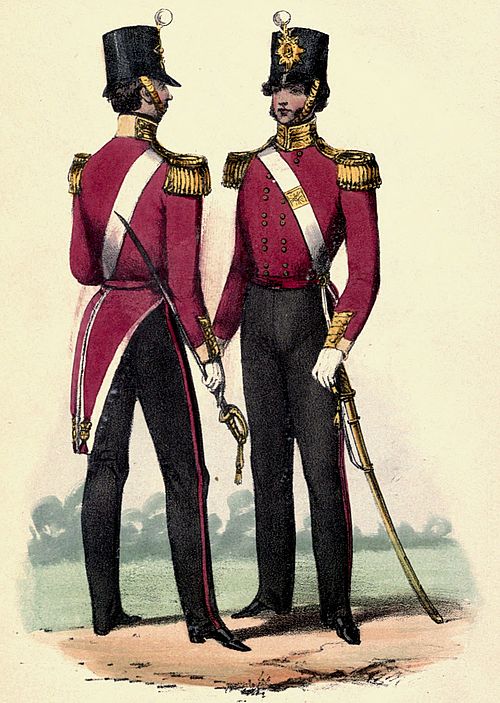
1849.
Madeley lith. 3 Wellington St. Strand
SIXTY-SEVENTH
REGIMENT.
For Cannon's Military Records