HISTORICAL RECORD
OF THE
SIXTY-FIRST,
OR
THE SOUTH GLOUCESTERSHIRE REGIMENT
OF
FOOT.
1755
1756
In the early part of the eighteenth century, the
British Colonies in North America were extended
along the coast;—at the same time, the Indian trade
drew many persons into the interior of the country,
where they found a delightful climate, and a fruitful
soil; and a company of merchants obtained a charter
for a tract of land beyond the Allegany Mountains,
where they commenced establishing a settlement.
The French laid claim to this part of the country,
drove away the settlers, and erected a fort to command
the entrance into the lands on the Ohio and the Mississippi
rivers. These aggressions giving indication of
an approaching war, the British army was augmented
in the winter of 1755-6, and that distinguished veteran
corps, the Third Regiment of Foot, or the
Buffs, was increased in numbers to twenty-two companies,
and was divided into two battalions in 1756.
1757
In the summer of 1757, the Third Regiment
formed part of an expedition against the coast of
France, the land forces being under General Sir John
Mordaunt, and the fleet commanded by Admiral Sir
Edward Hawke. The Isle of Aix was captured in
September, and an attack on Rochefort was contemplated;
but the wind proved unfavourable, and the
fleet returned to England.
1758
In the spring of 1758, the SECOND BATTALION of
the Buffs was constituted the “Sixty-first Regiment,”
under the command of Major-General Granville
Elliott, from the Austrian service, by commission
dated the 21st of April; the lieut.-colonelcy was
conferred on Major John Barlow, of the Buff’s, and
the majority on Captain Christopher Teesdale, senior
captain of the Buffs. The Regiment, being thus formed
from the Third Foot, was permitted to assume the
Buff facing.
After its formation, the regiment was encamped at
Chatham, with the Thirty-seventh and Sixty-fifth,
under Major-General the Earl of Panmure.
The following officers were holding commissions in
the regiment:—
| Colonel, Major-General Granville Elliott. |
| Lieut.-Colonel, John Barlow. |
| Major, Christopher Teesdale. |
|
Captains. |
| James Patterson |
Roger Crowle |
| A. Singleton |
William Buckley |
Captain-Lieutenant. |
| Thomas Hardcastle |
John Barford |
William Gunning |
| M. Brabazon |
|
Lieutenants. |
| John Acklom |
Peter Maturin |
D. Gilchrist |
| W. Peyton |
S. Pearce |
Thomas Brown |
| John Rowland |
John Poole |
G. V. Chetwode |
| John Waugh |
William Wilson |
R. Beatson |
| John Read |
F. Blomberg |
R. Kelly |
| N. Doolan |
A. Leishman |
J. Badger |
|
|
Ensigns. |
| John Skinner |
John Keir |
James Savage |
| John Ireland |
Edward Crowe |
John Arbuthnot |
| Jarvis Palmer |
Samuel Horner |
|
| Chaplain, George Shaw; Adjutant, William Gunning; |
| Surgeon, Peter Johnston; Quarter-Master, Samuel Grey. |
Towards the end of the year the regiment embarked
for the West Indies, with the armament sent
against the French West India Islands, under Major-General
Hopson and Commodore Moore.
1759
On the 16th of January, 1759, the troops landed
on the island of Martinico; but so many difficulties
were encountered, that they were re-embarked, and the
attack on this island was abandoned.
From Martinico the fleet proceeded to
Guadeloupe,
and the forts and batteries on the shore having been
silenced by the ships-of-war, the troops landed on the
24th of January, and took possession of the town and
citadel of Basse-Terre; the French soldiers and inhabitants,
with their armed negroes, retired to the mountains,
and prepared for a desperate defence of the
interior of the island.
For three months hostilities were continued on the
island, and during this period the officers and soldiers
of the Sixty-first evinced valour and perseverance
in carrying operations against, and making attacks on,
the posts occupied by the enemy. Captain William
Gunning, of the regiment, was killed at the attack of a
hill near Fort Louis; “he was an excellent officer, and
universally lamented by the army[1].” Lieut.-Colonel
Barlow distinguished himself at the head of a detachment
at the capture of St. Maries, when a party of the
Sixty-first penetrated a thick wood, and gained the
rear of a strong post, from which the French were
soon driven. The regiment also made a very determined
effort to penetrate the woody mountains, and
turn the enemy’s main position, and the operations of
the day were successful. After much desultory fighting,
the French were forced to surrender the island.
The Sixty-first had a number of men killed and
wounded; and others died from the effects of the
climate: the loss of the regiment in officers was Capt.-Lieutenant
William Gunning killed; Lieutenant John
Rowland wounded; Ensign Samuel Horner died. The
conduct of the officers and soldiers of the Sixty-first
was commended in orders.
On the decease of Major-General Elliott, he was
succeeded in the colonelcy of the regiment by Lieut.-Colonel
George Gray, from the first troop, now first
regiment, of Life Guards.
1760
1763
The regiment, having become considerably reduced
in numbers, returned to England to recruit, and in the
summer of 1760 it was encamped at Chatham; in
1761 it proceeded to the islands of Jersey and Guernsey,
where it was stationed until the termination of the
seven years’ war; and in 1763 it proceeded to Ireland,
where it remained seven years.
On the 9th of May, 1768, Major-General Gray
was removed to the Thirty-seventh Regiment; and
King George III. conferred the colonelcy of the Sixty-first
on Major-General John Gore, from lieutenant-colonel
in the Third Foot Guards.
1771
Three years afterwards the regiment was removed
from Ireland, and stationed at the island of Minorca,
which had been captured by the British in 1708, and
was ceded to Queen Anne by the treaty of Utrecht in
1713.
1778
Lieut.-General Gore was removed to the Sixth
Foot in 1773, when the colonelcy of the Sixty-first
was conferred on the lieut.-colonel of the regiment,
Colonel John Barlow; who was succeeded, in 1778,
by Major-General Staates Long Morriss, whose regiment,
the Eighty-ninth, had been disbanded at the
termination of the seven years’ war.
1772
1779
1781
In the mean time the American war had commenced;
France had united with the revolted British
provinces in their resistance; and Spain also commenced
hostilities against Great Britain, and undertook
the siege of Gibraltar in 1779. The capture of
Minorca was also contemplated by the court of Spain;
and in the middle of August, 1781, a powerful Spanish
and French armament appeared before the island.
The British troops employed on the detached stations
were withdrawn, and the whole assembled in the citadel
of St. Philip, the garrison of which place consisted of
the Fifty-first and Sixty-first Regiments, two corps
of Hanoverians (viz., Prince Ernest’s and Goldacker’s
regiments), and a proportion of artillery, the whole
amounting to two thousand five hundred men, commanded
by Lieut.-General the Hon. James Murray,
and Lieut.-General Sir William Draper, K.B. The
combined French and Spanish forces mustered sixteen
thousand men, commanded by Lieutenant-General the
Duke of Crillon, who proved an officer of ability.
The British garrison, however, made a resolute defence
of the fortress intrusted to their charge; and the King
of Spain, losing patience with the slow progress of the
siege, caused a large sum of money to be offered to the
British general, to induce him to betray his trust,
which was rejected with indignation[2].
1782
For several months the British soldiers defended
St. Philip with great gallantry; but at length the
scurvy, a putrid fever, and the dysentery, broke out
among them with so much violence, that in the beginning
of February, 1782, there was not a sufficient
number of men able to bear arms for one relief of the
ordinary guards, and not one hundred men free from
disease. Under these circumstances the governor
capitulated.
Lieut.-General the Honorable James Murray stated,
in his despatch,—“I flatter myself that all Europe will
agree that the brave garrison showed uncommon
heroism, and that thirst for glory which has ever distinguished
the troops of my royal master.... Such
was the uncommon spirit of the King’s soldiers, that
they concealed their diseases and inability rather than
go into the hospital; several men died on guard, after
having stood sentry: their fate was not discovered
until called upon for the relief, when it came to their
turn to mount sentry again.... Perhaps a more
noble, nor a more tragical scene was ever exhibited
than that of the march of the garrison of St. Philip
through the Spanish and French lines. It consisted
of no more than six hundred decrepid soldiers; two
hundred seamen, one hundred and twenty royal artillery,
twenty Corsicans, and twenty-five Greeks, &c.
Such was the distressing appearance of our men, that
many of the Spanish and French soldiers are said to
have shed tears.”
In the articles of capitulation the Duke of Crillon
stated,—“No troops ever gave greater proofs of heroism
than this poor worn-out garrison of St. Philip’s
Castle, who have defended themselves almost to the
last man.” Beatson, the historian of these wars,
states,—“The zeal, bravery, and constancy, displayed
by all the corps composing the garrison of St. Philip,
under an accumulation of misfortunes, may have been
equalled, but never exceeded.”
1783
Returning to England after the surrender of Fort
St. Philip, the regiment was engaged in recruiting its
numbers until the termination of the war; in August,
1782, it received the county title of the Sixty-first,
or the South Gloucestershire Regiment: and in
1783, it proceeded to Ireland.
1792
The regiment was stationed in Ireland until the
spring of 1792, when it proceeded to Gibraltar.
1793
1794
While the regiment was at Gibraltar the French
revolutionary war commenced, and in 1794 the French
West India islands of Martinico, St. Lucia, and
Guadeloupe were captured. The French republican government
fitted out an expedition for the recovery of the
conquered islands, and some success attended their
efforts. This occurrence occasioned an order to be
received for the Sixty-first Regiment to be embarked
from Gibraltar to reinforce the British troops in the
West Indies, where it arrived in December, and landed
at the island of Martinico.
1795
From Martinico the regiment proceeded to St.
Lucia, and was engaged in the attack of the French
troops on that island in April, 1795, under the orders
of Brigadier-General Stewart. Some severe fighting
took place; the regiment had several men wounded on
the 14th of April; and on 22nd of that month it had
nine men killed; Captains Riddle and Whelan, Lieutenants
Grant and Moore, Ensign Butler, seven serjeants,
two drummers, and fifty-three rank and file
wounded; five rank and file prisoners. A series of
actions followed, in which considerable loss was sustained.
The enemy being reinforced, obtained so great
a superiority of numbers, that it was found necessary
to evacuate the island in June, when the regiment
returned to Martinico.
1796
In the following year an armament, under Lieut.-General
Sir Ralph Abercromby re-captured St. Lucia
and other islands. The Sixty-first Regiment having
lost nearly four hundred men by disease, killed in
action, died of wounds, &c., it embarked for England,
where it arrived in October, and commenced recruiting
its ranks.
1797
The regiment embarked for Guernsey in 1797.
1798
1799
Holland had, in the mean time, become united to
France, and in 1795 the Cape of Good Hope was captured
by a British armament. A rebellion breaking
out on the frontiers of the colony, the Sixty-first
embarked for the Cape of Good Hope in the summer
of 1798; the regiment arrived at that settlement in
January, 1799, and was stationed there upwards of two
years.
During its stay at the Cape of Good Hope, the
regiment was employed against the hardy and warlike
tribes of Kafirs, who committed depredations in the
colony. On one occasion the light infantry company
marched upwards of forty miles in one day, to support
a detachment of the Eighth Light Dragoons, in an
attack upon the Kafirs, and the timely appearance of
the soldiers of the Sixty-first contributed to the
success gained on that occasion.
1800
The Sixty-first Regiment, with a detachment of
the Eighty-first, built a block-house, and threw up
works at Algoa Bay, and thus commenced the formation
of a settlement at that place, which has since risen
into importance.
On the decease of General Morriss, King George
III. conferred the colonelcy of the regiment on Major-General
George Hewitt, from Colonel-Commandant of
the second battalion of the Fifth Regiment, by commission
dated the 4th of April, 1800.
1801
In February, 1801, four companies of the Sixty-first
Regiment embarked from the Cape of Good
Hope, for a secret service; but they were afterwards
directed to join the Indian army commanded by Major-General
Baird, destined to proceed up the Red Sea,
traverse the Desert, and co-operate, with the troops
from Europe, in the expulsion of the French “Army of
the East” from Egypt. The remaining six companies
of the regiment sailed from the Cape of Good Hope on
the 30th of March, under the orders of Lieut.-Colonel
Carruthers, to join the expedition in the Red Sea.
The army from India arrived at the port of Cosseir
on the Red Sea in June, and marched through the
Desert to Kenna on the Nile, by divisions. The
four companies of the Sixty-first Regiment, a detachment
of the Tenth Foot, and a party of the
Eighth Light Dragoons, mustering five hundred and
eighty-two soldiers, under Lieut.-Colonel Barlow, of
the Sixty-first[3], commenced their march from Cosseir
through the Desert on the 18th of July; they
suffered much from excessive heat, thirst, and the
fatigue of a long march through a sandy desert, and
arrived at Kenna in ten days. The other companies
landed at Cosseir on the 10th of July, and commenced
their march on the 20th of that month for Kenna,
where they arrived in nine days, with the loss of only
one man, a drummer, who died of fatigue. When the
company, to which the drummer belonged, arrived at
camp, he was missed, and Private Andrew Connell
asked permission to return, notwithstanding the previous
fatigue he had undergone, and assist the drummer:
his humane exertions were, however, unavailing,
as he found the drummer dead. This humane conduct
brought Andrew Connell into notice, and he was eventually
promoted to a commission in the regiment.
On the 2nd of August the regiment embarked in
seventeen d’jirms (boats), and proceeded down the
river Nile, about four hundred miles, to Cairo, which
city had surrendered to the British troops a short time
previously. The regiment afterwards continued its
route down the Nile to the vicinity of Rosetta. The
siege of Alexandria was carried on with vigour, and
the deliverance of Egypt was completed by the surrender
of the French garrison in the beginning of
September.
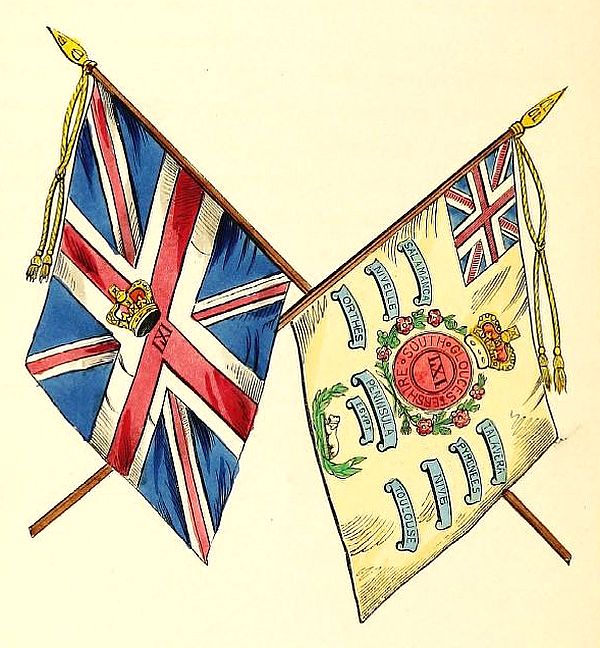
The Sixty-first received, in common with the
other corps which served on this expedition, the honor
of bearing on their colours the word “Egypt” with the
Sphinx, as a distinguished mark of His Majesty’s royal
approbation of their conduct: the officers were permitted
to accept of gold medals from the Grand Seignior.
After the departure of the French troops, the regiment
was quartered a short time at Alexandria, and
afterwards in Fort Charles.
1802
The deliverance of Egypt was followed by a treaty
of peace, which was concluded in the spring of 1802.
In this year the regiment quitted Fort Charles, and
encamped near Alexandria.
1803
Hostilities were resumed with France in 1803; and
in March of the same year the regiment embarked
from Egypt for the island of Malta, where it was
stationed two years.
Napoleon Bonaparte having assembled a numerous
army at Boulogne, and made preparations for the invasion
of England, the British military establishment was
considerably augmented, and a second battalion was
formed and added to the Sixty-first Regiment; it
was composed of men raised in the counties of Durham
and Northumberland, under the provisions of the Army
of Reserve Act, passed in the summer of 1803, and was
placed on the establishment of the army on the 9th
of July.
1804
The strength of the second battalion was augmented
in 1804, with the men raised in the county of
Northumberland under the provisions of the Additional
Force Act, passed in July of that year. On the 10th
of October the battalion embarked from Ramsgate for
the Island of Guernsey, where it was stationed during
the following year.
1805
While the first battalion was at Malta, Bonaparte
was elevated to the dignity of Emperor of France and
King of Italy, and in 1805 he marched his armies into
Germany to crush the combination forming against his
interests.
At this memorable period the regiment embarked
from Malta, and sailed for Italy with the force under
Lieut.-General Sir James Craig, designed to support
the interests of the allies in that quarter.
A treaty of neutrality had been concluded between
France and Naples, by which Napoleon agreed to withdraw
his troops from the Neapolitan territory, where
they had been stationed since the commencement of
the war with England; and the King of Naples was
bound not to admit the fleet or armies of any state at
war with France into his ports or territory. These
articles were, however, violated; an English and Russian
armament appeared in the Bay of Naples in
November, 1805, and the Sixty-first, and several
other British regiments, landed at that city. This
provoked the wrath of Napoleon; and the great success
of the French arms in Germany having enabled
their ambitious sovereign to assume the tone of a
dictator, on the morning after the signature of the
peace of Presburg, he issued a proclamation declaring,
“The Neapolitan dynasty had ceased to reign,” and
denouncing vengeance against the family he had thus
resolved to dethrone, in terms which left no hope
of accommodation.
1806
The Russians withdrew from Naples; and the
British, under Lieut.-General Sir James Craig, were
too few in numbers to think of defending the kingdom
against the powerful armies which Napoleon sent
against that devoted country, in the early part of 1806,
under Joseph Bonaparte.
The Sixty-first embarked from Naples in January,
1806; the King and Queen quitted their capital, and
proceeded to the island of Sicily, which was preserved
in their interest by the British; the Sixty-first were
landed at the city of Messina, on the north-east side
of Sicily, and were stationed there several weeks. The
Neapolitans abandoned their royal family to its fate,
and submitted to the dictates of Napoleon, who issued
a decree conferring the crown of Naples on his brother
Joseph: the city of Naples was illuminated, and the
nobles were eager to shew their attachment to their
new King. Insurrections occurred in several places;
but the French arms were successful, and the provinces
became tranquil.
On the 26th of February the second battalion
embarked from Guernsey for Ireland, and landed at
Cork in March.
It was important to England that Sicily should not
fall under the dominion of France, and the restoration
of Ferdinand IV. to the throne of Naples, was never
lost sight of. Preparations being made on the opposite
coast of Calabria, for the invasion of Sicily, Major-General
Stuart, commanding the British troops in
Sicily, formed the design of cutting off the French
division under General Regnier: the flank companies of
the Sixty-first[4] were formed in flank battalions, commanded
by Lieut.-Colonel James Kempt and Lieut.-Colonel
R. W. O’Callaghan, and being employed on
this enterprise, they had the honor of distinguishing
themselves at the battle of Maida, on the 4th of
July.
On this occasion the light battalion, commanded
by Lieut.-Colonel James Kempt, of which the light
company of the Sixty-first formed part, was directly
opposed to the celebrated French regiment, Le 1er
Leger; the two corps fired a few rounds at about a
hundred yards’ distance, and then advancing simultaneously
to the charge, both preserved great steadiness
until the bayonets began to cross, when British prowess
proved victorious; the French faced about and fled;
they were pursued, and great slaughter made with the
bayonet. British valour was triumphant at every part
of the field, and the boasted invincible legions of
Napoleon were proved to be inferior to the English in
close combat with the bayonet.
The British minister at Palermo, writing to the
Secretary of State, observed,—“The battle of Maida,
upon the 4th of July, will long be remembered in
this part of Europe, as a remarkable proof of the
superiority of British courage and discipline over an
arrogant and cruel enemy. Of the nine thousand
men whom General Regnier commanded in the
province of Calabria ulterior, not more than three
thousand are left to attempt their retreat towards
Apulia; the remainder are all either killed, wounded,
or made prisoners. Every fort along the coast,—all
the stores, ammunition, and artillery prepared for the
attack upon Sicily, are become the prey of the victors;
and what, perhaps, may be considered of still
more consequence than these advantages, an indelible
impression is made in this country of the superior
bravery and discipline of the British troops.”
In forwarding a vote of thanks to Major-General
Stuart, and
the troops under his orders, from the
House of Lords, the Lord Chancellor stated,—“Reflecting
upon the disasters which have fallen upon
powerful princes, and populous territories, under the
pressure of the vast armies of France, I recollect,
at the same time, that they were not defended by
British soldiers, and that, when the triumphal monuments
of Paris shall record the victories of Austerlitz
and Jena, it shall appear upon the less ostentatious
journals of a British Parliament, that upon the plains
of Maida her choicest battalions fell beneath the
bayonets of half the number of our brave countrymen,
under your direction and that of the officers
who were your glorious companions.”
Major-General Stuart was rewarded with the dignity
of a Knight of the Bath; and was created Count of
Maida by the King of the Two Sicilies. Medals were
given to commanding officers,—the first instance in the
British army. The word “Maida,” on the appointments
of the grenadiers and light infantry of the
Sixty-first, commemorates the gallant conduct of the
flank companies on this occasion.
Shortly after the victory at Maida, the battalion
companies of the Sixty-first quitted Messina, and
proceeded to Scylla and Calabria.
1807
The second battalion, after remaining in Ireland
ten months, received orders to return to England; it
embarked from Dublin on the 4th of February, 1807,
and landed at Liverpool two days afterwards.
1808
At this period the decrees of Napoleon, Emperor
of France, for the annihilation of British commerce,
were in operation, and the French emperor demanded
that the court of Portugal should exclude British shipping
from their ports, and confiscate the property of
British merchants. This being refused, a French army
under Marshal Junot, (afterwards Duke of Abrantes,)
advanced to invade Portugal: when the Sixty-first
Regiment embarked from Sicily, with the troops under
Major-General Moore, to aid the Portuguese; but
arriving at Gibraltar in December, it was there ascertained
that the royal family of Portugal had abandoned
the country, and fled to the Brazils: under these circumstances
the regiment landed at Gibraltar, where it
remained during the year 1808, receiving reinforcements
from time to time from the second battalion,
which was removed to Guernsey in the summer of this
year.
While the regiment was at Gibraltar, Portugal was
delivered from the power of France by British skill
and valour; but Spain was subject to the oppression
of Napoleon, who had removed his brother Joseph
from the throne of Naples, and caused him to be
proclaimed King of Spain.
1809
In the summer of 1809, the regiment was ordered
to proceed to Portugal, to take part in the attempt to
deliver the Peninsula; it embarked from Gibraltar on
the 9th of June, arrived at Lisbon in eleven days, and
advancing up the country, joined the army commanded
by Lieut.-General Sir Arthur Wellesley, at Oropesa,
where it was attached to Brigadier-General Cameron’s
brigade, in the first division, commanded by Major-General
Sherbrooke.
The regiment shared in the movements and privations
which preceded the battle of Talavera; and when
the army formed in position, it was posted, with its
division, in the front line, and near the centre of the
British troops, with the light infantry among the
underwood and trees in front of the line. On the
evening of the 27th of July, the enemy made a determined
attack on the height on the left of the position,
when the Sixty-first Regiment was moved to the
support of the troops attacked, who repulsed their opponents
with the bayonet, and the regiment returned to
its former post, having lost three men killed; Major
Robert John Coghlan, and three soldiers wounded.
Another attack on the left was repulsed early on the
following morning.
About mid-day on the 28th of July, the numerous
artillery of the enemy opened a heavy fire, under the
cover of which the columns of attack advanced against
the British line. The French bullets smote the ranks
of the Sixty-first with fatal effect, and one shell
killed four grenadiers and wounded three others. The
French battalions cleared the ravine, and ascended the
position in full assurance of victory; but they were
received with a general fire of all arms, and charged
with bayonets with so much vigour, that they were
speedily forced back: the Sixty-first closed on their
adversaries with distinguished gallantry, and following
up their first advantage, drove the French beyond the
ravine. Having become broken by a rapid advance
over rugged ground abounding with obstructions, the
regiment re-formed its ranks under a heavy fire. The
distinguished conduct of Corporal Rose, on this occasion,
was rewarded with the rank of serjeant in the
field, and a subsequent display of zeal for the service,
procured him a commission.
The French were repulsed at all points, and they
retired during the night.
Major Henry Francis Orpen, Captain Henry James,
Lieutenant Daniel James Hemus, one drummer, and
forty-two rank and file were killed; Captains Andrew
Hartley, William Furnace, James Laing, and David
Goodman, Lieutenants Graves Collins, H. T. Tench,
George McLean, and James Given, Ensign William
Brackenbury, Adjutant Richard Drew, ten serjeants,
and one hundred and eighty-three rank and file
wounded; sixteen rank and file missing.
Lieutenant-Colonel Saunders and Major Coghlan
received gold medals; and the royal authority was
given for the regiment to bear the word “Talavera”
on its colours, to commemorate its distinguished conduct
on this occasion.
At the battle of Talavera full proof was given of
the qualities of British soldiers; but the superior
numbers which the enemy was afterwards enabled to
bring forward, prevented the victory being followed by
decisive results, and retrograde movements became
necessary. On the advance of the enemy, the Spaniards
abandoned Talavera, and the wounded officers
and soldiers of the Sixty-first fell into the hands of
the French. During the retreat much suffering was
endured from the want of provision, and while the
army was in position on the Guadiana, a fever broke
out which thinned the ranks. In the autumn the
Sixty-first were gratified, amidst their sufferings and
losses, by the arrival of Major Coghlan and Adjutant
Drew, who had escaped from prison at Madrid.
1810
Three hundred men joined from the second battalion
in February, 1810, and thus restored the regiment
to its former numbers. In April the second battalion
proceeded from Guernsey to Ireland.
Continuing with the first division of the allied
army, the regiment proceeded to the northern frontiers
of Portugal to meet the French invading army, under
Marshal Massena, who boasted that he would drive the
English into the sea, and plant the eagles of France on
the towers of Lisbon; and he possessed so great a
superiority of numbers, that the allied army was forced
to retreat before him. Suddenly the rugged rocks of
Busaco were seen sparkling with British bayonets,
assembled to oppose his advance, and the desperate
attempts made by the French veterans to force the
position, on the 27th of September, were met by a
resistance which they could not overcome. The
Sixty-first were in position on this occasion, and
the light company skirmished with the French marksmen;
but the regiment was not seriously engaged.
The French having turned the position by a flank
movement, the British army withdrew to the fortified
lines of Torres Vedras, where the invading army found
its progress arrested by a barrier which it did not
venture to attack, and after halting a few weeks before
the lines in hopeless inactivity, retreated to a strong
position at Santarem.
On arriving at the lines, the Sixty-first were
removed to the fourth division, and stationed at the
village of Caxaria, and it was in position every morning
two hours before daylight to resist any attack the
enemy might be disposed to make. The regiment was
subsequently removed to the sixth division, with which
its services are identified during the remainder of the
war; it was united in brigade with the Eleventh and
Fifty-third Regiments, commanded by Brigadier-General
Hulse.
After the retreat of the French to Santarem, the
regiment was stationed at the Convent of Alenquer,
where several officers and men were taken suddenly ill,
and the only remaining monk suggested, that it was
probably occasioned by the water,—the French having,
on their retreat, cast several dead men into the well in
the centre of the square, to save the trouble of burying
them: on examination this proved to be true,—and the
sensations produced by the discovery may be easily
conceived. In a few days afterwards the regiment was
removed to the hamlet of Arunda.
1811
Unable to fulfil his menace of driving the English
into the sea, and having consumed all the provisions
he could procure, the French Marshal retreated from
his position at Santarem, on the 5th of March, 1811,
and the Sixty-first were engaged in following the
retreat of the enemy to the frontiers of Portugal: they
were afterwards employed, with their division, in the
blockade of the fortress of Almeida, and were quartered
at the village of Junca, from whence they furnished a
daily piquet near the works.
The French army advancing to relieve Almeida,
the Sixty-first quitted the blockade, and were in
position when the French were repulsed at Fuentes
d’Onor; but did not sustain any loss.
Resuming its quarters at Junca, the regiment again
furnished piquets before Almeida. An unusual noise
during the night of the 11th of May occasioned the
regiment to assemble at its alarm post, and march
towards Almeida; the grenadier company advanced to
the walls, and Captain Furnace discovered a chasm in
the works, at which he entered and ascertained that
the French garrison had blown up a great part of
the works, and evacuated the fortress; when Major
Coghlan ordered a guard of one hundred men to take
possession of the town, which was found much injured
by the explosions.
Lord Wellington having undertaken the siege of
Badajoz, Marshals Soult and Marmont marched the
armies under their orders to the relief of that fortress,
when the Sixty-first proceeded with their division to
the Alemtejo, and were in position on the Caya. The
French armies having separated, the regiment again
traversed the country towards the Agueda; and in
September the light company, under Captain Owen,
distinguished itself by repulsing, by its steady fire, the
attack of several squadrons of French dragoons, who
had driven back a body of British cavalry near Ciudad
Rodrigo, when Marshal Marmont relieved the blockade
of that fortress.
After retiring a few miles before the superior
numbers of the enemy, the regiment went into winter
quarters, where it received a draft of two hundred men
from the second battalion.
Colonel Saunders being promoted to the rank of
major-general, Lieut.-Colonel Barlow arrived in Portugal
to command the first battalion, and Lieut.-Colonel
Coghlan proceeded to Ireland to command
the second battalion. Lieut.-Colonel Coghlan had
commanded the first battalion during two campaigns.
1812
In January, 1812, the regiment was employed in
covering the siege of Ciudad Rodrigo, which fortress was
captured by assault during the night of the 19th of that
month. The regiment afterwards traversed the country
to the Alemtejo, from whence it advanced across the
Guadiana, and was employed in Spanish Estremadura
during the siege of Badajoz, which fortress was captured
by assault on the 6th of April. After these
brilliant enterprises were completed, the regiment
returned to the northern frontiers of Portugal, and
marched to sustain the troops which destroyed the
French works at the bridge of Almarez.
Advancing into Spain, the allied army drove a
French corps from the city of Salamanca, which was
taken possession of amidst the rejoicings of the inhabitants,
and the Sixty-first Regiment was one of the
corps employed in the siege of the forts of San Vincente,
St. Cajetano, and La Merced, in which the
French had left garrisons. On the night of the
22nd of June the light company was engaged in an
attempt to capture St. Cajetano and La Merced by
escalade, when Captain John Owen led the assault
with distinguished gallantry; he had gained the top
of one of the ladders, and was in the act of entering
the fort, when he was shot through the left arm, which
was dreadfully shattered, and the next moment another
shot in the shoulder precipitated him into the ditch.
Private Charles Carr saw his Captain fall, and leaping
into the ditch under a heavy fire raised the fallen
Captain,—called a comrade to his aid, and they carried
their officer to a place of safety. The attack failed.
Captain Owen was promoted to the rank of major,
and on receiving the usual pension for the loss of his
arm, he settled an annuity upon Private Charles Carr.
The regiment sustained considerable loss on this
occasion in killed and wounded, and among the latter
was Lieutenant Given.
Some delay took place in the capture of the convents,
from the want of ammunition; but a supply
having been received, they were reduced before the
end of June.
From Salamanca the regiment advanced to the
banks of the Douro, and when the French army passed
the river and advanced, the British fell back a few
stages.
On the 22nd of July, the opposing armies manœuvred
near Salamanca, and the French commander
making a faulty movement, the British general ordered
his divisions forward and commenced the battle. For
some time the Sixty-first were formed, with their
division, behind the village of Arapiles, to support
the fourth division, which was engaged upon a rising
ground beyond the village; the regiment was exposed
to a heavy cannonade; and the village was soon in
flames from the bursting of shells. The fourth division
being pressed by very superior numbers, the sixth
division advanced at a running pace to its support,
and on passing the village of Arapiles the Sixty-first
opened their fire; but the French soldiers were so mingled
with the men of the fourth division, that the regiment
ceased firing for fear of destroying friends as well
as enemies. The French carried the hill, and, elated
with success, rushed forward with great impetuosity;
but the Eleventh and Sixty-first gave three cheers,
fired a volley, and charged with bayonets with so much
resolution that the torrent of battle was arrested, and,
after a desperate effort, the French were overpowered,
and the hill was re-captured. Lieut.-Colonel Barlow,
Major Downing, eight other officers, and about a
hundred soldiers had fallen; but the survivors pressed
upon their opponents with the bayonet until ordered
to halt on the low ground beyond the hill. The
French rallied under a cloud of skirmishers, and appeared
intent on attempting to recover the hill. At
this moment the regiment was exposed to the fire of
a number of sharpshooters, and a numerous artillery,
it was threatened with a charge of infantry, and a
hostile body of cavalry was manœuvring on its left,
yet it was as steady as on an ordinary parade; the
surviving officers and soldiers formed four divisions
two deep, and prepared to charge with their gallant
associates of the Eleventh Regiment. Colonel Napier
states, in his History of the Peninsular War,—“The
struggle was no slight one. The men of General
Hulse’s brigade, which was on the left, went down
by hundreds, and the Sixty-first and Eleventh
Regiments won their way desperately, and through
such a fire as British soldiers only can sustain.”
The southern ridge was regained, and “the reserve of
Boyer’s dragoons coming on at a canter, were met and
broken by the fire of Hulse’s noble brigade. Then
the changing current of the fight once more set for the
British.” In this second advance the Eleventh and
Sixty-first drove the enemy before them a considerable
distance. The two regiments then halted, and
being within range of the enemy’s artillery, Major-General
Hulse directed the men to sit down; but the
French fire occasioned many casualties, and the major-general
called the commanding officers of regiments
forward and directed them to acquaint their men with
his intention of attacking the heights in front. This
was answered by three cheers from the surviving
officers and men, and an immediate advance, under a
destructive fire from the French artillery and skirmishers;
but the brigade pressed gallantly forward and
speedily gained the summit. The French formed
column. The Eleventh and Sixty-first changed
front, and opening their fire, soon forced the enemy
to retire. The officers and serjeants with the colours
of the Sixty-first fell under the enemy’s fire, when
the colours were seized by Privates William Crawford
and Nicholas Coulson, who carried them to the top of
the hill. Crawford was instantly promoted to serjeant;
the same rank was offered to Coulson, but he answered
that he was over-rewarded already by the cheers and
thanks of his comrades, and the approbation of his
officers. Serjeant Crawford fell a sacrifice to his gallantry
in a subsequent engagement.
Lieutenants Wolfe and Armstrong took charge of
the colours, and the regiment continued to advance.
The sixth division was engaged towards the close of
the action, in forcing the French from the last height
on which they ventured to make a stand: and when
darkness put an end to the fight, the British were
victorious at every part of the field; at the same time
the broken remains of the French army were hurrying
from the scene of disaster in confusion.
The loss of the Sixty-first on this occasion was
very severe,—Lieut.-Colonel Barlow, Captains Stubbs,
Horton, and Favell, Lieutenants Chawner and Parker,
Ensign Bere, three serjeants, one drummer, and thirty-five
rank and file, killed; Major Downing, Captains
Oke, McLeod, and Greene, Lieutenants Falkner,
Daniel, Chapman, Chipchase, Furnace, Gloster, Collis,
Wolfe, Brackenbury, Royal, and Toole, Ensigns
White and Singleton, twenty-two serjeants, one drummer,
and two hundred and eighty rank and file,
wounded. Major Downing died of his wounds[5].
Captain Annesley, who commanded the regiment at
the close of the action, received a gold medal; and the
word “Salamanca” was inscribed on the colours,
by royal authority, to commemorate its distinguished
gallantry on this memorable occasion.
Shortly after the battle of Salamanca the command
of a brigade in the fifth division was conferred on
Major-General Hulse, who took leave of the brigade he
had previously commanded in the following orders:—“His
Excellency the Commander of the Forces having
been pleased to remove Major-General Hulse to the
command of a brigade in the fifth division, the major-general
cannot leave the officers and soldiers of the
brigade he had the honor and happiness to command
for nearly two years, without assuring them how fully
satisfied he has ever been with their excellent conduct,
both in quarters and in the field, during that
period. The major-general wishes, most pointedly,
to express how much he feels indebted to them for
their steadiness and determined courage displayed in
the action of the 22nd instant. It will ever be to
him a source of the greatest pride to have had the
honor to command them on that glorious day. Never
did British troops acquit themselves in a more gallant
style! and Major-General Hulse hopes all will accept
his best thanks for their exemplary conduct, and his
warmest wishes for their future welfare.”
After pursuing the broken remains of the French
army to Valladolid, the British General marched to
Madrid, leaving the Sixty-first, and a few other
corps, at the town of Cuellar, situate on the declivity
of a hill in the province of Segovia. The French army
being reinforced, advanced down the Pisuerga valley,
when the British infantry removed to Arevalo, and the
French took possession of Valladolid. Lord Wellington
returning from Madrid, the French again retreated,
and the British advanced up the beautiful Pisuerga and
Arlanzan valley to Burgos, and commenced the siege
of the castle, in which service the Sixty-first were
engaged; many of the officers and soldiers having recovered
of their wounds, were again at the post of
honor, and the regiment mustered about two hundred
men, under Captains Sparrow, Greene, and Annesley,
Lieutenants McLean, Furnace, Wolfe, Armstrong, and
Harris. Lieutenant Stuart was attached to the engineer
department, and was severely wounded.
For a short time the regiment was encamped about
a mile from the fortress, but afterwards removed to the
Hopital del Rey. Captain Annesley and a party of
the regiment distinguished themselves at the storming
of the outworks on the 4th of October, for which they
were thanked in orders by Colonel Bingham, the field
officer on duty in the trenches at the time. The distinguished
gallantry of Private Edmonstone, on this
occasion, was rewarded with the rank of serjeant.
On one occasion, the post occupied by a small
piquet, under Lieutenant Armstrong, was destroyed by
a mine, which killed and wounded two-thirds of the
piquet; the enemy at the same time making a sortie.
The lieutenant was thrown some distance by the explosion,
but was not seriously injured; and he took
possession, with the surviving men, of some houses,
and by a steady fire forced the French to retire within
their works;—Lieutenant Armstrong humorously observing,
“My cloak is on the post, and the French
shall not even possess that as a trophy.” On another
occasion, Lieutenant Harris and a party of the regiment
evinced great intrepidity on the glacis.
The concentration of the enemy’s numerous forces
rendered it necessary for the British to raise the siege
of Burgos Castle and retire, and the Sixty-first
shared in the fatigues and privations of this retrograde
movement. On one occasion the light company, under
Lieutenant Wolfe, was employed in retarding the passage
of a river by the enemy; and the regiment also
aided in the destruction of one of the bridges across
the Douro. The regiment arrived at the frontiers of
Portugal, without losing more than one man during
the retreat. It proceeded into quarters under the
orders of Lieut.-Colonel Coghlan; and was joined by
a strong detachment from the second battalion during
the winter.
1813
The progress of military organization in Portugal
and Spain, with the arrival of reinforcements from
England, enabled the British commander to take the
field in May, 1813, with a formidable army. He drove
the French from Salamanca, turned their positions on
the Douro, and forced them back in disorder upon
Burgos, when they destroyed the castle and retreated
to the Ebro, the passage of which river they were prepared
to defend; but he turned their position by a
flank march, and obliged them to fall back upon Vittoria,
where they formed for battle. The sixth division
was left behind at Medina de Pomar, to cover the
march of the magazines, and the Sixty-first were
thus prevented sharing in the victory at Vittoria on
the 21st of June. They were sufficiently near to hear
the firing, and arrived at the field of battle on the following
day, to take charge of the captured artillery and
stores.
The regiment was subsequently employed in attempting
to intercept the French division under
General Clausel, and when this force had escaped to
France, the regiment proceeded to Pampeluna, to take
part in the blockade of that fortress, from which duty
it was relieved by a Spanish corps, on the 14th of July,
and advanced into the Pyrenean Mountains to San
Estevan, situated in a beautiful valley, where it halted.
Thus, after marching nearly six hundred miles in seven
weeks, passing six great rivers, gaining one decisive
battle, and investing the two fortresses of Pampeluna
and San Sebastian, the allied army stood triumphant
on the lofty Pyrenees, and the officers and soldiers
panted for opportunities to acquire additional honors.
The French army having been reinforced, and reorganized,
advanced under Marshal Soult, and attacked
the British posts in the mountains, when the allied
army fell back to a position in front of Pampeluna.
The sixth division, to which the Sixty-first continued
to belong, quitted San Estevan to support the
troops first attacked; but when advancing, Lord Wellington
rode up to the division, and ordered it to halt
for the night. It afterwards retired through the mountain
passes, and bivouacked, during the night of the
27th of July, in a pine-wood. At daybreak on the
following morning it resumed its march, and joining
the army in position in the mountains, formed for battle
across the valley in the rear of the left of the fourth
division, its right on the village of Oricain, and its left
on some heights.
Soon after the regiment had taken its post, columns
of attack were seen in motion to commence the battle
of the Pyrenees, where the Sixty-first had another
opportunity of distinguishing themselves. A body of
French troops moved along the valley of Lanz towards
the mountain at its extremity, and the Sixty-first,
with two other British corps, were ordered to move at
a running pace and occupy the mountain. The Sixty-first
hastened up the hill on one side, as the French
skirmishers ascended on the other; but the British
gained the summit first, and opened their fire with
terrible effect. The French were encompassed in the
valley; two brigades smote them from the left, the
Portuguese smote them from the right, and the sixth
division forced them back with a terrible carnage. The
enemy retreated behind the village of Sauroren. The
Sixty-first, and two other regiments, advanced to a
post near the village, and the fire of small-arms was
kept up until dark.
No serious fighting occurred on the 29th of July;
but on the morning of the 30th the British batteries
opened from the heights, and a cloud of skirmishers
advanced against Sauroren. The firing at this point
afterwards subsided; but was eventually renewed, and
the Sixty-first had the honor to participate in
storming the village and heights of Sauroren, and in
forcing the French from a position, which, from its
natural strength and advantages, appeared almost impregnable.
The pursuit was continued until night, and
many prisoners were taken.
The regiment had seventy men killed and wounded;
Captains Charleton and McLean, Lieutenants Wolfe
and O’Kearney, and Volunteer Leebody, were wounded.
Lieut.-Colonel Coghlan received a gold medal; and
the word “Pyrenees” was placed upon the colours of
the regiment, as a mark of royal approbation of its
gallant conduct.
Continuing the pursuit of the enemy to the extremity
of the Pyrenees, the regiment ascended the summit
of one of the highest mountains on the 2nd of
August, and as the soldiers beheld the beautiful plains
of France, which Napoleon had often declared to be
inviolable, spread in rich landscape scenery before
them, they experienced emotions of exultation in the
anticipation of future conquests. In the afternoon the
regiment encamped on a piece of high ground, surrounded
by inaccessible rock, the only entrance to
which was through a chasm; a beautiful stream ran
along the hollow below, with a cannon foundry on its
banks. Two days afterwards it marched to the vale of
Los Alduides: and afterwards penetrated France some
distance; but withdrew towards Maya, and relieved
the second division on the heights commanding the
pass of Maya, where the soldiers threw up breastworks.
The prospect from these heights was particularly interesting:
on the left was seen the sea, and the fortress of
Bayonne; on the right the thickly wooded plains of
Gascony, interspersed with towns and villages; in
front was the French army; and in the rear of the
right and left, the lofty Pyrenees crowned with the
tents of the British army.
On the 1st of September the division drove the
enemy from two heights in its front; and on the 9th
of October, it again attacked the French, to favour the
operations of the British troops which had passed the
Bidassoa. Three companies of the Sixty-first were
engaged on this occasion.
Invigorated by the mountain air, and impatient to
win the fair plains of France before them, the soldiers
received with joyful anticipations the orders to advance,
and attack the enemy’s positions on the Nivelle. The
Sixty-first descended from the mountains by moonlight
on the night of the 9th of November, and lay
concealed near the enemy’s piquets until the following
morning. The day broke with great splendour, and as
the first rays of light gilded the summits of the mountains,
three guns gave the signal for the attack, and the
French beheld with astonishment the allied army rise
from its concealment, and rush to battle with an impetuosity
they were not prepared to withstand. The
Sixty-first passed the Nivelle river, and marched
through a rugged country towards the bridge of Amotz,
to attack the works at that place; the skirmishers of
the regiment were in front under Lieutenant Harris.
Advancing up a difficult ascent, covered with bushes,
under a sharp fire, the regiment drove a body of
French troops from a semicircular breastwork; several
officers of the regiment outran the men, who had
knapsacks to carry, and first jumped into the works:—Captain
William Henry Furnace, who had repeatedly
distinguished himself, fell a sacrifice to his gallantry;
and Lieutenant Christopher Kellet was killed about
the same time. The regiment pressed resolutely forward
to storm a redoubt at the top of the hill; its
commanding officer, Lieutenant-Colonel Coghlan, received
a shot through the cap, which grazed the top of
his head,—several officers and men fell, but the regiment
continued its rapid advance, and Lieutenant
Harris jumped across the ditch of the redoubt, when
the French fled in dismay, and many of them were
intercepted in the rear of the redoubt. Lieutenant-General
Sir Rowland Hill came up to the regiment, and
thanked the officers and soldiers repeatedly for the very
gallant manner in which they had ascended under the
enemy’s fire. A second redoubt was captured at this
part of the enemy’s line, and afterwards a third. The
Sixty-first penetrated the enemy’s camp, which had
been abandoned and set on fire. The light company
of the regiment was detached on this occasion, and
distinguished itself. A decisive victory was gained,
and the British army established itself in the French
territory. Captains James Horton, Marcus Annesley,
and Hugh Eccles, Lieutenants Robert Belton, and
Archer Toole, were all severely wounded.
Lieutenant-Colonel Coghlan received an honorary
distinction; Major Oke was promoted to the rank of
lieut.-colonel; and the gallantry displayed by the regiment
on this occasion, was rewarded with the word
“Nivelle” on its colours.
After this success, the regiment occupied quarters
at Ustaritz, which was found an agreeable change; the
bleak summits of the mountains, on which it had been
long stationed, having become extremely cold. The
moral and physical energies of the men were in full
power, and nothing could have withstood their conquering
progress had the weather been favourable.
Early in December a forward movement was
ordered; and on the morning of the 9th of that month
a beacon lighted on the heights above Cambo gave the
signal for the attack, when the passage of the river
Nive was forced, and the enemy driven back towards
Bayonne. The sixth division passed the river on floating
bridges. The advanced-guard (in which was the
light company of the Sixty-first, formed in a light battalion
under Captain Greene, of the regiment,) evinced
great gallantry, and surprised the first French piquet,
which fled in dismay. Some sharp fighting occurred;
Captain Greene was wounded, and Captain Charleton
was sent from the regiment to take command of the
light battalion. The swampy nature of the country
retarded the advance of the division, and gave time for
the French troops to effect their retreat towards
Bayonne. The enemy advanced and attacked the
British troops on the three following days, but were
repulsed.
At the passage of the “Nive” the regiment earned
another honorary inscription for its colours; and Captain
Greene received a medal. Its loss was limited to
Captains Greene and Charleton wounded, and a few
private soldiers killed and wounded.
1814
The regiment was stationed at Ville-Franque from
the middle of November until the 22nd of February,
1814, assisting in the blockade of Bayonne. On one
occasion, when the regiment had gone out for field
exercise, leaving the officers, bât-men, pioneers, and the
quartermaster-serjeant in quarters, a heavy fall of rain
so swelled the stream of the Nive, that the pontoon-bridge
of communication was detached from its moorings,
and was seen floating down the stream. Quartermaster-Serjeant
Rose (who distinguished himself at
Talavera) and Private Thomas Dawson got hold of the
bridge, and, at the hazard of their lives, succeeded in
securing it, by which much inconvenience to the service
was prevented. The quartermaster-serjeant was rewarded
with a commission, and a sum of money was
given to Private Dawson.
Quitting Ville-Franque, the regiment advanced up
the country, and passing the river near Bereux, by a
pontoon-bridge, on the morning of the 27th of February,
it afterwards ascended by a narrow way between
high rocks to the great road to Peyrehorade, which
brought it into the presence of the French army, under
Marshal Soult, in position near Orthes. The action
commenced in the forenoon. The third and sixth
divisions won, without difficulty, the lower part of the
ridges opposed to them, and endeavoured to extend
their left along the French front with a sharp fire of
musketry. On the other flank the French defended
their post with more resolution. During the early
part of the day, the skirmishers only of the Sixty-first
were engaged, and the regiment was in reserve;
when the French army gave way, two fine battalions
were seen attempting to cover the retreat, and Lieut.-Colonel
Coghlan led the Sixty-first Regiment against
them at a running pace. The two battalions fired a
volley and retreated, pursued by the British light
cavalry.
Lieut.-Colonel Coghlan received another honorary
distinction for this battle; and the word “Orthes,”
on the colours, commemorates the gallant bearing of
the regiment on this occasion. Its loss was limited to
one serjeant and ten men, killed and wounded.
Pursuing the retreating enemy on the following
day, the regiment took some prisoners, and, being in
advance, discovered part of the French army on an
eminence near St. Sever; the enemy again retreated
after dark, and was followed on the succeeding days.
On one occasion the regiment lost a serjeant and seven
men in a skirmish; and Lieutenant Furnace, of the
light company, had a narrow escape, a ball having
passed through the collar of his coat.
The regiment again came up with the enemy on
the 16th of March, near Tarbes, and had a few men
wounded. The weather was fine, the soldiers healthy,
vigorous, and animated with their uninterrupted career
of success, so that they were ready for any service;
but the French continued their retreat without hazarding
a serious engagement.
Marshal Soult concentrated the French troops
under his command in a fortified position at Toulouse;
and on the morning of the 10th of April, the Sixty-first
Regiment was in motion with the fourth and
sixth divisions, under Marshal Beresford, to turn the
enemy’s right flank. The regiment being halted beyond
the river Ers, while Lord Wellington and his
staff reconnoitred the enemy, Lieut.-Colonel Coghlan
took that opportunity to address the officers and men
in a short and animated speech, which made a great
impression on their minds. Immediately afterwards
the regiment advanced; it crossed the river Ers, and
marched along the left bank exposed to the enemy’s
cannonade. On arriving at its destined point, the
brigade was wheeled into line by Major-General
Lambert, who led it forward to attack a formidable
height occupied by French troops. The enemy descended
with loud shouts to meet the advancing line,
and opened a heavy fire of musketry; the Sixty-first
rushed forward without firing a shot, the officers animating
the men by their example, and answering the
French shouts with a loud and confident huzza! They
carried the height with fixed bayonets, but sustained
severe loss. Many of the officers having outrun their
men, who were retarded by the weight of their knapsacks,
entered a French redoubt at the moment the
defenders were quitting it, when a number of French
soldiers turned round and fired with fatal effect: of the
Sixty-first, Lieut.-Colonel Oke, Captain Charleton
(who was calling to the enemy to surrender), and
Lieutenant Arden, were wounded,—the latter mortally.
The regiment advanced along the height until it was
ordered to halt under an earthen fence, which partially
sheltered it from the enemy’s guns. Early in
the action its gallant commanding officer, Lieut.-Colonel
Coghlan, was mortally wounded[6]. In the
afternoon the regiment, much reduced in numbers,
supported the attack of the Scots brigade on a range
of redoubts, from which the enemy was driven with
loss: and the Sixty-first were directed to occupy
one of the captured redoubts. The French advanced
to recover the redoubts; when Major-General Lambert
directed a division of the Sixty-first to cross the
road, which was commanded by the enemy’s fire, and
reinforce the troops in another redoubt. This was a
perilous movement; but Captain Charleton, whose
wound was dressed in the field in time to enable him
to rejoin and command the regiment in its second
attack, placed himself in front of the division, exclaiming,
“I will show the way!” Serjeant Fraser stepped
to follow his captain, and, encouraged by this example,
the division made the movement at a running pace;
several officers and soldiers were, however, hit by the
French marksmen. The regiment defended the post
committed to its charge, and the French were driven
from their works, and forced to take refuge in the
suburbs of the city of Toulouse. At the termination
of the action, the surviving men of the regiment were
brought out of the field by Adjutant Bace, assisted by
two ensigns and Serjeant Robert Hogg, whose name
merits notice from his zealous exertions during the
action.
The Sixty-first was included, in Lord Wellington’s
despatch, among the corps which had sustained
severe loss, and were highly distinguished throughout
the day.
Lieut.-Colonel Coghlan, Lieutenant H. Arden, and
Ensign W. A. Favell, were killed on this occasion;
Major J. Oke, Captains W. Greene and E. Charleton,
Lieutenants A. Porteus, N. Furnace[7], T. Gloster,
D. O’Kearney, J. Wolfe, E. Gaynor, W. White[8],
J. Harris, G. Stewart, and J. H. Ellison, Ensigns
J. Wright, Cuthbert Eccles, and S. Bartlett, wounded.
The regiment had also eight serjeants and one hundred
and fifty-three rank and file killed and wounded.
Medals were conferred on Lieut.-Colonel Oke,
Captain Charleton (who was twice wounded), and
Adjutant Bace: and the word “Toulouse” was
added to the inscriptions on the colours of the regiment.
The French retreated from Toulouse, followed by
the British army, and at St. Felix five officers and
seventy men joined the Sixty-first, from the second
battalion in Ireland, under the orders of Captain
Hamilton.
Hostilities were terminated a few days afterwards;
the power of Bonaparte had been destroyed, and the
Bourbon dynasty was restored to France. The gallant
veterans of the Sixty-first were thus gratified with
a complete triumph over the enemies of their country.
They had traversed kingdoms, fought battles, and conquered
powerful armies for the good of Europe; their
valour had exalted the glory of the British arms, and
preserved their native country from the presence of
war: and the word “Peninsula” was added to the
numerous inscriptions on their colours, to commemorate
their heroic conduct.
After reposing a short period in quarters, the regiment
marched for Bordeaux; and at Bazas the Portuguese
brigade, which had long served with the sixth
division, was separated from it to return to Portugal;
a feeling of respect for these brave companions in
war pervaded all ranks of the British army: many
reciprocal acts of kindness had marked the estimation
in which the soldiers of the British and Portuguese
armies held each other.
On the 30th of June, the regiment embarked for
Ireland, when the following order was issued:—“Major-General
Lambert cannot allow the regiments composing
the left brigade of the sixth division of the
army under the Duke of Wellington, to separate
without requesting the officers, non-commissioned
officers, and soldiers, to accept his best thanks for
their services while under his command. Though
the period has not been long, yet it will be ever
memorable; and the distinguished good conduct of
the brigade, so repeatedly mentioned during this
period, especially in the action of the 10th of April,
will ever make him consider his appointment to the
brigade as one of the most fortunate events of his
military life.”
At the close of the services of the regiment in the
Peninsula and South of France, the names of the
following non-commissioned officers, whose meritorious
services had been rewarded with commissions, were
inserted in the Record Book,—
| William Douglas. |
William Bace. |
| William Hack. |
Patrick Melvin. |
| James Nevin. |
Andrew Connell. |
| John Abraham. |
Thomas Williams. |
| John Robinson. |
William Scott. |
| William Fortune. |
Francis Begg. |
| George Armstrong. |
Christmas Knight. |
| John Thompson. |
John Bell. |
| Simon Musgrave. |
George Tyrrell. |
| William Hall. |
Samuel Rose. |
| John McKay. |
The regiment landed at Cork in July, and marched
to Dundalk, where the second battalion was disbanded
on the 24th of October; the men fit for duty being
transferred to the first battalion.
1815
From Dundalk the regiment marched to Newry,
where it was stationed during the year 1815,—a period
memorable in the history of Europe, on account of
the return of Bonaparte to France,—his overthrow on
the field of Waterloo,—and his removal to St. Helena.
1816
In June, 1816, the regiment embarked from Ireland,
and proceeded to Portsmouth, where it landed,
and was stationed during the summer months at Fort
Cumberland. In the autumn it embarked for Jamaica,
and arrived at Spanish-town in December.
1817
1821
The regiment was stationed at Spanish-town, Uppark
camp, Stony-hill, and Kingston, in Jamaica,
upwards of five years, during which period it lost by
disease seven officers, and three hundred and fifty-six
non-commissioned officers and soldiers.
1822
Having transferred the men who volunteered to
remain in the country to other corps, the regiment
embarked from Jamaica in March, 1822, and landed
at Plymouth in May following.
1824
The regiment performed garrison duty at Plymouth
until the spring of 1824, when it proceeded to Ireland;
it was stationed at Cork until October, when it marched
to Limerick.
1825
Leaving Limerick in 1825, the regiment proceeded
to the counties of Roscommon, Leitrim, Longford, and
Westmeath.
1826
In 1826 the head-quarters were established at
Athlone, with detachments at various stations in the
neighbouring counties.
1827
The regiment was assembled at Birr, in June, 1827,
and in July marched to Richmond Barracks, Dublin,
where it was divided into six service and four depôt
companies; the service companies embarked in October
for Liverpool, from whence they proceeded by canal
to Fenny Stratford, and afterwards marched to
Chatham.
1828
On the 30th of June, 1828, the service companies,
under the command of Lieutenant-Colonel G. E. P.
Barlow, embarked from Gravesend for the island of
Ceylon where, they arrived in November, and landed at
Colombo.
Lieut.-General Sir Edward Barnes inspected the
Sixty-first on their arrival at Ceylon, and inserted
the following statement, in his own hand-writing, in
the Record Book of the regiment:—
“Having inspected the Sixty-first Regiment,
commanded by Lieut.-Colonel Barlow, it affords me
much gratification to place upon the Records of the
Regiment an expression of my admiration of its
appearance and high order,—of the coolness, celerity,
and precision, with which it performed the several
evolutions, and of its system of interior economy:
such a state of things evinces the great ability, assiduity,
and perseverance of the commanding officer,
and the able support of Major Wolfe and the rest of
the officers, and is in the highest degree creditable
to the non-commissioned officers and soldiers; and
greatly enhances the pleasure which I feel in the
renewal of my long acquaintance with the Sixty-first
Regiment, and adds very materially and essentially
to my satisfaction in having it under my
command.
“E. BARNES, Lieut.-General.
“Colombo, December 18, 1828.”
1833
1836
The depôt companies were withdrawn from Ireland
in November, 1833, and proceeded to Chatham; they
returned to Ireland in 1836.
1834
The service companies remained at Colombo until
16th October, 1834, when they embarked for Trincomalee.
1837
On the 22nd May, 1837, the regiment sustained a
loss of three officers, viz., Lieutenants Shaw and Harkness
and Ensign Walker, who were unfortunately
drowned, while on a shooting excursion, by the upsetting
of a boat, in a squall off Cottiac.
The service companies re-embarked for Colombo in
July, and after being inspected by Major-General Sir
John Wilson, they marched for Kandy, where they
arrived on the 22nd August, 1837.
1838
On the promotion of Colonel Edward Darley to the
rank of major-general, on the 28th June, 1838, Major
Charles Forbes was advanced to the lieutenant-colonelcy,
and the command of the service companies devolved on
Major Simmonds.
While on duty at Kandy, the following order was
inserted in the Regimental Record Book, by Lieutenant-General
Sir John Wilson, K.C.B., in his own hand-writing,
viz:—
“Being on the eve of my departure from Ceylon, I
feel much pleasure in adding to the honourable testimonies
contained in the regimental records, the
expression of my approbation of the general good
conduct and military discipline manifested by the
Sixty-first Regiment, during a period of seven
years that it has served under my orders, it having
been, during a great part of that time, under the
command of the present Major-General Darley.
“It is gratifying to me to be able to state, that at
the present half-yearly inspection, after a lapse of
so many years, I find the regiment in the same high
state of moral and military discipline, in which I had
the satisfaction of finding it on my arrival to assume
this command, and which had previously called forth
the highest eulogiums from my predecessor.
“To have maintained this character during a period
of more than ten years’ service in this colony, is a
circumstance which cannot but be considered to reflect
great credit on the officers, non-commissioned officers,
and privates of this distinguished corps, and will, no
doubt, meet with a just appreciation in their own
country, to the shores of which (as the regiment is
about to return home) I earnestly wish them a speedy
and prosperous voyage.
“I cannot conclude without requesting the present
commanding officer, Major Simmonds, to accept my
best acknowledgments for the zeal and attention displayed
by him in the command of the Sixty-first
Regiment.”
(Signed) “JOHN WILSON, Lieut.-General,
“Commanding the Forces.”
Dated “Kandy, 27th December, 1838.”
1839
On the 12th February, 1839, the regiment marched
to Colombo,
preparatory to its embarkation for England;
and on the 3rd March, Her Majesty’s troop-ship
ship “Jupiter” came to anchor in Colombo roads, having
on board the service companies of the Ninety-fifth
Regiment, under the command of Colonel James Campbell,
intended for the relief of the Sixty-first Regiment;
but in consequence of disturbances in India, the
embarkation of the regiment was directed to be delayed.
After performing duty in various parts of the island
of Ceylon for eleven years, during which period the
regiment lost six officers and three hundred non-commissioned
officers and privates, it embarked for
England on board of Her Majesty’s ship “Jupiter,” and
the following general order was issued by the General
Officer commanding, dated “Head Quarters, Colombo,
22nd October, 1839:”—
“In taking leave of the Sixty-first Regiment,
which will embark to-morrow for England, Major-General
Sir Robert Arbuthnot should not do justice
to his own feelings, and this distinguished corps,
whose gallantry he has so often witnessed in the
field, if he did not express the great satisfaction he
felt in assuming the command of this island, to find
at his first and last inspection, that the same excellent
system, discipline, steadiness under arms, and
interior arrangements existed in time of peace, which
had been the means of gaining them so great honour
in time of war.
“In wishing Major Simmonds, the officers and
soldiers of the regiment, a prosperous and speedy
voyage to England, the major-general must express
his warm acknowledgment to the former for the
anxious zeal displayed by him while in command of
the regiment; to the officers for the able support
they have given him, ‘and which is so essential to
the well-being of any corps,’ and to the non-commissioned
officers and privates, who merit all the
praise he can bestow, and who, in quitting the
colony, leave behind them the regrets and good
wishes of all classes, which of itself, after a residence
of eleven years, is sufficient proof of the good
system, discipline, and general respectability of a
corps.”
1840
In consequence of meeting with stress of weather in
the British Channel, Her Majesty’s ship “Jupiter” put
into the Cove of Cork, on the 4th of March, 1840, and
was towed over to Southampton, by the steam-frigate
“Cyclops,” having on board the depôt companies from
Ireland. The whole regiment landed at Southampton
on the 12th of March, and proceeded by railroad to
Winchester; where it was inspected by Major-General
the Honorable Sir Hercules Pakenham, commanding the
South-West district, and subsequently by Lord Hill,
the General Commanding in Chief, both of whom were
pleased to express their entire approbation of its appearance,
discipline, and interior economy.
In August following it was removed to Woolwich,
and performed the dockyard duties there, and at
Deptford, until the summer of the following year.
General the Right Honorable Sir George Hewett,
Bart., G.C.B., died a few days after the arrival of the
regiment in England, and Her Majesty was pleased to
confer the colonelcy of the regiment on Major-General
Sir John Gardiner, K.C.B., Deputy Adjutant-General
of the Forces.
1841
In June 1841, the regiment proceeded by railroad
to the Northern district, and was detached in the counties
of Northumberland, York, and Lancaster.
In consequence of the reverses sustained by the
British troops in Affghanistan, in the winter of 1841,
the Sixty-first Regiment was ordered to recruit to
the Indian establishment of one thousand rank and file,
and to prepare, with the Fifty-eighth Regiment, to
embark for India.
1842
The successful campaign of the following season,
and the withdrawal of the troops from the Affghan
territory, occasioned an alteration in the destination of
the regiment.
In August, 1842, two companies, under the command
of Major Burnside, were called upon by the civil
authorities of Halifax, to suppress a formidable and
organised riot which broke out in that town: numbers of
the rioters had assembled from the adjacent towns, and
were so confident in their strength and numbers as
to attack a party of the Eleventh Hussars, several of
whom were severely injured. The detachment of the
Sixty-first Regiment was fired on by the mob, and
Captain Hoey and five men were wounded with slugs.
The order was then given to the Military to fire, when
the peace of the town was speedily restored. The
owners and occupiers of the mills and other property
at Halifax, and in the neighbourhood, conveyed a vote
of thanks to Major Burnside for his services on this
occasion.
1843
In March, 1843, the regiment was directed to furnish,
by volunteers, two hundred men to the Ninety-eighth
Regiment, in China: the required number were
immediately produced; and the detachment embarked
on the 1st of April, at Newcastle-on-Tyne, for Winchester,
to join the depôt of the Ninety-eighth Regiment.
In the spring of 1843, the regiment proceeded by
railway to Carlisle, where it embarked for Ireland, and
landed at Dublin on the 6th of April; and was shortly
afterwards inspected by Lieutenant-General the Right
Honorable Sir Edward Blakeney, Commander of the
Forces in Ireland, who was pleased to express his
approbation of the appearance of the regiment in the
field, and of its conduct in quarters.
On the 3rd June, five companies, under the command
of Major McLeod, embarked on board of Her
Majesty’s steamer “Rhadamanthus” for Waterford,
on a particular service: the detachment landed on the
following day, and re-inforced the garrison in barracks
until the 6th June, when it re-embarked and returned
to Dublin.
During the stay of the regiment in the garrison
of Dublin, Lieutenant-Colonel Forbes died after a
protracted illness. This distinguished officer had commanded
the Sixty-first Regiment five years, and by
his impartial and temperate exercise of authority, he
had rendered himself respected and beloved by all who
had the good fortune to serve under his command.
Upon his decease, Major Henry Burnside was promoted
to the lieutenant-colonelcy on the 9th May, 1843.
In July, 1843, the regiment proceeded from Dublin
to Limerick, where it is stationed at the commencement
of the year 1844, to which period this record of its
services is brought.
1844
On the 20th January, 1844, Her Majesty was
pleased to remove Lieutenant-General Sir John Gardiner
from the Sixty-first to the Fiftieth Regiment,
in succession to Lieutenant-General Sir Hudson Lowe,
deceased, and to appoint Major-General Sir Jeremiah
Dickson, K.C.B., to the colonelcy of the Sixty-first
Regiment.
Few regiments have been engaged in services which
have called into exercise the moral and physical energies
of the officers and soldiers to a greater extent than
the duties in which the Sixty-first Regiment has
been employed; and none have displayed the heroic
virtues of the British military character more fully
than this meritorious corps.
Whether at the Fort of St. Philip, in Minorca,—in
the valley of the Tagus, at Talavera,—on the
plains of Salamanca,—on the lofty Pyrenees,—or
in the southern provinces of France, the same valour,
constancy, patience, and perseverance, have shone
forth with a splendour which has elevated the reputation
of the corps; and its conduct in quarters has also
elicited the commendations of the general officers
under whom it has served. Deriving its origin from
the Third Regiment of Foot, or the Buffs, the Sixty-first
Regiment has inherited the same spirit which
animated the officers and soldiers of that veteran corps
during the wars of three centuries.
1844.