OF
THE SIXTH,
OR,
THE INNISKILLING REGIMENT
OF
DRAGOONS.
The circumstances under which the formation of
the Sixth, or the Inniskilling Regiment of
Dragoons, took place, derived their origin from
the political events of the reign of King James II.,
and from the diversity of religious sentiments
entertained by His Majesty's subjects in Ireland.
1172
1370
1534
1660
1684
In the twelfth century (1172) Ireland, which
had been divided into a number of independent
states, of which Munster, Leinster, Meath, Ulster,
and Connaught were principal sovereignties, submitted
to the authority of the English monarch
Henry II. The religion of the people was the
Roman Catholic, the same as generally prevailed
in other parts of Europe; but two centuries afterwards,
the introduction of the reformed religion
commenced (1370), and was completed in England
in 1534, in the reign of Henry VIII.; it, however,
made little progress in Ireland, where the majority
of the inhabitants continued Roman Catholics.
The English, having embraced the Protestant
religion, extended their reformed ecclesiastical
institutions to Ireland, where many Protestant
families fixed their residence and obtained possessions.
The differences in religion, unfortunately,
created hostile feelings between the English and
Irish; commotions occurred, and a military establishment
was found necessary. This consisted
of various numbers at different periods: after the
Restoration in 1660, the Army of Ireland was
composed of twenty troops of horse, a regiment
of foot guards, and seventy companies of foot;
which were formed into three regiments of cavalry
and eight of infantry, including the (Irish) foot
guards[7], in 1684. In the following year King
James II. ascended the throne, and instead of
overlooking the nominal distinctions among his
subjects, and seeking to promote the welfare of
all, he commenced his endeavours to re-establish
the Roman Catholic religion in the three kingdoms,
by the most arbitrary proceedings in Ireland.
Opposite views and interests were thus brought
into collision; evil passions were called forth,
which produced effects contrary to those designed,
and the results embroiled Ireland in intestine
war, and involved many families in misery. The
King also commenced arbitrary proceedings in
England, where a number of noblemen and
gentlemen of property and influence, united in
soliciting the Prince of Orange to come to England
with an army to aid them in opposing the measures
of the Court.
1688
In the autumn of 1688 the Prince of Orange
prepared an armament for England, when the
army in Ireland was augmented with men of the
Roman Catholic religion, who, not obtaining
regular pay, were permitted to seize on the property
of Protestants for subsistence: persecutions
were also commenced against the latter, and a
report was circulated of a design to massacre all
persons of the reformed religion, on a named day,
when many families fled to England, and others
prepared to defend themselves.
Appearing on the western coast of England,
as the supporter of civil and religious liberty, the
Prince of Orange landed his army on the 5th of
November; he was welcomed by the people,—joined
by many noblemen,—by officers of rank
and distinction, and by a number of soldiers, and
he advanced by triumphant marches to the capital,
where his arrival was celebrated with public rejoicings:
King James vacated the throne, and
escaped to France.
These events afforded the strongest encouragement
to the Protestants of Ireland to make a
bold resistance to the proceedings of their opponents,
and to join in the same Revolution which
had secured the blessings of a constitutional
monarchy, and of religious liberty, for England.
The principles of self-defence stimulated them to
make a daring effort for the preservation of their
liberties, in the hope of being aided from England;
and from the opposition thus made to illegal
aggression, the Sixth, or the Inniskilling,
Regiment of Dragoons, derived its origin.
The city of Londonderry, so called in consequence
of a number of Londoners having
settled there in the reign of James I., was garrisoned
by Lord Montjoy's regiment, which had
many Protestants in it: this corps was ordered to
march towards Dublin, and the Earl of Antrim's
newly-raised corps, all Catholics, was expected to
be ready to take charge of the garrison; but
some delay occurring, a town guard was organised;
and when the Earl of Antrim's regiment approached,
it was refused admittance: the gates
of the city were closed on the 7th of December,
and the most determined resistance evinced by
the inhabitants, who were encouraged by David
Cairnes, Esq., of Knockmany, and other zealous
gentlemen.
About the same period the inhabitants of
Inniskilling refused to allow two companies of
Sir Thomas Newcomen's regiment to enter their
town. Thus two important places were preserved
from the power of the adherents of King
James, and a military force was organised for
their protection. Gustavus Hamilton, Esq., was
elected governor of Inniskilling, and colonel of
the troops of horse and companies of foot formed
there, and Thomas Lloyd, Esq., lieutenant-colonel.
Colonel Lundy was governor of Londonderry,
situate about fifty-five English miles from Inniskilling.
The Protestant inhabitants of the north
of Ireland enrolled themselves for their mutual
defence; but those who fell into the power of
the adherents of King James were deprived of
their arms and property, and treated with great
severity.
1689
The early part of the year 1689 was spent in
active preparations for defence: a corps of horse,
another of dragoons, and eight battalions of foot
were formed, and applications were forwarded to
England for military stores.
In February, the Prince and Princess of
Orange were elevated to the throne, by the title
of King William and Queen Mary, and their
accession was proclaimed at Inniskilling on the
11th of March. On the following day King
James landed at Kinsale from France; he was
accompanied by five thousand French troops, and
made his public entry into Dublin on the 24th of
March, three days after the accession of William
and Mary had been proclaimed at Londonderry.
In the mean time several encounters had
taken place between the forces of King James
and the newly-raised Protestant corps in the
north of Ireland, in which many of the latter
were overpowered; but the Inniskilling men were
conspicuous for personal bravery, which they
evinced on several occasions, and by their valour
they preserved themselves from many of the
calamities which befel others. On the approach of
Lord Galmoy with a detachment of King James's
army, the country people, fearing a general massacre,
fled with their cattle and effects to Inniskilling.
King James's troops besieged Crom
Castle; but were driven from before the place
with loss; and a party of his dragoons was seized
at Armagh; a most gallant action was performed
by two troops of horse and three companies of
foot, under Mr. Matthew Anketill, by which
Monaghan Castle was preserved; and on the 12th
of March Lord Blayney defeated a body of the
Irish at Ardtray bridge. The success was, however,
not always on one side: Captain Henry
Hunter and a band of armed Protestants were
surprised and destroyed, near Comber; and a
party of Inniskilling men were slaughtered on
the banks of the Aughaclane.
The army of King James advanced against
Londonderry, to which city the Protestants of
that part of the country fled as to their last
refuge, and they defended the place with heroic
gallantry against the numerous army by which
it was besieged.
Colonels Thomas Cunningham and Solomon
Richards arrived at Lough Foyle in the middle
of April, with their regiments, the ninth and
seventeenth foot, for the support of Derry; but
in consequence of the misrepresentations of the
governor, Colonel Lundy, who stated that there
was not provision in the town for more than ten
days, and that an army of 25,000 men was near
the gates, they returned to England. The governor
and town-council were desirous of surrendering;
but when King James approached the town with
his army, the garrison broke through all restraint—fired
on the besieging force, killed several men,
threatened to hang the governor and council for
tampering with the enemy, and declared their
resolution to defend the place to the last extremity.
The governor escaped in disguise; a new
council was chosen; and the Reverend George
Walker and Major Thomas Baker were nominated
joint-governors during the siege.
The attack made by the army of King James
having been repulsed, the town was invested on
the 20th of April. The garrison of Londonderry
consisted of seven thousand untrained countrymen,
without engineers; the town was not well
fortified; twenty guns only were on the walls,
and not one of them well mounted; yet the city
was successfully defended, for more than three
months, against a formidable army, which proves
how much depends on bravery and resolution.
The garrison made several gallant sorties, and
inflicted severe loss on the besieging troops.
Meanwhile the Inniskilling men under Gustavus
Hamilton were not inactive. Lieutenant-Colonel
Lloyd made a successful incursion into
the enemy's quarters, took and burnt the fortifications
of Augher, and returned to Inniskilling
with an immense number of cattle. The same
officer routed a body of King James's troops at
Belleek, killing a hundred soldiers, taking thirty
prisoners, and capturing two guns; and he threw
a relief into Ballyshannon on the 8th of May,
without the loss of a man, which proved a brilliant
commencement of aggressive warfare: he
also captured the enemy's garrison at Redhill,
and the castle of Ballynecarreg, in the county of
Cavan; and Captains Francis Gore and Arnold
Crosbie brought off two hundred troop horses
from a pasture at Omagh, which mounted three
troops of Inniskilling men.
The garrison of Londonderry becoming distressed
for want of provisions, the Inniskilling
men advanced to its relief; but the approach of
a body of troops, under Major-General Sarsfield,
to besiege Ballyshannon, and of another, under
Colonel Sutherland, to Belturbet, with the view
of besieging the town of Inniskilling, obliged
them to return and defend their own quarters.
The gallant Lieutenant-Colonel Lloyd was detached
against Belturbet, from whence Colonel
Sutherland fled, on the 15th of June, leaving a
detachment of dragoons to defend the church, who
surrendered, and the Inniskilling men gained
possession of a supply of ammunition and provisions,
eighty troop horses with accoutrements,
and seven hundred muskets, which enabled them
to equip themselves better than before, and to
add several new companies to their levies.
Meanwhile the garrison of Londonderry continued
to defend that fortress with sanguinary
perseverance, and few days passed without King
James's army sustaining severe loss from the
sallies of the resolute defenders of the place.
The want of provisions occasioned the loss of
many men from dysentery; and Governor Baker
dying on the 30th of June, Colonel Mitchelburne
was elected joint-governor with the Reverend
Mr. Walker. The cruelties exercised on the
inhabitants of the neighbouring towns and villages,
to induce the garrison to surrender, stimulated
the men to resistance. Major-General
Kirke arrived on the 30th of June with two
regiments of foot (the second and eleventh), and
a supply of arms, ammunition and provisions, but
was prevented from approaching the town by
forts on the banks, and a boom across the river.
After waiting a few days, he landed on the island
of Inch, where he threw up entrenchments, and
being joined by a number of countrymen, he
formed the design of assembling a sufficient force
for relieving the town by land. On the 12th of
July he was visited on board his vessel by the
Reverend Andrew Hamilton, and Mr. John Rider,
who represented to him the state of affairs at
Inniskilling, and obtained a supply of arms,
ammunition, and eight field-pieces; also commissions
for a regiment of horse to be commanded
by Colonel William Wolseley,—a regiment of
dragoons of twelve troops, commanded by Colonel
James Wynne (afterwards the fifth, or Royal
Irish dragoons), and three regiments of foot, commanded
by Colonels Zachariah Tiffin (now twenty-seventh),
Gustavus Hamilton, and Thomas
Lloyd, with a troop of cavalry to be attached to
each battalion of infantry.
Before these corps were embodied, King
James's generals, designing to crush the intrepid
Inniskilling bands at once, sent three bodies of
troops against them. Lieutenant-Colonel Lloyd,
by a forced march of twenty miles, surprised
one division, under Major-General Sarsfield, in
their camp by night, and although his opponents
were five times more numerous than his own
party he routed them with a dreadful slaughter.
The Duke of Berwick, advancing with the second
body of King James's army, destroyed two companies
of Inniskilling foot sent forward to secure
a pass, but when he came to the defences made
to cover the approach to the town, he did not
venture to attack them, but withdrew, and was
soon afterwards ordered to join the army before
Londonderry: he subsequently skirmished with a
body of men which Major-General Kirke had
landed at Rathmetan, but failed to dislodge
them.
The third division of King James's army
advancing against Inniskilling was commanded
by Major-General Justin M'Carthy, who had
been created Viscount Mountcashel, and it was
more formidable than the other two; but the
Inniskilling men had become emboldened by
success, and they fearlessly advanced to meet
their more numerous antagonists. Their leading
column encountered and routed the Viscount
Mountcashel's advance-guard, between Linaskea
and Inniskilling on the 30th of July, slew two
hundred men, and took thirty prisoners. In the
afternoon of the same day, the Inniskilling
forces, amounting to about two thousand men,
under Colonel Wolseley, attacked the opposing
army, of very superior numbers, in a formidable
position at Newton Butler. By forcing their way
over numerous difficulties, and traversing a dangerous
bog, the Inniskilling men were enabled
to assail the front of the adverse host, and their
attack was made with so much audacity and
heroic ardour, that the opposing ranks were
panic-stricken, and fled in dismay. The gallant
Inniskilling men pursued at speed, and overtaking
their adversaries among the bogs and
loughs, slaughtered two thousand fugitives;
about five hundred were drowned in attempting
to escape across the deep waters, and nearly five
hundred more were taken prisoners, including
Viscount Mountcashel, and Colonel Anthony
Hamilton. This surprising victory was gained
with the loss of twenty men killed, and fifty
wounded. Among the trophies of the day were
one iron and seven brass guns, a number of
standards and colours, a quantity of military
stores, and the whole of the enemy's baggage.
Many of the Inniskilling men, who had
evinced great personal bravery, had not been
regimented, and Sir Albert Cunningham, a
gentleman highly esteemed in the county, and
who had been deprived of the appointment of
Lieutenant-General of the Ordnance in Ireland,
by King James, for his adherence to the reformed
religion, was authorized to embody six hundred
men, into a regiment of dragoons of twelve
troops, of which he was appointed colonel; and
the corps, thus formed of the distinguished
champions for the institutions of their country,
having been retained in the service of the Crown
to the present period, now bears the title of
the Sixth, or the Inniskilling, Regiment of
Dragoons.
While the most signal success attended the
gallant Inniskilling men, the garrison of Londonderry
was distressed for want of provisions,
and on the day that the battle of Newton Butler
was fought, the ships Montjoy of Londonderry,
and Phœnix of Coleraine, convoyed by the Dartmouth
frigate, forced the boom under a heavy
fire from the banks of the river, and, after encountering
many difficulties, anchored at the ship-quay,
to the great joy and relief of the brave
defenders of the town. King James's generals
were so dispirited by this success, and the loss at
Newton Butler, that on the night of the 31st of
July they raised the siege, which had occupied
one hundred and five days, and retired, having
lost from eight to nine thousand men, and many
officers, in their fruitless attempt to reduce the city.
Thus terminated the siege of Londonderry,
which from the circumstances of its commencement,
the sufferings endured during its progress,
and the determined conduct of its brave defenders,
ranks among the glorious achievements
recorded in the annals of war. Governor Walker
proceeded to England with an address, on the
occasion, to King William and Queen Mary, and
was received at Court with all the honour due to
his distinguished services.
In the mean time an army was raising in
England to aid in rescuing Ireland from the
power of King James, and was placed under the
orders of the veteran Marshal Frederick Duke
Schomberg, who arrived in Ireland in August, with
ten thousand men, and besieged Carrickfergus,
which surrendered before the end of the month.
Twelve troops of Wolseley's horse, six troops
of Wynne's (late fifth Royal Irish), and six of
Cunningham's (now Sixth) dragoons, Tiffin's
(now twenty-seventh) Inniskilling foot, and Mitchelburne's
Londonderry regiment (afterwards
disbanded), joined the army commanded by the
Duke Schomberg, and were employed in the
operations of the campaign. The Inniskilling
troopers had made their name a terror to their
opponents, and were highly esteemed in the
English army. Story, the historian of these
wars, states, 'I went three miles beyond the
camp, where I met the Inniskilling horse and
dragoons, whom the Duke had ordered to be an
advance-guard to his army. I wondered much
to see their horses and equipage, hearing before
what feats had been done by them. They were
three regiments in all, and most of the troopers
and dragoons had their waiting-men mounted
upon garrons (small horses); some of them had
holsters, and others their pistols hung at their
sword-belts.'
The same author adds, 'If these men had been
permitted to go on in their old forward way, it
is probable they would have saved the town of
Newry being burnt.'
The Inniskilling cavalry performed several
feats of gallantry, on detached services, during
the period the army was at the unhealthy camp
at Dundalk; and subsequently returned to their
own country for winter quarters.
1690
Previous to the 1st of January, 1690, the
Inniskilling cavalry had been considered more as
corps of mounted militia, or of yeomanry cavalry,
than as regular troops; but at that period the
Inniskilling and Londonderry forces were placed
on the establishment of the regular army. The
following is an extract from King William's
warrant on the occasion:—
'WILLIAM R.
'Whereas we have thought fit to forme a
regiment of horse, together with two regiments
of dragoons, and three regiments of foot, out of
Our Inniskilling forces, and to take them into
our pay and entertainment, we do hereby pass
this Our establishment of the said forces, to commence
on the 1st day of January, 1689-90, in
the first year of our reign[8].'
| Inniskilling Forces. |
| Officers and
Soldiers. | Amount
per Annum. |
| A regiment of horse, of twelve troops | 714 | 40,207 | 15 | 10 |
| Two regiments of dragoons, of eight troops each | 1162 | 41,415 | 6 | 8 |
| Three regiments of foot, of thirteen companies each | 2781 | 48,435 | 10 | 0 |
| |
| Londonderry Forces. |
| Two regiments of foot, of thirteen companies each | 1854 | 32,290 | 6 | 8 |
| —— | ————————– |
| Total | 6511 | 162,348 | 19 | 2 |
| ==== | =============== |
Cunningham's Inniskilling dragoons formed
part of the force with which Colonel Wolseley
captured the town of Belturbet, which was occupied
as a frontier garrison. The colonel having
afterwards learnt that his opponents were about
to assemble at Cavan, to attack his quarters,
left Belturbet on the evening of the 10th of
February, 1690, with three troops of horse,
two of the Inniskilling dragoons, and seven
hundred foot of Kirke's (now second), Wharton's
(now twelfth), Tiffin's (now twenty-seventh),
and proceeded by a circuitous route towards
Cavan, with the intention of surprising his opponents
in their quarters, before the arrival of
their expected reinforcements. Having passed
the river at midnight, at a ford two miles above
Ballyhaise,—the infantry on horseback behind
the troopers,—he moved quietly towards Cavan,
but met with obstructions which delayed his
march, and the day had dawned when he drew
near the town, when, to his great astonishment, he
saw upwards of three thousand men, commanded
by the Duke of Berwick, formed on a rising
ground to oppose him. The disparity of numbers
was great; but trusting to the innate valour of
his soldiers, he sent forward a hundred Inniskilling
dragoons to commence the action. As
they advanced along a narrow lane, they were
galled by the fire of musketry from behind the
hedges, charged by a body of cavalry, and driven
back; but a volley from the musketeers checked
the enemy, and the troops continued their
march. After deploying in front of the enemy,
a reserve was ordered to halt, and Colonel
Wolseley advanced with the remainder in order
of battle. As he ascended the position, the
enemy raised a loud shout and fired a volley; but
the balls passed over the heads of Wolseley's
men, who continued to advance until they arrived
within forty paces of their opponents, and then
opened a sharp fire with good effect. The infantry,
slinging their muskets, were about to
charge sword in hand, when, the smoke clearing
away, they discovered King James's infantry
flying to the fort in a panic, and the cavalry
galloping towards the town. Wolseley's men
rushed forward, and entering the town, found
stores of provisions, shoes, ammunition, and brass
money; the temptation being great, they commenced
plundering, when the enemy's infantry
sallied out of the fort, and resumed the fight.
Wolseley attacked them with his reserve, and the
soldiers hurrying out of the town, and joining
in the contest, their opponents were driven back
with the loss of three hundred men killed, and
about two hundred taken prisoners; the Duke of
Berwick narrowly escaped, having had his horse
killed under him.
Colonel Wolseley had about thirty men
killed. He observed, in his public despatch,
'Our men showed on this, as on former occasions,
a very great forwardness to engage the enemy,
notwithstanding the inequality of their numbers,
and gave new proofs of their courage and
bravery, particularly Major-General Kirke's
men[9].' After destroying the stores and ammunition
which they were unable to remove, the
detachment returned to its quarters; and the
enemy, having discovered the resolute character
of the troops in Belturbet, laid aside the design
of attacking them.
On the night of the 4th of March, a detachment
of Inniskilling cavalry, with fifty men of
Colonel Erle's regiment, scoured the country to
the vicinity of Cavan; and on the following
morning attacked and carried a fortified post at
Butler's bridge, killing twenty men and taking
sixteen prisoners; then joining another detachment,
drove a body of the enemy from the houses
of Cavan, and completed the destruction of the
town.
Provisions becoming scarce at Belturbet,
Colonel Wolseley sent out two hundred Inniskilling
horse and dragoons, who scoured the
country beyond Cavan and captured a thousand
head of cattle. Returning with their booty, they
found four hundred of the enemy formed up at
the river to oppose their passage; undaunted by
superior numbers, the Inniskilling troopers
rushed, sword in hand, upon their antagonists,
and a few moments' conflict decided the fortune
of the day; forty of King James's soldiers lay
dead on the field, eight were taken prisoners,
and the remainder escaped; the Inniskilling
men proceeded with their booty to Belturbet.
On the 6th of April another detachment of
seven hundred men, from the regiments of Kirke,
Erle, and Groven's Danes, with a party of Inniskilling
horse and dragoons, advanced from Belturbet
to the castle of Killeshandra, which they
besieged and captured after a slight resistance;
and in May a detachment of Cunningham's
Inniskilling dragoons was engaged in the capture
of the castle of Ballinacargy. Thus these gallant
horsemen succeeded in every enterprise in which
they were engaged, their fame spread to distant
parts, and they were a terror to their adversaries.
They ventured on the most dangerous undertakings,
and a detachment scoured the country
to Kells, within twenty-seven miles of Dublin,
and returned with a supply of cattle and provisions.
In June, King William arrived in Ireland,
accompanied by Prince George of Denmark, and
a number of noblemen; the eyes of all Europe
were fixed on that country, where two kings
were to contend for a crown on a public theatre,
and the singular spectacle was exhibited of two
princes (the Prince of Orange and the Prince of
Denmark) fighting against the father of their
wives (King James), and of a nephew at the head
of an army against his uncle; it was, however, a
contest between liberty and slavery,—between
constitutional freedom and despotism. King William
headed his army of English, Dutch, Brandenburgers,
Danes, and French; and King James
took up a position behind the river Boyne, with
his own forces, and six thousand French and
Swiss troops, furnished by Louis XIV.
On the 1st of July a general engagement took
place, when the Inniskilling dragoons had the
honour of distinguishing themselves under the
eye of their sovereign. On this occasion, the
right wing of the English army, under the Count
de Schomberg, and the centre under the Duke
Schomberg, had forced the passage of the river,
and were engaged, when King William drew his
sword, and placing himself at the head of four
troops of the Inniskilling cavalry, told them, that
having heard a great deal of their bravery, he had
no doubt of witnessing it, and he led them towards
the river, followed by several other corps of
cavalry and infantry. The four captains requested
His Majesty not to expose his person by crossing
the river within shot of the enemy, but his reply
was, "I will see you over." When in the middle
of the stream, a volley from a regiment of the
enemy's dragoons brought down one man, killed
Captain Blashford's horse, and one bullet struck
one of His Majesty's pistols[10]. Arriving on the
opposite bank, the King threw off the bandage
from his shoulder, which had been wounded on
the preceding day, and brandishing his sword, led
the Inniskilling men, and other troops which
had passed the river with him, against a body of
King James's soldiers, three times more numerous
than themselves, who were advancing towards
him with fury. Intimidated by the dauntless
bearing of the soldiers with King William, the
enemy halted, faced about, and fled towards
Donore; and the Inniskilling cavalry rushed
forward, sword in hand, with great intrepidity.
The other corps which had followed His Majesty,
pursued the enemy as far as Donore, where they
were charged by superior numbers, and forced
back. The King again placed himself at the
head of the brave Inniskilling soldiers, and while
leading them forward, sustained a volley of musketry,
from which several men and horses fell;
he then turned to his left to enable his men to
charge; this was mistaken for a signal for them
also to wheel to the left, and they fell back a short
distance; but quickly discovering their error,
they confronted their adversaries, and dashing
forward with distinguished gallantry, overthrew
the opposing ranks. The battle exhibited all the
horrors of civil war; English fought with English,
Irish with Irish, and French against French; at
the same time Dutch, Danes, Swiss, and Brandenburgers
were mingled in the fray,—the colours
and standards of various nations floating over the
scene of combat. The Duke of Berwick's horse
was killed, and he was trampled upon by the
combatants. King William was in the hottest of
the fight, encouraging his men, and the Inniskilling
dragoons were seen bravely contending
for the victory.
Scarcely had Sir Albert Cunningham's
dragoons (now Sixth) reformed their ranks after
the charge, when General de Ginkell, and a party
of Dutch dragoons, were seen retreating in disorder
along a narrow lane, followed by crowds
of the enemy, shouting and brandishing their
swords; part of the Inniskilling regiment
instantly dismounted, also a detachment of
Leveson's (now Third) dragoons, and throwing
themselves into an old house, and lining the
hedge of the lane, opened such a brisk fire, that
the pursuing Irish faced about and fled. The
cavalry returned to the charge; the adverse army
sustained a decisive overthrow, and fled from
the field. Story observes of this action, "Those
of our English forces that were engaged, and
had opportunity to show themselves, gave signal
demonstrations of their courage and bravery;
the Inniskilliners and French (protestants
in King William's service), both horse and
foot, did good service; and the Dutch guards
deserve no small honour for their conduct on
that day[11]."
No return of the loss of the regiment on
this occasion has been met with; but at the
muster at Finglas, seven days after the battle, it
brought three hundred private dragoons into the
field, which is nearly one hundred less than the
establishment.
King James fled to Dublin, and immediately
afterwards embarked for France; and King
William, directing his march to the capital,
gained possession of that city without loss. After
this success, the Sixth dragoons formed part of
a body of troops detached under Lieutenant-General
Douglas against Athlone. Arriving before
the town, a summons to surrender was sent to
the governor, the veteran Colonel Grace, who
fired a pistol at the messenger and declared his
determination to defend the place. Not having
artillery and ammunition sufficient to prosecute
the siege, the troops withdrew from before the
town, and rejoined the army.
The regiment was subsequently employed
before Limerick, which city was besieged by the
English army. On the 11th of August, as the
regiment lay encamped near Limerick, information
arrived of the destruction of the battering train
on its march to join the army by a numerous
body of Irish cavalry under Brigadier-General
Sarsfield (formerly an officer of the English life
guards); Sir Albert Cunningham instantly
issued from the camp with two squadrons of his
dragoons, and dashing across the country, intercepted
one of the enemy's detachments, which he
charged with signal gallantry, slew one major,
one captain, and twenty men; but their main
body escaped.
When King William raised the siege of
Limerick and returned to England, Cunningham's
dragoons were ordered into winter quarters; but
were suddenly recalled in consequence of Brigadier-General
Sarsfield having invested the castle
of Birr, in the King's County:—after the flight of
the enemy from before this post, they remained
encamped near Birr, while additional fortifications
were being raised, and subsequently went into
quarters.
1691
In the month of May, 1691, several ships
arrived at Dublin from England with men and
provisions, and great diligence was used in preparing
for an early and vigorous campaign: the
Inniskilling dragoons took the field this summer,
and joined the army commanded by Lieutenant-General
de Ginkell, on the 6th of June, on its
march towards Ballymore, which place was captured
after a short resistance. Athlone was also
taken, and the army advanced against the French
and Irish forces under General St. Ruth, in
position near Aghrim, in the county of Galway,
about three miles beyond Ballinasloe.
Arriving in front of the enemy about mid-day
on the 12th of July, the English and Dutch regiments
of horse guards, and a squadron of Cunningham's
dragoons, were sent forward to force the
enemy from a pass in the middle of a bog which
lay in front of the Irish army, in which service they
succeeded; and two hundred men of the regiment
drove the enemy from a ford on the right
of the opposing army in gallant style, and from
the pass of Urachree. St. Ruth sent forward
fresh troops, and the Inniskilling dragoons being
also supported, a considerable body of troops was
soon engaged at this point, and the enemy was
eventually driven back. The English generals
met, and after some deliberation, resolved on a
general engagement, and between four and five
in the afternoon the battle began. After several
hours' sharp fighting, in which the Inniskilling
men gave fresh proofs of their innate bravery and
contempt of danger, the adverse army sustained
a decisive overthrow, and was chased from the
field of battle until the darkness of the night and
a thick misty rain put an end to the pursuit.
During the action, the French general, St. Ruth,
was killed by a cannon ball, as he rode down
Kilcommoden hill, and his fall so dismayed King
James's army that it was soon thrown into confusion
and routed.
Cunningham's Inniskilling dragoons had
one lieutenant, one cornet, and forty-one non-commissioned
officers and private soldiers killed;
one captain, one lieutenant, and twenty-seven
men wounded on this occasion.
After the victory at Aghrim, the army advanced
to Galway, and the Inniskilling dragoons
were employed before this fortress during the
siege, which was terminated on the 21st of July,
by the surrender of the place. The English
forces subsequently moved towards Limerick,
where the wreck of King James's army was
assembled; but Sir Albert Cunningham was
left with his regiment of dragoons in the county
of Galway.
Sligo was subsequently invested by a circular
chain of posts at a distance from the town, and
one troop of the Inniskilling dragoons was
stationed at the abbey of Ashro, near Ballyshannon,
and the remainder at Loughrea, Hedford,
and Shrewl. The governor of Sligo, Sir Teague
O'Regan, proposed conditions for surrendering
the town; but afterwards receded, when a closer
blockade of the place was resolved upon.
At the same time Sir Albert Cunningham
was directed to proceed with his regiment to
Castlebar, to join the Irish forces under Sir
Baldearg O'Donnel, who had agreed to abandon
the interests of King James, and to join the
English army with his brigade.
This Baldearg, or Balderick, O'Donnel, was
descended from one of the branches of the Tyrconnel
family; his ancestors having fled to Spain
after the rebellion of 1607, he was born and educated
in that country. The Irish, with their characteristic
superstition, cherished an idle prophecy,
that a descendant of that old family, who would
be distinguished by a red mark, as this man was,
would free their country from the English yoke.
The coincidence of his family and name,—Derg,
or Darg, signifying red, induced them to send for
him from Spain, and he arrived at Limerick in
September, 1690, when thousands flocked to
him; but he disappointed their expectations, and
achieved nothing worthy of record. After the
battle of Aghrim, he was so alarmed, that he
kept, with his followers, in the mountains in the
county of Mayo for some time, and at length
tendered his submission to the government of
King William, and promised to bring a considerable
number of men over with him, for a stipulated
reward.
When the Inniskilling dragoons arrived at
Castlebar, O'Donnel's men were found in a state
of mutiny, many of them resolving to adhere to
the interest of King James; but the commotion
was eventually appeased, and they arrayed themselves
under King William's banners. On the
4th of September Sir Albert Cunningham took
post with part of his regiment at Coloony, five
miles south of Sligo, intending to join O'Donnel
on the following day, and approach nearer the
besieged town. During the night seven hundred
select men of King James's army, commanded by
Colonel Scott, issued from Sligo, and, being favoured
by a foggy morning, surprised the detachment
of Inniskilling dragoons in their camp
near Coloony, at day-break on the following
morning. The troopers finding themselves suddenly
assailed by superior numbers, mounted
their horses and galloped to Abbey Royle, in the
county of Roscommon. The enemy killed about
twenty men, took Sir Albert Cunningham prisoner,
and captured the tents, cloaks, and baggage
belonging to the dragoons.
After the brave and humane Sir Albert
Cunningham was made prisoner, an Irish serjeant
approached him and said, 'Albert is your
name, and by an H—albert you shall die,' and
instantly speared him on the spot. 'Thus fell
Sir Albert Cunningham, as gallant and
worthy an officer as any in the King's service[12].'
Part of O'Donnel's brigade arriving on the
following day, the enemy was driven back into
Sligo, and all the baggage, &c., was recaptured.
After the death of Sir Albert Cunningham
the Regiment was commanded, until King William's
pleasure was made known, by the lieutenant-colonel,
Robert Echlin.
A body of troops was assembled for the reduction
of Sligo, and placed under the orders of the
Earl of Granard, and Colonel Mitchelburne, to
whom this fortress was delivered up on the 13th
of September.
In the meantime the army commanded by
General De Ginkell had besieged Limerick, and
the surrender of that city, and of all other forts
and garrisons, in September, terminated the war
in Ireland; the champions of constitutional
liberty having triumphed over all opposition.
Thus the gallant Inniskilling men, who composed
the Sixth regiment of dragoons, had the
satisfaction of witnessing the deliverance of their
country from the continued effects of civil war,
and the blessings of peace once more diffusing
themselves over the land. They had purchased
these advantages with their swords, many of them
had toiled, and fought, and bled in the cause of
civil and religious liberty, and they had the proud
distinction of receiving the expressions of their
Sovereign's approbation and their country's gratitude.
King William also rewarded the services
of their lieutenant-colonel, Robert Echlin, with
the colonelcy of the regiment, by commission
dated the 30th of December, 1691. The thanks
of Parliament were communicated to Lieutenant-General
De Ginkell, and the officers and soldiers
who served under his orders, and the lieutenant-general
was afterwards created Earl of Athlone,
Viscount Aghrim, and Baron of Ballymore.
1692
Although the war in Ireland was terminated,
yet the known hostile spirit of a great portion of
the inhabitants to the established government,
and the attempts made from time to time by
Louis XIV. to replace King James on the throne,
rendered the presence of a considerable number
of troops, in whom the utmost reliance could be
placed, necessary in that country; and Echlin's
Inniskilling dragoons, having proved their attachment
and fidelity to King William, their devotion
to the principles of the Revolution, and their
usefulness in every description of service, were
employed in Ireland during the remainder of His
Majesty's reign.
1694
The first of the two regiments of Inniskilling
dragoons, commanded by Colonel James Wynne,
served under King William in Flanders, and
obtained the title of 'The Royal Irish Regiment
of Dragoons;' Colonel Echlin's regiment
received no change of designation; but has
retained its title of "Inniskilling Dragoons" to
the present time; it was numbered the "Sixth
Dragoons" in the reign of George II.
1702
1703
During the early part of the reign of Queen
Anne the Inniskilling Dragoons remained in
Ireland; they were reviewed at Athlone, in July,
1703, by the lord-lieutenant, General the Duke
of Ormond, who was pleased to compliment the
commanding officer on their appearance and discipline.
1706
In the summer of 1706, the regiment was
encamped on the Kurragh of Kildare.
1708
The King of France having made preparations,
in the spring of 1708, for landing the Pretender
with a body of troops in Scotland, to aid him in
his projected attempt to ascend the British throne,
the Inniskilling dragoons were held in readiness
to embark for Scotland; but the French fleet
having been chased from the British shores, the
regiment remained in Ireland until the following
autumn, when it landed on the English coast,
and was stationed, during the winter, in Yorkshire
and Lancashire.
1709
1710
1711
1712
The regiment was withdrawn from its cantonments
in the early part of 1709, and proceeded
to Scotland, where it remained during the three
following years.
1713
Returning to England after the peace of
Utrecht, the regiment was stationed in Cumberland.
1714
In September, 1714, the regiment again
occupied quarters in Scotland, and the officers,
with those of Brigadier-General Hans Hamilton's
(now Sixteenth foot), celebrated at Stirling the
arrival of King George I. from Hanover, with
public rejoicings.
1715
Lieut.-General Echlin retired from the regiment
in March, 1715, and was succeeded by
John Earl of Stair, who had been removed
from the Scots Greys, by Queen Anne's ministry,
in April of the preceding year.
The regiment was stationed in Lancashire in
the spring of 1715, and in June one squadron
was employed in suppressing riots at Manchester.
Soon afterwards the Regiment marched to Scotland,
and in the autumn, it was encamped at
Stirling, under Major-General Wightman.
Encouraged by promises of aid from the Continent,
the Earl of Mar raised the standard of
the Pretender in the Highlands, and assembled
an army of ten thousand men. The camp at
Stirling was afterwards augmented by additional
forces, and the Duke of Argyle assumed the
command; but the rebels exceeded in numbers
the king's troops.
Ten thousand rebels, headed by the Earl of
Mar, were on the march to cross the Forth and
penetrate towards England, when the Duke of
Argyle quitted the camp at Stirling, with a body
of troops of less than four thousand men, to
oppose the progress of the rebels, and on the
morning of Sunday the 13th of November the
two armies confronted each other on Sheriffmuir
near Dumblain. The Inniskilling dragoons
formed two strong squadrons; the first squadron
was posted, with the Royal North British (second)
and Evans' (fourth) dragoons, on the right of the
king's army; and the second squadron, with Carpenter's
(third) and Kerr's (seventh) dragoons,
was stationed on the left. The rebels attempting
to turn the right, the dragoons on that flank
dashed forward sword in hand, and commenced
the action by a furious charge on the left wing
of the rebel army. A sharp conflict ensued; but
soon the clash of swords and report of pistols
ceased, and the insurgent bands were seen falling
back in confusion; while the Greys, Evans', and
Inniskilling dragoons, resolute men on powerful
horses, rode onward, sabring the astonished Highlanders,
who fled in dismay, and the Buffs (third
foot) and other infantry corps on the right,
followed the victorious dragoons in their triumphant
career. The rebels, having great superiority
of numbers, attempted to rally several
times; but the dragoons galloped forward with
admirable courage, and breaking through every
opposition, pursued their adversaries to the banks
of the river Allan, where they were ordered to
halt.
In the mean time the left wing of the King's
army had been defeated; six hundred Highlanders
surprised the infantry in the act of forming,
and put them into confusion; but Carpenter's,
Kerr's, and the squadron of Inniskilling dragoons
on the left flank, charged and defeated the rebel
horsemen opposed to them, and captured a
standard. The infantry of this wing being in
disorder, the advantage gained by the dragoons
was not pursued any further. Both armies
claimed the victory, each having a wing victorious
and a wing defeated; but the King's forces
succeeded in preventing the march of the rebels
southwards, and consequently the advantage was
on the side of the Royal army.
The Inniskilling dragoons had seven men
and twelve horses killed; six men and fifteen
horses wounded. In some of the numerous
accounts of this battle which were published at
the time, the Inniskilling dragoons are styled
the black dragoons, from which it is presumed
they were mounted on black horses exclusively.
1716
Returning to Stirling with the army, the
Inniskilling dragoons resumed their former
station in the camp near that city, where they
remained until January, 1716, when, additional
forces having arrived, they advanced through
snow and over ice to Perth. The rebel army
dispersed, and the leaders in the rebellion fled
to France.
1717
After the suppression of this commotion, the
regiment was quartered at Aberdeen, from whence
it marched southwards, and was stationed in
Cumberland; but returned to Scotland in June,
1717; and in the autumn of that year occupied
cantonments near Glasgow. At the same time
the establishment was fixed at six troops, of three
officers, one quarter-master, and forty-five non-commissioned
officers and soldiers each.
1718
1725
1726
The regiment appears to have passed the succeeding
ten years in Scotland. In July, 1725, it
was employed in suppressing riots at Glasgow,
and was encamped near that city; and in October,
1726, the Greys and Inniskilling dragoons were
reviewed in brigade at Musselburgh by Lieutenant-General
Wade.
1728
Leaving Scotland in the spring of 1728, the
regiment proceeded to Carlisle, Penrith, and
Kendal, where it halted a week, and afterwards
continued its march southwards, and was quartered
in Berkshire. On the 3rd of June it was
reviewed on Datchet Common by King George
II., who expressed his approbation of its appearance
and discipline.
1729
1730
1731
1732
After the review the Inniskilling dragoons
marched back to Lancashire; in December their
quarters were extended to Northumberland; and
in March, 1729, they were ordered to return to
Scotland, where they passed the succeeding three
years.
1733
In the spring of 1733, the regiment was
ordered to march for England, and in June
furnished detachments on coast duty in Essex, on
which service it was employed during the following
year.
1734
The Earl of Stair having joined the opposition
against Sir Robert Walpole was removed
from the regiment, and was succeeded in the
colonelcy by Charles Lord Cadogan from the
Fourth foot, by commission dated the 19th of
June, 1734.
1735
1736
1737
1738
The regiment remained in the south of England,
and was employed on coast duty during the
years 1735 and 1736; in May, 1737, it marched
to Nottingham and Derby; and in April, 1738,
into Lincolnshire, and furnished detachments for
the prevention of smuggling along the coast.
1739
At this period the establishment was six
troops of three officers, one quarter-master, two
sergeants, three corporals, two drummers, one
hautboy, and forty-nine private men per troop;
but on the breaking out of the war with Spain,
in 1739, an augmentation of one sergeant and
ten men per troop was ordered, making a total
of four hundred and thirty-five officers and men,
including the staff.
1740
The regiment continued to occupy quarters
in Lincolnshire in 1740.
1741
In the summer of 1741, when the Elector of
Bavaria, aided by the French monarch, attempted
to deprive the Archduchess Maria Theresa, of
Hungary and Bohemia, the Inniskilling dragoons
were directed to hold themselves in readiness
to proceed on foreign service, and were
encamped on Lexden Heath, with six other regiments
of cavalry and seven of infantry; but no
embarkation took place, and in the autumn they
went into quarters.
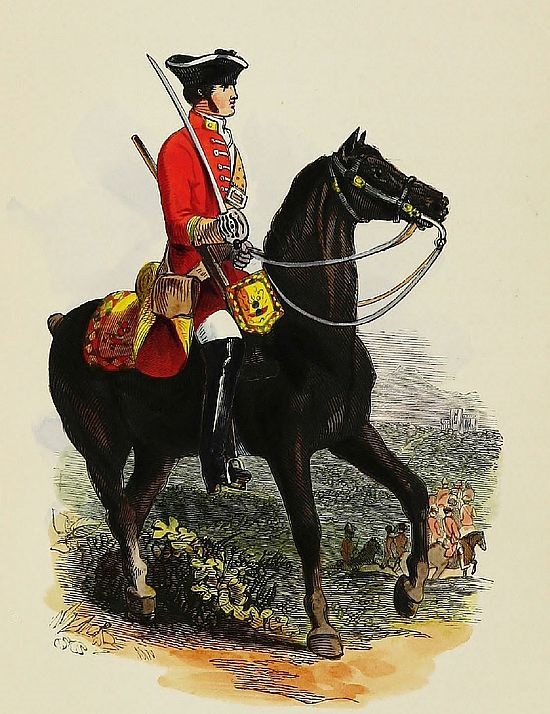
Sixth (Inniskilling) Dragoons, 1742.
[To face page 39.
1742
In 1742 King George II. sent sixteen thousand
men to Flanders, under Field-Marshal the
Earl of Stair, to support the interests of the
house of Austria; and the Inniskilling dragoons
were selected for this service. After landing at
Ostend, the regiment marched to Ghent, where
it was quartered several weeks, and subsequently
proceeded to Brussels.
1743
From Brabant, the Inniskilling dragoons
marched, in the beginning of 1743, for Germany,
and in May they formed, with the Third dragoons,
three battalions of foot guards, and two regiments
of the line, a detached camp below the town of
Hochst.
While in Germany, the lieutenant-colonel,
James Gardiner, was promoted to the colonelcy
of the Thirteenth dragoons[13].
Lord Cadogan, having been removed to the
second troop (now second regiment) of life guards,
was succeeded in the colonelcy by Field-marshal
the Earl of Stair, by commission dated the 25th
of April, 1743.
In the early part of June the Inniskilling
dragoons crossed the Maine and encamped at
Aschaffenberg, where King George II. and His
Royal Highness the Duke of Cumberland joined
the army.
Leaving Aschaffenberg on the morning of the
16th of June, the army moved in columns along
the banks of the Maine to join the Hanoverians
and Hessians at Hanau. The French
under Marshal Noailles crossed the river, and
taking up a formidable position between the
Maine and the mountains near Dettingen, prepared
to oppose the march of the allies: at the
same time the French commander seized the
bridge at Aschaffenberg, to cut off the retreat of
his opponents. These movements brought on a
general engagement, and the Inniskilling dragoons
had an opportunity of signalizing themselves
under the eye of their sovereign.
While the allied army was forming for battle,
the Inniskilling dragoons and other cavalry
covered the operation, and were exposed to the
enemy's cannon. The French household troops,
headed by the princes of the blood, became impatient
of inactivity, and quitting their advantageous
position, galloped forward to commence
the action. The British cavalry advanced to meet
their antagonists, and were repulsed; but a volley
from the British infantry destroyed several French
squadrons, and the English troopers returning to
the charge, drove back their opponents. The
battle extended along the line, and the British,
Austrian, and Hanoverian infantry, fiercely encountering
the French battalions, gained advantage
after advantage, until the fortune of the day was
so evidently in their favour that the result was no
longer doubtful. Meanwhile the charges of the
cavalry were frequent and sanguinary. Bland's
(third) dragoons, and the Inniskilling troopers
charged and overpowered a superior body of
horse, then rushed sword in hand upon a line of
French cuirassiers, whose polished armour proved
ineffectual against the prowess and resolution of
the British dragoons fighting in the presence
of their King. The life-guards, blues, King's
horse (now first dragoon guards), and Ligonier's
troopers (now seventh dragoon guards), behaved
nobly; the royals and greys captured each a
standard[14]; and Rich's (fourth) and Cope's
(seventh) dragoons had their share in the combat.
Unable to withstand the fury of the charging
Britons, the French gave way, and were driven
across the Maine with such precipitation, that
many men were drowned in the river.
The Inniskilling dragoons returned from the
pursuit and bivouacked near the scene of conflict.
Their loss was two men and eighteen horses
killed; and one man and nine horses wounded.
On the following day they continued their march
to Hanau, where they were encamped until the beginning
of August, when they proceeded towards
the Rhine, and having passed that river, were
employed in West Germany; the King having
his head-quarters at the episcopal palace of
Worms, and afterwards at Spire. In October
His Majesty marched the army back to Mentz,
from whence the Inniskilling dragoons continued
their route to Flanders, where they passed
the winter.
1744
The regiment served the campaign of 1744
with the army commanded by Field-Marshal
Wade; and after encamping for some time behind
the Scheldt, was employed in an incursion into
the French territory, and in collecting contributions.
In October the regiment went into
winter quarters at Ghent.
1745
Having been withdrawn from their cantonments
in April, 1745, the Inniskilling dragoons
encamped near Brussels, where they were reviewed
by the Duke of Cumberland, and subsequently
advanced with the army commanded by
His Royal Highness to attack the French, who
had commenced the siege of Tournay with an
immense body of troops under the command of
Marshal Saxe. One squadron of the regiment
formed part of the force which drove in the
enemy's out-guards, on the 28th of April (O.S.).
The French occupied a fortified camp, protected
by immense batteries, near the village of
Fontenoy; and the Inniskilling dragoons supported
the infantry in their attacks on this
formidable position; on which occasion the
English foot-guards, and several regiments of
the line, displayed signal valour and intrepidity,
and carried the enemy's trenches in gallant style;
but the Dutch having failed in their attempt on
the village of Fontenoy, and the French battery
in the wood of Barri not having been stormed
according to order, the troops, which had forced
the position, were unable to maintain their
ground. Towards the close of the action, the
cavalry was ordered forward, and several corps
charged with great spirit and resolution, but were
unable to retrieve the fortune of the day; and a
retreat having been ordered, the army withdrew
to Aeth. In this action the Inniskilling dragoons
evinced the same forward bearing and
firmness as on former occasions. Their loss was
Quarter-master Baird, three men, and nineteen
horses killed; eleven men and seven horses
wounded.
The army encamped on the plains of Lessines;
and while the Inniskilling dragoons were at
this camp, their Colonel, Field-Marshal the Earl
of Stair, was removed to the Scots greys, and
was succeeded by John Earl of Rothes, by commission
dated the 29th of May, 1745.
After the surrender of Fontenoy the French
army advanced, and having an immense superiority
of numbers, the allies withdrew, and took up a
position to cover Brussels. The Inniskilling
dragoons encamped near Meerbeck, and subsequently
on the canal between Ghent and
Brussels.
1746
Meanwhile a rebellion, headed by Charles
Edward, eldest son of the Pretender, had broken
out in Scotland, and many British regiments
were ordered to return home. The Inniskilling
dragoons marched, during the winter, to Williamstadt,
in North Brabant, and towards the end of
February, 1746, embarked for England; but the
transports were driven by tempestuous weather
back into the harbour, and the troops disembarked.
The rebellion having been suppressed
shortly afterwards, the order for their return was
countermanded, and they went into quarters on
the frontiers of Holland.
Quitting their cantonments in the spring of
1746, the Inniskilling dragoons were employed
in the operations of the army commanded by
Lieutenant-General Sir John Ligonier. In May
they were encamped behind the Dyle: the French
having a great superiority of numbers, the allies
were forced to retire towards Antwerp; subsequently
to Breda; and many fortified towns were
captured by the enemy. In July, Prince Charles
of Lorraine took the command of the army, and
the British dragoons were employed in manœuvring
and skirmishing with the French cavalry,
in order to retard the operations of the adverse
army.
During the forenoon of the 1st of October
(O.S.), the allies were in position on the plain of
Liege; several villages were occupied by the
infantry, and the Inniskilling dragoons stood in
line on some open ground near the village of
Roucoux. About mid-day numerous columns of
the enemy appeared advancing under Marshal
Saxe; and being emboldened by their superior
numbers, their artillery opened a tremendous
cannonade, and about fifty battalions attacked
three villages on the left of the allied army with
great fury. Having carried the villages, the
French infantry diverged upon the open ground,
where the Greys, Inniskilling, and Seventh
dragoons appeared in line, headed by the gallant
Earls of Rothes and Crawford. As the enemy
advanced in crowds, as if confident of success,
the three regiments dashed forward, overthrew
the opposing ranks, and chased the French musketeers
to the hedges and thickets near the village
in gallant style. A retreat having been ordered,
the army withdrew across the river Maese, and
encamped near Maestricht.
The regiment was commended in orders for
its conduct on this occasion; it had three men
wounded: and six horses killed and seven
wounded: one horse fell into the hands of the
enemy.
After encamping a short time in the province
of Limburg, the regiment went into quarters in
the country along the Lower Maese.
1747
During the campaign of 1747 the allied army
was commanded by the Duke of Cumberland;
and after encamping a short time near the banks
of the Scheldt, the Inniskilling dragoons were
employed in operations on the Great Nethe, and
on the Demer. The 1st of July was passed in
skirmishing near the frontiers of Liege; the two
armies confronted each other, and on the following
day a sharp action was fought, on which occasion
the regiment acquired new laurels.
Under the cover of a heavy cannonade, the
French infantry attacked the village of Val,
which was occupied by four battalions (three
British and one Hanoverian), and the Inniskilling
dragoons were formed behind the houses.
Eventually the village was captured, and the
enemy broke the centre of the allied army. The
cavalry of the left wing was led forward by Sir
John Ligonier, and charged the French horsemen
with signal intrepidity. The Greys particularly
distinguished themselves. The Inniskilling dragoons,
vying in heroism with the Scots troopers,
overthrew and routed the squadrons opposed to
them; and a sanguinary sword fight ensuing, the
British horsemen made great havoc among the
discomfited ranks of their opponents. Following
up their first success, the Greys, Inniskilling,
and other British dragoons, dashed forward; a
volley from some French musketeers posted on the
low grounds, and behind hedges, emptied several
saddles; but the survivors rushed upon the infantry
and chased them from behind the hedges
and from the low grounds, with dreadful carnage.
While pursuing the fugitives, a new line of combatants
appeared; but, with ranks confused and
blended together, the British dragoons galloped
forward and dispersed these also. This astonishing
gallantry of the British cavalry produced
important results; but the enemy having broken
the centre of the allied army, the Duke of Cumberland
ordered a retreat.
When the Inniskilling, and other British
dragoons, faced about to retire, the enemy came
down upon them in crowds, and they sustained
considerable loss. The army retreated to Maestricht,
where it arrived in the evening.
The casualty-return of the regiment on this
occasion exhibited a serious loss, viz., Lieutenant
Armstrong, Quarter-master Seaman, forty men,
and twenty-two horses wounded; Lieutenant
Gordon, Cornet Hay, seventy-eight men, and
ninety-eight horses killed and missing. The conduct
of the British cavalry on this occasion, was
highly commended in the accounts of the battle
published at the time.
The Inniskilling dragoons were subsequently
encamped at Richel, near the Maese, in the province
of Limburg; in October they proceeded to
North Brabant, and pitched their tents behind the
lines at Terheyden; and at the end of the campaign
they went into cantonments among the
Dutch peasantry.
1748
A strong remount of men and horses having
joined to replace the losses of the preceding year,
the regiment took the field to serve the campaign
of 1748 in a high state of efficiency, and
according to the publications of that date its
warlike appearance was much admired. It was
employed in the province of Limburg, and was
encamped a short time near Ruremonde. Meanwhile
preliminary articles for a treaty of peace
had been agreed upon; the regiment proceeded
to North Brabant, where it remained a short
time, and during the winter, returned to England.
1749
After the peace of Aix-la-Chapelle the establishment
was reduced to two hundred and
eighty-five officers and men.
1750
The Earl of Rothes was removed in January,
1750, to the Royal North British dragoons, and
was succeeded in the colonelcy of the Inniskilling
dragoons by Major-General the Honourable
James Cholmondeley from the Third Irish horse,
now Sixth dragoon guards.
1751
In 1751 a regulation was issued for insuring
uniformity in the clothing, standards, and regimental
distinctions of the British army, from
which the following particulars have been extracted
relating to the Inniskilling Dragoons.
Coats,—scarlet; double-breasted; without
lappels; lined with full yellow; slit sleeves, turned
up with full yellow; the button-holes worked
with narrow white lace; the buttons of white
metal, set on two and two; a long slash pocket
in each skirt; and a white shoulder-knot, or
aiguillette, on the right shoulder.
Waistcoats and Breeches,—full yellow.
Hats,—bound with silver lace; and ornamented
with a white metal loop and a black
cockade.
Boots,—of jacked leather, and reaching to
the knee.
Cloaks,—of scarlet cloth, with a full yellow
collar and lined with yellow shalloon; the buttons
set on two and two upon white frogs, or loops,
with a blue stripe down the centre.
Horse Furniture,—of full yellow cloth; the
holster caps and housing having a border of white
lace with a blue stripe down the centre; the
castle of Inniskilling embroidered upon a red
ground within a wreath of roses and thistles, on
each corner of the housing; and on the holster
caps the king's cipher and crown, with VI. D.
underneath.
Officers,—distinguished by silver lace; their
coats and waistcoats bound with silver embroidery;
the button-holes worked with silver; and
a crimson silk sash worn across the left shoulder.
Quarter-Master,—to wear a crimson sash
round the waist.
Serjeants,—to have narrow silver lace on the
cuffs, pockets, and shoulder-straps; silver shoulder-knots,
or aiguillettes, and yellow and white
worsted sashes tied round their waists.
Drummers and Hautboys,—clothed in full
yellow coats lined with scarlet, and ornamented
with silver lace with a blue stripe down the centre;
their waistcoats and breeches of scarlet cloth.
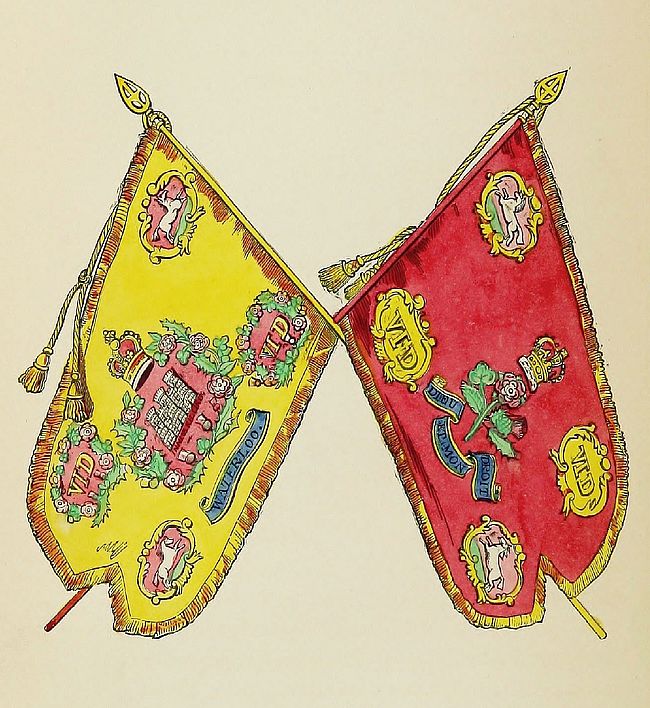
Guidons,—The first or King's guidon to be of
crimson silk, embroidered and fringed with gold
and silver: in the centre the rose and thistle
conjoined and crown over them, with the motto
Dieu et mon Droit underneath: the white horse
in a compartment in the first and fourth corners,
and VI. D. in silver characters on a yellow ground
in a compartment in the second and third corners.
The second and third guidons to be of full yellow
silk, in the centre the castle of Inniskilling
within a wreath of roses and thistles on a crimson
ground; the white horse on a scarlet ground in
the first and fourth compartments, and VI. D.
within a small wreath of roses and thistles upon
a scarlet ground in the second and third compartments.
1752
During the succeeding seven years, the regiment
was employed on home service in Great
Britain, and was distinguished as an efficient and
well-conducted corps.
1755
1756
In 1755, when the aggressions of the French
in North America led to acts of open hostility,
the establishment was augmented one corporal
and fifteen men per troop. Shortly afterwards a
light troop was added on the same principle as
light companies to infantry corps: and the regiment
consisted of six heavy troops and one light
troop. The light dragoons were sometimes styled
hussars. A periodical of this date (June, 1756)
has the following paragraph: 'On Monday
morning the newly-raised light horse, or, as
they are commonly called, hussars, were exercised
in Hyde Park, as were also some life
guards and horse grenadiers. The hussars in
particular made a very pretty and genteel
appearance; went through their peculiar method
of exercise, both on horseback and on foot,
with the greatest vivacity and exactness, to the
satisfaction of many thousands of spectators.'
War was proclaimed, and the French monarch
made such extensive preparations for invading
England, that some alarm was occasioned.
1757
These preparations being continued in 1757,
the country was placed in a posture of defence.
Seven battalions were encamped on Barham
Downs under the Duke of Marlborough; five at
Chatham under Lord George Sackville; six at
Amersham under Lieutenant-General Campbell;
a regiment of cavalry and six battalions of infantry
at Dorchester under Sir John Mordaunt; another
camp was formed on the Isle of Wight; and the
Inniskilling dragoons, with the third dragoon
guards, and first, third, fourth, and eleventh
dragoons were encamped on Salisbury plain, under
Lieutenant-General Hawley. The formidable
attitude assumed by the government, with the
increased military power prepared to oppose the
invasion, induced the French monarch to lay
aside his design of landing troops on the British
coast, and he resolved to attack the possessions
of his Britannic Majesty in Hanover.
1758
The increased naval and military establishments
of Britain enabled King George II. to
assail the coast of France, and an expedition was
prepared for that purpose under the command of
Charles Duke of Marlborough. The light troop
of the Inniskilling dragoons was selected to
take part in this enterprise, and having been
encamped some time on Southsea Common, and
formed in brigade with the light troops of eight
other regiments, under the command of Brigadier-General
Eliott, (afterwards Lord Heathfield,)
it embarked towards the end of May, 1758, and
sailed for the coast of France on the 1st of June.
On the evening of the 5th a landing was effected
in Cancalle Bay, in the province of Brittany; on
the 7th the troops advanced to Paramé; and
during the following night the light dragoons and
piquets of the infantry regiments proceeded to
the harbour of St. Maloes, and destroyed by fire
one hundred vessels with extensive magazines of
maritime stores. The light cavalry afterwards
advanced to the town of Dol, and evinced signal
intrepidity in skirmishing with detachments of
French troops. After remaining five days in
France the British re-embarked, and severe
weather rendering another descent impracticable,
they returned to Portsmouth. The light troop of
the Sixth dragoons having landed, was encamped
a short time at Portsmouth, and subsequently on
Southsea Common. In the beginning of August
it sailed on a second expedition under Lieutenant-General
Bligh. A landing having been effected
in the Bay des Marées, Cherbourg was taken, and
the fortifications and vessels in the harbour were
destroyed. The troops returned on board the
fleet, and another landing was effected in the
bay of St. Lunar; but no advantage resulted
from this enterprise, and before the whole were
re-embarked, the enemy attacked the rear with
such fury that the grenadiers and foot guards
sustained considerable loss. The expedition
returned to England, and the light troop of the
Sixth dragoons went into cantonments in villages
along the coast.
Disastrous events had, in the mean time,
occurred in Germany; the Hanoverian, Hessian,
and Brunswick troops commanded by the Duke
of Cumberland, had been subject to a capitulation,
and the electorate of Hanover was taken possession
of by the enemy. The French having
violated the conditions of the capitulation, the
Hanoverians, Hessians, and Brunswickers reassembled
under Prince Ferdinand of Brunswick;
a body of British troops was sent to Germany
under Charles Duke of Marlborough; and the
six heavy troops of the Sixth dragoons were
selected for this service. The light troop of the
regiment was left in England on coast duty; and
it was subsequently employed in the travelling
escort duty for the royal family.
The regiment was reviewed on Blackheath by
King George II., who expressed his royal approbation
of its appearance and discipline; it embarked
at Gravesend on the 27th of July; and
landed on the 3rd of August, a few miles above
the city of Embden in Germany, where it encamped
two days, and subsequently marched up
the country to join the Hanoverians, Hessians,
and Brunswickers. The regiment joined the
army at Coesveldt on the 17th of August, and
was reviewed on the 20th, with the other British
corps, by His Serene Highness Prince Ferdinand
of Brunswick, who expressed his admiration of
the condition of the several regiments after the
march. After taking part in the movements of
the army, the regiment went into winter quarters
in the bishopric of Paderborn.
1759
The Inniskilling dragoons, commanded by
Lieutenant-Colonel Edward Harvey, took the
field in the spring of 1759, and were formed in brigade
with the Blues and first dragoon guards; the
British were commanded by Lord George Sackville,
and the allied army by Prince Ferdinand of
Brunswick. The French monarch sent an immense
body of troops to Germany, under the
Duke de Broglio and Marshal Contades; and
the allies, being so very inferior in numbers, were
compelled to retire before their opponents.
After a series of retreats and occasional skirmishes,
the enemy occupied a strong position
near Minden, and the allied army encamped on
Petershagen heath. Prince Ferdinand advanced,
and having succeeded in drawing the French
from their formidable post, a general engagement
was fought on Minden heath on the 1st of August,
when the astonishing valour of the British infantry
decided the fortune of the day. The British
cavalry were posted behind a wood on the right
of the army, and towards the close of the action
they were ordered forward to charge the French
legions; but a misunderstanding on the part of
Lord George Sackville occasioned some delay;
the Inniskilling and other British dragoons, who
were panting for an opportunity to distinguish
themselves, were detained in a state of inactivity,
and the victory was rendered less decisive than
it otherwise would have been. The Marquis of
Granby was afterwards appointed to the command
of the British troops in Germany.
The allied army moved forward in pursuit of
the enemy, whose line of retreat might be traced
by scenes of devastation and the smoke of burning
villages. The Inniskilling dragoons formed
part of the division commanded by the Hereditary
Prince of Brunswick, who harassed and attacked
the French during their retreat, occasioning them
serious loss on several occasions; especially at
Grubenhagen, Eimbec, and in the defiles of Minden.
On the 25th of August the Sixth dragoons,
commanded by Lieutenant-Colonel Edward Harvey,
arrived, with the remainder of the Hereditary
Prince's division, at Schonstadt. During
the night between the 27th and 28th of August,
the Inniskilling dragoons, with a detachment
from the first dragoon guards and a battalion
of English grenadiers, commanded by Colonel
Beckwith, marched in the direction of Wetter to
surprise the corps commanded by the celebrated
Colonel Frischer, amounting to about two thousand
men, in quarters at that town. Frischer's
men were alarmed, and attempted to make resistance,
but the gallant Colonel Harvey rushed
upon them at the head of the Inniskilling
dragoons, and Beckwith's grenadiers, drawing
their swords, joined in the charge;—the French
were overthrown; sixty were killed on the spot;
many were wounded; about four hundred were
made prisoners; and the remainder fled in confusion,
towards Marpurg; leaving their camp-equipage,
baggage, and a number of horses in
possession of the conquerors. Lieutenant-Colonel
Harvey, of the Inniskilling dragoons, had a
personal encounter with Frischer's brother,
whom he slew with his broadsword; and both
the dragoons and grenadiers distinguished themselves
in a particular manner[15].
The pursuit of the French army was continued
a distance of nearly two hundred miles; and
operations were not suspended during the winter.
The weather becoming severe, the Inniskilling
dragoons went into cantonments in the villages
near the river Lahn.
1760
During the campaign of 1760 the regiment
was formed in brigade with the tenth dragoons
under Major-General the Earl of Pembroke; and,
after much manœuvring and some skirmishing
was encamped at Kalle. At the same time
thirty thousand French troops, commanded by
the Chevalier de Muy, crossed the river Dymel,
and took post at Warbourg, to cut off the communication
of the allies with Westphalia. The
Inniskilling dragoons left the camp at Kalle
about eleven o'clock on the night of the 30th of
June, passed the Dymel near Liebenau, and about
five on the following morning were in position
on the heights of Corbeke, from whence they
advanced to a wood within five miles of the
enemy's position. The French were attacked,
and while the action was still raging, the British
cavalry were ordered forward. Traversing the
five miles at a quick pace, they speedily arrived
at the field of battle, and charging the enemy
with signal intrepidity, routed the French cavalry,
put the opposing infantry into disorder, and
chased them across the Dymel. The conduct of
the Inniskilling dragoons and other British
cavalry regiments was such, that the Marquis of
Granby stated, in his public despatch, that nothing
could exceed their gallant behaviour; Prince Ferdinand
declared in general orders that all the British
cavalry performed prodigies of valour; and an historian
of that date stated, that they outdid all
former examples.
The regiment had only two men and two
horses killed; three men and one horse wounded,
and three horses missing.
The French retired from their camp beyond
the Dymel on the 22nd of August; when the
Hereditary Prince of Brunswick crossed the river
with twelve thousand men to gain the enemy's
left flank. His leading corps encountered the
enemy's rear-guard near Zierenberg, and a sharp
skirmish ensued. At length the Prince brought
forward the Greys and Inniskilling dragoons; a
gallant charge of the two regiments decided the
contest; and the French were driven into the
town.
The French army encamped beyond Zierenberg,
and the volunteers of Clermont and Dauphiné,
amounting to about nine hundred cavalry and a
thousand infantry, were quartered in the town.
After sunset, on the evening of the 5th of September,
the Greys, Inniskilling, and Bock's
dragoons, two regiments of infantry, and one
hundred and fifty Highlanders, crossed the Dymel,
and arriving at Zierenberg before daybreak,
forced the guard and entered the town. A
dreadful slaughter was made of the enemy in the
streets, and a sharp encounter with the bayonet
took place in the churchyard; between three and
four hundred prisoners were captured; also two
pieces of cannon; and at three o'clock the assailants
retired to Warbourg, having lost only ten
men. It was stated in the London Gazette, that
'the behaviour of the officers and the bravery of the
troops, on this occasion, deserve the greatest commendation.'
The Hereditary Prince of Brunswick marched
with a body of troops to the duchy of Cleves,
and invested Wesel. The Inniskilling dragoons
and several other corps left the camp at
Warbourg, on the 1st of October, under Major-General
Waldegrave, to join the prince, and take
part in the operations on the lower Rhine. The
French, commanded by the Marquis de Castries,
advanced to raise the siege of Wesel, and encamped
half a league behind the convent of
Campen, with Frischer's corps posted within the
convent. The Inniskilling dragoons passed the
Rhine by a bridge two miles below Wesel, and
having joined the Hereditary Prince, advanced at
ten o'clock, on the evening of the 15th of
October, to surprise the enemy's camp. It being
necessary to dislodge the troops in the convent,
the firing alarmed the French army, which instantly
formed for battle. The allies having
passed the convent, commenced the action at five
o'clock on the morning of the 16th; and a succession
of charges was continued with varied
success until nine at night, when the Prince
ordered a retreat.
The Sixth lost on this occasion two men and
four horses killed; Lieutenant-Colonel Harvey,
Major Hepburn, Cornet Sayer, five men and one
horse wounded; and one man and horse taken by
the enemy.
After repassing the Rhine, the regiment was
encamped at Bounnen, subsequently at Klein
Reckum, and in December went into cantonments.
1761
In February, 1761, the regiment took part in
a successful incursion into the quarters occupied
by the French army; when the allies, advancing
through a heavy snow, drove their opponents before
them many leagues, captured several strong towns
with extensive magazines of forage and provisions,
but were subsequently obliged to retire.
During the campaign of 1761 the regiment
was brigaded with the royals and tenth dragoons,
commanded by Major-General Eliott. It was
employed in several manœuvres, and was in position
in the middle of July, on the rivers Asse
and Lippe in Westphalia, forming part of the
division under the Prince of Anhalt. On the
15th of July, the enemy attacked the Marquis of
Granby's division at Kirch-Denkern, when the
Inniskilling dragoons crossed the Asse river to
support the infantry, and the French were driven
back. The action was renewed on the following
day, and the enemy was again repulsed with
serious loss; but owing to the scene of conflict
being in a thickly-wooded country, interspersed
with marshy ground, the services of the regiment
were limited to supporting the infantry.
The Sixth dragoons were subsequently employed
in operations on the Dymel; in November
they were engaged in the electorate of Hanover,
where several sharp skirmishes occurred, in which
they took part, in severe weather, and were sometimes
encamped in the snow. They eventually
went into cantonments in Friesland.
1762
Having taken the field to serve the campaign
of 1762, the regiment was formed in brigade with
the fifteenth dragoons, under Colonel Harvey.
After encamping at Brackel in the bishopric of
Paderborn, and subsequently on the heights of
Tissel, the brigade advanced, on the morning of
the 24th of June, with the view of surprising the
French camp at Groebenstien. This movement
was conducted with such address, that the French
were instantly thrown into confusion, and, abandoning
their camp equipage, they fell back upon
Cassel, one division being surrounded and made
prisoners in the woods of Wilhelmsthal. The
Inniskilling dragoons pursued the French towards
Cassel, and afterwards encamped near
Holtzhausen.
In the subsequent operations of the campaign,
the Inniskilling dragoons were actively employed,
and a series of successes was followed by
the capture of Cassel. A suspension of hostilities
took place in November, and the regiment went
into cantonments in the bishopric of Munster.
1763
A treaty of peace was concluded at Fontainbleau.
The regiment received the thanks of
Parliament for its conduct during the war: and
in January, 1763, commenced its march through
Holland to Williamstadt, where it embarked for
England. It landed in February, and was stationed
in South Britain; the light troop was
disbanded; the establishment was reduced to six
troops of twenty-eight private men each, and
eight men per troop were equipped as light
dragoons.
Lieutenant-Colonel Harvey, who had repeatedly
distinguished himself during the war, was
rewarded with the colonelcy of the twelfth dragoons,
and was succeeded by Major Robert
Rickart Hepburn, a most meritorious officer,
who had served with the regiment many years.
1764
After the return of the regiment from Germany,
its head-quarters were established at Northampton;
from whence they were removed, in
1764, to York; at the same time orders were
received for the officers and men to wear epaulettes
on the left shoulder instead of aiguillettes;
the jacked leather boots were directed to be
replaced by others of a lighter description; and
the regiment was directed to be mounted on long-tailed
horses.
1765
1766
In 1765 the Inniskilling dragoons occupied
cantonments in Scotland; they returned to England
in the following year, and the head-quarters
were stationed at Coventry, where an order was
received for the drummers on the establishment
to be replaced by trumpeters.
1767
The regiment marched into village cantonments,
near London, in May, 1767, and was
reviewed on the 11th of that month, in brigade
with the fourth dragoons, on Wimbledon Common,
by King George III., who was pleased to
express his high approbation of the appearance
and discipline of the two regiments.
1768
1769
1770
After the review the Inniskilling dragoons
marched into cantonments in Worcestershire; in
1768 the head-quarters were removed to Lewes;
in 1769 to Ipswich; and in 1770 to York.
1771
1772
1773
1774
In the spring of the following year the regiment
proceeded to Scotland; but returned to
England in the beginning of 1772, and was stationed
in Lancashire, the head-quarters being
established at Manchester; from whence they
were removed in 1773 to Worcester, and in 1774
to Canterbury.
1775
A change of quarters took place in the summer
of 1775, and the regiment was stationed in Northamptonshire
and Lincolnshire, with the head-quarters
at Northampton.
On the decease of General Cholmondeley, in
October, 1775, King George III. conferred the
colonelcy on Lieutenant-General Edward Harvey,
who so highly distinguished himself at the head
of the regiment in Germany during the seven
years' war.
1776
1777
In the early part of 1776 the Sixth dragoons
commenced their march for Scotland; from
whence they returned in the beginning of 1777,
and were cantoned in Warwickshire and Staffordshire,
the head-quarters being at Coventry.
1778
The colonelcy having become vacant by the
decease of General Harvey, it was conferred on
Lieutenant-General James Johnston, from the
first Irish horse, now fourth dragoon guards, by
commission dated the 2nd of April, 1778.
Meanwhile the American war had commenced,
and the French monarch having agreed to aid
the revolted colonies, war was declared against
France. The British army was augmented, and
one hundred men and horses were added to the
Inniskilling dragoons; but the scene of conflict
was so little adapted for cavalry, that the heavy
dragoon regiments were not called upon to quit
the United Kingdom.
The head-quarters were removed to Salisbury
in May, 1778; and a further augmentation of
forty-eight men, who were to be mounted on
small horses and equipped as light dragoons, was
added to the regiment.
1779
In April, 1779, the men equipped as light
cavalry were incorporated, with the men of the
third dragoon guards, and first and eleventh
dragoons, into a regiment, which was numbered
the twentieth light dragoons. During the following
summer, the Sixth, and five other regiments
of cavalry, were encamped on Salisbury Plain,
under Lieutenant-General Johnston.
1780
1781
1782
1783
In the two following years the regiment occupied
quarters in Gloucestershire and Worcestershire;
in 1782 it was stationed in Dorsetshire,
with the head-quarters at Dorchester; and in
1783 it was removed into Northamptonshire and
Leicestershire.
The American war had, in the mean time,
terminated, and the establishment was reduced
to two hundred and thirty-two officers and men.
1784
1785
During part of the year 1784, the head-quarters
were at Lincoln, with detachments along the
coast; in 1785 they were removed to York, with
detached troops in Northumberland, Durham, and
on the Yorkshire coast.
1786
to
1792
In 1786 and 1787 the regiment was stationed
in Lancashire; in 1788 the head-quarters
were at Exeter, with detachments on the Devonshire
coast; they were removed to Dorchester in
1789; to Winchester in 1790; to Ipswich in
1791; and to York in 1792, with detachments on
coast duty.
1793
A revolution had, in the mean time, taken
place in France; and a violent republican party
had seized the reins of government, and imprisoned
their king. These indications of an approaching
war occasioned the establishment of
the regiment to be increased sixty men; in the
beginning of 1793 it was augmented to nine
troops, and was held in constant readiness to proceed
on foreign service; a tenth troop was afterwards
added.
The French republicans, pursuing a career of
cruelty, spoliation, and bloodshed, added to their
multiplied enormities the decapitation of their
king. Infatuated by success in their own land,
they sought to subvert the liberties of other
countries,—to destroy the civil order of Europe,—to
spread a moral contamination of principle
and practice which outraged the nature of mankind,—and
to involve every country in atheism,
despotism, and anarchy. They attacked Holland,
when a British force was sent to the assistance
of the Dutch, and the Inniskilling dragoons
marched from York in June, 1793,—embarked at
Blackwall, and having landed at Ostend, went
into quarters for a short time among the Flemish
peasantry.
From Ostend the Sixth proceeded to the
vicinity of Bruges, and were formed in brigade
with the blues and royal dragoons. Meanwhile
the successes of the allies had removed the theatre
of the war from Holland, to the frontiers of
French Flanders, and the Inniskilling dragoons
advanced up the country and joined the forces
commanded by the Duke of York before Valenciennes,
which fortress surrendered to His Royal
Highness a few days after the regiment joined the
army.
The British were separated from the remainder
of the allies, with a view of undertaking the
siege of Dunkirk; and the Inniskilling dragoons
marched from Valenciennes to the vicinity of the
coast for the purpose of forming part of the
covering army. On the evening of the 22nd of
August the French were driven from the camp
at Ghivelde, and the covering forces took up a
defensive position under Marshal Freytag, while
the Duke of York carried on the operations
against the fortress. The delay which took place
in the arrival of the battering train, and of a British
naval force, to co-operate with the army, gave
time for the government of France to assemble
men from various parts, crowd them into coaches,
waggons, and other vehicles, and hurry them day
and night towards Dunkirk. On the 6th of
September the enemy attacked the covering army
with overwhelming numbers, and, owing to the
nature of the ground, the Inniskilling dragoons
dismounted and formed as infantry. Some sharp
fighting occurred during the day, and after sunset
the covering army withdrew to a new position.
The night was dark and tempestuous; the advance-guard
took a wrong road, and on entering
the village of Rexpoede it was found to be occupied
by the enemy. Some confused fighting took
place, and Marshal Freytag and Prince Adolphus
were surrounded, but escaped with slight wounds.
Finally the French were repulsed with great
slaughter, and the army, continuing its route,
arrived at Hondschoote on the following morning,
and took up a new position. The Sixth dragoons
lost one quarter-master, their sick men, the women,
and the baggage, which fell into the enemy's
hands.
On the 8th of September the covering army
was again attacked, and driven from its ground
by superior numbers; when the Duke of York
raised the siege and retired.
The Dutch posts on the Lys having been
forced on the 12th of September, they abandoned
Menin, which fortress was immediately taken
possession of by the French. The Duke of York
advanced, on the 14th of September, to drive
the enemy across the Lys; and the Inniskilling
dragoons formed part of the force under Major-General
Harcourt, which joined the leading column
of Austrians and Hessians under Lieutenant-General
Ehrbach. The French were forced to
evacuate Menin, and were pursued by two British
squadrons and the Austrian hussars towards
Roncq.
After bivouacking a few days in the fields,
near Menin, the regiment marched to Tournay,
where it was stationed several weeks, and subsequently
passed the severe winter months at
Drongen.
1794
Leaving Drongen in February, 1794, the
regiment marched to Oudenarde; in April it
joined the army at Cateau, where it was seen in
marching order by the Emperor Francis; and on
the 17th of that month it supported the column
which attacked and carried the heights of Vaux.
The Inniskilling dragoons formed part of
the covering army during the siege of Landrécies;
and on the 21st of April, when the enemy attacked
the Prince of Coburg's advanced posts at Blocus,
the regiment formed part of the force which proceeded
to the support of the Austrians; the
French were repulsed at this point; but they succeeded
in driving the Imperialists from Nouvion.
Thirty thousand French, commanded by Lieutenant-General
Chapuy, attacked the Duke of
York's post at Cateau on the 26th of April, and
several cannon shot and shells fell among the
Sixth dragoons before they were mounted; but
did little injury. The Duke of York watched
the enemy's movements from the top of a redoubt,
and observing their left uncovered, he detached
a body of troops against that flank; and after a
sharp contest the French general was taken prisoner,
and his army driven from the field with
severe loss.
On the 27th of April the Inniskilling dragoons
were detached to support the troops at
Courtray under General Clairfait, whose advance-posts
at Mourcon were attacked two days afterwards
by the French under General Pichegru,
who carried the post after a severe engagement,
and also gained possession of Courtray. The
Inniskilling dragoons rejoined the army under
the Duke of York.
On the 1st of May the Inniskilling dragoons
encamped in front of Tournay, with their left to
the road leading towards Lisle, where the army
arrived from the vicinity of Landrécies, and took
up a position to oppose the enemy.
About three o'clock on the morning of the
10th of May a few pistol-shots from the advance-posts
gave indication of an approaching enemy,
and soon afterwards thirty thousand republican
troops appeared in dark masses advancing to
battle. The British soldiers stood to their arms,
and the Inniskilling dragoons mounted and prepared
for the combat. The report of musketry
with the deep tones of the artillery succeeded,
and the enemy's attempt to turn the left was
repulsed by the fire of the Austrians posted in a
wood. A shower of bullets from the French
artillery assaulted the British centre, and through
the clouds of smoke the opposing columns rushed
to battle. During the conflict several cavalry
corps were detached against the enemy's right
flank. The Queen's Bays, Scots Greys, and
Inniskilling dragoons, forming one superb brigade,
were led forward by the Duke of York, in
open column of half-squadrons; on approaching
the enemy they formed line under a heavy cannonade,
and rushed sword in hand upon their
adversaries. Deep lines, bristled with bayonets,
opposed a formidable resistance; but they were
broken by the terrific charge of the British heavy
cavalry, and the heroic troopers riding furiously
among their adversaries, cut them down with a
terrible carnage. The enemy commenced a
retreat, but was speedily broken and pursued
from the field with great loss.
Three men and seven horses of the Sixth
dragoons were killed; seven men and nineteen
horses were wounded, and three horses missing.
A combined attack on the French posts having
been resolved upon, the Sixth dragoons joined the
column under General Count Kinsky, who advanced
on the morning of the 17th of May from
Cysoing to the La Marque, and forced the passage
of the river at Bauvines, in which service the
Inniskilling dragoons were engaged; but no
decisive results followed the movements of the
army on this occasion. On the evening of the
same day the regiment joined the Austrians under
Archduke Charles, and advanced on the 18th
to form a junction with the column under the
Duke of York at Roubaix, but was suddenly
ordered to take the route to Tournay, where the
army was again assembled.
The enemy attacked the position with great
fury on the 22nd of May, but was repulsed. The
Inniskilling dragoons were formed in column
on their camp ground; but the French did not
attack that part of the line.
The extraordinary efforts made by the French
government to collect an army of overwhelming
numbers, were eventually attended with complete
success. The Austrians were overthrown and
forced to retreat; the Duke of York was obliged
to withdraw from his position in front of Tournay,
and a series of retrograde movements followed,
during which the Inniskilling dragoons performed
much severe duty.
After encamping a short period at Rosendael,
the regiment withdrew with the army,
in the early part of August, beyond Breda.
Thirty-five thousand men under the Duke of
York confronted a hundred thousand opponents;
and when the French had made preparations
for enveloping this small body of
British troops, His Royal Highness withdrew
to another post beyond Bois-le-duc, where the
Sixth dragoons encamped in the beginning of
September.
Strenuous exertions were made by the allies
for the preservation of Holland; but the Dutch,
having imbibed the revolutionary principles and
doctrines of equality from the French, did not
second these efforts with zeal and energy, and the
British troops were opposed by such immense
masses, that no chance of ultimate success remained.
The Duke of York withdrew beyond
the Maese in the middle of September; and
early in October concentrated his forces about
Nimeguen, through which fortress the Inniskilling
dragoons marched a few days before the
place was besieged by the French, and eventually
went into quarters in the villages between
Rhenen and Wyck.
At length a severe frost set in, the rivers
became frozen, so as to admit of an army passing
on the ice, and the advance of the enemy being
facilitated thereby, the prospect of being able to
defend the passage of the Waal became hopeless,
and the regiment was directed to pass the Rhine
and occupy cantonments beyond that river.
1795
In the early part of January, 1795, a sudden
thaw rendering it probable the army would be
enabled to maintain a more forward position and
defend the passage of the Waal, the Inniskilling
dragoons were ordered to advance; they repassed
the Rhine on the ice on the 8th of January, and
joined the forces under Major-General Sir David
Dundas near Geldermalsen. The frost, however,
set in with greater severity than before, the country
was converted into a plain, and after some sharp
fighting the British troops fell back before the
superior numbers of their opponents. The Sixth
dragoons withdrew from their forward position;
they were joined by the Queen's Bays, and Scots
Greys, on the 13th of January; harassing marches
over a region of ice and snow followed, and
several men and horses perished from the severity
of the weather.
On the 17th of January the Inniskilling
dragoons halted at Campen in Overyssel; on the
26th they were at Steenwyk in the same province,
and continuing this harassing march, they
passed the confines of Holland, and arrived on
the 10th of February at the banks of the Ems, a
river of Westphalia. They were to have halted
at Warmer, but a thaw occasioned them to prosecute
their journey and pass the river on the ice.
Continuing the march on the following day, the
country for a considerable distance was under
water, and several horses which had become
exhausted, were lost in the inundations.
The frost returning, the Sixth dragoons countermarched,
repassed the Ems on the ice on the
20th of February, and on the 20th skirmished
with the van of the French army. Several
manœuvres followed, and on the 3rd of March
a party of French failed in an attempt to pass the
Ems. On the following day the Inniskilling
dragoons had to traverse a small river on the ice
at a point which was commanded by the enemy's
cannon; but the regiment, being favoured by a
very thick fog, passed unperceived by the French.
1796
1797
Hostilities terminated in this quarter soon
afterwards; in May the regiment went into cantonments
in villages near the banks of the Weser,
one of the principal rivers in Germany; and in
July it encamped near Delmenhorst, the chief
town of a district of that name in Westphalia,
seven miles south-west of Bremen. On the
breaking up of the camp, the Sixth dragoons
marched through Bremen into cantonments on
the right bank of the Weser until November,
when they embarked for England, but were
detained in the river several weeks by contrary
winds. They landed at Yarmouth and South
Shields about Christmas; in January, 1796, they
marched to Norwich, and in September following
to Ipswich, where they passed the succeeding
winter. In the autumn of 1797 they proceeded
to Romford.
General Johnston died on the 13th of December,
1797, and was interred in great state in
Westminster Abbey. He was succeeded in the
colonelcy by George, Earl of Pembroke, K.G.,
who commanded the regiment during the succeeding
thirty years.
1798
1799
1800
1801
Leaving Romford in June, 1798, the regiment
proceeded to Windsor, and encamped in the
forest, where a numerous body of troops was
assembled, and exercised in the presence of King
George III. and the royal family. His Majesty
reviewed the regiment; and it afterwards proceeded
into cantonments, the head-quarters being
at Uxbridge. In December, 1799, it marched to
Birmingham; in August, 1800, to Bristol; and
in June, 1801, to Exeter.
1802
The successes of the British forces in Egypt
and the West Indies, were followed by a treaty
of peace, in 1802, when the establishment of the
Sixth dragoons was reduced to eight troops, and
the total number of officers and men to five hundred
and fifty-three. In October the head-quarters
were removed to Nottingham.
1803
Before the following summer the ambitious
policy of the French republic involved Great
Britain in another war, and the first consul
of France, Napoleon Bonaparte, assembled an
army for the invasion of England. This vain
project was met by formidable preparations on
the part of the British government; an army
of six hundred thousand men (including militia,
yeomanry, volunteers, and troops on foreign
stations) was embodied; and the establishment
of the Inniskilling dragoons was again augmented.
1804
1805
In the summer of 1803 the regiment marched
to Birmingham; in January, 1804, it proceeded
to Brighton, and was stationed near the Sussex
coast during the two following summers, while
the French army lay at Boulogne, on the opposite
side of the channel. In 1805 Napoleon withdrew
his legions from the coast, and marched
against the Russians and Austrians; and in
October the Sixth dragoons proceeded to Lewes.
1806
1807
1808
1809
The danger of foreign invasion passed away,
the arts, sciences, agriculture, manufactures, and
commerce flourished throughout the British dominions;
while the other countries of Europe
became successively scenes of war, rapine, and
spoliation. The Inniskilling dragoons proceeded,
in March, 1806, to Ipswich; during the
winter of 1807 to York, and in the summer of 1808
they marched to Scotland, and occupied Piershill
barracks, Edinburgh. In June, 1809, they embarked
at Portpatrick for Ireland; they landed
at Donaghadee, and marched to Dundalk.
1810
1811
1813
1814
While the British troops were triumphant
over the legions of Napoleon, in Portugal, Spain,
and the south of France, the Inniskilling dragoons
were detained on home service in Ireland.
In the summer of 1810 they marched to Dublin;
in November, 1811, to Ballinasloe; in March,
1813, to Belturbet; in May following, to Tullamore,
and in April, 1814, to Dublin, from whence
they embarked for Liverpool, where they arrived
on the 3rd of May, and proceeding to York,
halted there three months, and afterwards marched
to Nottingham.
While the regiment was in Ireland, the cocked
hats and feathers were replaced by brass helmets,
and the high boots and breeches by cloth trousers
and short boots.
Meanwhile the victories of the British army
had been followed by the removal of Napoleon
from the throne of France, and the re-establishment
of tranquillity in Europe: the numbers of
the regiment were consequently reduced from ten
to eight troops.
1815
The return of peace was followed by public
rejoicings throughout the country; but scarcely
had these subsided, when news arrived of the
return of Bonaparte to France; of the flight of
Louis XVIII. from the capital; and of the re-assumption
of the imperial dignity by the usurper.
Preparations for war immediately commenced;
the establishment of the Inniskilling dragoons
was augmented, and six troops, mustering four
hundred and fifty officers and men, under the
command of Colonel Joseph Muter, were selected
to proceed on foreign service; the depôt troops
commanded by Brevet Lieutenant-Colonel Ellice,
were stationed at Ipswich.
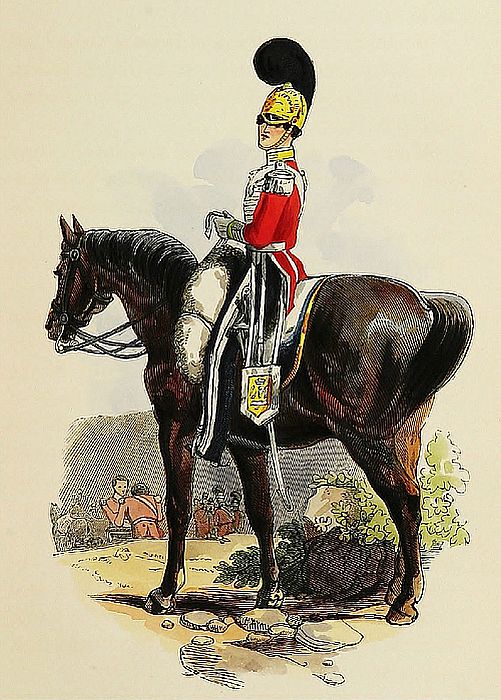
Sixth (Inniskilling) Dragoons, 1815.
[To face page 80.
The six troops destined for service abroad proceeded,
in April, 1815, to Gravesend, where they
embarked for Ostend; some delay was occasioned
by contrary winds; but the whole reached Flanders
in safety, and on the first of May they were in
quarters beyond Bruges, from whence they removed
a few stages further up the country. A
British, Hanoverian, and Brunswick force was
assembled in Belgium under Field-Marshal His
Grace the Duke of Wellington, and the King of
the Netherlands placed his troops under the
orders of the British commander. The Sixth
were formed in brigade with the royal dragoons
and Scots greys, commanded by Major-General
Sir William Ponsonby, K.C.B. They were reviewed
by the Prince of Orange, and Lieutenant-General
the Earl of Uxbridge, commanding the
cavalry, on the 24th of May; and on the 29th of
that month they were seen, together with the
other cavalry corps and the royal horse artillery,
by the Duke of Wellington, who was accompanied
by Marshal Von Blucher, the commander
of the Prussian army.
The Inniskilling dragoons reposed in cantonments
among the Belgic peasantry about six
weeks; being stimulated by the fame acquired by
several corps in the Peninsular campaigns, from
1808 to 1814, they were eager for an opportunity
to signalize their intrepidity and prowess against
the enemies of their country, and this opportunity
was soon afforded them. About four
o'clock on the morning of the 16th of June, they
were suddenly aroused by the notes of the bugle
summoning them to assemble, mounted, at the
alarm posts. Springing from their beds with
alacrity, they were speedily equipped, and, as the
Belgic husbandmen commenced their labours in
the field, the Inniskilling dragoons were seen
directing their march towards Quatre Bras, where
the French divisions, under Marshal Ney, had
suddenly attacked the advance-posts, while Bonaparte
assailed the Prussians at Ligny with the
main body of his army. Continuing its route by
Enghien, Brain-le-Conte, and Nivelles, the regiment
arrived at the scene of conflict a little
before midnight; the hostile forces were reposing
on their arms; and the Sixth bivouacked behind
the position, in a corn-field on the left of the
road from Charleroi to Brussels.
The Prussians having retreated, the Duke of
Wellington made a corresponding movement, and
the Inniskilling dragoons were employed in
covering the retreat of the infantry and artillery
to the position of Mont St. Jean, in front of the
village of Waterloo. On passing through Genappe,
a heavy thunder-storm deluged the country
and put a stop to the firing; but as the atmosphere
cleared, the scene became particularly
interesting; the cavalry brigades were manœuvring
in the face of the adverse army; the loud tones
of the artillery, the fire of skirmishers in the
fields, the seventh hussars and first life guards
charging the French lancers in the streets, while
Bonaparte urged forward his numerous squadrons,
thinking to overwhelm the British horsemen, presented
to the eye an animating and splendid spectacle.
On arriving at the heights of Mont St.
Jean, an opposition was presented to the French
emperor, which he despaired to overcome that
evening, and the hostile forces confronted each
other during the night, the men and horses being
exposed to a continual rain.
On the morning of the memorable 18th of
June, the army appeared in order of battle. The
Royals, Greys, and Inniskilling dragoons, were
formed on the left of the road leading from Brussels
to Charleroi, to support Lieutenant-General
Sir Thomas Picton's division of infantry, which
crowned the heights in front of the brigade. At
ten o'clock the French appeared on the opposite
heights, from whence a cloud of skirmishers was
sent forward; the artillery gradually opened its
fire, and about noon the enemy's columns traversed
the intervening space, and one of the most
sanguinary, hard-contested, and important battles
recorded in the annals of war commenced: a
battle in which the fate of kingdoms, and the
destiny of millions, was decided by British skill,
and by British valour.
After failing in reiterated assaults on the post
of Hugomont, simultaneous attacks were formed;
one of cuirassiers against the centre, which was
defeated by the British household cavalry; and
one of infantry against the left of the position
occupied by the allied army. The formation of
columns was partly concealed by the nature of
the ground; but the glistening of bayonets was
seen at intervals, above the undulations which
form the features of this sanguinary field.
Twenty thousand infantry appeared on the
heights opposite the spot where the Inniskilling
dragoons were formed, and rushing forward with
that eager velocity which characterizes the first
attack of French soldiers, they traversed the
intervening space with astonishing expedition,
dispersed a Belgic brigade with which they first
came in contact, broke through parts of the
British supporting infantry, and ascended the
position occupied by the allied army. A favourable
opportunity for the Royals, Greys, and Inniskilling
dragoons to charge presented itself;
the Earl of Uxbridge galloped up to the three
regiments, and they instantly deployed and advanced
against the dark masses of the enemy.
A spirit of emulation, and a thirst for glory,
beamed in the countenances of the officers and
men, as they moved forward in firm array, presenting
a noble spectacle of nine squadrons of
superb heavy cavalry, whose warlike appearance
and resolute bearing excited admiration. The
French columns were urging forward with rapid
steps as to certain victory; crowds of infantry
and artillery fled before them; and as they ascended
the crest of the position, they presented
a menacing and alarming aspect. An important
crisis in the battle had arrived, and stupendous
results depended on the valour of the Royals,
Greys, and Inniskilling dragoons. The three
regiments advanced steadily to meet these numerous
and formidable bands of opponents, who
were concealed from their view by the rising
ground: they paused a short time to permit the
retreating infantry and artillery to pass through
the intervals of squadrons, and the next moment
these powerful horsemen raised a loud and terrific
shout, and rushed furiously upon the adverse
ranks of war. The spectacle was grand, and the
result glorious to the British arms. The French
masses being unable to deploy, the heads of
columns were instantly broken and forced back;
confusion ensued, the firing ceased, a general
flight commenced, and as the smoke cleared away
the British dragoons were seen plunging their
horses into the midst of the broken columns, and
cutting down the French musketeers with a
terrible carnage, until the slope of the position
was literally covered with slain. Crowds of
French soldiers threw down their arms and surrendered;
while others cast themselves on the
ground to escape the victorious troopers. The
Royals and Greys took each an eagle: the Inniskilling
dragoons cut off from their own lines
and made prisoners a numerous body of French
infantry, with whom part of the regiment was
detached to the rear. The brigade continued its
victorious course, spreading terror, carnage, and
dismay over the field: it crossed the ravine,
carried several batteries, and penetrated to the
rear of the enemy's position. Pursuing their
opponents too far, the Inniskilling dragoons were,
on returning, charged by a numerous body of the
enemy's lancers, and sustained considerable loss.
Major-General Sir William Ponsonby having
been killed by the lancers, the command of the
brigade devolved on Colonel Muter of the Inniskilling
dragoons; and that of the regiment on
Lieutenant-Colonel Fiennes Miller, who had previously
had his horse killed under him, and had
received several bayonet wounds, but having had
his wounds dressed, and procuring a horse which
had belonged to a French officer of lancers, he
kept his post at the head of the regiment.
The brigade having re-formed, was stationed
behind a little wood, where it remained, protected
from the enemy's incessant fire of shot
and shells by some high ground and by the
trees, until about four o'clock in the afternoon,
when it was ordered to the right of the position,
and there suffered severely from a heavy cannonade.
Lieutenant-Colonel Miller was again wounded
about five o'clock, and withdrew, leaving the
regiment under the command of Captain Madox.
About half-past five Colonel Muter was wounded,
and the command of the brigade devolved on
Lieutenant-Colonel Clifton, of the royal dragoons.
In the general attack made on the French army
at the close of the day, the brigade had another
opportunity of distinguishing itself, and, although
it was reduced to a very small number of officers
and men by casualties and parties detached to
the rear with prisoners, yet it proved victorious
over every description of force which opposed its
advance. The French army sustained a decisive
overthrow. The troops under the Duke of
Wellington halted on the field, surrounded by
cannon and other trophies of victory, while the
Prussians, who had arrived at the close of the
action, pursued Bonaparte's discomfited legions
throughout the night.
Thus ended a battle, the greatest of past or
present times, the character and importance of
which may be estimated by the splendid results,
and by the continued peace which has followed.
The brigade, of which the Inniskilling dragoons
formed part, was commended by the Duke of
Wellington in his public despatch.
The regiment had Lieutenant and Adjutant
Clusky, two troop-serjeant-majors, three serjeants,
four corporals, one trumpeter, seventy-five privates,
and one hundred and sixty-four horses
killed; Colonel Muter, Lieutenant-Colonel Miller,
Captains W. F. Browne, and the Honourable S.
Douglas, Lieutenant Hassard, and Cornet Ruffo,
three serjeant-majors, six serjeants, five corporals,
two trumpeters, eighty-five men, and twenty-seven
horses wounded.
Colonel Muter and Lieutenant-Colonel Miller
had the honour of receiving the riband and
badge of companion of the order of the Bath.
Colonel Muter was further rewarded with the
decoration of the fourth class of St. Wladimir of
Russia, Captain Madox was promoted to the
rank of major in the army.
Serjeant-Majors William Seney, John Laws,
and Matthew Marshall, Serjeants Hugh M'Mahon,
and Johnston Marlow, with Privates William Penfold
and Robert Potters, particularly distinguished
themselves.
Every officer and soldier present at this
engagement received a silver medal; and the
subaltern officers, with the non-commissioned
officers and privates, were allowed to reckon two
years' service for that battle[16].
The royal authority was also given for the
regiment to bear the word "Waterloo" on its
guidons and appointments.
The regiment advanced in pursuit of the
wreck of the French army on the following day;
on the 22nd of June it bivouacked at Malplaquet,
a village which is celebrated in history as the
scene of a desperate engagement, on the 11th of
September, 1709, when the army commanded by
the Duke of Marlborough gained a victory over
the French under Marshals Villars and Boufflers.
Continuing the pursuit of the French army,
the Inniskilling dragoons arrived, in the beginning
of July, at the vicinity of Paris, and after
the surrender of the capital, they went into quarters
at the village of Nanterre, where they
remained three weeks, and subsequently marched
to Rouen. They took part in several reviews of
the army commanded by the Duke of Wellington,
at which the sovereigns of Russia, Austria,
Prussia, and France, were present.
1816
The war having terminated with the restoration
of the Bourbon dynasty to the throne of
France, and the conclusion of a treaty of peace,
the regiment marched to Calais. It embarked
for England on the 1st of January, 1816, and
after landing at Dover, proceeded to Salisbury,
and subsequently to Exeter. At the same time its
numbers were reduced to a peace establishment.
1817
1818
1819
In October, 1817, the regiment marched to
Birmingham; during the summer of 1818 it proceeded
to Scotland and was stationed at Piershill
barracks, near Edinburgh. Leaving this station in
June, 1819, for Portpatrick, it embarked for Ireland,—arrived
at Donaghadee on the 1st of July,
and marched into quarters at Gort, in the county
of Galway.
1820
1821
The Inniskilling dragoons passed the four
succeeding years in Ireland. In 1820 their head-quarters
were removed to Longford; and in July,
1821, to Dublin, on the occasion of the auspicious
visit of His Majesty King George IV. to
this part of his dominions. In August the regiment
marched to Newbridge, for the purpose of
attending His Majesty at the race-ground of
Kildare.
1822
On the 9th of November the Sixth dragoons
left Newbridge for Fermoy; in February, 1822,
they proceeded to Cahir, and in June following
returned to Newbridge, where they remained till
December, when they proceeded to Dublin and
occupied the royal barracks.
1823
Leaving Dublin in May, 1823, the regiment
proceeded to Donaghadee, where it embarked for
Scotland on the 6th of June, landed on the same
day, and proceeded to Glasgow, where it passed
the succeeding twelve months.
1824
1825
1826
1827
From Glasgow the regiment marched in July,
1824, for York; in the summer of 1825 the head-quarters
were removed to Manchester; in April,
1826, to Dorchester; and in the following year to
Nottingham.
The Earl of Pembroke died in the autumn,
and was succeeded in the colonelcy by the Hon.
Sir William Lumley, G.C.B., by commission
dated the 3rd of November, 1827.
1828
1829
Leaving Nottingham in March, 1828, the
regiment proceeded to Ipswich, but returned to
Nottingham in October following; and in the
summer of 1829 proceeded to Liverpool and
embarked for Ireland. After landing at Dublin, it
proceeded to Dundalk, where it passed the winter.
1830
1831
1832
In the summer of 1830 the regiment proceeded
to Dublin; in July, 1831, the head-quarters
were at Longford; and in 1832 at Cahir,
many detachments being furnished in aid of the
civil power during these years.
1833
The Regiment proceeded, in March, 1833, to
Dublin, where it embarked for England, and after
landing at Liverpool, marched to Scotland, and
was stationed at Edinburgh.
1834
1835
1836
1837
From Scotland the regiment marched in the
summer of 1834 to England, the head-quarters,
proceeding to Nottingham; in 1835 to Ipswich;
in 1836 to Brighton; and in 1837 to Dorchester.
1838
1839
In the summer of 1838 the regiment marched
to Bristol and embarked for Ireland; it landed
at Cork on the 4th of June, and proceeded from
thence to Cahir. In April, 1839, it was removed
to Newbridge, and in July to Dublin.
1840
In April, 1840, General the Honourable Sir
William Lumley, G.C.B., was removed to the
first dragoon guards, and was succeeded in the
colonelcy of the Sixth dragoons by Lieutenant-General
Sir Joseph Straton, K.C.H., from the
eighth hussars; and this officer dying in October
following, the colonelcy was conferred on Lieutenant-General
Sir George Pownall Adams,
K.C.H., by commission dated the 26th of October,
1840.
In the summer of this year the head-quarters
were removed to Newbridge, and several detachments
were furnished in aid of the civil power.
1841
The regiment proceeded to Dublin in the
spring of 1841, embarked for Liverpool, and
the head-quarters were afterwards established at
Birmingham.
1842
In May, 1842, the regiment commenced its
march for Scotland, and was quartered at Glasgow
and Edinburgh; the whole assembling at Edinburgh
in August.
On the visit of Queen Victoria to Scotland
in September of this year, the Inniskilling dragoons
had the honour to receive Her Majesty on
landing at Granton Pier, and to furnish guards of
honour, and all the Royal escorts at Edinburgh,
and as far as Perth, on Her Majesty's journey to
the north of Scotland. The regiment also
attended the Queen to Granton Pier, when Her
Majesty re-embarked for London on the 15th of
September.
1843
Routes were received in the spring of 1843,
for the regiment to march to England, when the
following general order was issued, dated
"Edinburgh, April 1, 1843.
"Major-General Sir Neil Douglas cannot
permit the Inniskilling dragoons to quit the
North British district without expressing to
Lieutenant-Colonel White, the officers, non-commissioned
officers, and soldiers of that regiment,
his perfect satisfaction with their conduct
during the time they have been under his
command. It appears very evident that the
exertions of the officers have succeeded in
instilling into the minds of their men, that,
next to distinguished valour in the field, nothing
can more fully establish the character of a
British soldier than quiet, peaceable, and subordinate
behaviour in quarters, which the Sixth
dragoons have so eminently displayed while
stationed in North Britain. Nor can the
Major-General forget the manner in which the
regiment performed the honorable duties assigned
to it during Her Majesty's visit to her
northern dominions, which called forth approbation
from the highest authorities. In taking
leave of the regiment the Major-General begs
to assure the officers, non-commissioned officers,
and men of the Sixth dragoons, that they carry
with them his sincere and hearty wishes for
their prosperity and honour, wherever their
country may require their services.
"By order of Major-General Sir Neil Douglas,
K.C.B. and K.C.H.
(Signed) "Rt. Kerr, Colonel,
"Assistant Adjutant-General."
On arriving in England the head-quarters of
the regiment were established at Leeds; in
October the regiment marched from that station
to Nottingham.
1844
1845
The Regiment remained at Nottingham until
June 1844, when it proceeded to Brighton, and
remained there until April 1845, when it marched
to Birmingham.
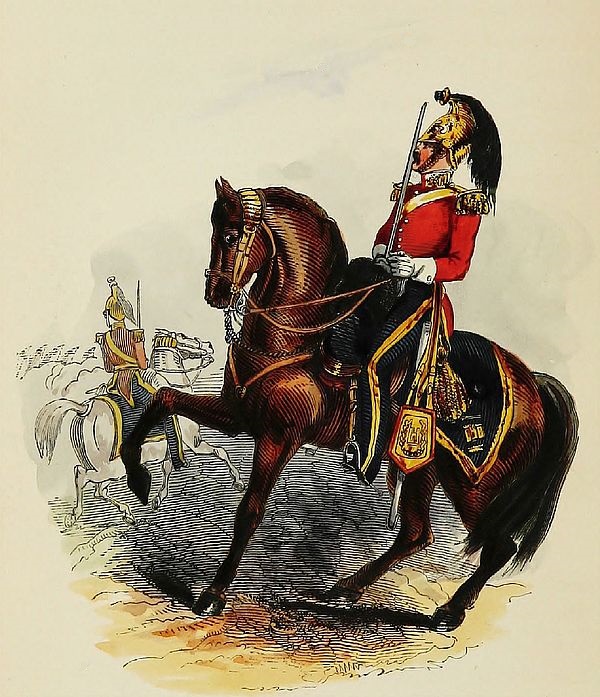
Sixth (Inniskilling) Dragoons, 1843.
[To face page 95.
1846
In April, 1846, the regiment embarked at
Liverpool for Ireland, and on its arrival at Dublin
it proceeded to Newbridge, from whence it
marched in May to Longford, where the head-quarters
are now stationed.
The Sixth, or the Inniskilling Regiment
of Dragoons, was originally composed of men
who evinced an example of valour, constancy,
and devotion to the interests of civil and religious
liberty, as established by law, at a period of
peculiar difficulty and danger, such as seldom
has been witnessed in the United Kingdom;
and their heroic gallantry ensured to their country
the blessings of constitutional monarchy.
Loyalty, courage and obedience, have been
evinced by the officers and soldiers of the regiment
from that period to the present time;
and whether in the war of the Austrian succession,—in
the seven years' war in Germany,—the
early campaigns of the war of the French
revolution,—or on the memorable field of Waterloo,
the same valour and constancy have
been displayed, which shone so brilliantly in
the first members of the corps. Being equally
conspicuous for good conduct on home service,
the regiment has always possessed the confidence,
and ranked high in the estimation, of the sovereign
and of the country.
1846.
| SUCCESSION OF LIEUTENANT-COLONELS |
| OF |
| THE SIXTH, or THE INNISKILLING REGIMENT of DRAGOONS. |
| | | | |
| NAMES. | | Date of Appointment. | | REMARKS. |
| | | | |
| Robert Echlin | | Dec. 31, 1689 | { | Promoted Colonel of the Regiment in 1691 |
| Henry Cunningham | | Dec. 30, 1691 | { | Promoted Colonel of the 8th Dragoons in 1693 |
| Sir Richard Vernon | | | |
| John Upton | | | |
| Alexander Montgomery | | March 30, 1711 | |
| James Gardiner | | Jan. 24, 1730 | { | Promoted Colonel of the 13th Dragoons in 1743 |
| Cuthbert Ellison | | April 19, 1743 | |
| Sir John Whitefoord, Bart. | | March 19, 1745 | { | Promoted Colonel of the 12th Dragoons in 1750 |
| Charles William Tonyn | | Jan. 3, 1750 | | Died May, 1754 |
| Edward Harvey | | May 29, 1754 | { | Promoted Colonel of the 12th Dragoons in 1763 |
| Robert Rickart Hepburn | | March 18, 1763 | | Retired in 1768 |
| John Whitemore | | June 24, 1768 | |
| Lord Robert Kerr | | July 23, 1773 | | Died in 1781 |
| Francis Augustus Eliott, afterwards second Lord Heathfield | } | March 23, 1781 | { | Promoted Colonel of the 29th Dragoons in 1795 |
| William Gunn | | March 1, 1794 | | Augmentation—Retired in 1796 |
| John Prince | | March 25, 1795 | | Promoted Major-General in 1809 |
| Ralph Bates | | Oct. 26, 1796 | | Retired in 1799 |
| George Richard Martin | | June 12, 1799 | | Retired in 1800 |
| Richard O'Donovan | | May 2, 1800 | | Promoted Major-General in 1813 |
| Joseph Muter, afterwards Sir Joseph Straton, K.C.H. | } | June 4, 1813 | { | Promoted Major-General in 1825, afterwards Colonel of the Regt. |
| Edward Keane | | June 2, 1825 | | Appointed to the 7th Hussars in 1830 |
| Lord George Lennox | | June 15, 1830 | | Retired in 1832 |
| Edmund Meysey Wigley Greswolde | } | July 27, 1832 | | Died in 1833 |
| Henry Madox, K.H. | | Jan. 18, 1833 | | Exchanged to half-pay in 1838 |
| Jeremiah Ratcliffe, K.H. | | June 9, 1838 | | Exchanged to half-pay in 1840 |
| Raymond White | | July 17, 1840 | | Exchanged to half-pay in 1843 |
| Willoughby Moore | | July 28, 1843 | |
| | | | | |