HISTORICAL RECORD
OF THE
SEVENTY-SECOND REGIMENT;
OR THE
DUKE OF ALBANY’S OWN HIGHLANDERS.
ORIGINALLY NUMBERED AS THE SEVENTY-EIGHTH HIGHLAND
REGIMENT ON ITS FORMATION IN 1778,
AND AFTERWARDS NUMBERED THE SEVENTY-SECOND
HIGHLAND REGIMENT IN 1786.
1778
The Highlanders of Scotland have long been celebrated
for the possession of every military virtue, and
the services of the warlike natives of North Britain have
been consequently sought by foreign potentates on
many and important occasions, when the less martial
spirit of the people of other states would not enable
them to contend against their oppressors. The achievements
of the Scots regiments, which fought in the
armies of France and Sweden, and of the celebrated
Scots Brigade in the service of the United Provinces
of the Netherlands, are recorded in the military histories
of the sixteenth and seventeenth centuries; and the
annals of the last hundred years abound in instances
in which the Scots troops in the British army have displayed,
in every quarter of the globe, the qualities
of intrepidity, valour, and temperance, which adorn
the national character of the natives of North Britain.
The Seventy-second regiment, or The Duke of
Albany’s own Highlanders, is one of the corps which
has performed valuable services to the crown and kingdom;
its formation took place in 1778, under the
following circumstances:—
William, fifth Earl of Seaforth, having engaged
in the rebellion of 1715, was afterwards included in the
acts of attainder, and forfeited his title and estate. His
eldest son, however, became a zealous advocate for the
Protestant succession, and supported the government
during the rebellion in 1745; his grandson, Kenneth
Mackenzie, was permitted to re-purchase the estate
from the Crown,—and was created an Irish peer, in
1766, by the title of Baron Ardeloe, in the county of
Wicklow, and Viscount Fortrose, in Scotland,—and in
1771, he was advanced to the dignity of Earl of
Seaforth, which had been long enjoyed by his ancestors.
The American war commenced in 1775, and the
Earl of Seaforth, in gratitude for the favours he
had received, made an offer to His Majesty, to raise a
regiment of foot on his estate, which, in former times,
had been able to furnish a thousand men in arms. This
offer was accepted in December, 1777; the Earl of
Seaforth received a letter of service to raise a regiment
of foot, of which he was appointed Lieut.-Colonel
Commandant, and in January, 1778, the following
officers received commissions:—
Lieut.-Col. Commandant, Kenneth, Earl of Seaforth.
Major, James Stuart, (from Capt. 64th Regt.).
Captains.
Thos. F. Mackenzie Humberston
Robert Lumsdaine
Peter Agnew
Kenneth Mackenzie
[6]
George Mackenzie
Hugh Frazer
Hon. Thomas Maitland
Charles Halkett
[7]
Captain Lieutenant, Thomas Frazer.
Lieutenants.
Donald Moody
William Sutherland
Colin Mackenzie
Kenneth Mackenzie
Patrick Haggard
Thomas Mackenzie
George Innes
Charles Mc Gregor
David Melville
George Gordon
James Gualie
George Mackenzie
Charles Gladoning
William Sinclair
Charles Mackenzie
John Campbell
James Stewart
Robert Marshall
Philip Anstruther
Kenneth Macrae
John Mc Innes
Ensigns.
James Stewart
James Finney
Aulay Mc Aulay
Malcomb Mc Pherson
Robert Gordon
John Mitchell
Ewen Mc Linnan
George Gordon
Staff.
Chaplain, Wm. Mackenzie
Surgeon, —— Walters
Adjutant, James Finney
Quar.-Mr. George Gunn
The establishment was to consist of fifty serjeants, two
pipers, twenty drummers and fifers, and a thousand and
ten rank and file.
The men were principally raised from the clan of
“Caber Fey,” as the Mackenzies were called from the
stag’s horns on the armorial bearings of Seaforth. Five
hundred men were from the Earl of Seaforth’s own
estates, and about four hundred from the estates of the
Mackenzies of Scatwell, Kilcoy, Applecross, and Redcastle,
all of whom had sons or brothers holding commissions
in the regiment: the officers from the Lowlands
brought upwards of two hundred, of whom seventy-four
were English and Irish. The clan Macrae had long
been faithful followers of the Seaforth family, and on
this occasion the name was so general in the regiment,
that it was frequently designated the regiment of “the
Macraes.”
On the 15th of May the Earl of Seaforth’s regiment
assembled at Elgin, in Moray, amounting to one
thousand and forty-one rank and file; it was inspected
by Major-General Robert Skene, adjutant-general in
North Britain, and the men were found so remarkably
effective and fit for His Majesty’s service, that nearly
every one was accepted: the corps was placed on the
establishment of the regular army under the designation
of “Seaforth’s Highlanders;” the supernumerary
men were formed into a recruiting company, and the
regiment received orders to march southward, for the
purpose of embarking for the East Indies. It soon
afterwards obtained the numerical title of the
“Seventy-eighth Regiment.”
Towards the end of July, the regiment was ordered
to Edinburgh Castle; and on its arrival there, the men
began to show symptoms of dissatisfaction; the result
of investigation proved that some of them had not received
their bounty, and that others had contrived to
obtain it twice, which was the more easily accomplished
in consequence of so many men being of the same name.
Full attention being paid to their claims, they embarked
at Leith shortly afterwards, with much cheerfulness,
being highly gratified in consequence of their
commander, the Earl of Seaforth, being about to
accompany them on service.
The departure of the regiment was however delayed.
The king of France had taken part with the
revolted British provinces in North America, and had
commenced hostilities against Great Britain; when the
French settlements in Bengal were seized by detachments
of troops from Calcutta, and Pondicherry was
besieged and captured with so little loss, that it did not
appear necessary to send additional troops to India at
that time. The regiment was ordered to Jersey and
Guernsey, where it arrived towards the end of November,
five companies being stationed at each island.
1779
On the 1st of May, 1779, a French naval force approached
the island of Jersey, and made preparations
for landing a body of troops in St. Owen’s bay; when
the five companies of Seaforth’s regiment, with some
of the militia of the island, hastened to the spot,
dragging some artillery with them through the heavy
sands, and opened so well-directed a fire, that the
French soldiers returned to their ships, and quitted the
coast, followed by several British vessels of war, which
inflicted a severe loss on the enemy. The defeat of
the enemy’s designs on this occasion was in a great
measure owing to the zeal and efforts of Major Thomas
Frederick Mackenzie Humberston of Seaforth’s regiment,
who had been promoted from captain to second
major, on the 22nd of March, 1779.
1781
The regiment remained at Jersey and Guernsey
during 1780, and the early part of the following year,
in which time, circumstances had occurred in India,
which occasioned its removal to that part of the British
dominions.
Hyder Ali, a soldier of fortune, had risen to the
chief command of the army of the ruler of Mysore, and
when the rajah died, leaving his eldest son a minor, the
commander-in-chief assumed the title of guardian of
the young prince, whom he placed under restraint, and
seized on the reins of government. Having a considerable
territory under his control, he maintained a
formidable military establishment, which he endeavoured
to bring into a high state of discipline and efficiency,
and he proved a man possessed of activity,
courage, and talent. He soon evinced decided hostility
to the British interests in India, and formed a league
with the French. Hostilities had also commenced
between Great Britain and Holland, and the British
troops were employed in dispossessing the Dutch of
their settlements in Bengal, and on the coast of Coromandel.
Thus three powers were opposed to the
British interests in India, and Seaforth’s Highlanders
were ordered to reinforce the British army
in that country.
Towards the end of April, 1781, the regiment was
removed from Jersey and Guernsey, to Portsmouth,
where it embarked on the 1st of June, for the East
Indies, mustering nine-hundred and seventy-five rank
and file, all in excellent health.
During the passage the Earl of Seaforth died suddenly
in August, and was succeeded in the commission
of lieut.-colonel commandant, by Thomas Frederick
Mackenzie Humberston, from lieut.-colonel commandant
of the one hundredth regiment, by commission
dated the 13th of February, 1782.
1782.
At that period the passage to India occupied about
ten months; the accommodation in the ships was very
limited, and the provision issued to the troops not of
good quality; this was attended with serious results,
and the regiment lost two hundred and forty-seven
men, of scurvy and other diseases, during the passage
to India; which is now frequently performed in less
than half the time, and under superior regulations,
without the loss of a man.
On arriving at Madras in the beginning of April,
1782, the regiment only mustered three hundred and
sixty-nine men fit for duty; the pressure of the service
did not, however, admit of delay, and all who were able
to march, advanced up the country under the command
of Lieut.-Colonel James Stuart, and joined the army
commanded by Lieut.-General Sir Eyre Coote, K.B.,
at Chincleput, a town and fortress on the north-east
bank of the Palar river, thirty miles from Madras.
Chincleput served as a place of arms, and a refuge for
the natives, during the war with Hyder Ali. The soldiers
of the regiment suffered from having been so long on salt
provision; they were also sinewy and robust men, and
were more susceptible of the sun’s violence than men of
slender habits. Sir Eyre Coote ordered them into
quarters, leaving the few, who were healthy, attached
to Mc Leod’s Highlanders (now seventy-first regiment)
the only European corps then with the army. The men
gradually recovered, and in October six hundred rank
and file were fit for duty; their constitutions became
accustomed to the climate, and their health and efficiency
were afterwards preserved under fatigues and privations
calculated to exhaust the physical powers of Europeans
when endured under an Indian sun.
1783
Six hundred gallant Highlanders appeared in the
field, arrayed under the colours of the regiment, to
engage in Indian warfare, and on the 10th of April,
1783, when they joined the army assembling under
Major-General Stuart, their appearance excited great
interest. This force consisted of the seventy-third, and
SEVENTY-EIGHTH Highlanders, the hundred and first
regiment, a considerable body of native troops
and a detachment of Hanoverians, under Colonel
Wangenheim; it was destined for the attack of the
fortress of Cudalore in the Carnatic, situate on the
western shore of the bay of Bengal, which had been
taken by the French in 1782. On the 6th of June,
1783, the army took up a position two miles from the
town, having its right on the sea, and its left on the
Bandipollum hills; the enemy under General Bussy
occupied a position half a mile in front of the fort.
On the 13th of June a general attack was made on
the French line, on which occasion the gallant bearing
of the Highlanders was conspicuous, and the ardour and
intrepidity they evinced, gave presage of that renown
which the two corps (now seventy-first and SEVENTY-SECOND)
afterwards acquired. The action commenced
about four o’clock in the morning, and was continued
until near two in the afternoon, during which time the
French were driven from the principal defences on
their right. Major-General Stuart designed to renew
the attack on the following morning; but the French
retreated into the fortress during the night.
The regiment had Captain George Mackenzie and
nine rank and file killed; Lieutenants Patrick Grant
and Malcomb Mc Pherson, two serjeants, and twenty-eight
rank and file wounded; two men missing.
Major-General Stuart stated in his public despatch—“Nothing,
I believe, in history, ever exceeded
the heroism and coolness of this army in general,
which was visible to every one, for the action lasted
from four in the morning to two in the afternoon.”
The Major-General also stated in Orders:—“The
Commander-in-chief, having taken time minutely to
investigate the conduct and execution of the orders
and plan in attacking the enemy’s posts, lines, and
redoubts, on the 13th instant, with the comparative
strength in numbers and position of the enemy,
composed almost entirely of the best regular troops
of France, takes this occasion to give it as his opinion
to this brave army in general, that it is not to be
equalled by anything he knows, or has heard of, in
modern history.” The conduct of Lieut.-Colonel
James Stuart of the regiment was commended in the
Major-General’s despatch and in Orders.
On the morning of the 25th of June the French made
a sally from the fortress; but were repulsed with severe
loss; Colonel the Chevalier de Damas was among the
prisoners taken on this occasion.[8]
The siege of Cudalore was soon afterwards terminated
by the arrival of news from Europe of a treaty of peace
having been concluded between England and France.
In the meantime Hyder Ali had died, in December,
1782, and was succeeded, in the government of the
Mysore, by his son, Tippoo Saib; who, being deprived
of his French allies by the peace, entered into negociations
for terminating the war between Mysore and
the British, and an armistice took place.
Colonel Humberston was wounded in an action at
sea, on the coast of India, and died, in his twenty-eighth
year, universally lamented, as a young man of superior
accomplishments, and of great promise in his profession.
He was succeeded, as lieut.-colonel commandant of the
regiment, by Major-General James Murray, by commission
dated the 1st of November, 1783.
The regiment was detached from Cudalore, with
other troops amounting to about fifteen thousand men,
under the command of Colonel Fullerton, and, marching
southward, was employed in reducing to obedience
several refractory chiefs. The colonel afterwards purposed
penetrating the country of Mysore, and advancing
upon Seringapatam; but he halted during the armistice
with Tippoo Saib. Negociations for peace having been
broken off, and hostilities resumed, Colonel Fullerton
pursued his original design of penetrating into the
Mysore, and he resolved to take the fortress of
Palacatcherry, which commanded a pass between the
coasts, and secured a communication with a great
extent of fertile country. This place he designed to
occupy as an intermediate magazine, and a stronghold
upon which to retreat in case of a repulse. During the
march the army encountered much difficulty from
woods and heavy rains, and a detachment under
Captain Hon. Thomas Maitland of the SEVENTY-EIGHTH
(now SEVENTY-SECOND) Highlanders performed valuable
service by acting on the flanks, and preserving a communication
through thick woods and a broken country.
After taking several small forts, the army arrived, on
the 4th of November, before Palacatcherry, and on the
13th two batteries opened their fire against the works.
At night a heavy storm of wind and rain occasioned the
Mysoreans to take shelter, and leave the covered way
exposed, when Captain Hon. Thomas Maitland of the
regiment dashed forward with his flanking corps,
surprised and overpowered the Mysoreans, who fled into
the fortress, leaving the first gateway open. Captain
Maitland pursued, but was stopped at the second
gateway; but he defended the post he had captured
until additional troops arrived; and the garrison,
becoming alarmed at the apprehension of a general
assault, surrendered a fortress capable of a long defence
under more resolute troops.
After this success the army marched to Coimbetore,
where it arrived on the 26th of November, and the
garrison surrendered before a breach was made. Preparations
were then commenced for further conquests,
and the capture of Seringapatam, with the subversion
of Tippoo’s power, was in full view; but at the moment
when arrangements were made for an advance, the
commissioners appointed to treat with Tippoo, sent
orders for a retrograde movement.
1784
1785
Peace was concluded with the ruler of the Mysore in
March, 1784. Seaforth’s Highlanders having been
raised on condition of serving three years, or during
the war, four hundred and twenty-five men claimed
their discharge at the peace, and returned to Scotland;
the remainder volunteered to remain in India, receiving
a bounty of ten guineas; the regiment received many
volunteers from the ninety-eighth, one hundredth, and
one hundred and second foot, which corps were ordered to
return to England for reduction (among whom was a
considerable number of Highlanders who had enlisted
into the hundredth regiment with Colonel Humberston),
and the effective strength was seven hundred men;
which was augmented, in 1785, by volunteers from
different corps, and by recruits from Scotland, to nearly
eleven hundred non-commissioned officers and soldiers.
1786
1787
1788
Many senior corps having been disbanded, the regiment
was numbered, in 1786, the SEVENTY-SECOND foot;
at the same time the commission of lieut.-colonel commandant
was changed to that of colonel; and in
December, 1787, the establishment was fixed at forty-four
officers, and eight hundred and four non-commissioned
officers and soldiers. Success continued to
attend the recruiting of the regiment, and the arrival
of strong healthy young men from Scotland, preserved
it in a high state of efficiency, and its discipline and
moral conduct were particularly exemplary.
1789
The insatiable ambition of Tippoo Sultan, the powerful
ruler of the Mysore, soon involved the British
government in India in another war; he appeared near
the confines of the country of Travancore, at the head
of a powerful army, made unreasonable demands on the
rajah, a British ally, and commenced hostilities towards
the end of December, 1789.
1790
The SEVENTY-SECOND Highlanders, mustering nearly
a thousand officers and soldiers, healthy and acclimated,
pitched their tents on the plain of Trichinopoly,
where an army was assembled, in the early
part of 1790, to exact full reparation of Tippoo
Sultan for his wanton and unprovoked violation of
treaty in attacking the rajah of Travancore. Major-General
Medows assumed the command, and the
SEVENTY-SECOND, commanded by Captain Frazer, with
the seventy-first, and first East India Company’s European
battalion, formed the second European brigade,
under Lieut.-Colonel Clarke; Lieut.-Colonel Stuart
of the SEVENTY-SECOND commanded the left wing of the
army.
Advancing from Trichinopoly plain, on the 26th of
May, and penetrating the country of the enemy, the
army arrived, on the 15th of June, at the fort of
Caroor, where the troops encamped eighteen days,
while provisions were being collected, and a magazine
formed. Leaving this place on the 3rd of July, the
army marched to Daraporam, which was abandoned by
the enemy; a garrison was left at this place, and the
army marched through a beautiful country in a high
state of cultivation, to the city of Coimbetore, which
was found evacuated, and some valuable stores left
behind by the enemy. On the 23rd of July, Lieut.-Colonel
Stuart was detached, with the fourth brigade
of native infantry, a number of pioneers, &c. against
Palacatcherry, leaving the SEVENTY-SECOND at the
camp at Coimbetore; he was impeded by heavy rains,
and, his force proving insufficient for the capture of the
place, he rejoined the army. He was afterwards detached,
with another body of troops, against Dindigal,
a strong fortress on a rock, which surrendered on the
22nd of August. He was subsequently directed to proceed
a second time against Palacatcherry; and the flank
companies of the seventy-first and SEVENTY-SECOND
regiments were ordered to traverse the country and
take part in the siege, when Captain Frazer of the
SEVENTY-SECOND resigned the command of the regiment,
for that of the flank companies detached on this service.[9]
These companies left Coimbetore on the 6th
of September, were joined by Lieut.-Colonel Stuart’s
division, at Podoor,[10] on the following day, and arrived
on the 10th, before the fortress of Palacatcherry, which
had been strengthened and improved since its capture
in 1783: the siege was immediately commenced. The
regiment remained at Coimbetore.
At that time the army was separated in three
divisions;—one at Coimbetore, one at Sattimungal,
sixty miles in advance, and one besieging Palacatcherry,
thirty miles in the rear; and Tippoo resolved to
attack, and if possible destroy, the division in advance
before the main body could arrive to its support;
but its commander, Colonel Floyd, fell back and took
up his positions in retreat, with so much ability, that
the Sultan failed in his object. The SEVENTY-SECOND,
and other corps, advanced from Coimbetore to support
Colonel Floyd’s division, and a junction was formed
at Velladi, on the 15th of September, when Tippoo
retired. On that day the flank companies, commanded
by Captain Frazer, were suddenly ordered to make
a forced march to Coimbetore: if the enemy had
taken the place, to endeavour to re-capture it by
surprise; if it was invested, to force their way into it,
and to defend it to the last extremity. The march was
commenced at four o’clock in the afternoon, and the
flank companies arrived at the gates of Coimbetore
at half past two o’clock on the following morning; the
enemy had not approached the place, and the companies
took possession of the fort, Captain Frazer assuming
the command of all the troops at that place.
The army returned to Coimbetore on the 23rd of
September, when the flank companies rejoined the
regiment; and Lieut.-Colonel Stuart, having captured
and garrisoned Palacatcherry, arrived on the 26th of
that month.
Disappointed in his object of destroying the divisions
of the British army in detail, the Sultan resolved to
attack the chain of depôts; he gained possession of
Erroad, and the stores at that place, and afterwards
marched southwards. The English army advanced
from Coimbetore on the 29th of September, and,
arriving at Erroad on the 4th of October, found the
place abandoned, and Tippoo’s army gone. He had
marched in the direction of Coimbetore, but, hearing
that the garrison was augmented, he advanced rapidly
upon Daraporam, of which he gained possession on the
2nd of October.
The British army marched in search of the Sultan,
traversing extensive tracts of country, and undergoing
much fatigue under an Indian sun. In these services
the SEVENTY-SECOND Highlanders preserved a high
state of discipline and efficiency. Lieut. Campbell of
the regiment stated in his journal, “We perform our
journeys with ease and comfort; marching is become
familiar and agreeable to us.” In the middle of
November the army traversed the difficult pass of
Tapoor, winding through deep valleys, and dragging
the guns over precipices. On emerging from the pass,
Tippoo’s camp was seen at a distance; it was supposed
to be that of the Bengal division, under Colonel
Maxwell, and three guns were fired as a signal, when
the Sultan struck his tents and made a precipitate
retreat. Colonel Maxwell’s division joined two days
afterwards, and the seventy-first, SEVENTY-SECOND, and
seventy-fourth regiments were formed in brigade under
Lieut.-Colonel Clarke, with six twelve-pounder and
six six-pounder guns attached to them.
The Sultan resolved to leave the British army in
his own country, and to invade the Carnatic, which
would bring the English back for the defence of
Trichinopoly. Major-General Medows was about to
carry offensive plans into execution, when the movements
of Tippoo rendered it necessary to return to the
Carnatic, and the army arrived at the vicinity of
Trichinopoly in the middle of December. The Sultan’s
success was limited to devastations and the capture of
a few posts; he was pursued as far as Trincomalee;
the British army afterwards turned off to Arnee, where
the SEVENTY-SECOND regiment arrived on the 12th
January, 1791, and was encamped several days.
1791
General Charles Earl Cornwallis, K.G., assumed the
command of the army, and some alteration was made
in the disposition of the troops; the SEVENTY-SECOND
Highlanders, commanded by Captain Frazer, continued
to form, with the seventy-first and seventy-fourth
regiments, the second European brigade, under Lieut.-Colonel
Clarke, in the left wing of the army: Lieut.-Colonel
Stuart, of the SEVENTY-SECOND, commanded
the right wing. The army advanced to Vellore, where
it arrived on the 11th of February, 1791. Tippoo was
ready to oppose any attempt to penetrate into the
country under his dominion by the easiest passes; but
Earl Cornwallis contrived the appearance of a march
towards Amboor, which completely imposed upon the
Sultan, and then turning suddenly to the north,
traversed the difficult pass of Mooglee, without the
enemy having power to offer the least obstruction,
and arrived on the 20th of February on the table-land
of the Mysore. On the 22nd of February the
troops commenced their march towards the strong
fortress of Bangalore, where Tippoo had built a splendid
palace, with extensive gardens; and the safety of
his harem, &c., so engrossed his attention, that he
marched with his army to accomplish the removal of his
women and valuables from the palace, and left the
English at liberty to continue their march unmolested,
until they arrived within ten miles of the town. He
made an attempt on the baggage on the 5th of March,
but was frustrated, on which occasion the SEVENTY-SECOND
Highlanders had a few men wounded: in the
evening the army took up a position before the town.
On the 7th of March the pettah was stormed by the
thirty-sixth regiment, supported by the third brigade
of sepoys; and the siege of Bangalore was immediately
commenced. During the night, the SEVENTY-SECOND
Highlanders were posted under the outer pettah wall,
close to the gate. “The enemy kept up a sharp fire;
their shots, which were many of them thirty-two
pounders, came very close to the regiment, making a
great rattling in the trees and bamboo hedge, near
the line; but no casualties occurred.”[11]
On the evening of the 10th of March, the regiment
was on duty in the trenches, the grenadier company
taking the advance post, and many of the men of the
other companies working at the batteries; it was
relieved on the evening of the 12th.
During the night of the 15th of March, the troops
were ordered under arms, in consequence of circumstances
indicating the approach of Tippoo’s army; a
flight of rockets came into the camp, and the grenadiers
of the SEVENTY-SECOND rushed towards the spot from
whence the rockets came; but the Mysoreans fled without
waiting the attack. At five o’clock on the following
evening the regiment marched into the pettah, and
relieved the thirty-sixth on duty in the trenches.
Soon after midnight a crowd of Mysorean musketeers
entered the thick jungle near the pettah, and commenced
a sharp fire; the SEVENTY-SECOND formed
behind a mud wall expecting their post to be stormed
every moment by thousands of enemies, whom they
were prepared to receive with fixed bayonets: but
the Mysoreans did not venture on so desperate an
enterprise; many of the soldiers’ bayonets were hit by
bullets, but not one man injured. On the evening of the
18th the regiment was relieved and returned to camp.
At four o’clock on the afternoon of the 20th of
March six companies of the regiment marched into
the trenches; and on the evening of the following day
the regiment was ordered to prepare to take part in
storming the fortress; the grenadier company was to
join the storming party appointed to advance by the
left approach; the light company that by the right
approach, and the battalion companies were formed on
the right of the parallel, to support the grenadiers:
three of the SEVENTY-SECOND grenadiers joined the
forlorn hope under Serjeant Williams of the seventy-sixth
regiment. Lieutenant Campbell of the regiment
states in his Journal,—“The storming party primed
and loaded, and sat down on their arms; our
batteries, both gun and mortar, kept firing frequently
during the evening. At a quarter before eleven we
got into motion; an opening was made in the centre
of the second parallel; the signal for storming was
given (three guns in quick succession), and out we
rushed. The covered way instantly appeared as a
sheet of fire, seconded from the fort, but with no
aim or effect; our batteries answered with blank
cartridge; and we were in the covered way in a
moment, and on the breach as quick as thought.
I pushed on, carried forward by a powerful impulse,
and found myself at the top of the breach with the
front files. The grenadiers immediately turned off
to the right with a huzza; their progress was
suddenly stopped by an opening; the fort was hung
with blue lights, a heavy fire was opened upon us,
but with little effect: the difficulty was overcome,
and our troops ascended the ladders with every
possible expedition. The grandest, and most striking
sight I ever beheld, was the rushing up of the troops
to the top of the breach, and the ascent of the
grenadiers in crowds by the scaling-ladders. We
now heard the grenadiers’ march beating in every
quarter; our soldiers shouted with joy, and we swept
round the ramparts with scarce anything to oppose
us: every enemy that appeared had a bayonet in
him instantly; the regiments that supported us
came in by the gateway, and cleared the town below,
where numbers were killed; in two hours we were
in thorough possession of the fort, and Lieutenant
Duncan, of the seventy-first regiment, pulled down
the flag and put his own sash in its place. The
union-flag was afterwards hoisted, and the troops
gave three cheers.” Very extensive stores were
found in the place, particularly of ammunition. The
kiledar, or governor, was killed while fighting with
three grenadiers; he was dressed in a white gown,
over which he wore a jacket of quilted purple satin.
The regiment had six rank and file killed; one
serjeant and twenty-three rank and file wounded, on
this occasion.
In the Orders issued on the following day, it was
stated—“Lord Cornwallis feels the most sensible
gratification in congratulating the officers and soldiers
of the army on the honorable issue of the fatigues
and dangers they have undergone during the late
arduous siege. Their alacrity and firmness in the
execution of their various duties has, perhaps, never
been exceeded, and he shall not only think it incumbent
on him to represent their meritorious conduct
in the strongest colours, but he shall ever remember
it with the sincerest esteem and admiration.
“The conduct of all the regiments, which happened,
in their tour, to be on duty that evening, did credit
in every respect to their spirit and discipline; but
his Lordship desires to offer the tribute of his particular
and warmest praise to the European grenadiers and light
infantry of the army, and to the thirty-sixth, SEVENTY-SECOND,
and seventy-sixth regiments, who led the attack
and carried the fortress, and who, by their behaviour on
that occasion, furnished a conspicuous proof, that
discipline and valour in soldiers, when directed by zeal
and capacity in officers, are irresistible.
“Lieut.-colonel Stuart (SEVENTY-SECOND regiment)
maybe assured that Lord Cornwallis will ever retain
the most grateful remembrance of the valuable
and steady support which that officer afforded him,
by his military experience and constant exertions to
promote the public service.”
After the capture of the fort, the SEVENTY-SECOND
Highlanders were posted at the breach; they were
relieved on the morning of the 23rd of March, by the
fifty-second regiment, and returned to the camp.
On the 28th of March, the army quitted Bangalore,
to join the forces of the Nizam, sent to co-operate with
the English in this war; and, as the troops approached
the ground they purposed encamping upon after the
first march, they saw the forces of Tippoo striking their
tents, and commencing a precipitate retreat; when the
seventy-first, SEVENTY-SECOND, and seventy-fourth
regiments formed line, and advanced, supported by the
native infantry of the first line, but were unable to
come up with the enemy. “The nature of the country
at this place, which presents continual ridges at almost
equal distances, made the pursuit particularly interesting;
for every new view we gained of the enemy,
enlivened the soldiers afresh, and occasioned them to
push on with infinite eagerness and ardour.”[12] A
fine new brass nine-pounder gun was captured, with a
great quantity of cattle and forage; but the Sultan’s
army could not be overtaken.
The Nizam’s troops joined on the 13th of April,
amounting to about fifteen thousand horsemen, some of
them, from Affghanistan, being celebrated for valour.
The army afterwards returned to Bangalore, where preparations
were made for the siege of Seringapatam,
and the army advanced upon the capital of the Mysore,
on the 4th of May. The troops marched through a
difficult country destitute of forage, and the cattle
employed in conveying stores and baggage died in great
numbers; provision for the troops also became scarce.
As the army approached Seringapatam, the Sultan
resolved to hazard an engagement, and his formidable
position was attacked on the 15th of May, when the
SEVENTY-SECOND Highlanders had another opportunity
of distinguishing themselves. The Mysoreans stood
the fire of artillery with steadiness, and kept up a cannonade
with much effect, but the instant an attempt was
made to charge them with bayonets, they made a precipitate
retreat. They were driven from every post;
and towards the close of the action the SEVENTY-SECOND
ascended an eminence and captured a round
redoubt. The army was thanked in Orders for its gallant
conduct. The regiment had about twenty men
killed and wounded: Captain Braithwaite and Lieutenant
Whitlie wounded.
On the following day, some sharp firing was heard at
the advance-posts, when Major Frazer obtained permission
to proceed to their support with the SEVENTY-SECOND
Highlanders; he afterwards sent the adjutant
to Earl Cornwallis to request his Lordship’s authority
to storm a fortified pagoda, but permission was not
granted. On the 18th of May, when the army moved
towards the fords of the river, Major Frazer obtained
the post of honour for the regiment, in covering the
rear, expecting Tippoo would hazard an attack, but no
such event occurred.
When the army had arrived at the extreme point of
its operations, it had sustained the loss of nearly all its
cattle from the want of forage; the supply of provisions
for the men was nearly exhausted; the camp-followers
were without food, and the rainy season had set in
earlier than had been expected. Under these circumstances
further success was become impracticable; the
battering train and stores were destroyed, and on the
26th of May the troops commenced their march back
towards Bangalore. Before commencing the retreat,
the soldiers were thanked in Orders for their conduct
throughout these services, and it was added,—“So
long as there were any hopes of reducing Seringapatam
before the commencement of the heavy rains,
the Commander-in-chief thought himself happy in
availing himself of their willing services; but the
unexpected bad weather, for some time experienced,
having rendered the attack of the enemy’s capital
impracticable, until the conclusion of the ensuing
monsoons, Lord Cornwallis thought he should make
an ill return for the zeal and alacrity exhibited by
the soldiers, if he desired them to draw the guns and
stores back to a magazine, where there remains an
ample supply of both, which was captured by their
valour; he did not, therefore, hesitate to order
the guns and stores which were not wanted for field
service to be destroyed.”
The army retreated to the vicinity of Bangalore, being
joined by the Mahratta forces on the march; and detachments
were afterwards sent out to reduce several
strong hill-forts, which were very numerous.
On the morning of the 9th of December, the fifty-second
and SEVENTY-SECOND regiments, with the fourteenth
and twenty-sixth Bengal sepoys, were detached,
under Lieut.-Colonel Stuart of the SEVENTY-SECOND,
against the fortress of Savendroog, situate on the side
of a mountain, environed by almost inaccessible rocks;[13]
the troops arrived before the place on the 10th, and
during the night the grenadiers of the fifty-second
and SEVENTY-SECOND, with a battalion company from
each regiment, supported by the twenty-sixth sepoys,
climbed a steep hill; traversed sheets of rock; descended
into a valley by a path so rugged and steep
that the soldiers let themselves down in many places
by the branches of trees growing on the side of the
rock; traversed the valley; ascended a rock nearly
three hundred feet high, crawling on their hands and
feet, and helping themselves up by tufts of grass, until
they attained the summit, where they established themselves
on a spot which overlooked the whole of the
fortress, about three hundred yards from the wall. The
batteries were speedily constructed; the flank companies
of the seventy-first and seventy-sixth regiments
arrived to take part in the siege; and practicable
breaches having been effected, storming-parties
paraded on the morning of the 21st of December. The
right attack was made by the light companies of the
seventy-first and SEVENTY-SECOND, supported by a
battalion company of the SEVENTY-SECOND; the left
attack by the two flank companies of the seventy-sixth
and grenadier company of the fifty-second; the centre
attack under Major Frazer of the SEVENTY-SECOND,
by the grenadiers and two battalion companies of the
SEVENTY-SECOND, two companies of the fifty-second,
the grenadiers of the seventy-first, and four companies
of sepoys, supported by the sixth battalion of
sepoys; the whole under Lieut.-colonel Nisbitt, of
the fifty-second regiment. The storming-parties proceeded
to their stations; the band of the fifty-second
took post near them, and suddenly striking up the tune
Britons strike home, the whole rushed forward with the
most heroic ardour. The Mysoreans made a feeble
defence, and in less than two hours the British were in
possession of the fort, with the trifling loss of five men
wounded. The troops were thanked in General Orders,
for their very gallant conduct, in which it was stated,—“Lord
Cornwallis thinks himself fortunate, almost
beyond example, in having acquired by assault, a
fortress of so much strength and reputation, and of
such inestimable value to the public interest, as
Savendroog, without having to regret the loss of a
single soldier.”
Two days after the capture of Savendroog, the troops
advanced against Outra-Durgum: they arrived within
three miles of the place that night, and, on the following
day, summoned the garrison to surrender. Lieut.-Colonel
Stuart, observing the people flying from the
pettah to the fortress on the rock, directed the guns to
open upon them, and two battalion companies of the
fifty-second and SEVENTY-SECOND regiments, supported
by the twenty-sixth sepoys, to attack the pettah by
escalade, which was executed with so much spirit, that
the soldiers were speedily in possession of the town.
“Lieutenant Mc Innes, senior officer of the two
SEVENTY-SECOND companies, applied to Captain Scott
for liberty to follow the fugitives up the rock, saying
he should be in time to enter the first gateway with
them. The captain thought the enterprise impracticable.
The soldiers of Mc Innes’s company heard
the request made, and not doubting of consent being
given, had rushed towards the first wall, and were
followed by Mc Innes. The gate was shut: but
Lieutenant Mc Pherson arrived with the pioneers
and ladders, which were instantly applied, and our
people were within the wall, as quick as thought,
when the gate was unbolted and the two companies
entered. The enemy, astonished at so unexpected an
attempt, retreated with precipitation. Mc Innes
advanced to the second wall, the men forced open the
gate with their shoulders, and not a moment was lost
in pushing forward for the third wall; but the road
leading between two rocks, was so narrow that only
two could advance abreast; the pathway was, in consequence,
soon choked up, and those who carried the
ladders were unable to proceed; at the same time, the
enemy commenced throwing huge stones in numbers
upon the assailants, who commenced a sharp fire of
musketry, and Lieut.-Colonel Stuart, who had observed
from a distance this astonishing enterprise, sent
orders for the grenadiers not to attempt anything
further. Lieutenant Mc Pherson forced his way
through the crowd, causing the ladders to be handed
over the soldiers’ heads, from one to another, and
before the colonel’s orders could be delivered, the
gallant Highlanders were crowding over the third
gateway. The enemy fled on all hands; the foremost
of our men pursued them closely, and gained
the two last walls without opposition (there were
five walls to escalade). The garrison escaped by the
south-east side of the fort, over rocks and precipices
of immense depth and ruggedness, where many must
have lost their lives. By one o’clock, our two companies
were in possession of every part of the fort,
and Mc Innes had planted the colours on the highest
pinnacle, without the loss of a single man. The
Kiledar and two of his people were taken alive.
Colonel Stuart declared the business to be brilliant
and successful, beyond his most sanguine hopes.”[14]
Thus was the important fortress of Outra-Durgum captured
by two companies of Highlanders (Major Petrie’s, and
Captain Hon. William M. Maitland’s) of the SEVENTY-SECOND
regiment; the officers with the two companies
were Lieutenants Mc Innes, Robert Gordon, ——
Getty, and Ensign Andrew Coghlan: Lieutenant Mc
Pherson conducted the pioneers. The whole were
thanked in General Orders by Earl Cornwallis, who
expressed his admiration of the gallantry and steadiness
of the officers and soldiers engaged in this service.
The regiment rejoined the army on the 26th of
December. Its establishment had been augmented in
March of this year to forty serjeants and a thousand
rank and file, and so many recruits had arrived from
Scotland that it was nearly complete. It was considered
the most effective corps in the army.
1792
The rainy season being over, the army reinforced,
the lost cattle replaced, and arrangements made for
an abundant supply of provision, the army commenced
its march, on the first of February, 1792, for Seringapatam.
The Sultan took up a formidable position to cover
his capital, and was attacked during the night of the 6th
of February. The following statement of the share
the SEVENTY-SECOND Highlanders had in this engagement,
is from Lieutenant Campbell’s Journal:—
The regiment formed part of the left division under
Lieut.-Colonel Maxwell, which advanced to the attack
in the following order—Grenadier Company, SEVENTY-SECOND;
Light Company, SEVENTY-SECOND, with
scaling-ladders; Pioneers; Twenty-third Native Infantry;
SEVENTY-SECOND Regiment; First and Sixth
Native Infantry. “We (the SEVENTY-SECOND) moved
from the left along the north side of the ridge of
hills extending from the Carriagat pagoda to the
Cappalair rocks; by ten at night we found ourselves
near the base of the hill, where the officers were
directed to dismount. When we were about two
hundred yards from the lower entrenchment, our
grenadiers filed off from the right with trailed arms,
a serjeant and twelve forming the forlorn hope.
When about fifty yards from the works, the sentinel
challenged us, and instantly fired his piece, which
was followed by a scattered fire from the rest of
their party. We rushed among them, and those
who did not save themselves by immediate flight,
were shot or bayoneted. The greatest number of
them ran down to the Carriagat pagoda, where they
made a stand, and kept up a smart fire until we
were almost close to them; then retired under our
fire to the foot of the hill, where they were joined by
a strong body from the plain, and made a stand at a
small choultry, from which a flight of steps led to
the bridge across the nulla. By this time the general
attack on the enemy’s lines had commenced, and
there was an almost connected sheet of fire from
right to left; musketry, guns, and rockets rending
the air with their contending noise. We sat upon
the brow of the hill a few minutes, while our men
were recovering their breath, and had a commanding
prospect of the whole attack, though nearly three
miles in extent, as we contemplated the scene before
us, the grandest, I suppose, that any person there
had beheld. Being rested a little, Colonel Maxwell
led us down the hill under a smart fire; we rushed
forward and drove the enemy across the nulla in
great haste, although they stood our approach
wonderfully. We crossed the bridge under a constant
fire, the enemy retreating as we advanced; we crossed
the Lokany river, the opposite bank of which was
well covered by a bound-hedge, and their fire did
execution: a serjeant of grenadiers was killed,
Captain Mackenzie mortally wounded, Major Frazer
and Captain Maitland shot through their right arms,
besides other casualties. After we had penetrated
the bound-hedge, the enemy took post behind an
extensive choultry; but nothing could stop the
ardour of our men,—we charged without loss of
time, and soon dislodged the enemy, who retreated
along the banks of the Cavery to a second
choultry, where their numbers were reinforced. We
had now got into their camp, upon the right flank of
their lines; they retreated steadily before us, and
our fire and bayonets did great execution among
them, the road being strewed with their bodies. We
charged and dislodged them from the second choultry;
here Lieutenant Mc Pherson of the grenadiers was
wounded; we pursued the enemy to a large pagoda;
they attempted to cross the river, but the place was
so crowded with guns, tumbrils, bullocks, elephants,
camels, followers, and heaven knows what, that we
were in the midst of them before they could escape,
and for some minutes there was nothing but shooting
and bayoneting. Colonel Maxwell came up with the
twenty-third native infantry; the sepoys of the
fourteenth native battalions advanced; they took
us for the enemy, and fired, but their officers suppressed
the fire before much injury was done: the
seventy-first regiment also joined us, and preparations
were made to cross the river and force the
lines on the opposite side. Colonel Baird requested
me to lead with twenty men; I instantly rushed into
the stream, followed by twenty grenadiers of the
SEVENTY-SECOND regiment; we pushed on through
holes, over rocks and stones, falling and stumbling
at every step, the enemy’s shot reducing our numbers;
and myself, with about half a dozen grenadiers, arrived
at a smooth part of the stream which proved beyond
our depth; five of us, however, got over; but the
regiments did not venture to follow, and we returned
with difficulty. An easy passage had been found
out lower down; the seventy-first and SEVENTY-SECOND
regiments had got into the island; the flank
companies of the fifty-second, seventy-first, and
seventy-fourth regiments forded higher up, and the
enemy, seeing our troops on all sides of them, betook
themselves to flight.
“About one o’clock in the morning the seventy-first,
and SEVENTY-SECOND regiments advanced to
the pettah, from which the inhabitants had fled, and
we released a number of Europeans from prison.
About seven o’clock the SEVENTY-SECOND marched
into the famous Llal Baugh, or, as I heard it translated,
‘garden of pearls,’ and were posted in one of the walks
during the day.”
A decisive victory was gained on this occasion over
the army of Tippoo, and, perhaps, no regiment had
performed a more distinguished part on this occasion
than the SEVENTY-SECOND Highlanders; they had
forced the passage of one nulla, and two rivers, and
had charged nine successive times, overpowering their
enemies on every occasion. Their loss was Captain
Thomas Mackenzie and fourteen rank and file killed;
Major Hugh Frazer, Captain Hon. William M. Maitland,
Lieutenants Mc Pherson and Ward, one serjeant,
two drummers, and forty rank and file wounded, one
man missing.
In the General Orders issued on the 7th of February,
it was stated—“The conduct and valour of the officers
and soldiers of this army have often merited Lord
Cornwallis’s encomiums; but the zeal and gallantry
which were so successfully displayed last night, in the
attack of the enemy’s whole army in a position that
had cost him much time and labour to fortify, can
never be sufficiently praised; and his lordship’s
satisfaction on an occasion which promises to be
attended with the most substantial advantages, has
been greatly heightened by hearing from the commanding
officers of divisions, that the meritorious
behaviour was universal, through all ranks, to a
degree that has rarely been equalled.”
The power of the Sultan being greatly reduced, and
the siege of his capital about to commence, he solicited
conditions of peace, and hostilities were suspended.
He afterwards ceded half of his dominions to the allies,
paid a large sum of money, and was permitted to retain
the other half of his territory.
The war being thus terminated, and a great accession
of territory made to the British dominions in India,
the army quitted the island of Seringapatam, towards
the end of March, and the SEVENTY-SECOND Highlanders
proceeded to the cantonment of Wallajabad,
where they arrived on the 28th of May. The Governor
in Council evinced the high sense he entertained of the
conduct of the troops, by presenting them with a
gratuity out of the money paid by Tippoo Sultan,
which was confirmed by the Court of Directors, and six
months’ batta, or field allowance, added thereto.
1793
1794
The SEVENTY-SECOND Highlanders remained at
Wallajabad, with two companies detached to Arnee,
upwards of twelve months, during which period the
French Revolution, which commenced a few years
previously, had assumed a character that called forth
the efforts of other countries to arrest the progress of
its destructive principles with the effects of its
example in the world, and war commenced between
Great Britain and France. News of this event arrived
in India in May, 1793; in June the regiment was
ordered to prepare to take the field, and on the 26th
of that month, pitched its tents east of Shiveram Hill
under the orders of Major Frazer; it marched soon
afterwards against the French settlement of Pondicherry,
on the coast of Coromandel, and arrived before the
fortress in July,—being formed in brigade with the
seventy-third, seventy-fourth, and third East India
Company’s European regiment, under Lieut.-Colonel
Baird; the troops employed on this service were commanded
by Colonel John Brathwait. The siege of
Pondicherry was commenced in the early part of August,
the army encamping in a thick wood where tigers were
so numerous that the natives durst not travel in the
night. On the 11th of August the SEVENTY-SECOND
Highlanders were on duty in the trenches, and had
two men killed; they also lost two men on the following
day;[15] and several others on the 22nd of that
month, on which day a white flag was displayed by the
garrison, with a request for permission to surrender.
The French soldiers in the fortress had embraced
democratical principles and were particularly insubordinate;
they insisted that the governor should
surrender, but after the white flag was displayed, they
fired two shells, which killed several men, and wounded
Major Frazer of the SEVENTY-SECOND regiment.
During the night they were guilty of every species of
outrage, breaking into houses and becoming intoxicated.
On the following morning, a number of them environed
the governor’s house, and threatened to hang the
governor, General Charmont, before the door, when
application was made for English protection. The
British soldiers rushed into the town, overpowered the
insurgents, rescued the governor, and preserved the
inhabitants from the further effects of democratical
violence.
After the completion of this service, the regiment
returned to the cantonment at Wallajabad, where it
arrived on the 11th of September, and was stationed
at that place during the year 1794.
On the decease of General Murray, the colonelcy was
conferred on Major-General Adam Williamson, from
the forty-seventh regiment, by commission dated the
19th of March, 1794.
1795
While the regiment was reposing in cantonments
at Wallajabad, and the officers and soldiers were
reflecting with exultation on the reputation they had
acquired in the Mysore, circumstances occurred in
Europe which occasioned them to be again called into
active service. The Dutch people had imbibed the
democratical doctrines of the French republic, and in
the early part of 1795 Holland became united to
France. When information of these events arrived in
India, an expedition was immediately fitted out
against the large and mountainous island of Ceylon,
where the Dutch had several settlements, and the
SEVENTY-SECOND Highlanders were selected to take part
in the enterprise; the troops employed on this service
were commanded by their Lieut.-Colonel, James
Stuart, who was promoted to the rank of major-general
at this period. The regiment embarked from
Fort St. George on the 30th of July, and two days
afterwards the fleet arrived on the coast of Ceylon;
on the 3rd of August the troops landed four miles
north of the fort of Trincomalee, and the siege of this
place was commenced as soon as the artillery and stores
could be landed and removed sufficiently near to the
place. On the 26th of August a practicable breach
was effected, and the garrison surrendered the place.
The regiment had Ensign Benson, two serjeants, and
seven rank and file wounded on this service.
The commanding officer of the regiment, Major
Frazer, who was promoted to the lieut.-colonelcy on
the 1st of September, was detached against the fort of
Batticaloe, which surrendered to him on the 18th of
September. The two flank companies of the regiment
were afterwards detached, with two companies of sepoys,
under Captain Barbutt, against the fort and island of
Manaar, which surrendered on the 5th of October.
1796
The regiment continued to be actively employed
until the whole of the Dutch settlements in Ceylon
were reduced, which was accomplished in February,
1796, when the governor, John Gerand Van Angelbeck,
surrendered the fortress of Colombo to the British arms.
The people in the interior of the island had not been
deprived of their independence by the Dutch, and
they were not interfered with by the British so long as
they preserved a peaceful demeanour.
1797
As the island of Ceylon—which produces an astonishing
diversity of vegetables, with the finest fruits—is
celebrated for the number of cinnamon trees it produces—and
abounds in most animals indigenous to the
East, particularly in wild elephants—the SEVENTY-SECOND
Highlanders remained until March, 1797, when
they were removed to Pondicherry, preparatory to their
return to England.
1798
The regiment transferred its men fit for service to
the corps about to remain in India, and embarked at
Madras in February, 1798. On arriving at Gravesend,
it received orders to proceed to Perth, where it landed
in August, under the command of Lieut.-Colonel Hugh
Frazer.
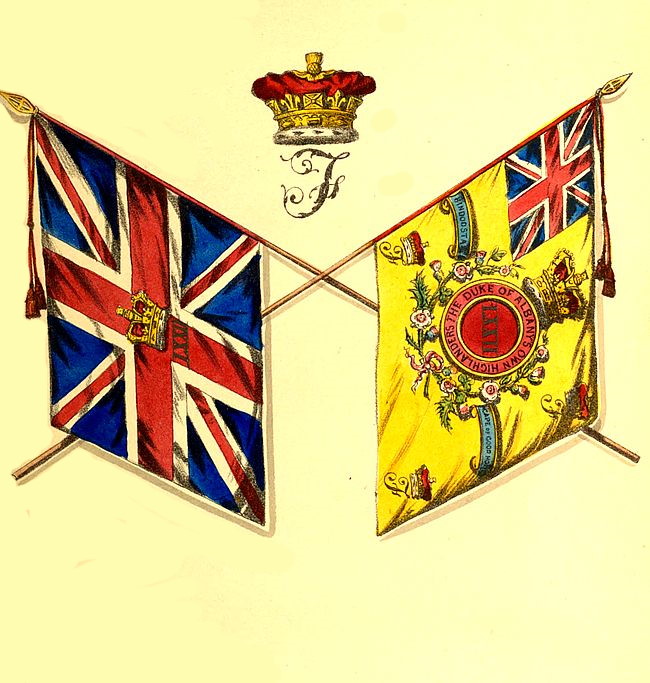
The services of the regiment in the East Indies
were afterwards rewarded with the royal authority to
bear the word “Hindoostan” on its colours.
On the 23rd of October, Major-General James
Stuart, who had long commanded the regiment with
reputation in India, was appointed to the colonelcy,
from the eighty-second foot, in succession to General
Adam Williamson deceased.
1799
1800
1801
The regiment was stationed at Perth two years, and
its recruiting was not successful, not more than two
hundred recruits having joined: in 1801 the regiment
was removed to Ireland;[16] and its numbers were
augmented by drafts from the Scots fencible regiments.
1802
1803
At the conclusion of the peace of Amiens in 1802,
the establishment was reduced; but on the re-commencement
of hostilities in 1803, it was again augmented:
it was soon in a high state of efficiency and discipline,
two-thirds of the men being Scots Highlanders,
and about one-third English and Irish.
1804
Great efforts were made to repel the threatened
French invasion in 1803 and 1804, and a second
battalion was added to the regiment; it was formed of
men raised in Aberdeen, for limited service, under the
Additional Force Act, and was placed upon the establishment
of the army from the 25th of December, 1804.
It was embodied at Peterhead, and remained in Scotland
some time.
1805
While the French army was at Boulogne menacing
England with invasion, a coalition was forming in
Germany to oppose the domination of Bonaparte,
whom the French had elevated to the title of Emperor,
and the first battalion of the SEVENTY-SECOND regiment
was appointed to form part of a secret expedition
under Lieut.-General Sir Eyre Coote, K.B.; this enterprise
was, however, laid aside, and in August, 1805,
the regiment, commanded by Lieut.-Colonel Colquhoun
Grant, embarked with a secret expedition under Major-General
Sir David Baird, which sailed at the end of
the month. At day-break on the 28th of September
the fleet approached the island of Madeira, and the
soldiers were gratified by the sight of its high mountains,
covered on the lower slopes with vines, and on
the loftier summits with forests of pine and chesnut,
gilded with the rays of the rising sun; and about eight
o’clock the whole anchored in the spacious bay, in the
centre of which stands Funchal, the capital; the lofty
black rocks adorned with brilliant verdure rising
behind the town, form a striking contrast with the
white houses, and present to the view a splendid
landscape. At this place the fleet remained six days,
and afterwards sailed to the Brazils, entering the
harbour of St. Salvador on the 12th of November.
Captain Campbell of the SEVENTY-SECOND stated in his
Journal:—“The town was opening as we approached
the inner part of the bay, and displayed the most gay
and romantic scenery. It is built on the ridge of a
hill, and some of the houses are showy and extensive;
they are generally white with red tiles; but those
in the lower part of the town consist of from five to
seven flats, or stories, each; and, the streets being
narrow, the houses almost meet above. The hills
are enclosed as gardens, and whichever way one
turns, the eye is equally gratified with the variety
and luxuriance of the scenery.”
The regiments were landed in succession for a few
hours; horses were procured for the cavalry, and some
supplies obtained for the voyage. It was a remarkable
circumstance that the SEVENTY-SECOND regiment had
not one sick man.
On the 28th of November the fleet again put to sea,
and directed its course towards the Dutch colony of the
Cape of Good Hope, then in possession of the Batavian
government, which was united with France in hostility
to Great Britain.
1806
On the 3rd of January, 1806, the lofty promontory
which marks the southern extremity of Africa was seen,
with its summit in the clouds, and at five o’clock on the
afternoon of the following day, the fleet anchored off
the Cape of Good Hope. At four o’clock on the morning
of the 6th of January the signal was made for the
seventy-first, SEVENTY-SECOND, and ninety-third regiments,
forming the second or Highland brigade under
Brigadier-General Ferguson, to enter the boats; and,
moving to the shore, it effected a landing in Lospard’s
Bay; the light companies of the seventy-first and
SEVENTY-SECOND regiments driving the Dutch sharp-shooters
from the contiguous heights, killing and
wounding thirteen of the enemy.[17] After pursuing the
enemy some distance, the troops halted near the Blue
Mountains.
Before daylight on the following morning the
SEVENTY-SECOND advanced, with one six-pounder, to
surprise a body of the enemy, encamped at a small
village; but the Dutch made a precipitate retreat,
and the regiment returned to its camp, where it arrived
about eight o’clock.
At three o’clock on the morning of the 8th of January
the Blue Mountains echoed the sound of the British
bugles summoning the soldiers to arms, and when the
troops had advanced to the summit of the hills, the
Batavian army was seen formed, with twenty-three
pieces of cannon, in order of battle, in the valley in
front. The grenadiers of the twenty-fourth regiment
drove the Dutch mounted riflemen and jaggars from
the high grounds on the front and on the flank, and
the Highland brigade moved forward to engage the
opposing army. Nineteen Dutch guns sent forward
showers of bullets as the three British regiments
advanced rapidly upon their opponents; when within
five hundred yards, the enemy commenced with grape,
and when at two hundred and fifty yards distance, the
fire of musketry was opened along his whole front; but
the advance of the brigade was too rapid for the enemy
to take correct aim. Arriving within one hundred and
fifty yards of the opposing line, the Highlanders levelled
their muskets with steady aim, advancing and firing,
until within sixty yards of their adversaries, when
Brigadier-General Ferguson gave the word “CHARGE.”
A loud British shout instantly rent the air, and the
heroic Highlanders closed with bayonets upon their
numerous adversaries, who instantly fled in dismay,
pursued across the deep sands by the victorious Highland
brigade. The Dutch marksmen on the right
flank, with two guns, keeping up a constant fire, Captain
Campbell of the SEVENTY-SECOND was detached against
them with his grenadier company; he soon drove the
Dutch sharp-shooters from the bushes, and was about
to charge the guns, but they were removed with too
much speed to be overtaken.
After gaining a complete victory, and pursuing the
enemy three miles under a burning sun, and along deep
sands, the Highlanders were ordered to halt, and the
first brigade urged the pursuit.[18]
Major-General Sir David Baird stated in his public
despatch:—
“The Highland brigade advanced steadily under
a heavy fire of round shot, grape, and musketry.
Nothing could resist the determined bravery of the
troops, headed by their gallant leader, Brigadier-General
Ferguson; and the number of the enemy,
who swarmed the plain, served only to augment their
ardour, and confirm their discipline. The enemy
received our fire and maintained his position obstinately;
but in the moment of charging, the valour of
British troops bore down all opposition, and forced
him to a precipitate retreat.”
“Your lordship will perceive the name of Lieut.-Colonel
Grant among the wounded; but the heroic
spirit of this officer was not subdued by his misfortune,
and he continued to lead his men to glory, as long as
an enemy was opposed to His Majesty’s SEVENTY-SECOND
regiment.”
The loss of the regiment was limited to two rank and
file killed; Lieut.-Colonel Grant,[19] Lieutenant Chrisholme,
two serjeants, one drummer, and thirty-three
rank and file wounded.
The word “Cape of Good Hope,” borne by royal
authority on the colours of the regiment, commemorates
its distinguished gallantry on this occasion.
After the action, the army took up a position in the
Reit Valley; on the 9th of January, the troops advanced
towards Cape Town, taking post on the south of Salt
River, and the town surrendered. Lieut.-General
Janssens had taken up a position in a pass leading to
the interior of the country. On the 10th of January,
the regiment marched to Wineberg barracks; and on
the 11th, Lieutenant M’Arthur of the SEVENTY-SECOND
was detached, with thirty men of the regiment, to take
possession of Hout’s Bay. “After Lieutenant M’Arthur’s
departure, it was ascertained that the enemy
had a strong garrison at Hout’s Bay, and Major
Tucker, of the SEVENTY-SECOND, was sent after him
on horseback, to detain him until a reinforcement
should arrive; but the lieutenant had reached the
vicinity of the place with much expedition, and finding
how matters stood, showed his men rank entire, and
only partially, but to the most advantage. Having
procured pen, ink, and paper, he summoned the
garrison to unconditional surrender, otherwise he
would blow the place about their ears, assault the
works, and give no quarter. The Dutch immediately
surrendered at discretion, and when the major arrived,
he found Lieutenant M’Arthur in full possession of
the works, consisting of a strong block-house and two
batteries.”-See Captain Campbell’s Journal.
Wineberg-Camp, 12th January, 1806.
Brigade Order.—“In consequence of Brigadier-General
Ferguson being ordered into Cape Town, he
is under the necessity of taking a short leave of the
Highland brigade. Short as his absence will be, he
cannot go without returning his sincere thanks to
every individual of the brigade he has the honor to
command, for the zealous support he has received
from the officers, and the uniform good behaviour
of the men. Their conduct on the day of landing,
the cheerfulness with which they have endured every
fatigue and privation, and their distinguished bravery
in the action of Blaw Berg, while it has gained them
universal admiration, lays him under an obligation,
which no time can obliterate from his memory.”
On the same day that this order was issued the
regiment advanced up the country to co-operate with
the troops under Brigadier-General Beresford, and in
a few days the Batavian governor surrendered the
colony to the British arms. From this period the
important colony of the Cape of Good Hope has formed
part of the possessions of the British Crown.
After the surrender of the Cape, the head-quarters
of the SEVENTY-SECOND regiment were established at
Simon’s Town, where the Hottentots in the Dutch pay
tendered their services to the British government, and
were afterwards formed into a corps, now the “Cape
Mounted Riflemen:” the regiment had also detachments
at Muisenberg, Hout’s Bay, and Oliphant’s Bay,
and in September it took the garrison duty at Cape
Town.
1807
1808
1809
The regiment was stationed at Cape Town during
the years 1807, 1808, and 1809: in April of the latter
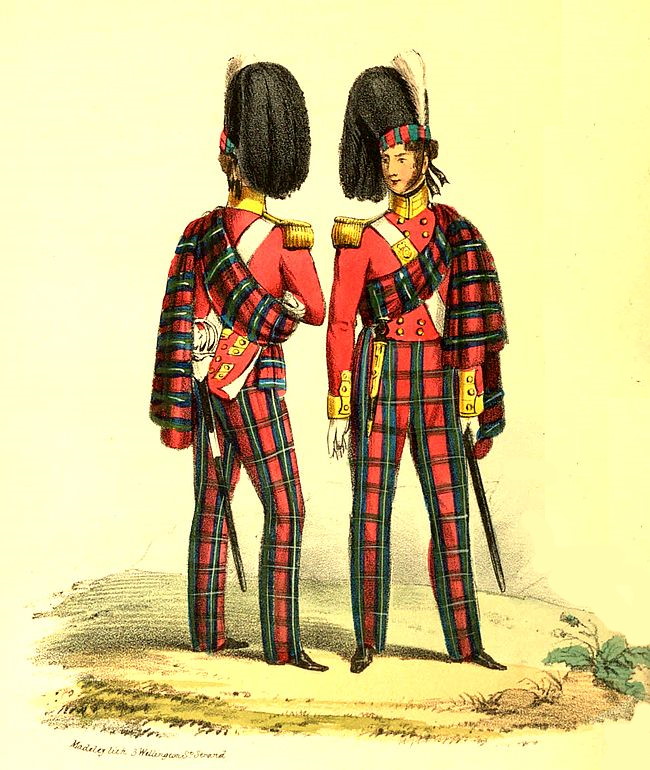
year King George III. approved of its discontinuing the
Highland Costume.
In February of this year the second battalion proceeded
from Scotland to Ireland.
1810
In February, 1810, the first battalion marched from
Cape Town to Stellinbosch, and while stationed at this
place it was selected to form part of an expedition, designed
to co-operate with troops from India in the capture
of the Mauritius. It embarked eight hundred men, under
the command of Lieut.-Colonel Monckton, from Simon’s
Town, on the 22nd of September, 1810, but various
circumstances occasioned a delay of nearly five weeks
before it commenced the voyage, and a landing of the
troops from India had taken place a few days before
the division from the Cape arrived. Its appearance off
the island was, however, particularly opportune, as
the French governor had previously resolved to defend
his lines before Port Louis, but when he saw the division
from the Cape approach the island, he lost all hope of
being able to make effectual resistance, and surrendered
this valuable colony to the British arms.
The regiment landed at Port Louis on the 7th of
December, and was selected to form part of the garrison
of the island.
1811
On the 25th of September, 1811, the establishment
of the first battalion was augmented to a thousand rank
and file, and it was completed by drafts from the second
battalion, then in Ireland.
1812
1814
After performing duty at the Mauritius upwards of
three years, the regiment received orders to proceed to
North America, war having commenced between Great
Britain and the United States; and it embarked from
Port Louis on the 27th of June, 1814, with orders to
proceed, in the first instance, to the Cape of Good
Hope. The following General Orders were issued on this
occasion, by Lieut.-General Sir Alexander Campbell:—
“In obeying the orders of His Royal Highness the commander-in-chief,
for the removal of the first battalion
of the SEVENTY-SECOND regiment from these islands
to the Cape of Good Hope, the Commander of the
Forces is impelled, not less by the calls of justice and
public duty, than by his personal and private feelings,
to express to Lieut.-Colonel Monckton, and all the
officers, non-commissioned officers, and privates of
that excellent, respectable, and valuable corps, how
sensible he is of the loss this command sustains by
their departure. The Lieut.-General, however, derives
some consolation from the ardent hope he
entertains that the regiment is proceeding to fields
of glory, where opportunities will be afforded for
sustaining the high character it has already established,
and adding to its well-earned fame, by
fresh deeds of valour, emulating those of our most
distinguished battalions, whose prowess and discipline
have rescued Europe from the tyrant’s grasp. He
requests their acceptance of his best thanks for their
most exemplary good conduct, during the period he
has had the honor to have them under his orders,
and which he shall not fail to communicate to His
Royal Highness the Commander-in-Chief, for our
Sovereign’s information, and likewise to His Excellency
the Commander of the Forces at the Cape of
Good Hope, a station where their gallantry and orderly
behaviour are so well known and appreciated.”
The design of sending the regiment to America was
afterwards abandoned, in consequence of the termination
of the war in Europe having rendered several other
corps disposable: the SEVENTY-SECOND landed at the
Cape of Good Hope, and was stationed At Cape
Town.[20]
1815
1816
On the 26th of April, 1815, Lieut.-General Rowland
Lord Hill, G.C.B., was appointed Colonel of the
SEVENTY-SECOND regiment, from the ninety-fourth foot,
in succession to General Stuart, deceased.
After remaining at the Cape of Good Hope ten
months, the regiment received orders to transfer its
services to India, to take part in the war with the
Rajah of Napaul. Some delay occurred in procuring
transports; but on the 29th of June the head-quarters
embarked for Bengal, under Lieut.-Colonel Monckton,
and landed at Calcutta on the 5th of September; the
remainder of the regiment arrived soon afterwards.
The war had in the meantime terminated, and the
regiment was ordered to return to the Cape of Good
Hope, proceeding, in the first instance, to the Mauritius;
the annexation of that island to Great Britain,
by the treaty of peace which was concluded after the
removal of Bonaparte from the throne of France,
having been followed by circumstances which rendered
the augmentation of the garrison necessary. The
regiment embarked from Fort William in November,
and arrived at Port Louis in the early part of January
1816; but the garrison had previously been reinforced
by the fifty-sixth regiment from Madras, and the
detention of the SEVENTY-SECOND was not necessary.
From the Mauritius the regiment continued its
voyage to the Cape of Good Hope, and arrived in
Table Bay on the 14th of February; but having
touched at the Mauritius, where an epidemic disease
prevailed, it was detained in quarantine until the 3rd
of March, when it landed at Cape Town.
The termination of the war in Europe and North
America had been followed by the reduction of the
strength of the army, and the second battalion of the
SEVENTY-SECOND regiment was disbanded at Londonderry
on the 3rd of January, 1816; the men were sent
to the Isle of Wight for the purpose of joining the
first battalion. The regiment had, however, returned
from India, and its numbers being above the establishment
of a corps on the Cape station, they were
permitted either to volunteer to regiments not complete,
or receive their discharge. The establishment,
at this period, was fifty-four officers, one thousand
and seventy-seven non-commissioned officers and
soldiers; but a reduction of thirteen officers and two
hundred and ten soldiers was soon afterwards made.
In October one company of the regiment was
detached to the frontiers of the colony, to relieve a
company of the eighty-third regiment, which had been
detached a considerable period.
1817
Lieut.-General Lord Hill was removed to the fifty-third
regiment, in February, 1817, and was succeeded
in the colonelcy of the SEVENTY-SECOND, by Major-General
Sir George Murray, G.C.B., G.C.H.
On the 10th of June four companies of the regiment
embarked at Simon’s Town, for Algoa Bay, where they
arrived in fifty-four hours, and marched from thence
to Graham’s Town, the frontier head-quarters, to
relieve the twenty-first light dragoons, who were
ordered to proceed to India. These companies were
distributed in detachments along the bank of the Great
Fish River, to occupy posts established a short time
previously, and to construct others, in continuation of
a chain, to protect the frontiers against the depredations
of the warlike tribes of Kafirs, who maintained a
constant state of preparation for aggression and acts
of hostility, and whose propensities appear more suited
to plunder and warfare, than the cultivation of their
country. This proved an arduous and toilsome duty,
in a country nearly devoid of resources, infested by
savage animals and marauding Kafirs; the soldiers
lived under canvas, were frequently exposed to the
inclemency of the weather, especially while constructing
new posts, and patrols were constantly moving
from station to station; yet the men were preserved,
by the care and attention of their officers, remarkably
healthy, and the eldest soldiers, who had been long
accustomed to the comparative ease and luxury of the
service at the Mauritius and Cape Town, performed
this difficult duty with facility.
1819
Notwithstanding every effort made to cover the
country, depredations were frequently committed, and
a party of Kafirs having succeeded in stealing a
quantity of cattle from a Dutch farmer, in the beginning
of February, 1819, the circumstance was reported
to Captain Gethin, who was stationed at De Bruins
Drift. The captain instantly pursued the robbers,
with a few soldiers, accompanied by a number of
Dutch farmers, mounted and armed; he came up with
the cattle in a country covered with thick underwood,
and trusting to the support of the armed farmers, in
the event of an attack, he entered the bush with a few
men, and was proceeding to drive out the cattle, when
the party in advance was surrounded and attacked by
a number of Kafirs armed with spears and clubs.
The captain and his small party made a determined
resistance; but the farmers stood aloof, leaving the
soldiers to perish. Captain Gethin was overpowered,
and fell pierced with thirty-two wounds; one serjeant
and one private soldier were also killed on this occasion.
Captain Gethin was a highly respected, brave, and
intelligent officer; he had distinguished himself in the
Peninsular war, particularly at the siege of St.
Sebastian, and had been rewarded with promotion;
his death was much regretted.
1821
A detachment of the regiment continued on the
frontiers, and took an active part in the border warfare
with the Kafirs, whose predatory habits it was found
difficult to restrain; the head-quarters remained at
Cape Town, with detachments at Simon’s Town and
Robben Island, until December, 1821, when it was
relieved by the sixth regiment, and embarked for
England. Two companies remained behind three
months for the want of transport, and fifty soldiers of
good character who had claims to pension, were permitted
to settle in the country.
On the departure of the regiment from the Cape,
the Governor, General Lord Charles Somerset, was
pleased to express, in orders, his approbation of the
conduct of the corps during its stay at that colony, and
to add, that he should not fail to make known its
excellent behaviour to the Commander-in-Chief, and
to recommend it to His Royal Highness’s particular
favour and protection.
1822
In March, 1822, the regiment landed at Portsmouth,
from whence it proceeded to Fort Cumberland, and
in May to Plymouth, where the two companies left at
the Cape, joined in June. In July the regiment
embarked for Woolwich, where it occupied part of the
Horse Artillery barracks.
1823
The regiment was removed to the islands of Jersey
and Guernsey in May, 1823.
Major-General Sir George Murray was removed to
the forty-second, the Royal Highland regiment, in
September, 1823, and was succeeded by Lieut.-General
Sir John Hope from the ninety-second regiment.
The excellent conduct of the regiment on all occasions,
which had procured for it the commendations of
the general officers under whom it had served,
had been repeatedly brought before the Commander-in-Chief,
His Royal Highness the Duke of
York and Albany, by the commanders of the colonies in
which it had served, and had been communicated to
His Majesty, King George IV., who was graciously
pleased to authorise, on the 11th of December, 1823,
its resuming the Highland Costume, with this
difference, that the officers and men should wear trews
instead of kilts: at the same time the King was
pleased to approve of its assuming, as a special mark
of royal favour and approbation, the title of the
“Seventy-second, or the Duke of Albany’s Own
Highlanders.”
1824
On quitting the islands of Jersey and Guernsey in
April, 1824, the regiment received a vote of thanks
and approbation from the principal inhabitants and
public functionaries of the former, and a similar document
from the Royal Court of the latter, expressing
their high sense and admiration of its discipline, and
of the peaceful and orderly behaviour of the non-commissioned
officers and soldiers. The regiment embarked
from Jersey and Guernsey in April, and proceeded to
Plymouth, to relieve the sixty-first foot.
In June His Majesty approved of the regiment
assuming, as a regimental badge, the Duke of
Albany’s Cipher and Coronet, to be borne on the
regimental colour.
From Plymouth, the regiment embarked for Scotland
on the 31st of August: it landed at Newhaven on the
13th of September, and was met on the beach by its
Colonel, Lieut.-General Sir John Hope, who marched
into Edinburgh Castle at its head: the regiment
afterwards sent detachments to Stirling, Fort William,
and Dumbarton.
1825
New colours having been prepared for the Duke of
Albany’s Own Highlanders, the regiment was
assembled at Bruntsfield Links, on the 1st of August,
1825, under Lieut.-Colonel Calvert. The new colours
were presented to the Colonel, Lieut.-General Sir
John Hope, by Lady Hope, with a suitable address;
they were afterwards consecrated by the Chaplain, the
Rev. Mr. Moon, in an eloquent prayer, in which he
implored the God of Battles ever to crown them with
honour and victory; Sir John Hope then presented
them to the regiment, which was formed in square to
receive them, and said:—
“In delivering to your charge these colours, which
have been presented to the SEVENTY-SECOND regiment
by Lady Hope, I am fully aware that I am
not addressing a newly-raised corps, whose name and
character have yet to be acquired. As it has pleased
His Majesty to confer so distinguished an honour on
the regiment, as to permit the SEVENTY-SECOND to
assume the name of the Duke of Albany’s Own
Highlanders, I cannot omit congratulating the
corps on having received so flattering and honorable
a mark of approbation, and expressing my conviction,
that this additional badge, which is now placed on
these colours, will afford a new and powerful inducement
for maintaining the high character which the
SEVENTY-SECOND regiment has so long and so deservedly
possessed. I feel particularly gratified that
the honour of delivering these colours has devolved
on me, and that their presentation should also have
taken place in the capital of the country where the
regiment was first raised, and after its return from
a long period of honorable and distinguished service.
The country being now at peace, there is no opportunity
for the SEVENTY-SECOND to gain fresh honours
by victories in the field; but the regiment may
deserve and obtain almost equal honour and credit
by setting an example of discipline and good conduct
on home service, which becomes now particularly
incumbent when so highly distinguished by being
named after His Royal Highness the Commander-in-Chief,
to whom the whole army is indebted for the
present state of order and discipline to which it has
attained. That the SEVENTY-SECOND will ever continue
to deserve the approbation of His Royal Highness
I make no doubt: and I have now to offer my
most sincere good wishes for the prosperity of the
corps collectively, and of every individual officer,
non-commissioned officer, and private soldier of the
regiment.”
Towards the end of July, routes were received for
marching to Port Patrick, for embarkation for Ireland;
and before quitting Edinburgh, the regiment received
the thanks of the Lord Provost and Magistrates for its
exemplary conduct; it landed at Donaghadee on the
26th of August; and the head-quarters were established
at Belfast.
1826
1827
In September, 1826, the regiment marched to Londonderry,
from whence nineteen detachments were sent
out; and in May, 1827, the detachments were called in,
and the whole proceeded to Dublin.
Orders were received in September to form six service
and four depôt companies; the service companies embarked
for Liverpool, from whence they proceeded to
London, where they arrived on the 9th of October, and
took the duty at the Tower.
1828
On the 5th of January, 1828, the first life guards,
royal horse guards, four battalions of foot guards, and
the SEVENTY-SECOND regiment, were reviewed on the
parade in St. James’s park, by Field-Marshal the Duke
of Wellington, in presence of Don Miguel, Infant of
Portugal.
In April the regiment marched to Canterbury, where
it was inspected on the 2nd of June by General Lord
Hill, commanding-in-chief, who was pleased to state,—“That
although it had been his lot to see and serve
with most of the regiments in the service, he felt he
should not be doing full justice to the SEVENTY-SECOND
Highlanders, if he did not express his particular
approbation of every thing connected with them, and
add, he had never before seen a regiment their equal
in movements, in appearance, and in steadiness under
arms.”
The regiment remained at Canterbury until the end
of June, when it marched to Gravesend, where it embarked,
under the orders of Lieut.-Colonel Arbuthnot,
for the Cape of Good Hope—a colony where the reputation
of the corps was established, and it landed at
Cape Town in September and October following.
1830
In May, 1830, the depôt companies were withdrawn
from Ireland, and landing at Glasgow, were stationed
in Scotland during the five following years.
1833
While the service companies were stationed in Cape
Town, the aggressions of the Kafir tribes, which are
divided into three nations,—the Amapendas, the Tambookies,
and the Amakosa, assumed a formidable and
an atrocious character previously unknown. The
colonial boundary extended, on one side, to the Keiskamma,
but a chief named Macoma, had been permitted
to reside within the British territory. Owing
to some atrocities committed by him and his followers
on the Tambookies, which were attended with the
shedding of human blood within the colony, he was deprived
of the lands he held by sufferance in the British
territory. His expulsion was, however, not strictly
enforced until 1833, when he was removed beyond the
boundary, and he became violently exasperated against
the British. The predatory habits of the Kafirs also
led to disputes, when the British were searching for
stolen property, and the lenity observed towards the
aggressors emboldened them, and occasioned them to
become more audacious in their attacks.
1834
Towards the end of 1834 thousands of Kafirs rushed
into the colony, and commenced the work of murder,
rapine, and devastation by fire, among the settlers.
1835
The SEVENTY-SECOND Highlanders were stationed at
Cape Town, when the news of these alarming events
arrived at the seat of government, and they were immediately
ordered towards the frontiers. Three companies
sailed for Algoa Bay, on the 2nd of January,
1835, and arrived at that place on the 10th; the other
three companies advanced up the country by horse
waggons; and as the regiment approached Graham’s
Town, it traversed the scenes of outrage, and witnessed
the ruins of once flourishing farms bearing marks of
savage vengeance; the town was found barricaded, and
the houses turned to fortifications. Ten thousand
Kafirs had penetrated the colony, and the smoke of
ruined farms, with the cries of widows and orphans,
were seen and heard on every side.
Having advanced towards the frontiers, the head-quarters
were established at Graham’s Town, and
detachments were employed in chasing the vengeful
marauders from the confines of the British possessions.
Preparations were made to carry hostilities into the
heart of Kafirland, to visit with necessary chastisement
the atrocious aggressions of the tribes, and to enforce
such measures as should be calculated to prevent the
recurrence of similar outrages. The force assembled
for this service was divided into four columns: the first
was commanded by Lieut.-Colonel John Peddie, K.H.,
SEVENTY-SECOND regiment; it consisted of a detachment
of the royal artillery with two guns, a detachment
of the Cape mounted riflemen, the SEVENTY-SECOND
Highlanders, a provisional battalion, and the Swellendaham
burghers; and in the middle of March it
advanced to the right bank of the Keiskamma, from
whence it penetrated into the interior of Kafirland.
The predatory tribes were incapable of offering serious
opposition; they were chastised for their atrocious
conduct, subdued, deprived of a portion of their territory
bordering on the frontiers of the colony, and such
additional precautionary measures were adopted as
appeared necessary to ensure the safety of the British
subjects.
The SEVENTY-SECOND Highlanders were employed in
Kafirland during the months of April and May: the
head-quarters were afterwards established at King
William’s Town until October, when they were removed
to Graham’s Town.
In June of this year the depôt companies proceeded
from Scotland to Ireland.
1836
On the death of Lieut.-General Sir John Hope, the
colonelcy of the regiment was conferred on Major-General
Sir Colin Campbell, K.C.B., from the ninety-ninth
foot, by commission dated the 15th of August, 1836.
1837
1838
The head-quarters of the service companies remained
at Graham’s Town three years, furnishing detachments
along the frontiers, occupying posts, and performing
much trying and difficult service: in October, 1838,
they were relieved from this duty, and returned to
Cape Town.
In May, 1838, the depôt companies returned to
Scotland.
1839
During the year 1839 the service companies were
stationed at Cape Town, and the depôt companies at
Paisley and Dundee.
1840
After taking part in the important duty of protecting
the possessions of Great Britain at the Cape of Good
Hope nearly twelve years, the service companies were
relieved in April, 1840, and returned to England, and
disembarked at Portsmouth on the 8th of June following:
the regiment was subsequently stationed at
Fort Cumberland: the depôt had proceeded from
North Britain to Portsmouth in May, 1840.
The following general order was issued by Major-General
Sir George Napier, K.C.B., commanding the
forces at the Cape of Good Hope, on the 10th of April,
1840, upon the embarkation of the SEVENTY-SECOND
for England:—
“His Excellency the Commander-in-Chief cannot
permit the SEVENTY-SECOND Highlanders to embark
for England, from the colony of the Cape of Good
Hope, in which they have been stationed for the long
period of twelve years, without his expressing his
marked approbation of the conduct of this highly
disciplined and exemplary corps while under his
immediate command; and from the reports His
Excellency has received from Colonel Smith, the
Deputy-Quarter Master-General, under whose orders
this regiment has been during the greater part of the
above period, including a very arduous and active
service in the Field, His Excellency is enabled to
record, which he does with great satisfaction, the very
meritorious services of the SEVENTY-SECOND Highlanders,
in whatever duty they have been engaged,
whether in the Field or in Quarters.
“His Excellency begs to assure Major Hope, the
officers, non-commissioned officers, and soldiers of
the SEVENTY-SECOND regiment, that he will ever feel
a lively interest in their welfare.”
1841
In July, 1841, the regiment proceeded from Portsmouth
to Windsor.
1842
On the 26th of January, 1842, new colours were
presented to the SEVENTY-SECOND Highland regiment
by Field-Marshal His Grace the Duke of Wellington,
in the quadrangle of Windsor Castle, the ceremony
being honoured by the presence of Her Majesty Queen
Victoria, Prince Albert, the King of Prussia, and
other distinguished personages. The following is the
Duke of Wellington’s address to the regiment on this
interesting occasion:—
“Colonel Arbuthnot,[21] and you, Gentlemen, Officers,
and you, Non-Commissioned Officers and Soldiers, of
the SEVENTY-SECOND Highland regiment,—I have
attended here this day, in compliance with the wishes
of your Commanding Officer, and by permission of Her
Majesty, to present to you your new colours. These
colours have been consecrated by one of the highest
dignitaries of our Church, and are presented to you
in the presence of Her Majesty, and of her Illustrious
and Royal Guest the King of Prussia, of Prince
Albert, and a number of most distinguished personages.
They are composed of the colours of the
three nations, and bear the cipher of Her Majesty;
and I have no doubt, from your previous character
and your present high state of discipline, that you
will guard them under every circumstance, to the
utmost of your power. These Colours you are henceforth
to consider as your Head-Quarters, and in
every circumstance, in all times of privation and of
distress, you will look to them as your rallying
point; and I would again remind you, that their
presentation is witnessed by the Monarch of one of
the most powerful nations in Europe—a nation which
boasts of an army which has heretofore been a pattern
for all modern troops,—and which has done so much
towards contributing to the general pacification of
Europe. I have long known the SEVENTY-SECOND
Highland Regiment. Half a century has now nearly
elapsed since I had the pleasure of serving in the
same Army with them in the Plains of Hindoostan;
since that period they have been engaged in the
conquest of some of the most valuable colonies of
the British Crown; and latterly, in performing most
distinguished services at the Cape of Good Hope.
Fourteen years out of the last sixteen they have
spent on Foreign service; and with only eighteen
months at home for their re-formation and their
re-disciplining, appear in their present high state
of regularity and order. The best part of a long
life has been spent by me in Barracks, Camps, and
Cantonments, and it has been my duty, as well as
my inclination, always to study how best to promote
the health and discipline of the troops; and I have
always found it only to be done by paying the strictest
regard to regularity and good order, and the greatest
attention to the orders of their Officers. I address
myself now particularly to the older soldiers, and
wish them to understand that their strict attention
to their discipline, and respect to their superiors,
will often have the best effect on the younger soldiers;
and it is, therefore, their duty to set a good example
to their juniors by so doing; and by these means
alone can they expect to command the respect and
regard of the community amongst whom they are
employed. I have made it my business to enquire
particularly, and am rejoiced to find that the SEVENTY-SECOND
have always commanded that respect and
regard, wherever they have been stationed, to which
their high state of discipline and good order so justly
entitle them. You will, I am sure, always recollect
the circumstances under which these Colours are now
given into your charge; having been consecrated by
one of the highest dignitaries of the Church, in the
presence of Her Majesty, who now looks down upon
you, and of her Royal Visitor: and I give them into
your charge, confident that at all times, under all
circumstances, whether at home or abroad, and in
all privations, you will rally round them, and protect
them to the utmost of your power.”
Colonel Arbuthnot, in reply, said:—
“My Lord Duke,—It would be highly presumptuous
in me, if I were to make any reply to the address
which your Grace has delivered to us; but I cannot
avoid stating that it is impossible for me, and indeed,
I may add, out of the power of any one to express,
how deeply I, my Officers, Non-Commissioned
Officers, and Men, feel the high honour which has
been conferred on us, by having had our Colours presented
to us by the greatest Soldier the world has
ever seen, and that in the presence of our Sovereign,
His Majesty the King of Prussia, and Field-Marshal
His Royal Highness Prince Albert.”
The regiment remained at Windsor until April, 1842,
when it proceeded to Salford Barracks, from thence
to Blackburn, and in September to Bolton, Lancashire.
1843
In April, 1843, the seventy-second regiment proceeded
to Dublin, and in August to Templemore,
marching from thence to Fermoy in September.
1844
Quitting Fermoy on the 2nd of July, 1844, the regiment
proceeded to Buttevant, and on the 28th of
September to Cork, having been put under orders for
Foreign service. The six service companies, under the
command of Lieut.-Colonel Lord Arthur Lennox, embarked
for Gibraltar in Her Majesty’s troop-ship
Resistance, from Cork, on the 27th of November, 1844,
and disembarked at their destination on the 12th of
December following.
1845
1846
1847
The depôt companies marched from Cork to Templemore
in April, 1845, and to Nenagh in February,
1846. In September, 1847, they proceeded to Charles
Fort, near Kinsale, and in December were removed to
Scotland, and stationed at Paisley.
1848
The regiment remained at Gibraltar until February,
1848, and on the 15th of that month embarked for
Barbadoes under the command of Lieut.-Colonel Gascoyne,
on board the Bombay transport. The following
letter was addressed by General Sir Robert Wilson,
Governor of Gibraltar, to the Adjutant-General reporting
the embarkation:—
Gibraltar, 15th of February, 1848.
“Sir,
“I have the honour to acquaint you that Her Majesty’s
SEVENTY-SECOND regiment embarked this morning on
board the transport Bombay, and I have the satisfaction
to add, that up to the last moment this distinguished
corps conducted itself so as to merit the
highest approbation that could be bestowed on the
commanding officer, officers, non-commissioned officers,
and privates for military qualities, and general deportment
towards the community at large.
I have, &c.
R. T. Wilson,
General and Governor.”
The SEVENTY-SECOND arrived at Barbadoes on the
14th of March, 1848.
The depôt companies continued in North Britain,
until the 18th of May, when they embarked for
England, under Lieut.-Colonel C. M. Maclean, and
arrived at Sheerness on the 24th of May, at which
period this Record is concluded.
1848.