OF
THE SEVENTH REGIMENT,
OR
THE ROYAL FUSILIERS.
1685
The invention of gunpowder was speedily followed by
the introduction of cannon; but many years elapsed before
a corps of artillery was added to the army. The
guns were fired by men hired for the purpose, under
the direction of a master-gunner, and an officer styled
the Master of the Ordnance, and the whole were under
the orders of the Master-general of the Ordnance. Non-commissioned
officers and private soldiers of infantry regiments
were frequently employed as gunners; and the
care and protection of the guns were confided to particular
corps. On the augmentation of the army during
the rebellion of James Duke of Monmouth, in the
summer of 1685, King James II. resolved, that the
first infantry corps raised on that occasion should be an
Ordnance Regiment, for the care and protection of
the cannon; of which corps His Majesty appointed
George Lord Dartmouth, then Master-general of the
Ordnance, colonel, by commission dated the 11th of June,
1685.
The regular regiments of foot were composed, at this
period, of Musketeers,—men armed with muskets
and swords; Pikemen,—armed with long pikes and
swords; and Grenadiers,—armed with hand-grenades,
muskets, bayonets, swords, and small hatchets; but in
the Ordnance Regiment every man carried a long
musket called a fusil, with a sword and bayonet, from
which peculiarity in the arming, the regiment obtained
the designation of "Fusiliers;" and the King being desirous
of appearing publicly to patronize this new corps,
conferred upon it the title of "Royal Fusiliers."[6]
Regiments of infantry had, originally, a colour to
each company, which was called an ensign, and was
carried by the junior subaltern officer of each company,
who was styled "ancient," and afterwards "ensign,"
which term signified "colour-bearer." The regiments
of fusiliers did not have colours or ensigns to each company,
consequently the title of ensign or colour-bearer
was not given to the junior subaltern officer of each company;
but having, in consequence of the peculiar services
they were called upon to perform, a care and responsibility
equal to that of a lieutenant, both the subaltern
officers of each company were styled lieutenants.
They were both placed on the same rate of pay; but
the terms first lieutenant and second lieutenant were used
in their commissions for several years, and afterwards
discontinued.
The regiment consisted of thirteen companies,—twelve
of fusiliers and one of miners; each company consisting
of three officers, three serjeants, three corporals, two
drummers, and one hundred private men. The two
first companies were of very old date; having been independent
companies in the Tower of London many years;
the other ten companies were raised in London and its
vicinity by George Lord Dartmouth,[7] Lieutenant-Colonel
Thomas Talmash or Tollemache, afterwards
colonel of the fifth foot and second foot guards; Richard
Fowler, Major Beckman, Henry Cornwall, Sir John
Morgan, John Boyce, Thomas Whalley, Charles Fitzwilliams,
and Henry Vaughan; and the company of
miners by Captain James Adams. Thomas Talmash
was appointed to the lieutenant-colonelcy; and Robert
St. Clair, who commanded one of the old independent
companies, obtained the commission of major. The
uniform was scarlet coats, lined with yellow; grey
breeches and grey stockings; and the men wore yellow
cloth caps, ornamented with military devices similar to
those afterwards adopted for grenadiers; the other regiments
of foot wore round hats with broad brims turned
up on one side.
The regiment was speedily raised, and on the 4th of
July the several companies were directed to proceed to
the Tower of London, and perform the duties of that fortress.
The rebellion being soon afterwards suppressed,
and the Duke of Monmouth beheaded, the regiment was
reduced to eleven companies of fusiliers, of three officers,
three serjeants, three corporals, two drummers, and fifty
private soldiers each; and one company of miners, of two
officers, one serjeant, two corporals, one drummer, and
forty miners.
After the suppression of the rebellion, King James
formed a camp on Hounslow-heath; where the Scots
brigade in the service of Holland, and a numerous body
of English cavalry and infantry, were assembled, and the
Royal Fusiliers proceeded to the camp in charge of
the train of artillery. When the camp was broken up,
the regiment returned with the guns to the Tower of
London, from whence three companies were detached to
Sheerness, where they were directed to remain in garrison.[8]
1686
During the summer of 1686 the Royal Fusiliers
were again encamped in charge of the train of artillery
on Hounslow-heath. The corps assembled on the heath
consisted of three troops of life guards, nine regiments
of cuirassiers, three of dragoons, and thirteen battalions
of foot. In a description of the camp, written at the
time, and published in the Antiquarian Repertory, it
is stated:—"The horse, foot, and dragoons are encamped
in a straight line; the intervals between the
foot is seventy paces, the intervals between each regiment
of horse about fifty paces, and the interval between
the horse on the left and the dragoons (because
of the ground) is near half mile. The lieutenants' and
ensigns' tents are in the rear of the respective companies
in a direct line, seventeen paces from the
soldiers' huts or tents; the captains' tents twelve
paces behind the lieutenants'; the colonels' tents behind
the captains', ten paces; the lieutenant-colonel on
the right of the colonel, and the major on the left in a
direct line. The brigadier-generals have their tents
twenty paces behind the colonels'. The King's tent
and chappel is in the rear of the left of the horse on
the left, and the general officers' tents behind the
King's. The Fusiliers are encamped in the rear
of the line, a good distance behind the interval between
the Earl of Craven's regiment and the Scots guards;
and in several parties about the horse carriages. The
guns are planted about a hundred paces before the line,
before the interval between the Scots guards and Prince
George's regiment, guarded by a party of Fusiliers;
each gun having two gunners and a matrosse to attend
it. The suttling booths are about two hundred paces
in the rear of the line."
In August the Royal Fusiliers struck their tents,
and, returning to the Tower with the guns, were stationed
at that fortress during the remainder of the year.
1687
The establishment was again augmented to thirteen
companies in the spring of 1687, as appears by the following
warrant:—
"JAMES R.
"Whereas we have thought fit to add one company
more to Our Royal Regiment of Fusiliers, and to
apply the pay of one of the non-regimented companies
mentioned in Our establishment to the entertainment
of the said company of Fusiliers, with the addition of
one shilling per diem to the youngest lieutenant, and
one shilling and sixpence for the pay of one serjeant,
and one shilling for one drummer more, Our will and
pleasure is, that you include the pay of the said company,
and additional allowances, within the certificates
or debentures you shall from time to time make out
for the pay of Our said Royal Regiment of Fusiliers,
to commence from the 1st of January last; and
for so doing this shall be your sufficient warrant.
"Given at Our Court at Whitehall this 12th day of
March, 1686-7, in the third year of Our reign.
"By His Majesty's Command.
| (Signed) | "Sunderland P. | Shep. Fox. |
| "Bellasis. | J. Ernle. |
"To the Paymaster-General,
&c. &c. &c."
1688
In the summer of 1687 and 1688, the Royal Fusiliers
were again encamped on Hounslow-heath. On
the 1st of September, 1688, an augmentation of ten men
per company was made to the establishment, which consisted,
at this period, of eleven companies of fusiliers,
one of grenadiers, and one of miners.
The King having manifested a determination to establish
papacy and arbitrary government, many noblemen
and gentlemen solicited the aid of William Henry Prince
of Orange to enable them to oppose the proceedings of
the court. On the receipt of information of warlike preparations
in Holland, a strong detachment of the Royal
Fusiliers embarked on board of men-of-war, to serve
as marines, and sailed to the Nore. The fleet was commanded
by their colonel, Admiral Lord Dartmouth,
whose loyalty to King James II. was not doubted; but
the rear-admiral, Sir John Barry, and many of the
captains, inferior officers, and seamen, entertained sentiments
favourable to the Prince of Orange; no collision,
however, took place. While the English fleet was wind-bound
at the mouth of the Thames, the Dutch armament
passed along the British Channel with little molestation;
the wind becoming more favourable, the English navy
put to sea; but the Prince of Orange was so far in advance,
that he landed on the Devonshire coast, on the
5th of November, without interruption; and the wind
changed immediately afterwards, and blew with such
violence, that the English fleet was driven into Portsmouth
harbour in a damaged condition. The sentiments
entertained in the navy were also prevalent in the army;
the troops refused to fight in the cause of Papacy and
arbitrary government, and King James fled to France.
The Royal Fusiliers landed and were ordered by the
Prince of Orange to occupy quarters at Barnet.
From this period the Royal Fusiliers ceased to be
considered exclusively as an Ordnance Regiment, and
took their turn of duty with the regular regiments of
the line: the regiment was not, however, furnished with
a division of pikemen; but every man continued to be
armed with a fusil.
1689
Six companies were removed from Barnet to Yarmouth,
where they took part, in February, 1689, in the proclamation
of the accession of King William III. and Queen
Mary to the throne. Shortly afterwards the regiment
embarked for Holland, forming part of the force under
Lieutenant-General the Earl of Marlborough, sent to
assist the Dutch in their war with France in the place
of the troops which the Prince of Orange had brought
with him to England.
The Royal Fusiliers joined the Dutch army at
Tongres, and served the campaign of this year under
Prince Waldeck. On the 25th of August a piquet under
Colonel Hodges was attacked by the French forces under
Marshal de Humières near Walcourt, and a sharp
action ensued, in which the English infantry evinced
firmness and intrepidity. The French were defeated
with the loss of two thousand men killed and wounded;
and King William, writing to the Earl of Marlborough
on this subject, observed,—"I am very happy that my
troops behaved so well at Walcourt. It is to you that
this advantage is principally owing."[9] In a few days
after this event King William conferred the colonelcy
of the Royal Fusiliers, which had been vacant some
time, in consequence of the removal of Lord Dartmouth
for adhering to the interests of King James, on the
Earl of Marlborough, who held also the colonelcy of
the third troop of life guards.
1690
Before the following campaign the regiment returned
to England, where it was stationed while King William
was in Ireland, endeavouring to rescue that country from
the power of King James, who had proceeded thither
with a body of troops from France.
King William having defeated the Irish forces and
their French allies at the Boyne, besieged Limerick.
"During the time His Majesty was before the town, it
was proposed by the Earl of Nottingham to My Lord
Marlborough, and afterwards approved of in council,
as very advantageous to their Majesties' affairs, to send
a party from England, who, joining with a detachment
from the King's army, might reduce the two important
garrisons of Cork and Kinsale, and arrangements were
made accordingly; but not being ready so soon as was
designed, His Majesty, upon his return to England,
sent the Earl of Marlborough, with his own regiment
of Fusiliers, Brigadier Trelawny's (now fourth),
Princess Anne's (eight), Colonel Hastings' (thirteenth),
Colonel Hales', Sir David Collier's, Colonel Fitzpatrick's,
one hundred of the Duke of Bolton's, two hundred of
Monmouth's under Major Johnston, with Lord Torrington's
and Lord Pembroke's marine regiments, to
undertake this service."[10] Arriving at Cork roads on
the 21st of September, the fleet entered the harbour on
the following day, and the co-operation of part of the
army on shore having been secured, the Royal Fusiliers
and other corps landed and commenced the siege.
A breach having been made, the Royal Fusiliers and
three other English regiments, commanded by Brigadier-General
Churchill, and a body of Danes, passed
the river wading up to the arm-pits to the east marsh,
in order to storm the wall on that side. The grenadiers
led the attack; but before they gained the breach, the
Irish hung out a white flag, and agreed to surrender;
the garrison, consisting of six regiments, became prisoners
of war.
From Cork the Royal Fusiliers advanced towards
Kinsale; the garrison vacated the town and retired to
two strong forts. One of these forts was speedily reduced;
the other held out until the middle of October,
when the garrison surrendered on the condition of being
permitted to proceed to Limerick.
The Royal Fusiliers were afterwards placed in
garrison at Kinsale, where they remained three months.
1691
The loss of the battle of Fleurus on the 21st of June,
1690, by the Dutch troops under Prince Waldeck, gave
the French the ascendancy over the confederates in
Flanders; and the Royal Fusiliers were selected to
augment the forces in that country, where His Majesty
resolved to command in person. The regiment embarked
from Cork in January 1691, and sailing for
Flanders experienced very severe weather at sea, and
two vessels, having on board part of the Fusiliers,
were wrecked on the English coast, and many men perished.
The remainder of the regiment landed at Ostend
and went into quarters in West Flanders, where it was
joined by a fine body of recruits and by a number of
men who had been left sick at Kinsale.
When the army took the field, the Royal Fusiliers
were formed in brigade with the regiments of Bath
(tenth), Hodges (sixteenth), and Fitzpatrick (afterwards
disbanded), commanded by Brigadier-General Churchill,
and served the campaign of this year with the main army
commanded by King William; but no general engagement
occurred. The regiment passed the winter in cantonments
among the Belgic peasantry.
1692
The Earl of Marlborough, having fallen under the
displeasure of King William, was removed from his commands,
and was succeeded in the colonelcy of the Royal
Fusiliers by Lord George Hamilton by commission
dated the 23rd of January, 1692.
On the army taking the field, the regiment was again
placed in the brigade commanded by Brigadier-General
Churchill, and it served at the battle of Steenkirk on the
24th of July, 1692. On this occasion the leading column
attacked the French forces commanded by Marshal Luxemburg
with signal gallantry and success; but owing
to the thick woods, with narrow and difficult defiles, which
the army had to pass, together with the tardiness of
Count Solms in obeying His Majesty's commands, some
delay occurred. The Royal Fusiliers and a few other
corps hastened through the defiles, and formed line at
the skirts of the wood, where they were exposed to a
heavy cannonade, and lost several men. In consequence
of the delay which had occurred, the King ordered a
retreat, and the French did not venture to attack the
army in its retrograde movement.
Sir Robert Douglas having been killed in the act of
rescuing the colours of the first battalion of the Royals
from the enemy, was succeeded in the colonelcy of that
regiment by Lord George Hamilton; and the command
of the Royal Fusiliers was conferred on Colonel
Edward Fitzpatrick, from a newly-raised regiment,
which had been disbanded.
On the 22nd of August the regiment was detached
from the main army, with several other corps, under
Lieutenant-General Talmash, to Furnes, where the troops
encamped until the fortifications were put in a state of
defence; the Royal Fusiliers afterwards proceeded to
Dixmude, and were employed in repairing the works;[11]
and after the completion of this service, they marched
into quarters at Ghent, where they passed the winter.
1693
Leaving Ghent in May, 1693, the regiment was in
line at the celebrated position of Parck camp, where it
was formed in brigade with the Royals (first), Queen
Dowager's (second), Prince George of Denmark's (third),
and the Queen's (fourth) regiments under Brigadier-General
Churchill. After several movements the army
was posted near the village of Landen, where it was
attacked on the 19th of July by a French army of very
superior numbers under Marshal Luxemburg.
The Royal Fusiliers were posted near the right of
the confederate army, where a slight entrenchment had
been made during the preceding night. As the first
rays of morning light appeared in the horizon, waving
masses of glittering arms, traversing the undulating
grounds in front, gave indication of an approaching
enemy, when the artillery opened a heavy fire, and the
battle began. For some time the Fusiliers were spectators
of the action, while much fighting took place at
the villages of Laér, Neer-Winden, Neer-Landen, and
the fortune of the day was everywhere in favour of the
confederates; but eventually the position was forced at
the village of Neer-Winden, and the Hanoverian Cavalry
were broken. Heavy columns of pikemen and musketeers,
consisting of the French brigades of Vermandois,
Nice, Roussillon, and Sare, flanked by dragoons, and
preceded by a cloud of grenadiers, approached the ground
where the Royal Fusiliers were posted. Colonel
Fitzpatrick was at the head of the regiment, and directed
the men to reserve their fire until the near approach of
their opponents. As the French soldiers sprang forward
with their characteristic energy, and threw a shower of
hand-grenades over the breast-work, a well-directed
volley from the Fusiliers rent chasms in the French
ranks; but the survivors, being supported by an immense
superiority of numbers, and urged forward by Marshal
Villeroy, renewed the attack; while the marshal led
a chosen body of men to the charge, and forced the
right of the entrenchment. The Royal Fusiliers, and
other corps at this part of the field, were attacked in front
and flank, and a sanguinary conflict ensued. Colonel
Fitzpatrick was carried from the field wounded, yet the
Fusiliers stood their ground; ranks of opponents ascended
the breast-work, and were speedily cut down or
forced back. At length the British battalions were overpowered
and driven from their ground. Stung with
resentment at this disaster, they speedily rallied, and,
rushing sword in hand upon their opponents, they once
more regained the lost ground. A momentary pause
ensued; but soon a fresh body of opponents renewed
the fight, and the British regiments were again overpowered
by superior numbers. The Fusiliers evinced
the stern valour of British soldiers; their commanding
officer, Lieutenant-Colonel Whalley, fell mortally wounded;
Major Wilson was removed bleeding to the rear;
yet they disputed the ground with sanguinary tenacity
until all chance of ultimate success had passed away,
when they withdrew from the field, and joining a large
body of infantry under Lieutenant-General Talmash, retired
by the brook Beck upon Dormal, and thence to
Lewe. The enemy attempted to interrupt the retreat;
but the British battalions facing about to confront their
pursuers, the French halted, and the retrograde movement
of this body of men was performed with trifling
loss; the remainder of the army had, however, to pass
the river Gheet by a narrow bridge, and the defiles becoming
choked with gun-carriages, the rear was severely
handled by the French, and the King narrowly
escaped being taken prisoner.
The loss of the regiment on this occasion was very
severe: among the killed were Lieutenant-Colonel
Thomas Whalley, an officer of distinguished merit, who
raised one of the companies of the regiment at its formation
in 1685, and Lieutenants Fairbrother, Cooper, and
Blackmore; Captain Ruthwin died of his wounds:
among the wounded were Colonel Edward Fitzpatrick,
Major Wilson, Captains Harte, Betsworth, and Withers,
and Lieutenant Fletcher; the loss in non-commissioned
officers and private soldiers was very great; but the exact
number has not been ascertained.
The regiment was employed in the movements of the
main army until the end of the campaign, when it returned
to Ghent, where it was stationed during the winter,
together with three battalions of foot-guards, and
the Queen Dowager's regiment of foot.
1694
In the spring of 1694 a numerous body of recruits
from England replaced the losses of the preceding
campaign, and when the regiment took the field, it was
reviewed by King William, and complimented on its
martial appearance, and the steadiness with which it
performed the simple manœuvres practised at that period.
It served in the brigade under the orders of Brigadier-General
Erle, and performed many long and toilsome
marches in Flanders and Brabant; but no general engagement
occurred, and it passed another winter in barracks
at Ghent.
1695
When the season for taking the field, in the spring of
1695, arrived, the British monarch appeared at the head
of a splendid army of British, Spaniards, Dutch, and
Germans; in the preceding years His Majesty had been
satisfied with arresting the progress of the French arms;
but in 1695 he resolved to wrest the strong and important
fortress of Namur from the power of Louis
XIV. Colonel Fitzpatrick, having been eighteen months
in England to recover of his wounds, rejoined the
army on the 19th of June, and was placed at the head of
a brigade, of which his own regiment of Fusiliers
formed part. King William attacked Fort Kenoyne,
and having drawn the French forces to the Flanders side
of their line of entrenchments, he invested Namur.
The Royal Fusiliers were detached from the army at
Wonterghem to take part in the siege, and pitched their
tents at Templeaux, a post about five miles from the
town. On the 6th of July they were on duty in the
trenches; on the 8th they marched into the lines of circumvallation,
and in the evening of the same day a detachment
was engaged in a successful attack on the covered
way upon the hill of Bouge. The attack was made
about seven in the evening; and such were the spirit and
energy with which the British soldiers rushed upon their
opponents, that the palisades were speedily broken down,—the
covered way carried,—the French overpowered and
chased among the works, many of them throwing themselves
into stone pits to escape the fury of their assailants.
This success stimulated the soldiers to fresh exertions,
and on the 17th of July, when the Royal Fusiliers were
directed to take part in the storming of the counterscarp,
they engaged in this service with a cheerful alacrity, which
proved the ardour which glowed in every breast. The grenadiers
led the assault, and, rushing to the glacis, cast their
grenades over the palisades into the covered way. Following
up this attack with spirit, the French were overpowered,
the counterscarp was carried in gallant style,
and the Royal Fusiliers were thanked by King William
for their distinguished bravery. They had Lieutenant
Dancy killed and Captain Negus wounded;
also a number of private men killed and wounded.
The siege was prosecuted with vigour, and with such
success that before the end of July the town was delivered
up, Marshal Boufflers retiring with the garrison
into the castle.
One hundred and thirty-six pieces of cannon and
fifty mortars opened their fire on the castle of Namur on
the 11th of August, and being continued without intermission,
breaches were made in the Terra Nova and Cohorne,
and on the night of the 20th of August, a detachment
of the Royal Fusiliers was engaged under Lord
Cutts in the attack of the counterscarp and breach of
Terra Nova, and had several men killed and Captain
Groves, Lieutenant Rainsford, and a number of men
wounded. The fire of the artillery was continued, and
preparations were made for another assault; but the further
effusion of blood was prevented by the surrender of
the place. After the repair of the works, the King, being
satisfied with the capture of so important a place, dismissed
the army to its winter quarters, and the Fusiliers
returned to their usual station at Ghent.
1696
During the following winter a conspiracy was formed
in England for the assassination of King William: at the
same time an insurrection was organised, and a French
army was assembled near the coast to aid in the replacing
of King James on the throne. A body of troops was
immediately ordered to return from Flanders; and the
Royal Fusiliers embarked at Sas van Ghent, sailed from
thence to Flushing, where the transports were placed
under the convoy of Dutch men-of-war, and, afterwards
resuming the voyage, arrived at Gravesend in March,
1696. The plot had, however, been discovered, the conspirators
arrested, and the British fleet was manned and
sent to sea; the French monarch's designs were thus
frustrated, and the Fusiliers returned to Flanders without
landing in England.
During the campaign of 1696 the regiment served
with the Brabant army commanded by King William;
but no fighting took place. In the beginning of September
it joined the army of Flanders under the Prince of
Vaudemont, and, encamping near the village of St. Michael,
was employed in constructing works for the protection
of Bruges. In October it marched to Ghent.
In November, 1696, Brigadier-General Sir Charles
O'Hara was appointed colonel of the Royal Regiment
of Fusiliers, in succession to Brigadier-General Fitzpatrick,
drowned.
1697
Leaving Ghent on the 13th of March, 1697, the regiment
proceeded into village quarters between Brussels
and Malines. Two companies were detached to form
part of the garrison of Oudenarde, and the remainder
subsequently encamped behind the forest of Soignies,
where the men suffered much from wet weather and
from the want of their clothing, which was due, but had
not arrived from England.
The Royal Fusiliers took part in the operations of
this campaign. In September a treaty of peace was
signed at Ryswick, and during the winter the regiment
returned to England; at the same time its numbers
were reduced to a peace establishment.
1698
In August, 1698, the regiment proceeded to Jersey and
Guernsey, to relieve a corps of marines which was
ordered to be disbanded.
1701
1702
The regiment remained in Jersey and Guernsey
until 1702, when the accession of Philip Duke of Anjou
(grandson of Louis XIV.) to the throne of Spain, to the
prejudice of the House of Austria, had involved Europe
in another war. This violation of existing treaties
was followed by the Courts of France and Spain acknowledging
the Pretender as King of Great Britain.
Queen Anne declared war against France and Spain,
and in the summer of 1702 three companies of the
Royal Fusiliers were called from Jersey and Guernsey
to take part in an expedition, under the Duke of Ormond,
against the city of Cadiz; their colonel, Major-General
Sir Charles O'Hara, was also employed in this enterprise.
The fleet arrived off the coast of Andalusia in Spain, and
a landing was effected in the middle of August, within
a short distance from Cadiz. The wind being high, about
thirty boats crowded with soldiers were overturned by the
surge, and above twenty men of the Royal Fusiliers
were drowned. The towns of Rota, and Port St. Mary's
with Fort St. Catherine, were captured; but the fortress
of Cadiz was found too strong, and the garrison too numerous
to be reduced by the small expedition sent against
it. The wealthy and flourishing town of Port St. Mary's
was found deserted by the inhabitants, the houses well
furnished, and much valuable merchandise in the warehouses.
Strict discipline not being preserved, the town
was plundered, and a great quantity of property was removed
on board the fleet. Several officers were charged
with participating in the plunder, and Sir Charles O'Hara
was implicated and brought to trial, but was acquitted.
The capture of Cadiz being found impracticable, the
troops re-embarked, and sailed for England; but while
at sea, information was received of the arrival of a valuable
Spanish fleet under a French convoy, at the harbour
of Vigo, and the expedition immediately proceeded
thither. A landing was effected on the south side of
the river, above Vigo; a strong fort and a battery were
captured; the British fleet forced an entrance, and the
French and Spanish shipping were all captured or destroyed.
The fleet afterwards returned to England; and
the Duke of Ormond received the thanks of parliament
for his success in this enterprize. The three companies
of the Fusiliers were landed and placed in garrison at
Tilbury, excepting fifty men, who were sent to the West
Indies to complete Brigadier-General Gustavus Hamilton's
regiment.
1703
1704
1705
The war being continued, the Royal Fusiliers were
employed during the summer of 1703 as marines on
board the fleet: they afterwards landed, and were placed
in garrison at Portsmouth, from whence a detachment
was sent to the Isle of Wight in August, 1704. In 1705
the regiment was stationed at Plymouth.
1706
In the meantime several regiments had been sent to
Portugal; an armament under the Earl of Peterborough
had captured Barcelona, and Catalonia and Valencia had
declared in favour of Archduke Charles of Austria, who
was acknowledged as sovereign of Spain by Great Britain,
Holland, &c. The house of Bourbon assembled a well-appointed
army and a powerful fleet to retake Barcelona,
which was besieged by King Philip in April, 1706. King
Charles remained in the city, that his presence might inspire
confidence in the garrison, which was weak and ill
provided with the means of defence. Succours were sent
from England, and the Royal Fusiliers were embarked
for this service. On the approach of the British squadron
the French fleet retired. The Royal Fusiliers landed
at Barcelona on the 8th of May, and immediately marched
to the breach to repel an expected attack by storm, which
did not, however, take place. The arrival of the British
fleet with reinforcements decided the fate of the town;
and the army of King Philip raised the siege and retired,
leaving its battering train and magazines behind.
From Barcelona the Royal Fusiliers marched a distance
of forty-seven miles, to Gironne, a fortified town
of Catalonia, situated at the base of a steep mountain,
with the river Tar running through the town. Here
the regiment passed in comfortable quarters among the
Spaniards the remainder of the year 1706 and the early
part of 1707. Provisions and wine were abundant, and
the regiment was preserved in a state of efficiency.
1707
While the Royal Fusiliers were at Gironne, the allied
British, Portuguese, and Dutch army, was overpowered
on the plains of Almanza on the 25th of April,
1707. Soon after this disaster the Royal Fusiliers
traversed the country from Gironne to Lerida (anciently
called Ilerda), a place celebrated in history for the beauty
of its situation, the fertility of the adjacent country, and
for having been the capital of the country of the Ilergetes
long before the first invasion of Spain by the Romans.
At this pleasant city, situated on the declivity of a hill
on the west bank of the Segra, the Royal Fusiliers remained
a short time, expecting the approach of the victorious
French and Spanish forces. The officers and
soldiers could view the ground where Scipio defeated
Hanno, the Carthaginian general, and where Julius
Cæsar conquered the lieutenants of Pompey; but no
hope of victory could be entertained by the Royal Fusiliers
in the approaching contest, the disparity of numbers
being too great.
The garrison of Lerida consisted of the Royal
Fusiliers, Wills's marines (now thirtieth regiment), with
one Portuguese and two Dutch battalions, commanded by
Prince Henry of Hesse d'Armstadt and Major-General
Wills. A powerful French and Spanish army under
His Royal Highness the Duke of Orleans and the Duke
of Berwick invested the town on the 10th of September,
and, having effected a breach, gave a general assault on
the 12th of October. The garrison defended its post with
admirable courage and resolution, and the firmness and
steady valour of the Royal Fusiliers were conspicuous.
The enemy having made a lodgment, the garrison vacated
the town, and retired to the castle at the top of the hill,
where a vigorous defence was continued until the water
and provisions were expended, when the fortress was
surrendered on honourable terms. The garrison marched,
out on the 12th of November with colours flying, taking
with them all their baggage and two pieces of cannon,
and proceeded to join the army under the Earl of Galway.
1708
The Royal Fusiliers, having sustained considerable
loss in the defence of Lerida, returned to England in
the spring of 1708 to recruit, and their colonel, Major-General
Sir Charles O'Hara, was advanced to the peerage
by the title of Baron Tyrawley.
1709
During the winter of 1708 and spring of 1709 the
regiment occupied extensive cantonments in Devonshire
and Somersetshire, and its ranks were rapidly recruited.
This year Lieut.-General Stanhope formed the design
of surprising Cadiz, and concerted measures with Admiral
Sir George Byng, on board of whose squadron he embarked
from Port Mahon with two regiments of foot, and
sailed to Gibraltar to await the arrival of a body of troops
from England. The Royal Fusiliers were selected to
take part in this enterprise, and they embarked at Portsmouth
on board of the squadron commanded by Rear-Admiral
Baker; but the fleet was detained so long by
contrary winds, that it did not reach Portugal until
October, when the season was too far advanced for prosecuting
this adventure, and the regiment sailed to Barcelona.
1710
1711
1712
1713
The island of Minorca having been captured in 1708,
the Royal Fusiliers were selected to form part of the
garrison of that important place during the remainder of
the war, which was terminated in 1713 by the Treaty of
Utrecht. By this treaty Minorca was ceded to Great
Britain, and the regiment was one of the corps destined
to remain on the island.
On the 29th of January, 1713, the colonelcy was conferred
on the Honourable James O'Hara, in succession
to his father, James Lord Tyrawley.
1714
1719
The Royal Fusiliers remained at Minorca until the
spring of 1719, when they were relieved, and arrived at
Plymouth in May of that year; in July they proceeded
to Ireland, where they continued until 1727.
1727
In 1727, when the Spaniards besieged Gibraltar, the
regiment was ordered to return to England, and it was
subsequently held in readiness to join the Dutch in
their war with Austria; but no embarkation took place.
1728
1734
The regiment remained in Great Britain until 1734,
when it proceeded to Gibraltar.
1739
Lord Tyrawley having been removed to the fifth
horse (now fourth dragoon guards) in August, 1739, his
lordship was succeeded in the colonelcy by Major-General
William Hargrave, from the ninth foot.
1749
Leaving Gibraltar in 1749, the regiment proceeded to
Ireland, where it was stationed six years.
1751
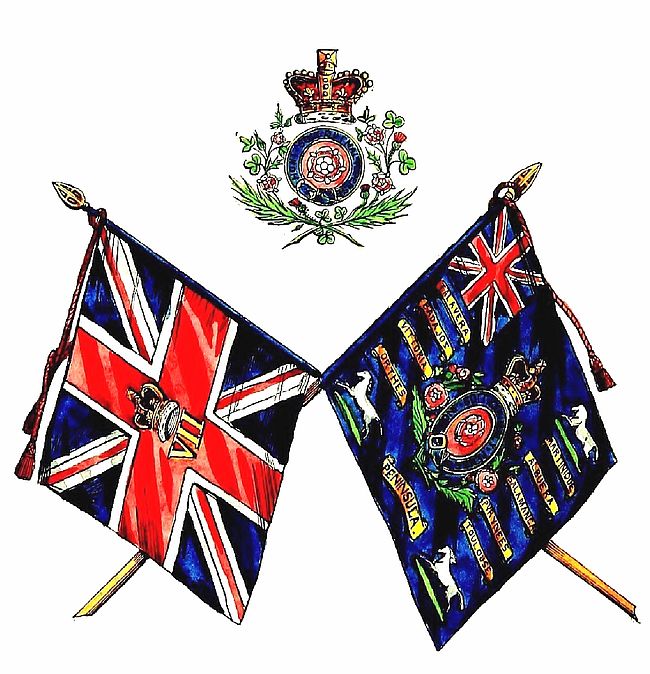
In the royal warrant dated 1st July, 1751, the Royal
Fusiliers are authorized to bear the following distinctions.
"In the centre of their colours, the Rose within the
Garter, and the Crown over it; the White Horse
in the corners of the second colour. On the grenadier
caps the Rose within the Garter, and Crown as in the
colours. White Horse and motto over it, Nec aspera
terrent. The same device of the Rose within the Garter,
and Crown on their drums and bells of arms, with the
rank of the regiment underneath."
1754
On the decease of General Hargrave in January, 1751,
the command of the Royal Fusiliers was conferred on
Colonel John Mostyn, who was removed, in August,
1754, to the thirteenth dragoons, and was succeeded by
Colonel Lord Robert Bertie.
1755
1756
In the spring of 1755 the regiment embarked from
Dublin, and, having landed at Liverpool, occupied
quarters in England until the breaking out of the Seven
Years' War, when it was embarked on board the fleet
commanded by Admiral Byng, in March, 1756, to serve
as marines, and sent to the Mediterranean to endeavour
to preserve Minorca from the power of the French. It
served at the engagement with the French fleet off Minorca
on the 20th of May; but the enemy had previously
landed an army, and captured the whole island
excepting Fort St. Philip, and the relief of this fort was
not attempted. The admiral was afterwards brought to
trial and shot.
1763
1765
1773
The Royal Fusiliers landed at Gibraltar, and were
stationed at that fortress during the remainder of the war.
In 1763 they embarked for England; in 1765 they proceeded
to Scotland; but returned to England in the spring
of 1770, and in April, 1773, they embarked for Canada.
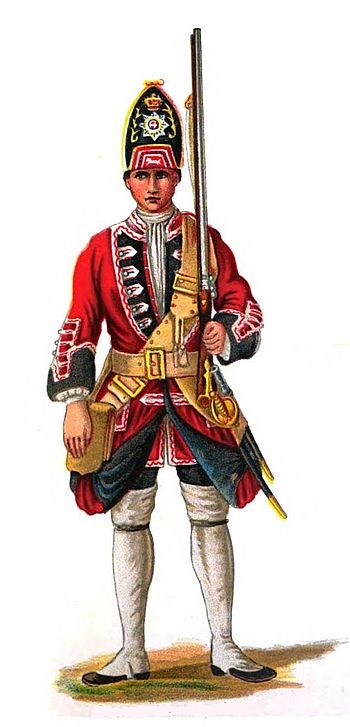
Private Bn. Coy., 1742.
1774
After performing garrison duty at Quebec several
months, the regiment embarked for Montreal, and
occupied several posts in Lower Canada.
1775
While the Royal Fusiliers were in Lower Canada,
the misunderstanding between Great Britain and her
North American colonies, on the subject of taxes, attained
a crisis; thirteen states united against the mother-country,
and, hostilities having commenced, the Congress
resolved to attempt the conquest of Canada. The only
regular forces in Lower Canada, at this period, were the
Seventh and twenty-sixth regiments, and their number
being weak, they were unequal to the defence of this
extensive province against the very superior numbers
of the enemy: the eighth foot were in upper Canada.
In May, 1775, a body of Americans surprised and
captured the posts of Ticonderoga and Crown-point;
and this success was followed by the advance of two
divisions of the American army at different points. The
British governor, Lieut.-General Carlton, sent the Royal
Fusiliers and twenty-sixth from Montreal to St. John's,
where they were employed in constructing two redoubts.
In the autumn one division of the American army,
under Colonel Montgomery (a native of Ireland, who
had quitted the British service a short time before, and
settled at New York), besieged St. John's. The garrison,
consisting of five hundred and fifty men of the Seventh
and twenty-sixth, and a few Canadian volunteers, commanded
by Major Charles Preston of the twenty-sixth,
had but a small supply of ammunition and provision, and
the works were in an imperfect state, yet a most gallant
resistance was made.
The American commander turned the siege into a
blockade, and invested Fort Chambly, where Major the
Honourable Joseph Stopford of the Royal Fusiliers,
and about eighty men, were in garrison. This post kept
up the communication between St. John's and Montreal;
but the works were not in a good condition; the place
was not deemed capable of resisting artillery, and no
effectual resistance could, consequently, be made against
the very superior numbers of the enemy. The garrison
surrendered on the 20th of October.
After this success Colonel Montgomery resumed the
siege of St. John's, and the Seventh and twenty-sixth
regiments made a determined resistance. The hardships
they endured were borne with patience; they were
often knee-deep in mire, and were reduced to half-allowance
of provision; yet they held out with the most
heroic bravery until their strength was exhausted, and
no chance of being relieved remained, when they surrendered.
Thus at the commencement of the war the
Royal Fusiliers were nearly all made prisoners.
The enemy subsequently advanced upon Montreal,
and Lieut.-General Carlton, being deserted by the Canadians,
and without the means of defence, retired down
the river St. Lawrence to Quebec, accompanied by a
party of the Royal Fusiliers.
Quebec was besieged by two divisions of Americans
under Colonels Montgomery and Arnold, and the garrison,
of which sixty men of the Royal Fusiliers formed
part, defended the place with firmness and intrepidity;
the winter was particularly severe, and the soldiers of both
sides served amidst ice and snow. About five o'clock on
the morning of the 31st of December, during a storm of
sleet and snow, the Americans made a general assault
with the view of carrying the place by storm; but the
garrison withstood the tempest of war with such determined
resolution, that the storming party was repulsed
with the loss of between six and seven hundred men;
Colonel Montgomery was killed, and Colonel Arnold
wounded. The garrison only lost one officer and four
private soldiers killed, and seven private soldiers wounded.
1776
After this repulse the Americans turned the siege into
a blockade, and placed their troops in village cantonments:
in April, 1776, they resumed the siege, and the British
defended the place with resolution. In the early part of
May reinforcements arrived from England, and on the
6th of that month Lieut.-General Carlton marched out
of the fortress at the head of the garrison to attack the
American camp, when the besieging army made a precipitate
retreat, leaving its artillery, stores, scaling ladders,
&c., behind. The British followed their opponents
up the country, recovered Montreal, and drove the
Americans out of Canada.
In the meantime a detachment of the regiment had
arrived at Boston from England, and on the evacuation
of Boston, it proceeded to Halifax in Nova Scotia.
In October, 1776, Lord Robert Bertie was appointed to
the command of the second troop (now second regiment)
of life guards; and the colonelcy of the Royal Fusiliers
was conferred on their lieut.-colonel, William Prescott,
by commission dated the 12th of November, 1776.
In the autumn of this year the Royal Fusiliers transferred
their services from Canada to New York; as the
men taken prisoners were exchanged, the numbers of the
regiment were increased; clothing and appointments arrived
from England, and the regiment occupied quarters
for the winter at Amboy in Middlesex county.
1777
From Amboy the Royal Fusiliers were removed to
Staten Island, which was attacked in August, 1777, by
the Americans under General Sullivan, who were repulsed
with loss.
At this period a British force under Lieut.-General
Burgoyne was advancing from Canada upon Albany;
at the same time another British army under General Sir
William Howe was proceeding against Philadelphia; and
Lieut.-General Sir Henry Clinton, who commanded at
New York, resolved to penetrate into Jersey for a diversion
in favour of both armies. The Royal Fusiliers,
with several other corps, were accordingly embarked for
this service, and on the 12th of September effected a landing
at four different places without meeting with serious
opposition. The Seventh, twenty-sixth, and fifty-second
regiments, with a body of German grenadiers and three
hundred provincials under Brigadier-General Campbell,
landed at Elizabeth-Town-Point, at about four in the
morning, and advanced up the country: the enemy opposed
the march, and a sharp firing was kept up throughout the
day. The King's forces, however, had the advantage;
they took Newark, and were advancing on Aquakinack,
when they received orders to halt and wait the advance
of the troops which had effected a landing at the other
points. The enemy afterwards appeared in force, and
several skirmishes occurred, but the British succeeded in
capturing four hundred head of cattle, four hundred
sheep, and a few horses. On the 16th of September the
Royal Fusiliers marched to Bergen Point, where they
re-embarked and returned to Staten Island, without the
loss of one man in this expedition, and with only Lieutenant
Haymer and one private soldier wounded.
In October of the same year the Royal Fusiliers were
embarked to join an expedition against the enemy's forts
up Hudson's River. About three thousand men were
collected for this service from New York and the lines
at Kingsbridge; and having embarked on board of transports,
were convoyed up the river by some frigates and
other armed vessels under Commodore Hotham. The
troops landed at day-break on the 6th of October at Stony-point,
and arrangements were immediately made for the
attack of Forts Montgomery and Clinton. The troops
had to march a distance of twelve miles over mountains,
and to overcome many obstructions; they, however,
surmounted every difficulty, and attacked the forts by
storm on the same day. As the Americans were prepared,
and their works strong, they made an obstinate
defence; but nothing could withstand the ardour of the
royal troops, and every corps gained a share in the glory.
Fort Constitution was also taken on the 7th of October.
Not far from these forts was a new settlement called
Continential Village, where there was a barrack for fifteen
hundred men. The Royal Fusiliers, with two German
corps and two three-pounders, were sent against this
place, and having destroyed the settlement and burnt the
barrack and stores, the troops returned.
Notwithstanding these successful diversions, Lieut.-General
Burgoyne experienced great difficulties in his
advance, and eventually, his troops being exhausted with
fatigue and privation, his advance opposed by superior
numbers, and his retreat cut off, he capitulated. The
army under General Sir William Howe had better success,
and captured Philadelphia. The enemy having despatched
part of the force originally opposed to Lieut.-General
Burgoyne, to join their army of the south under
General Washington, the Royal Fusiliers were sent
from the vicinity of New York to reinforce the army in
Pennsylvania, and in the early part of December they
were engaged in a skirmish with the Americans in front
of Philadelphia; but only lost one man.
1778
Louis XVI. having acknowledged the independence of
the revolted British States in America, and concluded a
treaty of alliance with them, Great Britain declared war
against France; and as the French had agreed to assist
the Americans, a concentration of the British forces was
deemed advisable. The army accordingly retired in
June, 1778, from Philadelphia, and crossed the Delaware,
and proceeded through the Jerseys, from whence it embarked
for New York. Numerous obstacles had to be
overcome in this retreat, and the troops suffered much
from the excessive heat of the weather: some sharp skirmishing
also took place, but the Royal Fusiliers do not
appear to have sustained any loss.
1779
The regiment remained at the lines near New York
until the summer of 1779, when it was employed in an
expedition commanded by Major-General Tyron, sent
into East Sound with a view of drawing General Washington
from the strong post which he occupied in the
mountains into Connecticut for the defence of the towns
on that coast. The fleet arrived at the harbour of Newhaven
on the 5th of July, and the first division of the
Army, which consisted of the flank companies of the
guards, Royal Fusiliers, fifty-fourth regiment, and a
detachment of Jagars, with four field-pieces, under Brigadier-General
Garth, landed about five o'clock in the
morning a mile south of the town, and advanced, making
a circuit of seven miles to gain the head of the creek on
the western side of the place. Some skirmishing occurred
on the march, but the King's troops overcame all opposition
and took possession of the town: at the same time
the second division landed and took post at Rock Fort.
On the following day the troops destroyed all the public
stores, and part of the ordnance, with a number of vessels,
and afterwards re-embarked, bringing off six field-pieces
and an armed privateer. On the 7th of July the fleet
anchored off the village of Fairfield; the British troops
landed and defeated a party of Americans; the enemy
kept firing from windows and the tops of houses, which
provoked a band of loyal emigrants to set the place on fire,
by which the town and a number of boats were destroyed.
On the 11th of July the fleet sailed to the bay of Norwalk.
The troops landed on the following day and advanced
against the town. "The Fusiliers, supported by the
light infantry of the guards, began the attack, and soon
cleared the quarters—pushing the main body of the
enemy and an hundred cavalry from the northern
heights, and taking one piece of their cannon. After
many of the salt-pans were destroyed, whale-boats carried
away on board the fleet, and the magazines, stores,
and vessels set in flames, with the greatest part of the
dwelling-houses, the advanced-corps were drawn back,
and the troops retired in two columns to the place of
our first debarkation, and, unassaulted, took ship and
returned to Huntingdon bay."[12] This expedition did
not produce the desired effect in the movements of the
American general. The troops were ordered to return
to New York. Major-General Tyron stated in his despatch—"I
should do injustice if I closed this report
without giving every praise to the troops I had the honour
to command."[13]
The Royal Regiment of Fusiliers lost five men in
this expedition, and had three serjeants and nineteen
men wounded.
During the autumn of this year the operations of the
army were limited to defensive measures; but in December
an attack on the opulent province of South
Carolina was determined on, and the Royal Fusiliers
formed a part of the force employed on this service,
which was commanded by General Sir Henry
Clinton.
1780
The troops having embarked, the fleet and convoy
sailed from New York on the 26th of December, and
after experiencing much tempestuous weather, which
separated the fleet and occasioned the loss of several transports,
arrived at the Savannah about the end of January,
1780, and gained the harbour of North Edisto, on the
coast of South Carolina, in February. The troops were
immediately landed, and took possession of John's and
James's Island, the Royal Fusiliers taking post at
Stono-ferry on John's Island. The passage of the Ashley
River was effected on the 29th of March, and on the 1st
of April the army besieged Charlestown. The works
were carried on with perseverance and judgment, and,
on the 11th of May, all things being ready for a general
assault, the governor capitulated, and ten American regiments,
with three battalions of artillery, and the town
and county militia, became prisoners of war.
The loss of the royal army in this siege was only
seventy-six killed and one hundred and ninety wounded,
including all ranks. The Royal Fusiliers had one
man killed and two wounded.
1781
The regiment appears to have been in garrison during
the remainder of this year; and in January, 1781, it
was ordered to proceed to Fort Ninety-Six, which place
was then besieged by the Americans; but when on the
march, the regiment received orders to join a body of
troops under Lieutenant-Colonel Tarleton, and march
against General Morgan, who was posted at Pacolet
with a strong division of the American army. "The
progress of the King's troops was greatly impeded
by heavy rains, which swelled the rivers and creeks;
yet Lieutenant-Colonel Tarleton conducted his march
so well, and got so near to General Morgan (who was
retreating before him), as to make it dangerous for him
to pass the Broad-River, and came up with him at eight
o'clock A.M. on the 17th of January, at a place called
Cow-Pens. The attack was begun by the first line of
infantry, consisting of the Seventh regiment, the
infantry of the legion, and the corps of light infantry
annexed to it: a troop of cavalry was placed on each
flank: the first battalion of the seventy-first, and the
remainder of the cavalry, formed the reserve. The
enemy's line soon gave way, and their militia quitted
the field; but our troops having been thrown into some
disorder by the pursuit, General Morgan's corps faced
about and gave them a heavy fire: this unexpected event
occasioned the utmost confusion in the first line. The
two three-pounders were taken, and I fear the colours
of the Seventh regiment shared the same fate."[14]
In this unfortunate engagement the Royal Fusiliers
sustained a very serious loss in killed, wounded, and
taken prisoners.
1782
1783
The regiment was subsequently placed in garrison in
South Carolina, where it remained until 1782; when,
the British Government having been induced to concede
the independence of the United States, pacific overtures
were made, which were succeeded by a cessation of
hostilities. South Carolina was evacuated, and the
Royal Fusiliers proceeded to New York, where they
remained until the conclusion of the treaty of peace in
1783, when they returned to England; at the same time
the establishment was reduced to eight companies.
1784
1785
1786
After occupying quarters at Gloucester and Plymouth,
the regiment proceeded to Scotland in the spring
of 1786.
1788
1789
On the decease of General Prescott in the autumn of
1788, the colonelcy was conferred on Major-General the
Honourable William Gordon, who was removed in April,
1789, to the seventy-first regiment, and the colonelcy of
the Royal Fusiliers was conferred on Prince Edward
(fourth son of King George III.), afterwards Duke of
Kent.
1790
In 1790 the regiment embarked from Leith and the
Isle of Man for Gibraltar, and, arriving at that important
fortress in August, occupied the King's barracks,
under the command of its colonel, His Royal Highness
Prince Edward.
1791
1792
1793
From Gibraltar the regiment embarked, in May, 1791,
for Canada,—the right wing under Prince Edward on
board His Majesty's ship "Ulysses," and the left wing
under Captain Shuttleworth in the "Resistance;" both
wings landed in August at Quebec, where the regiment
was stationed, under Prince Edward's command, nearly
three years: His Royal Highness afterwards proceeded
to the West Indies, and acquired a reputation for valour
and intrepidity at the capture of Martinique, St. Lucie,
and Guadaloupe.
1794
Two companies of the regiment were detached in
June, 1794, from Quebec to Halifax, in Nova Scotia,
and in October of the same year the regiment proceeded
to that station.
1795
1796
A strong draft of recruits arrived from England in
September, 1795, and the regiment was formed into two
battalions. Both battalions were, however, incorporated,
in April, 1796, into one,—consisting of fifty-four serjeants,
twenty-two drummers, and a thousand rank and file; and
the supernumerary men were transferred to the fourth, or
the King's own regiment.
1797
1798
1799
Prince Edward, having returned from the West Indies,
was appointed Commander of the Forces in Nova
Scotia and its dependencies, and was subsequently promoted
to the rank of Lieutenant-General. The Royal
Fusiliers experienced the advantage of His Royal Highness's
assiduous attention to their interests; his military
virtues,—his liberality,—his care to bring merit into
notice, and to procure suitable rewards for the well-conducted,[15]
with his constant attention to everything calculated
to promote the welfare of the regiment, endeared his
name in the grateful remembrance of the officers and soldiers;
at the same time, the facility with which he procured
a constant supply of fine recruits for his corps, with
his indefatigable efforts to inculcate the true principles
of subordination in the regiment, and to bring it into a
state of perfection in discipline, occasioned the Royal
Fusiliers to become one of the most efficient corps
in the service,—distinguished alike for its uniform and
warlike appearance,—excellent conduct in quarters,—and
the superior style in which it performed its exercises
and field movements. His Royal Highness having returned
to England on account of ill health, was created,
on the 23rd of April, 1799, Earl of Dublin in Ireland,
and Duke of Kent and Strathearn in Great Britain.
1801
In August, 1801, the Duke of Kent was removed to
the first or the royal regiment; and was succeeded in
the colonelcy by Lieut.-General Sir Alured Clarke from
the fifth foot, who had commanded the Royal Fusiliers
during a great part of the American war.
1802
After passing eleven years in the protection of the
British North American provinces, the regiment embarked
from Nova Scotia, the right wing under Lieut.-Colonel
Layard, for Bermuda, and the left wing under
Brevet Lieut.-Colonel Burrows for the Bahamas; and
both wings arrived at their destinations in October and
November, 1802.
1804
1805
While the regiment was in the West Indies, a second
battalion was added to its establishment, and formed of
men raised for limited service in the West Riding of Yorkshire,
under the provisions of the Additional Force Act,
passed in July, 1804. The second battalion was placed
on the establishment on the 25th of December, 1804, and
in 1805 it marched from Yorkshire to Winchester.[16]
1806
1807
In July, 1806, five companies embarked from Bermuda,
and landed at Plymouth in August; they were
followed by the five companies from the Bahamas, which
landed at Plymouth in November and December. The
first battalion, commanded by Lieut.-Colonel the Honourable
E. M. Pakenham, received a draft of between four
and five hundred men from the second, and, embarking at
Liverpool for Ireland, landed at Dublin in the beginning
of January, 1807: the second battalion, commanded by
Lieut.-Colonel William J. Myers, remained in England.
Information having been obtained that Napoleon,
Emperor of France, purposed employing the navy
of Denmark against Great Britain, an armament was
prepared for obtaining possession of the Danish fleet
by treaty or force. The first battalion of the Royal
Fusiliers, having been inspected by Major-General
Leith, and commended for its appearance and discipline,
was withdrawn from Ireland to take part in this enterprise.
It embarked from Dublin in July,—landed at
Liverpool,—marched to Hull, from whence it sailed to
Denmark, and, disembarking on the island of Zealand,
joined the army under General Lord Cathcart, and was
employed in the siege of Copenhagen. After a bombardment
of three days the city surrendered, and the Danish
fleet was delivered up. The British troops afterwards
returned to England; the Royal Fusiliers landed in
November at Portsmouth, from whence they proceeded
to Lewes, where another draft of nearly four hundred
men was received from the second battalion.
1808
Returning to Portsmouth in January, 1808, the first
battalion embarked immediately for Nova Scotia; the
fleet called at Bermuda to leave the thirteenth regiment,
and afterwards proceeding direct to Nova Scotia, the
Royal Fusiliers landed at Halifax in the middle of
April.
In May, 1808, the second battalion embarked at Tilbury
Fort for Ireland, and landed at Monkstown in the
middle of June.
Soon after its arrival at Nova Scotia, the first battalion
was selected to proceed, with other corps under the command
of Lieut.-General Sir George Prevost, to the West
Indies to take part in an expedition against the French
island of Martinique.
1809
The armament assembled at Carlisle-bay in Barbadoes,
under the command of Lieut.-General Beckwith, and
sailing on the 28th of January, 1809, arrived off Martinique
on the following day. At four o'clock on the afternoon
of the 30th the Royal Fusiliers landed at Malgré
Tout, in Bay Robert, and marched that evening through
difficult roads to De Manceaux's estate. After a few
hours' repose the troops resumed their march to Papin's,
where part of the division halted; but the Royal
Fusiliers and grenadier company of the first West
India regiment pushed forward to the heights on De
Bork's estate, where they passed the night. On the following
day they were joined by the Royal Welsh Fusiliers
and the light infantry battalion; when Lieut.-Colonel
Pakenham advanced with the Royal Fusiliers, supported
by the light battalion, to the heights of Morné
Bruno. From this post the Royal Fusiliers, with the
rifle company of the twenty-third, and grenadiers of the
first West India regiment, advanced, supported by the
Welsh Fusiliers, against the height of Desfourneaux.
The French, under General De Houdelot, were advantageously
posted on the declivity of the hill, with a river
in their front, and their left protected by artillery. Lieut.-Colonel
Pakenham, with the flank companies of the
Seventh, and rifle company of the twenty-third, turned
the enemy's right; the light battalion moved against the
enemy's left; and the battalion companies of the Seventh,
and grenadiers of the first West India regiment, advanced
against the front. Animated by a spirit of emulation
and a thirst for glory, the British troops rushed onward
with enthusiasm; the Royal Fusiliers forded the river
under a heavy fire, and attacking their more numerous
antagonists with signal gallantry, drove the French from
their formidable position in disorder. Lieut.-Colonel
Pakenham continued his victorious career against the
heights of Surirey, and being gallantly supported by the
twenty-third regiment, the soldiers under his orders,
animated by the zeal and ardour of their brave leaders,
overcame obstacles of a formidable character with heroic
valour; they carried the hill, and, by a spirited charge,
forced the French to take shelter under the guns of their
redoubts. In this attack the valour and judgment of
Lieut.-Colonel Pakenham, and the excellence of the
Fusilier Brigade, were conspicuous. Lieut.-General
Sir George Beckwith observed in General Orders:—"The
Commander of the Forces desires to express his
entire approbation of the manly conduct of the troops
engaged yesterday, and desires that the general officers
and soldiers will be pleased to accept his thanks, and
to assure them that he will not fail to lay their merit
before the King. Lieutenant-General Sir George
Prevost having reported the unremitting exertions
of Lieutenant-Colonel the Honourable Edward
Michael Pakenham, of the Royal Fusiliers, the
Commander of the Forces feels great pleasure in making
this known to the army."
The regiment had Captain Taylor (acting Deputy
Quarter-Master-General) and nine rank and file killed;
two serjeants, one drummer, and fifty-six rank and file
wounded; four rank and file missing.
The French occupied a second position, strengthened
by two redoubts connected by an entrenchment. On
the 2nd of February the British made a movement to
extend their right, and the Royal Fusiliers were again
engaged, and manifested the same heroic ardour and
superiority over the enemy as on the preceding day.
Lieutenant-Colonel Pakenham led the Fusiliers, supported
by the light battalion, against the enemy's
advanced redoubt, in open day, and the spirited conduct
of the officers and men was again eminently displayed:
but it appearing to the commander of the
expedition that the redoubts would be gained with a loss
beyond the value of the acquisition, the Fusiliers were
ordered to desist. The loss of the regiment was one
serjeant and twenty rank and file killed; Lieutenant-Colonel
Pakenham, Captains Row and Cholwich, one serjeant,
one drummer, and fifty-eight rank and file wounded, three
men missing. The enemy afterwards abandoned the
redoubt and spiked the cannon.
On the following day a general order was issued, in
which it was stated—"The benefit the advanced corps
under Lieutenant-General Sir George Prevost have
produced to His Majesty's service, from the gallant
and successful attack made upon Morné Bruno and the
heights of Surirey, on the 1st instant, by the first brigade
of the army and the light battalion under Brigadier-General
Hoghton, demands from the Commander
of the Forces a reiteration of his acknowledgments,
and his assurance to the brigadier-general, and to the
commanding officer of the Royal Fusiliers, of the
Royal Welsh Fusiliers, and of the light battalion, also
to the officers, non-commissioned officers, and soldiers
of those regiments, that he will not fail to lay their
meritorious exertions before the King. The exertions
of all the corps engaged yesterday were conspicuous;
and although the state of the works possessed by the
enemy did not admit of their being carried by the
bayonet, which rendered it the general's duty to direct
the corps employed to retire, they manifested a spirit
and determination which, when tempered by less
impetuosity, will lead to the happiest results."
Fort Bourbon was afterwards besieged; and on the surrender
of this place the French marched out (7th March)
and laid down their arms; the Royal Fusiliers and
the two other battalions of the first brigade receiving
each an Eagle from the French regiments, with a proportion
of brass drums, &c.
The capture of this valuable island having been
achieved, the troops were again commended in general
orders for their excellent conduct: and the Royal
Fusiliers were subsequently honoured with the privilege
of bearing the word "Martinique" inscribed
on their colours, as a mark of royal favour and approbation.
Brevet Lieutenant-Colonel Blakeney received a
gold medal for his conduct in this service.
After the completion of this brilliant enterprise, the
Royal Fusiliers returned to Nova Scotia; before
embarking they were again commended in general
orders. They sailed from Martinique on the 15th of
March, and arrived at Halifax in April.
Lieutenant-Colonel Pakenham being anxious to
stimulate the Royal Fusiliers to good conduct by
distinguishing merit, assembled a board of officers for
that purpose, and the names of the following non-commissioned
officers and soldiers were recorded in the
"Book of Merit."
Serjeant Thomas Simpson for meritorious and gallant
conduct at Martinique. Quarter-Master-Serjeant Timothy
Meagher, Serjeants John Ledsam, John Henry, John
Day, William Harris, William Inchbold, Joshua Redshaw,
Thomas Beale, Thomas Miller, George Kenney, —— Willson,
George Clementson, Corporal Dove, Drummer
Thomas Maud, Privates William Vagg, Mark Ewing,
Benjamin Price, James Haughney, Nathaniel Moss, and
James Delamy for general good conduct; Serjeants Meagher
and Henry were afterwards promoted to commissions.
In April, 1809, Lieutenant and Adjutant Orr, a most
meritorious officer, was promoted to a company, on
which occasion the serjeants presented him with an
address, expressive of their regard and gratitude for the
manner in which he had performed the duty of adjutant.
This circumstance was, however, deemed a departure
from strict discipline, and the Commander-in-Chief in
North America, General Sir James Craig, declared in
General Orders, that the serjeants had been guilty, unintentionally,
of an act of insubordination.[17] The sentiments
expressed in this order obtained the concurrence
of the Commander-in-Chief of the Army, who stated in
orders;—"The reason for which the Commander-in-Chief
has directed the circulation of this Order, is, that
he may avail himself of this opportunity of declaring to
the army his most perfect concurrence in the sentiments
therein expressed by the distinguished and experienced
officer by whom it was framed, on a subject
which appears to have been by some very much
misunderstood.—The circumstance of inferiors of any
class of military men assembling for the purpose of
bestowing praise and public marks of approbation on
their superiors, implies a power of deliberation on
their conduct which belongs to the Sovereign alone,
or to those officers who may be intrusted with the
command and discipline of the troops. It is a procedure
equally objectionable whether in the higher
or lower ranks of the army; and as the Commander-in-Chief
cannot but regard it as a principle subversive
of military discipline, he trusts it is a practice
which will be for ever banished the British service:
and he directs commanding officers to act accordingly.
"By command of the Right Honourable the Commander-in-Chief,
"Harry Calvert,
"Adjutant-General."
In the meantime the second battalion had embarked
from Cork to join the British army in Portugal under
Lieutenant-General Sir John Craddock; it landed at
Almeda, opposite to Lisbon, in April, and mustered
upwards of six hundred and fifty officers and men, commanded
by Lieutenant-Colonel Sir William Myers,
baronet: the Royal Fusiliers and second battalion of the
fifty-third regiment, with one company of the sixtieth,
formed a brigade under Brigadier-General Alexander
Campbell. Soon afterwards Lieutenant-General Sir
Arthur Wellesley arrived in Portugal to command the
army.
In May the combined British and Portuguese forces
advanced against the French under the celebrated
Marshal Soult, who had captured Oporto by assault about
five weeks previously, and occupied that city with a numerous
body of veterans. The British general advanced
upon Oporto, and the Royal Fusiliers had the honour
of taking part in the masterly movements by which the
legions of Napoleon were driven from that city on the
12th of May, pursued through the wild and mountainous
districts in the north of Portugal, and forced to
abandon their artillery and ammunition, and to save
themselves by a precipitate flight.
After this success the army retired to Abrantes, where
the Royal Fusiliers were encamped nearly three
weeks; they subsequently advanced into Spain to aid
the patriotic Spaniards in their attempts to expel the
French from their country, the British being joined by a
Spanish force under General Cuesta. Having entered
Spain, the army proceeded along the valley of the Tagus,
and halted near Talavera de la Reyna. The Spaniards
pushed forward, but were speedily driven back by the advance-guard
of the French army under Joseph Buonaparte,
who bore the title of King of Spain. A British
brigade covered the retreat of the Spaniards, and the
allied army went into position near Talavera, the Spaniards
occupying the strong ground on the right, and the
British extending to the left along the more exposed
part of the field. In the centre, between the two armies,
there was a commanding spot on which a redoubt
had been commenced, with some open ground in its
rear; at this important post the Royal Fusiliers were
stationed, with several other corps under Brigadier-General
Campbell, and they proved themselves worthy
of the trust reposed in them.
The French attacked the left of the British position
on the evening of the 27th of July, and were repulsed.
The attack was renewed at daylight on the following
morning, and British skill and valour were again triumphant.
A short respite ensued while the French
generals held a council of war; but soon after mid-day
their army was seen in motion. The British stood to
their arms and calmly awaited the approach of the
hostile legions; a cloud of light troops covered the front
of the French army; they were followed by four dense
columns, protected by eighty guns; and the Royal Fusiliers
beheld the torrent of battle advancing towards them
with the fury of a tempest, threatening instant destruction
to all opposition. The fourth corps came rushing forward
with such impetuosity that it speedily cleared the
intersected ground in front, and attacked the Royal
Fusiliers and other corps on the right of the British line
with terrific violence. The British regiments met the
storm of war with unshaken firmness, and breaking in
on the front of the advancing columns, and assailing their
wings with a heavy fire, forced them back with a terrible
carnage: the Royal Fusiliers rushed gallantly forward
to the muzzles of the French artillery, and, after an obstinate
resistance, captured seven guns, which the enemy
endeavoured to re-capture, but in vain. The French
veterans rallied on their supports, and appeared resolute
on another attack, but they were assailed by so tremendous
a fire of artillery and musketry, that they retired
in disorder, and thus victory was secured in this
part of the field. Sir Arthur Wellesley observed in his
despatch,—"I was highly satisfied with the manner this
part of the position was defended;" he also mentioned
the second battalion of the Royal Fusiliers, commanded
by Lieutenant-Colonel Sir William Myers, among the
corps which had particularly distinguished themselves,
and thanked the battalion and its commanding officer
in orders. The French were repulsed at every point of
attack, and they withdrew from a contest in which the
superiority of the British troops was eminently displayed.
The Royal Fusiliers had Lieutenant Beaufoy and
six rank and file killed; Lieutenants Kerwan and Muter,
Adjutant Page, one serjeant, two drummers, and fifty-one
rank and file wounded; one private soldier missing.
Their commanding officer, Lieutenant-Colonel Sir William
Myers, was rewarded with a gold medal; and
the regiment was subsequently authorised to bear the
word "Talavera" inscribed on its colours as an honorary
distinction for its gallantry on this occasion.
In the subsequent part of this campaign the battalion
sustained considerable loss from disease; but it was not
engaged in actual conflict with the enemy.
During the summer Lieutenant-Colonel the Honourable
Edward Michael Pakenham, commanding the
first battalion in Nova Scotia, was placed on the staff
of the army in Portugal. The affable deportment,
amiable disposition, and liberality of this brave and
zealous officer, with his gallantry in the field, and his
assiduous attention to the interests, comfort, reputation,
and efficiency of the regiment during the series of
years he had served with the Royal Fusiliers, had
procured him the regard and esteem of every member
of the corps. Previously to his leaving the battalion,
the officers obtained his consent to have his
portrait taken, and presented him with a sword valued
at two hundred guineas, as a mark of their sincere
regard for him as an officer and a gentleman, and of their
admiration of his manly virtues and zeal for the service.
The command of the first battalion devolved on Brevet
Lieutenant-Colonel Edward Blakeney, who devoted himself
to the good of the service, and preserved the
battalion in its high state of discipline and efficiency; it
was employed at the out-posts of Nova Scotia, and occupied
George's Island, Melville Island, Point Pleasant,
York Redoubt, &c.
1810
On the 1st of January, 1810, the first battalion mustered
upwards of a thousand officers and soldiers, and
events occurred soon afterwards which occasioned the
removal of this fine body of men from North America to
the theatre of war in the Peninsula, where the Spaniards
and Portuguese were struggling for independence
against the forces of France, and where a British army
sent to aid the patriots was acquiring never-fading
laurels under Sir Arthur Wellesley, who had been
created Viscount Wellington.
The French army in Spain having received numerous
reinforcements, a powerful and well-appointed force advanced
under Marshal Massena, Prince of Esling, to
complete the conquest of Portugal; and the very superior
numbers of the enemy rendered it necessary for the
British army to limit itself to the defence of Lisbon.
Lord Wellington, however, resolved to maintain a forward
position as long as possible, and among the reinforcements
sent to his aid was the first battalion of the Royal
Fusiliers. On this occasion, Lieutenant-General Sir
George Prevost stated in orders:—"On the departure of
the Royal Fusiliers the Lieutenant-General commanding
acknowledges with pride and pleasure that
this corps is an instance among British soldiers of the
union of regularity and good conduct in quarters with
patience and valour in the field of battle. Lieutenant-General
Sir George Prevost has that opinion of the
commanding officer, the officers, non-commissioned
officers, and privates of this already distinguished corps
which induces him to pronounce his confidence that
the Royal Fusiliers will maintain their reputation
on whatever service they may be employed, and that
when called upon to face the enemy of their country,
they will again add to their own fame, and exalt the
glory of the British arms."
The first battalion landed at Lisbon on the 27th of
July, every man in health and under arms, and after a
short repose advanced up the country to join the army
in the field. On passing Thomar, the battalion halted a
few days, and was reviewed by Major-General Leith and
the Portuguese General, Miranda, who expressed their
admiration of the appearance of the officers and men, and
of the ease and steadiness with which they manœuvred
in battalion and performed light infantry movements.
After the review the battalion advanced to Villa Cortez;
and on the surrender of Almeida the army withdrew to
the rocks of Busaco, where it took up a position to oppose
the superior numbers of the enemy, whose commander
vaunted he would drive the English into the sea, and
plant the eagles of France on the towers of Lisbon.
The first battalion of the Royal Fusiliers was commanded
by Lieutenant-Colonel Blakeney, and formed
in brigade with the seventy-ninth, under Colonel the
Honourable Edward M. Pakenham, in the first division
commanded by Lieutenant-General Sir Brent Spencer;
the second battalion was commanded by Lieutenant-Colonel
Sir William Myers, Baronet.
The British and Portuguese troops were in line on
the ridge of the lofty and precipitous hills of Busaco;
in front lay the army of Massena on another range of
heights, and the dark mountains were crowned with the
bivouac fires of the opposing bands. On the morning of
the 27th of September, as the light appeared, the fire
of musketry commenced between the advanced posts
stationed in the deep hollows which separated the two
armies: shortly afterwards the French columns of attack
appeared, and throwing forward crowds of skirmishers,
they speedily emerged from the hollow beneath, and
assailed the British position with that impetuosity which
distinguishes the first onset of French soldiers. They
were opposed by the unconquerable firmness of British
soldiers; the heads of columns were pierced by musketry,
and charged with the bayonet; and the formidable masses
of veteran Frenchmen were overthrown and driven down
the mountain sides with a terrible clamour and confusion,
leaving crowds of killed, wounded, and prisoners behind.
Being unable to overcome the steady valour of the British
infantry, the French commander desisted, and the allied
army stood triumphant on the contested heights. The
Royal Fusiliers were stationed on a portion of this
range of rocks which was not seriously attacked, and
their loss was limited to two private soldiers killed, Lieutenant
Mair, and twenty-two rank and file wounded.
Colonel Pakenham, commanding the brigade, was rewarded
with a gold medal. After this vain attempt to
force the rocks of Busaco, the French commander made
a flank movement to turn the left of his opponent's position;
when the allied army withdrew to the lines of
Torres Vedras, and there opposed a resistance which the
French marshal did not attempt to force.
While the opposing armies confronted each other, several
sharp actions took place between the advanced posts;
and on the 13th of October a company of the Royal
Fusiliers was ordered to drive back a reconnoitring
party of the enemy which had entered the village of Burlada,
situate between the two armies. This service was
performed with distinguished gallantry, and the French
were driven back at the point of the bayonet.
After searching in vain for a vulnerable part in the
British lines, the French commander, instead of driving
the English leopards into the sea, retired to the strong
position of Santarem; Lord Wellington advanced, and,
establishing a series of posts to watch his opponents,
placed his army in cantonments.
The twenty-third, or Royal Welsh Fusiliers, having
arrived from America, the two battalions of the Seventh
and first battalion of the twenty-third were constituted
a brigade under the command of Colonel the Honourable
Edward M. Pakenham: it was designated the "Fusilier
Brigade," and attached to the fourth division commanded
by Major-General the Honourable Lowry Cole:
the first battalion of the Seventh was commanded by
Lieutenant-Colonel Sir William Myers, and the second
by Lieut.-Colonel Blakeney.
1811
In January, 1811, Colonel the Honourable E. M. Pakenham
was placed at the head of the Adjutant-General's department,
and the command of the Fusilier Brigade
was intrusted to Major-General Houstoun. The brigade
was stationed, at this period, at Aveiras de Cima.
At length disease, want of provisions, and the impregnable
lines of Torres Vedras, turned the vain boasting
of the French commander into defeat; he retraced his
steps towards Spain, covering wantonly, and with brutal
cruelty, the line of his retreat with rapine, bloodshed,
devastation, and burning villages. The Royal Fusiliers
moved forward in pursuit; several skirmishes occurred,
and, on the 12th of March, the brigade was in
line near Redinha (a town in the central part of Portugal,
in the province of Beira), and advancing to attack
the rear column of the French army under one of
Napoleon's most active and enterprising generals, Ney;
but as the British ranks moved majestically forward in
firm array, the French fired a volley and instantly fled
under the cover of the smoke towards Condexia.
In the meantime Marshal Soult, being at the head
of another French army, had captured Badajoz, the capital
of Spanish Estremadura; also Olivenza, another fortified
town on the west frontier of Spain; and a detachment
from his army had besieged Campo Mayor, a barrier
fortress of Portugal, in the province of Alemtejo; and
on the 14th of March the Royal Fusiliers were detached
to the Alemtejo, to join the forces under Marshal Sir
William Carr Beresford, and take part in the relief of
Campo Mayor, and in the re-capture of Badajoz and
Olivenza. While on the march, Campo Mayor surrendered;
and the British, continuing their route, arrived
before the town on the 25th of March, as the French
columns were marching out, when the thirteenth light
dragoons and some Portuguese cavalry charged with
great gallantry, and threw the enemy into confusion.
The Royal Fusiliers were stationed at Campo Mayor
about a fortnight, and were subsequently employed in the
siege of Olivenza, which was terminated in seven days
by the surrender of the garrison on the 15th of April.
The loss of the regiment was limited to one man killed
and one wounded.
This success was followed by the siege of the strong
fortress of Badajoz, situated on a beautiful plain on the
Guadiana,—a noble river five hundred yards broad;
and the Royal Fusiliers were employed in this service.
Marshal Soult, who had retired after the capture of this
fortress in March, quitted Seville, and, assembling a
powerful force, advanced to its relief. The allied army
turned the siege into a blockade, and moving forward to
meet the advancing foe, took up a position at Albuhera.
The Royal Fusiliers formed part of the blockading
force, but were subsequently ordered to join the army;
and they arrived in position about nine o'clock on the
morning of the 16th of May, at the moment when the
French were advancing to commence one of the most
obstinate and sanguinary actions in which British troops
were ever engaged. The Fusilier Brigade, commanded
by Lieutenant-Colonel Sir William Myers,
of the Seventh, was ordered to form in an oblique
line behind the right; the first battalion of the Seventh
was commanded by Major John Mervin Nooth, and the
second by Lieut.-Colonel Edward Blakeney.
Being favoured by a height which the allies had neglected
to occupy, the French commander concentrated
behind it fifteen thousand men and forty guns, within
ten minutes' march of the right wing of the allied army,
without his opponent's knowledge; at the same time he
extended the remainder of his forces along the woody
banks of the Feria, towards its confluence with the Albuhera.
A little before nine on the morning of the 16th
of May, these troops issued from the woods in one massive
column, supported by a second, flanked by cavalry
and preceded by artillery, and attacked the bridge,
where they met with a formidable resistance. The
British general, anticipating the principal effort would
be against his right, directed the Spaniards under General
Blake to change front, and the second division to
support them: but the Spanish general delaying to execute
the movement, the enemy was among his troops
before they were completely formed. A destructive
cannonade, a heavy fire of musketry, and the approach
of some French squadrons menacing to charge, put the
Spaniards into disorder, and they fell back fighting.
The French columns pushed forward; their reserves
mounted the heights in their rear, and their batteries
were brought into line.
The retrograde of the Spaniards laid open the position
of the allied army, and the only good road by which
a retreat could be conducted was exposed. To remedy
this disaster, the leading brigade of the second division
rushed forward; it was speedily under a destructive fire;
a heavy rain concealing distant objects; and four regiments
of French lancers and hussars having turned the
right flank in the obscurity, charged the British battalions
in the rear at the moment when they developed
their attack, and slew or took prisoners nearly two-thirds
of their numbers: one battalion, being in column, maintained
its ground, while the French horsemen overthrew
all other opposition, and captured six guns. A lancer
attacked Marshal Beresford, who pushed the lance aside,
and, grappling with the lancer, threw him from his horse.
Another British brigade came boldly into the fight, repelling
a charge of lancers on its flank; the remaining
brigade of the second division arrived; a Spanish corps
moved forward, and the enemy's infantry recoiled; but
soon recovering, renewed the conflict with greater violence
than before. The fighting became vehement, and more
than two-thirds of every British corps engaged had fallen,
when their ammunition began to fail, and the enemy established
a column in advance upon the right flank. The
tide of success was evidently flowing in favour of the
French, when the fourth division was ordered to the heat
of the conflict, and a brigade of the second division,
which had only been slightly engaged, rushed forward
into the fight. At this moment a number of captured
British soldiers were being hurried to the rear of the
French army; the enemy's reserves were pushing forward
to reinforce their front;—the field was covered
with heaps of dead bodies;—the lancers were riding
furiously about the upper part of the hill spearing
wounded men, and six pieces of artillery were in the
hands of the French.
A crisis had arrived, and a mighty—a determined—a
desperate—effort alone could save the allied army from
defeat; at this critical moment Major-General Sir Lowry
Cole led the Fusilier Brigade up the contested heights
to stem the torrent of battle and wrest the palm of victory
from Napoleon's veteran legions. The Fusiliers—admired
for their appearance—applauded for their
order and discipline—moved forward with a resolute
step to confront a host of foes; they felt the importance
of the task which devolved upon them, and knew the
high character of the troops they had to contend with;
and national pride,—an esprit de corps,—a noble enthusiasm
to rival the regiments which triumphed at Busaco,—and
to exceed their own achievements at Martinique and
Talavera,—animated every breast; they were flanked by
a battalion of the Lusitanian legion; and mounting the
hill at the moment when a regiment of Spanish cavalry
was fleeing before a body of French dragoons, they soon
drove the lancers from the contested height, and recovered
five of the captured guns. Encouraged by this
presage of victory, the Fusiliers marched sternly onward
in line, over heaps of killed and wounded, to encounter
three heavy columns of French infantry, supported
by cavalry and artillery, and each column mustering
about twice the numbers of the Fusilier Brigade.
Gallantly issuing from amidst the smoke and broken
fragments of discomfited corps, the Fusiliers marched
with a firm and solemn step over the carcases of men
and horses which obstructed their way, and their bearing
was that of men determined to decide the fortune of a
battle. The French columns were pressing onward to
complete the overthrow of the allied army, when suddenly
the surprising spectacle of a majestic line of Fusiliers
burst upon their sight; they halted; fired a volley;
then endeavoured to deploy; and their numerous
artillery sent a storm of bullets against the British ranks.
The commander of the brigade, Lieutenant-Colonel Sir
William Myers of the Royal Fusiliers, was killed;
the commander of the division, Major-General Sir
Lowry Cole, Lieutenant-Colonel Blakeney, commanding
a battalion of the Royal Fusiliers, and a number
of other officers, fell wounded; the colour staves of the
Seventh were shattered, and the colours torn; at the
same time chasms were rent in the ranks of the brigade;
a momentary pause ensued: but instantly recovering,
the Fusiliers braved the tempest of iron and lead, and
boldly confronted the fierce and numerous bands opposed
to them. As the smoke cleared, the French beheld a
line of bayonets coming upon them, and the next moment,
the thundering volleys of the Fusiliers broke
the heads of formations. The French commander urged
his veterans forward; individuals, spurred on by an
unavailing intrepidity, sacrificed their lives to gain time
for their companions to deploy;—the columns responded
to the calls of their leader, and, striving to extricate
themselves, fired on friends and foes;—the lancers on
the flanks threatened to charge; but British intrepidity
could not be shaken;—the Fusiliers knew not how to
quail! The brigade preserved its firm array; the murderous
volleys of the Fusiliers swept down hundreds
of Frenchmen, and suddenly raising a loud shout, they
precipitated themselves upon the opposing multitudes,
and plunging fearlessly into the crowds, they closed
with desperate energy upon their opponents. The
fortune of the day was no longer doubtful; British
prowess prevailed, and the French were overpowered,
slaughtered, and forced back in irremediable confusion
upon their reserves. The supporting columns endeavoured
to stem the torrent of British valour; but in
vain;—the whole were driven headlong down the ascent;—the
key of the position was thus nobly recovered, and
the Fusiliers,—breathless,—besmeared with sweat and
mud and gore,—stood triumphant upon the contested
height, surrounded with heaps of dying and dead, and
wondering at the brilliant success which crowned their
manly efforts.
While the Fusiliers were contending on the height,
fresh men were brought forward; the French generals
perceived that the day was irretrievably lost, and withdrew
their broken masses beyond the river.[18] Numerous
instances of individual gallantry occurred, and Serjeant
Gough of the first battalion having recovered the regimental
colour of the third foot, or buffs, which corps
had been nearly annihilated by the charge of the lancers,
was rewarded with a commission in the second West
India regiment.
To the Royal Fusiliers, the honour of having
triumphed over superior numbers of Napoleon's veteran
bands, and the glory of having added lustre to the
British arms, were justly due; but the splendour of
victory was shrouded with grief at the loss of many
brave officers and soldiers. Among others, the fall of
their commander, the brave, the chivalrous Sir William
Myers, caused a sense of deep sorrow. His career,
though short, had been brilliant; his manners were
those of a finished gentleman and scholar, and every
action was marked with the enthusiasm of a soldier
whose noblest pride was his profession, and whose
solicitude was always alive to the interests and honour
of his corps. At the early age of twenty-eight he
closed a life of honour in a death of glory.
Return of killed and wounded of the Royal Fusiliers
at the battle of Albuhera.
| Battalion. | | Officers. | Sergeants. | Drummers. | Rank & File. | Total. |
| 1st. | { Killed | 5 | 3 | .. | 59 | 67 |
| { Wounded | 10 | 14 | .. | 263 | 287 |
| 2nd. | { Killed | 3 | 1 | .. | 46 | 50 |
| { Wounded | 14 | 16 | 1 | 270 | 301 |
| | —— | —— | —— | —— | —— |
| | 32 | 34 | 1 | 638 | 705 |
Names of officers of the Royal Fusiliers present at
the battle of Albuhera.
| First Battalion. | Second Battalion. |
| Lieut.-Col. Sir William Myers, killed. | Major Edw. Blakeney, Lieut.-Col., wounded. |
| Major J. M. Nooth. | Captain | Wm. Despard. |
| Captains | Thos. Woodridge. | " | G. Erek, killed. |
| " | Wm. F. Cholwich, wounded. | " | Jno. Orr, wounded. |
| " | Geo. King. | " | A. Fernie. |
| " | Jas. Singer, wounded. | " | Henry Tarleton, wounded. |
| " |
Jno. Crowder, wounded. | " | Richard Magines, wounded. |
| Lieutenant | Hy. Prevost, killed. | | |
| " | A. C. Wylly. | Lieut. | Jno. Healy, wounded. |
| " | Thos. Moultrie, killed. | " | Holt Archer, killed. |
| " | Jno. Mair. | " | Edward Penrice, wounded. |
| " | Chas. J. Wemyss, wounded. | " | Wm. Payne. |
| " | Paul St. Paul. | " | W. A. Pyke. |
| " | S. B. Johnstone, killed. | " | Ed. Irwin, killed. |
| | " | Tho. F. Wray, wounded. |
| " | T. T. A. Mullins, wounded. | " | Thos. Hartley. |
| " | Digby Mackworth. | " | H. R. Wallace. |
| " | T. Moses, wounded. | " | Wm. Green. |
| " | Anth. Baldwin. | " | Jos. Hutchison. |
| " | Jas. Anderson. | " | T. Y. Lester, wounded. |
| " | H. F. Devey. | | |
| " | G. Henry, wounded. | " | Geo. Seton, wounded. |
| " | John Ormsby. | " | Chas. Lorentz, wounded. |
| " | H. J. Jones, killed. | | |
| " | E. Morgan, wounded. | " | M. Orr, wounded. |
| " | Pitt Hannam. | " | Wm. Dalgairnes. |
| " | Johnson, wounded. | " | J. B. Fraser, wounded. |
| " | F. Gibbons, wounded. | " | Jno. F. Holden, wounded. |
| Adjutant Jas. Hay. | Acting Adjutant T. Meagher, wounded. |
| Pay-Master Jno. Armstrong. | Pay-Master T. Berkeley. |
| Quarter-Master Jno. Hogan. | Quarter-Master Crawford. |
| Assistant Surgeon Wm. Armstrong. | Surgeon J. Williamson. |
| " | M. Mahony. | Assistant Surgeon Duigenan. |
| | " | Sweney. |
The list of killed and wounded, containing about seven
hundred officers and soldiers, proclaims with dreadful
eloquence the sanguinary character of the contest in
which the Royal Fusiliers were engaged. Their
heroic conduct was subsequently rewarded with the
privilege of bearing the word "Albuhera" inscribed on
their colours. Major Blakeney was promoted to the
lieutenant-colonelcy vacant by the death of Sir William
Myers; Major Nooth was rewarded with the rank of
lieutenant-colonel in the army, and Captain Despard
(who succeeded to the command of the second battalion
after the fall of Lieutenant-Colonel Blakeney), with
that of major. A gold clasp was sent to the relatives
of Sir William Myers; Lieutenant-Colonel Blakeney
was rewarded with a gold clasp, and Major Nooth and
Captain Despard with gold medals.
After the battle, the brigade was attached to the remains
of the second division commanded by Major-General the
Honourable William Stewart, whose estimation of the
conduct of the Fusiliers is attested by the following
letter.
"Almandrelejo, 26th May, 1811.
"Sir,
"As you have been so kind as to permit me to transmit
to you the names of the officers of my division
who commanded corps on the 16th instant, it may not be
deemed irregular if, during the absence of Major-General
Cole, I forward to you the names of the officers
of the Fusilier Brigade who were similarly situated.
"The remains of that gallant corps having been attached
to the second division, immediately after the action of
Albuhera, and the major-general of the second division
having been obliged to leave the field from a wound,
I am induced to lay before you, for such favourable
report on the subject as you may deem expedient to
the Commander of the Forces, the enclosed returns
which have been put in my possession by the officer
now in command of the Fusilier Brigade, and who
commanded the same in action, after the successive
incapacity from wounds of his four senior officers.
I am afraid lest by further delay the exertions of that brigade
be not sufficiently known. From the circumstance
of the Fusilier Brigade having been joined with my
third brigade in the hard-fought defence of our centre
position for above three hours, and from the severe loss
sustained by the Fusiliers on the spot, and from the
testimony of the surrounding allied army, I feel myself
authorised in stating that the conduct of the Fusilier
Brigade on the 16th instant was admirable, and such as
effectually secured the victory of that day.
"It is a duty, moreover, which I owe to the brave
soldiers under my temporary command, to report that
the second division is indebted to the Royal Fusiliers
for the recapture of a six pounder, and of a regimental
colour of the third, or buffs, both of which had been
lost in the too successful attack of the enemy's cavalry,
on my first brigade, in the beginning of that day.
"I am, &c.
"William Stewart,
"Major-General.
"To Marshal Beresford."
Both battalions having sustained so severe a loss, the
second battalion transferred its men to the first, and the
officers and staff serjeants returned to England to recruit.
After the victory at Albuhera the siege of Badajoz was
resumed, the Seventh forming part of the covering army.
A concentration of the enemy's force having taken place,
the allies withdrew behind the Caya, where they awaited
the attack of their opponents. The French generals had
drained the provinces of troops to assemble a powerful
army; but the stern character of British soldiers had been
proved, and, having relieved Badajoz, they retired without
hazarding an engagement.
The allied army broke up from the Caya in July, and
the Royal Fusiliers moved towards the northern frontiers
of Portugal; they halted a short period at the village
of Aldea de Santa Margaritta, and afterwards marched to
Aldea de Bispo. Meanwhile Lord Wellington blockaded
Ciudad Rodrigo.
Marshal Marmont assembled sixty thousand men, and
advanced to relieve Ciudad Rodrigo. Lord Wellington's
forces were not sufficiently numerous to warrant his hazarding
a general engagement, excepting under very advantageous
circumstances; he however held his positions;
and on the 25th of September the Fusilier Brigade,
under Major-General the Honourable E. M. Pakenham,
advanced to sustain a small body of troops under Major-Generals
Colville and Alten, which had been attacked at
El Bodon by forty squadrons of French cavalry and fourteen
battalions of infantry with cannon. This portion of
the allied army having retrograded, the French cavalry
menaced the Fusiliers; but were deterred charging by
the steady and determined countenance of the brigade.
During the night Lord Wellington strengthened his
position; but afterwards withdrew to a post twelve miles
behind Guinaldo. The enemy coming forward with
overwhelming numbers, his lordship withdrew during the
night of the 26th of September, covered by the Fusiliers
and a body of cavalry.
The French, pressing the British rear during the retrograde
movement on the 27th of September, attacked
the Fusiliers, who were halted on a height behind the
village of Aldea de Pont. Lord Wellington directed the
Seventh to charge in line down the hill, and supported
them with some Portuguese infantry. The Royal
Fusiliers dashed forward in line with the steadiness of
old soldiers at a review, routed the French, and drove
them down the height, to the admiration of all present;
Lord Wellington witnessed the firm conduct of the Royal
Fusiliers, and expressed his approbation of their steady
and gallant bearing. The French were afterwards repulsed
in an attempt to turn the flank of the brigade by a
wood: the twenty-third Fusiliers and Portuguese Caçadores
turned the French left, and Aldea de Pont was
again occupied by the allies. It was, however, subsequently
abandoned, and the army went into position on
the Coa. The French withdrew, and the Royal Fusiliers
went into quarters at Villa Ciervo. The regiment
had been joined, a short time before, by three hundred
and sixty-four young soldiers from England: its loss at
Aldea de Pont was nine men killed; Captain Wylly,
Lieutenants Barrington, Wallace, and Seaton, one Serjeant,
and thirty-six private soldiers wounded.[20]
1812
On the 1st of January, 1812, the first battalion mustered
upwards of thirteen hundred officers and soldiers,
and it was immediately afterwards employed in the siege
of Ciudad Rodrigo, which was undertaken in the winter.
This fortress was captured by storm during the night of
the 19th of January, 1812, while the French marshal was
assembling an army to advance to its relief. The loss of
the Royal Fusiliers, during the siege, was limited to
two men killed and eight wounded. After the capture
of Ciudad Rodrigo the regiment remained at the village
of Cileçes el Chico, where it was detained several days
by the swelling of the Agueda from heavy rains: it subsequently
retired and went into cantonments.
After withdrawing from before Ciudad Rodrigo, the
regiment was allowed only a short period of repose
before it was called upon to march to Spanish Estremadura,
to take part in wresting the strong fortress of
Badajoz from the enemy. Leaving its cantonments near
Fuentes d'Onor on the 27th of February, it proceeded
southwards; boats were laid over the Guadiana on the
15th of March, and on the following day Badajoz was
invested by the third, fourth, and light divisions; the
Royal Fusiliers, forming part of the fourth division,
were engaged in the siege. The batteries were opened,
and, notwithstanding the sallies of the French garrison
under the resolute General Phillipon, inundations from
heavy rains, and other obstructions, practicable breaches
were ready in the early part of April; and on the evening
of the 6th of that month the Royal Fusiliers were
under arms to take part in the storming of that stupendous
fortress. The fourth and light divisions were to march
against the breaches; the light division was to assault
the bastion of Santa Maria, and the fourth, the Trinidad,
with the breach in the curtain connecting the two bastions;
one body of the grenadiers of the fourth division,
under Captain John Mair, of the Royal Fusiliers,
led the attack against the bastion of Trinidad; and
another body, under Captain William Francis Cholwick,
also of the Seventh, led the assault on the breach in
the curtain.
Moving silently from their camp-ground along the
left of the river Rivillas and the inundations, the fourth
and light divisions made a short detour, and arrived at
the glacis at the moment the third division attacked the
castle. Ladders were placed, and about five hundred
men of the light division had descended into the ditch
with the most heroic bravery, cheering as they went,
when suddenly a loud report like thunder was heard,
and the storming parties were blown to pieces by the
explosion of hundreds of shells and powder barrels.
Undismayed by this terrific destruction, the men of the
light and fourth divisions raised a loud shout and plunged
into the ditch, where many men perished in the inundations;
others, after overcoming numerous difficulties,
approached the breach exposed to a most destructive
fire. As they ascended, loose planks studded with sharp
iron points wounded their feet and produced great
mischief, and a range of sword-blades with sharp points
and keen-edges, firmly fixed in beams chained together
and set deep in the ruins, arrested the progress of the
soldiers; at the same time a terrible fire of musketry
thinned their ranks. Again the assailants rushed up the
breaches with the most determined resolution; but the
sword-blades stopped their career, and the thundering
powder-barrels and hissing shells exploded continually.
Numerous and astonishing efforts of valour and intrepidity
were made, and the most heroic bravery displayed,
yet the obstacles were such as could not be overcome;
and about midnight, when two thousand brave soldiers
had fallen, the survivors received orders to retire, and
re-form for a second attack. In the meantime the
third division had captured the castle, and a brigade
had carried the bastion of San Vincente; the town was
thus forced; partial actions afterwards took place in
various places; and the governor escaped to the fort of
St. Christoval, where he surrendered. Thus, by the
union of ability, energy, and valour, two important
fortresses were captured in three months, in the face of
two French armies: the British commander was enabled
to enlarge the sphere of his operations, and these successes
appeared as the first rays of the coming glory
which was about to shine resplendently on the British
arms.
The Royal Fusiliers were subsequently honoured
with the royal authority to bear the word "Badajoz"
on their colours; Lieutenant-Colonel Blakeney and
Captain John Mair received medals; but the regiment
had to regret the loss of many brave men; the
casualties among the officers were so great that the command
of the division devolved on a major, all the general
officers and lieutenant-colonels being wounded.
The loss of the Seventh may be seen in the following
returns.
List of the Officers of the Royal Fusiliers at the
siege of Badajoz.
| Lieutenant-Colonel Edward Blakeney, wounded. | Lieutenant | Paul St. Paul, killed. |
| Major James Singer, killed. | " | T. Moses, wounded. |
| Captain | Wm. F. Cholwick, killed. | " | A. Baldwin, wounded. |
| " | George King. | " | James Anderson. |
| " | A. C. Wylly. | " | H. F. Devey, wounded. |
| " | John Mair, wounded. | " | G. Henry, wounded. |
| " | W. M. Hamerton. | " | Pitt Hannam. |
| " | [21]Robt. Cuthbert, killed. | " | W. A. Pyke, killed. |
| Lieutenant |
Charles Barrington, wounded. | " | John George, wounded. |
| " | T. F. Wray, killed. | Adjutant James Hay. |
| " | T. Hartley, wounded. | Quarter-Master John Hogan. |
| " | R. F. Fowler, killed. | Surgeon Wm. Armstrong. |
| " | H. R. Wallace. | Assistant-Surgeon Martin Mahony. |
| " | T. Y. Lester, wounded. | " | William Williams. |
| " | R. Knowles, wounded. |
| " | Honourable F. Russel, wounded. |
| Officers. | Serjeants. | Drummers. | Rank & File. | Total. |
| Killed | 7 | 2 | .. | 57 | 66 |
| Wounded | 11 | 12 | .. | 143 | 166 |
| —— | —— | —— | —— | —— |
| Total | 18 | 14 | .. | 200 | 232 |
From Estremadura the Royal Fusiliers retraced
their steps to the Agueda, and the army, advancing into
Spain in June, drove the French from Salamanca. The
inhabitants of this city illuminated their houses, shouted,
sang, and wept for joy as the British troops took up a
position on the mountain of St. Christoval, about five
miles in advance; at the same time the forts (fortified
convents) at Salamanca were besieged.
The French general, Marmont, advanced with a
powerful army, and a series of manœuvres followed; but
he was unable to relieve the forts, and they fell into the
hands of the allies towards the end of June, when he withdrew
beyond the Douro, followed by Lord Wellington.
On the night of the 16th of July the Royal Fusiliers
marched to Castrejon, to which place the fourth
and light division and a brigade of cavalry proceeded,
preparatory to the assembling of the army on the Guarena;
but the French commander, having been reinforced,
passed the Douro, and attacked the troops at
Castrejon on the morning of the 18th of July. Some
sharp skirmishing occurred, and the Royal Fusiliers
had two men killed and fourteen wounded; but this
small body of British, being opposed to the whole French
army, withdrew behind the Guarena. A series of
manœuvres brought the allied army back to the position
of St. Christoval, in front of Salamanca, in the vicinity
of which city the two armies confronted each other on
the 22nd of July.
In the early part of this day about five hundred French
gained possession of a village in front of the fourth division,
and Captain John Crowder advanced with two
companies of the Royal Fusiliers to dislodge them,
which service was performed with such distinguished
firmness and resolution, that Lord Wellington, who witnessed
the affair, requested to know the name of the
officer, and Captain Crowder was rewarded with the
rank of major in the army.
During the day, as the enemy attempted to gain the
road leading to Ciudad Rodrigo, his left wing was
separated, during a complicated manœuvre, from the remainder
of his army; Lord Wellington was watching the
movements of his opponents from the summit of a rock,
and, detecting the fault, ordered his divisions to attack.
Thus the two armies came in contact under circumstances
which proved the superior abilities of the British commander;
the Royal Fusiliers, under Major John
Walwin Beatty, were soon hotly engaged, and they
steadily gained ground on the French forces opposed to
them, driving their opponents from one height to another.
Eventually a numerous body of French made a determined
stand against the fourth division; but after a
severe contest they were obliged to give way. An eminence
in the centre of the enemy's position, on which he
had planted thirty pieces of artillery, was carried by the
Fusilier Brigade with the most distinguished gallantry.
Finally the French were overthrown and driven from the
field with great loss; and they were indebted to the
darkness of the night, the advantage of a thick wood,
and other circumstances, for the safety of those who
escaped the field of battle.
List of Officers of the Royal Fusiliers at the Battle of
Salamanca.
| Major | J. W. Beatty. | Lieutenant | R. Nantes, wounded. |
| " | Geo. King. | " | H. R. Wallace, wounded. |
| Captain | Jno. Crowder. | " | J. Hutchinson, wounded. |
| " | Geo. Prescott, killed. | " | D. Cameron. |
| " | H. English. | " | R. Knowles, wounded. |
| " | W. M. Hamerton, wounded. | " | E. W. Bell. |
| Lieutenant | A. Baldwin. | Adjutant James Hay, wounded. |
| " | Jas. Anderson. | Surgeon J. Williamson. |
| " | G. Henry, wounded. | Assistant Surgeon M. Mahony. |
| " | P. Hannam, wounded. | " | W. Williams. |
| " | Johnson, wounded. |
| " | T. Hartley, wounded. |
| Officers. | Serjeants. | Drummers. | Rank & File. | Total. |
| Killed | 1 | 2 | .. | 17 | 20 |
| Wounded | 11 | 6 | .. | 162 | 179 |
| —— | —— | —— | —— | —— |
| Total | 12 | 8 | .. | 179 | 199 |
The distinguished bravery of the regiment on this
occasion was subsequently rewarded with the royal authority
to bear the word "Salamanca" inscribed on its
colours; and Major Beatty was presented with a gold
medal.
Following up the advantages gained on the plains of
Salamanca, the army advanced boldly into the heart of
Spain, and the French were driven from Madrid, at which
city Lord Wellington arrived on the 12th of August
amidst the joyful acclamations of the people. The
Royal Fusiliers were stationed at Madrid, and afterwards
occupied quarters for about eight weeks at the
fine palace of the Escurial, about twenty-two miles from
Madrid, from whence they were removed in the early
part of October to Val de Moro and Campo; meanwhile
the siege of Burgos had been undertaken by the main
body of the allied army. The concentration of the
enemy's forces having given him so great a superiority
of numbers that a retrograde movement was necessary
on the part of the British commander, the Royal
Fusiliers quitted Val de Moro and Campo, and the
troops retired on Salamanca. The army went into position;
but on the enemy menacing the communication with
Ciudad Rodrigo, the allies withdrew to the Agueda, the
soldiers suffering extreme hardship from the want of food
and inclement weather. The fourth division moved to
St. Joā de Pisquiera, where the Royal Fusiliers
remained until the beginning of the following year.[22]
1813
On the 1st of January, 1813, the battalion mustered
upwards of twelve hundred men, including about three
hundred in hospital from wounds, &c. On the 3rd
of that month sixteen serjeants and three hundred and
eleven rank and file joined from England; on the 7th
the battalion moved to Arvidiza, and in February to
Castello Melhor on the right bank of the Coa, where
it remained until the army took the field in May.
Advancing from the banks of the Coa towards the
interior of Spain, the Royal Fusiliers once more
confronted the legions of Napoleon; the battalion was
strong in numbers, bringing into the field a fine body of
men on whose natural strength and valour the qualities
of order, subordination, and discipline had been engrafted,
which rendered them fit for any service.
By a daring advance the French were once more
driven from Salamanca; by combinations evincing
consummate skill, and by efforts of an extraordinary
character, the enemy's positions on the Douro were
turned; the field was then clear for the shock of battle,
and the British commander, seeing the way of victory
open, ordered forward his divisions; but the French
evaded the torrent of war, and withdrew behind the
Pisuerga, and afterwards behind the Ebro. Pressing
onward with a conquering violence, the allied army
traversed rocks and mountains, and marched through
regions deemed impracticable for an army, and the French
were forced back upon Vittoria, where they prepared
for a determined effort to stem the tide of war.
Arriving at the Bayas on the 19th of June, the British
found a division of the French army posted behind the
river, and an action was commenced. The Royal Fusiliers
were directed to attack the village of Montevite.
Approaching this rural seclusion through a rocky mountainous
country, abounding with trees, the foliage of
which concealed their advance, they arrived close to the
village unperceived; a few musket-shots alarmed the
French, who instantly fled, leaving their cooking utensils
and dinner on the fire, and some arms and accoutrements.
The Royal Fusiliers pursued, some skirmishing took
place, and several men fell in the conflict. The loss of
the Seventh was limited to three wounded. The enemy
was driven from the position on the Bayas, and forced
back upon the Zadora.
From the banks of the Bayas the allied army advanced
on the morning of the 21st of June, to fight the French
under Joseph Buonaparte in position in front of Vittoria.
The Royal Fusiliers formed part of the force destined
for the attack of the enemy's centre under the immediate
direction of Lord Wellington. They moved from Montevite
down by Olabarre, along the valley in the centre.
The Royal Fusiliers advanced in line under fire,
through fields of corn more than breast high, the French
retreating before them; and they overcame numerous
obstructions and difficulties with a regularity which
excited great admiration. Arriving at the Zadora, they
were posted opposite the bridge of Nanclares; and
when ordered to cross the bridge they sprang forward
with cheerful alacrity and perfect order. The French
were eventually driven from the field with the loss of
their artillery, baggage, and an immense quantity of
treasure. Many soldiers of different corps quitted their
ranks to plunder; but it was observed that, when the
Royal Fusiliers, pursuing the enemy, passed the
French baggage and treasure-waggons, they were so
impressed with a sense of the necessity of preserving
order, so accustomed to perfect obedience, and jealous
of the honour of their corps, that they refrained from
irregularities, and followed the enemy with unbroken
ranks. A decisive victory was gained: and the excellent
conduct of the regiment was rewarded with the honour
of bearing the word "Vittoria" on its colours. Lieutenant-Colonel
Blakeney was also rewarded with an
honorary distinction. The loss of the battalion was only
two men killed and two wounded.
The Royal Fusiliers pursued the French army in
the direction of Pampeluna, and when the enemy had
effected his escape through the Pyrenean mountains, they
were employed in the blockade of Pampeluna, a fortress
of great strength, and provided with an efficient garrison.
They were, however, soon relieved from this duty, and
detached against a French division under General Clausel,
which was at Logroño when the battle of Vittoria was
fought; after a forced march of six days the Fusiliers
halted;—the enemy having effected his escape by the
pass of Jaca. The regiment afterwards returned to the
vicinity of Pampeluna, where it remained a few days,
and subsequently penetrated the Pyrenean mountains;
the fourth division taking post at Viscayret, in the valley
of Urroz, and the Royal Fusiliers being at Espinal,
two miles in advance.
Thus the British army, after years of toil and conflict,
endured to procure liberty for the oppressed inhabitants
of the Peninsula, had forced the intrusive monarch of
Spain from his throne, and stood triumphant on the lofty
pinnacles of the Pyrenees; but another mighty struggle
was at hand, in which the innate valour and hardihood of
the British soldiers were about to be tested. The French
army had been re-organized by Marshal Soult, who
pushed his divisions boldly forward to drive the British
from the mountains. The enemy having made a demonstration
of an attack on the front posts, two companies of
the Royal Fusiliers advanced on the 24th of July to a
height westward of Roncesvalles, where they were joined
by the remainder of the battalion during the night; on
the following morning the enemy attacked Major-General
Byng's post in Roncesvalles, and the fourth division was
ordered to advance. A detachment of the twentieth regiment
evinced signal gallantry in its attacks on the
head of a French column; but was forced back by superior
numbers. Some sharp fighting occurred during the
day, and the Royal Fusiliers had Lieutenant Knowles
and six men killed; one serjeant and twenty-three rank
and file wounded. The British maintained their positions
during the day; but being opposed to very superior numbers,
they withdrew after sunset: the Fusilier Brigade
being in the rear of the column, under Major-General
Ross, the Seventh underwent a night of incessant toil
and intense anxiety among the mountains. At day-light
they fell in with posts of Major-General Byng's brigade,
and the retrograde movement was continued, with
short intermissions, until the allies gained a position in
front of Pampeluna, where a determined stand was made.
Posted on the heights in front of the village of Villalba,
the Royal Fusiliers awaited the approach of their opponents,
resolving to perform their duty to their King
and country in whatever circumstances they might be
placed. Privations, and violent rains soaking the bleak
hills, on which the soldiers were posted without any
shelter, did not damp their courage, and on the 28th of
June they witnessed the approach of the massy columns
of the enemy without dismay. The heights occupied by
the fourth division were attacked with great fury: the
Royal Fusiliers were hotly engaged, and sternly, and
with sanguinary tenacity, was the ground contested.
Appalling shouts smote the ears of the French soldiers
as they stormed the position, and the next moment ranks
of British bayonets met them in mid-onset, and in the
shock of steel the French soldiers were forced back with
a horrid carnage. Four times the Royal Fusiliers precipitated
themselves on the hosts of opponents which
assailed their post, and on every occasion they proved
victorious. The Marquis of Wellington observed in his
despatch:—"In the course of this contest the gallant
fourth division, which has so frequently been distinguished
in this army, surpassed their former good conduct.
Every regiment charged with the bayonet,—the
fortieth, the Seventh, twentieth, and twenty-third,
four different times. Their officers set them an example;
and Major-General Ross had two horses killed under
him." The battle was renewed on the 29th and 30th
of July, and the French commander, being foiled in every
attempt by superior skill and unconquerable valour, retired
towards France, closely pursued by the victorious
allied army.
Officers present at the battle of the 28th of July.
| Lieutenant-Colonel E. Blakeney. | Lieutenant | J. B. Fraser, killed. |
| Major William Despard, killed. | " | W. Dalgairnes. |
| Captain | J. Crowder, wounded. | " | C. Lorentz. |
| " | A. Fernie, killed. | " | Martin Orr. |
| " | Jno. Orr, wounded. | " | J. L. Nunn, wounded. |
| " | Hy. Tarleton. | " | A. L. Estrange. |
| " | C. J. Wemyss, killed. | " | D. Cameron. |
| " | W. M. Hamerton, wounded. | " | R. Haggup. |
| Lieutenant | J. Anderson. | " | J. D. King, wounded. |
| " | W. Wilkinson | " | Hon. F. Russel. |
| " | R. Johnson. | " | R. Garrett, wounded. |
| " | G. Loggan, wounded. | Adjutant Jas. Hay. |
| " | Wm. Payne. | Quarter-Master Jno. Hogan. |
| " | Thos. Hartley. | Surgeon Mahony. |
| " | J. Huchinson. | Assistant-Surgeon W. Williams. |
| | " | H. Fisher. |
| Officers. | Serjeants. | Drummers. | Rank and File. | Total. |
| Killed | 4 | 3 | .. | 40 | 47 |
| Wounded | 7 | 11 | .. | 148 | 166 |
| —— | —— | —— | —— | —— |
| Total | 11 | 14 | .. | 188 | 213 |
This display of valour on the part of the Royal Fusiliers
was rewarded with the honour of bearing the word
"Pyrenees" on their colours as a mark of royal favour
and approbation; and their commanding officer, Lieutenant-Colonel
Edward Blakeney, was also rewarded with
an honorary distinction.
The Royal Fusiliers took part in the movements by
which the enemy was driven through the Pyrenean
mountains back to France; they were also engaged, on
the 7th of October, in the operations connected with the
passage of the Bidassoa, when the French were forced
from several strong mountain positions defended with
field-works. The light and fourth divisions advanced
against the posts of Vera and Liran, and the attack was
successful.
After the passage of the Bidassoa the Seventh were
encamped about a month near the bridge of Lezaca and
heights of Liran; and drafts amounting to about two
hundred serjeants and rank and file were received from
the second battalion, then quartered in the isle of Jersey.
On the 10th of November the allied army drove the
enemy from his positions on the river Nivelle; the British
now stood triumphant and firmly established in France,
and the admirers of unprincipled aggression beheld the
day of retribution overtake a country which had been
vainly styled "sacred;" the deep wrongs of insulted
nations were, however, not avenged on the French
peasantry, who received less harsh treatment from the
allies than from their own countrymen in arms; but the
tyrant who had hurled the thunders of war against the
unoffending nations of the Peninsula saw them recoil
with accumulated fury upon his own head.
Major-General the Honourable Edward Michael
Pakenham, Lieutenant-Colonel of the Royal Fusiliers
(an officer of such distinguished valour and ability that
the regiment was truly proud of its lieutenant-colonel),
was promoted on the 21st May, 1813, to the colonelcy
of the sixth West India regiment, Lieutenant-Colonel
Edward Blakeney, who had so often and so nobly
headed the regiment in the field of battle, obtained permission
to return to England, and the command devolved
on Major John Beatty.[23]
1814
A train of military and political events, not immediately
affecting the fame or testing the valour of the Royal
Fusiliers, took place in December, 1813, and January
1814. The passage of the Adour and Gave d'Oleron,
with the blockade of Bayonne, took place in February,
and the French withdrew to a position at Orthes, where
they were attacked on the 27th of February. The
Royal Fusiliers advanced against the enemy's right
at St. Boës, and were thrown forward to commence the
action as light troops, and to cover the advance of the
columns of attack, a service which the nature of the
ground particularly favoured. The brigade, composed
of the Seventh, twentieth, and twenty-third regiments,
was warmly engaged until two in the afternoon, when
the fifth division arrived and took the brunt of the action
at that point. Finally the French Marshal was forced
to retire with severe loss.
The Royal Fusiliers had one serjeant and five rank
and file killed; Lieutenants Burke, Nantes, Lorentz,
and Cameron, four serjeants, and fifty-two rank and
file wounded; and their gallantry procured them the
honour of bearing the word "Orthes" on their colours.
Major John Walwin Beatty, commanding the battalion,
was rewarded with a gold clasp.
In March the Royal Fusiliers were detached, with
other corps, towards Bourdeaux: the French garrison
fled at the approach of the British, and the inhabitants
declared in favour of the Bourbon dynasty.
The Royal Fusiliers returned to the army, and had
the honour to take part in the battle of Toulouse on the
10th of April, when the French were once more defeated.
The battalion was not seriously engaged on this
occasion, and its loss was limited to one man killed and
three wounded. Its gallant bearing was conspicuous,
and was rewarded with the word "Toulouse" on its
colours, and an honorary distinction for its commander,
Major John W. Beatty, who was also promoted to the
rank of lieutenant-colonel. Major S. B. Auchmuty, commanding
the light companies of the brigade, was rewarded
with a medal and the rank of lieutenant-colonel.
The French army withdrew within the town, with the
view of defending the place to the last extremity, but
subsequently retired, and hostilities were soon afterwards
terminated by the abdication of Napoleon and the restoration
of Louis XVIII. to the throne of France.
Thus years of toil and bloodshed, which had developed—in
vast combinations—in astonishing exhibitions
of skill, firmness, iron hardihood, heroic valour—the
true character of Wellington and the soldiers he
led from kingdom to kingdom, from victory to victory,
and had forced all the nations of Europe to confess the
glory of the British arms, terminated in the restoration
of peace to the troubled states of Europe. The Royal
Fusiliers had fought and toiled for the good of other
countries; at this glorious termination of their labours,
they were placed in quarters of refreshment among
the French peasantry, and they received the blessings
of the people they had delivered from usurpation and
tyranny.
Among the numerous instances in which a very excellent
spirit had been displayed by individuals during
this arduous struggle, the Record Book of the Royal
Fusiliers bears extraordinary testimony of the most
laudable and indefatigable exertions of Adjutant James
Hay, who, making the duties of his appointment the
business of his life, aided with praiseworthy zeal his
commanding officer in maintaining the efficiency, discipline,
and reputation of his corps, in which he took a
lively interest; he was never absent from his regiment
during the whole of the Peninsular campaigns, excepting
from wounds, and he thus earned an imperishable fame
in the annals of the Royal Fusiliers.
At the end of May the regiment was withdrawn from
its cantonments, and, proceeding towards Bourdeaux,
was encamped a few days near that city; on the 14th of
June it was embarked at Pouillac in transport brigs,
and conveyed down the Garonne to the "Clarence" (a
British seventy-four), lying in Verdun roads. In this
ship the regiment sailed to England, where it arrived,
after an absence of nearly seven years, towards the end
of June, and on landing at Plymouth was greeted with
the hearty cheers of crowds of countrymen assembled on
the occasion, who testified their admiration of the brilliant
career of the regiment in a most lively manner.
After landing, the regiment occupied quarters at
Totness for several weeks; it subsequently proceeded
to Portsmouth, where both battalions were stationed
in garrison; the second battalion having returned
in August from Jersey, where it had been stationed
since November, 1811.
At the termination of the Peninsular War, Lieutenant-Colonel
Edward Blakeney was honoured with the
dignity of Knight of the Tower and Sword by the Prince
Regent of Portugal; he was also rewarded with a cross
and clasp for his services at Martinique, Albuhera,
Badajoz, Vittoria, and in the Pyrenees.
The Royal Fusiliers were not long permitted to enjoy
repose, before an order from the Horse Guards summoned
them to engage in scenes of conflict beyond the
Atlantic ocean. The impressing of British seamen on
board of American vessels, with the enforcing of certain
Orders in Council, designed to counteract the decrees of
Buonaparte, who, in the height of his power, endeavoured
to destroy the commerce of Great Britain, had been
followed by a war with the United States, and the
Seventh were selected to proceed with the forty-third
light infantry under Major-General Lambert, to join the
troops engaged in active service against the American
coast. The first battalion was completed to a thousand
rank and file from the second, and embarked on the 4th
of October, under the command of Lieutenant-Colonel
Edward Blakeney; it proceeded, in the first instance, to
Plymouth, from whence it sailed to the West Indies.[24]
1815
From the West Indies the regiment sailed towards the
southern states of North America, and arrived, on the
first of January, 1815, off the coast of Louisiana; it was
there removed into small boats, to proceed along Lake
Barque to join the army commanded by Major-General
the Honourable Sir Edward Michael Pakenham, K.C.B.,
near New Orleans, a place of some note, situate on the
eastern bank of the Mississippi. After a difficult
navigation of eighty miles in small boats, the regiment
landed (having lost a serjeant and sixteen men by the
sinking of a boat on the lake); and on the following day
joined the army at its camp on the bank of the Mississippi.
Arrangements had previously been made for the
attack by storm of a line of entrenchments and redoubts
which the Americans had constructed behind a canal to
cover the approach to New Orleans, and behind which
they had collected an army treble the numbers of the British.
A short time before day-light, on the morning of the
8th of January, the Royal Fusiliers were at their post,
and forming, with the forty-third, the reserve to the storming
party. Some delay occurred; the ladders were not
ready at the proper moment; and when the soldiers
rushed forward to storm the enemy's works, difficulties
were encountered which it was found impossible to
overcome. A serious loss had been sustained in killed
and wounded; the commander-in-chief had fallen;[25]
and no chance of ultimate success remained: when the
storming parties fell back, the Seventh and forty-third,
deploying into line, and making a forward motion,
presented the appearance of a renewed attack, by which
the Americans were so much awed that they did not
venture to pursue the retreating soldiers; at the same
time the two regiments presented so steady and confident
a front under a heavy fire as to excite great admiration,
and the storming parties rallied and formed in
support. No prospect of ultimate success appearing, the
troops withdrew to their camp. The loss of the Seventh
on this occasion was Major King, Captain Henry, one
serjeant, and twenty-three rank and file killed; Captains
Mullins and Page, Lieutenant Lorentz and Higgins,
six serjeants, and sixty-two rank and file wounded.
The Royal Fusiliers were subsequently employed
in occupying posts close to the enemy's position; meanwhile
a temporary road was constructed through a morass
to the lake, and the British, withdrawing by a night
march, embarked in boats and returned to the fleet: the
Fusiliers and piquets remained before the enemy until
the morning of the 19th of January, when they retired.
During the few days the Royal Fusiliers had been
before New Orleans, privations and sufferings of every
kind had been endured with a cheerfulness which redounded
to the honour of the officers and soldiers.
The Fusiliers were afterwards landed on Isle
Dauphin, north of Mobile Bay, West Florida. An
attack on Mobile was resolved on, and Fort Bowyer,
which commanded the entrance to the harbour, was besieged
and captured, and two companies of the Seventh
garrisoned the fort. Further hostilities were, however,
prevented by a treaty of peace; and in March the regiment
embarked from the Isle Dauphin, West Florida,
for England; two vessels were delayed on the voyage;
the remainder, landing at Deal, occupied the barrack at
that place until the middle of June. Napoleon Buonaparte
had, in the meantime, regained the throne of
France: a British army had assembled in the Netherlands,
under the Duke of Wellington, to wage war
against the usurper; and the Royal Fusiliers were
ordered to embark for Flanders to share in the conflict.
The first division of the regiment, consisting of the head-quarters
and four companies, landed at Ostend on the
18th of June, the day the French army was overthrown
at Waterloo, and proceeded in boats up the canal to
Bruges. These companies were afterwards assembled
at Ghent, from whence they advanced up the country,
in charge of treasure for the allied army, and arrived in
the vicinity of Paris on the 6th of July. The war had
terminated; the Bourbon dynasty was restored; and the
Royal Fusiliers were encamped near Paris three
months, during which time the remainder of the battalion
arrived at the camp. The regiment was present at several
reviews of the British forces, in the presence of
the Emperor of Russia, King of Prussia, and other
sovereigns. In September the regiment occupied a
temporary barrack beyond the town and forest of St.
Germain. In December it returned to Paris and occupied
a large public building, which was fitted up for
a barrack, the officers being quartered on the inhabitants.
On the 24th of December the second battalion transferred
its men fit for service to the first, and was disbanded
at Dover; at the same time a recruiting company was
added to the establishment of the first battalion.
Honorary distinctions were this year conferred on
many officers of the army. Colonel Sir Edward Blakeney,
of the Royal Fusiliers, was honoured with the
dignity of Knight Commander of the Order of the Bath,
and the following officers were appointed Companions of
the Order of the Bath:—Lieutenant Colonels John
Walwin Beatty, Samuel Benjamin Auchmuty, and Alexander
Campbell Wylly.
1816
On the 1st of January, 1816, the effective strength
was one thousand and twenty-eight; the regiment left
Paris on the 16th of January, and marching to the Pas
de Calais, was placed in village-cantonments in the vicinity
of Bapaume, forming part of the Army of Occupation
in France.
The Royal Fusiliers were highly commended at
the half-yearly inspection on the 22nd of May: they
were reviewed by Lieutenant-General Lord Hill in
August, and obtained his lordship's approbation; and in
September Lieutenant-General Sir Lowry Cole made
a minute inspection of the regiment, and expressed his
entire satisfaction of its appearance and discipline.
In September the regiment was removed to the vicinity
of Cambray, and was subsequently encamped near
Denain, with the remainder of the first division, the
other divisions being encamped about two miles distant.
On the 22nd of October the British, Saxon, and Danish
contingents of the Army of Occupation were reviewed by
the Duke of Wellington, in presence of their Royal
Highnesses the Dukes of Kent and Cambridge, who
expressed their admiration of the appearance and discipline
of the troops. After the review the regiment
returned to its village cantonments, and at the half-yearly
inspection in November, Major-General Sir James
Kempt expressed his satisfaction at its appearance and
condition.
1817
In the early part of 1817 the establishment was reduced
to eight hundred and sixty seven non-commissioned
officers and private soldiers; and in April the
regiment marched to the city of Valenciennes, and with
the twenty-third, forty-third, fifty-seventh, and ninety-first,
formed the garrison of that fortress.
On the 6th of September the Royal Fusiliers were
present at the review of the British and Danish contingents
by the King of Prussia; on the 9th of that
month they were reviewed by Lieutenant-General Lord
Hill; and on the 15th of October, by his Grace the
Duke of Wellington.
1818
Having passed the winter at Valenciennes, the
Seventh were reviewed, in June, near that fortress
with the British, Danish, and Saxon contingents, by the
Grand Duke Michael of Russia, for whom the regiment
furnished a guard of honour. The British troops were
subsequently reviewed by Lieutenant-General Lord
Hill on the 3rd of September; by the Duke of Wellington
in presence of their Royal Highnesses the Duke and
Duchess of Kent, on the 10th of that month; and on the
23rd of October by the Emperor of Russia, King of
Prussia, Prince of Orange, &c. &c.
Soon after this review the establishment was reduced
to seven hundred and forty-six officers and soldiers; and
the Army of Occupation being withdrawn from France,
the regiment marched to Calais, where it embarked for
England, and landed at Dover on the 2nd of November.
After occupying Dover Castle barracks a few days,
the regiment marched to Deal, where it embarked for
Ireland, and landed on the 26th and 27th of November
at the Cove of Cork, from whence it proceeded to Fermoy,
and, in December, to Dublin.
1819
1820
1821
The regiment remained at Dublin until August, 1820,
and its appearance, discipline, and interior economy were
commended at the half-yearly inspections made by Major-Generals
White, Buller, and Sir Colquhoun Grant. It
subsequently occupied extensive cantonments, the head-quarters
being at Londonderry, where it was inspected
by Lieutenant-General Sir David Baird, and Major-General
Sir Sidney Beckwith, and obtained the approbation
of these distinguished officers. In November it
embarked at Belfast for Scotland, and landing at Port Patrick,
marched from thence to Edinburgh and Glasgow:
its appearance and discipline were commended at the half-yearly
inspection made by Major-General Sir Thomas
Bradford; and in June, 1821, when it was ordered to
march to England, this general-officer "expressed his
warmest approbation of the uniform good conduct and
regularity in quarters, as well as of the high state of
discipline in the field and excellent interior economy;"
at the same time requesting "Colonel Sir Edward
Blakeney to convey these sentiments to the officers,
non-commissioned officers, and soldiers."
Leaving Scotland in July, the regiment proceeded to
Newcastle-upon-Tyne, Carlisle, Tynemouth, and Sunderland;
and in August the establishment was reduced
to six hundred and fifty officers and men.
1822
In the spring of 1822 the regiment marched to Chatham
and Sheerness; from whence it was removed in June
and July to Brighton and Windsor, and had the honour
of performing the King's duty during the residence of
King George IV. at the Royal Pavilion, Brighton.
1825
1828
In the summer of 1825 the regiment was divided into
six service and four depôt companies; the service companies
embarked at Gosport on the 14th and 15th of June
for the Ionian Islands, where they were stationed until
September 1828, when they were removed to Malta.
1832
On the decease of General Sir Alured Clarke, the
colonelcy of the Royal Fusiliers was conferred on
Major-General Sir Edward Blakeney, K.C.B., G.C.H.,
by commission dated the 20th of September, 1832.
1833
1834
1835
In December, 1833, the depôt companies embarked at
Portsmouth for Ireland, where they arrived in January,
1834; they returned to England in October, 1835, and
landed at Portsmouth.
1836
The service companies remained at Malta until the
early part of 1836, when they returned to England, and
landing at Portsmouth, were stationed at that fortress
until June, when they removed to Winchester.
In July the regiment marched to Windsor, and had
the honour of performing the King's duty during the
residence of His Majesty King William IV. at Windsor
Castle.
While on duty at Windsor, a superb piece of plate
for the officers' mess-table was directed by His Majesty
King William IV. to be presented to the regiment, with
the following inscription:—
"The Gracious Gift of King William the Fourth,
July 1836."
"His Majesty remembers with satisfaction, that he
became a member of the Mess of the Royal Fusiliers
at Plymouth in the year 1786, and he has directed
his son, Colonel Lord Frederick Fitz Clarence, who had
the advantage of commanding the Regiment during
some years,[26] to present this piece of plate as a mark
of His Majesty's approbation;—of his high sense of
the gallant and admirable services, and of the exemplary
discipline and gentlemanly conduct, which have
uniformly distinguished the Royal Fusiliers."
1837
1838
1839
Leaving Windsor in August, the regiment proceeded
into Lancashire, and the head-quarters were stationed at
Bolton until the autumn of 1837, when the regiment
proceeded to Ireland. During the year 1838 the Royal
Fusiliers were stationed at Dublin; in May, 1839, they
were removed to Kilkenny, and in August following to
Cork.
In the autumn six companies of the regiment embarked
for Gibraltar, and arrived at that fortress in November,
leaving four depôt companies in Ireland.
1840
to
1844
The service companies remained at Gibraltar until
the 19th December, 1844, when they embarked for the
West Indies, under the command of Lieutenant-Colonel
Farquharson, on board of Her Majesty's Troop Ship
"Resistance," and arrived at Barbadoes on the 18th
January, 1845.
1845
The depôt companies remained in Ireland from the
embarkation of the service companies for Gibraltar until
November, 1841, when they proceeded from Cork to
Dover, and remained in England until June, 1845, when
they returned to Ireland, where they have remained to
the present year, 1846.

7th Fusiliers, 1846.
1846
The service companies at the end of the year 1846,
when this Record concludes, were in the West Indies,
the head-quarters at St. Vincent.
The foregoing pages contain a faithful history of the
Royal Fusiliers from the period of their formation in
the year 1685, and of the peculiar service for which this
Regiment was originally established. The introduction
of artillery, and the expert and proper management of
field-guns, rendered it necessary that a suitable description
of officers and men should be selected for such an
important and scientific branch of the service, in order
to ensure its usefulness; hence it may be inferred, that
as qualifications of a superior kind were requisite, the
Subaltern Officers in the Royal Fusiliers obtained, on
their first appointment, the rank of Lieutenant, a distinction
which is continued to the present time.
During a period exceeding one hundred and sixty
years, the Royal Fusiliers have proved themselves to
be a faithful and zealous Regiment in the cause of Royalty,
and in the interests of their country. Their services
in various parts of Europe and America, when
war has required their presence and exertions, have, on
all occasions, been conspicuous; and their conduct on
home-service, when relieved from their tour of duty
abroad, has been marked by a strict adherence to the
rules of order and discipline: these qualities have rendered
them a valuable corps to the Government of the
country, and have obtained for them a continuance of
the approbation of their Sovereign.
1846.