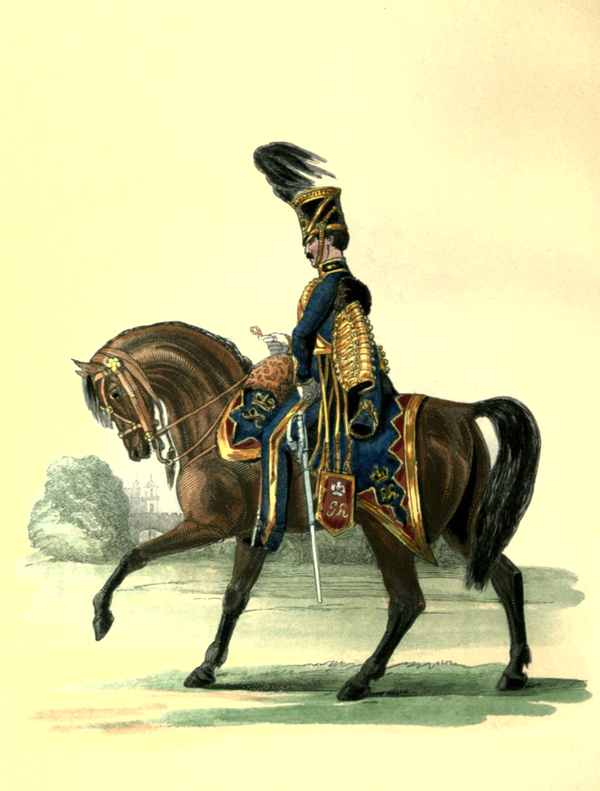
The regiment commenced its retreat a few
hours after this affair; and the army rested two
days at Benevente, a rich open town situate in a
plain extending from the Gallician mountains to
the neighbourhood of Burgos. The infantry afterwards
continued the retreat, while the cavalry
remained in the town, and had parties watching
the fords of the little river Esla. Soon after day-break
on the 29th of December, six hundred
cavalry of the French imperial guard crossed the
stream and advanced into the plain; the British
detachments retired fighting, and a piquet of the
Seventh Hussars, under Lieutenant Lowther,
was sharply engaged. Being joined by part of
the Third German hussars, the piquets charged
the French leading squadrons with signal gallantry,
the ground was obstinately disputed, and a particularly
animating scene presented itself. Baggage
mules and followers of the army were scattered
over the plain, the town was filled with
tumult, the distant piquets and videts were galloping
in from right and left; the French were
pressing forward, and every appearance indicated
that the enemy's whole army was come up and
passing the river. Suddenly Lord Paget led
the Tenth hussars at speed into the plain; the
piquets that were engaged united, and the whole
charged. In an instant the scene changed, the
French were seen galloping back, with the British
at their heels; they plunged into the stream without
breaking their ranks, and having gained the
opposite heights, they wheeled round and appeared
inclined to come forward a second time; but the
British horse artillery opening upon them, they
retired. Fifty-five killed and wounded Frenchmen
lay on the plain, their general, Lefebre Desnouettes,
and several other officers, were taken prisoners,
and many of those who escaped across the river,
were wounded. The piquet of the Seventh
Hussars suffered severely, nearly every man
being either killed or wounded.
1809
1810
The enemy planted heavy cannon on the bank
of the river, and made a show of re-crossing; but
Lord Paget guarded the fords all the day, and at
night withdrew with the cavalry. The Seventh
were constantly in the rear of the army, with
the other hussar regiments, during the remainder
of the retreat; they, however, suffered little
from the swords of the enemy; but the effects of
frost, snow, and of a deficiency in the supplies of
provision and forage, were severely felt. The
want of horse-shoes was a serious evil, which was
owing to the impracticability of the forge carts
accompanying the regiment. When the army
withdrew from the position at Lugo, during the
night of the 8th of January, 1809, the Seventh
Hussars were left behind to keep up the bivouac
fires, and to cover the retreat, and they were in
the rear of the army until it arrived within three
leagues of Corunna.
On arriving at Corunna, the regiment mounted
two hundred and fifty horses only, out of six
hundred and eighty which had marched from
that port about two months before, and many of
those which remained, were destroyed for the
want of transport, which could be obtained only
for the officers' horses and for about ninety troop-horses.
The French were defeated in a general action
fought on the 16th of January, when Sir John
Moore fell mortally wounded. The army afterwards
embarked and returned to England. Thus
the British had intercepted the blow which was
descending to crush Spain; time had been given
to enable the patriots to re-organize their armies;
and Bonaparte being recalled to France, by the
news that Austria and Russia were arming to
oppose him, the war was protracted in Spain. On
the passage to England the Despatch transport,
having on board Major the Hon. G. C. Cavendish,
Captain G. Dukinfield, and Lieutenant the Hon.
Edward Waldegrave, with one hundred and thirteen
men, and forty-four horses, was wrecked near
the Lizard, on the coast of Cornwall, and only
seven men escaped.
After its arrival from Spain, the regiment was
quartered at Guildford, from whence it proceeded
to Weymouth; in May, 1810, it embarked at
Liverpool for Ireland, and was stationed at
Dublin, with detached troops at Athy and Carlow.
1811
1812
1813
In 1811 the head-quarters were removed to
Dundalk, where they remained during the year
1812; and in 1813 the regiment embarked at
Dublin for England.
Having landed at Liverpool, the regiment
proceeded to London; it was stationed at Hyde
Park barracks, Hampton Court, and Hounslow,
and performed the king's duty during the absence
of the household cavalry on foreign service.
The glorious victories gained by the allied
army under Field Marshal the Marquis of Wellington
had, in the mean time, accomplished the
deliverance of Portugal, and of nearly all Spain,
from the despotic sway of Bonaparte, and the
Seventh Hussars were selected to take part in
completing the overthrow of the tyrannical power
of Napoleon. Eight troops, commanded by Lieut.-Colonel
R. Hussey Vivian, embarked at Portsmouth
on the 15th of August, and landed at
Bilboa, the capital of Biscay, in Spain, on the
1st of September; and two additional troops
joined from England in October. The regiment
was formed in brigade with the Tenth and Fifteenth
hussars, commanded by Major-General
Lord Edward Somerset.
After the surrender of the castle of St. Sebastian
the regiment advanced, and having joined
the army, supported the infantry at the passage
of the Bidassoa, and advanced as far as Vera on
the borders of France. The Seventh Hussars
subsequently retired through the Pyrenean mountains
to the vicinity of Pampeluna, which fortress
surrendered on the 31st of October.
Colonel Richard Hussey Vivian having been
appointed to the command of a brigade of cavalry,
the command of the regiment devolved on Lieut.-Colonel
Edward Kerrison.
1814
After occupying village cantonments near
Pampeluna for several weeks, the Seventh Hussars
marched through the Pyrenees and joined
the army in France. On the 18th of December
they took the out-post duty at Cambo, a town
eight miles from Bayonne, where the French
army, under Marshal Soult, lay in a fortified
camp. On the 31st of December, the regiment
took the out-post duty on the road leading to St.
Jean Pied de Port, where a French division was
stationed. The weather becoming very severe,
the regiment went into cantonments in the beginning
of 1814, near Hasparan, in Gascony,
thirteen miles from Bayonne: in these quarters
forage was particularly scarce, and the horses
suffered in condition from being fed on chopped
gorse and about three pounds of oats a day. The
foraging parties sent towards the French lines,
had frequent skirmishes, and on one of these
occasions, Captain Peter Augustus Heyliger was
wounded.
The weather having become more clear, the
army advanced in the middle of February, and on
the 24th the hussar brigade proceeded to the bank
of the Gave d'Oléron, in the expectation of being
engaged. Captain Fraser and twelve men of the
Seventh passed the river under a heavy fire, and
were followed by Captain Verner's squadron, for
the purpose of supporting a body of infantry
which had crossed the stream and were seriously
engaged; but the enemy being in force, and the
ground such that cavalry could not act, the
squadron was re-called. The enemy abandoning
his position, the regiment crossed the river in
pursuit, and halted at the village of Boren.
Marshal Soult concentrated his forces behind
the Pau at Orthes; the allies advanced to attack
him; and the Seventh Hussars, having crossed
the river, were engaged in driving the enemy from
his position on the 27th of February. About
10 o'clock the regiment was ordered to cover the
sixth division and the guns; and when the French
gave way, it dashed forward in pursuit, and by a
brilliant charge it overthrew a body of opponents,
and took sixty prisoners: this occurred about
3 o'clock. Shortly afterwards the regiment was
again ordered to charge, and being led forward by
Colonel Kerrison with signal gallantry, it was
once more successful, and sixteen officers, with
about seven hundred men, were made prisoners.
The Marquis of Wellington observed in his public
despatch: "Lieutenant-General Sir Stapleton
Cotton took advantage of the only opportunity
which occurred, to charge with Major-General
Lord Edward Somerset's brigade in the neighbourhood
of Sault de Navailles, where the enemy
had been driven from the high road by Lieutenant-General
Sir Rowland Hill. The Seventh
Hussars distinguished themselves upon this occasion,
and made many prisoners."
The regiment had four men and five horses
killed; Major William Thornhill, Captain P. A.
Heyliger, Lieutenant Robert Douglas, nine men,
and eleven horses wounded.
After the battle of Orthes the Seventh Hussars
were employed a short time at Villeneuve de
Marsan, in the department of the Landes; also at
Roquefort and Captieux, in protecting the rear of
the army from the depredations of parties of brigands.
From these quarters the regiment advanced,
and rejoining the army near Toulouse,
supported the infantry in the action at that place
on the 10th of April.
When the French withdrew from Toulouse, the
regiment moved forward and was employed in the
out-post duty.
At length hostilities were terminated by the
abdication of Bonaparte and the restoration of
the Bourbon dynasty. Thus a war of unprincipled
aggression, begun in acts of fraud and perfidy, and
carried on with treachery, cruelty, and rapine,
ended with the downfall of its author, and the
humiliation and dispersion of his boasted invincible
legions.
After the termination of hostilities, the regiment
reposed a month in village cantonments;
and on the 1st of June commenced its march for
Boulogne, where it embarked for England, and,
after landing, it marched to Romford, and in
September to Brighton. Its services were subsequently
rewarded with the honour of bearing the
word "Peninsula" upon its appointments.
1815
Riots having occurred in London towards the
end of February and in the beginning of March,
1815, in consequence of the introduction into
Parliament of a bill to regulate the importation
of grain, the Seventh Hussars were suddenly
ordered to proceed thither from Brighton.
The return of Bonaparte to France, the sudden
defection of the forces of Louis XVIII., and the
elevation of the usurper to the throne, filled
Europe with astonishment. War was resolved
upon, and on the 25th of March three squadrons
of the Queen's Own Hussars, commanded by
Col. Sir Edward Kerrison, marched from London
for foreign service; they embarked at Dover,
landed at Ostend, and, after marching a few stages
up the country, went into cantonments, and were
formed in brigade with the Fifteenth hussars, and
Second hussars of the King's German legion,
under the orders of Major-General Sir Colquhoun
Grant, K.C.B. On the 29th of May they were
reviewed, with other brigades of the cavalry, by
Field-Marshal his Grace the Duke of Wellington,
accompanied by Marshal Von Blucher, the commander
of the Prussian army.
Bonaparte, endeavouring, by one of those rapid
movements for which he had been so famous, to
interpose between the British and Prussian armies,
and beat them in detail, suddenly attacked and
drove in the out-posts, and early on the morning
of the 16th of June the Seventh Hussars advanced
to support the troops engaged at Quatre
Bras. After a march of many miles, they arrived
at the scene of conflict; the French were repulsed,
and the troops bivouacked in the fields.
The Prussians having been defeated and forced
to retreat, the Duke of Wellington made a corresponding
movement on the 17th of June, to
preserve his communication with them, and the
Seventh Hussars were engaged, with other corps,
in covering this retrograde movement. On passing
through the village of Genappe, the French
lancers began to press upon the rear of the retiring
army, and the Seventh were directed by their
colonel, Lieutenant-General the Earl of Uxbridge,
to charge. This order was executed with signal
bravery; but the lancers, being sustained by a
great mass of cavalry, and having their flanks
secure, presented an almost impenetrable row of
pikes, through which the hussars were unable to
break. The regiment rallied and charged a
second time; but the lancers, being well supported
and advantageously posted, were enabled
to maintain their ground. Some impression had,
however, been made, and two squadrons of the
first regiment of life guards coming up at speed,
the weight and power of their charge broke the
lancers, who were pursued through the village
with great slaughter. The retreat was afterwards
continued with skirmishing and cannonading to
the position in front of the village of Waterloo,
where the army passed the night exposed to a
heavy rain.
On the following day the hard contested and
sanguinary battle of Waterloo was fought,—a
battle memorable in the annals of Europe,—where
the fate of empires was decided by the sword, and
the British troops acquired immortal honour!
During the early part of the action the Seventh
Hussars supported the infantry, and towards
the evening they were ordered forward. Moving
from Hugomont, they acted nearly on the reverse
of the enemy, and by a series of brilliant charges,
most nobly executed, contributed to the final
overthrow of the French army. On this occasion
the officers and men proved their resolution to
support the high character which the regiment
had so long borne; and their conduct was publicly
noticed and attested in the strongest and most
unequivocal terms by the commander of the
cavalry, Lieutenant-General the Earl of Uxbridge,
who, after having gone through this arduous day,
received a wound at the close of the action by
which he lost his right leg.
The loss of the regiment on the 17th and 18th
of June was, one serjeant, fifty-five rank and file,
and eighty-four horses killed; Captains J. W.
Robins, W. Vernor, and P. A. Heyliger; Lieutenants
R. Douglas, E. Peters, and R. Beattie;
with nine serjeants, one trumpeter, eighty-three
rank and file, and one hundred and sixteen horses
wounded.
The gallant conduct of the regiment on this
occasion, was subsequently rewarded with the
honour of bearing the word "Waterloo" on its
appointments; the officers and men received each
a silver medal; and the privilege of reckoning
two years' service for that day, was conferred on
the subaltern officers, and also on the non-commissioned
officers and private men.
On the 19th of June, the regiment advanced
in pursuit of the French, who fled in dismay
towards Paris; on the evening of the 24th, it was
at the capture of Cambray by escalade, by Lieut.-General
Sir Charles Colville's division. On arriving
at the vicinity of Paris, the war was
terminated, by the surrender of the capital, and
the restoration of Louis XVIII. to the throne of
his ancestors.
After occupying village cantonments near
Paris for several months, and taking part in
several grand reviews, at which the Emperors of
Russia and Austria, and the Kings of Prussia
and France, were present, the Seventh Hussars
were selected to form part of the army of occupation
in France, and they proceeded to Estaples
and neighbouring villages.
1816
In the summer of 1816, the Seventh marched
to quarters between St. Omer and Dunkirk, for
the purpose of field exercise and review, and
were joined by a squadron from England. On
the 22nd of October, the Duke of Wellington
reviewed the army on the plains of St. Denain,
and witnessed the troops go through the formula
of a mock engagement. The Seventh afterwards
returned to their former quarters.
1817
In February, 1817, the regiment was again
quartered near St. Omer, for the convenience of
field exercise; it was subsequently stationed
between Cambray and Valenciennes, and was
again reviewed in October, by the Duke of
Wellington, together with the remainder of British
troops, and the Saxons, Danes, and Hanoverians.
The regiment was afterwards stationed at Cassel
and adjacent villages.
1818
Several changes of quarters took place in
1818; and the regiment was at the grand military
spectacles, when the army was seen by their
Royal Highnesses the Dukes of Kent and Cumberland,
and when the Russians, British, Saxons,
Danes, and Hanoverians were reviewed, by the
Emperor of Russia, King of Prussia, Prince of
Orange, Grand Dukes Constantine and Michael,
&c., &c. After these reviews, the army of occupation
quitted France: the Seventh Hussars
embarked at Calais, landed at Dover and Ramsgate,
and marched to Chertsey, &c.
On the night of the 1st of December the
regiment attended the funeral of Her Majesty
Queen Charlotte.
1819
1820
In 1819, the regiment marched to Scotland;
in August, 1820, it embarked at Port Patrick for
Ireland; and the head-quarters were stationed
twelve months at Dundalk.
1821
In August, 1821, the regiment marched to
Dublin, on the occasion of the visit of His
Majesty King George IV. to the capital of
Ireland. On the 18th of August, the king reviewed
the Seventh Hussars, with the other
troops in garrison at Dublin, on which occasion
the regiment was commanded by its colonel, the
Marquis of Anglesey. In September the establishment
was reduced from eight to six troops.
1822
1823
Leaving Dublin in December, 1822, the regiment
proceeded to Newbridge; in June, 1823, it
embarked at Waterford, and landing at Bristol,
proceeded to Richmond and other villages in the
neighbourhood of Hounslow.
On the 15th of July the two regiments of life
guards, Blues, Third light dragoons, and Seventh
and Fifteenth hussars, with a brigade of horse
artillery, were reviewed on Hounslow-heath by
his Royal Highness the Duke of York.
1824
After the review the Seventh Hussars marched
to Brighton, Chichester, and Hastings, with detachments
on revenue duty on the coast; but
returned to the vicinity of Hounslow in the spring
of 1824, the head-quarters being at Hampton
Court; and on the 7th of July they were again
reviewed, with the same corps as in the preceding
year, on Hounslow-heath, by the Duke of York.
The head-quarters were afterwards removed to
Hounslow barracks, and the regiment took the
escort duty.
1825
1826
1827
In July, 1825, the regiment proceeded to York,
Beverley, and Newcastle; in April, 1826, it
marched to Scotland, and was stationed at Edinburgh
and Perth, with parties on revenue duty at
Cupar, Angus, and Forfar; and in March, 1827,
it left Scotland for the South of England.
On the 12th of April the Seventh Hussars
were reviewed on Hounslow-heath by his Grace
the Duke of Wellington, who was pleased to
express his unqualified approbation of their appearance
and discipline. After the review they
continued their march to Brighton and Chichester.
1828
1829
1830
Leaving these quarters, the regiment proceeded
to Liverpool in March, 1828, and embarking for
Ireland, landed at Dublin, where it was stationed
until May, 1829, when it was removed to Newbridge,
and in May, 1830, to Dundalk, Monaghan,
and Belturbet.
On the 2d of August, 1830, a general order was
issued for the whole of the cavalry, with the
exception of the Royal Horse Guards (Blues), to be
dressed in red; the Seventh Hussars were consequently
furnished with red pelisses in the
following year.
1831
The regiment left Dundalk, &c., in April, 1831,
for Newbridge, and in June proceeded to Dublin
and embarked for England. After landing at
Liverpool, it marched to Birmingham, with detached
troops at Coventry and Kidderminster.
1832
1833
1834
In March, 1832, the regiment proceeded to
Norwich, Ipswich, and one troop to Boston. In
the month of March of the following year it
proceeded to Scotland, and was stationed at Hamilton
and Glasgow, and in February, 1834, performed
much extra duty in consequence of riots
among the cotton spinners and calico printers in
the neighbourhood of Glasgow.
1835
On the 2d of May, 1834, the regiment left its
quarters in Scotland, and proceeding to England,
was stationed at York and Newcastle; and in
April, 1835, it marched to Nottingham, Sheffield,
Derby, and Boston.
1836
1837
In April, 1836, the regiment proceeded to
Hounslow, and took the escort duty. In June,
1837, it embarked at Bristol for Ireland, landed
at Cork, and the head-quarters were established
at Ballincollig, from whence they were removed
in August to Cork, and in September to Dublin,
where they passed the winter.
1838
1839
Orders having been received for the regiment
to transfer its services to Canada, it was divided
into four service and two depôt troops; the service
troops embarked at Cork on the 1st of May,
1838; and arrived at Montreal in June. In November,
1838, they were employed against the
insurgents in Lower Canada, and one troop was
similarly employed in January, 1839.
1840
1841
1842
During the years 1839, 1840, and 1841, the
service troops were stationed at Montreal and
Laprairie. In the year 1841 orders were received
to resume blue pelisses. The Service Troops have
continued in Canada to the summer of 1842,
the date of the conclusion of this memoir.
The record of the services of the Seventh, or
Queen's Own Hussars, for a period of one hundred
and fifty years, (as contained in the preceding
pages,) exhibits a proof, among the other portions
of the British army, of attachment to their officers,
of loyalty and fidelity to their sovereign, and
of zeal and devotedness to their country. On all
occasions, when their services have been required
to meet a foreign enemy, they have entered upon
the difficulties of active warfare with readiness
and a determination to perform the duties allotted
them; and their bravery and contempt of danger
have been strongly evinced. Their gallantry at
the battle of Dettingen in 1743; their conduct at
Warbourg in 1760, under the Marquis of Granby,
and on other occasions in Germany during the
Seven years' War;—their boldness and intrepid
bearing in conflict with the enemy at Cateau,
Roubaix, Tournay, and Mouvaux, under the Duke
of York, in 1794, which received His Royal
Highness's strongest commendations, afford instances
of the most determined bravery.
The proofs of true courage were further adduced
by the firm conduct of the Seventh Hussars in
the advance into Spain under Lieut.-General Sir
John Moore in 1808, and in the retreat to Corunna
in January, 1809, as detailed in the Regimental
Record. The gallantry of the regiment at the
battle of Waterloo, in June, 1815, gained an
imperishable addition to its fame; and the deeds
of the officers and men, who fought on that
glorious occasion, are sufficient to perpetuate an
emulous desire in the present and future members
of the corps to rival the exertions of their brave
predecessors.
The smart, active, and soldier-like appearance
of the regiment, its correct and orderly conduct
in quarters, and its gallantry in the field, have
acquired a high character in the estimation of the
country, and proved it to be a valuable acquisition
to the crown and to the government.
In thus recording the commendations due to
so distinguished a regiment as the Seventh Hussars,
the compiler of this Record, with true
respect towards the gallant officer and nobleman
at the head of the corps, ventures to associate his
fame and honour with those of his regiment, with
which, for more than forty years, they have been
identified: General the Marquis of Anglesey,
K.G. and G.C.B., assumed the command of the
Seventh Hussars as Lieutenant-Colonel on the
6th of April, 1797; he shared with his regiment in
the dangers and honours of the conflicts in Holland
in 1799; at Sahagun and Benevente in 1808; in
the retreat to Corunna in 1809; and at the all-crowning
victory of Waterloo in 1815, where
he lost his leg by a cannon shot. In future ages
the gallant and heroic deeds of this nobleman
will be the admiration of every member and
friend of the British army.
OF
THE SEVENTH,
OR
QUEEN'S OWN REGIMENT
OF
HUSSARS.
Robert Cunningham.
Appointed 30th December, 1690.
Robert Cunningham was an officer of reputation
in the Scots brigade in the service of Holland, and was
wounded at the battle of St. Denis, in 1678. Proceeding
to Scotland, he became a warm advocate for the
principles of the Revolution of 1688, and having performed
faithful services in that cause, he was rewarded
with the colonelcy of a regiment of foot formed during
the winter of 1689-90. When the clans tendered their
submission to King William's government, Colonel
Cunningham's regiment was disbanded, and he obtained
the command of a corps of dragoons, now the
Seventh Hussars. He served with his regiment,
under King William, in the Netherlands, during the
campaigns of 1694, 1695, and 1696, and in the summer
of the last-mentioned year he commanded a brigade of
dragoons in Flanders. At the close of the campaign
he was succeeded in the colonelcy by Lord Jedburgh.
William, Lord Jedburgh.
Appointed 1st October, 1696.
The Honorable William Kerr, son of Robert,
fourth Earl and first Marquis of Lothian, steadily supported
the principles of the Revolution, and rose to the
rank of colonel in the army on the 1st of March, 1692.
He succeeded, in the same year, to the title of Lord
Jedburgh; and on the 1st of October, 1696, King
William appointed him to the colonelcy of a regiment
of dragoons, now the Seventh Hussars. In 1702,
Queen Anne promoted him to the rank of brigadier-general.
On the decease of his father, in 1703, he succeeded
to the title of Marquis of Lothian[8]. The
rank of major-general was conferred on his lordship in
1704; in the succeeding year he was invested with the
order of the Thistle; and in January, 1707, he obtained
the rank of lieut.-general. On the 25th of April following
he obtained the colonelcy of the third foot
guards, from which he was removed in 1713, in consequence
of his political views not being in accordance
with those of Queen Anne's new ministry. After the
accession of King George I., his lordship was appointed
to the staff of North Britain. He died in 1722.
Patrick, Lord Polwarth.
Appointed 28th April, 1707.
This officer was the son of Sir Patrick Hume, of
Polwarth, who was one of the most conspicuous and
vigorous characters of the age in which he lived, was a
strenuous opposer of the proceedings of King Charles II.
in Scotland, and was created, by King William, Lord
Polwarth, and Earl of Marchmont.
Patrick Hume was educated in Holland, and the
Prince of Orange gave him a commission in the Dutch
service. He accompanied His Highness to England at
the Revolution, and when his father was elevated to
the dignity of Earl of Marchmont, he was styled Lord
Polwarth. He was appointed major of a regiment
of dragoons, now Seventh Hussars, in 1694; lieut.-colonel
in 1697, and colonel in 1707. He died in 1709.
The Honorable William Kerr.
Appointed 10th October, 1709.
The Honorable William Kerr, third son of
Robert, Earl of Roxburgh, and brother of John, first
Duke of Roxburgh, served with reputation on the continent,
under the celebrated John, Duke of Marlborough.
In 1709 he was rewarded with the command of a regiment
of dragoons, now Seventh Hussars, and on
the accession of King George I. he was appointed
groom of the bedchamber to the Prince of Wales. He
highly distinguished himself at the battle of Dumblain,
on the 13th of November, 1715, where, according to
the accounts published at the time, he had three horses
killed under him, was wounded in the thigh, and had
his coat torn by a pistol bullet. The care and attention
which he paid to the interests of his corps, procured
him the affection and esteem of the officers and soldiers.
He was promoted to the rank of brigadier-general in
1727, to that of major-general in 1735, and to that of
lieut.-general in 1739. He died in 1741, after commanding
the regiment nearly thirty-two years.
John Cope.
Appointed 12th August, 1741.
John Cope entered the army in March, 1707, and
speedily rose to the lieut.-colonelcy in the second or
Scots troop of horse grenadier guards. He obtained the
rank of colonel in the army in 1711. In 1730 he was
promoted from the horse grenadier guards to the
colonelcy of the thirty-ninth foot, from which he was
removed to the fifth foot, in 1732. He was promoted
to the rank of brigadier-general in 1735; was removed
to the ninth dragoons in 1737; and advanced to the
rank of major-general two years afterwards. He served
several years on the staff of Ireland, obtained the
colonelcy of the Seventh dragoons in 1741, and proceeded,
in the summer of 1742, to Flanders with the
army commanded by Field-Marshal the Earl of Stair.
In the beginning of the following year he was promoted
to the rank of lieut.-general, and having signalized
himself, under the eye of his sovereign, at the head of
the second line of cavalry, at the battle of Dettingen,
he was constituted a knight of the Bath.
Sir John Cope was commander-in-chief in Scotland
when the rebellion of 1745 broke out in the Highlands,
and a small body of troops, under his immediate
command, was defeated by the clans under the young
Pretender, at Preston Pans, which unfortunate circumstance
enabled the rebels to penetrate into England.
He died in 1760.
John Mostyn.
Appointed 18th August, 1760.
John Mostyn served in the thirty-first foot, in
which corps he rose to the rank of captain, and in 1742
he was appointed captain-lieutenant in the second foot
guards. Having joined his company on foreign service,
he was engaged at the battle of Fontenoy, where the
foot guards highly distinguished themselves, and he was
wounded. In December, 1747, he was promoted to the
rank of colonel, and appointed aide-de-camp to King
George II.; and in 1751 he obtained the colonelcy of
the seventh foot, from which he was removed to the
thirteenth dragoons in 1754. In 1757 he was promoted
to the rank of major-general; he was removed to the
fifth dragoons in 1758, and to the Seventh dragoons
in 1760. He commanded a brigade of infantry under
the Duke of Marlborough in the expedition to the coast
of France in 1758; in 1759 he was promoted to the
rank of lieut.-general, and serving in Germany under
Prince Ferdinand of Brunswick, he distinguished himself
on several occasions. At the conclusion of the war
he was removed to the first dragoon guards, and was
promoted in 1772, to the rank of general. He died in
March, 1779.
Sir George Howard, K.B.
Appointed 13th May, 1763.
George Howard entered the army in the reign of
King George I., and after serving the crown a period
of nineteen years, he obtained the lieut.-colonelcy of
the third foot on the 2nd of April, 1744. He commanded
the regiment at the battles of Fontenoy, Falkirk,
Culloden, and Val; and in 1749 he succeeded his
father in the colonelcy of the corps. He served with
distinction in Germany during the seven years' war;
was promoted to the rank of major-general in 1758, and
to that of lieut.-general in 1760: and at the conclusion
of the peace in 1763, he was removed to the Seventh
dragoons, and advanced to the dignity of a knight of
the Bath. In 1777 he was promoted to the rank of
general; in April, 1779, he was removed to the first
dragoon guards; and was promoted to the rank of field-marshal
in October 1793; he was also a member of the
privy council, and governor of Jersey. He died on the
16th of July, 1796.
Sir Henry Clinton, K.B.
Appointed 21st April, 1779.
Henry Clinton, grandson of Francis, sixth Earl
of Lincoln, held a commission in an independent company
of foot at New York, from which he was removed
in 1751, to a lieutenancy in the second foot guards, and
in 1758 he was promoted to the rank of captain and
lieut.-colonel in the first foot guards. Having gained
great credit for his conduct during the seven years' war,
in which the foot guards had several opportunities of
acquiring distinction, he was promoted, in 1762, to the
rank of colonel in the army; and in November, 1766,
King George III. rewarded him with the colonelcy of
the twelfth regiment of foot, then at Gibraltar; he was
promoted to the rank of major-general in 1772. On
the breaking out of hostilities in America, in 1775, this
distinguished officer was sent with reinforcements to
General Gage, at Boston, with the local rank of
lieut.-general, and signalized himself at the battle of
Bunker's Hill. In January, 1776, he was promoted to
the local rank of general in America; he proceeded
to North Carolina, and commanded the troops which
made an unsuccessful attempt on Charlestown; and
afterwards commanded a division of the army, under
General Sir William Howe, in the descent on Long
Island. In the action at Brooklyn he evinced ardour
and ability; also in the skirmish at White Plains, and in
the capture of Rhode Island, in December, the same
year. In 1777, he commanded the troops at New York,
and captured forts Clinton and Montgomery, and was
rewarded with the order of the Bath. In 1778 he was
appointed commander-in-chief in North America; in
May he joined the army at Philadelphia from whence he
withdrew to New York, and while on the march he repulsed
an attack of the Americans at Freehold. He subsequently
had success in several affairs of minor importance;
and while engaged in these services, he was
appointed to the colonelcy of the Seventh dragoons.
In December, 1779, he embarked with a large force for
South Carolina, and, after overcoming numerous difficulties,
he captured Charlestown, for which he received
the thanks of parliament. He sustained the character
of a brave, zealous, and accomplished officer; but he
was so circumstanced in America, that he was unable
to add much to his reputation by the energetic and
gallant efforts which he made in that country; and
after experiencing pain and mortification from numerous
causes, he returned to England in June, 1782,
having been succeeded by General Carleton, afterwards
Lord Dorchester.
The rank of general in the army was conferred on
Sir Henry Clinton in 1793; he held the government
of Limerick; and in 1795 he was appointed governor
of Gibraltar. He was many years a member of parliament;
and was also groom of the bedchamber to the
Duke of Gloucester. His decease occurred on the 23rd
of December, 1795.
David Dundas.
Appointed 26th December, 1795.
David Dundas was one of the most distinguished
officers of the age in which he lived, for his perfect
knowledge of the principles of military tactics. He
commenced his military education at the age of thirteen
in the academy at Woolwich, and at fifteen he
assisted in a survey of Scotland; in 1756 obtained a
commission in the fifty-sixth regiment. In 1758 he proceeded
with the expedition to the coast of France as an
assistant quarter-master-general; and in the following
year obtained the command of a troop in a newly-raised
regiment of light dragoons (Eliott's light horse), now
the fifteenth, or King's hussars. He served with his
regiment in Germany in 1760 and 1761; in the following
summer he accompanied an expedition to Cuba, as
aide-de-camp to Major-General Eliott, and was actively
employed in the reduction of the Havannah. After the
peace he resumed his post in his regiment, in which he
rose to the rank of major; and, urged by an ardent
desire to acquire a perfect knowledge of every branch
of his profession, he obtained permission to proceed to
the continent, to observe the practice of the French
and Austrian armies. In 1775 he procured the lieut.-colonelcy
of the twelfth light dragoons, joined the regiment
in Ireland shortly afterwards, and in 1778 obtained
the appointment of quarter-master-general in that country.
In 1782 he was removed to the lieut.-colonelcy of
the second Irish horse, now the fifth dragoon guards. In
1785 he again proceeded to the continent, attended the
exercises of the Prussian troops during three summers,
and after his return he presented His Majesty with a
detailed account of their evolutions.
Colonel Dundas, having become a proficient tactician,
produced, in 1788, a highly useful work on the principles
of military movements, which became the basis of our
army regulations for field exercises. His abilities obtained
for him the favour and attention of King George
III., who appointed him adjutant-general in Ireland,
for the purpose of introducing his system of tactics
into the army of that country. In 1790 Colonel Dundas
was promoted to the rank of major-general. In
1791 he obtained the colonelcy of the twenty-second
foot, and in the same year was placed on the Irish staff,
but he resigned that appointment in 1793 to engage in
service of actual warfare. After the commencement of
hostilities with the French republic, Major-General
Dundas was employed on a military mission to the
island of Jersey, and was subsequently sent to the continent
to confer with the Duke of York respecting the
siege of Dunkirk. From Flanders he proceeded to
Toulon, which had recently been taken possession of by
a British armament; and his services there, although he
was ultimately obliged to evacuate the place, called forth
the approbation of his sovereign and of the British
nation. After abandoning Toulon, he made a descent
on Corsica, which island was reduced and annexed to
the British dominions; but shortly afterwards he received
directions to proceed to Flanders, where he
arrived in the spring of 1794, and commanded a brigade
of cavalry at the battle of Tournay on the 22d of May,
1794. Major-General Dundas was actively employed
in the retreat through Holland, and the corps under his
immediate command gained considerable advantage
over the enemy in two successive actions near Gelder-Malsen;
he highly distinguished himself also in an
attack upon the French post at Thuyl, in December of
the same year. He continued with the British troops
in Germany during the summer of 1795, and in December
was appointed colonel of the Seventh Light
Dragoons. After his return to England he was appointed
quarter-master-general to the army; and he
composed the celebrated regulations for the field exercises
and movements for the cavalry, which were approved
by his Royal Highness the Duke of York and
by King George III., and ordered to be exclusively
adopted throughout the cavalry.
In 1799 Lieut.-General Dundas commanded a division
of the allied army under the Duke of York, in
the expedition to Holland; he distinguished himself in
several actions with the enemy, and was highly commended
by His Royal Highness in his public despatches.
In 1801 he was appointed colonel of the second, or
Royal North British dragoons, and was constituted
governor of Fort George. In 1802 he was promoted to
the rank of general; and in the following year, when the
French were preparing to invade England, he was placed
in command of the troops in the southern district, which
comprised the counties of Kent and Sussex. In 1804
he was appointed governor of the Royal Hospital at
Chelsea, and created a Knight of the Bath. On the
18th of March, 1809, His Majesty was pleased to confer
on this distinguished veteran the appointment of
commander-in-chief of the army, on the resignation of
Field-Marshal His Royal Highness the Duke of York,
which appointment he held until the 25th of May, 1811,
when His Royal Highness was re-appointed. He was
also appointed colonel-in-chief of the rifle brigade on
the 31st of August, 1809. He was promoted to the
colonelcy of the King's dragoon guards on the 27th of
January, 1813. He died in 1820, after a distinguished
service of upwards of sixty years.
Henry W., Lord Paget,
NOW
Marquis of Anglesey, KG., GCB., K.St.P., GCH.
Appointed 16th May, 1801.