OF
THE NINETEENTH,
OR
THE FIRST YORKSHIRE NORTH RIDING
REGIMENT OF FOOT.
1688
The advances made by King James II. towards the
subversion of the laws, and the established religion of
the kingdom, occasioned the Prince of Orange to be
invited to come to England with an army, to enable the
nobility and other persons of property and influence to
assert the inviolable character of the Constitution in parliament.
The Prince landed in Devonshire on the 5th of
November, 1688, and a number of persons afterwards
joining his standard, they were formed into companies
of musketeers and pikemen, and three regiments were
embodied under Colonels Lord Mordaunt, Sir John
Guise, and Sir Robert Peyton: troops of cavalry and
companies of infantry were also raised, in the interest of
the Prince of Orange, in various parts of England.
1689
The flight of King James to France was followed by
the elevation of the Prince and Princess of Orange to
the throne, in February, 1689. At this period several
of the companies of pikemen and musketeers raised
when the Prince of Orange landed, were incorporated
into a regiment under Colonel Francis Lutterell, whose
commission, as colonel of this regiment, was dated the
28th of February, 1689; but the regiment, being formed
of companies raised about the middle of November,
1688, was permitted to take rank from that date, and
now bears the title of the "NINETEENTH REGIMENT OF
FOOT."
The following officers were appointed to commissions
in the regiment:—
| Colonel, Francis Lutterell. |
| Lieutenant-Colonel, William Norcott. Major, Henry Hawley. |
|
|
| Captains. | Lieutenants. | Ensigns. |
| Baldwin Mallett. | R. Williams (Capt.). | Joseph Lewis. |
| Alexander Lutterell. | John Dodington. | Abraham Hancock. |
| Edmund Bowyer.[6] | N. Simmons. | Capell Stocker. |
| William Coward.[6] | John Redmore. | Thomas Adams. |
| Joseph Pigman.[6] | William Willoughby. | — Sidenham. |
| Hopton Wynham. | R. Wyndham. | — Ensate. |
| Robert Carey.[6] | George Prater. | Robert Norcott. |
| Walter Vincent.[6] | William Webb. | Thomas Robinson. |
| Charles Burlington.[6] | John Calmady. | Thomas Freke. |
| — Simmons.[6] | John West. | Thomas Resdin. |
| Hugh Mallett. | — Gregor. |
| | Lawrence Coward. |
|
|
| Adjutant, John West. Surgeon, T. Allen. |
| Quarter-Master, Arthur Balsam. |
In the summer of this year the regiment marched to
Portsmouth; it was afterwards stationed in the Isle of
Wight, and in September embarked on board the fleet
to serve as marines; but landed at Plymouth in the
winter.
1690
The authority of King William being resisted in
Ireland, an army was sent to that country under Marshal
Duke Schomberg, and in March, 1690, the NINETEENTH
received orders to send five hundred and
twenty men to Ireland, to replace the losses sustained
by many regiments at the unhealthy camp of Dundalk.
The regiment afterwards sent a detachment to the West
Indies, where nearly all the men died. The regiment
also sustained the loss of its colonel, who died this year.
1691
In 1691 the regiment was stationed in England recruiting,
and the colonelcy was conferred on Colonel
Thomas Erle, from a regiment which was raised in
March, 1689, and disbanded after the treaty of Ryswick
in 1697.
1692
Having recruited its ranks and attained a state of
efficiency, the regiment embarked for Flanders in the
spring of 1692, and joined the confederate army, commanded
by the British monarch in person, whose efforts
were directed to arrest the progress of aggression pursued
by Louis XIV.;—it served the campaign of this
year against the French under Marshal Luxemburg.
At the battle of Steenkirk, on the 3rd of August, the
regiment was in the main body of the allied army, and
the advance-guard being repulsed before the supporting
columns arrived at the field of battle, King William ordered
a retreat. Colonel Erle's regiment was one of
the corps which did not sustain any loss.
1693
The NINETEENTH regiment was one of the corps assembled
at Parck-camp, near Louvain, in May, 1693;
and by taking possession of this post, King William defeated
the designs of the French monarch on Brabant.
The fourteenth, sixteenth, NINETEENTH, and two newly-raised
regiments were formed in brigade under Brigadier-General
Erle. This brigade was in position at
Landen, on the 29th of July, when the confederate
army was attacked by the superior numbers of the
enemy. Brigadier-General Erle was ill of a fever, but
hearing that an action was likely to take place, he
quitted his bed, and was wounded at the head of his
brigade. The French having, by their numerical
strength, forced the position, the confederate army retreated.
Both armies sustained severe loss, and the
enemy derived little advantage from the victory, beyond
an opportunity to besiege Charleroi, which was
captured in the autumn.
The NINETEENTH regiment passed the winter in
quarters at Malines.
1694
In the beginning of May, 1694, the regiment quitted
its quarters, and pitched its tents near the cloister of
Terbanck; it took part in the operations of the campaign,
and performed many long marches in Flanders
and Brabant, and in the autumn returned to the pleasant
town of Malines, where it passed another winter in
garrison, with the third and fourth regiments of foot.
1695
Early in the spring of 1695 the regiment marched to
the vicinity of Ghent, and was encamped near Marykirk
until the army took the field. King William undertook
the siege of the strong fortress of Namur, and the NINETEENTH
formed part of the covering army under the
Prince of Vaudemont, who acquired great reputation
for the skilful retreat he effected in the presence of a
French army, of very superior numbers, under Marshal
Villeroy. After taking part in covering this retreat, the
regiment was employed in several operations for the
protection of the maritime and other towns of Flanders,
and to cover the troops carrying on the siege of Namur,
which fortress was captured by the troops under King
William, and that event terminated the campaign. The
NINETEENTH regiment passed the winter at Dendermond.
1696
Finding the progress of his arms arrested, and the
fortune of war in favour of the confederates, the French
monarch contemplated detaching England from the
alliance against his interests, by replacing King James
on the throne, for which purpose preparations were
made for invading England, and a conspiracy was formed
in London for assassinating King William. In consequence
of the preparations in France, the NINETEENTH,
and a number of other regiments, were ordered to return
to England. The regiment embarked from Sas-van-Ghent
in March, 1696, and sailed to Gravesend, where
it landed. The assassination plot was discovered, and
the designs of the French monarch frustrated.
1697
The regiment remained in England until the summer
of 1697, when it again proceeded to Flanders, and joined
the army encamped near Brussels on the 14th of July;
two days afterwards it was reviewed by King William.
The treaty of Ryswick was signed in September, and
the British monarch saw his efforts for the preservation
of liberty, and the balance of power in Europe, attended
with success. The regiment returned to England in
November.
1698
1702
In 1698 the NINETEENTH regiment was stationed in
Ireland, where it remained until 1702, when the succession
of the Duke of Anjou, grandson of Louis XIV.,
to the throne of Spain had produced another war.
Early in 1702 an expedition against the port and city
of Cadiz was resolved upon by the British government,
and the NINETEENTH regiment was withdrawn from
Ireland to take part in the enterprise; the fleet was
commanded by Admiral Sir George Rooke, and the land
forces were placed under the orders of the Duke of Ormond.
The regiment proceeded to the Isle of Wight,
where it embarked on board the fleet,[7] which sailed for
Cadiz, and a landing was effected between Rota and Fort
St. Catherine in the middle of August. Fort St. Mary's
was taken possession of, and some advantages were
gained; but the expedition proved of insufficient force
for the reduction of Cadiz, and the troops re-embarked.
The NINETEENTH regiment was detached from Cadiz to
the West Indies with the squadron of the royal navy
under Commander Walker.
1703
A powerful armament was prepared for the attack of
the French and Spanish settlements in the West Indies
in 1703, but this enterprise was afterwards laid aside.
An unsuccessful attempt was made on Guadaloupe in
March of this year, by a few men under Colonel Codrington.
1704
1705
Having lost a number of men from the effects of the
climate, the regiment was withdrawn from the West
Indies, and was stationed in Ireland in 1704; in 1705
it embarked for England, and landed near Chester in
October.
1706
The regiment was employed on home service during
the years 1706, 1707, 1708, and 1709.
1709
In May, 1709, Lieut.-General Erle disposed of the
colonelcy of the regiment to the lieut.-colonel, George
Freke.
1710
Early in the spring of 1710 the regiment embarked
for Flanders, to join the allied army in that country
under the celebrated John, Duke of Marlborough;
it advanced up the country to the vicinity of Tournay,
and afterwards took part in the movements by which
the French lines were forced at Pont-à-Vendin.
When the siege of Douay was undertaken, the NINETEENTH
regiment was one of the corps selected to take
part in this service. Some severe fighting took place in
carrying on the attacks, and in storming the outworks,
in which the regiment was engaged, and sustained
severe loss. On the 25th of June the garrison beat a
parley, and afterwards surrendered the fortress.
The NINETEENTH regiment had three serjeants and
ninety-one rank and file killed at the siege of Douay;
and one major, two captains, eight subalterns, ten serjeants,
and one hundred and ninety-seven rank and file
wounded.
The regiment formed part of the covering army
during the siege of Bethune, which fortress surrendered
on the 29th of August. Aire and St.-Venant were
afterwards invested and taken, and the regiment
marched to Ghent, where it passed the winter.
1711
Advancing up the country in the spring of 1711, the
regiment encamped a short time at Warde, where it
was joined by a fine body of recruits from England. It
took part in the operations by which the enemy's fortified
lines were passed at Arleux on the 5th of August,
and it was afterwards engaged in the siege of Bouchain,
which proved a difficult service; but every obstacle was
overcome by the skill and perseverance of the generals
and engineers, and the innate bravery of the soldiers,
who, on more than one occasion, fought up to their
waists in water. This fortress was surrendered on the
13th of September.
1712
In the spring of 1712 the regiment quitted its winter
quarters. Before the army was assembled, Colonel
Freke was succeeded in the colonelcy of the regiment
by Major-General Richard Sutton, from a newly-raised
corps, which was afterwards disbanded.
The army in Flanders was this year commanded by
the Duke of Ormond, and advanced to the frontiers of
France; but negotiations for a treaty of peace having
commenced, a suspension of hostilities was proclaimed,
and the British troops retired to the vicinity of Ghent.
1713
During the year 1713 the regiment was stationed in
Flanders.
1714
The decease of Queen Anne took place on the 1st of
August, 1714, when the regiment was ordered to return
to England, and it was placed in garrison at Tilbury
fort, Landguard fort, and Hull, with a detachment at
Sheerness.
1715
In August, 1715, the colonelcy of the regiment was
conferred on Lieut.-Colonel Grove, from the foot guards,
in succession to Major-General Sutton, who withdrew
from active service.
1716
1722
1723
The regiment was employed on home service many
years; in 1722 it was encamped on Salisbury Plain,
where it was reviewed by King George I.; and in the
following year it marched to Scotland.
1727
In 1727 the regiment was held in readiness to assist
the Dutch in the expected war with the Emperor of
Germany; but no embarkation took place.
1729
Colonel Grove died on the 13th of October, 1729, and
King George II. restored Major-General Sutton to the
colonelcy of the regiment.
At this period the regiment was removed to Ireland.
1735
1738
Major-General Sutton was promoted to the rank of
lieut.-general in 1735, and died in 1738, when the
colonelcy of the regiment was conferred on Colonel the
Honorable Charles Howard, from captain and lieut.-colonel
in the foot guards.
1739
In 1739 war was proclaimed against Spain, and the
NINETEENTH regiment was withdrawn from Ireland, and
stationed in North Britain.
1742
1744
A British army proceeded to Flanders in 1742, to
support the interests of the House of Austria against
France and Bavaria; but the NINETEENTH were employed
on home service until 1744, when they proceeded
to Flanders, and served the campaign of that year with
the army under Field-Marshal Wade. The regiment
was encamped some time on the banks of the Scheldt,
and afterwards advanced into the territory subject to
France, as far as Lisle; but no serious fighting took
place, and it passed the winter in quarters at Ghent.
1745
The regiment was called from its winter quarters in
April, 1745, and advanced with the army commanded
by His Royal Highness the Duke of Cumberland, to
the relief of Tournay, which fortress was besieged by a
numerous French force, and on the approach of the
allied army the enemy took up a formidable position
near the village of Fontenoy. This position was attacked
on the 11th of May, and the gallant bearing of the
British infantry was conspicuous; by a determined
charge they broke the French lines and overthrew all
opposition at their point of attack; but the Dutch failed
in their attempts to capture the village of Fontenoy,
and the English were exposed to a destructive flank
fire which forced them to retreat. The attack was repeated,
and British valour and intrepidity triumphed
once more; but the Dutch again failed, and the English
battalions, which had broken the enemy's lines, were
exposed to so destructive a fire from batteries on both
flanks, that a retreat was ordered, and the army withdrew
from the field of battle to Aeth.
The regiment had Lieutenant Le Grand, Ensign
Gibson, and seventeen private soldiers killed; Major
Petitot, Captains Cochran and Douglas, Lieutenant
Coote, Ensigns Cheape, Martin, and Potterfield, one
serjeant, and sixty-nine rank and file wounded; thirteen
men missing.
The subsequent operations of the campaign were of a
defensive character, and the allied army was so much
inferior in numbers to the enemy, that it was unable to
prevent the capture of several fortified towns in the
Austrian Netherlands.
This year a rebellion broke out in Scotland, and
Charles Edward, eldest son of the Pretender, gained
some advantages at the head of the Highland clans,
when several corps were ordered to return to England,
but the NINETEENTH remained in the Netherlands.
1746
Taking the field in the spring of 1746, the regiment
was employed in various services; but the allied army,
being very inferior in numbers to the force which the
French monarch employed in the Netherlands, was
necessarily restricted in its operations.
On the 11th of October the allied army was formed
on the beautiful plain of Liege, and the NINETEENTH
regiment was stationed, with two other corps, in the village
of Roucoux. About noon the superior numbers of
the enemy under Marshal Saxe were seen advancing, and
about three in the afternoon a numerous body of infantry
and artillery attacked three villages, which were occupied
by eight battalions of British, Dutch, and Hessians.
The disparity of numbers was about one to six, yet the
allies stood their ground gallantly, and repulsed the
leading brigades of the enemy. New combatants rushed
forward, and the allies were again victorious; but they
were eventually forced to quit the villages. After defending
their post with great bravery for some time, the
NINETEENTH, and other corps in Roucoux, quitted the
village, and took post in a hollow way, where they defended
themselves until a retreat was ordered, when the
army withdrew to the vicinity of Maestricht.
One serjeant, one drummer, and thirty-three rank
and file of the regiment were killed on this occasion;
Lieutenant Cuthbert, Ensign M'Farlane, three serjeants,
and nineteen rank and file wounded; Captain
Leake, Lieutenant Campbell, and several private soldiers
taken prisoners.
1747
After passing the winter in cantonments in Holland,
the regiment took the field with the army commanded
by His Royal Highness the Duke of Cumberland, and
distinguished itself at the battle of Val, on the 2nd of
July in that year. The enemy attacked the village of
Val, which was occupied by the thirteenth, twenty-fifth,
and thirty-seventh regiments, and a battalion of Hanoverians,
who repulsed the attacks of their numerous opponents
some time, but were eventually forced to give
way. They were reinforced by the eighth, NINETEENTH,
and forty-eighth regiments, and a foreign corps, and
returning to the charge, recovered the village. The
fighting at this point was very severe; several French
brigades were nearly annihilated, and the village was lost
and won several times. During this protracted contest
the innate valour of the British troops was very conspicuous;
but the enemy at length succeeded in breaking
the line, and the army was ordered to retreat to Maestricht,
where it arrived on the same evening.
Lieut.-Colonel Williams, two serjeants, one drummer,
and thirty-two rank and file of the regiment were killed;
Major Petitot, Captain Masters, Lieutenants Goddard,
Brown, Martin, and Phillips, Ensigns Dobson and
Fuller, three serjeants, and one hundred and three rank
and file wounded; fifteen rank and file missing.[8]
1748
The regiment again took the field in 1748. Preliminary
articles for a treaty of peace were signed at Aix-la-Chapelle,
and a suspension of hostilities took place.
In this year Major-General the Honorable Charles
Howard was removed to the third dragoon guards, and
was succeeded in the colonelcy of the NINETEENTH regiment
by Colonel Lord George Beauclerk, from the
eighth marines.
1749
The regiment returned to England during the winter
of 1748-9, and immediately proceeded to Gibraltar,
where it was stationed four years.
1751
On the 1st of July, 1751, a warrant was issued by
authority of King George II., for establishing uniformity
in the clothing, standards, and colours of the several
regiments, by which the facing of the NINETEENTH was
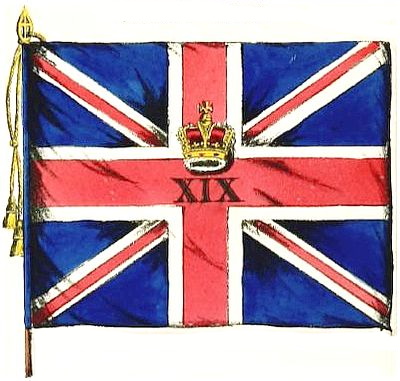
directed to be green. The First, or the King's colour,
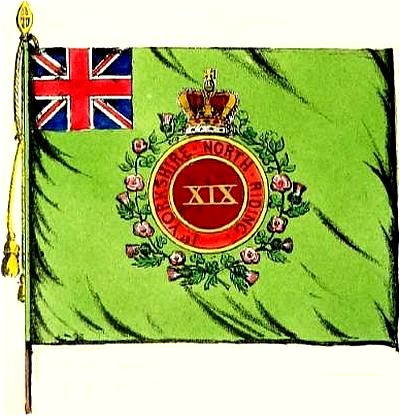
was directed to be the Great Union; the Second, or
Regimental colour, to be the colour of the facings of
the regiment, with the Union in the upper canton; in
the centre of the colour, the Rank of the regiment,
in gold Roman characters, within a wreath of roses
and thistles on the same stalk, surmounted by the
Crown.[9]
1753
1755
1756
Having been relieved from garrison duty at Gibraltar,
in 1753, the regiment returned to England; in 1755 it
was stationed in Scotland; in 1756 it was again stationed
in England.
A dispute respecting the extent of the British dominions
in North America having occasioned another
war with France, the regiment was augmented to two
battalions.
1758
In 1758 the Second battalion was formed into the
SIXTY-SIXTH regiment, under the command of Colonel
Edward Sandford.
1759
1760
During the summer of 1759 the regiment was encamped
at Brentwood, and in 1760 at Barham Downs.
1761
In 1761 the regiment was placed under the orders of
Major-General Hodgson, for the attack of one of the
French islands off the coast of Brittany, called Belle-Isle.
The expedition appeared before this place on the 7th of
April; but the whole island was found like one vast
fortress, the little which nature had left undone by rocks
and crags having been supplied by art; and the first
attempt on the 8th of April, to establish a post on the
island, failed. The NINETEENTH, mustering eight hundred
men, under Lieut.-Colonel Robert Douglas,
evinced great gallantry on this occasion in the assault
of the enemy's entrenchments on the shore; the officers
and soldiers rushed to the attack with heroic bravery,
but were unable to ascend the steep acclivity; they attempted
to help one another up, under a heavy fire, but
failed, and were ordered to re-embark.
The regiment lost Lieutenant Dougal Stuart, three
serjeants, one drummer, and forty-seven rank and file
killed; Major Lumisden, one serjeant, one drummer,
and thirty-eight rank and file wounded; Lieutenants
Scrymsour, Forbes, and Nugent, one serjeant, and
eighty-nine rank and file prisoners, thirty of whom
were wounded.
Another attempt was made on the 22nd of April, when
Brigadier-General Lambert effected a landing on the
rocks near Point Lomaria: the difficulty of mounting
the precipice had made the enemy least attentive to
that part. Beauclerk's grenadiers (NINETEENTH), with
Captain Patterson of the regiment, gained the summit
before the enemy saw what was intended, who immediately
marched a body of three hundred men to
attack them; the grenadiers maintained their ground
till the remainder of Brigadier Lambert's troops got
up. Three brass field-pieces were taken, and some
wounded prisoners. Captain Patterson lost his arm, and
the other casualties were about thirty men killed. The
cannon was afterwards landed from the ships and dragged
up the rocks; the lines which covered the town of Palais
were captured; the siege of the citadel was carried on
with vigour, and the garrison surrendered on the 7th of
June. The conquest of the island was thus achieved,
and the officers and soldiers taken prisoners re-joined
their regiments.
1762
Returning from Belle-Isle when the capture of that
island was completed, the regiment was stationed in
England in 1762.
The war was terminated in 1762 by the peace of
Fontainebleau, and the regiment again proceeded to
Gibraltar, at which fortress it was stationed during the
following eight years.
1768
On the decease of Lieut.-General Lord George
Beauclerk, the colonelcy of the regiment was conferred
on Major-General David Graeme, from the forty-ninth
regiment, by commission dated the 25th of May, 1768.
On the 19th of December, 1768, a warrant was issued
by command of King George III. for regulating the
standards, colours, clothing, &c., of the regiments of
cavalry and infantry, by which it was directed, that the
facing of the NINETEENTH REGIMENT OF FOOT should
be deep green.
1771
Early in the spring of 1771 the regiment was relieved
from duty at Gibraltar, and arrived in England in
May.
1773
1775
In 1773 the regiment was stationed in Scotland; and
in 1775 it embarked for Ireland, where it was quartered
upwards of five years.
1781
The American war commenced in the same year in
which the regiment embarked for Ireland, and was continued
with varied success. In 1781 the regiment was
ordered to proceed to South Carolina and Georgia, to
reinforce the British troops in those provinces; it embarked
from Ireland on the 17th of March, and arrived
in America in May; but the peculiar turn which the
circumstances of the war took shortly afterwards, prevented
the regiment having an opportunity of distinguishing
itself.
1782
A letter, dated the 31st of August, 1782, conveyed to
the regiment His Majesty's pleasure that it should
be designated the NINETEENTH, or the FIRST YORKSHIRE
NORTH RIDING REGIMENT, in order that a connexion
between the corps and that part of the county of York
should be cultivated, with the view of promoting the
success of the recruiting service.
1783
1791
Hostilities terminated in 1782, and the regiment proceeded
to the Leeward Islands; in 1783 it was removed
to Jamaica, where it was stationed until 1791, when it
returned to England, and landed at Portsmouth in
June.
1793
The French revolution had commenced while the regiment
was at Jamaica, and in 1793 the King of France
was beheaded, and a republican government was established,
which was followed by war between England
and France. The French Royalists of La Vendée and
La Loire took arms against the regicide government,
and solicited aid from England; the NINETEENTH regiment
embarked with the expedition under Major-General
the Earl of Moira, to aid the French Royalists,
who expected to be able to gain possession of a
sufficient portion of the coast for the English troops to
land; the expedition was held in suspense, the fleet
being driven about the Channel in stormy weather in the
winter of 1793-4.
1794
No opportunity of landing in France, and of joining the
Vendéeans, having occurred, the regiment disembarked
on the coast of Devonshire in January, 1794, and went
into quarters: the health of the men having suffered
from being long detained on board of the fleet.
After a few months' repose in quarters, the regiment
again embarked, and sailed with the troops under the
Earl of Moira for Ostend, which fortress was menaced
by a numerous French force. The regiment landed at
Ostend on the 26th of June. The Earl of Moira resolved
not to limit his services to the defence of Ostend,
but to attempt to effect a junction with the army commanded
by His Royal Highness the Duke of York; and
after a tedious and difficult march in the face of a victorious
enemy of superior numbers, whose troops were
overrunning the country in all directions, the British
arrived at Alost, where they repulsed the attack of a
body of the enemy on the 6th of July, and joined
the Duke of York's army at Malines three days afterwards.
The allies did not bring into the field a force sufficiently
numerous to contend with the immense armies
of France, and the consequence was a disastrous campaign,
and a retreat through Holland to Germany during
the frosts and snow-storms of an unusually severe winter;
and the NINETEENTH shared, with other regiments, in
the sufferings occasioned by these operations. The regiment
was engaged under Major-General Lord Cathcart
in the attack of the enemy's post at Tuyl on the 30th of
December, when it had five men killed and wounded;
it also took part in several skirmishes, frequently crossing
rivers on the ice to engage the numerous forces of the
enemy.
1795
In the early part of January, 1795, it was found necessary
to resume the retreat, and a series of retrograde
movements, through a country covered with snow and
ice, brought the army into Germany, where the soldiers
obtained a short repose, and afterwards embarked from
Bremen for England.
The NINETEENTH landed from Germany in May, 1795,
and were stationed in England eleven months.
1796
On the 28th of April, 1796, the regiment embarked
for the East Indies, and landed at Madras in the middle
of November following.
A short time previously to the arrival of the regiment
in India, the large and mountainous island of Ceylon,
situate in the Indian Sea, had been captured from the
Dutch, who had become united with France in hostility
to Great Britain. After reposing a few weeks at
Madras, the regiment received orders to transfer its services
to Ceylon, and it landed at Columbo, the capital
of the island, in December, 1796.
1797
General David Graeme died in January, 1797, and
King George III. conferred the colonelcy of the regiment
on Major-General Samuel Hulse, from the fifty-sixth
regiment of foot.
In the island of Ceylon, which produces a great
diversity of vegetables, the finest fruits, and spices of
good quality, particularly cinnamon, the regiment was
stationed twenty-four years.
1798
About this period the officers and soldiers of the
NINETEENTH regiment subscribed one day's pay, amounting
to £84, for the relief of the widows and children of
the men killed in the victory obtained by Admiral Lord
Nelson over the French fleet at the battle of the Nile,
on the 1st of August, 1798. The regiment subscribed
also 2500 pagodas (8s. 9d. each) towards carrying on
the war in Europe.
1799
Five companies embarked in February, 1799, for the
continent of India, to take part in the war with the ruler
of the province of Mysore, the celebrated Tippoo Saib,
whose adoption of French counsels, and hostility to the
British interests, proved his ruin. The Mysore was invaded
by the British troops, under Lieut.-General (afterwards
Lord) Harris, in March, 1799, and the army advanced
by triumphant marches to the capital, the strong
and splendid city and fortress of Seringapatam, which was
captured by storm on the 4th of May, when Tippoo
fell, mortally wounded, in the defence of the place.
The capture of the capital having terminated the war
in the Mysore, the five companies of the regiment afterwards
returned to Ceylon.
1800
From Columbo, the regiment marched, in October,
1800, to Point de Galle, where the head-quarters were
stationed several months.
1801
In April, 1801, the regiment embarked for the
harbour, town, and fortress of Trincomalee, situate in
a barren tract of country on the north-east side of the
island of Ceylon, from whence detachments were sent
to various posts in the interior. The centre of the
island appeared to be defended against the approach of
Europeans by the unhealthy climate of the district,
through which it was necessary to pass to enter the
inland provinces, which were governed by a native
chief called the King of Candy.
1802
In 1802 a treaty of peace was concluded between
England and France and Holland; but the island of
Ceylon was retained by the British.
1803
War with France and Holland was resumed in 1803,
and, at the same time, it was found necessary to commence
hostilities with the Candians, inhabiting the
interior of the island of Ceylon, with whom attempts
had been made to establish a treaty of amity and commerce,
but without success.
Some outrages having been committed by the Candians
on British subjects, demand was made for reparation,
which was evaded on various pretences, and a body of
troops, of which a detachment of the NINETEENTH regiment
formed part, penetrated through the unhealthy
districts into the interior, to demand redress, and to
exact security against the repetition of outrage. The
troops experienced little opposition, and advanced to
Candy, the capital, which was found abandoned by the
inhabitants. A treaty was framed, and everything
appeared in a train for a satisfactory arrangement; but
after evincing unparalleled duplicity and treachery, the
population of the surrounding districts suddenly attacked
the town after hostilities had ceased, and the British
troops, under Major Davey, being overpowered by
numbers, agreed to capitulate, on condition of being
allowed to march with their arms to the British settlements
on the coast. These conditions were violated;
the British soldiers were barbarously massacred, at
Candy, on the 24th of June, excepting a few men who
escaped, or were spared by the assassins; the Malays
in the English service were required to enter the
Candian service, and all who refused were destroyed.
The NINETEENTH regiment had the following officers
and soldiers massacred on this occasion,—Lieutenants
M. H. Bynn, Peter Plenderleath, and Hector M'Lean,
Ensign Robert Smith, Quarter-Master John Brown,
Assistant-Surgeon William Hope, and one hundred and
seventy-two non-commissioned officers and privates.
After this act of perfidy and cruelty the Candians
attacked the British settlements, and gained some
temporary advantages; but were eventually driven
back with loss. The surviving officers and soldiers of
the NINETEENTH regiment were employed in much
harassing and perilous service, and many casualties were
occasioned by the climate. Captain Beaver particularly
distinguished himself, and the governor, Major-General
McDowall, expressed his sense of the captain's services,
in general orders dated Columbo, 2nd September, 1803,
in the following terms: "The Governor has observed,
with peculiar satisfaction, the rapid series of well-judged
and well-executed operations, by which
Captain Herbert Beaver, of the NINETEENTH regiment,
has hitherto proceeded, in recovering the
important province of Matura from the Candians,
and in bringing back its deluded inhabitants to their
duty. The indefatigable activity, zeal, and ability,
which that officer has displayed, since his assumption
of the command in that district, has fully justified
the high opinion which his Excellency had formed of
him from his former services, and which induced the
Governor to appoint him to that arduous station, in
a time of such extreme difficulty and discouragement."
The governor also expressed his approbation of the
conduct of the officers and soldiers serving under
Captain Beaver.
1804
In 1804 the Candians again made preparations for
an attack on the British settlements; and the English
troops penetrated the provinces of Candy. Some sharp
fighting occurred; and on the 14th of October Lieutenants
B. Vincent and H. L. Smith were killed at
Fort McDowall.
1805
Another attack on the British territory was made in
the early part of 1805; but the Candians were completely
routed in every quarter. In October of this
year the NINETEENTH regiment embarked for Columbo.
1806
The regiment proceeded by sea to Trincomalee in
September, 1806; but marched back to Columbo two
months afterwards.
1807
1808
During the years 1807 and 1808, the regiment was
stationed at the capital of the island of Ceylon.
1809
Disputes of a tedious and complicated character
between the British government and the Rajah of
Travancore, a province situated at the south-west
extremity of Hindoostan, occasioned the NINETEENTH
regiment to be withdrawn from Ceylon in February,
1809, and to proceed to Madras to join the troops
designed for the reduction of the hostile Rajah. The
country of Travancore was taken possession of without
much serious opposition, when a force of sufficient
strength was assembled for that purpose, and the Rajah
was forced to submit. In December the regiment
returned to Ceylon.
1810
General Sir Samuel Hulse having been removed to
the sixty-second regiment, the colonelcy of the NINETEENTH
was conferred on Lieut.-General Sir Hew
Dalrymple from the thirty-seventh, by commission
dated the 25th of June, 1810.
The war with France was continued, a British army
was fighting for the liberties of Europe in Portugal and
Spain, and in 1810 the English government resolved to
deprive Napoleon of the Isle of France, now called the
Mauritius, the only remaining territory in the possession
of France, in the East. To take part in this enterprise,
four companies of the NINETEENTH regiment embarked
from Ceylon on the 6th of September, 1810. The
expedition rendezvoused at the island of Rodriguez,
from whence it sailed to the Isle of France, and a
landing was effected on the 29th of November. The
troops suffered much from the want of water in their
advance upon Port Louis, the capital, and finding a
plentiful supply at the powder-mills on the road, they
halted there during the night of the 30th of November.
Some sharp skirmishing occurred, and several men
were killed and wounded. On the following day the
troops resumed their march; drove the French from
their positions with great gallantry; and forced the
governor to surrender this valuable colony in three days.
The four companies afterwards returned to Ceylon.
1811
Lieut.-General Sir Hew Dalrymple was removed, in
April, 1811, to the fifty-seventh regiment, and was
succeeded in the colonelcy of the NINETEENTH by Major-General
Hilgrove Turner, from the Cape regiment.
1812
1813
1814
The reigning sovereign of Candy evinced so cruel and
tyrannical a disposition, that he became odious to his
subjects, who experienced a total insecurity of life and
property under his rule, individuals being frequently
deprived of both at the caprice of the king. The
governor of one of his provinces was summoned to appear
at the capital; but this chief, expecting that the
sacrifice of his life, and the seizure of his property, were
intended, did not obey the mandate. The king
assembled an army, overpowered the forces of the
disobedient chief, and forced him to fly for protection
to the British settlements. About the period when
these events agitated the interior of the island of Ceylon,
the NINETEENTH regiment embarked for Trincomalee,
where it arrived in the beginning of March, 1814.
1815
Elated with his success against the disobedient chief,
the King of Candy prepared to invade the British territory;
and the governor, Major-General Brownrigg, resolved
to preserve the English provinces from aggression by
invading the kingdom of Candy. The British troops
advanced into the kingdom of Candy, in seven divisions,
in the beginning of February, 1815, and the NINETEENTH
regiment marched from Trincomalee to take part in
this service. The soldiers underwent great fatigue in
crossing mountains, passing morasses and rivers, and
traversing regions inhabited only by the wild beasts of
the forest; they succeeded in overcoming all opposition,
and arrived at the capital in the middle of February.
The king fled; but he was seized by his own subjects,
ill-treated, and brought a prisoner to the British camp.
An assembly of Candian chiefs declared the Malbar
dynasty deposed, and the provinces of Candy united to
the dominions of the British crown. Thus was an
extensive tract of country, bountifully endowed with
natural gifts, and producing the necessaries and luxuries
of life, including spices, metals, and precious stones,
added to the British dominions; a numerous race of
human beings, of a peculiarly interesting character, was
delivered from the power of despotism, and brought
under the advantages of the just government and
equitable laws of Great Britain. Every species of
torture was immediately abolished; but the ancient
religion of the inhabitants, and the former mode of
administering justice, were preserved. The conduct
of the British troops was highly meritorious, and
reflected credit on the several corps employed on this
enterprise: the soldiers abstained from plunder and
violence, and behaved with such order and regularity
as to conciliate the inhabitants, whose condition, improved
by a policy founded on liberal ideas, and exhibiting
enlarged views, prepared the way for their emancipation
from the errors of superstition, and their introduction
to the advantages of Christianity, and of
European arts, sciences, and commerce.
The British troops occupied posts in the newly-acquired
territory, and the corps not required for this
duty returned to their former quarters.
1816
The NINETEENTH regiment remained at Trincomalee,
and other stations in that quarter of the island, until
February, 1818, when it returned to Columbo.
1818
Soon afterwards a new claimant to the throne of
Candy arrived in that country, from the continent of
India, and being supported by several native chiefs, who
were hostile to the British interests, a rebellion took
place. This event called the NINETEENTH again into the
field; they marched for Candy in April, 1818, and again
traversed mountainous districts and wild and beautiful
regions; some desultory fighting occurred; but a greater
loss of life was occasioned by the climate, than by the
swords of the insurgents. The rebellion was suppressed;
the regiment returned to Columbo in September; and
in October it marched to Point de Galle.
1819
1820
After serving twenty-three years at Ceylon, and
taking a distinguished part in the important events
which had occurred in that island, the regiment was
relieved from duty there, and embarked for England
in January, 1820; it landed at Gravesend on the 19th
of May, and was stationed in the south of England
during the remainder of the year.
1821
In February, 1821, the regiment marched to Weedon
Barracks; and in November embarked from Liverpool
for Ireland, and, after landing at Dublin, marched to
Mullingar, Longford, Tullamore, Philipstown, and
Maryborough.
1822
1823
1824
1825
1826
The regiment remained in Ireland during the years
1822, 1823, 1824, and 1825; in the autumn of 1826 it
was divided into six service and four depôt companies:
the service companies embarked from Cork in October,
for the island of Demerara, where they arrived in
December.
1830
The depôt companies were stationed in Ireland until
June, 1830, when they embarked from Cork for Portsmouth,
where they arrived in two days.
1836
After occupying various stations in the British West
India Islands, during the period of nearly ten years, the
service companies embarked from Barbadoes in July,
1836, and landed at Cork in August: they were afterwards
joined by the depôt companies from England.
1837
1838
During the years 1837 and 1838, the regiment was
stationed in Ireland; in December, 1839, it embarked
from Dublin for Bristol; but returned to Ireland in
March following.
1840
In the summer of 1840 the regiment was again
divided into six service, and four depôt companies, and
in September the service companies embarked from
Cork for the island of Malta, where they landed on the
3rd and 13th of October.
1841
1842
The depôt companies left Ireland in 1841, and were
stationed a short time at Gosport; they proceeded to
Brighton in March, 1842, and to Dover Castle in
October.
1843
General Sir Hilgrove Turner, G.C.H., K.C., died at
Jersey, in May, 1843, and General Sir Warren Marmaduke
Peacocke, K.C.H. and K.C., was appointed by Her
Majesty Colonel of the NINETEENTH regiment.
The service companies proceeded in the Resistance
troop-ship from Malta to the Ionian Islands on the 9th
of January, 1843, under the command of Lieutenant-Colonel
Hay, and arrived at Corfu on the 20th of the
same month; five days afterwards the head-quarters and
three companies embarked in the Boyne transport for
Cephalonia.
In October, 1843, the depôt companies marched from
Dover to Winchester, and from thence to Portsmouth,
where they embarked for Jersey.
1845
On the 18th of June, 1845, the depôt companies embarked
at Jersey for Ireland, and disembarked at Waterford.
On the 5th of December, 1845, the service companies
of the NINETEENTH regiment embarked at Corfu for
the West Indies, in the Java freight-ship, under the
command of Lieutenant-Colonel Charles Hay.
1846
The regiment arrived at Barbadoes on the 19th of
January, 1846.
1847
In February, 1847, the regiment embarked at Barbadoes
for St. Vincent.
1848
The regiment returned to Barbadoes in April, 1848,
and was transhipped on board the Bombay transport on
the 12th of that month, and sailed in a few days for
North America.
On the 1st of July, the date to which the record has
been continued, the service companies were stationed at
Montreal, under the command of Major Sanders, and
the depôt companies, under Major Calley, remained in
Ireland, the head-quarters occupying the barracks at
Castlebar.
1848
The details narrated in the foregoing pages, contain
accounts of the services of the NINETEENTH REGIMENT
OF FOOT, for a period of one hundred and sixty years,
and although the Regimental colour does not display any
mark of distinction for services performed, yet the record
of the regiment proves, that when opportunity has
offered, the regiment has evinced that zeal and devotion
to its country's cause, and that patient endurance and
bravery in the field, for which every British corps has
been distinguished; these qualities were shown in the
war in Flanders under King William III., particularly
at the battles of Steenkirk and Landen, and at the siege
of Namur, from 1692 to 1695; again in Flanders in
1710 and 1711, with the army under the command of
the Duke of Marlborough. The regiment again distinguished
itself in the war in Flanders, particularly at
the battles of Fontenoy, Roucoux, and Val, in 1745,
1746, and 1747. In 1761, in the attack and capture
of Belle Isle, where nature as well as art had combined
to render the place impregnable, the regiment evinced
an extraordinary degree of bravery. Its services were
again evinced in Flanders, with the army under His
Royal Highness the Duke of York, in 1794 and 1795.
The regiment has also been distinguished by long
and arduous services in the eastern parts of the world
from 1796 to 1820; it was engaged in the storming of
Seringapatam on the 4th of May, 1799, where the celebrated
Tippoo Saib was mortally wounded, and the
city captured. Its services in the conquest of the
Island of Ceylon and the deposition of the King of
Candy, in 1815, likewise form an important and honorable
era in the records of the regiment; the gallantry of
the troops on this occasion caused the annexation of the
colony of Ceylon to the British dominions, and the conduct
of the NINETEENTH regiment in suppressing the
rebellion in that island, in 1818, secured the possession
of this valuable appendage to the territories of Great
Britain.
The services of the NINETEENTH regiment in the
Field, as well as in arduous Colonial duties, have
been such as to show in the foregoing pages, that
the officers and men have ample cause for feelings
of pride in the honor acquired by the corps in whatever
duty it has been employed, and this tribute
of commendation is considered to be justly due to a
regiment, the services of which have been so highly
meritorious during a period of one hundred and sixty
years.
1848.
NINETEENTH REGIMENT OF FOOT.
Madeley lith. 3 Wellington St. Strand
FOR CANNON'S MILITARY RECORDS