OF
THE FOURTH,
OR
THE KING'S OWN, REGIMENT OF FOOT.
1680
The city of Tangier on the coast of the kingdom of
Fez, in Africa, having been ceded in 1661, by Portugal,
to King Charles II., as part of the marriage portion of
the Infanta, Donna Catherina, this fortress, with a portion
of the adjoining territory, had constituted a part of
the possessions of the British crown for a period of nearly
twenty years, when circumstances occurred, which gave
rise to the formation of the REGIMENT which is the subject
of this memoir, for service in that part of His Majesty's
dominions.
This ancient and renowned city had been successively
in the power of the Phœnicians, Romans, Vandals, Saracens,
Portuguese, and Spaniards, and it had been the scene
of armed contentions and sanguinary wars, in remote ages
as well as in modern times. It had formerly been celebrated
as one of the most splendid cities in that quarter
of the world, but had fallen from its ancient power and
magnificence; and when it came into the possession of the
British crown, fragments of ruins were all that remained to
indicate its former grandeur. It had been much strengthened
and improved by the English after their possession
of it; detached forts had been constructed, and large
sums of money had been granted by the parliament for
improving the harbour and enlarging the defences.
Much opposition had, however, been met with from the
native chiefs, who availed themselves of all the means
within their power for exterminating the Christian
occupants of this part of Africa. The garrison had
already resisted many attempts of its daring and inveterate
enemies, particularly in the time of Gaylan, the usurper
of Fez; but in 1680 the city was besieged by an immense
force, and the Moors had the advantage of having
several European renegades in their army, by whom
they had been taught the art of mining and of carrying on
approaches under ground. Not only the national honour
and the credit of His Majesty's arms were concerned in the
preservation of this fortress, but, in the event of its capture
by the Moors, the Levant trade was likely to suffer
some interruption from its harbour becoming the resort
of pirates.
King Charles II., therefore, sent thither a battalion of
foot guards and sixteen companies of Dumbarton's regiment,
(now first royals,) and issued, in July, 1680, warrants
for raising six independent troops of horse and a
regiment of foot, to augment the garrison, and to enable
it to chase from under the walls the native forces by
which it was menaced.
The first troop of horse was raised by Major-General
the Earl of Ossory, who was nominated governor of His
Majesty's possessions in Africa; and the others by Lieut.-Colonel
Sir John Lanier, and Captains Robert Pulteney,
John Coy, Charles Nedby, and Thomas Langston.
The regiment of foot was ordered to consist of sixteen
companies of sixty-five private men each, besides officers
and non-commissioned officers; and the colonelcy was
conferred on Charles Fitz-Charles, Earl of Plymouth,
a daring aspirant to military fame, who had
already distinguished himself against the Moors in the
character of a volunteer, and was serving at Tangier at
the time the regiment was raised.
The royal authority for raising this regiment was given
on the 13th of July, 1680, and the sixteen companies of
which it was composed, were raised by the following
officers; Lieut.-Colonel Piercy Kirke,[6] Major Charles
Trelawny, and Captains Zachariah Tiffin, Henry Trelawny,
Edward Hastings, Charles Fox, Edward Griffin,
John Strode, Edward Saville, Roger Pope, Walter Fitzgerard,
John Grimes, Robert Ansley, Arthur Cheffors,
and John Southcote, and the captain-lieutenant of the
colonel's company. Eight companies were raised in London
and in its vicinity under the immediate superintendence
of Lieut.-Colonel Kirke, and had their general
rendezvous in Clerkenwell; and the other eight companies
were raised in the west of England, with their
general rendezvous at Plymouth, under the superintendence
of Major Trelawny.
The corps thus raised obtained the title of the
Second Tangier Regiment,[7] and after serving the
British crown in various parts of the world, through the
eventful period of one hundred and fifty-eight years, it
continues a distinguished corps, and bears the designation
of the Fourth, or the King's Own, Regiment of
Foot. Although the particulars of its origin and formation
have been distinctly given, yet it was in some
measure connected with another corps, of whose services
a few words are introduced into this record.
On the breaking out of the war between England and
Holland in the early part of 1672, a regiment of foot
was raised, of which James Duke of Monmouth was
appointed colonel. This regiment was sent to France, and
taken into the pay of Louis XIV.; it served during the
campaigns of 1672 and 1673, under the Duke of Monmouth,
in the Netherlands, and during the four succeeding
years it served with the French army in Alsace and
on the Rhine, together with Douglas's or Dumbarton's
regiment, now first royals, Churchill's, and Hamilton's.
In these campaigns Monmouth's regiment distinguished
itself on several occasions under Marshals Turenne, De
Crequi, and Luxemburg. In 1678 it was ordered to
return to England, and after the peace of Nimeguen it
was disbanded.
When the Earl of Plymouth's regiment was raised,
many of the officers of Monmouth's late regiment were
appointed to commissions in this new corps, through
whose influence many of the non-commissioned officers
and soldiers, who had served in the Netherlands, France,
and Germany, were induced to enter the same regiment.
By these means, and by the aid of a few men
from the Holland regiment, now third foot, or the buff's,
the Earl of Plymouth's, or Second Tangier Regiment,
was completed in numbers, equipped,[8] instructed
in the simple exercises practised at the time, and ready
to embark for foreign service in less than four months
after the order for its being raised was issued.
The service for which these forces were raised being
urgent, three of the troops of cavalry (Langston's,
Nedby's, and Coy's) were provided with horses from the
life guards and royal regiment of horse guards, and
sailed as soon as possible; the Earl of Plymouth's
regiment also embarked with all possible expedition, and
sailed in November.
In the mean time the garrison of Tangier had overpowered
the Moorish army in a sharp action under the
walls, and a truce had been agreed upon for six months;
and when information of this event arrived in England,
the other three troops of horse (viz. Ossory's, Lanier's,
and Pulteney's) were disbanded.
This truce was in operation when the Earl of Plymouth's
regiment arrived at Tangier; and the officers
and men learned that their colonel had died a few weeks
previously of dysentery. He was succeeded in the
colonelcy by the lieut.-colonel, Piercy Kirke, who was
also appointed commander-in-chief of the garrison.
Shortly afterwards an ambassador from the court of
Fez arrived, and made his public entry into the city of
Tangier on the 2nd of December; his reception is thus
described in the London Gazette:—"Colonel Kirke, our
commander-in-chief, went out to meet him between
eleven and twelve. Four troops of horse marched first;—after
them fifty chosen grenadiers of the Earl of Dumbarton's
regiment; then thirty gunners with their linstocks;
followed by thirty negros in painted coats, with
their brown-bills (a sort of battle-axe); and after these
rid Colonel Kirke, surrounded with twenty gentlemen
well mounted, and having six men of the tallest stature,
with long fusils, on each side of his horse; in which
order, having proceeded a good distance beyond Fountain
Fort, the party of Moors, which was about two
hundred horse with their lances, being now within musket
shot of us, made a halt. The ambassador with
about thirty persons advanced towards Colonel Kirke,
who received him with those compliments which are
customary. Colonel Kirke then went to make his salutations
to the alcaid, Aley Benanbdala, vice roy of
those countries, who remained at the head of the Moorish
party; which being ended, the alcaid and the
ambassador with each of their parties began a skirmish,
it being their manner of rejoicing and expressing
their satisfaction. Having shown their horsemanship
and skill in managing their lances and fusils, they parted,
the alcaid going off with his men, and the ambassador
with his train proceeding with Colonel Kirke to
the town; where all the regiments in garrison were
formed up to augment the splendour of his public
entry."
1681
In the succeeding year Colonel Kirke proceeded on an
embassy to the court of the vice-roy of Fez, and also to
that of the Emperor of Morocco, and a treaty of peace
between the English and Moors was concluded. A
diary of Colonel Kirke's journey, with a description of his
reception, and of the court of the African potentate, was
published at the time, and appears more like an airy
vision of the imagination, or a few pages from an eastern
romance, than a narrative of facts.
1682
After the decease of Sir Palmes Fairborne (who was
killed in an engagement with the Moors on the 24th of
September, 1680), Colonel Kirke was removed to the
colonelcy of the first Tangier (now the second or queen's
royal) regiment, and was succeeded by the lieut.-colonel,
Charles Trelawny, by commission dated the 23d of
April 1682.
The improved military system of the Moors, introduced
by the employment of European renegades, having rendered
it necessary to maintain a much stronger garrison
at Tangier than formerly, His Majesty brought the subject
before parliament; but the people of England were
more alarmed at the prospect of a popish successor to the
throne than at the danger of losing this fortress, which they
considered as an asylum for popish recusants, and consequently
no further grant was voted.
1683
A free intercourse had been established with the Moors,
and a traffic by barter was carried on to the benefit
of the town; but all the advantages expected to be derived
from the possession of this fortress had not been
realized, and King Charles II. was unwilling to bear,
without any pecuniary aid from parliament, the expense
of the fortifications and troops. He accordingly sent,
towards the end of 1683, Admiral Lord Dartmouth with
a fleet, to destroy the fortifications, and to bring away the
British inhabitants and garrison.
1684
The regiment arrived in England from Tangier in
February, 1684, and was placed in garrison at Portsmouth,
where it remained upwards of twelve months; and its
establishment was reduced from sixteen to twelve companies.
In the autumn of this year His Majesty conferred upon
the regiment the title of Her Royal Highness the
Duchess of York and Albany's Regiment. What
its distinguishing colour, or livery (which is now called
facing), was on its formation, has not been ascertained;
but in October of this year it was YELLOW. This appears
to have been a favourite colour of the Duke of
York, (afterwards James II.) as his troop of life guards
had yellow horse furniture, belts covered with yellow
velvet, yellow ribands on the horses' heads and tails, and
also yellow ribands in the men's hats; and his marine
regiment, called the Admiral's Regiment, was clothed in
yellow.
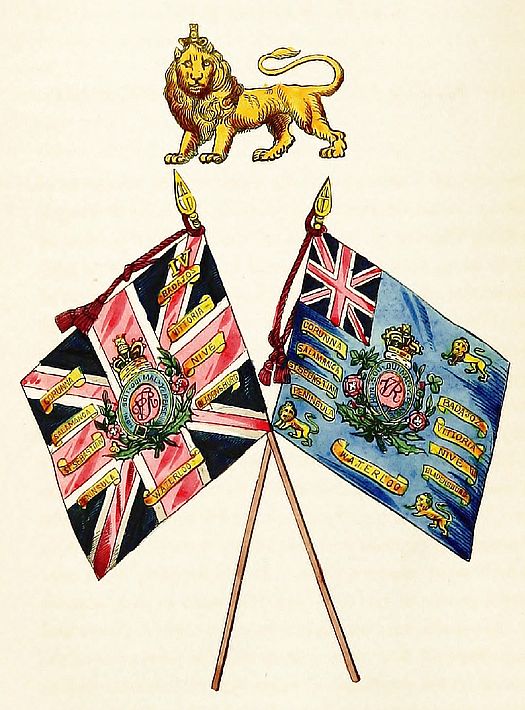
The colours of the regiment were of yellow silk, with
the red cross of St. George bordered with white; the rays
of the sun issuing from each angle of the cross, or; and
Her Royal Highness's cypher in the centre.
1685
On the 6th of February, 1685, King Charles II. died,
and was succeeded by his brother, James Duke of York;
and the Duchess of York having become Queen of England,
this regiment was styled the Queen's Regiment
of Foot: the first Tangier regiment had previously been
styled the Queen's, and was now designated the Queen
Dowager's regiment.
The much dreaded event—the accession of a papist to
the throne—had now occurred; but the minds of the
people were partially set at ease by the King's declaration
of his determination to maintain the protestant religion
as by law established. This did not, however, prevent
several rash adventurers from urging James Duke of
Monmouth, to make an attempt to gain the throne. This
nobleman was the illegitimate son of the late king,—was
of prepossessing appearance and address,—a steady advocate
for the protestant religion,—had gained a reputation
for military virtues,—and had become a favourite with
the people. Being urged to this enterprise by his desperate
associates, he raised the standard of rebellion in
the west of England in June, 1685; and, having been
joined by a number of miners and other persons, proclaimed
himself king.
The Queen's Regiment of Foot was reposing in
quarters at Portsmouth and performing the duties of the
garrison, when the news of Monmouth's rebellion produced
an electric sensation throughout the country. The
regular army was augmented; the militia was called out;
and this regiment was ordered to recruit its numbers
to one hundred men per company. Soon afterwards five
companies, under the command of Lieut.-Colonel Charles
Churchill, were ordered to march in charge of a train of
artillery, consisting of seven field-pieces, to join the army
under the command of Lieut.-General the Earl of Feversham,
which was assembling to oppose the rebels.
The five companies of the Queen's Regiment having
joined the other forces with the artillery, the army
advanced to the village of Weston, and the infantry encamped
on Sedgemoor, the two Tangier regiments
taking the left of the line. The rebel army lay at
Bridgewater, and during the night of the 5th of July the
Duke of Monmouth advanced with the view of surprising
the King's troops in their camp; but his approach was
discovered, and the camp was alarmed by the cavalry
out-guards. The rebels, however, rushed forward, and
a fierce conflict of musketry ensued in the dark. The
first attack was made against the royals on the right;
and extending along the front to the left, the companies
of the Queen's Regiment became sharply engaged, and
"performed good service." Soon after day-break the
King's cavalry charged the flanks of the rebel army
and put it into confusion. An entire rout ensued,
and the insurgents were pursued across the moor and
adjoining fields with great slaughter; many were taken
prisoners; and their leader, the Duke of Monmouth,
was captured two days afterwards near Ringwood, in
Hampshire, and was removed to London, and beheaded.
After the suppression of the rebellion, the five companies
of the Queen's Regiment returned to Portsmouth:
their conduct was highly approved by his Majesty,
and soon afterwards the regiment was presented
with a set of new colours—one to each company; and
it continued to display TWELVE COLOURS for several years
from that period. Two of the new colours were presented
by the Queen, and the other ten by his Majesty:
of the expense of the former no account has been met
with; but some idea may be formed of the splendid appearance
of these colours, from the fact that the ten presented
by the King cost upwards of twenty pounds each.[9]
A copy of the bill, amounting to £206 5s. 6d., is preserved
in the official records in the War Office. A copy
of the royal warrant, dated 21st of August, 1686, for the
payment of this sum, is inserted below.[10]
During the summer ten companies of the regiment
were ordered to proceed from Portsmouth to Taunton
in Somersetshire, to attend the Lord Chief Justice
Jeffreys, who was appointed by King James II. to try
the prisoners taken at the battle of Sedgemoor, and a
number of other persons who were charged either with
being concerned in the rebellion, or with countenancing
or aiding the ill-fated duke and his adherents. The
narrative of the proceedings of the Lord Chief Justice,
and of the painful duties which the troops who attended
on him had to perform, forms one of the black pages of
the history of this country; and the remorseless and
sanguinary character of the judge has occasioned him
to be held up to deserved execration. Colonel Kirke
and his regiment have also been charged with acts of
cruelty, although the accounts may have been exaggerated;
but the conduct of the ten companies of the
Queen's Regiment escaped censure, as their services
appear to have been limited to the guarding of prisoners,
and the preserving of order at executions, which were so
numerous that these were termed the BLOODY ASSIZES.
1686
1687
The Queen's Regiment remained in extensive cantonments
in the western counties until the spring of 1686,
when it was ordered to march to Plymouth, where it
passed the succeeding twelve months. It was withdrawn
from Devonshire in March, 1687, and was stationed a
short time at Salisbury and Wilton, from whence it
marched to Hounslow in June of the same year, and
pitched its tents on the heath. After having been twice
reviewed by King James II., the regiment struck its
tents on the 5th of August, and marched to Bristol,
Bath, and Keynsham.
1688
In the spring of 1688, the regiment proceeded to Portsmouth,
and passed the summer months in that garrison;
but in September it was ordered to march to London.
The short period during which King James II. had occupied
the throne, had been pregnant with events of a most
alarming character to the nation, and every evil which
the people had feared would follow the accession of a
popish prince to sovereign power, appeared on the eve of
transpiring. The rebellion of the Duke of Monmouth
had furnished the King with a pretext for augmenting
the regular army, which he continued on a high establishment,
and increased, from time to time, without the consent
of parliament. The troops were embodied by the
authority of the crown only, and were paid, either from
the civil list, or by diverting moneys, intended for other
objects, to that purpose; and the King even appeared to
have formed the design of governing without parliaments,
of rendering himself absolute, and of subverting the reformed
religion. His Majesty's principal dependence for
the success of his unconstitutional projects was placed
in the devotedness of his troops; but his conduct disgusted
the military as well as his other subjects; and
the cheers of the soldiers on Hounslow Heath at the
acquittal of the bishops, whom the King had imprisoned
and brought to trial for opposing his measures, proved
that he had entirely lost their sympathy, and could no
longer trust to them for support.
The King's proceedings having filled the nation with
alarm and consternation, the Prince of Orange, who was
the King's nephew and son-in-law, and a zealous advocate
for the Protestant interest, was solicited to come to England
with a body of troops to assist the nobility and gentry
in opposing the proceedings of the court. At the same
time, many of the superior officers of the English army,
who were most zealous for the welfare of the kingdom
and the preservation of the reformed religion, seeing the
danger to which the constitution in church and state was
exposed, formed themselves into a secret association, and
engaged not to fight in the cause of papacy and arbitrary
power, but to further the objects of the Prince of Orange;
and Brigadier-General Charles Trelawny, Colonel of the
Queen's regiment of foot, was one of the members of
this association.
When the Prince of Orange had landed at Torbay (5th
of November) the regiment proceeded by forced marches
to Salisbury, and afterwards to Warminster, which was
the most advanced post of the King's army, and was occupied
by the third troop of life guards, the Queen's, and
Major-General Werden's regiments of horse, the Queen's
regiment of dragoons, with two battalions of the royals,
and the Queen Dowager's and Queen Consort's regiments
of foot,[11] commanded by Major-General Kirke and
Brigadier-Generals Trelawny and Maine.
The King arrived at Salisbury on the 20th of November,
and on the 21st reviewed his forces stationed in and near
that city; and a number of officers and soldiers having
already deserted to the Prince of Orange, His Majesty
addressed the troops on the subject, and gave liberty to
all who were unwilling to serve him, to depart without
molestation. This appeal to their loyalty was followed
with such shouts and assurances of attachment, that the
King's confidence, which had been much shaken, was in
a great measure restored. On the following day His
Majesty designed to have visited the advanced post at
Warminster, but was prevented by a bleeding at the nose,
to which he was constitutionally subject. The Duke of
Berwick states in his memoirs,—"The King intended
to go from Salisbury in my coach to visit the quarter
commanded by Major-General Kirke; but was prevented
by a prodigious bleeding of the nose, which
seized him on a sudden, and it is said, that a scheme
was laid and measures taken by Churchill and Kirke,
to deliver up the King to the Prince of Orange; but
this accident frustrated the design." Brigadier-General
Trelawny is also charged with participating in this design;
but no direct proof on the subject has been adduced by
any historian.
The number of desertions increasing, the King ordered
the army to retire towards London, when the cavalry
was withdrawn from Warminster by Brigadier-General
Maine of the third troop of life guards; and orders were
sent to Major-General Kirke to march with the infantry
to Devizes, but he refused, and was placed in arrest and
sent under a guard to London. Brigadier-General Trelawny,
expecting a similar fate, withdrew, with his
lieut.-colonel, Charles Churchill, and about thirty non-commissioned
officers and soldiers, and joined the Prince
of Orange. The King sent Lieut.-General the Earl of
Dumbarton to Warminster with two squadrons of horse,
and he brought off the remaining officers and men of the
four battalions without interruption.
After Brigadier-General Trelawny had joined the
Prince of Orange, the King gave the colonelcy of the
Queen's regiment of foot to Sir Charles Orby from the
commission of lieut.-colonel in the third troop of life
guards. But His Majesty, finding the army, on which he
had depended, would not be subservient to his designs,
fled from London with the view of escaping to France;
the Prince of Orange assumed the reins of government,
and ordered the regiment to march to Hertford and
Ware; and His Highness restored Brigadier-General
Trelawny to the colonelcy, and promoted Lieut.-Colonel
Charles Churchill to the command of the Holland regiment,
now the third foot.
1689
The regiment continued to occupy quarters in the
south of England after the accession of William and
Mary, and passed the winter of 1689 at Exeter.
1690
In the mean time Ireland had become the scene of
conflict between the Roman Catholics and Protestants,
and King James, having proceeded thither with a body
of French troops, had reduced the greater part of that
kingdom under his sway, and had maltreated the Protestants
in various ways. In 1689 King William sent
Duke Schomberg, with a body of troops, to aid the Protestants,
and in 1690 His Majesty resolved to take the
field in person. The Queen's regiment of foot was
selected to form part of the army in Ireland, and having
embarked from Barnstaple in the middle of April, put
to sea, but was driven by severe weather to Pembroke.
Here the regiment remained about a week, and having
again put to sea on the 30th of April, landed at Belfast
on the 2d of May. King William arrived in Ireland on
the 14th of June, and placing himself at the head of the
army, advanced to the banks of the Boyne, on the opposite
side of which river King James's army was formed
in order of battle.
At day-break on the morning of the 1st of July, the
regiment was under arms, every man displaying a green
branch in his hat, to distinguish him from the enemy,
who wore pieces of white paper in their hats, and the
cheerful countenances of the musketeers, pikemen, and
grenadiers seemed to give presage of victory. About
six o'clock the regiment, with the remainder of Brigadier-General
Trelawny's brigade, forming part of the force
under Count Schomberg and Lieut.-General Douglas,
filed to the right, and having marched about two miles
up the river, forded the stream between the King's
camp and Slane bridge. Sir Neal O'Neal's regiment
of Irish dragoons, in the service of King James, offered
some opposition; but was speedily routed and its commanding
officer was mortally wounded. After passing
the river, Trelawny's brigade halted a short time until
additional forces arrived; then advancing through corn
fields, over deep ditches, and across a difficult bog, drove
the enemy's left wing from its ground in a spirited
manner, and forced it to make a precipitate retreat
towards Duleek. When the enemy's left flank was thus
turned, King William passed the river with the other
divisions of his army, and King James's forces were
overpowered and chased from the field. Thus a decisive
victory was gained, and the troops halted during the
night near Duleek.
The regiment advanced with the army upon Dublin,
and at the review at Finglass, on the 7th and 8th of
July, it mustered (according to the official rolls) five
hundred and fifty-three private men, besides officers and
non-commissioned officers. The enemy having fled from
Dublin, the regiment was stationed several weeks in
garrison in that city, of which its colonel was appointed
governor.
Meanwhile the combined English and Dutch fleets,
commanded by Lord Torrington and Admiral Evertsen,
had engaged (30th of June) the French fleet under
the Count de Tourville, off the Beachy, and the Dutch,
being in the van, suffered so severely, that the enemy
not only claimed the victory, but actually gained the
ascendancy at sea, and menaced England with an
invasion. A body of French landed on the western
coast, and destroyed a village, and this event having produced
considerable alarm, King William ordered this
regiment and several other corps to return to England.[12]
After its arrival in England the regiment was encamped
on Southsea common, near Portsmouth, and in the autumn,
the danger of foreign invasion having passed away,
it was selected to form part of an expedition to Ireland
under the Earl of Marlborough, (afterwards the great
Duke of Marlborough.) The troops employed on this
service[13] embarked about the middle of September, and
arrived in Cork roads on the 21st of that month. The
fleet entered the harbour on the following day, and the
co-operation of part of the army on shore having been
secured, the troops landed on the 23d and besieged the
city of Cork. A breach having been made, four English
regiments, under Brigadier-General Churchill and a body
of Danes, passed the river on the 28th of September,
wading up to the arm-pits to the east marsh, in order
to storm the city wall on that side. The grenadiers
under Lord Colchester led the attack, and, while advancing,
the Duke of Grafton, who accompanied the
storming party in the character of a volunteer, received
a mortal wound. Before the storming party gained the
breach, the enemy hung out a white flag, and agreed to
surrender.
Kinsale was afterwards besieged, and the enemy
immediately vacated the town and retired into the Old
and New Forts. The Old Fort was taken by storm on
the 2d of October; and a breach having been made in
the New Fort, the garrison surrendered on the 15th of
October.
After the capture of these fortresses the regiment was
placed in garrison in Cork, where it remained during
the winter.
1691
In the spring of 1691, when the army took the field
under General De Ginkell, (afterwards Earl of Athlone,)
this regiment was left in reserve in the county of Cork,
to secure the garrisons, and to keep in check the bands
of armed Roman Catholic peasantry, who prowled about
the country committing every description of depredation;
and, while employed in this service, detachments of the
regiment had occasional encounters with the enemy's
parties. After the overthrow of the Irish and French
forces at Aughrim, the regiment was ordered to march
from the county of Cork, and it joined the main army in
the wild and desolate part of the country called Shalley.
Advancing from thence to Limerick, it was engaged in
the siege of this place, which was terminated by the
surrender of the garrison in September, on condition of
being permitted to proceed to France. Indemnity was
also granted to the Roman Catholics who had engaged
in this contest, and the power of King James was finally
suppressed in Ireland.
After so many of the Irish regiments as were willing
had proceeded to France, where they were taken into the
service of Louis XIV., the other Irish corps which had
fought in King James's cause were disbanded, and the
regiment which forms the subject of this memoir returned
to England, and immediately commenced recruiting its
numbers.
1692
On the 1st of January, 1692, the colonelcy was conferred
on the lieut.-colonel, Henry Trelawny, vice
Major-General Charles Trelawny, who was appointed
Governor of Plymouth.
The regiment was allowed but a short period for the
purpose of recruiting, before it was ordered to hold itself
in readiness to proceed to the Netherlands, and having
embarked at Portsmouth, sailed on the 31st of March,
1692; contrary winds, however, forced the transports to
anchor in the Downs until the middle of April, when
they sailed to Ostend. After landing, the regiment went
into cantonments among the Belgic peasantry, and subsequently
took the field with the army commanded by
King William in person.
The regiment took part in the operations of the main
army and in the advance to relieve the siege of Namur,
which was frustrated by heavy rains. On the 29th of
June, it was reviewed by King William and the Elector
of Bavaria at the camp on the undulating grounds
between Genappe and the forest of Soignies.
It was also present at the battle of Steenkirk, fought
on the 24th of July, when the army of King William
was repulsed in an attempt to force the position occupied
by the French under Marshal Luxemburg. This
regiment formed part of the main body, and, owing to
the narrow and difficult defiles which lay between the
two armies, it was not brought into action, and consequently
had no opportunity of distinguishing itself. A
detachment of the regiment, sent forward on the preceding
evening, joined the advance-guard, and was sharply
engaged. The loss on both sides was nearly equal.
The Queen's regiment of foot formed part of a detachment
of ten battalions sent from the main army on the
22d of August, under Lieut.-General Talmash, to join
a body of troops which had arrived at Ostend from
England, under the orders of the Duke of Leinster.
These forces were afterwards joined by a body of cavalry,
and, having summoned between two and three thousand
of the country people with spades and shovels, took and
repaired the fortifications of Furnes, a small town situated
upon the canal, two leagues from Nieuport and five
from Dunkirk. After placing this town in a condition
to resist an assault, the troops proceeded to Dixmude,
and fortified and garrisoned the town. The regiment
subsequently marched to Bruges, and went into cantonments
in the villages near the banks of the canal between
that place and Ghent; but the French having advanced
to Charleroi, the regiment quitted its village cantonments
and joined the main army at Drongen. The French
Marshal, Boufflers, bombarded the lower town of Charleroi,
and afterwards retreated, when this regiment
returned to its former quarters.
1693
During the winter a detachment was ordered to
advance to the relief of Furnes, which was besieged by
a French force under Marshal Boufflers; but the roads
were so bad from heavy rains that, according to D'Auvergne,
"several soldiers sunk almost to the middle in
mud, and several horses remained stuck in it." This
occasioned some delay, and the garrison surrendered on
the 4th of January, 1693. The Dutch garrison at Dixmude,
being alarmed at having the enemy so near them,
withdrew from the place.
The detachment afterwards returned to its quarters,
and in May the Queen's regiment took the field with
the army, and was posted in the second line at the celebrated
position of Parck camp, the possession of which
enabled King William to defeat the enemy's designs on
Brabant.
In the movements which preceded the battle of Landen,
which was fought on the 19th of July, 1693, the
regiment also took part; and on the night before the
battle it was posted in the village of Neer-Landen, on
the left of the position; but on the following morning,
when the French columns were seen advancing to the
attack, the Queen's and Prince George of Denmark's
(now third) regiments were withdrawn from Neer-Landen,
and ordered to take post in the village of Laér,
to reinforce Brigadier-General Ramsay's brigade.
Scarcely had the regiment gained its post, when the
glistening of bayonets and pikes, perceived at intervals
above the undulations, gave indication of the approaching
enemy; a cloud of light musketeers and grenadiers
soon cleared the intervening space and attacked the village
with great fury; and the defenders opened a most
galling and destructive fire on their assailants. The enemy,
by continually reinforcing the corps engaged, succeeded,
after a severe struggle, in gaining some advantage; but
the British troops renewed the conflict and regained their
lost ground. Again the enemy brought forward his rallied
forces, and a brigade of dragoons dismounting and
joining in the attack, the village of Laér was carried.
Brigadier-General Ramsay rallied his brigade, and after a
short address, led the regiments to the attack. The
French were exulting in their success, when suddenly a
loud British huzza burst like a clap of thunder on their
astonished ears, and the next moment the charging Britons
broke through all opposition, forced the village, and in a
short time cleared it of opponents.
The enemy, by his great superiority of numbers, was
enabled to bring forward fresh troops, and he eventually
succeeded in forcing the position at the village of Neer-Winden.
The village of Laér was then no longer tenable,
and the regiments were forced to retire, fighting, across
the river Gheet. The King ordered the army to make
a retrograde movement, which was not effected without
considerable confusion and loss. The Queen's regiment
had Captain Crofts and Lieutenant Woodstock killed;
Captain Wharton wounded; and Captain Carroll and
Lieutenant Cole wounded and taken prisoners: of its
loss in non-commissioned officers and private men, no
account appears to have been preserved.
The enemy's loss in killed and wounded was so great
that he derived little advantage from the victory.
The Queen's regiment continued with the main
army until the autumn, when it marched into garrison at
Malines.
1694
The regiment marched out of Malines in May 1694,
and pitched its tents near the cloister of Terbank, where
three English and thirty-six Dutch battalions were encamped.
During the campaign of this year two magnificent
armies manœuvred on the plains of Flanders and
Brabant, but no general engagement occurred. In September
the Queen's regiment of foot formed part of
the covering army during the siege of Huy, which place
was taken by capitulation, and the regiment subsequently
marched to its former station at Malines.
1695
In 1695 the regiment again took the field, and was employed
in the movements which preceded the siege of the
important fortress of Namur. The attack of this city excited
universal attention throughout Europe. The strength
of the place both by nature and art,—the extent of the
castle, situated on a rock, with the works by which it was
surrounded,—the number of veteran troops in the town,—the
character of their commander (Marshal Boufflers),—the
fact that this was one of the most important of the
French king's conquests, and consequently strenuous
exertions would be used for its preservation,—with the
immense armies employed in covering and carrying on
the siege, or in attempting to relieve the garrison, gave
an important character to this undertaking, which produced
a lively feeling of interest throughout Christendom;
and the Queen's was one of the regiments which
had the honor of taking part in the enterprise.
When Namur was first invested, this regiment remained
with the covering army under the veteran Prince of
Vaudemont; but it formed part of the force detached
on the 24th of June under Lord Cutts, and joined the
besieging troops on the 1st of July. During the night
of the 8th of that month a detachment from the grenadier
company was engaged in storming the covered way which
the enemy had constructed on the hill of Bouge, in which
service Captain Selby was wounded, and several private
men were killed and wounded.
The regiment was on duty in the trenches on the 9th,
and also on the 13th of July; on the 17th the grenadiers
were engaged in storming the counterscarp. The assaulting
party of 500 grenadiers was commanded by Colonel
Collingwood, with Major Carryle of the Queen's
regiment second in command. The attack was made
about five o'clock in the evening; the enemy defended
their post with great bravery; every inch of ground was
disputed; but the counterscarp was eventually carried.
The regiment lost many men on this occasion; Captain
Carter (son of Rear-Admiral Carter who was killed at
Barfleur) was killed in the covered-way, and Major
Carryle was wounded.
On the night of the 23rd of July a detachment of the
regiment was engaged in extending the lodgement on the
right of the bastion of St. Roche, and had Ensign Nuby
killed; also Captain Mitchell and Lieutenant Cole
wounded. On the succeeding day the batteries kept up
an incessant fire, and preparations were made for a general
assault; but this was prevented by the enemy agreeing
to surrender the town, which they vacated on the 25th,
and retired into the castle.
This regiment having sustained considerable loss during
the siege of the town, marched from the lines of circumvallation
on the 27th of July towards Brussels, forming
part of the division under Lieut.-General Count Nassau,
sent to reinforce the covering army under the Prince
of Vaudemont, to enable him to oppose the immense
French army commanded by Marshal Villeroy. The
enemy advanced to Brussels and bombarded the city, and
subsequently marched towards Namur; when this regiment
was withdrawn from its camp between Genappe and
Waterloo, and advanced to oppose the enemy's design of
relieving the castle of Namur. The position which the
army took up before Namur frustrated the purposes of
the French marshal; and on the 20th of August, a detachment
of the regiment was engaged under Lord Cutts
in storming the counterscarp and breach of Terra Nova,
in which service it had Lieutenant D'Arneau and several
men killed. Preparations were subsequently made for a
second assault on the castle; when Marshal Boufflers
agreed to surrender on honourable terms, and thus this
stupendous fortress was captured; the achievement reflected
glory on the British arms and those of the several
nations composing the army commanded by King William.
The most brilliant feature in this enterprise, however, derived
its lustre from the fact, that other monarchs had
made conquests for themselves, to oppress their neighbours,
or to raise a powerful monarchy out of the ruins
of other states; but the King of England waged war for
the good of Europe, and to establish liberty and peace
upon a lasting foundation. After the damage done to
the works of Namur had been repaired, the regiment returned
to its former quarters at Malines.
1696
The King of France finding that not only had an effectual
stop been given to his arms, but that he was likely
to lose many of his conquests, endeavoured to weaken the
confederates by causing England to become the theatre
of civil war. A party favourable to the Stuart dynasty
still remained in England; the Duke of Berwick and
several French officers were sent across the Channel to
persuade the friends of King James to rise in arms; at
the same time a plot for the assassination of King William
was formed; and a French army marched to the coast
to be in readiness to embark with King James for England.
Information of these events having been obtained, the
Queen's regiment of foot was suddenly ordered from its
cantonments in the city of Malines to embark for England.
It marched to Sas Van Ghent, where it went on
board of transports, and sailed to Flushing, from whence
a convoy of Dutch men-of-war accompanied the fleet to
England. In the mean time the conspirators had been
discovered, a British fleet was sent to blockade the French
ports, and the designs of Louis XIV. were frustrated.
The greater part of the forces which were ordered home
on this occasion returned to Flanders without landing in
England; but the Queen's was one of the corps which
disembarked at Gravesend, and was selected to remain
on home service that year.
1697
In the summer of 1697 the regiment again embarked
for the Netherlands; and having joined the army commanded
by King William near Brussels on the 14th of
July, was reviewed by His Majesty on the 16th. Soon
afterwards the King had the satisfaction of seeing his
exertions in behalf of the liberties of, and balance of
power in, Europe, crowned with a treaty of peace, which
was concluded at Ryswick in September; and in the
succeeding month this regiment was ordered to return to
England. It landed in the beginning of December at
Woolwich; from whence it marched to Plymouth and
Penryn, where its establishment was reduced from nine
hundred and twenty-five to five hundred and seventy-two
officers and soldiers.
1698
The danger arising from the exercise of so unconstitutional
a prerogative as the raising of troops and the
maintaining of a large army on the authority of the
Crown only, as practised in the reign of King James II.,
was provided against at the Revolution. In the Bill of
Rights, the raising or keeping of a standing army within
the kingdom, in time of peace, unless with the consent
of parliament, was declared to be contrary to law, and
from that period to the present time the army has been
maintained under the authority of an Act, annually
renewed, called an "Act for punishing mutiny and
desertion, and for the better payment of the army and
their quarters." This Act specifies the number of soldiers
to be kept up; the conditions under which they are
enlisted, paid, billeted, &c.; and lays down a system of
martial law for their government. Owing to the jealousy
with which a standing army was regarded, and the cost
of its maintenance, it was confined, after the peace of
Ryswick, within very narrow limits; and in 1699 it was
reduced, in opposition to the most obvious considerations
of expediency, and in despite of the efforts of the King,
to so few as seven thousand men. These troops were
limited to "His Majesty's natural born subjects," and
King William, who had been the instrument, under
Divine Providence, of establishing a free government in
these realms, and of fixing the balance of power in
Europe, was obliged to submit to the mortification, which
he felt most acutely, of dismissing his favourite regiments
of Dutch guards and French refugees. When this
reduction took place, the establishment of the Queen's
regiment was decreased to ten companies of thirty-six
private men each. It continued to occupy Plymouth and
Penryn, with one company detached to the Isle of Scilly.
1701
The success which had attended the exertions of King
William to prevent the aggrandizement of France by
conquest, and to establish the balance of power in Europe
upon an apparently solid foundation, was suddenly countervailed
by the accession of the Duke of Anjou, grandson
of Louis XIV., to the throne of Spain; and two
years had scarcely elapsed, before the signs of approaching
war appeared, and the short-sighted policy of placing
the army upon so low an establishment proved a source
of great inconvenience.
1702
The strength of the Queen's regiment of foot was
again increased to twelve companies, and in February,
1702, King William conferred the colonelcy on Brigadier-General
William Seymour from the twenty-fourth
regiment.
His Majesty having died in the following month, was
succeeded by Queen Anne,[14] who declared war against
France; and the first service in which the Queen's regiment
of foot was called upon to engage in this reign, was
the expedition to the coast of Spain under the command
of General the Duke of Ormond, a nobleman more
remarkable for generosity and personal bravery, than
for ability as commander-in-chief of an army.
Information had been received in England that the
garrison of the city of Cadiz was weak in numbers, the
fortifications out of repair, and that the inhabitants
of that part of Spain were favourable to the house of
Austria. This fortress had been captured by a British
armament in the reign of Queen Elizabeth,[15] and, in the
anticipation of a similar result, an expedition was fitted
out, and the Queen's (now fourth) regiment of foot embarked[16]
from Plymouth (mustering upwards of eight
hundred men) to join in the enterprise.
When the fleet arrived on the Spanish coast, some
delay was occasioned by the Admiral, Sir George Rooke,
on pretence of seeking for information; but the troops
landed in the middle of August, and dispersed a body
of Spanish cavalry which was drawn up to oppose them,
on which occasion the grenadier company of this regiment
was engaged.
After landing, the Queen's regiment took part in the
operations by which the capture of the towns of Rota and
Port St. Mary's, and also Fort St. Catherine, was
effected; it also took part in the siege of the fort of Matagorda;
but the delay in landing had given the Spaniards
time to recover from their first surprise, and Cadiz was
found better prepared for resistance than was expected.
The expedition proving too weak for the capture of this
fortress, the troops retired to Rota, where they re-embarked,
and afterwards sailed for England.
Nothing gives rise to more painful feelings in the
breasts of British soldiers than the failure of an attempt
of this nature. Though their honour and fame were
untarnished, and their personal bravery had been conspicuous
throughout, yet their fondly cherished hopes
and sanguine expectations were blighted; the palm of
victory and glory of conquest, which had appeared
almost within their grasp, had vanished, and they were
returning to England (where the anticipations of the
people had been incautiously heightened by paragraphs
in the Gazette expressive of the certainty of success)
without having achieved anything to answer the expectations
of their sovereign and country. The remembrance
of their disappointment, however, suddenly
vanished on the receipt of information of the arrival
of a Spanish fleet from the West Indies, under a French
convoy, at the harbour of Vigo in Gallicia. The prospect
of capturing this prize gave new life to the seamen and
troops, and the squadron immediately bent its course
thither.
The French Admiral, M. Chateaurenaud, had placed
his shipping and the galleons within a narrow passage,
the entrance to which was defended by a castle on
one side, and by platforms mounted with cannon on
both sides of the river; and a strong boom was laid
across the entrance. These obstructions, instead of
daunting the British and Dutch, raised their energies
and gave new vigour to their movements. The fleet
passed Vigo under a heavy cannonade from the works,
and anchored within four miles of Rondendella. The
Duke of Ormond landed with two brigades, in one of
which was the Queen's regiment of foot, in a sandy bay
on the south side of the river, two leagues from Vigo;
and captured the platforms and castle by storm in a
most intrepid and gallant manner; while the fleet forced
the boom, and bore down upon the enemy's men-of-war
and galleons, which were all captured or destroyed. In
this brilliant enterprise the troops had only two officers
and forty men killed, and four officers and thirty men
wounded; among the latter was Colonel Seymour of
the Queen's regiment.
The Duke of Ormond took possession of the town of
Rondendella, and being inspired with confidence from
this success, he was desirous of capturing Vigo, and of
passing the winter with the troops in Spain, in order to
follow up the advantage he had acquired in the spring;
but the admiral could only supply the troops with two
months' provision, and could not leave more than six
frigates on the coast; the design was consequently laid
aside and the expedition returned to England with its
booty. Queen Anne went in state to St. Paul's cathedral
to return thanks for this success, and each of the regiments
of infantry received £561 10s. prize money.
1703
After its return to England, the regiment was again
stationed at Plymouth with four detached companies
in village cantonments; a thirteenth company was added
to its establishment, and in the summer of 1703 the
nature of its services was changed, and it became a corps
of Marines.
A corps was raised for SEA service by King Charles II.,
in 1664, and designated the admiral's regiment; and
during this reign battalions for sea service were formed
as the occasions of the state required, of drafts from the
land forces, and embarked on board the fleet. In 1689
King William III. incorporated the admiral's regiment
in the second foot guards, and two marine regiments
were established for service on board the fleet. These
regiments were disbanded in 1698; but on the breaking
out of the war of the Spanish succession, six regiments
of marines were raised, and six regular regiments of foot
were placed on the establishment of the navy for sea
service.[17] In May, 1703, the Queen's regiment, commanded
by Colonel Seymour, was constituted a corps of
Marines; and its colonel was appointed to the care and
command of Her Majesty's marine forces.
The uniform of the regiment underwent some alteration
on this occasion, and the three-cornered cocked hats,
worn by the officers and men, were replaced by high-crowned
leather caps, covered with cloth of the same
colour as the facing of the regiment, and ornamented
with devices, the same as the caps worn at this period
by the grenadiers.[18]
The first service in which the Queen's (now fourth)
regiment was called upon to engage after it was constituted
a corps of Marines, was embarking on board the
fleet commanded by Admiral Sir George Rooke, for the
purpose of conducting to Portugal the Archduke
Charles of Austria, who had been acknowledged by the
British, Dutch, Imperial, and Portuguese governments as
sovereign of Spain by the title of Charles III., an
event which excited a lively interest at the time, and
from which most important results were anticipated.
His Catholic Majesty arrived at Portsmouth on the
26th of December, and was received by the fleet and
town with the honours paid to crowned heads; after
visiting Queen Anne at Windsor, he went on board,
and put to sea, but was driven back by a storm.
1704
The fleet again set sail on the 12th of February, 1704,
arrived at Lisbon on the 25th of that month, and was
followed by transports having a British and Dutch force
on board under the command of Duke Schomberg, which
force was designed to assist King Charles in his attempt
to gain the throne of Spain.
It was customary at this period to employ marines
occasionally in the field; but this regiment did not land.
It remained on board the fleet, which, having put to sea,
proceeded to the city of Barcelona, and expecting the
Catalonians would declare in favour of King Charles III.
as soon as they should be assured of protection and
support, the governor was required to surrender; but
he refused to receive the summons. Although the fleet
was not prepared to capture the place, yet a body of
Marines was landed, and the town was bombarded.
This producing no alteration in the governor's resolution,
and the people exhibiting no marks of attachment to the
house of Austria, the Marines were re-embarked. The
British and Dutch squadron subsequently proceeded in
quest of the French fleet under the Count of Thoulouse,
and, although the latter had the advantage in point of
numbers and other particulars, yet the French admiral
avoided an engagement.
Being unable to force the enemy to fight, the British
and Dutch admirals resolved to make a sudden attempt
on Gibraltar, and the Queen's Regiment of Marines,
now the Fourth or King's Own Regiment of Foot,
had the proud distinction of taking part in the capture
of this stupendous fortress, a conquest from which the
kingdom has probably derived as much advantage as from
any previous achievement of the British arms, and which
remains a monument of the national glory. The combined
fleet arrived in the bay of Gibraltar on the 21st of
July; a body of English and Dutch Marines were
landed on the neck of land northward of the town under
the orders of the Prince of Hesse d'Armstadt, to cut off
the communication of the garrison with the country, and
the governor was summoned to surrender the fortress for
His Catholic Majesty King Charles III. This being
refused, a heavy cannonade was opened on the 23d, by
which the Spaniards were driven from their guns at the
head of the south mole. The boats were manned, a
body of men from the fleet, climbing up the difficult
acclivity, with signal gallantry captured the fortifications
on the mole, but had two lieutenants and forty men
killed, and sixty wounded, by the explosion of a mine.
Another body of men landed, and, urged forward by their
innate valour and thirst for glory, captured a detached
bastion between the mole and the town; and the governor,
having been again summoned, agreed to surrender
on condition of being permitted to march out with all
the honours of war. On taking possession of the fortress,
the seamen and Marines were astonished at their own
success; and they viewed, with a mixed feeling of wonder
and delight, fortifications which a comparatively small
number of men might have defended against a numerous
army. The capture of Gibraltar gave rise to new
hopes and expectations to the friends of the house
of Austria, and it derived additional interest from the
fact that it preceded, but a very few days, the glorious
victory gained by the Duke of Marlborough at Blenheim.
The loss of Gibraltar disconcerted the measures of
Philip II., and his grandfather Louis XIV. Eight thousand
men, under the Marquis de Villadarias, were immediately
detached from the Spanish army to retake the
fortress; and the French admiral received orders to
engage the British and Dutch fleet, and to co-operate in
the re-capture of Gibraltar.
At this period the French monarch possessed a naval
force of considerable magnitude, and his fleet under the
Count of Thoulouse exceeded in numbers and power the
combined British and Dutch squadron. The hostile
fleets engaged on the 24th of August, about eleven
leagues south of Malaga, and, after both sides had
suffered severely, they were separated in the night.
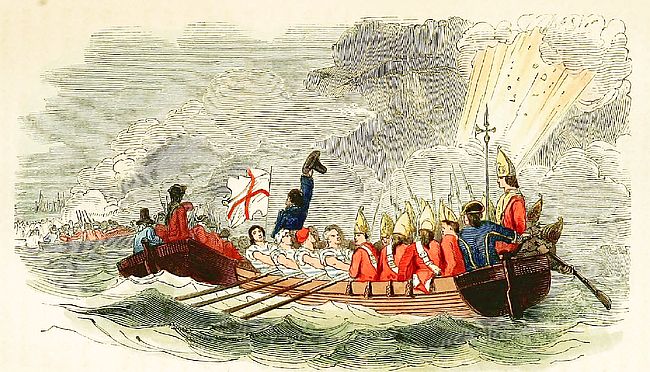
Landing of the British and Dutch troops at Gibraltar on the 21st July, 1704.
[To face page 34, in 4th Foot.
The Marquis de Villadarias, having been joined by
four thousand French from the fleet, commenced the
siege of Gibraltar on the 22d of October; and part of
the Queen's Regiment of Marines, being in garrison,
had now the honour of defending that magnificent fortress
which they had so nobly assisted to capture. The garrison
was weak in numbers; but Sir John Leake and
Rear-admiral Vander Dussen arrived in the bay from
Lisbon, with thirteen English and six Dutch men-of-war,
and, thus securing the besieged from an attack from the
sea, gave them an opportunity to direct all their energies
to the repulsing of the attacks from the land side.
During the night of the 11th of November, five
hundred of the enemy contrived, by means of rope-ladders
and other inventions, to ascend the mountain by a way
which was deemed impracticable, and were supported
by another body of three thousand men. The men
engaged in this daring enterprise were, however, soon
discovered, and were charged by five hundred of the
Marines in garrison with such resolution, that two
hundred of the enemy were killed on the spot, upwards
of two hundred were taken prisoners, and the remainder,
endeavouring to escape, fell down the rock and were
dashed to pieces.
The fire of the enemy's batteries having damaged the
works, a body of men was landed from the fleet to assist
in the defence, and Brigadier-General Fox with several
other officers and a number of men having been killed,
(5th of December, 1704,) aid was solicited from the
army in Portugal. Meanwhile the enemy had made
several breaches, and the garrison was held in constant
readiness to resist an attack on the works by storm.
British courage and endurance were now sternly proved.
The governor, the Prince of Hesse d'Armstadt, spent his
days in the works, and the greatest part of every night
in the covered way, and his example produced so good
an effect, that the conduct of the troops exceeded all
expectation, and "The English Marines gained immortal
honour."[19] New works were constructed
within those already damaged, mines were prepared, and
every means used to give the French and Spaniards a
warm reception if they attempted to assault the fortress.
In the midst of these preparations the garrison was reinforced
by a battalion of foot guards, part of the English
regiments of Barrymore (thirteenth foot) and Donegal
(thirty-fifth foot), and of the Dutch regiment of Waes; and
during the night of the 22d of December, a body of men
issued from the fortress in the dark, forced the Spanish
lines, routed a body of cavalry, levelled part of the
works, burnt the fascines and gabions, and retired with
little loss. The success which attended this display of
British intrepidity, with the discovery of a conspiracy
which several residents in the garrison had entered into
with the enemy, disconcerted the measures of the
besiegers and retarded their operations.
1705
The siege was, however, prosecuted with vigour, and
the Marquis of Villadarias, having received a considerable
reinforcement, attacked the round tower in the beginning
of February, 1705. On this occasion a chosen band
of French grenadiers climbed the rock with hooks in
one hand and their swords in the other, but were repulsed
with loss.
A second attempt was made about four days afterwards.
Six hundred select French and Walloon grenadiers,
supported by a large body of Spaniards, ascended
the hill with great silence during the night, and concealed
themselves in the cliffs and hollow grounds until day-break.
When the night-guard had been withdrawn from
the breach near the round tower, they made a sudden
rush at the wall, and with a shower of hand-grenades
drove the ordinary guard from its post. At the same
time two hundred French grenadiers attacked the round
tower by storm. The troops in garrison were soon
alarmed. Captain Fisher of the Queen's Regiment
of Marines, an officer of a most daring and heroic
spirit, charged the enemy at the head of seventeen men;
but his small party was soon overpowered and himself
taken prisoner. Major Moncall, of Lord Barrymore's
regiment, rushed to the scene of the conflict at the head
of four hundred men, and being seconded by Colonel
Rivett of the foot guards, who had climbed the rock on
the right of the covered way with twenty grenadiers, he
charged the enemy sword in hand, retook the round
tower, and liberated Captain Fisher of the Queen's
Marines. Additional troops were brought forward, and
the French and Walloon grenadiers were chased from
the works with the loss of more than half their numbers;
but the gallant Captain Fisher, being foremost in the
pursuit, was again made prisoner.
The French and Spaniards continued their attempts
against this fortress with unavailing assiduity, until their
formidable army was half ruined, and towards the end
of March, 1705, they raised the siege, and retired.
"And thus," observes the author of the Annals of Queen
Anne, "the siege of that important place, after six
months' toil and fruitless attempts, was at last raised,
by the obstinate and valiant defence of our brave
Englishmen;" and the Queen's Marines had their
share in the glory of this brilliant success. The importance
of Gibraltar occasioned the siege to become a subject
of great interest throughout Christendom, but
especially in England; the result gave rise to the most
lively feelings of joy and exultation; and the conduct of
the British troops was the subject of merited commendation.
1706
1707
1708
In the subsequent actions during this war, the regiments
of Marines gained additional honour. They had
their share of the glory acquired in the capture of Barcelona
in the autumn of 1705, and in the gallant defence
of that city in 1706; they fought at the unfortunate
battle of Almanza in 1707; took part in the capture and
defence of several fortified towns in Spain, and in the
capture of the island of Minorca in 1708. In some of
these services, detachments of the Queen's Marines were
probably engaged; but, after the defence of Gibraltar,
the regiment appears to have been employed, generally,
on board the fleet.
1709
1710
Six companies of the regiment, having landed from on
board the fleet, were stationed, during the winter of 1709,
in Devonshire, and after reposing a few months in quarters,
were removed, in March, 1710, to garrison duty at
Plymouth. In July of the same year, the other seven
companies, having arrived at Spithead, landed on the
Isle of Wight, where they encamped until September,
and afterwards proceeded to Portsmouth.
About this period the regiment was removed from the
establishment of the navy, its title of Marines was discontinued,
and it resumed its station among the regular
regiments of infantry; it was, however, included in the
estimate for 1711, in the list of regiments for sea-service;
but this did not prevent its being employed on other
duties.
1711
In January, 1711, the six companies at Plymouth
having been relieved by Colonel Andrew Windsor's
(now twenty-eighth) regiment, marched to Portsmouth;
and on the 23d of that month the regiment received
orders to hold itself in readiness to proceed to Portugal;
but its destination was soon afterwards changed.
During the nine years which this war had been raging
in Europe, British blood and treasure had been expended
in making conquests for the house of Austria. The only
advantage which had accrued to Great Britain was, that
the power of the house of Bourbon had been diminished
and that of Austria augmented: even Gibraltar and
Minorca, though subsequently ceded to Great Britain,
had been captured for the house of Austria. The new
ministry chosen by Queen Anne in 1710 resolved to act
upon a different principle. Colonel Nicholson having
made a successful attack on Port Royal in Nova
Scotia, on his return to England he submitted to the
government a plan for the reduction of Placentia and
Quebec, as a preparatory measure in order to secure
Canada to the British Crown, to drive the French out
of Newfoundland, and regain the fishery.
Canada is stated to have been discovered by the famous
Italian adventurer, Sebastian Cabot, who sailed under
a commission from Henry VII., and as the English
monarch did not make any use of the discovery, the French
soon attempted to derive advantage from it. Several
small settlements were established, and in the early part
of the seventeenth century the city of Quebec was
founded for the capital of the French possessions in this
part of the world. Although the colony continued in a
very depressed state for some time, and the settlers were
often in danger of being exterminated by the Indians,
yet, in the beginning of the eighteenth century, it had
become of such importance, that its capture was considered
one of the best means of weakening the power of
the ambitious Louis XIV. An expedition was placed
under the orders of Brigadier-General Hill, with a
naval force under Commodore Sir Hovenden Walker;
and the Queen's regiment was selected to take part in
this enterprise. On arriving at North America the fleet
called at Boston for a supply of provisions, and the troops
landed and encamped a short time on Rhode Island;
but on the 20th of July they re-embarked, and, having
been joined by two regiments of provincial troops, sailed
on the intended expedition.
While the brave men who adopt the profession of
arms are engaged in the service of their sovereign and
country, they are exposed to numerous dangers;
their hopes of conquest and prospects of fame are often
suddenly terminated by adverse fortune, and such
was the case in the expedition to Quebec. As the fleet
was proceeding up the river St. Lawrence, it became
enveloped in a thick fog, and encountered a severe gale
of wind; and the veterans who had fought the battles
of their country found themselves in the dangerous
navigation of this immense river, in a dark and stormy
night, with inexperienced men collected on a sudden to
act as pilots. Eight transports crowded with men were
dashed upon the rocks, and a number of officers and
soldiers, who but a few hours before had meditated
scenes of conquest, victory, and glory, were entombed in
the deep. At the head of the list of officers and men
lost by the regiment which forms the subject of this
memoir, is Major Fisher,[20] who is probably the same
officer who displayed such heroism in the defence of
Gibraltar. The other officers lost by the Queen's regiment
were,—Brevet Major Walker; Captains Stringer
and Bush; Captain-Lieutenant L'Hulle; Ensigns Hyde,
Hawker, Richardson, and Loggan; Quartermaster
Redix; and Surgeon Jones; with ten serjeants, eighteen
corporals, thirteen drummers, one hundred and
sixty-seven private soldiers, and twenty women. This
lamentable disaster occasioned all thoughts of prosecuting
the enterprise to be laid aside. The fleet returned to
England, and the Queen's regiment, having landed at
Portsmouth on the 10th of October, marched into dispersed
quarters in Hampshire, and commenced recruiting
its diminished numbers.[21]
1712
In the autumn of 1712 the regiment was removed
from country quarters to garrison duty at Portsmouth
and Plymouth, where it passed the succeeding year.
1713
From Portsmouth the regiment proceeded in September,
1713, to the islands of Jersey, Guernsey, and
Scilly, with two companies at the town of Pendennis. A
treaty of peace having been concluded at Utrecht, its
establishment was reduced to ten companies of three officers,
two serjeants, two corporals, one drummer, and
thirty-six private men, each; but after several of the
newly-raised corps had been disbanded, its numbers
were augmented to forty private men per company.
1714
While the regiment occupied these stations Her Majesty
Queen Anne died, and was succeeded by King
George I., on the 1st of August, 1714.
1715
1716
In the autumn of 1715 the regiment was withdrawn
from the islands of Jersey, Guernsey, and Scilly, and
proceeded to the town of Windsor, and the adjacent
villages; and for several months it furnished the guard
at Windsor Castle. While on this duty His Majesty
was graciously pleased to confer upon it the title of The
King's Own, an honorary distinction which it has continued
to bear to the present time. The regiment occupied
these quarters during the rebellion of the Earl of
Mar, and in July, 1716, marched into garrison at Portsmouth.
1717
The regiment remained at Portsmouth until May, 1717,
when it proceeded to Jersey, Guernsey, and the Isle of
Wight; with two companies detached, one to Windsor,
and one to Hampton Court. These companies were,
however, relieved from duty at the residence of their
Sovereign in November, by the foot guards, and joined
the head-quarters at Jersey in the same month.
Lieut.-General William Seymour, after commanding
the regiment nearly sixteen years, was succeeded by
Colonel the Hon. Henry Berkeley, third son of Charles
second Earl of Berkeley, by a commission dated the 25th
of December, 1717.
1718
1719
The King's Own remained at the islands of Jersey,
Guernsey, and the Isle of Wight during the succeeding
year, and in the spring of 1719 they were removed to
Plymouth. While at this station, their Colonel, the
Hon. Henry Berkeley, was removed to the second, or
Scots, troop of horse grenadier guards; and was succeeded
by the Hon. Charles Cadogan, afterwards Lord
Cadogan, Baron of Oakley, by commission dated the 21st
of April, 1719.
1720
1721
1722
In June of the same year the regiment was removed
from garrison duty at Plymouth, and marched to Exeter;
and it occupied various stations in the south and west of
England until the summer of 1722, when, the government
having received information that the friends of the
Stuart dynasty were conspiring to effect the elevation of
the Pretender to the throne, it formed part of a body of
troops encamped on Salisbury Plain, to be in readiness
to act on any emergency. It was reviewed with the other
forces encamped on the plain, by King George I. and
His Royal Highness the Prince of Wales (afterwards
George II.) on the 30th of August, and in September
struck its tents and marched into quarters at Exeter.
1723
1724
1725
In the following summer the King's Own were encamped
near Newbury; and in 1724 they occupied
quarters at Newbury and Reading; from whence they
occasionally furnished detachments for duty at Windsor
Castle and Hampton Court Palace. In the summer of
1725 they marched to Berwick, and from thence proceeded
to Perth, and were placed under the orders of
the commander-in-chief in North Britain.
1731
1732
1733
Returning to England in 1731, the regiment was
stationed that year at Bristol: from whence it marched
in July, 1732, to Exeter. In 1733, and the two succeeding
years, it furnished detachments on coast duty in
Sussex, and also in Cornwall.
1734
In the summer of 1734 Lord Cadogan was removed
from the King's Own to the sixth or Inniskilling regiment
of dragoons, and was succeeded by Brigadier-General
William Barrell from the twenty-second regiment
of foot, by commission dated the 8th of August, 1734.
1736
1737
Having called in its detachments, the regiment marched
to the north of England in May, 1736; and after halting
two months at Newcastle and Durham, proceeded to
Edinburgh; but returned to England in July, 1737, and
was stationed at York.
1739
1740
The regiment continued to be employed on home
service: its establishment in this year was seven hundred
and five officers and men; and in 1739 it was augmented
to eight hundred and fifteen officers and men; at which
number it continued until after the decease of Charles
VI., Emperor of Germany, in 1740, when a war broke out
between the Archduchess Maria Theresa and the Elector
of Bavaria, respecting the kingdoms of Bohemia and
Hungaria, and England became involved in the contest.
During the summer of that year the regiment was encamped
near Newbury, and in the autumn marched into
quarters in Lancashire and Cheshire.
1741
1742
1744
France took part with the Elector of Bavaria, and
Great Britain with the house of Austria, and in 1742 a
British army proceeded to Flanders; but the King's
Own were employed on home service until June, 1744,
when they embarked for Flanders, and joined the allied
army at its camp near the banks of the Scheldt. The
regiment served the campaign of this year under Field-Marshal
Wade, and was employed in several operations;
but no general engagement occurred, and it had no
opportunity of distinguishing itself.
1745
In the following year, when the French besieged
Tournay, and the allied army commanded by His Royal
Highness the Duke of Cumberland advanced to the
relief of the town, the King's Own were left in garrison
at Ghent, and were consequently not at the battle of
Fontenoy. The Duke of Cumberland, having failed in
his attempt to relieve Tournay, retreated; and the King's
Own were relieved by one of the regiments which suffered
severely at Fontenoy, and joined the army at its camp
on the plains of Lessines on the 21st of May.
The King's Own remained in Flanders until the
rebellion broke out in Scotland, and Charles Edward,
eldest son of the Pretender, advanced at the head of
several highland clans and captured Edinburgh. The
regiment was then ordered to return to England, and it
formed part of the army under the veteran Field-Marshal
Wade, which was assembled in Yorkshire.
When the young Pretender and his adherents penetrated
into England, this regiment was employed in
covering Yorkshire, and, after the retreat of the rebel
army from Derby, the regiment marched in pursuit of
the enemy towards Scotland, and arrived at Newcastle-on-Tyne
on the 26th of December.
1746
The King's Own were afterwards ordered to march to
Edinburgh, where they arrived on the 10th of January,
1746, and the appearance of the royal forces at that city
was hailed with illuminations and public rejoicings.
The rebels undertook the siege of Stirling Castle, and
a detached party of Highlanders under Lord George
Murray advanced to Linlithgow, from whence they
were driven on the 13th of January by a body of troops
under Major-General Huske. On the following day the
Buffs, King's Own, and Pulteney's (now thirteenth)
regiment, advanced to Barrowstownness; and on the 16th,
these troops having pitched their tents near Falkirk,
were joined by the remainder of the army under Lieut.-General
Hawley.
On the 17th of January, as the King's troops were
at dinner in the camp, the advance of the enemy was
discovered; the royal forces seized their arms, and
proceeded along some rugged and difficult grounds to a
large moor, where the rebel army appeared in order of
battle.
Success or failure in the hour of battle has sometimes
been found to depend upon accidental circumstances
over which the commanders of armies have no control.
Such was the case at the battle of Falkirk, where a
tempest of wind and rain beat so violently in the faces
of the royal forces at the moment when they engaged
their adversaries, that the ammunition was spoiled in the
act of loading; the soldiers could not see their opponents,
and several regiments gave way. The King's Own,
however, evinced the same valour and intrepidity which
were so successfully displayed at the fortress of Gibraltar;
they were formed in brigade with Price's (now fourteenth)
regiment under the orders of Brigadier-General
Cholmondeley, and these two corps withstood the fury
of the charging Highland host with a firmness which
redounded to their honour.[22] Having been joined by the
Royals, Buffs, and Ligonier's (now forty-eighth), these
five regiments repulsed one wing of the rebel army,
and continued on the field of battle until night, when
they returned to the camp, and subsequently proceeded
to Edinburgh.
The King's Own formed part of the army under His
Royal Highness the Duke of Cumberland which advanced
from Edinburgh, on the 31st of January, towards Stirling,
when the Highlanders made a precipitate retreat. The
royal forces followed in pursuit, but were delayed in
their advance by severe weather. The King's Own
formed part of the advance-guard under Major-General
Bland which proceeded to Inverary on the 12th of
March, and on the 17th advanced towards Strathsbogie
to attack a thousand rebel foot and sixty hussars, posted
at that place under Roy Stewart; but the enemy fled on
the approach of the King's troops, and were pursued for
several miles: the Marquis of Granby, Colonel Conway,
Captain Holden, and several other officers, displayed
their zeal for the royal cause by the spirited manner in
which they pursued the Highlanders.
On the 12th of April the army crossed the river Spey,
and on the 16th of that month the King's Own were engaged
in the action with the rebels on Culloden Moor. The
regiment was posted on the left of the front line of the
royal army. After a sharp cannonade several select clans
of mountaineers sprang forward, and with shouts and
dismal yells attacked the King's forces sword in hand.
This regiment had to bear the brunt of the furious onset
of the clans: for a moment it was disordered by the
weight of the attacking column, and the men staggered;
but only for a moment: two battalions advanced
to sustain them, and recovering, they rushed upon their
kilted adversaries with a resolution and valour which
proved they were not unworthy of their distinguished
title of the King's Own. A furious conflict ensued;
the Highlanders with their swords and targets were
unable to withstand the ruthless charge of the royal forces;
the carnage was dreadful, and the ground was literally
covered with slaughtered rebels.[23] A decisive victory
was gained; and the rebellion was effectually suppressed.
When the news of this event reached England, the
nation was transported with joy; both houses of parliament
addressed His Majesty on the subject, and passed
a vote of thanks to the Duke of Cumberland and the
brave troops who had fought under his orders.
The regiment lost in this action Captain Lord Robert
Kerr and seventeen men killed; and had Lieut.-Colonel
Rich, Captain Romer, Lieutenant Edmonds, Ensigns
Campbell and Brown, and one hundred and eight non-commissioned
officers and private men, wounded.
1747
After halting a short time at Inverness, the army
advanced into the highlands, and encamped in the gloomy
valley surrounded by rugged precipices near Fort
Augustus, from whence detachments were sent out to
search for arms, and for persons who had been engaged
in the rebellion, and also to execute summary punishment
on the guilty clans. This regiment afterwards marched
back to Stirling; and it was employed in home duties
for a period of eight years.
1749
Lieut.-General Barrell died on the 9th of August, 1749;
and King George II. conferred the colonelcy of the regiment
on the lieut.-colonel, Robert Rich, who highly
distinguished himself at the battle of Culloden, where he
was wounded.
1751
In 1751 a warrant was issued regulating the clothing and
colours of the regiments of the line. In this warrant the
regiment is styled the "Fourth, or the King's Own
Royal Regiment;" and the facing is directed to be
blue; the King's Own are also authorized to bear—
"In the centre of their colours the King's cipher on
a red ground within the garter, and crown over it; in
the three corners of their second colour the Lion of
England,[24] being their ancient badge.
"On the grenadier caps the King's cypher, as on the
colours, and crown over it; white horse and motto on
the flap.
"The drums and bells of arms to have the King's
cypher painted on them, in the same manner, and the
rank of the regiment underneath."
1754
The regiment remained in Great Britain until the year
1754, when it proceeded to the island of Minorca to
relieve the thirty-third regiment, which returned to
England.
1755
1756
The island of Minorca, at which the King's Own were
stationed, and where they were eventually called upon to
perform most arduous and trying services, is the second
of the Balearic islands, situated in the Mediterranean
near the coast of Spain. This island had fallen successively
under the dominion of the Carthaginians, the
Romans, the Vandals, the Moors, the Arragonese, and
the Castilians, and in 1708 it was captured by the British
for the house of Austria; but at the peace of Utrecht,
when the Austrian family was excluded from the throne
of Spain, it was ceded to Great Britain; it had remained
a part of the possessions of the British crown, and was
garrisoned by a company of artillery and four regiments
of foot. In this small island, which is diversified with
hills and valleys, and in some parts rich in vegetation and
abounding with the necessaries and many of the luxuries
of life, the King's Own passed two years, during which
time a dispute between the governments of France and
England, respecting the extent of their possessions in
North America, had occasioned a war between the two
kingdoms, and in the early part of 1756 the French
made preparations at Toulon and Marseilles for the
capture of Minorca.
At this period the King's Own occupied extensive
quarters in the several towns on the island, and their
regimental head-quarters were at Ciudadella, the capital.
The other corps were at Port-Mahon, which is stated to
be one of the finest harbours in the world, and at Fort
St. Philip; and the brave Lieut.-General Blakeney was
lieut.-governor and commander-in-chief on the island.
The regiments on the island were not discouraged at the
preparations making in France; on the contrary, an
officer, in a letter published at the time, observed,—"Our
spirits are so good, our garrison so hearty, and our
supplies so ample, that if our works do not defend us,
and we defend our works until we can be relieved by a
strong hand, we deserve to be buried in their ruins."
The French armament, commanded by Marshal Duke
de Richelieu, arrived at Minorca in the middle of April,
and effected a landing at Ciudadella on the 18th of that
month; and as no part of the island was fortified to resist
so powerful a force, excepting Fort St. Philip, situate
on a rocky promontory at the entrance to the harbour of
Port Mahon, the King's Own were withdrawn from the
interior, and effected their retreat to the fort with the
loss of one corporal taken prisoner by the enemy.
Preparations were made for a vigorous defence of the
fort, and the French commander encountered so gallant
and determined a resistance, that he was obliged to send
for additional forces. The perseverance and endurance
of the garrison became the subject of much admiration,
and the vigilance and bravery of the officers inspired
the troops with confidence. On the 19th of May the
British fleet was descried bearing towards the island,
and the men having become much exhausted by hard
duty, looked forward for the expected relief with anxiety;
but were disappointed: Admiral Byng, after skirmishing
with the French squadron, retired, and was afterwards
brought to trial for his conduct and shot. Lieut.-General
Thomas Fowke, then commanding at Gibraltar, was also
brought to trial for not sending a reinforcement from that
garrison to Minorca, and was sentenced to be suspended
from his appointment for one year. King George II.
confirmed the sentence, but directed Lieut.-General
Fowke to be dismissed from the service.
Although abandoned to their fate, Lieut.-General
Blakeney and the four regiments under his orders defended
their post with great gallantry; the men were
nearly worn out with incessant duty and watching, so
that they frequently fell asleep under a heavy cannonade;
yet they persevered with astonishing resolution. About
midnight on the 27th of June, a general assault was
made at several different points; the garrison met the
assailants with great courage, and repulsed them several
times with much slaughter; many of the sick and
wounded men came out of the hospital to join in the
defence. Though repulsed at several points, the enemy,
after much hard fighting, gained three of the out-works.
Upon this subject a military historian observes,—"So
many attacks made at one time against so small a body
of men, who had such a variety of works to defend, it
is rather a matter of surprise that the enemy were
repulsed at so many, and succeeded at so few places."[25]
On the following day conditions of capitulation were
tendered. "Thus did four regiments, and one company
of artillery, maintain the fort against such numbers of
the enemy by sea and land for such a length of time
as can, perhaps, scarcely be paralleled in history. The
terms on which the fort was at last surrendered by a
handful of men, so distressed, so shattered, and so
neglected, remain a lasting monument to their honour."[26]
The following is an extract from the articles of capitulation.
"The noble and vigorous defence which the English
have made, having deserved all the marks of esteem and
veneration which every military man ought to show to
such actions, and Marshal Richelieu, being desirous
also to show to General Blakeney the regard due to
the defence he has made, grants to the garrison all the
honours of war they can enjoy under the circumstances
of going out for an embarkation; to wit, firelock on
their shoulders, drums beating, colours flying, twenty
cartridges each man, and also lighted match. He
consents also that General Blakeney and his garrison
carry away all the effects that belong to them."
During the period the King's Own were engaged in
the defence of Fort St. Philip, the colonelcy of the regiment
was conferred on Alexander Duroure from the
thirty-eighth regiment, by commission dated the 12th
of May, 1756.
The regiment embarked from Minorca immediately
after the surrender of Fort St. Philip, and proceeded to
Gibraltar, where it remained a few weeks, and subsequently
embarked for England. It landed at Torbay in
November, and immediately on its arrival it was augmented
to two battalions.
1758
On the 21st of April, 1758, the SECOND BATTALION
of the King's Own was constituted the Sixty-second
Regiment, under the command of Colonel William
Strode.
The war with France being continued, an armament
was fitted out in the autumn of 1758 for the attack of
the French settlements in the West Indies; the King's
Own were selected to take part in this service, and embarked
nine hundred strong under the command of
Lieut.-Colonel Crump, an officer of distinguished merit,
whose services proved of great value to his king and
country: the land forces were under the orders of Major-General
Hopson, and the navy under Captain Hughes.
This expedition sailed from England in November,
and arrived at Carlisle bay in the island of Barbadoes in
the beginning of the following year.
1759
In the middle of January, 1759, the fleet arrived off
the French island of Martinico, and a landing was
effected between the bay of Cas des Navieres and Point
Negro; but numerous difficulties were experienced; the
enemy had ten thousand men, including the militia, to
oppose an invading army of about four thousand five
hundred men, and the nature of the ground facilitated
the defence.
On the 17th of January, the grenadiers, under the
command of Colonel Crump of the King's Own, attacked
a large body of the enemy, who retired into a thick wood,
from whence the colonel could not force them. The sixty-first
regiment (late second battalion of the third foot)
advanced to support the grenadiers; but the trees and
bushes afforded such excellent cover, that after repeated
attempts, it was found impracticable to dislodge the
enemy.
The numerous obstructions occasioned the King's
Own and other corps to be re-embarked; and the fleet
subsequently bent its course to Guadaloupe, one of the
Caribbee or Leeward islands, settled by the French in
1635. Basse Terre, the capital of the island, with the
batteries near the shore, having been destroyed by the
fleet, the King's Own and other troops landed on
the 24th of January: the French governor, M. Nadan
D'Etreil, abandoned the citadel, and trusting to the
natural strength of the country and the unwholesomeness
of the climate, retired to the mountains, and
summoned the militia of the island, with all the settlers
and their armed negroes, to join him. An irregular
warfare of detachments followed, in which the British
troops were usually victorious; but they purchased every
advantage at an immense sacrifice of life. At length
Major-General Hopson died, and the command devolved
on Major-General Barrington, who embarked the troops
on board of transports, (excepting the sixty-third regiment,
late second battalion of the eighth foot, and a
detachment of artillery left in garrison,) to attack other
parts of the island.
Colonel Crump of the King's Own landed, and took
St. Anne and St. François, and reduced both towns to
ashes; and the strong post of Gosier was carried by
another part of the army.
The King's Own having afterwards re-embarked, were
detached, with other forces, under the command of
Brigadier-Generals Clavering and Crump, to a bay near
Arnonville, where they landed without opposition; the
enemy retiring to a very strong position behind the river
Le Corn. This post covered the whole country to Bay
Mahaut, where provisions were landed for the inhabitants
from St. Eustatia, and it was strengthened by every
means the enemy could devise, though its situation was
such as to require little assistance from art. The river,
on account of a morass covered with mangroves, was
only accessible at two narrow passes, and those places
were occupied with a redoubt, and well-pallisaded
entrenchments, defended with cannon, and all the militia
of that part of the island.
The King's Own, and a battalion of Highlanders,
advanced to attack this difficult post with coolness and
resolution, and the intrepid bearing of the two corps
intimidated the enemy, who abandoned the first entrenchment
after a few vollies; the Highlanders and part of
the King's Own rushed forward and chased their adversaries
into the redoubt, and the post was eventually
carried.
The King's Own, and Highlanders, afterwards
advanced against another fortified post at Petit Bourg;
the enemy kept about two hundred yards in front, and
setting fire to the sugar canes, obliged the troops occasionally
to leave the road to avoid accidents to their
ammunition. Arriving at the river Lezard, the enemy
was found strongly entrenched behind the ford; but the
troops having procured two canoes, a body of men passed
the river in the night, and advanced at daybreak to
attack the enemy in flank, while the remainder prepared
to attack the front, and the enemy instantly fled in dismay.
Pursuing their adversaries to Petit Bourg, the King's
Own there encountered fortified lines, and a redoubt
filled with cannon; but the regiment diverging to the
right and left to gain the heights round the lines, the
enemy fled from the post.
Two days afterwards the lieut.-colonel of the King's
Own was detached with seven hundred men against Bay
Mahaut, and he took the batteries and town, which he
reduced to ashes, and rejoined the division on the following
day.
From Petit Bourg the King's Own advanced with
their division against St. Maries, where the enemy had
collected their whole force, and had thrown up entrenchments
and constructed barricades on the road; but from
these works the British troops forced their opponents
to retire, and also from the town; and the army entered
a part of the island said to be the most rich and beautiful
of any part of the West Indies.
The inhabitants, being convinced of the superior
bravery and discipline of the British troops, and seeing
the best part of their country on the point of being given
up to fire and sword, capitulated, and their possessions,
with their civil and religious privileges, were granted
them.
Thus this valuable island came into the possession of
the British crown in May, 1759; and throughout these
arduous and trying services the King's Own and other
corps forming the expedition, evinced all the qualities of
good soldiers. The commanding officer of the King's
Own signalized himself on various occasions, and was
appointed governor of the island; his conduct, which
reflected honour on his corps, is thus spoken of by Major-General
Barrymore in his public despatch.
"I have appointed Colonel Crump to the government,
who, since governor Haldane left us, I have made act
as a brigadier; his merit is very great, both as a soldier
and a man of judgment; he is of this part of the
world; understands the trade, customs, and genius of
the people; and as he thinks nobly and disinterestedly,
he would not have accepted of the government, but in
hopes of advancing himself in the army by that means.
I cannot express how very useful he has proved, and
how much our successes are owing to his good conduct
and great zeal."
1760
1761
After the reduction of Guadaloupe the regiment was
stationed at that island; and in 1761 a detachment was
employed under Colonel Lord Rollo in the capture of
Dominico. The troops landed on the 6th of June on
the beach near Roseau, under cover of the guns of the
fleet, and while part of the army took possession of the
town, the grenadier companies of the King's Own and
twenty-second regiments seized a flanking battery and
part of an adjoining entrenchment. During the night
the grenadiers, supported by the battalion companies,
stormed and carried with the bayonet the entrenchments
on the heights above the town, and took the governor
and several of the principal inhabitants prisoners. The
whole island immediately submitted; and Captain Robert
Douglas of the King's Own was the bearer of the news
of this conquest to England. The detachment of this
regiment afterwards returned to Guadaloupe.
1762
The British government having resolved to make a
powerful attack upon such of the West India islands as
still remained subject to the French monarch, four
companies of the King's Own were selected to take part
in the enterprise, and proceeded for this purpose from
Guadaloupe to the general rendezvous of the expedition
at Barbadoes; where the several corps were assembled
under the orders of Major-General Monckton. The
armament sailed from Carlisle bay on the 5th of January,
1762, and another attack was made on Martinico, which
place was settled by the French about the year 1635.
This island is extremely mountainous in the centre, from
whence issue numerous streams of water, which, in the
hurricane months, are swelled to violent torrents; these
have, in their way to the sea, worn deep channels, so that
the country is intersected with a great number of deep
ravines, with steep rocky sides, having water running at the
bottom; and these ravines are rendered difficult to pass
from the number of stones which the torrents have rolled
from the sides of the mountains. Thus, in attacking the
island, difficulties almost insurmountable are met with in
transporting cannon, ammunition, and stores across the
country. With these obstructions the army had to
contend; but they were overcome by British skill, discipline
and valour.
After several attempts on other parts of the island,
a landing was effected on the 16th of January in Cas
des Navieres bay, and the troops pitched their tents on the
heights above the landing place. Advancing from thence
through a country fortified by nature, an attack was made
on the heights of Morne Tortenson on the 24th of
January, and the four companies of the King's Own had
the glory of taking part in the capture of these formidable
works; also in the capture of Morne Garnier on
the 27th of that month; and in the reduction of the
citadel of Fort Royal, which surrendered on the 4th of
February: these captures were followed by the surrender
of the opulent city of St. Pierre, and the submission of
the whole island to the British crown.
The capture of Martinico was succeeded by that of
Grenada, St. Lucie, and St. Vincent; and the acquisition
of these islands gave additional honour to the
expedition of which the four companies of the King's
Own formed part.
These achievements were followed by another enterprize
of a most important character, in which a detachment
of the King's Own had the honour to share;
namely, the reduction of the Havannah, a wealthy and
important city in the island of Cuba.
The island of Cuba was first discovered by the celebrated
Columbus, but was not conquered by the Spaniards
until the early part of the sixteenth century, from which
period it had continued rising in wealth and importance.
St. Jago was the capital; but the city of Havannah held
the first place in point of wealth and commerce. During
the early part of this war, Spain had continued neutral;
but in 1762 His Catholic Majesty united his interests
with France, and war was declared between Great
Britain and Spain. This was immediately followed by
a resolution of the British government to attack the important
city of Havannah, and an expedition was prepared
for this purpose under the orders of General the
Earl of Albemarle.
On this occasion the King's Own were left in garrison
at Guadaloupe, excepting a detachment of two hundred
and twenty-five men under the command of Captain Kennedy,
which joined the expedition at Martinico, and
formed part of Brigadier-General Grant's brigade. In
the landing five leagues eastward of the Havannah on the
6th of June, in the advance upon the city, in the siege
and capture of the Moro Fort, and in the other operations
by which the final reduction of this wealthy settlement
was accomplished, and twelve men-of-war captured
in the harbour, the detachment of the King's Own had
the honour to take part. The loss of the detachment on
this service, including the killed and those who died from
fatigue and the effects of climate, was two officers and
twenty-four men.
1763
After the completion of this conquest, the detachment
returned to Guadaloupe, and the regiment remained
in the Leeward Islands until the peace of Fontainbleau,
when these acquisitions were restored to the French
and Spanish monarchs.
1764
In the spring of 1764 the regiment quitted the West
Indies, arrived in England in July of that year, and
commenced recruiting its diminished numbers.
1765
1768
After the decease of Lieut.-General Duroure, King
George III. conferred, on the 23d of January, 1765,
the colonelcy of the regiment on the Hon. Robert Brudenell,
from the sixteenth foot; who was succeeded, on
the 7th of November, 1768, by Lieut.-General Studholme
Hodgson, from the fifth foot.
1773
1774
In 1768, the King's Own proceeded to Scotland,
where they were stationed during the four succeeding
years, but returned to England in the spring of 1773,
and remained on home service until the following year,
when they were again ordered to hold themselves in
readiness to proceed abroad.
The war in which the regiment was about to engage
was of a most important character, involving the destinies
of millions, and was followed by the construction
of a new and powerful state in the world. As the population
of the British North American colonies increased,
and the inhabitants beheld their own rising power and
importance, the idea of their country eventually becoming
a great and independent empire would doubtless
frequently occur; and while contemplating such an
event, men would naturally become impatient of their
condition: hence the delight produced by the anticipation
of future greatness would prepare the minds of men
for a change. That these states should become independent
so early as the eighteenth century could, however,
scarcely have been expected; but this event was
hastened by the system of policy pursued towards the
colonies by the British government, which alienated the
affections of the inhabitants from the mother country.
The disputes which resulted from these proceedings, and
the spirit which the colonists evinced to resist the acts of
the British parliament for raising a revenue in their
country, took a most serious turn in the years 1773 and
1774; a body of troops was in consequence sent to
Boston, the place which had been the scene of the
greatest outrages, and the King's Own, being one of the
corps selected to proceed to North America, embarked
for that service on the 17th of April, 1774.
After landing at Boston the King's Own were encamped
for some time near the town; and the violent
revolutionary spirit which many of the colonists displayed,
occasioned a detachment of the regiment to be
sent during the winter to Marshfield, for the protection
of a number of the friends of the government in that
town and neighbourhood.
1775
The hostile feelings to the British government previously
evinced by the Americans appeared to increase
during the winter and succeeding spring; and the preparations
which they made for open resistance indicated
a design to make a speedy appeal to arms. General
Gage, who commanded the troops at Boston, sent the
flank companies of the King's Own, and other regiments
under his orders, up the country to Concord, to destroy
a quantity of military stores which the inhabitants were
collecting at that place. This circumstance occasioned
the first blood to be shed in the contest.
The flank companies were placed under the orders of
Lieut.-Colonel Francis Smith, of the tenth foot, and
having embarked on the night of the 18th of April, in
the boats of the men-of-war in the harbour, proceeded to
the entrance of the Cambridge River, where they landed,
and afterwards advanced up the country. While on the
march, the troops heard the ringing of bells, firing of
guns, and other sounds of alarm spreading over the
country; and when the light companies, which were in
advance, arrived at the village of Lexington, they
descried a body of provincials formed upon the green.
These men fired several shots at the soldiers, who immediately
retaliated, and the Americans were dispersed with
the loss of about ten men killed, and several wounded.
The troops continued their march to Concord, and
while the search for military stores was taking place, the
light companies of the King's Own and tenth regiment
were posted on some heights in the vicinity of a bridge
beyond the town. Meanwhile armed countrymen were
assembling in crowds on the high grounds near the town,
and a large body proceeding towards the bridge, the
light companies of the King's Own and tenth regiment
descended from the heights and joined the troops posted
at the bridge. The provincials advanced in great numbers,
and firing on the troops, killed three men, and
wounded several others; the fire was returned, and
the detached companies joined the main body in the
town.
After destroying three pieces of ordnance, burning a
number of carriage-wheels, and throwing a quantity of
gunpowder and musket-balls into the river, the troops
commenced their march back to Boston. On emerging
from the town, the soldiers were fired upon from the
walls, fences, trees, barns, &c., on both sides of the road;
the country appeared swarming with armed men, and
the troops were engaged fighting and retreating until
they were exhausted, and had expended nearly all
their ammunition; at the same time the numbers of
their antagonists were constantly increasing. Fortunately,
they were met at Lexington by the battalion
companies of the King's Own, twenty-third and forty-ninth
regiments, with a party of marines and two field-pieces,
under the command of Colonel Earl Percy of the
fifth foot. The fire of the field-pieces checked the Americans;
Earl Percy formed his brigade into a square,
with the exhausted flank companies in the centre, and
after the men had rested a short time, commenced his
march for Boston. The Americans hung upon his
rear in crowds, and kept up a constant fire; but the
troops continued their march in excellent order to
Charlestown, from whence they crossed the river in
boats to Boston, under the cover of the guns of a man-of-war
stationed near the ferry. The loss of the King's
Own on this occasion was Lieutenant Knight and seven
private men killed; Lieutenant Gould wounded and
taken prisoner; three serjeants, one drummer, and
twenty-one private men wounded; and eight men
missing.
This was the commencement of open hostilities; the
whole country round Boston was in the utmost agitation,
and multitudes of countrymen equipped for battle repaired
to Cambridge and Roxburg, and there threw up
entrenchments. All intercourse between the garrison
of Boston and the adjacent country was cut off, and the
town was completely blocked up on the land side.
Soon after this event the party of the King's Own
stationed at Marshfield was withdrawn, and rejoined the
regiment at Boston.
The rapid and judicious movements of the Americans
appeared to be the result of a preconcerted plan, and
having a very great superiority of numbers, they meditated
driving the King's troops out of Boston. During
the night of the 16th of June an immense body of provincials
proceeded to the heights on the peninsula of
Charlestown called Bunker's Hill, and commenced
throwing up entrenchments with great diligence. General
Gage resolved to dislodge the enemy from this post immediately,
and a body of troops, of which the grenadier
and light companies of the King's Own formed part,
was embarked in boats for this purpose about mid-day
on the 17th of June.
About three o'clock in the afternoon the attack commenced,
and in this contest British valour and discipline
were eminently displayed. The Americans were in great
force, strongly posted, and entrenched up to the teeth.
The King's troops had to advance in a hot summer's
day, in the face of a sharp and well-directed fire, and
to ascend a steep hill covered with grass reaching to
their knees, and intersected with walls and fences of
various enclosures: twice they were stopped, and twice
they returned to the charge, and by their undaunted
resolution and steady perseverance they eventually triumphed
over thrice their own numbers, and carried the
heights at the point of the bayonet. This proved one of
the most sanguinary battles on record, and the superiority
of the British troops was pre-eminently displayed.
The two flank companies of the King's Own
had one serjeant and thirteen rank and file killed;
Captains Balfour and West, Lieutenants Baron and
Brown, one serjeant, one drummer, and twenty-nine
rank and file wounded.
1776
Although the valour and discipline of the small
British force in North America were so conspicuous as
to excite the admiration and applause of their country,
yet the circumstances in which the army at Boston was
eventually placed rendered it impossible for these excellent
qualities to be exercised with the prospect of ultimate
success. The immense superiority of numbers of
the enemy, the great strength of the works thrown up on
Phipp's farm, Dorchester heights, and other places, with
the want of provisions, induced the commander of the
troops, Lieut.-General Sir William Howe, to vacate the
town, and proceed with the army to Halifax, in Nova
Scotia. This resolution was carried into effect in the
middle of March, 1776; and on their arrival at Halifax
several regiments were landed.
A reinforcement being expected from England, and
the general being anxious to commence operations against
the revolted Americans as early as possible, the fleet
sailed from Halifax on the 12th of June, arrived at
Sandy Hook on the 29th of that month, and on the 3d of
July landed on Staten Island, near New York. Here the
troops were disposed in cantonments for refreshment, and
the head-quarters were established at Richmond.
Additional troops having arrived, a landing was effected
at Utrecht, on Long Island, on the 22d of August;
and after dusk on the evening of the 26th, the King's
Own, commanded by Major James Ogilvie, forming
part of the first brigade under Major-General Pigot,
moved across the country to seize a pass in the heights
extending from east to west along the middle of the
island, to turn the enemy's left flank at Flat Bush.
This pass was taken possession of on the following
morning; the main body of the army advanced, and the
Americans were driven from their position with considerable
loss. In this day's skirmish the battalion companies
of the regiment did not sustain any loss; but the
flank companies, being formed in grenadier and light
infantry battalions, had several men killed and wounded.
The Americans retreated to their lines at Brooklyn;
but, fearing the consequences of an attack, they quitted
their post during the night of the 28th of August, and
crossed the East River in boats to New York; thus the
reduction of Long Island was effected in a few days
with trifling loss.
After this success the army was embarked in flat-bottomed
boats, and crossed the East River to York
Island, and the King's Own were engaged in the movements
by which General Washington was forced to
abandon New York; which city was immediately taken
possession of by the British.
General Washington having taken up a position in
another part of the country, the British troops were
again embarked in flat-bottomed boats and landed near
West-Chester; thence re-embarking on the 18th of
October, passed Frogs-neck and landed at Pell's-point,
at the mouth of Hutchinson's river. Advancing from
thence, the troops encountered a detachment of provincials;
a sharp skirmish ensued, in which several men
were killed and wounded; and the King's Own lost a
most valuable and gallant officer, Captain W. Granville
Evelyn, who was mortally wounded, and whose fall was
much regretted.
In the subsequent operations of the army, by which
the Americans were forced to evacuate their lines on
White Plains, the King's Own took part, but did not
sustain any loss; they were also present at the siege and
capture of Fort Washington, in which service they lost
only one man: and they passed the succeeding winter in
quarters in the city of New York.
1777
During the winter the Americans were engaged in
collecting stores and forming magazines for the ensuing
campaign, which they were careful to place as far as possible
out of the reach of His Majesty's land and sea
forces. Extensive depôts had been established at the
town of Danbury, and other places on the borders of
Connecticut, contiguous to Courland Manor; and the
King's Own were withdrawn from the city of New York
to form part of a detachment under the command of
Major-General Tyron, for the destruction of these
stores.
The detachment sailed from New York in transports,
passed through the Sound, and on the evening of the
25th of April, 1777, arrived off Norwalk, a town in the
province of Connecticut, about twenty miles south of
Danbury. As the troops were quite unexpected, they
landed without opposition, and by ten o'clock that night
began their march for Danbury, where they arrived
about two in the afternoon of the following day; on
their approach the American troops fled, and gave the
alarm to the country people, who took arms, and made
preparations to cut off the retreat of the British detachment.
As no carriages could be procured to bring off any
part of the magazines, Major-General Tyron was under
the necessity of setting them on fire, and in the progress
of the flames the town was unavoidably burnt. The
magazines having been all destroyed, the detachment
commenced its march back early on the morning of the
27th of April; a body of Americans under General
Wooster hung upon its rear, and at every eminence a
corps of militia was found ready to oppose its march;
but the British troops attacked and routed their adversaries,
and in one of these skirmishes General Wooster
was killed.
Arriving at Ridgefield, a strong force under General
Arnold was found posted at that place, and busily
employed in throwing up entrenchments; these were
instantly attacked by the artillery, and the British troops
rushing forward to the charge with their native valour
and intrepidity, the Americans were driven from their
ground.
The British halted at Ridgefield during the night, and
resumed their march on the following day. The enemy
having collected additional forces and some field-pieces,
harassed the detachment exceedingly during its march,
which brought on several skirmishes. Arriving at the
Hill of Compo, contiguous to the place of embarkation,
the Americans renewed their attack with greater determination
and spirit than ever; the British troops, facing
about, fired a volley, and then charged with the bayonet
with such impetuosity and courage, that the enemy,
unable to withstand the shock, retreated. The detachment
afterwards embarked without molestation, and
returned to New York.
The King's Own lost two men in this enterprise; and
had Captain Thorne, one serjeant, and fifteen rank and
file wounded.
The regiment afterwards formed part of the army
assembled in the Jerseys, and was engaged in the movements
designed to bring on a general engagement; but
the enemy keeping close in his strong position in the
mountains, an expedition against the populous and
wealthy city of Philadelphia was resolved upon. The
King's Own were employed in this enterprise, and formed,
with the twenty-third, twenty-eighth, and forty-ninth
regiments, the first brigade of the army.
Having embarked from Sandy Hook, the troops sailed
to Chesapeake Bay, and landed on the 25th of August
on the northern shore of the Elk River; from whence
they advanced on the 28th, in two columns, to Elk Head.
The enemy having taken up a position at Brandywine,
the royal army advanced on the 11th of September to
give their opponents battle, and the King's Own formed
part of the force selected to attack the American troops
posted at Chad's Ford. After a sharp cannonade the
troops advanced to the charge; the King's Own commanded
by Lieut.-Colonel James Ogilvie, and supported
by the fifth foot, led the attack in gallant style,
and rushing through the stream with fixed bayonets,
overpowered all opposition and captured three brass field-pieces,
and a five and a half inch howitzer.[27] The regiment
pressed upon the retiring enemy, but darkness
coming on before the troops could reach the heights, the
action ceased. The loss of the regiment on this occasion
was two rank and file killed; and Captain Rawdon and
twenty rank and file wounded.
The victory at Brandywine was followed by the flight
of the American troops from Philadelphia, which city
was taken possession of by a British force of which the
grenadier company of the King's Own formed part.
The remainder of the army took up a position at
Germantown, and the King's Own were encamped on
the right flank. The Americans attacked this post on
the morning of the 4th of October, and drove in the
piquets of the right wing. The Fourth were moved
forward to support the light infantry, and the assault
was sustained with such determined bravery, that the
enemy could make no impression at this point of attack.
After the Americans had been repulsed at other parts of
the field, Major-General Grant moved the forty-ninth
regiment, and four pieces of cannon, to the left of the
King's Own, and then advancing with the right wing,
forced the enemy's left to give way. The Americans
were afterwards pursued four or five miles through a
woody country of difficult access. The light company of
the regiment, forming part of the first light infantry
battalion, highly distinguished itself on this occasion,
and had Lieutenant Champaigne wounded; also several
private men killed and wounded. The battalion companies
also acquired new laurels; and had one serjeant
and eight rank and file killed; Captain Thorne, Lieutenants
Arbuthnot and Kemble, Ensigns Dickson, Shoen,
Hadden, and Blemen, with Adjutant Hunt, two serjeants,
and forty-six rank and file wounded; also three rank
and file missing. When the action commenced, the
grenadier company marched, with the remainder of its
battalion, out of Philadelphia with all possible expedition,
and arrived at the scene of contest at the moment when
the enemy was giving way, and consequently was not
engaged.
Lieut.-General Sir William Howe, speaking of these
actions in his public despatch, observes,—"In the several
engagements, the successes attending them are far
better vouchers than any words can convey, of the
good conduct of the general officers, and the bravery
of the other officers and soldiers. The fatigues of a
march exceeding one hundred miles, supported with
the utmost cheerfulness by all ranks, without tents,
and with very little baggage, will, I hope, be esteemed
as convincing proofs of the noble spirit and emulation
prevailing in the army to promote His Majesty's
service."[28]
While the army commanded by Sir William Howe
was victorious in Pennsylvania, another British force
under the orders of Lieut.-General Burgoyne penetrated
the United States from the frontiers of Canada; but the
difficulties encountered by this army were so great, that
its commander concluded a convention with the American
General Gates, who was thus enabled to detach a body
of troops to reinforce General Washington. On the
arrival of these forces the American army advanced
nearer Philadelphia, and encamped at White Marsh.
The British general moved forward, and took post on the
morning of the 5th of December on Chestnut Hill, with
the view of inducing the enemy to offer battle, or of
finding a vulnerable part in their fortified camp. A
sharp skirmish occurred on the same day, between two
British battalions and a thousand Americans, who were
routed in a short time. On the 7th of December another
action occurred on Edgehill, a mile from the enemy's
left, on which occasion the native intrepidity and firmness
of the British were conspicuous. Several other skirmishes
also took place; and in every instance the Americans
were defeated; but their position was found so strong
with entrenchments, abbatis de bois, and other defences,
that the army returned to Philadelphia on the 8th of
December, without venturing to attack it. The King's
Own lost in these skirmishes, two men killed; and Lieutenant
West, three serjeants, and nine rank and file
wounded.
1778
The regiment passed the winter in comfortable quarters
in the city of Philadelphia, while the Americans lay in
huts in the woods near Valley Forge. Immediately on
the return of spring a succession of detachments ranged
the country for many miles round Philadelphia and the
province of Jersey, and opened communications for
bringing in supplies of provision and forage.
Meanwhile the French monarch had acknowledged the
independence of the revolted provinces, and had concluded
a treaty with them; thus the nature of the contest
was so completely changed, that Lieut.-General Sir
Henry Clinton, who had succeeded to the command of
the troops at Philadelphia, was ordered to vacate that
city and retire to New York. The King's Own underwent
with the remainder of the army the fatigues of this
long and toilsome journey, crossing rivers, traversing a
wild and woody country, overcoming numerous difficulties,
and repulsing the enemy's attempts to interrupt the
progress of the march, with signal gallantry, particularly
on the 28th of June; and arrived at New York in the
beginning of July.
The French monarch having sent a powerful armament
to sea, some danger was apprehended to the West
Indian colonies; a body of troops, of which the King's
Own formed part, was sent from North America to the
island of Barbadoes, under the command of Major-General
Grant; and the land and sea commanders at
that station being in a condition to act offensively, resolved
to attack the French island of St. Lucie. The grenadiers
of the King's Own, under the orders of Captain West,
formed part of the grenadier battalion under the command
of Major Harris of the fifth; and the light company
under Captain Thorne was in the light infantry
battalion commanded by Major Sir James Murray of
the Fourth, and these battalions formed part of the
reserve commanded by Brigadier-General Medows, which
landed on the 13th of December, forced some heights
with signal intrepidity, and captured a field-piece and a
four-gun battery. The remainder of the troops having
landed, the strong post of Morne Fortunè, with the
governor's house, the hospital, barracks, stores and magazines
were captured, and although the passes were
remarkably strong and difficult of access, yet with such
impetuosity did the troops advance, that the French
governor was obliged to retire from post to post, after
doing all in his power to defend them. Scarcely were
the enemy's colours struck, and the British head-quarters
established at the governor's house, when the approach
of a powerful French fleet was descried. The soldiers,
already fatigued with a hard day's service, immediately
commenced strengthening the posts they had won, with
cheerful alacrity; and the naval force was disposed in
line of battle across the entrance of the Cul de Sac. The
island of St. Lucie presents no regular face, but a succession
of confused steep and abrupt hills scattered among
greater mountains, everywhere intersected by narrow
winding valleys, long defiles, and deep ravines; and by
unremitting labour during one night the troops and
shipping were placed in such admirable order as to be
enabled to withstand the repeated attacks of a very
superior force.
In a naval action fought on the 15th of December,
which has been regarded as one of the most brilliant
displays of British skill and valour on record, the enemy
was twice repulsed with serious loss; and being unable
to force the line of battle, nine thousand French troops,
commanded by M. de Bouillé and Lavendahl, landed
and attacked the post of La Vigie, where the grenadier
and light companies of the King's Own were stationed.
The attack was made with that impetuosity for which
the French are distinguished; the British reserved their
fire until their adversaries were mounting the trenches,
when they threw in a volley, and instantly charging with
the bayonet, the enemy was broken and driven back with
a fearful slaughter. Three furious attacks having been
repulsed, the enemy re-embarked and quitted the island,
and the governor surrendered immediately afterwards.
1779
1780
Soon after the surrender of St. Lucie, the King's Own
proceeded to the island of Antigua, where they remained
during the succeeding year; and having become much
reduced in numbers by their service in North America
and the West Indies, they returned to England in 1780,
and shortly afterwards proceeded to Ireland.
1782
General Hodgson having been removed in the summer
of 1782 to the command of the fourth Irish horse, now
seventh dragoon guards, the colonelcy of the King's
Own was conferred on Lieut.-General John Burgoyne,
his commission bearing date the 7th of June, 1782.
1787
The regiment remained in Ireland seven years, and on
the 24th of May, 1787, embarked for Nova Scotia and
Newfoundland; and served in various parts of these
islands until the breaking out of the French revolutionary
war.
1792
In 1792 General Burgoyne died, and was succeeded
in the colonelcy of the regiment on the 8th of August,
1792, by Lieut.-General Morrison.
1793
The violent spirit of republicanism which was exhibited
in France at this period, having led to confusion, anarchy,
and a dreadful catalogue of crimes of the most cruel and
inhuman character, including the murder of the King,
which was followed by that of the queen, war was
declared against the regicide government of that country;
and the capture of Miquelon and St. Pierre, two islands
in the Atlantic Ocean near the south coast of Newfoundland,
used by the French as stations for curing and drying
fish, was resolved upon. A detachment of the royal
artillery and three hundred and ten rank and file of the
Fourth and sixty-fifth regiments, commanded by Brigadier-General
Ogilvie, sailed on this enterprise on the 7th
of May, 1793, from Newfoundland, and having landed
on the 14th of that month in the Ance-à-Savoyard,
advanced upon the principal town, when the governor
immediately surrendered at discretion. Although no
opportunity occurred for the troops to distinguish themselves
in action, their conduct elicited the commendations
of the commander of the expedition in his public despatch,
and to their great credit not one act of depredation was
committed on the inhabitants. Major Peregrine Francis
Thorne of the King's Own was appointed commandant
of the two islands, but the detachment of the regiment
returned to its former stations.
1794
1795
1796
1797
From Nova Scotia and Newfoundland the regiment
was removed in 1794 to Canada, and was stationed in
garrison at Quebec; in the early part of 1796 it proceeded
up the country and occupied St. John's, Chambly,
and Isle-aux-Noix, and in November it was ordered to
Montreal, in which garrison it passed the succeeding
winter: in June, 1797, it proceeded down the river to
Quebec. The regiments in Canada being very weak in
numbers, the Fourth, fifth, and first battalion of the
sixtieth, were ordered to transfer their serviceable men
to the twenty-fourth, twenty-sixth, and second battalion of
the sixtieth regiments. The men of the King's Own were
transferred to the twenty-sixth; and the officers, serjeants,
and drummers, embarked at Quebec on the 24th of September,
and sailed on the following day for England.
When near the land's end the transport having on board
twelve officers, including the commanding officer, (Lieut.-Colonel
Hodgson,) the staff, colours, serjeants, and drummers,
was chased by a French privateer (La Vengeance);
several officers and men were wounded in endeavouring
to defend the ship, and when from the superior metal and
power of the enemy, no hope of escape remained, the
regimental colours were sunk in the sea, and the transport
surrendered. This portion of the regiment was afterwards
conveyed to France, and detained in that country above
a year before it was exchanged.
1798
In May, 1798, such of the officers of the regiment as
had arrived safe in England, received at Chatham barracks
a draft of between three and four hundred Irish youths,
and in July following proceeded to Botley; where they
were joined in the beginning of the succeeding year by
the officers, serjeants, and drummers from France.
1799
Leaving Botley in April, 1799, the regiment proceeded
to Worcester, and from thence to Horsham barracks in
July; in the following month it marched to the camp on
Barham downs.
The militia being permitted this year to transfer their
services to the regular regiments, two thousand seven
hundred men volunteered to the King's Own, in consequence
of which the regiment was formed into three
battalions; Major-General the Earl of Chatham was
appointed colonel commandant of the second battalion,
and Major-General Lord Charles Somerset colonel commandant
of the third battalion.
On the 3d of September the Prince of Wales was
pleased to present a pair of new colours to the first battalion
on Barham downs; the regiment was formed in a
square, and His Royal Highness addressed the officers
and men as follows:—
"It affords me the highest satisfaction to have the
honour of presenting this gallant and distinguished
corps with their colours. Nothing but a blameless
accident could have deprived you of those you possessed
before, and I now replace them, under the firmest
conviction that there is not a regiment in His Majesty's
service that will ever support and defend its colours
with more valour and gallantry than the Fourth, or
the King's Own. It considerably enhances the pleasure
I feel on this occasion that the ceremony has happened
on a day when every British heart must be filled with
gladness at the tidings which have just been received
of the heroic actions our brave countrymen have
achieved in endeavouring to rescue Holland from the
detestable tyranny of France, and I perceive with true
pride that every countenance I now behold partakes of
this noble ardour, and that every heart is panting to
share in their laurels and glory."
In a few days after the presentation of the new colours
the regiment was ordered to proceed on foreign service:
it embarked at Deal, and after landing in Holland joined
the Anglo-Russian army commanded by His Royal
Highness the Duke of York: when the three battalions
of the King's Own, and the thirty-first regiment, were
formed in brigade under the orders of Major-General the
Earl of Chatham.
This brigade formed part of the column under Lieut.-General
Dundas, in the attack of the enemy's position
near Bergen and Egmont-op-zee, on the 2d of October.
The King's Own were engaged among the sand-hills,
and evinced the same intrepidity and firmness for which
the regiment had been distinguished on former occasions;
the enemy was driven from his positions, and the troops
received the thanks and approbation of the commander-in-chief.
The regiment had three men killed; Ensign
Carruthers, one serjeant, and eight private men wounded;
one serjeant and six men missing.
In the attack of the enemy's position between Beverwyck,
and Wyck-op-zee, on the 6th of October, the three
battalions of the King's Own were sharply engaged; the
action was most severe, and was continued with sanguinary
obstinacy until night, when the enemy retreated
leaving the allies masters of the field. The King's Own
had Lieut.-Colonel Dickson, Lieutenant Forster, and
twenty-five men killed; Major-General the Earl of
Chatham, Lieut.-Colonel Hodgson, Captain Palmer,
Ensigns Johnston, Carruthers, Nichols, Highmore, and
Archibald, with four serjeants, and one hundred and
eight rank and file wounded; Majors Wynch and
Horndon, Captain Gillmour, Lieutenants Deare and
Wilson, wounded and taken prisoners; Lieut.-Colonel
Cholmondeley, Major Pringle, Captains Archdall, Brodie,
and Chaplain, Lieutenants Gazeley and Wilbraham,
Ensigns Browne, Ellis, Hill, Anderson, M'Pherson, and
Tyron, with twelve serjeants, one drummer, and five
hundred and two rank and file prisoners of war and
missing.
Several circumstances having occurred to render further
operations in Holland unadvisable, the army re-embarked
and returned to England. The three battalions of the
King's Own landed at Yarmouth and marched to
Ipswich, where they passed the winter.
After the decease of General Morrison, the colonelcy
of the regiment was conferred on Major-General the
Earl of Chatham, by commission dated the 5th of
December, 1799.
1800
1801
In the summer of 1800 the King's Own were encamped
on Swinley downs, near Windsor, where they were reviewed
by King George III. They passed the succeeding
winter and summer at Winchester; in September, 1801,
the first and second battalions proceeded to Horsham
barracks, and the third battalion to Lewes. This year
the cocked hats were replaced by caps.
In the mean time great alterations had taken place in
the affairs of Europe; while several states which in former
periods had nobly fought for their civil and religious
liberties, were seen crouching beneath the iron rule of
republican despotism, the British troops had triumphed
in Egypt and the West Indies, and the conditions of a
treaty of peace were taken into consideration. The men
of the King's Own having been engaged to serve only
during the war, they were offered a farther bounty to
enlist for unlimited service, and upwards of nine hundred
volunteered an extension of their services, and were constituted
the first battalion.
1802
In April, 1802, the second and third battalions proceeded
to Portsmouth, and in May the first was removed to
Chatham. The treaty of Amiens having been concluded,
the third battalion was disbanded at Portsmouth on the
24th of May, and the second at Winchester in October
of that year. In November the regiment marched to
Dover Castle.
1803
The short respite from the horrors of war ceded to
Europe by the treaty of Amiens proved, like the calm
which precedes a storm, the harbinger of a mighty
struggle which shook the basis of the constitution of the
states of Christendom. The ambitious designs of Bonaparte,
first consul of France, were ripening for execution,
and hostile preparations were secretly made under the
deceptive cloak of pacific designs. The conditions of
the peace were evaded, and, while Britain was reducing
the numbers of her land and sea forces, and cultivating
amicable relations, Bonaparte was preparing, under the
pretence of colonial purposes, a gigantic naval and military
power with which he designed to crush, by one
mighty effort, the British people, who appeared as a
barrier to his schemes of aggrandizement, and were ever
ready to oppose his progress.
The formidable preparations carried on in the ports of
France and Holland, pending the discussion of an important
negociation, occasioned the British government
to adopt means of preservation, and King George III.,
actuated by a concern for the security and welfare
of his subjects, exercised the power vested in him by act
of parliament, and issued on the 11th of March, 1803,
warrants for calling out and embodying the MILITIA. The
establishment of the regiments of the regular army was
also augmented, the amount of levy money for recruits
was increased, and vigorous measures were adopted for
completing the numbers of the several corps. In May the
negociations with France terminated, the King's ambassador
was recalled from Paris, hostilities recommenced,
and Bonaparte made public declaration of his intention
to invade this kingdom, and assembled an army near
Boulogne which was insultingly termed, L'armée d'Angleterre.
This proceeding was met by the British government
with suitable measures; the SUPPLEMENTARY MILITIA
was embodied; an Act was passed to enable his Majesty
to assemble an additional military force, called the Army
of Reserve; also an act for indemnifying persons who
might suffer in their property from the measures it might
be found necessary to adopt; and an Act to enable his
Majesty more effectually and speedily to exercise his
ancient and undoubted prerogative in requiring the
military aid of his liege subjects in case of invasion of
the realm, called the Levy-en-masse Act. The captain-general
of the army, Field-Marshal His Royal Highness
the Duke of York, was also active in making the necessary
preparations. The country was divided into military
districts; general and staff officers were appointed
to each district, and arrangements were made, and regulations
issued, for the conduct of all ranks in the event
of an invasion taking place.
The moment the enemy landed, all the regulations
of civil government and restraint of forms were to cease
in that part of the country, and everything was to give
way to the supplying and strengthening of the army;
the troops were directed to move in the lightest manner,
and without baggage; the enemy was to be attacked at
the moment of landing, and when his numbers became
too great for any chance of success, the troops were to
withdraw a short distance to give time for the forces of
the country to assemble; correct intelligence was to be
circulated; the inhabitants were to withdraw with their
cattle, horses, and provision; and all provision tardy in
its removal was to be destroyed; the roads were to be
broken up, and the country driven and abandoned on
the line of the enemy's route.
As soon as the invading army quitted the coast, the
troops were to hover on its front, flanks, and rear; it
was to be obliged to fight for every article of sustenance;
advantage was to be taken of the intricate and enclosed
nature of the country; every inch of ground, every field,
was to be to a degree disputed even by inferior numbers;
should the enemy enter the strong woodland countries,
trees were to be felled on the roads for miles around to
impede his progress; incessant attacks were to be kept
up by night with corps of various description and strength;
the men were never to fire but when they had a good mark
and a decided aim, and to use the national weapon, the
bayonet, as much as possible, while every individual with
a pike or pitchfork in his hand was required to unite his efforts
to overwhelm and extirpate the unprincipled invaders,
who, spurning at those generous modes of warfare established
between civilized and rival countries, openly avowed
their design to be the utter destruction of Great Britain as
a nation. Against such an enemy the people were called
upon to become more ferocious than himself, and their
indignation being raised to the highest pitch would hurl
back upon him that terror which he had struck into
weak and degraded nations which had not the same
liberty, renown, and constitution to contend for as Great
Britain.
The measures of the government were nobly seconded
by the people; the British spirit was roused; a sudden
burst of patriotic enthusiasm pervaded the country; it
animated the nobility, gentry, yeomanry,—all orders
and conditions of men,—all felt alike on this momentous
occasion; the danger was great, and it was met with
corresponding resolution and exertions; the whole country,
from the throne to the cottage, was animated with a
determination to crush the French army, if it should dare
to invade the British territory;—the Act for the LEVY-EN-MASSE
was rendered unnecessary by their spontaneous
zeal; the designs of the government were anticipated;
voluntary associations were formed; loyal meetings took
place in the metropolis and in the principal towns throughout
the country; and large subscriptions were raised to
bear the expenses of the volunteer corps. The unanimity
and harmony which pervaded all ranks were astonishing;
every city, town, and village, from the Lands-end
to the Orkney Islands, poured forth its volunteer legions
in defence of their country, and of their king; it was
difficult to say, whether the people were more liberal in
offering their persons, or their property, in defence of a
country and constitution so dear to their affections; and
the British monarch stood in a situation glorious and
unexampled on the surface of the earth: he was not
defended by mercenaries always sparing of their blood,
not supported by tributary states impatient of their yoke,
not assisted by allies envious of his prosperity, (Europe
stood aloof leaving Britain to her own resources at the
time of her utmost need); but in the moment of danger,
his Majesty saw himself protected by the united efforts
of all his people, by the persons of those who were able to
wield a weapon, by the prayers of the aged and of the
sick, by the purses of the rich, and by the hearts of all:
the people knew for whom, and for what, they were preparing
to fight; they knew they were not conscripts
driven in chains to be sacrificed on the altar of an ambitious
leader, but loyal subjects voluntarily engaging to
encounter danger for a beloved sovereign, for the preservation
of that limited monarchy which they viewed as
the primary source of all the blessings they enjoyed as
members of civil society. They were not preparing to
fight from the base motive of desire to plunder other
men's property, but to defend their own; not to fight
ingloriously to subvert the liberties of others, but to
prevent the yoke of slavery being fastened round their
own necks; not in contempt of national character, in
despite of the civil order of the world, in derision of
religion, or in mockery of heaven; but to preserve their
happy land from atheism, despotism, and anarchy, from
that moral contamination of principle and practice which
outrages the very nature of mankind. Actuated by such
sentiments the aged, who had become indifferent to professional
emolument and to professional ambition, appeared
with renewed vigour ready for active service;
and the youth stood forward in crowds ready to shed
their blood for the good of their country. Thus exertions
unknown in the history of this country, and unprecedented
in the most illustrious nations of antiquity, were
made, and Britain exhibited to the world the glorious
spectacle of a nation rising simultaneously to assert its
freedom and independence.
While the din of hostile preparation resounded
throughout the country, the regiment which forms the
subject of this memoir had the honour of forming part
of an advanced-corps to the forces selected to cover the
coast opposite Boulogne where Bonaparte was expected to
land; for this purpose it was encamped at Shorncliffe,
and was brigaded with the fifty-second, fifty-ninth, and
seventieth regiments and five companies of the rifle corps,
under the command of that distinguished officer, Major-General
(afterwards Sir John) Moore. This corps was
conspicuous for a high state of discipline; and the officers
and men felt a degree of honest pride at being selected
to commence the attack of the invaders whenever they
appeared.
The noble attitude which the nation assumed, the
strength[29] and energy it evinced while breathing defiance
to the gigantic military power by which it was menaced,
caused the spirit even of Napoleon to quail, and his
legions did not venture to cross the British channel.
Thus the daring project of subjugating Britain, a
project suited to that spirit of enterprise and ambition
which characterized the martial leader of the French
nation, was defeated by the vigour and promptitude of
the government, and of the people, at the only period
when it was likely to prove successful. If Bonaparte
could have assembled in the ports of France and Holland
a naval armament for the transport of one hundred
thousand men across the channel, before the British
fleets had been manned, the militia called out, and the
people arranged in military array, the mischief he might
have effected is incalculable. The immense preparations
which were made on the opposite side of the Channel, particularly
at Boulogne, the assembling of a large army in that
quarter, the construction of vessels calculated to cross
the Channel and approach near the shore, and his utter
disregard of the loss of men, so that he accomplished his
designs, prove beyond doubt Bonaparte's determination
of invading the British territory; but the unanimous
and glorious resolution evinced by the people to preserve
their country, their freedom, and their privileges from
the contamination of republicanism, and to shed their
blood in the defence of what they valued above life,
deterred him from carrying the threats he had so often
repeated into execution.
The King's Own remained encamped at Shorncliffe;
Martello towers were constructed along the shore, and
batteries were raised to command the important points;
and the soldiers, imbibing the spirit of their distinguished
commander, calmly awaited the arrival of their vaunting
adversaries. The Right Honourable William Pitt, who
was at this period warden of the Cinque Ports, raised
two regiments of a thousand men each; he frequently
rode over to Shorncliffe, and Major-General Moore explained
to this great statesman all his plans. On one
occasion Mr. Pitt observed,—"Well, Moore, but as on
the very first alarm of the enemy's coming I shall join
you with my Cinque Porte regiments, you have not
told me where you will place us?" "Do you see," said
Moore, "that hill? you and yours shall be drawn up on
it, where you will make a most formidable appearance
to the enemy, while I with the soldiers shall be fighting
on the beach." Mr. Pitt was exceedingly amused with
this reply. On the 28th of November, the King's
Own proceeded into the newly-built barracks at
Hythe.
1804
In 1804 the preparations for invasion were augmented;
the King's Own were again encamped at Shorncliffe, and
were brigaded with the forty-third, fifty-second, fifty-ninth,
and five companies of the rifle corps, commanded by
Major-General Moore. The nation preserved the attitude
of defence and defiance to the power of Bonaparte; the
several corps were regularly exercised, and inspected, and
kept ready for active service; and the King's Own,
commanded by Lieut.-Colonel Brinley, attained so high
a state of discipline and efficiency as to excite the special
notice and approbation of his Royal Highness the Duke
of York, who reviewed the regiment, with the remainder
of its brigade, on the 24th of August.[30] Bonaparte's
army remained inactive at Boulogne, consuming his resources;
but he obtained from the French nation the
dignity of Emperor. Another season passed away
without an invasion; and on the 2d of November, the
Fourth proceeded to the barracks at Hythe; a second
battalion was added to its establishment, and the officers
who had eminently distinguished themselves by their
zeal and attention to the good of the service, were
rewarded with promotion.
1805
The regiment left Hythe on the 9th of March, 1805,
for Canterbury, and while stationed at this place Colonel
Brinley was appointed quartermaster-general in the West
Indies. On his leaving the regiment, the officers evinced
their esteem for him by inviting him to an entertainment
prepared for the occasion, and by presenting him with a
sword valued at fifty guineas.[31]
During the summer of this year both battalions were
encamped on Beachy Head, where they were reviewed in
brigade, with the twenty-third regiment, commanded by
Major-General the Honourable Edward Paget, by their
Royal Highnesses the Prince of Wales and Duke of
York.
Bonaparte, after having been crowned King of Italy,
and having added Genoa to his empire, proceeded to Boulogne
and reviewed his army; and immediately afterwards
marched against the forces of Russia and Austria, to crush
at once the coalition forming against his interests, in
which the British cabinet was taking a decided part. At
the same time the French troops were withdrawn from
Hanover, which country they had seized on soon after
the resuming of hostilities in 1803. On the 21st of
October the glorious victory at Trafalgar was won by
the fleet, which gave Great Britain the uncontrolled
sovereignty of the sea: and on the 27th of that month
the first battalion of the King's Own embarked at Ramsgate
for Hanover. Having landed at Cuxhaven on the
19th of November, it marched up the country and was
cantoned at Blumenthal, where it was formed in brigade
with the twenty-third and twenty-eighth regiments under
Major-General Honourable E. Paget; the British troops
in Hanover designed to co-operate with the continental
powers being under the orders of Lieut.-General Lord
Cathcart. Meanwhile the Austrians had been overpowered
by Bonaparte, who had taken possession of
Vienna; and the united Austrian and Russian armies
were defeated in the beginning of December at Austerlitz,
which established the preponderance of French power.
In a subsequent treaty concluded at Vienna, it was stipulated,
that Hanover should be occupied by the Prussians,
and the British troops under Lord Cathcart retreated to
Bremen and embarked for England.
1806
The first battalion of the King's Own landed at Yarmouth
in February, 1806, and marched to Woodbridge
barracks; from whence it proceeded in May to Colchester:
the second battalion was quartered at Chelmsford.
1807
The influence of French councils at the court of Denmark,
with the expectation that its navy would be
employed by Bonaparte against Great Britain, occasioned
the British court to resolve to obtain possession of the
Danish fleet either by treaty or force, and to retain it
until the conclusion of the war. An armament was fitted
out for this service, and the first battalion of the King's
Own embarked at Harwich on the 25th of July, to form
part of the land force under the orders of Lieut.-General
Lord Cathcart. The Danish government not acceding
to the proposed conditions, the army landed on the
island of Zealand, and took up a position before Copenhagen,
the King's Own being formed in brigade with
the twenty-third regiment, under the orders of Major-General
Grosvenor. After a bombardment of three days
the city surrendered, and the fleet was given up. The
King's Own, commanded by Lieut.-Colonel Wynch, occupied
the citadel, where Lord Cathcart fixed his head-quarters.
On the evacuation of Copenhagen, the King's
Own re-embarked, and after landing at Deal on the 6th
and 7th of November, marched to Colchester. The
second battalion had, in the mean time, proceeded to
Jersey.[32]
1808
Although the forces of Russia and Prussia had been
defeated, and a most humiliating peace concluded at
Tilsit, yet Sweden still resisted the power of Bonaparte;
and the first battalion of the Fourth, or King's Own,
after receiving the thanks of parliament for its conduct
at Copenhagen, was selected to form part of a body of
troops placed under the command of Lieut.-General Sir
John Moore, to support the Swedish monarch. The
King's Own, having embarked at Harwich on the 28th
of April, 1808, arrived at Gottenburg; but, to the surprise
of the troops, they were interdicted landing by the
decree of the King of Sweden, who, though desirous of
obtaining British aid (like his predecessor, the Great
Gustavus Adolphus, who in 1632 had eighteen British
regiments in his army), yet he proved so imbecile of
mind, and purposed to employ his British auxiliaries in
so absurd a manner, that the expedition returned to
England.
Meanwhile important events had transpired in the
Peninsula. Bonaparte, after reducing to submission to
his inexorable will all Germany, and forcing Russia to
accede to his decrees, was prompted by his restless ambition
to attempt the subjugation of Spain and Portugal.
Having resolved to commence with the latter, he compelled
Spain to join in the enterprise; and when Portugal
was subdued, he seized on the Spanish monarchy. The
inhabitants revolted against his authority. A British
force, commanded by Lieut.-General Sir Arthur Wellesley,
proceeded to their aid: and on the return of the
King's Own from Gottenburg, they were immediately
ordered to proceed to the Peninsula. Having landed in
Maceira Bay, in Portugal, on the 25th of August, they
advanced on Lisbon, and after the French army capitulated
and vacated Portugal, they encamped within two
leagues of Lisbon.
When Lieut.-General Sir John Moore was appointed
to the command of the British troops in Portugal, and
directed to advance to the assistance of the Spaniards,
the King's Own, commanded by Lieut.-Colonel Wynch,
were formed in brigade with the twenty-eighth and forty-second
regiments, under the orders of Major-General
Lord William Bentinck; the Fourth led the right
column in the march through Portugal into Spain, and
arrived at Salamanca on the 14th of November. Although
the Spanish forces, which were to have co-operated
with Sir John Moore, were defeated and dispersed,
and Bonaparte had three hundred thousand men
in Spain, yet the British general, with that intrepidity
which marked his character, advanced with his army
into the heart of Spain, braved the numerous legions of
the enemy, and produced a diversion favourable to
the Spanish cause. When Napoleon directed eighty
thousand men and two hundred cannon against
Sir John Moore, he marched towards the coast;
and by superior skill escaped from the overwhelming
numbers by which he was menaced. Great privation
and suffering were endured by the troops during this retreat
of two hundred and fifty miles, in the depth of
winter, over mountains and rivers, exposed to snow-storms
and heavy rains, and pursued by an enemy of
superior numbers. During the retreat the King's Own
preserved their efficiency, and their grenadier company,
commanded by Captain Faunce, did not lose a man.
1809
At length the army arrived at Corunna, and the war-worn
British soldiers obtained shelter, warm food, and a
short repose, at the town and neighbouring villages,
where their wasted strength was recruited, and their
damaged arms were exchanged for new, while they
awaited the arrival of shipping to transport them to
England.
The shipping arrived, and while arrangements were
making for the embarkation, the British troops, amounting
to fourteen thousand five hundred men, were in position
on an inferior range of heights in front of Corunna;
and the Fourth were on the right of Lieut.-General Sir
David Baird's division, behind the village of Elvina.
On the 16th of January, 1809, twenty thousand
French troops assembled on the opposite hills; about
two in the afternoon a heavy battery opened its fire; and
three columns of the enemy, covered by clouds of skirmishers,
descended the mountains, and drove in the
British piquets. The first column carried the village of
Elvina; then dividing, attempted to turn the right of
Lieut.-General Sir David Baird's division by the valley,
and to break its front; at the same time the second column
advanced against the British centre; and the third attacked
the left at the village of Palavia Abaxo. The brunt
of the battle on the right was sustained by the Fourth,
forty-second, and fiftieth regiments, commanded by
Major-General Lord William Bentinck, and this brigade
resisted the furious onset of the enemy with a firmness
which proved the unconquerable spirit and excellent discipline
of the troops. The enemy's attempt to turn the
right flank by the valley occasioned the right wing of the
Fourth to be thrown back, and the regiment opening a
heavy flanking fire with terrible effect, it forced its opponents
back in confusion; while the forty-second and
fiftieth attacked those breaking through the village of
Elvina. Sir John Moore watching this manœuvre with
care, saw the noble exhibition of valour made by the
King's Own, and the repulse of the enemy by the flanking
fire, with feelings of exultation, and called out,
"That is exactly what I wanted to be done. I am glad
to see a regiment there in which I have so much confidence:"
but in a short time afterwards this distinguished
commander was mortally wounded by a cannon-ball,
and died regretted by the army. Eventually the
French were defeated on all sides, and they sought refuge
on the high ridge of hills from which they had descended.
Thus ended a conflict which was glorious to the British
arms; the army having repulsed its adversaries, embarked
during the night and succeeding day, and returned to
England.
The King's Own had their commanding officer,
Lieut.-Colonel Wynch, with Captain John Williamson,
Lieutenant Vere Hunt, Ensigns J. P. Jameson and
Reardon, wounded; Ensign Reardon died of his
wounds. Lieut.-Colonel Wynch was rewarded with a
medal; and the distinguished conduct of the regiment
procured for it the honourable privilege of bearing the
word Corunna on its colours.
Having landed at Portsmouth on the 31st of January,
the King's Own marched to Colchester Barracks, where
the second battalion, which had returned from Jersey,
was also stationed. The militia being again allowed to
extend their services to the line, upwards of seven
hundred volunteered for the Fourth, and the establishment
of the first battalion was raised to twelve hundred,
and the second to a thousand men.
An attack on Holland by a body of troops commanded
by General the Earl of Chatham having been resolved
upon, both battalions of the King's Own,—the first
commanded by Lieut.-Colonel Wynch, and the second by
Lieut.-Colonel Espinasse, marched for Deal and embarked
on the 16th of July; they were formed in brigade
with the twenty-eighth regiment, under Major-General
the Earl of Dalhousie. This brigade formed part of the
reserve under Lieut.-General Sir John Hope, and landed
on the 1st of August on the island of South Beveland,
where it was stationed during the attack and capture of
Flushing, on the island of Walcheren. Some delay
taking place in the naval arrangements, the enemy had
time to make preparations for a powerful resistance; at
the same time a severe epidemic fever broke out among
the English troops, and the attack on Antwerp was relinquished.
In September the regiment was withdrawn from South
Beveland, and having landed at Harwich on the 16th of
that month, returned to Colchester Barracks much reduced
in numbers by the Walcheren fever.
1810
The second battalion left Colchester in January, 1810,
embarked at Portsmouth for Gibraltar, and was subsequently
stationed in garrison at Ceuta.
In the autumn the first battalion was again called upon
to transfer its services to the Peninsula, where the war
continued to rage, and Marshal Massena was advancing
with a powerful army to complete the conquest of
Portugal. Having embarked at Harwich on the 24th of
October on board the Agincourt, of 64 guns, and Brune
frigate, the King's Own, commanded by Lieut.-Colonel
Wynch, sailed for Portugal; they landed at Lisbon on
the 4th of November, and advancing up the country to
join the army commanded by Lord Wellington, then in
the lines of Torres Vedras, were brigaded with the
second battalions of the thirtieth and forty-fourth regiments,
commanded by Major-General Dunlop, in the
fifth division, under the orders of Major-General James
Leith, and were stationed at Alcoentra, from whence they
proceeded in December to Torres Vedras.
1811
Colonel Wynch was appointed to command a brigade
in the light division; but, unfortunately for the service,
and to the deep regret of all who knew him, this excellent
and distinguished officer died at Lisbon on the 6th of
January following, of a fever, caught in the discharge of
his duty at the advanced-posts of the army. Lieut.-Colonel
Bevan succeeded to the command of the first battalion,
and Major Brooke was promoted to the rank of
lieutenant-colonel, and appointed to the second battalion.
The King's Own remained at Torres Vedras until the
French army, having been reduced by sickness and other
causes, retreated towards Spain;—the regiment then
moved forward in pursuit, and the enemy's rear was
harassed and attacked with varied success.
On the 2d of April the Fourth marched through
Guarda; on the following day they passed the Coa with
their division by the bridge of Sabugal; and the enemy,
having been previously attacked by the light division,
was forced to make a precipitate retreat, and he fell back
upon Alfayates.
The French having retreated on Ciudad Rodrigo, the
allied army stood triumphant on the confines of Portugal,
from whence the King's Own advanced into Spain, and
were cantoned at Aldea de Bispo from the 9th of April
to the beginning of May.
When Marshal Massena advanced to the relief of Almeida,
the allied army went into position to oppose his
progress, and the fifth division taking post near Fort
Conception, on the left of the line, was not attacked; the
Fourth regiment was consequently not engaged in the
action at Fuentes d'Onor.
After the repulse of the French army, the garrison of
Almeida lost all hope of assistance, and the commandant
made preparations for destroying the works, and for
vacating the place. At midnight, on the 10th of May,
he exploded the mines, and sallying forth in a compact
column, broke through the blockading force; but was
followed by a few men collected on the instant, and by
the thirty-sixth regiment. Early on the following
morning, as the King's Own were on the march to
Barba del Puerco, they heard the firing of musketry at a
distance, and hastened towards the scene of conflict. The
enemy was on the march; but the British soldiers,
throwing off their knapsacks, followed at such a pace, that
they overtook the rear of the column in the act of descending
the deep chasm of Barba del Puerco. Many
were killed and wounded, and three hundred were taken;
but the remainder escaped. The King's Own had two
rank and file killed, and one lieutenant and ten rank and
file wounded.
On the 15th of June the regiment was stationed at
Nava de Aver, in Portugal, where it remained three
weeks, forming part of the four divisions of infantry left
behind the Agueda to observe the movements of the
French army under Marshal Marmont during the time
the second siege of Badajoz was undertaken. When the
enemy moved southwards, the regiment directed its march
by Castello Branco for the Alentejo; and went into position
on the Caya, being hutted near the wood and town
of Aronches until the 2d of July, when it proceeded to
Portalegre.
While at this station the Fourth had the misfortune
to lose their commanding officer, Lieut.-Colonel Bevan,
who died on the 8th of July, and was buried with military
honours in the castle-yard, all the officers of the division
attending. He was succeeded by Lieut.-Colonel
Brooke, and brevet Lieut.-Colonel Faunce was appointed
lieutenant-colonel in the regiment and placed at the head
of the second battalion.
The regiment left its quarters in Portalegre on the 21st
of July, and was hutted near that town seven days, when
it proceeded into cantonments at Castel de Vide. When
Lord Wellington moved towards the Agueda with the
view of rescuing Ciudad Rodrigo from the power of the
enemy, the Fourth crossed the Tagus by the bridge of
boats, and proceeding by Castello Branco, entered Spain
on the 11th of August at Navas Frias. After passing
seven days in huts near St. Payo, they proceeded into
cantonments at Pena Parda; but returned to their huts
on the 26th of August, and back to quarters on the 2d of
September, where they remained until the 26th of that
month: meanwhile Ciudad Rodrigo was blockaded, and
Lord Wellington's head-quarters were at Fuentes Guinaldo.
When Marshal Marmont advanced to relieve this
fortress, the Fourth remained with their division at St.
Payo, watching the passes from Estremadura. In the
subsequent manœuvres they were not brought into action
with the enemy; and after the retreat of the French
army, they were stationed at Guarda, in Portugal.
1812
The enemy being deceived by the seemingly careless
winter attitude of the allied army, left Ciudad Rodrigo
to the protection of its garrison; and the British commander,
profiting by this omission, commenced the siege
of this important fortress in the early part of January,
1812 with four divisions; the King's Own remained in
quarters at Bobadela, where they had proceeded on the
7th of December. On the receipt of intelligence that
Marshal Marmont was collecting his forces to succour
the place, the whole army was brought forward and
posted in the villages on the Coa, ready to cross the
Agueda and give battle. Ciudad Rodrigo was captured
by storm during the night of the 19th of January; and
the Fourth were cantoned in the suburbs of that fortress
from the 20th of January to the 23d of February.
In consequence of the great difficulty experienced in
procuring land carriage for the supplies of the army,
many of the regiments had to proceed a considerable distance
for their clothing, and the King's Own marched
for that purpose from Ciudad Rodrigo to Penacova,
where the clothing arrived by water from Coimbra; that
in use having been in wear during two years of hard service.
Meanwhile the fifth division was proceeding towards
the Alentejo to engage in the siege of Badajoz, and the
regiment joined its brigade at Campo Mayor on the 24th
of March. On the 30th of that month it proceeded to
Elvas; on the 4th of April it bivouacked near the city of
Badajoz, and three breaches, which were deemed practicable,
having been made, the regiment was formed on
the evening of the 6th ready to take part in the storming
of this strong fortress. On this occasion the fifth
division was directed to make a false attack on the Pardaleras,
and a real assault on the bastion of San Vincente;
the King's Own, headed by Lieut.-Colonel Brooke, led
the assault of the bastion.
The division advanced in silence from its bivouac-ground
towards the remote side of the town; the sky was
clouded and the air thick with watery exhalations, and as
the troops approached the lofty fortress, a low murmur
was heard in the trenches, lights were seen passing to and
fro along the ramparts, and the loud voices of the French
sentinels proclaimed that all was well in Badajoz. The
garrison watching from its lofty station the approach of
its adversaries, stood prepared with every means of destruction
which art could devise, and each soldier had
three loaded muskets beside him, that the first fire might
be quick and fatal. As the British soldiers approached
the fortress with ladders and weapons, the sight of the
formidable works and towering walls awakened in their
resolute hearts an eagerness for the assault, and they advanced
with audacity to meet that fiery destruction which
their adversaries were prepared to pour down upon them.
Major-General Walker's brigade, led by the King's
Own, having gained the bank of the Guadiana, advanced
along the margin of the river, and the sound of their footsteps
being rendered inaudible by the rippling of the
waters, they reached the French guard-house at the
barrier-gate of the Olivença road undiscovered; but at
that moment an explosion took place at the breach, and
the moon emerging from behind the clouds, the French
discovered the column and gave the alarm. The glacis
was mined, the ditch deep, the scarp thirty feet high, and
the parapet lined with bold troops; yet the British
soldiers springing forward under a sharp fire commenced
hewing down the wooden barrier at the covered way.
The Portuguese, being panic-stricken, threw down the
scaling-ladders, but others snatched them up again, and
having forced the barrier, jumped into the ditch. The
guiding engineer was killed, and the ladders were found
too short, for the walls were generally above thirty feet
high; at the same time a mine was sprung beneath the
soldiers' feet, beams of wood and live shells were rolled
over on their heads, showers of grape swept the ditch,
and man after man dropped dead from the ladders. At
length three ladders were reared against a corner of the
bastion, where the scarp was only twenty feet high, and
one man climbing an embrasure which had no gun, and
was only stopped by a gabion, was pushed to the top by
his comrades; he drew others after him until many had
gained the summit; and although the French opened a
sharp fire against them from both flanks, and from a
house in front, yet their numbers increased and they
could not be driven back. Half the King's Own regiment
entered the town to dislodge the enemy from the
houses, while the others pushed along the ramparts, and,
by hard fighting, won three bastions. Major-General
Walker, leading the attack of the last bastion, fell covered
with wounds; and several of the soldiers observing a
lighted match on the ground, cried out, "A mine." The
troops retiring hastily for fear of an explosion, were at
that moment attacked by a French reserve, and driven
back with great loss as far as the San Vincente, where
the pursuing enemy was destroyed by the fire of a battalion
of the thirty-eighth, commanded by Lieut.-Colonel
Nugent, posted in reserve. The storming party rallied,
and, returning to the attack, once more charged along the
breaches, and were engaged with the enemy.
In the meantime, the men of the King's Own who had
entered the town, finding the streets empty, the houses
illuminated with lamps, and no appearance of opposition,
excepting a few shots fired by the Spaniards from underneath
the doors, they advanced with bugles sounding
towards the great square of the town, capturing in their
progress several mules laden with ammunition proceeding
towards the breaches. Arriving at the square, it was
found empty as the streets, the houses decorated with
lamps; a low whispering was heard, and the lattices were
occasionally opened and shut, but no troops appeared to
be in the buildings. The castle had been won by the
British troops; but at the breaches the fight was still
raging, and dreadful sounds like the deep tones of distant
thunder echoed through the town; the King's Own
rushed to the scene of conflict to attack the garrison in
reverse, but were assailed by a heavy fire of musketry
and forced back by superior numbers. At length the
garrison was forced from the breaches, partial actions
afterwards took place in various quarters, and eventually
the governor, finding all lost, escaped with part of his
garrison to the fort of St. Christoval, on the opposite side
of the river, where he surrendered.
In the storming of Badajoz the Fourth had Captain
H. T. Bellingham and Lieutenant Francis Staveley
killed; Lieutenants William Sheppard and Martin Dane
died of their wounds; Major Alured W. Faunce, Captains
John Williamson, G. W. Wilson, Robert Anwyl,
and Thomas Burke, with Lieutenants W. S. L. Alley,
J. Salvin, Patrick Conroy, John Browne, John Craster,
Hygat Boyd, and Ensigns Robert Arnold and Edward
Rawlings, wounded: the regiment also sustained a loss
of two hundred and thirteen serjeants, drummers, and
rank and file, killed and wounded.
The excellent conduct of the brigade was mentioned in
Lord Wellington's despatch; and Lieut.-Colonel Brooke,
who commanded the regiment, was also spoken of in
terms of commendation.
During the assault, Private George Hatton, of the
light company of the King's Own, bayonetted the officer
who carried the colours of the regiment of Hesse d'Armstadt,
in the French service, and captured the colours,
which he had the honour of presenting on the following
day to Lord Wellington, who rewarded him with a present
of money, and desired that he might be promoted.
The King's Own acquired by its gallantry on this occasion
the honour of the royal permission to bear the
word Badajoz on its colours.
Shortly after the capture of Badajoz the Fourth
marched with the army towards the Agueda; on the 14th
of May, the second battalion joined from Ceuta; and
the brigade, consisting of the two battalions of the King's
Own, and second battalions of the thirtieth and forty-fourth
regiments, was commanded by Major-General
Pringle; Major-General Walker having returned to
England in consequence of his wounds received at the
storming of Badajoz.
The Fourth advanced with the army to Salamanca,
and this city being rescued from the power of the enemy,
exhibited a scene of tumultuous joy and rejoicing; the
houses were illuminated, and the people, shouting and
singing, welcomed their deliverers; while the army took
up a position on the mountain of St. Christoval a few
miles in advance; but the Fourth remained behind the
Tormes, and the forts which the enemy occupied at
Salamanca were besieged. Marshal Marmont advancing
on the 20th of June, to succour the forts, the regiment
crossed the Tormes and was formed with the army in
order of battle on the top of the mountain. After the
capture of the forts, the enemy retired towards the
Douro, and the regiment descended the heights and followed
the French army, which took up a new position
near Tordesillas.
The King's Own bivouacked in front of Tordesillas
from the 2d to the 9th of July, and at Nava del Rey
until the 16th; the weather being fine, the country rich,
rations regularly supplied, and wine abundant, the soldiers
fared luxuriously; but the enemy having passed the
Douro and the Trabancos, turned the left of the allies,
and marched on the 18th of July towards the Guarena,
when the British retired. The two armies directing their
march towards the Guarena as to one common goal, and
important results depending on which should first pass
the stream, a strife of speed arose. Several of the hostile
columns, proceeding in parallel lines a distance of ten
miles, within musket-shot of each other, marched impetuously
towards the stream in perfect order, while
clouds of dust arose, and a most interesting spectacle
presented itself; for the officers on each side, being
strangers alike to malice and to fear, were seen pointing
with their swords, touching their caps, or waving their
hands in courtesy as they urged their course towards the
river. The British gained the stream first; the soldiers
being tormented with thirst, many of them drank as they
marched, and others halting in the river a few moments,
were saluted with a shower of bullets; but they passed
on, and the French marshal's designs were frustrated.
He, however, passed the river on the 20th of July higher
up, turned the right flank of the allied army, and gained
a new range of hills; when Lord Wellington made a
corresponding movement, and an evolution similar to that
on the 18th was repeated, and it ended in the British resuming
their position on the heights of St. Christoval.
The King's Own forded the Tormes on the following
day, and were posted in position with the army near
Salamanca.
These bold manœuvres of the enemy were watched by
the British commander, who waited patiently for an opportunity
to strike a decisive blow, and this occurring on
the 22d of July, a sanguinary battle was fought. In the
early part of the day the King's Own were posted on the
slope of one of the heights, called the Arapiles, where
they remained until the afternoon, when they moved to
the rear of the village of Arapiles; Lord Wellington
having detected a fault in his adversaries' movements,
ordered his divisions forward, and the battle commenced.
In this action the fifth division, commanded by Major-General
Sir James Leith, attacking the enemy in front,
distinguished itself; and the King's Own,—the first battalion
being commanded by Lieut.-Colonel Brooke, and
the second by Major David Williamson—had their share
in the glories of the day. During the action the first battalion
made a brilliant charge on a considerable body of
the enemy, and nobly sustained its reputation. The skill
of the British commander was bravely seconded by the
resolute valour and discipline of the troops; the action
lasted until dark, a decisive victory was gained over the
enemy, and eleven pieces of cannon, two eagles, and six
colours were captured. The gallantry evinced by the
King's Own was afterwards rewarded by the privilege of
bearing the word Salamanca on their colours; the commanding
officers of both battalions were rewarded with
medals; Major David Williamson was also promoted to
the rank of lieutenant-colonel on the occasion. Major
Piper, who succeeded to the command of the first battalion
during the action in consequence of Lieut.-Colonel
Brooke[33] being called upon to take the command of the
brigade, was likewise rewarded with a medal and the
rank of lieutenant-colonel; and Major Alured Faunce,
who commanded the light infantry companies of the
brigade, also received a medal. The regiment had Major
O'Halloran wounded, and forty-eight serjeants and rank
and file killed and wounded.
The troops pursued the flying enemy on the following
day, and after numerous marches and evolutions, the
first battalion of the King's Own proceeded with the
army to Madrid, where the British were received with
acclamations of joy. Meanwhile the second battalion was
in cantonments at Cuellar, with the sixth division under
Lieut.-General Sir Henry Clinton; but in September
the two battalions were united in front of Burgos during
the siege of the castle.
When the concentration of the enemy's forces and the
failure of the attack on Burgos rendered a retrograde
movement necessary, the army withdrew in the night,
and the French following in full career, several skirmishes
occurred. On the 24th of October the army was in
position behind the Carion, and the King's Own were
bivouacked near Villa Muriel. The position was attacked
on the following day, and a French column having passed
the river, took some prisoners at the village and lined the
bed of a canal; the brigade under Major-General Pringle's
orders was directed to clear the canal, and the
Fourth advanced against their adversaries. The French
troops were driven back, the village was re-occupied in
force, and the canal was lined by the allied troops; but the
army withdrew before day-break on the 26th and the
retreat was resumed.
The army took up positions from time to time to
retard the advance of the enemy; and having crossed
the Douro and the Tormes, it was posted behind the
latter river until the middle of November; when a
further retreat to Ciudad Rodrigo took place. The
King's Own having entered Portugal went into winter
quarters at the villages of Valdigeen and Saude, in the
vicinity of Lamego.
Both battalions having sustained considerable loss
during this campaign, the second transferred its private
men fit for duty to the first battalion on the 24th of
December, and, proceeding to England, was stationed
in Colchester barracks, where it was shortly
afterwards recruited in numbers by volunteers from the
militia.
The second battalions of the thirtieth and forty-fourth
regiments being also reduced in numbers were sent to
England, and the first battalion of the King's Own
remaining in cantonments on the northern frontiers of
Portugal, was united in brigade with the second battalions
of the forty-seventh and fifty-ninth regiments, under the
orders of Major-General F. P. Robinson.
1813
The campaign of 1813 was opened in May, when the
army, entering Spain, advanced against the enemy; the
Fourth formed part of the force which traversed the
mountainous country of Tras-os-Montes, turned the
enemy's position on the Douro, and forced him to retreat;
the rear of the retiring army was closely followed in its
retrograde movement; and the enemy, having blown up
the castle of Burgos, took a position on the Ebro, from
which he was forced by a flank movement.
The King's Own, commanded by Lieut.-Colonel
Brooke, shared in the privations and fatigues consequent
upon a march of several hundred miles, sometimes traversing
romantic mountain scenery, ascending rugged
precipices, or crossing rivers; on the 20th of June,
they were bivouacked at Margina, from whence they
advanced on the following day to attack the French
army commanded by Joseph Bonaparte in its position in
front of Vittoria.
The regiment formed part of the force under Lieut.-General
Sir Thomas Graham, which advanced against
the right of the French army by the Bilboa road, and
having taken possession of Gamara Minor, the Fourth,
forty-seventh, and fifty-ninth regiments were sent forward
in columns of battalions, with the heroic Major-General
Robinson at their head, to storm the village of Gamara
Major, which was occupied as a tête-de-pont to the bridge
across the Zadora. Supported by two guns of Major
Lawson's brigade of artillery, the three regiments advanced
with a determined countenance; the French artillery
opened a destructive fire, and volleys of musquetry assailed
the brigade in front; yet, undismayed by the storm of
bullets which rent chasms in the ranks, the British regiments
bore down upon their adversaries with fixed bayonets,
drove the enemy from the village with great slaughter,
and captured three guns.
This success was followed by an attack on the village
of Abechuco, by the first division. Meanwhile the
French made great efforts to repossess themselves of
Gamara Major; but were repulsed, and Abechuco was
carried.
The possession of these villages enabled the troops to
attack the bridges across the Zadora; but these bridges
were commanded by a division of the enemy posted on
the heights beyond the river. Here the King's Own,
led by the gallant Lieut.-Colonel Brooke, had another
opportunity of displaying their native valour; they
charged three times across the bridge of Gamara Major;
and when the centre columns of the British army had
penetrated to the vicinity of Vittoria, the enemy
vacated the heights, the river was passed, and the retreat
of the French army by the high road to France was
intercepted. Finally the French army was thrown into
confusion, and driven from the field with the loss of its
artillery, ammunition-waggons, and all its baggage and
equipages.
The Fourth had Lieutenant George Thorne, and
Lieutenant and Adjutant Thomas Barker killed; with
Captains John Williamson, John E. Kipping, James
Ward, Charles James Edgell, and Ensign John M'Crohon,
wounded; also seventy-five non-commissioned officers
and soldiers killed and wounded. Their gallant
conduct was afterwards rewarded with the honour of
bearing the word Vittoria inscribed on their colours.
After this victory the King's Own were detached, with
the remainder of the left column, towards Bilboa,
with the view of intercepting a body of French under
General Foy, who retreated on Bayonne. After the
enemy was driven beyond the frontiers of Spain, the
regiment was engaged in the siege of the strong and
important fortress of St. Sebastian, and supported the
unsuccessful assault of the works on the 25th of July:
it also had the honour of taking a conspicuous and important
part in storming the breach on the 31st of
August.
When the assaulting party, led by the King's Own,
filed out of the trenches, it was saluted with a tempest
of shells and grape-shot which blazed in the air, tore up
the ground, and menaced the brigade with instant destruction;
yet, urged forward by their native ardour and
thirst for glory, the soldiers rushed through this dreadful
storm of bullets towards the breach, where they encountered
difficulties almost insuperable. Many of the King's
Own, evincing their inborn valour and contempt of
danger, rushed up the breach and perished; others
following, shared the same fate. Every exertion and
device which the most determined bravery could inspire
were repeatedly tried in vain, no man outliving the attempt
to gain the ridge. Lieutenant Le Blanc of the Fourth,
who led the light infantry company of the regiment
immediately after the forlorn hope, particularly distinguished
himself, and was the only surviving officer of
the advance. At length the British heavy guns were
turned against the curtain, and the bullets, which passed
a few feet only above the heads of the soldiers at the
breach, having produced some effect, another strenuous
effort was made to gain the high ridge. The officers and
soldiers rushing forward with enthusiastic gallantry, were
favoured by the explosion of a mine, and the breach was
forced. The town was immediately captured, and the
citadel surrendered a few days afterwards.
The gallant behaviour of the King's Own on this
occasion is set forth in the following copy of a letter
from Major-General Robinson to the colonel of the regiment.
"St. Sebastian, 5th September, 1813.
"My Lord,
"I feel it my duty to inform your lordship of the
gallant conduct of the first battalion of the King's
Own at the attack of the breach of these works on the
31st August. The first attack was the exclusive duty
of the second brigade, consisting of the Fourth, forty-seventh,
and fifty-ninth, with a company of Brunswick
Oels sharp-shooters; or rather of a thousand men of
the brigade; the remainder, to the amount of two hundred
and fifty, were in the trenches and waited further
orders.
"The Fourth led, and perhaps in the whole history
of war there cannot be found a stronger instance of
courage and obedience to orders, for the instructions
were to make a lodgement on the breach only; there
to wait support. The lodgement was effected under
the most tremendous fire of grape and musquetry that
can be imagined, and our loss was dreadful, that of the
Fourth only is twelve officers, nineteen serjeants, and
two hundred and thirty rank and file killed and wounded.
The other regiments emulated the Fourth, and called
forth the acclamations of the generals, and thousands
who were looking on. It was not until after three hours
hard fighting that the lodgement was certain, after
which, by the premature springing of one of the enemy's
mines, the town was soon carried.
"This action, so soon after that of Vittoria, requires
that I should report the conduct of the regiment in the
warmest manner to your lordship, and I feel it but
justice to a few individuals, who from accidental causes
had opportunities of doing more than others, to mention
their names. Captain Williamson commanded the
regiment, and was twice wounded after he had reached
the top of the breach. Captain Jones succeeded, not
only to the command of the regiment, but on my being
obliged to quit the field, to that of the brigade, and
acquitted himself most admirably. My acting aide-de-camp,
Captain Wood, left me at my request, and
by his judgment and example contributed materially
to the success of the daring attempt. The three are
excellent officers, and will ere long, I hope, prove
themselves equal to the duties of a higher station.
"I have, &c.
"F. P. Robinson,
"Major-general, commanding second brigade,
fifth division.
"To General the Earl of Chatham, &c."
This brilliant display of British valour and heroism by
the second brigade, was attended with the loss of two
majors, eight captains, twenty-six lieutenants, twelve
ensigns, forty-seven serjeants, six drummers, and five
hundred and eighty-nine rank and file killed and wounded;
among whom were the following officers of the King's
Own:—Lieutenants Francis Maguire, Jonas Fawson,
W. S. A. Carrol, J. P. Jameson, and Ensign Charles
Montford killed; with Brevet Lieut.-Colonel John Piper,
Captains John Williamson, John Wynne Fletcher, Lieutenants
Francis Le Blanc, George Heywood, William
Clarke, and Frederick Hyde, wounded.
By their gallantry on this occasion the King's Own
acquired the honour of bearing the word St. Sebastian
inscribed on their colours.
The regiment advanced from St. Sebastian to the
frontiers of France; and on the 7th of October forded
the Bidassoa at low water for the purpose of driving the
enemy from the mountain of La Rhune. A body of
Spaniards and Portuguese co-operated on this occasion
with the first and fifth divisions; and the French had
scarcely formed in line before they were driven from their
works, with the loss of several guns.
Thus, after chasing the boasted invincible legions of
Bonaparte from the gates of Lisbon to the utmost limits
of the Spanish boundary; after rescuing millions from
the grasp of the oppressor, and after restoring the
affrighted inhabitants of the Peninsula to their homes in
peace and safety, the British soldiers had burst the barriers
of the Pyrenees and planted their triumphant ensigns
in France; where additional laurels awaited them.
On the 10th of November the battle of the Nivelle was
fought; the fifth division being on the left, was not
seriously engaged, and the King's Own had no opportunity
of signalizing themselves in action: they had
Lieutenant Salvin and several men wounded.
After its retreat from Nivelle, the French army occupied
an entrenched position in front of Bayonne; the
allies passed the Nive on the 9th of December, and the
enemy having been dislodged from a post at Ville
Franque, withdrew his out-posts to Bayonne. But
issuing from thence on the following day, he attacked a
Portuguese brigade stationed on the high road from
Bayonne to St. Jean de Luz. The King's Own, and
other regiments of the second brigade of the fifth division,
advancing to the assistance of the Portuguese, were
sharply engaged, and evinced great bravery and steadiness
in action. Major-General Robinson was wounded, and
the French gained some advantage; but they were
eventually driven back and suffered severely. The
attempt was renewed, but the attacking columns were
repulsed, and night closed on the combatants.
The enemy again attacked the division on the 11th of
December, but was repulsed; in the afternoon of the
12th there was also some sharp skirmishing; and the
King's Own acquired, by their intrepid bearing and gallantry
in action, the honour of bearing the word Nive on
their colours.
At the passage of the Nive, on the 9th of December,
the regiment had one man killed; Brevet Major Robert
Anwyl, Lieutenant Fraser, and nine rank and file
wounded: Lieutenant Fraser died of his wounds. On
the 10th of December one serjeant and five rank and file
were killed; Brevet Major Timothy Jones, Lieutenants
Edward Guichard and Frederick Hyde, with five serjeants,
one drummer, and thirty-nine rank and file
wounded; and twenty-two rank and file missing. On
the 11th of December the King's Own had six rank and
file killed; Brevet Lieut.-Colonel John Piper, Lieutenants
John Staveley, C. H. Farrington, William
Clarke, Edward Rawlins, John Sutherland, James
Marshal, and Ensign James Gardner, with eight serjeants,
and ninety rank and file wounded.
During the winter additional honours were conferred
on the officers who had commanded regiments in the late
actions; and Lieut.-Colonel Brooke, of the King's
Own, obtained a cross inscribed Badajoz, Salamanca,
Vittoria, and St. Sebastian. Brevet Lieut.-Colonel
Piper, two clasps inscribed St. Sebastian and Nive.
Captain Kepping, who succeeded to the command of the
regiment after Lieut.-Colonel Piper was wounded, on the
11th of December, received the brevet rank of MAJOR,
and a medal inscribed Nive.
1814
Severe weather obliged the allied army to keep in its
cantonments during the month of January and part of
February, 1814; and operations having recommenced in
the middle of February, after several movements the
King's Own were employed in the blockade of Bayonne,
in which service they were engaged upwards of six weeks.
Meanwhile important events had taken place in other
parts of Europe, and the officers and soldiers of the
British army, who had received the blessings of the unoffending
nations whom they had delivered from the power
of their enemies, and had transferred to France the calamities
of domestic war, had the delight of witnessing the
conflicts, toils, and sufferings they had endured for the
good of Europe, followed by the enjoyments of peace.
The King's Own were afterwards rewarded with the
word Peninsula, as an additional honorary inscription
for their colours; but, although tranquillity was restored
to Europe, they were allowed only a few days of repose
before they were called upon to transfer their services to
another scene of conflict, and were destined to fight the
battles of their country beyond the Atlantic ocean.
During the Peninsular War, the decrees of Bonaparte
to destroy the commerce of Great Britain were followed
by regulations designed to counteract the enemy's plans.
These regulations, with the pressing of British seamen on
board of American ships, brought on a war between
Great Britain and the United States. When the
King's Own were separated from the second brigade of
the fifth division, in order to embark for America, Major-General
Robinson addressed the following letter to Major
Faunce, who then commanded the regiment:—
"Lower Anglet, near Bayonne, 14th May, 1814.
"Sir,
"The event of the King's Own being about to
be separated from the second brigade, brings strongly
to my recollection the many and great obligations I am
under to the officers, non-commissioned officers, and
privates, for repeated instances of such gallant conduct
in the field, as never failed to draw forth the unqualified
approbation of the higher ranks of this army.
"The excellent system of discipline maintained in the
regiment, and the attention paid by each individual to
its reputation, is also a source of real satisfaction.
"Impressed deeply with these sentiments, let me request
you will do me the honour to make my most
sincere thanks acceptable to all, with assurances of my
warmest wishes for their future welfare and prosperity;
and may I add, I shall feel myself peculiarly fortunate
if I should ever again be united with them on service.
(Signed) "F. P. Robinson,
"Major-General commanding second brigade
"fifth division.
"To Major Faunce,
"Fourth, or King's Own Regiment."
Marching through Bayonne on the 15th of May, the
regiment proceeded to Bourdeaux, embarked on the 29th
at Pauillac on the river Garonne, under the command of
Major Alured D. Faunce, and quitted the coast of France
in the early part of June. The expedition consisted of
the fourth and forty-fourth, about eight hundred bayonets
each; the eighty-fifth, about six hundred bayonets;
with a brigade of artillery and a detachment of
sappers and miners: the whole under the command of
that very gallant and experienced leader, Major-General
Patrick Ross: the navy, consisting of one seventy-four,
two sixty-fours, five frigates, and two bomb-vessels, was
under the orders of Rear-Admiral Malcomb.
After twenty days' sailing, the fleet approached the
Azores, and the high land of St. Michael's appeared like
a blue cloud rising out of the water: as the shipping
drew near, the troops were delighted with the view of the
numerous villages, seats, and convents which ornamented
the beach, and the lofty mountains adorned with groves
of orange trees and green pasturage rising behind. After
remaining a short time at this pleasant island to take in
provisions, the fleet again put to sea, and anchored on
the evening of the 24th of July opposite the tanks in
the island of Bermuda in the West Indies, where the expedition
was joined by the twenty-first fusiliers, mustering
nine hundred bayonets.
The fleet remained at Bermuda, taking in stores, and
establishing a magazine for the future supply of the expedition,
until the 3d of August, when it once more put to
sea, and directing its course towards North America,
entered the bay of Chesapeake, where reinforcements
joined, and Rear-Admiral Cockburn took charge of the
navy. On the arrival of this squadron, a powerful
American flotilla fled for refuge up the Patuxent river,
and was followed by the British fleet. In order to insure
the destruction of the enemy's vessels, the troops were
directed to land: on the 19th of August the stream was
suddenly covered with boats crowded with soldiers, and
by three o'clock in the afternoon the army was in position
about two miles above the village of St. Benedict, on the
right bank of the Patuxent. The troops were divided
into three brigades; the first, consisting of the eighty-fifth
regiment, with the light companies of the Fourth,
twenty-first, and forty-fourth, a company of marines, and
a party of disciplined negroes, was commanded by
Colonel Thornton; the second, consisting of the Fourth
and forty-fourth regiments, was commanded by Colonel
Brooke; and the third, consisting of the twenty-first
fusiliers, and a battalion of marines, was commanded by
Colonel Patterson; for want of horses only one six-pounder,
and two small three-pounders were brought on
shore.
The army remained in position near St. Benedict until
four o'clock on the afternoon of the following day, when
the bugles sounded, the regiments turned out in marching
order, and proceeded in the direction of Nottingham, a
town on the banks of the Patuxent, which was found deserted,
while the appearance of the furniture, and in
some places the bread left in the ovens, showed it had
been abandoned in haste. On the 22d the army proceeded
to the delightful village of Upper Marlborough,
situate in a well-cultivated valley about two miles broad;
and during the march loud explosions were heard, which
proved to be the enemy destroying his flotilla to prevent
its falling into the hands of British seamen.
The object of the expedition had thus been accomplished;
but, as the army had advanced within sixteen
miles of Washington, and the enemy's force was ascertained
to be such as would authorize an attempt to carry
the capital, the troops moved forward on the 23d of
August. They had scarcely proceeded three miles when
the advance-guard encountered a party of American
riflemen, who maintained a sharp contest before they
gave way; and arriving at a point where two roads meet,
the one leading to Washington and the other to Alexandria,
twelve hundred Americans and some artillery
appeared on the slope of a height opposite. The army
turned along the road leading towards Alexandria, and
the Americans fled before the detachment sent against
them. Having deceived the enemy respecting the real
design of the expedition, the route was changed, and the
troops proceeded in the direction of Washington.
About noon on the 24th a heavy cloud of dust was
seen to arise at a distance, and the British troops turning
a sudden angle in the road and passing a small cluster of
trees, discovered above eight thousand American infantry,
with a numerous artillery and three hundred dragoons,
commanded by General Winder, occupying a formidable
position beyond the village of Bladensburg, where they
were awaiting the advance of their opponents.
The British, though not half so numerous as their adversaries,
advanced boldly to the attack; on entering the
village the enemy's artillery opened a tremendous fire,
and as the light brigade traversed the bridge across the
eastern branch of the Potomac river, from whence a
strait road ran through the enemy's position to the
capital, numbers fell before a heavy fire of musketry and
artillery. The survivors having gained the opposite side
of the stream, carried a fortified house which commanded
the bridge, then dashed into the thickets on the right and
left of the road, and drove back the American riflemen,
who fled with such precipitation that they threw their
first line into disorder, and it fell back in confusion,
leaving two guns on the road. The British light infantry,
throwing off their knapsacks, pushed forward in extended
order to attack the enemy's second line; but a heavy fire
of musketry and artillery checked the assailants, and the
Americans advancing in force to recover the lost ground,
drove the first brigade back to the thickets on the brink
of the river, where an obstinate fight was maintained.
Meanwhile the second brigade passed the river; the
forty-fourth moving to the right, turned the enemy's left
flank; and the Fourth, emulating their gallant companions,
advanced in firm array, preceded by a flight of
rockets, to charge the enemy's right, which was broken
and driven from the field: many of the American sailors
who acted as gunners were bayoneted, and eight guns
were captured. The American infantry fled in dismay,
and diving into the recesses of the forests, were quickly
beyond the reach of their pursuers; and their cavalry
turned their horses' heads and galloped off: thus in one
hour the battle was won, and the third brigade, which
had formed the reserve, pushed forward at a rapid rate
for Washington.
The three British regiments which had thus defeated
about nine thousand adversaries (three times their own
number) halted a short time on the field of battle to reform
their ranks. The loss of the King's Own was
Lieutenant Thomas Woodward, killed; Lieutenants
E. P. Hopkins, J. K. Mackenzie, John Staveley, Peter
Bowlby, and Frederick Field, with Ensigns J. A.
Buchanan, and William Reddock, wounded; also
seventy-nine serjeants and rank and file killed and
wounded.
After a short halt, the King's Own, with the remainder
of the first and second brigades, moved towards Washington,
where the third brigade had already arrived and had
commenced destroying the arsenal, docks, magazines, and
other public property. The sun had set, and as the two
brigades approached the American capital, the conflagration
of buildings, ships, and stores illuminated the sky,
while the exploding of magazines shook the city, and
threw down houses in their vicinity, and the scene exhibited
the awful reality of the horrors of war, from
which Great Britain has happily been preserved by the
enterprise and gallantry of her army and navy.
As it was not the intention of the British government
to attempt permanent conquests in this part of America,
and as it was impossible for this small body of troops to
establish themselves in the enemy's capital, the destruction
of the public property, which by the customs of war
is the just spoil of the conqueror, was completed; and
the army marched back to St. Benedict, where it re-embarked
without molestation. The conduct of the
King's Own was commended by Major-General Ross in
his public despatches, and they were rewarded with the
honour of displaying the word Bladensburg on their
colours.
After remaining a few days in the Patuxent river, the
fleet weighed anchor; the coast was menaced at several
points, and the shipping approached so near the shore at
Annapolis, that the inhabitants were discovered flying
from their houses, waggons loaded with furniture were
seen hurrying along the roads, alarm guns were fired,
beacons were blazing, and the people were apparently oppressed
with all the horrors of doubt and apprehension.
Baltimore was, however, selected as the point of attack,
and towards the river upon which that town is built the
fleet hastened under a heavy press of sail. During the
night of the 11th of September the troops cooked three
days' provision, and each man received eighty rounds of
ammunition; at three o'clock on the following morning
the boats were lowered; a landing was effected at North
Point, thirteen miles from Baltimore, and the army moving
forward, a division of Americans fled from an entrenched
position they were preparing across a neck of land towards
which the troops were advancing. About two miles beyond
this post the country was closely wooded, and the
enemy's riflemen opening a sharp fire from behind the
trees, Major-General Ross rode forward to ascertain the
disposition and numbers of the opposing force, and
mingling with the skirmishers, he was mortally wounded.
"Thus fell at an early age one of the brightest ornaments
of his profession; one who, whether at the head of a
regiment, a brigade, or a corps, had alike displayed the
talents of command; who was not less beloved in his
private, than enthusiastically admired in his public
character; and whose only fault, if it may be so
deemed, was an excess of gallantry, enterprise, and
devotion to the service."
The command devolved on Colonel Brooke; and the
army moving forward, found itself in a few moments in
front of a strong position, near Nip Church in Godly wood,
occupied by six thousand adversaries, with six pieces of
artillery and a corps of cavalry. The light brigade immediately
extended, and driving in the American skirmishers,
menaced the whole front of their army; the
forty-fourth, a party of seamen, and the marines of the
fleet formed line behind the light infantry; the twenty-first,
and the second battalion of marines formed column
in reserve; and the soldiers rested themselves on the
ground, while the King's Own, led by Major Faunce,
moved to the right along some hollow ways and woodlands,
and gained, unperceived, a thicket on the enemy's
left flank. Meanwhile the deep tones of the artillery
echoed in the woods; and the instant the Fourth
gained the thicket, the charge was sounded and repeated
by every bugle in the army; the soldiers started from
the ground, and moving forward with a firm and resolute
tread, in the face of a shower of grape and canister shot,
approached their adversaries, who raised a loud shout,
and afterwards opened a heavy fire of musketry. This
was answered with a British huzza,—a volley of small
arms, and a rush forward at double-quick time with the
bayonet; and when the Americans saw the ranks of
gleaming steel draw near, they faced about and fled in
dismay into the thick woods, leaving two pieces of cannon
behind them. Fifteen minutes had sufficed to decide
the fortune of the day; several hundreds of killed and
wounded adversaries lay scattered over the field, a
number of fugitives was intercepted and made prisoners,
and many of the American riflemen being discovered in
the trees, which they had climbed, to be enabled to take
sure aim and escape danger, the British soldiers called this
unfair, and shot them on their perches. The King's Own
had twenty-one men killed and wounded in this action.
Halting on the field of battle, the bivouac fires were
lighted, and the victorious army reposed a short time
under the canopy of heaven. Two hours after midnight
the soldiers were again under arms; as the first glimmering
of dawn appeared, they resumed their march, and
arrived in the evening at the foot of the range of hills in
front of Baltimore, where the grand American army of
upwards of fifteen thousand men appeared occupying a
chain of pallisaded redoubts connected by a breast-work,
and defended by a numerous train of artillery. Trusting
to the innate valour and excellent discipline of his little
army, which did not amount to one-third of the number
of the opposing host, Colonel Brooke made arrangements
for storming the hills after dark; but having received intimation
from the commander of the naval forces that
the entrance of the harbour was closed up by vessels sunk
for that purpose, and that a naval co-operation against
the town and camp was impracticable, the enterprise was
abandoned. The troops retreated three miles on the 14th
of September, and then halted to see if the Americans
would venture to descend from the hills; but though so
superior in numbers, they had no disposition to quit their
entrenchments, and the British forces retired leisurely to
their shipping and re-embarked.
The King's Own were commended in the public
despatches for their excellent conduct and discipline;
and their commanding officer. Major Faunce, was included
among the officers who distinguished themselves.
The armament remained a short time on the American
coast, and information having been received of the formation
of an American camp a few miles from the
Potomac river, the King's Own, with the remainder of
the second and third brigades, landed on the night of the
4th of October, and pushed forward to attack the enemy,
who, however, had notice of the movement and fled.
The regiment returned on the 5th, and the season having
arrived when active operations could no longer be continued
in the Chesapeake, the fleet sailed for the West
Indies, and anchored in Port Royal harbour, Jamaica, on
the 31st of October, the troops remaining on board,
while the vessels took in a supply of provisions, &c.
While in the West Indies, reinforcements arrived;
Major-General John Keane joined and took the command
of the expedition; and Lieut.-Colonel Brooke of the
King's Own arrived from England, where he had been
absent on account of ill health.
The next enterprise undertaken was of a most difficult
character, namely, an attempt on New Orleans, a town
of some note, standing on the eastern bank of the great
river Mississippi, one hundred and ten miles from the
gulph of Mexico, and so situated that the approach of
an hostile force was almost impossible. The fleet having
put to sea, anchored on the 10th of December off the
coast of Louisiana, opposite the Chandeleur Islands,
where the troops were removed into light vessels, and
entering Lake Borgne on the 13th, five of the enemy's
large cutters, mounting eleven guns each, were captured
by a flotilla of launches and ships' barges. Having proceeded
a short distance along the lake, all the vessels ran
aground; the soldiers were then conveyed twenty miles
in open boats, during a heavy rain, to a barren spot
called Pine Island, which consisted of a swamp with a
piece of firm ground at one end. Here the regiments
remained without tents or huts, exposed to heavy rains
by day, and to frost by night, until the 22d of December,
when the King's Own, eighty-fifth, and five companies
of the ninety-fifth, embarked in open boats, and proceeding
up the lake a distance of more than fifty miles, were
so cramped up in the boats, drenched with a heavy
rain during the day, and exposed to a sharp frost in the
night, that the men were almost deprived of the use of
their limbs. On the following morning they landed, unobserved
by the enemy, on a desert spot on the verge of
a large morass about eight miles from New Orleans, and
when the men had regained the use of their benumbed
limbs, they advanced along an indistinct path on the
bank of a ditch or canal, their movements being concealed
by the tall reeds of the morass. After passing several
streams by bridges constructed at the moment, the
troops entered a cultivated region where the fields were
found covered with the stubble of the sugar-cane, and
groves of orange trees were numerous. About noon the
regiments entered a green field on the banks of the Mississippi,
where they halted to await the arrival of the remainder
of the army.
Late in the evening, while many of the men were
cooking, and others were asleep, a large vessel was seen
stealing quietly up the river until she arrived opposite
the bivouac fires, and before it was ascertained whether
she was British or American a broadside of grape-shot
swept down many soldiers in the camp. Having no
means of attacking this formidable adversary, the soldiers
took shelter behind a bank: the night was dark, and the
only light to be seen was the flashes of the enemy's guns,
as he continued to pour showers of shot into the camp.
At length a firing was heard from the advance posts, and
before the import of this was known a loud shout, followed
by a semicircular blaze of musketry, proved that
the piquets were surrounded by a very superior enemy.
The King's Own were instantly ordered to form in
column behind the camp, while the eighty-fifth, and five
companies of the ninety-fifth, flew to the support of the
piquets. The enemy had brought forward about five
thousand men, thinking to overwhelm this solitary brigade
in the dark; but the British, regardless of the superior
numbers of their antagonists, rushed upon the opposing
legions and fought, bayonet to bayonet, and sword
to sword, with a degree of energy and resolution impossible
to describe. Some of the soldiers having lost their
bayonets in the strife, laid about them with the butt-ends
of their firelocks; numerous feats of individual gallantry
were performed, and the Americans eventually gave way
before this furious and desperate charge, and fled with
the loss of many men killed, wounded, and prisoners. The
King's Own had Captain Francis Johnston and Lieutenant
John Sutherland killed; also Lieutenant Thomas
Moody severely wounded; and a number of private men
killed and wounded.
Notwithstanding this victory, the troops were unable
to return to their camp, as it was completely commanded
by the fire of the American schooner, and no provision
could be procured. Meanwhile the other brigades
arrived from Pine Island, and the whole were in position
before dark on the 24th of December. Major-General
the Hon. Sir Edward Pakenham also joined to take the
command, and he was accompanied by Major-General
Gibbs.
1815
During the night a battery was constructed, and
opening a fire of red-hot shot, it destroyed the American
schooner; but when the troops proceeded towards the
town, they encountered so many local difficulties, were
opposed by such immense bodies of Americans, with
extensive fortified lines and batteries, and armed vessels
on the river, that the advance was checked and considerable
loss sustained. Attempts were made to overcome
these difficulties; the canal from Bayo de Catiline was
cleared out, widened, and opened to the river, to admit
the boats from the lake; and while the soldiers were
labouring at this work Major-General Lambert joined
with two additional regiments. Arrangements were
made for attacking the enemy's fortified lines at day-break
on the morning of the 8th of January, 1815.
The boats were to be brought along the canal in the
night, part of the army was to embark, and proceeding
up the river with muffled oars, to gain the flank and rear of
the works unperceived; and simultaneous attacks were
to be made on different parts of the enemy's fortified
position. This plan was, however, partly disconcerted
by the tardy arrival of the boats; and at the moment of
attack the scaling ladders and fascines had to be sent for.
Day-light arriving, the troops were visible to the enemy,
who opened a tremendous fire, with dreadful execution.
Under these disadvantages, the British rushed forward to
storm the position in front. A detachment of the King's
Own, twenty-first, and ninety-fifth, captured a three-gun
battery, and advanced to attack a body of Americans
who were forming for its recovery; but having to
pass a deep ditch by a single plank, they were repulsed;
and the enemy forcing his way into the battery, re-captured
it with immense slaughter. Meanwhile the remainder
of the King's Own were exposed to a dreadful
fire, and the regiment was nearly annihilated by the
tempest of bullets by which it was assailed. Major-General
Pakenham having galloped to the front to
encourage the men, was shot on the top of the glacis.
Major-Generals Gibbs and Keane were borne from the
field dangerously wounded; and success being found
impracticable, the troops withdrew from the unequal
contest. The King's Own had upwards of four hundred
men killed and wounded in this desperate service: also,
Lieutenant Edward Field, and Ensign William Crowe,
killed; and Lieutenant-Colonel Francis Brooke, Brevet
Lieutenant-Colonels Alured D. Faunce, and Timothy
Jones, Brevet Major John Williamson, Captains John
Wynne Fletcher, Robert Erskine, and David S. Craig,
Lieutenants J. P. Hopkins, Jeffrey Salvin, W. H.
Brooke, Benjamin Martin, George Richardson, Peter
Bowlby, George H. Hearne, William Squires, C. H.
Farrington, James Marshall, Henry Andrews, and Adjutant
William Richardson, with Ensigns Arthur Gerard,
Thomas Benwell, J. L. Fernandez, and Edward Newton,
wounded.
The capture of New Orleans appearing impracticable,
a temporary road was constructed through the morass,
and the regiments having reached the lake by a night
march, embarked in boats and returned to the fleet.
An attack on Mobile was afterwards resolved on, and
the King's Own were engaged in the siege of Fort
Bowyer, which commanded the entrance to the harbour;
this place surrendered on the 12th of February, and the
second American regiment of the line having marched
out with the honours of war, delivered its arms and
colours to the King's Own.
Further hostilities against the Americans were, however,
prevented by a treaty of peace, and the Fourth
being ordered to return to England, arrived on the 16th
of May at Portsmouth, from whence they sailed to the
Downs; and having landed on the 18th, were stationed
in Deal barracks.
On the extension of the Order of the Bath, in the beginning
of this year, Lieut.-Colonel Francis Brooke
and Brevet Lieut.-Colonels John Piper and Alured
Dodsworth Faunce, of the King's Own, were nominated
Companions of that Order.
On the arrival in England of the surviving officers and
men of the King's Own from these difficult enterprises
in America, they found Europe involved in another war.
Bonaparte had violated the treaty of 1814; he had
quitted Elba; had invaded France with a few guards;
had been received with acclamations by the French
army; and while Louis XVIII. fled to Flanders, Napoleon
had re-ascended the throne of France. The nations
of Europe declared war against the usurper; and the
King's Own were immediately ordered to proceed to
Flanders to engage in the approaching contest. The
effective men of the second battalion were added to the
first battalion, which again embarked for foreign service
on the 10th of June, and having landed at Ostend on
the 12th, proceeded up the country. Bonaparte attacked
the advanced-posts of the army commanded by Field-Marshal
His Grace the Duke of Wellington in the
middle of June; and the King's Own, by forced
marches, arrived at the position in front of the village of
Waterloo on the morning of the 18th of June, about an
hour before the battle commenced.
The regiment was commanded by Lieut.-Colonel
Brooke, and being formed in brigade with the twenty-seventh
and fortieth regiments, under the orders of
Major-General Lambert, took part in the gigantic contest
which followed. On this occasion the stern valour
and undaunted character of the British troops were pre-eminently
displayed; whether assailed by the thunder of
artillery, volleys of musketry, the bayonets of infantry,
or the furious charges of the French cavalry, the British
regiments stood firm, and repulsed with sanguinary perseverance
the legions of Bonaparte, and drove them back
in confusion. After resisting the attacks of the superior
numbers of the enemy for many hours, the Prussians
arrived to co-operate; when the allied army assumed
the offensive, and by a general charge of the whole line,
overthrew the French host, and drove it from the field
with dreadful slaughter, and the loss of its artillery,
ammunition waggons, &c.
The King's Own had one hundred and thirty-four
men killed and wounded in this hard-contested and glorious
battle; also the following officers wounded,—Brevet
Major G. D. Willson, Captain James Charles
Edgell, Lieutenants John Brown, B. M. Collins, Hygat
Boyd, George Richardson, William Squire, Arthur
Gerard, Adjutant William Richardson, and Ensign
W. M. Matthews.
The honour of bearing the word Waterloo on the
colours was conferred on the regiment; every officer and
man present received a silver medal; and Major Willson,
being second in command, was promoted to the rank of
lieut.-colonel, and nominated a companion of the Order
of the Bath.
The Fourth advanced with the army in pursuit of
the enemy, and were present at the surrender of Paris
on the 7th of July. They were afterwards encamped at
Neuilly; on the 27th of October they went into quarters
at St. Germain-en-Laye; and being selected to form part
of the British contingent of the army of occupation appointed
to remain in France, they were formed in brigade
with the fifty-second and seventy-ninth regiments, under
Major-General Sir Denis Pack. On this occasion the
Duke of Wellington observed in general orders:—
"Upon breaking up the army which the field marshal
has had the honour of commanding, he begs leave
again to return thanks to the general officers, and the
officers and troops, for their uniform good conduct. In
the late short but memorable campaign they have given
proofs to the world that they possess in an eminent
degree all the good qualities of soldiers; and the field
marshal is happy to be able to applaud their regular
good conduct in their camps and cantonments, not less
than when engaged with the enemy in the field. Whatever
may be the future destination of those brave
troops of which the field marshal now takes his leave,
he trusts that every individual will believe that he will
ever feel the deepest interest in their honour and welfare,
and will be happy to promote either."
Major-General Lambert, also, in taking leave of the
Fourth, expressed his approbation of their conduct,
particularly at the "ever memorable battle of Waterloo,
which afforded him an opportunity of personally observing
that the high character the King's Own always
bore in the field has been most justly merited."
In consequence of a reduction in the army, the second
battalion transferred its private men to the first, and was
disbanded at Deal on the 25th of December, 1815.
1816
In January, 1816, the regiment was quartered at
Franquemberg and adjacent villages in the Pas de Calais,
where it was presented with a new pair of colours. In
August it encamped near St. Omer, and was reviewed
on the 7th of September by the Duke of Wellington,
who expressed his approbation of its appearance and
discipline.
On the 15th of October, the Fourth quitted the vicinity
of St. Omer, and encamping near Mastaing, was
reviewed on the 22d with the remainder of the British,
Danish, and Saxon forces, on the plain of St. Denain, by
their Royal Highnesses the Dukes of Kent and Cambridge;
the regiment afterwards returned to Franquemberg,
&c.; and its establishment was reduced to forty
officers, forty-five serjeants, twenty-two drummers, and
eight hundred rank and file.
1817
The regiment again pitched its tents in July, 1817,
near St. Omer, where it was reviewed on the 5th of
August by Lieut.-General Lord Hill; on the 3d of
September it encamped on the glacis of Valenciennes,
and on the 6th it was reviewed with the remainder of
the army commanded by the Duke of Wellington, by
the King of Prussia.
Having been again reviewed by Lord Hill on the 20th
of September, and having received the expressions of his
lordship's approbation, the regiment went into barracks at
Valenciennes; but it was again encamped in October,
near St. Denain, and reviewed, with the remainder of the
British, Saxon, Danish, and Hanoverian troops in France,
by his grace the Duke of Wellington, on which occasion
all the evolutions of an engagement were performed in
presence of a number of distinguished personages. The
King's Own subsequently returned to their former winter
quarters at Franquemberg, &c.
1818
On the 4th of June, 1818 the Fourth were again
encamped near St. Omer, and received the thanks of
Lord Hill for their appearance and correct discipline at
the review on the 24th of June; also the expression of
the Duke of Wellington's approbation at the review on
the 31st of July: they were subsequently encamped on
the horn-work of Valenciennes; they formed a guard
for the Duke of Kent during his residence at that city,
and were reviewed on the 10th of September, with the
remainder of the army commanded by his grace the
Duke of Wellington, in presence of their Royal Highnesses
the Duke and Duchess of Kent; when a number
of evolutions were gone through, and during the manœuvres
the army crossed the Scheldt by pontoon bridges.
The King's Own having returned to Valenciennes
on the 21st of October, furnished guards of honour
for the Emperor of Russia, King of Prussia, Prince of
Orange, and Grand Dukes Constantine and Michael,
who reviewed the Russian, British, Danish, Saxon, and
Hanoverian contingents of the army of occupation, on
the 23d of October. This force amounted to between
fifty and sixty thousand men; the evolutions of a mock
engagement were gone through, and two rivers were
passed by pontoon bridges.
The Emperor of Russia was so well pleased with the
conduct of the King's Own, that on quitting Valenciennes
he presented one hundred and nineteen Napoleons (pieces
of twenty francs each) to be divided among the men of the
grenadier company composing his guard; also ten Napoleons
each to the two serjeants who were his orderlies; and
directed the aide-de-camp to give them his feather to keep
in remembrance of the Emperor's regard for the corps.
The King of Prussia also gave money to the men of the
light company of the King's Own forming his guard.
On the breaking up of the army of occupation in
France, the King's Own received, with the other corps,
the expressions of the approbation of the Duke of Wellington,
in general orders; also of Lieut.-General Lord
Hill in general orders to the two divisions under his command;
of Lieut.-General Sir Charles Colville in division
orders; and of Major-General Sir Denis Pack in brigade
orders.
The regiment embarked at Calais on the 29th of
October, landed at Dover on the following morning,
and proceeding from thence to Winchester barracks, was
immediately afterwards ordered to hold itself in readiness
to embark for the West Indies; at the same time the
establishment was reduced to seven hundred and forty-six
officers and men.
1819
In the early part of January, 1819, the regiment
marched to Cumberland fort; on the 1st of February it
embarked at Portsmouth, and having landed at Barbadoes
on the 5th of April, was reviewed by Lieut.-General
Lord Combermere on the same day, and afterwards
returned on board the transports. His lordship expressed
in general orders his approbation of the appearance and
discipline of the regiment.
On the following day six companies sailed for Grenada
(head-quarters) under the command of Lieut.-Colonel
Piper; two companies to Trinidad under Lieut.-Colonel
Faunce; and two to Tobago under Captain Fletcher.
At the half-yearly inspection in July, Major-General
Sir Frederick Robinson expressed in brigade orders
"the very high satisfaction he had enjoyed in the military
appearance and the report of the good conduct of
the King's Own regiment, which he perceives has not
lost any of its former character,—hitherto a subject
for praise and admiration with officers of the highest
rank and military reputation."
1820
The two companies at Tobago suffered very severely
from fever, and having lost four officers and eighty-four
serjeants and rank and file, the remaining one officer,
four serjeants, two drummers, and thirty-five rank and
file were relieved in September 1820 by the twenty-first
regiment, and sent to Barbadoes, from whence they were
removed to Grenada.
1821
A general change of quarters took place among the
troops stationed in the Windward and Leeward Islands
in March 1821, when the King's Own proceeded to
Barbadoes. On leaving Grenada Major-General Riall
expressed in brigade orders his approbation of the
conduct of the King's Own, and the satisfaction he experienced
at hearing from the magistrates and principal
inhabitants of the island their esteem for the corps, and
their regret at its departure.
The loss from disease during the short period the
regiment had been in the West Indies was great.
Quarter-Master Thomas Richards and fifty-four men
had died at Grenada; Lieutenant William Blagrave,
Ensign Robert Gamble, and seven men at Trinidad,
which had proved a comparatively healthy station, the
two companies having occupied the barracks at St. Joseph's
and the hospital had frequently been without a
patient; at Tobago, Lieutenants John Westby, Frederick
P. Robinson, and Isaac Beer, with Ensign Frederick
Clarke, and eighty-four men, had fallen victims to the
climate; Captain Charles James Edgell died on the
passage, near Barbadoes: the total loss of life in one
year and eleven months was eight officers and one
hundred and forty-five soldiers.
The regiment was, however, still in an efficient state,
and having been inspected by Lieut.-General Sir Henry
Warde on the 27th of August, an order was issued on
the same day, expressing "the great satisfaction felt
by the lieut.-general at the appearance of that old and
respectable corps under arms, as well as the steadiness
of the regiment, the correct advance in line, and the
close firing, which evince that great attention has been
paid to its discipline, and is highly creditable to Lieut.-Colonel
Piper and to the officers generally."
In October the establishment was reduced to eight
companies, making a total of thirty-three officers and six
hundred and seventeen men.
1822
1823
Lieut.-Colonel Piper died at Barbadoes soon afterwards,
and was succeeded in January, 1822, by Brevet
Lieut.-Colonel A. D. Faunce. In the following
year this officer obtained permission to return to England
for the benefit of his health, on which occasion
Lieut.-General Sir Henry Warde observed in general
orders—"He was aware that no encomium of his could
add lustre to the already well-established and high military
character of Lieut.-Colonel Faunce, yet the particularly
exemplary state of discipline, in every respect,
which the Fourth or King's Own regiment has
attained since he assumed the command, calls loudly
on the lieut.-general, as an imperious duty to the service,
to express his warmest praise and thanks to Lieut.-Colonel
Faunce, for the truly able and unremitted
attention which he has daily and hourly paid to his
regiment, the effect of which confers on him the
highest credit and honour as its commander, and at
the same time reflects them strongly on every individual,
both officer and private, composing the corps
under his command."
In December the regiment was withdrawn from Barbadoes,
and proceeded,—four companies and head-quarters
to the Ridge at Antigua, three to Brimstone-hill, St. Kitt's,
and one to Montserrat and Nevis. Previous to its embarkation
Lieut.-General Sir Henry Warde expressed in
general orders his "high approbation of the conduct
of the corps." During the two years and nine months
it was stationed at Barbadoes, it was in a healthy state,
excepting towards the end of 1821, when a fever carried off
Lieut.-Colonel John Piper, Ensigns H. N. Shipton, and
H. J. Loraine, with Quarter-Master Doran, and Assistant-Surgeon
Morrow; its total loss in serjeants and rank
and file was fifty-eight.
1824
The detachment at Nevis suffered from the unhealthy
situation of the barracks, and lost seventeen men out of
thirty; it was subsequently withdrawn. In October,
1824, the regiment lost Brevet Major John Wynne
Fletcher.[34]
1825
In April, 1825, the regiment was augmented to ten
companies, and the total establishment to eight hundred
and thirty-six officers and men.
1826
The regiment was relieved from duty at Antigua, St.
Kitt's, and Montserrat, in February, 1826, by the ninety-third,
and sailed for England. The first division landed
at Gosport on the 16th of March, the second on the 1st
of April, and the last on the 6th of April.
During the seven years the regiment was in the West
Indies its total loss was sixteen officers, twenty-one serjeants,
one drummer, and two hundred and forty-five
rank and file. It brought home four hundred and twenty
rank and file, (without leaving a sick man behind;) and
on the 25th of April sent out thirteen recruiting parties,
twelve to different parts of England, and one to
Ireland.
On the 8th of August the Adjutant-General of the
Forces, Major-General Sir Henry Torrens, inspected
the regiment, and expressed his approbation of its appearance
and discipline, adding that he should make a
most favourable report to His Royal Highness the Duke
of York. In the autumn it quitted Winchester, and
proceeding to Portsmouth, was employed in the duty of
that garrison. At the half-yearly inspection, Major-General
Sir James Lyon expressed his perfect approbation
of its appearance and discipline.
The regiment was soon afterwards called upon to
transfer its services to the Peninsula, the scene of many
of its toils and triumphs. After Spain and Portugal
had been delivered by British skill and valour from the
power of Bonaparte, these kingdoms became convulsed
by opposing interests, one party striving for the liberties
possessed by other nations, and another for a return to
ancient usages; and the granting of a constitution to
Portugal, which conferred on the people privileges previously
unknown in that country, was followed by internal
commotions; at the same time the kingdom was menaced
with an invasion from Spain. The Portuguese government
applied for the aid of a body of British troops;
six companies of the King's Own formed part of a force
of five thousand men, commanded by Lieut.-Gen. Sir
William H. Clinton, ordered for this service, and embarking
from Portsmouth on the 15th of December,
arrived at Lisbon towards the end of that month.
1827
Having landed on the 1st of January, 1827, the
King's Own occupied the barracks of Valle de Pereiro,
and were formed in brigade with the tenth, twenty-third,
and first battalion of the sixtieth rifles, under the
command of Major-General Sir Edward Blakeney. The
brigade having been inspected by Sir William Clinton
on the 14th of January, advanced up the country nine
stages to Coimbra, and was quartered in convents, the
King's Own occupying the convent of St. Bernard. On
the advance of the British, the Spaniards withdrew from
the frontiers, and declared a friendly disposition towards
the Portuguese government; a mutiny in the Portuguese
army was also suppressed; and there being no
further occasion for the British troops, they marched
back to Lisbon, where the King's Own arrived on the
12th of July, and occupied the barracks of La Lippe
at Belem. Three companies of the regiment were
subsequently stationed at Oeiras, a small town on the
right bank of the Tagus, two leagues from Lisbon,
and the other three at Feitovia barracks, near Fort
St. Julian.
1828
In these quarters the King's Own remained until the
spring of 1828, when the British troops were withdrawn
from Portugal; the six companies having received the
expressions of the approbation of Major-General Sir
Edward Blakeney in brigade orders, for their exemplary
conduct, embarked from Belem stairs on the 31st of
March, and on their arrival at Portsmouth, they were
ordered to proceed to Scotland: they landed at Leith on
the 26th and 29th of April, and proceeded to Edinburgh
Castle, where the remainder of the regiment had previously
arrived.
The regiment marched in July to Glasgow, where it
received a new pair of splendid regimental colours,
which cost £150, with belts which cost £21, and a
richly-mounted staff, &c., for the drum-major; which
were presented by the colonel, General the Earl of
Chatham.
1829
From Glasgow, the regiment embarked, in July, 1829,
in steam-vessels for Ireland, and after landing at Belfast
in the early part of August, marched to Newry, with
detached companies at Cavan and Clones.
1830
In June, 1830, the regiment marched to Dublin, and
occupied Richmond-barracks; in September it embarked
from Dublin, and having landed at Liverpool, the two
flank companies remained there a short time to attend
on the occasion of the opening of the railroad from
that town to Manchester, while the battalion companies
proceeded to Stockport, Bolton, and Oldham; the
flank companies arrived at Stockport on the 18th of
September.
1831
In January, 1831, the head-quarters were at Ashton-under-Lyne;
in March at Northampton; and in April
at Chatham.
Part of the regiment embarked in this year for New
South Wales, in detachments, as guards to convict-ships.
1832
The head-quarters, under the command of Lieut.-Colonel
M'Kenzie, embarked for the same destination
at Deptford, on board the Clyde, on the 14th of April,
1832, and arrived on the 30th of August.
1833
1834
The regiment remained at New South Wales five
years; its head-quarters being established at Paramatta
until June, 1833, when they were removed to Sydney;
but returned to Paramatta in June, 1834; where they
remained upwards of twenty months.
1835
On the decease of General the Earl of Chatham the
colonelcy of the King's Own was conferred on Lieut.-General
John Hodgson, by commission dated the 30th
of September, 1835.
1836
1837
In March, 1836, the head-quarters were again removed
to Sydney; and in August of the following year two
divisions embarked for the East Indies. One division
landed at Madras on the 30th of September, 1837; the
head-quarters arrived on the 7th of October, and were
stationed at Fort St. George.
1838
The third and last division embarked from New South
Wales on the 26th of December, 1837, and arrived at
Madras on the 9th of April, 1838.
1839
Thus, after serving a period of nearly one hundred
and sixty years, in every quarter of the globe, this celebrated
corps, which has so often triumphed over foreign
enemies in fields of conflict, has been appointed to guard
the colonial possessions of its country in the distant
clime of India, where it has remained to the beginning
of 1839, which brings this record to a conclusion.
1839
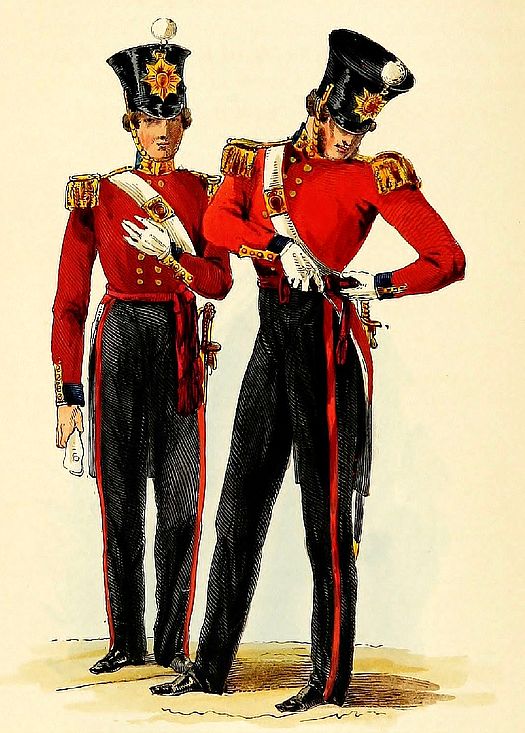
Fourth (or King's Own) Regiment of Foot.
[To face page 141.