OF THE
FOURTEENTH (THE KING'S) REGIMENT
OF
LIGHT DRAGOONS.
1715
The accession of the house of Hanover to the
throne of Great Britain and Ireland, was the
commencement of a dynasty under which this
kingdom has attained a splendid elevation of
naval, military, commercial, and political importance;
has extended its possessions in remote
countries;—and its armies have fought and
conquered in every quarter of the globe. The
first year of His Majesty's reign had, however,
not expired, when it was found necessary to
augment the regular army, and the Fourteenth,
(the King's) Regiment of Light Dragoons, is
one of the corps incorporated on that occasion.
It was raised in South Britain, by Brigadier-General
James Dormer, who had acquired a
reputation in the war of the Spanish succession;
and the following officers were appointed to the
regiment, by commissions dated the 22nd July,
1715.
| Captains. | Lieutenants. | Cornets. |
| James Dormer (col). | Jas. Stevens (cap.-lt.) | Edward Stroude. |
| H. Killegrew (lt.-col.) | Henry Lasale. | Thomas Ellis. |
| Sol. Rapin. (major) | Peter Davenport. | Thomas Delahaye. |
| Henry Pelham. | Jonathan Pirke. | William Hamilton. |
| William Boyle. | Cuthbert Smith. | Rigley Molyneux. |
| Beverly Newcommin. | James Flemming. | Andrew Forrester. |
His Majesty's protestant subjects arrayed themselves
under the royal standard with great cheerfulness,
but before the regiment was complete in
men and horses, the arrangements of the Jacobites
were in such a state of forwardness, that the
Pretender's standard was raised in Scotland by the
Earl of Mar, who was soon at the head of ten
thousand men. A body of rebels having penetrated
into Lancashire, Dormer's dragoons were among
the corps directed to advance, under Major-General
Wills, and fight the insurgent bands: the
regiment was formed in brigade with Pitt's horse,
now second dragoon guards, under its Colonel,
Brigadier-General Dormer. Arriving at Preston,
about three o'clock in the afternoon of the 12th
of November, the rebels were found in force in the
town, with the avenues barricaded and defended
by cannon. The Fourteenth dragoons were
directed to dismount and form as infantry, to take
part in storming the avenue leading to Lancaster,
in which they were assisted by Wynne's (ninth),
and a squadron of Stanhope's dragoons (afterwards
disbanded) under Brigadier-Generals Dormer and
Munden; Pitt's horse, Munden's (thirteenth), and
a squadron of Stanhope's dragoons forming in
support. The first barrier was carried with great
gallantry; but the inner barricade could not be
forced for want of cannon. The houses were
afterwards set on fire, and measures adopted to
prevent the escape of the rebels, who were
eventually forced to surrender at discretion. The
regiment had three men and sixteen horses killed
on this occasion, Brigadier-General Dormer, and
four private soldiers wounded.
The regiment escorted a number of the captured
insurgents to Lancaster gaol, and was afterwards
quartered in that town, and in the early part of
1716 the rebellion was suppressed by the troops
under the Duke of Argyle.
1716
In May 1716, the regiment marched from
Lancaster, into cantonments at Lincoln and the
neighbouring towns.
1717
A reduction of the army took place in the
spring of 1717, and in May, Dormer's dragoons
marched to Bristol and embarked for Ireland, to
replace a regiment ordered to be disbanded in that
country.
1720
The regiment remained in Ireland during the
succeeding twenty-five years. In 1720, Brigadier-General
Dormer was removed to the sixth regiment
of foot, and was succeeded in the colonelcy
of the Fourteenth dragoons, by Colonel Clement
Neville, from the lieut.-colonelcy of the thirteenth
dragoons.
1721
1737
Colonel Neville commanded the regiment
seventeen years, and was removed in 1737, to the
eighth dragoons, and the colonelcy of the Fourteenth
was conferred on Colonel Archibald
Hamilton from the 27th foot.
1740
1741
1742
Charles VI. Emperor of Germany, died in
1740; the succession of the Archduchess Maria-Theresa,
as Queen of Hungary and Bohemia, was
disputed by the Elector of Bavaria, who was
supported by a French army; and, in 1742, King
George II. sent a British force to Flanders to aid
the house of Austria; at the same time the
Fourteenth dragoons were withdrawn from
Ireland, to replace the cavalry regiments which
had proceeded on foreign service from England.
1743
1744
1745
The regiment was stationed in Great Britain
during the years 1743 and 1744; and in 1745,
when Charles Edward, eldest son of the Pretender,
raised his father's standard in Scotland, it was
ordered to Stirling. After Lieut.-General Sir John
Cope had marched from Stirling with the infantry
and some artillery, the Fourteenth dragoons
proceeded to Leith, where they were stationed
when the rebel army advanced towards Edinburgh.
They were suddenly ordered to join
Colonel Gardiner, who was retiring before the
rebel army, with the thirteenth dragoons; they
rode through Edinburgh at a brisk pace during
public worship on Sunday, the 15th of September,
when the congregations rushed out of the churches
and chapels and filled the streets, and four
hundred volunteers, with a thousand men of
the trained bands, appeared in arms. The
Fourteenth dragoons joined Colonel Gardiner
at Carstorphin, from whence they fell back to
Coltsbridge, where they were joined by the
city guard and Edinburgh regiment. On a
report of the approach of the rebel bands, the
Edinburgh regiment and city guard withdrew
within the walls, and the dragoons moved towards
Haddington, the citizens refusing to admit them
into the place; and while a tumultuary council
was being held to decide about the mode of defending
the city, the insurgents gained possession
of one of the gates: thus Edinburgh fell into the
hands of the young Pretender.
The Fourteenth dragoons were afterwards
ordered to join Lieut.-General Sir John Cope,
who had arrived at Dunbar with a small body
of infantry, and he advanced towards Edinburgh,
when the rebel army was put in motion to meet
him. On the 20th of September the King's
troops confronted the insurgents near Prestonpans
and the night was passed in the field:
the Fourteenth dragoons, commanded by Lieut.-Colonel
William Wright, furnished videttes and
patrols on the flanks of the army. Before day-break,
on the following morning, a chosen band
of Highlanders advanced through the thick
atmosphere, and attacked the right of the King's
troops; their sudden advance in the dark, their
superior numbers, and peculiar mode of fighting,
struck with consternation the few men who
guarded the artillery, and who faced about and
fled. The dragoons advanced to charge the
Highlanders; but seeing the very superior numbers
of their opponents, and being discouraged by
the loss of their artillery, they made only a feeble
effort to stem the torrent of battle, and afterwards
retired from the field. Several officers, and a
few private soldiers, however, behaved with great
gallantry, and among others, Major Richard
Bowles, of the Fourteenth dragoons, particularly
distinguished himself; the few troopers,
who rallied round him, had been cut down, and
his own horse killed; but he continued to fight
on foot; he was surrounded, and had received
eleven wounds, when a rebel leader interposed
and saved his life. When once troops are put
into confusion, and are afterwards closely pressed
by the enemy, no reserves being at hand for
them to rally upon, the difficulty of restoring
order becomes particularly great, and, in this
instance, the loss of the battle was the result.
The Fourteenth dragoons withdrew from the
field, and afterwards marched to Berwick.
The regiment subsequently joined the army
assembled under Field-Marshal Wade at Newcastle;
when the rebels penetrated into Derbyshire,
it was employed in covering Yorkshire;
and when the young Pretender made a precipitate
retreat to Scotland, the Fourteenth dragoons
marched to Edinburgh, where a few regiments
were assembled under Lieut.-General Hawley.
1746
On their return to Scotland, the rebels besieged
Stirling Castle; and Lieut.-General Hawley
put the King's troops in motion to raise the
siege. The Fourteenth dragoons left Edinburgh
on the 13th of January, 1746; they took
part in driving a body of rebels out of Linlithgow,
and were subsequently encamped near Falkirk.
On the 17th of January, as the soldiers were
at dinner in the camp, the approach of the rebel
army was descried, and the troops moved towards
some high grounds on Falkirk-moor, where the
insurgent bands were formed. The action was
commenced by a charge of the cavalry; the
enemy's first line was broken, and some execution
done; but the second line of insurgents repulsed
the dragoons. The infantry was, soon afterwards,
brought into the fight; but a heavy storm of
wind and rain beat so violently in the soldiers'
faces, as nearly to blind them, and the wet prevented
their muskets giving fire. Several regiments
retired in some disorder; others maintained
their ground and repulsed the Highlanders,
and after dark the whole withdrew to Linlithgow
and afterwards to Edinburgh.
The Duke of Cumberland subsequently took
the command of the troops in Scotland, and advanced
towards Stirling; when the rebels made a
precipitate retreat. His Royal Highness pursued;
but the Fourteenth dragoons were left behind,
and were directed to patrol along the roads leading
westward from Edinburgh, to prevent the
rebels obtaining intelligence. At length the Highlanders
were overpowered in the field of Culloden,
and the rebellion was suppressed.
1747
In 1747 the regiment returned to Ireland, and
was stationed in that country during the succeeding
forty-eight years.
1749
Lieut.-General Hamilton died on the 8th of
July, 1749, and King George II. conferred the
colonelcy of the Fourteenth dragoons on Lieut.-General
James, Lord Tyrawley, from the tenth
regiment of Foot.
1751
The following description of the clothing and
guidons of the regiment is taken from the Royal
Warrant, dated the 1st of July, 1751.
Coats,—scarlet; double-breasted, without lappels;
lined with lemon colour; slit sleeves turned
up with lemon colour; the button-holes worked
with narrow white lace; the buttons of white
metal, set on three and three; a long slash pocket
in each skirt; and a white worsted aiguillette on
the right shoulder.
Waistcoats and Breeches,—lemon colour.
Hats,—bound with silver lace, and ornamented
with a white loop and a black cockade. Red
forage cap turned up with lemon colour, and
XIV. D. on the flap.
Boots,—of jacked leather, reaching to the knee.
Cloaks,—Scarlet, with a lemon-coloured cape;
the buttons set on three and three, upon white
frogs or loops, with a red and green stripe down
the centre.
Horse Furniture,—of lemon-coloured cloth;
the holster caps and housings having a border of
white lace, with a red and green stripe down the
centre; XIV. D. embroidered upon a red ground,
within a wreath of roses and thistles, on the
housing; and upon the holster caps G.R., with
the crown over it, and XIV. D. underneath.
Officers,—distinguished by silver lace and
embroidery; and a crimson silk sash worn across
the left shoulder.
Quarter Masters,—to wear a crimson sash
round their waists.
Serjeants,—to have narrow silver lace on the
cuffs, pockets, and shoulder-straps; silver aiguillettes;
and green, red, and white worsted sashes
tied round their waists.
Drummers and Hautboys,—clothed in lemon-coloured
coats, lined and faced with scarlet, and
ornamented with white lace, having a red and
green stripe down the centre: red waistcoats and
breeches.
Guidons,—the first, or King's guidon, to be
of crimson silk, with a silver and red fringe; in
the centre, the rose and thistle conjoined, and
crown over them, with the motto Dieu et mon
droit underneath; the white horse in a compartment
in the first and fourth corners; and XIV.
D., in silver characters, on a lemon ground, in
a compartment in the second and third corners:
the second and third guidons to be of lemon-coloured
silk; in the centre XIV. D. on a red
ground within a wreath of roses and thistles on
the same stalk; the white horse, on a red ground,
in the first and fourth compartments; and the
rose and thistle conjoined, on a red ground, in
the second and third compartments; the third
colour to have a figure 3, on a circular red
ground, under the wreath.
1752
Lieut.-General Lord Tyrawley commanded the
regiment two years, and was removed, in July,
1752, to the third dragoons, and was succeeded by
Colonel Lewis Dejean, whose regiment of foot
had been disbanded at the peace of Aix-la-Chapelle,
in 1748–9.
1756
1757
Colonel Dejean was promoted to the rank of
major-general in 1756, and in 1757 he was removed
to the third Irish Horse, now sixth dragoon
guards; and His Majesty conferred the colonelcy
of the Fourteenth dragoons on Colonel John
Campbell, from the fifty-fourth regiment.
1759
1761
1765
The rank of major-general was conferred on
Colonel Campbell in 1759; in 1761 his uncle,
Archibald, third Duke of Argyle, died, when his
father, General John Campbell of the Scots Greys,
succeeded to that title, and Major-General Campbell
of the Fourteenth Dragoons obtained the
designation of Marquis of Lorne: he was removed
to the first, the royal regiment of foot, in
1765, and was succeeded in the command of the
Fourteenth dragoons, by Colonel Charles Fitzroy,
(afterwards Lord Southampton) whose regiment
of foot had been disbanded at the peace of
Fontainbleau in 1763.
1768
On the 19th December, 1768, a warrant was
issued, by authority of King George III., for
regulating the standards, guidons, clothing, &c.,
of the regiments of cavalry, in which it was
directed, that the uniform of the Fourteenth
dragoons should be red, with lemon-coloured
facings, without lappels, with silver lace; the
uniform, &c., being the same as prescribed by
the Royal Warrant of the 1st July, 1751.
1772
Colonel Fitzroy was promoted to the rank of
major-general and removed to the third dragoons,
in 1772, when King George III. conferred the
colonelcy of the Fourteenth dragoons on Lieut.-General
Daniel Webb, from the eighth foot.
1773
Lieut.-General Webb died in 1773, and was
succeeded by Colonel George Warde, from the
lieut.-colonelcy of the fourth dragoons.
1775
1776
1777
Hostilities between Great Britain and her
North American Colonies commenced in 1775,
and the rugged valleys and trackless forests which
became the theatre of this war, were not adapted
for the operations of heavy dragoons. The necessity
of having a greater proportion of light
cavalry had become apparent, and in 1776, the
Fourteenth, which were then in Ireland, were
constituted a corps of Light Dragoons. The
standard height for men and horses was reduced;
the cocked hats were replaced by helmets; arms
and appointments of a lighter description were
adopted, and in the annual army list for 1777,
the regiment was designated, "The Fourteenth
Light Dragoons."
1778
In 1778, Major-General Warde was removed to
the first Irish horse, now fourth dragoon guards, and
was succeeded in the colonelcy of the Fourteenth
light dragoons, by Major-General Robert Sloper.
1784
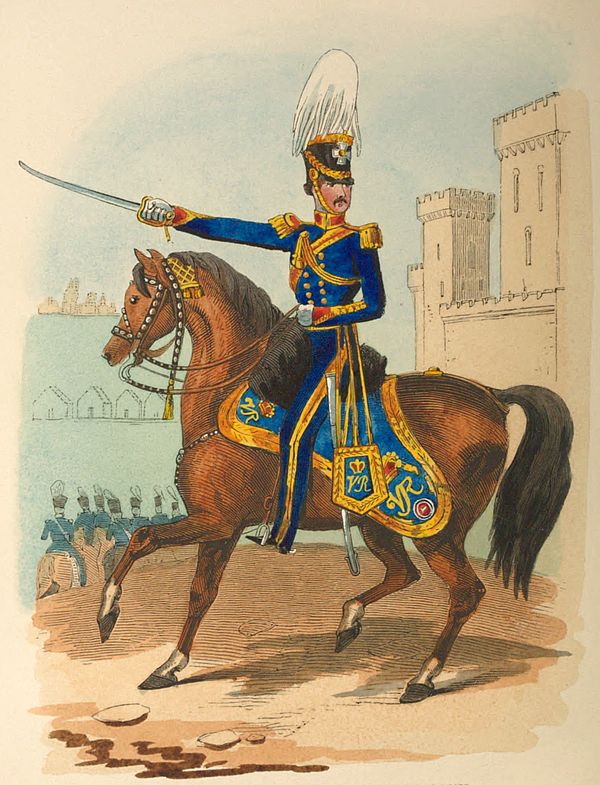
In 1784 the clothing of the light dragoon
regiments was changed from scarlet to dark blue;
and the following orders were issued on this subject,
dated—
Adjutant General's Office,
Dublin, 18th May, 1784.
'His Majesty's pleasure having been signified
to the Lord Lieutenant, that the clothing of the
light dragoon regiments shall hereafter be
made in conformity to the following regulations,
it is the Commander-in-Chief's order that the
said regulations be observed accordingly.'
Regulations for the Clothing of the Light Dragoons.
The clothing of a private light dragoon is to
consist of a jacket, shell, under-waistcoat, and
leather breeches.
The jacket and shell to be of blue cloth; the
collars and cuffs of the royal regiments to be red,
and those of the other regiments to be of the
colour of the facing of the regiment; looped upon
the breast, edged with white cord, and to be lined
with white, the 11th and 13th regiments excepted,
which are to be lined with buff. The
under waistcoat to be of flannel with sleeves, and
made so as to be buttoned within the waistband
of the breeches.
The breeches to be of buckskin.
N.B. The make of the dress and method of
placing the cord upon the breast of the jacket, to
be exactly conformable to the pattern approved
by His Majesty.
Officers and Quarter Masters.—The dress-uniform
of the officers and quarter-masters of the
light dragoons to be made according to the King's
regulations of the 19th December, 1768, excepting
that the coats are to be blue and faced with
the same colour as the private men, and that the
Royal regiments are to be faced with scarlet.
Field Uniform of the Officers and Quarter
Masters.—The jacket and shell to be made up in
the same manner as those of the men, excepting
that the shell is to have sleeves, and that the
looping is to be made of silver, the 13th regiment
excepted, which is to be of gold.
Serjeants.—The serjeants of the light dragoons
to be distinguished by gold or silver looping.
Corporals.—The corporals of the light dragoons
to be distinguished by a gold or silver
cord, round the collar and cuffs.
Trumpeters.—The trumpeters to have a jacket
and shell, the colour and facing of the regiment,
with lace, instead of looping, in front and down
the seams.
N.B. A pattern suit may be seen at the Commander-in-Chiefs
office at the Royal Hospital.
(Signed) H. Pigot,
Adjutant General.
The foregoing orders were sent to the officers
commanding the 8th, 12th, 13th, 14th, 17th, and
18th light dragoons; to the Earl of Drogheda; to
the major of brigade for the general officers; and to
the agents, Messrs. Montgomery, Wybrants, and
Cane.
1791
1793
The regiment remained in Ireland performing
the usual duties of a cavalry corps on home service,
until the events attendant on the French
revolution occasioned it to be employed in continental
and colonial warfare. When this revolution
assumed its wild and violent character, the
spirit of republicanism soon extended to the
French West India Islands. The resolution to
grant the immediate freedom of the slaves, for
which they were unprepared, was followed, in 1791,
by acts of outrage and spoliation committed by
the blacks against the properties of their owners.
In 1793 the planters of St. Domingo obtained
British aid; and the revolutionists afterwards
received assistance from France.
1794
1795
In the same year, a British army appeared in
Flanders under the Duke of York, to arrest the
progress of the French aggressions on the continent;
and in 1794, two troops of the Fourteenth
light dragoons were withdrawn from Ireland to
engage in the contest. On their arrival in Flanders,
the two troops of the regiment were attached
to the eighth light dragoons; and they formed
part of the van of the forces under Lieut.-General
the Earl of Moira, on the march from Ostend to
join the army under His Royal Highness the
Duke of York. The squadron of the Fourteenth
also shared in the toils and hardships of the winter
campaign in Holland; it took part in several
skirmishes with the enemy, and after enduring
great privation and suffering from an unusually
severe season, which occasioned the loss of several
men and horses, it arrived in the early part of
1795, in Germany, where it was incorporated in
the eighth regiment of light dragoons.
The contest in the West Indies had, in the
meantime, been carried on with varied success,
and the seven troops of the Fourteenth light
dragoons in Ireland were ordered to give up their
horses to the twenty-fourth light dragoons at
Clonmel, and to embark for the West Indies dismounted.
This transfer took place under the
direction of Major-General Egerton, who bore
testimony to the alacrity with which the officers
and men prepared for embarkation.
The regiment embarked on the 25th of February,
1795, under the command of Lieut.-Colonel
Arthur Carter; on arriving at St. Domingo, it
was furnished with such horses as could be procured,
and it was soon engaged in active operations
against the bands of armed negroes and mulattoes
who had enrolled themselves under the banners
of the French republic.
1796
1797
During the years 1796 and 1797, numerous
actions occurred; but against a hundred thousand
trained blacks who had been instructed in European
discipline, the few British troops on the
island were unable to do more than exhibit many
brilliant examples of discipline and valour. In
an enterprise against the post of Mirebalais in
the beginning of June, 1797, a detachment of
the Fourteenth, Eighteenth, and Twenty-first
light dragoons, commanded by Lieut.-Colonel
Carter of the Fourteenth, distinguished themselves.
They drove twelve hundred of the enemy
with three pieces of cannon from a strong position,
captured two guns, and chased a number of opponents
into the river Artibonite, capturing
their ammunition, mules, &c. The conduct of
Lieut.-Colonel Carter, and of the dragoons under
his orders, was commended in the public despatches.
The climate of St. Domingo was,
however, so very injurious to the health of European
soldiers, that the regiment was soon
reduced to a skeleton. The few surviving men
who were fit for service, were permitted to volunteer
into other corps, and the remainder, twenty-five
in number, embarked for England, where
they arrived in the month of October, and were
stationed at Chelmsford.
On the 1st of June, 1797, General Sir Robert
Sloper. K.B., was removed to the fourth dragoons,
and the colonelcy of the Fourteenth was conferred
on Major-General John William Egerton,
afterwards Earl of Bridgewater, from first lieut.-colonel
of the seventh light dragoons. This
officer being on the staff when the few men of the
regiment arrived from St. Domingo, he was employed
in superintending the recruiting and remounting
of his corps, and in a short time he
had the satisfaction of seeing it a fine body of
light cavalry mustering six hundred mounted
men, who were divided into eight troops.
1798
In August, 1798, King George III. was
graciously pleased to approve of the regiment
being styled "the Fourteenth, or the Duchess
of York's own Regiment of Light Dragoons," in
honour of Frederica Charlotte Ulrica Catherina,
Princess Royal of Prussia, who was married to His
Royal Highness the Duke of York in 1791; at the
same time the Royal authority was given for the
Fourteenth to assume the "Prussian Eagle"
as a regimental badge, and the colour of the
facing of the regiment was changed from lemon-yellow
to orange.
1800
1802
The establishment was augmented to ten
troops, of ninety rank and file each, in 1800;
but at the peace of Amiens, in 1802, a reduction
of two troops took place.
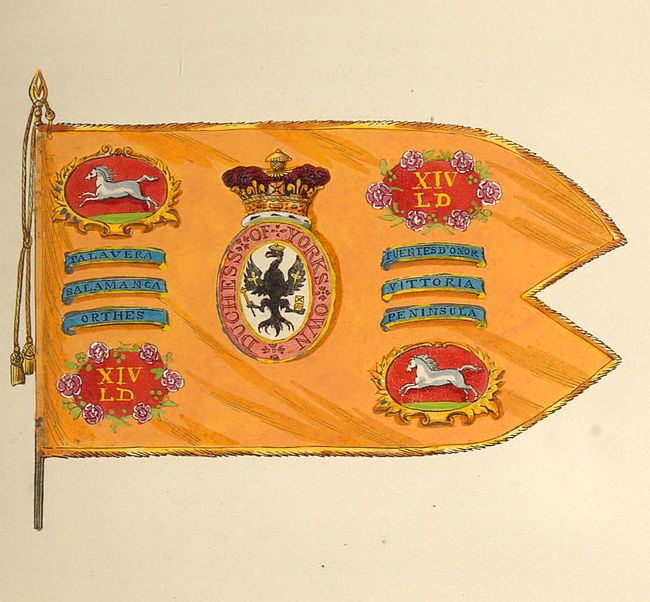
GUIDON OF THE FOURTEENTH, OR THE DUCHESS OF YORK'S OWN LIGHT DRAGOONS, M DCC XCVIII.
[To face page 18.
1803
1804
1807
Hostilities were resumed in 1803, and in 1804
the regiment was again augmented to ten troops
of ninety rank and file each, for which a supply
of new carbines and pistols was received in 1807,
from the ordnance stores.
1808
The French Emperor, Napoleon Buonaparte,
having attempted to reduce Spain and Portugal
to subjection to his power, a British army proceeded
to Portugal to aid the inhabitants in their
struggles for freedom. Portugal had been delivered,
and the army under Lieutenant-General
Sir John Moore was advancing into Spain, when
the Fourteenth (the Duchess of York's Own)
regiment of light dragoons, was ordered to embark
for the Peninsula. The regiment marched
to Falmouth, where it was put on board of transports,
and arrived at Lisbon on the 23rd of
December under the command of Colonel Samuel
Hawker.
1809
The return to England of the troops which had
served under Lieut.-General Sir John Moore,
whose career of honour was terminated at the
battle of Corunna, left only a small British
force in the Peninsula, and these troops
were quartered near Lisbon, from whence the
Fourteenth light dragoons advanced in the
early part of 1809, to Bucellas, an out-post of the
army. In April the regiment formed the advance-guard
on the march of the army to Coimbra,
and in the beginning of May it was united
in brigade with the sixteenth and twentieth light
dragoons under Major-General Cotton, and was
reviewed on the plains of Coimbra by Lieutenant-General
Sir Arthur Wellesley. The French
troops under Marshals Soult and Victor had, in
the meantime, invaded Portugal, and Marshal
Soult had captured Oporto.
To expel the French from Oporto, was the
first service undertaken by the British commander;
on this occasion two squadrons of the Fourteenth,
under Lieut.-Colonel Neil Talbot, were detached
with the Portuguese troops under Marshal
Beresford to intercept the French, if they should
attempt to retreat by Amarante; the remaining
three squadrons under Colonel Hawker advanced
direct upon Oporto, and being employed, with
the other cavalry on the advance-piquets, they
took part in the rencounters with the enemy on
the 10th and 11th of May. Arriving on the 12th
of May, on the banks of the Douro near Oporto,
unperceived by the French, the English general
resolved to pass the river, when two squadrons of
the Fourteenth were detached, with the German
brigade and two guns under Major-General
John Murray, three miles up the river, to Barca
de Avintas, where they effected a passage in
boats. In the meantime a portion of the army
had passed nearer the city, and was engaged in a
fierce action with the enemy, when the Fourteenth
light dragoons and the Germans were
seen advancing down the right bank of the river.
The French made a precipitate retreat. The
leading squadron of the Fourteenth, commanded
by Major F. B. Hervey, and gallantly supported
by the second squadron under Major the
Honourable Charles Butler, dashed sword in hand
upon the enemy's rear-guard and overthrew it,
as it was pushing through a narrow road to
gain an open space beyond the defile. Some execution
was done, the French General, Laborde,
was unhorsed, and General Foy was wounded;
but no other troops advancing to support the
Fourteenth, the gallant dragoons had to fight
their way back, and had several men and horses
killed and wounded. Major F. B. Hervey lost
his right arm; Captain Peter Hawker, Lieutenants
Robert Knipe, and Evelyn P. Dormer, were
wounded.
The conduct of the Fourteenth was commended
in Sir Arthur Wellesley's public despatch,
and also in general orders. They had marched
eighty miles in four days over the most difficult
country, and they were employed in pursuing,
along a mountainous region, the discomfited French
troops, whose line of retreat could be traced by the
smoke of burning houses. Having followed the
enemy as far as Ginjo, the Fourteenth light
dragoons halted, and afterwards moved towards
Abrantes, where the army was concentrated for
operations on the Tagus.
From Abrantes the army advanced into Spain,
and a body of French troops under Marshal
Victor retreated from Talavera de la Reyna.
The Spaniards under General Cuesta pursued
with avidity; but the French were reinforced,
and they drove the Spaniards back upon Talavera,
where the allied army formed in order of battle;
the Fourteenth light dragoons being posted in
the rear of Brigadier-General Alexander Campbell's
division.
When the army went into position, Major-General
Mackenzie was left with a division of
infantry and a brigade of cavalry, as an advanced
post, in the wood on the right of the Alberche,
which covered the left flank. The French attacked
this post between two and three o'clock
on the 27th of July, when the Fourteenth light
dragoons were ordered forward, and they crossed
the Alberche river, and sent out a line of skirmishers
to cover the retrograde movements of the
infantry. The regiment was employed in skirmishing
until night, and had nine horses killed;
Lieutenant Theophilus Thomas Ellis, and one
private soldier wounded.
The Fourteenth light dragoons resumed their
post in the position occupied by the allied army,
and supported the infantry during the severe contest
on the 28th of July. The left of the British
line was attacked at day-break, and when the
enemy was repulsed at this point, a long pause
ensued. An attack on the centre was made soon
after two o'clock, and the French were again
driven back; they also failed in another attack
on the left. A strong body of the enemy advanced
against Major-General Sherbrooke's division;
this attack was repulsed by a charge of the
whole division with bayonets; but the brigade of
foot guards pursued so far as to be in danger of
being annihilated; when the forty-eighth regiment,
and the Fourteenth and sixteenth light dragoons
were brought forward, and the foot guards rallied
and again advanced. This was a moment of
great peril to the allied army; but the steady
valour of the British troops prevailed, and the
French fell back.
The Fourteenth light dragoons had three
men and twenty-one horses killed; Colonel Samuel
Hawker, Captains John Chapman, and Peter
Hawker, Lieutenants William Wainman and
Thomas Smith, six rank and file, and three
horses wounded; thirteen horses missing; Lieutenant
Evelyn P. Dormer taken prisoner. Lieutenant-Colonel
Neil Talbot, and Major Baker
had each a horse killed under him.
Colonel Hawker was rewarded with a gold
medal, and the regiment was subsequently
authorised to bear on its guidons and appointments
the word "Talavera", in commemoration
of its distinguished services in this
action.[10]
After this battle the enemy brought forward
such very superior numbers, that the British
General was forced to act on the defensive, and
while the army was encamped on the banks of
the Guadiana, a malignant fever proved fatal to
numbers of officers and soldiers. The Fourteenth
dragoons were removed to Villa Vicosa,
a fortified town in the Alemtejo, from whence
they marched, in December, to Santarem, a town
very pleasantly situated on the right bank of the
Tagus, where they were formed in brigade with
the royal dragoons under Major-General Slade.
1810
In February, 1810, Badajoz and Ciudad Rodrigo
were both menaced by the enemy, and in March
the regiment returned to the Alemtejo, and took
the advanced posts of Lieut.-General Rowland
Hill's corps at Arronches, a town situate at the
conflux of the Caya and the Algrette, near the
Spanish frontiers. A concentration of French
troops near Ciudad Rodrigo afterwards relieved
the other provinces. Ciudad Rodrigo was eventually
beseiged by Marshal Ney, and the British
commander, hoping the enemy, by detaching
troops, would furnish an opportunity for relieving
this fortress, withdrew the Fourteenth light
dragoons from the Alemtejo. The regiment
advanced to Almeida in June; it was attached to
the light division under Brigadier-General Craufurd,
who was behind the Agueda river, watching
the enemy's motions; and with the sixteenth
light dragoons, and first hussars King's German
Legion, took the out-post duty on this frontier.
No opportunity to relieve Ciudad Rodrigo occurred;
but during the siege marauding parties
of French soldiers entered the villages of Barquillo
and Villa de Puerco on three successive nights.
Brigadier-General Craufurd, thinking to cut off
the next party, formed two ambuscades, one near
Villa de Puerco, with six squadrons, another of
three squadrons near Barquillo, and he also placed
his artillery, five companies of the ninety-fifth,
(Rifle-brigade) and the third Portuguese Caçadores
in reserve; the Fourteenth light dragoons were
employed in these ambuscades. On the morning
of the 11th of July, a little after day-break, a
party of French infantry was observed near Villa
de Puerco, and a small body of cavalry at Barquillo;
and the open country on the right would
have enabled the six squadrons to place themselves
between the infantry and their point of retreat;
but this was circuitous, and Brigadier-General
Craufurd preferred passing along a narrow defile
between two stone walls. This proved difficult;
in threading the defile in a long line the dragoons
were separated, and the French infantry, two
hundred strong, had time to form square, being
hidden in high standing corn. The French dragoons
coming out of Barquillo, were charged by
the German hussars and a squadron of the sixteenth,
and two officers and twenty-nine men were
made prisoners. In the meantime the Fourteenth
light dragoons had threaded the defile,
and mounting the hill, rode with distinguished
gallantry against the square; but the French
infantry remained perfectly steady, and opened
such a fire, that Lieut.-Colonel Talbot and eight
men fell dead close to the bayonets, and twenty-three
men were wounded.[11] The survivors withdrew
a short distance to reform their ranks, and
the French square commenced its retreat with
singular steadiness and good order. The Fourteenth
dragoons seeing this, prepared to launch
against it another squadron, which was already in
speed for the purpose, when Colonel Arentschildt
of the hussars, observing cavalry approaching in
front and flank, checked the movement. It was
afterwards regretted that he took this step, as the
horsemen, who alarmed him, proved to be the
German hussars and sixteenth returning from the
pursuit of the French dragoons, the whole of
whom they had captured.
On the death of Lieut.-Colonel Talbot the command
of the regiment devolved on Lieut.-Colonel
F. B. Hervey, under whose directions the Fourteenth
became celebrated as an efficient corps of
light cavalry, remarkable for the excellent manner
in which they performed the out-post duty.
Meanwhile Ciudad Rodrigo had surrendered;
the Fourteenth remained in the villages near
Fort La Conception until the 21st of July, when
the enemy's masses approaching, they fell back
to Almeida, where Brigadier-General Craufurd
halted the few troops under his orders, and, with
astonishing hardihood, confronted the whole
French army. During the night of the 23rd of
July, the videttes and patrols of the regiment were
exposed to a heavy storm of wind and rain, and as
daylight appeared, they discovered the approach
of numerous legions of the enemy: a few shots
were fired; the cavalry reserves and guns moved
forward, and a skirmish ensued in which the
Fourteenth had one serjeant killed; Lieutenant
John Blachford, one private soldier, and four
horses wounded. After opposing the superior
numbers of the enemy for some time, the British
withdrew beyond the river Coa; and Brigadier-General
Craufurd stated in his despatch,—'The
retreat of the Fourteenth light dragoons from
Val-de-la-Mula to Almeida, was conducted in
the most regular and soldier-like manner, though
opposed to a superior force of French cavalry.'
A squadron of the regiment and a squadron of
the royal dragoons, on duty at Frexadas, were
sharply engaged with a superior force of the
enemy on the 28th of August, and highly distinguished
themselves.
Marshal Massena invaded Portugal with such
an immense superiority of numbers, that the
British commander was under the necessity of
withdrawing from the frontiers, and the Fourteenth
and sixteenth light dragoons, with the
first German hussars, had the honour of covering
the retrograde movements. On the 24th of September
the enemy skirmished with the piquets in
front of Mortagao, from whence a squadron of the
Fourteenth under Captain Thomas W. Brotherton,
with one of the sixteenth and first hussars,
covered the retreat of the light division four miles
to some strong ground. The three squadrons repulsed
four of French hussars; some of the enemy's
dragoons approaching too close, were charged by
the squadron of the Fourteenth, and overthrown
with the loss of about thirty men. On the following
morning the cavalry skirmishers exchanged a
few shots, and the Fourteenth were employed in
covering the retreat of the light division to the
position of Busaco. During this retreat Captain
the Hon. Henry Percy was taken prisoner while
reconnoitring the flank movement of the enemy.
The Fourteenth were in reserve during the
battle of Busaco on the 27th of September; and
they were subsequently employed in covering the
retreat of the army to the strong lines of Torres
Vedras.
On the 1st of October, the out-posts were attacked
and driven from the hills bounding the
plain of Coimbra to the north, when three troops
of the Fourteenth, under Major the Honourable
Charles Butler, proceeded through the town, and
formed the rear-guard on the main road from
Coimbra to Pombal. The remainder of the
regiment was formed on the plain, with the
other cavalry corps, and withdrew before a superior
force of the enemy, crossing the Mondego
at a ford below the town, and skirmishing to
prevent the passage of the river by the enemy.
The French army continuing to press forward,
its advance-guard skirmished with the rear of the
allies almost every day, and the Fourteenth
light dragoons had frequent opportunities of exhibiting
brilliant instances of the innate valour of
British soldiers. At Rio Mandevilla the Fourteenth
and sixteenth light dragoons, first German
hussars, royal dragoons, and Captain Bull's
troop of artillery, repulsed a very superior force
of the enemy, on which occasion the first French
hussars were nearly annihilated. The Fourteenth
had six men and six horses killed; eight
men and twelve horses wounded.
The French legions continued to press forward
as to an assured victory; but the lines of Torres
Vedras arrested their progress, and while they remained
in front of these extensive works, the Fourteenth
light dragoons took the line of out-posts
from the Sobral road. The French army withdrew
during the night of the 14th of November;
the morning of the 15th was foggy, and it was
some hours after day-break when the British
General discovered the void space in his front.
The Fourteenth were ordered forward along the
Cartaxo road, and their patrols took a number
of French stragglers prisoners. Marshal Massena
took up a position at Santarem; the head quarters
of the allied army were established at Cartaxo,
and the Fourteenth light dragoons furnished
the out-posts, extending from the causeway and
bridge over the river.
1811
After wasting his army by privation and sickness,
the French marshal retreated; and at day-light
on the 6th of March, 1811, Lord Wellington
discovered the empty camps at Santarem, and
moved his own army forward in pursuit. On
the 8th of March, a squadron of the Fourteenth
commanded by Captain Babington, and supported
by the other squadrons of the regiment under
Colonel Hervey, made a successful charge on
four squadrons of the eleventh and twenty-sixth
French dragoons at Venta de Serra, and captured
fourteen men and fourteen horses; with the loss
of two men and two horses.
Continuing to press upon the rear of the French
army, the regiment was present at the skirmish
at Pombal on the 10th of March, at Redinha on
the 12th, at Casal Nova on the 14th, and at Foz
d'Aronce on the 15th. The Fourteenth were
also present at the action near Sabugal, on the
3rd April, but did not sustain any loss.
The French Commander continued his retreat
to Salamanca, and the British General stood victorious
on the confines of Portugal; the Fourteenth
light dragoons furnished the out-posts
on the left bank of the Agueda at Villa del Egua,
where a peasant arrived from Ledesma, with
intelligence that the French army was reinforced
and re-organized, and was advancing. A squadron
under Captain Brotherton was sent to Santa
Espirita, and it fell back behind the Agueda as the
French army advanced.
Almeida being blockaded by the allied army,
Marshal Massena advanced to its relief; the
Fourteenth withdrew gradually as the enemy
approached, and on the 3rd of May they were
engaged behind Gallegos; when Lieutenant John
Townsend retired with the piquets under a heavy
cannonade towards Fuentes d'Onor, and a squadron,
under Captain Brotherton, had a sharp affair
near Pozo Velho.
At the battle of Fuentes d'Onor, on the 5th
of May, the Fourteenth and first royal dragoons
covered the movement of the right of the army
from Nave d'Aver, retiring by alternate squadrons,
under a heavy cannonade; one squadron
of the regiment charged with signal gallantry
some French artillery, but was repulsed, and
Captain Robert Knipe commanding the squadron
was mortally wounded: he was succeeded in the
command of the squadron by Lieutenant (afterwards
Lieut.-Colonel) John Townsend: Lieut.-Colonel
Hervey had his horse killed under him,
and received a severe contusion.
An attack was made on the position in the rear
of the village. 'The French with one shock
drove in all the cavalry out-guards, and cutting
off Captain Ramsay's battery, came sweeping in
upon the reserves of horse and upon the seventh
division. But their leading squadrons approaching
in a disorderly manner, were partially
checked by the British, and, at the same time,
a great commotion was observed in their main
body. Men and horses there closed with confusion
and tumult towards one point, a thick
dust arose, and loud cries, and the sparkling of
blades, and the flashing of pistols, indicated some
extraordinary occurrence. Suddenly the multitude
became violently agitated, an English
shout pealed high and clear, the mass was rent
asunder, and Norman Ramsay burst forth at
the head of his battery, his horses, breathing fire,
stretched like greyhounds along the plain, the
guns bounding behind them as things of no
weight, and the mounted gunners followed in
full career. Captain Brotherton of the Fourteenth
dragoons, seeing this, rode forth with a
squadron and overturned the head of the pursuing
troops, and General Charles Stewart joining
in the charge, took the French General
Lamotte, fighting hand to hand.'[12] The French
were repulsed in their attempt to relieve Almeida,
and they withdrew from Portugal.
The Fourteenth light dragoons had Captain
Robert Knipe and three private soldiers killed;
Captain Thomas Potter Milles, Lieutenants John
Townsend, John Gwynne, Lovell B. Badcock,
Theophilus Thomas Ellis, six serjeants, and
twenty-one rank and file wounded; three private
soldiers missing. Lieut.-Colonel Hervey was
rewarded with a gold medal, and the royal authority
was subsequently given for the regiment
to bear on its guidons and appointments the
words "Fuentes d'Onor," as a special mark
of His Majesty's approbation of its conduct on
this occasion.
Viscount Wellington subsequently proceeded
to Estremadura, where the strong fortress of Badajoz
was besieged by the allies, and the Fourteenth
dragoons formed part of the force left on
the Agueda. Marshal Marmont advanced with
a numerous French army, and having introduced
a convoy into Ciudad Rodrigo, he drove back the
British posts. On the morning of the 6th of
June, two French columns appeared, when the
light division was directed to retire from Gallegos
upon Nave d'Aver and subsequently upon Alfayetes,
and the royal dragoons, with a squadron
of the Fourteenth, covered the retreat. Two
thousand French cavalry, six thousand infantry,
and ten guns, bore down upon the British squadrons
and menaced their destruction; but the
French horsemen were attacked and defeated
twice, and the retreat was effected with little
loss.
Marshal Marmont afterwards marched to
Spanish Estremadura, and the British General
withdrew from before Badajoz. The allied army
subsequently proceeded to the vicinity of Ciudad
Rodrigo, and eventually blockaded that fortress,
the Fourteenth taking part in the out-post
duty as usual. When the French army advanced
to relieve the blockade, the regiment was stationed
at Espejo, on the lower Azava, with advanced-posts
at Carpio and Marialva. Having thrown
a supply into Ciudad Rodrigo, the French Marshal
marched against the allied army, and on
the morning of the 25th of September, fourteen
squadrons of the imperial guards drove the out-posts
from Carpio, across the Azava; the lancers
of Berg crossed the river in pursuit, but were
charged and driven back by a squadron of the
Fourteenth and two squadrons of the sixteenth
light dragoons, and Carpio was again occupied
by the British. Another body of the enemy
attacked the troops at El Bodon, and when the
British had withdrawn from this post, the Fourteenth
fell back from Carpio, and a succession
of retrograde movements followed, until the allied
army took up a position behind Soita, when the
French withdrew into Spain.
In the action at Carpio, and in the subsequent
movements, the regiment had Lieutenant Hall
and several private soldiers wounded; and the
conduct of its commanding officer, Lieut.-Colonel
Hervey, was commended in the public despatches;
the excellent behaviour of Captain Brotherton
was also particularly mentioned.
During the winter the strength of the regiment
on foreign service was reduced two troops.
1812
Ciudad Rodrigo was captured in January, 1812;
the regiment subsequently proceeded to Spanish
Estremadura, and was stationed near Badajoz
when the siege of that fortress was undertaken.
The Fourteenth subsequently joined that
portion of the covering army which was under
Lieut.-General Sir Thomas Graham, and when
the French army under Marshal Soult advanced,
the British fell back upon Albuhera; the Fourteenth
were employed in covering the retrograde
movement, and they skirmished with the enemy's
advanced-guard near Villa Franca. Badajoz
having been captured by storm during the night
of the 5th of April, the French army marching
to its relief fell back.
In a few days after the capture of Badajoz, the
Fourteenth were engaged in an enterprise
against several regiments of French cavalry.
The Regiment moved, on the night of the 10th
of April, from Villa Franca upon Usagre, and
afterwards along the Road to Llerena; the light
brigade skirmished with the French, until the
heavy brigade turned their flank; the enemy
was then charged, overthrown, pursued, and many
prisoners taken. On the following night a party
of the Fourteenth, under Lieutenant Edward
Pellew, took a piquet of twenty-two French dragoons
prisoners. The regiment had upwards of
twenty men and several horses wounded; and the
conduct of Lieut.-Colonel Hervey was commended
in Lieut.-General Sir Stapleton Cotton's despatch.
From Estremadura, the regiment marched
towards the Agueda, and it formed the advanced
guard of Sir Thomas Graham's column in the
march towards Salamanca, near which city it
skirmished with a body of the enemy on the 16th
of June, and had one serjeant and one trumpeter
killed; four private soldiers and five horses
wounded.
The enemy retired behind the Douro, and the
allies followed to the banks of that river, where
the Fourteenth were formed in brigade with the
first German hussars, and took the out-posts at
Tordesillas. In the middle of July, Marshal
Marmont commenced offensive operations and
passed the Douro at several points, when Lord
Wellington united his centre and left behind the
Guarena stream, and the Fourteenth and German
hussars covered the retreat from Rueda.
The right wing of the allied army and a brigade
of cavalry were at Castrejon on the Trabancas,
and to cover the retrograde of this force, the
Fourteenth and German hussars moved, on the
17th of July, to Alaejos. On the 18th some
sharp skirmishing occurred, and the troops at
Castrejon fell back behind the Guarena; the
Fourteenth retired from the plain near Alaejos
under a heavy fire, and took post behind the
Guarena at Castrillos. The French army advanced
to the opposite side of the river, and General
Clausel, sent a brigade of cavalry across under
Brigadier-General Carier, supporting it with a
column of infantry, and manifesting an intention
to press the British left. Major-General Victor
Baron Alten led the Fourteenth and first
German hussars against the French cavalry, and
some sharp fighting occurred, during which
General Carier was made prisoner. While the
British and French horsemen were warmly
engaged, the twenty-seventh and fortieth regiments,
supported by a Portuguese brigade, came rushing
down the hill and broke the French infantry with
an impetuous bayonet charge; the Fourteenth
and German hussars had, in the meantime,
driven back the French cavalry, and the two
regiments charged the broken infantry, and
sabred some, and made others prisoners. The
regiment had eighteen men and twenty horses
killed; Captain Brotherton, Lieutenants John
Gwynne, Francis Fowke, thirty-four rank and
file, and eighteen horses wounded.
The regiment was actively employed in the
operations of the succeeding three days, and
occasionally skirmished between the opposing
armies.
On the 22nd of July the memorable battle of
Salamanca was fought; the Fourteenth skirmished
with the enemy's advanced posts at day-break,
and afterwards took their station in the
line. By several changes of position, the French
Marshal endeavoured to turn the right of the allied
army and gain the road to Ciudad Rodrigo;
Lord Wellington detected a false movement in the
opposing army, and instantly ordering his
divisions forward, commenced the battle. The
Fourteenth light dragoons participated with the
third division in its attack upon, and complete
discomfiture of, the enemy's left; two squadrons
under Lieut.-Colonel Hervey reinforced Brigadier-General
D'Urban's Portuguese brigade, which
turned the enemy's flank, and the regiment shared
in the glorious struggle by which the French army
was overthrown and driven from the field with a
severe loss.
The regiment had several men and horses killed
and wounded; Captain Brotherton, though still
suffering from his wound received on the 18th of
July, mounted his charger during the fight, and
was again wounded; and the gallant bearing of
the regiment was afterwards rewarded with the
royal authority to display the word "Salamanca"
on its guidons and appointments; its commanding
officer, Lieut.-Colonel Hervey, was presented with
a gold medal as a mark of royal favour and
approbation.
On the following day the regiment pursued the
rear of the French army, and two squadrons were
sharply engaged and took several prisoners near
Penerada. On the 26th, a patrol of three
dragoons of the Fourteenth, and four of the
German hussars, under Corporal William Hanley
of the former corps, detached to Blasco Sancho,
captured a party of the enemy, consisting of two
officers, one serjeant, one corporal, and twenty-seven
mounted dragoons, with one private servant
and two mules, for which they received the expressions
of the approbation of the Commander of
the Forces. The French horses were given to the
Fourteenth and German hussars, to complete
deficiencies; the amount was divided among the
patrol, and a further pecuniary donation was
afterwards made to the men engaged in this
gallant exploit.
After driving the enemy across the Douro and
taking possession of Valladolid, the army marched
to Madrid, and the Fourteenth light dragoons
passed Segovia and bivouacked near Escurial,
a place celebrated for its magnificent palace, built
by Philip II. and used as a monastery. The head
quarters of the regiment were established at Getafe,
and it took the out-post duty. Lieutenant Cust
commanded a post of observation at Consingia,
in La Mancha, and Lieutenant Ward a post of
communication between that station and Madrid.
When the Marquis of Wellington left Madrid
to undertake the siege of Burgos, the Fourteenth
were left in the vicinity of the capital of Spain;
and when a concentration of the French forces
rendered a retrograde movement necessary, the
regiment assembled, with the first German hussars,
at Guadalaxara, and fell back upon Madrid.
From Madrid the regiment formed part of the
rear-guard of Lieut.-General Sir Rowland Hill's
corps, to Alba de Tormes, and for several days it
was almost constantly engaged in manœuvring
and skirmishing to retard the advance of the
enemy. On the 16th of November the regiment
repulsed the charge of a body of French lancers of
superior numbers, at Matilla, and had several
men killed and wounded. Colonel Hervey again
signalized himself, and narrowly escaped being
made prisoner.
In the retreat from Salamanca to Ciudad
Rodrigo, the regiment took part in the piquets and
other duties of the rear-guard, which it continued
to perform until the army went into cantonments
behind the Agueda; and Captain Badcock was
detached with a reconnoitring party to the Sierra
de Francia and river Alagon.
1813
After passing the winter in cantonments among
the Portuguese peasantry, the regiment crossed
the confines of that kingdom, and formed part of
the centre column of the allied army in the advance
in May 1813. Arriving at Salamanca on
the 26th of that month, the bridge and streets
were found barricaded, and a division of French
infantry, three squadrons of cavalry, and some
artillery, under General Villattes, were formed on
the heights above the ford of Santa Marta. A
British brigade passed the river at the ford, and
the Fourteenth light dragoons and first German
hussars removed the barricades and pushed
through the town, when the enemy fell back, but
was overtaken, and lost about two hundred men
killed and wounded, and two hundred prisoners.
The line of the Tormes was thus gained; that
of the Douro was soon afterwards won; and the
allied army, proudly confident in its distinguished
commander, advanced with a firmness which the
enemy could not withstand, and the Carion and
the Pisuerga were speedily passed: the Fourteenth
light dragoons forming, as usual, part of
the advance of the allied army, were engaged, on
the 12th of June, in forcing a division of the
enemy from a position near Burgos, when one
squadron, under Captain Milles, charged and
took some prisoners and a gun. The loss of the
regiment was limited to one man and one horse
killed; and one man and five horses wounded.
Unable to withstand the combinations of the
British general, the French destroyed Burgos
castle, and fell back with tumult and confusion
behind the Ebro; the British urged their march
towards the sources of that river, and traversing
a wild but beautiful region, turned the enemy's
position: the Fourteenth being in advance,
crossed the Ebro at the bridge of Frias on the
15th of June, and a patrol fell in with a body of
the enemy near Pancorba.
The enemy concentrated in front of Vittoria;
the Marquis of Wellington examined their position
on the 20th of June, and the Fourteenth
skirmished with the French near the village of
Huarte.
On the 21st of June, the long-expected battle
was fought near Vittoria, and the Fourteenth
light dragoons had the honour of sharing in a
conflict in which the French army sustained a
decisive overthrow. The regiment was attached
to the troops under Lieut.-General Sir Rowland
Hill, and supported the attacks of the infantry
and artillery; in the afternoon it was detached
to out-flank the enemy's left, and in the evening
it pursued the wreck of the French army along
the Pampeluna road, passing the whole of the
enemy's baggage, which had been abandoned.
The gallant bearing of the Fourteenth on
this occasion was subsequently rewarded with the
royal authority to bear the word "Vittoria" on
their guidons and appointments; and an additional
honorary distinction was conferred on
their commanding officer, Colonel Hervey.
On the following day the regiment went in pursuit
of the remains of the French army, and on
the 24th of June, fell in with the rear-guard at a
pass about two leagues from Pampeluna, when
two battalions of riflemen drove the French infantry
through the pass, the horse artillery killed
several men, and dismounted one of the two pieces
of cannon brought off from Vittoria; at the same
time the leading squadron of the Fourteenth,
under Major Brotherton, charged and captured a
tumbril.
The French withdrew into the passes of the
Pyrenean mountains; the Fourteenth light dragoons
followed the enemy, and on the 28th of
June, a patrol of three men of the regiment,
under Lieutenant Ward, penetrating to the
village of Ostiz, found twenty-five French foot
soldiers regularly armed and formed up at the
village, who surrendered themselves prisoners of
war.
Advancing further into the mountains, a patrol
of six men of the regiment, commanded by
Lieutenant Clavering, encountered, on the 1st of
July, a body of infantry of the French rear-guard,
on the road from Roncesvalles to St. Jean-Pied-de-Port,
dispersed them, and took eighteen
prisoners.
A strong body of French troops occupied the
fruitful valley of Bastan, in the mountains, from
whence they were driven by the troops under Sir
Rowland Hill. The Fourteenth were attached
to Lieut.-General Hill's division, and a squadron,
under Major Brotherton, was engaged, on the
4th of July, with a body of the enemy near
Almandoz. The allied army was established in
positions in the mountains; the Fourteenth
took the out-post duty in front of Maya, and also
furnished posts of correspondence for several
weeks. At length, the French army having been
reinforced, re-organized, and placed under the
command of Marshal Soult, advanced and commenced
offensive operations. During the action
of the 26th of July, the regiment was employed
in carrying off the wounded from the pass of
Maya, and received the thanks of Sir Rowland
Hill. A squadron under Captain Milles was
similarly employed on the 30th of July, when Sir
Rowland Hill's post at Arestegui was attacked,
and another squadron under Major Brotherton
had a rencounter with the enemy.
The French having been repulsed, fell back in
disorder, and were pursued to the confines of
Spain. The Fourteenth formed the van of Sir
Rowland Hill's division, and were engaged with
the enemy in the valley of Bastan, on the 1st and
2nd of August: on the 5th the regiment took the
out-post duty in front of Maya.
On the 10th of November the troops descended
from the Pyrenees, and traversed the mountain
passes by moonlight, until they arrived at the
line of piquets, where they halted until the day
dawned, when they transferred the seat of war to
France, and taught the admirers of splendid but
unprincipled aggressions, that the day of retribution
had arrived. The Fourteenth light dragoons
were attached to Sir Rowland Hill's division,
and one squadron formed the advance-guard
to Marshal Beresford's corps. The enemy's position
on the Nivelle was forced, and the regiment
was united at Espelette on the following day.
The regimental baggage, which was attached to
the second division, fell into the hands of a party
of the enemy, in the rear of the pass of Maya, on
which occasion the regiment had one troop serjeant-major
and two private soldiers killed.
From the 15th of November to the 9th of
December the regiment furnished the out-posts
on the river Nive: it formed the advanced-guard
to Sir Rowland Hill's corps at the passage of the
Nive at the fords near Cambo, and the stream
being deep, two men and two horses were
drowned. On the 11th of December, a squadron,
under Major Brotherton, encountered a
body of the enemy in front of Mendionda, and
captured a convoy of corn, wine, and salt, and
made four men and horses of the escort prisoners.
On the 13th the regiment was engaged
with the French Light cavalry, under General
Pierre Soult, (brother of Marshal Soult), at
Hasparren, when Major Brotherton and Lieutenant
Southwell were taken prisoners; also one
serjeant and one private soldier wounded, and
one taken prisoner.
The regiment took the out-post duty in front
of Urt on the 14th of December; and was formed
in brigade with the thirteenth light dragoons,
under Colonel Vivian, who was succeeded, in the
beginning of the following year, by Major-General
Fane.
1814
After reposing a short period in quarters
during very severe weather, the army resumed
operations in the middle of February, 1814, and
the Fourteenth light dragoons took the van in
the advance against the enemy's left, which led
to the actions at Hellette, Garris, and Sauveterre.
On the 27th of February the battle of Orthes
was fought; the Fourteenth shared in the
operations of the troops under Sir Rowland
Hill, and passing the stream above Orthes,
advanced towards the great road to St. Sever,
thus operating against the enemy's left. The
French were overpowered and driven from the
field; the Fourteenth light dragoons earned
another inscription, the word 'Orthes,' for their
guidons and appointments, and Colonel Hervey
was rewarded with another honorary distinction.
The French fell back in disorder, the Fourteenth
followed the enemy; crossed the Adour
on the 1st of March, and, continuing the pursuit,
were engaged, on the following day, at Aire, from
whence the French were driven by the troops
under Sir Rowland Hill. Serjeant Vernor, and
privates Craig and Rose, distinguished themselves
on this occasion.
A party, favourable to the house of Bourbon,
was known to exist in this part of France, and
Marshal Soult sent a body of troops to Pau
on the night of the 7th of March, to arrest the
nobles who had assembled to welcome the arrival
of the Duke D'Angouleme; but Major-General
Fane had arrived at Pau with a brigade of
infantry and two regiments of cavalry, and defeated
the enemy's design. The Fourteenth
light dragoons, with two guns attached, made a
strong patrol to Pau on the 7th of March, and
on the following day fell in with the French detachment,
and Captain Townsend and four private
soldiers were taken prisoners.
Some offensive movements were made by the
enemy on the 13th and 14th of March, and General
Pierre Soult proceeded with three regiments of
cavalry to Clarac, on the Pau road, to intercept the
communication with that town, and to menace
the right flank of the allies. The piquet of the
Fourteenth at Clarac, repulsed the enemy
on the morning of 14th of March, but Captain
Babington was taken prisoner. In the evening
the piquet under Captain Badcock was attacked
by the whole of the fifth regiment of chasseurs
and being reinforced by a squadron under Captain
Milles, kept its ground until another squadron
arrived under Captain Anderson, when the
French were repulsed with loss. Captain Milles
was rewarded with the brevet rank of Major.
On the 16th of March the regiment repulsed
an attack of the enemy in front of Castel Paget.
On the 18th at daylight, the army was in movement;
the French right was turned by the
valley of the Adour, and their out-posts driven
back upon Lembege: the leading squadron of the
Fourteenth, under Captain Anderson, was
engaged with the French on the Lembege
road, and Lieutenant Lyons was killed.
A squadron of the regiment, under Captain
Milles, was attached to Lieut.-General Stewart's
division, and was engaged, on the 19th of March,
near Vic Bigorre; on the 20th the regiment took
part in the affair at Tarbes, and assumed the out-post
duty in the evening; and it was in advance
during the march of the army towards Toulouse
on the 22nd of that month.
The Fourteenth light dragoons had the honor
of serving at the battle of Toulouse on the 10th
of April; they were attached to the troops under
Lieut.-General Sir Rowland Hill, and took part
in the operations by which the French army was
driven from its ground. Hostilities were soon
afterwards terminated; Napoleon Buonaparte
abdicated the throne of France, and the Bourbon
dynasty was restored.
Thus terminated, with glory to the British
arms, a war in which the Fourteenth, the
Duchess of York's Own Regiment of Light Dragoons,
had acquired a high reputation; it had
become justly celebrated for the excellent esprit-de-corps
which pervaded the ranks, and especially
for the superior style in which the officers and
soldiers had, during several years, performed the
duties of piquets, patrols, videttes, and other services
which devolve upon a corps employed in
the out-post duty.
At the termination of the contest, the regiment
marched into quarters at Monte Marsan,
where the reputation it had acquired
occasioned it to be selected from among the other
cavalry corps of the army, to take part in the
contest between Great Britain and the United
States of North America. The regiment marched
to Bourdeaux in May, and being there reviewed
by Major-General Lord Dalhousie, was complimented
on its appearance and efficiency; but the
order for its embarkation for America was countermanded.
The regiment marched from Bourdeaux to
Calais, where it embarked for England, and
landing at Dover on the 17th of July, proceeded
from thence to the vicinity of London. It was
reviewed on Hounslow Heath, by His Royal
Highness the Duke of York, who complimented
Colonel Hervey on the appearance and efficiency
of the several troops, adding, "They appear as if
they had never been on service." After the
review the regiment joined the depôt at Weymouth.
The non-effectives during the five years and a
half the regiment had been on foreign service,
including men invalided and sent home, and
horses cast and sold, were 654 non-commissioned
officers and private soldiers, and 1564 troop
horses. From the period of its leaving Ireland
in 1795, it had been recruited from the counties
of Worcester, Warwick, Salop, and Bucks, with
some volunteers from the fencible cavalry in 1800,
and from the royal waggon train in 1810.
The contest in North America, which had
been recommenced in 1813, had not terminated,
and in the autumn two squadrons of the regiment,
dismounted, embarked, and sailing from
Plymouth, arrived, on the 24th of November, at
Jamaica, where an expedition was assembled under
Major-General (afterwards Lord) Keane, for an
attempt on New Orleans, situate on the river Mississippi,
one hundred and ten miles from the
Gulf of Mexico. The approach to this place
was particularly difficult; and when the fleet
arrived, on the 10th of December, off the coast
of Louisiana, the troops had to be removed into
light vessels, and eventually into open boats, for
the tedious navigation of Lake Bargne, and were
afterwards obliged to traverse a difficult morass.
Emerging from the morass, the soldiers were opposed
by such immense bodies of Americans,
with extensively fortified lines and batteries, and
armed vessels on the river, that after extraordinary
efforts, and exhibitions of valour and perseverance,
the enterprise was relinquished.
1815
In the attack on the enemy's lines, on the 8th
January, 1815, the two squadrons served dismounted.
Major-General the Honourable Sir
Edward Pakenham, K.C.B., was killed; Major-Generals
Gibbs and Keane were dangerously
wounded; and the command devolved on Major-General
Lambert, who stated in his public despatch,
'The conduct of the two squadrons of the
Fourteenth light dragoons, latterly under the
command of Lieut.-Colonel Baker, previously of
Major Milles, has been the admiration of every
one, by the cheerfulness with which they have
performed all descriptions of service.'
The troops returned on board the fleet; and
one boat, containing Lieutenant Brydges, Cornet
Hammond, one serjeant-major, and thirty-nine
rank and file of the regiment, was captured
by the Americans.
Hostilities were soon afterwards terminated by a
treaty of peace; and the two squadrons arrived in
England, and joined the regiment at Hounslow
in May; a third squadron which had embarked
for America, also rejoined the head-quarters.
This year the regiment was authorized to bear
the word "Peninsula" on its guidons and appointments,
in commemoration of its services in
Portugal, Spain, and France.
Napoleon Buonaparte having quitted Elba, and
returned to France, and having regained the
throne of that kingdom, war was immediately recommenced;
three squadrons of the Fourteenth
having sailed for America, the regiment was prevented
sharing in the contest which followed; but
Colonel Hervey and Major Percy served on the
staff of Field-Marshal the Duke of Wellington.
1816
In December the regiment embarked at Bristol
for Ireland, and landed at Waterford and Cork in
January, 1816: at the same time the establishment
was reduced to eight troops.
1817
1818
A further reduction took place in the two
following years; and in 1818 Captains Townsend
and Badcock received the rank of major in the
army for services in the field during the Peninsular
war.
1819
During its stay in Ireland the regiment was
several times commended for its conduct and
discipline by Major-General White, and Major-General
Sir Sydney Beckwith: and on the 27th
of May, 1819, it was formed in column and received
the personal thanks of Sir George Beckwith,
commanding the forces in that part of the
United Kingdom. The regiment embarked from
Dublin in June, and landed at Liverpool on the
11th of that month.
In the autumn of this year the Fourteenth
light dragoons lost their commanding officer,
Colonel Sir Felton Bathurst Hervey, Baronet,
who died on the 24th September, 1819, and
whose death was regretted by the corps.[13] His
services had been rewarded with the dignity of a
Baronet, and the following distinctions; a cross
for the battles of Fuentes d'Onor, Salamanca,
Vittoria, and Orthes; a medal for the battle of
Waterloo; Companion of the Bath; Companion
of the Guelphic Order; the Russian Order of
Wladimir; Maria Theresa of Austria; St. Henry
of Saxony; Tower and Sword of Portugal;
Maximilian Joseph of Bavaria; and the Prussian
Order of Merit. He was succeeded by Lieut.-Colonel
Baker.
1821
In 1821 the establishment was reduced to six
troops.
1822
On the 1st of June, 1822, the regiment was reviewed
on Hounslow-heath, with the first and
second life guards, royal horse guards, tenth and
fifteenth hussars, and a brigade of horse of artillery,
by His Royal Highness the Duke of York, the
Commander-in-Chief, who was pleased to express
his approbation of the appearance and movements
of the troops.
1823
In the autumn of 1823 General the Earl of
Bridgewater died, and was succeeded in the
colonelcy of the regiment by Lieut.-General Sir
John Ormsby Vandeleur, G.C.B., whose regiment,
the nineteenth light dragoons, had been disbanded
two years previously.
1825
The regiment remained in England until April,
1825, when it embarked at Bideford for Ireland,
landed at Waterford, and marched to Cork and
Fermoy.
1826
1827
1828
In 1826 the Fourteenth marched to Dublin,
where its appearance, discipline, and interior
economy, were commended by Major-General Sir
Colquhoun Grant, K.C.B., at the inspections in
June and September. From Dublin the regiment
marched in January, 1827, to Athlone, Ballinrobe,
Gort, and Loughrea; it returned to Dublin in
March, 1828; was commended for its appearance,
efficiency and discipline, and also for its good
conduct while in Ireland, by Lieut.-General Sir
George Murray, K.C.B., commanding the forces
in that country, at the inspection on the 22nd of
March; and embarked for Liverpool on the 26th
of that month.
1829
From Liverpool the regiment marched to Birmingham
and Coventry, and while in these
quarters Lieut.-Colonel Baker retired,[14] and was
succeeded by Lieut.-Colonel John Townsend, by
commission dated the 16th of April 1829. In
May, 1829, the regiment marched to Leeds,
Burnley, and Rochdale.
1830
In April, 1830, the regiment proceeded to
Brighton and Chichester, and its appearance,
discipline, and interior economy, were commended
by Major-General Sir Hussey Vivian at the
inspection on the 24th of May.
The regiment was inspected at Brighton on the
19th of June by its colonel, Lieut.-General Sir
John Ormsby Vandeleur, G.C.B. who was pleased
to express himself 'much gratified by the highly
military appearance of the regiment, the celerity
and precision of its movements in the field, and
the clean and orderly state of the barracks, as
well as the fine condition of the horses, all of
which prove the zeal and ability of the commanding
officer, and the active assistance he
receives from the other officers, as well as the
steady good conduct of the non-commissioned
officers and privates, which he shall not fail to
report to the Commander-in-Chief. He requests
Lieut.-Colonel Townsend to accept his thanks,
and also to communicate them to the officers,
and to the regiment. He cannot omit observing
the excellent management of the school, and the
great progress of the pupils.'
In the same month Lieut.-General Sir John
Ormsby Vandeleur was removed to the sixteenth
light dragoons, and was succeeded by Major-General
Sir Edward Kerrison, Baronet.
In July the regiment marched to London, and
was reviewed by His Majesty, King William IV.
on the 26th of that month, who was graciously
pleased to express his royal approbation of its appearance,
and to command that it should in future
bear the distinguished title of "The Fourteenth,
or The King's, instead of the Duchess of
York's Own, Regiment of Light Dragoons."
This distinctive appellation occasioned the regiment
to discontinue the orange, and, as a Royal
regiment, to assume the scarlet facing.
1831
From London the regiment marched to Birmingham
and Coventry, where it was stationed
until July, 1831, when the head-quarters were
removed to Gloucester.
In October, 1831, the political feelings of the
lower classes of the city of Bristol being in a
highly excited state, and riotous proceedings being
anticipated, a troop of the Fourteenth Light
Dragoons (with one of the third dragoon guards)
was ordered to the vicinity, for the purpose of
aiding the magistracy in the preservation of order.
The arrival of the Recorder, Sir Charles Wetherell,
on Saturday the 29th October, for the purpose of
holding the sessions, was the immediate cause of
the outbreak. Large bodies of the populace
assembled from every quarter, parading the streets,
throwing stones at the authorities, breaking
windows, and committing other acts of violence.
This continued throughout the day; but it was
not until evening, that serious consequences began
to be apprehended. At dusk, the mob attacked
and forcibly entered the mansion house, the Riot
Act was consequently proclaimed, and the troops
were called to the immediate scene of outrage.
They cleared the streets in the neighbourhood of
the mansion house, but there not being at hand
a sufficient body of constables to act in concert
with the troops, the mob still retained possession
of the courts and alleys of the city, whither the
dragoons were unable to follow them. On Sunday
the rioters assembled in greater numbers, and
during that day, and the following night, succeeded
in destroying the mansion house, custom
house, excise office, the bishop's palace, and a
vast amount of private property.
On the morning of the 31st October, an
additional troop of the Fourteenth light dragoons
arrived, and Major Beckwith, who had preceded
it, (travelling post from head-quarters at
Gloucester), having concerted with the magistrates,
who saw the necessity of energetic measures,
placed himself at the head of the squadron, and
proceeded against the rioters, who were engaged
in plundering the cellars of the bishop's palace,
which they had destroyed on the day before: the
troops were assailed with bottles, stones, &c., but
they quickly dispersed the mob; and it having
been ascertained that in another part of the city
the rioters were about commencing the destruction
of the remaining portion of Queen-square, the
squadron of the Fourteenth proceeded thither,
and put the mob to flight; thence it repaired to
the jail, which was regained possession of, and
restored to the charge of the civil authorities.
The squadron then traversed the quays and wharfs,
dispersing every riotous assemblage with which
it came in contact, and driving out and pursuing,
for some miles, a large body of colliers who had
been attracted to the scene of outrage. To this
energetic conduct of the Fourteenth Light Dragoons,
under Major Beckwith, may be ascribed
the restoration of tranquillity and the preservation
of the remainder of the city of Bristol.
1832
In June, 1832, the regiment was removed to
Hounslow, and was employed on the King's duty,
in furnishing escorts for their Majesties and the
royal family, &c.
In 1832 the King's Crest was permitted to be
borne on the Appointments; and the Prussian
Eagle, which had been carried as the regimental
badge from the year 1798, was authorised to be
continued on the second and third corners of the
Regimental Guidon.
1833
In March, 1833, the regiment embarked at
Bristol for Dublin, from whence it marched in
April, 1834, to Longford.
1834
On the 24th May, 1834, His Majesty commanded
that the use of Guidons in regiments
of Light Dragoons should be discontinued. The
Guidons in regiments of Hussars and Lancers
had been directed on 12th March, 1834, to be
discontinued.
1835
1836
In May, 1835, the regiment was removed to
Dundalk, and in May, 1836, it embarked at Belfast
for Glasgow.
1837
The regiment was stationed at Glasgow until
the spring of 1837, when it marched to Edinburgh,
and occupied Piershill barracks.
1838
1839
1840
In the summer of 1838 the regiment left Scotland;
it was stationed at Birmingham until
April, 1839, when it marched to Hounslow, from
whence it proceeded to Dorchester in May,
1840.
1841
The regiment remained at Dorchester until the
30th of March, 1841, when it was removed to
Canterbury, where it arrived on the 10th of April,
preparatory to its being embarked for Bombay
to relieve the fourth light dragoons.
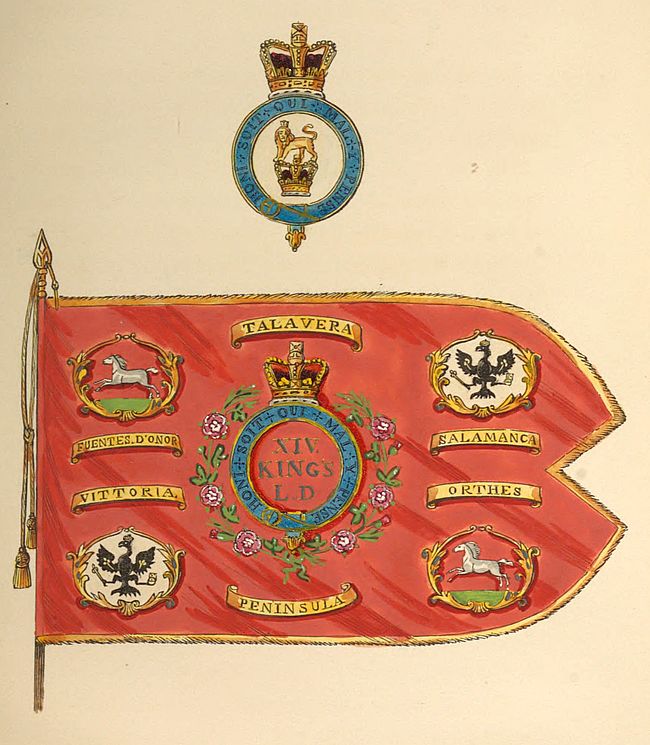
GUIDON OF THE FOURTEENTH, OR THE KING'S LIGHT DRAGOONS, M DCCC XXXII.
[To face page 60.
The regiment being augmented to the India
establishment, Major William Havelock, K.H.
(from the fourth light dragoons) was promoted to
be the second Lieut.-Colonel, and Captain Edward
Harvey was promoted to be second Major, on the
30th April, 1841.
On the 24th of May, the first division, under
the command of Lieut.-Colonel Townsend, embarked
at Gravesend for India in the freight ship
"Repulse," and arrived at Bombay on the 8th of
September, from whence it proceeded to Kirkee:
the second division embarked at Gravesend on
board of the freight ship "Reliance" on the 14th
of June, under the command of Major Barton,
and landing at Bombay on the 5th of October
following, marched to join the regiment at Kirkee,
where it arrived on the 13th of that month.
1842
1843
1844
The Fourteenth light dragoons during the
years 1842, 1843, and 1844, continued to be
stationed at Kirkee: two squadrons however
proceeded on field service to Kolapoor in October,
1844.
1845
Lieut.-Colonel Townsend received leave from
India, and he died at Castle Townsend, in Ireland,
on the 22nd April, 1845.[15] He was succeeded by
Brevet Lieut.-Colonel Edward Harvey, on the
23rd of April.
The two squadrons of the Fourteenth light
dragoons, which had proceeded on field service
in the southern Mahratta country, rejoined the
head-quarters on the 19th of March, 1845, and
in the following December the regiment marched
from Kirkee, en route to Mhow and Agra.
1846
On the 4th of March, 1846, the regiment
marched from Agra to Meerut, arriving at the
latter station on the 16th of that month; and in
April, 1846, the regiment proceeded to Umballa,
where it has continued to the end of the year
1846.
The statement of the services of the Fourteenth,
or the King's, Light Dragoons, from
the period of the formation of the regiment in
1715 to the present time, (as given in the preceding
pages,) affords abundant proofs of the value
of its services abroad, as well as at home; and its
order, discipline, good conduct, and bravery,
have, on numerous occasions, been attested by
the general officers under whom the regiment
has been employed.
During the Peninsular War, from 1808 to
1814, the Fourteenth and Sixteenth Light Dragoons
were principally employed on the important
duties of out-posts, on which the safety of
an army in the field, and the success of its movements
greatly depend.
In the mode of performing these peculiar and
important services, the Fourteenth and Sixteenth
Light Dragoons, under the direction of active
and intelligent officers, acquired the confidence
of the Commander of the Forces, and of the
division of the army of which they formed a
portion.
At the period of the conclusion of this Record,
(1846) the regiment is reported to be in a high
state of efficiency, and in readiness to evince its
prowess whenever the public service may again
require its assistance.