OF
THE FORTY-SIXTH,
OR THE
SOUTH DEVONSHIRE REGIMENT OF FOOT;
ORIGINALLY NUMBERED
THE FIFTY-SEVENTH REGIMENT.
1739
The claim of the Spanish Government to the right of
search, and the aggressions committed by that power on
the commerce of Great Britain, in the West Indies, by
the guarda-costas, and other ships acting by authority
of the King of Spain, contrary to the existing treaties,
led to a convention between the two Crowns, which was
concluded on the 14th of January, 1739. This convention
stipulated, that compensation should be made by
Spain to the English Government, in reparation for the
hostilities committed on the British subjects in the
American seas. The Court of Madrid, however, violated
the convention, and ultimately war was proclaimed
against Spain on the 23rd of October, 1739.
Augmentations were accordingly made in the army
and navy; ten regiments of Marines were raised in this
and the following year; these corps were embarked on
board the fleets under Admirals Vernon and Sir Chaloner
Ogle, which proceeded against the Spanish possessions
in South America.
1740
While the war was being carried on between Great
Britain and Spain, Charles the Sixth, Emperor of
Germany, died on the 20th of October, 1740; and the
succession of his daughter, the Archduchess Maria
Theresa, to his hereditary dominions, being disputed
by the Electors of Bavaria and Saxony, also by the Kings
of Prussia and Spain, a continental war was the result,
in which England and France, acting in the first instance
as auxiliaries, finally became principals in the contest,
which has since been known as the "War of the Austrian
Succession." The King of France, Louis XV., supported
the Elector of Bavaria, while King George II.,
adhering to the "Pragmatic Sanction,"[6] to which nearly
all the powers of Europe had been parties, supported
the claims of the Archduchess Maria Theresa.
1741
In January, 1741, seven additional regiments[7] were
raised for the regular Infantry, and were numbered in
succession to the ten regiments of marines, from the
Fifty-fourth to the Sixtieth regiment.
The FIFTY-SEVENTH was one of these seven regiments,
and the command of the corps was conferred by King
George II. on Colonel John Price, from the First Foot
Guards, whose commission was dated the 13th of
January, 1741. The regiment consisted of ten companies,
of three serjeants, three corporals, two drummers,
and seventy privates each; and its numbers, including
officers, amounted to eight hundred and fifteen.
1742
In March, 1742, the FIFTY-SEVENTH regiment was
stationed at Newcastle-upon-Tyne.
In May, 1742, several regiments were embarked for
Flanders under Field Marshal the Earl of Stair, to
support Maria Theresa, the Queen of Hungary and
Bohemia; but the FIFTY-SEVENTH regiment remained
in Great Britain.
The FIFTY-SEVENTH regiment was afterwards stationed
at Berwick, and in October received orders to
proceed to North Britain.
1743
On the 23rd of June, 1743, Colonel the Honorable
Thomas Murray, from the Third Foot Guards, was
promoted Colonel of the FIFTY-SEVENTH regiment,
in succession to Colonel John Price, removed to the
fourteenth foot.
In the meanwhile King George II. had joined the
army at Aschaffenberg, and on the 27th of June gained
a victory over the French army, under Marshal Noailles
at Dettingen.
1744
France and Great Britain, from auxiliaries, now became
principals in the contest. On the 20th of March, 1744,
France declared war against England, and on the 29th
of that month a counter declaration was made by Great
Britain, in which the French monarch was accused of
violating the "Pragmatic Sanction," and of assisting the
son of the Pretender in his designs on the British
throne.
The operations of the British army in Flanders during
the year 1744 were confined to the defensive, and no
general engagement occurred.
1745
After the battle of Fontenoy, fought on the 11th of
May, 1745, Louis XV. revived the claims of the
Pretender[8] to the throne of Great Britain. Prince Charles
Edward, eldest son of the Pretender, arrived in the
Highlands of Scotland towards the end of July, where
he was joined by several clans.
The FIFTY-SEVENTH regiment at this period formed
part of the force in Scotland, and Lieut.-General Sir
John Cope, the Commander in Chief in North Britain,
assembled all the troops under his orders at Stirling,
which consisted of about fourteen hundred men. He
afterwards advanced towards the great road called the
Chain, leading through the Highlands to Inverness, and
after a laborious march, arrived at Dalwhinny on the
25th of August. Here intelligence was received that
the rebels were posted at Corryarrack, seventeen miles
distant, upon which Lieut.-General Sir John Cope continued
his march through Badenoch to Inverness, so that
the south of Scotland was left unprotected, and the
young Pretender improved this unexpected advantage,
and accordingly entered the county of Athol, seized the
Castle of Blair, proceeded afterwards to Perth and
Dundee, proclaiming his Father by new magistrates of
his own appointment, levying the public money, and
assuming other acts of royalty. The number of the
rebels had increased to four thousand men, and on the
11th of September the young Chevalier marched from
Perth, passed the Forth on the 13th, and on the 16th
of that month, at night, arrived in the vicinity of
Edinburgh. At five o'clock on the following morning
the city was unaccountably surrendered to him without
resistance. He then made his public entry, attired in
Highland costume, and occupied the royal palace of
Holyrood House. General Guest, who commanded the
garrison of Edinburgh Castle, removed the bank, and
the effects of the principal inhabitants into that fortress,
which greatly disappointed the young Prince, who
expected to gain possession of the treasure. His
Father was afterwards proclaimed with great ceremony
at the High Cross, as King of Great Britain and
Ireland.
Lieut.-General Sir John Cope, in the meanwhile,
had marched with his troops from Inverness to Aberdeen,
where they took shipping, and landed at Dunbar,
twenty-seven miles east of Edinburgh, on the 18th of
September, when he was reinforced by Brigadier-General
Fowke, with two regiments of dragoons, from
Edinburgh. The next day he advanced towards that
city to observe the disposition of the rebels, who were
now increased to upwards of five thousand men.
On the 20th of September Lieut.-General Sir John
Cope encamped in the neighbourhood of Preston-Pans,[9]
near the sea, and seven miles from Edinburgh.
His army consisted of the following regiments:—
| Gardiner's (13th) and Hamilton's (14th) dragoons | 567 |
| Two companies of Guise's (6th) and eight of Lascelles' (47th) foot | 570 |
| Five companies of Lee's (44th) regiment | 291 |
| Murray's (now 46th) regiment | 580 |
| Highlanders | 183 |
| —— |
| Total | 2,191 |
| —— |
Information being received of the approach of the
enemy, Sir John Cope drew up his army at Gladsmuir
Heath, between the hamlets of Preston-Pans and
Cockenzie. About three o'clock on the morning of the
21st of September, large bodies of rebel Highlanders
were in motion, and before daybreak a chosen band of
these hardy mountaineers advanced with great celerity
and intrepidity to attack the royalists. As they drew
near, they raised a fearful yell, fired a volley, threw
down their muskets, and rushed sword in hand upon
the troops which guarded the artillery. The sudden
advance of the Highlanders in the dark, their superior
numbers, and peculiar mode of fighting, dismayed the
two hundred soldiers appointed to guard the artillery
on the right, who saw themselves assaulted by more
than three times their own numbers, and as they
caught the gleam of steel flashing in their faces, gave
way and fled. The two hundred and fifty dragoons on
the right, seeing the artillery lost, became disheartened;
they advanced to charge a large mass of Highlanders,
but observing the disparity of numbers, they were
seized with a panic and galloped from the field.
This inauspicious commencement of the action
damped the spirits of the infantry, and the panic spread
from rank to rank; several companies made resistance,
and feats of valour were displayed by individuals and
small parties; all semblance of order was, however,
soon lost, and a confused rout ensued.
About four hundred of the royal forces were killed
or wounded, and the prisoners, who amounted to nearly
twelve hundred men, were removed to Edinburgh, and
afterwards to the Highlands.
The FIFTY-SEVENTH regiment had the following
officers taken prisoners: Lieut.-Colonel Clayton,
Major Talbot, Captains Reid, John Cochran, Scot,
Thomas Leslie, and Blackes; Lieutenants Thomas
Hay, Cranston, Disney, Wale, Wry, and Simms;
Ensigns Sutherland, Lucey, Holdane, Birnie, and
L'Estrange; and Adjutant Spencer.
This successful commencement of the rebellion caused
numerous adherents to flock to the Prince's standard;
several regiments were recalled from the continent
in October, and His Royal Highness the Duke of
Cumberland proceeded to take the command of the
royal army. The young Pretender, elated with the
capture of Carlisle, marched as far as Derby, from
whence, however, he commenced his retreat to the
north on the 6th of December, as he found but few
partisans in England to join him in his expedition.
The Duke of Cumberland, after capturing the rebel
garrison of Carlisle, returned to London, leaving the
command of the army to Lieut.-General Hawley.
1746
In January 1746, Stirling was closely invested by
the young Chevalier, and Lieut.-General Hawley
marched to its relief. An engagement occurred at
Falkirk on the 17th of January, in which the Prince
was again victorious. The Duke of Cumberland now
proceeded to Edinburgh, reassumed the command
of the army, and on the 2nd of February entered
Stirling.
Fortune no longer favored the young Chevalier,
who fixed his head-quarters at Inverness. The inclemency
of the season having abated, the Duke of Cumberland,
on the 8th of April, advanced towards the
enemy, and gained a complete victory over him on the
16th of April, near Culloden House, four miles east of
Inverness.[10]
By official documents it appears, that on the 22nd of
March, 1746, the FIFTY-SEVENTH regiment was stationed
at Berwick, and on the 16th of April following, the
date of the Battle of Culloden, the subjoined letter was
addressed to the officer commanding the first division
of the regiment, then at Tuxford, in Nottinghamshire,
which indicates that the corps had commenced its march
towards London:—
"War Office, 16th April, 1746.
"Sir,
"I am commanded to signify to you it is His
Majesty's pleasure, that you cause the regiment of
Foot under your command to continue its march in
two divisions, with the utmost expedition, and without
halting.
"I am, &c.
(Signed) "W. Yonge.
"Officer Commanding in Chief the first division
of Colonel Murray's regiment, at Tuxford."
Prince Charles, after enduring many hardships, succeeded
in escaping to France in September. In the
following month the FIFTY-SEVENTH regiment embarked
at Portsmouth for Jersey.
1747
The rebellion being suppressed, several regiments
returned to Flanders, and on the 2nd of July, 1747,
the Duke of Cumberland engaged the French at
Laffeld, or Val, where the Allies suffered severely from
the misconduct of the Dutch troops.
1748
The Allies again took the field in the summer of
1748, but hostilities were at length terminated by the
treaty of Aix-la-Chapelle, which was signed on the 7th
of October, 1748. By it all the great treaties, from
that of Westphalia in 1648, which first recognised the
principle of a balance of power in Europe, to that of
Vienna in 1738, were renewed and confirmed. Prussia
retained Silesia, and the Empress-Queen Maria Theresa
was guaranteed in the possession of her hereditary
dominions, according to the Pragmatic Sanction. France
surrendered her conquests in Flanders, and England
those in the East and West Indies; all therefore Great
Britain gained by the war was the glory of having supported
the German sovereignty of Maria Theresa, and
of having adhered to former treaties.
Several regiments were disbanded in consequence of
the termination of the war. On the disbandment of
Colonel Spotswood's (afterwards Gooche's) American
Provincial Corps, then numbered the forty-third regiment,
and of the ten Marine regiments from the forty-fourth
to the fifty-third, the numerical titles of six of
the seven regiments raised in 1741, were changed, and
the fifty-seventh became the FORTY-SIXTH regiment.[11]
1749
In the year 1749 the FORTY-SIXTH regiment proceeded
to Ireland, where it remained for eight years.
1751
In the Royal Warrant, dated the 1st of July, 1751,
for ensuring uniformity in the clothing, standards, and
colours of the army, and regulating the number and
rank of regiments, the facings of the FORTY-SIXTH
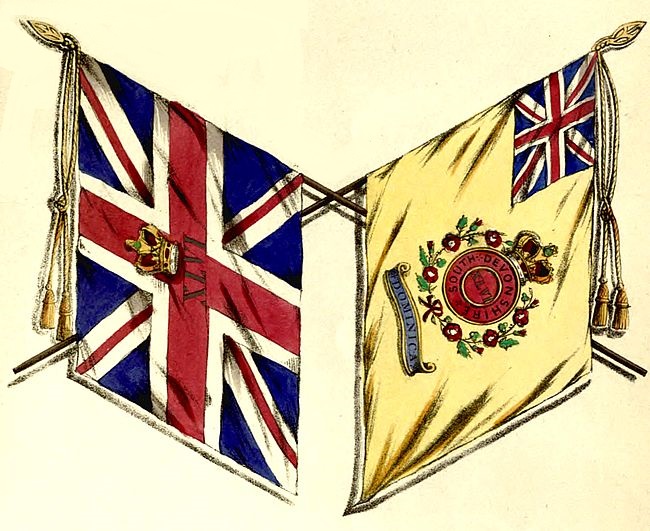
regiment were directed to be yellow. The first, or
King's colour, was the Great Union; the second, or
Regimental colour, was of yellow silk, with the Union
in the upper canton; in the centre of the colour the
number of the rank of the regiment, in gold Roman
characters, within a wreath of roses and thistles on the
same stalk.
1756
While the regiment was stationed in Ireland, the
peace of Aix-la-Chapelle was interrupted by the aggressions
of the French on the British territory in
North America, and early in 1756 the King of France
prepared a powerful armament for the capture of the
island of Minorca. In consequence of this attack on
Minorca, hostilities became inevitable on the part of
Great Britain, and on the 18th of May war was
declared against France.
1757
On the 7th of May 1757, the FORTY-SIXTH, and
other regiments, embarked at Cork, for Nova Scotia,
being intended to form part of an expedition under
Major-General the Earl of Loudoun, for the attack
upon Cape Breton, an island in the Gulf of St. Lawrence.
On arriving at Halifax, the seventeenth,
forty-second, FORTY-SIXTH, and the second battalion
of the sixtieth regiments were formed in brigade
under Major-General James Abercromby; but the
French at Louisburg having been reinforced, the
expedition was deferred until the following year, and the
regiment remained in Nova Scotia during the winter.
1758
While the expedition under Lieut.-General (afterwards
Lord) Amherst proceeded in May, 1758, against
Cape Breton,[12] the FORTY-SIXTH regiment was ordered
to join the body of troops under Major-General James
Abercromby, selected to attack the fort of Ticonderoga.
This force, which comprised the twenty-seventh, forty-second,
forty-fourth, FORTY-SIXTH, and fifty-fifth
regiments, embarked on Lake George on the 5th of
July, and landed on the following day near the
extremity of the lake, from whence the troops marched
through a wild and thickly-wooded country, in four
columns, upon Ticonderoga; the guides mistook the
route through the trackless woods, and on the 6th of
July, a skirmish ensued with a body of French troops,
in which Brigadier-General George Augustus Viscount
Howe (of the fifty-fifth regiment) was killed. With this
exception the British sustained but small loss, while the
enemy had three hundred killed, and one hundred and
forty-eight taken prisoners. On the 8th of July, the
British appeared before the fort, which was situated on
a tongue of land, projecting into Lake Champlain, and
was built by the French in 1756. It could only be
approached on one side, which was strongly fortified;
the other three sides being surrounded by water. Felled
trees, with their branches outward, were spread before
the works, which were defended by between four and
five thousand men.
The engineer having reported that the entrenchment
might be forced by musketry alone, Major-General
Abercromby, unfortunately, determined to attack the
place without waiting for the artillery, which, on account
of the badness of the ground, could not be easily
brought up. A rumour also that the French were
about to be reinforced with three thousand men, confirmed
the General in his resolution. Although the
troops behaved with the utmost gallantry in the
attack on fort Ticonderoga, on the 8th July, it was
found impossible to succeed in the undertaking, and
after many unavailing efforts, during a desperate contest
of upwards of four hours, Major-General Abercromby
gave orders to withdraw, and the British
returned to their camp on the south of Lake George,
where they arrived on the following evening.[13]
1759
The following officers belonging to the FORTY-SIXTH
regiment were killed on this occasion: Lieut.-Colonel
Samuel Beaver, Captains George Needham and
Edward Wynne; Lieutenants Jacob Laulhé and
Arthur Lloyd; Ensign George Crofton, and Quarter-Master
Thomas Carbonell.
In the year 1759, it was proposed to attack the
French in all their strong posts in Canada at once, so
as to fall as nearly as possible at the same time upon
Crown Point, Niagara, and the forts to the south of
Lake Erie, while a great naval armament, and a considerable
body of land forces under Major-General
James Wolfe, should attempt Quebec by the river St.
Lawrence.
Lieut.-General Amherst, who commanded the
British forces in America, was to attack Ticonderoga
and Crown Point, by Lake George; the reduction of
these forts would command the Lake Champlain, where
having established a sufficient naval force, he was by
the river Sorel, which forms the communication between
this lake and the river St. Lawrence, to proceed to
Quebec, and effect a junction with Major-General Wolfe.
The third of the grand operations was against Fort
Niagara, near the celebrated falls of that name, a place
of great consequence. The reduction of this place was
committed to Brigadier-General John Prideaux (fifty-fifth
regiment), under whom Sir William Johnson
commanded the provincials of New York, and several
Indians of the Five Nations, who were engaged in the
British service, by the credit that gentleman had
obtained among their tribes. It was to this portion of
the army that the FORTY-SIXTH regiment was attached.
The troops which had been appointed to proceed to
Niagara, arrived at the fort in July. This was a very
important post, and was situated at the entrance of a
strait by which Lake Ontario is joined to Lake Erie.
A little above the fort is the cataract of Niagara, the
most remarkable in the world, for the quantity of
water, and the greatness of the fall. The siege of the
place had not been long formed, before Brigadier-General
Prideaux was killed in the trenches, by the
bursting of a cohorn. This occurred on the 20th of
July, and the accident threatened to throw a damp on
the operations; but Sir William Johnson, upon whom
the command devolved, omitted nothing to continue
the vigorous measures of his predecessor, and added to
them everything his own genius could suggest.
The French were alarmed for the safety of the fort,
and collected all the troops they could draw from their
posts about the lakes, and to these were joined a large
body of Indians; the whole advanced to raise the siege,
and they amounted in all, to seventeen hundred men.
It was on the 23rd of July, that Sir William Johnson
received intelligence of the approach of the enemy to
relieve the fort, and instantly made a disposition to
defeat their designs. The guard of the trenches was
commanded by Major John Beckwith, of the forty-fourth
regiment, and, lest the garrison should sally
out, and either attempt to surprise or overpower that
guard, by which the British would have been hemmed
in between two fires, the forty-fourth regiment, under
Lieut.-Colonel William Farquhar, was posted in such
manner as to be able to sustain Major Beckwith.
The road on the left of the line, which led from the
cataract to the fort, was occupied by the light infantry,
and piquets of the army, on the evening of the 23rd of
July; early next morning these were reinforced by the
grenadiers and part of the FORTY-SIXTH regiment, the
whole commanded by Lieut.-Colonel Eyre Massey, of
the FORTY-SIXTH, to whose good conduct in the distribution
of the troops, and the steadiness with which he
received the enemy in front, while the Indians in
British pay, attacked them on the flanks, the honor of
the day was in a great degree attributable. The
French were completely defeated, and all their officers
were made prisoners, among whom were Monsieur
Aubry, De Lignery, Marin, and Repentini.
This action sealed the fate of Fort Niagara, which
surrendered on the following day (25th of July), and
Sir William Johnson, Bart., in his despatch to Lieut.-General
Amherst, of that date, thus alluded to the
conduct of the troops:—
"Permit me to assure you, in the whole progress of
the siege, which was severe and painful, the officers
and men behaved with the utmost cheerfulness and
bravery."
In the meantime the siege of Ticonderoga was prosecuted
with vigour by the troops under Lieut.-General
Amherst, and on the 25th of July the garrison blew up
the fort, and sailed to Crown Point, another fort on
Lake Champlain, which place the French also abandoned,
and retired down the lake to Isle aux Noix;
Crown Point was occupied by the British on the 4th of
August following.
The operations against Quebec by the troops under
Major-General James Wolfe, caused the year to end
in a most triumphant manner to the British Arms.
The battle fought on the 13th of September, 1759, on
the Heights of Abraham, in which the Major-General
was killed, led to the surrender of Quebec, which
capitulated five days afterwards.
While the above operations were being performed,
Lieut.-General Amherst found that the command of
Lake Champlain was still an object of some difficulty,
although the retreat of the French from Crown Point
and Ticonderoga had left him master of Lake
George. In October the troops embarked in boats,
and proceeded a considerable distance along the
lake, but the season became too advanced for operations,
which were postponed to the following year, and the
force returned to Crown Point and Ticonderoga for
winter-quarters.
1760
The French endeavoured to regain possession of
Quebec, and after the battle of Sillery fought before that
place on the 28th of April, 1760, in which, from their
superiority in numbers they had the advantage, trenches
were immediately opened by them before the town.
The arrival of the English fleet in May dissipated all
fears for the safety of Quebec, and nothing now remained
to cloud the prospect of the reduction of Canada,
by the united efforts of three British armies, which, by
different routes, were marching to attack those parts
of the country that remained in the power of France.
A large army was collected at Oswego by Lieut.-General
Amherst, which the FORTY-SIXTH regiment
joined in the afternoon of the 6th of August. The
whole army embarked on the 10th of August, and the
grenadiers, amounting to about six hundred men, were
embodied, and placed under the command of Lieut.-Colonel
Eyre Massey of the FORTY-SIXTH regiment.
Dispositions were afterwards made for the attack of
Fort Levi, on L'Isle Royale, and after two days' sharp
firing, the fort surrendered on the 25th of August, of
which Lieut.-Colonel Massey, with three companies of
grenadiers, took possession.
After spending some days in repairing this post, and
in fitting out the vessels for passing the troops down
the river St. Lawrence, the most difficult part of which
was now to be encountered; notwithstanding all precautions,
nearly ninety men were drowned in passing
the dangerous falls, and a great number of vessels
broke to pieces. After a tedious voyage the British
came in sight of the Island of Montreal on the 6th of
September.
The troops were immediately landed, and all dispositions
were made for attacking the place, and so
excellently was the plan concerted, that Brigadier-General
the Honorable James Murray landed from
Quebec on that very day, and Colonel Haviland with
his force from Isle-au-Noix on the following day.
The Marquis of Vaudreuil, the French Governor-General,
saw himself entirely enclosed, and was compelled
to surrender the garrison of Montreal on the
8th of September; thus was completed the Conquest of
Canada, which vast country has since continued under
the dominion of Great Britain.
1761
The regiment remained in North America until
October 1761, when it embarked for Barbadoes, where
an armament was being assembled for the attack of the
French West India Islands, and the land forces were
placed under the orders of Major-General the Honorable
Robert Monckton.
1762
The armament sailed from Carlisle Bay, in Barbadoes,
on the 5th of January, 1762, and proceeded
against the island of Martinique, which was settled by
the French about the year 1635. After menacing the
coast at several points, a landing was effected in the
middle of January in Cas des Navières Bay; many
difficulties were encountered from the rugged surface
of the country, and from the formidable heights occupied
by the enemy, but these were overcome by British
skill, discipline, and valour; the heights of Morne Tartenson
were carried on the 24th of January, and of
Morne Garnier on the 27th; Fort Royal surrendered
on the 4th of February, and these successes were followed
by the submission of the island to the British
Crown.
Major-General the Honorable Robert Monckton
commended the conduct of the troops in his despatch,
and added,—"The difficulties they had to encounter in
the attack of an enemy, possessed of every advantage
that art or nature could give them, were great.
Their perseverance in surmounting these obstacles
furnishes a noble example of British spirit:" and
in alluding to the conduct of the three divisions of
grenadiers, one division of which was commanded by
Lieut.-Colonel the Honorable John Vaughan, at this
period Lieut.-Colonel commandant of the ninety-fourth
(since disbanded), but who was appointed to the
FORTY-SIXTH regiment in November following, added,
that "they had particularly distinguished themselves,
the warmest part of the service having fallen to their
lot."
The capture of Martinique was followed by the submission
of Grenada, St. Lucia, and St. Vincent.
War had in the interim been declared against Spain,
and the FORTY-SIXTH joined the armament under
General the Earl of Albemarle, destined to proceed
against the wealthy Spanish settlement of the Havannah,
in the Island of Cuba. On the 7th of June a landing
was effected, and on the 9th the troops took up a
position between Coximar and the Moro Fort. Extraordinary
difficulties were encountered in making the
approaches, and carrying on the siege, while a severe
sickness prevailed amongst the seamen and soldiers.
Every obstacle was, however, overcome by the unanimity
which existed between the land and sea forces.
The Moro fort, which protected the harbour, and was
regarded as almost impregnable, was captured by storm
on the 30th of July; on the 11th of August a series of
batteries opened so well-directed a fire on the defences
of the town, that the guns of the garrison were soon
silenced, and flags of truce were hung out. On the
13th of August the town of the Havannah, with all its
dependencies, and the ships of war in the harbour, surrendered,
and the British troops took possession of this
valuable settlement. Negociations for peace were
shortly afterwards commenced, and the preliminary
articles were signed at Fontainebleau by the Duke of
Bedford on the 3rd of November, 1762.
1763
The treaty of Fontainebleau was concluded at Paris
on the 10th of February, 1763, the ratifications were
exchanged on the 10th of March, and peace was proclaimed
in London on the 22nd of that month.
By this treaty the whole of Canada, part of Louisiana,
together with Cape Breton, and the other islands in the
Gulf of St. Lawrence, were ceded to Great Britain.
In the West Indies, the islands of Tobago, Dominica,
St. Vincent, and Grenada, were retained by Great
Britain; but Martinique, Guadaloupe, Marigalante,
and St. Lucia, were restored to France. In the East
Indies, the French obtained the restitution of their
settlements, but agreed not to erect any fortifications
in Bengal. Minorca was restored to England in exchange
for Belle-Isle, which had been captured by the
British in 1761, and it was stipulated that the fortifications
of Dunkirk should be demolished. Spain ceded
East and West Florida to Great Britain, in return for
the restitution of the Havannah, Manilla, and all the
places which Spain had lost since the commencement
of the war.
1764
In the meanwhile the FORTY-SIXTH regiment had
returned to North America, where it remained for the
four following years.
Colonel the Honorable William Howe was appointed
by His Majesty King George III. from the fifty-eighth
to the colonelcy of the FORTY-SIXTH regiment on the
21st of November, 1764, in succession to Lieut.-General
the Honorable Thomas Murray, deceased.
1767
In the autumn of the year 1767 the FORTY-SIXTH
regiment returned to Great Britain, and was stationed
in Ireland for eight years.
Serious disputes had, in the meantime, arisen,
on the subject of taxation, between the colonists in
North America and the British Government. The
passing of the Stamp Act, in 1764, was the first cause
of irritation, but the spirit of discontent was partially
allayed by its repeal in 1766. This feeling was again
aroused, in the following year, by the Bill for levying
duties on certain articles imported from England, which
was repealed in 1770, with the exception of the duty
on tea, which was retained as an assertion of the right
of taxation inherent in the British Legislature. After
the cargoes of tea sent to Boston in 1773 had been
emptied into the sea, an Act of Parliament was passed
in the year 1774 for closing that port.
The colonists adopted retaliatory measures, and subsequently
made preparations for an appeal to arms.
1775
On the 19th of April, 1775, the first hostile collision
took place at Lexington, between His Majesty's troops
and the Colonists in the unhappy contest, which was
soon to assume a most formidable character.
Upon Major-General the Honorable Sir William
Howe, K.B., being removed to the colonelcy of the
twenty-third Royal Welsh Fusiliers, on the 11th of
May, 1775, Brevet Colonel the Honorable John Vaughan
was appointed to the vacant colonelcy of the FORTY-SIXTH
regiment.
The conflict at Lexington was followed by the battle of
Bunker's Hill, which was fought on the 17th of June, 1775.
1776
These events caused several regiments to be embarked
for America early in the year 1776; the FORTY-SIXTH
embarked from Ireland at this period, and arrived
on the coast of North Carolina early in April,
when Major-General Henry Clinton, who was serving
with the local rank of General in America, assumed the
command. The men landed at Cape Fear to refresh
themselves after the voyage, and returning on board
the transports, sailed on the 1st of June with the
expedition against Charleston. After passing Charleston
bar, the troops landed on one of the islands; but the
armament proved of insufficient strength for the capture
of the capital of South Carolina, and the troops re-embarked
and proceeded to Staten Island, where the main
body of the British forces had assembled under Major-General
the Honorable Sir William Howe, K.B., who
was serving with the local rank of General in America.
The seventeenth, fortieth, FORTY-SIXTH, and fifty-fifth
regiments were here formed in brigade under
Major-General James Grant.
On the 4th of July, 1776, the American Congress
issued their declaration of independence, abjuring
their allegiance to the Crown of Great Britain, and all
hope of accommodation failed.
A landing was effected by the British on Long
Island on the 22nd of August, and in the evening of
the 26th the army was put in motion to pass a range of
woody heights, which intersect the island, and to attack
the American force in position beyond the hills. The
column under Major-General Grant, of which the FORTY-SIXTH
formed part, was directed to advance along the
coast, with ten pieces of cannon, to draw the enemy's
attention to that quarter. Moving forward at the appointed
hour, this column fell in with the advanced
parties of the Americans about midnight, and at daybreak
on the following morning, encountered a large
body of troops formed in an advantageous position,
defended by artillery. Skirmishing and cannonading
ensued, and were continued until the Americans discovered
by the firing at Brooklyn, that the left of their
army had been turned and forced, when they retreated in
great confusion through a morass. The American army,
being driven from its positions with severe loss, made a
precipitate retreat to their fortified lines at Brooklyn.
The Americans quitted their fortified lines during
the night of the 28th of August, and retired across the
East River, in boats, to New York; the reduction
of Long Island was accomplished in a few days, with
little loss.
The regiment shared in the operations by which the
capture of New York was accomplished: also in the
movements by which the Americans were driven from
White Plains, and in the reduction of Fort Washington.
After the reduction of Fort Washington, and of Fort
Lee on the opposite side of the North, or Hudson's
River, the regiment continued the pursuit of the enemy
across the Jerseys, by Elizabeth Town, Raway, &c.
towards Philadelphia, and remained during the following
winter at Amboy.
The FORTY-SIXTH regiment occupied an old transport
ship as a barrack, and being actively employed during
the winter in constant escorts of ammunition, was continually
attacked between that place and New Brunswick,
on the way to Trenton, Princetown, and Burlington,
where the advance of the British army had
taken up winter quarters.
During the winter, General Washington suddenly
passed the Delaware river, and succeeded in surprising
and making prisoners a corps of Hessians at Trenton,
but he afterwards made a precipitate retreat. Being
reinforced, he again crossed the river, and took up a
position at Trenton.
1777
Information having been received that the Americans
were forming magazines at Peek's Hill, about fifty miles
up the North River, the FORTY-SIXTH regiment was
detached against that post, with a body of troops, which
sailed from New York on the 22nd of March, 1777, and
as they approached Peek's Hill, the Americans set fire
to the stores, and retreated. The British landed, completed
the destruction of the magazines, barracks, &c.,
and subsequently returned to their former quarters at
New York.
Afterwards taking the field with the army in the
Jerseys, the FORTY-SIXTH regiment was engaged in the
operations designed to bring the enemy to a general
engagement; but the Americans kept close in their fortified
lines in the mountains; an expedition against the
populous and wealthy city of Philadelphia was next
undertaken.
Embarking from Sandy Hook, the army, of which the
FORTY-SIXTH formed part, proceeded to the Chesapeake,
and landed on the northern shore of the Elk river on
the 25th of August. The American army took up a
position at Brandywine, to oppose the advance, and on
the 11th of September the Royal forces moved forward
to engage their opponents. The action proved decisive;
the enemy was driven from his position, and forced to
make a precipitate retreat. The FORTY-SIXTH sustained
but trifling loss on this occasion.
In order to harass the Royal forces, General Washington
posted several detachments in such a manner as
to command all the roads and avenues to their encampment.
He seized every opportunity of drawing detached
parties into ambuscades, which was the more readily
effected, as the country was in his interest, and the provincial
army abounded with persons fully acquainted
with all its local advantages.
A very considerable detachment employed in this
manner, lay concealed in the depth of a forest at a short
distance behind the British camp; it consisted of fifteen
hundred men, commanded by General Wayne.
General Sir William Howe, upon receiving this intelligence,
despatched Major-General Charles (afterwards
Earl) Grey with a body of troops in the middle of the
night of the 20th of September to surprise the detachment
of the enemy.
The light company of the FORTY-SIXTH regiment was
engaged in this enterprise, which was conducted with
singular address and intrepidity. The troops advanced
in profound silence to the outposts of the enemy,
which were surprised and secured without the least
noise. It was then between twelve and one. The
main body of the American army, unapprised of
its danger, had retired to rest. Directed by the light
of the camp fires, the party under Major-General Grey
proceeded undiscovered to the enemy's encampment, and
rushed upon the foe with their bayonets. Three
hundred Americans were killed and wounded, and a
great number taken prisoners, with most of their arms
and baggage. Obscurity saved those that escaped,
as it had before at Brandywine Creek. The British
had only one officer, one serjeant, and one private soldier
killed, and a few men wounded, in this attack.
It was this affair which gave the FORTY-SIXTH regiment
Red Feathers, which it has ever since worn. The
origin of the distinction is as follows:—
The Americans having vowed vengeance for the above
attack, and that they would give no quarter, the soldiers
of the light battalion on this declared, that to
prevent any one not engaged in the action from suffering
on their account, they had stained their feathers
red, as a distinguishing mark.
The British army advanced upon Philadelphia, took
possession of that city, and occupied a position at
Germantown. The Americans attempted to surprise
the British troops early on the morning of the 4th of
October, and at first gained some advantage, but were
speedily repulsed with severe loss.
1778
The regiment passed the winter in quarters at
Philadelphia, and in the spring of 1778, it furnished
several detachments, which ranged the country in various
directions to open communications for obtaining
provisions. At this period General the Honorable Sir
William Howe had returned to England, and resigned
the command of the army to General Sir Henry
Clinton, K.B. The regiment also took part in the
fatigues and difficulties of the march of the army from
Philadelphia, through the Jerseys, in order to return
to New York, and the flank companies were engaged
on the 28th of June in repulsing the attack of the
enemy on the rear of the column at Monmouth Court-House,
near Freehold, in New Jersey.
The army had marched from Philadelphia to New
York in consequence of the King of France having
engaged to aid the Americans, which circumstance
changed the character of the war. Shortly after the
arrival of the British army at New York a powerful
French armament appeared off that port. The enemy
had a great superiority of numbers; but the enthusiasm
in the British navy and army was unbounded, and the
hour of contest was looked forward to with sanguine
expectations. The enemy did not, however, venture
to hazard an attack; but proceeded against Rhode
Island; a numerous body of Americans co-operated
in the enterprise, and besieged Newport. The British
fleet put to sea, and the thirty-third, forty-second,
FORTY-SIXTH, and sixty-fourth regiments embarked,
under Major-General Grey, to join the fleet at the east
end of Long Island.
When the transports were about to sail, information
was received of the departure of the French fleet from
Rhode Island, and while at sea, news arrived of the
Americans having raised the siege of Newport. The
troops were then directed to proceed against Bedford,
on the Accushnet river, a noted place for American
privateers. On the evening of the 5th of September
the troops landed,—overcame all opposition,—destroyed
seventy privateers and other ships,—demolished
the fort and artillery,—blew up the magazine,—destroyed
an immense quantity of naval stores, &c., and
returned on board the transports at noon on the following
day. The troops afterwards proceeded against
Martha's Vineyard,—destroyed the defences,—took
three hundred and eighty-eight stand of arms from the
militia,—obliged the inhabitants to deliver up three
hundred oxen, ten thousand sheep, and a thousand
pounds sterling collected by the Congress. After this
success the regiment returned to New York.
A powerful French armament menacing the British
possessions in the West Indies, the FORTY-SIXTH, and
other regiments, sailed from North America, early in
November, for Barbadoes, under Major-General James
Grant.
Upon the arrival of the reinforcements at Barbadoes,
the British naval and military commanders resolved to
attack the French island of St. Lucia. On this occasion
the FORTY-SIXTH regiment was formed in brigade
with the fifteenth, twenty-eighth, and fifty-fifth regiments,
under Major-General Prescott.
The expedition sailed from Carlisle Bay on the 12th
of December, a landing was effected at St. Lucia on the
following day, and on the 14th the French troops were
driven from several important posts. In the meantime
a French armament of very superior numbers
approached the island, and the British took up positions
to repel the enemy. The French fleet made a
desperate attack on the British naval force, but was
repulsed.
A numerous body of the enemy landed, and, on the
18th of December, stormed the post of La Vigie, which
was occupied by the grenadiers and light infantry (of
which the flank companies of the FORTY-SIXTH formed
part), and the fifth regiment, under Brigadier-General
Medows. The enemy amounted to nine thousand
men, commanded by Monsieur D'Estaing, the Marquis
de Bouillé, and M. Lavendahl, and advanced in three
columns; their first two attacks were made, to quote
the words of Major-General Grant's despatch, "with
the impetuosity of Frenchmen, and repulsed with the
determined bravery of Britons." The French made
a third attempt, but were soon broken, and were forced
to re-embark, leaving the ground covered with killed
and wounded.[14]
The flank companies of the FORTY-SIXTH regiment
had an opportunity of distinguishing themselves on
this occasion, and Lieutenant William Gomm was
wounded.
The loss of the French amounted to about four hundred
killed and eleven hundred wounded, while the
killed on the side of the British was only ten, and one
hundred and thirty wounded. The sense Major-General
Grant entertained of the services of Brigadier-General
Medows and the detachment under his command,
was expressed in the following letter, dated from
Morne Fortunée, the 19th of December, 1778:—
"Sir,
"I cannot express how much I feel obliged to you,
and the troops under your command, for repulsing,
with so much spirit and bravery, so great a body of
the enemy, and own it was just what I expected from
you and them; and I am sure, under your command,
they will always behave in such a manner as to do
honor to you, themselves, their King, and their country;
and I must beg of you to express my gratitude.
"I have, &c.,
(Signed) "James Grant,
"Major-General.
"Brigadier-General Medows, &c., &c., &c."
Immediately after the departure of the French armament,
the governor surrendered the island of St. Lucia
to the British troops, the capitulation being signed on
the 30th of December.
1779
In 1779 the Court of Spain commenced hostilities
against Great Britain, and this example was followed
by the Dutch.
1782
The FORTY-SIXTH regiment remained in the West
Indies until the year 1782, when it returned to
England.
A letter, dated the 31st of August, 1782, conveyed
to the regiment His Majesty's pleasure, that County
Titles should be conferred on the Infantry, and the
FORTY-SIXTH was directed to assume the designation of
the SOUTH DEVONSHIRE regiment, in order that a connexion
between the regiment and that part of the
county should be cultivated, which might be useful in
promoting the success of the recruiting service.
On the 30th of November, 1782, the preliminary
Articles of Peace were signed at Paris between Great
Britain and the United States of America, and the
treaty was concluded in the ensuing February.
1783
The preliminaries of the treaties between England,
France, and Spain, were signed at Versailles on the
20th of January, 1783. St. Lucia was restored to
France, also the settlements on the river Senegal and
the city of Pondicherry in the East Indies. France
relinquished all her West India conquests, with the
exception of Tobago; Spain retained Minorca (which
had surrendered to the combined French and Spanish
forces in the previous year), and West Florida; East
Florida was ceded in exchange for the restitution of
the Bahamas to Great Britain.
On the 2nd of September, 1783, were signed the
preliminary Articles of Peace with Holland, the treaty
with that country having been postponed in consequence
of the Dutch claiming an indemnification for the
expenses of the war, and the restoration of Trincomalee,
in Ceylon, which had been captured from the Dutch
by the English in January of the previous year, and
retaken by the French in August following. The
place was, however, restored to Holland at the general
peace.
1784
The FORTY-SIXTH regiment proceeded from Plymouth
to Ireland on the 21st of February, 1784, and continued
in that country during the eight following
years.
1792
In February, 1792, the regiment proceeded from
Ireland to Gibraltar.
1794
While the FORTY-SIXTH regiment was stationed at
Gibraltar, the French revolutionary war commenced,
and in the year 1794, the islands of Martinique, St.
Lucia, and Guadaloupe were captured by the British.
The French republican government fitted out an expedition
for the recovery of these islands, and some
success attended their efforts. This occurrence occasioned
an order to be given for the FORTY-SIXTH
regiment to be embarked from Gibraltar to reinforce
the British troops in the West Indies. The regiment
accordingly embarked in November, 1794, and arrived
in the following month at the island of Martinique.
1795
The republican emissaries employed by France
having organized an insurrection in the island of St.
Vincent, where the native Caribs, and several of the
French inhabitants were in arms against the British
government, occasioned the FORTY-SIXTH regiment to
be ordered to St. Vincent.
At Dorsetshire Hill, the Caribs hoisted the tri-coloured
flag, and burnt every plantation in their
power. The loyal inhabitants of the island assembled
at Kingston, and in the fort, and every means of
defence which the colony afforded, were used by
Governor Seton.
It being determined to storm Dorsetshire Hill,
Governor Seton selected a force for this enterprise, of
which a company of the FORTY-SIXTH regiment, which
had arrived from Martinique, under the command of
Captain Dugald Campbell, formed part. Shortly
after twelve o'clock, on the night of the 14th of March,
the troops mounted the steep and rugged path in
regularity and silence. They ascended within eighty
yards of the main post, when they were discovered by
the enemy's sentry, who challenged and fired. The
Caribs, undismayed by the surprise, shouted, and
opened a smart fire of musketry on the British. As
soon as the troops were within twenty yards of the
enemy, orders were given to fire a volley and charge,
which were obeyed with the greatest alacrity. While
a portion of the British force mounted the bank at one
place, the detachment of the FORTY-SIXTH regiment,
under Captain Campbell, ascended another part of the
bank. The buildings which sheltered the enemy were
stormed, but many escaped through the darkness of the
night. Chatoye, the Carib king, was killed with
several of his adherents, and the enemy's two pieces of
cannon were captured.
Dorsetshire Hill being too extensive a position, was
abandoned early on the following morning, and the
British returned to Sion Hill.
The remainder of the FORTY-SIXTH regiment having
arrived, enabled the governor to make a second attack
upon the enemy on the 10th of April, when the Caribs
were driven from their positions with considerable loss
on their side, but small on the part of the British.
On the 7th of May, the enemy appeared on the
height above Calliaqua, in the vicinity of which was
situated the estate belonging to Sir William Young,
whose buildings had been previously consumed by the
Caribs, who had received reinforcements from Guadaloupe.
Governor Seton, considering that some attempt would
be made against Kingston, sent on the 7th of May, a
party, under Captain John Hall, of the FORTY-SIXTH,
consisting of a subaltern and thirty-three rank and
file of that regiment, forty militia, and forty of the
corps of rangers, with five of the royal artillery, and a
fourteen pound field-piece, to take possession of Dorsetshire
Hill. About one o'clock in the morning of the
8th of May, the party under Captain Hall was attacked
by a force of three hundred French and Caribs, and
after a vigorous resistance, was compelled to withdraw
to the post on Sion Hill, in consequence of the enemy's
great superiority in numbers, leaving the field-piece
spiked.
Kingston would inevitably have been destroyed, if
the enemy had kept possession of Dorsetshire Hill, and
sixty rank and file of the FORTY-SIXTH, under Captain
William Cooper Forster, of that regiment, were immediately
detached with other troops to attack the foe at
daybreak.
The Caribs, with great dexterity, found means to
clear the field-piece of the spike during the short time
they had it in their possession, and had been joined by
upwards of a hundred French and others of their party
immediately after the retreat of Captain Hall's party.
The British, however, attacked them with great spirit,
and, in less than half an hour, they retook the field-piece,
and obtained possession of the hill, the enemy
flying on all sides.
The FORTY-SIXTH regiment had three rank and file
killed, and nine wounded. Captain William Cooper
Forster and Ensign Michael Lee, were also wounded.
On the 12th of June the troops under Lieut.-Colonel
Baldwin Leighton, of the FORTY-SIXTH regiment, carried
by assault, the enemy's post on the Vigie, on which
occasion Captains John Law and William Cooper Forster,
of that regiment, were wounded:—after this success
the Lieut.-Colonel advanced into the Carib country,
and took up a position on Mount Young.
On the 1st of August, 1795, Major-General James
Henry Craig was appointed Colonel of the FORTY-SIXTH
regiment, in succession to Lieut.-General the
Honorable Sir John Vaughan, K.B., deceased.
In September, 1795, reinforcements arrived from
England, consisting of the fortieth, fifty-fourth, and
fifty-ninth regiments, and Major-General Paulus
Æmilius Irving assumed the command. The enemy,
apprised of the arrival of fresh troops, retired from
his position on Fairbane's Ridge, during the night of
the 30th of September.
At three o'clock on the morning of the 2nd of
October, the troops advanced against the Vigie, and
after a severe action, the Caribs abandoned that post,
of which possession was taken by the British.
1796
After this action the British remained on the defensive,
but several attacks were made by the enemy.
Major-General Peter Hunter, after an action fought on
the 8th of January, 1796, evacuated the New Vigie,
in order to provide for the safety of Fort Charlotte
and Kingston. The party from Morne Ronde was
also withdrawn.
On the 8th of June further reinforcements arrived
under Lieut.-General Sir Ralph Abercromby, K.B.,
and on the following day the troops marched in one
column, by the right, as far as Stubbs, about eight
miles from Kingston; each division halted that evening
opposite to their respective points of attack. The post
of New Vigie, an eminence on which the enemy had
constructed four redoubts, stronger by the natural
difficulties of the approach, than by the art displayed
in their formation, was attacked on the 10th of June,
and after a conflict of seven hours' duration, the Caribs
surrendered prisoners of war; but about six hundred
broke the capitulation, and escaped to the woods,
where they joined their friends at the farther end of
the island.
In this attack the FORTY-SIXTH had two rank and
file killed, and one wounded.
Troops were also despatched to Mounts Young and
William, where a number of brass ordnance, and a
quantity of ammunition, &c., were taken.
A desultory warfare was carried on until September,
when the Caribs were forced to submit, and they were
afterwards removed from the island of St. Vincent.
The FORTY-SIXTH regiment, which had been engaged
with the Caribs, together, and in detachments, on
thirteen occasions, and in eight months had sustained a
loss of four hundred men out of five hundred and
twenty, afterwards returned to England, and arrived
at Portsmouth in November, 1796.
1797
1799
While stationed in England the regiment was successively
quartered at Doncaster, York, Henley-upon-Thames,
Warminster, Poole, and Plymouth, from which
port it embarked for Ireland, towards the end of the
year 1799.
1800
In the beginning of the year 1800, the regiment
arrived at Cork, and was subsequently stationed at
Fermoy, Limerick, and Cork.
1802
While the regiment was stationed in Ireland, a
treaty of peace was signed on the 27th of March, 1802,
at Amiens, but the ambitious designs of the French
ruler occasioned the war to be renewed in May, 1803.
1804
On the 5th of January, 1804, His Majesty King
George III., appointed Lieut.-General John Whyte,
from the First West India regiment, to be colonel of
the FORTY-SIXTH regiment, in succession to Lieut.-General
Sir James Henry Craig, who was removed to
the eighty-sixth regiment.
The FORTY-SIXTH regiment embarked at Cork for
the West Indies, and arrived at Barbadoes in April.
In June following the regiment proceeded to Dominica.[15]
1805
In February, 1805, the island of Dominica was attacked
by the French, and the gallant conduct of the
FORTY-SIXTH on that occasion cannot be better recorded
than by the insertion of the following despatch, addressed
to Earl Camden, K.G., one of His Majesty's
principal Secretaries of State, by Lieut.-General Sir
William Myers, Bart., commanding the troops in the
Windward and Leeward Islands:—
"Barbadoes, March 9th, 1805.
"My Lord,
"I have the honor to enclose to your Lordship,
a copy of a despatch from Brigadier-General
Prevost, dated Dominica, 1st of March, 1805. The
details contained therein are so highly reputable to
the Brigadier-General, and the small portion of
troops employed against so numerous an enemy, that
I have great satisfaction in recommending that their
gallant exertions may be laid before His Majesty.
"The zeal and talent manifested by the brigadier-general
upon this occasion, it is my duty to present
for the royal consideration, and at the same time I
beg to be permitted to express the high sense I entertain
of the distinguished bravery of His Majesty's
troops, and the militia of the colony, employed on that
service.
"The vigorous resistance which the enemy have experienced,
and the loss which they have sustained in
this attack, must evince to them, that however inferior
our numbers were on this occasion, British
troops are not to be hostilely approached with impunity;
and had not the town of Roseau been accidentally
destroyed by fire, we should have little to regret,
and much to exult in.
"Your Lordship will perceive by the returns, that
our loss in men, compared to that of the enemy, is
but trifling; but I have sincerely to lament that of
Major Nunn, of the First West India regiment, whose
wound is reported to be of a dangerous kind; he is
an excellent man, and a meritorious officer.
"I have, &c.,
(Signed) "W. Myers.
"Lieut.-General."
"Head Quarters, Prince Rupert's,
Dominica, March 1st, 1805.
"Sir,
"About an hour before the dawn of day on the
22nd ultimo, an alarm was fired from Scots Head,
and soon after a cluster of ships was discovered off
Roseau. As our light increased, I made out five
large ships, three frigates, two brigs, and small craft
under British colours, a ship of three decks carrying
a flag at the mizen. The frigates ranging too close
to Fort Young, I ordered them to be fired on, and
soon after nineteen large barges, full of troops, appeared
coming from the lee of the other ships, attended
and protected by an armed schooner, full of
men, and seven other boats carrying carronades. The
English flag was lowered, and that of the French
hoisted.
"A landing was immediately attempted on my left
flank, between the town of Roseau and the post of
Cachecrow. The light infantry of the First West
India regiment were the first on the march to support
Captain Smart's company of militia, which, throughout
the day, behaved with great gallantry; it was
immediately supported by the grenadiers of the
FORTY-SIXTH regiment. The first boats were beat
off, but the schooner and one of the brigs coming
close on shore, to cover the landing, compelled our
troops to occupy a better position, a defile leading
to the town. At this moment I brought up the
grenadiers of the St. George's regiment of militia,
and soon after the remainder of the FORTY-SIXTH
regiment, and gave over to Major Nunn these brave
troops, with orders not to yield to the enemy one inch
of ground. Two field-pieces (an amuzette and a
six-pounder), were brought into action for their support,
under the command of Serjeant Creed of the
FORTY-SIXTH regiment, manned by additional gunners
and sailors. These guns, and a twenty-four
pounder from Melville battery, shook the French
advancing column by the execution they did.
"I sent two companies of St. George's militia, under
the command of Lieut.-Colonel Constable, and a
company of the FORTY-SIXTH, to prevent the enemy
from getting into the rear of the position occupied by
Major Nunn.
"On my return I found the "Majestueuse" of 120
guns, lying opposite to Fort Young, pouring into the
town and batteries her broadsides, followed by the
other seventy-fours and frigates doing the same.
"Some artillery, several captains of merchantmen
with their sailors, and the militia artillery, manned
five twenty-four pounders, and three eighteens, at
the fort, and five twenty-fours at Melville battery, and
returned an uninterrupted fire; from the first post
red-hot shot were thrown. At about ten o'clock,
A.M., Major Nunn, most unfortunately for His Majesty's
service, whilst faithfully executing the order
I had given him, was wounded; I fear mortally.
"This did not discourage the brave fellows. Captain
O'Connell, of the First West India regiment,
received the command and a wound almost at the
same time; however, the last circumstance could not
induce him to give up the honor of the first, and he
continued on the field animating his men, and resisting
the repeated charges of the enemy, until about one
o'clock, when he obliged them to retire from their
position with great slaughter. It is impossible for
me to do justice to the merit of that officer; you will,
I doubt not, favorably report his conduct to His
Majesty, and at the same time that of Captain James,
who commanded the FORTY-SIXTH regiment, and Captain
Archibald Campbell, who commanded the grenadiers
of that corps.
"Foiled and beat off on the left, the right flank was
attempted, and a considerable force was landed near
Morne Daniel. The regulars not exceeding two
hundred, employed on the left in opposing the advance
of three columns, consisting of upwards of two
thousand men, could afford me no reinforcement; I
had only the right wing of the St. George's regiment
of militia to oppose them, of about a hundred men.
They attacked with spirit, but unfortunately the frigates
had stood in so close to the shore to protect
this disembarkation, that after receiving a destructive
fire, they fell back and occupied the heights of Woodbridge
estate. Then it was that a column of the
enemy marched up to Morne Daniel, and stormed
the redoubt defended by a small detachment, which,
after an obstinate resistance they carried. On my
left Captain O'Connell was gaining ground, notwithstanding
a fresh supply of troops and several field-pieces,
which had been brought on shore by the
enemy. I now observed a large column climbing the
mountains to get in his rear.
"The town, which had been for some time in flames,
was only protected by a light howitzer and a six-pounder
to the right, supported by part of the light
company of the St. George's regiment. The enemy's
large ships in Woodbridge Bay, out of the reach of
my guns, my right flank gained, and my retreat to
Prince Rupert's almost cut off, I determined on one
attempt to keep the sovereignty of the island, which
the excellent troops I had warranted. I ordered the
militia to remain at the posts, except such as were
inclined to encounter more hardships and severe service;
and Captain O'Connell, with the FORTY-SIXTH
regiment, under the command of Captain James, and
the light company of the First West India regiment,
were directed to make a forced march to Prince
Rupert's. I then allowed the President to enter into
terms for the town of Roseau; and then demanded
from the French General that private property
should be respected, and that no wanton or disgraceful
pillage should be allowed; this done, only attended
by Brigade Major Prevost, and Deputy Quarter
Master-General Hopley, of the militia forces, I
crossed the island, and in twenty-four hours, with the
aid of the inhabitants and the exertions of the Caribs,
I got to this garrison on the 23rd. After four days'
continued march, through the most difficult country, I
might almost say existing, Captain O'Connell joined
me at Prince Rupert's, himself wounded, and bringing
in his wounded, with a few of the royal artillery, and
the precious remainder of the FORTY-SIXTH regiment,
and the First West India light company.
"I had no sooner got to the fort, than I ordered
cattle to be driven in, and took measures for getting
a store of water from the river in the bay. I found
my signals to Lieut.-Colonel Charles Broughton, of
the First West India Regiment, made from Roseau
soon after the enemy had landed, had been received, and
that, in consequence, he had made the most judicious
arrangements his garrison would allow for the defence
of this important post.
"On the 25th I received the letter of summons I
have now the honor to transmit, from General of
Division La Grange, and without delay sent the
reply you will find accompanying it.
"On the 27th the enemy's cruisers hovered about the
head, however, the "Centaur's" tender (Vigilante)
came in, and was saved by our guns. I landed Mr.
Henderson, her commander, and crew, to assist in the
defence we were prepared to make.
"As far as can be collected, the enemy had about
four thousand men on board, and the whole of their
force was compelled to disembark before they gained
one inch of ground.
"I entrust this despatch to Captain O'Connell,
to whom I beg to refer you; his services entitle him
to consideration. I am much indebted to the zeal
and discernment of Fort Adjutant Gualy, who was
very accessary to the due execution of my orders.
"I cannot pass unnoticed the very soldier-like conduct
of Lieutenant Wallis of the FORTY-SIXTH regiment,
to whom I had entrusted the post of Cachecrow,
or Scots Head: on perceiving our retreat he spiked
his guns, destroyed his ammunition, and immediately
commenced his march to join me at Prince Rupert's
with his detachment: nor that of Lieutenant Schaw
of the same corps, who acted as an officer of artillery,
and behaved with uncommon coolness and judgment,
while on the battery, and great presence of mind in
securing the retreat of the additional gunners belonging
to the FORTY-SIXTH regiment. On the 27th,
after levying a contribution on Roseau, the enemy
reimbarked, and hovered that day and the next
about this post. This morning the French fleet is
seen off the south end of Guadaloupe, under easy
sail.
"Our loss, you will perceive by the returns I have
the honor to transmit, was inconsiderable, when compared
with that of the enemy, which included several
officers of rank, and about three hundred others.
"I have, &c.,
(Signed) "Geo. Prevost.
"Lieut.-General Sir William
Myers, Bart., &c. &c. &c."
"P.S. As I find I cannot spare Captain O'Connell
from the duty of this garrison, I must refer you to
the master of a neutral vessel, who has engaged to
deliver this despatch."
(Translation.)
"From the General of Division La Grange, &c.,
to his Excellency General Prevost, &c.
"Head Quarters at Roseau,
the 5th Ventôse, Year 13th, Feb. 25th, 1805.
"The General of Division La Grange, Grand
Officer of the Legion of Honor, Inspector-General
of the Gendarmerie, Commander-in-Chief of the
troops of the expedition to the Leeward Islands:
"General,—
"Before I commence any military operations against
the fort, into which it appears that you have retired,
I shall fulfil a preliminary duty authorised and practised
by civilized nations. You are aware, no less
than myself, of the nature of your position, and of the
entire inutility of occasioning any further effusion of
blood. You witnessed with grief the melancholy
fate of the town of Roseau; my first endeavours on
entering it were to issue orders for stopping the progress
of the conflagration; but, unfortunately, considerable
destruction had already taken place.
"The want of necessaries is ever attended with the
most cruel consequences, the evils of which can easily
be calculated; this consideration alone is more than
sufficient, without reference to the particular circumstances
in which you are placed, to induce you
to accept the honorable conditions that I am ready
to grant you, and thus to preserve the interesting
inhabitants of this colony from fresh calamities,
which are inseparable from the occurrences of war.
"I beg you, General, to make me an early communication
of your answer, and in the meantime to
receive the assurance of the high esteem which I entertain
for you.
"I have, &c.,
(Signed) "La Grange."
(Answer.)
"Head Quarters, Prince Rupert's
February 25th, 1805.
"Sir,
"I have the honor to say I received your letter.
My duty to my King and country is so superior to
every other consideration, that I have only to thank
you for the observations you have been pleased to
make, on the often inevitable consequences of war.
Give me leave, individually, to express the greatest
gratitude for your humanity and kind treatment of
my wife and children; and at the same time to request
a continuance thereof, not only to her and
them, but towards every other object you may meet
with.
"I have, &c.,
(Signed) "Geo. Prevost."
Return of the killed and wounded in the actions of
the 22nd of February, 1805, at Point Michael, Morne
Daniel, and Roseau, in the Island of Dominica.
Royal Artillery;—three rank and file wounded; one
captain, one serjeant, and six rank and file taken by
the enemy.
Forty-sixth regiment;—one serjeant, one drummer,
and ten rank and file killed; one captain, and seven
rank and file wounded.
First West India regiment;—nine rank and file
killed; one field officer, one captain, and eight rank and
file wounded.
Total killed;—one serjeant, one drummer, and nineteen
rank and file.
Total wounded;—one field officer, two captains, and
eighteen rank and file.
Taken by the enemy;—one captain, one serjeant
and six rank and file.
Names of Officers Wounded.
Captain Colin Campbell, FORTY-SIXTH regiment;
Major Nunn and Captain O'Connell, First West India
regiment.
N. B. Three sailors wounded, exclusive of the militia,
from which no return has been received, but whose loss
was considerable.
(Signed) James Prevost.
Major of Brigade.
The Royal authority was afterwards received for the
FORTY-SIXTH to bear the word "Dominica" on the
regimental colour and appointments, "as a distinguished
mark of the good conduct and exemplary valour displayed
by that regiment in the defence of the Island
of Dominica, against a very superior French force,
on the 22nd of February, 1805."
1806
In the beginning of May, 1806, the "Dominica" armed
sloop was cut from her anchorage by her own crew, and
taken from Dominica into Guadaloupe: early on the
morning of the 6th of May, a large schooner, a row-boat
full of troops, and the "Dominica" sloop, were discovered
making out from the land, and Major-General
Stair Park Dalrymple perceiving they were suspicious,
and evidently enemy's vessels, ordered detachments
from the FORTY-SIXTH regiment to be instantly embarked
on board the "Duke of Montrose" packet, Captain
Dynely, who had volunteered his services, and
another on board a small colonial sloop. Lieutenant
James Wallis, of the FORTY-SIXTH, was appointed to take
command of the first detachment, and under him Lieut.
Benjamin Forster and forty men; Lieutenant Andrew
Hamilton commanded the second detachment on board
the sloop. Both were successful; the "Duke of Montrose"
chased the schooner from ten A.M. until four P.M.,
when she engaged within musket-shot for three-quarters
of an hour. The schooner then hove up, and again
endeavoured to escape. On the packet's overhauling
fast, and being about to board her, she surrendered.
The schooner proved to be the French national schooner
L'Impérial, having on board General Dumareau and
eighty soldiers, and carried one large gun amidships,
which was well served during the action. Lieutenant
Andrew Hamilton also proved successful in capturing
the row-boat.
For these services the officers and men received the
unqualified approbation of Lieut.-General Henry
Bowyer, commanding the forces in the West Indies,
and of Major-General Dalrymple, for having so handsomely
supported the honor of their corps by their zeal,
courage, and steady discipline.
1808
In 1808 an expedition was assembled at Carlisle
Bay, Barbadoes, for the reduction of the French island
of Martinique,[16] and the flank companies of the FORTY-SIXTH
regiment were selected to form part of the expedition.
The land forces were under Lieut.-General
George Beckwith, and the navy was commanded by
Rear-Admiral Sir Alexander Cochrane, K.B.
1809
The fleet left Carlisle Bay on the 28th of January,
1809, and arrived off the island of Martinique in two
days. On the 30th, the troops landed in two divisions;
the first division at Bay Robert under Lieut.-General
Sir George Prevost, and the second division, commanded
by Major-General Maitland, near St. Luce and Point
Solomon. Both divisions were actively engaged in
operations for the reduction of the island. St. Pierre
surrendered on the 8th of February, to Lieut.-Colonel
Edward Barnes of the FORTY-SIXTH regiment, who commanded
a brigade in the army employed in this
expedition.
The flank companies of the FORTY-SIXTH composed
part of the flank battalion under Major Richard Payne,
of the regiment, at the siege of Fort Royal.
The reduction of Fort Desaix (or Fort Bourbon) by
the first division of the army, which was effected on
the 24th of February, completed the reduction of
Martinique, and the flank companies rejoined the regiment
at Dominica.
1810
In 1810, the flank companies of the regiment were
selected to form part of an expedition under Lieut.-General
Sir George Beckwith, K.B., against the island
of Guadaloupe, which had been restored to the French
at the Peace of Amiens. The expedition arrived before
the island in January, 1810.
The grenadiers composed part of the First Grenadier
Battalion, and the light company that of the Second
Light Battalion. On the 3rd of February the grenadiers
were engaged in the attack on the enemy's post
at Bellair, on the heights of Saint Louis, on which
occasion the following report was made in the despatches
of Brigadier-General George Harcourt to Lieut.-General
Sir George Beckwith, commanding the forces in the
West Indies.
"Post Bellair, Morne St. Louis,
7th February, 1810.
"Where all deserve so much praise, it is difficult to
discriminate, but the good fortune of the grenadiers
of the FORTY-SIXTH regiment, under Captain Alexander
Ogilvie, and of the First Light Infantry Battalion,
under Lieut.-Colonel David Stewart, brought
their merits conspicuously forward. They in truth
behaved most admirably.
(Signed) "G. Harcourt,
"Brigadier-General,
"Commanding Second Division."
The regiment had three rank and file killed, and
one serjeant and eight rank and file wounded.
1811
The FORTY-SIXTH having been much reduced in
numbers during the arduous services of the regiment
in the West Indies, the head-quarters embarked on
board the "Earl" transport, on the 13th of November,
1811, for England, and arrived at Liverpool on the
13th of December, from whence they marched to
Kingsbridge, in Devonshire.[17]
Four companies of the regiment, about two hundred
strong, continued to serve in the West Indies after the
departure of the head-quarters.
1812
On the 18th of March 1812, the FORTY-SIXTH regiment
embarked on board the "Nautilus" transport at
Plymouth for Jersey, and arrived in St. Aubin's Bay
on the 11th of April, when it marched to Grouville, in
the eastern division of the island, the head-quarters
being stationed at Mont Orgueil Castle.
In June 1812, the four companies which had been
left in the West Indies, arrived at Portsmouth in the
"Shipley" transport, and proceeded, without landing, to
Jersey. A few officers and men, who came home from
the West Indies in the "John Tobin" merchantman,
arrived in the same month at Liverpool, and proceeded
to the regiment at Jersey.
1813
On the 11th of June 1813, the regiment embarked
on board the "Preston" transport for Portsmouth, and
after its arrival at Spithead, received orders to proceed
to Cowes, in the Isle of Wight. It disembarked at
that place on the 16th of the same month, and proceeded
to Sandown barracks, where the regiment remained
until August following, when it received orders to proceed
to New South Wales.
The regiment embarked on the 23rd of August 1813,
on board the "Wyndham," "Three Bees," and "General
Hewitt" transports, and arrived at New South Wales
in February 1814.
1814
On the 31st of May 1814, the regiment was inspected
by Major-General Lachlan Macquarie, who expressed
his satisfaction at its appearance in General Orders,
dated—
"Head-Quarters, Sydney,
31st May, 1814.
"The Commander of the Forces having inspected
His Majesty's FORTY-SIXTH regiment, commanded by
Colonel Molle, this forenoon, is happy to express
publicly his approbation of the clean and soldier-like
appearance of that corps under arms, as well as
the uniformity of dress, both of officers and men.
"The advance of the corps in line was excellent, and
the distances in formation were well preserved, and
had the weather permitted of movements, the Major-General
doubts not they would have been equally
well performed.
"L. Macquarie,
"Major-General."
The regiment was again inspected by Major-General
Macquarie on the 21st of November following, when
its appearance and movements elicited the Major-General's
commendation.
1815
In May 1815, Serjeant Robert Broadfoot and six
privates were sent from the detachment of the regiment
stationed at Hobart Town, Van Diemen's Land, into
the interior of the colony, in order to suppress a gang
of bushrangers, which infested that settlement, and had
by their atrocious deeds become the terror of the inhabitants.
The party succeeded in taking two of the
principals, named Maguire and Burne, who were tried
and executed. The serjeant and his party received the
sum of one hundred pounds sterling, and the thanks
of Lieut.-Governor Davy for their conduct on the
occasion.
In May and October 1815, the regiment was inspected
by Major-General Macquarie, who again expressed
his entire approval of its appearance and
movements.
While the regiment was stationed in New South
Wales, the war, in which the European powers had
been engaged, was ended by the defeat of Napoleon
Bonaparte on the plains of Waterloo, and a lengthend
period of peace has been the result of that victory.
1816
Early in February 1816, Corporal Justin McCarthy
and seven privates were sent in pursuit of bushrangers,
and on the 5th of April following, they succeeded in
taking two of them, both of whom were executed.
Lieut.-General Henry Wynyard was appointed Colonel
of the FORTY-SIXTH regiment on the 1st of April
1816, in succession to General John Whyte, deceased.
In the early part of April 1816, the flank companies
of the regiment were detached into the interior of New
South Wales, and received in General Orders the thanks
of Major-General Macquarie, Commanding the Forces,
for their arduous services in pursuing into the interior,
and reducing the aborigines to a state of obedience.
Captain Schaw commanded the light company, and
Captain Wallis the grenadiers.
"Head Quarters, Sydney,
Tuesday, 7th May, 1816.
"General Orders.
"Captains Schaw and Wallis having returned
to head-quarters, with the detachments of the FORTY-SIXTH
regiment under their respective commands, recently
employed against the hostile black natives,
and having executed the service they were thus employed
on to the entire approbation of His Excellency
the Governor and Commander of the Forces, he
requests Captains Schaw and Wallis will accept his
best thanks for their zealous exertions, and strict
attention to the fulfilling of the instructions on this
delicate but very important service.
"The Commander of the Forces also requests that
Captains Schaw and Wallis will convey to the officers,
non-commissioned officers, and privates of their respective
detachments, his best thanks for their zeal and
activity, and for the patience with which they endured
a great deal of marching and fatigue, through a very
rough and intricate country during the said service.
(Signed) "L. Macquarie,
"Major-General."
In July 1816, Serjeant Broadfoot, and sixteen rank
and file were detached from the head-quarters of the
corps at Sydney into the interior of the country, to protect
the inhabitants from the natives, and were employed
on this service until December of the same year, during
which period their conduct was such as to call forth the
thanks of Major-General Macquarie, from whom Serjeant
Broadfoot received a certificate approving of his "zeal
and activity during his services against the natives."
After chasing the bushrangers for six months, Corporal
McCarthy and his party, in July, came up with
the main body, consisting of eleven desperate characters,
and headed by a deserter from the seventy-third regiment,
named Geary. They were all armed, each with
a musket and a brace of pistols, and well supplied with
ammunition. The corporal and his men, now reduced
to five, engaged them for an hour and a half, when the
leader of the bushrangers being mortally wounded, his
followers endeavoured to escape; two, however, were
taken, tried, and executed. The corporal and his men
received one hundred pounds for Geary, and twenty-five
pounds for each of the other two, and were highly
recommended by Lieut.-Governor Sorrell for their zeal,
courage, and perseverance.
On the 10th of August following, this small party
again came up with the remainder of the banditti.
Their leader was shot during the action, and another
of his followers was wounded, and made prisoner.
1817
On the 8th of September, 1817, the regiment embarked
in three divisions at Sydney Cove on board the
"Matilda," "Lloyd," and "Dick" transports, and arrived
at Madras on the 16th of December following. On the
29th of that month the regiment marched for Vellore.
1818
The regiment arrived at Vellore on the 8th of January,
1818, and on the 26th of September following proceeded
from thence en route to the Presidency of Madras,
and arrived at Fort Saint George on the 12th of
October.
Previously to the FORTY-SIXTH quitting Vellore an
Order was issued by Colonel Hall, commanding
the troops at that garrison, in which he stated "that
during the period the regiment had been in the
garrison, he had not had occasion to confine or pass a
censure on any rank," and then added, "that a stronger
proof cannot be offered of the excellent interior arrangement
and discipline of the corps."
1820
On the 1st of July, 1820, the regiment commenced
its march from Fort Saint George for Bellary, in the
Ceded Districts, and arrived at that station on the 10th
of August following.
A detachment of the regiment, consisting of two captains,
five lieutenants, two ensigns, one assistant
surgeon, twenty serjeants, four drummers, and four
hundred rank and file, marched from Bellary, for
Belgaum, on field service in the Doab, on the 1st of
October, 1820, and arrived at its destination on the 23rd
of that month.
1821
1823
During the years 1821, 1822, and 1823, the head-quarters
of the regiment continued to be stationed at
Bellary.
1824
On the 31st of October, 1824, a detachment of the
regiment, consisting of one captain, four lieutenants,
eight serjeants, nine corporals, two drummers, and a
hundred and forty-four privates, under the command of
Captain Charles Dawe, proceeded from Bellary towards
the southern Mahratta country, and was joined on the
10th of November by a second detachment of the FORTY-SIXTH
from Belgaum, under the command of Captain
William Nairn, consisting of one captain, one lieutenant,
one ensign, five serjeants and one hundred
rank and file.
The remainder of the detachment from Belgaum,
under the command of Major (Brevet-Lieut. Colonel)
Thomas Willshire, joined the above, on the 2nd of December,
before the Fort of Kittoor, which place was in
a state of insurrection. The fort being reduced, the
detachment from Belgaum returned to that station on
the 15th of December, leaving the detachment under
Captain Dawe before Kittoor.
On the 16th of December, 1824, the following Division
Order was issued by Major-General Hall, commanding
the ceded districts, on his inspecting the regiment:—
"Head Quarters, Ceded Districts,
Bellary, 16th December, 1824.
"The recent review and inspection of His Majesty's
FORTY-SIXTH regiment has afforded Major-General
Hall an opportunity of witnessing the very efficient
state of that corps, and of expressing his unqualified
satisfaction with the result of his enquiries, the whole
of which tend greatly to the credit of the commanding
officer, Major Wallis.
"The Major-General will have a pleasing part of
his duty to perform in reporting the present state of
His Majesty's FORTY-SIXTH regiment.
"By order of Major-General Hall,
(Signed) "B. McMaster,
"Acting Brigade Major, Ceded Districts."
1825
On the 7th of February 1825, the grenadier company,
and head-quarters of the regiment, marched from Bellary
for Cannanore, under the command of Major James
Wallis, leaving two companies at Bellary. The detachment
under Captain Dawe marched on the same day
from Kittoor to Belgaum, where it was joined by two
other companies, and proceeded from Belgaum to Vengoolah
on the 16th of February, the whole under the
command of Captain Alexander Campbell, and embarked
at that port for Cannanore, where they arrived
on the 28th of that month. The head-quarters of the
regiment arrived at Cannanore on the 17th of March,
under the command of Major Wallis, Lieut.-Colonel
Archibald Campbell (the senior Lieut.-Colonel), having
been appointed to the command of the provinces of
Malabar and Canara.
The remainder of the regiment marched from Belgaum
under the command of Major (Brevet Lieut.-Colonel)
Willshire, for Bellary, and arrived at that station on
the 18th of March, 1825.
1826
The following Provincial Order was issued by Lieut.-Colonel
Campbell, commanding the provinces of Malabar
and Canara, on the inspection and review of the regiment
at Cannanore on the 31st of May, 1826:—
"Head Quarters, Malabar and Canara,
Cannanore, 31st May, 1826.
"Lieut.-Colonel Campbell cannot permit the present
half-yearly inspection and review of His Majesty's
FORTY-SIXTH regiment to pass over without expressing
to Major Wallis, and the officers and men under his
command, the high sense he entertains of the improved
state of discipline and order of the regiment, in every
respect, of which he will not fail to make the most
favorable report.[18]
"It is with heartfelt regret the Lieut.-Colonel has
learnt, that the FORTY-SIXTH regiment is likely soon
to lose the valuable services of Major Wallis, who has
ever been enthusiastic in doing all which could contribute
to the advantage and credit of the corps, and
whose ability, zeal, and talents in command of it, are
evinced by the perfection to which he has brought the
regiment in the revised system of discipline, and the
excellent state of its interior economy.
"After an intimate friendship of twenty-three years,
as a brother officer, Lieut.-Colonel Campbell trusts
he may be permitted thus publicly to express his sentiments
of Major Wallis's merits and worth, and to
lament the loss which he, individually, must sustain,
when deprived of the cordial, zealous, and able support
that has invariably been afforded to him by this
meritorious officer.
"When Major Wallis withdraws from the active
duties of his profession, he will be accompanied in his
retirement by the most fervent wishes of Lieutenant-Colonel
Campbell for his future welfare, happiness,
and prosperity.
"By order,
(Signed) "A. H. Colberg, Captain,
"Major of Brigade."
The detached wing of the regiment, under the command
of Lieut.-Colonel Willshire, marched from Bellary
on the 22nd of July, 1826, and arrived at Secunderabad
on the 21st of August following.
The head-quarters, under the command of Captain
William Mallet, marched from Cannanore on the 2nd
of November, 1826, and arrived at Secunderabad on the
12th of January, 1827.
1827
The regiment remained at Secunderabad during
1827, and the five following years.
1829
On the 24th of June 1829, instructions were received
for reducing the establishment of the regiment, from
the 25th of the previous December, to the following
numbers; namely, forty-five serjeants, fourteen drummers,
and seven hundred and forty rank and file.
1832
Arrangements having been made for the relief of the
FORTY-SIXTH regiment, a General Order was issued permitting
the soldiers to volunteer to other corps serving
in India. The volunteering was opened at Secunderabad
on the 9th of November, and was finally closed on
the 17th of December, 1832, when two hundred and
thirty-seven men had volunteered their services to
other regiments of His Majesty's service stationed in
the Madras Presidency.
1833
The regiment afterwards proceeded to Masulipatam,
where it arrived on the 17th of January 1833, and
while on the march the following General Order by the
Right Honorable the Governor in Council was received:
"Fort Saint George,
4th December, 1832.
"The Right Honorable the Governor in Council
cannot permit His Majesty's FORTY-SIXTH regiment
to embark for England, without expressing his approbation
of its conduct during the period which
it has been employed on this establishment.
"To Colonel Campbell, C.B., Aide-de-camp to the
King, the Right Honorable the Governor in Council
considers himself particularly indebted, for the temper
and judgment with which he has exercised the several
important commands which have been entrusted to
him by Government, and he attributes, in a great
measure, to the example of Colonel Campbell, and
the officers of His Majesty's FORTY-SIXTH regiment,
the cordiality and good feeling which has at all times
prevailed between the several branches of the army
at stations where the regiment has been employed.
"By order of the Right Honorable
"The Governor in Council,
(Signed) "Robert Clerk,
"Secretary to Government."
Four companies of the regiment, consisting of one
captain, two lieutenants, two ensigns, one assistant surgeon,
thirteen serjeants, four drummers, and one hundred
and sixty-seven rank and file, under the command of
Captain Donald Stuart, embarked at Madras, on board
the "Red Rover" on the 4th of March 1833, disembarked
at Gravesend on the 25th of August 1833, and marched
to Canterbury barracks, where they arrived on the 28th
of August, and were consolidated with the depôt company.
The head-quarters of the regiment, consisting of two
captains, four lieutenants, one paymaster, one quartermaster,
one assistant surgeon, twenty-three serjeants,
seven drummers, and two hundred and sixteen rank
and file, under the command of Captain Robert Martin,
embarked at Masulipatam on the 5th of March 1833,
disembarked at Margate and Whitstable on the 6th
and 7th of September, from whence they marched to
Canterbury.
Colonel Archibald Campbell, C.B., being in command
of the Hyderabad Subsidiary Force, was not relieved
from that duty in time to proceed with the regiment,
but embarked at Madras on the 18th of March 1833,
and arrived at Portsmouth on the 18th of August
following.
One company of the regiment, consisting of two lieutenants,
four serjeants, two drummers, and sixty-eight
rank and file, under the command of Lieutenant James
Taylor, embarked at Madras on the 27th of May 1833,
disembarked at Gravesend on the 28th of September,
and marched from thence to join the head-quarters of
the regiment at Canterbury.
On the 12th of November the following letter was
addressed by the Adjutant-General to Colonel Campbell,
in reference to the distinction of Red Feathers,
conferred upon the light company for its share in the
attack upon General Wayne on the 20th of September
1777, as narrated at page 24.
"Horse Guards,
12th November, 1833.
"Sir,
"I have the honor to acknowledge the receipt
of your letter of the 1st instant, and to signify to you
that, under all the circumstances stated, the General
Commanding-in-Chief will undertake to recommend
to His Majesty, that the distinction mentioned may
be continued to the light company of the FORTY-SIXTH
regiment, and will, accordingly, submit that the company
be allowed to wear a Red Ball Tuft.
"I have, &c.,
(Signed) "John Macdonald,
"Adjutant-General.
"Colonel Campbell,
"FORTY-SIXTH regiment."
1834
On the 21st, 22nd, and 23rd of April 1834, the regiment
proceeded from Canterbury to Weedon, where it
arrived in the beginning of May.
In September following, the regiment marched from
Weedon to Liverpool for embarkation for Ireland, and
arrived at Dublin on the 3rd of October. The regiment
subsequently proceeded to Newry.
1835
The head-quarters marched on the 30th of January
1835, from Newry for Belfast, where they arrived on
the 2nd of February. While stationed at Belfast, the
regiment furnished several detachments to aid the
civil power.
1836
The regiment, under the command of Colonel Archibald
Campbell, C.B., marched from Belfast for Enniskillen
on the 16th of May 1836, and was again ordered
to furnish detachments in aid of the civil power. In
October following, the regiment marched from Enniskillen
for Dublin.
1837
Orders having been received to hold the FORTY-SIXTH
regiment in readiness for foreign service, it was formed
into six service and four depôt companies. The service
companies, under the command of Colonel Archibald
Campbell, C.B., proceeded to Cork in September 1837,
and the head-quarters embarked at the Cove of Cork,
on the 26th of that month, on board the "Prince Regent"
transport. The remaining three companies, under the
command of Major Robert Garrett, embarked on the
5th of October on board the "Arab" transport; the former
arrived at Gibraltar on the 18th of October, and the
latter in November.
1838
On the 6th of April 1838, Lieut.-General Sir John
Keane, K.C.B., was removed from the sixty-eighth to
the Colonelcy of the FORTY-SIXTH regiment, in succession
to General Henry Wynyard, deceased.
In June 1838, the depôt companies embarked at
Kinsale for England, and arrived at Plymouth on the
27th of that month.
1839
On the 1st of August 1839, Lieut.-General John
Ross was appointed, from the ninety-eighth, to be
Colonel of the FORTY-SIXTH regiment, in succession to
Lieut.-General Sir John Keane, who was removed to
the forty-third regiment.
1841
The depôt companies embarked at Plymouth for
Jersey on the 5th of August 1839; and in June 1841
proceeded to Ireland.
1842
On the 20th of January 1842, the service companies
embarked at Gibraltar for Barbadoes, in the "Java"
transport, and arrived at their destination on the 25th
of February. They were afterwards encamped on the
Savannah until the 18th of April. Upon the embarkation
of the fifty-second regiment, the FORTY-SIXTH
moved into the Stone Barracks, but, on the fever
breaking out, encamped on the 2nd of December at the
Naval Hospital.
1843
On the 15th of January, 1843, the head-quarters,
under the command of Captain Child, embarked on
board the "Dee" steamer for St. Vincent, where they
arrived on the 16th of that month, and marched to
Fort Charlotte. The other companies were stationed
at St. Lucia, Dominica, and Berbice.
The grenadier company at Berbice suffered severely
from yellow fever, and also the head-quarters, which
were compelled to leave Fort Charlotte, and encamp at
Townan's-pasture, about three miles distant.
Her Majesty was pleased to appoint General the
Earl of Stair, from the ninety-second, to be Colonel of
the FORTY-SIXTH regiment, on the 31st of May, 1843,
in succession to Lieut.-General John Ross, C.B.,
deceased.
1844
On the 15th of October, 1844, the head-quarters
sailed from St. Vincent for Barbadoes, where the
grenadier company had also arrived. The companies
from Dominica and St. Lucia arrived at Barbadoes in
December.
1845
The regiment embarked on the 3rd of February,
1845, on board the "Resistance" for Nova Scotia, and
disembarked at Halifax on the 25th of that month,
when it was quartered in the South Barracks.
On the 7th of July, 1845, the regiment embarked,
on board the troop ship "Apollo," for Canada East, and
anchored at Quebec on the 20th, when it was transhipped
into the "Canada" steamer on the 22nd, and
arrived at Montreal on the 23rd of July; the regiment
then proceeded in the "Prince Albert" steamer for La
Prairie, about nine miles from Montreal.
1846
The regiment, under the command of Lieut.-Colonel
Garrett, K.H., proceeded on the 9th of October,
1846, to Kingston, in Canada West, and occupied the
Tête-de-Pont Barracks.
1847
On the 25th of September, 1847, the head-quarters
of the regiment, under the command of Lieut.-Colonel
Garrett, K.H., proceeded from Kingston in the "Highlander"
steamer, and was followed on the next day by
the second division, under the command of Major
Robert Campbell, in the "Passport" steamer, for Montreal,
on passage for Quebec, where, on arrival, the
regiment was immediately transhipped to the "Belle-Isle,"
and proceeded to Nova Scotia, where it arrived
on the 16th of October.
1848
The service companies of the regiment, under the
command of Lieut.-Colonel Garrett, K.H., embarked
on board the ship "Herefordshire," for England, on
the 8th of April, 1848, and arrived at Portsmouth on
the 8th of May. The service companies proceeded to
Dover, where they were joined by the depôt companies
from Guernsey, under Major John Maclean.
In July, 1848, the regiment proceeded to Liverpool,
and afterwards marched into camp at Everton. On
the 29th of September the head-quarters were removed
to Chester, and in December proceeded to Liverpool.
1850
1851
On the 16th of April, 1850, the head-quarters and
four companies proceeded from Liverpool to Hull,
where the regiment, under the command of Lieut.-Colonel
Robert Garrett, K.H., was stationed on the 1st
of April, 1851, the date to which the present record
has been continued.