OF
THE FIRST,
OR
THE ROYAL REGIMENT
OF
DRAGOONS.
1661
The anarchy, devastation, and bloodshed which
had prevailed in Britain during the rebellion and
tyrannical usurpation of Cromwell, having been
succeeded by the restoration of monarchy,—the
despotic sway of sectarians and republicans put
down by the establishment of a regular government
on constitutional principles,—and the army
of the commonwealth disbanded, King Charles II.
directed his attention to domestic concerns, and
engaged in a matrimonial alliance with Donna
Catherina, Infanta of Portugal; and this event
gave rise to the formation of a troop of Cuirassiers,
which was the nucleus of the corps now
bearing the distinguished title of The Royal
Regiment of Dragoons.
By the marriage treaty the ancient and once
magnificent city of Tangier, in Africa, and the
island of Bombay in the East Indies, were ceded
by the king of Portugal to the British crown; and,
with a sum equal to three hundred thousand
pounds, constituted the Infanta's dowry.
As the possession of the important fortress of
Tangier, with its harbour and local advantages,
appeared to open a new field for commercial
pursuits, and was expected to be followed by the
acquisition of extensive possessions in that part of
the world, four regiments of foot and a troop of
horse were appointed to garrison that fortress, and
the Earl of Peterborough was constituted
captain general, chief governor, and vice admiral
of that part of his Majesty's dominions.
Three of the regiments of foot, commanded by
Sir Robert Harley, and Colonels Fitzgerald and
O'Farell, were withdrawn from the garrison of
Dunkirk, and were composed of men who had
fought in the royal cause during the civil war, and
afterwards in the Netherlands. The other regiment
of foot, (now the second, or Queen's royal,)
and the troop of Horse (now Royal Dragoons)
were raised in England by the Earl of Peterborough
in the autumn of 1661, and were mustered,
the former on Putney Heath, and the latter in
St. George's Fields, Southwark, in October.[7]
The troop of Horse consisted of three officers,
one quarter-master, four corporals, one trumpeter,
and one hundred private men; the ranks were
completed with veterans of the civil war, who
were armed with cuirasses, iron head-pieces called
potts, long swords, and a pair of large pistols, to
which a short carbine was afterwards added: they
were mounted on long-tailed horses of superior
weight and power, wore high boots reaching to
the middle of the thigh, and scarlet vests: the
officers wore hats decorated with a profusion of
feathers; and both officers and men ornamented
their horses' heads and tails with large bunches of
ribands. The officers of this troop were,—
The Earl of Peterborough, Captain and
Colonel.
Robert Leech, Captain-Lieutenant.
James Mordaunt, Cornet.
The appearance and equipment of the officers
and men were commended in the ephemeral publications
of that period. They embarked in the
middle of December, and in a letter to the Earl of
Peterborough, dated the 21st of December, the
King observed: 'I desire you to lett those honest
men knowe who are along with you, yt they
shall allwayes be in my particular care and
protection as persons yt venture themselves in
my service. And so, wishing you a good voyage,
I remain, &c., Charles R.'[8]
1662
1663
The troops arrived at Tangier in January, 1662,
and a war commencing soon afterwards between
the British occupants of this part of Africa and
the Moors, frequent encounters occurred between
detachments of the garrison of Tangier and the
barbarians, in which the former had a decided
superiority, and the English horsemen became
celebrated for gallant achievements.[9]
The veteran Earl of Teviot, who was appointed
governor of Tangier in 1663, in succession
to the Earl of Peterborough, occasionally
penetrated into the adjacent country at the head
of a detachment of horse, and many brilliant exploits
were performed by the gallant English
troopers, among the rocks, in the woods, and on
the plains of this part of Africa, where they frequently
surprised lurking parties of Moors, and
captured cattle and other booty. The Africans
were, however, expert horsemen, and fought with
lance, sword, and short fusils.
1664
In February, 1664, a Moorish army, commanded
by Gaylan, usurper of Fez, appeared
before Tangier to besiege the fortress. On the
1st of March the Earl of Teviot, observing a body
of Moors, with a splendid scarlet standard, stationed
on an eminence near the city, ordered the
troop of Horse to sally and bring in the standard.
The command was instantly obeyed; the brave
troopers, led by Captain Witham, issued from
the city, traversed the intervening space with
signal intrepidity, routed the Moorish band,
and captured the standard, with which they returned
in triumph to the fortress, and erected it
on the top of one of the towers, to the surprise
and chagrin of the Moorish chiefs, who, being
posted at a distance with the main body of their
army, witnessed this brilliant exploit.
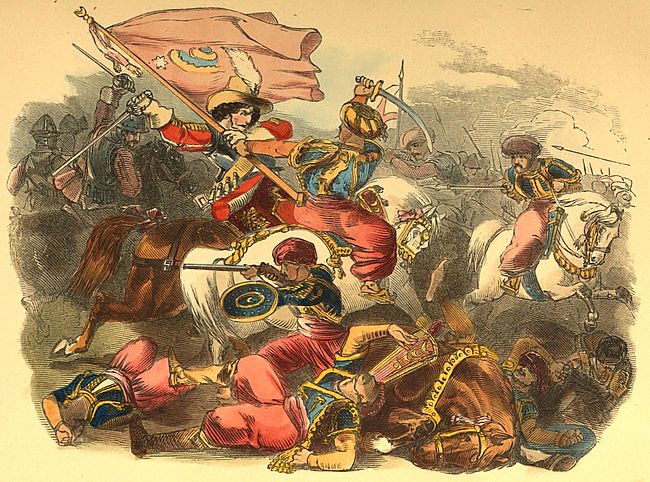
Capture of a Moorish Standard by the English Horse, at Tangier, in 1664. Now 1st Royal Dragoons.
[To face page 4
On the 13th of March the English horsemen
had a sharp encounter with some of the enemy's
best cavalry; and on the 27th, the Earl of Teviot
led them against a horde of Moorish lancers and
foot who were concealed in ambush, and the barbarians
were routed and pursued among the woods
and broken grounds with great slaughter. The
English horsemen, however, suffered severely on
the 4th of May in the same year, when the
governor, having been deceived by a false report,
advanced too far into the country, and was surprised
by a numerous band of Moors in ambush.
A fearful slaughter followed, and the Earl of
Teviot was numbered among the slain.
1665
1666
Frequent encounters took place in the subsequent
years between detached parties of British
and Moors, and in this desultory warfare the
English horsemen preserved their high character.
Hostilities were occasionally terminated, and renewed
after short intervals of peace; and during
the period of seventeen years the garrison resisted,
with firmness and success, every attempt of the
Moors against the city.
1679
1680
In 1679 a numerous army of Moors appeared
before Tangier, and destroyed two forts situate at
a distance from the town. They afterwards withdrew,
but re-appeared in the spring of 1680, with
augmented numbers, and swarms of expert Moorish
lancers, on light and swift horses, hovered round
the fortress and confined the Christians within
narrow limits. King Charles II. sent a battalion
of foot guards and sixteen companies of Dumbarton's
(now first royal) regiment, to reinforce the
garrison, and issued commissions for raising a
regiment of foot (now the fourth, or the King's
own) and six troops of Horse in England: at
the same time arrangements were made for procuring
the service of three troops of Spanish
cavalry.
The six troops of English horse were raised by
Major-General the Earl of Ossory, Lieutenant-Colonel
Sir John Lanier,[10] Captains Robert
Pulteney, John Coy,[11] Charles Nedby, and
Thomas Langston:[12] the three last-named officers
having been captains in the Duke of Monmouth's
regiment of horse, which was disbanded
only a few months before, their troops were
speedily completed with disciplined men who had
served in that regiment; and the demand for
cavalry at Tangier being urgent, they were furnished
with horses and equipment from the life
guards,[13] and arrived at Tangier in the early part
of September: at the same time the three troops
of Spanish horse arrived from Gibraltar.
The cavalry at Tangier now consisted of seven
efficient troops of cuirassiers, who were engaged
in a sally on the 12th of September, when the
Moorish horsemen were driven from under the
walls, and several outworks were recovered from
the barbarians. Another sally was made on the
21st of the same month, and on the following day
the English cuirassiers had a sharp skirmish with
the Moorish lancers, and had eight men killed and
twenty wounded. An attack was made on the
enemy's lines on the 24th of September, when the
governor, Sir Palmes Fairborne, was mortally
wounded.
On the 27th of September, the garrison,
amounting to about 4000 men, issued from the
fortress and attacked the Moorish army of about
15,000 men in its intrenched camp with signal
gallantry. So eager were the troopers to engage
their adversaries that a dispute occurred between
the English and Spanish horse, each claiming the
honour of charging first: the subject was referred
to the lieutenant-governor, Colonel Sackville, who
gave the Spaniards the precedence on this occasion,
because they fought as auxiliaries. The
Moors, having a great superiority of numbers,
stood their ground resolutely for some time; and
the thunder of cannon, the roll of musketry,
the clash of arms, the loud shouts of the British,
the cries of the Africans, produced an awful
scene of carnage and confusion. The English horse
stood in column of troops until the first intrenchment
was carried, and a space levelled for the
cavalry to pass, when they filed through the aperture
and rushed at speed upon the dark masses of
barbarians, who were broken, trampled down, and
pursued with a dreadful slaughter; while the musketeers,
pikemen, and grenadiers followed, shouting
as the dismayed Africans fell in succession
beneath the sabres of the English and Spanish
troopers. Many of the Moors faced about and
confronted their pursuers; numerous single combats
took place, and the vicinity of the camp was
covered with slain. Captain Nedby's troop of
English horse particularly distinguished itself,
and captured a splendid Moorish colour of curious
workmanship. The Spaniards also captured a
colour, Dumbarton's Scots another, and a fourth
was taken by a battalion of marines and seamen
from the fleet.[14]
The Moorish legions, having been driven from
before the town with severe loss, this victory was
followed by a treaty of peace, and the troops of
horse raised by the Earl of Ossory, Sir John Lanier,
and Robert Pulteney, not having left England,
were disbanded.
1682
1683
The improved military system introduced among
the Moors by European renegades, having rendered
it necessary to employ a much stronger
garrison at Tangier than formerly, the subject was
brought before parliament; but the question of a
popish successor to the throne was agitating the
people, and no grant was voted. The king, being
unwilling to bear the expense of the fortifications
and troops without pecuniary aid from parliament,
resolved to destroy the works and mole, and to
withdraw the garrison.
At this period the attention of King Charles II.
was directed to the improvement of his army; and,
resolving to retain the Tangier Horse in his service,
he commissioned Colonel John Churchill
(afterwards the great Duke of Marlborough) to
raise a troop of dragoons at St. Alban's and its
vicinity; and Viscount Cornbury (son of the
Earl of Clarendon) to raise another troop of dragoons
at Hertford; and His Majesty constituted
these two troops, with the four troops of Tangier
horse, a regiment, to which he gave the distinguished
title of The King's Own Royal Regiment
of Dragoons: the words "King's Own"
were, however, discontinued soon afterwards, and
the regiment was styled "The Royal Regiment
of Dragoons."[15] The colonelcy was conferred on
John Churchill, who was advanced to the peerage
of Scotland by the title of Baron Churchill of
Aymouth; and the lieutenant-colonelcy on Viscount
Cornbury, by commission dated the 19th
of November, 1683.
1684
The establishment was fixed by a warrant bearing
date the 1st of January, 1684, from which the
following is an extract:—
"Charles R.
"Charles the Second, by the Grace of God,
King of England, Scotland, France, and Ireland,
Defender of the Faith, &c.
"Our will and pleasure is, that this establishment
of our Guards, garrisons, and land
forces within our Kingdom of England, Dominion
of Wales, and Town of Berwick upon
Tweed, and the Islands thereunto belonging,
and of all other officers and charges therein
expressed, do commence on the 1st day of January,
1683-4, in the Thirty-Fifth year of our
Reign."
| HIS MAJESTY'S OWN ROYAL REGIMENT OF DRAGOONS. |
| |
| Staff-Officers. | Per Diem. |
| | |
| £. | s. | d. |
| Colonel, as Colonel, xiis, and iij horses iijs | 0 | 15 | 0 |
| Lieutenant-Colonel, as Lieut.-Colonel, vijs, and ij horses ijs | 0 | 9 | 0 |
| Major, as Major vs, and j horse js | 0 | 6 | 0 |
| Chaplaine | 0 | 6 | 8 |
| Chirurgeon ivs, and j horse to carry his chest, ijs | 0 | 6 | 0 |
| Adjutant ivs, and for his horse js | 0 | 5 | 0 |
| Quarter-Master and Marshal in one person ivs, his horse js | 0 | 5 | 0 |
| Gunsmith ivs, and his servant is | 0 | 5 | 0 |
| —— | —— | —— |
| 2 | 17 | 8 |
| —— | —— | —— |
| The Colonel's Troop. | | | |
| The Colonel, as Captaine, viiis, and iij horses iijs. | 0 | 11 | 0 |
| Lieutenant ivs, and ij horses ijs | 0 | 6 | 0 |
| Cornett iijs, and ij horses ijs | 0 | 5 | 0 |
| Quarter-Master, for himself and horse | 0 | 4 | 0 |
| Two Serjeants each js vid, and ijs for horses | 0 | 5 | 0 |
| Three Corporals each js, and iijs for horses | 0 | 6 | 0 |
| Two Drummers each js, and ijs for horses | 0 | 4 | 0 |
| Two Hautboys each is, and ijs for horses | 0 | 4 | 0 |
| Fifty Soldiers each is vid for man and horse | 3 | 15 | 0 |
| —— | —— | —— |
| 6 | 0 | 0 |
| —— | —— | —— |
| Five Troops more at the same rate | 30 | 0 | 0 |
| —— | —— | —— |
| The Major to have no Troop, but instead thereof
the pay of a Captain xis, in lieu of servants iiis | 0 | 14 | 0 |
| —— | —— | —— |
| Total | 39 | 11 | 8 |
| —— | —— | —— |
| Total Per Annum £14,447 18s. 4d. | | | |
The four troops at Tangier arrived in England
in February, 1684;[16] and, having returned their
armour into store, the whole were equipped as
dragoons with long muskets and bayonets.[17]
The uniform of the regiment was scarlet lined
with blue. The men wore hats bound with silver
lace, and ornamented with blue ribands, having a
metal headpiece fastened inside the crown; also
high boots: their horse furniture was made of
scarlet cloth trimmed with blue, with the King's
cipher embroidered in yellow characters on the
housings and holster-caps. The drummers and
hautboys were clothed in splendid liveries, which
(according to the War-Office Records) cost upwards
of 10l. per suit; and each troop was furnished
with a crimson standard or guidon, with the
following devices embroidered thereon, namely:—
On the standard of the Colonel's Troop,—the
King's cipher and crown.
The Lieutenant-Colonel's Troop,—the rays
of the sun, proper, crowned, issuing out of a cloud,
proper: a badge used by the Black Prince.
The First Troop,—the top of a beacon
crowned, or, with flames of fire, proper: a badge
of Henry V.
The Second Troop,—two ostrich feathers
crowned, argent: a badge of Henry VI.
The Third Troop,—a rose and pomegranate
impaled, leaves and stalk vert: a badge of Henry
VII.
The Fourth Troop,—a phœnix in flames, proper:
a badge of Queen Elizabeth's.[18]
The following officers were at this period holding
commissions in the regiment:—
| Troops. | Captains. | Lieutenants. | Cornets. |
| Colonel's. | Lord Churchill | Thos. Hussey | Wm. Hussey |
| Lieut.-Col.'s | Visc. Cornbury | Charles Ward | Piercy Roche |
| 1st Troop. | Alex. Mackenzie | H. Wyndham[19] | John Cole |
| 2nd " | Chas. Nedby | John Williams | George Clifford |
| 3rd " | John Coy | Charles La Rue | Wm. Stamford |
| 4th " | Thos. Langston | F. Langston[20] | Thos. Pownel |
|
| Hugh Sutherland | Major |
| Thomas Crawley | Adjutant |
| Henry Hawker | Quarter-Master & Marshal |
| Theobald Churchill | Chaplain |
| Peregrine Yewel | Chirurgeon |
The Royal Regiment of Dragoons being
constituted, generally, of men of military experience
and approved valour, appears to have advanced,
at once, into royal favour; and as soon as
it was regularly organized, it marched into quarters
in the borough of Southwark. On the 1st of
October it was reviewed, with several other corps,
by King Charles II., accompanied by the Queen,
the Duke of York, and many distinguished personages,
on Putney Heath; and on the 13th of that
month marched into quarters at Newbury, Abingdon,
and Hungerford. Shortly afterwards the
following order was issued relative to the regiment:—
'Charles R.
'For the preventing of all disputes that might
arise concerning the rank of Our Royal Regiment
of Dragoons, or of any other regiment
of Dragoons that shall be employed in Our service,
We have thought fit hereby to declare Our
pleasure,
'That Our Royal Regiment of Dragoons,
and all other regiments of Dragoons which may
be employed in Our service, shall have precedency
both as Horse and Foot, as well in garrison
as in the field, and in all councils of war and
other military occasions; and the Colonels and
Officers of the said regiments of Dragoons shall
command as officers of Horse and Foot, according
to the nature of the place where they shall be:
that is to say, that in the Field the said regiments
shall take place as regiments of Horse,
and the officers shall command and do duty as
officers of Horse, according to the dates of their
commissions; and that in Garrison they shall
command as Foot officers, and their regiment
take place amongst the Foot according to their
respective seniorities from the time they were
raised.
'Given at Our Court at Whitehall the 30th
day of October, in the thirty-sixth year of Our
reign (1684).
'By His Majesty's Command,
'Sunderland.'
1685
The decease of King Charles II. took place on
the 6th of February, 1685; and on the evening of
the same day, his successor (James II.) commanded
the Royal Dragoons to march into
quarters in the immediate vicinity of the metropolis.
Previous to the coronation they were furnished
with new standards, and the drummers and
hautboys with new liveries.[21] The ceremonial of
their Majesties' coronation was conducted with
extraordinary magnificence: but the agitated state
of the United Kingdom gave early indication of
approaching contests; and, towards the end of
April, two troops of the Royal Dragoons were
despatched to Carlisle, and placed under the command
of the governor, Sir Christopher Musgrave,
for the purpose of assisting in the seizure of 'divers
outlawed and seditious persons, who, for the
avoiding of Justice, have fled from Scotland into
the county of Cumberland and parts adjacent.'[22]
These troops arrived at Carlisle on the 10th of
May, and several persons were apprehended. In
the middle of that month an insurrection, headed
by the Earl of Argyle, broke out in Scotland;
and in June, James Duke of Monmouth raised
the standard of rebellion in the west of England
and proclaimed himself king. The establishment
of the Royal Dragoons was immediately augmented
to sixty men per troop: an independent
troop of dragoons, raised by Colonel Strother in
1683, was incorporated in the regiment; and five
troops of dragoons were raised in the vicinity of
London by Richard Leveson, John Williams,
Edward Lea, Francis Russel, and Thomas
Hussey, and added to the Royal Dragoons:
the numbers were thus increased to twelve troops,
amounting to about nine hundred officers and men.
Two troops of the regiment, with some other
forces, were despatched under Brigadier-General
Lord Churchill against the rebels in the west;
and on the 19th of June two other troops marched
for the same destination under the orders of
Lieutenant-General the Earl of Feversham, who
was appointed to the chief command of the King's
army. The royal forces having been united, the
four troops of dragoons were placed under the orders
of Viscount Cornbury; and the whole marched
in pursuit of the rebels.
After several marches and skirmishes the Duke
of Monmouth took post at Bridgewater; and the
Earl of Feversham, having sent a troop of the
Royal Dragoons, commanded by Captain Coy,
to Lamport, to secure that pass, and to gain intelligence
in the event of the rebels marching westward,
advanced with the royal army to Weston
(about three miles from Bridgewater), where he
arrived on Sunday, the 5th of July. Having
quartered the cavalry in the village, and ordered
the infantry to encamp on a plain fronting Sedgemoor,
he sent a party of life guards to patrole in
the direction of Bristol, and posted a piquet of fifty
of the Royal Dragoons with a squadron of the
blues supported by one hundred men of the royal
regiment of foot, on the moor, in front of the
camp. A guard of the Royal Dragoons was
also posted over the artillery, which consisted of
sixteen pieces, and was drawn up on the high road
from Weston to Bridgewater.
During the night the Duke of Monmouth
marched out of Bridgewater with the view of surprising
the royal army; but the piquet in advance
gave the alarm, and after exchanging a few shots
with the rebels, retreated to the camp, and formed
on the right of the infantry; at the same time
the remainder of the Royal Dragoons, being
aroused in their quarters in the village of Weston,
turned out in the dark in good order, and
formed on the left of the foot. The rebels commenced
the attack with loud shouts,—the contest
became general along the whole line,—and
the moor sparkled with fire. The rebel horse
soon gave way and fled in disorder; but their infantry
stood firm and fought with great resolution.
Day at length began to break; and the King's
foot advancing to the charge, whilst the Royal
Dragoons and other cavalry attacked the flanks
of the rebels and put them in disorder, their whole
line then gave way and fled in confusion, and were
pursued across the moor and adjoining corn-fields
with great slaughter. Two troops of the Royal
Dragoons continued the pursuit as far as Bridgewater,
where they were ordered to halt by the
Earl of Feversham.
In the mean time Captain Russel's troop of the
Royal Dragoons had been attached to three
Scots regiments of foot, which had recently arrived
from Holland under the command of Major-General
Mackay, and ordered to join the army in the
west; but, on the news of Monmouth's defeat
at Sedgemoor, these forces were directed to halt
at Bagshot; the Royal Dragoons were subsequently
dispersed in small parties into the adjoining
counties to seize suspected persons; the Scots
regiments returned to Hounslow, and, after encamping
a short time on the heath, re-embarked
for Holland.
One troop of the Royal Dragoons was ordered
to Winchester to escort the Duke of Monmouth
and other prisoners to London; on its arrival this
troop was quartered in the Borough of Southwark,
and it was under arms when the Duke was beheaded
on Tower Hill on the 15th of July. Two
other troops were ordered to Salisbury to mount
guard over the prisoners there, and were subsequently
directed to attend Judge Jeffries during
the trial and execution of the captured rebels; in
which painful service the troopers were spectators
of numerous acts of barbarity perpetrated by the
remorseless Judge, who sacrificed the lives of
upwards of two hundred persons in these "bloody
assizes," as historians have denominated them.
After the suppression of this rebellion the establishment
of the Royal Regiment of Dragoons
was reduced to eight troops, of forty private men
per troop; and the supernumerary troops were
embodied into a regiment of dragoons, which was
commanded by the Duke of Somerset, and is
now the third light dragoons.
On the 1st of August Lord Churchill was appointed
colonel of the third troop of life guards,
and the colonelcy of the Royal Dragoons
was conferred on Lieutenant-Colonel Viscount
Cornbury. The two troops of the regiment having
returned from Carlisle, the whole were stationed
in London in October, and subsequently marched
into quarters in Devonshire.
1686
1687
1688
King James II., being a Roman Catholic,
adopted measures calculated to effect the subversion
of the Protestant church; and, with the view
of overawing his subjects, he doubled the numbers
of the regular army, and had large bodies of troops
encamped, from time to time, on Hounslow Heath,
where he frequently attended in person and witnessed
the exercise of the troops. The Royal
Regiment of Dragoons formed part of the force
at these encampments in the summer of 1686,
again in 1687, and in 1688. At this period many
noblemen and gentlemen, resolving to preserve the
nation from papal domination, solicited the Prince
of Orange to come to England with a Dutch force
to assist them in opposing the proceedings of the
King, and the Prince provided an armament for
that purpose.
The colonel of the Royal Dragoons appears
to have been a zealous Protestant, and to have
entered warmly into the measures taken to resist
the proceedings of the Papists who surrounded
the court. In November, 1688, when the Prince
of Orange had landed, Viscount Cornbury,
having marched with his regiment to Salisbury,[23]
where the King's army was ordered to assemble,
and where the blues and eighth horse had already
arrived, resolved, in connexion with Lieut.-Colonel
Langston, of the eighth horse, and several
officers of the blues, to endeavour to take these
three regiments over to the Prince, in the following
manner:—
On the night of the 11th of November, directions
were given for the adjutants and quarter-masters
to await the arrival of the post, as orders
to march were expected. At twelve o'clock the
post arrived, when Colonel Langston opened the
bag before the officers, and the orders, apparently
from the Secretary-at-War, were produced, and
carried to Viscount Cornbury, who gave directions
for the regiments to proceed, at five o'clock, towards
the enemy. The regiments were accordingly
on the march before daylight on the
12th; continuing their progress throughout that
day and the following night (excepting a few
short halts to refresh the men and horses[24]),
on the afternoon of the 13th, they arrived at
Axminster, within six miles of the Prince of
Orange's quarters, where they were joined by the
Earl of Abingdon, Sir Walter Clerges, and about
thirty other gentlemen, who pretended to be volunteers.
It was now asserted that a design of the
Dutch to surprise the quarters of the King's
forces had been discovered, and orders were
issued for beating up the quarters of the enemy
that night. Accordingly, after dark, the three
regiments were again in motion, and the Prince
of Orange, apprized of their approach by Lord
Cornbury, sent a large body of cavalry to meet
them. The greater part of the men, however,
resolved not to join the Prince of Orange, and,
when they observed what was taking place, they
galloped back. Major Robert Clifford, of
the Royal Dragoons, marched back that regiment,
with the exception of a few officers and
about fifty dragoons, who accompanied Viscount
Cornbury. The blues also returned, excepting
about twenty-seven. But the Duke of St. Alban's
regiment (eighth horse) having mustered at
a distance, the men, ignorant of the transaction,
followed Colonel Langston to Honiton, where
they were received as friends by the Dutch general.[25]
Many of the men, however, returned
to the King's service; and the Duke of Berwick,
having collected the remains of the three regiments,
marched them back to Salisbury.
The king arrived at Salisbury on the 20th of
November, and his Majesty rewarded the loyalty
of Major Clifford by promoting him to the
colonelcy of the Royal Dragoons. The King,
however, soon discovered that the defection among
the officers was general, and that the soldiers, although
they were reluctant to desert his service,
were not disposed to fight in the cause of Papacy.
The superior officers of the army, with the nobility
and gentry, continued to flock to the Prince's
standard, and King James, alarmed for his personal
safety, returned in haste to London; at the
same time the Royal Dragoons marched into
garrison at Portsmouth. The Prince of Orange
advanced to the capital without experiencing serious
opposition; King James fled to France;
and the Prince, having assumed the reins of government,
restored Viscount Cornbury to the
colonelcy of the Royal Dragoons, and ordered
them to occupy quarters at Farnham and Alton.[26]
1689
After the flight of the King to France, the
crown was conferred on William and Mary,
Prince and Princess of Orange. Their Majesties'
accession, however, met with opposition; and Viscount
Dundee having induced several of the
Highland clans to take arms in favour of King
James, the Royal Dragoons were immediately
ordered to the north.[27] At the same time, the
Earl of Clarendon refusing to act with the new
government, his son, Viscount Cornbury, was
superseded in the command of the regiment by
the lieutenant-colonel, Anthony Hayford, whose
commission as colonel was dated the 1st of July,
1689.
On the 27th of July, six battalions of infantry
and two newly-raised troops of Scots horse, commanded
by Lieut.-General Mackay, were defeated
at Killicrankie by the Highlanders and a few
Irish, under Viscount Dundee and Brigadier-General
Cannon. Immediately after the action, the
Royal Dragoons were directed to march to the
assistance of Lieut.-General Mackay, and they arrived
at Perth in the early part of August. The
object of the Commander-in-Chief being the prevention
of the descent of the mountaineers into the
lowlands, the regiment was posted a short time at
Forfar, under the command of Major-General Sir
John Lanier, and subsequently proceeded by forced
marches to Aberdeen. The Highlanders eventually
retired over the mountains by paths inaccessible
to cavalry, and separated to their homes.
In the mean time, the lord-lieutenant of Ireland
(Earl Tyrconnel) had retained the greater part of
that kingdom in the interest of King James. King
William sent an army to that country under the
veteran Duke Schomberg; and, immediately after
the dispersion of the rebel Highlanders, the Royal
Dragoons were ordered to proceed to Ireland.
They embarked for this service in the early part
of October, landed at Carlingford on the 9th of
that month,[28] and were ordered to take post at
Armagh and Clownish, from whence they were
removed to the isle of Maghee.
1690
Several skirmishes occurred during the winter;
and in the spring of 1690 the Royal Dragoons
were before Charlemont, which place was blockaded
by the King's forces. Charlemont was defended
by a garrison of 500 men, commanded by
Sir Teague O'Regan, a humorist, who returned
the following laconic answer to the summons to
surrender:—"Tell the General, from Teague
O'Regan, that he's an old knave; and, by St.
Patrick, he shall not have the town at all." He,
however, surrendered on the 14th of May, and
a detachment of the Royal Dragoons escorted
the garrison towards Armagh.[29] Soon after the
surrender of Charlemont Lieut.-Colonel Edward
Matthews, from Leveson's (now third) dragoons,
was appointed colonel of the regiment. In June
it was encamped near Loughbritland, where it
was joined by a remount from England. On the
22nd of June King William arrived at the camp,
and "His Majesty was no sooner come than he
was in amongst the throng of the troops, and
observed every regiment very critically. This
pleased the soldiers mightily, and every one was
ready to give what demonstrations it was possible
both of his courage and duty."[30]
The French and Irish, commanded by King
James, took post on the banks of the Boyne, to
dispute the passage of that river. King William
marched to the opposite bank on the 30th of June,
and, on the morning of the 1st of July, the army
forded the river and drove the enemy from his
position with great slaughter. The Royal Dragoons
and other British troops engaged in forcing
the passage of the Boyne are reported to have
"acquitted themselves well." King James fled
from the field and proceeded to France; and the
British army advanced on Dublin. A few days
after the battle King William reviewed the Royal
Dragoons at Finglass, on which occasion they
brought 406 private troopers into the field.
On the 21st of July Major-General Kirke proceeded
with the Royal Dragoons and Queen
Dowager's and Colonel Cambron's regiments of
foot to Waterford, and summoned the place, and
on the 25th the governor capitulated.
At the moment when success attended the operations
of the army in Ireland, the English and
Dutch fleets, commanded by Lord Torrington and
Admiral Evertsen, were defeated by the French
fleet under the Count de Tourville, and the enemy
afterwards menaced the descent of a formidable
force on the British coast. King William commanded
a troop of life guards, with Count
Schomberg's horse (now seventh dragoon
guards), the Royal Dragoons, and Trelawny's
and Hastings' (fourth and thirteenth) foot to be
immediately embarked for England.
The Royal Dragoons landed at Highlake, in
Cheshire, in the early part of August. The alarm
of invasion, however, soon subsided; and they
were ordered to return to Ireland, in which country
they again landed on the 20th of October, and
proceeded into extended cantonments in the county
of Cork. Many thousands of the Roman Catholic
peasantry of Ireland were, at this period, in arms
in behalf of King James: they were called rapparees,
and being formed into bands they made
frequent incursions into the cantonments of the
English regiments. Several men of the Royal
Dragoons were murdered in their quarters by
these rapparees; and detachments of the regiment
were frequently sent out to scour the country and
chase these bands of marauders from the English
cantonments.
1691
Towards the end of December a detachment of
the Royal Dragoons proceeded, with some other
troops, on an expedition commanded by Major-General
Tattea, and on the 1st of January, 1691,
attacked an Irish fort near Scronclaird, which was
taken in two hours, although the enemy had employed
five hundred men during two months to
build it.[31]
In the spring, when the army took the field,
the Royal Dragoons were ordered to remain in
the county of Cork to restrain the incursions of
the rapparees, and to prevent the several forts
and small garrisons from being attacked. In the
early part of June Major Culliford, with a detachment
of the Royal Dragoons and some militia,
penetrated that part of the country from whence
the enemy received their supplies, defeated the
Irish troops, and captured several droves of cattle.
At length General St. Ruth, who commanded the
French and Irish forces, detached two thousand
horse and foot to cover this part of the country.
Major Culliford, however, continued to make
inroads, and having advanced with one hundred
and twenty men of the Royal Dragoons, and
fifty militia foot, he encountered two troops of
Irish cavalry. The English dragoons advanced
boldly to the charge, defeated their opponents,
killed twenty men upon the spot, and pursued the
remainder to Newmarket, where the Irish, being
reinforced, made another stand. The Royal Dragoons,
however, attacked them again with great
bravery, and having sabred fifteen, the remainder
fled in disorder, leaving a quantity of provision
and some cattle behind. Major Culliford despatched
eleven dragoons and twenty-four of the
militia to the rear with the booty, and then pursued
the fugitives four miles farther, when he
encountered five hundred of the enemy's horse
commanded by Sir James Cotter. Notwithstanding
their disparity of numbers, the Royal Dragoons
boldly confronted their opponents, and made
a gallant resistance, but were eventually overpowered;
and forty men having fallen, Major Culliford
made good his retreat with the remainder.
In retiring, the dragoons,—chafed in spirit and
burning with revenge,—often turned round upon
their pursuers; and at length Captain Bower and
twenty men boldly faced about and killed about
twenty of the Irish horsemen, whose eagerness in
the chase had caused them to advance in front of
their main body. In the meantime the eleven
dragoons and twenty-four of the militia, with the
captured cattle and stores, arrived at Drumaugh,
where they were attacked by a detachment of the
enemy, but defended themselves with success
until relieved by a body of troops under Colonels
Hastings and Ogleby.
At the time the Royal Dragoons were making
these diversions, the main army, commanded by
Lieutenant-General De Ginkell, gained a decisive
victory over the French and Irish at Aghrim;
and on the 1st of August the regiment joined the
army at Banagher-bridge. The enemy collected
the remains of their defeated regiments at Limerick;
and towards the end of August Lieutenant-General
De Ginkell besieged that city, commencing
his work on the right bank of the Shannon:
the Irish army lay encamped at the same time on
the opposite side of the river.
A pontoon bridge having been prepared, several
regiments were ordered to cross the river at daybreak
of the 16th of September. The Royal
Dragoons took the lead; and Brigadier-General
Clifford,[32] who commanded four regiments
of King James's dragoons, being taken by surprise,
made little opposition: some infantry, however,
attempted to make a stand; but a squadron
of the Royal Dragoons dashed forward
and routed them in an instant. Two or three
French and Irish battalions retired to a bog and
wood in their rear, from whence they were driven
with the loss of several men killed, and a French
lieut.-colonel, a captain, and a number of men
made prisoners. The regiments which had passed
the river advanced upon the enemy's camp, where
a curious spectacle presented itself:—many of the
Irish were running about in their shirts, some
were pulling down tents, others driving away cattle,
many were making their escape into the town,
and others hurrying towards the mountains; a
regiment of dragoons, whose horses were two
miles distance at grass, dispersed in confusion:
at the same time a party of horse buckled on their
arms and made a show of fighting; but they fled
on the advance of the English, who took possession
of the camp, where they found a quantity of
beef, brandy, and corn, with the saddles and
appointments of three hundred dragoons. The
Royal Dragoons were commended by Lieut.-General
De Ginkell for their gallant conduct,
and they returned to the other side of the river on
the same day.[33]
On the 22nd of September the regiment, with
several other corps, crossed the Shannon into the
county of Clare; when the advance-guard, which
consisted of eighteen men of the Royal Dragoons,
was attacked by a squadron of the Irish cavalry:
this small party sustained the first onset with
admirable firmness, but were forced to retire; part
of the regiment, however, soon advanced to their
assistance, when the enemy was defeated and
chased under the range of their batteries, and
three small pieces of brass ordnance were captured.
Orders were then given for the infantry
to attack the works which covered Thoumond
bridge. These works were carried after a sharp
struggle; when the troops which had defended
them endeavoured to enter the town; but the
drawbridge had been raised, and they were left to
the mercy of the English, who slaughtered such
numbers, that the dead bodies lay in heaps on the
bridge higher than the parapet walls. Five colours
were taken on this occasion, and so many men
slain, drowned, and taken prisoners, that the enemy
surrendered the place in a few days afterwards.
1692
1693
The conquest of Ireland having been effected,
the Royal Dragoons returned to England, where
they arrived in January, 1692, and marched into
dispersed cantonments in Leicestershire; and
during a part of the summer a detachment was
stationed in garrison at Portsmouth. The regiment
was subsequently stationed, on revenue duty,
in the maritime towns on the southern coast of the
kingdom; and in the autumn of 1693 it had the
honour of furnishing a relay of escorts to attend
King William from Margate to London, when His
Majesty returned from Holland.
1694
The war with France, which was commenced in
1689, had been continued with varied success; and
in the spring of 1694 the Royal Dragoons were
ordered to proceed on foreign service. They left
England in May; joined the army encamped near
Tirlemont in South Brabant, on the 21st of June,
and were reviewed by King William on the following
day. On arriving at this camp they were
ordered to take post in front of the village of Camtich,
and this quarter being much exposed to
attacks from the enemy, they were reinforced by
two regiments of Dutch infantry. The army
marched from Tirlemont on the 13th of July, and
encamped at Mont St. André and Ramilies, where
the regiment was formed in brigade with the royal
Scots and Fairfax's (now second and third) dragoons,
under the command of Brigadier-General
Matthews, and this brigade was encamped on the
left of the line. The French army encamped near
Huy, with their left upon the Mehaine. On the
17th of July a foraging party of the allies crossed
the river, and, meeting with several French squadrons,
a skirmish ensued, when the Royal
Dragoons lost eight horses and had three men
wounded. On the 28th of the same month another
foraging party encountered a detachment of
the enemy, when the regiment had two men and
several horses killed. The allied army was again in
motion on the 8th of August: much manœuvring,
and some skirmishing took place between the
hostile squadrons, but no general engagement
occurred. On the 29th of August the Royal
Dragoons were stationed at Wacken—a post
situate at the junction of the Mandel and the
Scheldt; and in October they marched into cantonments
in the villages between Ghent and Sans-van-Ghent.[34]
1695
In the spring of 1695 the Royal Dragoons
marched to Dixmude, forming part of a division
of the army commanded by Major-General Ellenberg,
and were brigaded with Lloyd's (now third)
dragoons and a regiment of Danish cavalry. On
the 7th of June the Duke of Wirtemberg took
command of this division, and attacked the French
forts at Kenoque as a diversion to conceal King
William's design upon the strong and almost
impregnable fortress of Namur, which he commanded
to be invested shortly afterwards. The
Royal Dragoons joined the covering army towards
the end of June; but were detached to
Bruges in July: they were subsequently recalled
from thence and joined the camp between Genappe
and Waterloo, from whence they proceeded to the
vicinity of Namur, to protect the troops employed
in the siege from a threatened attack of the French
army. After the surrender of the important fortress
of Namur, the regiment marched into cantonments
behind Ghent.
1696
The French menaced an attack upon the quarters
of the allied army in Flanders in the spring of
1696, when the Royal Dragoons were suddenly
called from their cantonments to encamp on the
banks of the canal between Ghent and Bruges,
where they were reviewed by King William on
the 29th of May. They served the campaign of
this year with the army of Flanders, commanded by
the Prince of Vandemont, and were brigaded with
the royal Scots and royal Irish (second and fifth)
dragoons, commanded by Brigadier-General Matthews.
The object of this army was the protection
of Ghent, Bruges, and the maritime towns of
Flanders: no general action occurred; but a party
of the Royal Dragoons, with a detachment of
Langston's horse (now fourth dragoon guards),
surprised one of the French out-guards on the
night of the 20th of September and took thirty
prisoners. This appears to be the only action in
which the regiment took part during the campaign
of this year; and on the 6th of October it marched
into quarters in the villages behind the Bruges
canal.
1697
During the campaign of 1697 the regiment
served under King William in the army of Brabant,
and was brigaded with the royal Scots and
Eppinger's dragoons.
On the 28th of May Brigadier-General Matthews
died; and on the 30th His Majesty conferred
the colonelcy of the Royal Dragoons on Thomas
Lord Raby, afterwards Earl of Strafford.
1698
The enemy, having great superiority of numbers,
besieged and took Aeth, and afterwards menaced
Brussels; but were frustrated in their designs by
King William. The Royal Dragoons were encamped
before Brussels in June; and subsequently
at Wavre. Hostilities were terminated in September
by the treaty of Ryswick, and after the
conclusion of peace, the regiment embarked from
the Netherlands,—landed at the Red House in
Southwark on the 21st of November, and, at the
end of the same month, marched into extensive
quarters in Yorkshire, where the establishment,
which during the war had been eight troops,
amounting to five hundred and ninety officers and
men, was reduced to six troops of two hundred and
ninety-four officers and men.
1699
1700
During the two succeeding years the Royal
Dragoons occupied quarters in Lancashire and
Leicestershire. In June, 1700, they assembled on
Hounslow Heath and were reviewed by King William
III., who was pleased to express his royal
approbation of their appearance and discipline.
Leaving the south of England in July, they proceeded
into quarters in Yorkshire and Cumberland,
with one troop stationed in garrison at Carlisle and
another at Hull.
1701
1702
In 1701 the Royal Dragoons were stationed
in Yorkshire, with three troops in garrison at
Hull; at this period the ambitious Louis XIV.
of France violated the treaties he had entered
into, and procured the accession of his grandson,
Philip, Duke of Anjou, to the throne of Spain.
War was resolved upon, and the establishment
of the regiment was augmented to eight troops
amounting to five hundred and thirty-two officers
and men; and it embarked for Holland in the
beginning of March, 1702. Before the transports
sailed, the death of King William occurred
(8th March, 1702), when the regiment was disembarked
and placed in cantonments in the villages
in the immediate vicinity of the metropolis. In a
few days afterwards, Her Majesty Queen Anne
having resolved to pursue the foreign policy of her
predecessor, the regiment re-embarked, and after
landing at Williamstadt, went into quarters at Breda,
where it was formed in brigade with the royal
Scots and royal Irish (second and fifth) dragoons,
under the command of that excellent officer, Brigadier-General
Ross, and was placed as a guard to
the English train of artillery.[35]
1703
A powerful French army was in the field menacing
the frontiers of Holland. The Earl of
Marlborough assembled the forces under his
orders towards the end of June, and in July the
Royal Dragoons joined the army with the train
of artillery. By a daring advance the British commander
disconcerted the designs of his opponents,
who retired without venturing an engagement.
The Royal Dragoons were employed in covering
the sieges of Venloo, Ruremonde, and Stevenswaert;
and took part in the capture of the city of
Liege: they afterwards marched back to Holland,
and were quartered at Arnheim, the capital of the
province of Guelderland, where they were reviewed
in April, 1703, by their colonel, Lord Raby, who
was passing through Holland on his way to Prussia,
as envoy extraordinary to that court.[36]
At the commencement of the campaign of 1703
the Royal Dragoons were employed in covering
the siege of Bonn, and afterwards joined the army
near Maestricht, with six battalions of infantry
commanded by the Prince of Hesse, and were
formed in brigade with the same regiments as in
the preceding year.
On the advance of the allied army commanded
by the Duke of Marlborough, the French retreated,
and took post behind their fortified lines.
On the 27th of July the British commander proceeded,
with four thousand horse and dragoons,
towards the enemy's intrenchments, and Lieutenant
Benson, with thirty men of the Royal Dragoons,
who formed the advance-guard, charged
and defeated a piquet of forty French horsemen,
and chased them to the barriers of their intrenchments
with signal gallantry, which gave his
Grace an opportunity of advancing within musket-shot
of the lines. He was desirous of attacking
these formidable works, but was prevented by the
timidity and pertinacity of the Dutch generals and
field deputies. In August, when the siege of Huy
was undertaken, the Royal Dragoons were encamped
on the banks of the river Maese, to secure
the bridge, and to keep up the communication.
They were subsequently engaged in the siege of
Limburg, a city situated on a pleasant eminence
among the woods near the banks of the little river
Wesdet. Spanish Guelderland having been delivered
from the power of France, and the Dutch
freed from the dread of an invasion, the Royal
Dragoons quitted the vicinity of Limburg and
marched back to Holland. In the mean time
circumstances had occurred which occasioned
their removal from the army commanded by the
celebrated Duke of Marlborough, to another
theatre of war.
During the summer the Emperor of Germany
and Prince Joseph renounced their pretensions to
the Spanish monarchy in behalf of Archduke
Charles, who was acknowledged as King of Spain
by several of the states of Europe; and a treaty of
alliance having been concluded with the King of
Portugal, the Royal Dragoons were selected to
accompany the Archduke to Lisbon, and to take
part in the attempt to place him on the throne of
Spain by force of arms.
1704
The Portuguese monarch having engaged to
provide horses for the English cavalry, the Royal
Dragoons transferred their horses to the British
regiments in Holland, and embarked, dismounted,
in October; but were so long detained by contrary
winds and severe weather, that they did not arrive
at the capital of Portugal before March, 1704,
when they landed with the remainder of the
British and Dutch forces commanded by Duke
Schomberg.
In consequence of the horses produced by the
Portuguese authorities being of so inferior a description
that the English officers rejected the
greater part of them, only twenty men per troop
of the Royal Dragoons were mounted; the dismounted
men proceeded to Abrantes to await the
arrival of horses, and the mounted men advanced
to the frontiers of Portugal, and encamped on a
pleasant plain near Estremos. Tardiness and
inability were, however, manifested by the Portuguese
authorities to such an extent, that the Duke
of Berwick, having arrived from France with
eighteen battalions of infantry and nineteen squadrons
of cavalry, and taken the command of the
French and Spanish forces, attacked the frontiers
of Portugal before the allies were prepared to take
the field. The court of Lisbon was alarmed, the
provinces were in consternation; the Duke
Schomberg solicited to be recalled, and the
Earl of Galway was sent with reinforcements
to Portugal, and appointed to the command of
the British forces in that country.
One hundred and twenty men of the Royal
Dragoons formed part of a body of cavalry, which
crossed the frontiers and made a successful incursion
into the Spanish territory. Extraordinary
measures were adopted to procure horses, and at
the close of the summer the regiment had upwards
of three hundred mounted men in the field. In
the autumn the army was enabled to act on the
offensive, and the Royal Dragoons were among
the forces which penetrated Spain; but on arriving
at the vicinity of Ciudad Rodrigo, the enemy was
found so advantageously posted on the opposite
side of the Agueda, that the Portuguese generals
would not venture the passage of the river; and,
after reconnoitring the hostile army several times,
the allies returned to Portugal, and the Royal
Dragoons went into village cantonments in the
Alentejo.[37]
1705
During the winter and the spring of 1705 the
regiment procured an additional supply of horses,
and when it again took the field it was much
better mounted than in the preceding year. It
joined the army in April, and, advancing into
Spanish Estremadura, formed part of the force
which invested Valencia de Alcantara, which
fortress was captured in the early part of May.
Albuquerque was subsequently besieged and taken;
and the capture of Badajoz was contemplated, but
that undertaking was abandoned until the summer's
heat was abated.
In the mean time an expedition had been fitted
out in England, and a land force, commanded by
Lieut.-General the Earl of Peterborough, embarked
for the purpose of furthering the designs
of the house of Austria. The fleet arrived at
Lisbon in June, and, King Charles resolving to
accompany the expedition, the Royal and Cunningham's
(now eighth) dragoons, and four regiments
of foot, were embarked to strengthen the
land force. The fleet put to sea, and, after
several consultations among the general and naval
officers, an attack on Barcelona was resolved upon.
The fleet arrived before that fortress on the 22nd
of August (N.S.), and on the 24th the Royal
Dragoons landed near a river called Bassoz, on
the east side of the city, and encamped about a
mile from the walls, in a place well fortified by
nature, where the army was joined by many of the
country people, who were formed into bands, and
acted as a guerilla force: "they were" (as Bishop
Burnet observes) "good at plundering, but could
not submit to regular discipline, nor were they
willing to expose themselves to dangerous services."
The siege of Barcelona was considered a romantic
enterprise, and it excited a lively interest
in every nation in Christendom. The garrison
equalled in strength the besieging army within
about two thousand men, and, according to the
ordinary rules and chances of war, success appeared
impossible. The siege was, however,
commenced, and on the 14th of September an
attack was made on the strong fortress of Montjuich,
situate on an eminence overlooking the
town, on which occasion a detachment of the
Royal Dragoons was posted between this detached
fortress and the city to prevent a sally of
the Spanish cavalry. The garrison of Fort
Montjuich held out three days, and then surrendered.
During the remainder of the siege the
Royal Dragoons were almost constantly on
duty, the besieging army not having a sufficient
number of men to form two reliefs of the ordinary
guards in the trenches and on the batteries:
the siege was, however, persisted in, and the
governor capitulated on the 9th of October. The
garrison was preparing to march out on the 14th,
when numbers of the guerillas and armed peasantry,
having entered by the breach in hopes of
obtaining plunder, united with the inhabitants of
the town, and attacked the houses of the French
and other persons known to be in the interest of
the Duke of Anjou; they also threatened to massacre
the governor and garrison: but the Earl of
Peterborough marched into the town at the head of
a troop of the Royal Dragoons and a detachment
of grenadiers, and restored order and tranquillity.
On this occasion his lordship narrowly escaped
falling a sacrifice to his humanity. A Spaniard
having fired at the Duke of Popoli, the ball passed
through the Earl of Peterborough's periwig. The
valour and perseverance of the British and Dutch
having achieved the conquest of Barcelona, at
which (as Dr. Freind observes) "all Europe
wondered," nearly every town in Catalonia declared
for King Charles III., and the Royal
Dragoons were placed in garrison at Tortosa,
excepting a detachment which remained at Barcelona.
Shortly afterwards Valencia declared in
favour of the house of Austria.
A French and Spanish force, commanded by
the Conde de las Torres, was detached to retake
the revolted towns, and in December the enemy
besieged St. Mattheo, which place was defended
by a party of Spaniards, commanded by a stout-hearted
Welshman, named Jones, who made a
resolute defence. The Earl of Peterborough advanced
with two hundred of the Royal Dragoons
and a thousand British foot to relieve the place.
This force was not more than one-fifth of the
numbers of the besieging army: but, by night
marches among the woods and mountains, and by
circulating false reports, the British succeeded in
surprising their opponents; and the Spanish commander,
not knowing the numbers of his enemy,
and being deceived by spies, made a precipitate
retreat, and his rear-guard was pursued by the
Royal Dragoons over the mountains to Albocazar.
1706
The French and Spanish army continued to
retire, and was pursued by the Earl of Peterborough
with a force so much inferior in numbers,
that the record of these events appears almost
incredible,[38] and exhibits the native valour,
spirit of enterprise, and temerity of the British
commander, with the pusillanimity and credulity
of the Spaniards, in a strong light. Four troops
of the Royal Dragoons formed part of that small
body of men with which the Earl of Peterborough
pursued a numerous army. The services in which
they were engaged partook of the nature of a guerilla
warfare, and put to a severe test the discipline,
bravery, and intelligence of the men. Being
divided into small parties, and united with bands
of armed peasantry, they were continually performing
night marches among the woods and
mountains, and, hovering about the rear and flanks
of the Spanish army, keeping it in a state of
alarm, which services were performed in concert
with spies; and although, under these circumstances,
it must have been difficult to preserve
subordination and discipline, yet the Royal Dragoons
performed these duties to the satisfaction
of the commander-in-chief. On one occasion
"the Spaniards employed by my lord Peterborough
informed the Conde de las Torres of a
considerable force that was upon his left, somewhat
before him, and certainly designed, as
they told him, to take some passes which might
prevent his entrance into the plains leading to
Valencia, and that there were English troops
among them. This the Spanish general thinking
impossible, one of the spies offered to give
any two or three officers he pleased to appoint
the satisfaction of seeing what he affirmed.
Upon this two officers, in the country habit,
went along with him to a place where, pretending
to alight and refresh themselves, they
were seized by ten English dragoons that were
posted there on purpose, and had marched in
the mountains all night with the spies. The
Spaniards being thus surprised and seized, the
spy pretended the guard was drunk, and the
officers, seeing a couple of dragoons lying apparently
in that condition, slipped into the stable
and took three of the horses, and so returned to
the Conde de las Torres. This was enough to
confirm the intelligence and gain credit to the
spy, as officers of that country never fail to
magnify their dangers and escapes. Sometimes
the dragoons were brought prisoners, by consent,
into the Spanish camp, by country people,
seeming in their interest. By such artful means,
and by such diligent application, a little body of
men, about twelve or thirteen hundred cavalry
and two thousand infantry, were brought to join
in the neighbourhood of Castillon de la Plana."[39]
Such were the services in which the Royal Dragoons
were engaged, and an immense tract of
country was delivered from the power of the
enemy. A most romantic part of the adventure
was, that the Earl of Peterborough, being deficient
in cavalry, procured eight hundred Spanish
horses, and constituted Lord Barrymore's regiment
(now thirteenth foot) a corps of dragoons,
of which he appointed the lieut.-colonel, Edward
Pearce, colonel.
The Royal Dragoons accompanied the Earl
of Peterborough to Valencia. The enemy brought
forward a numerous army to besiege this important
place; but the British commander issued from the
city with his gallant horsemen, and surprised and
captured the Spanish battering-train; he also penetrated,
by a night march, to the rear of their
army, and attacked and defeated their reinforcements;
and by these and other achievements of a
similar character, which exhibit the valour and
excellent conduct of the troops under his orders,
he frustrated the designs of the enemy.
These brilliant successes alarmed the courts of
France and Spain, and a powerful attempt to regain
the possession of the towns which had acknowledged
King Charles was determined upon.
The Spaniards were desirous of commencing with
Valencia, but they were overruled by orders from
France; and, the English fleet having left Barcelona
in the autumn, the siege of that place was
undertaken by a land force commanded by King
Philip in person, and the French fleet under the
Count de Toulouse.
The Earl of Peterborough hastened from Valencia
with the Royal Dragoons and a select
number of men from the other corps, and on his
arrival at the vicinity of Barcelona he found the
town invested by a numerous army and a fleet.
He immediately took to the mountains with his
hardy dragoons and about two thousand foot, and,
being joined by numbers of the armed peasantry,
he was constantly hovering near the besieging
army with his detachments, interrupting the
enemy's communications, cutting off their supplies,
and attacking their out-guards; and on one
occasion he succeeded in throwing a number of
men into the town. At length the British fleet
arrived with reinforcements; the French admiral
withdrew with precipitation, and, Barcelona being
thus relieved, the enemy raised the siege on the
12th of May, 1706, and retreated towards Roussillon,
leaving behind his artillery, ammunition,
stores, and sick and wounded men. A squadron
of the Royal Dragoons and some other cavalry
were ordered to pursue the retiring army, and,
being joined by hundreds of armed peasantry,
they attacked the enemy's rear-guard several
times, and took a number of prisoners. The
Spaniards killed every man who fell into their
hands; but the prisoners taken by the English
and Dutch met with good treatment.
After the flight of the enemy from before Barcelona,
the Royal Dragoons returned to Valencia,
from whence they expected to advance with
King Charles immediately upon Madrid, to join
the allied army commanded by the Marquis das
Minas and the Earl of Galway, which being superior
in numbers to the French and Spanish forces
on the frontiers of Portugal, arrived at the capital
of Spain towards the end of June. King Charles,
however, delayed to proceed to Madrid, and being
guided by pernicious councils, he eventually went
round by way of Arragon. Meanwhile the French
and Spanish forces which, after raising the siege
of Barcelona, had retired to France, re-entered
Spain, and uniting with the forces under the Duke
of Berwick, compelled the army of Portugal to
retire from Madrid. The Royal Dragoons
marched from Valencia in July, together with
Pearce's dragoons, a regiment of Castilian foot,
and a regiment of Germans, and on the 8th of
August joined the army of Portugal at Guadalaxara,
from whence they marched to Chinchon,
a town of Toledo, eighteen miles from Madrid,
where they remained about a month.
The allied army, being unable to make head
against the superior numbers of the enemy, retired,
and having crossed the Tagus at Fuente Duennas,
continued their march through the fine champaign
country of La Mancha, and took up their winter
quarters in Valencia, extending their cantonments
from Requena to Denia.
1707
In the spring of 1707 the Royal Dragoons
were ordered to take the field, and after a long
and difficult march they joined the army in the
beginning of April; but no expectation of a general
engagement being entertained, and land carriage
being difficult to procure, they were detached on
the 9th of April as far as Denia, for their clothing,
and to refresh their horses a short time in village
cantonments. While they lay at Collera, a town
situate at the mouth of the river Xucar, in the
province of Valencia, the battle of Almanza was
fought on the 25th of April, when the allied army,
commanded by the Marquis das Minas and the
Earl of Galway, was nearly annihilated by the
French and Spaniards under the Duke of Berwick.
Soon after this disaster the Royal Dragoons
joined the wreck of the allied army, which had
been collected by the Earl of Galway, and were
employed for three months in marches and countermarches,
observing the motions of the opposing
army and endeavouring to preserve the rich and
extensive province of Catalonia from the power of
the enemy. They afterwards formed part of the
force assembled for the relief of Lerida, but the
undertaking was found to be impracticable. The
enemy gained possession of Arragon and Valencia,
but were prevented acquiring all the advantages
from the victory at Almanza which had been anticipated.
1708
During the winter and succeeding spring exertions
were made to bring the regiments in Catalonia
into as efficient a state as possible; and when
the Royal Dragoons took the field to serve the
campaign of 1708, they were reported to be "in
excellent condition."[40] The allied army in Catalonia
was under the orders of Marshal Count Guido
de Staremberg, an officer of reputation, who had
commanded the Imperial troops in Hungary. The
services of the Royal Dragoons were of a defensive
character; sending out detachments to reconnoitre,
furnishing piquets and patroles, and traversing
the mountain districts of Catalonia in
small parties, were the only duties they were
called upon to perform. They were encamped a
short time in a valley near Monblanco, subsequently
on a fertile plain near Cervera, and they
passed another winter in cantonments in Catalonia.
1709
The early part of the campaign of 1709 was
also passed in defensive movements: the Royal
Dragoons were encamped with the army on the
banks of the Segré, and having forded that river
in August, the town of Balaguer, situate at the
foot of a hill on the banks of that stream and in
a district of uncommon fertility, was captured;
also Ager, a place twelve miles from Balaguer.
After placing garrisons in these towns the army
repassed the river, and the regiments went into
cantonments.
1710
The campaign of 1710 was distinguished by
more important events, the two claimants to the
throne of Spain heading their armies in person.
The enemy was first in the field, and commenced
operations with the siege of Balaguer, but retired
on the approach of the allied army. The Royal
Dragoons were subsequently encamped on the
banks of the Segré; and when King Charles
joined the army, they were detached to meet his
Majesty and to escort him to the camp.
After some manœuvring, Lieutenant-General
Stanhope (afterwards Earl Stanhope), who
commanded the British troops in Spain, being at
the head of the leading column of the allied army
on the march towards Alfaras, discovered, on the
evening of the 27th of July, a body of the enemy's
forces in front of the village of Almanara, and
obtained the King's permission to attack them
with the cavalry, of which the Royal Dragoons
had the honour to form part.
The sun was declining from the horizon, and
the shades of evening were gathering over the
valleys of Catalonia, when the British commander
led forward his warlike horsemen. Before him
appeared twenty-two squadrons of Castilian
cavalry, the pride and flower of the Spanish army,
with King Philip's life guards on the right; a
second line of the same numbers was seen in the
rear, and nine battalions of infantry supported the
cavalry. Against this force the gallant Stanhope
advanced at the head of Harvey's horse
(now second dragoon guards); his front line consisted
of sixteen squadrons, with a reserve of six
squadrons. The Spaniards came forward to meet
their opponents in all the pomp of war, and a noble
spectacle presented itself. The foaming squadrons
dashed upon each other, but the contest was of
short duration. The enemy's left soon gave way,—the
Spanish life guards were routed with the
loss of a standard and a pair of kettle drums,—their
second line fled in confusion,—the infantry
were seized with a panic; and Stanhope's
troopers chased the fugitives from the field with
great slaughter, following them among the rocks
and dells until the darkness rendered it impossible
to distinguish friends from foes.
The result of this cavalry action disconcerted
the plans of the enemy; King Philip called in his
detachments and retired; and the allied army
moved forward in pursuit. After following the
retiring army many days, sometimes crossing valleys,
and at other times traversing wild but beautiful
regions among rocks and mountains, and
obtaining possession of numerous towns in Arragon,
the Royal Dragoons overtook the enemy's
rear-guard in the pass of Penalva, on the 15th
of August, when a sharp skirmish ensued, and
Lieut.-Colonel Colberg, who commanded the
regiment, was wounded and taken prisoner.
Continuing the pursuit during the four succeeding
days, the Royal Dragoons passed the Ebro
with the leading column under Major-General
Carpenter, and on the evening of the 19th of
August the French and Spanish forces were discovered
in order of battle on the right of Saragossa,
a city pleasantly situated on the river
Ebro, in a very plentiful country, abounding with
every necessary for the support and convenience of
life, and once the delight of Julius Cæsar, who
erected a splendid palace there. Preparations
were made to attack the enemy on the following
day; the Royal Dragoons formed part of the
cavalry of the left wing, commanded by Lieut.-General
Stanhope, and were opposed to the
enemy's right on the brow of a steep hill.
Early on the morning of the 20th of August
a heavy cannonade commenced; and as the mountains
re-echoed the sound, and the smoke, tinged
with the rays of the sun, rose in curling clouds
and formed a glittering dome over the opposing
armies, King Charles and his suite galloped along
the line, and his Majesty's presence infused a
glowing ardour into the troops. About mid-day
Lieut.-General Stanhope led the Royal Dragoons
and other British horsemen on the left
against their adversaries, and a sharp cavalry
action ensued, in which the French troopers (being
superior in numbers) had the advantage; but
Stanhope's second line of cavalry repulsed the
enemy. The British dragoons rallied, and returning
to the charge, a sanguinary sword-fight took
place at the foot of the hill; but six squadrons of
Portuguese dragoons on the extreme left fled
before the troops advancing against them, without
waiting to be attacked. The battle extended
along the front to the banks of the Ebro, and the
Imperial, Dutch, and Palatine troops vied with
the British in feats of gallantry. The Royals,
Pepper's (now eighth) and Stanhope's dragoons,
continuing the fight, gained some advantage;
Harvey's horse signalized themselves; and four
English battalions, commanded by Major-General
Wade, being mixed with the cavalry of the left
wing, behaved with remarkable intrepidity and
heroism. The British infantry, throwing off their
knapsacks, sprang up the acclivity and attacked
their opponents sword in hand: finally, the
enemy was driven from the field with prodigious
slaughter, and the loss of six thousand prisoners,
twenty-two pieces of cannon, seventy-two standards
and colours, the ammunition, baggage, and plate
of King Philip; and the city of Saragossa was captured,
with its military stores of ammunition, provision
and clothing. The Royal Dragoons passed
the night in the fields near the town, and were
thanked by King Charles for their distinguished
gallantry.
After this victory the army once more advanced
to Madrid, and King Charles made his public
entry into the capital on the 28th of September;
but the army of Portugal not advancing to sustain
this forward movement, the most disastrous results
followed. King Philip called to his aid
troops from Estremadura,—reinforcements arrived
from France,—the Castilian peasantry took arms
in his behalf,—and the allied army was once more
forced to retire.
On the 11th of November King Charles withdrew
from the army, taking with him the Royal
Dragoons and Staremberg's Imperialists, and
proceeded to Cienpoznelos. The Royal Dragoons
appear to have become a favourite corps
with his Majesty, and when he retired to Barcelona
he took with him two squadrons of the
regiment as a body-guard. The other squadron
remained with the army, and during the retreat it
formed part of the rear column on the left commanded
by Lieut.-General Stanhope. This
retrograde movement was performed under great
difficulties from the hostile spirit of the Castilians,
inclement weather, and a scarcity of forage and
provision. On the 6th of December the column
of which the Royal Dragoons formed part
arrived at Brihuega, a village of about a thousand
houses, situate in the mountains of Castile,
near the river Tajuna, where they halted on the
following day. While the troops were reposing
in this rural seclusion, the town was suddenly
surrounded by the French and Spanish forces
commanded by the Duke of Vendosme. The
British, though invested by a force of more than
ten times their own numbers, resolved on a vigorous
defence; but unfortunately they had no artillery,
very little ammunition, and the wall round
the village was in a ruinous condition. The
enemy forced the gates, battered down part of the
wall with their cannon, and assaulted the place by
storm, but were repulsed with severe loss. A
second assault was given, and the British troops,
having spent all their ammunition, defended themselves
a short time with stones and other missiles;
but were eventually forced to surrender prisoners
of war.[41]
1711
The officers and men of the Royal Dragoons
who were thus made prisoners were sent to France,
and, after being exchanged, were removed to
England, and subsequently to Scotland. The
remainder of the regiment continued in Spain,
where it served under Lieut.-General the Duke of
Argyle.
1712
In 1711 the Emperor Joseph died, King
Charles proceeded from Spain to Germany,
and was elected Emperor of the Romans. This
event removed one of the competitors for the
throne of Spain. King Philip made a formal
renunciation of his claim to succeed to the throne
of France, and the danger of an union of the
kingdoms of France and Spain was thus removed.
Negotiations for a general peace were commenced,
and in the summer of 1712 the officers and men
of the Royal Dragoons quitted Spain and returned
to England. They were mounted on
Spanish horses; but before they quitted Catalonia
their horses were sold, and the men returned home
dismounted.
1713
After their arrival in England the Royal
Dragoons were stationed in dispersed quarters in
Yorkshire; and the establishment was fixed at
twenty-seven officers, eight quarter-masters, and
three hundred and twenty-eight non-commissioned
officers and private men. During the summer of
1713 a detachment of the regiment proceeded to
Dover, and received a draft of two hundred horses
from Kerr's (now seventh) dragoons, which regiment
was ordered to proceed, dismounted, to Ireland,
where it was disbanded.
1714
On the decease of Queen Anne on the 1st of
August, 1714, the Royal Dragoons left Yorkshire,
and marched into quarters in the villages near
London; but after the arrival of King George I.
from Hanover they returned to Yorkshire, and a reduction
of fifty men was made in the establishment.[42]
1715
In January, 1715, two troops of the Royal
Dragoons, with three troops of the Scots greys,
and a newly-raised troop of dragoons, were incorporated
into a regiment—the present seventh
hussars.[43] The establishment was thus reduced to
six troops; and on the 13th of June in the same
year the colonelcy was conferred on Richard
Lord Cobham, who was advanced to the dignity
of Viscount three years afterwards.
At this period Jacobite principles were very
prevalent in the United Kingdom; and in September,
1715, the Earl of Mar raised the standard of
rebellion in Scotland, and excited the clans to take
arms in favour of the Pretender. The Royal
Dragoons were immediately ordered to the
North; and in the early part of October they
arrived at Edinburgh, from whence they marched
immediately afterwards, and, being placed under
the command of Lieutenant-General Carpenter,
went in pursuit of a body of rebels.
1716
After several marches and countermarches Lieutenant-General
Carpenter arrived at Jedburgh on
the 30th of October: three days afterwards he
ascertained that a division of the rebel army had
marched in the direction of Carlisle, and he instantly
went in pursuit of them. The rebels, however,
eluded his vigilance, and arrived without
opposition at Preston, in Lancashire. Major-General
Wills, who commanded in Cheshire, assembled
several regiments, and marched towards
Preston. In the mean time Lieutenant-General
Carpenter, with the Royal, Molesworth's, and
Churchill's dragoons,[44] were marching with all
possible expedition from Scotland; and they arrived
before Preston about mid-day on Sunday, the
13th of November, when they found the town surrounded
by the troops under Major-General Wills:
some sharp fighting had previously taken place,
but on the arrival of the forces from Scotland, the
rebels surrendered at discretion. On the same day
another division of the rebel army was defeated at
Sheriff-moor, near Dumblain; and in the early
part of 1716 the Pretender and insurgent chiefs
made their escape to France, and the common
people retired to their homes.
1717
After the suppression of this rebellion, the
Royal Dragoons were stationed in Leicestershire
and Nottinghamshire, from whence they marched,
in February, 1717, to Newcastle upon Tyne, and
were placed under the command of Major-General
Wills. This march was occasioned by the preparations
made by Charles XII., King of Sweden, for
an expedition to England to place the Pretender
on the throne; but the measures taken by the
British government defeated the project. The
journals of this period speak highly of the condition
of the British army, particularly the cavalry,
which they represent as the best in the world.[45]
1718
In the spring of 1718 the Royal Dragoons
marched into quarters in Yorkshire and Lancashire;
and, the King of Sweden having been compelled
to relinquish his projected expedition, the
establishment was reduced to two hundred and
seven officers and men.
1719
The peace of Europe was disturbed in 1719 by
Philip V. of Spain, who was desirous of recovering
the places ceded by him in the treaty of Utrecht;
and among the measures contemplated by the
Spaniards was placing the Pretender on the throne
of Great Britain, that the interest of this country
might be insured in favour of the projected innovations.
An expedition, commanded by the Duke
of Ormond, was prepared in Spain for a descent
on the British coast; but the fleet was dispersed
and disabled by a storm: two ships, however,
reached the coast of Scotland, and between three
and four hundred Spaniards landed, and were
joined by a number of Highlanders. When information
of this event reached London, orders
were issued for the Royal Dragoons to proceed
with all possible expedition to Scotland, where
they arrived in May. Major-General Wightman
advanced with a body of foot and three troops of the
Scots greys, and attacked the Spaniards and Highlanders
on the 10th of June at the pass of Glenshill,
and forced them to retire with considerable
loss. On the following day the Highlanders dispersed,
and the Spaniards surrendered themselves
prisoners of war. The Royal Dragoons returned
to England in July, and were quartered in
Yorkshire; and a detachment was ordered to embark
at Portsmouth and accompany the expedition
commanded by their colonel, Viscount Cobham,
intended to make an attack on Corunna. The
design on that place was, however, abandoned;
but the troops effected a landing on the coast of
Spain, and took Vigo, where they obtained possession
of several pieces of brass ordnance, with a
magazine of muskets and other arms. Rondendella
and Pont-a-Vedra were also taken, and additional
captures of military stores effected. The Spanish
court made overtures for a treaty of peace;
and in November the expedition returned to England.
1720
In February, 1720, His Majesty issued a regulation,
fixing the amount of purchase-money to be
paid for regimental commissions, and the following
prices were established for the
Royal Regiment of Dragoons.
| Colonel and Captain | £7000 |
| Lieutenant-Colonel and Captain | 3200 |
| Major and Captain | 2600 |
| Captain | 1800 |
| Captain-Lieutenant[46] | 1000 |
| Lieutenant | 800 |
| Cornet | 600 |
| Adjutant | 200 |
1721
The Royal Dragoons left Yorkshire in April,
1721, and were stationed at Nottingham and
Derby; and on the 10th of that month the colonelcy
was conferred on Sir Charles Hotham,
Baronet, Viscount Cobham having been removed
to the second horse, now first dragoon
guards.
1722
1723
During the summer of 1722 the Royal Dragoons
were encamped near Durham; and on the
12th of January, 1723, the colonelcy, having become
vacant by the decease of Sir Charles Hotham,
was conferred on Brigadier-General Humphrey
Gore, from the tenth dragoons.
1724
1725
1726
The regiment occupied extensive quarters in
Nottinghamshire and Derbyshire in 1724; in the
following year it furnished detachments to assist
the revenue officers in their duties on the coast;
and in October, 1726, it was stationed in Sussex
and Essex.
England having agreed to furnish ten thousand
men to assist the States-General in their war with
the Emperor of Germany, the Royal Dragoons
were augmented to nine troops, of five hundred
and fifty-two officers and men, and selected to
form part of this force. No embarkation was,
however, required.
1727
1728
The decease of King George I. took place on the
11th of June, 1727; and a few days previous to the
coronation of his successor, George II., the Royal
Dragoons marched into quarters near London,
and were reviewed in brigade with Honeywood's
(now eleventh) dragoons by his Majesty on Hounslow
Heath, on the 17th of October. They subsequently
proceeded into Leicestershire and Derbyshire;
and in the beginning of the succeeding
year the establishment was again reduced to six
troops.
1730
1731
1732
1733
In the spring of 1730 the regiment marched
into cantonments in Worcestershire and Gloucestershire;
in 1731 it was stationed in Kent, with
detachments on coast duty; and in the month of
March in the following year proceeded into Somersetshire,
from whence it detached, in the
spring of 1733, several parties to the maritime
towns and villages on the Suffolk coast, where
frequent rencounters took place between the military
and smugglers.
1734
1735
1737
1738
The several detachments were collected in May,
1734, and the six troops assembled at Taunton,
where they were reviewed by their colonel, Major-General
Gore. One troop was afterwards
detached into Sussex; and in August another
troop proceeded to Bath, and furnished a daily
guard for the Princess Amelia during her Royal
Highness's residence at that city. In August,
1735, the five troops in Somersetshire marched to
the north, and were placed under the orders of
Lieut.-General Wade, commander-in-chief in
Scotland. They, however, returned to England
in April, 1737, and were quartered in Lancashire;
and during the summer of the following
year the six troops were stationed in Essex and
Kent, with detachments on coast duty.
1739
In July, 1739, the Royal Dragoons were
ordered to call in their detachments and march
into quarters at Hounslow and its vicinity; and
on the 28th of that month they were reviewed on
Hounslow Heath by his Majesty. In the beginning
of August they marched into quarters in
Worcestershire; and their colonel, Major-General
Gore, died on the 18th of that month. On
the 1st of September his Majesty conferred the
colonelcy on Charles, second Duke of Marlborough,
from the 38th regiment of foot.
The Spaniards having repeatedly violated the
existing treaties in regard to the commerce of
England with America, his Majesty declared war
against Spain; and the establishment of the
Royal Dragoons was augmented to four hundred
and thirty-five officers and men.
1740
In May, 1740, the colonelcy, vacant by the
removal of the Duke of Marlborough to the
second troop (now second regiment) of life
guards, was conferred on Major-General Hawley,
from the thirteenth dragoons.
1741
During the summer of 1740 the Royal Dragoons
were encamped (with three other regiments
of cavalry and six of infantry) near Newbury, and
afterwards near Devizes, under the orders of General
Wade. In October they marched from
camp into quarters in Leicestershire; and in
November, 1741, removed into Somersetshire.
1742
In the mean time hostilities had commenced on
the continent, and France, Bavaria, and Prussia
were endeavouring to deprive the house of Austria
of its hereditary dominions. King George II. resolved
to support the Austrians; and in the summer
of 1742 his Majesty sent Field Marshal the
Earl of Stair with sixteen thousand men to Flanders.
The Royal Dragoons were selected for
this service, and, having been reviewed by his
Majesty on Hounslow Heath, they embarked in
August, and after their arrival in Flanders were
stationed in the cavalry barracks at Ghent.
1743
Leaving Ghent in February, 1743, the Royal
Dragoons marched for Germany; and in June
they were encamped, with the other forces, near
Aschaffenburg, on the river Maine, where they
were joined by King George II. and the Duke
of Cumberland. On the 26th of June the army
marched for Hanau, a town of Hesse-Cassel, and
the Royal Dragoons formed part of the advance-column.
When on the march the French
were discovered in position near Dettingen: his
Majesty commanded the army to form opposite
the enemy, and the Royal Dragoons were
posted near the right of the line.
The French advanced from their position and
attacked the left of the allied army; the contest
soon became general, and the English cavalry engaged
the French cuirassiers with varied success.
The Mousquetaires Noirs, a choice corps of
French cavalry, separated themselves from their
line, and, passing between two columns of infantry,
rushed headlong towards the British cavalry.
The Royal Dragoons, undaunted by
this audacity, met the French horsemen with
a cool, determined bearing, and, encountering
them in mid-onset, overthrew the presumptuous
squadrons, cut them down with a dreadful
slaughter, and captured a STANDARD. The Royal
Dragoons were afterwards engaged with the
enemy's household troops; they were again victorious,
and, though without armour, fought and
triumphed over their steel-clad opponents, and
received the thanks of his Majesty for their gallant
conduct. Eventually the French army was
overthrown, and driven from the field with great
loss.
In this action the Royal Dragoons had six
men and thirty-four horses killed and wounded.
The Standard of the Mousquetaires Noirs
was taken by a serjeant of the right squadron.
It was of white satin, embroidered with gold and
silver: in the middle a bunch of nine arrows tied
with a wreath, with the motto Alterius Jovis altera
tela. The lance was broken, the standard
was stained with blood; the cornet who carried it
was killed without falling, being buckled to his
horse, and his standard buckled to him.[47]
The Royal Dragoons passed the night near
the field of battle, exposed to a heavy storm of
rain, and on the following day marched with the
army to Hanau, and encamped on the banks of
the river Kinzig, where they remained until the
early part of August, when they advanced, and,
having crossed the Rhine above Mentz, were employed
in operations in West Germany. Nothing
of importance, however, transpired; and in October
they commenced their march for Mentz, where
they repassed the Rhine, and, proceeding through
the duchy of Nassau, the principality of Liege,
and province of Brabant, entered Flanders, and,
arriving at Ghent on the 18th of November, again
occupied part of the cavalry barrack at that place.
1744
The campaign of 1744 passed without any general
engagement. The army penetrated the
French territory; but the services of the Royal
Dragoons were limited to piquets, out-guards,
and protecting foraging parties from the attacks
of the French garrisons; and in October they
returned to their former station at Ghent.
1745
In April, 1745, the Royal Dragoons marched
from their winter quarters, and encamped near
Brussels. The enemy assembled a numerous
army, and invested Tournay, the chief town of
a district in the province of Hainault; and the
Duke of Cumberland, though inferior to the
French in numbers by above thirty thousand men,
resolved to attack them. His Royal Highness
accordingly advanced; and on the 10th of May
(N.S.) a squadron of the Royal Dragoons was
engaged, with other forces, in driving in the
enemy's out-guards and piquets. The French
army was discovered in order of battle on a gentle
ascent protected by batteries, and rising gradually
from the plain near Fontenoy. At daybreak on
the morning of the 11th of May the allies moved
forward, but, having many defiles to pass, the
attack did not commence until near ten o'clock.
The British infantry advanced against the enemy,
and throughout the day they displayed the greatest
valour and intrepidity; but the Dutch did not
evince equal resolution, and their failure occasioned
the most unfortunate results. It was near
the conclusion of the action before the Royal
Dragoons were called upon to charge, when
they advanced through a hollow way abounding
with difficulties, and were exposed to the destructive
fire of two batteries: they charged by alternate
squadrons with all the spirit and resolution
which characterizes the attack of British cavalry.
But the Duke of Cumberland, perceiving that,
from the failure of the Dutch and other causes,
it was impossible to retrieve the fortune of the
day, ordered a retreat, and the army marched
from the field of battle, and encamped near Aeth.
The loss of the regiment in this engagement
was fifteen men and sixty-nine horses killed; with
Lieutenant-Colonel Naizon, Cornets Hartwell,
Desmeret, and Creighton, thirty-one men, and
forty-seven horses wounded.
The allied army afterwards encamped on the
plain of the Dender, near Lessines; and subsequently
near Brussels.
In the mean time Charles Edward, eldest son of
the Pretender, arrived in Scotland with a ship
laden with arms, and, being joined by several of
the Highland clans, took the opportunity of the
King's army being abroad to make a desperate
effort to gain the throne. Several regiments were
immediately ordered to England; and in November
the Royal Dragoons marched to Williamstadt,
in North Brabant, and embarked; but the
shipping was delayed for some time by contrary
winds, and several horses were lost from the transports
being stranded.
1746
After their arrival in England the Royal Dragoons
formed part of the army assembled near
the metropolis to repel the threatened descent of a
French force on the southern coast of the kingdom.
1747
1748
The rebellion having been suppressed by the victory
at Culloden, the Royal Dragoons continued
in the south of England: they were stationed at
Windsor, Reading, and Colnbrook, and had the
honour of furnishing travelling escorts for the
royal family: in July, 1746, one troop attended
the Princess Caroline at Bath. On the 26th of
December, 1747, they were reviewed by His Majesty
on Hounslow Heath: in the following summer
they were employed on coast duty in Lincolnshire,
and in suppressing riots among the weavers
in Lancashire.
1749
1750
After the peace of Aix-la-Chapelle the establishment
was reduced to two hundred and eighty-five
officers and men; and in 1750 the regiment
marched to Scotland.
1751
A regulation was issued in 1751 relative to the
clothing and standards of the several regiments;
from which the following particulars have been
extracted relative to the Royal Dragoons:—
Coats—scarlet; double breasted; without lappels;
lined with blue; slit sleeves turned up with
blue; the button-holes worked with narrow yellow
lace; the buttons of yellow metal, set on two and
two; a long slash pocket in each skirt; and a yellow
worsted aiguillette on the right shoulder.
Waistcoats and Breeches—blue.
Hats—bound with gold lace, and ornamented
with a yellow metal loop, and a black cockade.
Boots—of jacked leather.
Cloaks—of scarlet cloth, with a blue collar,
and lined with blue shalloon; the buttons set on
two and two upon yellow frogs or loops, with a
blue stripe down the centre.
Horse Furniture—of scarlet cloth; the holster-caps
and housings having a border of royal
lace, with a blue stripe down the centre; the crest
of England within the garter, embroidered on
each corner of the housing; and on the holster-caps,
the King's cipher and crown, with I.D underneath.
Officers—distinguished by gold lace; their
coats and waistcoats bound with gold embroidery;
the button-holes worked with gold; and a crimson
silk sash worn across the left shoulder.
Quarter-Masters—to wear a crimson sash
round the waist.
Serjeants—to have narrow gold lace on the
cuffs, pockets, and shoulder-straps; gold shoulder-knots
or aiguillettes, and yellow and blue worsted
sashes tied round the waist.
Drummers and Hautboys—clothed in scarlet
coats lined with blue, and ornamented with royal
lace with a blue stripe down the centre; their
waistcoats and breeches of blue cloth.
Guidons.—The first or King's guidon to be of
crimson silk, embroidered and fringed with gold
and silver; in the centre the rose and thistle conjoined
and crown over them, with the motto Dieu
et mon Droit underneath: the white horse in a
compartment in the first and fourth corners, and
I.D in gold characters on a blue ground in a compartment
in the second and third corners. The
second and third guidons to be of blue silk, in the
centre the crest of England within the garter on a
crimson ground: the white horse on a scarlet ground
in the first and fourth compartments, and I.D within
a wreath of roses and thistles upon a scarlet ground
in the second and third compartments.
1752
1753
1754
In 1752 the Royal Dragoons returned to
England, and were stationed at York, from
whence they marched, in October, 1753, into
quarters in Norfolk and Essex, and in September
of the following year they proceeded into extensive
cantonments in Kent.
1755
Disputes having occurred between England and
France relating to the boundaries of the British
possessions in North America, hostilities commenced
in 1755, when an augmentation of one
hundred men was made to the establishment: a
light troop, consisting of three officers, one quarter-master,
two serjeants, three corporals, two drummers,
and sixty private soldiers,[48] was raised and
added to the regiment on the same principle as the
light companies to regiments of infantry.
1756
1757
War was declared against France in 1756,
when the French monarch made preparations for
a descent on the British coast, and the Royal
Dragoons were stationed in the maritime towns
in the southern counties: during the summer of
1757 they were encamped near Salisbury.
1758
The British military establishment having been
considerably augmented, His Majesty was prepared
to act offensively against France; and in
1758 the light troop of the Royal Dragoons
formed part of an expedition commanded by
Charles, Duke of Marlborough, which landed on
the coast of Brittany and destroyed the French
shipping and magazines at St. Maloes. This
troop was afterwards engaged in a second expedition
to the coast of France, commanded by General
Bligh, when a landing was effected in the Bay
des Marées, and Cherbourg was taken: it was
also engaged in the second descent on the coast of
Brittany.
1759
1760
On the 5th of April, 1759, the colonelcy, having
become vacant by the decease of General Hawley,
was conferred on Henry Seymour Conway,
from the fourth Irish horse, now seventh dragoon
guards. In the same year the establishment of
each of the six heavy troops was augmented to
sixty private men, and the light troop to eighty-nine;
making a total of five hundred and forty-four
officers and men; and in the following year the
light troop was further augmented to four officers,
one quarter-master, four serjeants, four corporals,
two drummers, and one hundred and eighteen private
men.
In the mean time a British army had proceeded
to Germany, and was serving in conjunction with
the Hanoverian, Hessian, and Brunswick troops,
commanded by Prince Ferdinand, Duke of Brunswick;
and in the spring of 1760 the Royal Dragoons,
commanded by Lieutenant-Colonel James
Johnston,[49] embarked for foreign service, and,
having landed at Bremen, in Lower Saxony, on
the 16th and 17th of April, joined the army encamped
near Fritzlar, in the principality of Lower
Hesse, on the 21st of that month. On the 22nd
they were reviewed by the Duke of Brunswick,
who was pleased to express his approbation of their
appearance.
After much manœuvring and skirmishing, thirty
thousand French troops, commanded by the Chevalier
de Muy, crossed the Dymel to cut off the communication
of the allied army with Westphalia. The
Royal Dragoons, with several other corps, were
immediately sent forward to Liebenau, under the
command of the Hereditary Prince of Brunswick,
to secure the bridge across the Dymel; and being
followed by the main body, the Prince advanced to
the vicinity of Warbourg, and reconnoitred the
French forces in position near that place, whom
he resolved to attack on the following day.
At daybreak on the morning of the 31st of July
the Royal Dragoons, commanded by Lieutenant-Colonel
James Johnston, left their camp on the
heights of Corbeke, and making a detour through
several villages gained the left flank of the French
army. Several other corps having arrived at the
same point, the attack was immediately commenced,
and after a sharp dispute the enemy gave
way and retired upon Warbourg, where he was
again attacked and driven across the Dymel with
great loss. The Royal Dragoons encountered
the French cavalry corps of royal Piedmont, and
acquitted themselves with their accustomed gallantry.
They afterwards charged a corps of Swiss
infantry (the regiment of Planta) with distinguished
bravery, broke its ranks, and after sabring
many of the men took twenty-one officers and two
hundred soldiers prisoners: many of the Swiss
attempting to escape were drowned in the Dymel.
Three troops of the Royal Dragoons formed part
of the force under the Marquis of Granby, which
pursued the enemy across the Dymel and halted
that night on the heights of Wilda: the other
three, having suffered severely in the attack on
the Swiss infantry, remained at Warbourg.[50] In a
general order issued on the occasion, Prince Ferdinand
declared that "all the British Cavalry
performed prodigies of valour."
The Royal Dragoons lost in this action eight
men and twenty-one horses killed; and twelve
men and thirteen horses wounded.
The regiment was subsequently encamped on
the banks of the Dymel, and on the 1st of October
was despatched towards the Lower Rhine,
forming part of a separate corps under the Hereditary
Prince, which invested Wesel, a town in
the duchy of Cleves.
The enemy advanced in force to relieve the
besieged, and encamped, on the 14th of October,
behind the convent of Campen. Immediately
after dark on the evening of the same day, the
Royal Dragoons and other corps advanced towards
the enemy, the Hereditary Prince designing
to surprise him in the night; but it was found necessary
to dislodge a corps which occupied the
convent of Campen, and this occasioned some
firing, which alarmed the French camp, and the
troops were immediately formed in order of
battle.
The action commenced before daybreak, and a
succession of attacks, repulses, and charges were
kept up until nine at night, in which the Royal
Dragoons took an active part, and they are reported
to have "behaved extremely well." Two
pieces of cannon and a pair of colours were captured;
but at length the Prince perceived that
it was impossible to drive the enemy out of a wood
of which he had possessed himself, and, the allied
infantry having expended all their ammunition,
his Highness ordered a retreat.
The Royal Dragoons had eight men and ten
horses killed; Lieut.-Colonel Johnston, two men,
and four horses, wounded; Captain Wilson, Lieutenant
Goldsworthy, Cornet Duffe, and twenty-five
men, taken prisoners. The regiment repassed
the Rhine on the 18th of October, and was cantoned
in the principality of Hesse, where the officers
received orders to wear mourning for his late
Majesty King George II.
1761
In February, 1761, the regiment was engaged
in an incursion into the French cantonments, and
took part in several skirmishes with the enemy.
In the spring a remount joined from England.
After much manœuvring, the allied army took
post in Prussian Westphalia, on the rivers Asse
and Lippe, and the Royal Dragoons were encamped
on the heights between Illingen and Hohenover.[51]
On the 15th of July the enemy attacked
the troops under the Marquis of Granby
at Kirch Denkern, when the Royal Dragoons
marched across the Asse by the bridge at Hans
Hohenover, and advanced to support the corps
attacked. After a sharp action the enemy was
repulsed with loss. The fire of the skirmishers
was, however, kept up throughout the night, and
on the following morning the enemy renewed the
engagement with great fury. During this day
the Royal Dragoons were posted near Vellinghausen,
and, when the enemy's columns of attack
were repulsed, advanced to charge, but were prevented
by the hedges and marshy hollows which
intersected the country. They were subsequently
employed in military operations on the Dymel,
and afterwards marched into the electorate of
Hanover, and were engaged in a skirmish near
Eimbeck in the early part of November. On the
same night they marched through a heavy snow
to Foorwohle, where they encountered and drove
back some French cavalry. On the 9th of November
they had another skirmish at Foorwohle,
and subsequently marched into quarters in East
Friesland.
1762
The Royal Dragoons left their winter quarters
in May, 1762, and on the 18th of June joined
the army encamped at Brackel, in the bishopric
of Paderborn, from whence they marched to the
heights of Tissel. The French army, commanded
by Marshals d'Estrées and Soubise, took post
at Groebenstien, where Prince Ferdinand resolved
to attack them on the 24th of June, and the army
was ordered to move forward in several columns
for that purpose.
Moving from their camp-ground at daybreak,
the Royal Dragoons passed the Dymel at Liebenau
about four in the morning, and advanced
against the enemy's camp. The manœuvre was
conducted with such address, that the army was
in presence of the French before they had the
least apprehension of an attack, and, being instantly
assaulted in front, flank, and rear, they
retired in confusion, leaving all their equipage
behind them. The Royal Dragoons had advanced
against the enemy's front, and they were
subsequently employed in surrounding a division
of the French army commanded by General
Stainville in the woods of Wilhelmsthal, where
several corps were made prisoners. The pursuit
was continued, and the French took refuge under
the cannon of Cassel; the Royal Dragoons then
retired a few miles, and encamped near Holtzhausen.
During the remainder of the campaign the
Royal Dragoons were employed in operations
on the Fulde, the Eder, and the Lahn, which
were attended with such signal success, that a
considerable portion of territory was wrested from
the power of the enemy, and the allies took Cassel.
These successes were followed by a treaty of
peace, and the Royal Dragoons proceeded into
quarters in the bishopric of Munster.
At the close of the military operations of the
year, when the army marched into winter quarters,
Colonel James Johnston, of the Royal
Dragoons, who had commanded the regiment
since the 7th of April, 1759, and during the
campaign of 1762 had commanded the brigade
composed of the Royals and second dragoon
guards, received a most flattering mark of the
approbation of the Hereditary Prince of Brunswick
(afterwards reigning Duke, who married
Princess Augusta, sister to George III.; he died
of the wounds he received at the battle of Jena in
1808), namely, a valuable gold snuff-box, embellished
with highly-chased military trophies, accompanied
by an autograph letter, of which the
following is a copy:—
"Munden, ce 17 de Nov. 1762.
"Monsieur,
"Vous m'obligerez sensiblement en acceptant
la babiole que je joins ici, comme une marque
de l'estime et de la considération parfaite que je
vous porte, et comme un souvenir d'un ami qui
jamais ne finera d'être,
"Monsieur,
"Votre très humble et très dévoué serviteur,
"Charles Pr. Her. de B.
"A Mons. le Col. Johnston."
1763
During the winter shipping arrived from England
to convey the troops home. The Royal
Dragoons commenced their march for Williamstadt
in February, 1763, and embarked at that
port for England. According to the official returns,
the strength of the regiment was fourteen
officers, three hundred and twenty-nine men, and
four hundred and twenty-three horses, with twenty-four
servants and thirty-five women.
After their return from Germany the Royal
Dragoons were ordered to proceed to Scotland;
at the same time the light troop was disbanded,
and the establishment was reduced to two hundred
and thirty-one officers and soldiers. Eight men
per troop were equipped as light dragoons, and
mounted on small horses for skirmishing and other
light services; the remainder of the regiment was
mounted on large horses of superior weight and
power.
1764
In 1764 the regiment marched to South Britain;
and an order was received to remount with
long-tailed horses. On the 9th of May in the
same year the colonelcy was conferred on Henry
Earl of Pembroke, who had recently distinguished
himself in the campaigns in Germany.
1766
1767
1768
1769
1770
1771
1772
1773
The six drummers borne on the establishment
were, in 1766, ordered to be replaced by trumpeters;
and on the 4th of May in the following
year King George III. reviewed the regiment in
Hyde Park, and expressed his approbation of its
appearance and high state of discipline.[52] After
the review it marched to the north of England;
and in 1769 was stationed in Scotland; but returned
to England in the following year, and, after
occupying various quarters in the southern and
western counties, was again reviewed by his Majesty
on the 17th of May, 1773, on Finchley Common;
and, according to the journals of that period,
its excellent condition and correct manœuvring
procured the approbation of the King, and excited
the admiration of the princes, noblemen, general
officers, and other spectators.
1774
1775
1777
During the summer the Royal Dragoons
again proceeded to the north, and, after occupying
quarters for a short period in Yorkshire, marched
to Scotland, where they were stationed during the
summer of 1774; but returned to England in the
succeeding year; and on the 24th of May, 1777,
were reviewed in brigade with the second dragoon
guards, on Wimbledon Common, by the King,
accompanied by several of the young princes, and
attended by a retinue of noblemen and general
officers.
1778
Hostilities having commenced between Great
Britain and the colonies in North America, an
augmentation was made in the strength of the
regular army; and in 1778 six serjeants, six corporals,
and one hundred and twenty-six private
men were added to the Royal Dragoons. During
the summer they were encamped, with several
other corps, on Coxheath, near Maidstone, where
they were reviewed by the King.
1779
In 1779 the men of the Royal Dragoons,
equipped as light dragoons, with the light troops
of the third dragoon guards, and sixth and eleventh
dragoons, were incorporated into a regiment which
was numbered the twentieth light dragoons.[53]
During the summer the third dragoon guards,
Royals, fifteenth, twentieth, and twenty-first
dragoons were encamped on Lexden Heath, near
Colchester.
1780
1781
1783
During the great riots in London in 1780 the
Royal Dragoons were ordered to march thither.
In the following year they proceeded to Scotland;
and at the termination of the American war, in
1783, the establishment was reduced to two hundred
and thirty-one officers and soldiers.
1784
1789
1790
1791
The regiment left Scotland in 1784, and occupied
various quarters in the western and northern
counties of England six years. On the breaking
out of the revolutionary proceedings in France,
the establishment was augmented nine men per
troop, and in the spring of 1790 the six troops
proceeded to Scotland; they, however, returned
to England in the following year, and were employed
in suppressing riots at Birmingham.
1792
1793
A further augmentation was made to the establishment
in 1792, and again in the spring of
1793, when four troops were ordered to be held
in constant readiness for foreign service.
The enormities committed by the French republicans
occasioned another war; Holland was attacked;
a body of British troops was sent to assist
the Dutch; and on the 10th of June, 1793, four
troops of the Royal Dragoons embarked for the
Netherlands to join the army commanded by his
Royal Highness the Duke of York. After landing
at Ostend the four troops marched up the country,
and formed part of the force which drove a body
of French from the Camp de Cæsar, behind the
Scheldt, on the 8th of August. The Royal
Dragoons were also with the covering army during
the siege of Dunkirk, and after the attempt on
that place was abandoned, they were employed in
operations near the frontiers of Flanders, where
they had a sharp encounter with a corps of French
cavalry on the 27th of October.
1794
On the 28th of January, 1794, the colonelcy of
the regiment, being vacant by the decease of the
Earl of Pembroke, was conferred on Major-General
Philip Goldsworthy.
In April the four troops on foreign service were
assembled with the army near Cateau, and were
engaged in the general attack made on the enemy's
positions at Prémont, &c. on the 17th of April,
when Captain-Lieutenant the Honourable Thomas
Carlton, of the regiment, was killed. The siege
of Landrécies was immediately undertaken: the
Royal Dragoons formed part of the covering
army, and on the 24th of April were engaged in
an affair with the enemy at Villers en Couché,
when the French lost twelve hundred men and
three pieces of cannon: the Royals had one man
and two horses killed, and two men and three
horses wounded.
The Royal Dragoons had another opportunity
of distinguishing themselves on the 26th of April
at Cateau. The enemy had marched out of Cambray,
and at daybreak attacked the British army.
The Duke of York detached the Royals and
seven other cavalry regiments to turn the left flank
of the French army: this movement was attended
with the most brilliant success; the enemy was
overthrown with immense slaughter; the rout
became general—cavalry and infantry, mingled in
promiscuous crowds, were scattered over the plains,
and the fugitives fell beneath the sabres of the
British dragoons, who captured the French commander,
Lieut.-General Chapuy, and thirty-five
pieces of cannon. The Duke of York, in his
account of this action, observes, "The behaviour
of the British cavalry has been beyond
all praise." The Royal Dragoons were
among the corps which were declared in general
orders to have "ACQUIRED IMMORTAL HONOUR."
Their loss on this occasion was six men and
twelve horses killed; with Lieutenant Froom,
two serjeants, eleven men, and fourteen horses
wounded.
After the capture of Landrécies the Royal
Dragoons marched to the vicinity of Tournay,
where they were again engaged with the enemy
on the 10th of May; and the Duke of York observed
in his public despatch, that the troops had
"well supported the reputation acquired on the
26th of last month." The loss of the Royals
was only two horses killed, and one man and three
horses wounded.
The Royals were in reserve when the attack
was made on the French positions on the 17th of
May. The army afterwards resumed its post before
Tournay, where it was attacked on the 22d of
May by General Pichegru with an immense force.
The British heavy cavalry had, it appears, become
a terror to the enemy, for Brown, in his Journal,
observes (22d May), "A column of five or six
thousand men made its appearance towards our
left, on which account the brigade of guards and
the British heavy cavalry remained ready for
action on their camp ground; but the French,
observing our advantageous situation, and dreading
the thought of meeting the British cavalry
a second time on an open plain, thought proper
not to approach." Finally the French were
repulsed at every point of attack, and retreated in
the evening.
At length the enemy defeated the Austrians, and
brought forward such immense numbers that the
English army had no chance of success: the Duke
of York retreated, and the final evacuation of
Flanders followed.
In the mean time another squadron of the
Royals embarked for foreign service; but having
been driven back by severe weather, the officers
and men were ordered to disembark and remain
in England. In July that part of the regiment
which was in England marched from Salisbury
to Weymouth, in consequence of his Majesty visiting
that place; and in October, when the King
returned to London, they marched to Dorchester
barracks.
During the winter the four troops on foreign
service were exposed to privations and inclement
weather, which occasioned the death of many men
and horses. The winter was particularly severe,
the Dutch people were favourable to the French,
and the British troops, in their retreat through
Holland during a hard frost and storms of snow
and sleet, were treated as enemies by the inhabitants;
at length the troops arrived in the duchy
of Bremen, where they had repose and kind treatment.
1795
The Royal Dragoons were not engaged in
any further hostilities on the continent. During
the summer of 1795 they were encamped on one
of the plains of Westphalia, and in the winter
embarked for England.
1796
Meanwhile, that part of the regiment which
was on home service was again employed on
King's duty at Weymouth, during his Majesty's
stay at that place, and afterwards proceeded to
Dorchester, where the four troops returning from
the continent arrived in January, 1796. In July
of the same year the regiment encamped on Barham
Downs, near Weymouth, and in September
marched into quarters at Canterbury.
1797
1798
1799
In October, 1797, the regiment marched for
Birmingham and Coventry; in July, 1798, for
Exeter and Taunton; and in the following summer
proceeded to Radipole barracks, Weymouth;
but marched from thence, in November of the same
year, for Salisbury, Warminster, &c.
In August, orders were received for the regiment
to be mounted on nag-tailed black horses;[54]
and the horse's tails were consequently cut.
1800
During the summer of 1800 an encampment of
about thirty thousand men was formed on Swinley
common, near Windsor; the Royal Dragoons
joined the camp in July; the troops were frequently
exercised in the presence of the royal
family, and the King reviewed the several corps
previous to their departure. On the 11th of August
the regiment quitted the camp, and proceeded
to Croydon barracks and Epsom, with a squadron
detached on coast duty in Sussex.
1801
On the 7th of January, 1801, his Majesty conferred
the colonelcy of the regiment on Major-General
Thomas Garth, in succession to Lieut.-General
Goldsworthy, deceased.
Towards the end of May the regiment marched
to Canterbury, and furnished numerous detachments
on the revenue duty at the maritime towns
and villages on the coast of Kent, where they assisted
in making large seizures of smuggled goods,
for which they received a reward of upwards of
one pound per man.
1802
A treaty of peace with the French republic
having been signed at Amiens, a reduction of two
troops was made in the establishment, and the officers
were placed on half-pay.
1803
In July, 1802, four troops were ordered to
Trowbridge to aid the civil power in the suppression
of riots. In October following the regiment
proceeded to Exeter and Taunton, with detached
troops on coast duty in Cornwall; and in
April, 1803, it was removed to Dorchester,
Radipole, and Wareham barracks, from whence
it marched in July following to Arundel and
Chichester. At the same time, the war with
France having recommenced, the establishment
was augmented from eight to ten troops.
1804
A change of quarters took place in April, 1804,
and the regiment was stationed at Ipswich and
Woodbridge; from whence it proceeded, in November
following, to Colchester, where it passed
the winter.
1805
1806
The regiment quitted Colchester in April, 1805,
and proceeded to York, Newcastle-on-Tyne, and
Birmingham. In January, 1806, it returned from
the north, and was again stationed at Woodbridge;
and in March of the same year it once
more proceeded northward, and, on arriving in
Scotland, its head-quarters were established at
Edinburgh, with detached troops at Dunbar,
Haddington, and Perth, having marched upwards
of six hundred miles in three months.
1807
1808
Embarking from Scotland in January, 1807,
the regiment proceeded to Ireland, from which
country it had been absent one hundred and fifteen
years; and on its arrival the head-quarters
were stationed at Dundalk, with detached troops
at Belturbet, Lisburn, Monaghan, Enniskillen,
Sligo, and Londonderry. In June, 1808, it proceeded
to Dublin, with detached troops at Carlow
and Athy.
In the mean time important events had transpired
in the Peninsula. Napoleon Buonaparte
(whom the French had elevated to the throne)
had obtained possession of the kingdoms of Portugal
and Spain by treachery; had placed his
brother Joseph on the throne of Spain, and supported
these usurpations by an immense French
army. The Spaniards and Portuguese, being
impatient of the bondage into which they were
brought, made energetic struggles for liberty, and,
a British force proceeding to their aid, Portugal
was delivered from the power of Buonaparte.
Lieut.-General Sir John Moore advanced from
Lisbon into Spain to aid the patriots; and the
Royal Dragoons were directed to proceed on
foreign service to reinforce the army in the Peninsula;
but, on arriving at Cork for embarkation,
news of the result of Sir John Moore's
expedition occasioned the order to be countermanded.
1809
The regiment remained at Cork barracks until
April, 1809, when it proceeded into extensive cantonments
(head-quarters at Clonmell), from whence
it was withdrawn in August following, and eight
troops, of eighty rank and file and eighty horses per
troop, embarked at Cork for Portugal. The transports
sailed on the 2nd of September, and on the
12th and 13th of that month the regiment landed
at Lisbon, and occupied the barracks at Belem.
1810
The British army in Portugal, commanded by
Lord Wellington, was occupying quarters on the
Mondego. The Royal Dragoons marched a
few stages up the country in January, 1810, and
were stationed at Santarem and Torres Novas, in
the province of Estremadura; from whence they
marched, in February, to Niza and Alphalo, in
the Alentejo.
The enemy having an immense superiority of
numbers, the British commander was reduced to
the necessity of acting on the defensive, and his
ultimate object was the protection of Lisbon.
He, however, resolved to maintain a frontier position
as long as possible; and, Ciudad Rodrigo
being menaced in the end of April, the Royal
Dragoons were ordered to advance to Belmonte,
in the province of Beira, where they arrived on
the 5th of May. The French army, commanded
by Marshal Massena, Prince of Esling, proved so
numerous, that all hope of preserving Ciudad
Rodrigo was abandoned. The Royal Dragoons
left Belmonte on the 9th of June, and proceeded
to Villa Velha, from whence they marched,
on the 1st of July, to Ville de Touro, and towards
the end of the same month to Alverca; the
enemy having taken Ciudad Rodrigo and besieged
Almeida, the advanced posts of the British army
were removed to Frexadas.
The French took Almeida on the 27th of August,
and on the following day attacked a squadron
of the Royals and a squadron of the fourteenth
light dragoons on piquet at Frexadas,
under the command of Major Dorville. The
enemy brought forward a superior force of cavalry,
supported by infantry; but the two British
squadrons, undaunted by superior numbers,
charged the French horsemen with signal gallantry,
and drove them from the field with the
loss of many men killed and wounded, and five
taken prisoners.[55] The Royals lost, in this encounter,
two men and one horse killed, and two
men and one horse wounded.
The allied army retired a short distance. The
Royal Dragoons continued to be actively employed,
and, in a skirmish with the enemy on the
2nd of September at Alverca, on the main road
to Almeida, they had a serjeant wounded. The
regiment retired from its advanced position on the
same day, and on the 19th of that month was stationed
at Santa Comba Dão.
The enemy continued to press upon the rear of
the British army, and a party of the Royal Dragoons
had another encounter with the French on
the 21st of September, and had one man wounded,
and another wounded and taken prisoner.
Lord Wellington having resolved to make a
stand on the heights of Busaco, the army retired
to that position, covered by the Royals and fourteenth
light dragoons. During the severe contest
in the mountains on the 27th of September, the
Royals were formed in reserve behind the position;
and when the army retired to the celebrated
lines of Torres Vedras, the Royals once more
occupied the post of honour in the rear of the line
of march. The French pressing upon the retiring
army near Pombal on the 5th of October, their
audacity was punished by a piquet of the Royals
commanded by Lieutenant Carden, who charged
the enemy and drove them back with loss; but,
having advanced too far in pursuit, the lieutenant
and one man, who were both wounded, were
taken prisoners: the piquet, however, captured
and brought off a French cavalry officer. The
enemy's leading corps, being supported by immense
columns, continued to hover round the rear
of the allied army; and the temerity of their cavalry
was again chastised on the 9th of October,
near Quinta de Torre, by a squadron of the
Royal Dragoons, which made a gallant charge,
driving the French horsemen back with loss, and
forcing them to take shelter behind a corps of infantry.
This corps was too strong to be attacked
by the squadron, and the Royals, having received
a volley, retired with the loss of six horses killed,
and one serjeant-major and two men wounded,
with four men wounded and taken prisoners.
On the following day the allied army was in
position in the fortified lines, where it opposed to
the advance of the enemy a barrier so formidable
that Marshal Massena, after several reconnoisances,
declined to attack it, and retired during the night
of the 14th of November. On the 15th the
Royal Dragoons were despatched after the
enemy, and a piquet of the regiment took a serjeant
and five French dragoons prisoners.
The French army took post on the heights of
Santarem; and the Royal Dragoons were stationed
at Cazal Diera, Quinta, St. Christol, and
Porto de Mugem, from whence they sent out
detachments on piquet and outpost duty.
1811
The French Marshal, having consumed his resources
and wasted the numbers and physical
power of his army, retired from Santarem on the
night of the 5th of March, 1811. The Royals
were again despatched in pursuit, and in the series
of brilliant exploits which followed they took a
distinguished part. They had a skirmish with
the enemy near Pecoloo on the 7th of March, when
they took three prisoners, and had one man and one
horse wounded. They had another encounter with
the French on the 8th of March, and had two men
and one horse wounded. They again came in
contact with the enemy on the 11th of March,
near Pombal, and took two serjeants and seventy-six
men prisoners.
Resuming the pursuit on the following day the
allies discovered in their front a body of French
cavalry, infantry, and artillery, posted on a high
table land near Redinha. Lord Wellington ordered
the troops to form in line, and the Royal
Dragoons were directed to support the attack of
the infantry. Three shots from the British centre
was the signal to advance, and suddenly a most
splendid spectacle of war was exhibited. The
woods seemed alive with troops, and in a few
moments thirty thousand men, forming three lines
of battle, were stretched across the plain, bending
in a gentle curve, and moving majestically onwards,
while the horsemen and guns, springing
forward simultaneously from the centre and left
wing, charged under a general volley from the
French battalions: the latter were instantly hidden
by the smoke, and when that had cleared away, no
enemy was to be seen, the French having made a
precipitate retreat to Condeixa.
The British again moved forward in pursuit, and
on the 14th of March the Royal Dragoons supported
a successful attack of the infantry on a
French force posted in the mountains at Casal
Nova: they also supported the attack on the
French position at Foz d'Aronce on the 15th;
and on the 18th they encountered a party of the
enemy near Sernadilla, when they took a serjeant
and twelve men prisoners, and captured twelve
mules: the Royals had only one man wounded on
this occasion. They continued hovering near the
French army; and on the 26th of March a patrole
of the Royals, commanded by Lieutenant Foster,
with a patrole of the sixteenth light dragoons,
attacked a detachment of French cavalry near
Alverca with distinguished gallantry, sabred several
dragoons, and took an officer and thirty-seven
men prisoners.[56]
The Royals had another affair with a party of
the enemy on the 28th of March, when they captured
a car laden with officers' baggage near Ardés,
and had one man wounded. On the third of April
they were posted in reserve during the action at
Sabugal; and, on the retreat of the French, they
were detached in pursuit, and captured several
mules laden with baggage near Alfayates.
On the 7th of April the Royals were sent to
the relief of a corps of Portuguese militia, commanded
by Colonel Trant, who had taken post
near Fort Conception. A brigade of French infantry
was within half a mile of the militia, whose
destruction appeared inevitable, when suddenly
two cannon shots were heard to the southward,—the
French formed squares in retreat,—and in a
few minutes six squadrons of British cavalry and
a troop of horse artillery came sweeping up the
plain in their rear. The Portuguese were rescued
from impending danger. The enemy, however,
contrived to effect their escape, with the loss of
about three hundred men killed, wounded, and
taken prisoners, and part of their baggage: among
the other captures the Royal Dragoons took a
drove of fourteen bullocks and a horse.
The French army having been driven out of
Portugal, the allies blockaded Almeida. Marshal
Massena advanced to relieve that place, and he
found the allied army posted on a fine table land,
the left at Fort Conception, and the right at the
beautiful village of Fuentes d'Onor. The village
was attacked on the 3rd of May, and on the
5th a general assault was made on the British
army. The French drove in the cavalry out-guards,
and by the impetuosity of their attacks
gained some advantage; when two squadrons of
the Royals, commanded by Lieutenant-Colonel
Clifton, made a gallant and successful charge on
the enemy's cavalry, took a serjeant and twenty-three
men, and released a party of the foot guards
who had been made prisoners by the French. A
party of the enemy's cavalry made a gallant charge,
and captured two guns belonging to Captain Bull's
troop of horse artillery; when a squadron of the
Royals dashed forward, routed the enemy, and
retook the guns, which they brought back to the
British line, with several French prisoners. Finally,
the French were repulsed at every point of
attack, and forced to relinquish their design of
relieving Almeida. The Royal Dragoons had
four men and nineteen horses killed; also two serjeants,
thirty-four men, and twenty-four horses
wounded; and they subsequently occupied their
former quarters at Villa de Ceirva.
About midnight on the 10th of May the French
garrison in Almeida blew up the works, then
rushed in one column out of the town, forced their
passage through the blockading troops, and directed
their march on Villa de Ceirva; but finding it
occupied by the Royals they changed the direction
of their march and moved on Barba del Puerco. A
party of the Royal Dragoons having been suddenly
called out in the night, overtook the rear of the
French column, which they attacked, and took a serjeant
and nine men prisoners. The fourth and thirty-sixth
foot also pursued the enemy; but the main
body of the garrison made good their retreat. The
regiment had two men wounded on this occasion.
After this affair Lord Wellington proceeded to
Estremadura, to besiege Badajoz: but the Royal
Dragoons remained with the forces left on the
frontiers of Portugal, near Ciudad Rodrigo; and
they were stationed in advance to cover the front
from Villa de Egua to Espejo.
The French army, having been reinforced, and
placed under the command of Marshal Marmont,
advanced at daybreak on the morning of the 6th of
June in two columns, when the light division was
directed to retire from Gallegos upon Nave d'Aver,
and subsequently upon Alfayetes; and the Royals,
commanded by Lieutenant-Colonel Clifton, with
a troop of the fourteenth light dragoons, were
assembled at Gallegos to cover the retreat. The
French brought forward about two thousand cavalry,
six thousand infantry, and ten guns; and
the Royals confronted this immense force with a
degree of fortitude and valour seldom equalled.[57]
That celebrated French cavalry officer, General
Montbrun, manœuvred to outflank the Royals;
but his squadrons were attacked and defeated twice,
and the retreat was effected with little loss. For
their distinguished conduct on this occasion the
Royals were publicly thanked by Lieutenant-General
Sir Brent Spencer, who commanded, in
the absence of Lord Wellington in Estremadura.
They lost on this occasion a troop-serjeant-major,
three men, and six horses killed; and nine men
wounded.
The Royals subsequently bivouacked near
Sabugal, from whence they proceeded to Arronches,
and were encamped at the conflux of the
Caya and Algrette: towards the end of July they
marched to Idanha a Nova, on the frontiers of
Portugal; and in August to Villa de Toura and
Iteura. Meanwhile Lord Wellington returned
from Estremadura, and afterwards blockaded Ciudad
Rodrigo. Marshal Marmont advanced; when
his lordship raised the blockade, and took up a
defensive position, and the Royal Dragoons
were posted on the 22nd of September on the
Upper Azava. A series of attacks and manœuvres
followed, and on the 25th the Royals were in the
position of Fuente Guinaldo: from whence they
were ordered to retire on the following day; and
on the 27th were posted near Alfayates, with a
piquet at Aldea de Ponte, which was attacked by
the enemy, when Lieutenant Ross had his horse
killed under him, and three men and six horses
were wounded. On the following day the Royals
were with the army in position behind Soito; and
Lord Wellington offered battle, but the enemy
retired, and the allied army went into cantonments.
The Royals were stationed at Adão; subsequently
at Espejo, and towards the end of November
marched for Meda.
1812
Lord Wellington having resolved to besiege
Ciudad Rodrigo, the Royal Dragoons marched
to the vicinity of that city in January, 1812, and
took post at Villa Turpina, to cover the troops
employed in the siege. This city was taken by
storm on the 19th of that month, and, when the
works were put in a state of defence, the Royals
marched to St. Jao de Presquere. The siege of
Badajoz—the capital of Spanish Estremadura,
situate on a beautiful plain on the banks of the
Guadiana, was next determined upon: the army
was accordingly put in motion for the south, and
the Royal Dragoons, proceeding by way of
Abrantes into Spanish Estremadura, were placed
under the command of Lieutenant-General Sir
Thomas Graham; and, having crossed the Guadiana
on the 16th of March, advanced upon
Valverde and Santa Martha, and thence towards
Llerena,—an old town of Estremadura, which once
belonged to the knights of St. John. On the 19th
of March the Royals were at Villa Franca; but
on the advance of Marshal Soult, with a considerable
force, they retired. Badajoz was taken on
the 6th of April, and Lord Wellington afterwards
proceeded to the north; but the Royal Dragoons
remained in Estremadura, forming part of the force
left in the south under the command of Lieutenant-General
Sir Rowland Hill.
On the 25th of May a squadron of the Royals,
commanded by Major Dorville, proceeded on
out-post duty to Llera. On the 27th, at night,
the commanding officer ascertained that a French
brigade had advanced within a short distance of his
post: he therefore retired to a wood about a mile
behind the village, and having placed a small piquet
on an eminence, with a support at the ford of a rivulet
in front of the wood, the squadron bivouacked for
the night. In the mean time a brigade of French
cavalry, commanded by Brigadier-General L'Allemand,
advanced to Llera, and surrounded the village
at midnight, expecting to surprise the squadron
in its quarters; but on discovering that it had
marched, he advanced towards the wood, and, attacking
the piquet, wounded and took prisoners
one serjeant and five men. Meanwhile the support
commenced a brisk fire, and gallantly defended the
passage of the ford, and the squadron, not having
drawn bit, immediately mounted and formed;
when the French, being foiled in their object,
retired: the squadron followed, and continued
skirmishing with the enemy until they had passed
Llera, and then resumed its former post.
On the 11th of June the seventeenth and twenty-ninth
regiments of French dragoons, commanded
by Brigadier-General L'Allemand, again proceeded
to the vicinity of Llera, when Major-General
Slade advanced with the Royals and third dragoon
guards, and having attacked the French, routed
them, and continued the pursuit about nine miles.
On arriving at the vicinity of Maguilla the British
regiments had another opportunity of charging,
when they broke the enemy's first line, sabred
many of the men, and took one of General L'Allemand's
aides-de-camp prisoner. The British regiments
rushed forward in pursuit with too much
eagerness, each vying with the other which should
most distinguish itself; and in a moment of confusion
the French brought forward a reserve, and
charged the broken squadrons with such fury that
they were obliged to retire.[58] The Royals lost
in this encounter one serjeant, eleven men, and six
horses killed; also nineteen men, and eight horses
wounded; and Lieutenant Windsor, with four
serjeants and thirty-nine men, taken prisoners.
Lieutenant Windsor and most of the men were
wounded before they were taken.
Patroles were afterwards sent on the road to
Maguilla, and on the 14th of June a serjeant and
twenty-five men of the Royals, with the like
number of the third dragoon guards, encountered
a squadron of French dragoons, which they charged
with distinguished gallantry, and having sabred a
number of men, took a captain (the commanding
officer of the squadron), with a serjeant and twenty
men, prisoners; and captured twenty-three horses.
On the 18th of June the Royals marched for
Albuhera: they were subsequently encamped near
Llerena, from whence they marched to Los Santos.
Meanwhile the forces under Lord Wellington had
defeated the French at Salamanca; and on the
news of this success Lieutenant-General Sir Rowland
Hill advanced. The Royals were in motion
on the 30th of July, and proceeded to Villa Franca,
and subsequently to Fuente del Maestre.
The main army having marched to Madrid, Sir
Rowland Hill advanced to act in concert with
Lord Wellington. The Royals advanced on the
27th of August, and on the 6th of September were
at Villa Nova; left that place on the 13th of
September; crossed the pontoon bridge at Almarez
on the 19th, and arrived at Talavera, in the valley
of the Tagus, on the 28th; from whence they
proceeded to Tembleque, in New Castile. Lord
Wellington having left Madrid and besieged the
castle of Burgos, Lieutenant-General Sir Rowland
Hill took up a position on the Tagus, and the
Royals marched by Aranjuez,—a beautiful palace
of the kings of Spain,—to Morata. The
enemy, however, concentrated his forces, and advanced,
with an immense superiority of numbers,
to relieve Burgos, when Lord Wellington raised
the siege and retired, and Lieutenant-General Sir
Rowland Hill made a corresponding movement.
The Royals commenced retiring on the 27th of
October by Madrid and the pass of the Guadarama
mountains, and arrived, on the 12th of November,
at Salamanca; from whence they proceeded
on the 15th to Arguilla, and on the 17th had an
encounter with the enemy, when four men and one
horse were wounded. Leaving Arguilla on the
28th of November they proceeded to Zelreira, and
towards the end of December to Alcantara.
1813
The Royal Dragoons passed the winter and
spring of 1813 in Spanish Estremadura, from
whence they advanced, in the middle of May, to
turn the enemy's position on the northern bank of
the Douro; and, arriving at Salamanca on the 26th
of that month, they forded the river Tormes above
the town, and encountered a body of French infantry
and a few cavalry under General Villatte,
who was retiring from Salamanca in the direction
of Alba de Tormes, when the right squadron, led
by Lieutenant-Colonel Clifton, charged the
enemy with signal gallantry, sabred a number of
men, and took one hundred and forty-three prisoners,
with four tumbrils. In this action the Royals
had five horses killed, and ten men and three
horses wounded: Major Purvis's charger was also
killed under him.
After this action the Royals bivouacked near
La Orbado until the 3rd of June, when they advanced,
with the army, on Valladolid. The enemy
withdrew his troops from Madrid, and retired
on Burgos; and on the approach of the allied army
blew up the castle and fell back towards the Ebro,
and subsequently to Vittoria, where he prepared
to give battle. The allied army followed in pursuit;
and in this long and toilsome march the
Royals were subjected to much fatigue and privation,—frequently
marching from daybreak in the
morning until dusk in the evening, through a
romantic and difficult tract of country, and climbing
mountains and passing defiles and rugged
precipices heretofore deemed impracticable. The
horses, from practice, ascended and descended the
mountains with astonishing facility; and on the
20th of June the troops were in front of the
enemy's position.
At daylight on the morning of the 21st of June
the Royal Dragoons left their bivouac, and advanced
to support the attack of the infantry on the
heights in front of Vittoria. The face of the ground
was so rugged that the operations of the cavalry were
impeded, and for some time the services of the
Royals were limited to supporting the columns of
attack: towards the evening they, however, advanced
to charge, but the enemy fled in confusion,
leaving behind them cannon, ammunition, baggage,
and the military chest of the army. The Royals
moved forward in pursuit, and bivouacked about
three miles beyond Vittoria: their loss was only
one man and two horses killed, and one horse
wounded. On this occasion the regiment was
commanded by Major Purvis, Lieutenant-Colonel
Clifton being in command of the brigade.
The Royals advanced in pursuit of the enemy
on the following morning, and on the 2nd of July
they were at Suista and other villages near Pampeluna,
which place was blockaded by the allied
army. They left that quarter, however, on the
18th of July, for Sanguesa, a town of Navarre, on
the river Arragon, twenty-five miles from Pampeluna.
Towards the end of that month the
French army advanced to relieve Pampeluna,
when the Royals were immediately ordered to
return to the vicinity of that place, and they were
formed in column at the foot of the mountains during
the battle of the Pyrenees. They remained
with the blockading force near Pampeluna until
the 10th of August, when, forage becoming scarce,
they again proceeded to the plains of the Arragon,
where they remained, together with General Mina's
division of Spaniards, as a corps of reserve
and support to the blockade, until after the surrender
of that fortress. They were subsequently
stationed at Villa Franca during the winter.
1814
In the mean time the main army had entered
France. On the 3rd of February, 1814, the
Royal Dragoons marched to Tauste: from
whence they proceeded, in the beginning of March,
through the Pyrenean mountains, and entered
France on the 9th of that month. For a short
period they were stationed near Bayonne, which
place was blockaded by the allied army; but they
subsequently advanced up the country, and on the
10th of April were at the battle of Toulouse, when
they were employed in covering the light brigade
of guns, and in driving the piquets of the enemy
under the walls of the city, which was immediately
besieged. The French, having retired, the Royals
were ordered forward to Villa Franche, and afterwards
to Gardouch. These brilliant successes of the
British troops were followed by the abdication of
Buonaparte, and the restoration of peace.
The Royal Dragoons returned to Villa
Franche on the 23rd of April, where they remained
about a month, and then moved to Montguiscarde;
and on the 2nd of June commenced
their march through France to Calais, where they
arrived on the 17th of July. They embarked on
the following day, landed at Dover on the 19th,
and marched from thence to Bristol, where they
arrived on the 11th of August; and shortly afterwards
the establishment was reduced from ten to
eight troops. In November the quarters were
removed from Bristol to Exeter; and the brilliant
services of the regiment were rewarded with permission
to bear the word "Peninsula," as an
honorary distinction, on the standards and appointments.
1815
The prospect of a lasting peace soon vanished,
and unexpected events brought the Royal Dragoons
again into the field of conflict. The return
of Buonaparte to France, the flight of Louis
XVIII. from Paris, and the appearance of a British
army near the frontiers of France, followed
in rapid succession. An express arrived at the
quarters of the Royals on the morning of the
24th of April, 1815, with orders to march on the
following morning for Canterbury, and afterwards
to Dover and Ramsgate, and to embark for the
Netherlands. An augmentation of two troops was
at the same time ordered; a hundred horses were
received at Canterbury by transfer from the fifth
dragoon guards; and about the middle of May the
Royals were in Belgium, in quarters in the villages
between Ghent and Brussels, where, to pass
away the time unemployed by military duties, the
officers amused themselves with horse-races and
athletic sports.[59]
On the morning of the 16th of June the
Royals were suddenly aroused before daybreak
by the loud notes of the bugle sounding "to horse."
The summons had a highly exhilarating effect on
the spirits of the men: they turned out with alacrity,
not doubting but the day was big with events,
and in a short time they were advancing on Quatre
Bras, where the enemy had commenced a furious
attack on the advanced-posts. After continuing
the march about fifty miles, the Royals arrived at
the scene of conflict about dusk in the evening:[60]
the fighting had ceased, and the troops bivouacked
on the field of battle.
The Prussians had been defeated at Ligny and
forced to retire; the Duke of Wellington made a
corresponding movement; and the Royal Dragoons,
after passing the night under arms in the
open fields, were formed in line, on the forenoon of
the 17th of June, with the other cavalry regiments,
to cover the retreat of the infantry. The British
cavalry, manœuvring, and, by their varied evolutions,
masking and covering the retreat of the
infantry, exhibited a splendid spectacle of war.
One squadron of the Royals, commanded by
Major Radclyffe, was sent to the front to skirmish.
"I was detached," observes the major, in his narrative,
"with my squadron to cover the brigade
by skirmishing, and Major-General Sir William
Ponsonby, and the brigade generally, were
pleased to applaud the style in which we acquitted
ourselves. It rained with greater violence
than I ever witnessed before, which I found to
my advantage when it was my turn to skirmish.
The enemy had two squadrons of Chasseurs
opposed to me, and as they could not overpower
us by their fire, they huzzaed and endeavoured
to excite each other on with 'Vive l'Empereur!'
and once actually charged towards my skirmishers,
but they stopped short, not daring to come
to daggers with us." Towards the evening the
Royals arrived at the position in front of Waterloo,
where they halted, and again passed the night
in the open fields, without provisions, without
drink, and exposed to continued rain.
On the morning of the 18th of June the army
was formed in order of battle. "We" (the Royals)
"found ourselves," states the Major, in his
journal, "in our place in close column behind the
second line of infantry, fetlock deep in mud; no
baggage for the officers, and neither provision
nor water for the men (though some stray cattle
had been killed and eaten, and a small supply of
spirits had, a short time before, been found on
the road), so that we might be said to go coolly
into action, for every man was wet to the skin."
Notwithstanding these disadvantages the Royals
proved "true Britons."
At ten o'clock the French army was seen forming
on the opposite heights, from whence a cloud
of skirmishers rushed forwards: the fire of the
artillery gradually opened, and about noon the columns
of attack came sweeping through the valley
in all the pomp and majesty of war. A succession
of attacks was made at various points, and the
Royals were formed in column, awaiting the
moment when their services should be required.
At length, twenty thousand French infantry
(Count d'Erlon's corps) suddenly appeared on the
opposite heights, and rushing forward, such was
the celerity of their course, that, scarcely seeming
to traverse the intermediate space, they quickly
ascended the position,—dispersed a Belgic brigade
with which they first came in contact,—forced the
artillery-men, posted in the rear of the double
hedge and narrow road, to abandon their guns,—broke
through parts of the British supporting
infantry,—and several thousand of French foot
having passed La Haye Sainte, had actually
crowned the allied position, when Lieutenant-General
the Earl of Uxbridge came galloping
to that part of the field. A few words issued
from his lips: speedily the Royals, the Scots
Greys, and Inniskillen dragoons were seen advancing
in line; the noble bearing of these distinguished
horsemen was characteristic of the
innate valour of the officers and men, and the spectacle
was singularly imposing. The three regiments
halted a few moments to permit the broken
battalions to pass through the intervals of squadrons,
and then rushed forward, with terrific
violence, upon the enemy's infantry. The effect
was magical: the heads of the French columns
were instantly broken and forced back,—a general
flight commenced; the firing ceased, and the
smoke having cleared away, those formidable
masses, a moment before so menacing and conspicuous,
had almost disappeared, or left only the
traces of a dispersed rabble flying over the plain.
Some, despairing to escape, abandoned their arms,
and threw themselves on the ground, and the
Royals, Greys, and Inniskillen dragoons were
seen trampling down and sabring the French infantry
with uncontrollable power. Crowds of
French soldiers appeared at different points, surrendering
as prisoners: many, however, defended
themselves to the last; and others again, rising up,
after being ridden over or passed by the dragoons,
were observed firing on their rear, the slope of
the position being left literally covered with dead.
During the heat of this conflict, Captain Alexander
Kennedy Clark,[61] commanding the centre
squadron of the Royal Dragoons, having led
his men about two hundred yards beyond the
second hedge on the British left, perceived in the
midst of a crowd of infantry the Eagle of the
French 105th regiment, with which the bearer
was endeavouring to escape to the rear. Against
this body of men, Captain Clark instantly led his
squadron at full speed, and plunging into the
midst of the crowd, overtook and slew the French
officer who carried the Eagle; and several men
of the Royal Dragoons coming up at the moment,
the Eagle was captured, and Captain Clark,
giving it to Corporal Stiles,[62] directed him to carry
it to the rear.[63]
Another Eagle was captured by the Greys;
and the three regiments, animated by this tide of
success, pursued their advantage too far. They
crossed the ravine; carried several batteries; and
continued their course even to the rear of the
enemy's position. The latter, recovering confidence
from the disorder too apparent in the movements
of this insulated and unsupported brigade, fell
upon it with a large body of lancers and some
cuirassiers. The three regiments being broken
and dispersed in the pursuit, were forced back,
and they sustained considerable loss. Their gallant
leader, Major-General Sir William Ponsonby
was killed,[64] and the command of the
brigade devolved on Colonel Muter[65] of the Inniskillen
dragoons.
In this attack the Royals took an immense
number of prisoners: their conduct excited great
admiration, and has been commended by historians.
The following is an extract from one of the numerous
accounts of the battle of Waterloo:—"The
Marquis of Anglesey, galloped up to the second
brigade (1st, 2nd, and 6th dragoons), and the
three regiments, wheeling into line, presented a
beautiful front of about one thousand men.
The noble Marquis ordered a charge, which was
most gallantly executed. They took the enemy
in flank and a most tremendous fight commenced.
Every man fought with unparalleled heroism,
for every man had his own individual task to
perform. The Royals, fired with a noble
emulation, rushed into a column of four thousand
men, where they captured the Eagle of the
105th regiment and bore it off in triumph. The
greater part of this column then threw down
their arms, and were immediately conducted to
the rear. The Greys also captured an Eagle.
Thus the great attack of the enemy on the left
was finally overthrown, and two thousand men
made prisoners."
After returning from the charge, the Royals
resumed their post in position, and were exposed
to a heavy cannonade. In the afternoon the brigade
was moved to its right; and, Colonel Muter having
been wounded, Lieut.-Colonel Clifton of the
Royals took the command of the three regiments;
when the command of the Royals devolved on
Brevet Lieut.-Colonel Dorville. The enemy made
several attacks on various points, but was uniformly
repulsed. At length the Duke of Wellington
assumed the offensive. The Royals again advanced,
and the allied army made a simultaneous
rush upon the enemy, who was overthrown, cut
down, and pursued with dreadful slaughter from
the field of battle. Thus ended a day glorious to
the British arms beyond precedent. The distinguished
services of the Heavy Cavalry did not
fail to excite admiration:—by their powerful attacks
they more than once restored the battle; and they
were especially noticed by the Duke of Wellington
in his despatch.
The Royal Dragoons had Captain Windsor,
Lieutenant Foster, Cornets Magniac and Sykes,
Adjutant Shepley, six serjeants, eighty-six men,
and one hundred and sixty-one horses killed:
Brevet Major Radclyffe[66], Captain Clark, Lieutenants
Gunning, Keily, Trafford, Wyndowe,
Ommaney, Blois, and Goodenough, with six serjeants,
eighty-two men, and thirty-five horses,
wounded; also two men wounded and taken prisoners.
On the following morning the allied army
advanced, directing its march upon Paris, which
city was surrendered in the early part of July.
The Royals accompanied the army, and on the
7th of July marched into quarters at Nanterre, a
village situate about seven miles from the French
capital. The Bourbon dynasty was restored to
the throne, and the campaign terminated.
1816
The Royals left Nanterre on the 30th of July,
and proceeded to Rouen, and in October to Montevilliers;
from whence they marched, in December,
to the vicinity of the coast; and in the early
part of January, 1816, embarked at Calais. The
regiment landed at Dover and Ramsgate on the
15th of that month, and proceeding from thence
to Ipswich barracks, arrived there on the 23rd;
and, on the 25th, the establishment was reduced
from ten to eight troops. For their distinguished
gallantry on the 18th of June, 1815, permission
was granted for the Royal Dragoons to bear
the word "Waterloo" and an "Eagle" on
their standards and appointments: every officer
and man present at that engagement received
a silver medal to be worn on the left breast, and
the subaltern officers and soldiers had the privilege
of reckoning two years' service for that day, towards
increase of pay and pension.
The following officers of the Royal Dragoons
received medals and marks of royal favour for
their services during the war:—
Lieutenant-Colonel.
Colonel Arthur Benjamin Clifton.
Medal and one clasp for Fuentes d'Onor, and Vittoria.
Companion of the order of the Bath.
Medal for Waterloo.
The second class of the Russian order of St. Anne.
The fourth class of the order of Wilhelm of Holland.
Majors.
Lieutenant-Colonel Philip Dorville.
Companion of the order of the Bath.
Waterloo Medal.
Charles Purvis.
Medal for Vittoria.
MEDALS FOR WATERLOO.
| Captains. | Lieutenants. |
| Major Charles E. Radclyffe | Cornthwaite Ommaney |
| Alexander Kennedy Clark | Charles Blois |
| Paul Phipps | Stephen Goodenough |
| Lieutenants. | Cornets. |
| Henry Robert Carden | C. B. Stephenson |
| Sigismund Trafford | Honourable John Massey |
| George Gunning | Quarter-Master W. Waddell |
| Townshend Richard Keily | Surgeon George Steed |
| Samuel Windowe | Veterinary-Surgeon W. Ryding |
1817
1818
Towards the end of August, 1817, the Royal
Dragoons marched for Scotland, and were stationed
at Hamilton, Ayr, Dumfries, Stirling, and
Glasgow. In June, 1818, they embarked at Portpatrick
for Ireland, and, having landed at Donaghadee,
proceeded to Ballinrobe, Sligo, Longford,
Roscommon, and Dunmore. In November a reduction
of eight serjeants, ninety-six men, and
fifty-six horses, was made in the establishment.
1819
1820
In June, 1819, the regiment proceeded to Dublin,
where it remained on garrison duty until
August of the following year, when it embarked
for England; and, after landing at Liverpool,
marched to Manchester, Oldham, Ashton, and
Altringham.
1821
On the 19th of March, 1821, the Royals commenced
their march for Radipole barracks, from
whence a number of parties were detached on
revenue duty; and, for the seizure of smuggled
goods made whilst on this duty, the regiment received
upwards of £200. In September the
establishment was reduced to six troops, of three
officers, three serjeants, one trumpeter, one farrier,
fifty rank and file, and forty-two horses each.
1822
The regiment marched, on the 13th of June,
1822, from the west and south-west districts, to
Richmond and other villages near the metropolis,
and was reviewed on Wormwood Scrubbs by His
Royal Highness the Duke of York on the 6th of
July. Two days after the review it marched for
Canterbury, detaching troops and parties on the
revenue duty.
1823
Having called in the detachments, the regiment
marched from Canterbury, on 1st of July, 1823,
for the cavalry barracks near the Regent's Park,
London, and on their arrival took the King's duty—the
life guards and royal horse guards having
marched into quarters near Hounslow, preparatory
to a review, which took place on the 15th of
July, when the Royals furnished a guard of
honour for His Royal Highness the Duke of York,
and a squadron to assist in keeping the ground.
They were relieved from the King's duty on the
following day, and marched for York barracks,
where they arrived on the 29th of July.
1824
From York the Royals marched, on the 24th
of May, 1824, for Scotland, and occupied Piershill
barracks, Edinburgh, and Perth,—with detachments
at Cupar, Angus, and Forfar; and were
employed, during the calamitous fire in Parliament
Square, Edinburgh, in November, on three successive
days, in preserving order, protecting property,
and rendering assistance to the unfortunate
sufferers; and the dismounted men, with the barrack
engine, assisted materially in extinguishing the
fire in the Tron church. The services of the regiment,
on this occasion, were commended in a general
order, issued by the commander of the forces in
Scotland; and in a vote of thanks from the lord provost,
magistrates, and town council of Edinburgh.
1825
In the early part of March, 1825, the regiment
proceeded to Hamilton, and Glasgow, and in the
following month embarked for Ireland; after landing
at Donaghadee, it marched to Dundalk and Belturbet,
from whence several strong escorts were detached
for the safe-conduct of specie,—the currency
of the two kingdoms having been assimilated.
1826
1827
1828
On the 30th of March, 1826, the Royals
marched for Dublin, where they remained until
April, 1827, and then marched for Newbridge;
and in October following proceeded to Cork, Fermoy,
and Bandon. The whole assembled at Cork
in March, 1828, and proceeded from thence to
Ballincollig.
1829
The regiment commenced its march for Dublin
on the 28th of April, 1829, embarked for England
in the early part of May, and, after disembarking
at Liverpool, proceeded into quarters in the town
of Manchester,—the barracks at that place having
been pulled down for the purpose of being rebuilt.
During their stay at this place the Royals furnished
a number of piquets and parties for the prevention
of riot and open violation of the law by
the operatives, who were in a state of disaffection:
detachments were also sent to Blackburn and
Bolton for the same purpose.
The death of Lieutenant-General Garth having
taken place on the 18th of November, 1829, on
the 23rd of that month, His Majesty conferred
the colonelcy on Lieut.-General Lord R. E. H.
Somerset, G.C.B. from the seventeenth lancers.
1830
In the summer of 1830 the regiment marched
to Norwich and Ipswich; at the same time the
establishment was reduced to two hundred and
seventy rank and file. In the autumn of this year
the agricultural labourers, having been excited by
designing men, committed numerous acts of incendiarism
and effected the destruction of property
to a most alarming extent in several counties.
The Royal Dragoons were, in consequence,
called upon to furnish a number of detachments
to assist the civil authorities in suppressing these
outrages. A resolution of thanks from the magistrates
of Norfolk, acknowledging the very effective
services rendered by the officers, non-commissioned
officers, and privates, was forwarded by
the lord-lieutenant of the county, to the general
commanding-in-chief, who was pleased to express
the satisfaction he experienced in being presented
with so honourable a testimonial of their behaviour.
1831
1832
1833
1834
1835
The regiment remained at Norwich and Ipswich
during the whole of the year 1831. In the
spring of 1832 it marched to Canterbury[67]; in
1833 to Dorchester; and in 1834 to Brighton.
During the following winter it proceeded to Bristol,
from whence it embarked, in January, 1835,
for Ireland; and, after landing at Dublin, was
stationed at Newbridge for sixteen months.
1836
On the removal of Lieutenant-General Lord
Edward Somerset to the fourth dragoons in March,
1836, the colonelcy of the Royals was conferred
on Major-General Sir Frederick Cavendish Ponsonby,
K.C.B., G.C.M.G., and K.C.H., from the
eighty-sixth foot.
1837
During the summer of 1836 the regiment proceeded
to Dublin; and, while stationed at that
place, its colonel, Sir Frederick Cavendish Ponsonby,
died; and was succeeded, on the 20th of
January, 1837, by Lieutenant-General the Right
Honourable Sir Hussey Vivian, K.C.B. and G.C.H.
1838
1839
The regiment left Dublin in the autumn of 1837,
and was stationed during the following year at
Cork; from whence it embarked, in May, 1839,
for Liverpool; and, after landing at that port, was
removed to Sheffield, where it has remained until
the conclusion of this memoir.
In taking a retrospective view of the services of
the Royal Regiment of Dragoons, its conduct
cannot fail to excite admiration. The details given
in the preceding pages afford numerous instances
of determined bravery, steady discipline, and constant
efficiency. These qualities were eminently
displayed when charging the Moorish legions on
the confines of Africa, and bearing away in triumph
the Mahomedan colours in 1664 and 1680;—when
routing the insurgent bands at Sedgemoor in
1685;—forcing the passage of the Boyne in 1690;—on
detached services in Ireland in 1691; and opposing
the troops of Louis XIV. in the Netherlands
from 1694 to 1697. Nor were they less conspicuously
evinced when serving on the frontiers of
Holland under the great Duke of Marlborough in
1702 and 1703;—skirmishing in the mountains of
Catalonia and in the valleys of Valencia, under the
Earl of Peterborough, in 1705 and 1706;—and
charging the Spanish forces at Almanara, and at
Saragossa in 1710.
The Royal Dragoons also distinguished themselves
under the eye of their sovereign when fighting
the French cuirassiers at the battle of Dettingen
in 1743, where they captured the standard
of the mousquetaires noirs; they again displayed
signal valour at Warbourg in 1760; and under
the Duke of York in Flanders in 1794. In numerous
fights with the legions of Napoleon in the
Peninsula, from 1810 to 1814, they acquired new
honours: they were also engaged at the glorious
battle of Waterloo on the 18th of June, 1815,
where they captured one of the two French Eagles
taken on that day.
On all occasions the Royal Dragoons have
evinced a dauntless bearing, united with steady
valour, and unshaken firmness, the characteristics
of a British corps. These qualities, as well as the
temper, patience, and forbearance which have distinguished
their conduct, when employed in aiding
the civil power on duties at home, have rendered
the regiment a valuable acquisition to the crown,
and have afforded the strongest proofs of its usefulness
to the country.
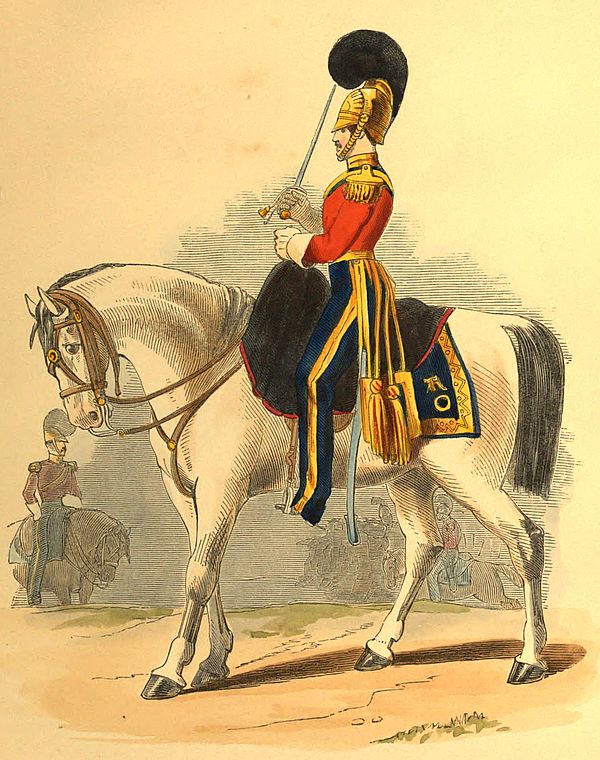
First, or Royal Dragoons, 1839.
[To face page 116.