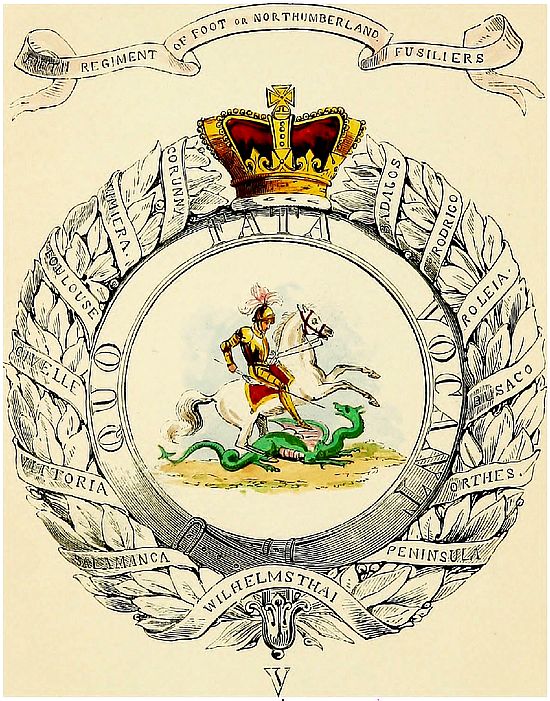
OF THE
FIFTH REGIMENT OF FOOT,
OR
NORTHUMBERLAND FUSILIERS.
1674
When the treaty of peace between England and
Holland was being negotiated at London in February
1674,[1] the Dutch Government, remembering the advantages
which had been derived from the Auxiliary British
troops in former wars, obtained permission again to entertain
in its service certain regiments.
Peace having been concluded, King Charles II. disbanded
part of his army in the same year, when many
of the officers and men proceeded to Holland, and the
formation of the British division was commenced. The
original design was to have a division of ten thousand
men, to be commanded-in-chief, under the Prince of
Orange, by Major-General Sir Walter Vane; but while
the organization of this force was in progress, Sir Walter
was killed at the battle of Seneffe, which was fought on
the 11th of August, 1674; and Sir William Ballandyne
was appointed to succeed him in the command of the
British troops.
The formation making rapid progress, in the autumn,
when the Prince of Orange was besieging Grave in
North Brabant, he was informed that ten English and
Irish companies, complete and fit for service, were at
Bois-le-Duc, about 18 miles distant, and his Highness,
eager to avail himself of their services, immediately
ordered them to join the army. In this siege the ten
companies gave presage of that gallantry for which
they afterwards became celebrated; they lost several
men, and Sir William Ballandyne was also killed by a
cannon-ball.
The capture of Grave, which took place on the 28th of
October, terminated the campaign; the troops were sent
into quarters; and during the winter four regiments of
British subjects were formed at Bois-le-Duc;—two English,—one
Scots,—and one Irish;—the latter is now designated
the Fifth Regiment of Foot, or Northumberland
Fusiliers, and its services form the subject of
this narrative. Its first Colonel was Daniel O'Brien, Viscount
of Clare; but this nobleman resigned soon afterwards,
and quitted Holland. The regiment was commanded,
ad interim, by Lieutenant-Colonel Anselmne,
who had previously served with much honour in the
Spanish service.
1675
In 1675 the command of this regiment was conferred
on Colonel John Fenwick, who had distinguished himself
at the battle of Seneffe; at this period the regiment discontinued
the designation of "Irish," and many English
gentlemen received commissions in it.
After leaving its quarters at Bois-le-Duc in the spring
of 1675, the regiment was encamped for a short time on
one of the beautiful plains of Louvain, and it was subsequently
employed in manœuvring near the frontiers of
France and in the Principality of Liege. The progress
of the campaign was impeded by the severe indisposition
of the Prince of Orange; no engagement of importance
occurred, and in the autumn the regiment marched to
the Dutch Netherlands and passed the winter in garrison
at Utrecht.
1676
In the summer of 1676 the regiment marched to
Brabant, and was stationed at Bois-le-Duc, preparatory
to some expedition of importance. This occurred in the
early part of July, and the men were in high spirits, anticipating
some splendid adventure. About two o'clock in
the morning the drums beat "to arms;" the regiment immediately
assembled at the alarm-post, and commenced
its march for the province of Limburg, being joined by
other corps every day. On the fifth day, the Prince of
Orange appeared at the head of the troops, and, to the
surprise of the enemy, the famous city of Maestricht
was besieged. This city, which was well fortified with
all the works which art could suggest, was defended by
8000 chosen men commanded by Monsieur Calvo, a
resolute Catalonian. The Prince of Orange attended to
the progress of the siege; and after the arrival of the
battering train, the works were carried on with vigour.
The three English regiments[2] were formed in one
Brigade, and they soon distinguished themselves, beating
back the sallies of the garrison with great slaughter.
On the 30th of July, a storming party of two hundred
men, furnished in equal proportions by the three regiments,
attacked the Dauphin Bastion, and after a severe
contest effected a lodgment, but afterwards lost their
ground: this proved a sanguinary affair, and 150 men
were killed and wounded out of the two hundred. On the
2nd of August the Brigade was again on duty in the
trenches, when Colonel Fenwick was wounded.
The Prince of Orange resolved to make a second
attack on the Dauphin Bastion on the 4th of August,
when a detachment from the Brigade, commanded by
Captain Anthony Barnwell of Fenwick's regiment, with
another from the Dutch Foot Guards, commanded by
Baron Sparr, formed the storming party.[3] At three
o'clock the Brigade was under arms with the storming
party in front; and at five the gallant little band, advancing
under a tempest of bullets, went cheering to the
attack and carried the bastion in gallant style—the English,
gaining the lead of the Dutch, first made a lodgment.
Scarcely, however, had the soldiers gained a
footing, when the French sprung a mine and blew many
of the men into the air, and following this up with a
fierce attack, regained possession of the works. The
heroic English were, however, "resolute to win;"—they
returned to the attack, and fighting with a strength and
majesty which nothing could withstand, drove back the
French, and re-established themselves on the bastion;
but their commander, Captain Barnwell, was killed, and
more than half the officers and men of the party were
killed and wounded.
About five in the morning of the 6th of August a desperate
sally was made by three hundred Swiss Infantry,
and, owing to the neglect of a sentry, they surprised and
made prisoners the English guard on the bastion; but a
reinforcement from the Brigade came forward to their
rescue, and, after saluting the assailants with a few volleys,
and a shower of hand-grenades, made a furious
charge, retaking the bastion and chasing the Swiss Infantry
with prodigious slaughter to the palisadoes of the
counterscarp, destroying the whole detachment, except
about twenty men who escaped into the town. The
Prince of Orange complimented the Brigade on its distinguished
bravery, and made each of the three regiments
a present of a fat ox and six sheep.[4]
On the 15th of August Colonel Fenwick's regiment,
commanded by Lieutenant-Colonel Wisely (the
Colonel not having recovered from his wounds) was on
duty in the trenches, when the enemy made another
furious sally; but they were nobly received by the regiment;
a fierce combat ensued, in which the strength and
unconquerable spirit, of the English again excited the
admiration of the Prince of Orange, and a reinforcement
arriving, the French were driven back with great loss.
The progress of the siege had been marked by surprising
energy, but it was prolonged by the resolute
defence of the garrison; and when all things were
ready for a general assault, a French army of overwhelming
numbers, commanded by Marshal Schomberg,
advanced to its relief. The Prince of Orange immediately
raised the siege and retired; and the three English
regiments, having sustained a severe loss, and having
nearly half the number of the surviving officers and men
wounded, were sent into quarters of refreshment in Holland.
At the same time a misunderstanding occurred
between Colonel (afterwards Sir John) Fenwick and the
Prince, and the Colonel resigned his commission; when
his Highness gave the Colonelcy of the regiment to the
Lieutenant-Colonel, Henry Wisely.
1677
The French, while amusing the Allies with negotiations
for a peace, commenced the campaign of 1677,
with great vigour, and with such an immense army, that
the feeble preparations of the Dutch, and the apathy of
the Spaniards, left the Prince of Orange without an
army capable of resisting the enemy. He, however,
resolved to attempt the relief of St. Omers, which was
besieged by the French; the English Brigade was ordered
to West Flanders, to take part in the enterprise,
and it was encamped a short time on the plains of the
Yperlee. In the early part of April, the Prince advanced
with his little army, and on the 11th of that
month he fought the battle of Mont-Cassel under great
disadvantages in numbers, and in the nature of the
ground. The English Brigade behaved with its usual
gallantry; but the army was defeated, and the Prince
retreated with the loss of his baggage and artillery.
The Brigade was afterwards employed in manœuvring
and in defensive operations until the autumn, when it
went into quarters. The Prince of Orange proceeded to
England, and was married to the Princess Mary on the
14th of November, 1677.
1678
Before the following spring, Major-General the Earl
of Ossory arrived from England to command the six
British regiments in the Dutch service, and ten thousand
English troops, commanded by the Duke of Monmouth,
were ordered to proceed to Flanders to take part in the
war.
The Earl of Ossory's brigade was early in the
field: it was employed a short time on detached services
in the Netherlands, and was afterwards encamped
near the ground where the battle of Waterloo
was fought in June, 1815. In the mean time the French
besieged Mons, the capital of the province of Hainault,
and their covering army occupied a strong position, with
its right at the Abbey of St. Denis, and its left at
Mamoy St. Pierre. The Prince of Orange assembled
his army, and after advancing several stages, he encamped
near the little river Senne, about seven miles
from Mons; and on the morning of the 14th of August,
1678, his Highness put the troops in motion to attack
the enemy.
The British Brigade, led by the Earl of Ossory, moved
from its camp along a difficult tract of country, until it
came in front of a hill occupied by the enemy's left
wing, where it was destined to make its attack, in conjunction
with the Dutch Foot Guards. The signal for
the attack was given, when the British Grenadiers,
springing forward with lighted matches, threw a shower
of hand-grenades, which, bursting amongst the ranks
of the enemy, did much execution. The Musqueteers
followed, and opening a sharp fire, were answered by the
volleys of the enemy; their fire was soon succeeded by
the charge of the Pikemen, who went cheering onward
to the attack, while the Musqueteers, drawing their
swords, joined in the onset with admirable spirit and
resolution,—and the enemy gave way. One attack was
succeeded by another; the French, driven from field to
field, still rallied and returned to the fight. Pike to pike
and sword to sword, the combatants maintained a fierce
conflict, while the hand-grenades flew in every direction,
and the heights of Castehau presented a varied scene of
turmoil and slaughter, in the midst of which the Prince
of Orange and the Duke of Monmouth appeared, mixed
with the combatants, and urging forward the storm of
battle.[5] A French captain levelled his pistol at the
Prince, but General D'Auverquerque killed the captain
before he had time to fire, and thus saved his Highness's
life, for which service the States made him a present of a
valuable sword. Night at length put an end to the fight,
and the French afterwards made a precipitate retreat.
The regiment lost in this action Lieutenant-Colonel
Archer, Lieutenant Charlton, and about fifty men killed:
also Major Hales, Captain Charlton, Captain Coleman,
Captain Floyd, Captain Dupuy, Lieutenant Augerne,
Lieutenant Marchany, Lieutenant Wilson, Ensign Barnwell,
Ensign Arnesby, and upwards of a hundred men
wounded. The loss in the other regiments of the Brigade
was also equally great.
In the mean time preliminary articles for a treaty of
peace had been agreed upon at Nimeguen; a cessation
of hostilities took place on the day after the battle;
and the Brigade, after encamping a few months in
Flanders, marched to Holland, where it received the
thanks of the States-General for its meritorious services.
The restoration of peace was followed by a reduction
in the numbers of the Dutch Army; but the Prince of
Orange, and the States-General of the United Provinces,
were so sensible of the advantages they had derived from
the services of the British troops, that they were desirous
of retaining the six regiments in their service. A new
treaty was concluded on this subject, and the States
agreed to send the regiments to England, whenever the
King required them to do so.
1679
1680
Colonel Wisely's regiment was marched to Grave,
where it was employed on garrison duty four years; and
in 1680, its Colonel having been drowned when on his
passage to England, the Colonelcy was conferred on
Lieutenant-Colonel Thomas Monk, of Sir Henry Bellasis'
regiment (now Sixth Foot).
1684
Upon the prospect of hostilities with France, in 1684,
the regiment marched from Grave, and was encamped
for a short time near Brussels, and afterwards on the
banks of the Dender; but no war breaking out, it
proceeded into quarters at Mechlin.
1685
In the succeeding year the death of King Charles II.
and the accession of James II., a professed Papist, being
followed by a rebellion in Scotland, headed by the Earl
of Argyle, and another in England, headed by the Duke
of Monmouth, the six British regiments were applied for
by the King, and they were accordingly embarked for
England under the command of the following officers:—
| Three English Regiments. | { | Colonel Thomas Monk,—now Fifth Foot. |
| Colonel Sir Henry Bellasis,—now Sixth Foot. |
| Colonel Alexander Cannon,—afterwards disbanded. |
|
|
| Three Scots Regiments. | { | Colonel Kirkpatrick. |
| Colonel Sir Alexander Colyear. |
| Colonel Hugh Mackay. |
The three Scots regiments were, in the first instance,
ordered for Scotland, but the rebellion in the North
having been suppressed, they landed at Gravesend on
the 30th of June, 1685, and having been reviewed on
Blackheath by the King, marched through London towards
the West.[6] The three English regiments landed
a few days afterwards; but the rebel army having been
defeated at Sedgemoor, on the 6th of July, they encamped
on Blackheath, and afterwards on Hounslow
Heath, where the Brigade was assembled and reviewed
by his Majesty, and the efficiency, discipline, and appearance
of the several corps, excited universal
admiration.[7] The rebellion having been suppressed, the six
regiments returned to Holland, and were again employed
in garrison duty. The three English regiments were on
the English establishment from the 5th of June, to the
3rd of August, 1685, and the Scots' regiments a few days
longer.
1686
1687
The arbitrary proceedings of King James, with his
advances towards the subversion of the Protestant religion,
occasioned much anxiety to the Prince of Orange,
who was married to the presumptive heiress to the
throne; at the same time, the King was jealous of the
attachment of the nation to his son-in-law, and in 1687
his Majesty demanded the return of the British regiments
in the Dutch service. The States-General, in
concert with the Prince, resolved not to part with these
favourite corps, for whose services they expected soon to
have urgent occasion; at the same time they laid no constraint
upon the officers, but allowed them either to remain
in Holland or to return to England, at their own
free choice. Out of two hundred and forty officers,[8] only
sixty[9] embraced the latter alternative; the rest bound
themselves "to stand by and defend the Prince of
Orange against all persons whatsoever."
1688
1689
The colonelcy of the regiment having become vacant
by the death of Colonel Monk, it was conferred by the
Prince of Orange on Lieutenant-Colonel Thomas Tollemache,[10]
formerly of the Coldstream Guards.
The violent proceedings of the British Court at length
occasioned many of the nobility to solicit the Prince of
Orange to come with an armed force to their aid; and
as the fate of all the other Protestant States in Europe
appeared to depend on the preservation of Great Britain
from Papal domination, the Prince and the States-General
acquiesced. Thus the six British regiments had
the honourable and glorious privilege of engaging in an
enterprise for the deliverance of their native land from
the attempts to establish Popish ascendancy, and the
consequent chances of civil war. On receiving positive
advice of the preparations in Holland, "the King was
speechless, and, as it were, thunderstruck. The airy
castle of a dispensing arbitrary power raised by the
magic spells of jesuitical councils vanished away in a
moment, and the deluded monarch, freed from his
inchantment by the approach of the Prince of Orange,
found himself on the brink of a precipice, whilst all
his flatterers stood amazed and confounded."[11] The
King at length assembled an army of about 30,000 men,
and sent Lord Dartmouth to sea with the fleet.
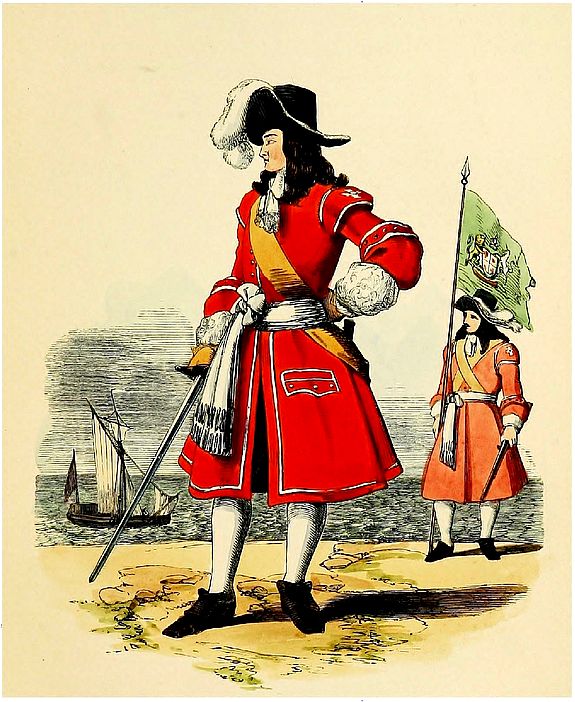
FIFTH REGIMENT OF FOOT (NORTHUMBERLAND FUSILIERS) 1688.
The Prince of Orange's army, consisting of about
15,000 men, of which "the most formidable were the six
British regiments,"[12] put to sea, after some delay from
tempestuous weather, on the 1st of November, 1688;
"the trumpets sounding, the hautboys playing, the
soldiers and seamen shouting, and a crowd of spectators
on the shore breathing forth their wishes after
them."[13] Sailing in three divisions, the first, consisting
of the English and Scots, commanded by Major-General
Mackay, under a red flag; the second, being
the Prince's Guards and the Brandenburgers, commanded
by Count Solms, under a white flag; and the Dutch with
a corps of French Protestants, commanded by the Count
of Nassau, under a blue flag: they passed triumphantly
through the British Channel and landed on the Devonshire
coast on the 5th of November. Colonel Tollemache's
regiment (the Fifth) landed at Brixham key,
two miles from Dartmouth, from whence it marched
to Exeter and afterwards to Honiton, where, on the
night of the 13th, it was joined by a number of men of
the Earl of Oxford's and Duke of St. Alban's regiments
of horse, and of the Royal Regiment of Dragoons, who
had quitted the service of King James to espouse
the national cause. These desertions were followed by
others of a more important character; and King James,
discovering that his army would not be subservient to
his designs against the kingdom, fled to France, William
and Mary, Prince and Princess of Orange, were
solicited to ascend the throne; and thus the Revolution
was happily effected without that sacrifice of human life
which such events usually occasion. Colonel Tollemache's
regiment had, in the mean time, marched to the vicinity
of London, and it afterwards proceeded into quarters in
the western counties. It was now permanently placed
on the English establishment, and taking date from the
5th of June, 1685, the day on which it first received pay
from the British crown, as before stated, it obtained
rank as Fifth Regiment of Foot in the British Line.
Colonel Tollemache having been promoted to the
command of the Coldstream Guards, the Colonelcy of
the Fifth was conferred on Lieutenant-Colonel Edward
Lloyd, by commission dated the 1st of May, 1689; and
in the following month the regiment marched from the
west of England for London, and was quartered in
Southwark until October, when it embarked at Deptford
and Greenwich for Plymouth, and in December
marched into Cornwall, with detached companies in
Devonshire.
1690
In the mean time Ireland had become the seat of war,
and King James was at the head of the Roman Catholics,
and a French auxiliary force, in that kingdom,
while the Duke of Schomberg commanded the Irish
Protestants and English troops; and in the spring of
1690 the Fifth Foot was ordered thither. The regiment,
accordingly, proceeded to Bristol, where it embarked;
and having landed at Belfast on the 20th of
April, marched to Lisburn, and encamped near the banks
of the Lagan until the 9th June, when it proceeded to
Armagh and erected its tents on the undulating grounds
in that neighbourhood, where an encampment was
formed of four regiments of English infantry, with three
regiments of Danish horse and eight of foot.
King William having arrived in Ireland, the regiment
marched to Dundalk, where the army was assembled;
and on the 1st of July the enemy was attacked in his
position on the banks of the river Boyne. The Fifth
was in Brigadier-General Trelawny's brigade, and by its
gallant conduct it contributed to the signal victory
gained on this occasion. The enemy evacuated Dublin
a few days after the battle, when the regiment was ordered
to proceed thither, and it remained in garrison in that
city during the remainder of the campaign.
1691
The regiment left Dublin in the early part of 1691,
and in April it was stationed at Mountmelick. The
troops quartered in that neighbourhood were frequently
disturbed by bands of armed Roman Catholic peasantry,
called Rapparees, who concealed themselves in the day-time,
and at night prowled about the country, committing
every description of depredation: to check these
proceedings, a detachment of 200 men of the Fifth,
commanded by Major Rider, with 100 men of Lord
George Hamilton's regiment, and 50 troopers of Colonel
Byerley's Horse,—now 6th Dragoon Guards,—the whole
commanded by Major Wood,[14] marched out of Mountmelick
at nine o'clock on the evening of the 4th of
May, and, dividing themselves into several small parties,
they traversed the woods and bogs for several
miles, frequently encountering lurking parties of the
enemy, whom they attacked, killing seventy men and
capturing a quantity of cattle, which Major Wood sent
to Mountmelick under a guard of thirty men. The
remainder continued their search until about ten o'clock
on the following day, when Major Wood, with one
party of 34 horsemen, and 30 foot, discovered two
battalions of the enemy's regular army of about 400
men each, marching silently between the wood and
mountains, not far from Castle-Cuff; at the same time
the enemy espied Major Wood and his little detachment.
The English, with a noble bearing and audacity,
formed up in a ploughed field to oppose this
formidable host, and the Irish instantly sent forward
their grenadiers to commence the attack, but perceiving
the undaunted countenance of the detachment, they
halted at a distance. A sharp firing was at this instant
heard beyond the forest, and Major Wood, apprehending
that the party with the cattle was attacked, proceeded
to its assistance; but Lieutenant Ellis and the
thirty foot, behaved like valiant men; and, having repulsed
a superior force, effected their retreat with the
booty. The firing had brought a detachment of 80 men
of the Fifth from the opposite side of the forest, and
Major Wood, having now 34 horsemen and 110 foot with
him, resolved, notwithstanding the disparity of numbers,
to attack the enemy's column. He accordingly divided
his foot into two parties, and directed them to attack
the enemy in front, while he himself with the horse made
a short compass to gain the enemy's rear. This gallant
little band, advancing boldly against the enemy's masses,
commenced the attack with a fury and resolution which
the Irish could not withstand, and they attempted to
retreat; but at that moment Major Wood with his thirty-four
troopers came galloping from amongst the trees and
charged the flank of the column with admirable courage
and resolution; the heavy horse, breaking through the
ranks, trampled down the Irish in a terrible manner.
The column was now become a confused rabble, scattered
in wild disorder, and cut down by the English
horsemen on every side; while the English foot, slinging
their muskets and drawing their swords, joined in the
pursuit and chased the enemy a considerable distance.
One hundred and fifty of the Irish were killed on the
spot; and 1 major, 5 captains, 9 lieutenants, 2 ensigns,
1 adjutant, 1 surgeon, 6 serjeants, 17 corporals,
3 drummers, and 82 private men, were made prisoners;
150 muskets were also collected, which the Irish had
thrown away to facilitate their flight. "And all this
was done by 110 of our foot and 34 horse. With
the foot were Major Rider, Captain Nenny, Captain
Dixey, Lieutenant Barton, and Ensign Russel. With
the horse, were Cornet Jocelyn, Cornet Hasleton, and
Adjutant Robinson, with Quarter-masters Davies and
Cadford; who all, both horse and foot, behaved
extremely well, and with the loss only of one corporal
killed, and Adjutant Robinson, with two foot soldiers
and one trooper, wounded[15]."
On the 12th of May, another party of the regiment
was out scouring the woods, when 18 Rapparees were
killed and several made prisoners.
In June, the Fifth advanced with the army to Athlone,
and took part in the siege, which was commenced
on the 19th of that month: on the 30th the Grenadier
company formed part of the storming party commanded
by Major-General Mackay. The attack was made at
six in the evening, when the forlorn hope, consisting of
Captain Sandys, with 2 Lieutenants and 60 Grenadiers,
all in armour, entered the Shannon, which was breast
high, under a sharp fire, and were followed by the remainder
of the storming party, who passed, some at the
bridge of boats, and others by planks laid across the
broken arches of the stone bridge. The party, having
gained the opposite shore, threw forward a shower of
hand-grenades, which put the Irish in confusion; then
gallantly ascending the breaches forced their way through
every obstacle, and in less than half an hour were masters
of the town, with the loss of only 12 men killed, and 5
officers with 30 men wounded; but the enemy had
about 500 men killed. Colonel Lloyd was appointed
Governor of Athlone, and when the army advanced, the
Fifth, and Lieutenant-General Douglas's regiments,
were left in garrison; and the battering train was left in
their charge.
After the battle of Aghrim, when the army was about
to besiege Limerick, the Fifth, and a party of Militia,
were ordered to advance with the heavy artillery; they,
accordingly, left Athlone on the 12th of August, and
joined the army at Cariganless on the 16th. The siege
was commenced a few days afterwards, and the Fifth
was actively employed until the surrender of the place
on the 3rd of October. This conquest terminated the
war in Ireland, and the regiment, being immediately
ordered to embark for England, landed at Highlake, near
Chester, on the 29th of December, from whence it
marched to Nottingham, Derby, and other inland towns,
where it commenced recruiting its numbers.
1692
Three weeks, however, only elapsed before it was
ordered to march to London, where it remained but a
few days, and towards the end of February 1692 embarked
for Flanders to join the army of the Allies, who
were engaged in a war with France. The regiment
was scarcely placed in cantonments in West Flanders,
when the King of France assembled about 20,000 men
near La Hogue, and ordered his fleet to prepare to
convey them to England, with the view of replacing
King James on the throne; the Second, Fifth, and
Fourteenth regiments of Foot were consequently ordered
to return: and these corps, having landed at Greenwich in
the early part of May, were stationed along the southern
coast. In the mean time the British and Dutch fleets
had put to sea, and while England and France were
gazing, in anxious expectation, at these preparations, the
French fleet sustained a decisive defeat off La Hogue,
and the alarm of invasion vanished. The Fifth continued
in extensive cantonments near the coast until October,
when it marched to Portsmouth to perform duty
in that garrison.
1693
During the summer of 1693 the regiment was embarked
on board the fleet, and, proceeding with an expedition
to Martinico, it effected a landing, drove the
enemy's troops from the coast, and laid waste several
French settlements on that Island. In the autumn it
landed at Portsmouth and marched into cantonments in
Berkshire and Buckinghamshire.
The severe loss sustained this summer by the Allies at
the battle of Landen, occasioned a strong reinforcement
to be sent to Flanders during the winter, and the Fifth
was one of the regiments selected for foreign service. It
accordingly embarked at Greenwich and Deptford in
December, and, after landing at Ostend, marched to
Sluys, a fortified town situated on an arm of the sea,
where the regiment remained several months.
1694
After leaving Sluys in the middle of May, 1694, the
regiment pitched its tents on the levels near Ghent, and
afterwards at Tirlemont in South Brabant, forming part
of the army commanded by King William III. in person.
On the 15th of June it was detached, with other corps,
to take post near the Abbey of Lenthen. During the
subsequent part of the campaign it was employed in
several military operations, and in the autumn marched
into barracks at Bruges. The death of its Colonel
having taken place on the 26th of August, his Majesty
conferred the vacant Colonelcy on Lieutenant-Colonel
Thomas Fairfax, by commission dated the 6th of November,
1694.
1695
After remaining in garrison at Bruges until the 25th
of May, 1695, the Fifth took the field and was encamped
a short time on the verdant plains near the river Lys;
and when King William undertook the siege of the
strong fortress of Namur, the regiment formed part of the
covering army commanded by the Prince of Vaudemont.
While the King was carrying on the siege, a French
force of superior numbers, commanded by Marshal
Villeroy, advanced to attack the covering army. On the
evening of the 14th of July the Allies were formed in
order of battle; the immense columns of the enemy were
seen in the open grounds in their front, and the hostile
armies passed the night under arms, expecting to engage
at the break of day; at the same time the French had
detached a division under Monsieur de Montal to turn
the right flank of the allied army. This occasioned the
Prince to order a retreat, which he masked with excellent
judgment: the cavalry advancing to the front, the
dragoons dismounting and forming on foot; while the
artillery, and infantry with their pikes trailed, quietly
withdrew. The enemy, anticipating success, prepared
for the attack; but in a moment, the British dragoons,
retiring a few paces, mounted their horses, and when the
enemy thought to have commenced the battle, the skeleton
squadrons withdrew; presenting to the surprised
French the magic spectacle of what appeared to be an
army vanishing out of sight. The enemy's cavalry galloped
forward in pursuit; but the Allies continued their
retreat in good order, and at six o'clock on the morning
of the 16th were in position in front of Ghent.
The Fifth was afterwards engaged in a series of
manœuvres for the preservation of the maritime towns
of Flanders, and for the protection of the troops before
Namur. In the early part of August it was encamped
between Genappe and Waterloo, and subsequently before
Namur, which capitulated on the 22nd of August.
From Namur the regiment marched to Nieuport, and
encamped on the sand-hills near that town; and, remaining
in the field until late in the season, when the weather
was particularly wet and cold, the men were ordered to
build straw huts; but towards the end of October they
marched to Bruges.
1696
On the 12th of May, 1696, the regiment marched out
of the barracks at Bruges, and encamped behind the
banks of the canal near the town. During the campaign
of this year its services were limited to the protection of
Ghent and Bruges from an attack which the French commanders
made several demonstrations of a design of
making on these towns; and it passed the winter in its
former station at Bruges.
1697
From Bruges, the regiment marched, in the spring of
1697, to Brussels; and on the 12th of April proceeded
through the forest of Soigne and pitched its tents near
the village of Waterloo, where an encampment was
formed of twelve regiments of infantry under the Count
de Noyelles. The Fifth was subsequently employed in
a series of defensive operations until September, when
the war was terminated by the treaty of Ryswick; and,
being ordered to return to England immediately afterwards,
it landed in December,—eight companies at
Greenwich and two at Dover.
1698
The regiment remained but a short time in England
before it was ordered to proceed to Chester, where it
embarked for Ireland, and in August, 1698, it arrived at
Dublin.
1704
On the 5th of February, 1704, Queen Anne appointed
Colonel Thomas Pearce from a newly-raised regiment of
foot (afterwards disbanded) to the Colonelcy of the
Fifth in succession to Thomas Fairfax.
1706
1707
During the early part of the war of the Spanish succession,
this regiment was stationed in Ireland; but the
united English, Dutch, and Portuguese armies having,
in 1706, advanced to Madrid, the enemy cut off their
communication with Portugal; the troops retired from
Madrid to Valencia and Catalonia, and from that period
their only communication with Portugal was by sea.
At the same time it was found necessary to have a small
army on the frontiers of Portugal, and the Fifth, Twentieth,
Thirty-ninth, and a newly-raised regiment commanded
by Colonel Stanwix, having been selected for
this service, sailed from Cork on the 22nd of May, 1707,
and landed at the capital of Portugal on the 8th of
June[16]. This seasonable reinforcement arriving soon
after the defeat of the allied army at Almanza, in the
south-east of Spain, and at the moment when the enemy,
having captured Serpa and Moura in the Alentejo, had
seized on the bridge of Olivenza in Portuguese Estremadura,
and menaced that important place with a siege,
its presence revived the drooping spirits of the Portuguese.
The four regiments, being the only British troops in that
part of the country, were disembarked with every possible
expedition, and marched to the frontiers under the command
of the Marquis de Montandre, when the enemy
immediately ceased to act on the offensive and retired[17].
The four regiments, having halted at Estremos, a strong
town of the Alentejo, situate on an agreeable tract on
the Tarra, remained in this pleasant quarter during the
summer heats, and afterwards encamped in the fruitful
valley of the Caya near Elvas, having detached parties
on the flanks to prevent the enemy making incursions
into Portugal, in which service the regiments were engaged
until November, when they went into quarters in
the towns on the frontiers of Portugal.
1708
The regiment again took the field in the spring of
1708, and was encamped at Fuente de Sapatores between
Elvas and Campo Mayor. The British division
was soon afterwards increased to six regiments, by the
arrival of the Thirteenth[18] and a newly-raised regiment
(Paston's) from England; and the little army in the Alentejo
was commanded by the Marquis de Fronteira; but
the characteristic inactivity of the Portuguese occasioned
the services of the Fifth to be limited to defensive operations.
It was encamped in the autumn at Campo
Mayor, and afterwards proceeded into cantonments.
1709
After moving from its quarters in the spring of 1709,
the regiment was again engaged in active operations. It
was first encamped near Estremos, from whence it proceeded
on the 23rd of April to Elvas, and was subsequently
encamped with the army on the banks of the
Caya, where the Earl of Galway, who had been removed
from the army in Catalonia, appeared at the head of the
British division.
On the 7th of May the French and Spaniards, commanded
by the Marquis de Bay, marched in the direction
of Campo Mayor, when the Portuguese generals, contrary
to the advice of the Earl of Galway, resolved to
pass the Caya and attack the enemy. The Portuguese
cavalry and artillery took the lead, and, having passed
the river and gained the opposite heights, opened a sharp
cannonade; but upon the advance of their adversaries to
charge, these squadrons faced about and galloped out of
the field, leaving their cannon behind. The British division,
arriving at the moment, repulsed the enemy; and
the leading brigade, consisting of the Thirteenth, Stanwix's,
and Galway's regiments, commanded by Brigadier-General
Thomas Pearce, charging with great fury,
recaptured the Portuguese guns; but the three regiments,
pressing forward too far, were surrounded and
made prisoners, and with them Major-Generals Sankey
and the Earl of Barrymore, and Brigadier-General
Thomas Pearce, fell into the hands of the enemy[19]. At
the same time the Fifth, Twentieth, Thirty-ninth, and
Lord Paston's regiments, though deserted by the whole
of the cavalry, made a determined stand, bearing the
brunt of the enemy's reiterated attacks with admirable
firmness, until the Portuguese infantry had retired; then
moving to the rear in firm array—while the balls flew
thick on every side, and the Earl of Galway's horse was
shot under him,—the enemy coming on in full career,
threatening the destruction of this little band; yet, with
ranks unbroken and steady tread, these undaunted English
calmly retraced their steps—exhibiting one of the
most noble spectacles of war,—and occasionally punishing
the temerity of their pursuers with a cool and deliberate
resolution which laid a thousand Spaniards dead
upon the field[20], and impressed the enemy, and also the
Portuguese, with a sense of British courage and magnanimity.
Thus they effected their retreat, with the loss
of only one hundred and fifty men killed and wounded,
and passed that night at Arronches.
The Fifth acquired great honour by its signal gallantry
on this occasion. It was afterwards encamped at
Elvas, was subsequently in position on the banks of the
Guadiana, and again passed the winter in cantonments in
the Alentejo.
1710
The casualties of the preceding campaign having
been replaced by recruits from England, the Fifth again
took the field in the spring of 1710, and was employed
in the Alentejo; but the army was weak and unequal to
any important undertaking, and the French having had
some success in the province of Tras os Montes, occasioned
a detachment to be sent thither. In the autumn
the army advanced across the Guadiana, and on the 4th
of October arrived at the rich plains of Xeres de los Cabaleros
on the river Ardilla in Spanish Estremadura.
It was resolved to attack this place by storm on the following
day, and the Fifth, Twentieth, and Thirty-ninth,
British regiments, having been selected to perform this
service under the command of Brigadier-General Stanwix[21],
advanced at four in the afternoon to attack the
works near St. Catherine's gate by escalade: a few
minutes after the regiments had commenced the assault,
the governor sent proposals to surrender, which were
agreed to, and the garrison, consisting of 700 men, were
made prisoners of war. The army afterwards retired
to Portugal by the mountains of Orlor, and went into
quarters. This summer the army on the other side of
Spain gained two victories, and advanced to Madrid,
when the most pressing instances were made by King
Charles III. and General Stanhope, to induce the army
of Portugal to advance upon the Spanish capital; but
the Portuguese generals were unwilling to engage in so
great an undertaking.
1711
During the campaign of 1711, the Fifth formed part
of the army which assembled at Olivenza in May, and,
having passed the Guadiana by a pontoon bridge at Jerumencha,
advanced against the enemy, who took refuge
under the cannon of Badajoz. The Fifth was afterwards
engaged in the capture of several small towns, and in
levying contributions in Spanish Estremadura; but the
summer passed without any occurrence of importance,
excepting a discovery made by the Earl of Portmore,
who commanded the British troops in Portugal, of a
clandestine treaty in progress between the crown of Portugal
and the enemy, in which the former had agreed to
separate from the Allies; and, to give an excuse for this, a
mock battle was to have been fought, in which the British
troops were to have been sacrificed[22]. This treaty was
broken off, but the British Government soon afterwards
entered into negotiations with France.
1712
The Fifth continued in Portugal, and was encamped
during the summer of 1712 on the pleasant plains of the
Tarra. In the autumn a suspension of hostilities was
proclaimed at the camp by Major-General Pearce, and
the regiment went into cantonments.
1713
From Portugal, the regiment proceeded to Gibraltar,
which fortress had been captured by an English and
Dutch force in 1704, and was ceded to Great Britain in
1713 by the treaty of Utrecht, when the Earl of Portmore
was appointed Governor; and the protection of the place
was confided to the Fifth, Thirteenth, and Twentieth
regiments. Here the regiment remained in garrison for
a period of fifteen years; its establishment was 500 men,
and it became as celebrated for its excellent conduct in
time of peace, as it had been distinguished for its noble
bearing and gallantry in war.
1726
The crown of Spain had relinquished its claim on
Gibraltar with reluctance, and having, towards the end of
1726, resolved to engage in a war with Great Britain, a
Spanish army was assembled in Andalusia under the
command of the Count de la Torres, to commence hostilities
with the siege of this desirable entrepôt to the
Mediterranean. This gave the Fifth another opportunity
of signalizing itself, and of adding to its honours
already acquired,—the proud distinction of a successful
defence of this important conquest.
1727
The preparations of the enemy were made upon a
most extensive scale. Their troops were encamped
before the place in January, 1727, the bringing up of
cannon, mortars, and stores to the camp, occupied several
weeks, and the heavy artillery was removed from the
works at Cadiz and other fortified towns; at the same
time the whole disposable force, including part of the
garrison of almost every town in Spain, was assembled
to take part in the siege. The works having been
commenced in February, before any declaration of war
was made, and persisted in against the remonstrance
of the Lieutenant-Governor, Colonel Jasper Clayton,
a council of war of the commanding officers of regiments
was assembled, and a determined opposition
was resolved upon. On the 21st of February the garrison
opened its fire on the besiegers, and from that
day the storm of war raged round the rocks of Gibraltar
with dreadful violence, increasing in fury until
the roar of a hundred cannon and the fire of small
arms became almost incessant in the day-time, and was
partially continued throughout the night, with the most
fatal effects to the Spaniards, whose loss was particularly
great. This contest was continued with a few partial
intermissions until many thousands of the besiegers had
perished in the attempt; while the tremendous fire of
the Spaniards had produced little effect beyond the
bursting of many of their own cannon, and the enlarging
of the touchholes of others so as to render them useless.
In the early part of June the fire slackened, and on the
18th of that month hostilities ceased. Thus the ostentatious
vaunts of Spain terminated in defeat and confusion.
1728
The Fifth embarked from Gibraltar on the 12th of
April, 1728, and proceeded to Ireland, in which country
it remained seven years.
1732
In September 1732, General Thomas Pearce, who
had commanded the regiment for twenty-eight years,
was removed to the Fifth Horse, now Fourth Dragoon
Guards, and was succeeded by Colonel John (afterwards
Sir John) Cope from the Thirty-ninth regiment.
1735
1737
The regiment left Ireland in 1735, and was stationed
in England in that and the following year; but in 1737 it
again proceeded to Ireland. At the same time Colonel
Cope was removed to the Ninth Dragoons, and the Colonelcy
of the Fifth was conferred on Alexander Irwin.
1738
A period of seventeen years was now passed by the
regiment in Ireland, where it continued to retain its
high state of discipline and efficiency, and preserved
untarnished the laurels it had previously won.
1752
1754
After the decease of Colonel Irwin, in 1752, the
command of the regiment was given to Charles Whiteford;
who was succeeded on the 20th of August, 1754,
by Lord George Bentinck.
1755
In the spring of 1755, the regiment left Ireland, and
was quartered in England; and in September of that
year it had the honour to receive King George II. at
Chelmsford, on his way from Harwich to London.
1756
1758
The regiment remained in the south of England
during the two succeeding years; and in 1758, another
war having broken out, it formed part of an expedition
designed to effect the reduction of the maritime power
of France, and to make a diversion in favour of the
Hanoverians. It accordingly proceeded to the Isle of
Wight,—the general rendezvous,—embarked at Cowes
eight hundred and eighty-eight men strong on the 25th
of May, and its grenadier company was the first to make
good its landing on the coast of France on the evening
of the 5th of June, when seven companies of French foot,
and three troops of dragoons, were quickly dispersed. On
the 7th the army advanced in two columns;—the Fifth,
taking the main road to St. Maloes, encamped in the
evening about a mile from the town, and after sunset
furnished, in common with the other regiments, a detachment,
which, proceeding to the harbour, set fire to the
shipping, magazines, &c., when a grand yet dreadful
scene of conflagration presented itself. Having destroyed
a valuable fleet and all the stores, the troops re-embarked
and returned to England.
In August of the same year, the Fifth was engaged
in a second expedition to the coast of France, when
Cherbourg was captured, and the harbour, forts, magazines,
and ordnance, consisting of 173 pieces of iron
cannon and 3 mortars, were destroyed: at the same time
22 pieces of fine brass cannon, and two brass mortars,
were brought off as trophies, and sent to England; and
these guns, having been seen by King George II. in
Hyde Park on the 16th of September, were conducted
in procession through the city to the Tower of London.
The Fifth was also engaged in the descent made on
the coast of Brittany on the 4th of September, when the
batteries in the bay of St. Lunaire were destroyed, and
the troops, marching into the interior, crossed the Drouette
and Equernon, and advanced to Matignon, while
the fleet proceeded to the Bay of St. Cas; thus alarming
the country with the view of producing the return of the
French army from Germany. While the Fifth was in
France, some sharp skirmishing occurred, and when the
troops re-embarked at St. Cas, the enemy attacked the
rear-guard and occasioned considerable loss. The loss
of the Fifth in these three descents was ninety-five men.
Towards the end of September the regiment landed at
Cowes, and, having encamped a short period near Newport,
went into quarters.
1759
The decease of Lord George Bentinck having occurred
in 1759, Studholme Hodgson was appointed to
the Colonelcy of the Fifth, from the 50th regiment.
1760
In the mean time the war was continued in Hanover and
the neighbouring States, and the Fifth, having been
ordered to proceed to Germany, embarked at Gravesend
on the 12th of May, 1760, and arrived in the Weser on
the 22nd of that month. After landing near Bremen, the
regiment marched up the country, and joined the allied
army commanded by Ferdinand Duke of Brunswick, at
Fritzlar in Hesse-Cassel, on the 17th of June; when the
grenadier company was detached to form, with the
grenadier companies of the other regiments, two Battalions,
which, being united in Brigade with the Scots
Highlanders, usually formed the advance-guard of the
army.
The regiment, after being employed in several manœuvres,
formed part of the corps commanded by the
hereditary Prince of Brunswick, which marched on the
10th of July to take post on the heights of Corbach; but
found the ground occupied by the enemy in force; when
a sharp skirmish occurred in which the Fifth lost five
men.[23]
Towards the end of July the regiment was encamped
at Kalle. At 11 o'clock on the night of the 30th of that
month it marched with the main army for Liebenau, and,
having crossed the Dymel, advanced at five on the following
morning to attack the enemy in his position on the
heights of Warbourg.
The German corps and British grenadiers in advance
having commenced the action, the French retired before
the English infantry arrived. "No troops could show
more eagerness than they showed. Many of the men,
from the heat of the weather, and overstraining themselves
to get on through morasses and difficult ground,
suddenly dropped down on their march.[24]" The grenadier
company of the Fifth, being in the column which
commenced the attack, highly distinguished itself[25], and
had four men killed, and Captain Ross, Lieutenant
Baker, and twenty-six men, wounded.
The regiment remained for some time encamped near
Warbourg; and the grenadier company, being encamped
on the heights of Wilda, was engaged, on the night of
the 5th of September, in surprising a French force in the
town of Zierenberg, which service was performed with
distinguished gallantry and success. The grenadiers
were afterwards detached to the Lower Rhine, and were
engaged in the attempt to surprise the enemy's camp at
Rheinberg on the morning of the 16th of October, when
a sharp action was fought at the Convent of Campen, in
which the company of the Fifth lost several men. In
December the regiment left the camp at Warbourg, and
went into cantonments in the villages on the bank of the
Weser.
1761
In February, 1761, it again advanced, and, having
crossed the Dymel, proceeded through a deep snow into
Hesse-Cassel, where it had great success in several
actions with the enemy; but returned to its former quarters
in March.
The regiment again took the field in June, forming
part of the Marquis of Granby's corps, and, after some
manœuvring and skirmishing, it was encamped upon the
heights in front of Kirch-Denkern in the bishopric of
Paderborn. This post was attacked on the 15th of July,
and was defended by the British troops with admirable
firmness and resolution, and eventually the enemy was
driven back with great loss. The attack was renewed
by the enemy on the following morning with great fury,
when the Fifth displayed its usual spirit and determination
in the defence of its post; and, after five hours'
sharp fighting, some disorder appearing in the enemy's
ranks, the regiment advanced to the charge and routed
the enemy; at the same time the grenadier battalion, of
which the company of the Fifth formed a part, took
prisoners the regiment of Rouge (formerly Belsunce)
with its cannon and colours. The Fifth lost in this
action, Lieutenant Lillewood, 2 serjeants, and 9 men
killed; also two officers, 5 serjeants, and 12 men
wounded.
The regiment remained at its post near Kirch-Denkern
until the 27th of July; it was afterwards employed
in manœuvring and skirmishing in various parts of the
bishopric of Paderborn and on the river Weser, and in
September, it was employed in a diversion in the country
of Hesse. It was engaged, on the 5th of November, in
forcing the enemy's post at Capelnhagen, and on the 6th
and 7th it took part in slight skirmishes at Eimbeck in the
Electorate of Hanover. The grenadier company of the
Fifth was also engaged in a skirmish at Foorwohle on
the 7th of November, and again on the 10th of that
month, when the combatants were knee deep in snow.
On the 12th the regiment encamped on the banks of the
Huve near Eimbeck, from whence it proceeded in the
early part of December into cantonments in the bishopric
of Osnaburg.
1762
Having passed the winter amongst the rude peasantry
of Osnaburg, the regiment again took the field, and
joined the camp on the heights near Blumberg on the
4th of June 1762, from whence it proceeded to Corbeke.
The enemy took post at Groebenstien, and Prince
Ferdinand formed a design of surprising them in their
camp. For this purpose the army was formed into several
columns. The Fifth forming part of the centre
column, left its camp before daylight on the morning of
the 24th of June, and crossed the Dymel at Liebenau
at four o'clock; then, advancing a distance of nine miles
through a rugged and woody country, arrived in front of
the enemy's camp, and commenced a sharp fire. The
French, surprised and confounded, abandoned their
camp, leaving their tents standing, and commenced their
retreat: at the same time General Stainville threw himself
with his division into the woods of Wilhelmsthal to
favour the movement. Against this division, the right
column of the allies, commanded by the Marquis of
Granby, and the centre column under Prince Ferdinand,
immediately advanced.
The Fifth, commanded by Lieutenant-Colonel Thomas
Marlay, taking the lead of the centre column, threw
itself into the wood, and opened its fire with good effect;
at the same time the Marquis of Granby's column attacked
the enemy's rear. The French made a spirited
resistance; but the Fifth pressed forward with a conquering
violence which overcame all opposition, while
the main body followed in full career, and the Marquis
of Granby intercepting the enemy's retreat captured
many prisoners; when the remainder of the French
division (excepting two battalions that escaped) after
one fire, surrendered to the Fifth[26]. After the French
had surrendered, an officer of the Fifth regiment, who
went up to receive their colours from their standard-bearer,
was shot dead upon the spot by a French serjeant
who was standing near. This circumstance might
have led to much bloodshed, but, fortunately, little
confusion resulted; the serjeant was instantly put to
death, and the colours were quietly taken possession
of[27]. The loss of the regiment was Lieutenant
Robinson, killed; and 1 serjeant, and 11 men wounded;
also six men taken prisoners in the skirmish at the commencement
of the action. Its conduct on this occasion
excited much admiration;—as a mark of distinction the
men were permitted to exchange their hats for the
French grenadier caps; and the regiment for many years
afterwards, wore a fusilier's cap instead of the hat then
used by the infantry of the line. In commemoration of
the gallantry displayed by the Fifth Regiment on this
occasion, his Majesty King William IV. was graciously
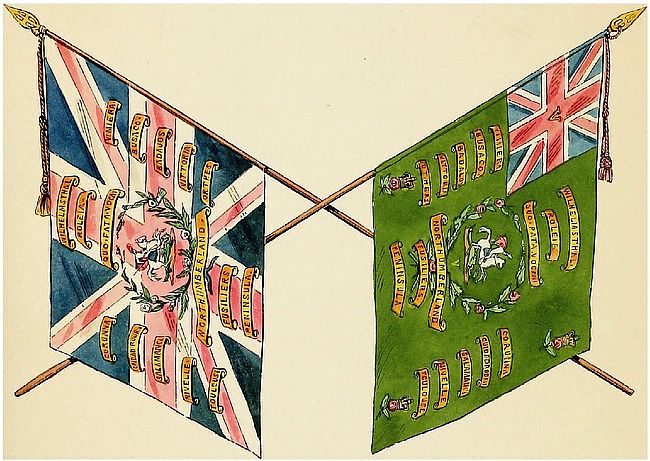
pleased, in 1836, to authorize the regiment to bear the
word 'Wilhelmsthal' on its Colours and Appointments.
After the action the Fifth encamped on the heights
of Wilhelmsthal; it was subsequently employed in
several operations; and on the 23rd of July, the grenadier
company was engaged in a gallant affair at
Lutterberg, when the Saxons under Prince Xavier were
driven from their post and thirteen pieces of ordnance were
captured. On the 24th of the same month one hundred
men of the regiment were engaged with other corps in
dislodging a detachment of the enemy from the heights
of Homburg. The regiment was subsequently employed
in operations on the Ohm, and the Lahn, and in
several skirmishes in which it lost many men. It also
formed part of the covering army during the siege of
Cassel, which was terminated by the surrender of the
place on the 1st of November. Shortly afterwards a
suspension of hostilities took place; which was followed
by a treaty of peace, concluded at Fontainbleau, and the
regiment was ordered to return to England.
1763
It accordingly marched from Germany, through
Holland, to Williamstadt, where it embarked on the
22nd of February, 1763[28], and landed in England in the
early part of the following month. In May of the same
year it proceeded to Bristol and embarked for Ireland,
where it arrived on the 2nd of June, and landed at
Passage near Waterford.
1764
The regiment passed the next ten years in Ireland,
and was so remarkable for its cleanliness and attention
to dress and appointments, that the men were usually
called "The Shiners."
1767
Early in the year 1767 a system of honorary distinctions
for long-continued good behaviour was introduced
into this regiment, which was found to stimulate the
indifferent to good conduct, and those already worthy,
to perseverance in well-doing, and it produced such a
body of non-commissioned officers as few corps could
boast of. These distinctions consisted of three classes of
medals[29] to be worn, suspended by a ribbon, at a button-hole
of the left lappel; the first, or lowest class, which
was bestowed on such as had served irreproachably for
seven years, was of gilt metal, bearing on one side the
badge of the regiment, St. George and the Dragon[30],
with the motto "Quo fata vocant;" and on the reverse,
"Vth Foot, MERIT." The second was of silver, bearing
on one side the badge and motto, and on the other,
"Reward of fourteen years' military merit." The third
was similar to the second, but was inscribed with the
name of the individual whose conduct had earned it:
"A. B., for twenty-one years' good and faithful service
as a soldier, had received from his commanding officers
this honourable testimony of his merit." These medals
were bestowed only upon soldiers who, for the respective
periods of seven, fourteen, or twenty-one years, had never
incurred the censure of a court-martial: they were given
by the commanding officer at the head of the assembled
battalion; and if, which rarely happened, the owner of a
medal subsequently forfeited his pretensions to enrolment
among the men of merit, his medal was cut from
his breast by the drum-major as publicly as he had
been invested with it. Those who obtained the third, or
twenty-one years' medal, had also an oval badge of the
colour of the facings on the right breast, embroidered
round with gold and silver wreaths, and inscribed in the
centre with the word "Merit" in letters of gold.
1768
On the 7th of November, 1768, Lieutenant-General
Hodgson was succeeded in the Colonelcy of the Fifth by
Hugh, Earl Percy, afterwards Duke of Northumberland.
Earl Percy, when Colonel, duly estimating the good
effects produced by this Regimental "Order of Merit,"
kept it up with all the liberality and dignity it deserved;
and the following order, issued by him on the subject, is
referred to in Adye's Essay on Rewards and Punishments,
viz.: "Earl Percy having perceived, with great pleasure,
the happy effects of the regimental Medals of Merit,
influencing the non-commissioned officers and soldiers
of the Fifth to deserve the favour of their officers, and
being anxious, as far as may be in his power, to encourage
them to persevere in such sentiments of
honour, is determined, for the future, to give them
out every year, a short time before the review, instead
of the usual day, as it often has happened that the
regiment has been separated, which prevented the
men, who were entitled to that mark of honour, from
receiving it in so public a manner as his Lordship
could wish."
1771
1772
During the stay of the Fifth in Ireland it was frequently
engaged in the service of the revenue; and also
in suppressing the outrageous proceedings of bands of
armed peasantry called Whiteboys, Hearts of Steel, and
Hearts of Oak, and particularly against the latter in
1772, at and near Guildford in the north, where the
house of Richard Johnson, Esquire, was attacked and
reduced to ashes, and a clergyman, the Rev. Mr.
Meroll, was barbarously murdered by these misguided
insurgents.
1774
The regiment remained in Ireland until the unfortunate
misunderstanding between Great Britain and her
North American Colonies assumed an aspect so formidable,
that it was deemed necessary to send additional
forces to that country. The Fifth was one of the corps
selected to proceed on this service; and, having embarked
at Monkstown near Cork on the 7th of May,
1774, it landed in the beginning of July at Boston, the
capital of the state of Massachusetts, which had recently
been the scene of violence and outrage, particularly of
the destruction of an immense consignment of Tea by
the provincials. After landing, the regiment was encamped
near the town for some time; a body of troops
was assembled at this place under the Governor of the
province, General Gage, and several fortifications were
constructed.
1775
During the winter a determination to proceed to open
resistance became general in the American States; they
embodied a militia force, and in April 1775, a circumstance
occurred which occasioned the display of these
hostile designs. The occasion was the collection of some
military stores at Concord, in Middlesex county, about
eighteen miles from Boston; when General Gage sent
the grenadiers and light infantry, including the companies
of the Fifth, under the orders of Colonel Smith,
to destroy those stores. This detachment embarked in
boats on the evening of the 18th of April, and, having
proceeded a short distance up Charles river, landed on
the marshes of Cambridge and proceeded to the village
of Lexington, where it arrived at day-break and found a
company of the militia formed up near the entrance of
the town. These men were ordered to lay down their
arms, but they did not comply; some desultory firing
immediately occurred, which was followed by a volley
from the troops which laid ten of the militia dead upon
the spot, wounded several others, and dispersed the
remainder: thus was the first blood drawn in this unhappy
contest. After this skirmish, the troops continued
their march to Concord, detaching six Light Infantry
companies to take possession of the bridges beyond the
town, while the remainder of the detachment effected
the destruction of the military stores. In the mean
time the country had been alarmed by the firing of
guns and the ringing of bells: and a division of provincial
militia was seen advancing towards the bridges,
but they avoided committing any hostile act until the
light infantry companies had killed two men, when
the Americans instantly opened a sharp fire, and by their
superior numbers forced the King's troops to retire.
The country now appeared swarming with armed men,
who fired on the troops on all sides, while numbers
followed in their rear, and during the six miles' march
from Concord to Lexington, skirmish succeeded skirmish,
and a continued but irregular fire was sustained until the
detachment had expended nearly all its ammunition.
Fortunately it was met at Lexington by Earl Percy
(Colonel of the Fifth), who had been sent forward to
support the detachment with his brigade and two pieces
of artillery, and his lordship after a short halt made
dispositions for continuing the march to Boston[31]. But
the moment the troops were in motion the attacks
became more frequent and more violent than before, the
Americans hovering in hundreds upon the rear and
keeping up a sharp fire from houses, from behind walls,
trees, and other coverts, on both sides of the road; yet
the troops, displaying a steady and noble bearing, united
with a high state of discipline and undaunted spirit,
marched under all these difficulties, in perfect order, a
distance of fifteen miles to Charlestown, where they
arrived at sunset, quite exhausted from a march of
about thirty-five miles, on a hot day, and experiencing
the extraordinary fatigues already mentioned. From
Charlestown the troops crossed the river by the ferry to
Boston, under cover of the fire of the men-of-war. The
loss of the Fifth, in this day's skirmishes, was five men
killed; with Lieutenant Thomas Baker, Lieutenant William
Cox, Lieutenant Thomas Hawkshaw, and fifteen
men wounded; also one man taken prisoner[32].
This affair was followed by the appearance of the
whole province in arms;—an immense number of men
invested Boston, where the King's troops were stationed,
on the land side; and on the morning of the 17th of
June, it was ascertained that they had constructed works
on Bunker's Hill—a high ground beyond the river. A
body of troops, of which the Fifth formed a part, was
ordered to attack the heights; and this force, having
embarked about noon, landed without opposition and
formed up on some high ground near the shore. The
enemy appearing resolved to defend this post, the ships
of war opened their fire upon the works, while the King's
troops, advancing under cover of the guns, went boldly to
the attack; and commenced one of the most sanguinary
actions on record. The Fifth, ever emulous of glory,
was seen ascending the hill on the side next Charlestown
with signal intrepidity, and bravely sustaining its
ancient reputation. Captain Harris (afterwards the
conqueror of the Mysore) while leading on the grenadier
company, was severely wounded, and obliged to quit the
field, but he had in Lieutenant Lord Rawdon (afterwards
Marquis of Hastings) a successor in command, who emulated
and equalled the intrepidity of his disabled captain.
Eventually the troops were staggered by the resolute
tenacity of the defence, and the superior numbers of the
enemy; yet, recovering, they appeared in a moment fired
by a new ardour, and with fixed bayonets they went
cheering forward with determined bravery and resolution,—encountering
the Americans in close combat and driving
them, after a sharp contest, out of the works. The
King's troops were now established on Bunker's Hill,
which they afterwards fortified and occupied in force.
The loss of the Fifth was 22 men killed; Captain
Harris, Captain Jackson, Captain Downes, Captain
Marsden, Lieutenant M'Clintock, Lieutenant Croker,
Ensign Charleton, Ensign Ballaguire, 10 Serjeants, 2
Drummers, and 116 rank and file wounded[33]. General
Burgoyne, in a letter written at the time to Lord Derby
and subsequently published, says, in reference to
Bunker's Hill, "The Fifth has behaved the best,
and suffered the most[34]."
Notwithstanding this success, the army at Boston
remained in a state of blockade, and the troops were
eventually so distressed for fresh provisions and other
necessaries, that live cattle, vegetables, and even fuel,
were sent for their use from England. The shipping
with these supplies were, however, many of them
wrecked, or fell into the hands of the Americans, and,
the distress of the troops increasing, much sickness and
loss of life occurred.
1776
In the midst of this calamity, the provincial troops,
being better supplied with necessaries, began to act
offensively with vigour, and the appearance of new
batteries with the opening of a heavy cannonade, occasioned
the King's troops to evacuate the place. Accordingly,
in the middle of March, 1776, the army embarked
from Boston, and proceeded to Halifax in Nova
Scotia, but after their arrival at that place the greater
part of the troops remained on ship board, the town not
being capable of providing quarters, nor of affording a
sufficient supply of provisions.
The Fifth remained at Halifax about two months,
and leaving that place early in June to engage in an
extensive plan of operations, formed part of the force
which effected a landing on Staten Island near New
York on the 3rd of July. In the following month a
reinforcement of British and Hessian troops arrived, and
on the 22nd of August a descent was made on the south-west
end of Long Island, when the enemy's detachments
along the coast withdrew to the range of woody
hills which intersect the country from east to west. In
the manœuvres by which these hills were passed, and in
the defeat of the provincial corps on the 27th of August,
the Fifth took an active and spirited part, but did not
sustain any loss. After this success, preparations were
made to attack the enemy's lines at Brooklyn; but the
Americans, impressed with a sense of the superiority of
the King's troops, quitted their post during the night of
the 28th, and passed the troops in boats across the East
River to New York.
The reduction of Long Island having thus been
effected with trifling loss, the Fifth was again embarked,
and a landing was made on the 15th of September,
on New York Island, within a few miles of the
city; which General Washington immediately abandoned,
and retired towards the northern end of the
island, designing to remain on the defensive, and to
avoid a general engagement. The Fifth was subsequently
employed in several operations, and on the 28th
of October, being on the march towards the American
camp at White Plains, it was engaged, with the 28th
35th and 49th regiments, commanded by Brigadier-General
Leslie, in forcing the passage of the Brunx's
rivulet under a sharp fire, and having ascended the hill
with admirable intrepidity, attacked and routed a division
of Americans, chasing them from behind walls and
other coverts, and driving them behind their entrenchments
at the entrance of White Plains: from whence
they subsequently retreated. The regiment only lost
two men on this occasion, and had its commanding
officer, Lieutenant-Colonel Walcott, wounded.
1777
At length, it being found impossible to bring on a
general engagement, the army retired by the North
River, to the heights of Fordham; and on the 16th of
November, the Fifth supported the storming party in
the capture of Fort Washington. A few days afterwards
the regiment was detached across the North River
against Fort Lee, and on the flight of the American
troops, it was stationed a short time at English Neighbourhood:
but was soon called upon to take an active
part in the reduction of New Jersey; and in the early
part of January, 1777, it was quartered at Maidenhead.
The Fifth passed the remainder of the winter in the
island of Jersey. "The weather was particularly severe;
the duty unremitting and hard; the enemy watchful;
and provisions and forage were not obtained without
repeated skirmishes. Nevertheless the soldiers endured
these hardships with a fortitude and a perseverance
that acquired them infinite honour[35]." The
campaign being opened in the early part of June, 1777,
the regiment took part in several manœuvres, designed
to bring on a general engagement, but the enemy kept
in the mountain fastnesses, by which he succeeded in
defeating the designs of the British commander; and on
the 30th of June the troops embarked from the Jerseys
and proceeded to Staten Island.
An expedition to Pennsylvania having been resolved
on, the Fifth formed part of the force ordered for this
service, and, having embarked at Sandy Hook on the
5th July, sailed to Chesapeak Bay, thence proceeding
up the Elk River, landed at Elk Ferry on the 25th of
August, and afterwards advanced on Philadelphia: at
the same time the enemy took up a position at Brandywine
Creek, to oppose the advance. But on the 11th
of September the enemy's out-posts were driven in and
the position attacked. The FIFTH formed part of the
force, which advanced to Chad's Ford in the centre of
the enemy's line, forced the passage in gallant style,
carried the batteries and intrenchments with fixed
bayonets, and captured five pieces of cannon and a
howitzer. The regiment encamped during the night on
the scene of conflict; its only casualties being Ensign
Andrews, 1 serjeant, and 12 men wounded.
This success was followed by the capture of Philadelphia:
at the same time the army occupied a position
near Germantown, and the Fifth had its post in the right
wing of the line. The troops at the head of the town
were attacked by the enemy in force at daybreak on
the morning of the 4th of October, when the Fifth was
ordered forward to their aid. The enemy had already
gained some advantage, and the Fortieth regiment, which
had thrown itself into a stone building, was surrounded
by an American brigade, when the Fifth and Fifty-fifth
regiments, advancing from the right, opened their fire
with good effect, and being seconded by several other
corps from the centre and left, drove back the enemy and
pursued them through some woody grounds and strong
enclosures with signal bravery. The Fifth lost on this
occasion, 1 drummer and 9 men killed; also Lieutenant-Colonel
Walcott, Captain Charlton, Ensign Thomas,
Ensign Stuart, 5 serjeants, and 37 men wounded: Lieutenant-Colonel
Walcott died of his wounds six weeks
afterwards.
On the 18th of October the army quitted Germantown
and encamped in the immediate vicinity of Philadelphia,
until after the capture of two forts on the river. In the
mean time the enemy formed a strong camp at White
Marsh, fourteen miles from Philadelphia; and in the
early part of December the Fifth took part in several
operations and skirmishes designed to bring on a general
engagement; but the enemy remaining behind his
trenches and abbatis de bois, the regiment returned to
Philadelphia on the 8th of that month. After the retreat
of the King's troops, the enemy removed to Valley
Forge, where he built huts and passed the winter in the
woods, while the British lay in comfortable quarters in
the capital of Pennsylvania, where the want of strict discipline
during the period of a temporary repose produced
several evil consequences, particularly the estrangement
of many persons previously in the interest of the royal
cause.
1778
Before the commencement of active operations in
1778, the King of France had concluded a treaty with,
and agreed to aid, the Americans, which so completely
changed the nature of the contest, that the evacuation of
Philadelphia was resolved upon, and the Fifth had to
take part in the difficult service of retreating through a
wild and woody country intersected by rivers, and
abounding in narrow and ragged passes. The army
accordingly crossed the Delawar on the 18th of June,
and directing its march along the eastern bank of that
river, afterwards proceeded through the Jerseys, while
the enemy hovered near the rear and menaced an attack
in force. No action of importance, however, occurred
until the 28th of June, when, as the last division descended
from the heights above Freehold in New Jersey,
the enemy appeared in the rear, and on both flanks, and
some sharp fighting took place. At this time the Fifth
was in advance, but it was recalled to take part in the
action, and the enemy was eventually repulsed. The
regiment had Captain Gore of the grenadier company
and several men killed on this occasion.
After the action the army continued its march, and
having crossed the channel to Sandy Hook, in the beginning
of July, embarked from thence for New York;
from whence the Fifth advanced to a post beyond the
town.
In September, part of the regiment was detached on
an expedition to Little Egg Harbour in New Jersey—a
noted rendezvous for privateers. This detachment,
consisting of 300 men of the Fifth and New Jersey
Volunteers, commanded by Captain Ferguson, embarked
in transports towards the end of September, and, on
arriving at the harbour, went on board small vessels
which, with several row-galleys, proceeded twenty miles
up the river, to Chesnut Neck, where the troops landed
under cover of the fire from the galleys, and by a spirited
attack, routed the enemy's force assembled to oppose the
descent, and chased them into the woods. After returning
from the pursuit, the troops destroyed the village,
with several storehouses, and armed vessels:—having
only sustained the trifling loss of one man of the Fifth,
wounded. A night excursion was afterwards made ten
miles farther up the river, when the troops, surprising
some companies of the enemy in their quarters, made a
dreadful slaughter with the bayonet, and reduced the
houses to ashes, with the loss of only two men of the
Fifth killed, and two wounded. "It is but justice to
inform you," observes the commanding officer in his despatch,
"that the officers and men, both British and
Provincials, behaved on this occasion in a manner to
do themselves honour. To the conduct and spirit of
Captain Cox, Lieutenant Littleton, and Ensign Cotter,
of the Fifth regiment, and of Captain Peter Campbell
of the Third Jersey Volunteers, this little enterprise
owes much of its success[36]."
Immediately after the return of this detachment, the
regiment was ordered to form part of an expedition
against the French West India Islands, and embarking
on this service under the command of its Lieutenant-Colonel
(afterwards Sir William) Medows, sailed from
Sandy Hook on the 3rd of November.
After stopping two days at Barbadoes, during which
time the land and sea commanders, General James
Grant and Admiral Barrington arranged their plans of
attack, the expedition arrived at St. Lucie on the 13th of
December, and the reserve, consisting of the Fifth
regiment, the grenadiers and light infantry being immediately
landed under the command of Brigadier-General
Medows, forced some heights occupied by a
French force under the governor, the Chevalier de
Micoud, and took a field-piece and a four-gun battery.
On the following morning, the rest of the army being
landed, the Fifth advanced and took possession of the
town of Morne Fortuné, the governor's house, hospital
and barracks; and from thence, after a short halt, proceeded
to occupy an important post, called La Vigie,
situated on a tongue of land commanding the north side
of the Carenage harbour, and separated by that harbour
from the rest of the army. In the mean time, the
French fleet under Count D'Estaing arrived off the island,
and disembarked a force of nine thousand men, by the
whole of which General Medows' little band was attacked
on the 18th. The enemy, commanded by MM.
de Bouillé and Lavendahl, advanced in three columns;
their first two attacks were made, to use the words of
General Grant's despatch, "with the impetuosity of
Frenchmen, and repulsed with the determined bravery
of Britons." They made a third attempt, but were
soon broken, and they retired in confusion.
The conduct of the Fifth regiment and its Lieutenant-Colonel
on this occasion, was of the most distinguished
description. Brigadier-General Medows, though severely
wounded in the right arm early in the day, would not
quit his post, but continued in the field, riding about and
giving orders, till the attack was over. At one moment,
finding his ammunition nearly expended, he drew up his
little phalanx in front of their colours, and waving his
sword in his hand, emphatically exclaimed, "Soldiers,
as long as you have a bayonet to point against an
enemy's breast, defend these colours." They did so,
and secured the conquest of St. Lucie. It was in this
action that the Fifth by its gallant conduct acquired the
privilege of wearing a White Plume in the cap instead of
the red and white tuft worn by the other regiments of
the line; having taken from the bodies of the slain French
grenadiers, the advance and élite of the enemy's force,
as many white feathers as sufficed to equip every man in
the regiment with the new decoration. The loss of the
French amounted to about four hundred killed and
eleven hundred wounded, while the killed on the side of
the British was only ten, and one hundred and thirty
wounded; amongst whom were Lieutenants Pratt and
Harris. The sense General Grant entertained of the
services of Brigadier-General Medows and the detachment
under his command, was expressed in the following
letter, dated from Morne Fortuné, the 19th of December,
1778:
"Sir,
"I cannot express how much I feel obliged to you,
and the troops under your command, for repulsing,
with so much spirit and bravery, so great a body of
the enemy, and own it was just what I expected from
you and them; and I am sure, under your command,
they will always behave in such a manner as to do
honour to you, themselves, their king, and their country;
and I must beg of you to express my gratitude."
1779
1780
During the year 1779, the regiment was sometimes
embarked on board ship, and at others employed on
shore at St. Lucie and Antigua, and was engaged with
the enemy on the 19th of June, 6th of July, and 7th and
8th of September. From January to July, 1780, it was
occasionally in Gros Isle Bay, St. Lucie, at Martinique,
St. Kitt's, and Carlisle Bay, Barbadoes, and was engaged
on the 17th of April, and on the 15th of May. It was
then ordered home, and after a boisterous passage,
landed on the 16th of September at Portsmouth, from
whence it embarked again for Ireland in December, and
arrived at Cork in January, 1781.
1781
1782
Towards the end of 1781, a detachment was employed
at the mouth of the Shannon, in protecting a foreign
vessel, stranded on the coast, from plunder by the
natives. The regiment was afterwards quartered at
Kilkenny, where its conduct was such that, on its being
ordered to a different part of the country, the inhabitants
petitioned the Government successfully for its return; at
Limerick also, and several other places, its soldier-like
and orderly behaviour received the official thanks of the
civil authorities. With the volunteers of Ireland, at that
time in the height of their popularity and the heyday
of their zeal, the Fifth was on the best footing;
whenever it marched through any town, the volunteers
turned out to receive it with all due honours, and so great
was their respect for the regiment and confidence in its
then commander, Lieutenant-Colonel (afterwards Lord)
Harris, who had served in the corps from the rank of
Ensign upwards, that when, on the report of an intended
landing of the French near Cork, the Fifth was
marched to Youghal, several volunteer corps offered to
join it in case a landing was effected by the enemy.
1783
In March, 1783, the regiment was marched from
Kilkenny to Dublin, and at the first installation of the
newly-founded order of St. Patrick, its grenadier company
furnished the guard of honour at the Cathedral.
A detachment was about the same time sent, under the
command of Major Battier, to Carlow, in support of the
fencibles, who had been insulted by the volunteers at
Kilkenny.
1784
In 1784, the regiment lost a distinguished leader, a
powerful patron, and an attached and sincere friend, by
the promotion of Earl Percy to the Colonelcy of the
second troop of Horse Grenadier Guards. The Fifth
had been his first command; he had held that command
for sixteen years, including the whole of the American
war of independence, and in compliment to him, the
regiment had received the denomination, which it still
retains, of the "Northumberland" Regiment. He
took leave of his old comrades in the following very complimentary
and affectionate letter:—
"Alnwick, Nov. 5, 1784.
"Sir,
"His Majesty having been pleased to appoint me
Colonel of the Second Troop of Horse Grenadier
Guards, in succession to His Royal Highness Prince
Frederick, I take the earliest opportunity of acquainting
you with it: and although this new appointment
is a very flattering mark of His Majesty's approbation
of my services, yet I cannot help feeling the greatest
regret at quitting the Fifth regiment of Foot, which I
have had the pleasure of commanding for sixteen
years with great satisfaction to myself, and, I trust,
with some advantage to the corps. The very uncommon
attention which I have always met with, both from
the officers and men of the Fifth, will ever be remembered
by me with the greatest pleasure; and however
changed my situation may be with respect to them,
my regard, esteem, and affection for them will ever
continue the same, and I shall always be happy in
having an opportunity of convincing them of it.
"I am, with the greatest regard,
"Yours most sincerely,
(Signed) "Percy.
"Officer commanding Fifth Foot."
Earl Percy was succeeded by Major-General the Honourable
Edward Stopford, Lieutenant-Colonel of the
Sixty-sixth Foot, whose commission as Colonel of the
Fifth is dated 1st November, 1784.
1785
The colours of the Fifth being worn out by time and
numerous honourable perforations received in action, a
new set was presented to it with the usual solemnities,
on St. George's day, 1785, in the parish church of Belfast,
where the regiment was then stationed. In the
evening the men dined sumptuously in the barrack-yard
by companies, at the expense of their lately promoted
Colonel, Earl Percy. In the same year, the assistance
rendered by the Fifth on the occasion of a great fire
which broke out in Belfast called forth the public thanks
of the corporation and inhabitants.
1787
The Fifth remained in Ireland, earning, by its
discipline and conduct, the repeated commendations of
the several general officers by whom it was commanded
or reviewed, till May the 24th, 1787, when it embarked
at Monkstown, near Cork, for Canada, and after a voyage
of two months, touching by the way at Newfoundland,
arrived at Quebec on the 26th of July.
After a short stay at the capital of Lower Canada,
the regiment was encamped on the heights above Silleri,
and after being reviewed there on the 29th of
August, 1787, by his Royal Highness Prince William
Henry (afterwards King William IV.), was embarked at
Wolfe's Cove on the 6th of September, in batteaux, for
the interior, where it remained for nine years.
1790
1791
From June, 1790, to the same month in 1792, it was
quartered at Detroit, on the Straits of St. Clair, above
Lake Erie, in Upper Canada. While the regiment was
at this station, under the command of Lieutenant-Colonel
Smith[37]; the first aggression was made by the
troops of the United States on the Indian territory;
and his humane interference and exertions rescued
many Americans from the Indians, into whose hands
they had fallen, for which he received the thanks of the
President.
1792
From Detroit the regiment moved, in June, 1792,
down to Niagara, where it was reviewed by his Royal
Highness the Duke of Kent and Major-General Simcoe,
who made a highly favourable report of it to the
Commander-in-Chief, declaring it to be "most fit for
actual service." From Niagara, Lieutenant Sheaffe[38]
of the Fifth, was detached to coast the shore of Lake
Ontario, and protest against the settlements made by the
Americans at Sodius, and other places, during the suspended
execution of the first American treaty.
1794
General Stopford died in 1794, and was succeeded in
the Colonelcy of the Fifth, by Sir Alured Clarke,
G.C.B., whose commission was dated the 25th of October,
in that year. The regiment was still at Niagara,
where it remained till that post was given up to the
Americans in 1796, when it was ordered to Quebec.
1796
1797
1798
In the winter of 1796 it was employed against the
insurgent Canadians at Point Levi, on which occasion
it crossed the St. Lawrence on the ice. In 1797, the
corporals and privates were drafted into the Twenty-fourth
regiment, while the officers and serjeants returned
to England, and on their disembarkation were ordered to
Grantham, in Lincolnshire, to recruit; which service
was very successfully carried on in all the principal
towns of the county. From Grantham it was moved to
Boston, and from thence suddenly ordered to Norman
Cross barracks, where some disturbances had broken out
among the French prisoners. After a few months, however,
at the particular request of the inhabitants of Boston,
it was again quartered in that town, on which occasion
the volunteer corps lined the streets through which
the regiment had to pass, and a splendid dinner and
ball were given to the officers by the inhabitants. This
kindly feeling between Lincolnshire and the Fifth regiment
has continued ever since, and more recruits have
joined its ranks from that county than from any other.
1799
When the expedition sent out with the view of delivering
Holland from the power of France was determined
on in 1799, the Fifth regiment, already in a high state
of efficiency, both with respect to numbers and discipline,
was selected to form part of the army destined for that
service, and was accordingly marched to the camp on
Barham Downs. It was immediately after divided into
two battalions, upwards of eight hundred each, in
strength, Major-General George Hewett being appointed
on the 5th of August, 1799, Colonel-Commandant of the
second battalion; and in September both battalions
embarked at Deal for Holland, where they landed on
the 14th and 15th, and formed with the Thirty-fifth
regiment, the eighth brigade of the army, under the
command of His Royal Highness Prince William of
Gloucester.
In the general attack made on the 19th of September
on the whole line of the French positions in North Holland,
the Fifth regiment formed part of the column
under Lieutenant-General Dundas, destined to carry the
intrenched villages of Walmenhuysen, and Schoreldam,
in the attack upon the latter of which, the first battalion
took an active part, and had one Lieutenant (Harris)
mortally, and its Lieutenant-Colonel (Stephenson)
severely wounded; sustaining, besides, a loss of five
killed, four wounded, and four missing. Of this action
the Duke of York observed, in his public despatch,
"The gallantry displayed by the troops engaged, the
spirit with which they overcame every obstacle which
nature and art opposed to them, and the cheerfulness
with which they maintained the fatigue of an action,
which lasted without intermission, from half-past three
o'clock in the morning, until five in the afternoon, are
beyond my power to describe or extol. Their exertions
fully entitle them to the admiration and gratitude
of their King and country."
In the battle of Egmont-op-Zee on the 2nd and 6th of
October, Prince William's brigade was not actively engaged;
but the flank companies of the Fifth, which
were attached to the grenadier and light infantry battalions
of the line, and formed part of the reserve under
Colonel Macdonald of the Fifty-fifth regiment, had an
opportunity of distinguishing themselves; they had several
men killed and wounded, also Captain Pratt wounded
on the 2nd, and Lieutenant Hamilton on the 6th of
October; and on both occasions behaved so well as to
receive the particular thanks of their commander.
On the 10th of October the posts occupied by the two
battalions of the Fifth, in front of the village of Winkle,
were attacked by the enemy in great strength. The
French troops had succeeded in forcing a passage over
a canal which covered the village, when Colonel Bligh,
who commanded the first battalion, perceiving that if
the advance of the enemy was not checked, the remainder
of the brigade was in danger of being cut off,
planted the colours of the Fifth on the top of the dyke,
and kept his ground till he had secured and covered the
retreat of the brigade; the second battalion, under Lieutenant-Colonel
Talbot, in the mean time maintaining its
positions till ordered to retreat by Prince William, who
on this occasion, issued the following general order:—
"Oude, Sluys, 12th October, 1799.
"Prince William desires Colonel Bligh and the first
battalion of the Fifth Regiment will accept his thanks,
for the gallant manner in which they attacked the enemy
when he was passing the canal opposite Winkle;
and Lieutenant-Colonels Talbot and Lindsay, of the
second battalion of the Fifth, for their exertions on
the 10th instant."
1800
The Dutch did not second the gallant exertions thus
made to effect their deliverance from foreign domination,
and the evacuation of Holland was resolved on. As late
as the 12th of October, the Fifth Regiment was still in
front of the enemy, and eventually occupied the works at
the Helder, during the retreat and final embarkation of
the army; being, according to Sir James Pulteney's
letter of the 20th of November, among the last of the
British troops who quitted Holland, and exhibiting to
the end, persevering good conduct and unwearied courage,
under hardships which his Royal Highness the
Duke of York, in general orders, dated 8th of October,
1799, designated as "insupportable." On its arrival in
England, the regiment was stationed at Silver Hill barracks,
and the following year both battalions were ordered
to Gibraltar.
1801
In August, 1801, Sir Alured Clarke was removed to
the Colonelcy of the Seventh Foot, and the command of
the Fifth was bestowed on the 20th of August, on
Major-General Richard England, who, from the 14th of
April, 1800, had been Colonel-Commandant of the
second battalion.
1802
1803
1804
At Gibraltar the regiment continued till the peace of
Amiens, when it returned to England. The second
battalion was then disbanded at Winchester, and the
first ordered to Guernsey, where it remained till 1804,
when it returned to England, and was stationed first, for
a short time, at Hilsea, and afterwards at Colchester.
The war with France having been resumed, a second
battalion was again raised, in 1804, and embodied at
Horsham in Sussex.
1805
In 1805, the establishment of the first battalion was
augmented to 1000 rank and file; and it was, with other
regiments, reviewed in the autumn at Colchester, by his
Royal Highness the Duke of York.
In the same year the second battalion was stationed
at Chichester, and recruited successfully in Petworth,
Steyning, Midhurst, Lewes, and Rye; in February,
1806, it was sent to Guernsey, and from thence in
August following, it was removed to Alderney.
1806
In November, 1805, the first battalion embarked at
Deal, with the forces under Lord Cathcart, destined for
the defence of Hanover. During the voyage the "Helder"
transport, containing the left wing of the battalion, was
unfortunately wrecked off the Helder, and the officers
and men were made prisoners by the Dutch. The right
wing returned to England in 1806, and was stationed at
Rye, in Sussex, where it was joined in September, by
the left wing, which had been liberated by an exchange
of prisoners.
1807
In 1806, the first battalion sailed in the expedition
under Brigadier-General Robert Craufurd, to join the
British forces at Monte Video, in the province of Buenos
Ayres, in South America; and after being embarked
upwards of nine months, landed on the 28th of June,
1807, at Ensenada de Barragon, and was formed in
Brigadier-General Sir Samuel Achmuty's brigade, for
the attack made by Lieutenant-General Whitelocke, on
the capital of the province.
After some fatiguing marches through a country much
intersected by swamps and deep muddy rivulets, the troops
crossed the Rio Chuelo, and formed in the suburbs of
Buenos Ayres, when the Fifth had its post towards the
convent of Recoleta; and in the plan for the general
attack, the regiment was formed in two divisions, and
directed to penetrate the streets immediately in its front.
Accordingly, at half-past six o'clock on the morning of
the 5th of July, the regiment advanced: the streets
were found deserted by the inhabitants; the houses and
shops closed; and a death-like silence, interrupted only
by the firm tread of the British soldier, reigned in the
midst of this populous city; but at a given signal, the
whole male population suddenly appeared, and the
windows and tops of the flat-roofed houses were crowded
with armed men, who commenced a destructive fire; at
the same time the streets were found intersected by
ditches, and protected by cannon; but the Fifth, pressing
onward with a conquering might which overcame
all resistance, forced its passage through the streets
with fixed bayonets, and, after penetrating to the river,
took possession of the church and convent of St. Catalina,
from whence it moved to the Plaza de Toros, where
thirty-two pieces of cannon and a quantity of ammunition
were captured. In the mean time several other
corps, not able to overcome the opposition they met
with, had been repulsed or overpowered, and made prisoners
by the Spaniards; and on the following day Lieutenant-General
Whitelocke agreed to vacate the place.
In this affair the Fifth sustained a loss of fourteen
killed, also forty-seven wounded, amongst the latter was
Major the Honourable Henry King; and twenty-four
missing. On the conclusion of the treaty between General
Whitelocke and General Liniers, the English army
re-embarked, and, after a tedious voyage, during which
it was exposed to considerable want both of provisions
and water, the 1st battalion of the Fifth Regiment
landed at Cork, in December, 1807, where the 2nd battalion
also arrived from Alderney on the 3rd of the same
month.
In the same year, the sanction of his Royal Highness
the Prince Regent was obtained for clothing the drummers
of the regiment in white, with white and red lace,
instead of gosling green.
1808
The second battalion was quartered at Charles Fort,
Kinsale, from whence it marched in February, 1808, to
Fermoy. In the summer of the same year, the first battalion,
under the command of Lieutenant-Colonel John
Mackenzie, was ordered to proceed to the aid of the
Portuguese in their resistance to the tyrannical power of
Buonaparte; it accordingly embarked at Cork, and sailed
on the 12th July for Portugal; where it landed on the
9th of August, and immediately joined the army of Lieutenant-General
Sir Arthur Wellesley. In the action at
Roleia, on the 17th, it was one of the few corps whom
circumstances and the nature of the ground permitted to
come to actual engagement with the enemy; and advancing
by the right-hand path to the heights of Zambugeira,
it climbed the rugged rocks in the face of a
French force, which, after a gallant resistance, was driven
from the heights. Thus by its conduct on that day,
wherein two of its officers, Major Emes and Lieutenant
Doyle were wounded, it earned the Royal permission to
have the word "Roleia" inscribed on its colours. Its
further loss was three killed, and two serjeants and thirty-nine
rank and file wounded. Sir Arthur Wellesley, in
his despatch, observed, "I cannot sufficiently applaud
the conduct of the troops throughout this action. The
enemy's positions were formidable, and he took them
up with his usual ability and celerity, and defended
them most gallantly. I must observe, that although we
had such a superiority of numbers employed in the
operations of this day, the troops actually engaged in
the heat of the action were, from unavoidable circumstances,
only the Fifth, Ninth, Twenty-ninth, the riflemen
of the Sixtieth and Ninety-fifth, and the flank companies
of Major-General Hill's brigade, being in number
by no means equal to that of the enemy;—their conduct
therefore deserves the highest commendation."
In the subsequent battle of Vimiera, fought on the
21st of August, the first battalion of the Fifth forming,
with the Ninth and Thirty-eighth Regiments, the first
brigade, was posted on the mountain on the right of the
village. The enemy was defeated, and the regiment was
rewarded by royal permission to inscribe the word
"Vimiera" also upon its colours.
These successes being followed by the Convention of
Cintra, and the evacuation of Portugal by the French,
the first battalion of the Fifth was afterwards stationed
in Lisbon, where it remained several weeks.
Portugal being now free from the presence of an enemy,
an army, commanded by Lieutenant-General Sir
John Moore, was sent up the country in the autumn, to
assist the Spaniards in their resistance to the armies of
France, and the first battalion of the Fifth Regiment
was selected to form part of this expedition.
1809
Passing through Portugal by a rapid march, the
troops traversed four hundred miles in a short time, and
were soon engaged in operations in Spain; but the
Spaniards, who were to have co-operated, had in the
mean time been defeated and dispersed; and the little
British army was eventually obliged to retire before the
superior numbers of the enemy. The Fifth Regiment
took its full share in the disasters and privations of the
retreat from Sahagun to Corunna, as well as in the
glories of the 16th of January, 1809, when the steady
firmness of the British army, by repulsing at all points
an assailant, superior in numbers and artillery, and commanded
by one of the ablest generals[39] that France could
boast, proved to the world that even a forced retreat of two
hundred and fifty miles, made under circumstances the
most disheartening, and accompanied by privations the
most appalling, though it might wear the sinews and exhaust
the physical strength of the British soldier, had no
power to shake his resolution or daunt his courage.
In the battle of Corunna, Colonel Mackenzie particularly
distinguished himself: after having one horse shot
under him, he remounted another, and was at length
mortally wounded, whereupon the command of the
battalion devolved on Major Emes, who received a
medal for this service, while the regiment itself acquired
another honorary inscription for its colours, 'Corunna'
being by royal permission borne upon them. The
number of killed and wounded of the first battalion of
the Fifth, in the battle of Corunna, has never been
exactly ascertained; but on mustering after its return to
England, one serjeant, two corporals, three drummers,
and one hundred and twenty-six rank and file were
found to be missing.
The first battalion landed in February, 1809, at Ramsgate,
and after a halt of a few days at Margate, was ordered
to Steyning, in Sussex, where it was fully equipped
and completed to upwards of one thousand rank and file,
and embarked in July following at Portsmouth, under
the command of Lieutenant-Colonel Pratt, to form part
of the expedition under the Earl of Chatham designed
to effect the destruction of the enemy's shipping and
arsenal on the Scheldt.
During the siege of Flushing, on the Island of Walcheren,
the first battalion of the Fifth was very actively
employed, and although bivouacked without tents
during the whole time (with the exception of one week
that it was in garrison in Flushing, after its surrender)
had very few sick; but on being embarked to proceed up
the Scheldt for the projected attack upon Antwerp, the
Walcheren fever broke out in its ranks with dreadful
violence, attacking about six hundred men. In the
active operations it lost one captain (Talbot) killed, and
Captain M. Hamilton and Lieutenant Galbraith were
wounded, the former losing a leg: its loss from disease
was much more severe, for before its return to England,
in December following, two captains (Philips and William
Hamilton), and three lieutenants (Brown, MacDonough,
and Cary) and many men had been carried
off by the fever. On its return to England, the battalion
was stationed at Bexhill.
In the mean time a detachment of the regiment left
in Portugal, when the first battalion advanced into Spain,
had been added to a battalion of detachments under
Lieutenant-Colonel Copson of the Fifth, and warmly
engaged at the battle of Talavera, on the 27th and 28th
of July, for which Lieutenant-Colonel Copson received
a medal.
The second battalion had been removed from Fermoy,
in April of this year, to Coloony in the King's County,
and from thence in June to Cork, and, embarking at
Cove, landed on the 4th of July at Lisbon; and on the
3rd of August marched, under command of Lieutenant-Colonel
the Honourable Henry King, to join the army
in the field under Lieutenant-General Sir Arthur Wellesley,
and take its share in the subsequent operations of
the campaign. About the end of September it was reinforced
by nearly one hundred men of the first battalion,
who had been left behind as before stated, and it passed
the winter in quarters near the Portuguese frontiers.
1810
The immense preparations of the enemy for the ensuing
campaign induced Lord Wellington[40] to limit his
operations in 1810 to the defence of Portugal. The
second battalion of the Fifth formed part of Major-General
Lightburn's brigade of the third (Sir Thomas
Picton's) division of the army, and was stationed for
some time behind the Mondego river, from whence it
advanced to Pinhel behind the Coa to support the light
division; and was afterwards employed in a series of
operations to retard the advance of the overpowering
numbers of the enemy. At length Lord Wellington
made a stand on the rocks of Busaco; and the third
division had its post on the heights near the village of
St. Antonio de Cantara. Here the second battalion of
the Fifth was first under fire, and its light company,
under Lieutenant Shadwell Clerke, was thrown out to repulse
the advancing skirmishers of the enemy, a service
which it most promptly and gallantly performed.
The French, after astonishing efforts, gave way before
the superior valour and tactics of the British troops.
For this victory, Lieutenant-Colonel the Honourable
Henry King, commanding the battalion, received a
medal, and the word "Busaco" was authorized, on
the 31st of December, 1825, to be inscribed upon the
colours of the regiment. Its loss in the battle of Busaco
was one killed and seven wounded.
After the battle, the French having made a flank
movement, Lord Wellington retired to the celebrated
lines of Torres Vedras, where he posed an insurmountable
barrier to the further progress of the enemy; and
the second battalion of the Fifth passed the remainder
of the year in these stupendous works.
The first battalion remaining on home service was removed,
in March, 1810, from Bexhill to Lewes, and on
the 12th of August was, with several other corps, reviewed
on Brighton Downs by his Royal Highness the
Prince Regent, attended by his Royal Highness the
Duke of Clarence, (afterwards King William IV.,) who
expressed themselves in terms of approbation of its appearance
and discipline. Two days afterwards the battalion
marched to Portsmouth, where it embarked for
Ireland, and on its arrival was quartered at Fermoy.
1811
During the early part of 1811, the second battalion
remained in the lines of Torres Vedras, where Major-General
the Honourable Charles Colville took command
of the brigade. The enemy, defeated in his purpose,
reduced in numbers by sickness, and in want of provisions,
was obliged to retreat; and the second battalion
of the Fifth, moving with its division from the lines,
was employed in the pursuit of Marshal Massena
towards the frontiers of Portugal. It was frequently
engaged with the enemy's rear guards, and on the 12th
of March had a sharp affair at Redinha, where, descending
from the woody heights on the enemy's left,
it cleared the grounds in its front in fine style, and
forded a deep and rapid river, under the fire of the
enemy, when Lieutenant Clerke, already mentioned
as commanding the light company at Busaco, was
severely wounded in the leg, which he lost in consequence.
The battalion continued to take an active part in the
pursuit; and in the action at Sabugal, on the 3rd of
April, it forded the river Coa, and immediately afterwards,
on ascending the heights, and while the brigade
was forming on one of the centre companies of the
Fifth, the skirmishers were rapidly driven in. The
Fifth, commanded by Major Ridge, suddenly found
itself in presence of a strong French column, upon
which it instantly advanced, opening at the same time
a heavy fire; the enemy was repulsed with severe loss,
and driven precipitately, and in the greatest disorder,
down the hill. In this affair Lieutenant Sinclair was
killed, and Ensign Williams, one serjeant, and five rank
and file, wounded.
Almeida having been blockaded by the British, the
French advanced to relieve the place, and crossed the
frontiers of Portugal on the 2nd of May. On that day
the battalion of the Fifth was again in sight of the
enemy, and on the 5th of the same month it was present,
under the command of Lieutenant-Colonel King (who
had rejoined), at the battle of Fuentes d'Onor, where the
enemy was defeated, and his design to relieve Almeida
frustrated. In this action the battalion had four rank
and file wounded.
Immediately after the battle of Fuentes d'Onor, the
second battalion of the Fifth was detached to the south
to join the forces under Marshal Beresford, and it was
employed in the second siege of Badajoz, where it was
one of the first corps to break ground. In the operations
of this siege, which was raised on the morning of
the 17th of June, Lieutenant Sedgwick of the Fifth
(acting as engineer) and three rank and file were killed,
and one serjeant and three rank and file were wounded.
Returning to the north, the battalion commanded by
Major Ridge was stationed, during the month of August
and part of September, in the village of Fuente Guinaldo,
then the head-quarters of Lord Wellington: it was the
only British corps in the village, and was considered
such a favourite as to have acquired the nom de guerre
of "Lord Wellington's body-guard."
It was afterwards employed in the blockade of Ciudad
Rodrigo; and on the 24th of September it was ordered
to a position on the heights near the village of El Bodon,
on the left of the Agueda and within a few miles of Ciudad
Rodrigo. The enemy, having assembled an immense
force to relieve the place, advanced on the morning of
the 25th, and the second battalion of the Fifth sustained
an attack from a vastly superior French force,
consisting of cavalry, infantry, and artillery, in so distinguished
a manner, that its conduct was held up in
General Orders as an example to the whole army. The
behaviour of the battalion on this proud occasion is
described by Lord Wellington in his public despatch as
follows:—
"The enemy's attention was principally directed
during this day (the 25th) to the portion of the third
division on the hills between Fuente Guinaldo and
Pastores. About eight in the morning they moved a
column, consisting of between thirty and forty squadrons
of cavalry, and fourteen battalions of infantry,
and twelve pieces of cannon, from Ciudad Rodrigo, in
such a direction that it was doubtful whether they
would attempt to ascend the hills by Encina, El
Bodon, or by the direct road towards Fuente Guinaldo,
and I was not certain by which road they would make
their attack till they actually commenced it upon the
last. As soon as I saw the direction of their march, I
had reinforced the second battalion of the Fifth regiment,
which occupied the post on the hill, over which
the road passes to Guinaldo, by the Seventy-seventh
regiment, and by the Twenty-first Portuguese regiment,
under the command of Major-General the Honourable
Charles Colville, and Major-General Alten's
brigade, of which only three squadrons remained,
which had not been detached, drawn from El Bodon,
and I ordered there a brigade of the fourth division,
from Fuente Guinaldo, and afterwards from El Bodon
the remainder of the troops of the third division, with
the exception of those at Pastores, which were too
distant. In the mean time, however, the small body of
troops at this post sustained the attack of the enemy's
cavalry and artillery. One regiment of French dragoons
succeeded in taking two pieces of cannon, which
had been posted on a rising ground on the right of
our troops; but they were charged by the second
battalion of the Fifth regiment, under the command
of Major Ridge, and the guns were immediately re-taken.
"While this operation was going on on the flank, an
attack was made on the front by another regiment,
which was repulsed in a similar manner by the Seventy-seventh
regiment, and the three squadrons of Major-General
Alten's brigade charged repeatedly different
bodies of the enemy, which ascended the hill on the
left of the two regiments of British infantry, the Portuguese
regiment being posted in the rear of their
right.
"At length the division of the enemy's infantry, which
had marched with the cavalry from Ciudad Rodrigo,
was brought up to the attack on the road to Fuente
Guinaldo. The second battalion of the Fifth regiment,
and the Seventy-seventh regiment, were formed
into one square, and the Twenty-first Portugese regiment
into another, supported by Major-General Alten's
small body of cavalry and the Portuguese artillery.
"The enemy's cavalry immediately rushed forward,
and obliged our cavalry to retire to the support of the
Portuguese regiment, and the Fifth and Seventy-seventh
regiments were charged, on three faces of the
square, by the French cavalry, but they halted and
repulsed the attack with the utmost steadiness and
gallantry. We then continued the retreat, and joined
the remainder of the third division, also formed in
squares, on their march to Fuente Guinaldo; and the
whole retired together in the utmost order, and the
enemy never made another attempt to charge any of
them, but were satisfied with firing upon them with
their artillery, and with following them.
"I cannot conclude this report of the occurrence of
the last week, without expressing to your Lordship my
admiration of the conduct of the troops engaged in the
affair of the 25th instant. The conduct of the second
battalion of the Fifth regiment, commanded by Major
Ridge, in particular, affords a memorable example of
what the steadiness and discipline of the troops, and
their confidence in their officers, can effect, in the most
difficult and trying situations. The conduct of the
Seventy-seventh regiment under Lieutenant-Colonel
Bromhead was equally good; and I have never seen a
more determined attack than was made by the whole
of the enemy's cavalry, with every advantage of the
assistance of a superior artillery, and repulsed by these
two weak battalions."
The following are extracts from General Orders
issued by command of Lord Wellington on this memorable
occasion.
"Head-Quarters, Regidsa, 2nd October, 1811.
No. 3. "The commander of the forces is desirous
of drawing the attention of the army to the conduct of
the second battalion of the Fifth regiment, and
Seventy-seventh regiment, and Twenty-first Portuguese
regiment, and Major Arentschildt's Portuguese
artillery, under the command of the Honourable Major-General
Colville, and of the Eleventh Light Dragoons
and First Hussars, under Major-General Alten, in
the affair with the enemy on the 25th of September
ultimo. These troops were attacked by between thirty
and forty squadrons of cavalry, with six pieces of
cannon, supported by a division, consisting of fourteen
battalions of infantry, with cannon."
No. 4. "The Portuguese artillery-men were cut down
at their guns before they would quit them; but the
second battalion of the Fifth regiment attacked the
cavalry, which had taken their guns, and retook them;
at the same time the Seventy-seventh regiment was
attacked in front by another body of cavalry, upon
which body they advanced, and repulsed them."
No. 5. "While those actions were performed, Major-General
Alten's brigade, of which there were only
three squadrons on the ground, was engaged on the
left with numbers infinitely superior to themselves.
These squadrons charged repeatedly, supporting each
other, and took about twenty prisoners, and, notwithstanding
the immense superiority of the enemy, the
post would have been maintained, if the commander
of the forces had not ordered the troops to withdraw
from it, seeing that the action would have been still
more unequal, as the enemy's infantry were likely to
be engaged in it before the reinforcements ordered to
support the post could arrive."
No. 6. "The troops then retired with the same determined
spirit, and in the same good order, with which
they had maintained their post—the second battalion
of the Fifth and Seventy-seventh regiments in one
square, and the Twenty-first Portuguese in another,
supported by Major-General's Alten's cavalry, and the
Portuguese artillery. The enemy's cavalry charged
three faces of the square of the British infantry, but
were beaten off; and, finding from their fruitless efforts
that those brave troops were not to be broken, they
were content with following them at a distance, and
firing upon them with artillery, till the troops joined
the remainder of the third division, and were afterwards
supported by a brigade of the fourth division.
Although the Twenty-first Portuguese regiment was
not actually charged by the enemy's cavalry, their
steadiness and determination were conspicuous, and the
commander of the forces observed with pleasure the
order and regularity with which they made all their
movements, and the confidence they showed in their
officers."
No. 7. "The commander of the forces has been
particular in stating the details of this action in the
general orders, as in his opinion it affords a memorable
example of what can be effected by steadiness, discipline,
and confidence. It is impossible that any troops
can be exposed at any time to the attack of numbers
relatively greater than those which attacked the troops
under Major-General Colville and Major-General
Alten, on the 25th of September; and the commander
of the forces recommends the conduct of these troops
to the particular attention of the officers and soldiers
of the army, as an example to be followed in all such
circumstances."
No. 8. "The commander of the forces considers
Major-General Alten and Major-General Colville, and
the commanding officers of regiments under their command
respectively, viz. Lieutenant-Colonel Cummins,
Lieutenant-Colonel Arentschildt, Lieutenant-Colonel
Bromhead, Major Ridge, and Colonel Bucella, of the
Twenty-first Portuguese, and the officers and soldiers
under their command, to be entitled to his particular
thanks, and assures them that he has not failed to
report his sense of their conduct, in the action of the
25th of September, to those by whom he trusts that
it will be duly appreciated and recollected."
Further eulogium, or even comment, on the brilliant
conduct of the second battalion of this regiment at El
Bodon it must be felt, is unnecessary, and would be
supererogatory: its loss was five rank and file killed, and
Captain Ramus, one serjeant, and twelve rank and file,
wounded. The army moved forward on the 26th to
occupy other positions, and the battalion, for the remainder
of 1811, was posted in the village of Payo, near the
pass of Perales.
1812
The first operation of the year 1812 was the siege of
Ciudad Rodrigo, in the storming of which fortress, on
the 19th of January, the second battalion of the Fifth
had another glorious opportunity of distinguishing itself
and earning one more honourable inscription for the
regimental colours. On this occasion, moving from its
post behind the convent of Santa Cruz, it entered the
ditch at the extremity of the counterscarp, then, after
escalading the wall and scouring the fausse braye to the
great breach, it rushed forward in the face of a thundering
discharge of shells, grape, and musketry, which
thinned the ranks; yet, continuing its course with unabated
fury, it drove the French, with fixed bayonets, behind
the entrenchments. Here the enemy rallied, some
hard fighting occurred, but at length the British, by a
mighty effort, burst through the entrenchment. In the
mean time the other attacks had also succeeded. The
garrison fought for a moment in the streets; but eventually
fled to the castle and surrendered. The Commander-in-Chief,
in his despatch to the Earl of Liverpool,
dated Gallegos, 20th of January, 1812, says:—
"Major Ridge, of the second battalion, Fifth regiment,
having escaladed the fausse braye wall, stormed
the principal breach in the body of the place, together
with the Ninety-fourth regiment[41], commanded by
Lieutenant-Colonel Campbell, which had moved along
the ditch at the same time, and had stormed the
breach in the fausse braye, both in front of Major-General
Mackinnon's brigade. Thus these regiments
not only effectually covered the advance from the
trenches of Major-General Mackinnon's brigade by
their first movements and operations, but they preceded
them in the attack.
"The conduct of all parts of the third division in the
operations which they performed with so much gallantry
and exactness, on the evening of the 19th in the
dark, affords the strongest proof of the abilities of Lieutenant-General
Picton and Major-General Mackinnon,
by whom they were directed and led; but I beg particularly
to draw your lordship's attention to the conduct
of Lieutenant-Colonel O'Toole, of the second Caçadores;
of Major Ridge, second battalion Fifth Foot;
of Lieutenant-Colonel Campbell, Ninety-fourth regiment;
of Major Manners, of the Seventy-fourth; and
of Major Grey, second battalion Fifth Foot, who has
been twice wounded during the siege."
The loss of the battalion during the siege, and at the
storming of Ciudad Rodrigo, was heavy, Captain McDougal,
one serjeant, and thirty-four rank and file, being
killed, and Major Grey, Captain Dubourdieu, Lieutenants
Wylde, McKenzie, D. E. Johnson, Fitzgerald, and
Fairtclough, Ensigns Ashford and Canch (who carried
the colours at the assault), and Volunteer Hillyard, with
three serjeants, and fifty-five rank and file, wounded.
Major Ridge obtained the rank of Lieutenant-Colonel,
and the words 'Ciudad Rodrigo' are authorized, under
date October the 25th, 1817, to be borne on the colours
of the regiment.
As soon as the breaches in Ciudad Rodrigo were repaired,
and the place put in a state of defence, the Earl
of Wellington undertook, for a third time, the siege of
Badajoz, and on the 16th of March the second battalion
of the Fifth, with the remainder of Sir Thomas Picton's
division, having marched to the Alentejo, crossed the
Guadiana, and took up its position in the investing force.
In the assault, which took place at ten o'clock on the
night of the 6th of April, General Picton's division was
directed to file out of the trenches, cross the Rivillas river,
and scale the castle walls, which were from eighteen to
twenty-four feet high; furnished with all means of destruction,
and so narrow at the top that the defenders
could easily overturn the ladders. The second battalion
of the Fifth led the brigade to which it belonged, and,
passing the Rivillas by a narrow bridge under a hot fire of
musketry, the troops reared their ladders against the lofty
castle, and with undaunted courage ascended amidst a
shower of heavy stones, logs of wood, and bursting shells
from the parapet, while the enemy plied a heavy fire from
the flanks, and with pikes or bayonets stabbed the leading
assailants in front, or pushed the ladders from the wall.
Yet, amidst the deafening noise of musketry, the crash
of breaking ladders, and the sound of falling weights,
the men were seen striving who should first ascend, until,
all being overturned, a pause ensued, and the French
shouted "Victory."—A vain shout:—for in a few moments
the heroic Lieutenant-Colonel Ridge, who commanded
the Fifth, springing forward, and calling on his men to
follow, raised a ladder against the castle on the right of
the former attack, Ensign Canch raised a second, and the
next moment these two, with Colonel Campbell of the
Ninety-fourth (commanding the brigade), followed by
the grenadiers, were on the rampart. The remainder of
the men followed cheering, and, when a sufficient number
had succeeded in gaining the summit of the wall, the
gallant Ridge, calling out "Come on, my lads, let us be
the first to seize the governor," led them along the
ramparts and drove the garrison before them with terrible
slaughter through the double gate into the town.
The enemy sent a reinforcement, but it was driven back.
Thus the castle was nobly won, and the grenadiers of
the Fifth had the honour of having led the successful
escalade, under circumstances which gave an interesting
character to this daring exploit. A shot in the breast
unfortunately closed the mortal career of Lieutenant-Colonel
Ridge even in the moment of victory, and deprived
the regiment, and the service in general, of a most
valuable officer[42]. His family had the melancholy satisfaction
of receiving the medal which, had he survived,
would have graced his own breast: another medal was
given to Major Bishop, who, on the death of his Lieutenant-Colonel,
succeeded to the temporary command of
the battalion; and, in reward and commemoration of its
services on this occasion, the word "Badajoz" is, by
authority dated July the 4th, 1818, borne on the colours.
During the siege and assault, the battalion lost, besides
its lamented Lieutenant-Colonel, one Lieutenant (Fairtclough),
one serjeant, and sixteen rank and file, killed;
and two captains, Bennett (aide-de-camp to Major-General
Kempt) and Doyle, Lieutenant John Pennington,
and Ensign Hopkins, with three serjeants, and twenty-seven
rank and file, wounded.
After the capture of Badajoz, the second battalion
accompanied the army towards the north of Portugal
and into Spain; it was in position on the heights of
St. Christoval until after the capture of the forts at
Salamanca. It was afterwards in position on the Douro,
and was for a time posted, with the remainder of the
third division, to observe the ford of Pollos, while the
opposite bank of the river was occupied by the French
army; and it was occasionally under the enemy's fire in
the course of the movements which preceded the battle
of Salamanca.
During this period, the first battalion, which had
embarked at Cork in May, landed at Lisbon, and, advancing
by forced marches, joined the army about the
20th of July, a few leagues in front of Salamanca,
taking the right of that brigade of the third division
which had been hitherto formed by the second battalion
of the Fifth, the Eighty-third, and the Ninety-fourth
regiments.
The two battalions of the Fifth were thus united
in time for the whole regiment to share in the honours
and triumphs of the 22nd of July, 1812, the glorious
victory of Salamanca. In the course of this day,
while the French were manœuvring, the third division,
being suddenly ordered to cross their line of
march, sprang forward with an energy and force which
broke the half-formed French lines into fragments, and
drove them in confusion upon the support. The shock
of this gallant and unexpected attack threw the enemy
into confusion; and the division continuing its spirited
advance, the right flank of the first battalion of the
Fifth was threatened by a charge of cavalry, when
three companies were thrown back en potence, and,
coolly allowing the enemy's horse to advance so close
that every shot would tell, opened so steady and well-directed
a fire, that they were instantly repulsed, and
they fled in disorder. The division again bearing
onwards in its victorious course, its attack was rendered
decisive by a brilliant charge of the heavy cavalry; and
finally the enemy sustained an entire overthrow. Lieutenant-Colonel
Pratt, of the first battalion, Lieutenant-Colonel
the Honourable Henry King, of the second
(who in the course of the day succeeded to the temporary
command of the brigade), and Captain Bishop
(on whom at the same time the temporary command of
the second battalion devolved), obtained medals; and
the good conduct of the regiment in general was rewarded
by authority, under date October the 25th, 1817,
to bear the word "Salamanca" inscribed on its colours.
Its loss amounted to one serjeant and ten rank and file
killed; and Captain Simcocks, Lieutenants Bird, McPherson,
O'Dell, Gunn, Hamilton, and Hillyard, Ensign
Pratt, and eleven serjeants, one drummer, and one
hundred and nineteen rank and file, wounded.
The loss of the second battalion in the brilliant but
severe service in which it had now for three years[43] been
constantly engaged was so serious, that, on the arrival of
the army in Madrid, the capture of which capital was
the first fruit of the victory of Salamanca, it was ordered
to England to recruit its thinned ranks. After transferring
the effective privates to the first battalion, it took
leave of the army at Madrid on the 3rd of September,
embarked at Lisbon in November, and on the 1st of
December landed at Plymouth, from whence it marched,
on the following day, to Kingsbridge, to join its depôt,
and finally, in January, 1813, took up its quarters in
Exeter. The estimation in which this battalion was held
by the Earl of Wellington will be best shown by the
following extracts from general orders, dated Arcala,
July 27th, 1812.
"The Commander of the Forces cannot part with the
officers and non-commissioned officers of the second
battalion of the Fifth regiment, without again requesting
them to accept his thanks for their uniform
good conduct and brilliant and important services
since they have been under his command."
The first battalion remained stationary in Madrid,
while the Marquis of Wellington marched with part of
the army and commenced the siege of Burgos; and,
when the advance of the enemy's immense force rendered
a retreat necessary, the battalion marched on the 24th of
October, with the rest of the third division, to join the
army, then retiring from the siege, and, returning with
it into Portugal, was stationed for the winter in the
villages of Ferrerina and Faya.
Lieutenant-General Richard England died on the 7th
of November this year, and on the 27th of the same
month Major-General William Wynyard, from the
Royal West India Rangers, was appointed to the Colonelcy
of this regiment.
1813
On the 16th of May, 1813, the first battalion of the
Fifth broke up from its cantonments, and (brigaded
with the Eighty-third, Eighty-seventh, and Ninety-fourth,
under the Honourable Sir Charles Colville,) advanced
with the rest of the army into Spain. At the memorable
and decisive battle of Vittoria, it forded the river,
and advancing against the right of the French army at
Margarita and Hermanded, displayed its usual spirit and
intrepidity, driving in a superior force of the enemy in
gallant style. The Marquis of Wellington, in his despatch,
notices the conduct of the brigade in these terms:—"Major-General
the Honourable Sir Charles Colville's
brigade of the third division was seriously attacked in
its advance by a very superior force, well formed,
which it drove in, supported by Major-General Inglis's
brigade of the seventh division, commanded by Colonel
Grant, of the Eighty-second. These officers, and
the troops under their command, distinguished themselves."
In this battle, the battalion had Captain
Adams, Lieutenant Higgins, Ensign Bolton, Volunteer
Rees, and twenty-two rank and file, killed; with
Captain Bateman, Lieutenants Galbraith, Welch, and
Arthur Johnson, six serjeants and one hundred and
twenty-seven rank and file, wounded. Lieutenant-Colonel
Pratt obtained a medal, and by authority, dated
October the 25th, 1817, the word "Vittoria" is borne
upon the colours of the regiment.
After the battle of Vittoria, the Fifth pursued the
enemy in the direction of Pampeluna; if was subsequently
sent against a French force under General Clausel,
which however escaped to France. The battalion
afterwards proceeded to Pampeluna, and was engaged
towards the end of July near the village of Hörte del
Reigen in front of that fortress. Having advanced along
the gloomy passes of the lofty Pyrenean mountains,
the regiment was stationed a short time at Olaque, in
the pass of Roncesvalles, from whence it retired, on the
advance of the enemy under Marshal Soult, to a position
in the Pyrenees, in front of Pampeluna. Here the
troops were attacked by the enemy, and after much
hard fighting had occurred, the third division advanced
across the heights in its front to turn the enemy's left
flank, when the French were driven from their ground
and pursued along the defiles in the mountains.
After passing through the Pyrenees the troops crossed
the frontiers, and the interior of France resounded to the
firm tread of the conquering British soldier. At the
battle of Nivelle, on the 10th of November, the third
division, under Major-General Colville (in the absence of
Sir Thomas Picton), formed the right centre of the combined
army, and advancing by the left of the village of
Sarré carried the redoubts on the left of the enemy's
centre, driving the French from their ground, and afterwards
moving by the left of the river Nivelle upon St.
Pé; in which affairs, the usual gallant conduct of the
battalion earned a medal for its Lieutenant-Colonel
Pratt, and permission by authority, dated October the
25th, 1817, for the word "Nivelle" to be borne on the
colours. In this battle, its loss consisted of one serjeant
and fourteen rank and file, killed; Captain Clarke, Lieutenant
Bird, three serjeants, and one hundred and nine
rank and file, wounded; and Captain John Hamilton
taken prisoner.
The regiment was afterwards employed in the operations
connected with the passage of the river Nive; and
was partially engaged in the action, on the 13th of
December; after which it was cantoned in and about
Hasparen, a town in the south of France, 13 miles
from Bayonne.
1814
On the 14th of February, 1814, the battalion broke
up from its cantonments, and on the 24th, it was sharply
engaged with the enemy. Captain Culley, of the Fifth,
with the light companies of his own battalion, the
Eighty-seventh, and Ninety-fourth, was ordered to force
a deep ford of the river Gave d'Oleron; he effected the
passage, but, being attacked by superior numbers, was
driven back with considerable loss. Captain Culley, and
Lieutenant R. Pennington, of the Fifth, were severely
wounded on this occasion, and the battalion lost seven
rank and file, killed, and thirteen taken prisoners.
The battalion took part in the battle of Orthes, on
the 27th of February; also in frequent and successful
skirmishes with the French rear guard during its retreat
through the vineyards between Pau, Vicq, and Tarbes,
and finally, in the battle of Toulouse, the closing struggle
and crowning victory of the Peninsular war, on which
occasion the first battalion of the Fifth behaved with
its usual gallantry; its commanding officer, Colonel
Pratt, received medals for the battles of Orthes and
Toulouse, and by authority, dated July the 4th, 1818,
the names of these battles are inscribed upon the colours.
The loss of the battalion in the battle of Orthes was one
Lieutenant, Hopkins, and eleven rank and file, killed;
and thirty-three wounded: in subsequent actions it had
one rank and file, killed, and twelve wounded.
The gallant exploits of the British troops having
caused the overthrow of the tyrannical power of Buonaparte,
hostilities ceased on the continent: the regiments
went into quarters of refreshment, and the veterans of
the Fifth could now look back with exultation at the
scenes of victory and triumph which had attended their
career in this war. They could reflect with delight on
the fame they had acquired, but especially at the
glorious result, that their valour had preserved their
native land from the presence of war, and their efforts
had acquired peace for Europe.
On the extension of the most honourable military
order of the Bath in 1815, Colonel Charles Pratt, of
the Fifth, was nominated a Knight-Commander, and
Colonels the Honourable Henry King, and Edward
Copson, Companions of the Order. The regiment also,
in reward and commemoration of its services throughout
the Peninsular war, received permission by authority,
dated April the 22nd, 1815, to inscribe, in addition to its
other distinctions, the word "Peninsula" upon its colours.
Although peace had been restored to Europe, war was
continued in America, and the first battalion of the
Fifth was allowed but a few days repose, before it was
ordered to the scene of conflict. It marched out of
quarters on the 11th of May, and arrived on the 20th
at Bourdeaux, from whence, after a halt of eleven days,
it embarked, and sailed for Canada, disembarking on
the 7th of August at Sorel, on the river St. Lawrence,
about one hundred miles above Quebec. From
Sorel it marched to Chambly to join the troops encamped
there under Lieutenant-General Sir George Prevost, and
formed, with the Third, Twenty-seventh, and Twenty-eighth
regiments, the brigade of Major-General Sir
Manley Power. It was present at the unsuccessful
attack made by Sir George Prevost on the Americans
near Plattsburg, in the early part of September, and
afterwards went into barracks at La Prairie; in November
it marched to Montreal, detaching five companies to
Coteau du Lac.
1815
Early in February, 1815, the first battalion moved
from Montreal to Upper Canada, where three companies
were stationed at Johnstown, and the remaining seven
quartered at the farmers' houses along the St. Lawrence,
and scattered over a space of nearly twenty-eight miles.
But in May, these seven companies and head-quarters
were re-assembled in Fort Wellington. Peace having
been concluded with the Americans, early in June the
battalion marched to Montreal, and sailing down the
St. Lawrence in steam vessels to Quebec, it embarked
on the 8th in four transports for Europe.
In the mean time the return of Buonaparte to France,
in violation of the treaty of 1814, had rekindled the war
on the continent, and the first battalion of the Fifth was
immediately ordered to France. After touching at Portsmouth,
it disembarked on the 11th of July at Ostend;
proceeded by the canal to Ghent, and marching from
thence to Paris, joined the British troops encamped at
St. Denis on the 24th of August, thus missing being
present at the glorious and decisive victory of Waterloo,
which, to a regiment, that had so conspicuously shared
in all the peninsular campaigns, was at once a disappointment
and a misfortune.
1816
1817
1818
Peace having again been concluded, an army of occupation
was directed to remain in France for a few years;
and in January, 1816, the first battalion of the Fifth
formed part of the garrison of the fortified city of Valenciennes;
in July, August, and September it was encamped
in the vicinity of that town, but returned to Valenciennes
in October, and remained there till the month
of April, 1817, when it went to Bapaume and the adjacent
villages, and thence in July into camp at Cambray.
In October it returned to Bapaume, and in June 1818,
again joined the camp near Cambray, where the army
was reviewed by the allied sovereigns. In October the
first battalion of the Fifth marched to Calais, and
having embarked on the 31st for England, landed at
Dover on the 1st of November, and marched for Winchester,
where it arrived on the 10th of the same month.
In the mean time the second battalion, after recruiting
to nearly its full numbers, in Exeter barracks, marched
in November, 1813, to Chelmsford, and thence in the
following month to Windsor, where it remained till October,
1815, when it was ordered to Gosport, and was
there finally disbanded on the 24th of June, 1816.
1819
On the 4th of February, 1819, the regiment, now
reduced to one battalion, embarked at Portsmouth for
the West Indies; arrived on the 3rd of April in Carlisle
bay, Barbadoes, and sailed again on the 5th (after being
reviewed on the 4th by Lieutenant-General Lord Combermere)
for the following destinations, viz., five companies
and head-quarters to Antigua, four to St. Christopher's,
and one company to Montserrat.
On the 10th of July, 1819, Lieutenant-General Wynyard
died, and on the 12th General Sir Henry Johnson,
Bart., G.C.B., was appointed Colonel of the Fifth.
1820
1821
The regiment occupied the stations before mentioned,
until March, 1821, when five companies with head-quarters
were ordered to St. Vincent's, three to Dominica,
and two to St. Lucia. On the 25th of October this
year, the establishment of the regiment was reduced
from ten to eight companies.
1822
1823
1824
After remaining on the above station until January,
1824, two more companies with head-quarters were
ordered to Dominica, and the remainder to St. Lucia.
The privilege which the corps for a long series of years
enjoyed, of wearing a distinguishing feather, was this
year confirmed to it by a letter from the Adjutant-General
of the army, of which the following is a copy.
"Horse-Guards, 2nd July, 1824.
"Sir,
"I have had the honour to receive and submit to
the Commander-in-Chief, your letter of 28th ultimo,
and enclosure, and in reply am directed to signify to
you, that under the circumstances therein stated, His
Royal Highness has been pleased to approve of the
White Feather, which for a long series of years has
been worn as a mark of distinction by the Fifth Regiment
of Foot, being continued to be used by that corps.
"I have, &c.
(Signed) "H. Torrens, Adj.-Gen.
"Colonel Sir C. Pratt, K.C.B.,
"5th Foot."
1825
On the 25th March, 1825, the regiment was augmented
from eight to ten companies.
In May, 1825, Colonels the Honourable Henry King,
C.B., and Sir Charles Pratt, K.C.B., who during the
Peninsular war had led the corps in so many days of glory
and of victory, were promoted to the rank of Major-Generals
in the army: Sir Charles Pratt had been at
the head of one or other of the battalions since 1808,
and was succeeded in the command of the regiment
by Lieutenant-Colonel William Sutherland, from the
second West-India Regiment.
1826
On the 16th of March, 1826, the head-quarters embarked
at Dominica for England. The regiment landed
at Portsmouth on the 12th and 22nd of April and 3rd
of June, according as the transports arrived: marched
in three divisions on the 22nd, 23rd, and 24th of June,
from Cumberland Fort, and arrived on the 29th, 30th,
and 31st, at Weedon, in Northamptonshire, where it was
joined on the 24th of July by the depôt, consisting of
four captains, four subalterns, one surgeon, one serjeant,
and sixty-nine rank and file, from Tynemouth Castle.
The corps remained at Weedon during the remainder of
the year, and was joined during its stay in Northamptonshire,
by one hundred and fifty-six recruits from its
different recruiting parties.
1827
The Fifth regiment marched from Weedon barracks
in three divisions, on the 1st, 3rd, and 4th of January
1827, by route, to Hull, in Yorkshire, where it arrived
on the 10th, 12th, and 13th of the same month, detaching
one company to Bradford, one to Halifax, and
on the 27th, one company to Brigg. At Hull one hundred
and twenty-four men joined as recruits.
On the 28th and 29th of March, and 4th of April
the regiment marched from Hull and the detached
stations, and arrived on the 5th of April at Bolton, in
Lancashire, having one field-officer and three companies
detached at Blackburn, one company at Haslington, and
one company at Accrington. During its stay at Bolton,
the regiment received seventy-seven recruits from its
parties, &c., and arrived at its full establishment, having
recruited nearly five hundred men during the eleven
months which had elapsed since its return from the West
Indies.
1828
On the 10th and 17th of September, the regiment
marched from Bolton, on route to Liverpool, and on
the 19th and 20th the detached companies marched into
Liverpool, in which town the regiment remained in billets
until the morning of the 25th, when it embarked on
board the "Britannia" and the "Birmingham" steam
vessels for Ireland, and landed on the 26th at Dublin,
where it was quartered in Richmond barracks. On the
15th of October it moved from the Richmond to the
Royal barracks, and there remained until it was ordered
to Athlone, for which station it marched on the 5th, 7th,
and 17th of May, 1828, detaching one company to
Shannon Bridge, from which a subaltern and twenty-five
men were sent to Tullamore, one company to Ballymahon,
(sending small parties to Ballinacarrig and
Abbeyshrule,) and one company to Roscommon, having
a subaltern and thirty rank and file at Strokestown.
The detachment at Tullamore was ordered to head-quarters
on the 6th of July.
1829
A party of one hundred men under Major Tovey,
marched from Athlone on the 6th of October to Shannon
Bridge, and remained there during the fair at Ballinasloe.
The detachment at Strokestown joined head-quarters on
the 18th of October, and was again sent out on the 26th
of January, 1829. On the 22nd of the same month,
the company at Ballymahon was withdrawn, and joined
the head-quarters at Athlone.
The colours of the regiment having been worn out in
the course of its long and honourable service, a new set,
after being solemnly consecrated in St. Peter's Church
at Athlone, was presented on parade with the usual
ceremonies, and a suitable address by Major-General Sir
Thomas Arbuthnot, K.C.B., commanding the Connaught
district. The General was pleased on this occasion
to speak in the most flattering terms of the distinguished
gallantry of the regiment in the field, and its
good and orderly conduct in quarters.
The regiment marched to Castlebar, in the county of
Mayo, on the 30th and 31st of March, 2nd, 3rd, 7th,
and 9th of April, detaching two companies to Westport,
under a field-officer; one company to Foxford,
sending a subaltern and eighteen rank and file to Ballaghadareen,
and one company to Dunmore. On the
2nd of May, two companies proceeded, per route, to
Ballinrobe.
The distinction of wearing a white or grenadier feather,
which the Fifth regiment had proudly won for
itself, having become extinct by the regulations of the
10th of February of this year (1829), which directed a
white feather to be worn by the whole of the infantry of
the army, rifle regiments and light infantry excepted,
the commanding officer (Lieutenant-Colonel Sutherland)
lost no time in applying, through General Sir Henry
Johnson, Bart., G.C.B., the Colonel of the regiment, for
an equivalent; this was graciously conceded by his Majesty,
George the Fourth, and the distinction of wearing a
feather different from the rest of the army, was continued
to the corps in the following handsome terms in a letter
from Lieutenant-General Sir Herbert Taylor, G.C.H.,
Adjutant-General of the Forces.
"Horse Guards, July 11, 1829.
"Sir,
"I have had the honour to receive and lay before
the General Commanding-in-Chief your letter of the
6th of May last, with its enclosures, representing the
anxiety felt by the officers and men of the Fifth regiment,
of which you are Colonel, to be allowed some
distinction, as an equivalent for that which the regiment
has lost in consequence of the regulations of the
10th of February last, prescribing a white feather to be
worn by the whole of the infantry of the army, rifle
regiments and light infantry excepted.
"On this occasion, Lord Hill commands me to say,
that his Lordship enters fully into the feelings of the
Fifth regiment, and adverting to the gallantry of the
exploits which obtained for that corps its original distinction,
his Lordship has been pleased to submit to
His Majesty, that the Fifth regiment shall, in future,
wear a feather half red and half white, the red uppermost,
instead of the plain white feather worn by the
rest of the army, as a peculiar mark of honour, whereby
its former services will still be commemorated, and
a perpetual incitement be afforded to a continuance of
its good conduct.
"I have, &c.
(Signed) "H. Taylor, Adj.-Gen.
"General Sir H. Johnson, Bart., G.C.B.
"&c. &c."
1830
From Castlebar, Westport, and Foxford, the regiment
marched on the 10th and 11th of September, agreeably
to routes received, for Galway. Two companies, under
a field-officer, were stationed at Oughterard; one company
at Tuam, one at Ballinasloe, detaching one subaltern,
one serjeant, and twenty rank and file to Mount
Shannon, and a similar party to Kinavara. The company
at Dunmore did not move on this change of the
quarters of the regiment. On the 17th of November,
the detachment at Kinavara joined the company at Ballinasloe,
and on the 5th of April, 1830, one company
from Oughterard proceeded to Banagher.
In August, 1830, whilst the regiment was stationed in
Galway, a general election took place, and the representation
of both the town and county was keenly contested;
during the fortnight the elections lasted, the
corps was constantly under arms and patrolling, and
performed the harassing duty of that period with so
much temper, conduct, and forbearance, that a public
meeting was held, composed of the most respectable
inhabitants of the town and its vicinity, including the
several candidates and their supporters, and the following
resolution, declaratory of their grateful sense of the
good conduct of the regiment unanimously passed:—
"Resolved,
"That having witnessed the prompt, active, and efficient
exertions of Lieutenant-Colonel Sutherland, the
officers, non-commissioned officers, and privates of the
Fifth Regiment, in preserving peace and good order
during the late contested election for the representation
of this town, we deem it an act of justice thus to put
upon public record the high value we entertain of their
services; and that our worthy chairman is requested to
convey to the gallant Commander of our garrison this
expression of our warmest gratitude and thanks, and
we request he will convey these sentiments to the officers,
non-commissioned officers, and privates of the corps."
It may not be irrelevant to mention, that the Fifth
Regiment has always been remarkable for the good
feeling that has subisted between it and the inhabitants
of the different stations at which it has been quartered.
The regiment being ordered to Cork, the head-quarters
and detachments marched from their respective stations
on the 19th, 20th, 21st, 22nd and 23rd of October,
and on the 26th it was countermanded to Buttevant
barracks, where the several divisions arrived on the 27th,
28th, and 29th of the same month.
1831
A detachment was furnished by the corps to Mitchelstown
on the 14th of February, 1831, and being removed
on the 2nd of May to Galbally, it rejoined at Buttevant
on the 15th of June.
On the 14th of March, the head-quarters, with four
companies,—and on the 16th, four more companies,
marched per route to Clare Castle, where they arrived
to preserve order during the Clare election on the 17th
and 19th, detaching one company to Kilrush, one to
Corrofin, and subalterns' parties to Kildysart, Quinn,
Kilkeshan, and Six Mile Bridge. The head-quarters
marched to Ennis on the 30th of March; and the detachments
at Quinn, Kilkeshan, and Six Mile Bridge,
to the same place on the 6th of April. On the 5th of
May the head-quarters returned to Buttevant, leaving
eight companies detached in various directions (some
being afterwards encamped) in the county of Clare, which
was then, and had for some months been, in a very disturbed
state—in fact, bordering on open rebellion. A
small party of fifteen, half military (of the Fifth) and
half police, who were almost unarmed, having only a
pistol and five rounds of ammunition each (being employed
on a particular service), were attacked on the
morning of the 8th of May, by some hundreds of the
turbulent peasantry of the parish of Clondegad, in the
county of Clare, and, in the course of a running fight,
which was bravely sustained by these few men for several
miles, Colour-Serjeant James Robinson of the grenadier
company, was basely and barbarously murdered.
His remains were buried at Ennis, and a handsome tomb
with an appropriate inscription, placed over them by the
regiment.
While the counties of Clare and Galway were in this
disturbed state many of the magistrates declined to act.
Under these circumstances, Lieutenant-Colonel Tovey and
Captains McDonald and Spence, of the Fifth regiment,
were selected as gentlemen in whose firmness, prudence,
and discretion, the Government could confide, and they
received Commissions of the Peace for the above counties.
The judicious conduct of those gentlemen as magistrates
reflected credit on the regiment; their exertions were followed
by happy results;—the two counties became tranquil,
and the inhabitants returned to their peaceful and
industrious habits[44].
On the 20th of September these companies were all
concentrated at Buttevant; and a letter conveying the
high sense entertained by Major-General Sir Thomas
Arbuthnot of the good conduct of the regiment, of which
the following is a copy, was received with the notification
of their march from Clare:—
"Ennis, September 6th, 1831.
"Sir,
"In transmitting you the annexed notification of
the arrival at Buttevant of several of your detachments
from Clare, I am directed by Major-General Sir
Thomas Arbuthnot to express to you the very great
pleasure he feels in having to assure you, that both the
officers and men of the Fifth Regiment performed
their duty, under most trying circumstances, during
the disturbances in this county, to his perfect satisfaction
in every respect.
"I have, &c.
(Signed) "W. Vincent, Lt.-Col., A.Q.M.G.
"Lieutenant-Colonel Sutherland,
"Commanding Fifth Foot."
On the 16th of September, orders were received at
Buttevant to hold the six service companies in readiness
to embark for Gibraltar, and in consequence, the
reserve, or depôt, was with great promptitude formed on
the same day. On the 23rd the regiment was reviewed by
Lieutenant-General Sir Hussey Vivian, K.C.B., Commander
of the Forces in Ireland; and on the 29th it was
inspected by Major-General Sir George Bingham, K.C.B.,
commanding the district, when both these distinguished
officers expressed their unqualified approbation of its
appearance, movements, and interior economy.
1832
The reserve marched on the 7th of November to Fermoy,
being destined to remain for the present in Ireland,
which continued in a very disturbed state; and the service
companies moved to Cork towards the end of the month,
and there embarked under the command of Lieutenant-Colonel
Sutherland, on the 29th of November and 5th
and 6th of December, on board the "Marquis of Huntley,"
(head-quarters,) "William Harris," and "Sylvia,"
transports; sailed from Cove on the 26th of December,
arrived in the bay of Gibraltar, after a very quick but
boisterous passage, on the 2nd, 3rd, and 5th, and disembarked
on the 9th, 10th, and 12th of January, 1832,
to do duty in that far-famed fortress.
Previous to the embarkation of the Fifth from Ireland,
the circumstance of the regiment having an "Order
of Merit," a privilege established in this regiment in the
year 1767 (as explained in page 37), attracted the attention,
and elicited the representations, of the local military
authorities. The commanding officer, after the arrival at
Gibraltar, was in consequence called upon by the General
Commanding-in-Chief, Lord Hill, to explain under what
regulations and arrangements the Order was conferred,
candidates selected, medals provided and distributed, and
other particulars connected with this most laudable institution.
The required information was promptly afforded,
proved satisfactory, and the following gratifying letter
was the result, viz.:—
"Horse-Guards, 20th June, 1832.
"Sir,
"I have had the honour to submit to the General
Commanding-in-Chief, your letter of the 4th instant,
with its enclosure, on the subject of the 'Order of
Merit' existing in the Fifth Foot, and am directed to
acquaint you, that the explanation afforded by Lieutenant-Colonel
Sutherland, shows that the order in
question is dispensed under the most laudable regulations,
and has been productive of the best effects,
during the long period since its original establishment
in the regiment.
"It is considered highly desirable, however, that both
officer and soldier should, under all circumstances, be
taught to expect professional honours from the sovereign
alone; and under this impression, Lord Hill has been
induced to recommend to the king to give the royal
authority for the confirmation and continuance of this
regimental Badge of distinction, an arrangement,
which, while it bestows upon it legitimate existence,
will, at the same time, no doubt, enhance its value in
the estimation of those on whom it is conferred.
"You will, therefore, be pleased to communicate this
decision to Lieutenant-Colonel Sutherland, and acquaint
him, that he is at liberty to proceed in the
distribution of the medals and badges as heretofore.
"I have, &c.
(Signed) "John Macdonald,
"Adjutant-General.
"Lieutenant-General
"Sir William Houstoun, G.C.B., and G.C.H.,
&c. &c. &c.,
"Commanding at Gibraltar."
The "Order of Merit," which has been so long held
by the regiment, consecrated and enhanced by purity
and justice of distribution, and the real worth of the
meritorious though humble individuals who earn so
honourable a mark of good conduct, and brightened
by the numerous distinguished services of the Fifth Regiment
since its foundation, is thus confirmed by the
sanction of the Sovereign, the legitimate fount of honour,
distinction, and reward.
1833
On the 27th of July, in this year (1832), the reserve
companies of the regiment marched from Fermoy to
Kilmallock, and in August to Bruff, where they continued
until the 24th of January, 1833, when they proceeded
to Nenagh: and from thence, in October to
Templemore.
On the night of the 24th of April, 1833, whilst at Gibraltar,
the roof of the Line Wall House, in which were
the mess-rooms and the quarters of Lieutenant-Colonel
Sutherland, suddenly burst out into an immense blaze
of fire, in consequence of one of the wooden wall-plates,
which had been carelessly built into the flue of a chimney,
imperceptibly igniting the joists, lathing, couples,
and lining of the roof over the ceiling: from the quantity
of timber used in its construction, the house burnt
with such fierceness and rapidity, that the ceilings of the
rooms, almost instantly falling in, it was found impossible,
notwithstanding the utmost exertions of the garrison, to
save even the colours of the regiment, which were thus
unfortunately, although accidentally, consumed.
1834
In June and July, 1834, that scourge, the cholera,
attacked the garrison with such violence that the Fifth
lost one officer, two serjeants, one drummer, forty-one
privates, three women, and four children, in all fifty-two
souls, some of the former being among the finest and
best-conducted young men in the regiment, whilst it may
be mentioned, as a somewhat singular fact, that during
the whole period of its ravages, not one case of cholera
occurred in the Provost prison, at that time crowded
with the most dissipated characters of the garrison, although
it raged in the Artillery barracks, and the civil
habitations in its immediate vicinity—an undeniable proof
of the efficacy of abstemiousness and temperance, even
though forced, on such occasions.
In the autumn of this year, the regiment having received
orders to be prepared for removal to Malta, on
the eve of embarkation the Lieutenant-Governor, Sir
William Houstoun, G.C.B. and G.C.H., expressed his
approbation of its conduct whilst under his command, in
the following flattering terms:—
"Head-Quarters, Gibraltar,
14th October, 1834.
Garrison Orders.
No. 1. "His Excellency, the Lieutenant-General
Commanding, cannot suffer the Fifth Regiment to
embark from hence, without expressing his approval
of the general conduct of this corps, during the period
it has been under his command in this garrison, and
he desires to offer his thanks to the officers, non-commissioned
officers, and privates of this regiment, and
more particularly, he begs to acknowledge his sense of
the zealous and constant exertions of Lieutenant-Colonel
Sutherland, which have so essentially contributed
to maintain the discipline and good order of the corps
under his command."
The regiment embarked in His Majesty's troop ship,
"Romney," on the 15th October,—sailed on the next
day,—and anchored on the 26th, after a very stormy
passage, in the harbour of Valetta, under those stupendous
fortifications which had been rendered famous by
the prowess of the Knights of St. John of Jerusalem, and
had for some generations been designated by the proud
title of "the Bulwarks of Christendom:"—it disembarked
without any accident or casualty on the 27th of
the same month,—and for a short time occupied Fort
Manoel.
The colour of the regimental facings was this year
authorized by the subjoined letter to be changed to a
handsome and lively green, viz.:—
"Horse-Guards, 30th June, 1834.
"Sir,
"With reference to the correspondence that has
taken place respecting the Colour of the Facing of the
Fifth Regiment of Foot, of which you are Colonel,
I have now the honour to acquaint you, that the
Colour of the pattern exhibited by Lieutenant-Colonel
Sutherland, with your sanction, has been approved by
the King, and the General Commanding-in-Chief
desires that the clothing of the regiment for the ensuing
year may therefore be prepared accordingly.
"I have, &c.
(Signed) "John Macdonald,
"Adjutant-General.
"General Sir Henry Johnson, Bt., and G.C.B.
"Colonel of the Fifth Foot."
In September of this year (1834) the reserve companies
marched from Templemore to Cork, where they
remained ten months.
1835
General Sir Henry Johnson, Bart., G.C.B., having
died on the 18th of March, 1835, at a very advanced
age, was succeeded in the Colonelcy of the regiment, on
the 25th of the same month, by Lieutenant-General the
Honourable Sir Charles Colville, G.C.B. and G.C.H.,
who with much distinction, and especially in the affair
at El Bodon, commanded the brigade in which the
Fifth served during a considerable period of the Peninsular
war.
New colours having been received early this year to
replace those accidentally consumed with the Line Wall
House at Gibraltar, as before narrated, Major-General
Sir Frederick Ponsonby, K.C.B., the Lieutenant-Governor,
was requested to present them, but, a question
having arisen relative to an additional banner[45] which the
regiment had long carried, the subject was, after some
discussion and correspondence, submitted to the decision
of His Majesty, whose commands and pleasure on this
head will be found in the following letter:—
"Horse-Guards, 31st July, 1835.
"Sir,
"I have the honour to acknowledge the receipt
of your letter, dated 4th April last, which I have laid
before the General Commanding-in-Chief, and by his
Lordship's command the same has been submitted to
the King.
"In reply to which, I am directed to acquaint you,
that His Majesty considers it quite contrary to the
established regulations, for any regiment to bear a
third Colour, and on that ground he cannot consent to
a flag or banner, which is stated to have been borne
by the Fifth Regiment since the year 1762, and
which was accidentally destroyed by a fire at Gibraltar
on the 24th of April, 1833, being replaced.
"His Lordship has received the King's commands to
direct it to be made known to the officers and men
of the Fifth Regiment, that His Majesty has the
strongest reason to be satisfied with the general conduct
of the regiment, and, although His Majesty feels
that he cannot comply with the request made on this
occasion, by authorizing the additional flag, or banner,
being retained by the corps, which, it must be stated,
has never been sanctioned either by the Royal warrant
of the 19th of December, 1768, or by any subsequent
grant, yet his Majesty is desirous of conferring a mark
of distinction on the regiment, which shall tend to
perpetuate the record of its services at Wilhelmsthal
in June, 1762: with this view his Majesty has commanded,
that the regiment shall be distinguished by
wearing grenadier caps, with the King's Cipher,
W. R. IV., in the front, and the ancient badge of the
regiment, viz. St. George killing the Dragon, on the
back part.
"I have, &c.
(Signed) "John Macdonald,
"Adjutant-General.
"Lieutenant-Colonel Sutherland,
"Commanding the Fifth Regiment, Malta."
The reserve companies embarked from Cork on the
1st of August, 1835, and proceeded to Dover, where they
passed the succeeding fifteen months, and in October,
1836, marched to Gosport.
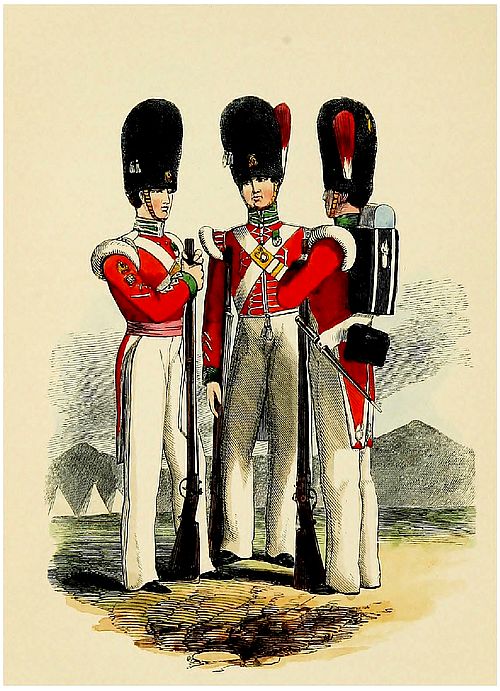
FIFTH REGIMENT OF FOOT (NORTHUMBERLAND FUSILIERS), M DCCC XXXV.
1836
His Majesty King William IV. having been pleased,
in 1836, to approve of the corps being equipped as Fusiliers,
and designated the "Fifth Regiment of Foot,
or Northumberland Fusiliers;" commissioned the
Ensigns as second Lieutenants accordingly, and gave his
Royal permission that the word "Wilhelmsthal," in
commemoration of the field on which it originally took
its grenadier caps from the enemy, should be borne on its
colours and appointments, as will appear by the subjoined
copies of letters.
"Horse-Guards, 4th of May, 1836.
"Sir,
"I have the honour to acquaint you, by direction
of the General Commanding-in-Chief, that his Majesty
has been graciously pleased to approve of the Fifth
or Northumberland Regiment of Foot, being in
future equipped as a Fusilier Regiment, and being
styled the Fifth Regiment of Foot, or Northumberland
Fusiliers.
"I have, &c.
(Signed) "John Macdonald,
"Adjutant-General.
"Officer commanding the Fifth Regiment of Foot,
"or Northumberland Fusiliers."
"Horse-Guards, 14th of May, 1836.
"Sir,
"I have the honour to acquaint you, by direction
of the General Commanding-in-Chief, that his
Majesty has been graciously pleased to permit the
Fifth Regiment of Foot, or Northumberland
Fusiliers, to bear on its colours and appointments,
in addition to any other badges or devices which may
have heretofore been authorized, the word 'Wilhelmsthal,'
in commemoration of the gallantry displayed
by the regiment while serving with the allied army,
under Prince Ferdinand of Brunswick, at the battle of
Groebenstein, on the 24th of June, 1762, particularly
in the capture of a great number of prisoners belonging
to the grenadiers of France, and the regiment
d'Aquitaine, in the woods of 'Wilhelmsthal.'
"I have, &c.
(Signed) "John Macdonald,
"Adjutant-General.
"Officer commanding Fifth Foot,
"or Northumberland Fusiliers,
"Malta."
On the 14th of December, 1836, the Governor of
Malta, Major-General Sir Henry Bouverie, presented
the new colours to the regiment, drawn up for the purpose
in review order on the Florian Parade.
His Excellency, on arriving in front of the line, was
received with a general salute, the band playing and
drums beating, after which the company on the right
flank closed ranks, and was marched by its Captain in
quick time (the band playing the grenadier's march) to
the point in the front of the line, where the new colours
were stationed, under a guard, and an escort of colour-serjeants;
on arriving at which the company was halted,
its ranks opened, and the colours, which appeared for
the first time displayed, were saluted with presented
arms, the music playing "God save the King."
The march was then resumed in open order, and the
colours escorted in slow time towards the left flank of
the line, and thence to their appointed station in front of
the centre, whilst the band and escort filed through the
ranks to their posts on the right; the colours were received
by a general salute from the regiment; arms were
then shouldered, three sides of a square, open to the
front, formed, and the service of consecration read in a
most appropriate and impressive manner by the Rev.
J. T. H. Le Mesurier, Chaplain to the Forces; the
children of both sexes of the soldiers of the regiment,
attired in uniform suits of new clothes that had lately
been presented to them, repeating the responses.
Prayers being ended, His Excellency Sir Henry
Bouverie handed the colours to the Lieutenants, under
a general salute from the square, and then addressed the
regiment in nearly the following terms:—
"Officers and Soldiers of the Fifth Fusiliers,
"I am happy that it has fallen to my lot to present
to you these colours. I do it in the full confidence
that they will never be disgraced by insubordination, by
loss of discipline, or misconduct in garrison, or in the
field.
"The glorious deeds which are recorded in your
annals, and inscribed upon these colours, will serve to
incite in you the determination to equal them; to
surpass them I believe to be impossible.
"The inspection, which I shall this day finish, of your
regiment, will, I have no doubt, furnish me with the
opportunity of reporting my entire satisfaction with
the interior economy and management of the regiment,
as well as with your movements in the field; and I
trust that I shall never have occasion to alter the high
opinion I have formed of you, not only here, but in
scenes on service, of which I was myself a witness."
His Excellency having concluded his appropriate
address, Lieutenant-Colonel Sutherland replied to the
following purport.
"Permit me, Sir, on behalf of myself and the regiment,
to return our best thanks for the very kind and flattering
terms in which you have been pleased to present
these colours. It must be a great additional
source of gratification to all ranks to receive so honourable
a charge from the hand of a distinguished
officer, who, having personally witnessed the regiment
in conflict with the enemy, can therefore duly appreciate
its conduct; and this will doubtless prove a
strong incitement to such a discharge of their duty,
whenever they may have the good fortune to be similarly
circumstanced, as will emulate those deeds to
which your Excellency has so handsomely alluded."
The square was then reduced, and his Excellency
having rode down the line, ranks were closed, open column
formed, and the review commenced by marching
past in slow and quick time, and in column at quarter
distance. The manual and platoon exercises (the latter
also kneeling as light infantry) were then performed,
under the orders of Brevet Major Johnson, after which
the Lieutenant-Colonel put the regiment through a
variety of manœuvres and firings, in close, extended, and
skirmishing order, of which his Excellency expressed his
unqualified approbation.
In the evening his Excellency dined with the officers
of the regiment at the mess, where a large party of about
fifty persons, consisting of Vice-Admiral Sir Josias
Rowley, the Captains of the squadron, commanding
officers of corps, heads of departments, and staff, was
assembled to meet him.
On the following Sunday the colours were, according
to custom on such occasions, taken with the regiment to
church; when the duties of soldiers, both as men and
Christians, were inculcated by the chaplain to the forces
in the most impressive manner.
1837
The regiment embarked from Malta on the 28th of
March, 1837, and arrived on the 4th of April following
at Corfu, where it has continued until the end of the
year 1837, which brings this memoir to a conclusion.
The foregoing pages show that the Fifth Regiment
of Foot, or Northumberland Fusiliers, has preserved
by its conduct in time of peace, untarnished, the
laurels which it has acquired in war. Soon after its
formation it availed itself of the opportunities which
then occurred of acquiring a reputation for gallantry in
action; and, under the influence of zealous officers and
an excellent esprit de corps, it has conducted itself, in
the various situations in which it has been placed during
a period of more than one hundred and sixty years,
so as to preserve its character and acquire additional
honour. The distinctions which have, from time to time,
been conferred on this corps, show the estimation in
which its services are held:—the inscriptions which it
bears on its colours are memorials of its gallantry in
battles and sieges, where the British troops have acquired
never-fading laurels, and have elevated the military
character of their country, to the admiration of the
nations of Europe.
The Compiler of the Records of the Army feels it his duty to
state, that Colonel Sutherland, of the Fifth Foot, or Northumberland
Fusiliers, has evinced great zeal and devotedness in
procuring information on all subjects in which the honour of his
regiment is concerned, and furnished a statement of its services
which has facilitated the preparation of this narrative for publication.
The most effective assistance has also been afforded by
Captain John Spence, of the same regiment, in the completion of
this memoir.
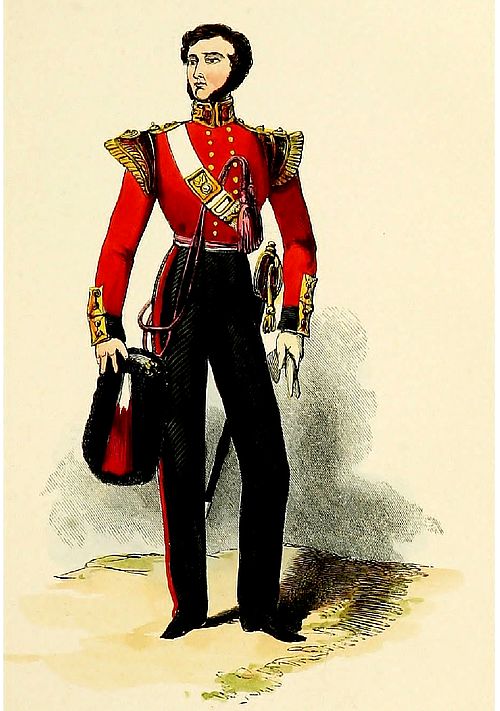
FIFTH REGIMENT OF FOOT (NORTHUMBERLAND FUSILIERS), M DCCC XXXVII.
[To face page 106.