OF THE
FIFTEENTH, OR YORKSHIRE EAST RIDING
REGIMENT OF FOOT.
1685
Peace with foreign nations and tranquillity at home,
accompanied by improvements in the domestic and
commercial interests of the kingdom, followed the accession
of King James II. to the throne, in February,
1685; but few months elapsed before James Duke of
Monmouth appeared as a competitor to the throne,
and raised an army in the west of England. The
King immediately augmented his regular forces; and
among the corps then raised was the regiment which
now bears the title of the Fifteenth Regiment of
Foot.
This corps was raised in Nottinghamshire and the
adjoining counties, the general rendezvous being at
Nottingham; and the several companies of which it
was composed were raised by the following gentlemen:— Sir
William Clifton, —— Cotter, —— Baker,
William Barnes, William Dobyns, Thomas Fowke,
John Stanhope, —— Warren, William Stow, and
Roger Kirkby. Sir William Clifton was appointed
colonel by commission dated the 22nd of June, 1685;
Captain Cotter was appointed to be lieut.-colonel, and
Captain Baker to be major.
While many loyal men were arraying themselves
under the King's banner, and the several companies
of the regiment were making rapid progress towards
being completed in numbers, the rebel army was overthrown
at Sedgemoor, and the Duke of Monmouth was
afterwards captured and beheaded.
In August, the regiment marched from Nottingham
to Hounslow, and pitched its tents on the heath;
where it was reviewed by the King, who thanked the
officers and soldiers for the readiness they had evinced
to support the Crown at the moment of danger: it
afterwards marched to London, was quartered for a
short period in Moorfields, and in September proceeded
to Carlisle, North Shields, Landguard Fort, and Scarborough
Castle, where it passed the winter.
1686
The King, having resolved to retain the regiment
in his service, fixed its establishment, by warrant
under the sign-manual, bearing date the 1st of January,
1685–6, at the following numbers and rates of pay
(see p. 3).
In the spring, the regiment proceeded into Yorkshire,
and was quartered at York, Hull, &c.
Colonel Sir William Clifton retired from the service,
and was succeeded by Colonel Arthur Herbert, afterwards
Earl Torrington, by commission dated 12th
of May, 1686.
1687
The regiment passed this year in the north of
England; in February, 1687, it marched to Kingston-upon-Thames,
from which detachments proceeded to
Windsor, to mount guard at the castle. At the same
time a grenadier company was added to the establishment.
| |
| Colonel Sir William Clifton's Regiment. | Pay per day. |
| |
| | |
| Staff. | £. | s. | d. |
| |
| The Colonel, as Colonel | 0 | 12 | 0 |
| Lieut.-Colonel, as Lieut.-Colonel | 0 | 7 | 0 |
| Major, as Major | 0 | 5 | 0 |
| Chaplain | 0 | 6 | 8 |
| Chirurgeon 4s., his Mate 2s. 6d. | 0 | 6 | 6 |
| Adjutant | 0 | 4 | 0 |
| Quarter-Master and Marshal | 0 | 4 | 0 |
| |
| Total for Staff | 2 | 5 | 2 |
| |
| | |
| The Colonel's Company. | |
| |
| The Colonel, as Captain | 0 | 8 | 0 |
| Lieutenant | 0 | 4 | 0 |
| Ensign | 0 | 3 | 0 |
| 2 Serjeants, 1s. 6d. each | 0 | 3 | 0 |
| 3 Corporals, 1s. each | 0 | 3 | 0 |
| 1 Drummer | 0 | 1 | 0 |
| 50 Soldiers, 8d. each | 1 | 13 | 4 |
| |
| Total for one Company | 2 | 15 | 4 |
| |
| Nine Companies more at the same rate | 24 | 18 | 0 |
| |
| Total per day | 29 | 18 | 6 |
| |
| Per Annum £10,922 12s. 6d. | |
| | |
On the 12th of April, Colonel Herbert was succeeded
in the command of the regiment by Colonel Sackville
Tufton, brother to the Earl of Thanet.
At this period, the following officers were holding
commissions in the regiment:—
| Captains. | Lieutenants. | Ensigns. |
| —— | —— | —— |
| Sackville Tufton (col). | William Sandys. | Joshua Dereham. |
| Rupert Billingsby (lt.-col). | Pierce Row. | John Davies. |
| Edward Nott (major). | Ralph Philips. | Charles Reke. |
| John South. | William Hussey. | Thomas Whetham.[6] |
| William Stow. | Matthew Rugby. | William Lascels. |
| William Barns. | John Thornill. | Robert Adams. |
| John Stanhope. | John Dakeyns. | John Graydon. |
| Thomas Fowkes. | James Prince. | John Larson. |
| William Dobyns. | Michael Baker. | John Price. |
| Roger Kirkby. | Peter Ashton. | William Kirkby. |
| Sackville Tufton, | { | John Baron. | } | Grenadier Company. |
| { | Andrew Armstrong. | } |
| Charles Pharley, Chaplain. | Robert Baker, Chirurgeon. |
| Gregory Broom, Adjutant. | Thomas Gibbons, Quarter-Master. |
1688
In June, the regiment again pitched its tents on
Hounslow Heath, where it took part in several military
spectacles, exhibited in the presence of the royal family;
and afterwards marched into quarters in Norfolk. It
once more encamped on Hounslow Heath in the summer
of 1688, and subsequently proceeded to Berwick,
where it arrived in September. An officer of the regiment
states in his memoirs, 'I sojourned two peaceable
campaigns on Hounslow Heath; where I was an
eye-witness of one mock siege of Buda; after which
our regiment was ordered to Berwick.'[7]
At this period, England was in an agitated state;
the proceedings of the King in favour of papacy and
arbitrary government had occasioned many noblemen
and gentlemen to invite the Prince of Orange to come
to England with an army, to enable them to oppose
the Court. The Prince arrived in November; the
King fled to France; and the Prince assumed the reins
of government.
Colonel Tufton, not agreeing with the new order of
things, was succeeded in the command of the regiment
by Colonel Sir James Lesley, by commission dated the
31st of December, 1688.
1689
The Prince and Princess of Orange having been
elevated to the throne by the title of King William the
Third and Queen Mary, their accession was opposed in
Scotland, where the Duke of Gordon held the Castle
of Edinburgh in the interest of King James, and Viscount
Dundee aroused the Highland clans to arms. In consequence
of these proceedings, the regiment was ordered
to Scotland, in the spring of 1689; and it was stationed
at Leith, as a reserve and support to the troops blockading
Edinburgh Castle, until the beginning of June,
when it was ordered up the country to join the forces
under Major-General Mackay, who was retreating
before the Highlanders under Viscount Dundee. The
regiment joined Major-General Mackay about six
o'clock on the evening of the 5th of June; other troops
also arrived, and the major-general being thus reinforced,
advanced against the clans, who instantly
retired towards the mountain fastnesses. The Fifteenth
foot followed the retreating Highlanders to
the borders of the wilds of Lochaber, and afterwards
proceeded to Inverness, where the regiment was stationed
some time.
Captain Carleton states in his memoirs: 'We
marched to Inverness, a place of no great strength,
where we lay two long winters, perpetually harassed
upon parties, and hunting of somewhat wilder than
their wildest game,—the Highlanders, who were, if not
as nimble-footed, yet fully as hard to be found.'
While the regiment was at Inverness, the battle of
Killicrankie was fought, in which the King's troops were
defeated, and Viscount Dundee was killed. He was
succeeded by Major-General Cannon.
1690
In April, 1690, Brigadier-General Sir Thomas
Livingstone, who commanded at Inverness, ascertained
that a general rendezvous of the clans was appointed
to take place at Strathspey, from whence they purposed
descending in a body into the Lowlands; and that two
thousand men, under Major-Generals Cannon and
Buchan, would arrive at Cromdale on the 30th of April;
he therefore advanced with the royal Scots dragoons
(Greys), Fifteenth foot, and some detachments, to
attack the Highlanders. At dusk, on the evening of
the 30th of April, the troops arrived within two miles
of Balloch Castle; they traversed the difficult defile
in the dark, and arriving at the castle, had the camp-lights
of the enemy, on a plain beyond the Spey, pointed
out to them; when, notwithstanding the fatigue they
had undergone, the soldiers expressed a wish to be
led forward. After a halt of half an hour for refreshment,
the troops crossed the Spey at a ford, and
advanced towards the camp, when several small
parties of Highlanders were seen attempting to escape
towards the hills, and a squadron of the Greys galloped
forward to intercept the fugitives. The soldiers rushed
into the camp and commenced the work of destruction;
at the same time a party of the Fifteenth attacked
the enemy's guard at Cromdale-church. The Highlanders,
suddenly aroused from sleep, endeavoured to
escape without clothes, and through the misty dawn
numbers were seen running in every direction, some
attempting to escape on any terms, and others defending
themselves stoutly with sword and target, against
the dragoons, and soldiers of the Fifteenth foot, who
made great slaughter. Major-Generals Cannon and
Buchan were taken by surprise as much as their men,
and the one escaped with his shirt and night-cap only,
and the other without coat, hat, or sword. 'We pursued
them till they got up Cromdale-hill, where we
lost them in a fog; and to me, at that instant of time,
they seemed rather to be people received up into
the clouds, than flying from an enemy.'[8]
The enemy had placed a small garrison in Lethindy
Castle, which was summoned to surrender; but the
Highlanders fired upon the party, and wounded three
grenadiers of the Fifteenth foot. Lieut. Carleton,
of the regiment, proceeded to an old house near
the castle, from whence he threw two or three hand-grenades
into the works, which so alarmed the enemy,
that they instantly surrendered. About three hundred
Highlanders were killed on this occasion, and one hundred
taken prisoners: a standard, which had been
unfurled a few days previously for King James, was
captured. The loss of the King's troops was limited to
a few horses killed and wounded and five men
wounded.[9] 'This happened on May-day, in the morning;
for which reason we returned to Inverness with
our prisoners and boughs in our hats; and the Highlanders
never held up their heads so high after this
defeat.'
'General Mackay having received orders to build a
fort at Inverlochy, our regiment was commanded to
that service. The two regiments appointed to the
same duty, with some dragoons, having joined (in
June), we marched together through Lochaber. This
surely is the wildest country in the Highlands, if not
in the world; I did not see one house in all our march;
and the economy of the people, if I may call it such,
is much the same with that of the Arabs or Tartars.
In this march, or rather, if you please, most dismal
peregrination, we could rarely go two abreast; so
that our very little army had sometimes an extent of
many miles; our enemy, the Highlanders, firing down
upon us, from the summits of the mountains, all the
way. Nor was it possible for our men, or very rarely
at least, to return their favours with any prospect of
success; for, as they popped upon us always on a
sudden, they never staid long enough to allow any of
our soldiers a mark, or even time enough to fire: and,
for our men to march or climb up those mountains,
which to them were natural champaign, would have
been as dangerous as it appeared to us impracticable.
Nevertheless, under all these disadvantages, we arrived
at Inverlochy, and there performed the task
appointed, building a fort on the same spot where
Cromwell had raised one before: and, which was not a
little remarkable, we had with us one Hill, a colonel,
who had been governor in Oliver's time, and who was
now again appointed governor by General Mackay.
Thus the work on which we were sent being effected,
we marched back again by the way of Killicrankie,
where that memorable battle had been fought, under
Dundee, the year before.'[10]
1691
After its return from Inverlochy, the regiment was
stationed some time at Inverness; where Lieutenant
Carleton was rewarded with a commission of captain
in Brigadier-General Tiffin's regiment (now twenty-seventh
foot) for his distinguished conduct at the action
at Cromdale. Defeated on every occasion, and overawed
by numerous garrisons, the Highlanders lost all
hope of success, and in 1691 they tendered their submission
to King William. A proclamation was afterwards
published, offering indemnity and pardon to all
who should cease opposition to the government and
take the oath of allegiance, before the 1st of January,
1692.
1692
Tranquillity being thus restored in Scotland, the
regiment became disposable for other service; it, however,
remained in the northern districts of the kingdom
during the year 1693.
1693
In the meantime, the British Monarch was engaged
in war to arrest the progress of the French aggressions
on the continent. The King of France brought an
army of superior numbers into the field, and gained
several advantages.
1694
The allies made strenuous exertions to raise new
levies, augment the strength of their contingents, and
to turn the balance of war in their favour; the
Fifteenth foot was one of the corps selected to proceed
on foreign service. The regiment embarked from
Scotland in the spring of 1694, and landed at Ostend,
marched from thence to Malines, where it was stationed
until the army took the field.
In the beginning of June, the British train of
artillery arrived at Malines, from whence it advanced
under the escort of the twelfth, Fifteenth, and
Buchan's (afterwards disbanded) regiments, and joined
the army under King William in person, at the camp
at Hertogendale, on the 6th of June. The tenth,
fourteenth, Fifteenth, seventeenth, Castleton's, and
Lauder's (afterwards disbanded) regiments, were
formed in brigade under Brigadier-General Stuart,
in the division under Major-General Bellasis.
The regiment took part in the operations of this
campaign, and the numbers of the confederate forces
were so far augmented, that the progress of French
conquest was arrested, the enemy was forced to act
on the defensive, and in the autumn the allies besieged
and captured the fortress of Huy. The Fifteenth
formed part of the covering army during the
siege; and afterwards marched to Dixmude, where
they halted a few days, and subsequently went into
cantonments in the villages along the canal of Nieuport,
where they were stationed during the winter.
1695
From these quarters, the regiment was called in
May, 1695, to enter upon the active services of another
campaign, and it pitched its tents near Dixmude,
where a small force was assembled under Major-General
Ellemberg; at the same time the main army took
the field under King William. In June, the Duke
of Wirtemburg took the command of the troops at
Dixmude; reinforcements also arrived; and an attack
was made on Fort Kenoque, situated at the junction of
the Loo and Dixmude canals, with the view of drawing
the French forces to the Flanders side of their
fortified lines, to favour the design of besieging
Namur. On the 9th of June, the grenadiers of the
Fifteenth, and other corps employed on this enterprise,
drove the enemy from the entrenchments and
houses near the Loo canal; and the attempts made by
the French to regain this post were repulsed. A redoubt
was afterwards taken, and a lodgment effected
on the works at the bridge, in which service the regiment
had several men killed and wounded. These
attacks produced the desired effect; the fortress of
Namur was invested, and the attack on Fort Kenoque
was soon afterwards desisted from, when the Fifteenth
regiment returned to Dixmude.
During the early part of the siege of Namur, the Fifteenth
foot, commanded by their colonel, Sir James
Lesley, were in garrison at Dixmude, a fortress of very
little strength, under Major-General Ellemberg, a
foreign officer. On the 15th of July, this place was
invested by a strong division of the French army,
under General de Montal, who commenced the siege
with vigour. Major-General Ellemberg failed to
make that spirited opposition to the enemy which the
circumstances of the case called for: he appeared to
view the progress of the besieging army with apathy;
and eventually called a council of war, to which he
advanced several reasons why the town could not be
defended, and proposed to capitulate to save the garrison,
which was agreed to by the majority of the council
of war, although opposed by others. When the soldiers
were informed they were to become prisoners of
war, they became enraged at not being permitted to
defend the place, many of them broke their arms to
pieces, and some tore their regimental colours from
the staves, that they might not be delivered to the
enemy. D'Auvergne states, in his history of this
campaign,—'The body of the garrison had the same
heart and soul with their comrades which did such wonders
before Namur;' but the soldiers were delivered
into the power of the enemy against their will.
The soldiers of the Fifteenth were sent prisoners
to Ypres; the conditions of the cartel were afterwards
violated by the enemy; the British were sent to Arras,
Bethune, Bouchain, &c., the officers were placed in
close confinement, and attempts were made to induce
the men to enter the French service.
When the castle of Namur surrendered, the garrison
was permitted to march out with the honors of
war; but Marshal Boufflers was arrested, and detained
until the British and other soldiers of the allied army,
kept prisoners contrary to the cartel, were released.
This produced the desired effect; the Fifteenth rejoined
the army, and marched into quarters at the
town of Damme, where they received new arms and
equipment.
All the officers concerned in the surrender of Dixmude,
were tried by a general court-martial: Major-General
Ellemberg was sentenced to be beheaded, and
executed at Ghent on the 20th of November. Colonel
Sir James Lesley, and several other officers were
cashiered.
King William conferred the colonelcy of the Fifteenth
regiment on Colonel Emanuel Howe, from
captain and lieut.-colonel in the first foot guards.
1696
After passing several months at Damme, and receiving
a detachment of recruits from England, the
regiment marched, early in 1696, to Bruges, where it
was left in garrison when the army took the field. On
the 20th of May, it marched out of Bruges, and pitched
its tents along the banks of the canal, where it was
posted several weeks.
The regiment served the campaign of this year with
the army of Flanders, under the Prince of Vaudemont;
it was formed in brigade with a battalion of the royals,
the twelfth, and Collingwood's (afterwards disbanded)
regiments, under Brigadier-General the Earl of
Orkney; and was stationed, during the summer, along
the banks of the Bruges canal, to cover Ghent,
Bruges, and the maritime towns of West Flanders,
which service was fully accomplished.
In the autumn, the regiment marched into garrison
at Bruges, where five regiments of cavalry and eleven
of infantry were stationed during the winter.
1697
On the 13th of March, 1697, the regiment quitted
Bruges, and proceeded to Brussels, from whence it
advanced, through the forest of Soignies, and pitched
its tents near the village of Waterloo. It served the
campaign of this year with the army of Brabant,
under King William; and brought into the field forty
officers, thirty-four serjeants, twenty-five drummers,
sixty-three grenadiers, one hundred and sixty pikemen,
and five hundred and eighty musketeers (including
men detached). The Fifteenth, seventeenth, twenty-seventh,
Collingwood's, and Saunderson's (afterwards
disbanded) regiments, were formed in brigade under
Brigadier-General Tiffin, in the division commanded
by Lieut.-General Sir Henry Bellasis.
The regiment took part in the operations of the campaign;
and when the French commanders menaced
Brussels with a siege, the Fifteenth marched with
the army, from Waterloo through the forest, during
the night of the 22nd of June, in dark and tempestuous
weather, and taking post before that city, was
instrumental in defeating the designs of the enemy.
After the regiment had been encamped before Brussels
nearly three months, hostilities were terminated
by the treaty of Ryswick; and the efforts of the
British monarch, to arrest the progress of French conquests
and preserve the liberties of Europe, were thus
attended with success. The restoration of peace being
accomplished, the regiment proceeded in boats down
the canal to Bruges, and during the winter it embarked
for England.
1698
The regiment was placed upon a peace establishment;
and, in 1698, it proceeded to Ireland, where
it was stationed during the two following years.
The respite from war, ceded to Europe by the
treaty of Ryswick, was of short duration. The
French monarch, continuing to pursue schemes of
aggrandizement, by which he had long agitated
Christendom, procured the accession of his grandson,
Philip Duke of Anjou, to the throne of Spain,—seized
on the Spanish provinces in the Netherlands,—and
detained the Dutch troops which were in garrison
in the barrier towns. These proceedings produced
a violent sensation throughout Europe: the house of
Austria claimed the Spanish monarchy, and declared
war against France; the Dutch solicited British aid;
and the Fifteenth Foot was one of the corps which
proceeded to Holland on this occasion.
1701
The regiment was augmented to eight hundred and
thirty, officers and soldiers; and embarking from Cork
on the 15th June, 1701, arrived at Helvoetsluys, on the
island of Voorn, in South Holland, on the 8th of July.
From this place the regiment proceeded up the Maese,
in small vessels, to Gertruydenberg and Huesden, where
it was stationed two months, and afterwards proceeded
to the vicinity of Breda, and encamped on the heath.
On the 21st of September, the regiment was reviewed,
with the other British troops in Holland, by King
William III., on Breda heath, and afterwards returned
to its former quarters, where it was stationed during
the winter.
1702
On the 10th March, 1702, the regiment marched
out of garrison, and proceeded to Rosendael, where
the British infantry encamped under Brigadier-General
Ingoldsby. At this place, the troops received
information of the death of King William, on the 8th
of March, and of the accession of Queen Anne, to
whom they took the oath of fidelity.
The fortress of Kayserswerth, on the Lower Rhine,
was occupied by the French, and this place was besieged
by the Germans, under the Prince of Saarbruck,
in the middle of April; the British marched across the
country to the duchy of Cleves, joined a body of Dutch
and Germans under the Earl of Athlone, and encamped
at Cranenburg, on the Lower Rhine, to cover the siege.
A French force of superior numbers, commanded by
the Duke of Burgundy and Marshal Boufflers, made
a rapid advance through the forest of Cleves, and
along the plains of Goch, to cut off the communication
of the troops at Cranenburg, with Grave and Nimeguen;
when the allied army struck its tents a little before
sunset, and making a rapid march throughout the
night, arrived within a few miles of Nimeguen about
eight o'clock on the morning of the 11th of June; at
the same time, the French appeared on both flanks and
the rear, hurrying forward to surround the allies.
Some sharp skirmishing occurred, and the British
corps, forming the rear-guard, evinced great gallantry;
they took possession of some hedges and buildings, and
held the enemy in check while the army effected its
retreat under the walls of Nimeguen.
The regiment remained at Nimeguen a short time.
Queen Anne declared war against France and Spain;
additional troops arrived from England; and the Earl
of Marlborough assumed the command of the allied
army. The Fifteenth foot took part in the operations
of this campaign: the French avoided a general
engagement, and retired from the frontiers of Holland,
and the British general commenced operations against
the fortresses in possession of the enemy, on the banks
of the Maese.
The Fifteenth foot formed part of the covering
army during the siege of Venloo, which town surrendered
on the 25th of September. The services of the regiment
were afterwards connected with the siege and
capture of Ruremonde, in the early part of October;
and the Fifteenth foot was also one of the corps which
advanced to the city of Liege, took possession of that
place, and undertook the siege of the citadel. The
grenadiers of the regiment took part in the storm of
the citadel of Liege, on the 23rd of October, on which
occasion the British soldiers highly distinguished
themselves, and captured the place in gallant style. A
detached fortress, called the Chartreuse, surrendered a
few days afterwards: and these conquests terminated
the campaign. The regiment quitted the pleasant
valley of Liege on the 3rd of November, and marched
back to Holland, where it passed the winter in garrison.
1703
From their pleasant quarters among the Dutch
peasantry, the soldiers of the Fifteenth foot were
called, in the spring of 1703, to participate in the
achievements of another campaign; and while the Duke
of Marlborough was besieging Bonn, they directed their
march towards the Maese; and they were in position
before Maestricht, when the French army, under Marshals
Villeroy and Boufflers, approached that place; but
after some cannonading and skirmishing, the enemy
withdrew, without hazarding a general engagement.
After the surrender of Bonn, the allied army assembled
at Maestricht, and the Fifteenth were formed in brigade
with a battalion of the foot guards, a battalion of the
royals, and the ninth, twenty-third, and twenty-fourth
regiments, under Brigadier-General Withers, in the division
commanded by Lieut.-General Churchill. The
French forces taking post behind their fortified lines,
operations were continued against their fortified towns,
and the services of the Fifteenth foot were connected
with the siege and capture of Huy, a fortress in the
valley of the Maese, which surrendered on the 25th of
August. The regiment also participated in the services
connected with the siege of Limburg, and this
fortress surrendered on the 28th of September. After
these conquests, the regiment marched to Dutch
Brabant, and passed several months in garrison.
1704
In the early part of 1704, a detachment of the regiment
proceeded to Maestricht, to take part in the
duties of that garrison, while the Dutch troops were
working at the fortifications on the heights of Petersberg.
In the meantime, the progress of the war had assumed
an unfavourable aspect in Germany; the Elector
of Bavaria had embraced the French interest, and
having been joined by a numerous body of the forces
of Louis XIV., he had gained considerable advantage
over the army of the empire. Under these circumstances,
the Duke of Marlborough resolved to lead the
British troops from the ocean to the Danube, and
make a powerful effort to change the fortune of the
war, in the heart of Germany.
To engage in this splendid enterprise, which was
replete with important results, the Fifteenth foot
marched towards the Rhine in the early part of May,
and were joined at Bedburg by the detachment from
Maestricht. The designs of the British commander
were secret; the object, for which the movements were
made, held Europe in perplexing anxiety, suspended
the operations of the Elector of Bavaria, and confounded
the French Generals; and the moment the
advance assumed a specific direction, the enemy was
no longer able to render the plan abortive. Arriving
in the heart of Germany, the regiment was formed in
brigade with a battalion of the royals, and the twenty-sixth
and thirty-seventh regiments, and this brigade
was posted in the second line.
At three o'clock on the morning of the 2nd of July,
the army advanced in the direction of Donawerth, to
attack a body of French and Bavarians under Count
d'Arco, in an entrenched camp on the heights of
Schellenberg, on the left bank of the Danube. Arriving
in front of the enemy's position, the attack was commenced
about six in the evening, by a detachment
from each British corps, and the foot guards, royals,
and twenty-third regiments. The difficulty of the
ground,—the formidable preparations of the enemy,—and
the steady bravery of the Bavarians, occasioned
this to prove a particularly severe contest; but the
determined assaults of the British soldiers shook the
strength and weakened the resistance of the enemy;
and eventually the soldiers of the allied army overpowered
all resistance, captured the heights, and pursued
the French and Bavarians across the Danube,
capturing sixteen pieces of artillery, a number of
standards and colours, with the enemy's tents, and the
equipage and plate of the Bavarian commander.
The Fifteenth regiment shared in this splendid
triumph of the British arms on the banks of the Danube.
Its loss was one serjeant and nine rank and file killed;
Captains Bolton and Lesley, Lieutenant Morris, three
serjeants, and nineteen rank and file wounded.
After this victory the army penetrated the country
of Bavaria, and the Elector concentrated his forces at
Augsburg, where he formed an entrenched camp. The
Fifteenth regiment advanced to the vicinity of Augsburg;
but the fortified camp was found too strong to
be attacked with any prospect of success, and the
troops retired a few stages; the Germans commencing
the siege of Ingoldstadt, and the British troops forming
part of the covering army.
The Elector of Bavaria quitted his entrenched camp,
and joined the reinforcements sent him by the French
monarch; the united armies encamping near the village
of Blenheim, in the valley of the Danube.
Commanding soldiers whose chivalrous spirit panted
for distinction in the shock of battle, the British general
led his columns forward, on the morning of the memorable
13th of August, 1704, in full confidence in the
firmness and prowess of his troops. About mid-day a
column, of which the Fifteenth foot, under Lieut.-Colonel
William Britton, formed part, developed its
attack against the enemy's right, under Lieut.-General
Lord Cutts and Major-General Wills. The tenth,
Fifteenth, twenty-first, twenty-third, and twenty-fourth
regiments, under Brigadier-General Row, led
the attack in gallant style, followed by four battalions
of Hessians, and supported by eleven battalions of infantry,
and fifteen squadrons of horse and dragoons.
This column proceeded to the banks of the little river
Nebel, and took possession of two water-mills, which the
enemy had evacuated and set on fire; then advancing
through the enclosures, made a determined attack on
the French troops posted in the village of Blenheim;
Brigadier-General Row striking his sword into the
enemy's pallisades before he gave the word "fire."
The assault was made with spirit and resolution, but
the brigade was unable to force the entrenchments
against the superior numbers of the enemy; and while
retiring it was charged by the French troopers, who
were repulsed by the Hessian brigade. After repeated
attempts on the village had proved unavailing, a few
corps blockaded the avenues; the army traversed the
rivulet, and attacking the French position along the
front, engaged in a sanguinary conflict. The combat
of musketry, and the charges of the cavalry, were continued
with varied success; and amidst this storm of
war, the Fifteenth regiment had repeated opportunities
of distinguishing itself. Eventually the legions
of the enemy were overpowered, driven from the field
with great slaughter, and the loss of many officers and
men taken prisoners, among whom was the French commander,
Marshal Tallard.
The main body of the French army being defeated
with the loss of its artillery and baggage, the troops
posted in Blenheim attempted to escape by the rear of
the village; but were repulsed. They were environed
on every side, and being unable to effect their escape,
twenty-four battalions of infantry, and twelve squadrons
of cavalry, surrendered prisoners of war. Thus ended
the mighty struggle of this eventful day. Bavaria was
subdued; the German empire was delivered from the
menaced danger; the terrors of the British arms alarmed
the states of Italy which supported the Bourbon cause;
and the tide of war flowed prosperously in the interest
of the allies.
Major Cornwallis, Captain Tankard, Lieutenants
Kerr and Simpson, and Ensign Jackson, of the Fifteenth
regiment, were killed; Lieut.-Colonel Britton,
Major Armstrong, Captains Villebonne and Gaston,
Lieutenants Barton, Dickenson, and Harrison, Ensigns
Lesley, Hargrave, Edwards, Dean, Patrick, and Dawson,
wounded: the number of non-commissioned officers
and soldiers of the regiment killed and wounded, has
not been ascertained.
After this victory, the army traversed the country
in triumph; the enemy abandoning several important
cities and towns, which were taken possession of by the
allies. The Fifteenth regiment proceeded through
the circle of Suabia, and directed its march on Philipsburg,
where it crossed the Rhine on the 7th of September,
and was subsequently encamped at Croon-Weissemberg,
forming part of the covering army during
the siege of Landau by the Germans. At the termination
of this splendid campaign, the regiment struck
its tents, and embarking in boats on the Rhine, sailed
down that river to the Netherlands, where it passed
the winter.
1705
In the spring of 1705, the losses of the preceding
campaign were replaced by the arrival of one hundred
and fifty recruits from England; and when the regiment
took the field, its appearance and efficiency were
commended by the Duke of Marlborough at the general
review of the army. The regiment proceeded, in
the first instance, to the vicinity of Maestricht,—afterwards
marched to Juliers, from whence it traversed a
mountainous country to the valley of the Moselle, and
towards the end of May pitched its tents near the ancient
city of Treves. In the early part of June, the
army passed the Moselle and Saar rivers, and the
English general was prepared to carry on the war in
Alsace. The co-operation of the imperialists under
the Margrave of Baden was, however, so long delayed
that the British commander was forced to return to the
Netherlands, to arrest the progress of the French arms
in that quarter. The regiment shared in the difficulties
of the retrograde movement to the Maese; and on
the return of the army, the French raised the siege of
the citadel of Liege and retired. The French had captured
Huy, during the absence of the army up the
Moselle; but this fortress was retaken in a few days.
The services of the regiment were next connected
with the forcing of the stupendous fortified lines constructed
by the French to cover the territory they had
seized upon in the Netherlands. These lines were
menaced by a detachment on the south of the Mehaine,
to draw the French army to that quarter; and were
afterwards passed, by a forced march in another direction,
during the night of the 17th of July, at Neer-Hespen
and Helixem. The French guards at these places
were surprised and overpowered early on the morning
of the 18th of that month, and the lines were forced
with little loss. The Marquis d'Allegre advanced
with a large body of French, Spanish, and Bavarian
infantry and cavalry, but he was repulsed with severe
loss. The Fifteenth were in reserve on this occasion.
They shared in the subsequent operations of the
campaign: but the designs of the English commander
being frustrated by the Dutch generals, the forcing of
the lines was not followed by such splendid results as
had been anticipated.
1706
After passing the winter in garrison in Holland, the
regiment again took the field in May, 1706, and had the
honour to serve at the battle of Ramilies, where the
forces of France, Spain, and Bavaria sustained a decisive
overthrow. This battle occurred on Whitsunday,
the 23rd of May. On the morning of that day, the
allied army was advancing in the direction of Mont St.
André; when the forces of the enemy were discovered
in position, with their centre at the village of Ramilies,
which was occupied by a numerous body of troops.
Having complete reliance on the valour of his soldiers,
the English general commenced the action, and in three
hours the numerous legions of the enemy were overthrown,
and driven from the field with a terrible slaughter.
Many prisoners, with cannon, standards, and
colours, were captured on this occasion.
The wreck of the French army fled to Louvain, and
immediately afterwards abandoned that city and also
Brussels. The States of Brabant, and the magistrates
of Brussels, renounced their allegiance to King Philip.
The principal towns of Brabant, and several places in
Flanders, were immediately delivered up, and others
surrendered on being summoned, or in a few days afterwards.
Ostend, Menin, Dendermond, and Aeth were
captured. Towns which had resisted numerous armies
for months and years, and provinces disputed for ages,
were the conquest of a summer. After sharing in these
splendid achievements, the regiment was placed in garrison
in Flanders.
1707
During the campaign of 1707, the services of the
regiment were limited to marching, and occupying
various encampments. No general engagement or
siege occurred.
1708
In the spring of 1708 the regiment was called from
its winter quarters in Flanders, in consequence of the
King of France having fitted out a fleet, and embarked
troops at Dunkirk, for the purpose of making a descent
on the British coast, in favour of the Pretender. The
Fifteenth, and several other regiments, marched from
Ghent on the 8th of March, 1708, embarked at Ostend
on the 15th, and arrived in England on the 21st; but
the French fleet, with the Pretender on board, having
been chased from the British shores by the English
navy, the regiment returned to Flanders: it landed
at Ostend on the 20th of April, and proceeded in boats,
along the canal, to Ghent.
Leaving its quarters towards the end of May, the
regiment joined the allied army, and was engaged in
the active operations which followed. The French
gained possession of Ghent and Bruges by treachery.
On the 11th of July, the regiment passed the Scheldt,
on a pontoon bridge, between Oudenarde and the abbey
of Eename, and engaged the French troops under the
Duke of Burgundy and Marshal Vendome, in the fields
and open grounds beyond the river. A fierce conflict
of musketry ensued; and charge succeeded charge
until the shades of evening gathered over the scene,
and the progress of the conflict could only be discerned
by the flashes of musketry, which pointed out the
ground on which the battle raged. The French were
forced from their position; part of their army was separated,
and nearly destroyed; but it was preserved
from complete annihilation by the darkness of the
night.
This victory prepared the way for additional conquests;
and the Fifteenth foot formed part of the
covering army during the siege of the important fortress
of Lisle, the capital of French Flanders, which was
defended by fifteen thousand men under Marshal
Boufflers. The regiment was in position when the
united French forces advanced to raise the siege, but
were frustrated by the superior tactics of the Duke of
Marlborough. The grenadier company of the regiment
joined the besieging army, and took part in the attacks
on the town.
When the Elector of Bavaria besieged Brussels, the
regiment formed part of the force which marched to
the relief of that city, passed the Scheldt, and carried
the enemy's positions beyond that river on the 27th of
November; which was followed by the retreat of the
enemy from before Brussels.
The citadel of Lisle surrendered on the 9th of December;
Ghent and Bruges were afterwards recaptured,
and the regiment had its winter quarters at Ghent.
1709
Having reposed a few months in quarters, and received
a body of recruits from England, the regiment
traversed the conquered territory to Lisle, in June,
1709, and afterwards took part in the manœuvres by
which Marshal Villars was induced to reduce the
strength of his garrisons in his fortified towns, to reinforce
a line of entrenchments and forts, in which he
expected to be attacked. This object gained, the
siege of Tournay was immediately commenced; and
the Fifteenth foot, commanded by Lieut.-Colonel
Andrew Armstrong, formed part of the covering
army; but when the town surrendered, the regiment
joined the besieging force, and took part in the attacks
on the castle. This proved a desperate service. The
citadel of Tournay was celebrated for the multiplicity
of its under-ground works, and the approaches were
carried on by sinking pits, and excavating subterraneous
passages to the enemy's casemates and mines.
The soldiers employed on these works were sometimes
drowned with water, suffocated by smoke, and buried
by explosions; and at other times parties of the besieging
force and of the garrison met, and fought
with sword and pistol in these gloomy labyrinths. In
these services the Fifteenth regiment had a number
of men killed and wounded; it also lost several men
from the explosion of a mine, which destroyed a battery.
On the 3rd of September, the citadel of Tournay
surrendered; and the army traversed the country towards
Mons, the capital of the province of Hainault,
leaving the Fifteenth and several other corps at
Tournay, to level the approaches and fill the excavations.
Immediately after this work was performed,
the regiment traversed the country towards Mons,
and joined the army, on the morning of the 11th of
September, at the moment the columns of attack
were advancing to assault the enemy's fortified position
at Malplaquet. This proved one of the most sanguinary
and hard-contested battles of the war: the
confident and fierce attacks of the allies were made
against formidable works, defended with resolution,
which occasioned a great sacrifice of life; but eventually
the position was forced, and the French army
retreated with the loss of many colours, standards,
cannon, and officers and soldiers made prisoners. The
Fifteenth were in reserve on this occasion, and its
loss was limited to Brevet Major Leslie, killed, and
three or four private soldiers killed and wounded.
This victory was followed by the siege of Mons, and
the regiment formed part of the covering army. The
garrison surrendered in October.
On the 23rd of October, Major-General Howe was
succeeded in the colonelcy of the regiment by Algernon
Earl of Hertford, afterwards Duke of Somerset, who
had served with reputation at several battles and
sieges on the continent.
1710
The regiment quitted its winter quarters at Ghent,
on the 14th of April, 1710, and marched to the rendezvous
of the army near Tournay. The services of the
Fifteenth foot were this year connected with the
forcing of the French lines at Pont-à-Vendin, and with
the siege and capture of Douay, which fortress surrendered
on the 27th of June. They subsequently
formed part of the covering army encamped at Villars-Brulin,
during the siege of Bethune. This place
having surrendered on the 29th of August, and the
French army avoiding a general engagement, the
fortresses of Aire and St. Venant were invested, and
taken; and these conquests were the last important
events of the campaign.
After taking part in these services, the regiment
marched into quarters at Courtray, where it was stationed
during the winter.
1711
Towards the end of April, 1711, the regiment advanced
from Courtray, and joining the army near
Douay, was formed in brigade with the foot guards, a
battalion of the royals, and the twentieth and twenty-third
regiments. It was reviewed on the 8th of June,
at the camp at Warde, by the Duke of Marlborough;
and afterwards took part in the skilful operations by
which the enemy's formidable and newly constructed
lines were passed at Arleux, on the 5th of August;
and this success was followed by the siege of Bouchain,
a fortified town of Hainault, situate on both sides of the
river Scheldt. The regiment formed part of a division
of twenty battalions of infantry, commanded by Lieut.-General
the Earl of Orkney, which took post on the
north and north-west side of the town and river; and
it shared in the duties of the trenches, and in carrying
on the attacks, in which services it had several men
killed and wounded. The garrison agreed to surrender
on the 13th of September.
Thus the French monarch found his armies defeated
and dispirited; his fortresses wrested from him, and the
victorious legions of the allies prepared to penetrate
the interior of his kingdom; and he sued for peace.
1712
In the spring of 1712 the Fifteenth regiment
took the field with the army under the Duke of
Ormond, who had been appointed to the command in
succession to the Duke of Marlborough, and advanced
to the frontiers of France. Negociations for peace
having commenced, a suspension of hostilities took place
between the British and French, and the regiment
returned to Ghent; from whence it was afterwards
removed to Dunkirk, the French monarch having
agreed to deliver up that fortress until the treaty of
peace was concluded.
1713
1714
The regiment was stationed at Dunkirk in 1713,
and at Nieuport in the early part of 1714.
While the regiment was in Flanders, the decease of
Queen Anne, and the accession of King George I.,
occurred, on the 1st of August, 1714, and soon afterwards
the Fifteenth foot, and several other corps,
were ordered to return to England.
1715
On the 8th of February, 1715, the Earl of Hertford
was promoted to the colonelcy of the second troop
(now second regiment) of life guards, and was succeeded
in the command of the Fifteenth foot by Colonel
Harry Harrison.
1716
The regiment was actively employed in South
Britain during the troubles in 1715; but it was not
called upon to take the field against the rebels under
the Earl of Mar, who were dispersed, in the beginning
of 1716, by the King's troops under the Duke of Argyle.
1719
In 1719, the regiment was stationed in Scotland,
when the King of Spain fitted out an armament for
the invasion of Great Britain in favour of the Pretender.
The Spanish fleet was dispersed by a storm;
two ships, however, arrived on the coast of Scotland,
and four hundred Spaniards and about a hundred
Scots and English gentlemen, landed on the 27th of
April, at Kintail, and were afterwards joined by about
fifteen hundred Highlanders. Against this force,
three troops of the Greys, and the eleventh, fourteenth,
and Fifteenth regiments of foot, marched
from Inverness on the 5th of June, under Major-General
Wightman, and encountered the rebels on
the 10th of that month, at the pass of Glenshiel; when
the Spaniards and Highlanders withdrew a short
distance, and formed for battle on the romantic mountain
scenery in the pass of Strachell. About five
o'clock in the afternoon, the grenadiers of the three
regiments climbed the rocky crags, and commenced
the action; they were followed by the eleventh, and a
detachment of the Fifteenth under Colonel Harrison;
at the same time, the Greys galloped forward
along the road; and the Spaniards and Highlanders
were forced from the lofty ground on which they had
taken post. The rebels made a second stand on the
top of the hill, but were speedily driven from thence.
The Highlanders afterwards dispersed to their homes,
and on the following day, the Spaniards surrendered
prisoners of war.
1727
On the appearance of a continental war, in 1727, the
regiment was augmented, and held in readiness to
proceed to Holland, but no embarkation took place.
1728
King George II. reviewed the second and Fifteenth
regiments in brigade on Blackheath, on the 29th of
June, 1728, and expressed his high approbation of
their appearance and movements. The signs of war
disappearing, the establishment was afterwards reduced.
1739
When hostilities commenced between Great Britain
and Spain, in 1739, the establishment was again
augmented.
1740
In the middle of June, 1740, the Fifteenth,
twenty-fourth, twenty-seventh regiments, and the six
battalions of marines, were encamped on the Isle of
Wight, under the orders of General Lord Cathcart.
Towards the end of July, the camp broke up, and the
Fifteenth, and twenty-fourth regiments, and the six
regiments of marines, embarked on board the fleet for
the West Indies. Some delay occurred, and after
putting to sea, the fleet was twice driven back by contrary
winds; on the 26th of October it sailed a third
time, and was dispersed by a tempest in the Bay of
Biscay; but the greater part of the vessels were recollected
and proceeded on the voyage. Arriving at
Dominica to provide wood and water, the troops
lost their gallant leader, General Lord Cathcart (then
colonel of the sixth dragoon guards or Carabineers),
who died of dysentery; and the command devolved on
Brigadier-General Thomas Wentworth.
1741
The expedition arrived at Jamaica in January, 1741,
and the appearance of this force dispelled the apprehension
of an attack on that island by the combined
fleets of France and Spain, and also enabled the
British commanders to act offensively. The expedition
put to sea, and after some delay, an attack on
Carthagena, the capital of a wealthy province in the
country of Terra Firma, in South America, was
resolved upon. This place was found strongly fortified,
and the garrison reinforced by the crews of a squadron
of large ships; at the same time the season for active
service in that part of the world was fast passing away;
but the design was persevered in, and the fleet having
silenced several small forts, the Fifteenth mustering
one thousand officers and soldiers, and several other
corps, landed on an island near the mouth of the harbour,
on the 10th of March, and commenced the siege of the
principal fort, or castle, called Bocca-chica. On the
evening of the 25th of March, the grenadiers of the
Fifteenth, and other regiments, mounted the breach
in gallant style, to storm the fortress, when the Spanish
garrison fled, and the place was captured without loss.
Channels having been made through the sunk vessels
with which the Spaniards had blocked up the
entrance to the harbour, the Fifteenth and twenty-fourth
re-embarked, and commenced landing near the
city of Carthagena. From the place of landing, the
two regiments advanced along a defile, preceded by
the grenadiers, through a country covered with trees
and herbage of luxuriant growth, the interwoven
branches forming a shelter impenetrable both to heat
and light, and several men were wounded by shots
fired from the tracks and openings into the wood. Diverging
from the defile, the two regiments encountered
a body of Spaniards advantageously posted to dispute
the passage, but as the grenadiers sprang forward to
commence the attack, the enemy fled. The two regiments
proceeded to the vicinity of the castle of St.
Lazar, which commands the town, and were followed
by the six battalions of marines. The soldiers passed
three nights in the open air, for want of tents and
tools, and their health was seriously injured.
The siege of the castle was commenced; and as the
men were fast decreasing in numbers from the effects
of hard duty and climate, Brigadier-General Wentworth
was induced to attack the place by escalade, to
which dangerous enterprise he was urged by Vice-Admiral
Vernon. Twelve hundred men stormed the
enemy's entrenchments under the walls of the fort,
exposed to a heavy fire of musketry. The grenadiers,
led by Colonel Grant, rushed forward with astonishing
bravery, and leaping into the lines, carried the
works in gallant style. The Spaniards fled over a
drawbridge into the fort. The British pursued, and
called for ladders to storm the fort; but the fire was
so hot, that the Americans who carried the ladders
threw them down and fled. Meanwhile the storming
party was exposed to a destructive fire. At length three
ladders were brought forward, and a serjeant and ten
grenadiers mounted the walls, but were instantly cut
to pieces, excepting the serjeant, who saved himself by
leaping down again. Several of the ladders were
found too short: it was ascertained that, owing to a
guide having been killed, the attack had been made on
the strongest part of the works; Colonel Grant fell
mortally wounded; and after sustaining a most destructive
fire for several hours with intrepidity and
perseverance, the troops were ordered to retire, having
sustained a severe loss in killed and wounded.
Violent periodical rains commenced; the country
was deluged with water, and the change of atmosphere
produced fatal effects on the health of the men, who
were drenched with rain. All hope of further success
immediately vanished, and the troops returned on
board the fleet, where numbers died from the distempers
peculiar to the climate.
The forts of the harbour of Carthagena having been
demolished, the fleet sailed to Jamaica. The Fifteenth,
and several other corps, afterwards sailed to
the island of Cuba, where they landed, and a camp was
formed twenty miles up one of the large rivers of the
island. At this camp, the regiment was stationed some
time; and the country was reconnoitred in various directions
by detachments. The design of forming a
British settlement on that part of the island of Cuba,
was, however, abandoned; in November the troops returned
on board ship, and were re-conveyed to Jamaica.
1742
Having sustained a severe loss in killed and
wounded at Carthagena, and also from the effects of
climate, the regiment returned to England in 1742,
and commenced recruiting its numbers.
1743
1744
During the years 1743 and 1744, the regiment was
stationed in Great Britain.
1745
In the meantime, a British army was supporting the
interest of the house of Austria on the Continent; but
the French monarch brought so great a superiority of
numbers into the field, that the allied army, under
His Royal Highness the Duke of Cumberland, was
unable to prevent the enemy gaining possession of
several fortified towns in the Austrian Netherlands,
during the summer of 1745. Under these circumstances
the regiment was sent from England to Ostend,
with the view of contributing to the preservation of
that place, where it arrived on the 27th of July. The
French besieged Ostend, which was defended by a
garrison of British and Austrian troops under Lieut.-General
Count Chanclos, of the Austrian service, who
capitulated after a siege of thirteen days, the garrison
being permitted to march out with the honors of war,
and proceed to the Austrian territories. The Fifteenth
joined the army.
At this period, Charles Edward, eldest son of the
Pretender, had aroused the Highland clans to arms,
and asserted his father's pretensions to the British
throne. This rebellion occasioned the regiment to be
recalled from Flanders: it arrived in the river Thames,
and landed at Gravesend, on the 25th of October;
but it was not ordered to march against the insurgent
clans—it was destined to remain in the south of England,
to oppose the threatened invasion of the French.
1746
When the hopes of the Pretender had been annihilated
by the battle of Culloden, on the 16th of April,
1746, part of the military force of the kingdom
became disposable for other services, and the Fifteenth
regiment was selected to form part of an expedition
against the French possessions in Canada. Various
circumstances occasioned the fleet to be detained
so long, that this enterprise was deferred, and an
attempt on the port of L'Orient, the principal station
for the French East India Company's shipping and
stores, was resolved upon. The expedition sailed from
Plymouth on the 14th of September; on the 20th a
landing was effected on the coast of France, and the
troops assembled to oppose the debarkation were
driven from the shore. On the following day, the
British advanced in two columns towards L'Orient;
the Fifteenth forming part of the second column.
The French militia fired upon the troops from the
woods, and put the men of one or two corps into some
confusion, when Captain Honorable James Murray
led the grenadier company of the Fifteenth forward
with great gallantry, and dispersed the enemy. When
the leading companies arrived at the village of Plemur,
they were fired upon from the houses; but this
resistance was speedily overcome, and the people
were punished for their temerity. On arriving before
L'Orient, the governor proposed to surrender; but the
conditions demanded were not acceded to, in consequence
of a report of the engineers stating the practicability
of reducing the town. The siege was immediately
commenced; but the artillery and stores with the
expedition proved unequal to the undertaking, and the
troops retreated to the coast, and re-embarked without
molestation.
Another descent was made on the French coast in
October: the troops landing on the peninsula of Quiberon,
capturing a fort with eighteen guns, and afterwards
destroying the guns and forts in the peninsula,
with those in the isles of Houat and Hedic. These
services performed, the regiment returned on board
the fleet and sailed for England.
1748
1749
Negociations for a treaty of peace were commenced
in 1748, at Aix-la-Chapelle. In 1749, the strength of
the army was reduced, and the regiment proceeded to
Ireland.
After commanding the regiment thirty-four years,
Lieut.-General Harrison died, in March of this year,
and was succeeded by Colonel John Jordan, from the
lieut.-colonelcy of the tenth dragoons, by commission,
dated 15th of April, 1749.
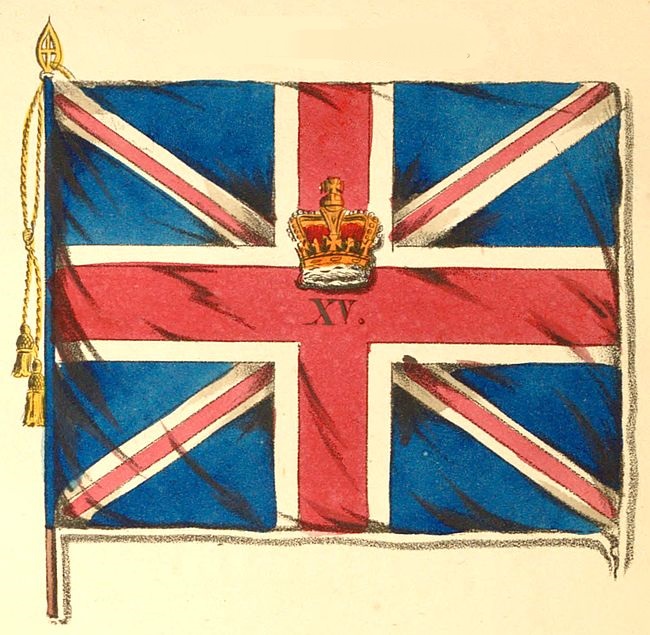
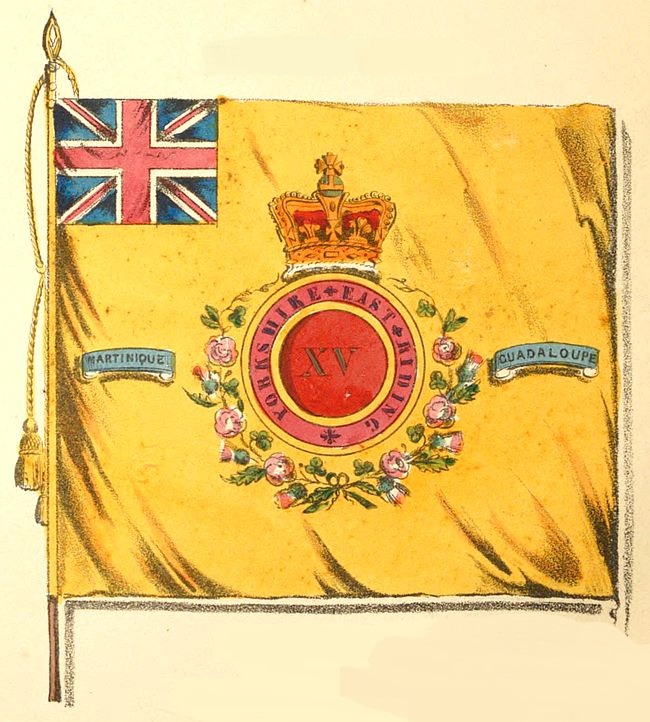
1751
In the clothing warrant, dated the 1st of July, 1751,
the facing of the regiment is directed to be yellow.
The first, or King's colour, to be the great union; the
second, or regimental colour, to be of yellow silk, with
the union in the upper canton; in the centre the number
of the regiment in gold Roman characters, within
a wreath of roses and thistles on the same stalk. The
uniform at this period was cocked hats bound with
white lace; scarlet coats faced and turned up with
yellow, and ornamented with white lace; scarlet waistcoat
and breeches; white gaiters; white cravats; and
buff belts.
1755
The regiment remained in Ireland until the undetermined
boundary of the British and French settlements
in North America occasioned a rupture between
the two kingdoms. The aggressions of the French led
to the sending of a body of British troops to North
America in 1755; at which period the establishment
of the Fifteenth was augmented, and the regiment
embarked for England.
1756
Colonel Jordan was removed to the ninth dragoons,
in April, 1756, and King George II. conferred the
colonelcy of the Fifteenth foot on Colonel Jeffery
(afterwards Lord) Amherst, from captain and lieut.-colonel
in the first foot guards.
In July of this year the regiment pitched its tents
near Blandford, where an encampment was formed of
six regiments of foot and two of dragoons under Lieut.-General
Sir Charles Howard.
1757
Numerous encampments were formed also in the
following year, and the troops held in readiness to repel a
threatened invasion of the French. The Fifteenth
foot, and four other corps, pitched their tents on Barham-downs,
under Charles Duke of Marlborough.
From Barham-downs the regiment proceeded to
the Isle of Wight, in order to form part of an expedition
against the French naval station of Rochfort, on
the river Charente. The Fifteenth, commanded by
Lieut.-Colonel Honorable Sir James Murray, was
formed in brigade with the fifth, twenty-fourth, thirtieth,
and fifty-first regiments; the land forces were
under Lieut.-General Sir John Mordaunt, and the
navy under Admiral Sir Edward Hawke. The fleet
sailed in the early part of September; on the 23rd of
that month the Isle of Aix was captured, and the forts
were afterwards destroyed. Owing to unfavourable
weather, a landing could not be effected near Rochfort
before the enemy was alarmed and prepared for a
vigorous resistance. The troops were repeatedly in
readiness to land, and on one occasion the first division
was in the boats; but the weather, and other causes,
prevented a debarkation taking place. The expedition
afterwards returned to England.
1758
Early in the following year, the Fifteenth regiment,
mustering eight hundred and fifty officers and
soldiers, commanded by Lieut.-Colonel Honorable
James Murray, embarked for North America, to take
part in the attack of the French possessions in that part
of the world. It proceeded to Halifax, in Nova Scotia,
where the expedition was prepared against Louisburg,
the capital of the island of Cape Breton,[11] in the Gulf
of St. Lawrence, under the orders of its colonel, Lieut.-General
Sir Jeffery Amherst, K.B., the naval force
being under Admiral Boscawen. The expedition
sailed from Halifax on the 28th of May, and approached
Louisburg, on the 2nd of June; but the weather was
so unfavourable that a landing could not be effected
before the 8th of June. On that occasion, the grenadier
company of the Fifteenth formed part of the
centre division under the gallant Brigadier-General
James Wolfe, designed to force a landing; and the
regiment formed part of the left division, under Brigadier-General
Lawrence, designed to make a show of
landing at Fresh-water Cove, to divert the enemy's
attention from the main attack. The division under
Brigadier-General Wolfe approached the shore under
a heavy fire, and the surf being high, several boats
were overset. One boat, containing part of the grenadier
company of the Fifteenth, was overset, when
Lieutenant Kennedy, two serjeants, and thirteen rank
and file, were drowned. The regiment had also Lieutenant
Nicholson and eight men killed by the enemy's
fire. The survivors, however, jumped into the water
with great gallantry, formed on the beach, and being
animated by their chivalrous leader, the heroic Wolfe,
they rushed upon their opponents with fixed bayonets,
and carried the enemy's works in a manner which excited
great admiration. The other divisions followed,
and before night the army was on shore.
The siege of Louisburg was afterwards commenced;
and the Fifteenth regiment took part in this service.
In carrying on the approaches, and in making the attacks,
the troops underwent great fatigues with a cheerful
alacrity, which redounded to their honor. The enemy's
sallies were repulsed: the fire of the British artillery
destroyed their shipping, silenced their batteries, and
damaged their works to so great an extent, that, on the
26th of July, the garrison surrendered prisoners of
war; the whole island was also delivered up; and two
other small islands in the Gulf of St. Lawrence surrendered.
Eleven stand of colours were captured on
this occasion, and sent to England.
Besides the officers and soldiers killed in effecting
a landing, the regiment had also Lieutenant Campbell
killed; Lieutenant Hamilton, Lieutenant and Adjutant
Mukens, and Ensign Moneypenny, wounded during
the siege of Louisburg. The regiment had also a
considerable number of private soldiers killed and
wounded.
The arrival of the news of this gallant exploit produced
great sensation in England; the captured
colours were presented to the King, and conducted by
a splendid cavalcade from Kensington Palace to St.
Paul's Cathedral. The meritorious conduct of the
officers and soldiers of the expedition was rewarded
with the approbation of their Sovereign and the thanks
of Parliament.
The Fifteenth were stationed at Louisburg during
the remainder of the year.
1759
From Louisburg the regiment sailed in the beginning
of June, 1759, with the expedition against Quebec, under
Major-General James Wolfe; and was formed in
brigade with the forty-third, forty-eighth, and seventy-eighth
foot, under Brigadier-General Monckton. Towards
the end of June, the army landed at Orleans,—a
large, fertile, and well-cultivated island in the river
St. Lawrence, below Quebec,—and commenced preparations
for carrying on the object of the expedition.
The French General, the Marquis of Montcalm,
possessed a superiority of numbers over the invading
force, and he had made excellent dispositions for the
defence of the country: but the English Commander
had complete reliance on the valour of his troops,
whose confidence he possessed to an extraordinary
degree. The Fifteenth foot, and three other regiments,
were detached under Brigadier-General Monckton,
against Point Levi, on the east shore of the river,
from whence a body of the enemy was driven; at the
same time a body of troops, under Colonel Carleton,
took possession of the western point of the island of
Orleans, and both these posts were fortified. Sixteen
hundred of the enemy attempted to retake Point Levi,
but were repulsed; and a mortar battery, constructed
at that post, fired on Quebec, destroying the lower
town, and damaging the upper town. Having finished
the works on the island of Orleans, the army crossed
the north channel of the river in boats, and landed
below the splendid waterfalls of Montmorenci; and
arrangements were made for attacking the enemy's
position beyond the river Montmorenci, in which the
Fifteenth regiment was ordered to co-operate.
As the regiment was crossing the river in boats from
Point Levi, the grenadiers effected a landing, and commenced
the action prematurely, before their formation
was completed and before the troops designed to sustain
them had arrived; and they were repulsed. They reformed
behind the corps from Point Levi, the Fifteenth
and seventy-eighth; but the excess of ardour, without
sufficient attention to discipline, occasioned the loss of
five hundred officers and men, and the failure of the
operation.[12]
Difficulties, calculated to perplex and discourage
the most resolute and intelligent commander, presented
themselves; but the English general evinced
talent and perseverance. No prospect of final success,
by advancing across the river Montmorenci, presenting
itself, the troops re-embarked and proceeded to Point
Levi; they afterwards sailed a considerable distance
up the river; but it was found impossible to annoy
the enemy above the town. A desperate resolution
was subsequently formed, to retire a little down the
river, land in the night within a league of Cape
Diamond, ascend the heights of Abraham, and gain
possession of the ground at the back of the city.
At midnight on the 12th of September, the troops
went on board the boats, and at one o'clock the first
division moved down the river; an officer who spoke the
French language, answering the challenges of the
enemy's sentries on the shore. A landing was effected:
the officers and men climbed the steep woody precipice,
pulling themselves up by roots and branches of trees
with admirable courage and activity, dislodged a captain's
guard, and gained the heights. The Fifteenth
and other corps followed.
When the French general was informed that the English
had gained the heights of Abraham, he instantly
collected his forces and advanced to give battle; and
Major-General Wolfe, observing the approach of the
hostile troops, formed line, the Fifteenth being posted
in reserve. The enemy manifesting a design against
the British left, the Fifteenth were removed to that
flank by Brigadier-General Townshend, and were
formed en potence, presenting two fronts to the enemy.
About nine o'clock the action commenced, and was
particularly severe on the right, at which point the
British regiments behaved with extraordinary gallantry,
charging with bayonets, and overthrowing all opposition.
In the midst of the action, Major-General Wolfe was
shot in the breast, and he expired at the moment of
victory. Brigadier-General Monckton was also
wounded, and the command devolved on Brigadier-General
Townshend, who had scarcely formed the
troops after the pursuit, when a fresh body of the enemy
appeared in his rear: he detached two regiments
against them, and the enemy fled to the woods. The
French commander, the Marquis of Montcalm, was
mortally wounded; and his second in command, Brigadier-General
de Senezergue, was wounded and taken
prisoner, and he died on board an English ship on the
following day.
This victory was gained with the loss of about fifty
men killed, and five hundred wounded; but the fall of
Major-General James Wolfe was a national loss.
He possessed an animating fervour of sentiment,—an
intuitive perception,—extensive capacity,—personal
bravery beyond all estimation,—and an unbounded
thirst for glory; these bright qualities were combined
with every species of military knowledge that study
could comprehend, and actual service illustrate; and,
while the sublimity of his genius soared above ordinary
minds, his generous disposition, and complacent deportment,
procured him universal esteem. The soldiers
admired and loved him.
After this victory, preparations were made for prosecuting
the siege of Quebec; but further loss of life was
prevented by the surrender of the garrison.
This conquest produced great joy in England; a day
of thanksgiving was set apart by proclamation; and the
thanks of Parliament, with the approbation of their
Sovereign, were conveyed to the troops: also an abundant
supply of warm clothing, purchased by public
subscription, for the use of the men in the cold climate
of Quebec.
The loss of the regiment in the several actions near
Quebec, was one surgeon's mate, two serjeants, and
eleven rank and file killed; Major Paulus Armil
Irving, Captain Arthur Loftus, Lieutenants Samuel
Rutherford, John Maxwell, senior, John Maxwell, junior,
William Skeane, Robert Ross, James Leslie, Lieut.
and Adjutant Francis Mekins, Ensigns Edmund Wroth,
Samuel Baker, nine serjeants, one drummer, and
ninety-seven rank and file, wounded.
The Lieut.-Colonel of the Fifteenth foot, Colonel
Honorable James Murray, was rewarded with the
appointment of Colonel-commandant of a battalion of
the sixtieth regiment, and Governor of Quebec, in
which fortress the Fifteenth were stationed during
the winter, and they suffered severely from scurvy,
occasioned by living constantly on salt provisions.
1760
Resolving, if possible, to regain possession of Quebec,
a French force, commanded by the Chevalier de Louis,
advanced from Montreal towards the end of April,
1760; the enemy attempted to cut off the British out-posts,
but was frustrated by the advance of the piquets,
the grenadiers, and the Fifteenth regiment.
Brigadier-General Murray led the garrison of Quebec
forward to meet the enemy, whom he engaged on the
28th of April, near the village of Sillery, and gained
some advantage; but the superior numbers of the
enemy rendered a retreat necessary, which was executed
in good order.
The enemy besieged Quebec, and the Fifteenth
regiment had the honour of taking part in a successful
defence of that important fortress. The governor stated
in his despatch,—'I flatter myself the extraordinary
performances of the handful of brave men I had left,
will please His Majesty as much as they surprised us,
who were eye-witnesses of them.' While the garrison
was making a resolute defence, a British naval force
arrived in the river, destroyed the enemy's vessels near
the town, and cannonaded their lines. On the morning
of the 17th of May, the Fifteenth were under arms,
to make a sally on the besieging force; but the French
camp was found empty, and the tents standing. A
pursuit was ordered, and some prisoners and baggage
were captured.
In June a detachment of the regiment advanced up
the river, in vessels, to co-operate with the troops under
General Sir Jeffery Amherst, in an attack on the
French army at Montreal. The British advanced upon
Montreal from three different points, and by a well-arranged
combination the whole were united before that
place in the early part of September. The French
governor, the Marquis of Vaudreuil, being unable to
withstand the British arms, surrendered; and the conquest
of Canada was thus accomplished.
After this success, the regiment was assembled at
Montreal, and it was one of the corps which occupied
that place for several months.
1761
In the spring of 1761, the regiment proceeded up
Lake Champlain in boats, marched from the shore of
the lake to Albany, and afterwards sailed down the
Hudson river to New York. In June it was encamped
on Staten Island, and in October sailed for Barbadoes,
where an expedition was assembled under Major-General
Monckton, for an attack on the French island of Martinique,
and the Fifteenth was one of the corps selected
for this service.
1762
The expedition sailed from Carlisle-bay on the 5th
of January, 1762, and a landing was effected on the
island of Martinique in the middle of that month. The
Fifteenth were actively employed in the operations
necessary to bring the enemy to submission, and some
severe fighting took place, in which the regiment had
several men killed and wounded; Captain Prescott and
Lieutenant Leslie, being among the latter. The
governor, M. Le Vassor de la Touche, surrendered the
island in February.
War having been declared against Spain, the regiment
was attached to the armament under General the
Earl of Albemarle, destined to attack the valuable
settlement of the Havannah, on the island of Cuba.
Passing through the straits of Bahama, the expedition
arrived within six leagues of the Havannah on
the 6th of June; a landing was effected on the following
day; and on the 9th, the troops took up a position
between Coximar and the Moro, a fort which it was
deemed necessary to besiege and capture before an
attack was made on the town. In this service, great
hardships had to be endured; a thin soil, hardly sufficient
to cover the troops in their approaches, a scarcity
of water, and the labour of dragging the artillery several
miles over a rocky country, and under a burning
sun, called forth the efforts of the army and navy. The
works were carried on, the sallies of the enemy were
repulsed, and the Moro fort was captured by storm on
the 30th of July. A series of batteries were erected
against the town; and on the 11th of August they
opened so well-directed a fire, that the guns of the
garrison were silenced, and flags of truce were hung out
from the town, and ships in the harbour. The terms
of capitulation were agreed upon, and the British took
possession of this valuable settlement, with nine men
of war in the harbour, and two upon the stocks.
The regiment lost a number of men on this important
service; Lieutenant Skene was among the killed;
Captain Tyrwhitt and Lieutenant Winter died from
the effects of climate.
After the capture of the Havannah, the regiment
was stationed at that place eleven months.
1763
In the meantime a treaty of peace had been concluded,
and in 1763 the Havannah was restored to Spain;
the regiment was relieved by the Spanish troops which
arrived to take possession of the colony, and embarked
for New York, from whence it proceeded, by Albany
and Lake Champlain, to Canada, where it was stationed
several years.
1764
1765
1768
After occupying quarters successively at Montreal,
Quebec, and on the upper lakes, until the summer of
1768, the regiment embarked for England, and landed
at Portsmouth in July.
Occurrences of a political character having induced
Sir Jeffery Amherst to resign the colonelcy of the regiment,
he was succeeded, on the 21st of September,
1768, by Colonel Charles Hotham (afterwards Sir
Charles Thompson, Baronet) from the sixty-third regiment.
1769
1770
1771
The regiment occupied various quarters in the
southern and midland counties of England, until the
summer of 1770, when it was reviewed at Chatham by
King George III. and in the spring of 1771 marched
into Yorkshire.
1772
1773
1774
In 1772 the regiment marched to Scotland, where it
was stationed during the following year, and in the
spring of 1774 it embarked at Port Patrick for Ireland.
1775
Major-General Sir Charles Thompson was succeeded
in the colonelcy of the regiment, in September, 1775,
by Major-General Richard Earl of Cavan, from the
fifty-fifth regiment of foot.
1776
In the meantime, the determined spirit evinced by the
British colonists in North America to resist the acts of
parliament passed in England for raising a revenue in
their country, had been followed by hostilities, and the
Fifteenth regiment was one of the corps selected to
proceed across the Atlantic, to aid in the attempt to
reduce the refractory provincials to submission. The
regiment embarked from Ireland early in 1776, and
proceeded to Cape Fear, in North Carolina, with four
other corps, under Major-General the Earl Cornwallis.
These troops arrived on the coast of North Carolina
early in April, and Lieut.-General Clinton assumed
the command. The men landed at Cape Fear to refresh
themselves after the voyage, and returning on
board the transports, sailed, on the 1st of June, with the
expedition against Charleston. After passing Charleston
bar, the troops landed on one of the islands, but the
armament proved of insufficient strength for the capture
of the capital of South Carolina, and the five regiments
re-embarked and proceeded to Staten Island,
where the main body of the British forces was assembled
under General Sir William Howe. The Fifteenth,
commanded by Lieut.-Colonel John Bird, were formed
in brigade with the fourth, twenty-seventh, and forty-fifth
regiments, under Major-General Pigot.
A landing was effected on Long Island on the 22nd
of August, and the Fifteenth regiment formed part
of the force under Lieut.-General Clinton, which advanced
after dusk on the evening of the 26th to seize
on a pass in the heights, and turn the enemy's left flank
at Flat-bush. This pass was taken possession of on the
following morning; the army advanced, and the Americans
were driven from their position with considerable
loss, and forced to retreat to their fortified lines at
Brooklyn. The loss of the regiment on this occasion
was limited to a few men wounded.
The Americans quitted their fortified lines during
the night of the 28th of August, and retired across the
East River, in boats, to New York; and the reduction
of Long Island was thus accomplished in a few days,
with little loss.
From Long Island the regiment proceeded with the
army across the East River, when General Washington
was forced to abandon New York, which city was taken
possession of by the British.
Proceeding up the river, the regiment took part in
the operations of the army by which the Americans
were forced to evacuate their lines on White Plains;
but it did not sustain any loss.
The regiment took part in the attack and capture
of the enemy's lines and redoubts near Fort Washington,
on the 16th of November, when it had a few private
soldiers killed and wounded.
After taking part in these services, the regiment
proceeded into winter quarters at the city of New
York.
1777
Information being received that the Americans were
forming magazines at Peek's-hill, about fifty miles up
the North River, Lieut.-Colonel Bird, of the Fifteenth,
was detached from New York against that post, with
a body of troops, of which a division of the regiment
formed part. The troops sailed from New York on
the 22nd of March, 1777, and as they approached Peek's-hill,
the Americans set fire to the stores and retreated.
The British landed, completed the destruction of the
magazines, barracks, &c., and afterwards returned to
New York.
Extensive depôts were also prepared by the Americans
at Danbury, and other places on the borders of
Connecticut, and the Fifteenth regiment formed part
of a body of troops which embarked from New York,
under Major-General Tyron, for the destruction of
these magazines. The British arrived off Norwalk
on the evening of the 25th of April, landed without
opposition, and commenced their march for Danbury,
from whence the American troops fled, as the English
approached that place on the afternoon of the following
day. As no carriages could be procured to bring off
any part of the immense collection of stores at this place,
the magazines were set on fire, and in the progress of
the flames the town was unavoidably burnt. This
service accomplished, the British commenced their
march back to the coast, early on the morning of the
27th of April, when a body of Americans hung upon
their rear, and at every eminence a corps of militia
was found ready to oppose their march; but they
attacked and routed their opponents; and in one of
the skirmishes the American General Wooster was
killed.
Arriving at Ridgefield, the British were opposed by
a strong force under General Arnold, protected by intrenchments,
which the Americans were preparing; but
a few rounds from the English artillery, and a gallant
charge with bayonets, routed the American force, and
the King's troops halted at Ridgefield during the night.
Resuming the march on the following morning, the
British were harassed by the enemy, in their retrograde
movement, and numerous skirmishes occurred. Arriving
at the Hill of Compo, contiguous to the place of embarkation,
the Americans appeared in force, and commenced
an attack with greater spirit and determination
than before; the British troops confronted their numerous
assailants, fired a volley, and charged with bayonets
with so much impetuosity and valour, that the
Americans were unable to withstand the shock, and
they retreated. The King's troops afterwards embarked
without molestation for New York.
Eight rank and file of the Fifteenth regiment were
killed on this expedition; Captain Harry Ditmas, one
serjeant, and fifteen rank and file wounded; two men
missing. Lieutenant Charles Hastings, of the twelfth
foot, serving as a volunteer with the regiment, was
also wounded.
Afterwards taking the field with the army in the
Jerseys, the regiment was engaged in the operations
designed to bring the enemy to a general engagement,
but the Americans kept close in their fortified lines in
the mountains; and an expedition against the populous
and wealthy city of Philadelphia was resolved upon.
The Fifteenth, commanded by Lieut.-Colonel John
Bird, were employed in this enterprise, and were formed
in brigade with the seventeenth, forty-second, and
forty-fourth regiments, under Major-General (afterwards
Earl) Grey.
Embarking from Sandy Hook, the army sailed to
the Chesapeake, and proceeding up Elk River, landed
on the northern shore on the 25th of August. The
American army took up a position at Brandywine to
oppose the advance, and on the 11th of September the
royal forces moved forward to engage their opponents.
The Fifteenth formed part of the column under
Major-General the Earl Cornwallis, which made a
circuit of some miles to turn the right and gain the
rear of the American army. The action proved decisive;
the enemy was driven from his position, and
forced to make a precipitate retreat. The battalion
companies of the regiment did not sustain any loss on
this occasion; but the flank companies, being formed
in grenadier and light infantry battalions, had Lieutenant
Faulkener killed; Captain Cathcart, Captain
Douglas, and Lieutenant Leigh wounded; also several
men killed and wounded.
After this victory, the army continued its advance;
Philadelphia was taken possession of, and the British
troops took up a position at Germantown, the Fifteenth
being posted on the left of the village.
Making a forced march during the night of the 3rd
of October, the American army appeared suddenly in
front of Germantown before daylight on the following
morning, and attacked the British outposts, thinking
to surprise the troops in an unprepared state. The
first assault was opposed by the second battalion of
light infantry, and the fortieth regiment, under Lieut.-Colonel
Musgrave, posted at the head of the village;
these corps were forced to fall back, and Lieut.-Colonel
Musgrave threw himself, with six companies of the
fortieth, into a large store-house, where he was attacked
by an American brigade, aided by four pieces of cannon.
During the contest, while the soldiers of the fortieth
were defending their post manfully, Major-General
Grey brought forward the Fifteenth, and two other
corps; and making a determined attack on the American
regiments, drove them back with great slaughter.
The enemy was also repulsed at every part of the field,
and forced to make a precipitate retreat.
Lieut.-Colonel John Bird, Ensign Anthony Frederick,
and five rank and file of the regiment were killed;
Captains George Goldfrap and Harry Ditmas, Lieutenant
George Thomas, Ensign Henry Ball, two serjeants,
and forty-two rank and file wounded. In alluding
to the death of Lieut.-Colonel Bird, General Sir
William Howe spoke of it as an event 'much to be
lamented, he being an officer of experience and approved
merit.' General Washington formed a fortified
camp at Whitemarsh; and early in December the
British army advanced with the view of inducing the
Americans to quit their lines and offer battle, or of
finding a vulnerable part in their fortified camp.
Several skirmishes occurred, in which the British troops
evinced their native intrepidity and firmness, and were
victorious in every instance; but the defences of the
American camp were found too strong to be attacked,
and the army marched into winter quarters at Philadelphia.
1778
After passing the winter at the capital of Pennsylvania,
the regiment furnished several parties, in the
spring of 1778, to range the country, and open communications
for bringing in supplies.
The regiment also shared in the fatigues and difficulties
of the march of the army from Philadelphia to
New York, under Lieut.-General Sir Henry Clinton,
rendered necessary by the French monarch having
united with the revolted British provinces, and thus
changed the character of the war. As the army pursued
its journey, crossing rivers, and traversing a wild
and woody country, the enemy menaced the flanks and
rear with an attack in force; and on the 28th of June,
some sharp fighting took place, near Freehold in New
Jersey, when the grenadier company of the Fifteenth
distinguished itself, and the enemy was repulsed.
Captain Cathcart, of the regiment, was wounded; and
also Captain Ditmas, who was attached to the second
grenadier battalion.
The army afterwards continued its route, and arrived
at New York in July.
A powerful French armament menacing the British
possessions in the West Indies, the Fifteenth, and
several other corps, sailed from North America, early
in November, for Barbadoes, under Major-General
Grant.
While the regiment was at sea, its colonel, Major-General
the Earl of Cavan, died at Dublin, and was
succeeded by Major-General William Fawcett, deputy
adjutant-general to the forces.
On the arrival of the reinforcements at Barbadoes,
the British naval and military commanders resolved to
act offensively, and attack the French island of St.
Lucia. On this occasion the regiment was formed in
brigade with the twenty-eighth, forty-sixth, and fifty-fifth,
under Major-General Prescott. The expedition
sailed from Carlisle-bay on the 12th of December, a
landing was effected at St. Lucia on the following day,
and on the 14th, the French troops were driven from
several important posts. In the meantime a French
armament of very superior numbers approached the
island, and the British took up positions to repel the
enemy. The French fleet made a desperate attack
on the British naval force, but was repulsed. A numerous
body of the enemy landed, and stormed the post
of La Vigie, which was occupied by the grenadiers,
light infantry, and fifth regiment, under Brigadier-General
Medows; when the determined bravery of the
British proved triumphant over very superior numbers,
and the French were repulsed and forced to re-embark,
leaving the ground covered with killed and wounded.
The flank companies of the Fifteenth had an opportunity
of distinguishing themselves on this occasion.
The governor surrendered the island to the British
arms immediately after the departure of the French
armament.
1779
1780
The Fifteenth remained at St. Lucia several
months. In the meantime, the French possessed a
great superiority of numbers, both of naval and land
force, in the West Indies; and in June, 1779, they
attacked the island of St. Vincent, and in July Grenada;
the regiment embarked from St. Lucia, for the relief
of these islands; but they were captured before any
force could arrive to their assistance. While the regiment
was at sea, some sharp fighting occurred between
the hostile fleets, without decisive results, and the regiment
was afterwards landed at the island of St. Christopher's,
where it was stationed during the year 1780.
1781
Holland having adopted a line of politics hostile to
the British, and favourable to the American interest,
war took place between Great Britain and the United
Provinces; and in February, 1781, the Dutch island
of St. Eustatius was captured. The Fifteenth regiment
was afterwards removed from St. Christopher's
to St. Eustatius, and the flank companies were subsequently
detached to the former island.
The British commandant at St. Eustatius neglected
to adopt the necessary precautions for the security of
the island, and during the night of the 26th of November,
a French force, under the Marquis of Bouillé,
effected a landing, captured the commandant as he was
taking a morning ride, overpowered the posts, and
forced the garrison, consisting of the battalion companies
of the thirteenth and Fifteenth regiments, to surrender
prisoners of war. The commandant, Lieut.-Colonel
Cockburn, was afterwards tried by a general court-martial,
and cashiered.
After being detained a short period, the regiment
was exchanged, and resumed its duties.
1782
The flank companies were stationed at St. Christopher's,
with the first battalion of the royals and a detachment
of artillery, which constituted the military
force of the island, under Brigadier-General Fraser,
when a powerful French armament appeared off that
place in the beginning of January, 1782. Eight thousand
French troops landed, with a powerful train of
artillery, under the Marquis of Bouillé; and the English
troops, being unable to oppose so numerous a host on
open ground, took possession of Brimstone-hill, a formidable
post, but the fortifications were old and in a ruinous
state, and the soldiers had no intrenching tools; a
desperate defence was however determined on, in
hopes of being relieved.
Against this post the French batteries opened their
fire, on the 19th of January, and from that day a storm
of balls and bombs rattled round the hill with increasing
fury, until the houses on the heights were battered
to pieces, and the old works were nearly destroyed.
During this period a British naval force approached
the island, and a body of troops landed; but the enemy
had so great a superiority of numbers, that no reasonable
expectation could be entertained of being able to
save the island, and the troops returned on board the
fleet. In the meantime, the works on Brimstone-hill
had been breached in several places, and the garrison
was reduced to the last extremity; yet the troops continued
to evince that valour and firmness for which
British soldiers have been distinguished; and their
conduct excited the admiration of their enemies. When
all prospect of being able to resist many hours longer
was gone, the garrison capitulated, and was permitted
to march through the breach with the honours of war,
and return to England, on condition of being considered
as prisoners of war until exchanged. The conduct of
the officers and soldiers who defended Brimstone-hill
was highly commended in Brigadier-General Fraser's
despatch; and has been held up as an example of British
courage and resolution, by historians.
The regiment returned to England, and many of the
officers and men, who had been made prisoners, were
lost on the voyage, in the Ville de Paris, a French ship,
which had been captured by Admiral Rodney.
This year the Fifteenth received the title of the
East Riding Yorkshire regiment, and was directed
to cultivate a connexion with that part of the county,
to facilitate the procuring of recruits.
1783
1784
1785
During the year 1783, the regiment was stationed
in Yorkshire, and rapidly increased in numbers; in the
following year it proceeded to Ireland, and was employed
on Dublin duty in 1785.
1790
1791
After remaining in Ireland six years, the regiment
embarked at Cork, in the summer of 1790, mustering
seven hundred men, and proceeded to Barbadoes. In
1791, its establishment was reduced, and upwards of
two hundred men were transferred to other corps.
1792
Lieut.-General Fawcett was removed to the third dragoon
guards, in August, 1792; and King George III.
conferred the colonelcy of the Fifteenth foot on Major-General
James Hamilton, from the lieut.-colonelcy of
the twenty-first, or royal North British fusiliers.
1793
In 1793 the regiment was removed from Barbadoes
to Dominica, where it was stationed several months.
1794
Resistance to the authority of the crown, in France,
had, in the meantime, led to a violent and sanguinary
revolution, and the French West India Islands had
become the scene of democratic outrage. Great Britain
engaged in war to arrest the progress of anarchy; and
the Fifteenth regiment was selected to join an expedition
under General Sir Charles Grey, prepared to
rescue the French West India Islands from republican
outrage.
The expedition sailed from Carlisle-bay, Barbadoes,
early in February, 1794; landed at three different
points on the island of Martinique, on the 5th, 6th, and
8th of that month, and drove the enemy from numerous
strong posts. Two companies of the Fifteenth distinguished
themselves in storming Mount Mathurine,
where a battery was erected, which compelled the garrison
of Pigeon Island to surrender at discretion. 'The
Fifteenth regiment, led by Major Lyon and commanded
by Captain Panmier, surprised several hundreds
of the enemy, very strongly posted, on the heights
of Le Grand Bouclain, on the 12th of February,
killing several and taking all their arms, ammunition,
cattle, &c.'[13] The enemy's out-posts being driven in,
Fort Royal and Fort Bourbon were besieged; the
former was captured on the 20th of March, and the
latter surrendered two days afterwards. The loss of
the regiment on this service was limited to a few
soldiers killed and wounded.
The regiment remained at Martinique, while a
detachment proceeded to St. Lucia, and captured that
island.
From Martinique the expedition proceeded against
Guadaloupe. A determined resistance was experienced
at this place, but the island was captured before the
end of April; and Sir Charles Grey stated in his
despatch, that he 'could not find words to convey
an adequate idea, or to express the high sense he
entertained of the extraordinary merit evinced by the
officers and soldiers in this service.' The regiment
had Captain Comb and Ensign Croker killed, and
several private soldiers killed and wounded.
1795
The regiment remained a short time at Martinique,
and afterwards proceeded to Dominica; but returned to
Martinique in January, 1795, and was stationed at that
island twelve months, under Lieut.-Colonel Madden.
1796
In 1796 the regiment transferred two hundred and
fifty men to the forty-fifth foot, and embarked for
England, its numbers being reduced to fifty-three men.
It landed in November at Portsmouth, marched to
Derby, and active measures were adopted to recruit its
ranks to the augmented establishment of a thousand men.
1797
1798
1799
Marching northward from Derby, in April, 1797, the
regiment proceeded across the border, and was stationed
two years in Scotland. It afterwards returned to
England, and was quartered at Sunderland barracks.
The militia regiments being permitted to volunteer
into the regular army, fifteen hundred and thirty-eight
men volunteered to the Fifteenth, and the regiment
was augmented to two battalions.
1800
Both battalions proceeded to Ireland in 1800, the
first under the command of Lieut.-Colonel Madden,
and the second under Major Lord Sinclair; Lieut.-Colonel
Barry afterwards succeeded to the command
of the first battalion.
1802
In 1802, the war was terminated by the treaty of
Amiens; when the British army was reduced, and the
second battalion was disbanded,—the establishment
of the regiment being fixed at seven hundred and
fifty rank and file.
1803
The conduct of Napoleon Buonaparte, then First
Consul of France, occasioned hostilities to be resumed
in 1803, when the British army was augmented,
and preparations made to repel a threatened
invasion of the French. The Fifteenth regiment
remained in Ireland.
1804
Preparations to repel the menaced French invasion
were continued in 1804, and a second battalion was
added to the regiment. It was formed of men raised
for limited service under the Additional Force Act
passed on the 29th of June, 1804, and was quartered
at Scarborough, in Yorkshire.
1805
During the winter, the first battalion again embarked
for the West Indies, and landed at Barbadoes
on the 12th of March, 1805. In May, Surgeon Shaw
died at Barbadoes.
This year is celebrated in the naval annals of Great
Britain for the splendid achievements of the marine
forces of the kingdom. Rear-Admiral Viscount Nelson
having proceeded to the West Indies in quest of the
French fleet, the Fifteenth regiment received orders
to embark and serve as marines. It went on board
on the 4th of June, Lieut.-Colonel Barry and the staff
being appointed to the "Conqueror" of seventy-four
guns; but after a cruise of fourteen days, the fleet returned
to port, and the regiment landed: it therefore
missed sharing in the glorious victory of Trafalgar, on
the 21st of October, 1805. During the months of July,
August, and September, the regiment lost nine
officers and two hundred and twelve men by
fever.
1806
In May, 1806, a draft of one hundred and twenty-four
men joined from the second battalion, and a few
volunteers from the eleventh regiment.
1807
On the 24th of January, 1807, the regiment was
suddenly embarked on board the fleet; but after a
short cruise returned to Barbadoes, from whence it
was removed to Grenada in April.
The court of Denmark having united with France,
in hostilities against Great Britain, an expedition was
prepared against the Danish islands of St. Thomas
and Santa Croix, and the Fifteenth embarked from
Grenada to take part in this service. These colonies
surrendered on being summoned, and loss of life was
thus prevented.
1808
In July, 1808, a draft of six serjeants and two hundred
and ninety-three rank and file joined from the
second battalion.
In November and the early part of December, the
regiment lost about one hundred and fifty men from
the effects of the climate of the West Indies.
1809
The regiment joined the expedition under Lieut.-General
Beckwith, which sailed from Carlisle-bay,
Barbadoes, on the 28th of January, 1809, against the
island of Martinique. The first division landed in
Bay Robert, and the second near St. Luce and
Point Solomon. The enemy's force was numerous,
and some sharp fighting occurred, in which the regiment
had the honor to distinguish itself, and had
several men killed and wounded. The conquest of the
island was achieved in a few weeks, and Lieut.-General
Beckwith stated in his public despatch,—'The having
commanded such an army will constitute the pride of
my future life. To these brave troops, conducted
by Generals of experience, their king and country
owe the sovereignty of this important colony; and I
trust, that by a comparison of the force which defended
it, and the time in which it has fallen, the
present reduction of Martinique will not be deemed
eclipsed by any former expedition.'
The royal authority was afterwards given for the
regiment to bear the word "Martinique" on its
colours, to commemorate its distinguished gallantry
on this occasion. Lieut.-Colonel Riall received a
medal for commanding a brigade, and Major Andrew
Davidson for commanding the regiment.
Three French sail of the line and two frigates, from
L'Orient, having taken shelter in the Saints, in the
vicinity of Guadaloupe, they were blockaded by Rear-Admiral
Sir Alexander Cochrane; and three thousand
men, of which force the Fifteenth formed part, were
detached, under Major-General Maitland, for the reduction
of the islands. This expedition sailed from
Port Royal on the 12th of April; a landing was
effected in Ance Bois Joly, and the difficult heights of
Mount Russel, eight hundred feet high, were stormed
and captured, and a battery soon forced the French
shipping to put to sea. The reduction of the islands
was accomplished in a few days, and the enemy's
garrison was made prisoners of war. During the action
on the 15th of April, Lieut.-Colonel Phineas
Riall volunteered to storm Fort Morelli, with the
Fifteenth regiment; but Major-General Maitland
would not allow the corps to engage in so dangerous an
enterprise.
Towards the end of April, the regiment returned to
Grenada, where it was stationed about nine months.
1810
Three hundred men of the regiment, including the
flank companies, embarked from Grenada, early in
January, 1810, under Lieut.-Colonel Riall, for Barbadoes,
to join the expedition against Guadaloupe, under
Lieut.-General Sir George Beckwith, and were formed
in brigade with a battalion of light infantry, and the
third West India regiment, under Brigadier-General
Harcourt; this officer being afterwards appointed to
the command of a division, the brigade was commanded
by Lieut.-Colonel Riall, of the Fifteenth.
The expedition rendezvoused at Prince Rupert's,
Dominica, and the Fifteenth accompanied the second
division, which sailed on the 26th of January, and anchored
at the Saints until the 29th, when it proceeded
towards Guadaloupe, and menaced the enemy's defences
at the Three Rivers. During the night the
regiment landed in the bay near the village of Les
Vieux Habitans without opposition, and afterwards
advanced, the enemy's posts falling back skirmishing.
The French appearing in force on some high
open ground, the Fifteenth turned their right flank,
the Royal West India Rangers the left, and the thirteenth
light infantry advanced against the front, when
the enemy was speedily forced from his ground.
The regiment afterwards took part in completing
the conquest of the island, an achievement which reflected
credit on the troops employed in the enterprise.
The conduct of Lieut.-Colonel Riall was commended
in the public despatch of the Commander of the
Forces.
The following statement appeared in general orders,
dated 6th February:—'The Commander of the Forces
returns his thanks to the officers of all ranks, for their
meritorious exertions, and to the non-commissioned
officers and soldiers, for the cheerfulness with which
they have undergone the fatigues of a march, difficult
in its nature, through the strongest country in the
world, and the spirit they have manifested on all
occasions to close with the enemy.'
The loss of the regiment was limited to a few private
soldiers killed and wounded, and Captain William
Grierson wounded.
To commemorate the distinguished gallantry of the
regiment on this occasion, the royal authority was
afterwards given for the word "Guadaloupe" to be
displayed on its colours. Lieut.-Colonel Riall received
a medal for commanding a brigade.
In March, that portion of the regiment which had
been left at Grenada, joined at Guadaloupe; also a
draft of ninety men from the second battalion. Another
draft of one hundred men joined from the second
battalion in July, under Lieut.-Colonel Barry, who
assumed the command of the regiment,—Lieut.-Colonel
Riall proceeding to Europe on leave of absence.
The health of the men soon afterwards suffered
severely from the effects of the climate of Guadaloupe,
and two hundred and seventy-six non-commissioned
officers and soldiers died. The survivors were moved
to the Champ de Mars, and afterwards occupied the
convalescent posts of Matuba, Dolce, Vermont, and
Vieux Fort.
1811
1812
The regiment remained at Guadaloupe during the
year 1811; in May, 1812, it was removed to St. Christopher's
and stationed on Brimstone-hill, under Lieut.-Colonel
Davidson.
On the 21st of September, Lieut.-Colonel Renny
joined with a detachment of two serjeants, and one
hundred and forty-six rank and file, from the second
battalion.
1813
Several detachments also joined from the second
battalion in 1813.
1814
After commanding the regiment twenty years,
General Powell died in the summer of 1814, and was
succeeded in the colonelcy by Lieut.-General Moore
Disney, from major in the first foot guards.
The victories of the British troops, in the Peninsula
and the south of France, having accomplished the
reduction of the power of Napoleon Buonaparte, and
the restoration of the house of Bourbon to the throne
of France, a general peace was proclaimed, the army
was reduced, and the second battalion of the Fifteenth
was disbanded in October, 1814, on the island of
Jersey, whither it had proceeded in June, 1811: its
services had been limited to Great Britain and
Jersey.
1815
Early in 1815, the men of the late second battalion
embarked to join the regiment at the island of St.
Christopher; but the transports encountered much
severe weather, and were forced into Falmouth harbour,
and the soldiers landed. At this period, Buonaparte
had violated the treaty of 1814, and regained
the throne of France. War immediately followed;
and His Royal Highness the Prince Regent directed
the second battalion of the Fifteenth regiment to be
re-formed; this took place accordingly, and the men
who had landed at Falmouth proceeded to Guernsey,
where they were joined by the depôt.
The French troops on the islands of Martinique and
Guadaloupe evinced a disposition to renounce their
allegiance to Louis XVIII., and proclaim Buonaparte,
and the former island was taken possession of by
British troops in June; at Guadaloupe, the Emperor
Napoleon was proclaimed on the 18th of June, a day
fatal to his power on the field of Waterloo; and the
first battalion of the Fifteenth regiment proceeded
from St. Christopher to Barbadoes, from whence it
sailed with the expedition against Guadaloupe, under
Lieut.-General Sir James Leith. A landing was
effected on the island on the 8th of August, and the
French troops were speedily forced to surrender prisoners
of war.
The regiment proceeded to the Champ de Mars,
where it was stationed until the end of September,
when it embarked for Barbadoes.
1816
Peace having been restored, and Buonaparte sent in
exile to St. Helena, the second battalion of the regiment
was disbanded in the island of Guernsey, on the
25th of January, 1816; the men fit for service embarking
to join the first battalion at Barbadoes.
On the 15th of April, the regiment marched from
garrison at St. Anne's, to quell an insurrection among
the negroes in the interior of the island of Barbadoes,
where strong detachments remained until June, when
the regiment was removed to Martinique.
In August, the French eighty-eighth regiment, or
Martinique Legion, arrived to garrison the island,
and the Fifteenth, being relieved, proceeded to
Grenada, where they landed on the 5th of September,
and marched into garrison at Richmond-hill.
1817
1818
From Grenada the regiment embarked, in the
spring of 1817, in two divisions, under Lieut.-Colonel
Davidson and Major Maxwell, for Halifax in Nova
Scotia, where it was stationed two years.
1819
The right wing, under Major Maxwell, embarked
for Bermuda in June, 1819, and relieved the left
wing of the sixty-second regiment at Fort George
barracks, where the Fifteenth lost between sixty and
seventy men of the yellow fever, in August and September.
1820
1821
During the year 1820, the regiment was stationed
at Bermuda and Nova Scotia. In the summer of
1821, it was relieved at the former station by a wing
of the second battalion of the sixtieth, and at the
latter by the eighty-first regiment; and embarking
for England, landed at Portsmouth in July and August,
and was stationed at Fort Cumberland until
November, when it embarked for Plymouth.
1822
In the summer of 1822, the regiment was removed to
Hull; in October it embarked at Liverpool for Ireland,
and landing at Dublin, occupied Richmond barracks
a few weeks, and afterwards proceeded to Naas.
1823
1824
The regiment was removed in the summer of 1823
to Waterford, and in the autumn to Cork, with a detachment
at Spike Island; and it occupied this station
during the year 1824.
1825
Leaving Cork in July, 1825, the regiment proceeded
to Buttevant, with detachments to the towns in the
neighbourhood.
1826
A division of the regiment marched to Templemore
in February, 1826, and sent out numerous detachments.
One party stationed at Thurles, under Captain Temple,
evinced great patience and forbearance, united with a
proper degree of firmness, in suppressing a riot at that
place, when several persons had been killed by the
police. Captain Temple received an address of thanks
and approbation from the magistrates and principal
inhabitants of the town, for his cool and judicious conduct
on this occasion. In the autumn the regiment
marched to Galway, sending out eleven detachments.
1827
In April, 1827, the regiment was divided into six
service and four reserve companies, and marched to
Fermoy, where it was inspected by Major-General
Sir George Bingham, who expressed his unqualified
approbation of its appearance, discipline, and interior
economy. In May, the service companies embarked
from the Cove of Cork, under Lieut.-Colonel Macintosh,
for Canada, and arrived at Quebec on the 29th
of June and 6th of July; they immediately proceeded
up the river St. Lawrence, to Kingston in Upper
Canada, where they remained ten months.
1828
Retiring down the River St. Lawrence, in boats, in
May and June, 1828, the service companies proceeded
to Montreal, from whence the first division continued
its journey, in a steam vessel, to Quebec, and was
followed by the second division in August.
1830
The regiment was stationed at Quebec during the
years 1829 and 1830; in October of the latter year, a
strong detachment proceeded to the Isle aux Noix, on
Lake Champlain.
The regiment continued in garrison at Quebec,
detaching 100 rank and file to the Isle aux Noix
and St. John's, with a proportion of officers and non-commissioned
officers.
1831
The regiment moved to Montreal on the 3rd of May
of this year, continuing its detachments.
1832
On the 21st of May, 1832, Lieut.-Colonel Macintosh,
commanding the regiment, and Commandant of the
Garrison of Montreal, was called upon by the magistrates
of that place to be prepared to assist the civil
power in the event of a riot occurring at a contested
election for the west ward of the city, which was to terminate
on that day. Captain Temple was the captain
of the piquet on the occasion, but when it was
turned out, Lieut.-Colonel Macintosh took command
of it in person. At the close of the poll, several acts
of violence were perpetrated both on persons and property,
when it became necessary to require the co-operation
of the piquet in restoring order. The Riot Act
having been read, the Lieut.-Colonel was authorised
by the Magistrates to take such steps as might appear
to him necessary. The piquet was immediately
marched in the direction of the rioters, who assailed
the party with stones and other missiles, when the
order to "fire" was given, not, however, until every
effort had been exerted to cause them to disperse. The
front rank alone, consisting of about sixteen men, discharged
their pieces in quick succession, the consequences
of which proved fatal on the spot to three of the
rioters; several others were severely wounded, but the
disturbance was effectually checked. The regiment
remained under arms in different parts of the town
during the night.
A company of the Royal Artillery stationed at the
Island of St. Helen's, under the command of Captain
W. C. Anderson, brought over two nine-pounders in
the short space of twelve minutes from the time the
signal was given for their services, and remained on
duty with the regiment until the next day. This was
remarkable, as the river is nearly a mile broad, with a
very rapid current, and the guns had to be shipped in
bateaux after the signal was made, and re-limbered
on landing at the Montreal side.
The conduct of the troops, particularly that portion
under the immediate orders of Lieut.-Colonel Macintosh,
was marked by great steadiness and forbearance,
notwithstanding that they had been harassed by continual
alarms for some days previous to the riot. On the
day of the 21st the rain fell in torrents, whilst the men
were exposed to it for hours before the riot commenced.
The following documents are deemed worthy of a
place in these Records; the conduct and discipline
of the corps, on the occasion referred to, being highly
estimated by the civil and military authorities.
Presentment of Grand Jury.
'The grand jury humbly represent to the court, that,
in the investigation of the occurrence upon which were
founded the bills for murder against William Robertson
and Pierre Lukin, esquires, Colonel Macintosh and
Captain Temple, they have fully and impartially examined
into all the circumstances of the case, and the
result of their proceedings is the conviction, that no
ground exists for any criminal charge against those
individuals. In such an instance as the present, where
violent agitation has convulsed society, the grand jury
are compelled by a sense of duty, beyond the mere rejection
of the bills, to endeavour at allaying excitement,
by an expression of the knowledge at which they have
arrived after a severe inquiry into the transaction.
'However much the grand jury may deplore the fatal
consequences which flowed from the introduction of an
armed force on that occasion, they feel persuaded that
it was fully justified by the conjuncture; and its timely
interposition, in their belief, averted the calamities
which must have ensued if the rioters had been suffered
to pursue their impetuous and destructive course.
'With this view of the case, the grand jury cannot withhold
the public declaration of their opinion, that the
conduct observed, as well by the magistrates as by the
military authorities, during those events, is worthy
of commendation at the hands of those who love peace
and respect the laws; while the inhabitants of the
city of Montreal, in particular, are deeply indebted to
the firm discharge by those gentlemen of their respective
duties, for restoration to a state of security
and for the protection of their lives and property.'
GENERAL ORDER.
'Head Quarters,
'Quebec, 2nd September, 1832.
'On the 21st of May last, a detachment of the
Fifteenth regiment, commanded by Lieut.-Colonel
Macintosh, having under his orders Captain Temple
of the same regiment, was called out by the magistrates
of Montreal, for the purpose of aiding the civil power
in the suppression of a riot in that city, by which the
lives and property of the inhabitants were endangered;
and the magistrates having failed in their efforts to
restore order by other means, the troops were required
to make use of their arms, on which occasion three
individuals were unfortunately killed, and others
wounded.
'The loss of life caused by the fire of the troops is
an event deeply to be deplored, and the Commander
of the Forces is persuaded that throughout the colony
there are not to be found any individuals who more
sincerely and more sensibly lament that event than
Lieut.-Colonel Macintosh, Captain Temple, and those
very soldiers whose painful duty it was to make use of
their arms on the 21st of May. It is, however, consoling
to reflect that the riot was suppressed without
a further sacrifice of human life, which there was
every reason to apprehend; and perhaps very many
of the peaceable inhabitants of the city of Montreal
are at this moment indebted for the preservation
of their lives and property, to the timely interference
of the troops acting under the direction of the magistrates.
'Although the Commander of the Forces was disposed
to place the greatest reliance on the discretion and
judgment of Lieut.-Colonel Macintosh, and upon the
steadiness and discipline of the regiment under his
command, his Lordship, nevertheless, considered it to
be incumbent upon him to suspend the judgment in
regard to the events of the 21st of May, until the
whole of the circumstances connected with those
events should have undergone the fullest investigation
before the proper tribunals of the country,
whose duty it is to take cognizance of criminal
offences.
'This duty has now been performed, and Lieut.-Colonel
Macintosh, Captain Temple, and the troops
under their command, in suppressing the riot at
Montreal on the 21st of May last, having been absolved
from all blame, the Commander of the Forces
hastens to embrace the opportunity thus afforded
him, to convey to Lieut.-Colonel Macintosh, Captain
Temple, and the non-commissioned officers and soldiers
of the Fifteenth regiment, employed in the
suppression of a riot at Montreal on the 21st of May
last, his approbation of the judgment, steadiness, and
discipline, displayed by them in their respective stations
on that occasion.'
An address was likewise presented to Lieut.-Colonel
Macintosh and Captain Temple, by the citizens of Montreal,
from which the following extracts are made:—
'Gentlemen—We, the subscribers, citizens of Montreal,
feel it a duty that we owe to you, to express our
thanks for your conduct and that of the troops under
your command, on the occasion of your being called
upon to restore and preserve the public peace, so unhappily
broken, at the close of the poll for the election
of a member for the west ward of this city on the
21st of May last.
'So strong was our conviction of the importance of
the services rendered by you and the magistrates on
that occasion, that our desire was to have expressed
our testimony of them immediately upon their occurrence;
but considerations arising from the interposition
of judicial authority prompted us to defer it.
'These considerations having now been removed in
a manner the most satisfactory to you and to ourselves,
we beg most respectfully to convey to you this expression
of the obligation we feel we are under to you for
the safety, that we then, and have since, enjoyed in our
persons and property through your means; for that it
is to the military, and to the magistrates, that we owe
our preservation, has been manifestly brought to light
before the grand jury, by their finding and presentments
lately returned into the Court of King's
Bench.
'We have only further to express a regret that the
performance of a necessary but painful duty, should
have subjected any one of you to unpleasant and
unmerited restraint.'
The following letter from the Military Secretary of
the General Commanding in Chief, addressed to
Lieut.-General Lord Aylmer, K.C.B., Commander of
the Forces in Canada, was published in the General
Orders of the Colony:—
'Horse Guards, Oct. 23rd, 1832.
'My Lord,
'I have had the honor to receive and submit
to the General Commanding in Chief, your Lordship's
despatches of the 30th July and 7th September
last, conveying, for Lord Hill's information, reports
of what had taken place in consequence of a detachment
of the Fifteenth Regiment of Foot, under the
command of Lieut.-Colonel Macintosh and Captain
Temple, called out in aid of the civil power at Montreal
on the 21st of May last, having been compelled to
resort to the use of their arms, by which, unfortunately,
three persons were killed, and several wounded.
The General Commanding in Chief, equally with your
Lordship, laments the loss of life upon the occasion
adverted to; but, in justice to Lieut.-Colonel Macintosh
and Captain Temple, feels bound to say, after
an attentive perusal of all the papers bearing upon
the case, that he knows no instance in which troops
have been employed in the suppression of riots, where
greater judgment, discretion, or humanity, has
been displayed; and if these officers have since been
annoyed by accusations of murder, and by every proceeding
which could tend to keep alive anxiety, they
have at least the consolation of feeling that they have
discharged a painful but imperative duty, with temper
and moderation, and that by so doing they put an
end to disorders, which would probably have led to
consequences most disastrous to the city of Montreal.
(Signed) 'Fitzroy Somerset.'
In the month of June of this year, the colony was
visited by that afflicting scourge, the Asiatic cholera.
One of the very first individuals attacked was a sentry
on the regimental guard; he was relieved from his post,
complaining of the usual symptoms, and despite the
most prompt attention, he expired in a few hours.
From this time the utmost consternation prevailed in
the city, the disease making rapid progress: the deaths
were one in ten of the whole population, without distinction
of age or rank. Several men were hourly
admitted into hospital, where death very shortly ended
their sufferings. The hospital serjeant and all the
orderlies (several of whom had volunteered to assist
their unfortunate comrades) fell sacrifices to their zeal,
when the disease was on the decline. One man only,
who was in the worst stage of the disease, finally survived.
It is worthy of remark that none of the officers
were in the least affected, although their duties exposed
them constantly, by day and night, to an infected
atmosphere.
In order to give increased ventilation in the barracks,
as well as to relieve the attention of the soldiers, a
large detachment, chiefly of married men, was sent to
La Prairie to occupy an old cavalry barrack there;
but this step proved fatal to many of them. It was
shortly after determined to remove the whole regiment
to the Island of St. Helen's, opposite to the city, where
the men were encamped. Thirty-seven men died of
this scourge between the 12th and 24th of June, 1832,
but not a single case occurred after the regiment was
placed under canvass. Lieut.-Colonel Macintosh proceeded
to England, and did not again rejoin the regiment,
having exchanged to half-pay with Lieut.-Colonel
G. W. Horton.
1833
The regiment was moved to Kingston, Upper Canada,
in the spring of this year, where it had been
stationed on first arriving in the colony, detaching one
company to Brockville in aid of the civil power, and a
company to Cornwall, where some public works were
in course of construction.
1834
The Fifteenth moved this year to Toronto, the
seat of Government in Upper Canada, detaching one
company to Fort George and another to Amherstburg,
frontier posts; and a subaltern's party proceeded to
Penetanquishene, the most advanced military post on
Lake Huron. The Canadas were again visited this
year by the Asiatic cholera; the regiment, however,
did not suffer in the least.
1835
Lieut.-Colonel G. W. Horton, from the half-pay,
vice Macintosh, assumed the command of the regiment.
1836
During the year 1836 the detachments at Fort
George and Amherstburg, were relieved by companies
from head quarters.
1837
In the year 1837 all the detachments were withdrawn,
and the regiment moved to Quebec, in expectation of
returning to England: the unsettled state of the Canadas,
however, called for an increased force, and the regiment
remained in that garrison during the autumn
and winter of 1837.
The importance of the citadel at a time when a
rebellion had actually broken out, and the population
of the place hostile to the government, caused the
duty of the garrison to bear heavily upon the regiment,
which, with two companies of the sixty-sixth
regiment, two companies of artillery, and a battalion of
volunteer militia, raised on the emergency, formed
the whole force for the protection of this important place.
1838
On the 9th May, several ships of war were announced
by telegraph; and they shortly after anchored opposite
the citadel, having on board the Governor-General,
the Earl of Durham, and suite, and a brigade of guards,
consisting of upwards of 1600 men, under Major-General
Sir James Macdonnell.
The regiment immediately vacated its quarters and
proceeded to Chambly, on the river Richelieu, an important
post, as being situated in the centre of a populous
and disaffected country.
Two drafts consisting of 226 men joined from the
depôt companies, nearly 100 of them volunteers from
the nineteenth regiment. New accoutrements were
supplied, and all unserviceable arms were likewise
replaced.
Lieut.-Colonel Horton resigned the command of the
regiment, and proceeded to England in the month of
June, at which time two troops of the seventh hussars
were added to the garrison of Chambly.
Lieut.-Colonel Lord Charles Wellesley, who exchanged
from half-pay with Lieut.-Colonel Horton,
arrived in Canada, and assumed the command of the
regiment in October, 1838.
On the 18th of October the head-quarter division
of the first (or King's) dragoon guards, under the command
of Lieut.-Colonel the Honorable George Cathcart,
replaced the squadron of the seventh hussars.
About midnight, a fire was discovered in the centre of
the officers' quarters, which consisted of a long range
of buildings of one story only, but being very old, and
entirely of wood, they were consumed in less than
half an hour. The regiment had to deplore the loss of
the two senior Ensigns (Walter Carey and William
Dering Adair Roe), the fire having originated in the
particular porch in which their quarters were situated.
Ensign Carey had got clear of all danger, but incautiously
attempted to secure a favourite object of value,
when he sank in the midst of the burning mass. Ensign
Roe was rescued from the flames, apparently not
much burnt; he walked nearly half a mile to the
hospital without assistance, but died in the course of
the day, mortification having rapidly taken place: the
unfortunate sufferers were committed to the same tomb,
and a tablet was erected to their memory in the parish
church, by their brother officers, as a mark of their
regard, and of deep regret at their untimely fate.
The cause of the fire could not be ascertained.
Although the revolt of 1837 had been put down,
another attempt to wrest the colony from the control
of the Supreme Government was known to be in agitation;
and, as the line of the Richelieu was the most
disaffected, several parties of the military forces were
employed in searching for arms, and apprehending
suspected persons. About mid-day of the 8th November,
an unexpected order was received to move the
chief part of the regiment to St. John's, (where a
detachment of 100 men had been stationed for some
time,) and although the weather was most inclement,
the regiment reached its destination shortly after dark.
His Excellency Lieut.-General Sir John Colborne,
now Lord Seaton, Commander of the Forces and Governor-in-Chief,
was there in person, with the whole of
his staff. The seventy-third regiment had also been
brought from Montreal.
A large body of insurgents having taken possession
of a village near the frontier, their sympathizing friends
in the United States endeavoured to open a communication
with them and join them; that, being united,
they might act with more effect against the isolated
positions occupied by the troops: in this object they
were, however, frustrated by the timely approach of
the Commander of the Forces in person.
As the troops advanced, the country was deserted
by the misguided inhabitants, who did not anticipate
the immediate consequences of their disaffection, and
on arriving near the village of Napierville, where
the rebels were said to be in force, it was discovered
that they had dispersed; nor could they afterwards be
brought to face the troops in any single instance. A
small party, however, of volunteers, signalized themselves
by attacking a superior force of the disaffected,
who in their turn became the aggressors, but they
were repulsed, and dispersed with great loss.
The troops were cantoned for a few days in the immediate
neighbourhood of Napierville, during which
the misguided habitans sheltered themselves in the
woods, submitting their property to the pillage of the soldiery,
who were living at free quarters during the time.
An irruption being threatened by the sympathizers,
at a place called Hemingford, a short distance from
the frontier, but on the opposite side of the Richelieu,
the Commander of the Forces moved there, accompanied
by a division of the Fifteenth and seventy-third
regiments, some artillery, and two troops of the
first (or King's) dragoon guards.
The loyal portion of the inhabitants were speedily
formed, and prepared to assist the troops in acting as
circumstances might require. But the activity of the
Commander of the Forces checked the ardour of the
marauders, who never fairly made their appearance.
During the remainder of the month of November,
the regiment was employed in searching for arms,
throughout the counties bordering on the Richelieu,
and succeeded in securing large quantities of them,
after which service the corps returned to Chambly.
1839
The head-quarters were again moved in December
to St. John's, and from thence to the Isle aux Noix,
sending two companies to take post at Napierville,
thus occupying the frontier line. But one occasion
offered for proving the alacrity and discipline of the
regiment. An order was received about eleven o'clock,
A.M., on the 5th January, to move two hundred and fifty
to Henryville, a small hamlet to the east of the Richelieu,
with all possible despatch; and the division, in
complete marching order, arrived at its destination
before sunset; although the distance was only seven
miles, the march had to be performed through uncleared
woods, and over roads in many places breast-deep
in snow, where the men were obliged to file in
single rank. The sixty-sixth regiment, and some companies
of the grenadier guards, together with a half
battery of artillery, were already concentrated there, under
the command of Major-General Sir James Macdonnell.
The promptness of this forward movement, however,
deterred the marauders from effecting their nefarious
designs; and the troops shortly returned to their
several stations.
The regiment moved to Montreal, and took up quarters
at the island of St. Helen's, withdrawing the companies
at Napierville, but detaching two companies to
William Henry, and one to Three Rivers.
During the summer, the regiment suffered severely
from ophthalmia, and although situated most favourably
(the rapid and clear stream of the St. Lawrence
perpetually flowing round the island), and unremittingly
watched by the staff and regimental surgeons,
the disease was not eradicated.
1840
The service companies returned to England on the
25th June of this year, on board the "Athol" troopship,
and disembarked at Portsmouth, where the depôt
companies awaited their arrival.
1841
The regiment was quartered at the Haslar and
Fort Monckton barracks, until January, 1841, when it
marched to Winchester. From thence it was moved to
Woolwich in June, detaching three companies to Deptford.
1842
The Fifteenth moved to Windsor early in the month
of April, where the regiment remained until November.
On being relieved by a battalion of the grenadier
guards, the regiment proceeded to Manchester, the
head-quarters moving shortly after to Chester Castle.
Whilst stationed at Windsor, the regiment was
highly honored by the personal inspection of Her
Most Gracious Majesty the Queen, and her August
Consort, the Prince Albert.
Her Majesty, on another occasion, reviewed the
regiment in the Home Park, attended by H.R.H. the
Prince Albert, and the Hereditary Grand Duke of
Saxe Coburg Gotha.
Her Majesty was, on both occasions, most graciously
pleased to express her approbation of the appearance
of the men, and the precision of their movements.
The half-yearly inspection of the regiment, by Lieut.-General
Sir John Macdonald, G.C.B., Adjutant-General
to the Forces, took place in the Home Park at Windsor,
on the 22nd of July. He was pleased to approve
highly of the interior discipline and appearance of the
regiment.
At this period, upwards of five hundred men had
been recruited for the regiment since its return from
Canada, and fifty-eight volunteers were furnished to the
following corps this year, namely, to the forty-second
royal Highland regiment, the ninety-seventh regiment,
and the St. Helena regiment.
1843
On the 31st October and 1st November, the Fifteenth
proceeded from Windsor to the northern district,
and were stationed at Chester, where the regiment
remained until June 1843, when it marched to Manchester,
and in the following month embarked for
Ireland, and was stationed at Templemore.
1844
1845
In March, 1844, the regiment proceeded from
Templemore to Limerick; and in July, 1845, it was
formed into six service and four depôt companies.
The former marched to Cork, and embarked on
the 8th and 17th September, in the "Maria Somes"
and "Mariner" transports, for Ceylon; the head-quarter
division under the command of Lieut.-Colonel
Thomas A. Drought, and the second division
under Major R. A. Cuthbert. The depôt companies
proceeded from Limerick to Waterford in August,
1845, and were quartered there during the following
year.
1846
1847
The service companies arrived at Ceylon on the 15th
and 26th January, 1846, and were stationed at Colombo
until the 26th November, when the head-quarters
were removed to Kandy, remaining there during the
year 1847. The depôt companies marched from
Waterford to Clonmel, in July, 1847; and on the 21st
October embarked at Dublin for Liverpool, and proceeded
to Chester.
1848
In June, 1848, the period of the conclusion of this
Record, the service companies of the Fifteenth regiment
remained at Kandy; the depôt companies removed
in the month of May, from Chester Castle to South
Wales, the head-quarters being stationed at Brecon,
with detachments at Dowlais and Swansea.
1848.
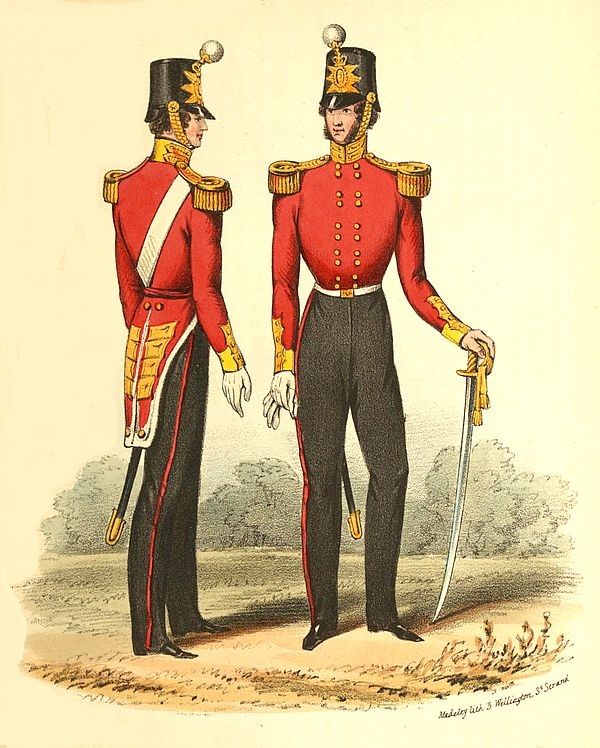
FIFTEENTH REGIMENT OF FOOT
FOR CANNONS MILITARY RECORDS.