OF
THE SIXTEENTH,
OR THE
BEDFORDSHIRE REGIMENT OF FOOT.
1688
In the autumn of 1688, when the pernicious counsellors
of King James II. had induced His Majesty to adopt
measures which indicated a design to overthrow the
constitution and established religion of the country,
and many patriotic noblemen and gentlemen had
solicited the Prince of Orange to come to England
with an army, to preserve the liberties and religion
of the people, the King then became sensible of the
dangerous position into which he had been brought,
and resolved to augment his army: and among the
corps embodied on that occasion was a regiment of
pikemen and musketeers, which has been retained in
the service to the present time, and now bears the title
of "The SIXTEENTH, or the Bedfordshire Regiment
of Foot."
This corps was raised in the southern counties of
England, and the colonelcy was conferred on Lieut.-Colonel
Archibald Douglas, from the royal regiment
of foot, by commission dated the 9th of October, 1688.
Captain Robert Hodges, from the grenadier company
of the royal regiment, was appointed Lieut.-Colonel,
and Murdock M'Kenzie was nominated Major. The
establishment was fixed at nine hundred and twenty-seven
officers and soldiers, including a grenadier
company, which was afterwards ordered to be added
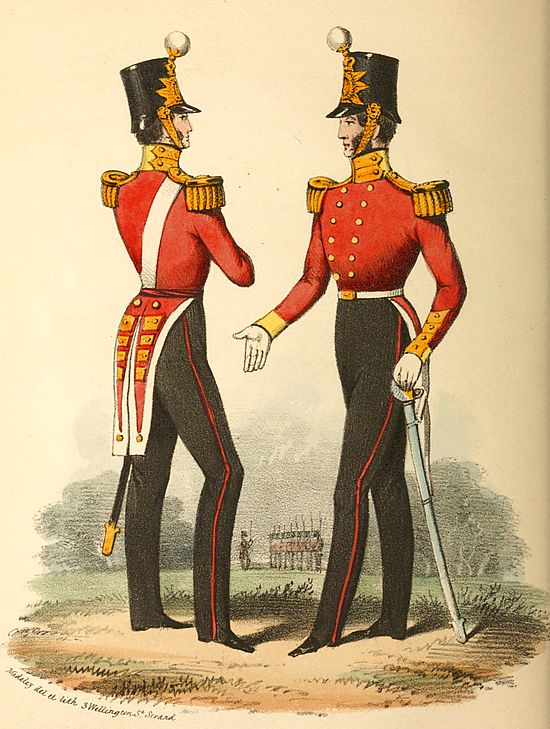
to the regiment. The uniform was round hats, ornamented
with white ribands; red coats, lined and faced
with white; white waistcoats and breeches.
Five days after the warrants for the formation of
the regiment were issued, a number of men had enrolled
themselves under the standards of this corps,—principally
from the county of Middlesex; and they were
ordered to march to Reading in Berkshire, where the
several enlisting parties were directed to assemble,
and the formation of the corps was completed.
Early in November, when the armament under the
Prince of Orange had passed Dover, the regiment was
ordered to march to London, and occupy quarters in
the borough of Southwark; it was afterwards directed
to join the army: but the pernicious advice of the
King's counsellors proved fatal to his interests; his
soldiers refused to fight against the Prince of Orange;
and some irregular orders were issued which appeared
to leave the officers and men at liberty to quit their
colours, when a number of corps were disbanded. The
Prince of Orange issued orders for the several corps
to be re-organised, and appointed quarters for every
regiment;—the SIXTEENTH were directed to occupy
quarters at Stony Stratford, in Buckinghamshire.
King James afterwards fled to France.
Colonel Douglas adhered to the interest of King
James, and the Prince of Orange promoted Lieut.-Colonel
Hodges to the colonelcy of the regiment, by
commission dated the 31st of December, 1688.
1689
In the early part of 1689 the Prince and Princess of
Orange were elevated to the throne by the titles of
King William the Third and Queen Mary; and soon
afterwards the SIXTEENTH regiment received orders to
proceed to Holland, to aid the Dutch in their war
with France. It embarked for the United Provinces
in April, and served the campaign of that year under
Prince Waldeck; in August it was in position in the
province of Namur.
Early on the morning of the 25th of August, the
musketeers of the regiment, with the piquets of several
other corps, commanded by Colonel Hodges of the
SIXTEENTH, advanced to cover the numerous foraging
parties sent to the villages and fields in front of the
army, and Colonel Hodges posted his men at, and in
front of, the village of Forgé. About nine o'clock the
French army under Marshal d'Humières was seen
advancing to attack the confederate forces, when three
guns were fired to call in the foragers, and Colonel
Hodges prepared to resist the leading corps of the
enemy to give time for the several parties to withdraw.
The Dutch and Danish horse in front were speedily
driven in; but the musketeers of the SIXTEENTH and
other corps under Colonel Hodges lined the hedges,
and held a force of very superior numbers in check
nearly two hours, when, the foraging parties having
all returned to camp, Colonel Hodges withdrew to a
mill, and, posting his men behind walls and out-buildings,
he held the French army in check nearly an hour,
the shots of his marksmen smiting the leading companies
of the enemy with sure aim. At length he received
orders to retire, and withdrew fighting, until he came
to the village of Walcourt, where a regiment of Lunenburgers
was posted. The French attempted to carry
the village by storm; but were repulsed, and were
eventually forced to retreat, with severe loss. Colonel
Hodges' party had Lieut.-Colonel Graham, Captain
Davison, and thirty men, killed.
In October the regiment marched to Bruges, where
it was stationed during the winter.
1690
The regiment marched for Brussels in June, 1690,
in order to join the Dutch forces; but Prince Waldeck
engaged the French at Fleurus, without waiting for
the arrival of the British troops, and his army was
nearly annihilated; which reduced the confederate
forces to the necessity of limiting their services to
defensive operations during the remainder of the
campaign.
1691
Leaving its winter quarters in March, 1691, the
regiment joined the army in South Brabant, and was
formed in brigade with the Scots foot guards, a battalion
of the royals, and the Scots regiments of Ramsay,
Angus, and Mackay; but the confederate army was not
sufficiently numerous to prevent the French capturing
Mons. During the summer the regiment took part
in various manœuvres; but no general engagement
occurred.
1692
In the spring of 1692, when the French besieged
Namur, the SIXTEENTH were called from their winter
quarters, and joined the army under the command of
King William III., who advanced to relieve the besieged
fortress, but was delayed by heavy rains, and the
garrison surrendered before the end of June.
After several movements King William resolved to
attack the French army, under Marshal Luxemburg,
at its camp at Steenkirk, on the 3rd of August. The
leading corps penetrated along difficult roads, and
attacked the French army with great gallantry; but
the main body of the confederate troops was too far in
the rear to afford timely support, and the King ordered
a retreat. The SIXTEENTH were brought into action
on this occasion, and exposed to the enemy's fire, when
Colonel Hodges was killed at the head of the regiment
by a cannon-ball: his death was much regretted, he
being a gallant and intelligent officer, much esteemed
and beloved by the soldiers.
King William conferred the colonelcy of the regiment
on the Honorable James Stanley, afterwards Earl of
Derby, from Captain and Lieut.-Colonel in the first
foot guards.
Towards the end of August the regiment was
detached, with other troops, under Lieut.-General
Talmash, who moved towards Bruges: at the same
time Furnes and Dixmude were taken possession of
and fortified.
1693
The regiment served the campaign of 1693 in the
brigade commanded by Brigadier-General Erle. It
took part in several movements, and was in position
when the confederate army was attacked at Landen,
on the 29th of July, by the French, under Marshal
Luxemburg. The enemy had a great superiority of
numbers on this occasion, and the confederate army
was forced to retreat. It was stated in the London
Gazette, "the enemy had above eighty thousand
effective men; we were not more than forty-five
thousand. * * * Our troops in general behaved
themselves extremely well, but the English did particularly
distinguish themselves." The regiment had
Captain Cole and Ensign Johnston killed, and Ensign
Campion taken prisoner; it also lost upwards of fifty
men, killed, wounded, and taken prisoners.
At the end of the campaign the regiment was placed
in garrison at Dendermond.
1694
Quitting its winter quarters in May, 1694, the regiment
joined the army, and served the campaign of this
year in the brigade commanded by Brigadier-General
Collier: it afterwards returned to Dendermond.
1695
In 1695 King William undertook the siege of Namur,
and the SIXTEENTH had the honor to take part in
the capture of this important fortress. They joined the
besieging army, and were on duty in the trenches on
the 7th of July; and they were repeatedly engaged
in storming the outworks and exterior defences. On
the 17th of July Ensign Gardiner of the regiment was
killed, and Ensign Devreux wounded, at the attack on
the counterscarp; and on the 2nd of August, Captain
Holiday of the grenadier company was wounded at
the extending of the lodgment on the covered way.
On the following day, when preparations were making
for another assault, the garrison hoisted a white flag
and agreed to surrender the town.
The SIXTEENTH were selected to take part in the
siege of the castle of Namur, and were encamped at
Maison Blanche; but, having lost many men, they were
relieved on the 11th of August, and joined the covering
army under the Prince of Vaudemont. They were
encamped a short time between Genappe and Waterloo;
afterwards near Namur; and the grenadier company
took part in the attack on the castle, which capitulated
on the 2nd of September. The regiment afterwards
returned to Dendermond.
1696
1697
Leaving its winter quarters in the spring of 1696,
the regiment joined the army of Brabant under King
William, and served the campaign of that year in
Brigadier-General Fitzpatrick's brigade. It served the
campaign of 1697 in the brigade under Brigadier-General
Ingoldsby; and in the autumn the British
monarch witnessed his efforts to preserve the reformed
religion, and the balance of power in Europe, attended
with success. The treaty of Ryswick gave peace to the
nations of Europe; and the SIXTEENTH regiment embarked
for Ireland, where it was stationed until the
summer of 1701, reposing on the reputation which it
had acquired on the continent, where it had served
seven campaigns.
1701
In the meantime the French monarch had violated
the liberties of Europe, by procuring the accession of
his grandson, the Duke of Anjou, to the throne of
Spain,—by seizing on the Spanish Netherlands and
detaining the Dutch garrisons in the barrier towns:
and the SIXTEENTH were called from their quarters in
Ireland to reinforce the Dutch army. The regiment
embarked from Carrickfergus on the 7th of June, and
sailed to the island of Voorn, where it was removed on
board of Dutch vessels, and proceeded up the Maese
to the fortress of Huesden, where it remained two
months, then proceeded to Breda, and was reviewed on
Breda heath by King William on the 21st of September,
afterwards returning to Huesden.
1702
In March, 1702, the regiment traversed the country
to Rosendael, where the British corps were assembled
under Brigadier-General Ingoldsby, and received
information of the death of King William, and the
accession of Queen Anne, on the 8th of March. The
regiment afterwards marched across the country to the
duchy of Cleves, and encamped at Cranenburg,
forming part of the covering army during the siege of
Kayserswerth by the Germans. On the night of the
10th of June the covering army made a forced march
to Nimeguen to avoid the loss of communication
with that fortress, in consequence of the movements of
the enemy. On the following morning the British corps
in the rear-guard distinguished themselves in a sharp
skirmish with the leading columns of the French army.
Queen Anne declared war against France; additional
troops were sent to Holland, and the Earl of Marlborough
assumed the command of the allied army.
The SIXTEENTH shared in the operations by which the
French army was forced to retire from the frontiers of
Holland; and they formed part of the covering army
during the sieges of Venloo, Ruremonde, and Stevenswaert;
took part in delivering the city of Liege from the power
of the enemy; and their grenadier company distinguished
itself in the capture of the citadel by storm
on the 23rd of October. The regiment afterwards
marched back to Holland for winter quarters.
1703
Towards the end of April, 1703, the regiment commenced
its march towards Maestricht, and was in position
near that city when the French army approached
in order of battle, but did not venture to hazard a
general engagement. The regiment shared in the
operations by which the French were afterwards
forced to make a precipitate retreat and take post
behind their fortified lines. The services of the
regiment were also connected with the siege and
capture of the fortress of Huy, on the Maese river,
above the city of Liege; and with the siege of the
city of Limburg, situate on a pleasant eminence among
woods near the banks of the Wesdet, which place surrendered
on the 28th of September. After these conquests
the SIXTEENTH returned to Holland.
1704
During the winter six hundred men of the regiment
joined the garrison of Maestricht, while the Dutch soldiers
were working at the entrenchments on the heights of
Petersberg: in May, 1704, the remainder of the regiment
marched towards the Rhine, and was joined at
Bedburg by the detachment from Maestricht.
The Duke of Marlborough led his army from
Holland to the heart of Germany, and, there encountering
the legions of France and Bavaria, he gained two
important victories on the banks of the Danube, and
exalted the reputation of the British arms. The
SIXTEENTH had the honor to share in this splendid
enterprise, and to take a distinguished part in gaining
the victory at Schellenberg on the 2nd of July, when
the regiment had Major Mordaunt, Ensign Charleston,
one serjeant, and nineteen soldiers killed; Lieut.-Colonel
Hamilton, Captain Coghlan, Ensign Key, one
serjeant, and thirty-four rank and file wounded.
After this victory the regiment crossed the Danube
and marched to the vicinity of the enemy's fortified
camp at Augsburg, which was found too strong to be
attacked, and the army retired a few stages, the
Germans commencing the siege of Ingoldstadt. The
enemy, being reinforced from France, took up a position
in the valley of the Danube, near the village of
Blenheim, which was occupied by a considerable body
of troops; and on the memorable 13th of August a
general engagement took place, in which the English
general was once more victorious; the French and
Bavarian army sustaining a decisive overthrow, with
the loss of its artillery and baggage, and many entire
regiments being made prisoners; the French commander,
Marshal Tallard, being among the captives.
The SIXTEENTH regiment was one of the corps which
sustained the brunt of the battle on this occasion, and
acquired great honor. The loss of the regiment was
very great: Captain Coghlan, Lieutenant Brown,
Ensigns Sabine and Hesketh, were among the killed;
and Lieut.-Colonel Hamilton, Captains Hesketh,
Fleming, Lee, and Horne, Lieutenants Vicariage,
Jackson, Ayloffe, and Reddish, Ensigns Mackrich,
Hook, and Gordon, wounded.
From the banks of the Danube the regiment traversed
the country to Philipsburg, where it crossed the
Rhine, and formed part of the covering army encamped
at Croon-Weissemberg, during the siege of Landau
by the Germans. In the autumn the regiment embarked
in boats on the Rhine, and sailed to Holland.
1705
The losses of the preceding campaigns were replaced
in the spring of 1705 by recruits from England, and,
when the regiment took the field to serve the campaign
of 1705, its appearance and efficiency were admired.
It was employed in the expedition up the Moselle, and,
passing the Moselle and the Saar rivers on the 3rd of
June, advanced towards Syrk; but the designs of
the British commander were frustrated by the tardy
movements of the Germans, and he marched back to
the Netherlands.
In May of this year the Earl of Derby retired from
the service, and was succeeded in the colonelcy by
Lieut.-Colonel Francis Godfrey, from the foot-guards.
A stupendous barrier of fortified lines, forts, and
batteries opposed the progress of the British commander;
but by skilful movements these works were
passed at the slenderly-guarded posts of Helixem and
Neer-Hespen on the 18th of July. On this occasion
the SIXTEENTH formed part of Brigadier-General
Fergusson's brigade in the main body of the army,
and did not sustain any loss. It shared in the subsequent
operations of the campaign, and passed the
winter in garrison in Holland.
1706
The SIXTEENTH had the honor to take part in the
battle of Ramilies, on the 23rd of May, 1706, when the
French, Spanish, and Bavarian forces, commanded by
Marshal Villeroy and the Elector of Bavaria, were
forced from their formidable position with severe loss,
and pursued many miles.
Important results followed this triumph over the
forces of Louis XIV.; the states of Brabant and magistrates
of Brussels renounced their allegiance to the
Duke of Anjou; the principal towns of Brabant and
several fortified places in Flanders were immediately
delivered up, and others surrendered after short sieges.
Thus provinces disputed for ages, and towns which
had resisted powerful armies for months and years,
were conquered in one campaign. After taking part
in these splendid achievements, the SIXTEENTH marched
into quarters at Ghent.
1707
The regiment was in the field during the campaign
of 1707; but the French avoided an engagement, and
nothing of importance occurred.
1708
In the spring of 1708 the King of France fitted out a
fleet, and prepared a land force for the invasion of Great
Britain in favour of the Pretender, and the SIXTEENTH
were ordered to return to England to repel the invaders:
they arrived at Tynemouth on the 21st of March; but the
French fleet having been chased from the British coast by
the English navy, the regiment returned to Flanders.
After remaining a few weeks at Ghent, the regiment
joined the army in the field, and took part in achieving
another victory over the armies of Louis XIV., in the
fields near Oudenarde, on the 11th of July. The
SIXTEENTH formed part of a division of twenty battalions
commanded by the Duke of Argyle, which
traversed the Scheldt by the pontoon bridge between
Oudenarde and the abbey of Eename, ascended the
heights of Bevere, and, inclining to the right, engaged
the enemy in the open grounds beyond the rivulet;
when a fierce conflict of musketry ensued, and the
French were driven from field to field, with great
slaughter, until the darkness of the night rendered it
impossible to distinguish friends from foes, when the
troops were directed to cease firing. The wreck of the
French army made a precipitate retreat.
The siege of the important fortress of Lisle was afterwards
undertaken, and the SIXTEENTH were selected
to take part in this gigantic enterprise, which excited
universal attention throughout Europe; the strength
of the place,—the garrison consisting of fifteen thousand
men under the celebrated Marshal Boufflers, and being
provided with everything necessary for a protracted
defence,—gave an interesting character to this undertaking.
When the besieging army appeared before Lisle, the
French out-guards retired, and Serjeant Littler of the
SIXTEENTH regiment swam across the river with a
hatchet, and cut the fastenings which held up a drawbridge
to enable a party to pass the stream, for which
act of gallantry he was rewarded with a commission in
the third foot, or the Buffs.
The SIXTEENTH regiment took its turn of duty in the
trenches and shared in the attacks during the siege of
Lisle, evincing, on all occasions, the same heroic gallantry
for which it had previously been distinguished.
It had one serjeant and eleven rank and file killed,
and four serjeants and fifty rank and file wounded, at
the storming of the counterscarp; and sustained severe
loss on several other occasions. Numerous difficulties
had to be overcome in carrying on this siege; but the
skill, valour, and perseverance of the officers and soldiers
of the allied army, overcame every obstacle, and on the
9th of December the citadel surrendered.
1709
After reposing a few weeks in quarters, and receiving
a draft of recruits from England, the regiment advanced
up the country, and was encamped with the army on
the Upper Dyle; it was subsequently employed in
covering the siege of Tournay, and after the surrender
of the town, on the 29th of July, 1708, the SIXTEENTH
were selected to take part in the siege of the citadel.
This proved a difficult service, in consequence of the
extensive subterraneous works by which the fortress
was surrounded. The approaches were carried on
underground, and the working parties frequently penetrated
the subterraneous labyrinths of the castle, and,
encountering detachments of the enemy, fought underground
with sword, pistol, and bayonet. Several
parties were destroyed by the mines; but the works
were persevered in, and the garrison surrendered in
the beginning of September.
After the capture of Tournay the army marched
towards Mons; but finding a numerous French force,
under Marshals Villars and Boufflers, in position at
Malplaquet, the enemy was attacked in his fortified
post on the morning of the 11th of September, and the
SIXTEENTH had the honor to contribute to the gaining
of another victory over the armies of France. On this
occasion, the regiment was formed in brigade with the
Buffs and the regiments of Temple and Evans (afterwards
disbanded), and was engaged in the attack of the
woods in which the enemy's left wing was posted, and
in its advance it encountered entrenchments and
breastworks bristling with bayonets, and emitting a
storm of musket-shot and cannon-balls, which thinned
the British ranks. The leading corps were repulsed;
but, fresh troops arriving, a general attack was made
with so much resolution that the French were driven
from their entrenchments into the wood, where a sharp
fire of musketry was kept up, and the SIXTEENTH were
engaged among the trees. Finally the French were
overpowered at every part of the field, and forced to
retreat.
The regiment had about fifty men killed and
wounded; and Captain Ayloffe, Lieutenants Macrath,
Whiting, and Lawder wounded. It was afterwards
employed in covering the siege of Mons, and passed the
winter in quarters at Ghent.
1710
Having received another draft of recruits, the regiment
marched in April, 1710, to the vicinity of Tournay,
where the army was directed to assemble; its
services were connected with the forcing of the enemy's
fortified lines at Pont-à-Vendin; it also formed part of
the covering army during the siege of Douay, which
fortress surrendered on the 27th of June. The regiment
was afterwards employed in covering the siege of
Bethune, and this fortress was captured before the end
of August. The French army avoiding a general
engagement, the fortresses of Aire and St. Venant were
besieged at the same time, and after the capture of
these towns, the regiment returned to Ghent.
1711
Brigadier-General Godfrey withdrew from the service,
and was succeeded in the colonelcy of the regiment
by Brigadier-General Henry Durell, from the foot
guards, by commission dated the 17th of February,
1711.
In the campaign of this year the regiment shared in
the operations by which the boasted impregnable lines,
prepared by the French to arrest the progress of the
allied armies, were passed at Arleux, on the 5th of
August, and it was subsequently engaged in the siege
of the strong fortress of Bouchain,—services which
called forth all the powers of the active mind of the
Duke of Marlborough, who proved himself superior to
the French generals in all the qualities which constitute
a great commander. Bouchain having been
captured, the regiment was placed in garrison for the
winter.
1712
Once more taking the field in April, 1712, the regiment
joined the army near Tournay, from whence it
marched to the vicinity of Bouchain, and was
encamped at Cateau-Cambresis during the siege of
Quesnoy by the Germans; it brought six hundred and
eighty-one rank and file into the field. The garrison
of Quesnoy surrendered on the 4th of July; and soon
afterwards a suspension of arms was proclaimed preparatory
to a treaty of peace, and the British troops
withdrew to the vicinity of Ghent, from whence the
SIXTEENTH were detached to Dunkirk, which city the
French monarch delivered into the hands of the British,
as a pledge of his sincerity in the negotiations for
peace.
1713
On the 1st of December, 1712, Brigadier-General
Durell died, and Queen Anne conferred the colonelcy
of the regiment on Brigadier-General Hans Hamilton,
from the thirty-fourth regiment, by commission dated
the 23rd of June, 1713.
1714
The regiment was stationed at Dunkirk until April,
1714, when it embarked for Scotland, and, landing at
Leith, relieved the twenty-fifth regiment, which was
ordered to embark for Ireland. The SIXTEENTH were
stationed at Stirling in September, 1714, with the
Inniskilling dragoons, when the arrival in London of
King George I. from Hanover, was celebrated with
public rejoicings.
1715
In the summer of 1715 the colonelcy of the regiment
was conferred on the Lieut.-Colonel, Richard
Viscount Irving, in succession to Brigadier-General
Hamilton.
1716
A rebellion in favour of the Pretender broke out in
Scotland in the autumn of this year, and the Earl of
Mar headed the insurgent clans; but the SIXTEENTH
did not take the field: the protection of Fort William
was entrusted to their charge; and they were in garrison
at this place in the early part of 1716, when the
rebellion was suppressed by the troops under the Duke
of Argyle.
1717
1724
In December, 1717, Viscount Irving was removed to
the second horse, now first dragoon guards, and was
succeeded by Lieut.-Colonel John Cholmeley; and this
officer dying in April, 1724, King George I. conferred
the colonelcy on Henry Earl of Deloraine (son of James
Duke of Monmouth), from the Scots troop of horse-grenadier-guards.
1725
1727
The regiment was employed on home service in Great
Britain during the whole of the reign of King George
I.; it was one of the corps selected to proceed to
Holland in 1727, to assist the Dutch in their war with
the Imperialists; but no embarkation took place.
1730
On the 9th of July, 1730, the Earl of Deloraine was
removed to the seventh horse, now sixth dragoon-guards,
and the colonelcy of the regiment was conferred
by King George II. on Colonel Roger Handasyd, from
the twenty-second regiment.
1737
In 1737 the British merchants complained of the
depredations committed on their vessels by the
Spaniards in South America. A Convention was entered
into between the two Crowns, which was, however,
violated by the Spaniards in many instances.
1739
On the 23rd of October, 1739, a declaration of war
against Spain was proclaimed, when the establishment
of the regiment was augmented.
1740
In the summer of 1740 the regiment pitched its
tents near Newbury, where an encampment was formed
of two regiments of horse, three of dragoons, and four
of infantry, under Lieut.-General Wade. The SIXTEENTH
left the camp and embarked on board the fleet,
where they served as Marines a short time, and afterwards
landed at Portsmouth. In the autumn they
furnished a detachment to accompany the expedition to
the West Indies, under General Lord Cathcart, who
died on the passage.
1741
The expedition arrived at Jamaica in January, 1741,
and the detachment of the SIXTEENTH was employed
in the attempt on Carthagena, the capital of an extensive
and wealthy province in the country of Terra Firma,
in South America. The violent periodical rains
occurred before the conquest was achieved, and the
armament proved of insufficient strength to capture the
place; the country became deluged with water, the
health of the soldiers was seriously impaired, and the
enterprise was abandoned. The detachment of the
SIXTEENTH was nearly annihilated by disease.
1742
In this year the war of the Austrian succession
commenced; and in 1742 a British army proceeded to
Flanders to support the interests of the Archduchess,
Maria Theresa; but the SIXTEENTH were employed on
home service.
1745
Charles Edward, eldest son of the Pretender, arrived
in Scotland in the summer of 1745, and being joined
by a number of the Highland clans, he made a desperate
effort to overthrow the existing government, and to
procure the accession of his father to the throne. At
first some partial successes were gained by the insurgents;
but the British nation evinced firmness and
decision in supporting the rights of their sovereign, and
in preserving the constitutional privileges of the people.
The services of the regiment were, at this period,
limited to the south of England, where a body of
troops was held in readiness to repel a menaced
invasion by the French.
1746
In January, 1746, the royal troops, under Lieut.-General
Hawley, were defeated by the Clans, on Falkirk
moor, and additional forces were ordered to proceed to
Scotland. In March the SIXTEENTH regiment embarked
from Gravesend, with several other corps, for
Edinburgh, and arrived at Leith as the guns of Edinburgh
castle were firing for the decisive victory gained
over the clans at Culloden. The regiment waited a
few days on board the transports, until the return of
an express from the army, when it received orders to
sail northwards, and landed at the royal burgh of
Nairn on the 1st of May. It was subsequently stationed
at Elgin, &c.
1747
The regiment remained in Scotland, and in the
summer of 1747 it was encamped in a valley environed
by lofty mountains, near Fort Augustus.
1748
1749
The war on the Continent terminated in 1748; and
in the following year the regiment was reduced in
numbers to the peace establishment, and sent to Ireland,
where it was stationed nearly twenty years.
1751
On the 1st of July, 1751, King George II. issued a
warrant for establishing uniformity in the clothing,
standards, and colours of the several regiments of the
regular army; and in this warrant the uniform of the
SIXTEENTH, or Lieut.-General Roger Handasyd's regiment,
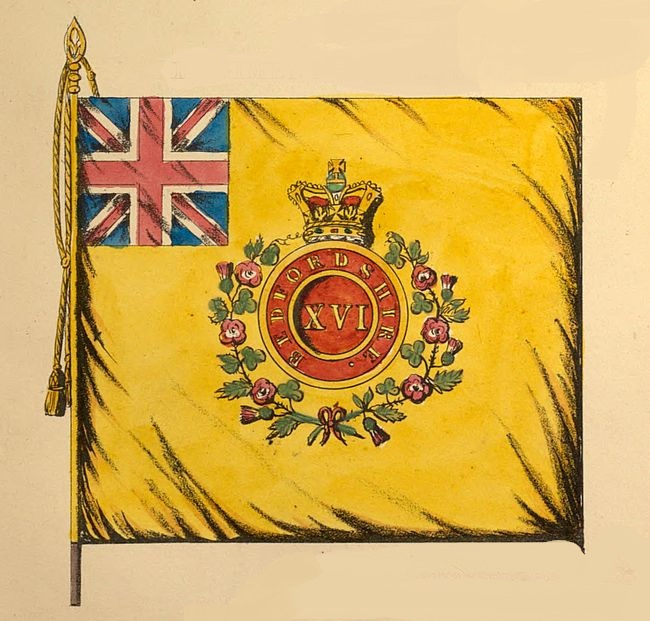
was directed to be red, faced with yellow.[6] The
first, or the King's colour, to be the great Union: the
second, or regimental colour, to be of yellow silk, with
the Union in the upper canton; in the centre of the
colours, the rank of the regiment, in gold Roman characters,
within a wreath of roses and thistles on the
same stalk.
At this period the soldiers of the regiment wore
three-cornered cocked hats, bound with white lace, and
ornamented with a white loop and a black cockade;
red waistcoats; red breeches; white gaiters reaching
above the knee, and fastened below the knee with a
black garter; and white cravats; they also wore buff
cross-belts.
1755
1756
1757
1758
1760
The undetermined extent of the British territory in
North America gave rise to hostilities with France in
1755, and the establishment of the army was considerably
augmented in that and the two following
years. Several expeditions were also fitted out; but
the SIXTEENTH regiment was detained on home service
in Ireland. In 1760 a plan was formed for attacking
the French island of Belleisle, and the SIXTEENTH,
mustering seven hundred men, under Lieut.-Colonel
Gabbet, embarked on board of the fleet; but the enterprise
was laid aside in consequence of the death of
King George II., and the regiment returned to Ireland.
1762
On the termination of the war in 1762, the regiment
was again reduced to the peace establishment.
1763
General Roger Handasyd died in January, 1763, and
in June King George III. conferred the colonelcy of the
regiment on the Honorable Robert Brudenell, third
son of George Earl of Cardigan, from captain and
lieut.-colonel in the third foot guards.
1765
In 1765 Colonel Brudenell was removed to the
Fourth regiment of foot, and was succeeded in the
colonelcy of the SIXTEENTH, by Colonel William Draper,
who had commanded one of the regiments raised
in 1757, and numbered the Seventy-ninth regiment,
which was disbanded in 1763.
1766
Colonel Draper was honoured with the dignity of a
Knight of the Bath, and in 1766 he exchanged to the
colonelcy of one of the corps disbanded in 1763 (the
121st regiment) with Colonel James Gisborne, who
was performing the duty of Quartermaster-General
in Ireland.
1767
The regiment embarked from Ireland in 1767, for
North America, and was stationed in the pleasant and
fertile territory of Florida, which had been ceded to
Great Britain, by the Spaniards, in 1763, in exchange
for the Havannah.
1768
The head-quarters were established at Pensacola,—a
town of West Florida, situate at the head of a
delightful bay, or basin, in the Gulf of Mexico; and
the regiment furnished various detachments to occupy
military stations in East and West Florida.
1775
1776
1777
In these pleasant and healthy quarters the regiment
was stationed when a number of the British colonies
in North America revolted, and declared themselves a
free and independent people, under the title of the
United States. This occurred in 1775, and in the following
year the SIXTEENTH were withdrawn from Florida,
to join the army at New York, under Lieut.-General
Sir William Howe; but the necessity of having a small
force in the ceded Spanish province was evident, and
the SIXTEENTH having, during their residence of eight
years in East and West Florida, acquired the confidence
of the inhabitants and a knowledge of the country,
and of the habits and language of the people, the
regiment received orders to return to Pensacola, and
other stations in East and West Florida, and on the
confines of Georgia.
1778
Lieut.-General Gisborne died on the 20th of February,
1778, and King George III. conferred the colonelcy on
Major-General James Robertson, from Colonel Commandant
of the second battalion of the Sixtieth, who
had previously performed the duties of Lieut.-Colonel
of the SIXTEENTH regiment, many years, with reputation.
1778
1779
Had the British revolted provinces been left unaided
by European states, they would, doubtless, have been
reduced to submission; but in 1778 the French monarch
sent a numerous fleet and an army to their assistance;
and in 1779 the court of Spain commenced
hostilities against Great Britain, and this example was
followed by the Dutch.
Don Bernard de Galvez, governor of the Spanish
province of Louisiana, assembled a numerous force, and
suddenly invaded the British territories on the banks
of the Mississippi; and Lieut.-Colonel Dickson, of the
SIXTEENTH, who commanded the troops in that district,
being unable to oppose the invading army, withdrew
to Baton Rouge, where he caused a redoubt to be constructed,
which was scarcely completed when the
Spanish army advanced in force against this post,
which was invested on the 12th of September. On
the 21st the enemy opened a battery of heavy cannon
against the works, which were so much damaged in
a few hours, that Colonel Dickson was obliged to surrender.
The garrison, consisting of a detachment of
the SIXTEENTH, Sixtieth, and of the Waldeck regiments,
was sent prisoners of war to New Orleans, and afterwards
exchanged.
The French armament, under the Comte d'Estaing,
approached the city and port of Savannah in Chatham
county, in the state of Georgia, early in September,
and a detachment of the SIXTEENTH regiment, commanded
by Major Graham, formed part of the force
under Major-General Prevost, which defended that
place. The French troops landed, and were joined by
an American force under General Lincoln; but they
encountered a resistance which proved the determined
valour of the garrison. A detachment from the
SIXTEENTH was engaged in a sally on the 24th of
September, under Major Graham of the regiment, and
this service was performed with judgment and bravery.
"Major Graham artfully drew the enemy into a snare,
by which the French and Americans fired on each
other, and had fifty men killed before the mistake
was discovered."[7] Before daylight on the 9th of
October, the French and Americans made a desperate
effort to capture the place by storm; but were repulsed
at every point with severe loss. They afterwards
raised the siege and retired.
1781
In 1781 the Spaniards sent a numerous sea and land
force against Florida, under Don Bernard de Galvez, and
the invading army commenced operations by an attack
upon the works defending Pensacola, where a detachment
of the SIXTEENTH regiment was stationed. From
the strength of the Spanish force, mustering nine
thousand men, and a numerous fleet, at the same time
the British garrison only amounted to twelve hundred
men, the reduction of the place appeared inevitable; yet
a gallant defence was made, and the soldiers displayed
that innate bravery and resolution for which British
troops have always been distinguished. On the morning
of the 8th of May a shell burst near the door of the
magazine of the advanced redoubt, set fire to the
powder, and the redoubt and its garrison were destroyed
by the explosion, excepting a few men, who were forced
to retire, after spiking the guns. The Spaniards
carried the redoubt, and threatened to storm the
remaining works; but were intimidated by the determined
bearing of the garrison. The British commander,
Major-General John Campbell, afterwards
agreed to surrender, on condition that the garrison
should march out with the honours of war, and be sent
to a part belonging to Great Britain, but not serve
against the Spaniards, or their allies, until exchanged.
The SIXTEENTH had Lieutenant Edward Carroll and
seven soldiers killed; Captain Anthony Foster and
five soldiers wounded. Pensacola was a flourishing
place while under the British; but it declined after it
was taken by the Spaniards.
1782
The regiment having sustained severe loss from
various services in Florida, Georgia, and South Carolina,
where detachments had been employed, it was
ordered to return to Europe, and arrived in England in
March, 1782.
In August the regiment received directions to assume
the title of the sixteenth, or the Buckingham Regiment,
and to cultivate a connection with the respectable
inhabitants of that county, which might be useful
towards recruiting the regiment.
1783
The American War terminated in 1782; and the regiment
was placed upon a peace establishment in 1783.
1784
In 1784 it embarked for Ireland, where it was stationed
several years under the orders of Lieut.-Colonel
James Henry Craig, an officer of great zeal and ability.
1788
Lieut.-General Robertson, died on the 4th of March,
1788, and was succeeded in the colonelcy by Major-General
the Honorable Thomas Bruce, from the late
100th regiment, which was reduced after the termination
of the American War.
1790
1791
On the 18th of August, 1790, the regiment embarked
from Ireland for Nova Scotia, and in 1791 it was
removed to the island of Jamaica, where it remained
five years.
1793
1794
A revolution broke out in France, and the republican
principles which filled that kingdom with anarchy,
confusion, and bloodshed, soon extended to the French
West India Settlements, where the blacks and mulattoes
rose in arms against the European planters, and filled
the islands with rapine and devastation. Many of the
respectable inhabitants of the French island of St.
Domingo solicited the protection of the British government
against the fury of the blacks, and a detachment
of British troops proceeded to their aid, from Jamaica,
in 1793. The SIXTEENTH regiment furnished a portion
of this detachment, but the climate of St. Domingo
proved injurious to the health of the British troops,
and the whole of the party of the SIXTEENTH died of a
pestilential fever, excepting Lieutenant Vernon and
one serjeant, who rejoined the regiment at Jamaica.
1795
The island of Jamaica was taken from the Spaniards,
by an English armament in 1655 (during the commonwealth
under Cromwell), when the slaves belonging
to the Spanish planters fled to the mountains, where
they lived in savage independence, and were called
"Maroons." They procured arms, became expert
marksmen, and frequently committed outrages against
the British inhabitants. In 1738 a treaty was concluded
with them, and they received a grant of land;
but the pernicious doctrines of the French republicans
were circulated among the Maroons, who were joined
by a number of runaway slaves, and commenced hostilities
against the English in 1795. The SIXTEENTH
served in the Maroon war, when the soldiers encountered
many difficulties, and at first sustained some reverses,
from the difficult nature of the mountainous districts
into which they had to penetrate, and from the expert
character of the Maroon warriors in bush-fighting
among rocks and dells covered with trees and underwood.
A detachment of the SIXTEENTH was first called
into action; and in October the regiment, commanded
by Major John Skinner, who held the local rank of
Colonel, was called into the field. This officer had
served many years in the regiment; he had distinguished
himself in the American war, while serving
with Tarleton's Legion, with which corps he was
present at numerous engagements, and on joining the
field force in the Maroon war, his presence inspired the
troops with confidence. Offensive operations were
conducted with prudence and skill, and by a strict
combination in the movements of the troops employed,
united with valour and discipline, the Maroons were
driven from their mountain-fastnesses, and chased from
post to post, until they were forced to submit. In performing
this service, the soldiers underwent great
fatigue and privation, and they conquered the Maroons
in a part of the island where no European had ever
before thought of penetrating. Captain Drummond, of
the SIXTEENTH, distinguished himself in this war.
1796
The Maroons tendered their submission in March,
1796, and they were afterwards removed from the island.
1797
Having become considerably reduced in numbers, the
regiment returned to England, towards the close of
this year, and was stationed a short time at Greenwich,
from whence it embarked for Scotland, early in 1797;
at the same time it was ordered to recruit with boys.
Lieut.-General the Honorable Thomas Bruce having
died, he was succeeded in the colonelcy by Major-General
Henry Bowyer, from the Eighty-ninth regiment,
by commission dated the 15th of December, 1797.
1798
The regiment was quartered in Fifeshire, under the
orders of Major John Skinner, and afterwards proceeded
to Fort George; Lieut.-Colonel Hugh Wallace assuming
the command. The boys were transferred to the
Thirty-fourth and Sixty-fifth regiments, under orders
for India, and the SIXTEENTH were completed by
volunteers from the English militia, principally limited
service men.
1799
In 1799 the regiment embarked from Scotland for
London, from whence it proceeded to Margate, to join
the expedition to Holland, under His Royal Highness
the Duke of York; but the order to proceed on this
service was countermanded, and the regiment was
stationed a few months at Horsham in Sussex.
1800
1801
Embarking from Portsmouth in 1800, the regiment
sailed to Cork, and was stationed in the south of
Ireland; where Lieut.-Colonel St. John Fancourt
joined and assumed the command in 1801.
1802
At the conclusion of the peace of Amiens in 1802,
the limited service men were discharged; and the
regiment was completed from disbanded fencible and
militia corps.
1803
War was resumed in 1803; and Lieut.-Colonel
Fancourt having been removed to the Thirty-fourth
regiment, the command of the SIXTEENTH devolved on
Brevet Lieut.-Colonel Skinner.
1804
On the 7th of January, 1804, the regiment embarked
from Monkstown, for the West Indies, and arrived at
Barbadoes on the 26th of March. It was immediately
ordered to hold itself in readiness to proceed with the
expedition under Major-General Sir Charles Green and
Commodore Samuel Hood, against the Dutch colony of
Surinam, in Guiana, in South America. This colony was
ceded to the Dutch, by King Charles II., in exchange for
New York, in North America; it was captured by the
British in 1799, and restored at the peace of Amiens
in 1802.
On the 7th of April, 1804, the expedition sailed from
Barbadoes, and a landing was effected on the 26th of
that month; the SIXTEENTH were actively employed in
operations, until the surrender of the colony on the
4th of May.
1806
While the regiment was at Surinam, the post occupied
by a detachment of the light company and a few
men of the fourth West India regiment, commanded by
Lieutenant Richard Greene, of the SIXTEENTH, at
Armena, was attacked by a large force of predatory
negroes and banditti, and defended with great gallantry,
the greater part of the garrison being killed in the
successful resistance made to the assailants. The inhabitants
of the colony afterwards presented Lieutenant
Greene with a valuable sword, in token of their sense
of his conduct.
1807
In 1807 Lieut.-Colonel Skinner was succeeded in
the duties of commanding officer by Major Brabazon
Dean Vernon.[8]
1808
On the decease of General Bowyer, in 1808, King
George III. conferred the colonelcy on Major-General
Sir Charles Green, Bart., from the York light infantry
volunteers.
1809
In May, 1809, His Majesty was graciously pleased to
approve of the regiment being styled the SIXTEENTH,
or the BEDFORDSHIRE, instead of the Buckinghamshire,
Regiment: this exchange of County titles took place
with the Fourteenth Regiment of Foot.
1810
Lieut.-Colonel Henry Tolley assumed the command
of the regiment, in June, 1810.
1811
1812
During its stay at Surinam and Barbadoes, the
regiment lost twenty-seven officers and upwards of five
hundred men by disease. The survivors returned to
England by detachments in 1810, 1811, and 1812, and
landed at Falmouth and Portsmouth. One ship, the
"Islam," having on board the remainder of the grenadiers
and of one battalion company, was wrecked on the
Tuscan Rock off the coast of Ireland. By the exertions of
some workmen, who were making preparations to erect
a lighthouse on the rock, all were saved excepting one
man, one woman, and some children; all the arms,
appointments, and baggage were lost. On the following
day the party was taken off the rock by a brig,
and conveyed to Beaumaris in Wales.
1813
After occupying quarters at various stations, and
receiving many volunteers from the English and Irish
militia, the regiment marched to Sunderland in July;
and in March, 1813, embarked from thence for Perth:
in July of this year it proceeded to Ireland.
1814
Sir Charles Green, Baronet, was removed to the
Thirty-seventh regiment in February, 1814, when
His Royal Highness the Prince Regent, conferred
the colonelcy of the SIXTEENTH on Lieut.-General
Sir George Prevost, from the Seventy-sixth regiment.
During this period the war was continued in Europe,
and British troops were acquiring laurels under the
Duke of Wellington: at the same time the measures pursued
to counteract the decrees made by Napoleon, Emperor
of the French, for the destruction of the commerce
of Great Britain, brought on a war between the British
Crown and the United States of North America; and
in the spring of this year the SIXTEENTH embarked
from Monkstown to join the British troops in Canada.
The regiment was commanded by Colonel Tolley, and
arriving at Quebec on the 29th of May, was stationed
a short period at that fortress; it was afterwards
removed to Chambly, from whence it proceeded to
Montreal. The British troops having failed in the
attack of the American post at Plattsburg, the SIXTEENTH
were relieved from duty at Montreal, sent to
the upper province, and stationed at Fort Wellington.
1815
A treaty of peace having been concluded with the
Americans, the regiment was ordered to return to
Europe; it sailed from Quebec in July, and arrived at
Portsmouth in August. The return of Buonaparte to
France,—his reassumption of the imperial dignity,—his
overthrow at Waterloo, and surrender to a British
man-of-war, had occurred while the regiment was in
Canada, and on the passage to Europe; on its arrival
at Portsmouth, it was ordered to proceed to the Continent,
to join the army commanded by the Duke of
Wellington. The regiment landed at Ostend, and
marching to Paris, encamped at St. Denis.
On the conclusion of the definitive treaties of peace,
the regiment marched to Calais, where it embarked
for England, and landing at Dover, remained there
fourteen days.
1816
Lieut.-General Sir George Prevost, Baronet, having
died, the Prince Regent nominated Major-General
Hugh Mackay Gordon to the colonelcy of the regiment,
from the York Chasseurs, by commission dated the 8th
of January, 1816.
From Dover the regiment embarked for Ireland; it
landed at Monkstown on the 3rd of February, and was
stationed successively at Fermoy, Limerick, and Cashel.
1817
1818
In 1817 the regiment was removed to Kilkenny;
and in 1818 to Athlone.
1819
1820
On the 25th of August, 1819, the regiment embarked
from Cork, under the command of Colonel Tolley, for
colonial service, and touching at the Cape of Good
Hope, the flank companies landed, and remained at
Cape Town a month. The battalion companies continued
their voyage to Ceylon, and landed at Colombo
on the 20th of February, 1820, under Major William
Vandeleur. The flank companies, under Colonel Tolley,
arrived in March.
1821
1822
The regiment remained seventeen months at Colombo,
where it was joined by one hundred and twenty-eight
volunteers from the Seventy-third; in August, 1821, it
marched, under Major Vandeleur, for Kandy, where
Colonel Tolley resumed the command, and on his
proceeding on leave of absence, in October, 1822, the
command devolved on Brevet Lieut.-Colonel Lionel
Hook.
1823
Lieut.-General Gordon died in the spring of 1823,
and was succeeded in the colonelcy by Lieut.-General
William Carr, Viscount Beresford, G.C.B., and G.C.H.
1824
In March, 1824, the regiment returned to Colombo,
where it lost several officers and a number of men by a
malignant fever.
1825
1826
Colonel Tolley was promoted to the rank of Major-General;
Brevet Lieut.-Colonel Hook was nominated
to a Lieut.-Colonelcy in the Ceylon rifle corps; and
Colonel David Ximenes was appointed Lieut.-Colonel
of the SIXTEENTH; this officer arrived at Colombo in
March, 1826, and assumed the command of the
regiment, which marched from Colombo, in July following,
for Point de Galle.
1827
On the 2nd of July, 1827, Lieutenants Alexander,
Mylius, and Hyde, Ensigns Cassidi and Hannagan,
three serjeants, and one hundred and eight rank and
file, joined from the depôt in England.
1828
1829
The regiment, having been appointed to proceed to
Bengal, was relieved from duty at the island of Ceylon,
by the Sixty-first, in November, 1828, and embarking
from thence in four divisions, arrived at Calcutta in
January, 1829, when Colonel Ximenes was appointed
to command the garrison of Fort William, and Major
John W. Adain assumed the command of the regiment;
which received one hundred and fourteen volunteers
from the Fifty-ninth, and forty-six from the Thirtieth
and Forty-seventh regiments. In April Major Adain
obtained leave to proceed to England, and the command
of the regiment devolved on Major Adam Gordon
Campbell, until the arrival of Lieut.-Colonel Lionel
Smith Hook, in November: this officer was appointed
to the regiment in February of this year.
1830
The SIXTEENTH remained on duty at Calcutta, where,
in October and November, 1830, they received sixty-four
volunteers from other corps.
1831
In January, 1831, Colonel Hook was nominated to
the command of the garrison of Fort William, and
Major Campbell resumed the command; but on the
regiment quitting Calcutta, in March following, to
proceed in steam-boats to Chinsurah, Colonel Hook
again assumed the command. At this period twenty
volunteers joined from the Royal regiment.
1832
1833
1834
The SIXTEENTH regiment remained
at Chinsurah
until December, 1833, when it commenced its march
for Ghazepore: while on the march its destination was
altered for Cawnpore; and on the 7th of February,
1834, it had the misfortune to lose its commanding
officer, Colonel Hook, who died at the camp at Secrole,
Benares, when the command again devolved on Major
Campbell: on the 28th of February the regiment
arrived at Cawnpore.
1835
1836
In March, 1835, Captain H. McManus, Ensigns Henry
A. O'Molony and Edward Brabazon, two serjeants
and forty-three rank and file, joined from England.
Another detachment joined in May; and in March,
1836, one hundred and six volunteers were received
from the Thirty-eighth regiment,—also eighty-four
recruits from England, under Captain R. Brown,
Ensigns Hook and Lawson, and Surgeon Steele. They
were followed by Ensigns G. M. Ross and H. C. M.
Ximenes, in September.
1837
1838
In March, 1837, Lieutenant Gibbs, and thirty-two
recruits joined; and in May, twenty-two volunteers
from the Twentieth regiment. Thirty-nine volunteers
also joined from the Forty-fifth, in April, 1838.
1839
1840
On the 24th of December, 1839, the regiment received
orders to proceed by water to Calcutta; but in January,
1840, it received orders to disembark at Dinapore, and
relieve the Forty-ninth regiment, under orders to proceed
with the expedition to China. The SIXTEENTH
remained at Dinapore until October, when they were
relieved by a wing of the Twenty-first fusiliers, and
embarked for the Presidency, where they arrived on
the 4th of November.
1841
Orders having been issued for the regiment to return
to England, it transferred a number of volunteers to
other corps, and embarked, in three divisions, in
December, 1840, and January, 1841, under Lieut.-Colonel
Campbell, Major H. Clements, and Brevet-Major
Dalzell; and landing at Gravesend in April following,
marched from thence to Canterbury, from whence four
companies were afterwards detached to Dover.
In August the regiment was supplied with new
Percussion Arms. In December it marched to London,
and proceeded from thence by railway to Winchester.
1842
Leaving Winchester in April, 1842, the regiment
proceeded by railway to Gosport, and in August it was
removed to Portsmouth.
On the 22nd of September NEW COLOURS were presented
to the regiment, on Southsea Common, by the
Honorable Lady Pakenham; the Rev. Richard
Bingham conducted the ceremony of consecration; and
the regiment was afterwards addressed by Major-General
the Honorable Sir Hercules R. Pakenham,
K.C.B., commanding the South-west District, who
detailed, in a very impressive manner, the ancient
achievements of the corps. A large assemblage of
nobility and gentry were present at the ceremony, and
were afterwards entertained by the officers at a déjeuné
and ball.
1843
The regiment proceeded from Portsmouth to Manchester,
in May, 1843, and from thence to Ireland in
July. During the remainder of the year it was
stationed at Newbridge and Birr.
1844
From Birr the regiment marched, in February, 1844,
to Naas, and in March removed to Dublin, where it
remained until December, when the regiment proceeded
to Cork.
1845
In June, 1845, the SIXTEENTH regiment marched to
Buttevant, and in October to Cork, for the purpose of
proceeding on foreign service.
1846
The service companies of the regiment, under the
command of Lieut.-Colonel Henry McManus, embarked
at Cork for Gibraltar, on the 17th and 19th
January, 1846, in the freight ships Cressy and Earl
Grey, and arrived at Gibraltar on the 11th February.
The depôt companies marched from Buttevant to Birr,
in April, 1846, and proceeded in November to Fermoy.
1847
On the 9th of March, 1847, the regiment, under the
command of Lieut.-Colonel McManus, embarked in
Her Majesty's ship Belleisle for Corfu, where it arrived
on the 27th March; and on its embarkation for the
Ionian Islands, a favourable report was received by the
Adjutant-General from the Governor of Gibraltar,
General Sir Robert Wilson, who stated, that the corps
was "very efficient and soldier-like," and that it was
"distinguished by very commendable conduct throughout its
service in the garrison."
The depôt companies marched from Fermoy to
Youghal in September, 1847.
1848
Lieut.-Colonel McManus retired on half-pay on
the 10th March, 1848, and Major Robert Luxmoore
was promoted to the rank of Lieut.-Colonel; Captain
Charles Grey succeeded to the Majority.
In April, 1848, the depôt companies proceeded to
Cork, and embarked for Guernsey on the 4th May,
where they are now stationed.
On the 1st June, 1848, the date to which the Record
has been continued, the service companies were
stationed at Corfu, under the command of Lieut.-Colonel
Robert Luxmoore.
1848
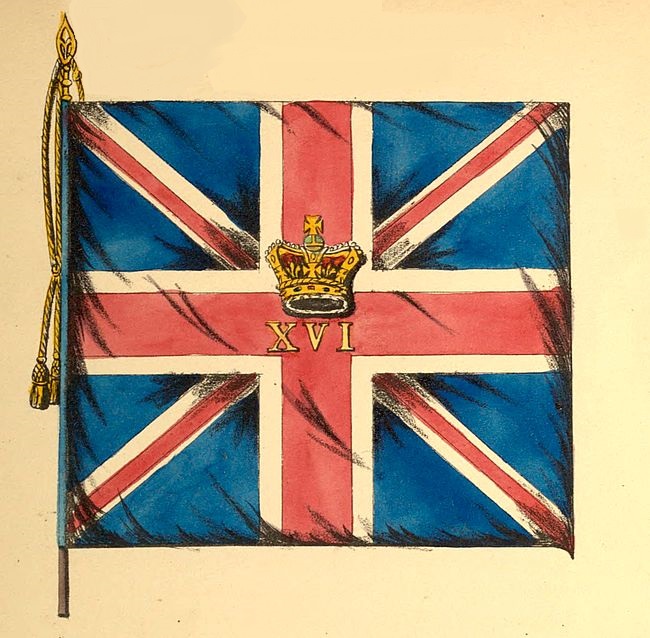
SIXTEENTH REGIMENT.
QUEEN'S COLOUR.
REGIMENTAL COLOUR.
FOR CANNON'S MILITARY RECORDS
Madeley lith 3 Wellington St Strand